Lenny LearningLenny
Create
Explore
Workspace
LoginSign up
MathEnglish Language ArtsScience & EngineeringSocial StudiesGlobal LanguagesHealth & Physical EducationSpecial EducationCounseling & Life SkillsArts & CreativityESL
Lenny LearningLenny
Lenny Learning
About
Training
Pricing
Support
Contact
© 2026 Lenny Learning Inc.

History

SequencesLessonsMaterialsVideos
  1. Social Studies

History

SequencesLessonsMaterialsVideos

Chronological developments of global civilizations from prehistoric foundations to contemporary international relations. Examines ancient empires, medieval societies, and the socio-political evolution of the United States through various historical lenses.

Social StudiesSocial Studies PracticesLocation WordsMapsOrder EventsChronology and CausationEvaluating SourcesHistorical ThinkingGeography, Humans, & the EnvironmentAmerican Symbols and LandmarksCitiesStatesState CapitalsRegions of the United StatesGeographic SkillsPhysical GeographyHuman GeographyRegional GeographyGeography of AfricaGeography of AsiaGeography of EuropeGeography of OceaniaGeography of the AmericasSociety and Environment of EuropeSociety and Environment of AsiaSociety and Environment of The AmericasSociety and Environment of the Middle EastSociety and Environment of AfricaHistoryPrehistoryComparing Ancient River CivilizationsAncient MesopotamiaAncient Egypt and KushAncient South AsiaEarly ChinaGreeceRome and the Byzantine EmpireAncient World HistoryNative Peoples of North AmericaNative Peoples of Mesoamerica and South AmericaAfrican EmpiresMedieval AsiaMedieval EuropeThe Silk RoadMedieval HistoryIslamic EmpiresWorld ReligionsRenaissance PeriodAge of ExplorationThe Thirteen ColoniesThe American RevolutionUS History Early RepublicFounding of the United StatesUS History AntebellumUS Civil WarReconstruction PeriodThe Gilded AgeUS ImperialismWorld ImperialismWorld War IUS History 1920sGreat DepressionWorld War IIThe Cold WarUS History 1950-60sUS History 1960s-70sWorld History 20th CenturyContemporary US HistoryContemporary World HistoryHolidaysCivics and GovernmentCitizenshipGovernment FoundationsThe ConstitutionUS ConstitutionExecutive BranchLegislative BranchJudicial BranchState and LocalPolitical ParticipationPublic PolicyPolitical SystemsPower and AuthoritySocial MovementsDefining DevianceTheories of DevianceCrime and Criminal JusticeEconomicsBasic Economic PrinciplesSupply and DemandWhat is MoneyEconomic FundamentalsMicroeconomicsMacroeconomicsBanking and FinanceEconomic SystemsGlobal EconomicsCorporations and PowerThe Changing WorkplaceUnemployment and LaborClass and InequalitySocial MobilityGlobal InequalityPsychologyHistory of PsychologyPsychology as a ScienceBrain and Nervous SystemNeuroscience and BehaviorGenetics and BehaviorSleep and ConsciousnessSensory ProcessesPerceptual OrganizationClassical ConditioningOperant ConditioningObservational LearningCognitive LearningMemory ProcessesThinking and Problem SolvingLanguage and CognitionTheories of MotivationStress and CopingPrenatal and Infant DevelopmentChildhood DevelopmentAdolescent DevelopmentAdulthood and AgingSelf and IdentitySocial CognitionSocial InfluenceAttraction and RelationshipsGroup BehaviorPrejudice and DiscriminationAnxiety and Mood DisordersClinical PsychologyForensic PsychologyPhilosophy & EthicsIntroduction to PhilosophyMajor Philosophers & IdeasMind and Body ProblemFree Will vs DeterminismEthics & MoralityReligion & PhilosophyPolitical Philosophy
PrehistoryHuman evolution, archaeological methods, and the transition from hunter-gatherer societies to settled agricultural communities. Examines tool development, cave art, and migration patterns throughout the Paleolithic and Neolithic eras.
Comparing Ancient River CivilizationsComparative analysis of the Fertile Crescent, Nile, Indus, and Yellow River valleys focusing on geographic impact and social hierarchies. Examines shared characteristics such as irrigation, centralized government, and early writing systems.
Ancient MesopotamiaDevelopment of city-states and agriculture in the Fertile Crescent. Examines cuneiform script, ziggurat construction, and early legal systems like the Code of Hammurabi.
Ancient Egypt and KushNile River civilizations, pharaohs, and pyramid construction. Examines the cultural exchange, trade networks, and military conflicts between the Egyptian and Kushite empires.
Ancient South AsiaArchaeological origins of the Indus Valley Civilization alongside the cultural shifts of the Vedic period. Examines the rise of early empires, the evolution of major world religions, and social structures across the subcontinent.
Early ChinaDevelopment of the Shang and Zhou dynasties alongside the core philosophies of Confucianism, Taoism, and Legalism. Examines agricultural societies along the Yellow River and the origins of the Mandate of Heaven.
GreeceAncient Greek mythology, philosophy, and the birth of democracy in city-states like Athens and Sparta. Examines historical impacts from the Bronze Age through the Hellenistic period.
Rome and the Byzantine EmpirePolitical structures of the Roman Republic and Empire alongside the cultural shift toward the Byzantine East. Addresses engineering achievements, legal foundations, and the rise of Orthodox Christianity.
Ancient World HistoryEvolution of early civilizations from Mesopotamia and Egypt through the classical eras of Greece, Rome, and Han China. Examines the development of social hierarchies, religious systems, and cross-cultural trade networks.
Native Peoples of North AmericaDiverse cultures, languages, and histories of Indigenous nations across North American regions. Analyzes traditional environmental adaptations, social structures, and the long-term impacts of European colonization.
Native Peoples of Mesoamerica and South AmericaSocial structures, agricultural systems, and architectural achievements of the Maya, Aztec, and Inca civilizations. Examines cultural legacies and environmental adaptations across Mesoamerica and the Andean region.
African EmpiresTrans-Saharan trade networks, the rise of the Ghana and Mali empires, and the cultural impact of Mansa Musa. Examines the maritime power of Aksum and the architectural engineering of Great Zimbabwe.
Medieval AsiaPolitical structures of the Tang, Song, and Ming dynasties alongside the rise of the Mongol Empire and feudal Japan. Examines cross-cultural exchange via the Silk Road and the spread of major religions across the continent.
The Silk RoadAncient transcontinental trade networks linking East Asia with the Mediterranean. Examines the exchange of silk, spices, and cultural ideologies between diverse civilizations.
Medieval HistoryEuropean feudal structures, the expansion of Islamic caliphates, and the socio-economic impacts of the Black Death. Analyzes the transition from late antiquity to the early Renaissance through art, warfare, and religious shifts.
World ReligionsCore tenets, historical origins, and cultural practices of major global faiths including Hinduism, Buddhism, Judaism, Christianity, and Islam. Examines ethical frameworks and ritual traditions across diverse civilizations.
Renaissance PeriodHumanism, artistic techniques like linear perspective, and the revival of classical Greek and Roman philosophy. Examines the impact of the printing press on literacy and the cultural shifts spanning the 14th to 17th centuries.
Video
Exploring the History and Forms of Democracy

Exploring the History and Forms of Democracy

This educational video provides a comprehensive overview of the history, definitions, and forms of democracy. It begins by tracing the roots of democratic government back to Ancient Athens, introducing key historical figures like Cleisthenes and explaining foundational Greek concepts such as the Boule and Ecclesia. The narration breaks down the etymology of the word "democracy" and connects ancient practices to modern civic responsibilities. The core of the video analyzes three distinct forms of democracy: Direct, Pluralist, and Representative. Using relatable analogies like a family vacation planning session, it explains how direct democracy functions versus the efficiency and challenges of representative systems. It also explores the concept of pluralism, where various interest groups compete to influence policy, and contrasts this with authoritarian or single-view systems. For educators, this resource serves as an excellent primer for Civics and Government units. It moves beyond simple definitions to explore the "how" and "why" of government structures. The video emphasizes the critical role of the citizen, encouraging students not just to understand the system, but to actively participate through voting, debating, and staying informed. It is particularly useful for introducing the concept of a Republic and the balance between government efficiency and individual accountability.

Miacademy & MiaPrep Learning ChannelMiacademy & MiaPrep Learning Channel

11mins 24s

Video
Why the Bronze Age Civilizations Collapsed

Why the Bronze Age Civilizations Collapsed

In this episode of Crash Course World History, John Green explores the mysterious collapse of the Bronze Age civilizations in the Eastern Mediterranean around 1200 BCE. The video challenges the traditional narrative of separate, isolated civilizations by demonstrating how Egypt, the Hittites, the Mycenaeans, and others formed a highly interconnected international system defined by trade, diplomacy, and war. It examines the evidence for this interdependence, including the famous Uluburun shipwreck and the Amarna Letters.

CrashCourseCrashCourse

12mins 58s

Video
Life and Government in Ancient Sparta

Life and Government in Ancient Sparta

This engaging educational video transports students back to Ancient Greece to explore the unique and rigorous society of Sparta. Unlike its neighbor Athens, which focused on arts and philosophy, Sparta is presented as a military-centric polis where life revolved around discipline, strength, and service to the state. The video breaks down the complex Spartan political structure, including its dual kingship and the powerful Ephors, while also detailing the rigid social hierarchy of Citizens, Perioikoi, and Helots. Key themes include the contrast between individual freedom and collective duty, the role of geography in shaping political alliances, and the cultural prioritization of military readiness. The narrative covers the intense upbringing of Spartan children, the formation of the Peloponnesian League, and the eventual conflict with Athens. Through animated characters and historical imagery, complex concepts like oligarchy and social stratification are made accessible. For educators, this video serves as an excellent resource for comparing Ancient Greek city-states. It provides clear definitions of specific historical terms and offers natural pause points for discussions about government types and social values. The content connects well with lessons on the Peloponnesian War, ancient political systems, and the diverse cultures within the ancient Mediterranean world.

Miacademy & MiaPrep Learning ChannelMiacademy & MiaPrep Learning Channel

9mins

Video
How History Defined Europe as a Functional Region

How History Defined Europe as a Functional Region

This educational video explores the concept of Europe as a "functional region," examining how its boundaries and influence have been defined not just by physical geography, but by historical connections, trade networks, and cultural legacies. The narrator guides viewers through a chronological journey, starting with the Greco-Roman era and moving through the Crusades, the Age of Exploration, the Scramble for Africa, the Cold War, and finally the modern European Union. The video explains how these events created networks of interaction that extended Europe's "functional" borders far beyond its physical continent. Key themes include the difference between formal and functional regions, the lasting impact of Roman infrastructure and language, the spread of religion (Christianity and Islam), the geopolitical consequences of colonization, and the role of economic integration in the modern era. It specifically addresses how political ideologies during the Cold War divided the continent into two distinct functional zones and how the EU has since worked to reintegrate them through trade and a common currency. For educators, this video serves as an excellent bridge between geography and history, demonstrating how spatial relationships change over time. It provides concrete examples of abstract geographic concepts like "functional regions" and "spheres of influence." Teachers can use this resource to help students understand complex topics such as why French Guiana is part of Europe, how the Roman Empire laid the groundwork for modern Western culture, and the economic rationale behind the European Union.

Miacademy & MiaPrep Learning ChannelMiacademy & MiaPrep Learning Channel

9mins 54s

Video
Why Democracy Feels Broken: Models, Critiques, and Theory

Why Democracy Feels Broken: Models, Critiques, and Theory

This educational video from Crash Course Political Theory explores the complex nature of democracy, addressing the common modern sentiment that democratic systems are "broken." Hosted by Dr. Ellie Anderson, the video investigates whether dissatisfaction with democracy is a new phenomenon or an inherent feature of the system. It traces critiques of democracy back to ancient philosophers like Plato, who worried about the chaos of "unmixed freedom," and contrasts historical Athenian practices with the egalitarian decision-making of indigenous hunter-gatherer societies.

CrashCourseCrashCourse

12mins 5s

Video
How War Shaped Civilization and State Building

How War Shaped Civilization and State Building

In this thought-provoking episode of Crash Course World History, John Green challenges the conventional wisdom that war is exclusively destructive. While acknowledging the tragic human cost of conflict, the video explores the counter-intuitive historical theory that war—or the threat of it—was a primary driver in the development of civilization itself. Green argues that the need for defense against raids may have spurred humans to congregate in walled cities even before the full development of agriculture, suggesting that war might be the mother of invention for the state itself. The video covers a sweeping timeline, moving from ancient hunter-gatherer societies to the Zulu Kingdom, the Roman Empire, and the Gunpowder Revolution of the early modern era. Key themes include the relationship between military technology and state bureaucracy (how cannons required taxes), the shift from citizen militias to mercenaries, and the eventual transition from conquest-based economies to trade-based economies. The episode examines how the rising cost of war and the mutual benefits of global trade have, in modern times, made large-scale conflict between major powers less economically viable. For educators, this video is an excellent tool for teaching AP World History concepts regarding state formation and the consolidation of power. It models high-level historical thinking by asking students to consider complex causality and the unintended consequences of historical events. It is particularly useful for units on the rise of empires, the development of political systems, or discussions about the economic motivations behind historical conflicts versus modern diplomacy.

CrashCourseCrashCourse

12mins 48s

Video
How Nationalism Shaped 19th Century Europe

How Nationalism Shaped 19th Century Europe

This educational video provides a comprehensive overview of nationalism in 19th-century Europe, using an accessible analogy of a college intramural sports team to explain complex political concepts. It explores how a shared sense of identity can act as a double-edged sword, serving as both a unifying force for scattered principalities and a divisive tool that tears multi-ethnic empires apart. The narrative covers three specific types of nationalist movements: unification, separation, and state-building, using historical examples like the formation of Germany and Italy, the Greek revolt against the Ottomans, and the shifting dynamics of the Austrian and Russian Empires. The video delves into key historical events, including the Austro-Prussian War, the Greek War of Independence, and the policy of Russification. It candidly addresses the darker side of nationalism, including the "us versus them" mentality that fueled ethnic cleansing, such as the Armenian Genocide, and eventually set the stage for World War I. By contrasting the rise of democratic self-rule with the dangers of persecution and authoritarianism, the content helps students understand the nuances of political ideology. For educators, this resource serves as an excellent anchor for World History units on the 19th century or political science lessons on ideology. It effectively simplifies abstract concepts through clear definitions, maps, and cause-and-effect analysis. The built-in guiding questions and pause points make it ready-made for interactive classroom viewing, encouraging students to weigh the benefits of national unity against the costs of exclusion and conflict.

Miacademy & MiaPrep Learning ChannelMiacademy & MiaPrep Learning Channel

14mins 18s

Video
The Persians and Greeks: Comparing Empires and Democracies

The Persians and Greeks: Comparing Empires and Democracies

In this episode of Crash Course World History, John Green challenges the traditional Western narrative that depicts the Persian Wars as a simple struggle between the 'good, democratic' Greeks and the 'bad, totalitarian' Persians. He explores the vast, efficient, and relatively tolerant Persian Empire under Cyrus and Darius, contrasting it with the fragmented, slave-dependent Greek city-states. The video dissects the concept of historical bias, particularly through the lens of the Greek historian Herodotus, often called the 'Father of History' (and the 'Father of Lies'). Key themes include the complexities of ancient governance, the definition of freedom versus security, and the origins of political realism. The video delves into the Persian administrative structure, Zoroastrianism, and their ban on slavery, while juxtaposing this with the Athenian 'Golden Age,' which produced incredible art and philosophy but was underpinned by slavery, the exclusion of women, and imperialist aggression towards other Greek states. The darker side of Athenian democracy is highlighted through the Melian Dialogue during the Peloponnesian War. For educators, this video is an excellent tool for teaching students how to critically analyze historical sources and question received wisdom. It provides a nuanced view of the ancient world that moves beyond binary moral judgments. Classroom applications include debates on the merits of different political systems, discussions on the role of bias in history, and ethical evaluations of the phrase 'the strong do what they can and the weak suffer what they must' in the context of international relations.

CrashCourseCrashCourse

11mins 39s

Video
How Weather and Climate Shape Our Lives

How Weather and Climate Shape Our Lives

This engaging educational video explores the fundamental differences between weather and climate, using clear analogies and real-world examples to distinguish between short-term atmospheric conditions and long-term patterns. Hosted by a narrator named Brian alongside a robot character, the video bridges the gap between Earth science and social studies by examining how these environmental factors have influenced human history, mythology, and daily life. From ancient civilizations praying to weather gods to modern meteorology, the content provides a holistic view of how humans interact with their environment. Key themes include the scientific definitions of weather and climate, the specific factors that influence climate (such as latitude, altitude, and terrain), and the profound impact these forces have on human culture. The video specifically highlights how regional climates dictate food sources (like rice in Vietnam versus cactus in the Sonoran Desert) and architectural styles (igloos in the Arctic versus thatched huts in Africa). It also touches upon human adaptation and the concept of geographic diversity leading to cultural diversity. For educators, this video is a versatile tool that connects science standards regarding Earth's systems with geography and history standards. It features built-in pause points with reflection questions, making it ready-made for interactive classroom viewing. The clear distinction made between "what you wear today" (weather) versus "what is in your closet" (climate) offers a memorable hook for students to grasp complex meteorological concepts.

Miacademy & MiaPrep Learning ChannelMiacademy & MiaPrep Learning Channel

7mins 59s

Video
Introduction to Geography: From Ancient Maps to Modern Satellites

Introduction to Geography: From Ancient Maps to Modern Satellites

This engaging educational video introduces students to the study of geography, framing it as an expedition to understand our "wondrous and diverse" world. It begins by defining geography beyond simple textbook definitions, encouraging viewers to see it as a way to know, love, and care for the planet. The narrative transitions from the perspective of early humans facing an unknown world to the sophisticated methods used today, effectively bridging the gap between ancient curiosity and modern science. Key themes include the history of geographic thought, highlighting Eratosthenes' incredible calculation of the Earth's circumference using simple geometry and shadows. The video also explores the evolution of geographic tools, contrasting ancient travel-based data collection with modern technologies like Sonar, Satellites, GPS, and GIS (Geographic Information Systems). It emphasizes that while tools change, the fundamental human drive to map and understand our surroundings remains the same. For educators, this video serves as an excellent introduction to a geography unit or a social studies course. It provides concrete examples of how geography intersects with math (geometry), history, and environmental science. The built-in pause points and reflection questions make it an interactive tool for the classroom, prompting students to consider how geographic data is used for resource management, conservation, and urban planning in the real world.

Miacademy & MiaPrep Learning ChannelMiacademy & MiaPrep Learning Channel

10mins 12s

Video
The Legend and Legacy of Alexander the Great

The Legend and Legacy of Alexander the Great

In this fast-paced and humorous installment of Crash Course World History, John Green explores the life, death, and enduring legacy of Alexander the Great. Rather than a simple biography, the video uses Alexander's story to interrogate the concept of "greatness" itself, comparing historical fame to modern celebrity culture. Green challenges the traditional "Great Man" theory of history, asking whether individuals shape history or if history shapes individuals, while covering the vast expansion of the Macedonian empire and the subsequent Hellenistic period. The video breaks down Alexander's significance through three distinct lenses: his military accomplishments (conquering the Persian Empire), his historical impact (spreading Greek culture and language, known as Hellenism), and his legend (the myths that surrounded him). It covers key historical figures like Philip II, King Darius, and Napoleon, and introduces concepts like absolute monarchy and the fragmentation of Alexander's empire into the Antigonid, Ptolemaic, and Seleucid kingdoms. For educators, this video is an excellent tool for moving students beyond rote memorization of dates and battles into higher-level historiographical thinking. It provides a perfect launching pad for discussions about how history is written, who gets remembered, and the biases inherent in historical narratives—specifically addressing the erasure of women in historical texts through an "Open Letter" segment. The video's modern analogies help make abstract concepts of legacy and fame relatable to high school students.

CrashCourseCrashCourse

11mins 2s

Video
How Alexander the Great Changed the World

How Alexander the Great Changed the World

This educational video provides a comprehensive overview of the life and legacy of Alexander the Great, one of history's most significant military leaders. It traces his journey from a young prince in Macedonia, tutored by Aristotle, to the conqueror of a vast empire stretching from Greece to India. The narrative details his education, his ascent to the throne after King Philip's assassination, and the specific military tactics—like the phalanx and cavalry—that allowed him to defeat the massive Persian Empire.

Miacademy & MiaPrep Learning ChannelMiacademy & MiaPrep Learning Channel

8mins 53s

Video
Exploring Citizenship and the Rise of the Nation-State

Exploring Citizenship and the Rise of the Nation-State

This educational video provides a comprehensive overview of two fundamental political concepts: citizenship and the nation-state. It explores the relationship between individuals and their government, defining citizenship not just as a legal status but as a collection of rights, privileges, and responsibilities. The narration breaks down complex political science terminology into accessible definitions, explaining how personal identity connects to broader local, state, and national communities. The video traces the historical evolution of these concepts, starting from the Greek city-states (polis) and Roman civic virtue, through the religious conflicts of the Thirty Years' War, to the Peace of Westphalia which established modern sovereignty. It distinguishes between the general definition of a nation-state based on shared ethnicity and culture, and the unique political culture that defines American national identity amidst its diversity. Ideal for Civics, Government, and World History classes, this resource helps students understand the structural foundations of the modern world map. It explains why countries have borders, what "sovereignty" actually means, and why being a citizen carries specific legal protections. The video uses humor, clear text overlays, and historical context to make abstract political theories concrete and relevant for students.

Miacademy & MiaPrep Learning ChannelMiacademy & MiaPrep Learning Channel

12mins 27s

Video
How Art Shapes Politics: From Plato to Modern Protest

How Art Shapes Politics: From Plato to Modern Protest

This educational video from Crash Course Political Theory explores the complex and enduring relationship between art and politics, tracing the debate from ancient philosophy to modern social movements. Host Ellie Anderson investigates whether art can ever truly be separated from politics, starting with Plato's concept of the "Ancient Quarrel" between rational philosophy and emotional art. The video examines how political regimes, specifically Nazi Germany, recognized the power of art to shape public consciousness and used it as a tool for propaganda while suppressing "degenerate" modernism. The narrative then shifts to how artists themselves engage with politics, contrasting two major theoretical approaches: "Committed Art" (represented by Bertolt Brecht), which places its political agenda front and center to spark critical thinking, and "Autonomous Art" (represented by Theodor Adorno), which argues that art is most political when it refuses to engage directly with political topics and remains obscure or avant-garde. The video also touches on Walter Benjamin's ideas about the democratization of art through mechanical reproduction. Finally, the video connects these theories to contemporary issues by analyzing the controversy surrounding Confederate monuments in Richmond, Virginia. It highlights artist Kehinde Wiley's "Rumors of War" sculpture as a powerful example of how modern art can reclaim public spaces and challenge historical narratives. This resource is excellent for helping students understand media literacy, the function of propaganda, the role of monuments in society, and the power of artistic expression in shaping political discourse.

CrashCourseCrashCourse

12mins 45s

Video
The History and Legacy of Ancient Athens

The History and Legacy of Ancient Athens

This engaging educational video takes students on a virtual field trip to Ancient Athens, exploring the city's profound impact on Western civilization. Through a mix of live-action narration, animated characters, and historical imagery, viewers learn about the city's cultural achievements, including the contributions of famous figures like Socrates, Pythagoras, and Hippocrates. The video breaks down complex historical concepts into accessible segments, covering everything from philosophy and theater to the architectural marvels atop the Acropolis. A significant portion of the video is dedicated to the political innovations of Athens, specifically the birth of democracy. It explains the mechanics of the Athenian government, such as the Assembly and the unique lottery system used to select officials, while encouraging students to draw parallels between ancient political structures and modern democratic societies. The narration emphasizes how radical the concept of "people power" was in the ancient world. Ideal for upper elementary and middle school social studies curriculums, this resource serves as an excellent introduction to Ancient Greece. It provides a holistic view of Athenian life, touching on education, religion, and the Delian League, while highlighting the enduring legacy of Athenian ideas. Teachers can use this video to spark discussions about the origins of government, the importance of questioning the world, and how ancient history shapes our modern lives.

Miacademy & MiaPrep Learning ChannelMiacademy & MiaPrep Learning Channel

8mins 31s

Video
Exploring Ancient Greece: From Troy to the Olympics

Exploring Ancient Greece: From Troy to the Olympics

This engaging educational video takes students on a comprehensive journey through the history, geography, and culture of Ancient Greece. Beginning with the legendary tale of the Trojan Horse, the narrator transitions into factual history, exploring how the geography of the region—islands, mountains, and seas—shaped the development of independent city-states. The video breaks down complex historical periods by introducing the "parents" of Greek civilization: the artistic Minoans on Crete and the warrior-like Mycenaeans on the mainland, explaining how their influences merged to form the foundation of Greek culture. Key themes include the relationship between geography and society, the concept of the "polis" (city-state), and the importance of shared cultural traditions like the Olympic Games and mythology. The video highlights specific cultural elements such as the Agora as a gathering place, the significance of the Olympic truce, and the roles of major deities like Zeus and Poseidon. It carefully distinguishes between myth (like the Minotaur) and historical evidence (archeological ruins), helping students understand how historians piece together the past. For the classroom, this video serves as an excellent anchor for a unit on Ancient Civilizations. It provides clear definitions of vocabulary like "polis," "polytheistic," and "agora," while using visuals like maps and artifacts to make abstract concepts concrete. Teachers can use this resource to spark discussions about how environment impacts lifestyle, compare ancient political structures to modern ones, or introduce a creative project on Greek mythology. The content is chunked into distinct sections, allowing educators to pause and check for understanding or focus on specific topics like geography or the Olympics.

Miacademy & MiaPrep Learning ChannelMiacademy & MiaPrep Learning Channel

11mins 22s

Video
How Disease Shaped Human History

How Disease Shaped Human History

This episode of Crash Course World History explores the profound impact of disease on human history, challenging the traditional view that history is driven solely by human decisions and actions. Host John Green argues that microorganisms have often been more influential than emperors or generals, shaping the rise and fall of civilizations from ancient river valleys to the modern era. The video covers how the development of agriculture and cities created breeding grounds for epidemics and how trade networks facilitated their spread across continents. Key historical events analyzed include the Plague of Athens, the decline of the Roman Empire, and most notably, the Black Death in medieval Europe. The video details the biological origins of the bubonic plague, its transmission via the Silk Road, and its massive demographic, economic, and religious consequences. It also addresses the "Great Dying" in the Americas following the Columbian Exchange, highlighting the devastating effect of Old World diseases on indigenous populations. For educators, this video serves as an excellent tool for teaching historical causality, human-environment interaction, and the interconnectedness of world regions. It connects biological concepts with historical events, making it suitable for interdisciplinary lessons. The "Thought Bubble" segment provides a clear case study on how demographic shifts (mass death) can lead to economic restructuring (higher wages) and cultural changes, offering tangible examples for students to analyze.

CrashCourseCrashCourse

11mins 37s

Video
How Venetian-Ottoman Trade Sparked the Renaissance

How Venetian-Ottoman Trade Sparked the Renaissance

This fast-paced World History video explores the surprising and mutually beneficial relationship between the Republic of Venice and the Ottoman Empire during the 15th and 16th centuries. It argues that this specific economic partnership was a primary driver for two of the most significant events in European history: the Renaissance and the Age of Exploration. By examining how trade transcended religious and political differences, the video challenges the traditional narrative of a continuous "clash of civilizations" between East and West. The content covers the geographical necessity that turned Venice into a maritime trading superpower and details the unique political and social structures of the Ottoman Empire, including the rule of Suleiman the Magnificent and the controversial Devshirme system (the "slave aristocracy"). It contrasts the Venetian Republic's elected Doge with the Ottoman Sultanate, highlighting how different political systems managed stability and succession. For educators, this video is an excellent tool for teaching economic cause-and-effect in history. It connects abstract concepts like trade monopolies and supply chains to concrete outcomes like Christopher Columbus's voyages and the artistic explosion in Italy. The video provides rich material for discussions on how economic incentives often override ideological differences and how the control of trade routes shapes global geopolitics.

CrashCourseCrashCourse

10mins 12s

Video
Exploring the People and Settlement of Latin America

Exploring the People and Settlement of Latin America

This educational video provides a comprehensive overview of the human geography of Latin America, focusing on the diverse origins of its people and their unique settlement patterns. The narrator breaks down the population into three primary historical groups: Native peoples who migrated across Beringia, European colonizers (primarily Spanish and Portuguese), and Africans brought via the slave trade. It further explores how these groups mixed over centuries to create distinct cultural identities like Mestizo and Mulatto, explaining the historical context and modern implications of these terms. The second half of the video shifts to settlement geography, analyzing where people live and why. It highlights the traditional preference for coastal living due to trade and transportation, but also examines the unique high-altitude settlements of the Andes, such as La Paz and La Rinconada. A significant portion is dedicated to the concept of a "forward capital," using Brasília as a case study for how governments attempt to shift population density and economic opportunity inland from the coast. For educators, this video serves as an excellent resource for World Geography, Social Studies, and Latin American History units. It connects historical events (colonization, slavery) directly to modern demographics and urban planning. The content covers essential geography concepts like urbanization, migration push/pull factors, and human-environment interaction, making it a versatile tool for teaching how history shapes the physical distribution of people today.

Miacademy & MiaPrep Learning ChannelMiacademy & MiaPrep Learning Channel

8mins 55s

Video
Voyaging to Oceania and the Secrets of Antarctica

Voyaging to Oceania and the Secrets of Antarctica

This engaging video takes students on a geographic and historical journey through Oceania and Antarctica. It contrasts modern travel preparations with the incredible feats of ancient Austronesian navigators who used the stars and ocean currents to traverse thousands of miles of open ocean. The video highlights the settlement of diverse islands from Madagascar to Rapa Nui, emphasizing the skill and bravery of these early explorers. Key themes include the migration of Austronesian peoples, the unique biodiversity of Australia (Terra Australis Incognita), and the history of Antarctic exploration. The video specifically challenges traditional Eurocentric narratives by introducing Ui-Te-Rangiora, a Maori chieftain who likely encountered Antarctic waters centuries before European explorers. It also touches on modern scientific research in Antarctica. For educators, this video serves as an excellent launchpad for units on world geography, exploration history, or indigenous cultures. It is structured with built-in pause points that ask students to predict, hypothesize, and reflect, making it an interactive tool rather than a passive viewing experience. It effectively bridges geography, biology, and critical history skills.

Miacademy & MiaPrep Learning ChannelMiacademy & MiaPrep Learning Channel

6mins 40s

Video
How the First People Migrated to the Americas

How the First People Migrated to the Americas

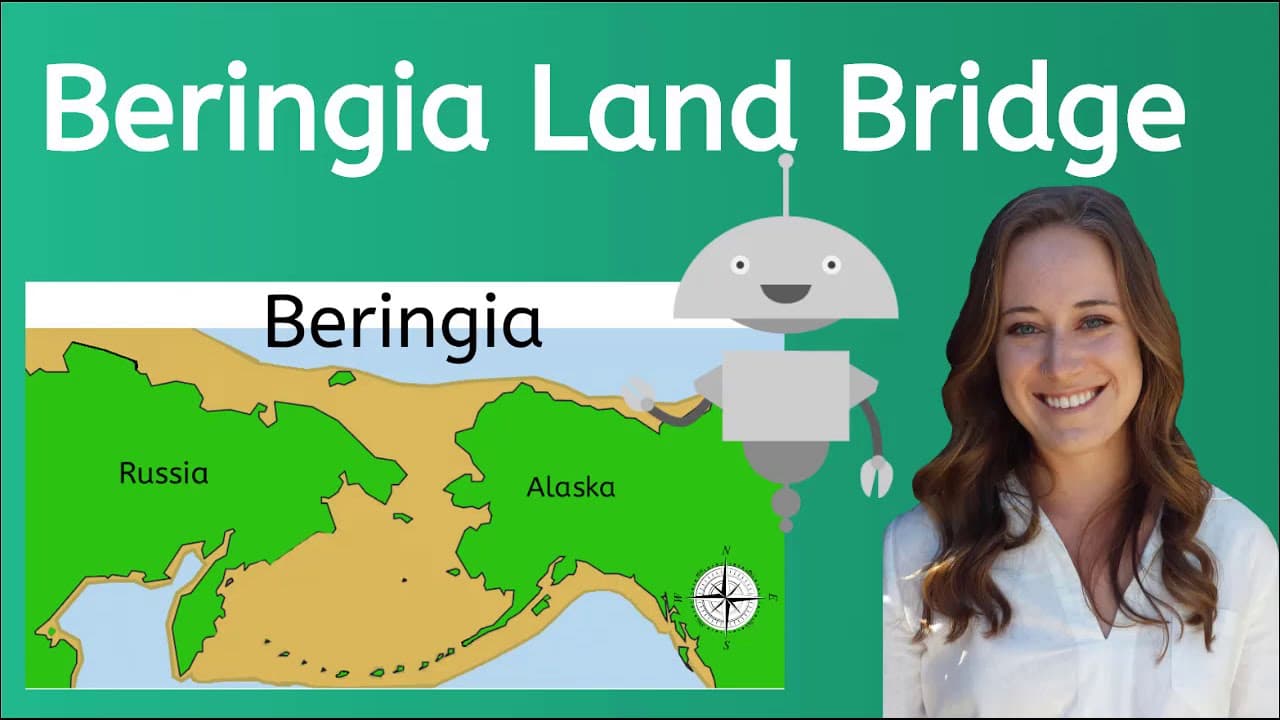
This educational video explores the scientific theory of how the first humans migrated to the Americas via the Beringia Land Bridge. It explains the geographical and climatic conditions of the Ice Age that lowered sea levels, exposing a land connection between present-day Russia and Alaska. The video details the migration routes taken by these early people as they moved through North America down to South America. The content covers key interdisciplinary concepts including geography, earth science, and anthropology. It defines important terms like "migration" and explains the push factors that cause populations to move, such as the search for food, resources, or safety. The video also introduces students to how scientists use evidence to reconstruct the past, specifically looking at how anthropologists use DNA analysis and how archaeologists use artifacts like bronze tools and jade masks to trace human origins. This resource is highly valuable for social studies and history classrooms studying early human civilizations or Native American history. It provides a clear visual representation of complex concepts like changing coastlines and migration patterns. Teachers can use this video to illustrate the intersection of geography and history, demonstrating how physical landscapes shape human movement and settlement patterns.

Miacademy & MiaPrep Learning ChannelMiacademy & MiaPrep Learning Channel

4mins 50s

Video
Exploring the Geography and Cultures of Melanesia and Micronesia

Exploring the Geography and Cultures of Melanesia and Micronesia

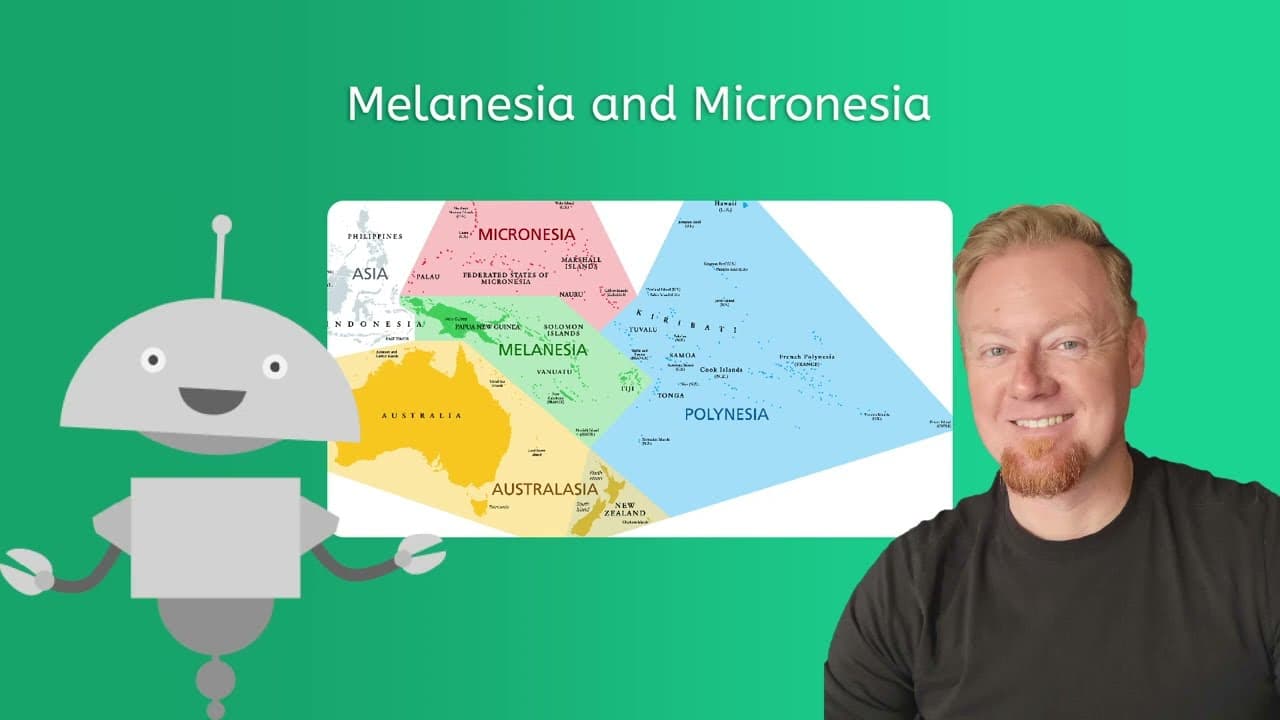
This educational video provides a comprehensive geographical and cultural tour of two major subregions of Oceania: Melanesia and Micronesia. Hosted by "Brian from Oceania Explorers," the video uses maps, historical context, and cultural facts to distinguish these regions from one another and from Polynesia. It covers the etymology of the region names, their geological history (Sahul), and the specific island nations contained within each, including Fiji, Papua New Guinea, the Solomon Islands, Vanuatu, the Federated States of Micronesia, Kiribati, the Marshall Islands, Nauru, and Palau. Key themes include the interplay between physical geography and human history, specifically how vast ocean distances influence culture and governance. The video delves into the genetic and linguistic origins of the indigenous populations, differentiating Melanesians (Papuan/Austronesian mix) from Micronesians (Austronesian/Taiwanese origins). It also addresses complex historical topics such as the "Cannibal Isles" stereotype of Fiji, the impact of colonialism, WWII battles like Guadalcanal, and the modern geopolitical significance of US territories and military bases in the region. For educators, this video is a valuable tool for World Geography and Social Studies classrooms. It moves beyond simple map identification to explore concepts like "perceptual vs. formal regions," "Exclusive Economic Zones" (EEZ), and matriarchal societies. The video includes built-in pause points with reflection questions, making it ready-to-use for structured lessons on Pacific history, indigenous migration theories, and the challenges of island governance.

Miacademy & MiaPrep Learning ChannelMiacademy & MiaPrep Learning Channel

10mins 23s

Video
Uncovering the Past: Sources, Artifacts, and Timelines

Uncovering the Past: Sources, Artifacts, and Timelines

This engaging educational video introduces students to the foundational methods historians use to study the past. Using a playful "breaking news" scenario involving a robot named Mia, the host clearly distinguishes between primary sources (first-hand accounts) and secondary sources (interpretations by others). The video explains how historians rely on these sources to construct accurate narratives of ancient civilizations.

Miacademy & MiaPrep Learning ChannelMiacademy & MiaPrep Learning Channel

12mins 37s

Video
How Humans Harnessed Energy to Build Civilization

How Humans Harnessed Energy to Build Civilization

Hosted by Stan Muller, this episode of Crash Course World History explores the fundamental history of human energy consumption based on Alfred Crosby's book "Children of the Sun." The video traces humanity's journey from relying solely on muscle power to mastering fire, domesticating plants and animals, and eventually unlocking the massive energy stores within fossil fuels. It explains how these advancements allowed for civilization building, from the pyramids to modern metropolises, while emphasizing that almost all energy sources ultimately originate from the sun. The video covers key historical turning points including the Agricultural Revolution, the Industrial Revolution, and the modern reliance on electricity and the internal combustion engine. It provides a balanced look at different fuel sources—wood, coal, oil, and nuclear power—analyzing their efficiency, historical impact, and downsides. Significant attention is given to the exponential increase in energy usage since 1850 and the geopolitical and environmental consequences of this shift. For educators, this resource bridges the gap between science and history, demonstrating how physical laws (thermodynamics) shape human progress. It is an excellent tool for discussing the Anthropocene, the trade-offs of technological advancement, and the complex challenge of sustainability. The video sets up discussions on climate change, resource management, and the future of energy, making it highly relevant for both social studies and environmental science curriculums.

CrashCourseCrashCourse

7mins 21s

Video
Why Democracy Feels Broken: Models, Critiques, and Theory

Why Democracy Feels Broken: Models, Critiques, and Theory

This educational video from Crash Course Political Theory explores the complex nature of democracy, addressing the common modern sentiment that democratic systems are "broken." Hosted by Dr. Ellie Anderson, the video investigates whether dissatisfaction with democracy is a new phenomenon or an inherent feature of the system. It traces critiques of democracy back to ancient philosophers like Plato, who worried about the chaos of "unmixed freedom," and contrasts historical Athenian practices with the egalitarian decision-making of indigenous hunter-gatherer societies.

CrashCourseCrashCourse

12mins 5s

Video
Unlocking History Through the Five Themes of Geography

Unlocking History Through the Five Themes of Geography

This educational video provides a comprehensive introduction to the Five Themes of Geography—Location, Movement, Place, Region, and Human-Environment Interaction—and demonstrates their critical role in shaping human history. The host, Justin, moves beyond simple map-reading to explain geography as the study of the Earth and how humans interact with it. Using water as a central unifying concept, the video illustrates why early civilizations like Mesopotamia and Egypt developed where they did, emphasizing the necessity of fresh water for drinking, irrigation, and transportation. The video explores each theme individually while also highlighting their interconnected nature. It defines concepts such as absolute versus relative location, cultural diffusion through trade and war, and the distinction between adapting to and modifying the environment. Historical examples are woven throughout, including the construction of mud-brick homes in timber-scarce Mesopotamia, the spread of culture from the Olmecs to the Aztecs, and the shifting political boundaries of the Persian Empire and Alexander the Great's territory. Ideal for middle school social studies and geography curricula, this resource helps students transition from viewing geography as just memorizing capitals to understanding it as a dynamic force that drives historical development. It offers clear definitions, visual examples, and interactive pause points that encourage critical thinking about government structures and map analysis, making it a versatile tool for introducing units on ancient civilizations or world geography.

Miacademy & MiaPrep Learning ChannelMiacademy & MiaPrep Learning Channel

11mins 13s

Video
Exploring Early North American Settlement and Indigenous Cultures

Exploring Early North American Settlement and Indigenous Cultures

This educational video provides a comprehensive overview of early North American settlement, tracing the migration of the first peoples across the Beringia land bridge through various developmental periods including the Paleoindian, Archaic, Woodland, and Mississippian eras. It explores how geography influenced the development of distinct cultures across different regions, from the Arctic Inuit to the Southwest Pueblo peoples, highlighting specific adaptations in shelter, food sources, and social structures. Key themes include human migration, environmental adaptation, and cultural diversity. The video breaks down the timeline of pre-contact history, distinguishing between nomadic bands and complex tribal societies. It also addresses important sociological concepts, such as the distinction between a "tribe" and a "band," and provides a nuanced discussion on the terminology of "Indigenous Peoples" versus "Native Americans," emphasizing the importance of using specific self-identifiers. For educators, this resource serves as an excellent introduction to pre-Columbian US History. It encourages critical thinking by asking students to consider the utility and limitations of historical generalizations. The video includes built-in pause points with guiding questions, making it ready-to-use for checking comprehension and sparking classroom discussions about identity, geography, and the deep history of the American continent.

Miacademy & MiaPrep Learning ChannelMiacademy & MiaPrep Learning Channel

10mins 26s

Video
Depend, Modify, Adapt: How Humans Change the Environment

Depend, Modify, Adapt: How Humans Change the Environment

This educational video explores the dynamic relationship between humans and the Earth through three distinct categories of interaction: depending on the environment, modifying the environment, and adapting to the environment. The host, Caroline, guides viewers through a chronological journey of human history to illustrate how these interactions have evolved from the days of early hunter-gatherers to modern industrialized society. The narrative emphasizes that while human needs have remained consistent, the scale and impact of our actions on the planet have grown exponentially alongside our population. The video is structured around three major historical eras: the Hunter-Gatherer society, the Agricultural Revolution, and the Industrial Revolution. It details specific characteristics of each period, such as the low-waste lifestyle of nomadic tribes versus the habitat destruction caused by early farming, and the technological advancements of the industrial age versus the resulting pollution and urbanization. Key concepts like selective breeding, crop rotation, and the extinction of megafauna due to overhunting are explained to show the complexity of human impact. For educators, this resource serves as an excellent bridge between social studies and environmental science. It provides a clear framework for analyzing history through an ecological lens, helping students understand the trade-offs inherent in human progress. The video encourages critical thinking about sustainability by asking students to weigh the benefits of societal advancement—like reliable food sources and medicine—against environmental costs like deforestation and resource depletion, ultimately empowering them to think about future solutions.

Miacademy & MiaPrep Learning ChannelMiacademy & MiaPrep Learning Channel

9mins 53s

Video
Introduction to Geography: From Ancient Maps to Modern Satellites

Introduction to Geography: From Ancient Maps to Modern Satellites

This engaging educational video introduces students to the study of geography, framing it as an expedition to understand our "wondrous and diverse" world. It begins by defining geography beyond simple textbook definitions, encouraging viewers to see it as a way to know, love, and care for the planet. The narrative transitions from the perspective of early humans facing an unknown world to the sophisticated methods used today, effectively bridging the gap between ancient curiosity and modern science. Key themes include the history of geographic thought, highlighting Eratosthenes' incredible calculation of the Earth's circumference using simple geometry and shadows. The video also explores the evolution of geographic tools, contrasting ancient travel-based data collection with modern technologies like Sonar, Satellites, GPS, and GIS (Geographic Information Systems). It emphasizes that while tools change, the fundamental human drive to map and understand our surroundings remains the same. For educators, this video serves as an excellent introduction to a geography unit or a social studies course. It provides concrete examples of how geography intersects with math (geometry), history, and environmental science. The built-in pause points and reflection questions make it an interactive tool for the classroom, prompting students to consider how geographic data is used for resource management, conservation, and urban planning in the real world.

Miacademy & MiaPrep Learning ChannelMiacademy & MiaPrep Learning Channel

10mins 12s

Video
How Geography Shaped the First Civilization: Mesopotamia Explained

How Geography Shaped the First Civilization: Mesopotamia Explained

This educational video explores the rise of the first civilization in Mesopotamia, located in modern-day Iraq between the Tigris and Euphrates rivers. It explains how geography played a crucial role in the development of human society, transforming nomadic hunter-gatherers into settled farmers through the fertile soil of the "Fertile Crescent." The narrator guides students through the transition from the Stone Age to the Bronze Age, highlighting key innovations like irrigation, the plow, and the domestication of animals. The video delves into the challenges posed by the region's geography, such as unpredictable flooding and lack of natural defenses, and how early humans engineered solutions like levees, canals, and city walls. It connects these environmental factors to the growth of urban centers, job specialization, and the creation of a stable food surplus, which are identified as the foundational elements of civilization. Finally, the concept of cultural diffusion is introduced to explain how Mesopotamian innovations in farming, writing, and government spread to other regions like Egypt. The video includes built-in pauses for critical thinking and prediction, making it an excellent tool for middle school social studies classrooms to introduce Ancient History, human-environment interaction, and the economic foundations of society.

Miacademy & MiaPrep Learning ChannelMiacademy & MiaPrep Learning Channel

7mins 43s

Video
Analyzing Cause and Effect in World History

Analyzing Cause and Effect in World History

This educational video introduces students to the historical thinking concept of "Cause and Effect" through a series of dramatic and interconnected historical case studies. It opens with a narrative hook about the "Summer of the Fire Ants" in 1518 Hispaniola to demonstrate how unintended consequences—specifically the introduction of plantains and aphids—can alter a region's history. The video establishes that nothing in history happens in a vacuum, using examples like Alexander the Great's education and Neolithic migrations to show how motivations and environmental changes drive human action. The core of the video analyzes the "Worst Year in History" (536 C.E.) to illustrate a complex chain of events. It details how a volcanic eruption (Krakatoa) led to global cooling, which destroyed food sources, causing the Avar migration and war, while simultaneously creating biological conditions that allowed the Bubonic Plague to decimate the Byzantine and Sasanian Empires. It breaks down the specific biological mechanism involving fleas and temperature to show how environmental factors influence major historical outcomes. This resource is highly valuable for middle and high school World History classrooms as it moves students beyond memorizing dates to understanding the "why" behind events. It models historical inquiry by connecting geography, biology, and human behavior, providing a framework for analyzing how small changes can trigger massive domino effects across civilizations.

Miacademy & MiaPrep Learning ChannelMiacademy & MiaPrep Learning Channel

10mins 51s

Video
How the Agricultural Revolution Transformed Human Society

How the Agricultural Revolution Transformed Human Society

In this fast-paced and engaging overview of early human history, John Green introduces students to the monumental shift from hunting and gathering to agriculture. Using the relatable example of a double cheeseburger, the video traces the complex supply chains and historical processes required to produce modern food, contrasting this with the 15,000-year history of human foraging. It challenges the common assumption that agricultural life was an immediate improvement over foraging, presenting evidence that early farmers often had poorer health and worked longer hours than their hunter-gatherer counterparts. The video explores key themes including the independent invention of agriculture across different global regions, the domestication of plants and animals, and the rise of pastoralism (herding) as an alternative lifestyle. It breaks down the advantages of farming—such as controllable food supplies and food surpluses that allow for specialization of labor—against the disadvantages, including environmental degradation, social inequality, and the necessity of hard labor. For educators, this resource serves as an excellent introduction to the Neolithic Revolution and the dawn of civilization. It prompts critical thinking about what "progress" actually means, asking students to consider whether the move to agriculture was a net positive or a "trap" that humanity couldn't escape. The video successfully links ancient history to modern life, making abstract concepts like specialization of labor and social stratification concrete and relevant for students.

CrashCourseCrashCourse

11mins 11s

Video
Why Humans Fight: The Evolutionary and Historical Roots of War

Why Humans Fight: The Evolutionary and Historical Roots of War

This video investigates the complex historical and philosophical question of why humans engage in war. Host John Green navigates the debate between two primary schools of thought: Thomas Hobbes's view of early human life as "nasty, brutish, and short," and Jean-Jacques Rousseau's concept of the peaceful "noble savage." The video examines anthropological evidence, archaeological findings, and evolutionary theories to determine if violence is an innate part of human nature or a cultural development. The content explores several key themes, including the distinction between biological imperatives (genes seeking to reproduce) and cultural behaviors. It delves into the role of resource scarcity—specifically food and mates—in driving early human conflict, which typically manifested as raiding rather than organized warfare. The video also touches on the psychology of soldiers, using powerful quotes from Vietnam veteran Karl Marlantes to discuss the "savage joy" and transcendence some find in combat, while balancing this with the concept of free will and the evolution of human institutions. For educators, this resource is a powerful tool to bridge history, biology, and philosophy. It challenges students to think critically about "inevitability" in history and encourages them to analyze how modern institutions have evolved to mitigate biological aggressive tendencies. It provides a nuanced look at the difference between interpersonal violence and state-sponsored war, making it an excellent launchpad for discussions on ethics, psychology, and the future of global conflict.

CrashCourseCrashCourse

10mins 37s

Video
From Farms to Factories: The Origins of the Industrial Revolution

From Farms to Factories: The Origins of the Industrial Revolution

This engaging educational video explores the origins and profound global impact of the Industrial Revolution, tracing its roots from prehistoric hunter-gatherer societies through the agrarian age to the explosion of industry in 18th-century England. The narrator uses vivid storytelling and direct address to help students visualize the dramatic shift in daily life, moving from self-sufficient farming to repetitive factory work. It breaks down complex economic and social changes into digestible concepts, explaining how the Enclosure Movement pushed peasants into cities and how technological innovations in textiles catalyzed a new world order. Key themes include the transition from agrarian to industrial societies, the specific geographic and political reasons why the revolution began in England, and the major technological inventions that drove mass production (like the Spinning Jenny and Water Frame). Crucially, the video does not shy away from the darker side of this progress, explicitly connecting the boom in English textile manufacturing to the entrenchment of slavery in the American South following the invention of the cotton gin. For educators, this video serves as a perfect anchor for a World History unit on industrialization. It is structured with built-in pause points and guiding questions that facilitate active learning and checking for understanding. By connecting English factories to American history, it also provides an excellent cross-curricular bridge between European and American history standards, illustrating early concepts of global economic interdependence.

Miacademy & MiaPrep Learning ChannelMiacademy & MiaPrep Learning Channel

13mins 56s

Video
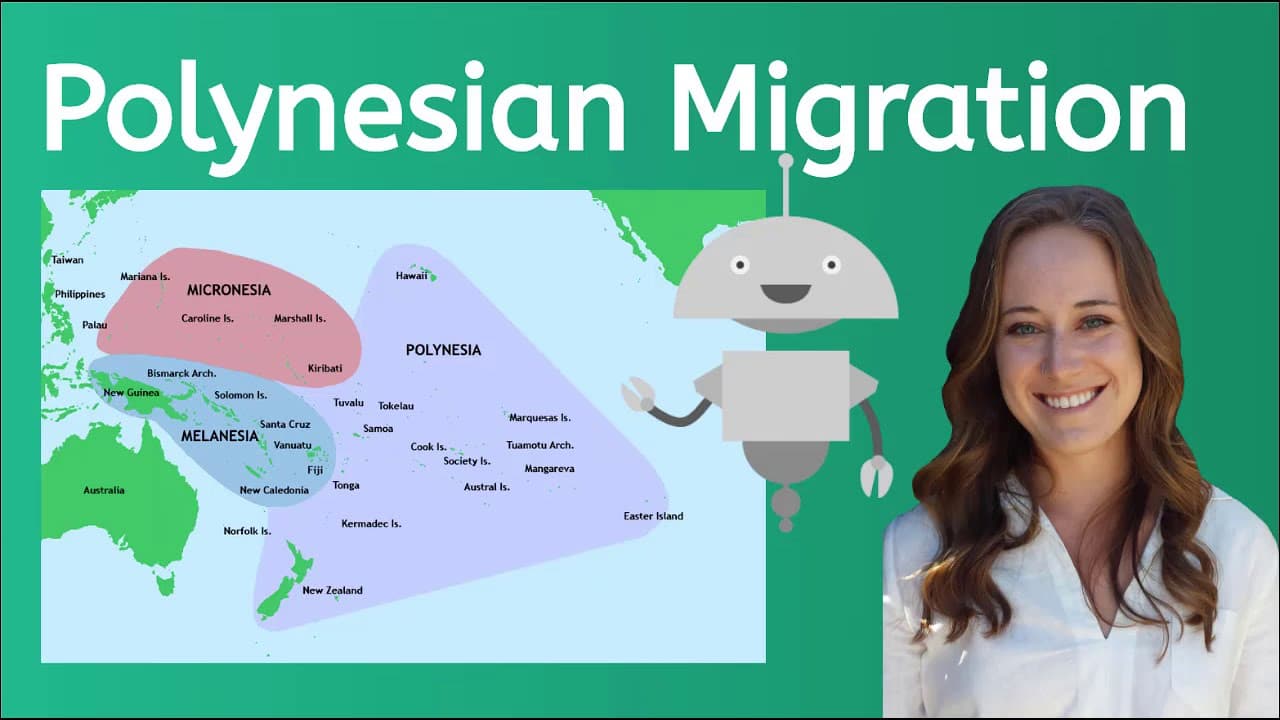
How the Polynesians Migrated Across the Pacific

How the Polynesians Migrated Across the Pacific

This educational video provides a comprehensive overview of the Polynesian migration, explaining how ancient explorers traveled across the vast Pacific Ocean to settle within the Polynesian Triangle. It details the geographical boundaries of the region, identifying key islands like Hawaii, New Zealand, and Easter Island, and traces the ancestral roots of the Polynesian people back to Taiwan and Southeast Asia using linguistic and archaeological evidence.

Miacademy & MiaPrep Learning ChannelMiacademy & MiaPrep Learning Channel

4mins 37s

Video
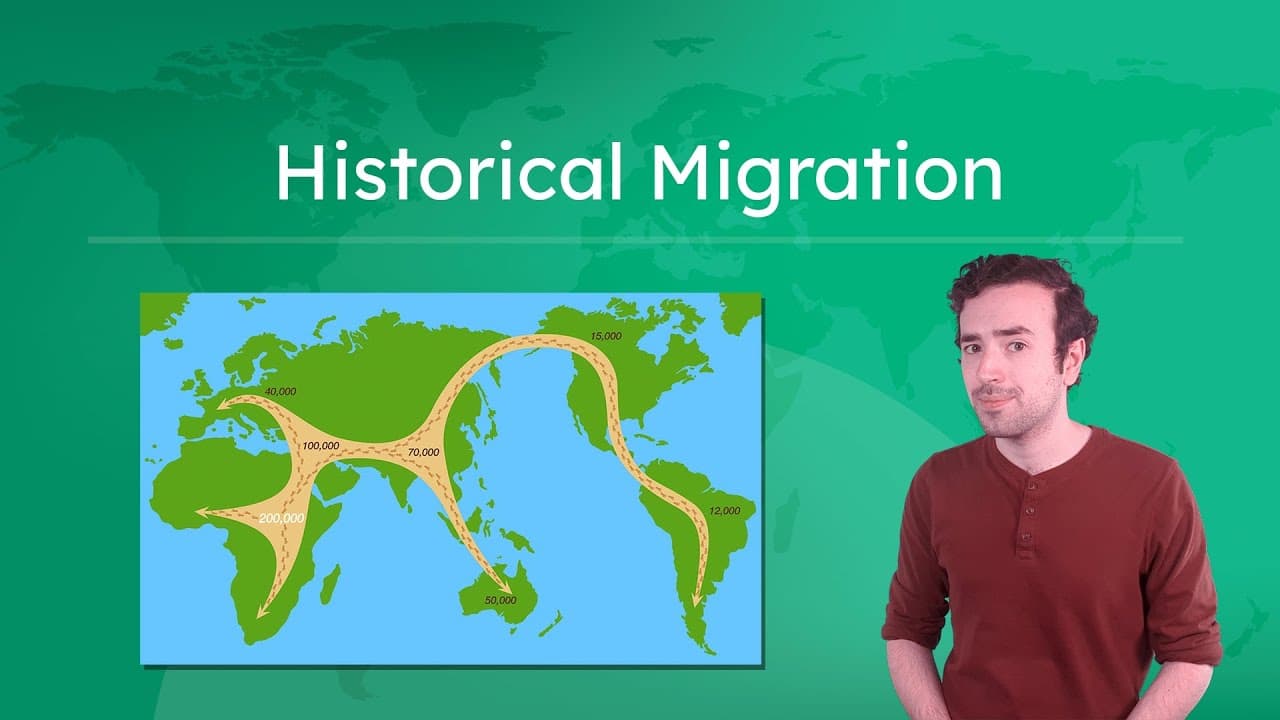
How Tacos Explain the History of Human Migration

How Tacos Explain the History of Human Migration

This engaging educational video uses the ingredients of a simple taco—corn tortillas, steak, and toppings—as a narrative framework to explore the entire history of human migration and globalization. Hosted by Justin, the video breaks down complex historical eras by tracing how these ingredients originated in different parts of the world and eventually came together. It covers major historical milestones including the "Out of Africa" theory, the Neolithic Revolution, the Age of Exploration, the Columbian Exchange, and the Industrial Revolution. The video explores key themes of geography and history, specifically focusing on the concept of "movement." It details the push and pull factors that have driven human migration throughout history, ranging from basic survival and the search for resources to trade routes, colonization, forced migration (slavery), and economic opportunities in industrializing cities. It addresses sensitive topics such as the devastation of indigenous populations and the Transatlantic Slave Trade within the context of global demographic shifts. For educators, this video serves as an excellent hook for World History or World Geography units. By grounding abstract historical forces in a relatable food item, it helps students understand how distant historical events directly shape their modern lives. It provides a structured timeline of human movement, defines academic terms like "nomadic" and "sedentary," and encourages critical thinking about the cultural blends that constitute modern societies.

Miacademy & MiaPrep Learning ChannelMiacademy & MiaPrep Learning Channel

11mins 3s

Video
Island Hopping: A Journey Through Polynesian History and Culture

Island Hopping: A Journey Through Polynesian History and Culture

This educational video takes students on a comprehensive tour of Polynesia, exploring its geography, history, and rich cultural traditions. Hosted by an engaging narrator named Brian, the journey begins by defining the Polynesian Triangle—anchored by Hawaii, New Zealand, and Easter Island—and tracing the incredible maritime migration of the Lapita people thousands of years before European explorers. The video uses maps, historical photos, and animations to visualize the vast distances traveled by early settlers in outrigger canoes.

Miacademy & MiaPrep Learning ChannelMiacademy & MiaPrep Learning Channel

10mins 34s

Video
How Farming Transformed Human History

How Farming Transformed Human History

In this installment of Crash Course Big History, John Green and guest host Hank Green explore the monumental shift from foraging to agriculture—a transition that fundamentally altered human existence. The video examines the "Agrarian Era," questioning why humans would abandon the relatively leisurely lifestyle of foraging for the back-breaking labor of farming. It presents the "energy" perspective of history, framing agriculture as a method for humans to harness more solar energy via photosynthesis, leading to population explosions and complex societies.

CrashCourseCrashCourse

13mins 41s

Video
How Geography Shapes Global Food Security

How Geography Shapes Global Food Security

This educational video explores the complex field of agricultural geography, examining why food insecurity persists in a world that produces enough calories to feed everyone. Host Alizé Carrère guides viewers through the intricate web of historical, political, economic, and environmental factors that determine who has access to food. The narrative moves from local examples of farming to global systems, explaining how colonialism, the Columbian Exchange, and various agricultural revolutions have shaped our modern food landscape. The video covers critical themes including the distinction between subsistence and commercial farming, the shift from polyculture to monoculture, and the impact of the Green Revolution. It delves into the geography of hunger, explaining concepts like food deserts and the difference between food availability and food access. Significant attention is paid to how historical events, such as the triangular trade and colonization, disrupted indigenous food systems and established export-oriented economies that still influence global food distribution today. For educators, this resource serves as a powerful tool to connect geography, history, and economics. It moves beyond simple definitions to show students the systems thinking required to understand global challenges. The video provides excellent opportunities for classroom discussions on food justice, the environmental impacts of industrial agriculture, and the importance of biodiversity. It is particularly useful for units on human geography, economic development, and sustainability.

CrashCourseCrashCourse

11mins 32s

Video
Why the Bronze Age Civilizations Collapsed

Why the Bronze Age Civilizations Collapsed

In this episode of Crash Course World History, John Green explores the mysterious collapse of the Bronze Age civilizations in the Eastern Mediterranean around 1200 BCE. The video challenges the traditional narrative of separate, isolated civilizations by demonstrating how Egypt, the Hittites, the Mycenaeans, and others formed a highly interconnected international system defined by trade, diplomacy, and war. It examines the evidence for this interdependence, including the famous Uluburun shipwreck and the Amarna Letters.

CrashCourseCrashCourse

12mins 58s

Video
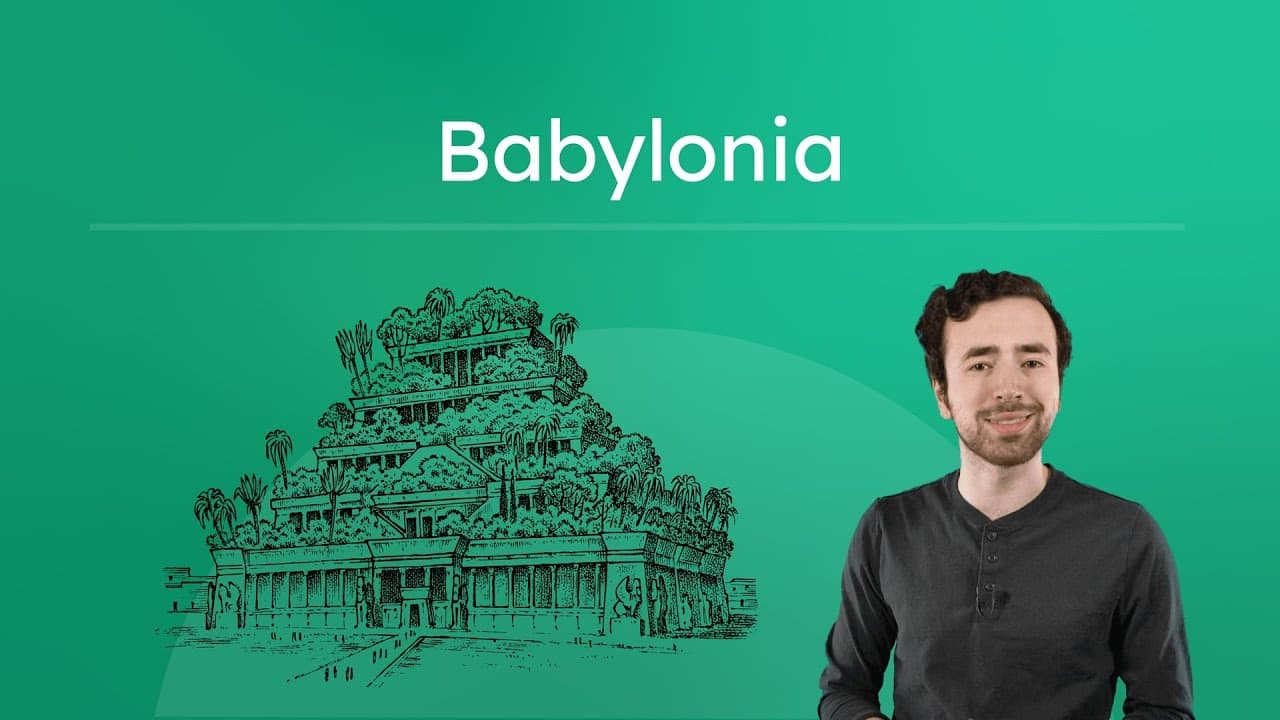
The Rise and Achievements of Ancient Babylonia

The Rise and Achievements of Ancient Babylonia

This educational video explores the rise and legacy of the ancient Babylonian Empire, tracing its emergence from the earlier civilizations of Sumer and Akkad. Hosted by Justin, the lesson explains how Babylonia became a dominant power through military strength, a unified government under an absolute monarch, and a robust economy driven by trade and sophisticated metalwork. It details how the Babylonians adapted and expanded upon previous cultural traditions, particularly in religion and governance. The video delves into the significant scientific and cultural achievements of Babylonia, highlighting their advanced understanding of astronomy which led to the creation of both lunar and solar calendars. It also showcases their architectural marvels, such as the Ishtar Gate and the legendary Hanging Gardens of Babylon. A major focus is placed on King Hammurabi and his famous Code of Laws, introducing students to concepts of justice, retributive punishment ("an eye for an eye"), and the presumption of innocence. Ideal for history and social studies classrooms, this resource helps students understand the characteristics of early empires and the lasting impact of Mesopotamian innovations. It connects ancient practices to modern concepts, such as timekeeping and constitutional law, making history relevant and engaging. The video includes built-in pauses for student reflection, encouraging critical thinking about rituals, the utility of science, and the ethics of ancient legal systems.

Miacademy & MiaPrep Learning ChannelMiacademy & MiaPrep Learning Channel

12mins 39s

Video
Mapping the World: History, Types, and Essential Skills

Mapping the World: History, Types, and Essential Skills

This comprehensive video introduces students to the fundamental concepts of cartography, tracing the evolution of mapmaking from ancient clay tablets to modern digital visualizations. It begins by exploring how ancient civilizations like the Babylonians, Indians, and Chinese first documented their surroundings to communicate spatial information. The narrative moves through significant historical milestones, including the "birth certificate of America" and the artistic "Leo Belgicus" map, while also sharing the fascinating story of "paper towns" used to catch copyright infringers. The video breaks down the technical aspects of geography by categorizing maps into three main types: physical, political, and special purpose. It provides clear definitions and visual examples for each category, helping students distinguish between maps that show natural features versus human-made boundaries. The instruction then shifts to essential map-reading skills, detailing critical components such as the compass rose, map keys (legends), scale ratios, and the global grid system of latitude and longitude. For educators, this resource serves as an excellent anchor for a geography unit. It combines historical context with practical skills, making it versatile for both social studies and STEM applications. Teachers can use the segment on "paper towns" to spark discussions about intellectual property, while the sections on scale and coordinates offer direct mathematical applications. The video effectively bridges the gap between viewing a map as a simple picture and understanding it as a complex data visualization tool.

Miacademy & MiaPrep Learning ChannelMiacademy & MiaPrep Learning Channel

10mins 25s

Video
The History of Money: Debt, Barter, and War

The History of Money: Debt, Barter, and War

Hosted by John Green, this episode of Crash Course World History challenges the traditional economic narrative that money evolved naturally from barter systems to solve logistical problems. Instead, it presents anthropologist David Graeber's theory that complex credit and debt systems existed long before coinage, and that physical money (coins) emerged primarily as a tool for states to fund wars and professional armies.

CrashCourseCrashCourse

14mins 4s

Video
Unlocking History Through the Five Themes of Geography

Unlocking History Through the Five Themes of Geography

This educational video provides a comprehensive introduction to the Five Themes of Geography—Location, Movement, Place, Region, and Human-Environment Interaction—and demonstrates their critical role in shaping human history. The host, Justin, moves beyond simple map-reading to explain geography as the study of the Earth and how humans interact with it. Using water as a central unifying concept, the video illustrates why early civilizations like Mesopotamia and Egypt developed where they did, emphasizing the necessity of fresh water for drinking, irrigation, and transportation. The video explores each theme individually while also highlighting their interconnected nature. It defines concepts such as absolute versus relative location, cultural diffusion through trade and war, and the distinction between adapting to and modifying the environment. Historical examples are woven throughout, including the construction of mud-brick homes in timber-scarce Mesopotamia, the spread of culture from the Olmecs to the Aztecs, and the shifting political boundaries of the Persian Empire and Alexander the Great's territory. Ideal for middle school social studies and geography curricula, this resource helps students transition from viewing geography as just memorizing capitals to understanding it as a dynamic force that drives historical development. It offers clear definitions, visual examples, and interactive pause points that encourage critical thinking about government structures and map analysis, making it a versatile tool for introducing units on ancient civilizations or world geography.

Miacademy & MiaPrep Learning ChannelMiacademy & MiaPrep Learning Channel

11mins 13s

Video
The Inventions and Innovations of Ancient Sumer

The Inventions and Innovations of Ancient Sumer

This engaging educational video explores the ancient civilization of Sumer, located in Mesopotamia, and its profound impact on human history. The video breaks down Sumerian society into five key categories of advancement: political, religious, cultural, economic, and technological. It explains how Sumer developed city-states, complex religious systems involving ziggurats and polytheism, the first writing system (cuneiform), and foundational economic practices like banking and trade networks. The content highlights specific inventions that revolutionized the world, such as the wheel, the plow, the sailboat, and a base-60 mathematical system still used for measuring time today. It also delves into the social structure of Sumer, examining the hierarchy from kings and priests down to farmers and enslaved people, as well as gender roles within the society. Designed for middle school history curriculums, this video provides a comprehensive overview of how Sumerian innovations laid the groundwork for future civilizations. It encourages students to recognize the enduring legacy of these ancient advancements in their modern lives, making connections between ancient history and contemporary systems of government, economy, and technology.

Miacademy & MiaPrep Learning ChannelMiacademy & MiaPrep Learning Channel

13mins 7s

Video
The Rise of Civilization in Mesopotamia: Writing, Taxes, and Empires

The Rise of Civilization in Mesopotamia: Writing, Taxes, and Empires

In this installment of Crash Course World History, John Green explores the rise of civilization in Mesopotamia, the 'land between two rivers.' The video examines how the geography of the Tigris and Euphrates valleys shaped the culture, religion, and politics of early city-states like Uruk and Babylon. It breaks down foundational developments including the invention of writing (cuneiform), the creation of early legal systems (Hammurabi's Code), and the evolution of political power from temple priests to kings.

CrashCourseCrashCourse

12mins 6s

Video
Building the First Empire: Sargon and the Rise of Assyria

Building the First Empire: Sargon and the Rise of Assyria

This educational video provides a comprehensive overview of the Akkadian Empire under Sargon the Great and the subsequent rise of the Assyrian Empire. It explores how Sargon established the world's first empire by uniting Mesopotamian city-states, implementing a centralized government with provinces and governors, and creating a professional standing army. The video details the political, cultural, and technological advancements of the era, including the establishment of Akkadian as a lingua franca, the standardization of weights and measures, and the preservation of Sumerian cuneiform.

Miacademy & MiaPrep Learning ChannelMiacademy & MiaPrep Learning Channel

9mins 58s

Video
The Persians and Greeks: Comparing Empires and Democracies

The Persians and Greeks: Comparing Empires and Democracies

In this episode of Crash Course World History, John Green challenges the traditional Western narrative that depicts the Persian Wars as a simple struggle between the 'good, democratic' Greeks and the 'bad, totalitarian' Persians. He explores the vast, efficient, and relatively tolerant Persian Empire under Cyrus and Darius, contrasting it with the fragmented, slave-dependent Greek city-states. The video dissects the concept of historical bias, particularly through the lens of the Greek historian Herodotus, often called the 'Father of History' (and the 'Father of Lies'). Key themes include the complexities of ancient governance, the definition of freedom versus security, and the origins of political realism. The video delves into the Persian administrative structure, Zoroastrianism, and their ban on slavery, while juxtaposing this with the Athenian 'Golden Age,' which produced incredible art and philosophy but was underpinned by slavery, the exclusion of women, and imperialist aggression towards other Greek states. The darker side of Athenian democracy is highlighted through the Melian Dialogue during the Peloponnesian War. For educators, this video is an excellent tool for teaching students how to critically analyze historical sources and question received wisdom. It provides a nuanced view of the ancient world that moves beyond binary moral judgments. Classroom applications include debates on the merits of different political systems, discussions on the role of bias in history, and ethical evaluations of the phrase 'the strong do what they can and the weak suffer what they must' in the context of international relations.

CrashCourseCrashCourse

11mins 39s

Video
How Geography Shaped the First Civilization: Mesopotamia Explained

How Geography Shaped the First Civilization: Mesopotamia Explained

This educational video explores the rise of the first civilization in Mesopotamia, located in modern-day Iraq between the Tigris and Euphrates rivers. It explains how geography played a crucial role in the development of human society, transforming nomadic hunter-gatherers into settled farmers through the fertile soil of the "Fertile Crescent." The narrator guides students through the transition from the Stone Age to the Bronze Age, highlighting key innovations like irrigation, the plow, and the domestication of animals. The video delves into the challenges posed by the region's geography, such as unpredictable flooding and lack of natural defenses, and how early humans engineered solutions like levees, canals, and city walls. It connects these environmental factors to the growth of urban centers, job specialization, and the creation of a stable food surplus, which are identified as the foundational elements of civilization. Finally, the concept of cultural diffusion is introduced to explain how Mesopotamian innovations in farming, writing, and government spread to other regions like Egypt. The video includes built-in pauses for critical thinking and prediction, making it an excellent tool for middle school social studies classrooms to introduce Ancient History, human-environment interaction, and the economic foundations of society.

Miacademy & MiaPrep Learning ChannelMiacademy & MiaPrep Learning Channel

7mins 43s

Video
Rethinking Civilization: Why People Fled to the Hills

Rethinking Civilization: Why People Fled to the Hills

This installment of Crash Course World History challenges the traditional narrative that human history is a linear progression from "primitive" hunter-gatherer societies to "advanced" civilizations. Host John Green introduces the work of anthropologist James Scott and his book "The Art of Not Being Governed," which argues that many so-called barbarian tribes were not people left behind by progress, but rather refugees who consciously fled to mountainous regions like Zomia to escape the coercion, taxation, and conscription of early states. The video explores the intrinsic link between settled agriculture, food surpluses, and the formation of states, explaining how early governments relied on concentrated populations for labor and taxes. It contrasts the life of valley-dwelling subjects with hill-dwelling "barbarians," suggesting that hill cultures often developed specific adaptations—such as lack of written records and shifting cultivation—to remain illegible to state powers. The content covers historical examples from the Han Dynasty, the Epic of Gilgamesh, and colonial Southeast Asia. Ideal for World History and Anthropology classes, this video serves as a powerful tool for teaching historiography and critical thinking. It prompts students to question who writes history and why, examining how the definition of "civilization" often privileges the state's perspective while marginalizing stateless peoples. It offers a complex view of human social organization, weighing the benefits of civilization (like the internet and antibiotics) against its costs (slavery, warfare, and disease).

CrashCourseCrashCourse

13mins 42s

Video
Exploring the Origins and Geography of Central and Southwest Asia

Exploring the Origins and Geography of Central and Southwest Asia

This educational video provides a comprehensive overview of the geography, history, and modern geopolitical landscape of Central and Southwest Asia. Hosted by Brian, the lesson begins by establishing the region's historical significance as the "birthplace of civilization" and the origin of three major world religions: Judaism, Christianity, and Islam. It traces the transition from the Agricultural Revolution to the rise of empires like the Ottomans, and explains how World War I and the subsequent protectorate system shaped modern national borders.

Miacademy & MiaPrep Learning ChannelMiacademy & MiaPrep Learning Channel

8mins 30s

Video
Why We Draw Lines: Understanding Political Boundaries

Why We Draw Lines: Understanding Political Boundaries

This engaging educational video explores the concept of political boundaries, using relatable analogies and historical examples to explain why humans draw lines on maps. Hosted by Justin, the lesson begins with a humorous comparison to siblings sharing a bedroom to introduce the basic idea of territory. It then travels back 4,500 years to ancient Sumer to examine the first recorded border conflict between the cities of Lagash and Umma, illustrating how resource competition and pride drive the creation of boundaries. The video breaks down the three main reasons for boundaries—resources, pride, and legal jurisdiction—using diverse examples ranging from Ancient Egypt to modern-day Russia and Ukraine. It categorizes boundaries into three types: Natural (like the Rio Grande), Geometric (like the straight lines in North Africa), and Cultural (illustrated by tribal groups that transcend political borders). Finally, the lesson clarifies complex political science terminology often confusing for students: the difference between a "Nation" (people), a "State" (political entity), and a "Nation-State," as well as the concept of "Sovereignty." Through clear definitions and real-world examples like the Kurds, the Lakota Sioux, and the dispute in the South China Sea, students gain a comprehensive understanding of political geography.

Miacademy & MiaPrep Learning ChannelMiacademy & MiaPrep Learning Channel

11mins 26s

Video
How Farming Transformed Human History

How Farming Transformed Human History

In this installment of Crash Course Big History, John Green and guest host Hank Green explore the monumental shift from foraging to agriculture—a transition that fundamentally altered human existence. The video examines the "Agrarian Era," questioning why humans would abandon the relatively leisurely lifestyle of foraging for the back-breaking labor of farming. It presents the "energy" perspective of history, framing agriculture as a method for humans to harness more solar energy via photosynthesis, leading to population explosions and complex societies.

CrashCourseCrashCourse

13mins 41s

Video
Understanding the Roots and Beliefs of Judaism

Understanding the Roots and Beliefs of Judaism

This engaging video lesson explores the origins, core beliefs, and enduring legacy of Judaism, one of the world's oldest monotheistic religions. Through a mix of humor, historical art, and clear comparative charts, the host breaks down complex theological concepts like the Covenant, the Torah, and the shift from ancient polytheism to monotheism. Students will learn how Judaism established unique moral codes and practices that differed significantly from surrounding ancient civilizations like Egypt and Mesopotamia.

Miacademy & MiaPrep Learning ChannelMiacademy & MiaPrep Learning Channel

10mins 26s

Video
How Humans Harnessed Energy to Build Civilization

How Humans Harnessed Energy to Build Civilization

Hosted by Stan Muller, this episode of Crash Course World History explores the fundamental history of human energy consumption based on Alfred Crosby's book "Children of the Sun." The video traces humanity's journey from relying solely on muscle power to mastering fire, domesticating plants and animals, and eventually unlocking the massive energy stores within fossil fuels. It explains how these advancements allowed for civilization building, from the pyramids to modern metropolises, while emphasizing that almost all energy sources ultimately originate from the sun. The video covers key historical turning points including the Agricultural Revolution, the Industrial Revolution, and the modern reliance on electricity and the internal combustion engine. It provides a balanced look at different fuel sources—wood, coal, oil, and nuclear power—analyzing their efficiency, historical impact, and downsides. Significant attention is given to the exponential increase in energy usage since 1850 and the geopolitical and environmental consequences of this shift. For educators, this resource bridges the gap between science and history, demonstrating how physical laws (thermodynamics) shape human progress. It is an excellent tool for discussing the Anthropocene, the trade-offs of technological advancement, and the complex challenge of sustainability. The video sets up discussions on climate change, resource management, and the future of energy, making it highly relevant for both social studies and environmental science curriculums.

CrashCourseCrashCourse

7mins 21s

Video
Exploring Africa: Geography, History, and Culture

Exploring Africa: Geography, History, and Culture

This comprehensive educational video provides a detailed overview of the African continent, structured into four main sections: physical characteristics, history, people and culture, and economic structures. Hosted by Taylor, the video begins with an engaging safari skit before diving into a structured lesson that uses maps, images, and statistics to paint a broad picture of the diverse continent. It covers major geographical features like the Sahara, the Nile, and the Great Rift Valley, while also addressing the rich history of civilizations from Ancient Egypt to the Kingdom of Mali. The narrative addresses complex topics such as the origins of humanity, the impact of the transatlantic slave trade, European colonization, and the challenges of modern independence. It connects historical events—like the drawing of colonial borders—to current issues such as political conflict and economic struggles. The video highlights the contrast between Africa's immense natural wealth in resources like gold and diamonds versus its economic challenges, including low GDP per capita and infrastructure issues. Ideally suited for middle and high school social studies classrooms, this resource serves as an excellent introduction to African geography and history. It encourages active learning by prompting students to use a physical map to locate features and engages critical thinking with questions about the legacy of colonialism and future economic prospects. Teachers can use this video to launch units on world geography, discuss the effects of imperialism, or analyze global economic disparities.

Miacademy & MiaPrep Learning ChannelMiacademy & MiaPrep Learning Channel

15mins 37s

Video
How the Indus Valley Civilization Rose and Fell

How the Indus Valley Civilization Rose and Fell

This engaging episode of Crash Course World History explores the Indus Valley Civilization, one of the largest and most mysterious ancient societies in human history. Host John Green guides viewers through the rise and fall of this Bronze Age culture, examining its sophisticated urban planning, extensive trade networks, and the puzzling lack of weapons or evidence of warfare. The video also tackles the broader historical concept of what defines a "civilization" and the inherent biases in how historians classify different human societies. Key themes include the relationship between geography and settlement, specifically the importance of reliable river flooding for agriculture; the role of archaeology in reconstructing history without decipherable written records; and the comparison of social structures across different ancient cultures. The video highlights specific artifacts like the famous animal seals and architectural marvels like the Great Bath of Mohenjo-Daro to illustrate the uniqueness of the Indus Valley people. For the classroom, this video is an excellent resource for introducing Ancient River Valley Civilizations or units on archaeology and historical inquiry. It models critical thinking by questioning established historical narratives—such as the definition of "barbarian"—and demonstrating how historians form theories based on physical evidence. The fast-paced, humorous delivery helps make complex anthropological concepts accessible and relevant to high school students.

CrashCourseCrashCourse

9mins 35s

Video
How Geography Shapes Global Food Security

How Geography Shapes Global Food Security

This educational video explores the complex field of agricultural geography, examining why food insecurity persists in a world that produces enough calories to feed everyone. Host Alizé Carrère guides viewers through the intricate web of historical, political, economic, and environmental factors that determine who has access to food. The narrative moves from local examples of farming to global systems, explaining how colonialism, the Columbian Exchange, and various agricultural revolutions have shaped our modern food landscape. The video covers critical themes including the distinction between subsistence and commercial farming, the shift from polyculture to monoculture, and the impact of the Green Revolution. It delves into the geography of hunger, explaining concepts like food deserts and the difference between food availability and food access. Significant attention is paid to how historical events, such as the triangular trade and colonization, disrupted indigenous food systems and established export-oriented economies that still influence global food distribution today. For educators, this resource serves as a powerful tool to connect geography, history, and economics. It moves beyond simple definitions to show students the systems thinking required to understand global challenges. The video provides excellent opportunities for classroom discussions on food justice, the environmental impacts of industrial agriculture, and the importance of biodiversity. It is particularly useful for units on human geography, economic development, and sustainability.

CrashCourseCrashCourse

11mins 32s

Video
Why the Bronze Age Civilizations Collapsed

Why the Bronze Age Civilizations Collapsed

In this episode of Crash Course World History, John Green explores the mysterious collapse of the Bronze Age civilizations in the Eastern Mediterranean around 1200 BCE. The video challenges the traditional narrative of separate, isolated civilizations by demonstrating how Egypt, the Hittites, the Mycenaeans, and others formed a highly interconnected international system defined by trade, diplomacy, and war. It examines the evidence for this interdependence, including the famous Uluburun shipwreck and the Amarna Letters.

CrashCourseCrashCourse

12mins 58s

Video
How Ancient Trade Routes Connected the World

How Ancient Trade Routes Connected the World

This video explores the concept of global interconnectedness long before the advent of the internet or modern transportation. Starting with a relatable family dinner scene, the narrator challenges viewers to consider the origins of their food and clothing, using this as a springboard to introduce the historical mechanism of trade. The video defines cultural diffusion and illustrates how ancient trade routes like the Silk Road, Indian Ocean maritime routes, Trans-Saharan network, and Mediterranean Sea served as the "superhighways" of the ancient world, linking distant civilizations. Key themes include the definition and impact of cultural diffusion, the geography of major ancient trade networks, and the specific exchange of goods, ideas, technologies, and religions. The video highlights how the Indian Ocean trade facilitated the spread of Islam, how the Trans-Saharan route moved gold and salt, and how the Mediterranean connected Europe to ancient wisdom. It also details the "Four Great Inventions" of Ancient China—paper, printing, the compass, and gunpowder—and their profound effects on global society. For educators, this video serves as an excellent introduction to units on World History, global trade, or ancient civilizations. It features built-in "pause points" that invite students to check the tags on their own clothes, brainstorm inventions, and reflect on historical impacts, making it highly interactive. By connecting the abstract concept of cultural diffusion to tangible items like spices and clothing, the video helps students visualize how historical economic activities shaped the political, religious, and technological landscape of the modern world.

Miacademy & MiaPrep Learning ChannelMiacademy & MiaPrep Learning Channel

11mins 42s

Video
The History of Money: Debt, Barter, and War

The History of Money: Debt, Barter, and War

Hosted by John Green, this episode of Crash Course World History challenges the traditional economic narrative that money evolved naturally from barter systems to solve logistical problems. Instead, it presents anthropologist David Graeber's theory that complex credit and debt systems existed long before coinage, and that physical money (coins) emerged primarily as a tool for states to fund wars and professional armies.

CrashCourseCrashCourse

14mins 4s

Video
How Tacos Explain the History of Human Migration

How Tacos Explain the History of Human Migration

This engaging educational video uses the ingredients of a simple taco—corn tortillas, steak, and toppings—as a narrative framework to explore the entire history of human migration and globalization. Hosted by Justin, the video breaks down complex historical eras by tracing how these ingredients originated in different parts of the world and eventually came together. It covers major historical milestones including the "Out of Africa" theory, the Neolithic Revolution, the Age of Exploration, the Columbian Exchange, and the Industrial Revolution. The video explores key themes of geography and history, specifically focusing on the concept of "movement." It details the push and pull factors that have driven human migration throughout history, ranging from basic survival and the search for resources to trade routes, colonization, forced migration (slavery), and economic opportunities in industrializing cities. It addresses sensitive topics such as the devastation of indigenous populations and the Transatlantic Slave Trade within the context of global demographic shifts. For educators, this video serves as an excellent hook for World History or World Geography units. By grounding abstract historical forces in a relatable food item, it helps students understand how distant historical events directly shape their modern lives. It provides a structured timeline of human movement, defines academic terms like "nomadic" and "sedentary," and encourages critical thinking about the cultural blends that constitute modern societies.

Miacademy & MiaPrep Learning ChannelMiacademy & MiaPrep Learning Channel

11mins 3s

Video
Understanding Culture: Hearths, Traits, and Landscapes

Understanding Culture: Hearths, Traits, and Landscapes

This educational video provides a comprehensive introduction to the concept of culture from the perspective of human geography. It begins with an engaging historical anecdote about the naming of the Yucatan Peninsula to illustrate language barriers, before diving into the formal definition of culture. The video breaks down complex sociological concepts into digestible segments, exploring how culture is not just food and clothing, but a shared system of beliefs, behaviors, and institutions passed down through generations. Key themes include the origins of culture in "cultural hearths" (early river valley civilizations), the process of cultural diffusion through trade and conflict, and specific cultural traits such as language, religion, and social organization. The video uses diverse examples ranging from the Sanskrit word for war to the removal of Confederate statues in the modern US to illustrate how culture is dynamic and reflected in the physical landscape. For educators, this resource serves as an excellent anchor for units on Human Geography, Sociology, or World History. It includes built-in pause points that prompt students to connect abstract concepts to their own local communities, encouraging critical thinking about their own cultural environment. The visual aids, maps, and real-world examples help students visualize invisible concepts like social structures and belief systems.

Miacademy & MiaPrep Learning ChannelMiacademy & MiaPrep Learning Channel

10mins 52s

Video
How Water Engineered the Maya and Khmer Civilizations

How Water Engineered the Maya and Khmer Civilizations

In this episode of Crash Course World History, John Green explores the critical role of water management in the rise and fall of classical civilizations, shifting the focus from war and gold to hydraulic engineering. The video specifically examines the Maya civilization in the Yucatan Peninsula and the Khmer Empire in Southeast Asia, demonstrating how their mastery of water allowed them to flourish in difficult environments and how their reliance on these complex systems eventually contributed to their collapse.

CrashCourseCrashCourse

11mins 9s

Video
How Farming Transformed Human History

How Farming Transformed Human History

In this installment of Crash Course Big History, John Green and guest host Hank Green explore the monumental shift from foraging to agriculture—a transition that fundamentally altered human existence. The video examines the "Agrarian Era," questioning why humans would abandon the relatively leisurely lifestyle of foraging for the back-breaking labor of farming. It presents the "energy" perspective of history, framing agriculture as a method for humans to harness more solar energy via photosynthesis, leading to population explosions and complex societies.

CrashCourseCrashCourse

13mins 41s

Video
How the Silk Roads Spread Ideas and Religions

How the Silk Roads Spread Ideas and Religions

This educational video explores the concept of cultural diffusion through the historical lens of the Silk Roads. While often remembered for the trade of luxury goods like silk and spices, the video argues that the most significant exchange was actually invisible: the spread of ideas, worldviews, and religious beliefs. Host Alizé Carrère guides viewers through how religions like Buddhism, Islam, and Christianity spread and evolved across Asia, Africa, and Europe via these networks, illustrating complex geographic concepts such as relocation, expansion, contagion, and hierarchical diffusion.

CrashCourseCrashCourse

11mins 30s

Video
Exploring the Six Characteristics of a Civilization

Exploring the Six Characteristics of a Civilization

This educational video provides a comprehensive overview of the fundamental characteristics that define a civilization. Using an engaging "survival game" scenario as a hook, the narrator guides students through the six primary traits of civilization: political structure, urban areas, technology, shared communication, social structure, and monuments. The video also discusses religion as a significant, though debated, seventh characteristic, offering a complete framework for analyzing ancient and modern societies. The content moves beyond simple definitions to explore two critical concepts: interconnectedness and cultural diffusion. It explains how these characteristics do not exist in isolation; for example, advancements in technology (like irrigation) directly impact social structures by allowing for job specialization. Furthermore, the video illustrates how civilizations share and spread these traits through trade routes like the Silk Road, travel, and conquest, using historical examples like the spread of Egyptian culture in Africa and Greek culture through Alexander the Great's empire. Ideally suited for middle and early high school social studies curricula, this video serves as an excellent introduction to units on Ancient Mesopotamia, Egypt, or general World History. It helps students develop systems thinking by visualizing how geography, government, and economics are woven together. Teachers can use this resource to help students audit historical societies, understand the causal relationships between technological innovation and social change, and analyze the legacy of ancient monuments.

Miacademy & MiaPrep Learning ChannelMiacademy & MiaPrep Learning Channel

8mins 13s

Video
Exploring the Geography, History, and Culture of South Asia

Exploring the Geography, History, and Culture of South Asia

This comprehensive video provides a detailed introduction to the region of South Asia, covering its physical geography, rich history, diverse religious landscape, and modern economic developments. Narrated by Brian, the lesson guides viewers through the Indian subcontinent, exploring how physical features like the Himalayas and the Indus River have shaped civilization. It delves into the complex history of the region, from the ancient Indus Valley Civilization to British colonialism and the eventual partition of India and Pakistan. The video explores key themes such as the intersection of geography and culture, the impact of foreign rule, and the persistence of traditional social structures like the caste system alongside modern democratic governance. It highlights the religious diversity of the region—referencing Hinduism, Buddhism, Islam, and Sikhism—and examines the linguistic connections that bind South Asia to Europe through the Indo-European language family. The narrative also addresses contemporary issues, including economic growth through technology and outsourcing, as well as ongoing challenges like poverty and gender inequality. For educators, this video serves as an excellent anchor for a unit on World Geography or Asian History. It includes built-in critical thinking questions that prompt students to analyze the effects of physical barriers on migration, the social implications of legalizing the caste system, and the economic advantages of English proficiency in a global market. The content effectively bridges physical science concepts (like orogeny and monsoons) with social studies, making it a versatile tool for cross-curricular learning.

Miacademy & MiaPrep Learning ChannelMiacademy & MiaPrep Learning Channel

10mins 17s

Video
Exploring the Middle Kingdom: Egypt's Age of Unification and Innovation

Exploring the Middle Kingdom: Egypt's Age of Unification and Innovation

This engaging educational video explores the Middle Kingdom of Ancient Egypt, a pivotal period of reunification, cultural flourishing, and technological innovation. Hosted by an energetic narrator, the video begins by contrasting the heaviness of Mesopotamian clay tablets with the Egyptian invention of paper, setting the stage for a lesson on Egyptian advancements. It covers the rise of Mentuhotep II who ended the chaos of the First Intermediate Period, the expansion of trade networks, and the architectural marvels built during this era, including the impressive cliff-side Temple of Mentuhotep.

Miacademy & MiaPrep Learning ChannelMiacademy & MiaPrep Learning Channel

10mins 14s

Video
How Geography and Climate Shaped the Potato

How Geography and Climate Shaped the Potato

This engaging episode of Crash Course Geography explores the intricate relationship between physical geography, climate, and agriculture through the lens of the potato. The video begins by tracing the origins of the potato to the Andes Mountains, debunking common associations with Ireland or France. It uses the potato's journey to explain fundamental geographic concepts, specifically the difference between weather and climate, and how elevation impacts climate patterns through vertical zonation. The content dives deep into the specific climate zones of the Andes (Tierra Caliente, Templada, Fria, and Helada) and illustrates how ancient Andean farmers practiced "geo-literacy." It highlights how these farmers used astronomical observations of the Pleiades stars to predict El Niño patterns and manage their crops centuries before modern technology. The video also introduces the Köppen climate classification system, showing how vegetation is used to categorize global climate zones. For educators, this video is a powerful tool to bridge physical science and human history. It provides clear, memorable analogies for complex concepts like the lapse rate and climate classification while validating indigenous knowledge systems alongside modern science. It is excellent for units on South American geography, climatology, agricultural history, or introductory earth science.

CrashCourseCrashCourse

10mins 56s

Video
The Rise of Civilization in Mesopotamia: Writing, Taxes, and Empires

The Rise of Civilization in Mesopotamia: Writing, Taxes, and Empires

In this installment of Crash Course World History, John Green explores the rise of civilization in Mesopotamia, the 'land between two rivers.' The video examines how the geography of the Tigris and Euphrates valleys shaped the culture, religion, and politics of early city-states like Uruk and Babylon. It breaks down foundational developments including the invention of writing (cuneiform), the creation of early legal systems (Hammurabi's Code), and the evolution of political power from temple priests to kings.

CrashCourseCrashCourse

12mins 6s

Video
The Persians and Greeks: Comparing Empires and Democracies

The Persians and Greeks: Comparing Empires and Democracies

In this episode of Crash Course World History, John Green challenges the traditional Western narrative that depicts the Persian Wars as a simple struggle between the 'good, democratic' Greeks and the 'bad, totalitarian' Persians. He explores the vast, efficient, and relatively tolerant Persian Empire under Cyrus and Darius, contrasting it with the fragmented, slave-dependent Greek city-states. The video dissects the concept of historical bias, particularly through the lens of the Greek historian Herodotus, often called the 'Father of History' (and the 'Father of Lies'). Key themes include the complexities of ancient governance, the definition of freedom versus security, and the origins of political realism. The video delves into the Persian administrative structure, Zoroastrianism, and their ban on slavery, while juxtaposing this with the Athenian 'Golden Age,' which produced incredible art and philosophy but was underpinned by slavery, the exclusion of women, and imperialist aggression towards other Greek states. The darker side of Athenian democracy is highlighted through the Melian Dialogue during the Peloponnesian War. For educators, this video is an excellent tool for teaching students how to critically analyze historical sources and question received wisdom. It provides a nuanced view of the ancient world that moves beyond binary moral judgments. Classroom applications include debates on the merits of different political systems, discussions on the role of bias in history, and ethical evaluations of the phrase 'the strong do what they can and the weak suffer what they must' in the context of international relations.

CrashCourseCrashCourse

11mins 39s

Video
Rethinking the Dark Ages: Islam, China, and Medieval Europe

Rethinking the Dark Ages: Islam, China, and Medieval Europe

In this installment of Crash Course World History, John Green challenges the Eurocentric concept of the "Dark Ages," a period conventionally dated from the fall of Rome to the Renaissance. While admitting that Medieval Europe did experience a decline in trade, urbanization, and cultural output relative to the Roman Empire, the video argues that this darkness was local rather than global. Through rapid-fire humor and historical analysis, Green explains the structure of European feudalism—a decentralized system of lords, vassals, and peasants—and contrasts it with the thriving civilizations flourishing elsewhere during the same era. The video shifts focus to the Islamic Golden Age under the Umayyad and Abbasid Empires, highlighting Baghdad as a global center of learning where scholars preserved Greek philosophy and pioneered advancements in medicine, mathematics (algebra), and engineering. It also explores the achievements of the Tang and Song Dynasties in China, noting their inventions of gunpowder, paper money, and iron production techniques that far outpaced Europe. The narrative emphasizes how the Abbasid openness to foreign ideas and the meritocratic governance in China led to periods of immense prosperity and innovation. For educators, this video is an excellent tool for teaching comparative history and historiography. It helps students deconstruct historical labels and understand that history happens simultaneously across the globe. Teachers can use it to introduce the political mechanics of feudalism, the scientific contributions of the Islamic world, or the technological prowess of medieval China. The video serves as a perfect launchpad for discussions about how we name historical periods and the importance of looking beyond a single continent's narrative.

CrashCourseCrashCourse

12mins 8s

Video
Exploring Africa: Geography, History, and Culture

Exploring Africa: Geography, History, and Culture

This comprehensive educational video provides a detailed overview of the African continent, structured into four main sections: physical characteristics, history, people and culture, and economic structures. Hosted by Taylor, the video begins with an engaging safari skit before diving into a structured lesson that uses maps, images, and statistics to paint a broad picture of the diverse continent. It covers major geographical features like the Sahara, the Nile, and the Great Rift Valley, while also addressing the rich history of civilizations from Ancient Egypt to the Kingdom of Mali. The narrative addresses complex topics such as the origins of humanity, the impact of the transatlantic slave trade, European colonization, and the challenges of modern independence. It connects historical events—like the drawing of colonial borders—to current issues such as political conflict and economic struggles. The video highlights the contrast between Africa's immense natural wealth in resources like gold and diamonds versus its economic challenges, including low GDP per capita and infrastructure issues. Ideally suited for middle and high school social studies classrooms, this resource serves as an excellent introduction to African geography and history. It encourages active learning by prompting students to use a physical map to locate features and engages critical thinking with questions about the legacy of colonialism and future economic prospects. Teachers can use this video to launch units on world geography, discuss the effects of imperialism, or analyze global economic disparities.

Miacademy & MiaPrep Learning ChannelMiacademy & MiaPrep Learning Channel

15mins 37s

Video
Imperialism in Western Asia and North Africa

Imperialism in Western Asia and North Africa

This educational video explores the history of European imperialism in Western Asia and North Africa during the 19th and early 20th centuries. It provides a detailed look at the decline of the Ottoman Empire and the subsequent power vacuum that led European powers, particularly Great Britain and Russia, to vie for control over strategic territories and resources. The video covers key historical events such as "The Great Game" over Afghanistan, the rise of economic imperialism in Persia (modern-day Iran), and the British occupation of Egypt following the construction of the Suez Canal. A central theme of the video is the distinction between direct military conquest and economic imperialism. It illustrates this through the example of the Anglo-Persian Oil Company and the Tobacco Regie concession in Persia, showing how foreign control of local industries sparked nationalist uprisings like the Persian Tobacco Boycott. The video also examines the modernization efforts in Egypt under Muhammad Ali and how the financial burden of the Suez Canal eventually led to the loss of Egyptian sovereignty. This resource is highly valuable for World History classrooms as it connects 19th-century imperialism to modern geopolitical tensions in the Middle East. By highlighting the long-term consequences of foreign intervention—such as the seeds of anti-Western sentiment and the "scars" of imperialism—it helps students understand current events through a historical lens. The video features clear definitions, maps, and guided questions, making it an effective tool for teaching complex concepts like spheres of influence and geopolitical strategy.

Miacademy & MiaPrep Learning ChannelMiacademy & MiaPrep Learning Channel

10mins 25s

Video
How Ancient Trade Routes Connected the World

How Ancient Trade Routes Connected the World

This video explores the concept of global interconnectedness long before the advent of the internet or modern transportation. Starting with a relatable family dinner scene, the narrator challenges viewers to consider the origins of their food and clothing, using this as a springboard to introduce the historical mechanism of trade. The video defines cultural diffusion and illustrates how ancient trade routes like the Silk Road, Indian Ocean maritime routes, Trans-Saharan network, and Mediterranean Sea served as the "superhighways" of the ancient world, linking distant civilizations. Key themes include the definition and impact of cultural diffusion, the geography of major ancient trade networks, and the specific exchange of goods, ideas, technologies, and religions. The video highlights how the Indian Ocean trade facilitated the spread of Islam, how the Trans-Saharan route moved gold and salt, and how the Mediterranean connected Europe to ancient wisdom. It also details the "Four Great Inventions" of Ancient China—paper, printing, the compass, and gunpowder—and their profound effects on global society. For educators, this video serves as an excellent introduction to units on World History, global trade, or ancient civilizations. It features built-in "pause points" that invite students to check the tags on their own clothes, brainstorm inventions, and reflect on historical impacts, making it highly interactive. By connecting the abstract concept of cultural diffusion to tangible items like spices and clothing, the video helps students visualize how historical economic activities shaped the political, religious, and technological landscape of the modern world.

Miacademy & MiaPrep Learning ChannelMiacademy & MiaPrep Learning Channel

11mins 42s

Video
Unlocking History Through the Five Themes of Geography

Unlocking History Through the Five Themes of Geography

This educational video provides a comprehensive introduction to the Five Themes of Geography—Location, Movement, Place, Region, and Human-Environment Interaction—and demonstrates their critical role in shaping human history. The host, Justin, moves beyond simple map-reading to explain geography as the study of the Earth and how humans interact with it. Using water as a central unifying concept, the video illustrates why early civilizations like Mesopotamia and Egypt developed where they did, emphasizing the necessity of fresh water for drinking, irrigation, and transportation. The video explores each theme individually while also highlighting their interconnected nature. It defines concepts such as absolute versus relative location, cultural diffusion through trade and war, and the distinction between adapting to and modifying the environment. Historical examples are woven throughout, including the construction of mud-brick homes in timber-scarce Mesopotamia, the spread of culture from the Olmecs to the Aztecs, and the shifting political boundaries of the Persian Empire and Alexander the Great's territory. Ideal for middle school social studies and geography curricula, this resource helps students transition from viewing geography as just memorizing capitals to understanding it as a dynamic force that drives historical development. It offers clear definitions, visual examples, and interactive pause points that encourage critical thinking about government structures and map analysis, making it a versatile tool for introducing units on ancient civilizations or world geography.

Miacademy & MiaPrep Learning ChannelMiacademy & MiaPrep Learning Channel

11mins 13s

Video
Exploring the Middle Kingdom: Egypt's Age of Unification and Innovation

Exploring the Middle Kingdom: Egypt's Age of Unification and Innovation

This engaging educational video explores the Middle Kingdom of Ancient Egypt, a pivotal period of reunification, cultural flourishing, and technological innovation. Hosted by an energetic narrator, the video begins by contrasting the heaviness of Mesopotamian clay tablets with the Egyptian invention of paper, setting the stage for a lesson on Egyptian advancements. It covers the rise of Mentuhotep II who ended the chaos of the First Intermediate Period, the expansion of trade networks, and the architectural marvels built during this era, including the impressive cliff-side Temple of Mentuhotep.

Miacademy & MiaPrep Learning ChannelMiacademy & MiaPrep Learning Channel

10mins 14s

Video
Touring the Seven Wonders of the World

Touring the Seven Wonders of the World

This educational video takes students on a virtual tour of seven of the most famous architectural and historical landmarks across the globe. Hosted by Kaleigh, the video provides a structured overview of the Roman Colosseum, Chichen Itza, the Pyramids of Giza, the Great Wall of China, Machu Picchu, Petra, and the Taj Mahal. For each location, the video highlights its geographical location on a world map, the dates of its construction, and its original historical purpose.

Miacademy & MiaPrep Learning ChannelMiacademy & MiaPrep Learning Channel

4mins 56s

Video
How War Shaped Civilization and State Building

How War Shaped Civilization and State Building

In this thought-provoking episode of Crash Course World History, John Green challenges the conventional wisdom that war is exclusively destructive. While acknowledging the tragic human cost of conflict, the video explores the counter-intuitive historical theory that war—or the threat of it—was a primary driver in the development of civilization itself. Green argues that the need for defense against raids may have spurred humans to congregate in walled cities even before the full development of agriculture, suggesting that war might be the mother of invention for the state itself. The video covers a sweeping timeline, moving from ancient hunter-gatherer societies to the Zulu Kingdom, the Roman Empire, and the Gunpowder Revolution of the early modern era. Key themes include the relationship between military technology and state bureaucracy (how cannons required taxes), the shift from citizen militias to mercenaries, and the eventual transition from conquest-based economies to trade-based economies. The episode examines how the rising cost of war and the mutual benefits of global trade have, in modern times, made large-scale conflict between major powers less economically viable. For educators, this video is an excellent tool for teaching AP World History concepts regarding state formation and the consolidation of power. It models high-level historical thinking by asking students to consider complex causality and the unintended consequences of historical events. It is particularly useful for units on the rise of empires, the development of political systems, or discussions about the economic motivations behind historical conflicts versus modern diplomacy.

CrashCourseCrashCourse

12mins 48s

Video
Exploring the Old Kingdom of Ancient Egypt

Exploring the Old Kingdom of Ancient Egypt

This educational video provides a comprehensive overview of the Old Kingdom of Ancient Egypt, serving as an engaging introduction to one of history's earliest major civilizations. The narrator guides students through the fundamental pillars of Egyptian society, starting with the critical role of the Nile River in agriculture, transportation, and trade. The video effectively breaks down complex societal structures, illustrating the hierarchy from the Pharaohs at the top down to the farmers and enslaved populations at the bottom.

Miacademy & MiaPrep Learning ChannelMiacademy & MiaPrep Learning Channel

12mins 2s

Video
Ancient Egypt: The Nile, Pharaohs, and Three Kingdoms

Ancient Egypt: The Nile, Pharaohs, and Three Kingdoms

In this fast-paced and humorous installment of Crash Course World History, John Green explores the vast history of Ancient Egypt, moving beyond the popular images of pyramids and mummies to understand the civilization's structure and longevity. The video posits that the geography of the Nile River was the primary architect of Egyptian worldview, contrasting its predictable, benevolent flooding with the volatile rivers of Mesopotamia. This geographical luck allowed for agricultural surpluses that supported massive public works projects and a generally optimistic outlook on the afterlife. The narrative breaks down Egyptian history into three distinct periods: the Old Kingdom, known for pyramid building and the establishment of divine kingship; the Middle Kingdom, characterized by outsiders from Nubia, new gods like Amun, and eventual conquest by the Hyksos; and the New Kingdom, an era of imperial expansion and military conquest. Specific pharaohs like Hatshepsut, Akhenaten, and the famous King Tutankhamun are highlighted to illustrate the shifting political and religious landscapes of this three-thousand-year-old civilization. For educators, this video serves as an excellent synthesis of geography, politics, and culture. It actively debunks common historical myths—such as the idea that slaves built the pyramids—and introduces students to the concept of historical lenses, encouraging them to look at history through various perspectives like resource distribution, gender, and political power. The video's engaging style helps make the overwhelming timeline of Ancient Egypt accessible and relevant to modern students.

CrashCourseCrashCourse

11mins 55s

Video
Exploring the True Diversity and History of Africa

Exploring the True Diversity and History of Africa

This comprehensive educational video serves as a nuanced introduction to the continent of Africa, designed to dispel common stereotypes and highlight the region's immense diversity. The presenter takes students on a journey that challenges the 'single story' narrative, emphasizing that Africa is a massive continent—three times the size of the United States—comprising 54 nations, over 3,000 ethnic groups, and 2,000 languages. The video moves beyond typical imagery to explore the complex realities of rural and urban life, various climates, and the rich cultural tapestries that define the continent. Key historical themes are explored in depth, including the ancient and medieval connections between Africa and Asia through trade routes, the devastating impact of both the Arab and Trans-Atlantic slave trades, and the lasting scars of the 'Scramble for Africa.' The video uses accessible analogies, such as sharing a pizza, to explain complex geopolitical events like European colonization and the drawing of arbitrary borders that ignored ethnic lines. It connects these historical events to modern-day challenges like political instability and corruption, while also celebrating African resilience and cultural values like the Kenyan motto 'Harambee.' For educators, this video is an excellent launchpad for units on World Geography, African History, or Global Studies. It features built-in pause points that facilitate active learning, asking students to reflect on their own biases and categorize their prior knowledge. The content supports standards related to understanding human systems, the effects of imperialism, and cultural diversity. By connecting historical cause-and-effect relationships—such as how the extraction of resources during colonialism links to modern poverty—the video encourages critical thinking and helps students develop a more sophisticated worldview.

Miacademy & MiaPrep Learning ChannelMiacademy & MiaPrep Learning Channel

13mins 14s

Video
Why the Bronze Age Civilizations Collapsed

Why the Bronze Age Civilizations Collapsed

In this episode of Crash Course World History, John Green explores the mysterious collapse of the Bronze Age civilizations in the Eastern Mediterranean around 1200 BCE. The video challenges the traditional narrative of separate, isolated civilizations by demonstrating how Egypt, the Hittites, the Mycenaeans, and others formed a highly interconnected international system defined by trade, diplomacy, and war. It examines the evidence for this interdependence, including the famous Uluburun shipwreck and the Amarna Letters.

CrashCourseCrashCourse

12mins 58s

Video
How Disease Shaped Human History

How Disease Shaped Human History

This episode of Crash Course World History explores the profound impact of disease on human history, challenging the traditional view that history is driven solely by human decisions and actions. Host John Green argues that microorganisms have often been more influential than emperors or generals, shaping the rise and fall of civilizations from ancient river valleys to the modern era. The video covers how the development of agriculture and cities created breeding grounds for epidemics and how trade networks facilitated their spread across continents. Key historical events analyzed include the Plague of Athens, the decline of the Roman Empire, and most notably, the Black Death in medieval Europe. The video details the biological origins of the bubonic plague, its transmission via the Silk Road, and its massive demographic, economic, and religious consequences. It also addresses the "Great Dying" in the Americas following the Columbian Exchange, highlighting the devastating effect of Old World diseases on indigenous populations. For educators, this video serves as an excellent tool for teaching historical causality, human-environment interaction, and the interconnectedness of world regions. It connects biological concepts with historical events, making it suitable for interdisciplinary lessons. The "Thought Bubble" segment provides a clear case study on how demographic shifts (mass death) can lead to economic restructuring (higher wages) and cultural changes, offering tangible examples for students to analyze.

CrashCourseCrashCourse

11mins 37s

Video
How Technology and Trade Drove 19th Century Imperialism

How Technology and Trade Drove 19th Century Imperialism

In this installment of Crash Course World History, John Green explores the complex dynamics of 19th-century imperialism, moving beyond the simple narrative of European conquest to examine the economic and technological drivers behind it. The video focuses primarily on two major case studies: the breakdown of Chinese sovereignty through the Opium Wars and the rapid colonization of Africa known as the "Scramble for Africa." It explains how the Industrial Revolution provided both the motive (resources and markets) and the means (steamboats, quinine, and machine guns) for European dominance. Key themes include the shift from trading post empires to full colonial control, the role of technology in overcoming historical barriers to colonization (like disease in Africa), and the concept of "indirect rule." The video emphasizes that imperialism was not a monolithic process; it involved complex interactions where local rulers often retained power as intermediaries. It also highlights the agency of colonized peoples, discussing various forms of resistance—from the Chinese banning of opium to the Ethiopian victory at Adwa—and the eventual failure of that resistance due to the technological gap. This video is an excellent resource for high school World History classrooms as it connects economic concepts (balance of trade, trade deficits) with political history. It helps students understand the structural causes of imperialism rather than just the military events. Teachers can use this to spark discussions on the ethical implications of the drug trade as foreign policy, the impact of technology on history, and the lingering economic legacies of colonialism in the modern world.

CrashCourseCrashCourse

13mins 46s

Video
The Global Consequences of European Expansion and Colonization

The Global Consequences of European Expansion and Colonization

This episode of Crash Course European History explores the profound and often devastating consequences of European expansion into the Americas. Hosted by John Green, the video details how the collision of the "Old" and "New" Worlds reshaped global economics, demographics, and cultures. It examines the mechanics of the Spanish empire, including the extraction of silver and gold, the implementation of the encomienda system, and the catastrophic impact of European diseases on indigenous populations. The narrative also covers the moral debates of the time, highlighting figures like Bartolomé de las Casas who advocated for the rights of indigenous people, while acknowledging the tragic rise of the Trans-Atlantic Slave Trade as a labor solution for colonial powers. Beyond the political and economic conquests, the video delves into the "Columbian Exchange," illustrating how the transfer of plants, animals, and goods between hemispheres fundamentally altered human life. Students will learn how New World crops like potatoes and corn fueled population growth in Europe, while Old World animals and diseases transformed the American landscape. The video explains cultural syncretism through the story of Our Lady of Guadalupe and analyzes how European rivalries, particularly between England and Spain, spurred the creation of joint-stock companies and fueled propaganda like the "Black Legend." For educators, this resource serves as a crucial synthesizer of the complex web of cause-and-effect that defined the early modern era. It connects abstract concepts like mercantilism and globalization to tangible examples, such as the history of the pumpkin or the banana. The video provides fertile ground for discussing historical bias, the ethics of colonization, and the origins of modern global inequality, making it an excellent anchor for units on the Age of Exploration, economic history, or human rights.

CrashCourseCrashCourse

16mins 34s

Video
Why We Draw Lines: Understanding Political Boundaries

Why We Draw Lines: Understanding Political Boundaries

This engaging educational video explores the concept of political boundaries, using relatable analogies and historical examples to explain why humans draw lines on maps. Hosted by Justin, the lesson begins with a humorous comparison to siblings sharing a bedroom to introduce the basic idea of territory. It then travels back 4,500 years to ancient Sumer to examine the first recorded border conflict between the cities of Lagash and Umma, illustrating how resource competition and pride drive the creation of boundaries. The video breaks down the three main reasons for boundaries—resources, pride, and legal jurisdiction—using diverse examples ranging from Ancient Egypt to modern-day Russia and Ukraine. It categorizes boundaries into three types: Natural (like the Rio Grande), Geometric (like the straight lines in North Africa), and Cultural (illustrated by tribal groups that transcend political borders). Finally, the lesson clarifies complex political science terminology often confusing for students: the difference between a "Nation" (people), a "State" (political entity), and a "Nation-State," as well as the concept of "Sovereignty." Through clear definitions and real-world examples like the Kurds, the Lakota Sioux, and the dispute in the South China Sea, students gain a comprehensive understanding of political geography.

Miacademy & MiaPrep Learning ChannelMiacademy & MiaPrep Learning Channel

11mins 26s

Video
The Rise and Legacy of Egypt's New Kingdom

The Rise and Legacy of Egypt's New Kingdom

Join an exciting virtual field trip to the Valley of the Kings to explore the New Kingdom of Ancient Egypt, a period known as the civilization's "Golden Age." This video guides students through the rise of the empire following the expulsion of the Hyksos, detailing the military innovations and political strategies that allowed Egypt to expand its territory from Nubia to Western Asia. It introduces key historical figures including Ahmose, the religious reformer Akhenaten, the famous "boy king" Tutankhamun, and the powerful female pharaoh Hatshepsut. The content delves into the significant advancements of the era across political, economic, and cultural domains. Students will learn about the centralization of power by pharaohs, the development of a complex bureaucracy for food storage, and the introduction of standardized measurements and banking systems that facilitated international trade. The video also highlights the shift in religious practices, the artistic evolution towards more realistic depictions, and the monumental architecture designed to project power and longevity. This resource is an excellent tool for middle school social studies and world history classrooms. It uses engaging visuals of tombs, artifacts, and maps to make ancient history tangible. Teachers can use this video to discuss themes of imperialism, religious conflict, economic standardization, and the lasting legacy of ancient civilizations on the modern world, making it a versatile asset for units on the Ancient Near East.

Miacademy & MiaPrep Learning ChannelMiacademy & MiaPrep Learning Channel

8mins 23s

Video
Exploring the Geography and Cultures of East and Southeast Asia

Exploring the Geography and Cultures of East and Southeast Asia

This comprehensive educational video takes students on a geographic and cultural journey through East and Southeast Asia. The lesson begins by identifying the specific nations that make up these two distinct regions, from the steppes of Mongolia to the archipelagos of Indonesia. It provides a historical overview that touches on ancient civilizations, the Silk Road, European colonization, and the political shifts of the 20th century, including the rise of communism in China, North Korea, and Vietnam.

Miacademy & MiaPrep Learning ChannelMiacademy & MiaPrep Learning Channel

10mins 22s

Video
Early Imperial China: The Silk Road, Legalism, and the Qin Dynasty

Early Imperial China: The Silk Road, Legalism, and the Qin Dynasty

This educational video provides an engaging overview of Early Imperial China, focusing on the Qin and Han Dynasties. Hosted by an energetic presenter with a robot sidekick named Mia, the video breaks down complex historical concepts into accessible segments. It explores major technological advancements like paper-making and iron tools, explains the massive cultural and economic impact of the Silk Road, and introduces the strict political philosophy of Legalism that shaped the government structure. The narrative connects these historical events to modern concepts, using analogies like comparing the Silk Road to the internet to help students grasp the importance of cultural exchange. It covers key figures like Emperor Qin Shi Huang and his Terracotta Army, while also discussing the social mobility available through education in ancient China compared to other ancient civilizations. The video concludes by touching on the fall of the Han Dynasty and the subsequent Three Kingdoms period. Teachers can use this video as a core component of a World History unit on Ancient Civilizations. It offers excellent opportunities for classroom discussions on trade, government systems, and the difference between rule by strict law versus moral leadership. The clear pauses for questions make it interactive, allowing educators to check for understanding and encourage critical thinking about how ancient innovations and philosophies still influence the world today.

Miacademy & MiaPrep Learning ChannelMiacademy & MiaPrep Learning Channel

9mins 44s

Video
Mapping the World: History, Types, and Essential Skills

Mapping the World: History, Types, and Essential Skills

This comprehensive video introduces students to the fundamental concepts of cartography, tracing the evolution of mapmaking from ancient clay tablets to modern digital visualizations. It begins by exploring how ancient civilizations like the Babylonians, Indians, and Chinese first documented their surroundings to communicate spatial information. The narrative moves through significant historical milestones, including the "birth certificate of America" and the artistic "Leo Belgicus" map, while also sharing the fascinating story of "paper towns" used to catch copyright infringers. The video breaks down the technical aspects of geography by categorizing maps into three main types: physical, political, and special purpose. It provides clear definitions and visual examples for each category, helping students distinguish between maps that show natural features versus human-made boundaries. The instruction then shifts to essential map-reading skills, detailing critical components such as the compass rose, map keys (legends), scale ratios, and the global grid system of latitude and longitude. For educators, this resource serves as an excellent anchor for a geography unit. It combines historical context with practical skills, making it versatile for both social studies and STEM applications. Teachers can use the segment on "paper towns" to spark discussions about intellectual property, while the sections on scale and coordinates offer direct mathematical applications. The video effectively bridges the gap between viewing a map as a simple picture and understanding it as a complex data visualization tool.

Miacademy & MiaPrep Learning ChannelMiacademy & MiaPrep Learning Channel

10mins 25s

Video
How the Mongols and Ming Shaped China

How the Mongols and Ming Shaped China

This engaging educational video takes students on a journey through the later dynasties of China, specifically focusing on the Mongol invasion that established the Yuan Dynasty and the subsequent "Golden Age" of the Ming Dynasty. The narrator uses accessible analogies—like building blocks and "capture the flag"—to explain complex historical events such as Genghis Khan's conquest and the cyclical nature of dynastic rule. Viewers explore monumental achievements like the expansion of the Great Wall, the construction of the Forbidden City, and the voyages of Zheng He. The content highlights key themes including military conquest, cultural assimilation, economic prosperity, and the pivotal shift from global exploration to isolationism under the "Closed Door" policy. It emphasizes how China's culture, arts, and philosophies (like Confucianism and Taoism) influenced neighboring regions such as Japan and Korea, and how trade routes like the Silk Road connected China to the wider world. For educators, this video serves as an excellent anchor for units on Ancient World History or Asian Studies. It simplifies abstract concepts like "dynastic cycles" and "cultural diffusion" into relatable terms. The video's clear structure, with stated learning objectives and review summaries, makes it easy to integrate into lesson plans involving architectural study, historical debates on isolationism, or mapping exercises of ancient trade routes.

Miacademy & MiaPrep Learning ChannelMiacademy & MiaPrep Learning Channel

10mins 47s

Video
How Asian Intellectuals Responded to Western Imperialism

How Asian Intellectuals Responded to Western Imperialism

In this installment of Crash Course World History, John Green shifts the focus from the "Rise of the West" to the perspectives of those who experienced Western imperialism firsthand. Specifically examining East Asia and the Middle East, the video explores how Asian intellectuals and leaders analyzed the sources of Western power and debated how to respond. Rather than portraying Asian societies as passive victims, the video highlights the active intellectual work done by thinkers like Jamal al-Din al-Afghani, Liang Qichao, and Rabindranath Tagore. The video delves into key themes such as the adoption of Western military and educational models (Self-Strengthening), the rise of nationalism and the nation-state concept in Asia, and the eventual disillusionment with Western liberal democracy. It discusses how early admiration for Western efficiency often turned into a critique of Western materialism and hypocrisy, especially following World War I and the Treaty of Versailles. The content covers specific historical movements including the Tanzimat reforms in the Ottoman Empire, the Self-Strengthening Movement in China, and the complex nature of Indian nationalism. For educators, this video is an invaluable resource for teaching World History from a non-Eurocentric perspective. It challenges students to consider how historical events look different depending on who is telling the story. It provides a nuanced look at the tension between modernization and traditionalism and introduces students to primary source voices that are often omitted from standard textbooks, making it an excellent tool for developing historical empathy and critical thinking skills.

CrashCourseCrashCourse

12mins 55s

Video
Discovering the Golden Age of Ancient China

Discovering the Golden Age of Ancient China

This educational video explores the reunification and subsequent "Golden Age" of Ancient China under the Sui and Tang dynasties. Narrated by Mia, it takes students on a journey through a timeline of chaos following the Han Dynasty to the stability established by the Sui. The video details significant technological advancements, including the Four Great Inventions (gunpowder, paper, printing, and the compass) and the construction of the massive Grand Canal, highlighting how these innovations connected the world and fueled economic growth. The content dives deep into the cultural explosion of the Tang Dynasty, showcasing its poetry, landscape paintings, ceramics, music, and cuisine. It emphasizes the aesthetic and social values of the time, illustrating how art and daily life were intertwined. Furthermore, the video addresses the philosophical and religious landscape of the era, specifically examining how Buddhism and Confucianism coexisted and complemented one another to guide social behavior and spiritual life. This resource is highly valuable for World History curriculums, offering a clear, engaging overview of a complex historical period. It provides opportunities to discuss the impact of technology on society, the role of infrastructure in economic development, and the syncretism of religious beliefs. Teachers can use the embedded questions to check for understanding and the rich visuals of artifacts and maps to anchor lessons on geography and art history.

Miacademy & MiaPrep Learning ChannelMiacademy & MiaPrep Learning Channel

10mins 10s

Video
How Imperialism Triggered the Boxer Rebellion

How Imperialism Triggered the Boxer Rebellion

This educational video provides a comprehensive overview of the Boxer Rebellion, a pivotal anti-imperialist uprising in China at the turn of the 20th century. Beginning with a humorous skit to clarify that the rebellion was not about the sport of boxing, the video delves into the historical context of late Qing Dynasty China. It explores the deep-seated resentment caused by foreign imperialism, economic instability, and the weakening of central authority under Empress Dowager Cixi. The narrative traces the rise of the “Society of Righteous and Harmonious Fists,” their belief in martial arts invincibility, and their violent campaign against foreign missionaries and Chinese Christians. The video covers the key events of the rebellion, including the failure of the Hundred Days' Reform, the siege of the Legation Quarter in Beijing, and the subsequent military intervention by the Eight-Nation Alliance. It highlights the political maneuvering of the Qing court, specifically how Empress Cixi pivoted from suppressing to supporting the Boxers to deflect anger away from her own rule. The analysis includes a look at the devastating aftermath, including the harsh terms of the Boxer Protocol, heavy reparations, and the execution of officials, all of which further humiliated China and sowed the seeds for future revolution. For educators, this video serves as an excellent resource for teaching units on imperialism, Chinese history, and global conflicts. It simplifies complex geopolitical dynamics into an engaging narrative supported by maps, historical artwork, and guiding questions. The video encourages critical thinking about the causes of violent resistance, the impact of colonialism on indigenous populations, and how historical grievances shape modern national identities. It effectively bridges the gap between the decline of dynastic China and the rise of modern Chinese nationalism.

Miacademy & MiaPrep Learning ChannelMiacademy & MiaPrep Learning Channel

10mins 22s

Video
The History of Money: Debt, Barter, and War

The History of Money: Debt, Barter, and War

Hosted by John Green, this episode of Crash Course World History challenges the traditional economic narrative that money evolved naturally from barter systems to solve logistical problems. Instead, it presents anthropologist David Graeber's theory that complex credit and debt systems existed long before coinage, and that physical money (coins) emerged primarily as a tool for states to fund wars and professional armies.

CrashCourseCrashCourse

14mins 4s

Video
Population Growth, Famine, and Why Malthus Was Wrong

Population Growth, Famine, and Why Malthus Was Wrong

This episode of Crash Course World History explores the theories of Thomas Malthus regarding population growth and food supply. Host John Green breaks down Malthus's famous argument that human population grows geometrically while food production grows only arithmetically, inevitably leading to a "cycle of misery" characterized by famine and disease. The video uses historical examples to test this theory, specifically focusing on the tragic Irish Potato Famine as a case study where Malthusian thinking influenced British policy with devastating results. The video also analyzes why Malthus's dire predictions have not fully come to pass on a global scale. It highlights the Agricultural Revolutions in both China and Europe, explaining how innovations like selective breeding, crop rotation, and new farming technologies dramatically increased the earth's carrying capacity. The narrative examines the social costs of these revolutions, particularly the Enclosure Acts in England which privatized common land and displaced the rural poor, creating the misery Malthus observed. Finally, the lesson connects 19th-century theories to modern concerns about sustainability and climate change. It discusses the "Population Bomb" fears of the 1960s and contrasts them with current data on starvation and agricultural yields. Teachers can use this video to spark discussions on human geography, economic theory, the ethics of resource distribution, and the role of technology in solving environmental challenges.

CrashCourseCrashCourse

12mins 51s

Video
How Spanish Silver Shaped the World Economy

How Spanish Silver Shaped the World Economy

In this installment of Crash Course World History, John Green explores the immense global impact of the Spanish Empire during the 16th and 17th centuries. The video details how Spain's conquest of the Aztec and Inca empires led to the extraction of massive amounts of silver, specifically from the Potosí mines in modern-day Bolivia. Green explains how this influx of precious metals didn't just affect Spain, but created the first truly global market, linking the Americas, Europe, and China in a complex web of trade and economics. The video dives deep into the unintended economic consequences of this wealth, specifically the concept of inflation. It illustrates how Spain's mismanagement of its silver windfall, combined with endless wars funded by that silver, ultimately weakened the empire rather than strengthening it. Simultaneously, the narrative shifts to East Asia, explaining how a change in Chinese tax policy created a insatiable demand for silver that eventually destabilized the Ming Dynasty's economy as well. This resource is highly valuable for history and economics classrooms as it moves beyond simple narratives of conquest to analyze systemic global connections. It helps students understand complex economic principles like inflation and supply and demand within a historical context. By connecting the mita labor system of the Incas to Spanish mining practices and finally to Chinese silk markets, the video demonstrates how local decisions can have profound global ripples, a concept central to understanding modern globalization.

CrashCourseCrashCourse

10mins 46s

Video
Rethinking the Dark Ages: Islam, China, and Medieval Europe

Rethinking the Dark Ages: Islam, China, and Medieval Europe

In this installment of Crash Course World History, John Green challenges the Eurocentric concept of the "Dark Ages," a period conventionally dated from the fall of Rome to the Renaissance. While admitting that Medieval Europe did experience a decline in trade, urbanization, and cultural output relative to the Roman Empire, the video argues that this darkness was local rather than global. Through rapid-fire humor and historical analysis, Green explains the structure of European feudalism—a decentralized system of lords, vassals, and peasants—and contrasts it with the thriving civilizations flourishing elsewhere during the same era. The video shifts focus to the Islamic Golden Age under the Umayyad and Abbasid Empires, highlighting Baghdad as a global center of learning where scholars preserved Greek philosophy and pioneered advancements in medicine, mathematics (algebra), and engineering. It also explores the achievements of the Tang and Song Dynasties in China, noting their inventions of gunpowder, paper money, and iron production techniques that far outpaced Europe. The narrative emphasizes how the Abbasid openness to foreign ideas and the meritocratic governance in China led to periods of immense prosperity and innovation. For educators, this video is an excellent tool for teaching comparative history and historiography. It helps students deconstruct historical labels and understand that history happens simultaneously across the globe. Teachers can use it to introduce the political mechanics of feudalism, the scientific contributions of the Islamic world, or the technological prowess of medieval China. The video serves as a perfect launchpad for discussions about how we name historical periods and the importance of looking beyond a single continent's narrative.

CrashCourseCrashCourse

12mins 8s

Video
The Fall of Imperial China and the Rise of Nationalism

The Fall of Imperial China and the Rise of Nationalism

This educational video explores the dramatic transformation of China during the late 19th and early 20th centuries, tracing the collapse of the Qing Dynasty and the subsequent rise of Chinese nationalism. The narrative explains how external pressures from Western powers and internal instability forced the Qing government to attempt "Westernization" reforms, known as the New Deal, which paradoxically undermined traditional Confucian values and paved the way for revolution. It details the 1911 Revolution, the brief and unstable Warlord Era, and the pivotal role of World War I and the Treaty of Versailles in igniting the May Fourth Movement. The video highlights key historical themes such as imperialism, modernization versus tradition, and the birth of modern nation-states. It examines how new technologies and political ideas disrupted thousands of years of imperial rule, leading to significant cultural shifts—from changes in education and government structure to the abandonment of the traditional queue hairstyle and evolving roles for women. The content connects these historical events to the formation of the Kuomintang (Nationalist Party) and the Chinese Communist Party. For educators, this resource serves as an excellent case study for World History units on imperialism, decolonization, and the global impacts of World War I. It helps students understand the complex cause-and-effect relationships in history, specifically how international treaties like the Treaty of Versailles can have far-reaching consequences. The video engages students by connecting historical events to the modern world, encouraging them to see the legacy of history in everyday products and geopolitical boundaries.

Miacademy & MiaPrep Learning ChannelMiacademy & MiaPrep Learning Channel

11mins 47s

Video
How the Silk Road Connected the Ancient World

How the Silk Road Connected the Ancient World

In this engaging installment of Crash Course World History, John Green explores the complex network of trade routes known as the Silk Road. He clarifies that it wasn't a single road nor made of silk, but rather a vast system linking the Mediterranean to East Asia that facilitated the exchange of goods, ideas, and culture. The video uses the journey of a modern t-shirt to illustrate the concept of global interconnectedness, drawing parallels between ancient trade and modern globalization. The video covers several key historical themes, including the pivotal role of nomadic peoples in Central Asia as facilitators of trade, the economic impact of silk production in China and Rome, and the significant cultural diffusion that occurred along these routes. specifically, it details how Buddhism spread and transformed into Mahayana Buddhism as it moved East. It also addresses the darker side of interconnection: the spread of devastating diseases like the Bubonic Plague. For educators, this resource is an excellent tool for visualizing the abstract concept of "cultural diffusion." It moves beyond simple maps to explain the mechanisms of trade (relay systems) and the unintended consequences of connectivity. The humor and fast-paced animations make complex economic and religious history accessible to high school students, while the "Open Letter to Billionaires" provides a springboard for discussing wealth distribution and the political power of the merchant class throughout history.

CrashCourseCrashCourse

10mins 31s

Video
Exploring Ancient China: Geography, Dynasties, and Inventions

Exploring Ancient China: Geography, Dynasties, and Inventions

This engaging educational video takes students on a journey through the foundations of Ancient Chinese civilization. Beginning with a game-show style hook that reviews prerequisite knowledge about river valley civilizations, the video explores the diverse geography that shaped China's development, including the Yellow and Yangtze Rivers, the Himalayas, and the Gobi Desert. It then investigates the mysterious Xia Dynasty, presenting the historical debate over whether it was fact or myth, and encourages critical thinking about historical evidence. The content covers major advancements and cultural achievements, including the development of Hanzi (Chinese characters), the philosophies of Confucianism and Taoism, and inventions like paper, silk, and terrace farming. It explains the structure of early Chinese government, emphasizing the role of law and order under a central ruler. The video also details significant religious beliefs, specifically the importance of ancestor worship, oracle bones, and the political-religious concept of the "Mandate of Heaven." Ideally suited for upper elementary and middle school social studies curriculums, this video serves as an excellent introduction to Ancient China. It breaks down complex topics like the Mandate of Heaven into accessible concepts and uses visual artifacts to ground history in reality. Teachers can use the built-in pause points to facilitate discussions about historical evidence and compare Ancient China to other civilizations previously studied.

Miacademy & MiaPrep Learning ChannelMiacademy & MiaPrep Learning Channel

12mins 29s

Video
The Rise and Fall of the Mongol Empire in China

The Rise and Fall of the Mongol Empire in China

This educational video provides a comprehensive overview of the Mongol conquest of China, tracing the rise of the Mongol Empire from Genghis Khan's initial attacks on the Great Wall to the establishment of the Yuan Dynasty under Kublai Khan. It explores the military strategies used to breach Chinese defenses, the administrative innovations implemented to rule such a vast territory, and the eventual fall of the empire due to rebellion. The narrative highlights how a nomadic warrior culture adapted to govern a sophisticated civilization. Key themes include the synthesis of Mongol and Chinese cultures, the importance of infrastructure like the relay station system, and the revitalization of the Silk Road. The video details how Mongol rule facilitated a "Pax Mongolica" that allowed for unprecedented trade and cultural exchange between East and West, bringing Chinese inventions like paper money and gunpowder to Europe while introducing western goods and ideas to China. It also covers the pre-existing Tang and Song dynasties to provide historical context. For educators, this video serves as an excellent core resource for World History units on Ancient China or the Mongol Empire. It features built-in pause points with inquiry-based questions that encourage students to think critically about military strategy, governance, and the economic impact of global trade networks. The content bridges geography, economics, and history, making it suitable for interdisciplinary lessons on how infrastructure and tolerance can impact the success of an empire.

Miacademy & MiaPrep Learning ChannelMiacademy & MiaPrep Learning Channel

12mins 18s

Video
How the Mandate of Heaven Shaped China

How the Mandate of Heaven Shaped China

This fast-paced educational video explores over 2,000 years of Chinese history, focusing on the continuity of the Chinese state through the dynastic system. Host John Green explains how China was the first modern state with a centralized government and bureaucratic corps, maintaining a similar structure from 150 BCE until 1911 CE. The video breaks down the concept of a dynasty, touches upon the exception of Empress Wu, and provides a rapid-fire timeline of the major Chinese dynasties from the Shang to the Qing.

CrashCourseCrashCourse

12mins 12s

Video
Rethinking Civilization: Why People Fled to the Hills

Rethinking Civilization: Why People Fled to the Hills

This installment of Crash Course World History challenges the traditional narrative that human history is a linear progression from "primitive" hunter-gatherer societies to "advanced" civilizations. Host John Green introduces the work of anthropologist James Scott and his book "The Art of Not Being Governed," which argues that many so-called barbarian tribes were not people left behind by progress, but rather refugees who consciously fled to mountainous regions like Zomia to escape the coercion, taxation, and conscription of early states. The video explores the intrinsic link between settled agriculture, food surpluses, and the formation of states, explaining how early governments relied on concentrated populations for labor and taxes. It contrasts the life of valley-dwelling subjects with hill-dwelling "barbarians," suggesting that hill cultures often developed specific adaptations—such as lack of written records and shifting cultivation—to remain illegible to state powers. The content covers historical examples from the Han Dynasty, the Epic of Gilgamesh, and colonial Southeast Asia. Ideal for World History and Anthropology classes, this video serves as a powerful tool for teaching historiography and critical thinking. It prompts students to question who writes history and why, examining how the definition of "civilization" often privileges the state's perspective while marginalizing stateless peoples. It offers a complex view of human social organization, weighing the benefits of civilization (like the internet and antibiotics) against its costs (slavery, warfare, and disease).

CrashCourseCrashCourse

13mins 42s

Video
Why the Industrial Revolution Started in Britain

Why the Industrial Revolution Started in Britain

In this fast-paced episode of Crash Course World History, John Green explores the Industrial Revolution, arguing that it was the most significant revolution in human history due to its profound impact on daily life. The video details how the shift from muscle power to machine power changed everything from life expectancy to where people live, contrasting the pre-industrial world of subsistence farming with the modern world of mass consumption and global interconnectedness. The narrative dives deep into the specific historical conditions that allowed the Industrial Revolution to begin in Great Britain around 1750. Green examines the technological innovations in the textile industry and the development of the steam engine, explaining the feedback loops that drove progress. Crucially, the video challenges Eurocentric explanations for why industrialization happened in Europe rather than China or India, debunking myths of cultural superiority. For educators, this video serves as an excellent tool to teach cause-and-effect in history and basic economic principles. It introduces the concept of economic incentives—specifically high wages and cheap fuel costs—as the primary drivers for technological innovation. By highlighting the global context, including the role of Indian textile production in spurring British competition, the video helps students understand history as a connected global system rather than isolated national stories.

CrashCourseCrashCourse

11mins 5s

Video
Communists, Nationalists, and China's Revolutions

Communists, Nationalists, and China's Revolutions

This episode of Crash Course World History provides a fast-paced and comprehensive overview of China's tumultuous 20th-century history, focusing specifically on the transition from a dynastic empire to a communist state. John Green analyzes two major turning points: the 1911 Revolution that overthrew the Qing Dynasty, establishing a fragile republic, and the 1949 Communist Revolution that established the People's Republic of China under Mao Zedong. The video explores the chaotic interim period of warlords, the uneasy alliance and subsequent civil war between the Nationalists (Guomindang) and the Communists (CCP), and the impact of the Japanese invasion during WWII. Key themes include the struggle for modernization, the conflict between varying political ideologies (Nationalism vs. Communism), and the immense human cost of rapid industrialization. The video critically examines Mao Zedong's major policies, including the Five Year Plans, the disastrous Great Leap Forward, and the cultural and social upheaval of the Cultural Revolution. It also highlights the cyclical nature of Chinese history and how these modern revolutions attempted to break that cycle. For educators, this video serves as an excellent anchor for units on Modern World History, Asian Studies, or Political Science. It effectively condenses complex political maneuvering and military history into an understandable narrative. The video provides fertile ground for discussing the difference between political rhetoric (like the "People's Democratic Dictatorship") and historical reality, analyzing the efficacy of command economies, and debating the criteria for historical significance when comparing the revolutions of 1911 and 1949.

CrashCourseCrashCourse

12mins 11s

Video
How Disease Shaped Human History

How Disease Shaped Human History

This episode of Crash Course World History explores the profound impact of disease on human history, challenging the traditional view that history is driven solely by human decisions and actions. Host John Green argues that microorganisms have often been more influential than emperors or generals, shaping the rise and fall of civilizations from ancient river valleys to the modern era. The video covers how the development of agriculture and cities created breeding grounds for epidemics and how trade networks facilitated their spread across continents. Key historical events analyzed include the Plague of Athens, the decline of the Roman Empire, and most notably, the Black Death in medieval Europe. The video details the biological origins of the bubonic plague, its transmission via the Silk Road, and its massive demographic, economic, and religious consequences. It also addresses the "Great Dying" in the Americas following the Columbian Exchange, highlighting the devastating effect of Old World diseases on indigenous populations. For educators, this video serves as an excellent tool for teaching historical causality, human-environment interaction, and the interconnectedness of world regions. It connects biological concepts with historical events, making it suitable for interdisciplinary lessons. The "Thought Bubble" segment provides a clear case study on how demographic shifts (mass death) can lead to economic restructuring (higher wages) and cultural changes, offering tangible examples for students to analyze.

CrashCourseCrashCourse

11mins 37s

Video
How Hinduism and Buddhism Shaped Ancient India

How Hinduism and Buddhism Shaped Ancient India

In this installment of Crash Course World History, John Green tackles the complex and vibrant history of India, focusing on the development of two major world religions: Hinduism and Buddhism. The video navigates the challenges of studying Indian history, such as the vast diversity of the subcontinent and the biases of British historians, before diving into the structural foundations of Indian society. Green explains the origins of the caste system through the Vedic myth of Purusha and connects it to the concepts of Dharma (duty), Karma (action/consequence), and Samsara (the cycle of rebirth), illustrating how these spiritual beliefs enforced social cohesion for millennia. The narrative then shifts to the story of Siddhartha Gautama and the birth of Buddhism as a reaction to the rigid social hierarchy of Hinduism. Green details the Four Noble Truths and the Eightfold Path, explaining Buddhism's appeal to lower-caste individuals. The video also covers the Mauryan Empire under Emperor Ashoka, a warrior-turned-pacifist who attempted to rule through Buddhist principles (Dhamma) after witnessing the devastation of war. Special attention is given to Ashoka's pillars and stupas as historical artifacts. For educators, this video is an invaluable tool for simplifying abstract religious and philosophical concepts. It provides a clear framework for comparing Hinduism and Buddhism, exploring how religious beliefs shape political structures, and discussing the concept of historical bias. The engaging animations and humor make difficult topics like the caste system and metaphysical ethics accessible to high school students, serving as a perfect launchpad for discussions on social stratification, religious syncretism, and ancient governance.

CrashCourseCrashCourse

12mins 17s

Video
Why and How People Move: The Geography of Migration

Why and How People Move: The Geography of Migration

This educational video from Crash Course Geography provides a comprehensive overview of human migration, using the vast Indian diaspora as a primary case study to illustrate key concepts. Hosted by Alizé Carrère, the video breaks down the "how" and "why" of human movement, moving beyond simple definitions to explore the complex historical, economic, and environmental drivers behind migration. It covers a wide range of migration types, from the historical indentured labor systems in Trinidad and Tobago to ancient monsoon-driven trade routes, and modern political displacements like the 1972 expulsion of Asians from Uganda.

CrashCourseCrashCourse

11mins 16s

Video
Mapping the World: History, Types, and Essential Skills

Mapping the World: History, Types, and Essential Skills

This comprehensive video introduces students to the fundamental concepts of cartography, tracing the evolution of mapmaking from ancient clay tablets to modern digital visualizations. It begins by exploring how ancient civilizations like the Babylonians, Indians, and Chinese first documented their surroundings to communicate spatial information. The narrative moves through significant historical milestones, including the "birth certificate of America" and the artistic "Leo Belgicus" map, while also sharing the fascinating story of "paper towns" used to catch copyright infringers. The video breaks down the technical aspects of geography by categorizing maps into three main types: physical, political, and special purpose. It provides clear definitions and visual examples for each category, helping students distinguish between maps that show natural features versus human-made boundaries. The instruction then shifts to essential map-reading skills, detailing critical components such as the compass rose, map keys (legends), scale ratios, and the global grid system of latitude and longitude. For educators, this resource serves as an excellent anchor for a geography unit. It combines historical context with practical skills, making it versatile for both social studies and STEM applications. Teachers can use the segment on "paper towns" to spark discussions about intellectual property, while the sections on scale and coordinates offer direct mathematical applications. The video effectively bridges the gap between viewing a map as a simple picture and understanding it as a complex data visualization tool.

Miacademy & MiaPrep Learning ChannelMiacademy & MiaPrep Learning Channel

10mins 25s

Video
Rethinking the Dark Ages: Islam, China, and Medieval Europe

Rethinking the Dark Ages: Islam, China, and Medieval Europe

In this installment of Crash Course World History, John Green challenges the Eurocentric concept of the "Dark Ages," a period conventionally dated from the fall of Rome to the Renaissance. While admitting that Medieval Europe did experience a decline in trade, urbanization, and cultural output relative to the Roman Empire, the video argues that this darkness was local rather than global. Through rapid-fire humor and historical analysis, Green explains the structure of European feudalism—a decentralized system of lords, vassals, and peasants—and contrasts it with the thriving civilizations flourishing elsewhere during the same era. The video shifts focus to the Islamic Golden Age under the Umayyad and Abbasid Empires, highlighting Baghdad as a global center of learning where scholars preserved Greek philosophy and pioneered advancements in medicine, mathematics (algebra), and engineering. It also explores the achievements of the Tang and Song Dynasties in China, noting their inventions of gunpowder, paper money, and iron production techniques that far outpaced Europe. The narrative emphasizes how the Abbasid openness to foreign ideas and the meritocratic governance in China led to periods of immense prosperity and innovation. For educators, this video is an excellent tool for teaching comparative history and historiography. It helps students deconstruct historical labels and understand that history happens simultaneously across the globe. Teachers can use it to introduce the political mechanics of feudalism, the scientific contributions of the Islamic world, or the technological prowess of medieval China. The video serves as a perfect launchpad for discussions about how we name historical periods and the importance of looking beyond a single continent's narrative.

CrashCourseCrashCourse

12mins 8s

Video
Beyond India: Exploring the Other Countries of South Asia

Beyond India: Exploring the Other Countries of South Asia

This educational video explores the geography, history, and culture of South Asian countries excluding India, specifically focusing on Pakistan, Afghanistan, Nepal, Bhutan, Bangladesh, Sri Lanka, and the Maldives. The narrator guides viewers through a comprehensive regional analysis, starting with physical characteristics like the Himalayas and river deltas, before moving into human geography, including population density and religious demographics. The video employs maps, aerial footage, and infographics to visualize the diverse landscapes and societies of the region. Key themes include the sharp contrast between the region's natural beauty and its political instability. The video discusses serious topics such as the history of conflict in Afghanistan (from the Soviet invasion to the Taliban), the Sri Lankan Civil War, and the struggle for girls' education highlighted by Malala Yousafzai. It also covers economic challenges like extreme poverty and the "brain drain" effect, while balancing this with cultural highlights like cricket, spicy cuisine, and tourism potential. For educators, this video serves as a robust introduction to South Asian geography and current events. It is structured with built-in pause points that pose critical thinking questions about public health education, the ethics of foreign intervention, and personal travel preferences. These prompts make it an excellent tool for sparking classroom discussions in social studies, world geography, and civics courses, allowing students to connect regional facts with broader global issues.

Miacademy & MiaPrep Learning ChannelMiacademy & MiaPrep Learning Channel

10mins 14s

Video
The History of Money: Debt, Barter, and War

The History of Money: Debt, Barter, and War

Hosted by John Green, this episode of Crash Course World History challenges the traditional economic narrative that money evolved naturally from barter systems to solve logistical problems. Instead, it presents anthropologist David Graeber's theory that complex credit and debt systems existed long before coinage, and that physical money (coins) emerged primarily as a tool for states to fund wars and professional armies.

CrashCourseCrashCourse

14mins 4s

Video
How the Silk Road Connected the Ancient World

How the Silk Road Connected the Ancient World

In this engaging installment of Crash Course World History, John Green explores the complex network of trade routes known as the Silk Road. He clarifies that it wasn't a single road nor made of silk, but rather a vast system linking the Mediterranean to East Asia that facilitated the exchange of goods, ideas, and culture. The video uses the journey of a modern t-shirt to illustrate the concept of global interconnectedness, drawing parallels between ancient trade and modern globalization. The video covers several key historical themes, including the pivotal role of nomadic peoples in Central Asia as facilitators of trade, the economic impact of silk production in China and Rome, and the significant cultural diffusion that occurred along these routes. specifically, it details how Buddhism spread and transformed into Mahayana Buddhism as it moved East. It also addresses the darker side of interconnection: the spread of devastating diseases like the Bubonic Plague. For educators, this resource is an excellent tool for visualizing the abstract concept of "cultural diffusion." It moves beyond simple maps to explain the mechanisms of trade (relay systems) and the unintended consequences of connectivity. The humor and fast-paced animations make complex economic and religious history accessible to high school students, while the "Open Letter to Billionaires" provides a springboard for discussing wealth distribution and the political power of the merchant class throughout history.

CrashCourseCrashCourse

10mins 31s

Video
Touring the Seven Wonders of the World

Touring the Seven Wonders of the World

This educational video takes students on a virtual tour of seven of the most famous architectural and historical landmarks across the globe. Hosted by Kaleigh, the video provides a structured overview of the Roman Colosseum, Chichen Itza, the Pyramids of Giza, the Great Wall of China, Machu Picchu, Petra, and the Taj Mahal. For each location, the video highlights its geographical location on a world map, the dates of its construction, and its original historical purpose.

Miacademy & MiaPrep Learning ChannelMiacademy & MiaPrep Learning Channel

4mins 56s

Video
How Human Choices Create Famines

How Human Choices Create Famines

This episode of Crash Course World History investigates the complex causes of famine, challenging the common misconception that mass starvation is solely the result of natural disasters like drought. Host John Green explores the intersection of weather patterns, economic systems, and government policies to explain why people starve even when food is available. The video specifically highlights the work of economist Amartya Sen, who argued that famine is fundamentally about a lack of access to resources rather than an absence of them. The video takes a deep dive into 19th-century India under British rule as a case study, examining how colonial tax policies, the shift to cash crops like cotton, and rigid adherence to free-market ideologies exacerbated the effects of El Niño droughts. It touches upon other major historical famines, including those caused by totalitarian regimes like Stalin's Soviet Union and Mao's China, comparing how different political ideologies—whether collectivist or laissez-faire capitalist—can lead to similar devastating outcomes when human welfare is deprioritized. For educators, this resource serves as a powerful tool to teach critical thinking about historical causality and social justice. It helps students move beyond simple explanations for historical events, encouraging them to analyze primary sources, economic theories, and the ethical responsibilities of governments. The content bridges geography, history, and economics, making it ideal for interdisciplinary units on imperialism, resource management, and global development.

CrashCourseCrashCourse

10mins 30s

Video
Exploring the Vedic Period and the Origins of Karma

Exploring the Vedic Period and the Origins of Karma

This educational video provides an engaging overview of Ancient India's Vedic Period (1500-500 BCE), a foundational era that shaped Indian culture and religion. The host introduces viewers to the origins of key Hindu concepts like Karma, Dharma, and Reincarnation, using relatable modern analogies to explain these complex spiritual ideas. The narrative explores how the Vedas—sacred texts written in Sanskrit—served as a "divine memo" that established religious rituals, sacrifices, and moral codes that persist to this day. Key themes include the migration of the Aryan people, the shift from urban to rural agrarian life, and the rigid social stratification known as the Caste System. The video details the four main castes (Brahmins, Kshatriyas, Vaishyas, Shudras) and the marginalized group known as Dalits or Untouchables, encouraging students to consider the ethical implications of such a hierarchy. It also touches on cultural traditions like arranged marriages and dowries that emerged during this time. For educators, this video is an excellent resource for World History or Comparative Religion units. It simplifies abstract theological concepts into student-friendly terms (comparing Karma to a report card) while tackling serious historical social structures. The built-in pause points for reflection allow for immediate classroom discussion on empathy, social justice, and the enduring impact of ancient beliefs on modern society.

Miacademy & MiaPrep Learning ChannelMiacademy & MiaPrep Learning Channel

10mins 40s

Video
Why the Industrial Revolution Started in Britain

Why the Industrial Revolution Started in Britain

In this fast-paced episode of Crash Course World History, John Green explores the Industrial Revolution, arguing that it was the most significant revolution in human history due to its profound impact on daily life. The video details how the shift from muscle power to machine power changed everything from life expectancy to where people live, contrasting the pre-industrial world of subsistence farming with the modern world of mass consumption and global interconnectedness. The narrative dives deep into the specific historical conditions that allowed the Industrial Revolution to begin in Great Britain around 1750. Green examines the technological innovations in the textile industry and the development of the steam engine, explaining the feedback loops that drove progress. Crucially, the video challenges Eurocentric explanations for why industrialization happened in Europe rather than China or India, debunking myths of cultural superiority. For educators, this video serves as an excellent tool to teach cause-and-effect in history and basic economic principles. It introduces the concept of economic incentives—specifically high wages and cheap fuel costs—as the primary drivers for technological innovation. By highlighting the global context, including the role of Indian textile production in spurring British competition, the video helps students understand history as a connected global system rather than isolated national stories.

CrashCourseCrashCourse

11mins 5s

Video
The Story of the Maurya Empire and India's Flag

The Story of the Maurya Empire and India's Flag

This educational video explores the history of Ancient India through the lens of the Maurya Empire, using the symbolism of the modern Indian flag as an engaging entry point. The host connects the blue wheel (Ashoka Chakra) in the center of India's flag to Emperor Ashoka, a ruler who unified much of the subcontinent. The narrative details the rise of the empire under Chandragupta Maurya, the administrative contributions of Chanakya, and the transformative reign of Ashoka, who shifted from conquest to governance based on peace and religious tolerance.

Miacademy & MiaPrep Learning ChannelMiacademy & MiaPrep Learning Channel

12mins 12s

Video
How Britain Took Control of India

How Britain Took Control of India

This educational video provides a comprehensive overview of British imperialism in India, tracing the history from early trade interactions in the 16th century to the establishment of direct British rule (the Raj) in the 19th century. The narrative begins with the economic motivations behind British interest, highlighting the role of the East India Company as a powerful corporate entity that transitioned from trading spices and textiles to governing vast territories. It details the military and political strategies used to gain control, including the exploitation of the crumbling Mughal Empire and the use of "puppet leaders" like Mir Jafar. The video delves into the cultural and economic friction that arose under British dominance, specifically addressing the destruction of India's local textile industry and the imposition of cash crops. A significant portion is dedicated to the Sepoy Mutiny (or First War of Indian Independence) of 1857, explaining the cultural insensitivity regarding rifle cartridges that sparked the rebellion. The consequences of this uprising—the shift from Company rule to direct Crown rule—are clearly outlined. Ideal for World History curriculums, this resource helps students understand the complex dynamics of colonialism, economic exploitation, and early nationalist movements. By presenting both the British perspective on modernization (railroads, sanitation) and the Indian perspective on subjugation and famine, it encourages critical thinking about historical narratives. The video is structured with clear pause points and guiding questions, making it a ready-to-use tool for classroom instruction.

Miacademy & MiaPrep Learning ChannelMiacademy & MiaPrep Learning Channel

9mins 48s

Video
The Struggle for Indian Independence: Gandhi and Partition

The Struggle for Indian Independence: Gandhi and Partition

This educational video explores the complex history of the Indian independence movement, detailing the transition from British colonial rule to the formation of two separate nations: India and Pakistan. It examines the catalysts for nationalism, including the broken promises following World War I and the horrific Amritsar Massacre, which galvanized the Indian public against the British Crown. The narrative highlights the pivotal role of Mohandas Gandhi, introducing students to his philosophy of Satyagraha (nonviolent resistance) and his strategic campaigns like the boycott of British textiles and the famous Salt March. The video delves into the internal challenges of the movement, specifically the growing religious divide between the Indian National Congress and the Muslim League. It explains how British policies, such as separate electorates, deepened these fissures, ultimately leading to the violent partition of the subcontinent in 1947. Viewers learn about the geopolitical and economic factors that finally forced Britain to relinquish control, including the aftermath of World War II and shifting global attitudes toward imperialism. For educators, this resource provides a clear, structured overview of decolonization in South Asia. It connects abstract political concepts like civil disobedience and sectarianism to concrete historical events. The video features built-in pause points with guiding questions, making it an excellent tool for active classroom viewing, serving as a springboard for discussions on the ethics of nonviolence, the impacts of colonialism, and the long-term consequences of political partition.

Miacademy & MiaPrep Learning ChannelMiacademy & MiaPrep Learning Channel

11mins 20s

Video
Exploring the Golden Age of India: The Gupta Dynasty

Exploring the Golden Age of India: The Gupta Dynasty

This educational video takes students on a virtual field trip to the National Museum in India to explore the Gupta Dynasty, often celebrated as the "Golden Age" of ancient India. Hosted by an engaging guide, the video examines artifacts and historical records that demonstrate the period's remarkable advancements in art, science, mathematics, literature, and political administration. It provides a comprehensive overview of how this dynasty shaped Indian culture and identity for centuries to come. The content covers a wide range of topics including the scientific discoveries of Aryabhata (such as the earth's rotation and the concept of zero), the literary masterpieces like the Panchatantra and Ramayana, and the architectural marvels of the time. It also delves into the political expansion of the empire under rulers like Chandragupta I and II, highlighting their use of both military might and diplomacy. Furthermore, the video offers a significant focus on the evolution of Hinduism during this era, explaining core concepts like Dharma, Karma, and the Bhakti movement. For educators, this video serves as an excellent core resource for units on Ancient Civilizations or World History. It effectively visualizes abstract historical concepts through museum artifacts, making ancient history tangible for students. The clear segmentation of topics allows teachers to focus on specific areas like the history of science, religious studies, or political geography, while the built-in pause points encourage active student participation and critical thinking about why civilizations experience "golden ages."

Miacademy & MiaPrep Learning ChannelMiacademy & MiaPrep Learning Channel

9mins 54s

Video
The Advanced Engineering of Ancient India's Harappan Civilization

The Advanced Engineering of Ancient India's Harappan Civilization

This engaging educational video introduces students to the Harappan civilization of the Indus Valley, one of the world's earliest urban societies. Beginning with a relatable hook about modern plumbing versus ancient outhouses, the narrator reveals that the Harappans developed sophisticated drainage systems thousands of years ago. The video covers the civilization's geography, emphasizing how the Indus River, Himalayas, and Thar Desert protected and isolated the region while providing fertile land for agriculture.

Miacademy & MiaPrep Learning ChannelMiacademy & MiaPrep Learning Channel

9mins 59s

Video
How the Indus Valley Civilization Rose and Fell

How the Indus Valley Civilization Rose and Fell

This engaging episode of Crash Course World History explores the Indus Valley Civilization, one of the largest and most mysterious ancient societies in human history. Host John Green guides viewers through the rise and fall of this Bronze Age culture, examining its sophisticated urban planning, extensive trade networks, and the puzzling lack of weapons or evidence of warfare. The video also tackles the broader historical concept of what defines a "civilization" and the inherent biases in how historians classify different human societies. Key themes include the relationship between geography and settlement, specifically the importance of reliable river flooding for agriculture; the role of archaeology in reconstructing history without decipherable written records; and the comparison of social structures across different ancient cultures. The video highlights specific artifacts like the famous animal seals and architectural marvels like the Great Bath of Mohenjo-Daro to illustrate the uniqueness of the Indus Valley people. For the classroom, this video is an excellent resource for introducing Ancient River Valley Civilizations or units on archaeology and historical inquiry. It models critical thinking by questioning established historical narratives—such as the definition of "barbarian"—and demonstrating how historians form theories based on physical evidence. The fast-paced, humorous delivery helps make complex anthropological concepts accessible and relevant to high school students.

CrashCourseCrashCourse

9mins 35s

Video
Exploring the Geography, History, and Culture of South Asia

Exploring the Geography, History, and Culture of South Asia

This comprehensive video provides a detailed introduction to the region of South Asia, covering its physical geography, rich history, diverse religious landscape, and modern economic developments. Narrated by Brian, the lesson guides viewers through the Indian subcontinent, exploring how physical features like the Himalayas and the Indus River have shaped civilization. It delves into the complex history of the region, from the ancient Indus Valley Civilization to British colonialism and the eventual partition of India and Pakistan. The video explores key themes such as the intersection of geography and culture, the impact of foreign rule, and the persistence of traditional social structures like the caste system alongside modern democratic governance. It highlights the religious diversity of the region—referencing Hinduism, Buddhism, Islam, and Sikhism—and examines the linguistic connections that bind South Asia to Europe through the Indo-European language family. The narrative also addresses contemporary issues, including economic growth through technology and outsourcing, as well as ongoing challenges like poverty and gender inequality. For educators, this video serves as an excellent anchor for a unit on World Geography or Asian History. It includes built-in critical thinking questions that prompt students to analyze the effects of physical barriers on migration, the social implications of legalizing the caste system, and the economic advantages of English proficiency in a global market. The content effectively bridges physical science concepts (like orogeny and monsoons) with social studies, making it a versatile tool for cross-curricular learning.

Miacademy & MiaPrep Learning ChannelMiacademy & MiaPrep Learning Channel

10mins 17s

Video
Why We Draw Lines: Understanding Political Boundaries

Why We Draw Lines: Understanding Political Boundaries

This engaging educational video explores the concept of political boundaries, using relatable analogies and historical examples to explain why humans draw lines on maps. Hosted by Justin, the lesson begins with a humorous comparison to siblings sharing a bedroom to introduce the basic idea of territory. It then travels back 4,500 years to ancient Sumer to examine the first recorded border conflict between the cities of Lagash and Umma, illustrating how resource competition and pride drive the creation of boundaries. The video breaks down the three main reasons for boundaries—resources, pride, and legal jurisdiction—using diverse examples ranging from Ancient Egypt to modern-day Russia and Ukraine. It categorizes boundaries into three types: Natural (like the Rio Grande), Geometric (like the straight lines in North Africa), and Cultural (illustrated by tribal groups that transcend political borders). Finally, the lesson clarifies complex political science terminology often confusing for students: the difference between a "Nation" (people), a "State" (political entity), and a "Nation-State," as well as the concept of "Sovereignty." Through clear definitions and real-world examples like the Kurds, the Lakota Sioux, and the dispute in the South China Sea, students gain a comprehensive understanding of political geography.

Miacademy & MiaPrep Learning ChannelMiacademy & MiaPrep Learning Channel

11mins 26s

Video
How Cultures Connect and Change

How Cultures Connect and Change

This educational video provides a comprehensive overview of how cultures evolve and interact through the processes of diffusion, convergence, and divergence. Opening with the historical anecdote of the "Crash at Crush" train collision as a metaphor for cultural encounters, the video breaks down complex anthropological concepts into digestible lessons. It explores the origins of cultural traits in "hearths" and examines the various mechanisms—trade, invasion, colonization, and communication technology—that facilitate the spread of ideas and behaviors across the globe. The content vividly illustrates these abstract concepts with diverse historical and modern examples. Students learn about the Silk Road, the Roman Empire, and Spanish colonization to understand diffusion and assimilation. The video then pivots to modern cultural convergence, using relatable examples like global sports fandom (Super Bowl vs. World Cup) and the international popularity of Anime and Manga. Finally, it addresses cultural divergence through the poignant history of the Maori and Moriori peoples in New Zealand, demonstrating how isolation and environment shape cultural development. This resource is highly valuable for Social Studies and Geography classrooms as it connects historical events to contemporary student interests. By asking direct questions and providing pause points, it encourages active engagement and critical thinking about how students' own lives are influenced by global cultural flows. The video effectively bridges the gap between ancient history and the digital age, helping learners analyze the role of technology in accelerating cultural exchange.

Miacademy & MiaPrep Learning ChannelMiacademy & MiaPrep Learning Channel

11mins 17s

Video
How the Study of History Has Evolved Over Time

How the Study of History Has Evolved Over Time

In the final episode of Crash Course European History, host John Green turns the lens inward to examine the discipline of history itself—a field known as historiography. Rather than recounting specific events, this video explores how the way we tell stories about the past has evolved over centuries. It traces the journey from history as a record of divine intervention and royal genealogy to the modern focus on social movements, everyday life, and global interconnectedness. The video highlights how the questions historians ask have shifted from "what did the King do?" to "how did ordinary people live, eat, and think?" Key themes include the professionalization of history in the 19th century, the role of history in legitimizing nation-states, and the crucial emergence of social history which incorporates the voices of women, the working class, and marginalized groups. It delves into complex concepts like historical revisionism—explaining it not as a distortion, but as a necessary process of updating narratives based on new evidence—and the inescapable nature of bias. The video also challenges traditional definitions of power, moving from top-down authority to a model of participatory power that flows through all members of society. For educators, this video is a powerful tool to teach critical thinking and media literacy. It helps students understand that history is not a static set of facts but an evolving argument constructed by people. It provides a framework for discussing why textbooks change, why different perspectives matter, and how students' own lives are part of the historical fabric. By introducing students to the "history of history," teachers can empower them to question sources, recognize ideology, and appreciate the complexity of the human experience.

CrashCourseCrashCourse

15mins 7s

Video
How Disease Shaped Human History

How Disease Shaped Human History

This episode of Crash Course World History explores the profound impact of disease on human history, challenging the traditional view that history is driven solely by human decisions and actions. Host John Green argues that microorganisms have often been more influential than emperors or generals, shaping the rise and fall of civilizations from ancient river valleys to the modern era. The video covers how the development of agriculture and cities created breeding grounds for epidemics and how trade networks facilitated their spread across continents. Key historical events analyzed include the Plague of Athens, the decline of the Roman Empire, and most notably, the Black Death in medieval Europe. The video details the biological origins of the bubonic plague, its transmission via the Silk Road, and its massive demographic, economic, and religious consequences. It also addresses the "Great Dying" in the Americas following the Columbian Exchange, highlighting the devastating effect of Old World diseases on indigenous populations. For educators, this video serves as an excellent tool for teaching historical causality, human-environment interaction, and the interconnectedness of world regions. It connects biological concepts with historical events, making it suitable for interdisciplinary lessons. The "Thought Bubble" segment provides a clear case study on how demographic shifts (mass death) can lead to economic restructuring (higher wages) and cultural changes, offering tangible examples for students to analyze.

CrashCourseCrashCourse

11mins 37s

Video
Exploring Ancient Israel and the History of the Hebrews

Exploring Ancient Israel and the History of the Hebrews

This educational video provides a comprehensive overview of Ancient Israel and the Levant, exploring how geography and history intertwined to shape the Hebrew civilization. The host uses engaging analogies, such as baking bread, to introduce the concept of the "Levant" as a rising region and a geographical crossroads between Europe, Africa, and Asia. The video details the physical landscape, including the importance of the Jordan River and the Dead Sea, and explains how early inhabitants adapted to the arid climate through innovations like cisterns.

Miacademy & MiaPrep Learning ChannelMiacademy & MiaPrep Learning Channel

10mins 40s

Video
Mapping the World: History, Types, and Essential Skills

Mapping the World: History, Types, and Essential Skills

This comprehensive video introduces students to the fundamental concepts of cartography, tracing the evolution of mapmaking from ancient clay tablets to modern digital visualizations. It begins by exploring how ancient civilizations like the Babylonians, Indians, and Chinese first documented their surroundings to communicate spatial information. The narrative moves through significant historical milestones, including the "birth certificate of America" and the artistic "Leo Belgicus" map, while also sharing the fascinating story of "paper towns" used to catch copyright infringers. The video breaks down the technical aspects of geography by categorizing maps into three main types: physical, political, and special purpose. It provides clear definitions and visual examples for each category, helping students distinguish between maps that show natural features versus human-made boundaries. The instruction then shifts to essential map-reading skills, detailing critical components such as the compass rose, map keys (legends), scale ratios, and the global grid system of latitude and longitude. For educators, this resource serves as an excellent anchor for a geography unit. It combines historical context with practical skills, making it versatile for both social studies and STEM applications. Teachers can use the segment on "paper towns" to spark discussions about intellectual property, while the sections on scale and coordinates offer direct mathematical applications. The video effectively bridges the gap between viewing a map as a simple picture and understanding it as a complex data visualization tool.

Miacademy & MiaPrep Learning ChannelMiacademy & MiaPrep Learning Channel

10mins 25s

Video
How the Indus Valley Civilization Rose and Fell

How the Indus Valley Civilization Rose and Fell

This engaging episode of Crash Course World History explores the Indus Valley Civilization, one of the largest and most mysterious ancient societies in human history. Host John Green guides viewers through the rise and fall of this Bronze Age culture, examining its sophisticated urban planning, extensive trade networks, and the puzzling lack of weapons or evidence of warfare. The video also tackles the broader historical concept of what defines a "civilization" and the inherent biases in how historians classify different human societies. Key themes include the relationship between geography and settlement, specifically the importance of reliable river flooding for agriculture; the role of archaeology in reconstructing history without decipherable written records; and the comparison of social structures across different ancient cultures. The video highlights specific artifacts like the famous animal seals and architectural marvels like the Great Bath of Mohenjo-Daro to illustrate the uniqueness of the Indus Valley people. For the classroom, this video is an excellent resource for introducing Ancient River Valley Civilizations or units on archaeology and historical inquiry. It models critical thinking by questioning established historical narratives—such as the definition of "barbarian"—and demonstrating how historians form theories based on physical evidence. The fast-paced, humorous delivery helps make complex anthropological concepts accessible and relevant to high school students.

CrashCourseCrashCourse

9mins 35s

Video
Uncovering the Past: Sources, Artifacts, and Timelines

Uncovering the Past: Sources, Artifacts, and Timelines

This engaging educational video introduces students to the foundational methods historians use to study the past. Using a playful "breaking news" scenario involving a robot named Mia, the host clearly distinguishes between primary sources (first-hand accounts) and secondary sources (interpretations by others). The video explains how historians rely on these sources to construct accurate narratives of ancient civilizations.

Miacademy & MiaPrep Learning ChannelMiacademy & MiaPrep Learning Channel

12mins 37s

Video
The History of Money: Debt, Barter, and War

The History of Money: Debt, Barter, and War

Hosted by John Green, this episode of Crash Course World History challenges the traditional economic narrative that money evolved naturally from barter systems to solve logistical problems. Instead, it presents anthropologist David Graeber's theory that complex credit and debt systems existed long before coinage, and that physical money (coins) emerged primarily as a tool for states to fund wars and professional armies.

CrashCourseCrashCourse

14mins 4s

Video
The Rise and Achievements of Ancient Babylonia

The Rise and Achievements of Ancient Babylonia

This educational video explores the rise and legacy of the ancient Babylonian Empire, tracing its emergence from the earlier civilizations of Sumer and Akkad. Hosted by Justin, the lesson explains how Babylonia became a dominant power through military strength, a unified government under an absolute monarch, and a robust economy driven by trade and sophisticated metalwork. It details how the Babylonians adapted and expanded upon previous cultural traditions, particularly in religion and governance. The video delves into the significant scientific and cultural achievements of Babylonia, highlighting their advanced understanding of astronomy which led to the creation of both lunar and solar calendars. It also showcases their architectural marvels, such as the Ishtar Gate and the legendary Hanging Gardens of Babylon. A major focus is placed on King Hammurabi and his famous Code of Laws, introducing students to concepts of justice, retributive punishment ("an eye for an eye"), and the presumption of innocence. Ideal for history and social studies classrooms, this resource helps students understand the characteristics of early empires and the lasting impact of Mesopotamian innovations. It connects ancient practices to modern concepts, such as timekeeping and constitutional law, making history relevant and engaging. The video includes built-in pauses for student reflection, encouraging critical thinking about rituals, the utility of science, and the ethics of ancient legal systems.

Miacademy & MiaPrep Learning ChannelMiacademy & MiaPrep Learning Channel

12mins 39s

Video
Why the Bronze Age Civilizations Collapsed

Why the Bronze Age Civilizations Collapsed

In this episode of Crash Course World History, John Green explores the mysterious collapse of the Bronze Age civilizations in the Eastern Mediterranean around 1200 BCE. The video challenges the traditional narrative of separate, isolated civilizations by demonstrating how Egypt, the Hittites, the Mycenaeans, and others formed a highly interconnected international system defined by trade, diplomacy, and war. It examines the evidence for this interdependence, including the famous Uluburun shipwreck and the Amarna Letters.

CrashCourseCrashCourse

12mins 58s

Video
Exploring the Power and Culture of the Persian Empire

Exploring the Power and Culture of the Persian Empire

This educational video provides a comprehensive overview of the Ancient Persian Empire, designed for middle school history students. Narrated by an engaging host, the lesson breaks down the empire's vast geography spanning three continents, its efficient government structure utilizing satraps, and its innovative economic systems including the Royal Road and the gold Daric coin. The video uses maps, historical imagery, and on-screen text to make these complex historical structures accessible.

Miacademy & MiaPrep Learning ChannelMiacademy & MiaPrep Learning Channel

9mins 3s

Video
Life and Government in Ancient Sparta

Life and Government in Ancient Sparta

This engaging educational video transports students back to Ancient Greece to explore the unique and rigorous society of Sparta. Unlike its neighbor Athens, which focused on arts and philosophy, Sparta is presented as a military-centric polis where life revolved around discipline, strength, and service to the state. The video breaks down the complex Spartan political structure, including its dual kingship and the powerful Ephors, while also detailing the rigid social hierarchy of Citizens, Perioikoi, and Helots. Key themes include the contrast between individual freedom and collective duty, the role of geography in shaping political alliances, and the cultural prioritization of military readiness. The narrative covers the intense upbringing of Spartan children, the formation of the Peloponnesian League, and the eventual conflict with Athens. Through animated characters and historical imagery, complex concepts like oligarchy and social stratification are made accessible. For educators, this video serves as an excellent resource for comparing Ancient Greek city-states. It provides clear definitions of specific historical terms and offers natural pause points for discussions about government types and social values. The content connects well with lessons on the Peloponnesian War, ancient political systems, and the diverse cultures within the ancient Mediterranean world.

Miacademy & MiaPrep Learning ChannelMiacademy & MiaPrep Learning Channel

9mins

Video
Discovering the Golden Age of Ancient China

Discovering the Golden Age of Ancient China

This educational video explores the reunification and subsequent "Golden Age" of Ancient China under the Sui and Tang dynasties. Narrated by Mia, it takes students on a journey through a timeline of chaos following the Han Dynasty to the stability established by the Sui. The video details significant technological advancements, including the Four Great Inventions (gunpowder, paper, printing, and the compass) and the construction of the massive Grand Canal, highlighting how these innovations connected the world and fueled economic growth. The content dives deep into the cultural explosion of the Tang Dynasty, showcasing its poetry, landscape paintings, ceramics, music, and cuisine. It emphasizes the aesthetic and social values of the time, illustrating how art and daily life were intertwined. Furthermore, the video addresses the philosophical and religious landscape of the era, specifically examining how Buddhism and Confucianism coexisted and complemented one another to guide social behavior and spiritual life. This resource is highly valuable for World History curriculums, offering a clear, engaging overview of a complex historical period. It provides opportunities to discuss the impact of technology on society, the role of infrastructure in economic development, and the syncretism of religious beliefs. Teachers can use the embedded questions to check for understanding and the rich visuals of artifacts and maps to anchor lessons on geography and art history.

Miacademy & MiaPrep Learning ChannelMiacademy & MiaPrep Learning Channel

10mins 10s

Video
Exploring Ancient Greece: From Troy to the Olympics

Exploring Ancient Greece: From Troy to the Olympics

This engaging educational video takes students on a comprehensive journey through the history, geography, and culture of Ancient Greece. Beginning with the legendary tale of the Trojan Horse, the narrator transitions into factual history, exploring how the geography of the region—islands, mountains, and seas—shaped the development of independent city-states. The video breaks down complex historical periods by introducing the "parents" of Greek civilization: the artistic Minoans on Crete and the warrior-like Mycenaeans on the mainland, explaining how their influences merged to form the foundation of Greek culture. Key themes include the relationship between geography and society, the concept of the "polis" (city-state), and the importance of shared cultural traditions like the Olympic Games and mythology. The video highlights specific cultural elements such as the Agora as a gathering place, the significance of the Olympic truce, and the roles of major deities like Zeus and Poseidon. It carefully distinguishes between myth (like the Minotaur) and historical evidence (archeological ruins), helping students understand how historians piece together the past. For the classroom, this video serves as an excellent anchor for a unit on Ancient Civilizations. It provides clear definitions of vocabulary like "polis," "polytheistic," and "agora," while using visuals like maps and artifacts to make abstract concepts concrete. Teachers can use this resource to spark discussions about how environment impacts lifestyle, compare ancient political structures to modern ones, or introduce a creative project on Greek mythology. The content is chunked into distinct sections, allowing educators to pause and check for understanding or focus on specific topics like geography or the Olympics.

Miacademy & MiaPrep Learning ChannelMiacademy & MiaPrep Learning Channel

11mins 22s

Video
Exploring the Nations and History of Southwest Asia

Exploring the Nations and History of Southwest Asia

This educational video provides a comprehensive historical and geographical overview of Southwest Asia (often referred to as the Middle East), focusing on the distinction between a "nation" (a people group) and a "country" (a state). It explores the diverse ethnic and religious groups that have inhabited the region for millennia, including Jewish, Palestinian, Persian, Arab, Turkic, and Kurdish peoples. The content traces the rise and fall of major empires—from the Persians and Romans to the Islamic Caliphates and the Ottomans—and explains how these historical layers influence modern demographics.

Miacademy & MiaPrep Learning ChannelMiacademy & MiaPrep Learning Channel

10mins 44s

Video
How Ancient Trade Routes Connected the World

How Ancient Trade Routes Connected the World

This video explores the concept of global interconnectedness long before the advent of the internet or modern transportation. Starting with a relatable family dinner scene, the narrator challenges viewers to consider the origins of their food and clothing, using this as a springboard to introduce the historical mechanism of trade. The video defines cultural diffusion and illustrates how ancient trade routes like the Silk Road, Indian Ocean maritime routes, Trans-Saharan network, and Mediterranean Sea served as the "superhighways" of the ancient world, linking distant civilizations. Key themes include the definition and impact of cultural diffusion, the geography of major ancient trade networks, and the specific exchange of goods, ideas, technologies, and religions. The video highlights how the Indian Ocean trade facilitated the spread of Islam, how the Trans-Saharan route moved gold and salt, and how the Mediterranean connected Europe to ancient wisdom. It also details the "Four Great Inventions" of Ancient China—paper, printing, the compass, and gunpowder—and their profound effects on global society. For educators, this video serves as an excellent introduction to units on World History, global trade, or ancient civilizations. It features built-in "pause points" that invite students to check the tags on their own clothes, brainstorm inventions, and reflect on historical impacts, making it highly interactive. By connecting the abstract concept of cultural diffusion to tangible items like spices and clothing, the video helps students visualize how historical economic activities shaped the political, religious, and technological landscape of the modern world.

Miacademy & MiaPrep Learning ChannelMiacademy & MiaPrep Learning Channel

11mins 42s

Video
The Rise and Legacy of Egypt's New Kingdom

The Rise and Legacy of Egypt's New Kingdom

Join an exciting virtual field trip to the Valley of the Kings to explore the New Kingdom of Ancient Egypt, a period known as the civilization's "Golden Age." This video guides students through the rise of the empire following the expulsion of the Hyksos, detailing the military innovations and political strategies that allowed Egypt to expand its territory from Nubia to Western Asia. It introduces key historical figures including Ahmose, the religious reformer Akhenaten, the famous "boy king" Tutankhamun, and the powerful female pharaoh Hatshepsut. The content delves into the significant advancements of the era across political, economic, and cultural domains. Students will learn about the centralization of power by pharaohs, the development of a complex bureaucracy for food storage, and the introduction of standardized measurements and banking systems that facilitated international trade. The video also highlights the shift in religious practices, the artistic evolution towards more realistic depictions, and the monumental architecture designed to project power and longevity. This resource is an excellent tool for middle school social studies and world history classrooms. It uses engaging visuals of tombs, artifacts, and maps to make ancient history tangible. Teachers can use this video to discuss themes of imperialism, religious conflict, economic standardization, and the lasting legacy of ancient civilizations on the modern world, making it a versatile asset for units on the Ancient Near East.

Miacademy & MiaPrep Learning ChannelMiacademy & MiaPrep Learning Channel

8mins 23s

Video
The Historical Origins and Spread of Christianity

The Historical Origins and Spread of Christianity

In this installment of Crash Course World History, John Green explores the historical origins of Christianity, tracing its roots from Judaism through the Roman occupation of Judea. The video distinguishes between the theological and historical aspects of Jesus of Nazareth, presenting him as a charismatic preacher whose message of peace, love, and justice challenged the established Roman authority. It examines the socio-political climate of the first century CE, including the various Jewish sects and the oppressive nature of Roman rule that set the stage for a messianic movement. The narrative analyzes the key factors that allowed a small Jewish sect to evolve into a global religion. Central to this transformation was the decision—championed by Paul of Tarsus—to open the faith to non-Jews without requiring adherence to strict Jewish laws like circumcision. The video also highlights how the infrastructure of the Roman Empire, including its roads and common language, ironically facilitated the spread of a religion that offered hope and a personal connection to God during a time of imperial decline. For educators, this resource serves as an excellent model for teaching the history of religion without proselytizing. It demonstrates how to analyze religious movements through a historical lens, examining cause-and-effect relationships such as the Jewish Diaspora and the conversion of Emperor Constantine. The video provides rich opportunities for discussing the intersection of politics, geography, and belief systems in shaping world history.

CrashCourseCrashCourse

11mins 37s

Video
The Rise of Civilization in Mesopotamia: Writing, Taxes, and Empires

The Rise of Civilization in Mesopotamia: Writing, Taxes, and Empires

In this installment of Crash Course World History, John Green explores the rise of civilization in Mesopotamia, the 'land between two rivers.' The video examines how the geography of the Tigris and Euphrates valleys shaped the culture, religion, and politics of early city-states like Uruk and Babylon. It breaks down foundational developments including the invention of writing (cuneiform), the creation of early legal systems (Hammurabi's Code), and the evolution of political power from temple priests to kings.

CrashCourseCrashCourse

12mins 6s

Video
The Great Schism: The Church's Historic Breakup

The Great Schism: The Church's Historic Breakup

This engaging world history video breaks down the Great Schism of 1054, framing the historic split between the Roman Catholic and Eastern Orthodox churches as a "dramatic breakup" between two empires. Using relatable analogies like sibling rivalries and arguments between best friends, the narrator explains complex historical concepts such as excommunication, the role of the Pope versus the Patriarch, and the theological disputes over religious icons. The video traces the history from the initial split of the Roman Empire through the rise of Christianity, leading up to the formal separation and its long-term consequences. The content explores key themes of political power versus religious authority, cultural divergence, and cause-and-effect in history. It details how the Roman and Byzantine Empires drifted apart due to language, geography, and leadership disputes, culminating in mutual excommunication. Furthermore, it connects this religious divide to significant geopolitical shifts, specifically the weakening of the Byzantine Empire, the Crusades, and the eventual fall of Constantinople to the Ottoman Empire. For educators, this video serves as an excellent introduction to the Middle Ages and Church history. It transforms a potentially dry topic into an accessible narrative by using a "mystery question" format that encourages active viewing. The video includes built-in pause points for student predictions and utilizes clear maps and animations to visualize the geographic divide. It effectively scaffolds vocabulary like "schism" and "excommunicate," making it a valuable tool for middle school social studies curriculums focusing on World History and geography.

Miacademy & MiaPrep Learning ChannelMiacademy & MiaPrep Learning Channel

11mins 25s

Video
The History of Money: Debt, Barter, and War

The History of Money: Debt, Barter, and War

Hosted by John Green, this episode of Crash Course World History challenges the traditional economic narrative that money evolved naturally from barter systems to solve logistical problems. Instead, it presents anthropologist David Graeber's theory that complex credit and debt systems existed long before coinage, and that physical money (coins) emerged primarily as a tool for states to fund wars and professional armies.

CrashCourseCrashCourse

14mins 4s

Video
Why the Roman Empire Survived Until the 15th Century

Why the Roman Empire Survived Until the 15th Century

In this installment of Crash Course World History, John Green challenges the traditional narrative that the Roman Empire fell in 476 CE. Instead, he argues that the empire merely shifted its center of gravity eastward to Constantinople, where it survived and thrived as the Byzantine Empire for another thousand years. The video explores the strategic advantages of the East, the continuity of Roman law and culture, and the evolution of Christianity into the Eastern Orthodox tradition. Key themes include the fluidity of historical periodization, the intersection of religion and politics (specifically the concept of Caesaropapism), and the preservation of legal systems. The video highlights the reign of Emperor Justinian and Empress Theodora, detailing their contributions to Roman law through the Digest and Institutes, their massive building projects like the Hagia Sophia, and their handling of political unrest like the Nika Riots. For educators, this video serves as an excellent tool for AP World History or general high school history classes to discuss how historians define "empires" and "falls." It provides a clear contrast between the chaotic fragmentation of Western Europe and the centralized, wealthy stability of the Byzantine East. It also offers opportunities to discuss gender roles in history through the figure of Theodora and the long-term impact of Roman civil law on modern European legal systems.

CrashCourseCrashCourse

12mins 44s

Video
How History Defined Europe as a Functional Region

How History Defined Europe as a Functional Region

This educational video explores the concept of Europe as a "functional region," examining how its boundaries and influence have been defined not just by physical geography, but by historical connections, trade networks, and cultural legacies. The narrator guides viewers through a chronological journey, starting with the Greco-Roman era and moving through the Crusades, the Age of Exploration, the Scramble for Africa, the Cold War, and finally the modern European Union. The video explains how these events created networks of interaction that extended Europe's "functional" borders far beyond its physical continent. Key themes include the difference between formal and functional regions, the lasting impact of Roman infrastructure and language, the spread of religion (Christianity and Islam), the geopolitical consequences of colonization, and the role of economic integration in the modern era. It specifically addresses how political ideologies during the Cold War divided the continent into two distinct functional zones and how the EU has since worked to reintegrate them through trade and a common currency. For educators, this video serves as an excellent bridge between geography and history, demonstrating how spatial relationships change over time. It provides concrete examples of abstract geographic concepts like "functional regions" and "spheres of influence." Teachers can use this resource to help students understand complex topics such as why French Guiana is part of Europe, how the Roman Empire laid the groundwork for modern Western culture, and the economic rationale behind the European Union.

Miacademy & MiaPrep Learning ChannelMiacademy & MiaPrep Learning Channel

9mins 54s

Video
Exploring the Major Mountain Ranges of Europe

Exploring the Major Mountain Ranges of Europe

This comprehensive geography lesson takes students on a tour of the European continent's major mountain ranges and geological features. The video begins by explaining the scientific processes behind mountain formation, specifically orogeny (tectonic plate collision) and volcanism, before conducting a region-by-region breakdown of Europe's topography. The narrator uses maps, satellite imagery, and photographs to visually locate and describe key ranges including the Alps, Pyrenees, Carpathians, Urals, and more. Key themes include physical geography, plate tectonics, and the intersection of geography with history and culture. The video highlights how physical features define borders (like the Pyrenees and Urals), influence climate (like the rain shadow of the Scandinavian mountains), and impact human history (such as the destruction of Pompeii by Mt. Vesuvius). It also weaves in cultural folklore, connecting specific mountains to legends like Dracula and the Djinn. This resource is highly valuable for middle and high school social studies and earth science classrooms. It provides a clear visual framework for understanding European geography, moving beyond simple memorization to explain *why* the landscape looks the way it does. Teachers can use this video to support units on European geography, plate tectonics, or as a bridge between physical geography and European history lessons.

Miacademy & MiaPrep Learning ChannelMiacademy & MiaPrep Learning Channel

12mins 10s

Video
How to Read a Cultural Landscape in Cities

How to Read a Cultural Landscape in Cities

This educational video takes students on a virtual field trip to explore the concept of "cultural landscapes" through the lens of human geography. Hosted by a guide named Justin, the video uses Flushing Chinatown in Queens, New York, as a primary case study to demonstrate how human culture leaves visible imprints on the physical environment. Viewers learn to "read" a neighborhood by analyzing its built environment, land use patterns, signage, architecture, and cultural markers, revealing deep insights into the values and identity of the people who live there. The video delves into complex geographical concepts such as "sequent occupance"—the notion that successive societies leave their cultural imprints on a place, contributing to the cumulative cultural landscape. It traces the history of Queens from the indigenous Lenape people through European colonization, industrialization, and modern immigration. The lesson then shifts to Istanbul, Turkey, providing a comparative analysis of how history (Byzantine, Ottoman, and modern Turkey) is layered within the architecture of the Hagia Sophia. Ideal for geography and social studies classrooms, this resource transforms abstract definitions into concrete visual examples. It encourages students to become active observers of their own communities, prompting them to look for evidence of history, economy, and culture in their everyday surroundings. The video models critical thinking skills by asking students to make inferences based on visual evidence, making it a strong tool for developing visual literacy and geographical reasoning.

Miacademy & MiaPrep Learning ChannelMiacademy & MiaPrep Learning Channel

11mins 14s

Video
How Cultures Connect and Change

How Cultures Connect and Change

This educational video provides a comprehensive overview of how cultures evolve and interact through the processes of diffusion, convergence, and divergence. Opening with the historical anecdote of the "Crash at Crush" train collision as a metaphor for cultural encounters, the video breaks down complex anthropological concepts into digestible lessons. It explores the origins of cultural traits in "hearths" and examines the various mechanisms—trade, invasion, colonization, and communication technology—that facilitate the spread of ideas and behaviors across the globe. The content vividly illustrates these abstract concepts with diverse historical and modern examples. Students learn about the Silk Road, the Roman Empire, and Spanish colonization to understand diffusion and assimilation. The video then pivots to modern cultural convergence, using relatable examples like global sports fandom (Super Bowl vs. World Cup) and the international popularity of Anime and Manga. Finally, it addresses cultural divergence through the poignant history of the Maori and Moriori peoples in New Zealand, demonstrating how isolation and environment shape cultural development. This resource is highly valuable for Social Studies and Geography classrooms as it connects historical events to contemporary student interests. By asking direct questions and providing pause points, it encourages active engagement and critical thinking about how students' own lives are influenced by global cultural flows. The video effectively bridges the gap between ancient history and the digital age, helping learners analyze the role of technology in accelerating cultural exchange.

Miacademy & MiaPrep Learning ChannelMiacademy & MiaPrep Learning Channel

11mins 17s

Video
The Crusades: Holy War, Pilgrimage, and the Clash of Empires

The Crusades: Holy War, Pilgrimage, and the Clash of Empires

This installment of Crash Course World History explores the complex and often misunderstood era of the Crusades. Host John Green moves beyond the romanticized "knights in shining armor" narrative to examine the political, religious, and economic motivations behind these military expeditions. The video covers the timeline from the First Crusade's call to arms by Pope Urban II in 1095 through the disastrous Fourth Crusade that resulted in the sacking of Constantinople.

CrashCourseCrashCourse

11mins 33s

Video
How Venetian-Ottoman Trade Sparked the Renaissance

How Venetian-Ottoman Trade Sparked the Renaissance

This fast-paced World History video explores the surprising and mutually beneficial relationship between the Republic of Venice and the Ottoman Empire during the 15th and 16th centuries. It argues that this specific economic partnership was a primary driver for two of the most significant events in European history: the Renaissance and the Age of Exploration. By examining how trade transcended religious and political differences, the video challenges the traditional narrative of a continuous "clash of civilizations" between East and West. The content covers the geographical necessity that turned Venice into a maritime trading superpower and details the unique political and social structures of the Ottoman Empire, including the rule of Suleiman the Magnificent and the controversial Devshirme system (the "slave aristocracy"). It contrasts the Venetian Republic's elected Doge with the Ottoman Sultanate, highlighting how different political systems managed stability and succession. For educators, this video is an excellent tool for teaching economic cause-and-effect in history. It connects abstract concepts like trade monopolies and supply chains to concrete outcomes like Christopher Columbus's voyages and the artistic explosion in Italy. The video provides rich material for discussions on how economic incentives often override ideological differences and how the control of trade routes shapes global geopolitics.

CrashCourseCrashCourse

10mins 12s

Video
The Historical Origins and Spread of Christianity

The Historical Origins and Spread of Christianity

In this installment of Crash Course World History, John Green explores the historical origins of Christianity, tracing its roots from Judaism through the Roman occupation of Judea. The video distinguishes between the theological and historical aspects of Jesus of Nazareth, presenting him as a charismatic preacher whose message of peace, love, and justice challenged the established Roman authority. It examines the socio-political climate of the first century CE, including the various Jewish sects and the oppressive nature of Roman rule that set the stage for a messianic movement. The narrative analyzes the key factors that allowed a small Jewish sect to evolve into a global religion. Central to this transformation was the decision—championed by Paul of Tarsus—to open the faith to non-Jews without requiring adherence to strict Jewish laws like circumcision. The video also highlights how the infrastructure of the Roman Empire, including its roads and common language, ironically facilitated the spread of a religion that offered hope and a personal connection to God during a time of imperial decline. For educators, this resource serves as an excellent model for teaching the history of religion without proselytizing. It demonstrates how to analyze religious movements through a historical lens, examining cause-and-effect relationships such as the Jewish Diaspora and the conversion of Emperor Constantine. The video provides rich opportunities for discussing the intersection of politics, geography, and belief systems in shaping world history.

CrashCourseCrashCourse

11mins 37s

Video
Touring the Seven Wonders of the World

Touring the Seven Wonders of the World

This educational video takes students on a virtual tour of seven of the most famous architectural and historical landmarks across the globe. Hosted by Kaleigh, the video provides a structured overview of the Roman Colosseum, Chichen Itza, the Pyramids of Giza, the Great Wall of China, Machu Picchu, Petra, and the Taj Mahal. For each location, the video highlights its geographical location on a world map, the dates of its construction, and its original historical purpose.

Miacademy & MiaPrep Learning ChannelMiacademy & MiaPrep Learning Channel

4mins 56s

Video
The Rise, Rule, and Legacy of the Ottoman Empire

The Rise, Rule, and Legacy of the Ottoman Empire

This educational video provides a comprehensive overview of the Ottoman Empire, tracing its rise from a small state in Anatolia to a dominant global power that bridged Europe and Asia. The narrative begins with the pivotal conquest of Constantinople in 1453, detailing how this event marked the end of the Byzantine Empire and the beginning of a new era. It explores the empire's military strategies, cultural advancements in architecture and art, and its unique approach to governance through the Millet system. The content delves into key historical themes including the strategic importance of Istanbul, the empire's impact on global trade routes that spurred the European Age of Exploration, and the internal dynamics of the Islamic world. A significant portion of the video compares the Sunni Ottoman Empire with the neighboring Shia Safavid Empire, using this rivalry to explain the lasting sectarian divide in the Middle East. The video also draws parallels between this Islamic schism and the Christian Great Schism to help students make cross-cultural connections. Ideally suited for middle and high school World History curriculums, this resource helps teachers explain complex geopolitical concepts through clear maps, architectural examples, and historical comparisons. It offers opportunities to discuss religious tolerance as a political strategy, the relationship between geography and economic history, and how historical events from centuries ago continue to shape modern national borders and religious demographics today.

Miacademy & MiaPrep Learning ChannelMiacademy & MiaPrep Learning Channel

11mins 28s

Video
How Disease, War, and Schism Transformed Medieval Europe

How Disease, War, and Schism Transformed Medieval Europe

This educational video from Crash Course, hosted by John Green, explores the tumultuous 14th and 15th centuries in Medieval Europe. It moves beyond the common myths of the "Dark Ages" to examine the complex realities of the time, specifically focusing on how massive disruptions—disease, war, and religious schism—reshaped the continent. The video details the devastating impact of the Black Death, the political upheaval of the Hundred Years' War between England and France, and the crisis of authority within the Catholic Church known as the Great Schism. Key themes include the interconnectedness of historical events, such as how the Bubonic Plague led to labor shortages that ultimately undermined the feudal system. It explores the tension between religious and secular power, illustrated by the conflict between Pope Boniface VIII and King Philip IV, and discusses the evolution of warfare with the introduction of the longbow and gunpowder. The narrative also highlights the rise of common people's power through peasant revolts and the contributions of figures like Joan of Arc and Catherine of Siena. For educators, this video serves as an excellent synthesis of late medieval history, connecting cause and effect across social, political, and biological domains. It provides a platform for discussing how crises can accelerate social change, the role of technology in shifting power structures, and the decline of medieval institutions that paved the way for the Renaissance. The fast-paced, humorous delivery makes complex topics like papal politics and feudal economics accessible and engaging for students.

CrashCourseCrashCourse

14mins 9s

Video
Exploring Citizenship and the Rise of the Nation-State

Exploring Citizenship and the Rise of the Nation-State

This educational video provides a comprehensive overview of two fundamental political concepts: citizenship and the nation-state. It explores the relationship between individuals and their government, defining citizenship not just as a legal status but as a collection of rights, privileges, and responsibilities. The narration breaks down complex political science terminology into accessible definitions, explaining how personal identity connects to broader local, state, and national communities. The video traces the historical evolution of these concepts, starting from the Greek city-states (polis) and Roman civic virtue, through the religious conflicts of the Thirty Years' War, to the Peace of Westphalia which established modern sovereignty. It distinguishes between the general definition of a nation-state based on shared ethnicity and culture, and the unique political culture that defines American national identity amidst its diversity. Ideal for Civics, Government, and World History classes, this resource helps students understand the structural foundations of the modern world map. It explains why countries have borders, what "sovereignty" actually means, and why being a citizen carries specific legal protections. The video uses humor, clear text overlays, and historical context to make abstract political theories concrete and relevant for students.

Miacademy & MiaPrep Learning ChannelMiacademy & MiaPrep Learning Channel

12mins 27s

Video
How the Silk Road Connected the Ancient World

How the Silk Road Connected the Ancient World

In this engaging installment of Crash Course World History, John Green explores the complex network of trade routes known as the Silk Road. He clarifies that it wasn't a single road nor made of silk, but rather a vast system linking the Mediterranean to East Asia that facilitated the exchange of goods, ideas, and culture. The video uses the journey of a modern t-shirt to illustrate the concept of global interconnectedness, drawing parallels between ancient trade and modern globalization. The video covers several key historical themes, including the pivotal role of nomadic peoples in Central Asia as facilitators of trade, the economic impact of silk production in China and Rome, and the significant cultural diffusion that occurred along these routes. specifically, it details how Buddhism spread and transformed into Mahayana Buddhism as it moved East. It also addresses the darker side of interconnection: the spread of devastating diseases like the Bubonic Plague. For educators, this resource is an excellent tool for visualizing the abstract concept of "cultural diffusion." It moves beyond simple maps to explain the mechanisms of trade (relay systems) and the unintended consequences of connectivity. The humor and fast-paced animations make complex economic and religious history accessible to high school students, while the "Open Letter to Billionaires" provides a springboard for discussing wealth distribution and the political power of the merchant class throughout history.

CrashCourseCrashCourse

10mins 31s

Video
Rome vs. Persia and the Byzantine Legacy

Rome vs. Persia and the Byzantine Legacy

This educational video provides a dynamic overview of the transition from the Ancient Roman world to the Byzantine Empire, framing the geopolitical struggle between Rome and Persia as a "heavyweight bout" for historical supremacy. Through engaging visuals and energetic narration, students explore the centuries-long conflict between the Roman and Persian Empires, examining the cultural and economic motivations behind their wars, such as the control of lucrative trade routes connecting three continents.

Miacademy & MiaPrep Learning ChannelMiacademy & MiaPrep Learning Channel

9mins 45s

Video
The Rise and Fall of the Roman Republic Explained

The Rise and Fall of the Roman Republic Explained

This engaging educational video explores the rise, structure, and eventual fall of the Roman Republic, drawing clear parallels to modern democratic systems to help students understand complex political concepts. The video begins with a pop quiz comparing the Roman government to the United States, highlighting the origins of checks and balances, elected representation, and the veto power. It breaks down the key components of the Roman Republic, including the Senate, Consuls, and the Assembly, and explains how social struggles between Patricians and Plebeians led to written laws known as the Twelve Tables.

Miacademy & MiaPrep Learning ChannelMiacademy & MiaPrep Learning Channel

12mins 1s

Video
Defining Europe: From Physical Geography to Cultural Perceptions

Defining Europe: From Physical Geography to Cultural Perceptions

This educational video explores the complex geographical and cultural definitions of Europe, challenging the traditional view of continents by introducing the concept of Eurasia. It breaks down the distinction between physical geography and human perceptions, explaining how historical, cultural, and political factors have shaped the boundaries of what we consider "Europe." The narrator guides viewers through specific "gray areas" like Russia, Ukraine, Turkey, and the Caucasus, illustrating how shifting empires and political alliances influence geographical classification. The video covers key themes in human and physical geography, including formal versus perceptual regions, the impact of historical empires (Byzantine, Ottoman, Soviet) on modern borders, and the significance of the Prime Meridian. It also addresses climatology by explaining how the North Atlantic Current allows Europe to remain habitable despite its high northern latitude compared to similar latitudes in Canada. For educators, this resource serves as an excellent anchor for units on World Geography, Geopolitics, or European History. It moves beyond simple map memorization to foster critical thinking about how we define places. It provides a springboard for discussions on national identity, the arbitrary nature of some borders, and the interaction between physical environments and human settlement patterns.

Miacademy & MiaPrep Learning ChannelMiacademy & MiaPrep Learning Channel

9mins 49s

Video
Exploring the Origins of Ancient Rome: Myths and Geography

Exploring the Origins of Ancient Rome: Myths and Geography

This educational video provides an engaging introduction to the origins of Ancient Rome, blending mythology with historical geography and early political structures. It begins by recounting the famous legend of Romulus and Remus, the twin brothers raised by a she-wolf who supposedly founded the city. The narrator explores the distinction between legend and fact, explaining how this specific myth reflects key Roman values like strength, family loyalty, and the willingness to fight for one's rights.

Miacademy & MiaPrep Learning ChannelMiacademy & MiaPrep Learning Channel

10mins 18s

Video
Analyzing Cause and Effect in World History

Analyzing Cause and Effect in World History

This educational video introduces students to the historical thinking concept of "Cause and Effect" through a series of dramatic and interconnected historical case studies. It opens with a narrative hook about the "Summer of the Fire Ants" in 1518 Hispaniola to demonstrate how unintended consequences—specifically the introduction of plantains and aphids—can alter a region's history. The video establishes that nothing in history happens in a vacuum, using examples like Alexander the Great's education and Neolithic migrations to show how motivations and environmental changes drive human action. The core of the video analyzes the "Worst Year in History" (536 C.E.) to illustrate a complex chain of events. It details how a volcanic eruption (Krakatoa) led to global cooling, which destroyed food sources, causing the Avar migration and war, while simultaneously creating biological conditions that allowed the Bubonic Plague to decimate the Byzantine and Sasanian Empires. It breaks down the specific biological mechanism involving fleas and temperature to show how environmental factors influence major historical outcomes. This resource is highly valuable for middle and high school World History classrooms as it moves students beyond memorizing dates to understanding the "why" behind events. It models historical inquiry by connecting geography, biology, and human behavior, providing a framework for analyzing how small changes can trigger massive domino effects across civilizations.

Miacademy & MiaPrep Learning ChannelMiacademy & MiaPrep Learning Channel

10mins 51s

Video
How Cultures Connect and Change

How Cultures Connect and Change

This educational video provides a comprehensive overview of how cultures evolve and interact through the processes of diffusion, convergence, and divergence. Opening with the historical anecdote of the "Crash at Crush" train collision as a metaphor for cultural encounters, the video breaks down complex anthropological concepts into digestible lessons. It explores the origins of cultural traits in "hearths" and examines the various mechanisms—trade, invasion, colonization, and communication technology—that facilitate the spread of ideas and behaviors across the globe. The content vividly illustrates these abstract concepts with diverse historical and modern examples. Students learn about the Silk Road, the Roman Empire, and Spanish colonization to understand diffusion and assimilation. The video then pivots to modern cultural convergence, using relatable examples like global sports fandom (Super Bowl vs. World Cup) and the international popularity of Anime and Manga. Finally, it addresses cultural divergence through the poignant history of the Maori and Moriori peoples in New Zealand, demonstrating how isolation and environment shape cultural development. This resource is highly valuable for Social Studies and Geography classrooms as it connects historical events to contemporary student interests. By asking direct questions and providing pause points, it encourages active engagement and critical thinking about how students' own lives are influenced by global cultural flows. The video effectively bridges the gap between ancient history and the digital age, helping learners analyze the role of technology in accelerating cultural exchange.

Miacademy & MiaPrep Learning ChannelMiacademy & MiaPrep Learning Channel

11mins 17s

Video
Designing Your Dream City: Urbanization Explained

Designing Your Dream City: Urbanization Explained

In this engaging educational video, viewers are "hired" as urban planners and tasked with designing a master plan for their own fictional dream city. The host, Justin, guides students through the fundamental principles of urban geography by exploring how cities have historically developed and what makes them successful today. The video uses a mix of historical context, such as early river valley civilizations, and modern examples like Japan's high-speed rail system to illustrate key concepts.

Miacademy & MiaPrep Learning ChannelMiacademy & MiaPrep Learning Channel

12mins 8s

Video
Discovering the Golden Age of Ancient China

Discovering the Golden Age of Ancient China

This educational video explores the reunification and subsequent "Golden Age" of Ancient China under the Sui and Tang dynasties. Narrated by Mia, it takes students on a journey through a timeline of chaos following the Han Dynasty to the stability established by the Sui. The video details significant technological advancements, including the Four Great Inventions (gunpowder, paper, printing, and the compass) and the construction of the massive Grand Canal, highlighting how these innovations connected the world and fueled economic growth. The content dives deep into the cultural explosion of the Tang Dynasty, showcasing its poetry, landscape paintings, ceramics, music, and cuisine. It emphasizes the aesthetic and social values of the time, illustrating how art and daily life were intertwined. Furthermore, the video addresses the philosophical and religious landscape of the era, specifically examining how Buddhism and Confucianism coexisted and complemented one another to guide social behavior and spiritual life. This resource is highly valuable for World History curriculums, offering a clear, engaging overview of a complex historical period. It provides opportunities to discuss the impact of technology on society, the role of infrastructure in economic development, and the syncretism of religious beliefs. Teachers can use the embedded questions to check for understanding and the rich visuals of artifacts and maps to anchor lessons on geography and art history.

Miacademy & MiaPrep Learning ChannelMiacademy & MiaPrep Learning Channel

10mins 10s

Video
How Trade and Learning Built the Empires of West Africa

How Trade and Learning Built the Empires of West Africa

This educational video explores the rich history of West African civilizations during the Middle Ages, specifically focusing on the empires of Ghana, Mali, and Songhai. It details how the trans-Saharan trade routes served as more than just economic arteries for gold and salt; they were superhighways for the exchange of ideas, religion, and technology. The narrative highlights the pivotal role of geography, specifically the Sahara Desert, and how overcoming its challenges led to prosperity and global connection. Themes include the economic mechanics of the gold-salt trade, the spread and impact of Islam, and the reverence for education in cities like Timbuktu. The video examines key historical figures such as Mansa Musa and Askia the Great, illustrating how their leadership styles and policies regarding trade and religion shaped their respective empires. It also delves into specific intellectual achievements in astronomy, mathematics, architecture, and medicine that flourished in centers of learning like the University of Sankore. For educators, this video is an excellent resource for World History units covering African civilizations or the Middle Ages. It moves beyond simple dates and names to explain the *causes* of the rise of these empires—specifically the interplay between economic control and cultural development. It provides natural pause points for critical thinking questions and connects historical events to tangible innovations that students can understand, making it a strong anchor for lessons on economic systems, cultural diffusion, or historical geography.

Miacademy & MiaPrep Learning ChannelMiacademy & MiaPrep Learning Channel

14mins 15s

Video
How the Silk Roads Spread Ideas and Religions

How the Silk Roads Spread Ideas and Religions

This educational video explores the concept of cultural diffusion through the historical lens of the Silk Roads. While often remembered for the trade of luxury goods like silk and spices, the video argues that the most significant exchange was actually invisible: the spread of ideas, worldviews, and religious beliefs. Host Alizé Carrère guides viewers through how religions like Buddhism, Islam, and Christianity spread and evolved across Asia, Africa, and Europe via these networks, illustrating complex geographic concepts such as relocation, expansion, contagion, and hierarchical diffusion.

CrashCourseCrashCourse

11mins 30s

Video
How the Black Death Reshaped Medieval Europe

How the Black Death Reshaped Medieval Europe

This educational video provides a comprehensive overview of the Black Death (Bubonic Plague) and its profound impact on medieval Europe. It traces the origins of the plague from Asia along the Silk Road, explains the biological transmission through fleas and rats, and details how trade routes facilitated its rapid spread across the continent. The narrative uses maps and animations to visualize the trajectory of the disease from coastal ports to inland cities. Beyond the biology and timeline, the video deeply explores the social, economic, and cultural transformations triggered by the pandemic. It examines how the massive loss of life paradoxically led to better wages and rights for peasants, shifted power from kings to local governments, and sparked advancements in medicine, sanitation, and education. The content addresses misconceptions of the time, such as the miasma theory, and connects these historical events to the eventual rise of the Renaissance. This resource is highly valuable for history and social studies classrooms as it moves beyond just the "horror" of the plague to analyze its long-term structural effects on civilization. It offers excellent opportunities to teach cause-and-effect relationships in history, the intersection of biology and geography, and basic economic principles like supply and demand in a labor shortage. The concluding comparison to modern healthcare challenges makes the history relevant to contemporary students.

Miacademy & MiaPrep Learning ChannelMiacademy & MiaPrep Learning Channel

12mins 34s

Video
Beyond India: Exploring the Other Countries of South Asia

Beyond India: Exploring the Other Countries of South Asia

This educational video explores the geography, history, and culture of South Asian countries excluding India, specifically focusing on Pakistan, Afghanistan, Nepal, Bhutan, Bangladesh, Sri Lanka, and the Maldives. The narrator guides viewers through a comprehensive regional analysis, starting with physical characteristics like the Himalayas and river deltas, before moving into human geography, including population density and religious demographics. The video employs maps, aerial footage, and infographics to visualize the diverse landscapes and societies of the region. Key themes include the sharp contrast between the region's natural beauty and its political instability. The video discusses serious topics such as the history of conflict in Afghanistan (from the Soviet invasion to the Taliban), the Sri Lankan Civil War, and the struggle for girls' education highlighted by Malala Yousafzai. It also covers economic challenges like extreme poverty and the "brain drain" effect, while balancing this with cultural highlights like cricket, spicy cuisine, and tourism potential. For educators, this video serves as a robust introduction to South Asian geography and current events. It is structured with built-in pause points that pose critical thinking questions about public health education, the ethics of foreign intervention, and personal travel preferences. These prompts make it an excellent tool for sparking classroom discussions in social studies, world geography, and civics courses, allowing students to connect regional facts with broader global issues.

Miacademy & MiaPrep Learning ChannelMiacademy & MiaPrep Learning Channel

10mins 14s

Video
How Ancient Trade Routes Connected the World

How Ancient Trade Routes Connected the World

This video explores the concept of global interconnectedness long before the advent of the internet or modern transportation. Starting with a relatable family dinner scene, the narrator challenges viewers to consider the origins of their food and clothing, using this as a springboard to introduce the historical mechanism of trade. The video defines cultural diffusion and illustrates how ancient trade routes like the Silk Road, Indian Ocean maritime routes, Trans-Saharan network, and Mediterranean Sea served as the "superhighways" of the ancient world, linking distant civilizations. Key themes include the definition and impact of cultural diffusion, the geography of major ancient trade networks, and the specific exchange of goods, ideas, technologies, and religions. The video highlights how the Indian Ocean trade facilitated the spread of Islam, how the Trans-Saharan route moved gold and salt, and how the Mediterranean connected Europe to ancient wisdom. It also details the "Four Great Inventions" of Ancient China—paper, printing, the compass, and gunpowder—and their profound effects on global society. For educators, this video serves as an excellent introduction to units on World History, global trade, or ancient civilizations. It features built-in "pause points" that invite students to check the tags on their own clothes, brainstorm inventions, and reflect on historical impacts, making it highly interactive. By connecting the abstract concept of cultural diffusion to tangible items like spices and clothing, the video helps students visualize how historical economic activities shaped the political, religious, and technological landscape of the modern world.

Miacademy & MiaPrep Learning ChannelMiacademy & MiaPrep Learning Channel

11mins 42s

Video
Introduction to South and East Asia: Following Marco Polo

Introduction to South and East Asia: Following Marco Polo

This engaging educational video serves as an introduction to a geography and history unit focused on South and East Asia. The presenter uses the historical narrative of Marco Polo's 24-year journey to frame the vastness and mystery of the region for students. By drawing a parallel between a student's first day at a new school and Marco Polo's encounter with foreign cultures, the video helps viewers empathize with the concept of "culture shock" and sensory overload, making distant historical events personally relatable.

Miacademy & MiaPrep Learning ChannelMiacademy & MiaPrep Learning Channel

4mins 57s

Video
The Rise and Fall of the Mongol Empire

The Rise and Fall of the Mongol Empire

This fast-paced, engaging video from Crash Course World History explores the rise, reign, and complex legacy of the Mongol Empire. Host John Green challenges common stereotypes of the Mongols as mere "barbarians" by examining their significant contributions to world history, including the revitalization of cross-Eurasian trade, the establishment of international communication systems, and their surprising religious tolerance. The video details the life of Genghis Khan, his military innovations, and how a group of nomadic pastoralists managed to conquer more territory in 25 years than the Romans did in 400 years. The narrative balances the Mongols' achievements with their brutality, offering a nuanced historical perspective. Key themes include the clash between nomadic and settled societies, the mechanics of empire-building, military strategy, and the unintended consequences of globalization, such as the spread of the Black Death. The video is structured around arguments for why the Mongols were "awesome" (modernizers) and arguments for why they were not (destruction and slaughter), encouraging critical thinking about how historians evaluate the past. For educators, this video serves as an excellent anchor for units on the Post-Classical era, the Silk Road, or empire-building. It provides a perfect setup for classroom debates regarding the morality of conquest versus the benefits of unified rule. The content moves quickly and uses humor and animation to make complex historical concepts accessible, making it an ideal tool for sparking student interest and deepening understanding of one of history's largest contiguous empires.

CrashCourseCrashCourse

11mins 31s

Video
Europe Reviewed: Geography, Culture, and the Bridge to Asia

Europe Reviewed: Geography, Culture, and the Bridge to Asia

This educational video serves as a comprehensive bridge between two major units of study: a review of European geography and history, followed by an engaging introduction to Southwest and Central Asia. The presenter begins by recapping key concepts regarding Europe's physical geography, the impact of colonization, the devastation of the World Wars and Cold War, and the formation of the European Union. The first half concludes with a cultural tour of Europe's famous landmarks and cuisines. The second half pivots to introduce the next region of study: Southwest and Central Asia. Through a series of "Believe it or not" style facts, the video hooks students' interest in the region's diverse characteristics—from being the birthplace of major world religions and agriculture to the ancient trade routes of the Silk Road. It highlights unique cultural elements like the sport of Buzkashi in Afghanistan and the contrast between modern engineering marvels in Dubai and traditional desert life. This resource is particularly valuable for World Geography or Social Studies teachers transitioning between units. It provides a high-energy review of Europe while simultaneously building anticipation for the complex history and geography of the Middle East and Central Asia. The video effectively uses maps, historical imagery, and definitions of key terms like "Constitutional Monarchy" and "Fertile Crescent" to reinforce academic vocabulary.

Miacademy & MiaPrep Learning ChannelMiacademy & MiaPrep Learning Channel

7mins 7s

Video
How Cultures Spread and Change Around the World

How Cultures Spread and Change Around the World

This educational video explores the concept of cultural diffusion—the process by which cultural traits, ideas, and practices spread from one society to another. Hosted by Justin, the video begins in the diverse borough of Queens, New York, using a local night market as a tangible example of global cultures coexisting. It traces the origins of culture back to ancient "cultural hearths" like Mesopotamia and Egypt, explaining how early civilizations developed unique identities before spreading outward. The narrative then connects these historical foundations to the modern world, identifying contemporary cultural hearths like New York and Tokyo. The video breaks down the three primary mechanisms of cultural diffusion: migration, trade, and communication. It provides concrete examples for each, such as the spread of crops through ancient migration, the exchange of spices along the Silk Road, and the global reach of K-Pop and anime via modern technology. It also addresses complex historical topics, such as the forced diffusion resulting from colonization, and introduces the contrasting concepts of "cultural convergence" (cultures becoming similar, like global fashion) and "cultural divergence" (cultures resisting change, like the Amish). Ideal for geography and social studies classrooms, this resource helps students understand the forces of globalization that shape their daily lives. It encourages critical thinking about how cultures interact, the benefits of shared understanding, and the importance of preserving unique cultural identities in an increasingly interconnected world. The video includes built-in pause points with reflection questions, making it a ready-to-use tool for facilitating classroom discussions on human geography.

Miacademy & MiaPrep Learning ChannelMiacademy & MiaPrep Learning Channel

12mins 50s

Video
The Rise and Fall of the Mongol Empire in China

The Rise and Fall of the Mongol Empire in China

This educational video provides a comprehensive overview of the Mongol conquest of China, tracing the rise of the Mongol Empire from Genghis Khan's initial attacks on the Great Wall to the establishment of the Yuan Dynasty under Kublai Khan. It explores the military strategies used to breach Chinese defenses, the administrative innovations implemented to rule such a vast territory, and the eventual fall of the empire due to rebellion. The narrative highlights how a nomadic warrior culture adapted to govern a sophisticated civilization. Key themes include the synthesis of Mongol and Chinese cultures, the importance of infrastructure like the relay station system, and the revitalization of the Silk Road. The video details how Mongol rule facilitated a "Pax Mongolica" that allowed for unprecedented trade and cultural exchange between East and West, bringing Chinese inventions like paper money and gunpowder to Europe while introducing western goods and ideas to China. It also covers the pre-existing Tang and Song dynasties to provide historical context. For educators, this video serves as an excellent core resource for World History units on Ancient China or the Mongol Empire. It features built-in pause points with inquiry-based questions that encourage students to think critically about military strategy, governance, and the economic impact of global trade networks. The content bridges geography, economics, and history, making it suitable for interdisciplinary lessons on how infrastructure and tolerance can impact the success of an empire.

Miacademy & MiaPrep Learning ChannelMiacademy & MiaPrep Learning Channel

12mins 18s

Video
Exploring Ancient China: Geography, Dynasties, and Inventions

Exploring Ancient China: Geography, Dynasties, and Inventions

This engaging educational video takes students on a journey through the foundations of Ancient Chinese civilization. Beginning with a game-show style hook that reviews prerequisite knowledge about river valley civilizations, the video explores the diverse geography that shaped China's development, including the Yellow and Yangtze Rivers, the Himalayas, and the Gobi Desert. It then investigates the mysterious Xia Dynasty, presenting the historical debate over whether it was fact or myth, and encourages critical thinking about historical evidence. The content covers major advancements and cultural achievements, including the development of Hanzi (Chinese characters), the philosophies of Confucianism and Taoism, and inventions like paper, silk, and terrace farming. It explains the structure of early Chinese government, emphasizing the role of law and order under a central ruler. The video also details significant religious beliefs, specifically the importance of ancestor worship, oracle bones, and the political-religious concept of the "Mandate of Heaven." Ideally suited for upper elementary and middle school social studies curriculums, this video serves as an excellent introduction to Ancient China. It breaks down complex topics like the Mandate of Heaven into accessible concepts and uses visual artifacts to ground history in reality. Teachers can use the built-in pause points to facilitate discussions about historical evidence and compare Ancient China to other civilizations previously studied.

Miacademy & MiaPrep Learning ChannelMiacademy & MiaPrep Learning Channel

12mins 29s

Video
The Impossible Empire of Charles V

The Impossible Empire of Charles V

This fast-paced educational video explores the complex history of the Holy Roman Empire through the lens of its most powerful ruler, Charles V. Host John Green breaks down the paradox of an empire that was, as Voltaire famously noted, neither holy, nor Roman, nor an empire. The video examines how Charles V attempted to rule a vast, disconnected collection of territories spanning Europe and the Americas, facing challenges ranging from the Protestant Reformation and rebellious German princes to the logistical nightmare of governing colonies across an ocean. The narrative delves into the specific mechanisms of Habsburg power, including strategic marriages that led to significant genetic consequences (the famous "Habsburg Jaw") and the immense debt accumulated to buy the imperial throne. It contrasts the decentralized structure of the Holy Roman Empire with the rising nation-states of France and England, offering a comparative analysis of political power in the 16th century. The video also critically examines the Spanish colonization of the Americas, the encomienda system, and Charles's failed attempts to protect indigenous populations from the conquistadors. For educators, this resource provides a rich case study in the limits of political power and the transition from feudalism to early modern statehood. It serves as an excellent launchpad for discussions on the intersection of religion and politics during the Reformation, the ethical implications of colonization, and the role of genetics in royal dynasties. The video concludes with a philosophical reflection on the nature of "failure" in history, encouraging students to look beyond binary judgments of historical figures.

CrashCourseCrashCourse

13mins 16s

Video
Was the Renaissance Real? Exploring the Myths and Global Connections

Was the Renaissance Real? Exploring the Myths and Global Connections

In this fast-paced installment of Crash Course World History, host John Green challenges the traditional Eurocentric narrative of the Renaissance. Rather than viewing it solely as a spontaneous European "rebirth" of Greek and Roman culture, Green argues that the Renaissance was deeply interconnected with the Islamic world. He explores how trade with the Ottoman Empire provided the wealth necessary to fund Italian art and how Muslim scholars preserved and expanded upon the classical texts that European humanists later studied. The video covers key aspects of the period including the rise of Humanism, the visual arts and architecture of Italy, and the economic engines of Venice and Florence. A significant portion is dedicated to specific economic examples, such as the alum trade, which demonstrates the complex relationship between Europe and the Ottoman Empire. Green also introduces the concept of historiography by questioning whether the Renaissance actually "happened" at all, noting that for the vast majority of the population, life remained unchanged from the Middle Ages. For educators, this video is an excellent tool for teaching critical thinking and historiography. It moves beyond memorizing dates and artists to understanding the economic and global conditions that make cultural flourishing possible. It helps students connect European history with World history, debunking the myth of European isolationism and encouraging a more nuanced view of the past.

CrashCourseCrashCourse

11mins 33s

Video
The Monsoon Marketplace: How Winds Shaped Indian Ocean Trade

The Monsoon Marketplace: How Winds Shaped Indian Ocean Trade

This fast-paced video from Crash Course World History explores the Indian Ocean Trade network, humorously dubbed "The Monsoon Marketplace." Host John Green explains how this maritime network, active between 700 and 1500 CE, was in many ways richer and more diverse than the famous Silk Road. The video details how predictable monsoon winds facilitated lower-risk travel, allowing for the transport of bulk goods like timber and foodstuffs, which transformed the global economy from a luxury-only market to a mass market. The content covers key themes including economic interdependence, the diffusion of technology (such as the magnetic compass, astrolabe, and lateen sail), and cultural exchange, specifically the spread of Islam to Indonesia. It also highlights the rise and fall of powerful merchant city-states like Srivijaya and the Swahili Coast, demonstrating how geography and trade routes can build empires without the need for vast conquering armies. For educators, this video is an excellent tool to teach the interconnectedness of the medieval world. It challenges the "Great Man" theory of history by focusing on systems and merchants rather than kings and wars. It provides a springboard for lessons on economic geography, the relationship between environment and history, and the peaceful spread of religion through commerce.

CrashCourseCrashCourse

10mins 15s

Video
How the Silk Road Connected the Ancient World

How the Silk Road Connected the Ancient World

In this engaging installment of Crash Course World History, John Green explores the complex network of trade routes known as the Silk Road. He clarifies that it wasn't a single road nor made of silk, but rather a vast system linking the Mediterranean to East Asia that facilitated the exchange of goods, ideas, and culture. The video uses the journey of a modern t-shirt to illustrate the concept of global interconnectedness, drawing parallels between ancient trade and modern globalization. The video covers several key historical themes, including the pivotal role of nomadic peoples in Central Asia as facilitators of trade, the economic impact of silk production in China and Rome, and the significant cultural diffusion that occurred along these routes. specifically, it details how Buddhism spread and transformed into Mahayana Buddhism as it moved East. It also addresses the darker side of interconnection: the spread of devastating diseases like the Bubonic Plague. For educators, this resource is an excellent tool for visualizing the abstract concept of "cultural diffusion." It moves beyond simple maps to explain the mechanisms of trade (relay systems) and the unintended consequences of connectivity. The humor and fast-paced animations make complex economic and religious history accessible to high school students, while the "Open Letter to Billionaires" provides a springboard for discussing wealth distribution and the political power of the merchant class throughout history.

CrashCourseCrashCourse

10mins 31s

Video
The Legend and Legacy of Alexander the Great

The Legend and Legacy of Alexander the Great

In this fast-paced and humorous installment of Crash Course World History, John Green explores the life, death, and enduring legacy of Alexander the Great. Rather than a simple biography, the video uses Alexander's story to interrogate the concept of "greatness" itself, comparing historical fame to modern celebrity culture. Green challenges the traditional "Great Man" theory of history, asking whether individuals shape history or if history shapes individuals, while covering the vast expansion of the Macedonian empire and the subsequent Hellenistic period. The video breaks down Alexander's significance through three distinct lenses: his military accomplishments (conquering the Persian Empire), his historical impact (spreading Greek culture and language, known as Hellenism), and his legend (the myths that surrounded him). It covers key historical figures like Philip II, King Darius, and Napoleon, and introduces concepts like absolute monarchy and the fragmentation of Alexander's empire into the Antigonid, Ptolemaic, and Seleucid kingdoms. For educators, this video is an excellent tool for moving students beyond rote memorization of dates and battles into higher-level historiographical thinking. It provides a perfect launching pad for discussions about how history is written, who gets remembered, and the biases inherent in historical narratives—specifically addressing the erasure of women in historical texts through an "Open Letter" segment. The video's modern analogies help make abstract concepts of legacy and fame relatable to high school students.

CrashCourseCrashCourse

11mins 2s

Video
How Disease Shaped Human History

How Disease Shaped Human History

This episode of Crash Course World History explores the profound impact of disease on human history, challenging the traditional view that history is driven solely by human decisions and actions. Host John Green argues that microorganisms have often been more influential than emperors or generals, shaping the rise and fall of civilizations from ancient river valleys to the modern era. The video covers how the development of agriculture and cities created breeding grounds for epidemics and how trade networks facilitated their spread across continents. Key historical events analyzed include the Plague of Athens, the decline of the Roman Empire, and most notably, the Black Death in medieval Europe. The video details the biological origins of the bubonic plague, its transmission via the Silk Road, and its massive demographic, economic, and religious consequences. It also addresses the "Great Dying" in the Americas following the Columbian Exchange, highlighting the devastating effect of Old World diseases on indigenous populations. For educators, this video serves as an excellent tool for teaching historical causality, human-environment interaction, and the interconnectedness of world regions. It connects biological concepts with historical events, making it suitable for interdisciplinary lessons. The "Thought Bubble" segment provides a clear case study on how demographic shifts (mass death) can lead to economic restructuring (higher wages) and cultural changes, offering tangible examples for students to analyze.

CrashCourseCrashCourse

11mins 37s

Video
Fighting for the Emerald Isle: The Story of Irish Home Rule

Fighting for the Emerald Isle: The Story of Irish Home Rule

This educational video provides a comprehensive overview of Ireland's long struggle for independence from British rule, tracing the historical relationship between the two nations from the 12th century to the modern day. It explores the origins of the cultural and religious divide between the Catholic Irish population and Protestant English settlers, detailing key events such as the Anglo-Norman invasion, Oliver Cromwell's conquest, and the implementation of the Penal Laws.

Miacademy & MiaPrep Learning ChannelMiacademy & MiaPrep Learning Channel

10mins 32s

Video
The Rise of Napoleon's Empire and the Haitian Revolution

The Rise of Napoleon's Empire and the Haitian Revolution

This educational video provides a comprehensive overview of Napoleon Bonaparte's imperial ambitions, contrasting his expansion in Europe with his failures in the Caribbean. It explores the complexities of empire-building, highlighting the tension between Enlightenment ideals and the realities of colonial slavery. The narrative focuses significantly on the Haitian Revolution, detailing how Toussaint L'Ouverture led a successful slave revolt in Saint-Domingue, forcing Napoleon to abandon his North American ambitions and sell the Louisiana Territory.

Miacademy & MiaPrep Learning ChannelMiacademy & MiaPrep Learning Channel

10mins 29s

Video
How Ancient Trade Routes Connected the World

How Ancient Trade Routes Connected the World

This video explores the concept of global interconnectedness long before the advent of the internet or modern transportation. Starting with a relatable family dinner scene, the narrator challenges viewers to consider the origins of their food and clothing, using this as a springboard to introduce the historical mechanism of trade. The video defines cultural diffusion and illustrates how ancient trade routes like the Silk Road, Indian Ocean maritime routes, Trans-Saharan network, and Mediterranean Sea served as the "superhighways" of the ancient world, linking distant civilizations. Key themes include the definition and impact of cultural diffusion, the geography of major ancient trade networks, and the specific exchange of goods, ideas, technologies, and religions. The video highlights how the Indian Ocean trade facilitated the spread of Islam, how the Trans-Saharan route moved gold and salt, and how the Mediterranean connected Europe to ancient wisdom. It also details the "Four Great Inventions" of Ancient China—paper, printing, the compass, and gunpowder—and their profound effects on global society. For educators, this video serves as an excellent introduction to units on World History, global trade, or ancient civilizations. It features built-in "pause points" that invite students to check the tags on their own clothes, brainstorm inventions, and reflect on historical impacts, making it highly interactive. By connecting the abstract concept of cultural diffusion to tangible items like spices and clothing, the video helps students visualize how historical economic activities shaped the political, religious, and technological landscape of the modern world.

Miacademy & MiaPrep Learning ChannelMiacademy & MiaPrep Learning Channel

11mins 42s

Video
Reform and Revolution in Post-Napoleonic Europe

Reform and Revolution in Post-Napoleonic Europe

This educational video explores the turbulent period of European history between the fall of Napoleon in 1815 and the widespread revolutions of 1848. It examines the tension between the conservative order established by the Congress of Vienna and the rising tides of liberalism, nationalism, and socialism. The narrative covers significant geopolitical shifts, including Latin American independence movements, the Decembrist Revolt in Russia, the Greek War of Independence, and the 1830 Revolution in France. Key themes include the struggle for popular sovereignty against absolutist monarchies, the impact of industrialization on social structures, and the emergence of new political ideologies like Utopian Socialism. The video details specific historical events such as the Peterloo Massacre in Britain and the passing of the Great Reform Act of 1832, illustrating how public pressure and activism began to force incremental changes in governance and voting rights across the continent. For educators, this video serves as an excellent overview of the "Age of Isms" and the political unrest that defined early 19th-century Europe. It connects complex political theories to tangible historical events, making abstract concepts accessible. The content is particularly useful for analyzing the causes of social unrest, the evolution of modern democracy, and the role of art and literature (via Romanticism) in shaping political movements.

CrashCourseCrashCourse

14mins 6s

Video
How Martin Luther Sparked the Protestant Reformation

How Martin Luther Sparked the Protestant Reformation

This fast-paced educational video explores the Protestant Reformation, a pivotal movement in European history initiated by Martin Luther in the 16th century. Hosted by John Green, the video details how religious grievances regarding the Catholic Church—specifically the sale of indulgences and the power of the Papacy—morphed into a theological revolution. It explains Luther's core doctrines of "Sola Fide" (faith alone) and "Sola Scriptura" (scripture alone), and how the printing press facilitated the rapid spread of these ideas beyond Germany to the rest of Europe. The video delves into the political and social consequences of the Reformation, including the Diet of Worms, the protection of Luther by German princes like Frederick the Wise, and the violent German Peasants' War. It also introduces other key reformers like Ulrich Zwingli and the radical Anabaptists, highlighting theological disagreements over rituals like the Eucharist and Baptism. The narrative covers the intersection of faith and politics, showing how leaders used religious reform to challenge the authority of the Holy Roman Emperor, Charles V. Ideal for high school history classrooms, this resource helps students understand the complexity of religious conflict. It moves beyond simple dates and names to explore the motivations behind the Reformation and its lasting impact on Western society. Teachers can use this video to discuss the relationship between technology (media) and social change, the distinction between religious and political power, and how historical figures can be both revolutionary and conservative in different contexts.

CrashCourseCrashCourse

15mins 44s

Video
How the Mongols Shaped Early Russia

How the Mongols Shaped Early Russia

This fast-paced educational video explores the origins of the Russian state, tracing its history from the Kievan Rus to the rise of Muscovite autocracy under Ivan the Terrible. Host John Green examines the debate surrounding the founding of Kiev, the significant impact of the Mongol conquest (the Golden Horde) on Russian political and social structures, and how the city of Moscow rose to prominence by collaborating with Mongol rulers. The narrative explains how geography, trade, and external threats shaped early Russian civilization. Key themes include the shift of power from Kiev to Moscow, the role of the Orthodox Church, the concept of "Appanage Russia," and the development of the absolute power of the Tsar. The video highlights specific historical figures like Prince Vladimir, Ivan the Great (III), and Ivan the Terrible (IV), analyzing how their decisions cemented the Russian political model of autocracy and isolation from the West. For educators, this video serves as an excellent engaging overview for World History units on the Middle Ages, Eastern Europe, or Empire building. It effectively illustrates complex concepts like the tributary system, the "Third Rome," and the consolidation of power against nobility (Boyars). It provides a critical framework for understanding Russia's historical identity as distinct from both Europe and Asia, offering context that is relevant even to modern geopolitical discussions.

CrashCourseCrashCourse

10mins 47s

Video
How the Study of History Has Evolved Over Time

How the Study of History Has Evolved Over Time

In the final episode of Crash Course European History, host John Green turns the lens inward to examine the discipline of history itself—a field known as historiography. Rather than recounting specific events, this video explores how the way we tell stories about the past has evolved over centuries. It traces the journey from history as a record of divine intervention and royal genealogy to the modern focus on social movements, everyday life, and global interconnectedness. The video highlights how the questions historians ask have shifted from "what did the King do?" to "how did ordinary people live, eat, and think?" Key themes include the professionalization of history in the 19th century, the role of history in legitimizing nation-states, and the crucial emergence of social history which incorporates the voices of women, the working class, and marginalized groups. It delves into complex concepts like historical revisionism—explaining it not as a distortion, but as a necessary process of updating narratives based on new evidence—and the inescapable nature of bias. The video also challenges traditional definitions of power, moving from top-down authority to a model of participatory power that flows through all members of society. For educators, this video is a powerful tool to teach critical thinking and media literacy. It helps students understand that history is not a static set of facts but an evolving argument constructed by people. It provides a framework for discussing why textbooks change, why different perspectives matter, and how students' own lives are part of the historical fabric. By introducing students to the "history of history," teachers can empower them to question sources, recognize ideology, and appreciate the complexity of the human experience.

CrashCourseCrashCourse

15mins 7s

Video
How the Romantic Movement Transformed Art and History

How the Romantic Movement Transformed Art and History

This educational video provides a comprehensive overview of the Romantic Movement in 19th-century Europe, exploring it as a direct reaction against the rationalism of the Enlightenment and the industrialization of society. The narrator explains how the political turbulence of the French Revolution and the technological shifts of the Industrial Revolution left people feeling alienated, leading artists and thinkers to seek meaning through emotion, nature, and individualism rather than cold logic.

Miacademy & MiaPrep Learning ChannelMiacademy & MiaPrep Learning Channel

10mins 13s

Video
The Rise of Austria and Prussia: Absolutism in Central Europe

The Rise of Austria and Prussia: Absolutism in Central Europe

This video explores the dramatic rise of two Central European powers, Austria and Prussia, in the wake of the Thirty Years' War. It details the shift from medieval feudalism to modern absolutism, explaining how devastation and power vacuums paved the way for strong, centralized monarchies. The narrative contrasts the militaristic rise of the Hohenzollern dynasty in Prussia with the dynastic challenges and reforms of the Habsburgs in Austria under Maria Theresa. Key historical themes include the concept of Absolutism versus Enlightened Absolutism, the role of militarism in state-building, and the geopolitical rivalries that shaped modern Europe. The video specifically covers critical events such as the Pragmatic Sanction, the War of the Austrian Succession, and the Seven Years' War, illustrating how personal rivalries between rulers like Frederick the Great and Maria Theresa escalated into global conflicts. For educators, this resource serves as an excellent case study in comparative government and political history. It breaks down complex dynastic politics into understandable narratives using maps, humor, and clear definitions. Teachers can use this video to discuss the impact of individual leadership styles on national development, the changing role of women in power, and the historical roots of German dualism.

Miacademy & MiaPrep Learning ChannelMiacademy & MiaPrep Learning Channel

11mins 55s

Video
Why the Roman Empire Survived Until the 15th Century

Why the Roman Empire Survived Until the 15th Century

In this installment of Crash Course World History, John Green challenges the traditional narrative that the Roman Empire fell in 476 CE. Instead, he argues that the empire merely shifted its center of gravity eastward to Constantinople, where it survived and thrived as the Byzantine Empire for another thousand years. The video explores the strategic advantages of the East, the continuity of Roman law and culture, and the evolution of Christianity into the Eastern Orthodox tradition. Key themes include the fluidity of historical periodization, the intersection of religion and politics (specifically the concept of Caesaropapism), and the preservation of legal systems. The video highlights the reign of Emperor Justinian and Empress Theodora, detailing their contributions to Roman law through the Digest and Institutes, their massive building projects like the Hagia Sophia, and their handling of political unrest like the Nika Riots. For educators, this video serves as an excellent tool for AP World History or general high school history classes to discuss how historians define "empires" and "falls." It provides a clear contrast between the chaotic fragmentation of Western Europe and the centralized, wealthy stability of the Byzantine East. It also offers opportunities to discuss gender roles in history through the figure of Theodora and the long-term impact of Roman civil law on modern European legal systems.

CrashCourseCrashCourse

12mins 44s

Video
The 17th Century Crisis and the Thirty Years' War

The 17th Century Crisis and the Thirty Years' War

This episode of Crash Course European History explores the tumultuous 17th century, often referred to as the "17th Century Crisis." Host John Green breaks down the converging catastrophes that defined the era: the climate shifts of the Little Ice Age, the economic turmoil of the Price Revolution, and the devastation of the Thirty Years' War. The video provides a comprehensive look at how environmental factors, economics, and religious conflict intersected to create one of the deadliest periods in European history. The content delves deep into the Thirty Years' War (1618–1648), detailing its origins in the Defenestration of Prague and tracking its four major phases: Bohemian, Danish, Swedish, and French. It highlights key historical figures like Ferdinand II, Gustavus Adolphus, and Albrecht von Wallenstein, while not shying away from the brutal reality of warfare, famine, and disease that decimated the Central European population. For educators, this video serves as a powerful tool to teach AP European History concepts, specifically the interaction between geography, politics, and religion. It illustrates how local religious disputes escalated into a continent-wide political conflict and challenges students to consider historical cause-and-effect relationships, particularly how climate and economy drive political instability.

CrashCourseCrashCourse

13mins 30s

Video
Why the 1848 Revolutions Swept Europe and Failed

Why the 1848 Revolutions Swept Europe and Failed

This educational video from Crash Course European History explores the tumultuous year of 1848, a time when a wave of revolutions swept across Europe. Narrated by John Green, the video dissects the complex web of causes behind these uprisings, ranging from the devastation of the Irish Potato Famine and the "Hungry Forties" to the social and economic dislocations caused by the Industrial Revolution. It explains how traditional agrarian systems were failing and how new political ideologies like liberalism, nationalism, and socialism began to challenge the established monarchical order. The video provides a detailed tour of the specific revolutionary movements in France, the German states, the Austrian Empire, Italy, and Poland. It introduces key historical figures such as Louis Napoleon, Klemens von Metternich, and Karl Marx, while explaining pivotal concepts like the "springtime of Nations" and the friction between different revolutionary classes. The narrative highlights how the initial successes of these revolutions were often undone by internal disunity between middle-class liberals and working-class radicals, allowing conservative forces to reassert control. For educators, this resource serves as an excellent synthesis of 19th-century European political history. It helps students understand the connection between economic hardship and political action, the difficulty of coalition-building in politics, and the origins of modern political spectrums. The video concludes by asking critical historical questions about the value of revolution, noting that while many political goals failed, the revolutions successfully ended serfdom in Austria, changing the lives of millions.

CrashCourseCrashCourse

16mins 25s

Video
Building Empires: The Rise of Russia and Prussia

Building Empires: The Rise of Russia and Prussia

In this installment of Crash Course European History, John Green explores the dramatic rise of two major European powers during the 17th and 18th centuries: Russia and Brandenburg-Prussia. The video details how these states transformed from relatively minor players into dominant empires through centralized state-building, military expansion, and modernization efforts. It specifically focuses on the reigns of Peter the Great in Russia and the Hohenzollern dynasty in Prussia, highlighting their strategies for consolidating power and the immense social costs associated with their ambitions. Key historical themes include the concept of absolute monarchy, the paradox of modernization, and the relationship between rulers and the ruled. The video examines Peter the Great's westernization of Russia—from the construction of St. Petersburg to the beard tax—and contrasts it with Prussia's unique development as a "large army with a small state attached." It also critically analyzes the institution of serfdom, explaining how noble power over the peasantry was often strengthened in exchange for service to the state, a process known as "re-feudation." This resource is highly valuable for history classrooms as it provides a clear comparative analysis of state-building in Eastern Europe versus Western Europe. It helps students understand the mechanisms of political power, the impact of geography on military strategy, and the human cost of empire-building. The video's engaging narrative and critical questions about the nature of progress and vulnerability make it an excellent tool for sparking discussions about historical ethics and the definition of a "modern" state.

CrashCourseCrashCourse

14mins 56s

Video
How History Defined Europe as a Functional Region

How History Defined Europe as a Functional Region

This educational video explores the concept of Europe as a "functional region," examining how its boundaries and influence have been defined not just by physical geography, but by historical connections, trade networks, and cultural legacies. The narrator guides viewers through a chronological journey, starting with the Greco-Roman era and moving through the Crusades, the Age of Exploration, the Scramble for Africa, the Cold War, and finally the modern European Union. The video explains how these events created networks of interaction that extended Europe's "functional" borders far beyond its physical continent. Key themes include the difference between formal and functional regions, the lasting impact of Roman infrastructure and language, the spread of religion (Christianity and Islam), the geopolitical consequences of colonization, and the role of economic integration in the modern era. It specifically addresses how political ideologies during the Cold War divided the continent into two distinct functional zones and how the EU has since worked to reintegrate them through trade and a common currency. For educators, this video serves as an excellent bridge between geography and history, demonstrating how spatial relationships change over time. It provides concrete examples of abstract geographic concepts like "functional regions" and "spheres of influence." Teachers can use this resource to help students understand complex topics such as why French Guiana is part of Europe, how the Roman Empire laid the groundwork for modern Western culture, and the economic rationale behind the European Union.

Miacademy & MiaPrep Learning ChannelMiacademy & MiaPrep Learning Channel

9mins 54s

Video
The Rise of Absolute Monarchy in Europe

The Rise of Absolute Monarchy in Europe

This engaging educational video explores the transition from feudal societies to absolute monarchies in Europe during the 16th and 17th centuries. It specifically focuses on the reigns of Louis XIV of France and Philip II of Spain to illustrate how monarchs consolidated power. The video breaks down complex political concepts through clear visual metaphors, contrasting the decentralized nature of feudalism with the centralized, bureaucratic control of absolutism. Key themes include the 'Divine Right of Kings,' the structure of feudal reciprocity versus absolute authority, the role of religious conflict in strengthening monarchical power, and the emergence of the modern nation-state. It delves into how absolute rulers managed economies, armies, and religious institutions to maintain control, using historical examples like the construction of Versailles and the Spanish Armada. For educators, this video serves as an excellent anchor for units on the Age of Absolutism or the transition from the Middle Ages to the Early Modern period. It offers built-in pause points with critical thinking questions, making it ready-made for classroom discussion. The content connects political theory with tangible historical events, helping students understand how the consolidation of power shaped national identities and modern geopolitical borders.

Miacademy & MiaPrep Learning ChannelMiacademy & MiaPrep Learning Channel

11mins 10s

Video
How Trade and Learning Built the Empires of West Africa

How Trade and Learning Built the Empires of West Africa

This educational video explores the rich history of West African civilizations during the Middle Ages, specifically focusing on the empires of Ghana, Mali, and Songhai. It details how the trans-Saharan trade routes served as more than just economic arteries for gold and salt; they were superhighways for the exchange of ideas, religion, and technology. The narrative highlights the pivotal role of geography, specifically the Sahara Desert, and how overcoming its challenges led to prosperity and global connection. Themes include the economic mechanics of the gold-salt trade, the spread and impact of Islam, and the reverence for education in cities like Timbuktu. The video examines key historical figures such as Mansa Musa and Askia the Great, illustrating how their leadership styles and policies regarding trade and religion shaped their respective empires. It also delves into specific intellectual achievements in astronomy, mathematics, architecture, and medicine that flourished in centers of learning like the University of Sankore. For educators, this video is an excellent resource for World History units covering African civilizations or the Middle Ages. It moves beyond simple dates and names to explain the *causes* of the rise of these empires—specifically the interplay between economic control and cultural development. It provides natural pause points for critical thinking questions and connects historical events to tangible innovations that students can understand, making it a strong anchor for lessons on economic systems, cultural diffusion, or historical geography.

Miacademy & MiaPrep Learning ChannelMiacademy & MiaPrep Learning Channel

14mins 15s

Video
From Chaos to Control: The Rise of French Absolutism

From Chaos to Control: The Rise of French Absolutism

This engaging world history lesson explores the chaotic historical conditions in France that paved the way for the rise of Absolutism and King Louis XIV. By juxtaposing the modern romanticized view of France with the harsh realities of the 16th and 17th centuries, the video breaks down the complex political landscape into four understandable factors: feckless nobility, the immense power of the Catholic Church, rising skepticism among the populace, and the crushing economic burden on the peasantry. Key historical figures like Catherine de' Medici, Cardinal Richelieu, and Cardinal Mazarin are introduced as architects of the centralized state that Louis XIV would eventually inherit and master. The video details significant events such as the French Wars of Religion, the St. Bartholomew's Day Massacre, and the repeal of the Edict of Nantes, explaining how religious strife and weak leadership created a power vacuum that an absolute monarch could fill. Ideal for middle and high school history classrooms, this resource helps students understand political cause and effect. It moves beyond simple memorization of dates to explain the *why* behind historical shifts in government. The video is structured with built-in pause points for reflection and hypothesis generation, making it an excellent tool for interactive lessons on European history, government systems, and the pre-revolutionary era.

Miacademy & MiaPrep Learning ChannelMiacademy & MiaPrep Learning Channel

11mins 37s

Video
The Rise and Impact of Industrial Capitalism

The Rise and Impact of Industrial Capitalism

This educational video provides a comprehensive overview of capitalism's emergence during the Industrial Revolution, contrasting it with the preceding feudal system. It uses a modern-day analogy of a t-shirt business to explain complex economic concepts like profit, supply and demand, and market exchange before diving into the historical realities of Industrial England. The narrator introduces key figures like Adam Smith and concepts such as laissez-faire economics, explaining how the shift from subsistence farming to mass production fundamentally changed society. The video presents a balanced analysis of industrial-era capitalism by detailing both its significant benefits—such as self-determination, innovation, and massive economic growth (GDP)—and its severe drawbacks. These drawbacks include extreme wealth inequality, worker exploitation (including child labor and dangerous conditions), the rise of monopolies, and environmental degradation. The content highlights the complexities of the system, showing how it led to both unprecedented prosperity for some and difficult lives for others. For educators, this resource serves as an excellent primer for units on the Industrial Revolution, Economics, or World History. It effectively breaks down abstract economic terms into digestible examples and provides clear visual data (graphs on GDP and wages) that allow for quantitative analysis in the classroom. The video concludes by setting the stage for government regulation and the rise of labor unions, making it a perfect bridge to lessons on social reform movements.

Miacademy & MiaPrep Learning ChannelMiacademy & MiaPrep Learning Channel

17mins 35s

Video
Rethinking the Dark Ages: Islam, China, and Medieval Europe

Rethinking the Dark Ages: Islam, China, and Medieval Europe

In this installment of Crash Course World History, John Green challenges the Eurocentric concept of the "Dark Ages," a period conventionally dated from the fall of Rome to the Renaissance. While admitting that Medieval Europe did experience a decline in trade, urbanization, and cultural output relative to the Roman Empire, the video argues that this darkness was local rather than global. Through rapid-fire humor and historical analysis, Green explains the structure of European feudalism—a decentralized system of lords, vassals, and peasants—and contrasts it with the thriving civilizations flourishing elsewhere during the same era. The video shifts focus to the Islamic Golden Age under the Umayyad and Abbasid Empires, highlighting Baghdad as a global center of learning where scholars preserved Greek philosophy and pioneered advancements in medicine, mathematics (algebra), and engineering. It also explores the achievements of the Tang and Song Dynasties in China, noting their inventions of gunpowder, paper money, and iron production techniques that far outpaced Europe. The narrative emphasizes how the Abbasid openness to foreign ideas and the meritocratic governance in China led to periods of immense prosperity and innovation. For educators, this video is an excellent tool for teaching comparative history and historiography. It helps students deconstruct historical labels and understand that history happens simultaneously across the globe. Teachers can use it to introduce the political mechanics of feudalism, the scientific contributions of the Islamic world, or the technological prowess of medieval China. The video serves as a perfect launchpad for discussions about how we name historical periods and the importance of looking beyond a single continent's narrative.

CrashCourseCrashCourse

12mins 8s

Video
Knighthood, Chivalry, and the Medieval Code of Honor

Knighthood, Chivalry, and the Medieval Code of Honor

This engaging educational video explores the world of medieval knighthood by drawing parallels between knights and modern superheroes. The narrator guides students through the rigorous training process required to become a knight—from serving as a young page to training as a squire—and explains the Code of Chivalry that governed their behavior. The video emphasizes that being a knight was not just about combat skills, but also about character virtues like bravery, respect, and kindness. The content delves into the specific historical context of the Middle Ages, introducing three key historical figures who embodied different aspects of the era: Thomas Aquinas (representing intellect, faith, and reason), Richard the Lionheart (representing bravery and military leadership), and William Marshal (representing loyalty and tournament skill). It also touches upon the significance of the Magna Carta in limiting royal power and establishing rights. For educators, this video serves as an excellent introduction to the social structures of the Middle Ages. It connects historical concepts to social-emotional learning by asking students to reflect on how the values of chivalry—such as standing up for others and keeping promises—apply to their lives today. The "superhero" analogy makes the distant history of the Middle Ages relatable and accessible for upper elementary and middle school students.

Miacademy & MiaPrep Learning ChannelMiacademy & MiaPrep Learning Channel

10mins 57s

Video
From the Wheel to the Web: How Technology Drives Globalization

From the Wheel to the Web: How Technology Drives Globalization

This video provides an engaging historical overview of how technology has driven globalization from ancient times to the present day. Hosted by an energetic narrator, the lesson breaks down technological progress into three main eras: early tools of connection like the wheel and compass, the "Age of Acceleration" featuring the telephone and airplane, and the modern Digital Web. Through these stages, the video illustrates how inventions have progressively shrunk the world, facilitating the rapid exchange of goods, people, and ideas. Key themes include the concept of globalization, cultural diffusion, and the societal impact of mass communication. The video uses specific historical examples—such as the Protestant Reformation fueled by the printing press and the Arab Spring organized via social media—to show how technology doesn't just change how we communicate, but fundamental aspects of culture, politics, and daily life. It also touches on modern concepts like global supply chains and the digital divide. For educators, this video is an excellent tool for Social Studies, Geography, and History classrooms. It effectively bridges the gap between ancient history and students' digital lives, making abstract concepts like "cultural diffusion" concrete through relatable examples like sushi and K-pop. The clear segmentation of the video allows teachers to pause and focus on specific technologies, while the built-in discussion questions provide ready-made opportunities for checking understanding and critical thinking.

Miacademy & MiaPrep Learning ChannelMiacademy & MiaPrep Learning Channel

11mins 12s

Video
The Protestant Reformation: Luther, Politics, and the Printing Press

The Protestant Reformation: Luther, Politics, and the Printing Press

In this fast-paced and engaging episode of Crash Course World History, John Green explores the Protestant Reformation, a pivotal moment in European history that fundamentally shifted religious and political power. The video details how a monk named Martin Luther, armed with new ideas about faith and the aid of the printing press, challenged the immense authority of the Catholic Church. It explains the theological disputes over indulgences and salvation that spiraled into a revolution, creating new denominations and permanently fragmenting Western Christendom. Beyond the theology, the video delves into the political and social dimensions of the Reformation. It highlights how monarchs and princes, such as Albert of Prussia, used the movement to seize Church wealth and consolidate their own power. The narrative also covers the unintended consequences of Luther’s ideas, such as the violent German Peasants' Revolt, which Luther condemned, illustrating the tension between spiritual liberty and social order. For educators, this video serves as an excellent synthesizer of complex historical threads, linking religious belief, technological innovation, and political opportunism. It provides opportunities to discuss how ideas spread, the difference between religious and political revolutions, and the lasting legacy of 'protest' and 'reform' in modern civil rights movements.

CrashCourseCrashCourse

15mins 7s

Video
Women of the Enlightenment: Salons, Coffeehouses, and Satire

Women of the Enlightenment: Salons, Coffeehouses, and Satire

This educational video explores the paradoxical role of women during the Enlightenment, highlighting how they utilized salons and coffeehouses to influence intellectual discourse despite being largely excluded from formal education and political power. The host, Brian, begins with a satirical introduction to demonstrate the chauvinistic attitudes of the 18th century before revealing the reality: that women were pivotal in facilitating the exchange of revolutionary ideas. The video distinguishes between French Salons (private gatherings in homes) and English Coffeehouses (public meeting places), explaining how these venues allowed social classes to mix and ideas to flourish.

Miacademy & MiaPrep Learning ChannelMiacademy & MiaPrep Learning Channel

10mins 48s

Video
The Northern Renaissance: Books, Politics, and Radical Ideas

The Northern Renaissance: Books, Politics, and Radical Ideas

This educational video explores the spread of Renaissance ideas from Italy to Northern Europe, examining how the movement transformed as it crossed the Alps. It begins by identifying the printing press as the technological catalyst that democratized knowledge, allowing ideas to travel faster and reach wider audiences than ever before. The narrative then delves into how Northern Humanists adapted Italian concepts to fit their own cultural and religious contexts, often focusing more on religious reform and social ethics than the aesthetic glorification of the individual seen in Italy. The content profiles four pivotal thinkers who shaped Western political and social thought: Desiderius Erasmus, the "Prince of the Humanists" who advocated for a middle path of religious reform; Niccolò Machiavelli, whose treatise "The Prince" established modern political realism; Thomas More, whose "Utopia" imagined an idealistic communal society; and Christine de Pizan, an early feminist who challenged the misogyny of her time. Through these figures, the video illustrates the tension between idealism and realism that defined the era. For the classroom, this video serves as an excellent bridge between the artistic Renaissance and the political/religious upheavals of the Reformation. It provides rich opportunities to discuss the impact of media technology on society, debate the ethics of political power (is it better to be loved or feared?), and analyze how historical context shapes philosophical outlooks. The video effectively demonstrates how the Renaissance was not a monolith but a diverse movement with conflicting values and visions for the future.

CrashCourseCrashCourse

14mins 2s

Video
How Renaissance Art and Literature Changed the World

How Renaissance Art and Literature Changed the World

This educational video takes students on a journey through a virtual museum to explore the profound cultural shifts of the Renaissance. It contrasts the art and literature of the Middle Ages—characterized by religious themes and flat, stylized figures—with the explosion of Realism, Humanism, and Individualism during the Renaissance. Through detailed analyses of masterpieces by Leonardo da Vinci, Michelangelo, and Raphael, the video demonstrates how artists used techniques like linear perspective and shading to celebrate the human form and experience. The video also examines the literary revolution led by figures like Dante Alighieri and William Shakespeare. It highlights the shift from Latin to vernacular languages, making literature accessible to the common person, and the move toward exploring complex human emotions and everyday experiences rather than just religious doctrine. Key concepts such as Secularism—the separation of institutions from religious beliefs—are defined and applied to show how society began questioning authority and valuing individual potential. Ideal for World History and Art History classes, this video serves as an engaging multimedia text. It helps students visualize abstract historical concepts through famous works of art. Teachers can use this video to anchor discussions on how cultural values are reflected in art, the importance of the printing press and vernacular language in spreading ideas, and the lasting impact of Renaissance thinking on modern views of human potential and individuality.

Miacademy & MiaPrep Learning ChannelMiacademy & MiaPrep Learning Channel

12mins

Video
The Rise of Austria and Prussia: Absolutism in Central Europe

The Rise of Austria and Prussia: Absolutism in Central Europe

This video explores the dramatic rise of two Central European powers, Austria and Prussia, in the wake of the Thirty Years' War. It details the shift from medieval feudalism to modern absolutism, explaining how devastation and power vacuums paved the way for strong, centralized monarchies. The narrative contrasts the militaristic rise of the Hohenzollern dynasty in Prussia with the dynastic challenges and reforms of the Habsburgs in Austria under Maria Theresa. Key historical themes include the concept of Absolutism versus Enlightened Absolutism, the role of militarism in state-building, and the geopolitical rivalries that shaped modern Europe. The video specifically covers critical events such as the Pragmatic Sanction, the War of the Austrian Succession, and the Seven Years' War, illustrating how personal rivalries between rulers like Frederick the Great and Maria Theresa escalated into global conflicts. For educators, this resource serves as an excellent case study in comparative government and political history. It breaks down complex dynastic politics into understandable narratives using maps, humor, and clear definitions. Teachers can use this video to discuss the impact of individual leadership styles on national development, the changing role of women in power, and the historical roots of German dualism.

Miacademy & MiaPrep Learning ChannelMiacademy & MiaPrep Learning Channel

11mins 55s

Video
The Origins of the Scientific Revolution

The Origins of the Scientific Revolution

This educational video provides a comprehensive overview of the origins of the Scientific Revolution, tracing the dramatic shift from the geocentric worldviews of the Middle Ages to the heliocentric discoveries of the early modern era. It explores how the Catholic Church maintained authority over knowledge during the medieval period and how the Renaissance, the Age of Discovery, and the invention of the printing press created the perfect conditions for new ideas to flourish. The narrative introduces key historical figures who challenged the status quo, including Nicolaus Copernicus, Tycho Brahe, Johannes Kepler, and Galileo Galilei. It details their specific contributions—from Copernicus's initial heliocentric theory to Kepler's elliptical orbits and Galileo's telescopic observations—while highlighting the personal risks they faced by challenging established Church doctrine. The video explains the scientific concepts of geocentrism versus heliocentrism clearly, using animations to demonstrate planetary motion. This resource is highly valuable for history and science classrooms as it connects scientific discovery with social and political history. It helps students understand that science does not happen in a vacuum but is influenced by culture, authority, and technology. The video includes built-in discussion pauses and questions, making it an interactive tool for exploring the Scientific Method, the nature of authority, and the courage required to pursue truth.

Miacademy & MiaPrep Learning ChannelMiacademy & MiaPrep Learning Channel

13mins 15s

Video
The Rise of Absolute Monarchy in Europe

The Rise of Absolute Monarchy in Europe

This engaging educational video explores the transition from feudal societies to absolute monarchies in Europe during the 16th and 17th centuries. It specifically focuses on the reigns of Louis XIV of France and Philip II of Spain to illustrate how monarchs consolidated power. The video breaks down complex political concepts through clear visual metaphors, contrasting the decentralized nature of feudalism with the centralized, bureaucratic control of absolutism. Key themes include the 'Divine Right of Kings,' the structure of feudal reciprocity versus absolute authority, the role of religious conflict in strengthening monarchical power, and the emergence of the modern nation-state. It delves into how absolute rulers managed economies, armies, and religious institutions to maintain control, using historical examples like the construction of Versailles and the Spanish Armada. For educators, this video serves as an excellent anchor for units on the Age of Absolutism or the transition from the Middle Ages to the Early Modern period. It offers built-in pause points with critical thinking questions, making it ready-made for classroom discussion. The content connects political theory with tangible historical events, helping students understand how the consolidation of power shaped national identities and modern geopolitical borders.

Miacademy & MiaPrep Learning ChannelMiacademy & MiaPrep Learning Channel

11mins 10s

Video
How Feudalism Fell and Nations Rose in Early Modern Europe

How Feudalism Fell and Nations Rose in Early Modern Europe

This educational video explores the significant political transformations that occurred during the early modern period, focusing primarily on Europe's shift from feudalism to centralized nation-states. The narrator guides viewers through a historical investigation to answer the question: "What forces caused power to shift and governments to change in early modern Europe?" The lesson connects specific historical events—such as the Magna Carta, the Protestant Reformation, and the Peace of Westphalia—to broader trends in governance. The content analyzes three main drivers of change: cultural shifts like the Renaissance and Humanism, economic changes brought on by the Age of Exploration and the rise of the merchant class, and technological advancements such as the printing press and gunpowder. It explains how these factors collectively dismantled the feudal system, allowed monarchs to consolidate power through standing armies and bureaucracies, and eventually paved the way for modern democratic ideals. This video is an excellent resource for World History or European History classrooms. It helps students practice cause-and-effect reasoning by linking technological inventions (like cannons) directly to political outcomes (the decline of castle-based noble power). The video features built-in pause points with discussion questions, making it ready-to-use for interactive classroom learning or flipped classroom assignments.

Miacademy & MiaPrep Learning ChannelMiacademy & MiaPrep Learning Channel

12mins 22s

Video
Population Growth, Famine, and Why Malthus Was Wrong

Population Growth, Famine, and Why Malthus Was Wrong

This episode of Crash Course World History explores the theories of Thomas Malthus regarding population growth and food supply. Host John Green breaks down Malthus's famous argument that human population grows geometrically while food production grows only arithmetically, inevitably leading to a "cycle of misery" characterized by famine and disease. The video uses historical examples to test this theory, specifically focusing on the tragic Irish Potato Famine as a case study where Malthusian thinking influenced British policy with devastating results. The video also analyzes why Malthus's dire predictions have not fully come to pass on a global scale. It highlights the Agricultural Revolutions in both China and Europe, explaining how innovations like selective breeding, crop rotation, and new farming technologies dramatically increased the earth's carrying capacity. The narrative examines the social costs of these revolutions, particularly the Enclosure Acts in England which privatized common land and displaced the rural poor, creating the misery Malthus observed. Finally, the lesson connects 19th-century theories to modern concerns about sustainability and climate change. It discusses the "Population Bomb" fears of the 1960s and contrasts them with current data on starvation and agricultural yields. Teachers can use this video to spark discussions on human geography, economic theory, the ethics of resource distribution, and the role of technology in solving environmental challenges.

CrashCourseCrashCourse

12mins 51s

Video
How Venetian-Ottoman Trade Sparked the Renaissance

How Venetian-Ottoman Trade Sparked the Renaissance

This fast-paced World History video explores the surprising and mutually beneficial relationship between the Republic of Venice and the Ottoman Empire during the 15th and 16th centuries. It argues that this specific economic partnership was a primary driver for two of the most significant events in European history: the Renaissance and the Age of Exploration. By examining how trade transcended religious and political differences, the video challenges the traditional narrative of a continuous "clash of civilizations" between East and West. The content covers the geographical necessity that turned Venice into a maritime trading superpower and details the unique political and social structures of the Ottoman Empire, including the rule of Suleiman the Magnificent and the controversial Devshirme system (the "slave aristocracy"). It contrasts the Venetian Republic's elected Doge with the Ottoman Sultanate, highlighting how different political systems managed stability and succession. For educators, this video is an excellent tool for teaching economic cause-and-effect in history. It connects abstract concepts like trade monopolies and supply chains to concrete outcomes like Christopher Columbus's voyages and the artistic explosion in Italy. The video provides rich material for discussions on how economic incentives often override ideological differences and how the control of trade routes shapes global geopolitics.

CrashCourseCrashCourse

10mins 12s

Video
How Enlightenment Ideas Sparked the American Revolution

How Enlightenment Ideas Sparked the American Revolution

This educational video provides a comprehensive overview of the origins and key events of the American Revolution, connecting concrete historical milestones with the abstract philosophical shifts that drove them. Starting from the early struggles of the Jamestown settlement in 1607, the narrative traces the explosive population growth in the colonies and the economic engines of mercantilism and the transatlantic slave trade. It methodically explains how the relationship between Great Britain and its colonies deteriorated through a series of policy decisions—specifically taxation without representation following the Seven Years' War—leading to pivotal moments like the Boston Massacre and the Boston Tea Party. A significant portion of the video is dedicated to the intellectual underpinnings of the Revolution, specifically the influence of European Enlightenment thinkers like John Locke. It explores how concepts such as natural rights, the social contract, and the separation of powers were woven into the fabric of American revolutionary rhetoric by figures like Thomas Jefferson and Thomas Paine. Crucially, the video does not shy away from the historical contradictions of the era, encouraging critical thinking about how the ideals of "liberty and justice" coexisted with the brutal reality of chattel slavery and the exclusion of women and Native Americans from the narrative of equality. For educators, this resource offers a nuanced entry point into US History units. It goes beyond simple memorization of dates by framing the Revolution as a battle of ideas as much as a military conflict. The built-in review questions and "pause for reflection" moments make it an interactive tool for checking comprehension. It effectively sets the stage for discussions on civics, the purpose of government, and the complex legacy of the Founding Fathers, making it particularly useful for middle and high school social studies classrooms.

Miacademy & MiaPrep Learning ChannelMiacademy & MiaPrep Learning Channel

10mins 46s

Video
Why Europe Hunted Witches: History and Context

Why Europe Hunted Witches: History and Context

This episode of Crash Course European History explores the complex and tragic history of witchcraft and witch hunting in Europe between the 15th and 18th centuries. Hosted by John Green, the video investigates why rational people in the early modern period believed in "unseen powers," how religious and political turmoil fueled paranoia, and the specific historical context that led to the execution of tens of thousands of people. It moves beyond stereotypes to examine the societal fears, print culture, and power dynamics that drove these persecutions. Key themes include the intersection of religion and magic, the role of the printing press (specifically the "Malleus Maleficarum") in standardizing and spreading fear, and the systemic misogyny that made women—particularly older women and those in healing professions—vulnerable targets. The video analyzes how the Reformation, the Counter-Reformation, and the lack of scientific explanation for natural disasters created a climate of anxiety where "witches" became scapegoats for societal misfortunes. For educators, this video offers a powerful opportunity to discuss "historical empathy"—understanding how people in the past made sense of their world without modern scientific knowledge. It provides a nuanced look at gender history, moving the narrative from simple folklore to a serious study of social control. The content is an excellent resource for AP European History or World History units, supporting critical thinking about how scapegoating functions in society and how belief systems shape historical events.

CrashCourseCrashCourse

15mins 33s

Video
How a List of Complaints Changed World History: The Protestant Reformation

How a List of Complaints Changed World History: The Protestant Reformation

This educational video explores the origins and impact of the Protestant Reformation, centering on Martin Luther and his 95 Theses. It begins by framing Luther's actions not just as religious dissent, but as a form of "complaint" that spiraled into a global movement. The narrative covers the sale of indulgences, the corruption within the Catholic Church, and how the printing press helped spread Luther's radical ideas about salvation by faith alone and the authority of the Bible over the Pope. The video details key historical events such as the Diet of Worms, where Luther famously refused to recant his beliefs, leading to his excommunication. It expands beyond Luther to introduce other reformers like John Calvin and the concept of predestination, as well as the social consequences of the Reformation, specifically the Peasants' War. The content highlights the tension between religious reform and social order, noting Luther's refusal to support violent uprisings despite his own rebellion against church authority. For educators, this video serves as an excellent primer on European history, religious conflict, and the power of the written word. It simplifies complex theological concepts like indulgences and predestination for younger audiences while maintaining historical accuracy. It encourages critical thinking about how challenging authority can lead to unintended consequences, making it a valuable tool for discussing cause-and-effect relationships in history.

Miacademy & MiaPrep Learning ChannelMiacademy & MiaPrep Learning Channel

10mins 47s

Video
How the Reformation Transformed European Politics

How the Reformation Transformed European Politics

This episode of Crash Course European History explores the complex interplay between the spreading Protestant Reformation and the consolidation of state power in 16th-century Europe. Host John Green explains how religious reform didn't just change churches but fundamentally altered how monarchs governed, collected taxes, and waged war. The video details how leaders like Henry VIII and Henry IV of France manipulated religious allegiance to secure political authority, often leading to violent conflicts like the French Wars of Religion and the launch of the Spanish Armada. Key themes include the rise of centralized state power, the fragmentation of Protestantism into sects like Calvinism and Anabaptism, and the emergence of 'politiques'—rulers who prioritized political stability over religious uniformity. The video provides in-depth looks at John Calvin's theocracy in Geneva, the doctrine of predestination, the concept of iconoclasm, and the economic consequences of constant warfare and inflation caused by New World silver. For educators, this video is an excellent tool for teaching AP European History or World History units on the Reformation. It connects theological concepts to concrete political outcomes, offering clear definitions of complex terms like 'theocracy,' 'Gallicanism,' and 'iconoclasm.' The narrative structure helps students understand the shift from medieval feudalism to early modern nation-states, illustrating how religion acted as both a unifying and dividing force in European society.

CrashCourseCrashCourse

13mins 38s

Video
Was the Renaissance Real? Art, Money, and Humanism in Italy

Was the Renaissance Real? Art, Money, and Humanism in Italy

This video explores the European Renaissance, examining whether it was truly a distinct historical period or merely a continuation of the Middle Ages. Host John Green investigates the intellectual shift known as Humanism, which prioritized human potential and worldly concerns over the divine focus of the medieval era. The video details how the rediscovery of classical Greek and Roman texts influenced philosophy, education, and the arts, while also highlighting the economic boom in Italian city-states like Florence that fueled this cultural explosion through patronage.

CrashCourseCrashCourse

14mins 34s

Video
How Eastern Europe's Empires Rose and Fell

How Eastern Europe's Empires Rose and Fell

This educational video from Crash Course European History explores the political and social development of Eastern Europe during the 17th century, specifically focusing on the Polish-Lithuanian Commonwealth, the Ottoman Empire, and Tsarist Russia. Host John Green contrasts the different styles of governance that emerged in these regions: the decentralized, consensus-based constitutionalism of Poland-Lithuania versus the centralized, absolutist approaches of the Ottoman Sultans and Russian Tsars. The video delves into key historical themes such as religious toleration, the expansion of empires, and the consolidation of state power. It highlights how the Polish-Lithuanian Commonwealth offered a unique model of religious pluralism and limited royal power, while the Ottoman Empire built a stable, long-lasting state through a complex bureaucracy and the Janissary system. Simultaneously, it traces the rise of Russia under Ivan the Terrible and the Romanovs, examining how autocracy and serfdom became entrenched in Russian society. For educators, this resource provides a critical counter-narrative to Western-centric history by centering Eastern European powers. It effectively explains complex geopolitical shifts, such as the struggle for control over Ukraine and the expansion into Siberia. The video is an excellent tool for teaching AP European History students about the varieties of state-building, the consequences of political instability (like Russia's Time of Troubles), and the diverse religious landscapes of early modern Europe.

CrashCourseCrashCourse

15mins 18s

Video
From Chaos to Control: The Rise of French Absolutism

From Chaos to Control: The Rise of French Absolutism

This engaging world history lesson explores the chaotic historical conditions in France that paved the way for the rise of Absolutism and King Louis XIV. By juxtaposing the modern romanticized view of France with the harsh realities of the 16th and 17th centuries, the video breaks down the complex political landscape into four understandable factors: feckless nobility, the immense power of the Catholic Church, rising skepticism among the populace, and the crushing economic burden on the peasantry. Key historical figures like Catherine de' Medici, Cardinal Richelieu, and Cardinal Mazarin are introduced as architects of the centralized state that Louis XIV would eventually inherit and master. The video details significant events such as the French Wars of Religion, the St. Bartholomew's Day Massacre, and the repeal of the Edict of Nantes, explaining how religious strife and weak leadership created a power vacuum that an absolute monarch could fill. Ideal for middle and high school history classrooms, this resource helps students understand political cause and effect. It moves beyond simple memorization of dates to explain the *why* behind historical shifts in government. The video is structured with built-in pause points for reflection and hypothesis generation, making it an excellent tool for interactive lessons on European history, government systems, and the pre-revolutionary era.

Miacademy & MiaPrep Learning ChannelMiacademy & MiaPrep Learning Channel

11mins 37s

Video
The Global Ripple Effect of the Renaissance

The Global Ripple Effect of the Renaissance

This educational video explores the global impact of the Renaissance using the metaphor of a "ripple effect." Moving beyond the traditional focus on European art, the narrator explains how Renaissance principles of realism, perspective, and humanism spread to the Americas, Africa, and Asia through trade, exploration, and the invention of the printing press. The video illustrates how these ideas blended with local traditions to create unique cultural syntheses in architecture, art, and science. The content highlights specific examples of this cultural exchange, such as the blending of indigenous and European styles in Mexican churches, the influence of realism on Benin bronzes in West Africa, and the scientific exchanges with the Ottoman, Mughal, and Chinese empires. It also delves into how the philosophy of humanism challenged traditional authority structures, influencing leaders like Mughal Emperor Akbar and eventually sparking political changes that led to democratic movements, including the American Revolution. For educators, this video serves as an excellent tool to teach World History beyond a Eurocentric lens. It connects disparate regions through the theme of globalization and cultural diffusion. Teachers can use the specific examples provided—like the Taj Mahal or the US Capitol building—to help students visualize how historical events in one region can shape the cultural and physical landscape of the entire world.

Miacademy & MiaPrep Learning ChannelMiacademy & MiaPrep Learning Channel

12mins 39s

Video
Was the Renaissance Real? Exploring the Myths and Global Connections

Was the Renaissance Real? Exploring the Myths and Global Connections

In this fast-paced installment of Crash Course World History, host John Green challenges the traditional Eurocentric narrative of the Renaissance. Rather than viewing it solely as a spontaneous European "rebirth" of Greek and Roman culture, Green argues that the Renaissance was deeply interconnected with the Islamic world. He explores how trade with the Ottoman Empire provided the wealth necessary to fund Italian art and how Muslim scholars preserved and expanded upon the classical texts that European humanists later studied. The video covers key aspects of the period including the rise of Humanism, the visual arts and architecture of Italy, and the economic engines of Venice and Florence. A significant portion is dedicated to specific economic examples, such as the alum trade, which demonstrates the complex relationship between Europe and the Ottoman Empire. Green also introduces the concept of historiography by questioning whether the Renaissance actually "happened" at all, noting that for the vast majority of the population, life remained unchanged from the Middle Ages. For educators, this video is an excellent tool for teaching critical thinking and historiography. It moves beyond memorizing dates and artists to understanding the economic and global conditions that make cultural flourishing possible. It helps students connect European history with World history, debunking the myth of European isolationism and encouraging a more nuanced view of the past.

CrashCourseCrashCourse

11mins 33s

Video
Exploring the Maya: Math, Pyramids, and Ancient Secrets

Exploring the Maya: Math, Pyramids, and Ancient Secrets

This engaging educational video explores the history, culture, and achievements of the ancient Maya civilization in Central America. Hosted by a narrator and his robot companion, Mia, the lesson introduces students to the unique Maya base-20 mathematics system, contrasting it with the modern base-10 system. It covers the timeline of the Maya civilization, from its early development parallel to the Olmecs to its Classic Period peak involving monumental architecture like pyramids and temples, and finally its mysterious decline.

Miacademy & MiaPrep Learning ChannelMiacademy & MiaPrep Learning Channel

11mins 16s

Video
Exploring Ethnic Diversity and Population Patterns in Latin America

Exploring Ethnic Diversity and Population Patterns in Latin America

This educational video provides a comprehensive overview of the ethnic diversity and demographic characteristics of Latin America. It begins by exploring the historical roots of the region's cultural mosaic, detailing the influences of Indigenous peoples, European colonizers (Spanish, French, British, German), African populations, and Asian immigrants. Specific case studies highlight unique cultural blends, such as the Afro-French culture of Haiti, the German influence on Mexican music and beer, and the Chinese heritage in Peru. The second half of the video shifts focus to human geography and demographics, utilizing population pyramids to analyze specific countries. It examines the aging population of Cuba due to healthcare and emigration, the youthful and growing Indigenous population of Bolivia, and the unique migration patterns visible in Belize's demographic data. The narrator explains how these population structures impact economies and future growth. Ideally suited for geography and social studies classrooms, this video connects history to contemporary culture and introduces students to demographic analysis. It provides concrete examples of cultural diffusion and push/pull factors in migration, making complex sociological concepts accessible through visual data and historical narrative. Teachers can use this resource to teach map skills, graph interpretation, and the lasting impacts of colonization.

Miacademy & MiaPrep Learning ChannelMiacademy & MiaPrep Learning Channel

8mins 17s

Video
Exploring the People and Settlement of Latin America

Exploring the People and Settlement of Latin America

This educational video provides a comprehensive overview of the human geography of Latin America, focusing on the diverse origins of its people and their unique settlement patterns. The narrator breaks down the population into three primary historical groups: Native peoples who migrated across Beringia, European colonizers (primarily Spanish and Portuguese), and Africans brought via the slave trade. It further explores how these groups mixed over centuries to create distinct cultural identities like Mestizo and Mulatto, explaining the historical context and modern implications of these terms. The second half of the video shifts to settlement geography, analyzing where people live and why. It highlights the traditional preference for coastal living due to trade and transportation, but also examines the unique high-altitude settlements of the Andes, such as La Paz and La Rinconada. A significant portion is dedicated to the concept of a "forward capital," using Brasília as a case study for how governments attempt to shift population density and economic opportunity inland from the coast. For educators, this video serves as an excellent resource for World Geography, Social Studies, and Latin American History units. It connects historical events (colonization, slavery) directly to modern demographics and urban planning. The content covers essential geography concepts like urbanization, migration push/pull factors, and human-environment interaction, making it a versatile tool for teaching how history shapes the physical distribution of people today.

Miacademy & MiaPrep Learning ChannelMiacademy & MiaPrep Learning Channel

8mins 55s

Video
Is History Everywhere? A Global Tour of Resistance and Remembrance

Is History Everywhere? A Global Tour of Resistance and Remembrance

In this engaging finale to a World History course, the narrator takes viewers on a virtual "world tour vacation" to demonstrate that history is present everywhere we look. Using a travel narrative framework, the video visits three distinct locations—Cusco, Peru; Isandlwana, South Africa; and Hiroshima, Japan—to explore how historical events shape modern landscapes and cultural identity. The video moves beyond a dry recitation of dates, instead focusing on the enduring legacy of resistance, conflict, and the universal desire for peace. The content highlights three specific historical moments: the rebellion of Túpac Amaru II against Spanish colonial rule in Peru, the Zulu victory over British forces at the Battle of Isandlwana, and the solemn remembrance of the atomic bombing at the Peace Memorial Park in Hiroshima. Through these examples, the video explores profound themes including indigenous resistance to colonialism, the fragility of imperial power, and the importance of historical memory in preventing future tragedies. This video serves as an excellent capstone for a World History unit or as a standalone lesson on historical significance. It demonstrates how to connect past events to present-day locations, encouraging students to look for history in their own surroundings. Educators can use the specific case studies to discuss the long-term impacts of imperialism and war, or use the video's framework to launch a "history is everywhere" inquiry project where students investigate local statues, battlefields, or memorials.

Miacademy & MiaPrep Learning ChannelMiacademy & MiaPrep Learning Channel

11mins 3s

Video
Exploring the People and Culture of Central America

Exploring the People and Culture of Central America

This educational video provides a comprehensive overview of the diverse demographics and rich cultural heritage of Central America. It explores the region's unique population blend, examining the distinct histories of African, Native American, European, and Mestizo communities. The narrator breaks down specific demographic data for countries like Belize, Panama, Guatemala, and Costa Rica, explaining historical reasons for these population distributions, such as the formation of Maroon communities by escaped slaves and indigenous groups.

Miacademy & MiaPrep Learning ChannelMiacademy & MiaPrep Learning Channel

8mins 39s

Video
How the First People Migrated to the Americas

How the First People Migrated to the Americas

This educational video explores the scientific theory of how the first humans migrated to the Americas via the Beringia Land Bridge. It explains the geographical and climatic conditions of the Ice Age that lowered sea levels, exposing a land connection between present-day Russia and Alaska. The video details the migration routes taken by these early people as they moved through North America down to South America. The content covers key interdisciplinary concepts including geography, earth science, and anthropology. It defines important terms like "migration" and explains the push factors that cause populations to move, such as the search for food, resources, or safety. The video also introduces students to how scientists use evidence to reconstruct the past, specifically looking at how anthropologists use DNA analysis and how archaeologists use artifacts like bronze tools and jade masks to trace human origins. This resource is highly valuable for social studies and history classrooms studying early human civilizations or Native American history. It provides a clear visual representation of complex concepts like changing coastlines and migration patterns. Teachers can use this video to illustrate the intersection of geography and history, demonstrating how physical landscapes shape human movement and settlement patterns.

Miacademy & MiaPrep Learning ChannelMiacademy & MiaPrep Learning Channel

4mins 50s

Video
The Columbian Exchange: How Plants, Animals, and People Changed the World

The Columbian Exchange: How Plants, Animals, and People Changed the World

This educational video explores the profound global impact of the Columbian Exchange, starting with a relatable hook about pizza ingredients to illustrate how interconnected our modern food sources are. The host defines the Columbian Exchange as the transfer of plants, animals, people, and ideas between the Old World (Europe, Africa, Asia) and the New World (the Americas) following Columbus's voyages. The narrative is structured around three main pillars of impact: environmental changes, social shifts, and economic transformations. The video delves deep into specific examples of exchange, detailing how Old World livestock like cattle and horses transformed landscapes and lifestyles in the Americas, while New World crops like maize and potatoes fueled population explosions in Europe, Africa, and Asia. It does not shy away from the darker consequences of this era, explicitly discussing the environmental degradation caused by plantation farming and the human tragedy of the Atlantic slave trade. The content connects these historical events to the formation of a true global economy. For educators, this video serves as an excellent anchor for units on the Age of Exploration, global trade, or agricultural history. It moves beyond simple lists of traded goods to analyze cause-and-effect relationships, such as how the potato famine-proofed parts of Europe or how the horse revolutionized Native American warfare. The clear structure allows teachers to segment the video for focused discussions on environmental science, economics, or social justice within a historical context.

Miacademy & MiaPrep Learning ChannelMiacademy & MiaPrep Learning Channel

13mins 52s

Video
How the Columbian Exchange Reshaped the World

How the Columbian Exchange Reshaped the World

In this installment of Crash Course World History, John Green explores the profound and lasting impact of the Columbian Exchange—the transfer of plants, animals, diseases, and people between the Old World and the New World following Columbus's voyages. The video moves beyond the traditional narrative of conquest to focus on the biological and ecological transformation of the planet, arguing that this exchange homogenized the world's biological landscape and fundamentally altered human history.

CrashCourseCrashCourse

12mins 9s

Video
How Simón Bolívar Liberated South America

How Simón Bolívar Liberated South America

This educational video provides a comprehensive overview of the life and legacy of Simón Bolívar, known as 'The Liberator' of South America. It contextualizes his work within the broader Age of Revolutions, connecting the Latin American independence movements to the American, French, and Haitian revolutions. The narrative follows Bolívar's journey from a wealthy Venezuelan creole to a revolutionary leader who played a crucial role in liberating six nations from Spanish rule. The video explores key historical themes including the rigid colonial social hierarchy (the caste system) that fueled resentment among creoles and mixed-race populations, the impact of Enlightenment ideals, and the geopolitical catalyst of Napoleon's invasion of Spain. It delves into the military and political struggles Bolívar faced, his partnership with Haiti, and the rise and eventual collapse of his dream of a unified Gran Colombia. For educators, this resource serves as an excellent case study for understanding the complexities of post-colonial nation-building. It highlights how social inequality drives revolution and illustrates the difficulties of establishing stable governance in diverse territories. The video uses maps, diagrams, and reenactments to make complex political history accessible, making it valuable for World History units on revolutions, Latin American history, or political science discussions on leadership and governance.

Miacademy & MiaPrep Learning ChannelMiacademy & MiaPrep Learning Channel

11mins 15s

Video
How Geography and Climate Shaped the Potato

How Geography and Climate Shaped the Potato

This engaging episode of Crash Course Geography explores the intricate relationship between physical geography, climate, and agriculture through the lens of the potato. The video begins by tracing the origins of the potato to the Andes Mountains, debunking common associations with Ireland or France. It uses the potato's journey to explain fundamental geographic concepts, specifically the difference between weather and climate, and how elevation impacts climate patterns through vertical zonation. The content dives deep into the specific climate zones of the Andes (Tierra Caliente, Templada, Fria, and Helada) and illustrates how ancient Andean farmers practiced "geo-literacy." It highlights how these farmers used astronomical observations of the Pleiades stars to predict El Niño patterns and manage their crops centuries before modern technology. The video also introduces the Köppen climate classification system, showing how vegetation is used to categorize global climate zones. For educators, this video is a powerful tool to bridge physical science and human history. It provides clear, memorable analogies for complex concepts like the lapse rate and climate classification while validating indigenous knowledge systems alongside modern science. It is excellent for units on South American geography, climatology, agricultural history, or introductory earth science.

CrashCourseCrashCourse

10mins 56s

Video
How Spanish Silver Shaped the World Economy

How Spanish Silver Shaped the World Economy

In this installment of Crash Course World History, John Green explores the immense global impact of the Spanish Empire during the 16th and 17th centuries. The video details how Spain's conquest of the Aztec and Inca empires led to the extraction of massive amounts of silver, specifically from the Potosí mines in modern-day Bolivia. Green explains how this influx of precious metals didn't just affect Spain, but created the first truly global market, linking the Americas, Europe, and China in a complex web of trade and economics. The video dives deep into the unintended economic consequences of this wealth, specifically the concept of inflation. It illustrates how Spain's mismanagement of its silver windfall, combined with endless wars funded by that silver, ultimately weakened the empire rather than strengthening it. Simultaneously, the narrative shifts to East Asia, explaining how a change in Chinese tax policy created a insatiable demand for silver that eventually destabilized the Ming Dynasty's economy as well. This resource is highly valuable for history and economics classrooms as it moves beyond simple narratives of conquest to analyze systemic global connections. It helps students understand complex economic principles like inflation and supply and demand within a historical context. By connecting the mita labor system of the Incas to Spanish mining practices and finally to Chinese silk markets, the video demonstrates how local decisions can have profound global ripples, a concept central to understanding modern globalization.

CrashCourseCrashCourse

10mins 46s

Video
Touring the Seven Wonders of the World

Touring the Seven Wonders of the World

This educational video takes students on a virtual tour of seven of the most famous architectural and historical landmarks across the globe. Hosted by Kaleigh, the video provides a structured overview of the Roman Colosseum, Chichen Itza, the Pyramids of Giza, the Great Wall of China, Machu Picchu, Petra, and the Taj Mahal. For each location, the video highlights its geographical location on a world map, the dates of its construction, and its original historical purpose.

Miacademy & MiaPrep Learning ChannelMiacademy & MiaPrep Learning Channel

4mins 56s

Video
How Latin America Gained Independence

How Latin America Gained Independence

This fast-paced educational video explores the complex history of Latin American independence movements in the 19th century. Hosted by John Green, it contrasts the relatively peaceful transition of power in Brazil with the violent and protracted struggles in Mexico and Venezuela. The narrative delves into the pre-revolutionary social structures, specifically the influence of the Spanish Crown, the Catholic Church, and the rigid patriarchy that governed colonial life.

CrashCourseCrashCourse

13mins 43s

Video
Inside Tenochtitlan: How the Aztecs Built an Empire on a Lake

Inside Tenochtitlan: How the Aztecs Built an Empire on a Lake

This engaging educational video explores the history, culture, and innovations of the Aztec civilization, focusing on their magnificent capital city, Tenochtitlan. It begins by recounting the legend of the eagle and the snake—now the symbol of Mexico—before transporting students back in time to explore the city built on a lake. The narrator guides viewers through Aztec engineering feats like causeways and chinampas (floating gardens), their social hierarchy, religious beliefs, and military prowess. Key themes include human adaptation to the environment, social stratification, and empire building. The video details how the Aztecs transformed a swampy island into a thriving metropolis through ingenuity, such as using adobe bricks for construction and developing a complex agricultural system to feed a growing population. It also covers the structure of their society, ranging from the emperor and high priests down to enslaved people, and explains the role of religion and warfare in maintaining their power. This video is an excellent resource for Social Studies and World History classrooms, particularly for units on Mesoamerican civilizations. It features built-in pause points with questions to check understanding and encourage critical thinking, comparing Tenochtitlan to other ancient cities like Rome and Athens. The clear visuals, including maps, artifacts, and reconstructions, help students visualize the grandeur of the Aztec empire and understand its lasting legacy in modern Mexico.

Miacademy & MiaPrep Learning ChannelMiacademy & MiaPrep Learning Channel

12mins 12s

Video
Exploring Environmental Challenges in Latin America

Exploring Environmental Challenges in Latin America

This educational video provides an in-depth overview of the historical and contemporary environmental challenges facing Latin America. It begins by tracing the lasting impacts of European colonization, including the massive demographic collapse of indigenous populations due to disease and the toxic legacy of silver and mercury mining. The narrative connects these historical events to modern environmental issues, demonstrating how colonial resource extraction set a precedent for current ecological struggles. The video explores three major modern themes: water management crises in Mexico City (too much water/sinking city) and Bolivia (drought/glacier loss), the deforestation of the Amazon rainforest, and the plight of indigenous peoples. It details specific statistics regarding mercury pollution, the rate of Amazonian deforestation, and the loss of biodiversity. A significant portion is dedicated to the social and political implications of these environmental changes, such as the Cochabamba Water War and the encroachment on uncontacted tribes. For educators, this resource serves as a powerful interdisciplinary tool linking World History, Geography, and Environmental Science. It explains complex concepts like 'amalgamation' in mining, the 'tipping point' of rainforest ecosystems, and the socio-economic drivers behind deforestation. The video challenges students to think critically about how historical decisions shape present-day realities and provides concrete examples of the intersection between human rights and environmental policy.

Miacademy & MiaPrep Learning ChannelMiacademy & MiaPrep Learning Channel

8mins 12s

Video
European Exploration: Empire, Trade, and Conquest

European Exploration: Empire, Trade, and Conquest

This installment of Crash Course European History explores the pivotal era of European exploration and expansion, contrasting the methods and motivations of the Portuguese and Spanish empires. Host John Green begins with the fall of Constantinople in 1453 as a catalyst for seeking new trade routes, detailing how Portugal established a trading post empire along the African coast and into the Indian Ocean, while Spain, following Columbus's voyages, developed a land-based colonial empire in the Americas. The video provides a nuanced look at the "God, Gold, and Glory" motivations, the technological advancements in navigation, and the economic shifts that moved the center of European power from the Mediterranean to the Atlantic. A central theme of the video is the importance of shifting perspectives. It challenges the traditional narrative of European dominance by highlighting the wealth and sophistication of African and Indigenous American civilizations prior to conquest. It examines the crucial role of local intermediaries, translators, and existing political rivalries that facilitated European expansion. The video also unflinchingly addresses the darker realities of this era, including the Atlantic slave trade, the devastation of indigenous populations through disease and violence, and the extraction of wealth that fueled European economies. For educators, this video serves as an excellent synthesis of the Age of Exploration, moving beyond simple timelines to analyze systems of power and exchange. It offers opportunities to discuss the differences between trading and settler colonialism, the impact of the Columbian Exchange, and the ethical complexities of historical narratives. The specific focus on technology (caravels, astrolabes) and the detailed maps make it a versatile tool for lessons on geography, economics, and world history.

CrashCourseCrashCourse

15mins 40s

Video
Exploring Spanish Colonization and the Conquistadors

Exploring Spanish Colonization and the Conquistadors

This comprehensive history lesson explores the era of Spanish colonization in the Americas, detailing the motivations, key figures, and lasting impacts of the Age of Exploration. Narrated by a host named Taylor, the video breaks down the concept of colonization and introduces the "Three Gs"—Gold, Glory, and God—that drove European expansion. It provides in-depth profiles of influential conquistadors including Hernán Cortés, Amerigo Vespucci, Juan Ponce de León, Vasco Núñez de Balboa, and Francisco Vázquez de Coronado, mapping their journeys and discoveries across North and South America. The content goes beyond simple biography by examining the complex interactions between European explorers and Indigenous civilizations, specifically the Aztec Empire. It visualizes the geography of the New World, from the floating gardens of Tenochtitlan to the coasts of Florida and the peaks of Panama. The video explains specific historical terms like "hierarchy," "chinampas," and "adobe," making advanced historical concepts accessible to students. Crucially, the lesson addresses the devastating consequences of colonization on Indigenous populations, including the introduction of European diseases and the implementation of the encomienda forced labor system. This balanced approach allows teachers to facilitate discussions on historical perspective, the clash of cultures, and the ethical implications of empire-building, making it an essential resource for units on World History, U.S. History, or Geography.

Miacademy & MiaPrep Learning ChannelMiacademy & MiaPrep Learning Channel

11mins 48s

Video
The Indigenous Perspective: How European Exploration Changed the Americas

The Indigenous Perspective: How European Exploration Changed the Americas

This educational video explores the Age of Exploration from the perspective of the Indigenous peoples of the Americas. Moving beyond the traditional narrative of European discovery, it examines the profound and often devastating impacts of colonization on Native societies. The video categorizes these impacts into three main areas: the loss of land and culture, the loss of freedom through systems like the encomienda, and the catastrophic loss of life due to introduced diseases.

Miacademy & MiaPrep Learning ChannelMiacademy & MiaPrep Learning Channel

12mins 30s

Video
Exploring the Southern Grasslands: Argentina, Uruguay, and Paraguay

Exploring the Southern Grasslands: Argentina, Uruguay, and Paraguay

This educational video provides an in-depth exploration of the Southern Grassland countries of South America: Argentina, Uruguay, and Paraguay. It begins by examining the distinct physical geography of the region, identifying five key sub-regions including the Rio de la Plata river basin, the Andean foothills, the tropical lowlands of the Gran Chaco, the wind-swept plateau of Patagonia, and the fertile Pampas grasslands. The narrator explains how these physical features influence the economy and lifestyle of the region, from the cattle ranching industries to the importance of river systems for trade. The video then transitions into a country-by-country analysis, comparing the political histories, economic statuses, and demographics of the three nations. It highlights Uruguay's stability, large middle class, and unique mandatory voting laws; Paraguay's agricultural economy and landlocked status; and Argentina's vast natural resources contrasted with its history of political instability and economic volatility. Special attention is paid to the shared European heritage and Spanish language dominance across the region, distinguishing it from the Andean nations to the north. Teachers can use this video to support lessons on Latin American geography, comparative economics, and political history. It offers excellent opportunities to discuss how physical geography dictates economic activity (such as the ranching in the Pampas) and to analyze the impact of political systems on national prosperity. The video effectively connects historical events, such as military dictatorships, to current economic realities, making it a valuable resource for fostering critical thinking in social studies classrooms.

Miacademy & MiaPrep Learning ChannelMiacademy & MiaPrep Learning Channel

10mins 59s

Video
How Urban Planning Shapes Our Cities and Lives

How Urban Planning Shapes Our Cities and Lives

This educational video from Crash Course Geography explores the complex world of urban planning and how the design of our cities reflects deeper social, political, and economic relationships. The host, Alizé Carrère, guides viewers through the concepts of 'built environments' and 'urban geography,' illustrating how cities are not just collections of buildings but physical manifestations of cultural values and power dynamics. The video uses specific models and historical examples to demonstrate how planning decisions impact residents' lives, often reinforcing existing inequalities. Key themes include the Latin American City Model, which highlights the lasting impact of colonialism on urban structure, and a detailed case study of Brasília, a planned city that aimed for a utopian future but encountered the messy reality of human growth. The video also tackles difficult topics in North American urban history, specifically addressing 'white flight,' the construction of the interstate highway system, redlining, and urban renewal. These segments explain how systemic racism was engineered into the physical landscape of American cities. For educators, this video is an invaluable resource for connecting physical geography to social justice and history. It provides concrete examples of abstract concepts like 'zones of disamenity' and 'eminent domain.' Teachers can use this video to spark critical discussions about how their own students' neighborhoods were designed, compare different models of urban living, and analyze how historical policies continue to shape current economic realities.

CrashCourseCrashCourse

11mins 17s

Video
How Leadership Styles Shaped the Mughal Empire

How Leadership Styles Shaped the Mughal Empire

This educational video presents a comparative case study of two major emperors of the Mughal Empire in India: Akbar and Aurangzeb. It begins by contextualizing the Mughal Empire within the "First Global Age," mentioning contemporaries like the Ottomans, Ashanti, Tokugawa Shogunate, and Qing Dynasty. The narrative then focuses on how these two specific leaders managed the immense challenge of governing a vast, religiously and culturally diverse population. The video contrasts Akbar's policies of religious tolerance, cultural integration, and decentralized administration with Aurangzeb's later approach of strict centralization, religious orthodoxy, and relentless military expansion. Key themes explored include the impact of leadership styles on political stability, the role of religious tolerance in unifying diverse populations, and the economic consequences of continuous warfare. The video delves into specific historical examples, such as Akbar's "Divine Faith" discussions and tax reforms versus Aurangzeb's imposition of Islamic law and the reinstatement of taxes on non-Muslims. It highlights the direct correlation between these administrative choices and the empire's rise and eventual decline. For educators, this video serves as an excellent tool for teaching cause-and-effect in history and comparative governance. It transforms abstract political concepts into concrete examples by pitting two distinct ruling philosophies against one another. The content encourages critical thinking by asking students to evaluate which leadership style was more effective and why, making it highly applicable for units on World History, Asian Studies, or Civics. The clear visual aids, including maps and historical miniature paintings, help students visualize the geography and culture of the period.

Miacademy & MiaPrep Learning ChannelMiacademy & MiaPrep Learning Channel

9mins 50s

Video
Exploring the Geography and Cultures of East and Southeast Asia

Exploring the Geography and Cultures of East and Southeast Asia

This comprehensive educational video takes students on a geographic and cultural journey through East and Southeast Asia. The lesson begins by identifying the specific nations that make up these two distinct regions, from the steppes of Mongolia to the archipelagos of Indonesia. It provides a historical overview that touches on ancient civilizations, the Silk Road, European colonization, and the political shifts of the 20th century, including the rise of communism in China, North Korea, and Vietnam.

Miacademy & MiaPrep Learning ChannelMiacademy & MiaPrep Learning Channel

10mins 22s

Video
Introduction to South and East Asia: Following Marco Polo

Introduction to South and East Asia: Following Marco Polo

This engaging educational video serves as an introduction to a geography and history unit focused on South and East Asia. The presenter uses the historical narrative of Marco Polo's 24-year journey to frame the vastness and mystery of the region for students. By drawing a parallel between a student's first day at a new school and Marco Polo's encounter with foreign cultures, the video helps viewers empathize with the concept of "culture shock" and sensory overload, making distant historical events personally relatable.

Miacademy & MiaPrep Learning ChannelMiacademy & MiaPrep Learning Channel

4mins 57s

Video
How Humans Harnessed Energy to Build Civilization

How Humans Harnessed Energy to Build Civilization

Hosted by Stan Muller, this episode of Crash Course World History explores the fundamental history of human energy consumption based on Alfred Crosby's book "Children of the Sun." The video traces humanity's journey from relying solely on muscle power to mastering fire, domesticating plants and animals, and eventually unlocking the massive energy stores within fossil fuels. It explains how these advancements allowed for civilization building, from the pyramids to modern metropolises, while emphasizing that almost all energy sources ultimately originate from the sun. The video covers key historical turning points including the Agricultural Revolution, the Industrial Revolution, and the modern reliance on electricity and the internal combustion engine. It provides a balanced look at different fuel sources—wood, coal, oil, and nuclear power—analyzing their efficiency, historical impact, and downsides. Significant attention is given to the exponential increase in energy usage since 1850 and the geopolitical and environmental consequences of this shift. For educators, this resource bridges the gap between science and history, demonstrating how physical laws (thermodynamics) shape human progress. It is an excellent tool for discussing the Anthropocene, the trade-offs of technological advancement, and the complex challenge of sustainability. The video sets up discussions on climate change, resource management, and the future of energy, making it highly relevant for both social studies and environmental science curriculums.

CrashCourseCrashCourse

7mins 21s

Video
Comparing Mughal Emperors: Akbar vs. Aurangzeb

Comparing Mughal Emperors: Akbar vs. Aurangzeb

In this installment of Crash Course World History, John Green explores the history of the Mughal Empire in India, focusing specifically on the contrasting reigns and reputations of two of its most famous emperors: Akbar and Aurangzeb. The video moves beyond a simple timeline of events to examine how the empire was consolidated through administration, taxation, and military might, while also highlighting the cultural blending of Persian and Indian traditions that characterized the period. The core of the video is a historiographical analysis of how history is remembered versus how it actually happened. It challenges the traditional narrative that paints Akbar as the "good, tolerant" ruler and Aurangzeb as the "bad, intolerant" zealot who destroyed the empire. By presenting evidence that complicates these reputations—such as Akbar's brutality in war and Aurangzeb's pragmatic financial decisions—the video encourages viewers to question historical biases. This resource is highly valuable for teaching students not just about Indian history, but about the study of history itself. It demonstrates how modern political contexts (like anti-imperialism and Hindu nationalism) shape our understanding of the past. Teachers can use this video to introduce concepts of historiography, bias, and the complex nature of ruling a diverse empire.

CrashCourseCrashCourse

11mins 44s

Video
How the Scientific Revolution Changed the World

How the Scientific Revolution Changed the World

This educational video provides a comprehensive overview of the Scientific Revolution during the Renaissance, tracing its roots from the Islamic Golden Age to its profound impact on European society and the modern world. The narrative explains how the shift from relying on tradition and religious authority to using observation, experimentation, and reason transformed humanity's understanding of the universe. It highlights the interconnectedness of global history by acknowledging the crucial role Islamic scholars played in preserving and advancing Greek and Roman knowledge, which later fueled European scientific breakthroughs. The video profiles key historical figures including Ibn al-Haytham and Al-Khwarizmi from the Islamic world, and Copernicus, Galileo, and Isaac Newton from Europe. It details their specific contributions—from the development of algebra and optics to the heliocentric theory and the laws of gravity. Beyond the science, the video explores the ripple effects of these discoveries, explaining how the scientific method influenced navigation, global trade, economic power, and even political philosophies leading to democracy and human rights. This resource is highly valuable for World History, Science, and Social Studies classrooms. It encourages interdisciplinary learning by connecting scientific progress with political and social change. Teachers can use this video to teach the importance of critical thinking, the value of cross-cultural knowledge exchange, and the historical struggle between established authority and new evidence-based ideas.

Miacademy & MiaPrep Learning ChannelMiacademy & MiaPrep Learning Channel

12mins 40s

Video
Discovering the Golden Age of Ancient China

Discovering the Golden Age of Ancient China

This educational video explores the reunification and subsequent "Golden Age" of Ancient China under the Sui and Tang dynasties. Narrated by Mia, it takes students on a journey through a timeline of chaos following the Han Dynasty to the stability established by the Sui. The video details significant technological advancements, including the Four Great Inventions (gunpowder, paper, printing, and the compass) and the construction of the massive Grand Canal, highlighting how these innovations connected the world and fueled economic growth. The content dives deep into the cultural explosion of the Tang Dynasty, showcasing its poetry, landscape paintings, ceramics, music, and cuisine. It emphasizes the aesthetic and social values of the time, illustrating how art and daily life were intertwined. Furthermore, the video addresses the philosophical and religious landscape of the era, specifically examining how Buddhism and Confucianism coexisted and complemented one another to guide social behavior and spiritual life. This resource is highly valuable for World History curriculums, offering a clear, engaging overview of a complex historical period. It provides opportunities to discuss the impact of technology on society, the role of infrastructure in economic development, and the syncretism of religious beliefs. Teachers can use the embedded questions to check for understanding and the rich visuals of artifacts and maps to anchor lessons on geography and art history.

Miacademy & MiaPrep Learning ChannelMiacademy & MiaPrep Learning Channel

10mins 10s

Video
How Industrialization Revolutionized the World

How Industrialization Revolutionized the World

This educational video provides a comprehensive overview of how industrialization spread globally during the 19th century, focusing specifically on the United States, Germany, and Japan. It begins by defining the common characteristics of industrialization, such as technological innovation, urbanization, and the shift to manufacturing economies. The video then breaks down the mechanisms of how industrial knowledge transferred across borders, including immigration, foreign investment, and the threat of imperialism.

Miacademy & MiaPrep Learning ChannelMiacademy & MiaPrep Learning Channel

11mins 55s

Video
How Shoguns and Samurai Shaped Feudal Japan

How Shoguns and Samurai Shaped Feudal Japan

This educational video explores the history of Feudal Japan, focusing on the rise of the Shogunate and the pivotal roles played by samurai warriors and powerful military leaders. The video details the structure of Japanese feudal society, comparing it to European feudalism, and explains the hierarchy from the Emperor and Shogun down to the peasants. It specifically highlights the contributions of key historical figures like Oda Nobunaga and Tokugawa Ieyasu in unifying the country. The content covers essential historical concepts such as the Bushido code, the power dynamics between the Emperor and the Shogun, and the strategic military and economic reforms that transitioned Japan from a state of constant civil war to the peaceful Edo Period. Viewers learn about specific strategies used to consolidate power, such as the use of firearms, economic control over trade, and the 'alternate attendance' policy that kept regional lords in check. Teachers can use this video to introduce world history units on Japan, comparative government systems, or military strategy. The video includes built-in pause points with questions that encourage critical thinking about political structures and leadership. It serves as an excellent visual aid for explaining complex social hierarchies and provides a clear narrative of how Japan moved from fragmentation to unification.

Miacademy & MiaPrep Learning ChannelMiacademy & MiaPrep Learning Channel

12mins 2s

Video
How Absolutism Rose in Russia, India, and Japan

How Absolutism Rose in Russia, India, and Japan

This educational video explores the rise and structure of absolutist states in the East during the early modern period, offering a comparative analysis to the more commonly taught European absolute monarchies. It focuses on three major powers: Peter the Great's Russia, the Mughal Empire in India, and the Tokugawa Shogunate in Japan. The video examines how each of these empires centralized power, dealt with internal and external threats, and established unique forms of governance in the wake of the Mongol Empire's influence and local conflicts.

Miacademy & MiaPrep Learning ChannelMiacademy & MiaPrep Learning Channel

13mins 40s

Video
Touring the Seven Wonders of the World

Touring the Seven Wonders of the World

This educational video takes students on a virtual tour of seven of the most famous architectural and historical landmarks across the globe. Hosted by Kaleigh, the video provides a structured overview of the Roman Colosseum, Chichen Itza, the Pyramids of Giza, the Great Wall of China, Machu Picchu, Petra, and the Taj Mahal. For each location, the video highlights its geographical location on a world map, the dates of its construction, and its original historical purpose.

Miacademy & MiaPrep Learning ChannelMiacademy & MiaPrep Learning Channel

4mins 56s

Video
The Rise and Fall of the Mongol Empire in China

The Rise and Fall of the Mongol Empire in China

This educational video provides a comprehensive overview of the Mongol conquest of China, tracing the rise of the Mongol Empire from Genghis Khan's initial attacks on the Great Wall to the establishment of the Yuan Dynasty under Kublai Khan. It explores the military strategies used to breach Chinese defenses, the administrative innovations implemented to rule such a vast territory, and the eventual fall of the empire due to rebellion. The narrative highlights how a nomadic warrior culture adapted to govern a sophisticated civilization. Key themes include the synthesis of Mongol and Chinese cultures, the importance of infrastructure like the relay station system, and the revitalization of the Silk Road. The video details how Mongol rule facilitated a "Pax Mongolica" that allowed for unprecedented trade and cultural exchange between East and West, bringing Chinese inventions like paper money and gunpowder to Europe while introducing western goods and ideas to China. It also covers the pre-existing Tang and Song dynasties to provide historical context. For educators, this video serves as an excellent core resource for World History units on Ancient China or the Mongol Empire. It features built-in pause points with inquiry-based questions that encourage students to think critically about military strategy, governance, and the economic impact of global trade networks. The content bridges geography, economics, and history, making it suitable for interdisciplinary lessons on how infrastructure and tolerance can impact the success of an empire.

Miacademy & MiaPrep Learning ChannelMiacademy & MiaPrep Learning Channel

12mins 18s

Video
How Water Engineered the Maya and Khmer Civilizations

How Water Engineered the Maya and Khmer Civilizations

In this episode of Crash Course World History, John Green explores the critical role of water management in the rise and fall of classical civilizations, shifting the focus from war and gold to hydraulic engineering. The video specifically examines the Maya civilization in the Yucatan Peninsula and the Khmer Empire in Southeast Asia, demonstrating how their mastery of water allowed them to flourish in difficult environments and how their reliance on these complex systems eventually contributed to their collapse.

CrashCourseCrashCourse

11mins 9s

Video
How the Mandate of Heaven Shaped China

How the Mandate of Heaven Shaped China

This fast-paced educational video explores over 2,000 years of Chinese history, focusing on the continuity of the Chinese state through the dynastic system. Host John Green explains how China was the first modern state with a centralized government and bureaucratic corps, maintaining a similar structure from 150 BCE until 1911 CE. The video breaks down the concept of a dynasty, touches upon the exception of Empress Wu, and provides a rapid-fire timeline of the major Chinese dynasties from the Shang to the Qing.

CrashCourseCrashCourse

12mins 12s

Video
The Monsoon Marketplace: How Winds Shaped Indian Ocean Trade

The Monsoon Marketplace: How Winds Shaped Indian Ocean Trade

This fast-paced video from Crash Course World History explores the Indian Ocean Trade network, humorously dubbed "The Monsoon Marketplace." Host John Green explains how this maritime network, active between 700 and 1500 CE, was in many ways richer and more diverse than the famous Silk Road. The video details how predictable monsoon winds facilitated lower-risk travel, allowing for the transport of bulk goods like timber and foodstuffs, which transformed the global economy from a luxury-only market to a mass market. The content covers key themes including economic interdependence, the diffusion of technology (such as the magnetic compass, astrolabe, and lateen sail), and cultural exchange, specifically the spread of Islam to Indonesia. It also highlights the rise and fall of powerful merchant city-states like Srivijaya and the Swahili Coast, demonstrating how geography and trade routes can build empires without the need for vast conquering armies. For educators, this video is an excellent tool to teach the interconnectedness of the medieval world. It challenges the "Great Man" theory of history by focusing on systems and merchants rather than kings and wars. It provides a springboard for lessons on economic geography, the relationship between environment and history, and the peaceful spread of religion through commerce.

CrashCourseCrashCourse

10mins 15s

Video
The Rise and Fall of the Mongol Empire

The Rise and Fall of the Mongol Empire

This fast-paced, engaging video from Crash Course World History explores the rise, reign, and complex legacy of the Mongol Empire. Host John Green challenges common stereotypes of the Mongols as mere "barbarians" by examining their significant contributions to world history, including the revitalization of cross-Eurasian trade, the establishment of international communication systems, and their surprising religious tolerance. The video details the life of Genghis Khan, his military innovations, and how a group of nomadic pastoralists managed to conquer more territory in 25 years than the Romans did in 400 years. The narrative balances the Mongols' achievements with their brutality, offering a nuanced historical perspective. Key themes include the clash between nomadic and settled societies, the mechanics of empire-building, military strategy, and the unintended consequences of globalization, such as the spread of the Black Death. The video is structured around arguments for why the Mongols were "awesome" (modernizers) and arguments for why they were not (destruction and slaughter), encouraging critical thinking about how historians evaluate the past. For educators, this video serves as an excellent anchor for units on the Post-Classical era, the Silk Road, or empire-building. It provides a perfect setup for classroom debates regarding the morality of conquest versus the benefits of unified rule. The content moves quickly and uses humor and animation to make complex historical concepts accessible, making it an ideal tool for sparking student interest and deepening understanding of one of history's largest contiguous empires.

CrashCourseCrashCourse

11mins 31s

Video
How Japan Became an Imperial Power in the Meiji Era

How Japan Became an Imperial Power in the Meiji Era

This educational video provides a comprehensive overview of Japan's transformation during the Meiji Era, detailing how it evolved from an isolated feudal state into a major modern imperial power. It begins by exploring the cultural and political "Westernization" of Japan, including the adoption of Western constitutions, educational systems, and military technologies, symbolized by the creation of the national anthem "Kimigayo" and the construction of the Rokumeikan. The narrative explains the strategic decisions made by Emperor Meiji to modernize in order to compete with Western nations and avoid colonization. The video then shifts focus to Imperial Japan's aggressive expansion into Asia. It covers key historical events including the annexation of Okinawa and the forced assimilation of the Ryukyu people, the First Sino-Japanese War over control of Korea, and the Russo-Japanese War. The content highlights the motivations behind this expansion, such as the desire for resources, security, and international prestige, while also addressing the racial tensions of the era, specifically the concept of the "Yellow Peril" feared by Western powers. For educators, this resource serves as an excellent case study of non-Western industrialization and imperialism. It connects directly to curriculum standards regarding the rise of nation-states, the causes of global conflicts, and the impacts of colonialism. The video provides clear maps, historical photographs, and primary source references (like letters between monarchs) that can spark deep classroom discussions about modernization versus Westernization, the ethics of assimilation, and the geopolitical alliances that set the stage for World War I.

Miacademy & MiaPrep Learning ChannelMiacademy & MiaPrep Learning Channel

9mins 58s

Video
How the Opium Wars and Western Imperialism Transformed China

How the Opium Wars and Western Imperialism Transformed China

This educational video provides a comprehensive overview of China's turbulent history during the 19th century, focusing on the transition from isolationism to forced economic openness. It details the causes and consequences of the Opium Wars, illustrating how the British demand for tea and the Chinese demand for silver led to the illicit opium trade. The video further explores the internal instability caused by the Taiping Rebellion and the external pressures exerted by Western powers through spheres of influence and the Open Door Policy. Key historical themes include imperialism, global trade imbalances, the concept of "free trade" versus protectionism, and the rise of nationalism. The video analyzes the clash between China's traditional self-sufficiency and Europe's industrial expansion, highlighting major events like the Treaty of Nanjing and the Self-Strengthening Movement. It specifically connects these historical events to economic concepts like capitalism and socialism, providing a multidisciplinary perspective. For educators, this resource serves as an excellent anchor for units on New Imperialism or Asian History. It simplifies complex geopolitical relationships using clear maps and visual aids, making it accessible for middle and high school students. The video includes built-in pause points with guiding questions that encourage students to evaluate the ethical implications of the opium trade and the effectiveness of China's resistance strategies.

Miacademy & MiaPrep Learning ChannelMiacademy & MiaPrep Learning Channel

10mins 2s

Video
The Global Ripple Effect of the Renaissance

The Global Ripple Effect of the Renaissance

This educational video explores the global impact of the Renaissance using the metaphor of a "ripple effect." Moving beyond the traditional focus on European art, the narrator explains how Renaissance principles of realism, perspective, and humanism spread to the Americas, Africa, and Asia through trade, exploration, and the invention of the printing press. The video illustrates how these ideas blended with local traditions to create unique cultural syntheses in architecture, art, and science. The content highlights specific examples of this cultural exchange, such as the blending of indigenous and European styles in Mexican churches, the influence of realism on Benin bronzes in West Africa, and the scientific exchanges with the Ottoman, Mughal, and Chinese empires. It also delves into how the philosophy of humanism challenged traditional authority structures, influencing leaders like Mughal Emperor Akbar and eventually sparking political changes that led to democratic movements, including the American Revolution. For educators, this video serves as an excellent tool to teach World History beyond a Eurocentric lens. It connects disparate regions through the theme of globalization and cultural diffusion. Teachers can use the specific examples provided—like the Taj Mahal or the US Capitol building—to help students visualize how historical events in one region can shape the cultural and physical landscape of the entire world.

Miacademy & MiaPrep Learning ChannelMiacademy & MiaPrep Learning Channel

12mins 39s

Video
The Golden Age of Heian Japan and The Tale of Genji

The Golden Age of Heian Japan and The Tale of Genji

In this installment of Crash Course World History, John Green explores the Heian Period of Japan (782–1167 CE), a golden age of culture, art, and literature that stands in stark contrast to the feudal warrior culture often associated with medieval Japan. Rather than focusing on samurai and battles, the video delves into the lives of the 'ultra-elite' aristocracy who governed the country through rigorous ceremony and ritual while obsessing over aesthetics, poetry, and the impermanence of beauty. Special attention is given to the profound influence of Chinese culture and Buddhism on the Japanese court during this era. A significant portion of the video analyzes the unique role of women in Heian society, highlighting key literary figures like Murasaki Shikibu, author of 'The Tale of Genji', and Sei Shonagon. Green examines how, despite living in a strict patriarchy with severe physical constraints, these aristocratic women dominated the literary landscape and provided the primary historical lens through which we view the era. The video contrasts the political and economic inefficiencies of the Heian state—characterized by tax-free manors and a ceremonial government—with its enduring cultural achievements. This resource is highly valuable for World History and Literature classrooms. It challenges Eurocentric views of the 'Middle Ages' by presenting a sophisticated, non-Western society that flourished simultaneously. It provides an excellent case study for analyzing 'history through literature,' discussing how fictional narratives can reveal social truths about class, gender dynamics, and cultural values that official government records often omit. Teachers can use this video to discuss cultural diffusion, social hierarchies, and the concept of historiography.

CrashCourseCrashCourse

13mins 33s

Video
How Native History Differs in Alaska and Hawai'i

How Native History Differs in Alaska and Hawai'i

This educational video explores the distinct and complex histories of Indigenous peoples in the two non-contiguous United States: Alaska and Hawai'i. It contrasts the legal status of Native tribes in both states, highlighting a stark statistic: while 40% of all federally recognized tribes in the U.S. are in Alaska, there are zero in Hawai'i. The host, Che Jim, guides viewers through the timeline of colonization for both regions—from Russian fur traders and the U.S. purchase of Alaska to the overthrow of the Hawaiian Kingdom by American businessmen. The video delves into key themes of sovereignty, land rights, and the lasting impacts of colonization. It explains the unique "corporation" model established by the Alaska Native Claims Settlement Act (ANCSA) and contrasts it with the reservation system found in the lower 48 states. For Hawai'i, it covers the cultural history of the Kānaka Maoli, the illegal overthrow of Queen Liliʻuokalani, and the ongoing debate within the Native Hawaiian community regarding federal recognition versus independence. For educators, this resource is invaluable for teaching U.S. History, Civics, and Indigenous Studies. It moves beyond the standard narrative of westward expansion to cover the specific legal and political mechanisms used to acquire these territories. It provides clear explanations of complex concepts like "subsistence lifestyles," "sovereignty," and "annexation," making it an excellent tool for stimulating high-level classroom discussions about government responsibility, indigenous rights, and historical justice.

CrashCourseCrashCourse

11mins 42s

Video
Why We Study US History: Context, Perspectives, and Themes

Why We Study US History: Context, Perspectives, and Themes

This introductory video for a U.S. History course establishes the fundamental reasons for studying history: to better understand the present, to contextualize events through multiple perspectives, and to develop the skills necessary for civic engagement. Hosted by Anthony with assistance from an animated robot named Mia, the lesson uses relatable analogies and historical examples to demystify abstract concepts like 'contextualization' and 'historical perspective.' It moves beyond memorizing dates to emphasize critical thinking and the application of historical knowledge to modern life. The video introduces three core themes that will guide the course: Community & Belonging, People & The Environment, and the Role of Government. Through specific examples—such as George Washington's mandate for smallpox inoculations during the Revolutionary War—the narrator demonstrates how understanding the circumstances surrounding a decision changes our interpretation of it. The lesson also distinguishes between learning 'about' history versus learning 'from' it, positioning the student as an active participant in society. Educators can use this video to launch a history curriculum by setting expectations for critical inquiry. It provides a perfect framework for teaching students how to analyze primary sources, consider bias, and understand historical empathy. The segment featuring different personas reacting to a single public policy statement is an excellent tool for introducing debate and perspective-taking in the classroom.

Miacademy & MiaPrep Learning ChannelMiacademy & MiaPrep Learning Channel

10mins 51s

Video
How the US Grew: Westward Expansion and the Civil War

How the US Grew: Westward Expansion and the Civil War

This educational video provides a comprehensive overview of United States history from the late 1700s through the end of the Civil War in 1865. Narrated by Maya, the video chronicles the rapid growth of the nation, starting with immigration from Europe and the addition of new states, moving through major land acquisitions like the Louisiana Purchase, and detailing the conflicts that arose from this expansion, including the War of 1812 and the Mexican-American War. It explains how economic differences and the moral crisis of slavery drove a wedge between the North and South, leading to the secession of Southern states. Key historical themes include Westward Expansion, the displacement of Native Americans, the industrial revolution's impact (railroads, cotton, coal), and the political turmoil surrounding slavery. The video introduces critical figures such as Meriwether Lewis, William Clark, Abraham Lincoln, Ulysses S. Grant, and Robert E. Lee. It also covers significant events like the Gold Rush, the Oregon Trail, and the assassination of President Lincoln. For educators, this video serves as an excellent timeline anchor, helping students visualize the chronological progression of the 19th century. It connects geography to history by showing how physical expansion fueled political conflict. The content is well-suited for introducing a unit on the Civil War or Westward Expansion, providing a high-level summary that can be paused for deeper dives into specific topics like the treatment of Indigenous peoples or the economics of the plantation system.

Miacademy & MiaPrep Learning ChannelMiacademy & MiaPrep Learning Channel

8mins 18s

Video
How the First People Migrated to the Americas

How the First People Migrated to the Americas

This educational video explores the scientific theory of how the first humans migrated to the Americas via the Beringia Land Bridge. It explains the geographical and climatic conditions of the Ice Age that lowered sea levels, exposing a land connection between present-day Russia and Alaska. The video details the migration routes taken by these early people as they moved through North America down to South America. The content covers key interdisciplinary concepts including geography, earth science, and anthropology. It defines important terms like "migration" and explains the push factors that cause populations to move, such as the search for food, resources, or safety. The video also introduces students to how scientists use evidence to reconstruct the past, specifically looking at how anthropologists use DNA analysis and how archaeologists use artifacts like bronze tools and jade masks to trace human origins. This resource is highly valuable for social studies and history classrooms studying early human civilizations or Native American history. It provides a clear visual representation of complex concepts like changing coastlines and migration patterns. Teachers can use this video to illustrate the intersection of geography and history, demonstrating how physical landscapes shape human movement and settlement patterns.

Miacademy & MiaPrep Learning ChannelMiacademy & MiaPrep Learning Channel

4mins 50s

Video
How Geography Shapes Global Food Security

How Geography Shapes Global Food Security

This educational video explores the complex field of agricultural geography, examining why food insecurity persists in a world that produces enough calories to feed everyone. Host Alizé Carrère guides viewers through the intricate web of historical, political, economic, and environmental factors that determine who has access to food. The narrative moves from local examples of farming to global systems, explaining how colonialism, the Columbian Exchange, and various agricultural revolutions have shaped our modern food landscape. The video covers critical themes including the distinction between subsistence and commercial farming, the shift from polyculture to monoculture, and the impact of the Green Revolution. It delves into the geography of hunger, explaining concepts like food deserts and the difference between food availability and food access. Significant attention is paid to how historical events, such as the triangular trade and colonization, disrupted indigenous food systems and established export-oriented economies that still influence global food distribution today. For educators, this resource serves as a powerful tool to connect geography, history, and economics. It moves beyond simple definitions to show students the systems thinking required to understand global challenges. The video provides excellent opportunities for classroom discussions on food justice, the environmental impacts of industrial agriculture, and the importance of biodiversity. It is particularly useful for units on human geography, economic development, and sustainability.

CrashCourseCrashCourse

11mins 32s

Video
Native American Cultures and Spanish Colonization

Native American Cultures and Spanish Colonization

This high-energy educational video serves as the introductory episode to US History, challenging traditional narratives about pre-Columbian America and early Spanish colonization. Host John Green deconstructs the concept of "primitive" versus "civilized" societies, arguing against the Eurocentric view that Native Americans were backward simply because they lacked specific technologies like the wheel or written language. The video provides a sweeping overview of the diverse and complex Native American cultures that existed before 1492, ranging from the Pueblo peoples of the Southwest to the Iroquois Confederacy in the Northeast, highlighting their sophisticated political structures, religious beliefs, and approaches to property ownership. The narrative transitions to the arrival of the Spanish, detailing their exploration and colonization efforts in Florida and the American Southwest. It covers key figures like Ponce de León and Cabeza de Vaca, the devastating impact of European diseases, and the imposition of the Encomienda system. A significant portion of the video is dedicated to the Pueblo Revolt of 1680, a successful indigenous uprising that forced the Spanish to retreat and subsequently alter their colonial policies. The episode concludes by introducing the "Black Legend"—the idea that the English exaggerated Spanish cruelty to justify their own imperial ambitions—and emphasizes the importance of recognizing historical biases inherent in written records. For educators, this video is an invaluable tool for launching a US History course because it immediately establishes critical thinking habits regarding historical perspective and historiography. It moves beyond rote memorization of explorers' names to explore deep cultural clashes regarding gender roles, religion, and land use. The content is specifically aligned with AP US History (Period 1) frameworks but is accessible to general high school audiences. It provides rich opportunities to discuss how history is constructed, who gets to tell the story, and the complexity of cultural interactions beyond simple conqueror/conquered narratives.

CrashCourseCrashCourse

11mins 20s

Video
The Fish Wars and the Fight for Native American Food Sovereignty

The Fish Wars and the Fight for Native American Food Sovereignty

This educational video explores the critical concept of "Food Sovereignty" within Native American history, using the dramatic story of Billy Frank Jr. and the Fish Wars as a central narrative. It details how Native nations in the Pacific Northwest fought to protect their treaty-guaranteed fishing rights against state encroachment, culminating in the landmark 1974 Boldt Decision. The host explains that food sovereignty is not just about nutrition, but about the legal and cultural right of Indigenous peoples to define their own food systems and manage the resources that have sustained them for millennia. The video covers several key historical and cultural themes, including the devastating impact of colonization on Indigenous food sources—most notably the mass slaughter of the buffalo to subjugate the Great Sioux Nation. It also examines the complicated history of frybread, tracing its origins to the rations provided during forced displacements like the Navajo Long Walk, and discussing its dual status today as both a symbol of resilience and a contributor to health disparities. The narrative connects these historical events to modern revitalization efforts, such as the "Three Sisters" agricultural projects and the rise of Indigenous chefs. For educators, this video serves as a powerful interdisciplinary tool connecting American history, civics, environmental science, and health. It provides concrete examples of civil disobedience and legal battles outside the typical Civil Rights Movement curriculum. Teachers can use it to spark discussions about the importance of treaties, the ecological relationship between people and the land, and how historical policies continue to shape modern health and economic realities for Native communities.

CrashCourseCrashCourse

10mins 56s

Video
Defining Heroes and Traitors in American History

Defining Heroes and Traitors in American History

This educational video explores the complex and often subjective definitions of "hero" and "traitor" through three distinct case studies from American history. The narrator challenges students to look beyond simple definitions and consider how historical context, personal values, and perspective shape these labels. The video examines John Adams' controversial defense of British soldiers after the Boston Massacre, Colonel John Chivington's role in the horrific Sand Creek Massacre, and Carry Nation's radical "hatchetations" during the temperance movement. The video delves into deep ethical questions about justice, duty, and morality. It asks students to evaluate whether John Adams was a traitor to the colonial cause or a hero of justice for defending the enemy. It contrasts Chivington's self-proclaimed heroism in protecting settlers with the brutal reality of massacring peaceful Cheyenne and Arapaho people. Finally, it analyzes Carry Nation's crusade against alcohol, asking if her violent methods undermined her virtuous goals. Each segment includes pauses for reflection and specific guiding questions. Teachers can use this video to foster critical thinking and historical analysis skills. It serves as an excellent anchor for lessons on the American Revolution, Native American history, or the Prohibition era. By presenting historical figures who defy easy categorization, the video encourages students to engage with nuance and ambiguity. It is particularly useful for sparking debates about the rule of law, the ethics of war, and the validity of different protest methods.

Miacademy & MiaPrep Learning ChannelMiacademy & MiaPrep Learning Channel

11mins 30s

Video
How to Read a Cultural Landscape in Cities

How to Read a Cultural Landscape in Cities

This educational video takes students on a virtual field trip to explore the concept of "cultural landscapes" through the lens of human geography. Hosted by a guide named Justin, the video uses Flushing Chinatown in Queens, New York, as a primary case study to demonstrate how human culture leaves visible imprints on the physical environment. Viewers learn to "read" a neighborhood by analyzing its built environment, land use patterns, signage, architecture, and cultural markers, revealing deep insights into the values and identity of the people who live there. The video delves into complex geographical concepts such as "sequent occupance"—the notion that successive societies leave their cultural imprints on a place, contributing to the cumulative cultural landscape. It traces the history of Queens from the indigenous Lenape people through European colonization, industrialization, and modern immigration. The lesson then shifts to Istanbul, Turkey, providing a comparative analysis of how history (Byzantine, Ottoman, and modern Turkey) is layered within the architecture of the Hagia Sophia. Ideal for geography and social studies classrooms, this resource transforms abstract definitions into concrete visual examples. It encourages students to become active observers of their own communities, prompting them to look for evidence of history, economy, and culture in their everyday surroundings. The video models critical thinking skills by asking students to make inferences based on visual evidence, making it a strong tool for developing visual literacy and geographical reasoning.

Miacademy & MiaPrep Learning ChannelMiacademy & MiaPrep Learning Channel

11mins 14s

Video
The Power, Resilience, and History of Native American Women

The Power, Resilience, and History of Native American Women

Hosted by Lily Gladstone, this episode of Crash Course Native American History explores the pivotal and diverse roles of Native women, Femmes, and Two-Spirit people from pre-contact times to the present day. It challenges the monolithic view of Native gender roles by highlighting the existence of matriarchal and matrilineal societies, such as the Diné (Navajo), where women hold significant economic and decision-making power. The video details historical figures like the warrior Buffalo Calf Road Woman and the diplomat Jikonsaseh, who helped found the Haudenosaunee Confederacy, illustrating that Native women have always served as leaders, healers, and protectors of their nations. The video also tackles the dark history of colonization and its specific targeting of Indigenous women to destabilize tribal societies. It addresses difficult topics including the imposition of European patriarchal values, the forced sterilization of thousands of Native women in the 1970s, and the ongoing crisis of Missing and Murdered Indigenous Women (MMIW). The narrative explains how settler colonialism disrupted traditional gender balances and how systemic failures in law enforcement continue to impact Native communities today. Despite these challenges, the video emphasizes resilience and modern activism. It profiles influential leaders like Elouise Cobell, who successfully sued the U.S. government for billions in mismanagement of funds, and Deb Haaland, the first Native American cabinet secretary. For the classroom, this resource is invaluable for teaching about gender studies, civil rights, and the complex legal and social history of Native Americans. It provides students with a nuanced understanding of how historical trauma and contemporary triumph coexist in Indigenous communities.

CrashCourseCrashCourse

13mins 42s

Video
Exploring Colonial America: Quakers, Rebellion, and Women's Roles

Exploring Colonial America: Quakers, Rebellion, and Women's Roles

In this installment of Crash Course US History, John Green explores the complex landscape of the American colonies beyond the typical stories of Jamestown and Plymouth. The video delves into the diverse origins of colonies like New Amsterdam (later New York) and Pennsylvania, highlighting the role of the Dutch and Quakers in shaping early American commerce and religious tolerance. It also examines the darker aspects of colonial expansion, including the 'Walking Purchase' fraud against the Lenape Indians and the establishment of a slavery-based economy in South Carolina.

CrashCourseCrashCourse

11mins 38s

Video
How Termination and Relocation Policies Threatened Native Sovereignty

How Termination and Relocation Policies Threatened Native Sovereignty

This episode of Crash Course Native American History explores the tumultuous "Relocation and Termination Era" (1953-1968), a period when the United States government sought to end its treaty obligations to Native nations. Host Che Jim explains how post-WWII economic pressures led to policies designed to assimilate Native Americans by moving them to urban centers and legally dissolving tribal governments. The video details the devastating economic and cultural impacts of these policies, specifically using the Menominee tribe of Wisconsin as a case study. The narrative examines the specifics of the Indian Relocation Act and the Termination Act, highlighting the gap between the government's promises of "freedom" and equality versus the reality of poverty, loss of land, and discrimination. It illustrates how tribes like the Menominee, who were economically self-sufficient, were targeted and subsequently plunged into financial ruin when their federal status was revoked. The video also touches on the experiences of those who moved to cities, facing systemic barriers and isolation. Critically, the video concludes with a story of resilience and civic action. It details how the Menominee, led by figures like Ada Deer and the organization DRUMS, successfully fought to reverse these policies and achieve the restoration of their tribal status in 1973. This video is an excellent resource for teaching about tribal sovereignty, the impacts of federal policy on marginalized groups, and the power of political organizing to effect change.

CrashCourseCrashCourse

12mins 8s

Video
From Grave Robbing to Repatriation: A History of Native American Archaeology

From Grave Robbing to Repatriation: A History of Native American Archaeology

This episode of Crash Course Native American History explores the complex and often dark relationship between the fields of anthropology and archaeology and Native American communities. Host Che Jim guides viewers through the history of how early scientific curiosity led to the widespread unethical treatment of Indigenous peoples, including the looting of graves, the collection of human remains for museums, and the pseudo-scientific racism used to justify these actions. The video highlights specific historical figures like Thomas Jefferson and Franz Boas, illustrating how even renowned thinkers contributed to these harmful practices under the guise of 'salvage anthropology.' The narrative shifts to the Civil Rights era, focusing on the American Indian Movement (AIM) and the fight for legal protections. It details key legislation such as the National Historic Preservation Act and the landmark Native American Graves Protection and Repatriation Act (NAGPRA) of 1990. The video explains the significance of repatriation—returning ancestors and artifacts to their tribes—and the ongoing challenges tribes face in reclaiming their heritage from institutions. Finally, the video concludes with a look at modern, decolonized archaeology. It contrasts the extractive methods of the past with collaborative projects like the excavation of the Ozette site with the Makah tribe. By showcasing how Indigenous knowledge and scientific methods can work together, the video offers a hopeful perspective on the future of the field, making it an excellent resource for discussing ethics in science, civil rights history, and the importance of cultural sovereignty.

CrashCourseCrashCourse

11mins 37s

Video
The True History of First Contact and Native American Resistance

The True History of First Contact and Native American Resistance

This episode of Crash Course Native American History challenges the traditional narrative of "First Contact" between Indigenous peoples and Europeans. Hosted by Che Jim, the video deconstructs the simplified story of Christopher Columbus's 1492 voyage, exposing the misconceptions surrounding his discovery and highlighting the devastating impact of colonization, including disease, enslavement, and genocide. It moves beyond the single moment of contact to explore a centuries-long process of interaction, resistance, and survival. The video explores complex historical themes such as the Doctrine of Discovery, which provided the legal justification for land seizure, and the "virgin soil" epidemic myth, arguing that disease was only one factor alongside war and starvation. It highlights specific events like the California Genocide during the Gold Rush, the strategic alliances formed by tribes during the colonial wars, and the legal battles of the Lakota Sioux regarding the Black Hills. The narrative emphasizes Indigenous agency, showing that Native peoples were not merely passive victims but active participants who utilized diplomacy, trade, and warfare to survive. For educators, this resource provides a critical lens for teaching U.S. History. It offers opportunities to analyze primary sources like Papal Bulls and government decrees, discuss the long-term impacts of historical labels (such as "extinct" populations), and connect history to modern science through the discussion of Taino DNA evidence. It is an essential tool for helping students understand the nuances of colonization and the resilience of Native American cultures.

CrashCourseCrashCourse

12mins 9s

Video
Exploring the Roots and Revolution of American Music

Exploring the Roots and Revolution of American Music

This engaging educational video takes students on a journey through the history and evolution of American music, framed as a virtual music festival called "Miapalooza." Hosted by an energetic narrator, the lesson explores how diverse cultural influences—particularly Indigenous, African American, and European traditions—blended to create uniquely American genres. The video covers key styles including Indigenous music, Folk, Country, Blues, Jazz, Rock and Roll, and Hip-Hop, while also discussing the commercial history of Tin Pan Alley. The content highlights the specific origins and characteristics of each genre, providing audio clips and historical context for famous artists like Woody Guthrie, Bessie Smith, Duke Ellington, and Chuck Berry. It explicitly connects musical evolution to broader historical themes, such as the African American experience during slavery giving rise to Spirituals and Blues, and the technological shifts from sheet music to recorded sound. The video emphasizes how marginalized groups, particularly African Americans, have had the most profound impact on America's global musical identity. For educators, this video serves as an excellent cross-curricular tool linking Social Studies, US History, and Music Appreciation. It provides structured pause points with guiding questions, making it ready-made for classroom interaction. The video helps students understand cultural synthesis, the geography of cultural movements (e.g., Mississippi Delta to Chicago), and how art reflects the social realities of its time.

Miacademy & MiaPrep Learning ChannelMiacademy & MiaPrep Learning Channel

13mins 14s

Video
How Broken Treaties Shaped Native American History

How Broken Treaties Shaped Native American History

This educational video from Crash Course Native American History provides a comprehensive overview of the complex history of treaties and reservations in the United States. Host Che Jim guides viewers through the timeline of Indigenous-U.S. relations, starting with the 1973 Wounded Knee Occupation and tracing its roots back to early colonial interactions. The video explains the legal and cultural misunderstandings that plagued early land deals, such as the sale of Manhattan, and details how the U.S. government shifted strategies from diplomatic treaties to forced removal and eventually to the reservation system. The content explores several critical eras: the Treaty Era, the Removal Era (including the Trail of Tears), and the Reservation Era. It highlights key legislative turning points like the Indian Removal Act of 1830 and the Indian Appropriations Act of 1871, which ended the practice of treaty-making. The narrative emphasizes the consistent pattern of broken promises and the resilience of Native nations, featuring historical figures like Red Cloud, John Ross, and Sitting Bull. For educators, this video serves as an essential resource for teaching U.S. History, Civics, and Government. It provides a nuanced look at Westward Expansion from an Indigenous perspective, challenging standard narratives about land acquisition. The video is particularly useful for helping students understand the legal frameworks behind tribal sovereignty, the concept of land ownership differences between cultures, and the direct line between historical policies and modern Indigenous activism like the Standing Rock protests.

CrashCourseCrashCourse

11mins 8s

Video
Understanding the War of 1812 and its Consequences

Understanding the War of 1812 and its Consequences

This fast-paced educational video explores the complexities, causes, and consequences of the War of 1812, often cited as America's first declared war. Host John Green breaks down the primary motivations behind the conflict, ranging from British impressment of American sailors and trade restrictions to the desire for Canadian land and the expansion into Native American territories. The video challenges the traditional narrative by highlighting that while the war ended in a military stalemate between the U.S. and Britain, it had devastating and permanent consequences for Native American tribes.

CrashCourseCrashCourse

12mins 43s

Video
Reclaiming Sovereignty: The Land Back Movement Explained

Reclaiming Sovereignty: The Land Back Movement Explained

This episode of Crash Course Native American History explores the "Land Back" movement, a decentralized effort by Indigenous peoples to reclaim authority over stolen land and resources. Hosted by Che Jim, the video breaks down the concept beyond slogans and hashtags, defining it as a multifaceted approach to asserting tribal sovereignty. It examines various methods used to achieve these goals, ranging from legal battles and government settlements to voluntary "settler rent" and direct action protests like blockades.

CrashCourseCrashCourse

10mins 19s

Video
How the Relocation Era Shaped Urban Native Identity

How the Relocation Era Shaped Urban Native Identity

This episode of Crash Course Native American History explores the complex legacy of the Relocation and Termination Era (1950s-1960s). It details the U.S. government's attempt to assimilate Native Americans by moving them from reservations to urban centers through the Bureau of Indian Affairs' relocation program. The video explains the motivations behind these policies, led by figures like Dillon S. Myer, and contrasts the government's promises of prosperity with the harsh realities of poverty and discrimination that many Native people faced in cities like Chicago, Denver, and Los Angeles. The video delves into the unintended consequences of these policies, specifically the rise of "Pan-Indianism" and the formation of intertribal activist groups like the American Indian Movement (AIM). It examines the demographic shifts that have led to a significant urban Native population today and discusses the challenges of census data and identity. The narrative highlights the resilience of Native communities who, instead of disappearing, created new support systems, cultural centers, and housing projects like Little Earth in Minneapolis. For educators, this video serves as a crucial resource for teaching modern Native American history, Civil Rights, and sociology. It challenges the stereotype that Native people only live on reservations and provides a nuanced look at government policy, identity politics, and community organizing. It connects historical events to contemporary issues, such as underfunding in urban Indian health services and the complexities of tribal enrollment versus self-identification on the U.S. Census.

CrashCourseCrashCourse

11mins 16s

Video
Exploring Early North American Settlement and Indigenous Cultures

Exploring Early North American Settlement and Indigenous Cultures

This educational video provides a comprehensive overview of early North American settlement, tracing the migration of the first peoples across the Beringia land bridge through various developmental periods including the Paleoindian, Archaic, Woodland, and Mississippian eras. It explores how geography influenced the development of distinct cultures across different regions, from the Arctic Inuit to the Southwest Pueblo peoples, highlighting specific adaptations in shelter, food sources, and social structures. Key themes include human migration, environmental adaptation, and cultural diversity. The video breaks down the timeline of pre-contact history, distinguishing between nomadic bands and complex tribal societies. It also addresses important sociological concepts, such as the distinction between a "tribe" and a "band," and provides a nuanced discussion on the terminology of "Indigenous Peoples" versus "Native Americans," emphasizing the importance of using specific self-identifiers. For educators, this resource serves as an excellent introduction to pre-Columbian US History. It encourages critical thinking by asking students to consider the utility and limitations of historical generalizations. The video includes built-in pause points with guiding questions, making it ready-to-use for checking comprehension and sparking classroom discussions about identity, geography, and the deep history of the American continent.

Miacademy & MiaPrep Learning ChannelMiacademy & MiaPrep Learning Channel

10mins 26s

Video
Understanding Culture: Hearths, Traits, and Landscapes

Understanding Culture: Hearths, Traits, and Landscapes

This educational video provides a comprehensive introduction to the concept of culture from the perspective of human geography. It begins with an engaging historical anecdote about the naming of the Yucatan Peninsula to illustrate language barriers, before diving into the formal definition of culture. The video breaks down complex sociological concepts into digestible segments, exploring how culture is not just food and clothing, but a shared system of beliefs, behaviors, and institutions passed down through generations. Key themes include the origins of culture in "cultural hearths" (early river valley civilizations), the process of cultural diffusion through trade and conflict, and specific cultural traits such as language, religion, and social organization. The video uses diverse examples ranging from the Sanskrit word for war to the removal of Confederate statues in the modern US to illustrate how culture is dynamic and reflected in the physical landscape. For educators, this resource serves as an excellent anchor for units on Human Geography, Sociology, or World History. It includes built-in pause points that prompt students to connect abstract concepts to their own local communities, encouraging critical thinking about their own cultural environment. The visual aids, maps, and real-world examples help students visualize invisible concepts like social structures and belief systems.

Miacademy & MiaPrep Learning ChannelMiacademy & MiaPrep Learning Channel

10mins 52s

Video
The Great Schism: The Church's Historic Breakup

The Great Schism: The Church's Historic Breakup

This engaging world history video breaks down the Great Schism of 1054, framing the historic split between the Roman Catholic and Eastern Orthodox churches as a "dramatic breakup" between two empires. Using relatable analogies like sibling rivalries and arguments between best friends, the narrator explains complex historical concepts such as excommunication, the role of the Pope versus the Patriarch, and the theological disputes over religious icons. The video traces the history from the initial split of the Roman Empire through the rise of Christianity, leading up to the formal separation and its long-term consequences. The content explores key themes of political power versus religious authority, cultural divergence, and cause-and-effect in history. It details how the Roman and Byzantine Empires drifted apart due to language, geography, and leadership disputes, culminating in mutual excommunication. Furthermore, it connects this religious divide to significant geopolitical shifts, specifically the weakening of the Byzantine Empire, the Crusades, and the eventual fall of Constantinople to the Ottoman Empire. For educators, this video serves as an excellent introduction to the Middle Ages and Church history. It transforms a potentially dry topic into an accessible narrative by using a "mystery question" format that encourages active viewing. The video includes built-in pause points for student predictions and utilizes clear maps and animations to visualize the geographic divide. It effectively scaffolds vocabulary like "schism" and "excommunicate," making it a valuable tool for middle school social studies curriculums focusing on World History and geography.

Miacademy & MiaPrep Learning ChannelMiacademy & MiaPrep Learning Channel

11mins 25s

Video
The French Revolution: From Liberty to Terror

The French Revolution: From Liberty to Terror

This fast-paced educational video provides a comprehensive overview of the French Revolution, tracing its origins from the financial and agricultural crises of the late 18th century to the rise of Napoleon Bonaparte. Hosted by John Green, the video explores how a nation ruled by an absolute monarchy transformed into a republic based on the principles of liberty, equality, and fraternity, before descending into the violence of the Terror. It examines the complex interplay between Enlightenment ideals, class struggle, and political radicalism. Key themes include the shift from subjects to citizens, the tension between liberty and order, the role of women in the revolution, and the birth of modern political ideologies (left vs. right). The video highlights pivotal moments like the Storming of the Bastille, the Women's March on Versailles, and the execution of Louis XVI, while also discussing the intellectual reactions from figures like Edmund Burke and Mary Wollstonecraft. For educators, this resource serves as an excellent anchor for units on European history, revolutions, or civics. It helps students understand the chaotic nature of political change and challenges them to evaluate the cost of progress. The video connects historical events to modern concepts of human rights and nationalism, providing numerous entry points for class debates on whether violent revolution is justified to achieve democratic ends.

CrashCourseCrashCourse

15mins 29s

Video
Why the Roman Empire Survived Until the 15th Century

Why the Roman Empire Survived Until the 15th Century

In this installment of Crash Course World History, John Green challenges the traditional narrative that the Roman Empire fell in 476 CE. Instead, he argues that the empire merely shifted its center of gravity eastward to Constantinople, where it survived and thrived as the Byzantine Empire for another thousand years. The video explores the strategic advantages of the East, the continuity of Roman law and culture, and the evolution of Christianity into the Eastern Orthodox tradition. Key themes include the fluidity of historical periodization, the intersection of religion and politics (specifically the concept of Caesaropapism), and the preservation of legal systems. The video highlights the reign of Emperor Justinian and Empress Theodora, detailing their contributions to Roman law through the Digest and Institutes, their massive building projects like the Hagia Sophia, and their handling of political unrest like the Nika Riots. For educators, this video serves as an excellent tool for AP World History or general high school history classes to discuss how historians define "empires" and "falls." It provides a clear contrast between the chaotic fragmentation of Western Europe and the centralized, wealthy stability of the Byzantine East. It also offers opportunities to discuss gender roles in history through the figure of Theodora and the long-term impact of Roman civil law on modern European legal systems.

CrashCourseCrashCourse

12mins 44s

Video
How Trade and Learning Built the Empires of West Africa

How Trade and Learning Built the Empires of West Africa

This educational video explores the rich history of West African civilizations during the Middle Ages, specifically focusing on the empires of Ghana, Mali, and Songhai. It details how the trans-Saharan trade routes served as more than just economic arteries for gold and salt; they were superhighways for the exchange of ideas, religion, and technology. The narrative highlights the pivotal role of geography, specifically the Sahara Desert, and how overcoming its challenges led to prosperity and global connection. Themes include the economic mechanics of the gold-salt trade, the spread and impact of Islam, and the reverence for education in cities like Timbuktu. The video examines key historical figures such as Mansa Musa and Askia the Great, illustrating how their leadership styles and policies regarding trade and religion shaped their respective empires. It also delves into specific intellectual achievements in astronomy, mathematics, architecture, and medicine that flourished in centers of learning like the University of Sankore. For educators, this video is an excellent resource for World History units covering African civilizations or the Middle Ages. It moves beyond simple dates and names to explain the *causes* of the rise of these empires—specifically the interplay between economic control and cultural development. It provides natural pause points for critical thinking questions and connects historical events to tangible innovations that students can understand, making it a strong anchor for lessons on economic systems, cultural diffusion, or historical geography.

Miacademy & MiaPrep Learning ChannelMiacademy & MiaPrep Learning Channel

14mins 15s

Video
How Ancient Trade Routes Connected the World

How Ancient Trade Routes Connected the World

This video explores the concept of global interconnectedness long before the advent of the internet or modern transportation. Starting with a relatable family dinner scene, the narrator challenges viewers to consider the origins of their food and clothing, using this as a springboard to introduce the historical mechanism of trade. The video defines cultural diffusion and illustrates how ancient trade routes like the Silk Road, Indian Ocean maritime routes, Trans-Saharan network, and Mediterranean Sea served as the "superhighways" of the ancient world, linking distant civilizations. Key themes include the definition and impact of cultural diffusion, the geography of major ancient trade networks, and the specific exchange of goods, ideas, technologies, and religions. The video highlights how the Indian Ocean trade facilitated the spread of Islam, how the Trans-Saharan route moved gold and salt, and how the Mediterranean connected Europe to ancient wisdom. It also details the "Four Great Inventions" of Ancient China—paper, printing, the compass, and gunpowder—and their profound effects on global society. For educators, this video serves as an excellent introduction to units on World History, global trade, or ancient civilizations. It features built-in "pause points" that invite students to check the tags on their own clothes, brainstorm inventions, and reflect on historical impacts, making it highly interactive. By connecting the abstract concept of cultural diffusion to tangible items like spices and clothing, the video helps students visualize how historical economic activities shaped the political, religious, and technological landscape of the modern world.

Miacademy & MiaPrep Learning ChannelMiacademy & MiaPrep Learning Channel

11mins 42s

Video
How Hinduism and Buddhism Shaped Ancient India

How Hinduism and Buddhism Shaped Ancient India

In this installment of Crash Course World History, John Green tackles the complex and vibrant history of India, focusing on the development of two major world religions: Hinduism and Buddhism. The video navigates the challenges of studying Indian history, such as the vast diversity of the subcontinent and the biases of British historians, before diving into the structural foundations of Indian society. Green explains the origins of the caste system through the Vedic myth of Purusha and connects it to the concepts of Dharma (duty), Karma (action/consequence), and Samsara (the cycle of rebirth), illustrating how these spiritual beliefs enforced social cohesion for millennia. The narrative then shifts to the story of Siddhartha Gautama and the birth of Buddhism as a reaction to the rigid social hierarchy of Hinduism. Green details the Four Noble Truths and the Eightfold Path, explaining Buddhism's appeal to lower-caste individuals. The video also covers the Mauryan Empire under Emperor Ashoka, a warrior-turned-pacifist who attempted to rule through Buddhist principles (Dhamma) after witnessing the devastation of war. Special attention is given to Ashoka's pillars and stupas as historical artifacts. For educators, this video is an invaluable tool for simplifying abstract religious and philosophical concepts. It provides a clear framework for comparing Hinduism and Buddhism, exploring how religious beliefs shape political structures, and discussing the concept of historical bias. The engaging animations and humor make difficult topics like the caste system and metaphysical ethics accessible to high school students, serving as a perfect launchpad for discussions on social stratification, religious syncretism, and ancient governance.

CrashCourseCrashCourse

12mins 17s

Video
How Religion in America Evolved Through History

How Religion in America Evolved Through History

This educational video provides a comprehensive overview of the evolution of the religious landscape in the United States, tracing its roots from a predominantly Protestant colonial society to a diverse modern nation. The narrator uses relatable analogies to explain complex social dynamics before diving into key historical periods, specifically focusing on how the Great Awakening reinforced early Christian dominance and how subsequent waves of immigration introduced Catholicism, Judaism, and Eastern philosophies to the American cultural fabric. Key themes explored include the tension between the constitutional promise of religious freedom (the Free Exercise Clause) and the historical reality of discrimination faced by minority groups. The video presents case studies on Jewish immigrants fleeing antisemitism and Chinese immigrants arriving during the Gold Rush, highlighting both their contributions and the systemic barriers they encountered, such as the Immigration Act of 1924. It defines important concepts like "religious revival," "secularism," and "antisemitism" within their historical contexts. For educators, this video serves as an excellent resource for U.S. History and Civics units. It connects abstract constitutional rights to concrete historical events, allowing students to analyze demographic shifts and discuss the social impacts of immigration. The video features built-in pause points for document analysis activities, making it a ready-to-use tool for teaching about the First Amendment, the history of immigration policy, and the value of cultural diversity.

Miacademy & MiaPrep Learning ChannelMiacademy & MiaPrep Learning Channel

11mins 56s

Video
How Cultures Spread and Change Around the World

How Cultures Spread and Change Around the World

This educational video explores the concept of cultural diffusion—the process by which cultural traits, ideas, and practices spread from one society to another. Hosted by Justin, the video begins in the diverse borough of Queens, New York, using a local night market as a tangible example of global cultures coexisting. It traces the origins of culture back to ancient "cultural hearths" like Mesopotamia and Egypt, explaining how early civilizations developed unique identities before spreading outward. The narrative then connects these historical foundations to the modern world, identifying contemporary cultural hearths like New York and Tokyo. The video breaks down the three primary mechanisms of cultural diffusion: migration, trade, and communication. It provides concrete examples for each, such as the spread of crops through ancient migration, the exchange of spices along the Silk Road, and the global reach of K-Pop and anime via modern technology. It also addresses complex historical topics, such as the forced diffusion resulting from colonization, and introduces the contrasting concepts of "cultural convergence" (cultures becoming similar, like global fashion) and "cultural divergence" (cultures resisting change, like the Amish). Ideal for geography and social studies classrooms, this resource helps students understand the forces of globalization that shape their daily lives. It encourages critical thinking about how cultures interact, the benefits of shared understanding, and the importance of preserving unique cultural identities in an increasingly interconnected world. The video includes built-in pause points with reflection questions, making it a ready-to-use tool for facilitating classroom discussions on human geography.

Miacademy & MiaPrep Learning ChannelMiacademy & MiaPrep Learning Channel

12mins 50s

Video
The Rise and Fall of the Reconstruction Era

The Rise and Fall of the Reconstruction Era

This educational video from Crash Course Black American History, hosted by Clint Smith, provides a comprehensive overview of the Reconstruction Era (1865-1877) in the United States. It explores the tumultuous period following the Civil War, examining how the nation attempted to rebuild and redefine itself without the institution of slavery. The video details the pivotal legislative achievements of the era, including the 13th, 14th, and 15th Amendments, while contrasting these legal victories with the harsh realities of sharecropping, racial violence, and systemic obstacles that Black Americans continued to face. The content dives deep into key historical themes such as the role of the Freedmen's Bureau, the surge of Black political power in the South, and the critical contributions of Black women to the fight for equality. It also addresses the violent white supremacist backlash, specifically the rise of the Ku Klux Klan and the political maneuvering of the Compromise of 1877 that ultimately ended Reconstruction. Smith challenges the historical narrative that Reconstruction was a failure of governance, arguing instead that it was a promising democratic experiment violently overthrown. For educators, this video serves as an essential resource for teaching US History, Civics, and Social Studies. It provides clear definitions of complex historical concepts like "40 acres and a mule" and the "prison labor loophole" in the 13th Amendment. The video is excellent for sparking classroom discussions about systemic racism, the fragility of democracy, and the long-lasting economic and political impacts of the post-Civil War era. It offers a nuanced perspective that helps students connect 19th-century history to contemporary conversations about incarceration, voting rights, and wealth inequality.

CrashCourseCrashCourse

13mins 59s

Video
Exploring the Geography and Cultures of East and Southeast Asia

Exploring the Geography and Cultures of East and Southeast Asia

This comprehensive educational video takes students on a geographic and cultural journey through East and Southeast Asia. The lesson begins by identifying the specific nations that make up these two distinct regions, from the steppes of Mongolia to the archipelagos of Indonesia. It provides a historical overview that touches on ancient civilizations, the Silk Road, European colonization, and the political shifts of the 20th century, including the rise of communism in China, North Korea, and Vietnam.

Miacademy & MiaPrep Learning ChannelMiacademy & MiaPrep Learning Channel

10mins 22s

Video
Geography of Faith: How Religion Spreads and Shapes Culture

Geography of Faith: How Religion Spreads and Shapes Culture

This educational video explores the intricate relationship between geography, religion, and culture. Hosted by a narrator named Justin, the lesson begins by observing religious diversity in an urban setting before diving into the geographic origins of major world religions. It examines how faiths like Christianity, Islam, Hinduism, and Buddhism spread from their ancient cultural hearths through processes such as migration, trade, and colonization. The video introduces key human geography concepts, specifically focusing on 'cultural diffusion' and 'cultural integration.' It uses historical examples, such as the spread of Catholicism to Latin America and the subsequent blending with indigenous traditions (demonstrated through art analysis), to illustrate how religions evolve when they move to new regions. The content also addresses how religion influences modern society, shaping ethical codes, dietary restrictions, family structures, and even government systems through theocracies or religiously influenced laws. Teachers can use this video to introduce units on World Geography, Human Culture, or World Religions. It is particularly valuable for visualizing abstract concepts like cultural diffusion and integration. The video provides built-in pause points for classroom discussion on topics like migration effects and the ethics of colonization, making it an interactive tool for critical thinking about how belief systems shape the human experience across the globe.

Miacademy & MiaPrep Learning ChannelMiacademy & MiaPrep Learning Channel

12mins 31s

Video
How Feudalism Fell and Nations Rose in Early Modern Europe

How Feudalism Fell and Nations Rose in Early Modern Europe

This educational video explores the significant political transformations that occurred during the early modern period, focusing primarily on Europe's shift from feudalism to centralized nation-states. The narrator guides viewers through a historical investigation to answer the question: "What forces caused power to shift and governments to change in early modern Europe?" The lesson connects specific historical events—such as the Magna Carta, the Protestant Reformation, and the Peace of Westphalia—to broader trends in governance. The content analyzes three main drivers of change: cultural shifts like the Renaissance and Humanism, economic changes brought on by the Age of Exploration and the rise of the merchant class, and technological advancements such as the printing press and gunpowder. It explains how these factors collectively dismantled the feudal system, allowed monarchs to consolidate power through standing armies and bureaucracies, and eventually paved the way for modern democratic ideals. This video is an excellent resource for World History or European History classrooms. It helps students practice cause-and-effect reasoning by linking technological inventions (like cannons) directly to political outcomes (the decline of castle-based noble power). The video features built-in pause points with discussion questions, making it ready-to-use for interactive classroom learning or flipped classroom assignments.

Miacademy & MiaPrep Learning ChannelMiacademy & MiaPrep Learning Channel

12mins 22s

Video
How the Reformation Transformed European Politics

How the Reformation Transformed European Politics

This episode of Crash Course European History explores the complex interplay between the spreading Protestant Reformation and the consolidation of state power in 16th-century Europe. Host John Green explains how religious reform didn't just change churches but fundamentally altered how monarchs governed, collected taxes, and waged war. The video details how leaders like Henry VIII and Henry IV of France manipulated religious allegiance to secure political authority, often leading to violent conflicts like the French Wars of Religion and the launch of the Spanish Armada. Key themes include the rise of centralized state power, the fragmentation of Protestantism into sects like Calvinism and Anabaptism, and the emergence of 'politiques'—rulers who prioritized political stability over religious uniformity. The video provides in-depth looks at John Calvin's theocracy in Geneva, the doctrine of predestination, the concept of iconoclasm, and the economic consequences of constant warfare and inflation caused by New World silver. For educators, this video is an excellent tool for teaching AP European History or World History units on the Reformation. It connects theological concepts to concrete political outcomes, offering clear definitions of complex terms like 'theocracy,' 'Gallicanism,' and 'iconoclasm.' The narrative structure helps students understand the shift from medieval feudalism to early modern nation-states, illustrating how religion acted as both a unifying and dividing force in European society.

CrashCourseCrashCourse

13mins 38s

Video
Exploring the Geography, History, and Culture of South Asia

Exploring the Geography, History, and Culture of South Asia

This comprehensive video provides a detailed introduction to the region of South Asia, covering its physical geography, rich history, diverse religious landscape, and modern economic developments. Narrated by Brian, the lesson guides viewers through the Indian subcontinent, exploring how physical features like the Himalayas and the Indus River have shaped civilization. It delves into the complex history of the region, from the ancient Indus Valley Civilization to British colonialism and the eventual partition of India and Pakistan. The video explores key themes such as the intersection of geography and culture, the impact of foreign rule, and the persistence of traditional social structures like the caste system alongside modern democratic governance. It highlights the religious diversity of the region—referencing Hinduism, Buddhism, Islam, and Sikhism—and examines the linguistic connections that bind South Asia to Europe through the Indo-European language family. The narrative also addresses contemporary issues, including economic growth through technology and outsourcing, as well as ongoing challenges like poverty and gender inequality. For educators, this video serves as an excellent anchor for a unit on World Geography or Asian History. It includes built-in critical thinking questions that prompt students to analyze the effects of physical barriers on migration, the social implications of legalizing the caste system, and the economic advantages of English proficiency in a global market. The content effectively bridges physical science concepts (like orogeny and monsoons) with social studies, making it a versatile tool for cross-curricular learning.

Miacademy & MiaPrep Learning ChannelMiacademy & MiaPrep Learning Channel

10mins 17s

Video
The Story of the Maurya Empire and India's Flag

The Story of the Maurya Empire and India's Flag

This educational video explores the history of Ancient India through the lens of the Maurya Empire, using the symbolism of the modern Indian flag as an engaging entry point. The host connects the blue wheel (Ashoka Chakra) in the center of India's flag to Emperor Ashoka, a ruler who unified much of the subcontinent. The narrative details the rise of the empire under Chandragupta Maurya, the administrative contributions of Chanakya, and the transformative reign of Ashoka, who shifted from conquest to governance based on peace and religious tolerance.

Miacademy & MiaPrep Learning ChannelMiacademy & MiaPrep Learning Channel

12mins 12s

Video
How the Silk Roads Spread Ideas and Religions

How the Silk Roads Spread Ideas and Religions

This educational video explores the concept of cultural diffusion through the historical lens of the Silk Roads. While often remembered for the trade of luxury goods like silk and spices, the video argues that the most significant exchange was actually invisible: the spread of ideas, worldviews, and religious beliefs. Host Alizé Carrère guides viewers through how religions like Buddhism, Islam, and Christianity spread and evolved across Asia, Africa, and Europe via these networks, illustrating complex geographic concepts such as relocation, expansion, contagion, and hierarchical diffusion.

CrashCourseCrashCourse

11mins 30s

Video
How Eastern Europe's Empires Rose and Fell

How Eastern Europe's Empires Rose and Fell

This educational video from Crash Course European History explores the political and social development of Eastern Europe during the 17th century, specifically focusing on the Polish-Lithuanian Commonwealth, the Ottoman Empire, and Tsarist Russia. Host John Green contrasts the different styles of governance that emerged in these regions: the decentralized, consensus-based constitutionalism of Poland-Lithuania versus the centralized, absolutist approaches of the Ottoman Sultans and Russian Tsars. The video delves into key historical themes such as religious toleration, the expansion of empires, and the consolidation of state power. It highlights how the Polish-Lithuanian Commonwealth offered a unique model of religious pluralism and limited royal power, while the Ottoman Empire built a stable, long-lasting state through a complex bureaucracy and the Janissary system. Simultaneously, it traces the rise of Russia under Ivan the Terrible and the Romanovs, examining how autocracy and serfdom became entrenched in Russian society. For educators, this resource provides a critical counter-narrative to Western-centric history by centering Eastern European powers. It effectively explains complex geopolitical shifts, such as the struggle for control over Ukraine and the expansion into Siberia. The video is an excellent tool for teaching AP European History students about the varieties of state-building, the consequences of political instability (like Russia's Time of Troubles), and the diverse religious landscapes of early modern Europe.

CrashCourseCrashCourse

15mins 18s

Video
The Origins of the Scientific Revolution

The Origins of the Scientific Revolution

This educational video provides a comprehensive overview of the origins of the Scientific Revolution, tracing the dramatic shift from the geocentric worldviews of the Middle Ages to the heliocentric discoveries of the early modern era. It explores how the Catholic Church maintained authority over knowledge during the medieval period and how the Renaissance, the Age of Discovery, and the invention of the printing press created the perfect conditions for new ideas to flourish. The narrative introduces key historical figures who challenged the status quo, including Nicolaus Copernicus, Tycho Brahe, Johannes Kepler, and Galileo Galilei. It details their specific contributions—from Copernicus's initial heliocentric theory to Kepler's elliptical orbits and Galileo's telescopic observations—while highlighting the personal risks they faced by challenging established Church doctrine. The video explains the scientific concepts of geocentrism versus heliocentrism clearly, using animations to demonstrate planetary motion. This resource is highly valuable for history and science classrooms as it connects scientific discovery with social and political history. It helps students understand that science does not happen in a vacuum but is influenced by culture, authority, and technology. The video includes built-in discussion pauses and questions, making it an interactive tool for exploring the Scientific Method, the nature of authority, and the courage required to pursue truth.

Miacademy & MiaPrep Learning ChannelMiacademy & MiaPrep Learning Channel

13mins 15s

Video
How Venetian-Ottoman Trade Sparked the Renaissance

How Venetian-Ottoman Trade Sparked the Renaissance

This fast-paced World History video explores the surprising and mutually beneficial relationship between the Republic of Venice and the Ottoman Empire during the 15th and 16th centuries. It argues that this specific economic partnership was a primary driver for two of the most significant events in European history: the Renaissance and the Age of Exploration. By examining how trade transcended religious and political differences, the video challenges the traditional narrative of a continuous "clash of civilizations" between East and West. The content covers the geographical necessity that turned Venice into a maritime trading superpower and details the unique political and social structures of the Ottoman Empire, including the rule of Suleiman the Magnificent and the controversial Devshirme system (the "slave aristocracy"). It contrasts the Venetian Republic's elected Doge with the Ottoman Sultanate, highlighting how different political systems managed stability and succession. For educators, this video is an excellent tool for teaching economic cause-and-effect in history. It connects abstract concepts like trade monopolies and supply chains to concrete outcomes like Christopher Columbus's voyages and the artistic explosion in Italy. The video provides rich material for discussions on how economic incentives often override ideological differences and how the control of trade routes shapes global geopolitics.

CrashCourseCrashCourse

10mins 12s

Video
How Ancient Trade Routes Connected the World

How Ancient Trade Routes Connected the World

This video explores the concept of global interconnectedness long before the advent of the internet or modern transportation. Starting with a relatable family dinner scene, the narrator challenges viewers to consider the origins of their food and clothing, using this as a springboard to introduce the historical mechanism of trade. The video defines cultural diffusion and illustrates how ancient trade routes like the Silk Road, Indian Ocean maritime routes, Trans-Saharan network, and Mediterranean Sea served as the "superhighways" of the ancient world, linking distant civilizations. Key themes include the definition and impact of cultural diffusion, the geography of major ancient trade networks, and the specific exchange of goods, ideas, technologies, and religions. The video highlights how the Indian Ocean trade facilitated the spread of Islam, how the Trans-Saharan route moved gold and salt, and how the Mediterranean connected Europe to ancient wisdom. It also details the "Four Great Inventions" of Ancient China—paper, printing, the compass, and gunpowder—and their profound effects on global society. For educators, this video serves as an excellent introduction to units on World History, global trade, or ancient civilizations. It features built-in "pause points" that invite students to check the tags on their own clothes, brainstorm inventions, and reflect on historical impacts, making it highly interactive. By connecting the abstract concept of cultural diffusion to tangible items like spices and clothing, the video helps students visualize how historical economic activities shaped the political, religious, and technological landscape of the modern world.

Miacademy & MiaPrep Learning ChannelMiacademy & MiaPrep Learning Channel

11mins 42s

Video
Why and How People Move: The Geography of Migration

Why and How People Move: The Geography of Migration

This educational video from Crash Course Geography provides a comprehensive overview of human migration, using the vast Indian diaspora as a primary case study to illustrate key concepts. Hosted by Alizé Carrère, the video breaks down the "how" and "why" of human movement, moving beyond simple definitions to explore the complex historical, economic, and environmental drivers behind migration. It covers a wide range of migration types, from the historical indentured labor systems in Trinidad and Tobago to ancient monsoon-driven trade routes, and modern political displacements like the 1972 expulsion of Asians from Uganda.

CrashCourseCrashCourse

11mins 16s

Video
How Trade and Learning Built the Empires of West Africa

How Trade and Learning Built the Empires of West Africa

This educational video explores the rich history of West African civilizations during the Middle Ages, specifically focusing on the empires of Ghana, Mali, and Songhai. It details how the trans-Saharan trade routes served as more than just economic arteries for gold and salt; they were superhighways for the exchange of ideas, religion, and technology. The narrative highlights the pivotal role of geography, specifically the Sahara Desert, and how overcoming its challenges led to prosperity and global connection. Themes include the economic mechanics of the gold-salt trade, the spread and impact of Islam, and the reverence for education in cities like Timbuktu. The video examines key historical figures such as Mansa Musa and Askia the Great, illustrating how their leadership styles and policies regarding trade and religion shaped their respective empires. It also delves into specific intellectual achievements in astronomy, mathematics, architecture, and medicine that flourished in centers of learning like the University of Sankore. For educators, this video is an excellent resource for World History units covering African civilizations or the Middle Ages. It moves beyond simple dates and names to explain the *causes* of the rise of these empires—specifically the interplay between economic control and cultural development. It provides natural pause points for critical thinking questions and connects historical events to tangible innovations that students can understand, making it a strong anchor for lessons on economic systems, cultural diffusion, or historical geography.

Miacademy & MiaPrep Learning ChannelMiacademy & MiaPrep Learning Channel

14mins 15s

Video
European Exploration: Empire, Trade, and Conquest

European Exploration: Empire, Trade, and Conquest

This installment of Crash Course European History explores the pivotal era of European exploration and expansion, contrasting the methods and motivations of the Portuguese and Spanish empires. Host John Green begins with the fall of Constantinople in 1453 as a catalyst for seeking new trade routes, detailing how Portugal established a trading post empire along the African coast and into the Indian Ocean, while Spain, following Columbus's voyages, developed a land-based colonial empire in the Americas. The video provides a nuanced look at the "God, Gold, and Glory" motivations, the technological advancements in navigation, and the economic shifts that moved the center of European power from the Mediterranean to the Atlantic. A central theme of the video is the importance of shifting perspectives. It challenges the traditional narrative of European dominance by highlighting the wealth and sophistication of African and Indigenous American civilizations prior to conquest. It examines the crucial role of local intermediaries, translators, and existing political rivalries that facilitated European expansion. The video also unflinchingly addresses the darker realities of this era, including the Atlantic slave trade, the devastation of indigenous populations through disease and violence, and the extraction of wealth that fueled European economies. For educators, this video serves as an excellent synthesis of the Age of Exploration, moving beyond simple timelines to analyze systems of power and exchange. It offers opportunities to discuss the differences between trading and settler colonialism, the impact of the Columbian Exchange, and the ethical complexities of historical narratives. The specific focus on technology (caravels, astrolabes) and the detailed maps make it a versatile tool for lessons on geography, economics, and world history.

CrashCourseCrashCourse

15mins 40s

Video
A Global Tour of the World in 1750

A Global Tour of the World in 1750

This educational video serves as a comprehensive introduction to the Early Modern period of World History, specifically setting the stage in the year 1750. Through the narrative device of a "time machine," the host transports viewers around the globe to examine the political, social, and economic conditions of major world powers before the onset of the Industrial Revolution. The video covers the dominance of absolute monarchies in Europe, the emerging democratic shifts in Great Britain, the expansion of Russia, the economic might of Asian empires like China and India, and the isolationist policies of Japan.

Miacademy & MiaPrep Learning ChannelMiacademy & MiaPrep Learning Channel

10mins 12s

Video
The Global Ripple Effect of the Renaissance

The Global Ripple Effect of the Renaissance

This educational video explores the global impact of the Renaissance using the metaphor of a "ripple effect." Moving beyond the traditional focus on European art, the narrator explains how Renaissance principles of realism, perspective, and humanism spread to the Americas, Africa, and Asia through trade, exploration, and the invention of the printing press. The video illustrates how these ideas blended with local traditions to create unique cultural syntheses in architecture, art, and science. The content highlights specific examples of this cultural exchange, such as the blending of indigenous and European styles in Mexican churches, the influence of realism on Benin bronzes in West Africa, and the scientific exchanges with the Ottoman, Mughal, and Chinese empires. It also delves into how the philosophy of humanism challenged traditional authority structures, influencing leaders like Mughal Emperor Akbar and eventually sparking political changes that led to democratic movements, including the American Revolution. For educators, this video serves as an excellent tool to teach World History beyond a Eurocentric lens. It connects disparate regions through the theme of globalization and cultural diffusion. Teachers can use the specific examples provided—like the Taj Mahal or the US Capitol building—to help students visualize how historical events in one region can shape the cultural and physical landscape of the entire world.

Miacademy & MiaPrep Learning ChannelMiacademy & MiaPrep Learning Channel

12mins 39s

Video
The Monsoon Marketplace: How Winds Shaped Indian Ocean Trade

The Monsoon Marketplace: How Winds Shaped Indian Ocean Trade

This fast-paced video from Crash Course World History explores the Indian Ocean Trade network, humorously dubbed "The Monsoon Marketplace." Host John Green explains how this maritime network, active between 700 and 1500 CE, was in many ways richer and more diverse than the famous Silk Road. The video details how predictable monsoon winds facilitated lower-risk travel, allowing for the transport of bulk goods like timber and foodstuffs, which transformed the global economy from a luxury-only market to a mass market. The content covers key themes including economic interdependence, the diffusion of technology (such as the magnetic compass, astrolabe, and lateen sail), and cultural exchange, specifically the spread of Islam to Indonesia. It also highlights the rise and fall of powerful merchant city-states like Srivijaya and the Swahili Coast, demonstrating how geography and trade routes can build empires without the need for vast conquering armies. For educators, this video is an excellent tool to teach the interconnectedness of the medieval world. It challenges the "Great Man" theory of history by focusing on systems and merchants rather than kings and wars. It provides a springboard for lessons on economic geography, the relationship between environment and history, and the peaceful spread of religion through commerce.

CrashCourseCrashCourse

10mins 15s

Video
Mansa Musa, Islam, and the Trade Empires of Africa

Mansa Musa, Islam, and the Trade Empires of Africa

In this energetic installment of Crash Course World History, John Green explores the rich history of Sub-Saharan Africa, debunking the common misconception that African history is undocumented or uncivilized. The video centers on the legendary figure of Mansa Musa, the King of Mali, whose pilgrimage to Mecca famously disrupted the economy of Alexandria with the sheer volume of gold he distributed. Through his story, the video illustrates the vast wealth, complex political structures, and deep connections West Africa had with the broader Islamic world. The narrative expands beyond West Africa to explore the Swahili civilization on the eastern coast. Green contrasts the centralized empires of the west (Ghana, Mali, Songhai) with the independent, trade-driven city-states of the east (like Zanzibar and Kilwa). Key themes include the spread of Islam via trade routes, the syncretism of Islamic and traditional African beliefs, and the reliability of oral versus written historical records. This video is an invaluable resource for World History classrooms as it challenges Eurocentric views of African history. It provides concrete examples of pre-colonial African sophistication in architecture, economics, and international trade. Teachers can use this video to discuss the mechanics of inflation, the impact of religion on state-building, and the critical importance of using diverse sources—including archaeology and oral tradition—to reconstruct the past.

CrashCourseCrashCourse

10mins 31s

Video
Exploring the True Diversity and History of Africa

Exploring the True Diversity and History of Africa

This comprehensive educational video serves as a nuanced introduction to the continent of Africa, designed to dispel common stereotypes and highlight the region's immense diversity. The presenter takes students on a journey that challenges the 'single story' narrative, emphasizing that Africa is a massive continent—three times the size of the United States—comprising 54 nations, over 3,000 ethnic groups, and 2,000 languages. The video moves beyond typical imagery to explore the complex realities of rural and urban life, various climates, and the rich cultural tapestries that define the continent. Key historical themes are explored in depth, including the ancient and medieval connections between Africa and Asia through trade routes, the devastating impact of both the Arab and Trans-Atlantic slave trades, and the lasting scars of the 'Scramble for Africa.' The video uses accessible analogies, such as sharing a pizza, to explain complex geopolitical events like European colonization and the drawing of arbitrary borders that ignored ethnic lines. It connects these historical events to modern-day challenges like political instability and corruption, while also celebrating African resilience and cultural values like the Kenyan motto 'Harambee.' For educators, this video is an excellent launchpad for units on World Geography, African History, or Global Studies. It features built-in pause points that facilitate active learning, asking students to reflect on their own biases and categorize their prior knowledge. The content supports standards related to understanding human systems, the effects of imperialism, and cultural diversity. By connecting historical cause-and-effect relationships—such as how the extraction of resources during colonialism links to modern poverty—the video encourages critical thinking and helps students develop a more sophisticated worldview.

Miacademy & MiaPrep Learning ChannelMiacademy & MiaPrep Learning Channel

13mins 14s

Video
The Seven Years War: The First Global Conflict

The Seven Years War: The First Global Conflict

In this fast-paced and engaging episode of Crash Course World History, John Green explores the Seven Years War, arguing that it was arguably the first true "World War." While often overshadowed by the American Revolution and Napoleonic Wars, this conflict (1756–1763) reshaped the global balance of power. Green details how the war was fought not just in Europe, but across North America, the Caribbean, West Africa, and India, involving major powers like Britain, France, Prussia, and Austria.

CrashCourseCrashCourse

12mins 20s

Video
The Islamic Golden Age: Cities, Leaders, and Innovations

The Islamic Golden Age: Cities, Leaders, and Innovations

This educational video explores the history and lasting impact of the Islamic Golden Age, a period of immense cultural, scientific, and political growth. It begins with the origins of Islam in the Arabian Peninsula 1,400 years ago, explaining the foundational beliefs surrounding the Prophet Mohammed and the Quran. The narrative then transitions to the rapid expansion of the religion, setting the stage for a "Golden Age" characterized by flourishing empires and intellectual exchange.

Miacademy & MiaPrep Learning ChannelMiacademy & MiaPrep Learning Channel

11mins 50s

Video
Journey Through Five Ancient African Kingdoms

Journey Through Five Ancient African Kingdoms

This engaging video takes students on a historical journey through the African continent to explore five major ancient civilizations beyond the well-known Ancient Egypt. It introduces viewers to the kingdoms of Nubia, Axum, Ghana, Mali, and Zimbabwe, highlighting their unique geographical locations, cultural achievements, and economic power. The narrator uses a friendly, "time-traveler" theme to break down complex historical concepts into accessible segments, making comparisons between these societies and their better-known neighbor, Egypt. The content focuses on key themes such as trade economics (specifically gold, salt, and ivory), architectural innovation (from Nubian pyramids to Zimbabwe's dry stone walls), and cultural developments like written languages and religious shifts. It emphasizes the interconnectedness of these civilizations through trade networks across the Mediterranean and Indian Ocean, while also celebrating their distinct local traditions, such as the Griot storytellers of Mali and the warrior queens of Nubia. For educators, this video serves as an excellent core resource for World History or Social Studies units on Ancient Africa. It challenges the common curriculum bias that focuses solely on Egypt by providing concrete examples of other advanced African societies. The video includes built-in review questions and pause points, making it ready-made for interactive classroom viewing. It provides a solid foundation for lessons on geography, economic history, and the analysis of primary sources like artifacts and architecture.

Miacademy & MiaPrep Learning ChannelMiacademy & MiaPrep Learning Channel

12mins 56s

Video
How Arbitrary Borders Create Conflict: The Tyranny of the Map

How Arbitrary Borders Create Conflict: The Tyranny of the Map

This video explores the concept of "The Tyranny of the Map," illustrating how political borders drawn by powerful figures often disregard the cultural, ethnic, and linguistic realities of the people living within them. Using the Berlin Conference of 1884 as a starting point, it explains how European colonial powers carved up Africa with straight lines that forced rival groups together and split united groups apart, creating a legacy of conflict that persists today. The video defines key political geography terms like state, nation, nation-state, and multinational state to help viewers understand the structural roots of these conflicts. The narrative focuses heavily on a case study of Mali, detailing how the arbitrary borders inherited from French colonialism have marginalized the Tuareg people of the north. It traces the history of the Mali and Songhai empires, the environmental divide between the Sahara and the savanna, and how these factors contributed to modern-day rebellions, coups, and instability. This specific example serves as a broader lesson on how state sovereignty and internal demographics interact. Finally, the video brings the concept of drawing lines to manipulate power into a context familiar to Western students by discussing gerrymandering in the United States. It connects the large-scale drawing of international borders with the local-scale drawing of voting districts, showing that map-making is inherently a political act. This resource is excellent for helping students understand that maps are not just objective representations of the world, but tools of power that shape human history and governance.

CrashCourseCrashCourse

11mins 16s

Video
Exploring Africa: Geography, History, and Culture

Exploring Africa: Geography, History, and Culture

This comprehensive educational video provides a detailed overview of the African continent, structured into four main sections: physical characteristics, history, people and culture, and economic structures. Hosted by Taylor, the video begins with an engaging safari skit before diving into a structured lesson that uses maps, images, and statistics to paint a broad picture of the diverse continent. It covers major geographical features like the Sahara, the Nile, and the Great Rift Valley, while also addressing the rich history of civilizations from Ancient Egypt to the Kingdom of Mali. The narrative addresses complex topics such as the origins of humanity, the impact of the transatlantic slave trade, European colonization, and the challenges of modern independence. It connects historical events—like the drawing of colonial borders—to current issues such as political conflict and economic struggles. The video highlights the contrast between Africa's immense natural wealth in resources like gold and diamonds versus its economic challenges, including low GDP per capita and infrastructure issues. Ideally suited for middle and high school social studies classrooms, this resource serves as an excellent introduction to African geography and history. It encourages active learning by prompting students to use a physical map to locate features and engages critical thinking with questions about the legacy of colonialism and future economic prospects. Teachers can use this video to launch units on world geography, discuss the effects of imperialism, or analyze global economic disparities.

Miacademy & MiaPrep Learning ChannelMiacademy & MiaPrep Learning Channel

15mins 37s

Video
The Scramble for Africa and the Struggle for South Africa

The Scramble for Africa and the Struggle for South Africa

This educational video provides a comprehensive overview of the "Scramble for Africa," explaining how European powers divided the African continent in the late 19th century without regard for existing ethnic or linguistic boundaries. The lesson begins with a relatable analogy of a stranger taking over one's house to help students empathize with the African experience of colonization. It then details the 1884-1885 Berlin Conference, the transition from subsistence farming to cash crops, and the exploitation of natural resources like diamonds and gold. The video specifically zooms in on the complex history of South Africa, detailing the conflicts between three main groups: the indigenous Zulu Kingdom, the Dutch settlers (Boers), and the British Empire. It covers key historical events including the Battle of Isandlwana, the Great Trek, and the Boer Wars. The narrative highlights the concepts of total war, guerilla warfare, and the establishment of concentration camps, while also acknowledging the often-overlooked role and suffering of Black South Africans during these European conflicts. For educators, this resource serves as an excellent core lesson for World History units on Imperialism. It simplifies complex geopolitical maneuvers using clear maps and analogies while encouraging critical thinking about the long-term impacts of colonization. The video includes built-in pause points with guiding questions, making it ready-to-use for checking understanding and facilitating classroom discussions about borders, sovereignty, and historical perspective.

Miacademy & MiaPrep Learning ChannelMiacademy & MiaPrep Learning Channel

10mins 5s

Video
Exploring the Geography, History, and Cultures of Southern Africa

Exploring the Geography, History, and Cultures of Southern Africa

This educational video provides a comprehensive overview of the countries in Southern Africa, excluding the nation of South Africa. It covers a wide range of topics including physical geography, history, economics, politics, and culture. The video uses maps, statistical data, and vibrant stock footage to illustrate the diversity and complexity of the region, touching upon nations like Angola, Botswana, Zimbabwe, Zambia, Mozambique, Namibia, Lesotho, and Eswatini (Swaziland). It breaks down complex geopolitical concepts into digestible segments suitable for middle and high school students. The content explores key themes such as the legacy of colonialism, the "resource curse" in economies heavily dependent on mining versus agriculture, and the struggle for political stability and democracy. It contrasts the development levels of different nations, highlighting Botswana's relative success compared to the challenges faced by countries like Zimbabwe and Angola. The video also delves into physical characteristics like the Kalahari Desert and Victoria Falls, as well as demographic trends, religious composition, and health statistics like life expectancy. For educators, this video serves as an excellent anchor for a unit on African geography or global studies. It provides distinct data points (GDP, Freedom House scores, population projections) that can be used for comparative analysis activities. The included discussion prompts about the relationship between agricultural employment and poverty, as well as the pros and cons of resource-based economies, offer immediate opportunities for critical thinking and classroom debate. The video's structured approach makes it easy to segment into lessons on geography, history, or economics.
Miacademy & MiaPrep Learning ChannelMiacademy & MiaPrep Learning Channel

8mins 42s