Fundamental concepts of emotional intelligence, stress reduction, and relaxation exercises. Develops skills for healthy relationships, digital balance, and resilience while establishing pathways for help-seeking and support systems.
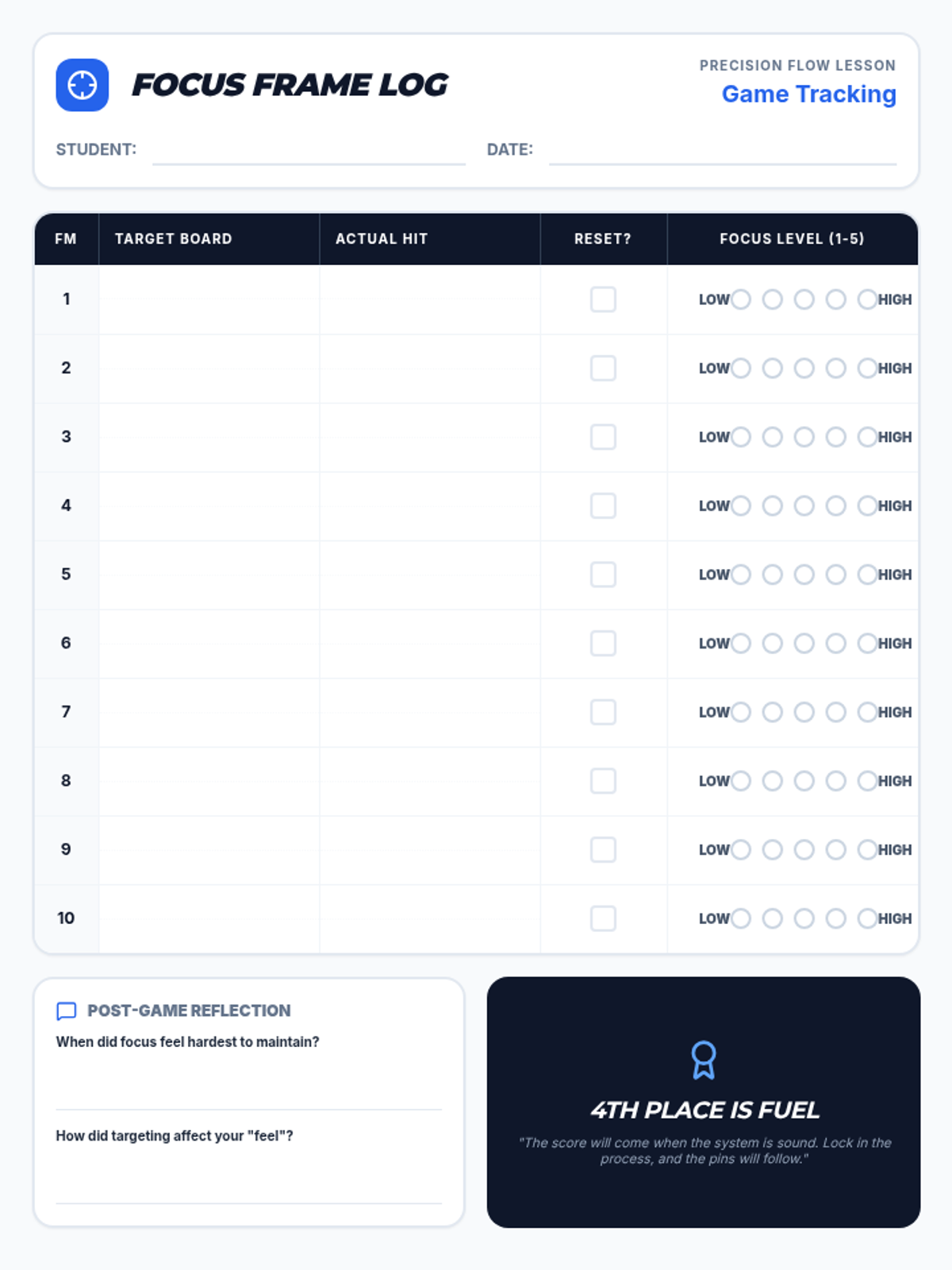
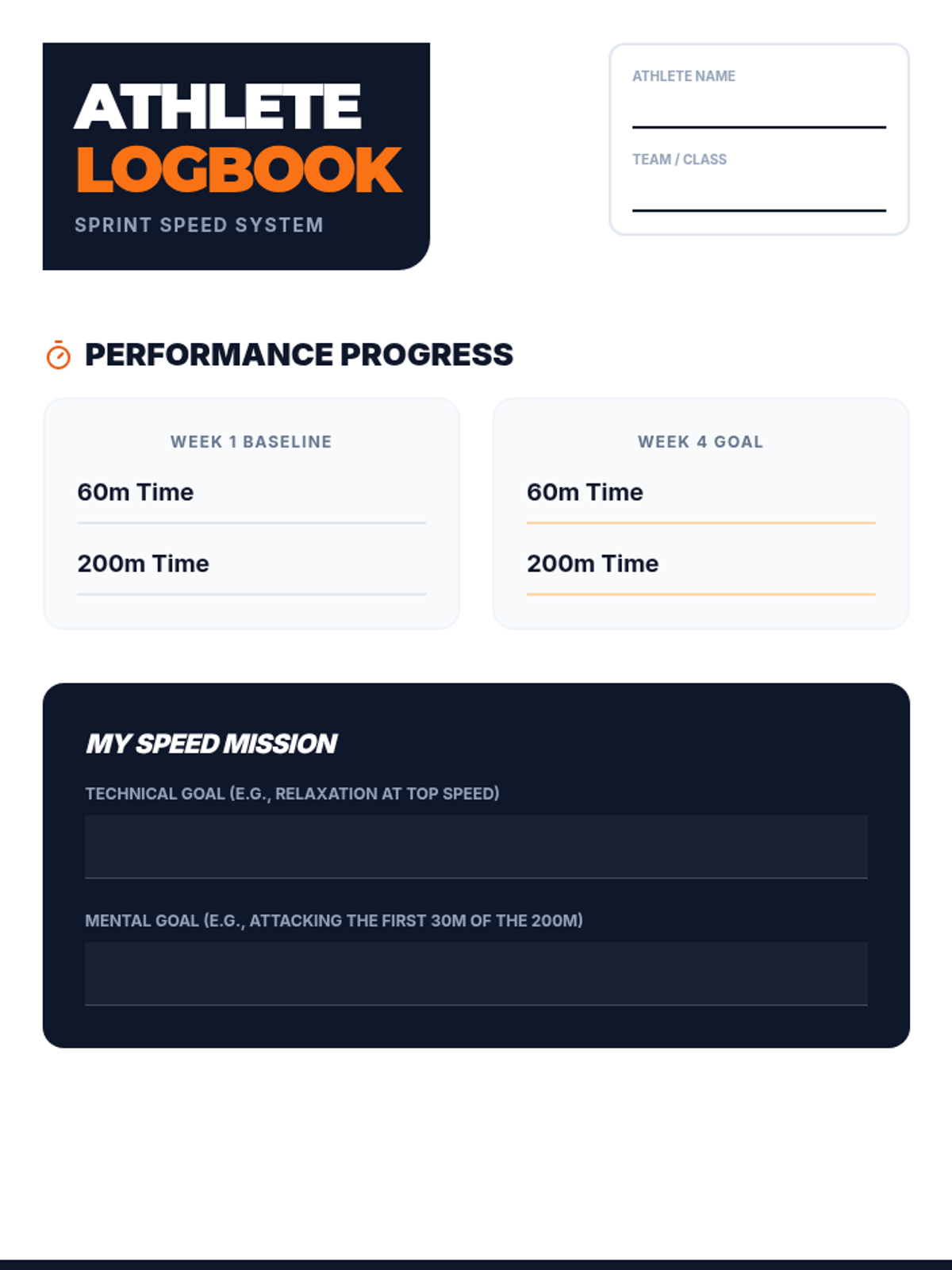
A student-facing log sheet for tracking bowling targeting accuracy and mental focus levels frame-by-frame during a coaching session.
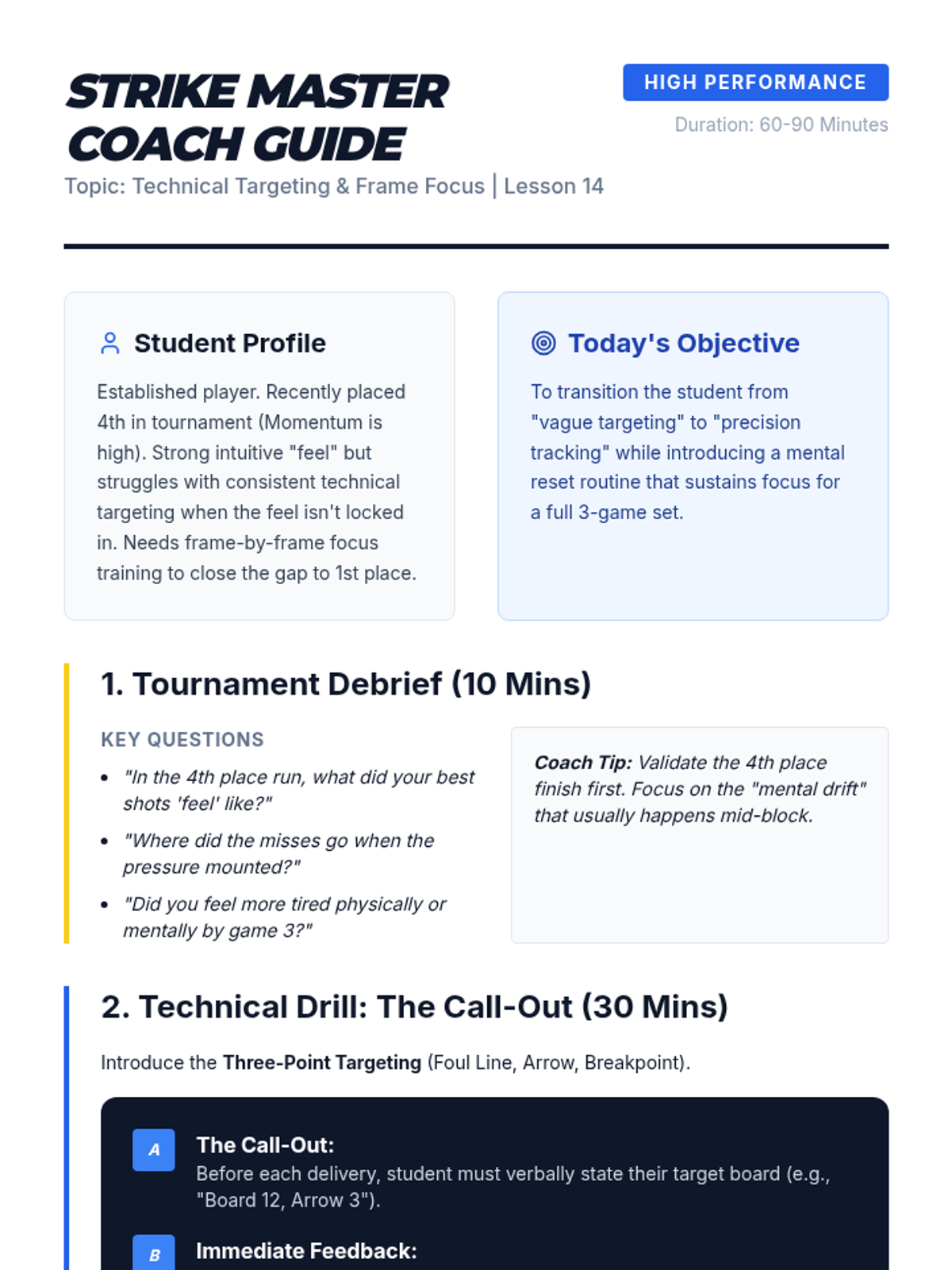
A comprehensive coaching guide for a bowling lesson focused on technical targeting and mental stamina. Includes specific drills and debriefing questions for competitive students.
A presentation for competitive bowling students focusing on technical targeting systems and mental focus techniques.
A masterclass slide deck for the Zen Chair Masterclass updated with two new practice videos and optimized font sizes (minimum 24px) for accessibility. Includes restorative and functional mobility components.
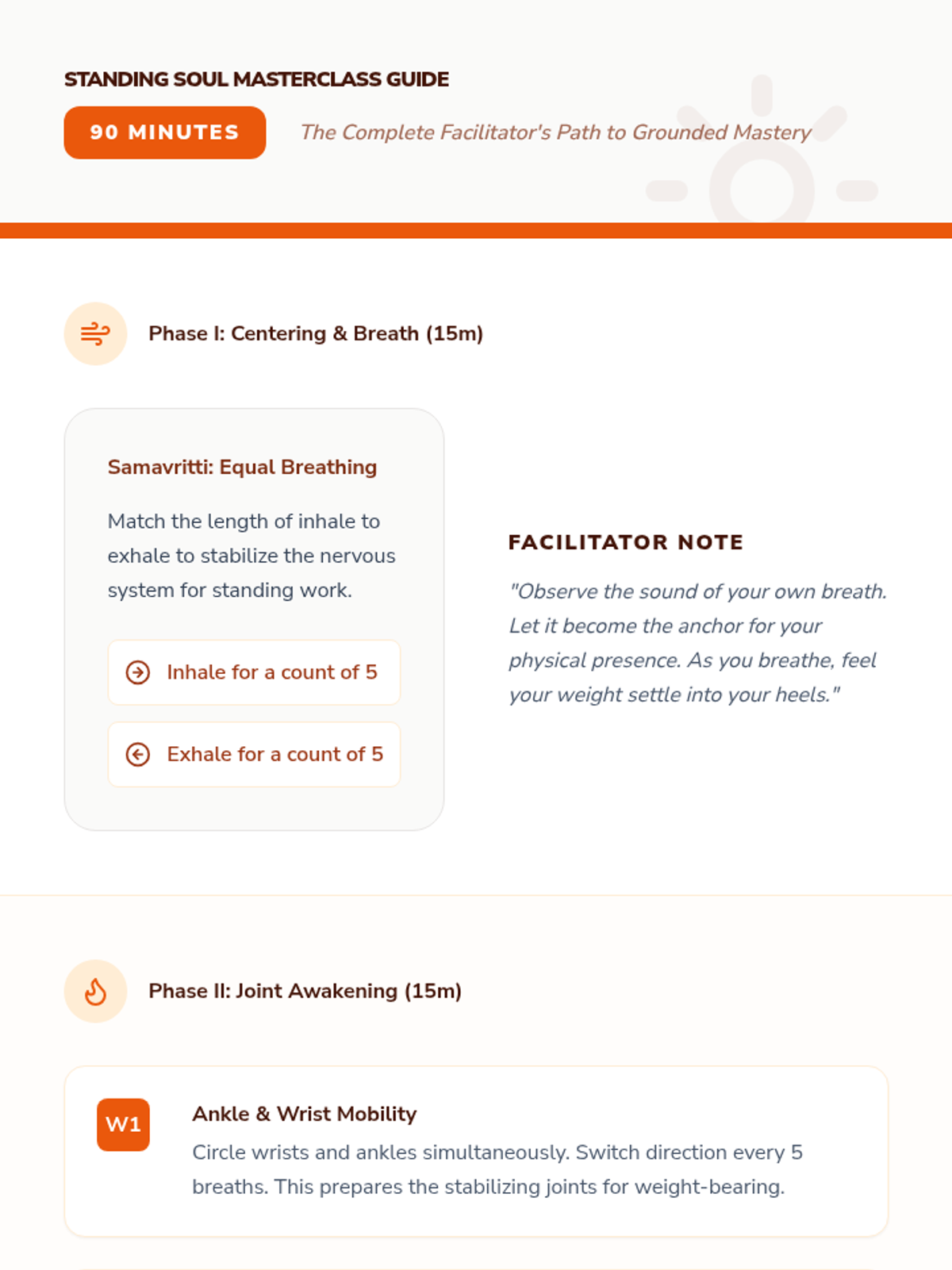
A comprehensive 90-minute facilitator's manual for the Standing Soul Masterclass. Includes pranayama, joint warm-ups, step-by-step postural alignment for key standing poses, and a restorative cool-down phase.
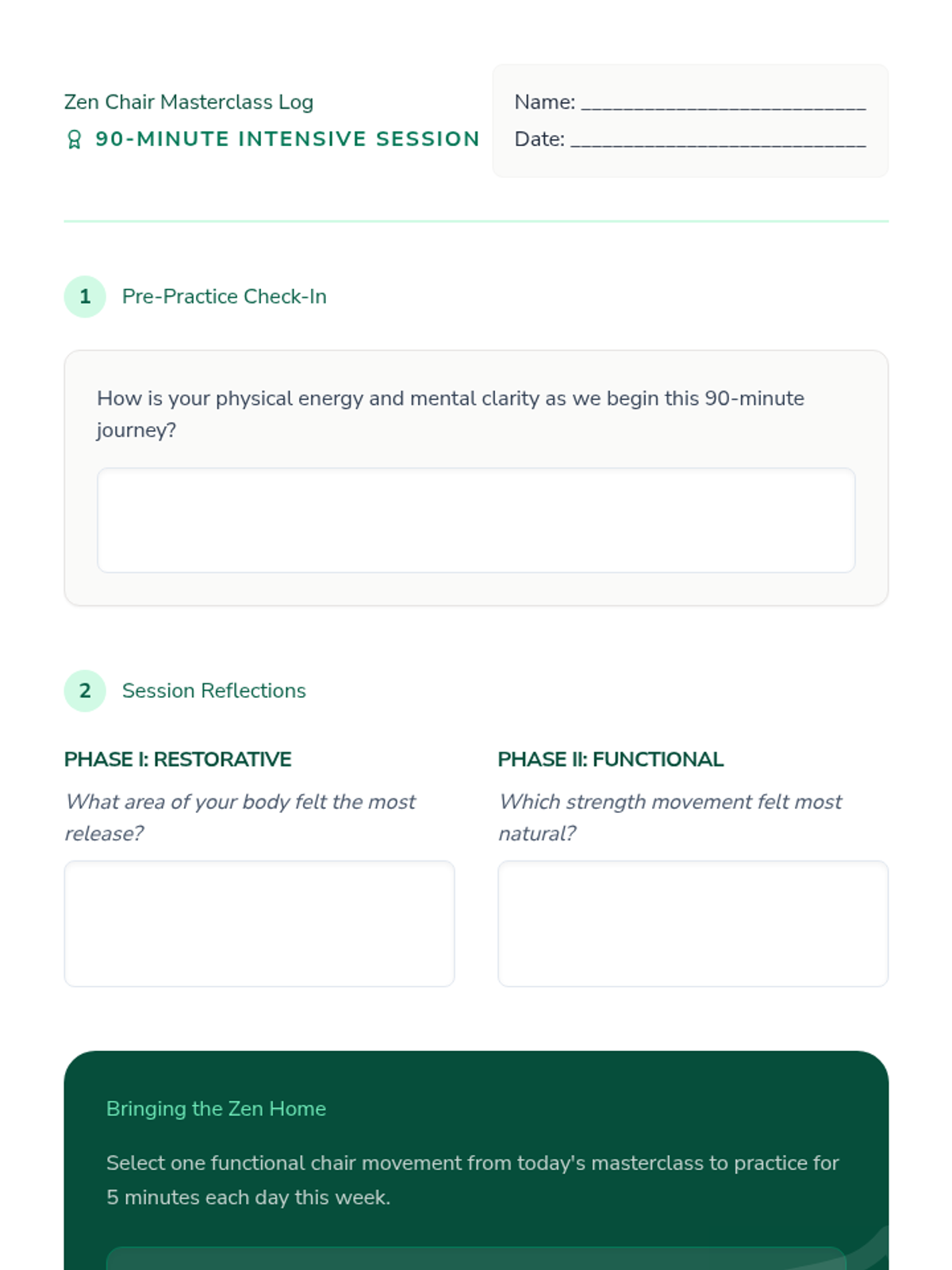
A student reflection log for the combined Zen Chair Masterclass session. Updated for the 90-minute intensive format with phase-specific reflection areas.
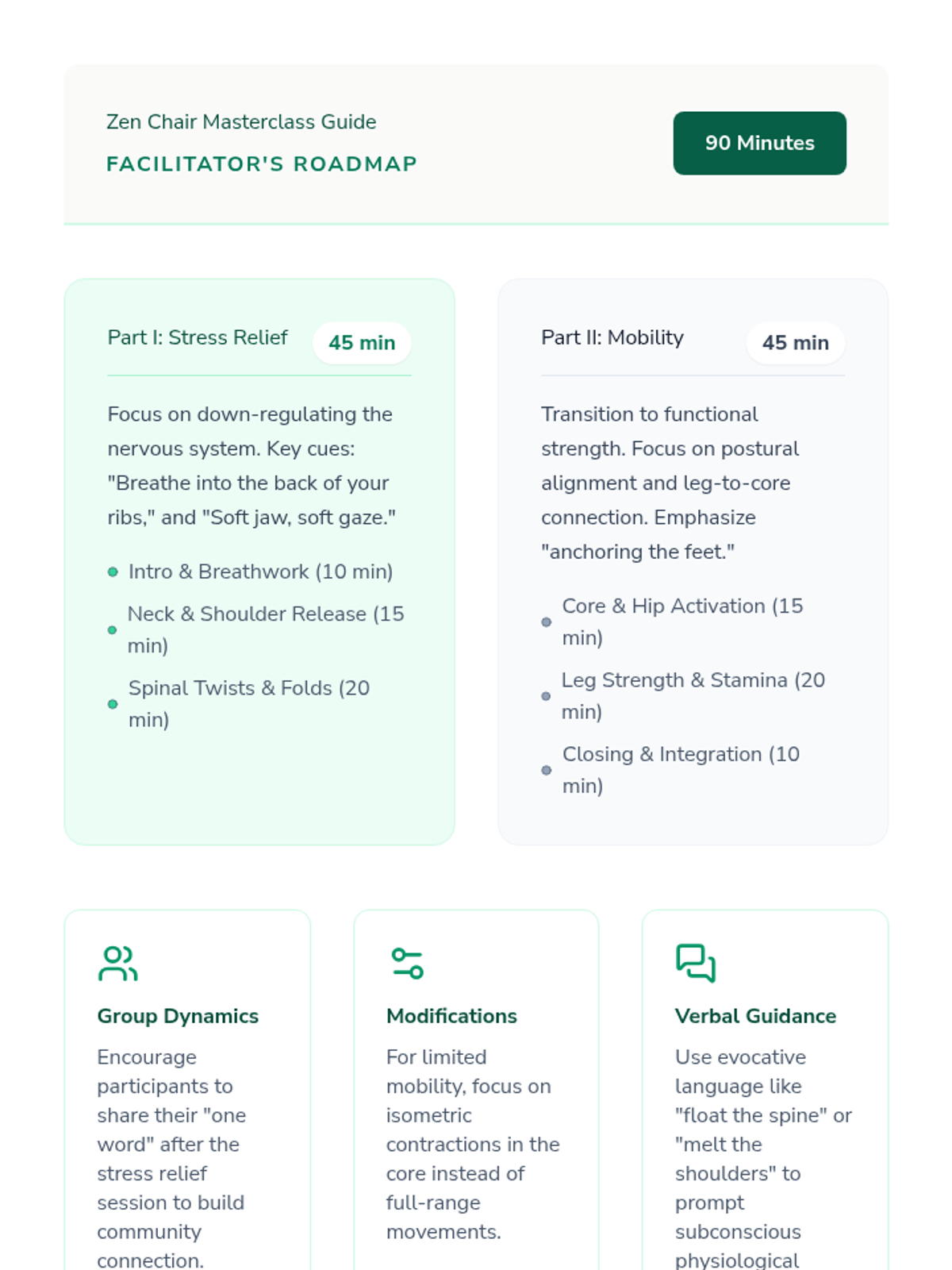
A 90-minute facilitator's guide for the Zen Chair Masterclass, featuring a split-session roadmap for stress relief and functional mobility with detailed pacing and instructional tips.
An answer key for the Stress Free Slumber Quiz, including rationales for each answer and teaching tips.
A 10-question multiple-choice quiz focusing on stress management techniques for better sleep hygiene, designed for student use.
Updated student worksheet for Lesson 3 with new workshop sections for 'Energy Audit' and 'Community Map' to align with the 108-minute double session slides.
Updated visual presentation for Lesson 3 with expanded activity slides (Flat Tire workshop, Energy Audit, Community Map) restructured for a 108-minute double session.
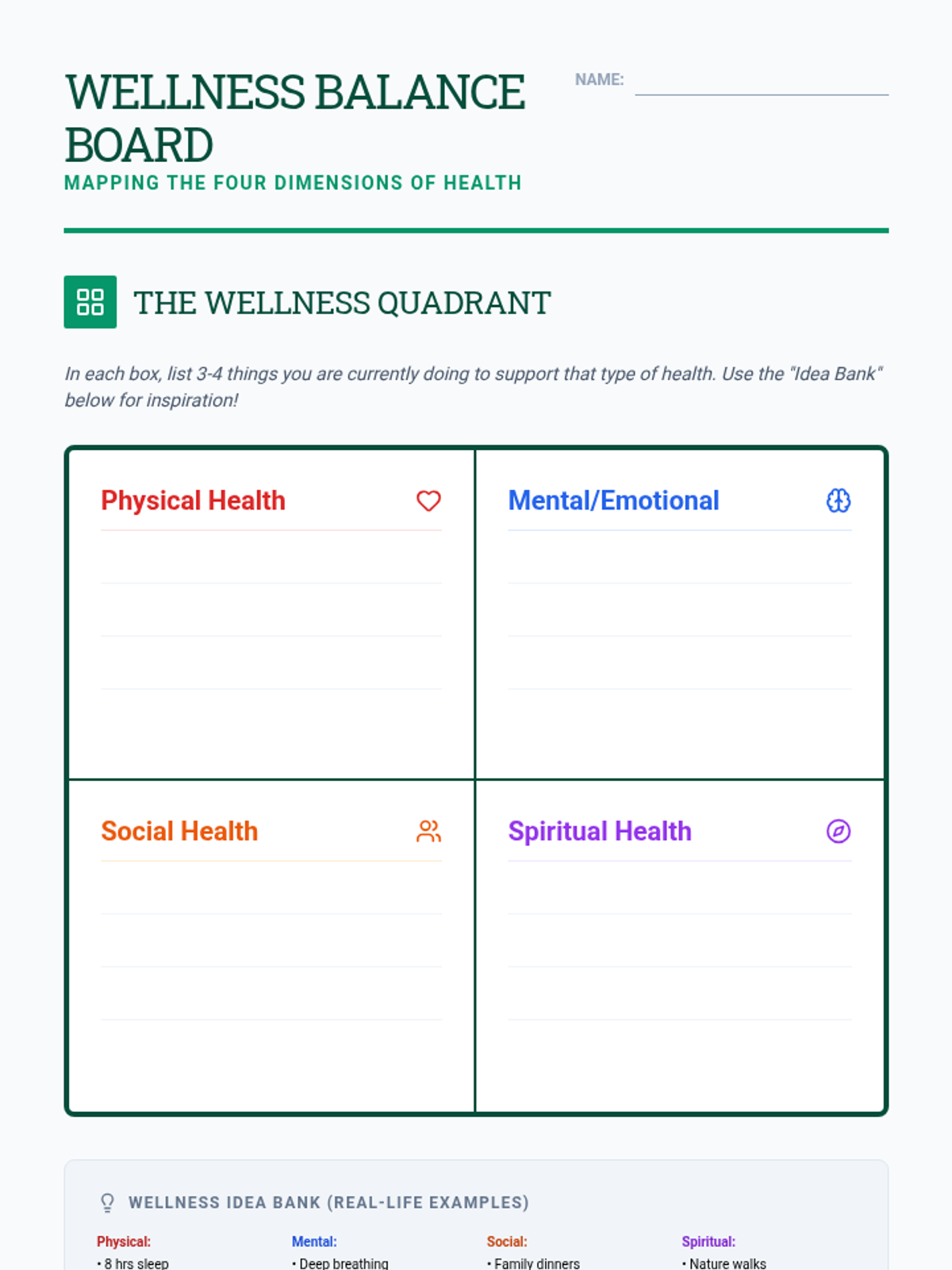
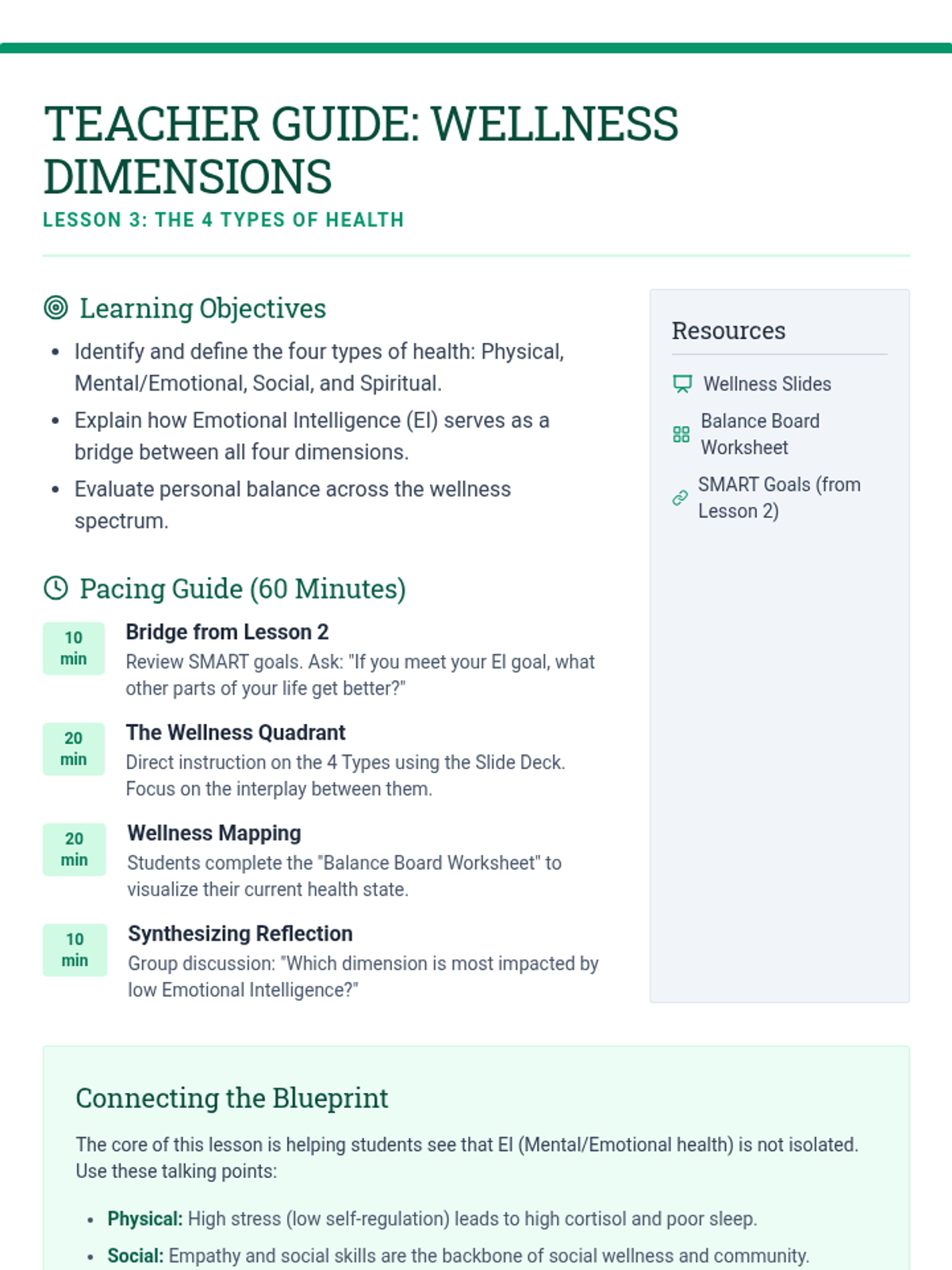
Updated Teacher Guide for Lesson 3, now optimized for a 108-minute double session with four distinct learning chunks and activities focused on the four dimensions of health.
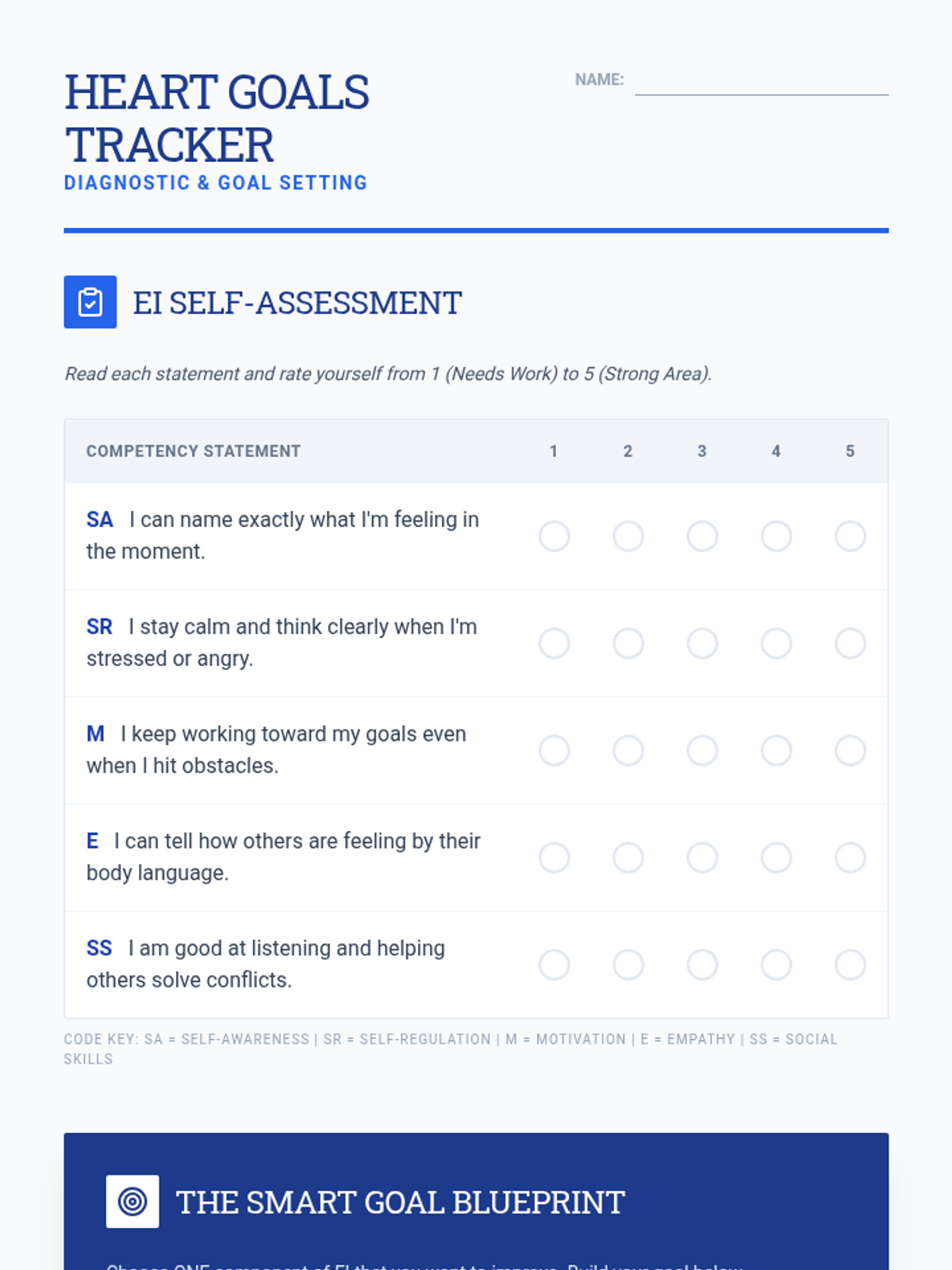
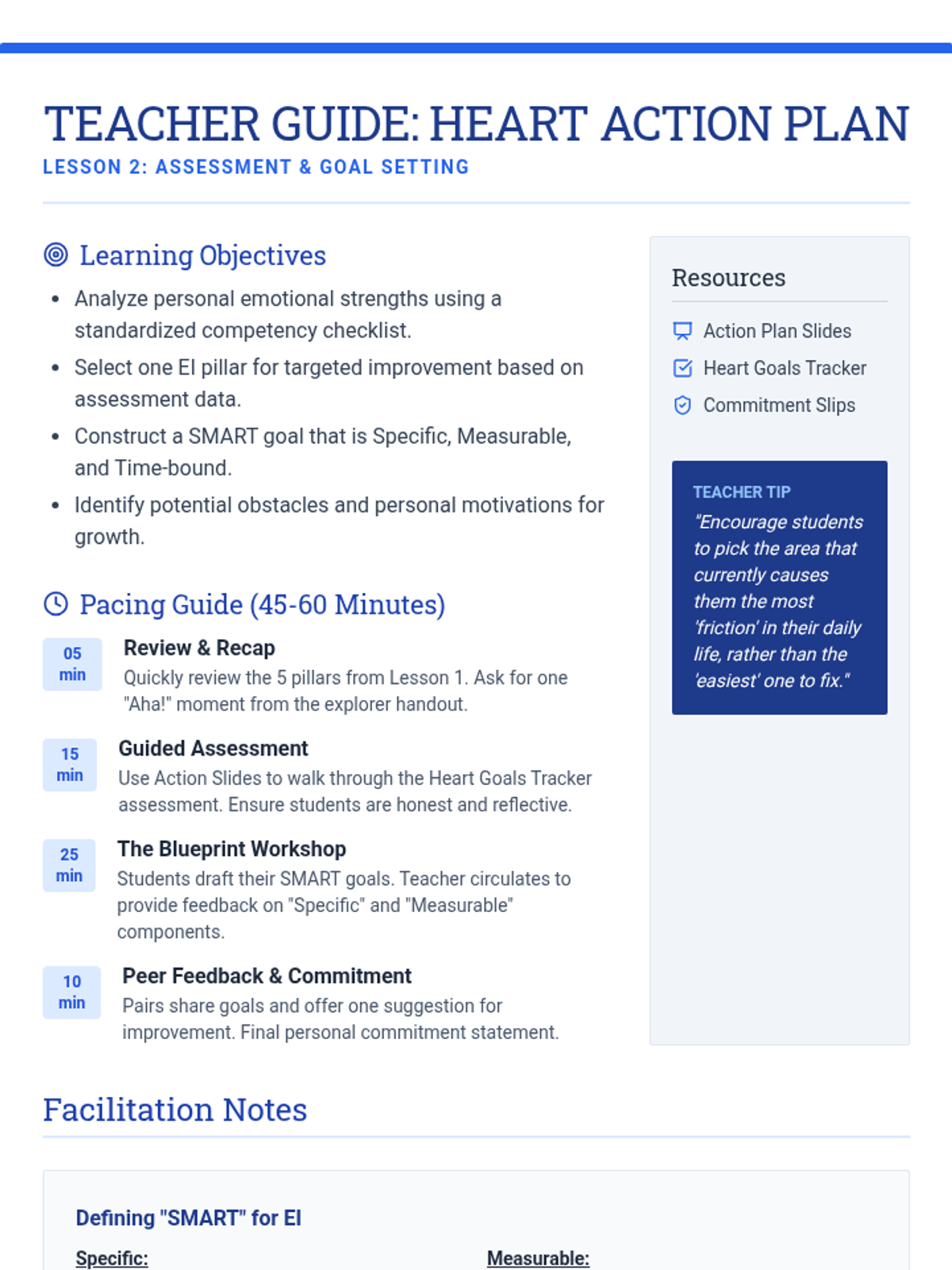
Updated student material for self-assessment and goal setting, including a competency checklist, a complete 5-part SMART goal template, and sections for personal motivation and obstacle planning.
Updated visual presentation for Lesson 2, now including all five components of SMART goals (Specific, Measurable, Achievable, Relevant, Time-bound) and interactive activities interspersed between instructional slides to enhance student engagement.
Updated facilitation guide for Lesson 2, optimized for a 108-minute double session with four distinct learning chunks and expanded workshop activities.
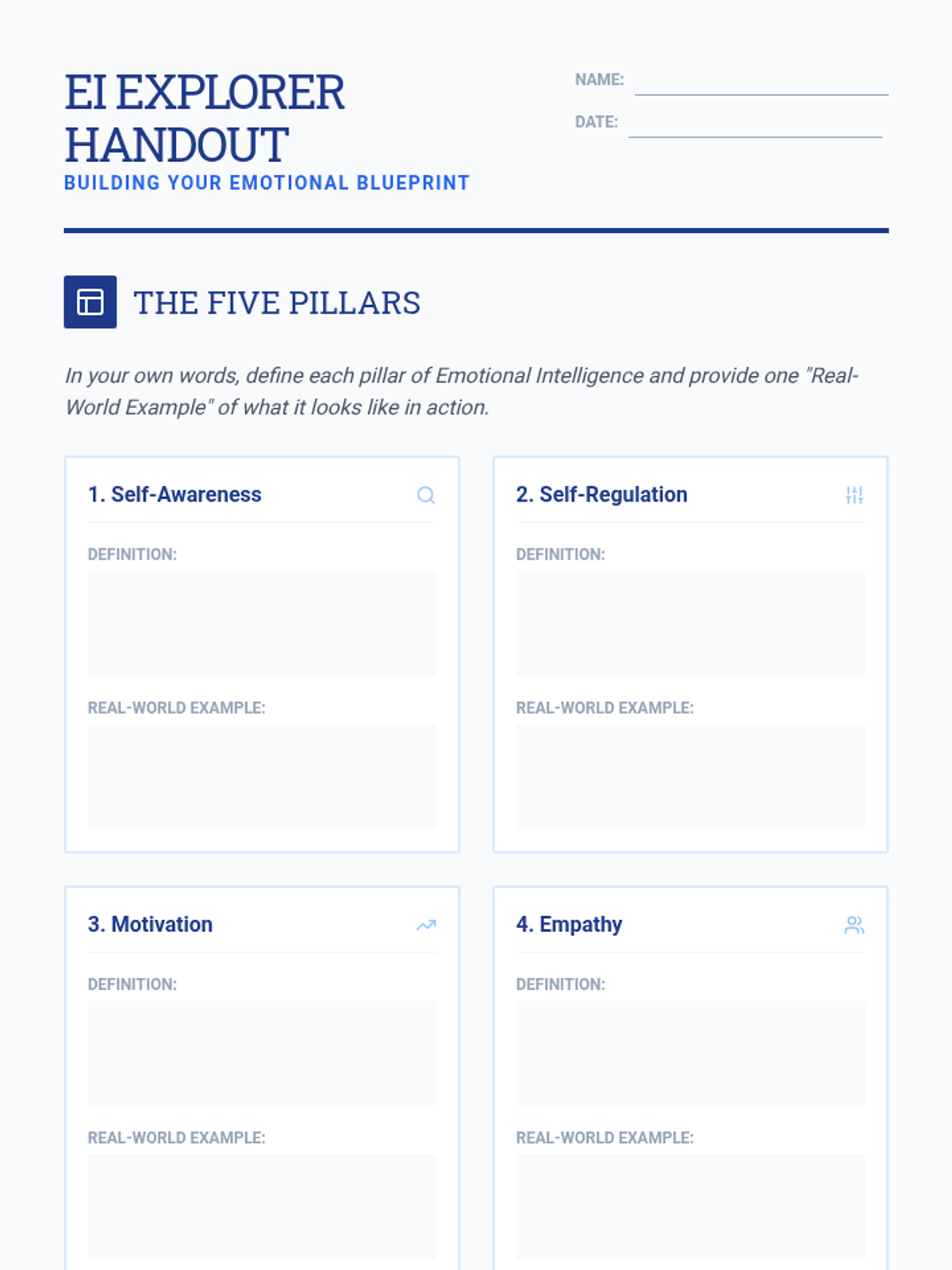
Updated student handout for Lesson 1, now including a dedicated Trigger Map workshop section and Scenario Workshop area aligned with the 108-minute double session slides.
Updated visual presentation for Lesson 1, now restructured for a 108-minute double session with distinct activity slides for the 'Trigger Map', 'Why Challenge', and 'Scenario Workshop'.
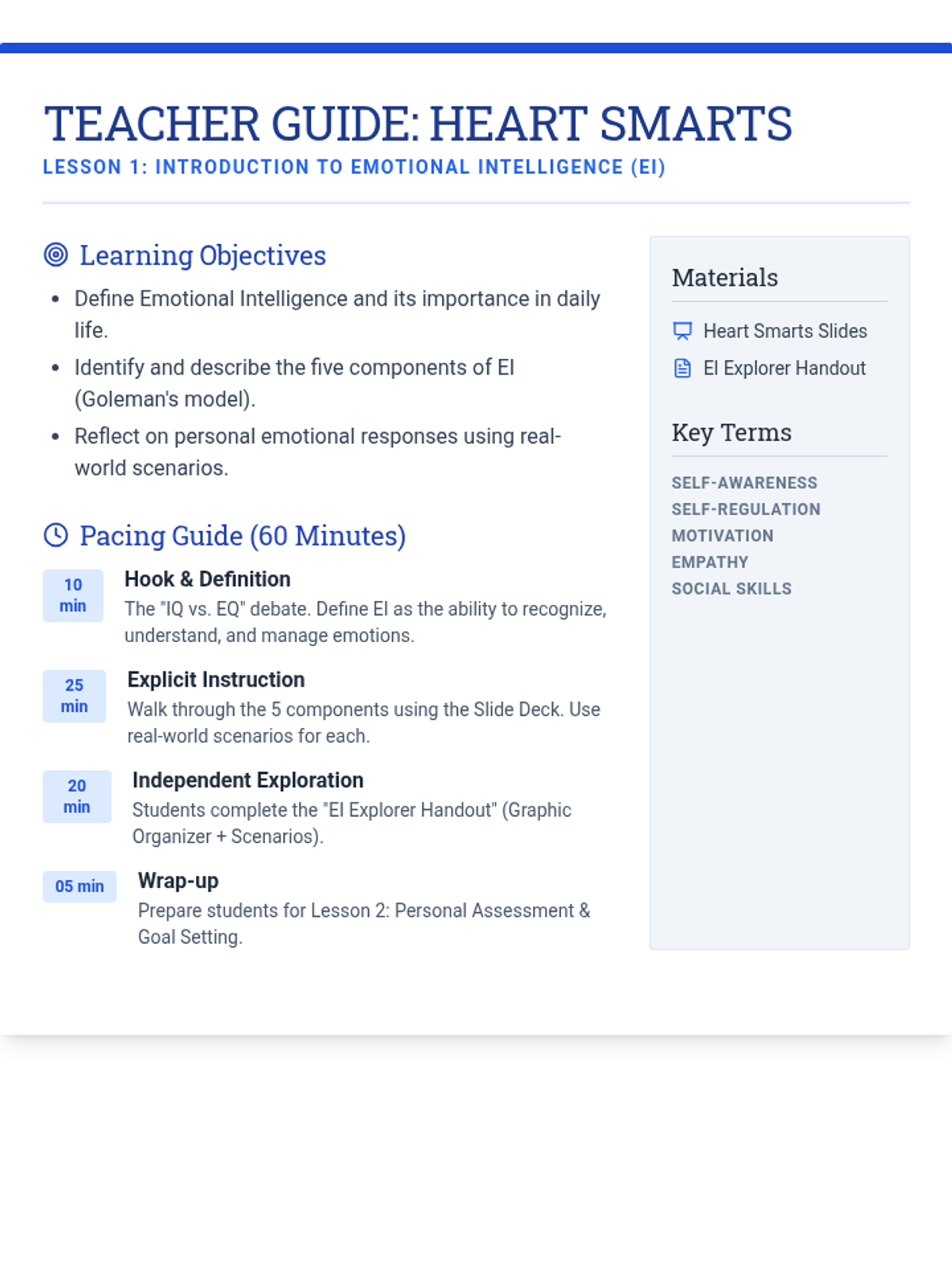
Updated Teacher Guide for Lesson 1, now optimized for a 108-minute double session with four distinct learning chunks and specific workshop activities for each section.
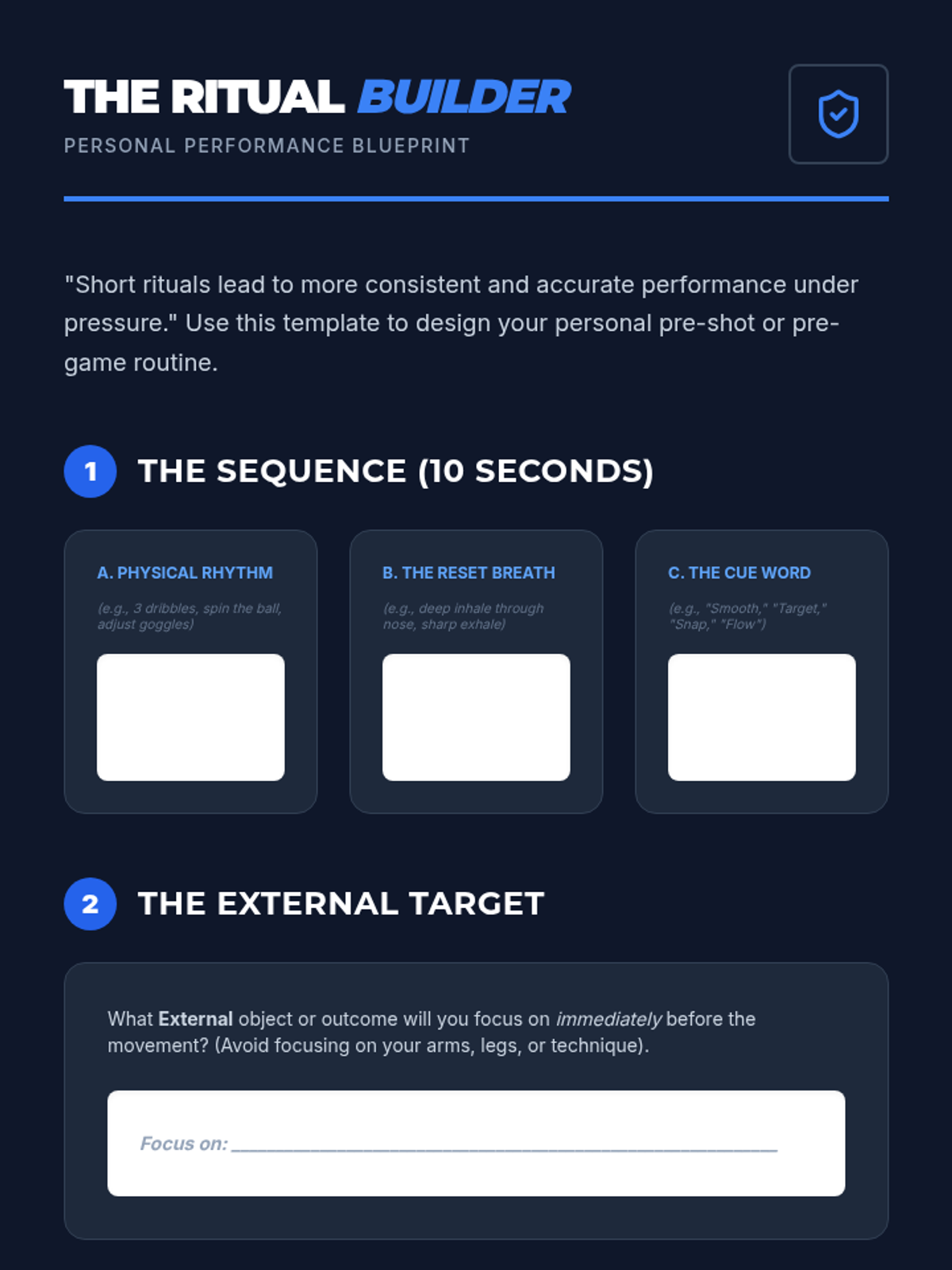
A personal ritual-building template for student-athletes to design their own pre-performance routines, incorporating breathing, physical cues, and external focus strategies.
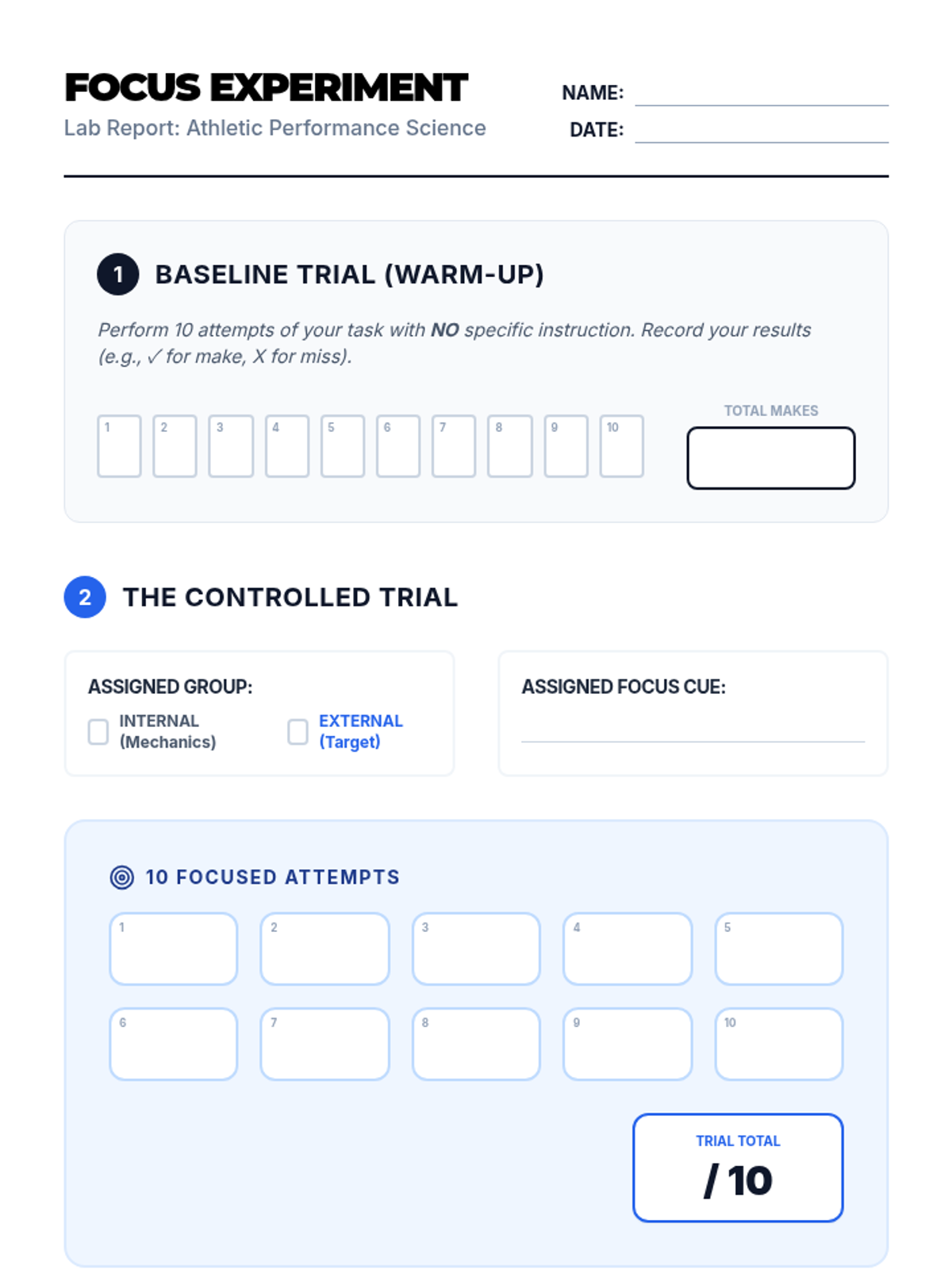
A data collection worksheet for students to record their baseline and focused performance attempts. Includes space for comparing internal and external focus results and analyzing class-wide data.
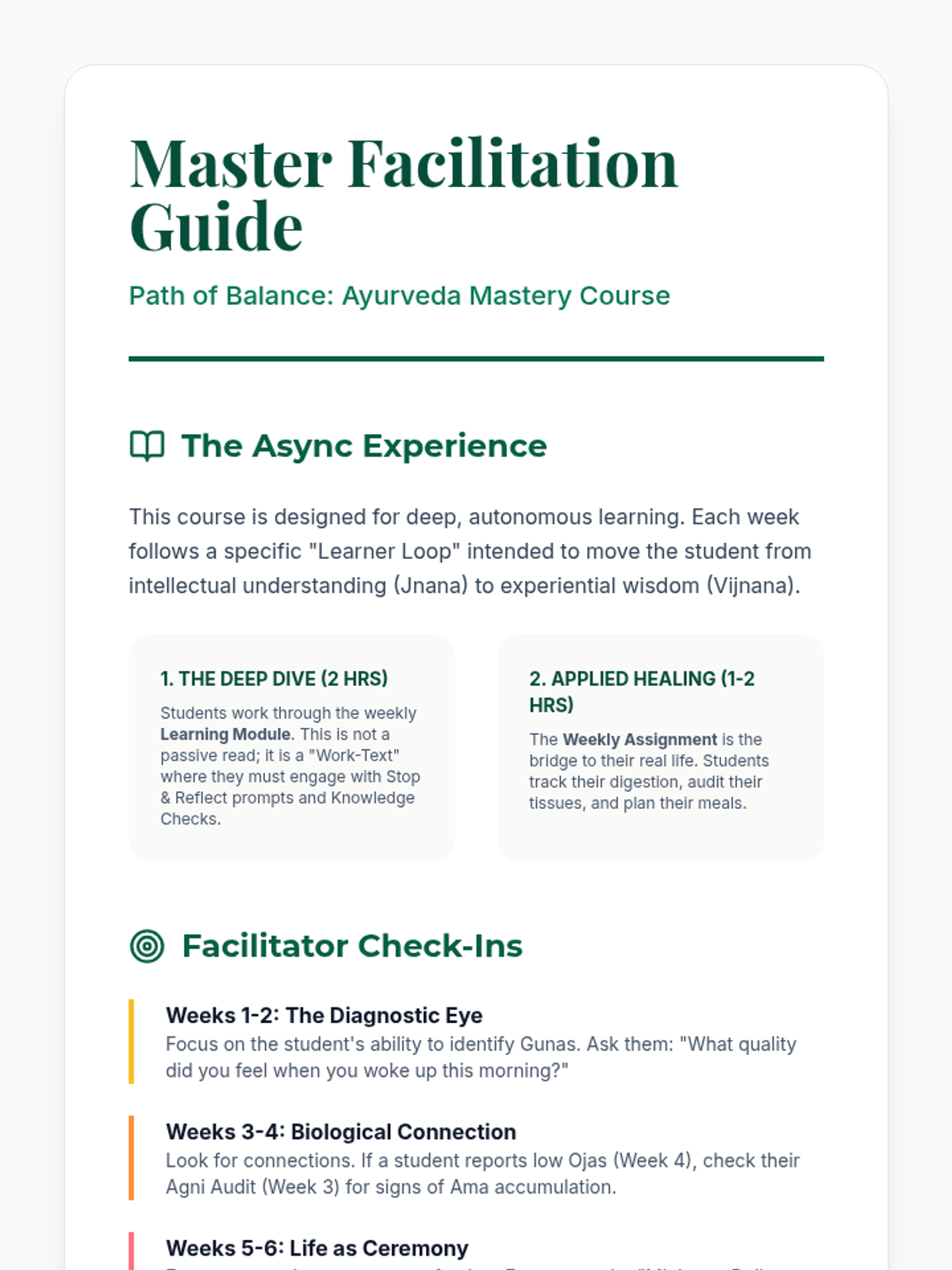
A comprehensive teacher facilitation guide for the Path of Balance Ayurveda course. Outlines the async learner loop, provides facilitation targets for each week, and defines success metrics for assessing student progress in holistic transformation.
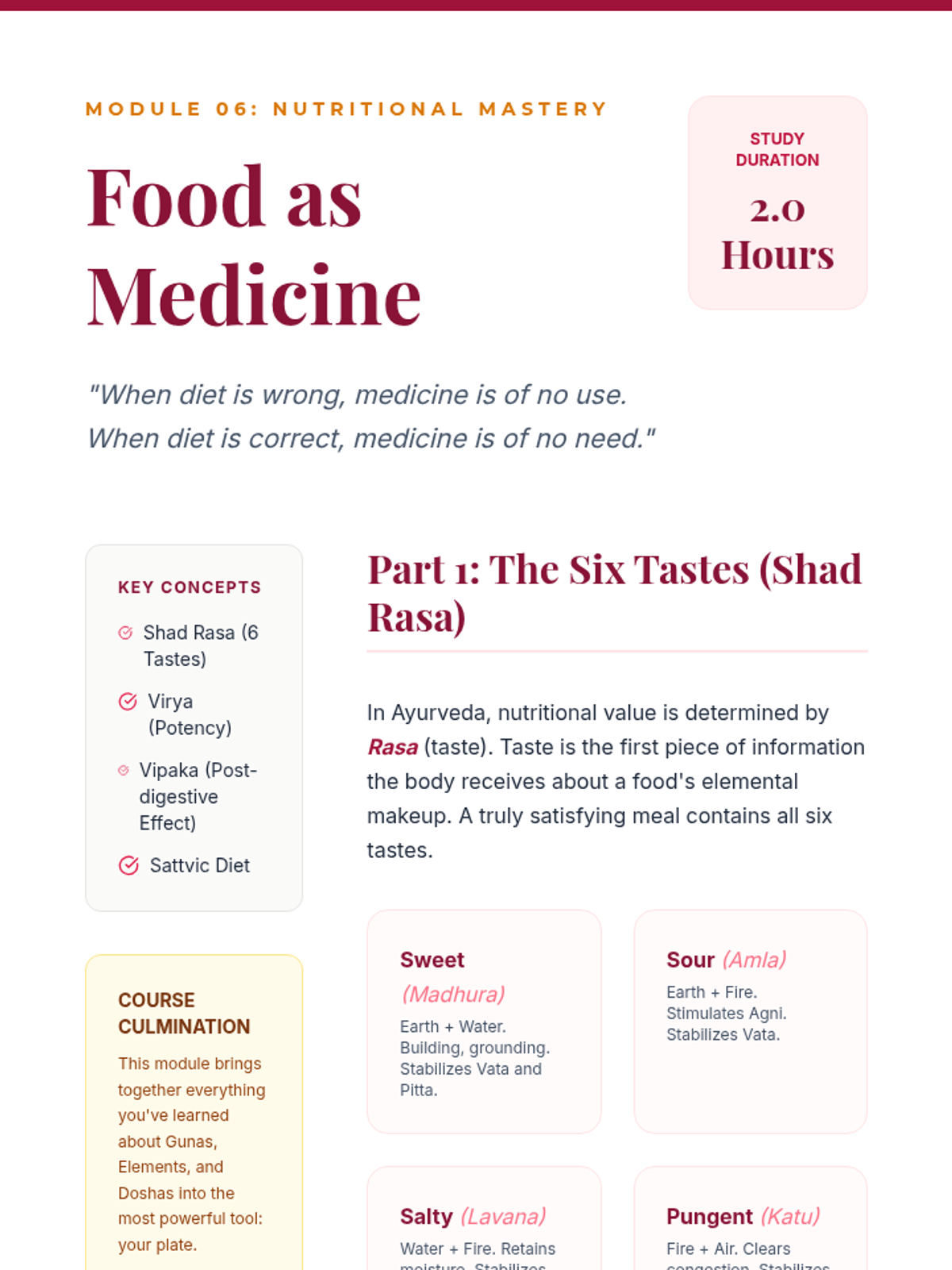
A 2-hour async learning module for Week 6. Covers the 6 tastes (Shad Rasa) and their elemental composition, the advanced concepts of Virya (potency) and Vipaka (post-digestive effect), and the principles of a Sattvic diet. Includes integrated meal design scenarios and final reflections.
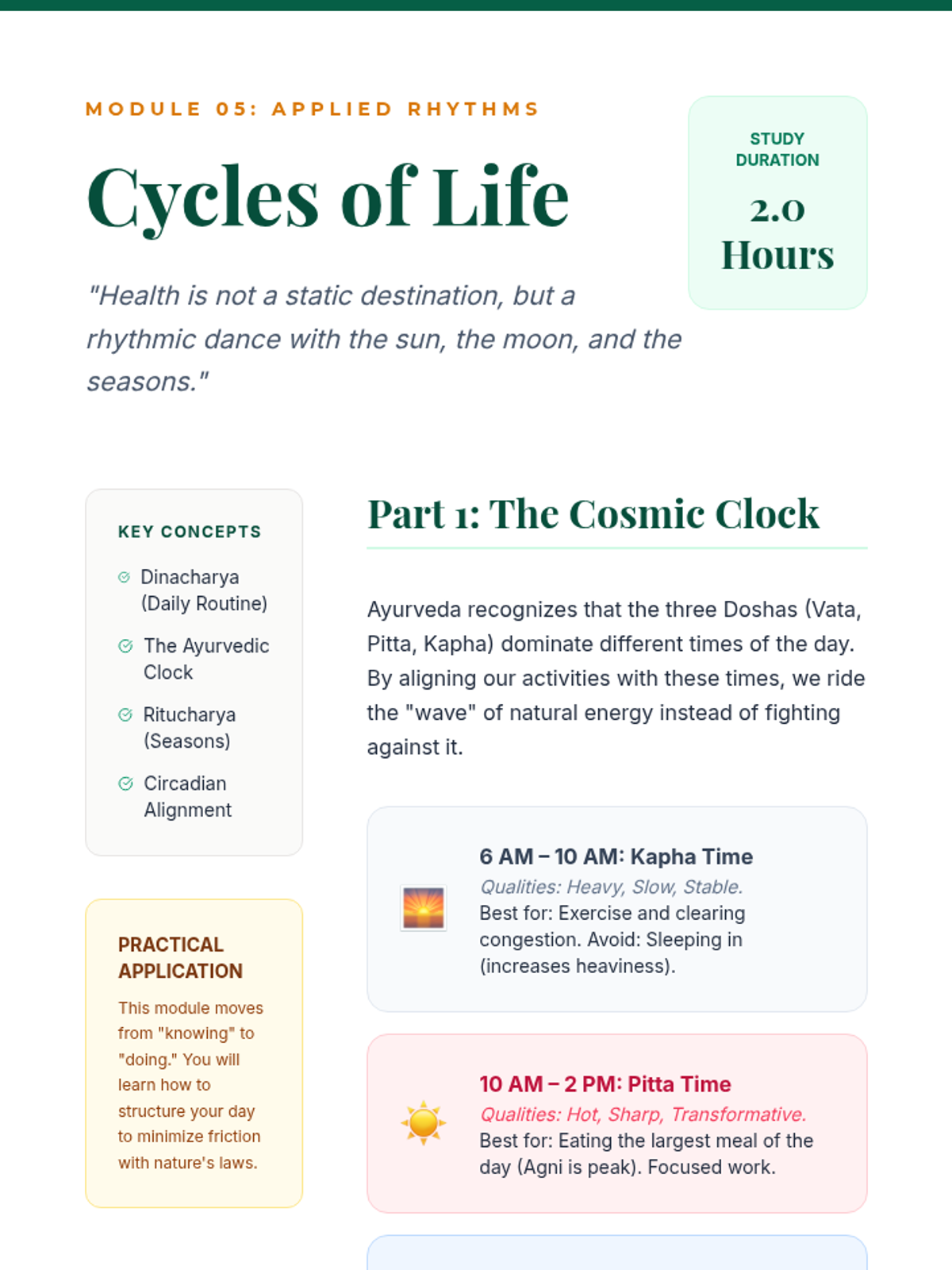
A 2-hour async learning module for Week 5. Comprehensive breakdown of the Ayurvedic clock and its doshic segments, the sacred daily rituals of Dinacharya, and the seasonal regimens of Ritucharya. Includes integrated reflections and knowledge checks.
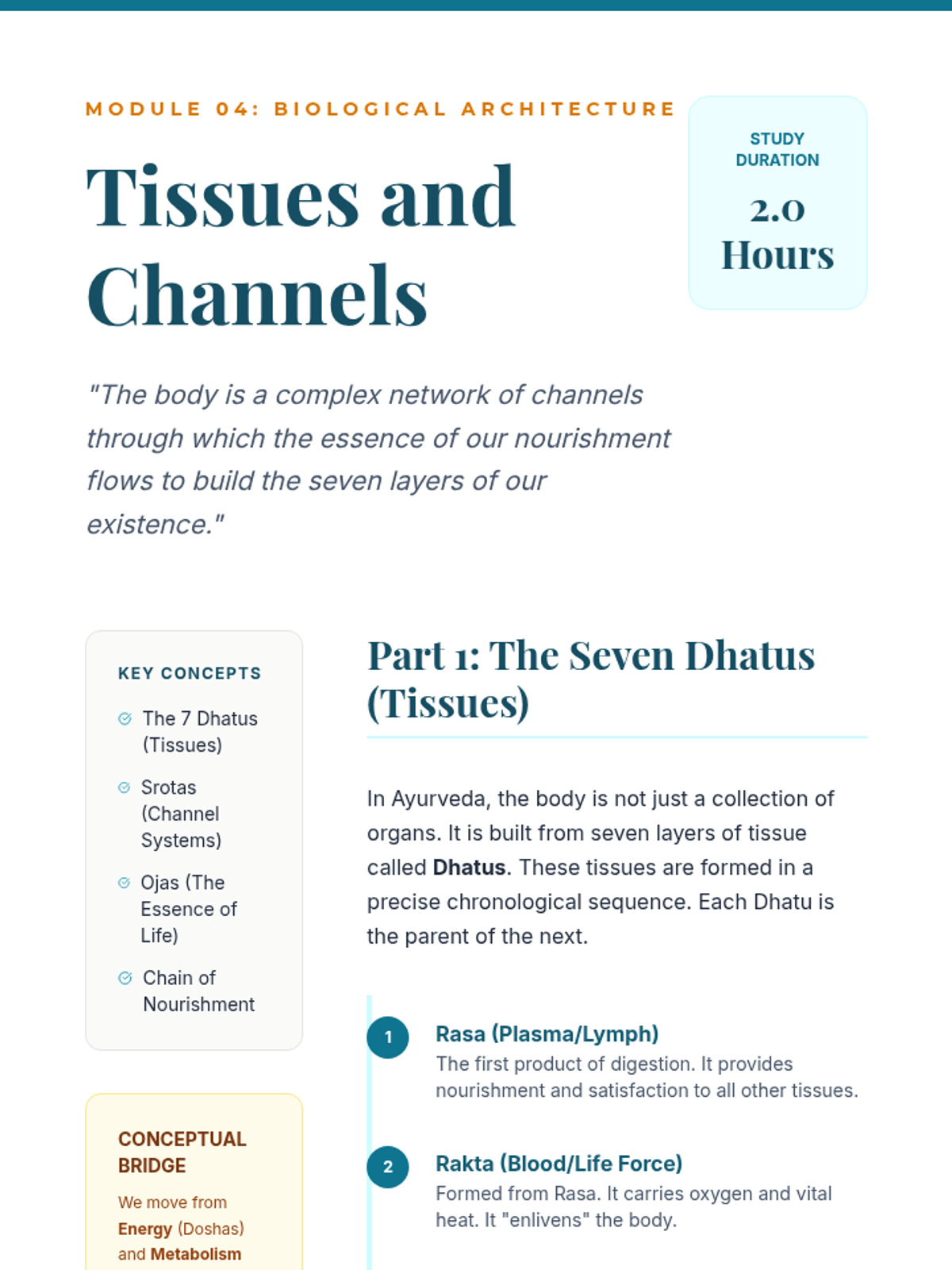
A 2-hour async learning module for Week 4. Detailed analysis of the 7 Dhatus (tissues) and their sequential nourishment, the pathology of the Srotas (channel systems), and the vital role of Ojas (essence of immunity). Includes integrated reflections and knowledge checks.
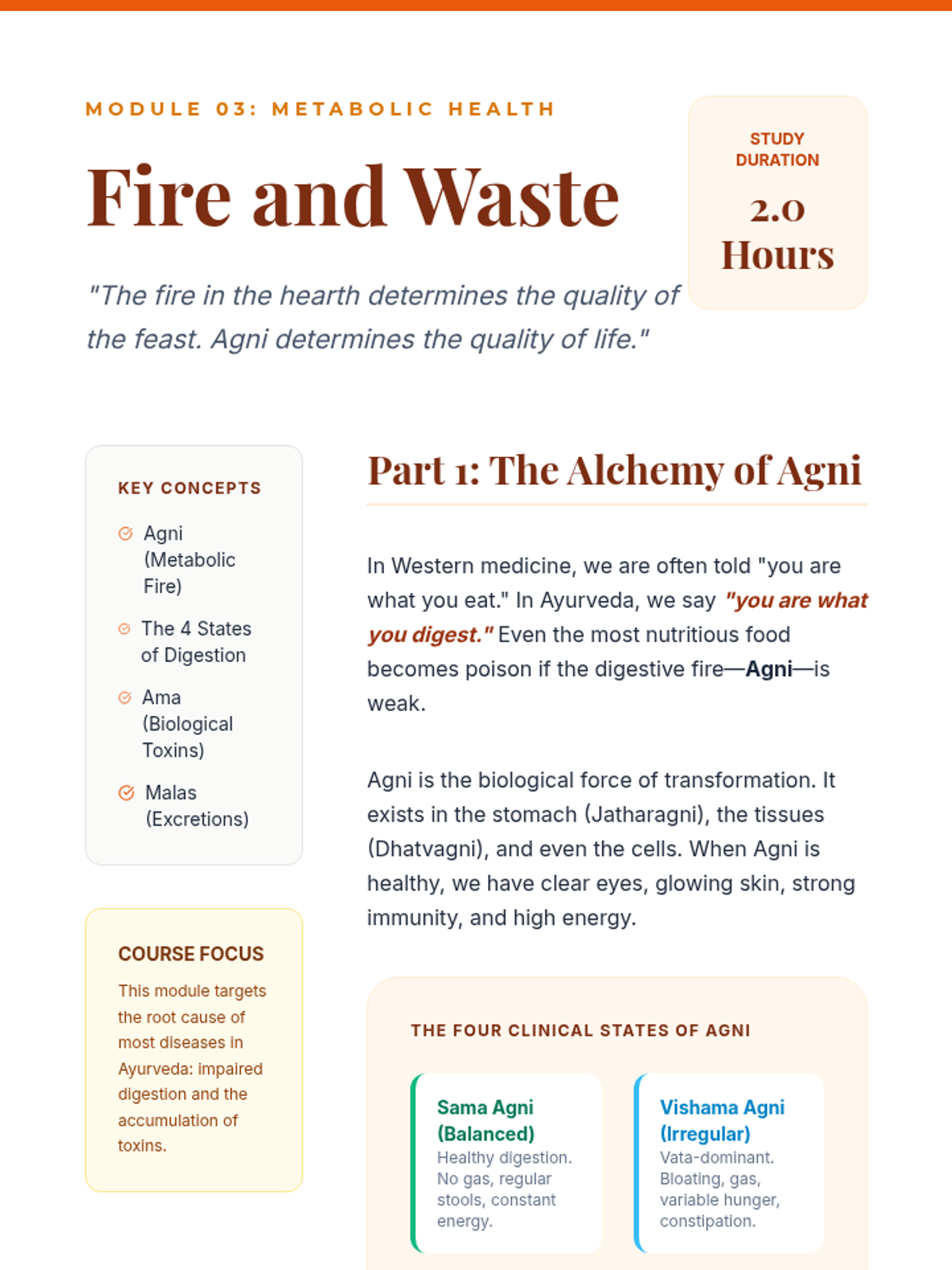
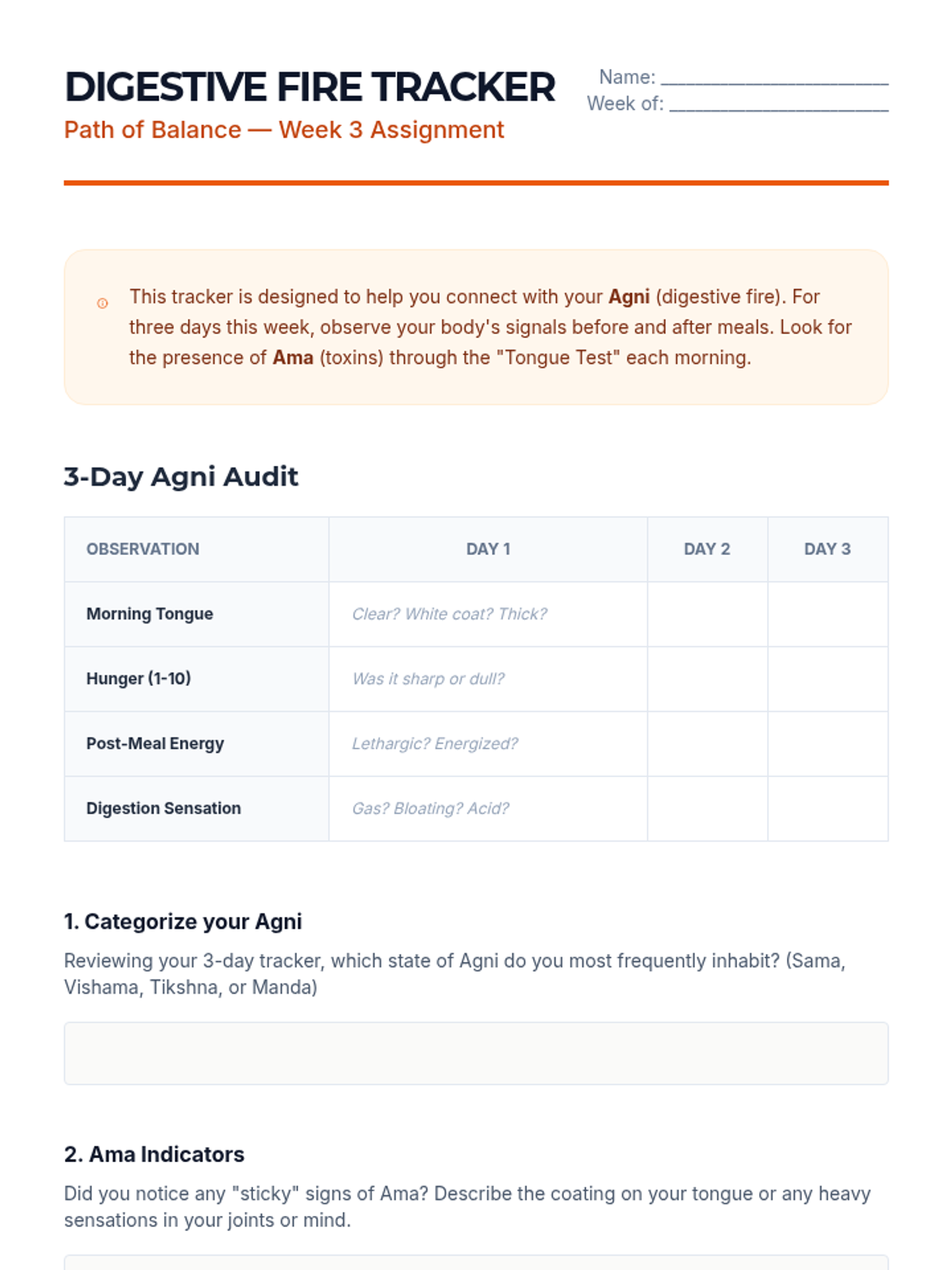
A 2-hour async learning module for Week 3. Deep dive into Agni (metabolic fire) and its 4 clinical states, the formation and symptoms of Ama (toxins), and the role of the three Malas (waste products) in monitoring health. Includes integrated reflections and knowledge checks.
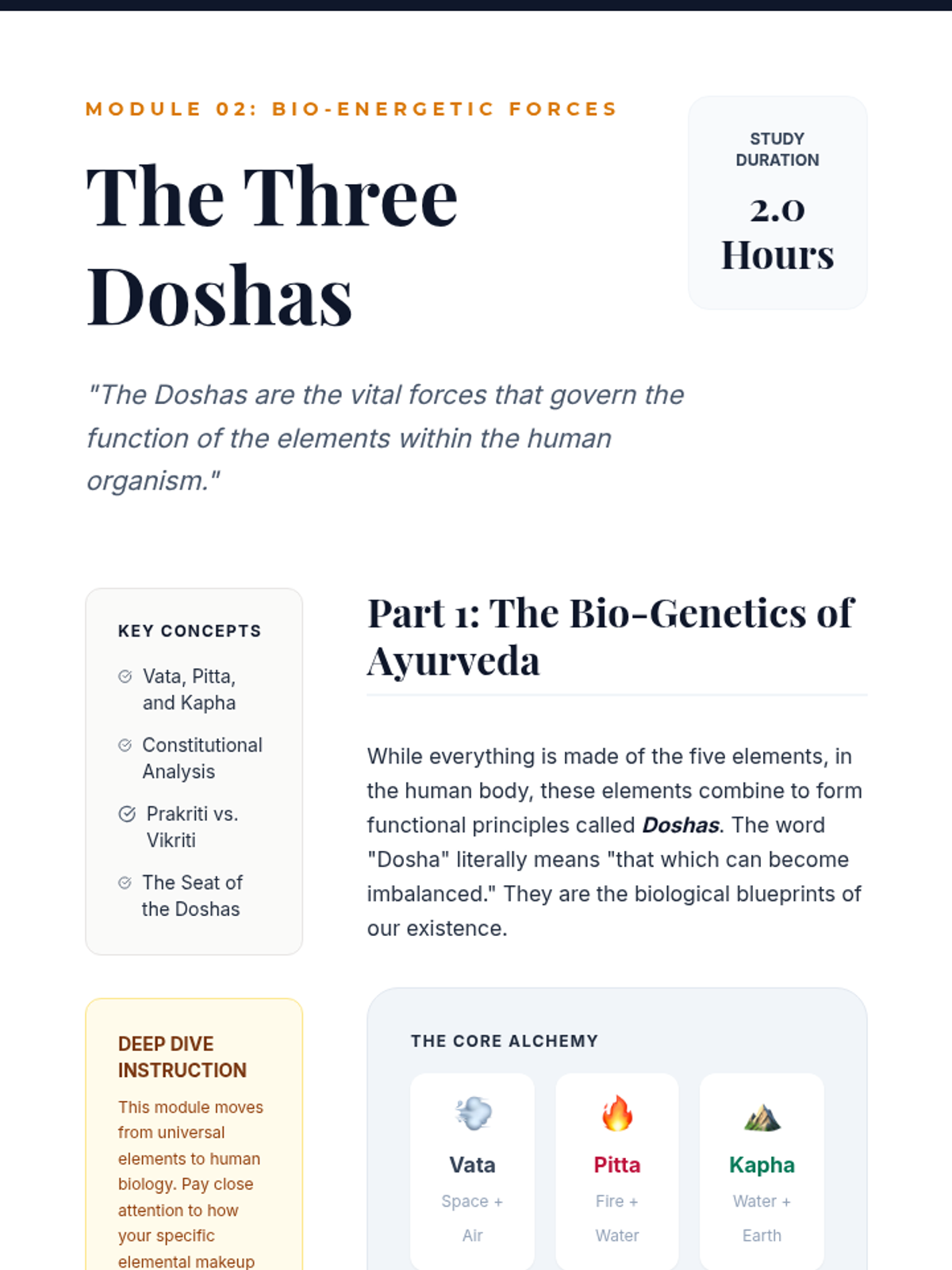
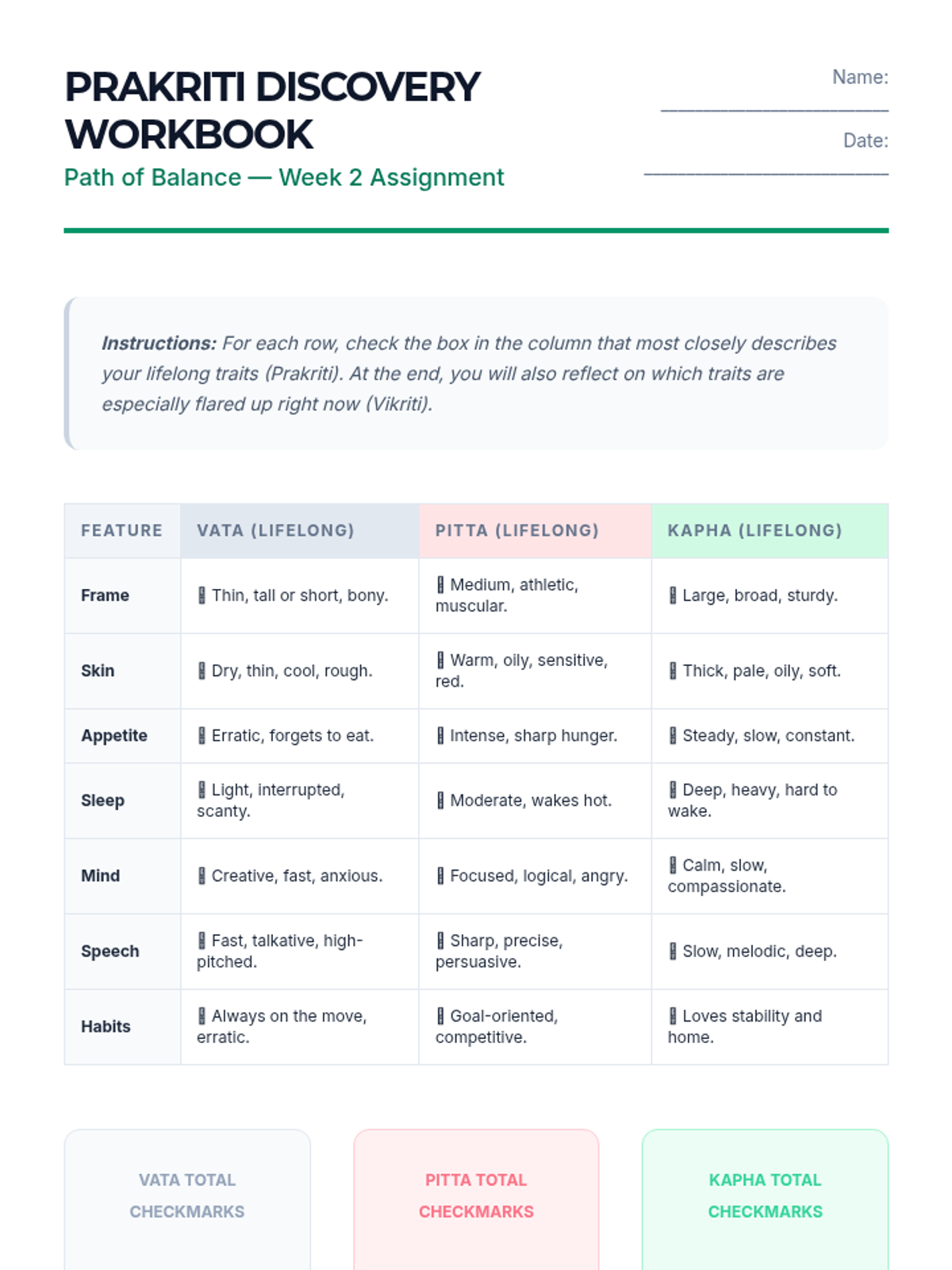
A 2-hour async learning module for Week 2. Provides a deep dive into Vata, Pitta, and Kapha doshas, including their physical/mental traits, seats in the body, and the fundamental distinction between Prakriti and Vikriti. Includes an interactive case study.
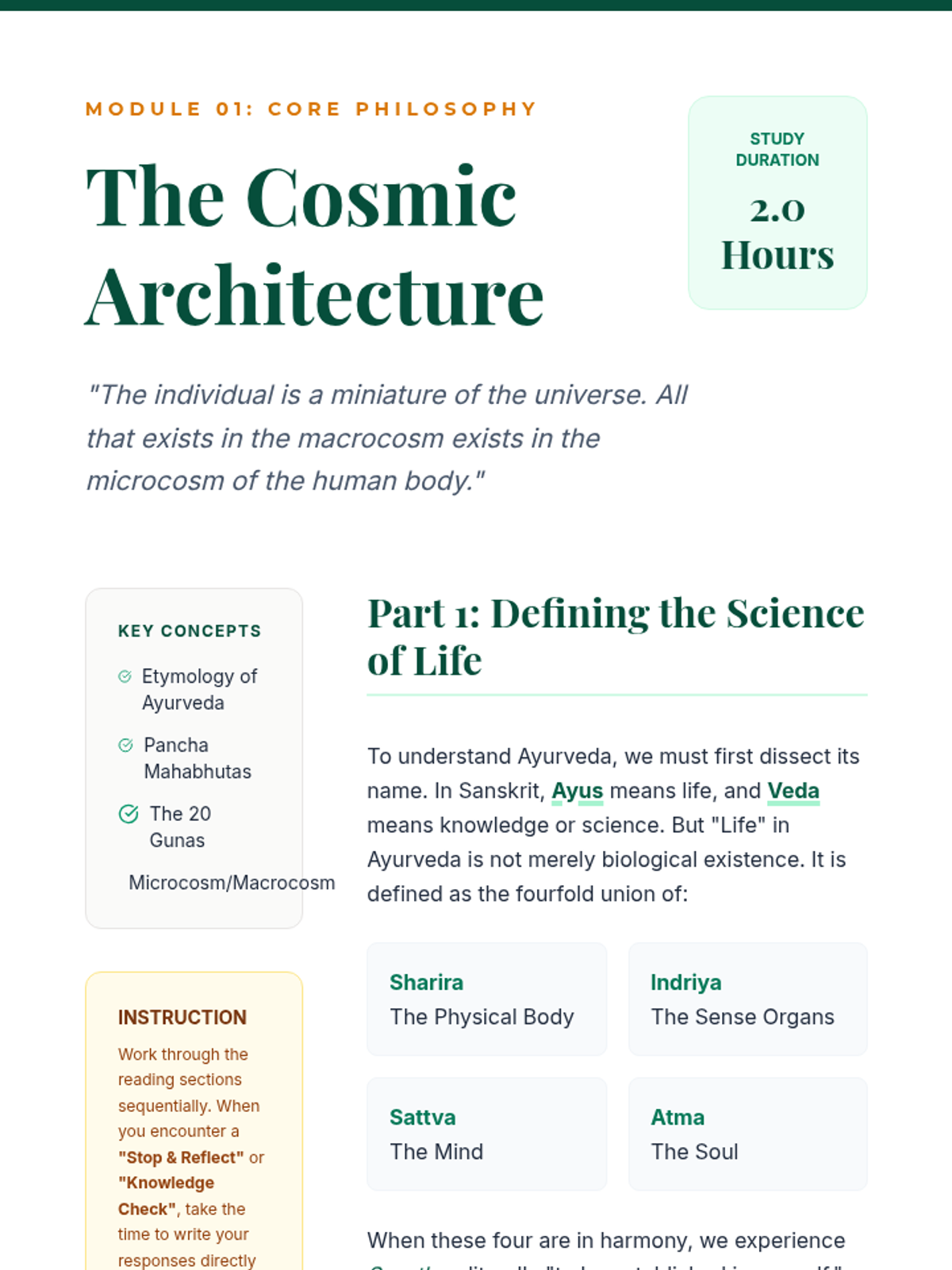
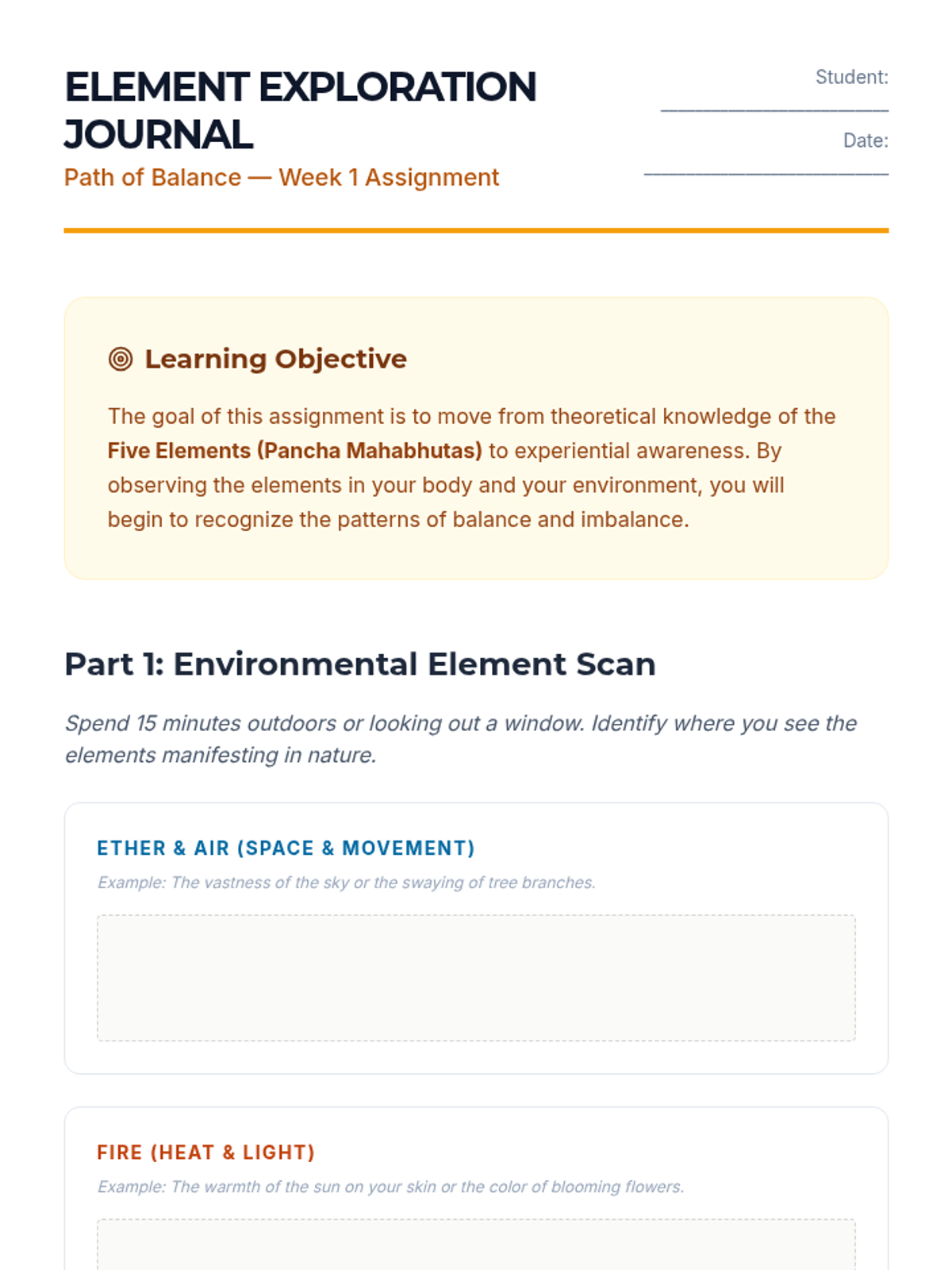
A comprehensive 2-hour async learning module for Week 1. Covers the philosophy of life, the etymology of Ayurveda, the five great elements with physical/mental manifestations, and the 20 Gunas with integrated interactive reflections and a home lab.
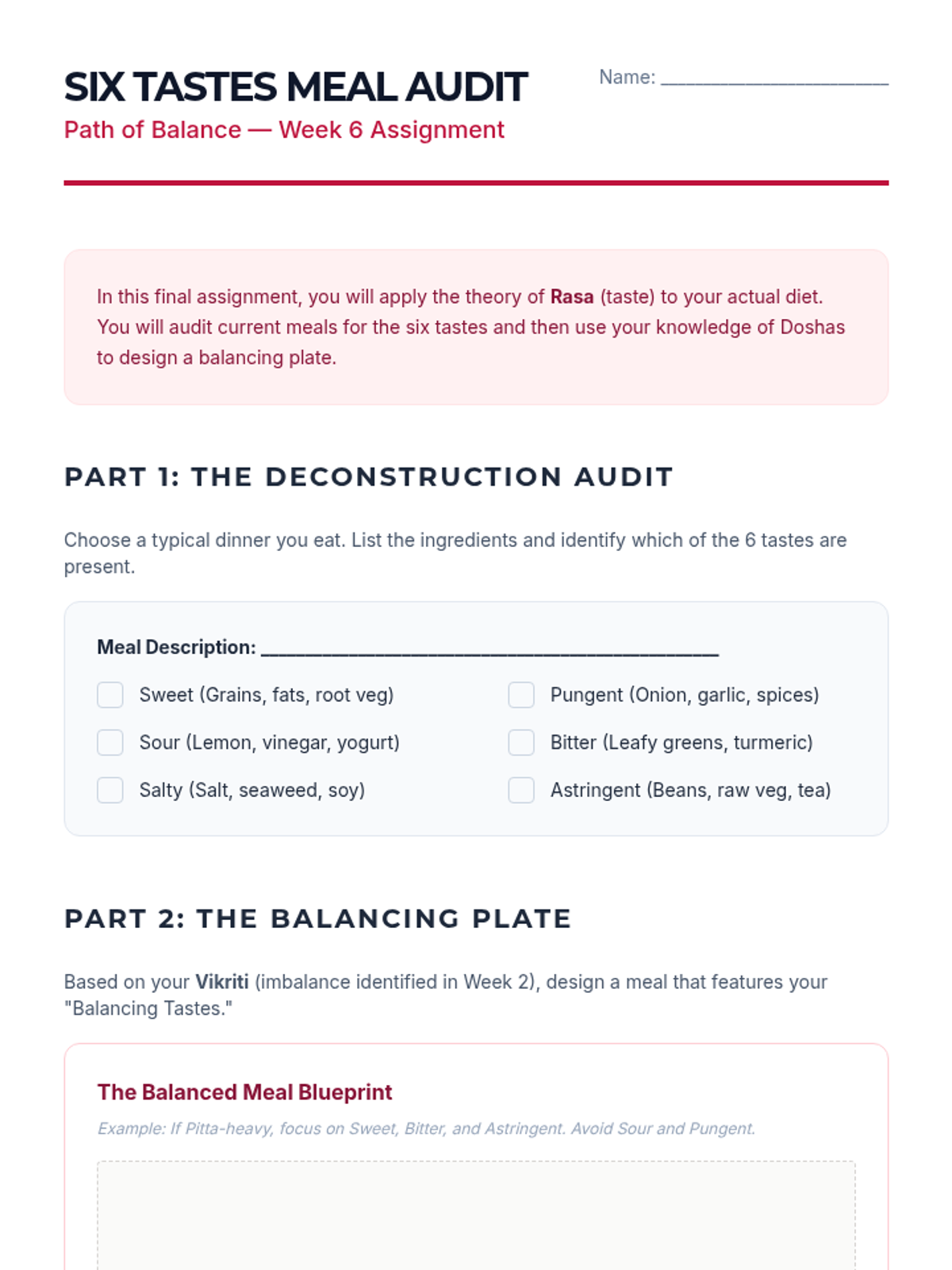
The final assignment for the Ayurveda course. Students audit their current diet for the six tastes and design a corrective meal plan specifically tailored to their constitutional imbalance (Vikriti). Includes a final course-wide reflection.
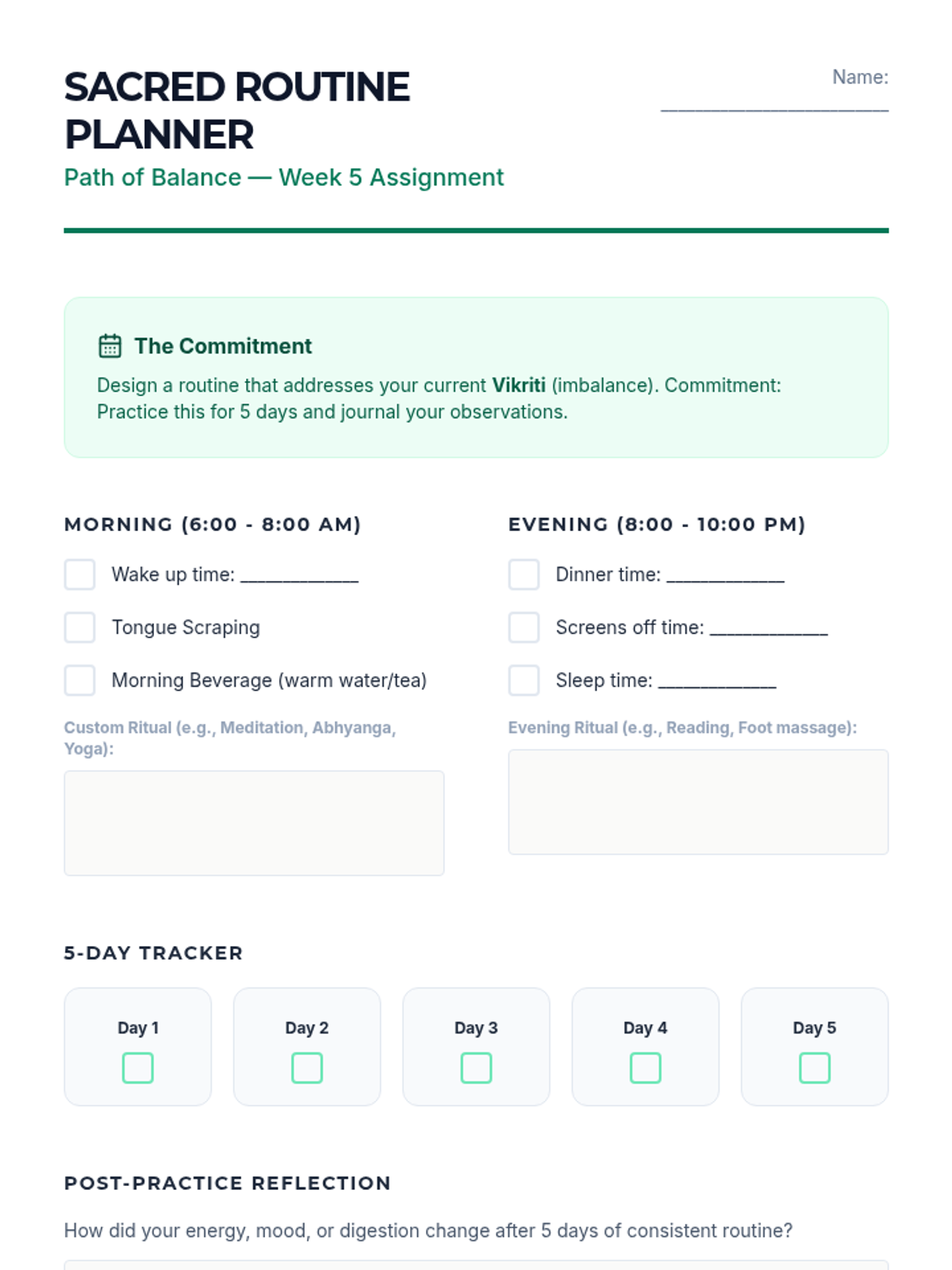
A practical routine builder for Week 5. Students design personalized morning and evening rituals based on their Dosha and current health goals, track their adherence over five days, and reflect on the resulting changes in vitality.
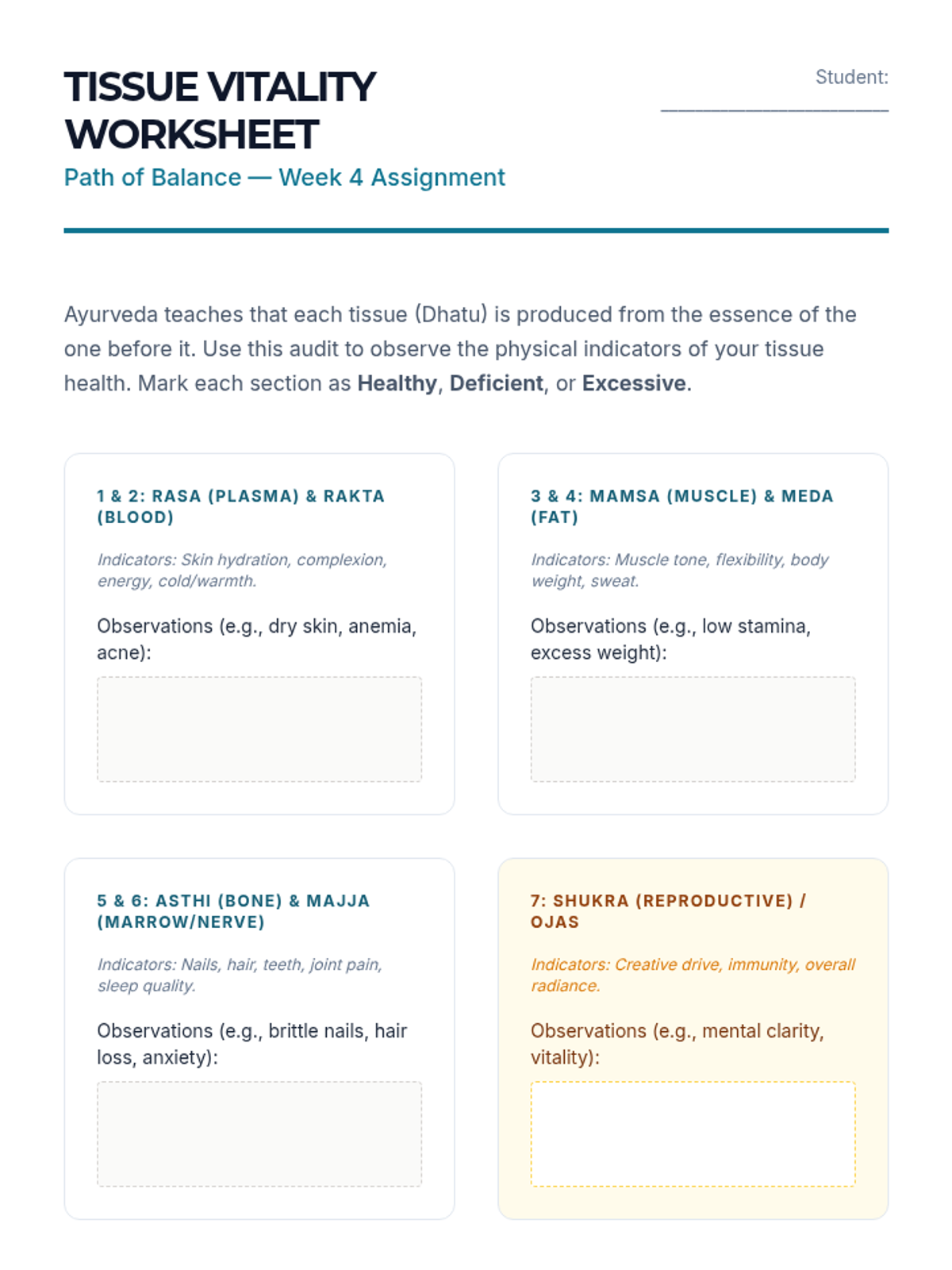
A biological audit for Week 4. Students observe physical indicators across the seven tissue layers (plasma to reproductive) and identify points of breakdown in the chain of nourishment. Includes an analysis of channel (Srotas) health.
A 3-day practical audit for Week 3. Students track their morning tongue coating, hunger intensity, post-meal energy, and digestive sensations to diagnose their Agni type and Ama levels.
A constitutional assessment workbook for Week 2. Features a Prakriti identification chart covering physical and mental traits, followed by a detailed reflection section for identifying Vikriti (current imbalances) and planning balancing actions.
A reflective assignment for Week 1 of the Ayurveda course. Students perform environmental and internal 'element scans' to observe how Ether, Air, Fire, Water, and Earth manifest in their lives, combined with a 20 Guna reflection.
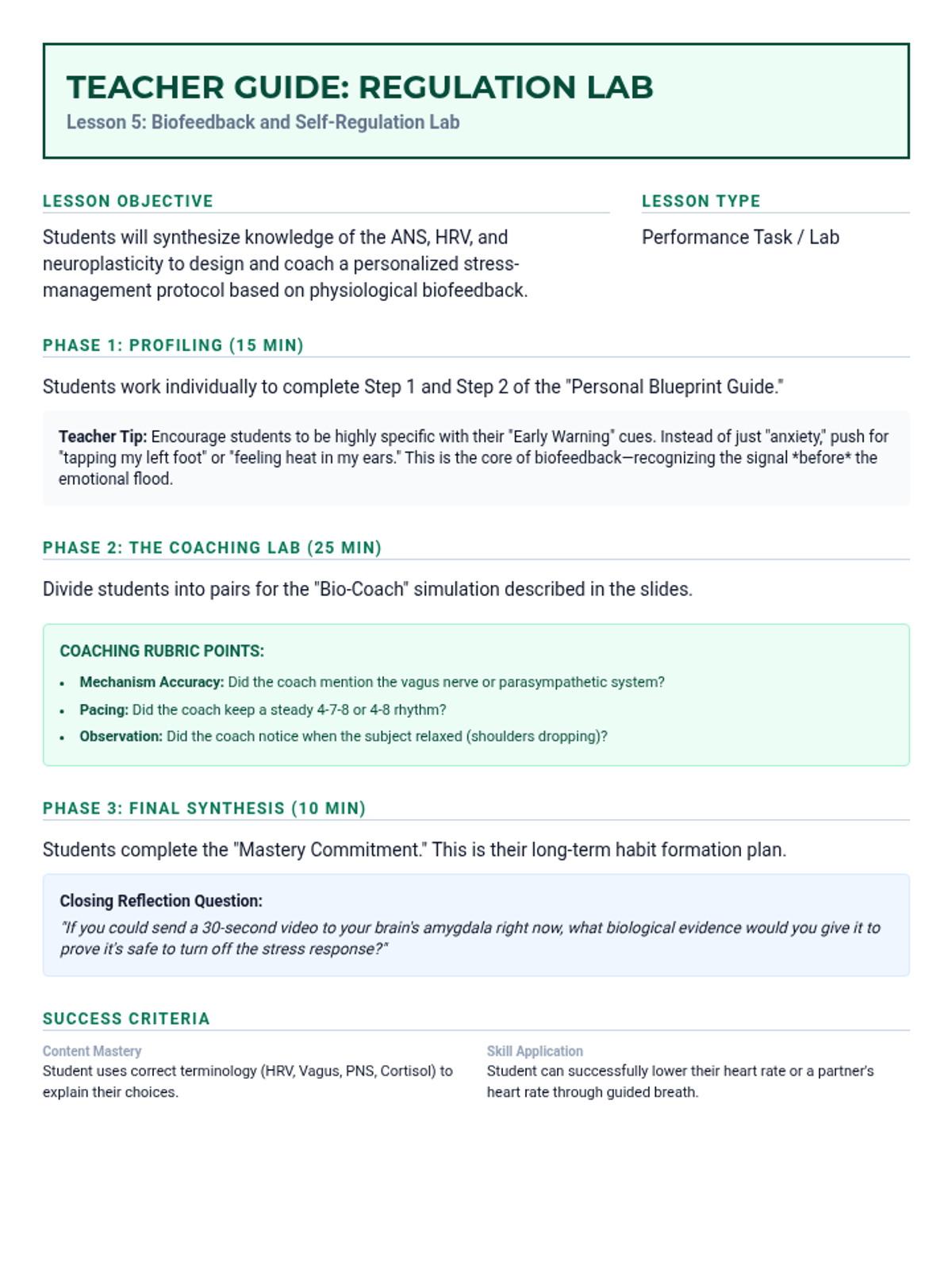
Teacher guide for the final lesson in the sequence, focusing on facilitating the biofeedback simulation and assessing student synthesis of the biological mechanisms of stress.
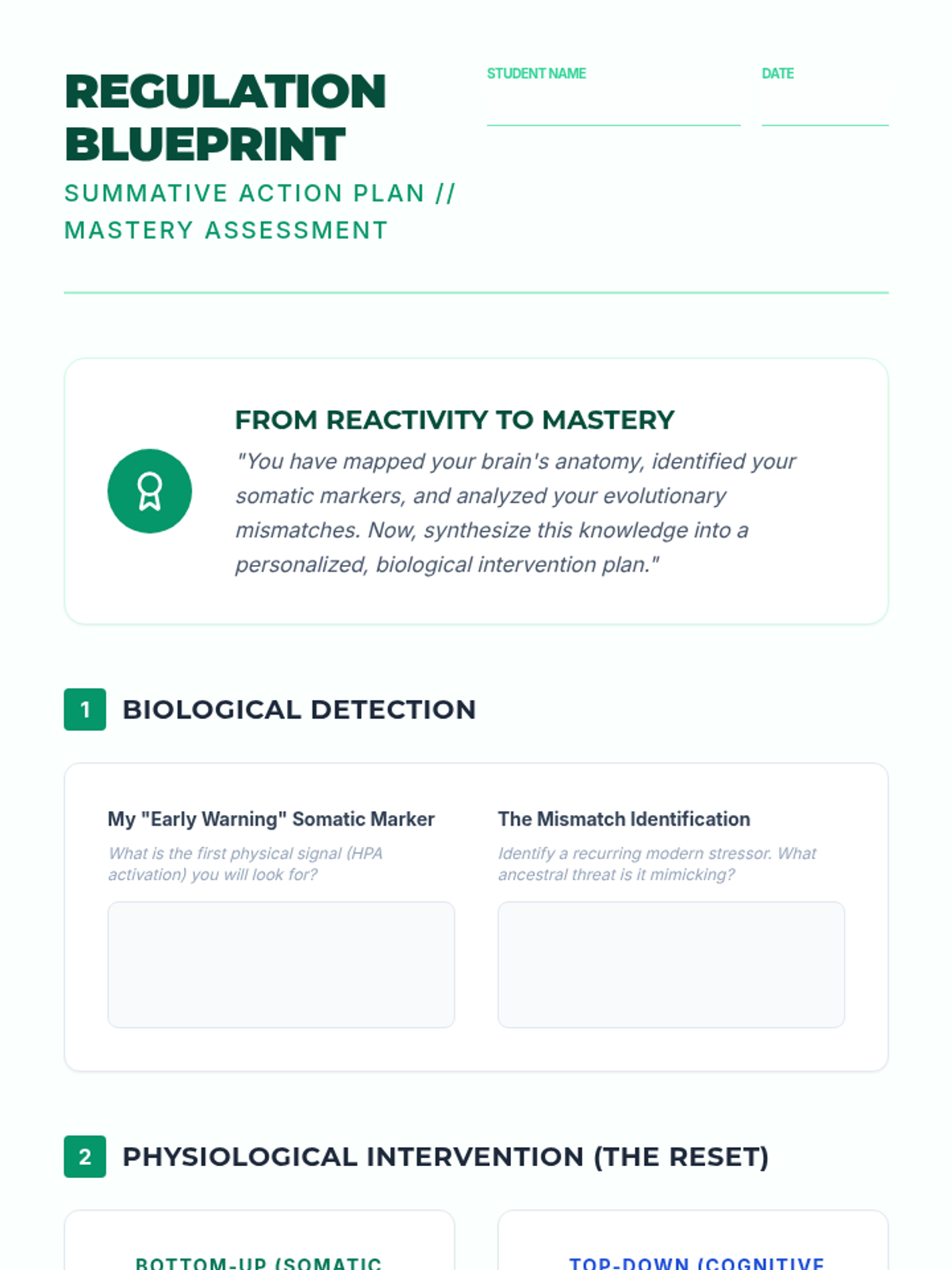
A final project worksheet where students synthesize their learning to create a personalized physiological intervention plan for stress and anxiety.
A slide deck focusing on biofeedback and physiological regulation techniques, including vagus nerve stimulation and the distinction between top-down and bottom-up interventions.
A slide deck focusing on the physiological feedback loops that create panic attacks, including CO2 sensitivity and the role of the sympathetic nervous system.
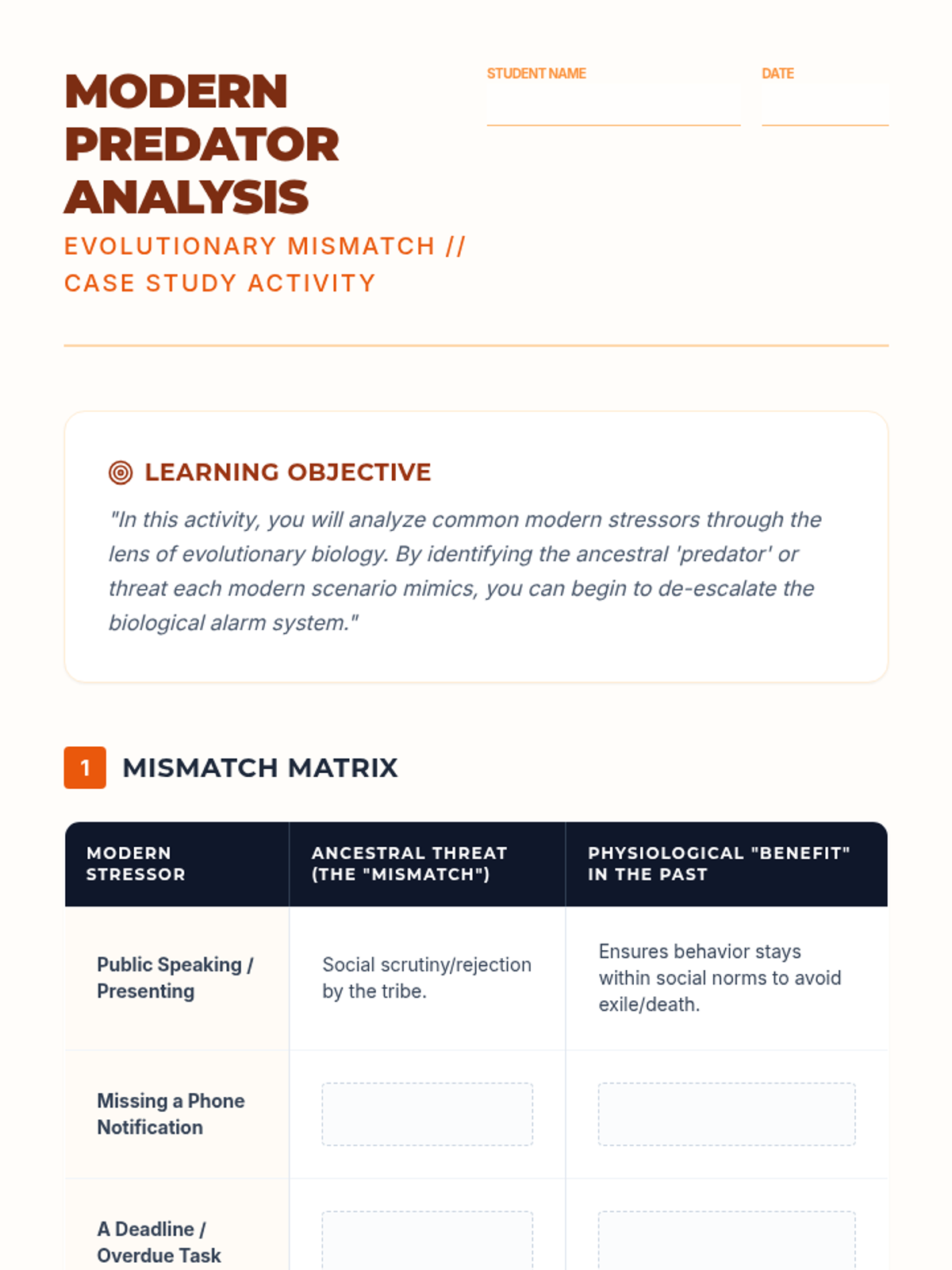
A student worksheet for analyzing modern stressors through an evolutionary lens, including a "Mismatch Matrix" and a case study on digital communication.
A slide deck exploring the concept of evolutionary mismatch, explaining why modern social and abstract stressors trigger ancient survival mechanisms.
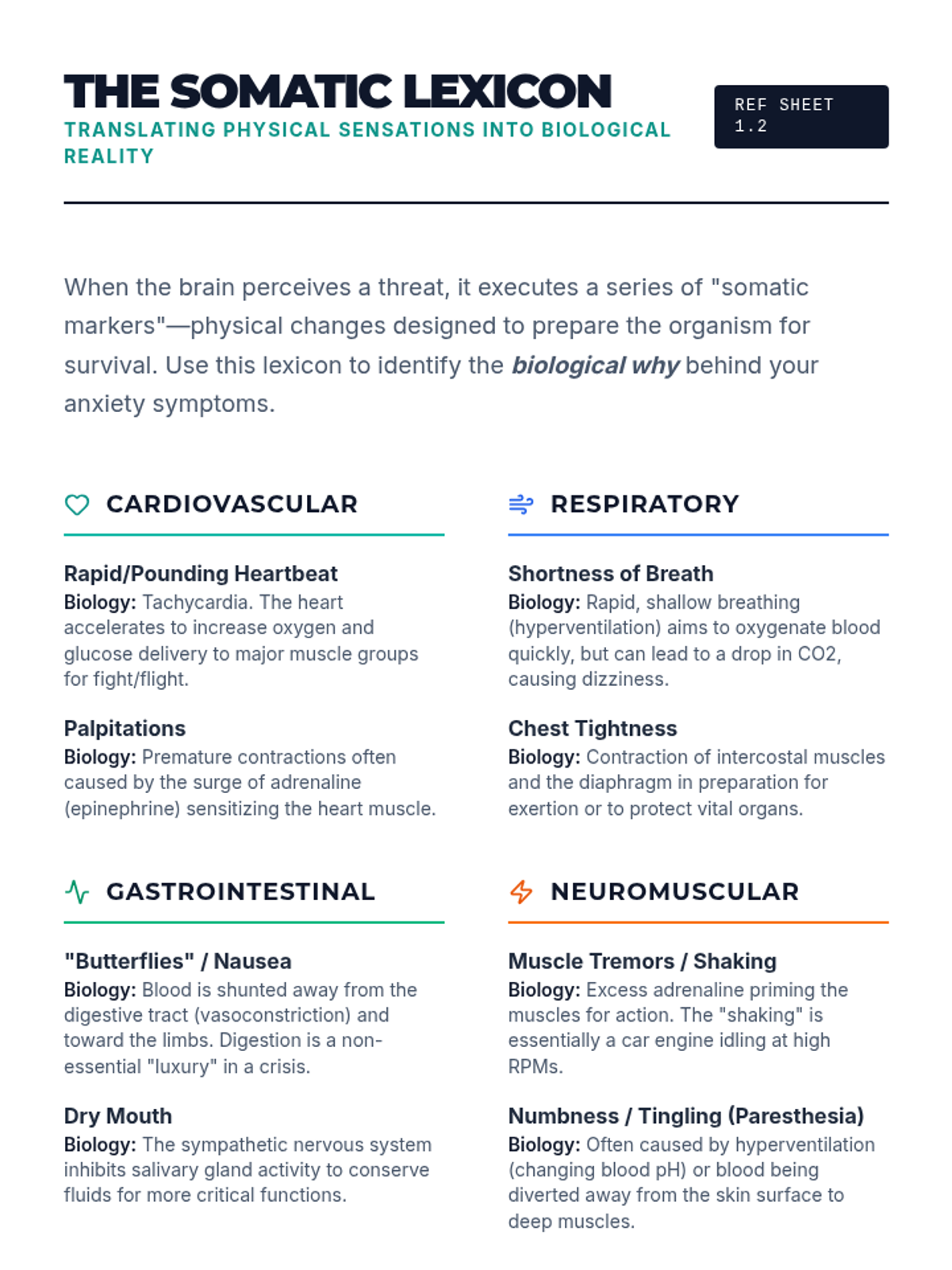
A reference sheet defining common physical symptoms of anxiety in biological terms, helping students understand the evolutionary purpose of their somatic markers.
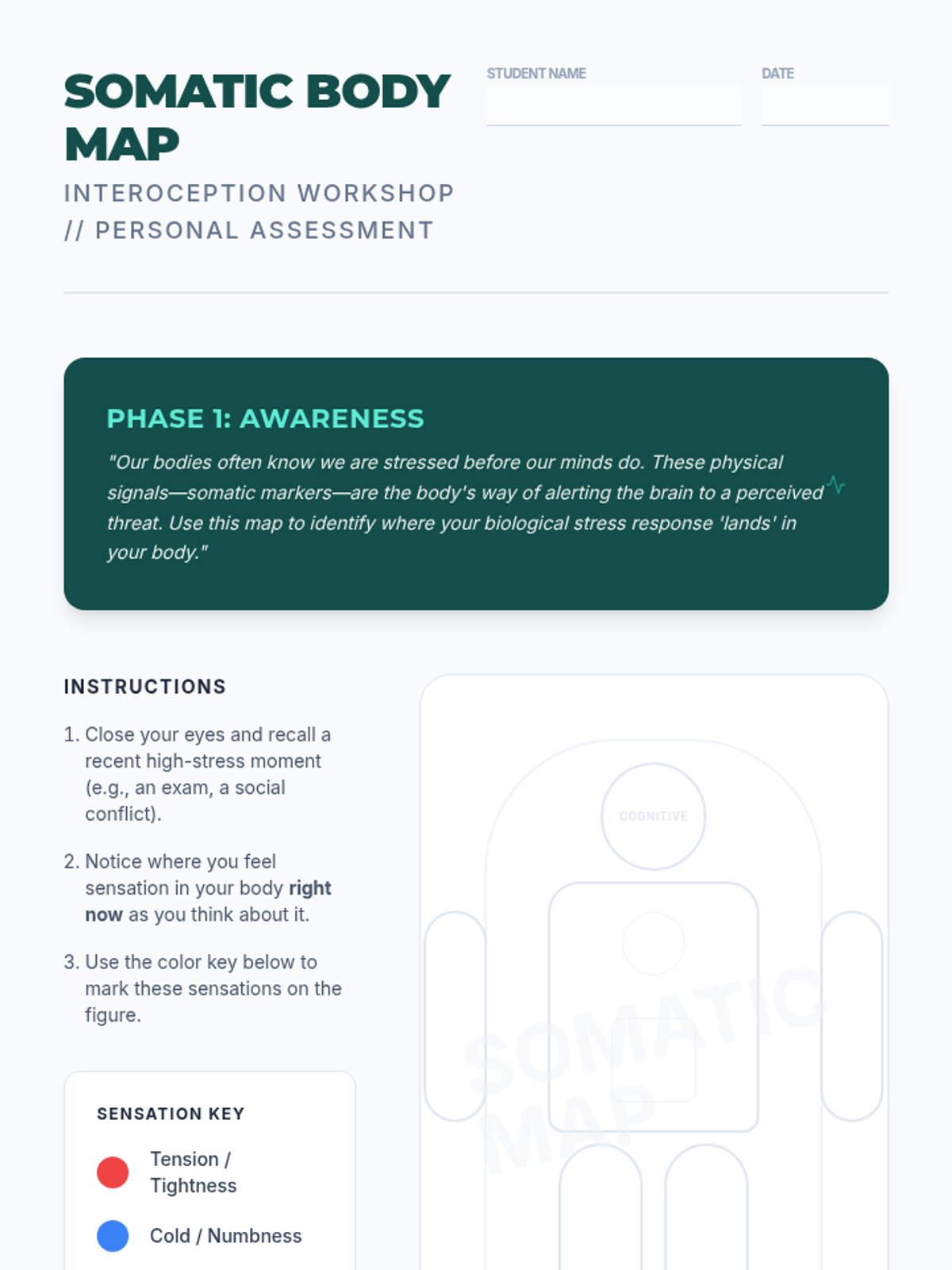
A student worksheet for identifying and mapping physical markers of stress onto a human figure, including analytical prompts to link somatic sensations to biological purposes.
A slide deck focusing on somatic markers and interoception, teaching students how to identify physical indicators of stress and the physiological feedback loop between body and brain.
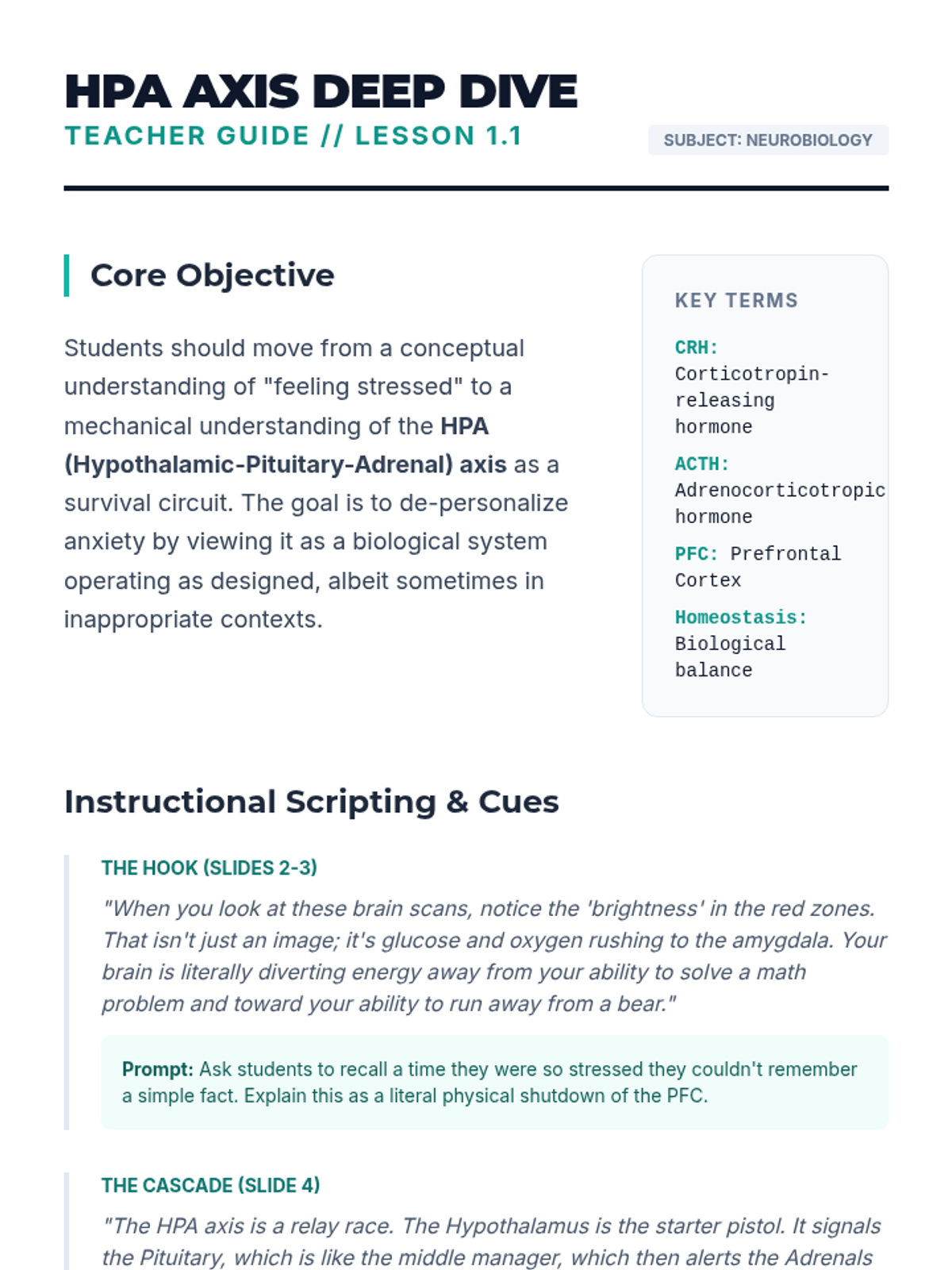
A teacher guide for Lesson 1, providing instructional scripts, key terms, common misconceptions, and answer keys for the HPA axis and neurobiology of stress.
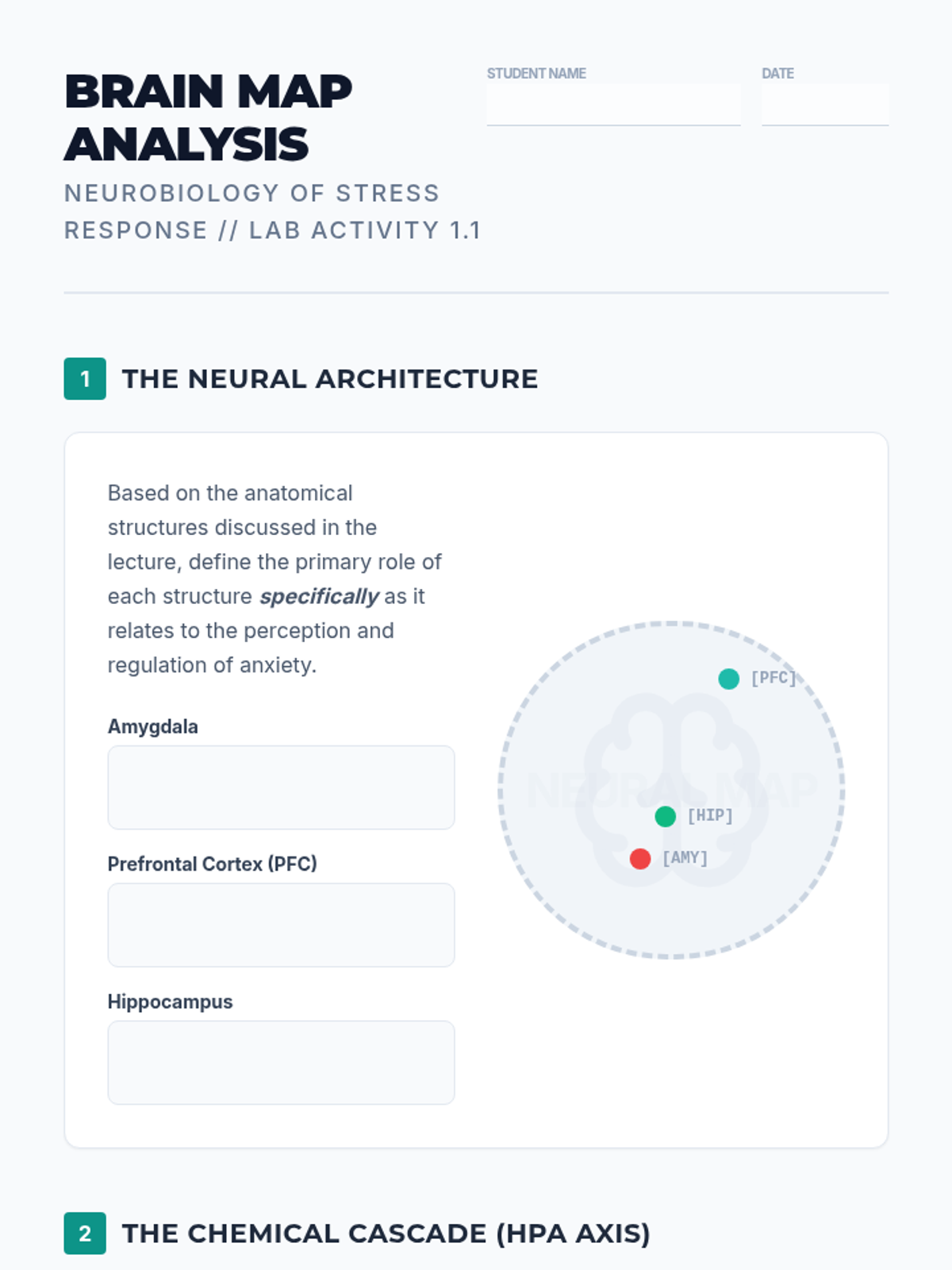
A student worksheet for mapping the neurobiological structures and chemical pathways involved in the stress response, including labeling the brain and the HPA axis.
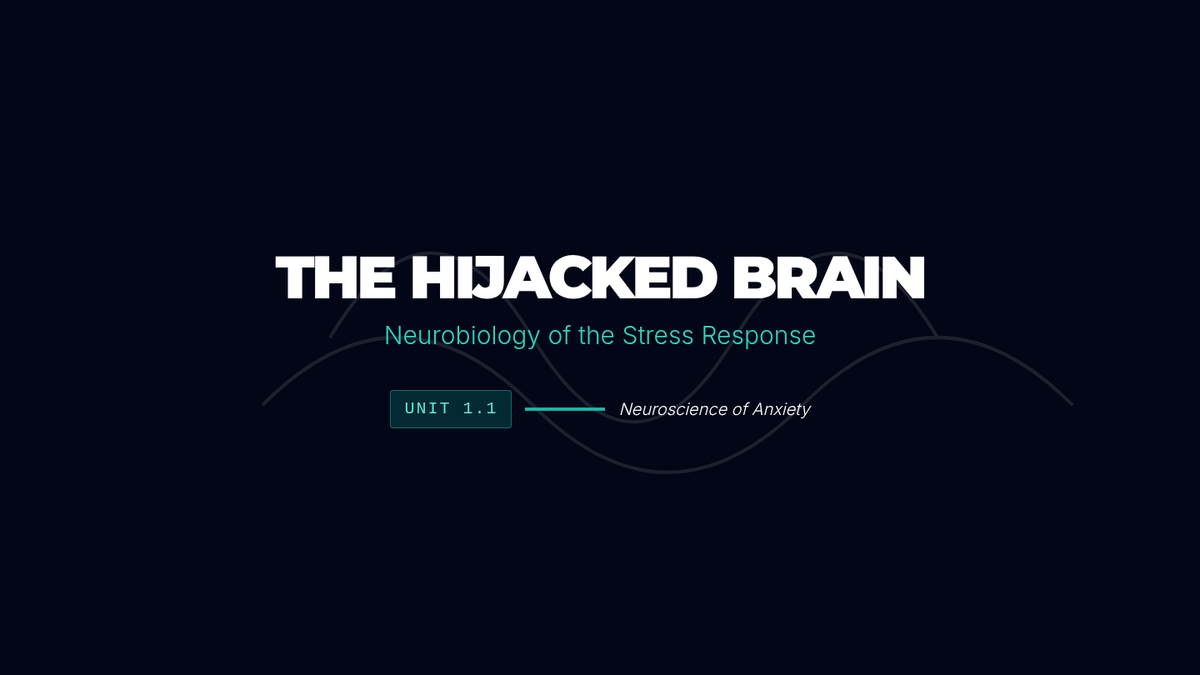
A comprehensive slide deck for undergraduate students exploring the neurobiology of the stress response, featuring brain anatomy, the HPA axis, and the 'amygdala hijack' mechanism.
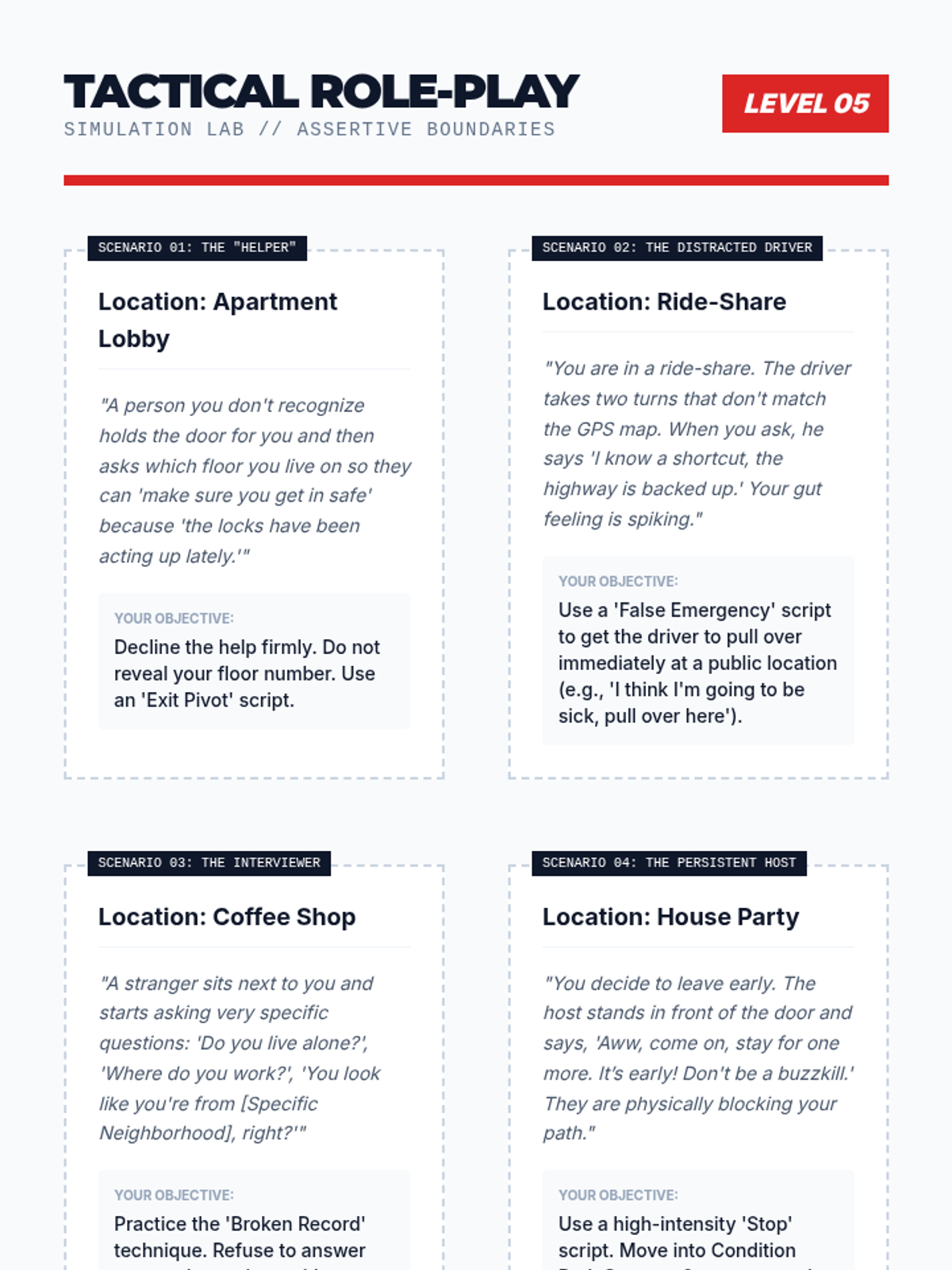
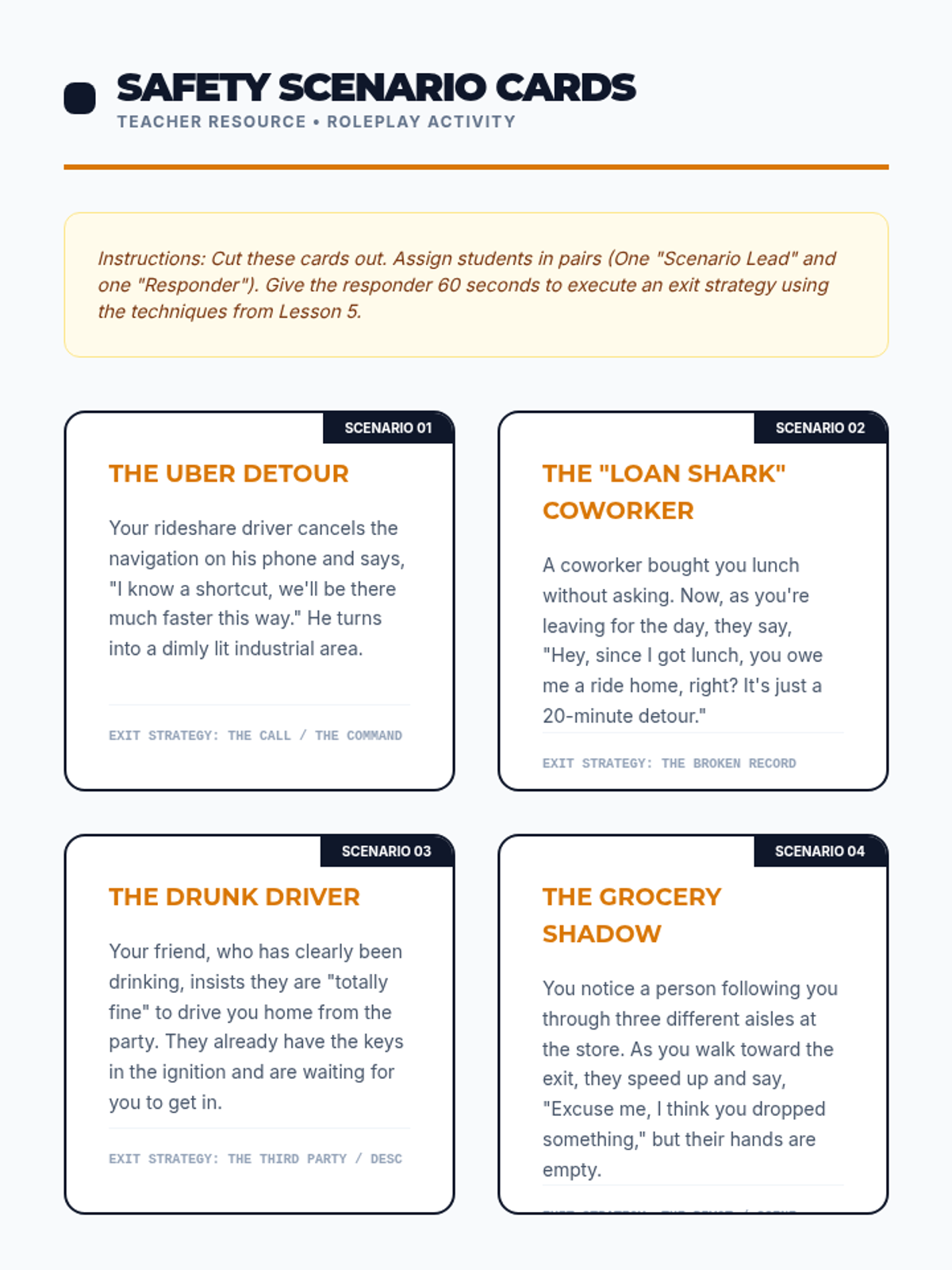
A set of 4 role-play scenario cards for Lesson 5, designed for students to practice assertive boundary setting and tactical scripts in a safe classroom environment.
A visual presentation for Lesson 5 focusing on overcoming the freeze response, tactical scripting, and executing 3-step extraction strategies in unsafe situations.
A set of roleplay scenario cards for practicing assertive de-escalation and exit strategies in real-world contexts like rideshares, workplaces, and social gatherings.
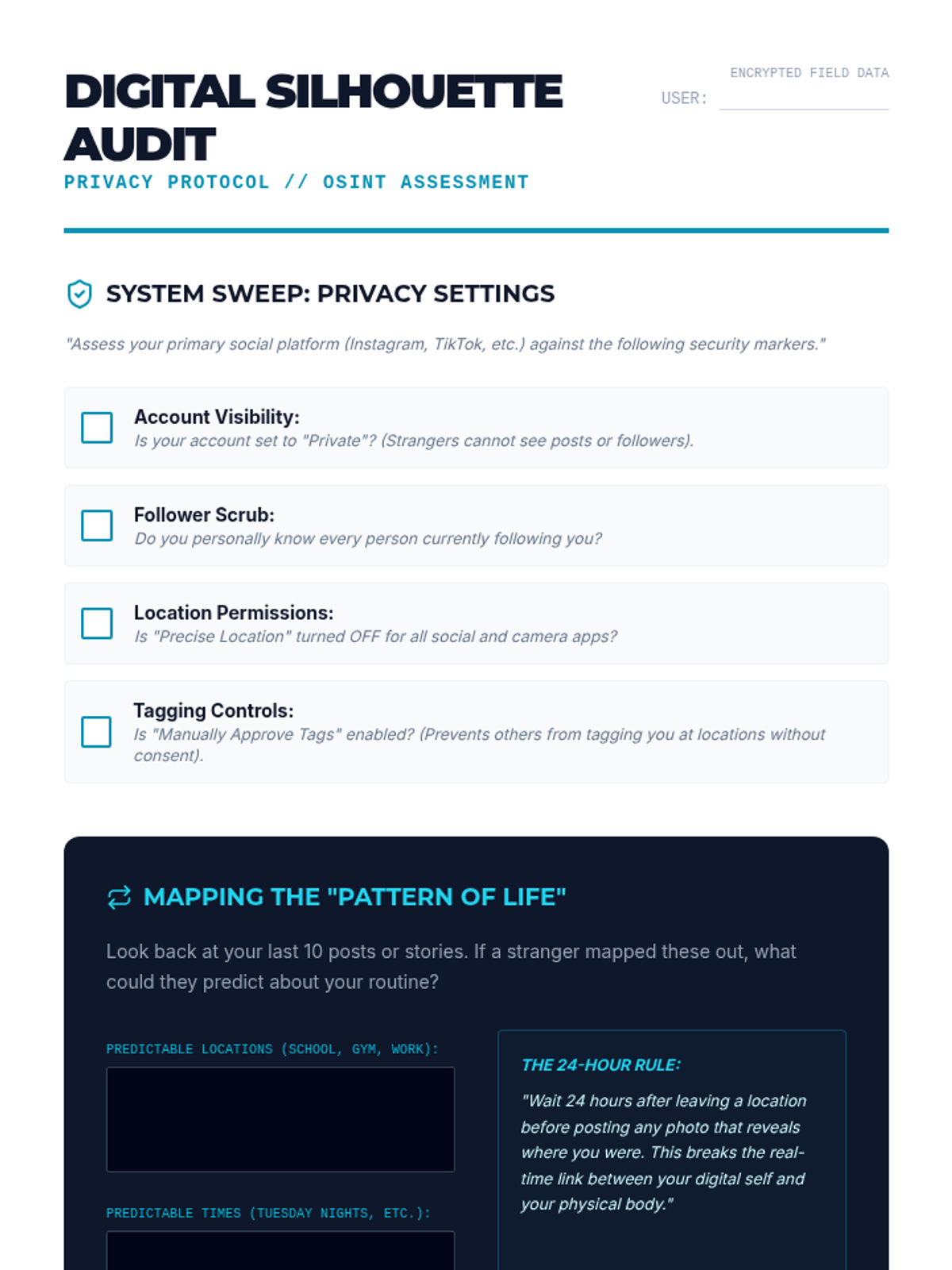
A student self-audit worksheet for Lesson 4 that guides students through reviewing their social media privacy settings, location permissions, and "pattern of life" digital habits to identify physical safety vulnerabilities.
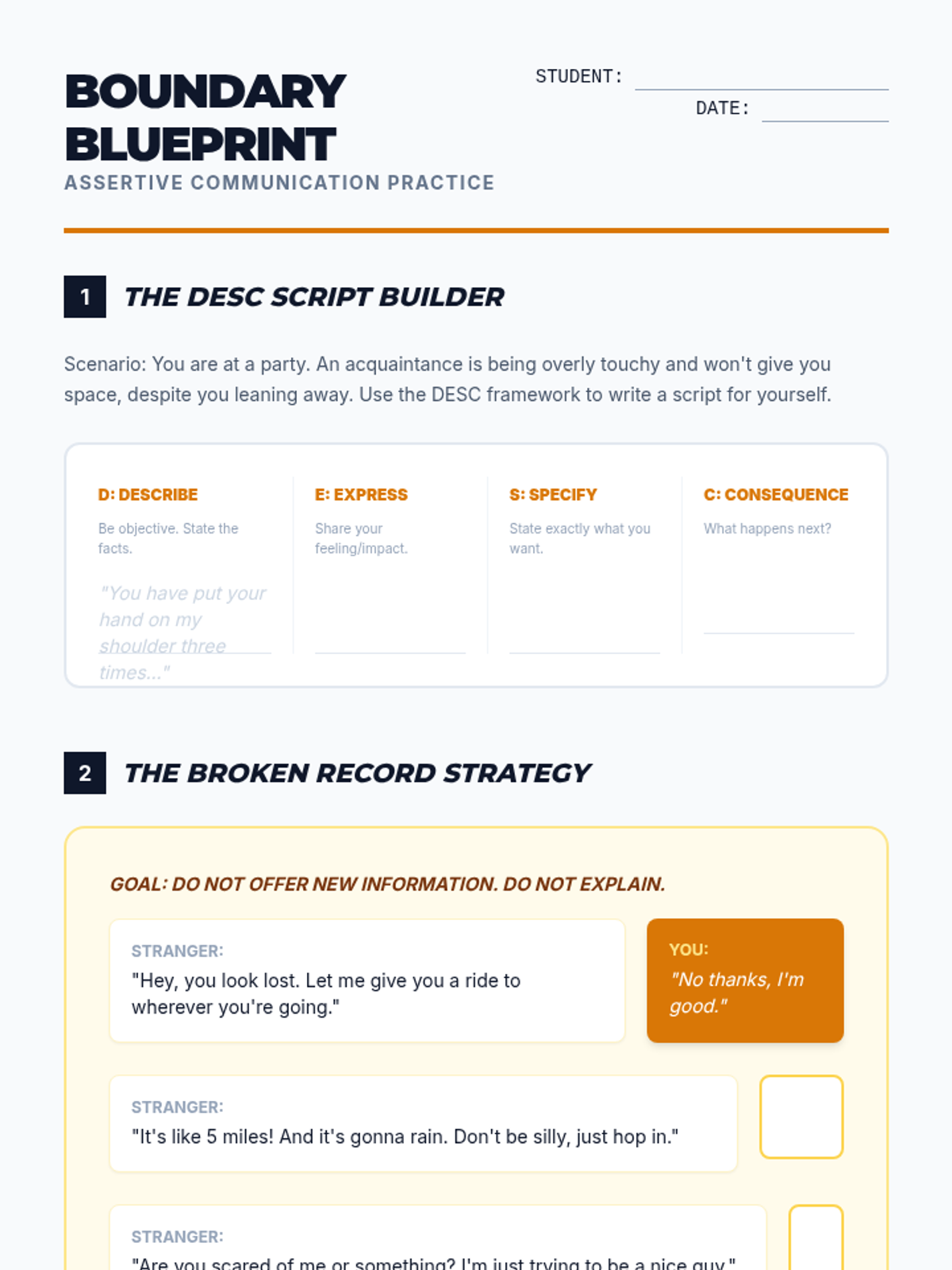
An assertive communication worksheet for practicing the DESC script framework and the 'Broken Record' de-escalation technique.
A visual presentation for Lesson 4 exploring the bridge between digital footprints and physical safety, focusing on OSINT, metadata, and location patterns.
Slide deck for Lesson 5 covering assertive communication (DESC), verbal de-escalation, and strategic exit protocols to overcome the politeness trap.
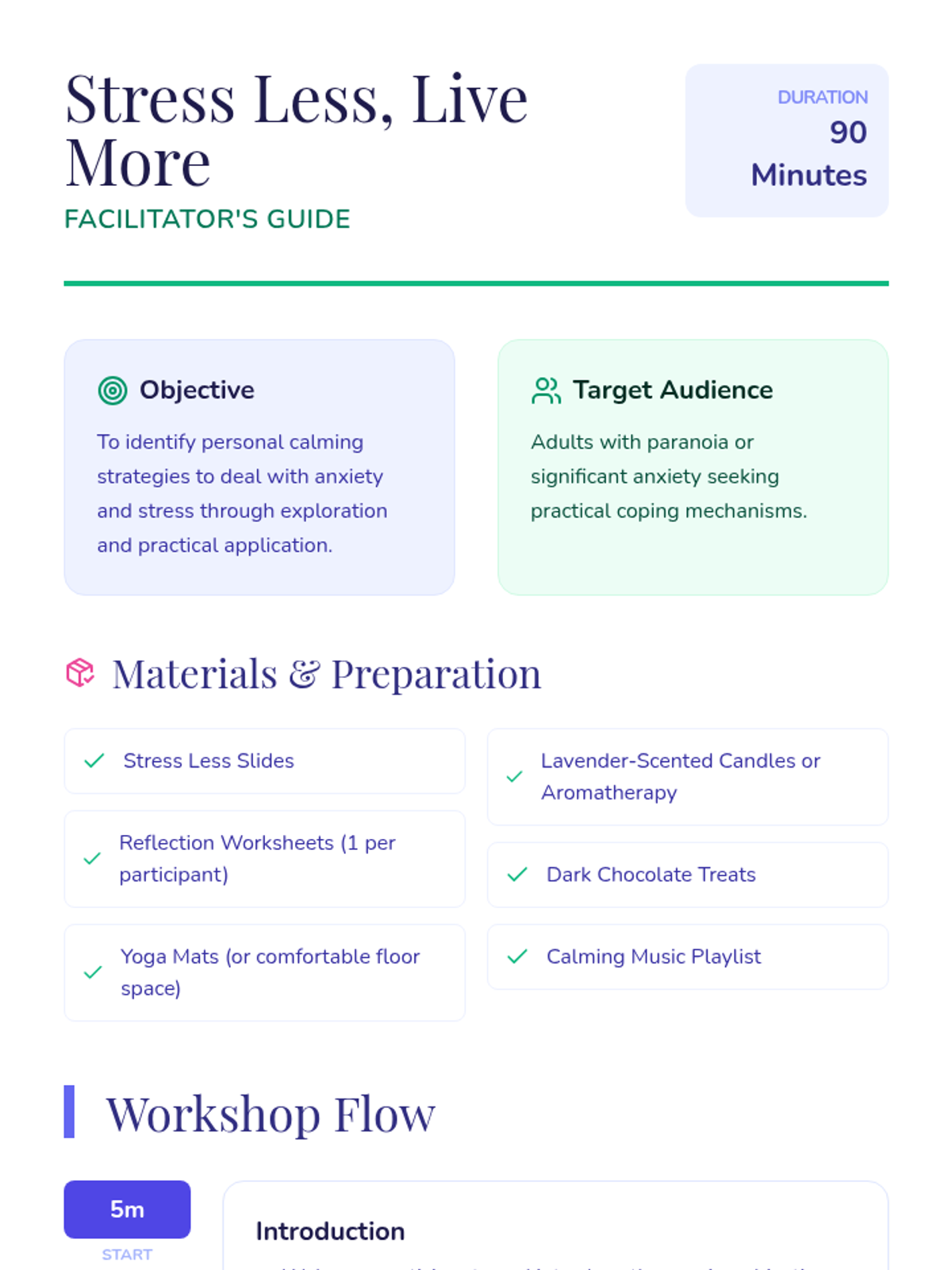
A comprehensive facilitator guide for the 'Stress Less Live More' workshop, detailing a 90-minute schedule of activities including muscle relaxation, yoga, and sensory breaks.
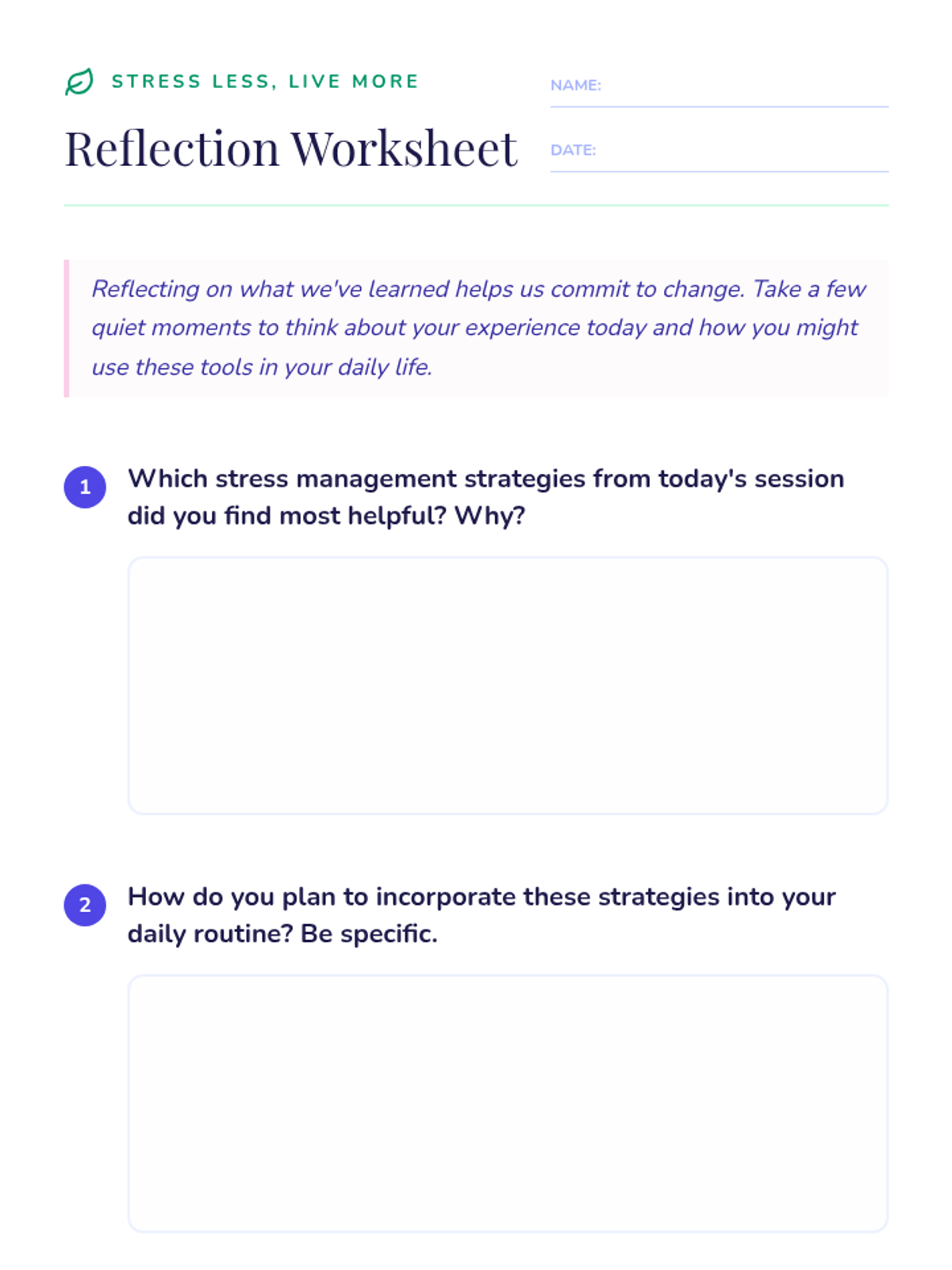
A handout for participants to record the stress management strategies they found useful and plan to use.
A 10-slide visual presentation for the 'Stress Less Live More' workshop, including instructional slides for muscle relaxation, yoga, breathing exercises, and meditation.
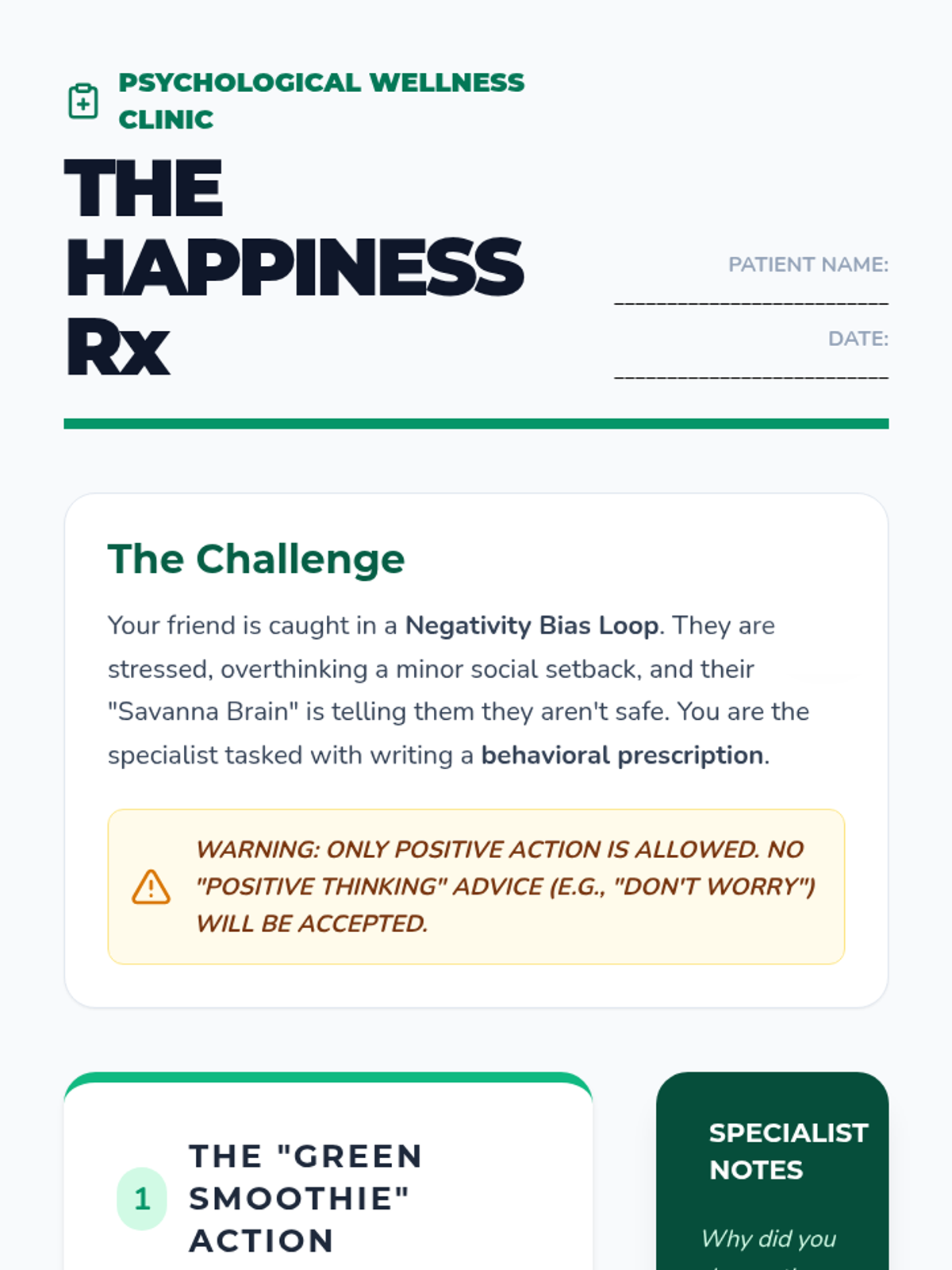
A student reflection and application handout for the 'Hacking Happiness' lesson. Students write a behavioral 'prescription' for stress based on the lesson's core psychological principles.
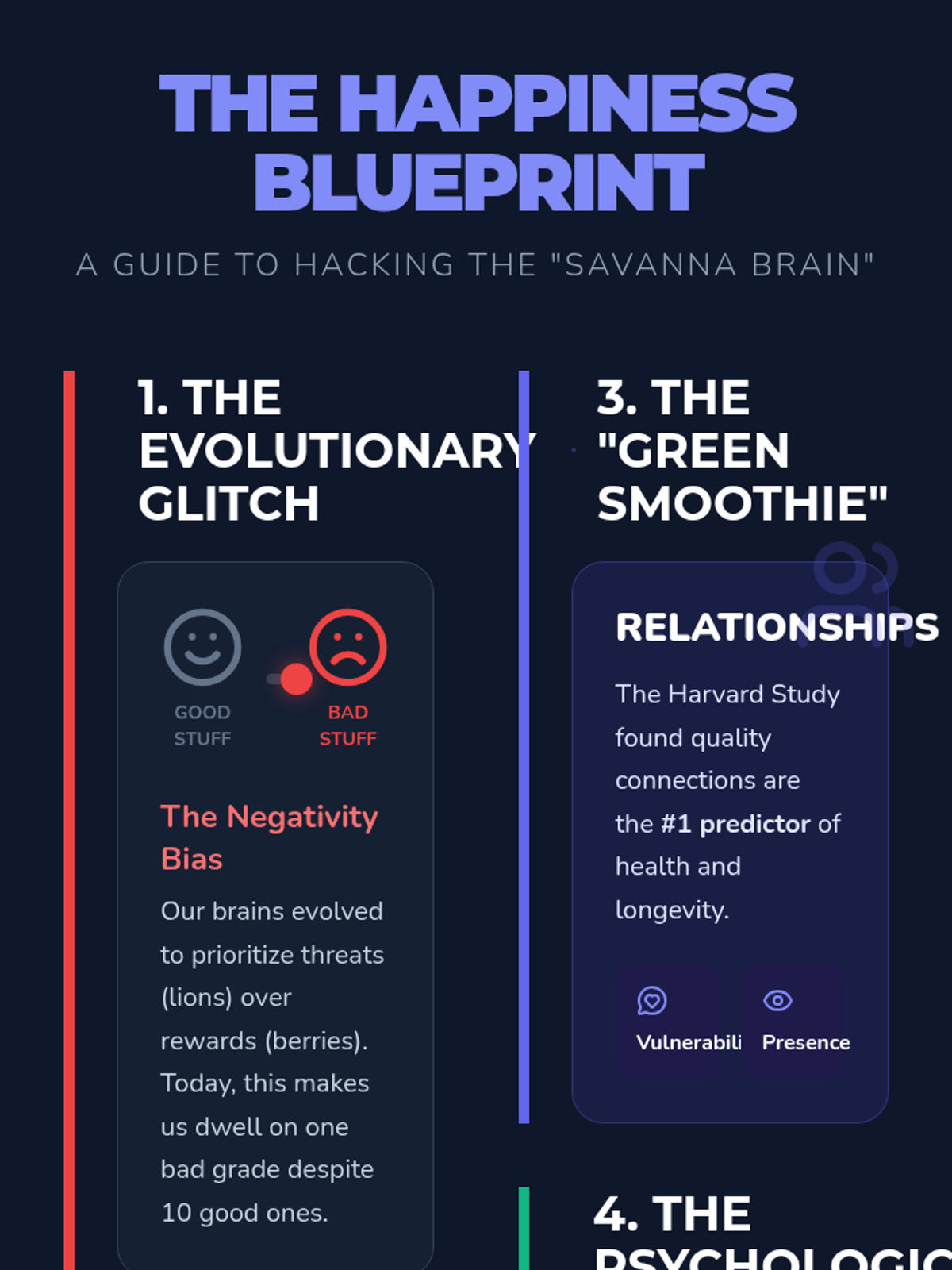
A high-contrast visual reference poster or whiteboard guide for the 'Hacking Happiness' lesson. It summarizes Negativity Bias, the Action vs. Thought principle, and the Harvard Study's findings on relationships.
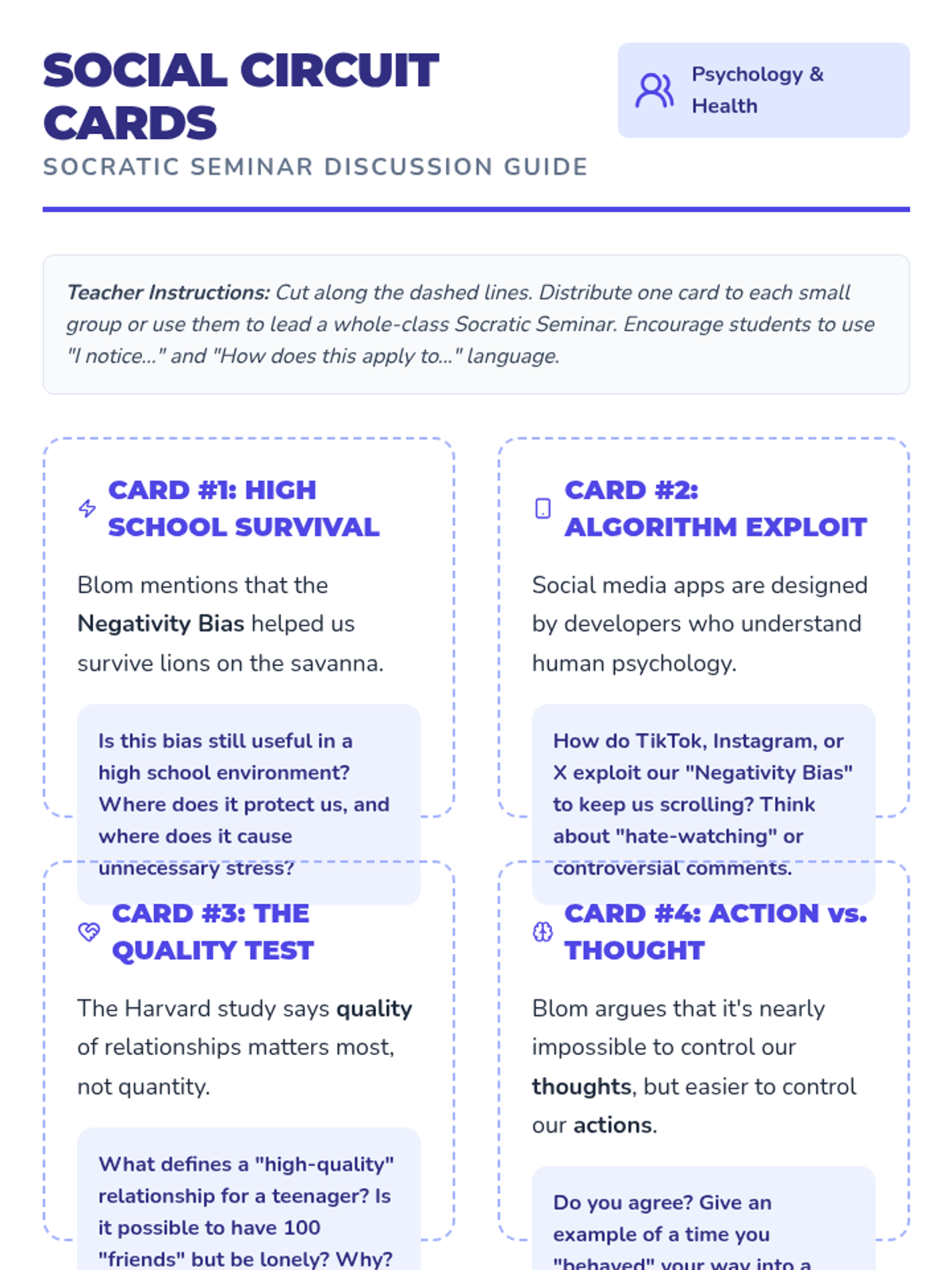
A set of 6 printable discussion cards for a Socratic Seminar on happiness, evolutionary psychology, and the impact of relationships on health. Designed to spark deep conversation in high school classrooms.
A visual presentation for the 'Hacking Happiness' lesson, featuring embedded video clips, key concepts like Negativity Bias and the Harvard Study, and a guided closure activity for high school students.
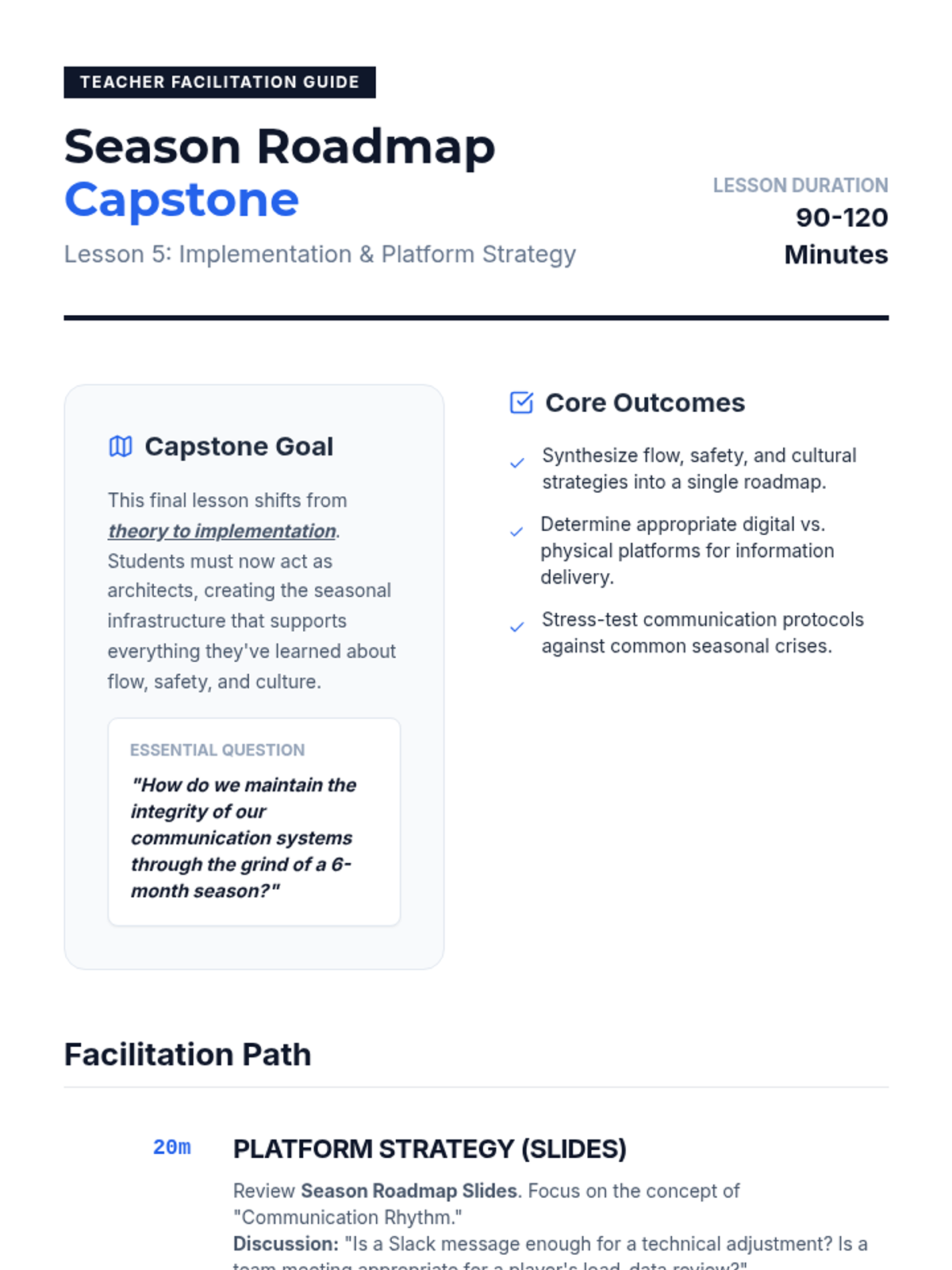
Teacher facilitation guide for Lesson 5: Season Roadmap. Covers project launch instructions, studio time guidance, and evaluation criteria for the capstone blueprint.
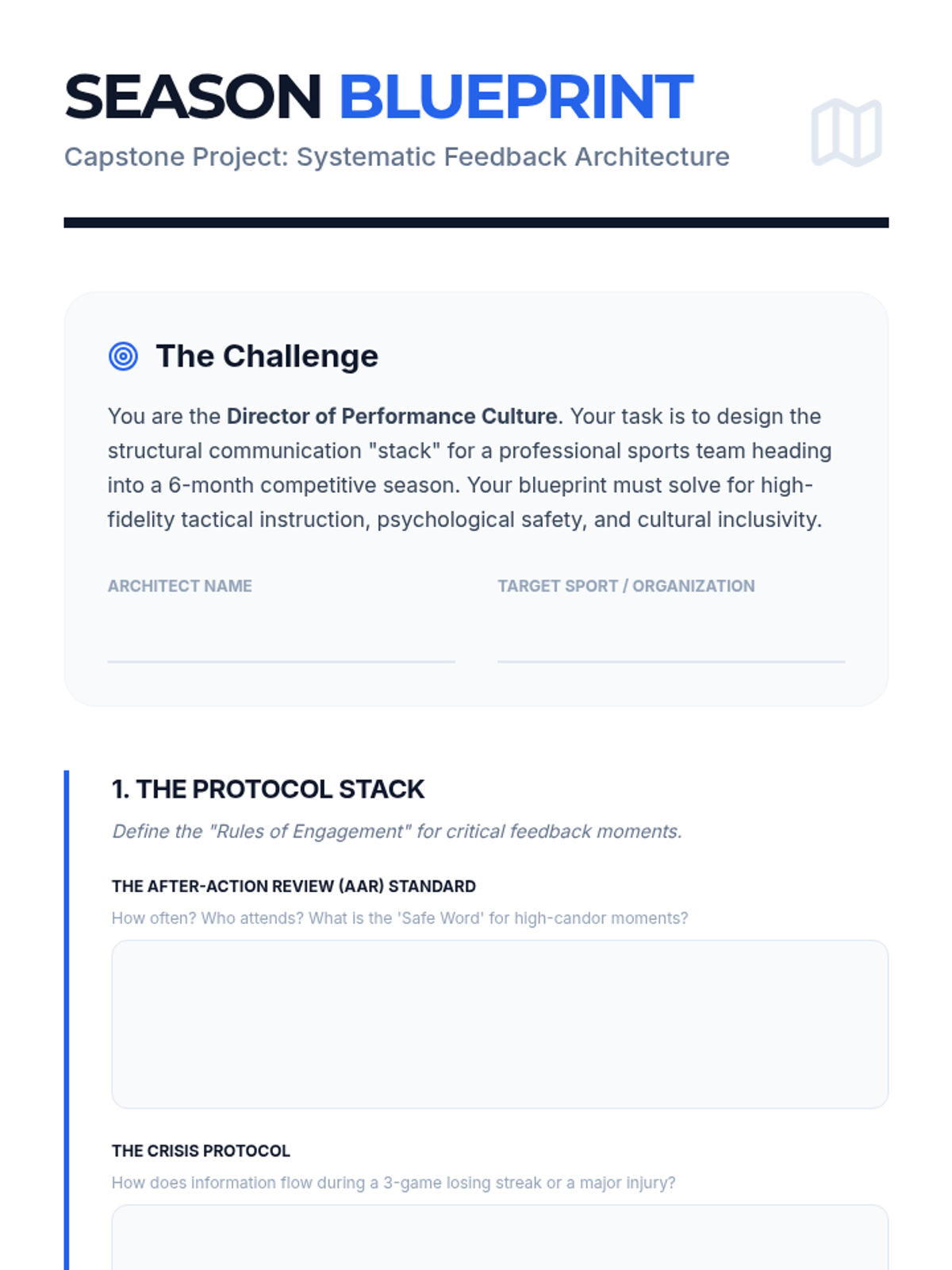
Capstone project guide for Lesson 5. Students design a comprehensive 6-month communication roadmap including protocol stacks, temporal mapping, and cultural strategies.
Slides for Lesson 5: Season Roadmap. Covers platform strategy (Digital vs. Face-to-Face), the rhythm of communication, and the capstone project introduction.
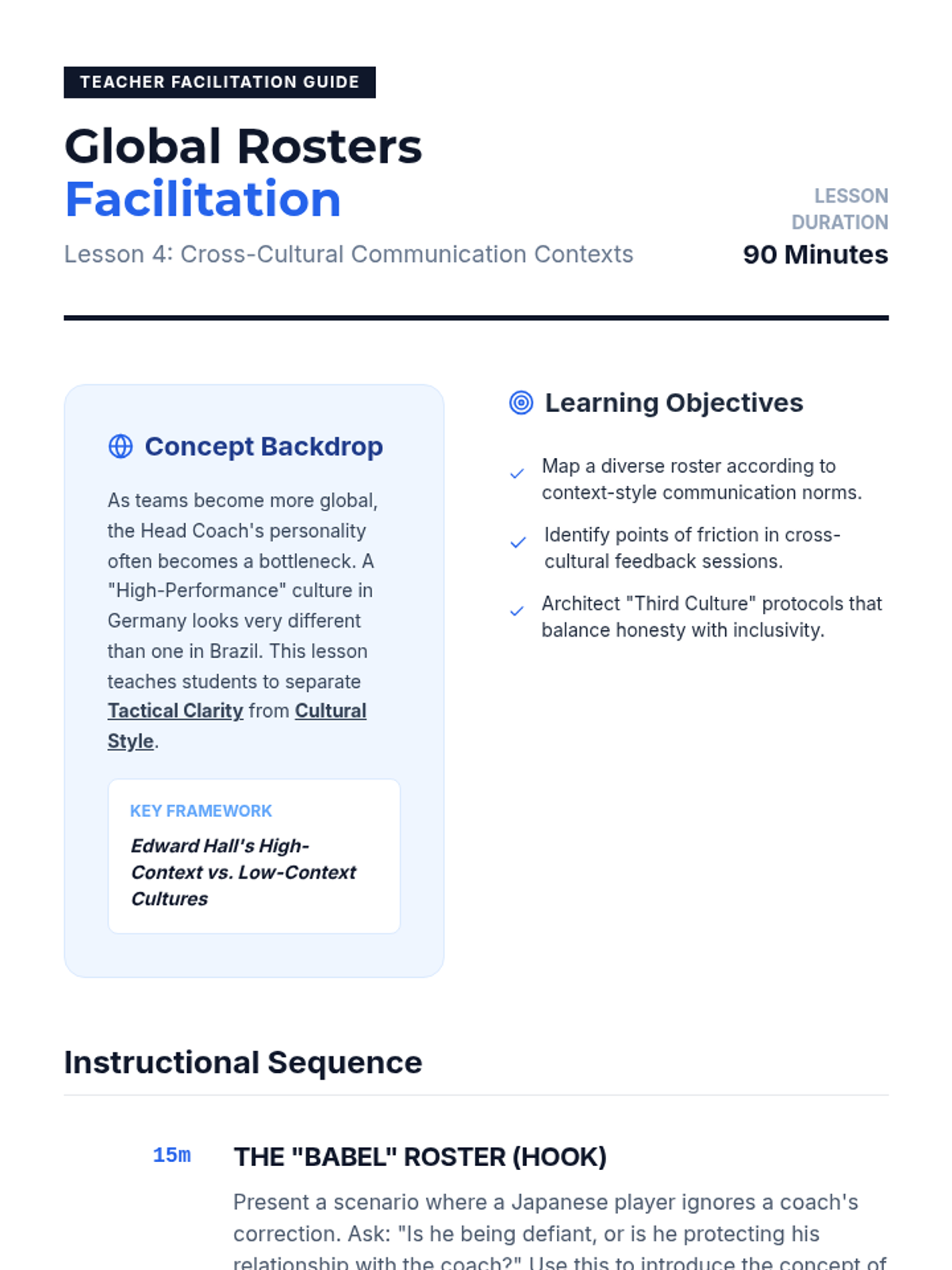
Teacher guide for Lesson 4: Global Rosters. Covers discussion prompts, case study suggested solutions, and cultural context framework notes.
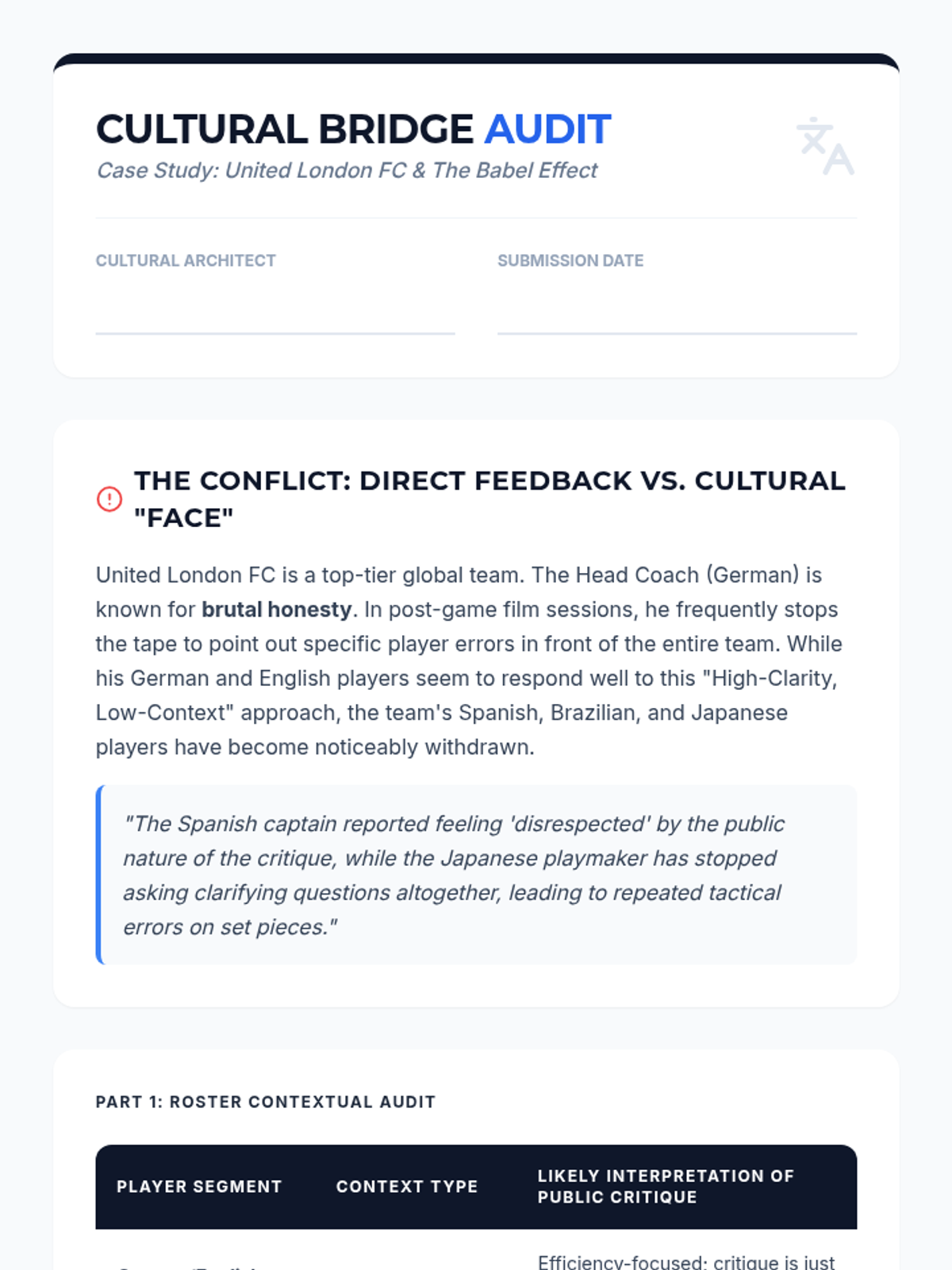
Student worksheet analyzing a cross-cultural communication disconnect in a global soccer team. Requires students to redesign feedback protocols to bridge High-Context and Low-Context cultures.
Slides for Lesson 4: Global Rosters. Covers cross-cultural communication barriers, High-Context vs. Low-Context cultures, and inclusive feedback strategies.
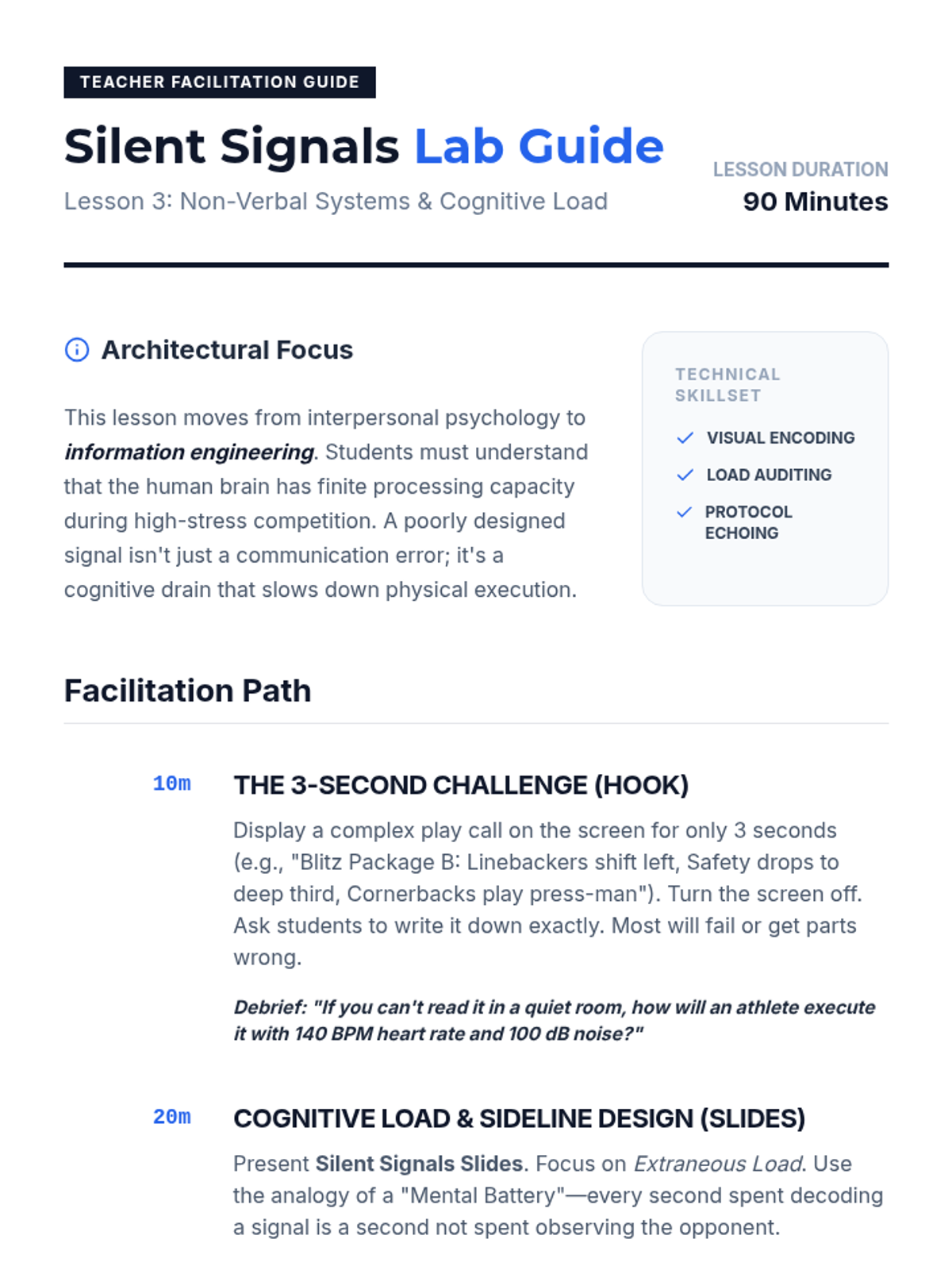
Teacher facilitation guide for Lesson 3: Silent Signals. Includes simulation instructions for the high-noise signaling challenge and cognitive load analysis.
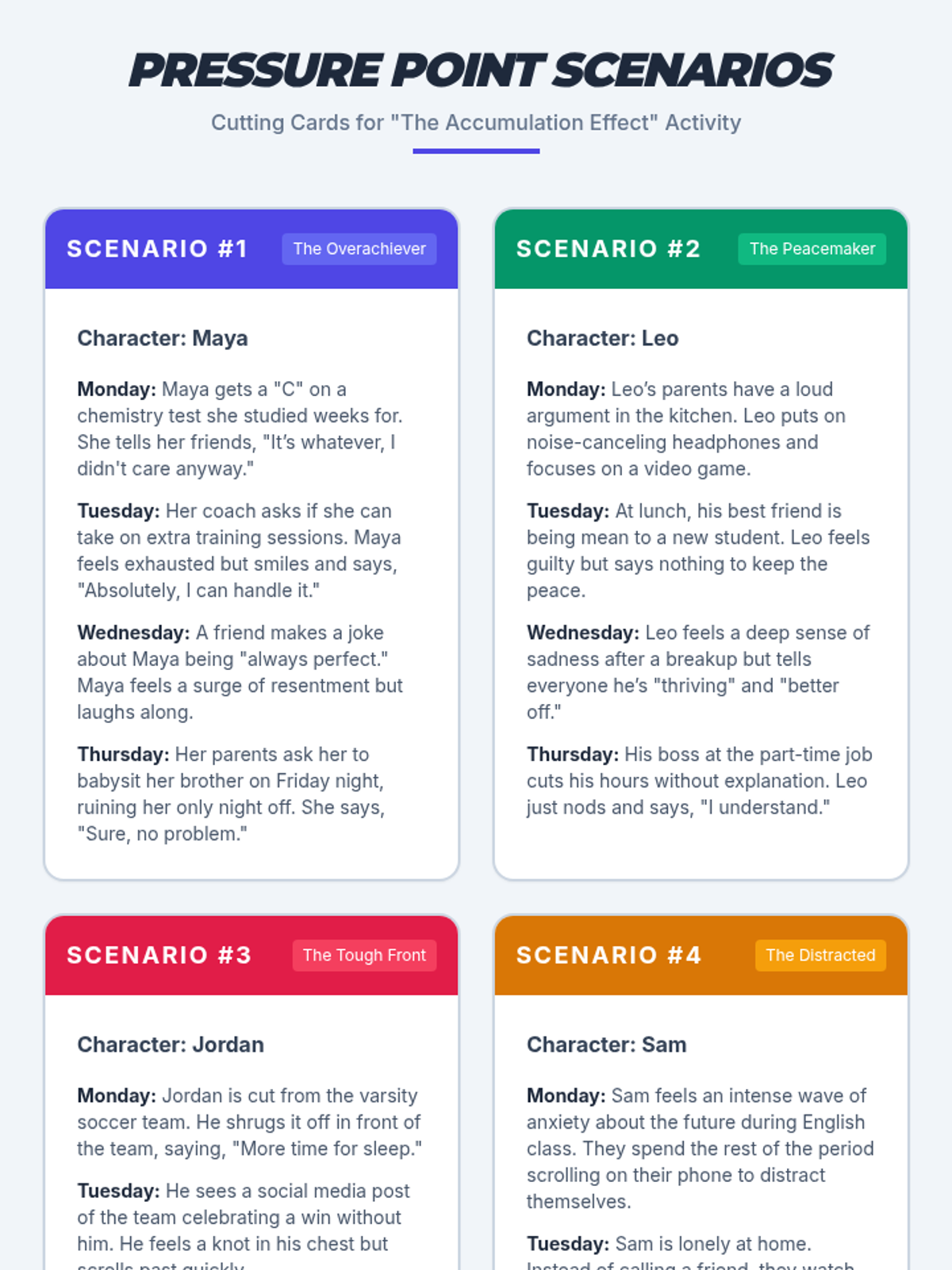
Four detailed character scenarios for students to analyze during the 'Accumulation Effect' activity. Each scenario depicts a week of emotional suppression, providing concrete examples for students to map and then rewrite using mental health techniques.
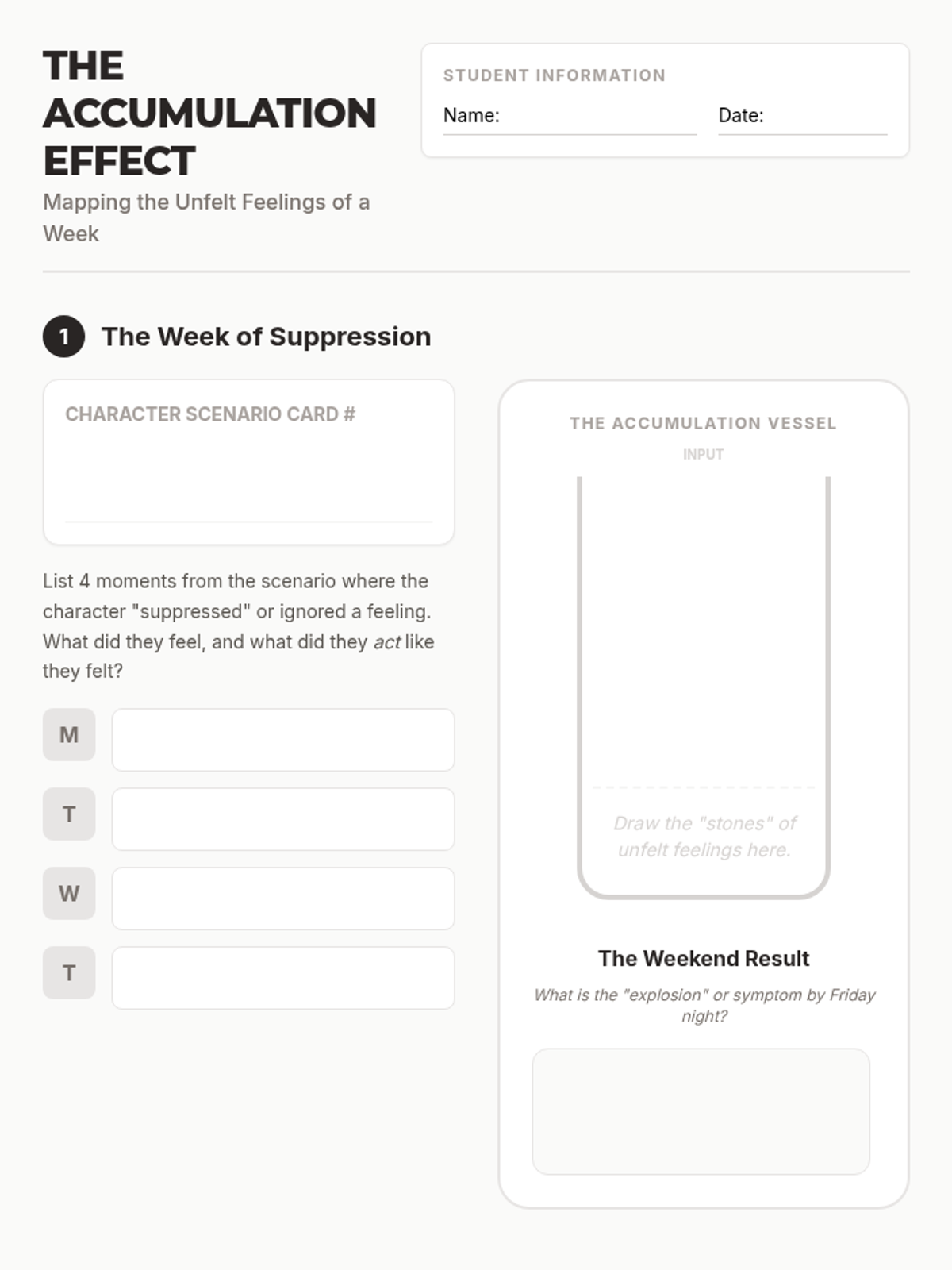
A student worksheet for 'The Accumulation Effect' activity. It includes sections for tracking suppressed feelings in a character scenario, a visual 'Accumulation Vessel' to illustrate emotional build-up, and a rewrite section to apply daily check-in techniques.
A slide deck designed for the 'Unfelt Feelings' health lesson, featuring the video embed, discussion prompts, and visual explanations of emotional suppression and transformation techniques.
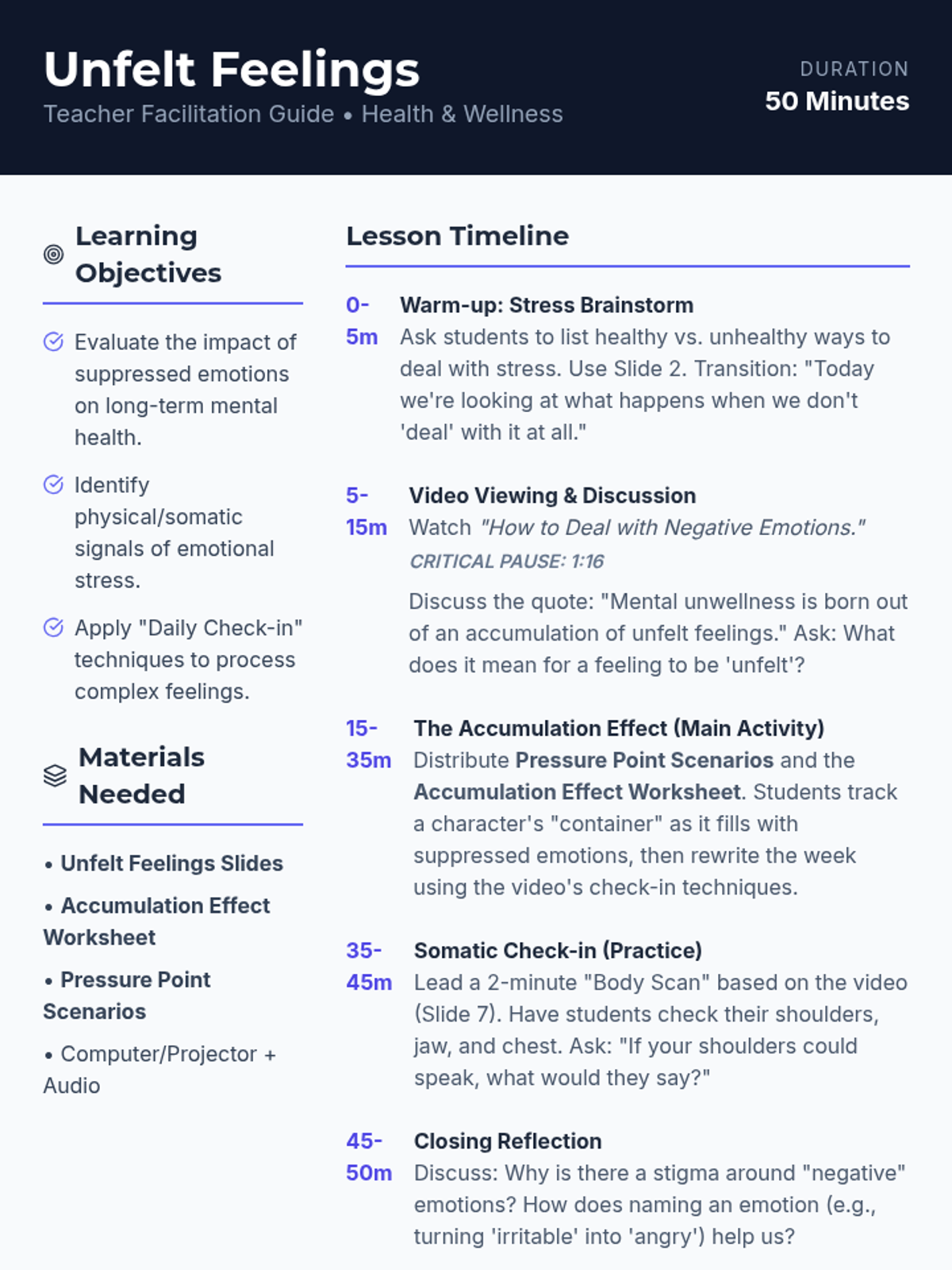
A comprehensive teacher facilitation guide for the 'Unfelt Feelings' health lesson, including a 50-minute timeline, learning objectives, discussion anchors, and key vocabulary definitions.
A visual presentation for athletes and PE students covering the science of 'choking,' the difference between internal and external focus, and pre-performance rituals. Includes an embedded YouTube video and instructions for a live experiment.
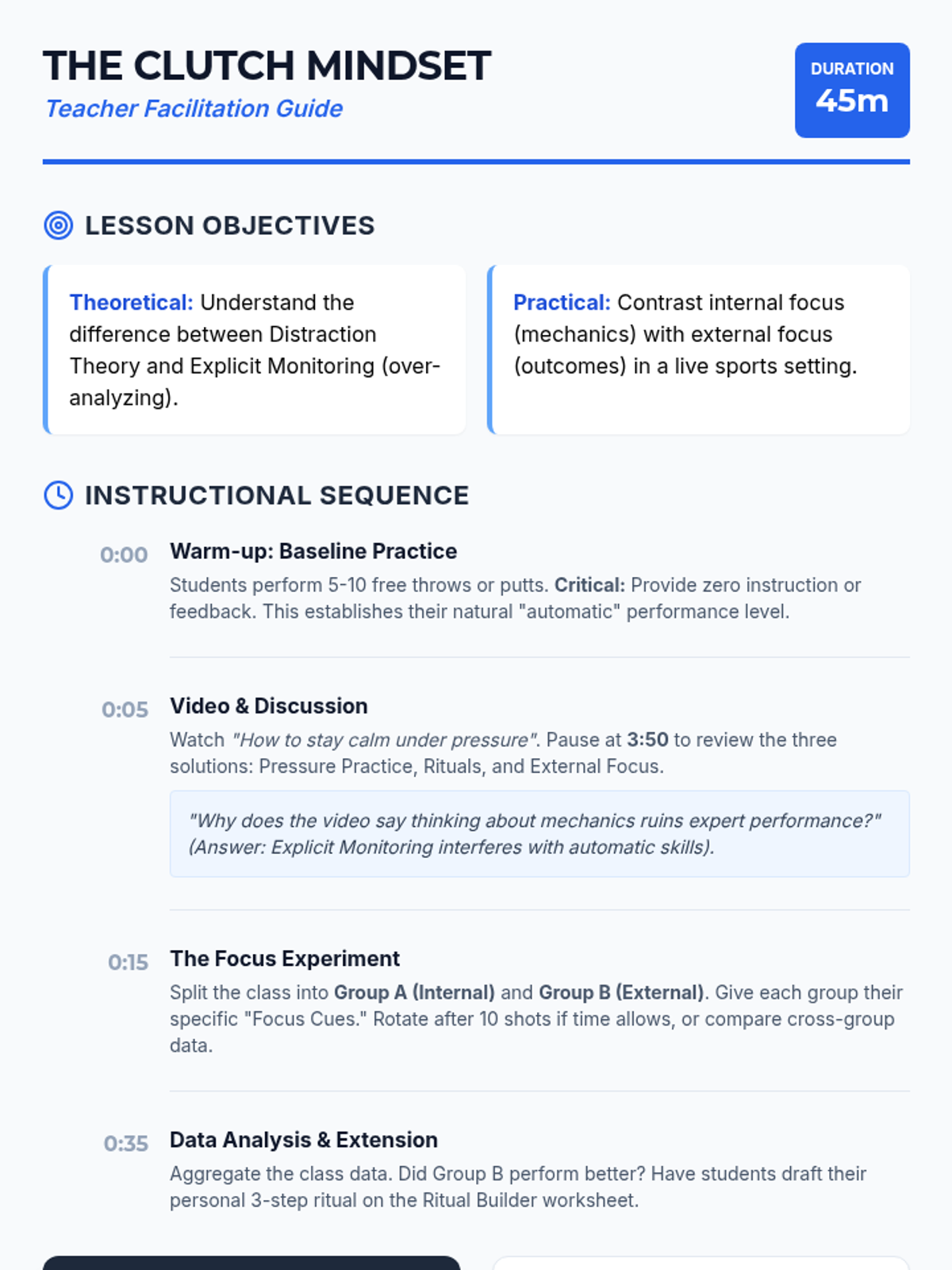
A comprehensive teacher facilitation guide for 'The Clutch Mindset' lesson, including pacing, discussion prompts, and experiment setup instructions for high school sports psychology.
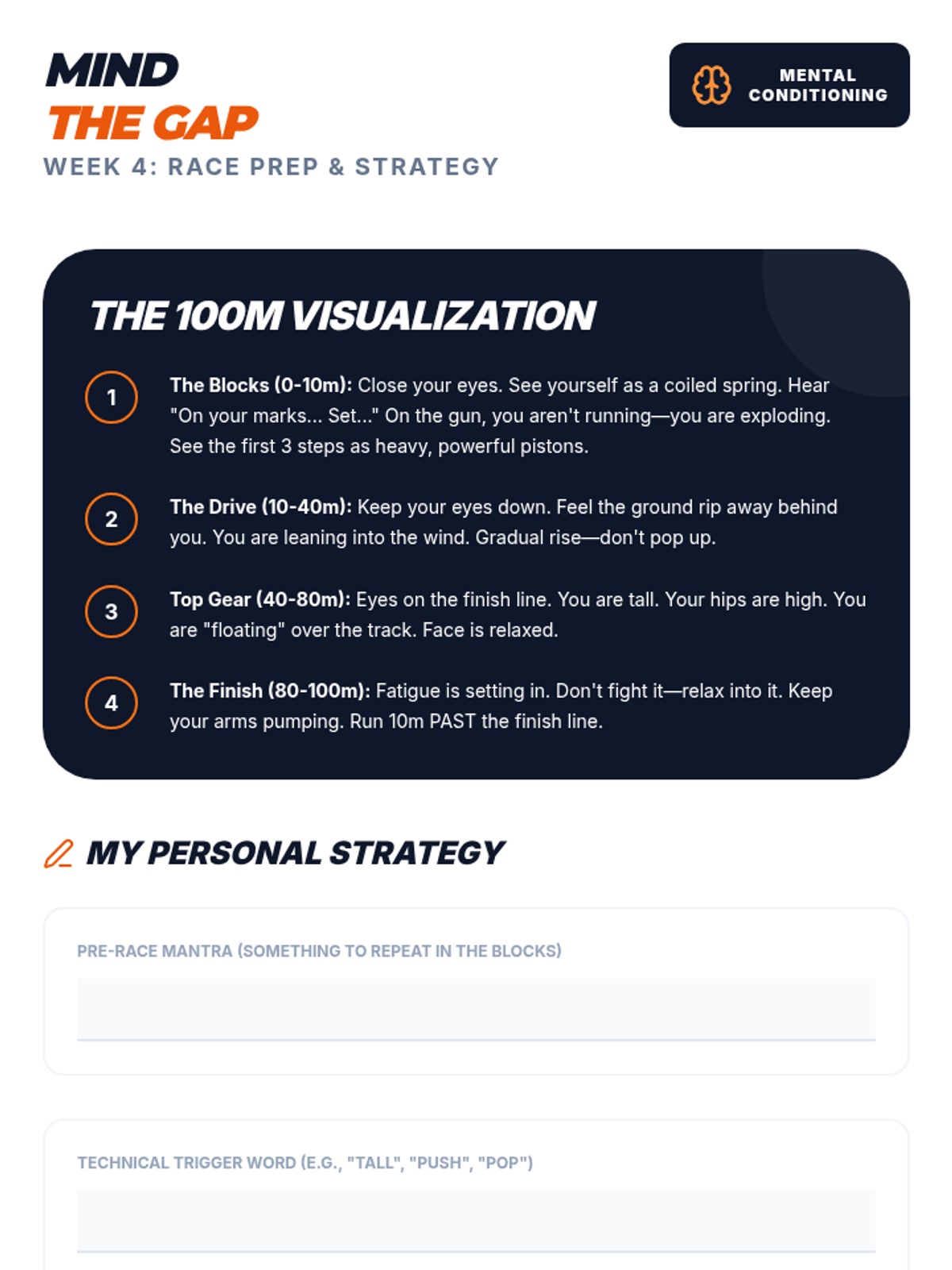
A mental preparation and strategy guide for students to prepare for race day in Week 4.
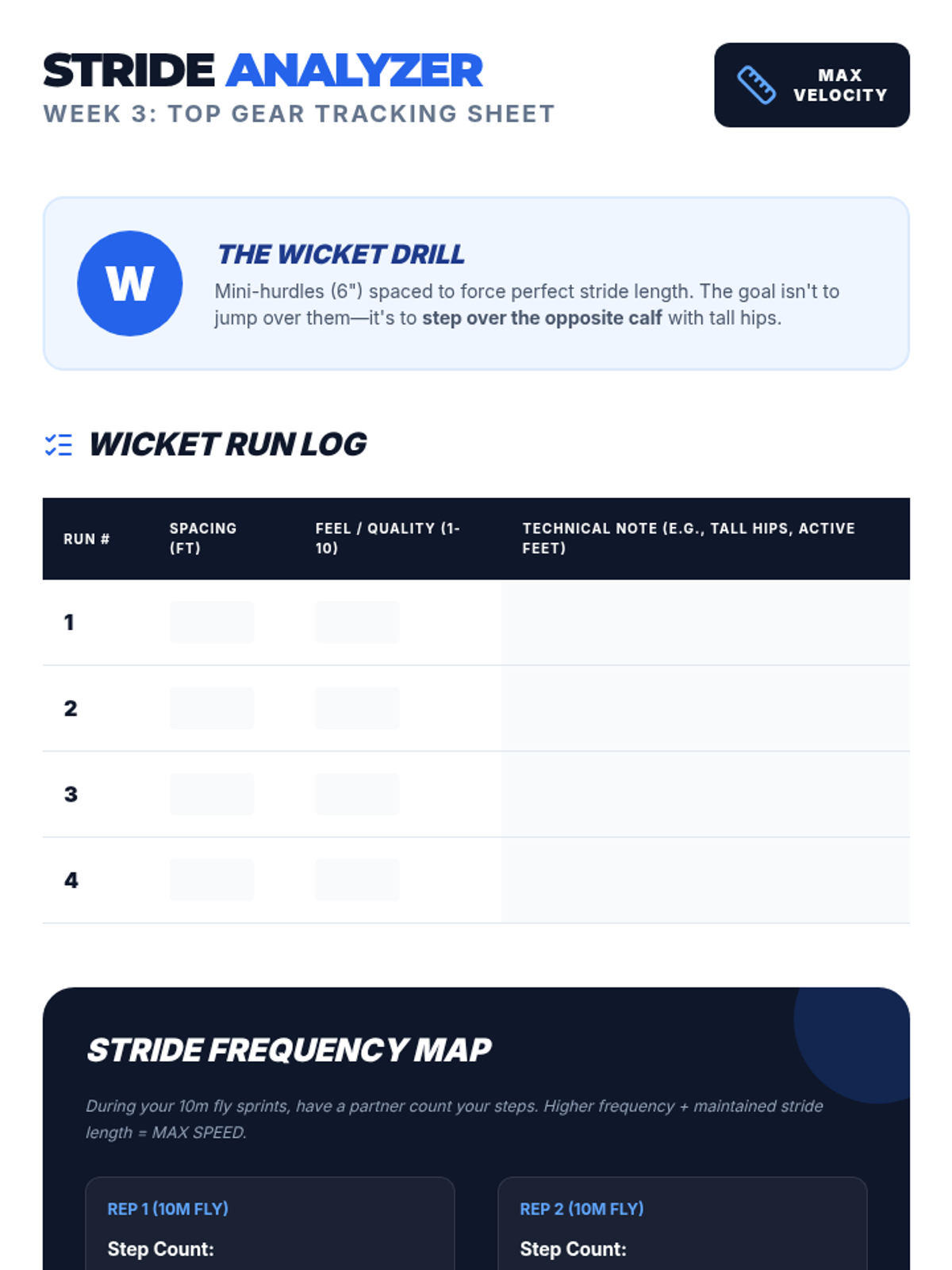
A specialized tracking sheet for wicket drills and stride frequency analysis during Week 3 max velocity training.
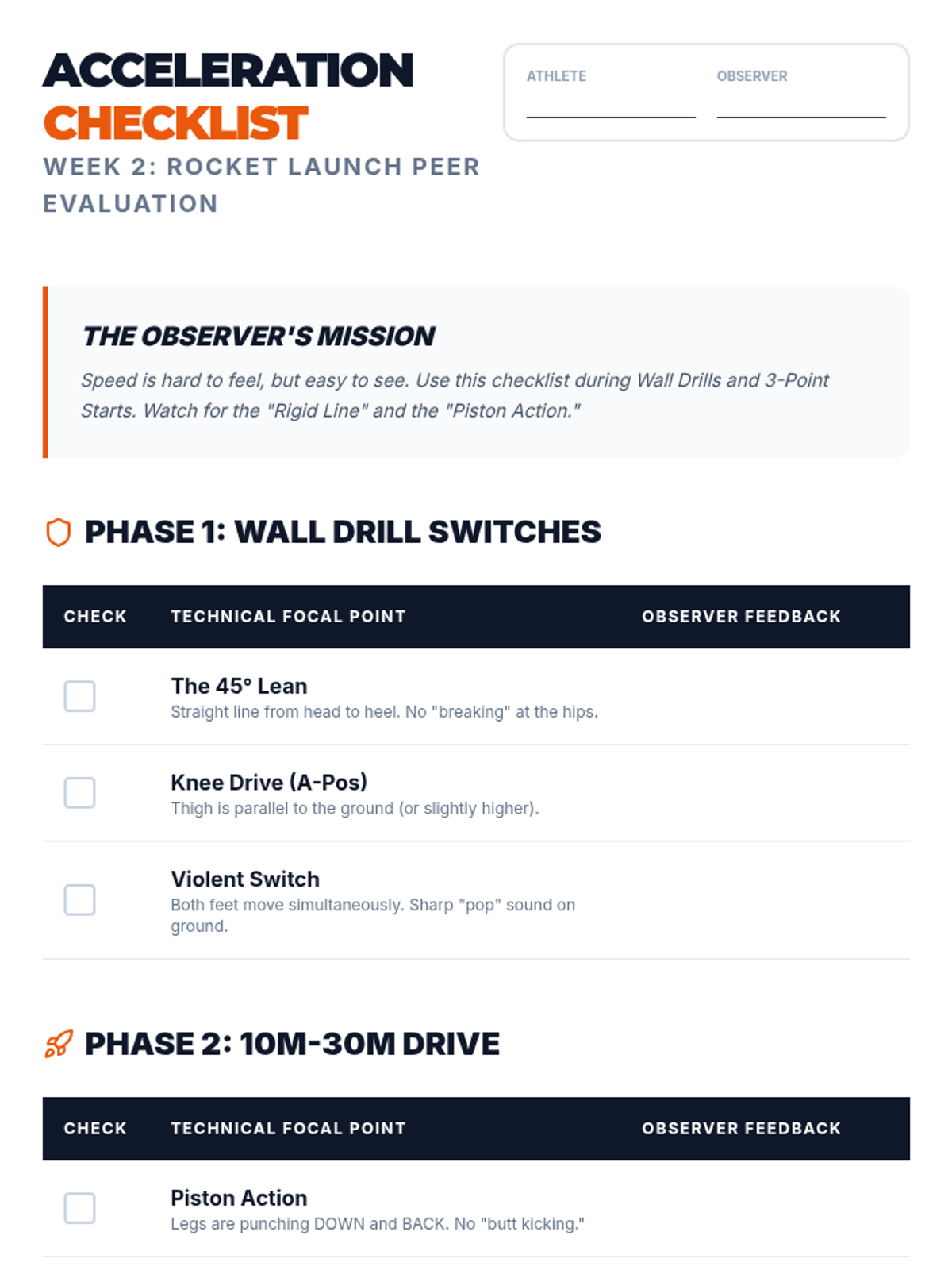
A peer-evaluation checklist for students to use during Week 2 acceleration drills, focusing on posture and drive mechanics.
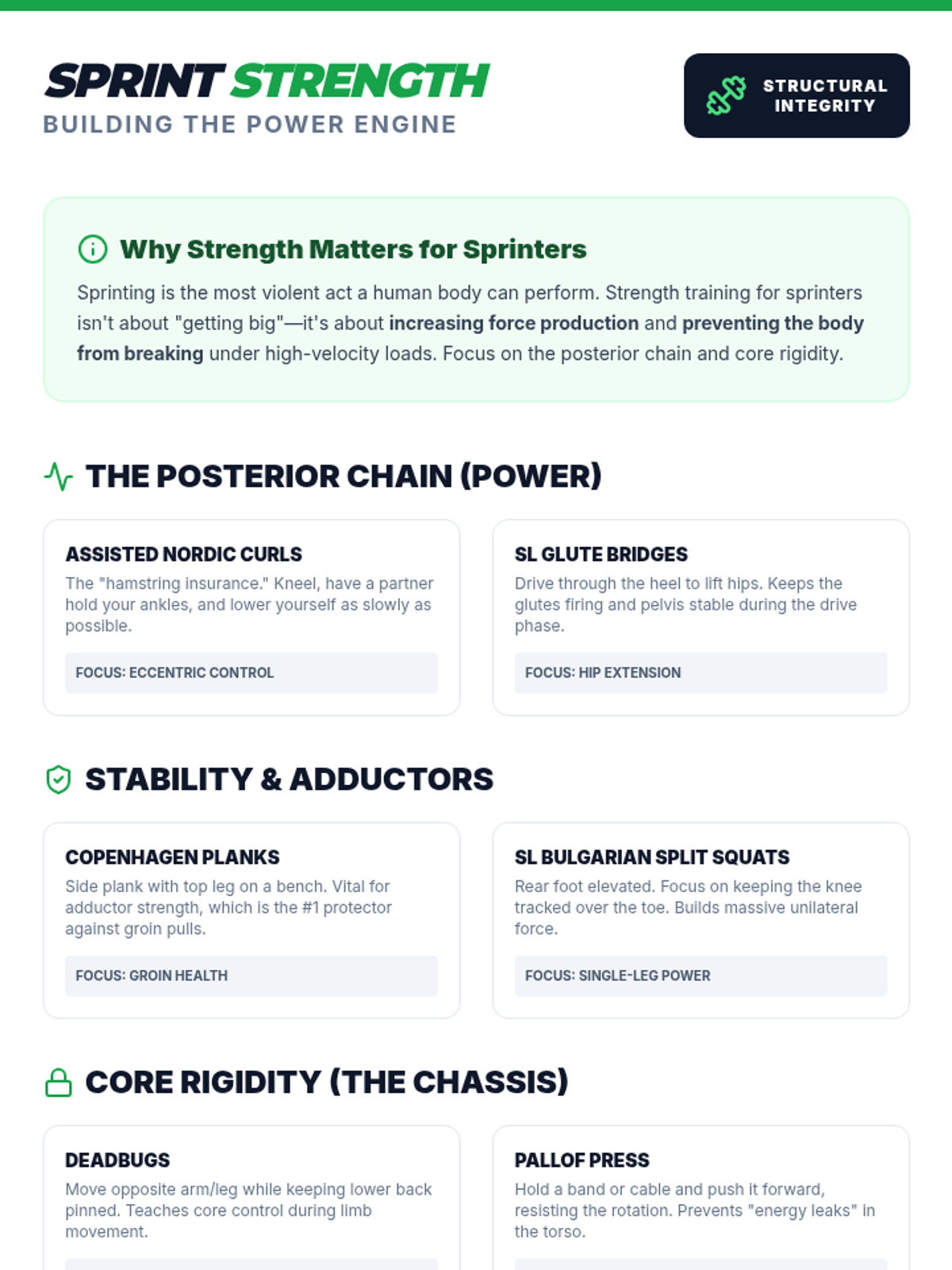
A specialized strength and stability guide for sprinters focusing on posterior chain power, core rigidity, and injury prevention exercises.
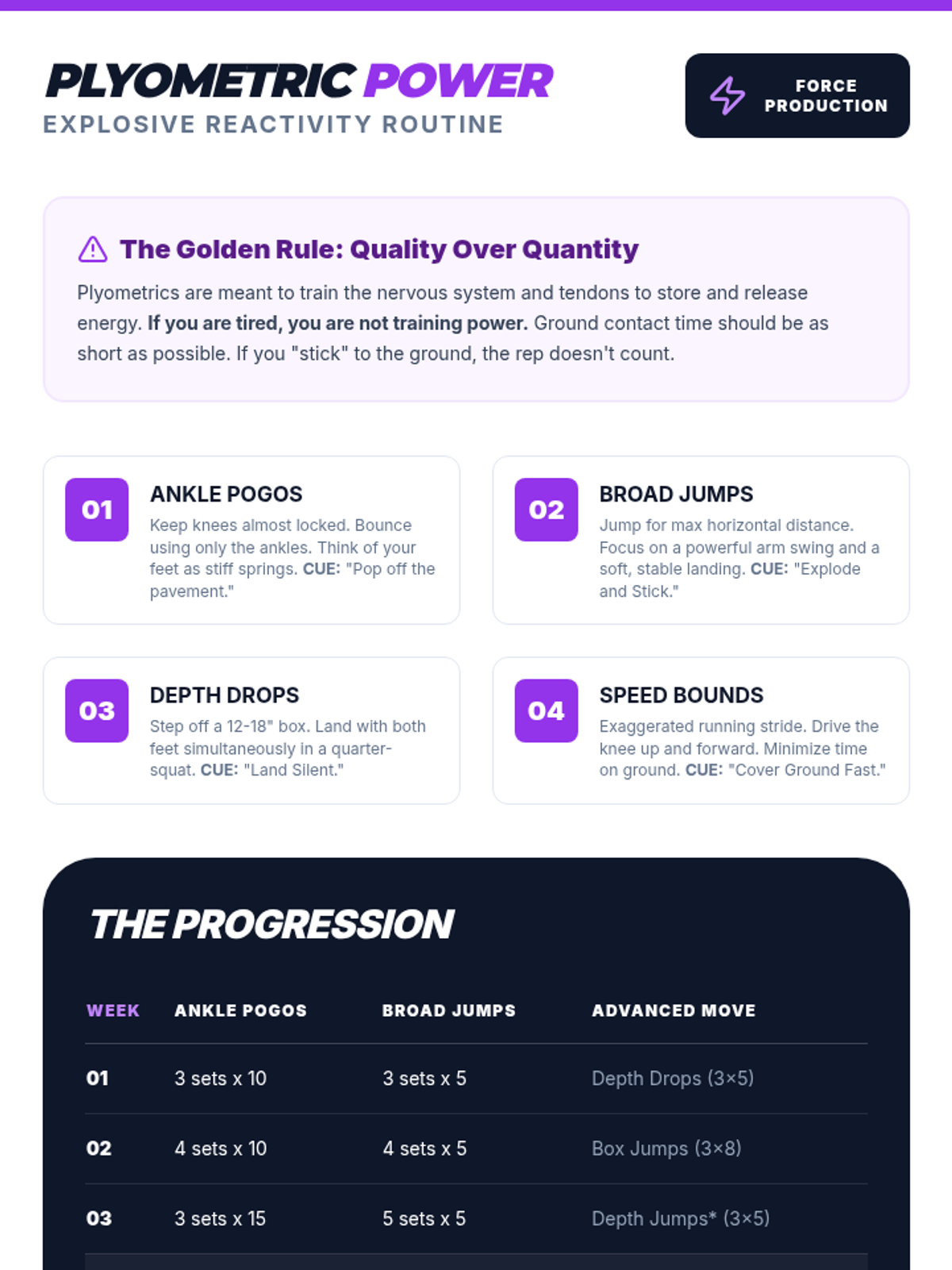
An explosive power routine featuring 4 weeks of plyometric progressions, landing mechanics, and reactive jumping exercises.
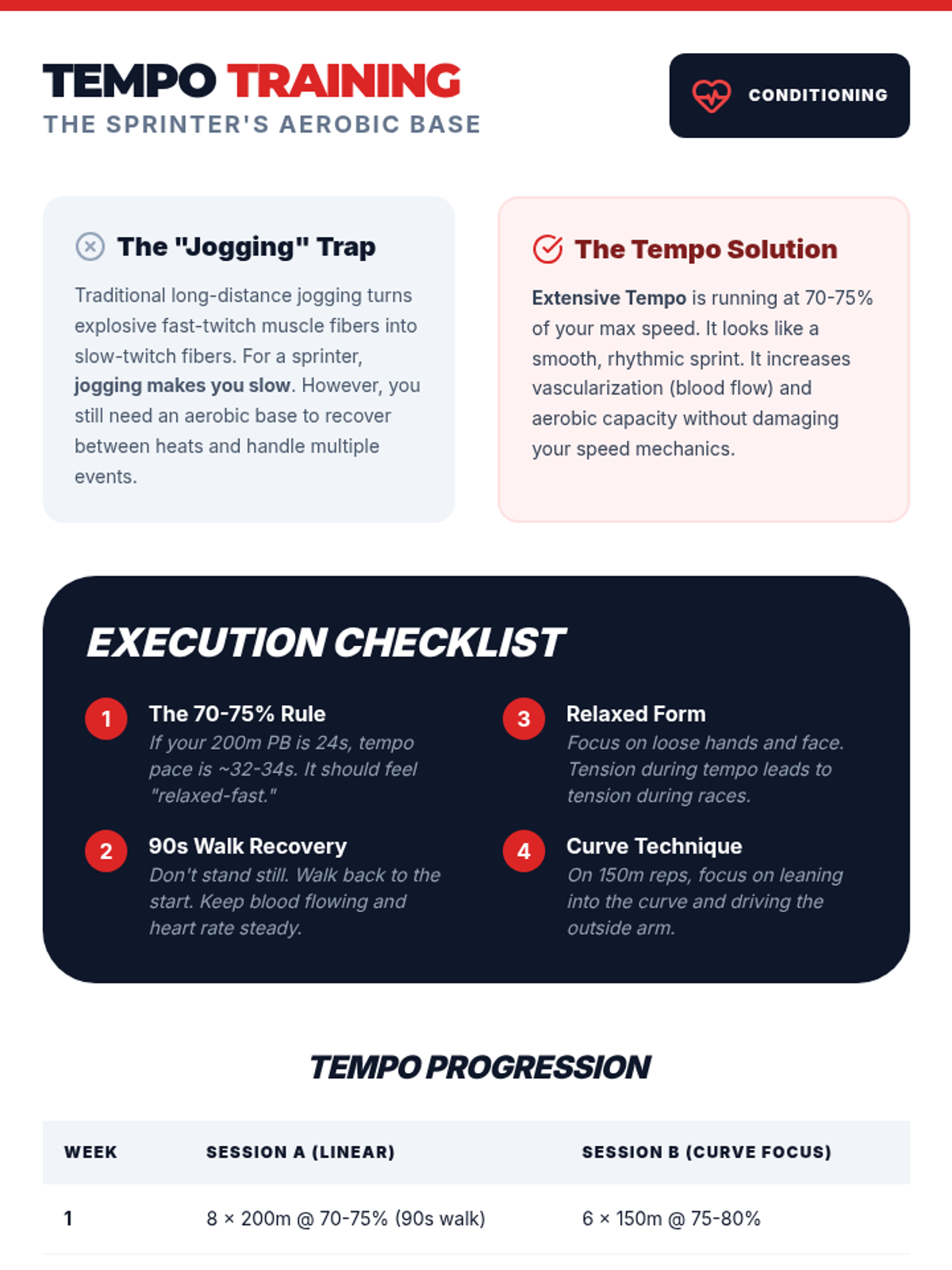
A guide to "Extensive Tempo" training, explaining how sprinters build aerobic capacity and recovery speed without sacrificing fast-twitch explosive power.
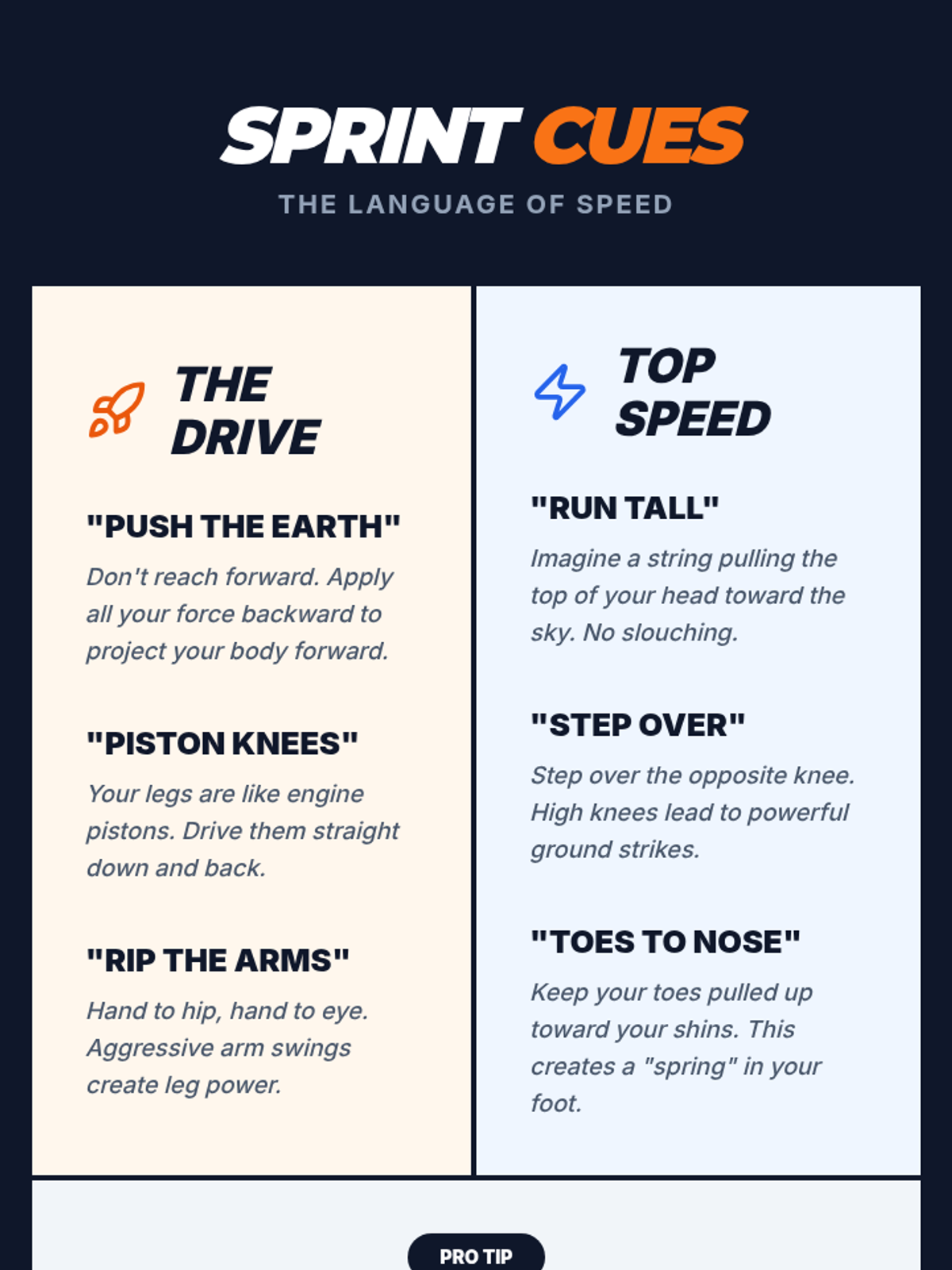
An instructional anchor chart featuring key verbal cues and technical focuses for sprinting mechanics.
A visual presentation for students to introduce the core mechanics of speed, acceleration, and injury prevention.
A student tracking document for athletes to record times, RPE, and weekly reflections throughout the 4-week high-intensity program.
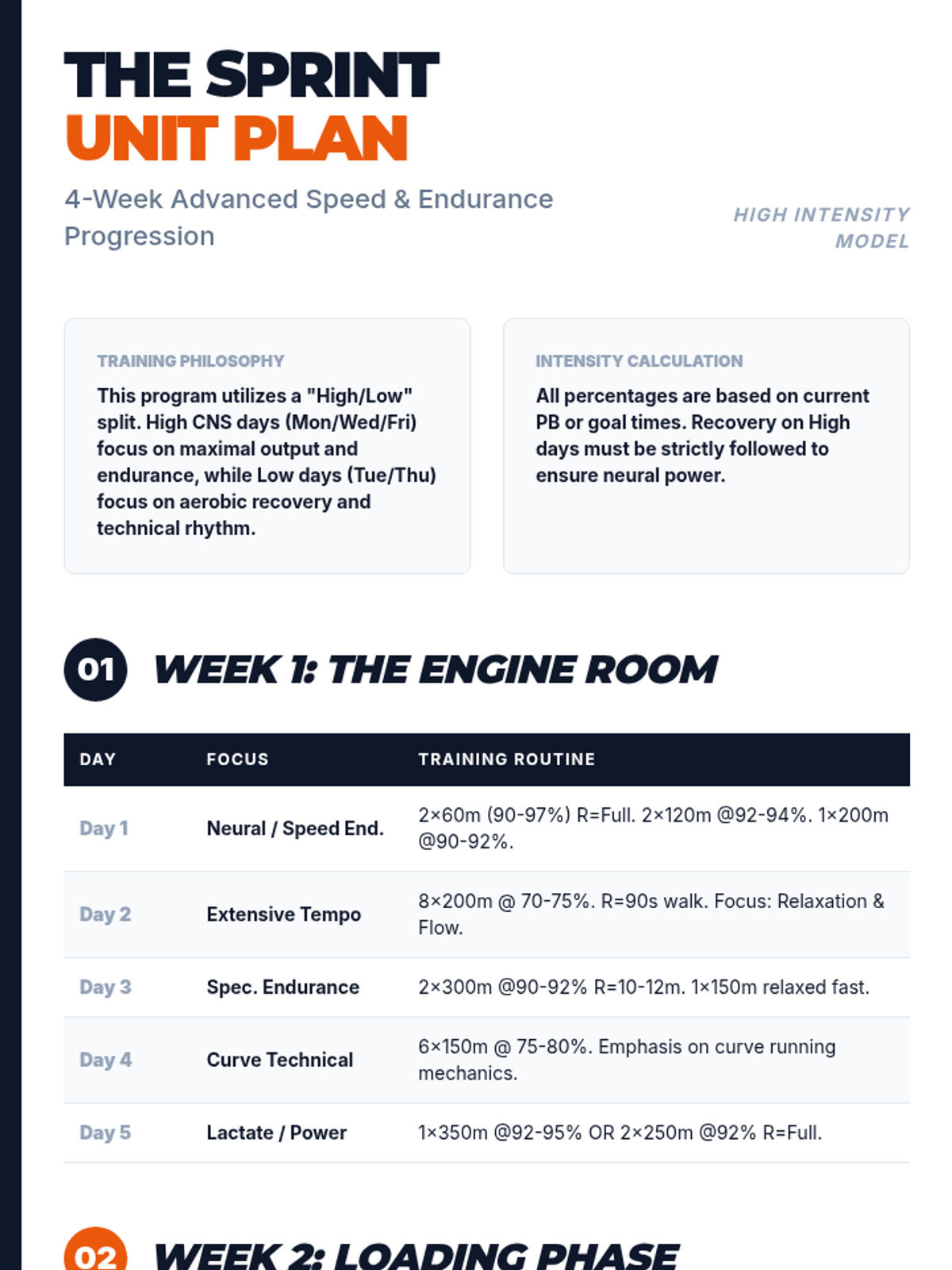
A comprehensive 4-week unit plan for coaches, providing a day-by-day breakdown of drills, conditioning, and speed sessions based on a high-intensity interval model.
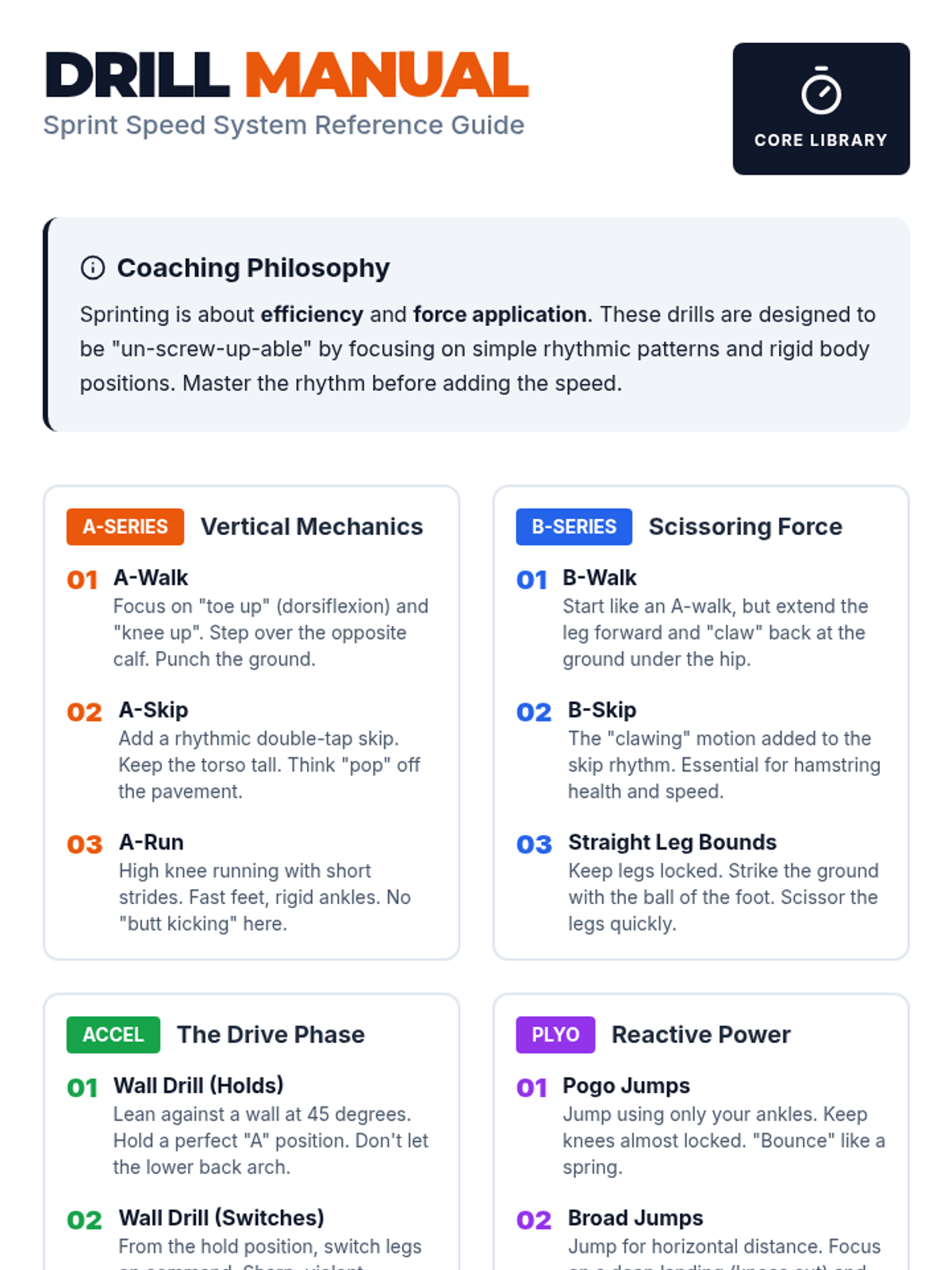
A visual reference guide for athletes featuring the core sprint drills (A/B series, acceleration, plyometrics) and an injury prevention routine.
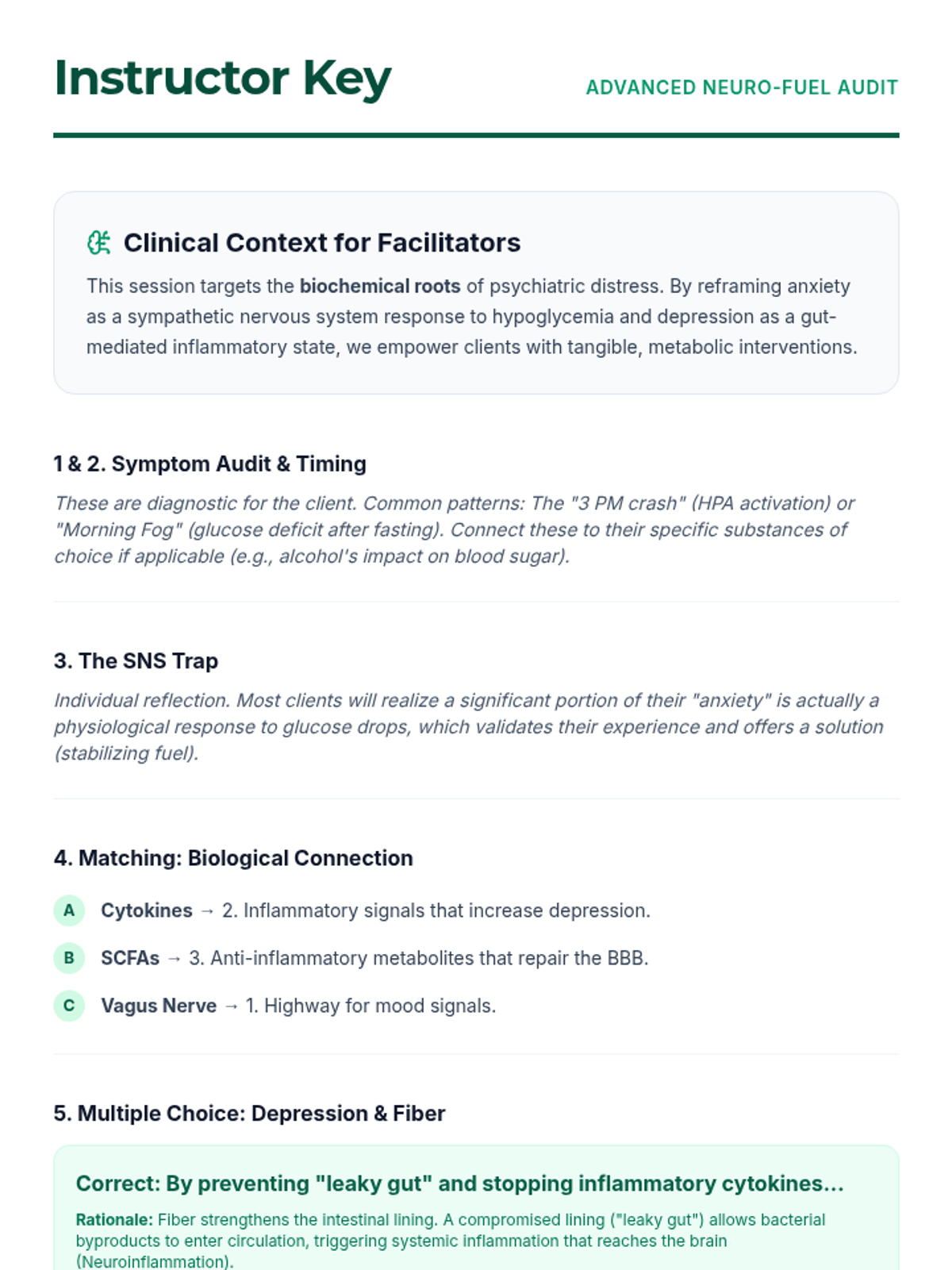
A visual presentation deck for mental health and recovery clients, breaking down the inflammatory model of depression, SNS regulation, and the role of fiber in executive function.
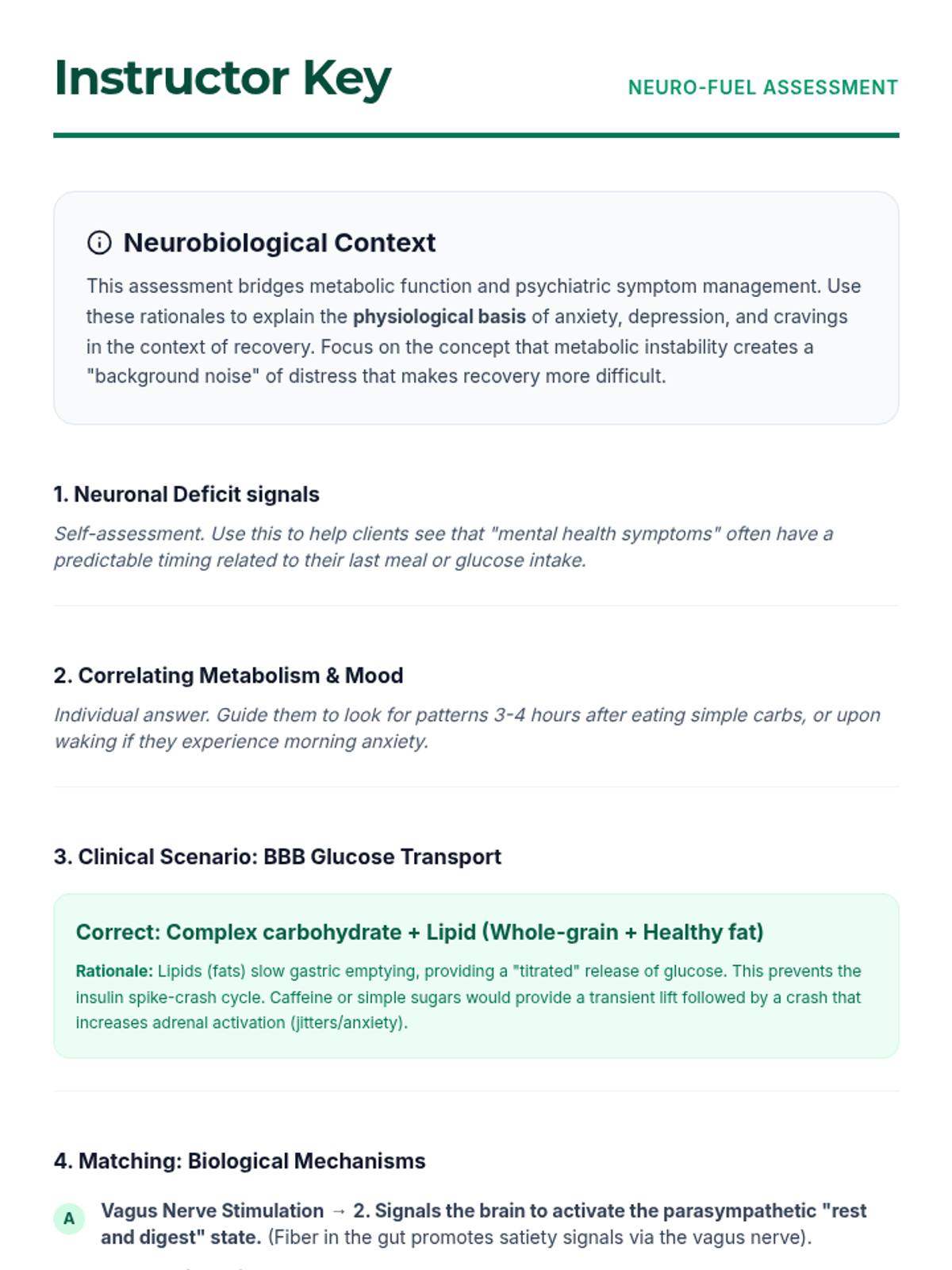
A teacher answer key for the revised Advanced Neuro Fuel Quiz, providing technical rationales, neurobiological context, and discussion prompts for instructors.
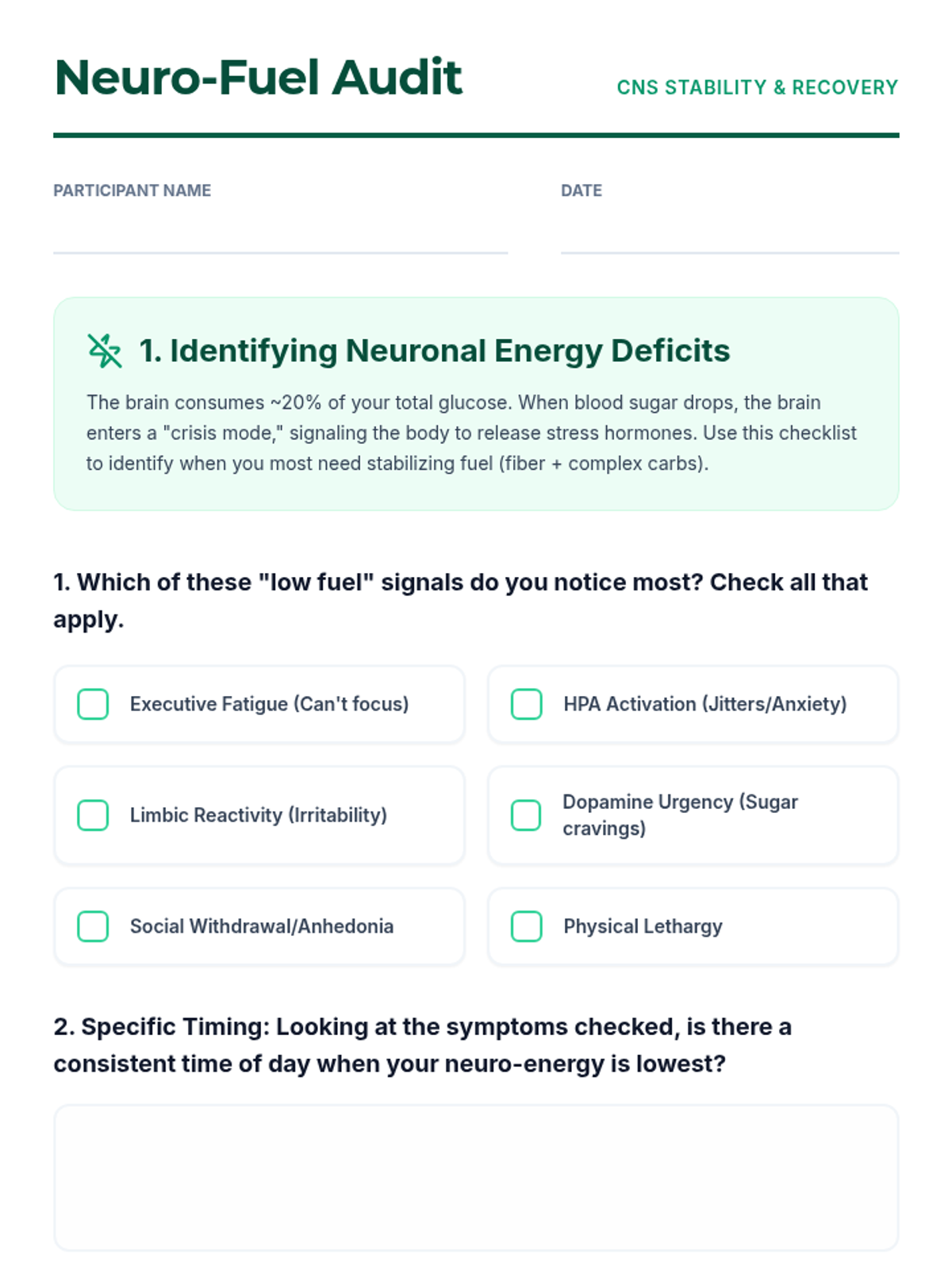
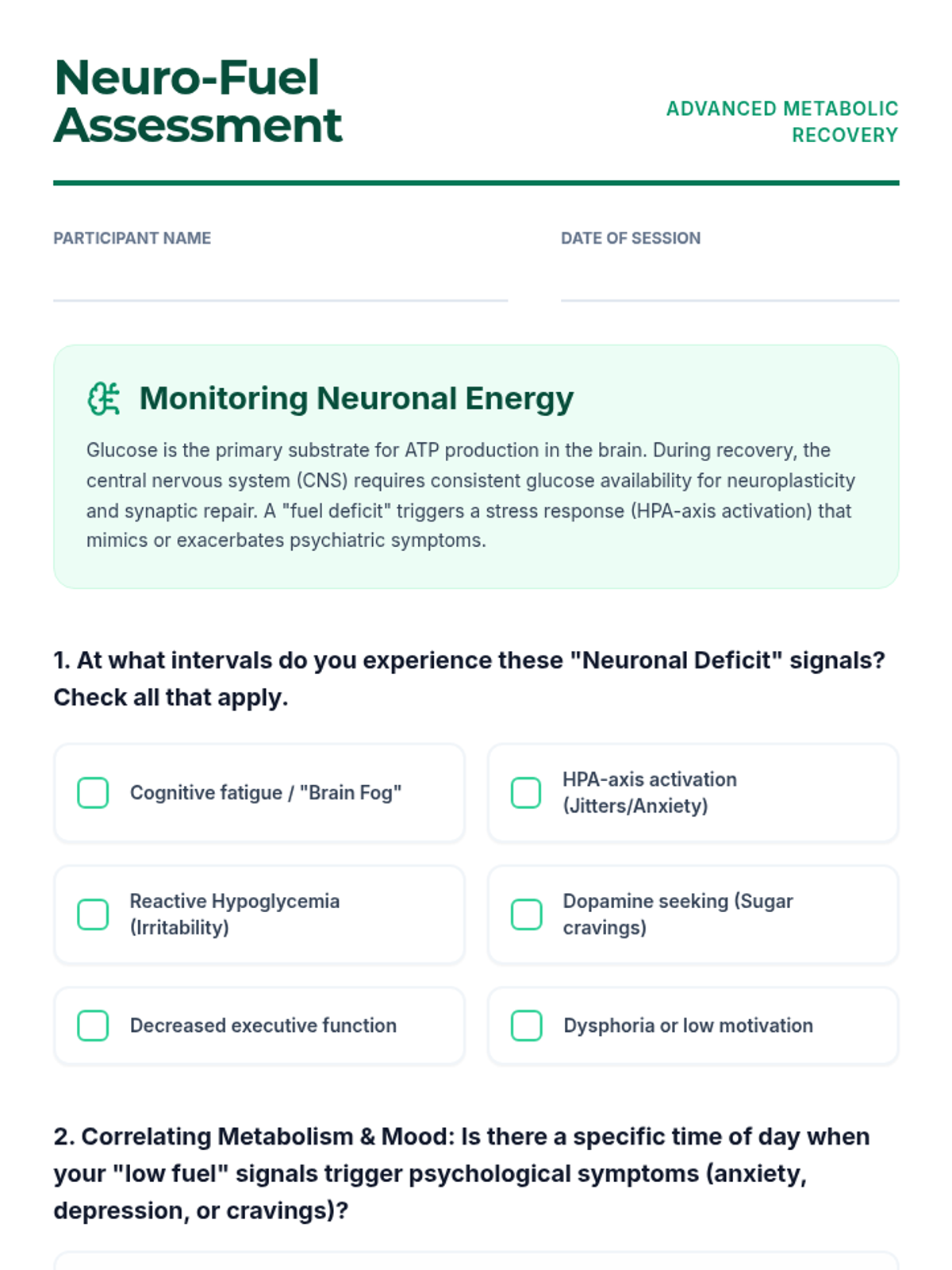
An advanced student quiz for mental health and recovery clients, featuring technical neurobiological concepts like HPA-axis activation, SCFA production, neuroinflammation, and executive function.
A teacher answer key for the advanced Neuro Fuel Quiz, providing technical rationales and neurobiological context for metabolic recovery.
An advanced student quiz for mental health and recovery clients, featuring technical neurobiological concepts like HPA-axis activation, SCFA production, and neuroinflammation.
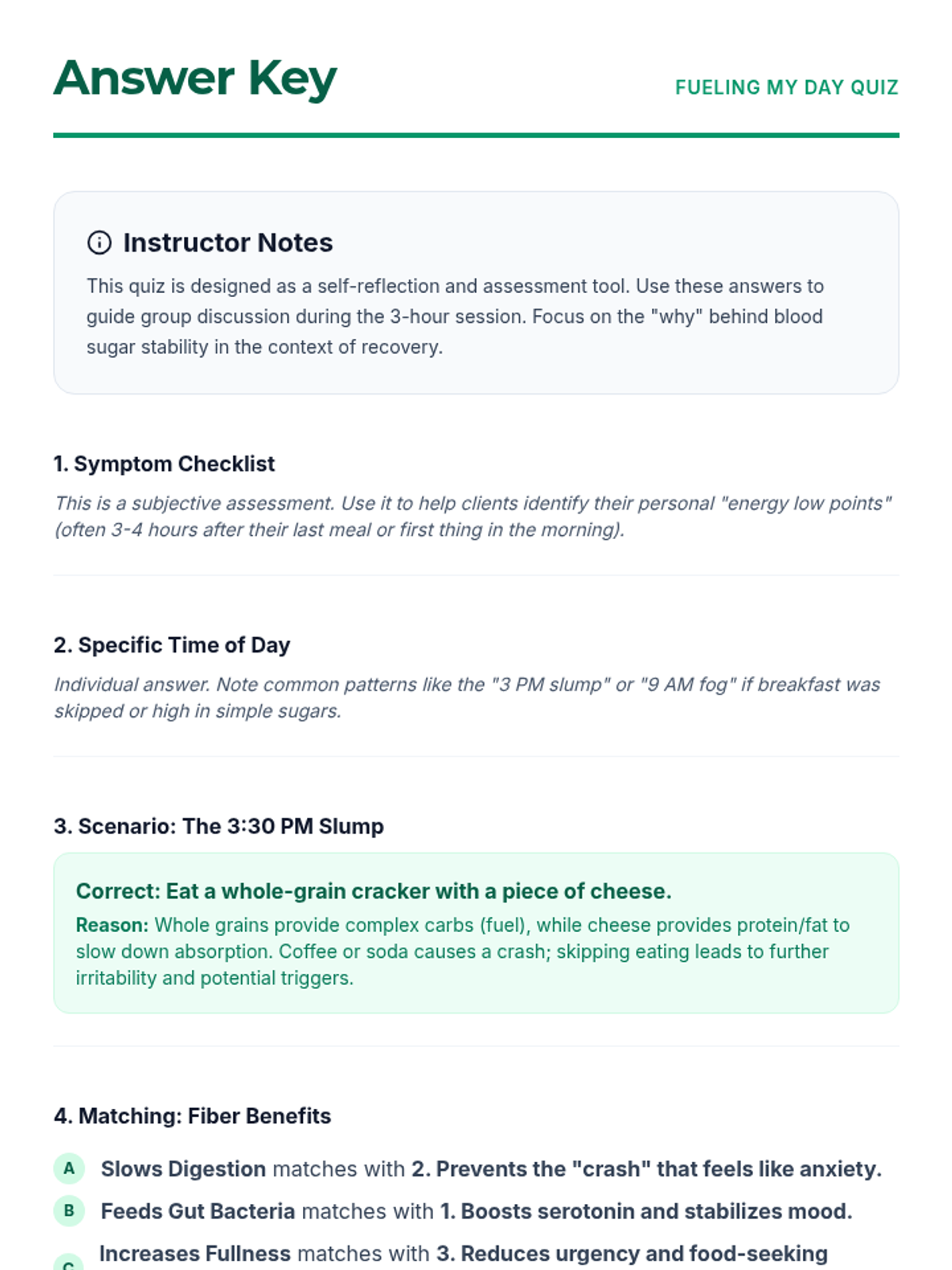
A teacher answer key for the Fueling My Day Quiz, providing correct answers, rationales for scenarios, and guidance for classroom discussion.
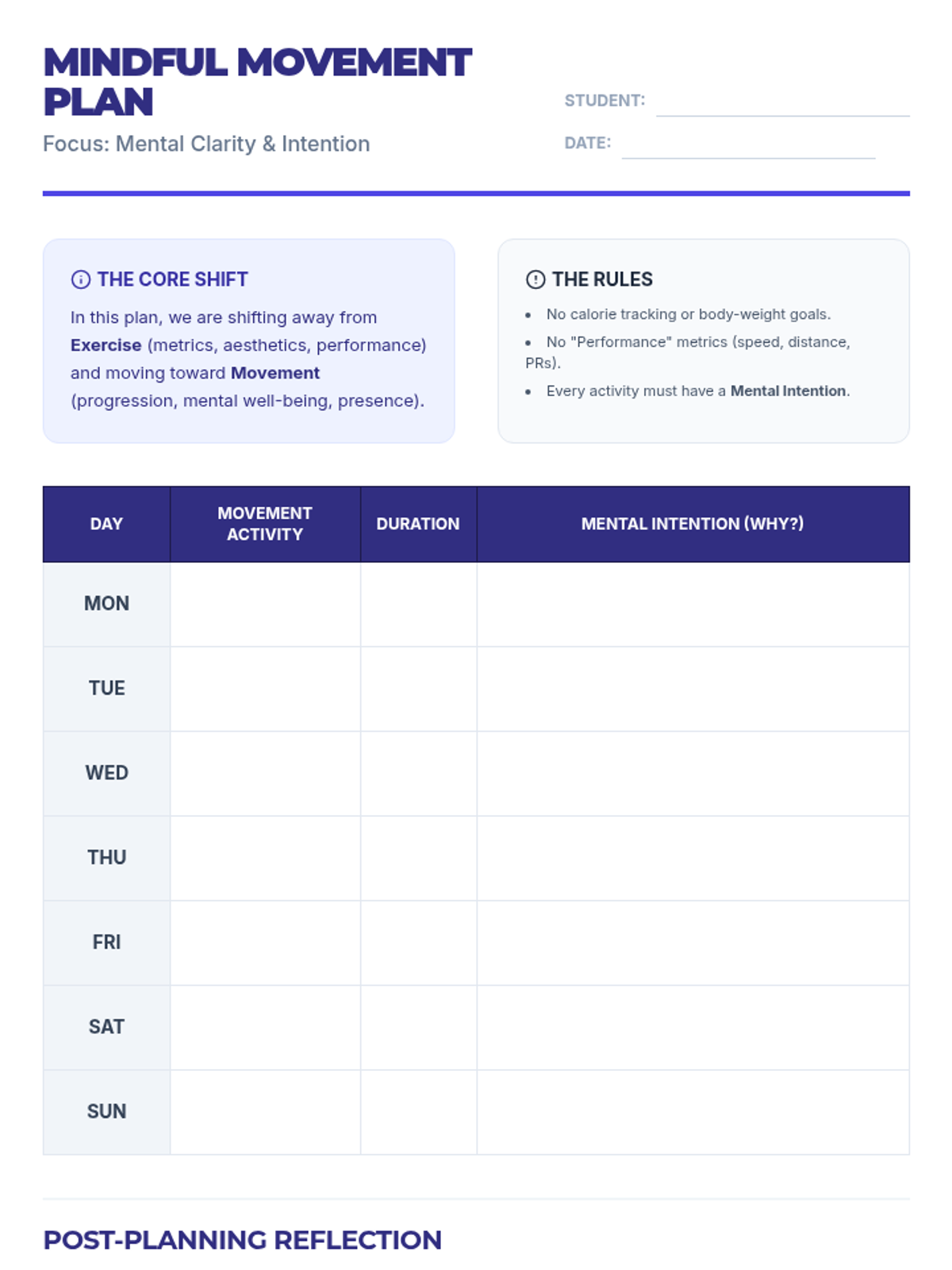
A student planning worksheet for 'The Movement Shift' lesson. Students design a one-week movement plan that replaces physical metrics like calories and PRs with mental intentions and focuses on psychological well-being.
A visual slide deck for 'The Movement Shift' lesson, featuring Jake Tyler's TEDx talk, key discussion prompts on mental health, and a comparison between traditional exercise and mindful movement.
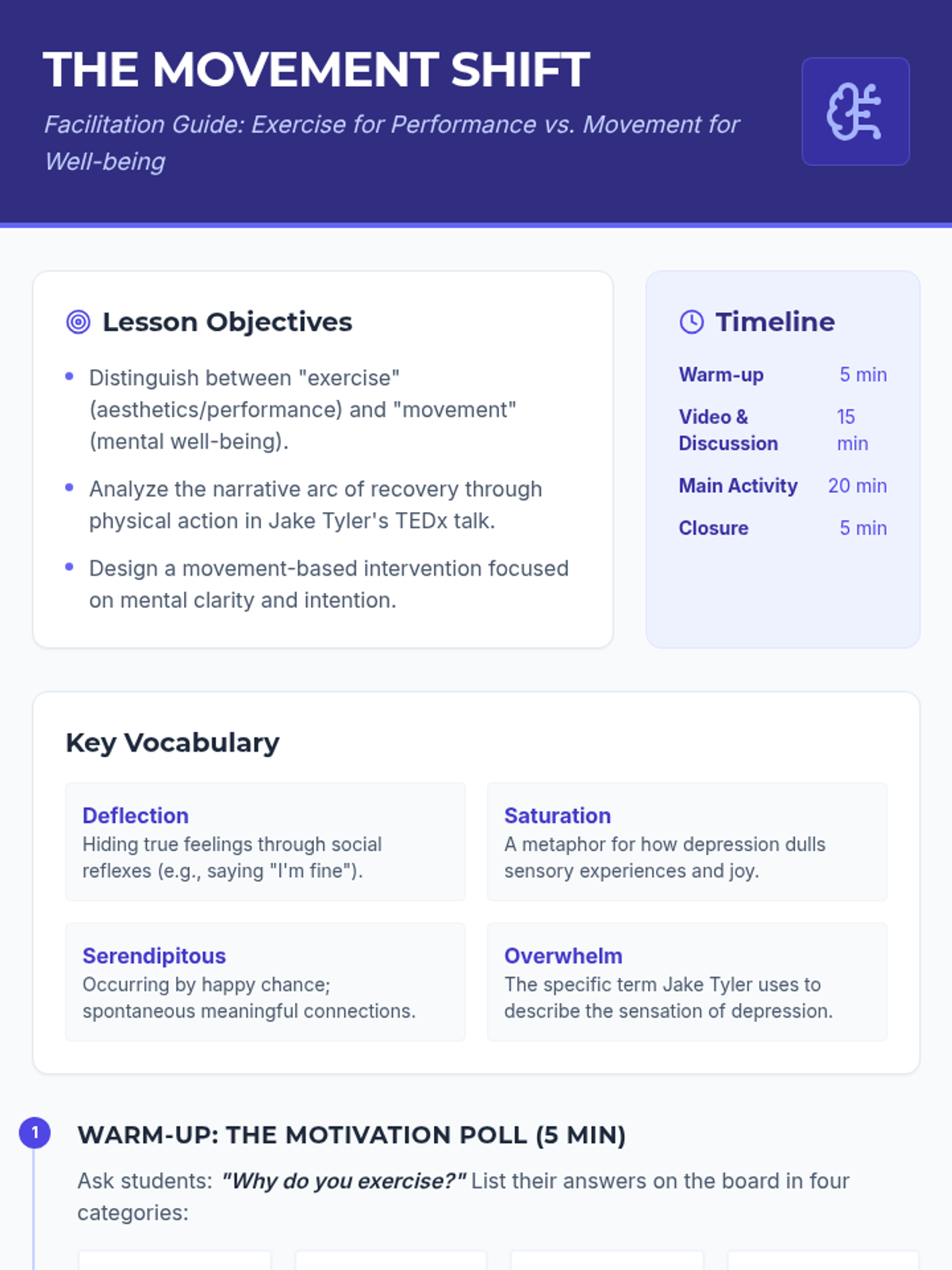
A teacher facilitation guide for 'The Movement Shift' lesson, including learning objectives, a detailed timeline, key vocabulary definitions, and guided discussion prompts for analyzing Jake Tyler's TEDx talk on movement and mental health.
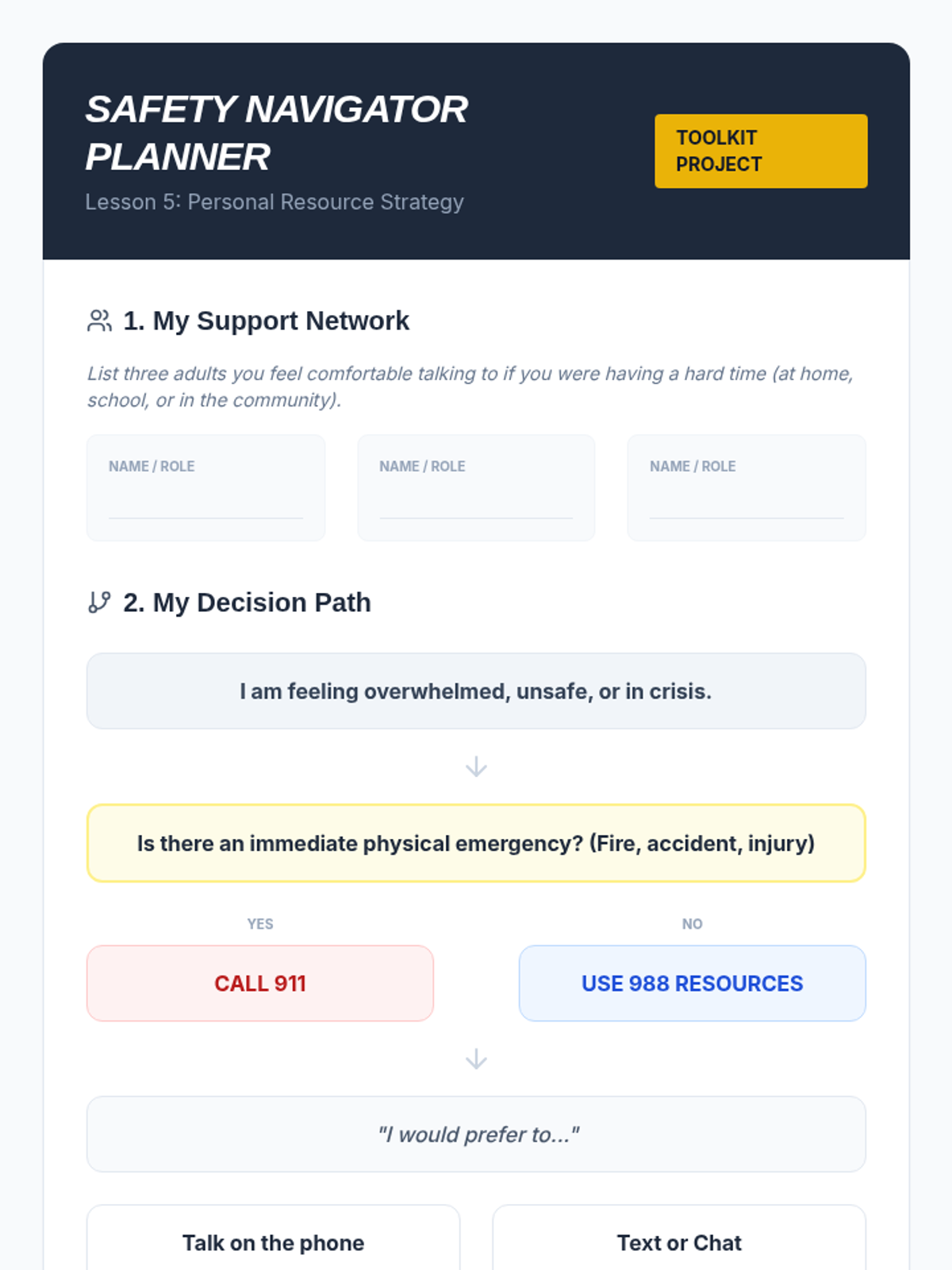
A comprehensive project planner and template for students to create a personal safety flowchart and portable resource wallet cards.
Slides for Lesson 5 that introduce the capstone project where students create their own personal safety strategy and resource tools.
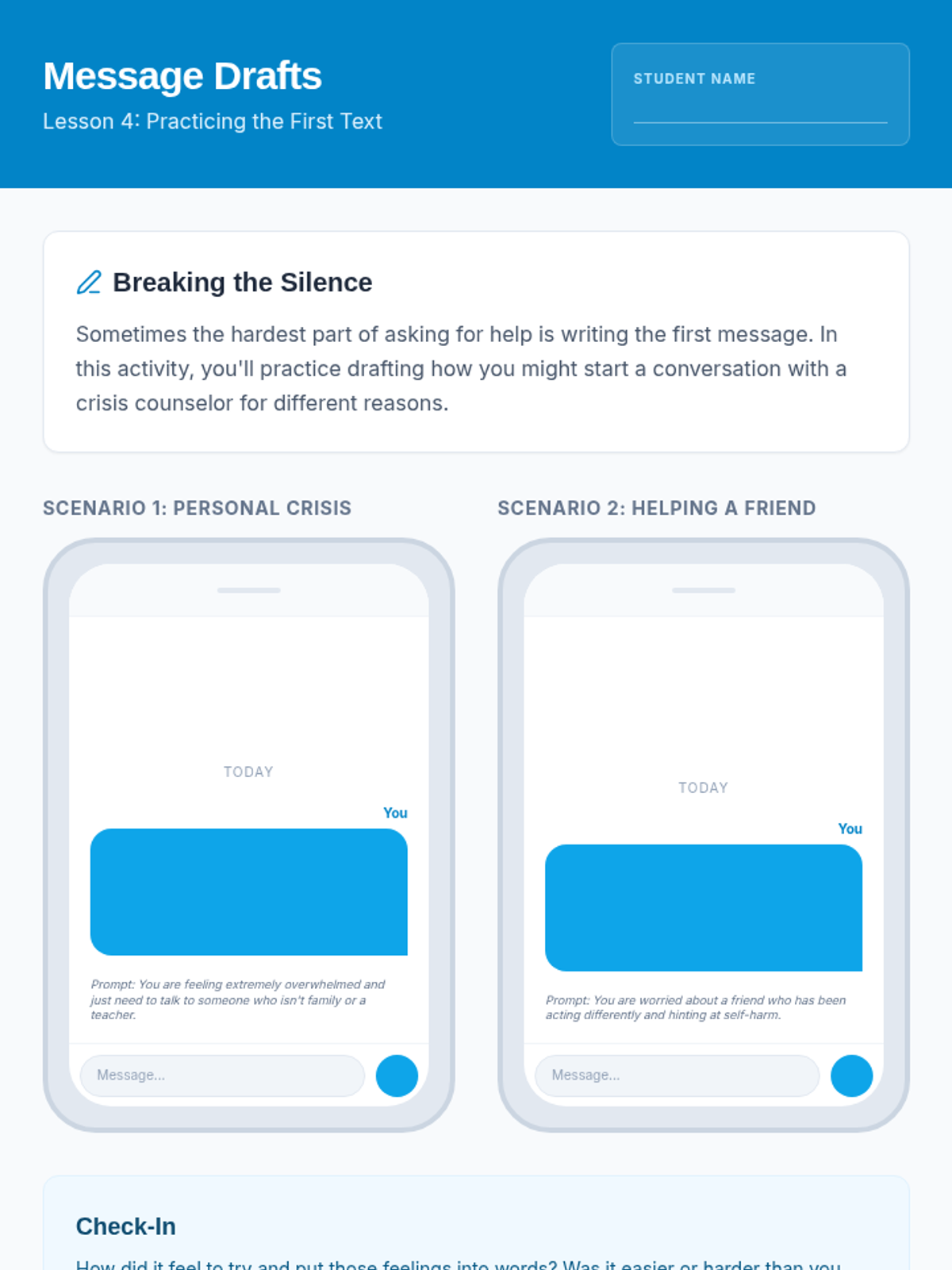
A worksheet for Lesson 4 where students practice drafting initial messages for crisis support using a phone screen template.
Slides for Lesson 4 that cover text-based crisis support, why it's effective, and how counselor communication looks in a chat interface.
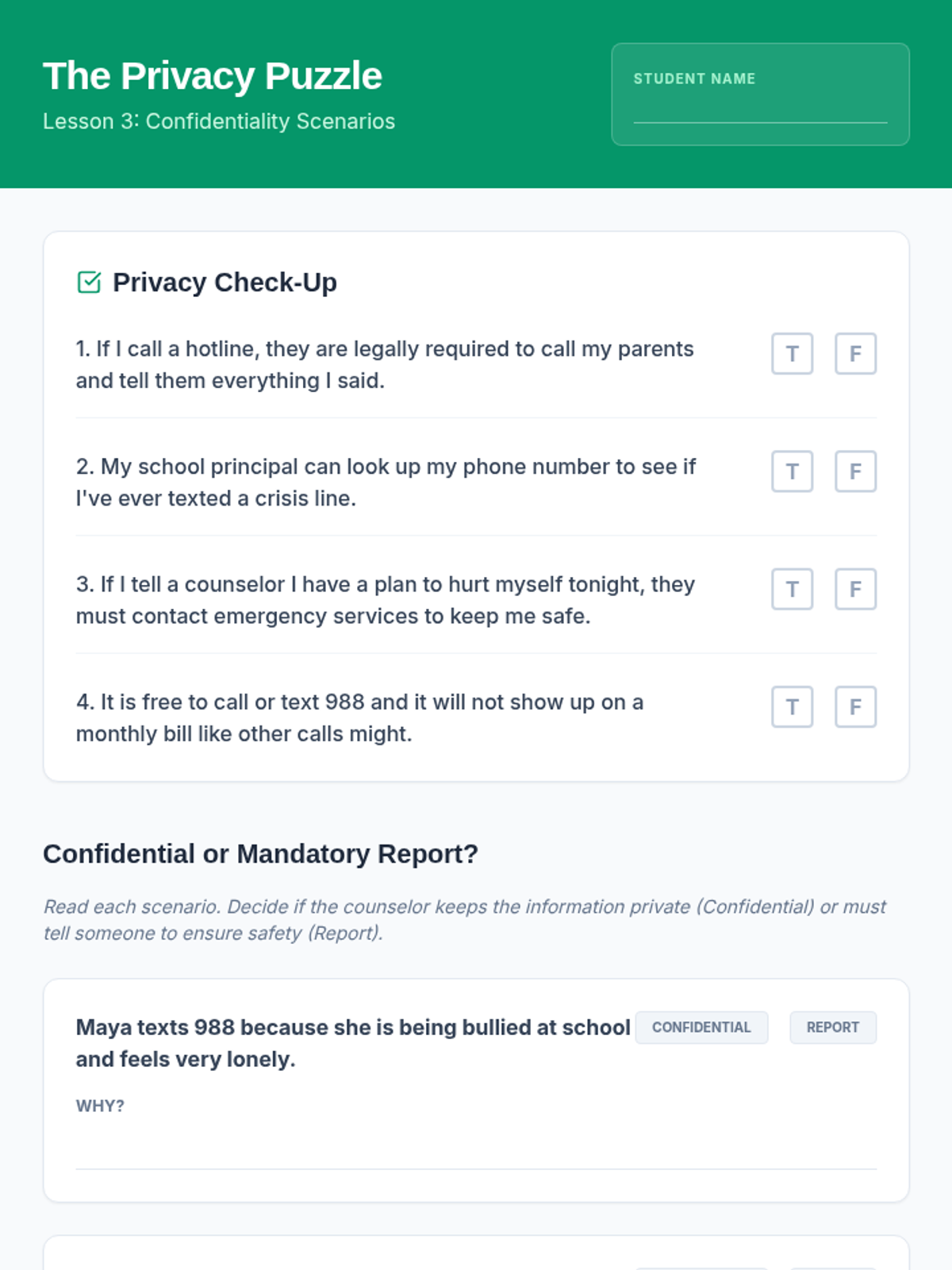
A worksheet for Lesson 3 where students analyze scenarios to determine if they fall under confidentiality or mandatory reporting rules.
Slides for Lesson 3 explaining the concepts of confidentiality, mandatory reporting, and digital privacy when using crisis support services.
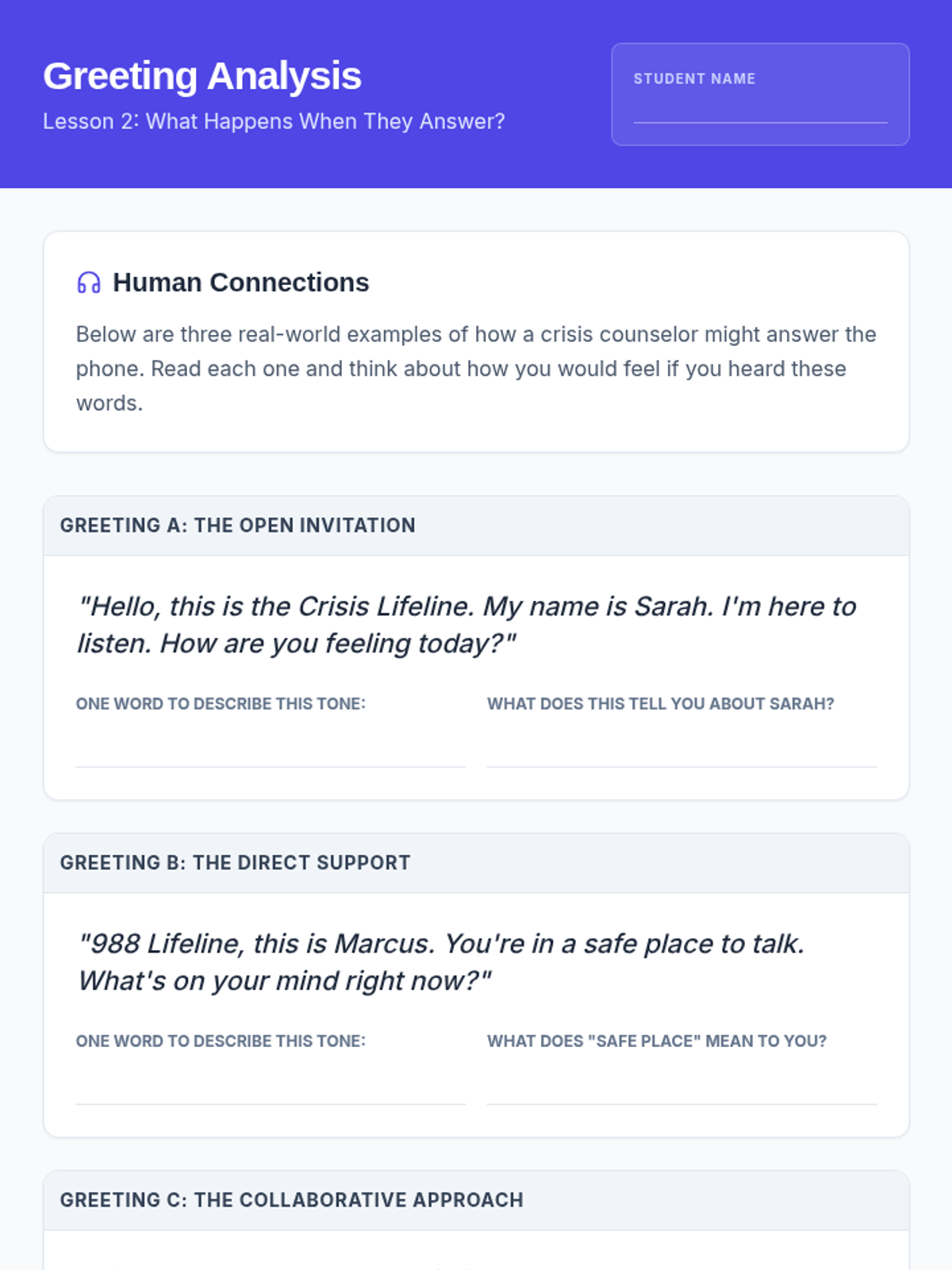
A worksheet for Lesson 2 that presents different hotline greeting transcripts for students to analyze the tone and purpose of initial counselor contact.
Slides for Lesson 2 that walk students through the step-by-step process of contacting a crisis hotline, addressing common myths, and providing opening script examples.
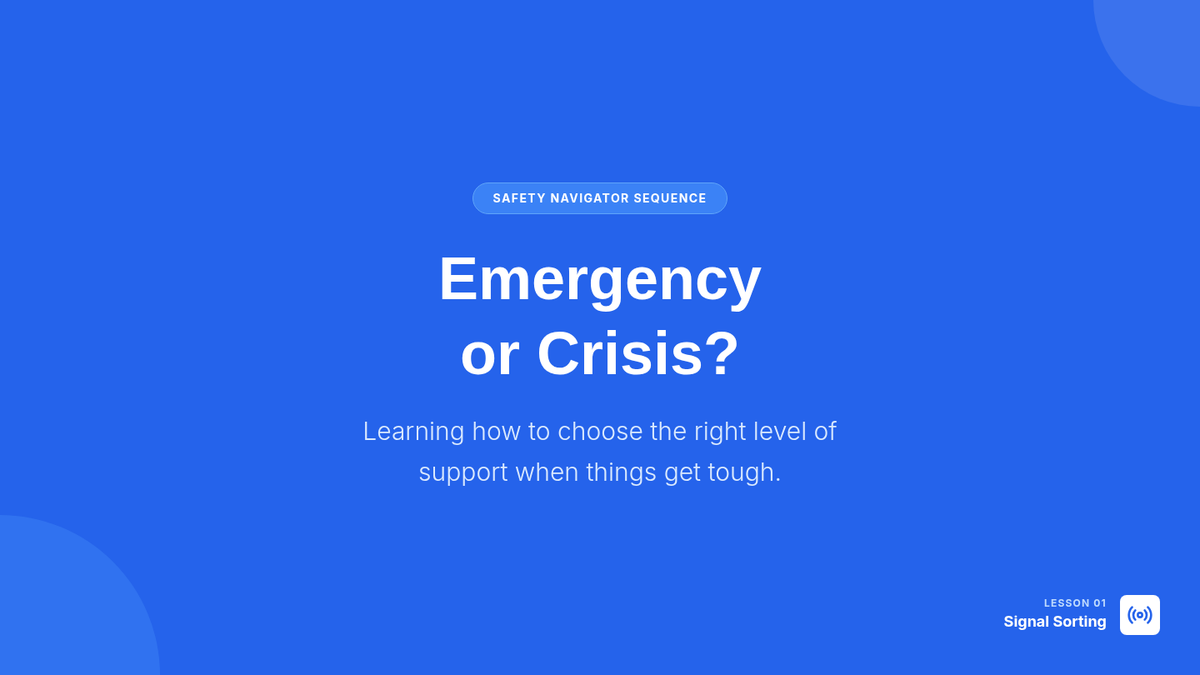
Introductory slides for Lesson 1, covering the concept of triage and the distinction between 911 and 988.
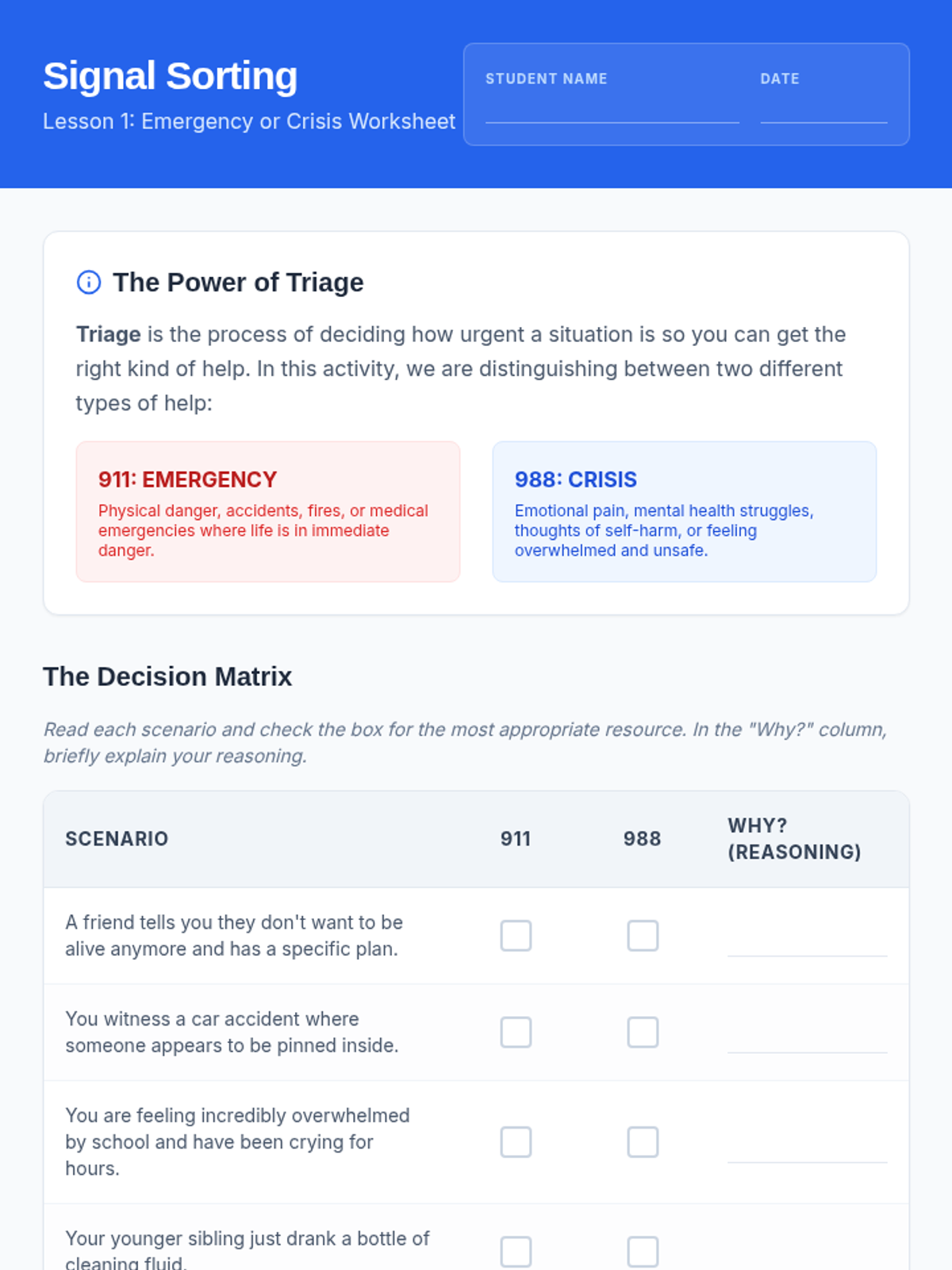
A worksheet for students to categorize different scenarios into 911 (Emergency) or 988 (Crisis) responses, helping them understand the concept of triage and appropriate help-seeking.
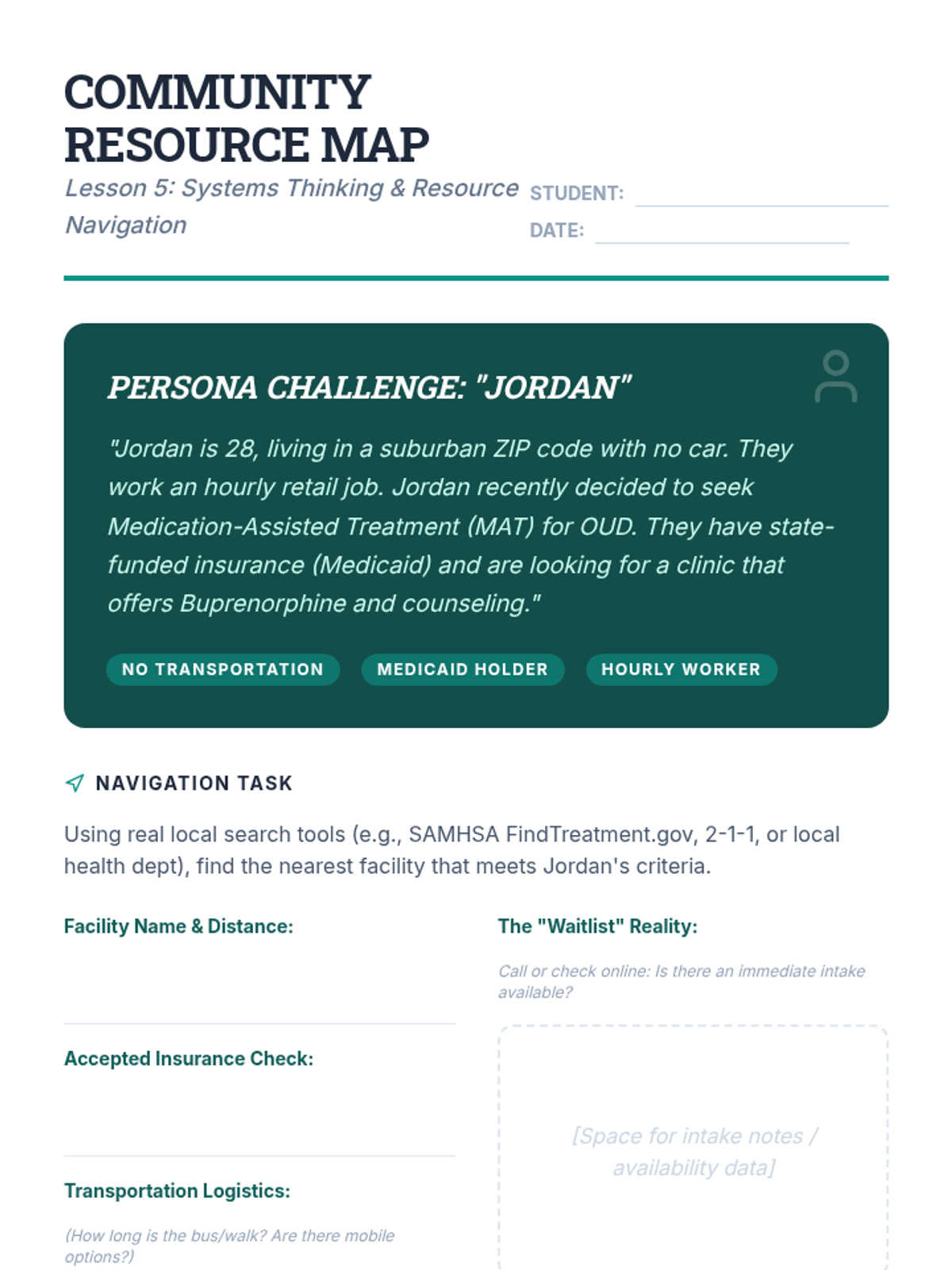
A project-based worksheet where students map local recovery resources against a specific persona's needs (Jordan), conducting a gap analysis of their community's recovery infrastructure.
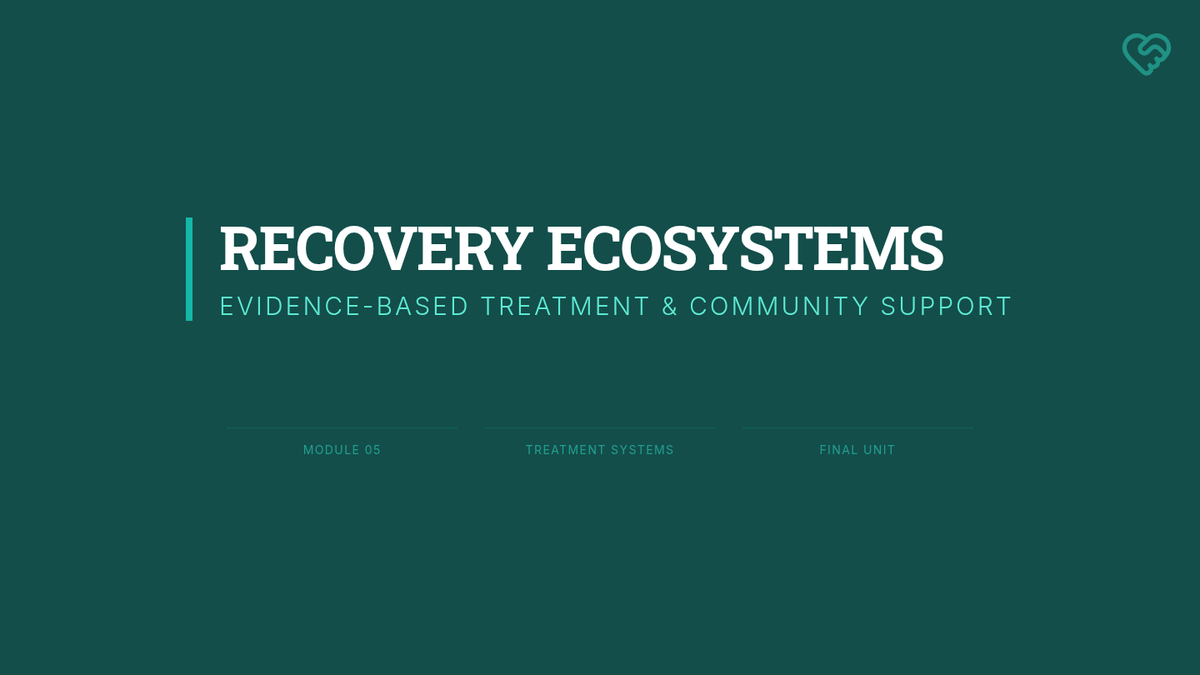
A comprehensive slide deck for Lesson 5, exploring Medication-Assisted Treatment (MAT), the biopsychosocial ecosystem model of recovery, and cognitive behavioral therapy (CBT). It emphasizes the synergy between biological and social supports.
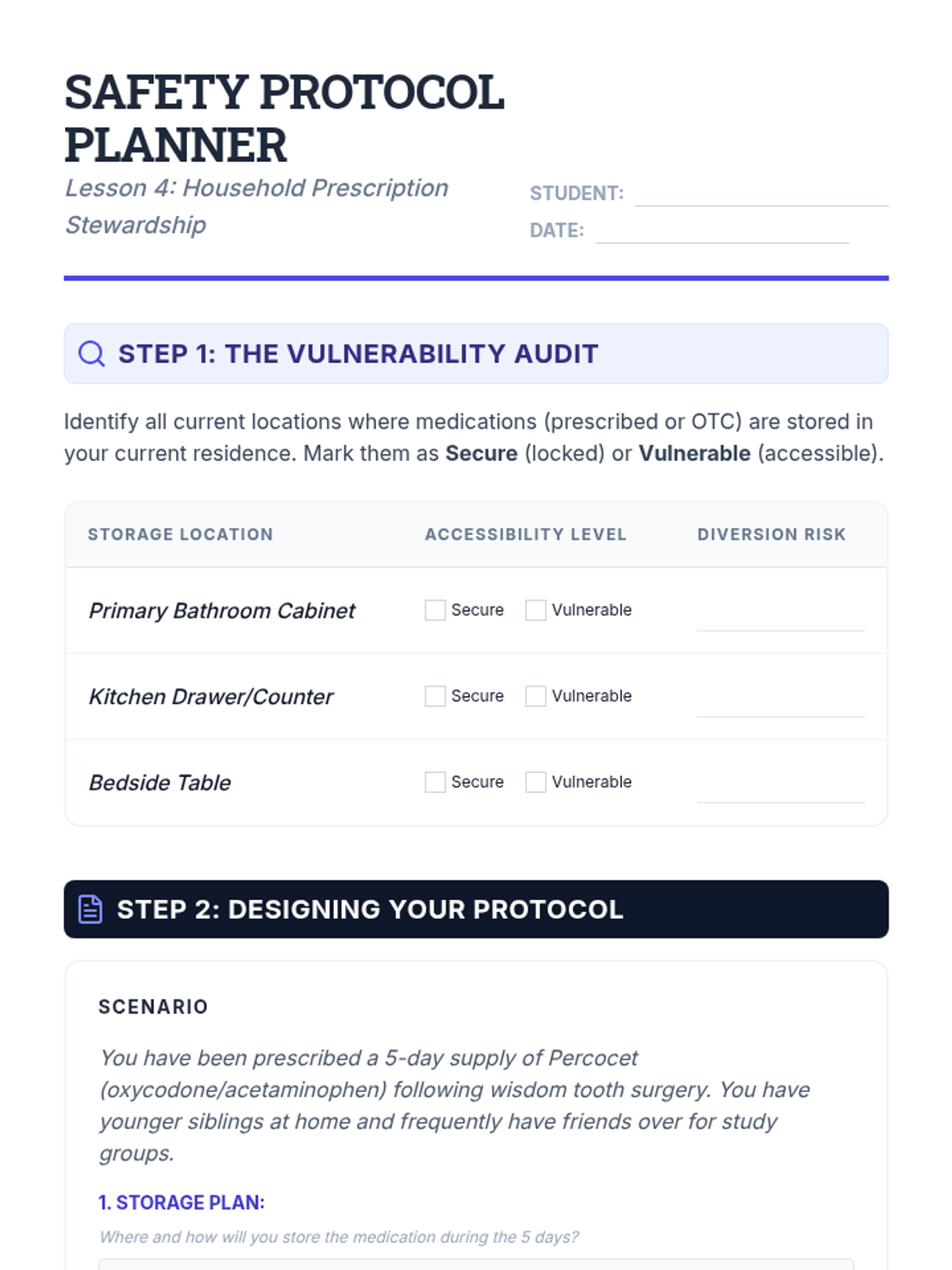
A household medication safety plan worksheet where students audit their current storage vulnerabilities, design a stewardship protocol for a surgical scenario, and research local safe-disposal locations.
A visual presentation for Lesson 4 that focuses on the ethics and practices of prescription stewardship, covering secure storage, diversion statistics, and safe disposal methods.
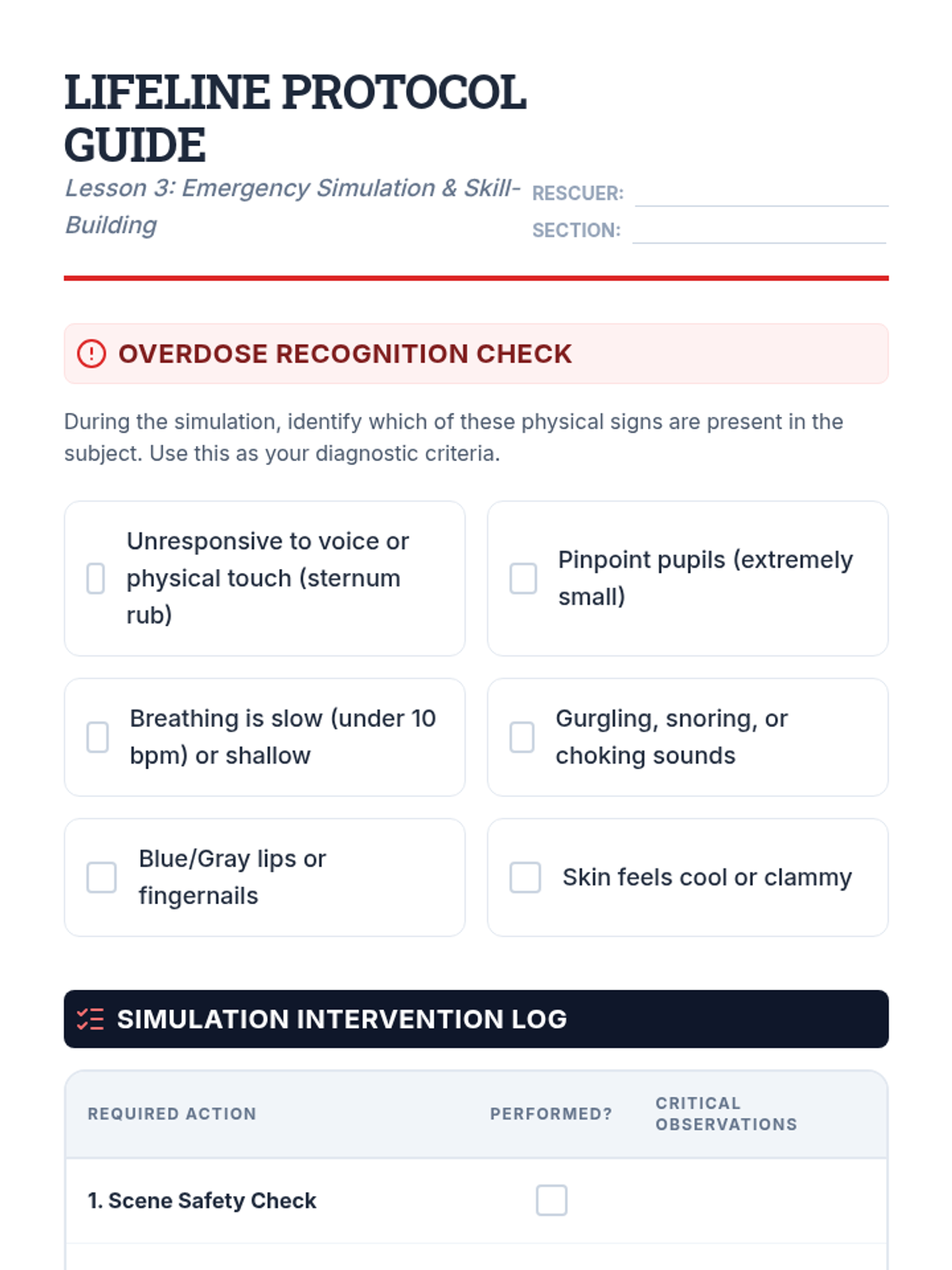
An emergency protocol checklist and simulation log for Lesson 3. Students use this guide during their practical intervention simulation to track clinical signs, document steps taken, and reflect on their performance.
A visual training presentation for Lesson 3, covering clinical signs of overdose, the pharmacology of Naloxone, step-by-step emergency protocols, and the legal protections of Good Samaritan laws.
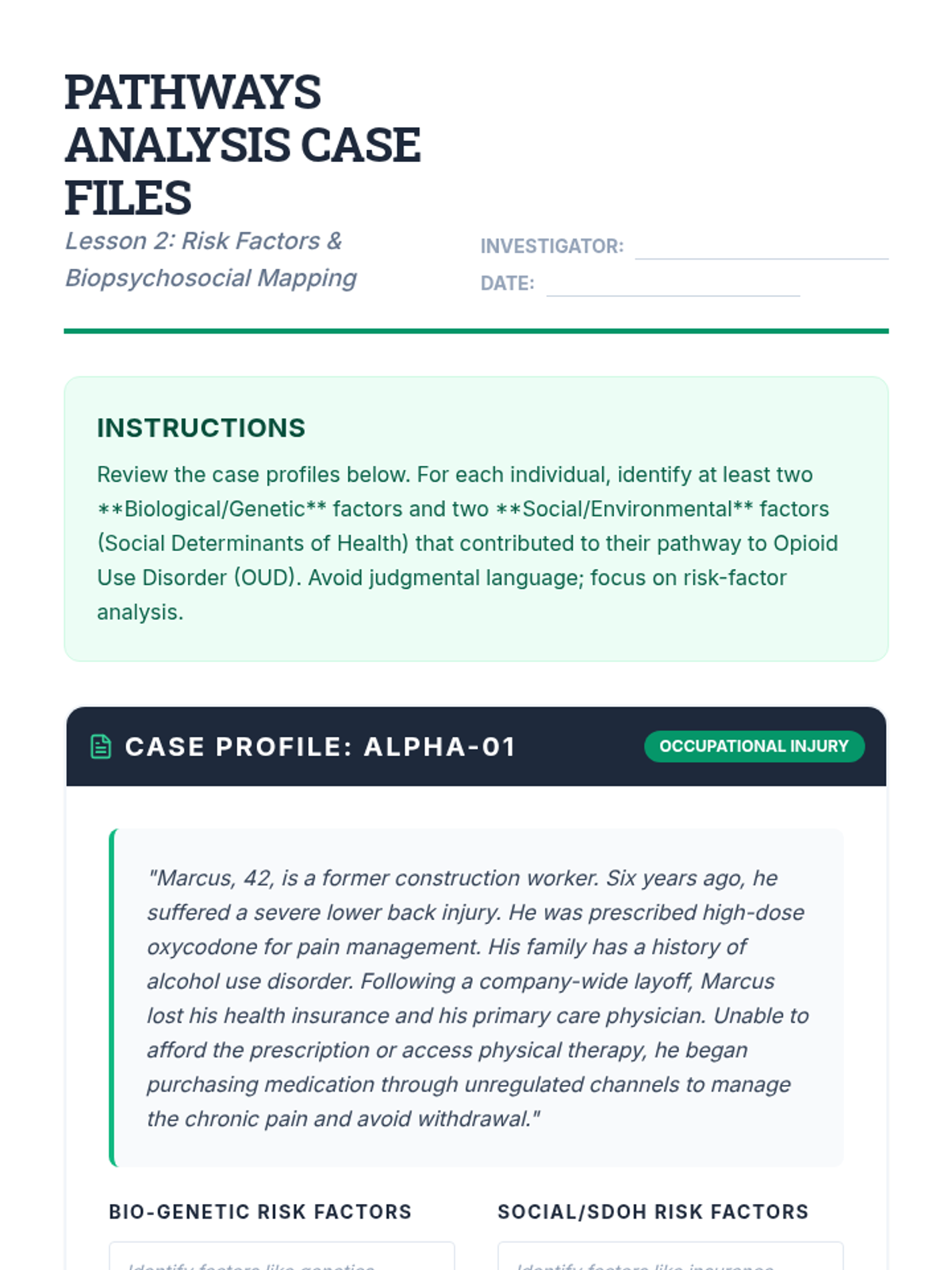
A student worksheet for Lesson 2 featuring two real-world case studies for analysis. Students identify biological and social risk factors (SDOH) for each case, moving beyond stereotypes toward a biopsychosocial understanding of addiction.