Fundamental techniques for racket sports, track and field, and gymnastics maneuvers. Develops physical literacy through martial arts disciplines and self-defense strategies.
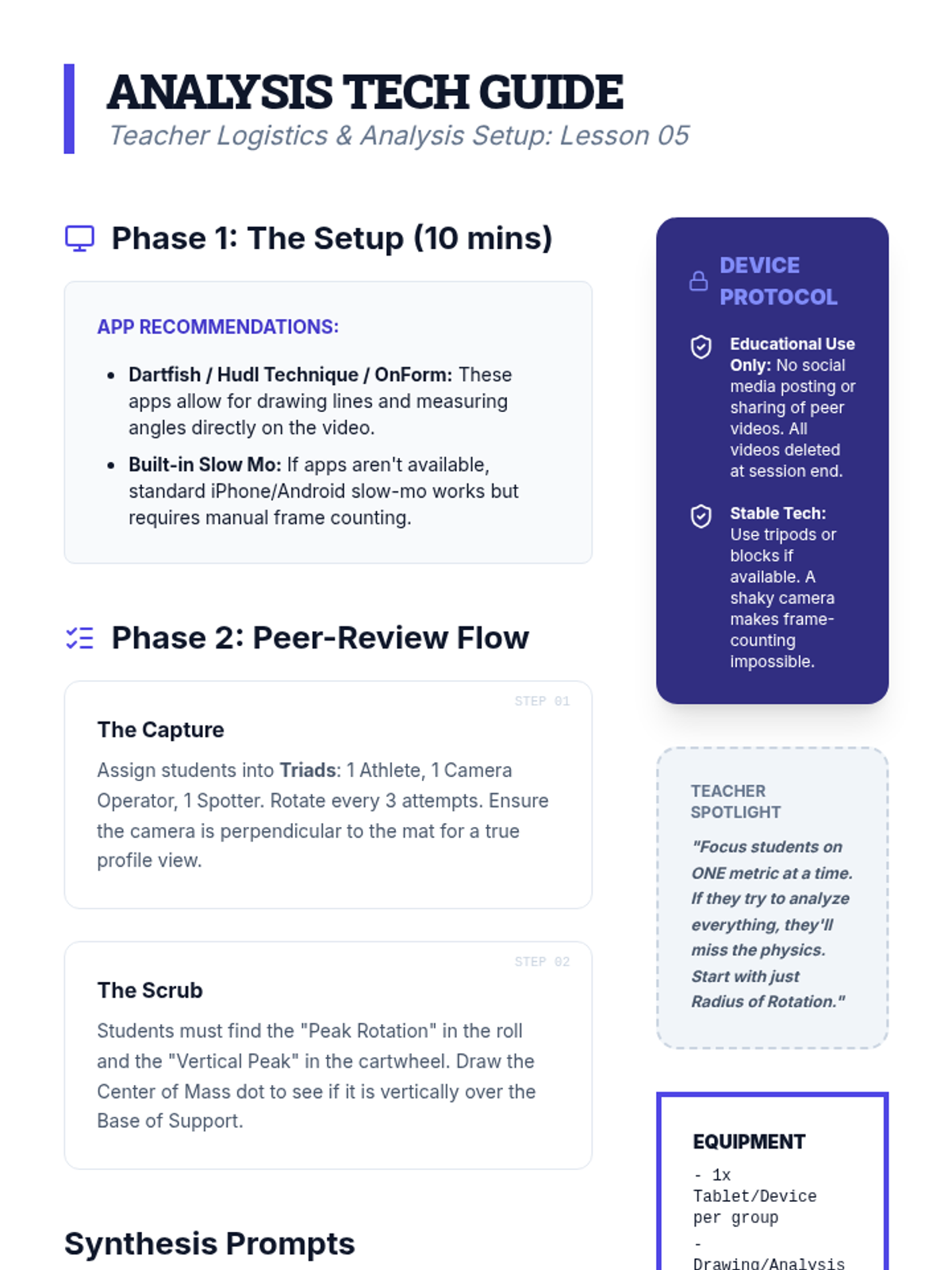
Teacher guide for Lesson 5, focusing on technology integration. Includes app recommendations, group management strategies (Triad system), and privacy/safety protocols for student video use.
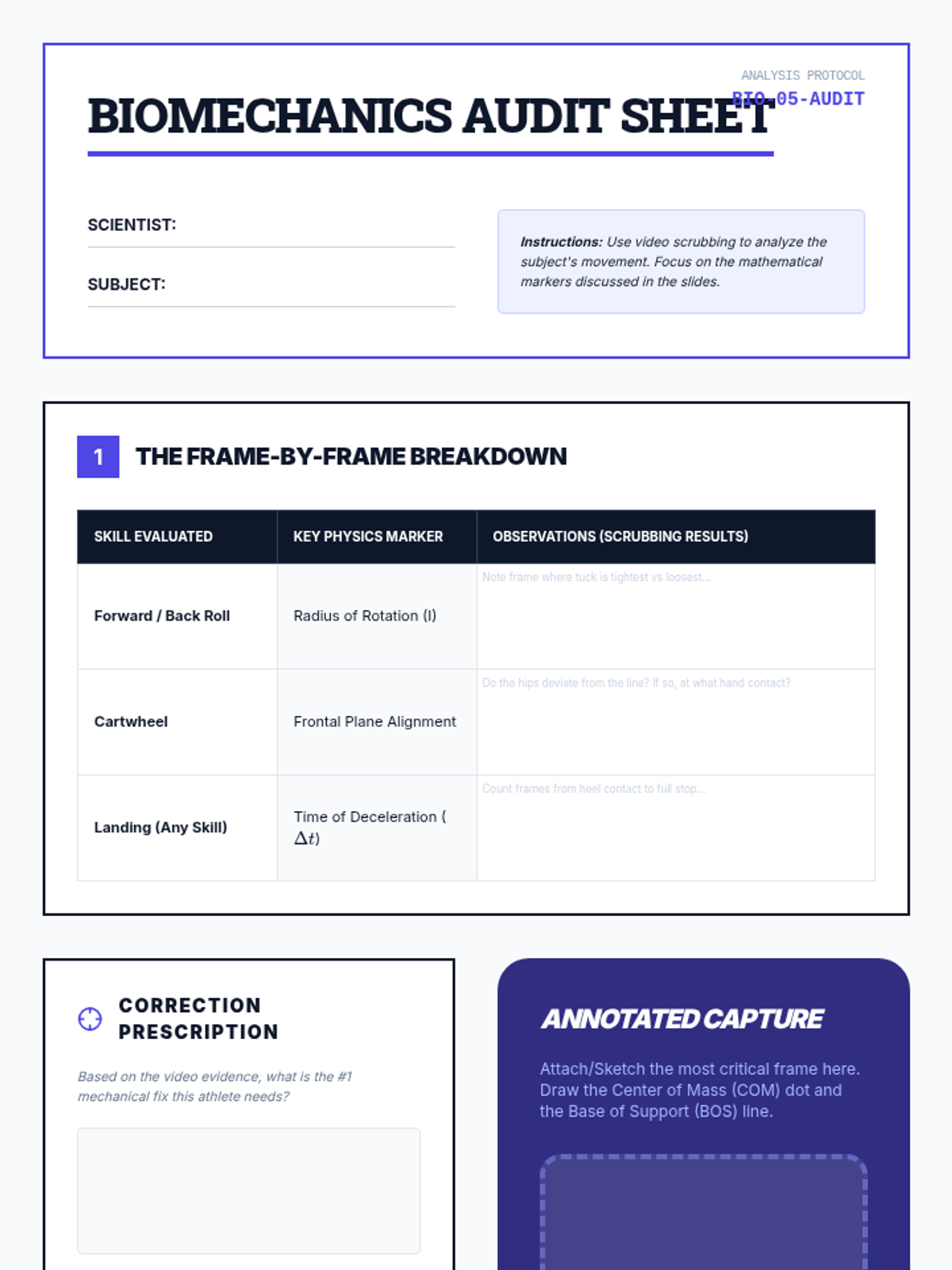
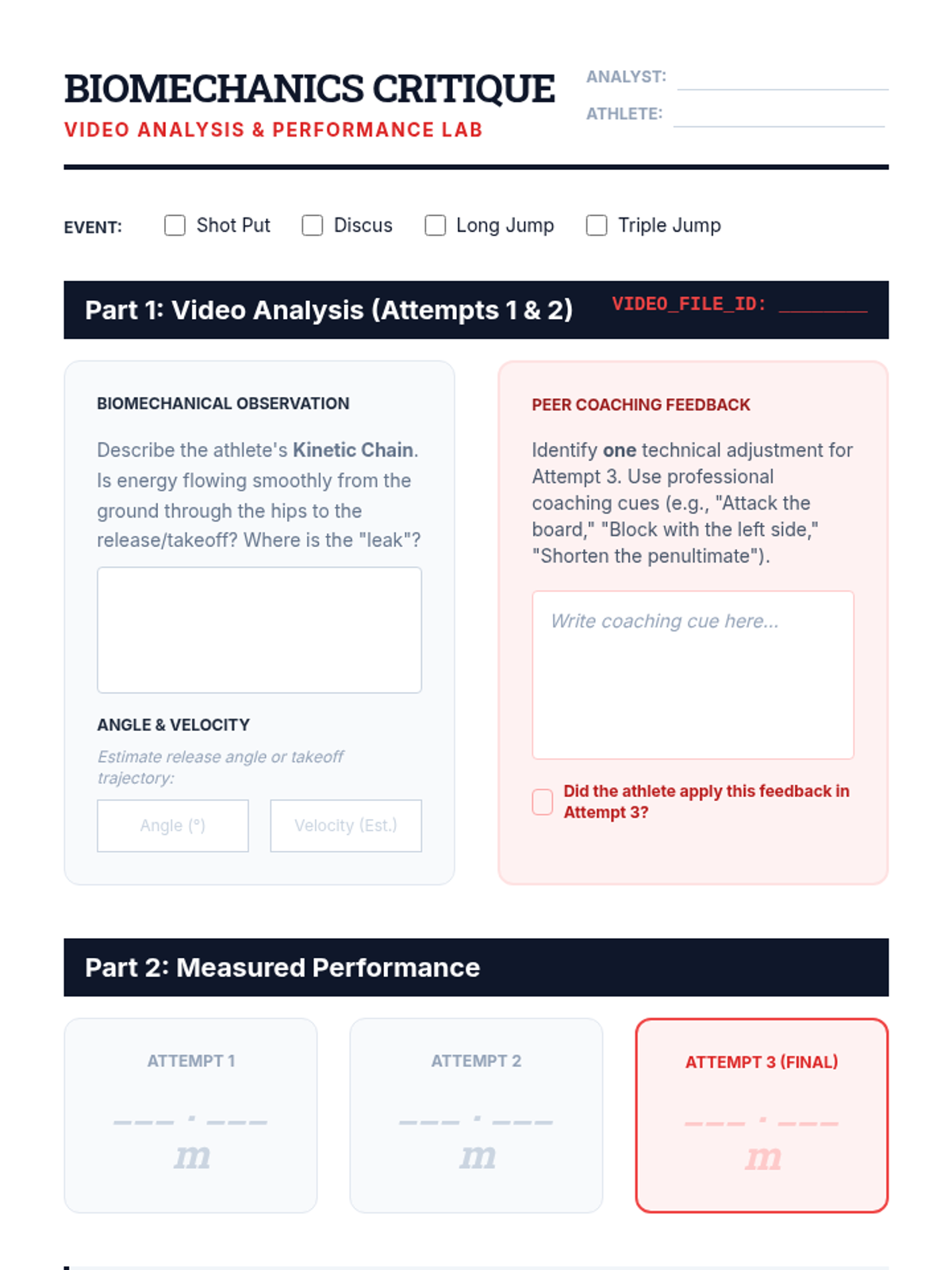
A student worksheet for Lesson 5 where students conduct a formal biomechanical audit using video analysis software. Includes sections for frame-counting, plane-deviation notes, and a prescription for correction.
Slides for Lesson 5 on video analysis. Covers how to use slow-motion markers (Radius, Plane, Time) and the protocol for peer-to-peer biomechanical feedback.
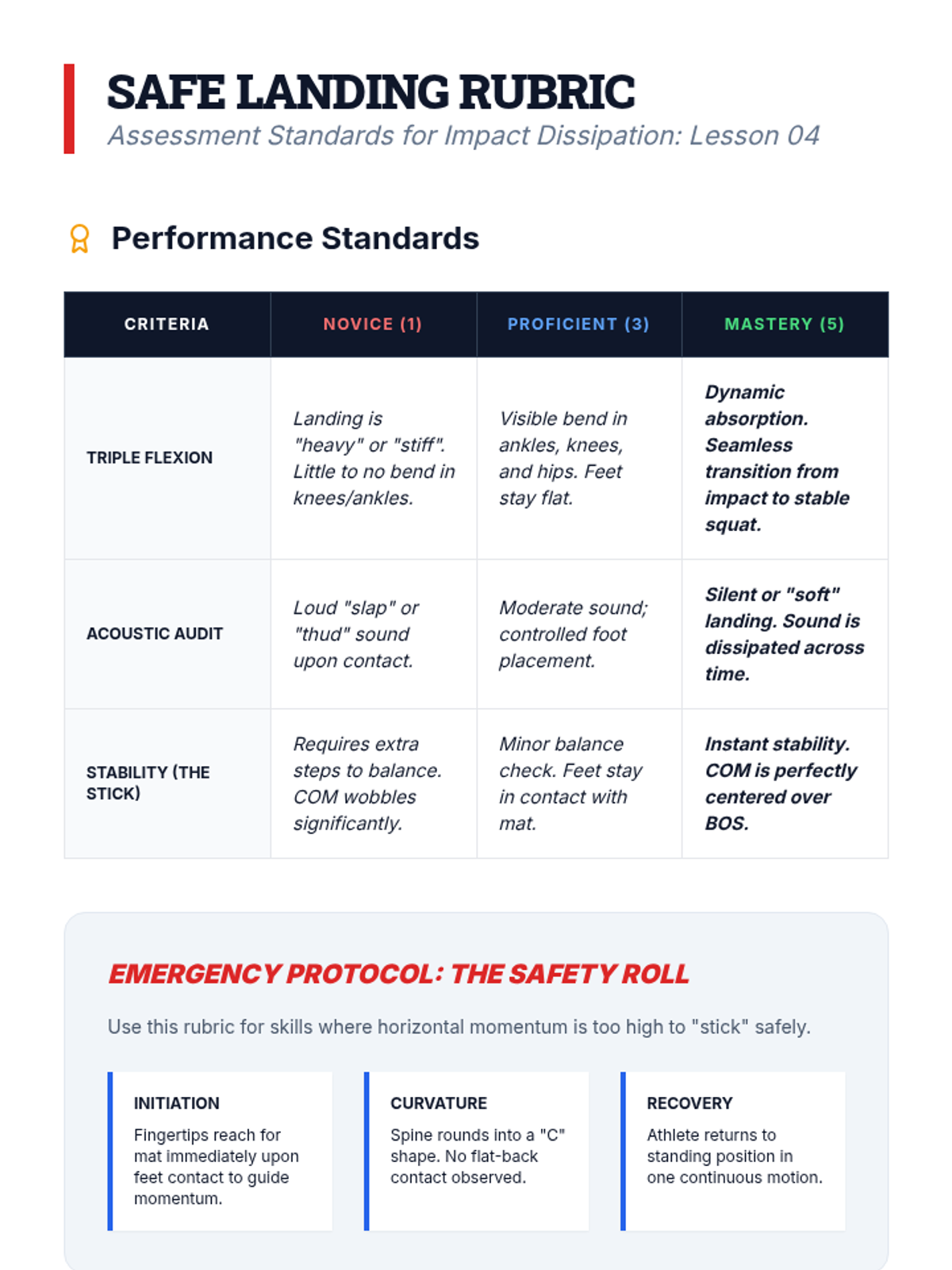
A professional assessment rubric for Lesson 4, evaluating student landing performance based on triple flexion, acoustic audit (sound of landing), and stability, plus specific standards for safety rolls.
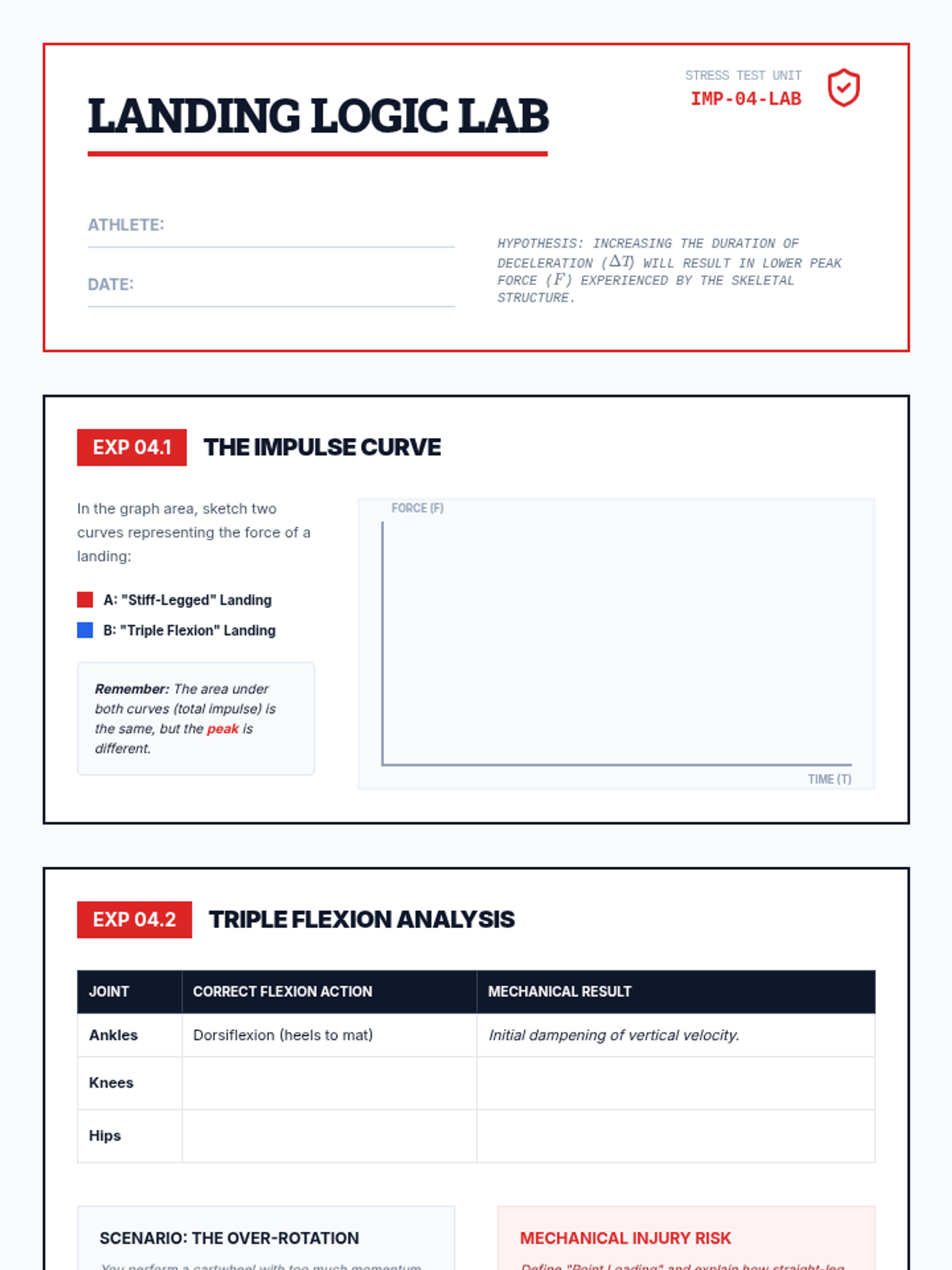
A student worksheet for Lesson 4 that guides students through graphing force-time curves for different landings and analyzing the biomechanics of triple flexion (ankles, knees, hips).
Slides for Lesson 4 on force absorption. Explains the impulse-momentum theorem, triple flexion, and the difference between stuck landings and safety rolls.
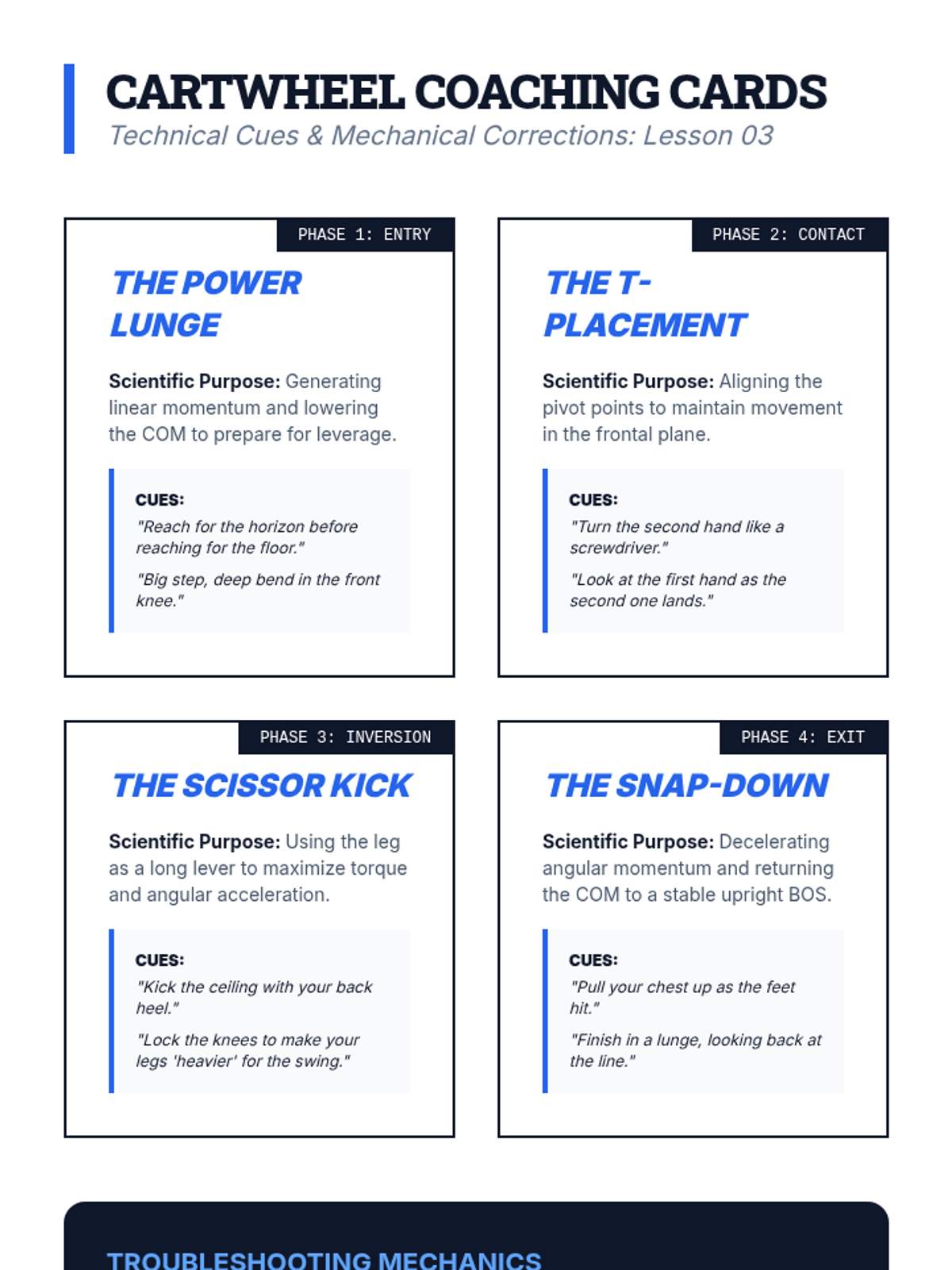
Detailed coaching cards for Lesson 3, breaking down the cartwheel into four phases (Lunge, Contact, Inversion, Exit) with scientific purposes and specific cues for each.
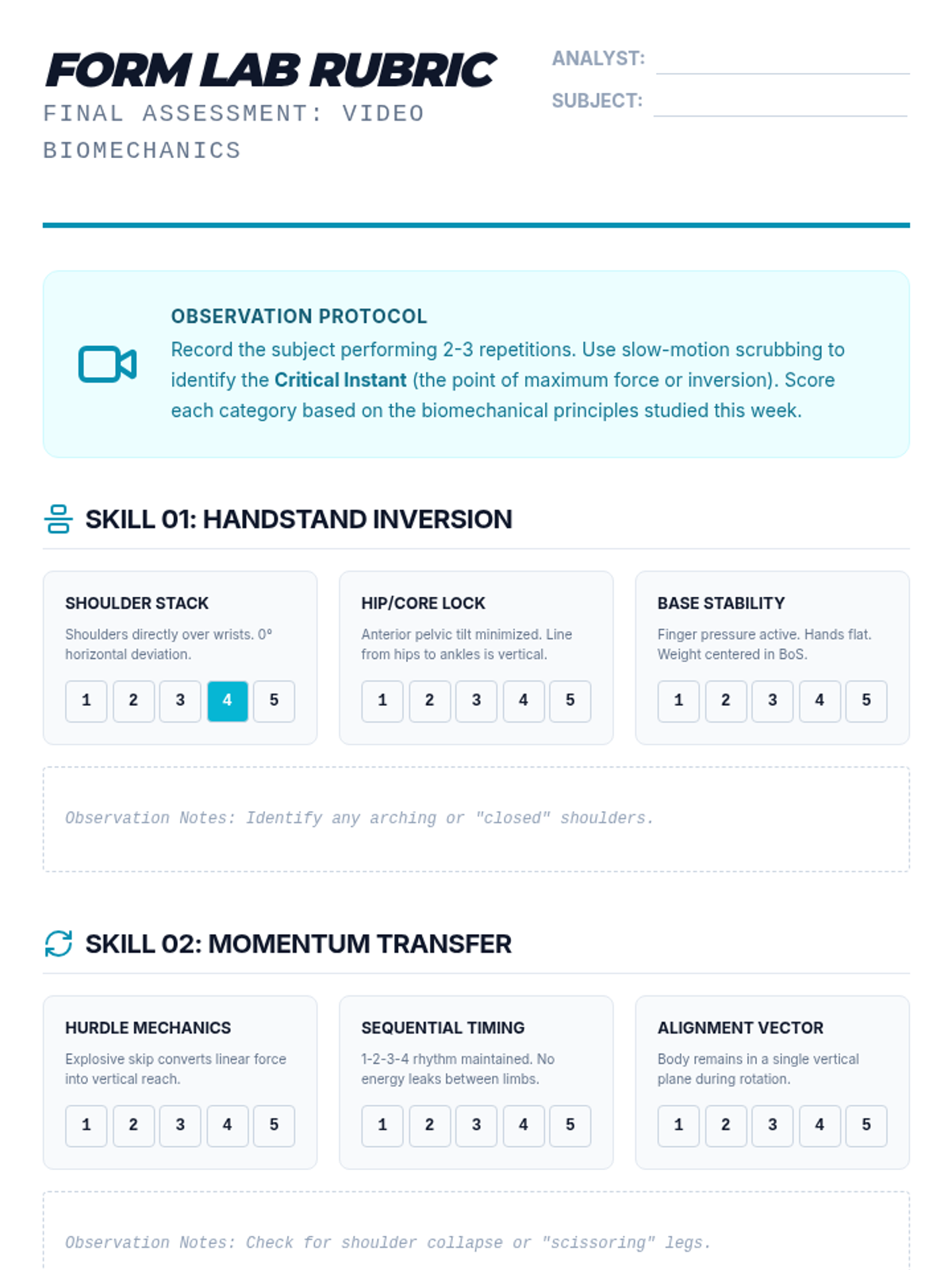
A biomechanical rubric for Lesson 5 where students analyze video footage of gymnastics skills to identify form errors and suggest corrections based on physics.
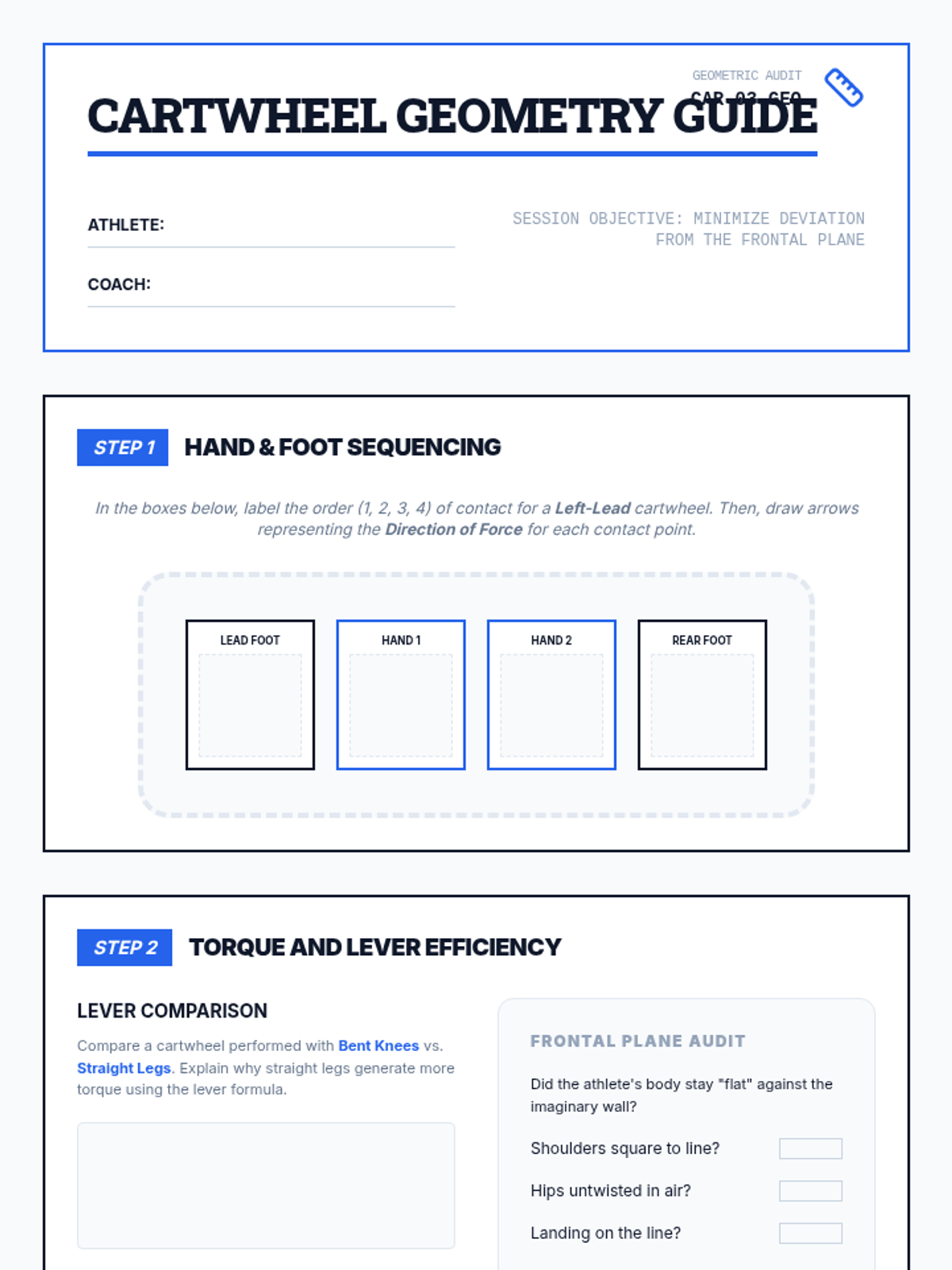
A student worksheet for Lesson 3 where students map out the hand-foot contact sequence for cartwheels and analyze the leverage of straight legs versus bent legs.
Slides for Lesson 3 focusing on leverage and momentum in cartwheels. Covers torque, lever length, sequence of movement, and lateral plane alignment.
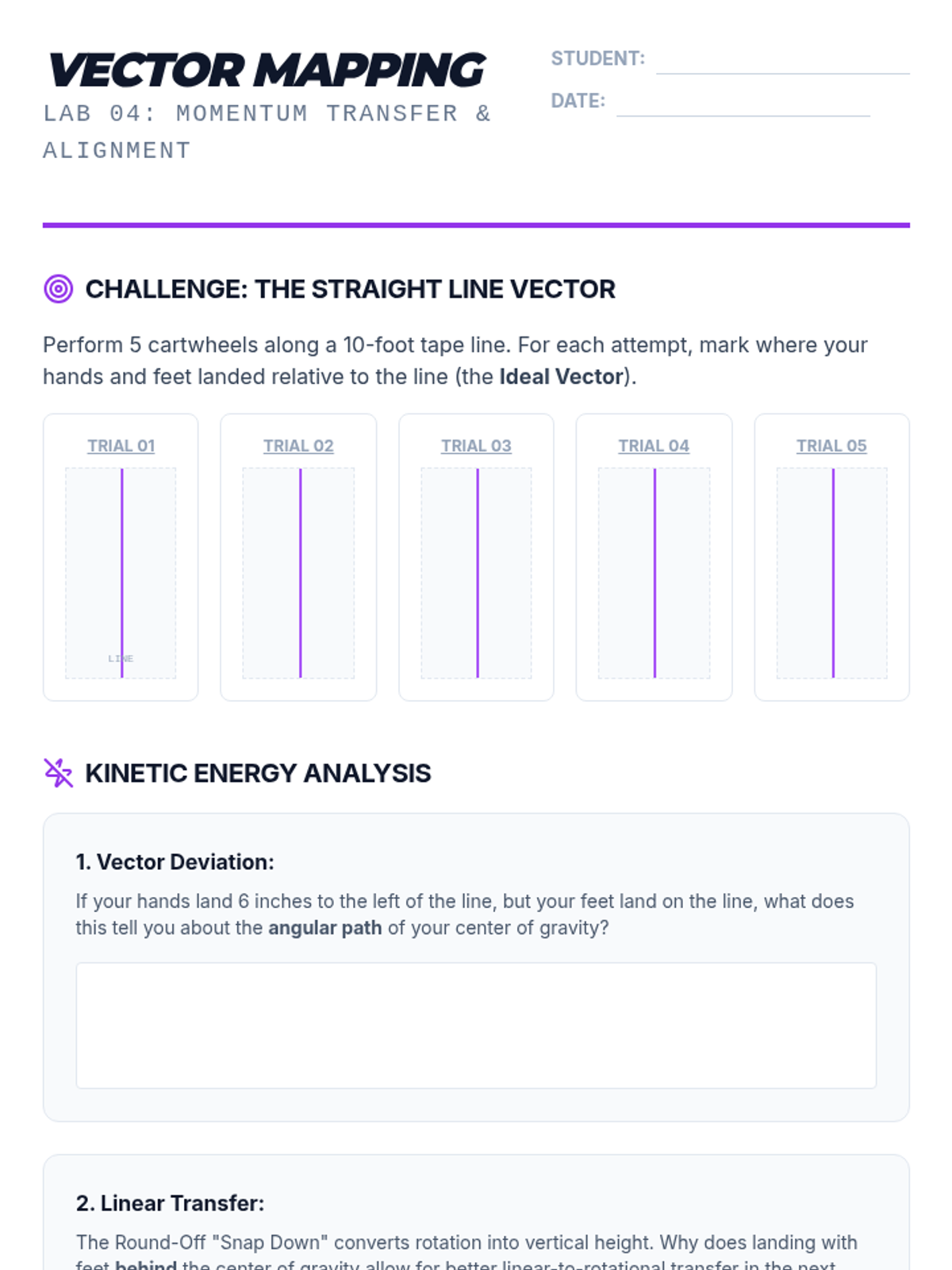
A mapping worksheet for Lesson 4 where students record their cartwheel alignment data and analyze momentum transfer vectors.
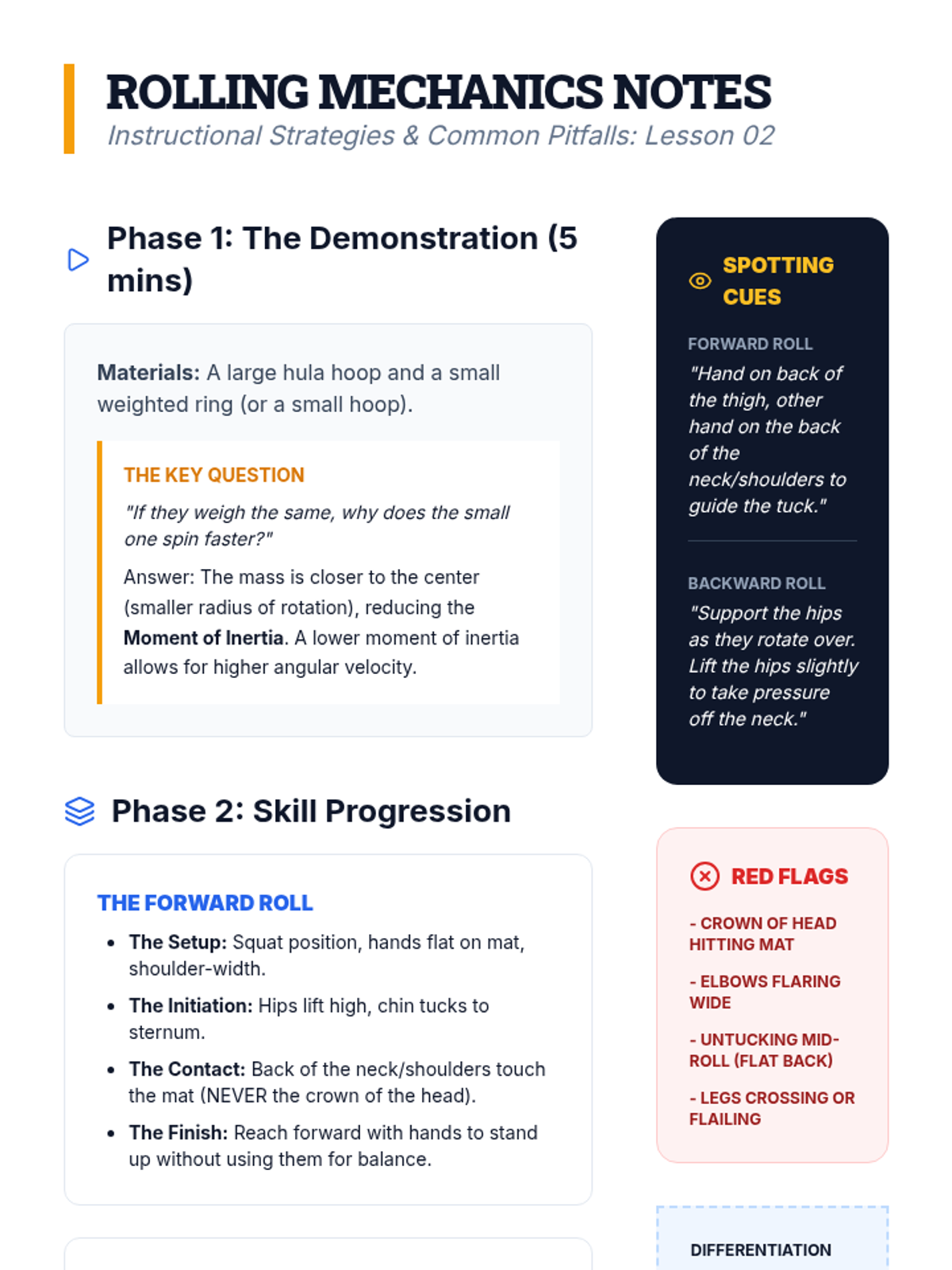
Teacher-facing notes for Lesson 2, providing demonstration tips for rotational inertia, specific coaching cues for forward and backward rolls, and safety red flags to watch for.
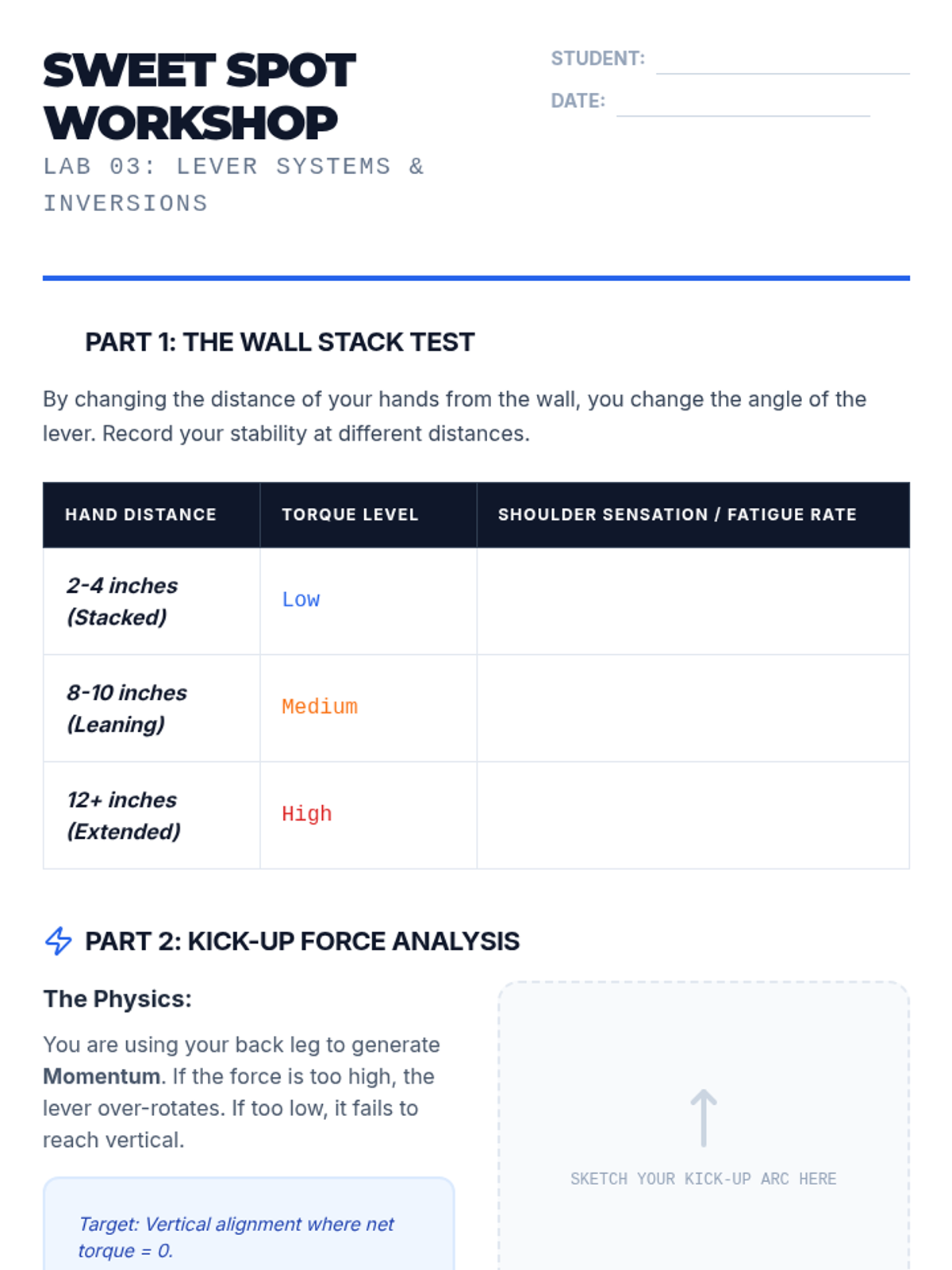
A workshop activity sheet for Lesson 3 where students record data from wall-supported handstand drills to analyze shoulder stacking and lever mechanics.
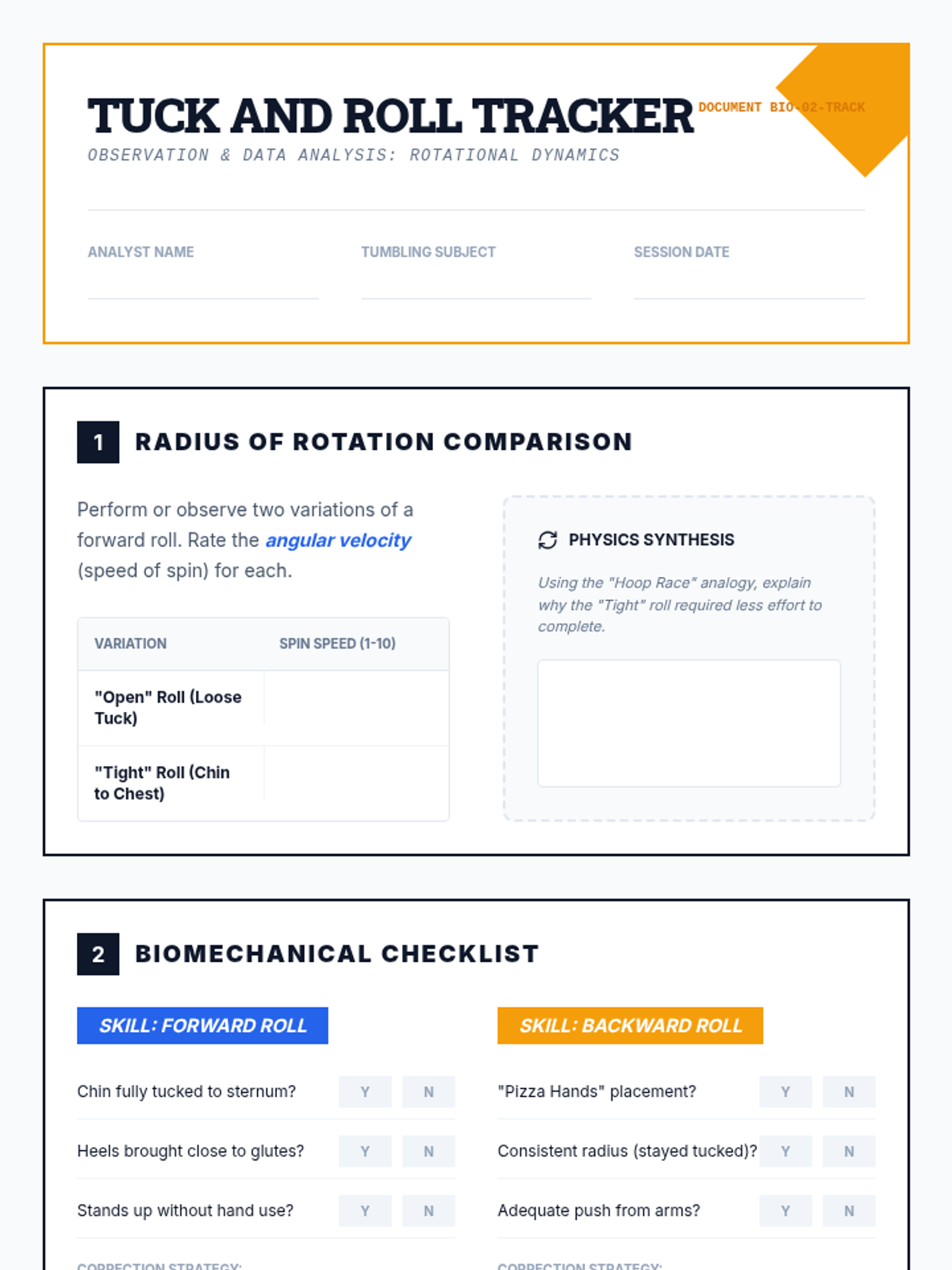
A student worksheet for Lesson 2 that requires students to track rotational speed based on body tuck tightness and conduct peer biomechanical critiques for forward and backward rolls.
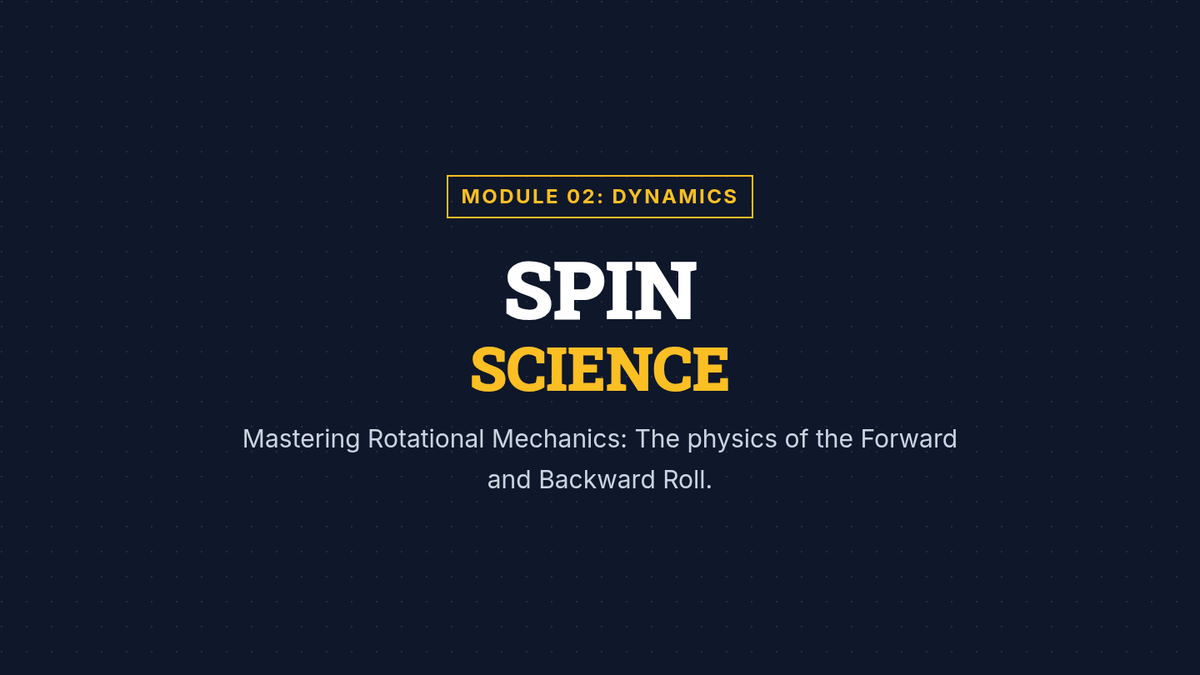
Slides for Lesson 2 focusing on rotational mechanics. Covers angular momentum, radius of rotation, and the biomechanics of tucking for forward and backward rolls.
Lesson 5 slide deck for the Biomechanical Video Analysis lab, guiding students through recording and analyzing their movement.
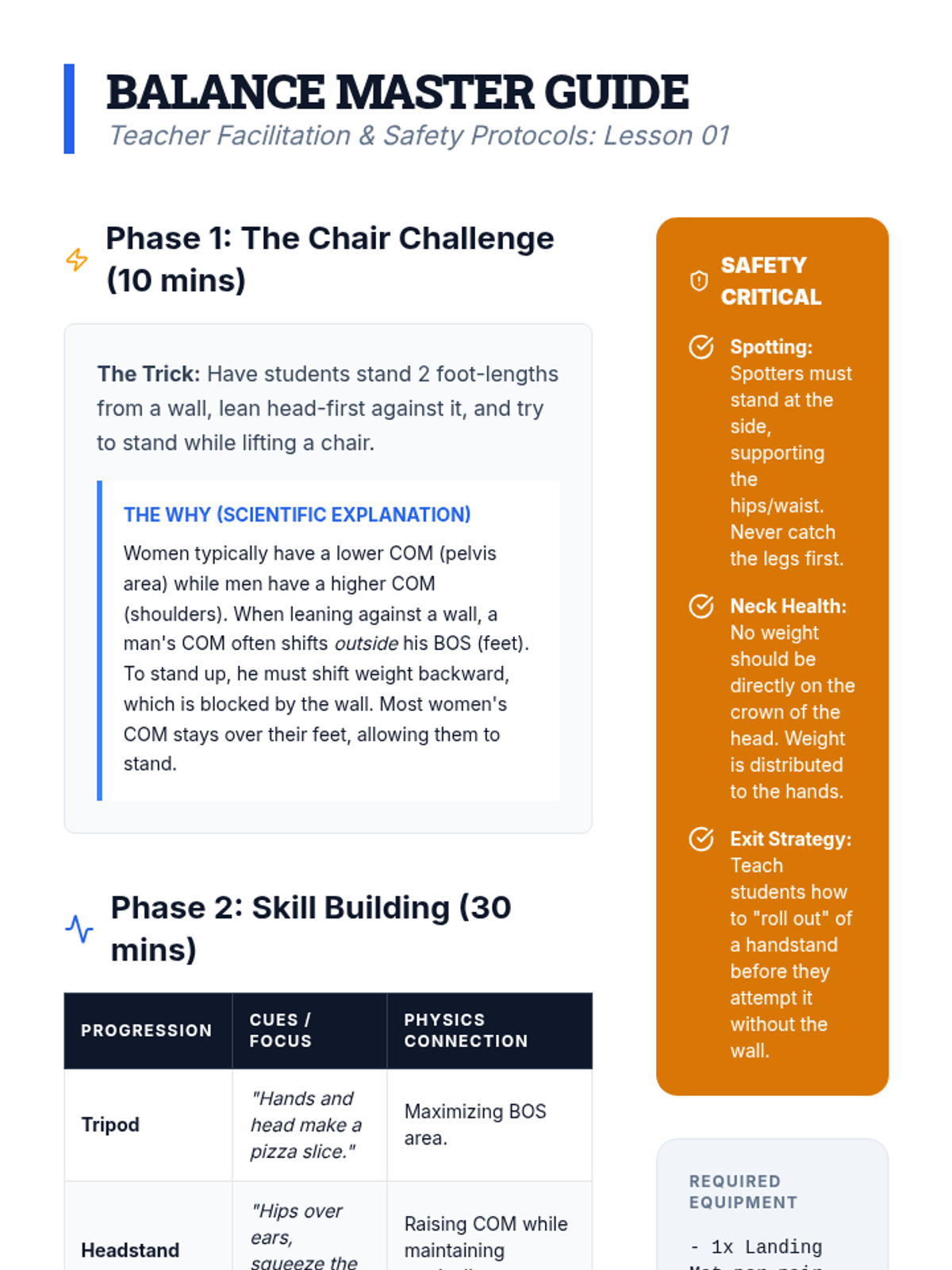
A comprehensive teacher guide for Lesson 1, detailing the instructional flow, safety protocols, cues for skill progressions, and the scientific explanation for the "Unliftable Chair" hook.
Lesson 4 slide deck analyzing momentum transfer in cartwheels and round-offs, focusing on the hurdle and sequential placement.
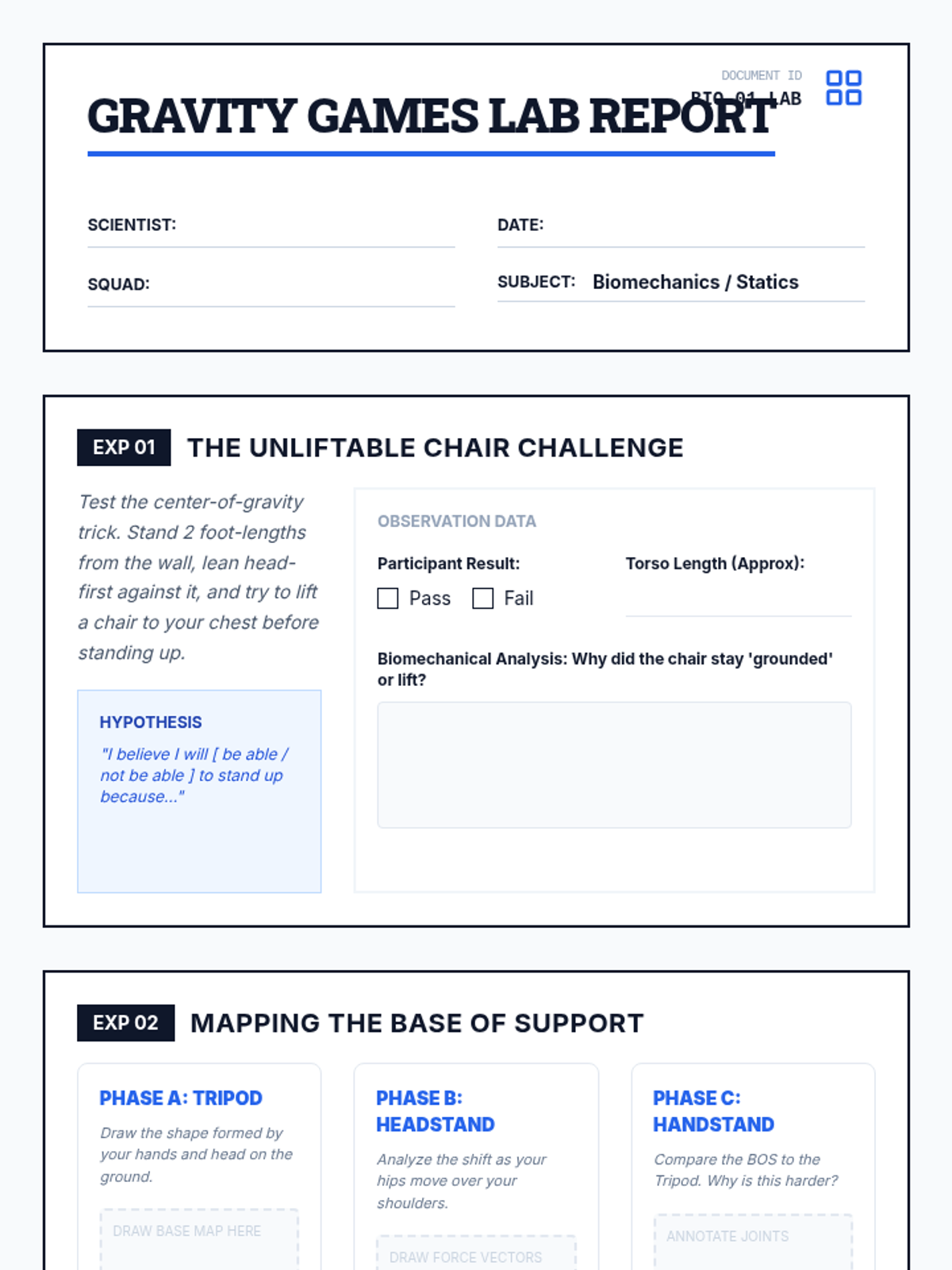
A laboratory-style student worksheet for Lesson 1 where students record observations from the "Unliftable Chair" challenge and map out their Base of Support for various tumbling inversions.
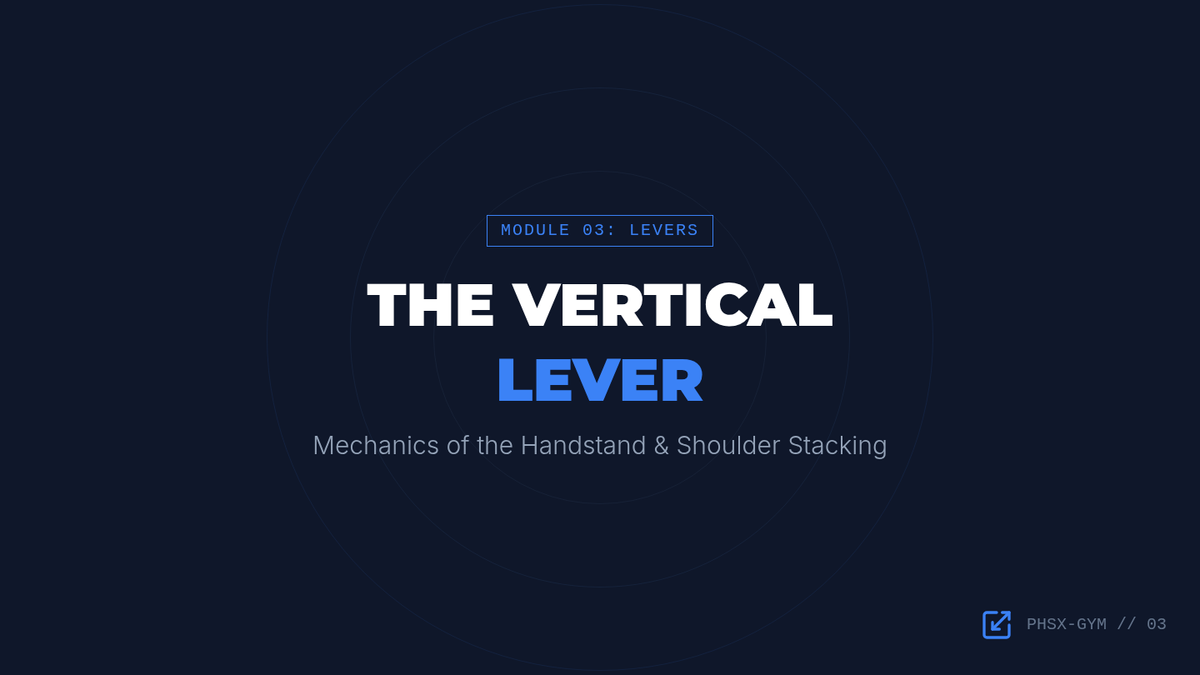
Lesson 3 slide deck analyzing the handstand as a lever system, focusing on kick-up mechanics and shoulder stacking.
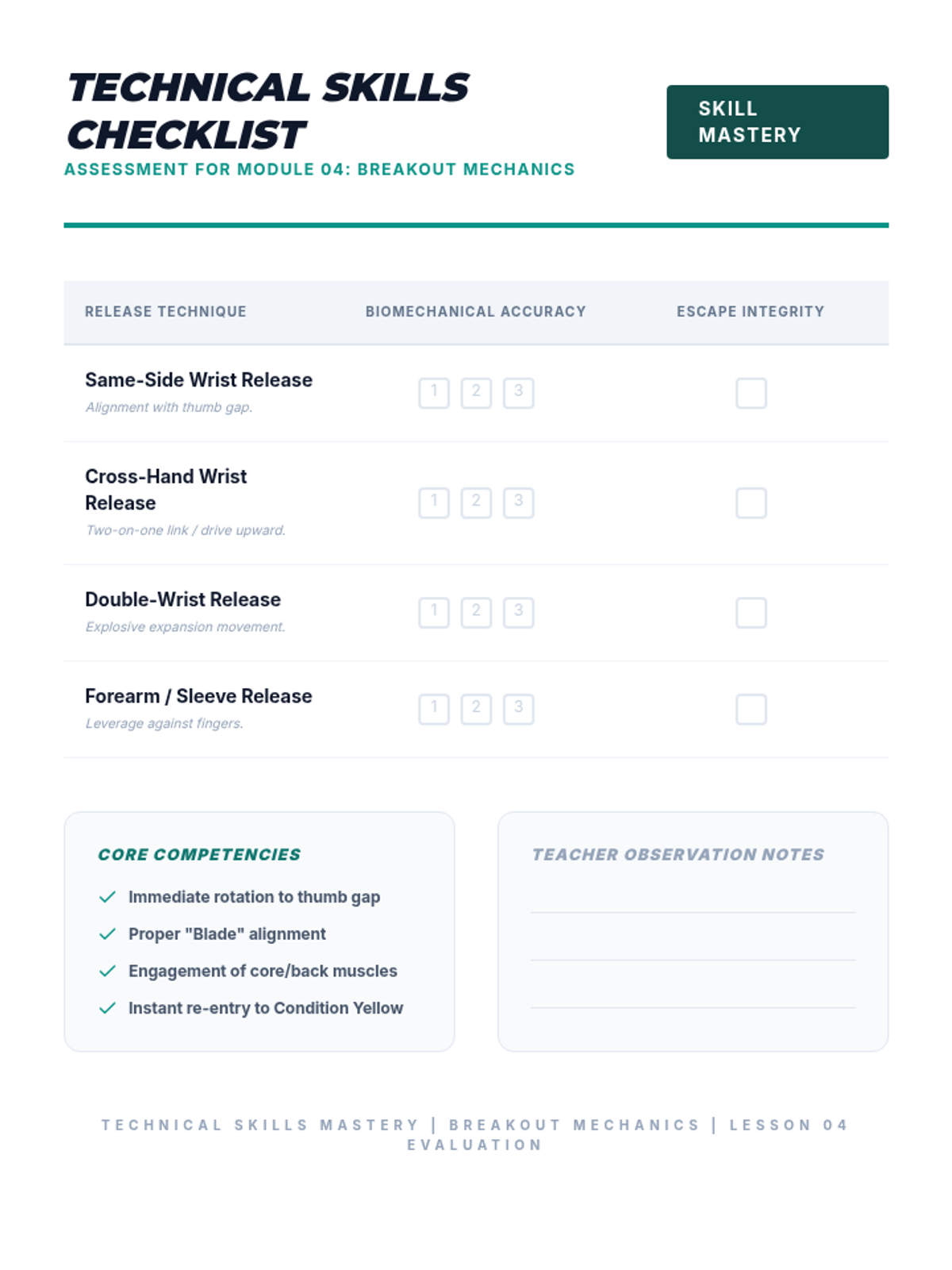
Teacher-facing checklist for evaluating student technical mastery of wrist and arm releases, focusing on biomechanical accuracy and escape integrity.
Student worksheet for mapping anatomical contact points and analyzing the biomechanics of clinch-range strikes.
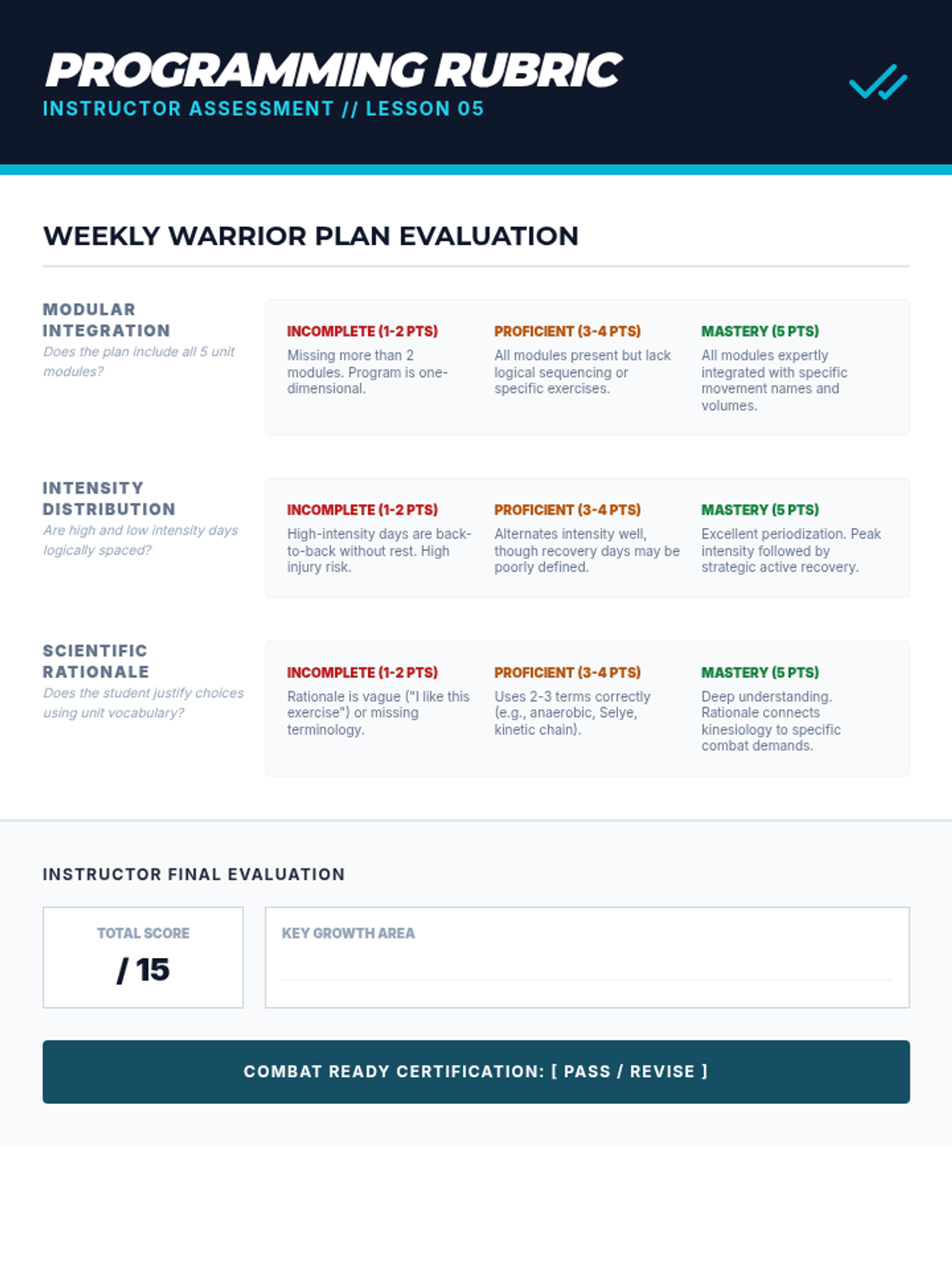
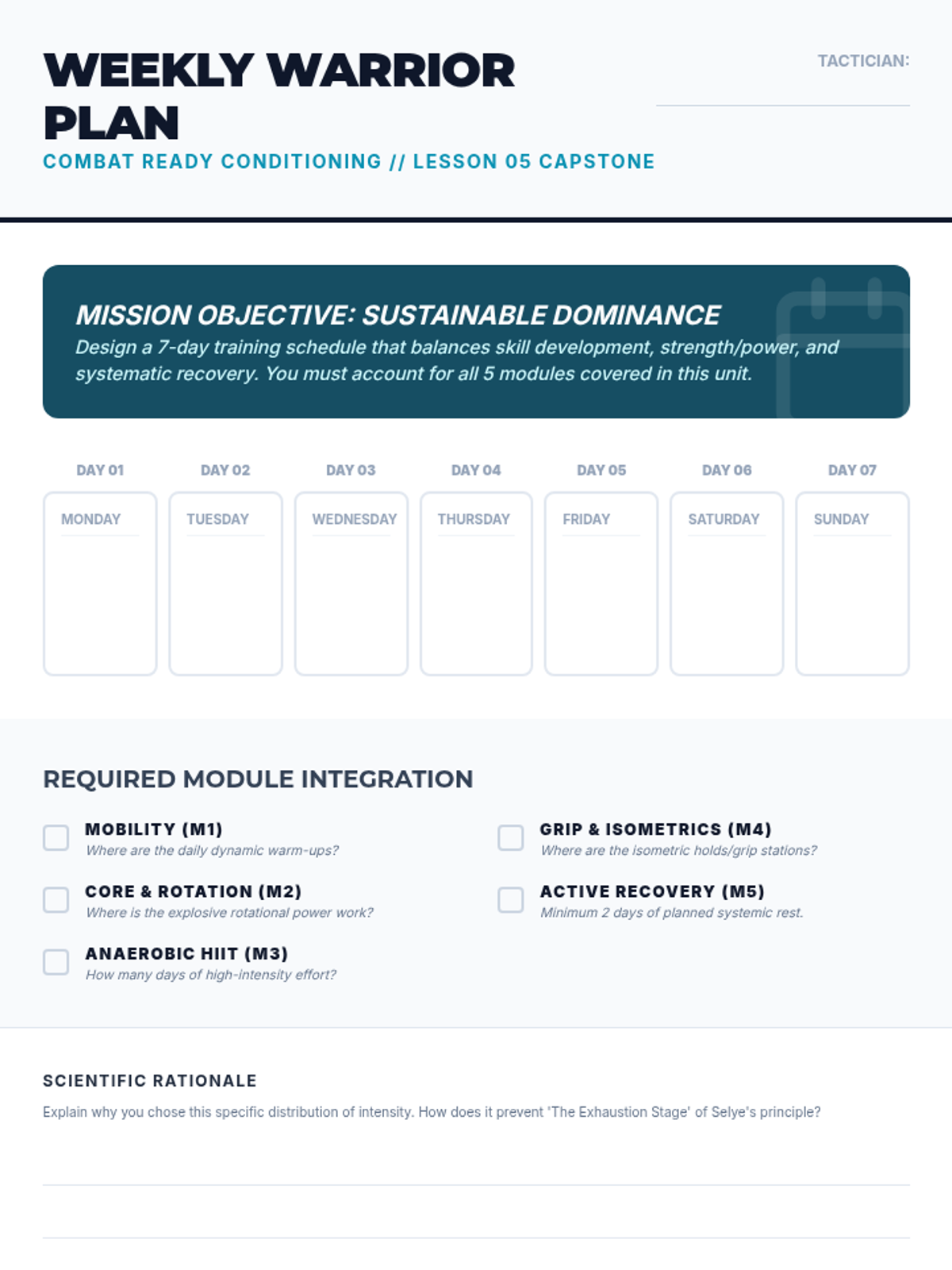
An assessment rubric for the Weekly Warrior Plan, evaluating students on modular integration, intensity distribution, and the application of scientific principles to their program design.
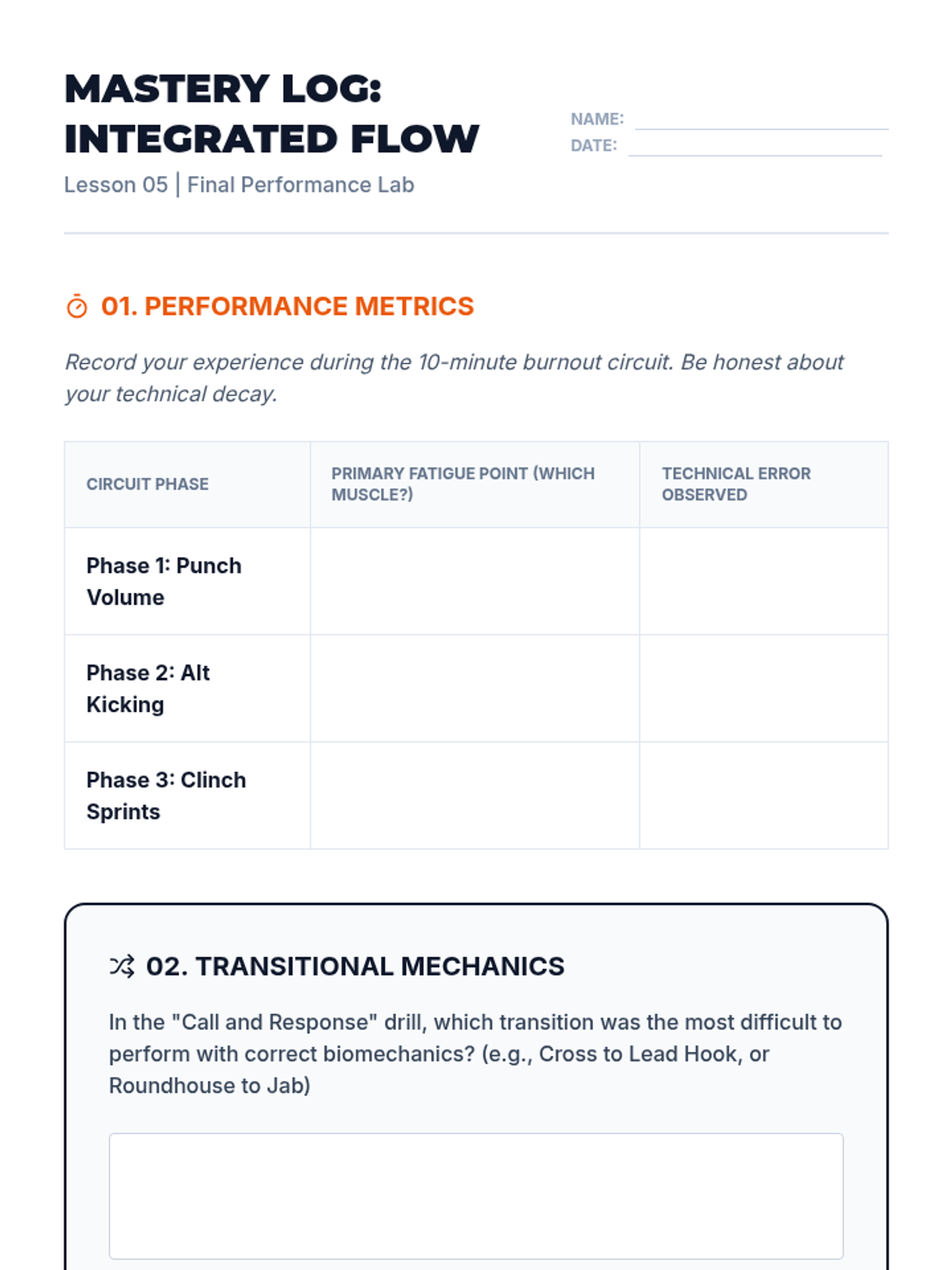
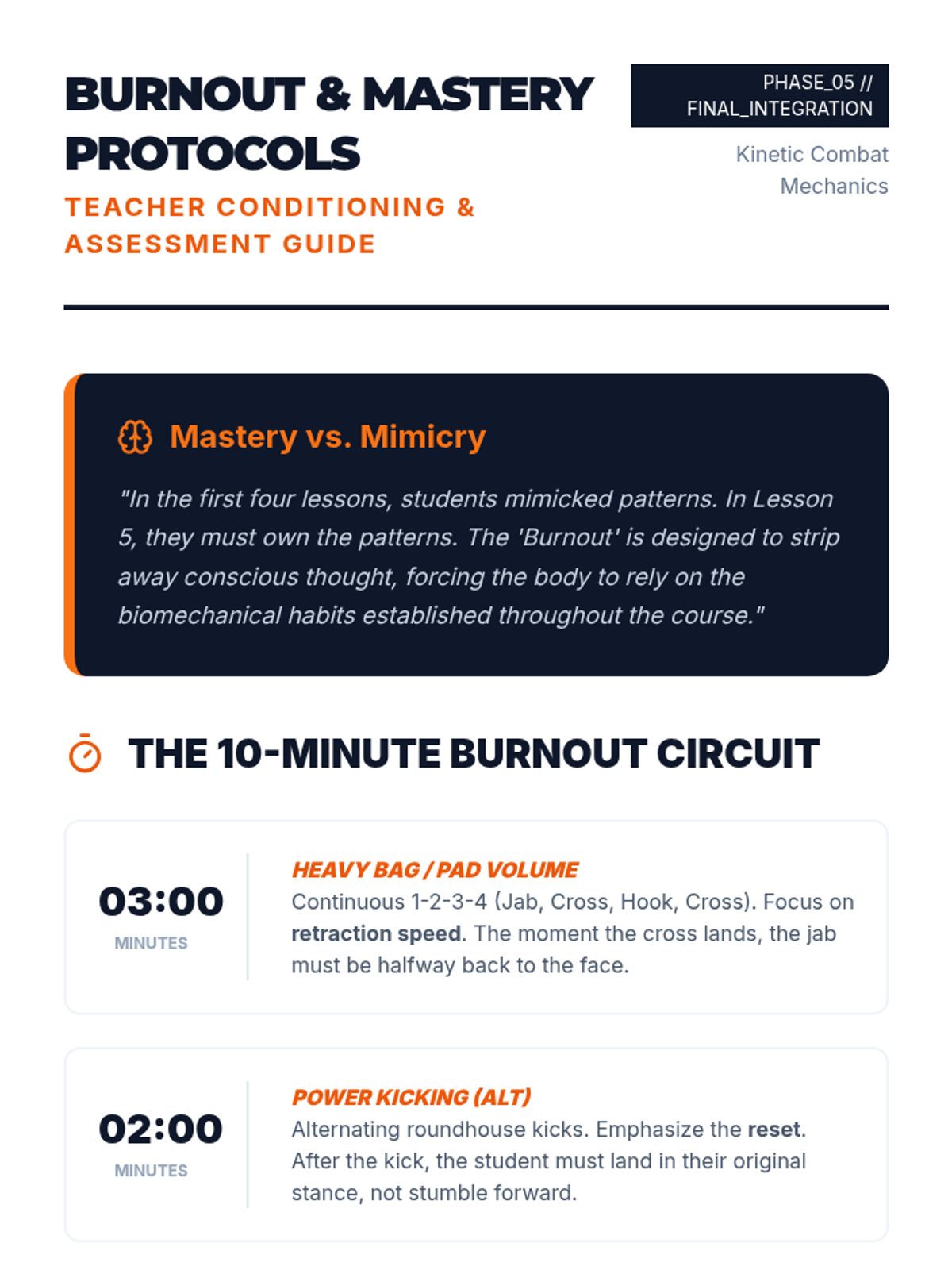
Teacher facilitation guide for the final burnout phase, including conditioning circuits, reaction drills, and technical mastery indicators.
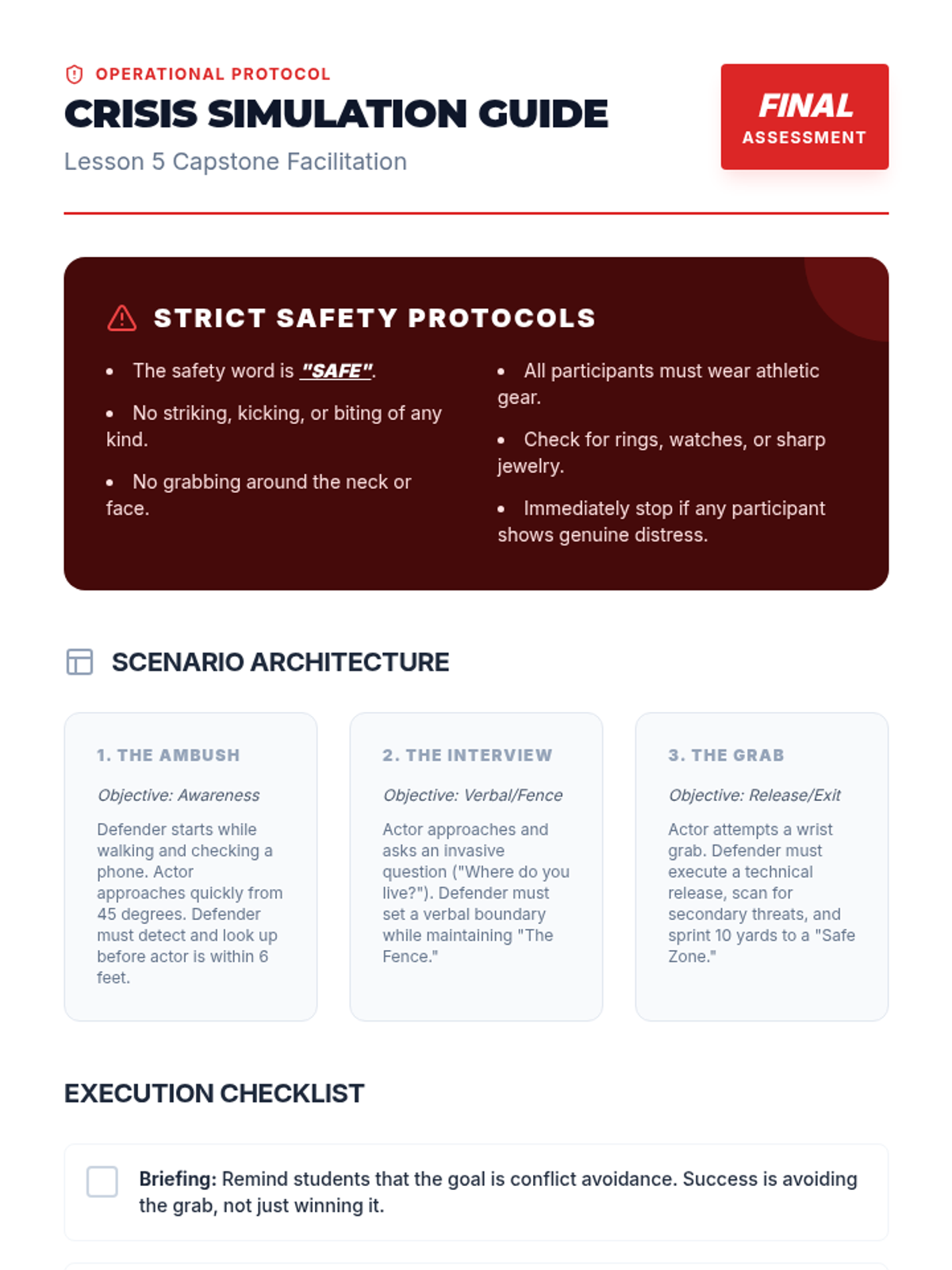
Facilitation guide for teachers covering the Lesson 5: Crisis Simulation. Includes safety protocols, scenario architecture, and debriefing questions for high-intensity training.
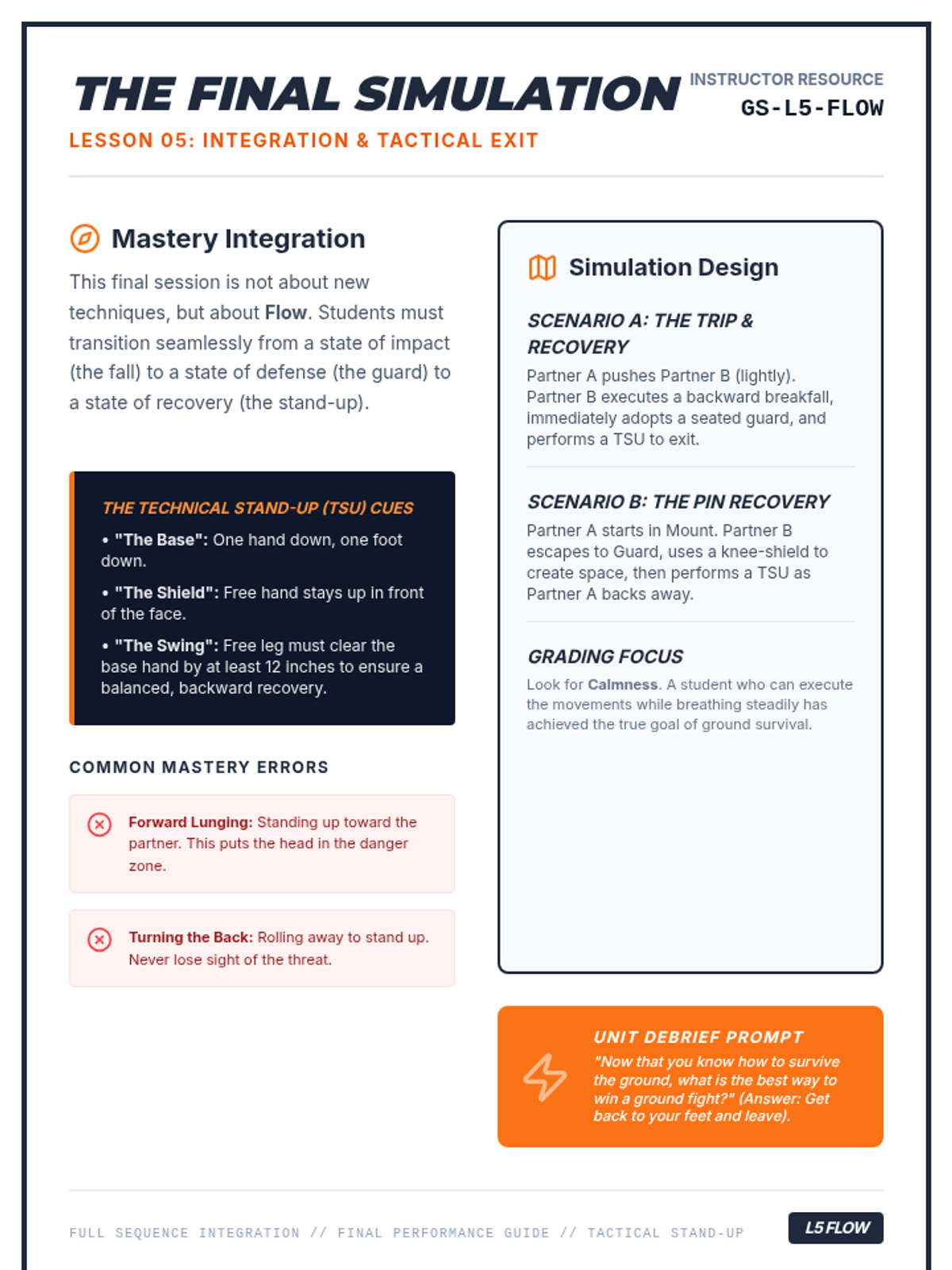
A teacher guide for Lesson 5 covering the mechanics of the technical stand-up and providing structure for the final scenario-based simulations.
The capstone project for the unit where students design a comprehensive weekly training schedule that integrates all five conditioning modules (Mobility, Core, HIIT, Grip, and Recovery).
Visual presentation slides focusing on transitional mechanics, combination flow, and the integration of all striking tools for the final assessment.
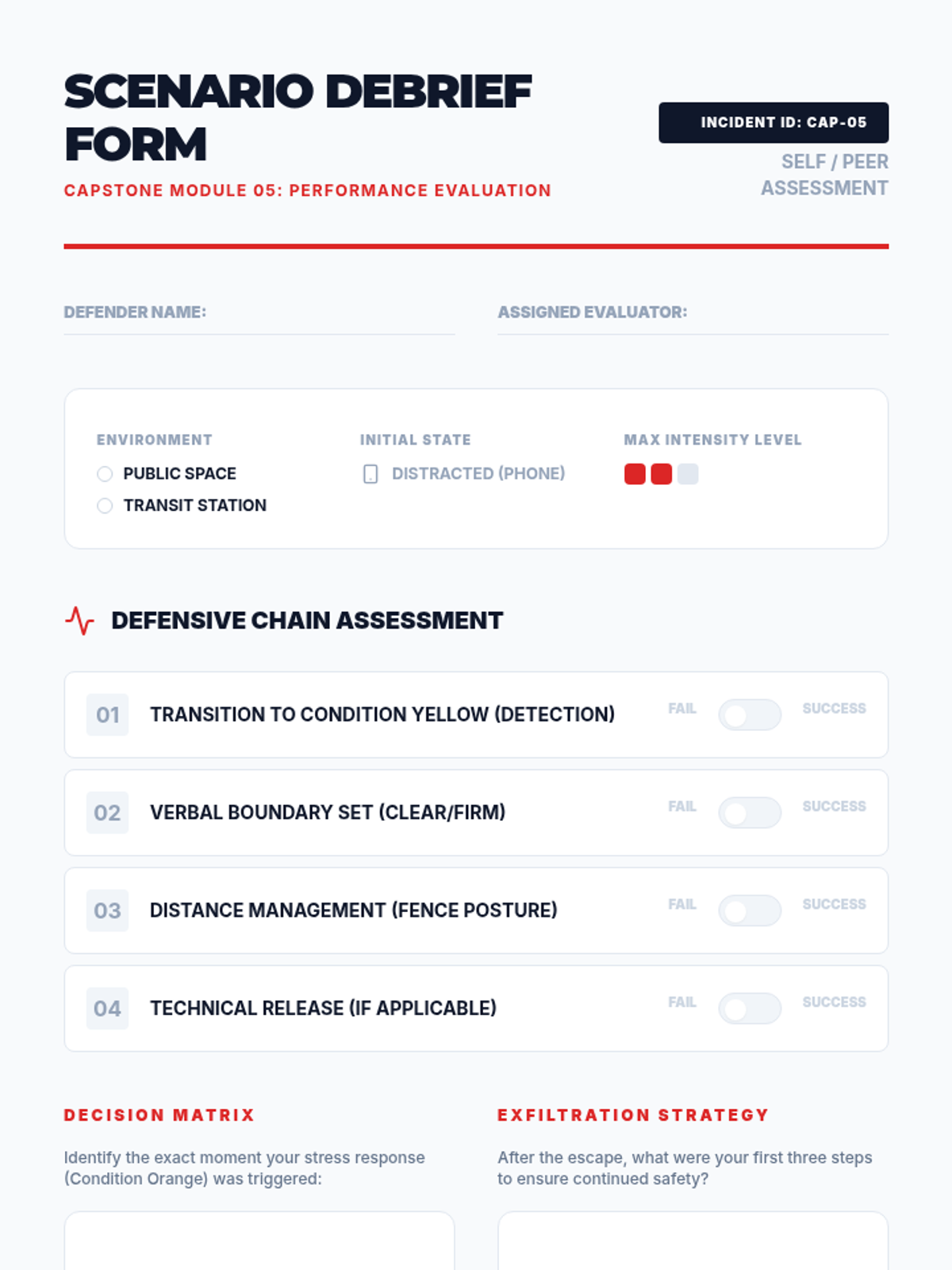
Peer-evaluation and self-reflection form for students to analyze their performance during the high-intensity capstone simulations in Lesson 5.
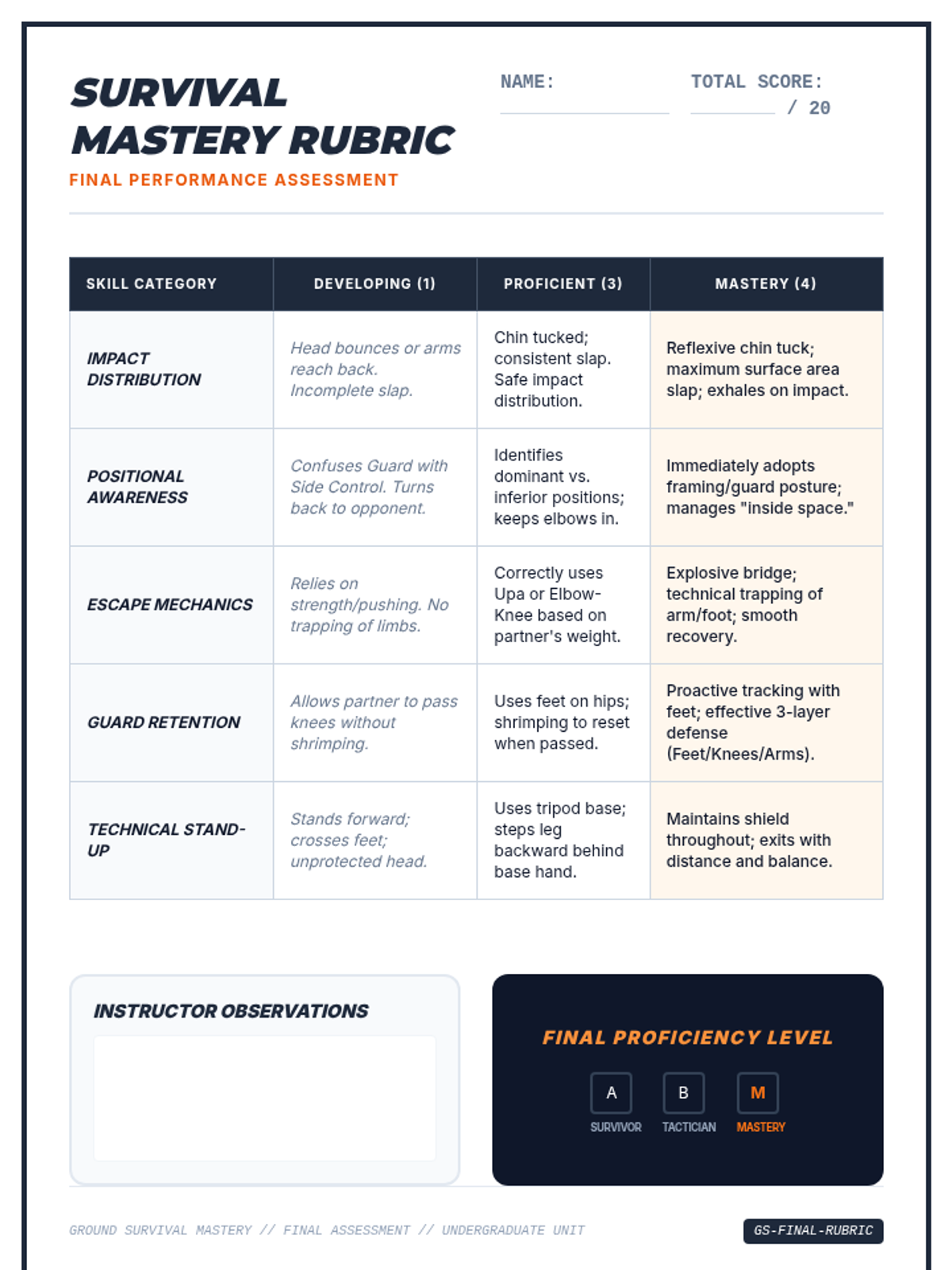
A comprehensive final assessment rubric for the Ground Survival unit, evaluating students on breakfalls, positional awareness, escapes, guard retention, and technical stand-ups.
Instructional slides for Lesson 5, covering the science of recovery (Selye's GAS), the importance of sleep and nutrition for combat sports, and the principles of weekly training program design.
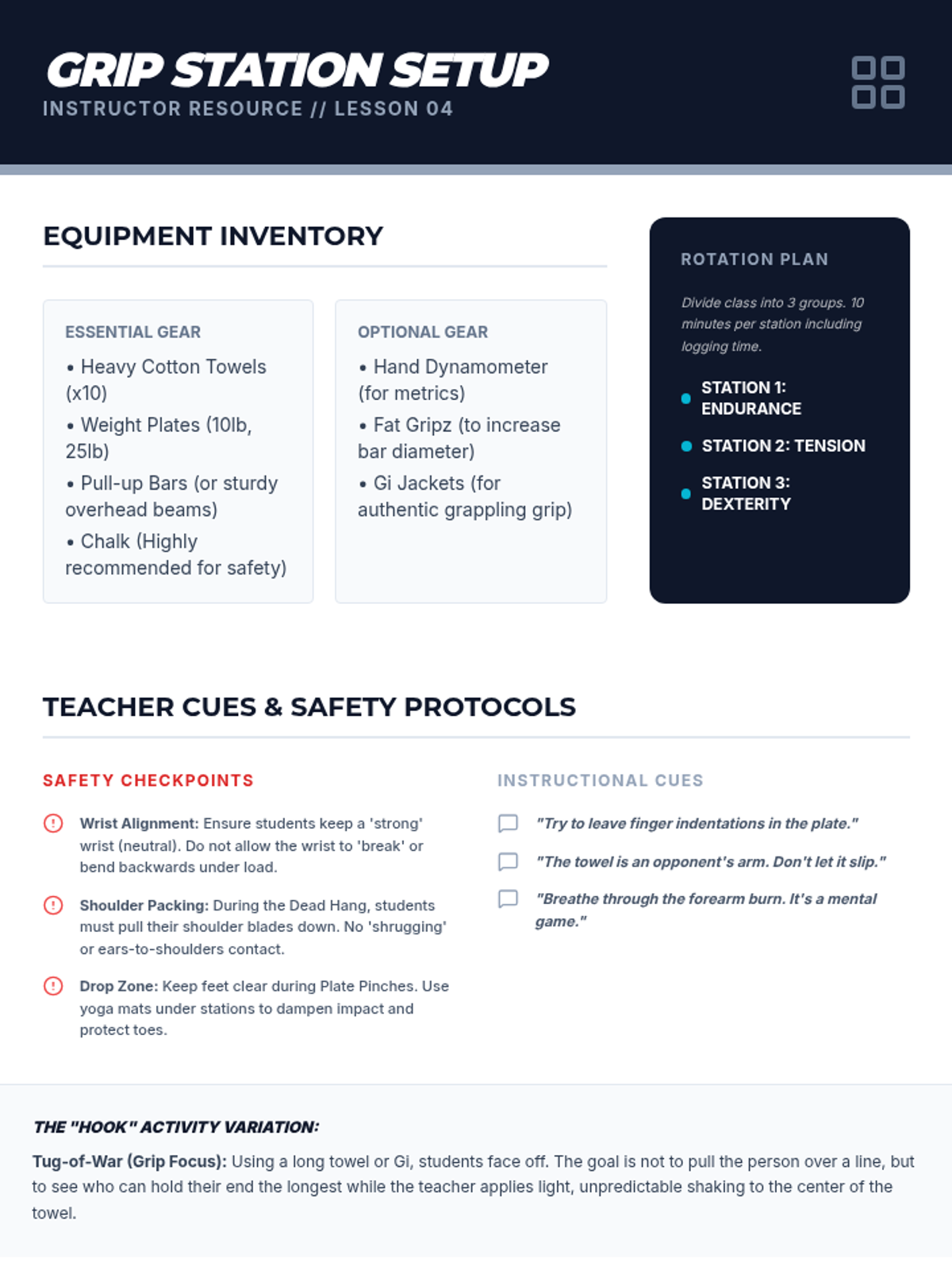
A teacher station setup guide for grip strength drills, including equipment lists, rotation strategies, safety protocols for overhead hanging, and cues for instructional success.
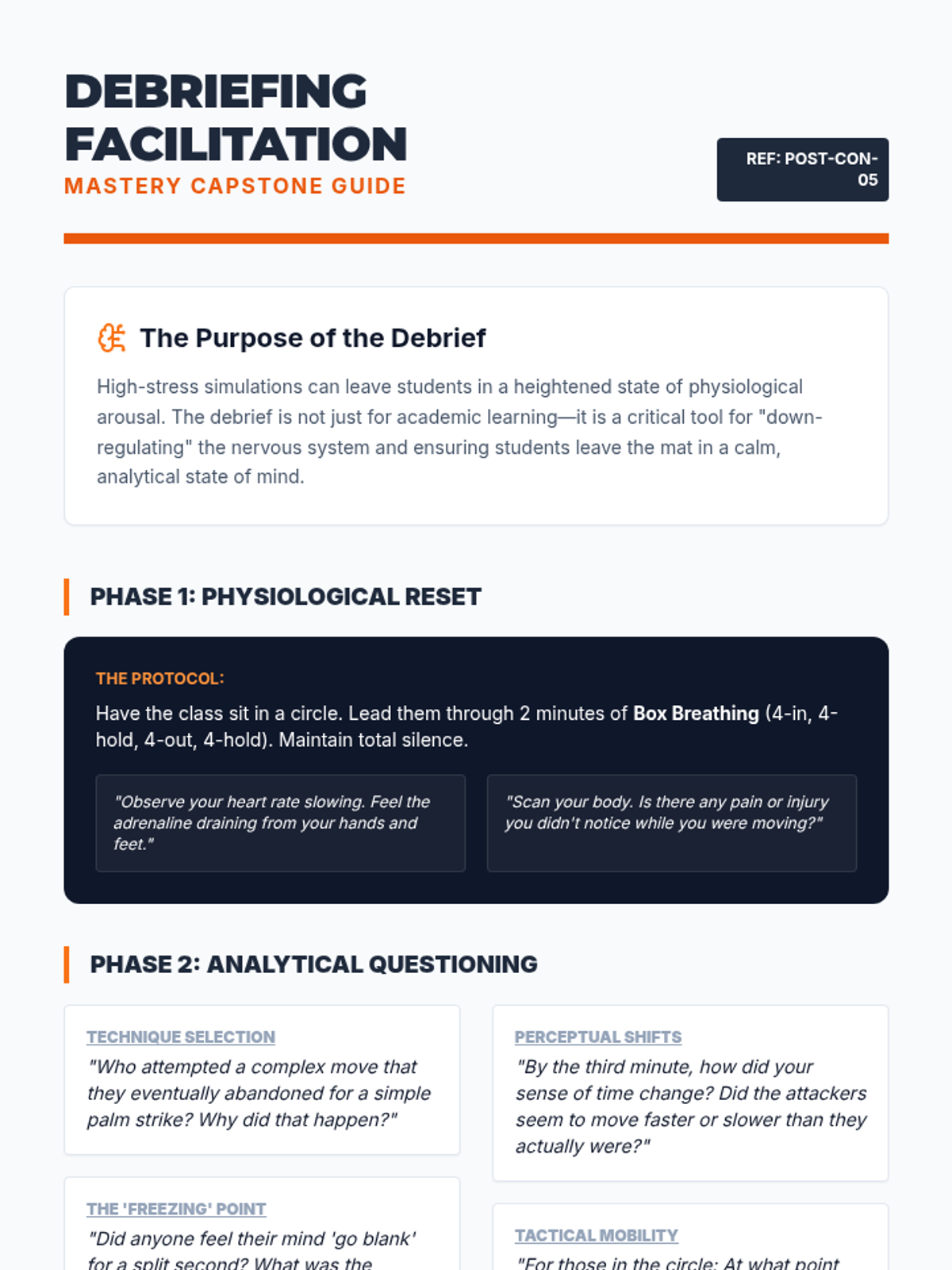
A teacher-facing guide for facilitating the final debriefing session of the sequence, focusing on physiological down-regulation and analytical reflection.
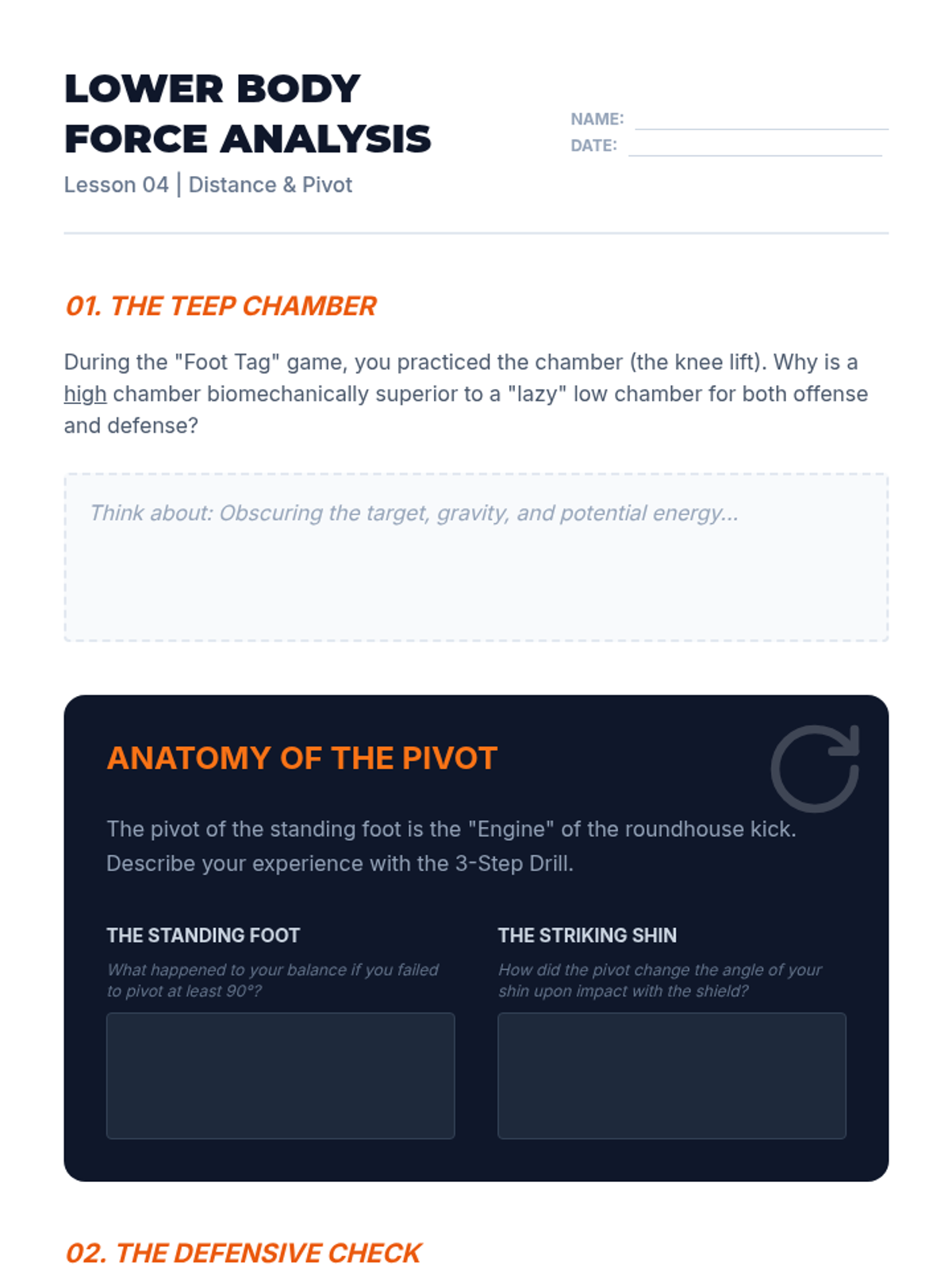
Student worksheet analyzing the mechanics of the standing foot pivot and defensive shielding during lower body strikes.
Instructional slides for Lesson 5: Crisis Simulation, covering the integration of all previous skills, the 'Defensive Chain' flow, and safety protocols for live scenario training.
Recovery and exit slides covering the four-step mechanics of the technical stand-up, the importance of backward distance, and the final mastery flow.
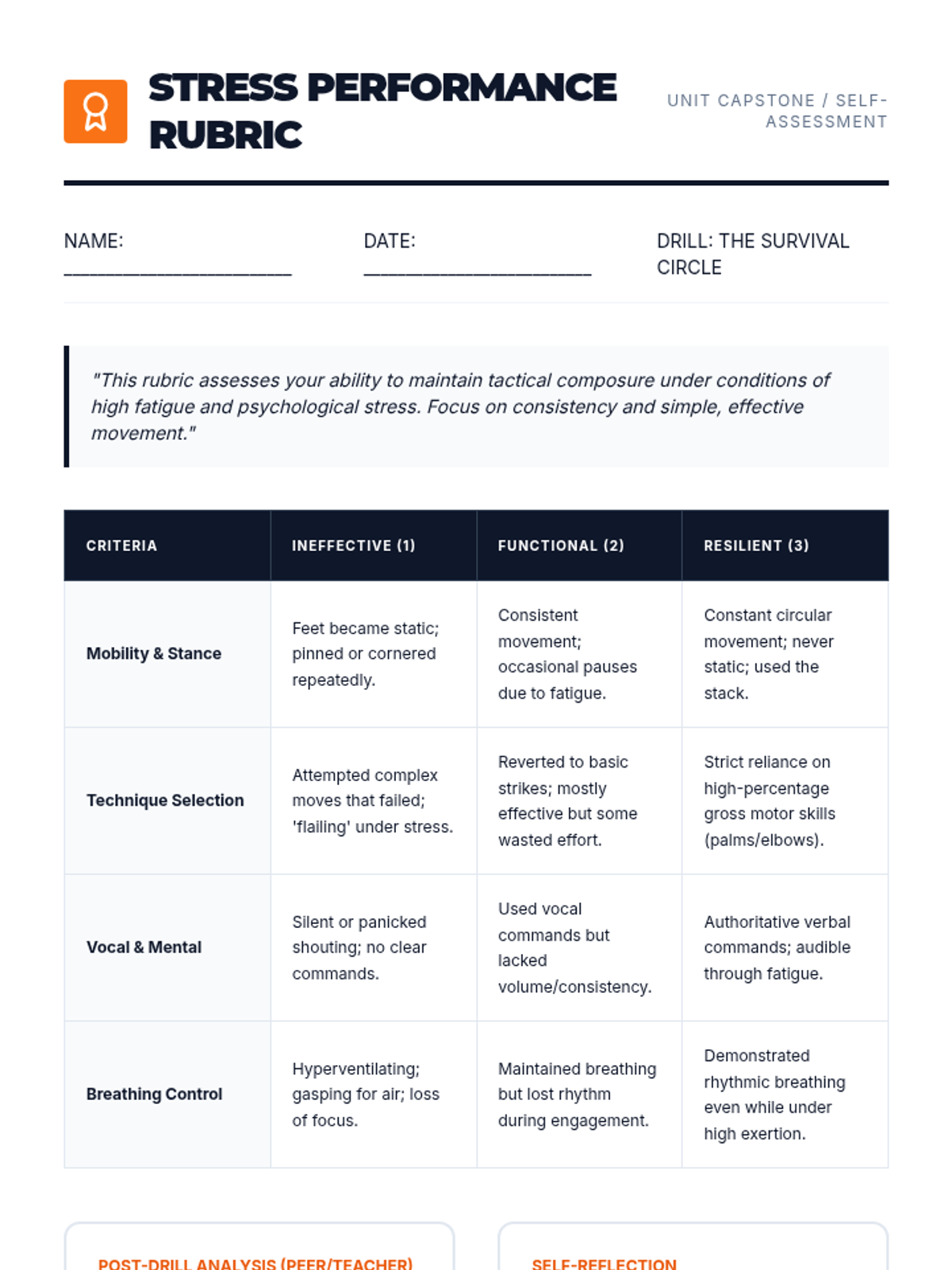
A comprehensive assessment rubric and reflection sheet for the final stress-inoculation capstone drill, focusing on mobility, technique selection, and mental composure.
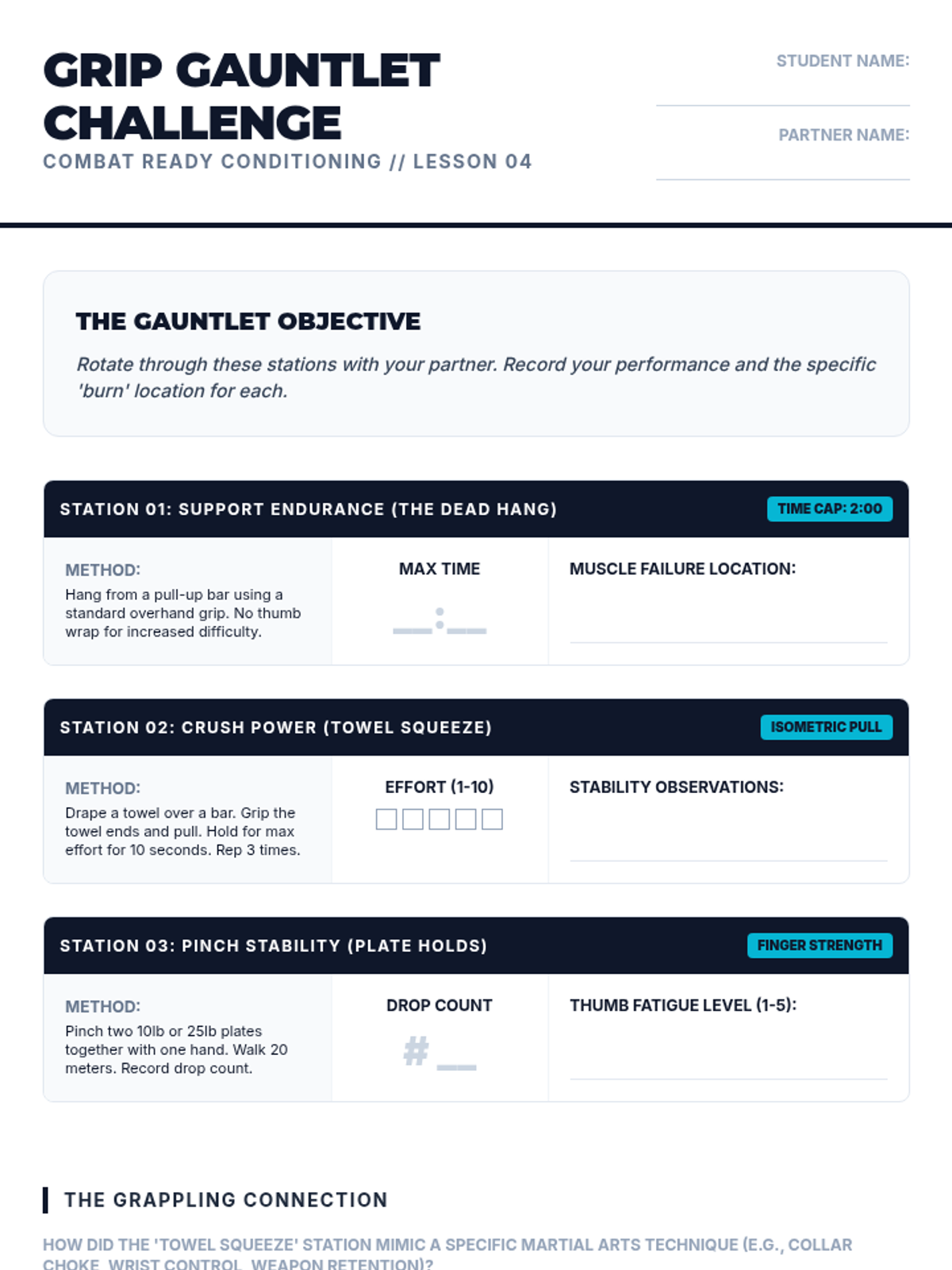
A student challenge log for Lesson 4 where they rotate through different grip stations (Support, Crush, and Pinch) and analyze the practical application of each to martial arts.
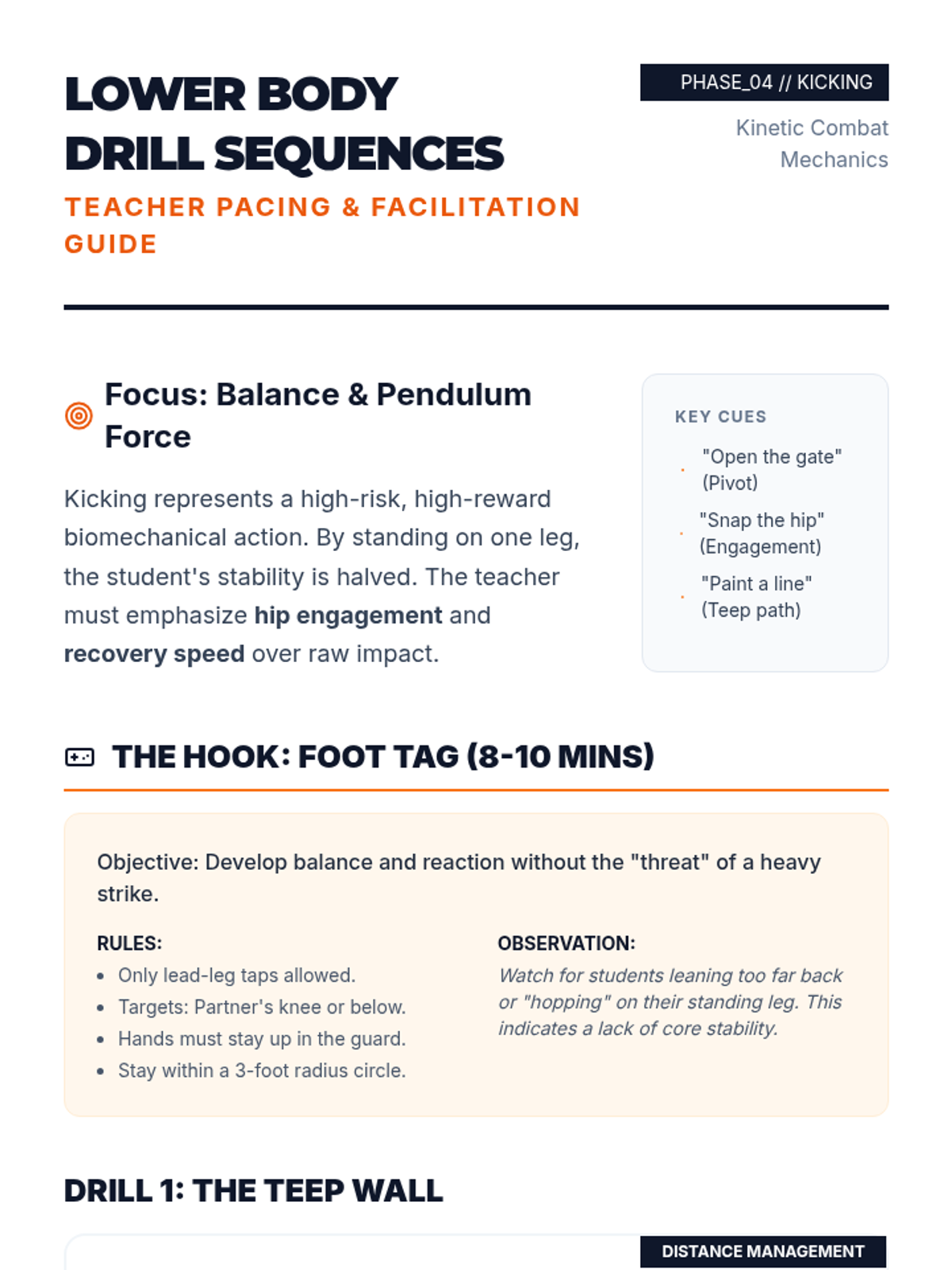
Teacher-facing technique key for lower body strikes, including the 'Foot Tag' game, teep drills, and roundhouse pivot progressions.
A visual presentation on stress inoculation techniques, focusing on building resilience through controlled fatigue, gross motor skills, and mental resets.
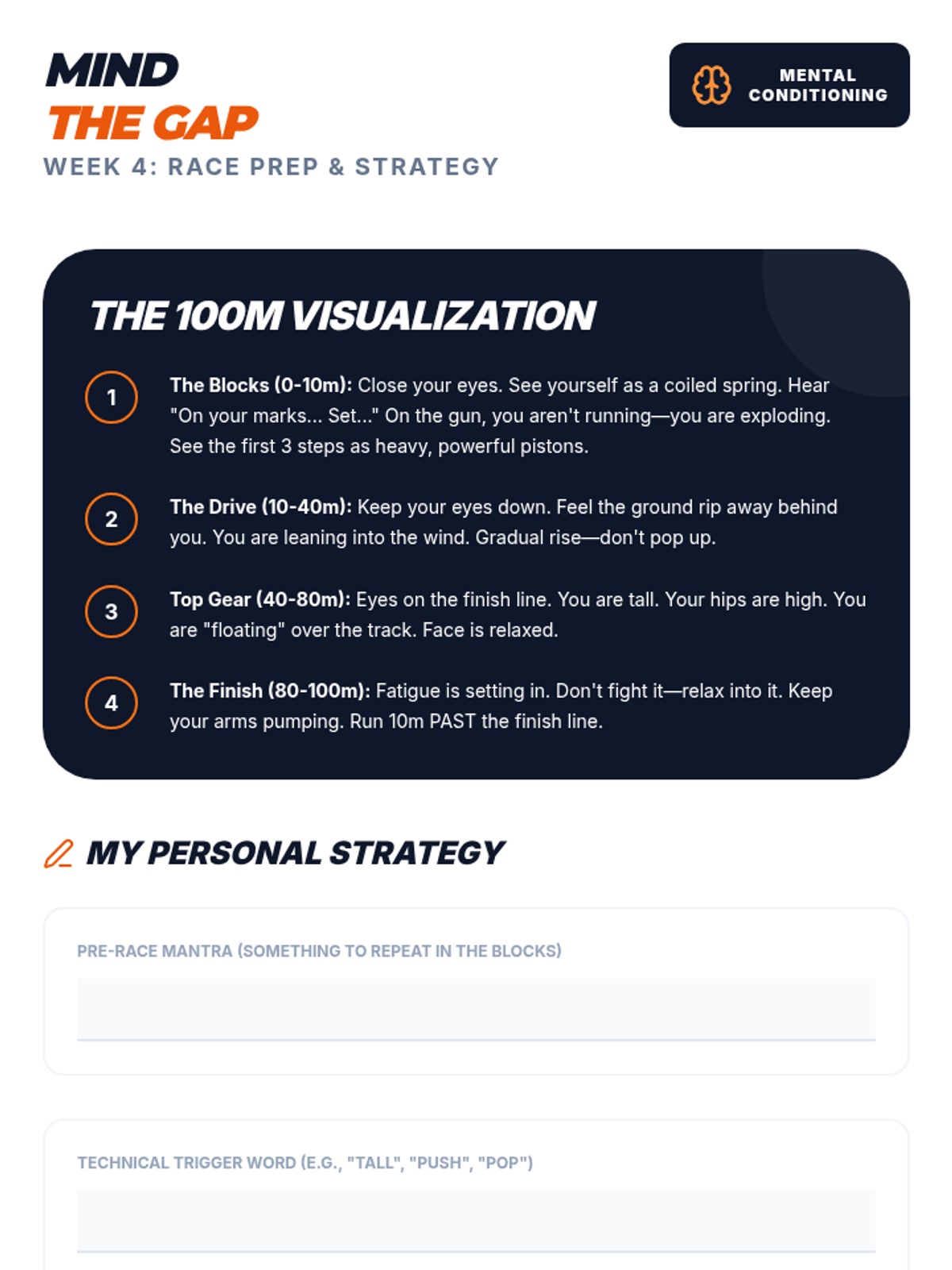
A mental preparation and strategy guide for students to prepare for race day in Week 4.
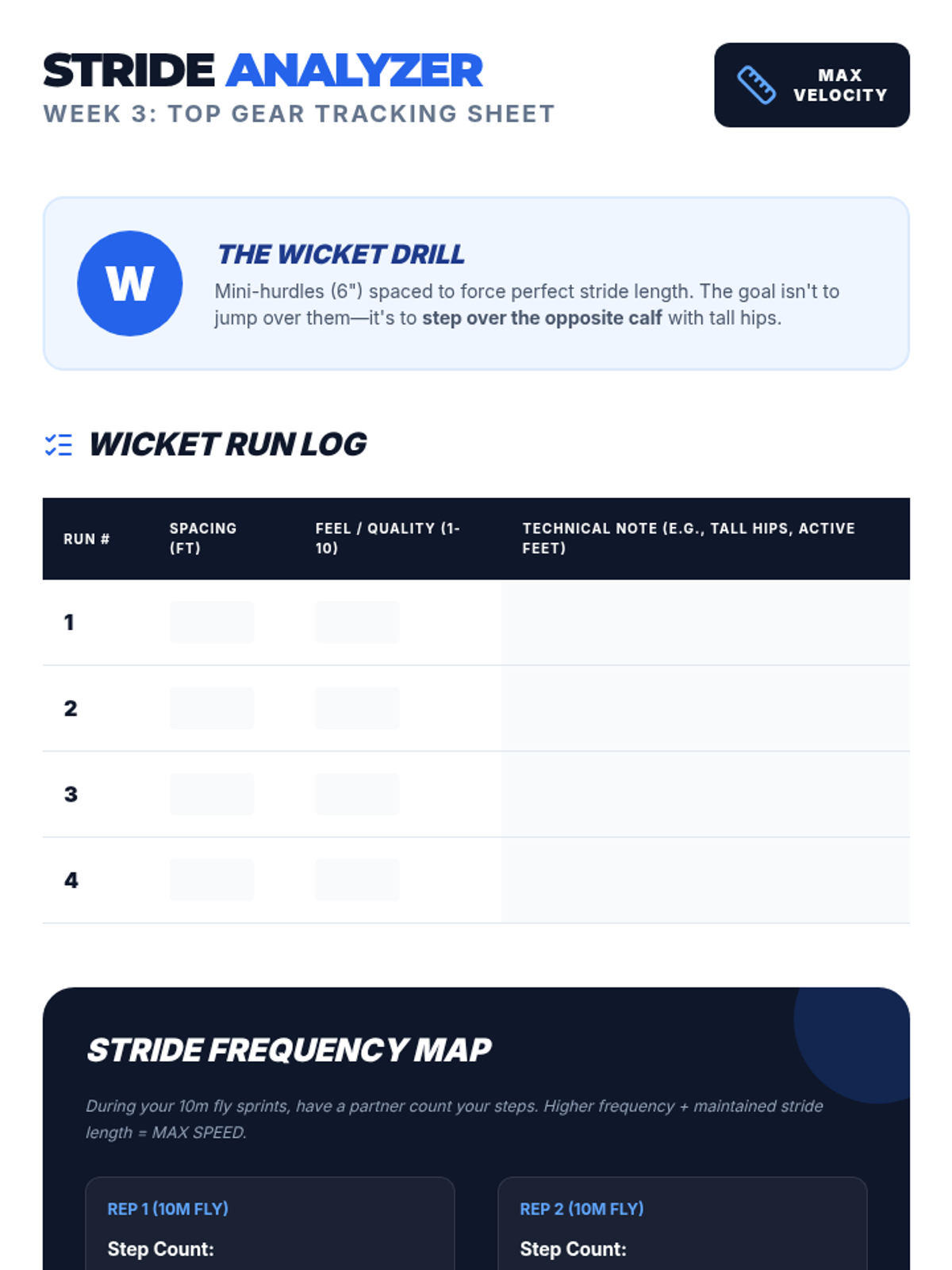
A specialized tracking sheet for wicket drills and stride frequency analysis during Week 3 max velocity training.
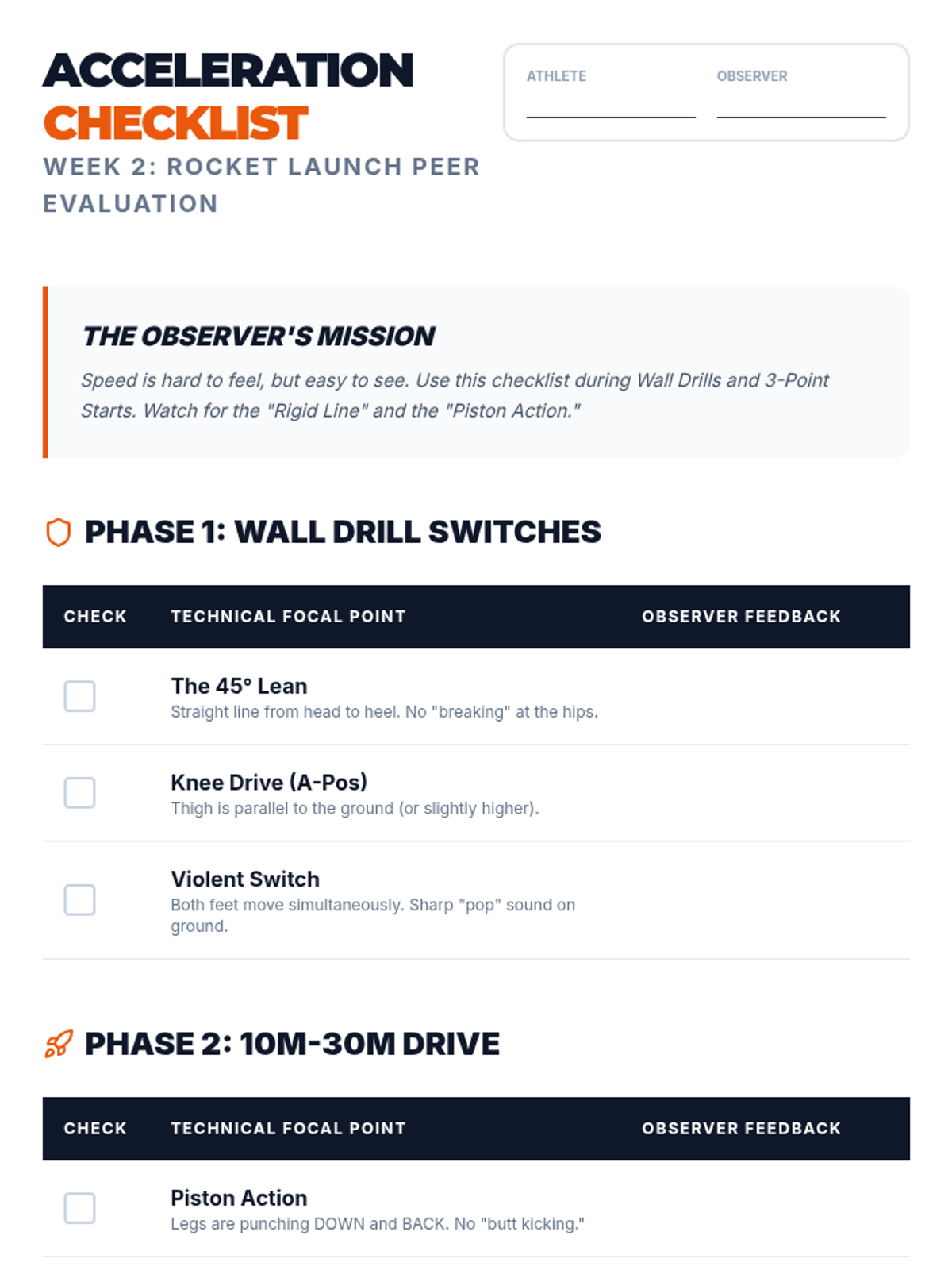
A peer-evaluation checklist for students to use during Week 2 acceleration drills, focusing on posture and drive mechanics.
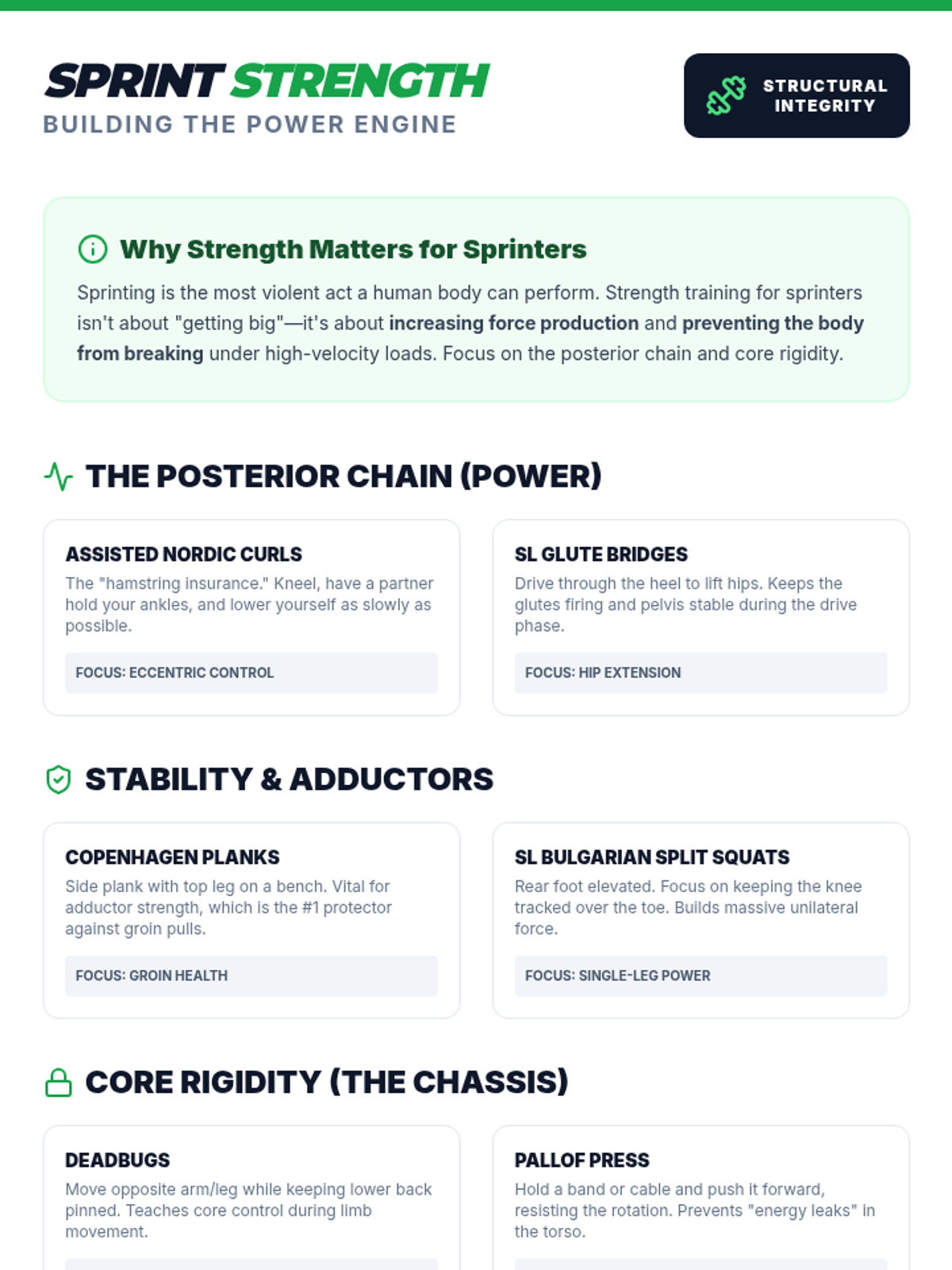
A specialized strength and stability guide for sprinters focusing on posterior chain power, core rigidity, and injury prevention exercises.
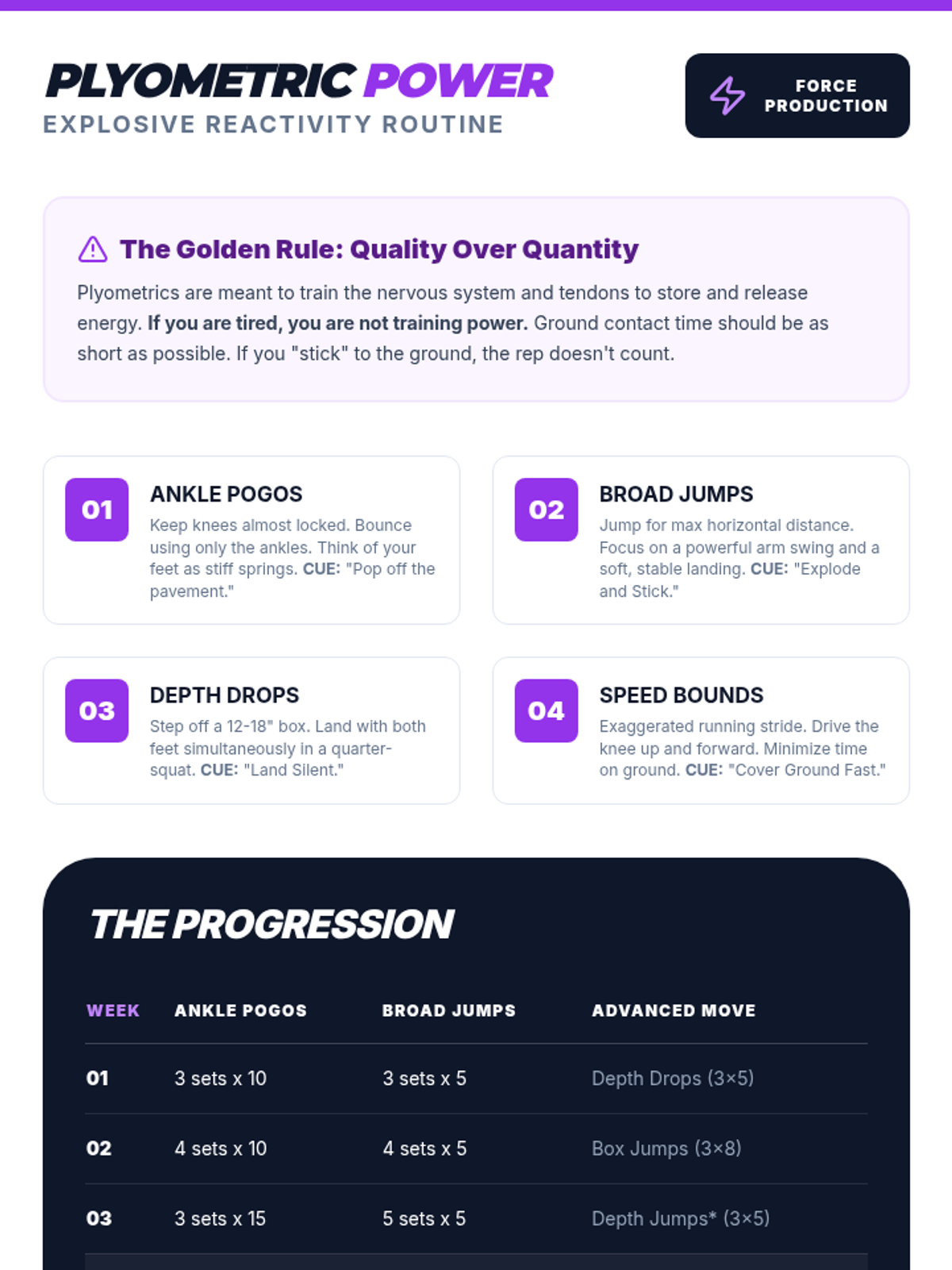
An explosive power routine featuring 4 weeks of plyometric progressions, landing mechanics, and reactive jumping exercises.
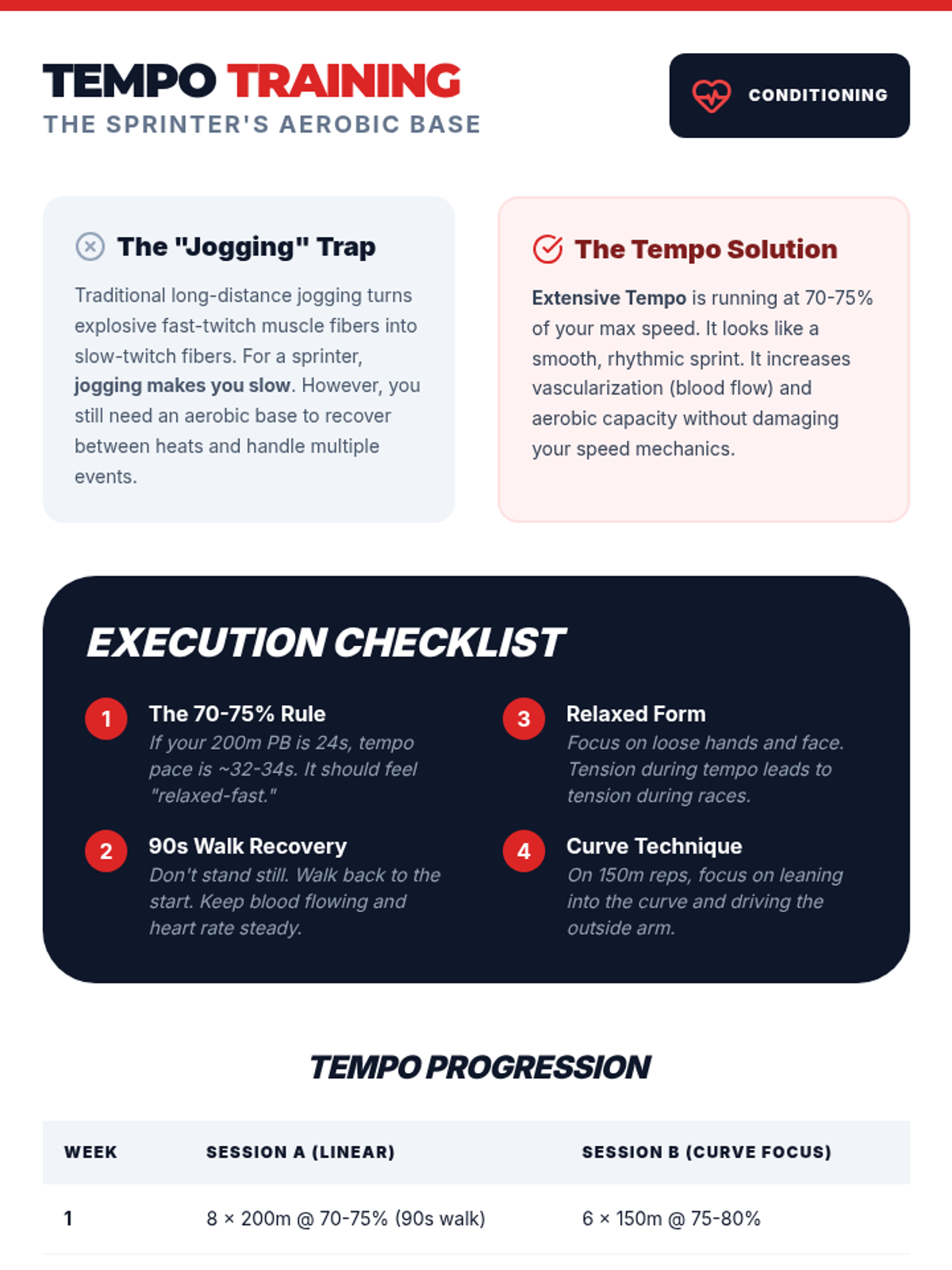
A guide to "Extensive Tempo" training, explaining how sprinters build aerobic capacity and recovery speed without sacrificing fast-twitch explosive power.
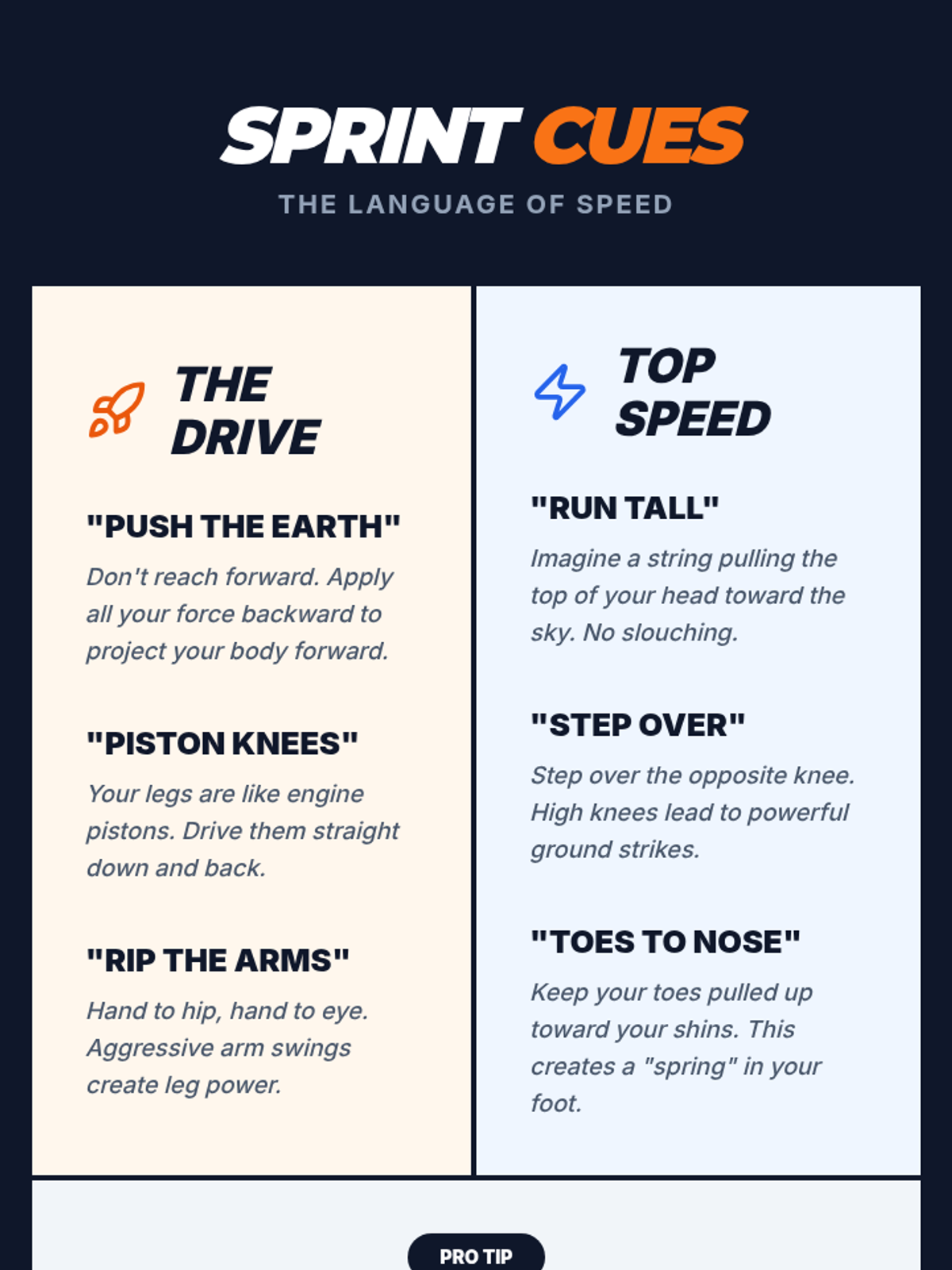
An instructional anchor chart featuring key verbal cues and technical focuses for sprinting mechanics.
A visual presentation for students to introduce the core mechanics of speed, acceleration, and injury prevention.
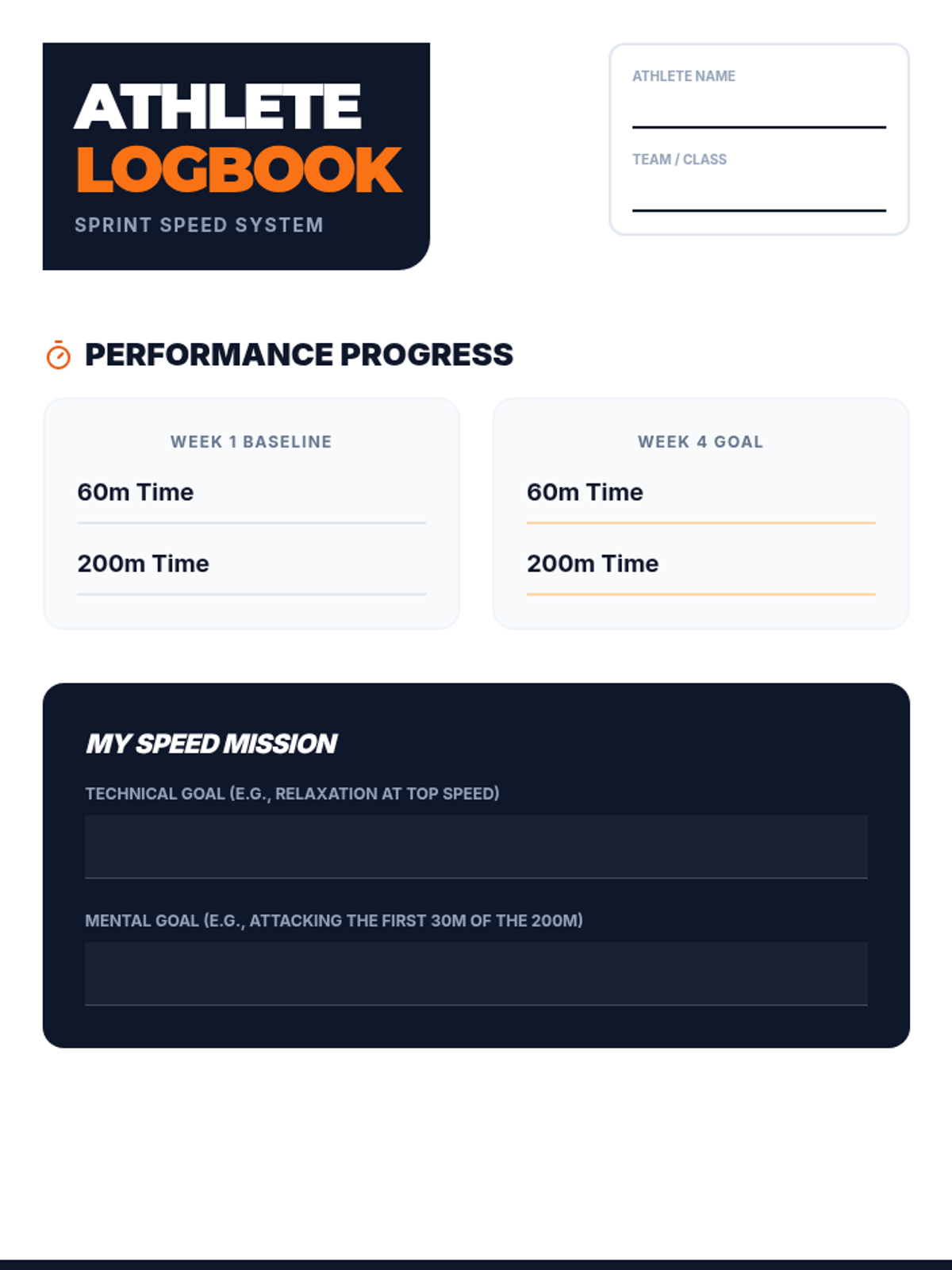
A student tracking document for athletes to record times, RPE, and weekly reflections throughout the 4-week high-intensity program.
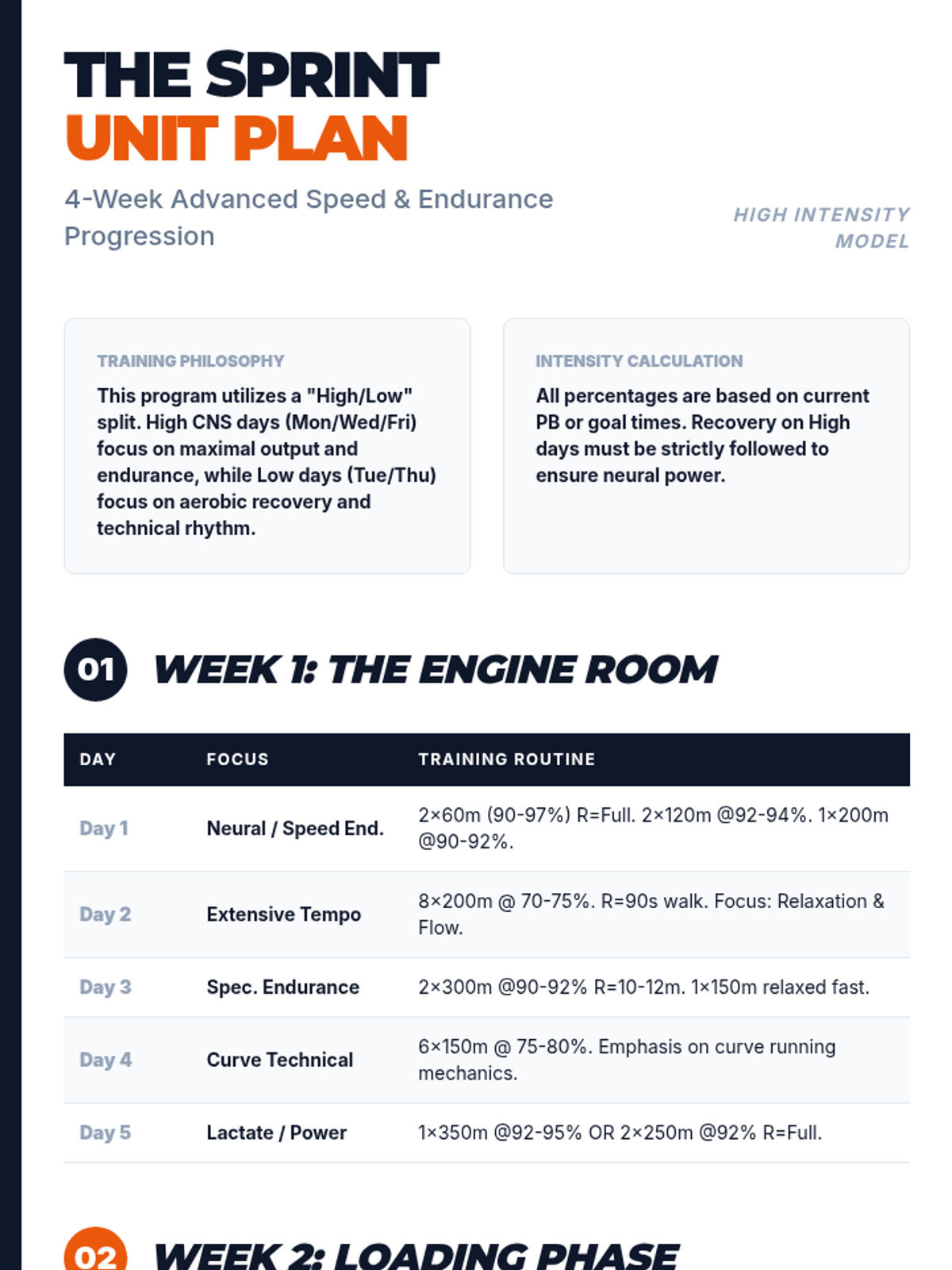
A comprehensive 4-week unit plan for coaches, providing a day-by-day breakdown of drills, conditioning, and speed sessions based on a high-intensity interval model.
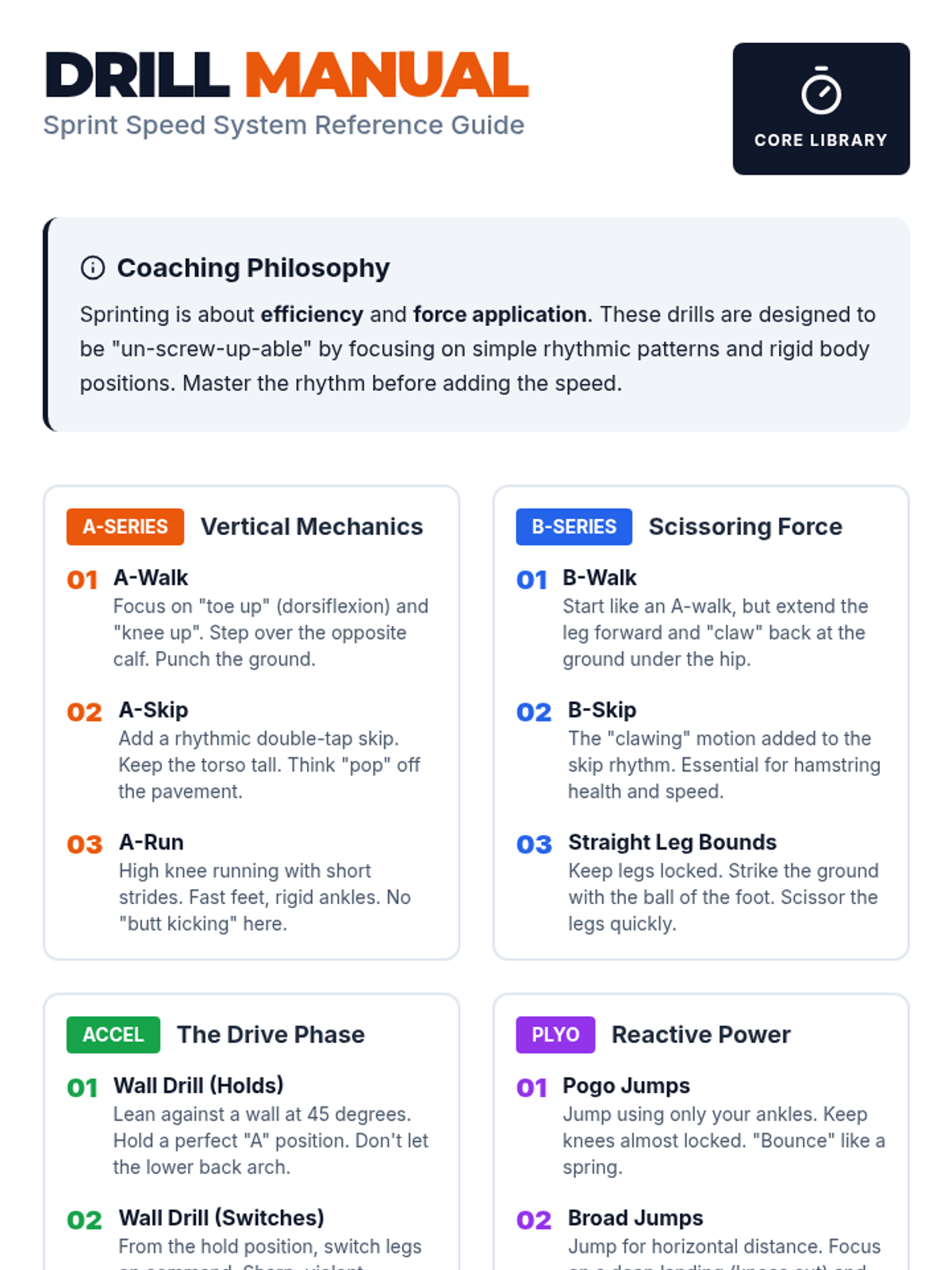
A visual reference guide for athletes featuring the core sprint drills (A/B series, acceleration, plyometrics) and an injury prevention routine.
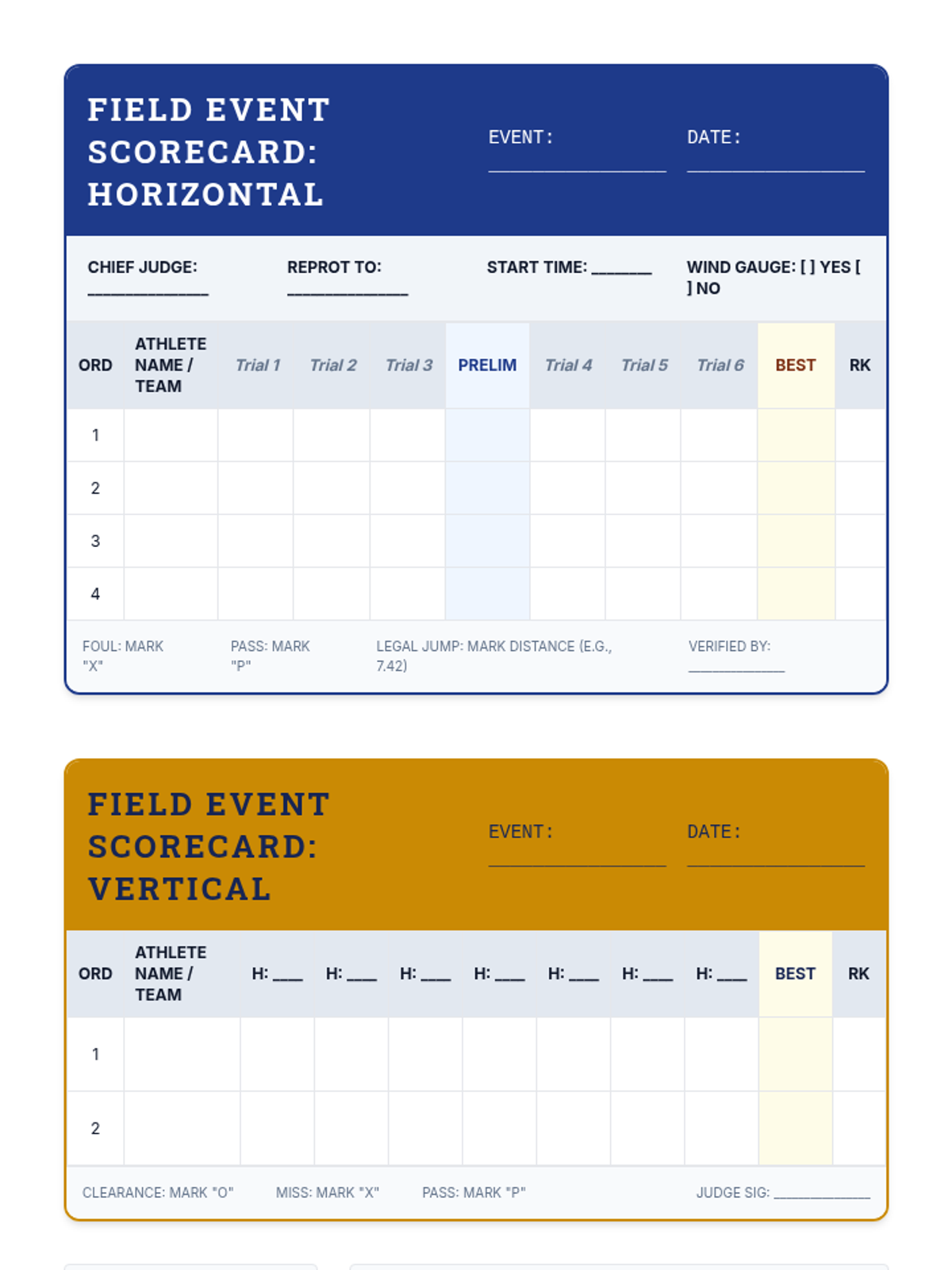
Professional field event scorecards for horizontal and vertical events, featuring official symbol legends and tie-break rules for track and field officiating.
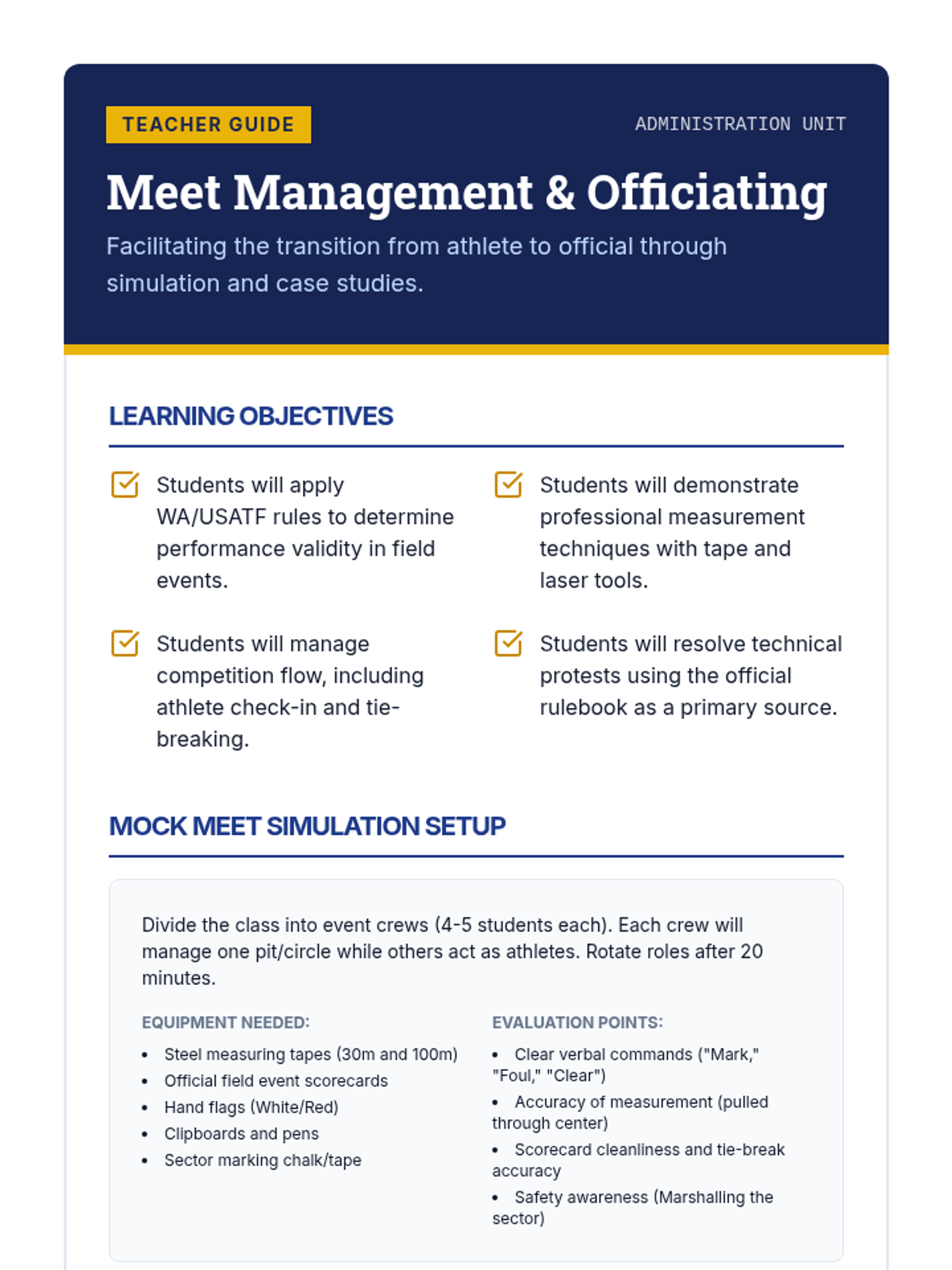
A professional teacher's guide for track and field meet management, featuring mock meet setup instructions, protest case studies, and official judging checklists.
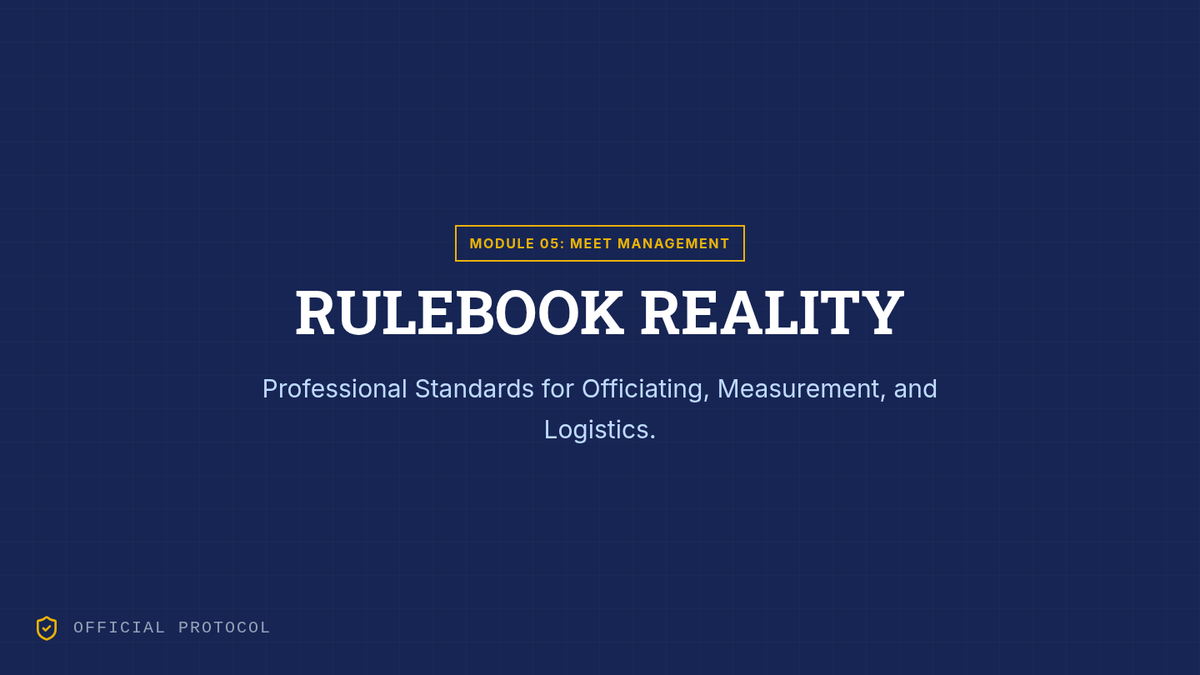
A technical slide deck breaking down the rules, measurement techniques, and officiating protocols for track and field competition management.
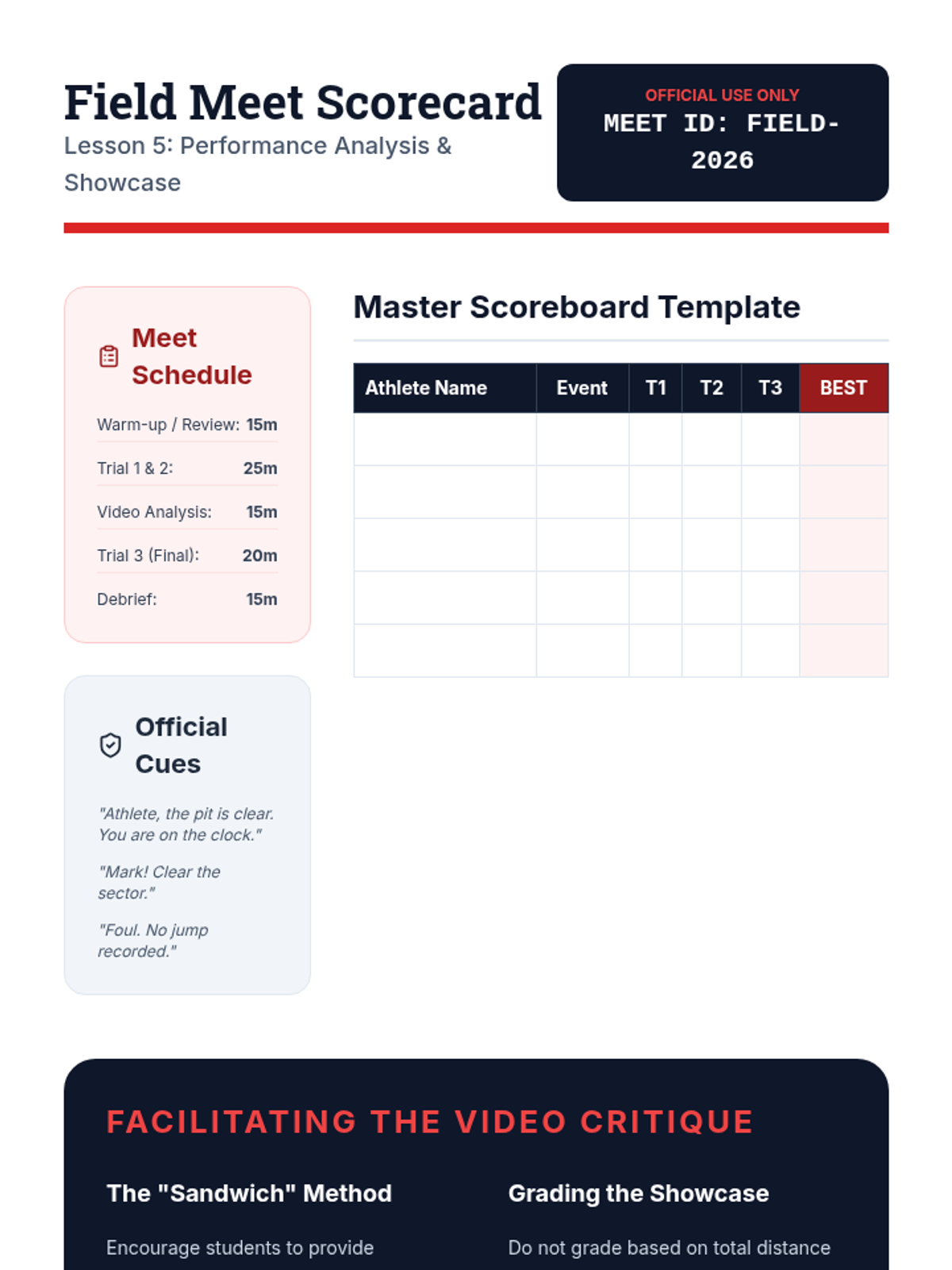
Teacher resource for the final lesson, providing a structured scorecard for the meet and guidelines for facilitating peer video feedback and grading.
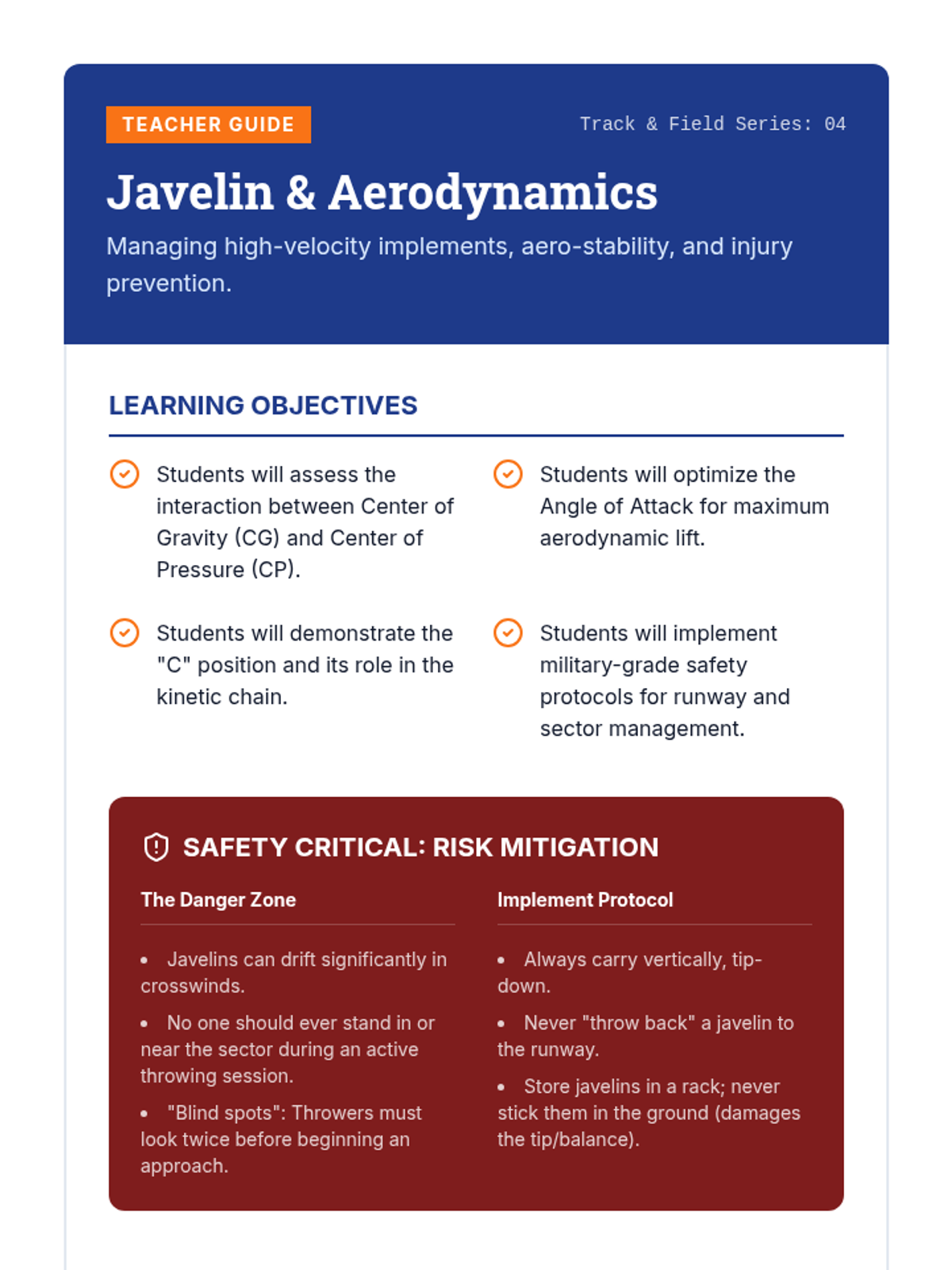
A professional teacher's guide for javelin instruction, focusing on risk management, aerodynamics, injury prevention, and technical coaching cues.
Final assessment document for Lesson 5 where students record performance data, conduct video analysis of peers, and reflect on their application of biomechanical principles.
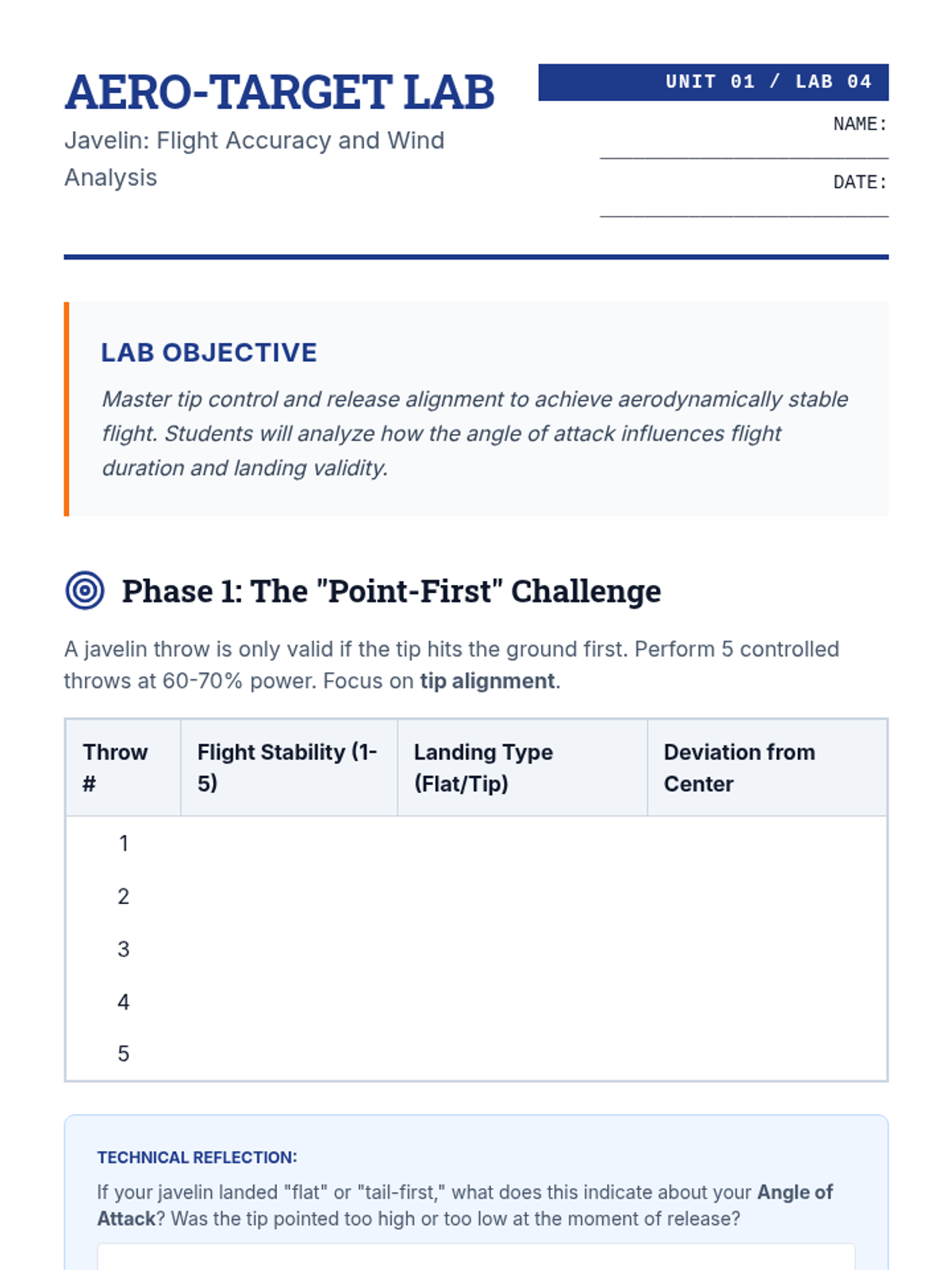
A student lab activity focused on javelin flight accuracy, landing validity, wind impact analysis, and biomechanical "C" position review.
Final slide deck for Lesson 5, focusing on how to perform video analysis, competition rules (fouls/measurement), and the structure of the field showcase.
A technical slide deck breaking down the aerodynamics of javelin flight, focusing on lift, drag, angle of attack, and the biomechanical "C" position.
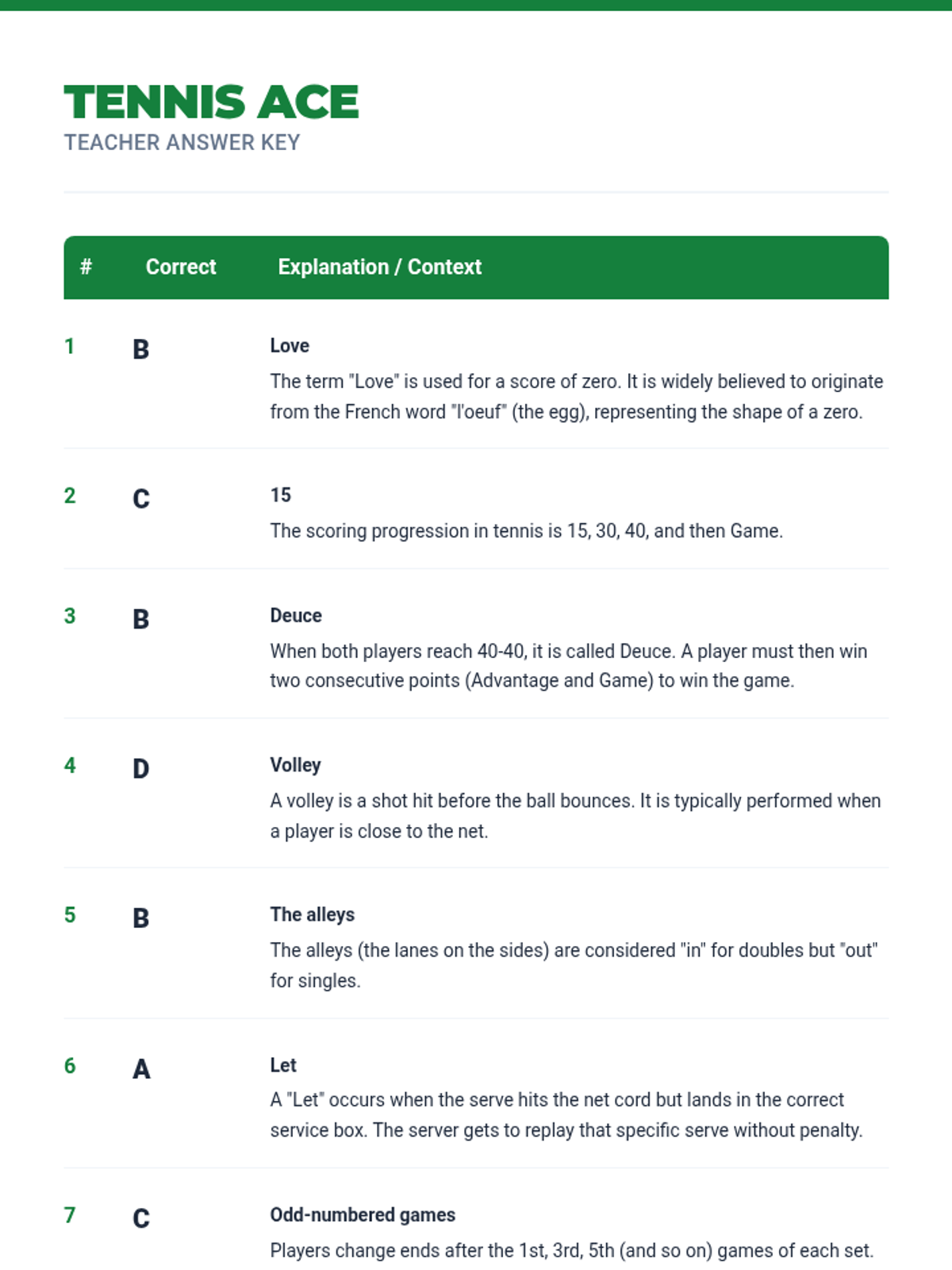
Teacher answer key for the Tennis Ace Assessment, including correct choices and brief explanations for each concept.
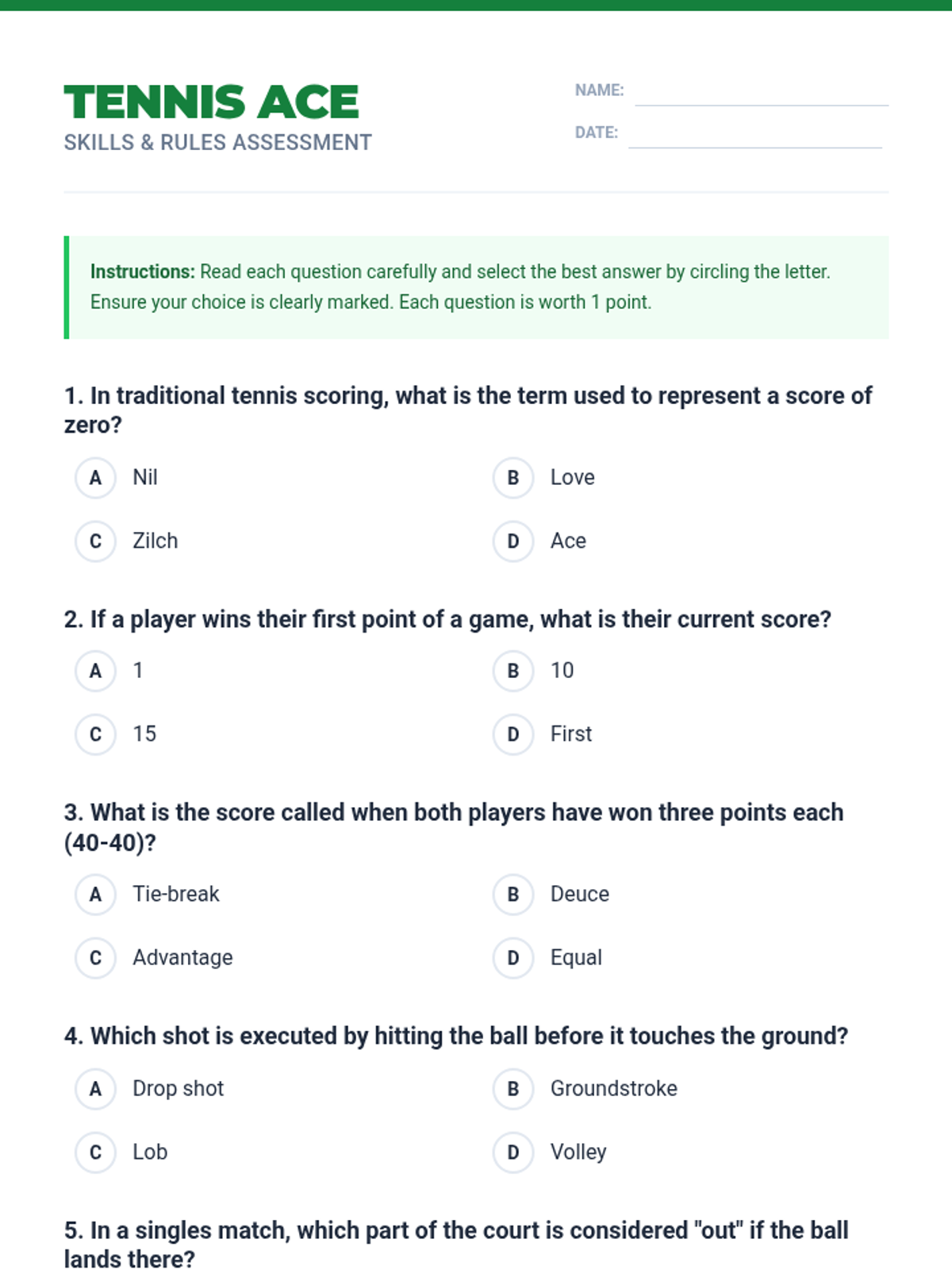
A comprehensive 10-question multiple choice assessment for tennis, covering scoring, rules, terminology, and court positions.
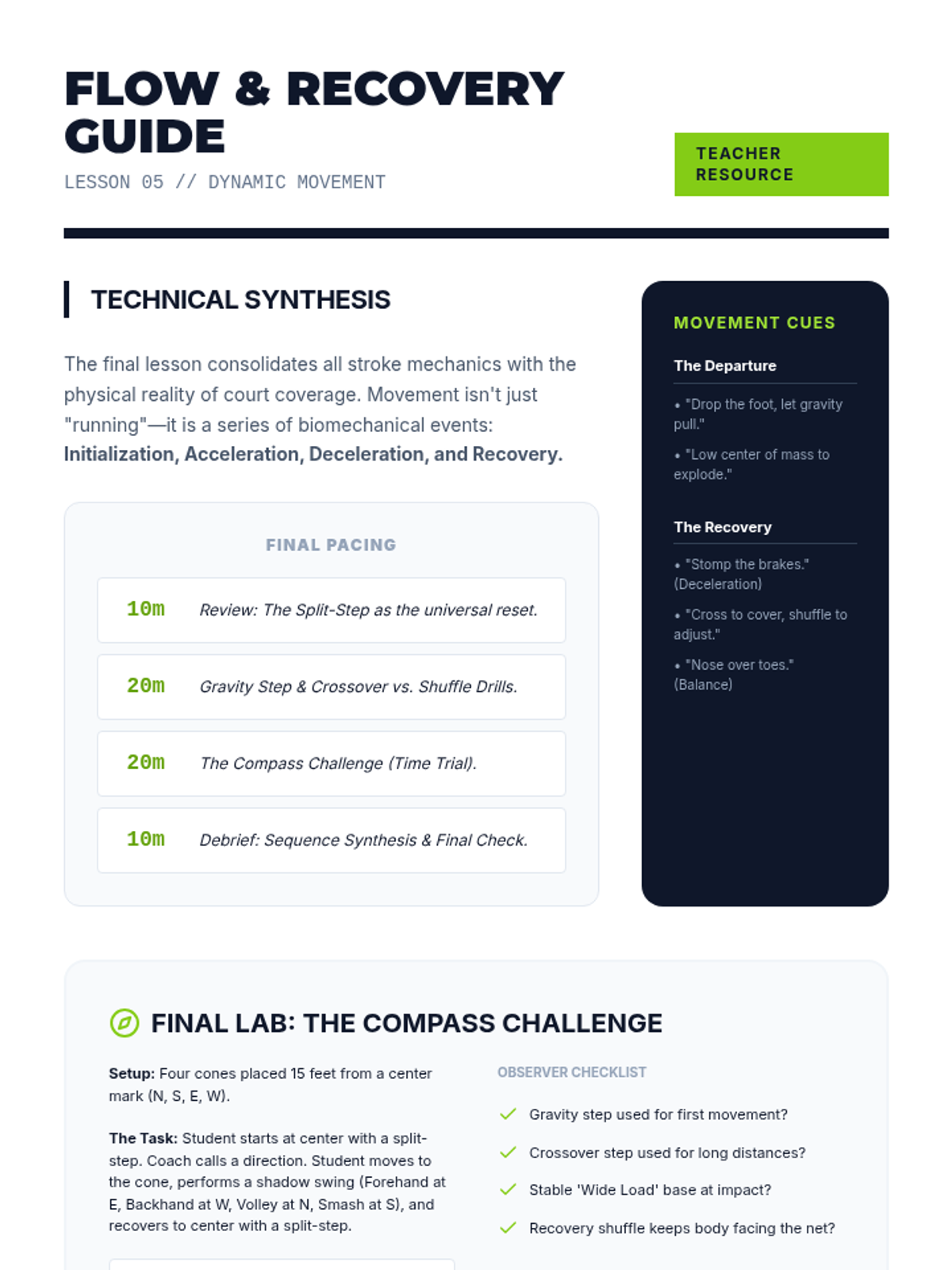
Teacher-facing guide for Lesson 5, including coaching cues for movement, the compass drill setup, and recovery geometry.
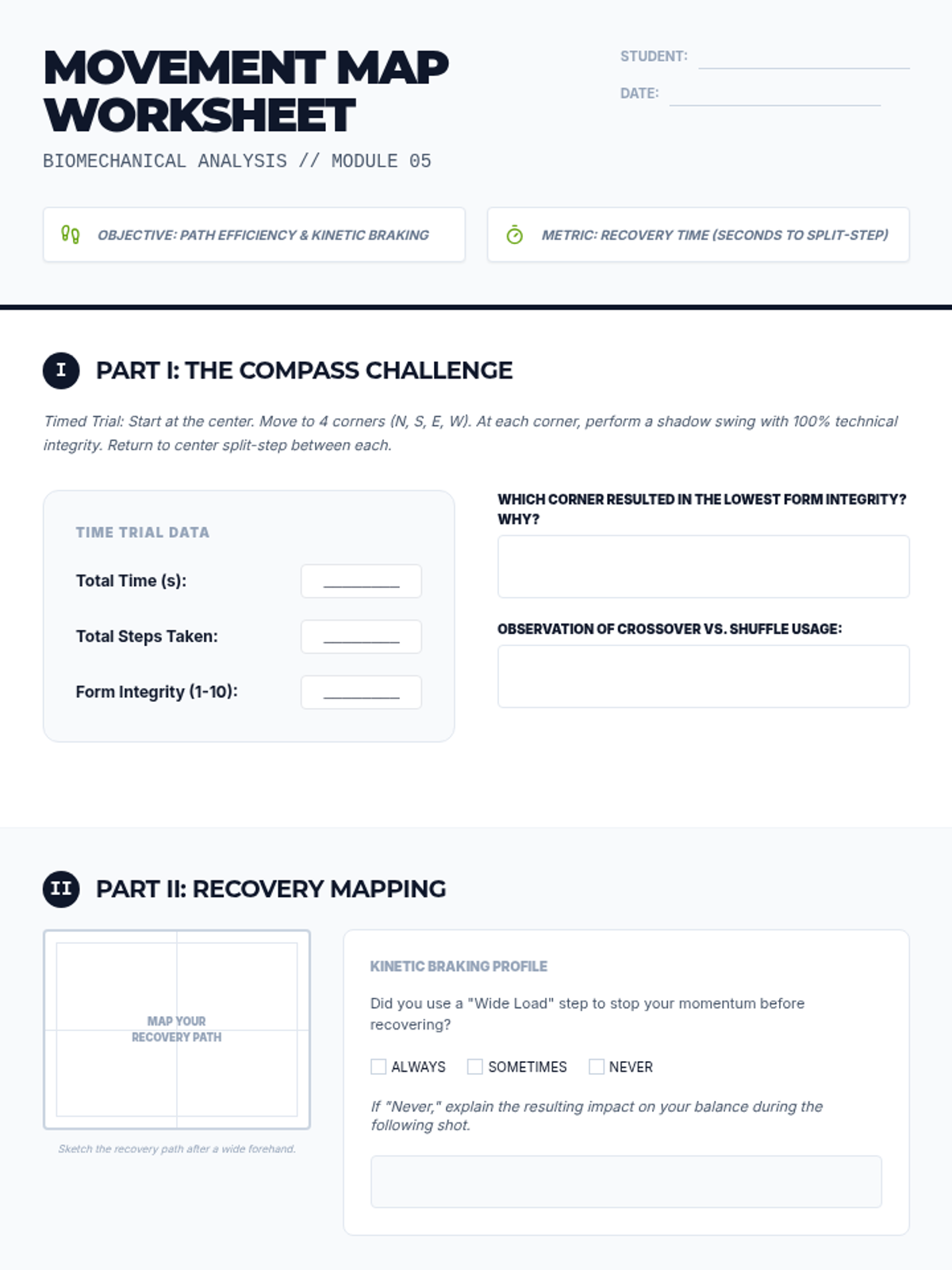
A technical worksheet for students to record their movement efficiency and recovery positioning during dynamic court drills.
Visual presentation for Lesson 5 covering dynamic movement patterns (crossover, shuffle, gravity step) and recovery strategies.
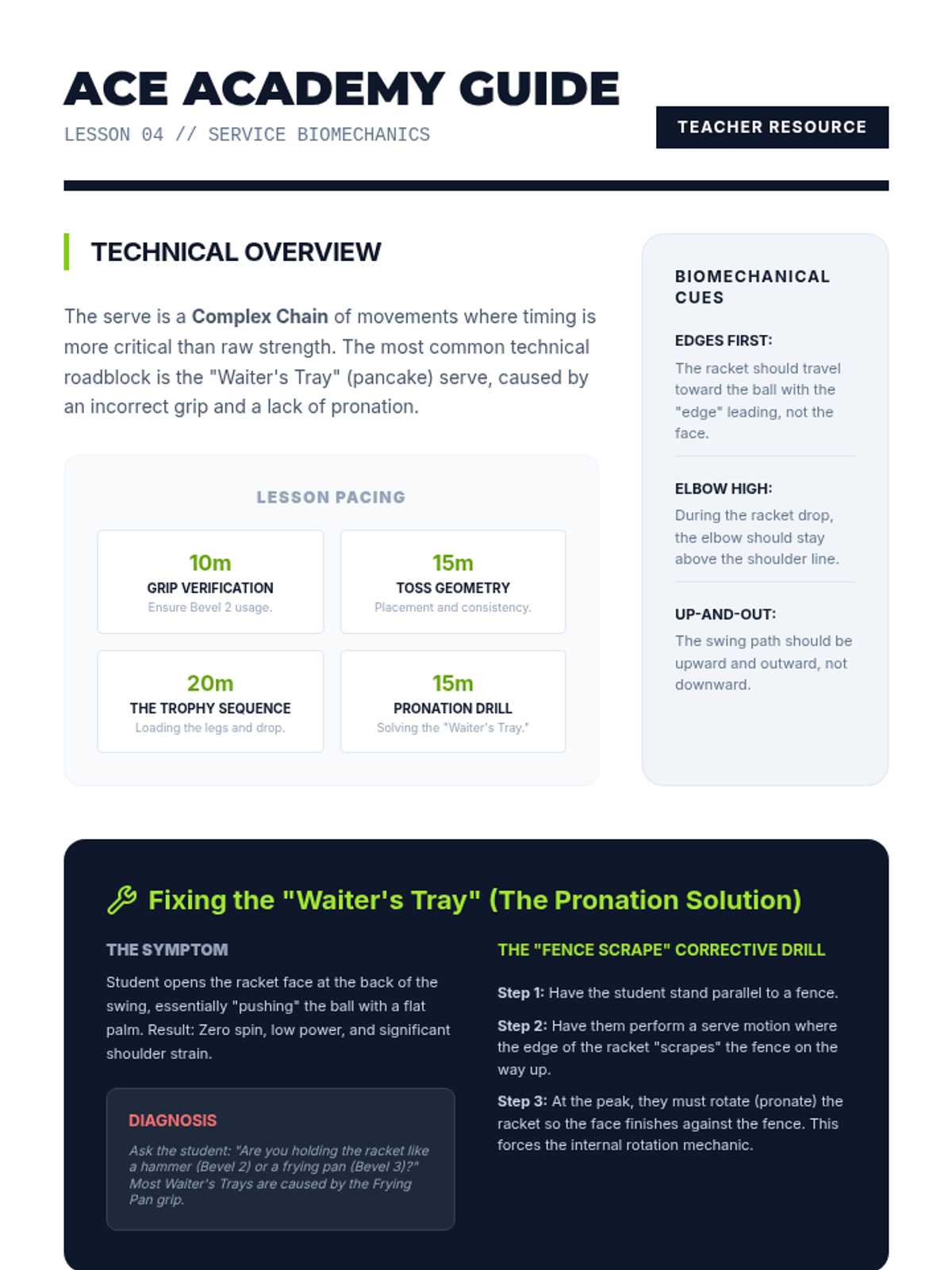
Teacher-facing guide for Lesson 4, including coaching cues for the serve, corrective drills for pronation, and toss geometry.
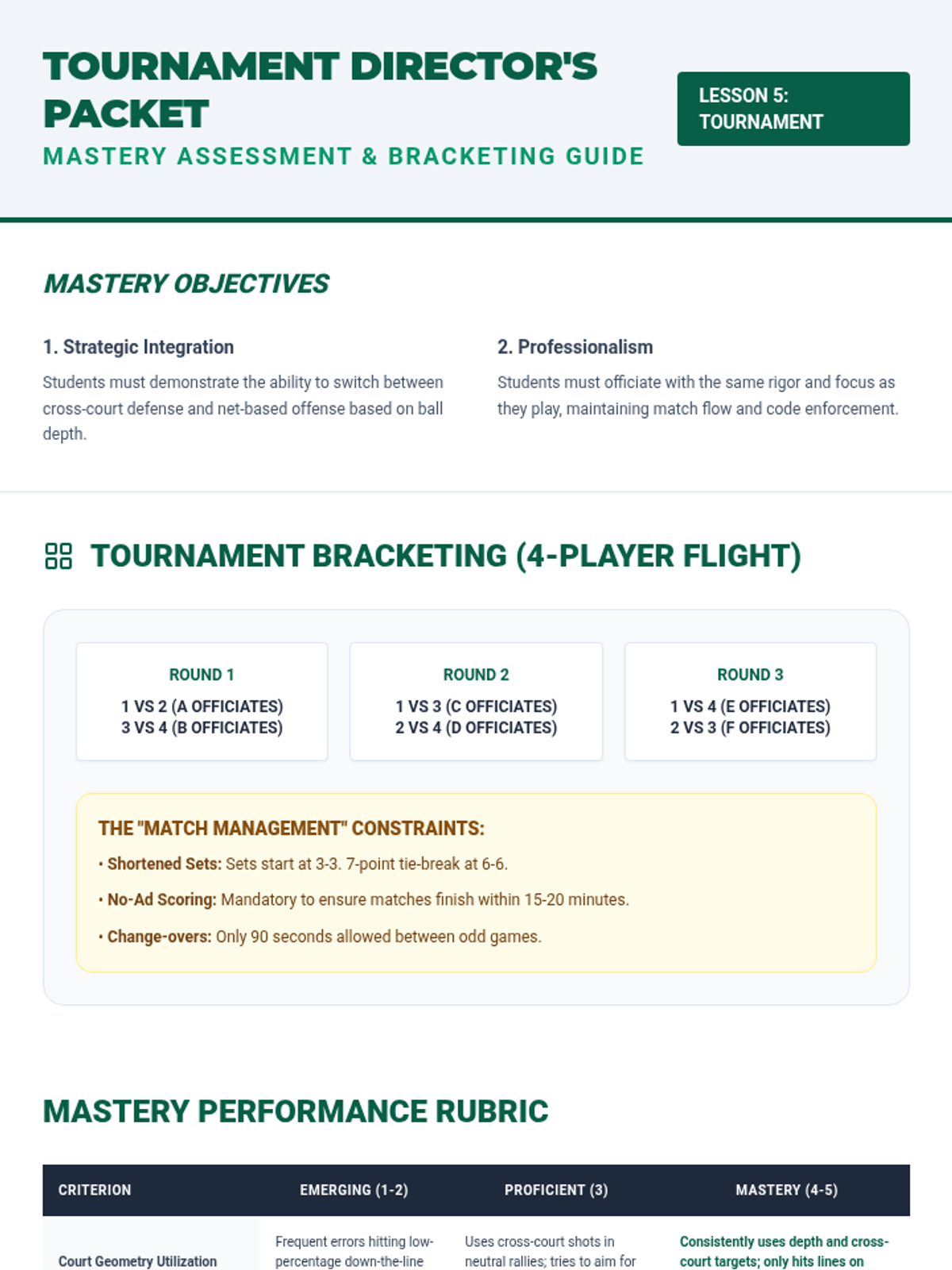
A comprehensive teacher guide for Lesson 5, featuring tournament brackets, shortened-match constraints, and a mastery-based performance rubric.
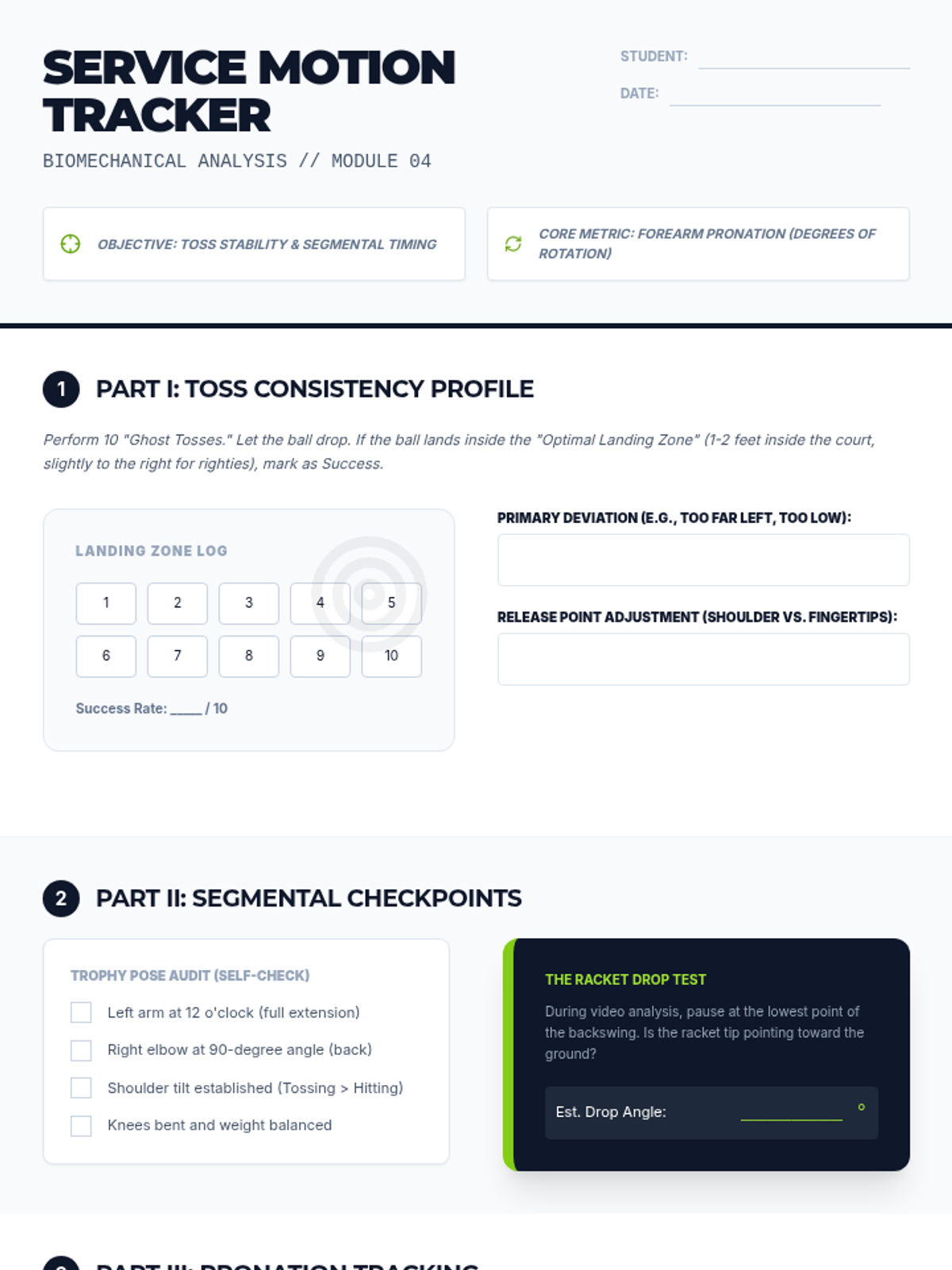
A technical worksheet for students to record their toss consistency, trophy pose alignment, and landing position during serve practice.
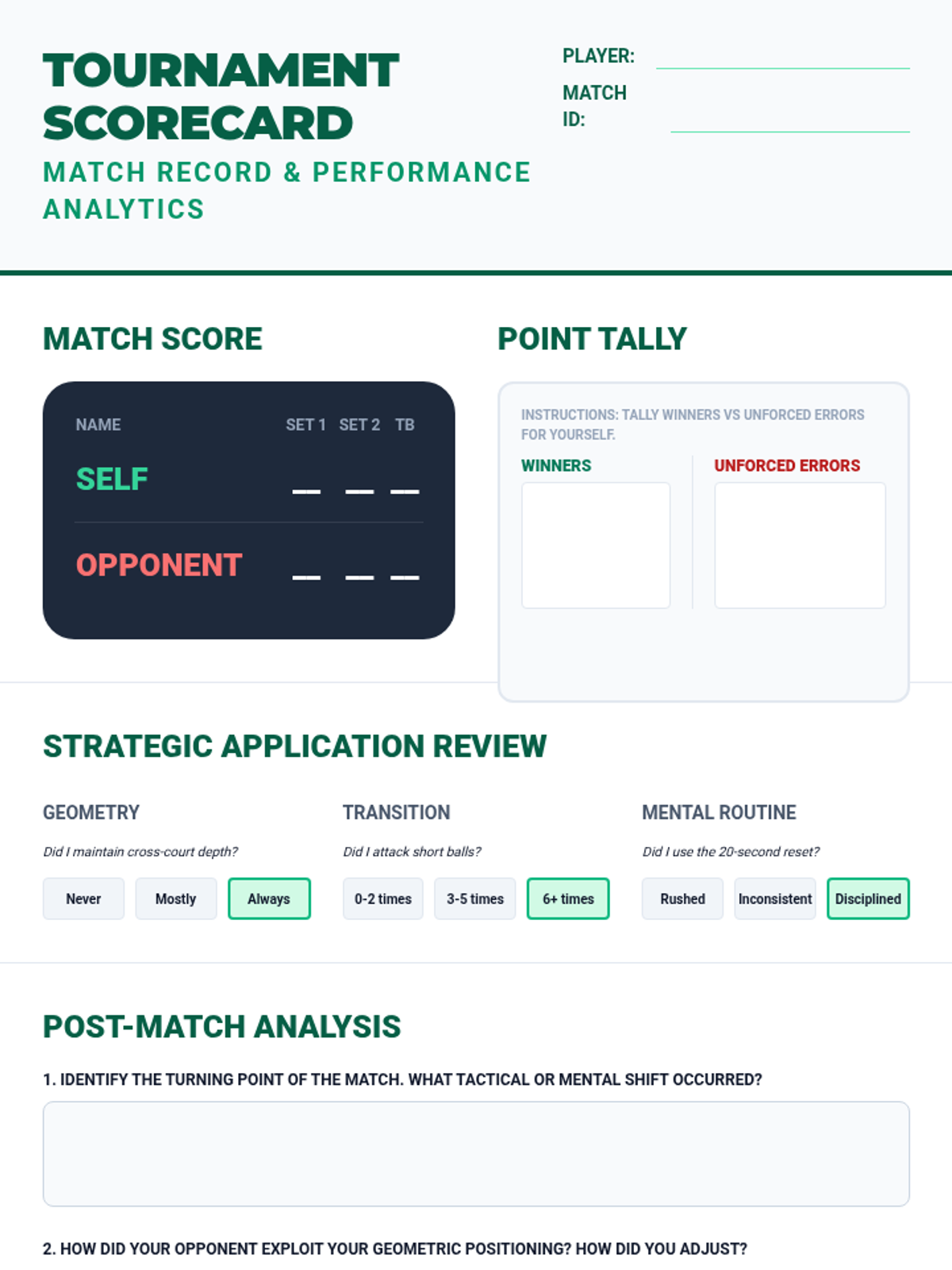
A tournament scorecard and match performance log for students to track scores, tally winners/errors, and reflect on tactical application during competitive play.
Visual presentation for Lesson 4 covering the serve: toss, trophy pose, racket drop, and forearm pronation.
A slide deck for Lesson 5 on tournament simulation and match management, focusing on mental routines, pressure management, and tournament roles.
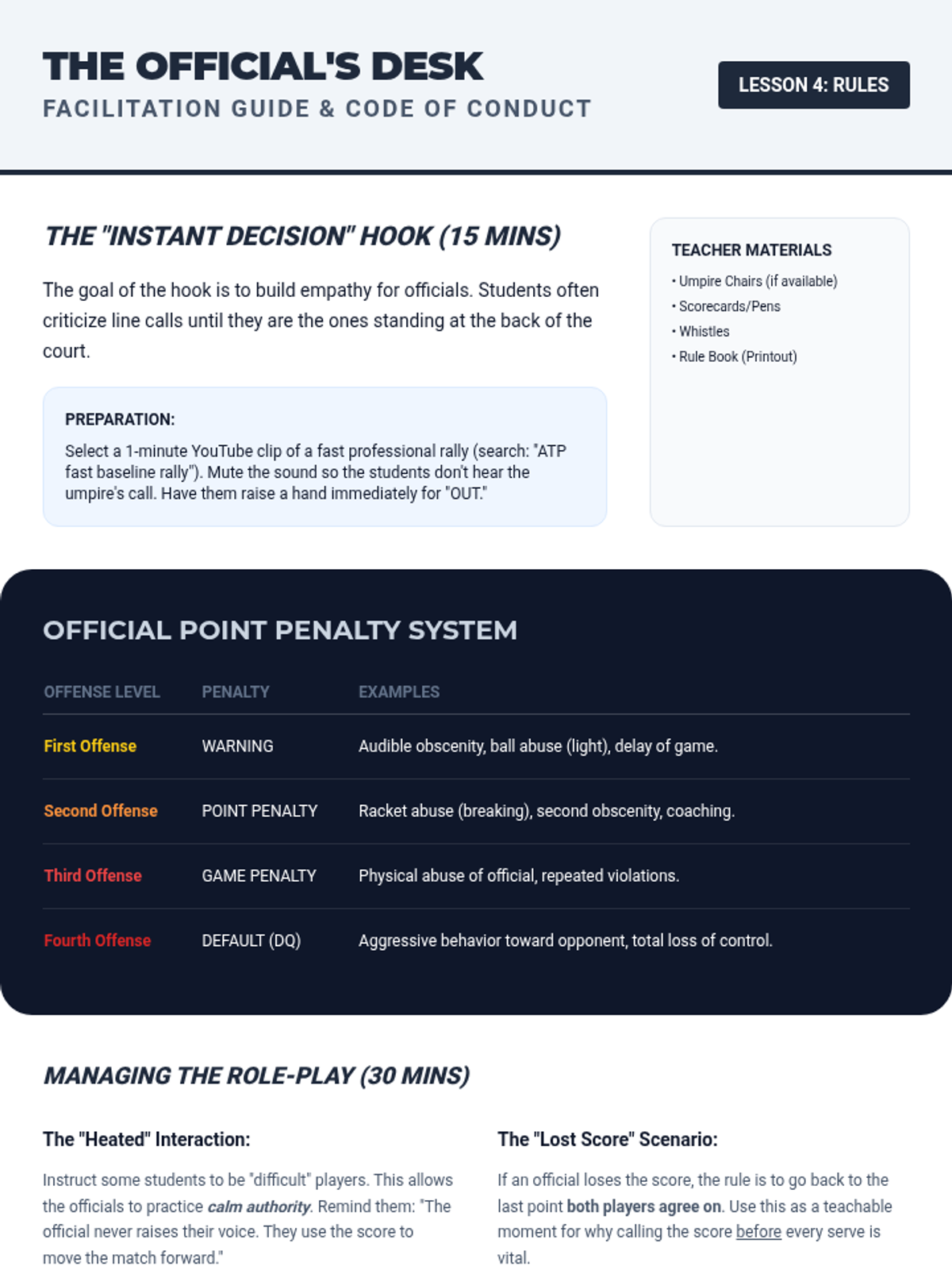
A facilitation guide for Lesson 4, featuring a point penalty system chart and instructional strategies for managing officiating role-plays.
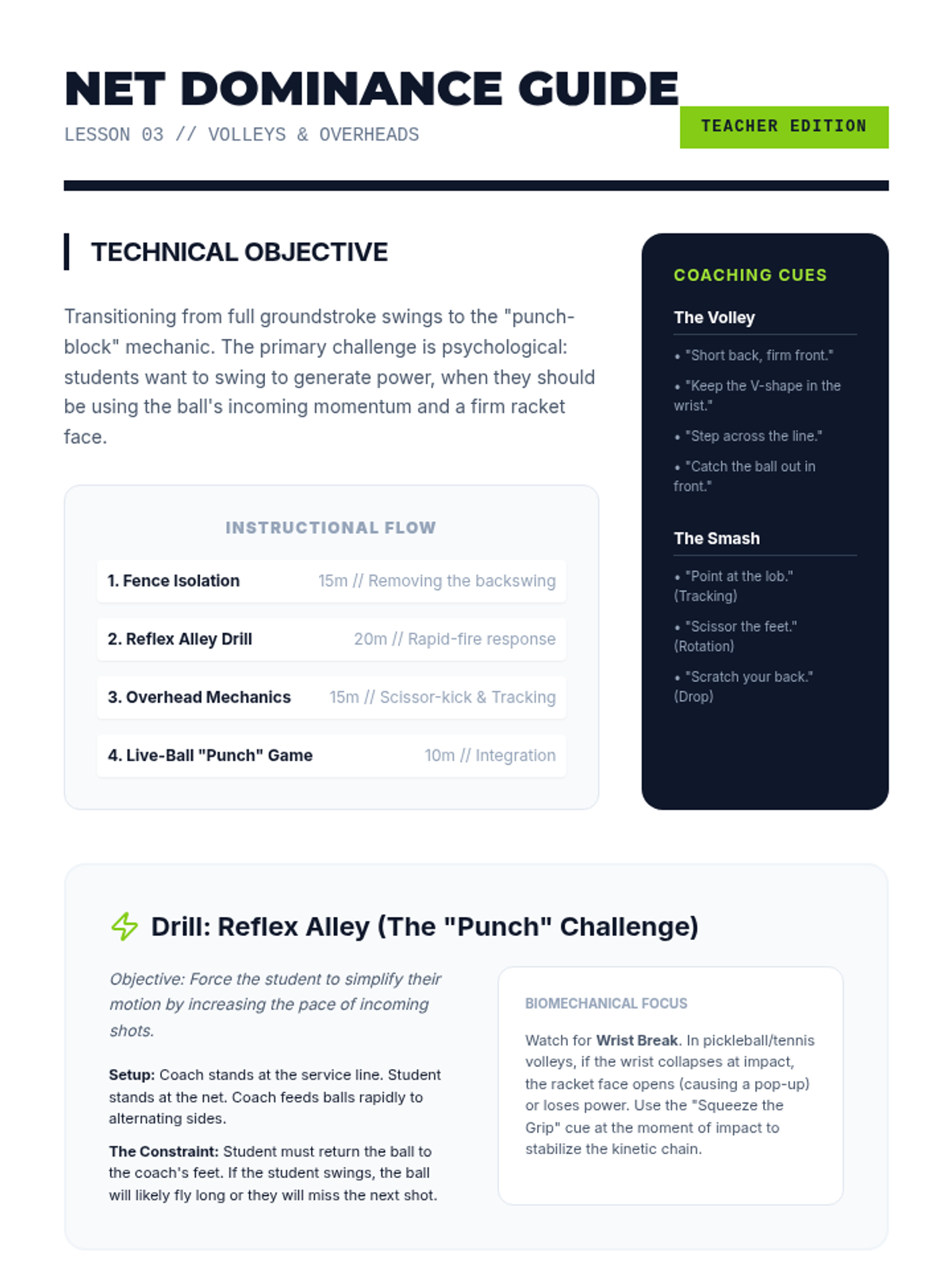
Teacher-facing guide for Lesson 3, including coaching cues, reflex challenge setup, and scissor kick mechanics.
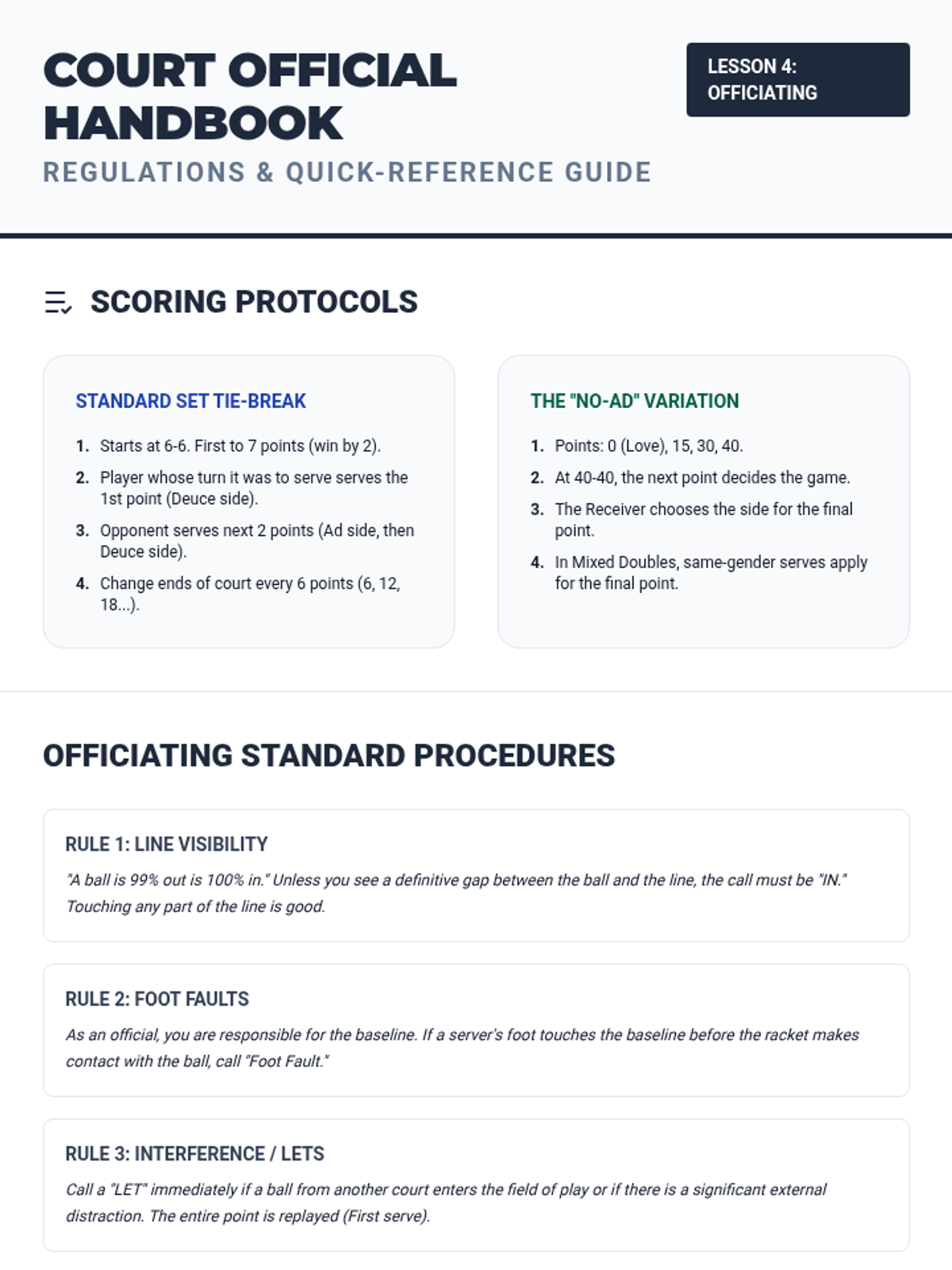
A comprehensive handbook for court officials, including tie-break rules, line call regulations, and conflict resolution scenarios for students to practice.
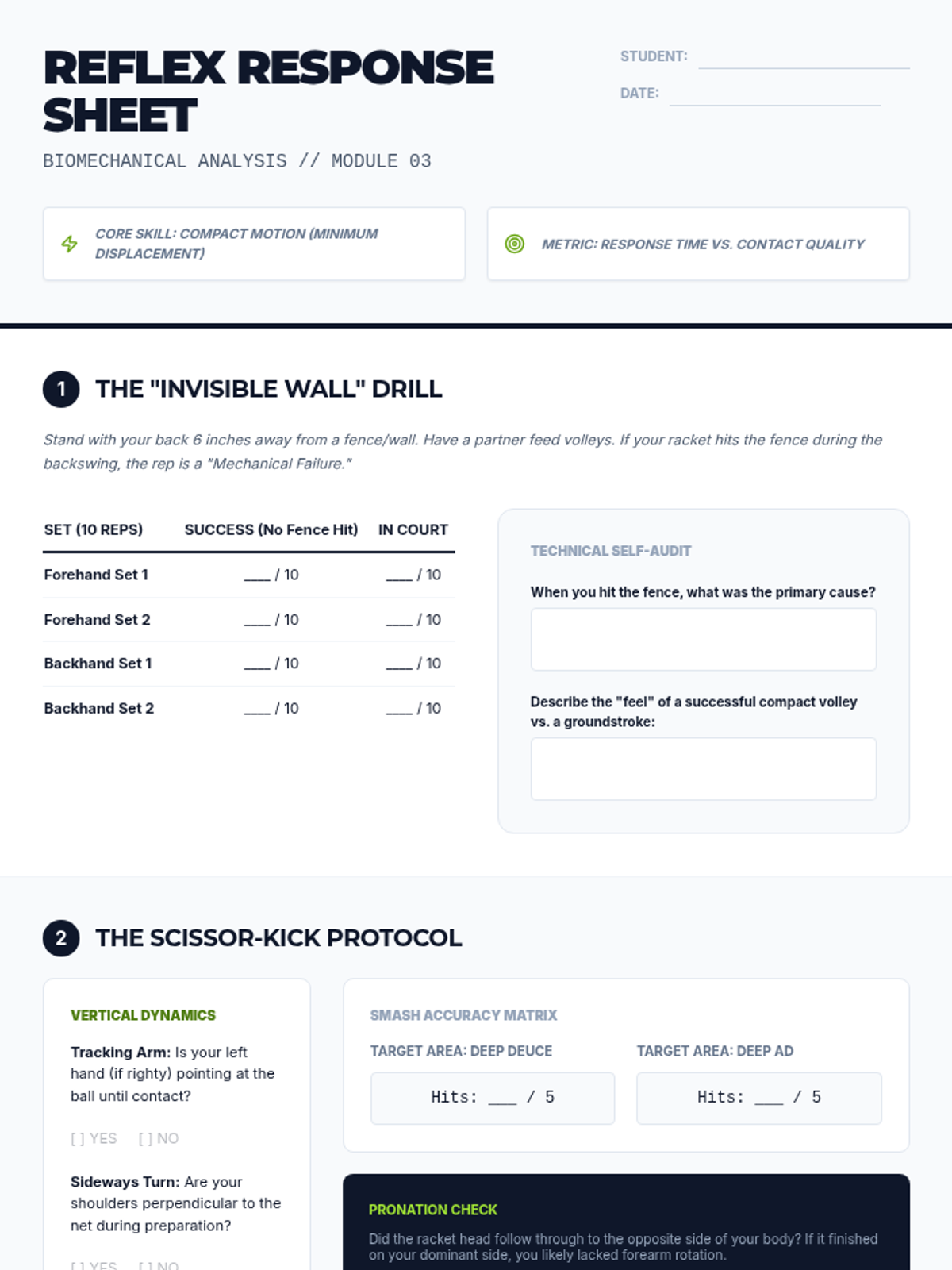
A technical worksheet for students to record their volley consistency and overhead accuracy during net-play drills.
A slide deck for Lesson 4 on officiating, scoring, and regulations, covering tie-breaks, no-ad scoring, official etiquette, and conflict management.
Visual presentation for Lesson 3 covering volley compact motion, punch-block technique, and overhead smash mechanics.
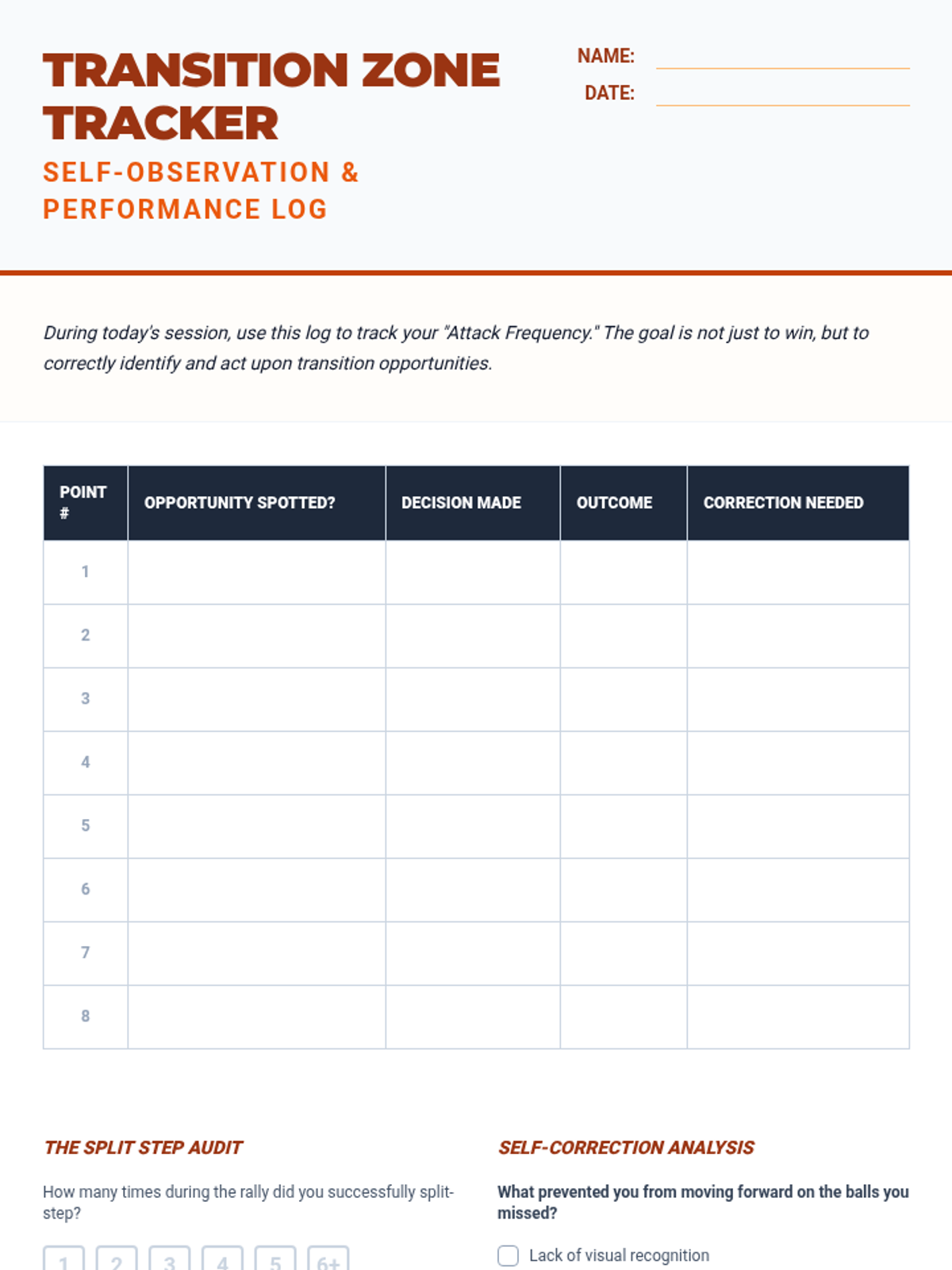
A student performance log to track and analyze transition opportunities, split-step consistency, and decision-making during match play.
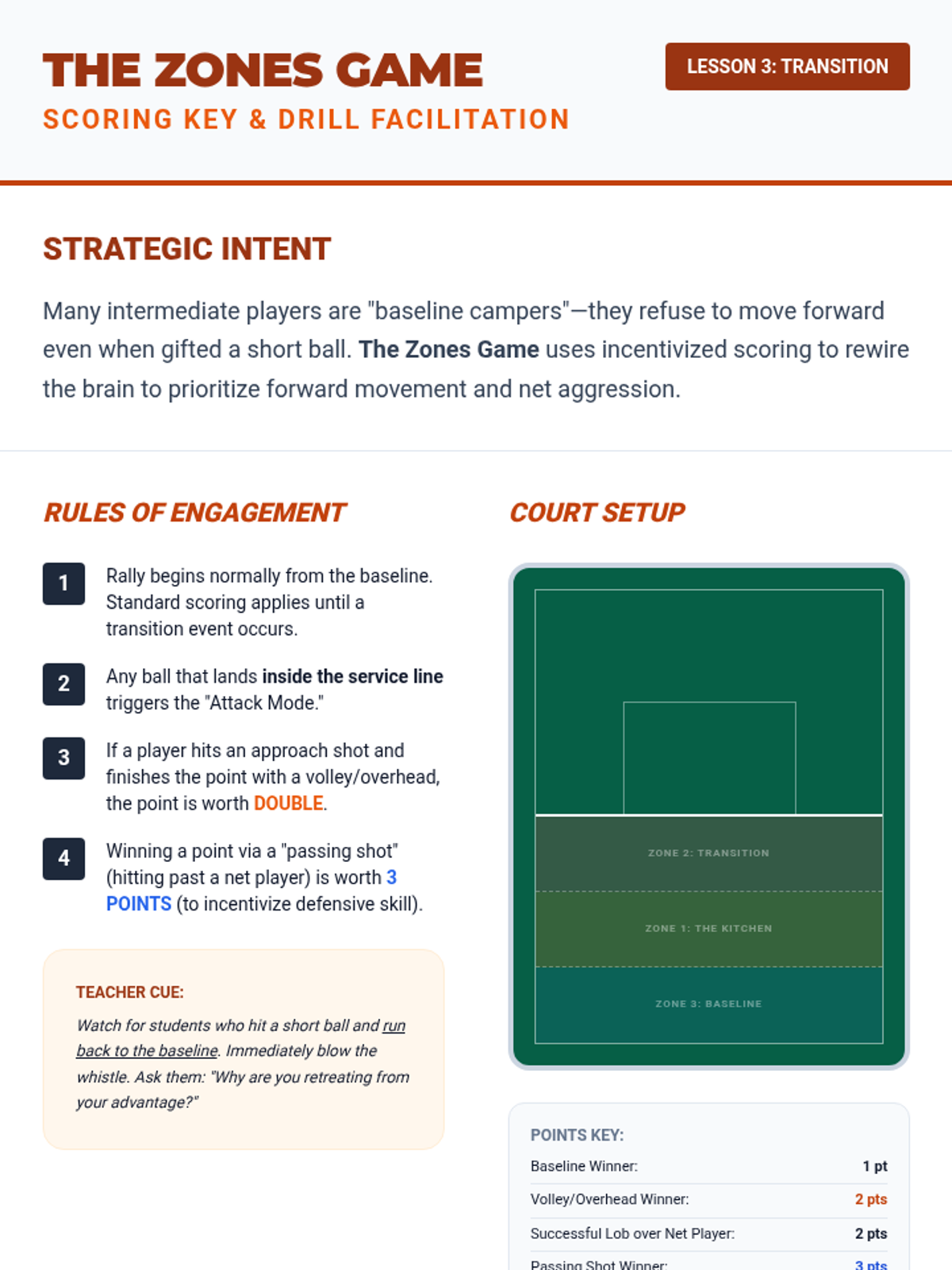
A scoring key and facilitation guide for "The Zones Game," an incentivized drill designed to encourage forward movement and net play.
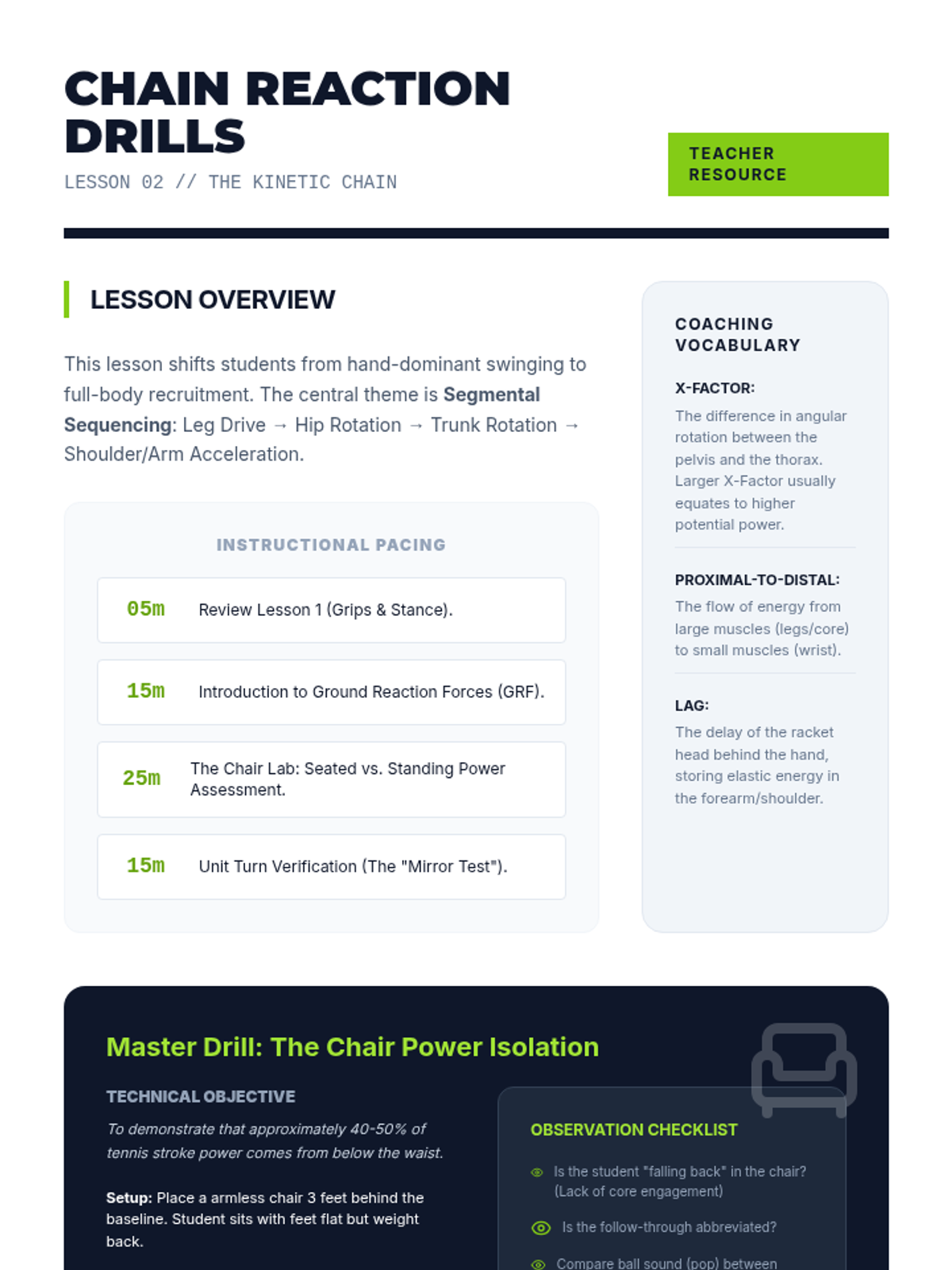
Teacher-facing guide for Lesson 2, including coaching cues, the seated power drill setup, and biomechanical correction strategies.