Geometric classification, measurement of area and volume, and the study of transformations and rigid motions. Builds toward complex proofs, trigonometry for general triangles, and the algebraic representation of conic sections.
A classroom-wide Bingo game where students identify 2D and 3D shapes. Features a magical 'Shape Sorcerer' theme with unique boards and teacher call cards for engaging geometric recognition.
A hands-on construction activity where students build 2D and 3D shape 'skeletons' using playdough and toothpicks. Includes visual mats for triangles, squares, cubes, and pyramids.
A fun, pattern-focused worksheet where students complete AB and ABB shape sequences in an interstellar theme. Includes 2D and 3D shape identification and a creative 'build your own signal' section.
A visual presentation for teaching Kindergarten students about 2D vs 3D shapes and simple repeating patterns. Features 'The Astronaut's Anthem' and interactive pattern examples with a futuristic space theme.
A comprehensive lesson plan for teachers, detailing the 'Galactic Geometry' curriculum. Includes learning objectives, materials list, a timed lesson flow, and specific differentiation strategies for Kindergarten 'Space Explorers'.
A reference chart for the foundational math symbols (plus, minus, and equals) with clear visual definitions and examples for early learners.
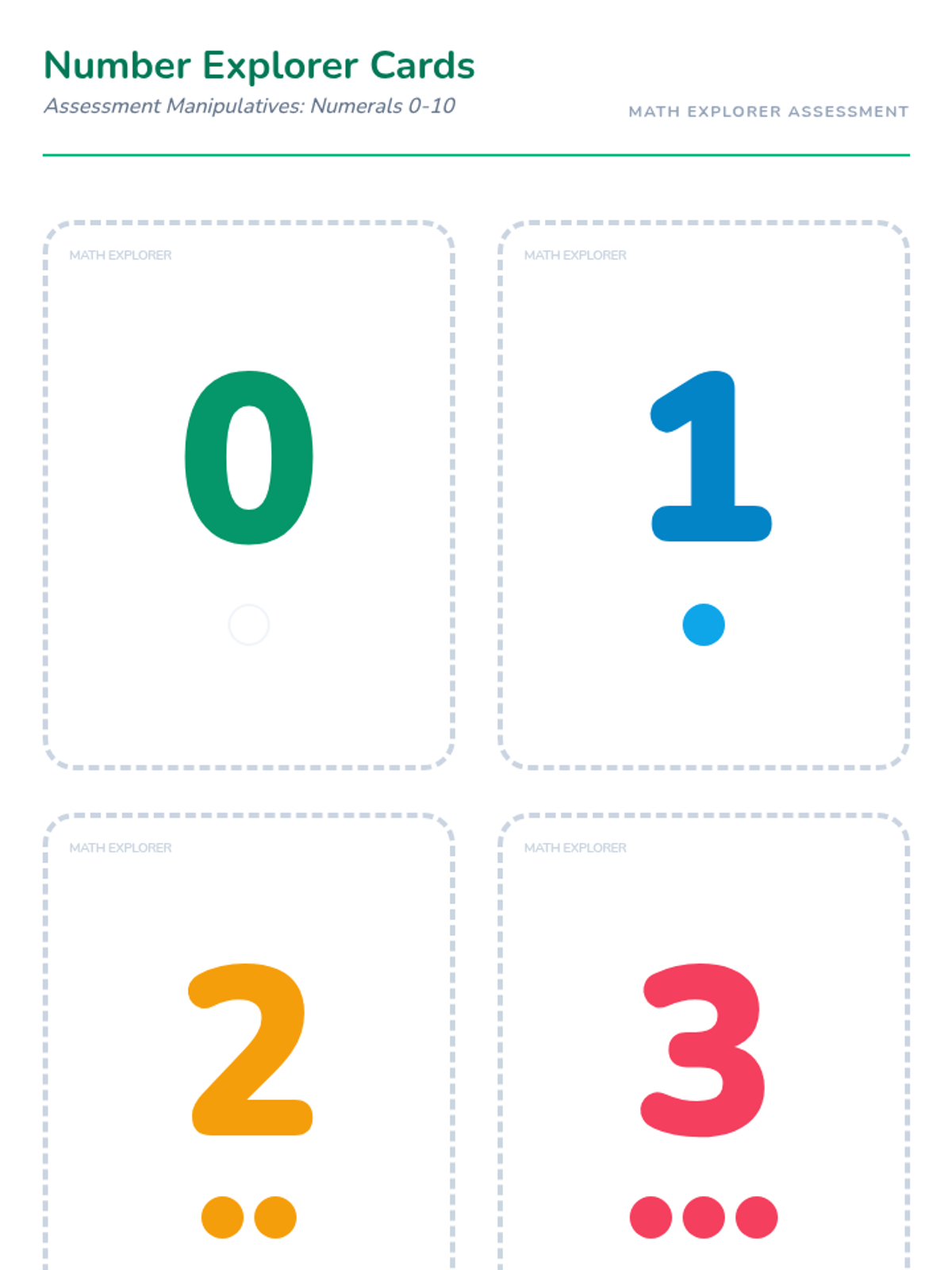
A set of vibrant, high-impact classroom posters featuring numbers 1-10 (examples) and primary shapes with bold visuals for early learners.
A student worksheet featuring matching activities for numbers and shapes, along with simple pictorial addition and subtraction problems.
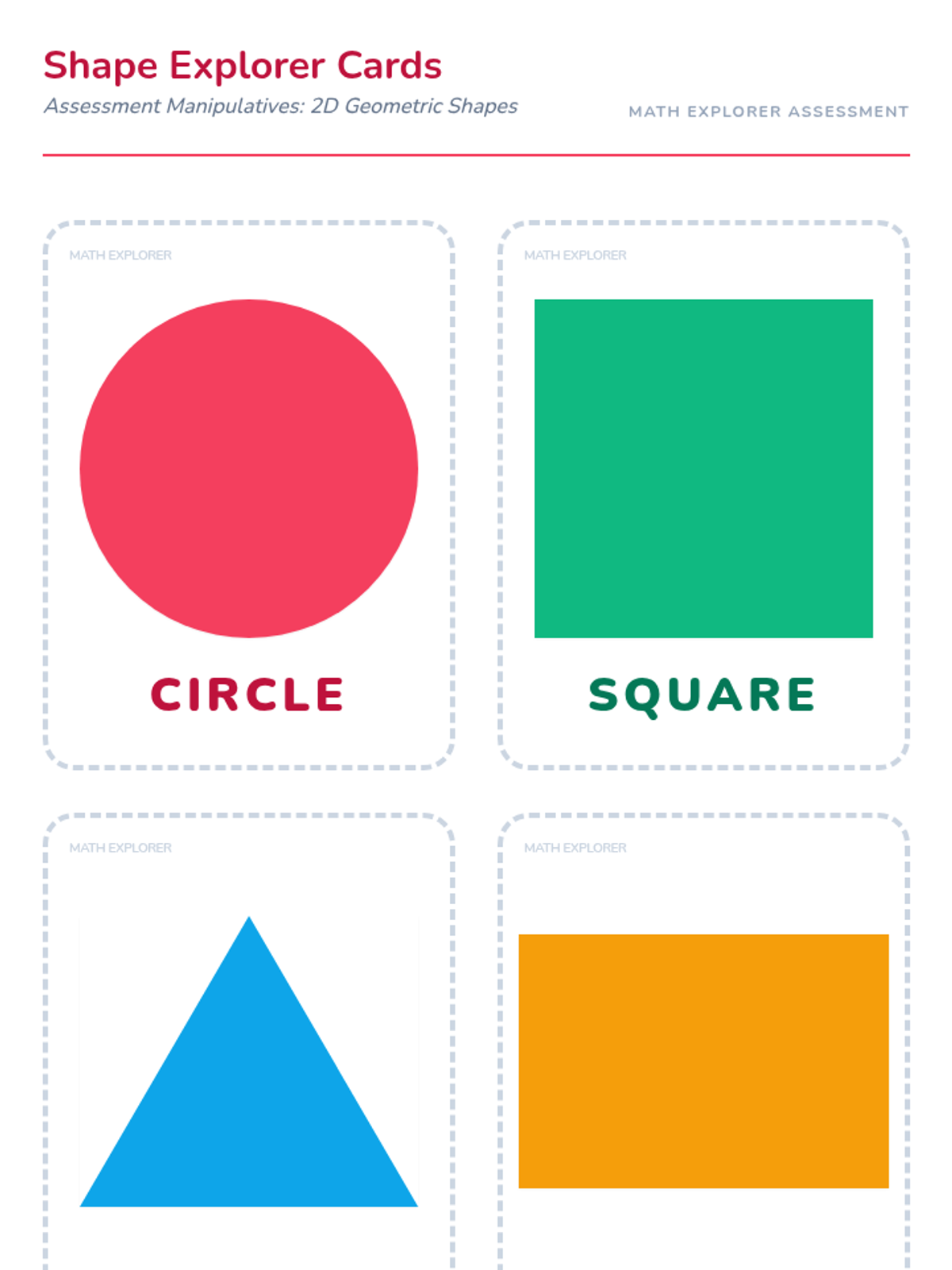
A collection of 2D and 3D shape flashcards featuring geometric definitions, clear visual icons, and real-world examples to help students identify shapes in their environment.
A set of jungle-themed flashcards for numbers 1-10, featuring clear digits, adorable animal icons for counting, and the written number word.
An answer key for the Solid Shape Sort Worksheet, highlighting objects that fit into both "Rolls" and "Stacks" categories, such as cylinders.
A cut-and-paste sorting activity where students categorize real-world 3D objects (spheres, cubes, cylinders, cones, and prisms) into "Rolls" and "Stacks" based on their physical attributes.
A visual presentation introducing 3D shapes (sphere, cube, cylinder, cone, rectangular prism, pyramid) and their attributes, including stacking, rolling, and sliding.
Teacher guidance and answer keys for the Pattern Detectives lesson, including differentiation strategies for various learning levels.
Level 3 mats for advanced learners, featuring growing patterns and a 'Creation Station' for students to design their own complex sequences, now optimized for a single page layout.
Level 2 mats for advanced learners, featuring ABC, AAB, and ABB patterns with internal missing elements to challenge pattern recognition.
Level 1 mats for beginning learners, focusing on simple AB and AABB repeating patterns with clear extension areas.
An engaging slide deck introducing shape patterns (AB, AABB, ABC, ABB) and growing patterns with a detective theme.
Updated answer key for the Shape Search Worksheet including Mission 3 (Triangles).
Three-page kindergarten math worksheet with missions for squares, stars, and triangles, providing progressive counting practice.
A specialized tracing worksheet where Kindergarteners practice transforming 2D shapes into 3D ones by tracing dotted construction lines. It reinforces the "pop out" concept through hands-on drawing.
An answer key for the Shape Pop Worksheet, clearly identifying the correct 2D shapes and providing guidance for the drawing assessment.
A comprehensive teacher guide for the Shape Pop lesson, including CCSS standards, a step-by-step instructional sequence, "Pop vs. Flat" terminology scripts, and common Kindergarten misconceptions.
A Kindergarten-friendly worksheet where students identify 2D (flat) vs 3D (pop out) shapes. It features multiple-choice questions focusing on identifying 2D shapes and a drawing section for creative application.
A bright and engaging slide presentation introducing Kindergarteners to 2D (flat) and 3D (pop out) shapes. It uses clear visual comparisons and emphasizes the 'pop out' quality of 3D objects with dotted line depth cues.
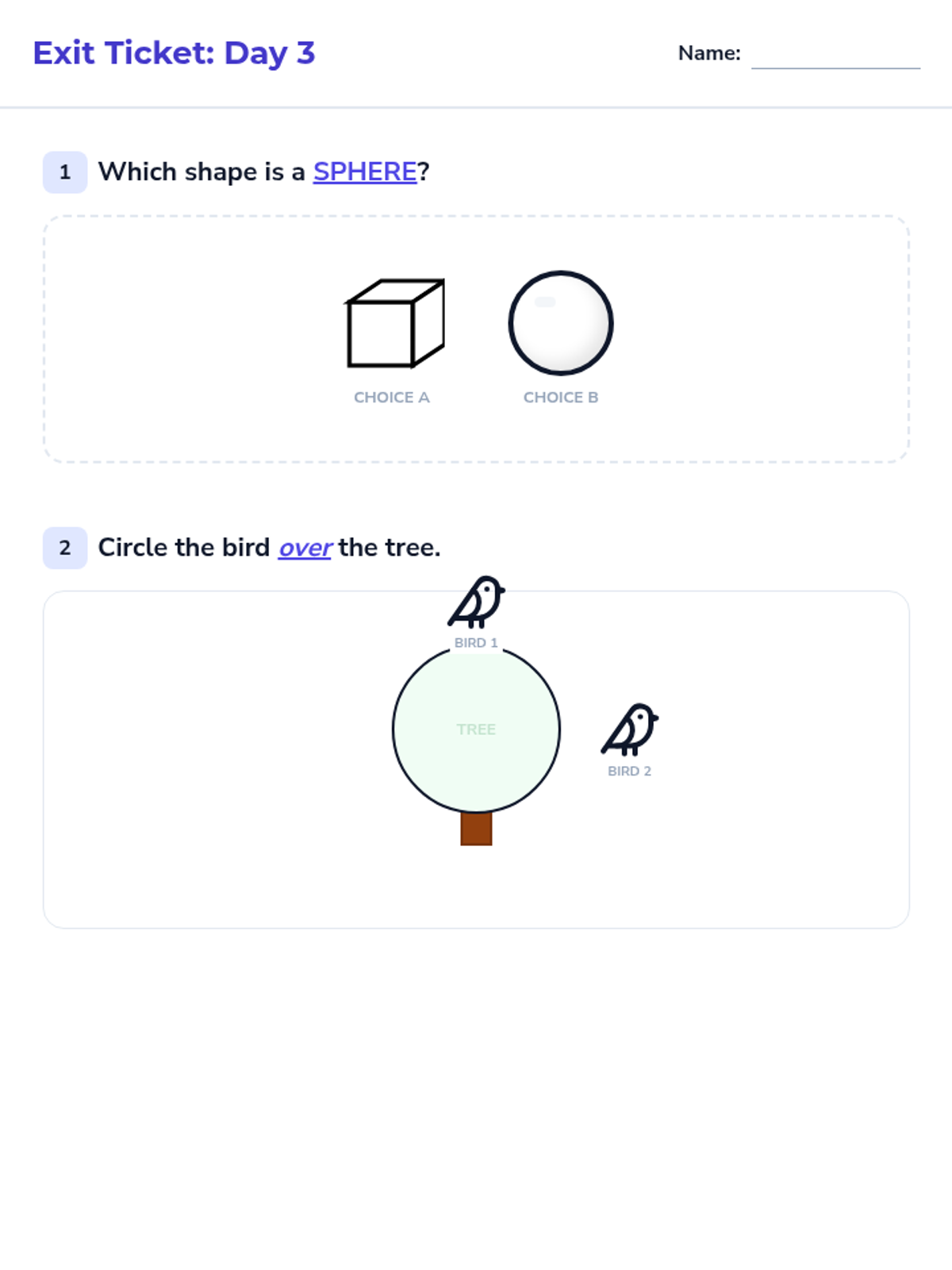
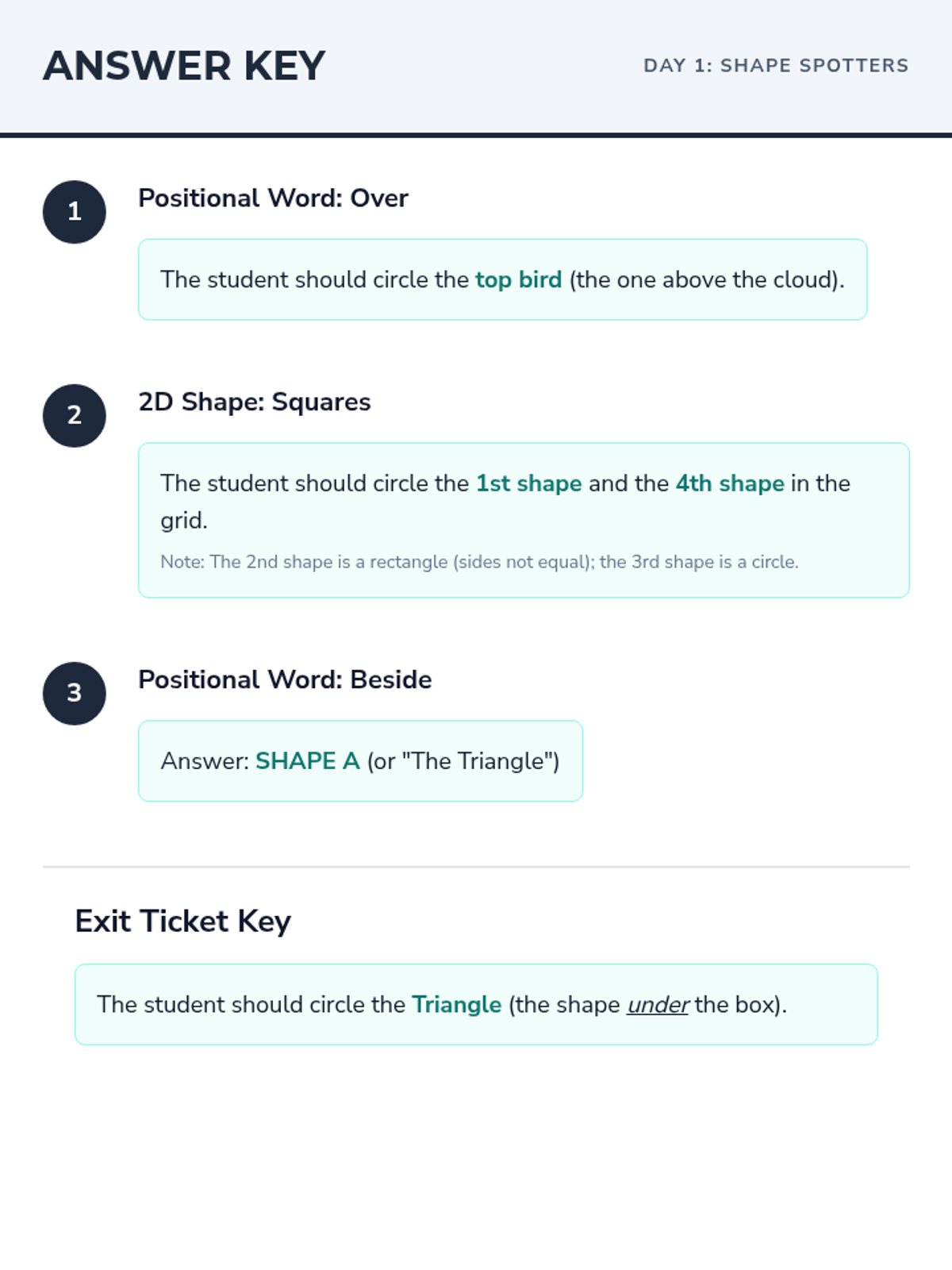
A progress monitoring checklist for teachers to track individual student mastery of positional vocabulary terms during the intervention lesson.
Visual blueprint cards for the barrier game, featuring varied arrangements of shapes for students to describe and replicate. Cards are categorized by difficulty levels.
A comprehensive teacher guide for the Shape Architects intervention lesson, including learning objectives, instructional steps for the barrier game, and Tier 2 support strategies.
Visual instructional slides for a Tier 2 Kindergarten lesson on shapes and positional language. Includes visual definitions of above, below, beside, in front of, and behind, along with barrier game instructions.
An answer key for the Evidence Log Worksheet, providing teachers with the correct answers for shape identification, counting, and analysis.
A student-facing worksheet for identifying and comparing 2D and 3D shapes. Features sections for sorting flat vs. solid shapes, counting corners and sides, and comparing squares to cubes.
A comprehensive teacher guide for the Shape Detective Academy lesson, providing instructional steps, vocabulary support, differentiation strategies, and hands-on activity ideas for Kindergarten geometry.
A vibrant, engaging slide deck for Kindergarten students to learn the differences between 2D (flat) and 3D (solid) shapes using the 'Shape Detective' theme. Includes visual comparisons of squares vs. cubes, triangles vs. cones, and circles vs. spheres.
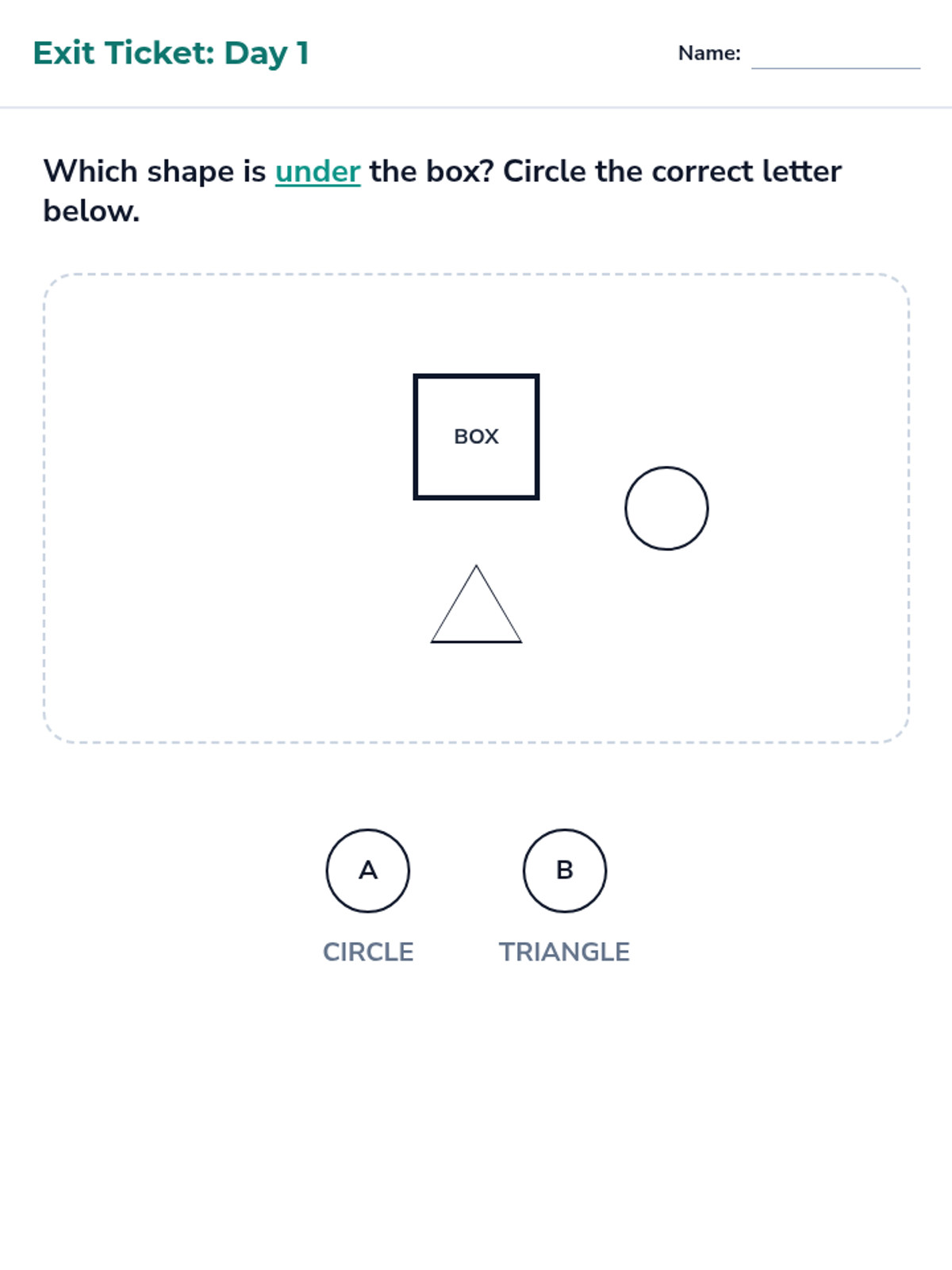
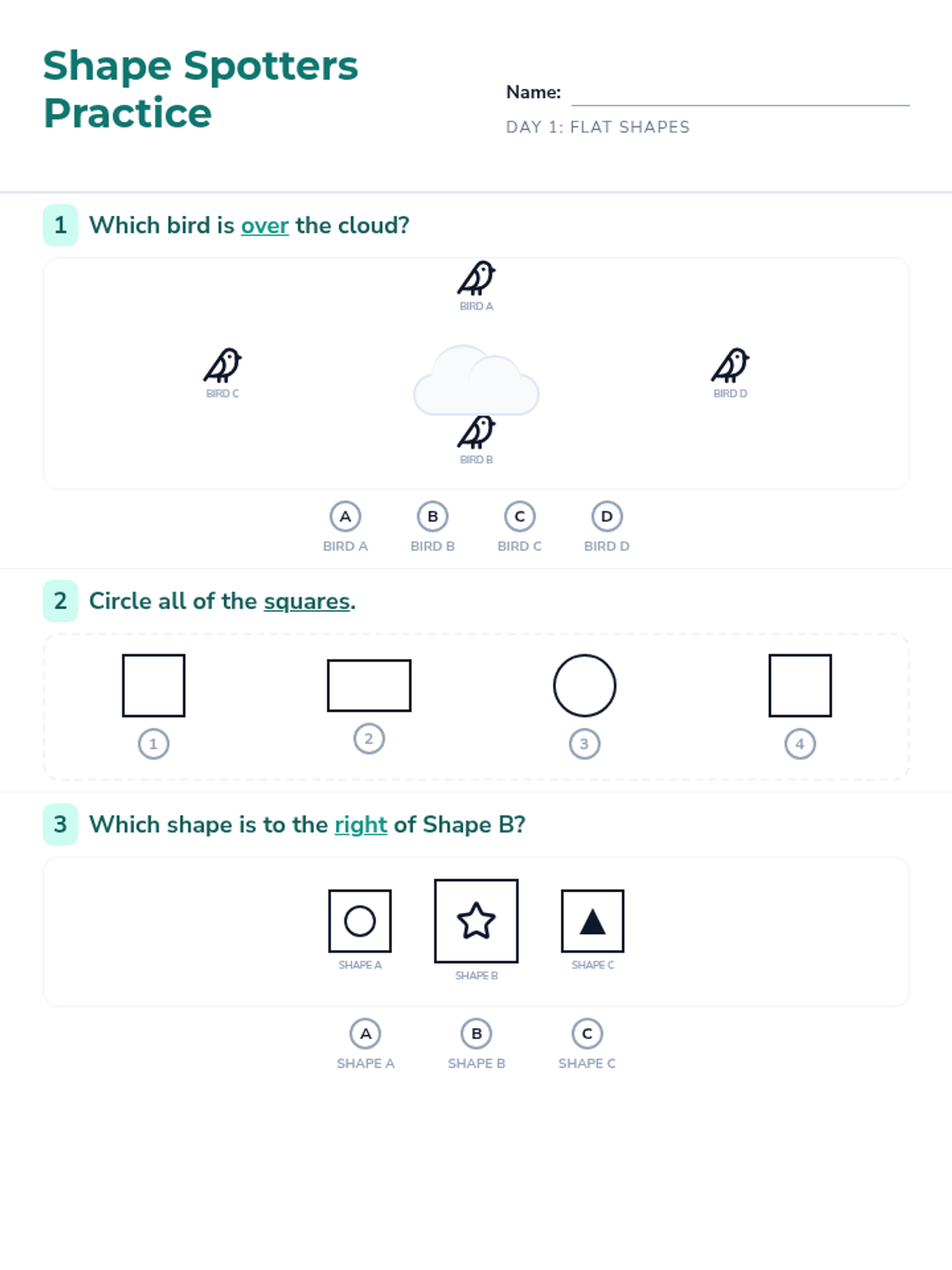
A visual scavenger hunt worksheet for K-1 students to practice positional words. Includes large drawing areas and icons for 'on top', 'under', 'next to', and 'behind'.
A bright and interactive slide deck for the Position Pursuit lesson, featuring a Simon Says warm-up, embedded video, and visual practice for positional words.
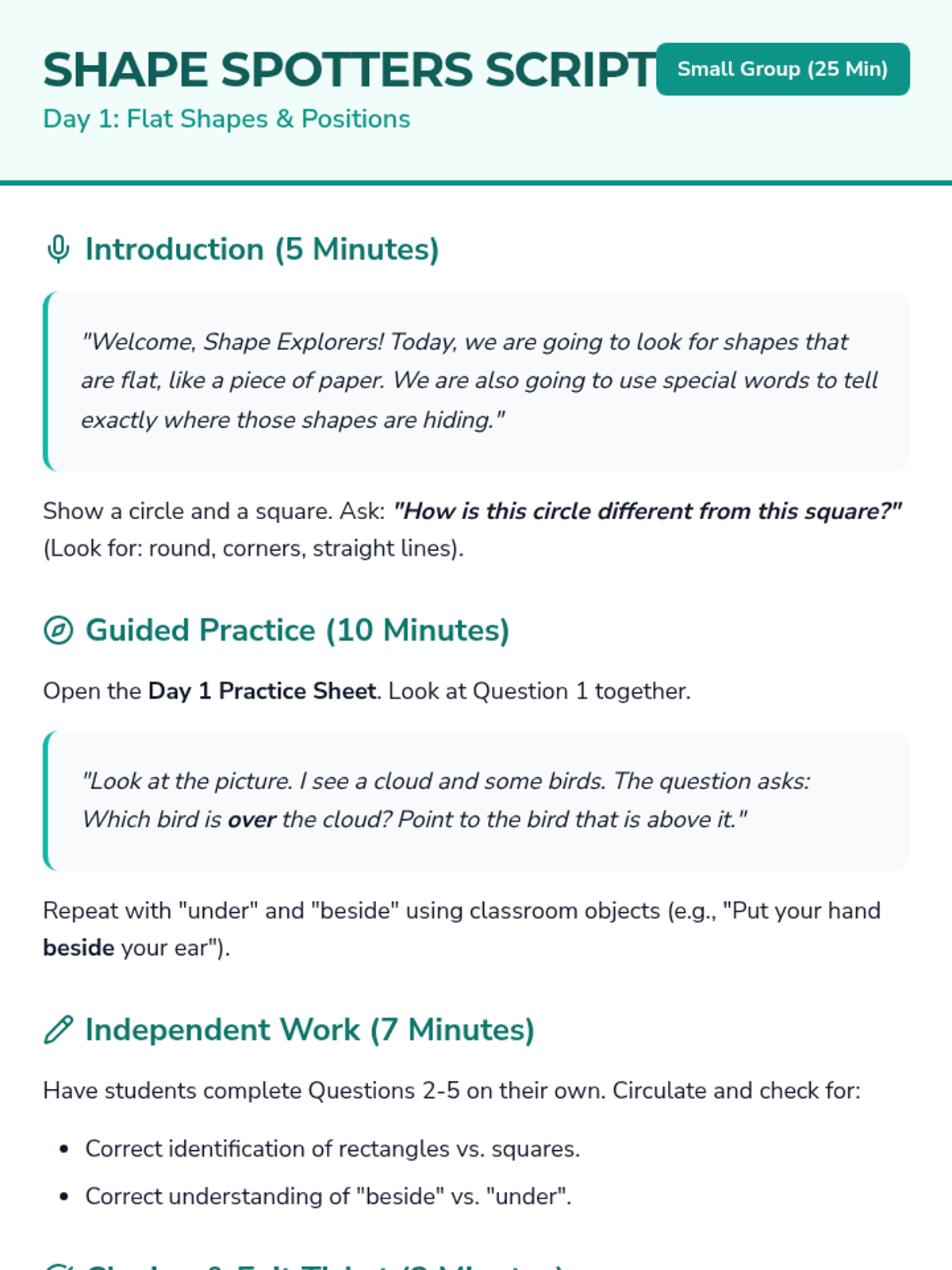
A comprehensive teacher facilitation guide for the Position Pursuit lesson, including a 'Simon Says' warm-up, video pause points, and instructions for a classroom scavenger hunt.
A classroom anchor chart comparing 'on vs. above' and 'under vs. below' with clear visual examples for young learners.
A comprehensive teacher guide for the Position Patrol lesson, including learning objectives, material lists, and a detailed instructional script with video timestamps.
Large, high-contrast vocabulary flashcards for spatial position words with simple visual icons to support Kindergarten learners.
Interactive presentation slides for the Position Patrol lesson, featuring a warm-up challenge, embedded instructional video, and clear visual comparisons of positional words.
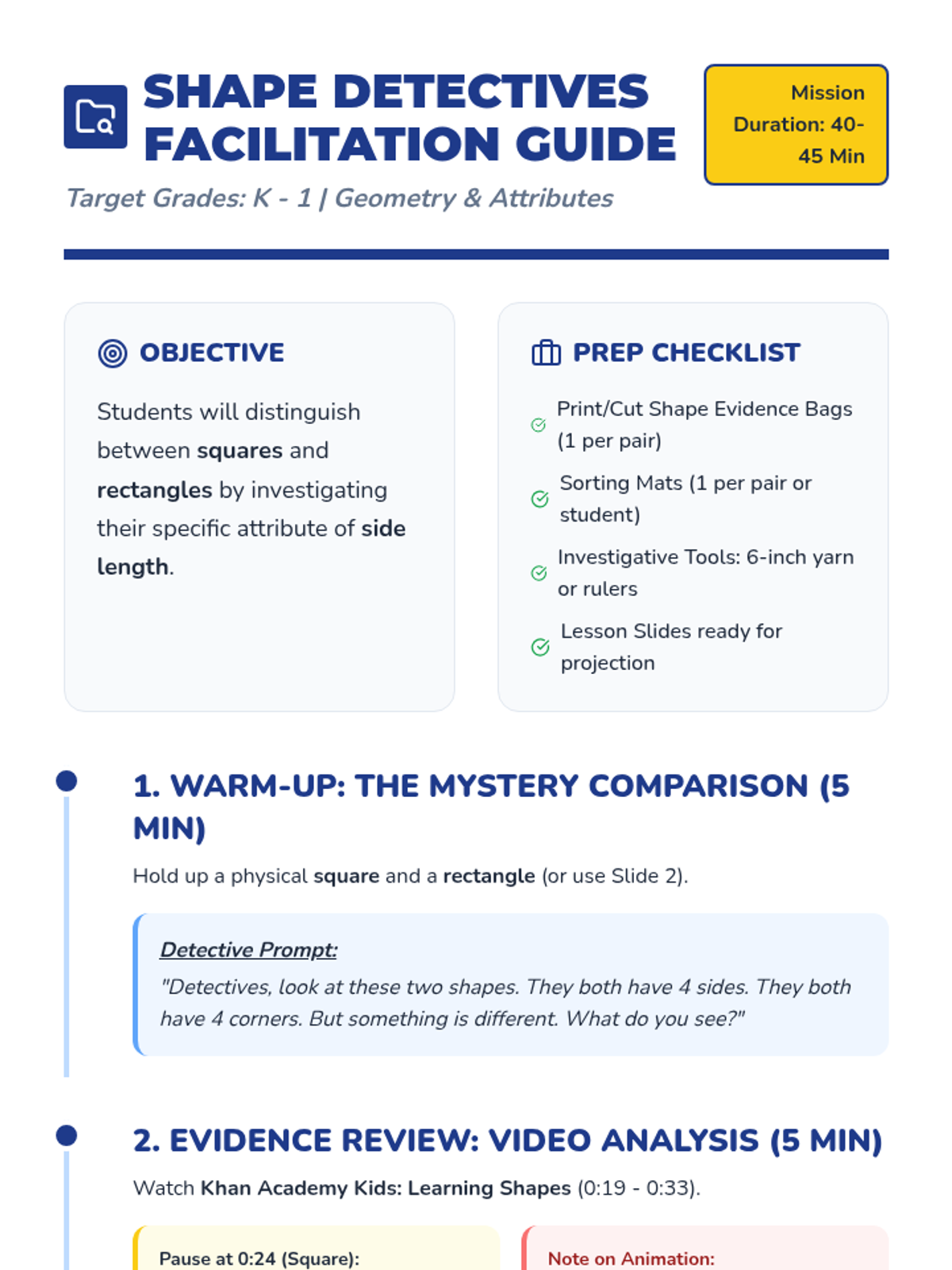
A comprehensive instructional guide for teachers to lead the Shape Detectives lesson, including warm-up prompts, video timestamps, activity instructions, and key debriefing questions.
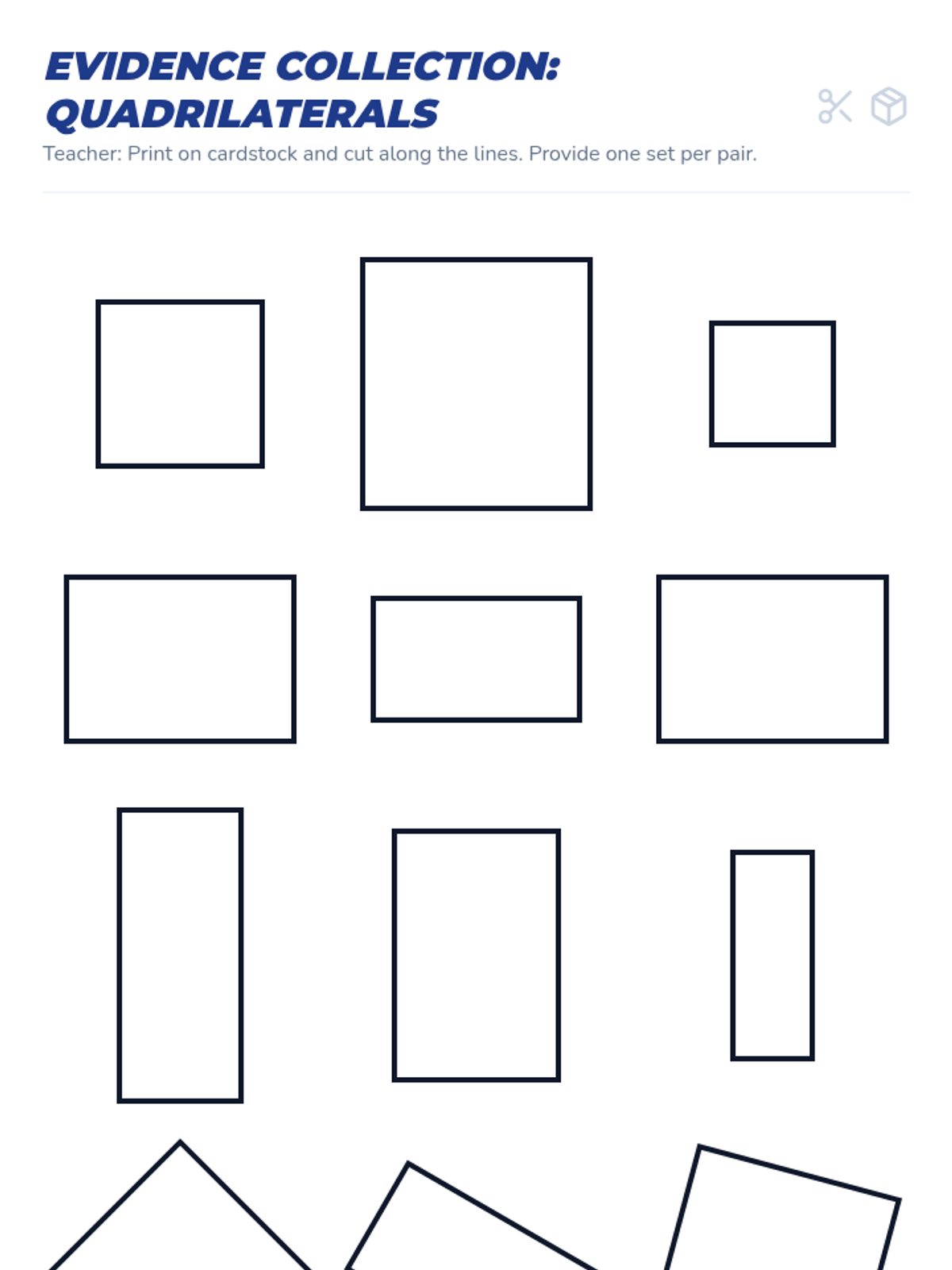
A printable set of various squares and rectangles in different orientations to be cut out and used for the shape sorting activity.
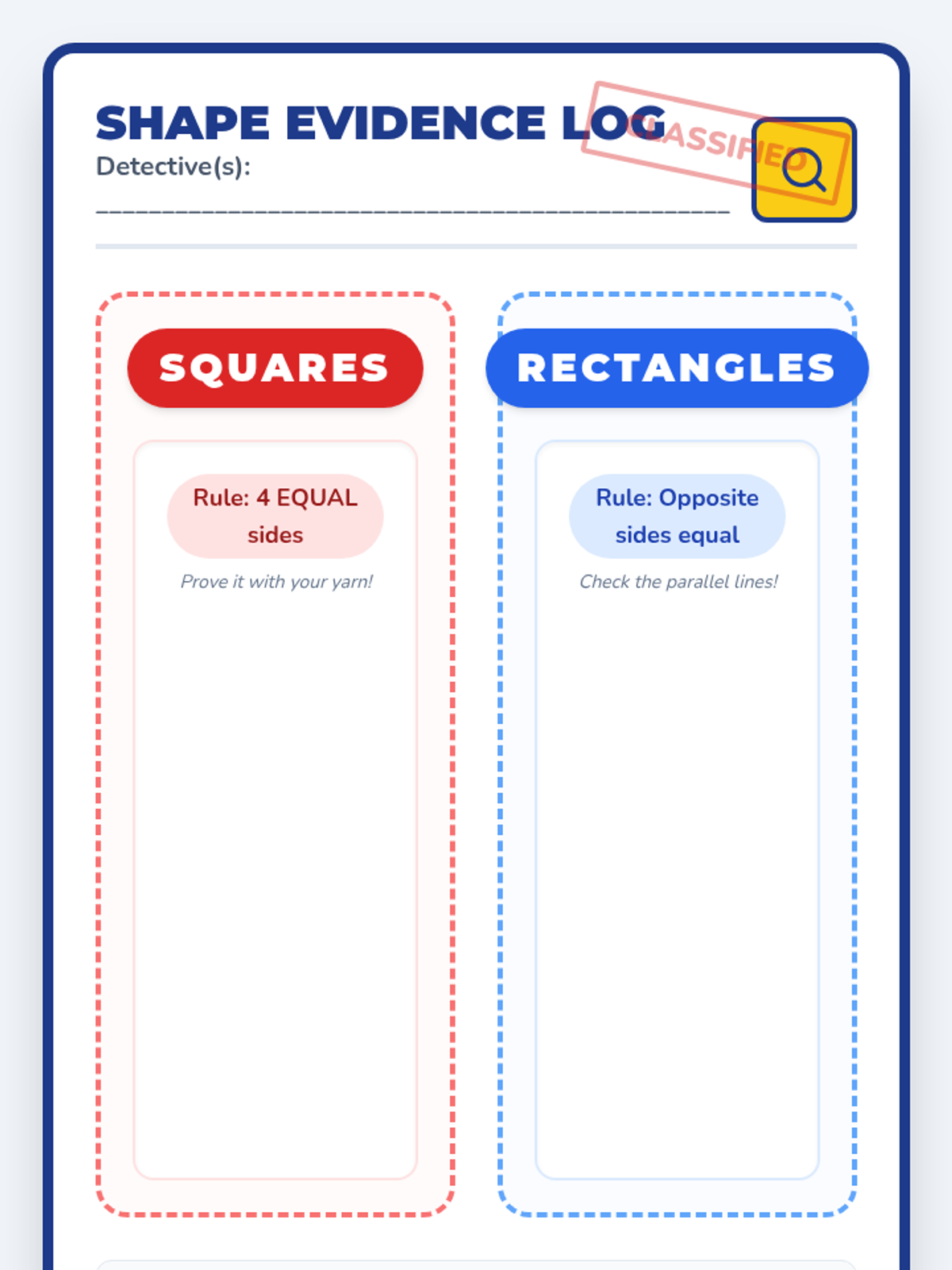
A specialized sorting mat for students to categorize paper shapes into 'Squares' or 'Rectangles' based on their investigated side lengths.
A vibrant presentation for Kindergarten/1st Grade students introducing the 'Shape Detectives' theme, featuring key vocabulary (equal, parallel), a video embed, and visual side-length comparisons.
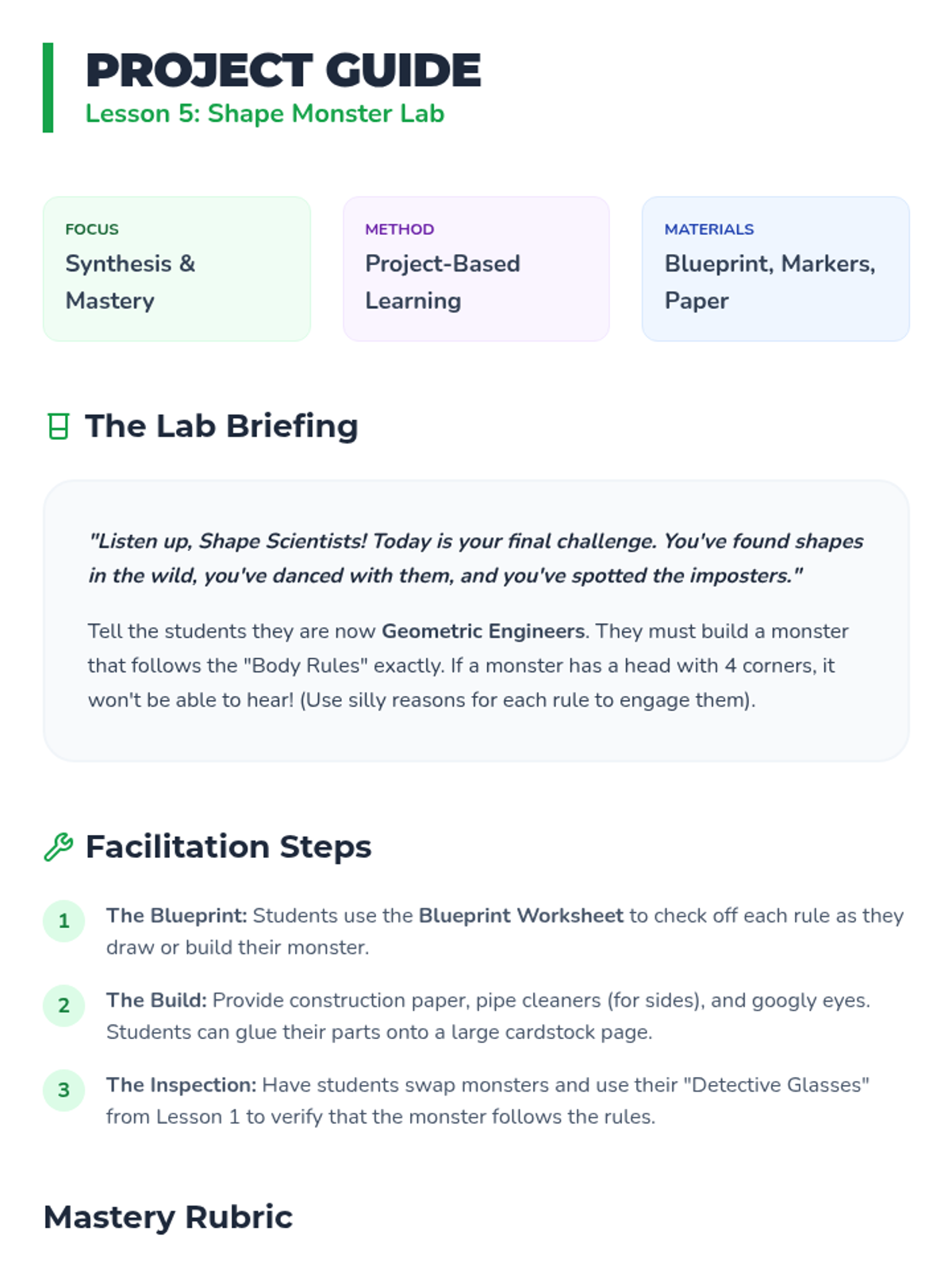
Teacher guidance for the Shape Monster Lab project, including instructional scripts, facilitation steps, and a mastery rubric for assessment.
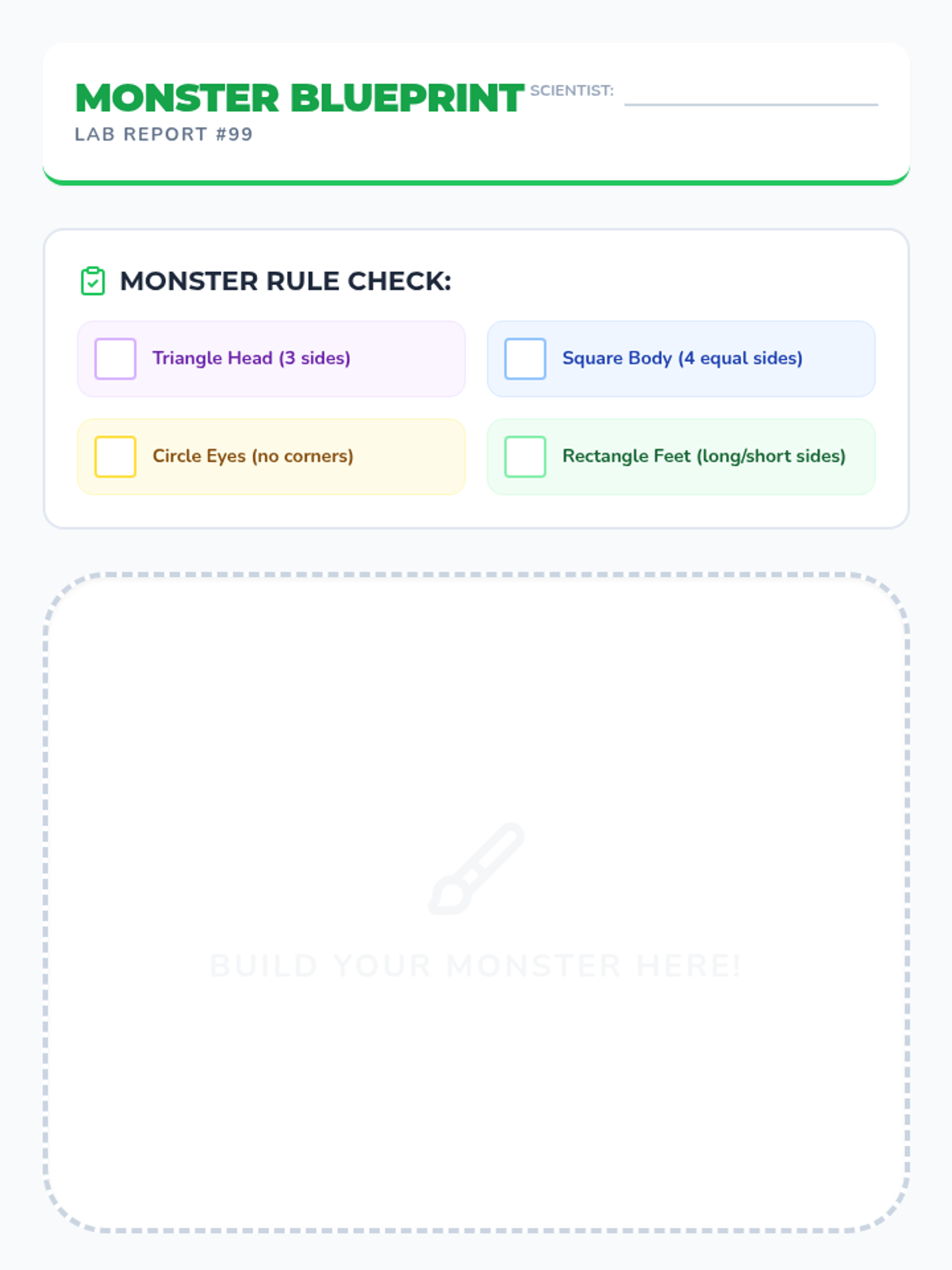
A design worksheet for the Shape Monster project where students plan their creature according to specific geometric criteria and reflect on its attributes.
Project introduction slides for the Shape Monster Lab, outlining the geometric criteria for building valid shape monsters.
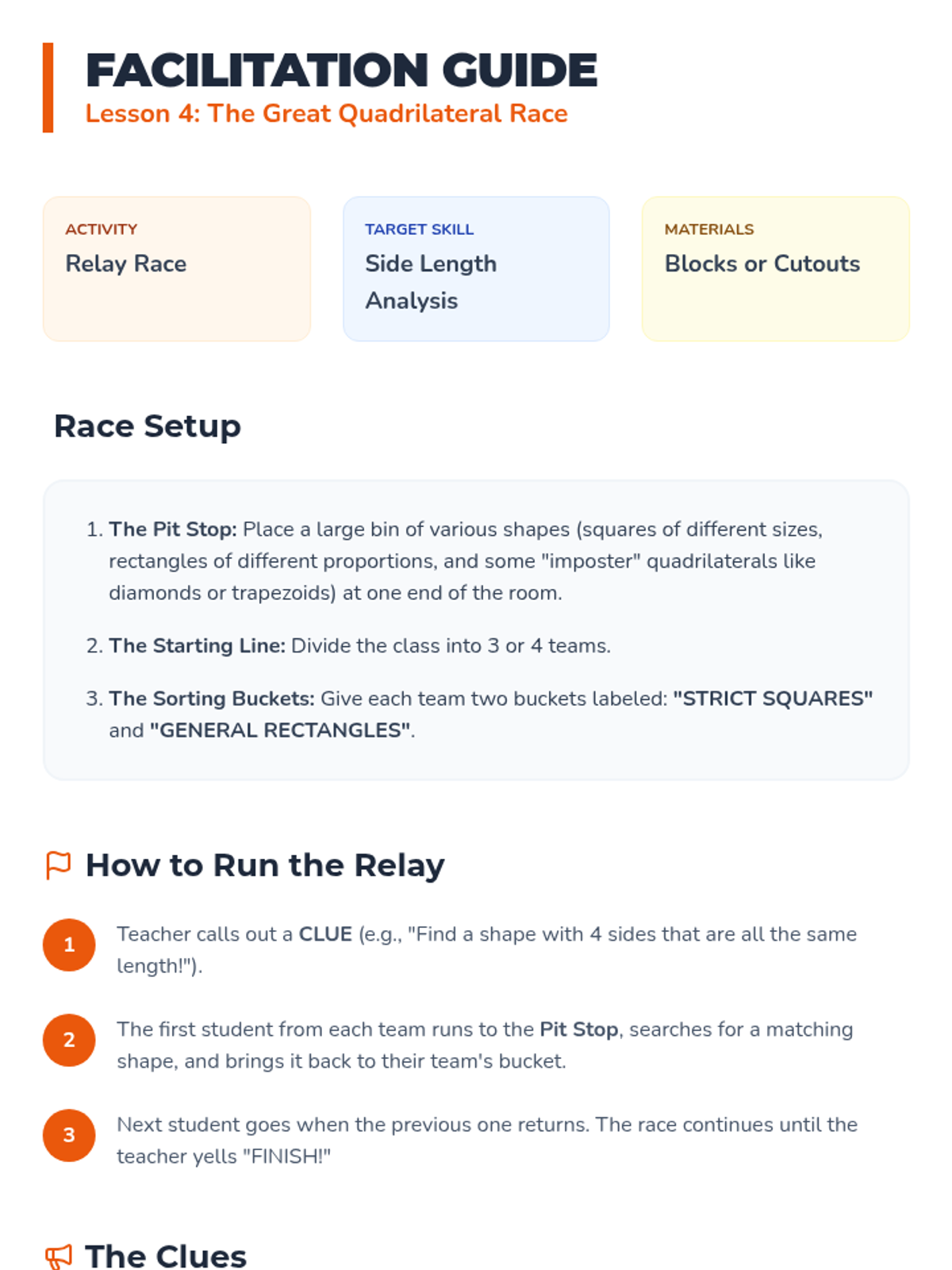
Teacher guidance for the Quadrilateral Race activity, including relay race instructions, setup tips, and clue examples.
Visual slides for comparing squares and rectangles, preparing students for the Quadrilateral Race activity.
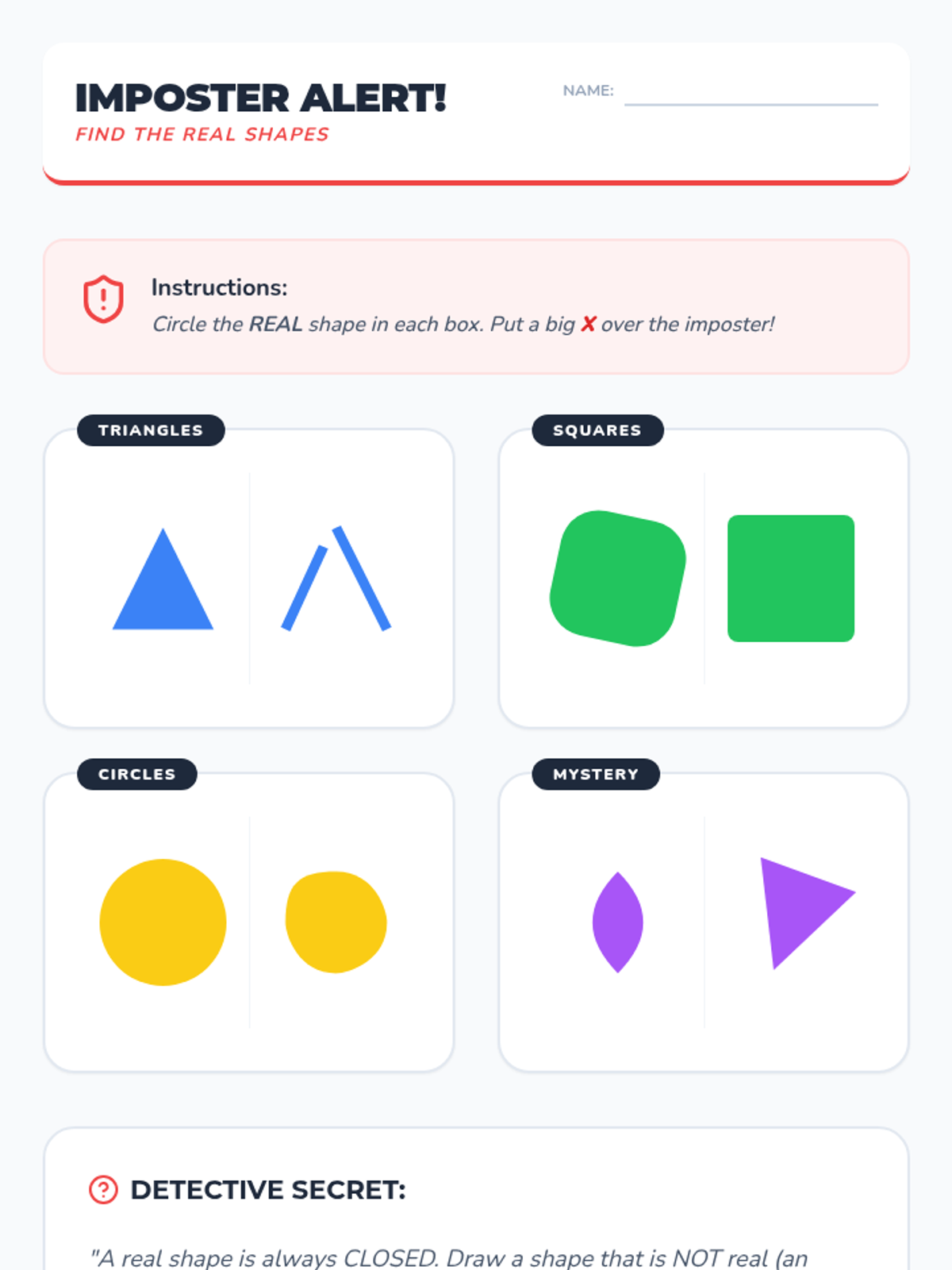
A sorting worksheet where students identify 'imposter' shapes by circling true geometric figures and marking non-examples with an X.
Game-based learning slides for identifying 'imposter' shapes by focusing on defining attributes like closed sides and straight lines.
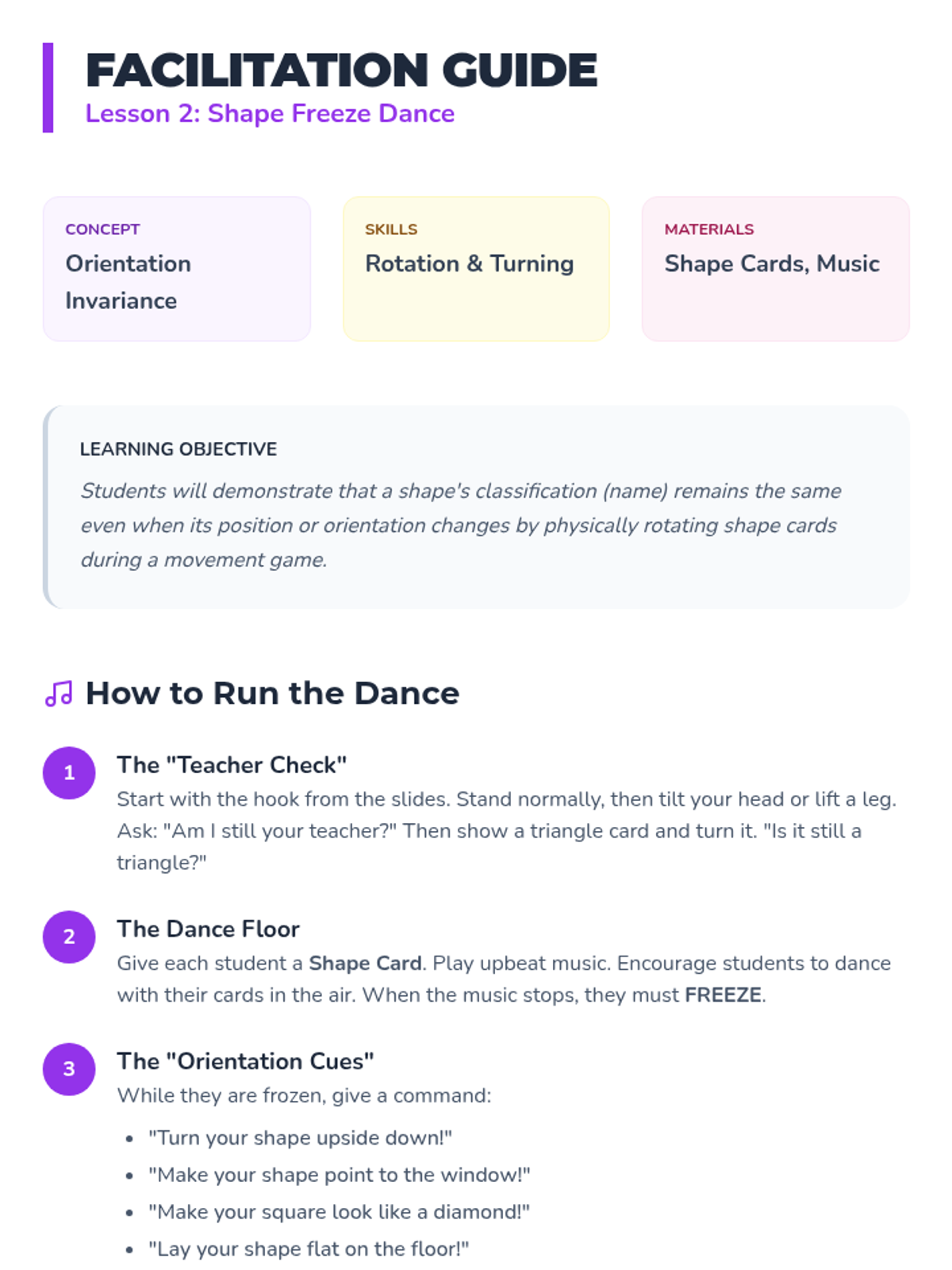
Teacher guidance for the Shape Freeze Dance activity, including orientation cues and discussion prompts to reinforce shape invariance.
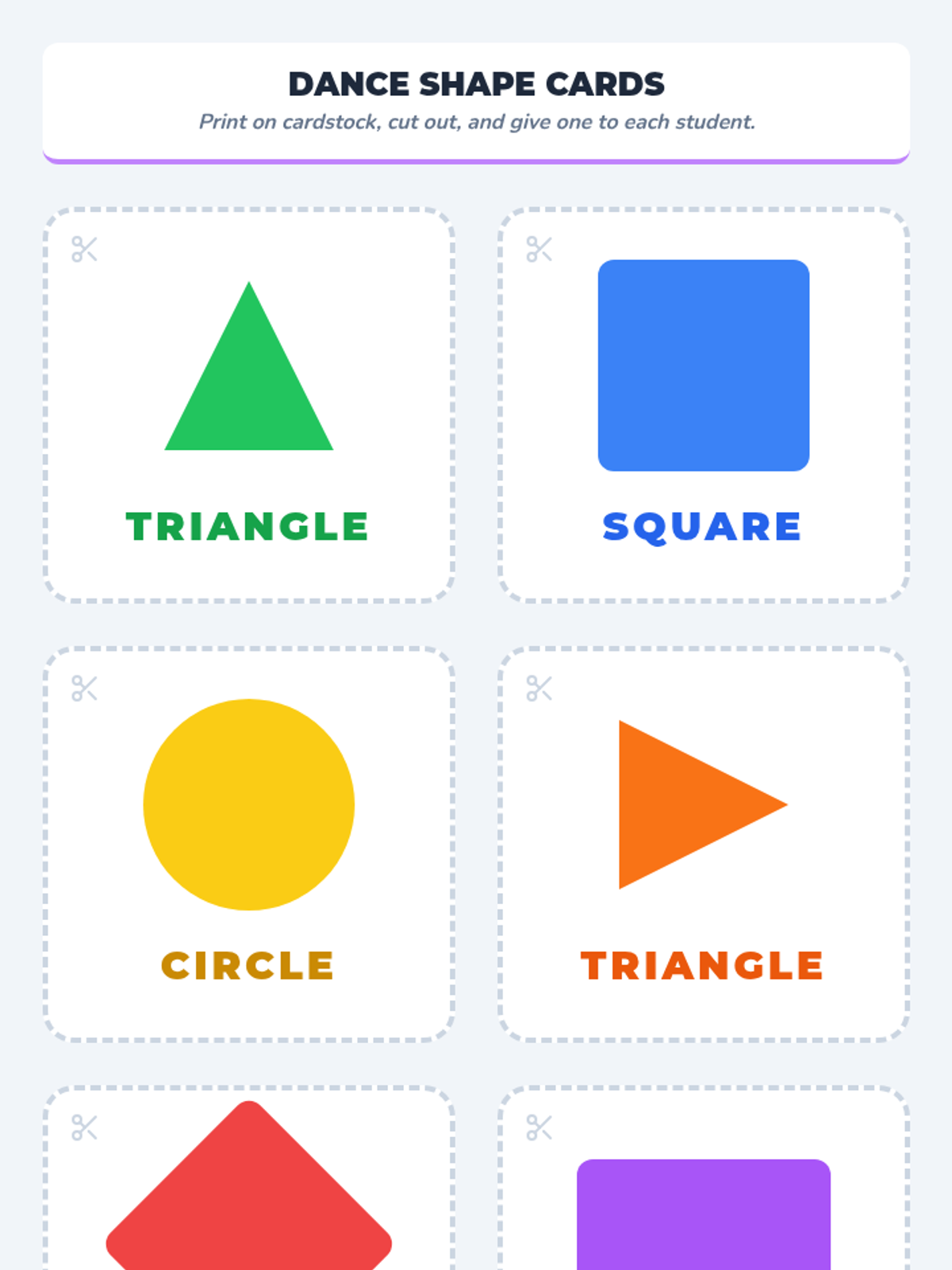
Simple, bold shape cards for students to hold and rotate during the Shape Freeze Dance activity. Includes variations in color and orientation to reinforce classification invariance.
Kinesthetic learning slides for the Shape Freeze Dance activity, illustrating that shapes retain their classification regardless of orientation or tilt.
Teacher guidance for facilitating the Shape Detective Walk, including walking route suggestions, discussion prompts, and post-activity collage ideas.
A visual checklist for Kindergarten students to use during a shape hunt in their environment. Features simple icons and checkboxes for circles, squares, and triangles.
Introductory slide deck for the Shape Detective Walk lesson, introducing circles, squares, and triangles through a "detective" lens.
Final teacher guide for the advanced sorting project. Includes a gallery walk facilitation plan, guiding questions for assessment, and a simple rubric for tracking student progress in geometric classification.
Final project worksheet for Lesson 5. Students design a 'VIP Club' with a secret sorting rule, place shapes inside a 'hoop', and prepare to justify their logic to classmates.
Slides for the final Lesson 5 'The VIP Shape Club'. Students are challenged to create their own sorting rules and justify them to their peers in a project-based setting.
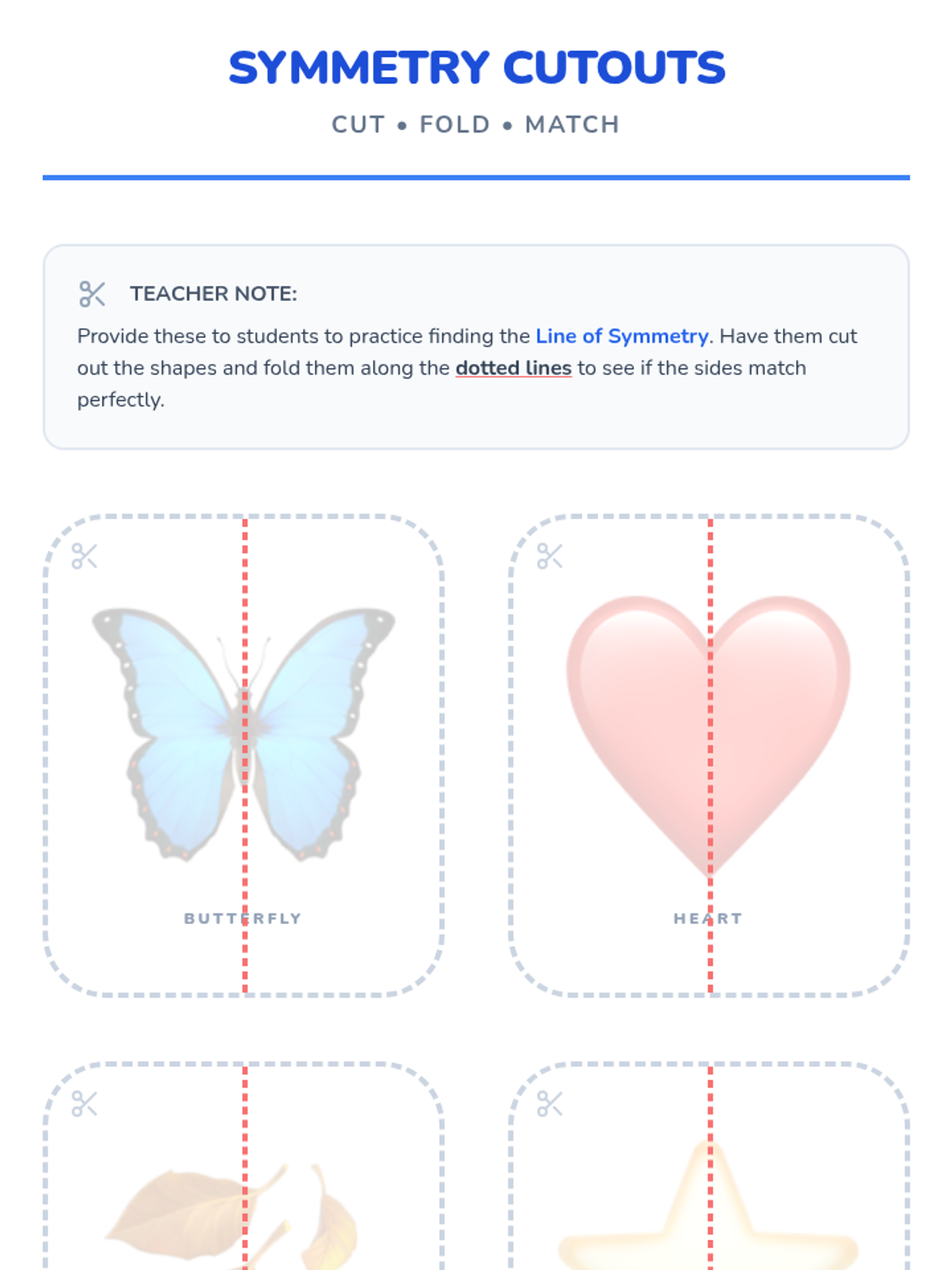
A set of printable shapes (butterfly, heart, leaf, star) with dotted lines for students to cut out and fold to physically experience symmetry.
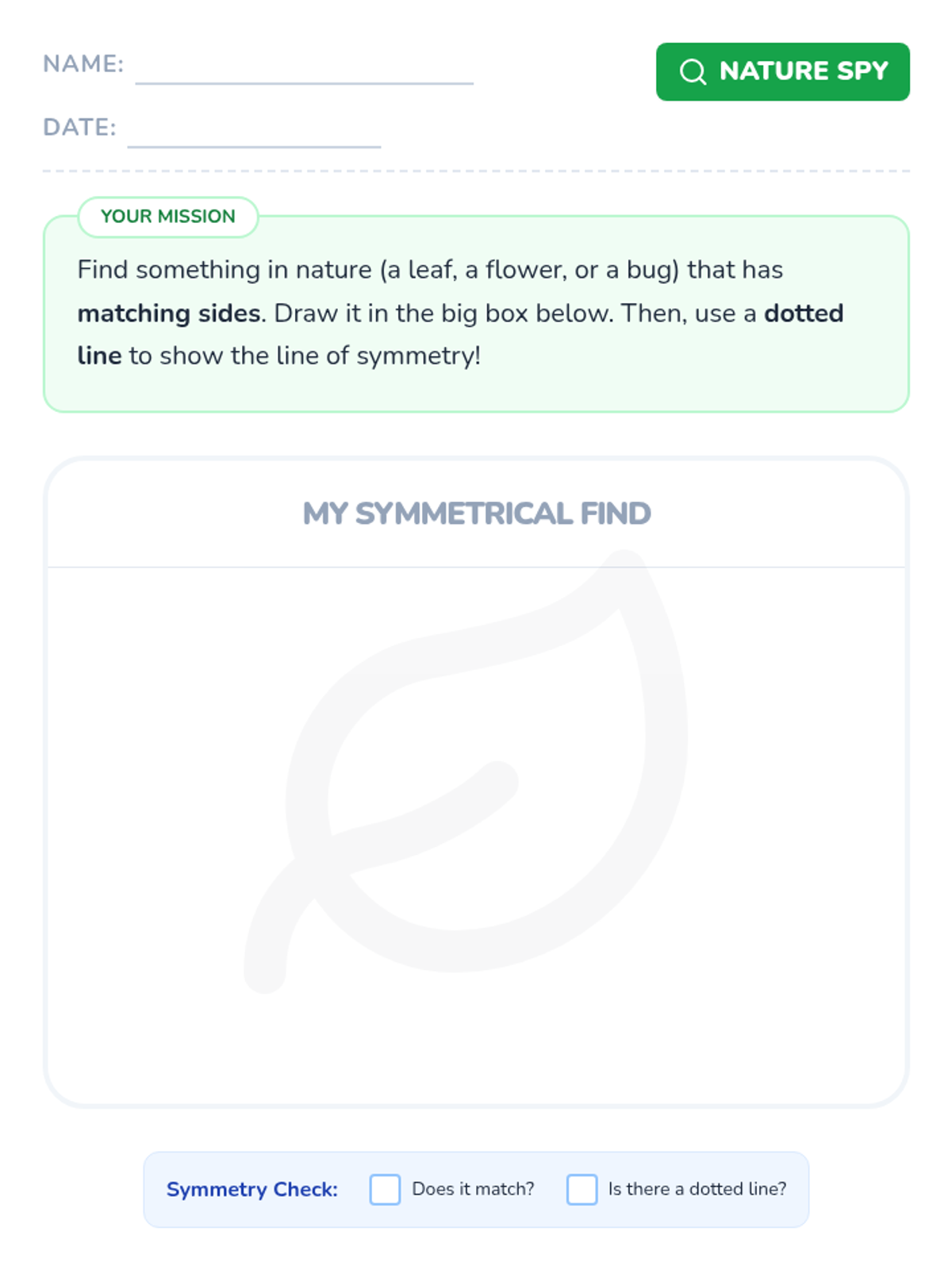
A field-journal style drawing worksheet for students to document their symmetrical nature finds and mark the line of symmetry.
A vibrant slide deck for teaching symmetry to young students, featuring interactive letter challenges, a video embed, and nature-themed examples.
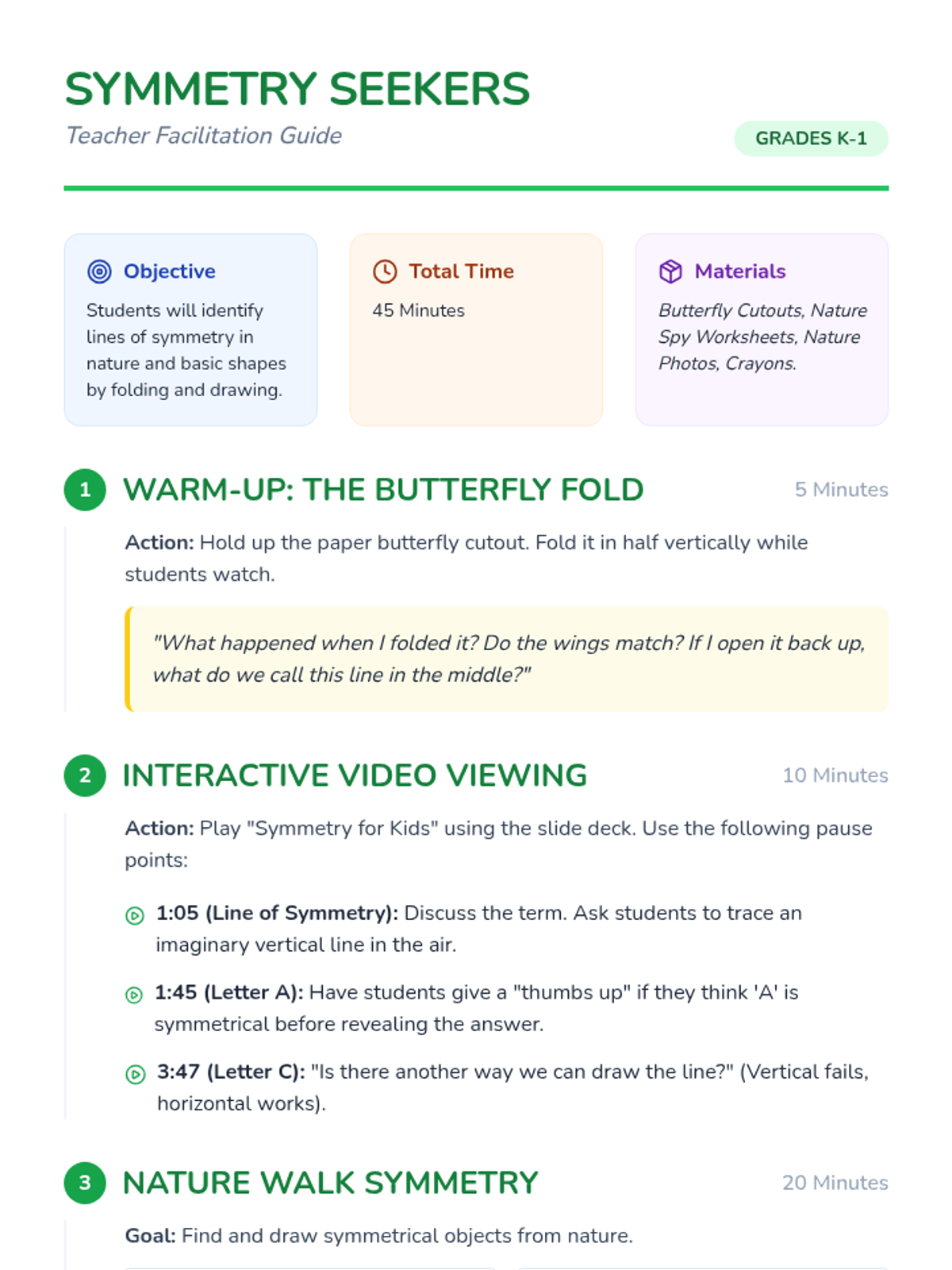
A comprehensive teacher guide for leading a K-1 lesson on symmetry, including warm-up prompts, video timestamps, and activity instructions.
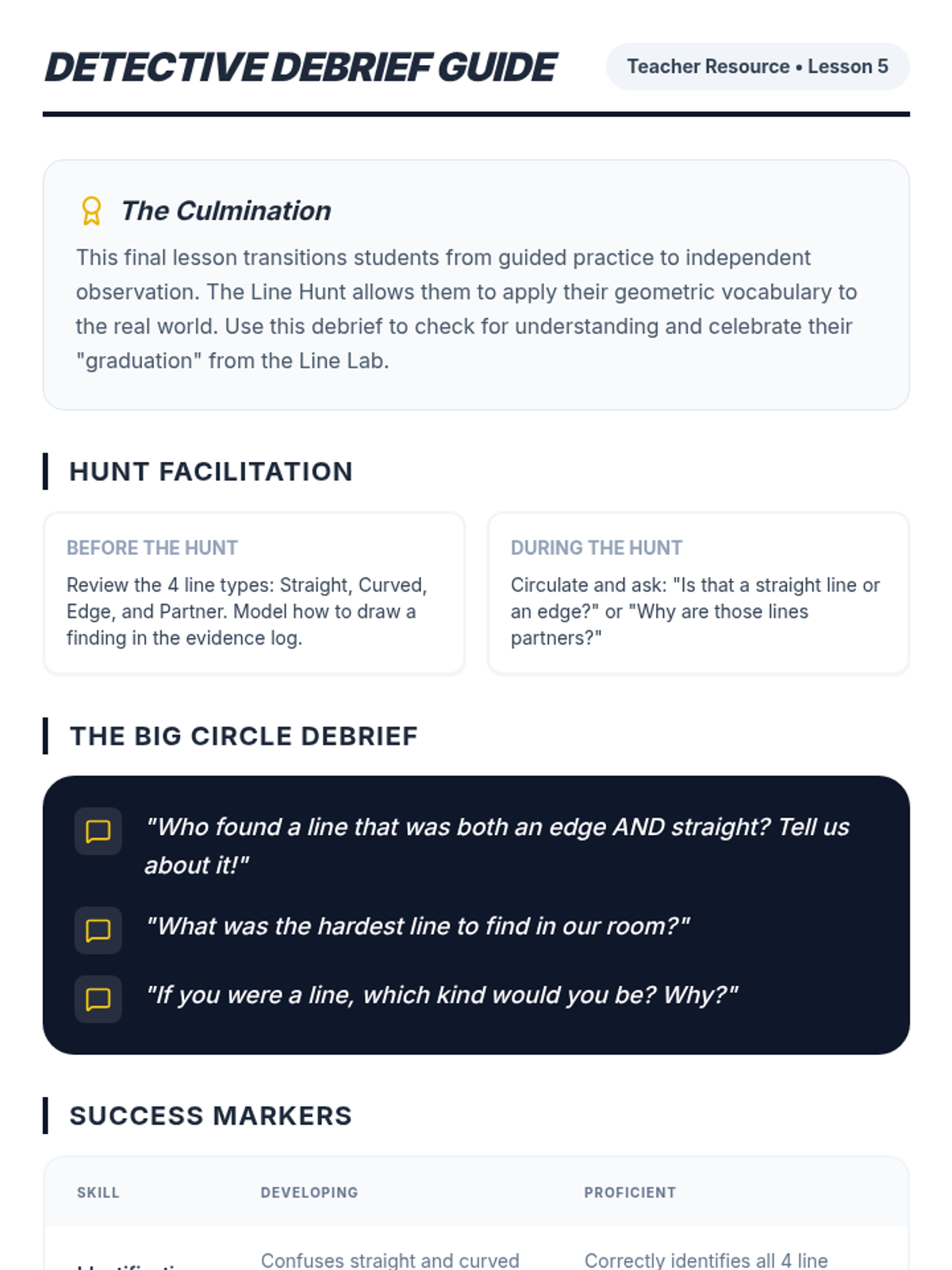
A teacher's facilitation and assessment guide for the Lesson 5 Line Hunt, featuring discussion prompts and a skill-tracking rubric.
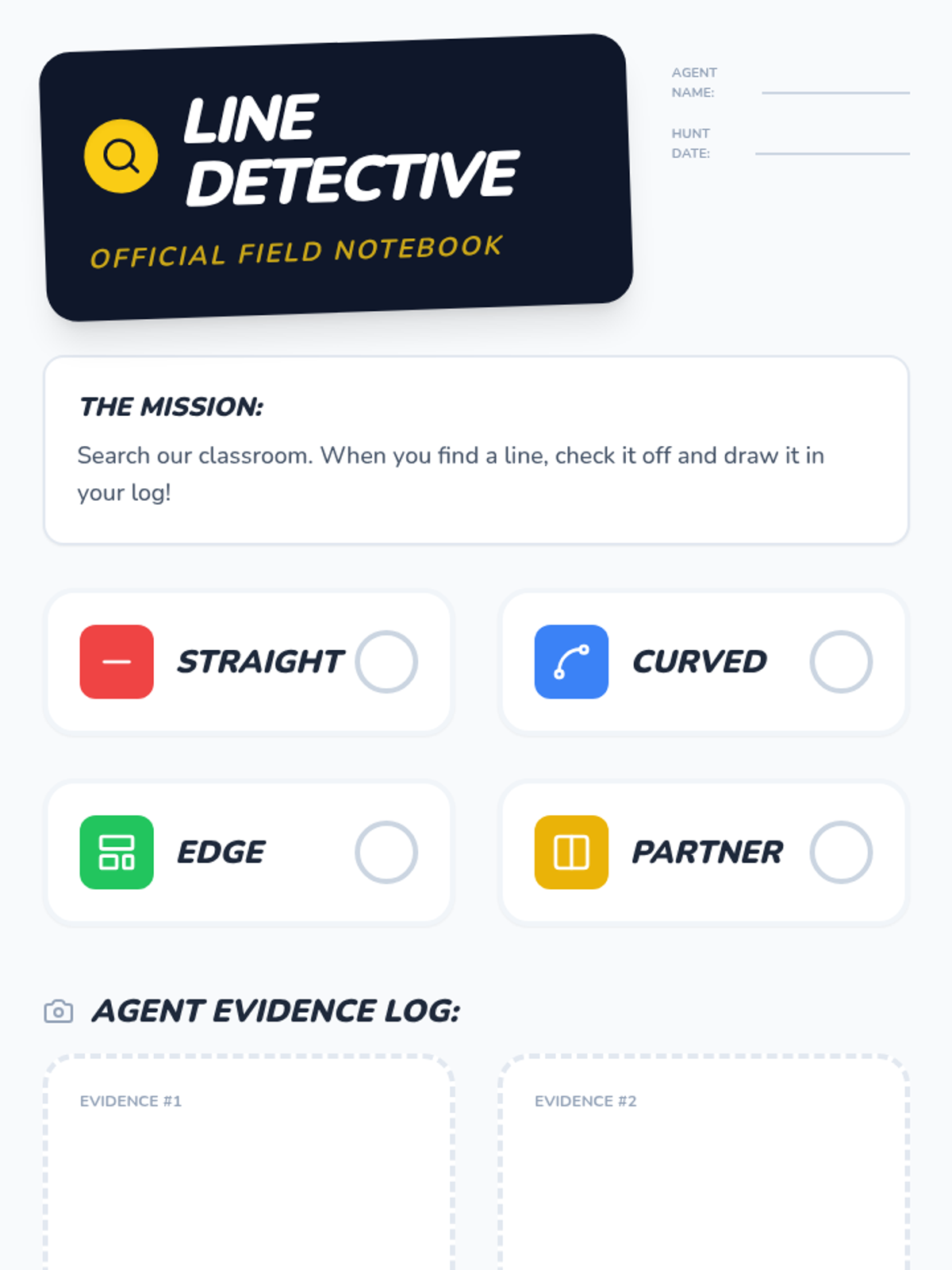
A field notebook for students to use during the Lesson 5 classroom scavenger hunt, featuring a checklist of line types and spaces for documented drawings.
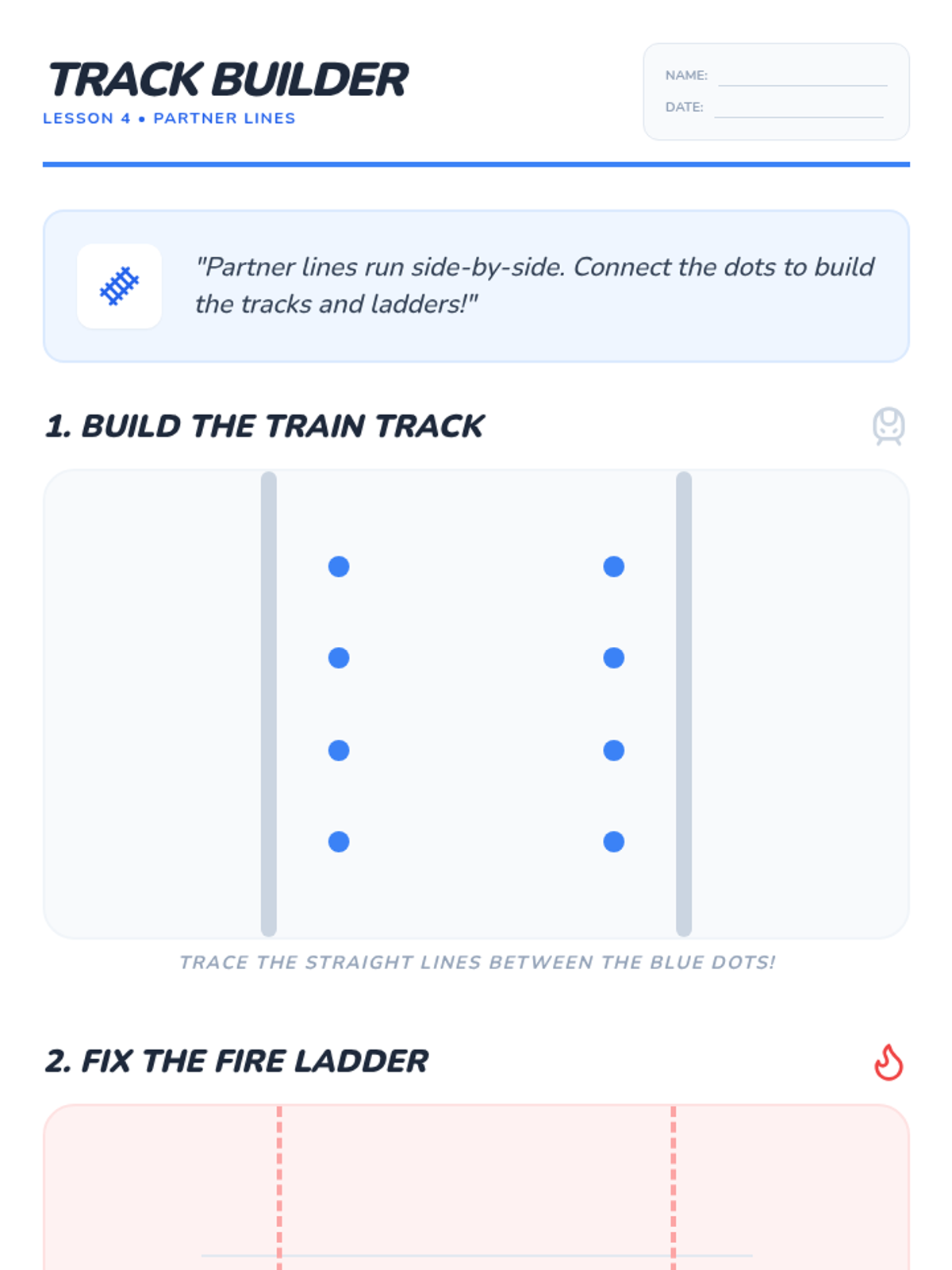
A tracing and drawing worksheet for Lesson 4 where students connect dots to create horizontal lines between parallel verticals, reinforcing the concept of partner lines.
Visual presentation for Lesson 4 introducing the concept of 'partners' (parallel lines) through train tracks, ladders, and road markings.
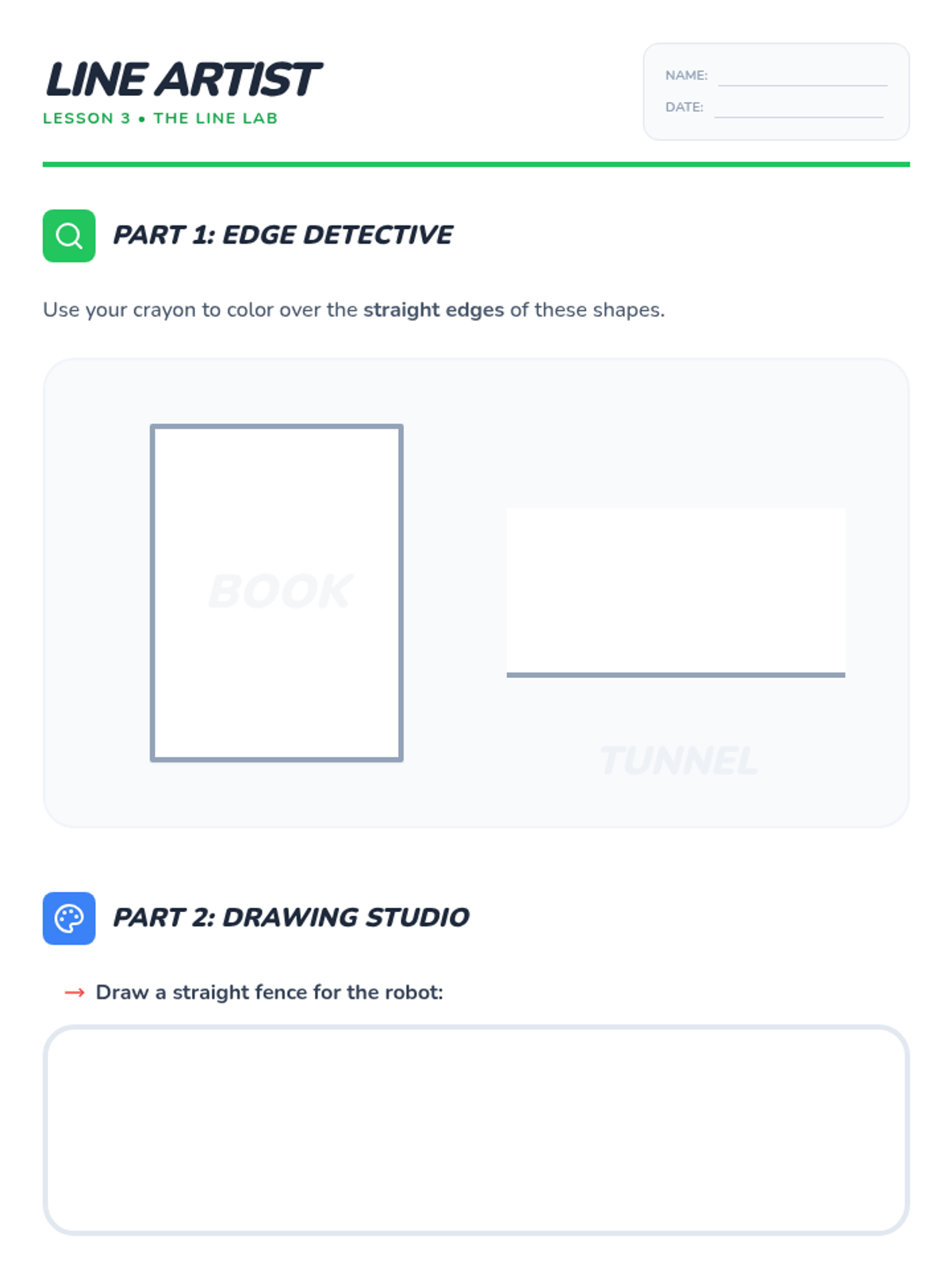
A drawing and identification worksheet for Lesson 3 where students identify edges on objects and practice drawing both straight and curved lines in designated work areas.
Visual presentation for Lesson 3 introducing the concept of 'edges' and preparing students for drawing straight and curved lines.
Tactile tracing templates for Lesson 2 featuring dashed straight, curved, wiggly, and zig-zag lines to be used with sensory materials like yarn or sandpaper.
A teacher's guide for setting up tactile sensory stations using yarn, sandpaper, and wiki sticks to teach line types through touch.
A tracing worksheet for Lesson 1 where students practice fine motor skills by tracing dashed straight and curved lines.
A teacher's movement guide for Lesson 1, detailing the "Robot Walk" and "River Flow" gross motor activities including prompts and assessment markers.
A visual presentation for Lesson 1 introducing the concepts of straight and curved lines through robot vs. river imagery and sky-drawing activities.
An engaging handout for young learners that explains the concept of symmetry with visual examples and a drawing activity.
A worksheet with structured rows for students to practice creating AB and ABC patterns using stamps or drawings.
A comprehensive lesson plan for teachers, outlining objectives, materials, and step-by-step instructions for teaching patterns and symmetry.
A vibrant presentation used to introduce the concepts of patterns and symmetry to young learners through visual examples and interactive prompts.
Student activity sheet for recording the cracker count, checking for gaps and overlaps, and reflecting on the circle extension challenge.
Engaging slide presentation for the Perfect Fit lesson, featuring the Khan Academy video, visual explanations of 'no gaps' and 'no overlaps', and the cracker challenge.
Teacher facilitation guide for the Perfect Fit lesson, including instructional flow, discussion questions, and observation tips for the 'no gaps, no overlaps' area activity.
Student design project worksheet for Lesson 5 where they create a picture with a fixed area of 10 tiles.
Slides for Lesson 5 launching the 'Ten Tile Town' project where students design shapes with a fixed area.
Student activity for Lesson 4 where they match different-looking shapes that share the same surface area.
Slides for Lesson 4 teaching students that different shapes can have the same area if they use the same number of units.
Student worksheet for Lesson 3 where students count square tiles to determine the area of various shapes.
Slides for Lesson 3 teaching students to quantify area by counting the units used to cover a shape.
Large-scale shape outlines for students to physically tile with pattern blocks, reinforcing no gaps and no overlaps.
Slides for Lesson 2 teaching the essential rules of tiling: no gaps and no overlaps. Uses pattern block visuals.
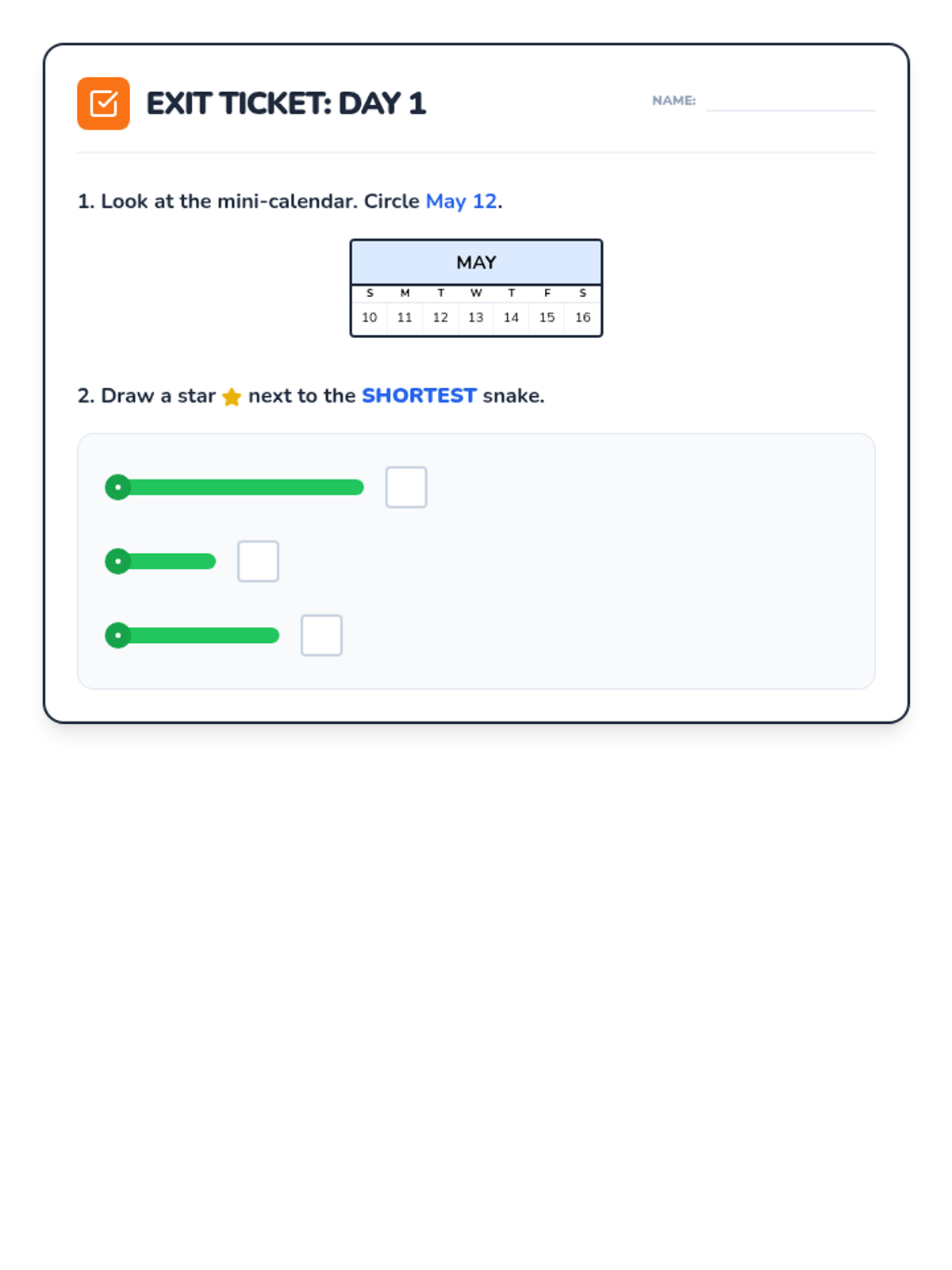
Student worksheet for Lesson 1 where students identify which of two objects covers more surface area through direct visual comparison.
Teacher facilitation guide for the first lesson on direct area comparison, including discussion prompts and differentiation strategies.
Introductory slide deck for Kindergarten students to learn about surface area through direct comparison and superimposing shapes.
Student recording sheet for the Scavenger Hunt where students draw objects shorter, longer, or the same length as a craft stick.
Teacher guide for Lesson 5, covering the setup and facilitation of the culminating Scavenger Hunt activity.
Visual presentation for Lesson 5, giving instructions for the Measurement Scavenger Hunt and recapping the unit's skills.
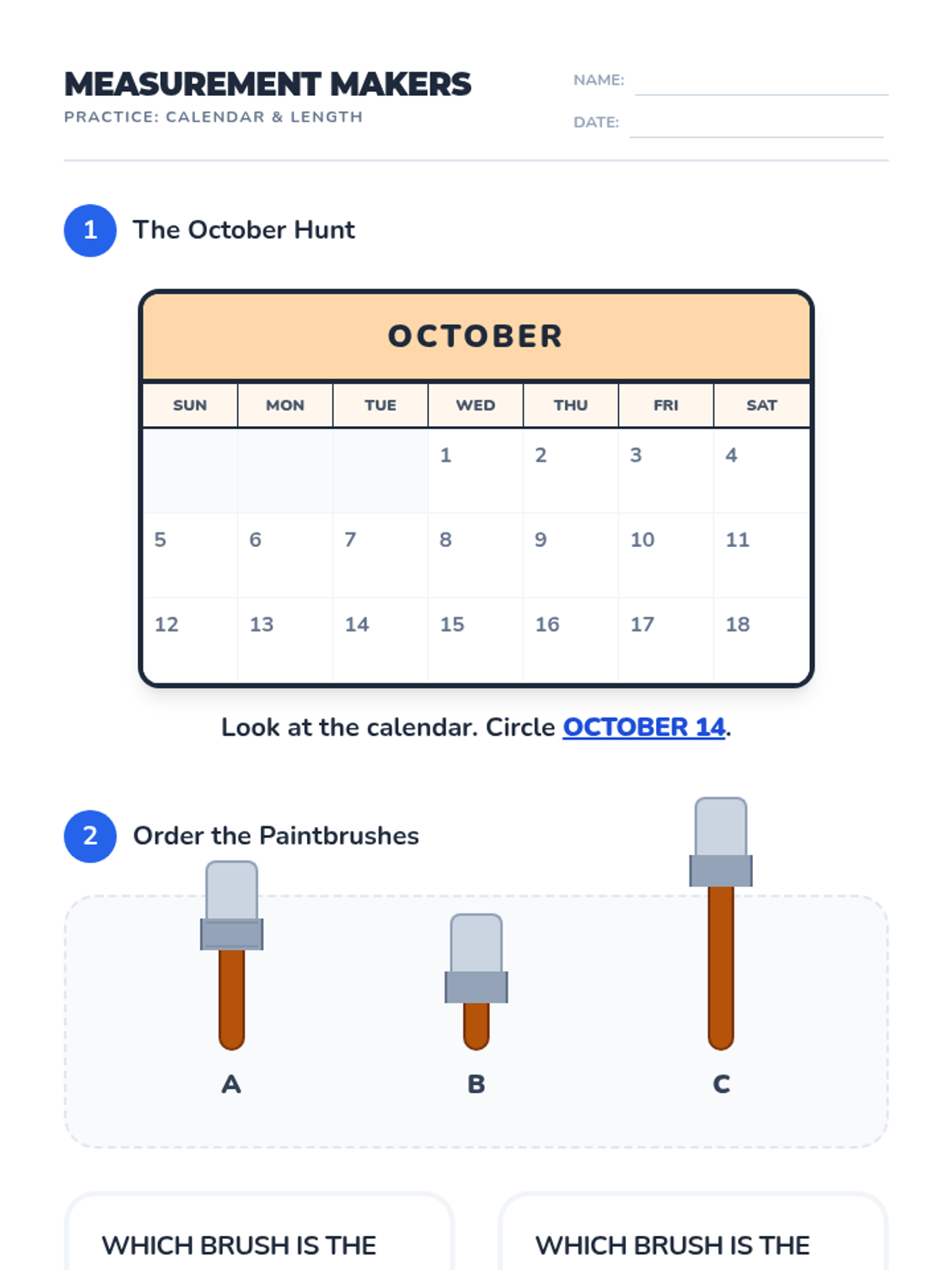
Cut-and-paste activity for Lesson 4 where students order three worms by length from shortest to longest.
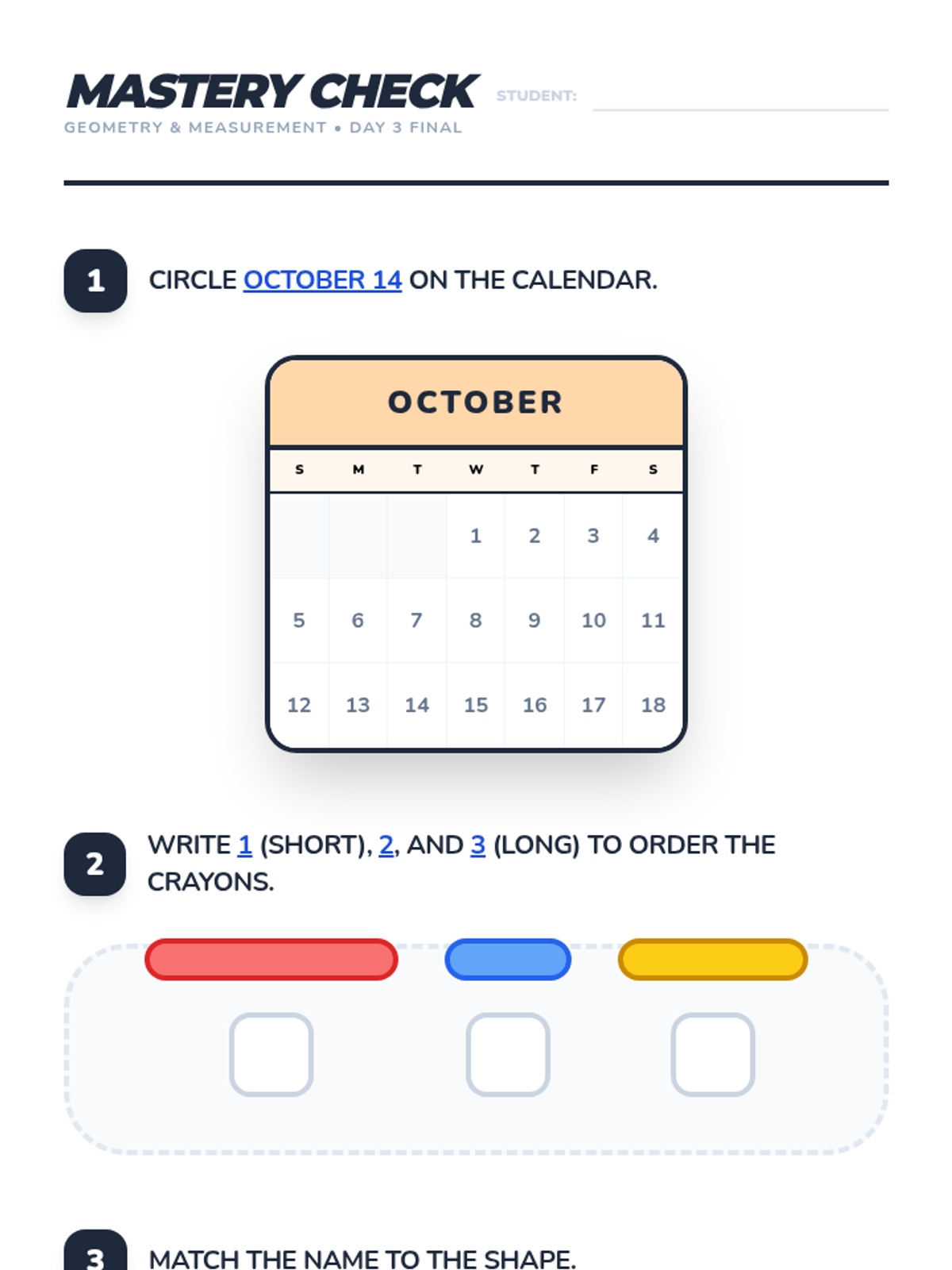
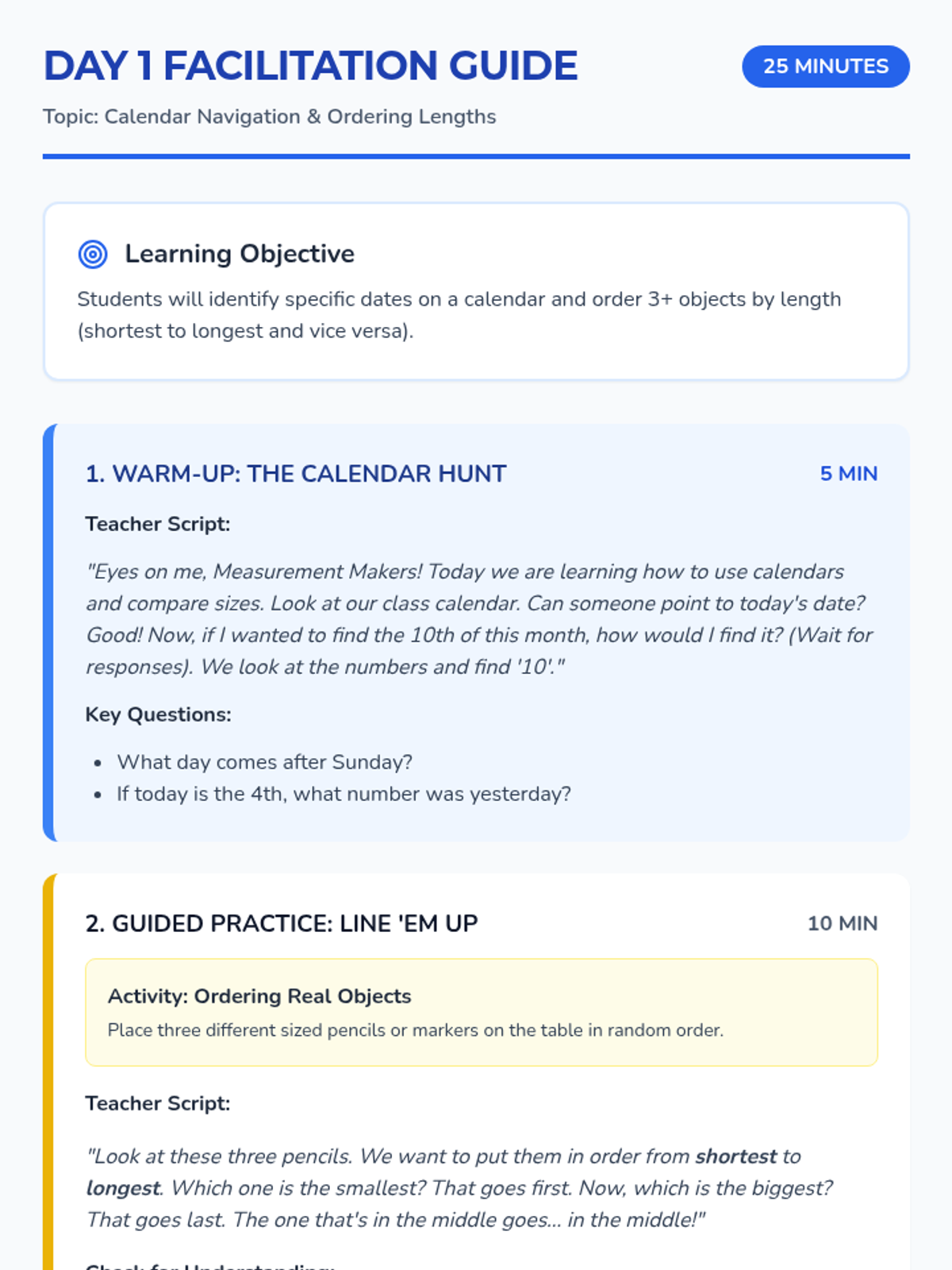
Teacher guide for Lesson 4, focusing on ordering 3 objects by length using modeling and hands-on practice.
Visual presentation for Lesson 4, introducing the concept of ordering 3 items by length using the "Worm Family" analogy.