Comprehensive French language instruction spanning basic literacy to advanced oral and written communication. Strengthens grammar, vocabulary, and cultural understanding through targeted exercises in listening, reading, and composition.
Présentation interactive complète sur le futur simple pour CE1-CE2. Inclut la règle des verbes en -er, les auxiliaires être et avoir, et 3 défis flash interactifs. Style uniforme pour les réponses.
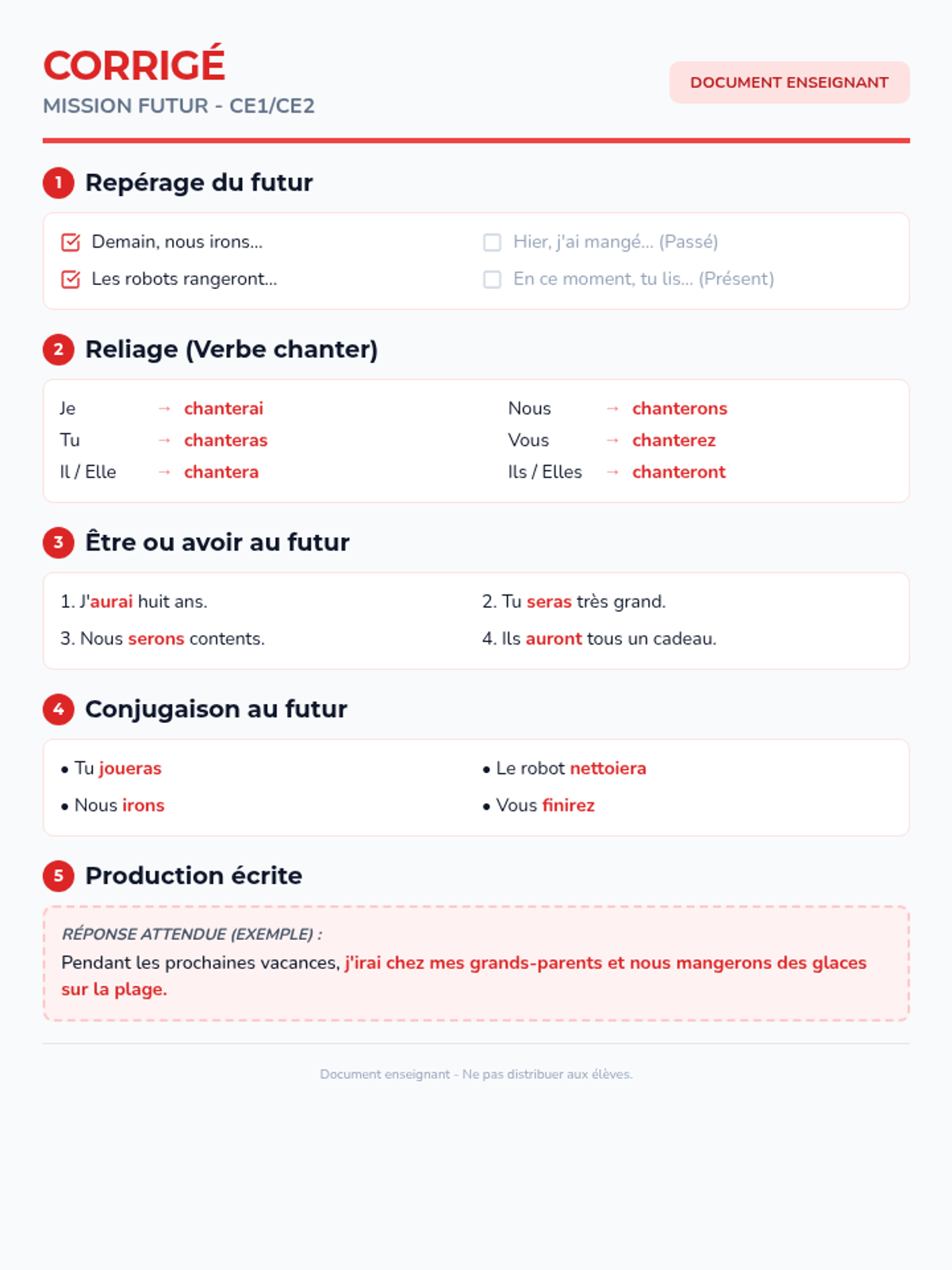
Corrigé de la fiche d'exercices Mission Futur. Version optimisée sur une seule page avec présentation des reliages par paires.
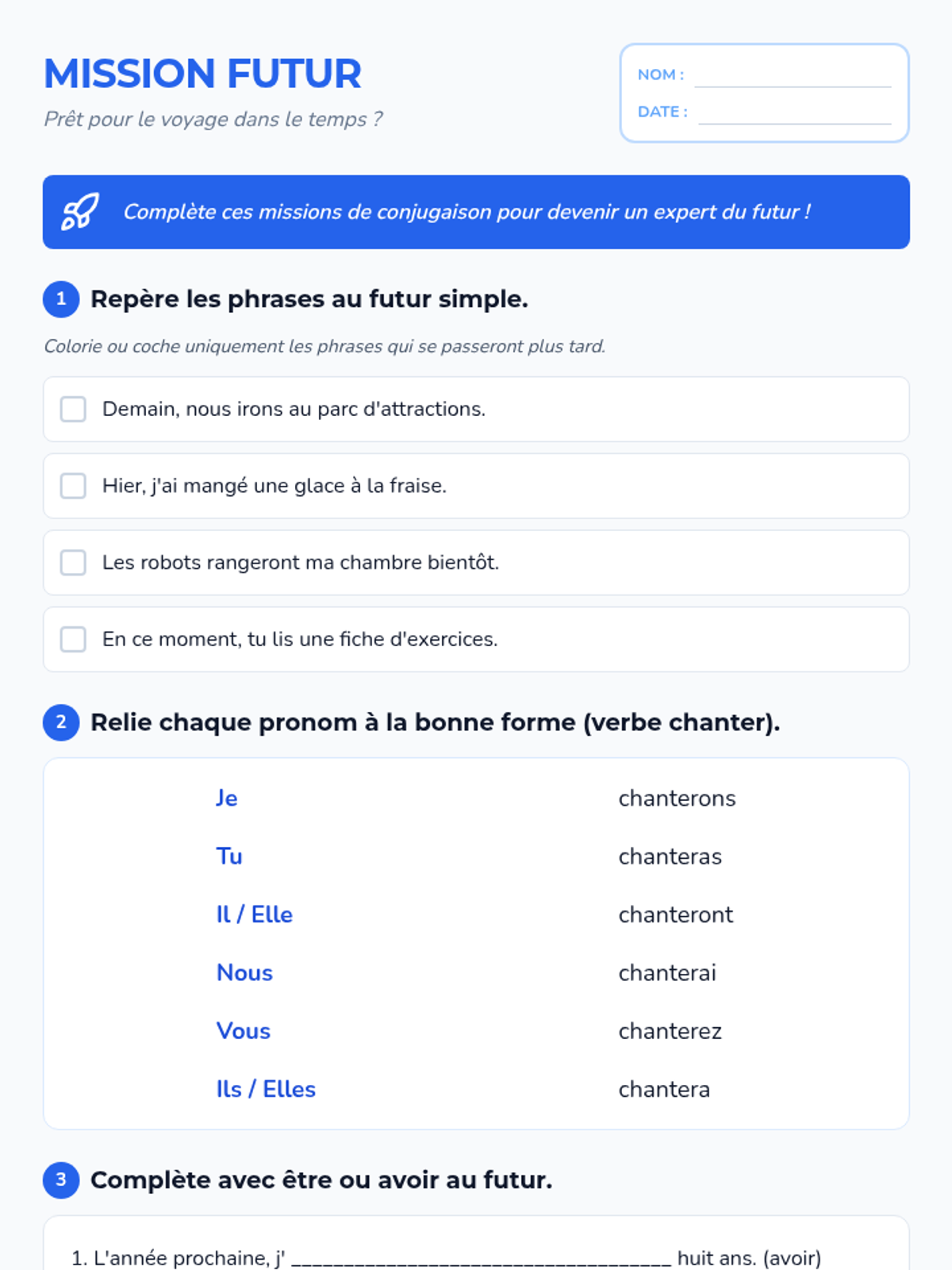
Fiche d'exercices sur le futur simple pour les élèves de CE1-CE2, incluant des exercices d'identification, de reliage, de complétion (être/avoir) et de production écrite. Version corrigée avec mise en page optimisée sur 2 pages.
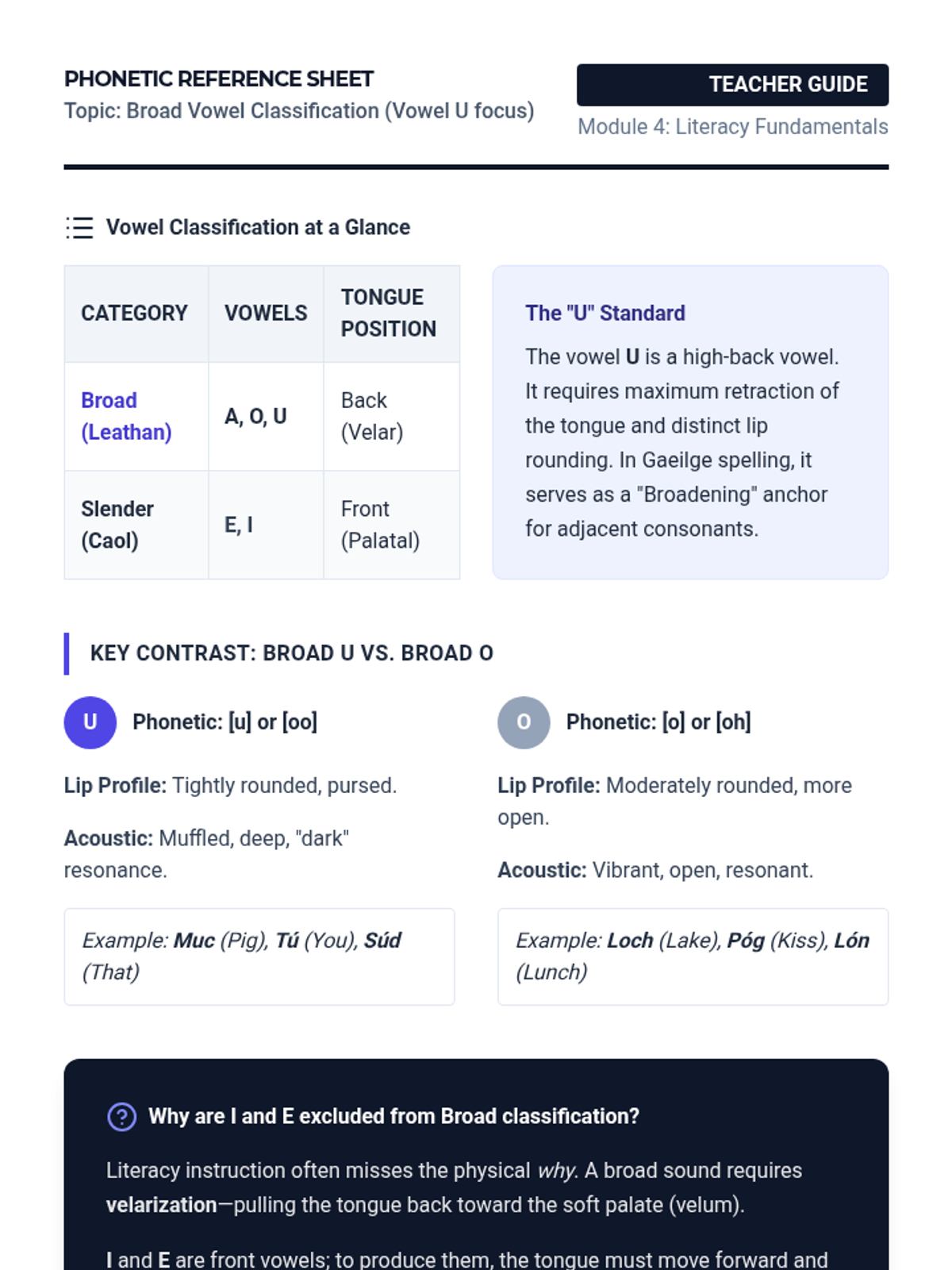
A professional teacher reference sheet summarizing broad vowel classification, focusing on the U sound, contrasts with O, and the physiological reasons why E and I are slender vowels.
A 9-slide presentation in a professional teacher-training style explaining the Broad vowel sound U. It covers phonetic classification, comparisons with O, why I and E are slender, and classroom instructional strategies.
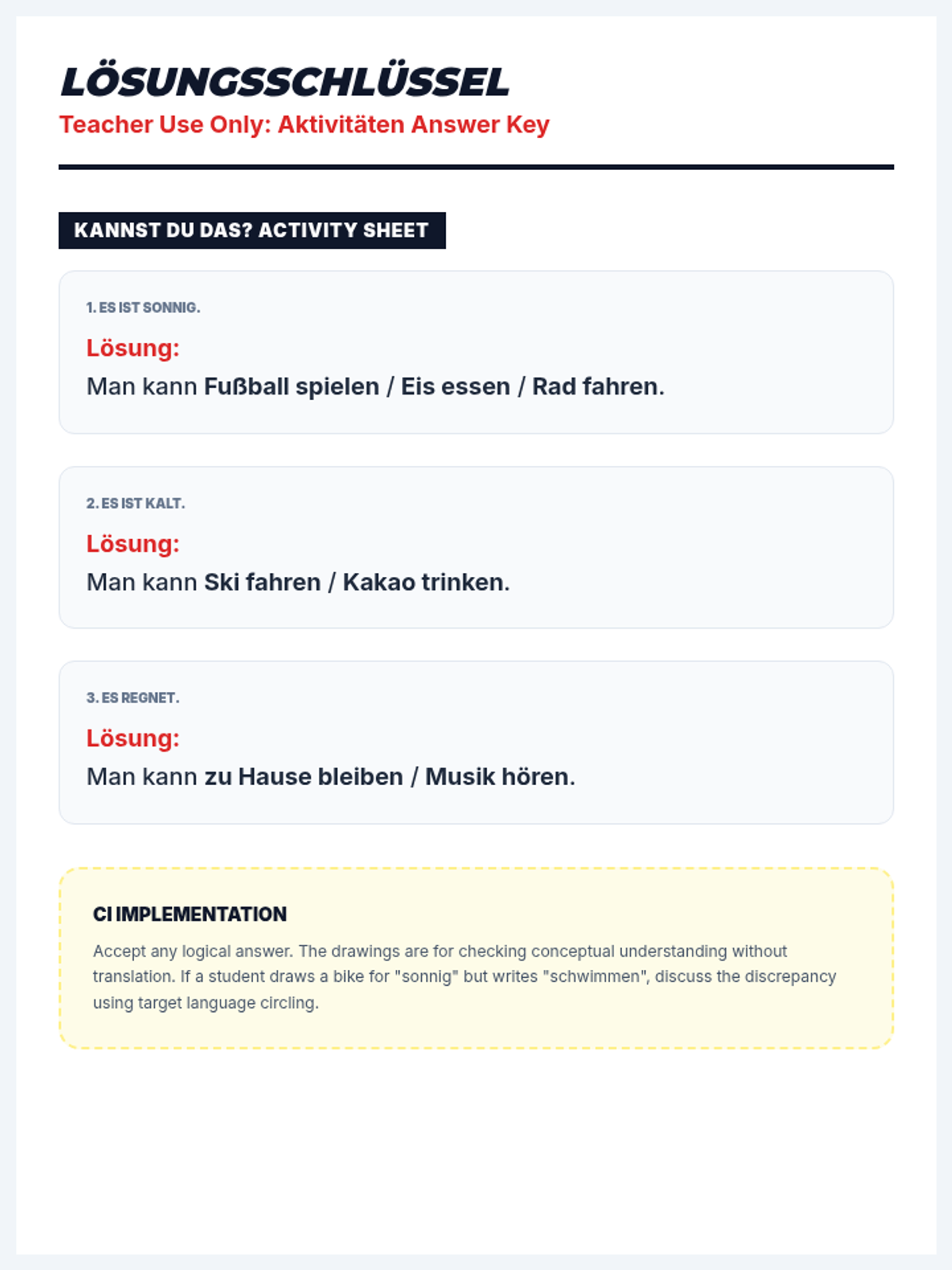
A teacher's answer key for the 'Kannst du das' activity sheet. Includes acceptable answers and instructional tips for assessing Comprehensible Input production.
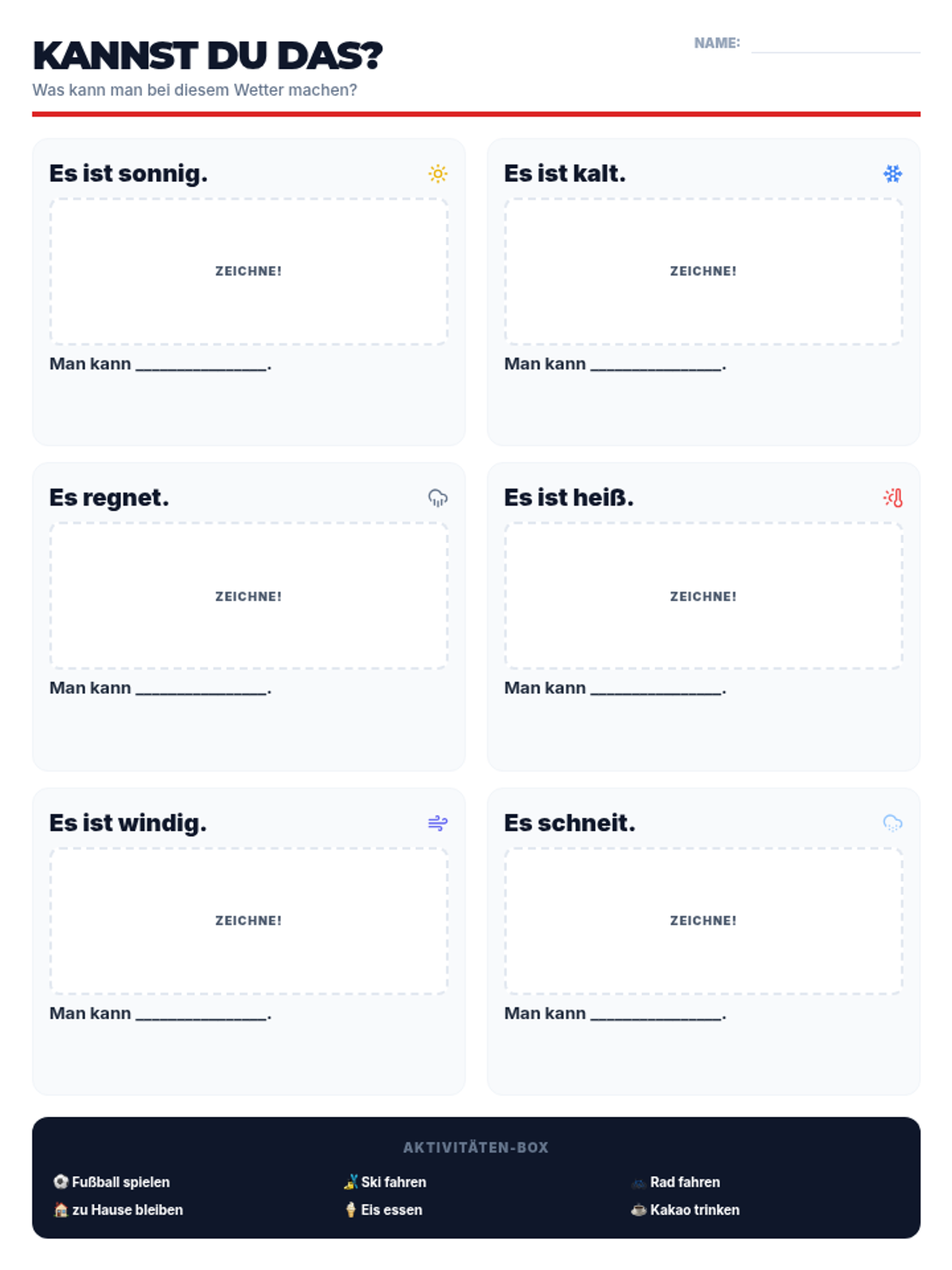
A student activity sheet for Lesson 2. It features a picture-based cloze activity where students match activities to weather conditions and illustrate them, practicing 'Man kann' structures.
Interactive slides for Lesson 2 focusing on activity-based structures (Man kann + infinitive). Uses visual prompts and emojis to associate specific weather with corresponding activities in Germany.
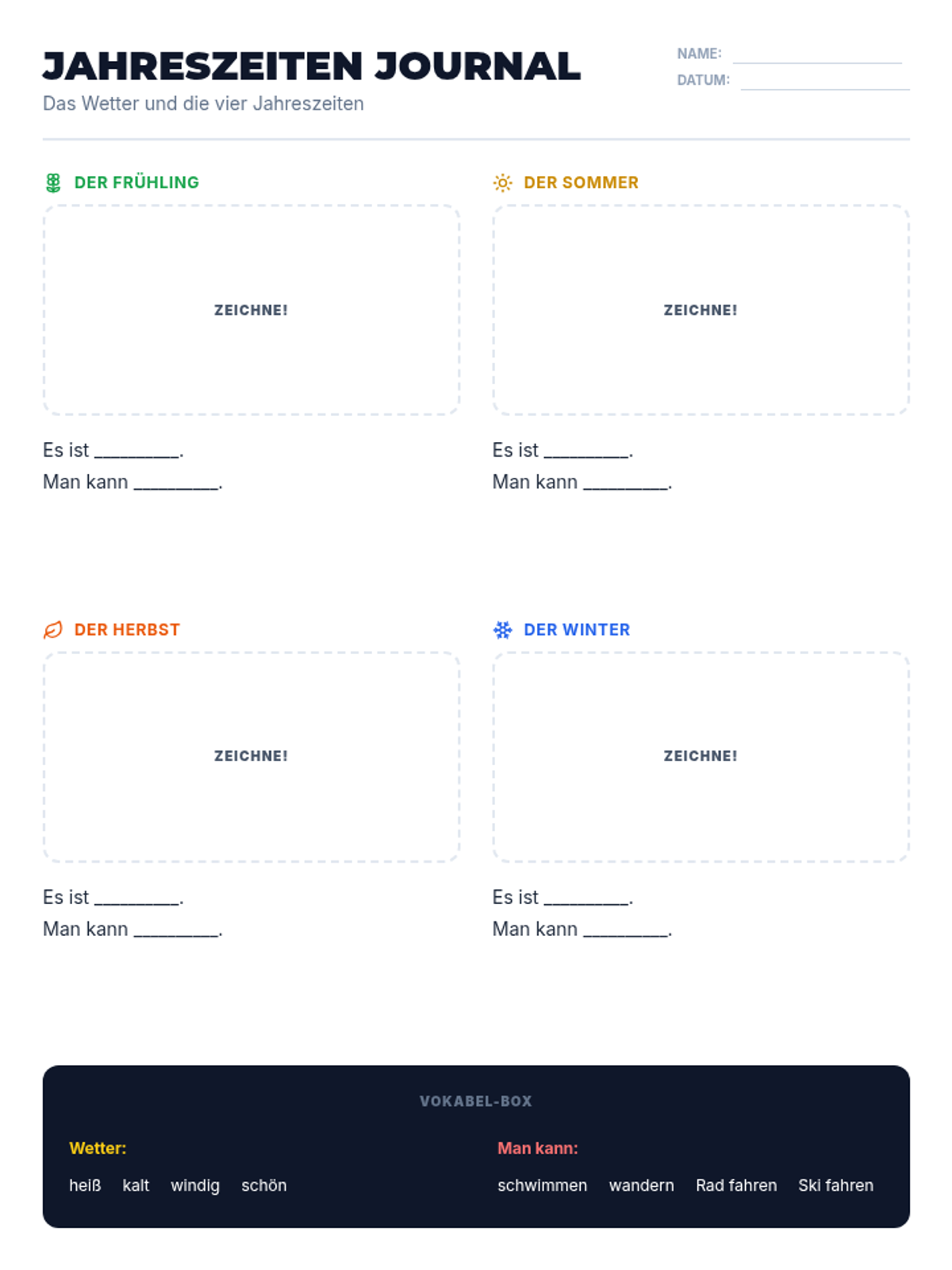
A student worksheet featuring a picture-based cloze activity. Students describe the weather for each season and draw matching illustrations to reinforce Comprehensible Input.
A visually-rich slide presentation for Comprehensible Input (CI) instruction. Features large text, emoji-based visuals, and high-repetition structures for weather and seasons.
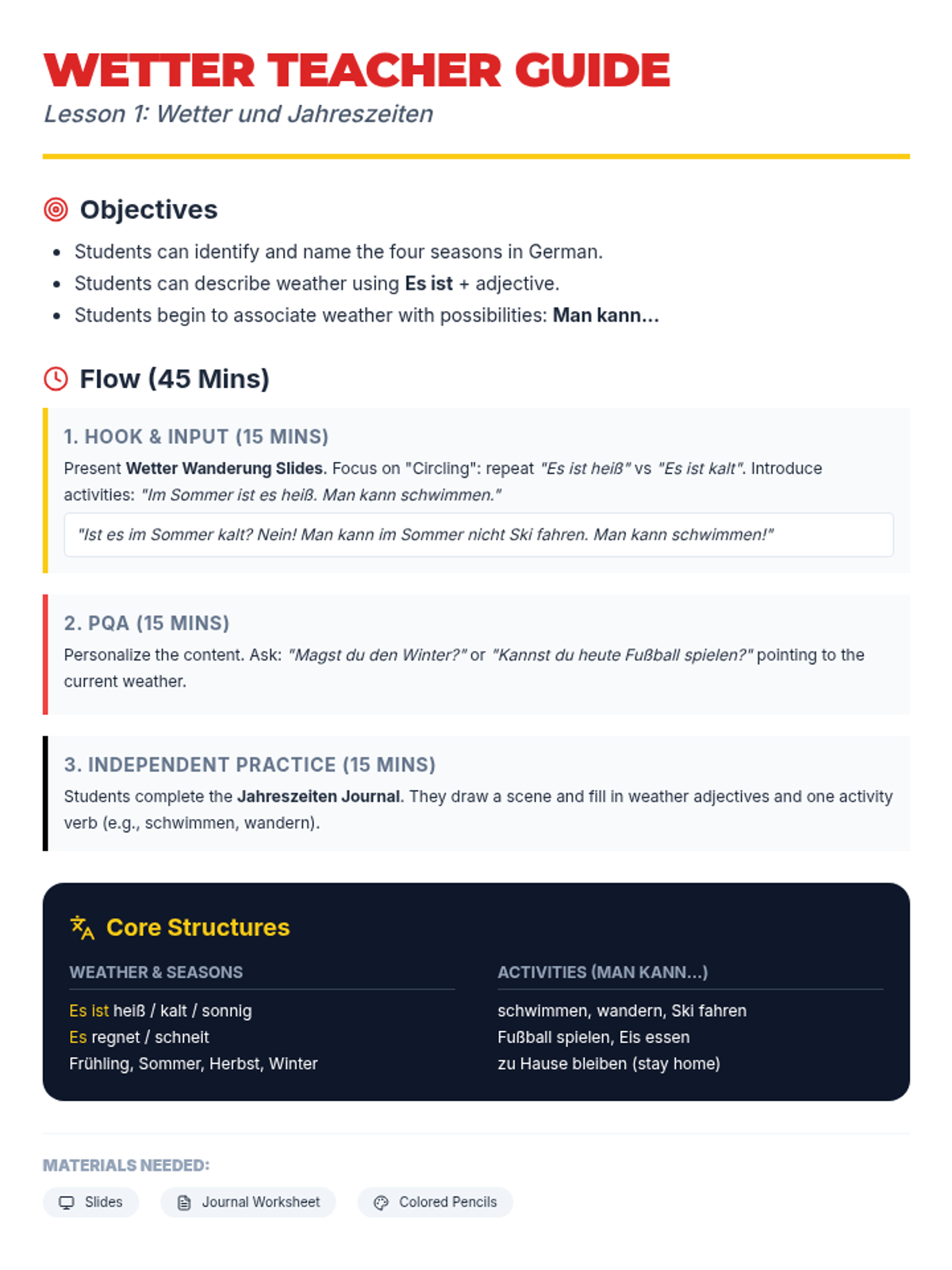
A teacher guide for Lesson 1, providing a detailed 45-minute lesson plan, CI scripting ideas, and a vocabulary breakdown for teaching weather and seasons.
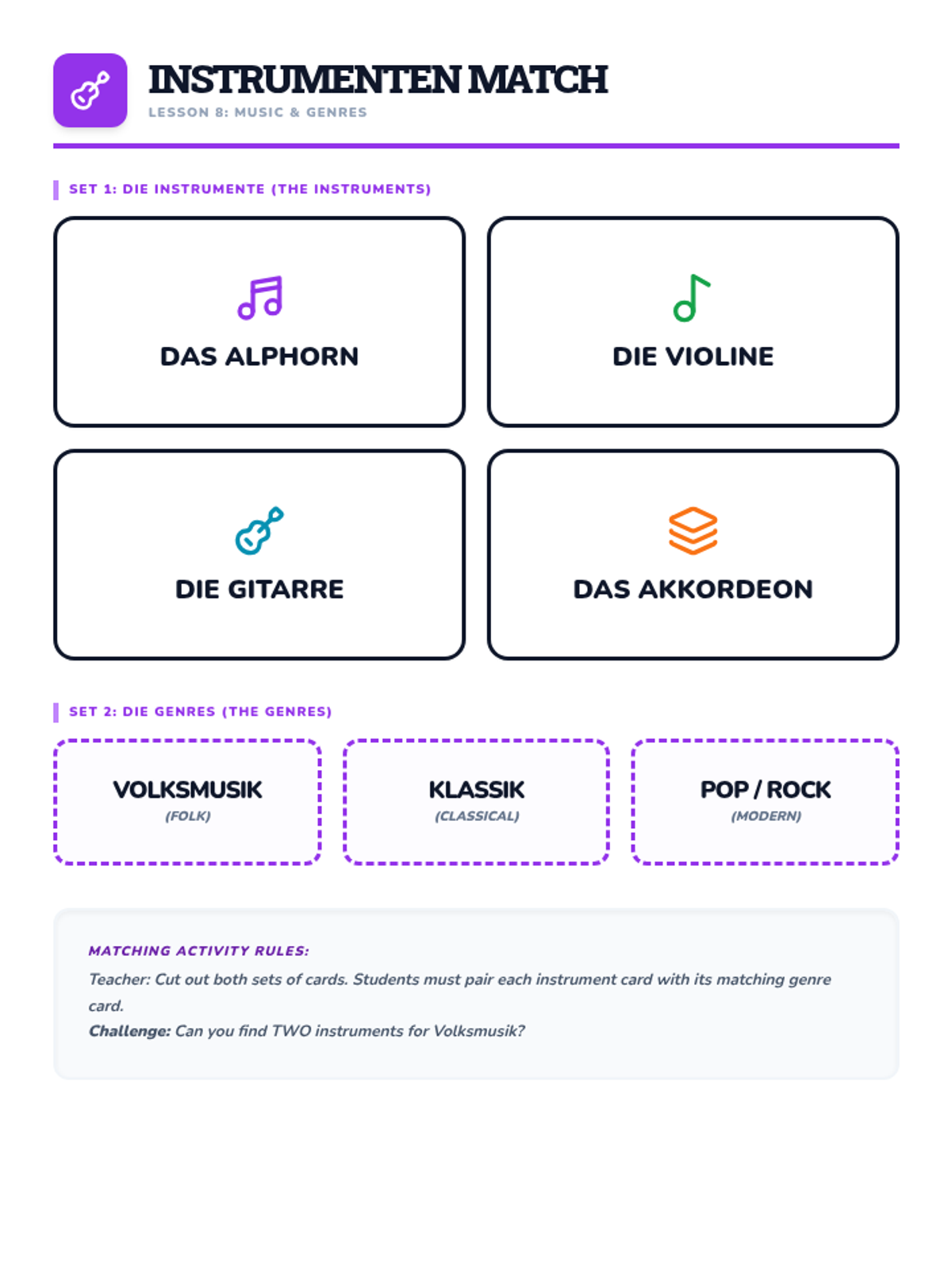
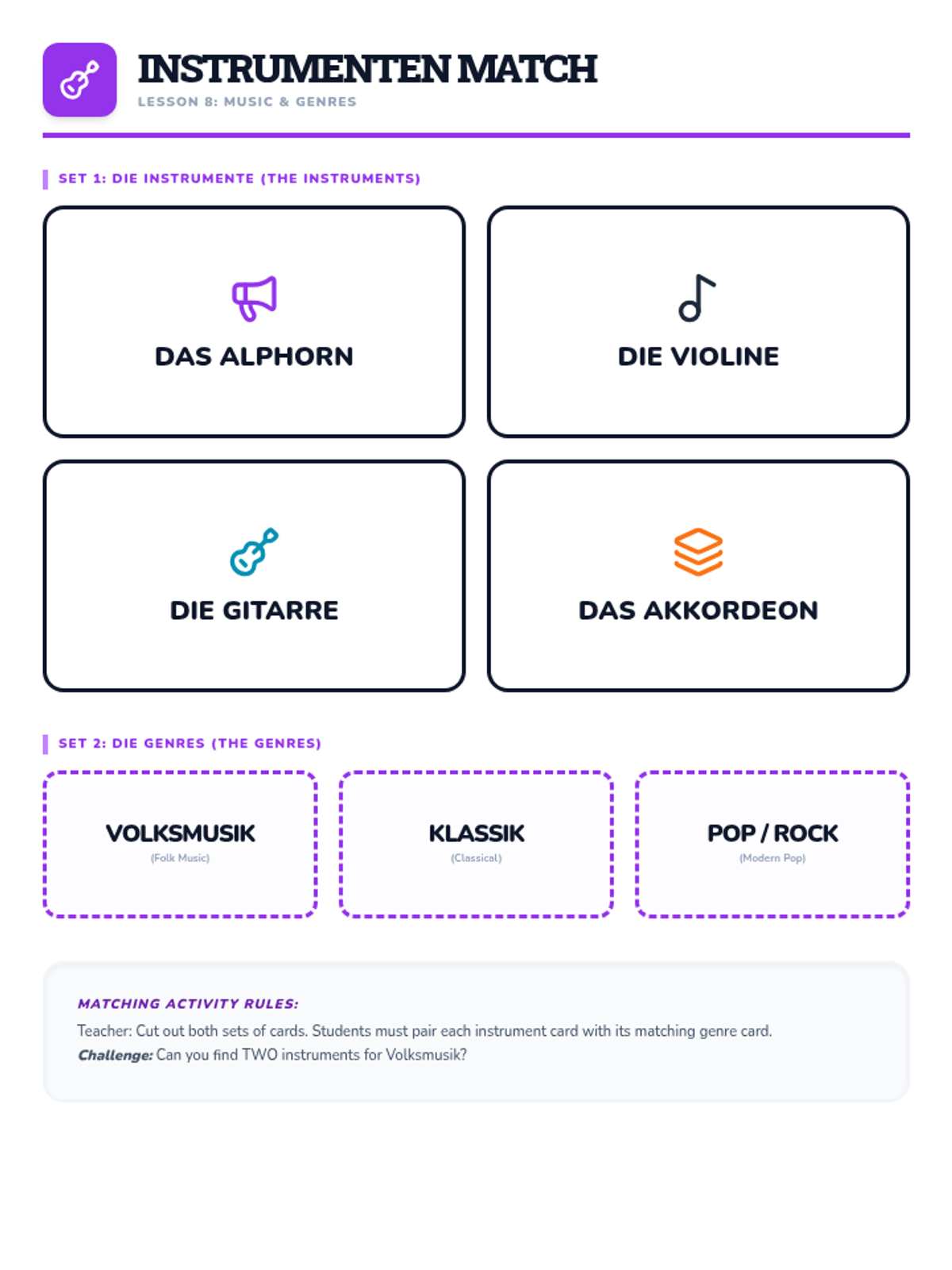
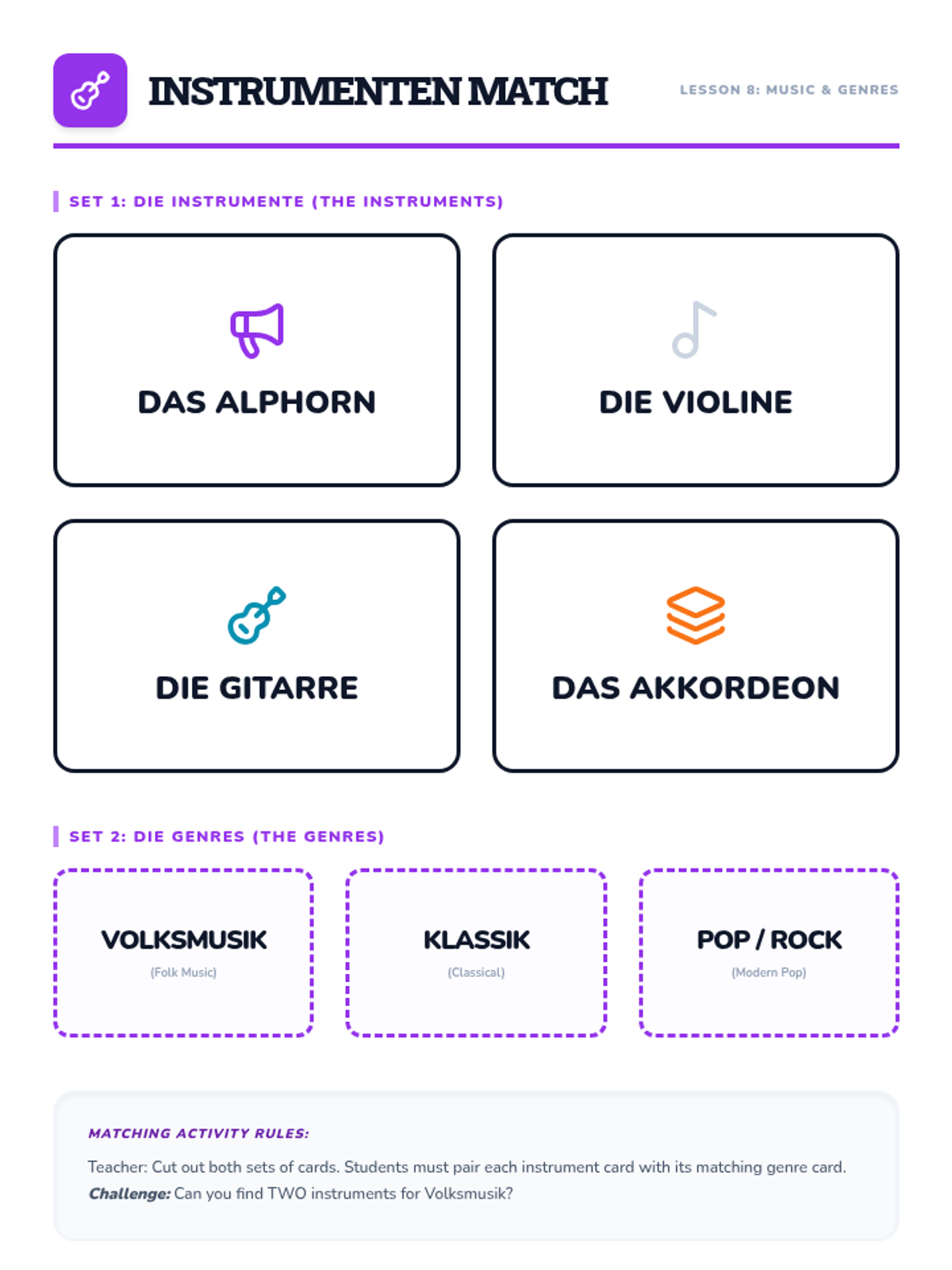
Matching cards for traditional and modern German instruments, used to help students identify musical genres in Lesson 8. Revised for interactive matching use with separate genre cards. Reduced card sizes and margins to fit on a single page. Darkened Violine icon. v2.
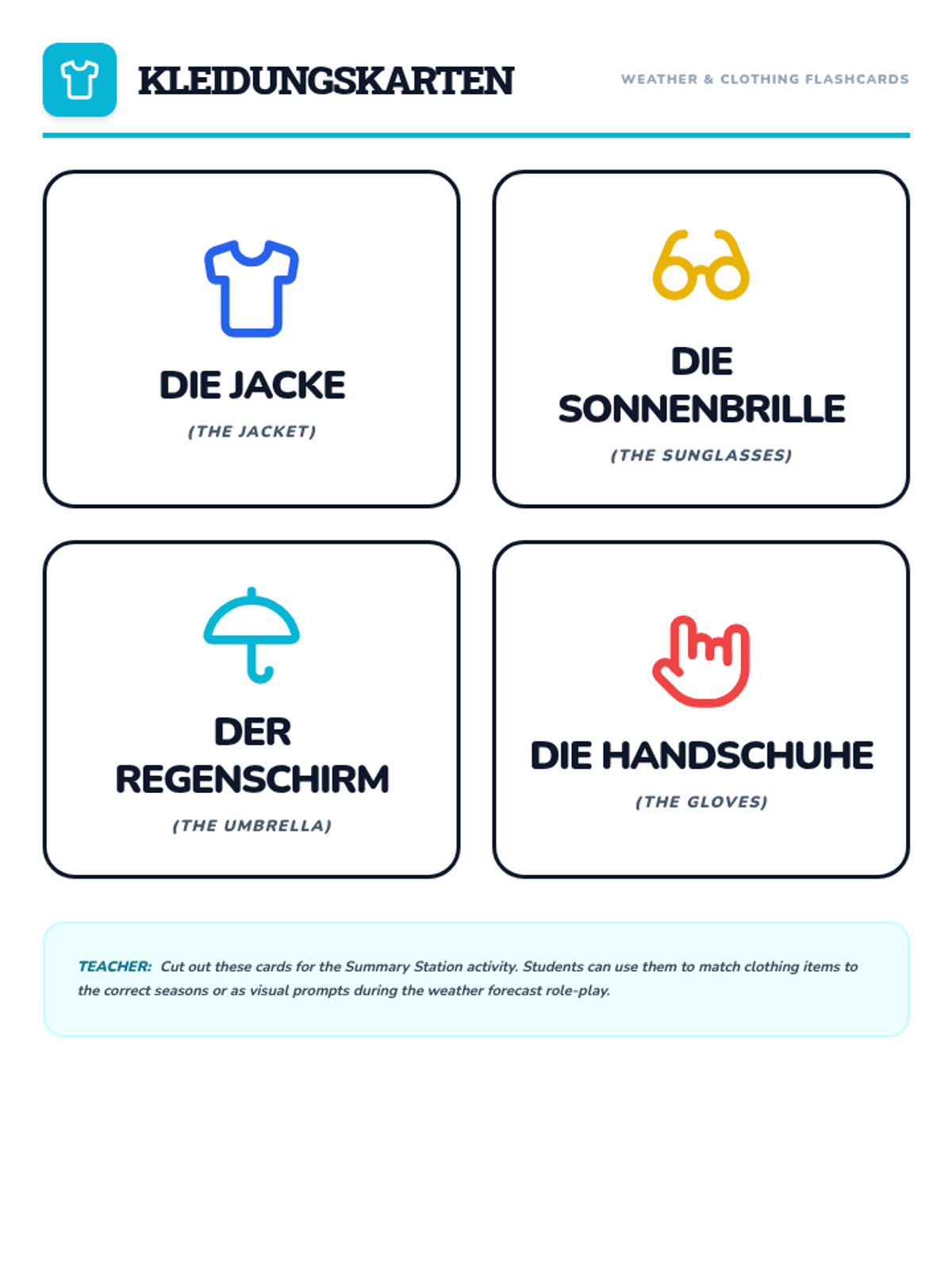
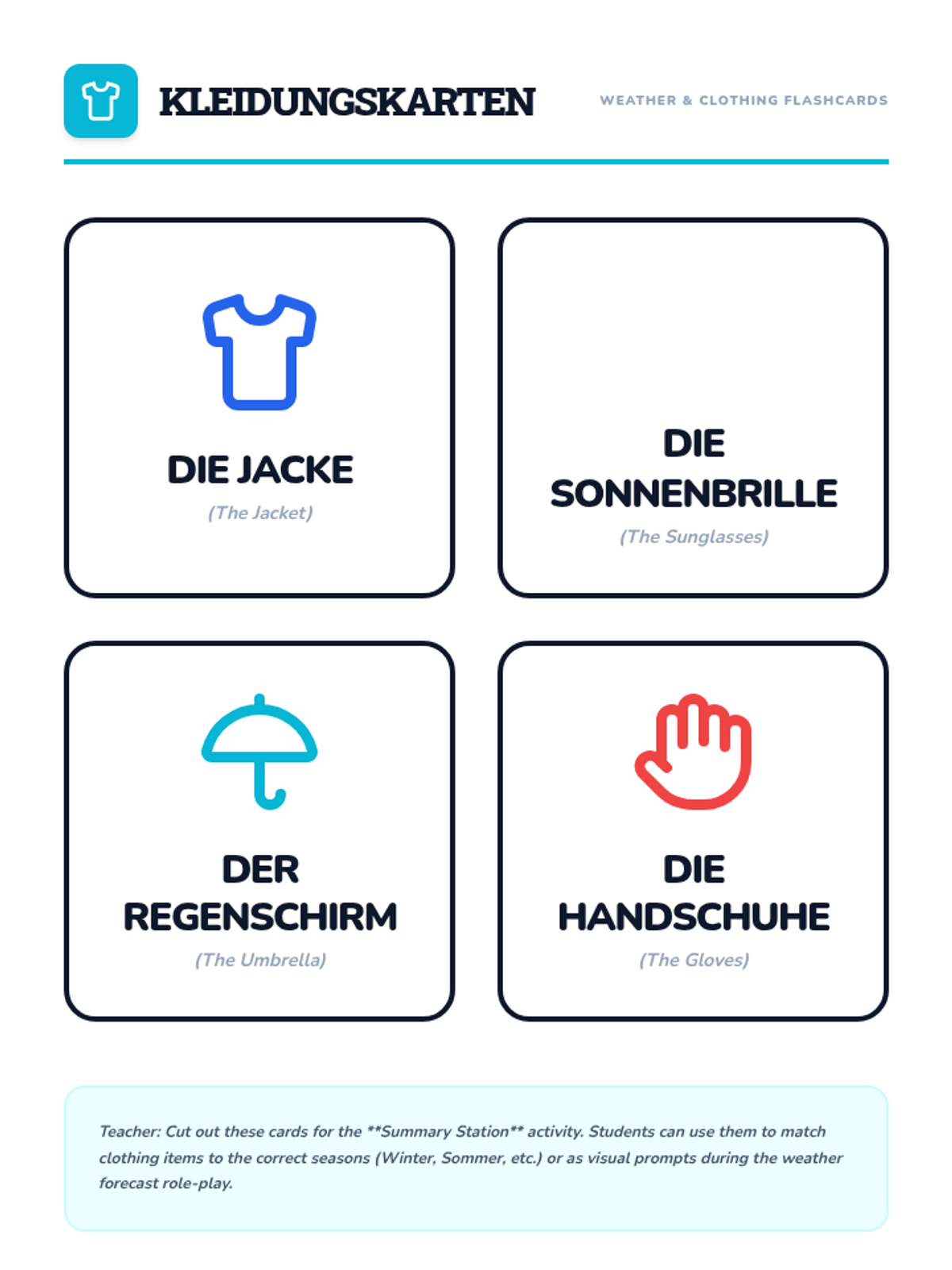
Flashcards for German clothing items (Jacke, Sonnenbrille, Regenschirm, Handschuhe) to be used in Lesson 6 activities. Standardized background and corrected title. Improved icon size and label consistency. Fixed page break issue.
Matching cards for traditional and modern German instruments, used to help students identify musical genres in Lesson 8. Revised for interactive matching use with separate genre cards. Reduced card sizes and margins to fit on a single page. Darkened Violine icon.
Matching cards for traditional and modern German instruments, used to help students identify musical genres in Lesson 8. Revised for interactive matching use with separate genre cards.
Flashcards for German clothing items (Jacke, Sonnenbrille, Regenschirm, Handschuhe) to be used in Lesson 6 activities. Standardized background and corrected title. Improved icon size and label consistency.
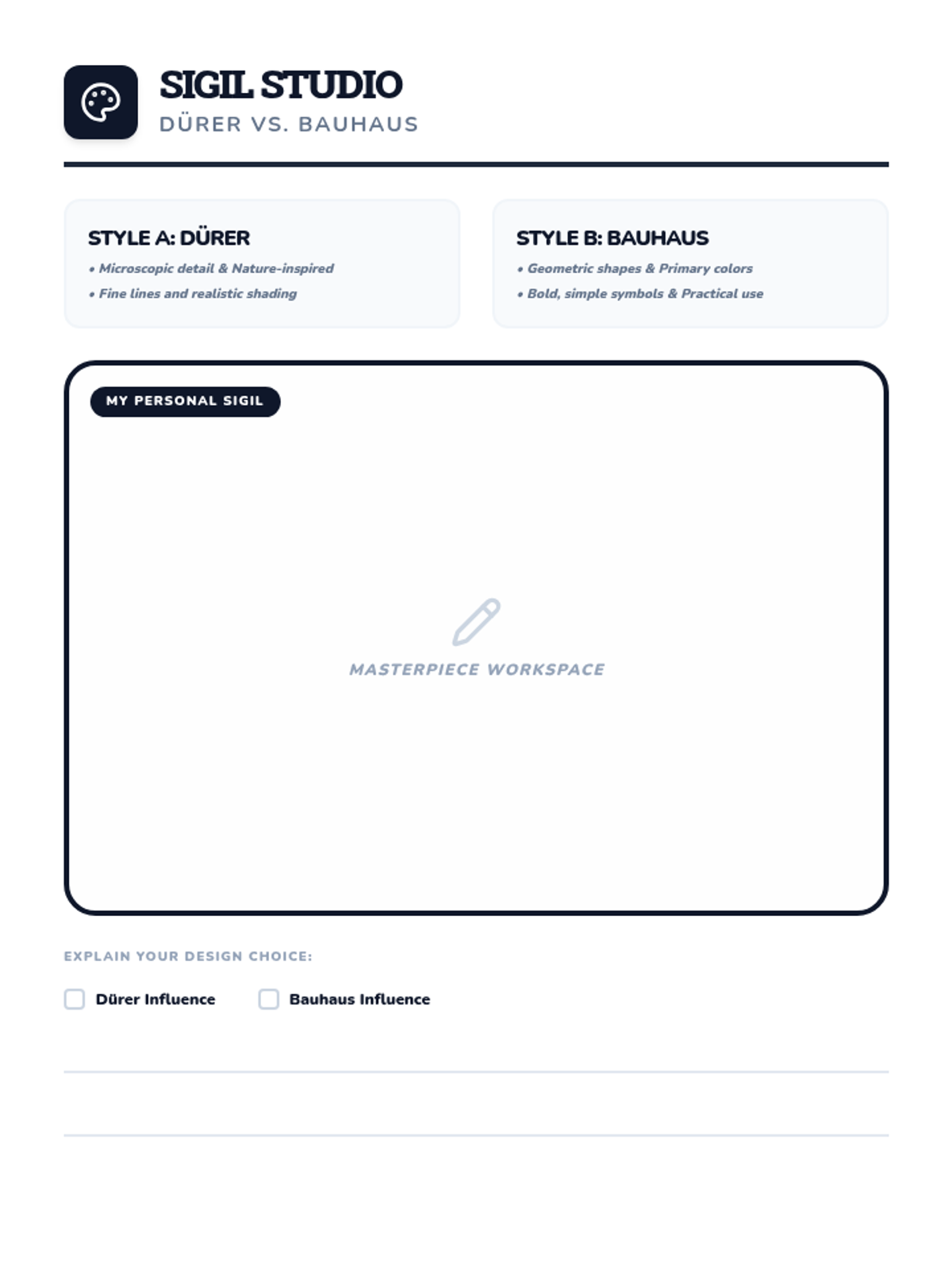
A creative art worksheet where students design their own personal symbol using techniques inspired by either Albrecht Dürer or the Bauhaus movement. Revised for single-page fit.
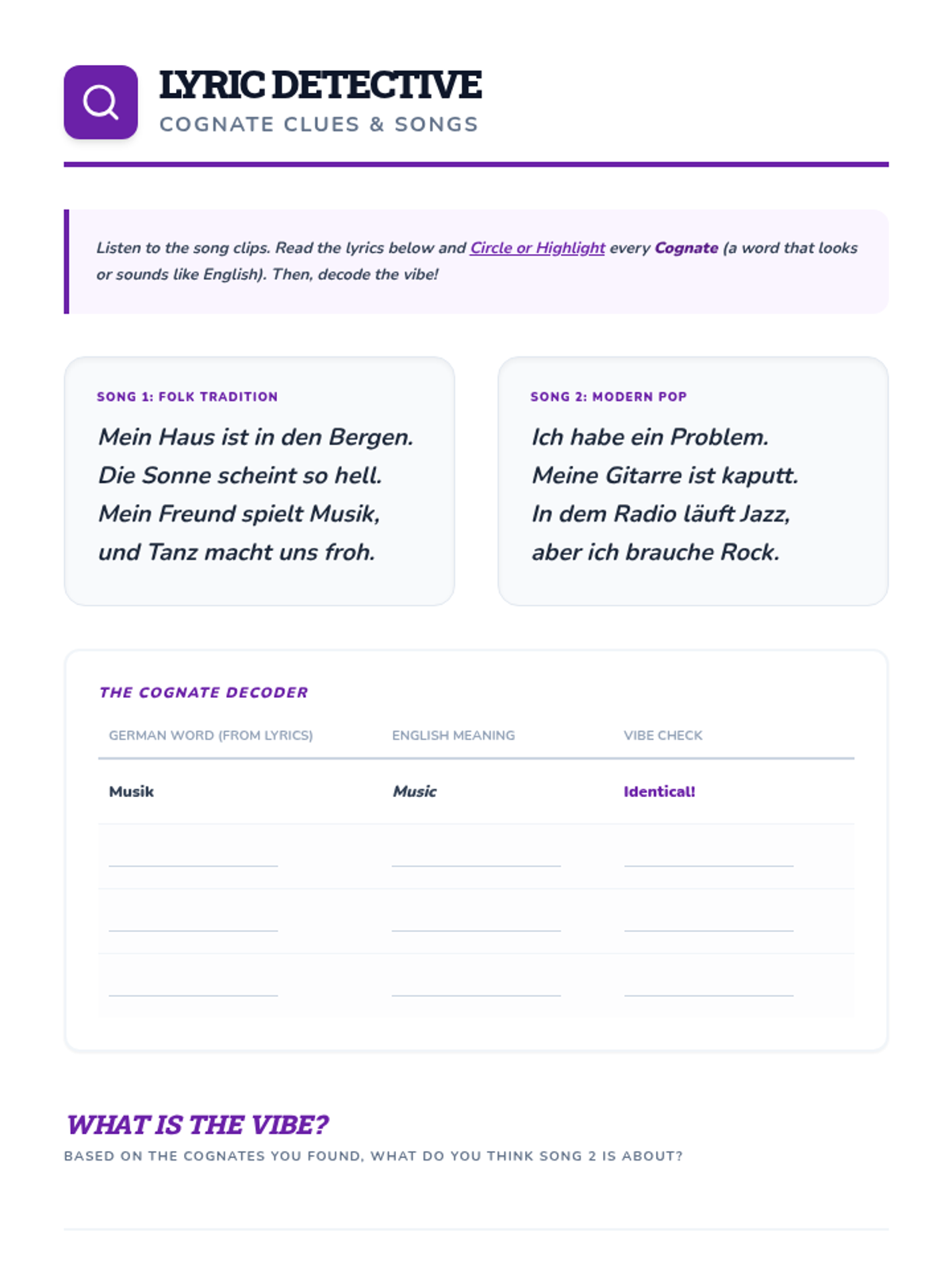
A lyric-based worksheet where students identify German-English cognates in song snippets to decode the meaning of the text. Revised for single-page fit and improved student interaction.
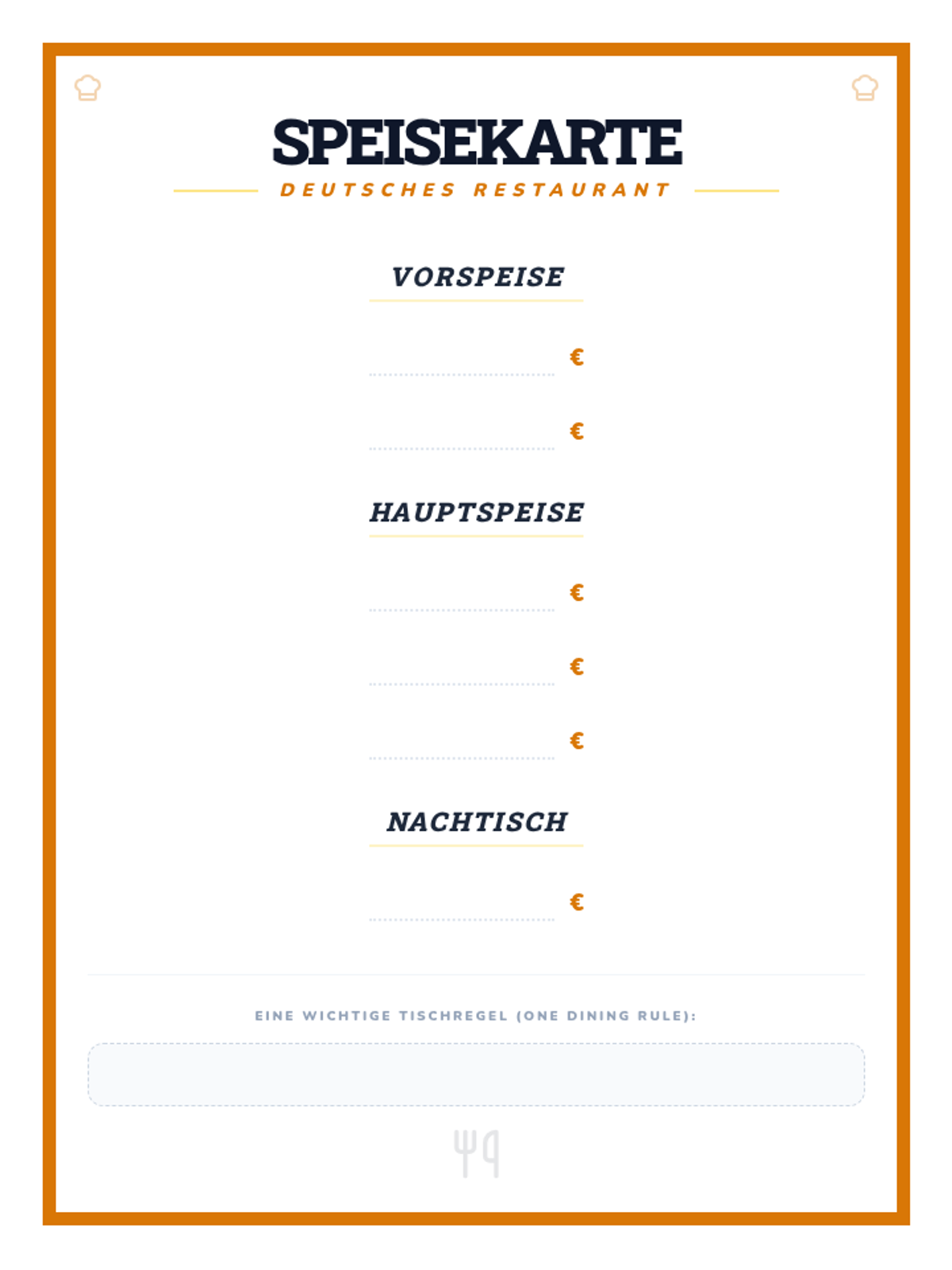
An elegant German menu template for students to design their own 'Speisekarte' including appetizers, mains, and desserts. Revised for single-page fit and improved handwriting space.
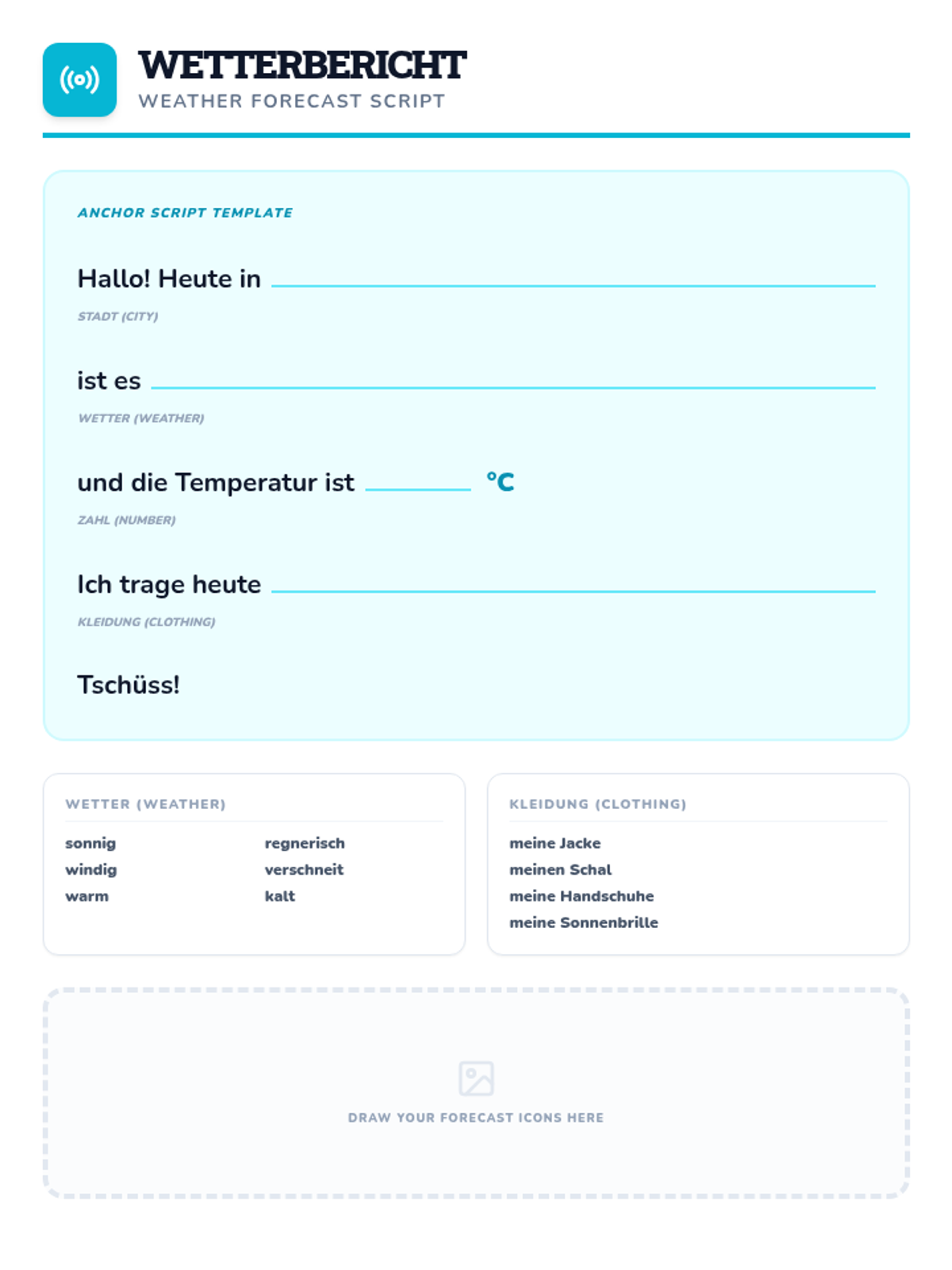
A scaffolded script template for students to prepare and perform a German weather forecast. Revised to fit on a single page with corrected vocabulary and improved handwriting space.
A vibrant, high-impact welcome poster for an EL (English Learners) classroom door. Features multilingual "Hello" greetings, a diverse set of flags, and the quote "Many Languages, One Community." Includes designated spaces for teacher name and room number.
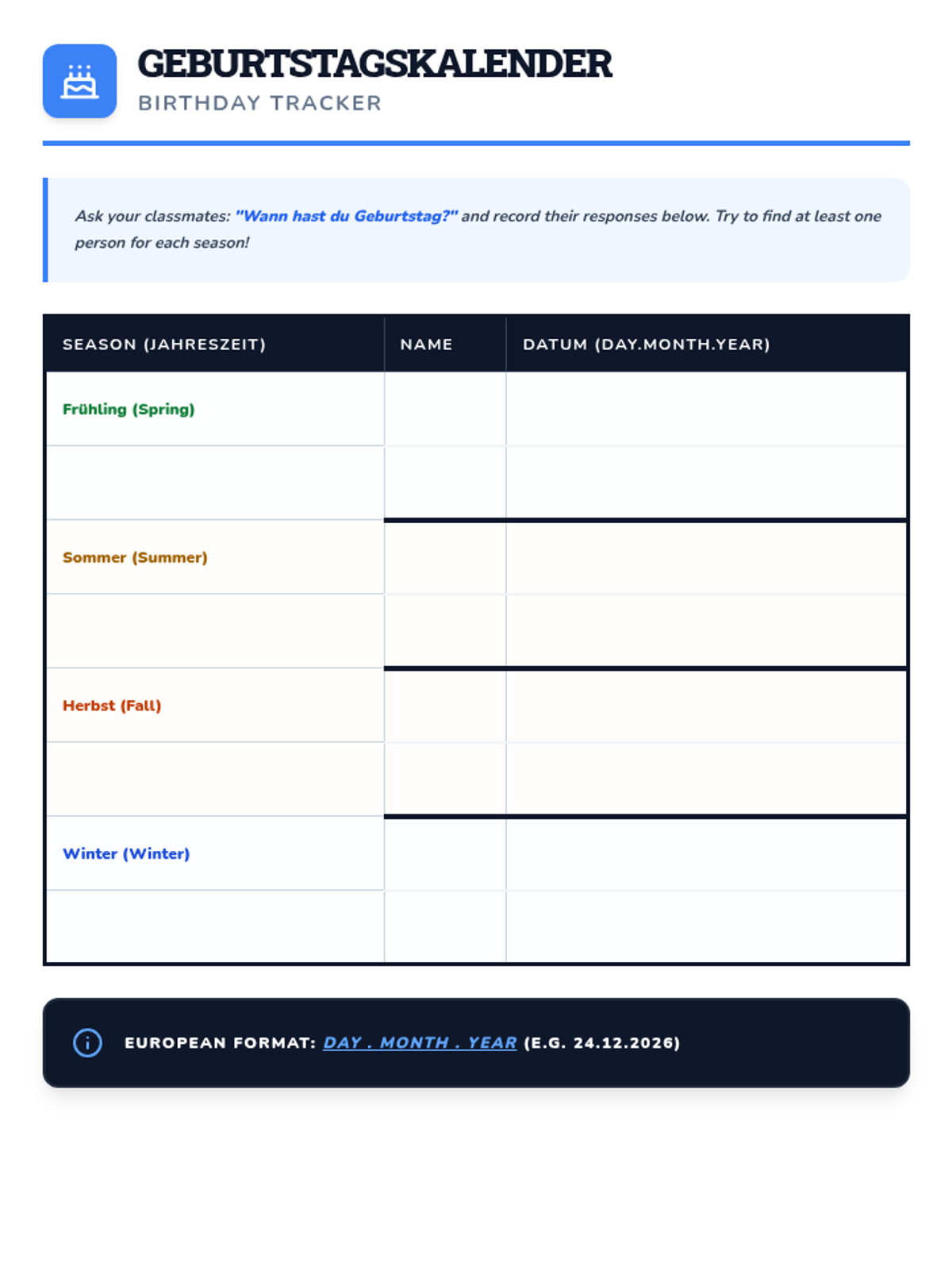
A tracker sheet for students to practice asking for and recording birthdays using seasons and European date formatting. Revised to fit on a single page with improved student work areas.
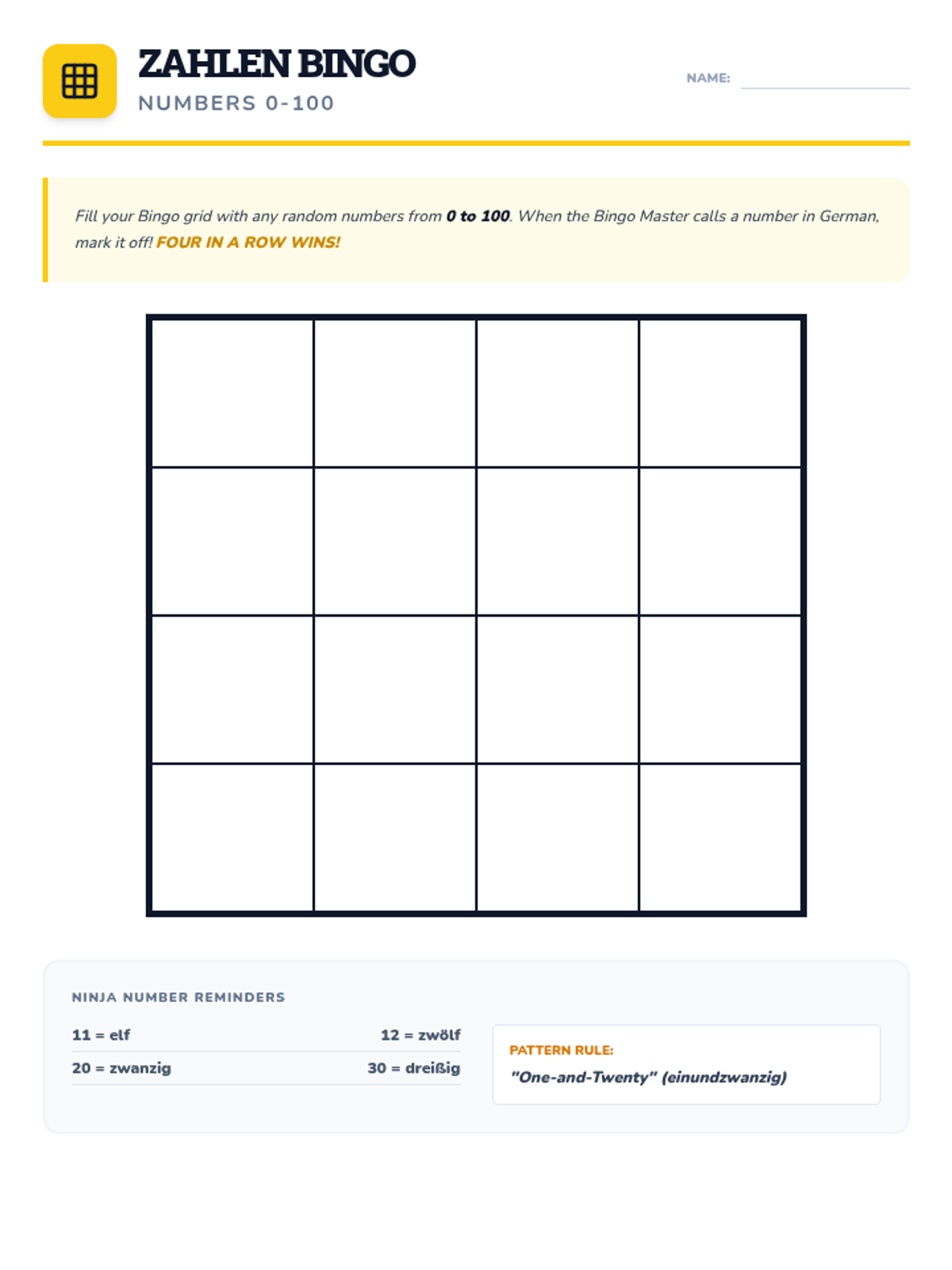
A customizable 4x4 Bingo board for practicing German numbers from 0 to 100. Revised for single-page layout and improved rule clarity.
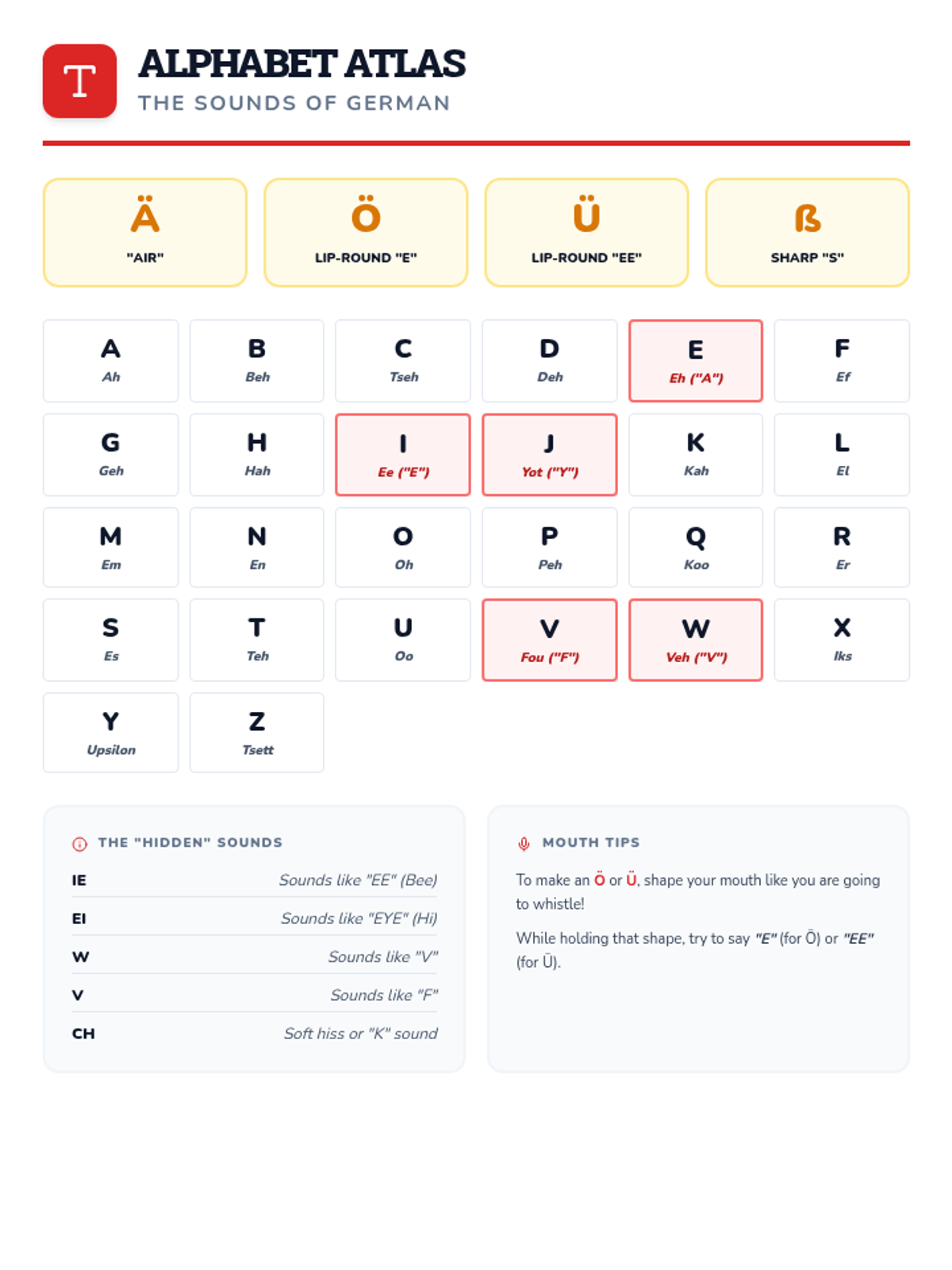
A handy reference guide for the German alphabet, including phonetic sound helpers for each letter and tips for tricky pronunciations. Revised for high contrast and single-page layout.
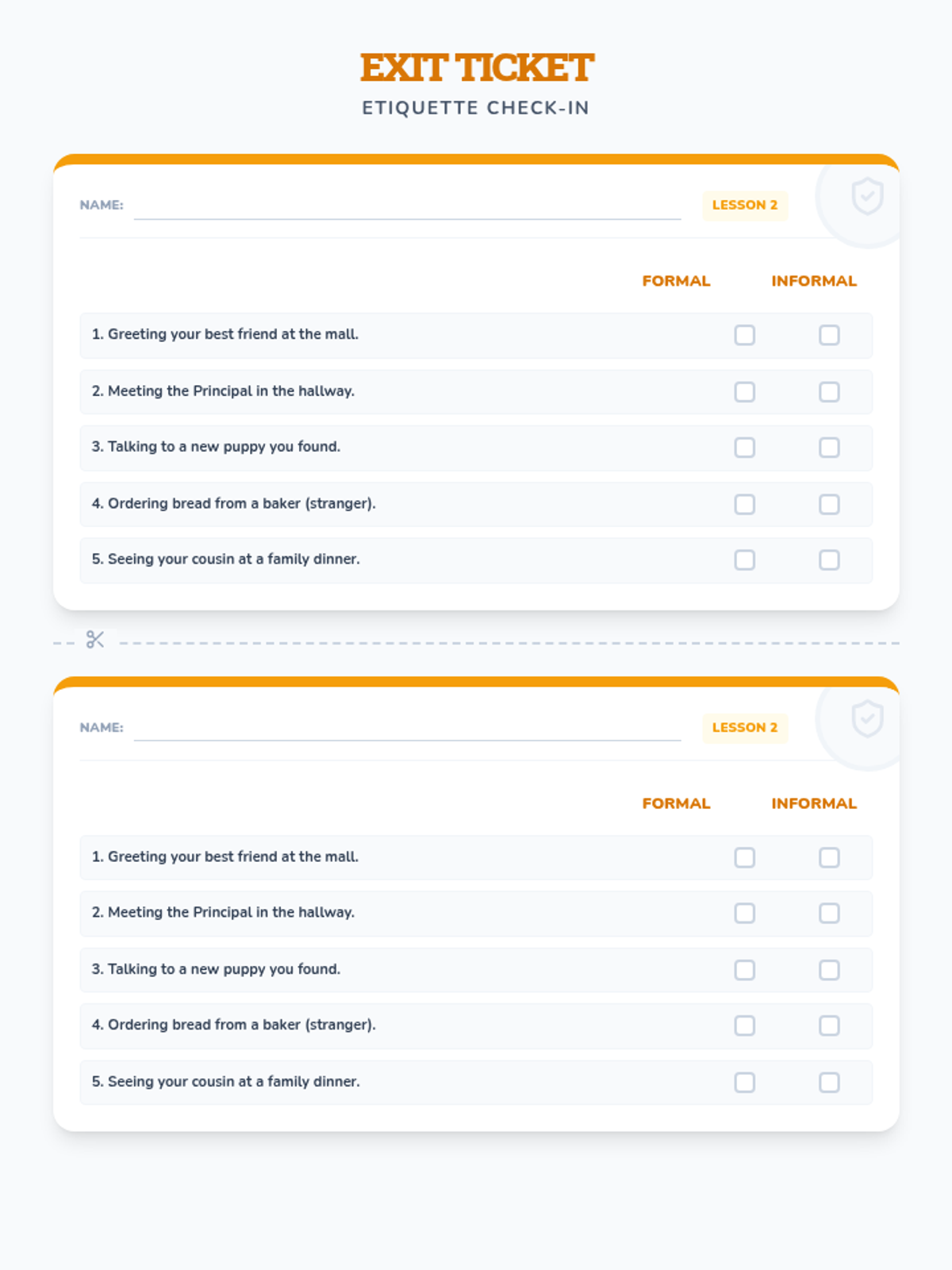
An exit ticket for Lesson 2 where students identify whether social scenarios require the formal 'Sie' or informal 'du' register. Properly duplicated for printing efficiency.
Instructional slides for Lesson 10, exploring the Schultüte, Christmas Markets, Nikolaustag, and holiday comparisons. Replaced ice-cream icon, added Venn model with proper overlap, fixed boot icon rendering issue, and improved text contrast.
Deutsche Übersetzung des Lehrer-Planungsbuchs für die Einheit 'Weltweite Wunder', inklusive Lernzielen, Erfolgskriterien und der REISE-Routine. Vollständig ins Deutsche übersetzt. Revised to fix language inconsistencies and page flow.
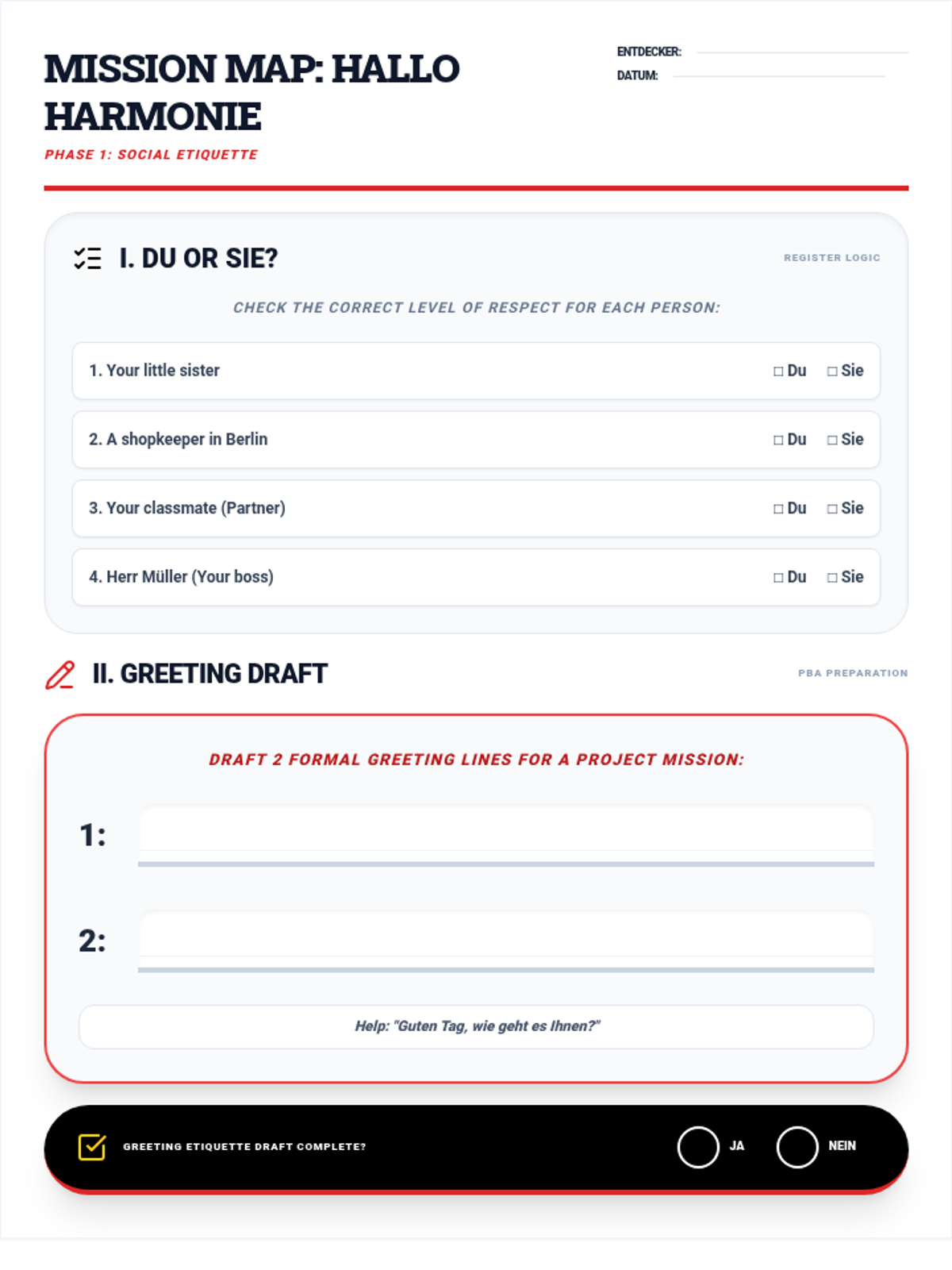
A student activity sheet for German Lesson 2: Hallo Harmonie, featuring a register sorting task (Du vs. Sie) and a dialogue drafting section for formal introductions. Revised for high handwriting contrast, unbiased choices, and single-page layout.
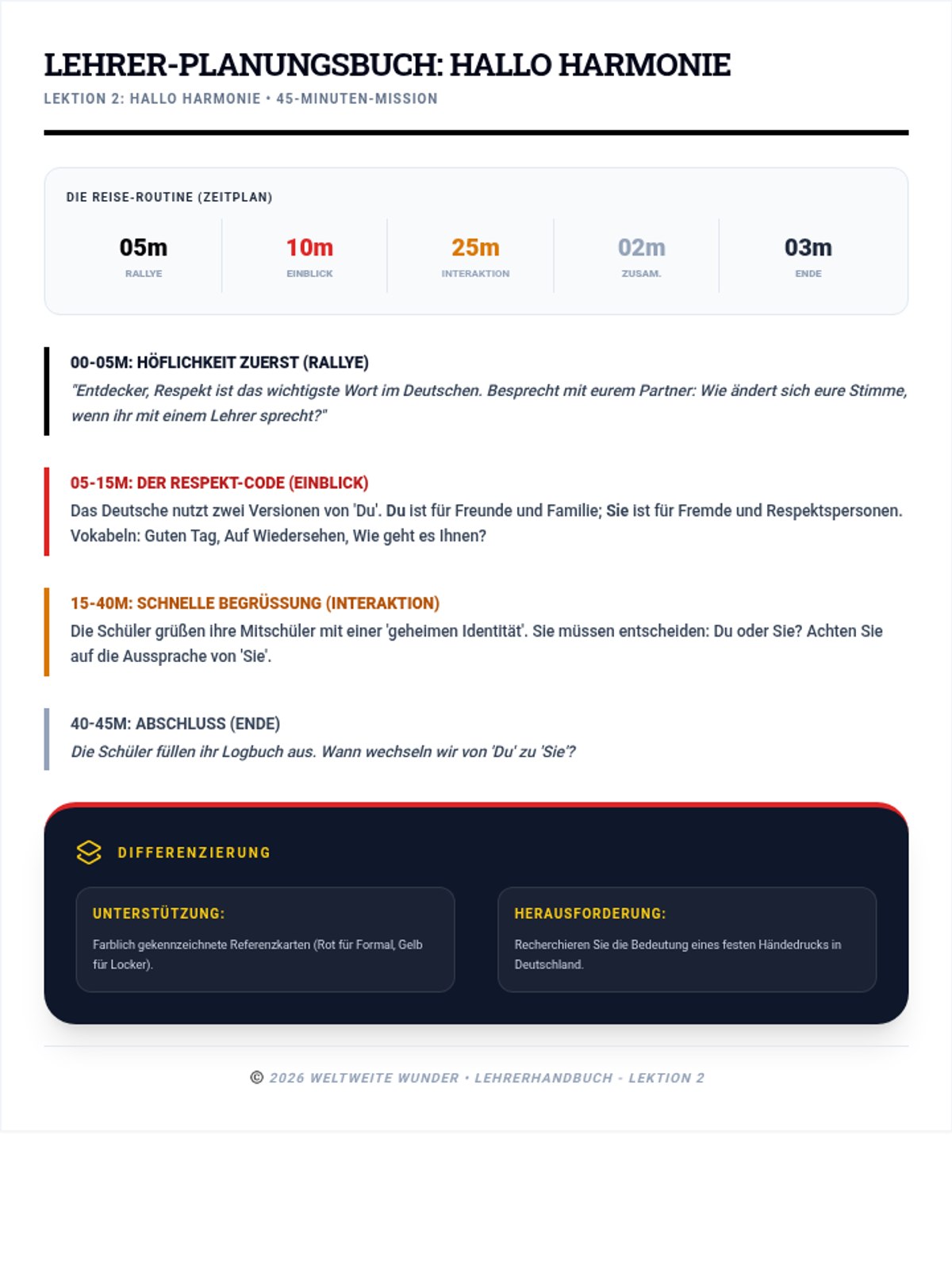
Deutsche Übersetzung des Lehrer-Planungsbuchs für die Lektion 'Hallo Harmonie', inklusive Lernzielen, Erfolgskriterien und der REISE-Routine. Vollständig ins Deutsche übersetzt. Revised to fix language inconsistencies, page breaks, and contrast.
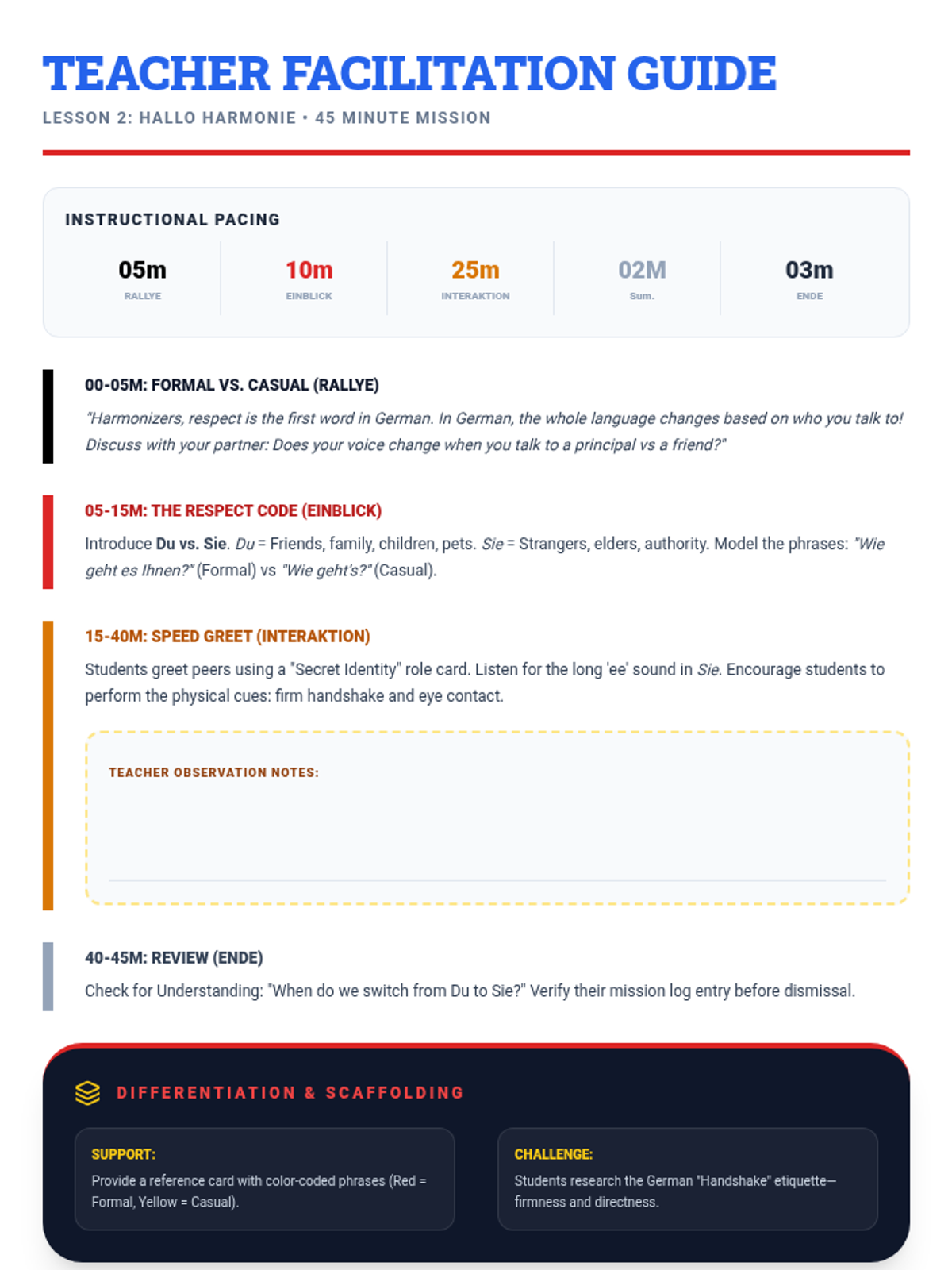
A step-by-step facilitation guide for German Lesson 2: Hallo Harmonie, providing teacher scripts, register-switch activities (Du vs. Sie), and cultural greeting norms. Revised for better page flow and corrected artifacts. Now consolidated to a single page.
Instructional slides for German Lesson 2: Hallo Harmonie, covering formal and informal greetings (Du vs. Sie) and cultural greeting etiquette.
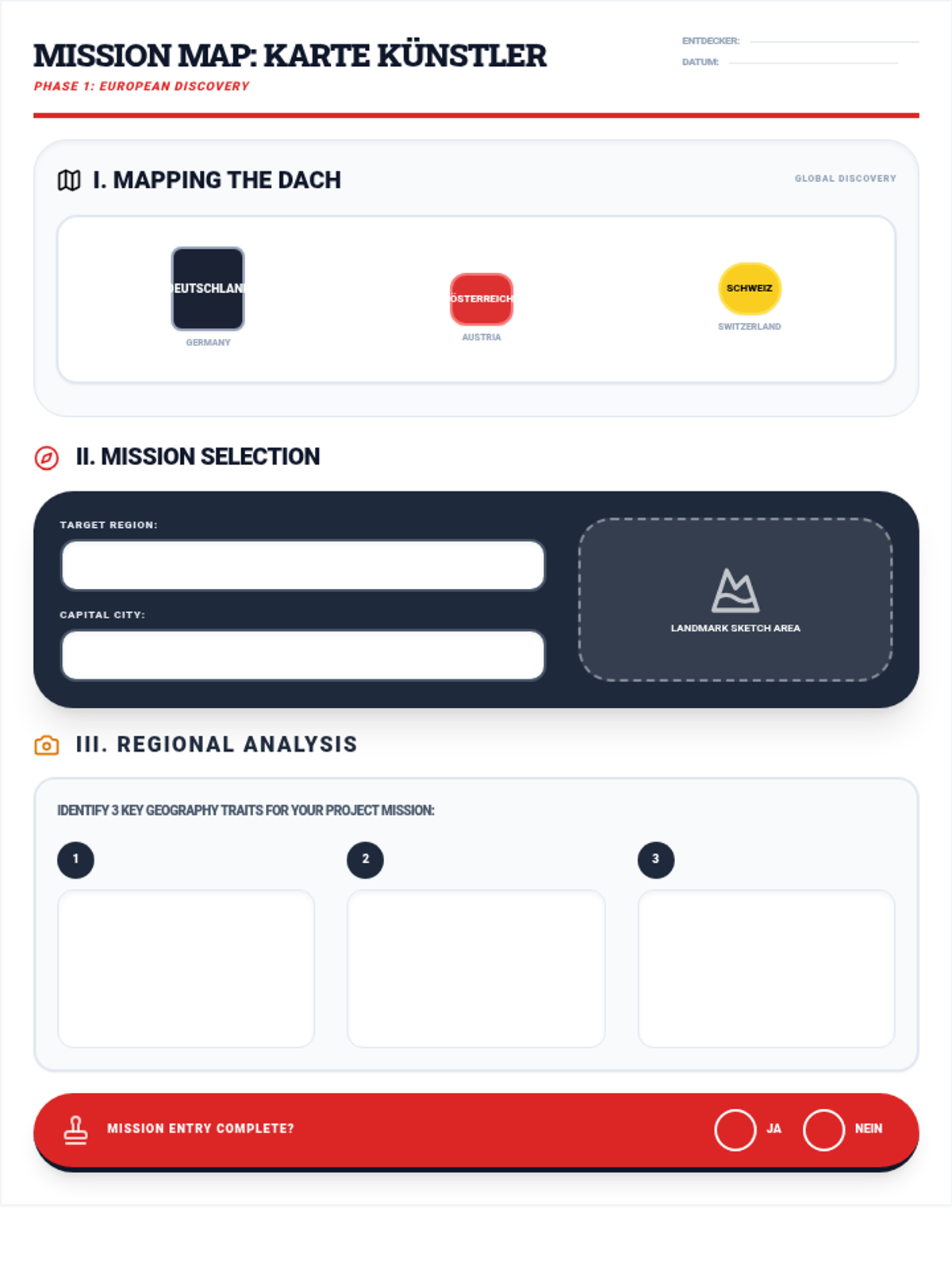
A student activity sheet for German Lesson 1: Karte Künstler, featuring D-A-CH mapping, country selection for the project mission, and regional analysis drafting. Revised for better contrast, single-page layout, and correct labeling.
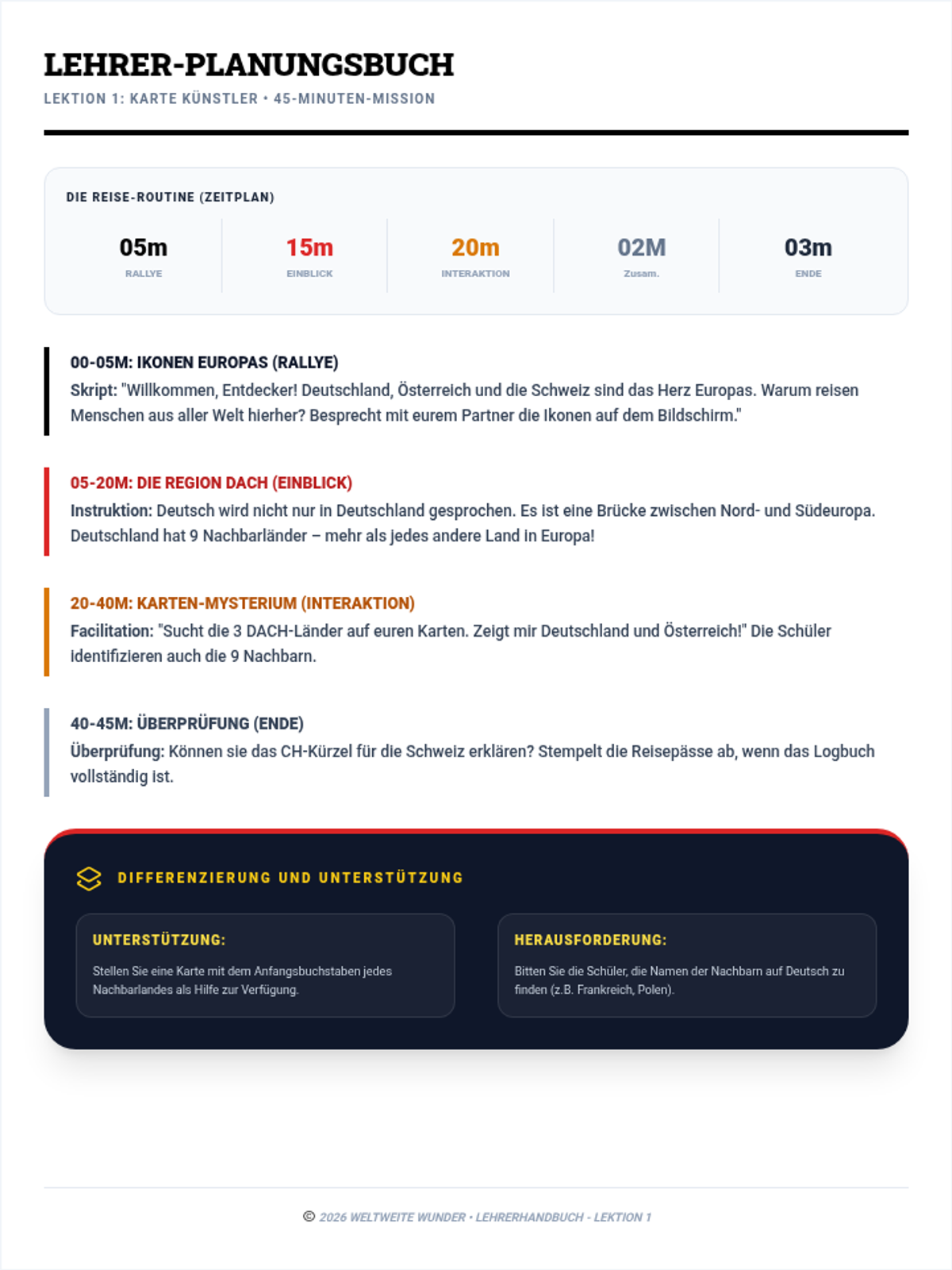
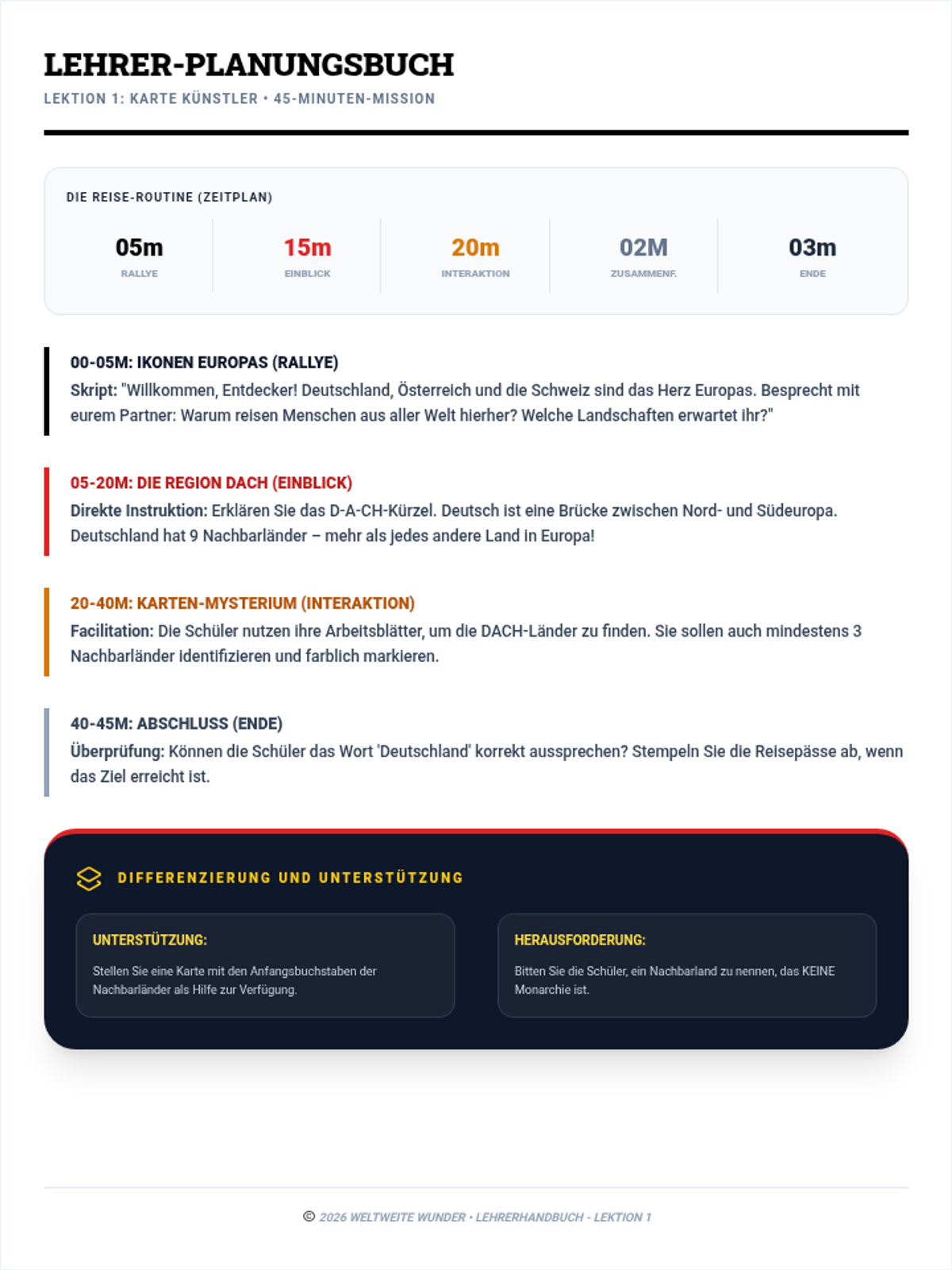
Deutsche Übersetzung des Lehrer-Planungsbuchs für die Lektion 'Karte Künstler'. Vollständig ins Deutsche übersetzt mit Unterrichtsskripten und Zeitplan.
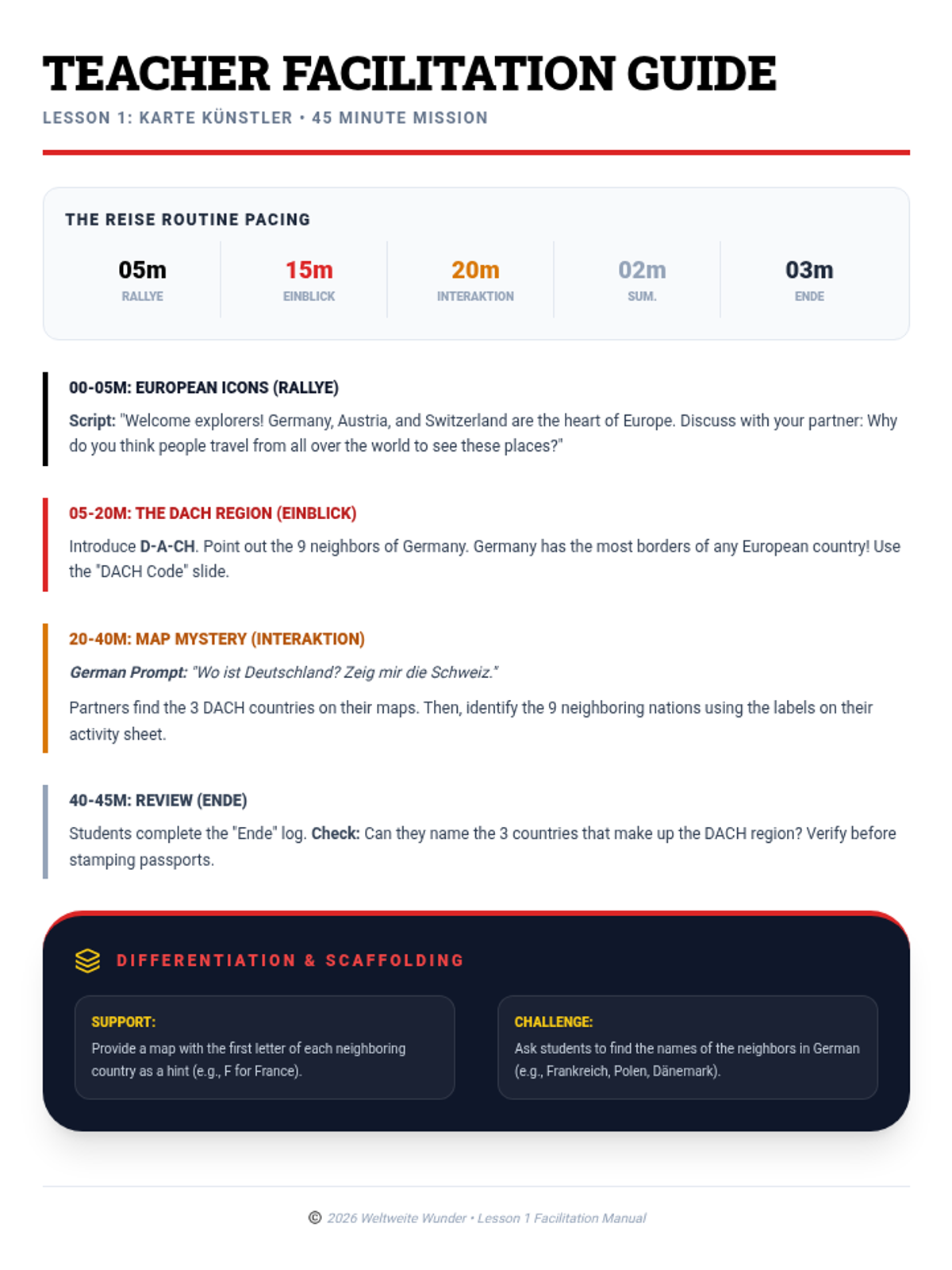
A facilitation guide for German Lesson 1: Karte Künstler, providing pacing, scripts for European geography, and map-based instructional strategies. Revised to fit one page and corrected language errors.
Instructional slides for German Lesson 1: Karte Künstler, covering the D-A-CH regions, Germany's 9 neighbors, and European landmarks. Revised with improved contrast, spacing, and full neighbor content.
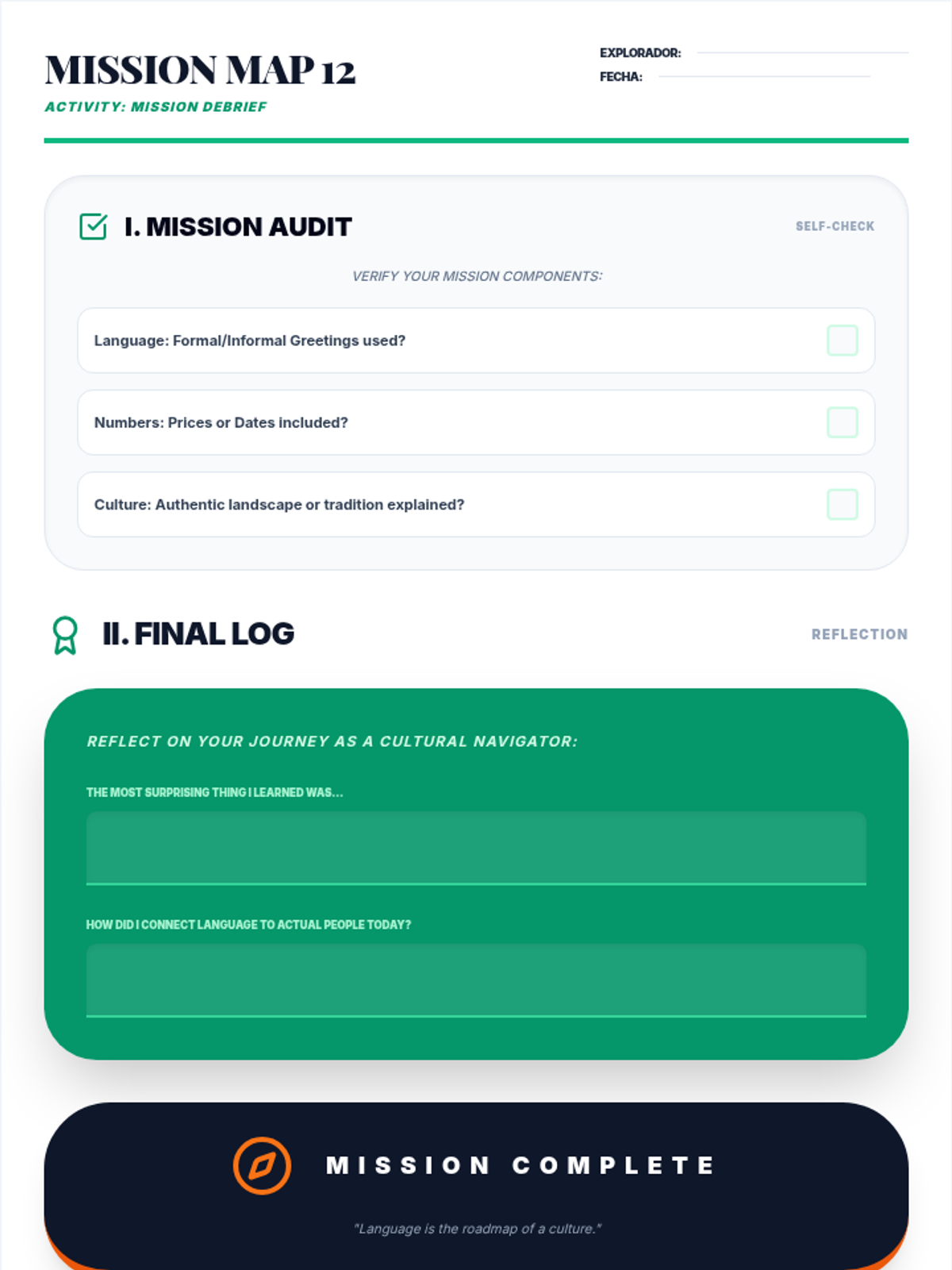
A student activity sheet for Spanish Lesson 12: World Wonders Project, featuring a project audit checklist and a final unit reflection area for student navigators.
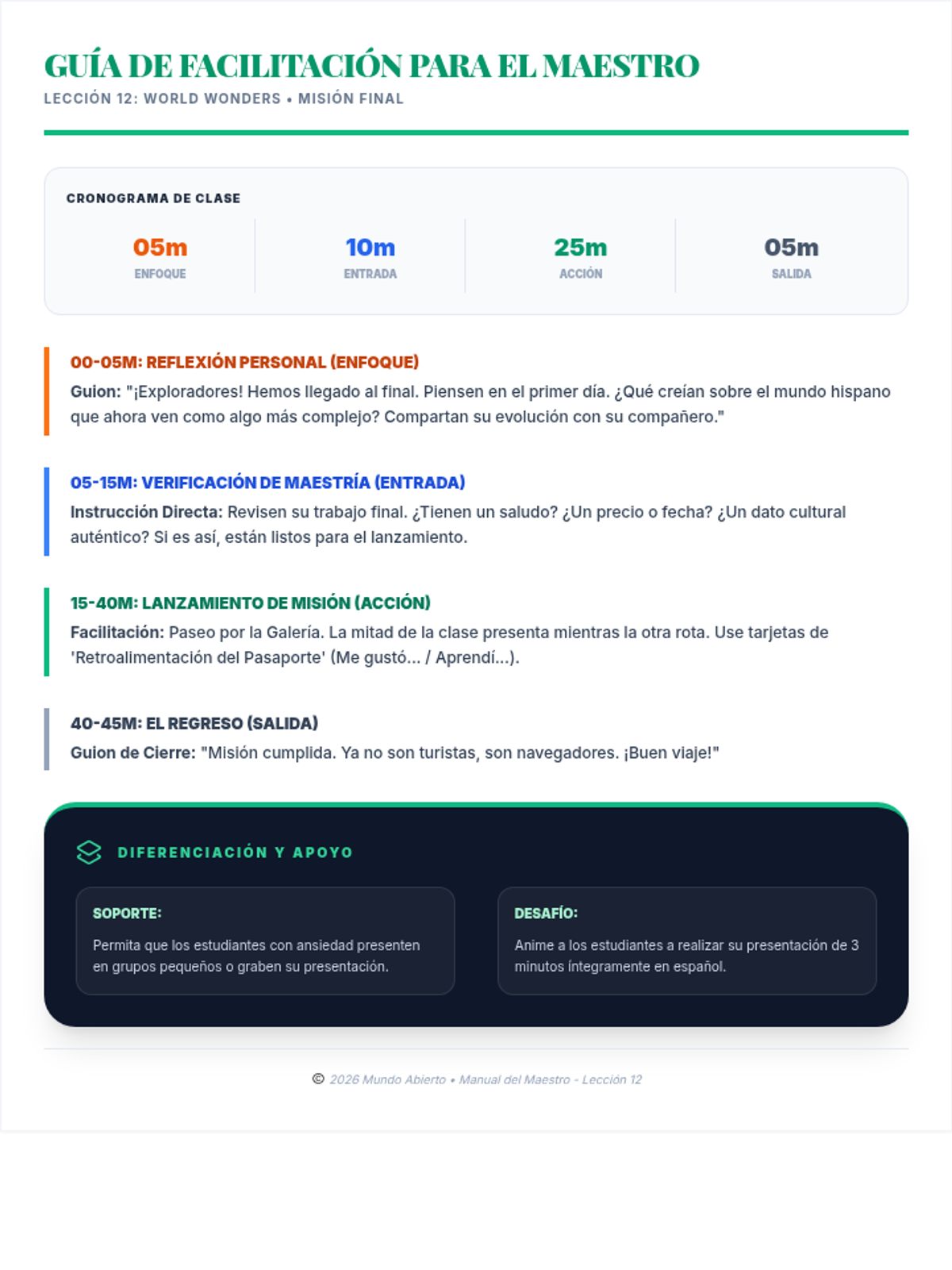
Versión traducida al español de la guía de facilitación para la Lección 12: World Wonders Project, centrada en la culminación del proyecto y la reflexión final.
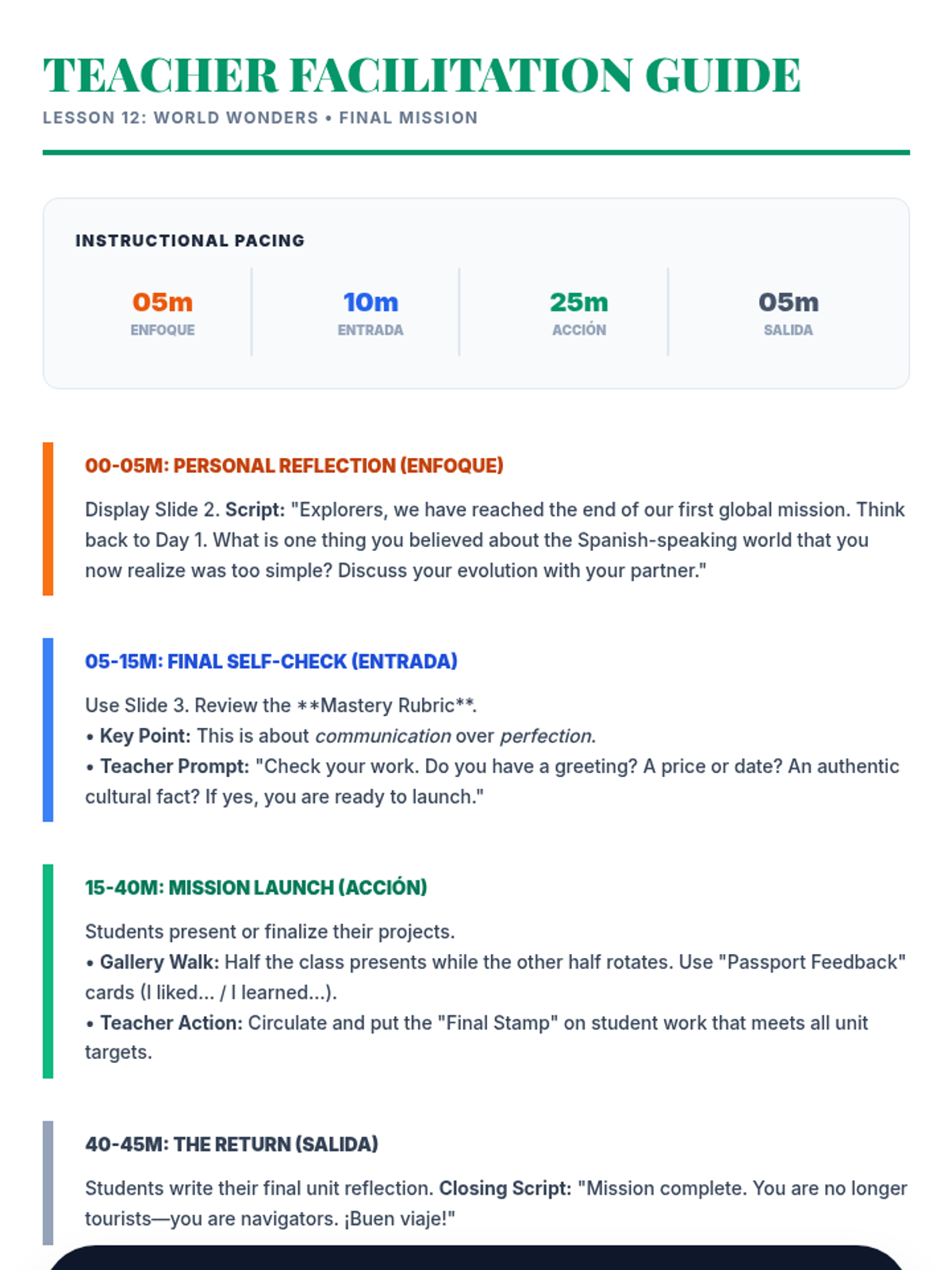
A facilitation guide for Spanish Lesson 12: World Wonders Project, providing pacing, scripts for final reflection, and a gallery walk instructional framework.
Instructional slides for Spanish Lesson 12: World Wonders Project, focusing on final project synthesis, rubric self-reflection, and celebratory 'Mission Accomplished' wrap-ups.
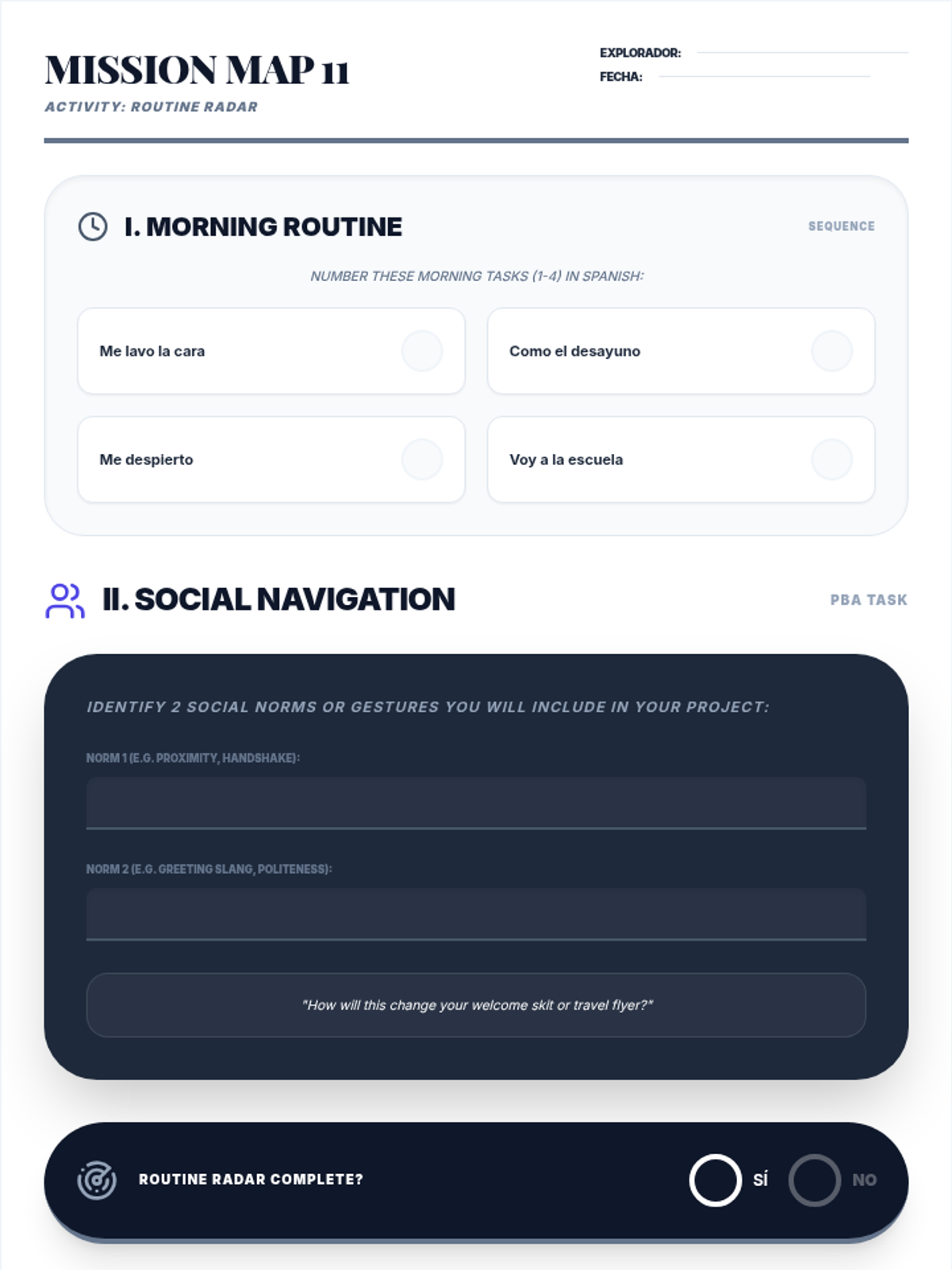
A student activity sheet for Spanish Lesson 11: Routine Radar, featuring a sequence logic task for morning routines and a social norms selection area for final mission projects.
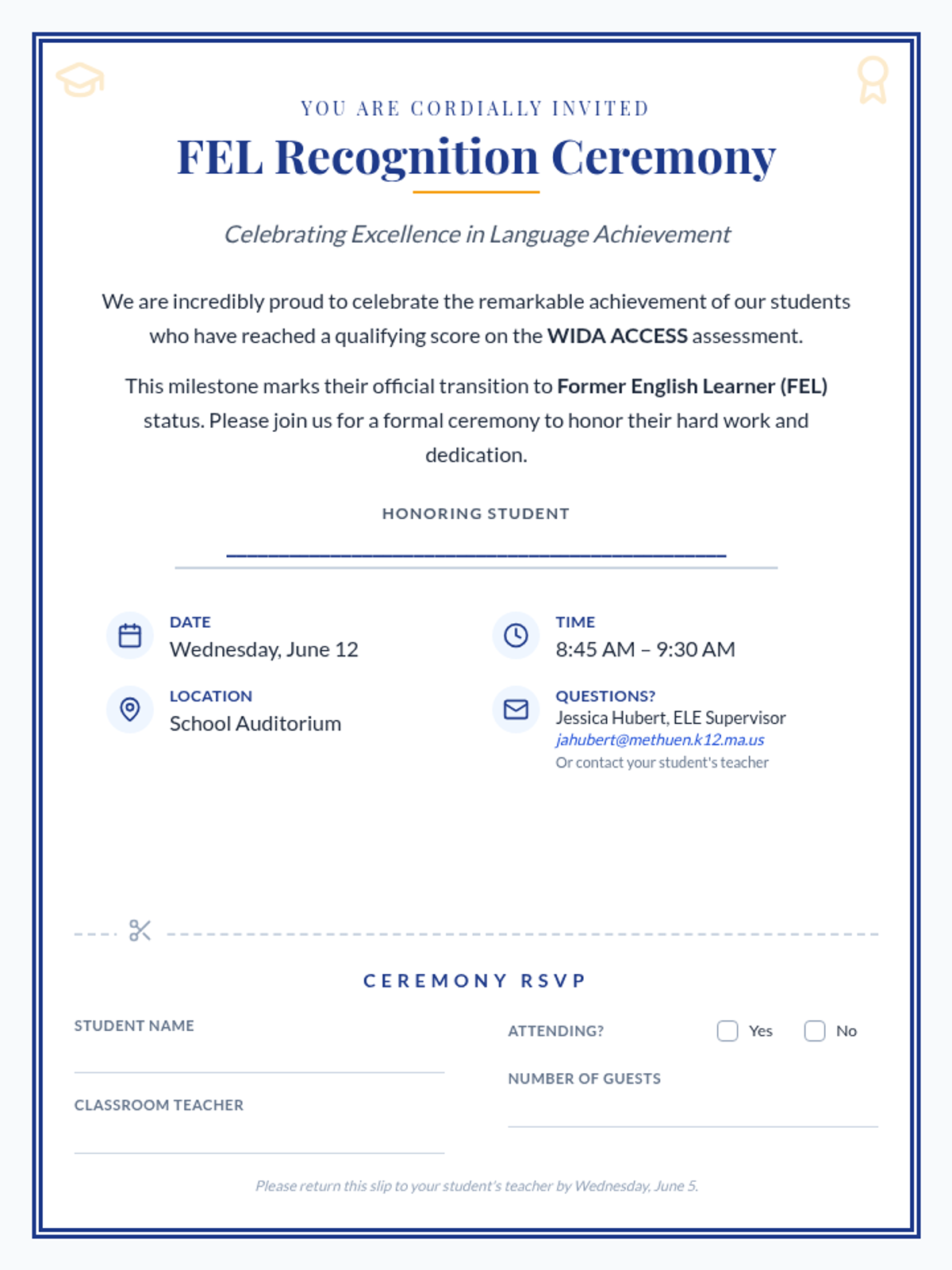
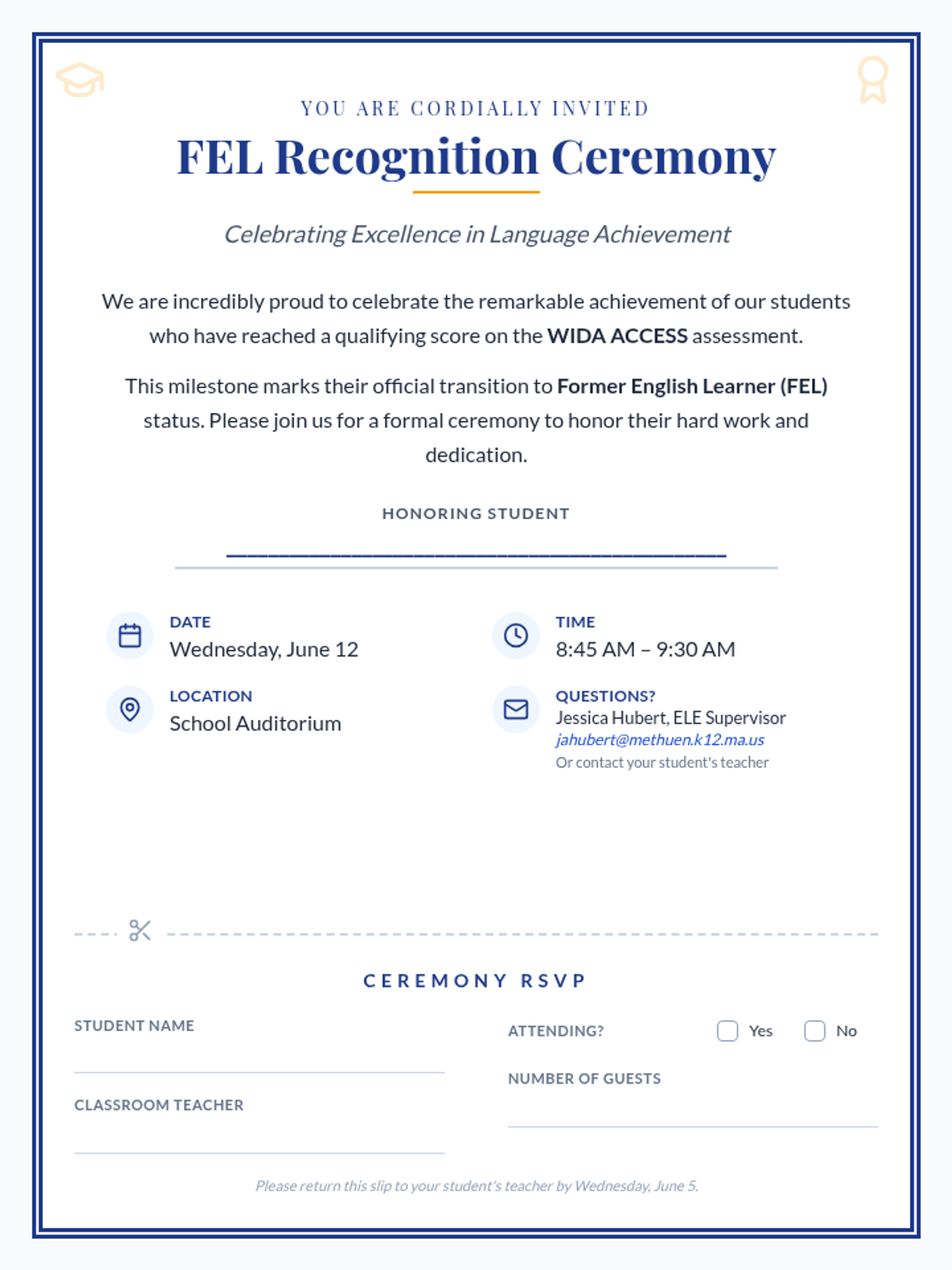
A formal printable invitation for families to celebrate their student's achievement of reaching a qualifying WIDA ACCESS score and transitioning to FEL status. The flyer features a professional layout with event details, a student name placeholder, and a detachable RSVP slip.
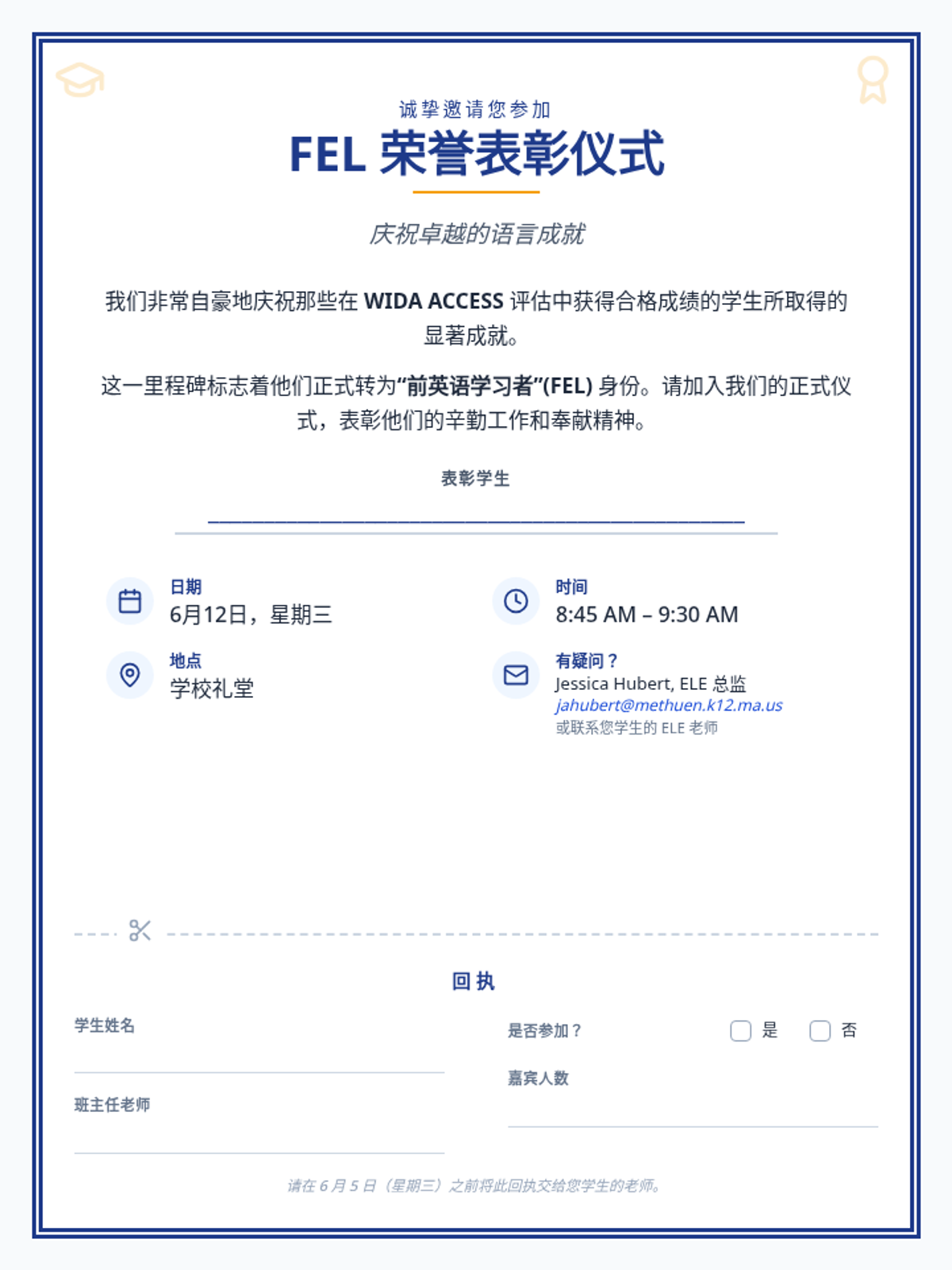
Mandarin Chinese translation of the FEL Recognition Ceremony invitation for families. Includes event details, student name placeholder, and detachable RSVP slip.
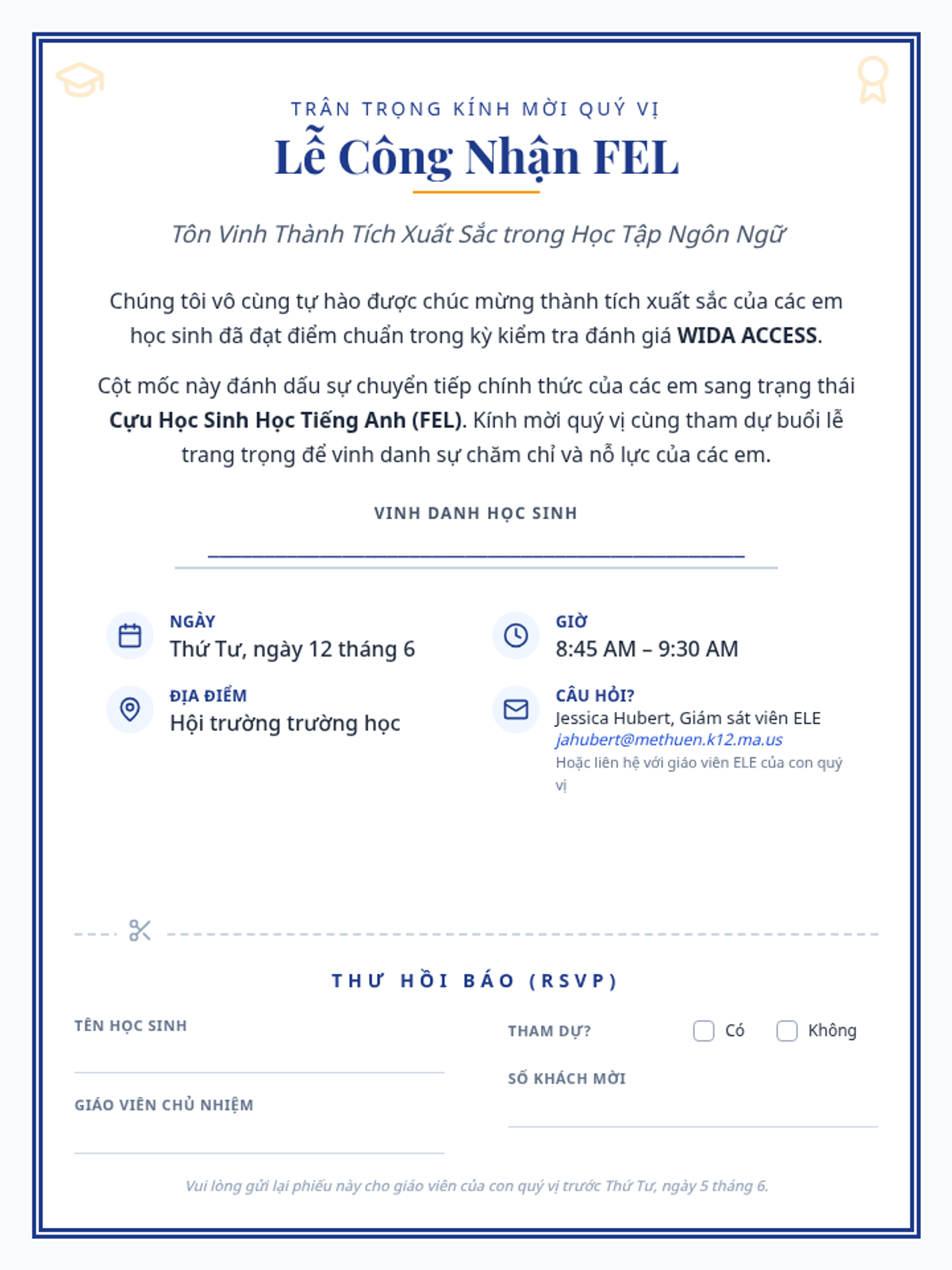
Vietnamese translation of the FEL Recognition Ceremony invitation for families. Includes event details, student name placeholder, and detachable RSVP slip.
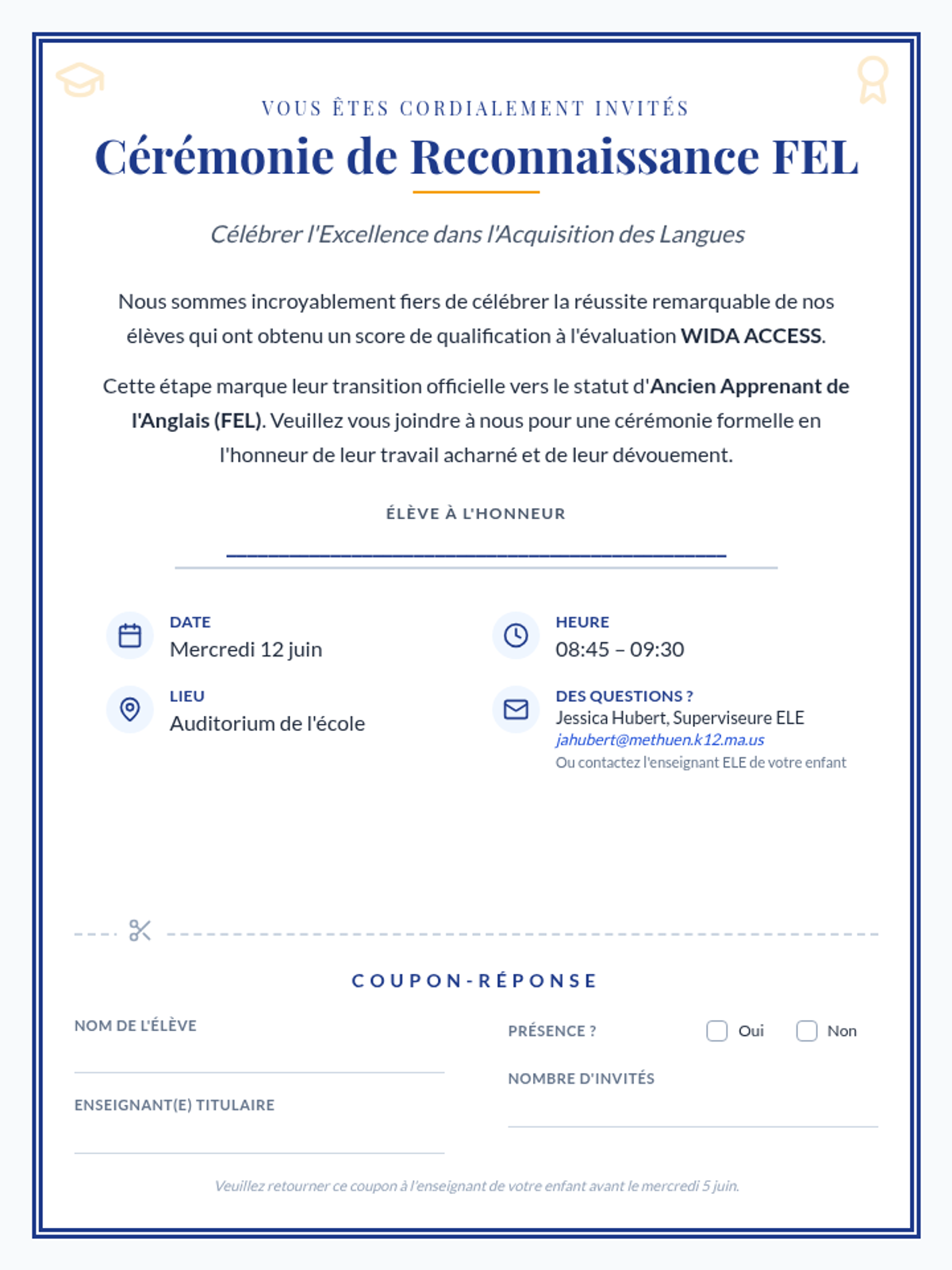
French translation of the FEL Recognition Ceremony invitation for families. Includes event details, student name placeholder, and detachable RSVP slip.
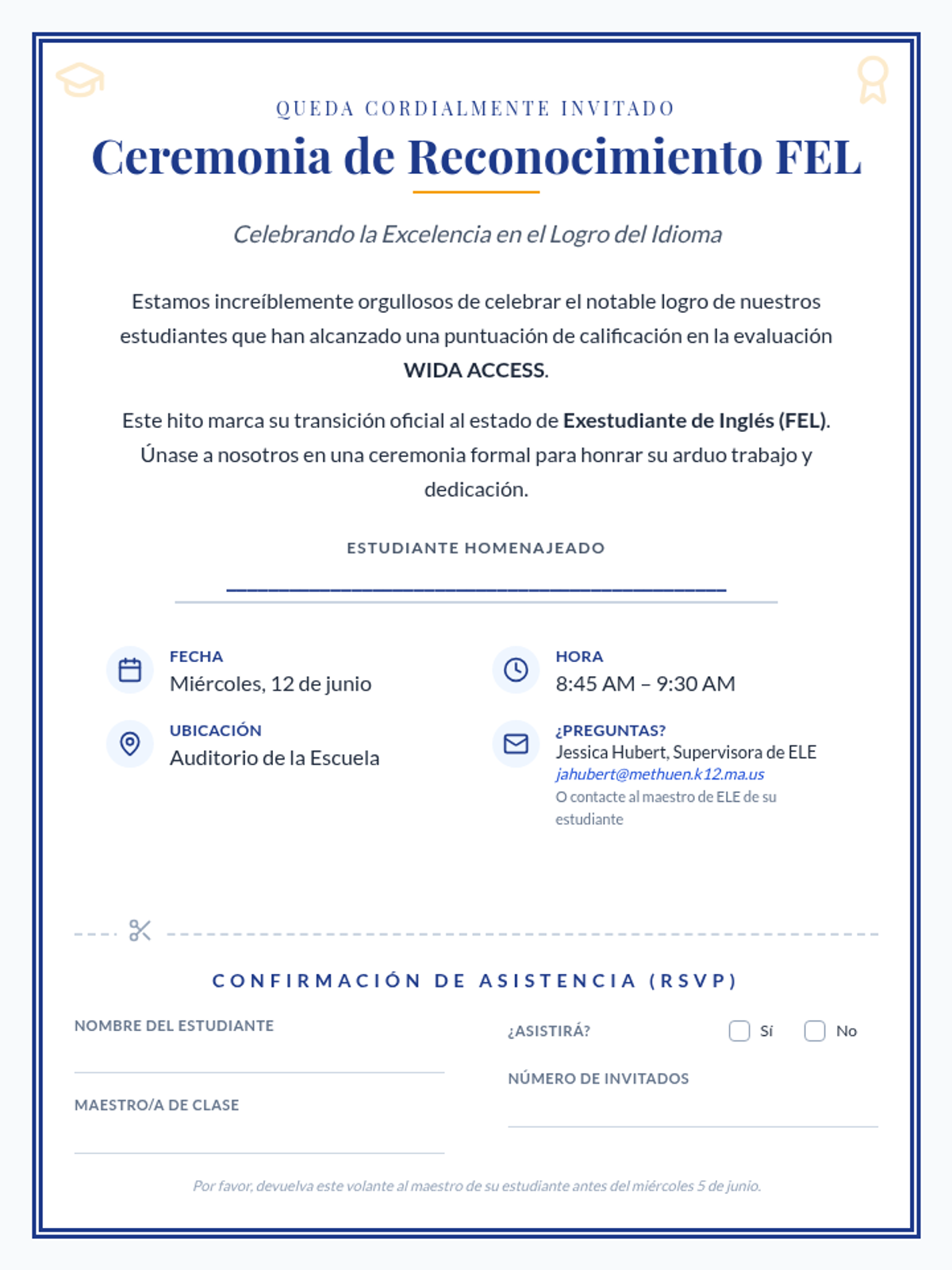
Spanish translation of the FEL Recognition Ceremony invitation for families. Includes event details, student name placeholder, and detachable RSVP slip.
Une présentation de diapositives visuelle et engageante pour introduire les cinq mots de vocabulaire (manuel, omettre, critique, cohérent, valide). Chaque diapositive comprend une définition claire, un exemple concret et un emoji visuel pour faciliter la mémorisation.
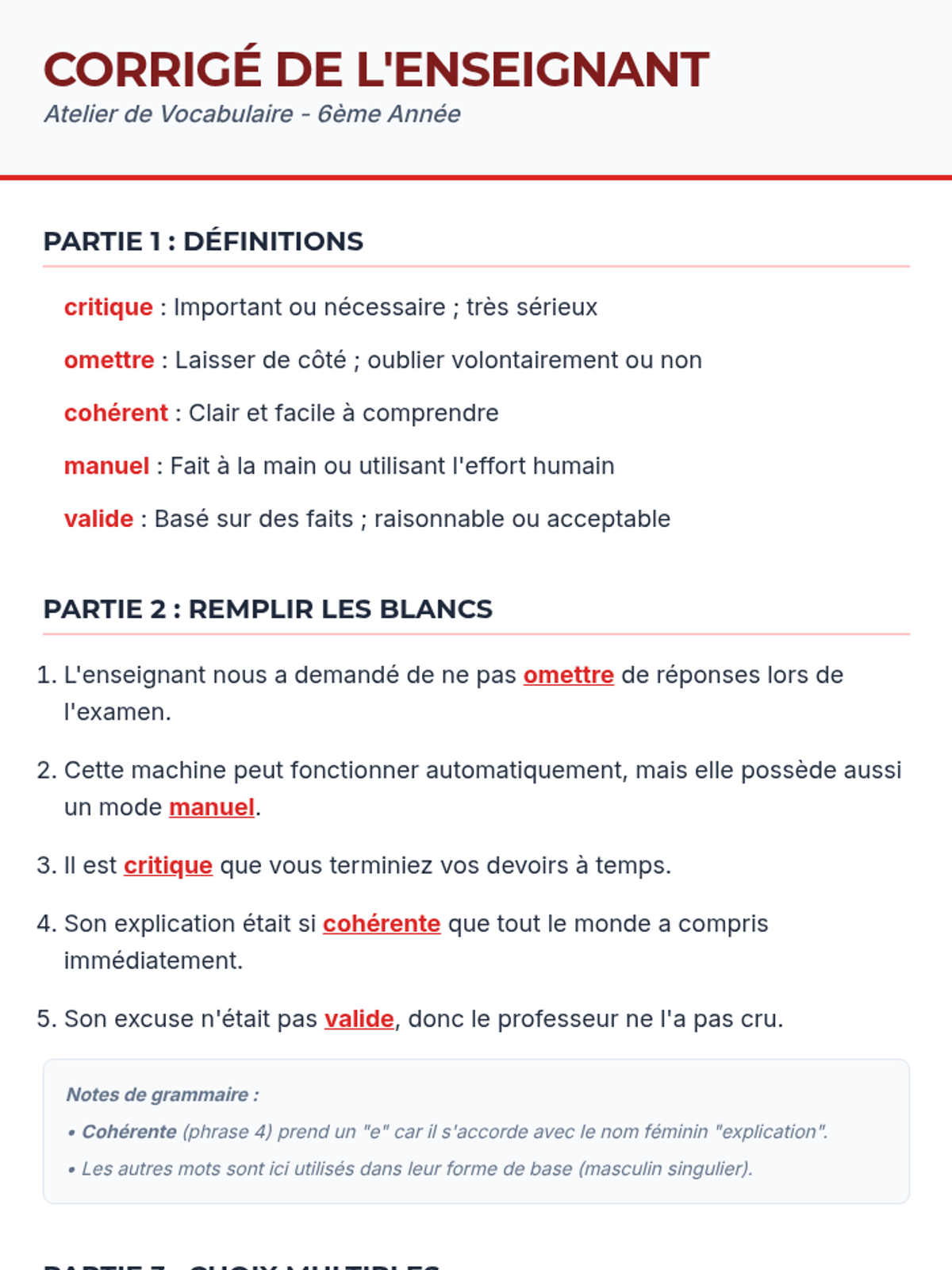
Un corrigé complet pour l'Atelier de Vocabulaire, destiné à l'enseignant. Il comprend les réponses aux exercices d'association, de remplissage de blancs et de choix multiples, ainsi que des exemples pour les questions de rédaction.
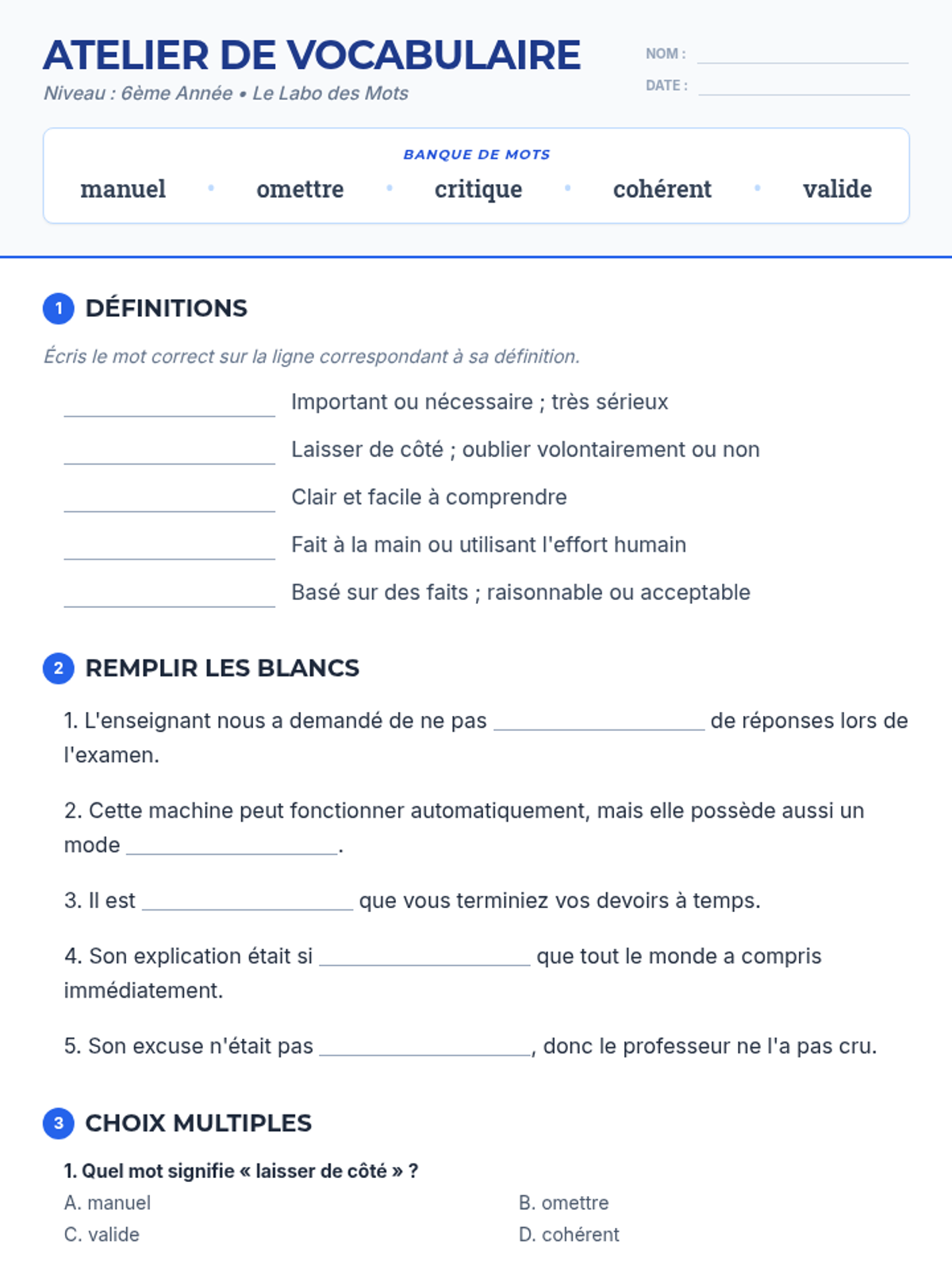
Une fiche de vocabulaire en français pour les élèves de 6ème année, comprenant des exercices d'association, de remplissage de blancs, de choix multiples et de rédaction de phrases. Elle utilise un design propre et professionnel sur le thème d'un laboratoire.
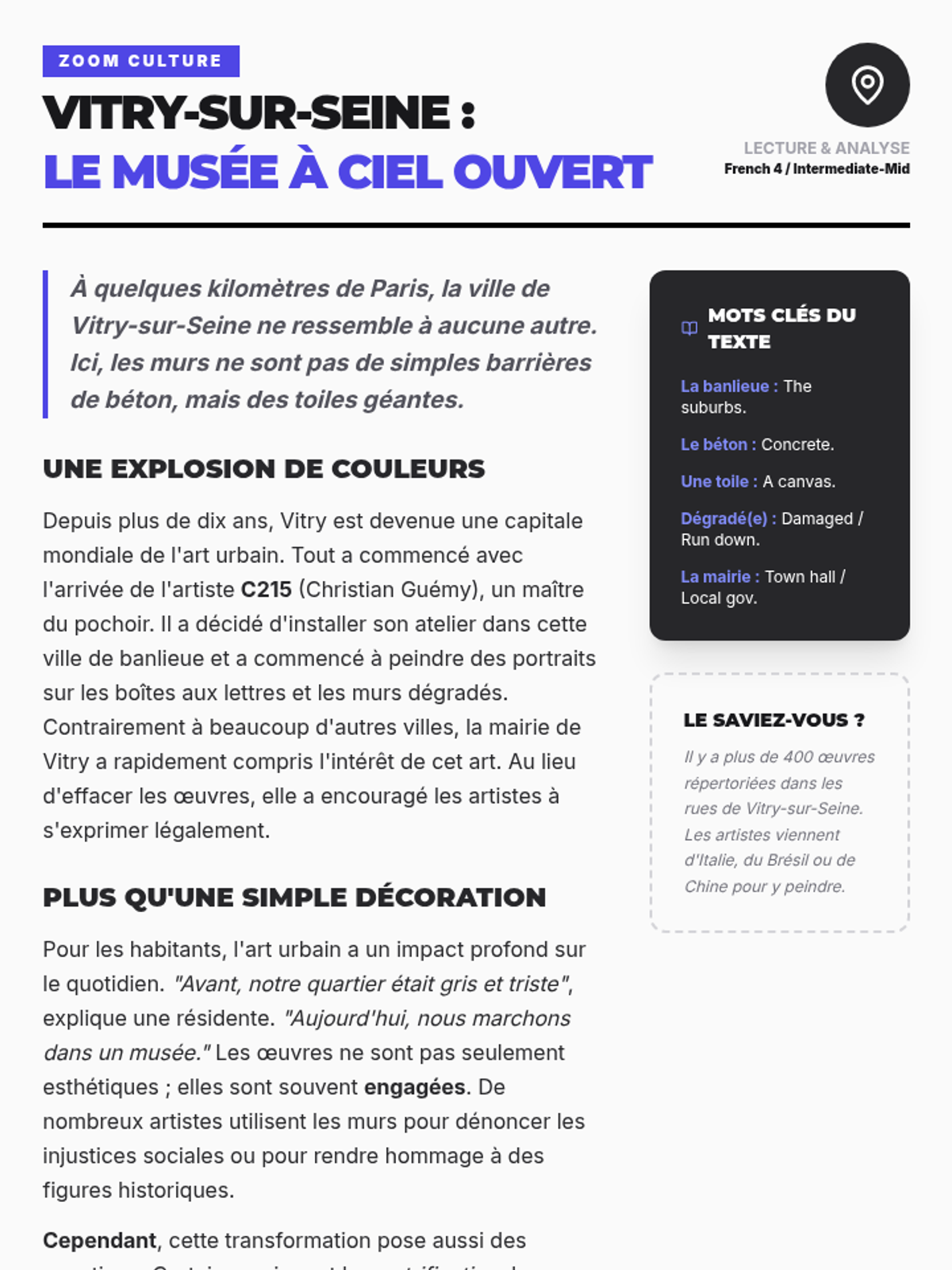
A reading comprehension activity for French 4 students about the street art culture in Vitry-sur-Seine. Includes an article, vocabulary sidebar, and analysis questions covering comprehension and critical thinking.
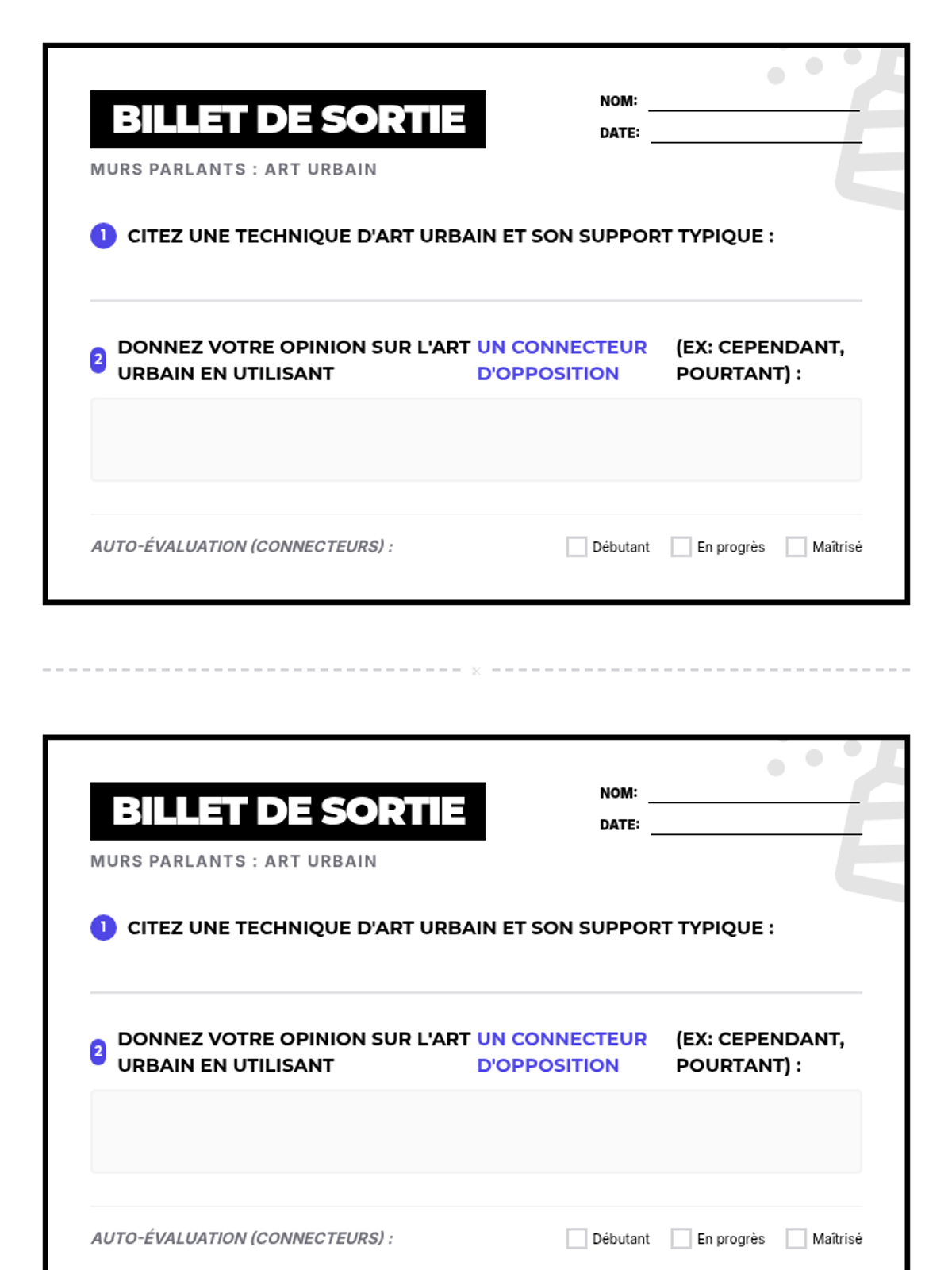
An exit ticket for the 'Murs Parlants' lesson, featuring two identical cut-out slips to assess students' vocabulary retention and their ability to use logical connectors in an opinion sentence.
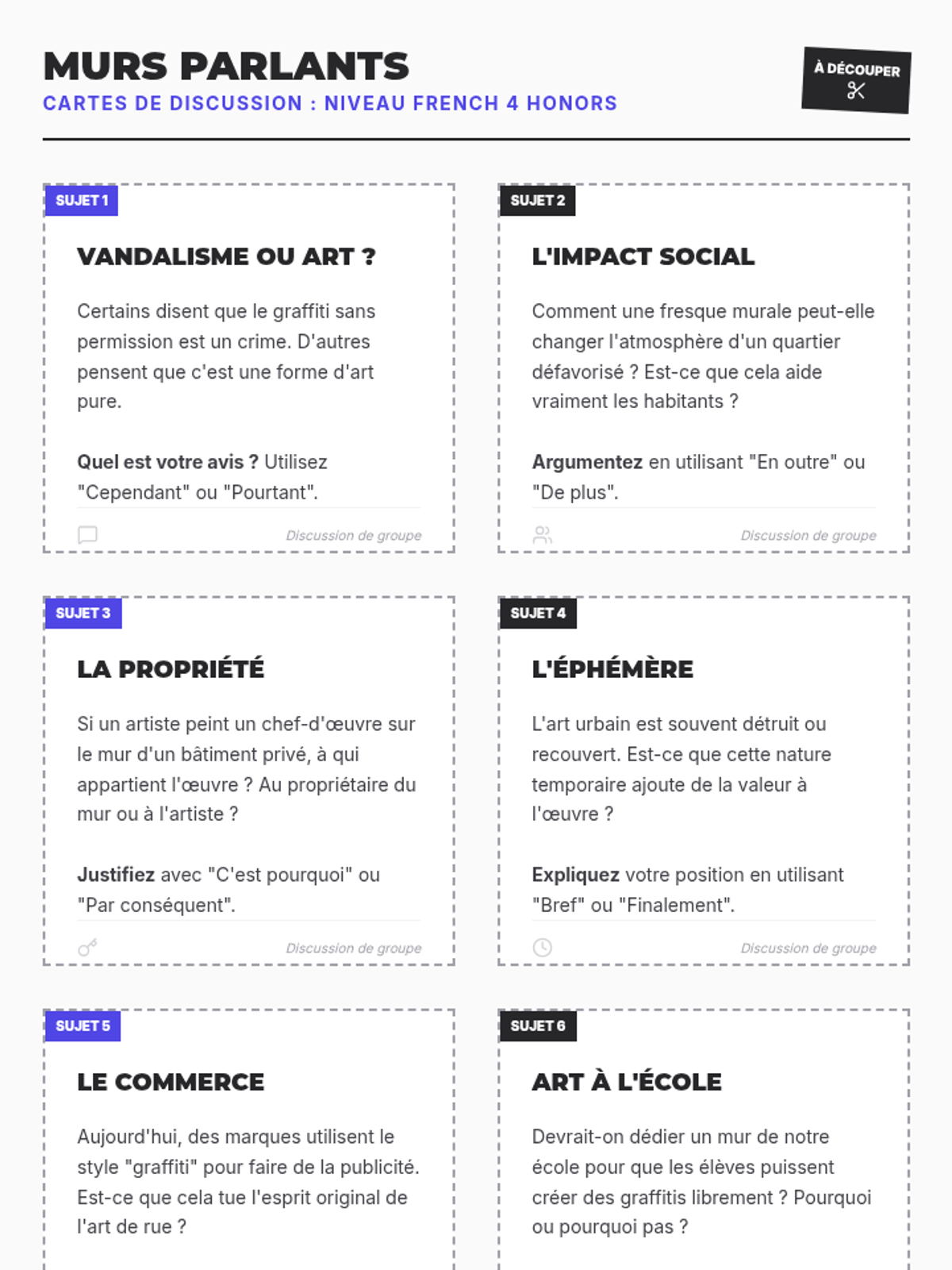
A set of 6 discussion cards for French 4 Honors students to debate topics related to urban art, including ownership, commercialization, and social impact. Each card includes a specific connector prompt.
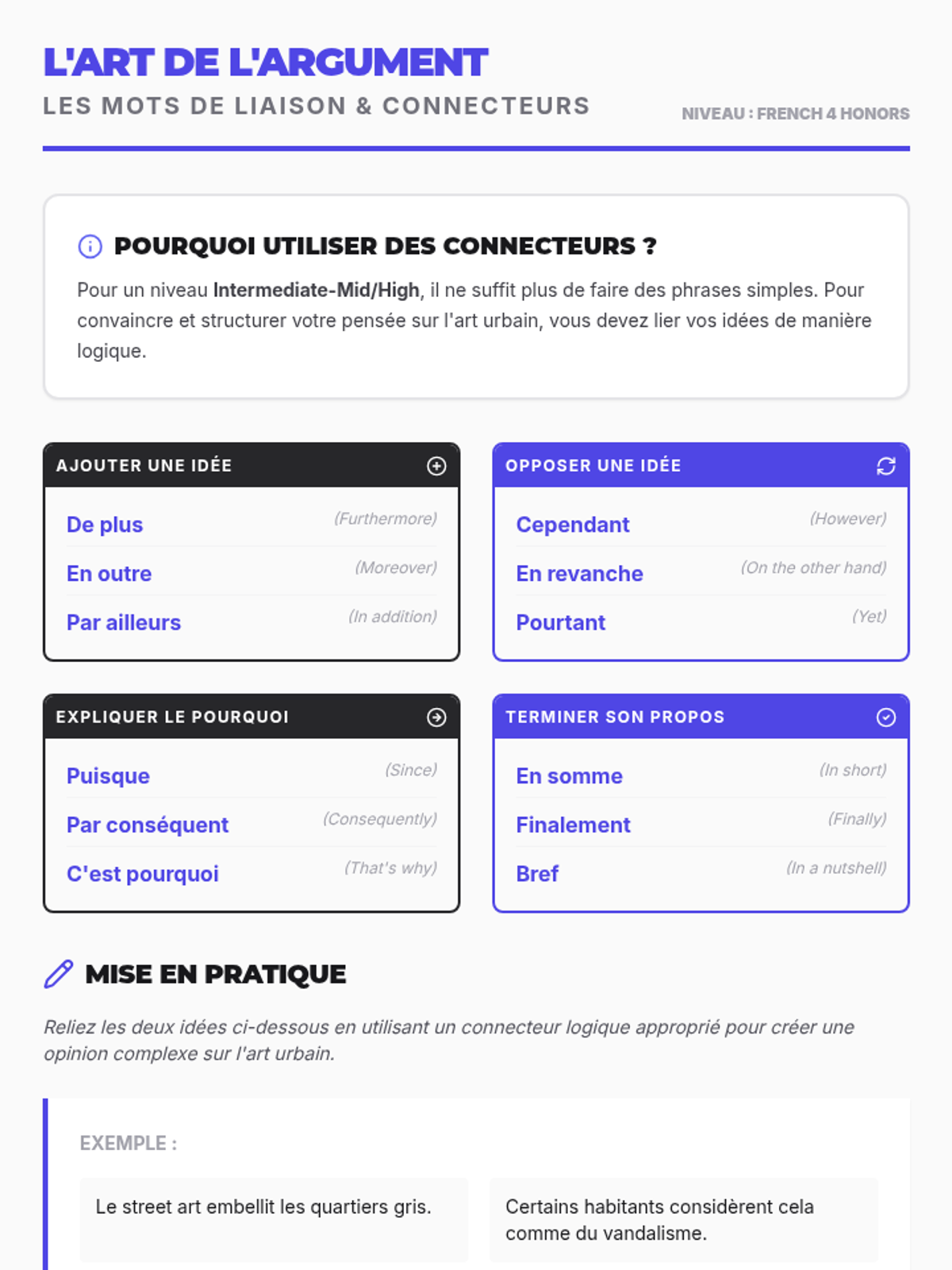
A reference and practice sheet for French 4 Honors students to master logical connectors (transition words) when discussing urban art. Includes categories for addition, opposition, cause/consequence, and conclusion.
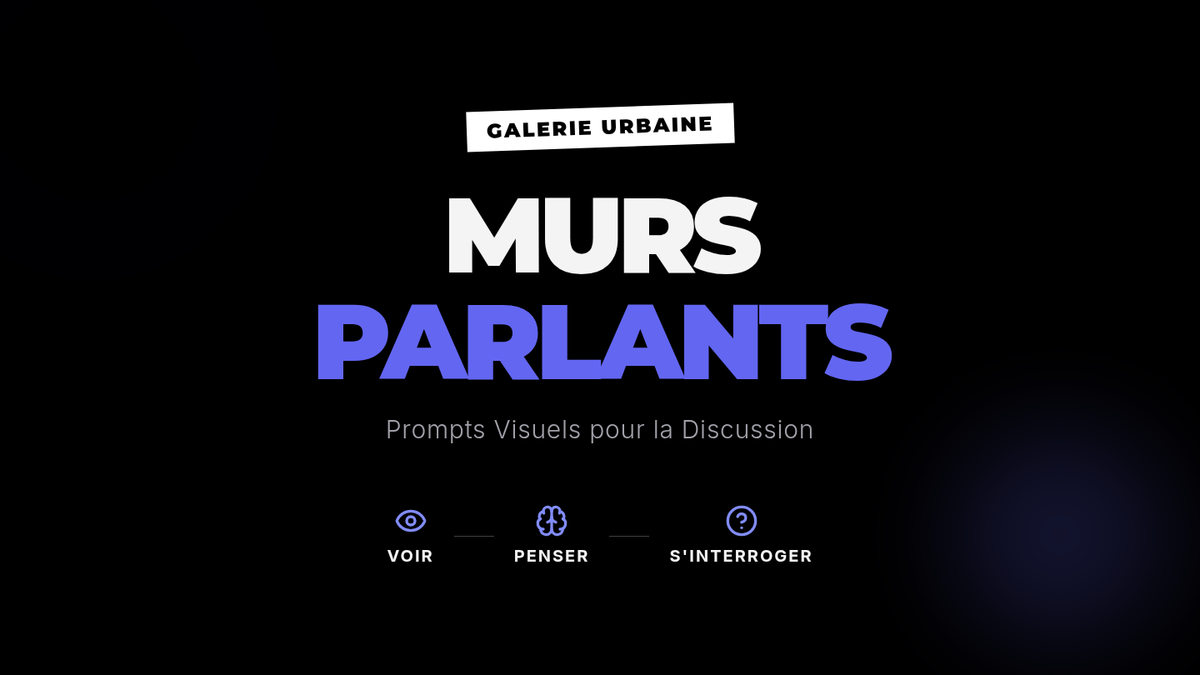
A visual presentation with image prompts and guiding questions in French to lead a 'See-Think-Wonder' warm-up activity about urban art. Features categories for murals, stencils, and installations.
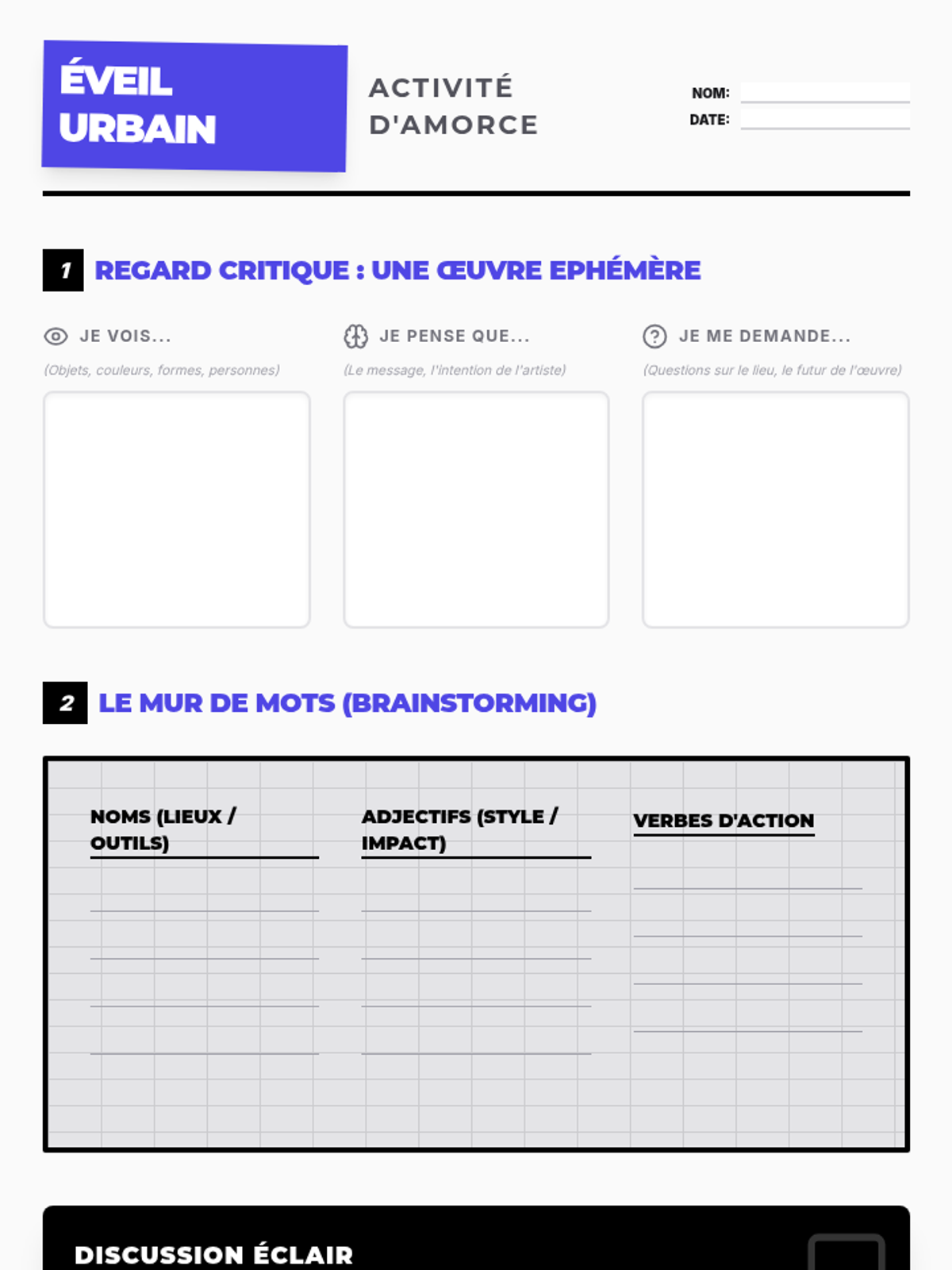
A warm-up activity for French 4 students to brainstorm vocabulary and express initial thoughts on urban art using the 'See-Think-Wonder' strategy and a word-association wall.
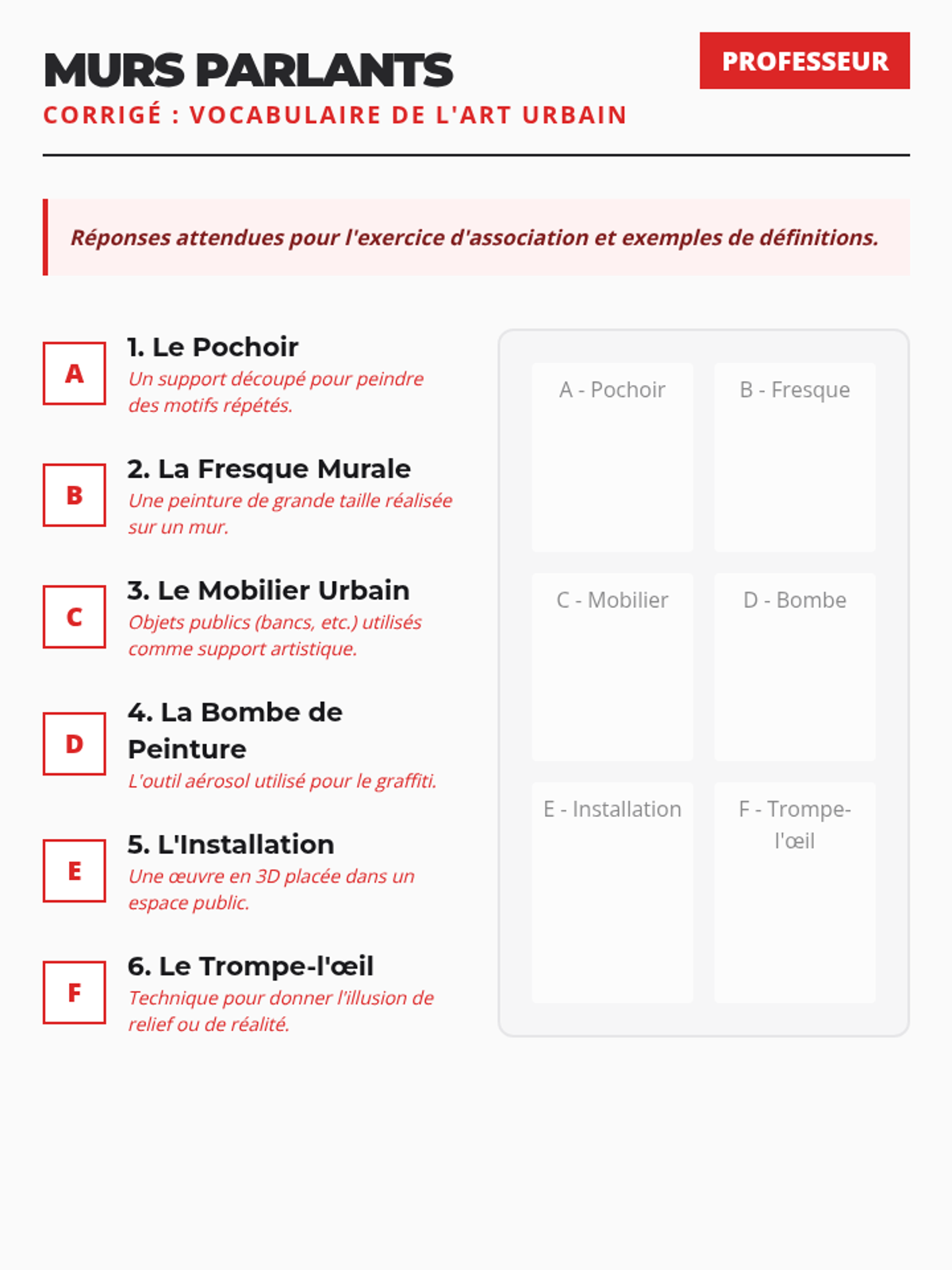
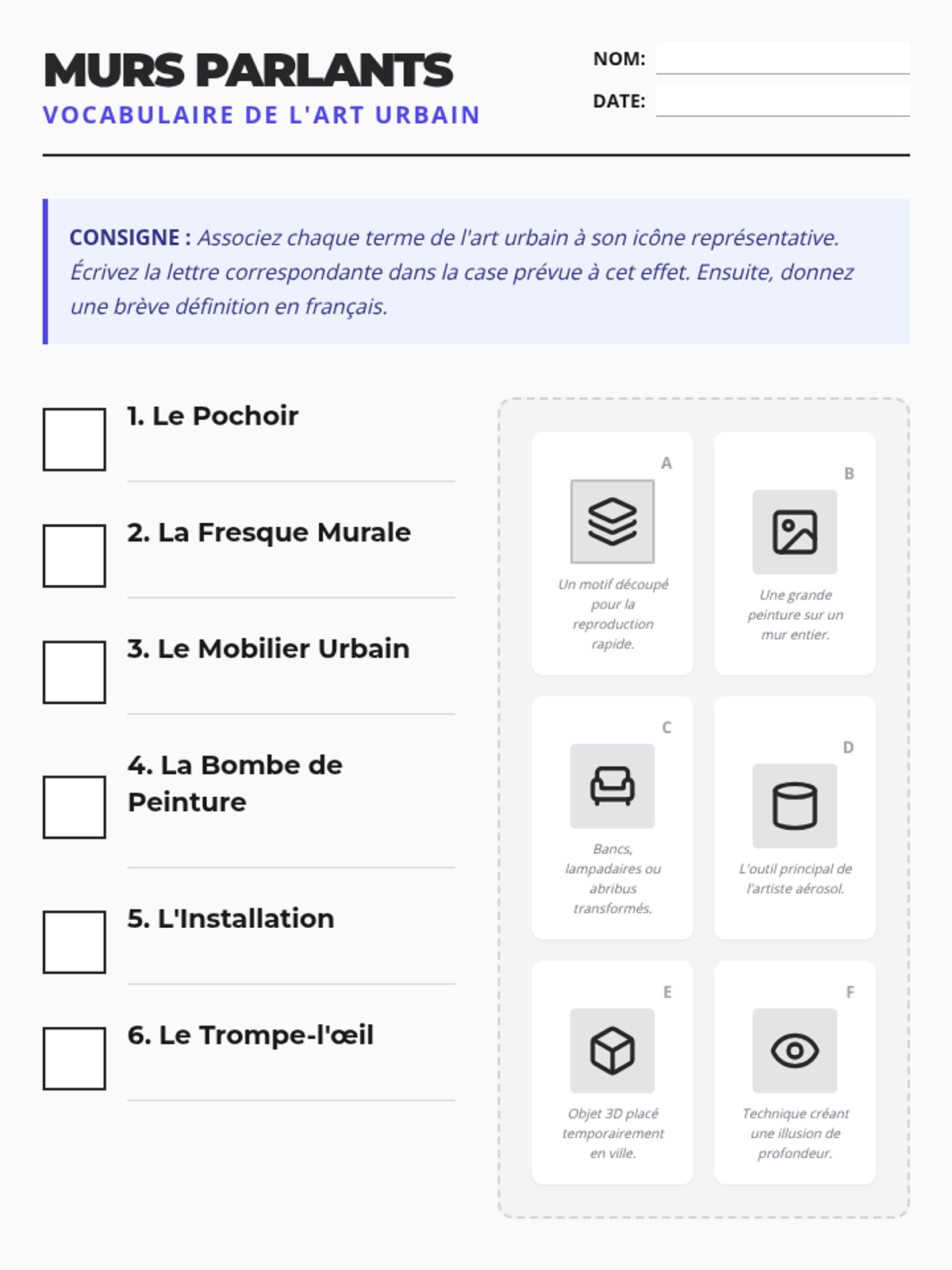
A teacher answer key for the 'Murs Parlants' matching worksheet, providing the correct associations and sample definitions in French.
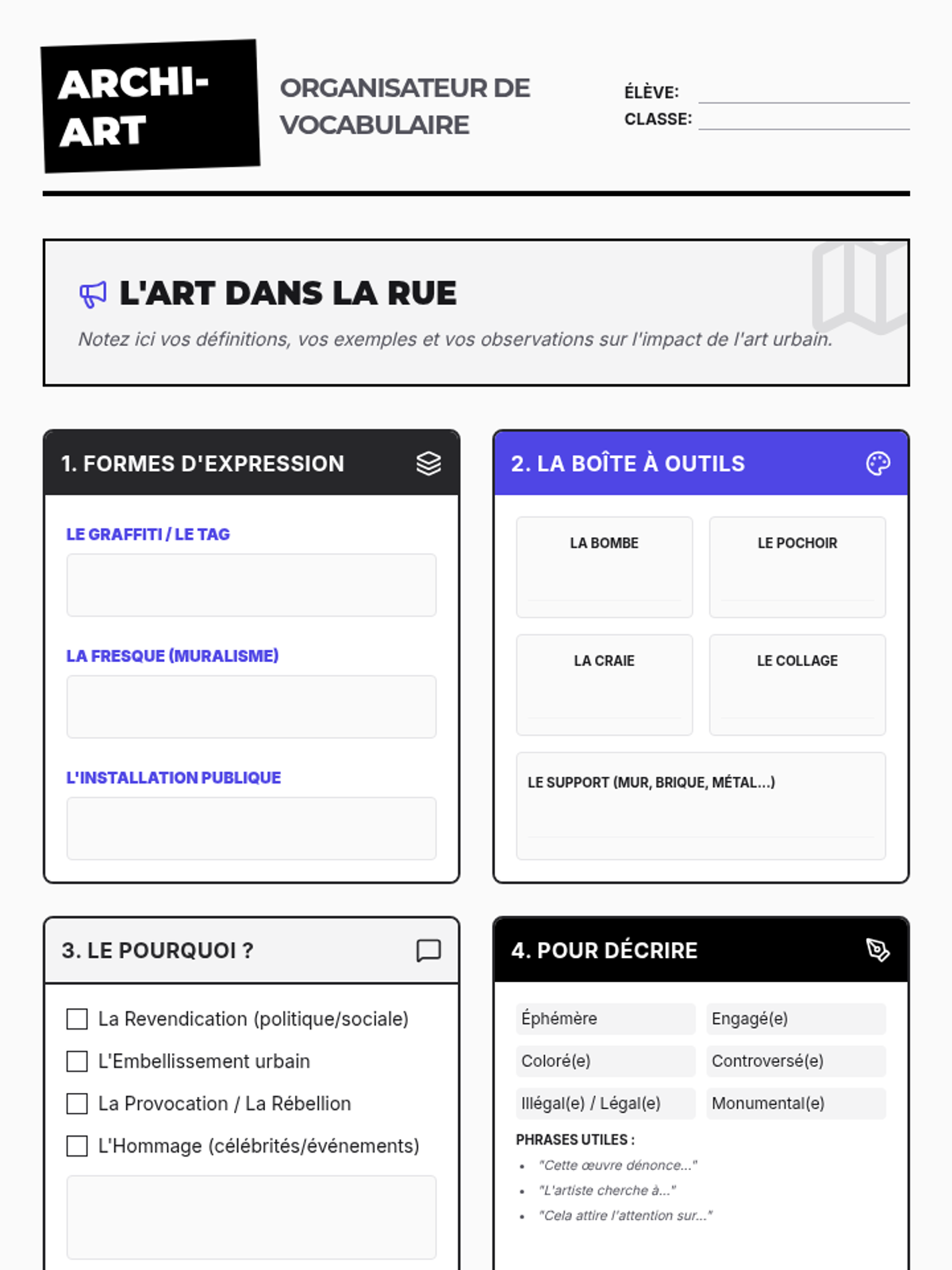
A vocabulary graphic organizer for French 4 students to categorize urban art terms, techniques, and social impacts. Includes sections for types of art, tools, intentions, and descriptive adjectives. Revised to remove placeholder text from student work areas.
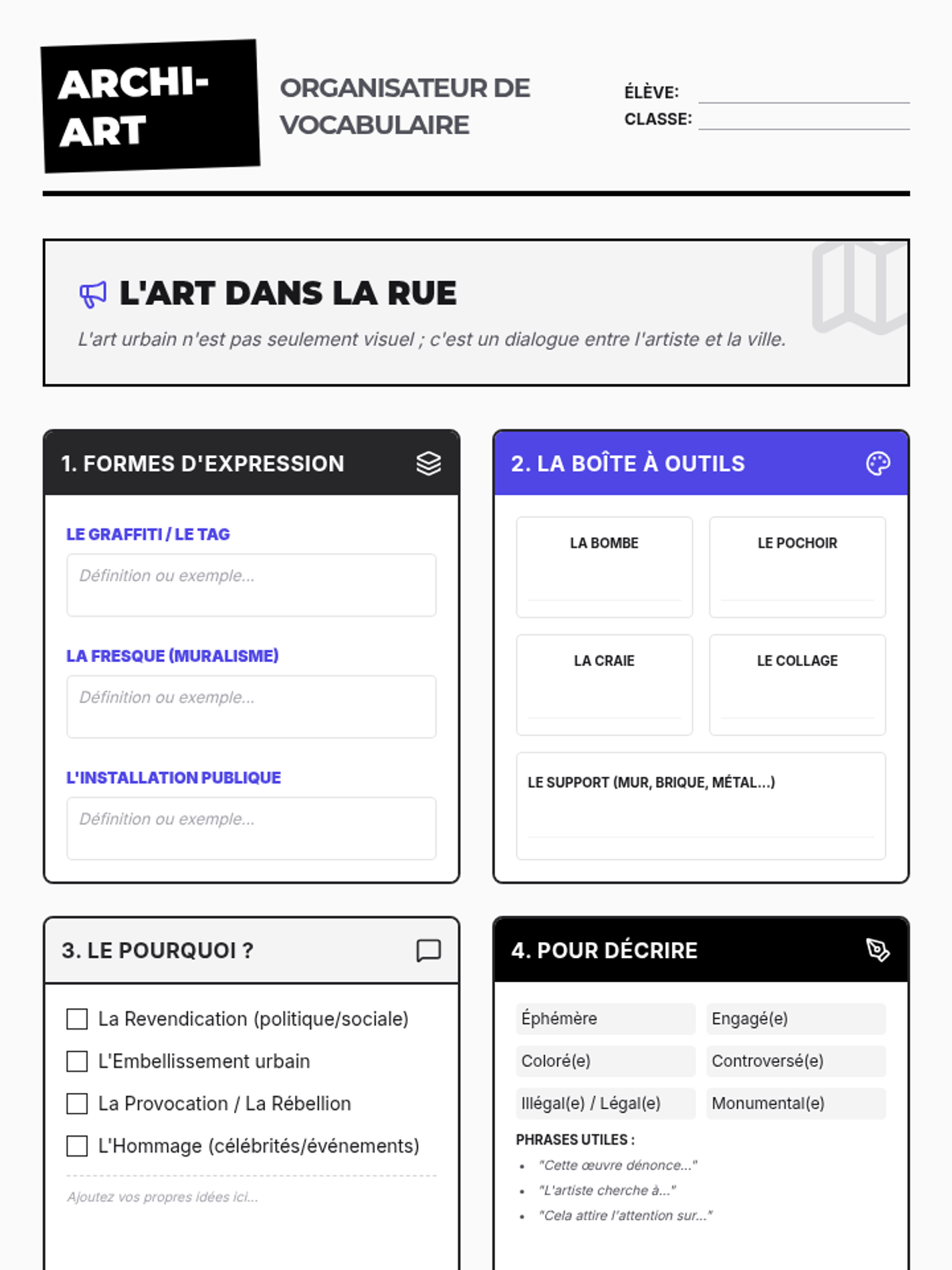
A vocabulary graphic organizer for French 4 students to categorize urban art terms, techniques, and social impacts. Includes sections for types of art, tools, intentions, and descriptive adjectives.
An image-to-word matching worksheet for French 4 students to practice urban art vocabulary, featuring specific terms like 'pochoir', 'fresque murale', and 'trompe-l'œil'.
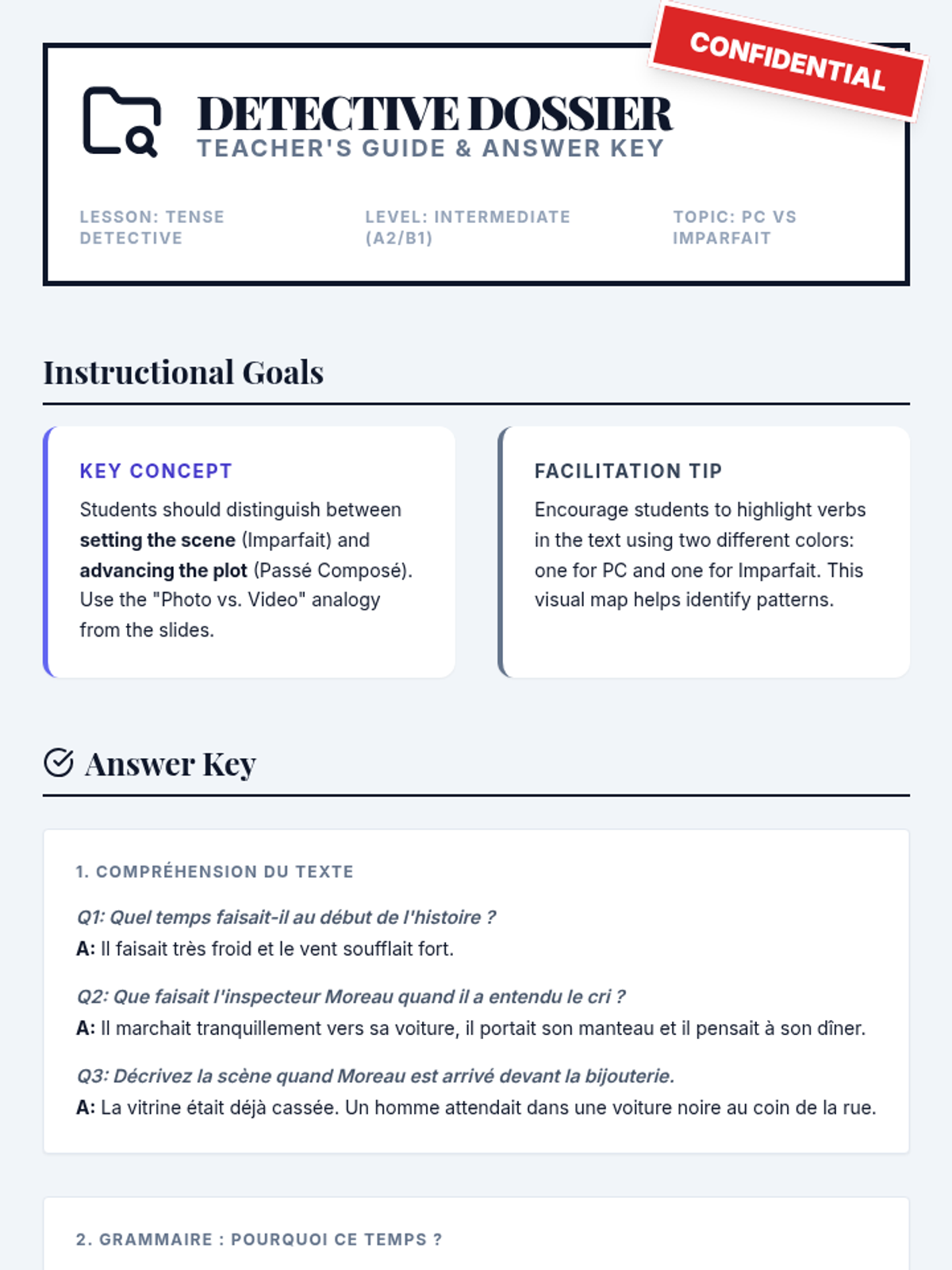
A teacher facilitation guide for the Tense Detective lesson. It includes learning objectives, a complete answer key for the worksheet, differentiation strategies for diverse learners, and a grammatical breakdown of the narrative text.
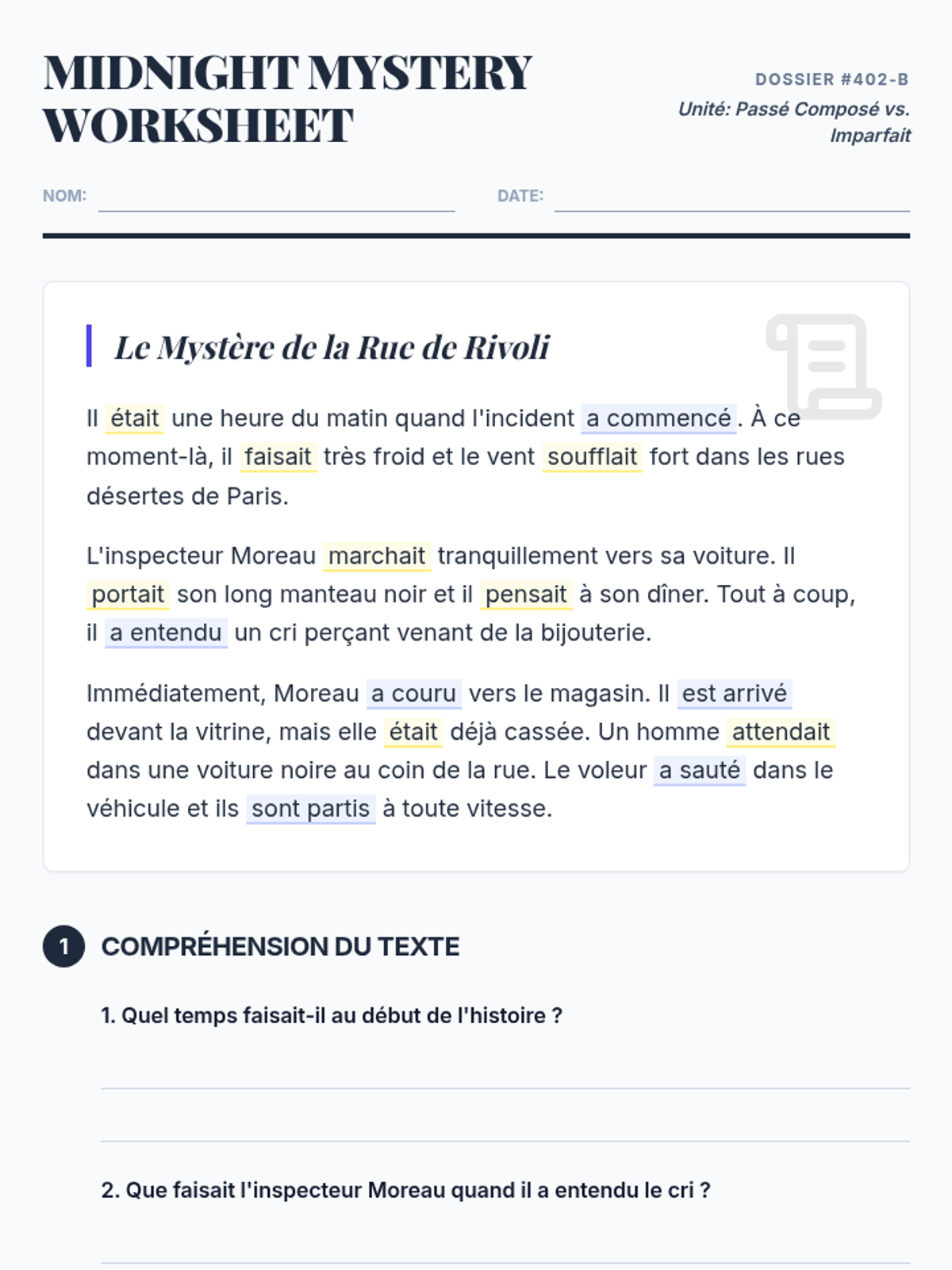
A student worksheet featuring a French reading passage about a jewelry heist. It includes comprehension questions, a grammar analysis section, and a creative writing prompt focusing on Passé Composé vs Imparfait.
A visual slide deck that explains the differences between Passé Composé and Imparfait using a detective/mystery theme. It features key concepts, examples of background setting vs. specific actions, and trigger words.
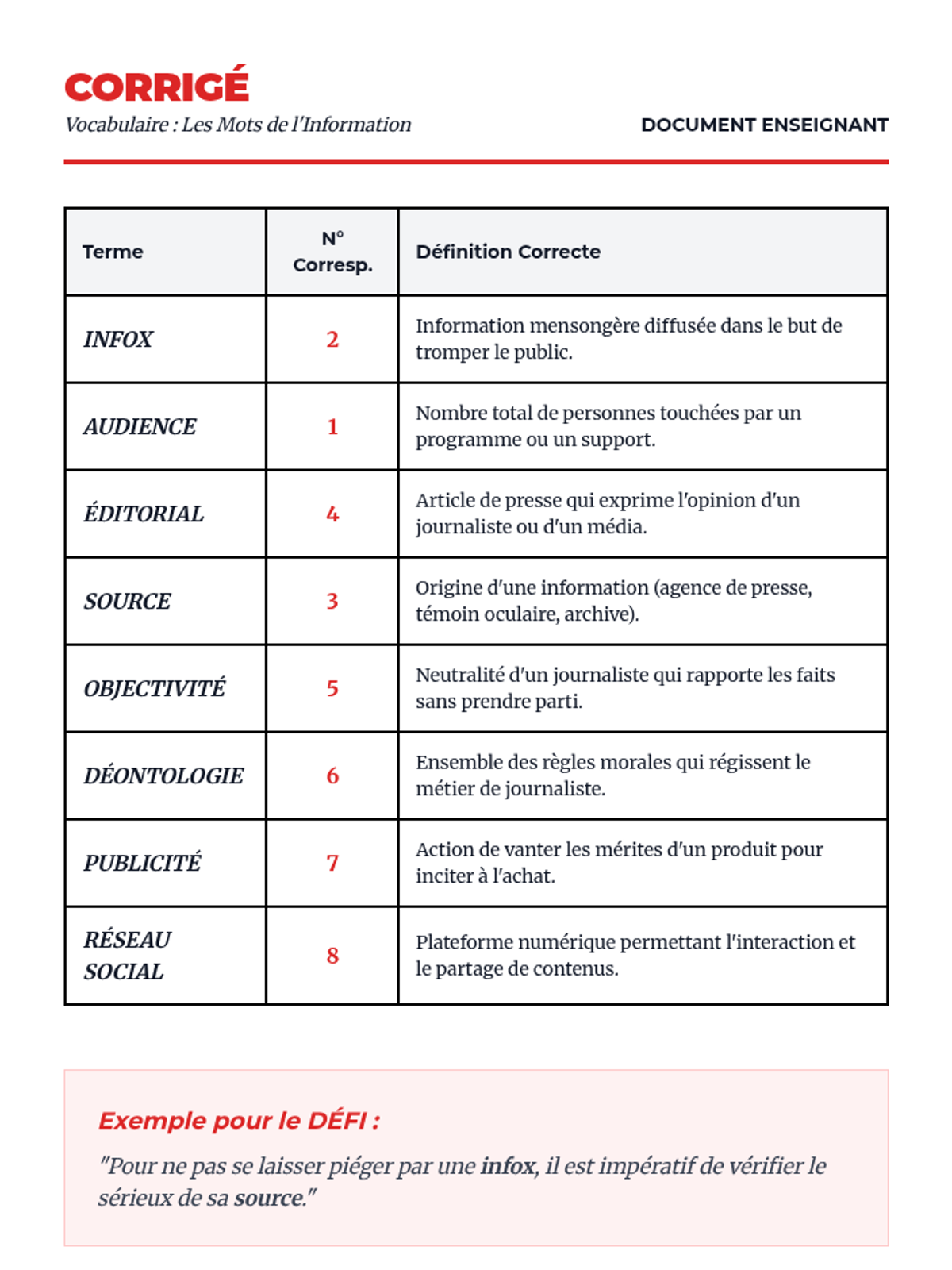
Le corrigé de l'exercice d'appariement du vocabulaire médiatique.
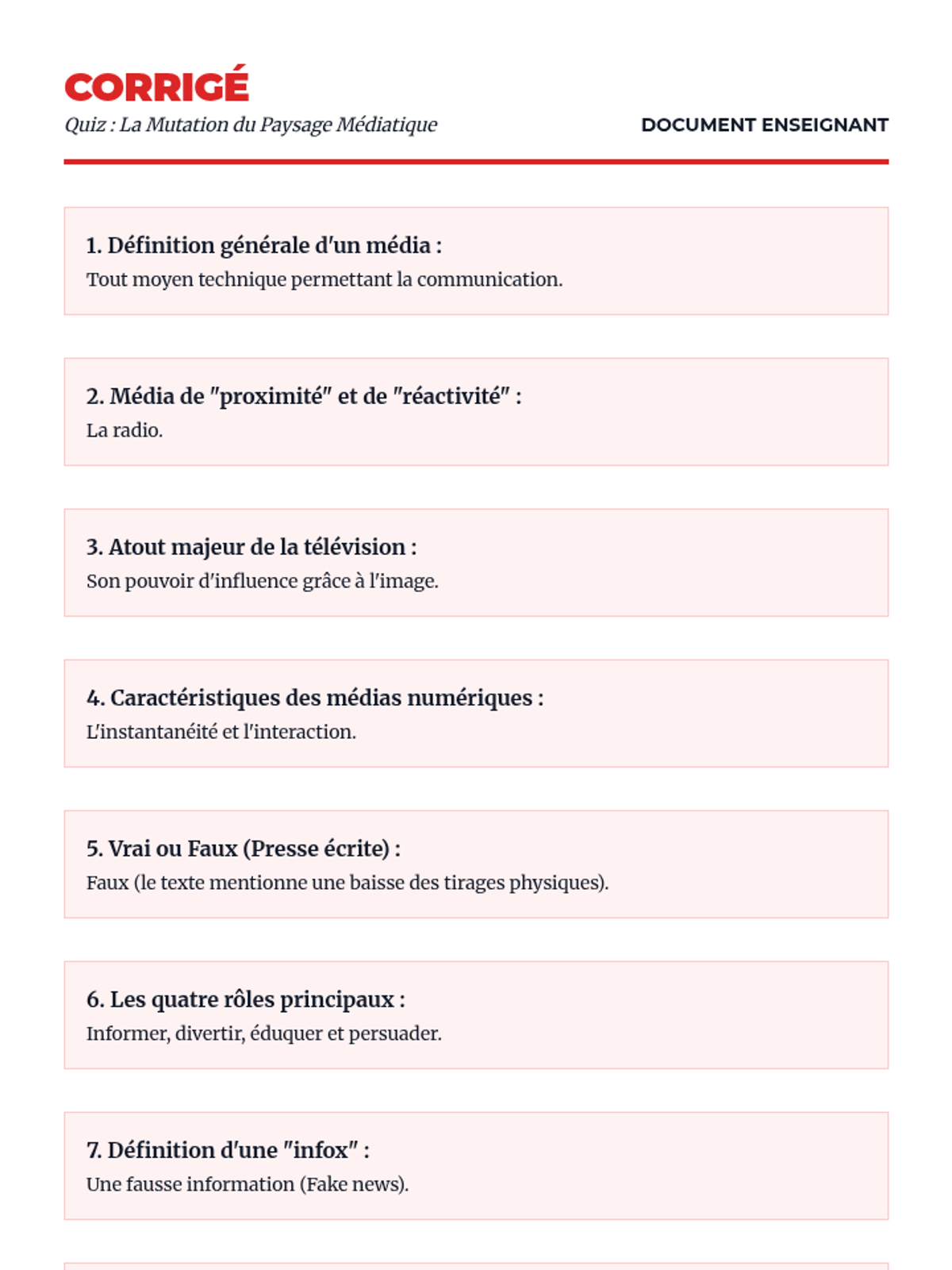
Le corrigé détaillé du quiz de compréhension de lecture sur les médias.
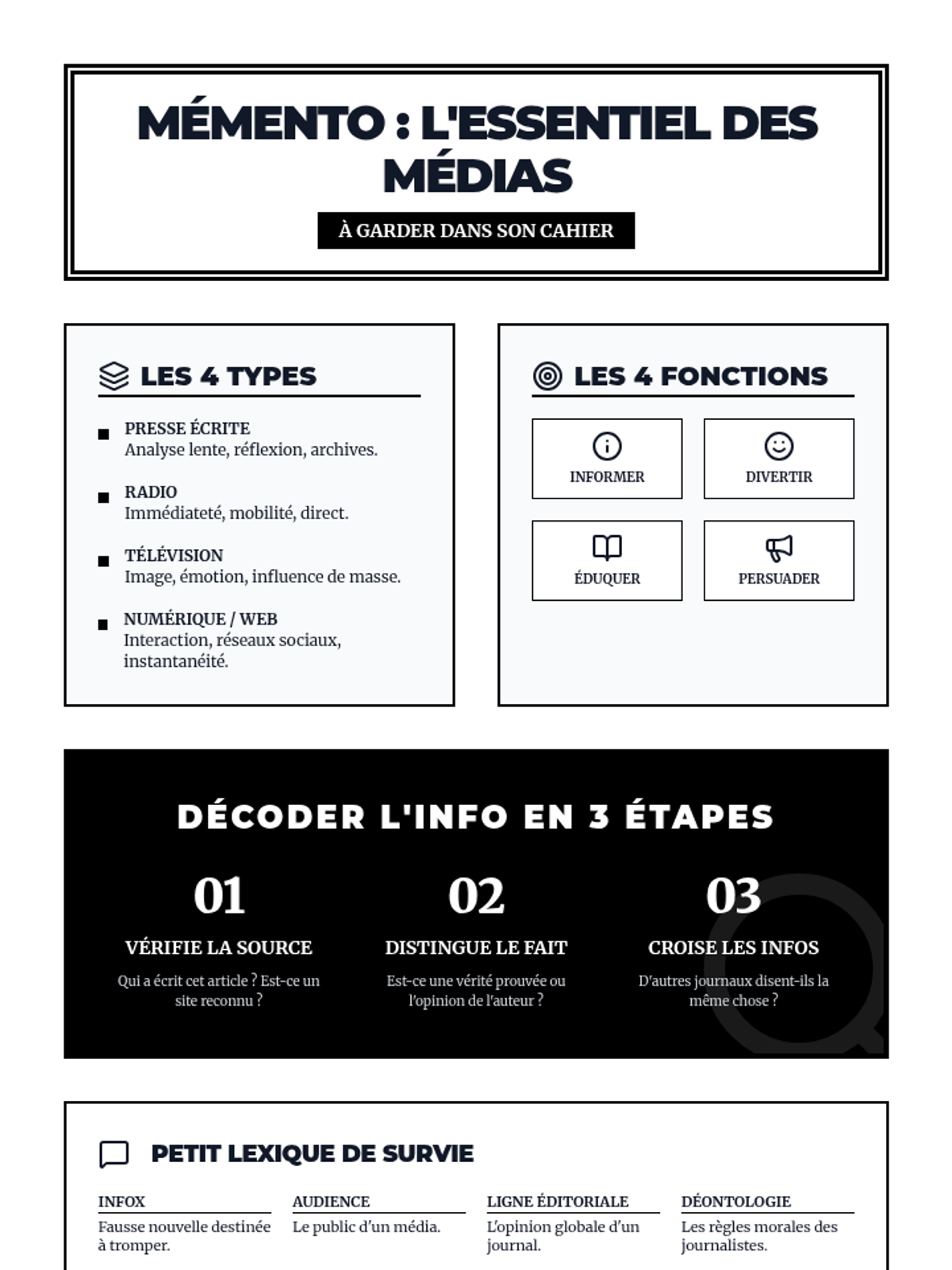
Un aide-mémoire visuel (cheat sheet) regroupant les concepts clés, la méthode de vérification de l'information et le lexique essentiel pour une mémorisation rapide.
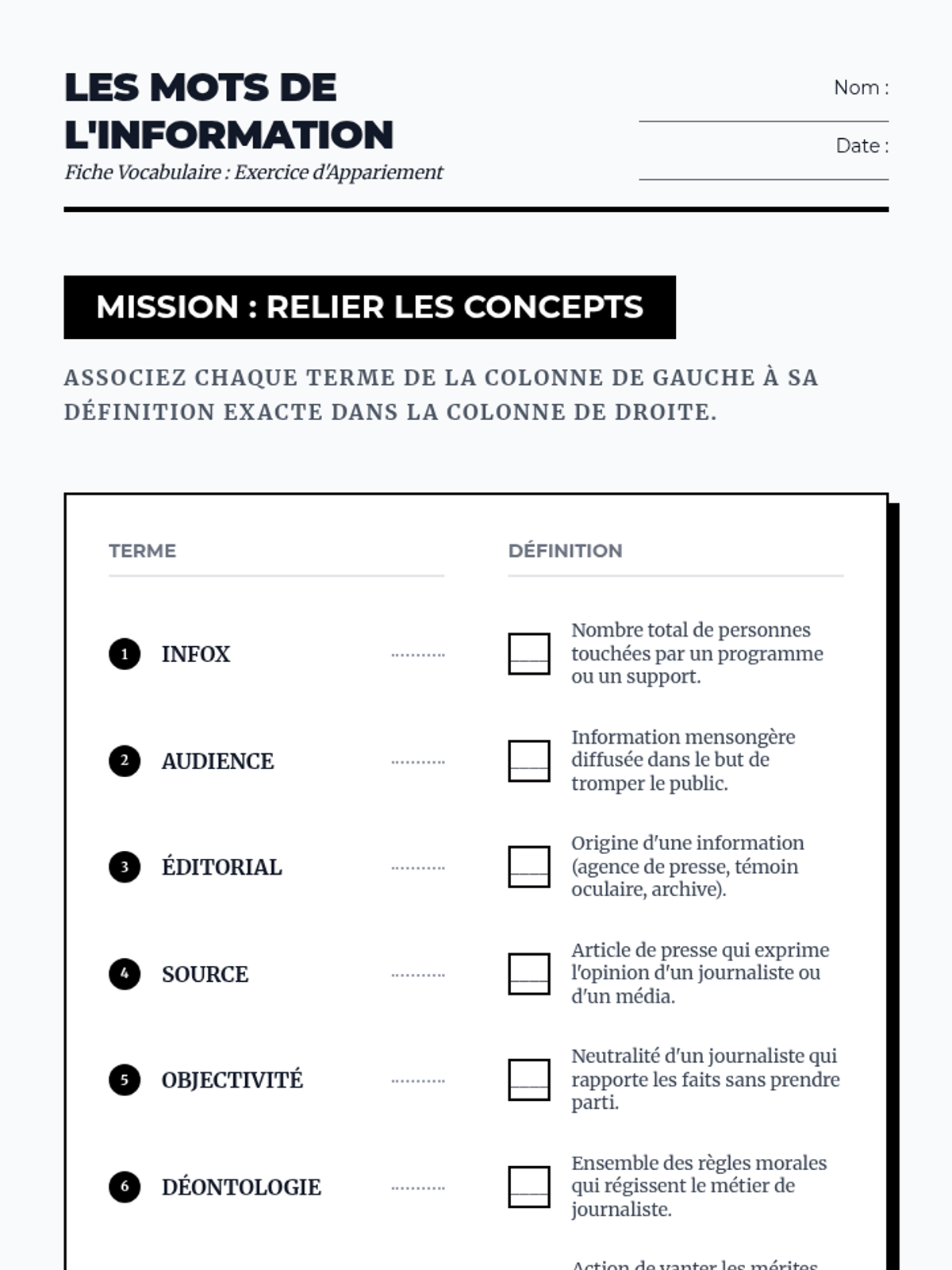
Une fiche d'exercices de vocabulaire où les élèves doivent relier des termes journalistiques clés à leurs définitions précises en français.
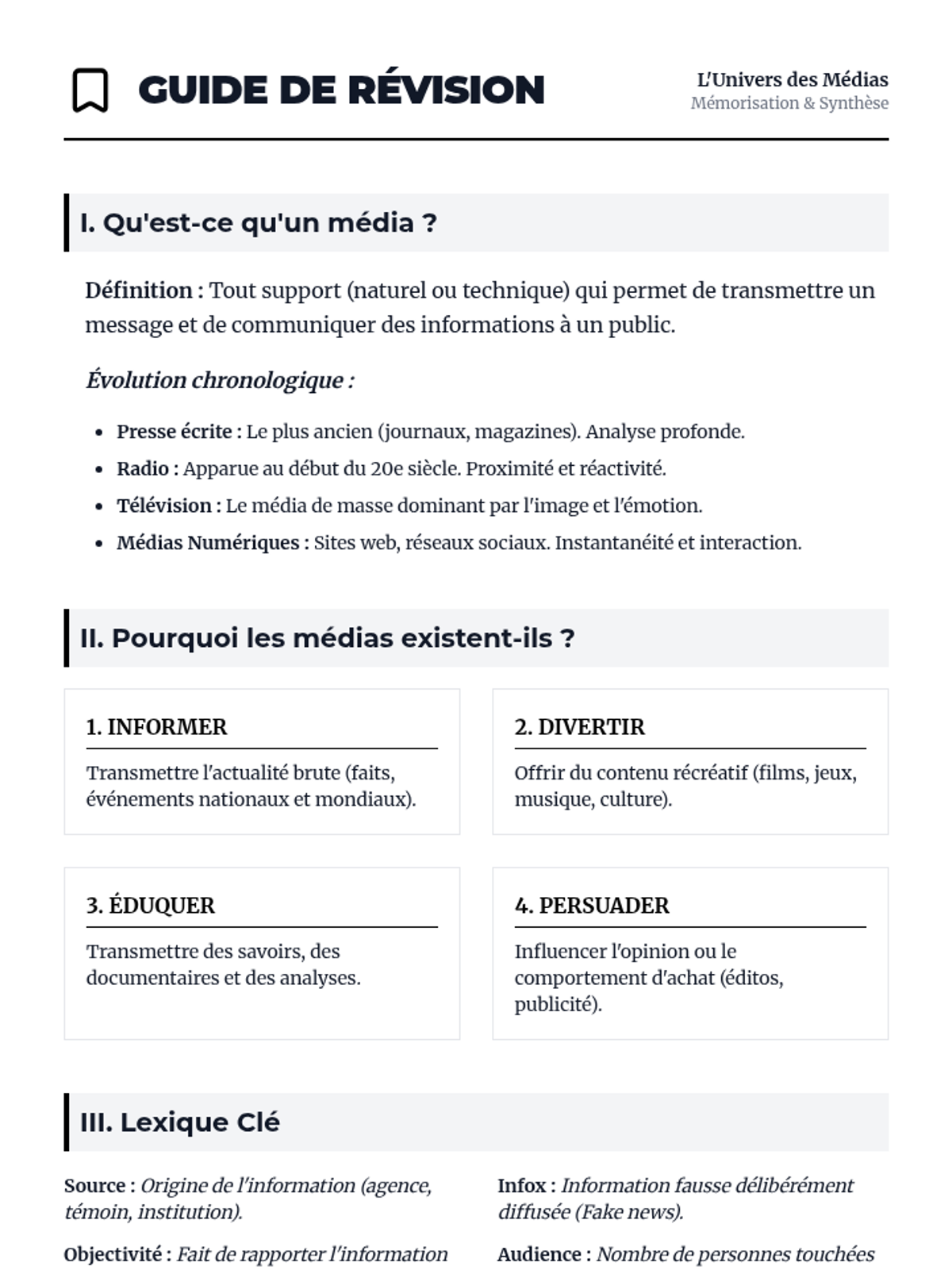
Un guide de révision synthétique regroupant les définitions, l'évolution historique, les rôles des médias et le lexique essentiel.
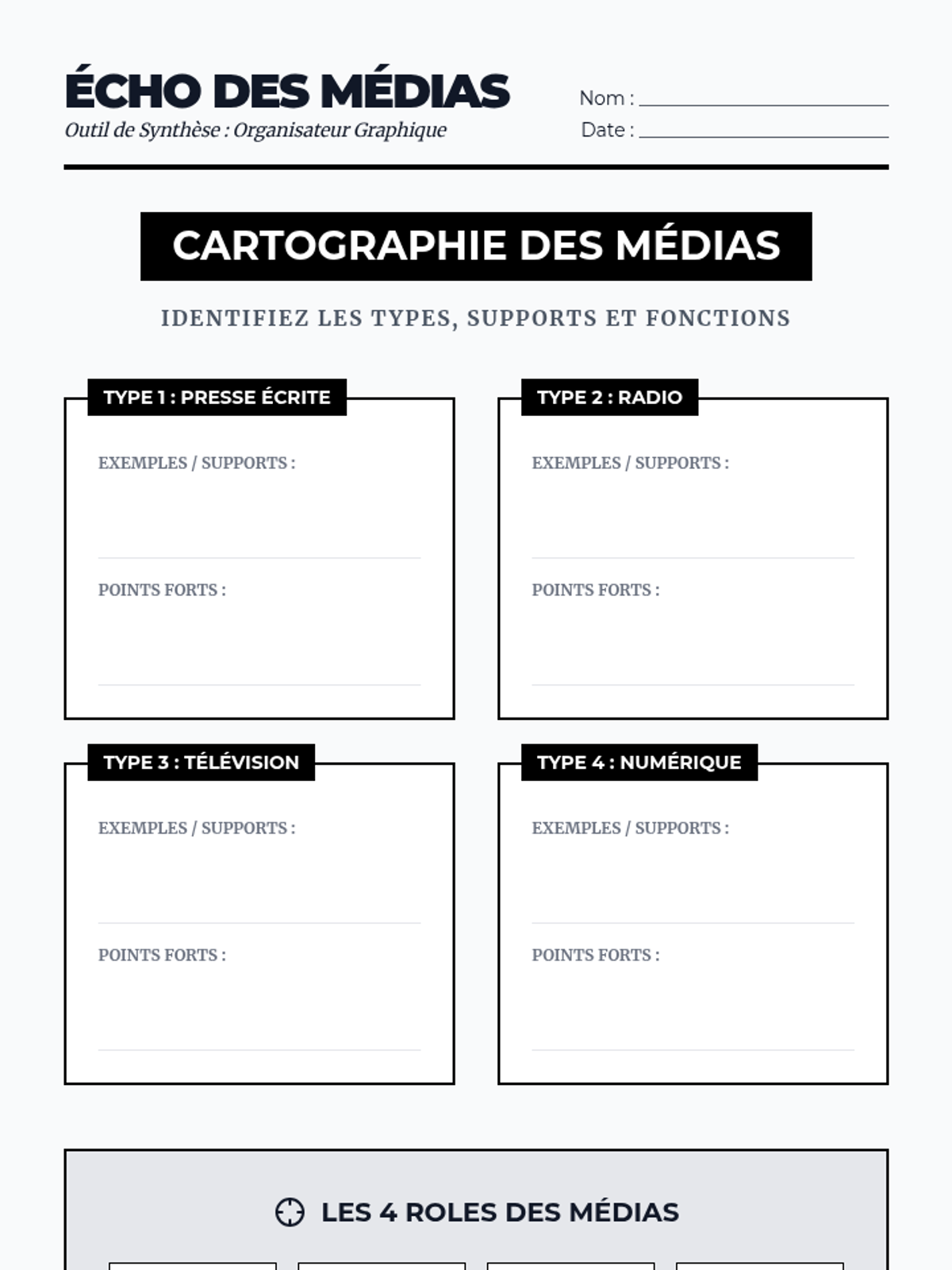
Un organisateur graphique permettant aux élèves de classer les quatre types de médias et de définir leurs fonctions principales.
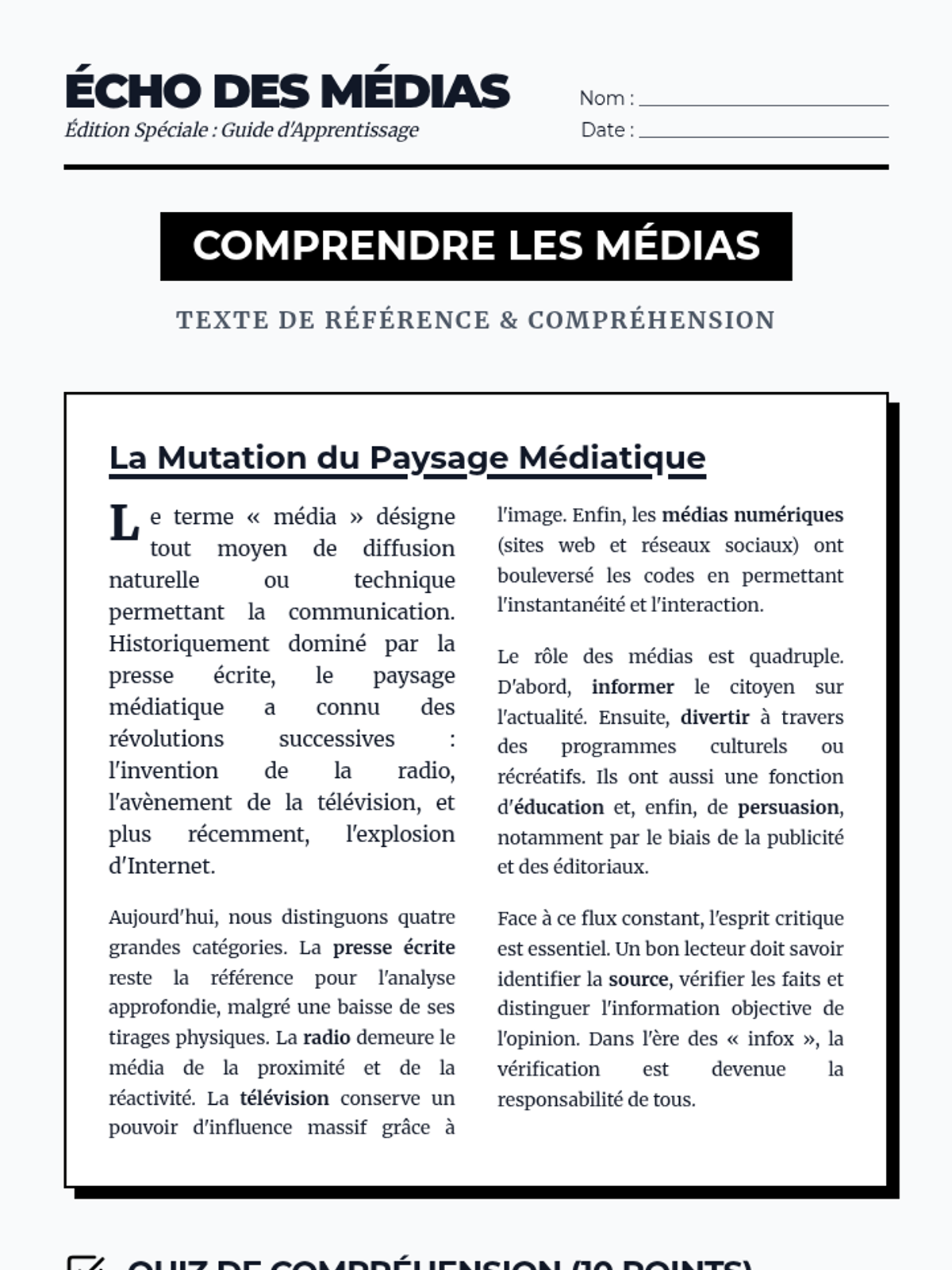
Un quiz de compréhension de lecture en 10 questions basé sur un texte original sur l'évolution des médias et leurs rôles dans la société.
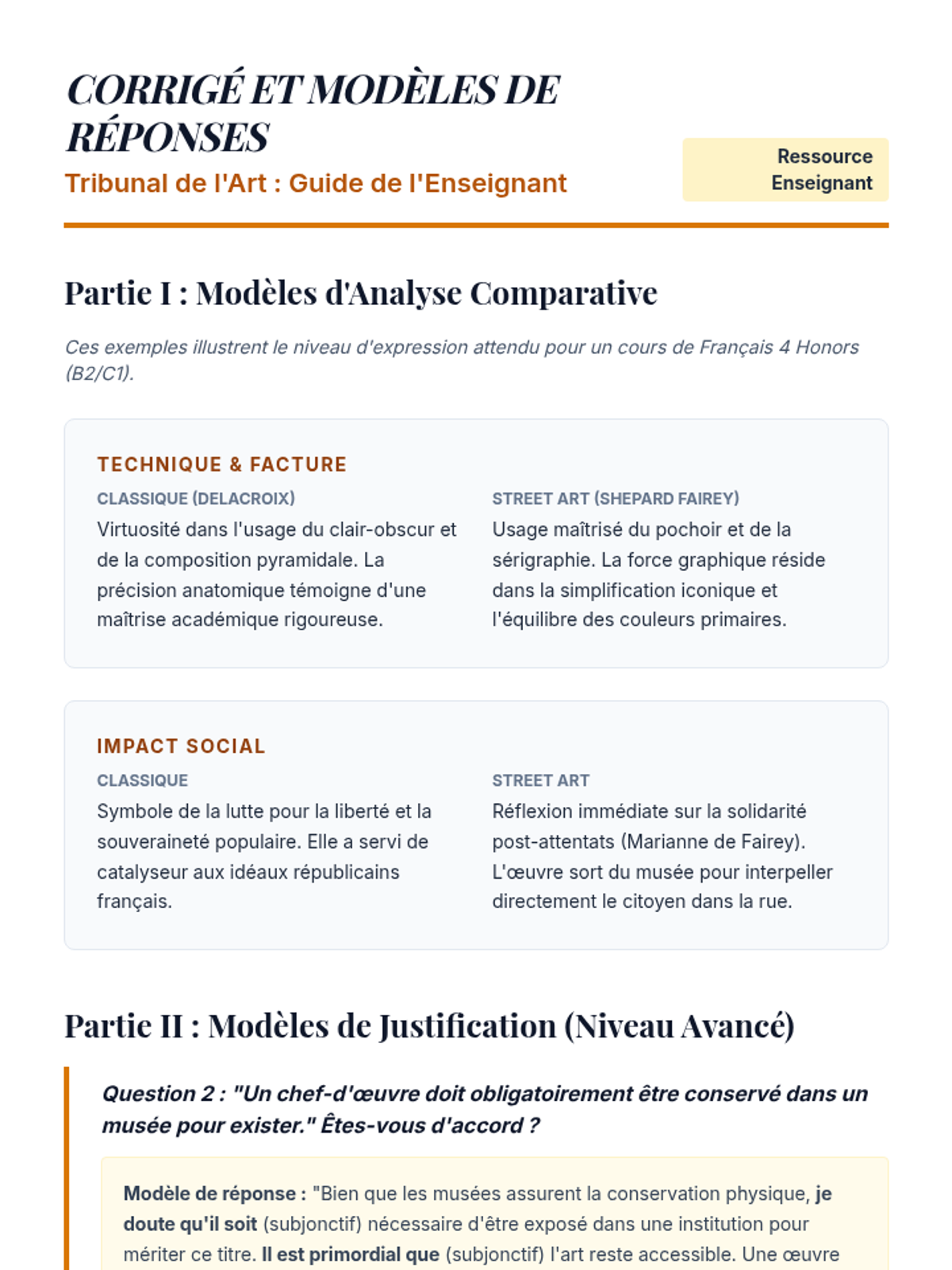
A teacher answer key and model response guide for the Art en Débat lesson, providing advanced-level French sentence structures and evaluation criteria.
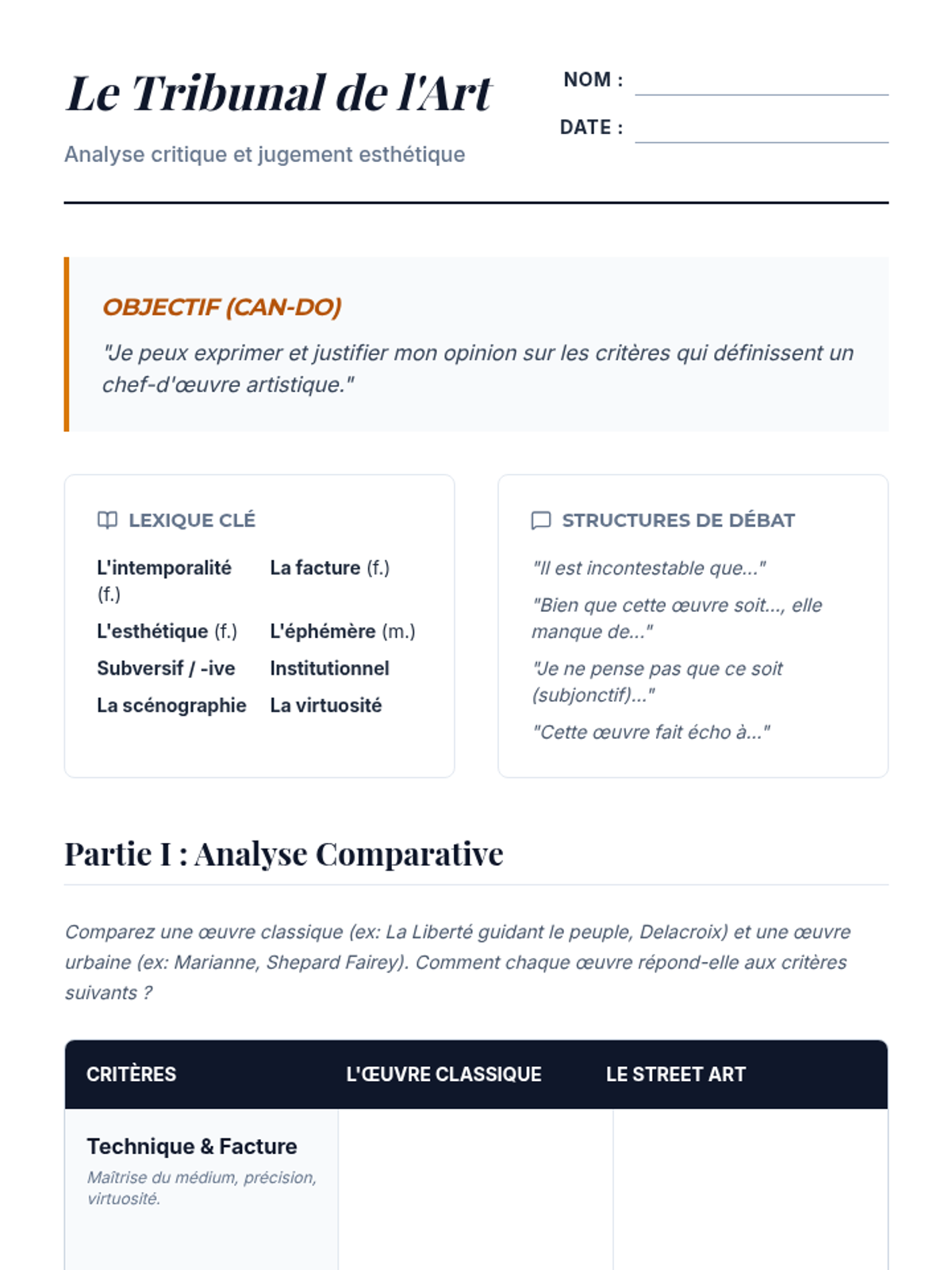
A critical analysis worksheet for students to compare classical and contemporary art forms, requiring justification of opinions and use of advanced French grammar.
A visually engaging presentation comparing classical masterpieces with street art to facilitate classroom discussion on aesthetic criteria.
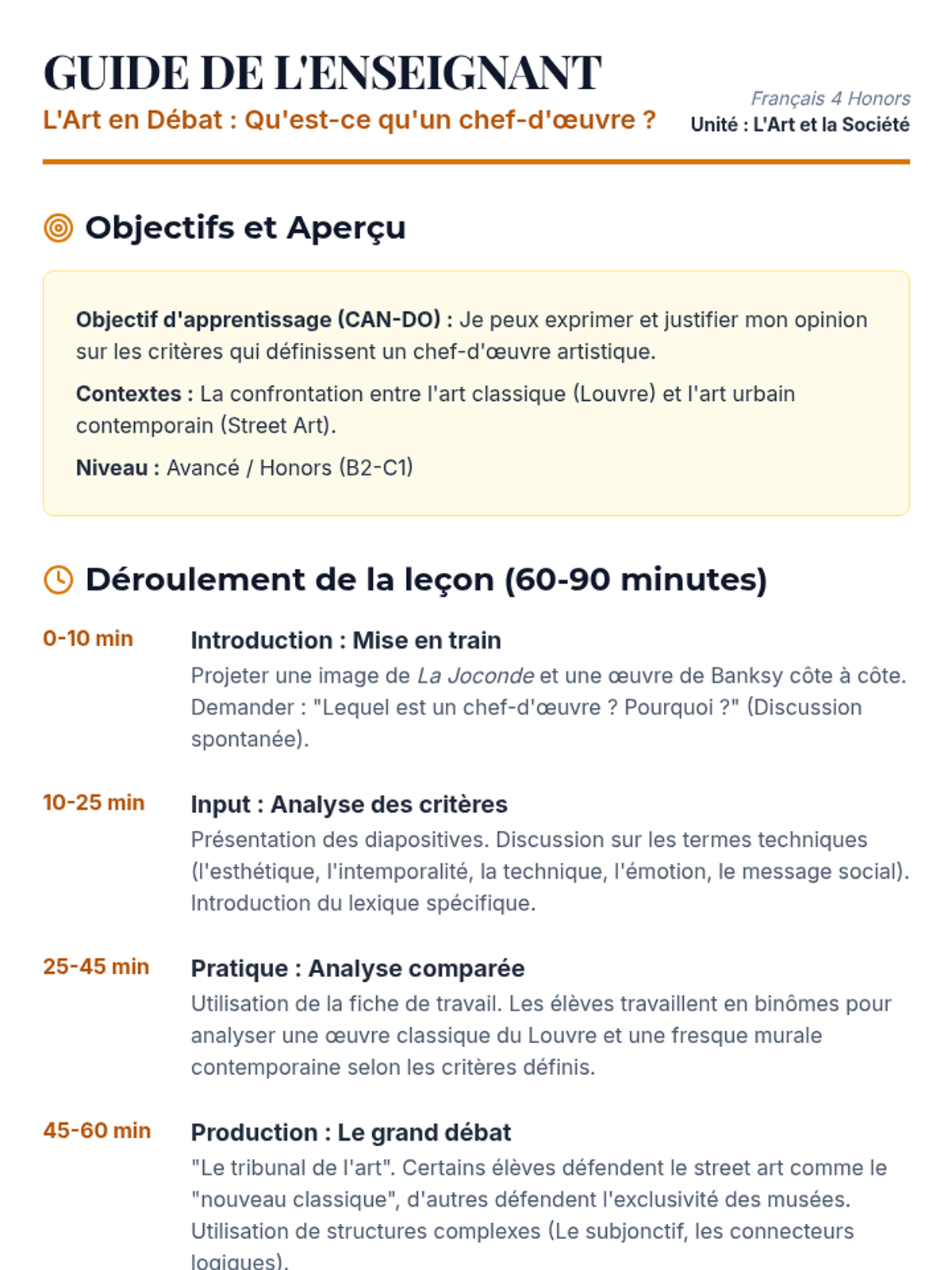
A comprehensive teacher's guide for a French Level 4 Honors lesson on evaluating art masterpieces, featuring pacing, essential questions, and pedagogical tips.
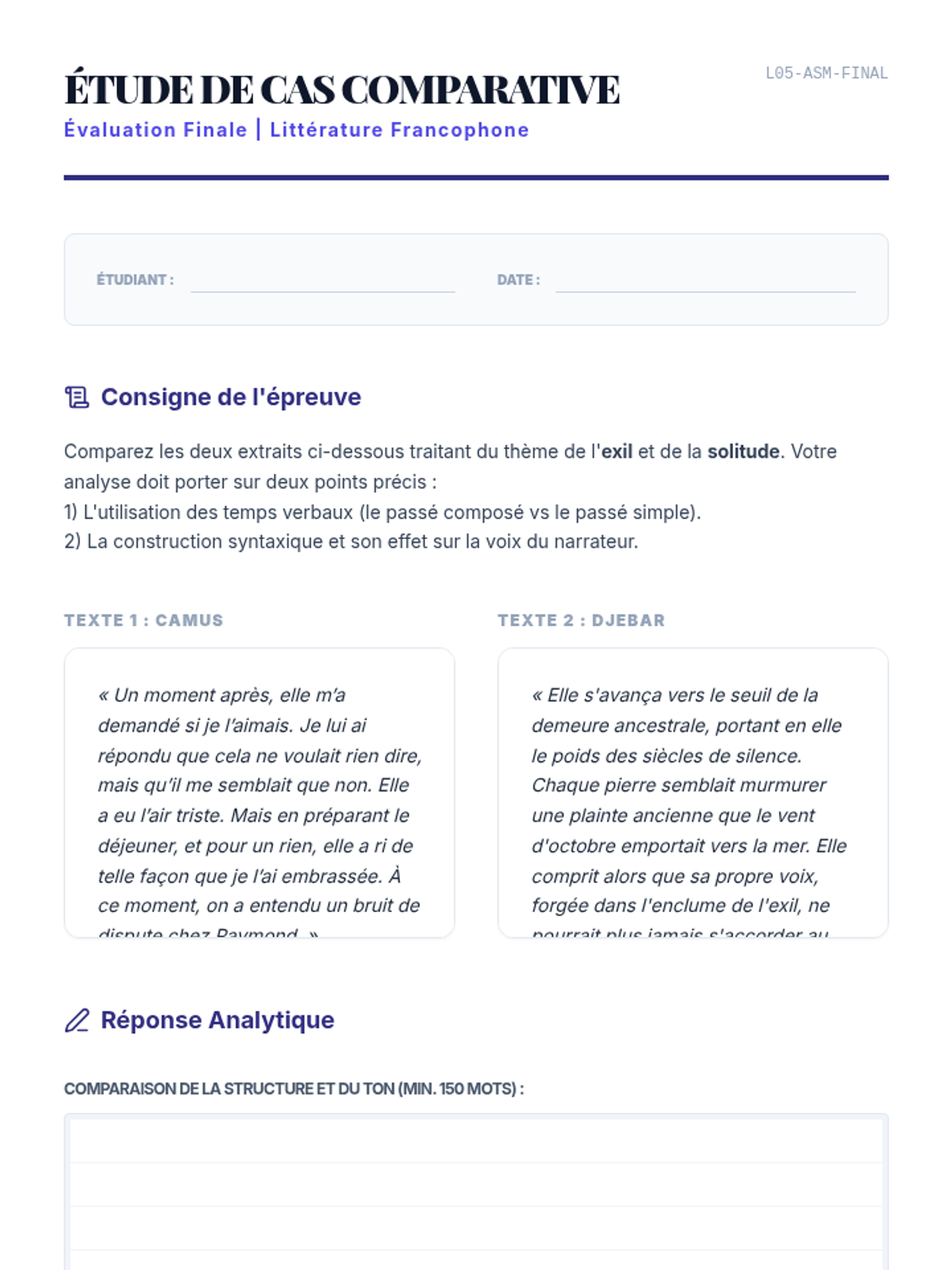
Final comparative analysis assessment for Lesson 5. Features excerpts from Camus and Djebar on exile, with a detailed response area and an evaluation rubric for style and thematic synthesis.
Final slides for Lesson 5 on comparative literary analysis. Covers methodology for comparing style and register, with a specific focus on the theme of exile in Camus and Djebar.
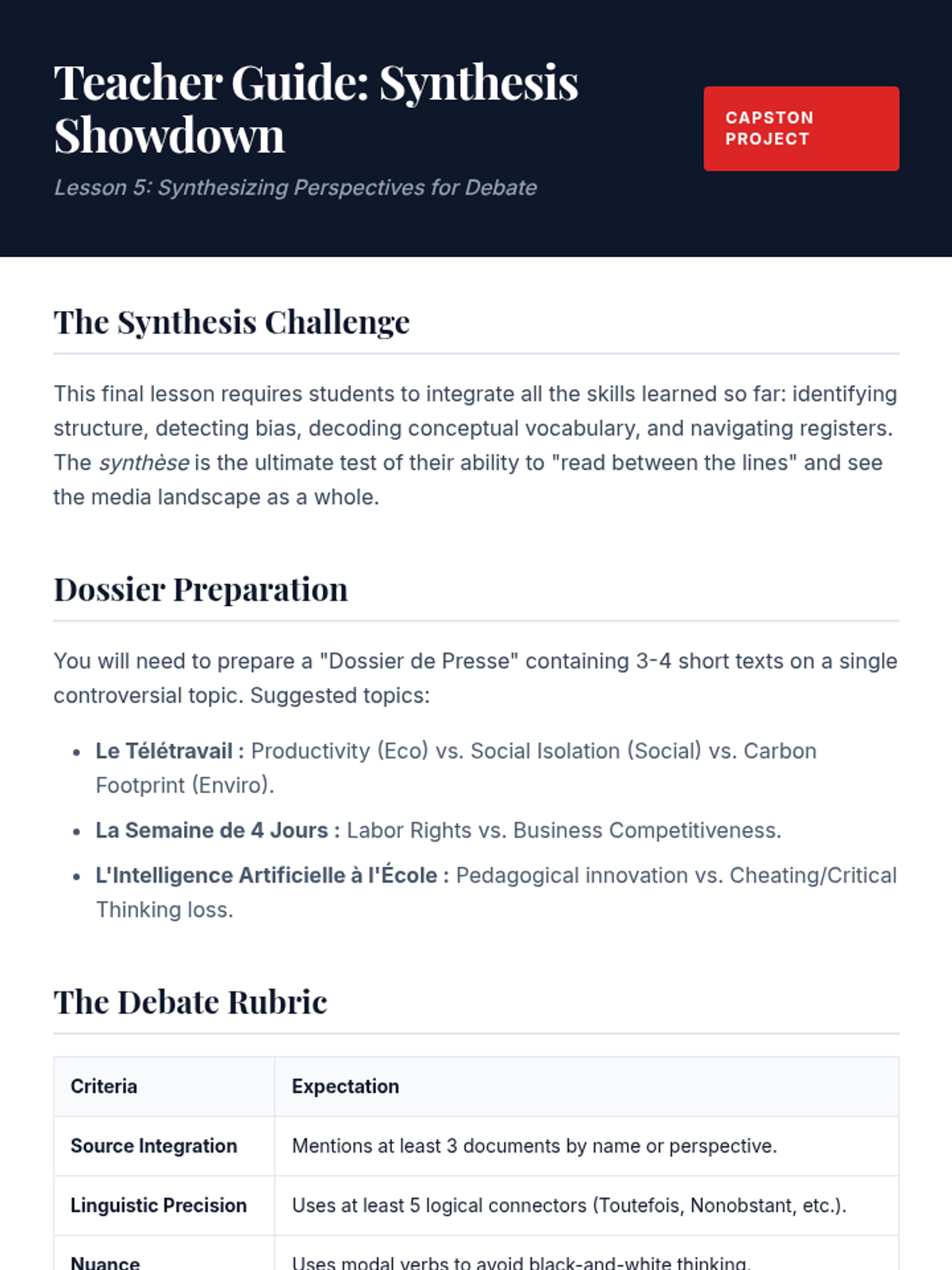
Teacher guide for the final lesson, providing a debate rubric and advice on facilitating the synthesis project for graduate students.
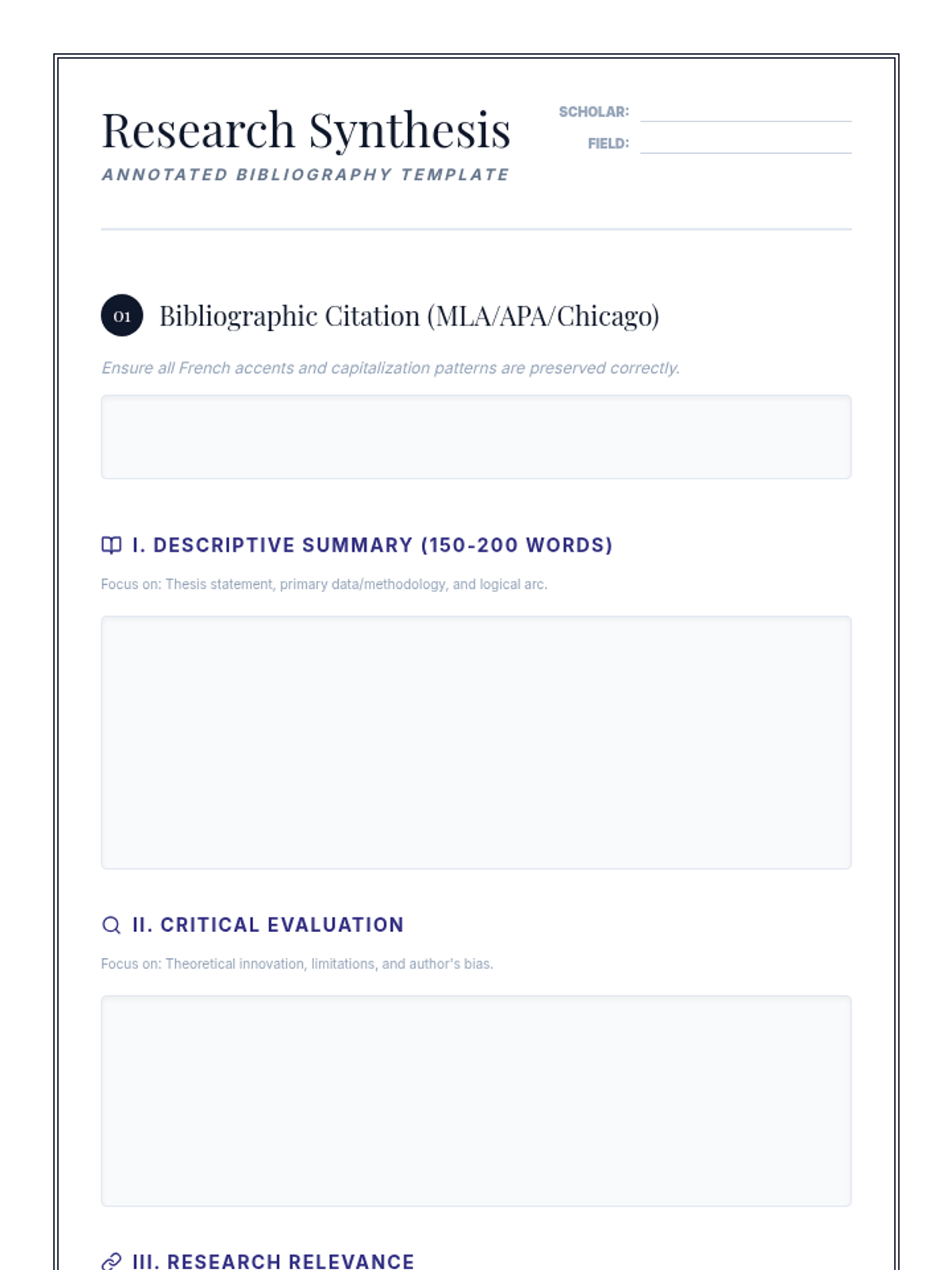
A formal template for graduate students to complete an annotated bibliography entry for a French academic source, integrating all skills learned in the sequence.
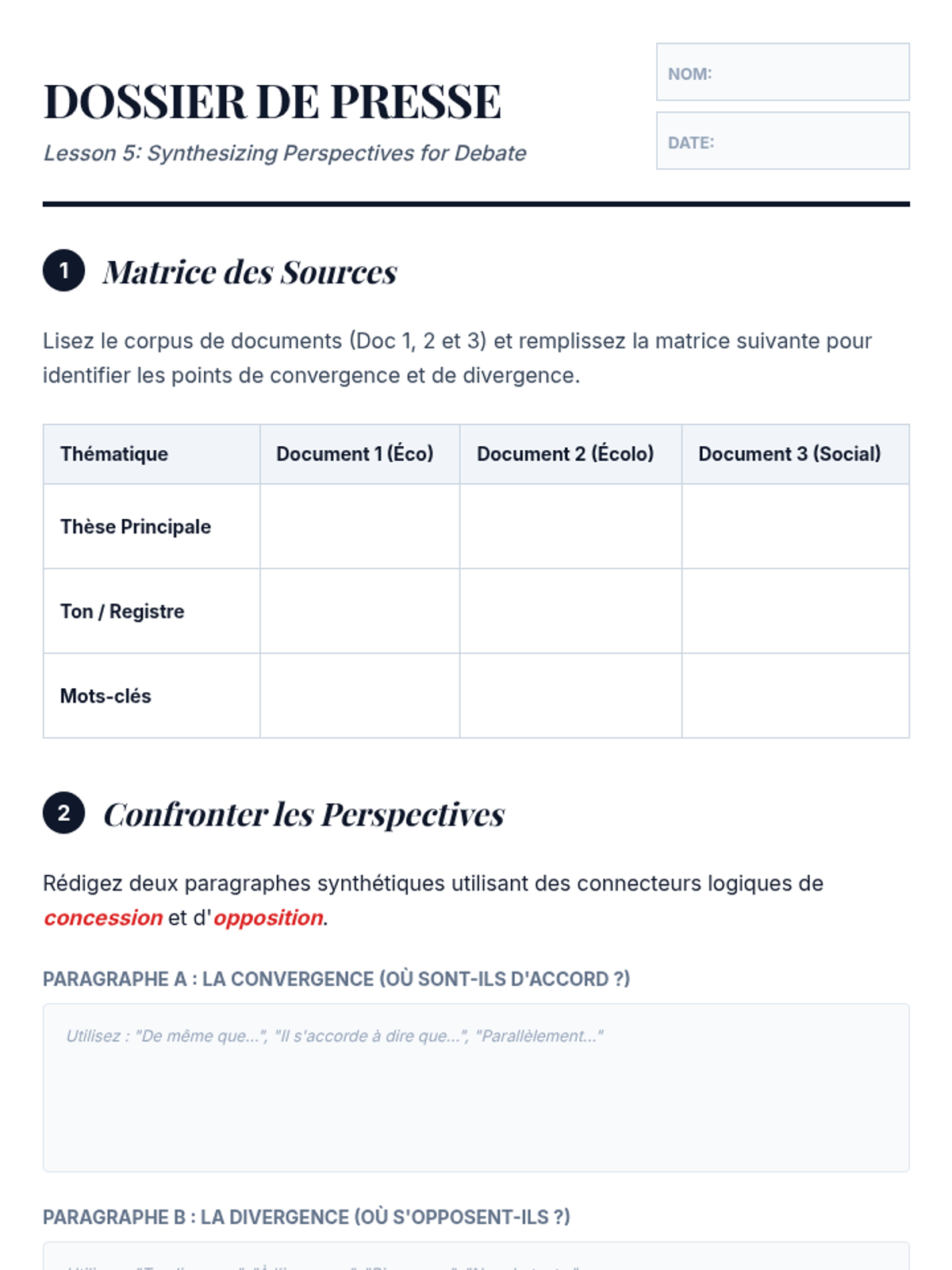
Final worksheet for Lesson 5, guiding students through the process of creating a press synthesis and preparing for a structured debate.
A visual presentation for the final lesson on synthesizing French research for an annotated bibliography, covering the annotation framework and presentation skills.
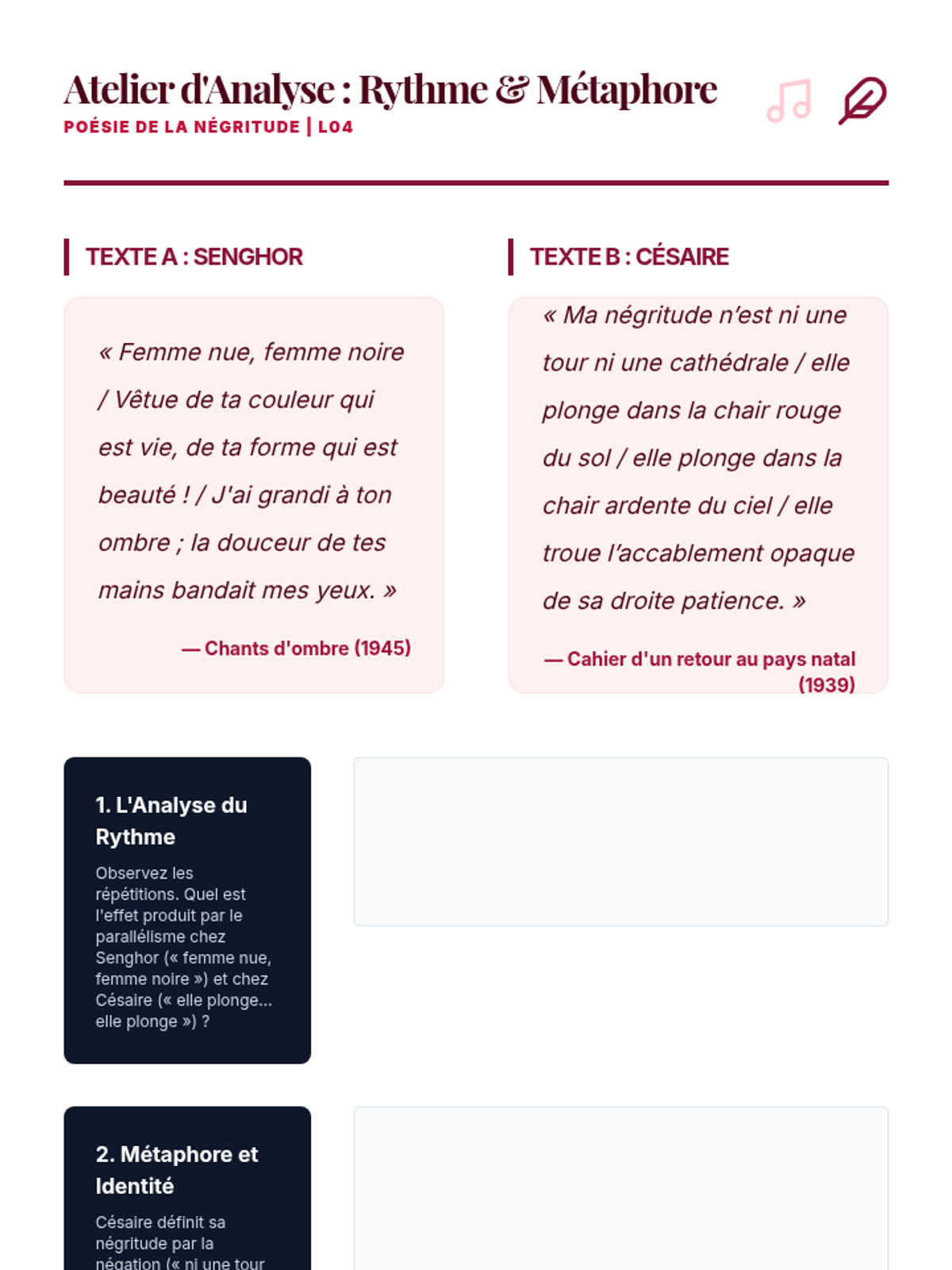
Comparative poetry analysis worksheet for Lesson 4. Features excerpts from Senghor and Césaire with specific prompts on rhythm, identity metaphors, and linguistic subversion.
Slide deck for the final lesson on synthesizing perspectives in French media for debate and written analysis, covering logical connectors and the art of 'synthèse'.
Slides for Lesson 4 on the Negritude movement. Explores the poetry of Aimé Césaire and Léopold Sédar Senghor, focusing on rhythmic subversion, identity reclamation, and the linguistic 'weaponry' of metaphors.
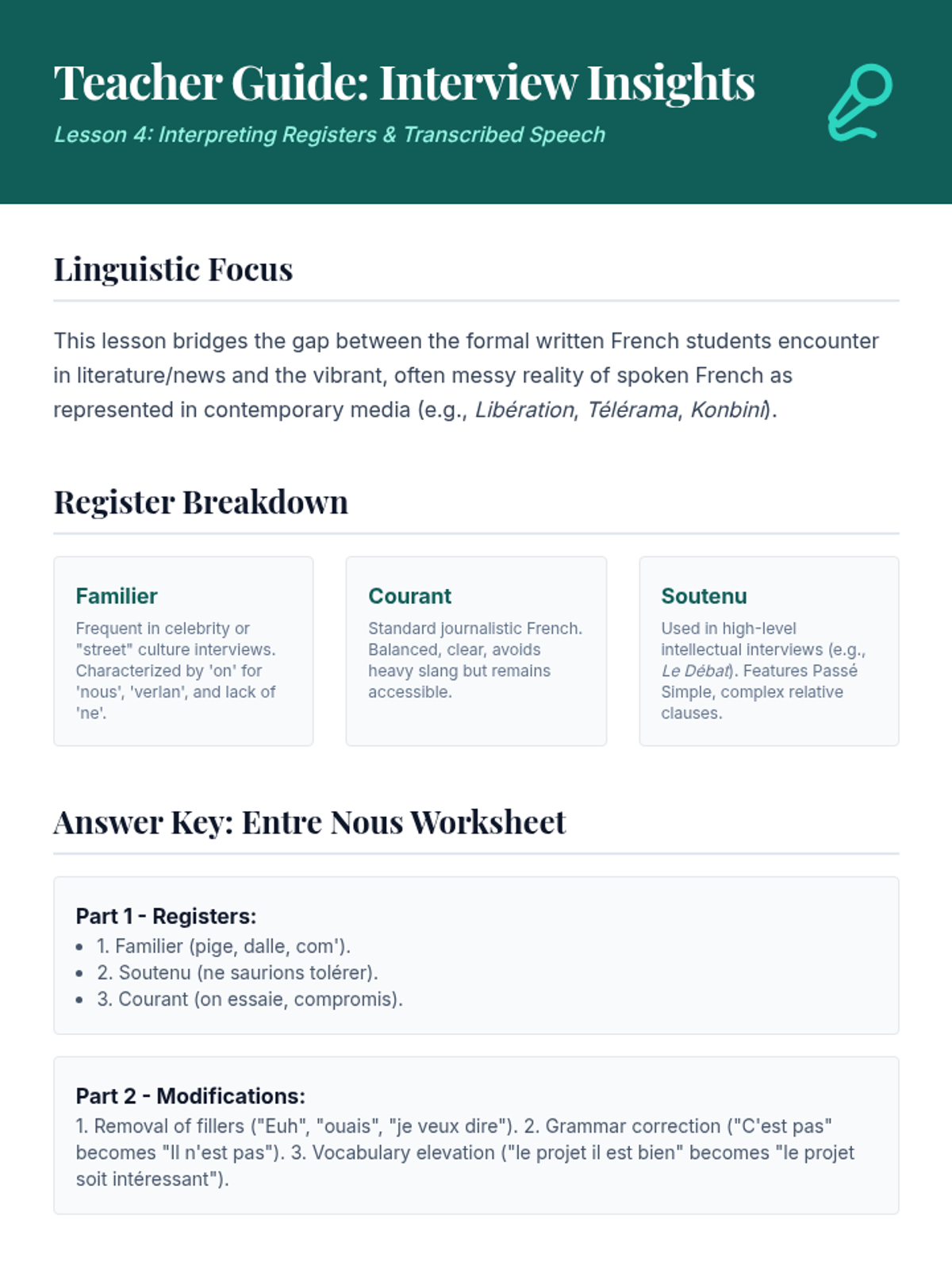
Teacher guide for Lesson 4, offering guidance on register breakdown and answers for the interview analysis worksheet.
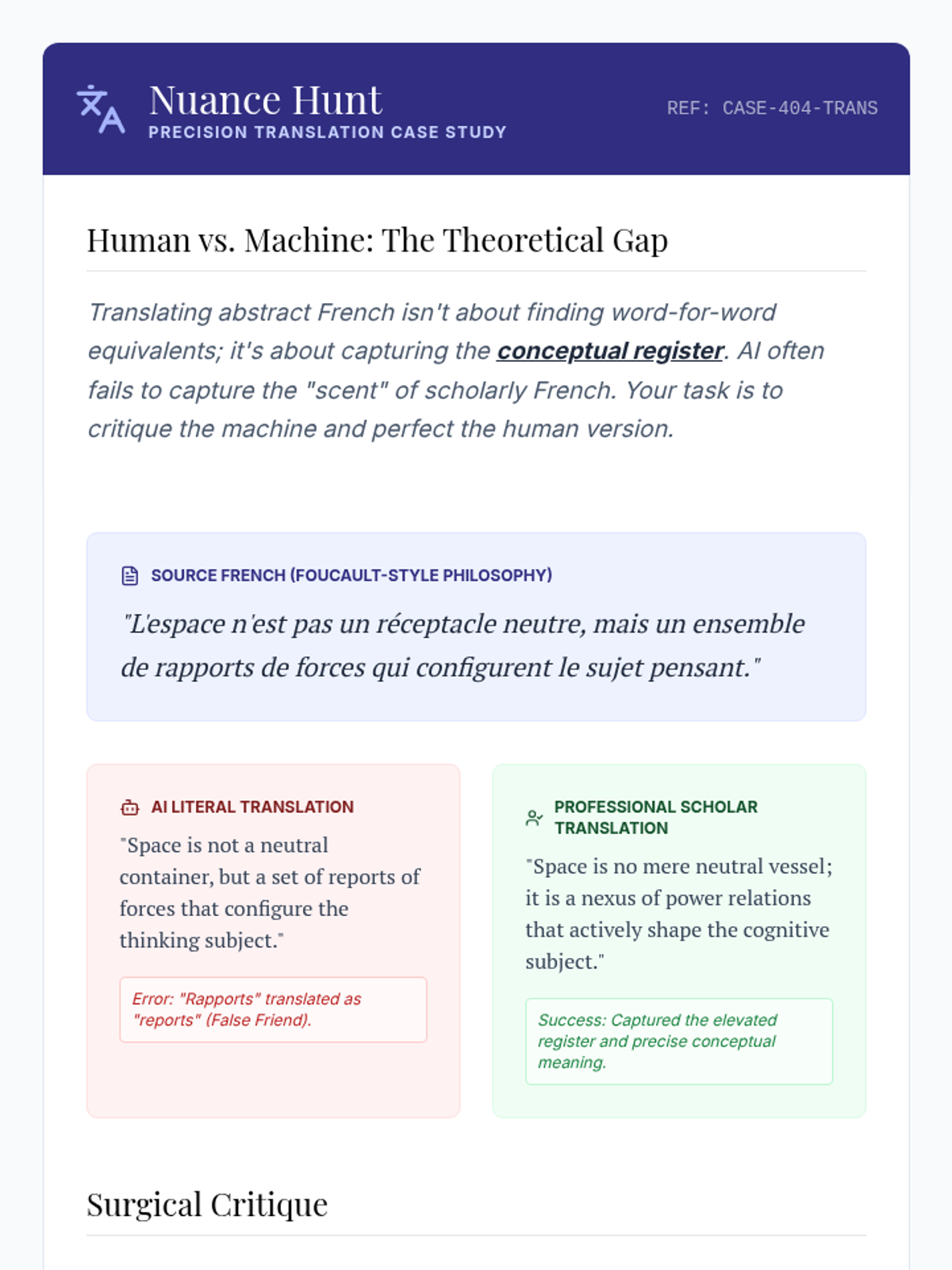
A translation case study worksheet for graduate students, comparing AI translations with professional scholarly translations of abstract French philosophical texts.
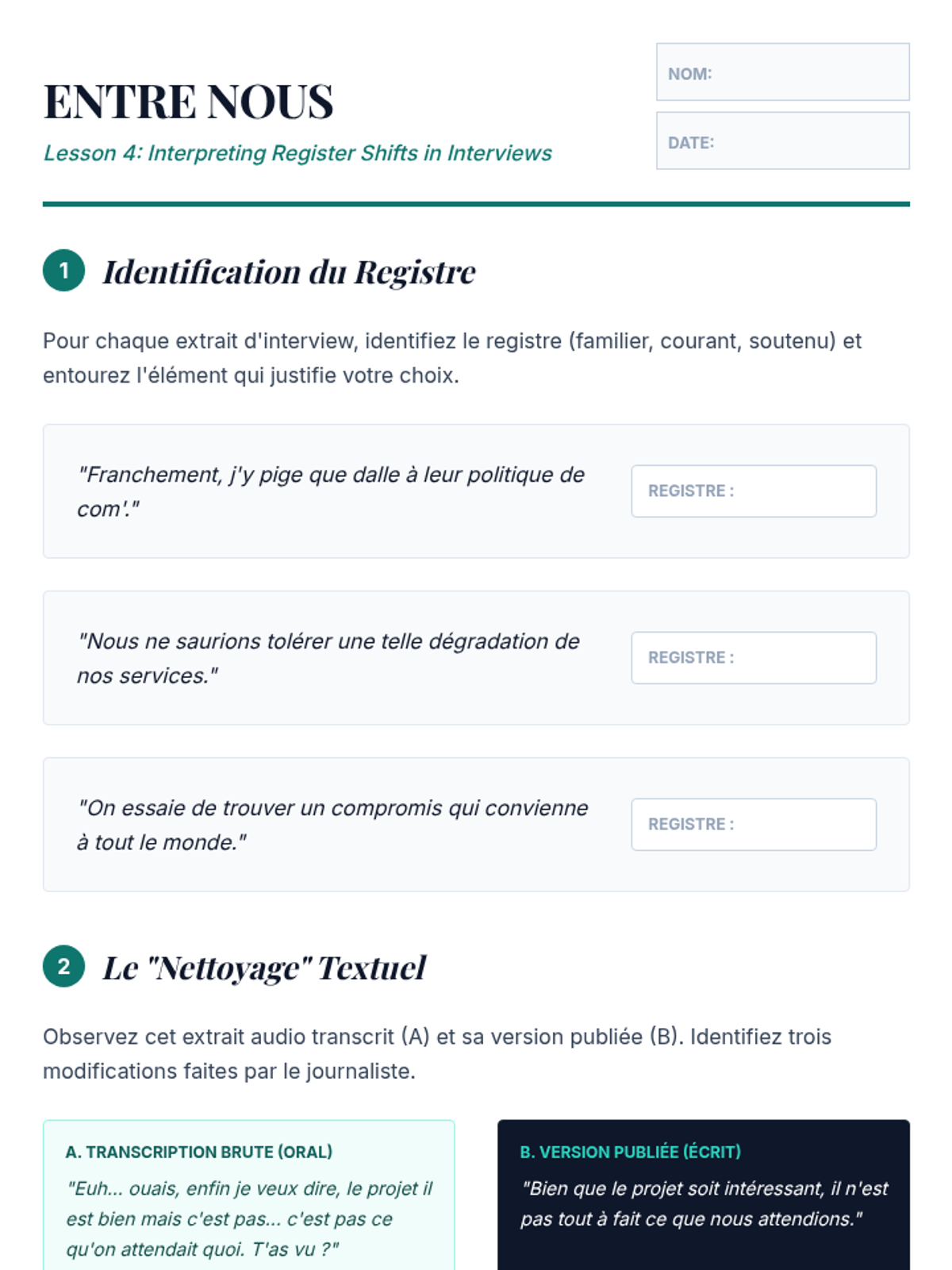
Student worksheet for Lesson 4 focused on register identification, transcription analysis, and social inference in French interviews.
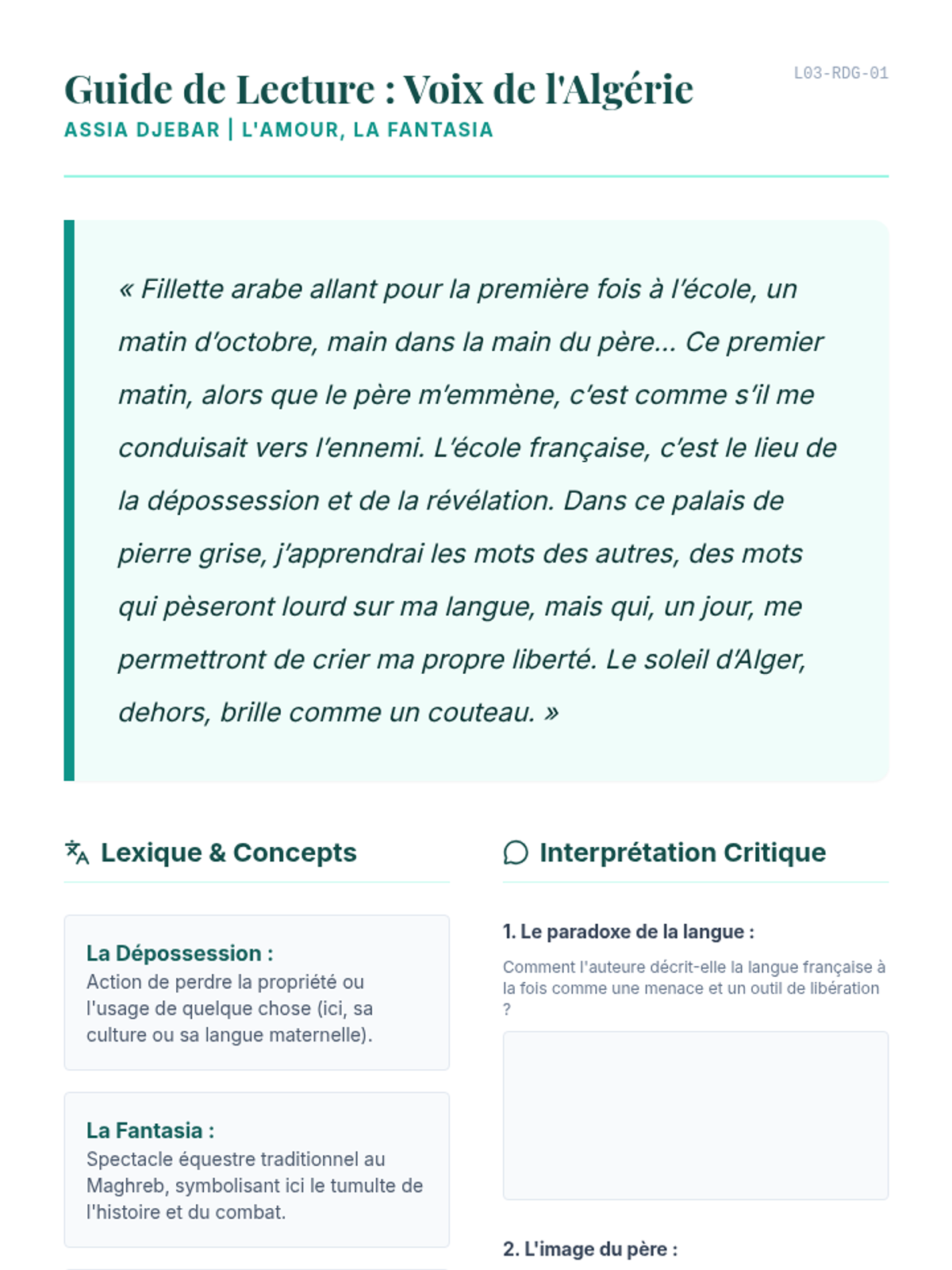
Reading guide for an excerpt from Assia Djebar's 'L'Amour, la fantasia'. Includes vocabulary definitions, sensory analysis tasks, and critical interpretation questions.
A presentation for graduate students on deconstructing complex French academic syntax, focusing on sentence structure, relative pronouns, and the technique of finding the 'core' statement.
Slide deck for Lesson 4 on interpreting interviews and transcribed speech, focusing on register shifts and the nuances of spoken vs. written French.
Slides for Lesson 3 on post-colonial Francophone literature, featuring Assia Djebar and Tahar Ben Jelloun. Focuses on descriptive imagery, sensory vocabulary, and the politics of language.
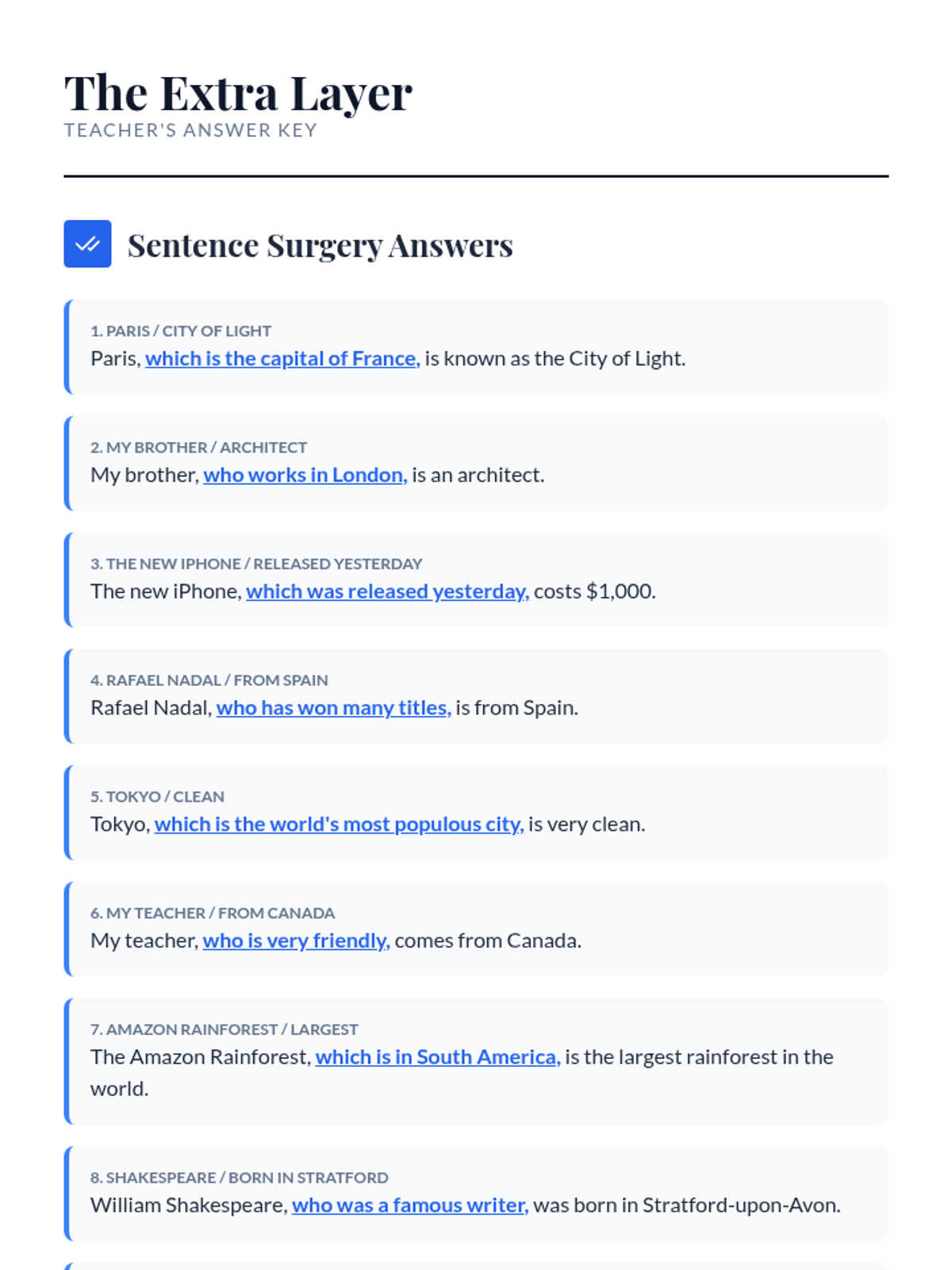
An answer key for the "Extra Layer" handout, providing corrected sentences and explanations for the grammar exercises. Updated to reflect the expanded exercise sections.
A 7-slide visual presentation for teaching non-defining relative clauses, focusing on the distinction between essential and extra information and the "comma sandwich" rule. Includes a warm-up activity featuring Lionel Messi, Taylor Swift, and the Eiffel Tower.
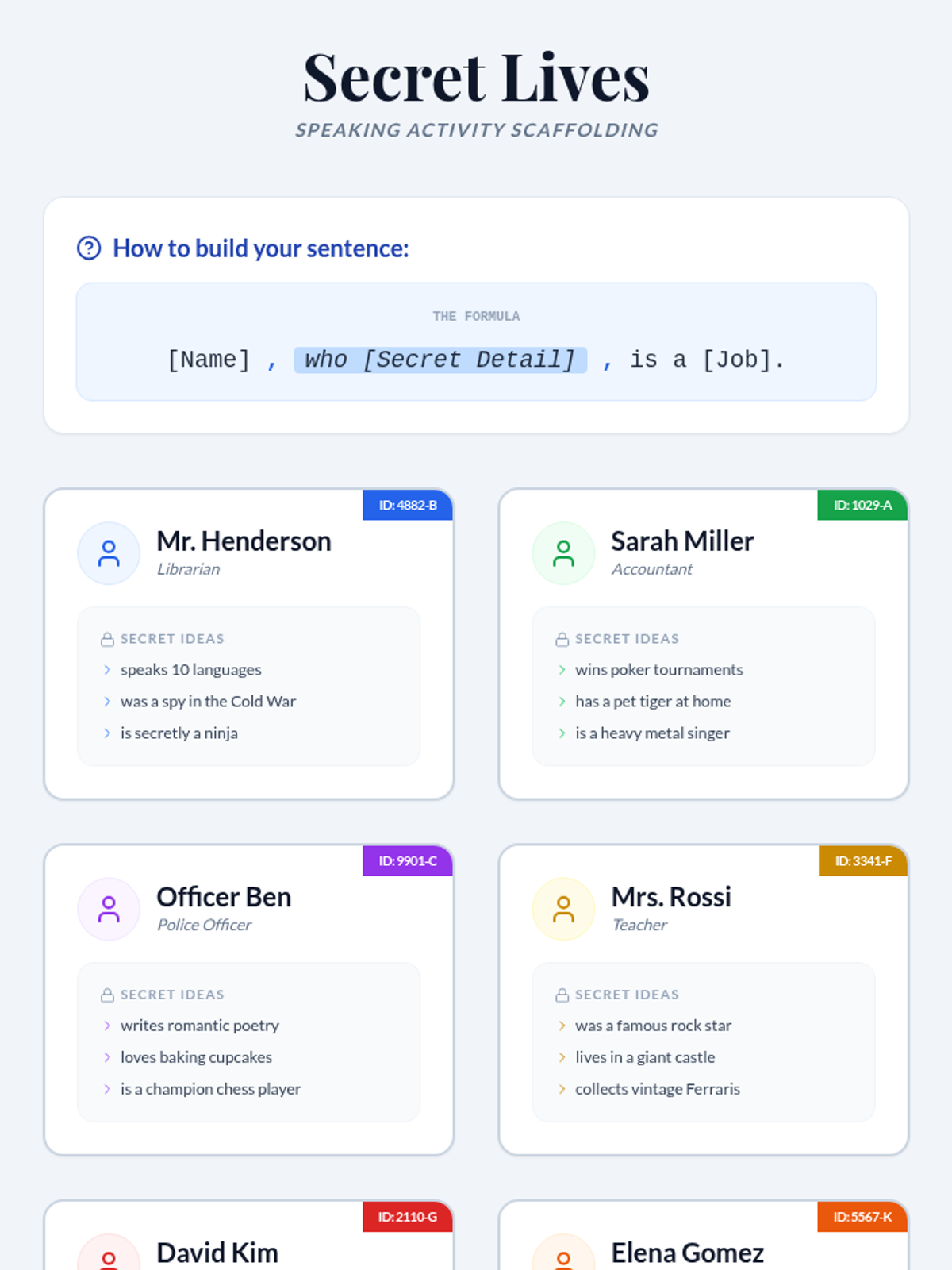
A set of printable role-play cards featuring "ordinary" characters for students to embellish using non-defining relative clauses in a speaking activity. Includes sentence frames and "Secret Ideas" for extra scaffolding.
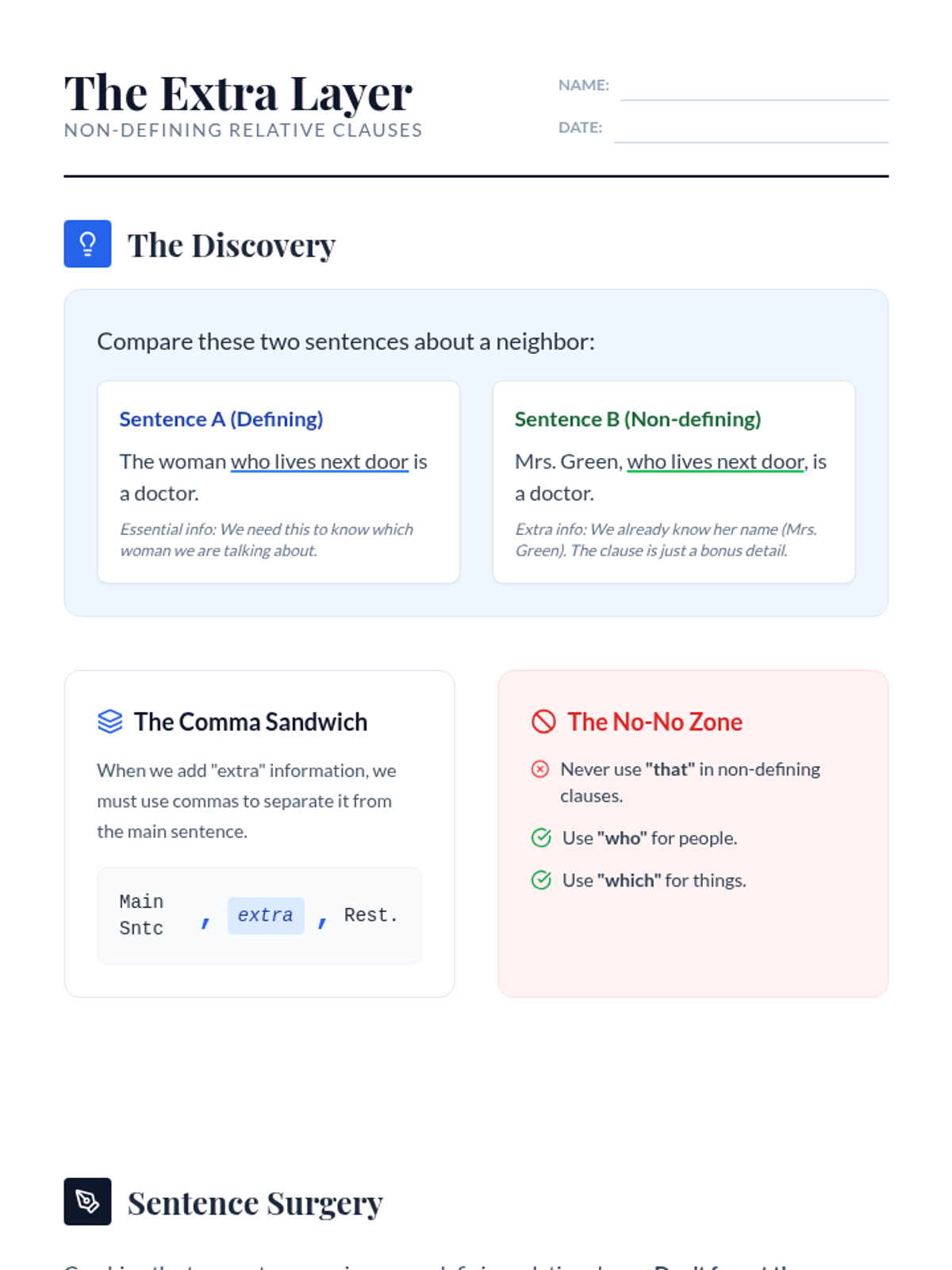
A student worksheet introducing non-defining relative clauses with clear grammar explanations, visual rules (the comma sandwich), and controlled practice exercises. Updated with expanded exercise sections.
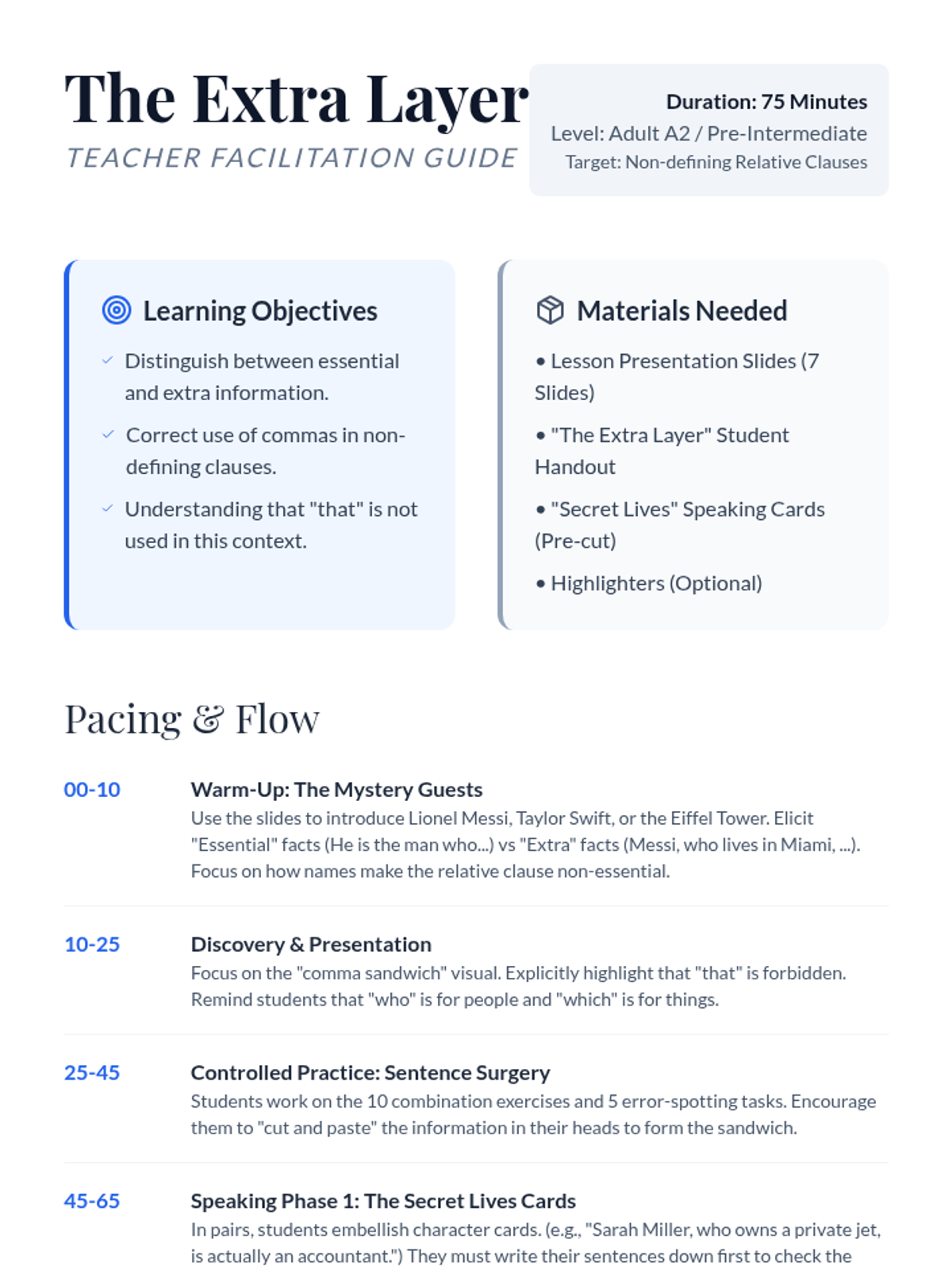
A teacher's guide for a 75-minute lesson on non-defining relative clauses, updated with specific examples for Lionel Messi, Taylor Swift, and the Eiffel Tower.
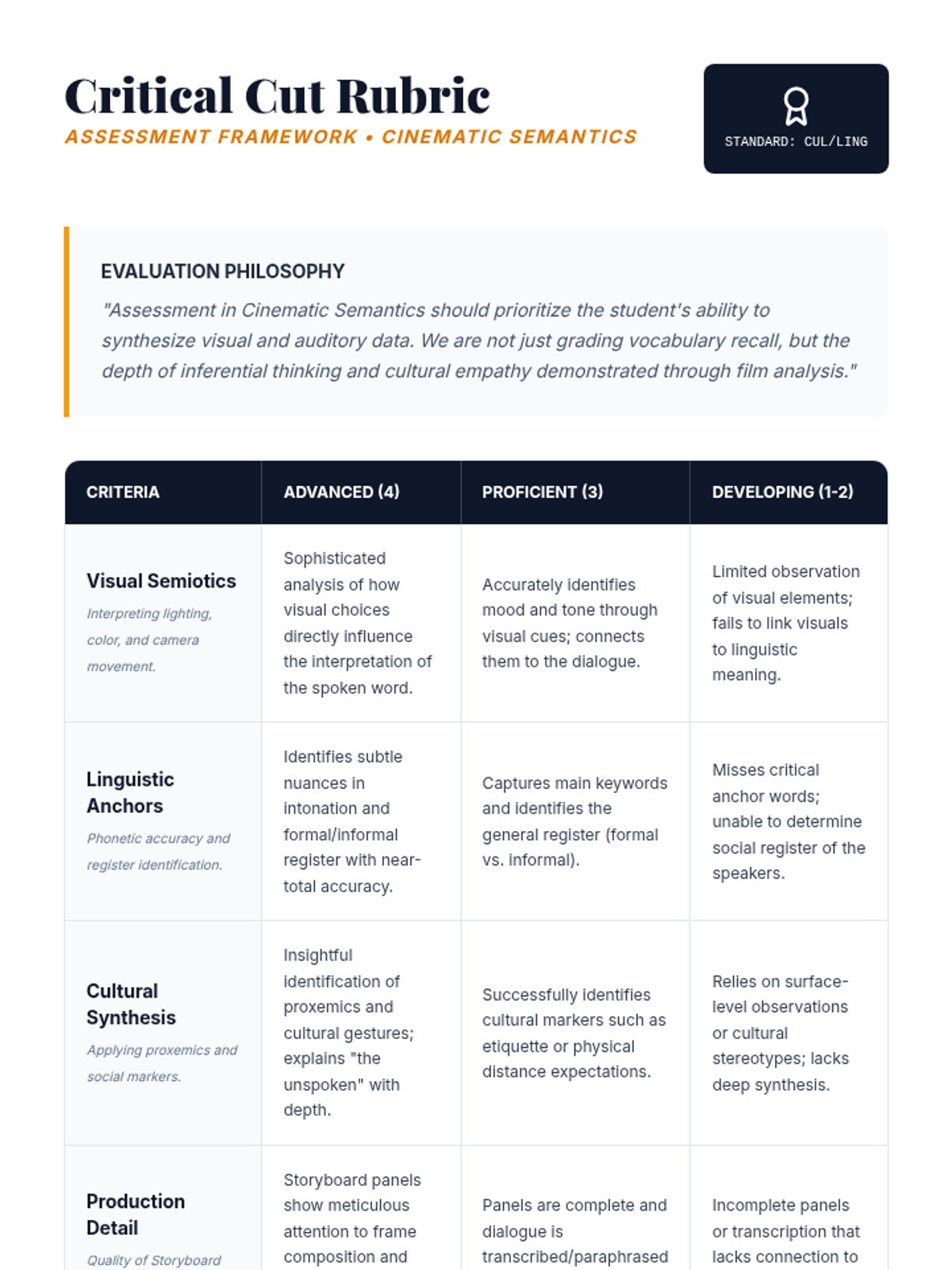
A professional assessment rubric titled 'Critical Cut Rubric' for educators to evaluate student film analysis across visual, linguistic, and cultural dimensions.
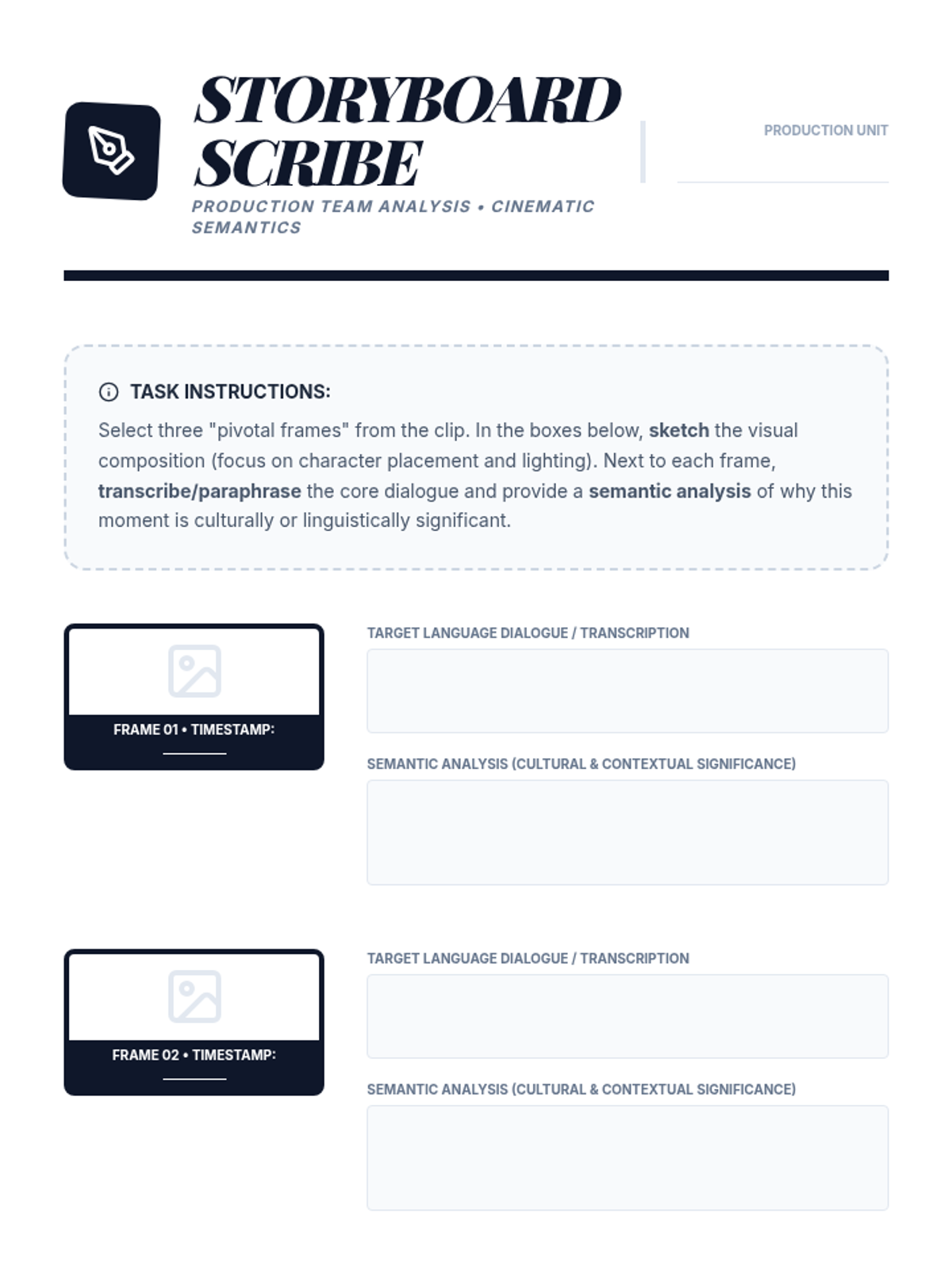
An advanced graphic organizer titled 'Storyboard Scribe' where students map critical film frames, transcribe dialogue, and perform deep semantic analysis.
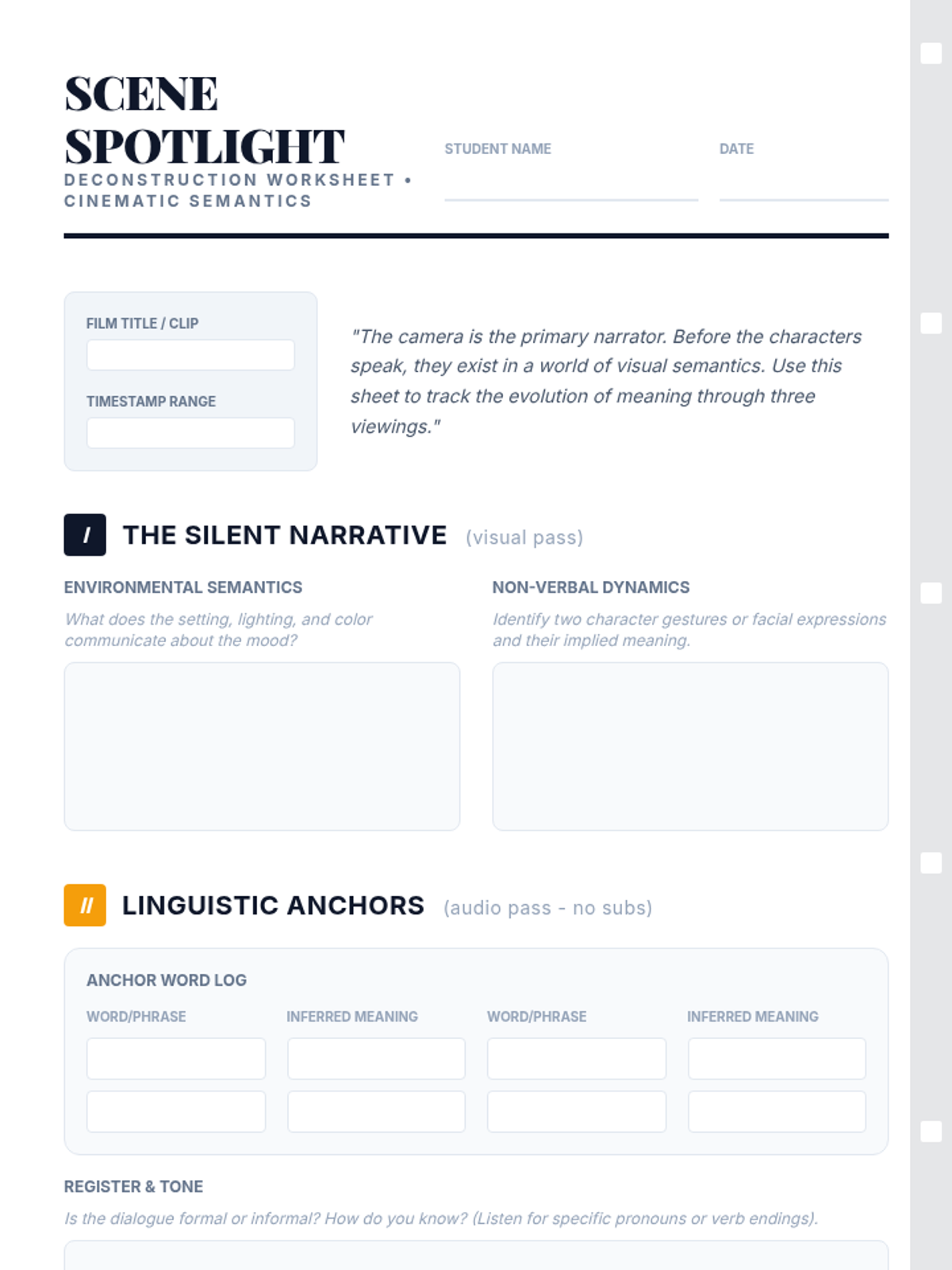
A student-facing worksheet titled 'Scene Spotlight' used for deconstructing film clips in three stages: visual narrative, linguistic anchors, and cultural synthesis.
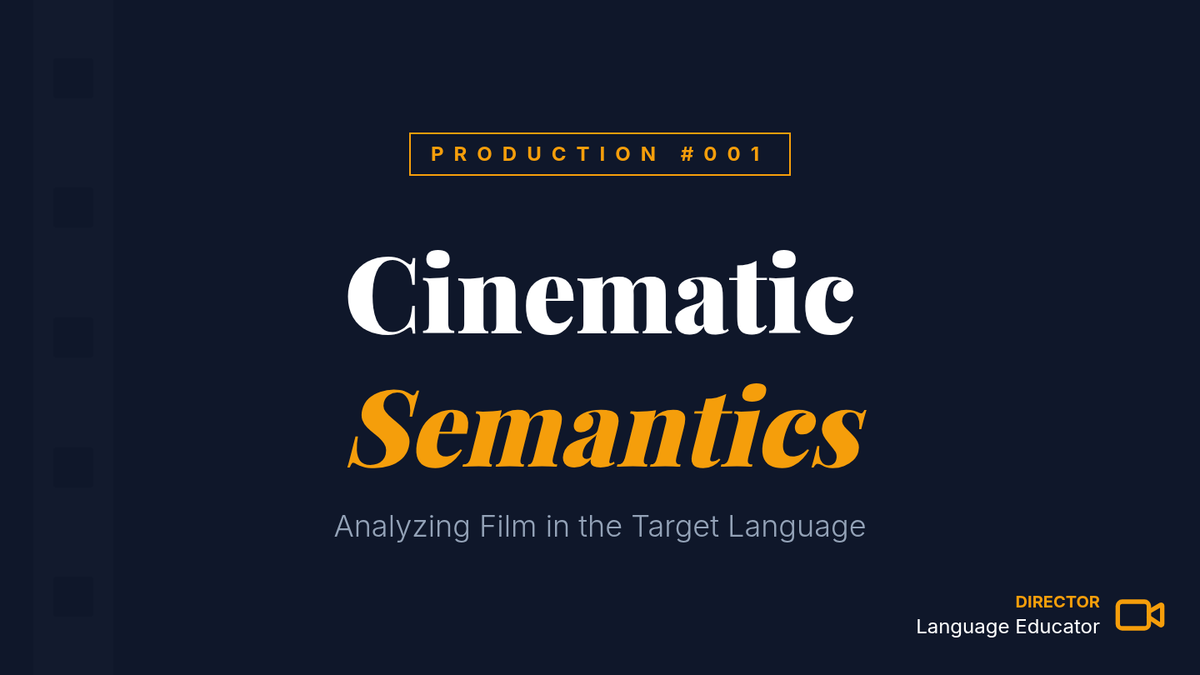
A visually striking slide deck for instruction on 'Cinematic Semantics', guiding students through visual-first analysis, auditory processing, and thin-slicing techniques.
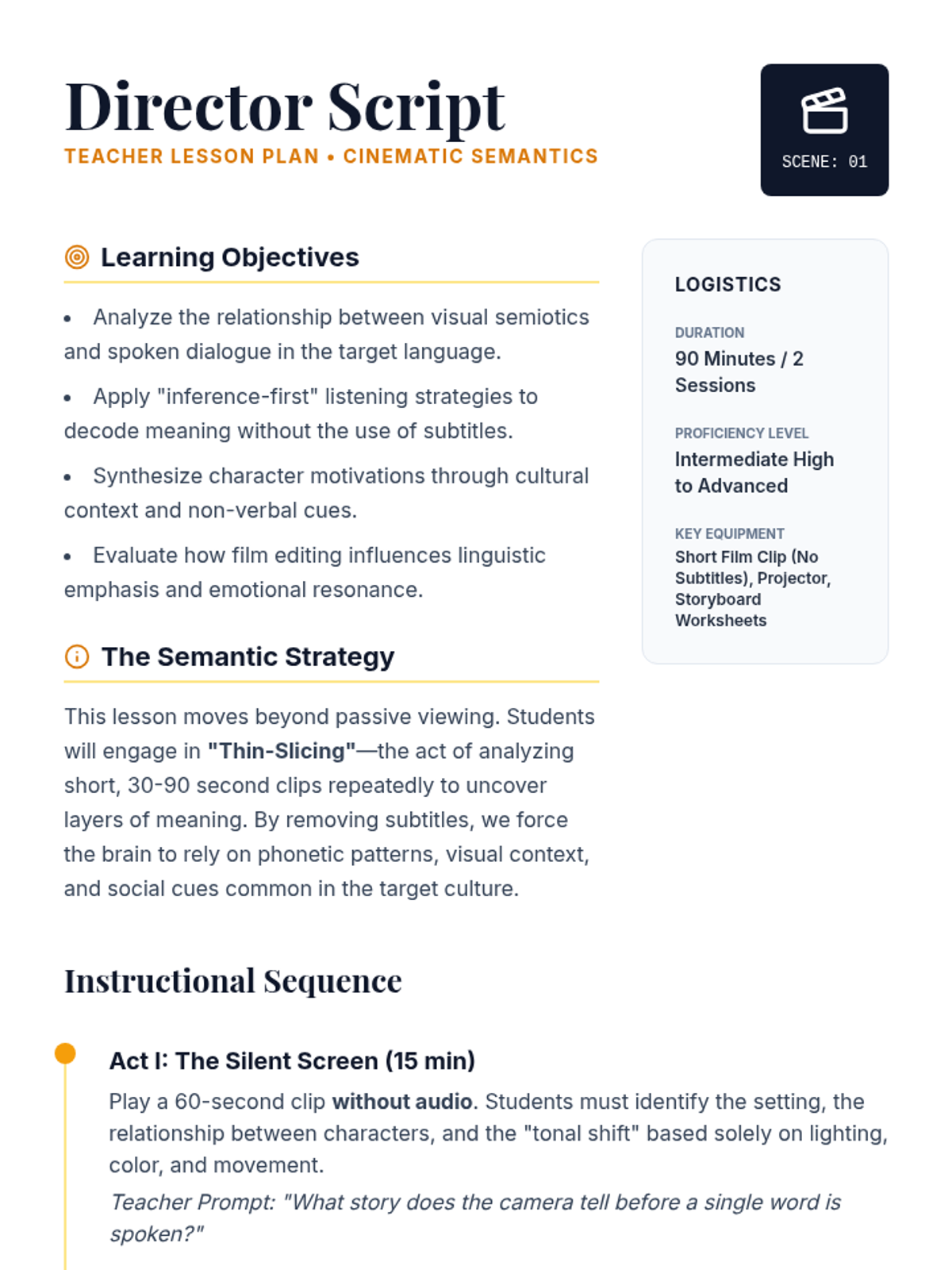
A detailed lesson plan for educators titled 'Director Script' that provides a pedagogical framework for analyzing film in the foreign language classroom through three 'Acts' of deconstruction.
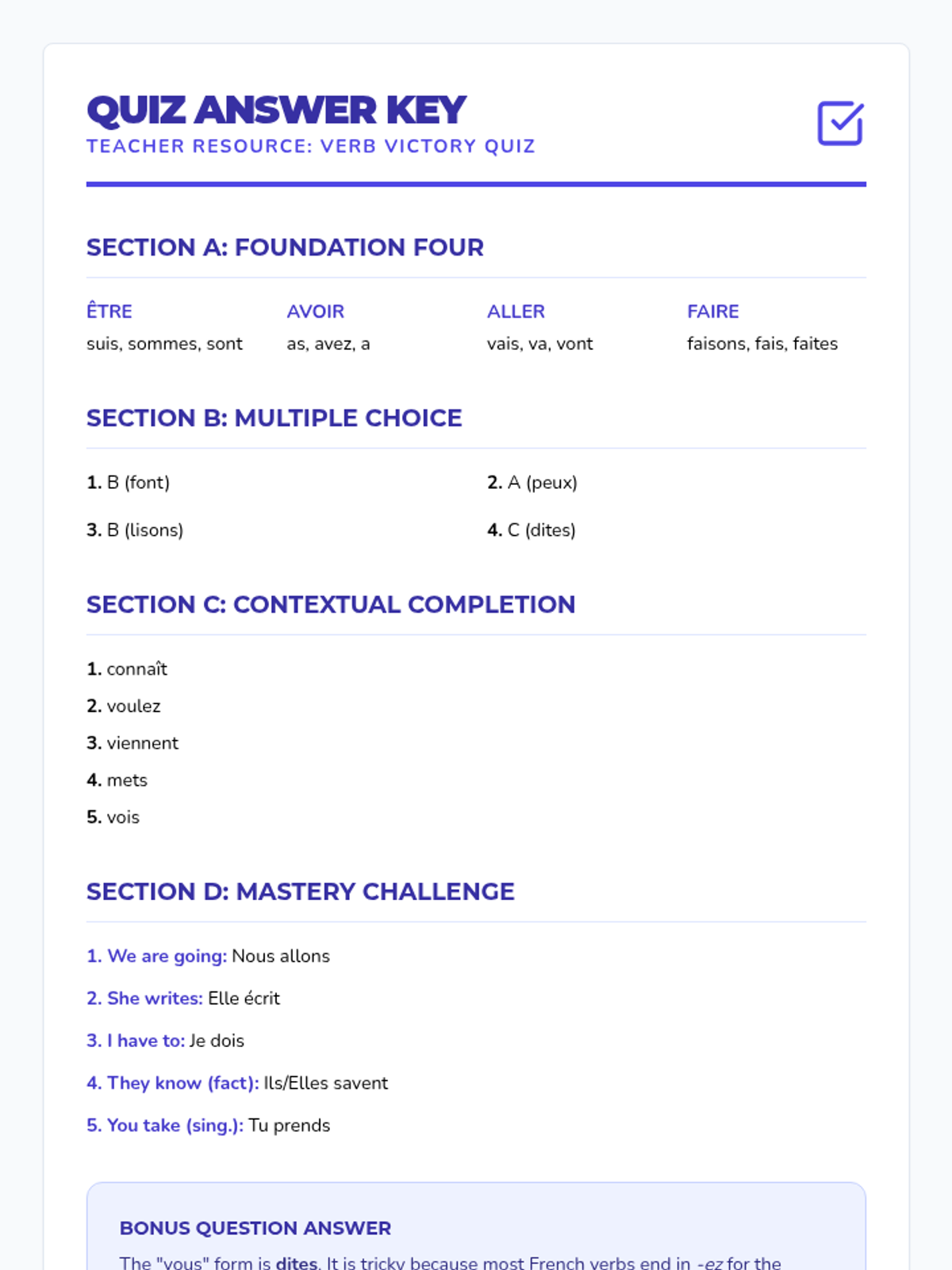
Teacher-facing answer key for the Verb Victory Quiz, providing all correct conjugations and translations for the assessment.
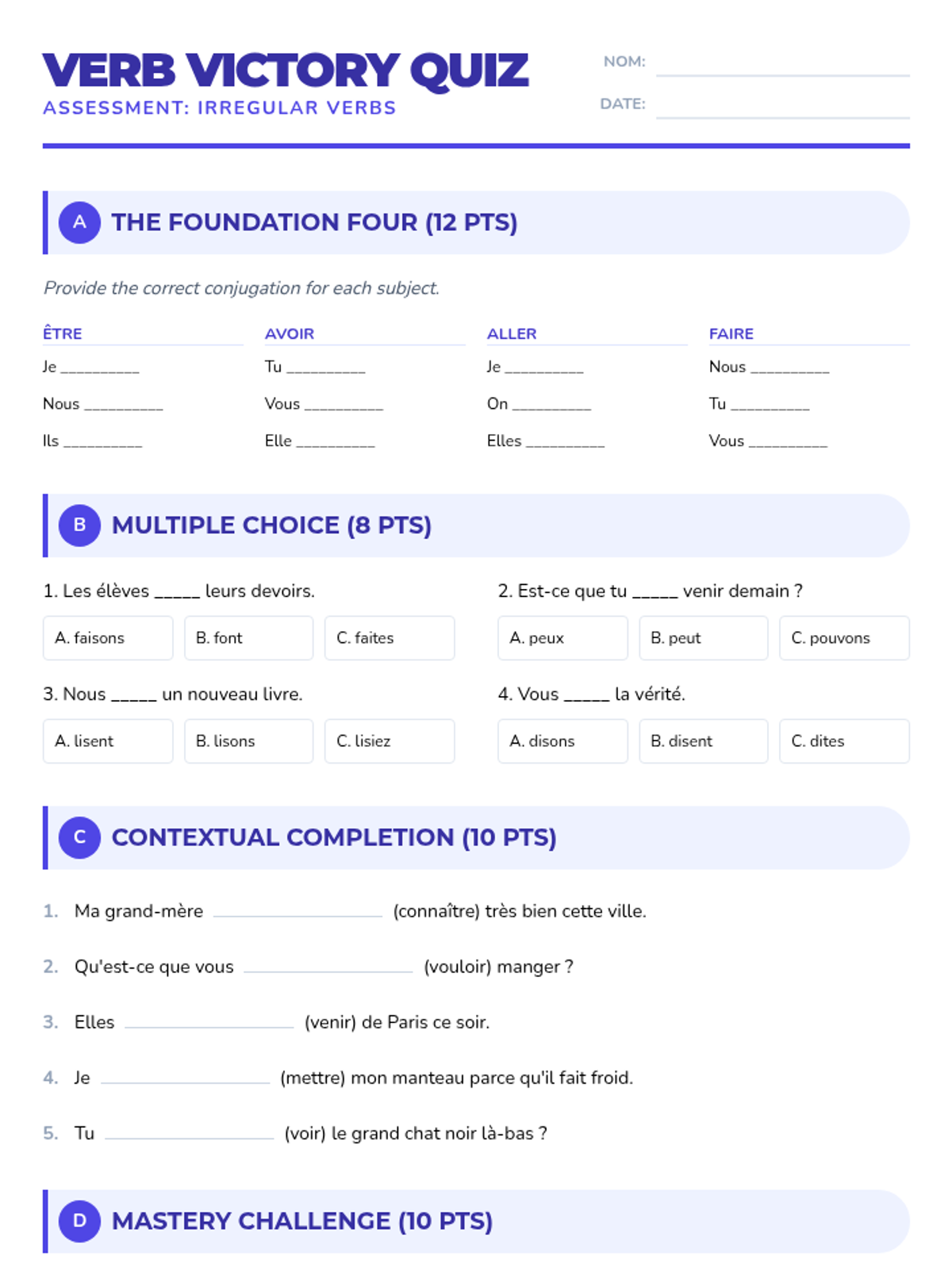
A formal assessment covering all 16 irregular French verbs through conjugation tasks, multiple-choice questions, and translation exercises.
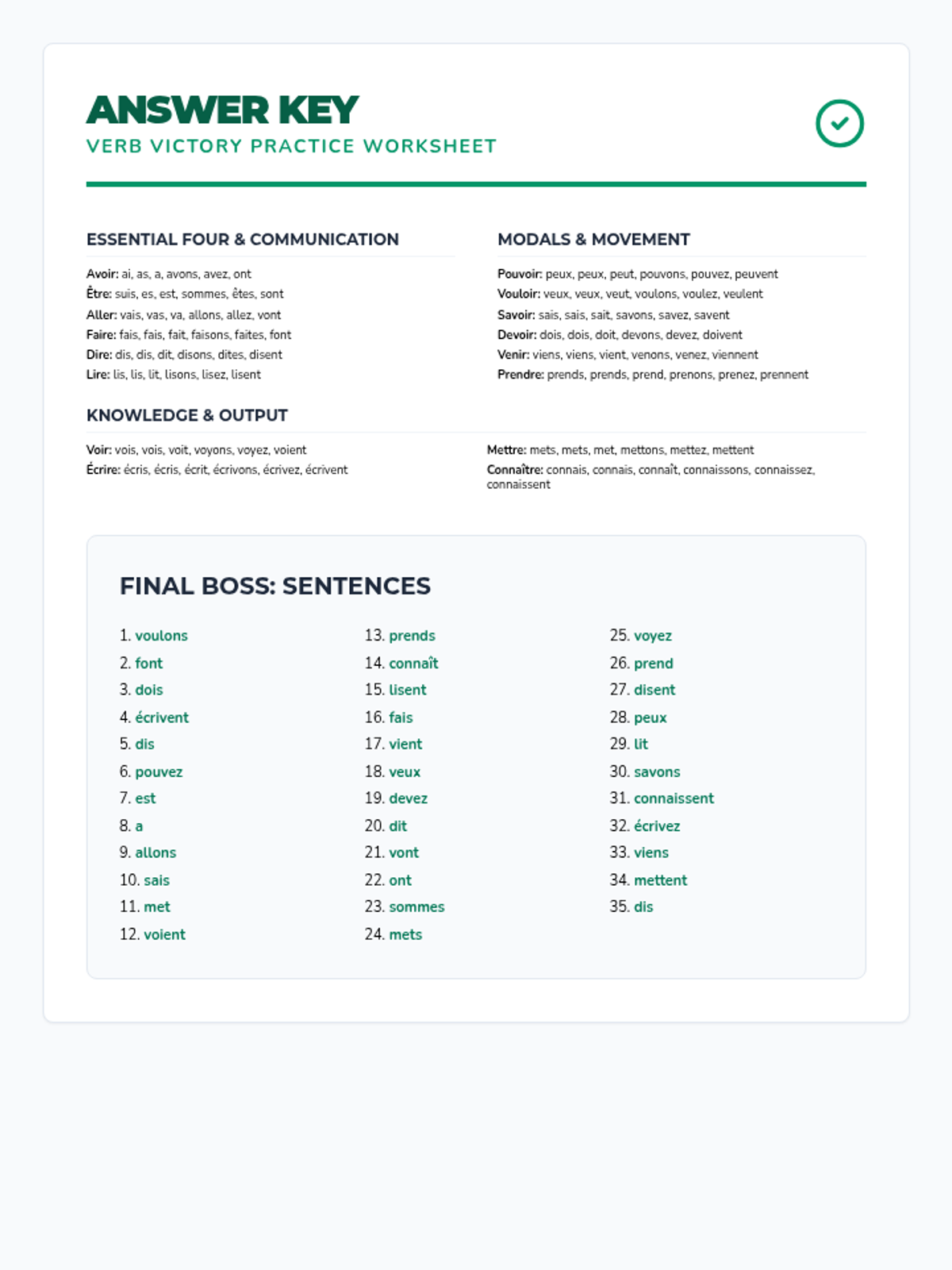
Teacher-facing answer key for the Verb Victory Practice Worksheet, updated to include answers for all 35 sentence challenges.
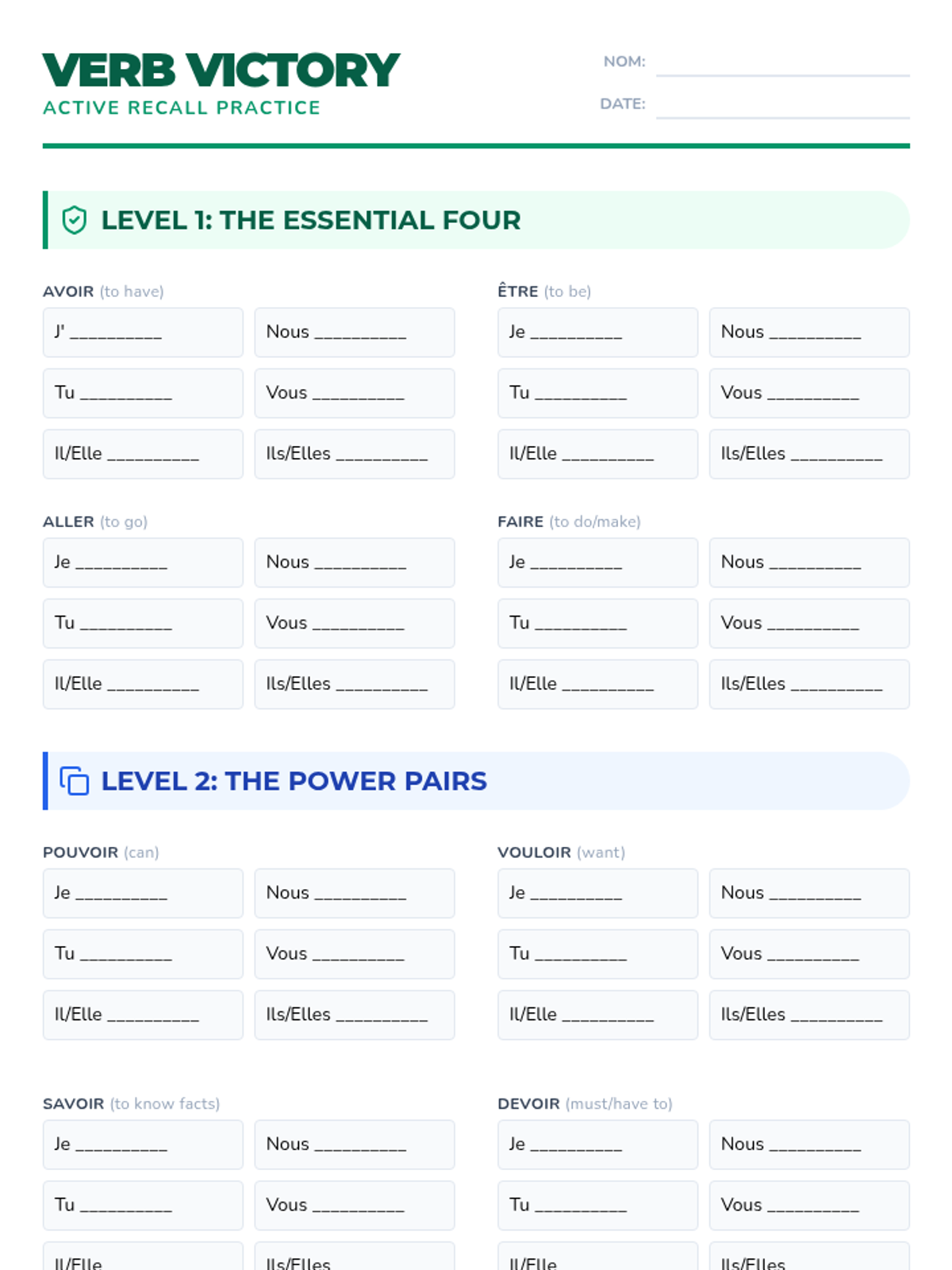
A comprehensive fill-in-the-blank practice worksheet for irregular French verbs, organized into levels of difficulty with a final 35-sentence mixed challenge. Now features all 16 target verbs and spans 4 pages for maximum practice. Revised with expanded handwriting space.
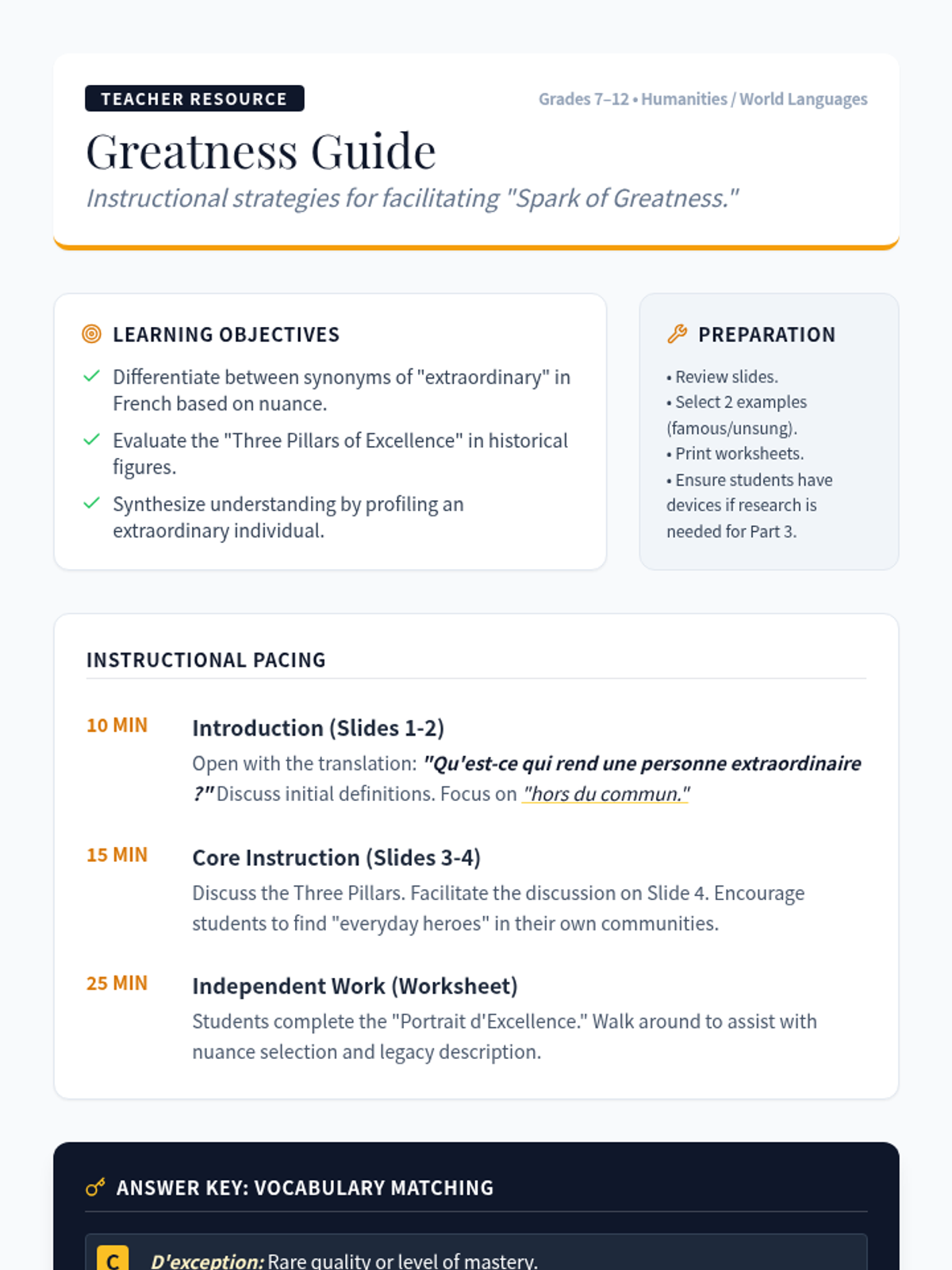
A teacher guide for the 'Spark of Greatness' lesson, including learning objectives, instructional pacing, differentiation strategies, and an answer key for the vocabulary matching activity.
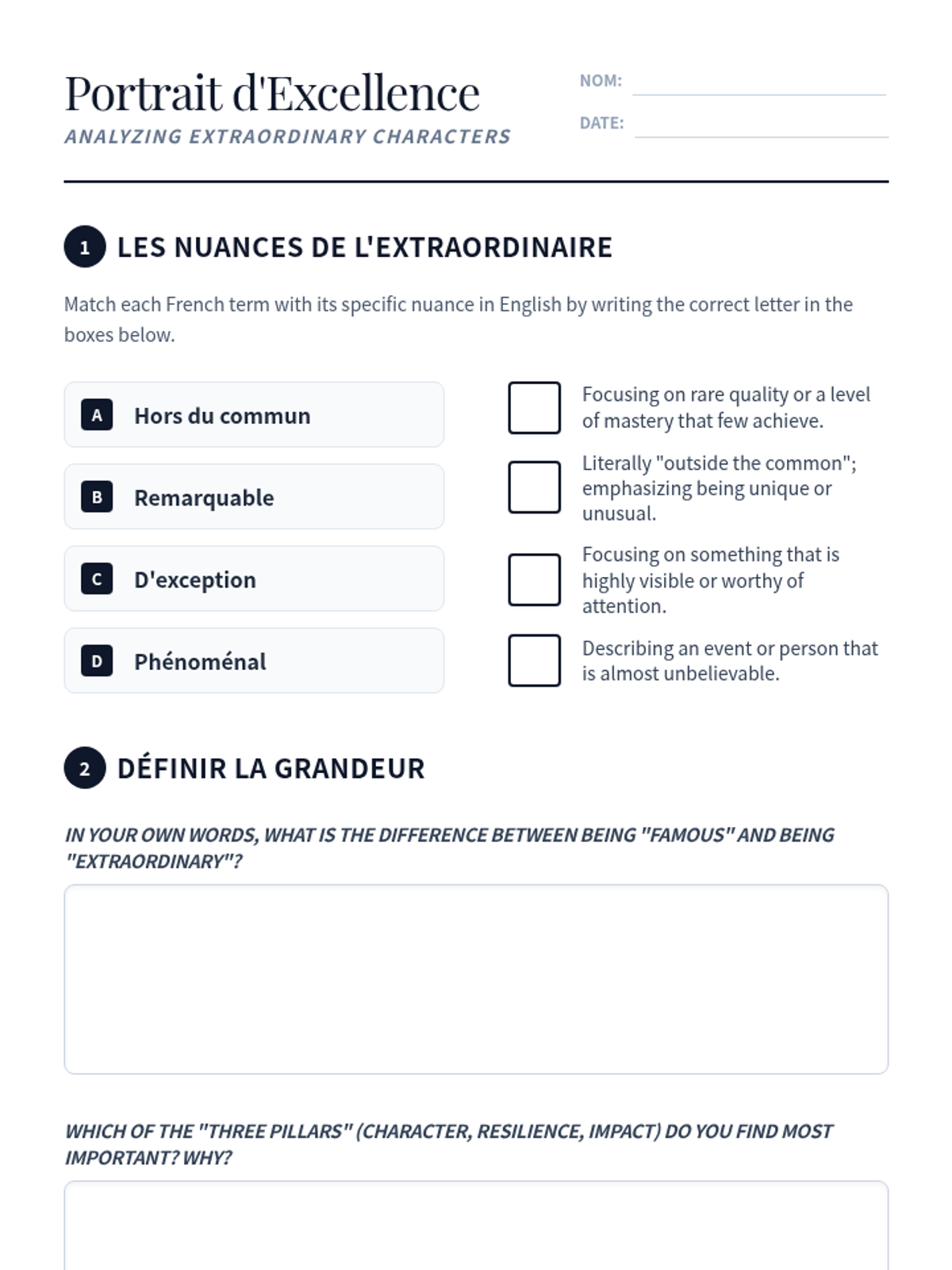
A student worksheet featuring vocabulary matching on the nuances of 'extraordinary' in French, reflective questions on greatness, and a profile organizer to analyze an extraordinary individual.
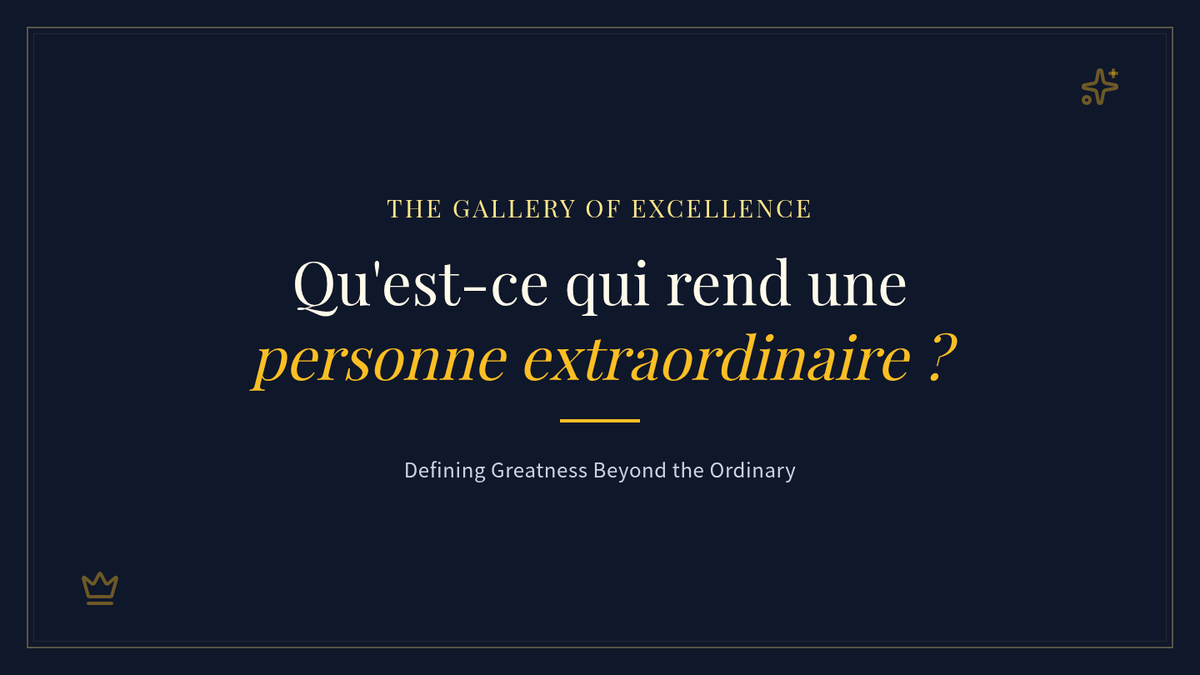
A slide presentation exploring the definition of 'extraordinary' and its French nuances, the three pillars of greatness (character, resilience, impact), and prompts for student discussion.
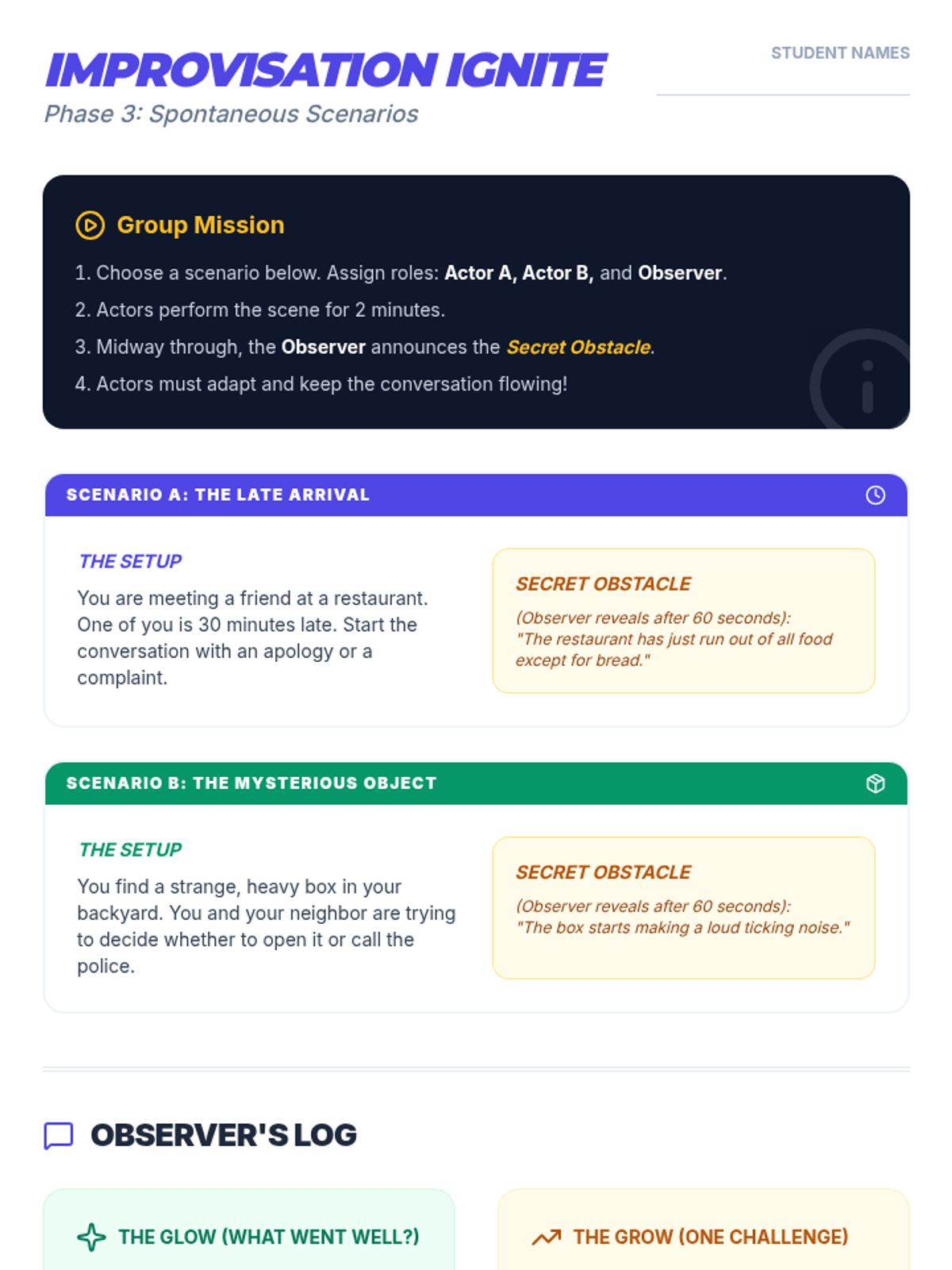
A student-facing small-group activity sheet providing structured scenarios with 'Secret Obstacles' and a peer-feedback framework for oral production.
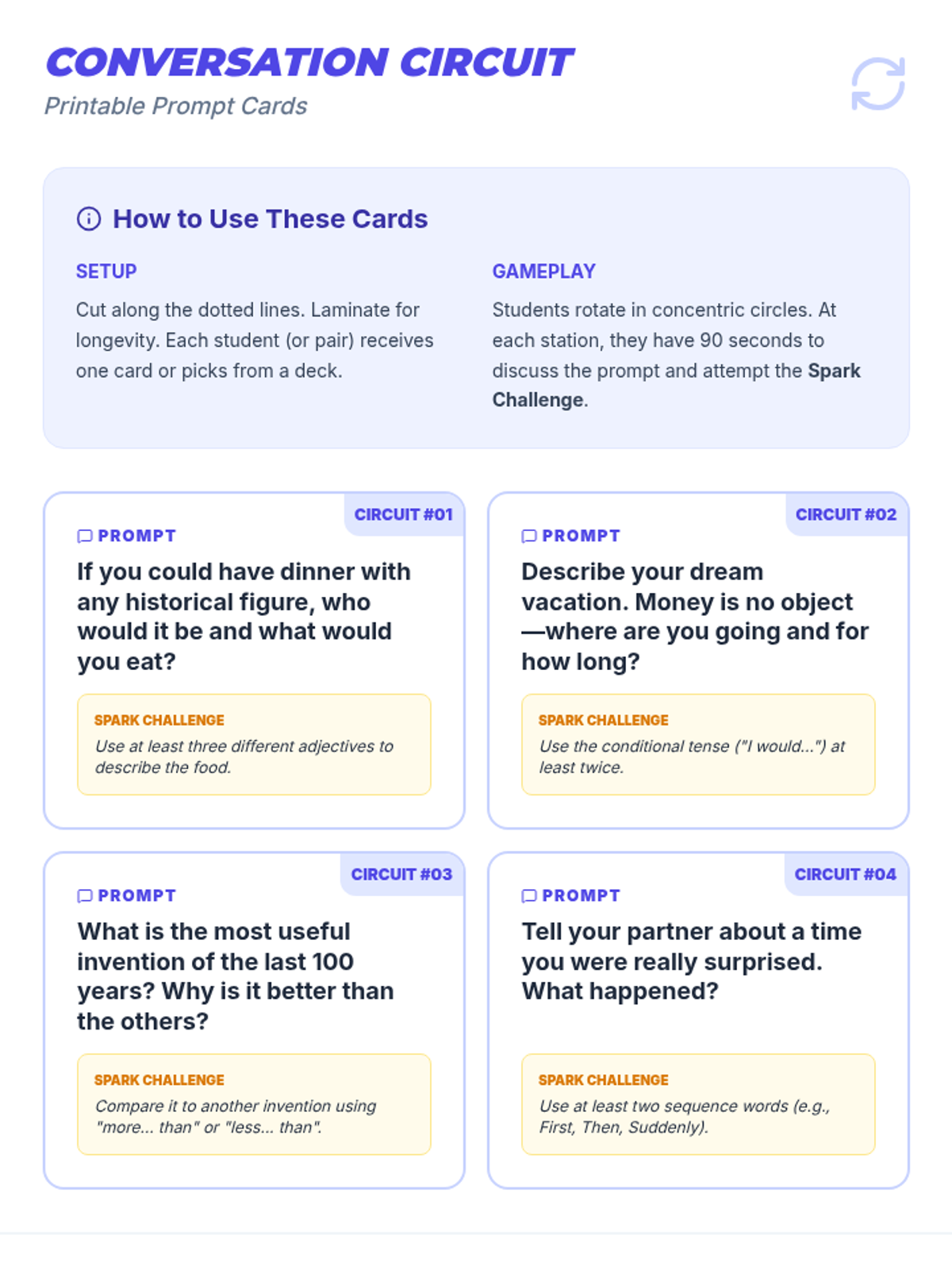
A set of 8 printable conversation prompt cards featuring 'Spark Challenges' to encourage specific linguistic targets during spontaneous speaking.
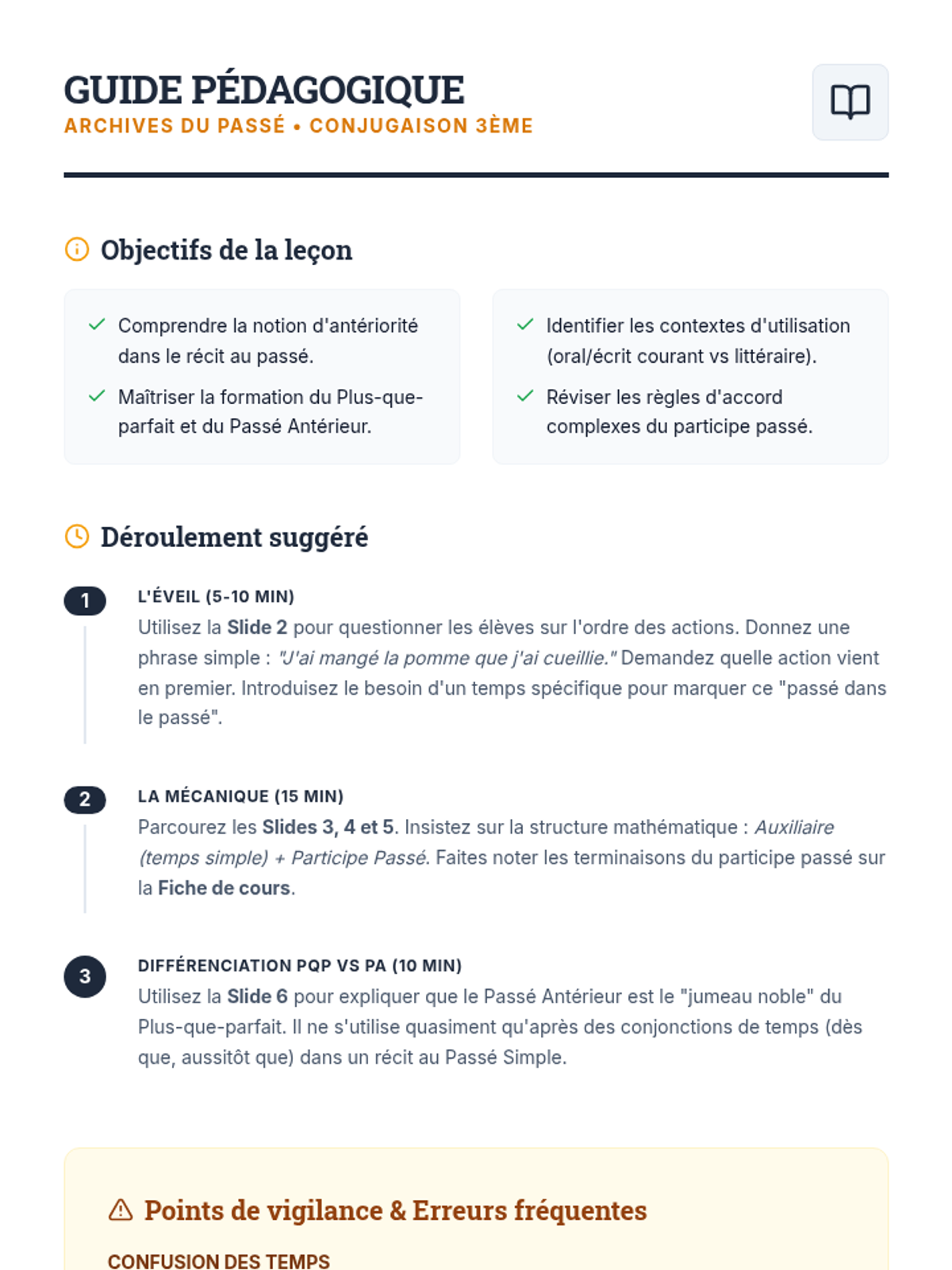
Un guide pour l'enseignant détaillant les objectifs, les points de vigilance et une proposition de déroulement pour la leçon sur les temps composés du passé.
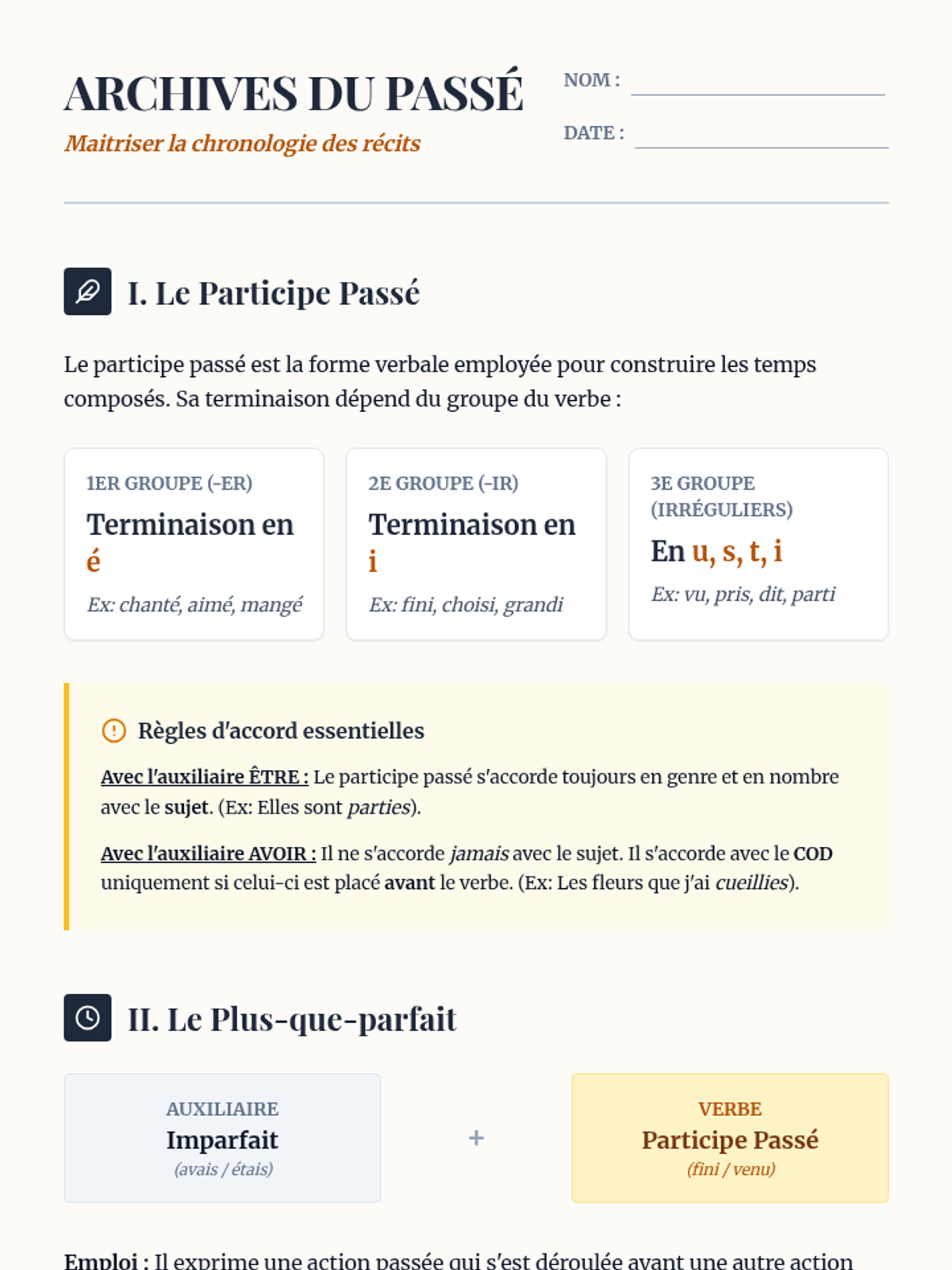
Une fiche de cours synthétique et visuelle résumant les règles de formation et d'emploi du participe passé, du plus-que-parfait et du passé antérieur.
Une présentation visuelle complète pour enseigner la formation et l'emploi du participe passé, du plus-que-parfait et du passé antérieur, adaptée aux élèves de 3ème.
A visual guide for teachers and students explaining the shift from accuracy to fluency, providing warm-up prompts, and offering "Survival Phrases" to keep conversations moving.
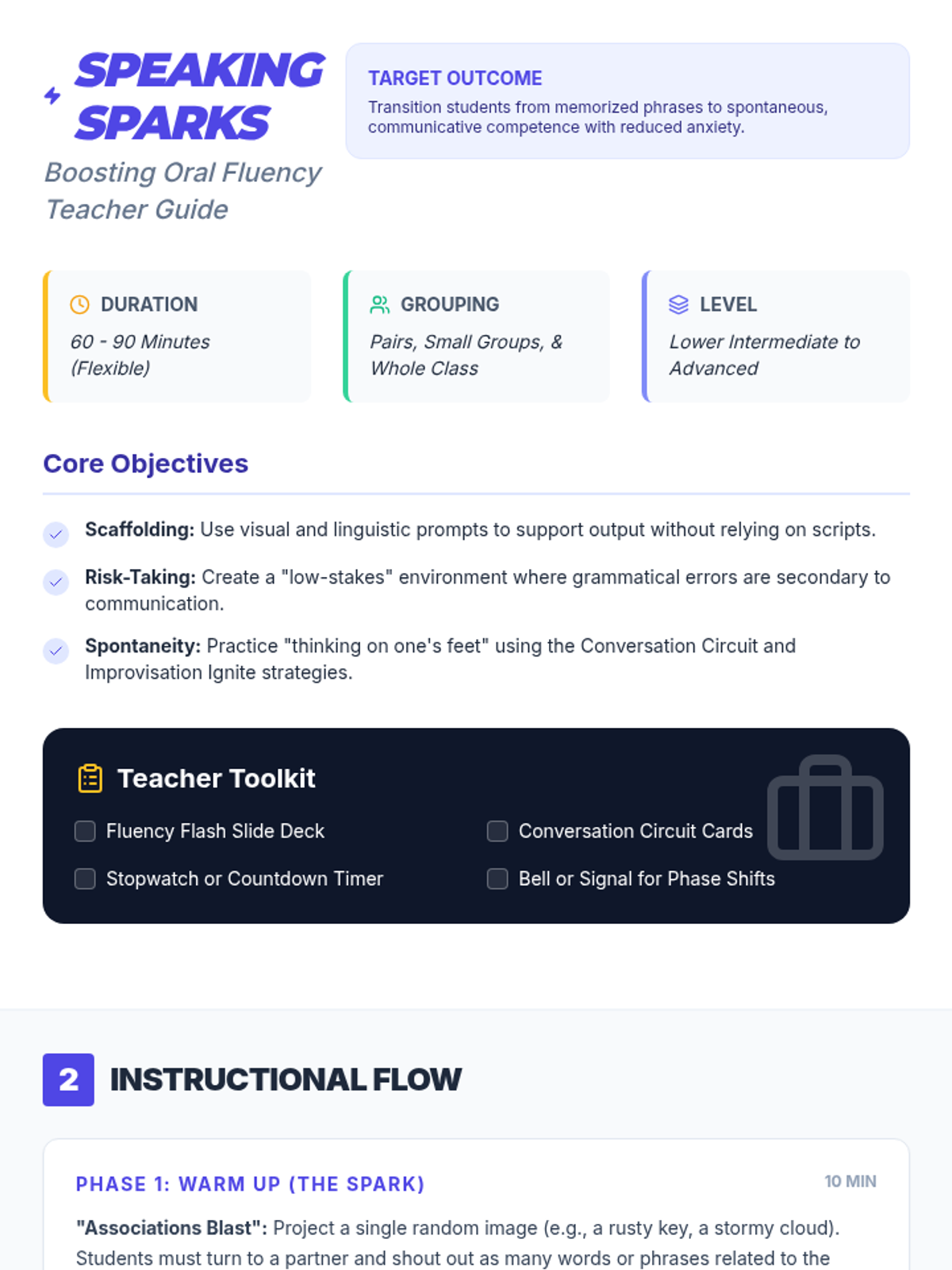
A comprehensive teacher guide for implementing oral fluency strategies, including a 4-phase instructional flow, target outcomes, and specific feedback techniques.
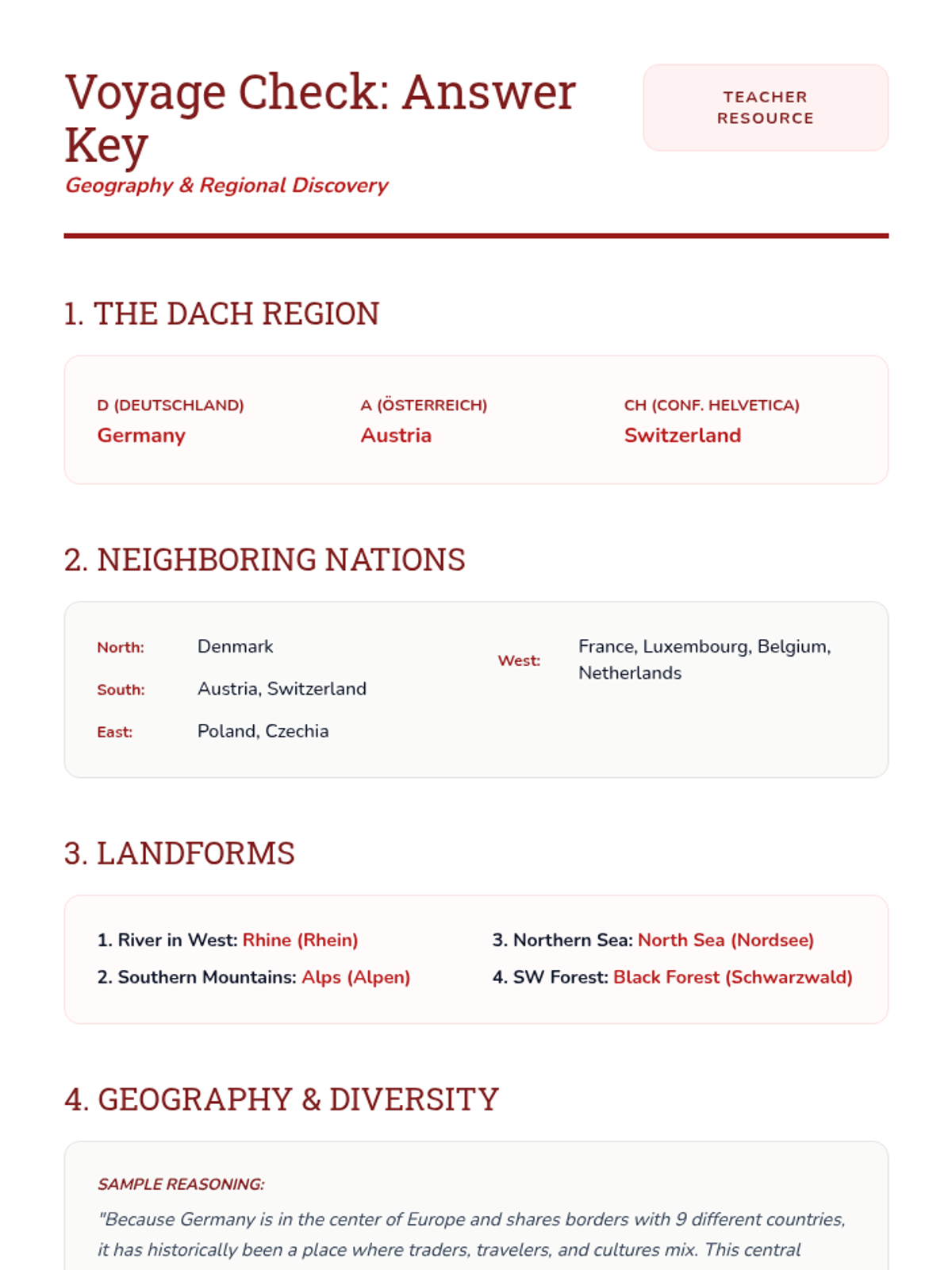
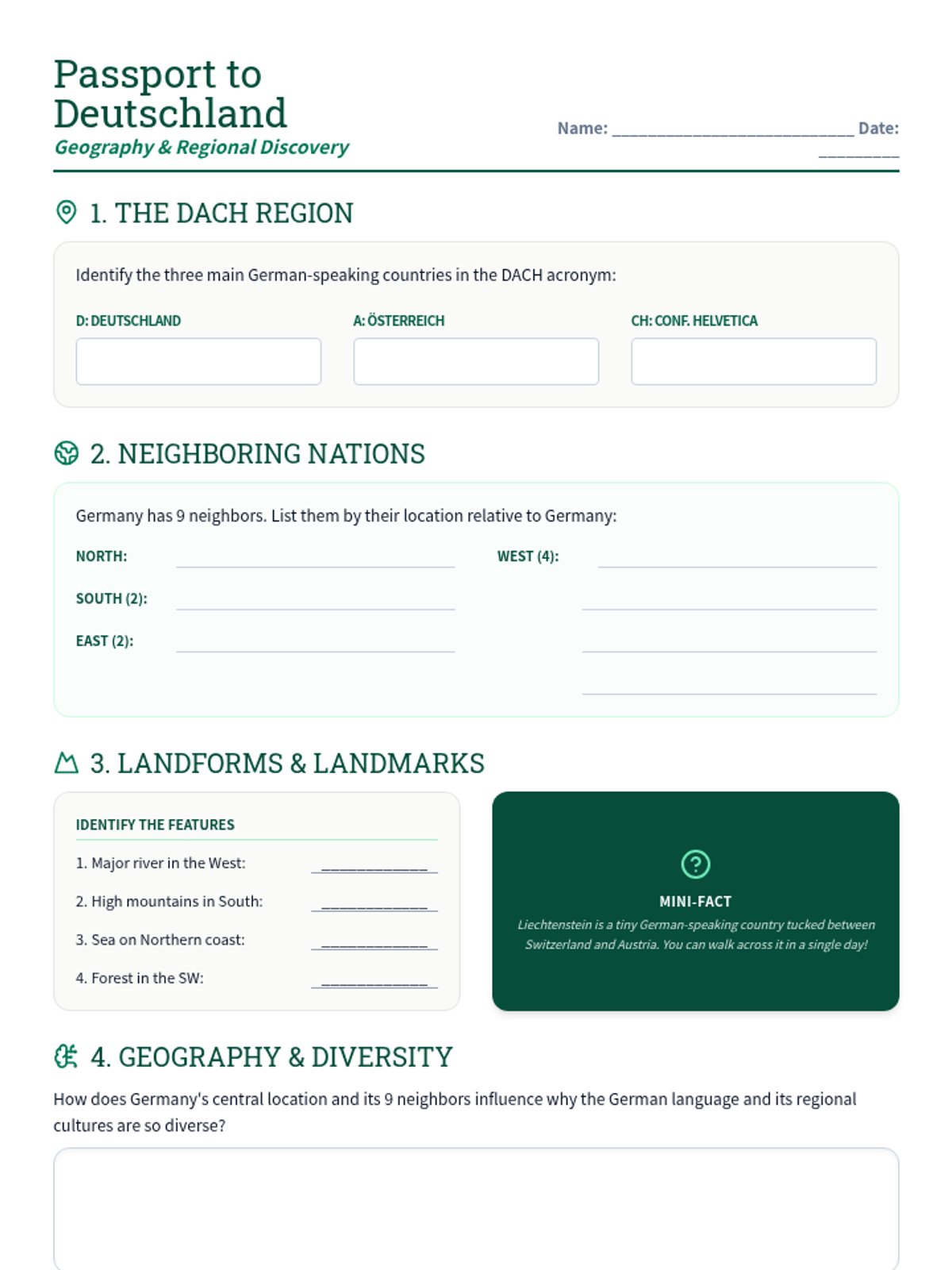
The updated answer key for the geography-focused 'Passport to Deutschland' worksheet. Provides correct identification for the DACH region, the 9 neighbors by direction, and major European landforms.
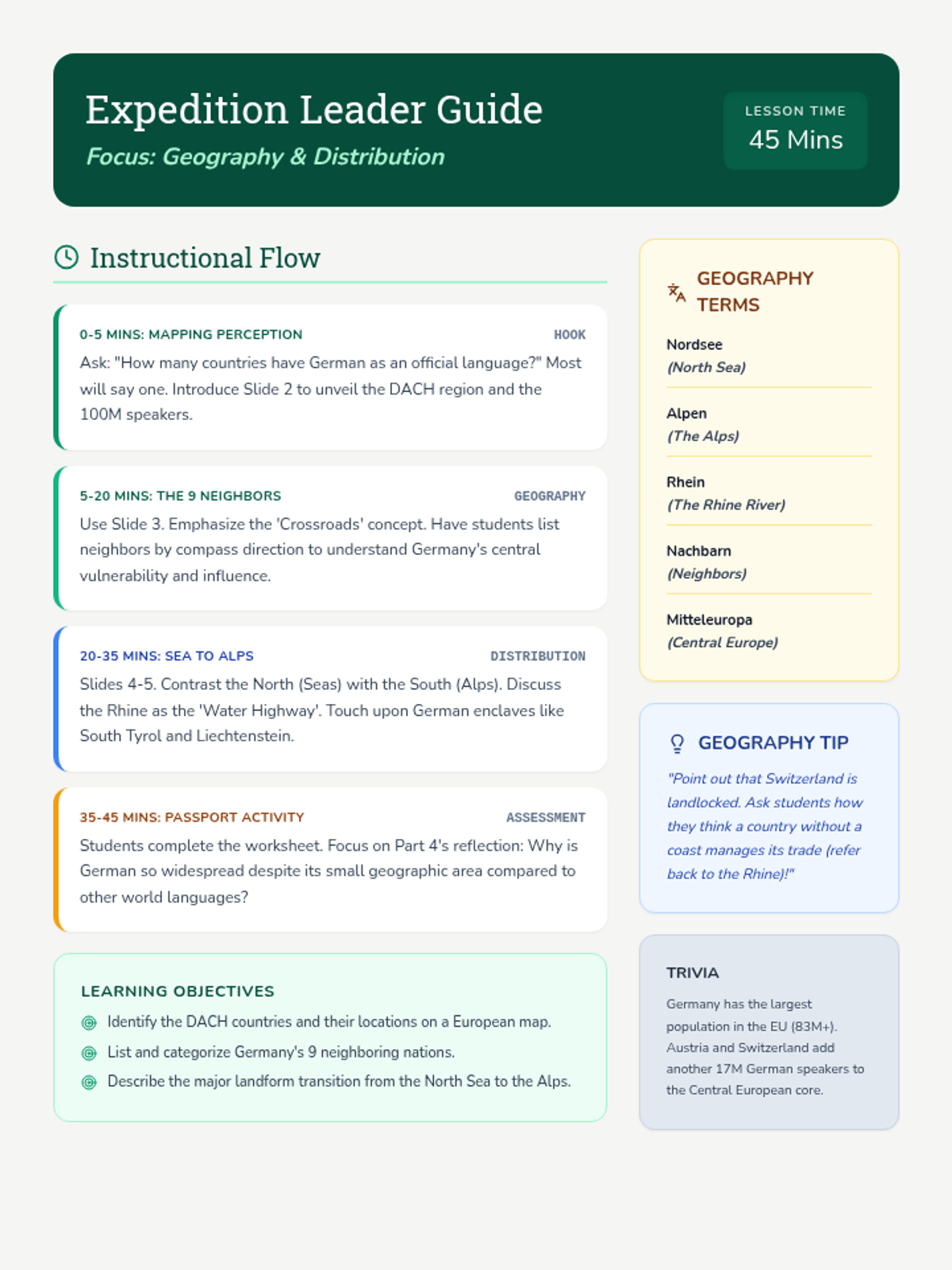
A revised teacher's guide for the 'Alpine Explorer' lesson, pivoting the focus back to geography. Includes updated pacing for map work, discussion prompts for the '9 Neighbors' concept, and geographic vocabulary for students to learn.
An updated student worksheet with a strong focus on the geography of German-speaking regions. Includes identifying the DACH countries, categorizing the 9 neighboring nations, matching geographic features like the Rhine and the Alps, and a reflection on how location shapes linguistic diversity. Condensed to one page.
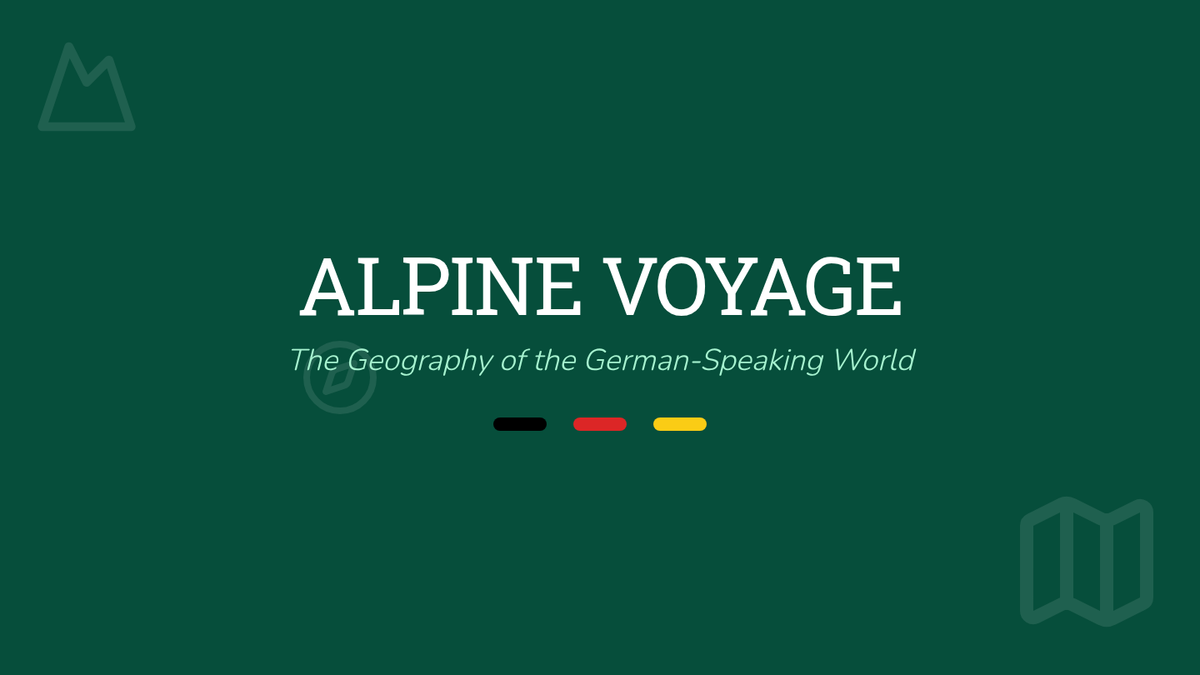
An updated visual presentation focusing heavily on the geography of German-speaking countries. Covers the DACH region, the 9 neighboring countries, regional landscapes (North Sea to Alps), and German-speaking areas outside the main three. Consolides cultural content to show the link between land and tradition. Fixed markdown syntax and icon rendering.