Develops technical proficiency and creative movement skills across various styles. Examines choreographic principles alongside the historical and cultural origins of diverse global dance forms.
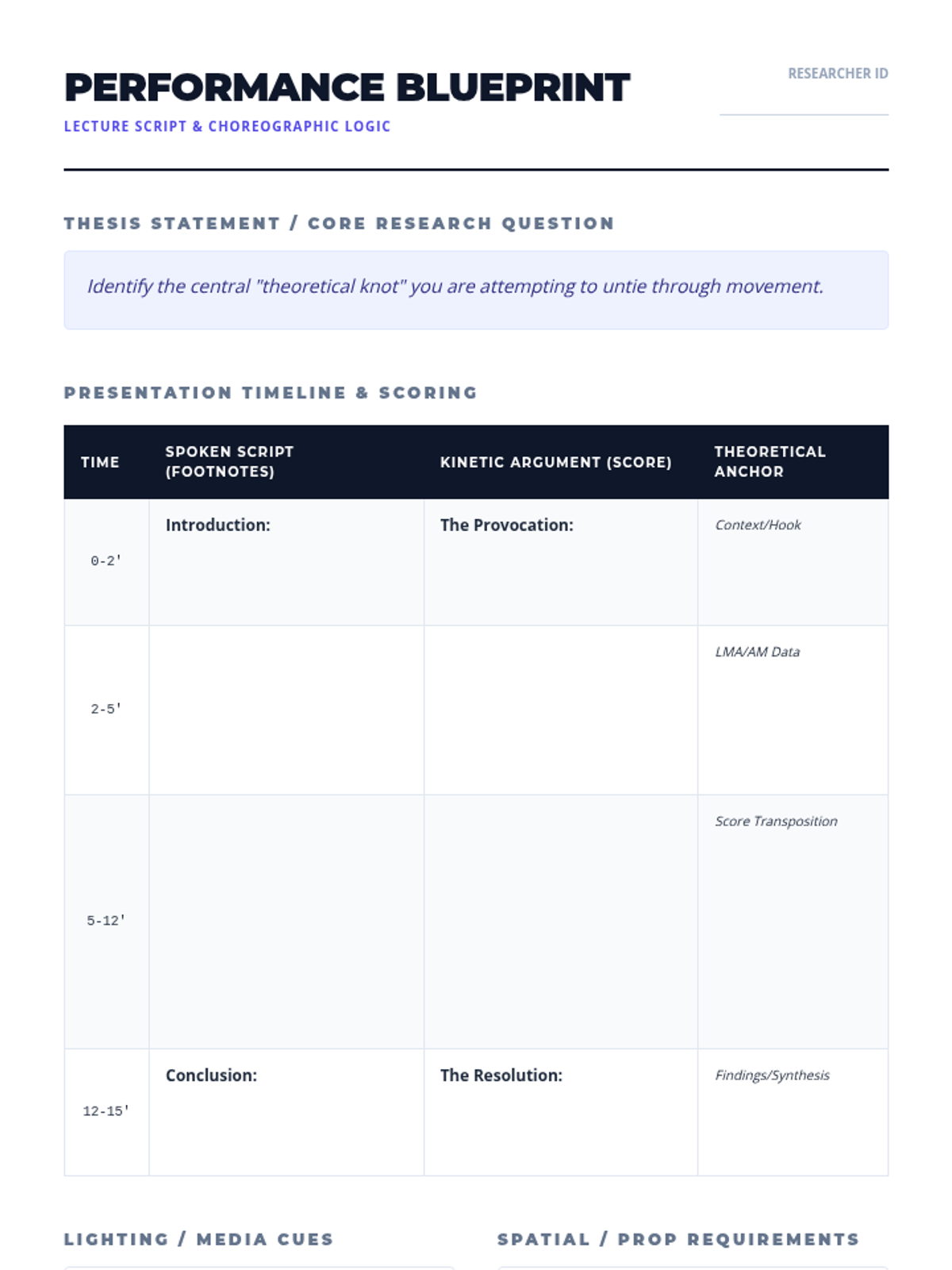
Planning worksheet for the final performance-lecture presentation, featuring a multi-column timeline for scripting and movement scoring.
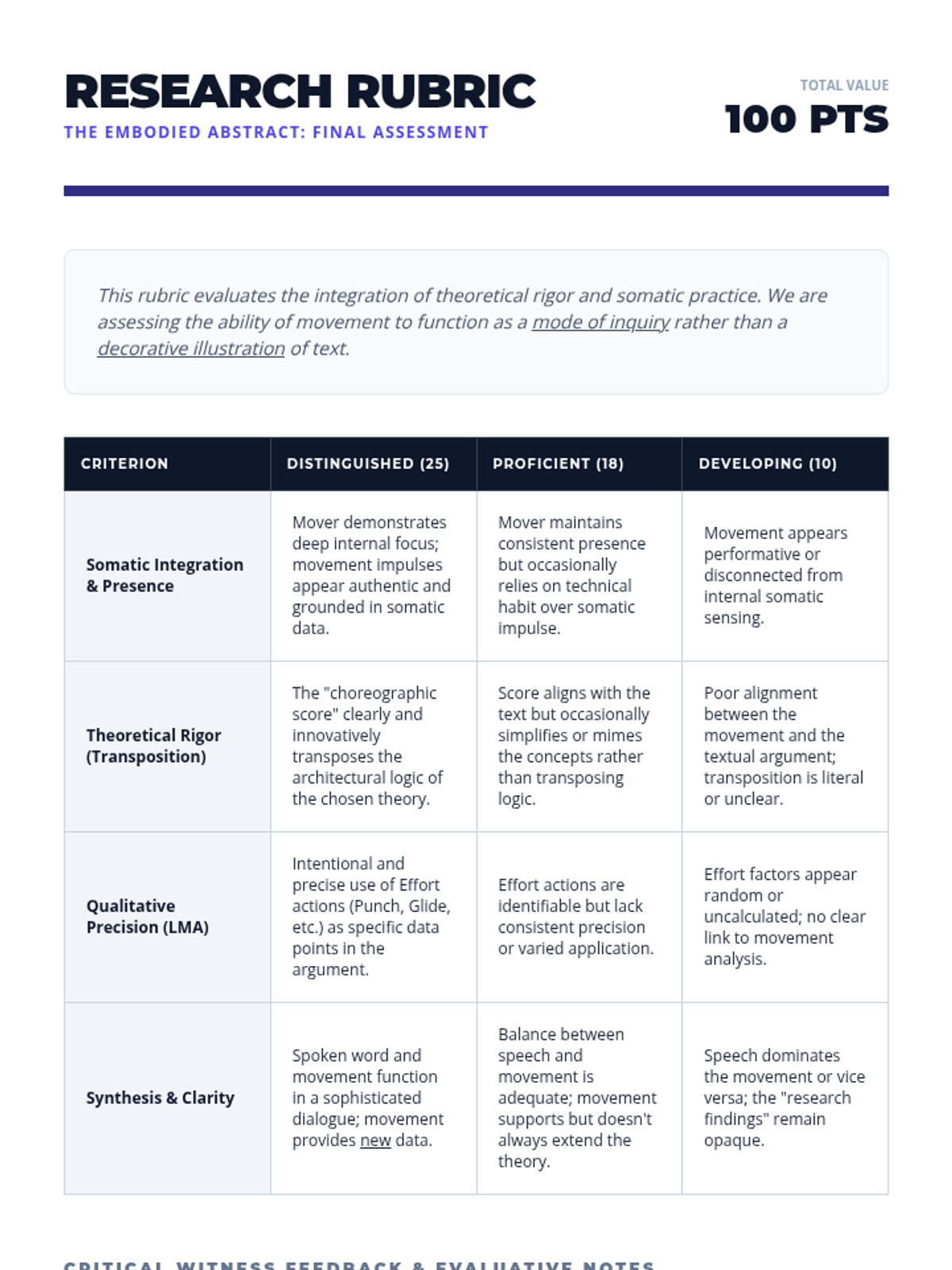
Research-focused assessment rubric for the final performance-lecture, evaluating somatic integration, theoretical rigor, and movement analysis application.
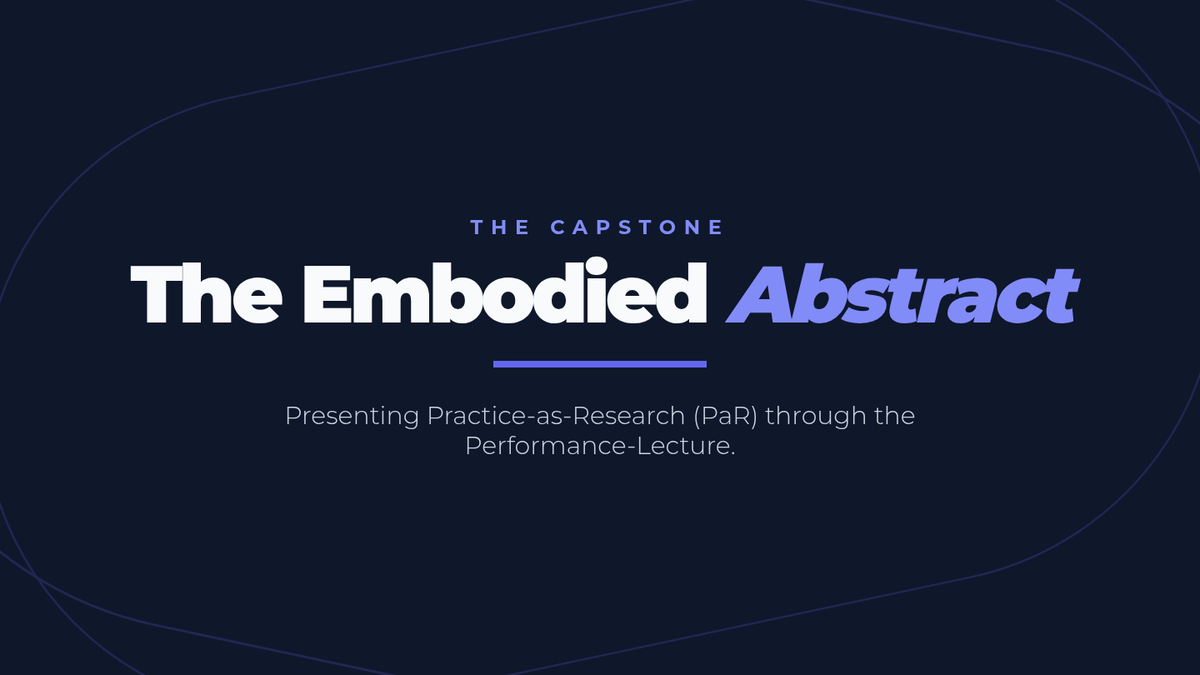
Final slide deck for Lesson 5, defining the performance-lecture format and its role in embodied research presentation.
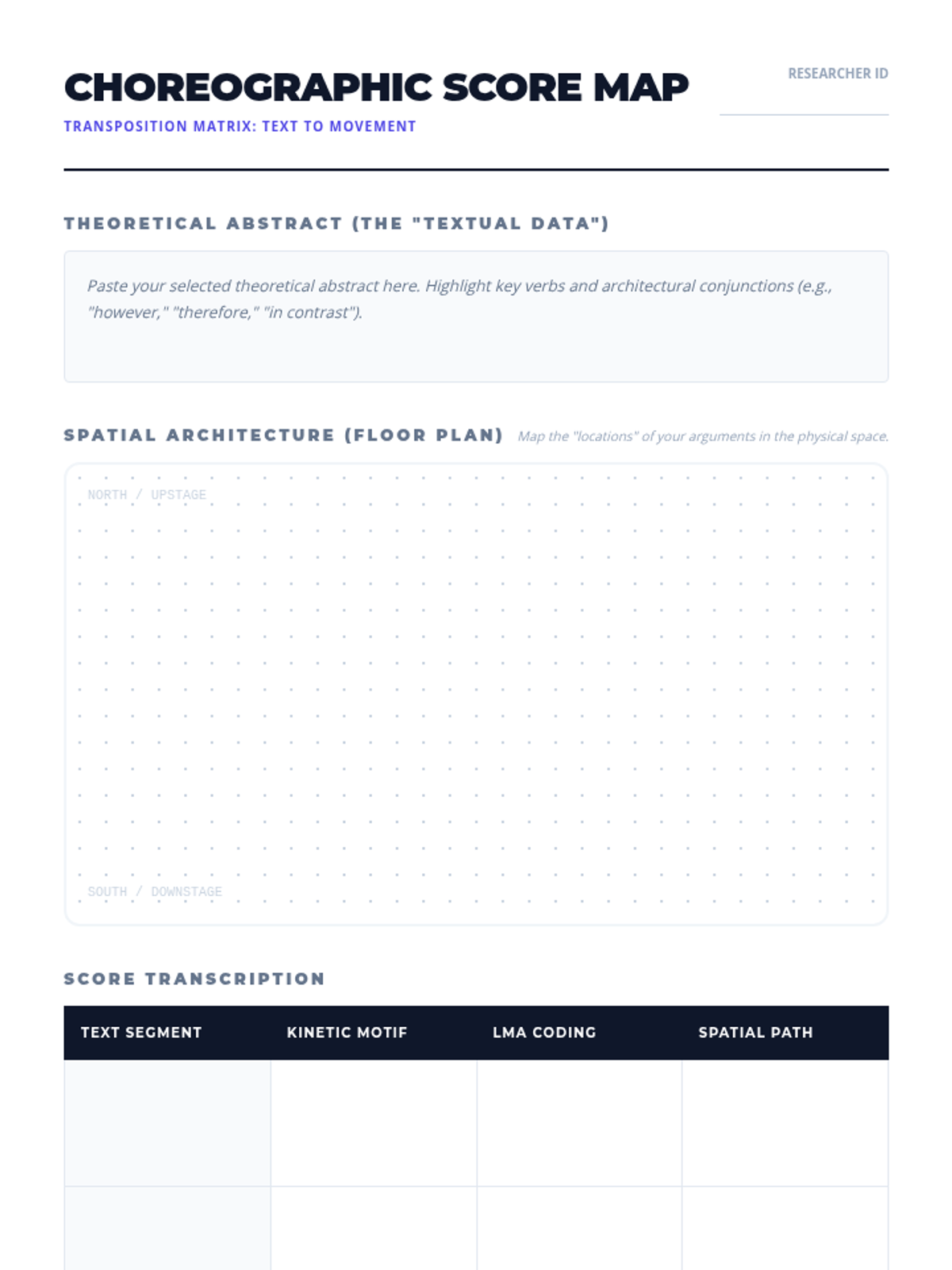
Worksheet for mapping a theoretical text to a choreographic score, featuring a spatial floor plan area and a detailed transcription table.
Introductory presentation for Lesson 4, exploring the transposition of theoretical texts into choreographic scores for research analysis.
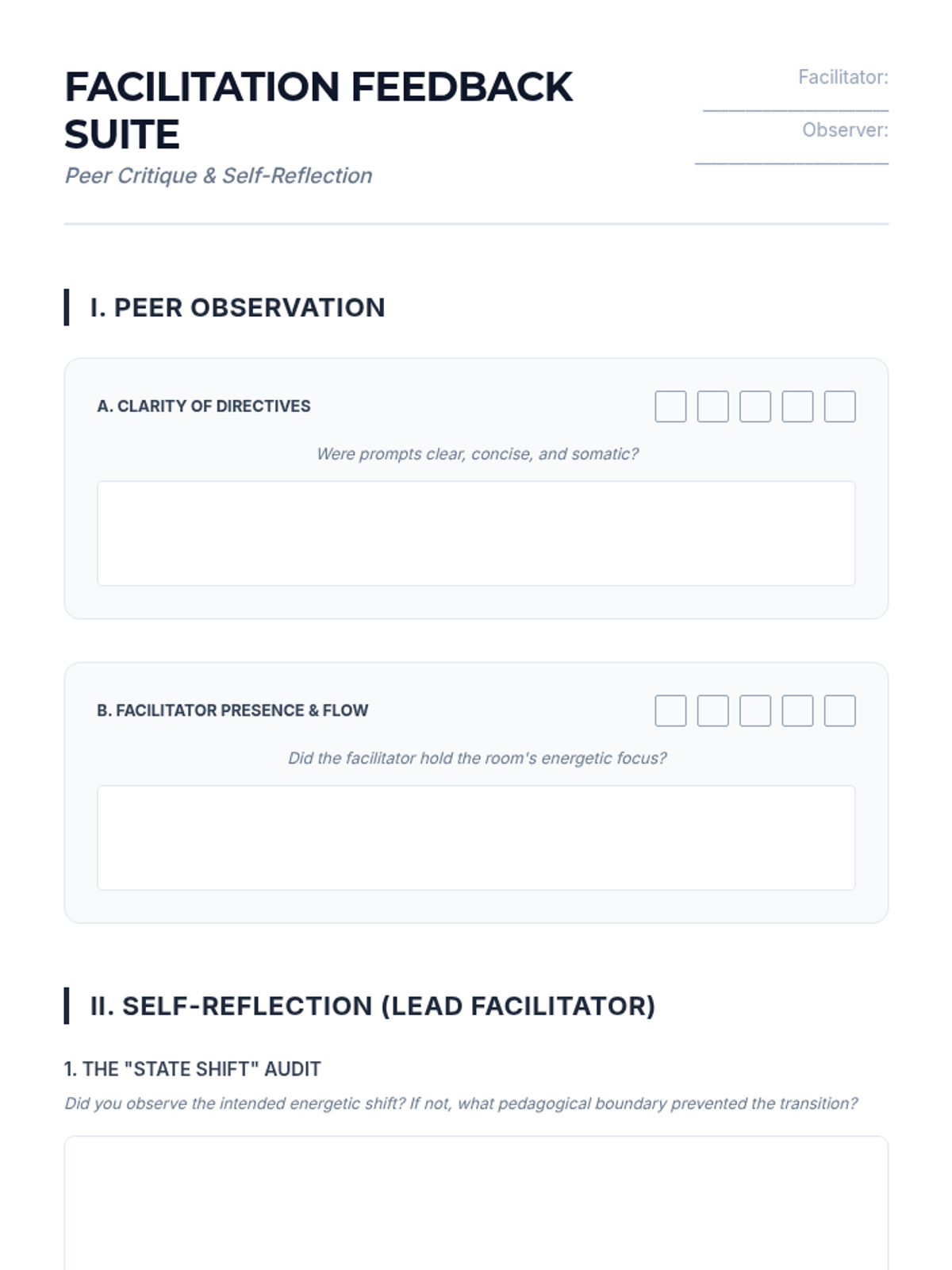
Comprehensive feedback and reflection tool for both peer observers and the lead facilitator following the practicum session.
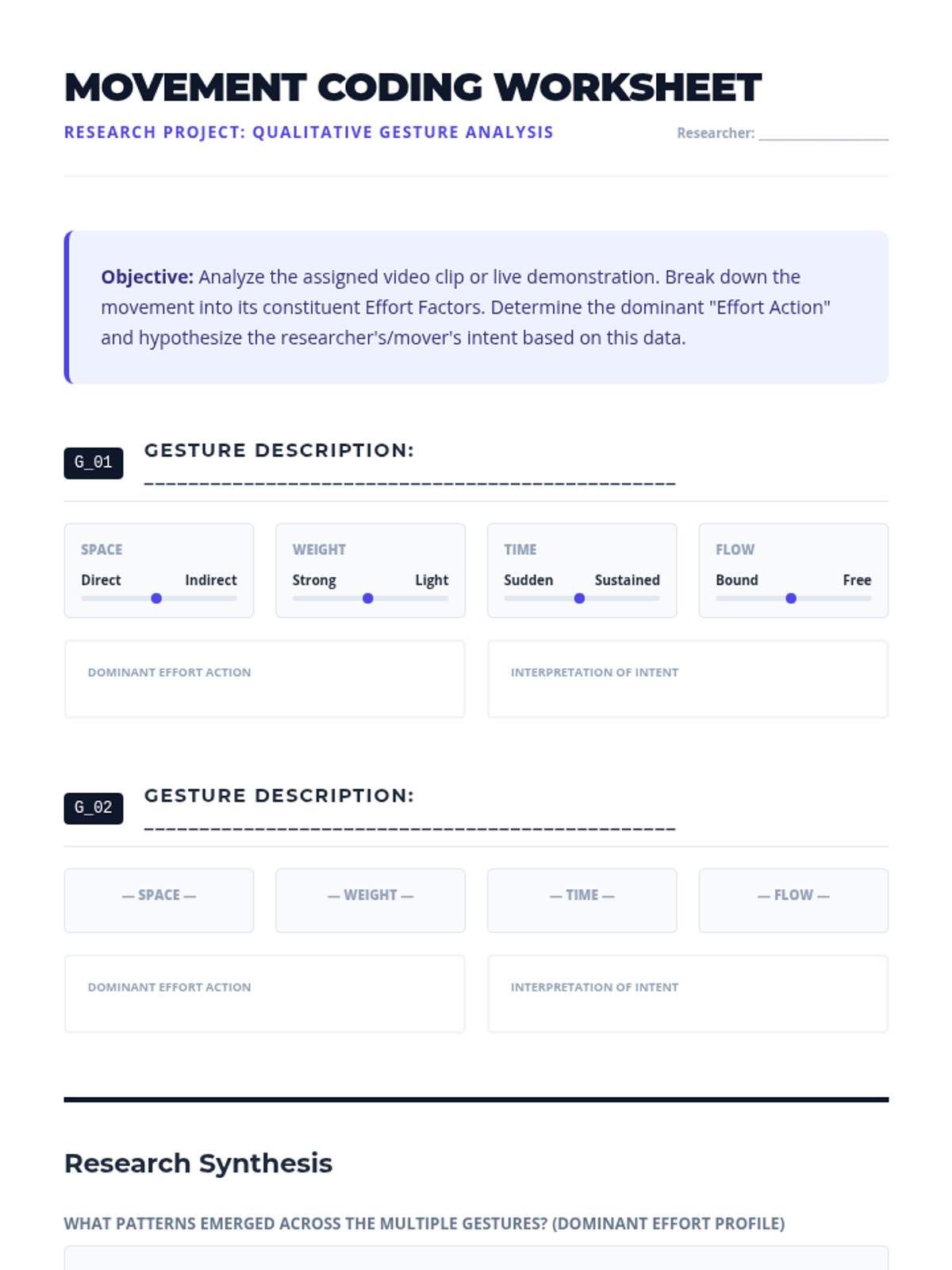
Worksheet for practicing the codification of movement using Laba Effort factors, with sections for gesture analysis and research synthesis.
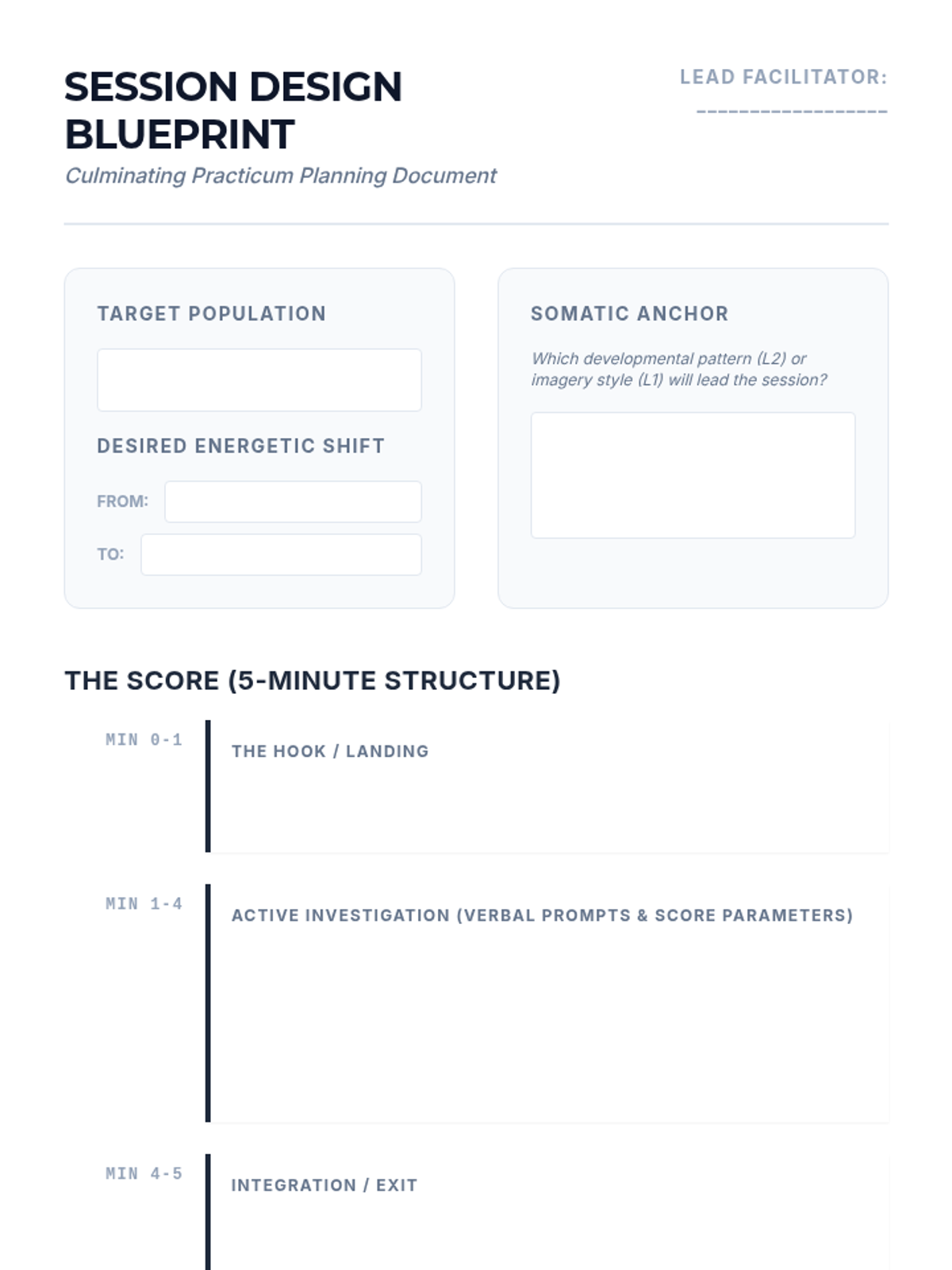
Planning document for the facilitation practicum, requiring students to architect a 5-minute movement session with somatic anchors and safety audits.
Final slide deck for the culminating practicum, focusing on the concepts of group flow, collective attunement, and the peer critique framework.
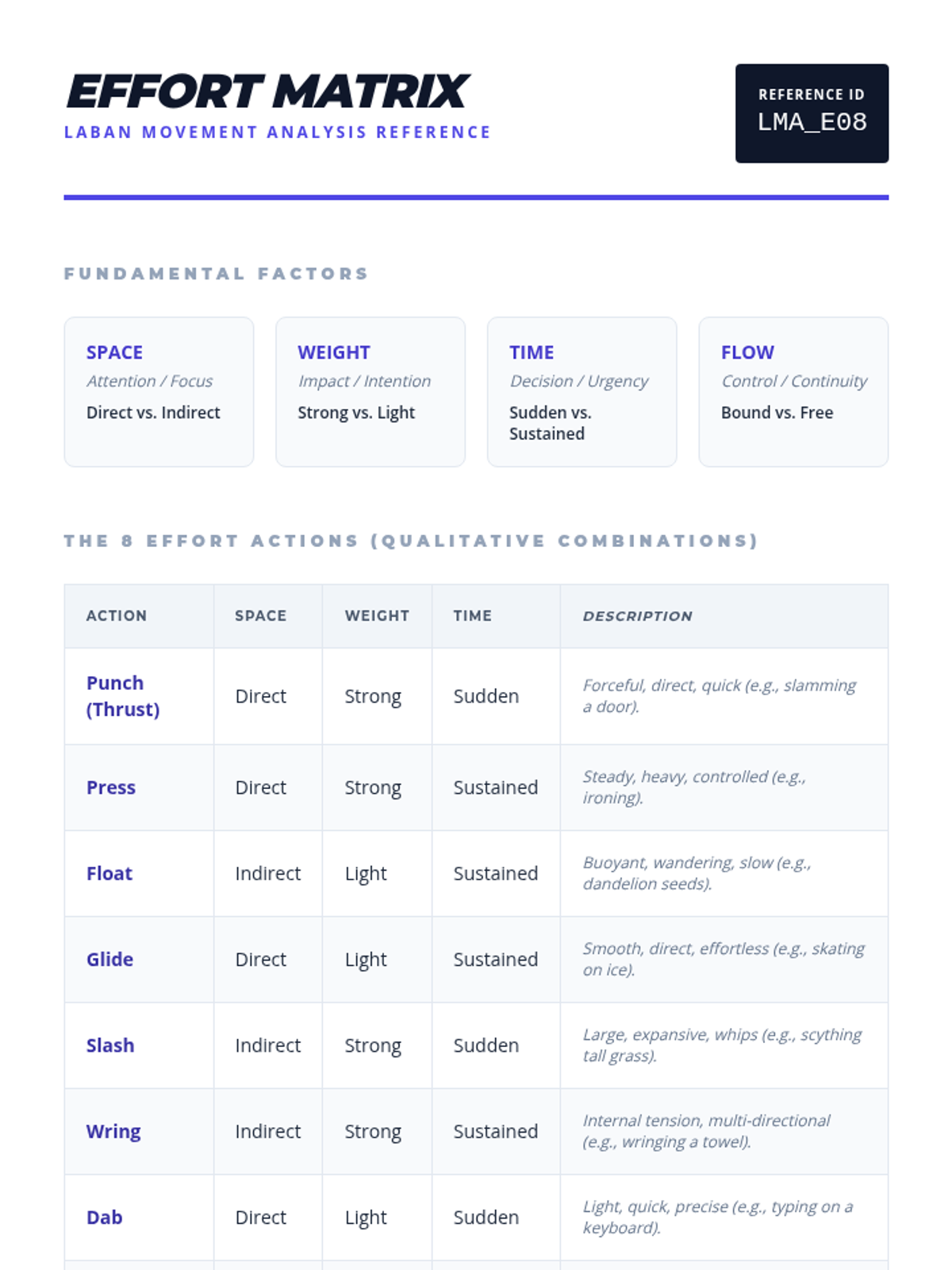
Reference sheet detailing the Laban Effort factors and the eight Effort actions for movement analysis.
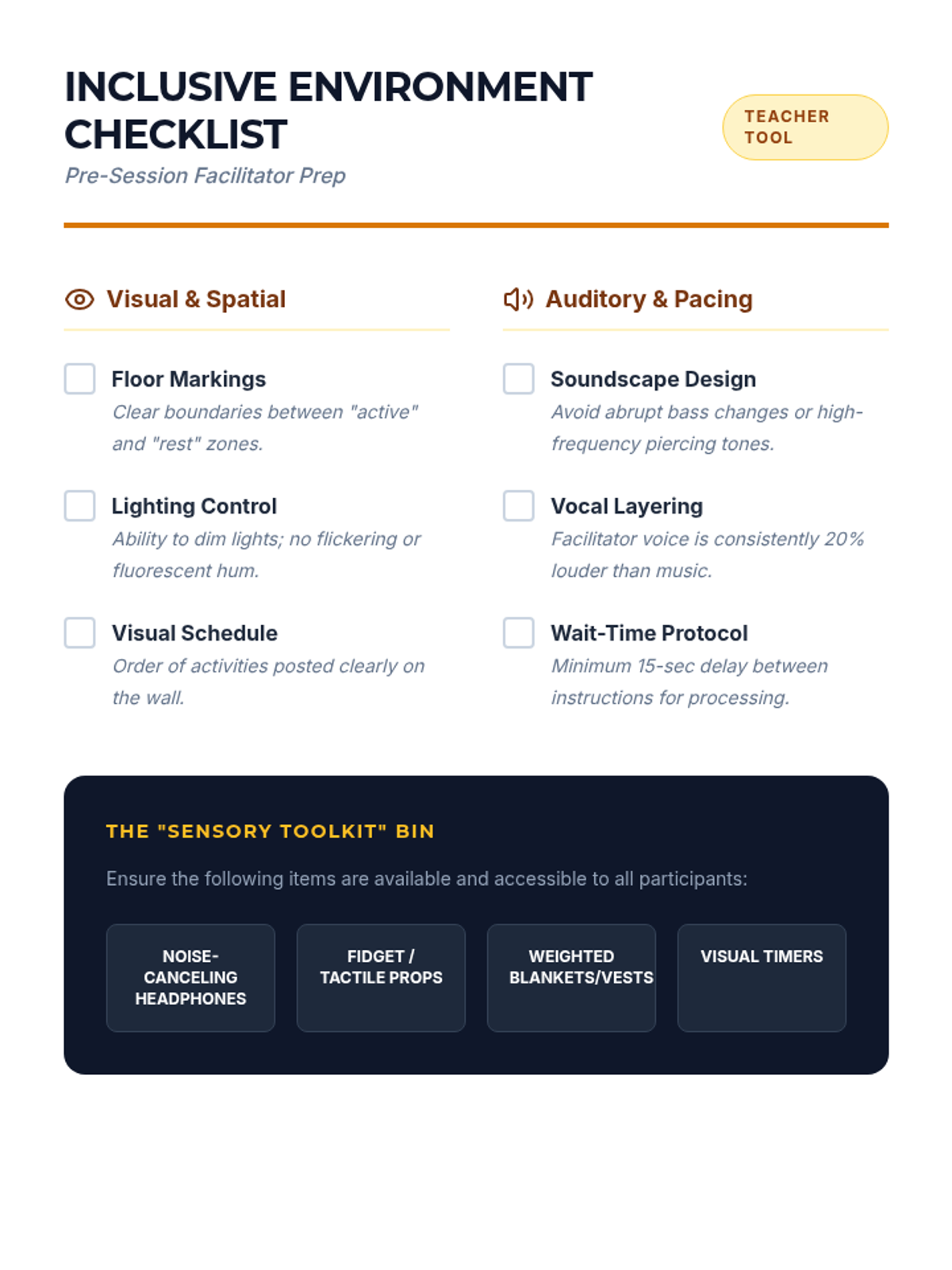
Checklist for movement facilitators to ensure their environment and teaching practices are inclusive of neurodiverse movers.
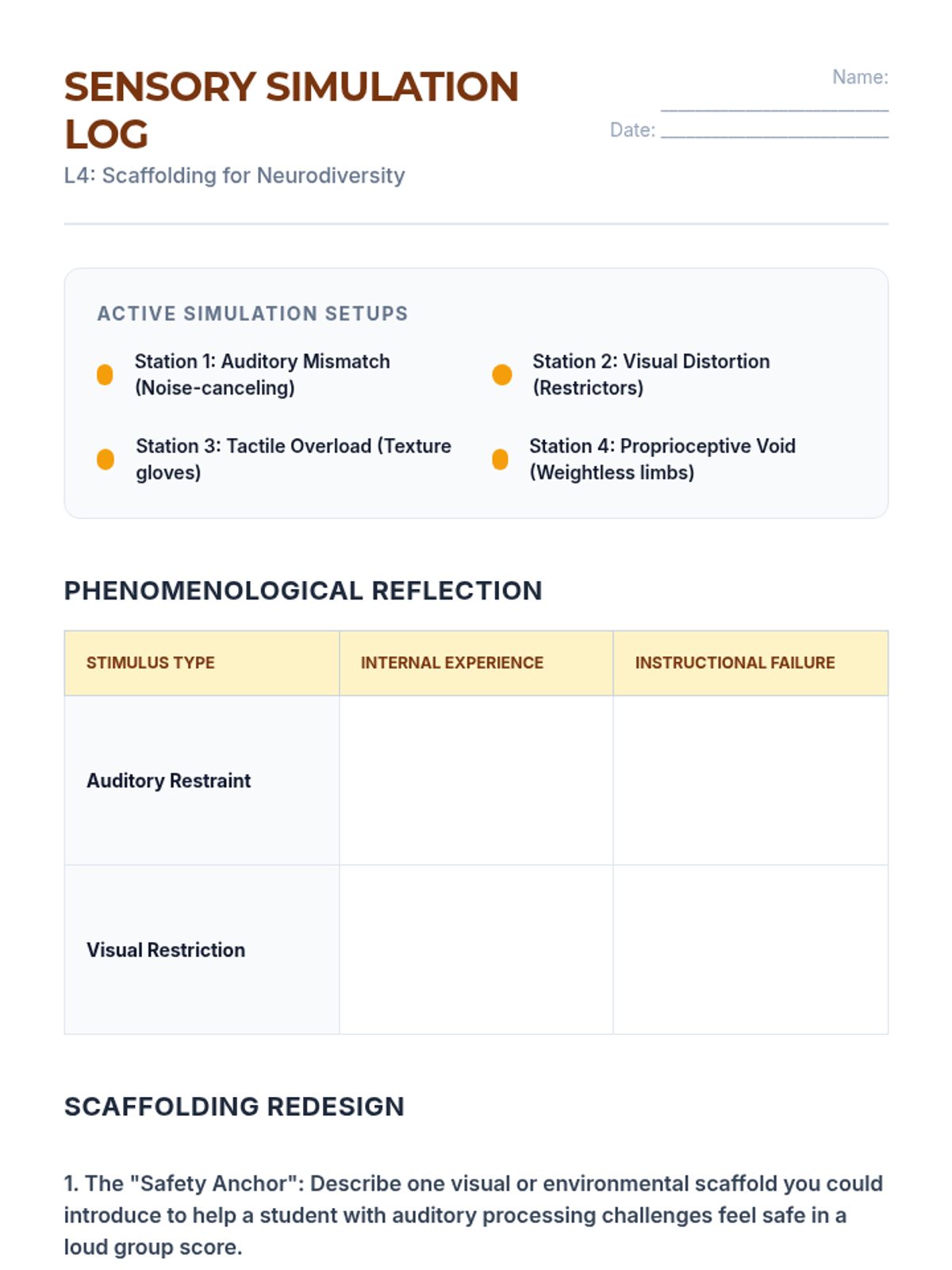
Logbook for students to record their experiences during sensory processing simulations and reflect on pedagogical scaffolds.
Introductory slides for Lesson 3, exploring Laban Movement Analysis (LMA) as a qualitative data coding tool in research.
Slide deck exploring neurodiversity in movement settings, focusing on sensory processing and scaffolding strategies for inclusive facilitation.
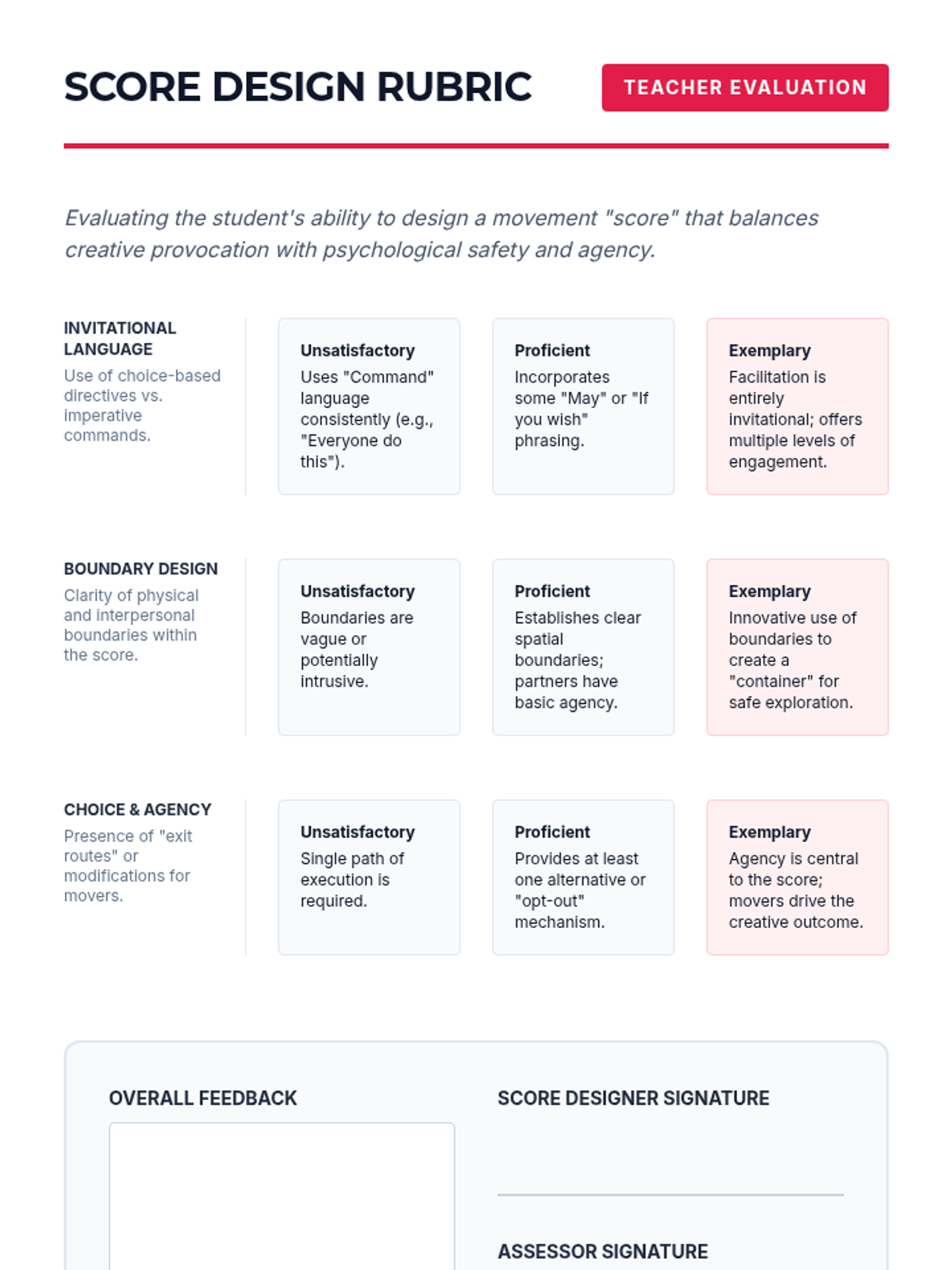
Teacher evaluation rubric for assessing the trauma-informed design of movement scores.
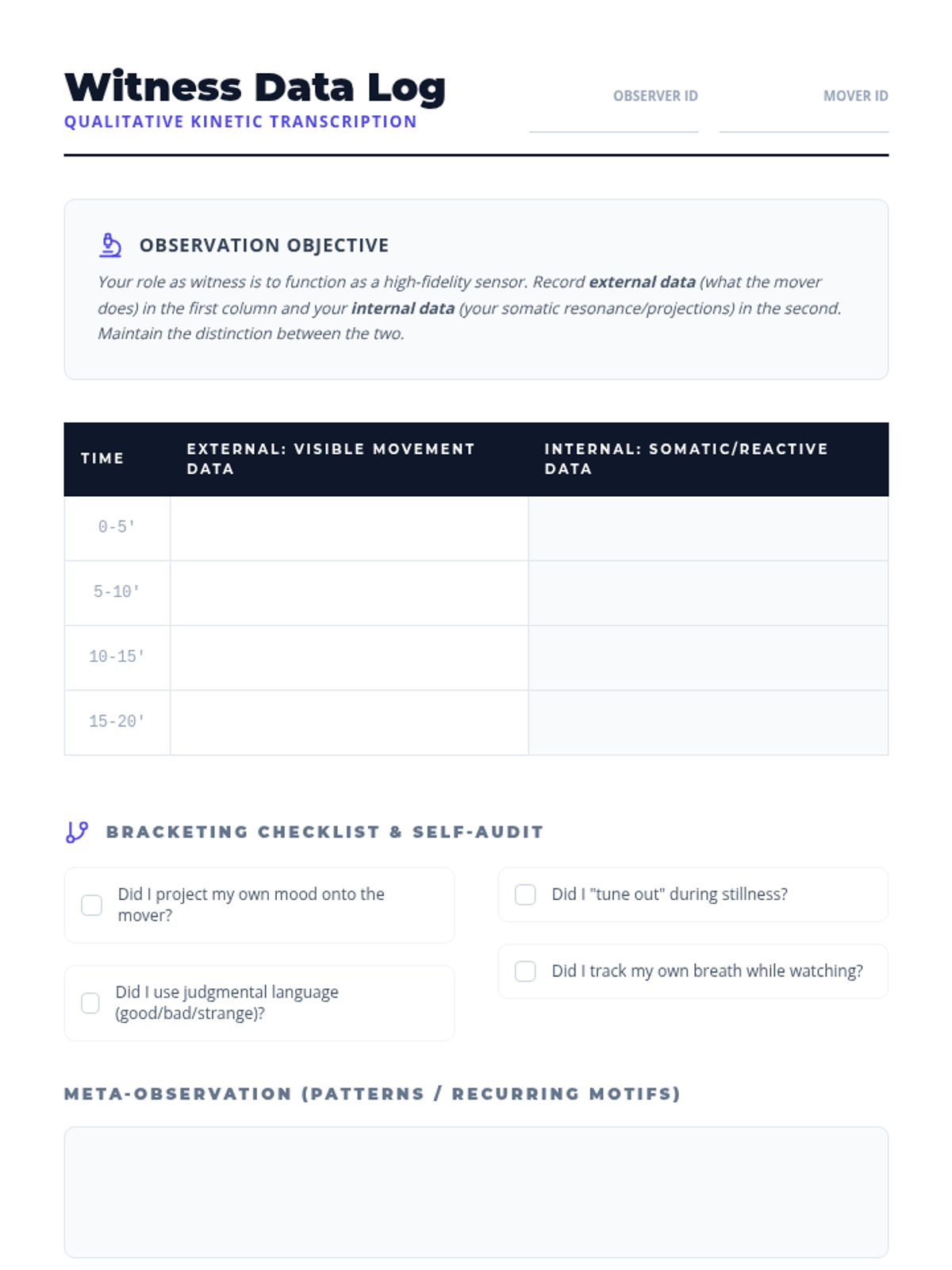
Observation sheet for the Mover/Witness discipline in Authentic Movement, featuring structured columns for external data and internal witness responses.
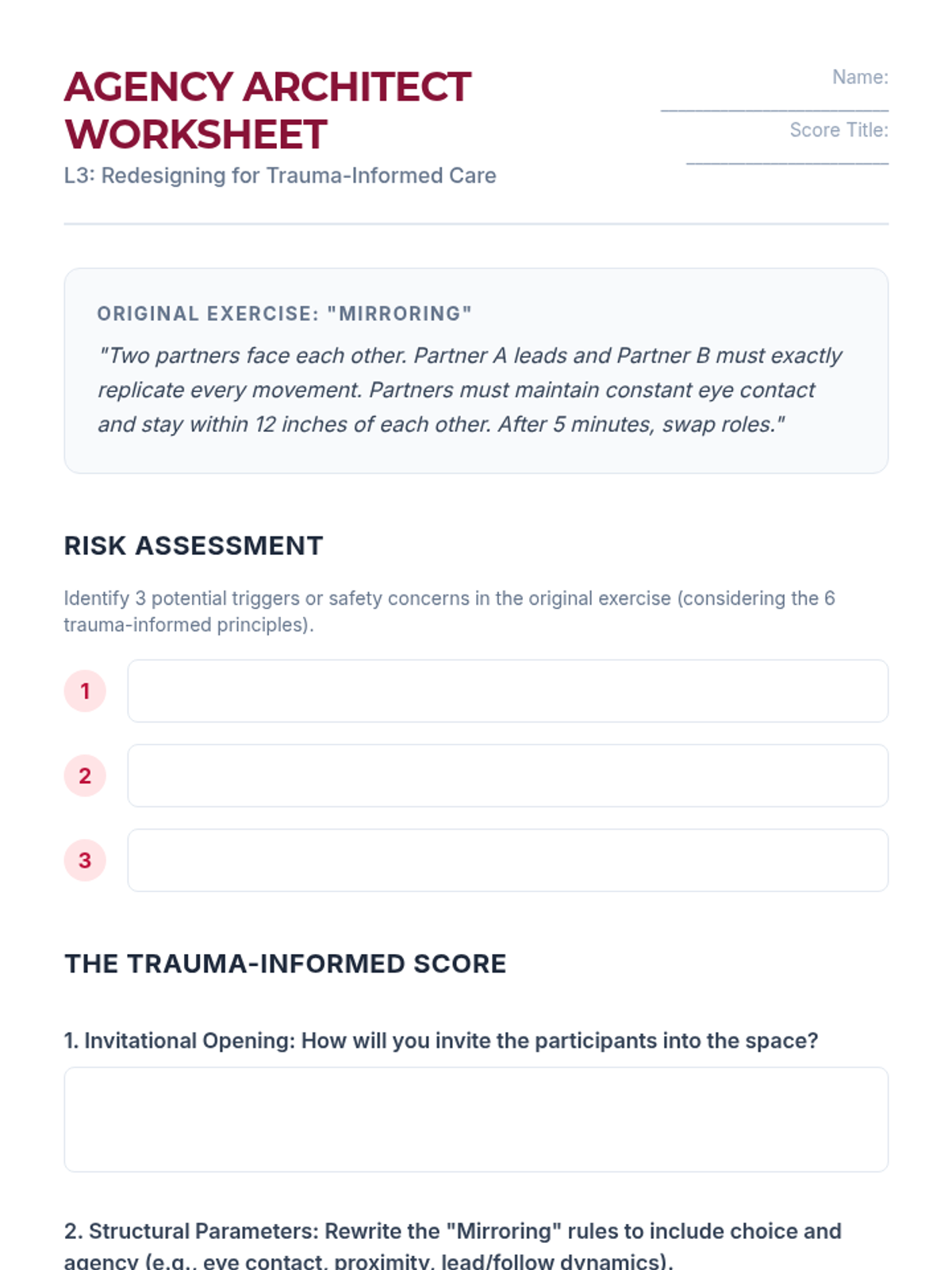
Worksheet for graduate students to analyze traditional improvisation exercises and redesign them using trauma-informed principles.
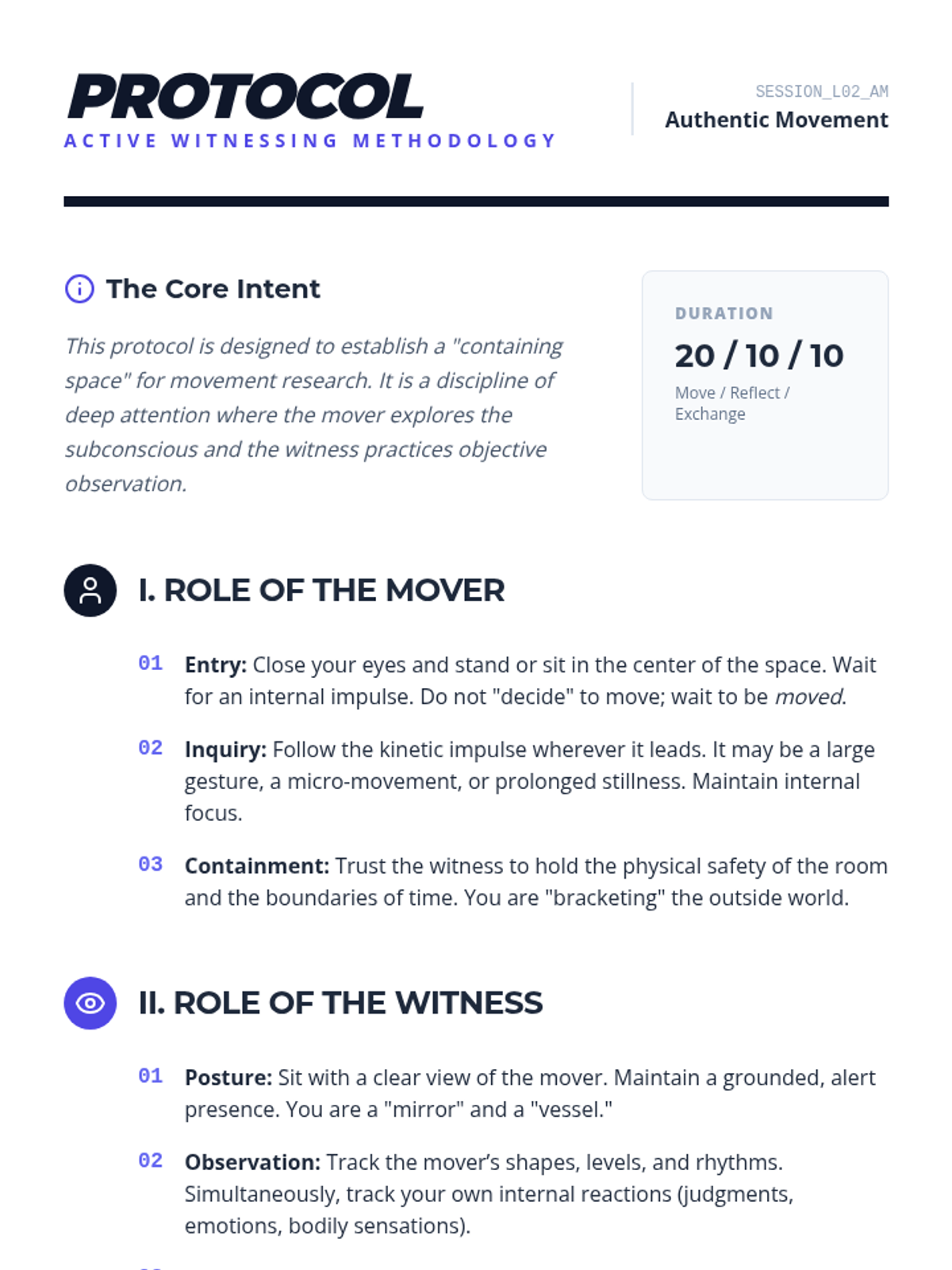
Protocol guide for the Mover/Witness discipline in Authentic Movement, including specific linguistic frames for the feedback loop.
Slide deck investigating the intersection of creative movement, emotional safety, and the design of trauma-informed 'scores'.
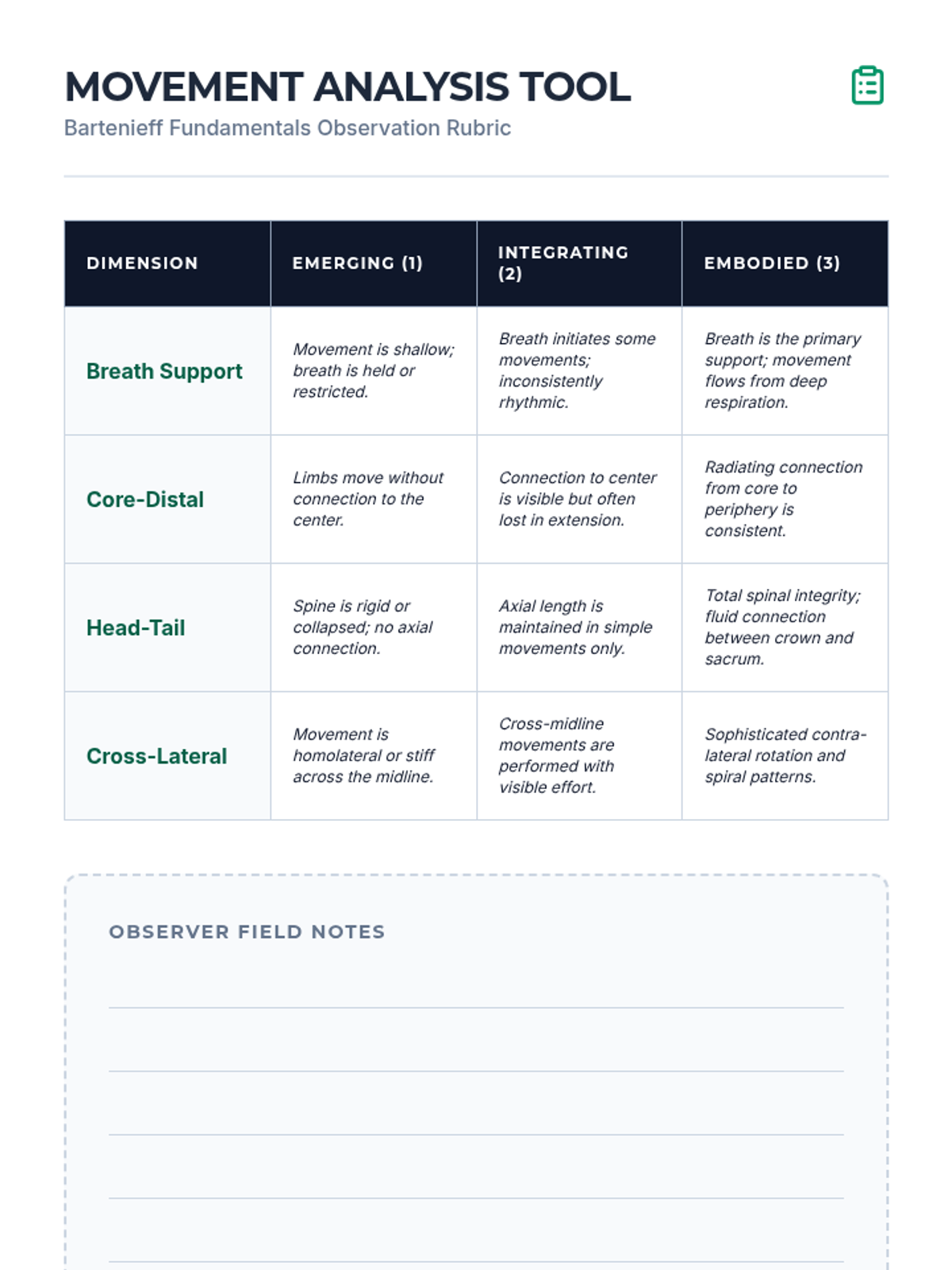
Observation rubric for teachers and students to assess movement patterns based on Bartenieff Fundamentals.
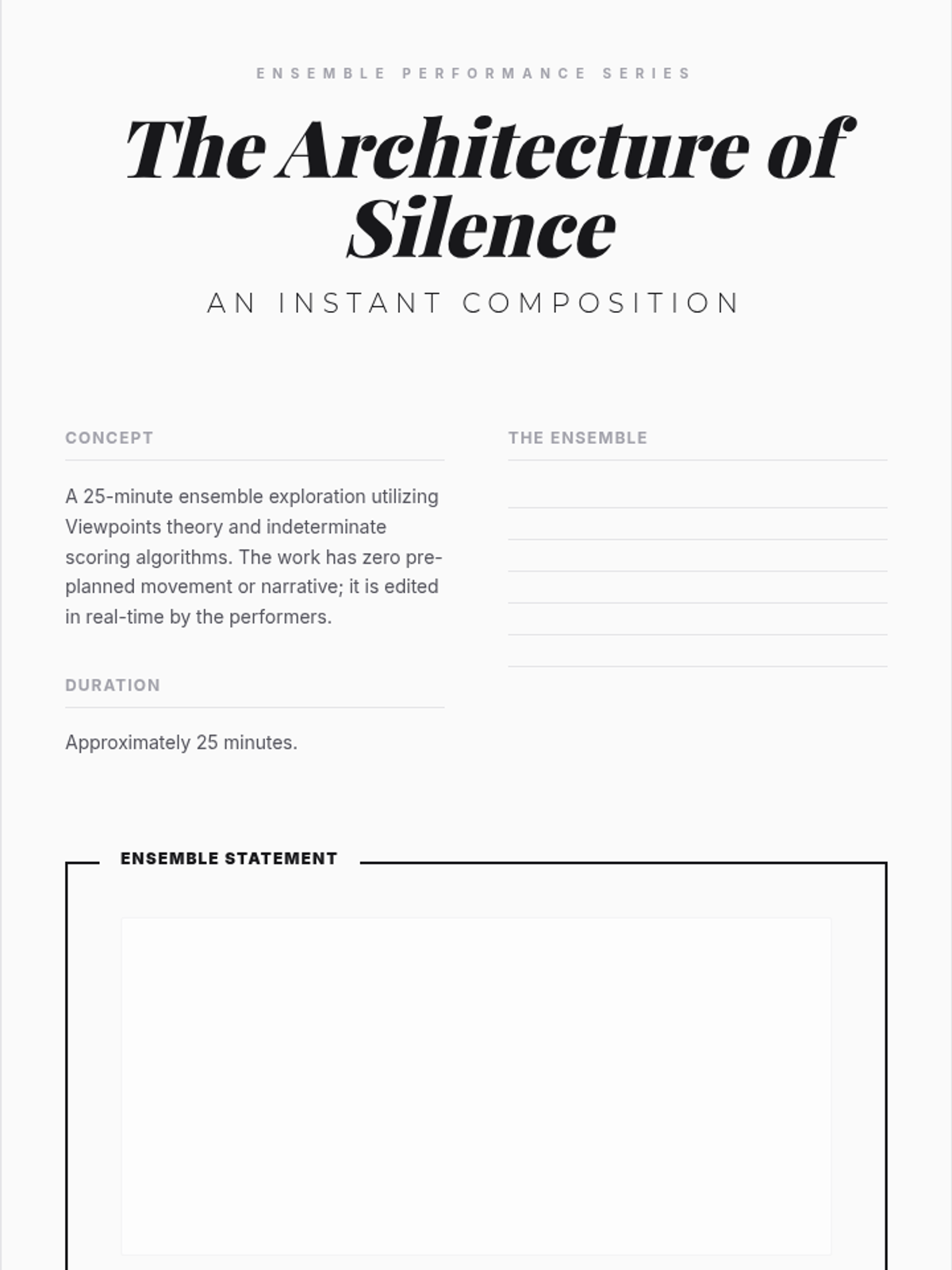
A sleek, minimalist program template for students to document their ensemble performance and list their specific movement scores.
Final performance protocol slides for the Ensemble Instant Composition Showcase, detailing duration, success criteria, and prompts.
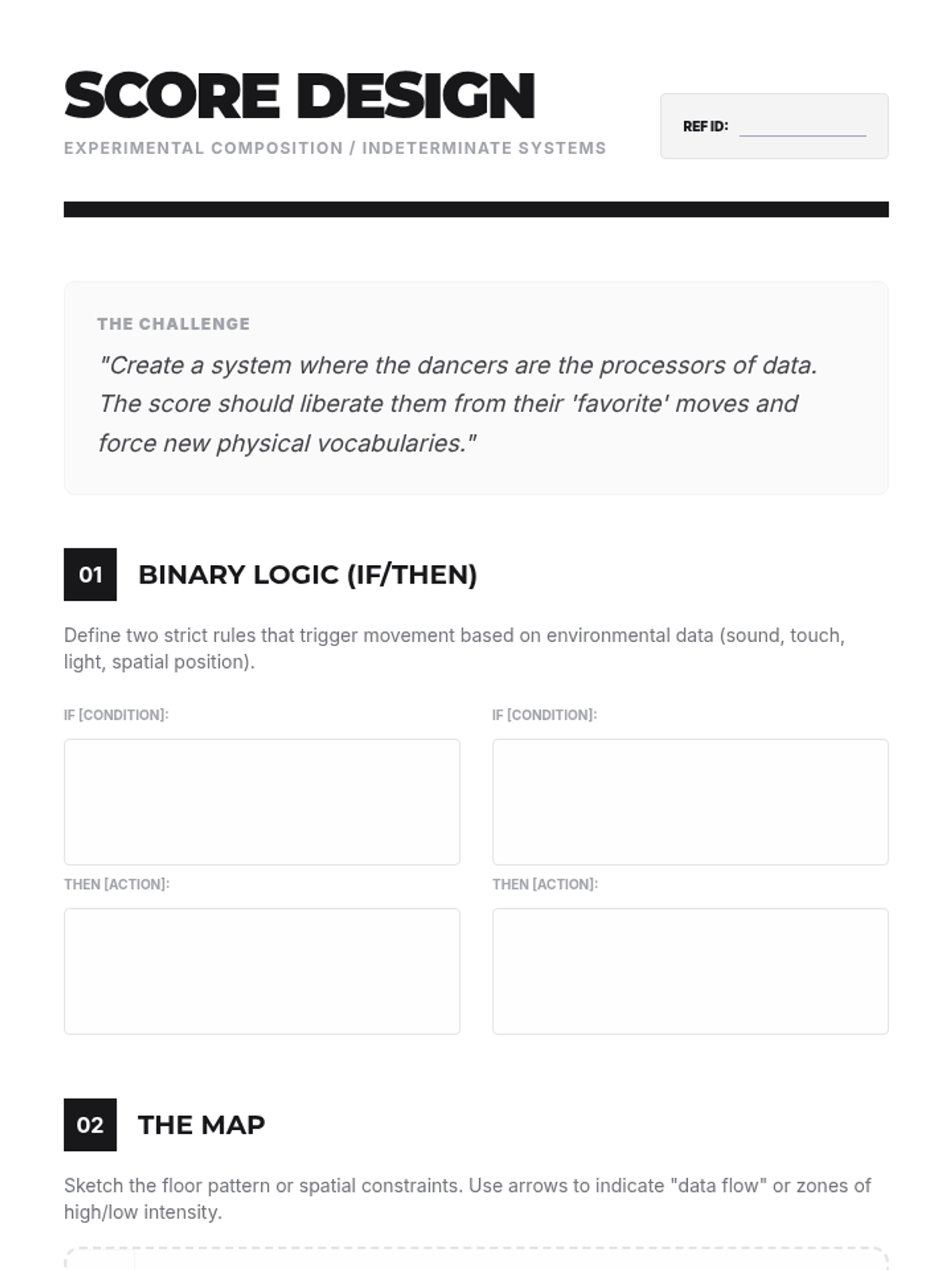
A structured template for graduate students to design and document their own indeterminate movement scores and algorithms.
Slides for graduate dance students investigating the history and practice of indeterminate scoring, including Pioneers and Project prompts.
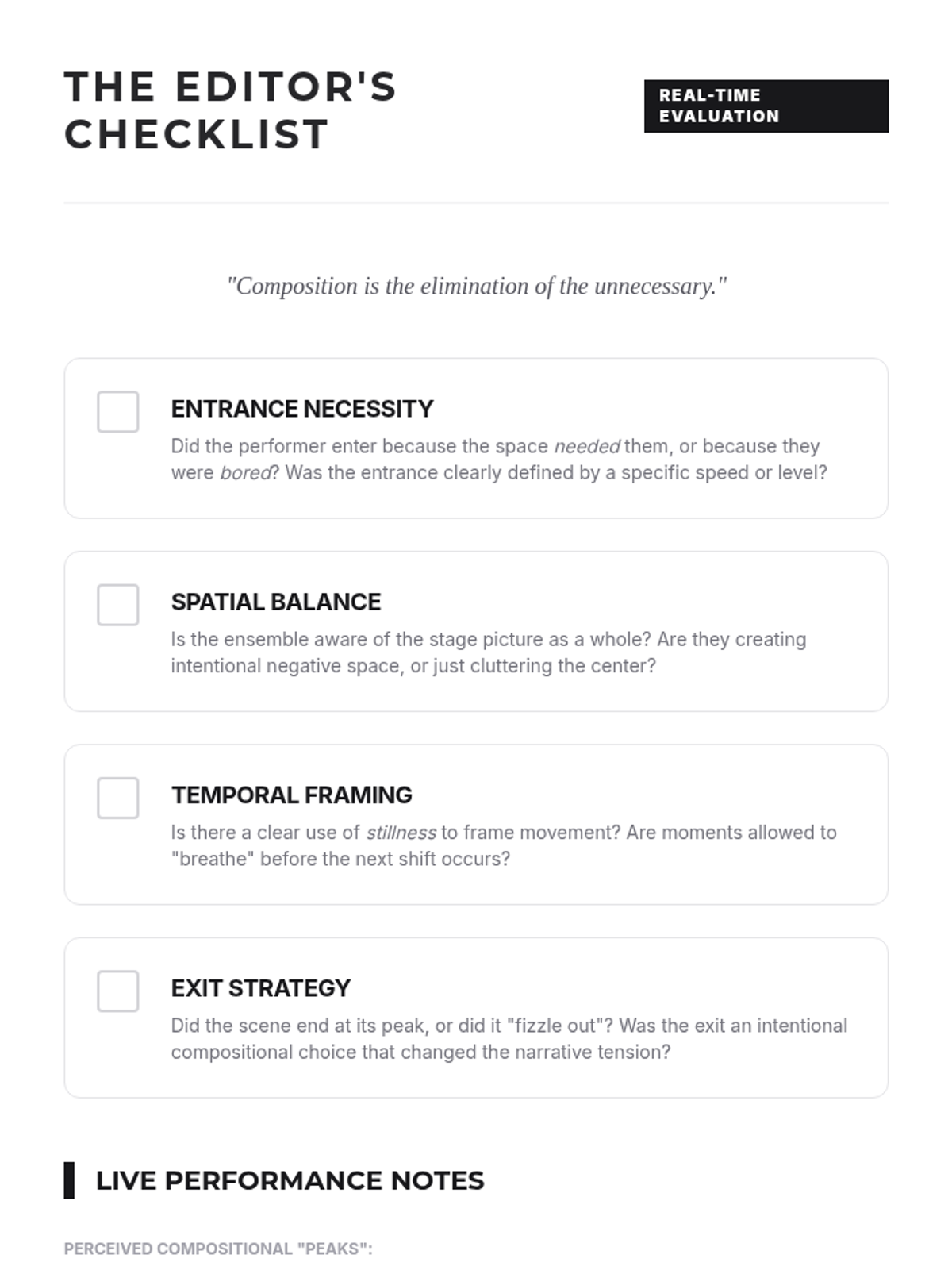
A checklist and note-taking template for graduate students to evaluate compositional rigor and real-time editing in ensemble improvisation.
Slides for graduate students on real-time editing in improvisation, distinguishing compositional rigor from unstructured 'jamming.'
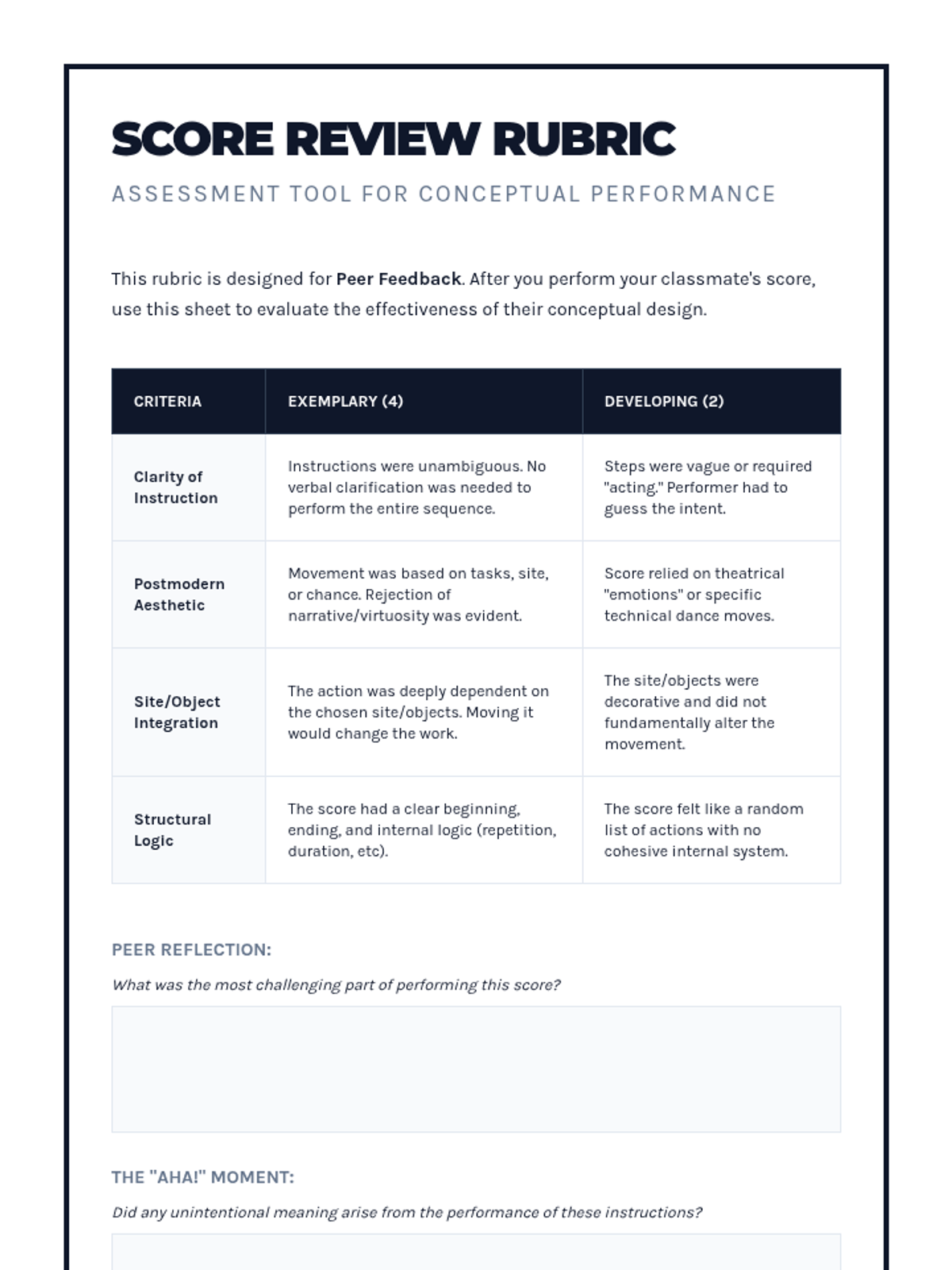
A peer-assessment rubric for evaluating student-created performance scores, focusing on clarity, postmodern aesthetics, and structural logic.
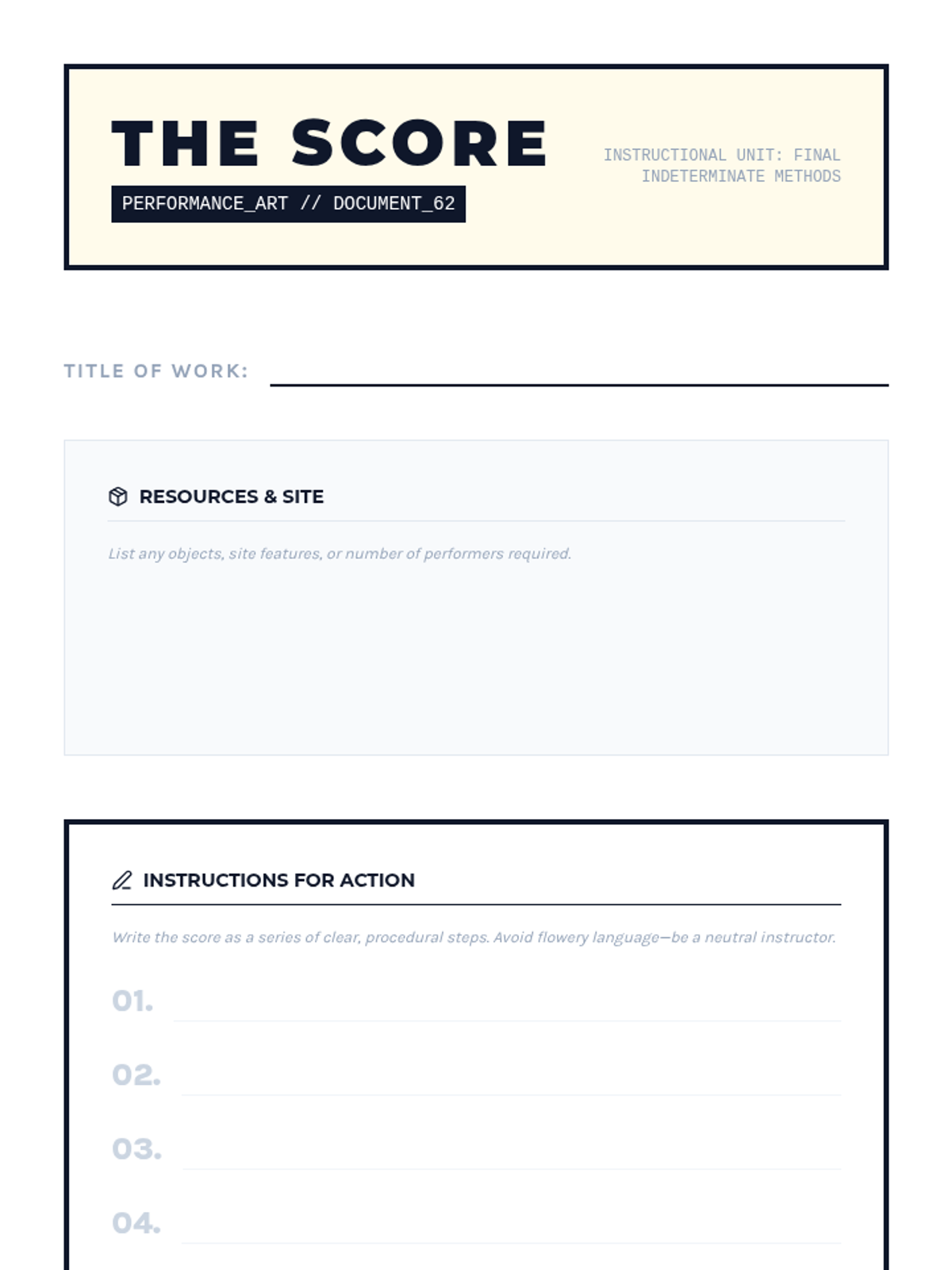
A final project template for students to write a conceptual performance score, focusing on clear instructions and procedural movement.
A slide deck investigating the blur between dance and performance art, teaching students to create and interpret conceptual performance scores.
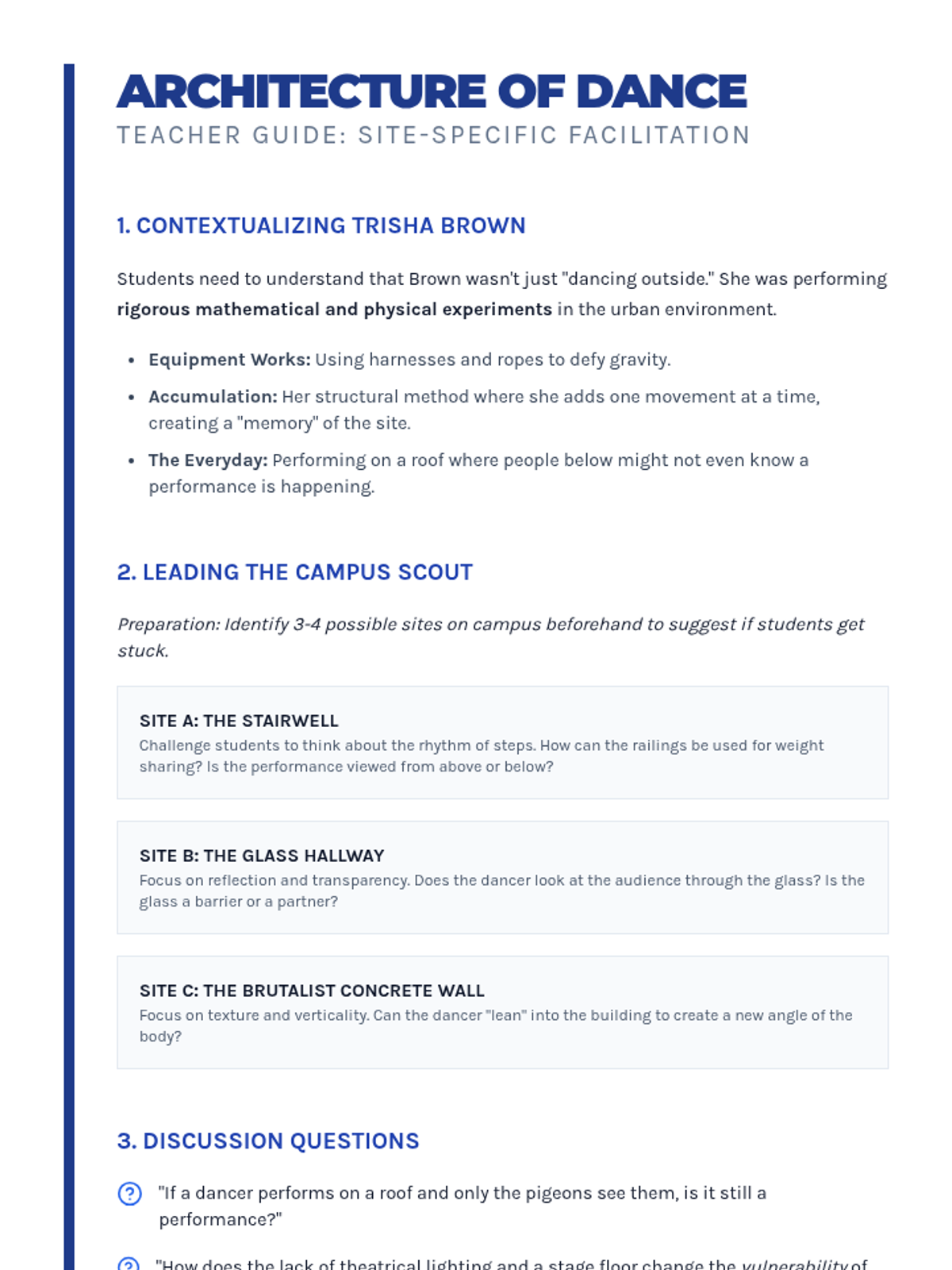
Teacher notes for Lesson 4, focusing on facilitating the campus site-scouting project and analyzing Trisha Brown's site-specific methodology.
A comprehensive teacher facilitation guide for Lesson 1. Includes learning objectives, a detailed pacing guide, questioning strategies, and key vocabulary to reinforce during the 'Roots and Revelations' instruction.
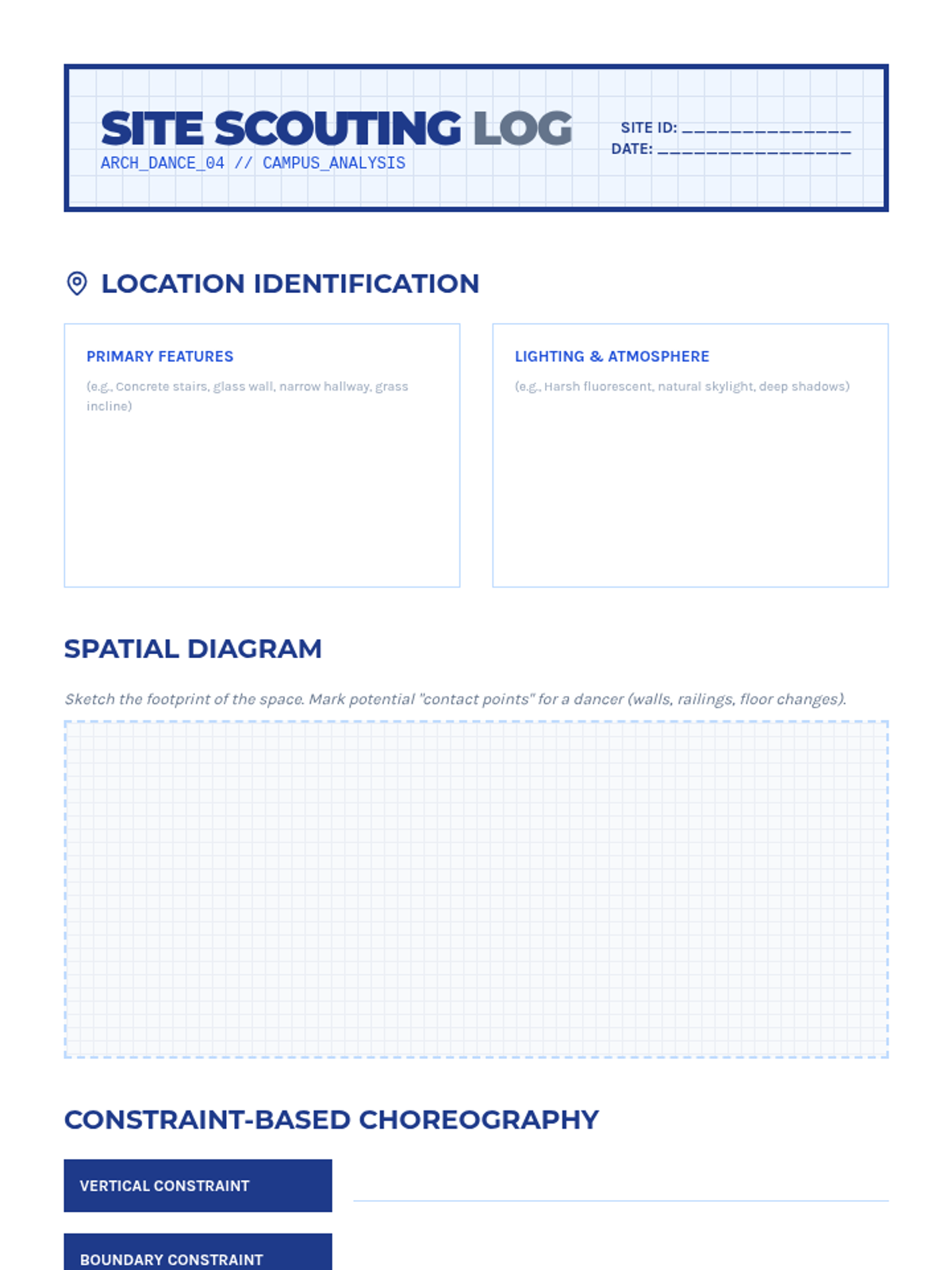
A student worksheet for scouting and analyzing a non-traditional performance location, focusing on how architectural features dictate movement.
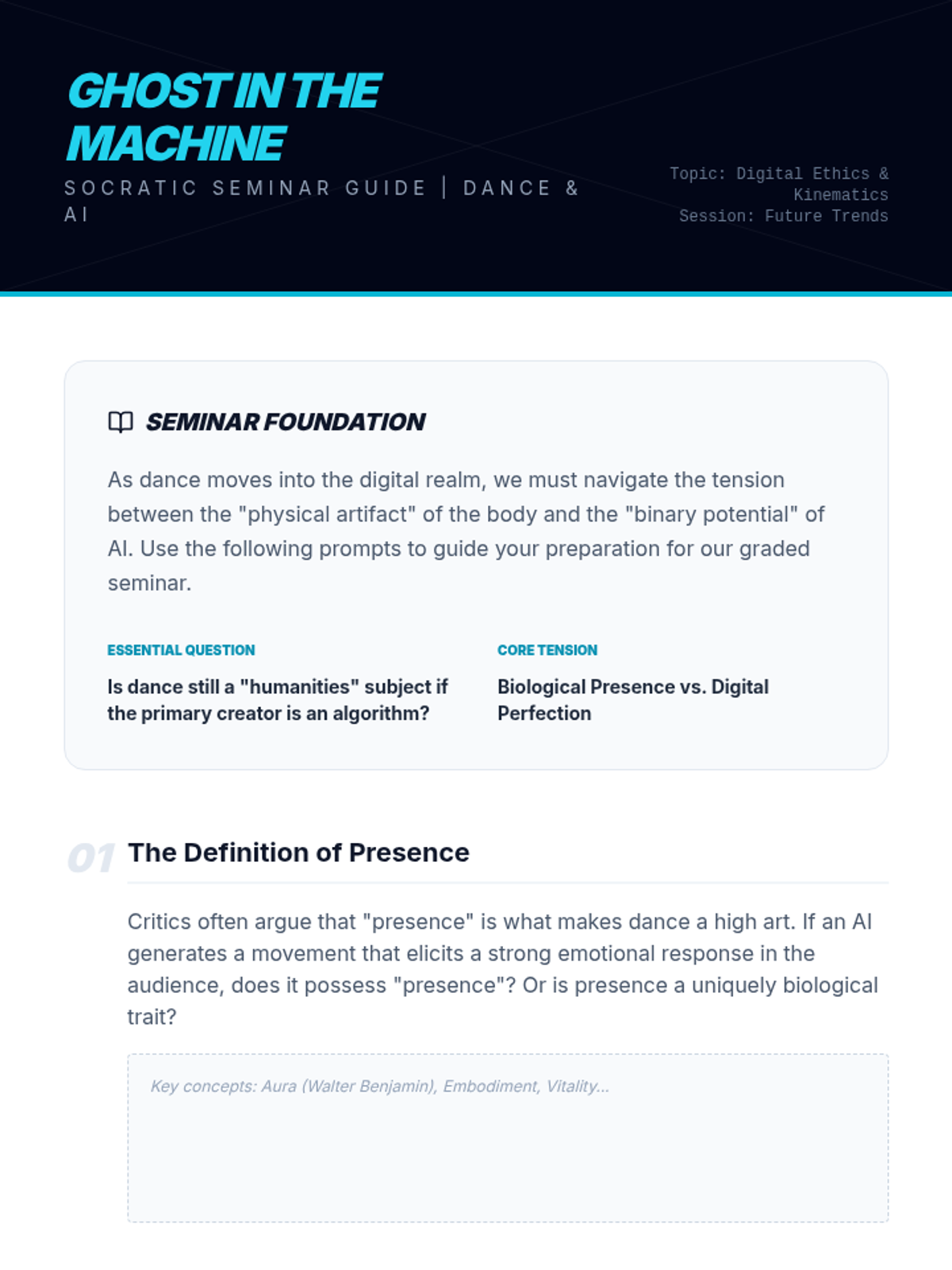
A Socratic Seminar guide for undergraduate students to debate the ethical and philosophical implications of AI and technology in dance. Covers presence, intellectual property, and the definition of the post-physical body.
A slide deck investigating Trisha Brown's site-specific choreography and how changing the venue alters the architectural and gravitational expectations of dance.
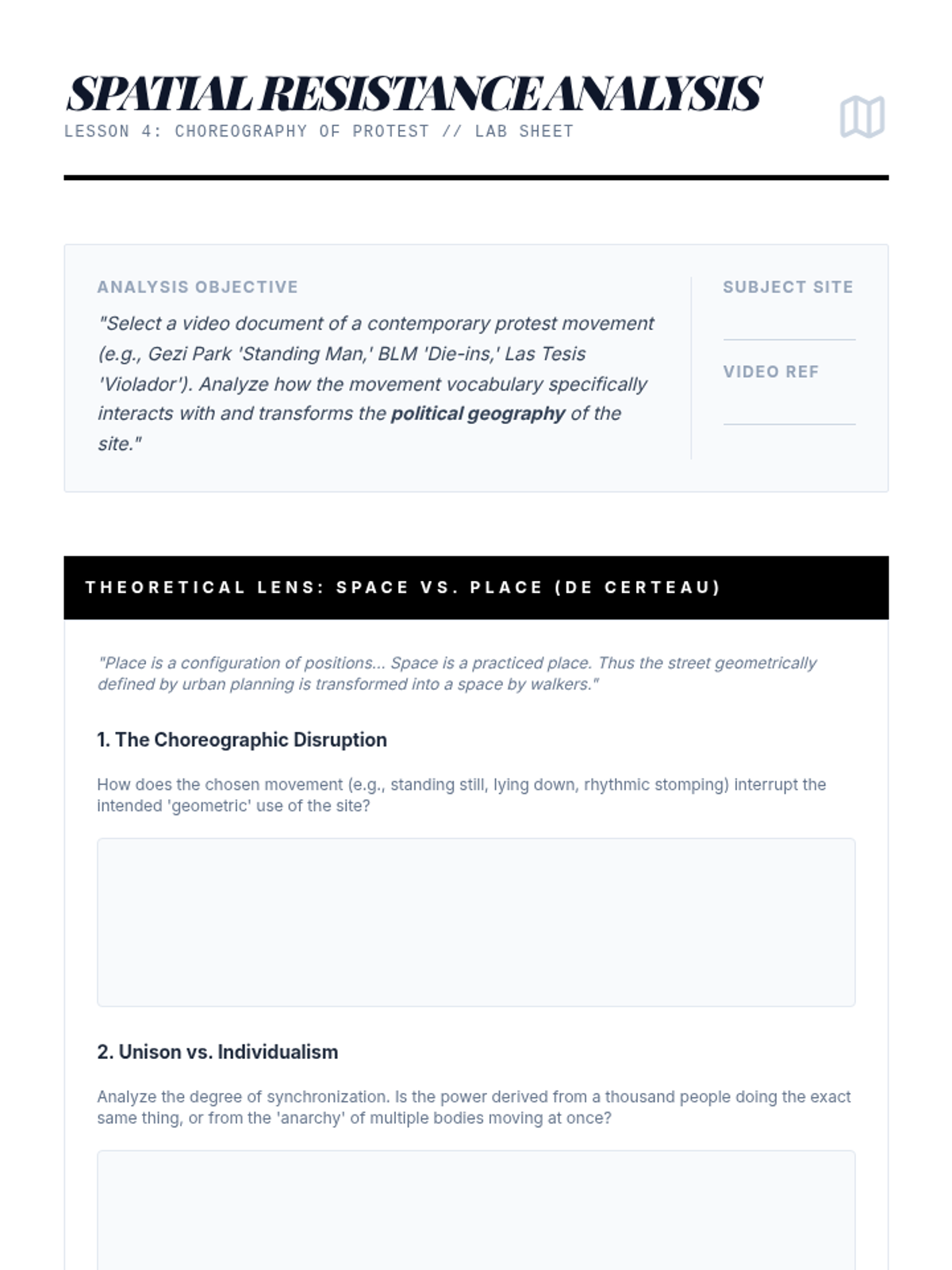
A graduate-level lab sheet for analyzing how contemporary protest movements utilize movement to disrupt urban space and political geography. Focuses on the application of "Space and Place" theory.
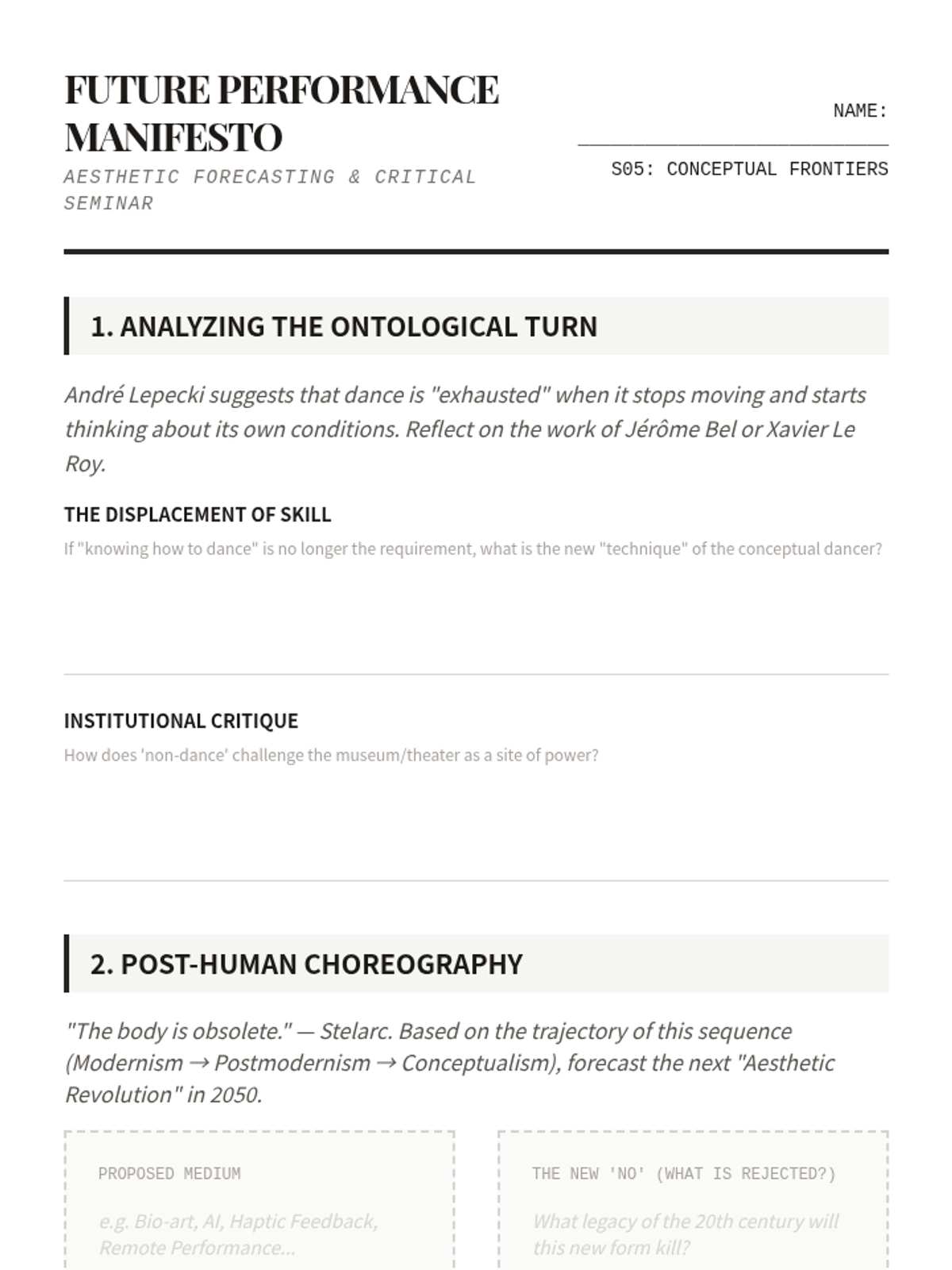
A final student seminar paper/worksheet for synthesizing the entire sequence and forecasting the future of dance aesthetics.
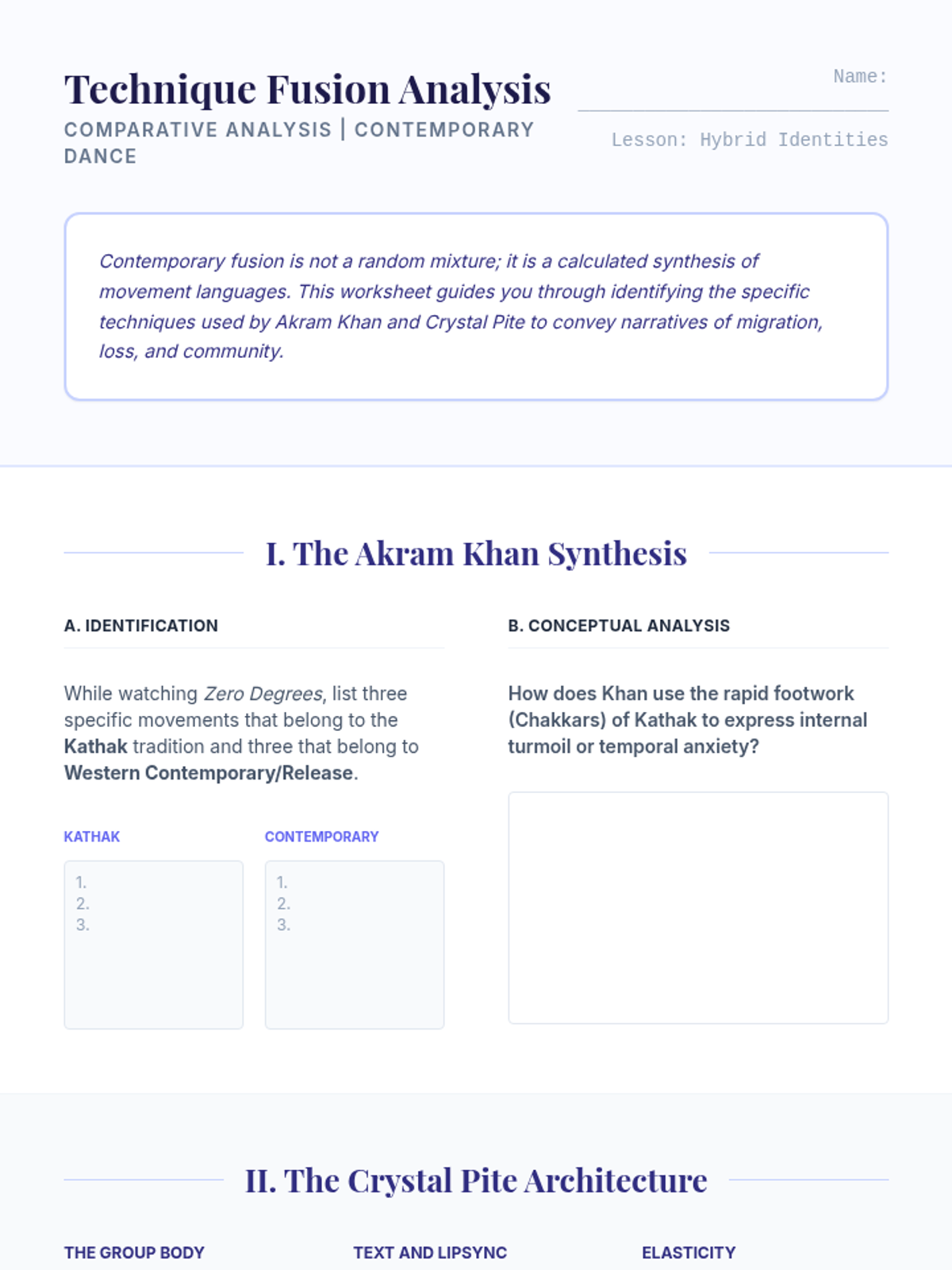
A comparative analysis worksheet for students to deconstruct the hybrid techniques of Akram Khan and Crystal Pite. Includes specific identification tasks for Kathak vs. Contemporary and conceptual inquiry into ensemble architecture.
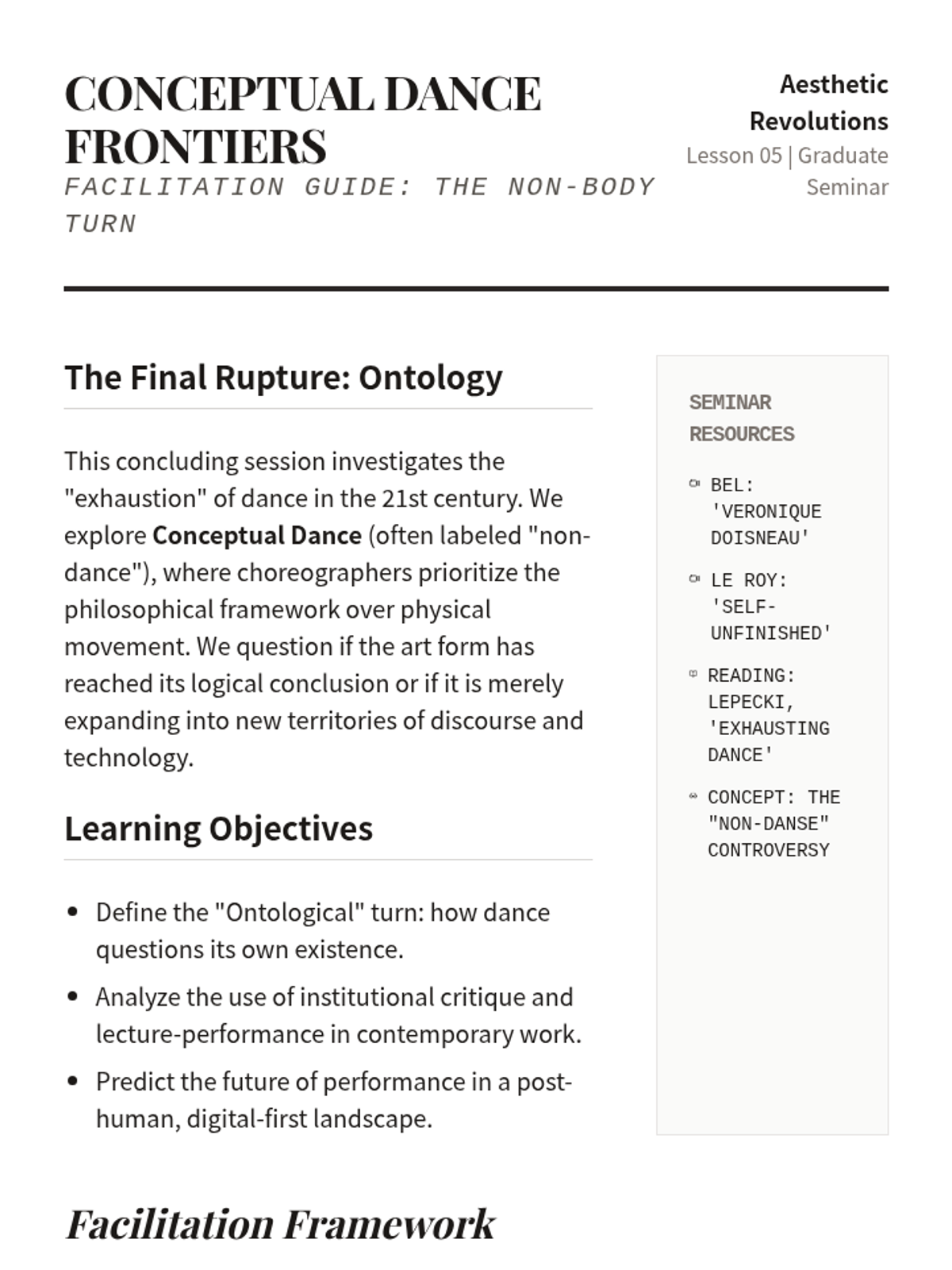
Teacher guide for the final lesson, debating the exhaustion of dance, non-dance movements, and the future of the performing body.
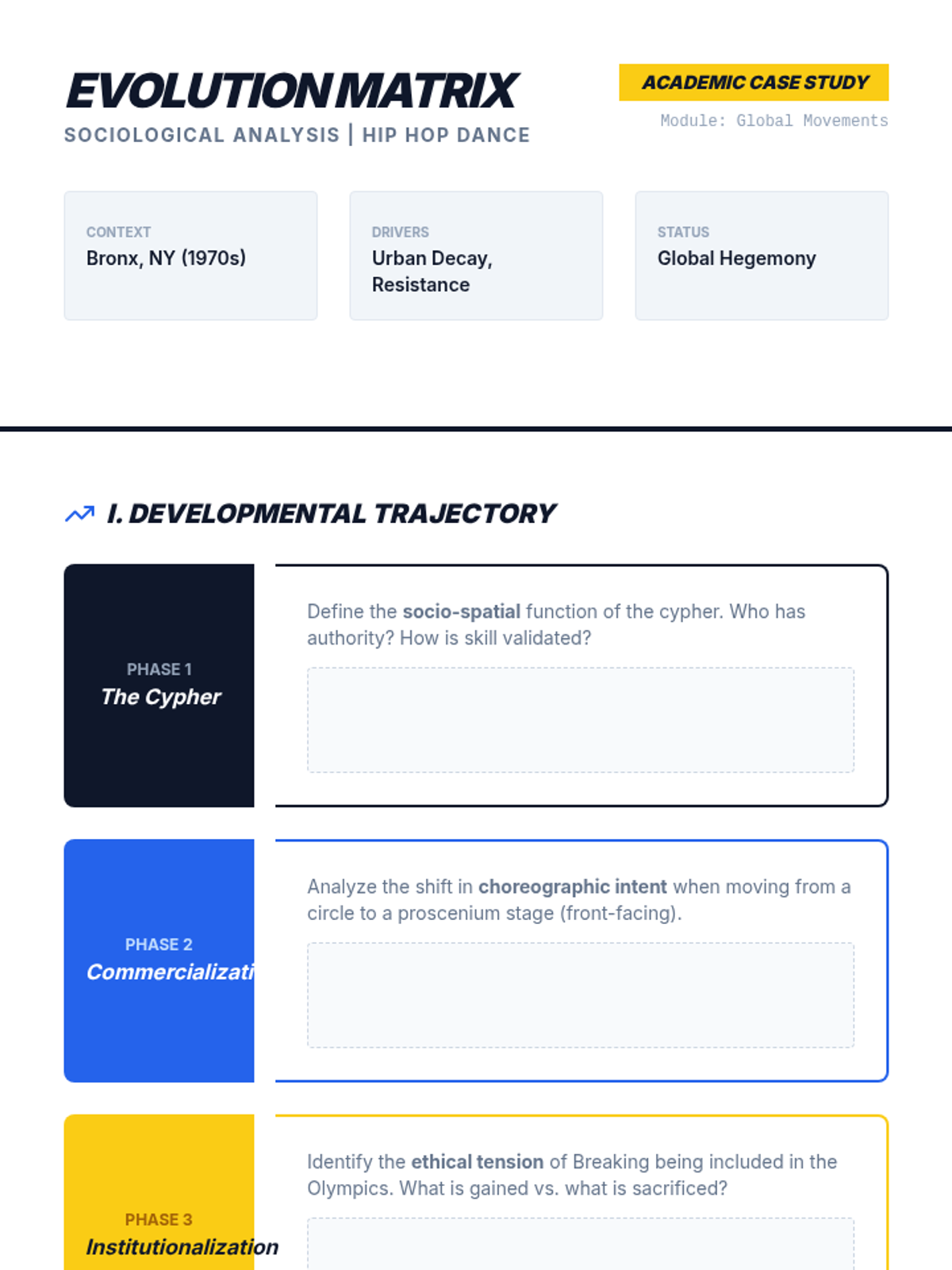
A sociological evolution matrix for students to track the development of Hip Hop from its street origins to the global Olympic stage. Includes sections on developmental phases, critical tensions, and media analysis.
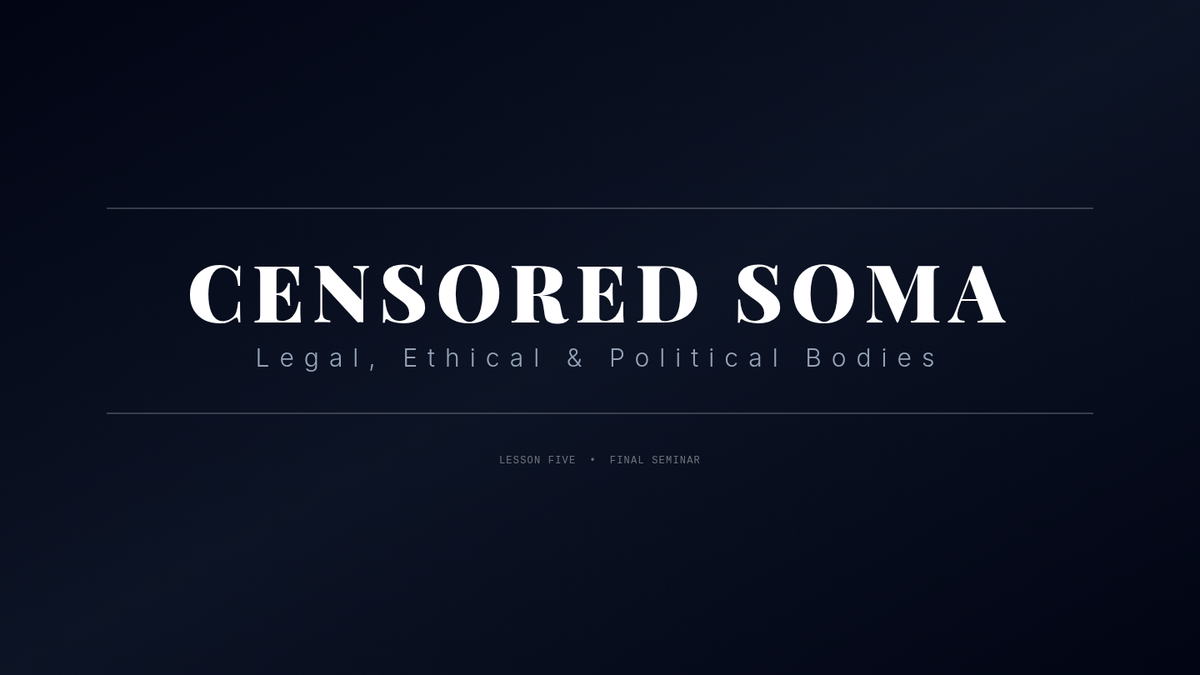
Seminar on the legal and ethical frameworks surrounding the censorship of the body and dance in various political contexts. Case studies include the ban on dance in Iran and the NEA culture wars in the US.
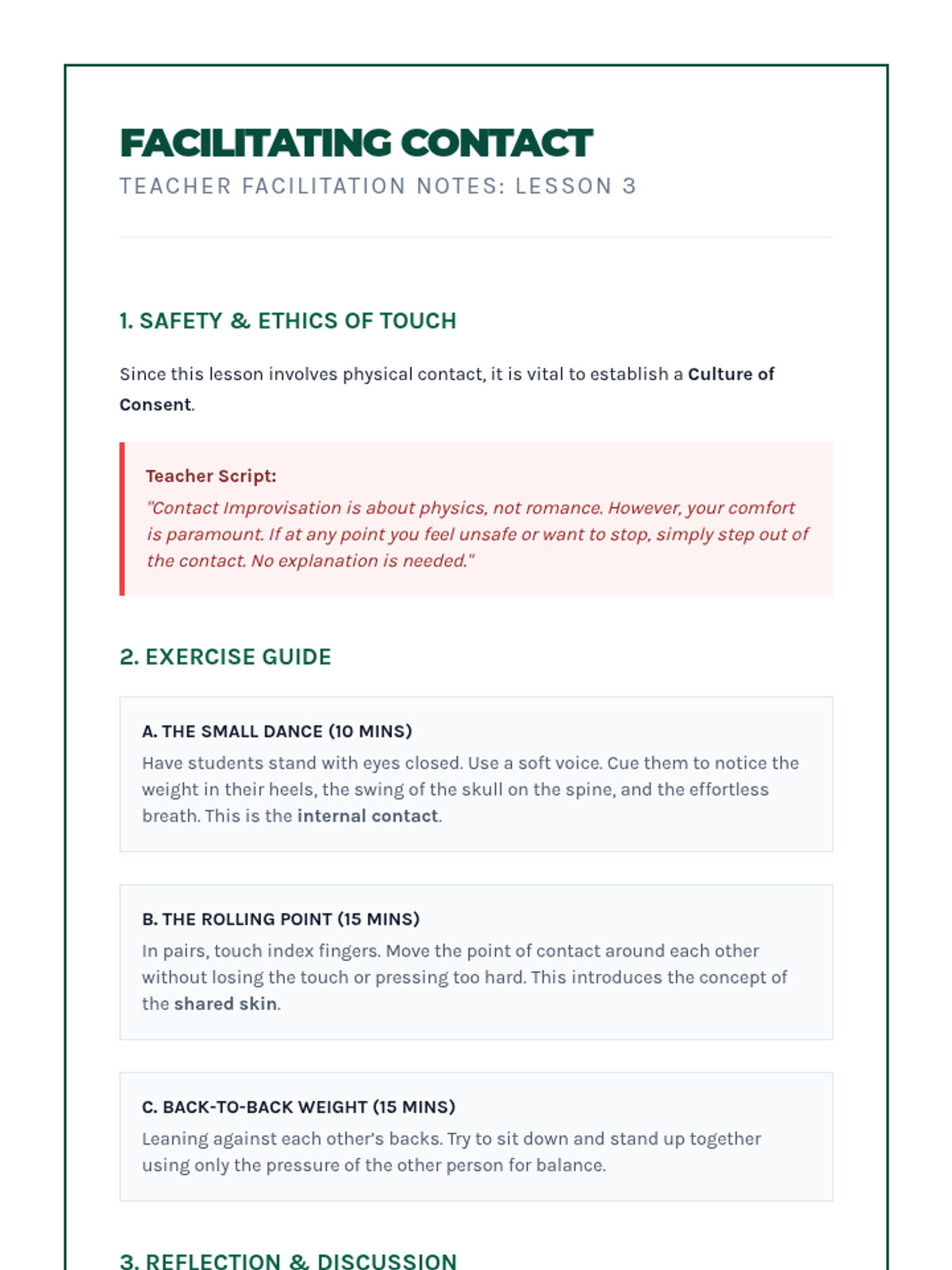
Teacher facilitation notes for conducting Contact Improvisation exercises, focusing on safety, consent, physical exercises, and social-political context.
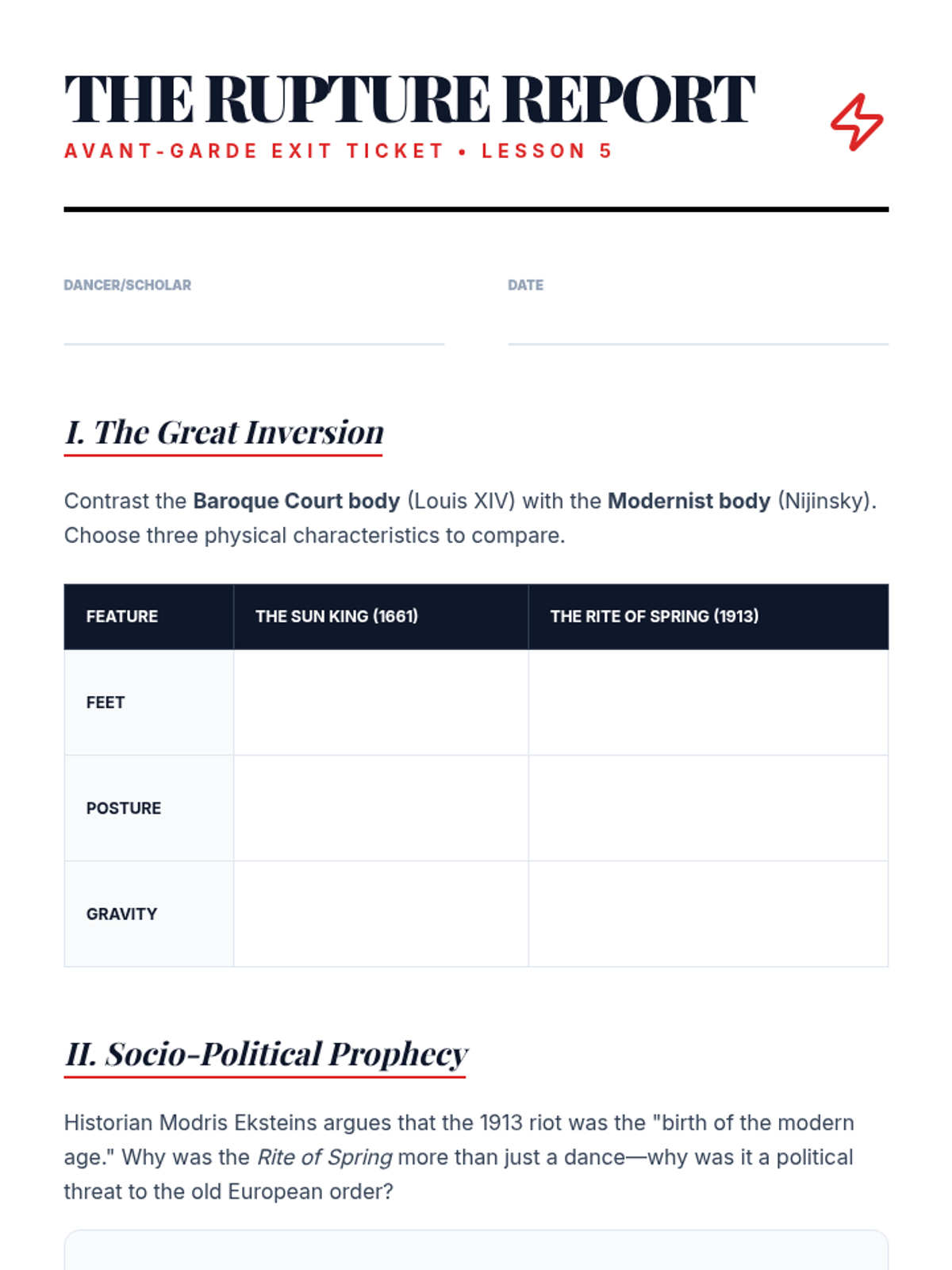
Final exit ticket and synthesis worksheet for the sequence, asking students to compare the Baroque and Modernist bodies and answer the essential question.
A slide deck covering 21st-century conceptual dance, focusing on 'non-dance', institutional critique, and the work of Jérôme Bel and Xavier Le Roy.
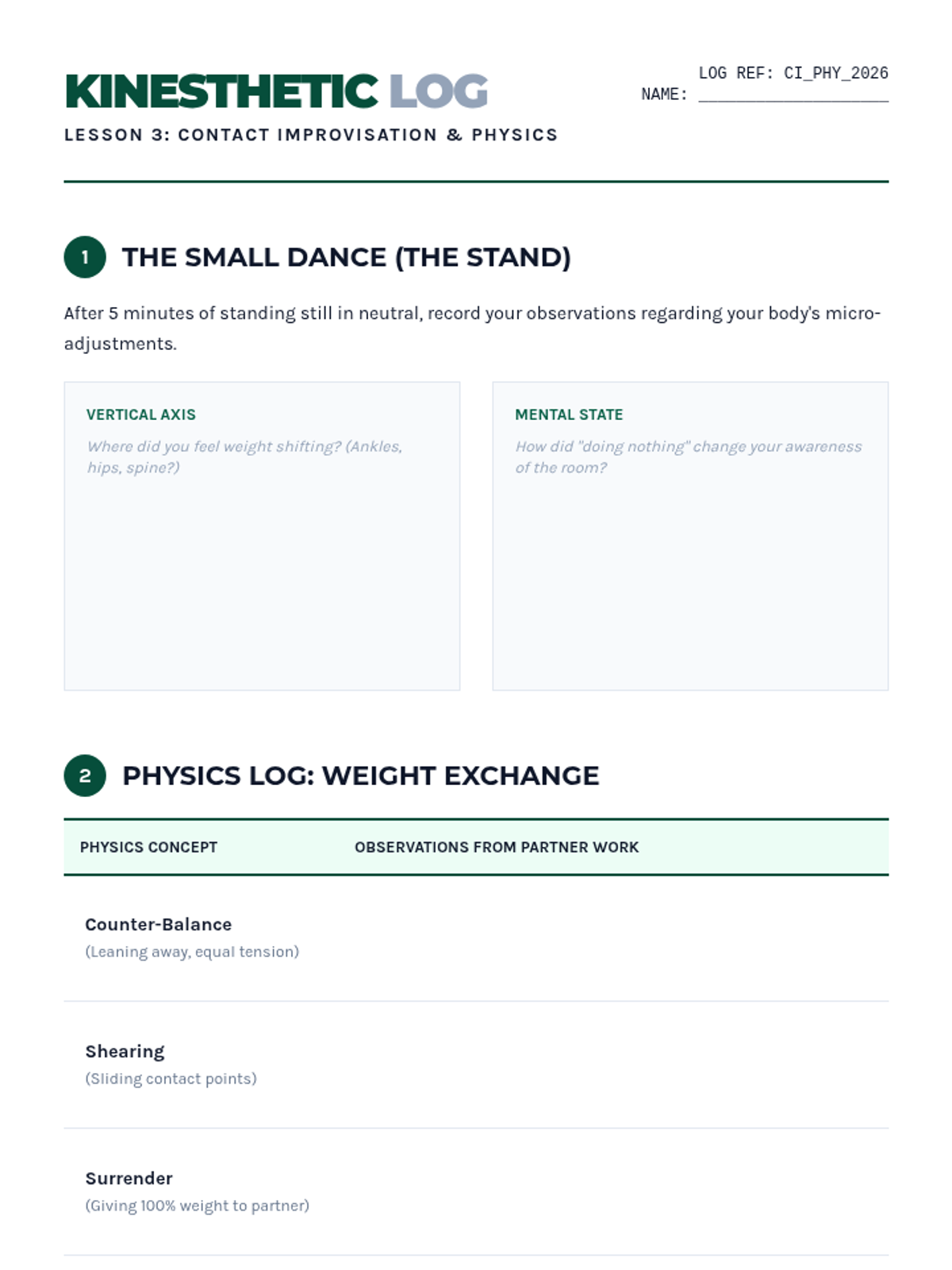
A student kinesthetic log for recording physical observations during Contact Improvisation exercises, focusing on gravity, weight-sharing, and social dynamics.
Visual presentation on the Ballets Russes, focusing on Serge Diaghilev's modernist revolution and the cultural impact/riot of 'The Rite of Spring'.
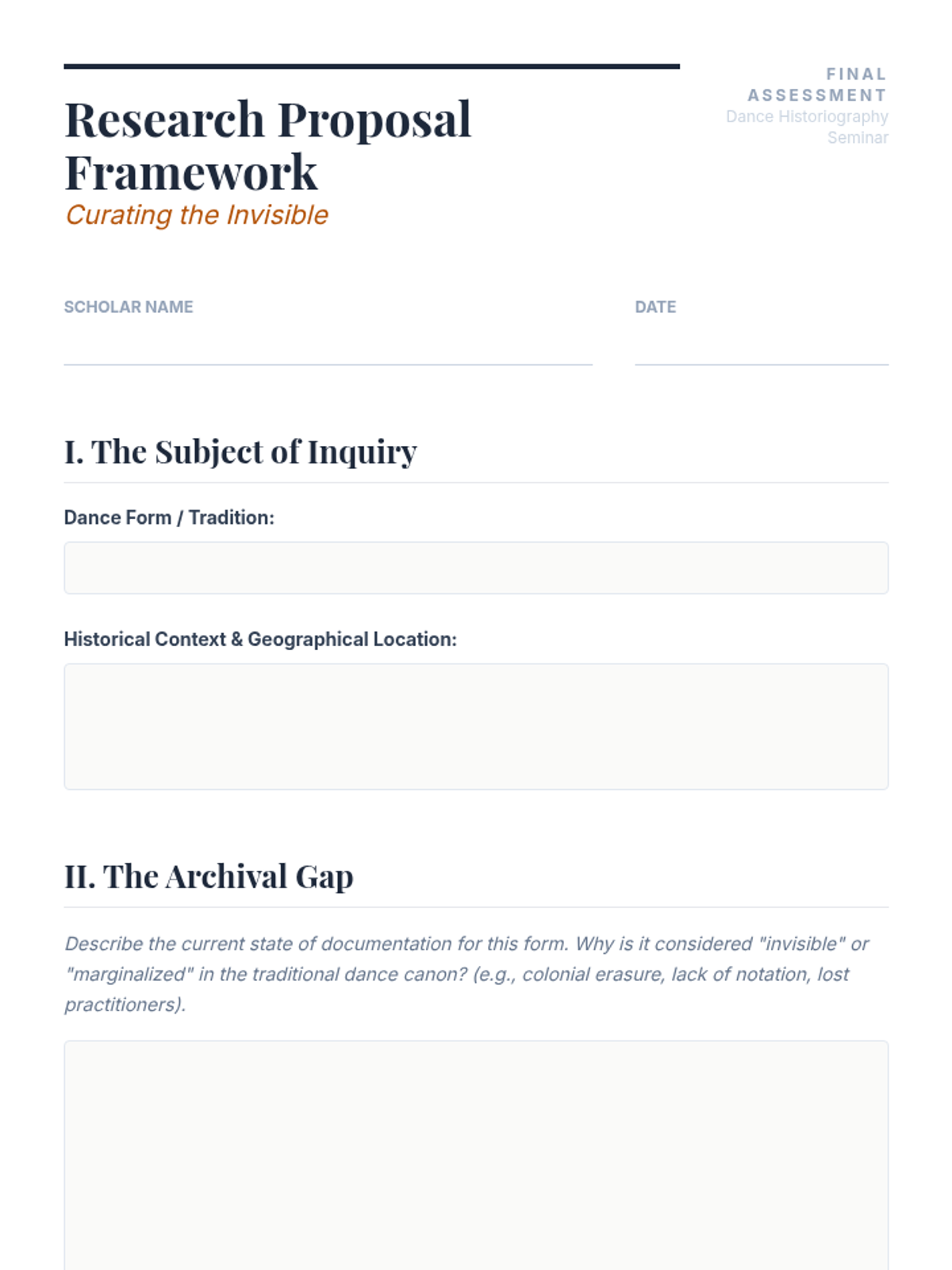
A comprehensive research proposal template for graduate students to outline their methodology for investigating ephemeral or marginalized dance forms.