Mapping relationships through notation, algebraic representations, and growth rate comparisons. Equips learners to transform functions, model contextual data, and solve exponential equations.
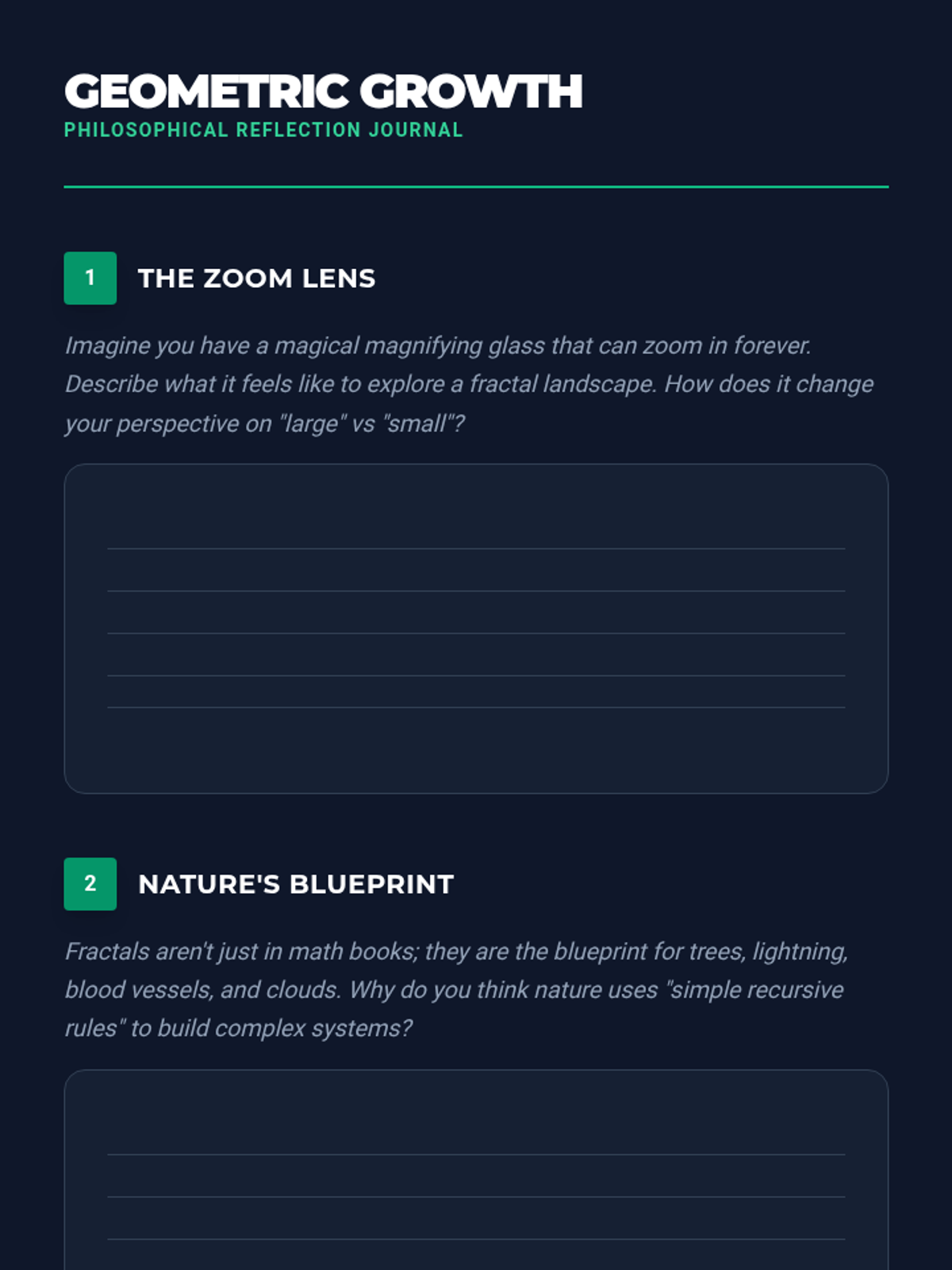
A reflective journal for students to synthesize their learning. It includes philosophical prompts on scale, nature's recursive patterns, and the infinite/finite paradox, with a dark-themed "night mode" aesthetic for focus.
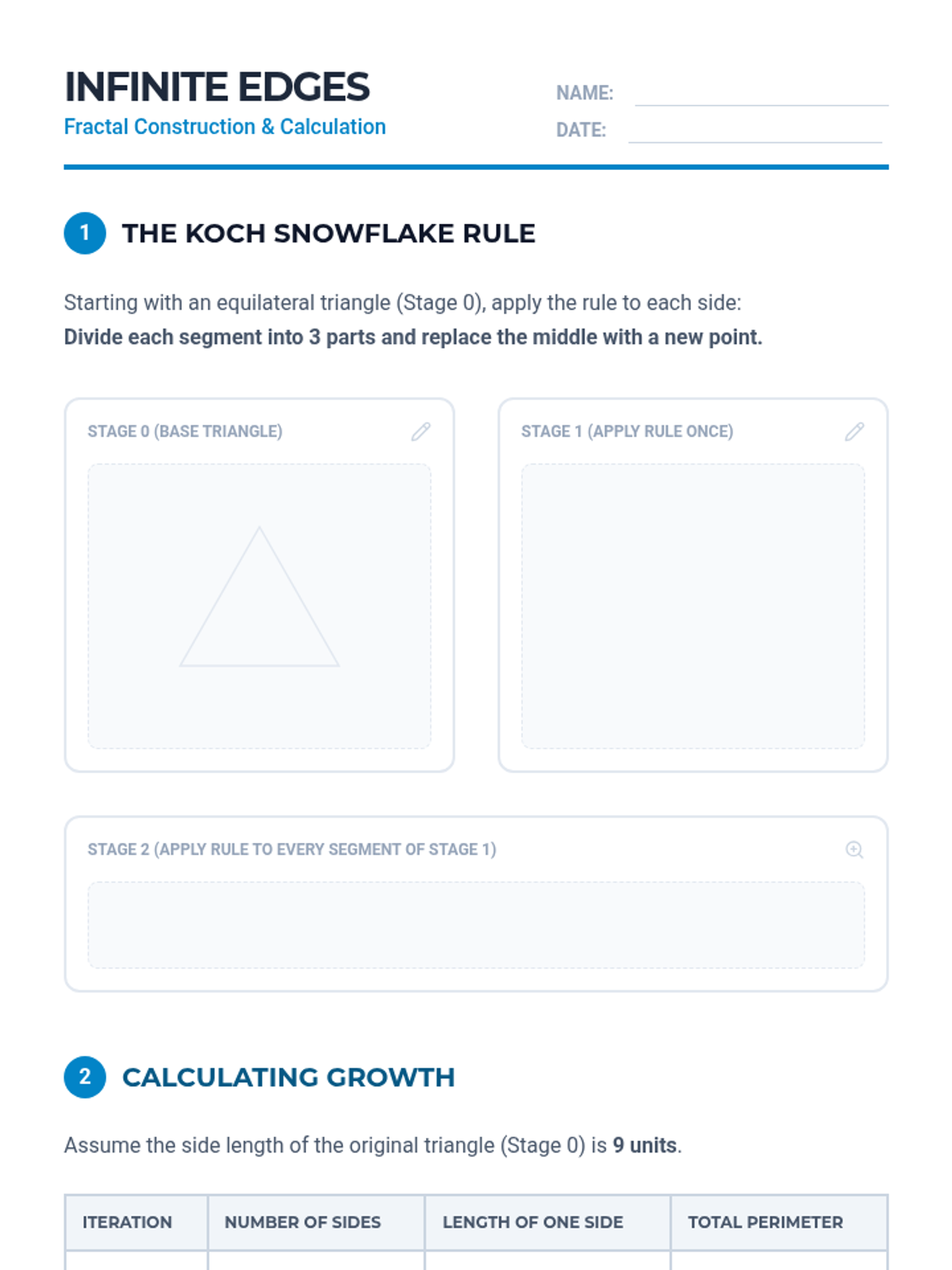
A two-page student activity worksheet for constructing the Koch Snowflake. It includes drawing areas for the first three iterations and a calculation table to analyze the relationship between sides, length, and total perimeter.
A visually striking slide deck introducing fractals, featuring the Coastline Paradox, definitions of self-similarity and recursion, and the construction rules for the Koch Snowflake.
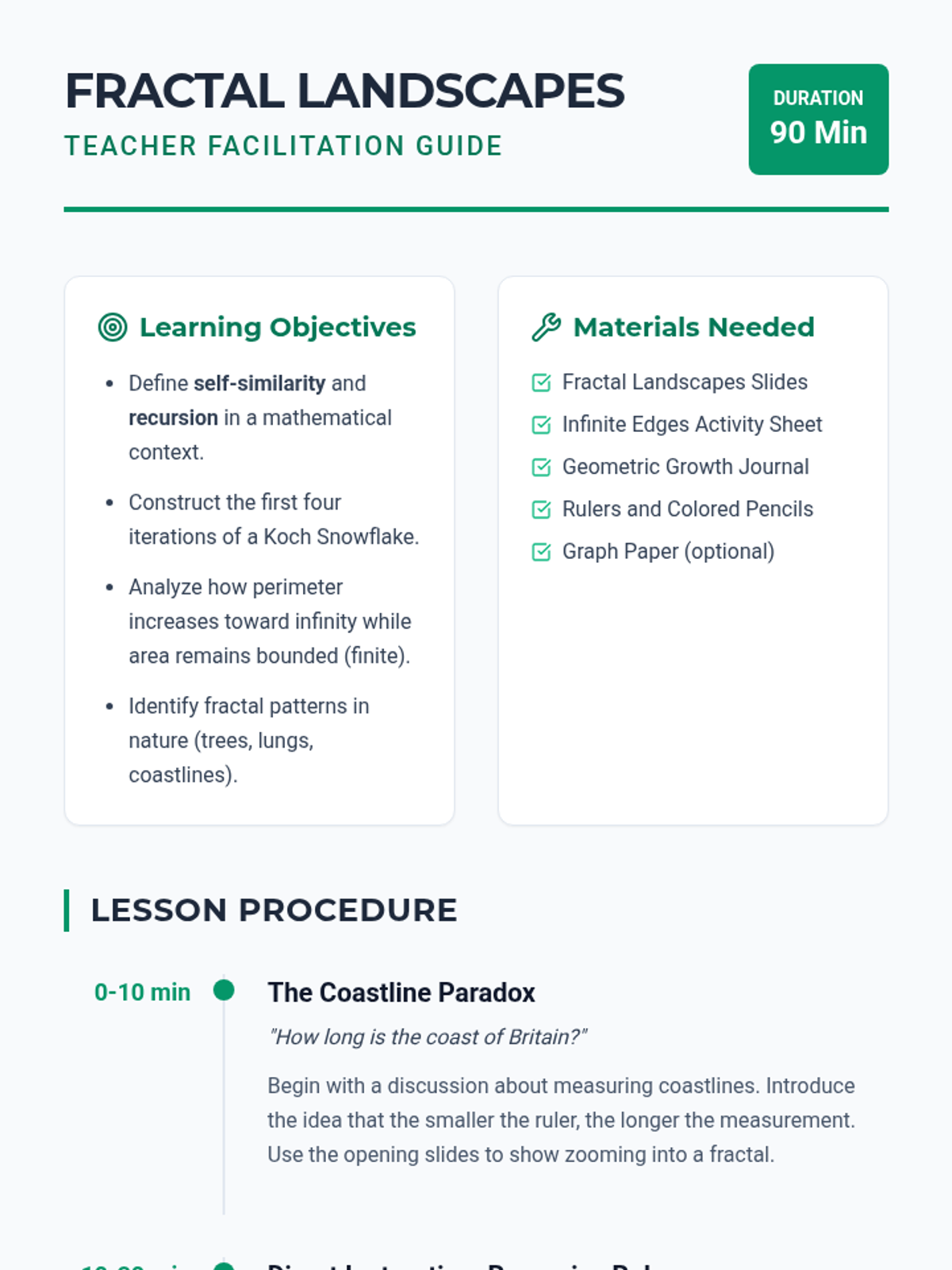
A comprehensive teacher facilitation guide for the Fractal Landscapes lesson, including learning objectives, a detailed 90-minute lesson flow, and key mathematical concepts like recursion and self-similarity.
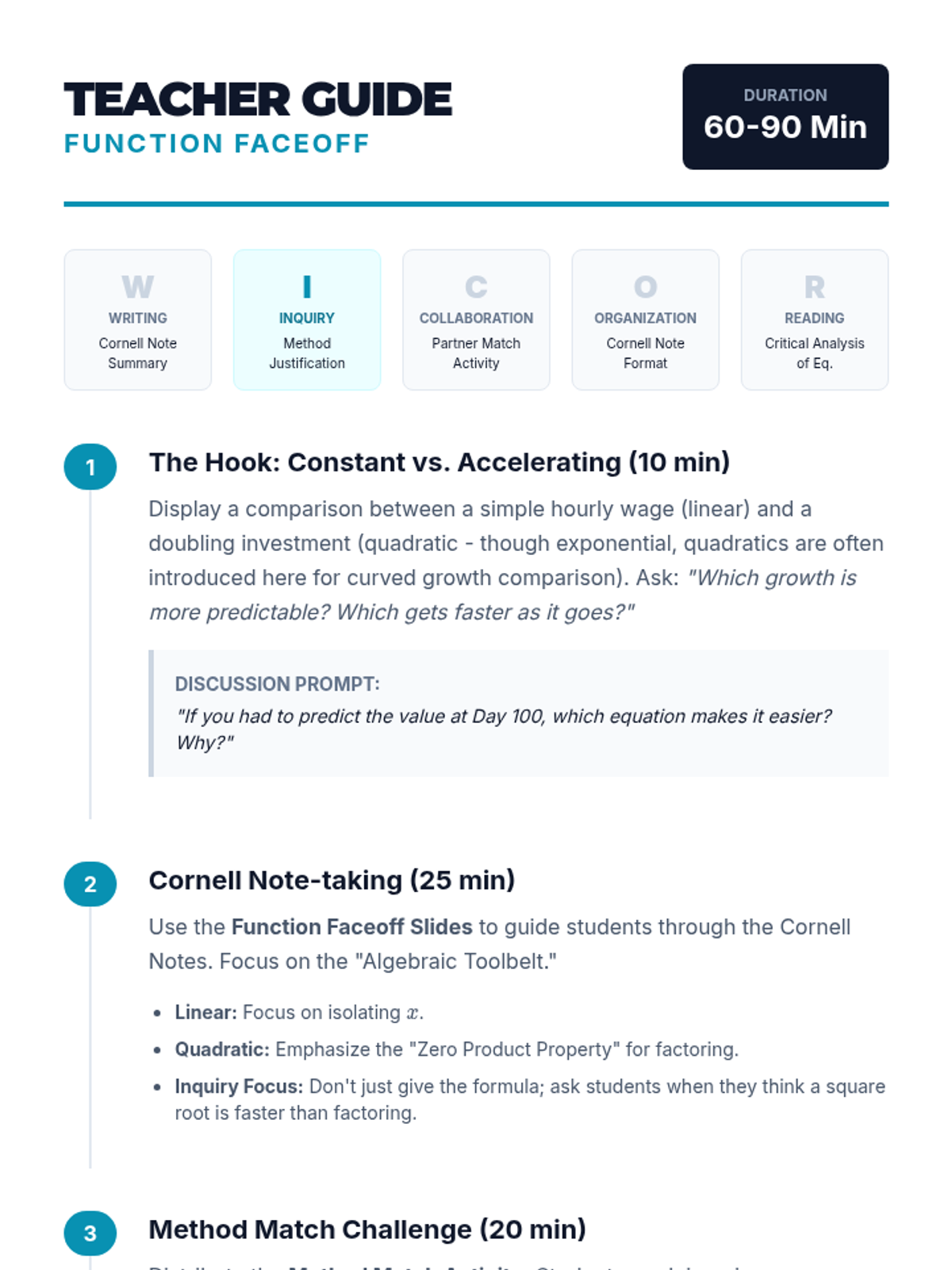
A facilitation guide for teachers outlining the WICOR strategy alignment, lesson pacing, common misconceptions, and differentiation strategies for the Function Faceoff lesson.
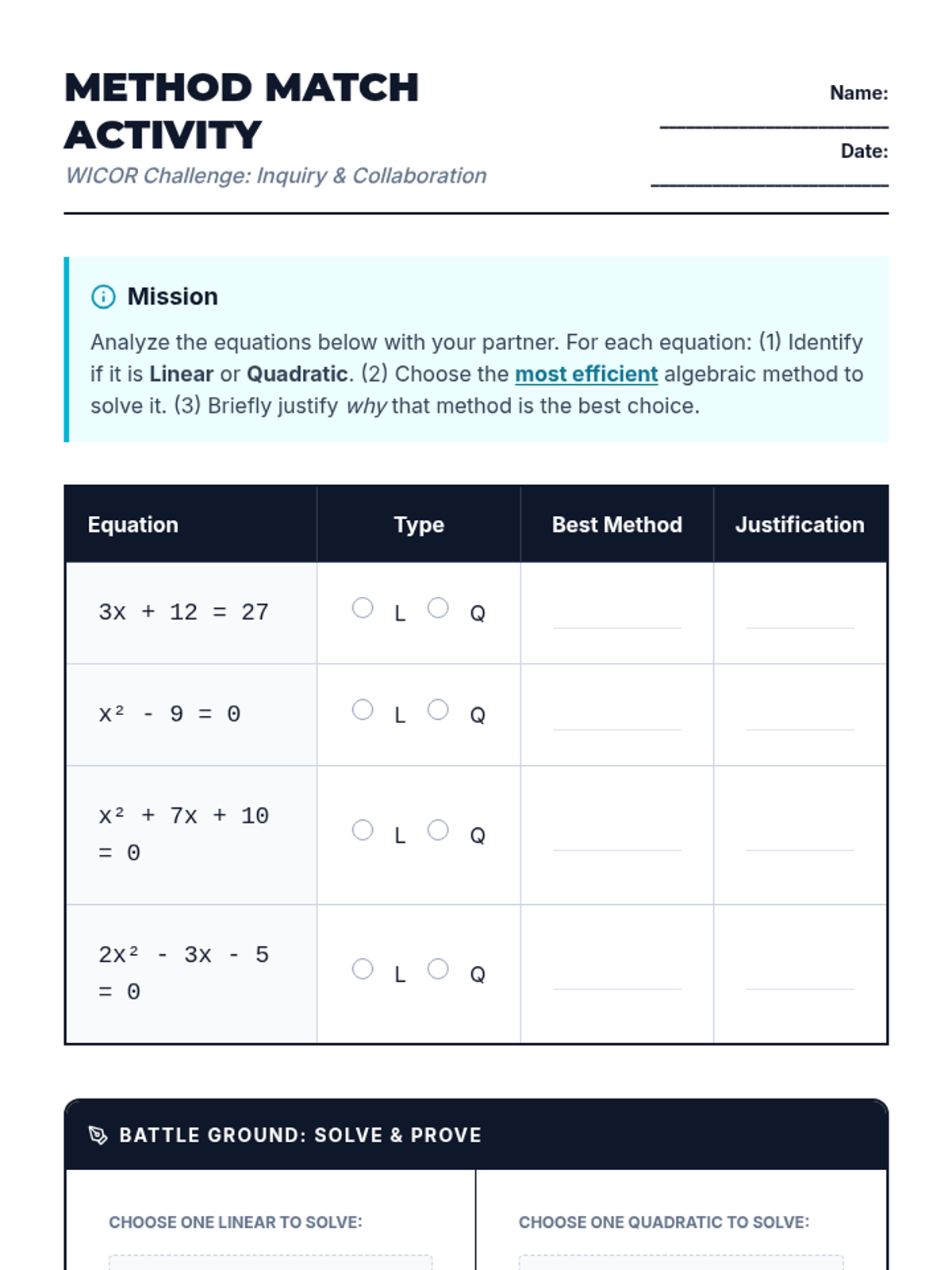
An inquiry-based matching activity where students identify function types and justify the most efficient algebraic method for solving them.
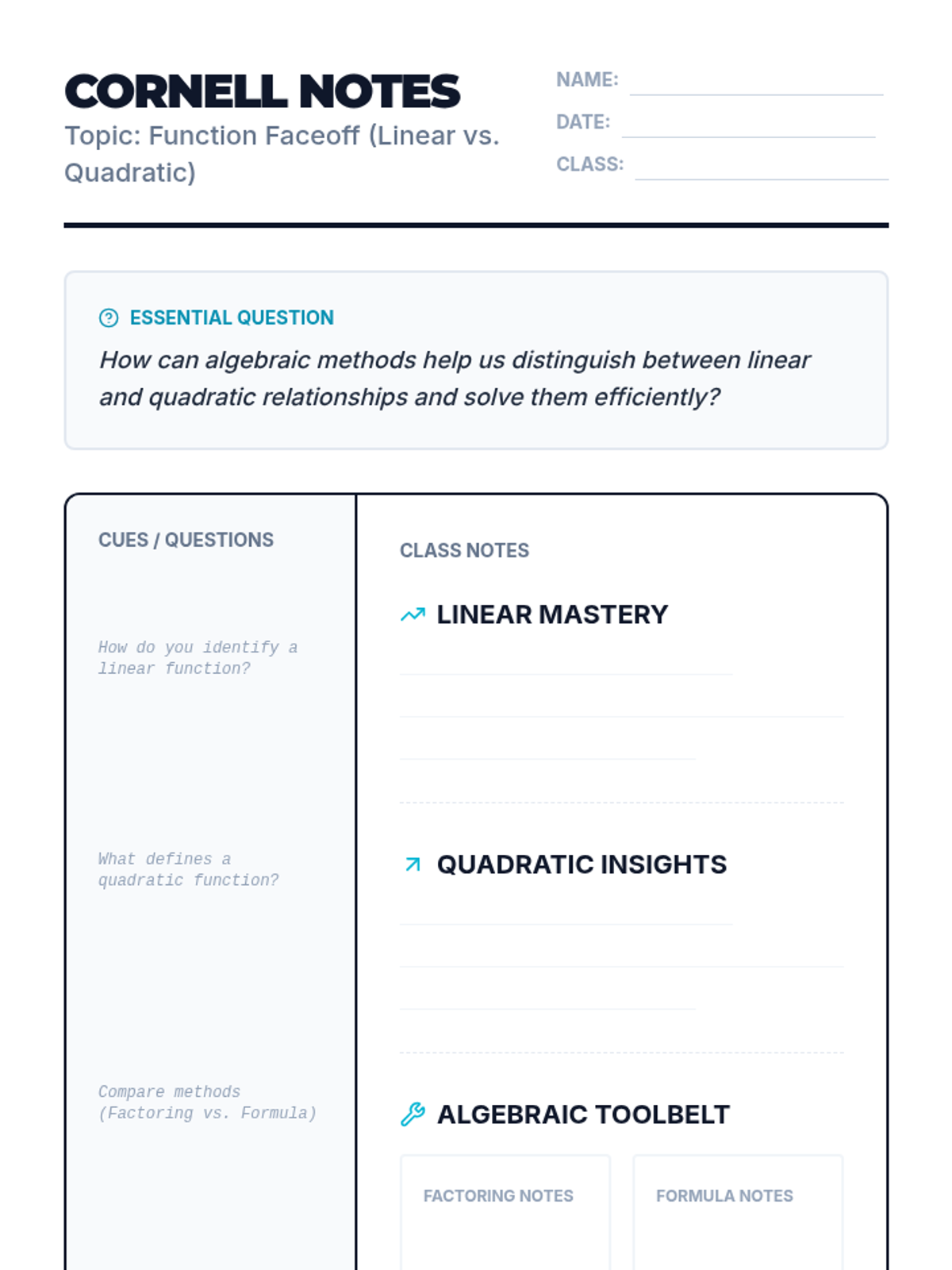
A specialized AVID Cornell Notes template for comparing linear and quadratic functions, featuring dedicated sections for cues, class notes, and summary reflection.
A visually engaging 7-slide presentation comparing linear and quadratic functions, featuring key differences, algebraic methods (factoring, quadratic formula), and a collaborative practice prompt.
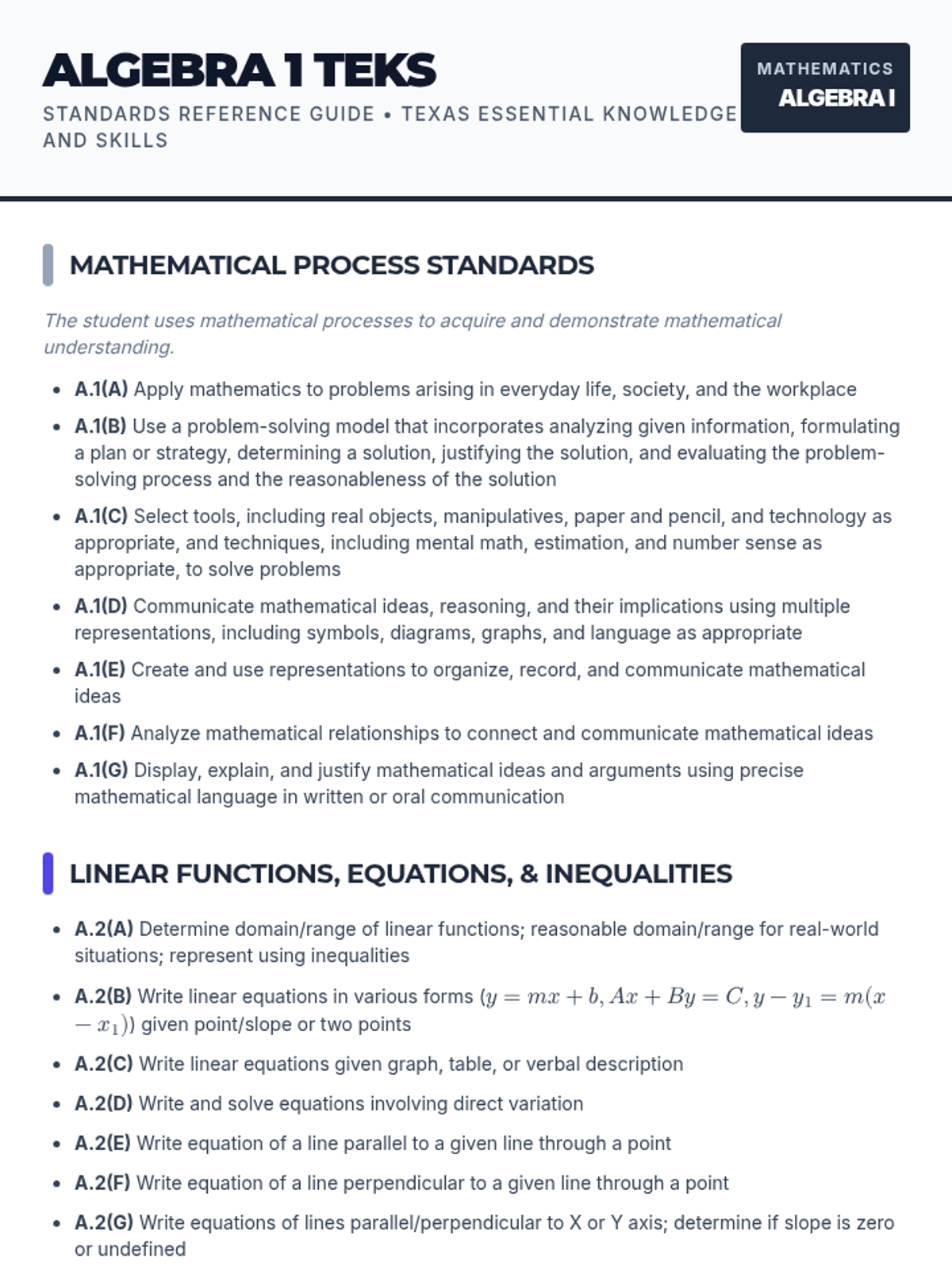
A comprehensive, formatted reference list of all Algebra 1 Texas Essential Knowledge and Skills (TEKS) organized by standard strands for teacher use. Includes Process Standards.
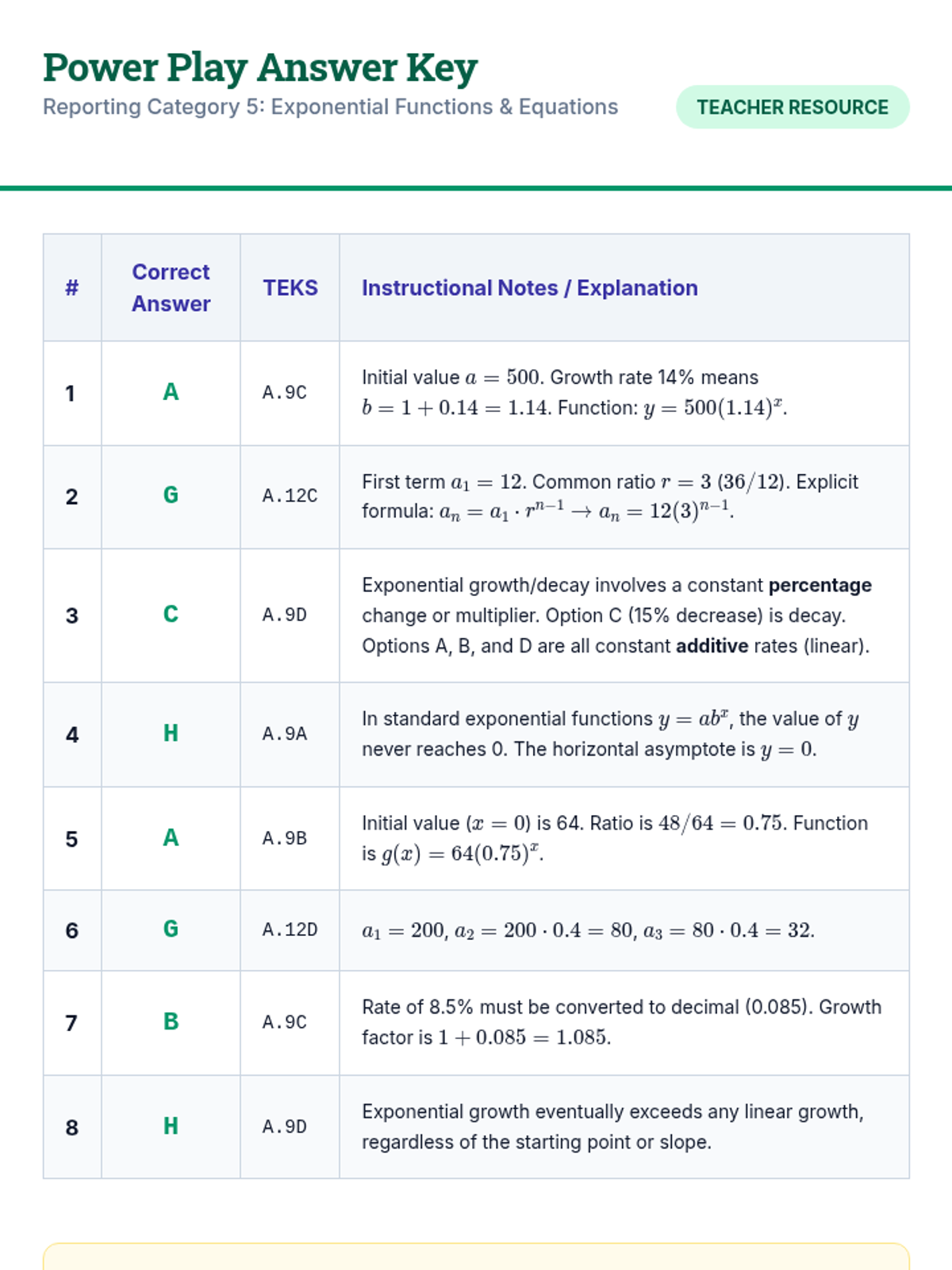
Detailed answer key for the Power Play EOC Worksheet. Includes correct answers, associated TEKS, detailed explanations for each problem, and a guide to common student misconceptions.
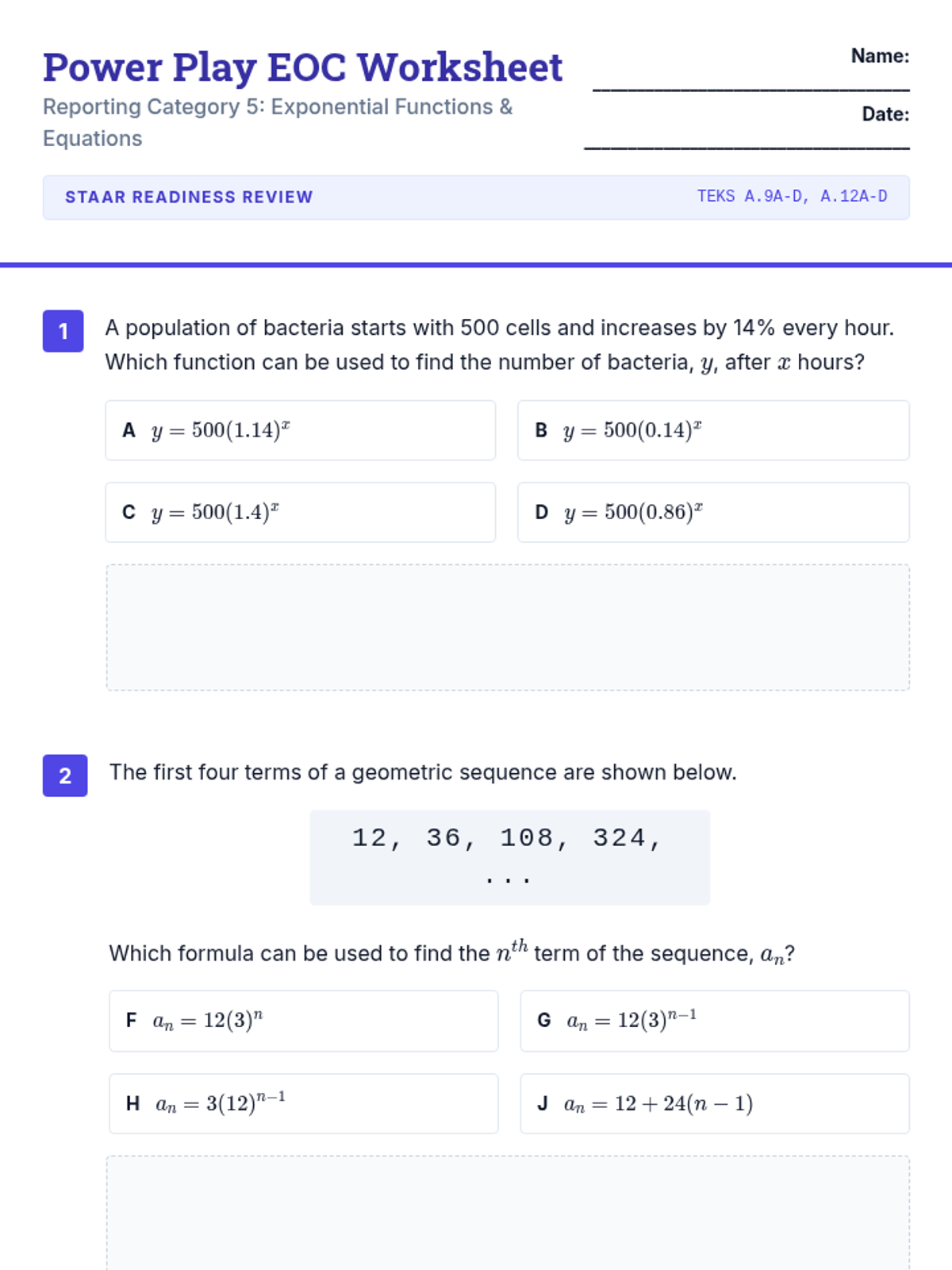
8 STAAR EOC-style problems covering exponential functions and geometric sequences. Designed for student practice with designated work areas and clear multiple-choice options.
Engaging slide deck for instruction on exponential functions and geometric sequences. Features visual comparisons of growth models, anatomical breakdown of the exponential equation, and STAAR-specific table strategies.
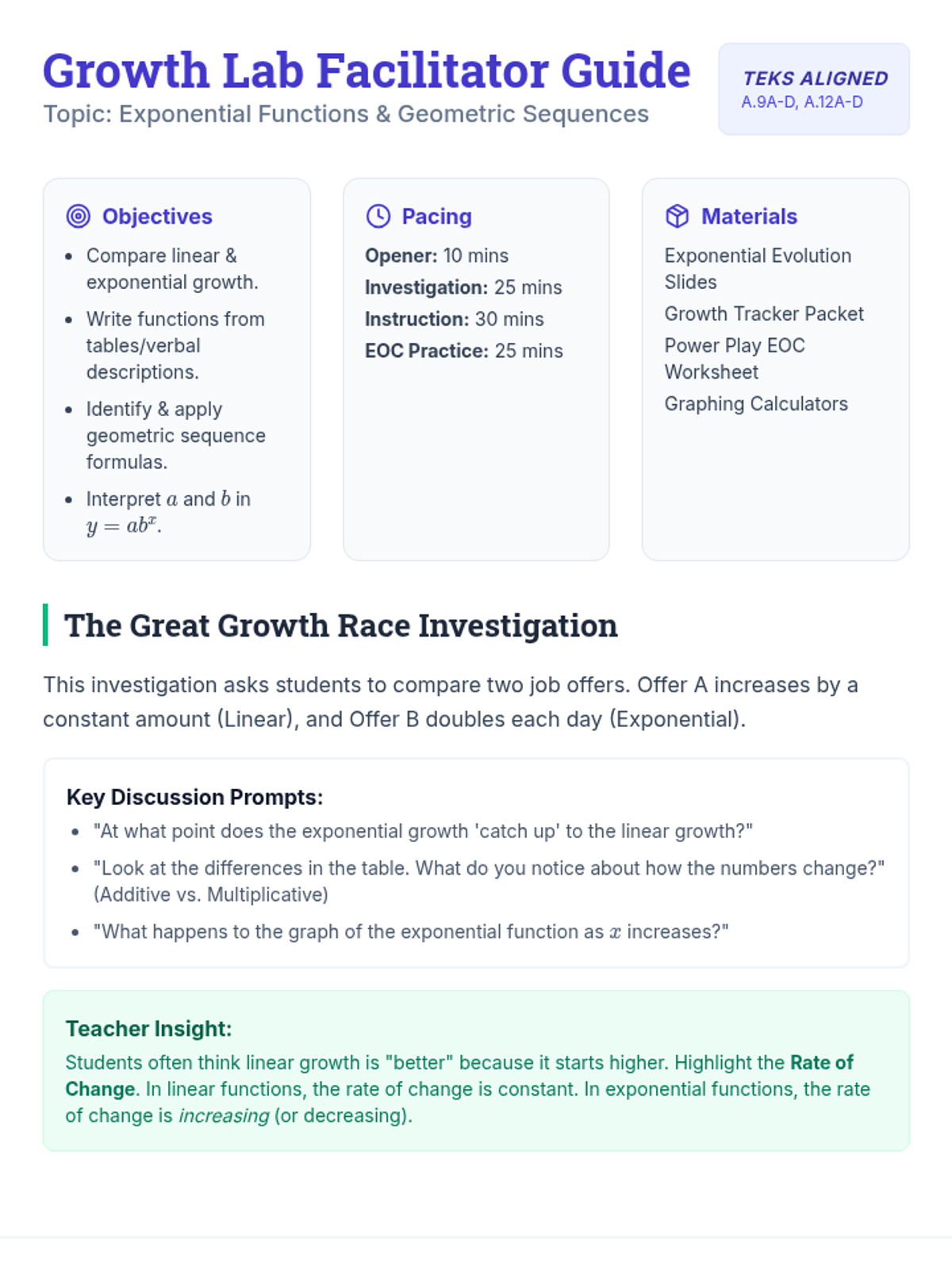
Detailed facilitator guide for teaching exponential functions and geometric sequences. Includes investigation prompts, direct instruction strategies, and TEKS-specific insights for STAAR EOC preparation.
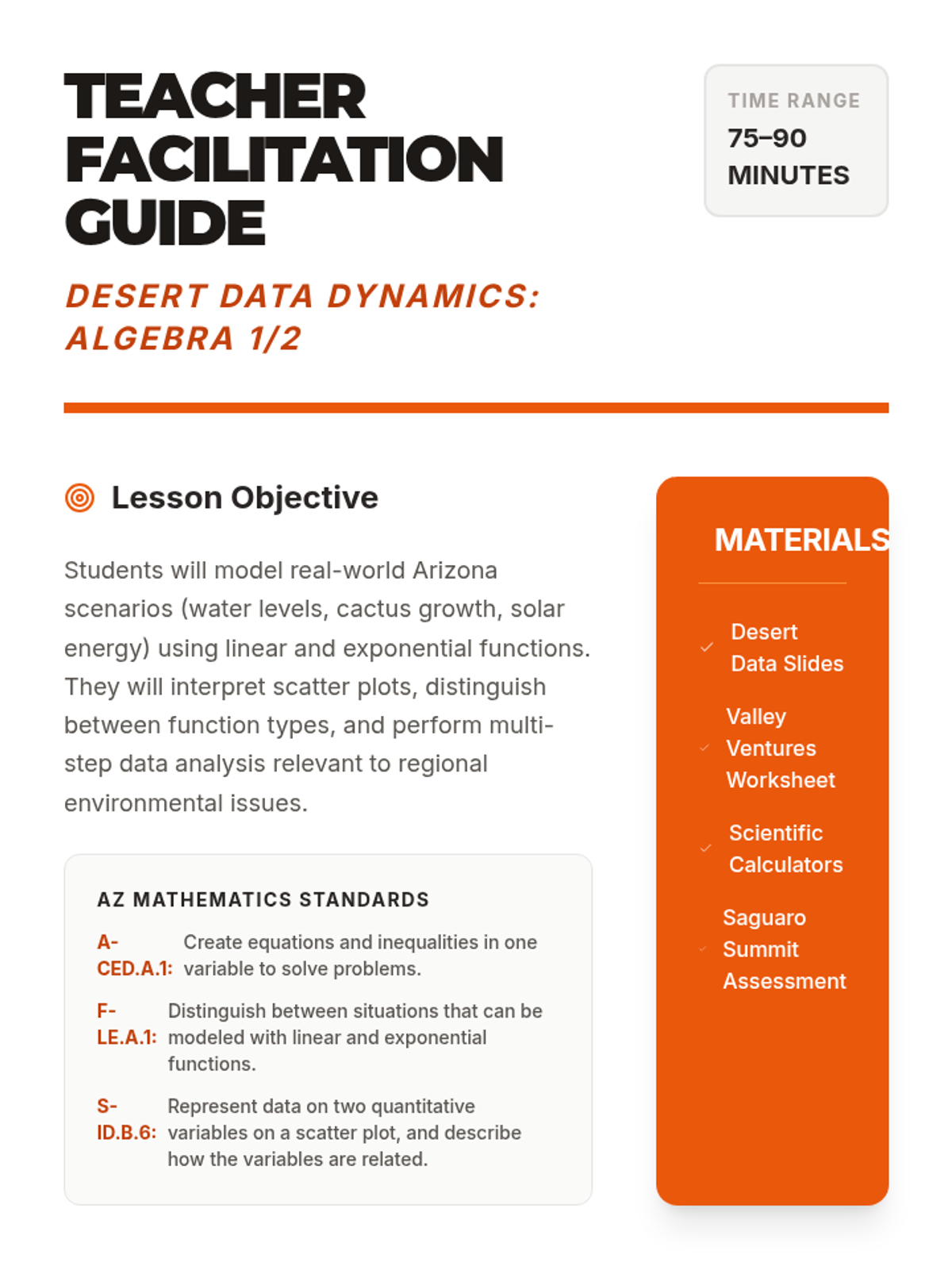
A detailed facilitator's guide for the Desert Data Dynamics lesson, including state standards alignment, a specific 90-minute pacing guide, and differentiation strategies.
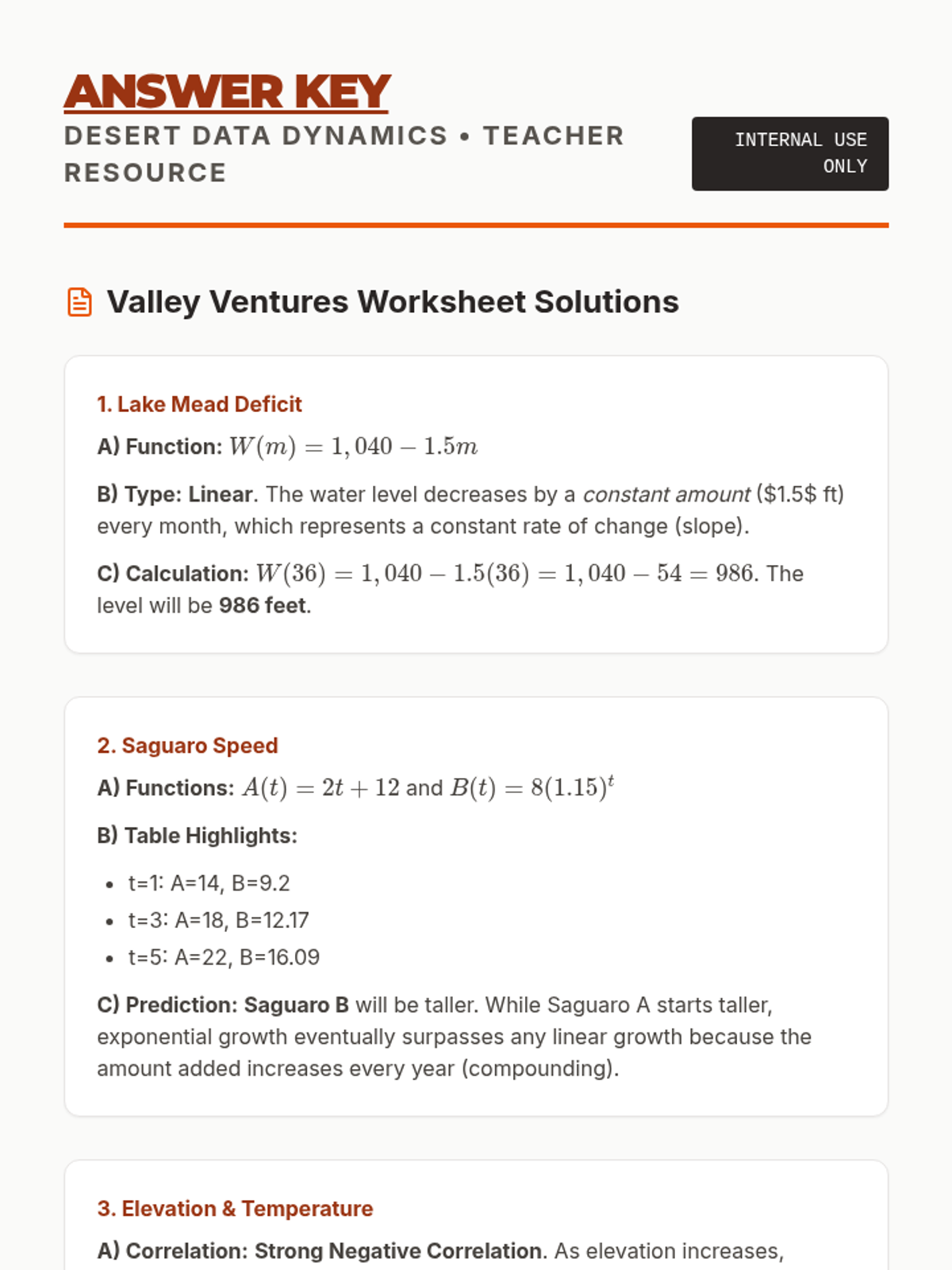
A detailed answer key for the Valley Ventures worksheet and Saguaro Summit assessment, featuring worked-out solutions and grading justifications.
A formal summative assessment featuring multi-part questions on profit modeling for a solar farm and statistical analysis of monsoon rainfall data across Arizona cities.
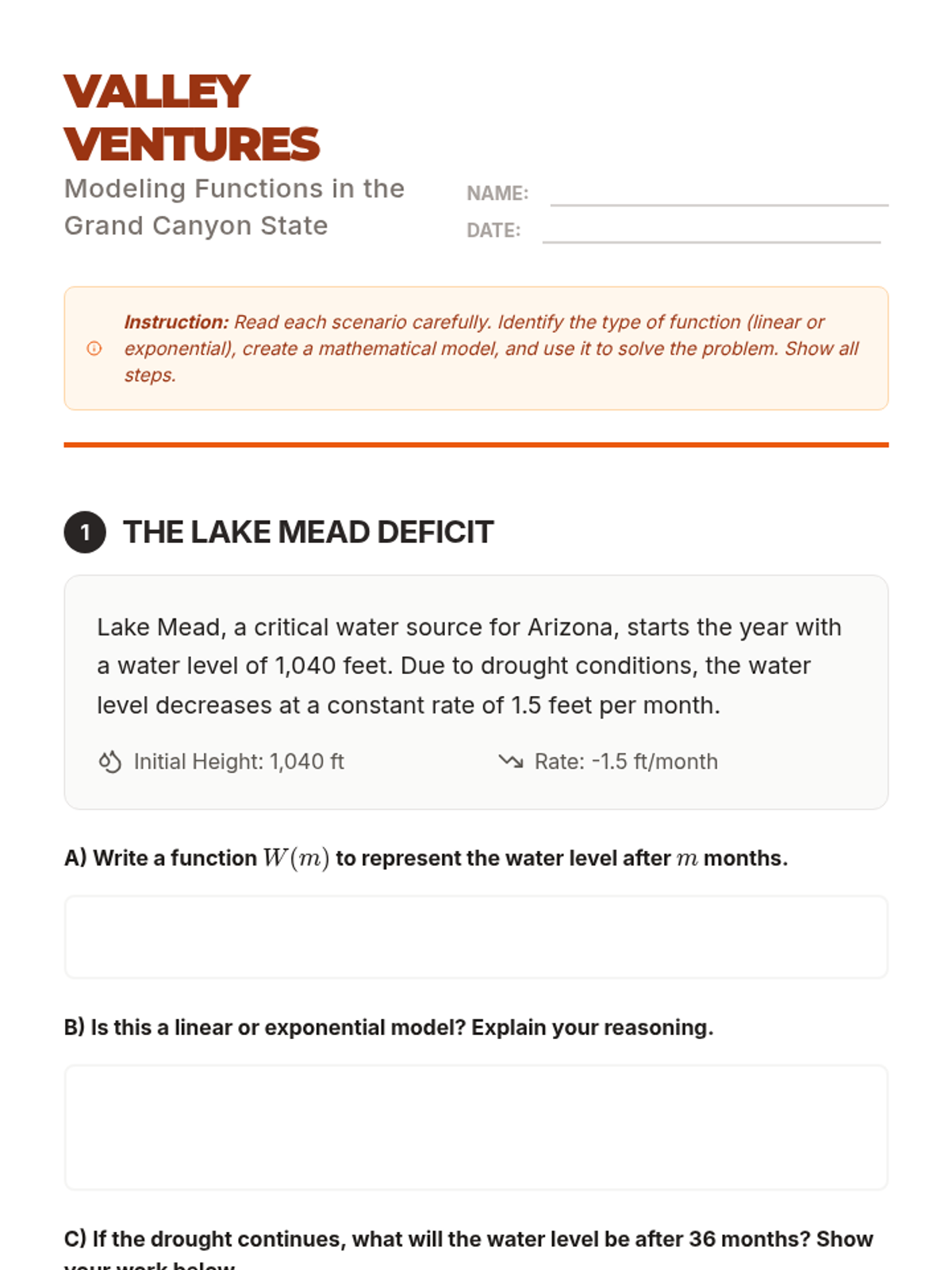
A comprehensive Algebra worksheet featuring Arizona-specific scenarios including Lake Mead water levels, Saguaro growth comparison, and elevation-temperature data analysis.
A visually engaging slide deck for high school Algebra students, introducing functions, linear vs. exponential growth, and data interpretation through Arizona-themed scenarios like solar energy and desert climates.
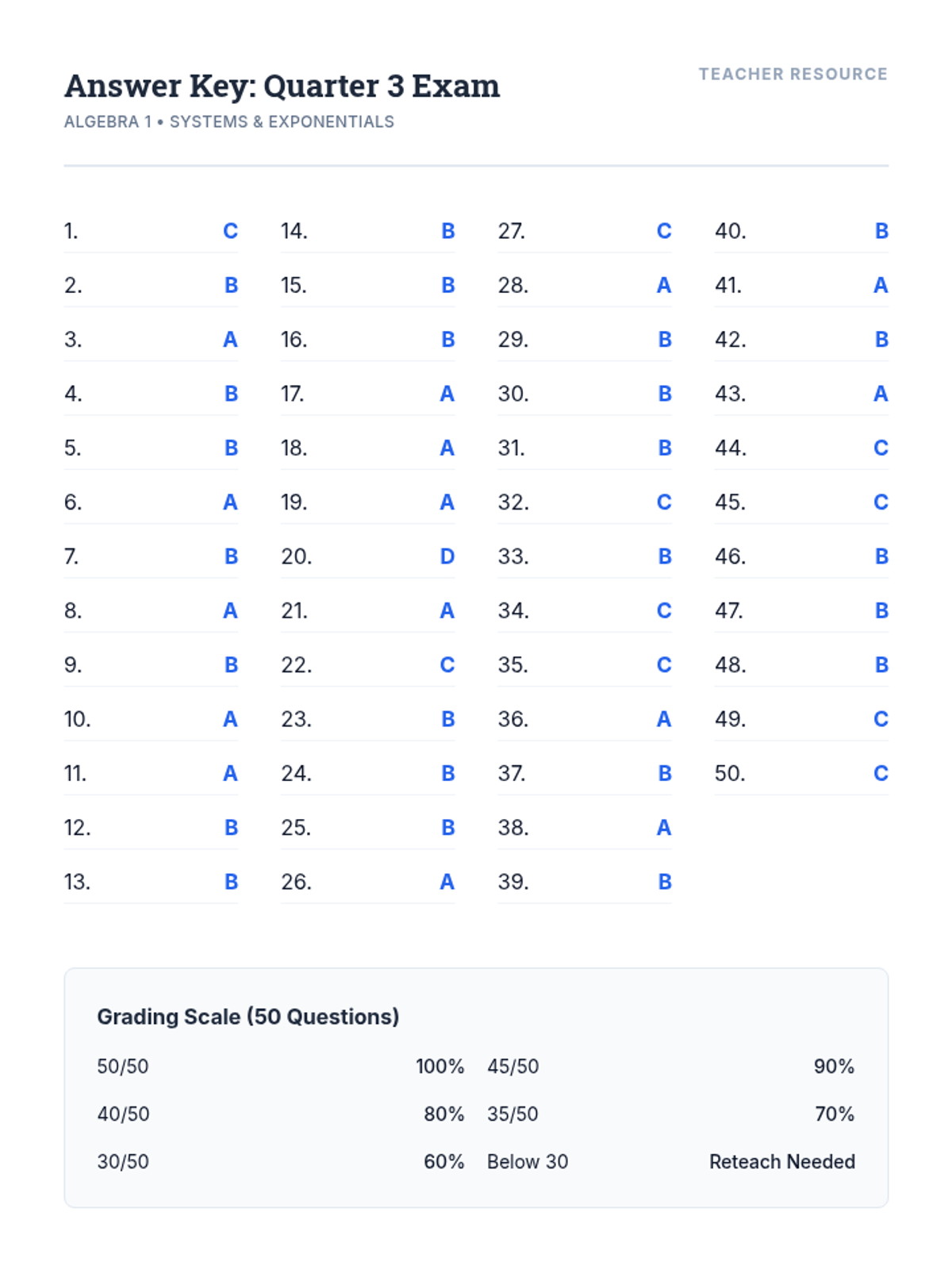
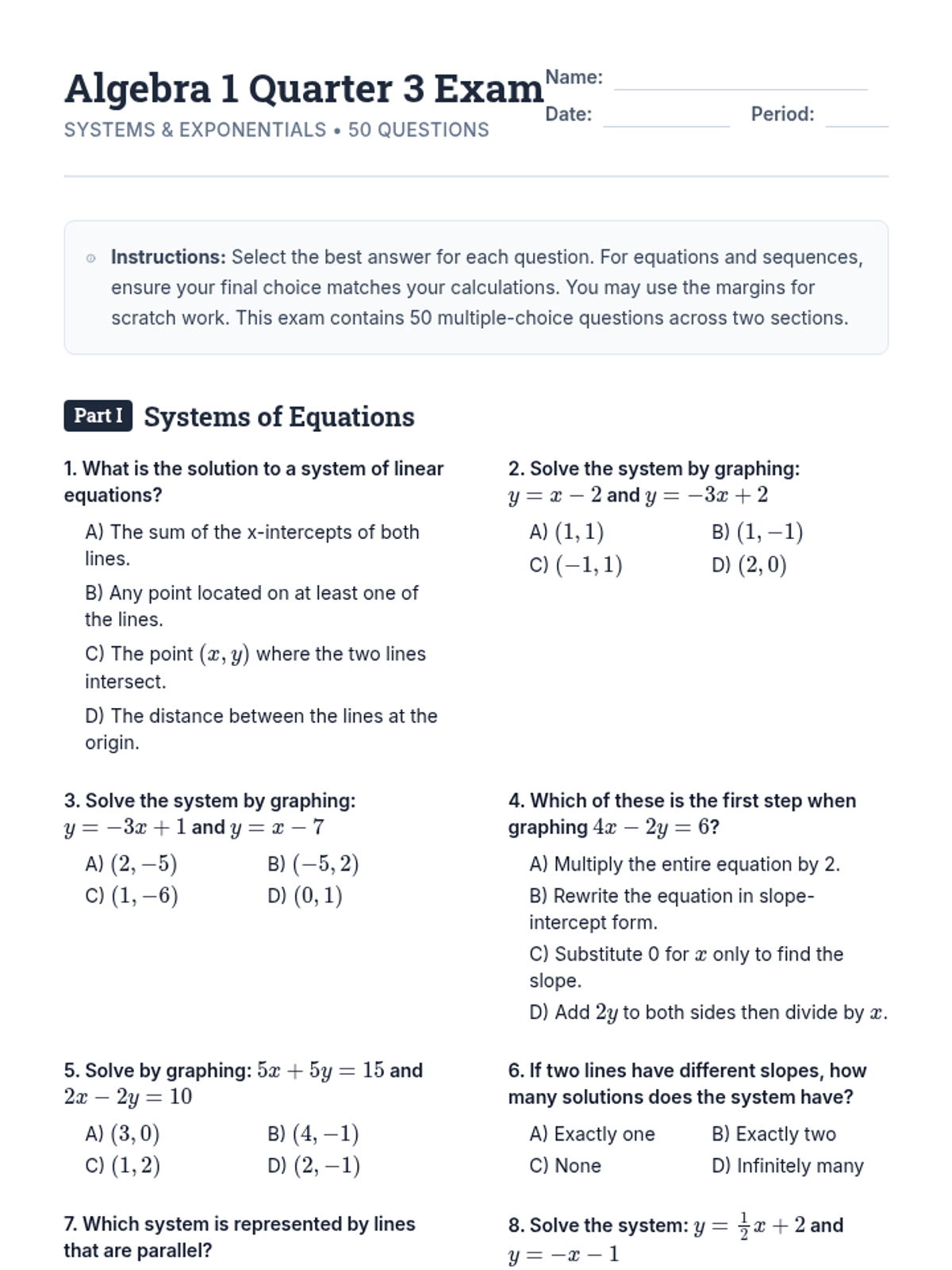
An answer key for the Algebra 1 Quarter 3 Exam, providing correct answers for all 50 questions and a quick-reference grading scale for teachers.
A comprehensive 50-question multiple-choice exam for Algebra 1, 3rd Quarter, combining Systems of Equations and Exponential Functions. The exam is structured into four pages with a clean, two-column layout for efficiency and professional presentation.
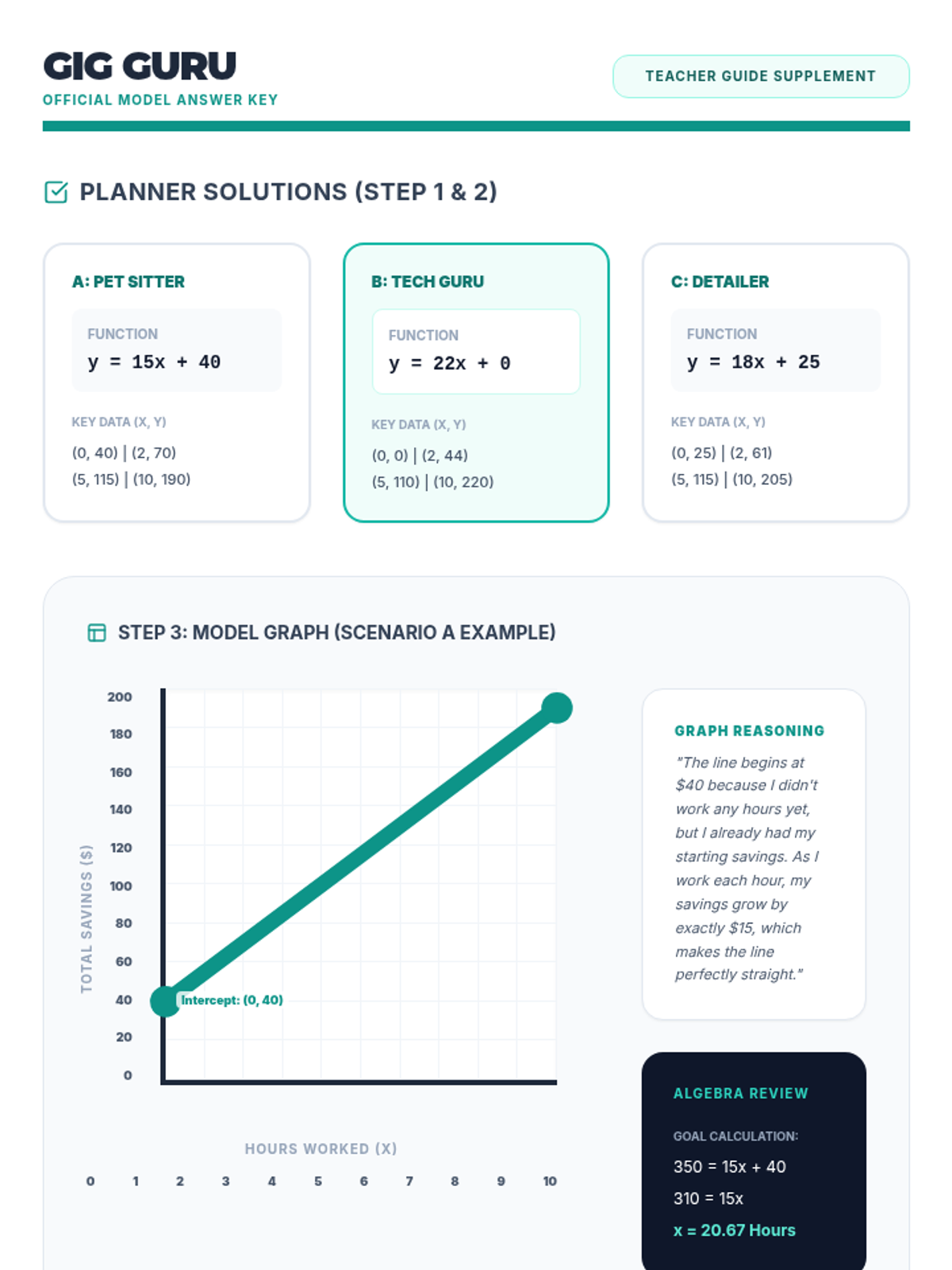
A complete teacher's answer key for the Gig Guru project, providing exact numerical solutions for all three job scenarios, model graphs, and detailed algebraic solving steps for the financial goals.
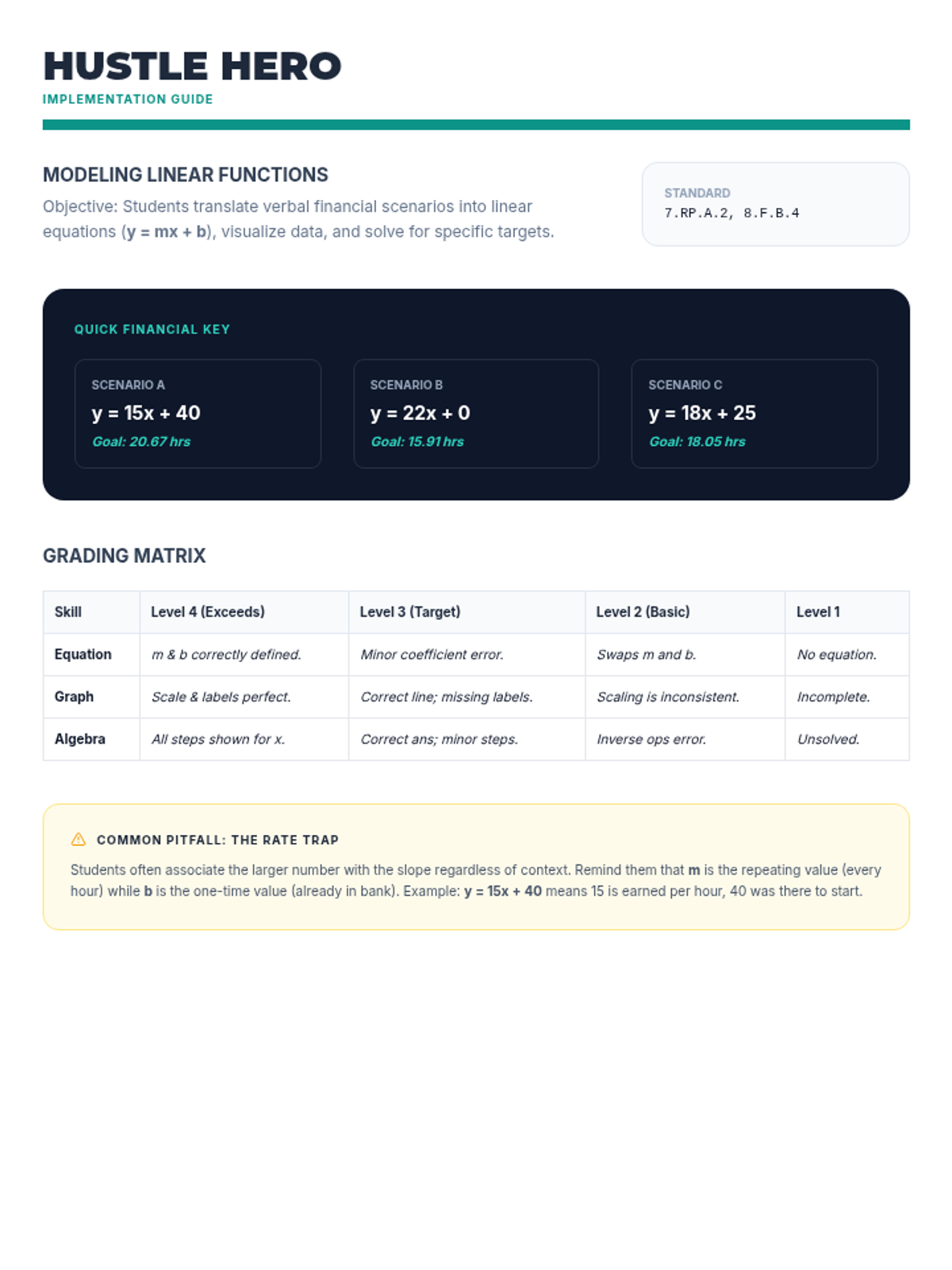
A comprehensive guide for teachers to facilitate the Gig Guru project, including standards alignment, pacing suggestions, answer keys, and a grading rubric.
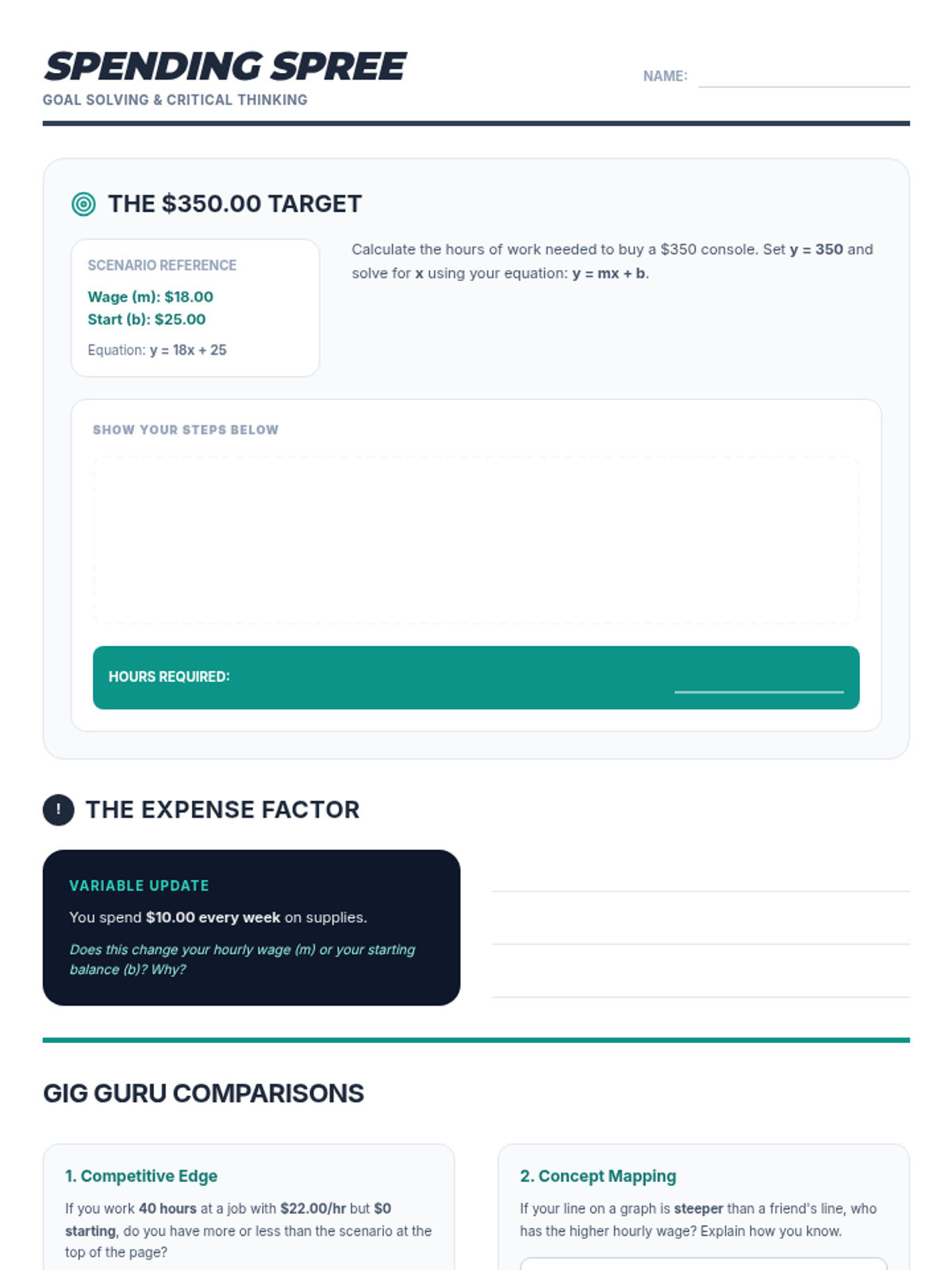
An extension worksheet focusing on budget management, calculating goal-based targets using algebraic solving, and reflecting on the impact of expenses on linear models.
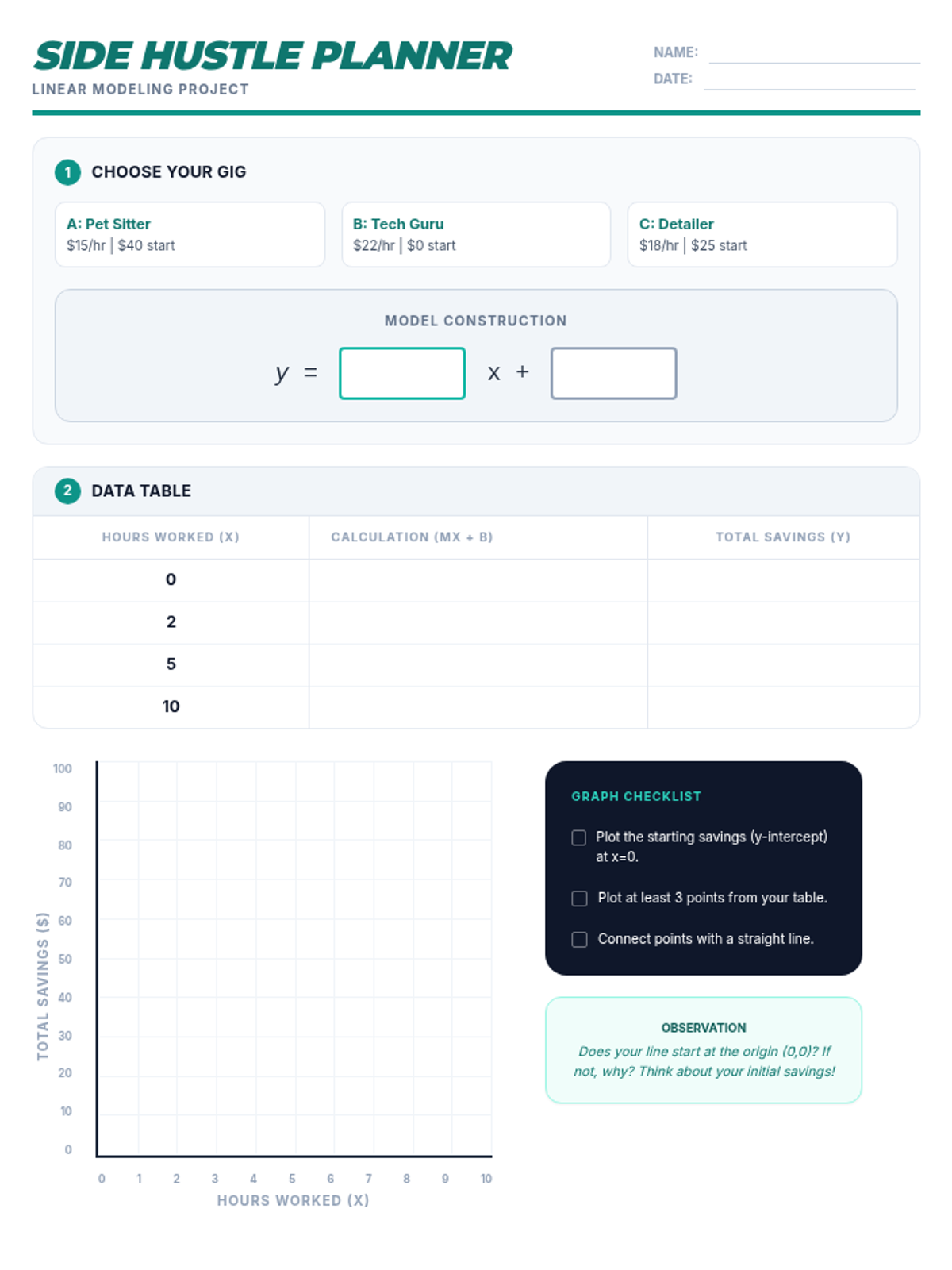
A project worksheet where students select a summer job scenario and build a linear function model. It includes identifying parameters, writing the equation, calculating values in a table, and graphing the results.
A visual presentation introducing students to the Gig Guru project. It covers the core mathematical concepts of linear functions (slope and y-intercept) within the context of a summer job and starting savings.
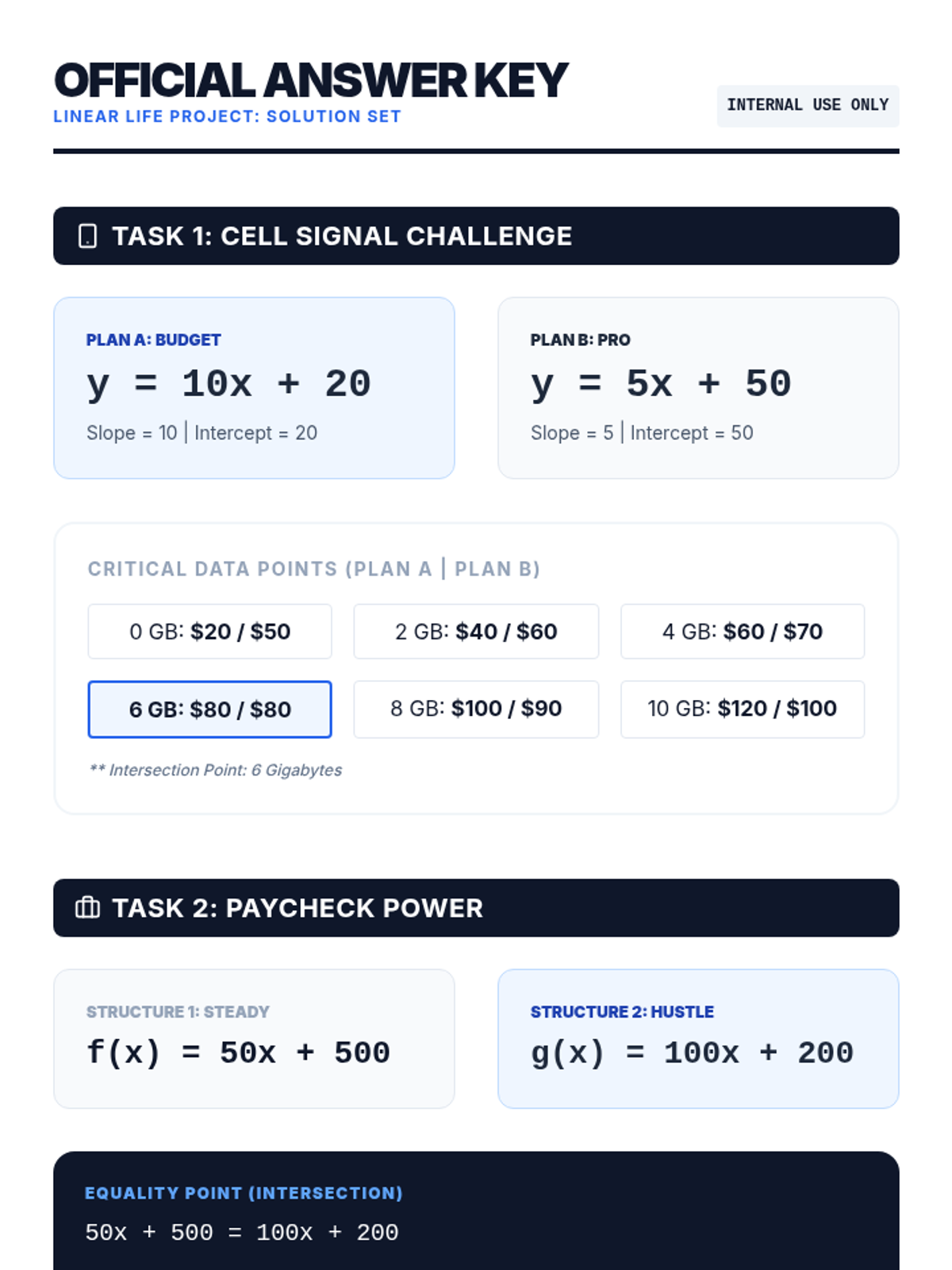
Revised answer key for the Linear Life project. Fixed mathematical notation, improved visual contrast, and ensured each task's solutions are contained on a single page for teacher ease of use.
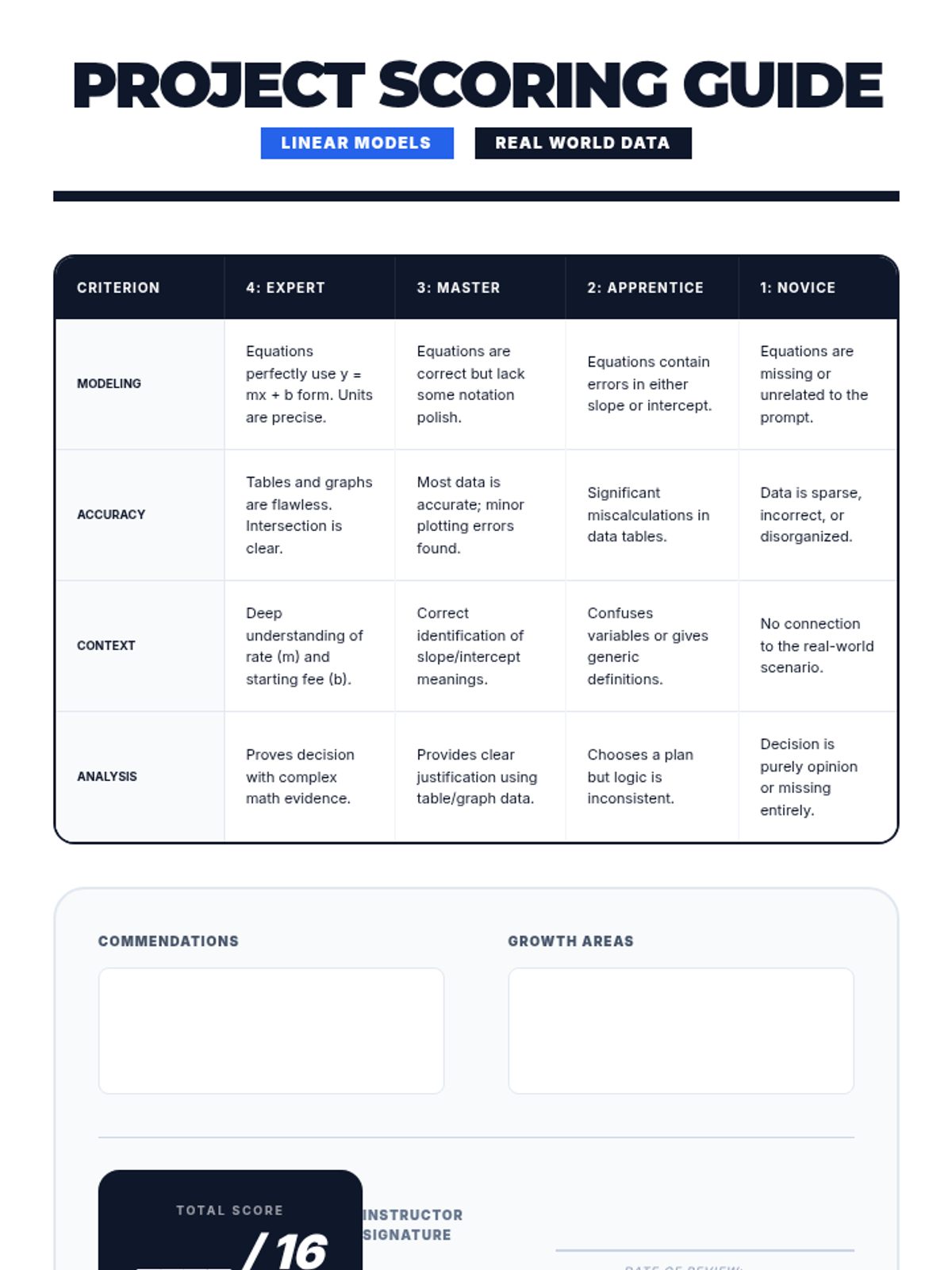
Revised grading rubric for the Linear Life project. Added Level 1 criteria, fixed math notation, and optimized layout to ensure the feedback section and grading block stay on one page.
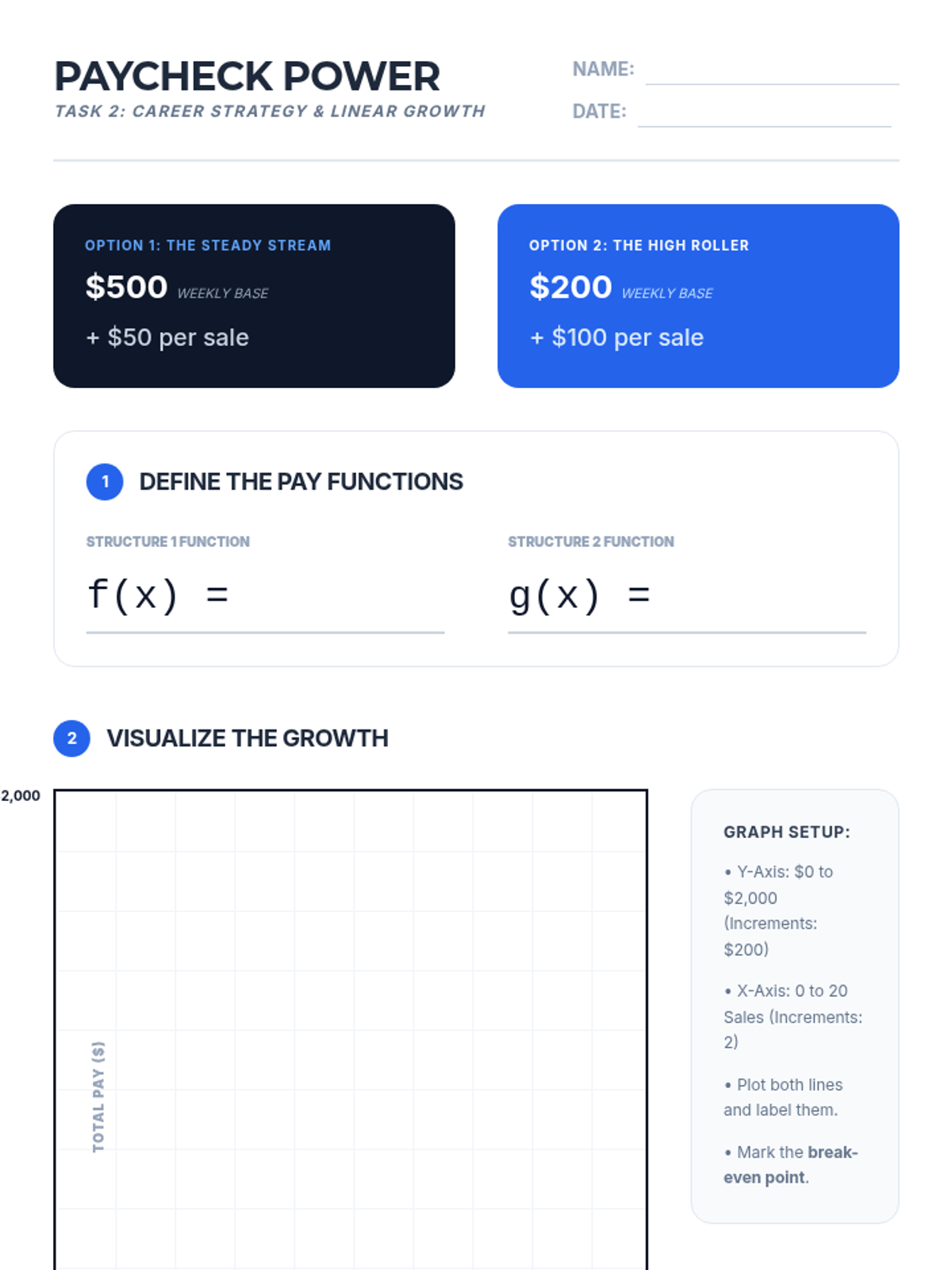
Revised student worksheet for Task 2. Improved graph rendering with a stable CSS grid, fixed page breaks, and optimized work areas for student handwriting.
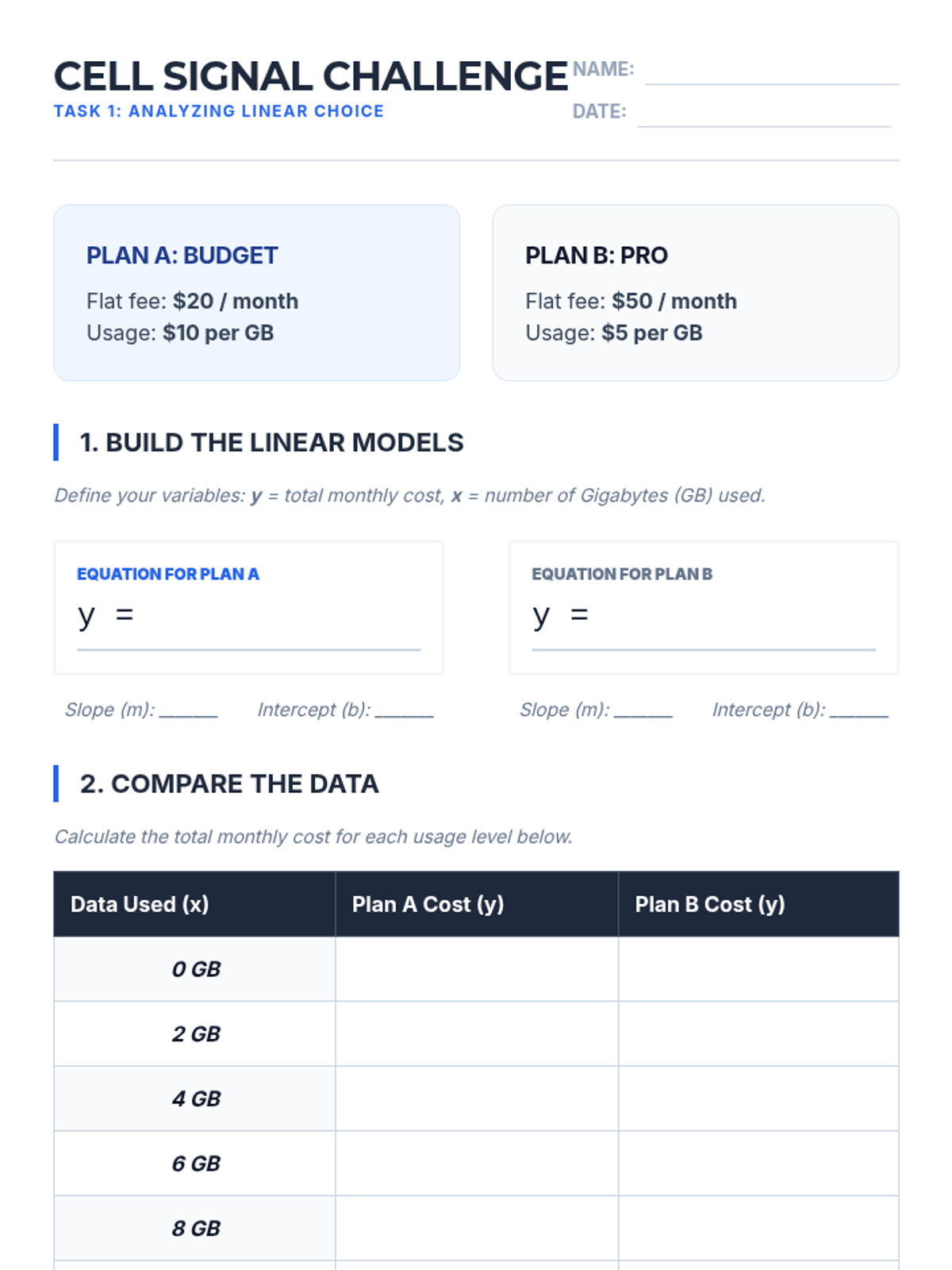
Revised student worksheet comparing two cell phone plans. Fixed page breaks, improved work areas, and clarified variable definitions.
Presentation slides for the Linear Life project, introducing slope and y-intercept in the context of cell phone plans and career commission structures. Revised with specific Task 2 data.
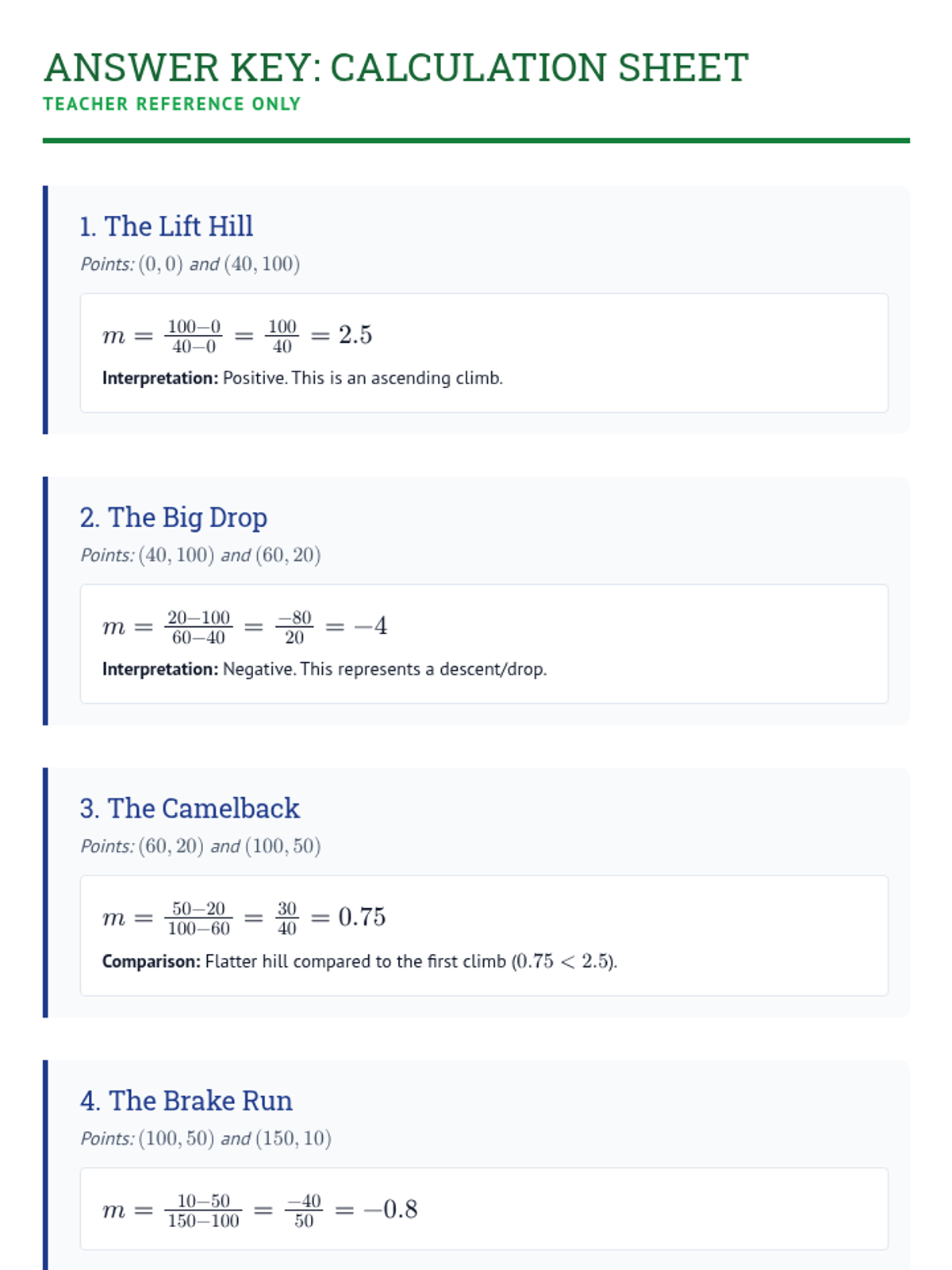
A detailed answer key and teacher grading guide for the Coaster Slope Project, including worked-out solutions for all calculations.
An introductory slide deck for the Coaster Slope Project, explaining the concept of slope, the slope formula, and how it applies to roller coaster physics.
A student guide for creating a roller coaster infographic, outlining the required elements, design tips, and a planning section to help organize their slope data visually.
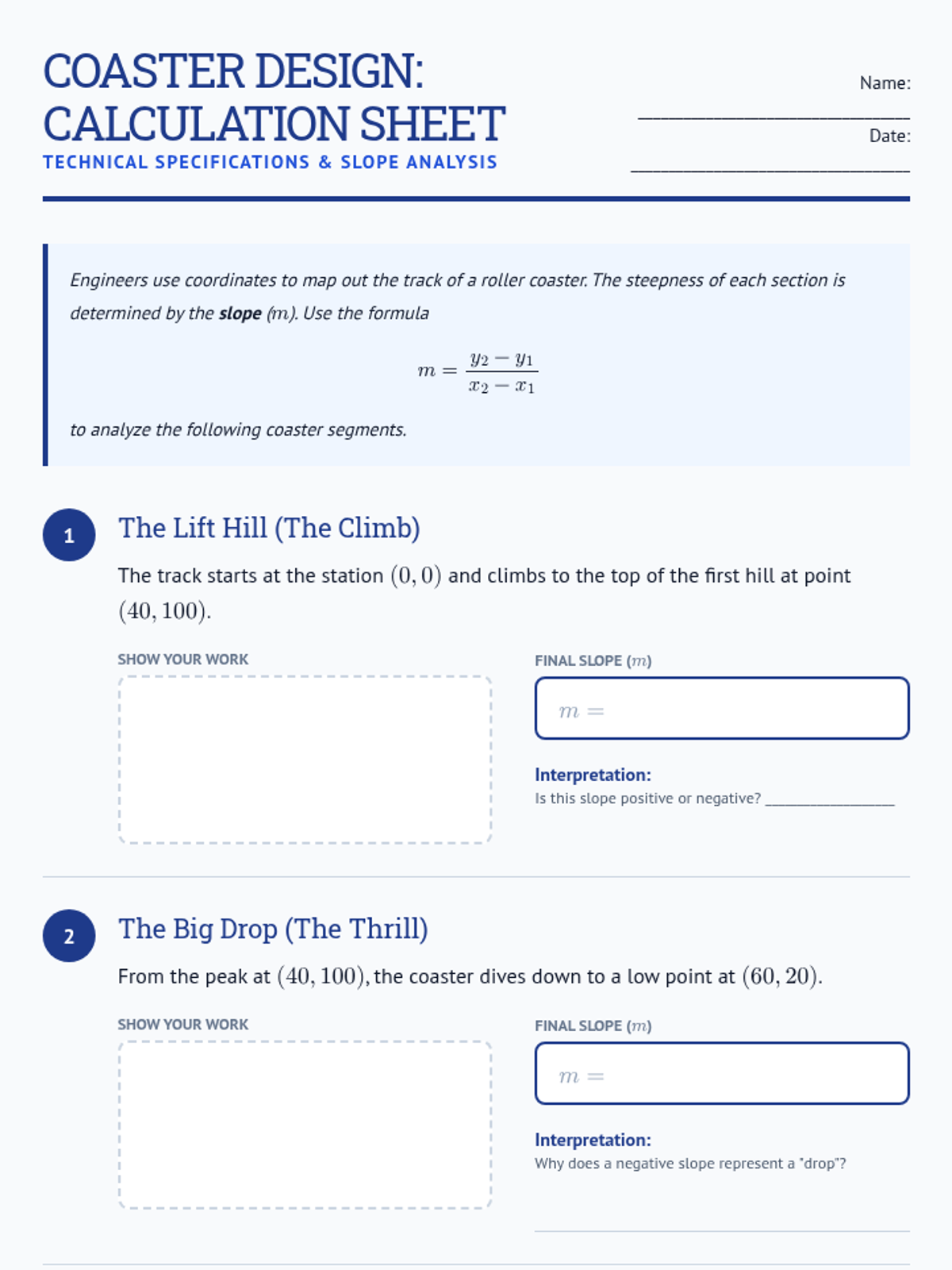
A technical calculation worksheet where students use coordinates to find the slope of various segments of a roller coaster track, featuring a blueprint-inspired design.
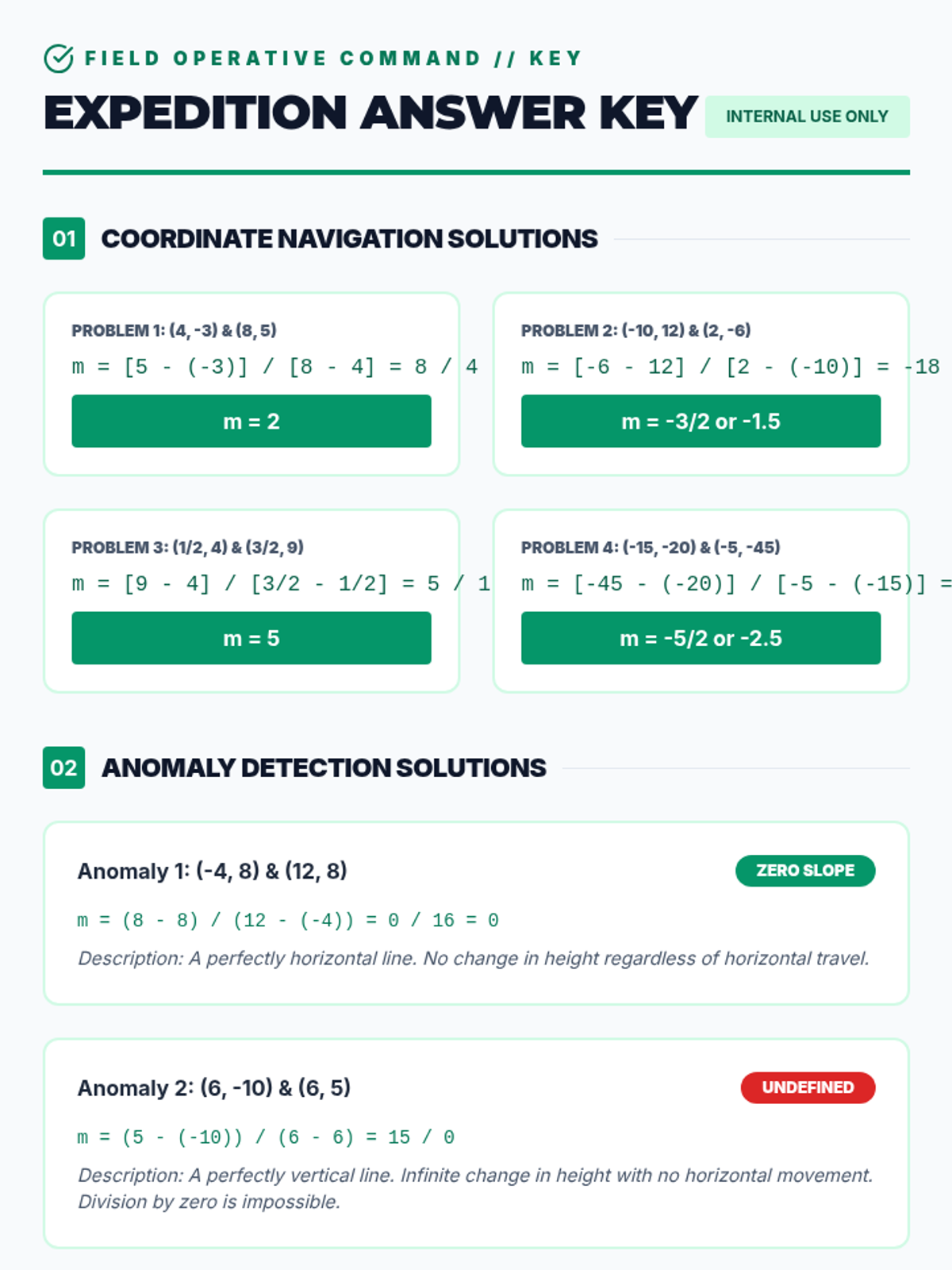
A teacher answer key for the Slope Hunter Expedition Worksheet, providing full step-by-step solutions and interpretations for coordinate calculation, special cases, and real-world modeling.
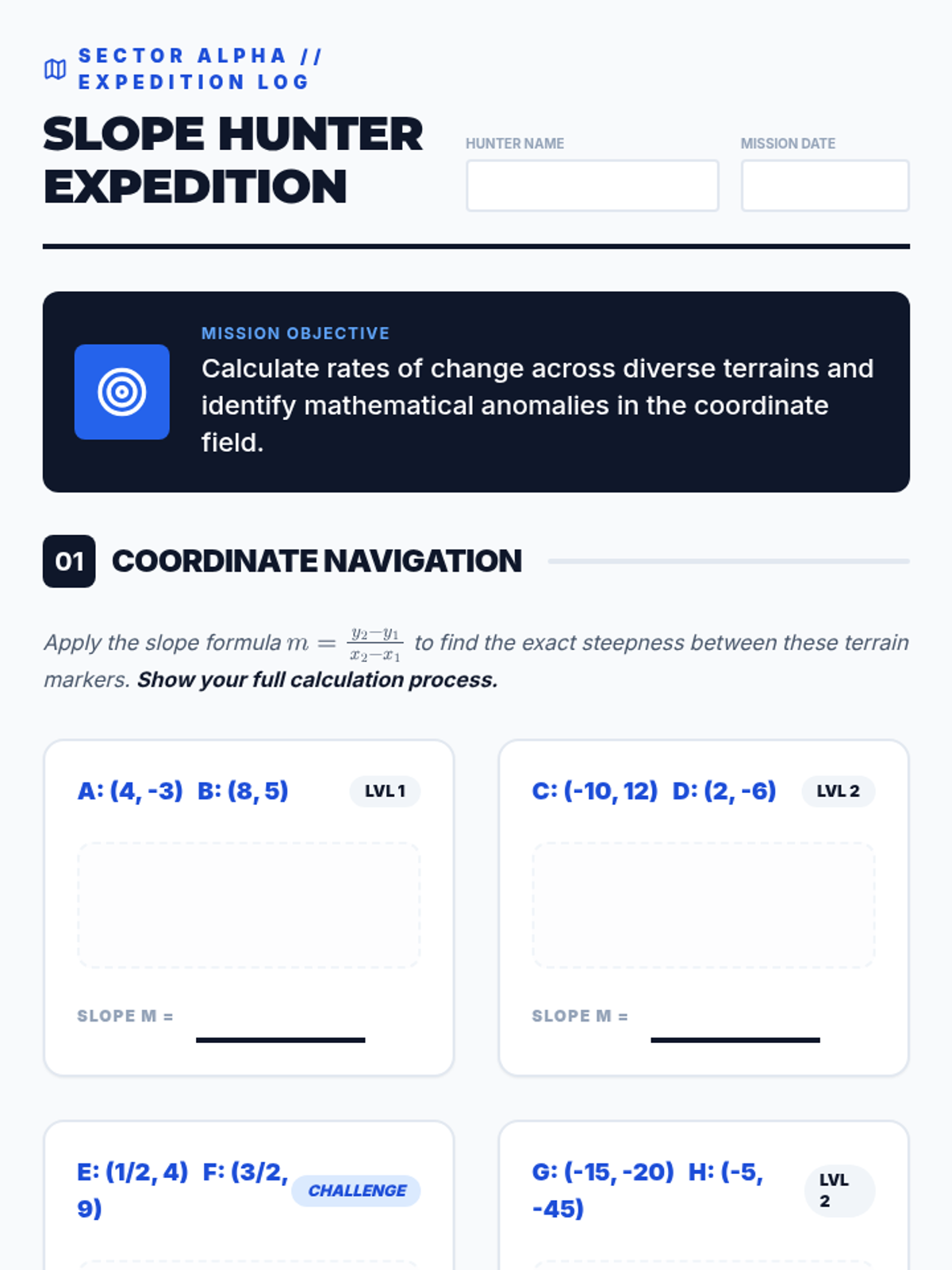
A student worksheet activity for calculating slope from coordinates, identifying special cases (zero/undefined), and interpreting real-world rates of change with a field-report theme.
Advanced slides for teaching slope as a rate of change, introducing the coordinate-based slope formula, zero and undefined anomalies, and real-world unit analysis. Includes a challenging drone case study.
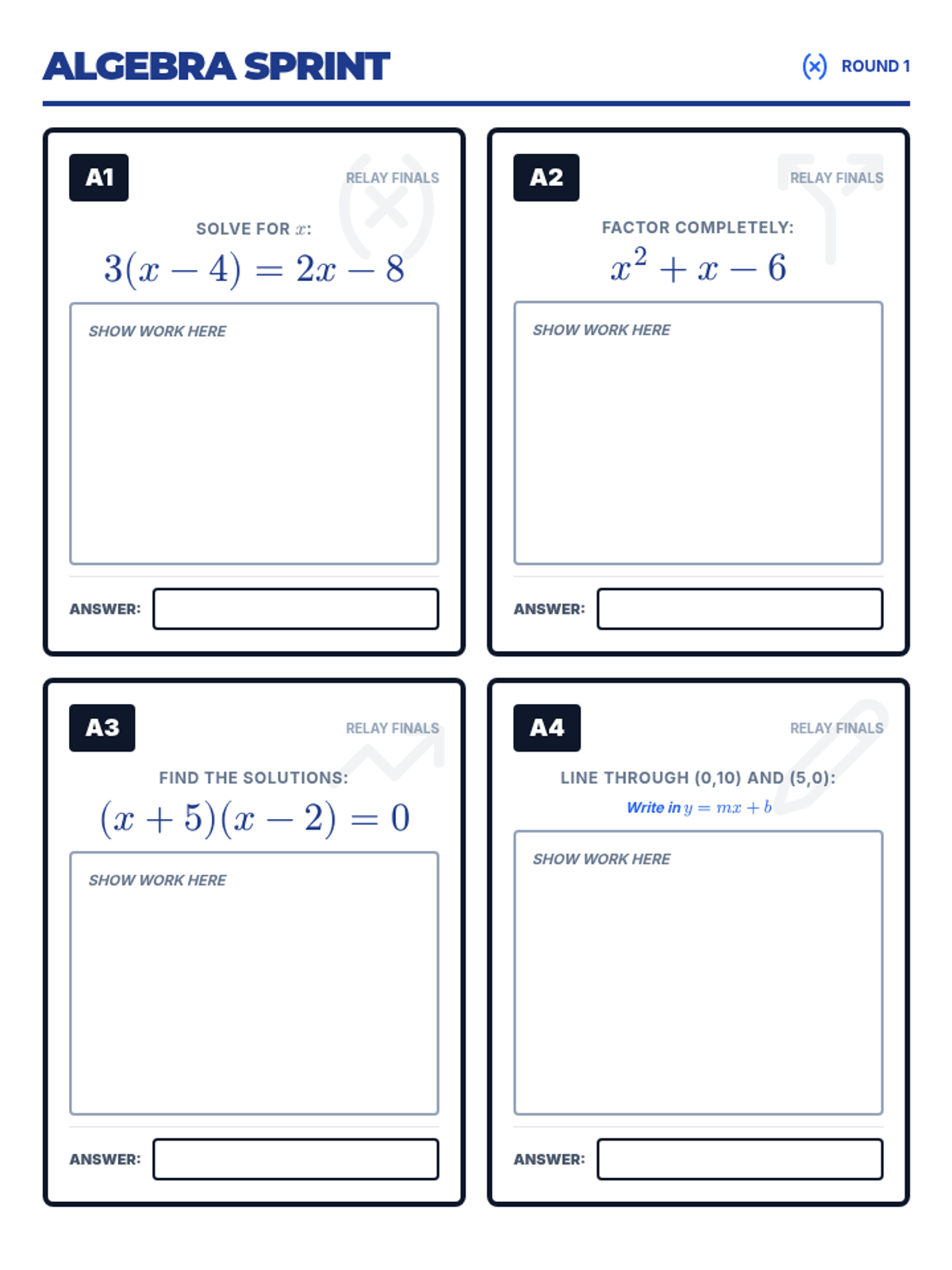
A collection of 16 formatted challenge cards across four mathematical domains, designed to be printed and used for the relay competition.
A high-energy visual guide for students outlining the rules, scoring, and expectations for the Ultimate Math Relay.
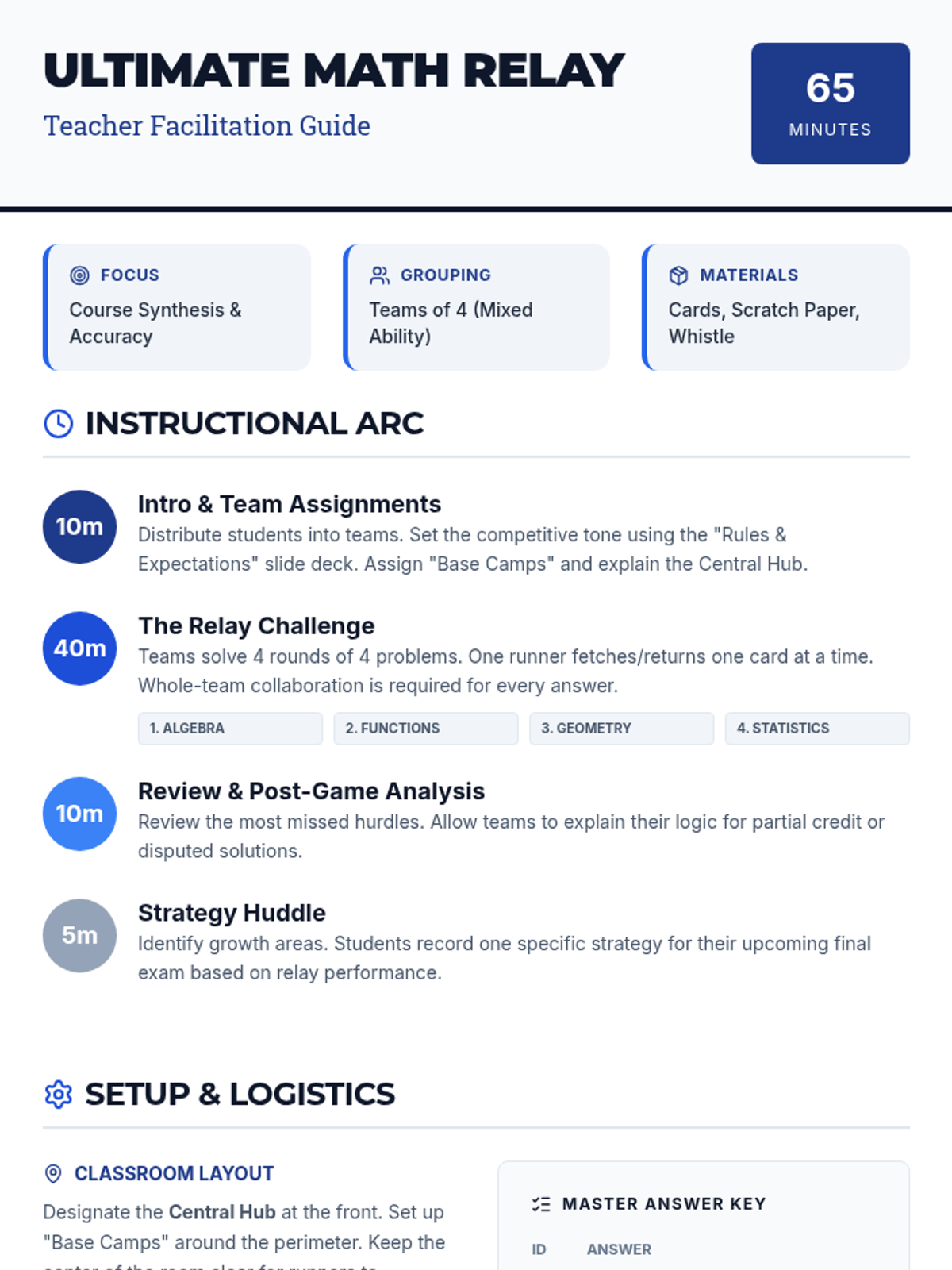
A teacher's facilitation guide for the Ultimate Math Relay, including timing, setup logistics, a master answer key, and scoring rules for the 9th-grade review competition.
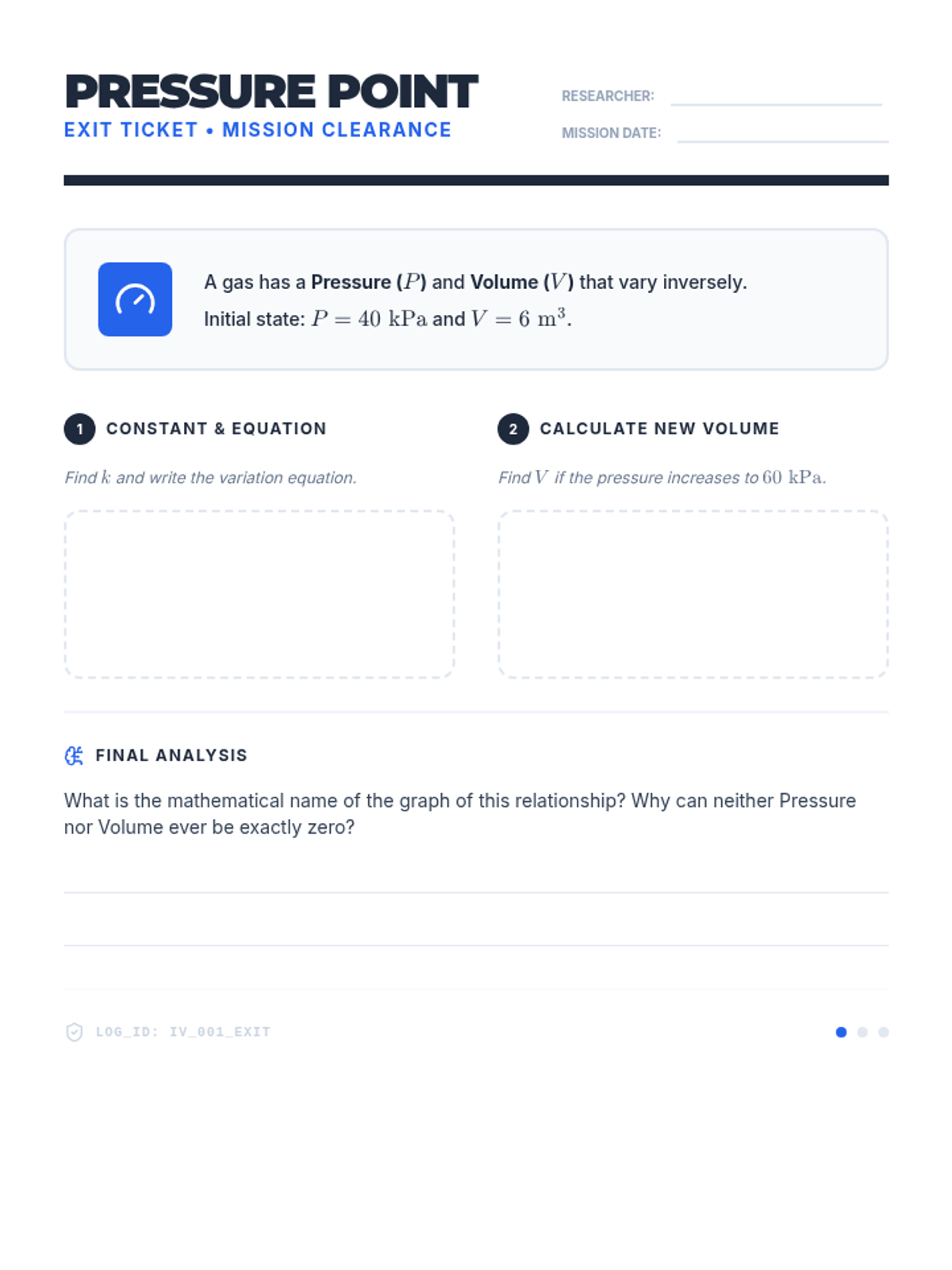
A formal exit ticket for inverse variation. Revised for single-page layout, better math rendering, and balanced work areas.
A sleek, high-contrast slide deck for inverse variation. Revised to fix math rendering, adjust viewport overflow, and correct the hyperbola graphic.
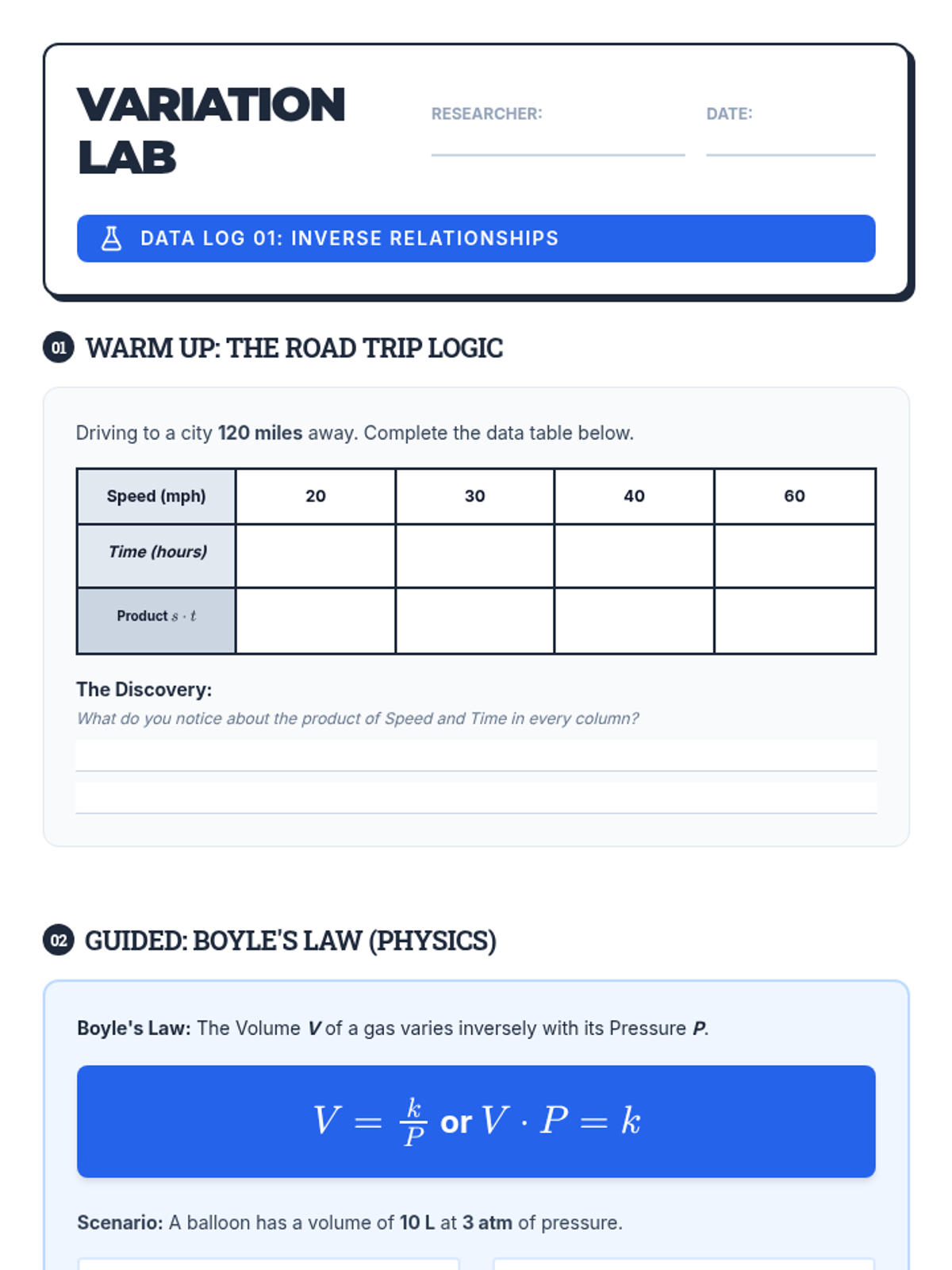
A student-facing handout containing the Warm Up, Guided Instruction, and Independent Practice for inverse variation. Revised for better page breaks, increased contrast, and added pedagogical scaffolding. Fixed math rendering and work areas.
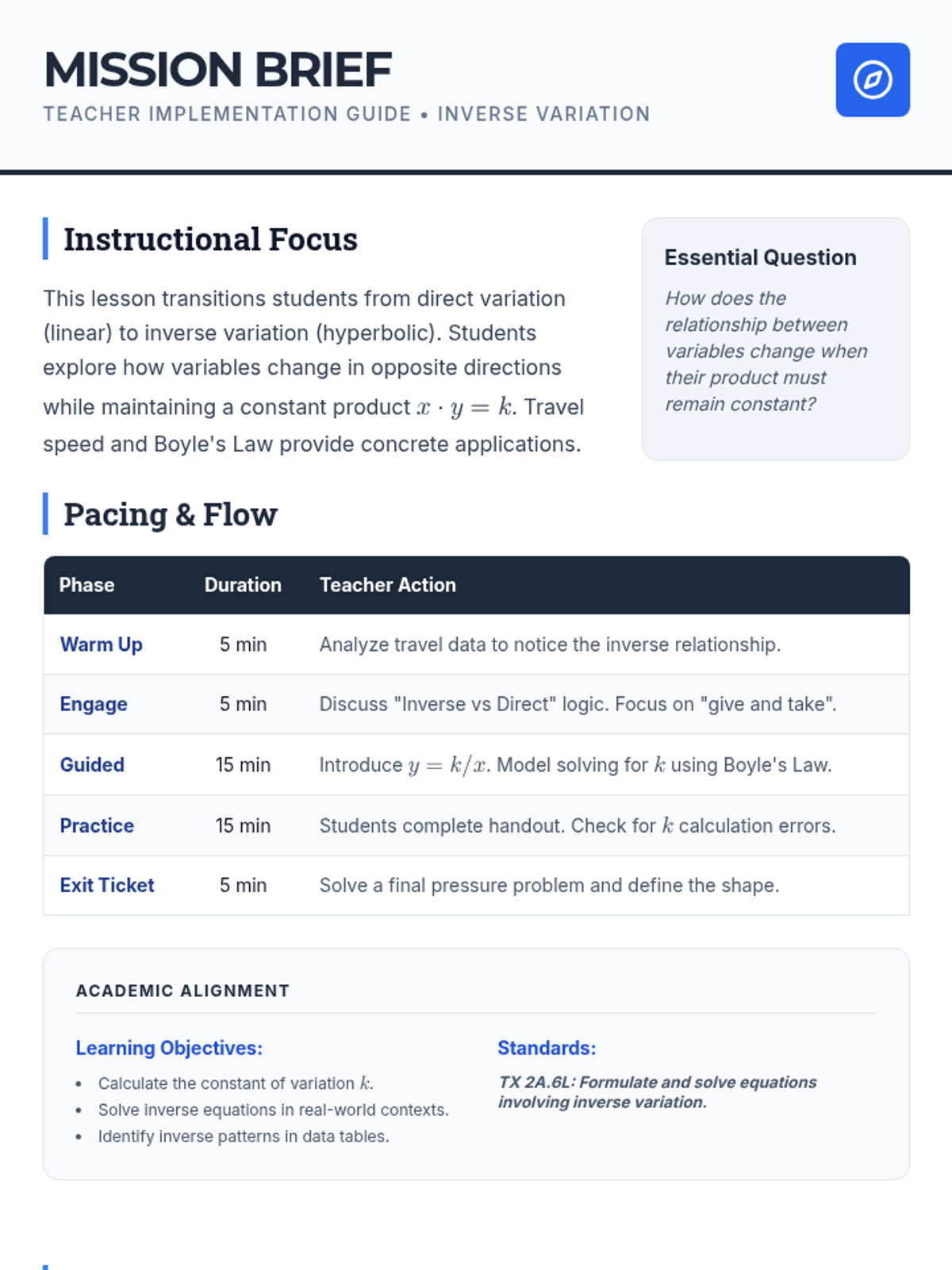
A comprehensive teacher implementation guide for the Inverse Investigators lesson, including pacing, standards alignment, answer keys, and pedagogical tips. Revised for better page breaks and math rendering.
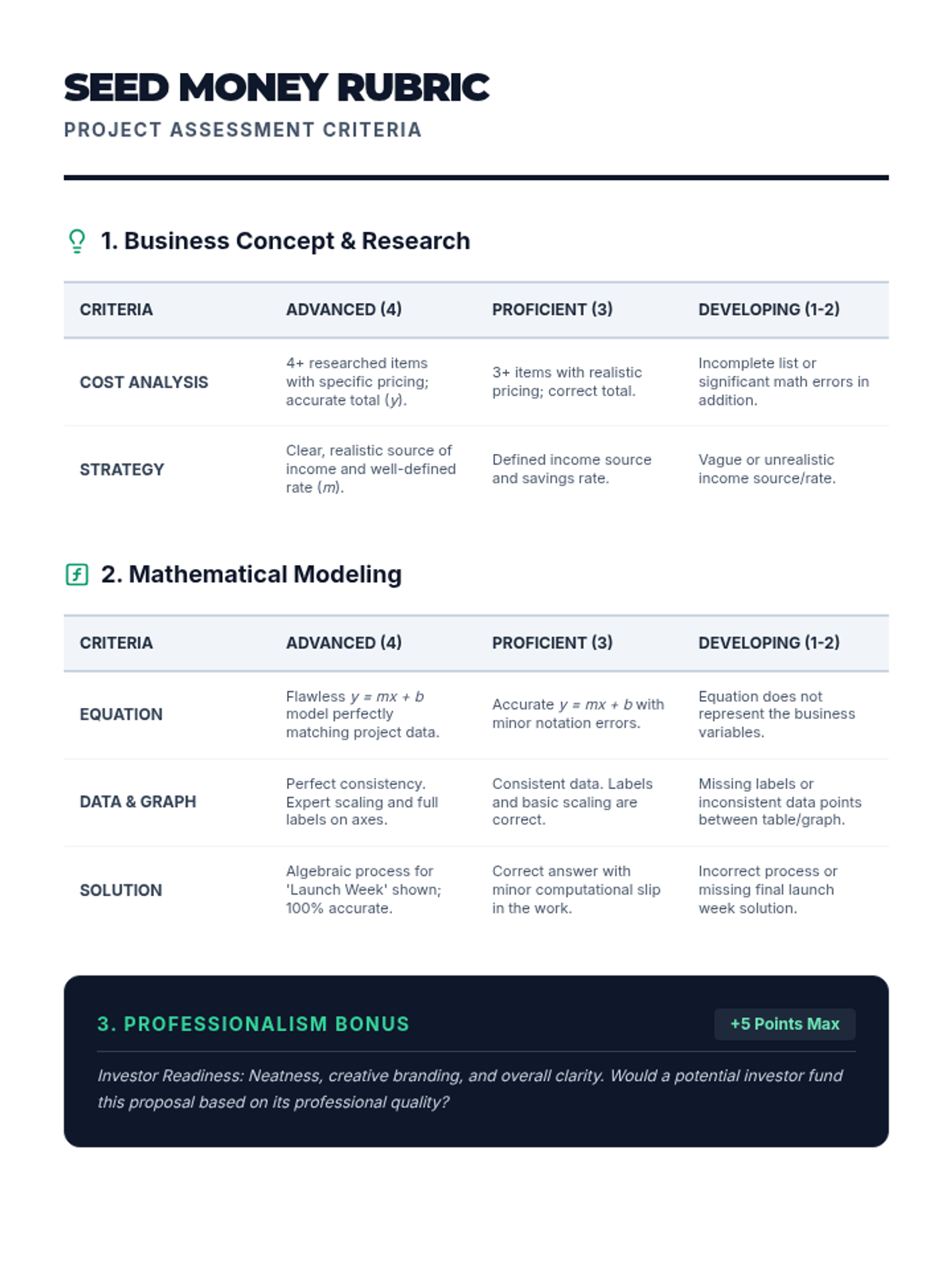
A grading rubric for the Seed Money project, assessing business vision, mathematical modeling accuracy, and professional presentation.
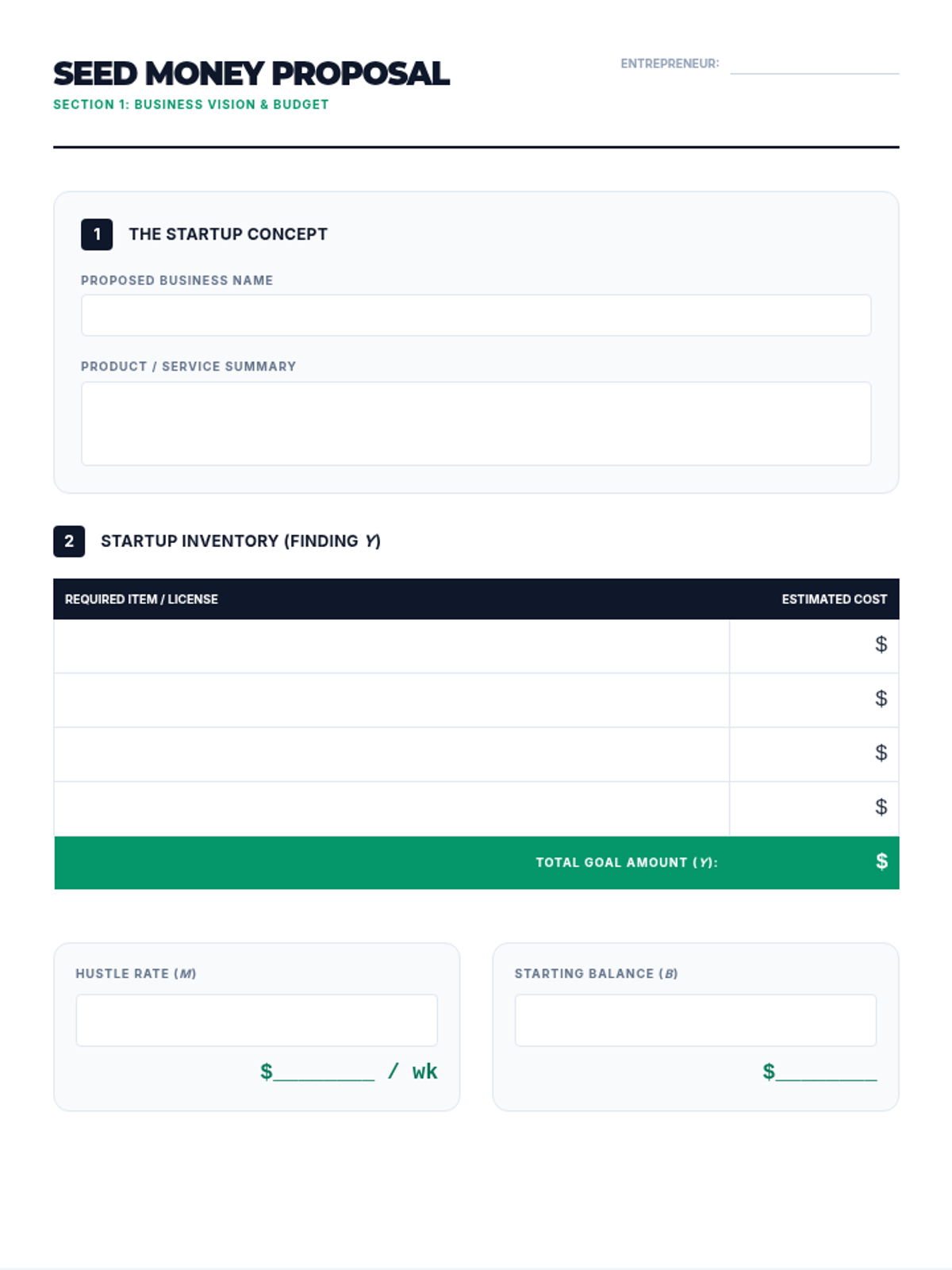
A two-page student project packet designed as a business proposal. It guides students through identifying startup costs, setting a savings rate, building a linear model, and calculating their launch date.
A visual presentation to introduce the Seed Money project, breaking down the linear equation into real-world business components (savings rate, initial funds, and total goals).
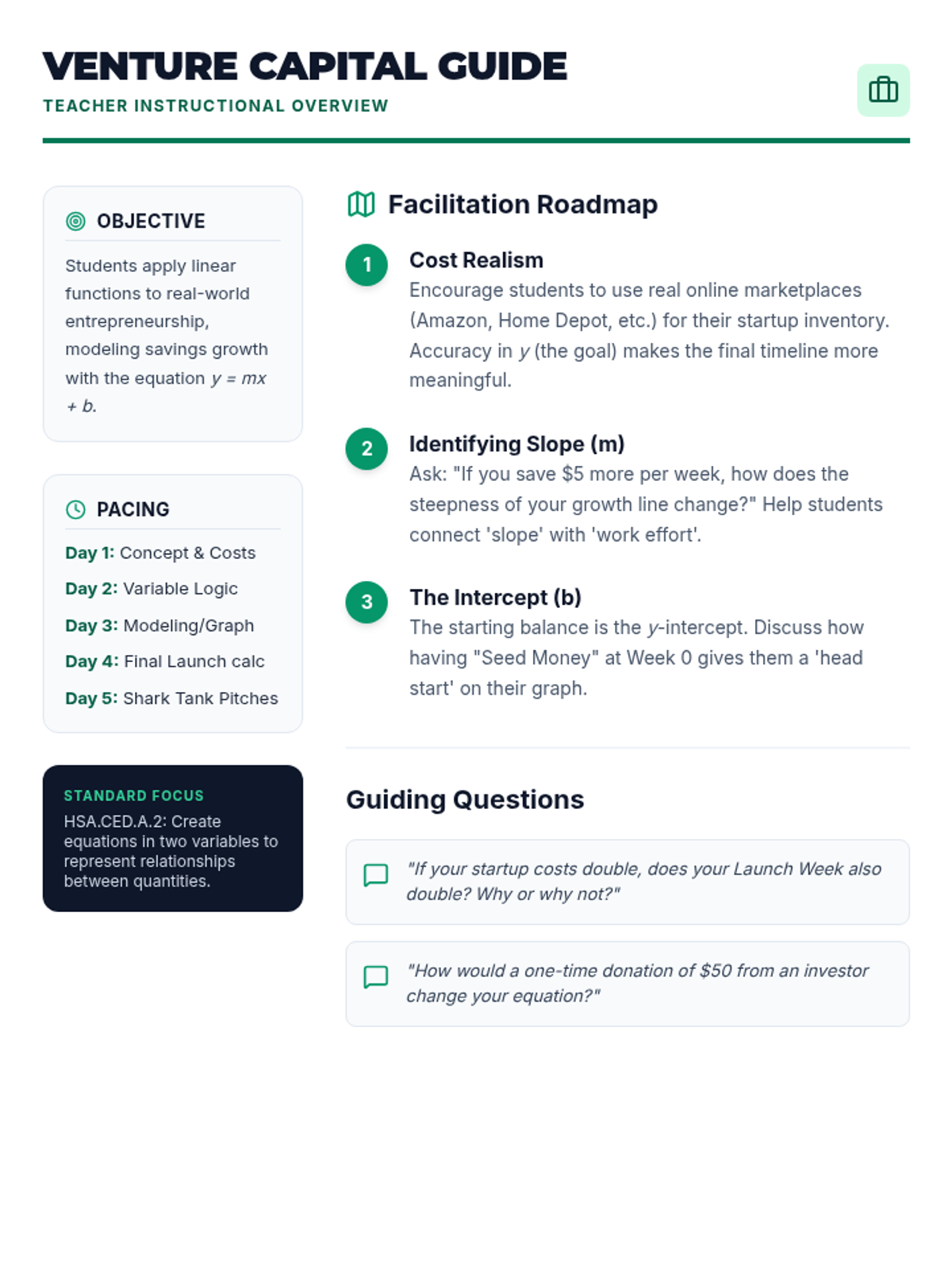
A teacher-facing instructional guide for the Seed Money Startup project, including pacing, objectives, and common student misconceptions regarding linear modeling.
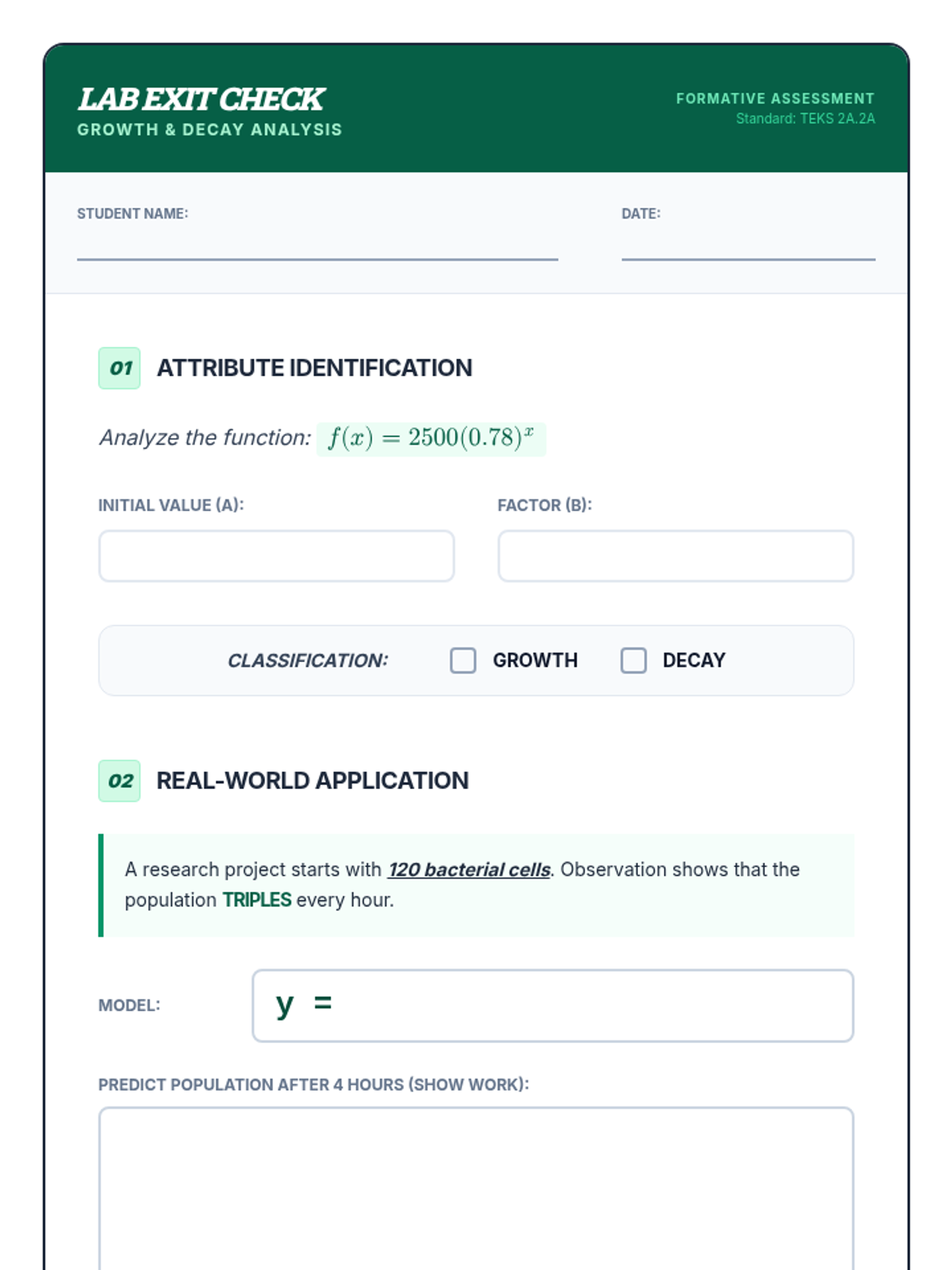
A concise exit ticket to assess student understanding of exponential growth and decay attributes and basic modeling.
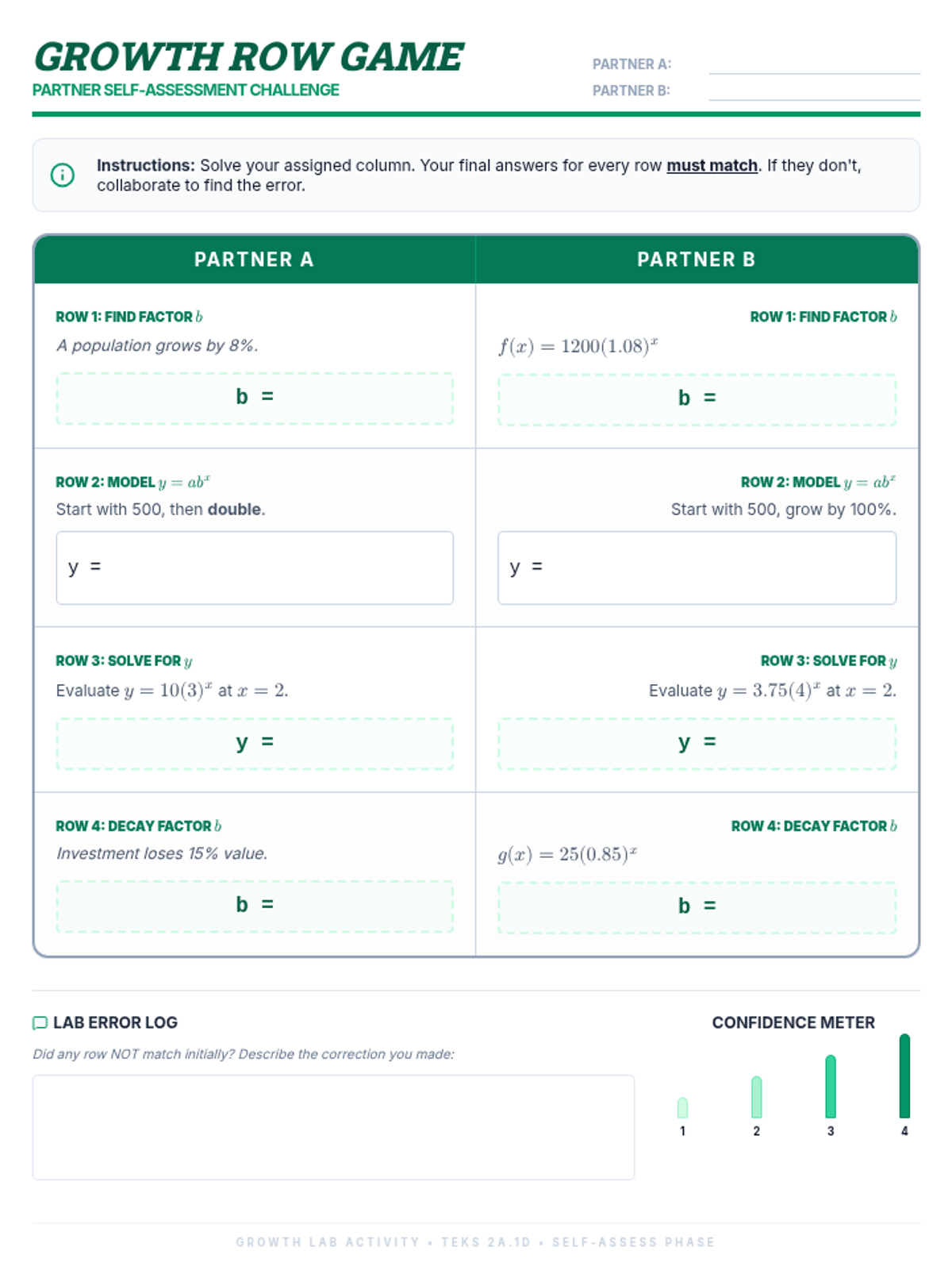
A partner "Row Game" activity where students solve different problems that result in matching answers, fostering peer support and self-assessment.
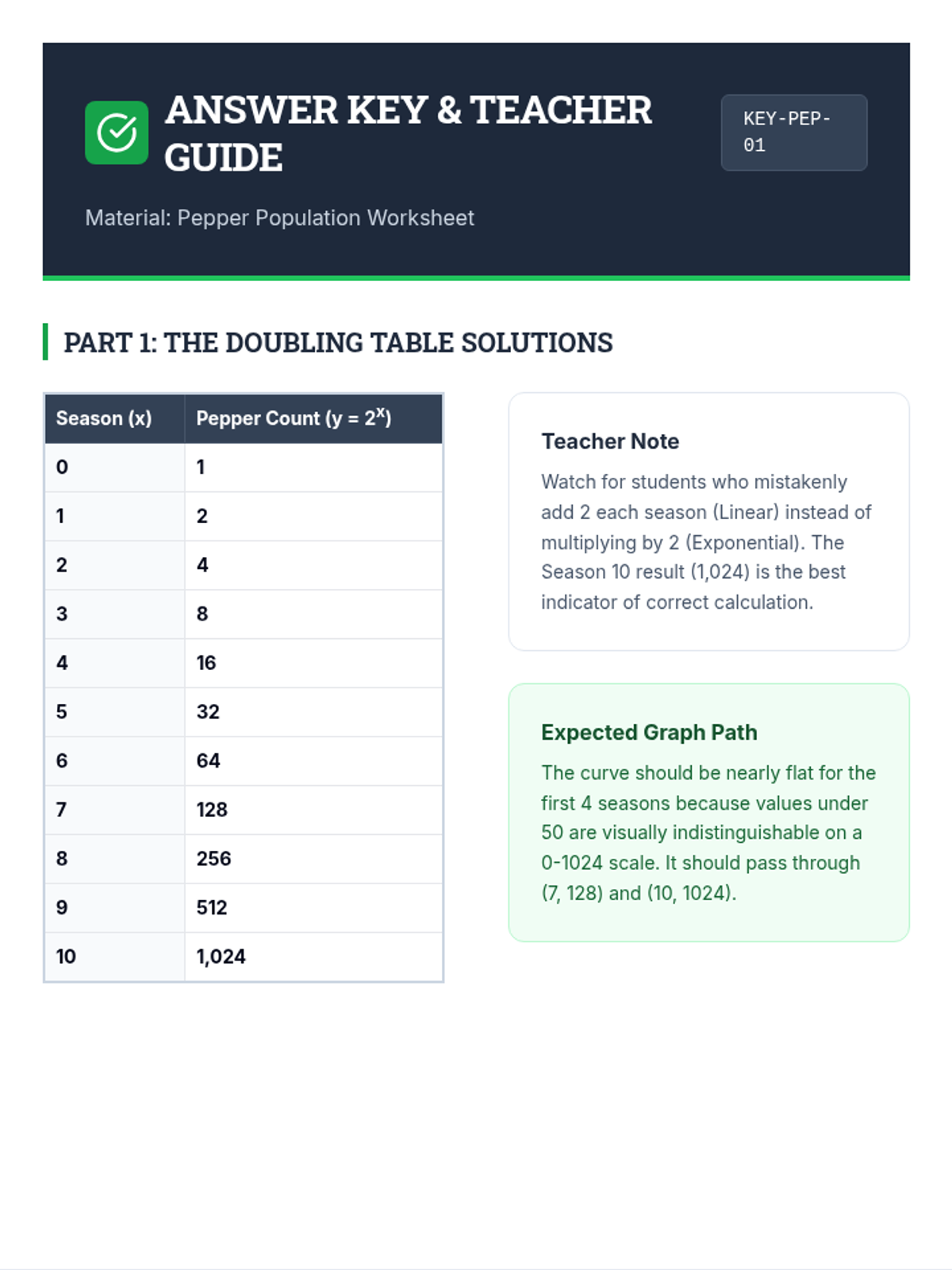
Teacher answer key and instructional guide for the Pepper Population Worksheet, including full data table solutions and analysis commentary.
A visually engaging slide deck explaining exponential growth using green peppers as a model, featuring clear diagrams of doubling and the resulting growth curve.
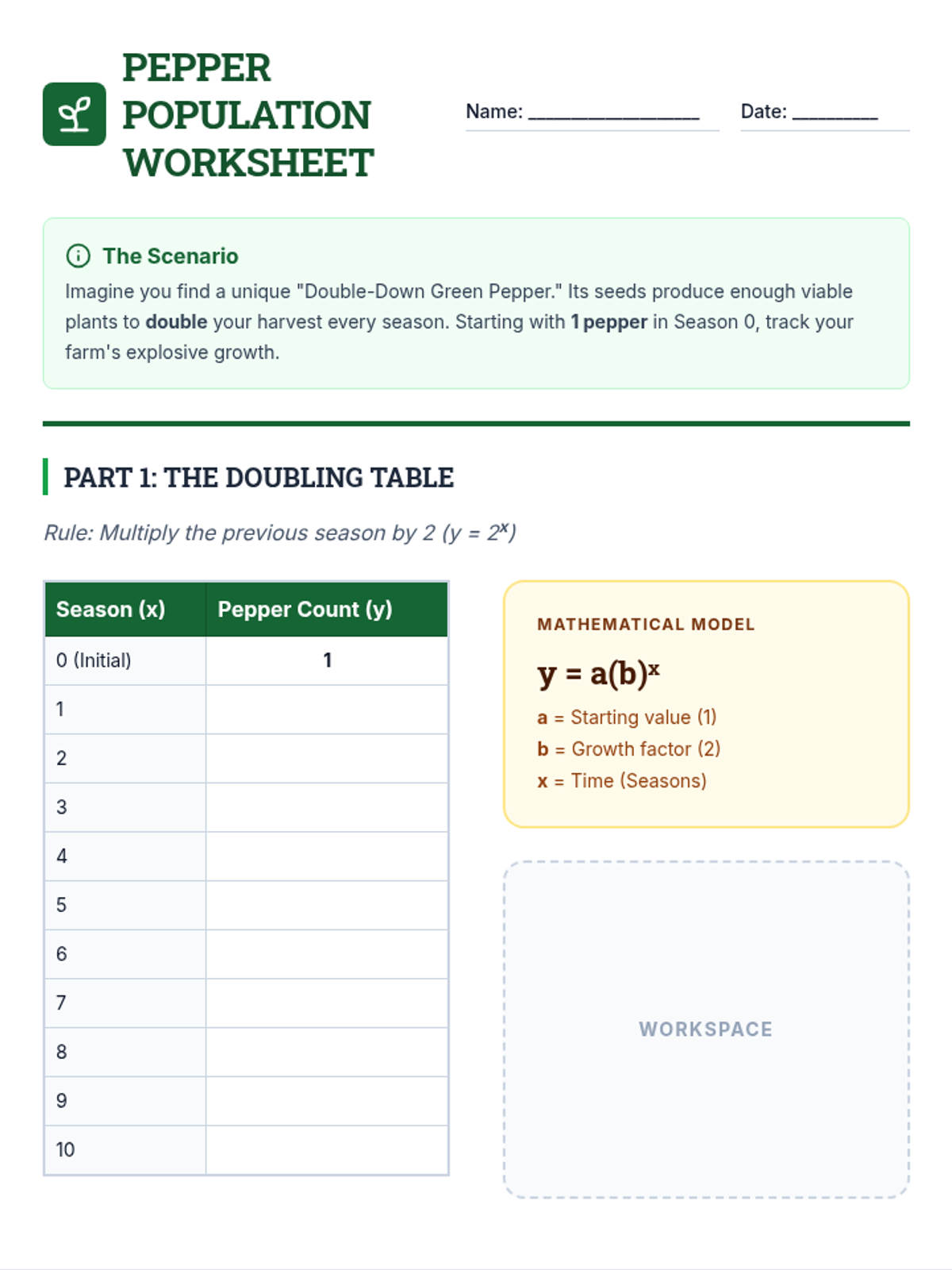
A comprehensive worksheet for students to calculate, graph, and analyze the exponential growth of a pepper population starting from a single fruit and doubling each season.
Instructional slides for exponential growth and decay, covering the model equation, identifying factors, and real-world application examples.
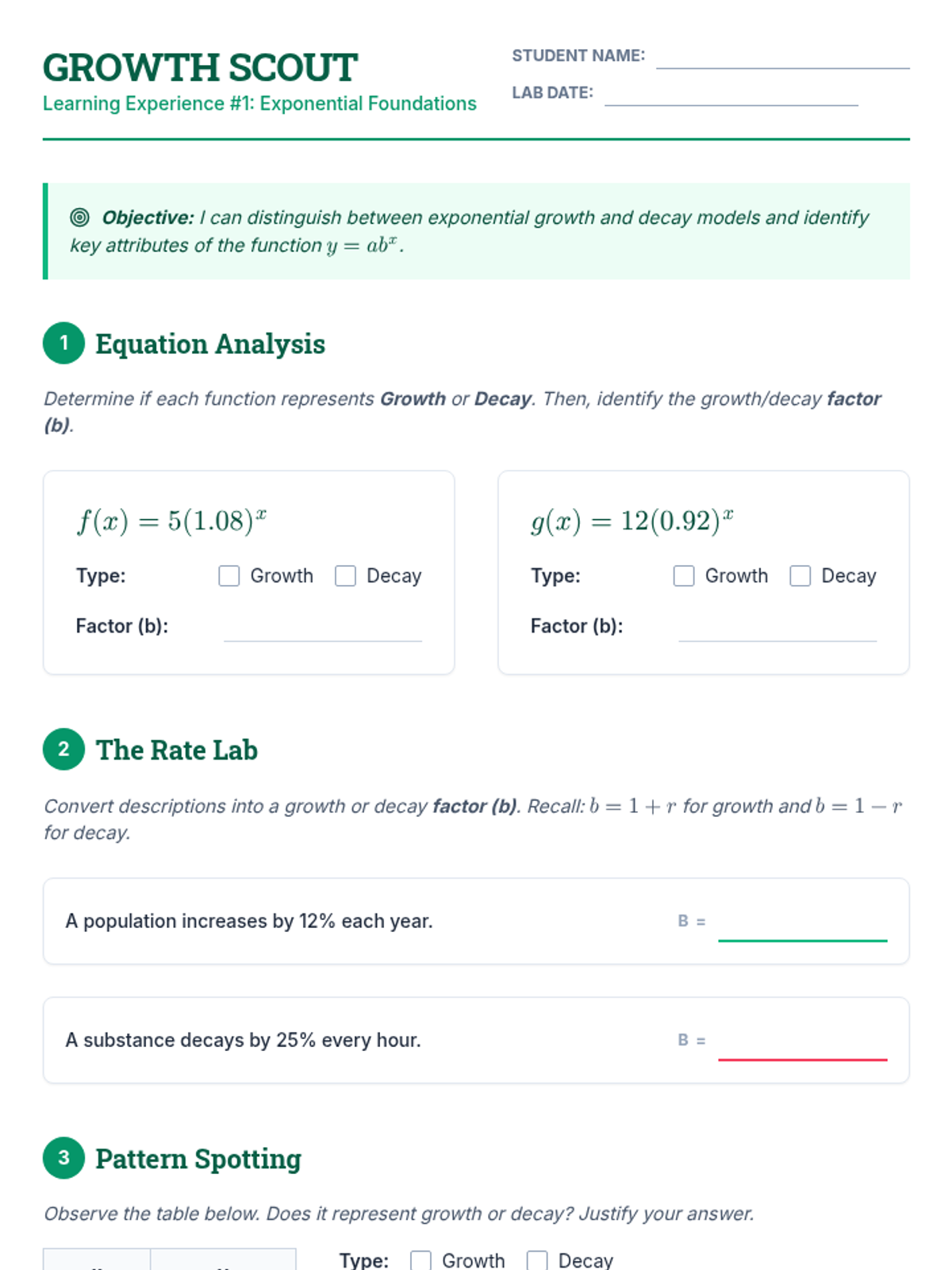
A warm-up worksheet for exponential growth and decay, focusing on identifying factors and types of functions from equations, descriptions, and tables.
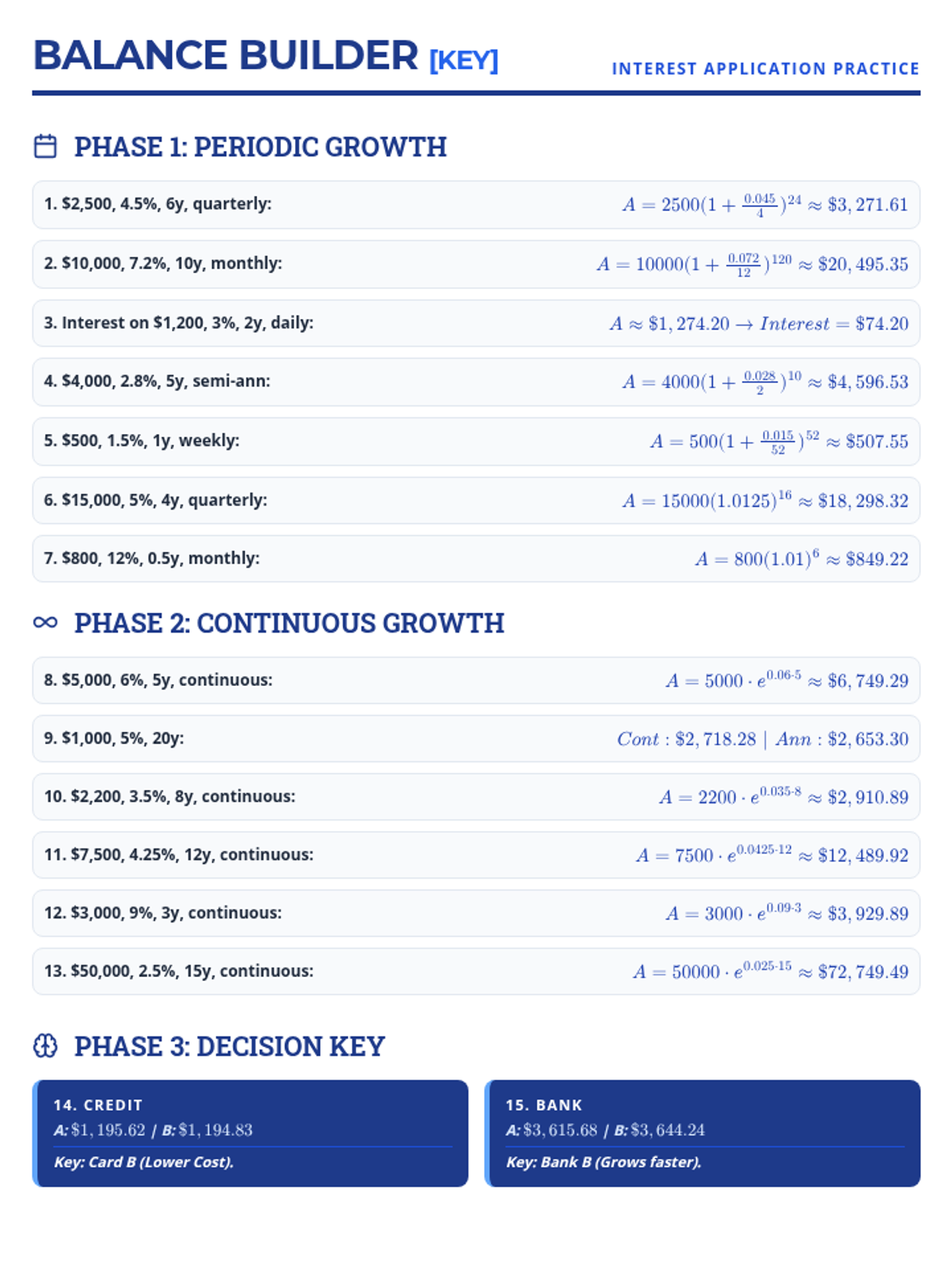
Teacher answer key for the expanded Balance Builder Worksheet, featuring complete answers and evaluations for all 15 problems. Revised to ensure consistent formatting and clear mathematical rendering on a single page.
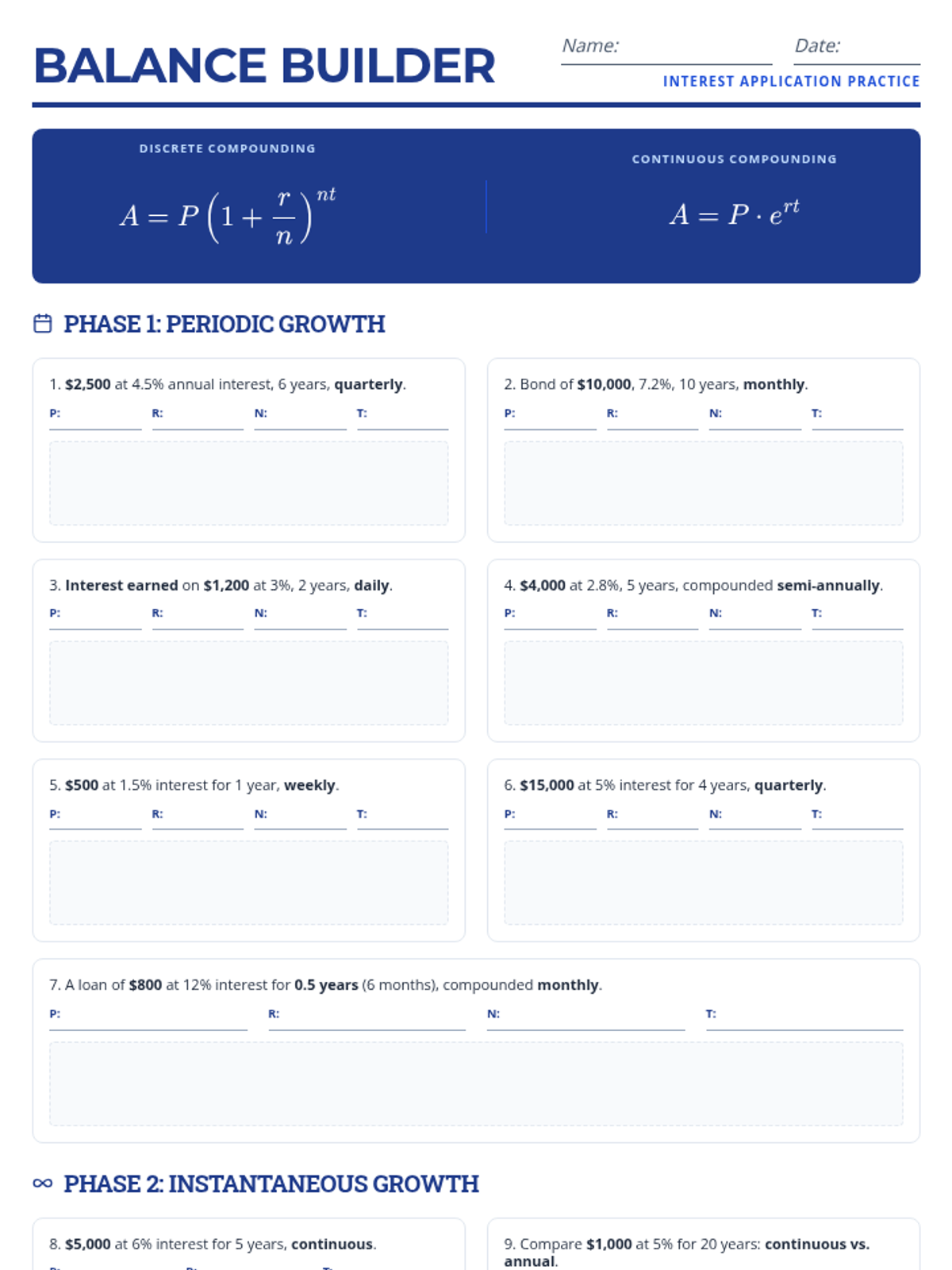
An expanded practice worksheet for Algebra 2 students featuring 15 total word problems on discrete and continuous compound interest. Includes identification of variables, step-by-step calculation areas, and comparison problems across three phases. Revised to fit on 2 pages with consistent scaffolding.
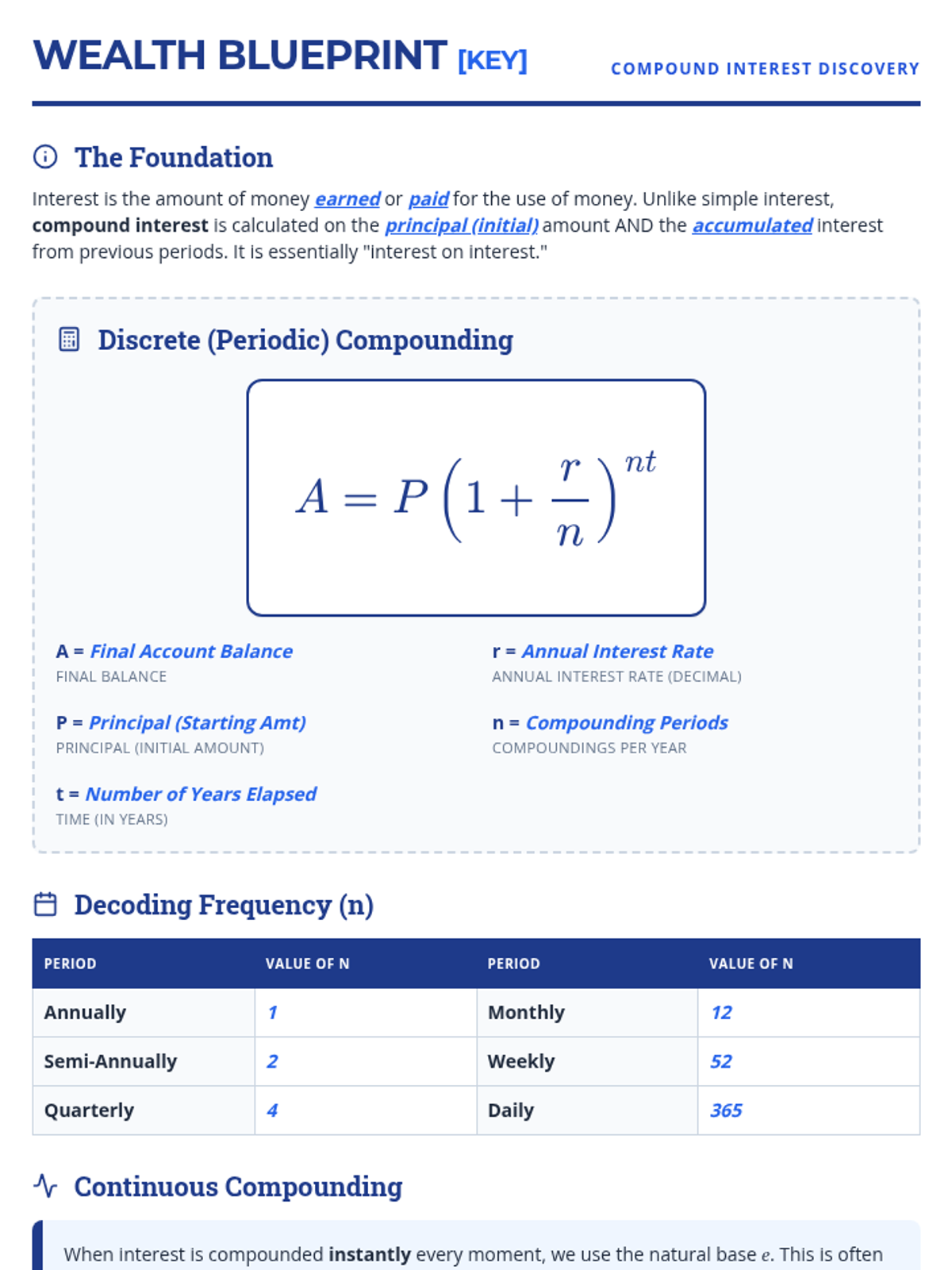
Teacher answer key for the Compound Interest Blueprint Notes, featuring all blanks filled with clear blue italicized text. Revised for better page flow and consistent formatting.
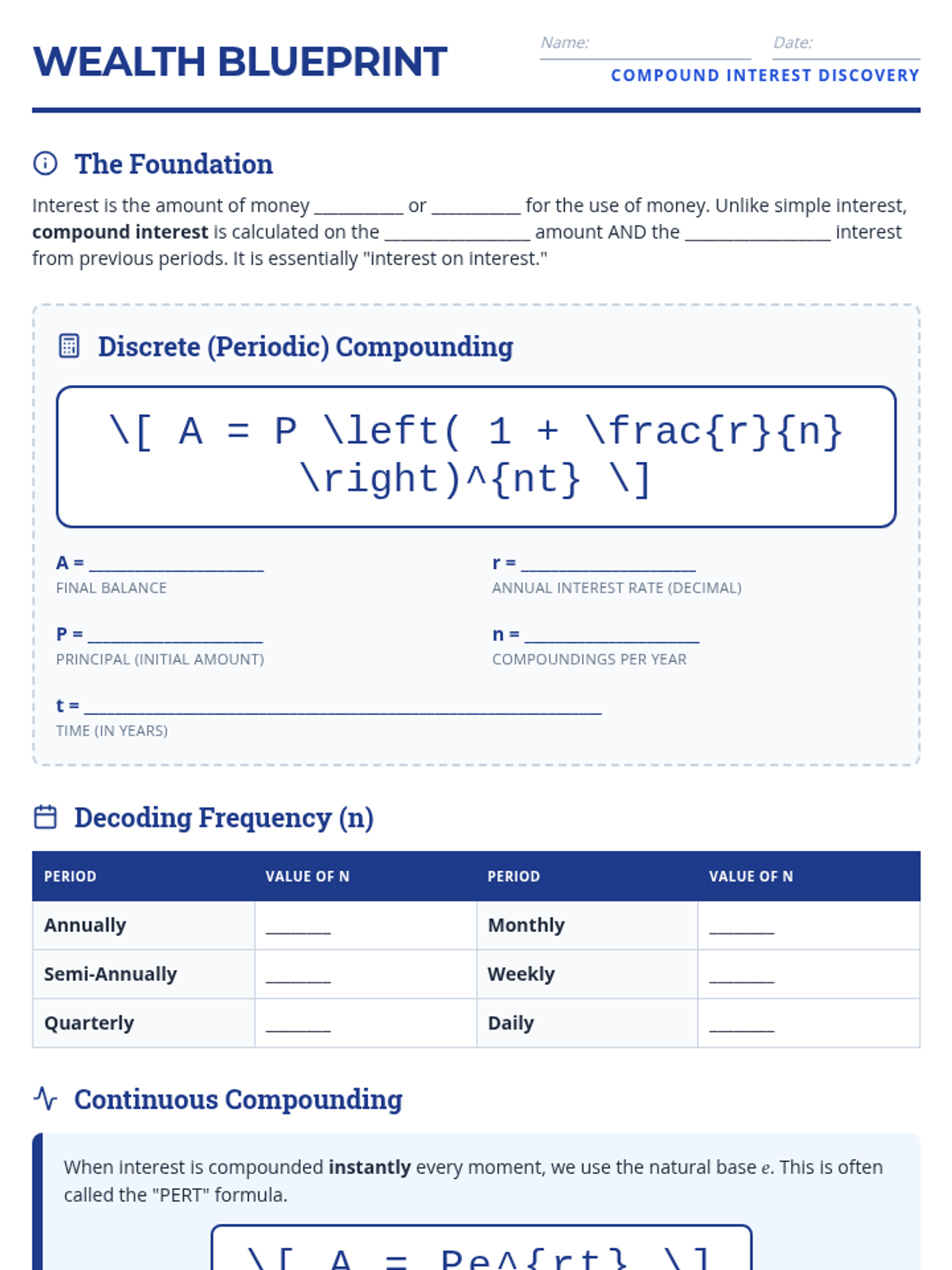
A fill-in-the-blank guided notes document for Algebra 2 students covering discrete and continuous compound interest. Includes a graphic organizer for variables and a reference table for compounding frequencies. Revised for better page flow and consistent formatting.
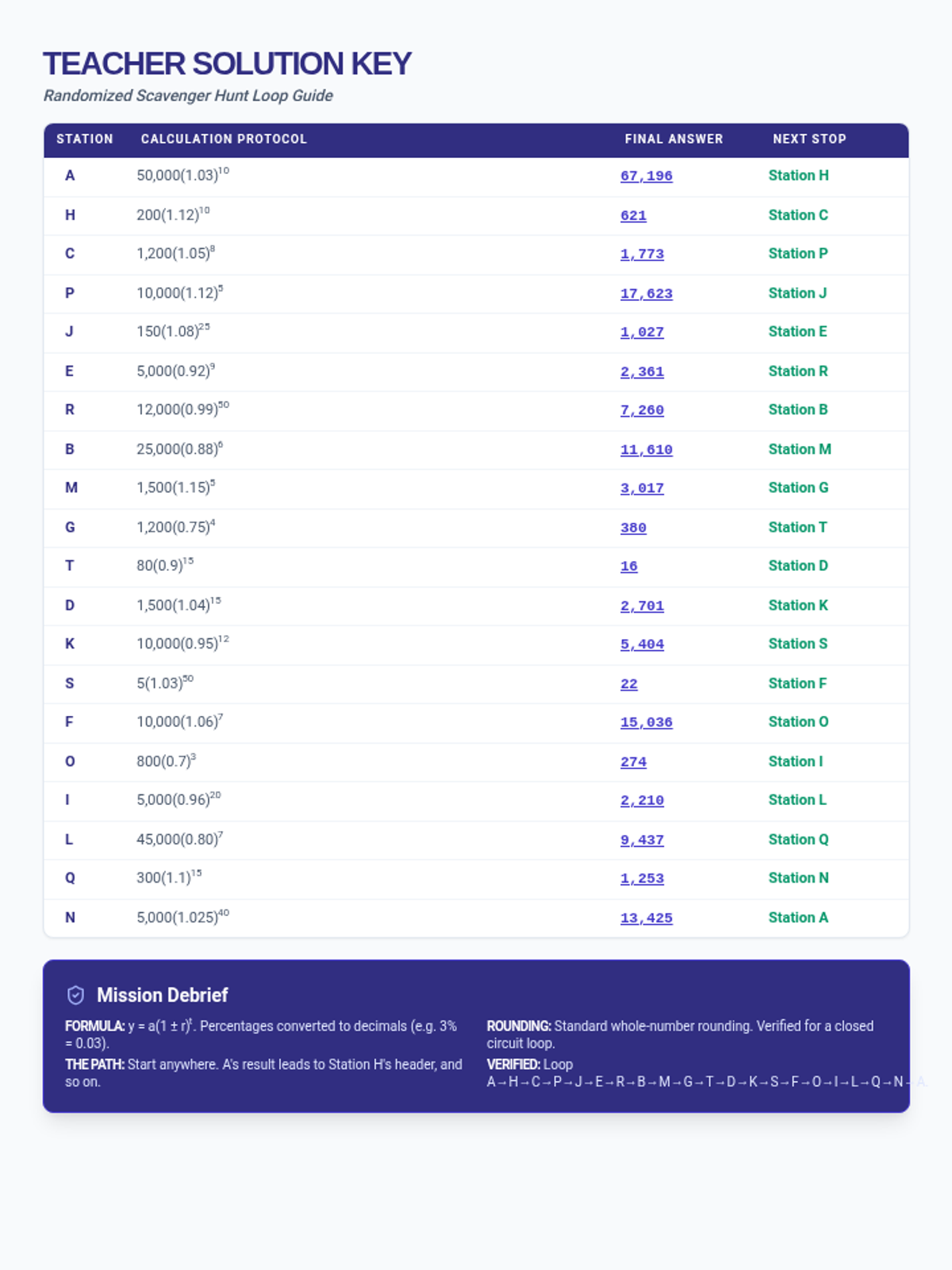
Complete teacher answer key for the Exponential Lab scavenger hunt. Provides the formula and calculation for every station using annual growth and decay models, the correct randomized loop sequence, and final answers. Fixed superscript alignment and table layout.
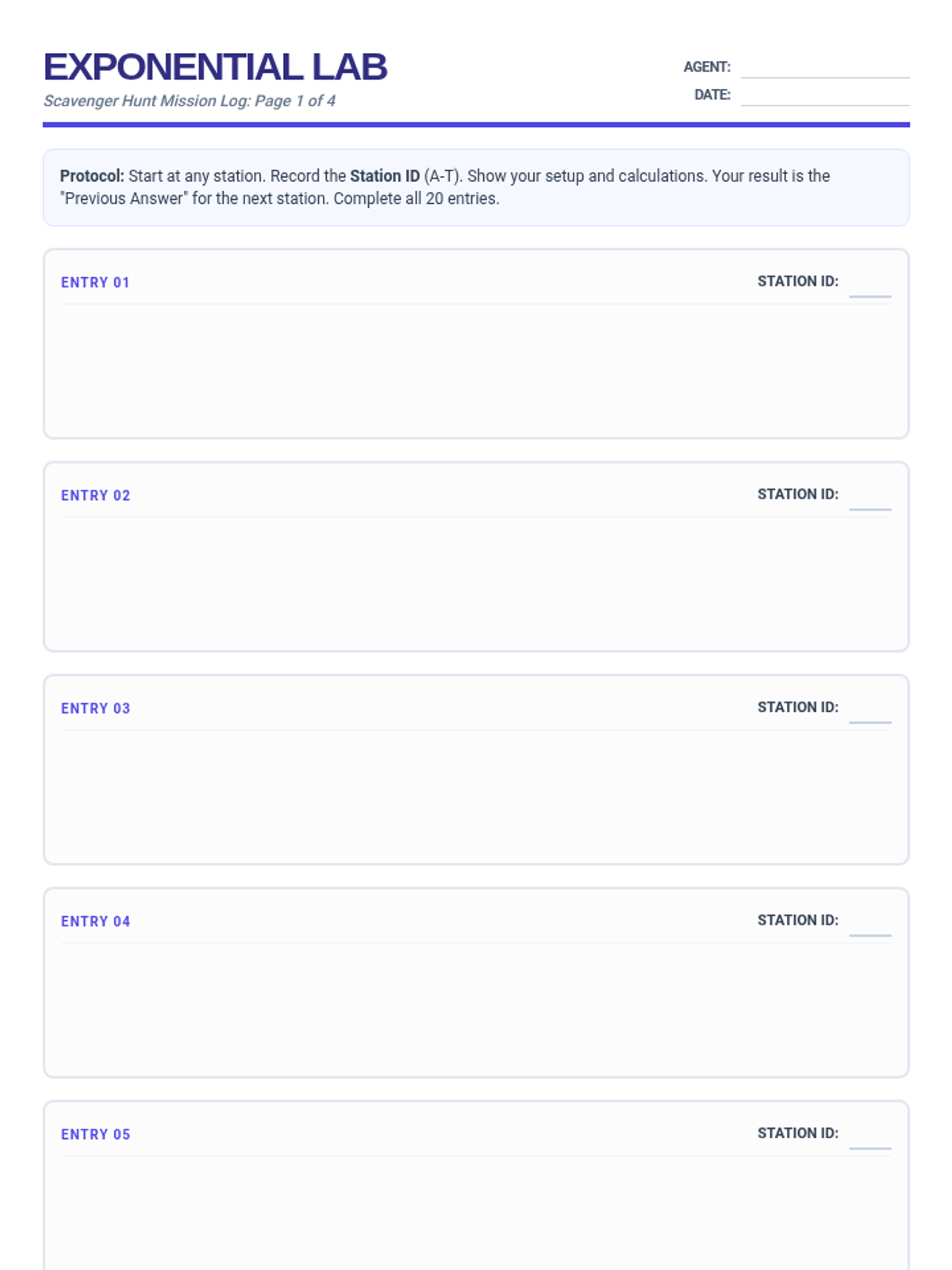
A structured student recording sheet for the Exponential Lab scavenger hunt. Includes 20 large work areas with "Station ID" fields and clear instructions to guide students through the loop across 4 pages.
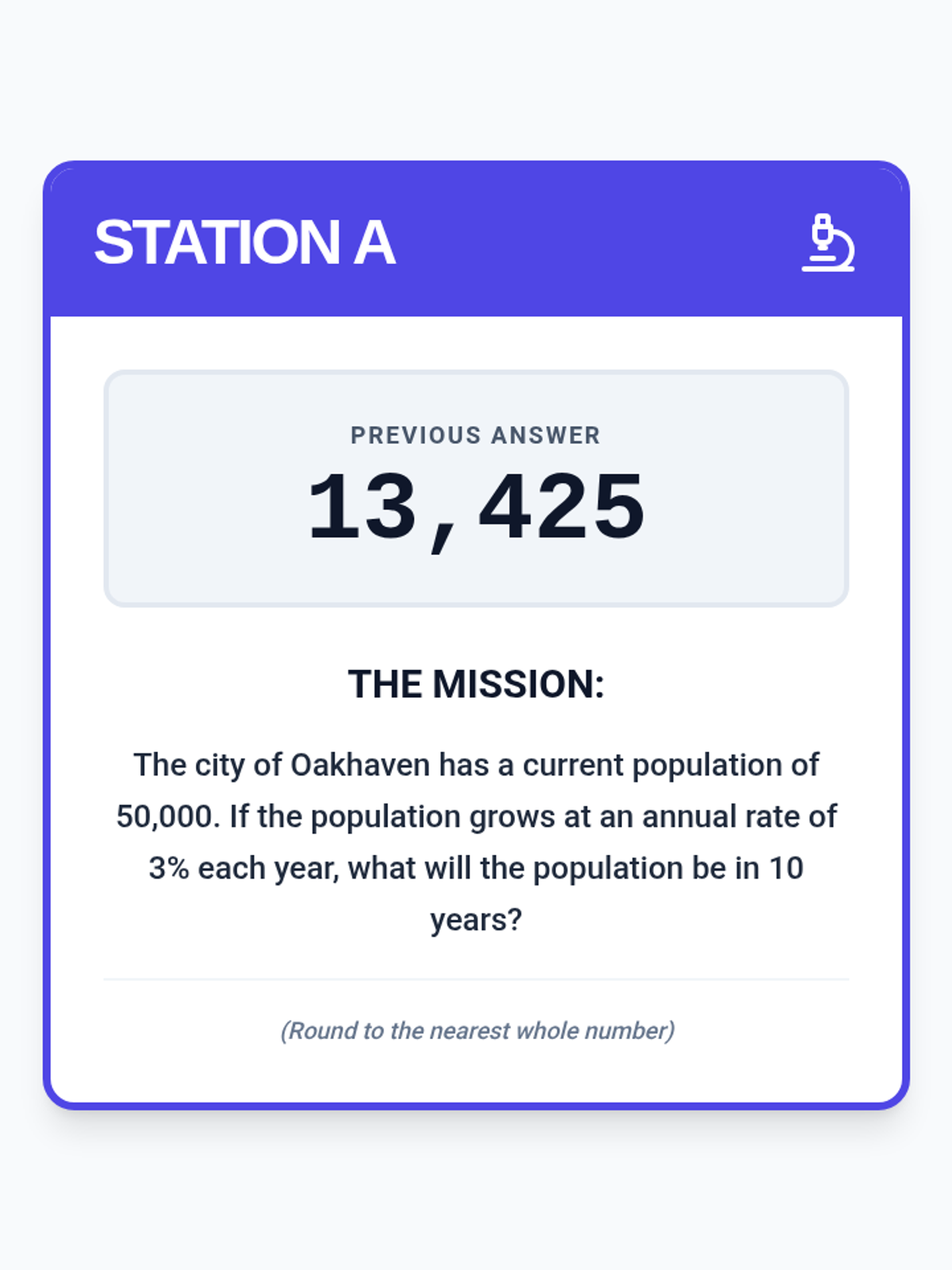
20 printable scavenger hunt station cards featuring real-world exponential growth and decay problems, all using annual percent change models. Each card is positioned on its own page with a randomized "Previous Answer" loop to increase challenge. Verified mathematically.
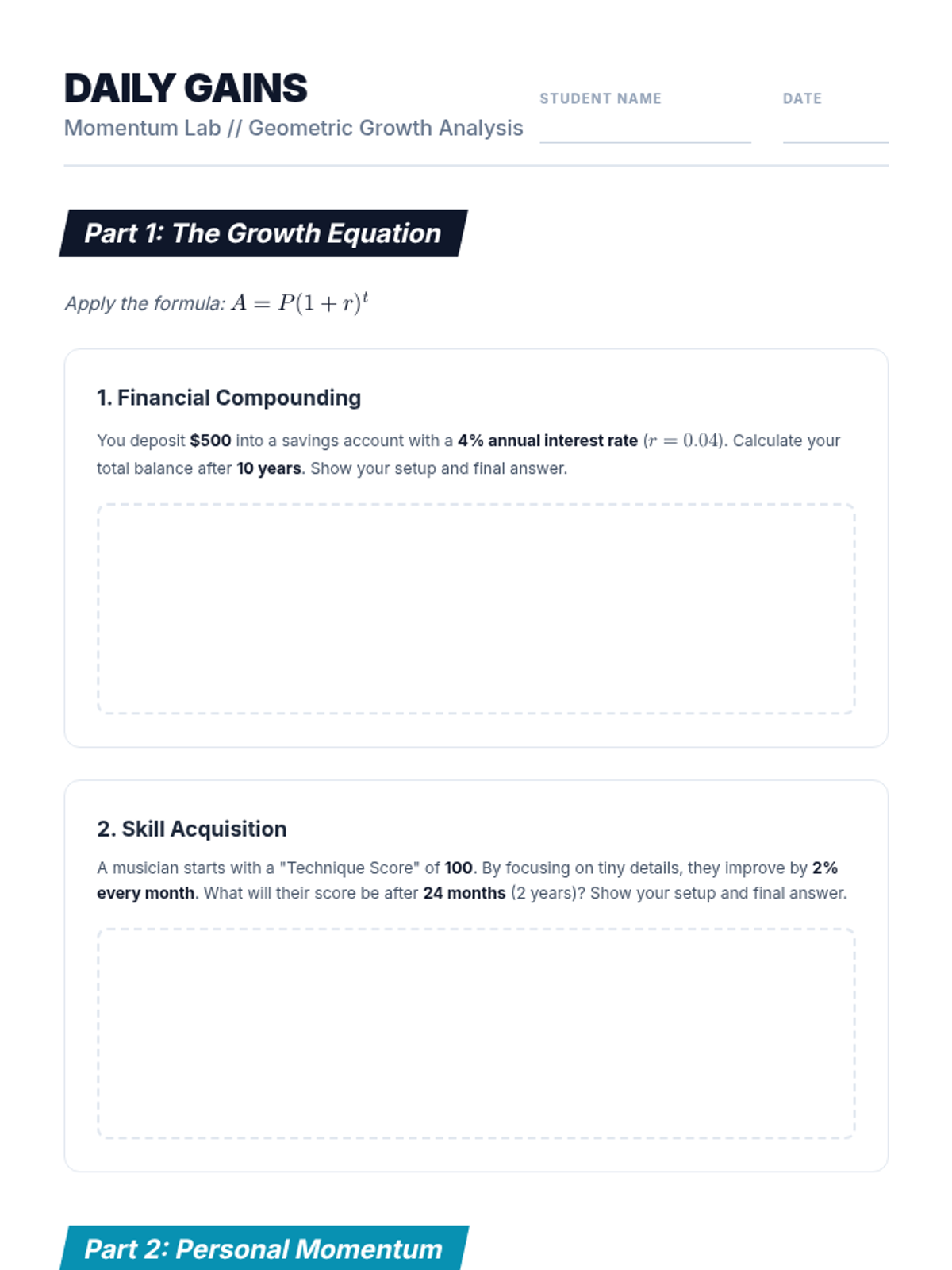
A student worksheet for 'Momentum Lab' where learners solve exponential growth problems and apply the '1% Rule' to their own personal habits and skill development.
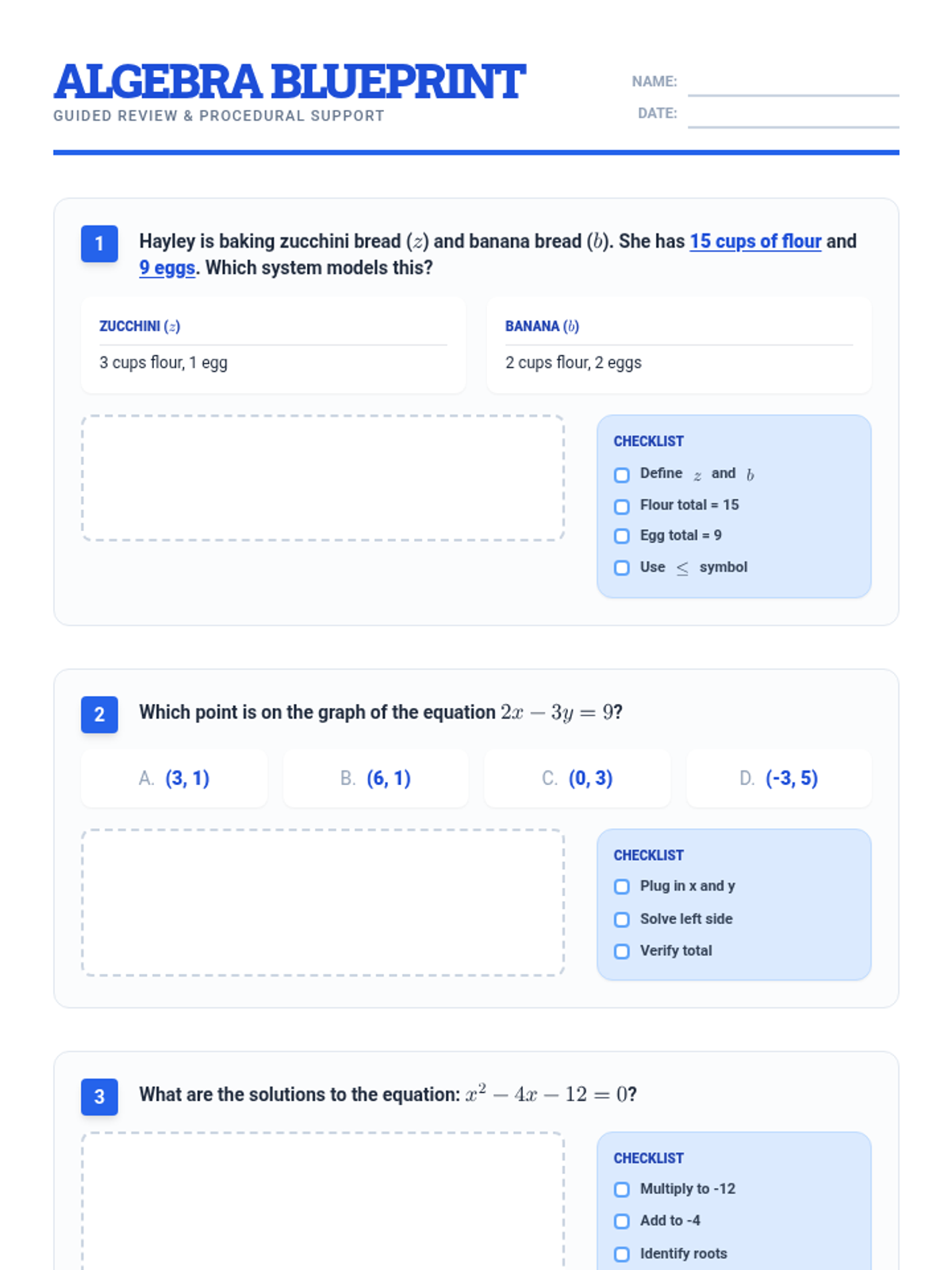
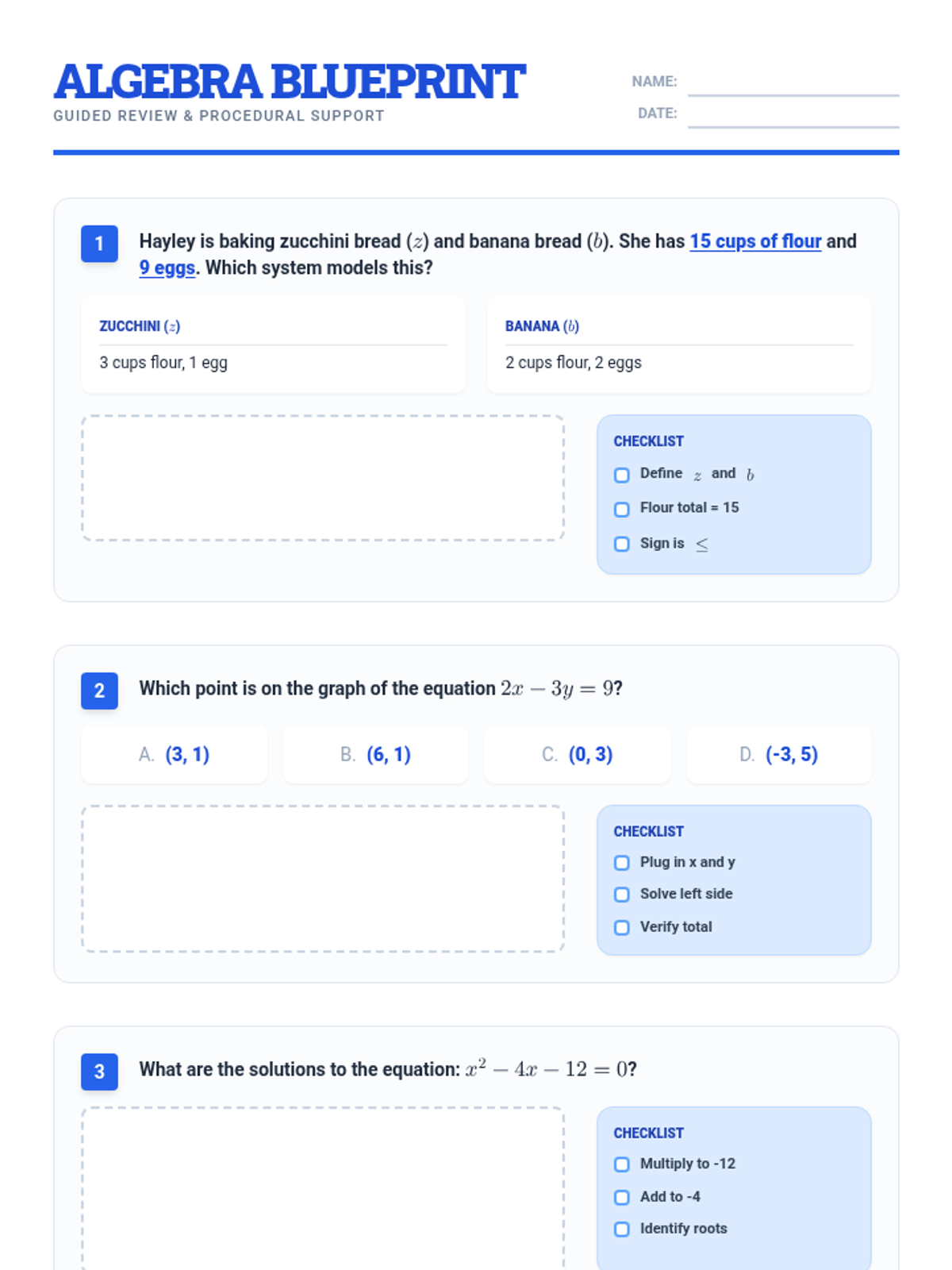
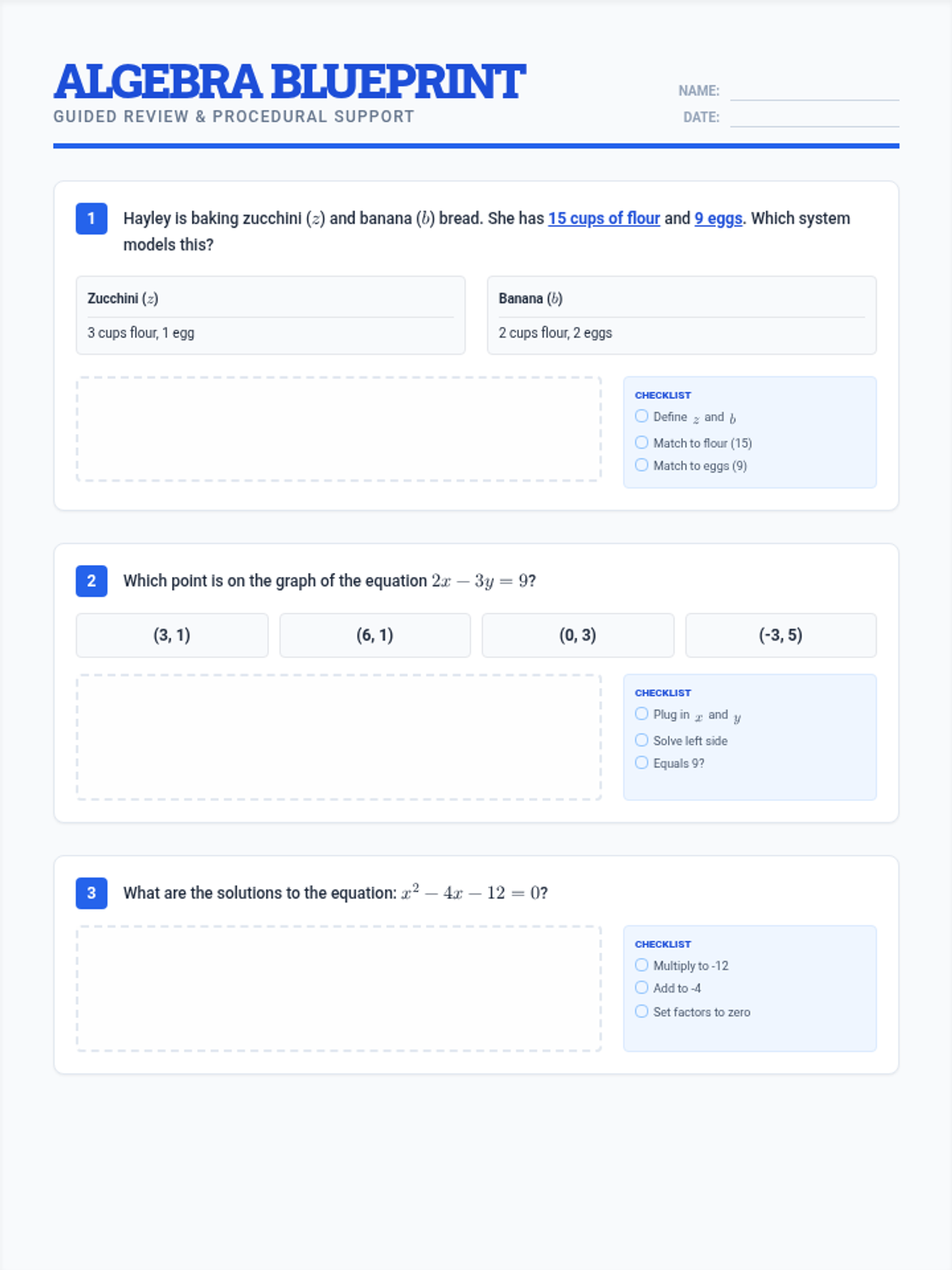
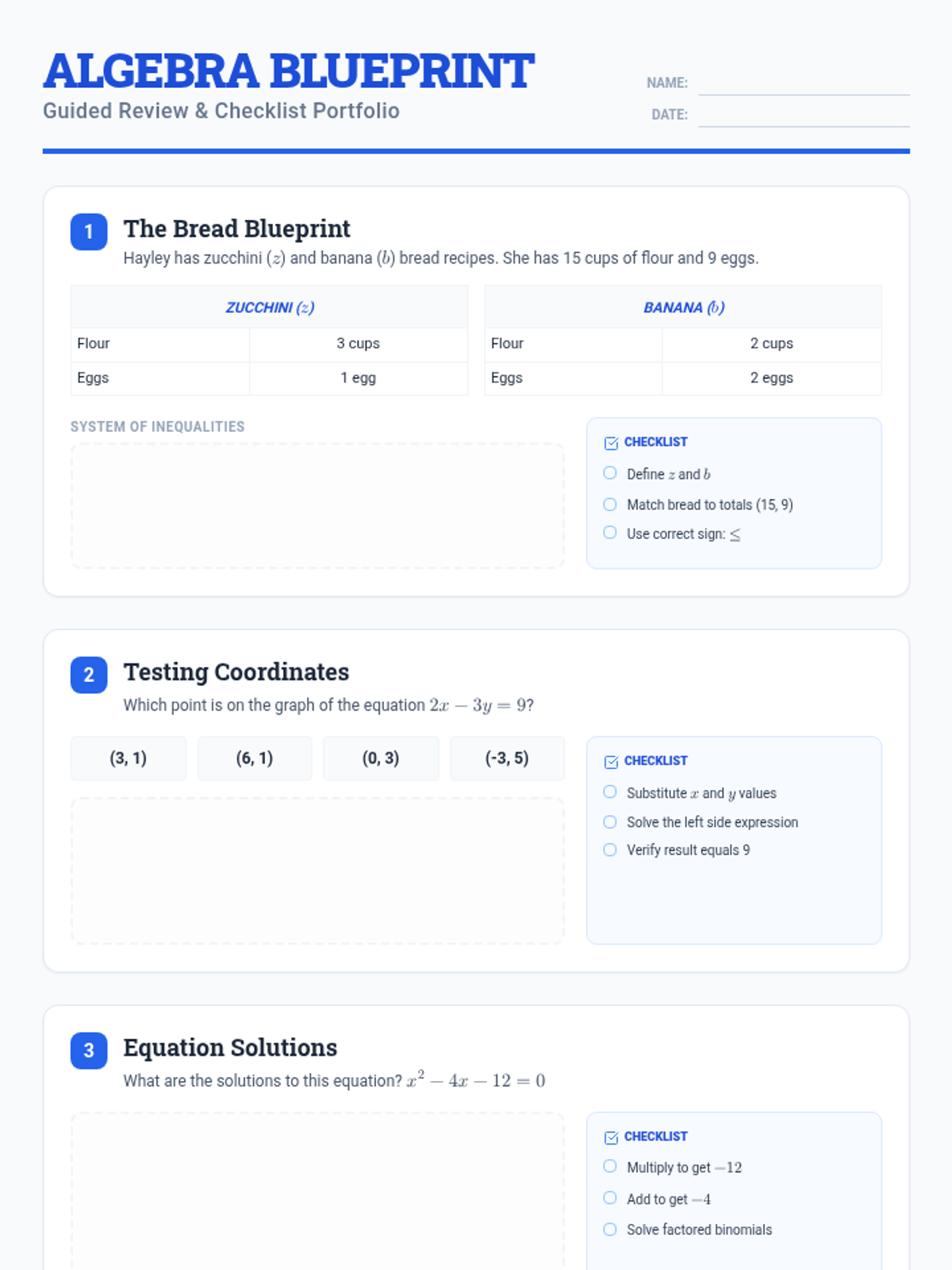
A final polished 2-page Algebra 1 guided review worksheet with resolved layout issues, consistent A-D answer choices, and enhanced visual aids. Includes scale markers for graphs and improved font sizing for checklists to ensure maximum readability and instructional effectiveness.
A highly optimized 2-page Algebra 1 guided review worksheet with fixed page-break logic and clean structural hierarchy. Features six scaffolded problems with "Blueprint" strategy checklists to support student independence and procedural accuracy.
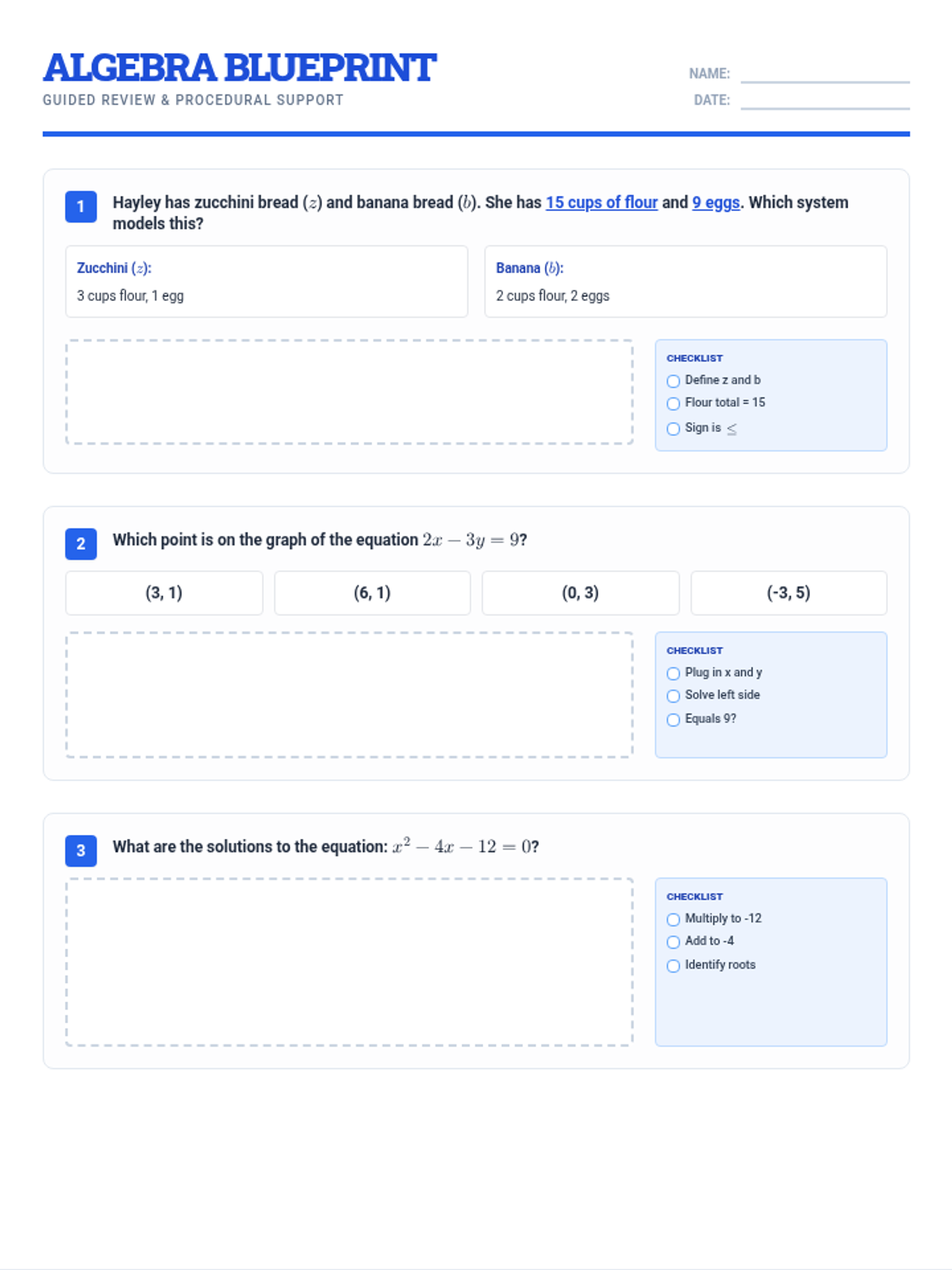
A optimized 2-page Algebra 1 guided review worksheet with resolved page-break issues and improved layout hierarchy. Features step-by-step checklists for six core standards, including linear testing, transformations, and quadratic peak identification.
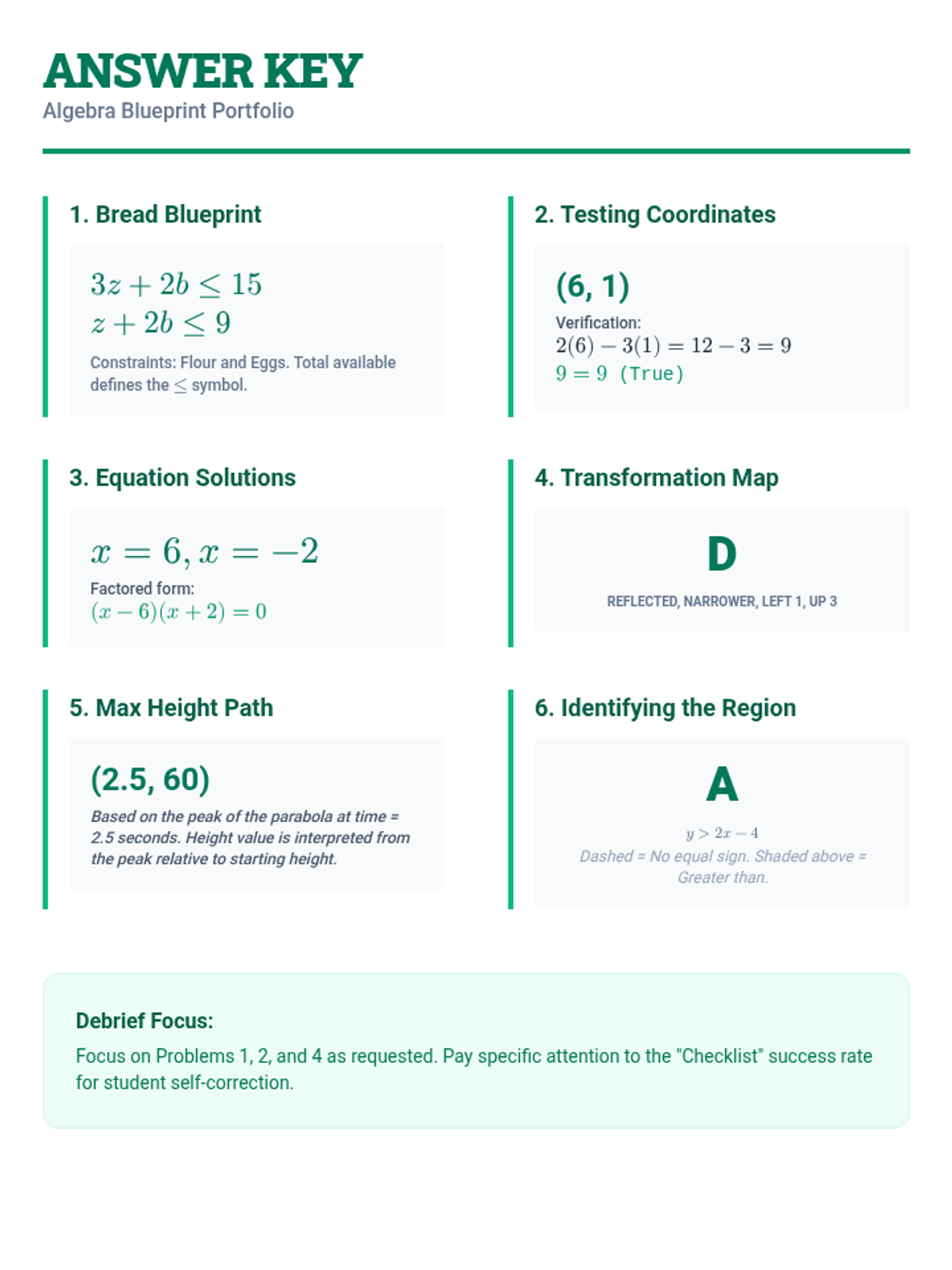
A comprehensive answer key for the Algebra Blueprint review materials, providing final answers and brief explanations for each problem.
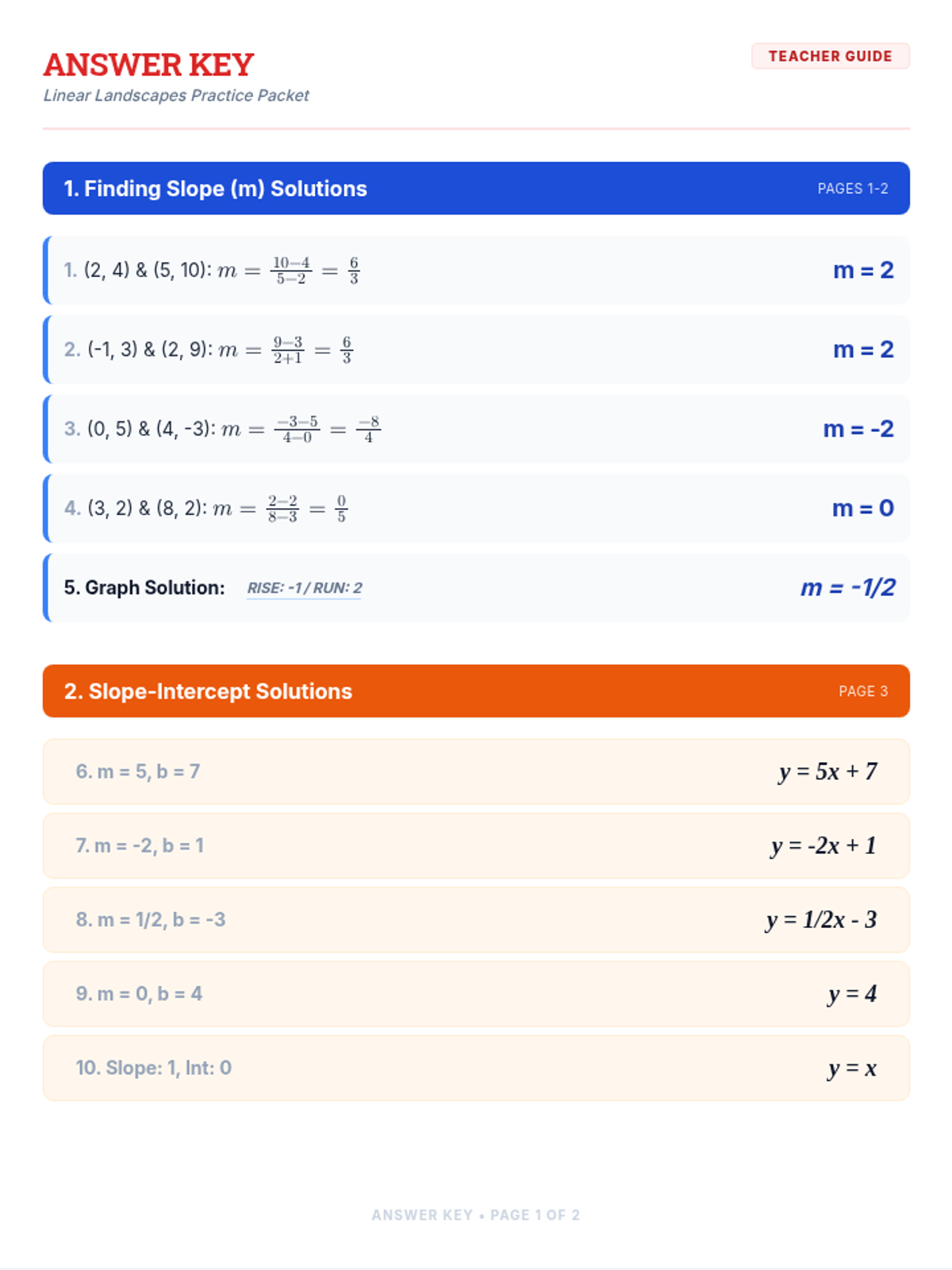
Complete 2-page answer key for the Linear Landscapes Practice Packet, providing concise step-by-step solutions for slope calculations, equation writing, and conversions. Optimized for quick teacher reference with clear section headers and high-contrast text.
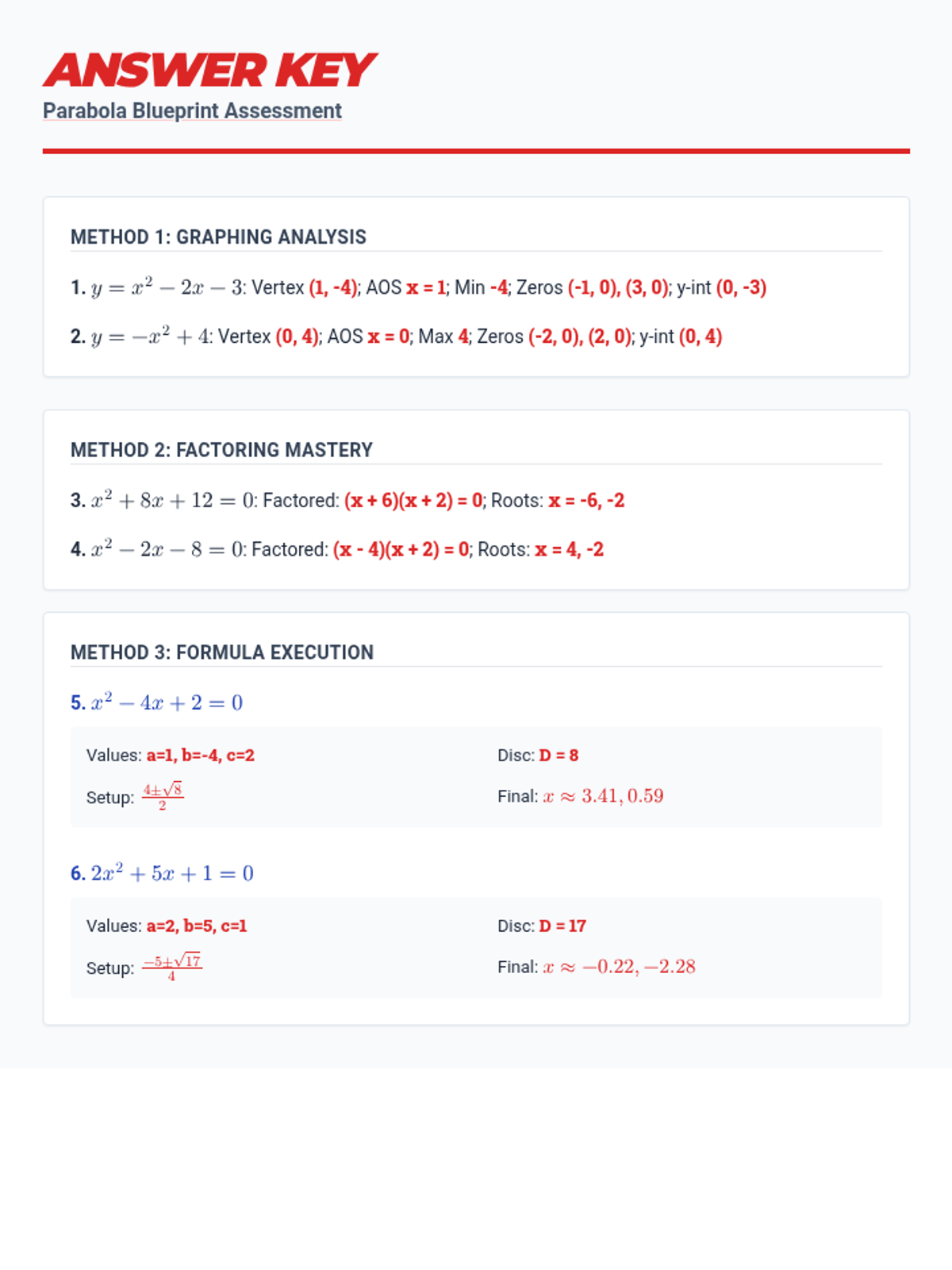
Teacher-facing answer key for the summative assessment. Refined to align with the single-column parabola analysis and updated problem layouts.
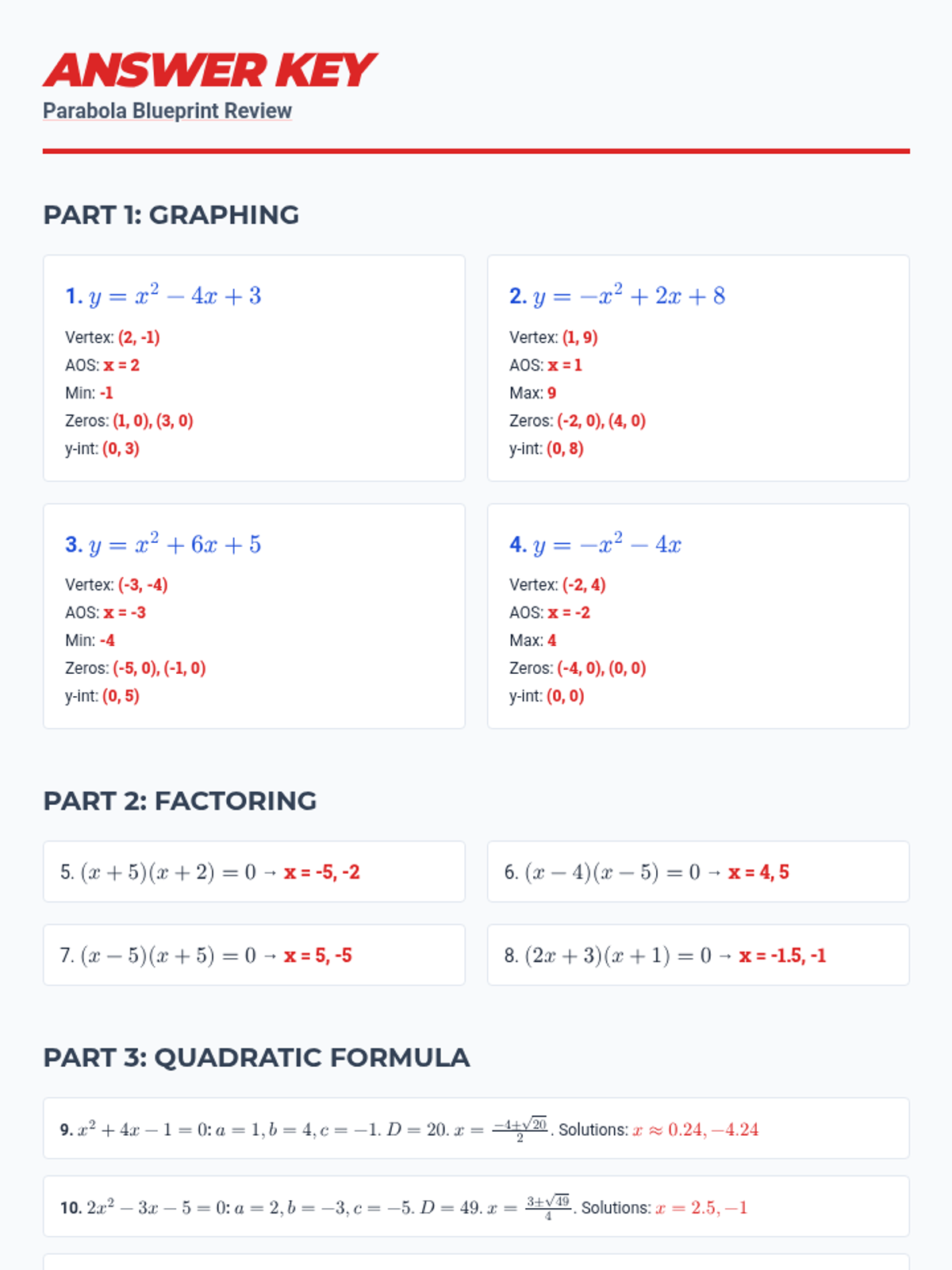
Teacher-facing answer key for the review worksheet. Updated to match the refined single-column parabola analysis items.
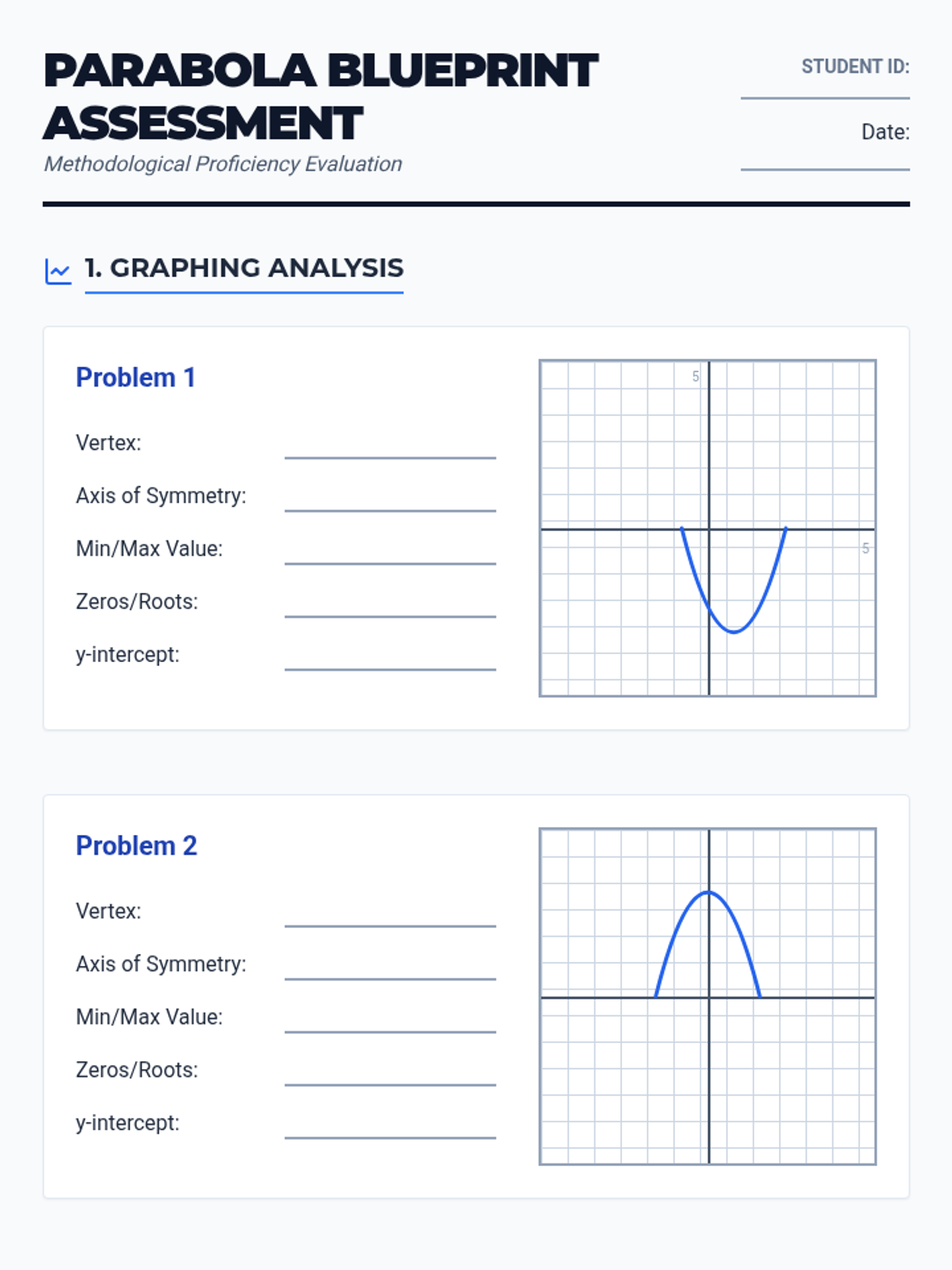
A formal summative assessment with 6 items, evaluating student proficiency in solving quadratic equations through graphing analysis, algebraic factoring, and guided quadratic formula steps. Graphing items feature single-column layouts and explicitly displayed equations. Fixes layout bugs in the formula section.
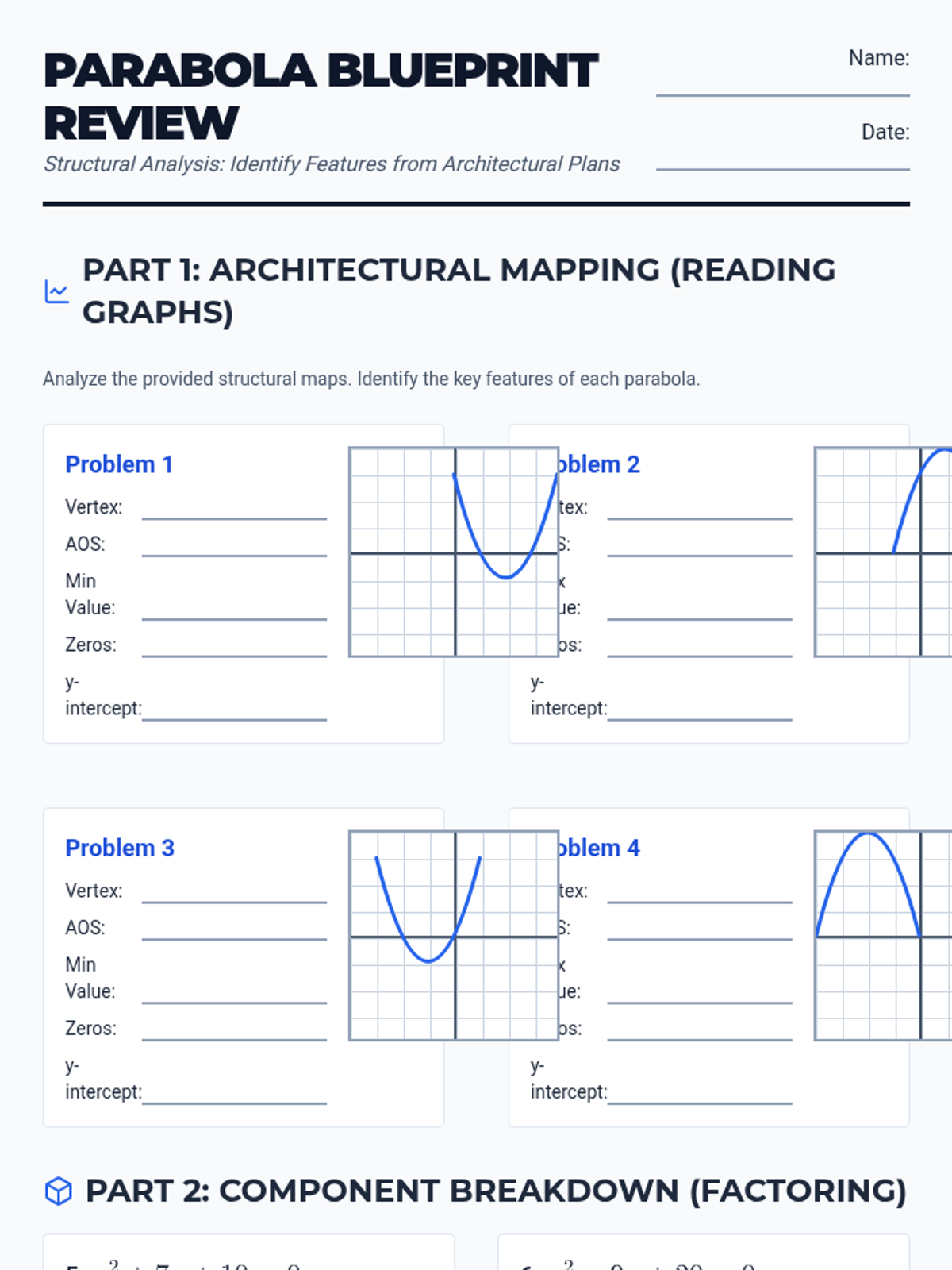
A 12-question comprehensive review worksheet covering quadratic equations via graphing, factoring, and the quadratic formula, styled with a professional 'blueprint' aesthetic. This version features single-column graph layouts, explicitly displayed equations, and refined formula templates.
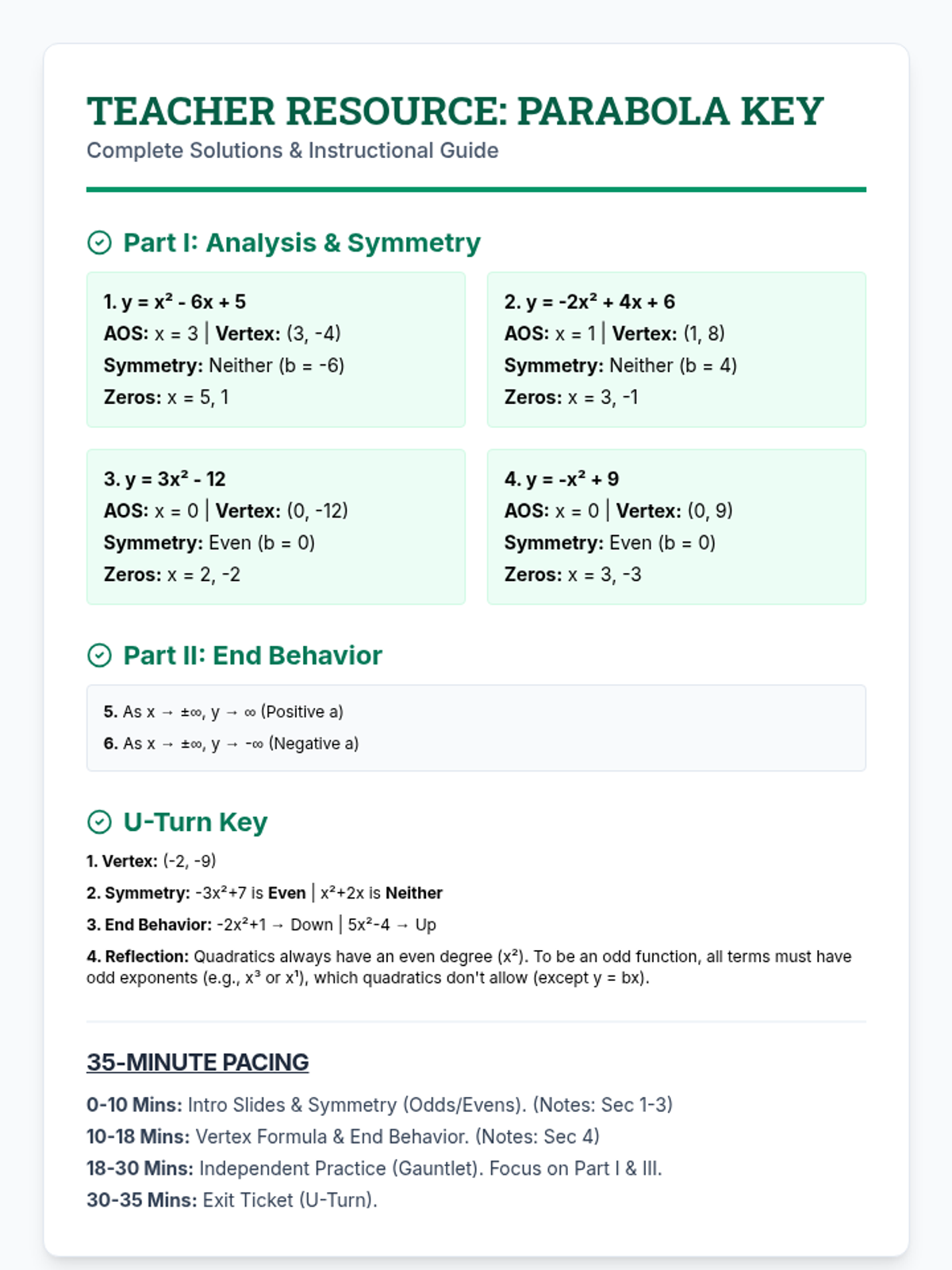
Teacher-facing answer key and instructional guide for the Parabola Party lesson, including solutions for symmetry (even/odd) and full pacing instructions. renumbered and improved solution font size.
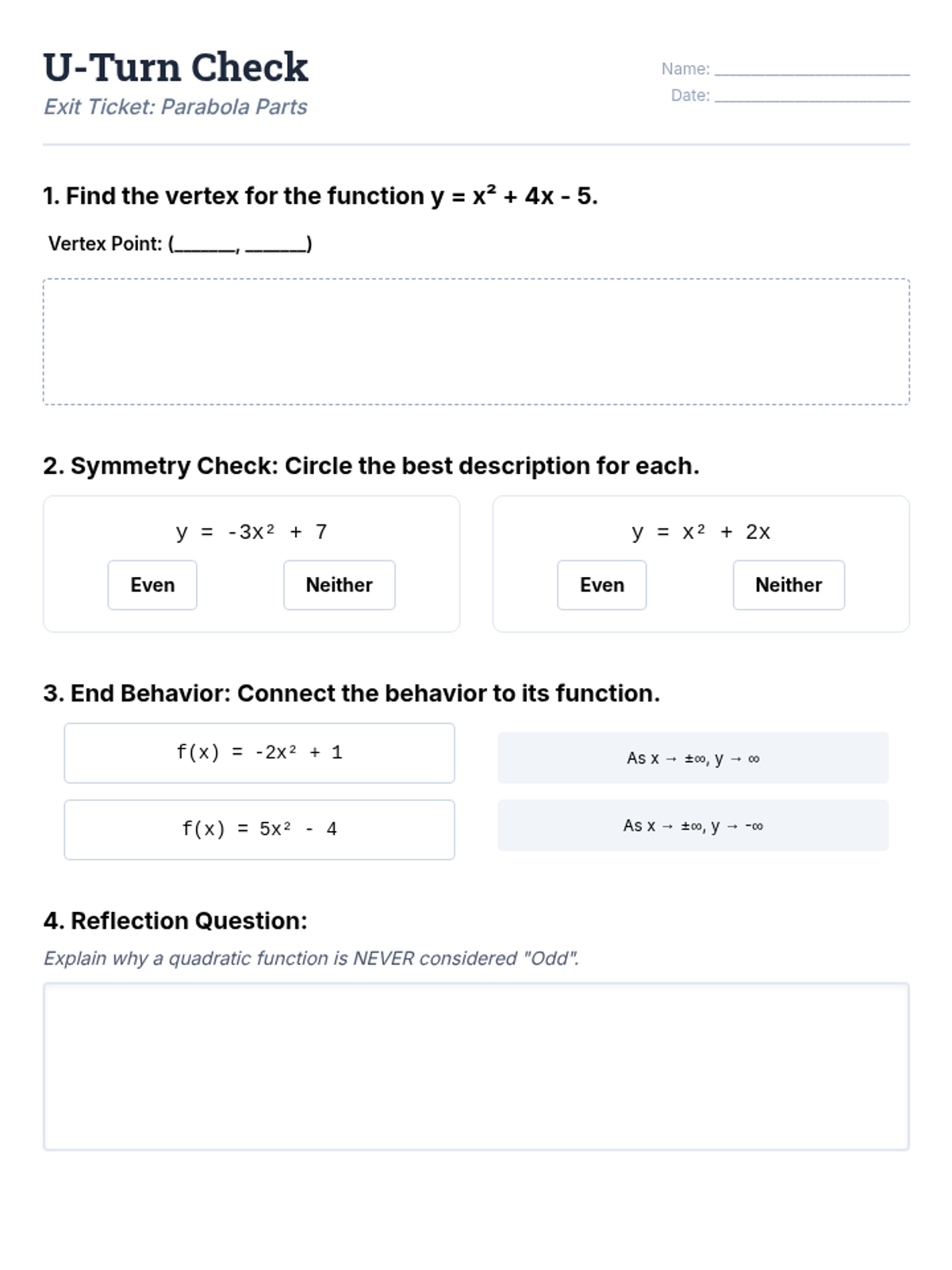
A quick learning check or exit ticket to assess student understanding of finding the vertex, matching end behavior, parity rules, and the conceptual nature of quadratics. fixed latex rendering and improved work area space.
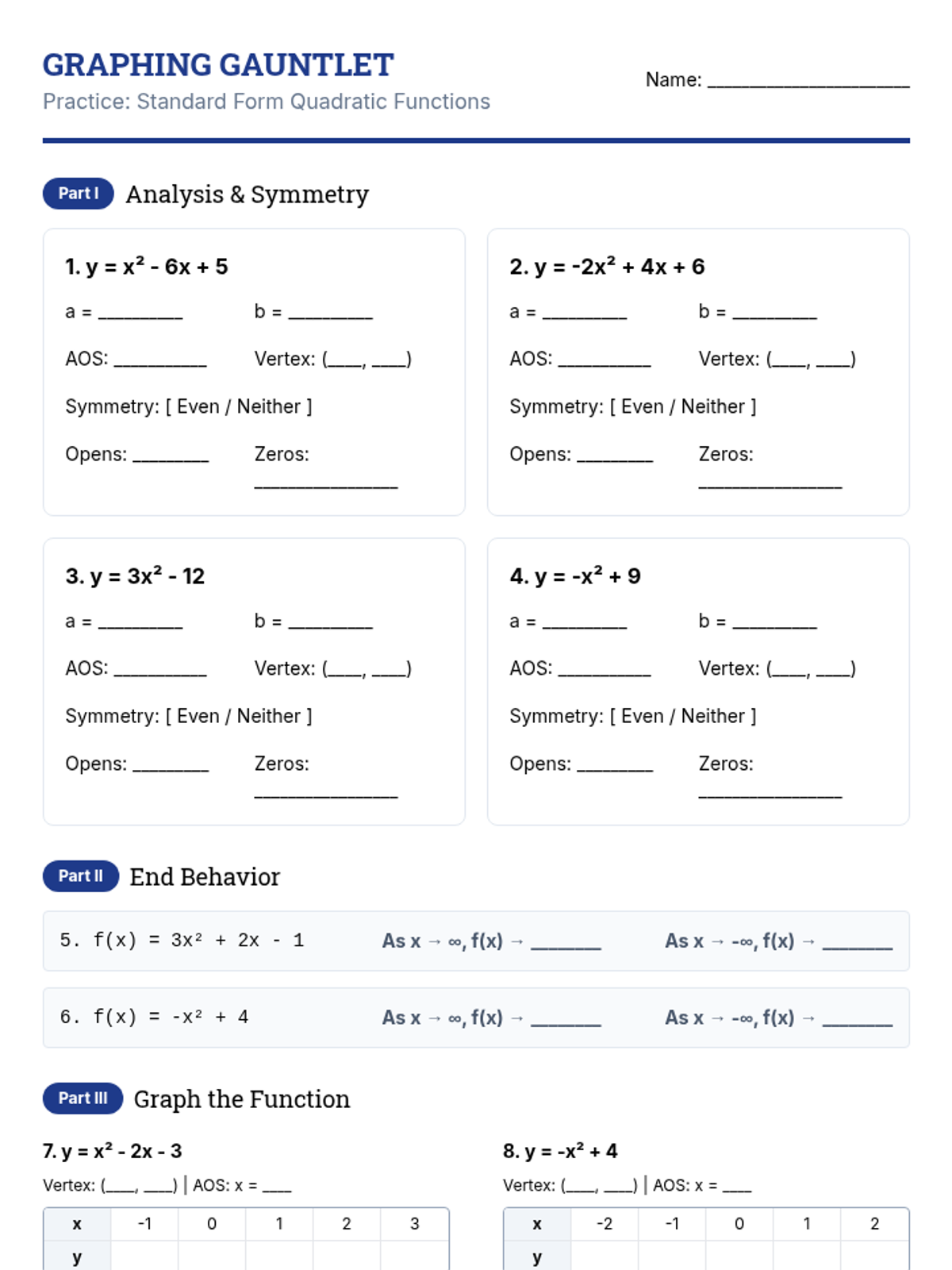
A practice worksheet with mixed difficulty problems for graphing quadratic functions in standard form, including analyzing key features, sketch graphs, and symmetry rules. term "Symmetry" used for better clarity. improved table and graph layouts.
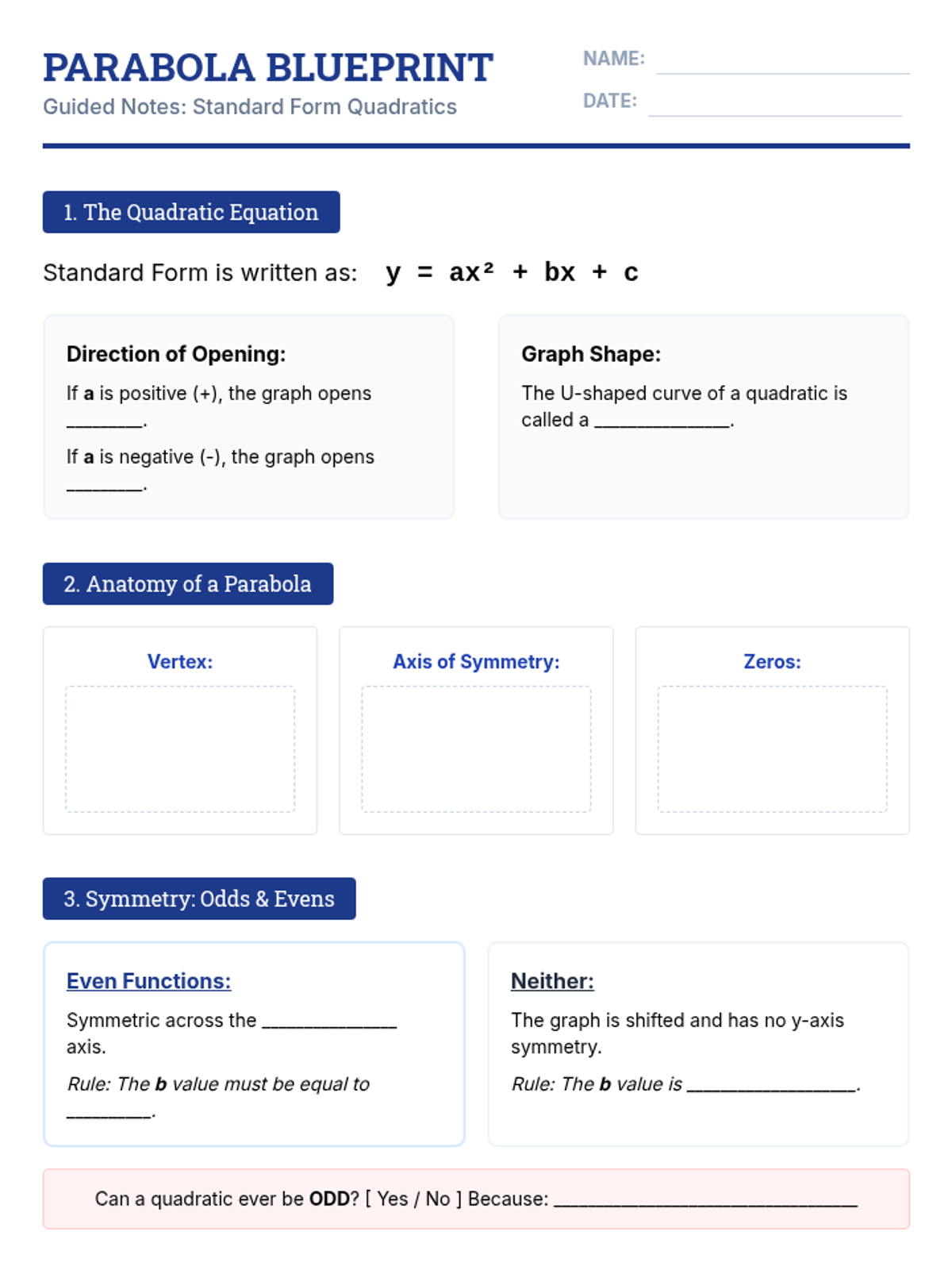
Guided notes for students to follow along during the Parabola Party lesson, including fill-in-the-blank sections for the vertex formula, anatomy, and even/odd parity rules. improved spacing and layout.
A visual slide deck teaching the fundamentals of graphing parabolas in standard form, including vertex calculation, axis of symmetry, end behavior, and zeros. now includes rules for even and odd functions.
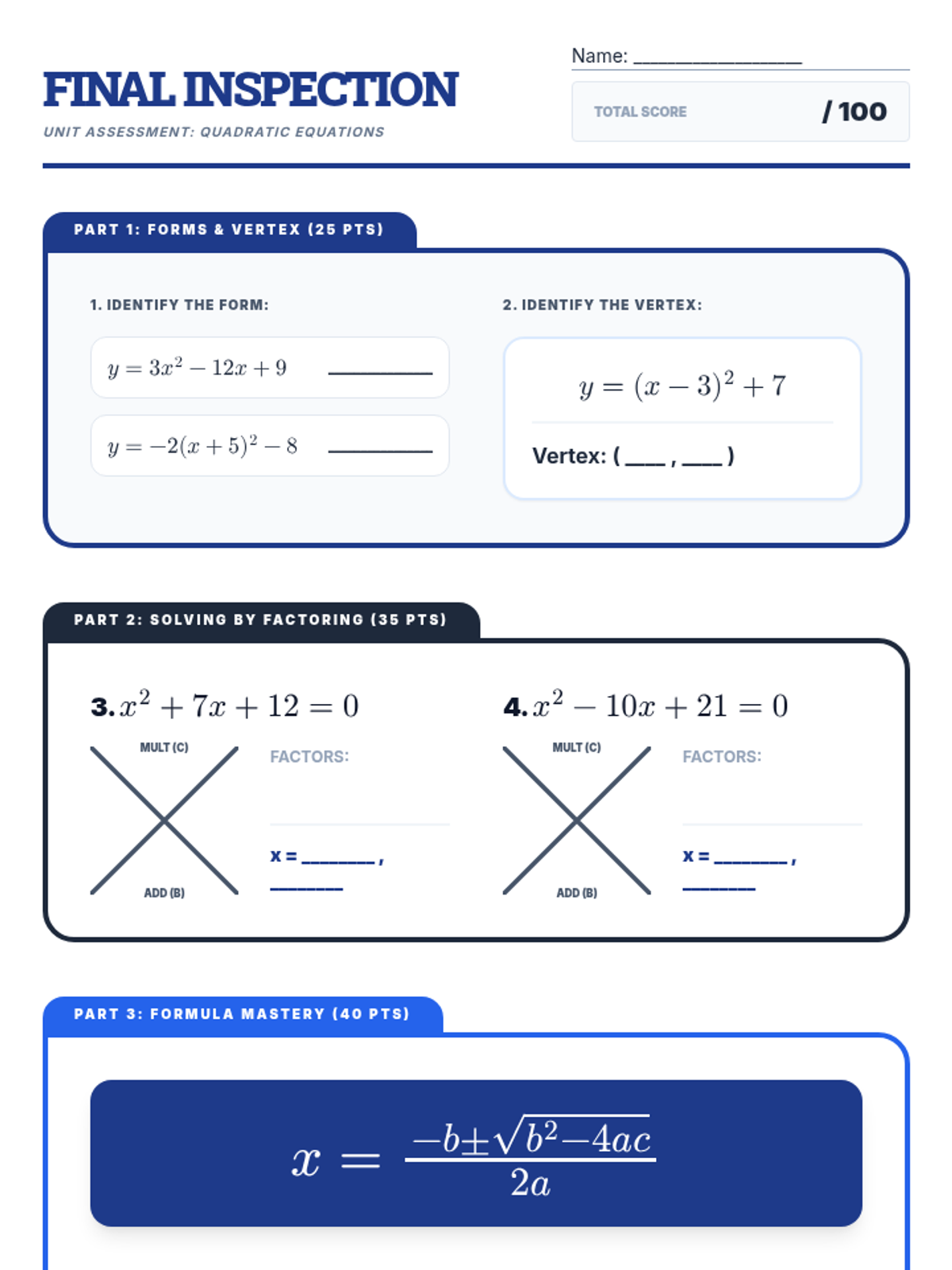
The summative assessment for the Quadratic Blueprints unit. Updated with sequential question numbering (1-5), corrected point values (25+35+40=100), functional Diamond Method labeling, and fixed LaTeX layouts. Optimized for credit recovery students.
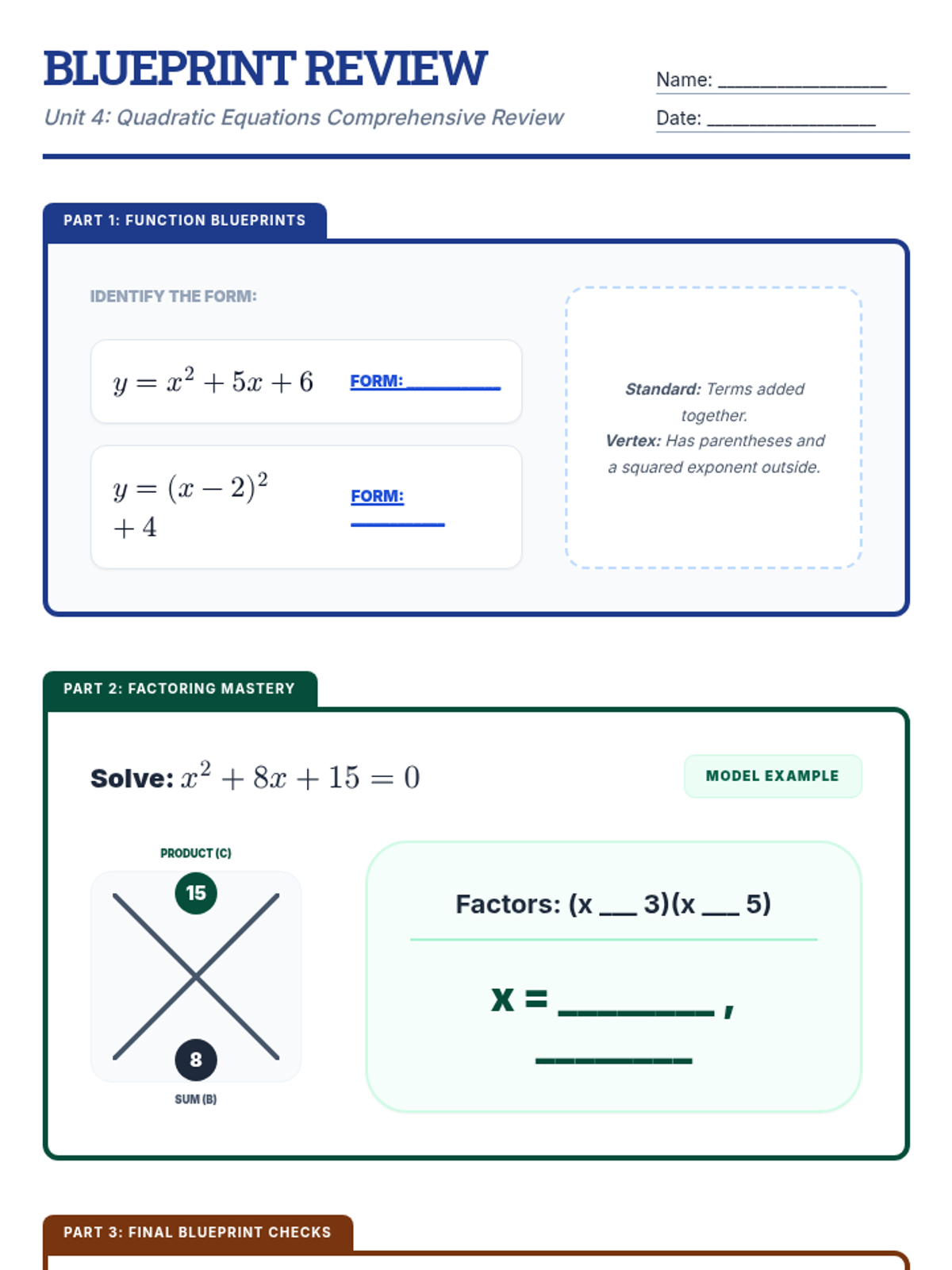
Comprehensive review sheet for the quadratics unit. Updated with functional Diamond Method labeling, increased workspace for the Quadratic Formula, fixed LaTeX formatting, and clear function form identification. Fixes missing 'x' in LaTeX and graph scale.
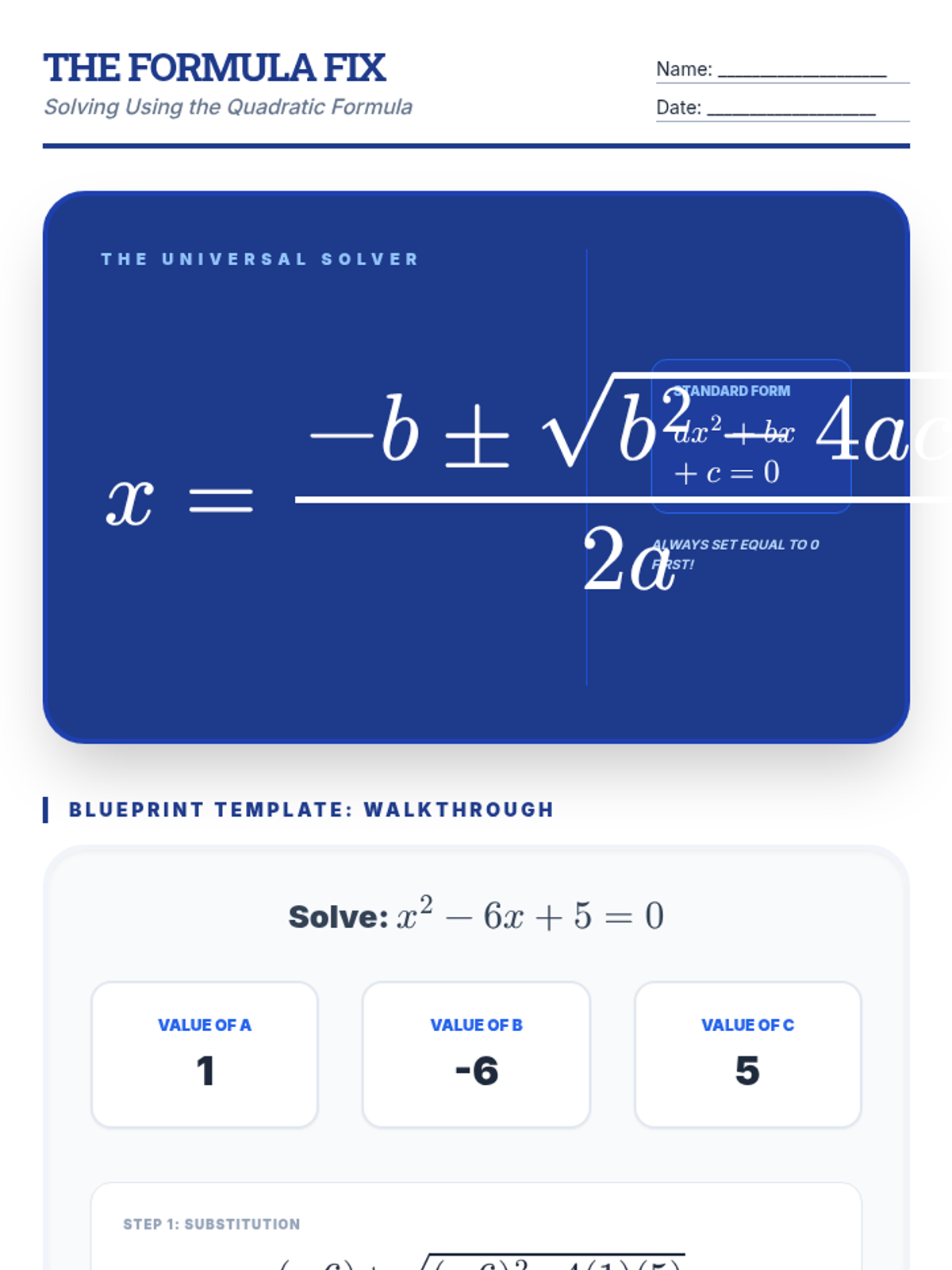
Day 3 student assignment for the Quadratic Formula. Updated with a high-visibility formula box, massively expanded work areas for complex multi-step algebra, and optimized layout to prevent content splits.
Day 3 instructional slides for the Quadratic Formula. Updated with fixed section heights to prevent cutoffs, improved contrast for better classroom visibility, and high-impact visual design for credit recovery students.
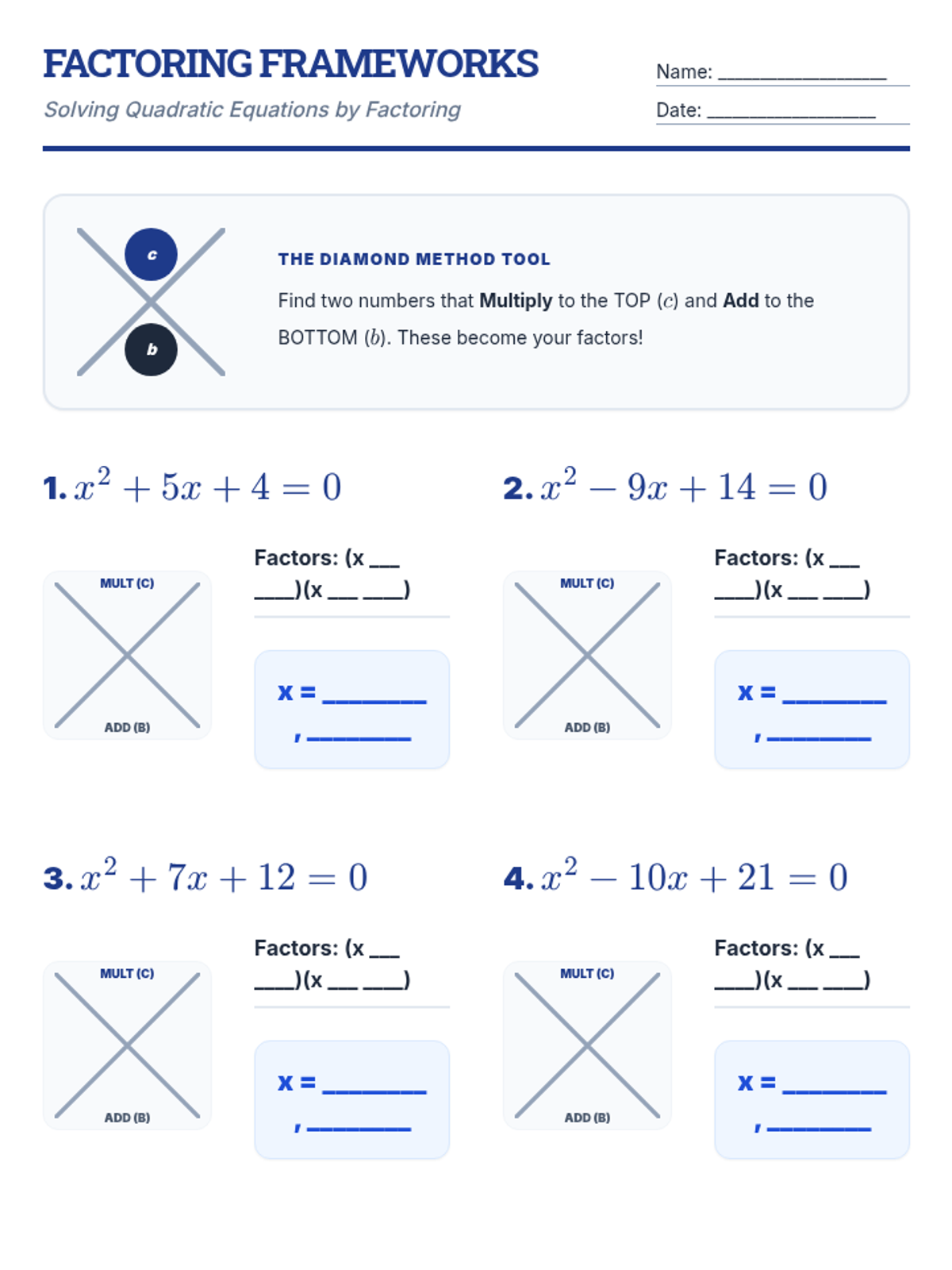
Day 2 student assignment for factoring quadratics. Updated with Diamond Method "X" graphics, sign-neutral factor templates to maintain cognitive load, and fixed layout for solution lines. Optimized for credit recovery students. Enlarged X graphics for student use.
Instructional slides for Day 2. Focuses on the Diamond Method for factoring trinomials and the Zero-Product Property. Fixes layout collisions and improves instructional depth. Fixes overflow and equation wrapping issues.
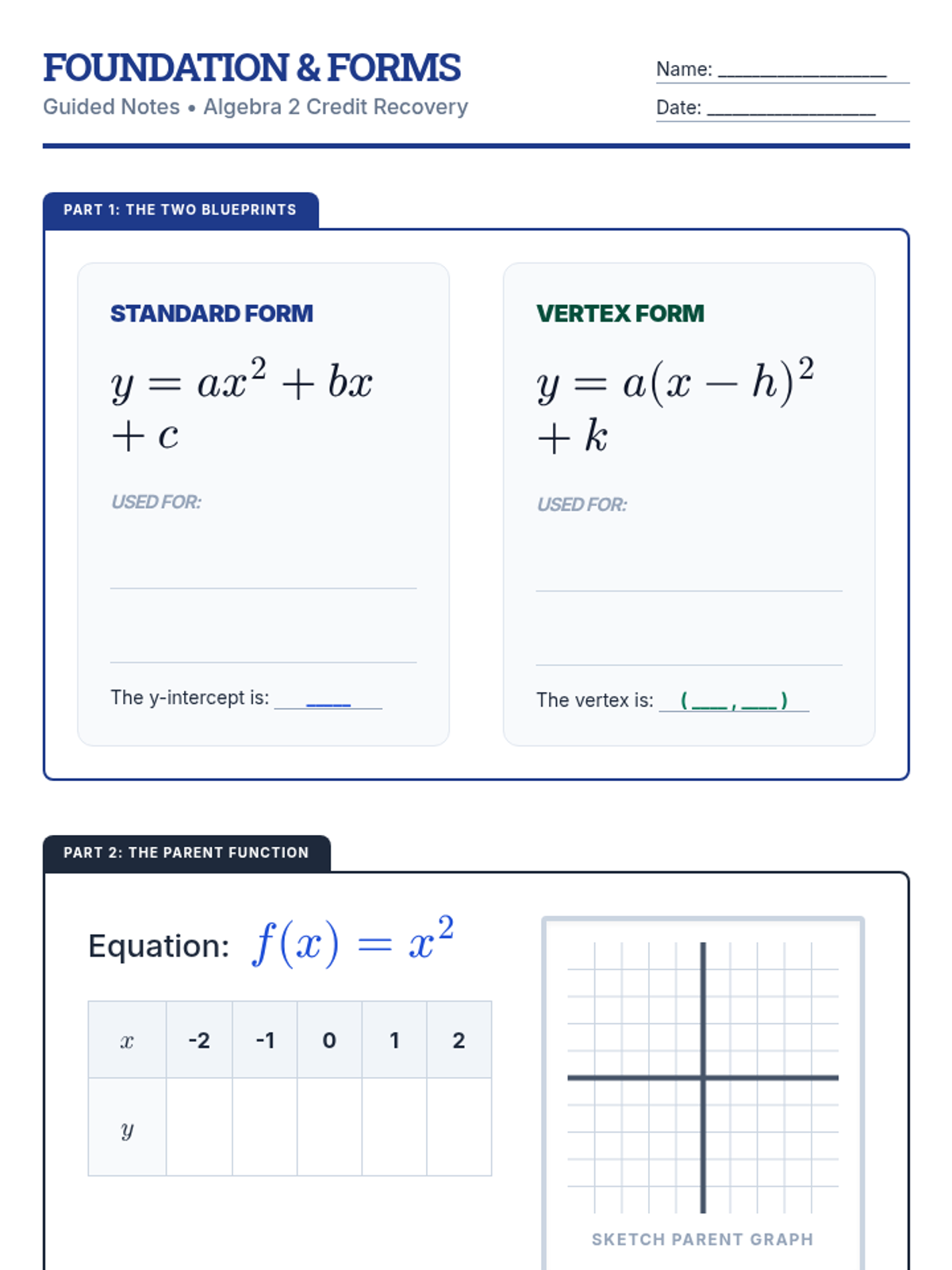
Guided notes for Day 1 of the Quadratics unit. Includes a comparison section for Standard vs. Vertex forms and a table/grid for the quadratic parent function. Fixes non-rendering SVG grid and adds more instructional space. Darkens grid for printability.
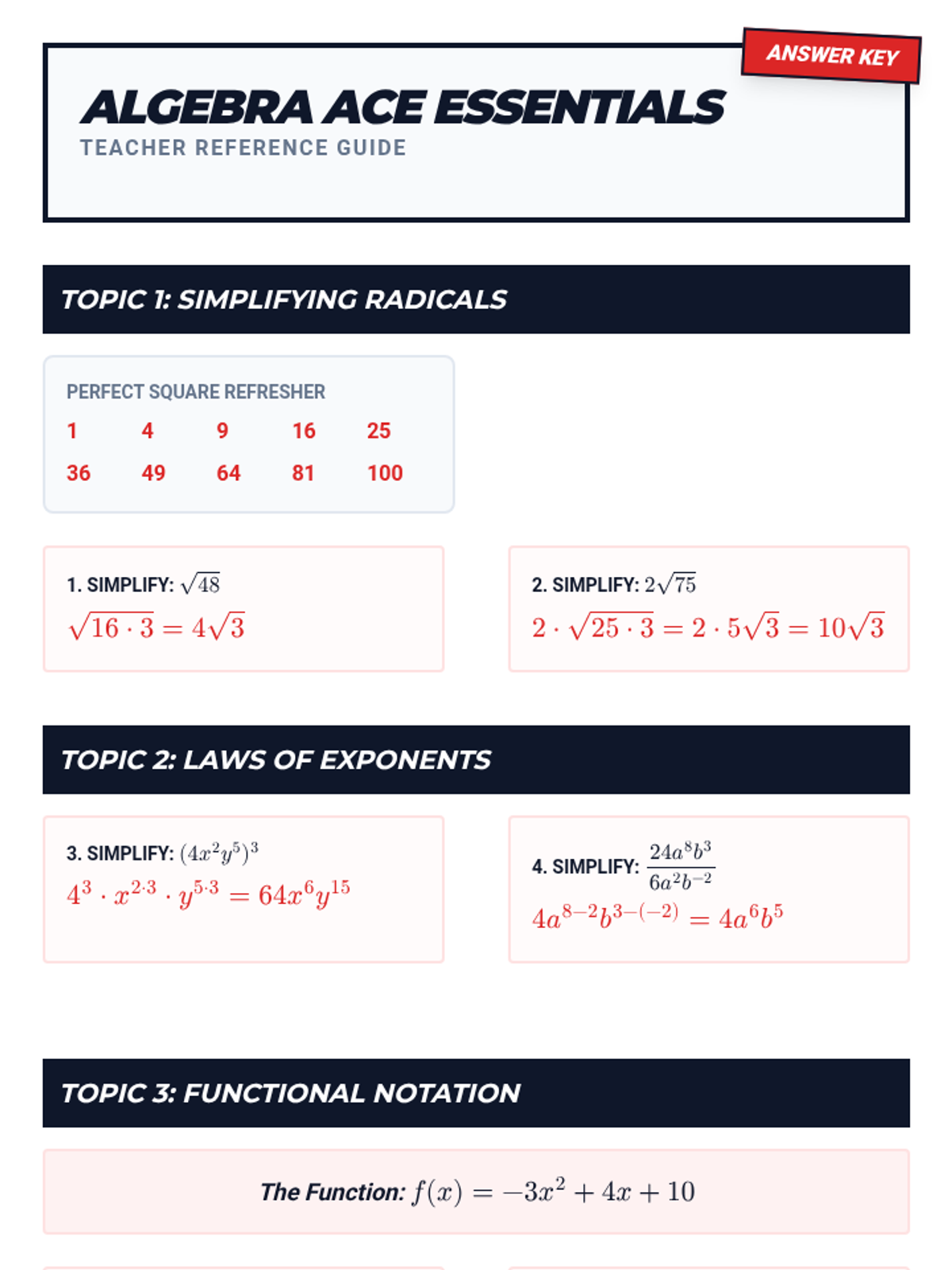
A comprehensive teacher answer key for the Algebra Ace handout, featuring step-by-step solutions for radicals, exponents, functional notation, and modeling. Revised to include problem context and improved layout.
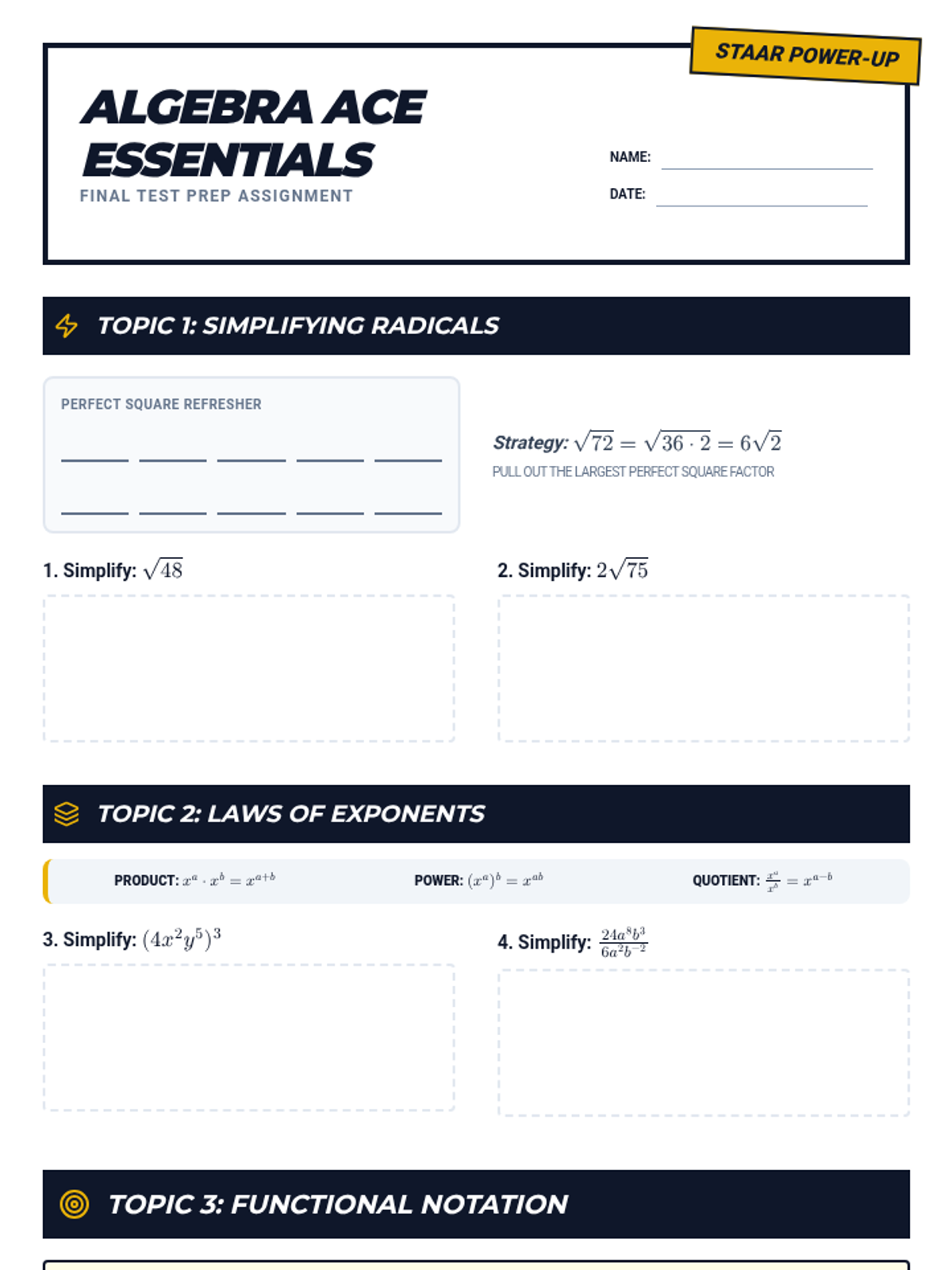
A comprehensive STAAR prep student handout styled with a varsity sports theme, featuring focused practice on radicals, exponents, functions, and data modeling. Revised to improve page breaks and student work areas.
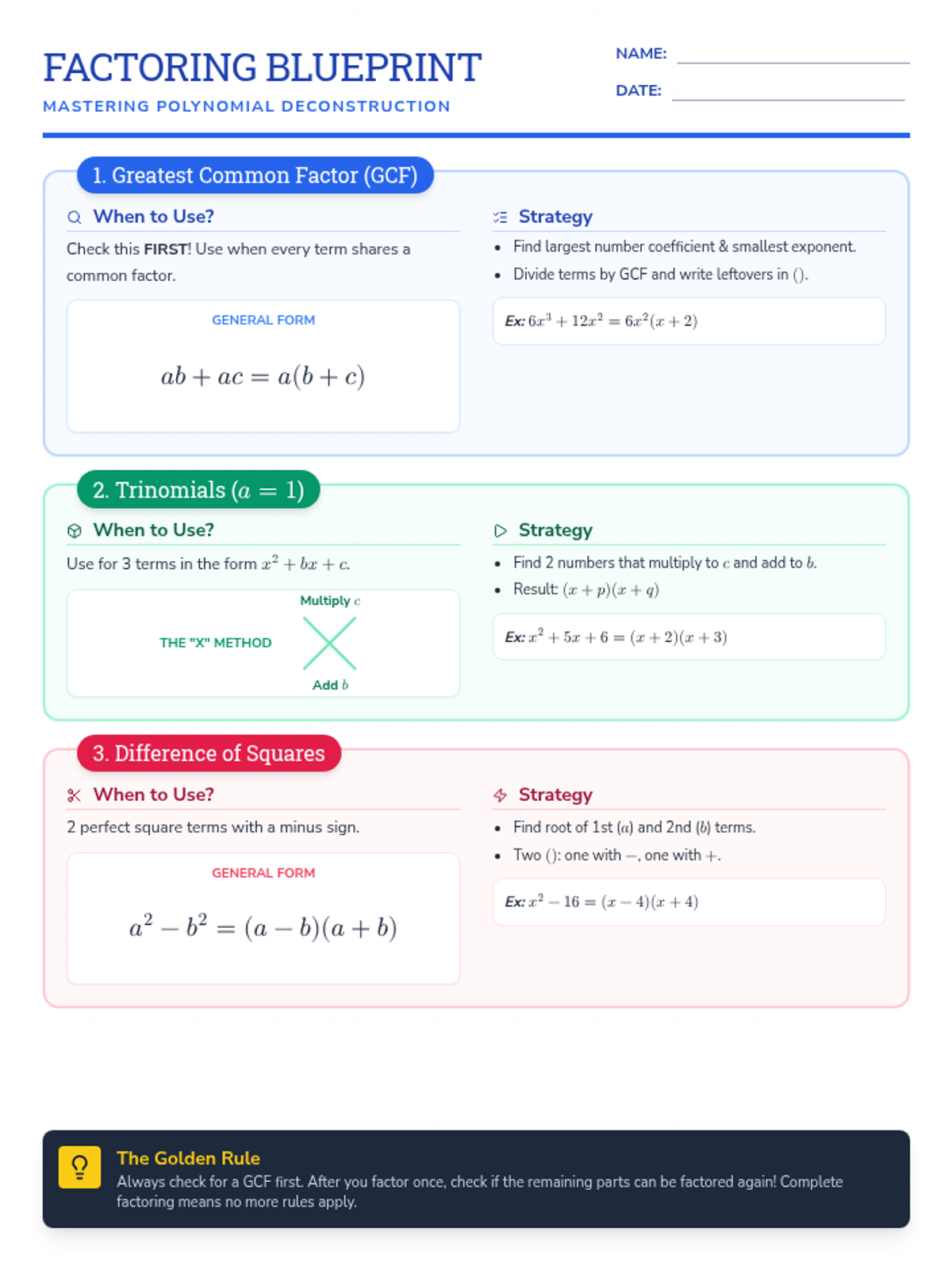
A two-page comprehensive reference sheet for Algebra. The first page features a graphic organizer for factoring (GCF, Trinomials, Difference of Squares), and the second page provides step-by-step guides and examples for multiplying, dividing, adding, and subtracting rational functions.
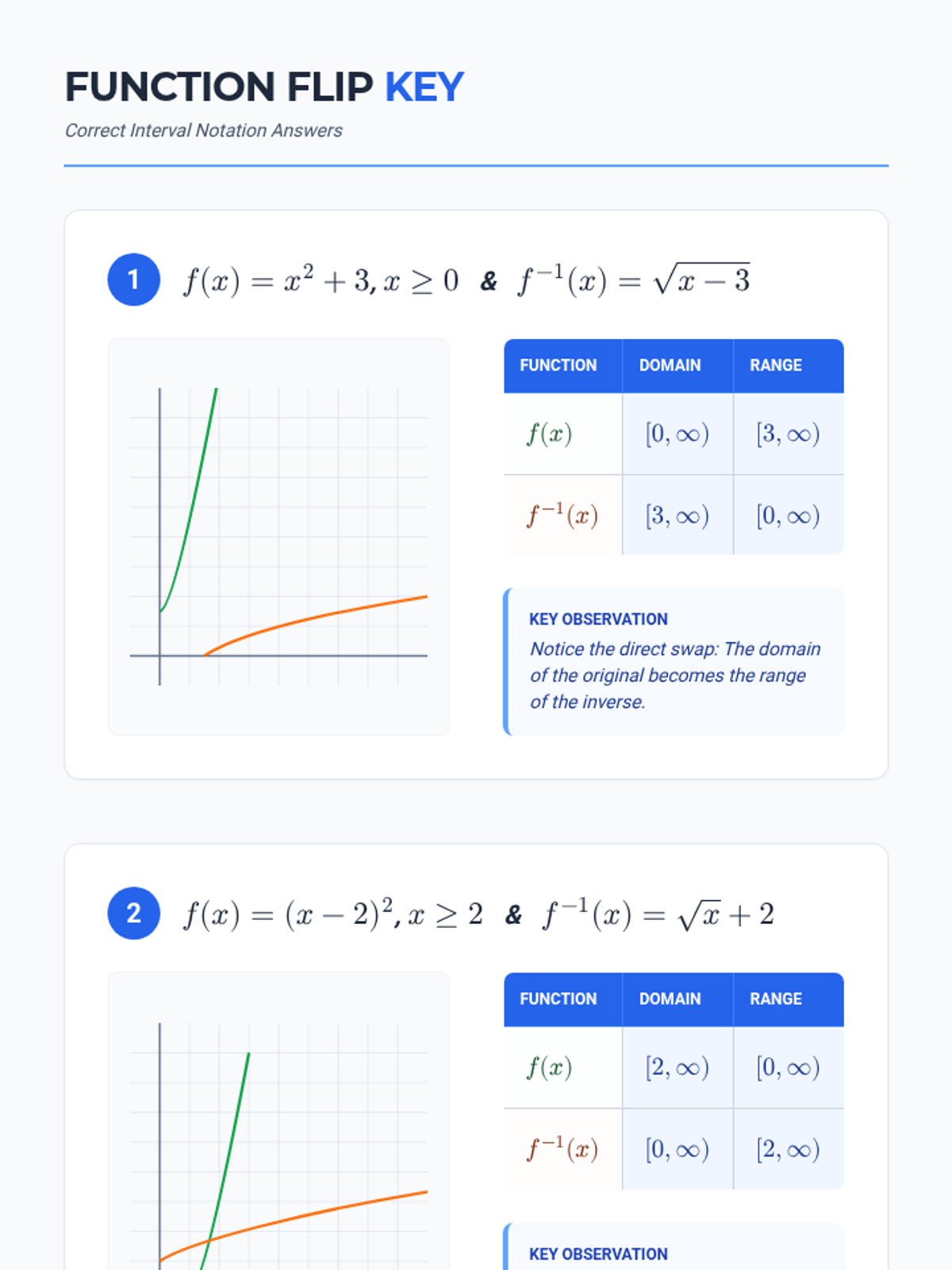
A complete answer key for the Function Flip Worksheet, providing correct interval notation and brief instructional notes for each problem. Includes corrected graphs and optimized page layout.
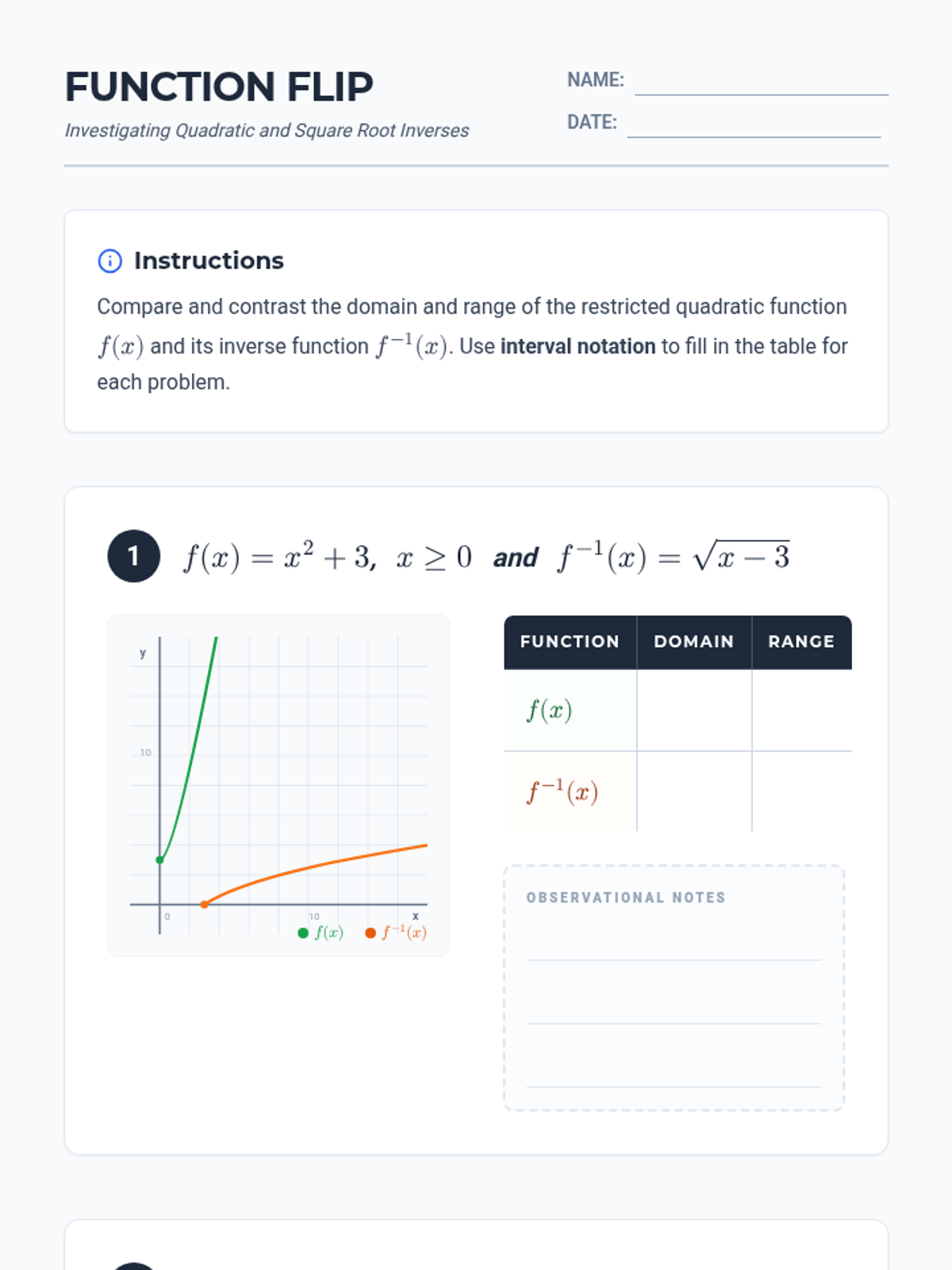
A 2-problem worksheet focusing on comparing the domain and range of quadratic functions and their square root inverses using interval notation and coordinate graphs. Restricted branches are used for mathematical accuracy. Includes improved writing space and page layout.
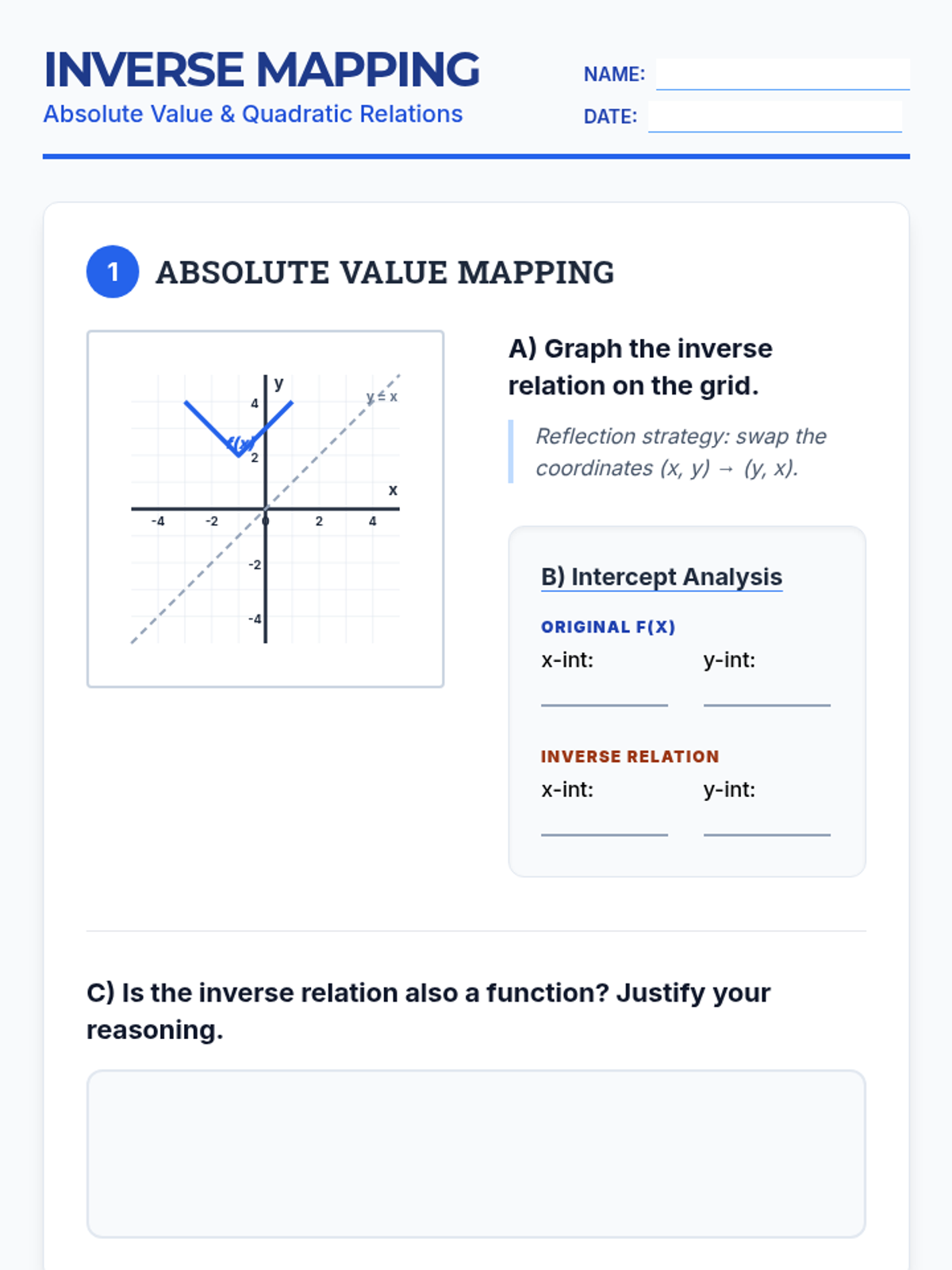
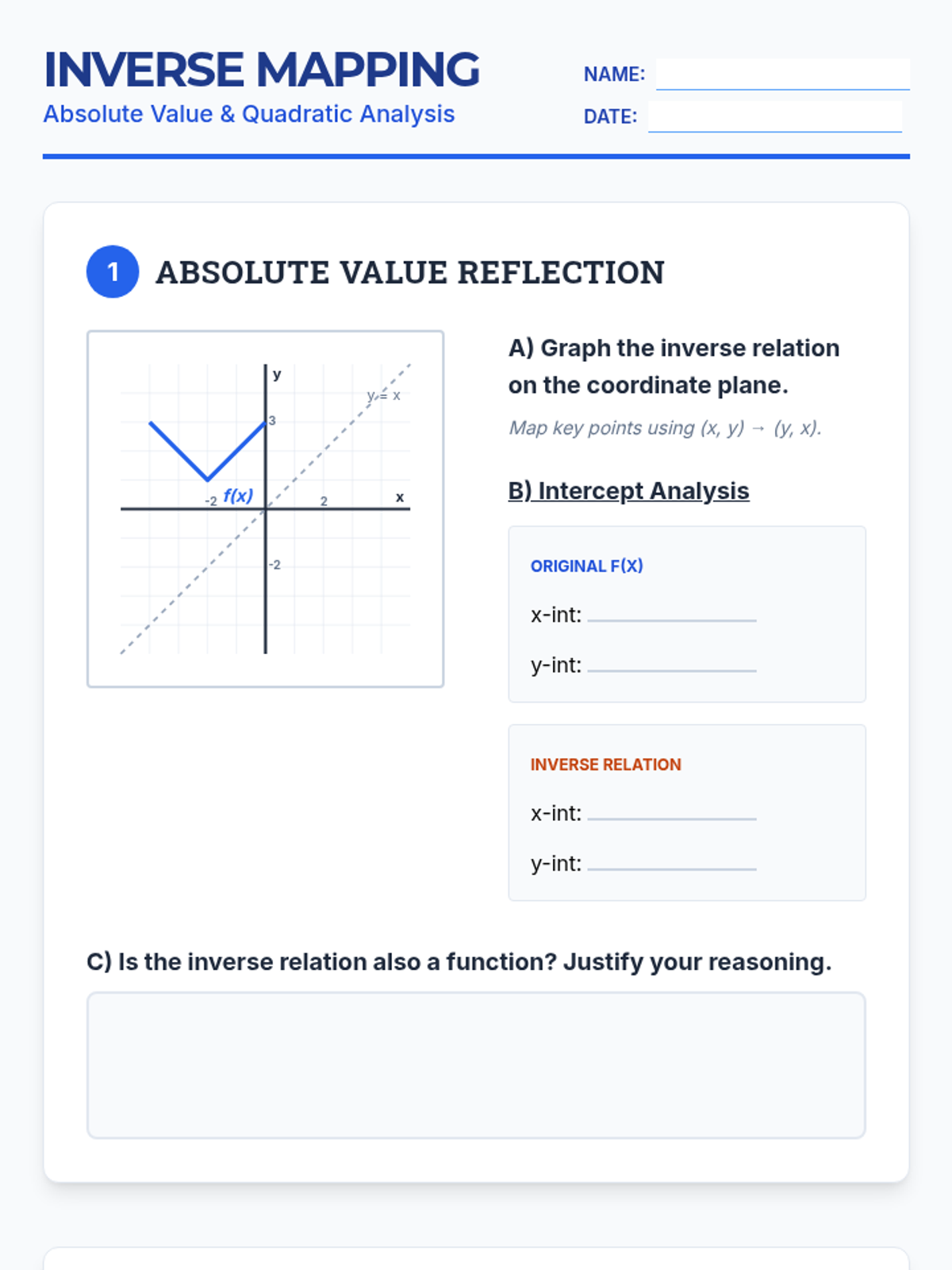
A math worksheet focused on inverse relations for absolute value and quadratic functions. Students graph inverse relations by reflecting points across y=x and analyze intercepts and function properties. Features clear axis labeling and high-contrast visuals.
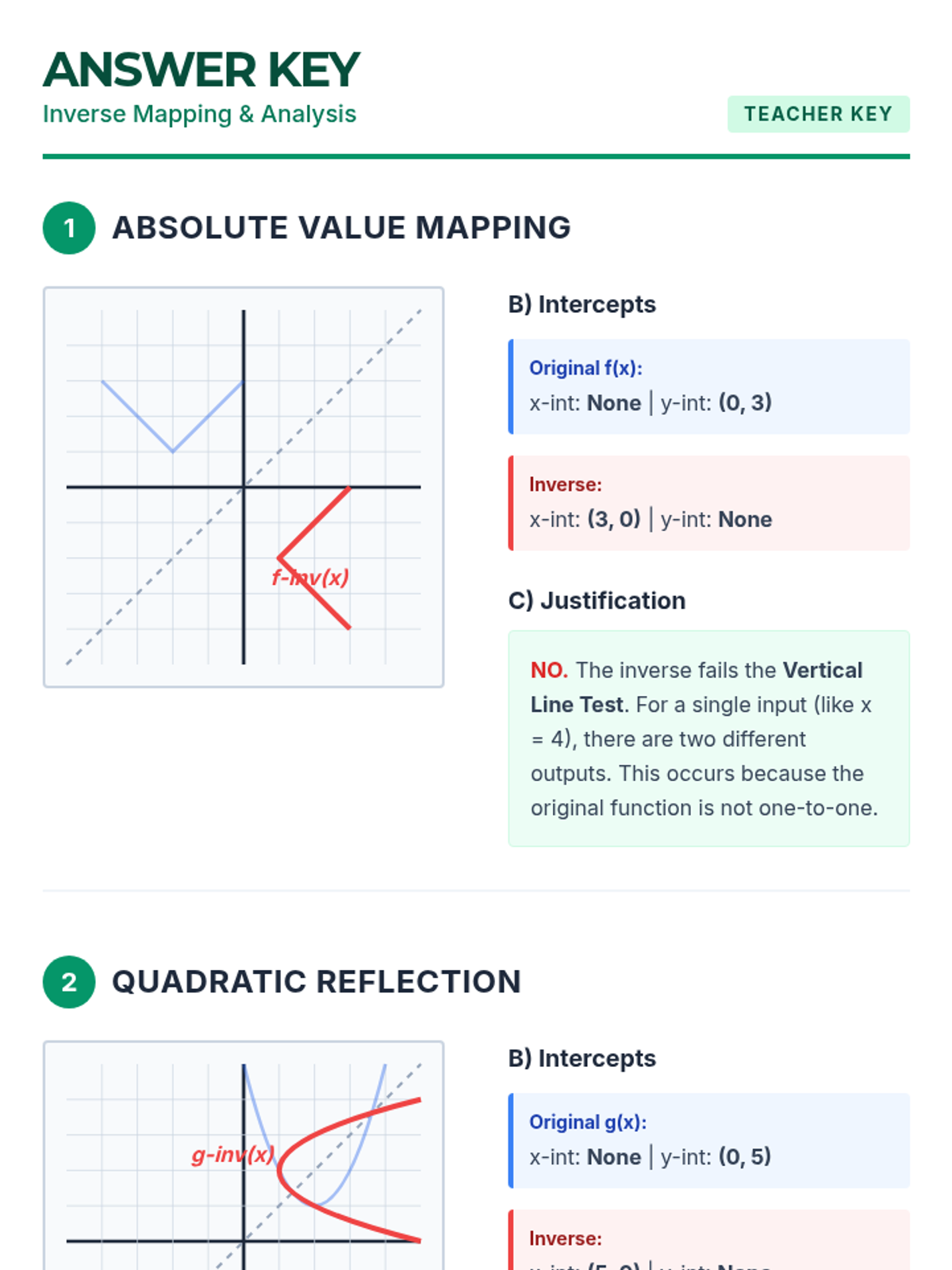
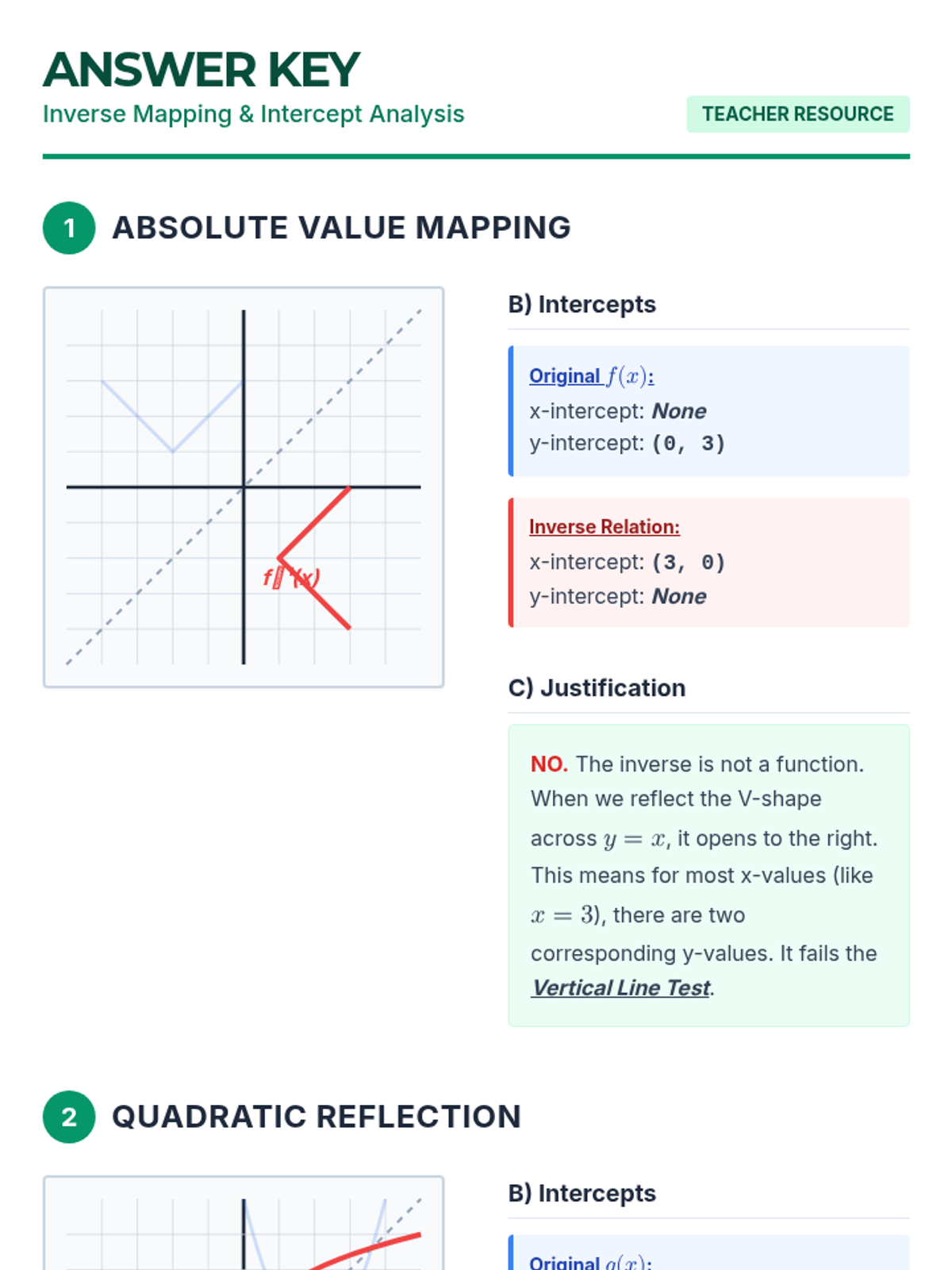
Answer key for the Inverse Mapping Worksheet. Features corrected labels, enhanced line visibility, and simplified math notation for better rendering across all platforms. Adjusted for page breaks.
Answer key for the Inverse Mapping Worksheet. Features corrected labels, enhanced line visibility, and simplified math notation for better rendering across all platforms.
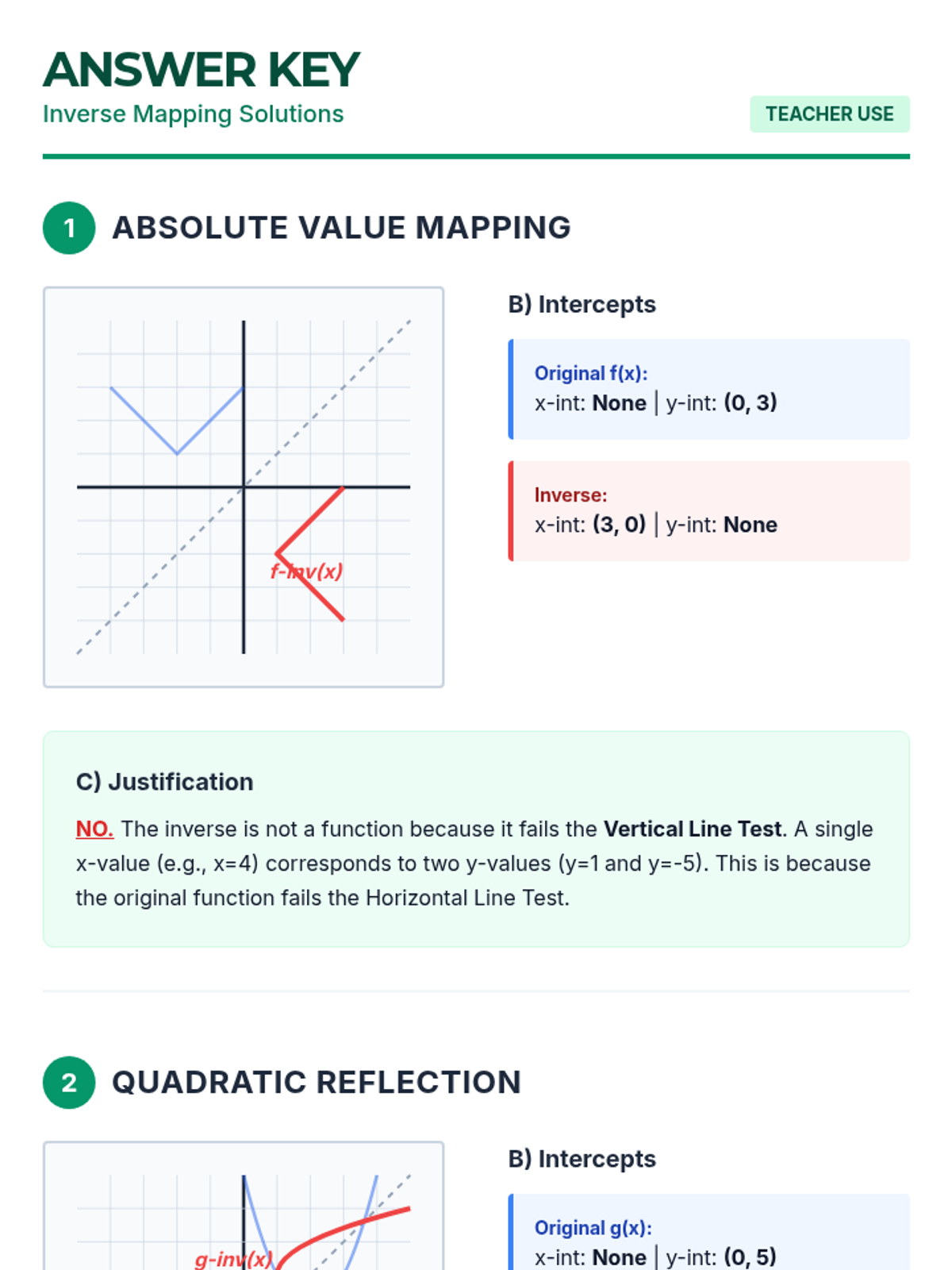
Detailed answer key for the Inverse Mapping Worksheet. Includes graphed inverse relations, accurately calculated intercepts, and formal justifications for function classification.
A math worksheet focused on inverse relations for absolute value and quadratic functions. Students graph inverse relations by reflecting points across y=x and analyze intercepts and function properties. Adjusted for better printing and clarity.
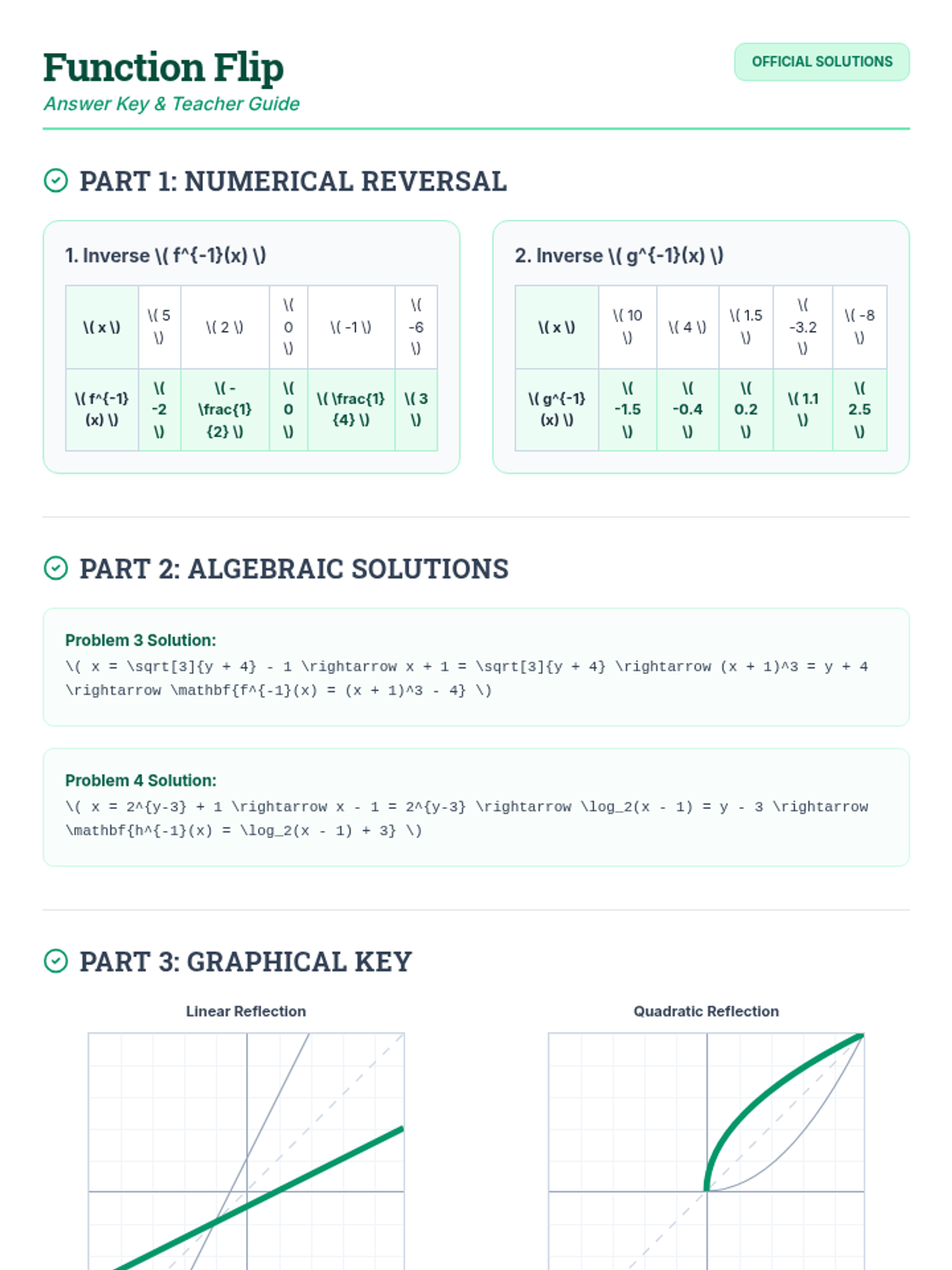
The answer key for the Inverse Flip Worksheet, featuring completed table mappings, step-by-step algebraic solutions for cubic and exponential functions, and reflected graphical representations for visual verification.
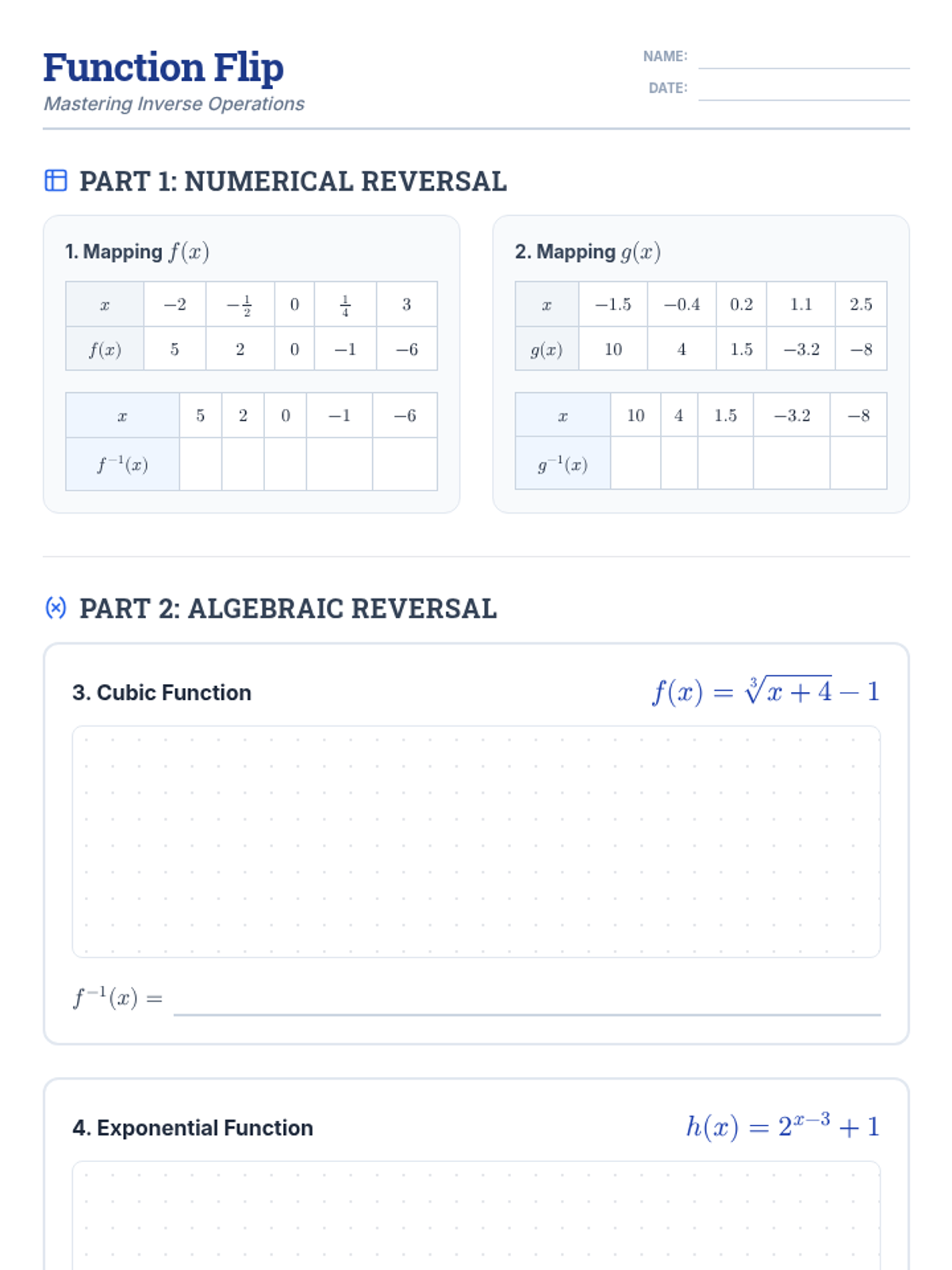
A comprehensive worksheet on inverse functions featuring table mapping, algebraic manipulation, and graphical reflections across the line y=x. Includes fractions, decimals, and multiple function types (linear, quadratic, cubic, exponential, square root).
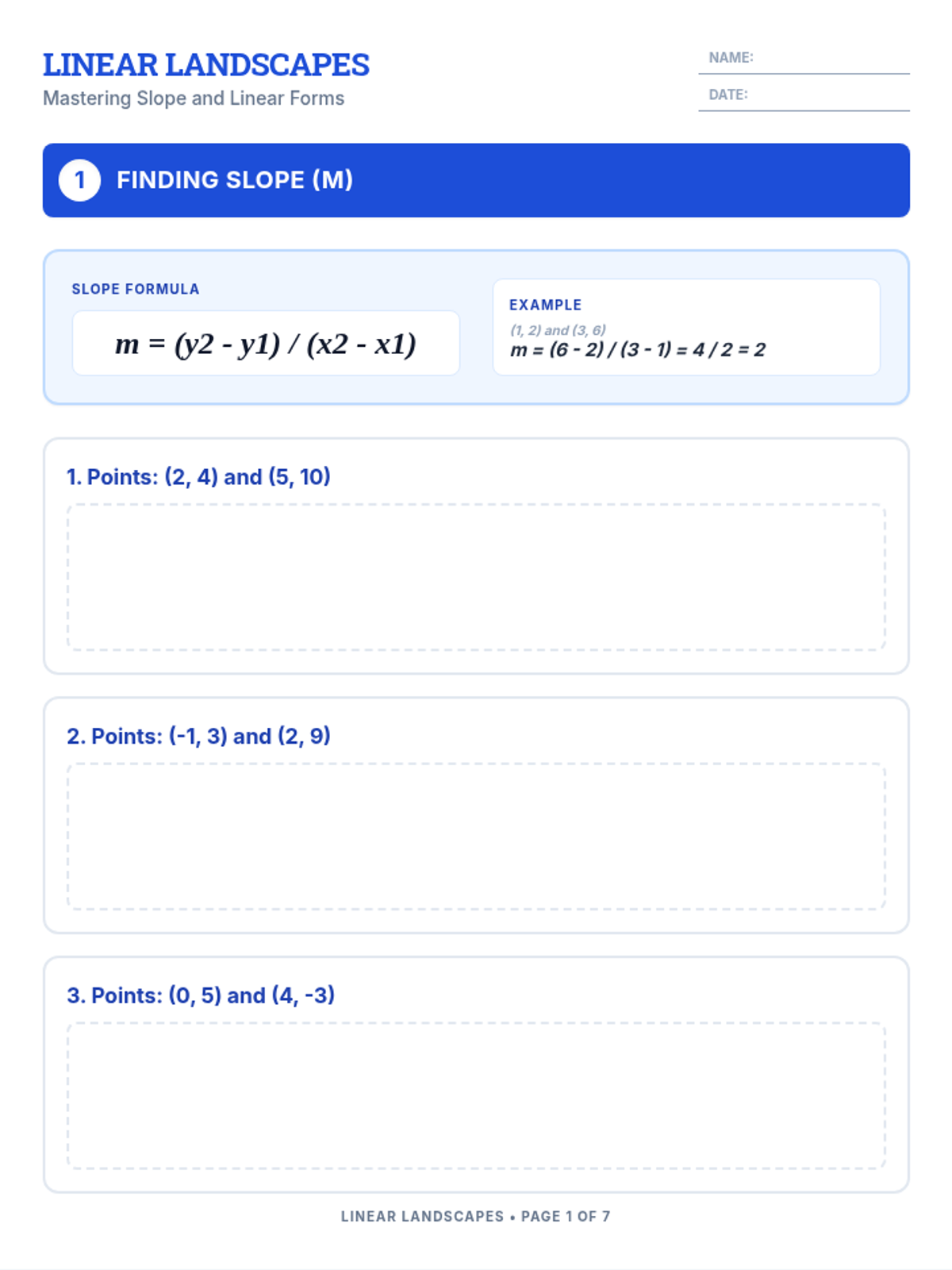
A 7-page Algebra 1 practice packet focusing on slope and linear forms. Each section starts on a new page with integrated formula guides and examples. Features standard font sizes, clear coordinate graphs with explicit grid lines, and structured workspace designed for special education accessibility.
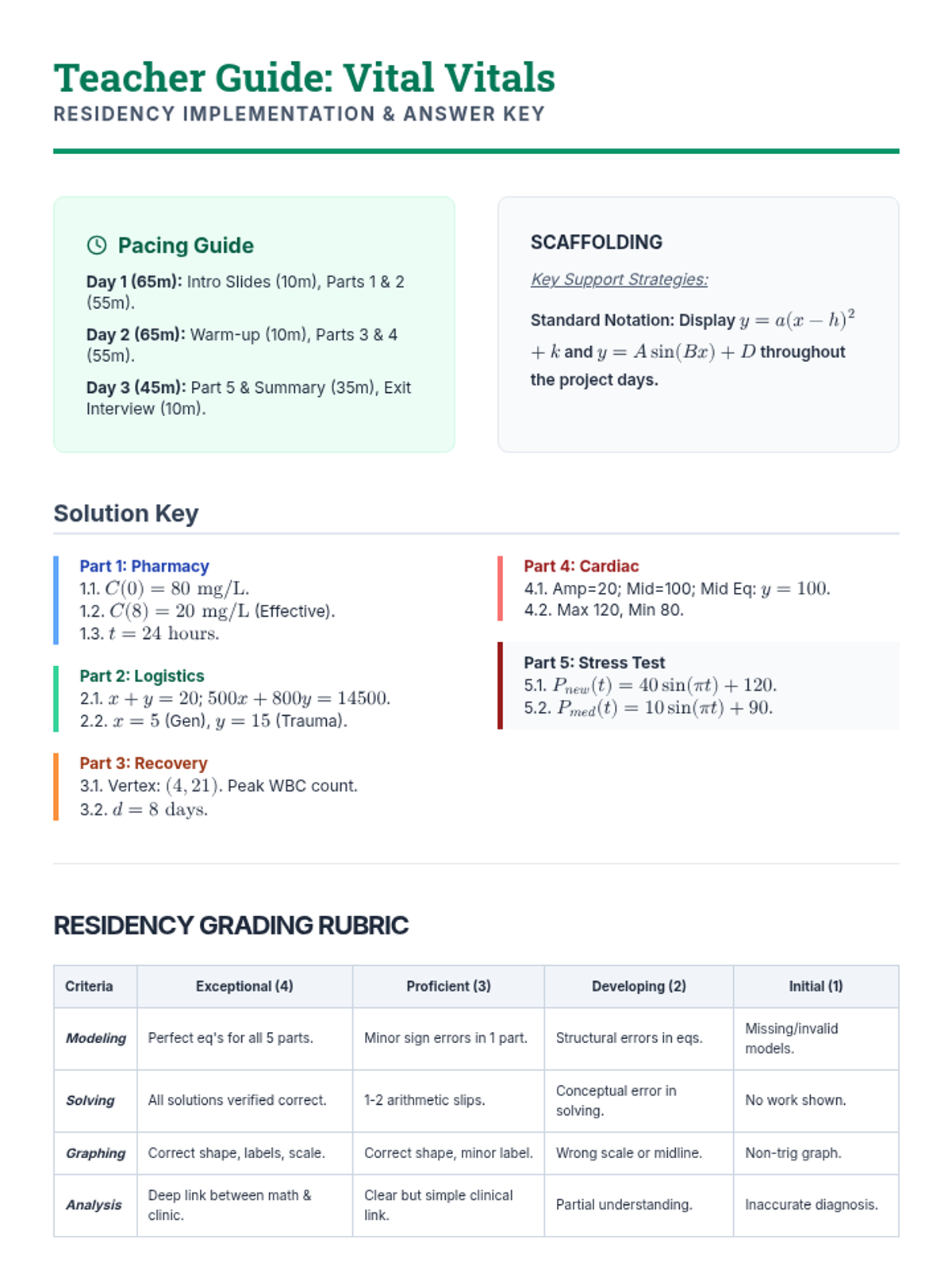
Teacher guide for the Vital Vitals project, including a day-by-day pacing guide, complete answer key with worked solutions, and a detailed grading rubric focused on modeling and clinical analysis.
Introductory slides for the Vital Vitals project. Sets the healthcare scenario, outlines the 3-day schedule, and provides visual aids for understanding heart rate transformations (trig) and patient recovery curves (quadratics).
Instructional slides for Day 1. Introduces the two primary forms of quadratic functions: Standard Form and Vertex Form, highlighting their unique strengths and features for graphing and solving. Fixes LaTeX size issues and diagram overlaps.
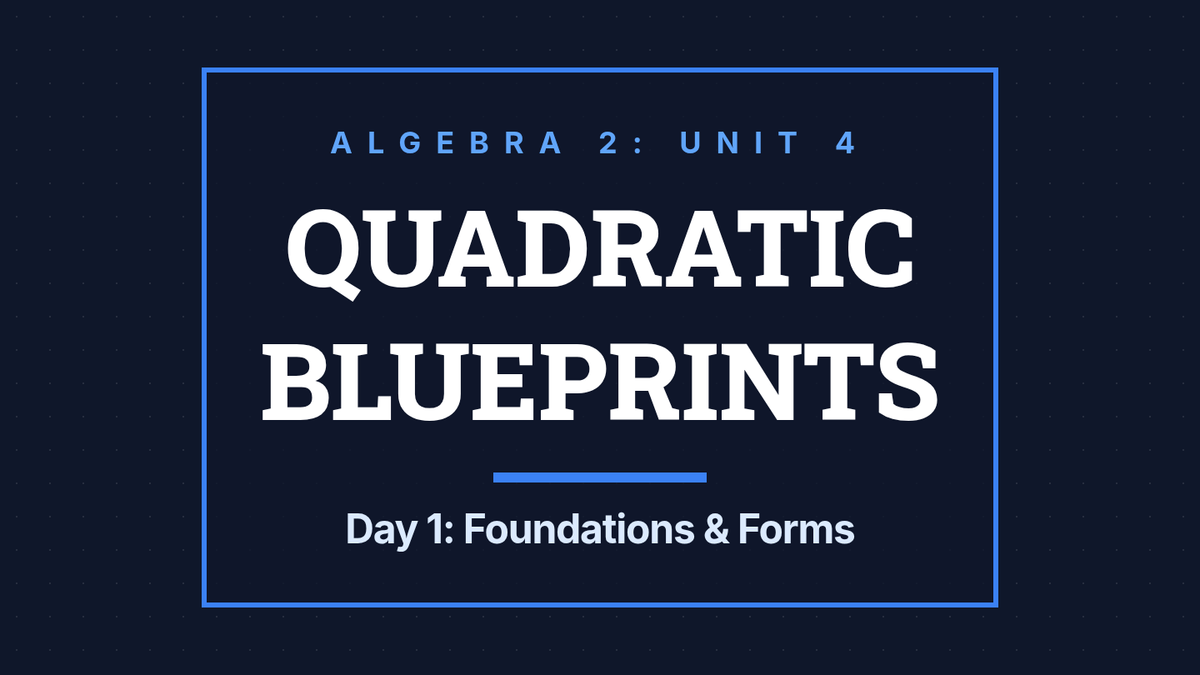
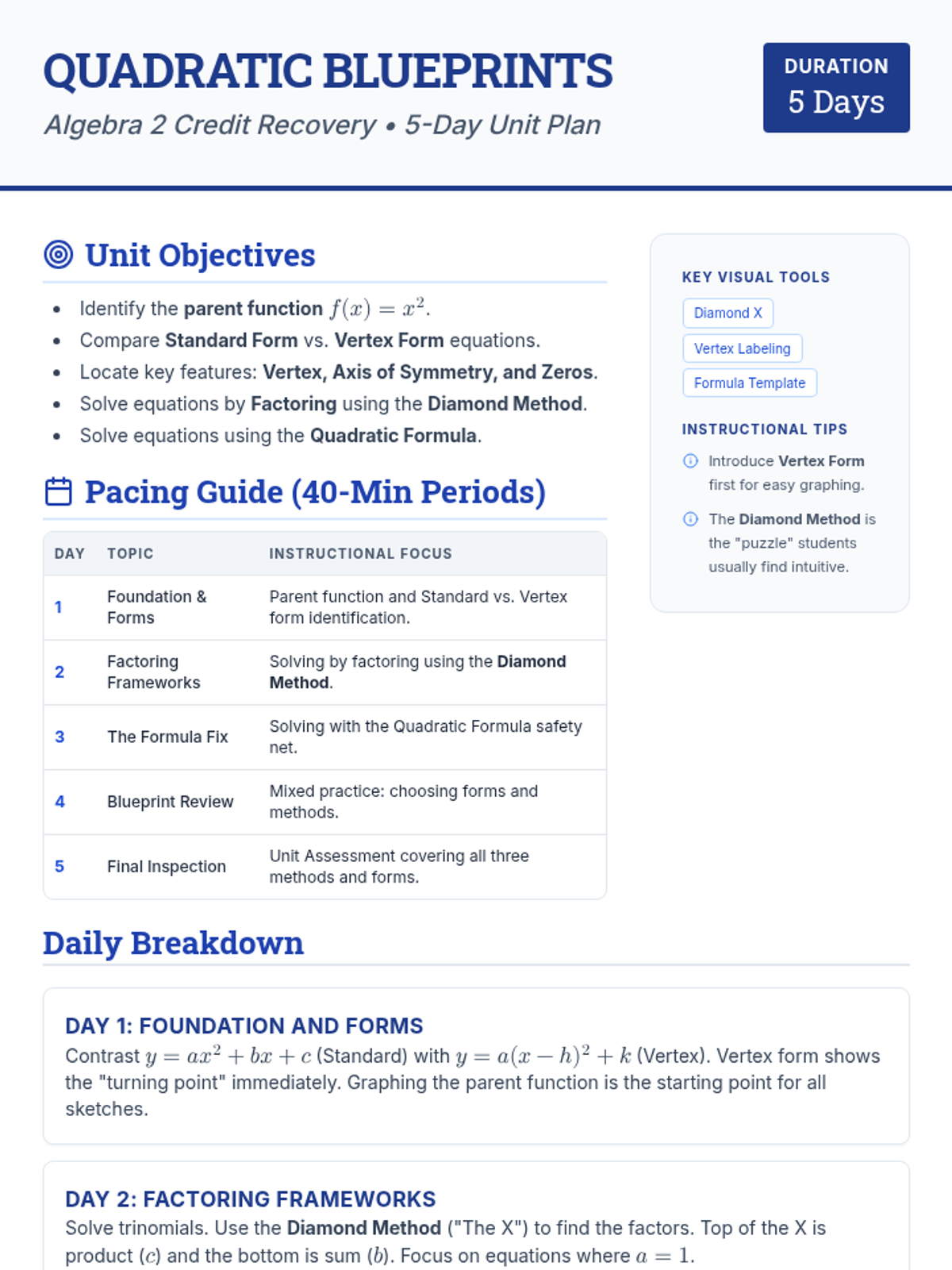
A comprehensive unit overview for teacher use, detailing the 5-day pacing and instructional focus. Updated to include the Diamond Method for factoring and the introduction of Standard vs. Vertex forms of quadratic functions. Fixes missing day breakdowns and poor page flow.
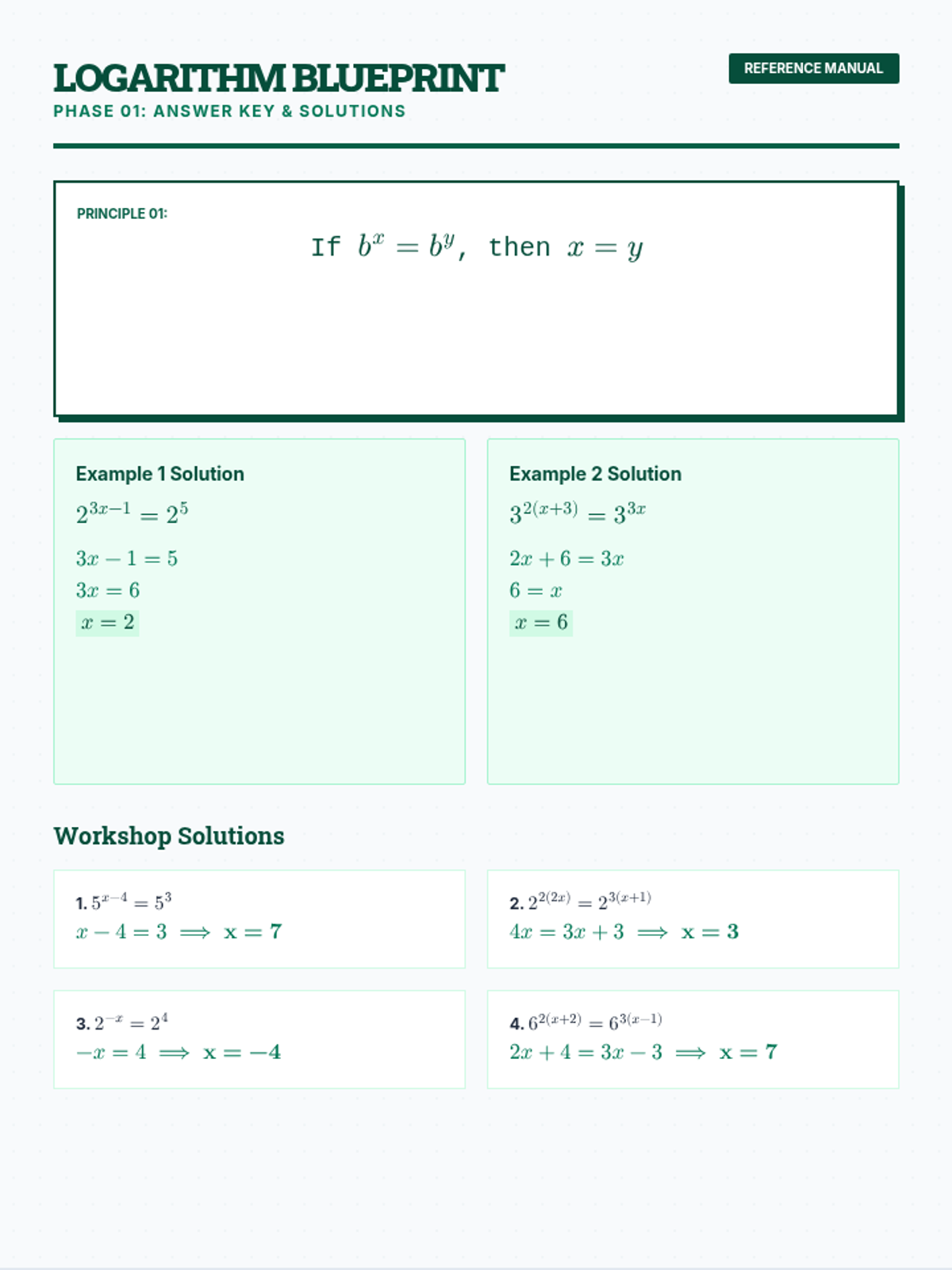
A 4-page detailed answer key for the Logarithm Blueprint Guided Notes, providing step-by-step solutions for all exponential and logarithmic equation problems.
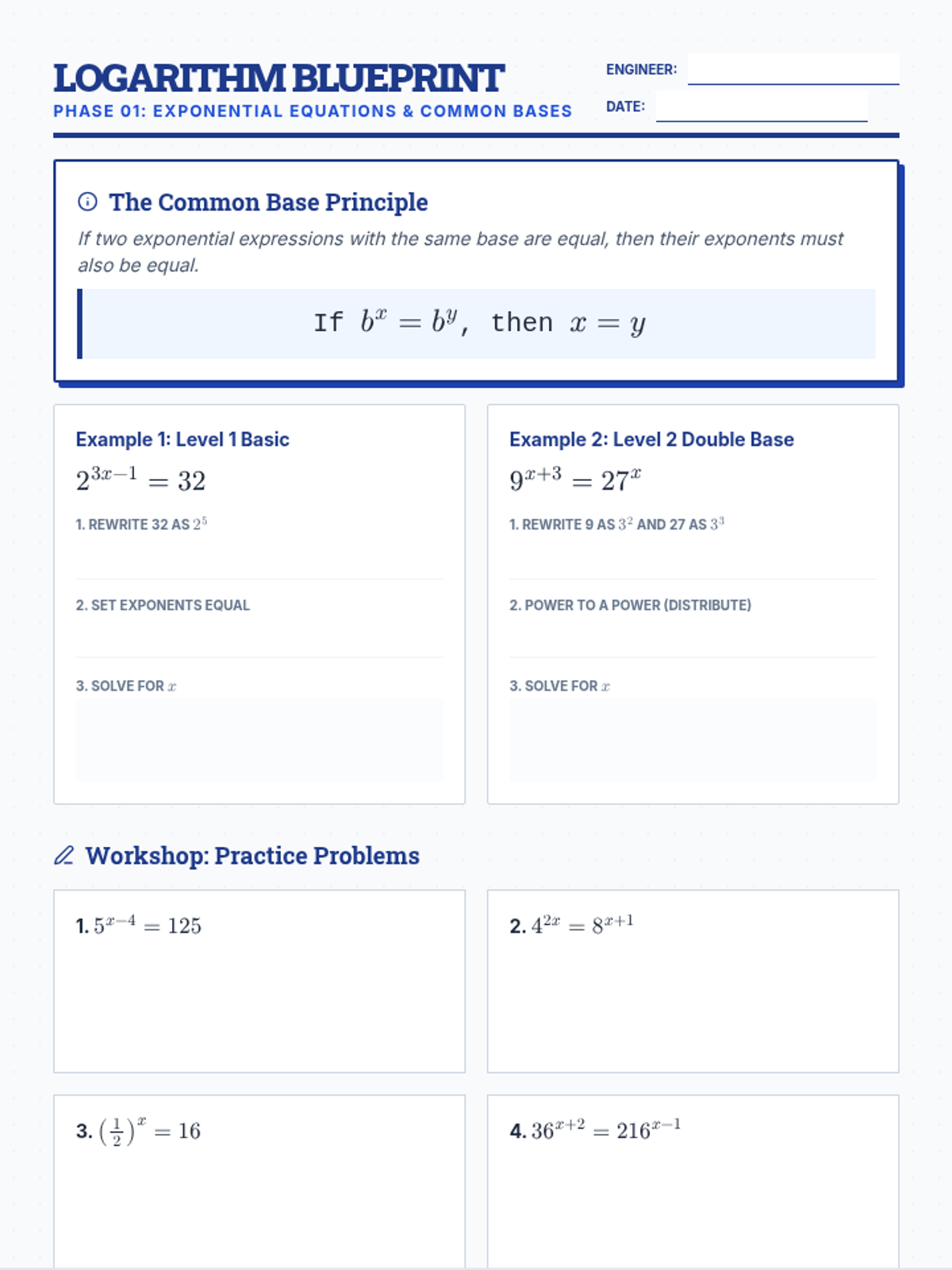
A 4-page comprehensive guided notes packet for solving exponential and logarithmic equations. It covers common bases, form conversion, and logarithmic properties with a professional technical blueprint aesthetic.
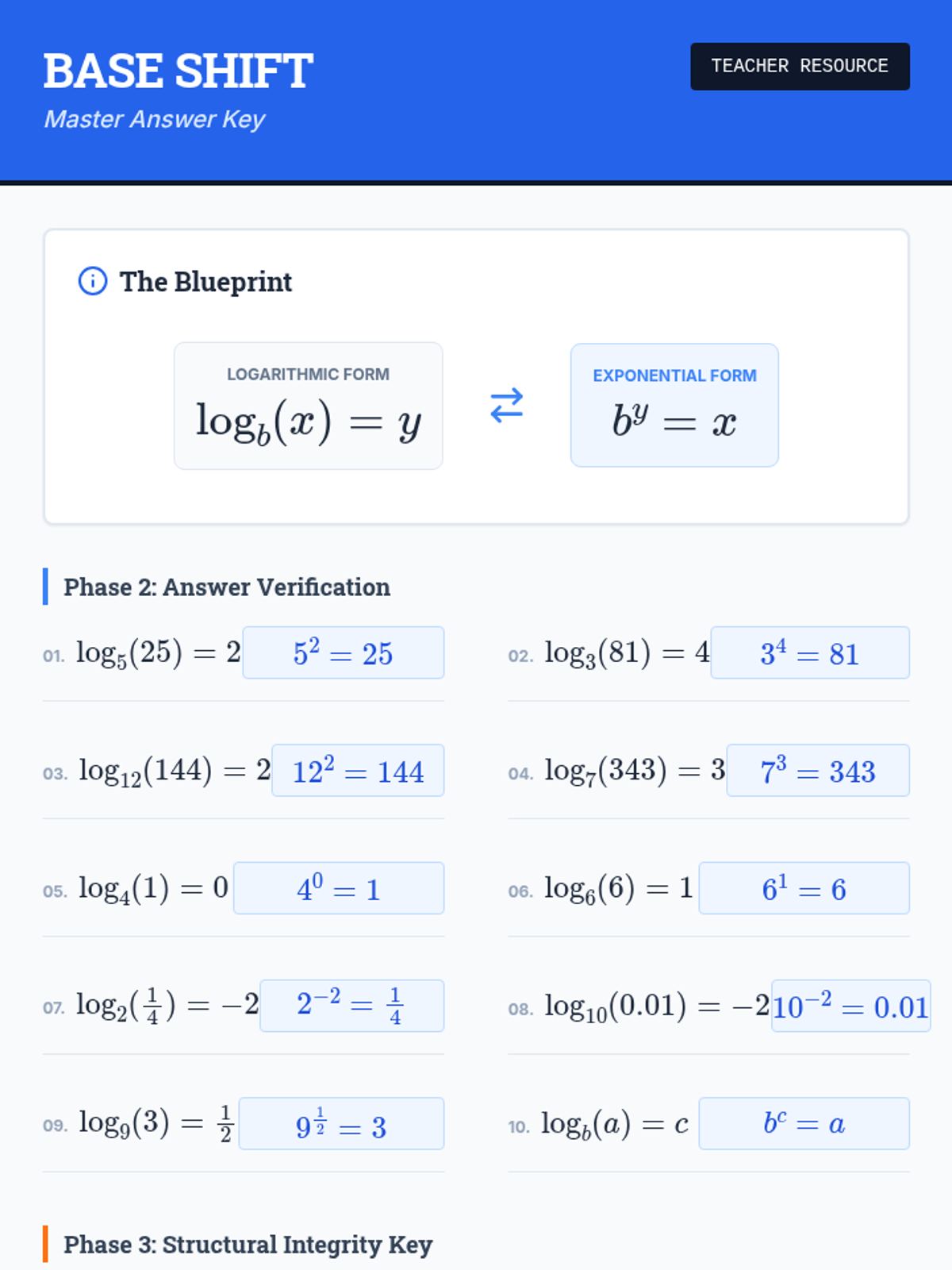
An answer key for the Base Shift worksheet, providing step-by-step solutions for logarithmic to exponential conversions.
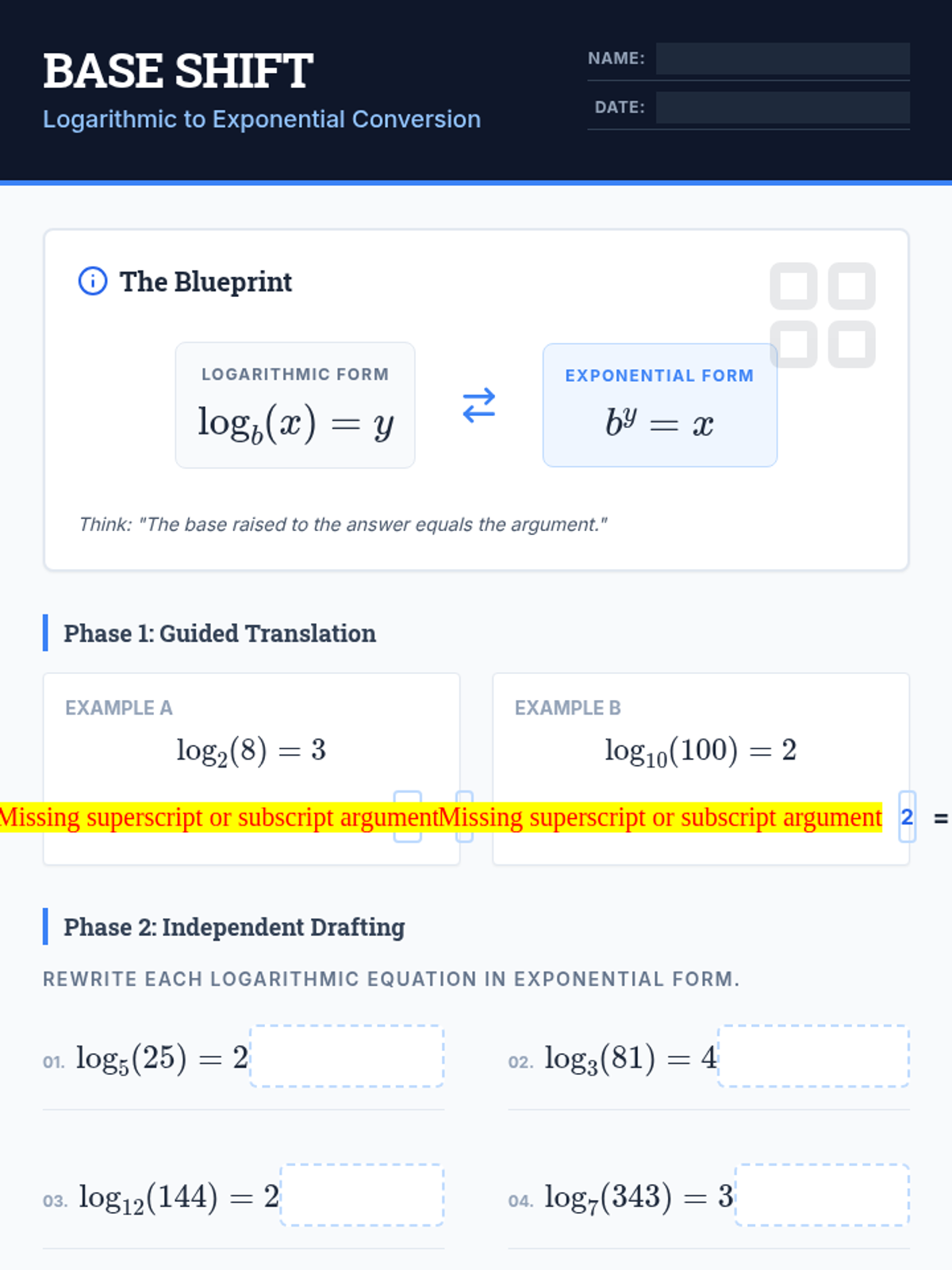
A comprehensive worksheet for practicing the conversion of logarithmic equations to exponential form, featuring guided examples and challenge problems.
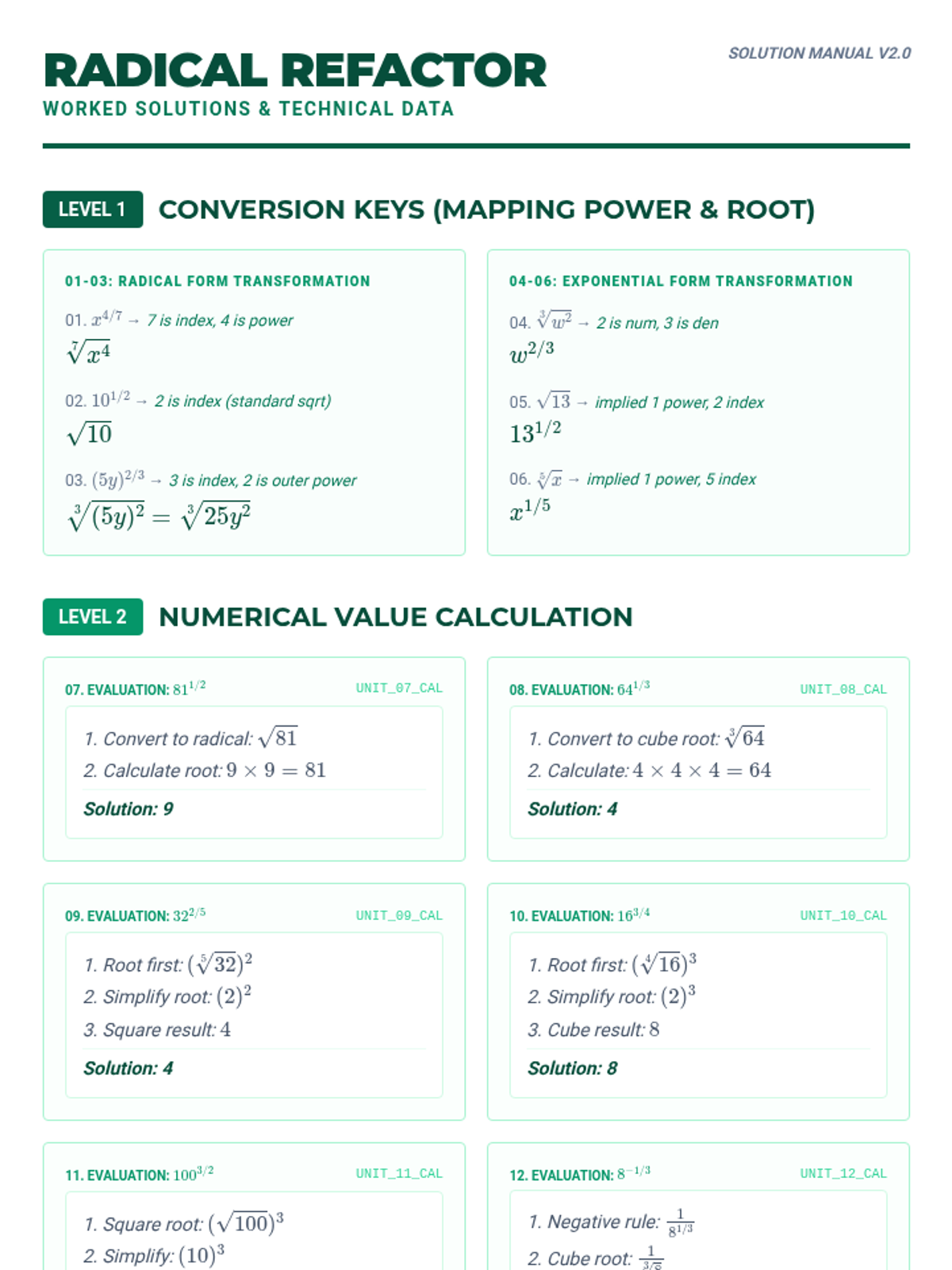
An updated answer key for the Radical Refactor Practice Worksheet, providing explicit step-by-step worked solutions for conversion, evaluation, and algebraic integration.