Examining foundational arguments from major thinkers alongside contemporary debates on morality, governance, and the nature of existence. Addresses core concepts like political structures, consciousness, and the conflict between agency and fate.
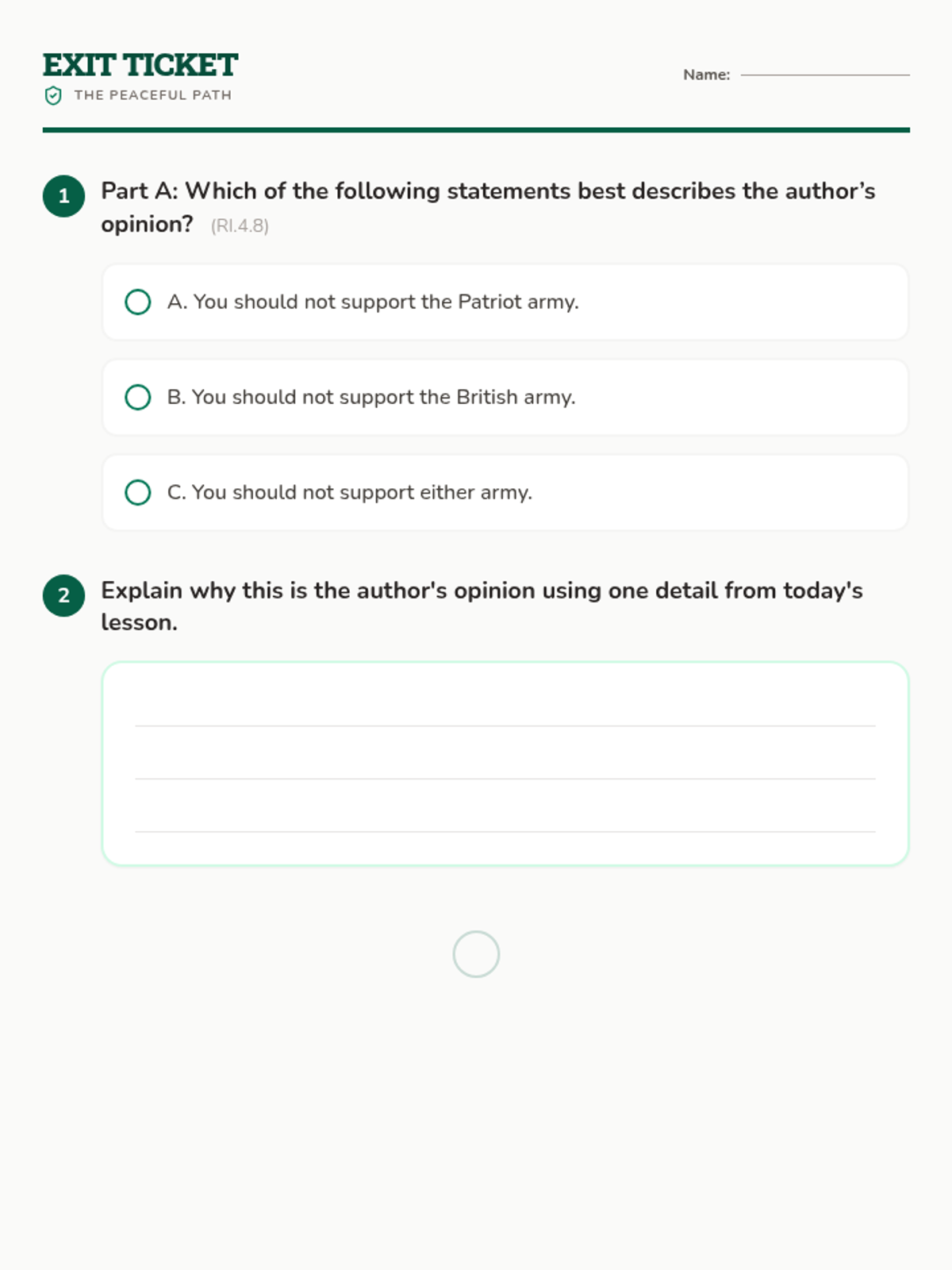
A concise exit ticket featuring the provided RI.4.8 opinion question and a short-response area for evidence-based justification.
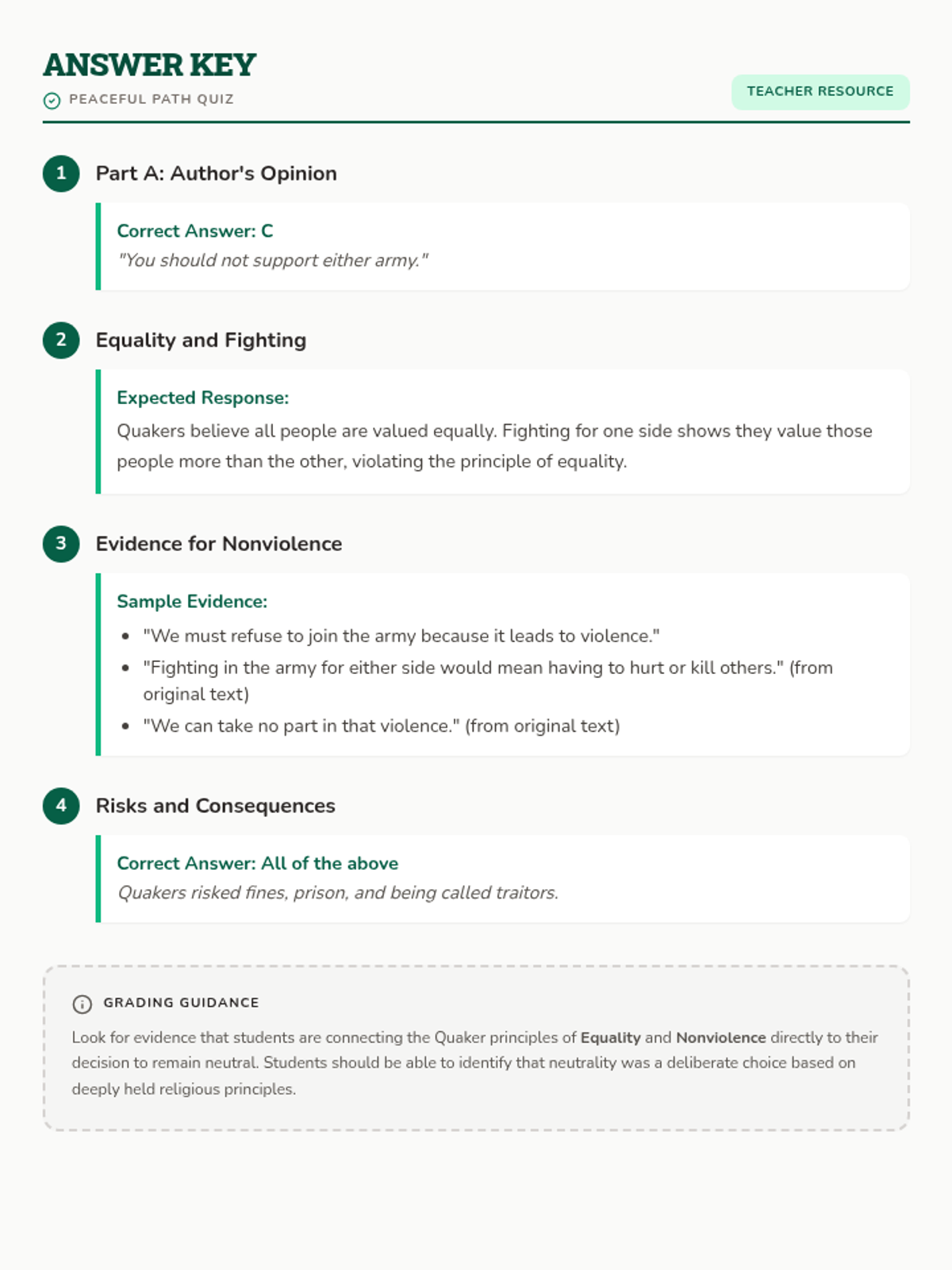
An answer key for the Peaceful Path Quiz, providing correct answers, sample evidence, and grading guidance for teachers. Corrected HTML tags and layout for single-page printing.
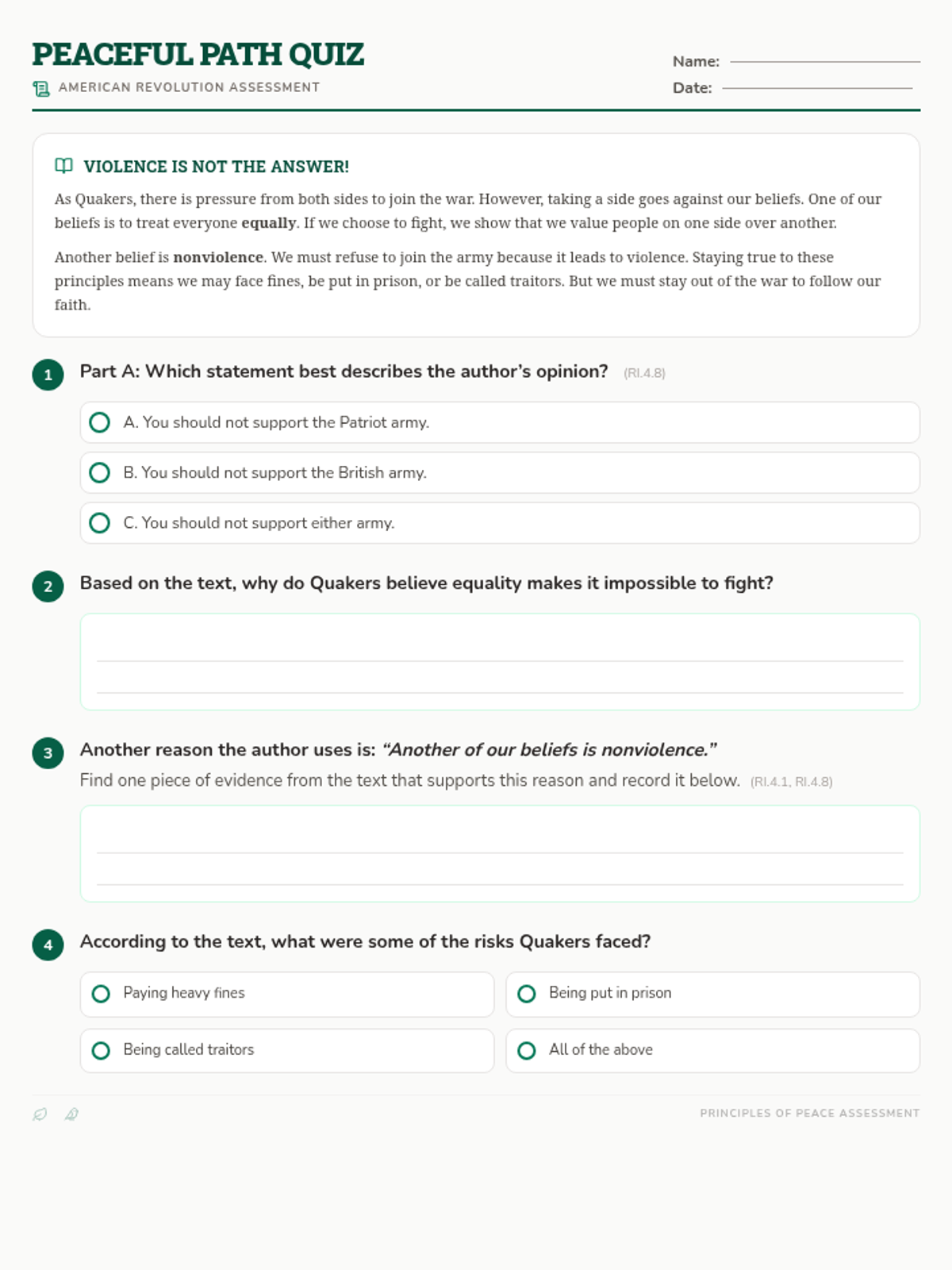
A student assessment featuring the provided RI.4.8 multiple-choice question, along with evidence-based reflection and reading comprehension questions. Includes a specific task on finding evidence for the principle of nonviolence.
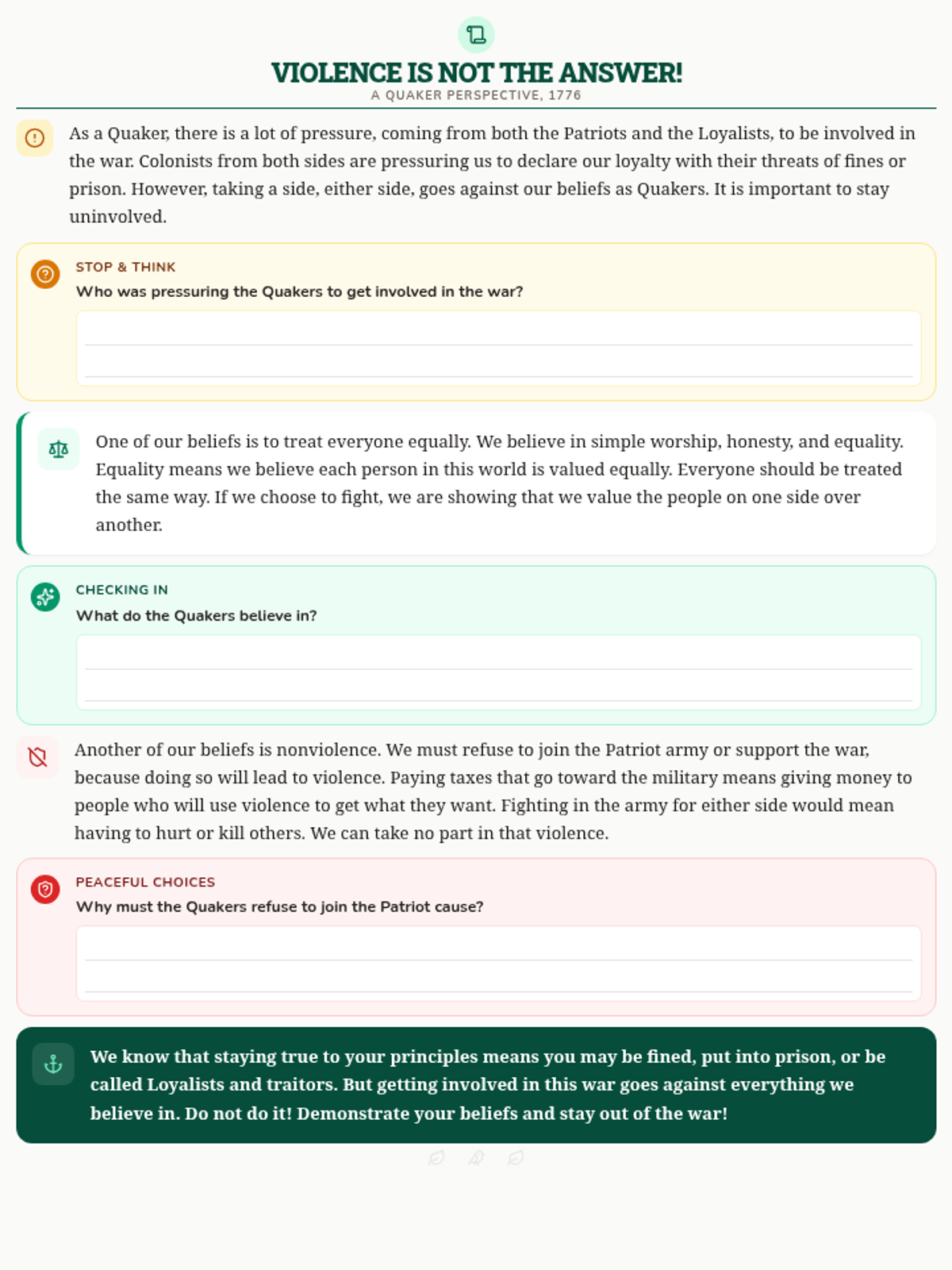
The primary reading passage explaining the Quaker perspective on neutrality and nonviolence, now including three embedded comprehension questions following each section with optimized single-page layout.
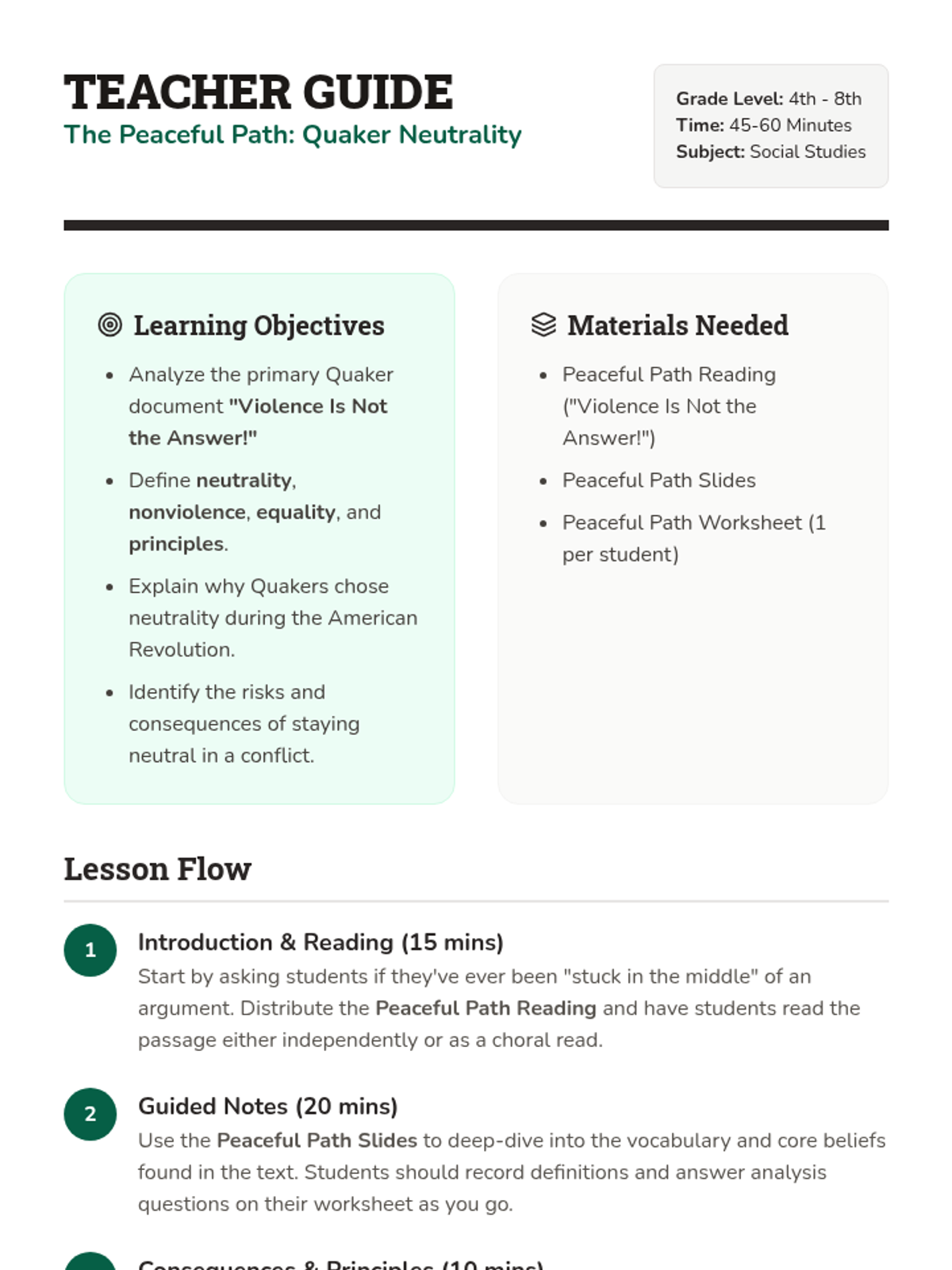
A teacher guide for the Peaceful Path lesson, providing instructional steps, discussion prompts, and differentiation strategies.
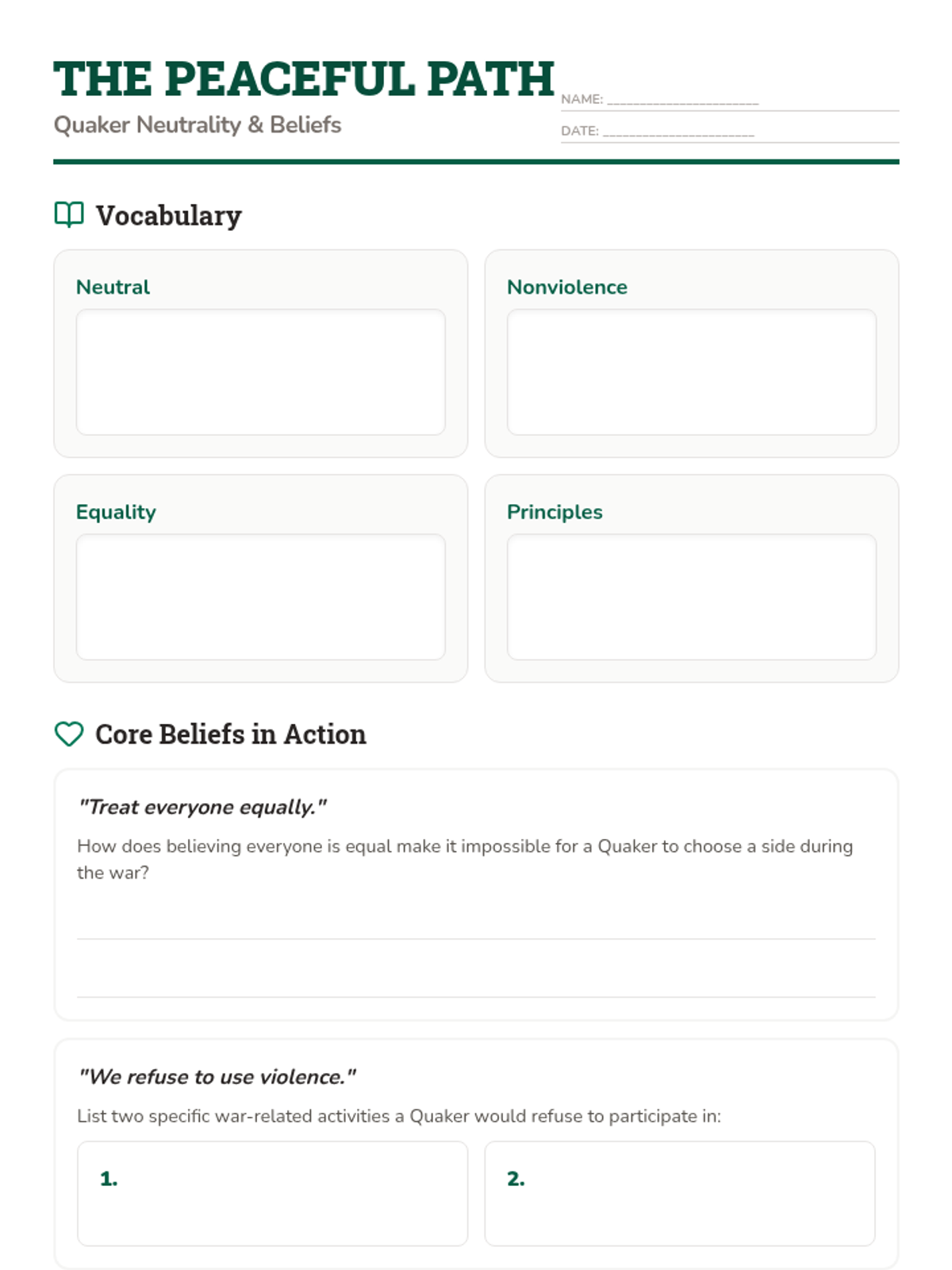
A note-taking worksheet to accompany the Peaceful Path slides, featuring vocabulary definitions and reflection questions.
A visual-heavy slide deck explaining Quaker neutrality during the American Revolution, featuring kid-friendly vocabulary definitions for Neutral, Equality, Nonviolence, and Principles, plus interactive discussion questions.
A presentation for teachers to introduce the key tenets of Confucianism, Taoism, and Buddhism, connecting each to visual motifs and conceptual themes from Avatar: The Last Airbender. Updated for higher contrast and readability.
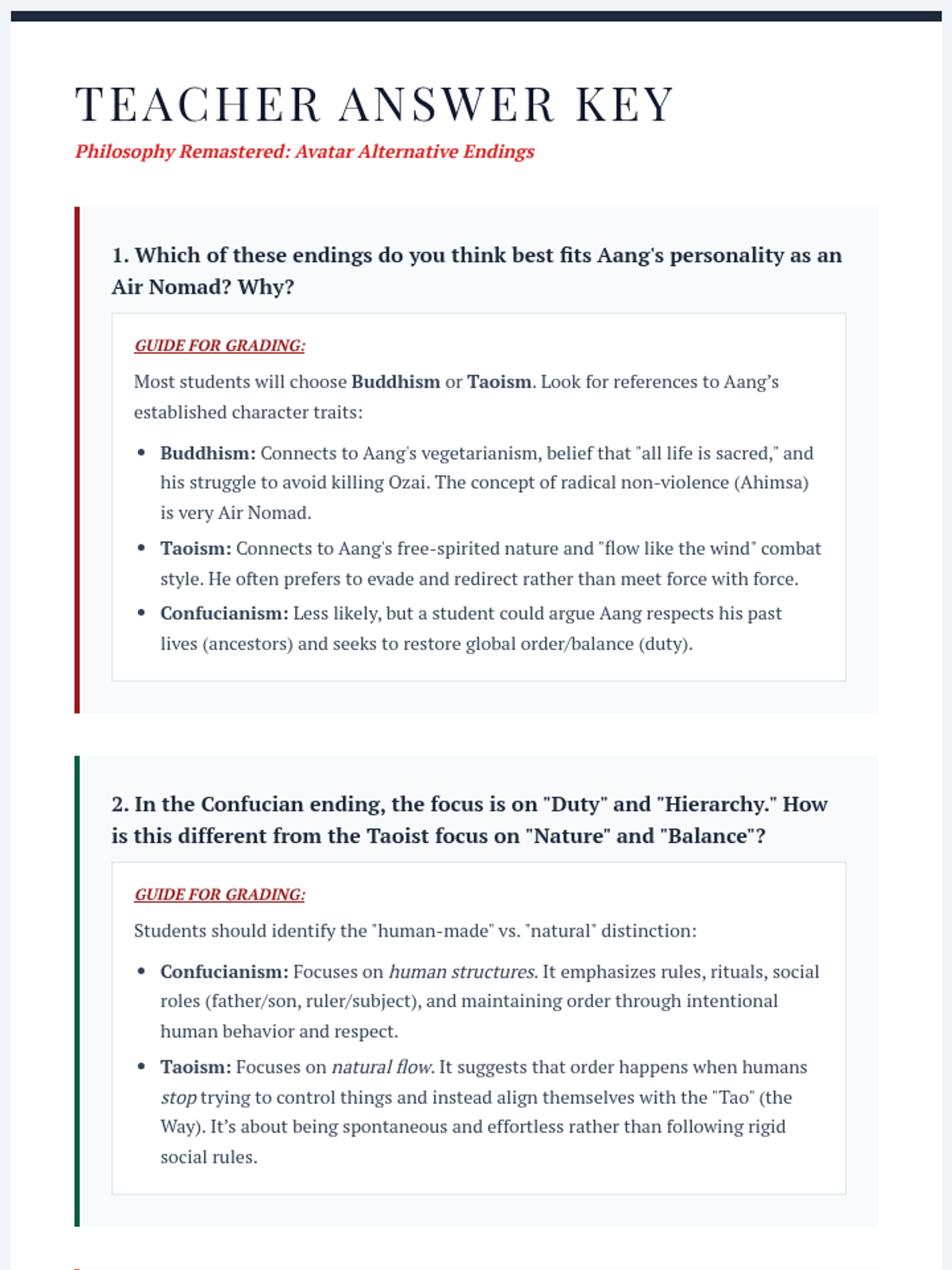
A teacher-facing answer key and grading guide for the Philosophy Remastered Worksheet, providing context for student responses and alignment to Eastern philosophical concepts.
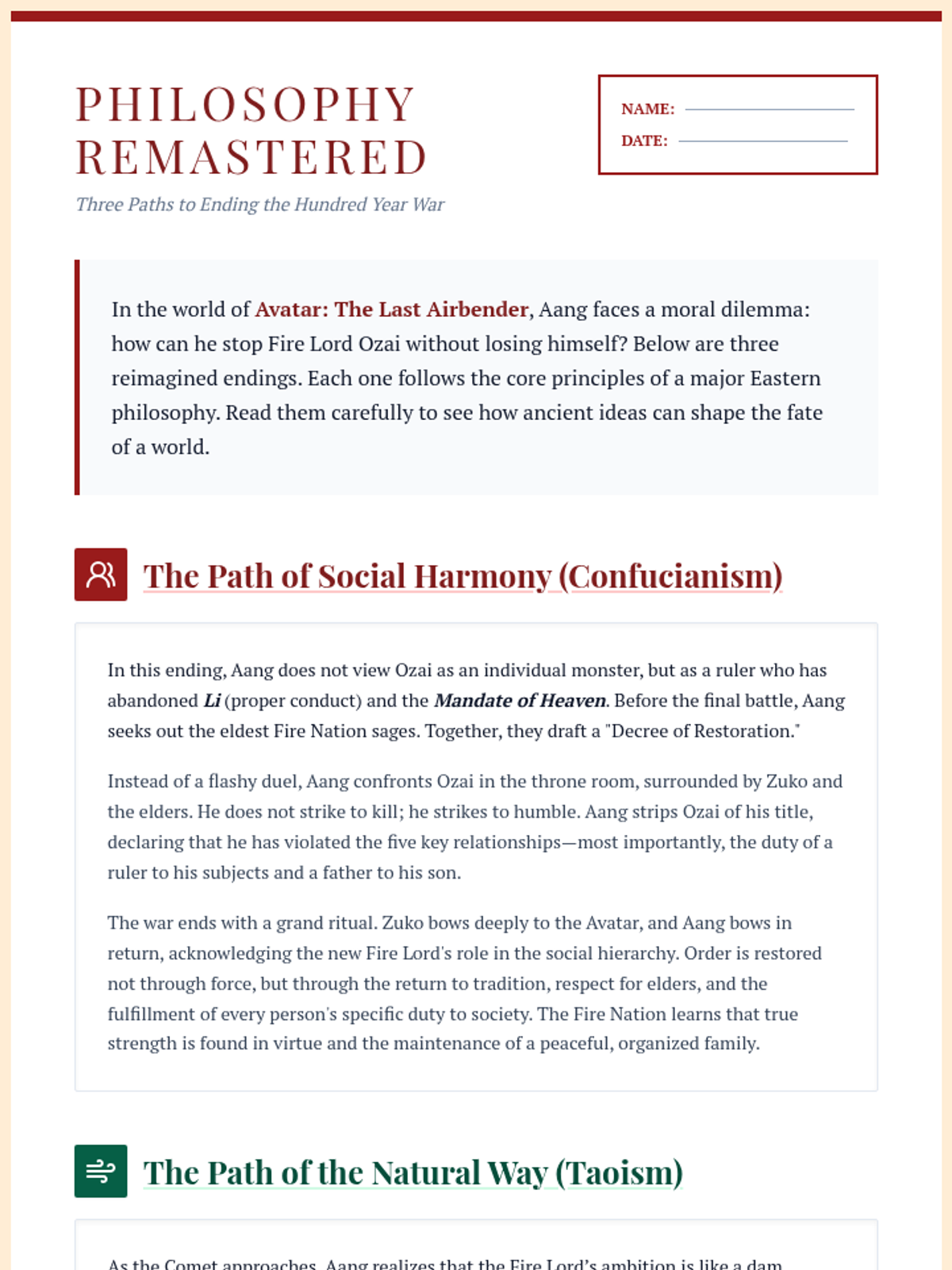
A two-page worksheet presenting three alternative endings to Avatar: The Last Airbender, each written to exemplify the core principles of Confucianism, Taoism, and Buddhism, followed by student reflection questions. Fixes include updated icons and white student work areas.
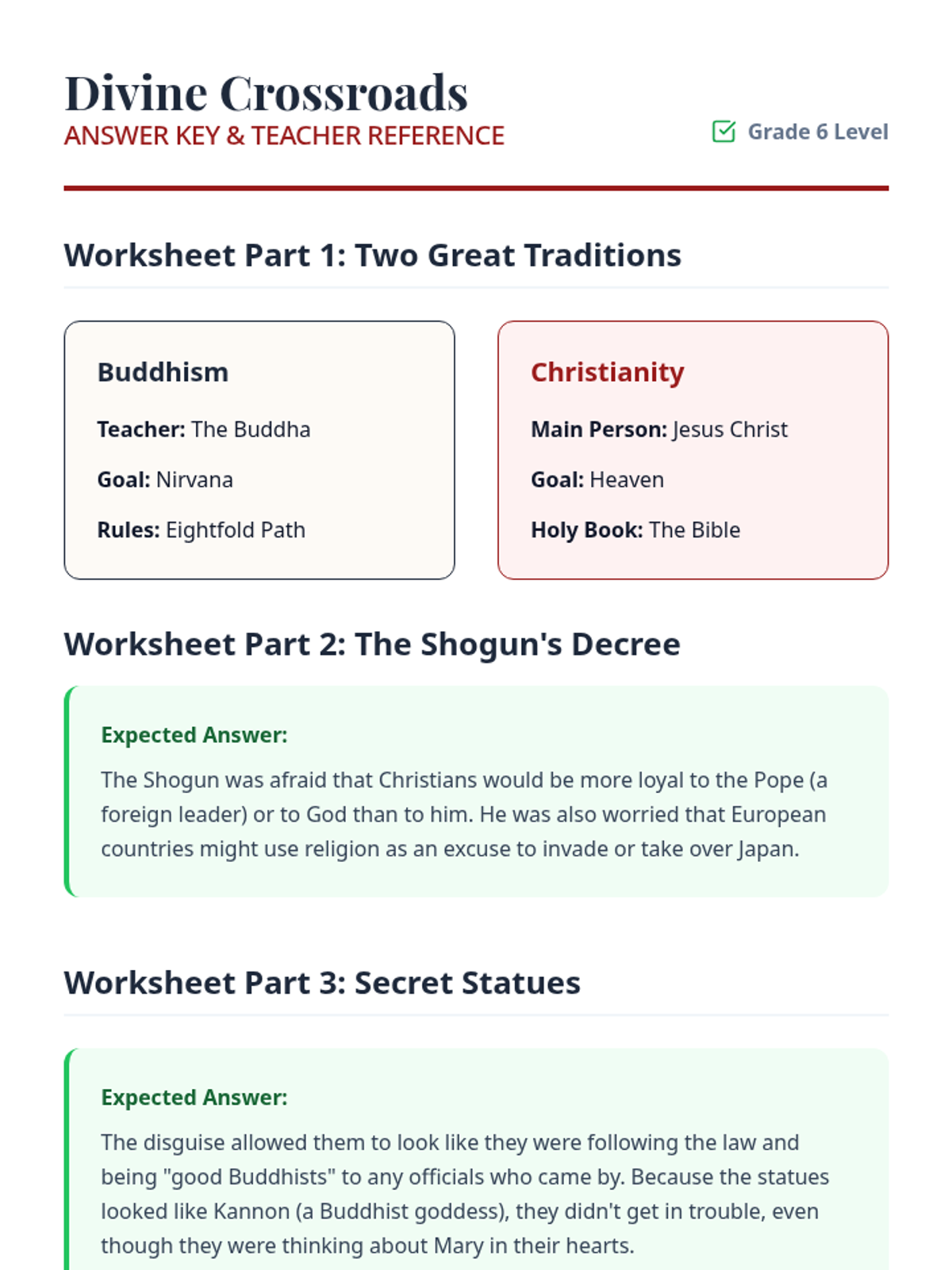
A comprehensive answer key for the Divine Crossroads worksheet and exit ticket, designed for teacher reference with clear, simplified explanations for 6th-grade content.
A simplified exit ticket for 6th-grade students to check understanding of basic religious differences, historical concealment strategies, and modern cultural practices.
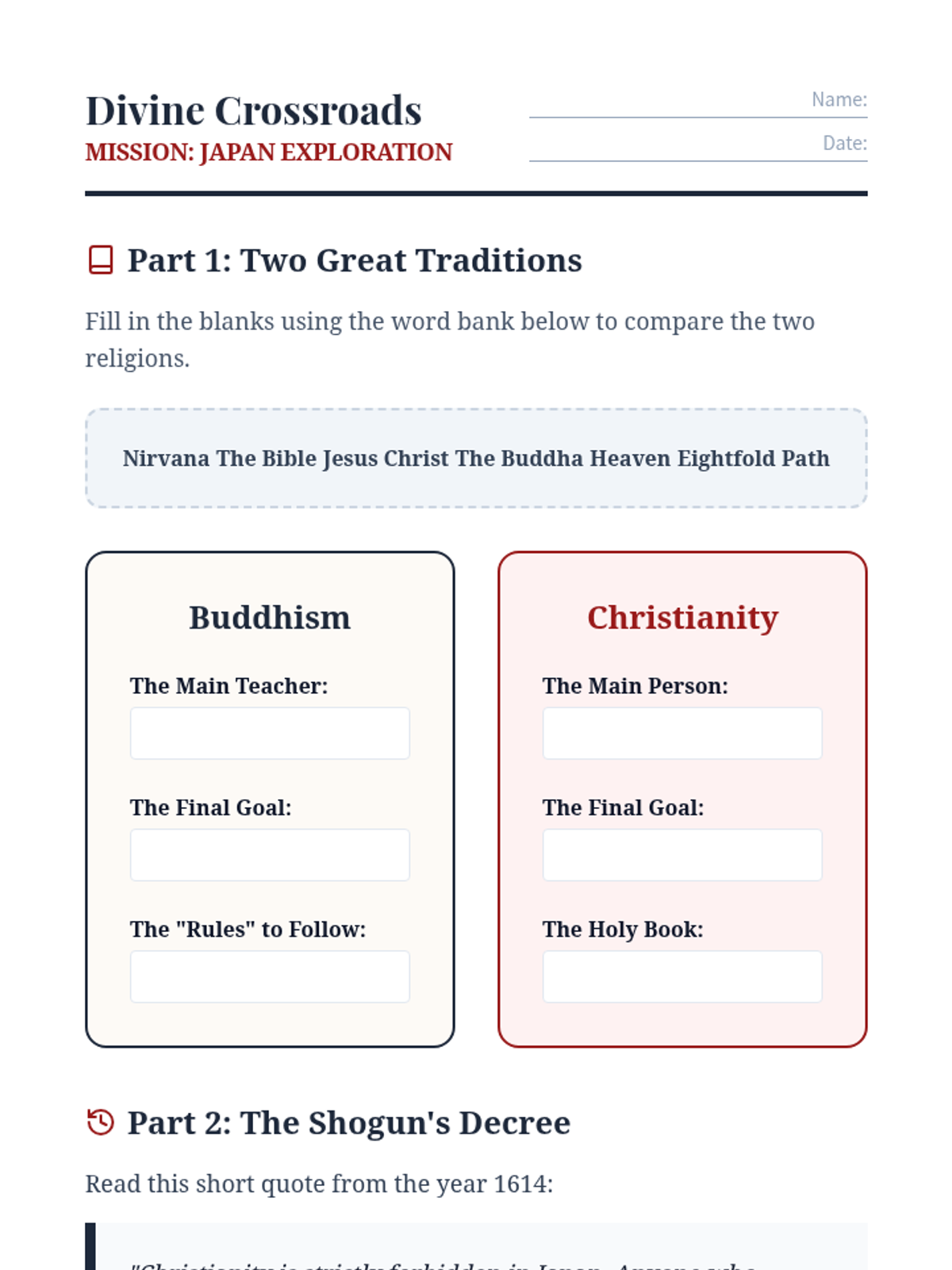
A 2-page student worksheet for 6th-grade students, featuring a word bank comparison, simplified historical analysis, and relatable reflection questions.
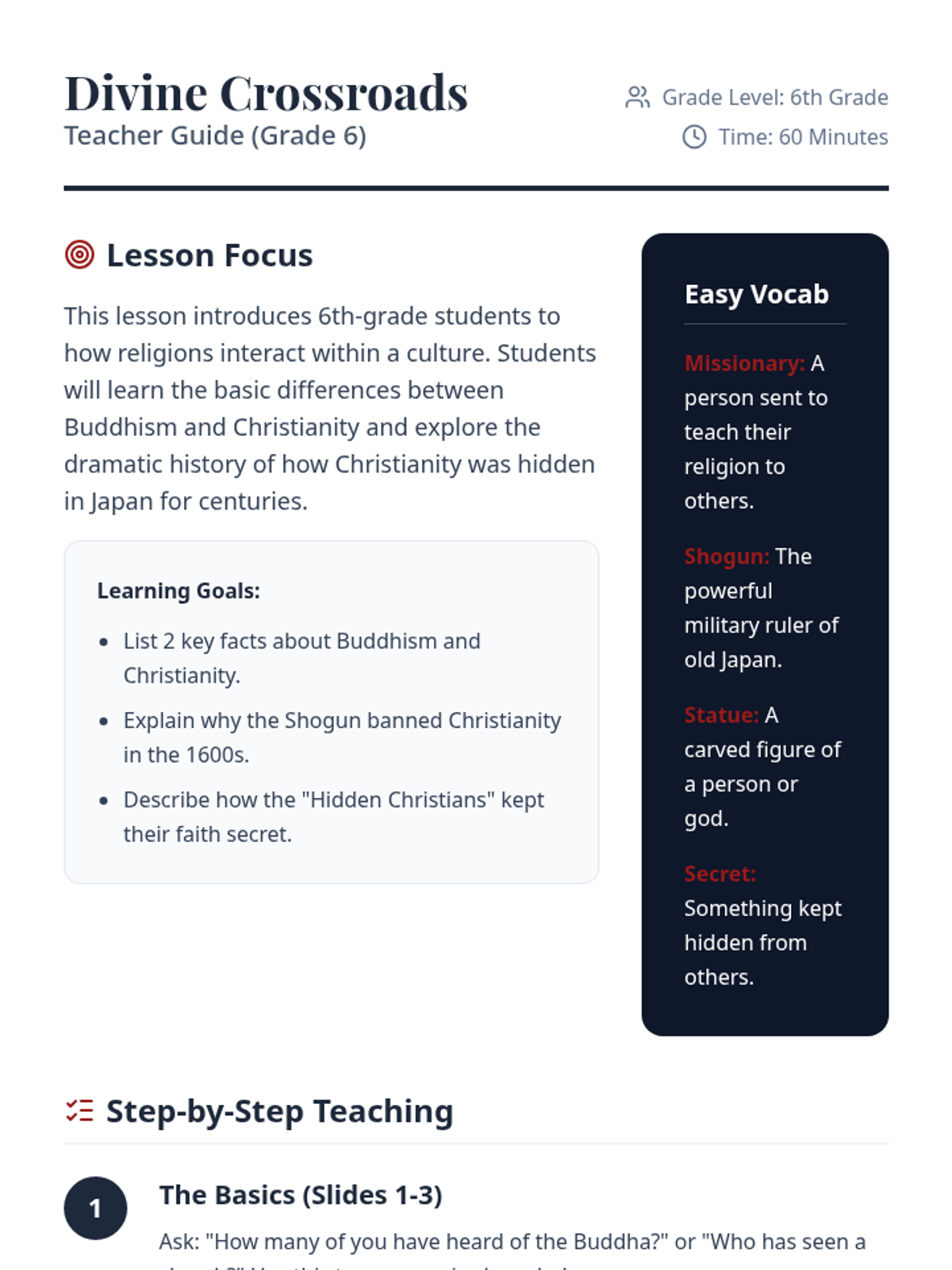
A simplified teacher facilitation guide for 6th-grade students, focusing on narrative storytelling, clear analogies, and age-appropriate vocabulary.
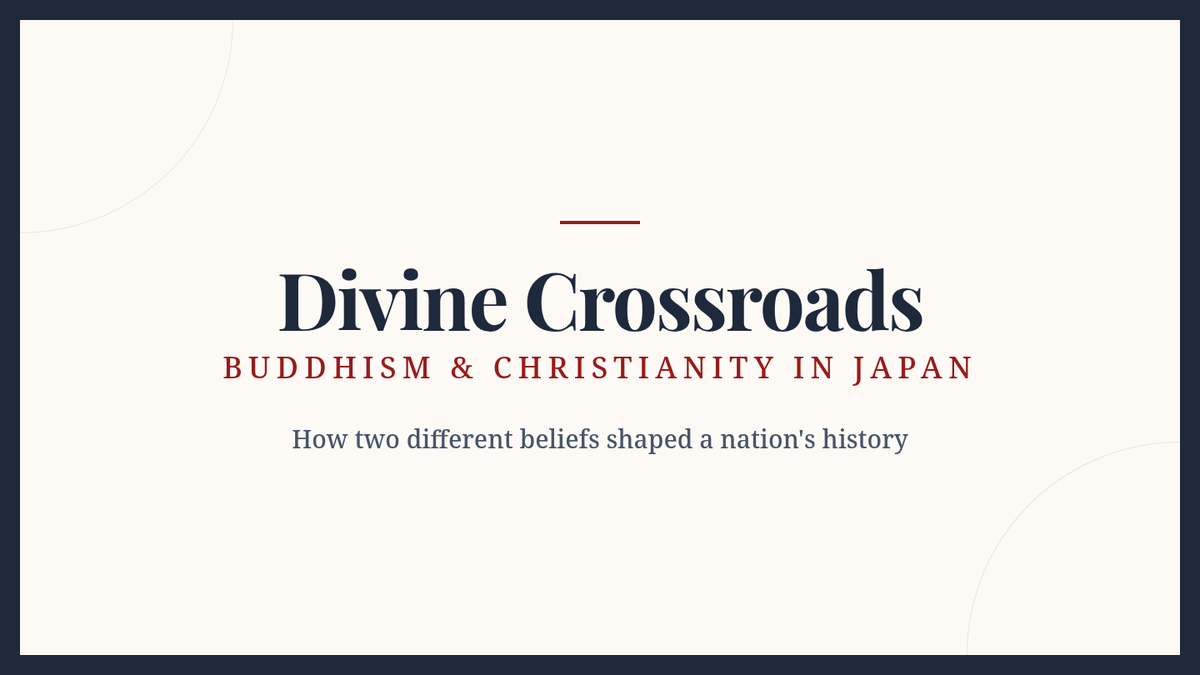
A 6th-grade level 9-slide presentation comparing Buddhism and Christianity in Japan, featuring simplified vocabulary, clear historical narrative, and engaging discussion prompts.
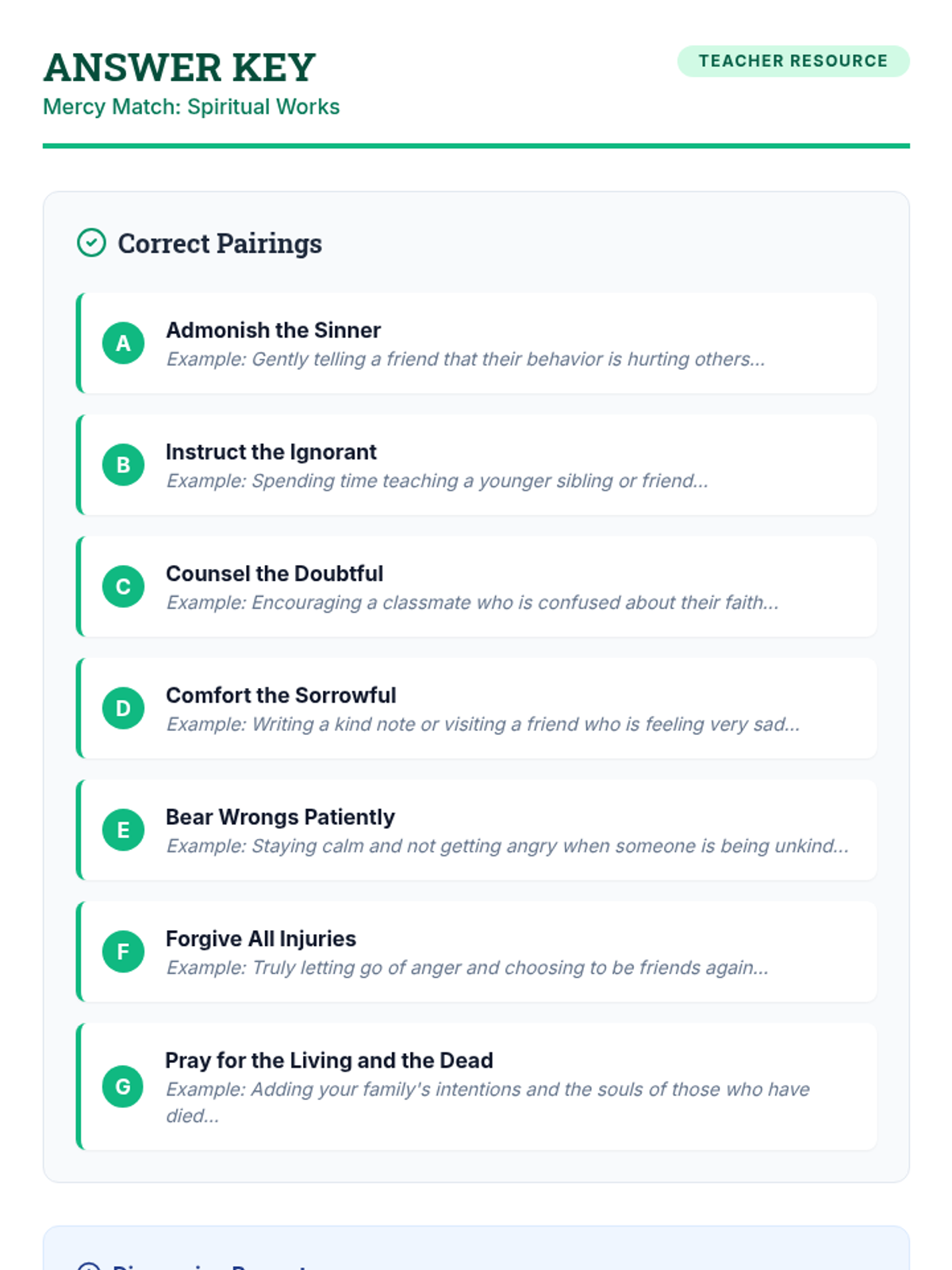
An answer key for the Mercy Match Worksheet with scrambled answer pairings and a teacher quick-key.
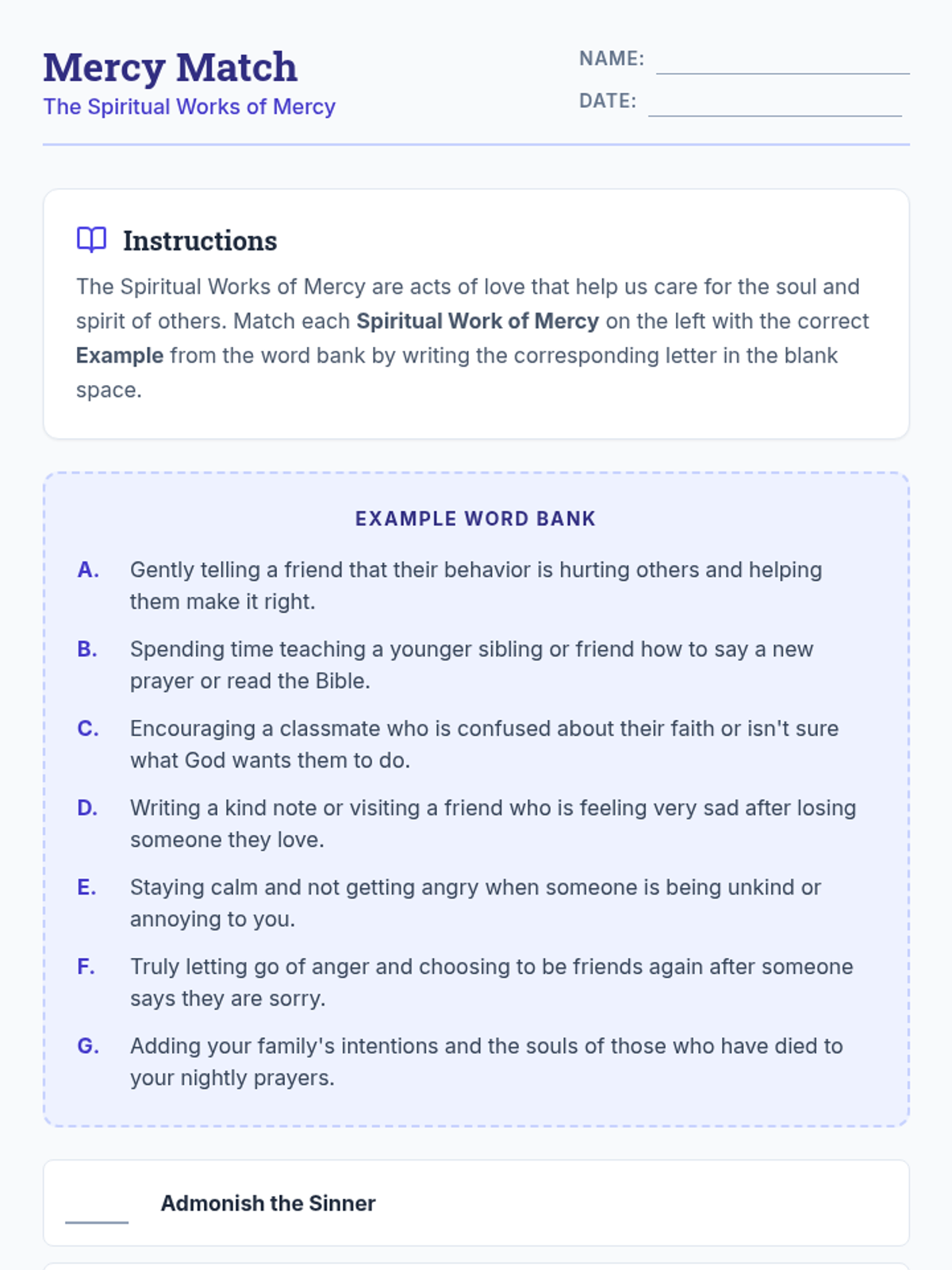
A compact, one-page matching worksheet where students pair each of the seven Spiritual Works of Mercy with a practical, kid-friendly example from a provided scrambled word bank, featuring a personal reflection section.
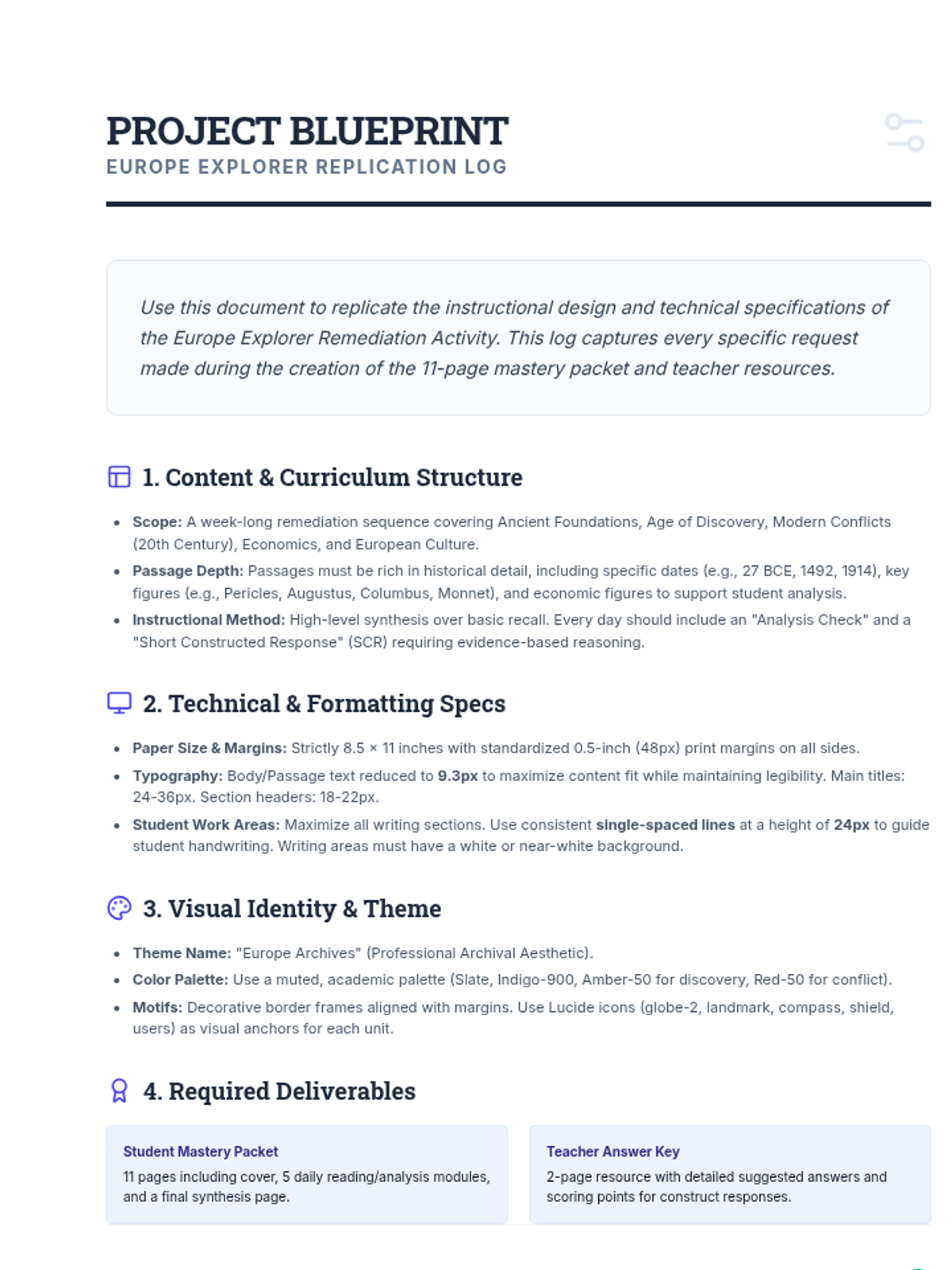
A comprehensive Project Blueprint document that summarizes all technical, instructional, and visual requests made for the Europe remediation activity. Includes specific font sizes, margin settings, line spacing, and curriculum requirements for future replication.
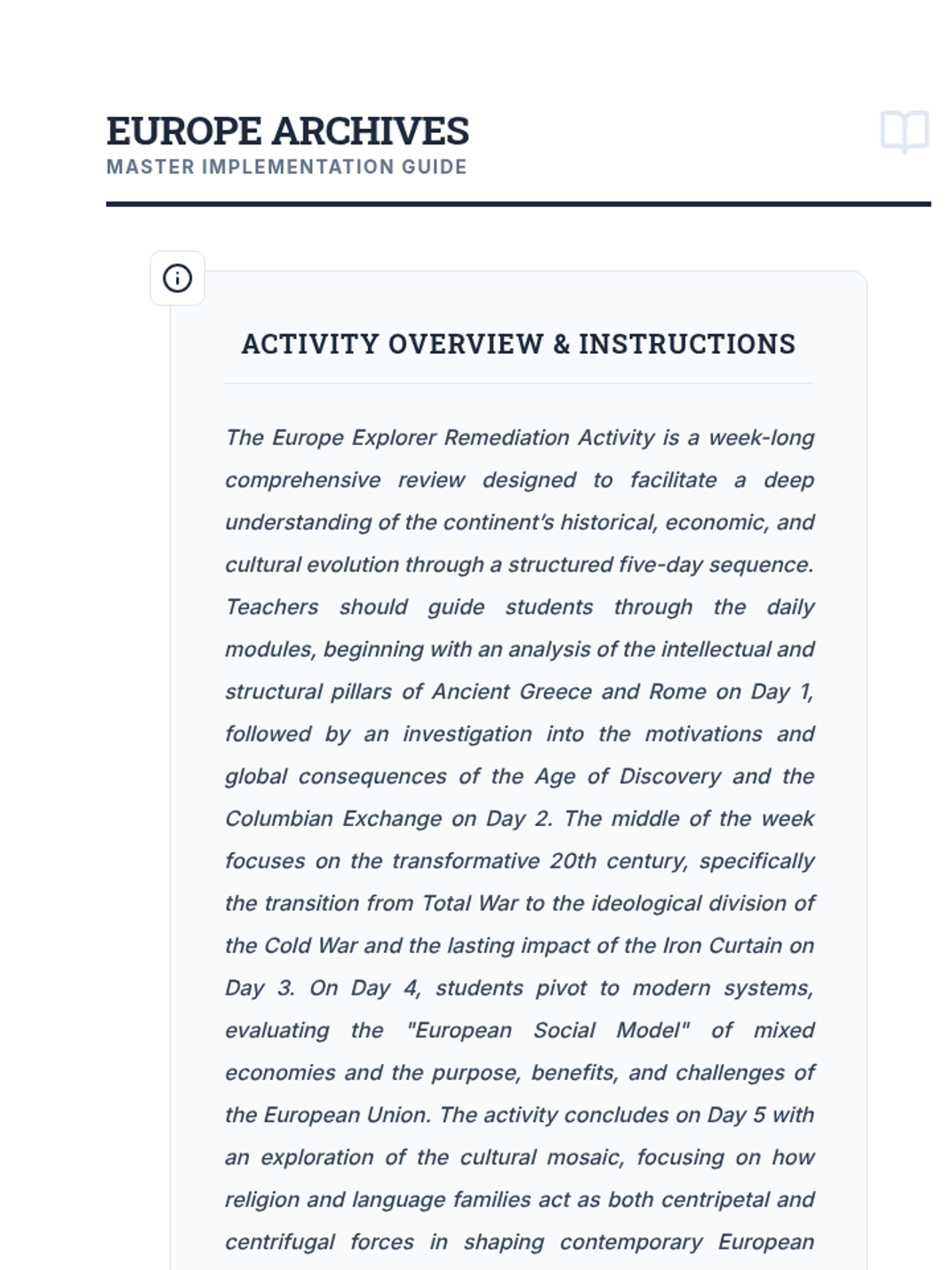
A single-page instructional guide for teachers, providing a cohesive one-paragraph summary and implementation overview for the 5-day Europe Explorer Remediation activity. Designed with the same professional archival aesthetic as the student materials for unit consistency.
A comprehensive 11-page student remediation packet for Europe. Content has been standardized with a 9.3px passage font and 0.5-inch margins (48px padding) to ensure rich historical detail and extensive writing areas fit perfectly within 8.5x11 inch constraints. Student work areas feature consistent 24px single-spaced lines for handwritten responses. Optimized for a clean, archival print aesthetic.
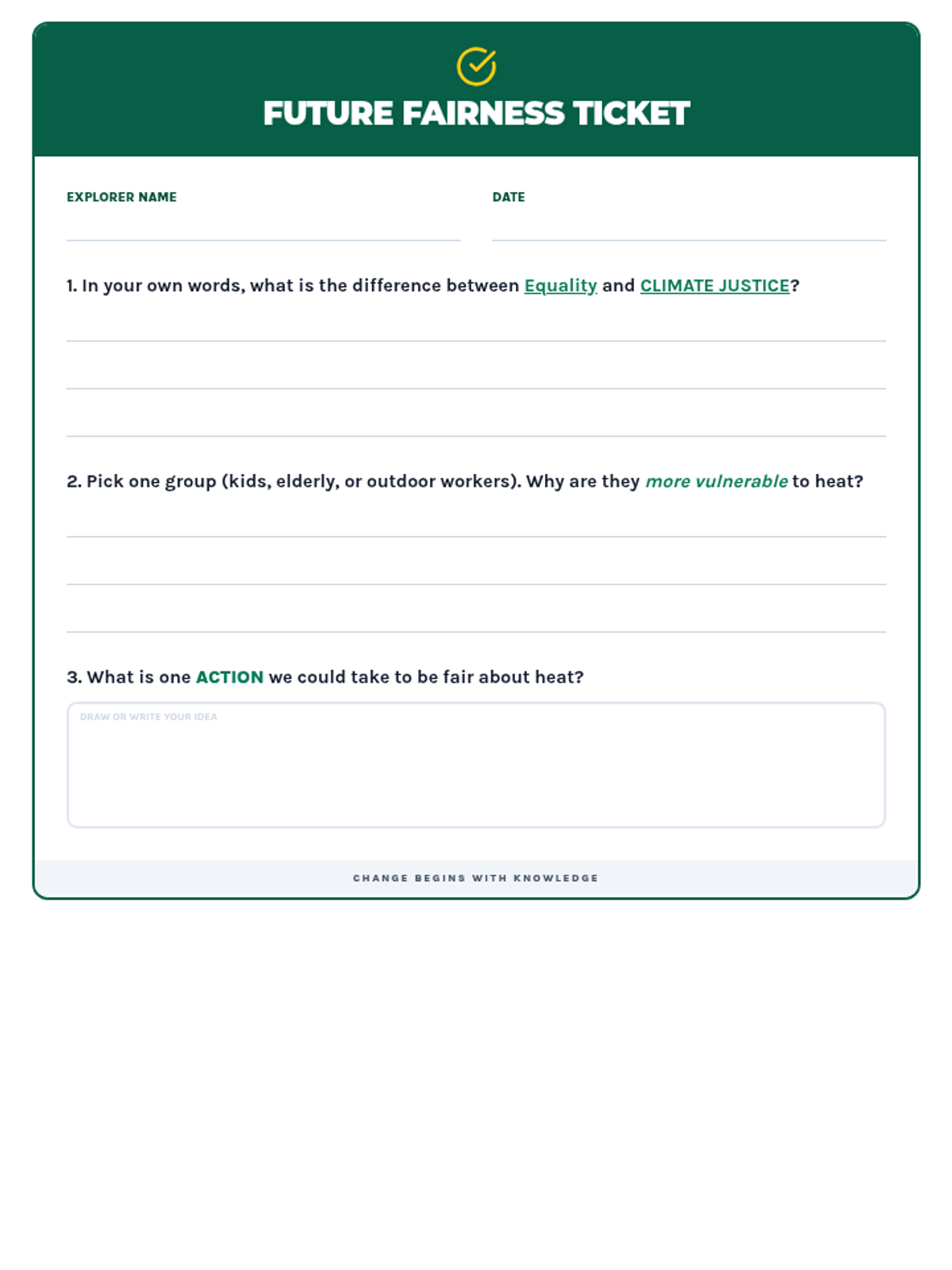
A concise exit ticket assessment for the climate justice lesson. It prompts students to differentiate between equality and justice, identify vulnerable populations, and propose a concrete local action for climate equity.
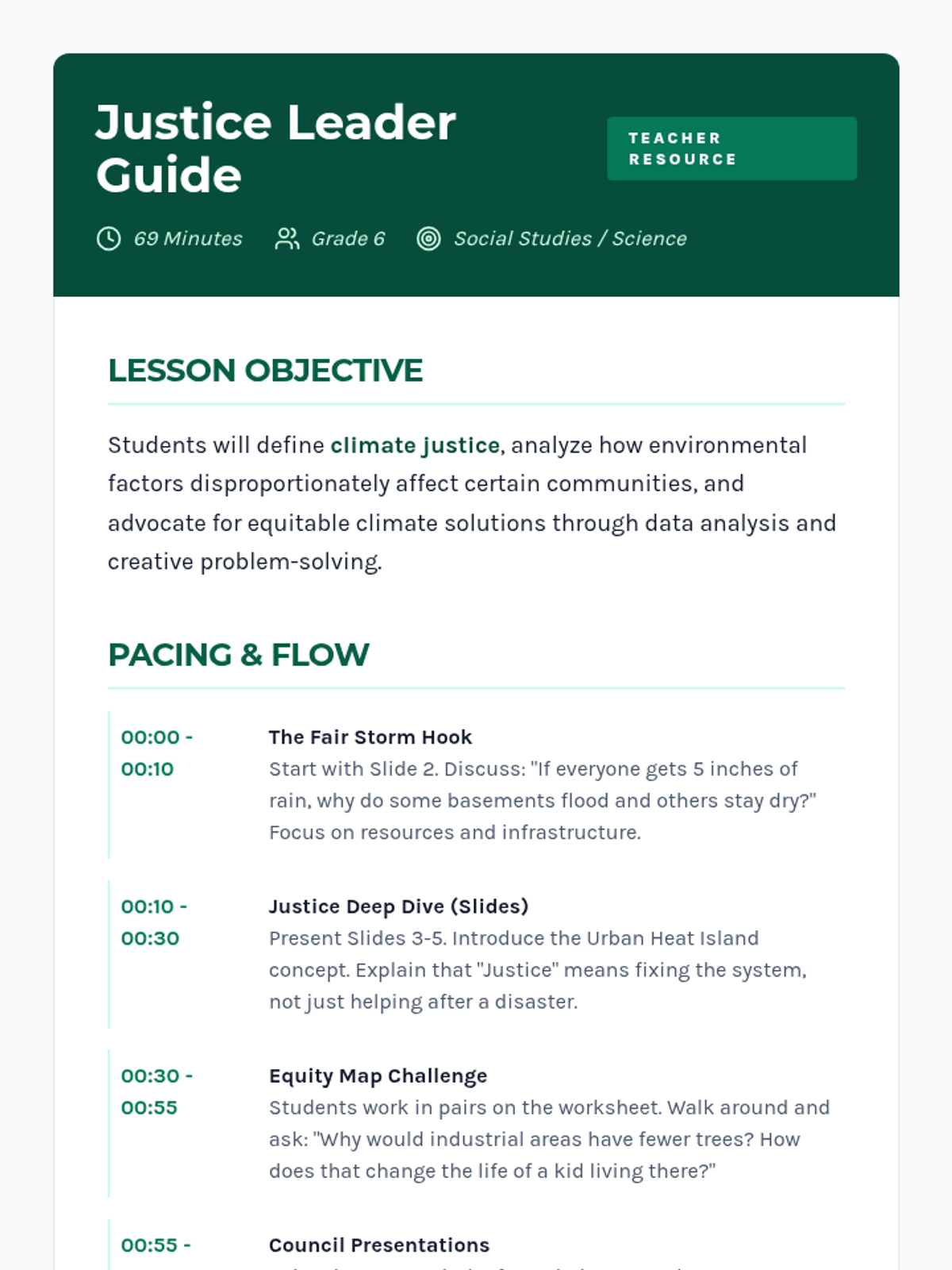
A comprehensive facilitator guide for the "Fairness in Flux" lesson. Includes a 69-minute pacing breakdown, key vocabulary definitions (Equity vs. Equality), common misconceptions, and strategic questioning prompts to deepen student engagement.
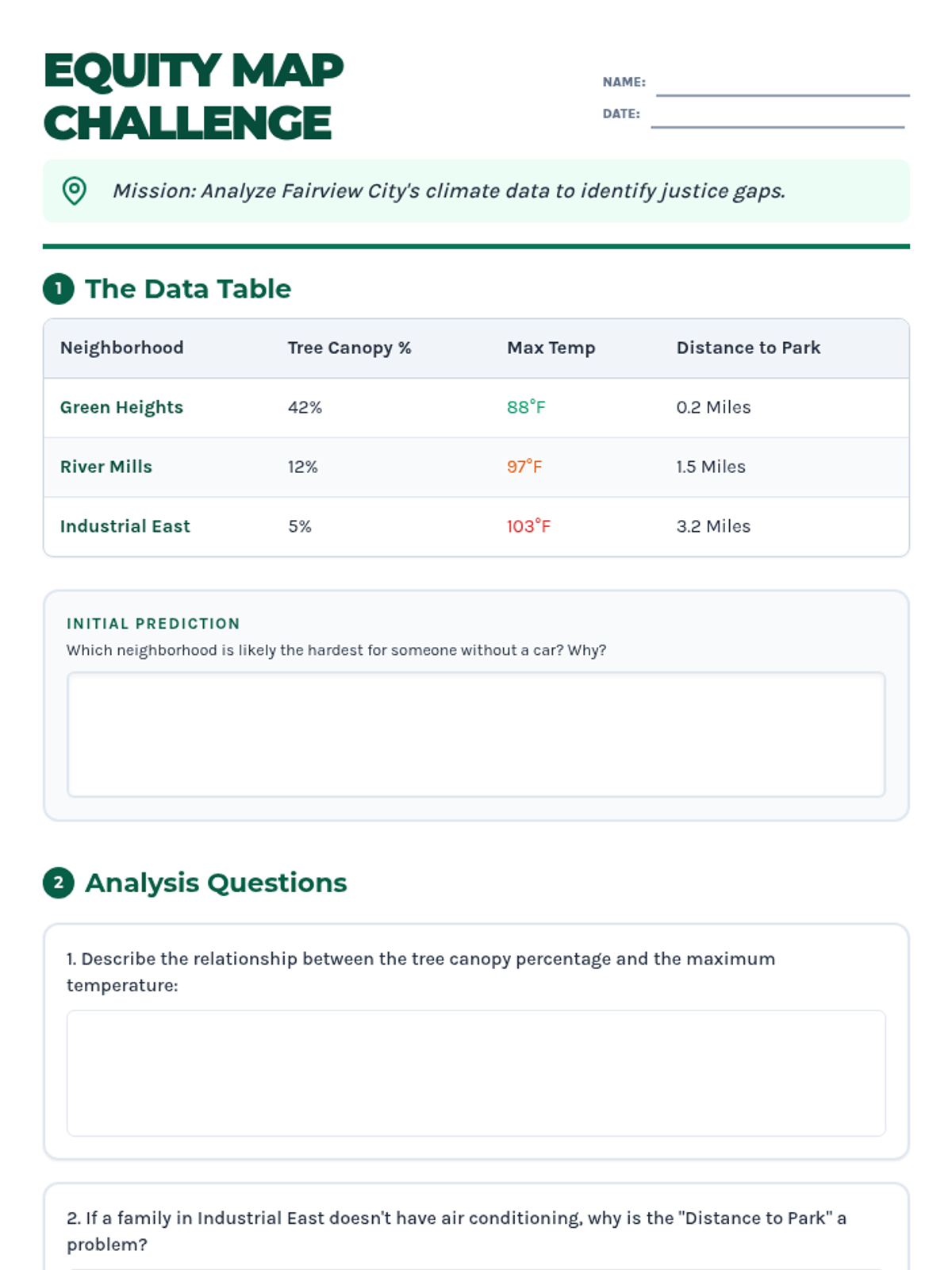
A hands-on student worksheet involving data analysis of urban heat islands. Students compare tree canopy coverage and temperature data across different neighborhoods to identify inequities and propose budget-based solutions.
An 7-slide presentation introducing the core concepts of climate justice, including equity, urban heat islands, and vulnerable communities. Designed for 6th-grade visual learners with high-impact graphics and clear definitions.
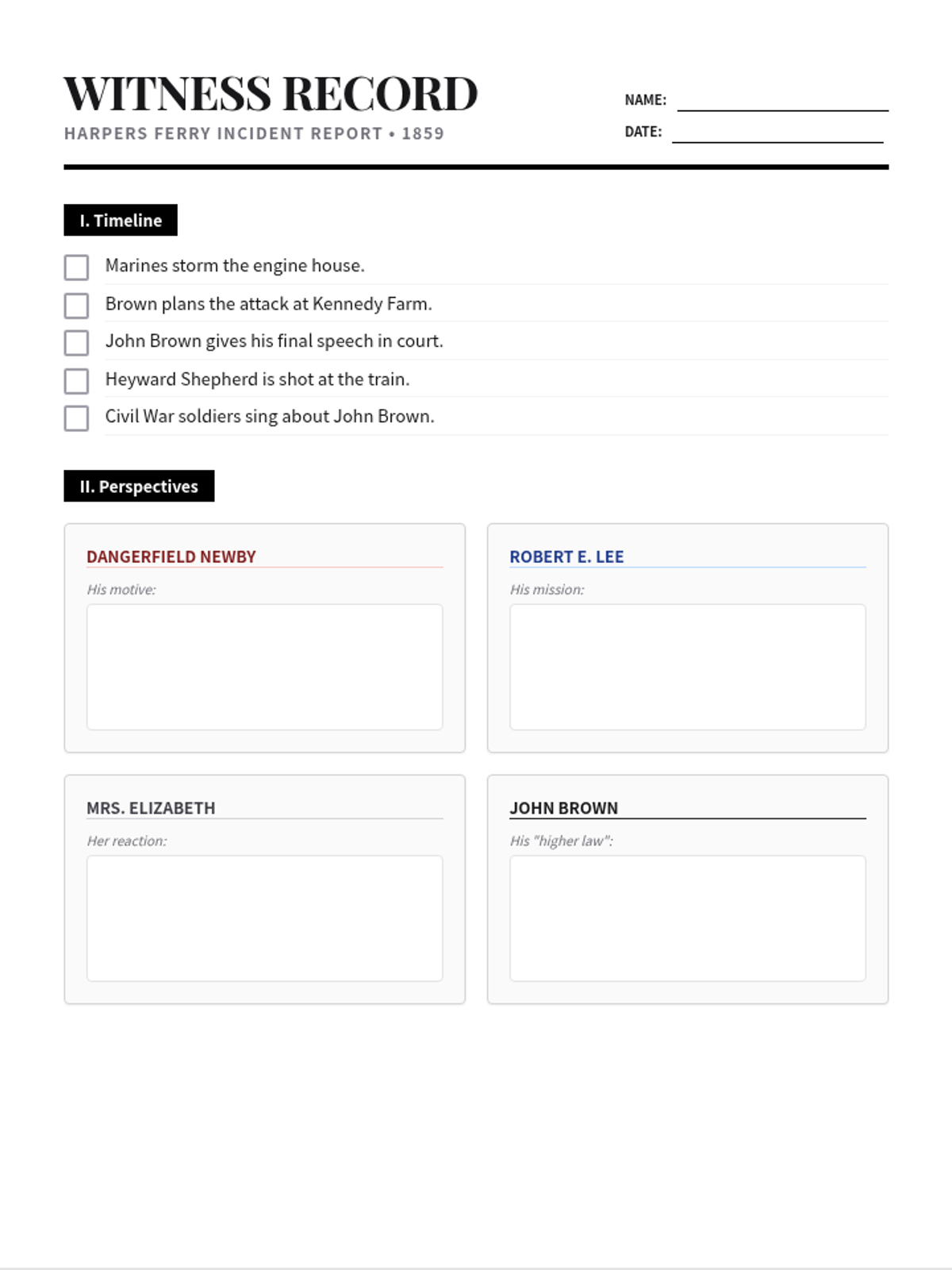
A student worksheet for the "Thunder at the Ferry" play. Includes plot sequencing, character perspective analysis, thematic reflection questions, and a creative newspaper writing activity.
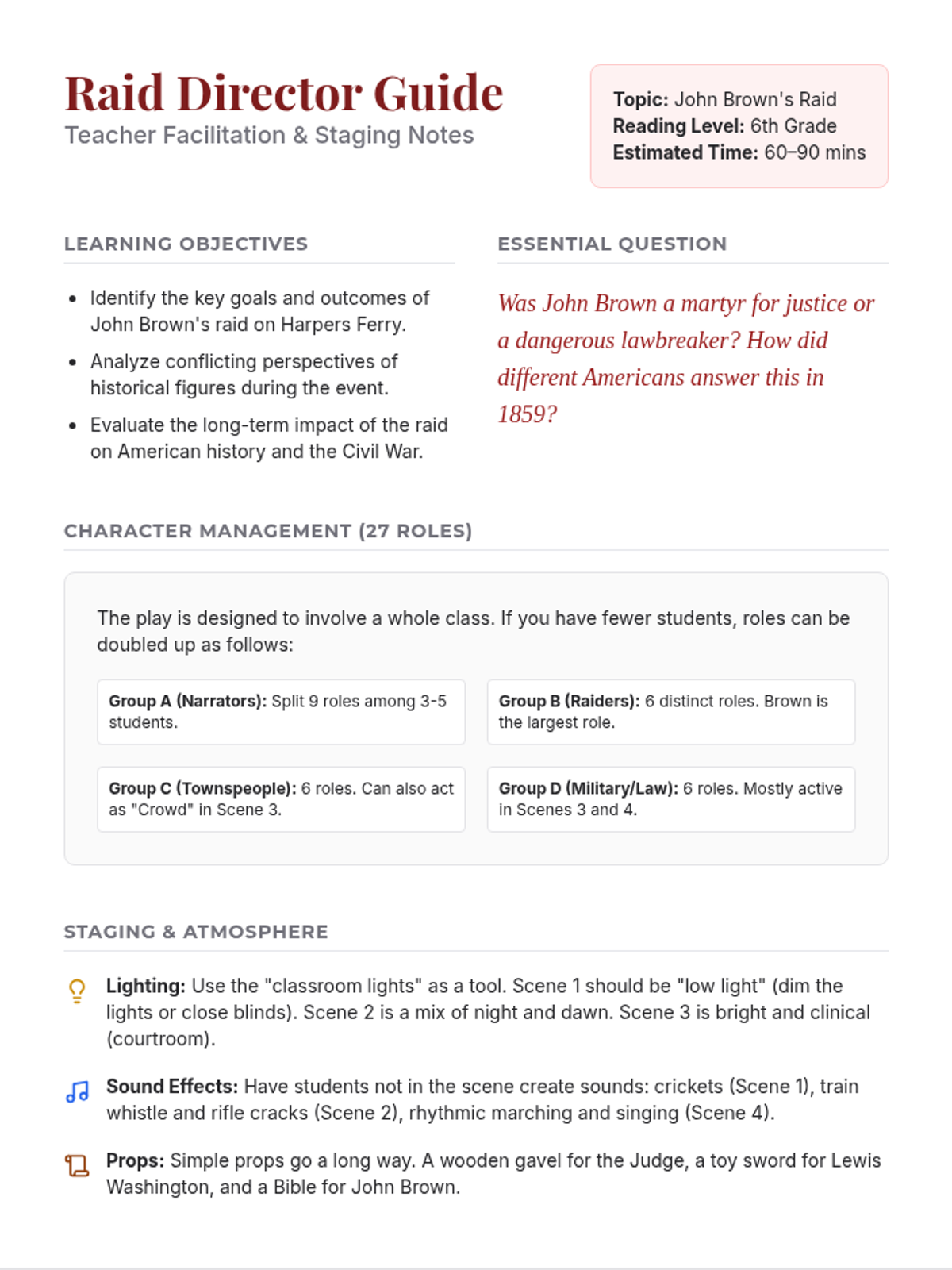
A comprehensive guide for teachers to facilitate the play "Thunder at the Ferry." Includes character management strategies, staging tips, historical context, and deep-dive discussion prompts for 6th-grade students.
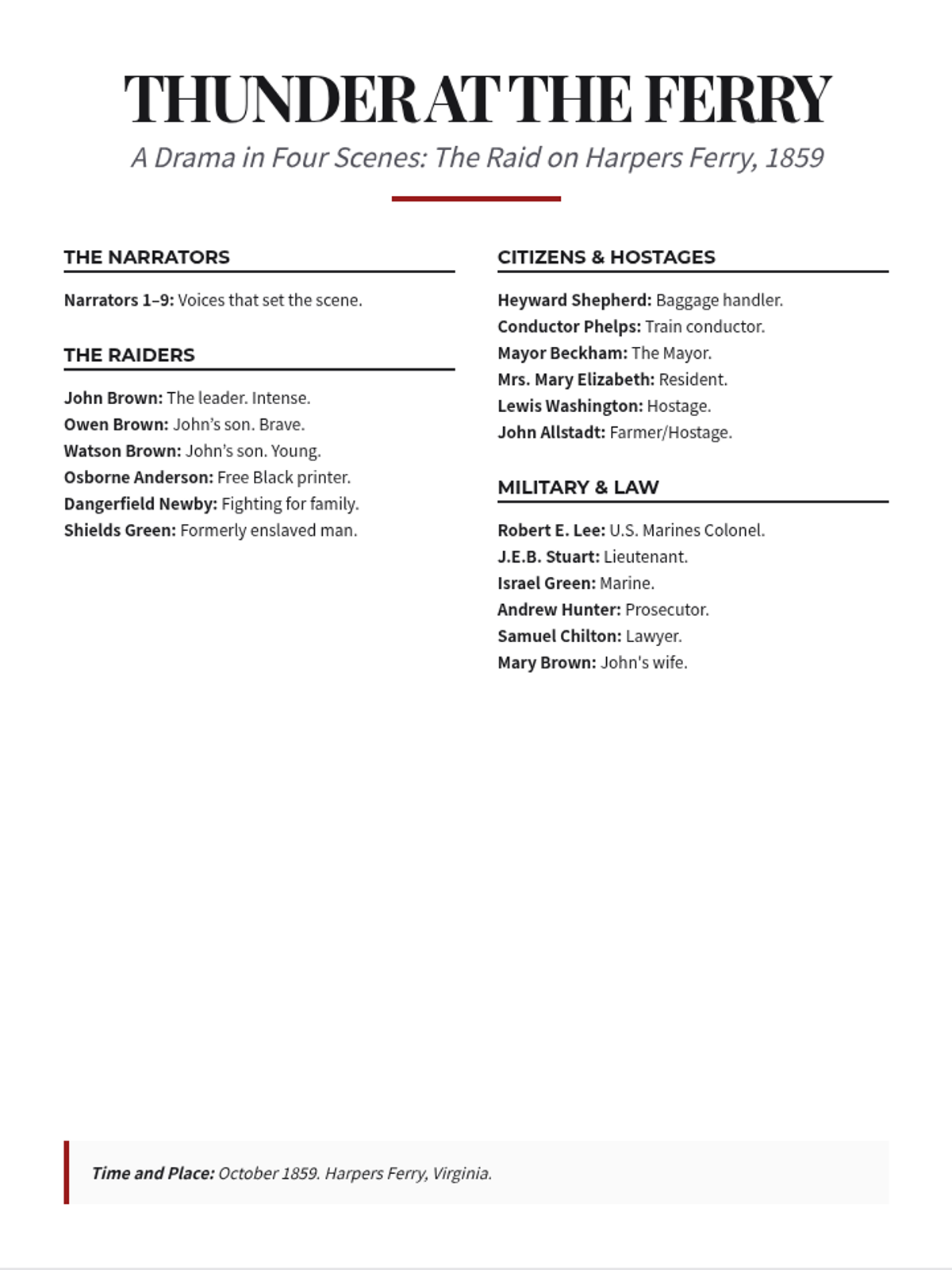
A 4-scene play about John Brown's raid on Harpers Ferry, featuring 18 historical characters and 9 narrators. Written at a 6th-grade level, it explores the planning, execution, trial, and lasting impact of the raid through multiple perspectives.
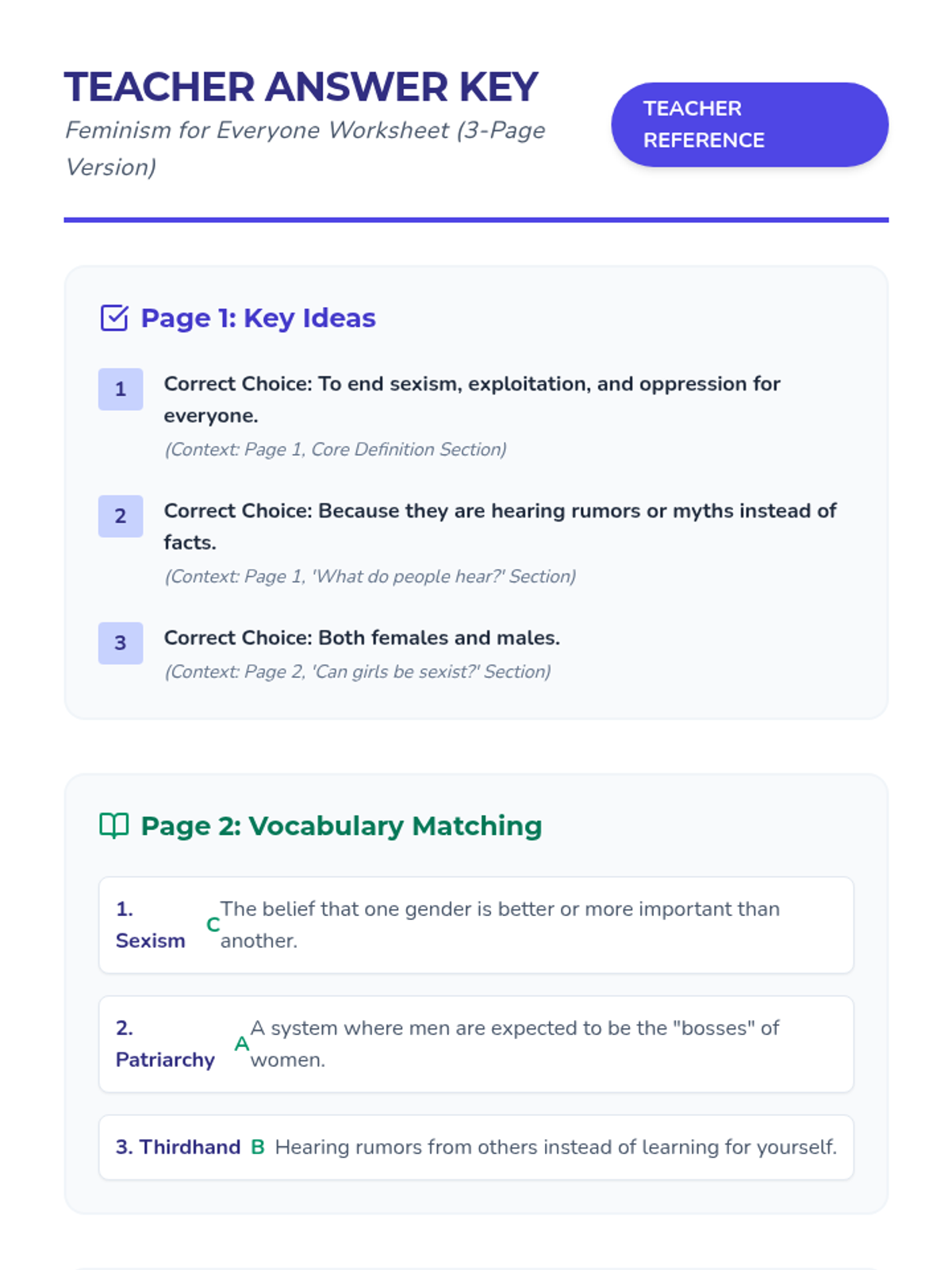
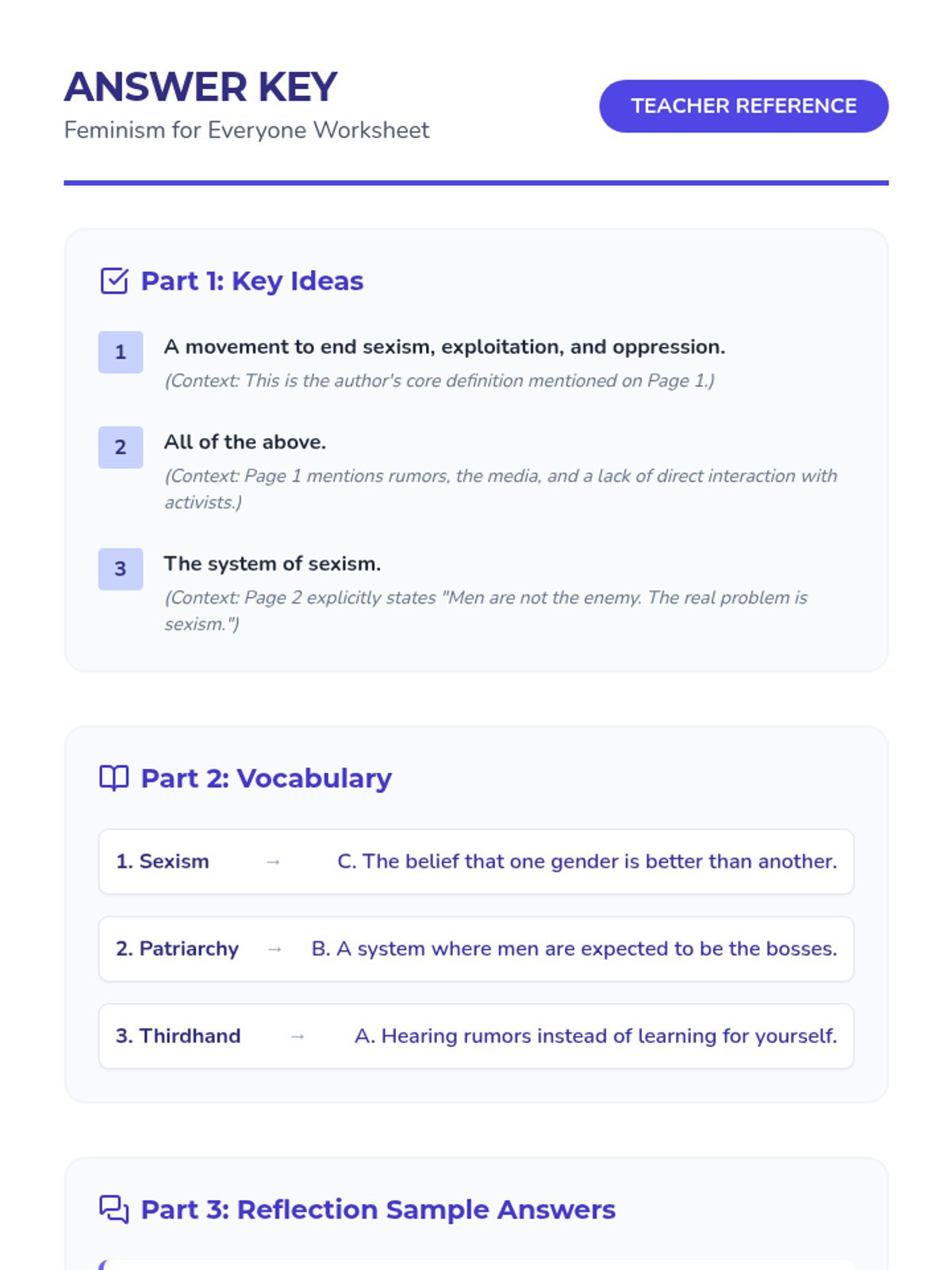
An answer key for the 'Feminism for Everyone' worksheet, including sample responses for short-answer questions.
An expanded three-page comprehension worksheet for 'Feminism for Everyone'. Includes updated multiple-choice questions, vocabulary matching with improved formatting, reflection sections with line guides, and a creative vision board for students to express their ideas.
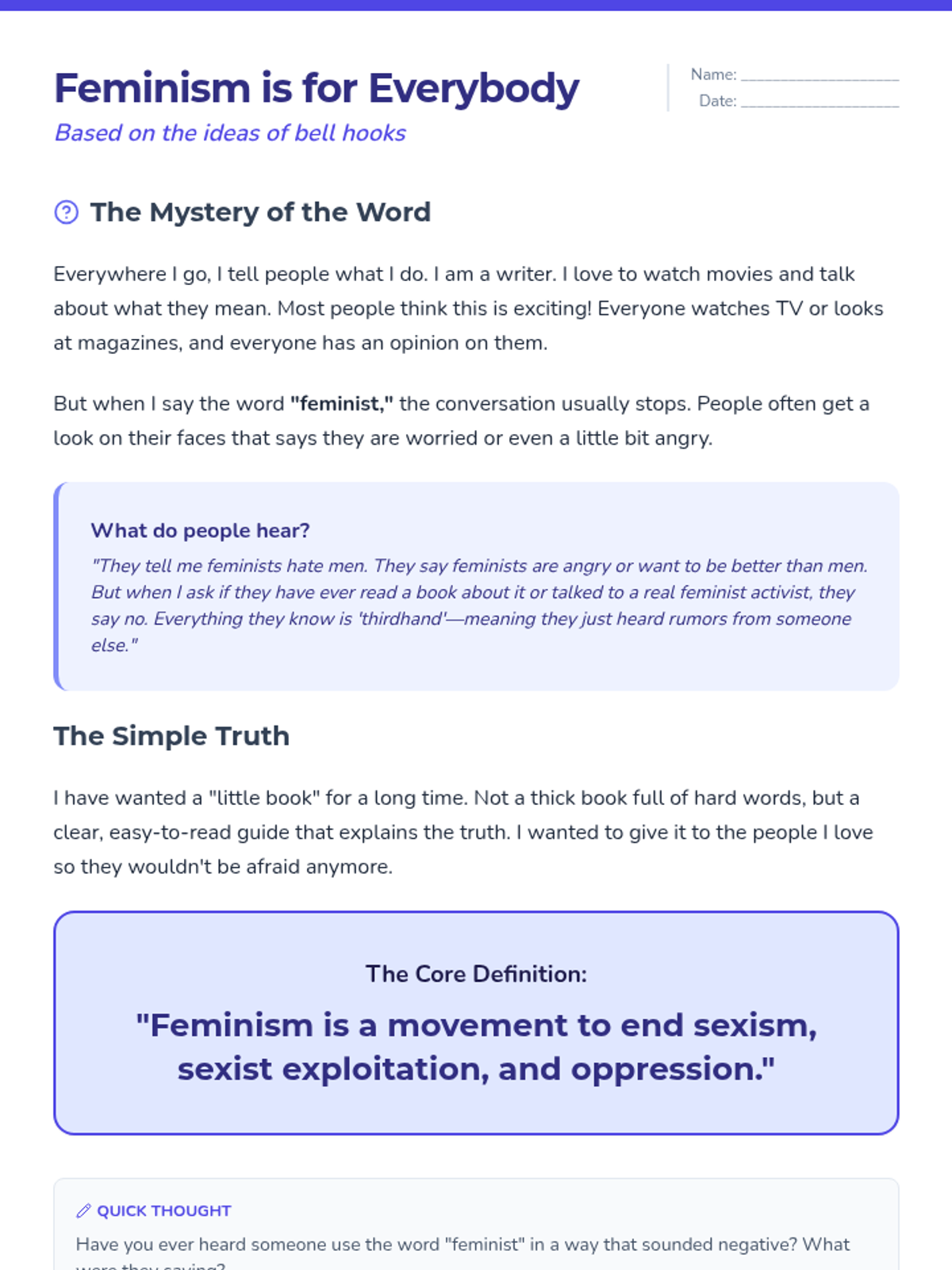
A three-page simplified reading passage based on the introduction to bell hooks' 'Feminism is for Everybody'. It explains the core definition of feminism, debunks common myths, and presents a vision for a world of equality at a 6th-grade reading level. Includes quick reflection prompts on each page.
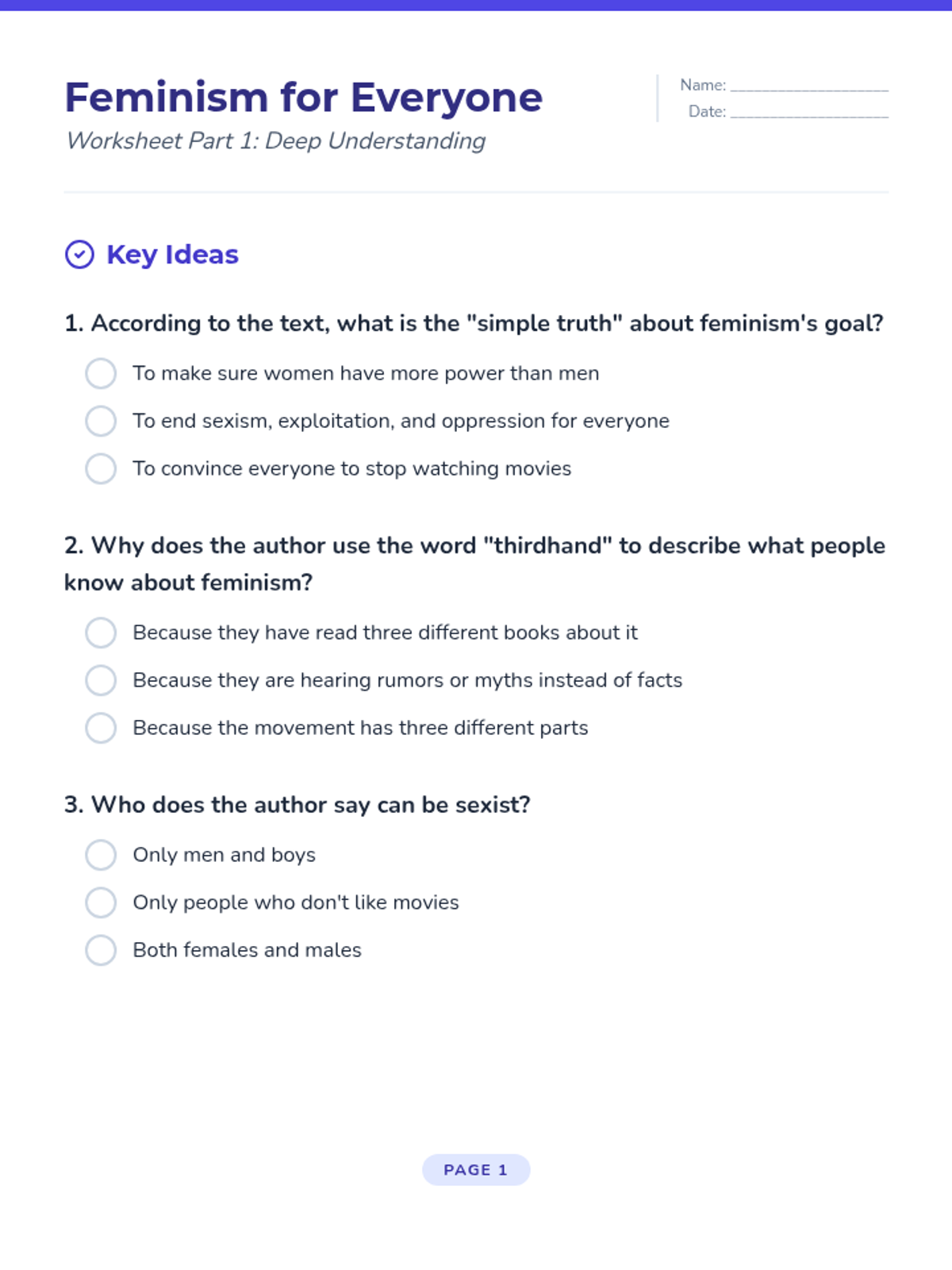
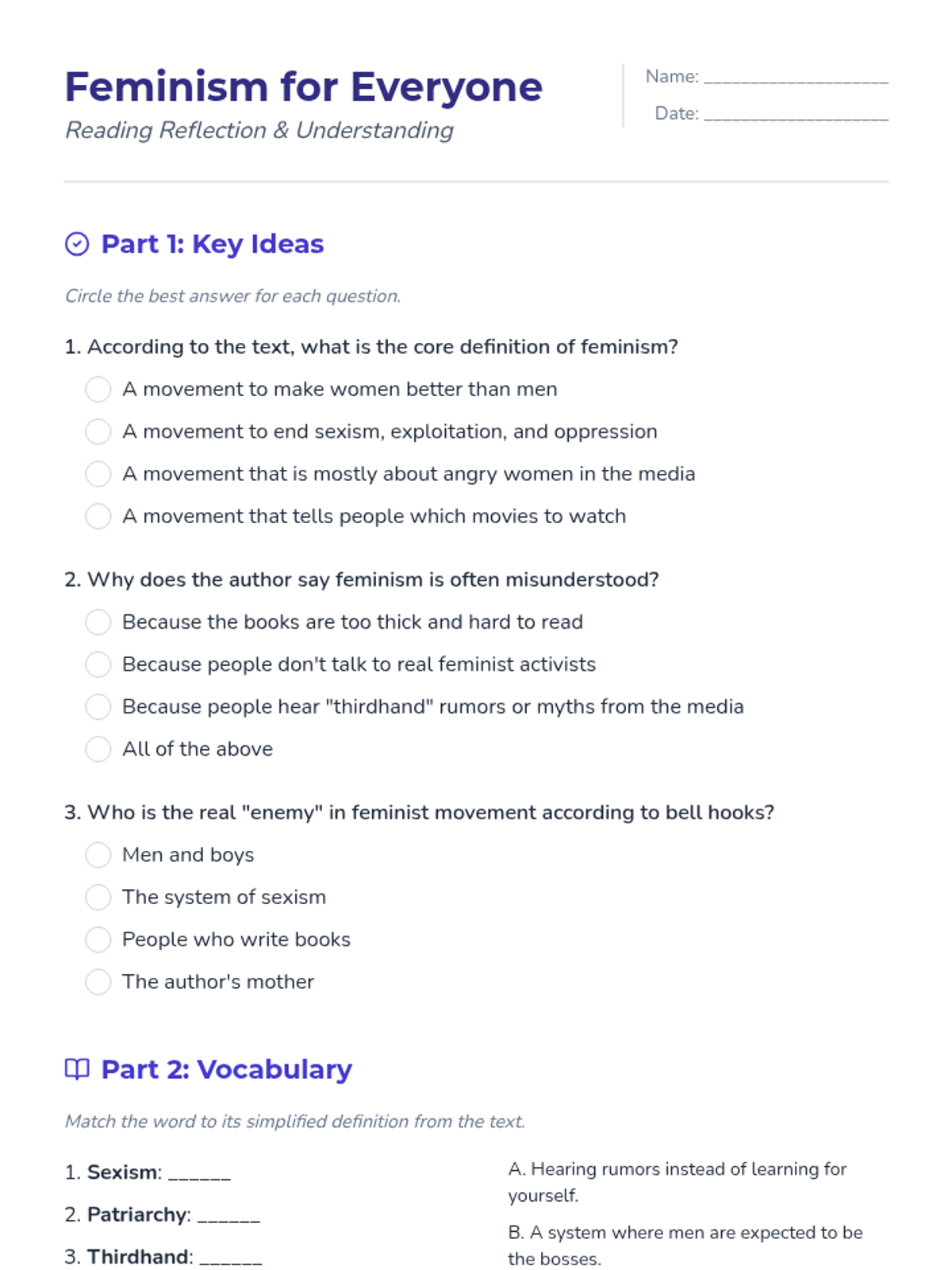
A comprehension worksheet to accompany the 'Feminism for Everyone' reading passage. Includes multiple choice questions, vocabulary matching, and short-answer reflection questions for middle school students.
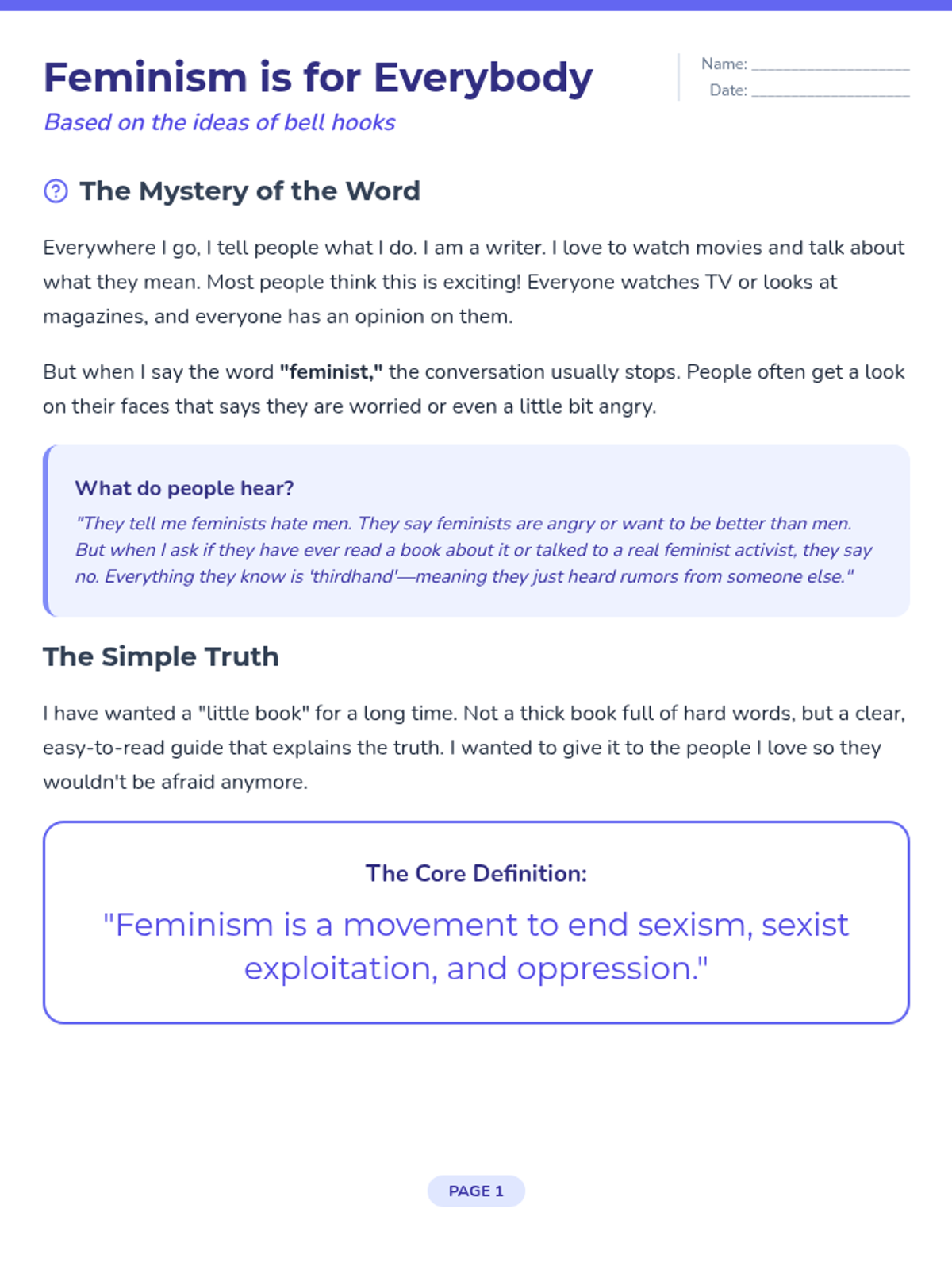
A three-page simplified reading passage based on the introduction to bell hooks' 'Feminism is for Everybody'. It explains the core definition of feminism, debunks common myths, and presents a vision for a world of equality at a 6th-grade reading level.
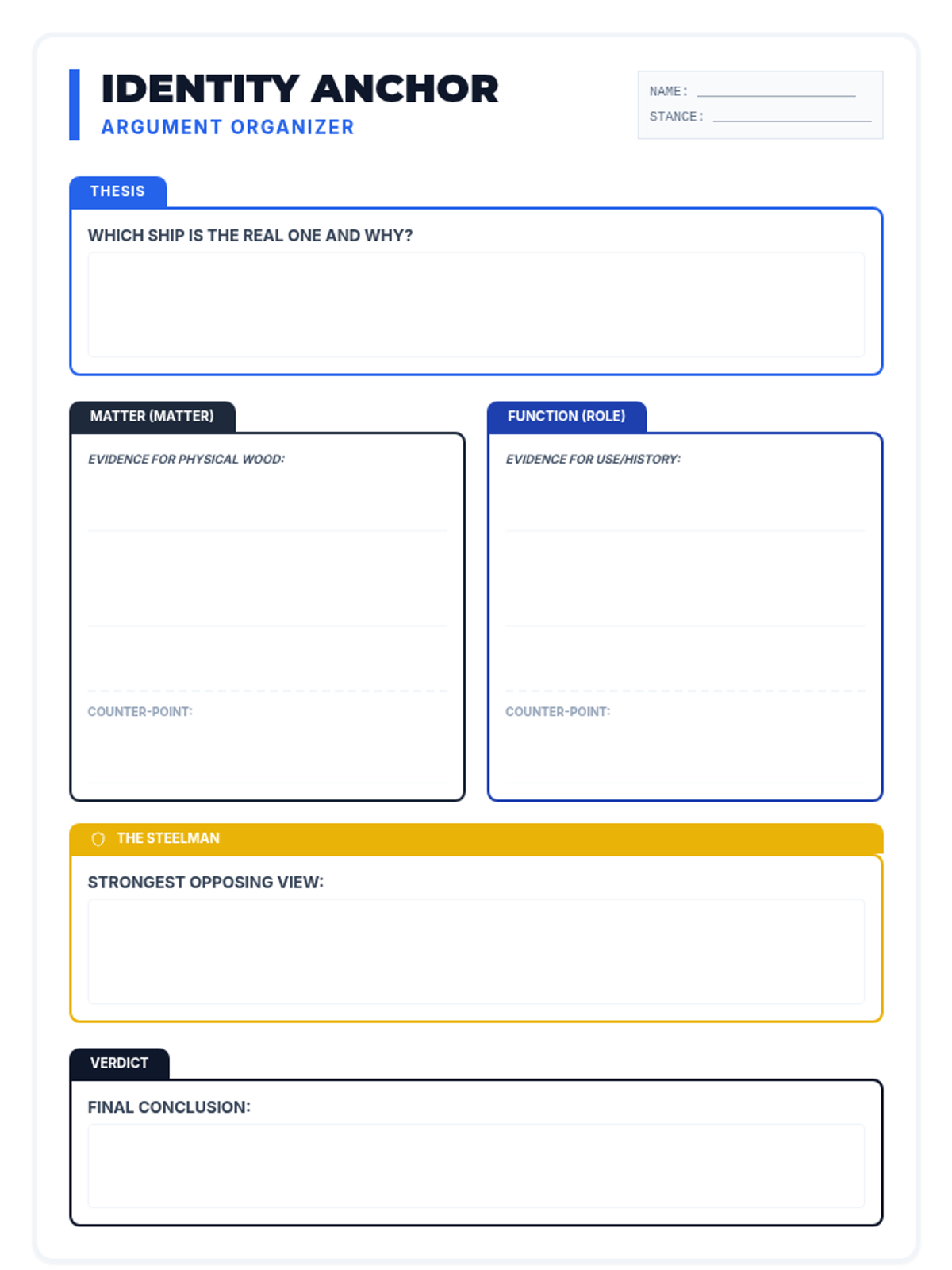
A graphic organizer for structuring philosophical arguments, featuring dedicated spaces for core claims, supporting evidence, counter-points, and steelmanning.
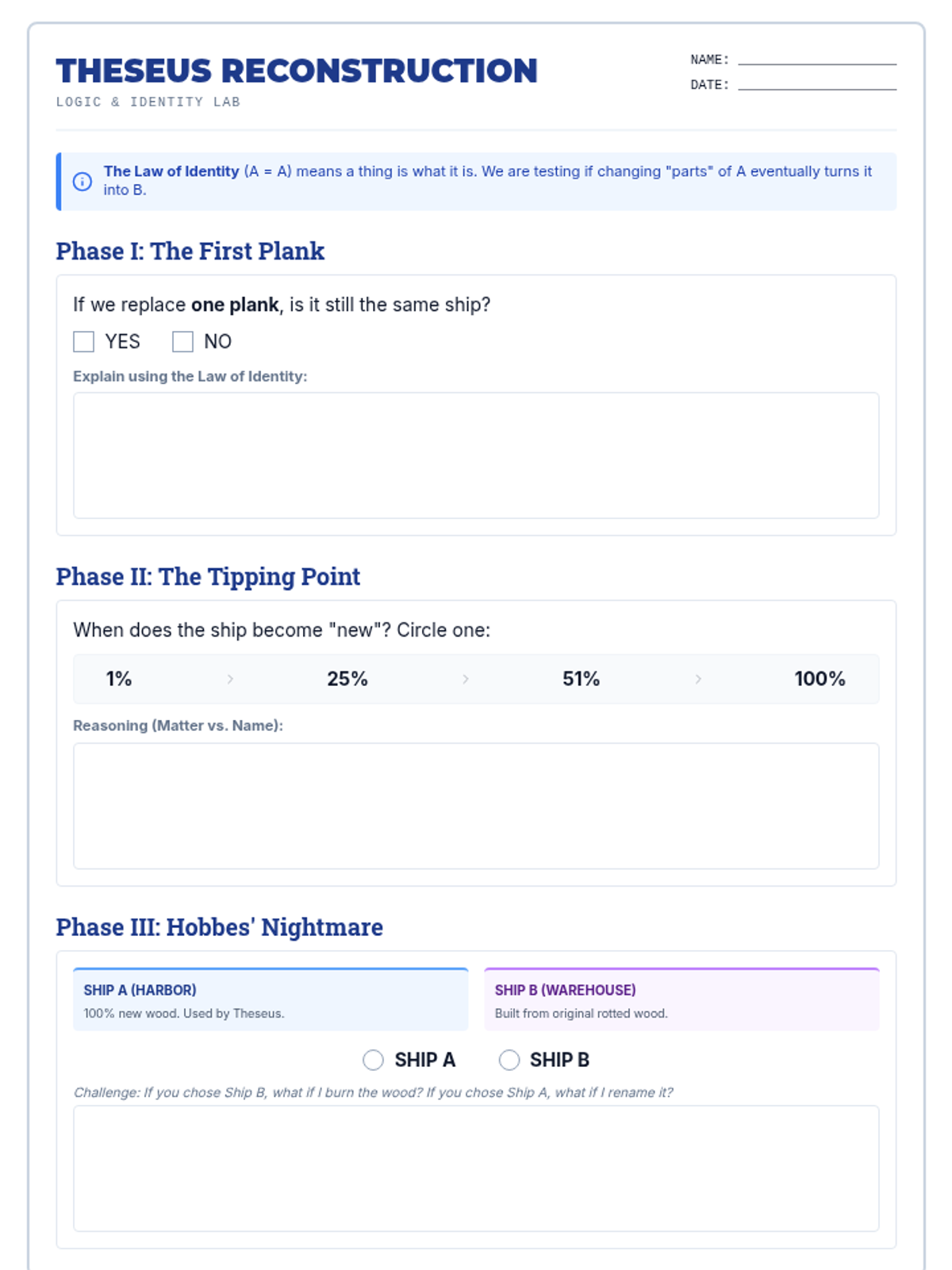
A logic worksheet exploring the Ship of Theseus through progressive scenarios, ranging from simple part replacement to the complex "Two Ships" paradox.
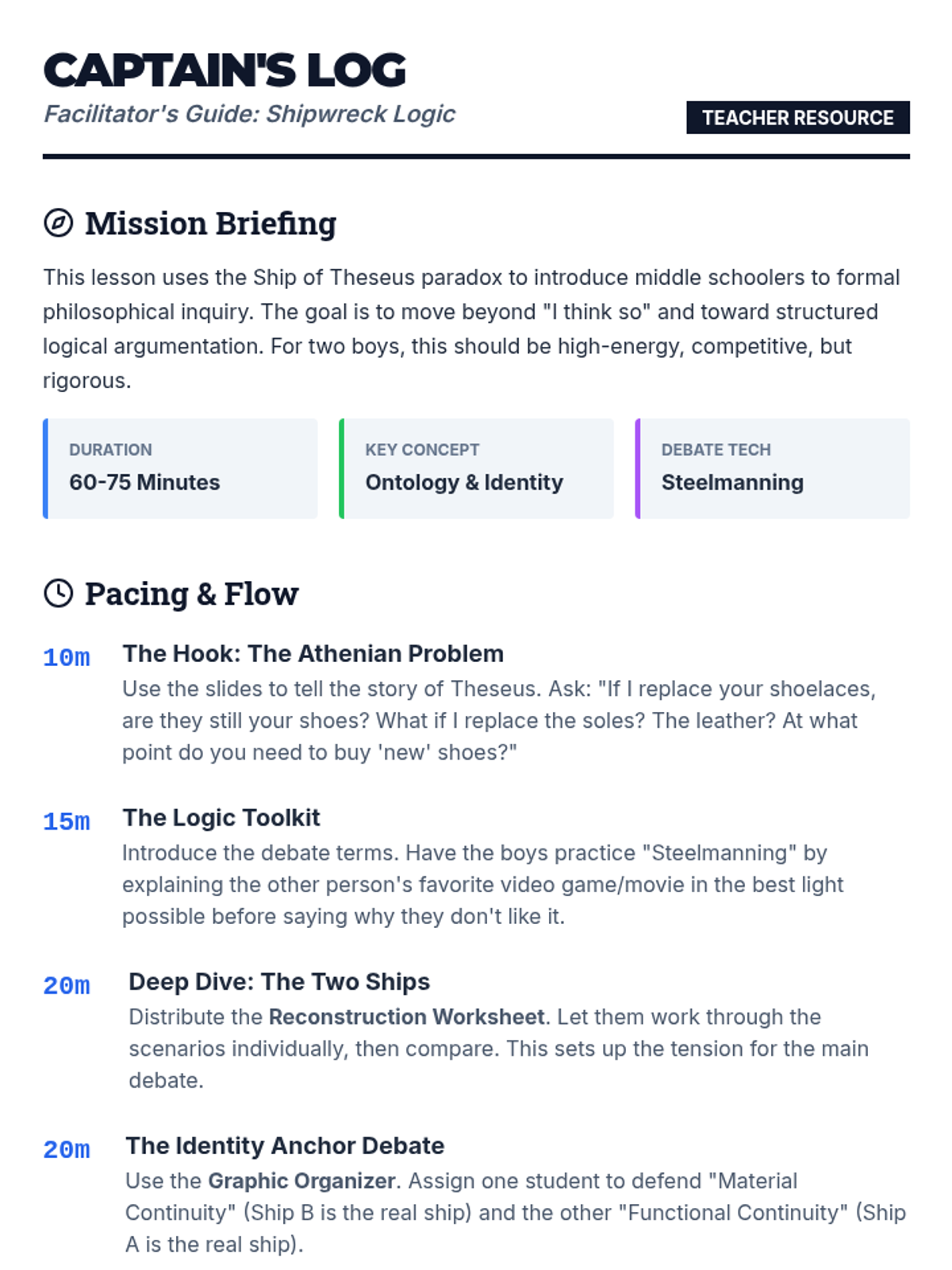
A teacher's guide for facilitating the Ship of Theseus lesson, featuring pacing suggestions, Socratic questions, and historical context.
Visual presentation for a lesson on the Ship of Theseus paradox, covering the historical legend, the philosophical question, and key logic terms for debate.
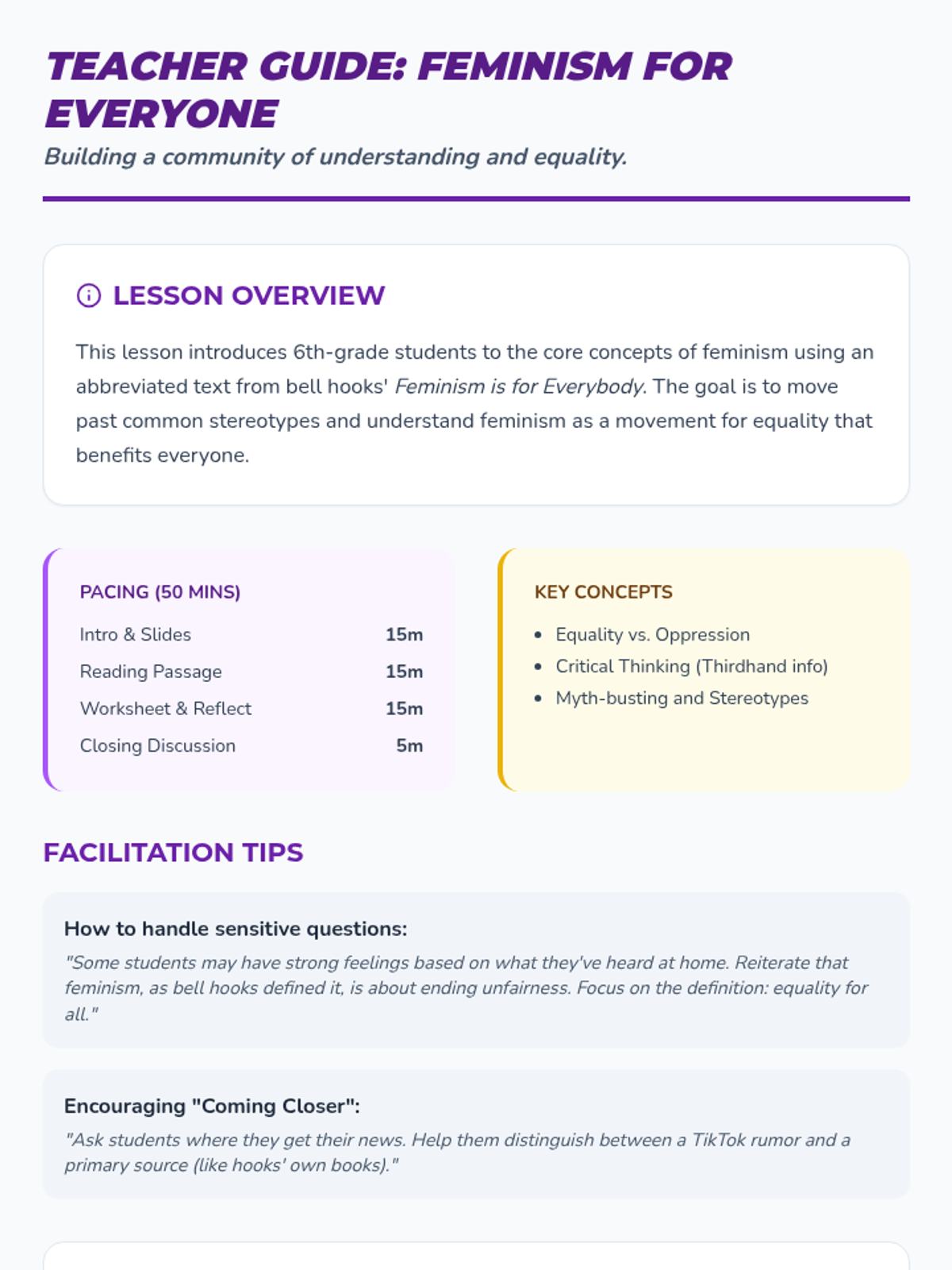
A teacher facilitation guide for the 'Feminism for Everyone' lesson, including pacing, discussion prompts, and an answer key for the worksheet.
A slide deck to introduce the concepts of bell hooks' feminism, debunk common myths, and encourage critical thinking for 6th-grade students.
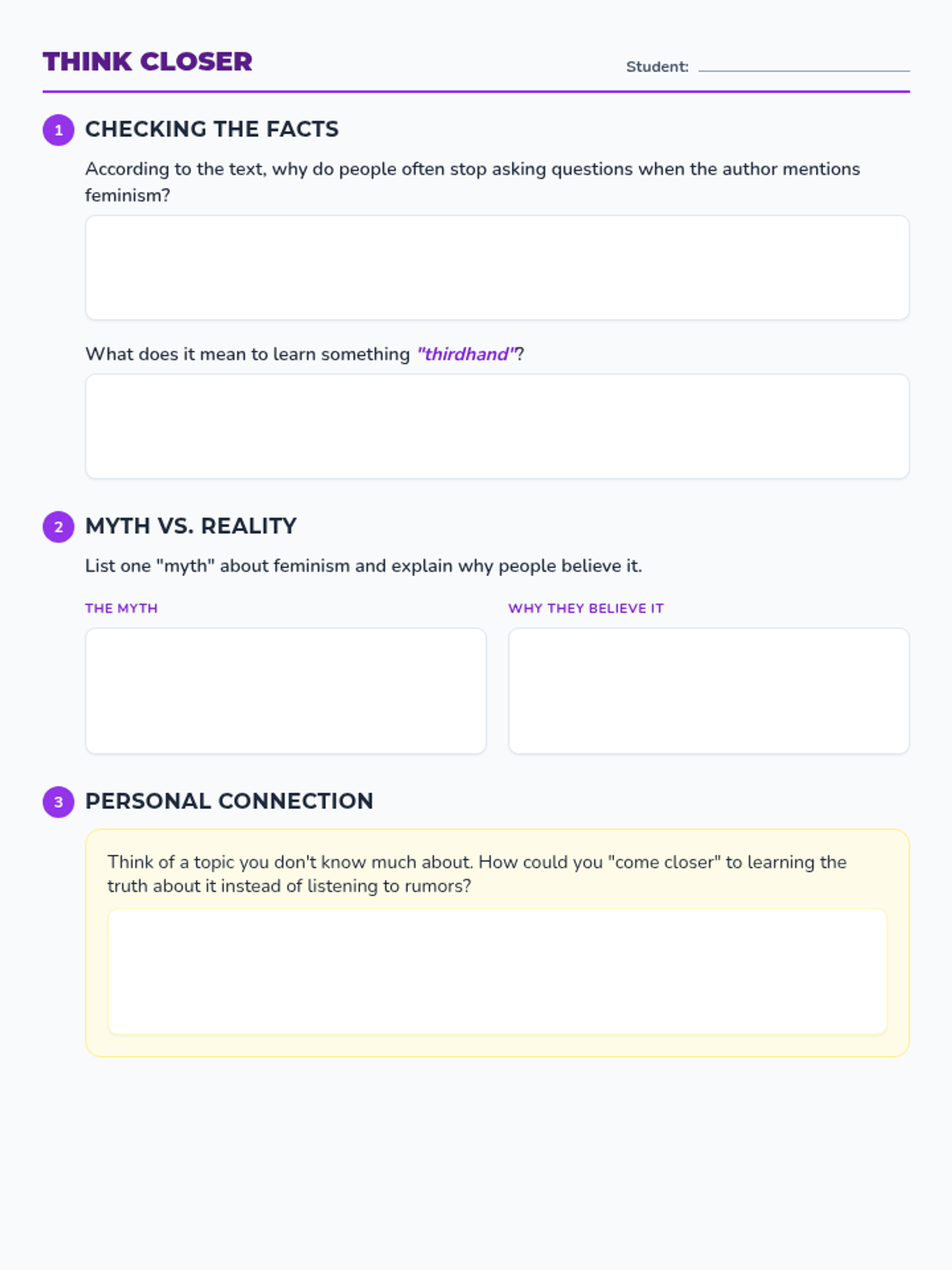
A comprehension and reflection worksheet to accompany the 'Come Closer' reading passage, focusing on vocabulary, myth-busting, and personal connection.