Develops proficiency in estimating and measuring length, area, volume, and mass using standard units and unit conversions. Integrates time, money, angle measurement, and data classification through counting and arithmetic applications.
Measurement Unit Slides - Lessons 3 & 4: Mixed Fractions and Line Plots. Recreated and translated into Japanese with advanced instructional visuals, worm and leaf data examples, and rigorous synthesis prompts. Revisions made for page breaks and math rendering. Fixed 'X' alignment on plots and matched cool-down options. Fixed comma alignment and dark blue highlights.
Measurement Unit Slides - Lesson 2: Inch Fourths. Recreated and translated into Japanese with professional instructional design, clear visuals of rulers, and interactive-style prompts. Revisions made for page breaks and math rendering. Fixed wrapping for 'inches'. Fixed paperclip alignment and ruler consistency. Improved mixed number visualization.
Measurement Unit Slides - Lesson 1: Inch Halves. Recreated and translated into Japanese with clean visuals, clear diagrams, and appropriate pedagogical structure. Revisions made for page breaks and math rendering. Fixed ruler zero positioning. Fixed eraser width to 1.5 units and improved layout. Corrected fraction terminology.
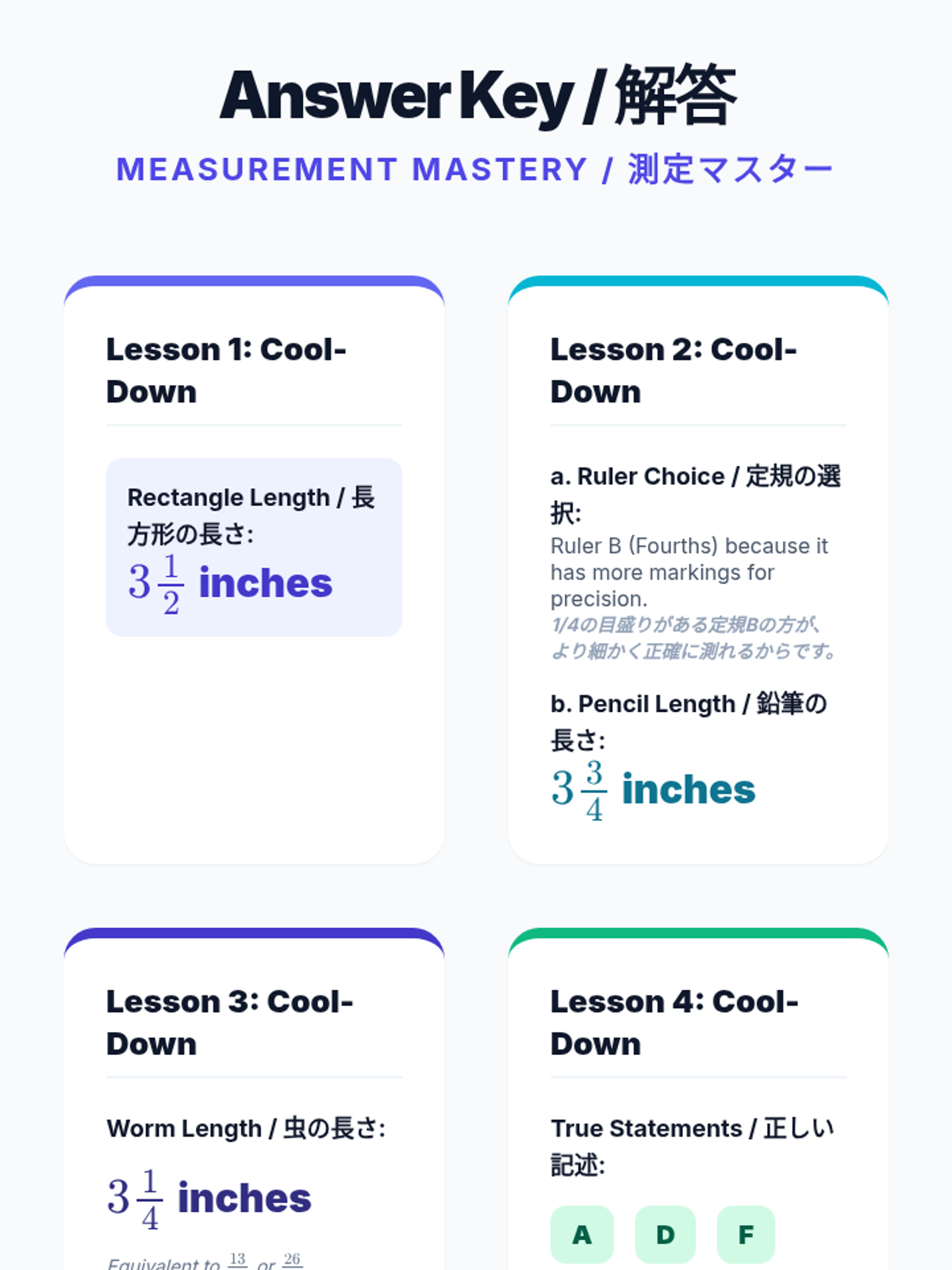
Comprehensive answer key for the unit. Revised for clarity, correct data references, and page break efficiency.
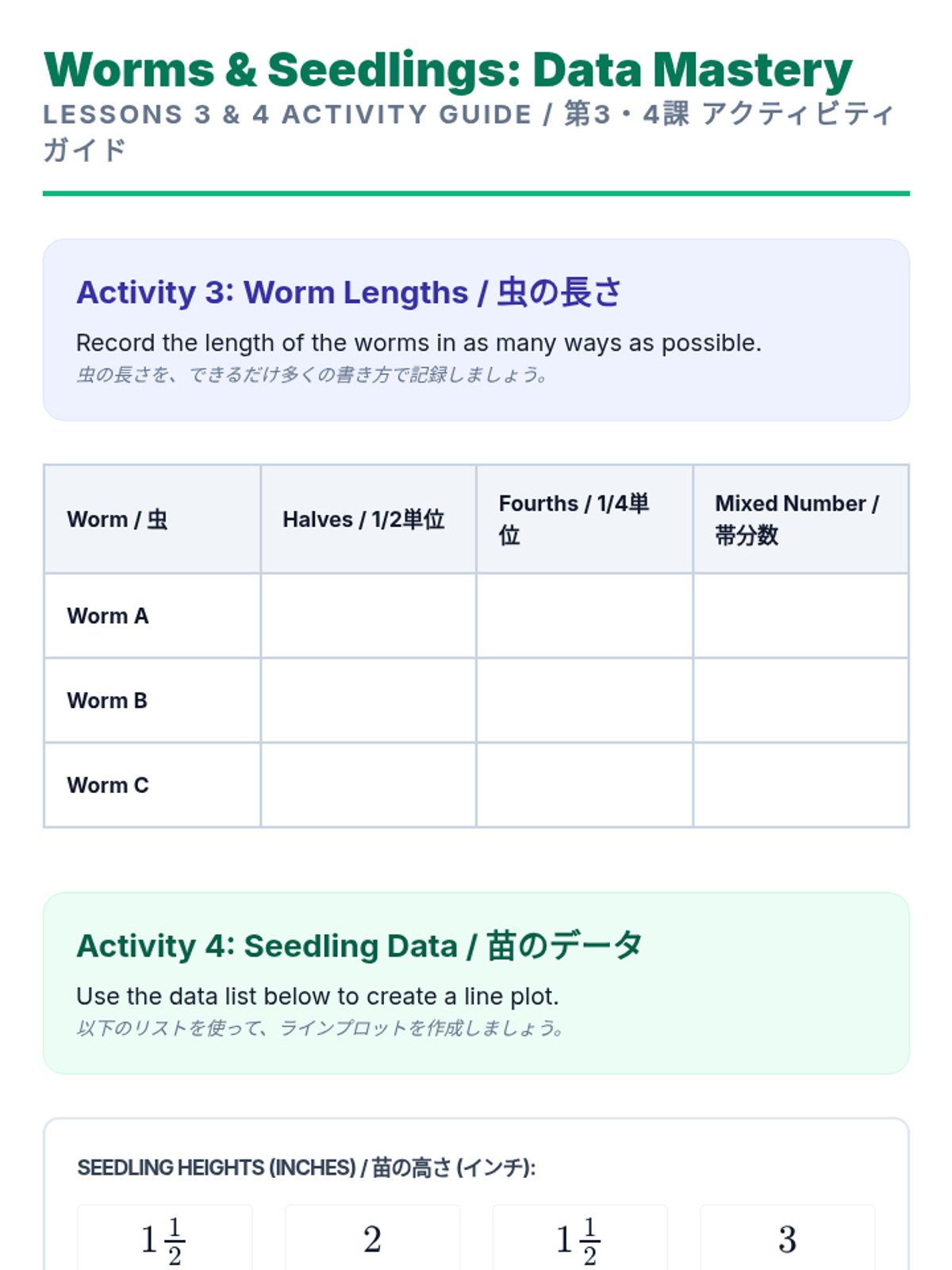
Handouts for Lessons 3 and 4. Revised to keep Activity 4 on one page, fix wrapping, and improve work area visibility.
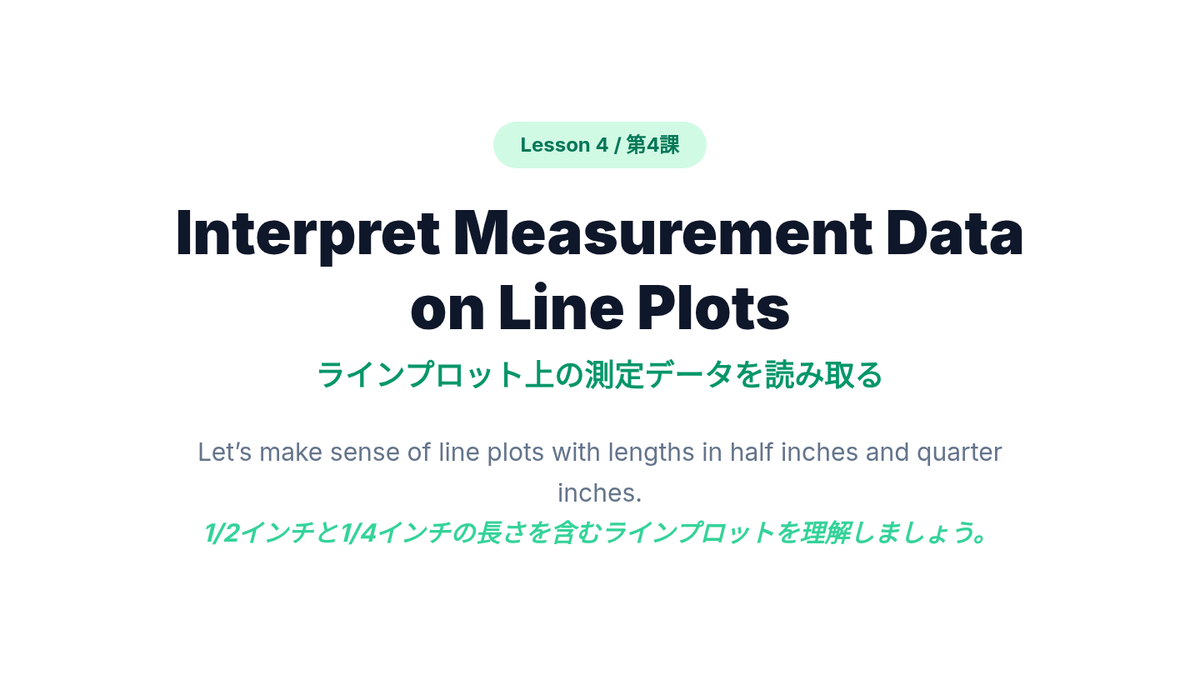
Bilingual slides for Lesson 4 (Interpreting Line Plots). Focuses on analyzing data representations, identifying differences between lists and plots, and verifying statements based on data. Revised for populated data and alignment.
Bilingual slides for Lesson 3 (Equivalence and Mixed Numbers). Explores recording lengths in multiple ways and visualizing mixed number partitioning. Revised for ruler accuracy and visible diagrams.
Bilingual slides for Lesson 2 (Measuring in Fourths). Includes estimation exploration, partitioning activities, and a cool-down involving choosing the right tool for precision. Revised for ruler accuracy and alignment.
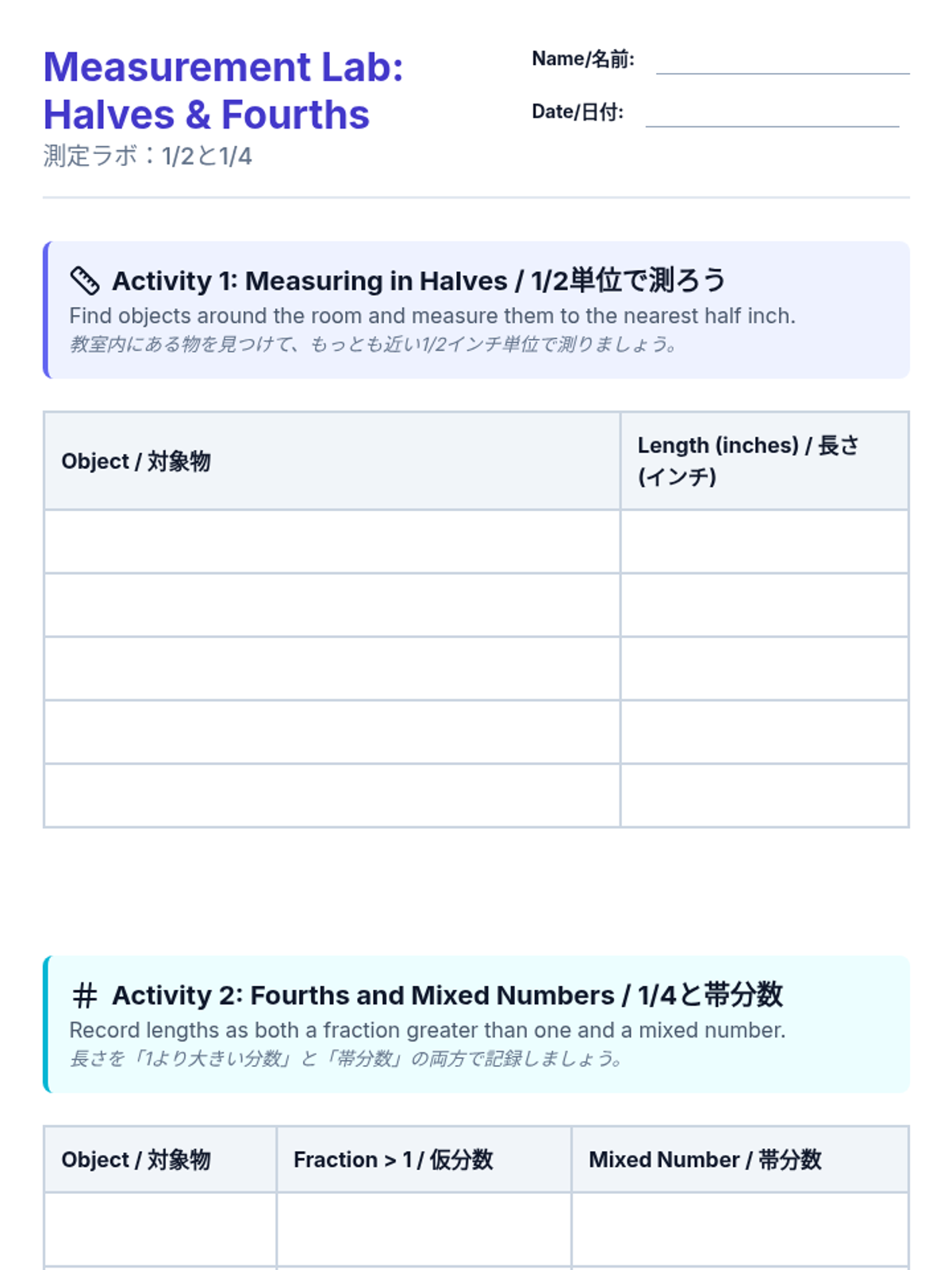
Recording sheets for measuring activities in Lessons 1 and 2. Bilingual format. Revised to prevent table splits and improve name/date formatting.
Bilingual slide deck for the Measurement unit, covering Unit Goals, Rubric, and Lesson 1 (Measuring in Halves). Includes specific terminology in both English and Japanese. Revised for ruler accuracy and alignment.
A classroom-ready bilingual slide deck (English/Japanese) for Unit 6: Measurement. Features robust CSS-drawn rulers and line plots for clear visualization, resolved fractional rendering issues, and optimized layouts for bilingual text clarity. Final version with improved contrast and alignment. Final Polish 3.
A classroom-ready bilingual slide deck (English/Japanese) for Unit 6: Measurement. Features robust CSS-drawn rulers and line plots for clear visualization, resolved fractional rendering issues, and optimized layouts for bilingual text clarity. Final version with improved contrast and alignment.
A classroom-ready bilingual slide deck (English/Japanese) for Unit 6: Measurement. Features robust CSS-drawn rulers and line plots for clear visualization, resolved fractional rendering issues, and optimized layouts for bilingual text clarity.
A revised 36-slide bilingual presentation in English and Japanese covering Unit 6: Measurement. Fixed layout regressions, improved ruler alignment, resolved overlapping text, and split complex slides for better classroom legibility.
A revised 35-slide bilingual presentation in English and Japanese covering Unit 6: Measurement. Fixes layout overlaps, math alignment, and text sizing issues identified in review.
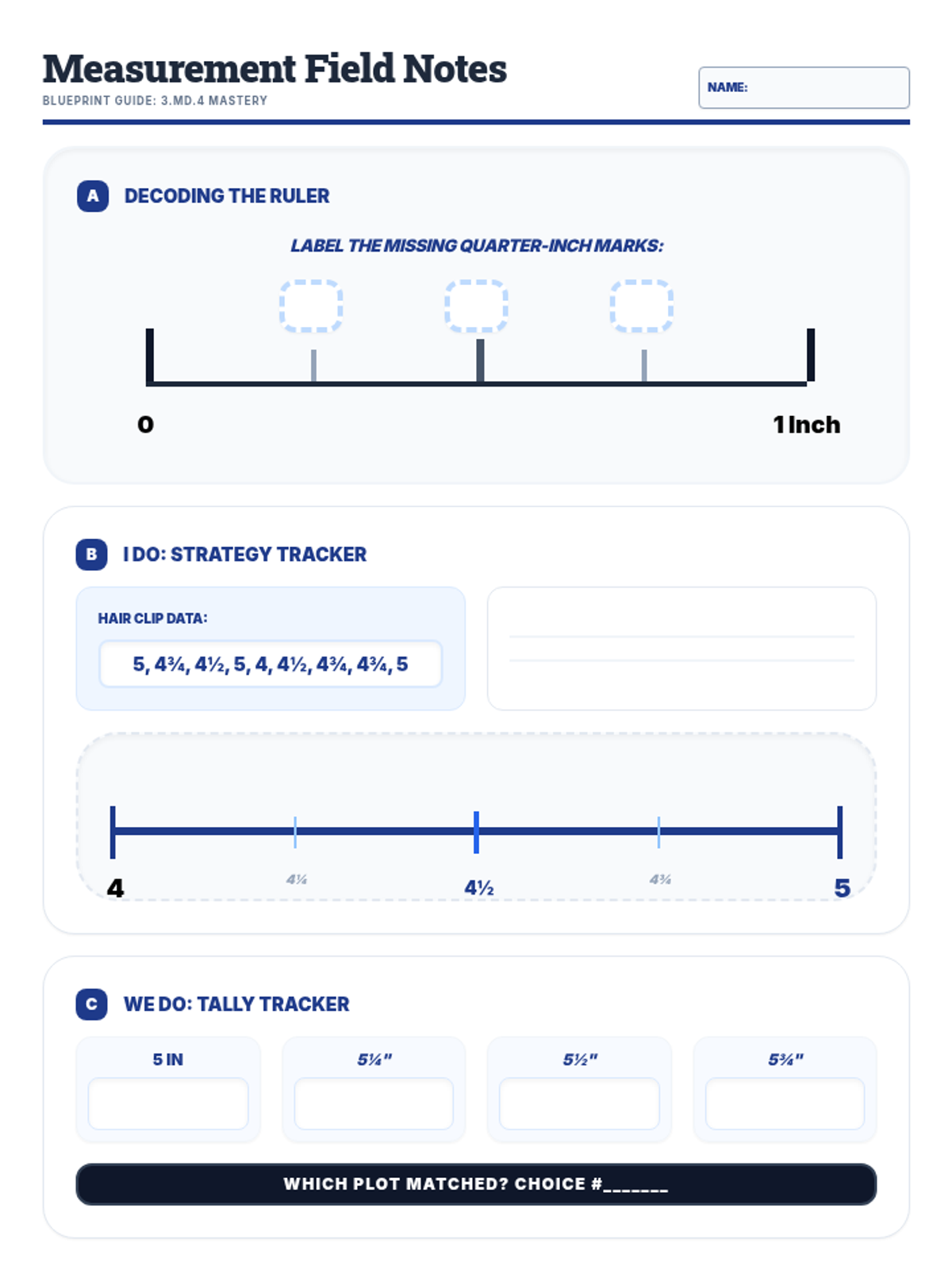
Guided field notes for students to accompany the Measurement Blueprint lesson, featuring sections for the I Do, We Do, and You Do instructional phases. Optimized for handwriting with a light theme for high-quality printing. Fixed page breaks and visual aid alignment. Section D has been consolidated and Section B includes an accurate modeling plot. Section A alignment issue with input boxes has been resolved. Optimized to fit on exactly two pages.
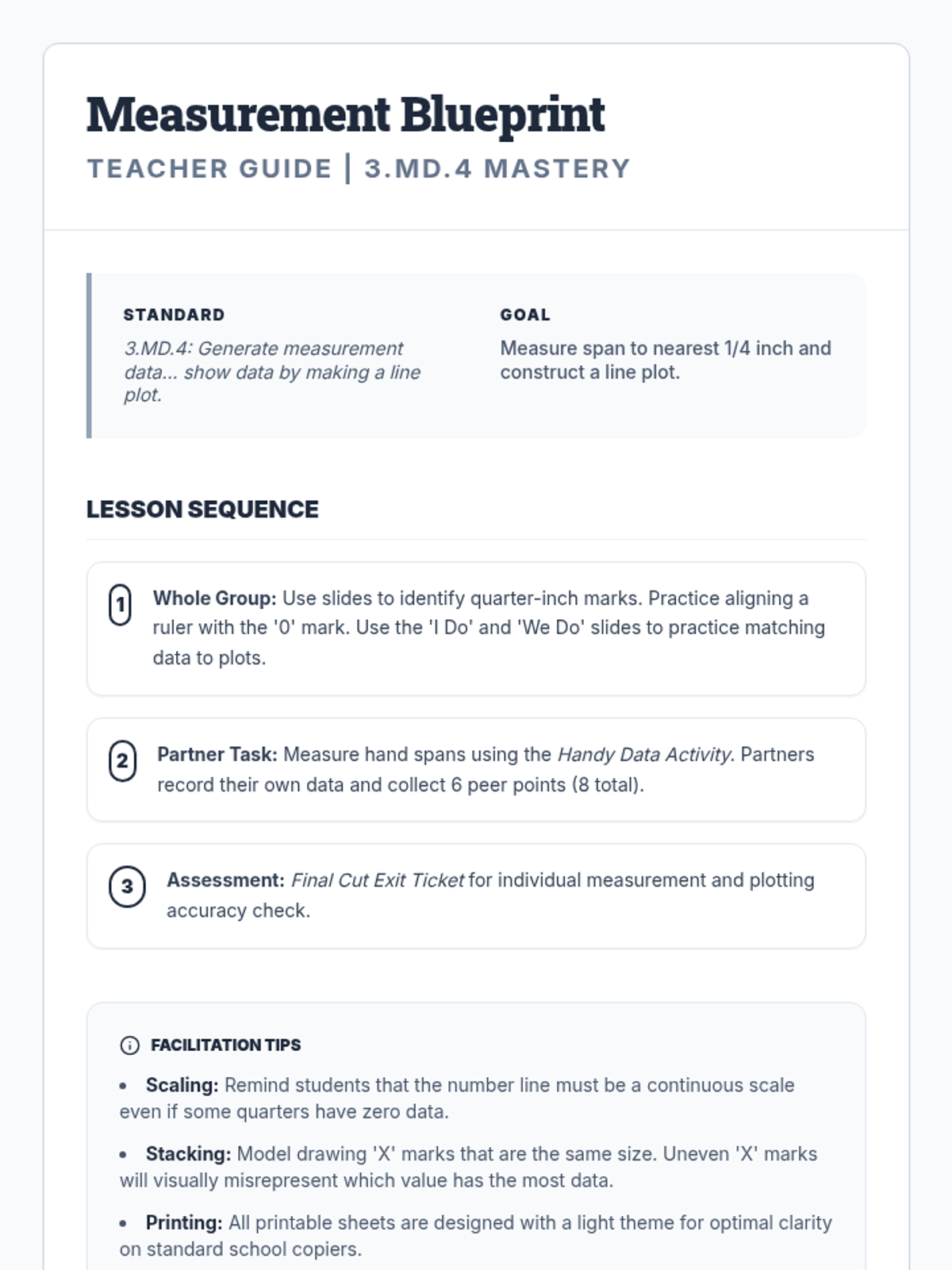
A comprehensive teacher guide for 3.MD.4 lesson implementation, optimized with a light colored printer-friendly theme. Includes sequence, misconceptions, and facilitation strategies.
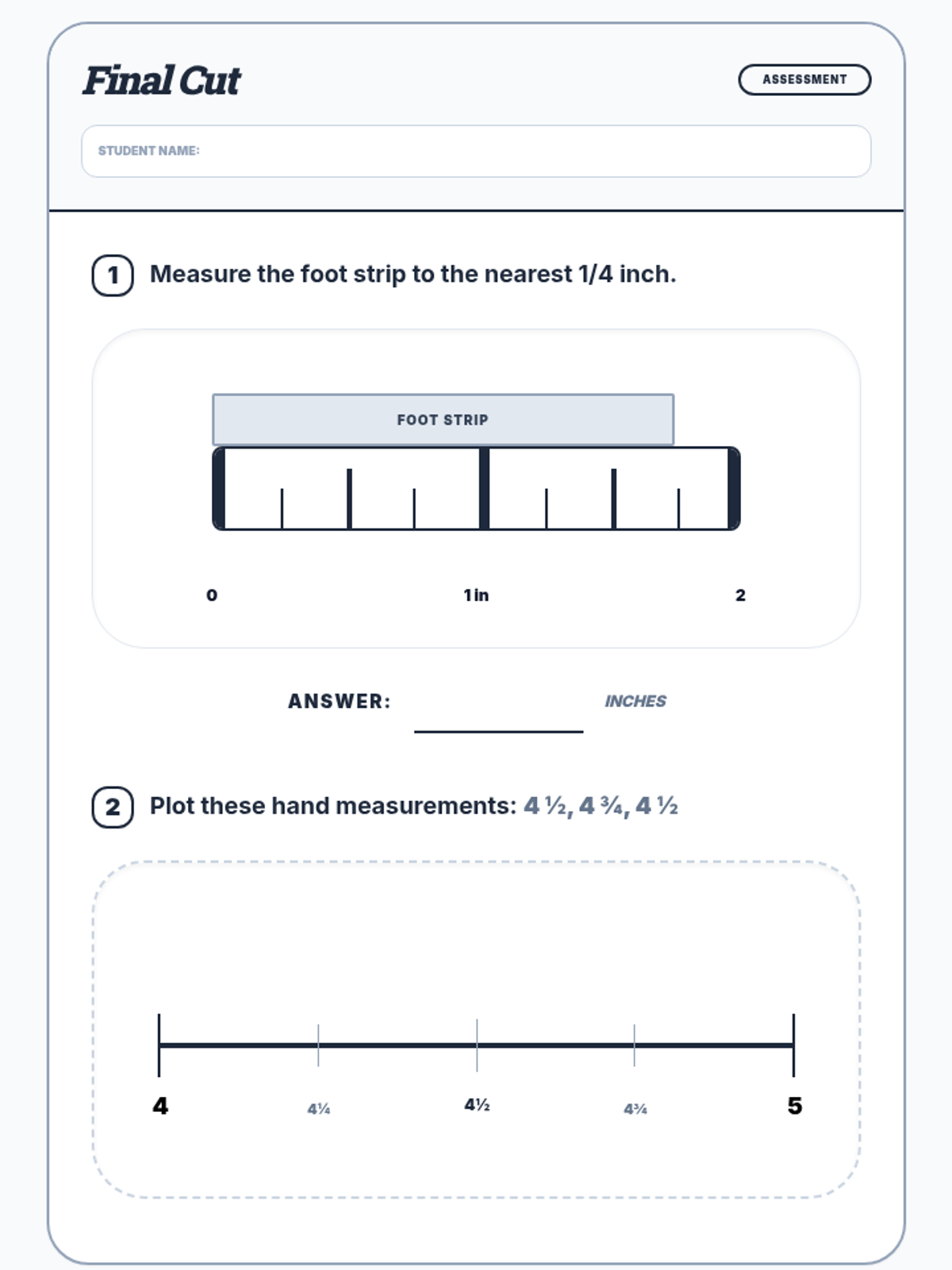
A concise exit ticket to assess student understanding of measuring to the nearest quarter inch and accurately representing data points on a pre-labeled line plot, now consolidated onto a single page. Optimized for high-quality light-colored printing. Question 3 has been removed and visuals have been aligned for precision.
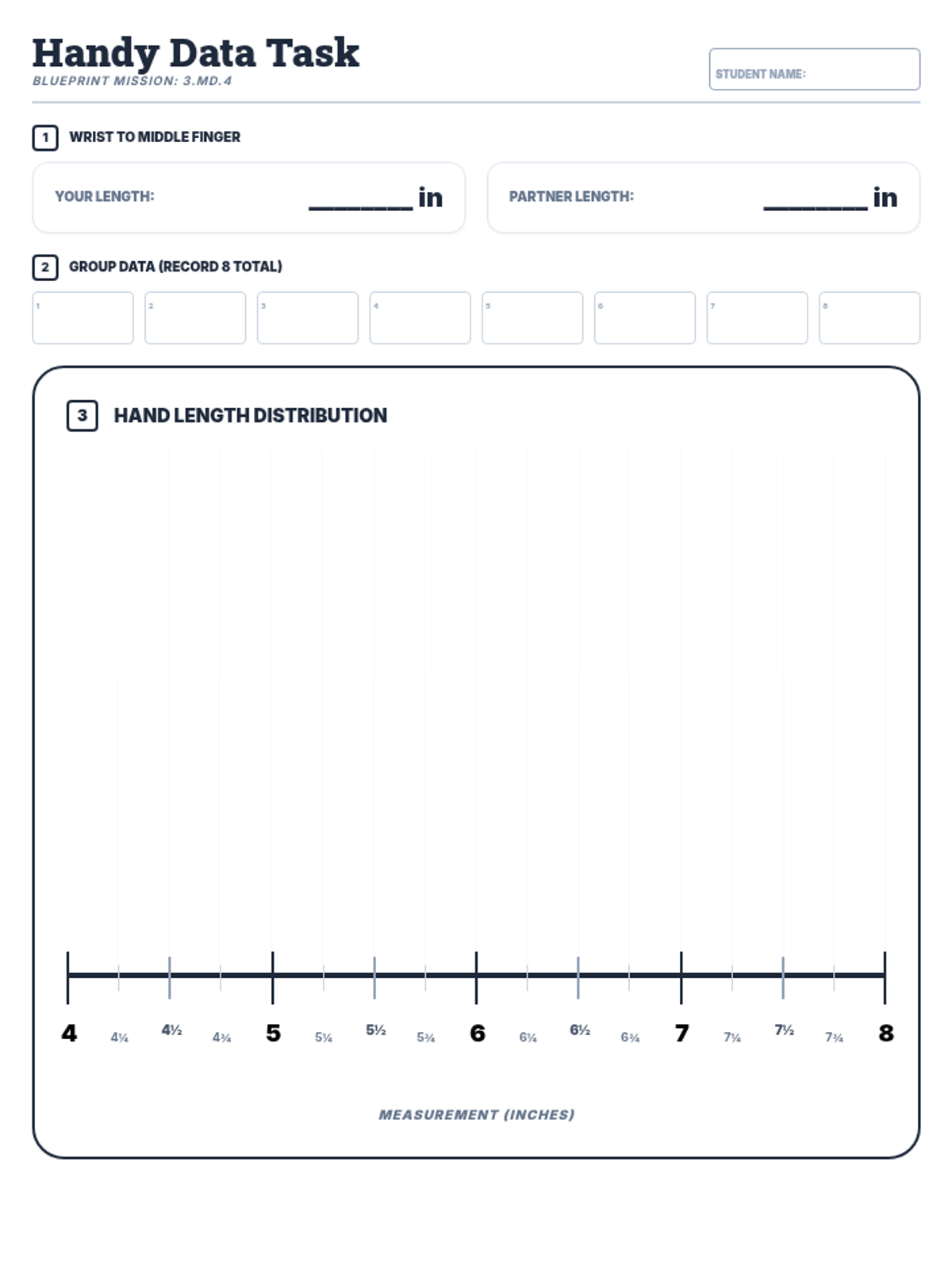
A partner-based measurement activity where students measure hand spans to the nearest quarter inch, collect peer data, and create a line plot to analyze their findings, now consolidated onto a single page. Group data boxes and grid line visibility have been optimized for light-colored printing.
Updated slide deck for 3.MD.4 including instructional foundations, and a structured 'I Do, We Do, You Do' sequence for matching data sets to line plots with a blueprint theme. Line plot containers have been fixed with a vertical flex layout to prevent marker/label overlap. Choice styling has been unified for consistent guided practice. ALL font sizes for fractions increased to 18px+ for visibility. Vertical padding added to choice containers to prevent text cut-off. Choice 2 distractor updated with 7 data points for a less obvious pick.
Comprehensive answer key for the Blueprint Builders unit. Revised to ensure single-page fit and improved equation wrapping.
A formal assessment covering perimeter calculation, unknown sides, irregular polygons, and real-world word problems. Revised to fix label clipping, increase workspace size, and improve text contrast.
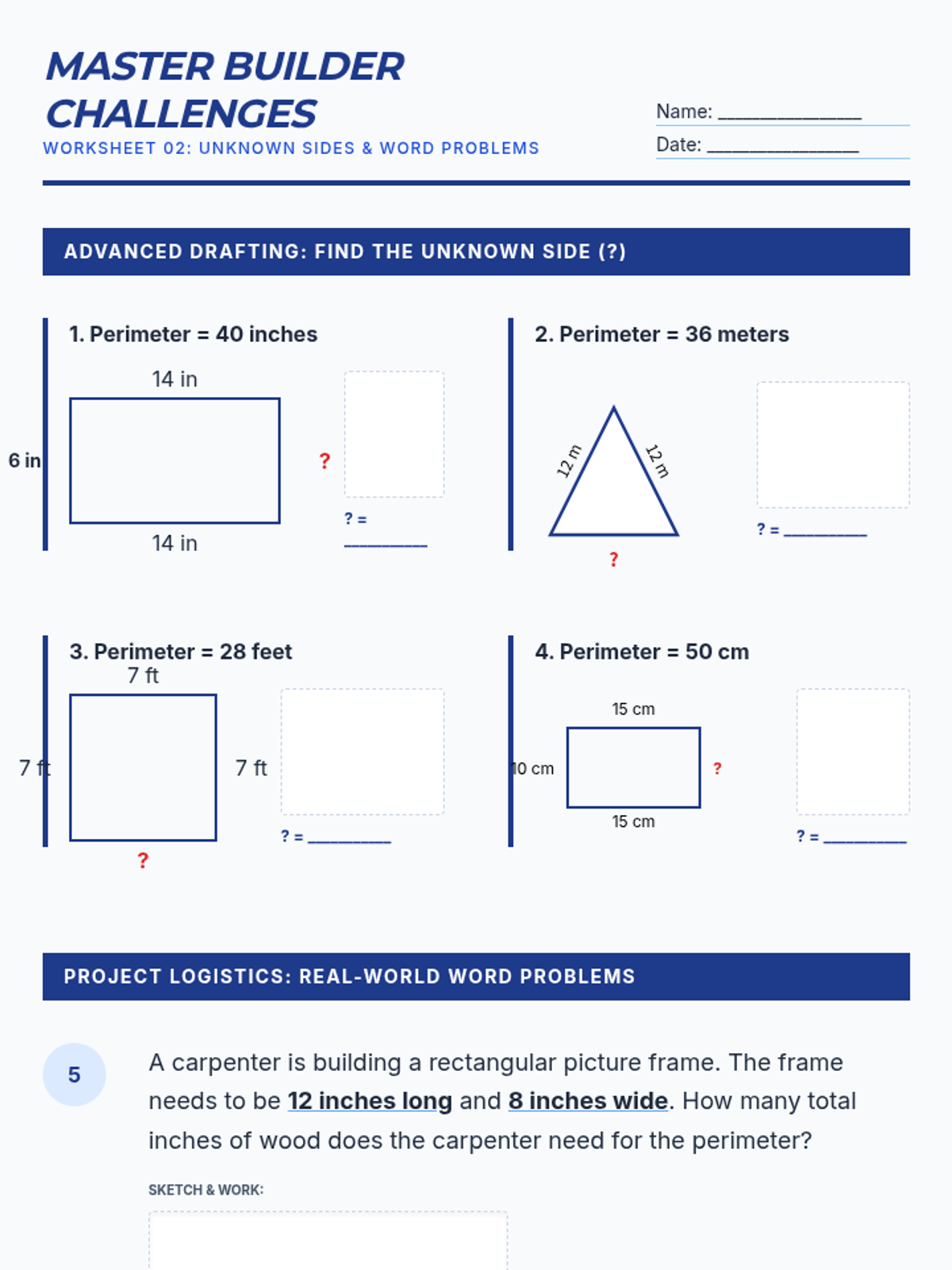
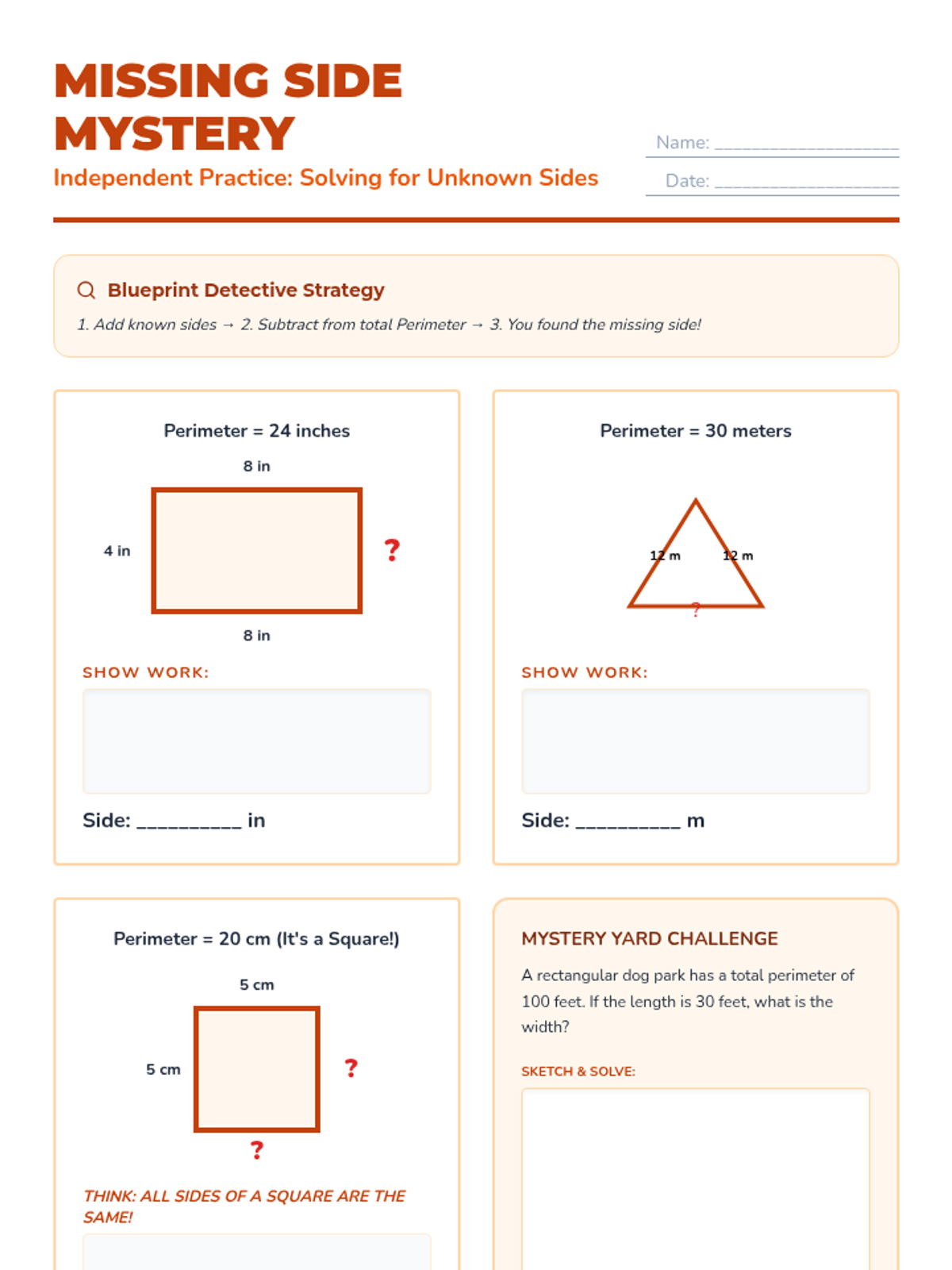
Independent practice worksheet focusing on finding unknown side lengths and solving real-world perimeter word problems. Revised to fix page breaks, text contrast, label clipping, and increase workspace area.
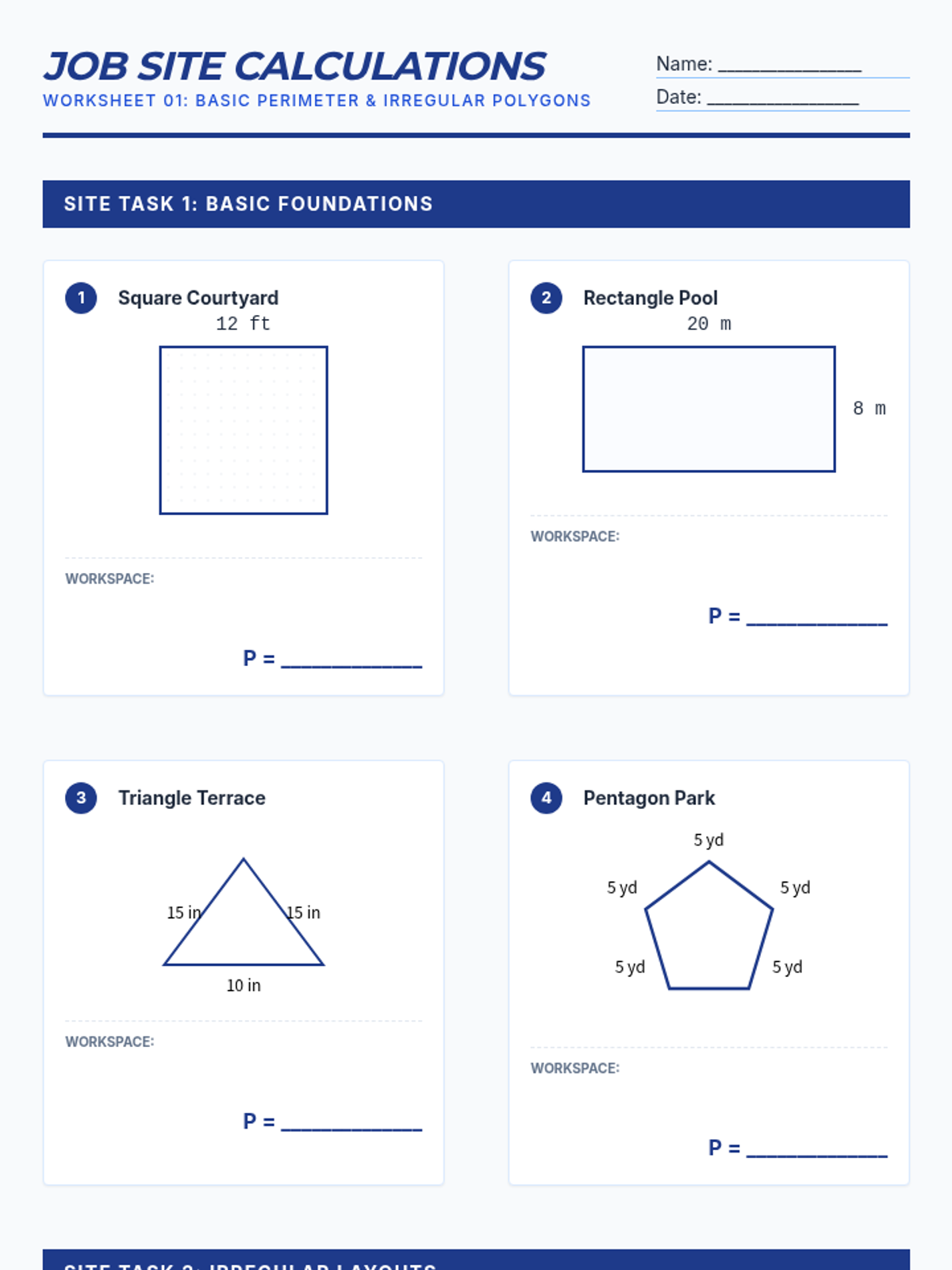
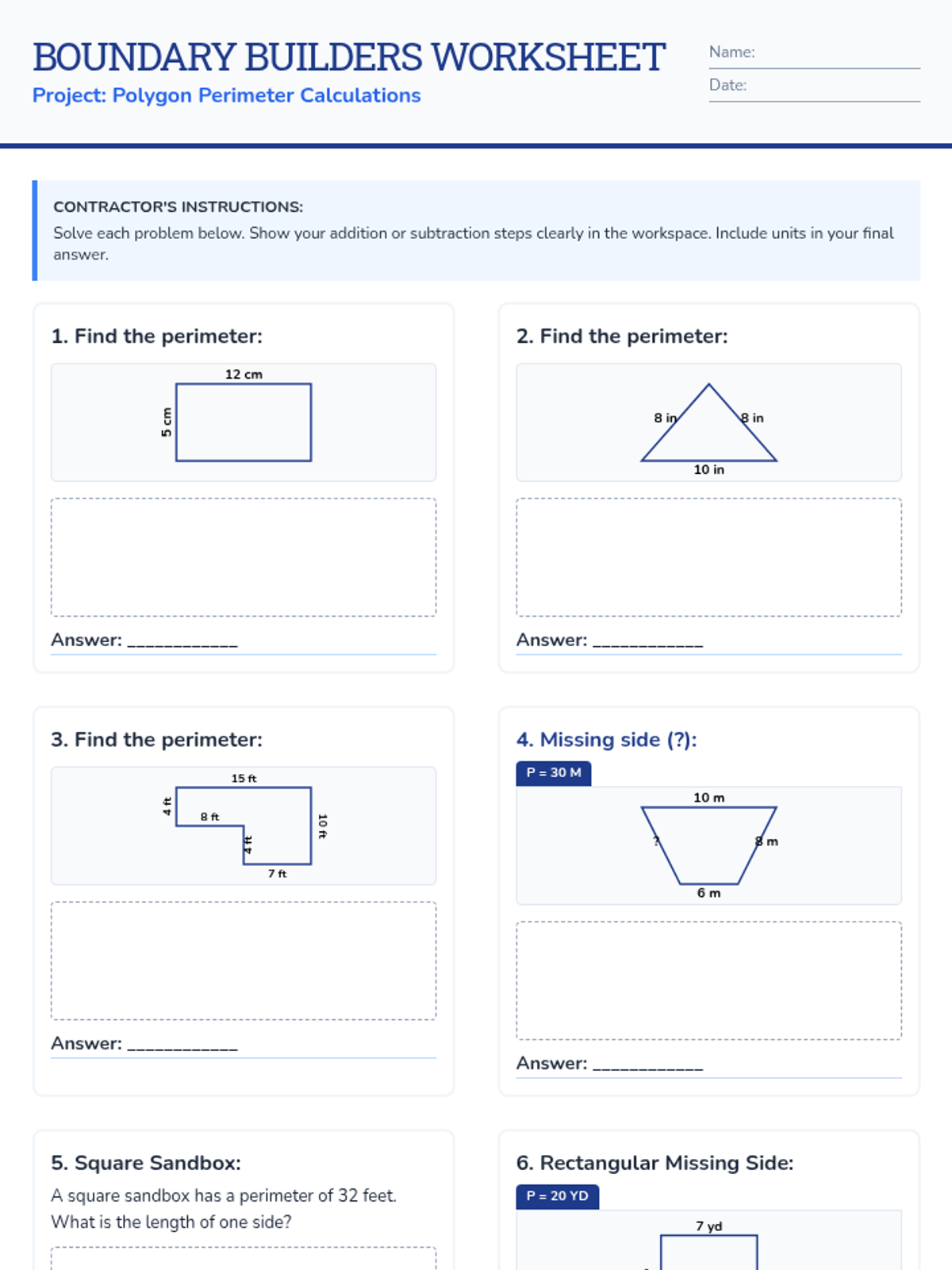
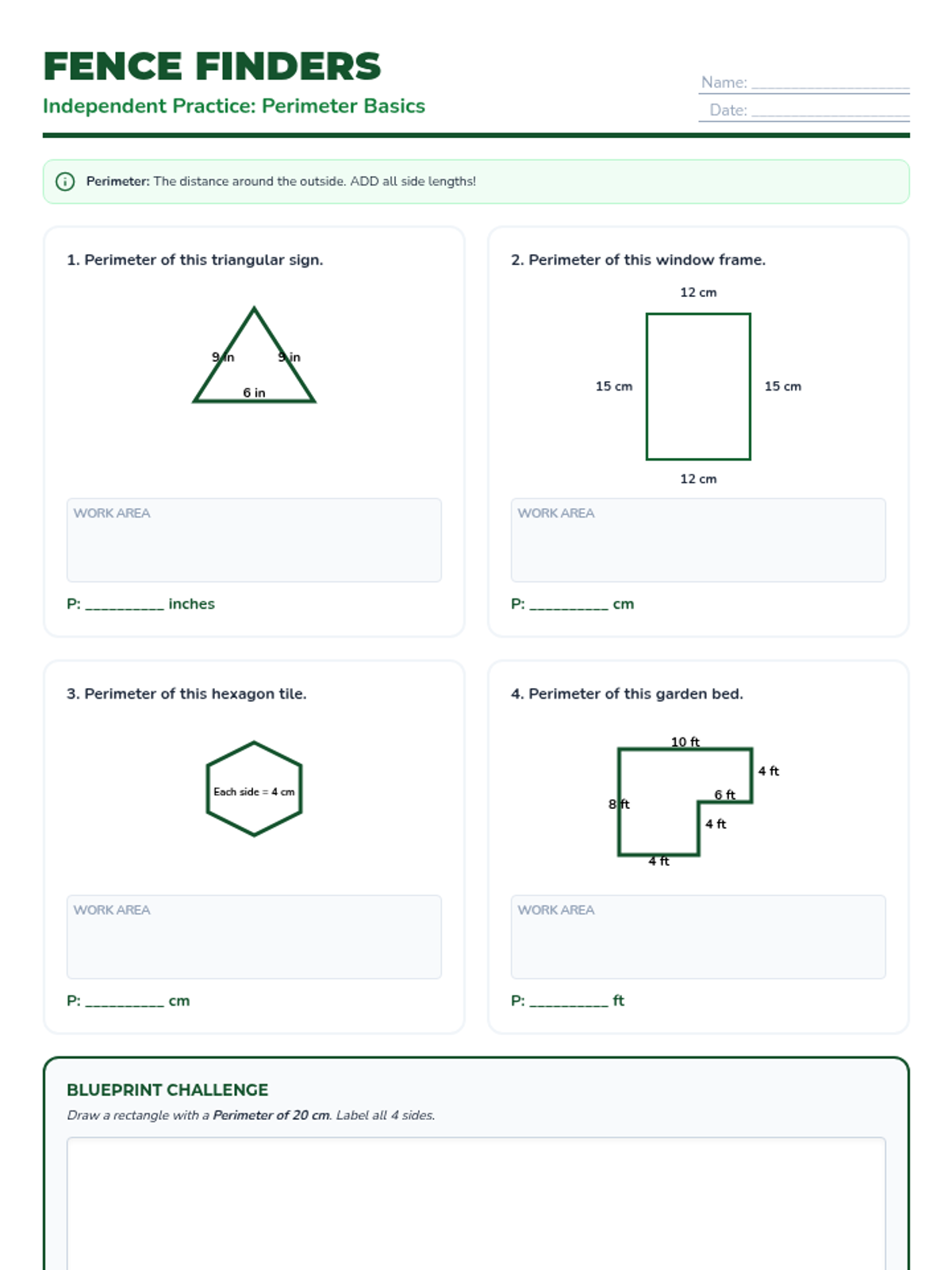
Independent practice worksheet focusing on basic perimeter calculations for standard shapes and complex irregular polygons. Revised to fix page breaks, label overlaps, and add workspace areas.
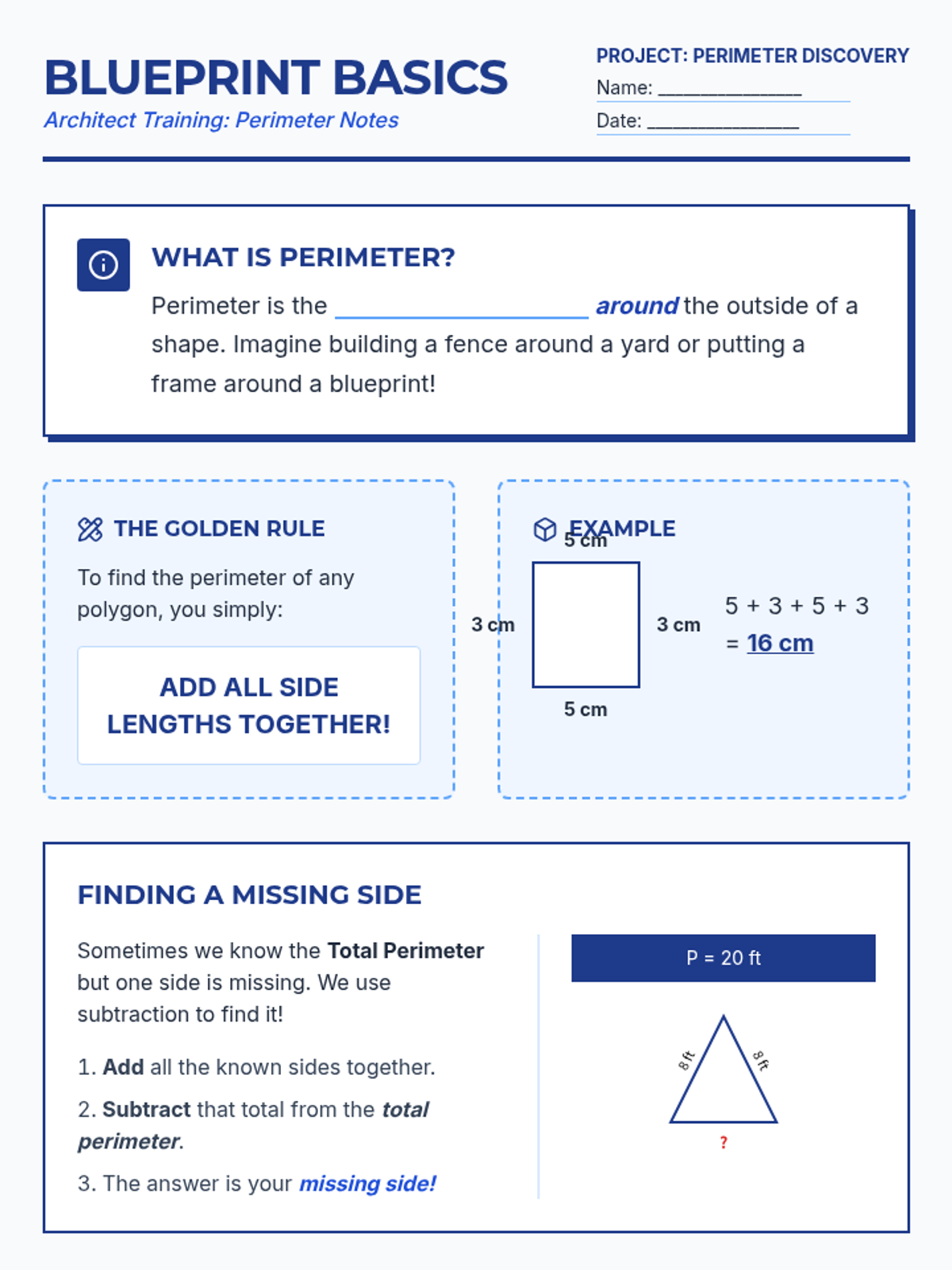
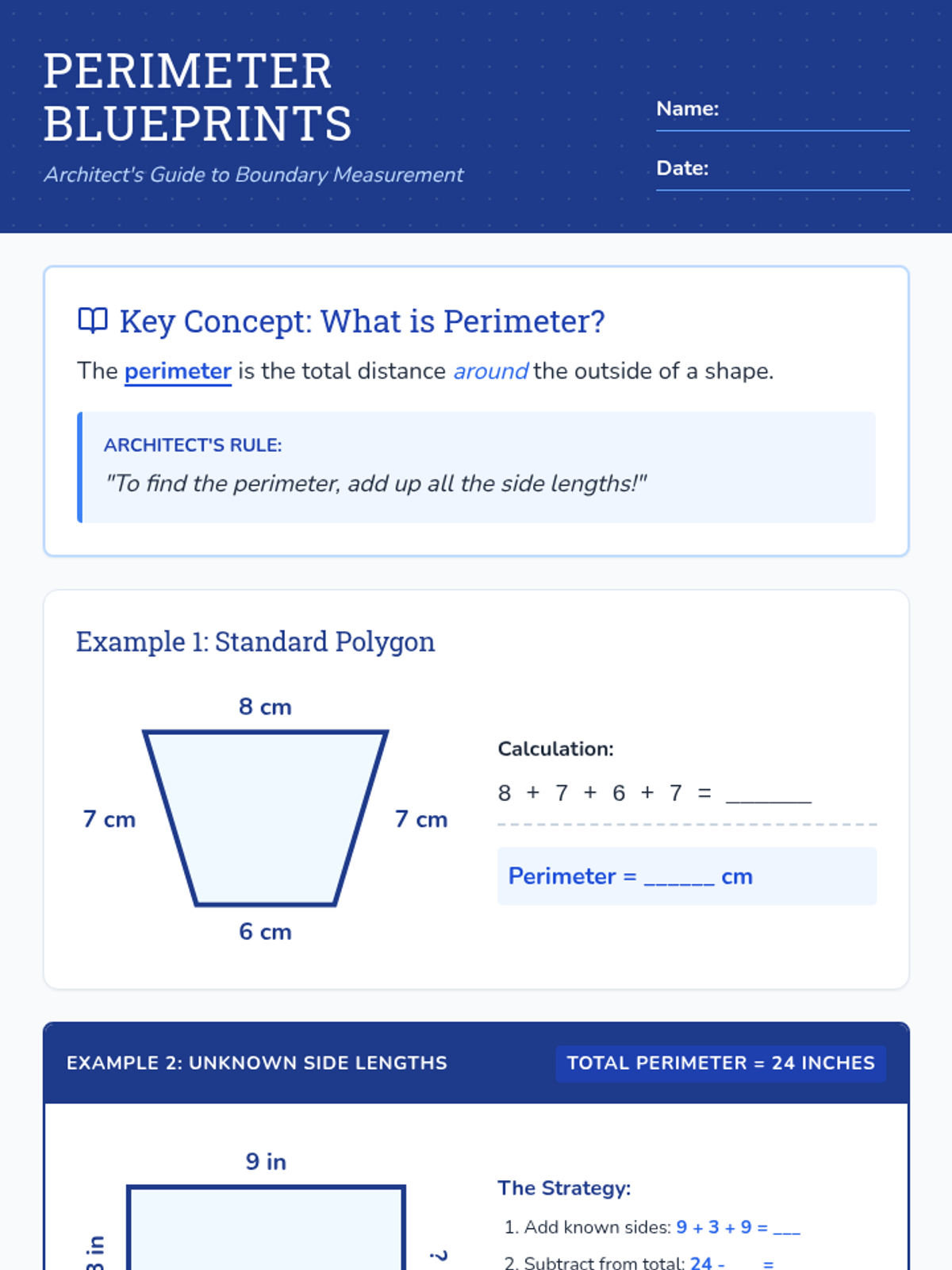
Guided notes and initial practice for teaching perimeter, featuring a professional blueprint design. Covers basic calculations, missing sides, and irregular polygons. Revised to fix shape labels and irregular polygon rendering.
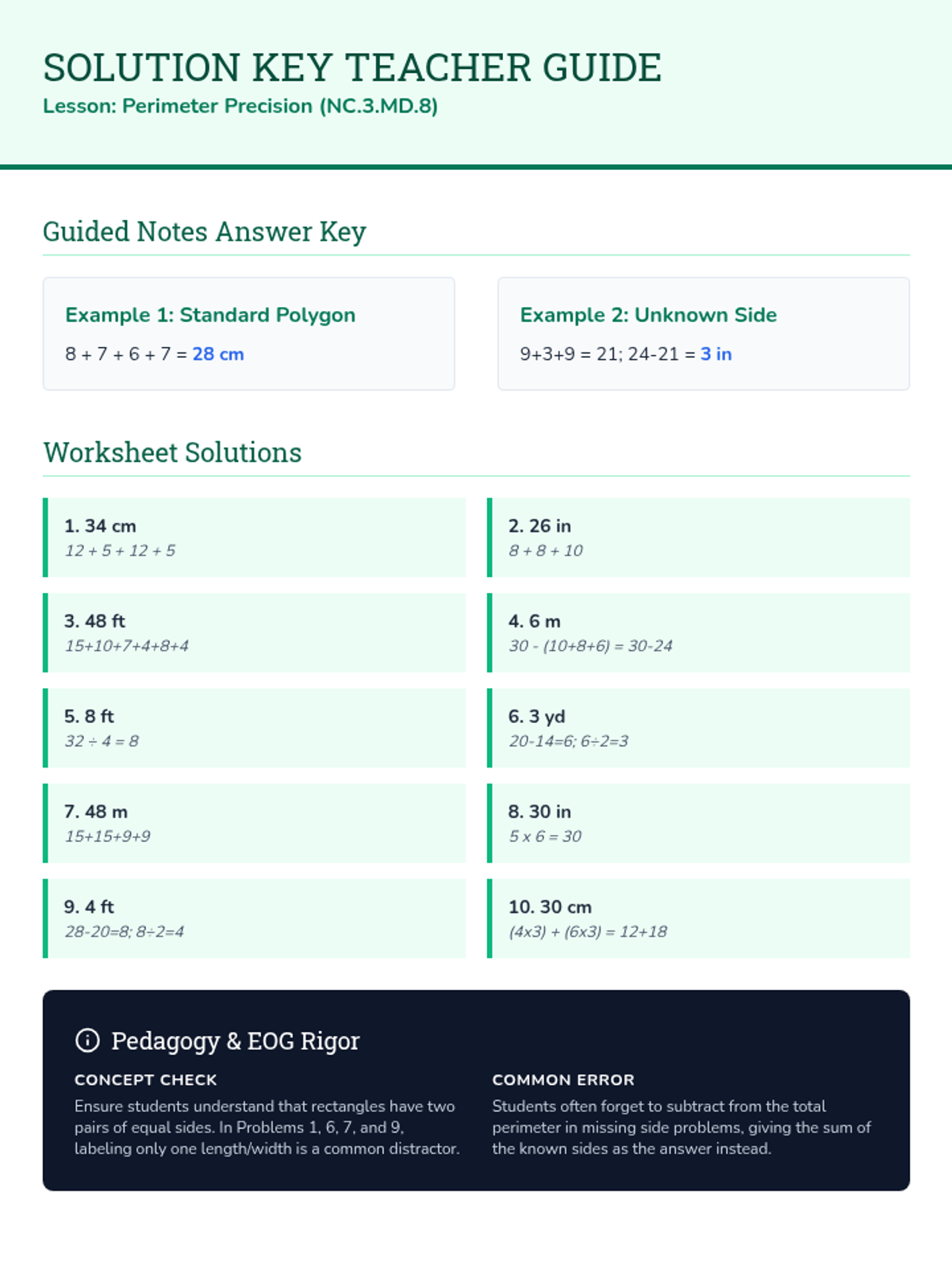
Answer key and teacher guide for the Perimeter Precision lesson, including detailed solutions for guided notes and the Boundary Builders worksheet. Provides pedagogical notes on EOG rigor.
A 10-problem computation worksheet for 3rd grade students on perimeter of polygons and unknown side lengths, designed to model EOG rigor. Features a "Boundary Builder" architect theme with generous, blank workspaces.
Guided notes for 3rd grade students on finding the perimeter of polygons and unknown side lengths, featuring a "Blueprint Architect" theme. Includes visual examples and guided practice sections with clear student work areas.
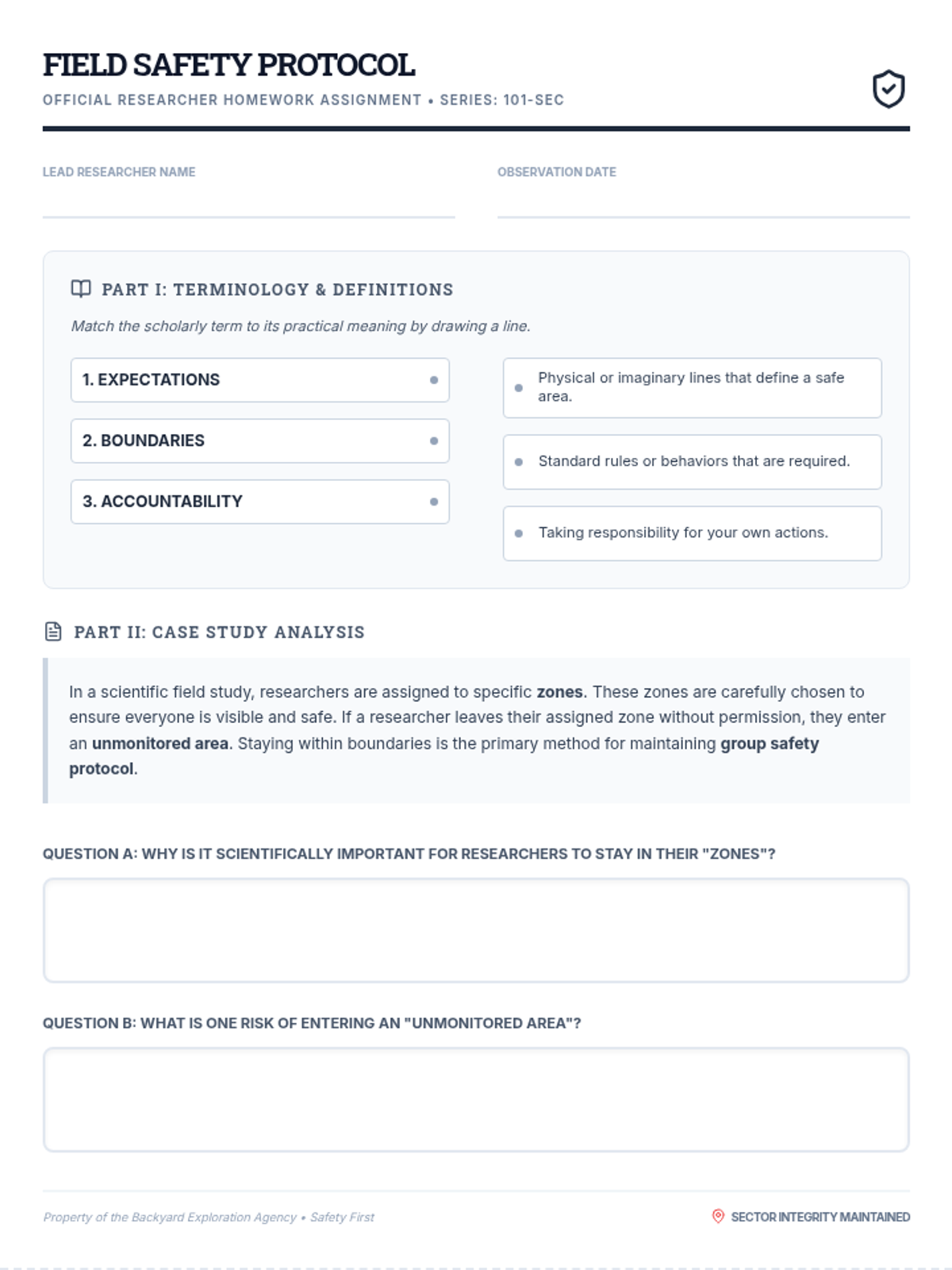
A scholarly-themed student homework assignment focused on meeting classroom expectations and the importance of staying in assigned areas for safety. Uses a "Field Safety Protocol" theme with scientific terminology to engage 3rd-grade students in behavioral logistics. Revised to fix page break issues and improve spacing for handwriting.
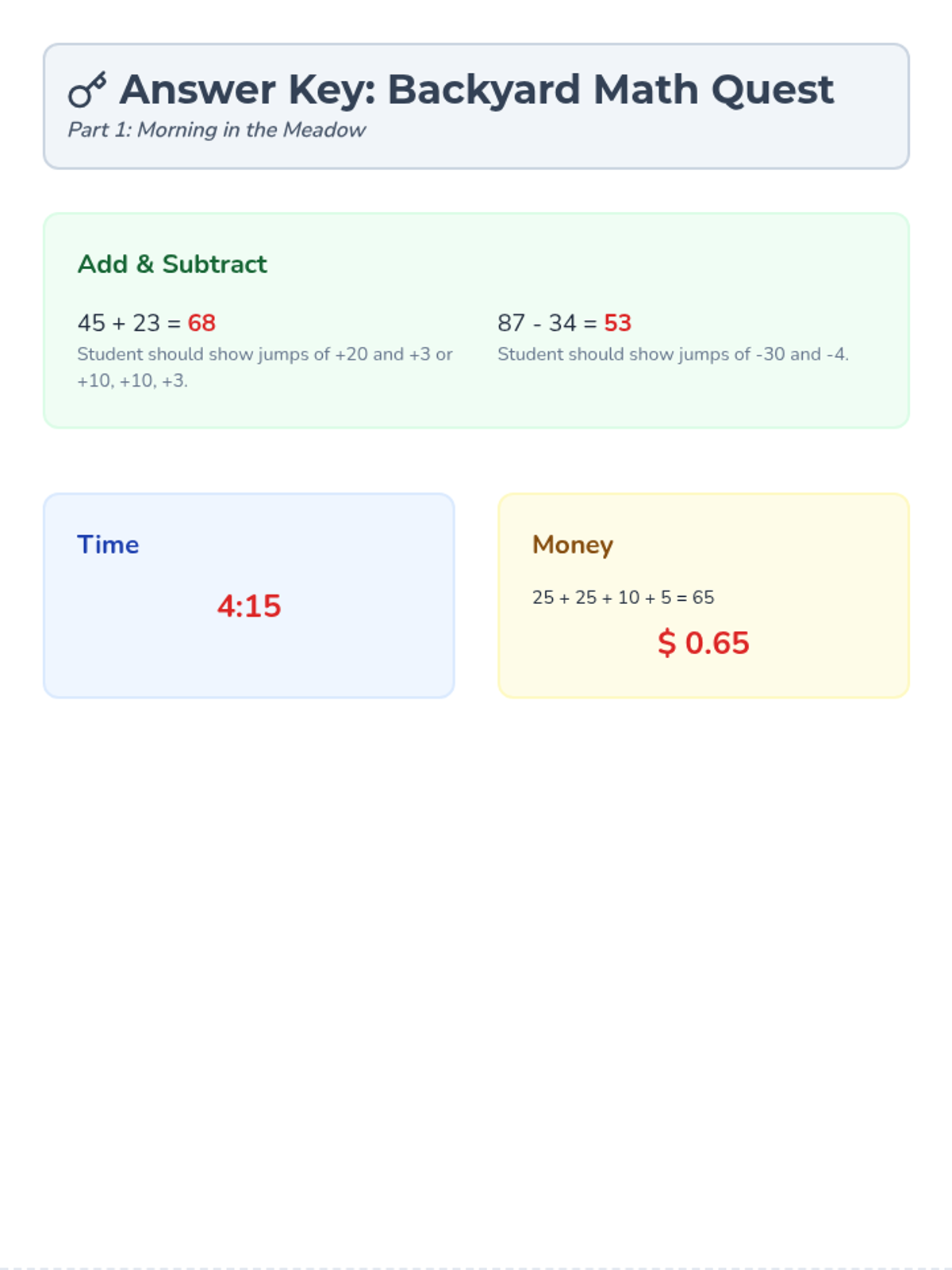
Answer key for the Backyard Explorer Homework Packet. Provides clear answers for all 3 pages of mixed review problems.
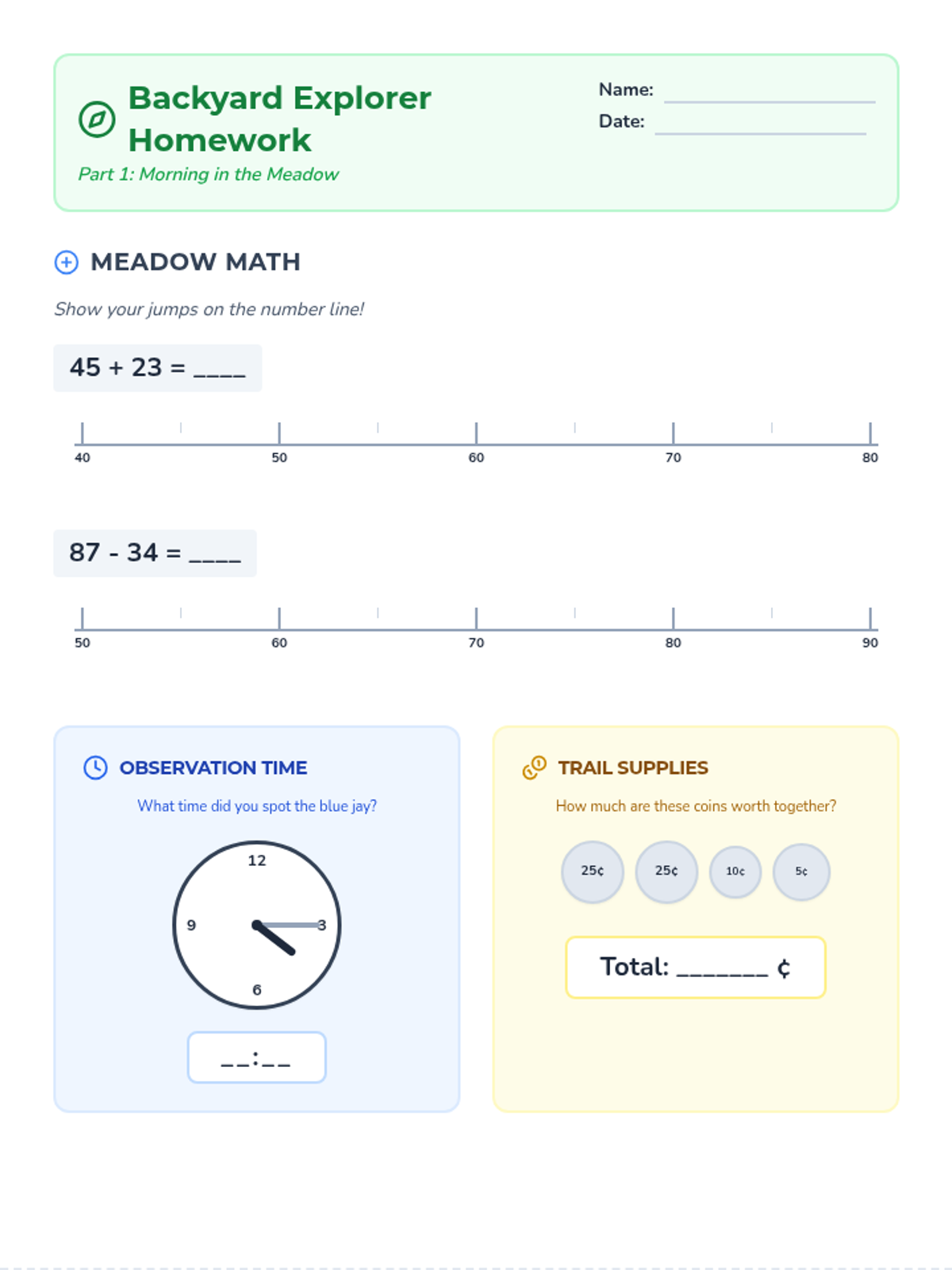
A 3-page mixed review homework packet for 3rd grade math featuring a backyard explorer theme. Covers addition/subtraction within 100, telling time, counting coins, multiplication intro, fractions intro, and visual word problems. Revised for better page breaks and accurate visual scaffolding.
A visual slide deck that introduces unit conversion (feet and inches), provides practice problems, and explains navigation strategies like the greedy algorithm versus total path planning.
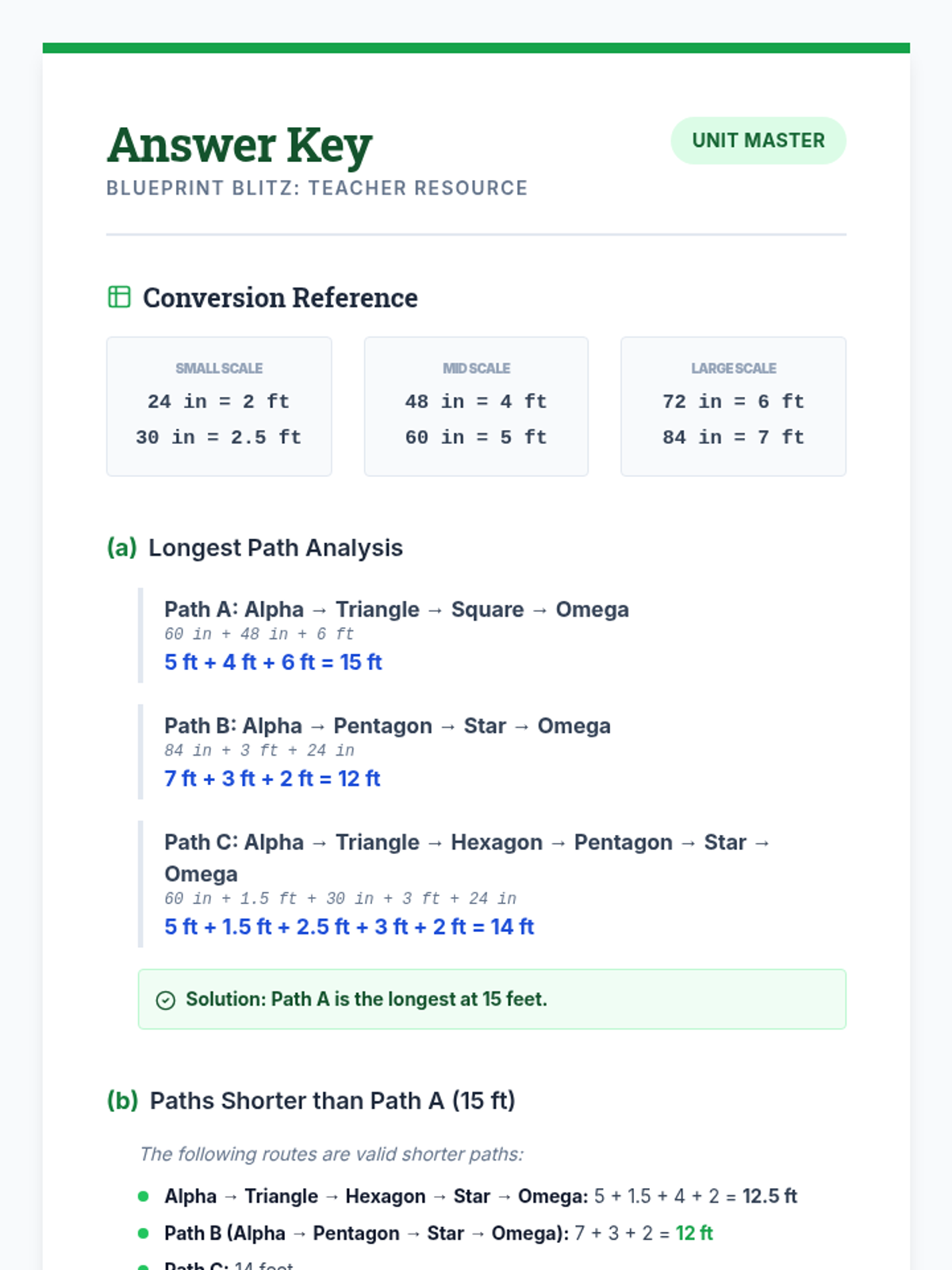
Detailed answer key for the Blueprint Blitz worksheet. Includes a unit conversion reference table, step-by-step path calculations in feet, and the final solution for the shortest path challenge in inches.
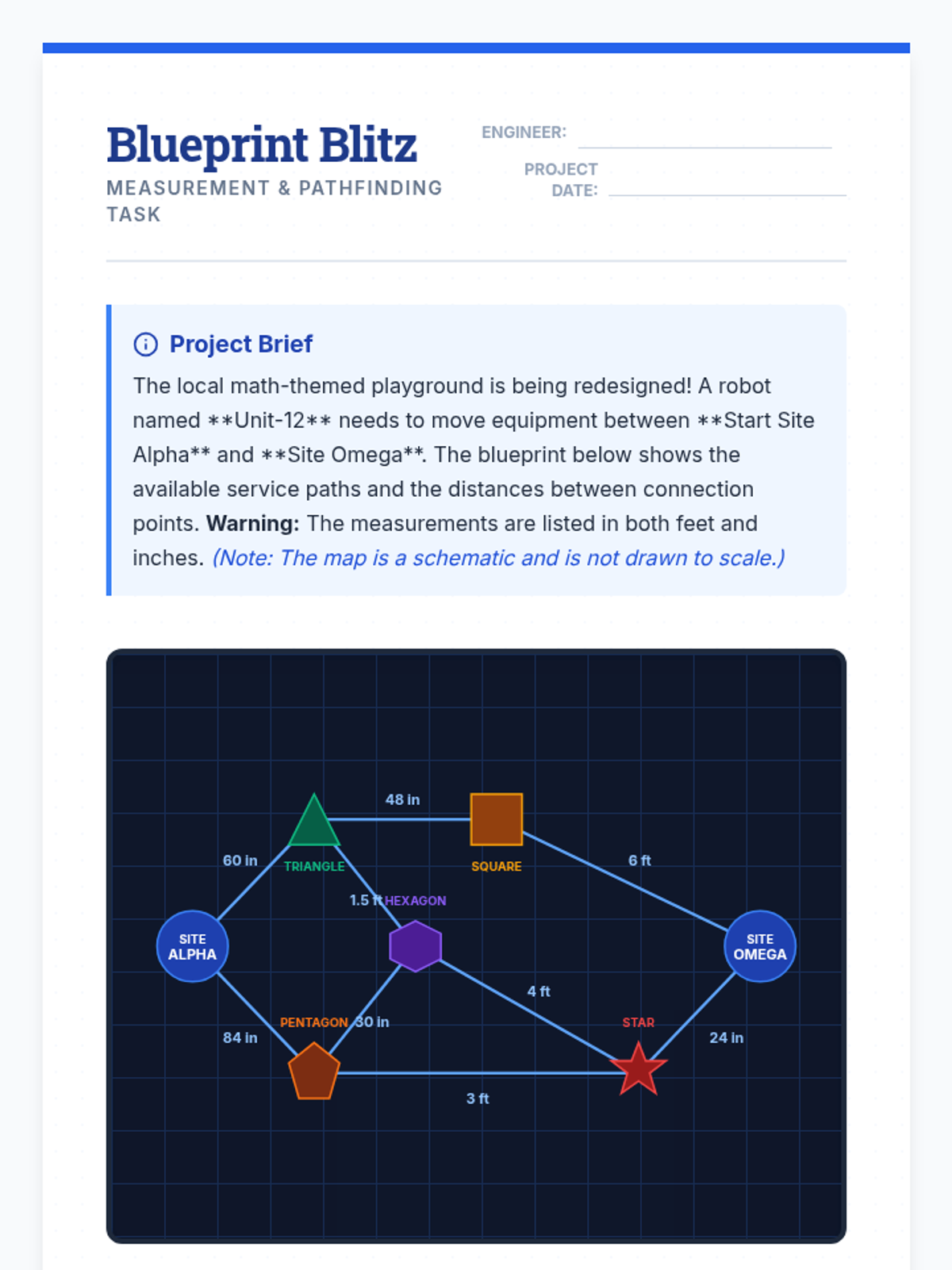
A student worksheet featuring a blueprint-style map with nodes and mixed-unit distances (feet and inches). Students must perform unit conversions to compare path lengths and solve optimization challenges.
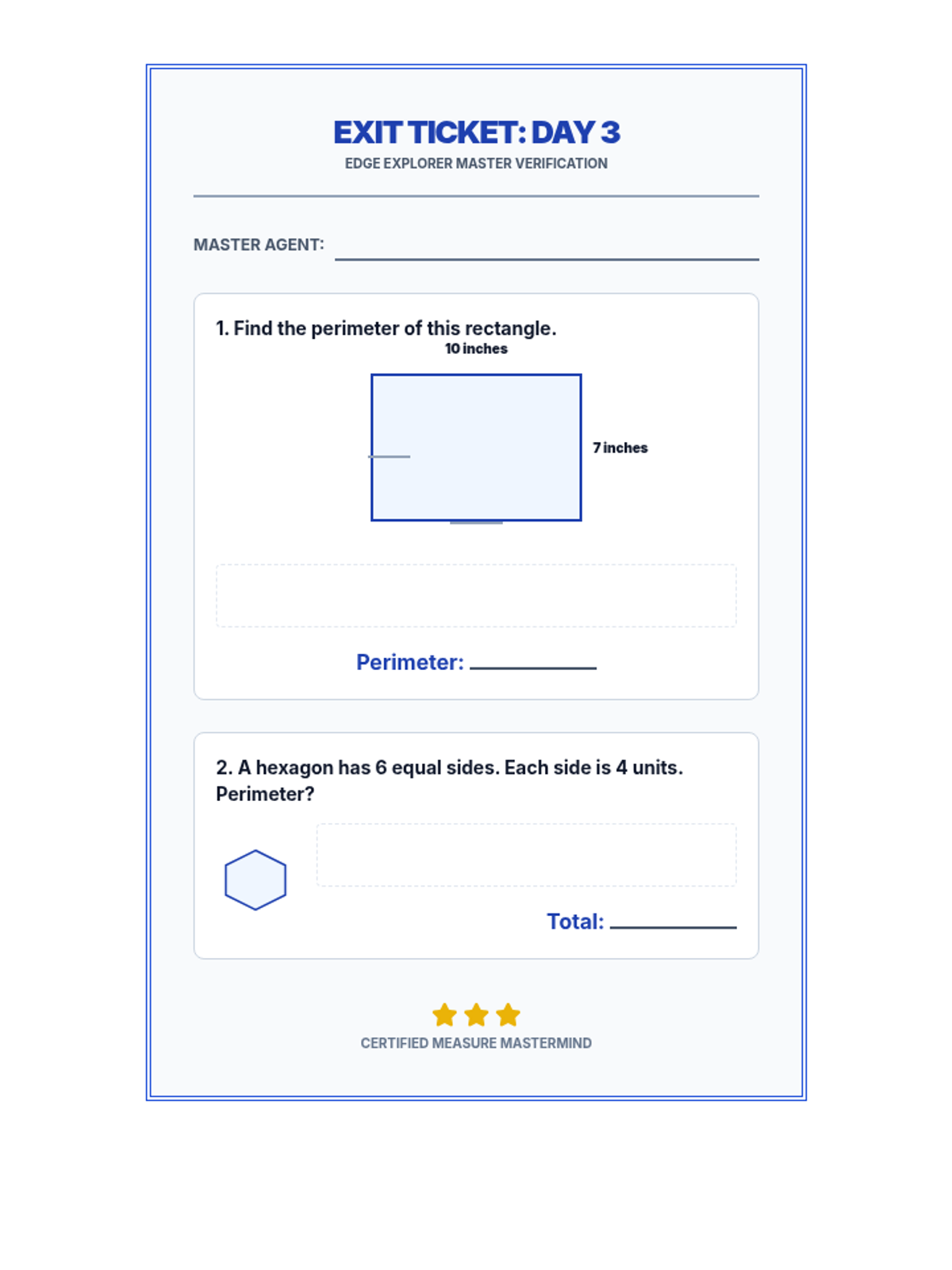
Day 3 exit ticket for the Measure Mastermind sequence, assessing student ability to find perimeter of shapes with implied side lengths and regular polygons.
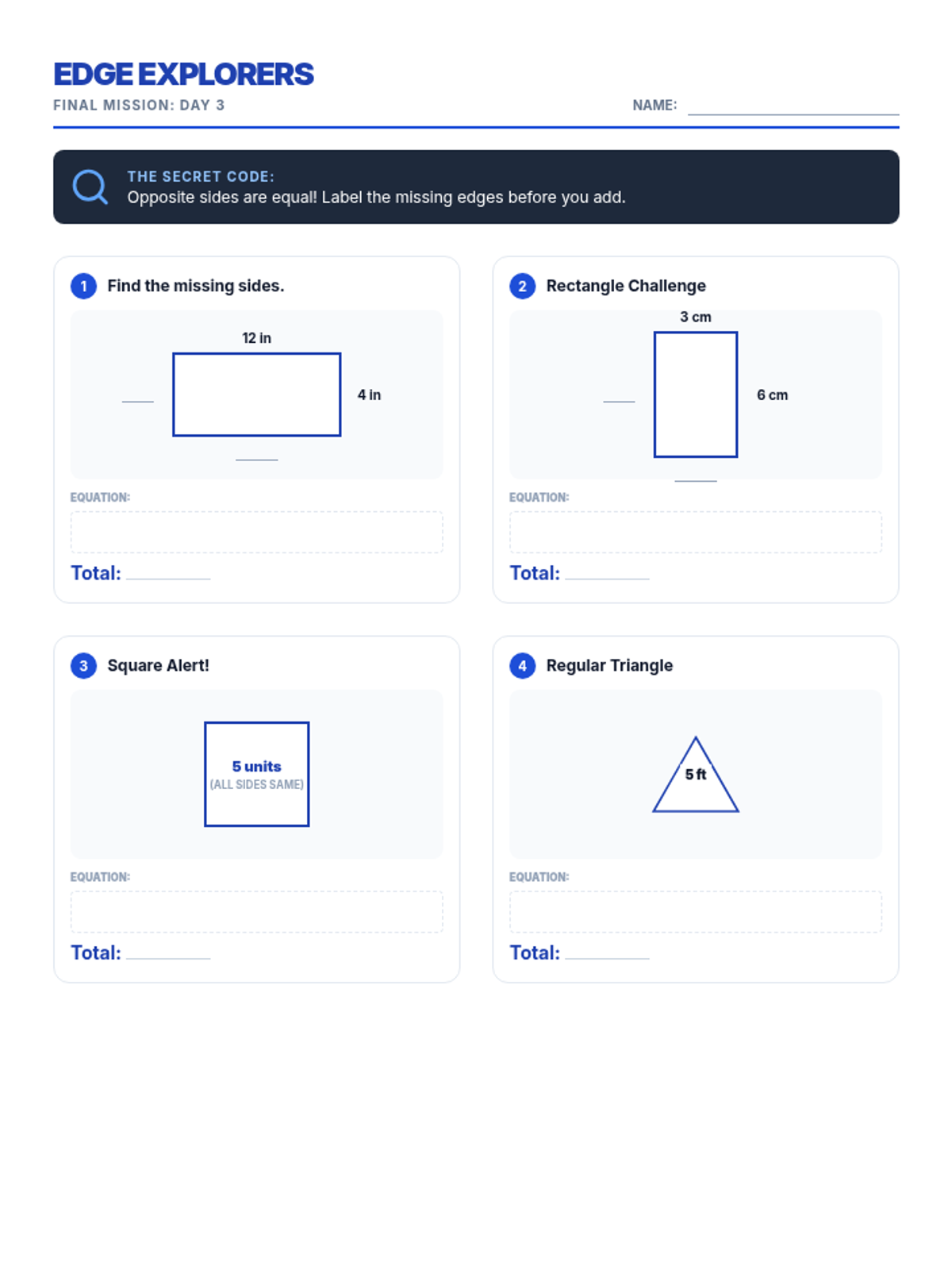
Student practice worksheet for Day 3 of the Measure Mastermind sequence, focused on finding perimeter of shapes with implied or missing side lengths.
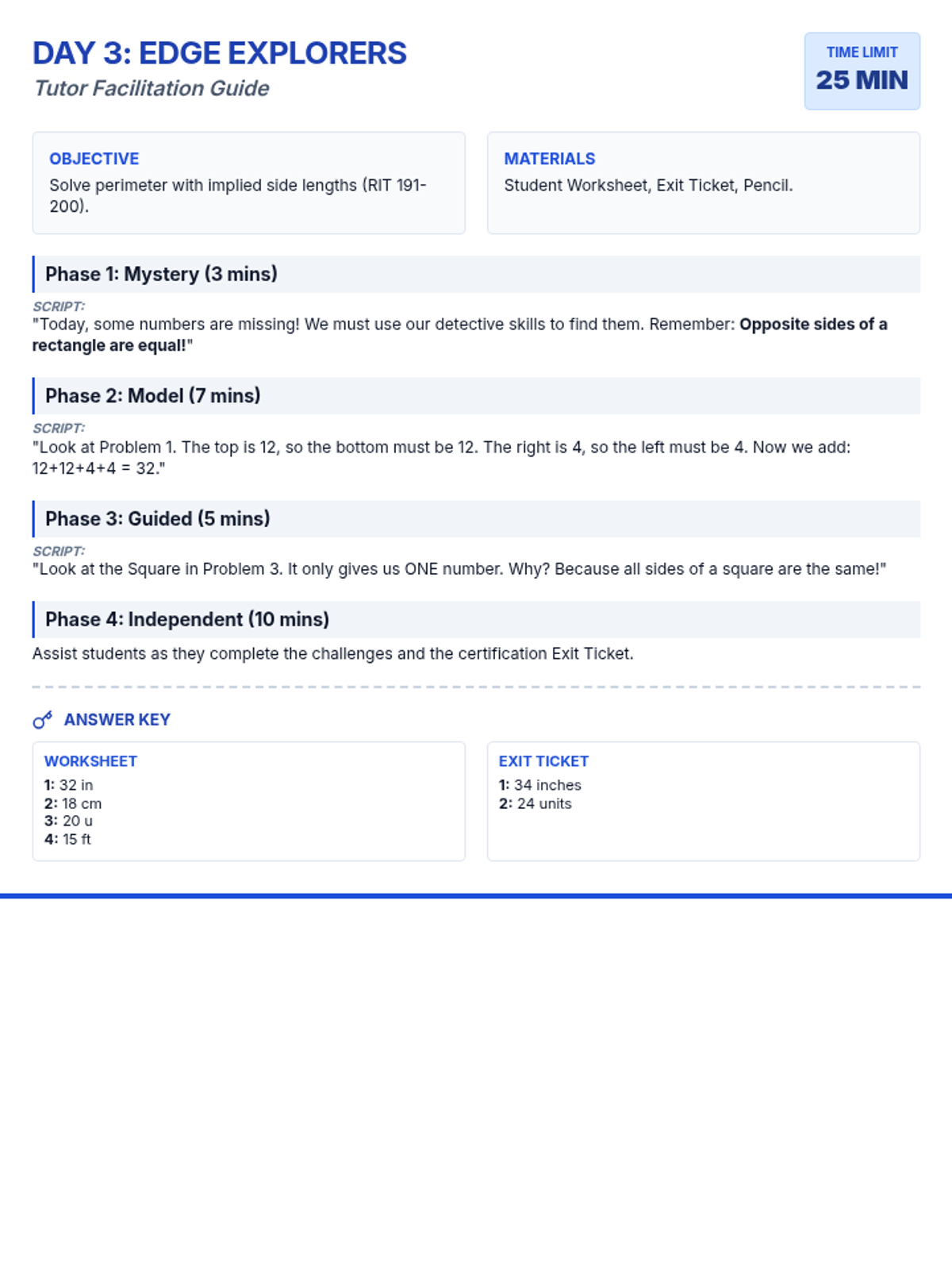
Tutor facilitation guide for Day 3 of the Measure Mastermind sequence, focusing on finding perimeter with implied side lengths in rectangles and regular polygons.
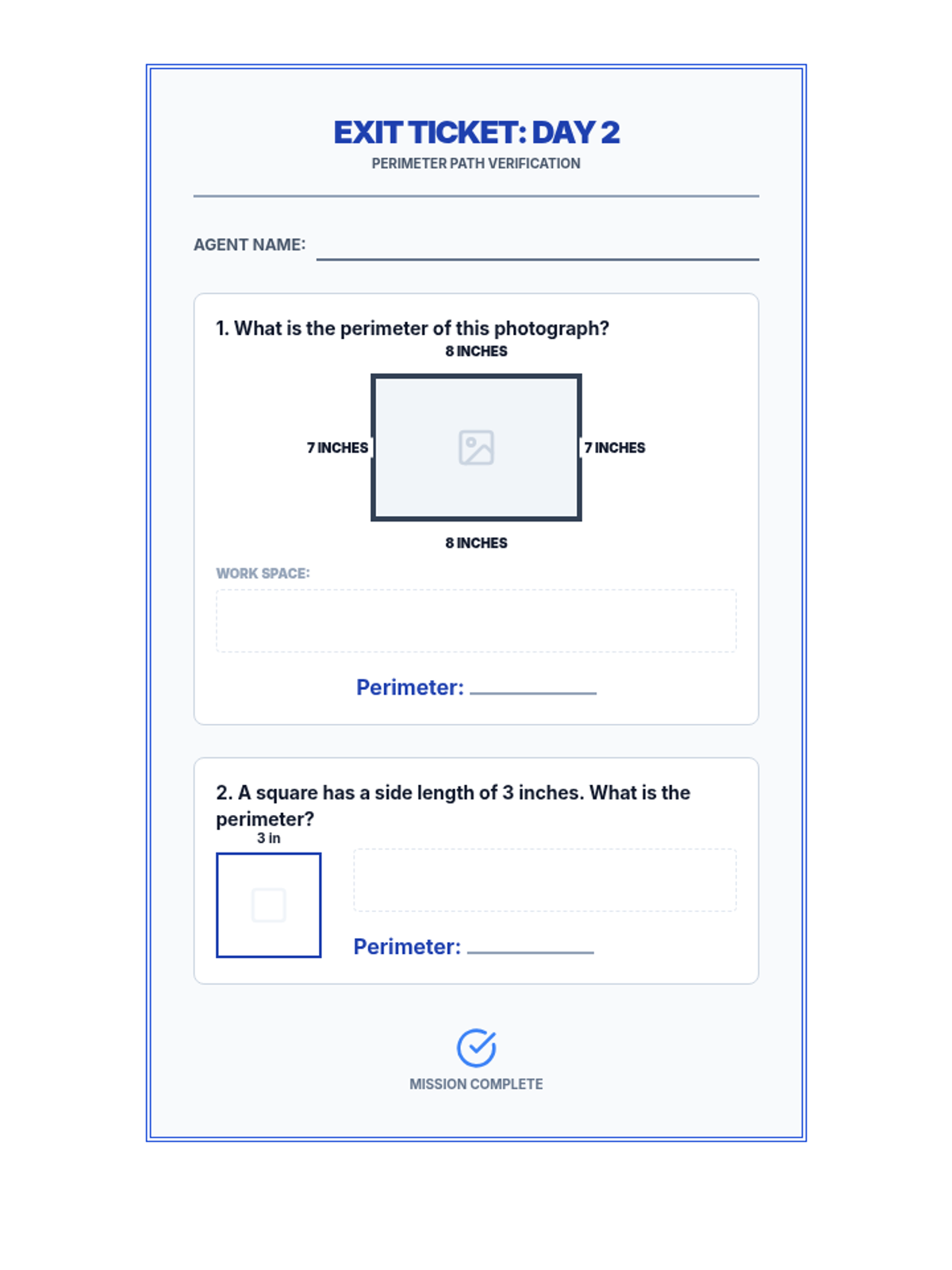
Day 2 exit ticket for the Measure Mastermind sequence, assessing student ability to calculate the perimeter of rectangles and squares.
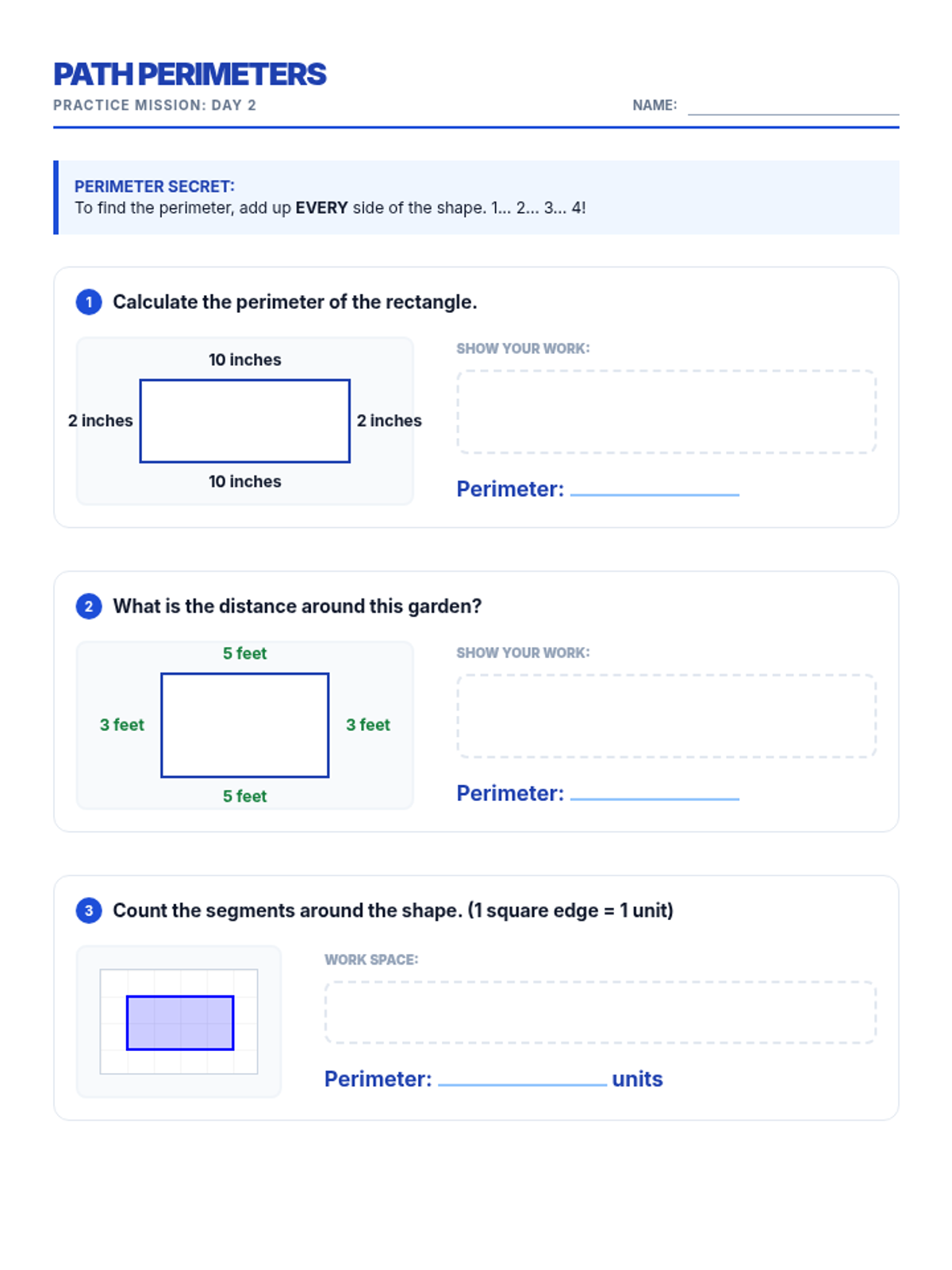
Student practice worksheet for Day 2 of the Measure Mastermind sequence, focused on calculating perimeter by adding all sides of rectangles.
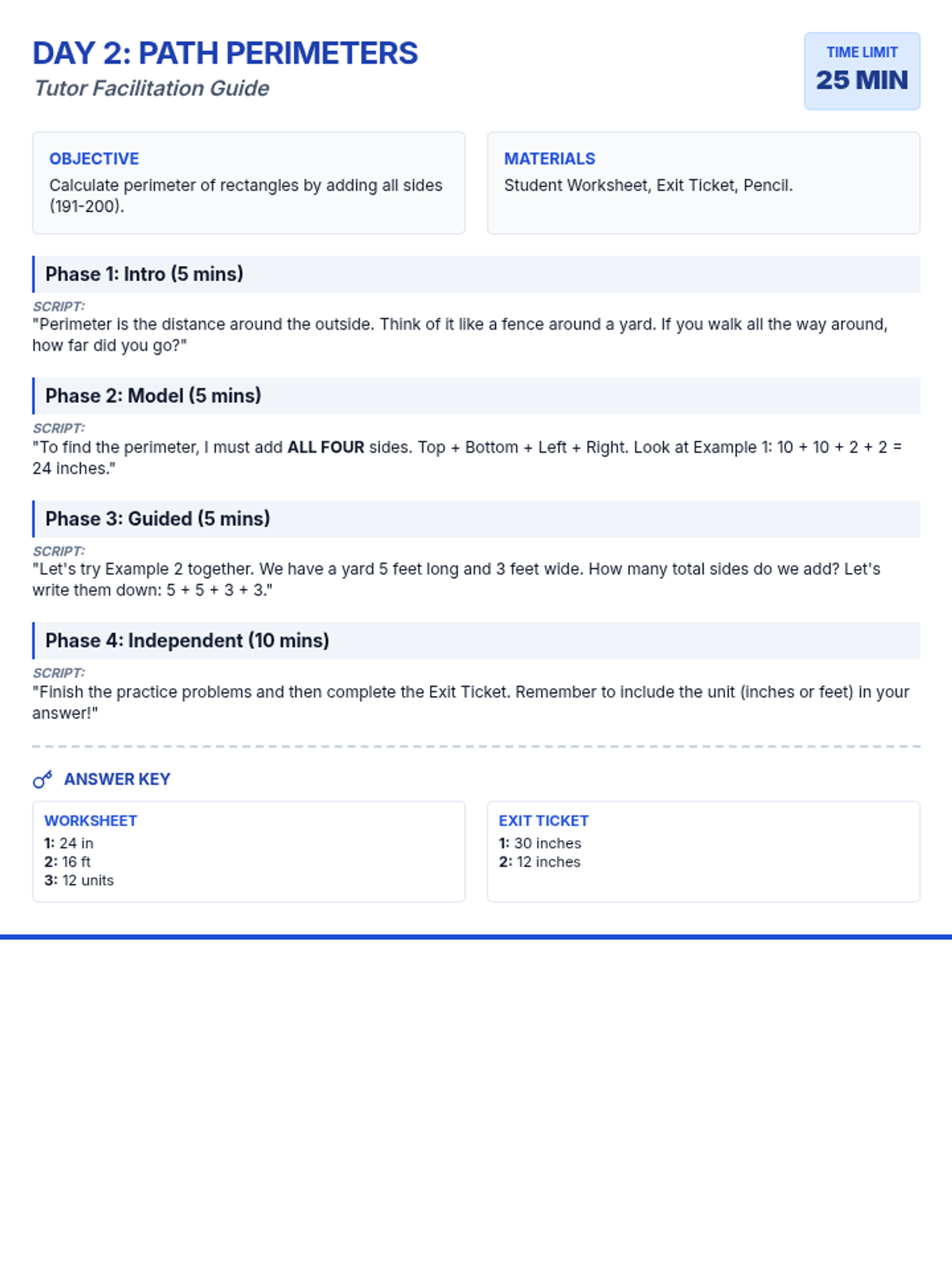
Tutor facilitation guide for Day 2 of the Measure Mastermind sequence, focusing on the fundamentals of perimeter and addition of all sides.
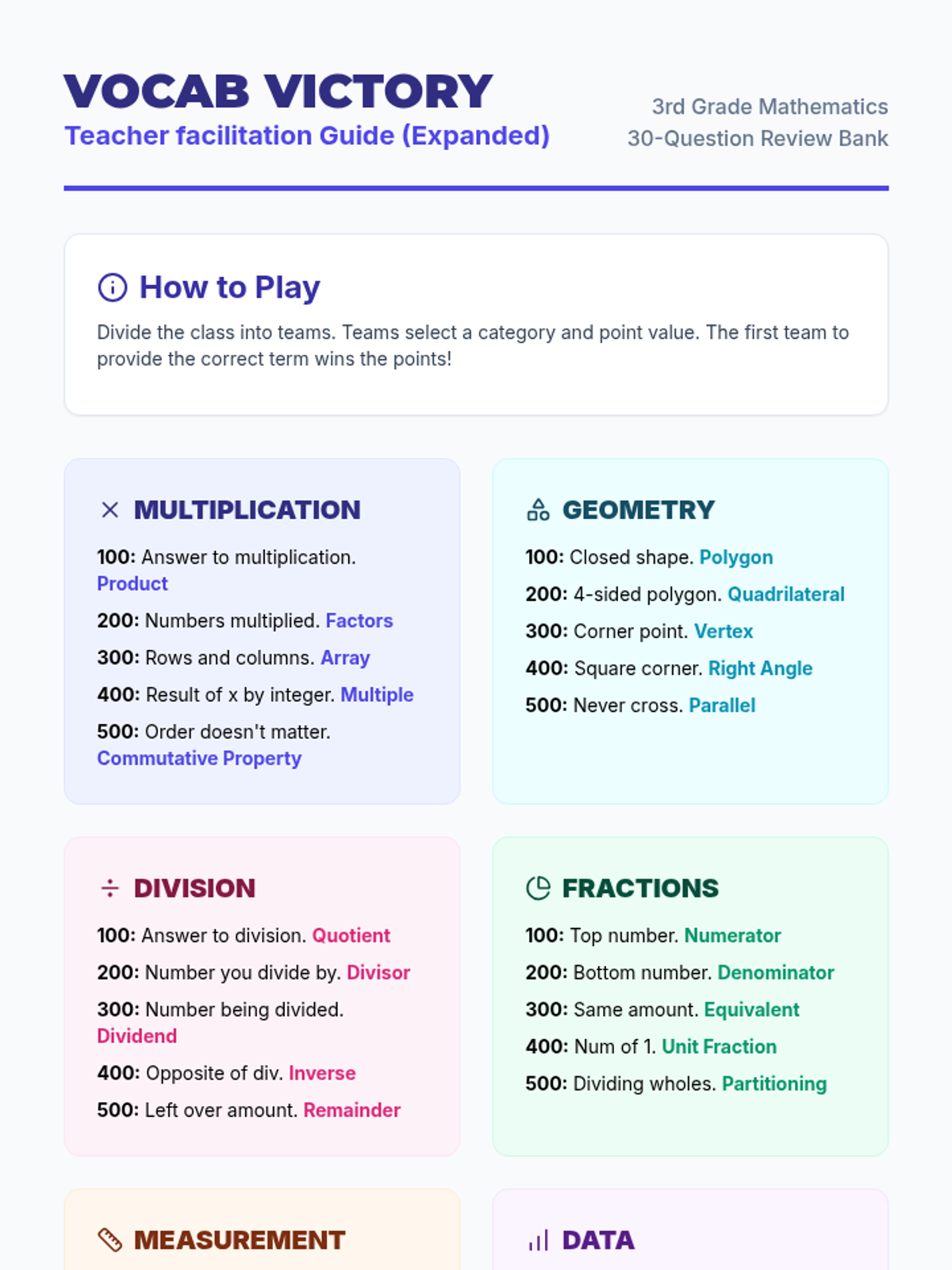
An expanded teacher guide for the math vocabulary game, now including 5 questions per category (total 30 questions) with simplified answer keys and facilitation tips for harder items.
An expanded slide deck for the math vocabulary game, now featuring 30 questions covering multiplication, geometry, division, fractions, measurement, and data in a Jeopardy-style format.
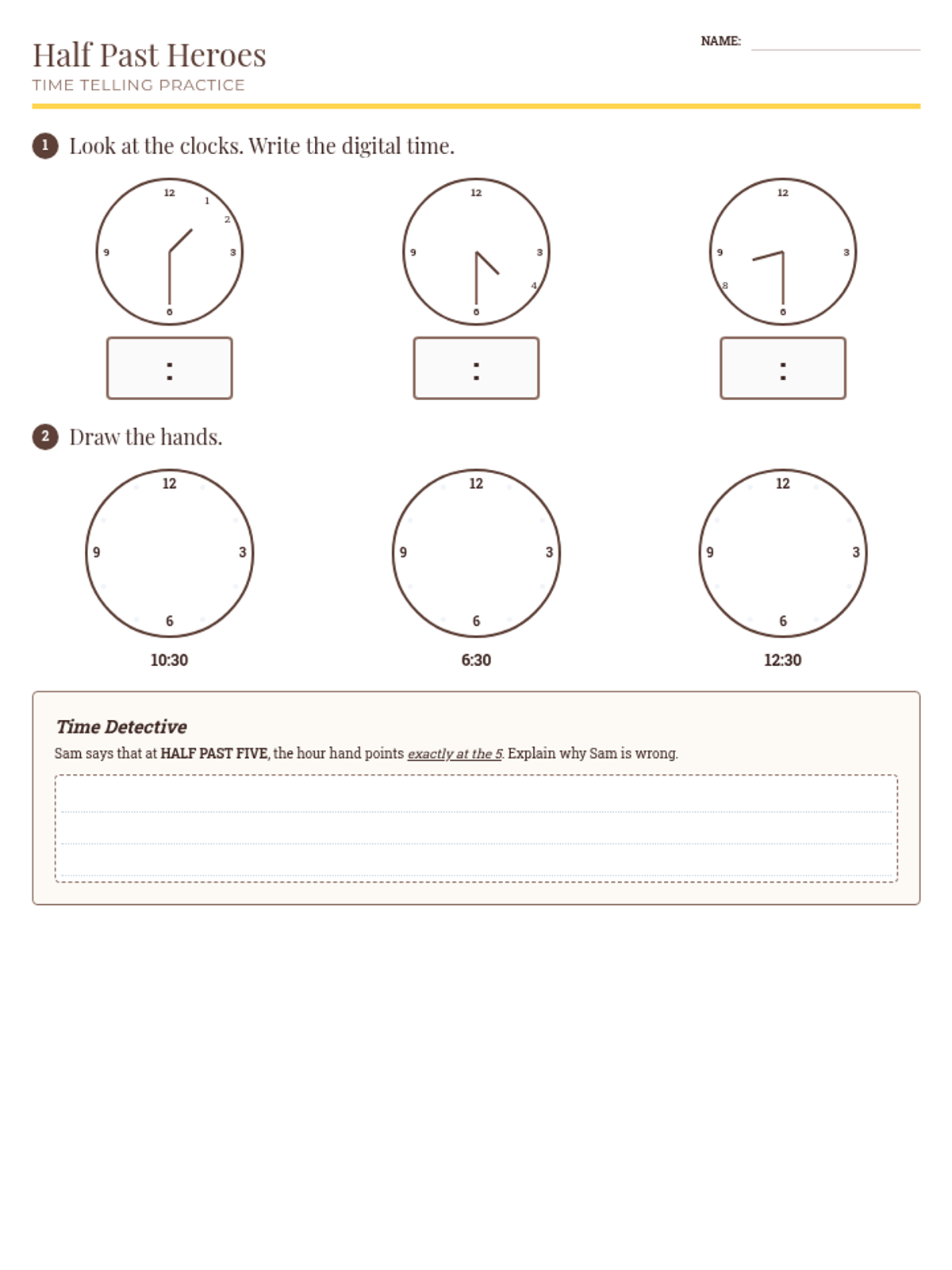
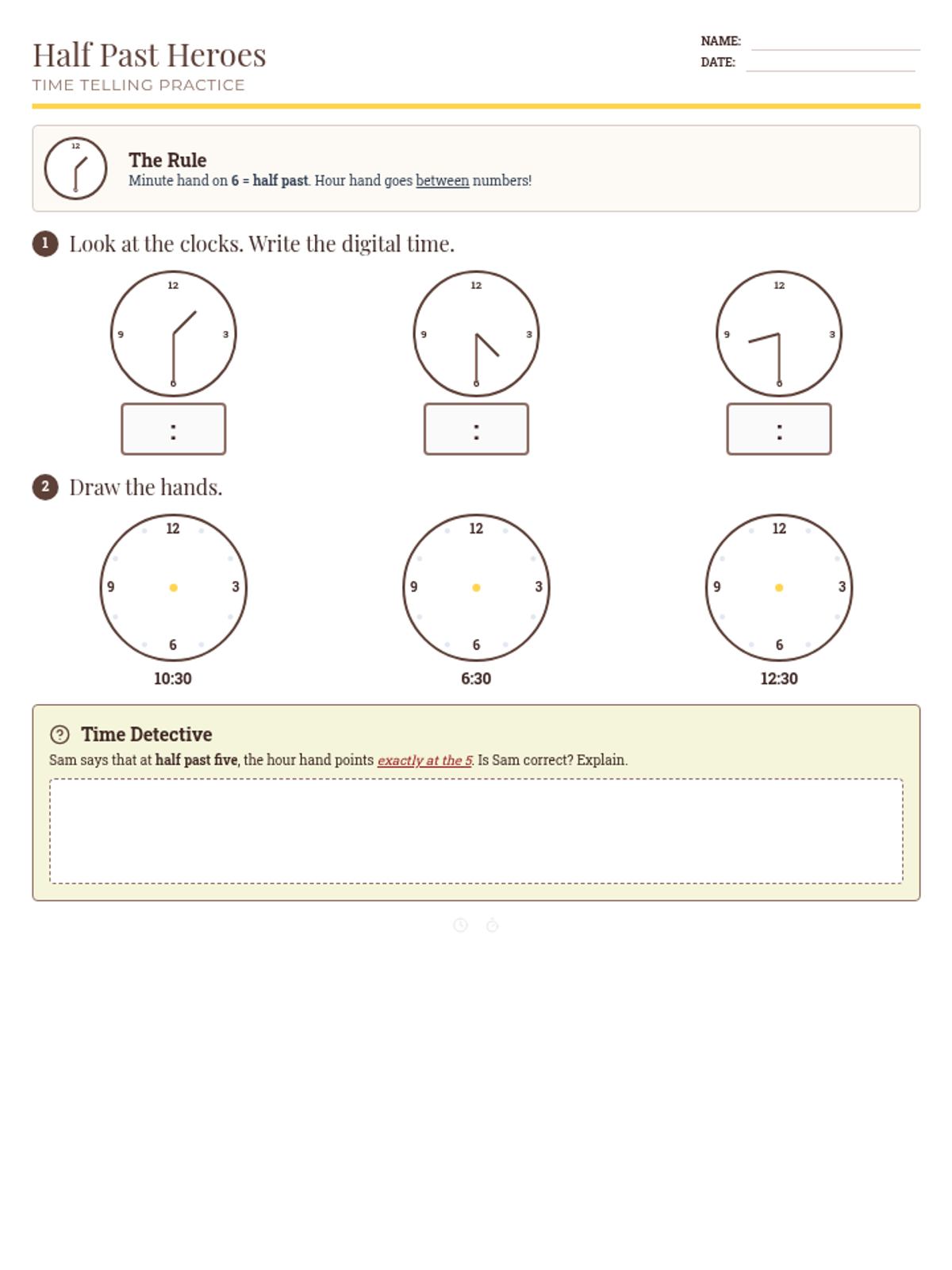
A comprehensive worksheet for students to practice reading and drawing clocks to the half-hour, including digital time conversion and a conceptual reasoning challenge with handwriting support.
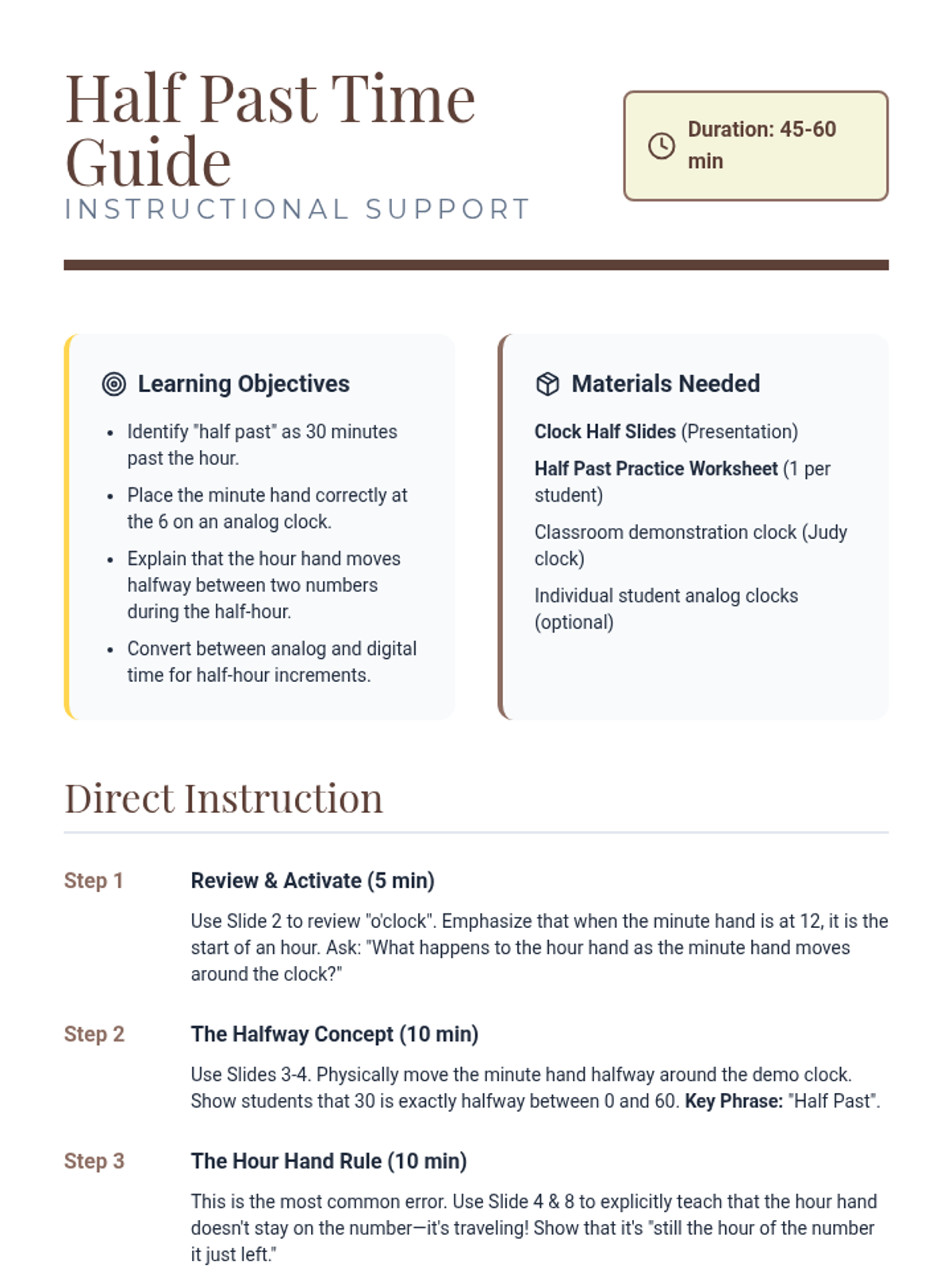
A teacher's facilitation guide containing lesson objectives, step-by-step instructional sequence, common student misconceptions, and a full answer key for the worksheet.
A comprehensive worksheet for students to practice reading and drawing clocks to the half-hour, including digital time conversion and a conceptual reasoning challenge.
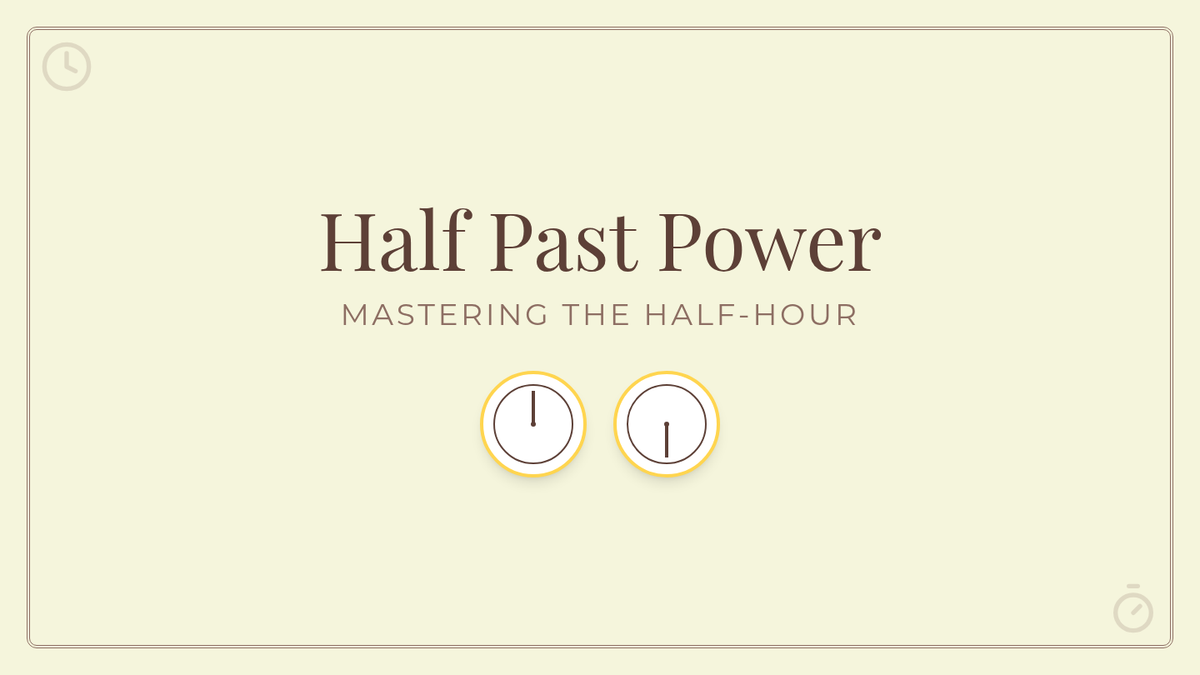
A 7-slide visual presentation introducing the concept of half-past time telling, featuring clear analog and digital comparisons, key rules for the hour hand, and interactive practice challenges. Optimized for visual clarity.
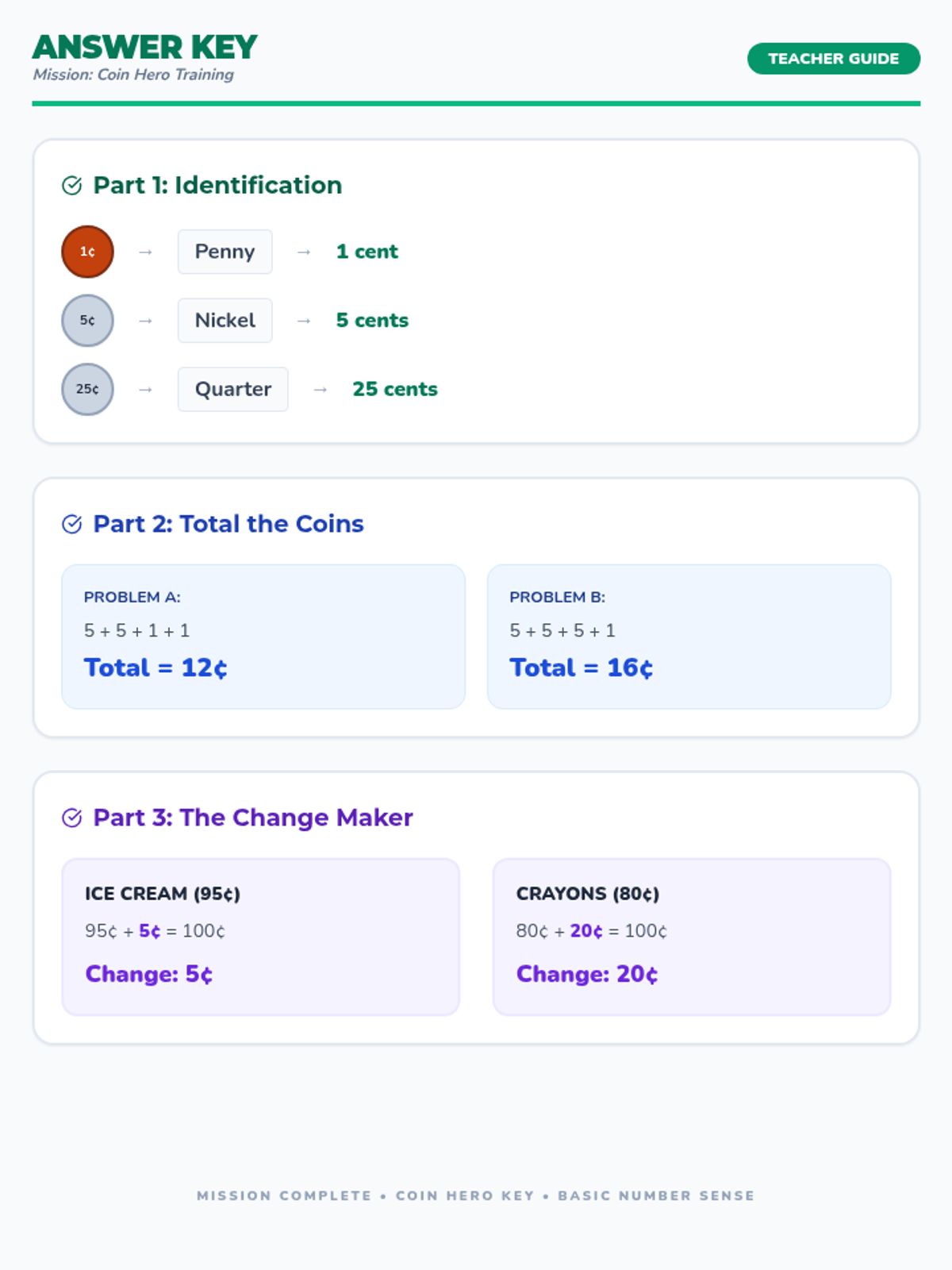
A clear answer key for the Coin Hero Mission practice worksheet. Provides step-by-step counting breakdowns and final answers for identification, total counting, and making change sections.
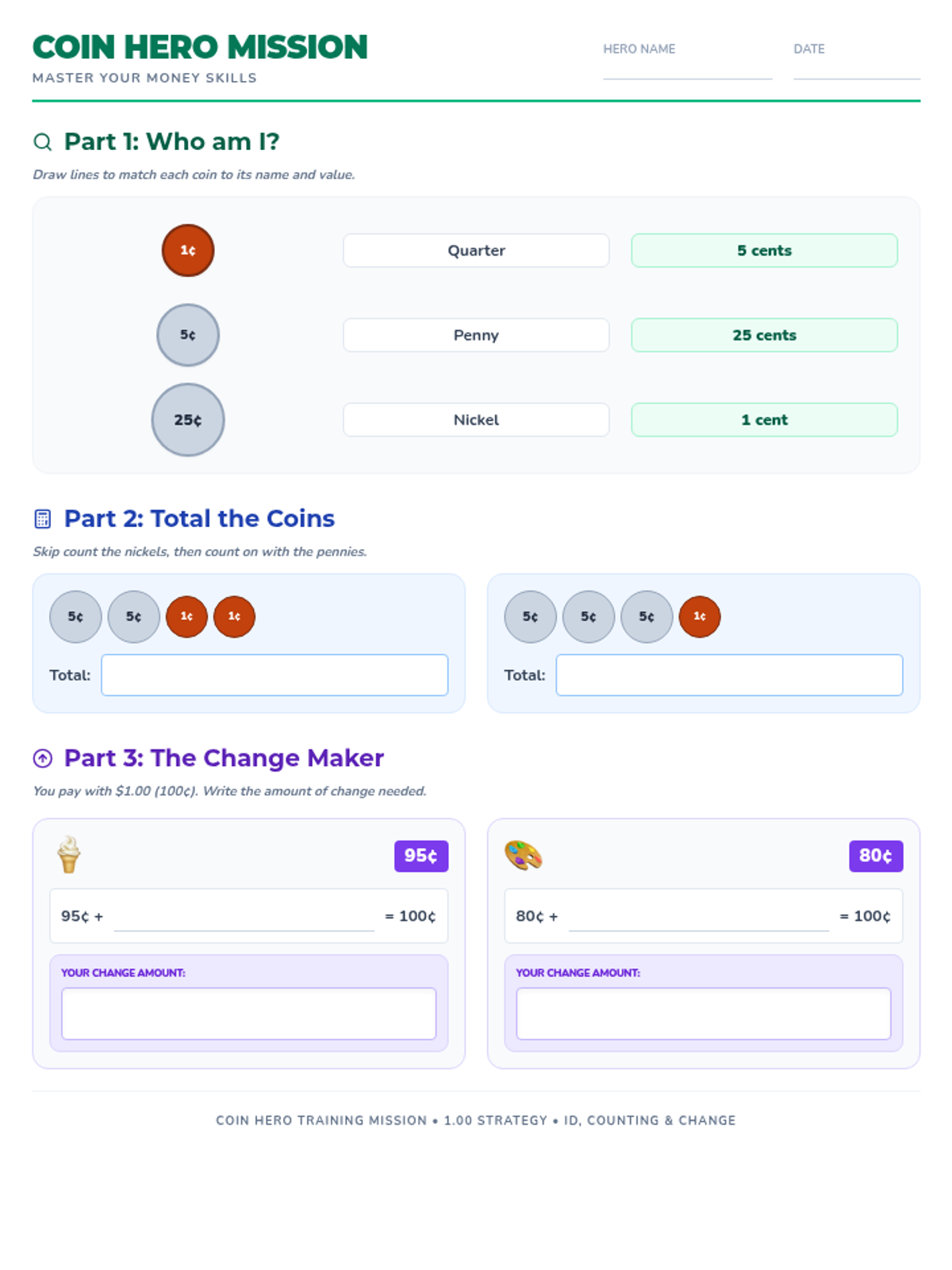
A skill-building worksheet for students to practice coin identification, skip counting with nickels and pennies, and calculating change from a dollar using the 'Counting Up' strategy. Includes visual coin representations and clear work areas.
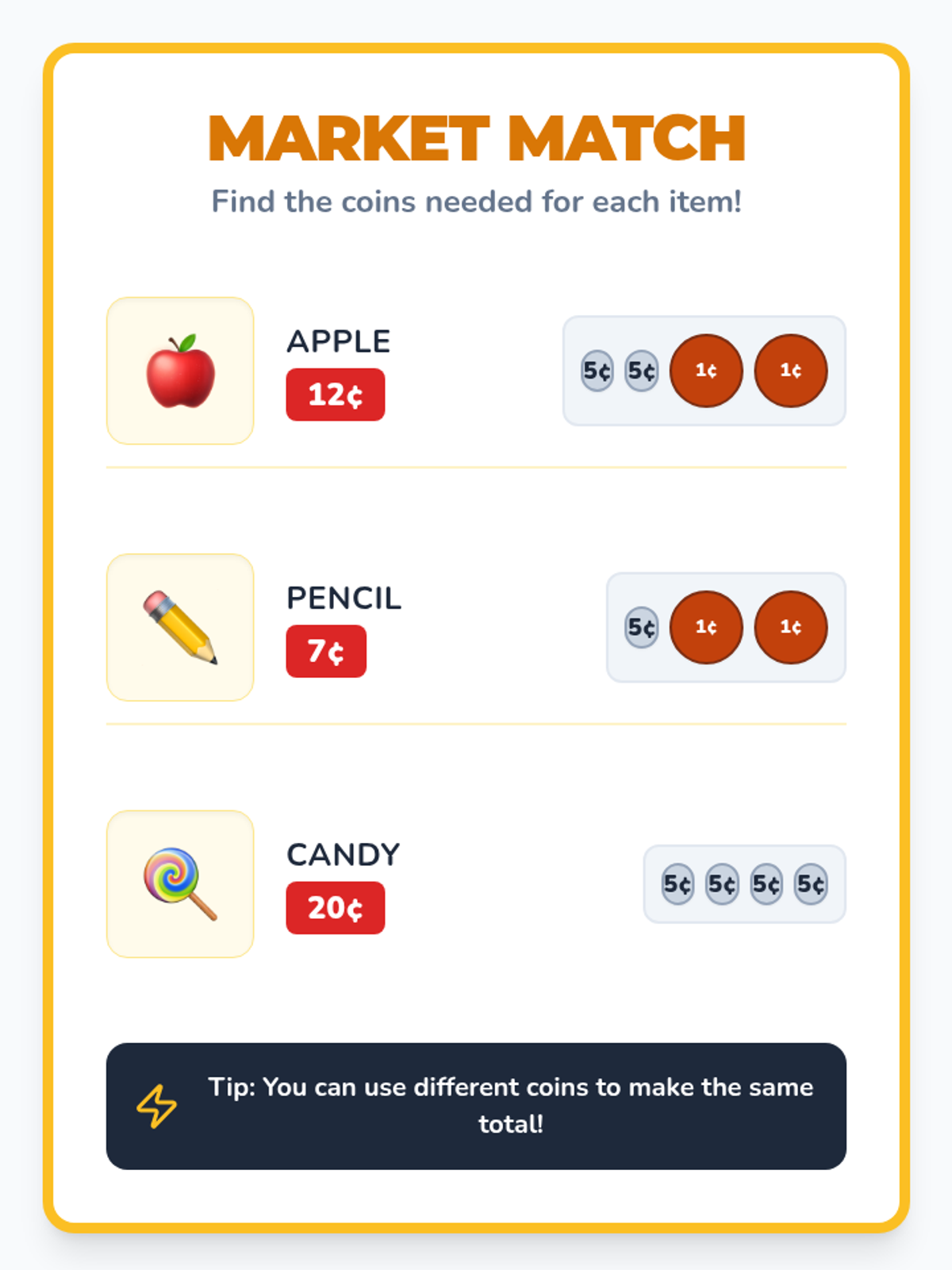
Two large visual anchor charts for classroom display. The first chart, 'Market Match', shows real-world items with price tags and the exact coin combinations needed. The second chart, 'The Change Maker', illustrates the 'Counting Up' strategy for finding change from one dollar using a visual number line and clear steps.
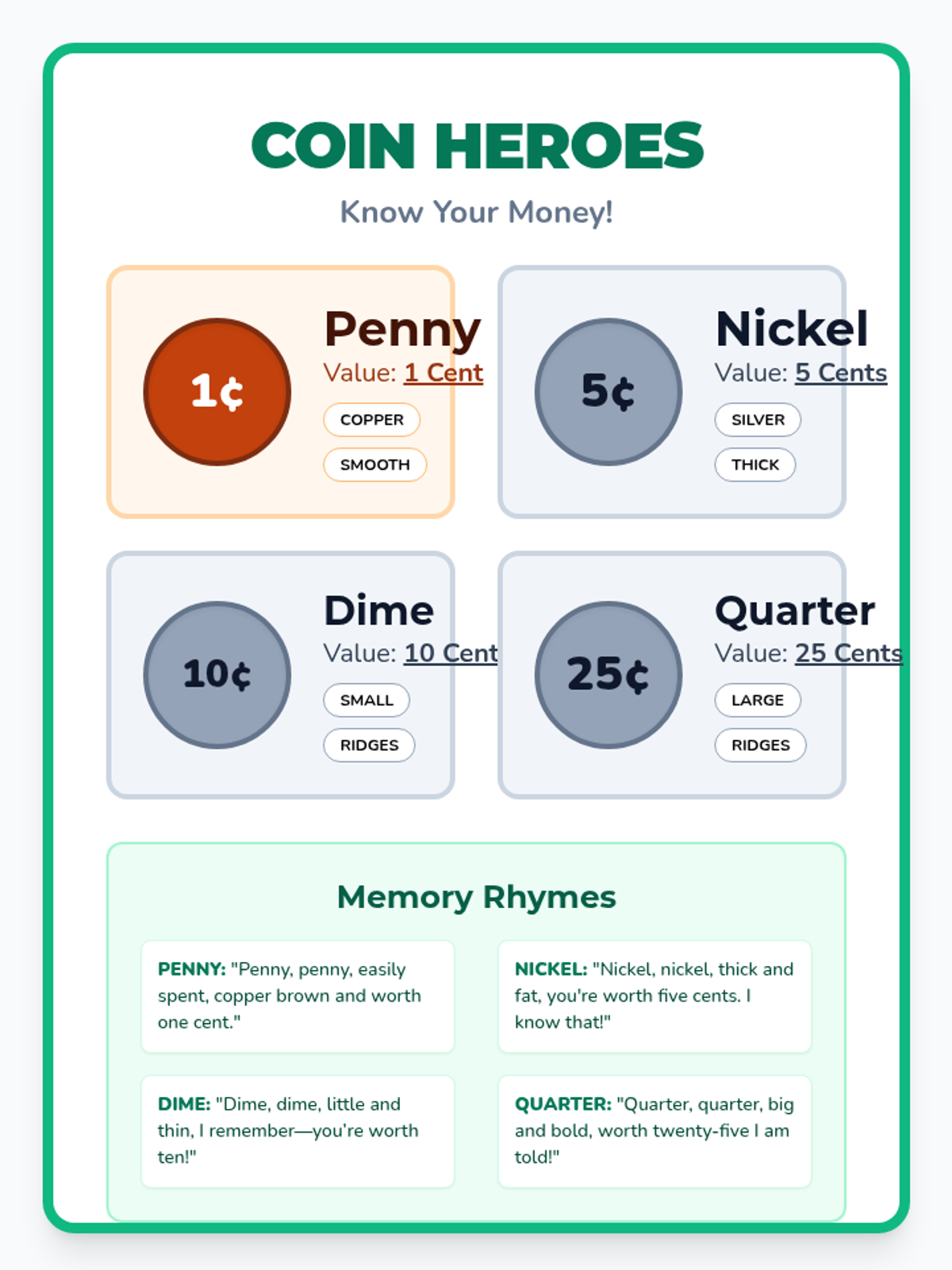
A set of two large visual anchor charts for classroom display. The first chart focuses on identifying coins (Penny, Nickel, Dime, Quarter) with names, values, and memory rhymes. The second chart provides a visual step-by-step guide for skip counting nickels and pennies to find a total value.
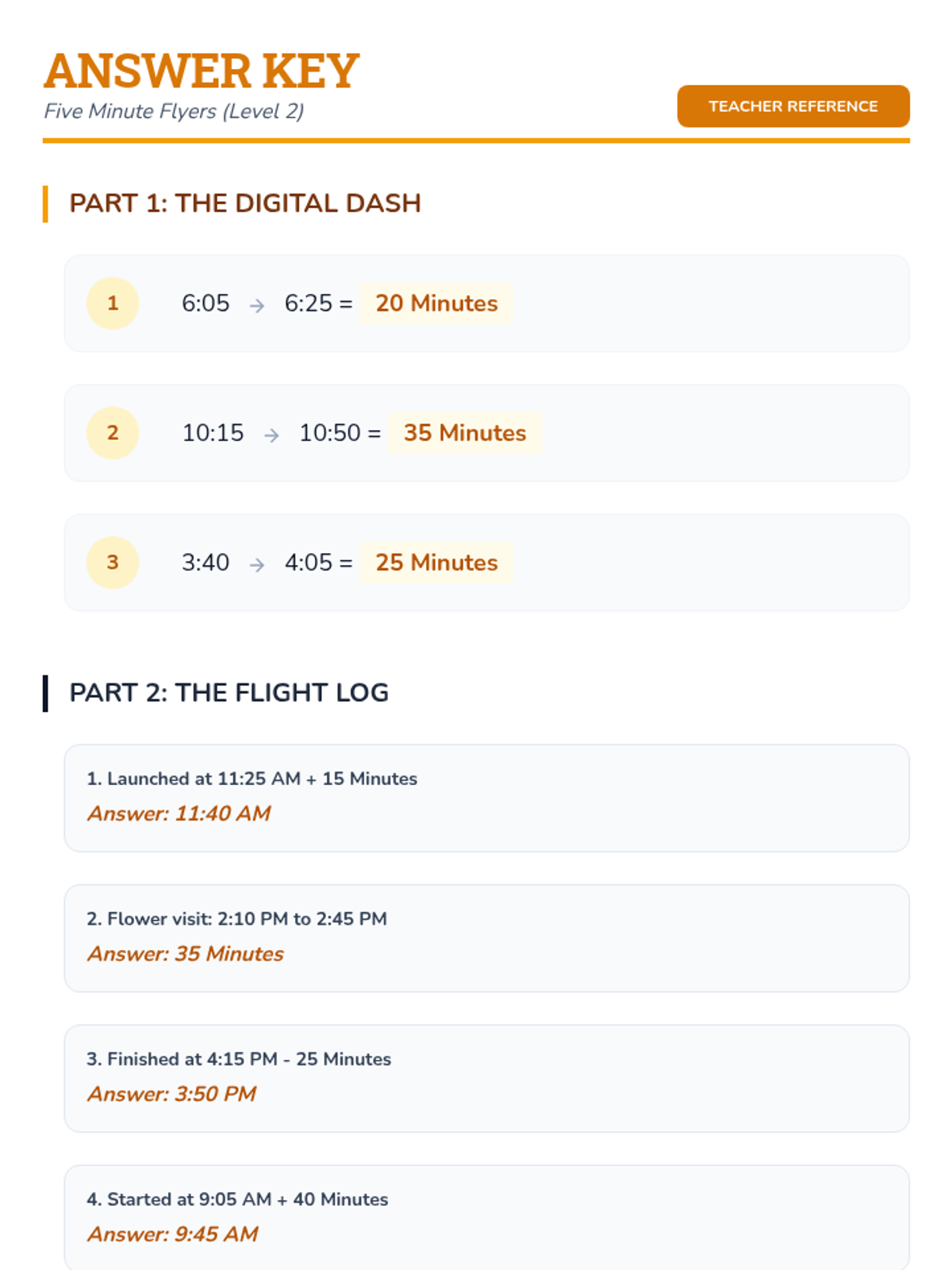
An answer key for the Five Minute Flyers worksheet, providing solutions for elapsed time problems in 5-minute increments.
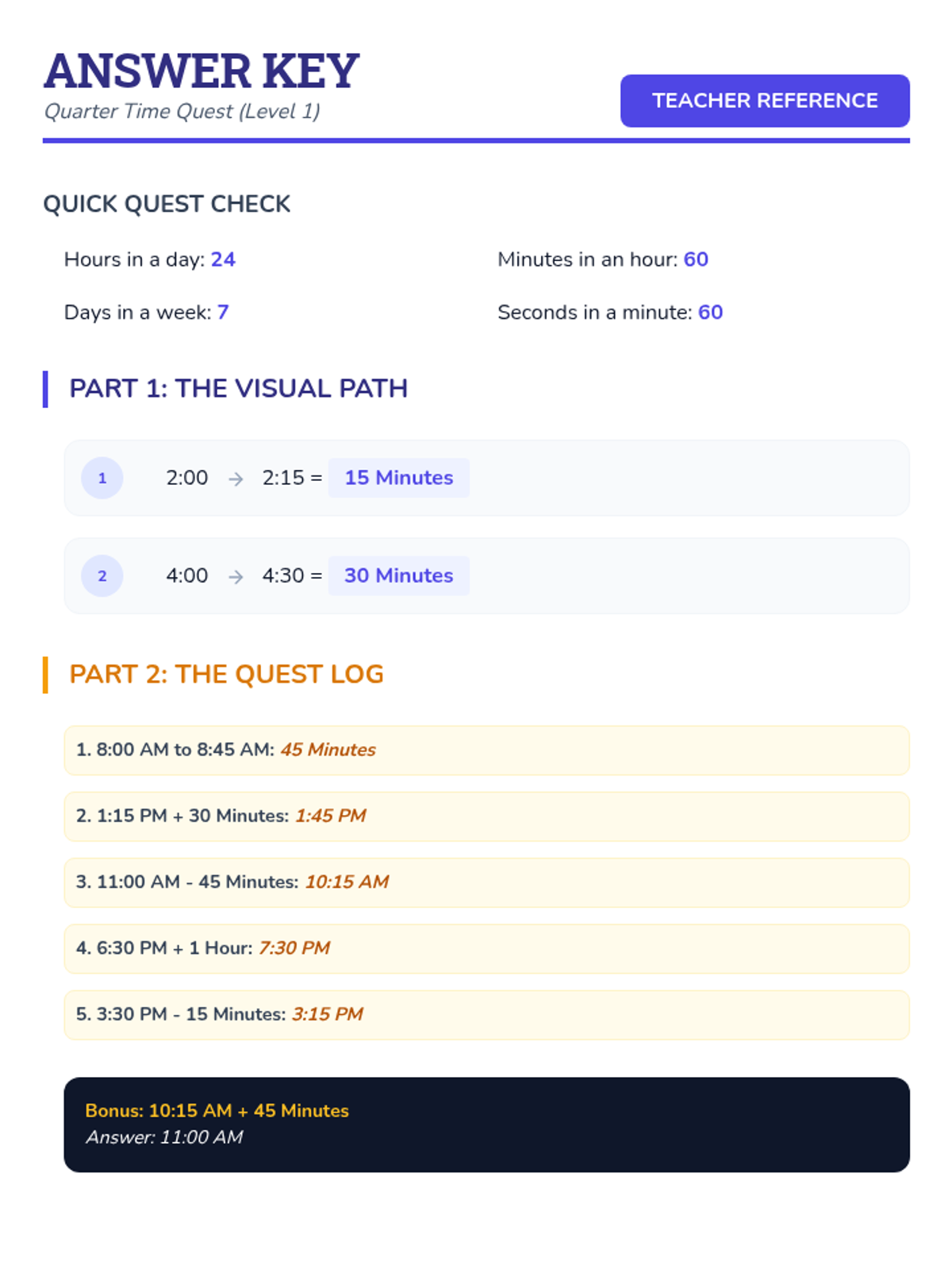
An answer key for the Quarter Time Quest worksheet, providing solutions for elapsed time problems in 15-minute increments.
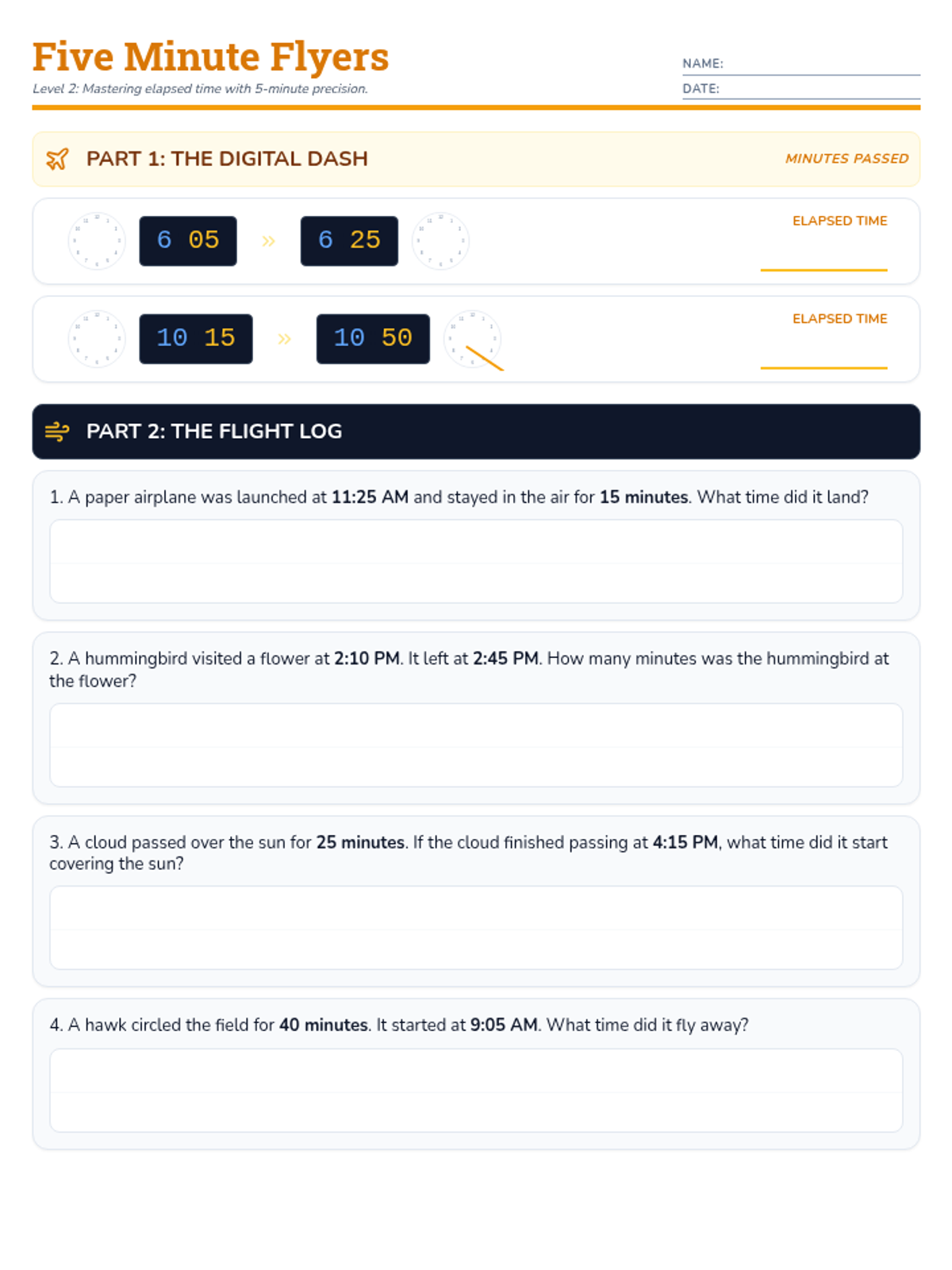
A Level 2 worksheet centered on calculating elapsed time in 5-minute increments. Features visual clock support with all 12 numbers and flight-themed word problems.
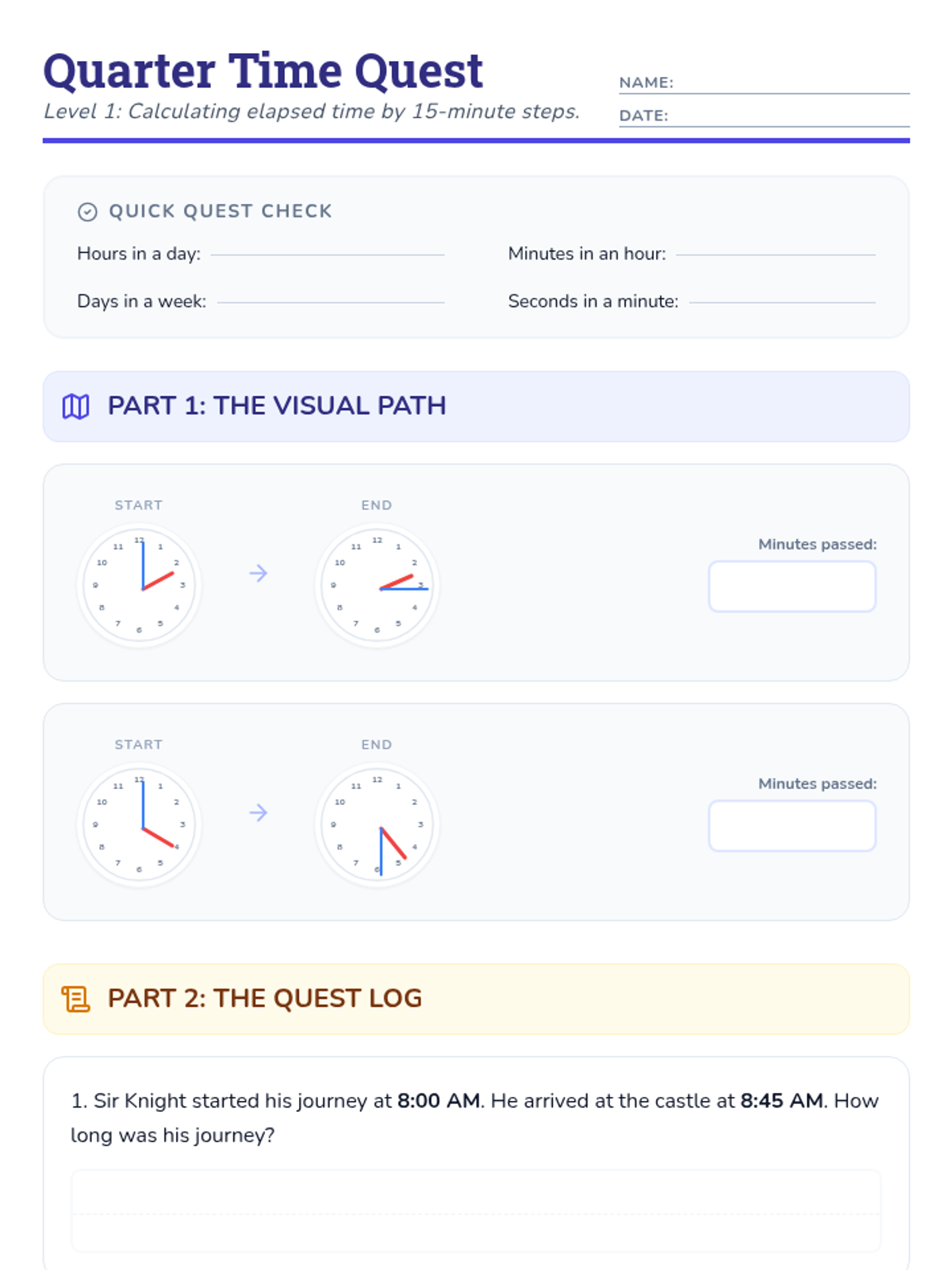
A Level 1 worksheet focused on calculating elapsed time in 15-minute increments. Includes visual clock comparisons with all numbers 1-12 and thematic word problems.
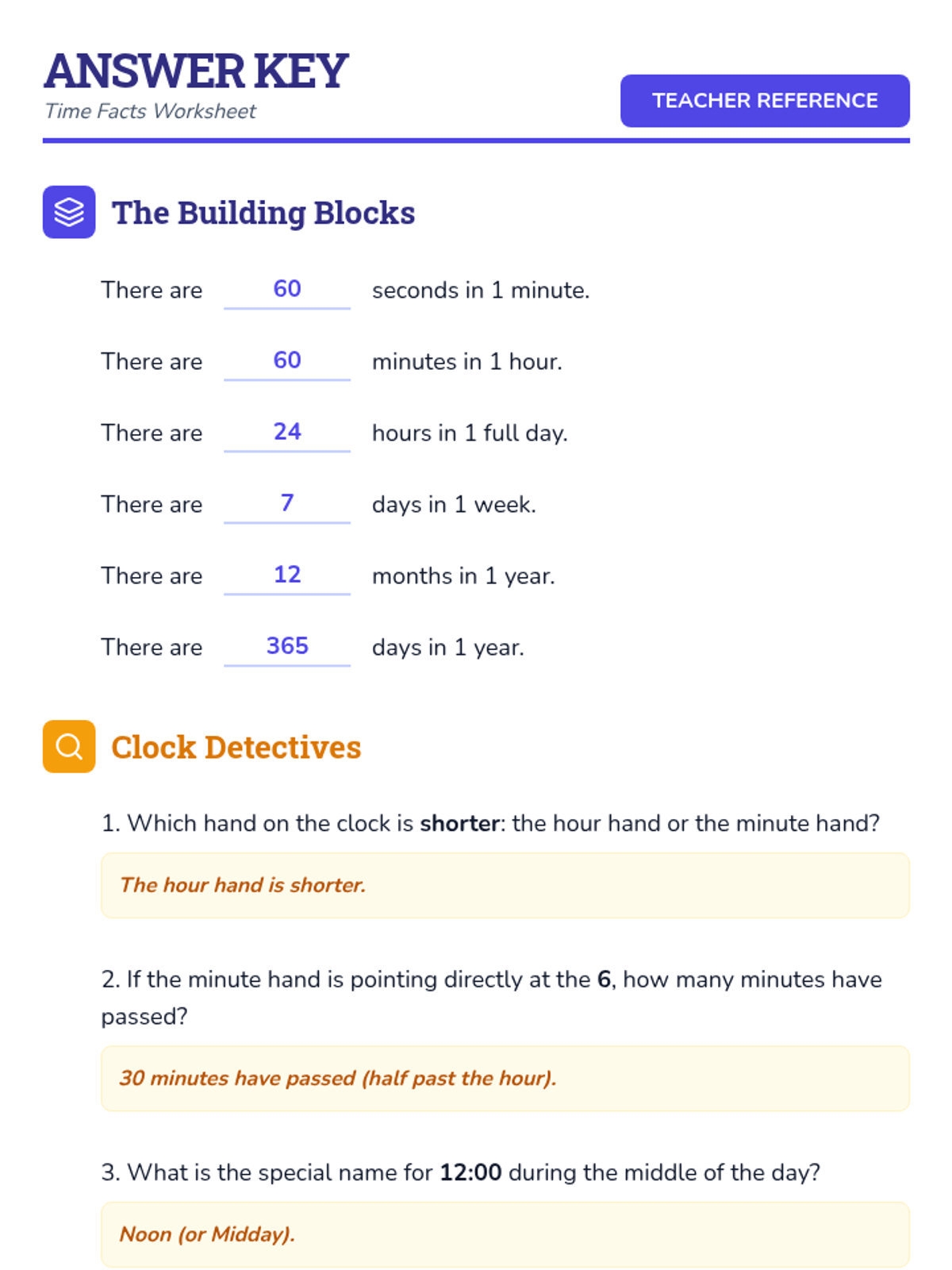
An answer key for the Time Facts Worksheet, providing correct answers for basic time units, clock anatomy, and the conceptual time challenge.
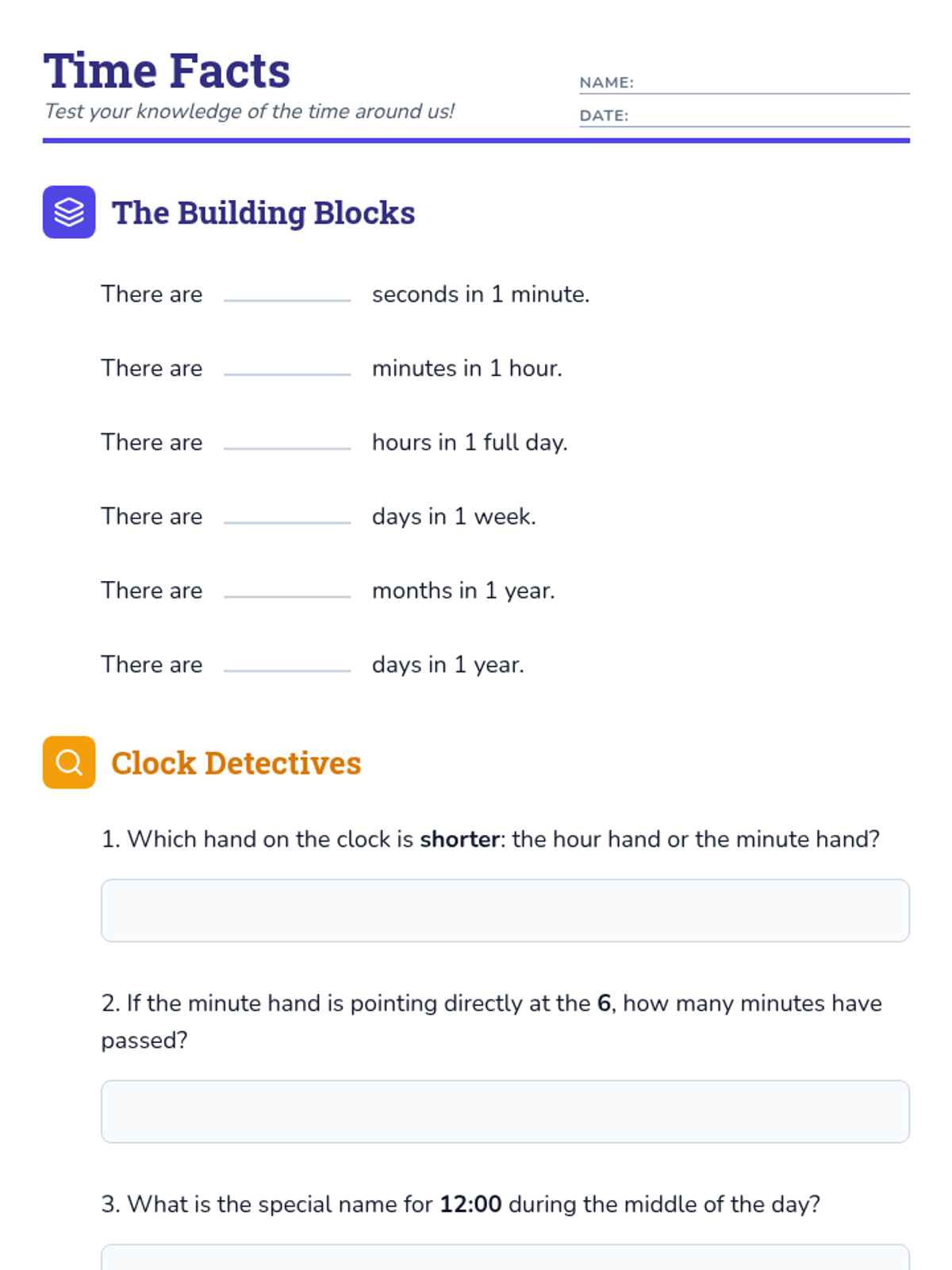
A conceptual worksheet covering basic time facts, including units of time (seconds, minutes, hours, days, weeks, years) and functional clock knowledge. Includes fill-in-the-blank and short explanation questions.
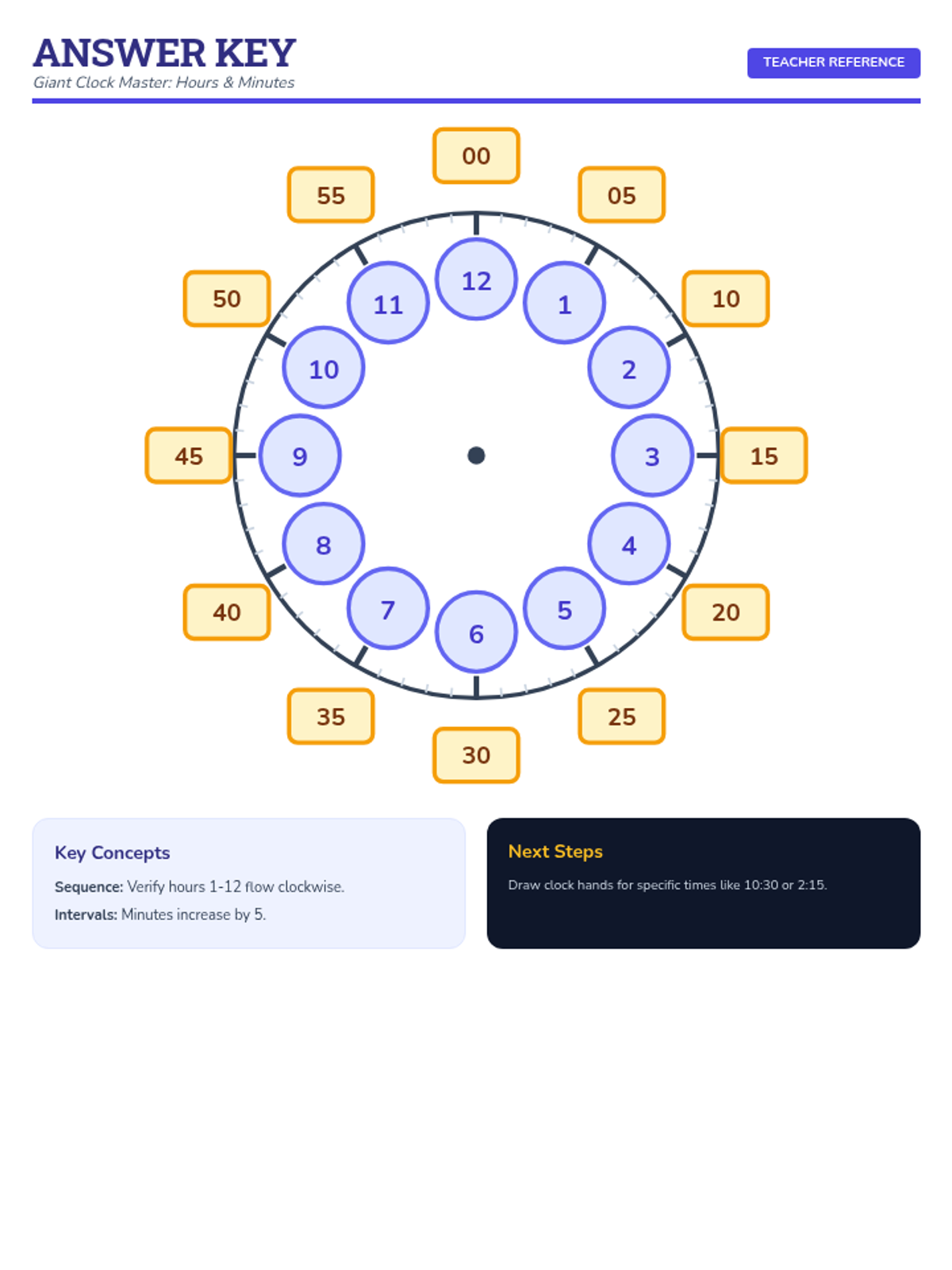
An answer key for the Giant Clock Worksheet, providing a clearly labeled example of all hour and minute positions. Includes key concepts and next step suggestions for teachers.
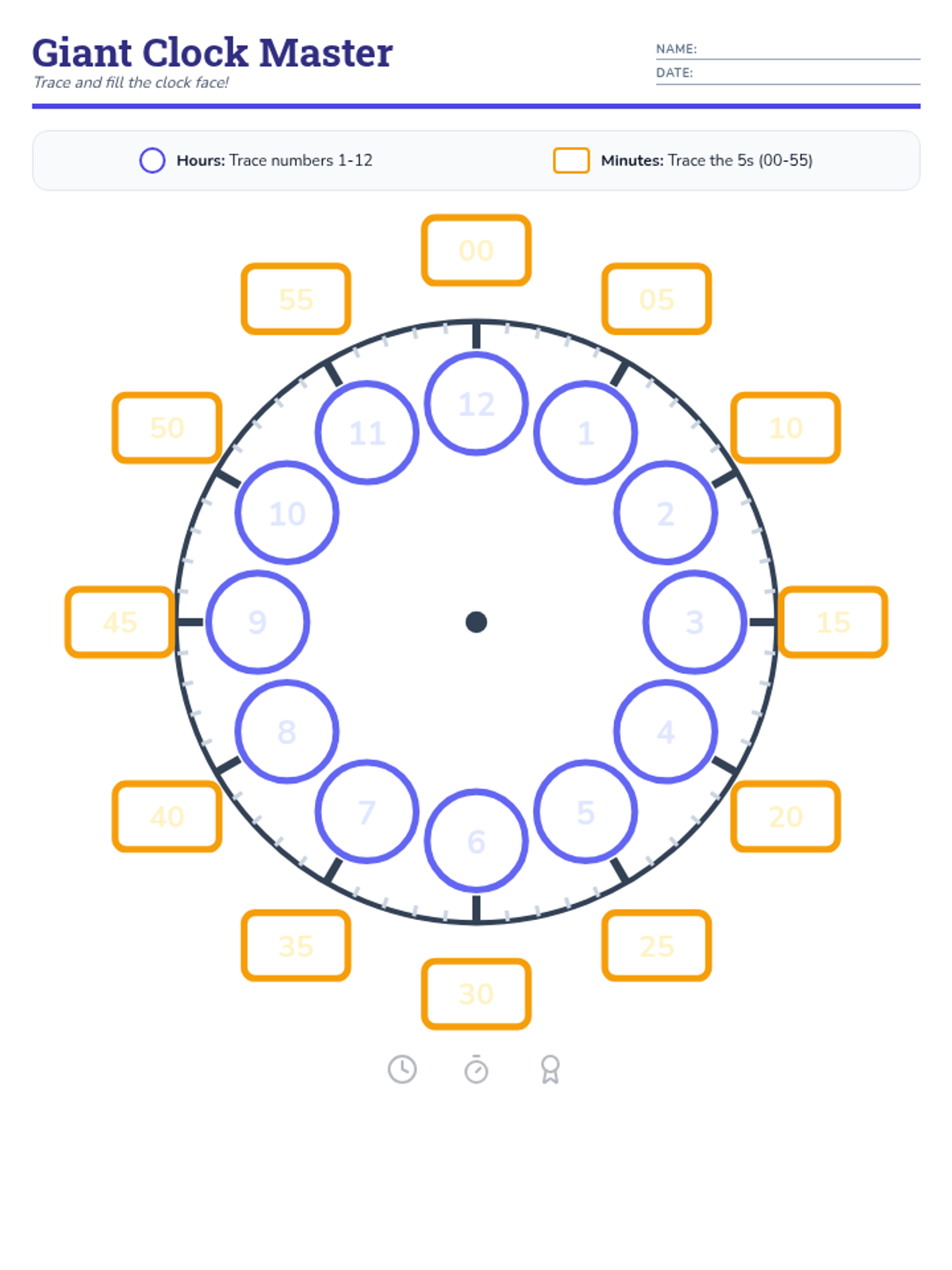
A full-page clock worksheet featuring one large clock face. Students fill in the 12 hour circles and 12 five-minute increment boxes, perfect for initial instruction or detailed practice.
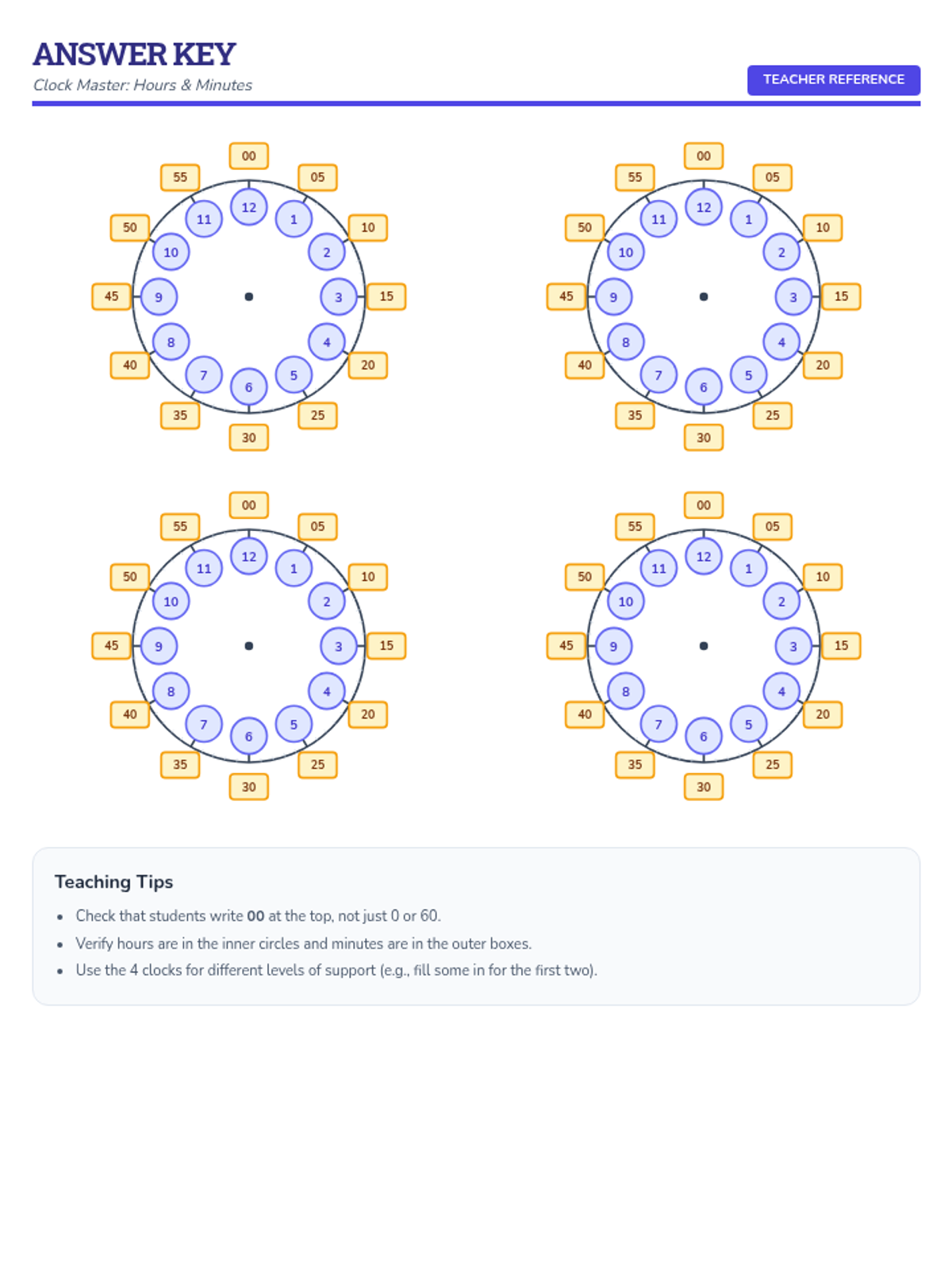
An answer key for the Clock Master Worksheet, displaying the correct placement of all 12 hours and 5-minute increments. Includes teaching tips for instruction.
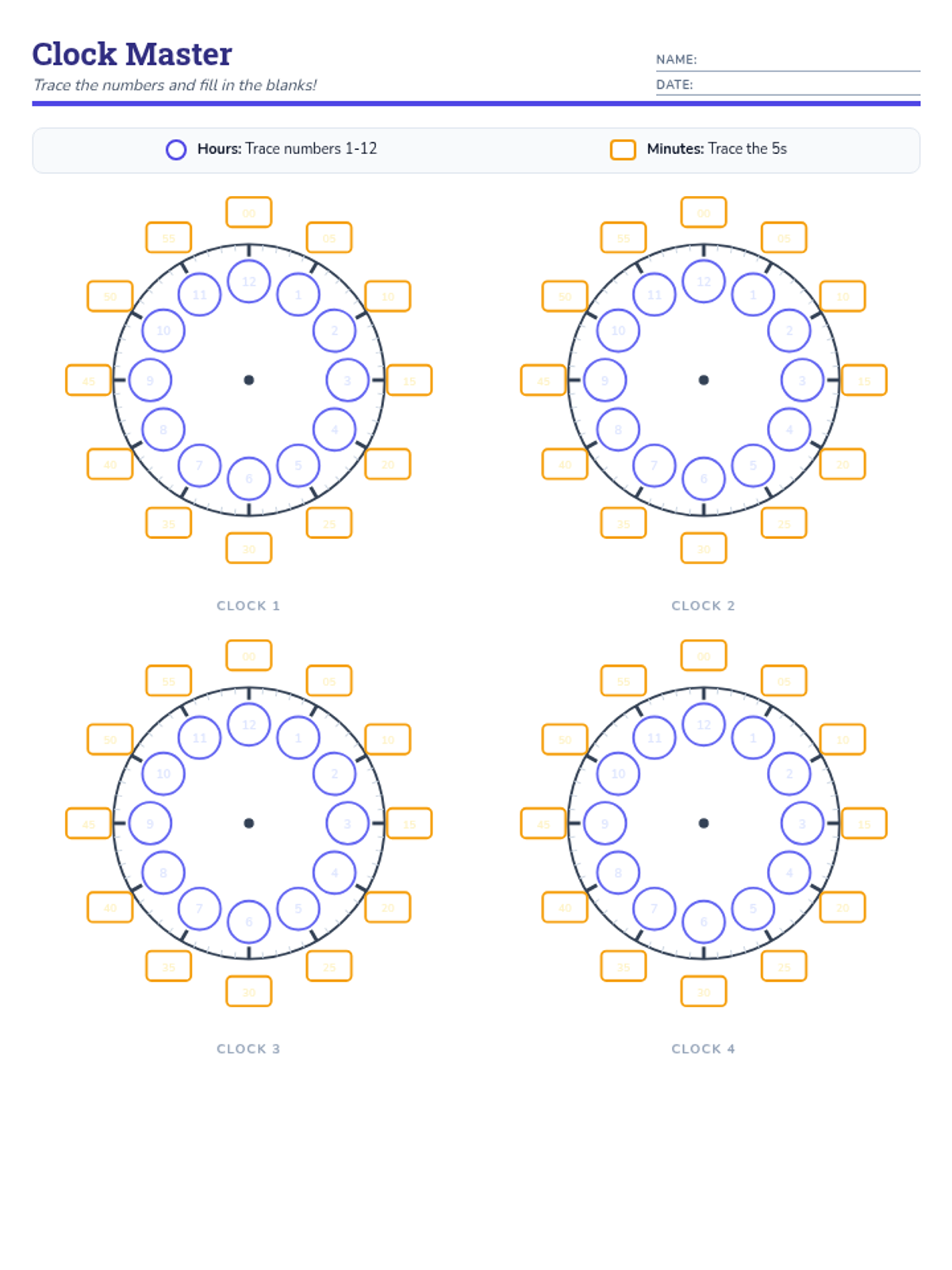
A practice worksheet with four clock faces on a single page. Students fill in color-coded hour circles and enlarged minute boxes to learn clock anatomy and five-minute intervals.
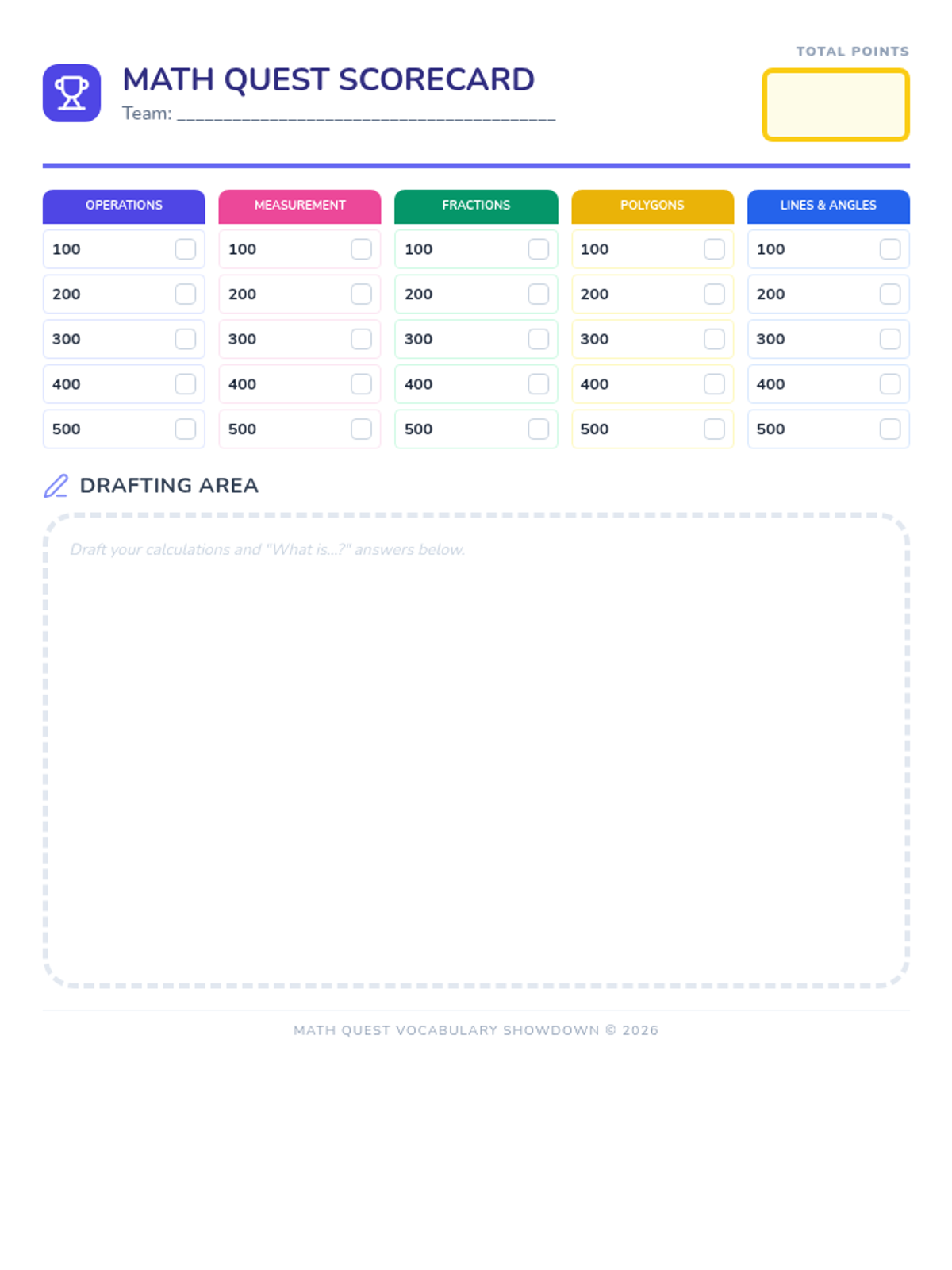
A student recording sheet for the Math Quest game, updated with new 'Operations', 'Polygons', and 'Lines & Angles' categories. Includes a large drafting area for student work.
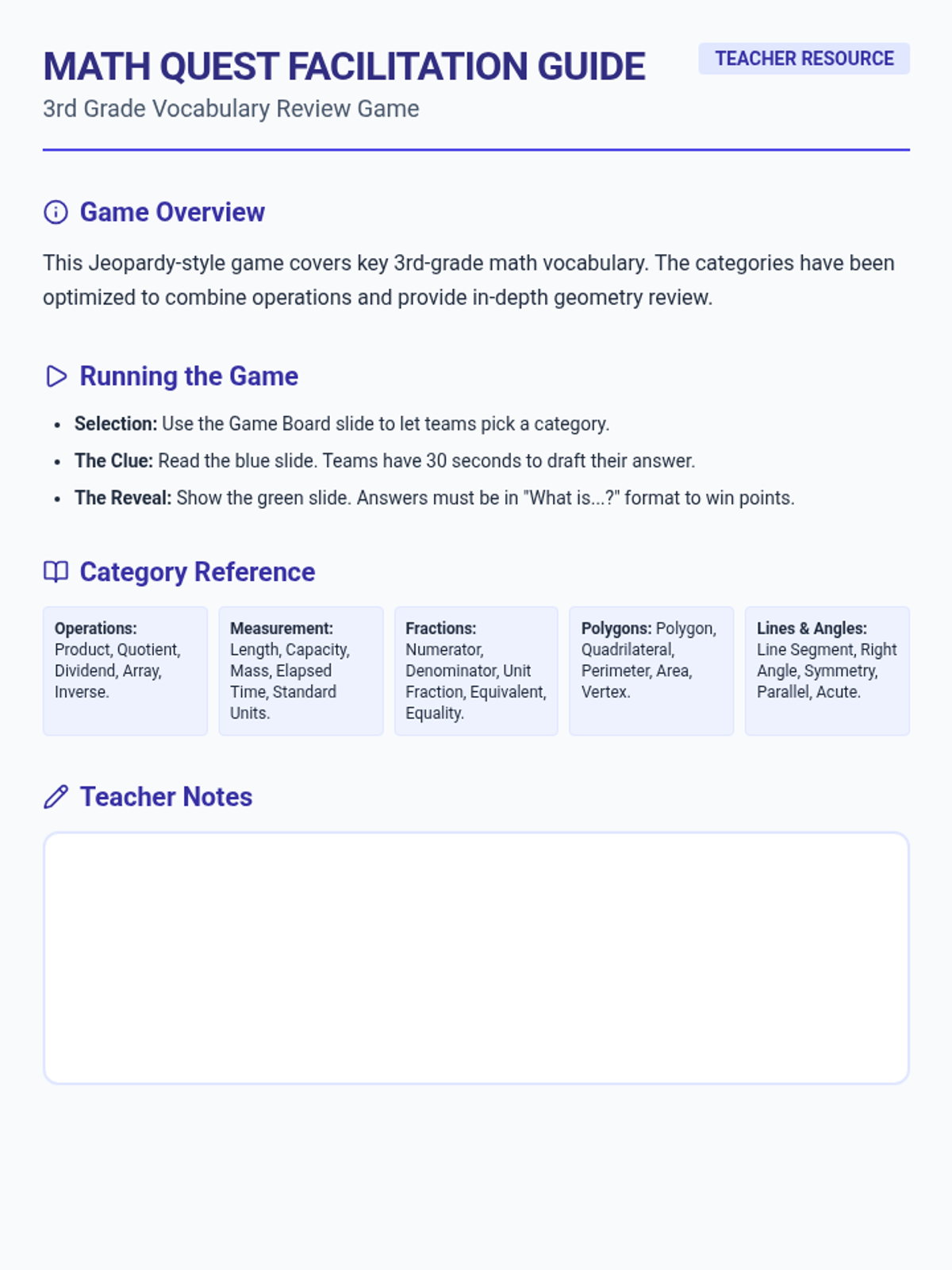
A teacher's facilitation guide for running the Math Quest vocabulary game, updated with new category descriptions and a streamlined question reference.
A colorful and engaging 59-slide Jeopardy-style presentation for 3rd-grade math vocabulary. Now features a collapsed 'Operations' category and expanded 'Geometry' categories for Polygons and Lines/Angles.
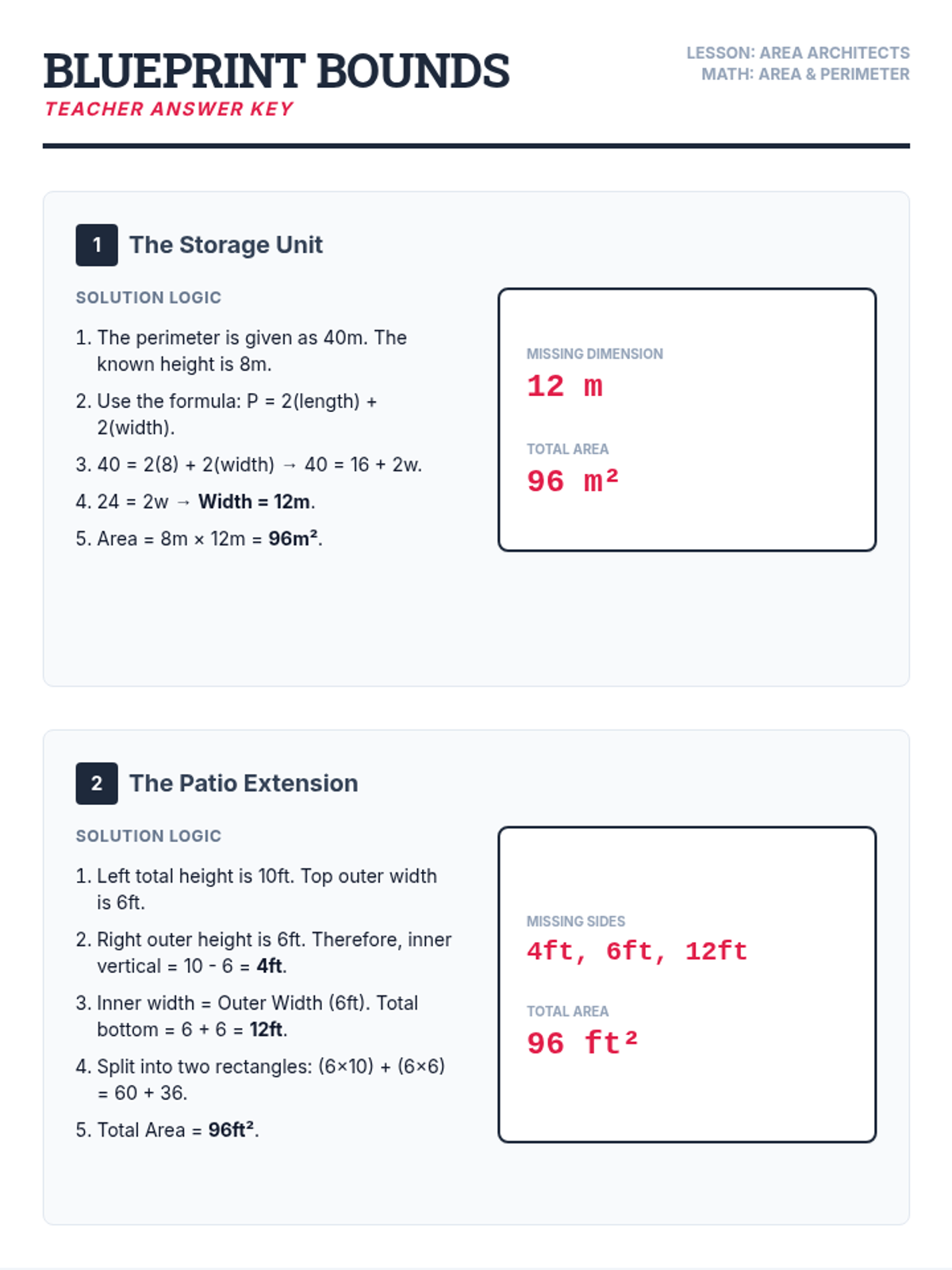
A detailed teacher answer key for the Blueprint Bounds Exit Ticket. It provides definitive step-by-step logic and clear final answers for all 10 problems. All logic has been verified for mathematical consistency based on the updated exit ticket diagrams.
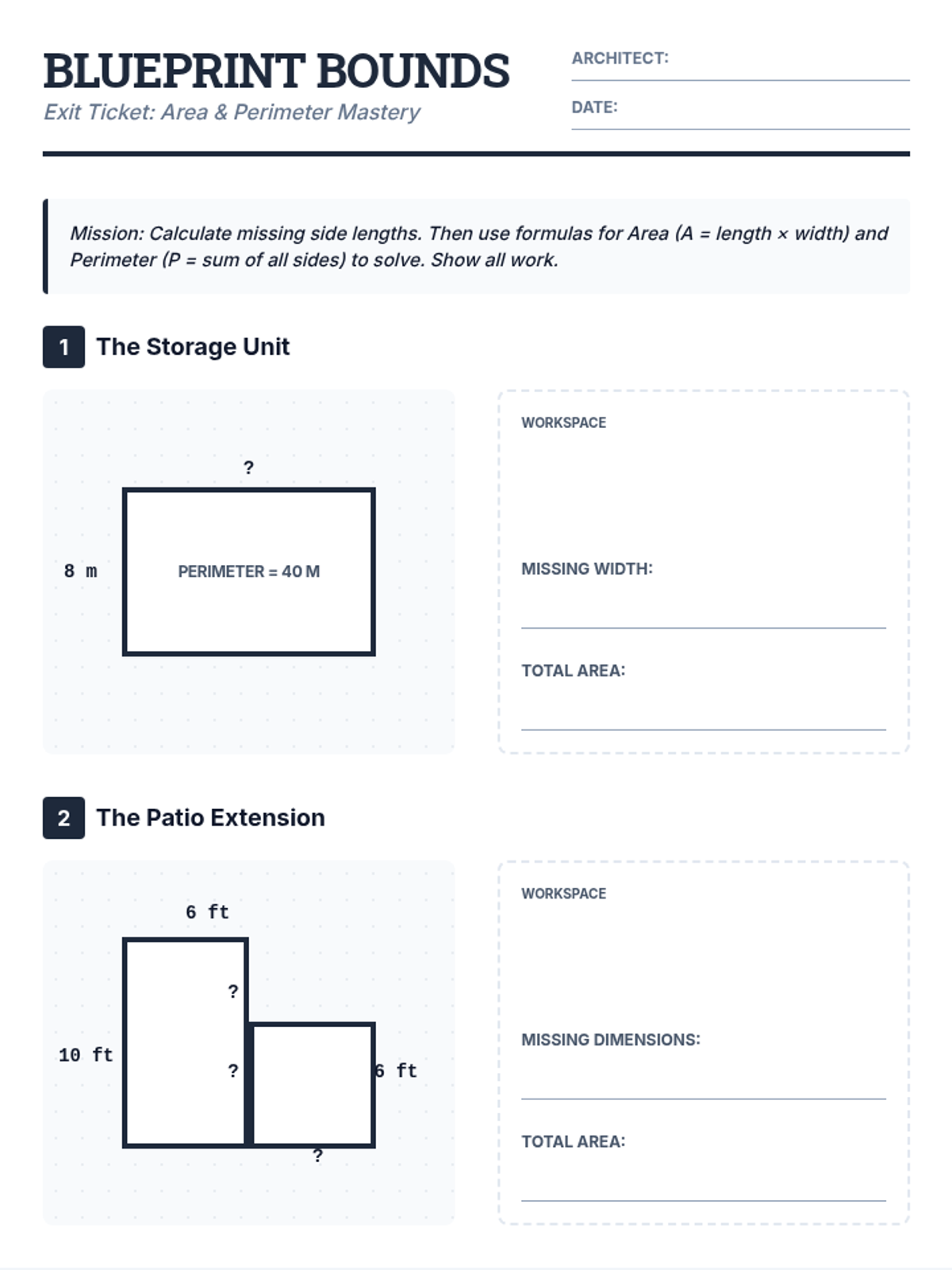
A 5-page exit ticket designed with a clean blueprint theme. It contains 10 problems that challenge students to find missing side lengths and calculate area using formulas for rectangles and complex rectilinear shapes. All diagrams and labels have been optimized for clarity and high contrast. All logic has been verified for mathematical consistency. All label positioning has been refined to prevent overlapping and clipping. Header terminology is consistent across all pages. Workspace layout is uniform. Content is technically complete and solvable without assumptions.
A comprehensive bilingual slide deck (English and Hiragana) covering Units 6, 7, and 8 from the source material. It guides students through understanding weight, liquid volume, standard units, and estimation techniques.
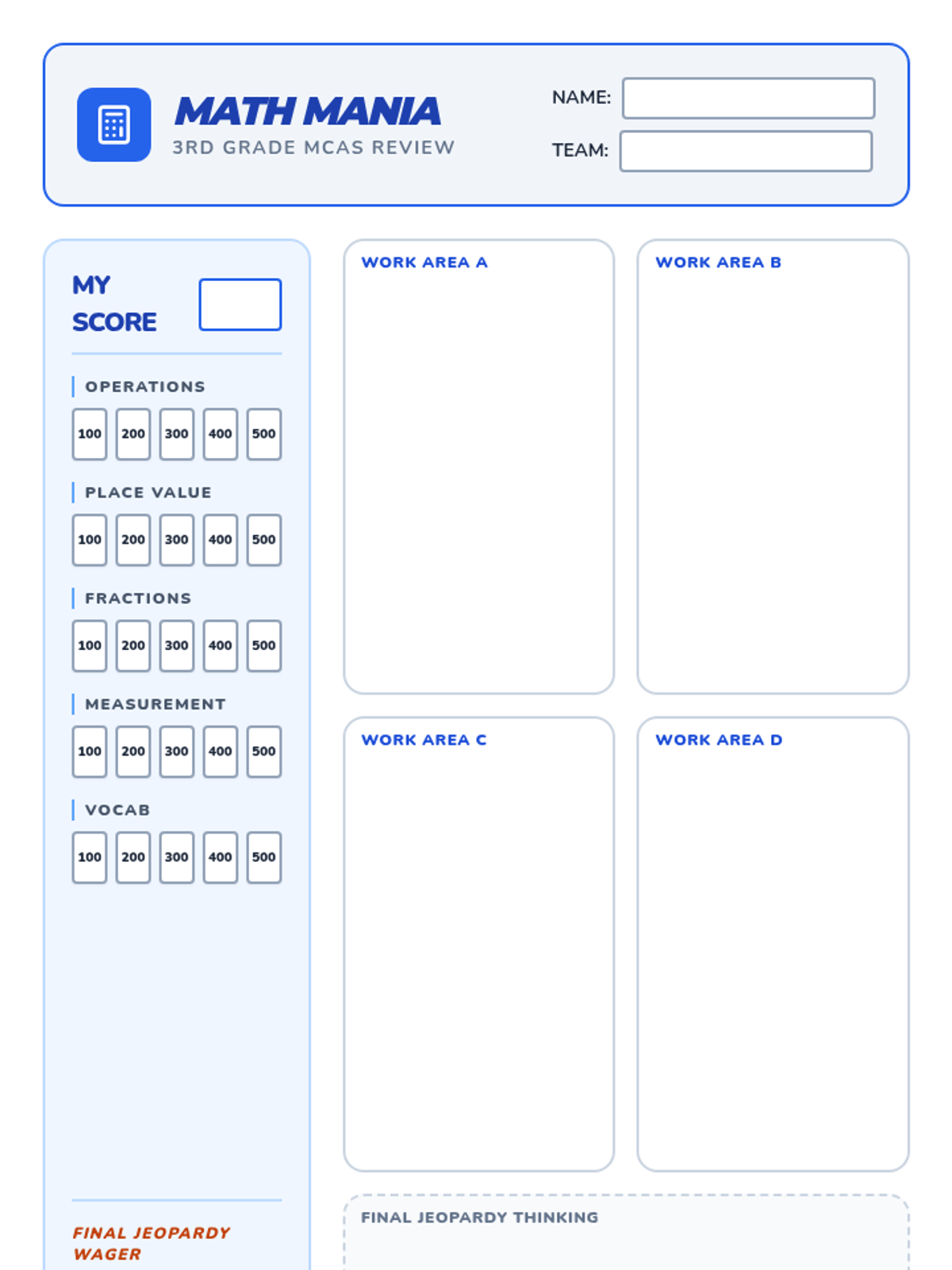
A printable scorecard for students to track their points and show their work during the Math Mania game. Features high-contrast fields and ample workspace for multi-step problems.
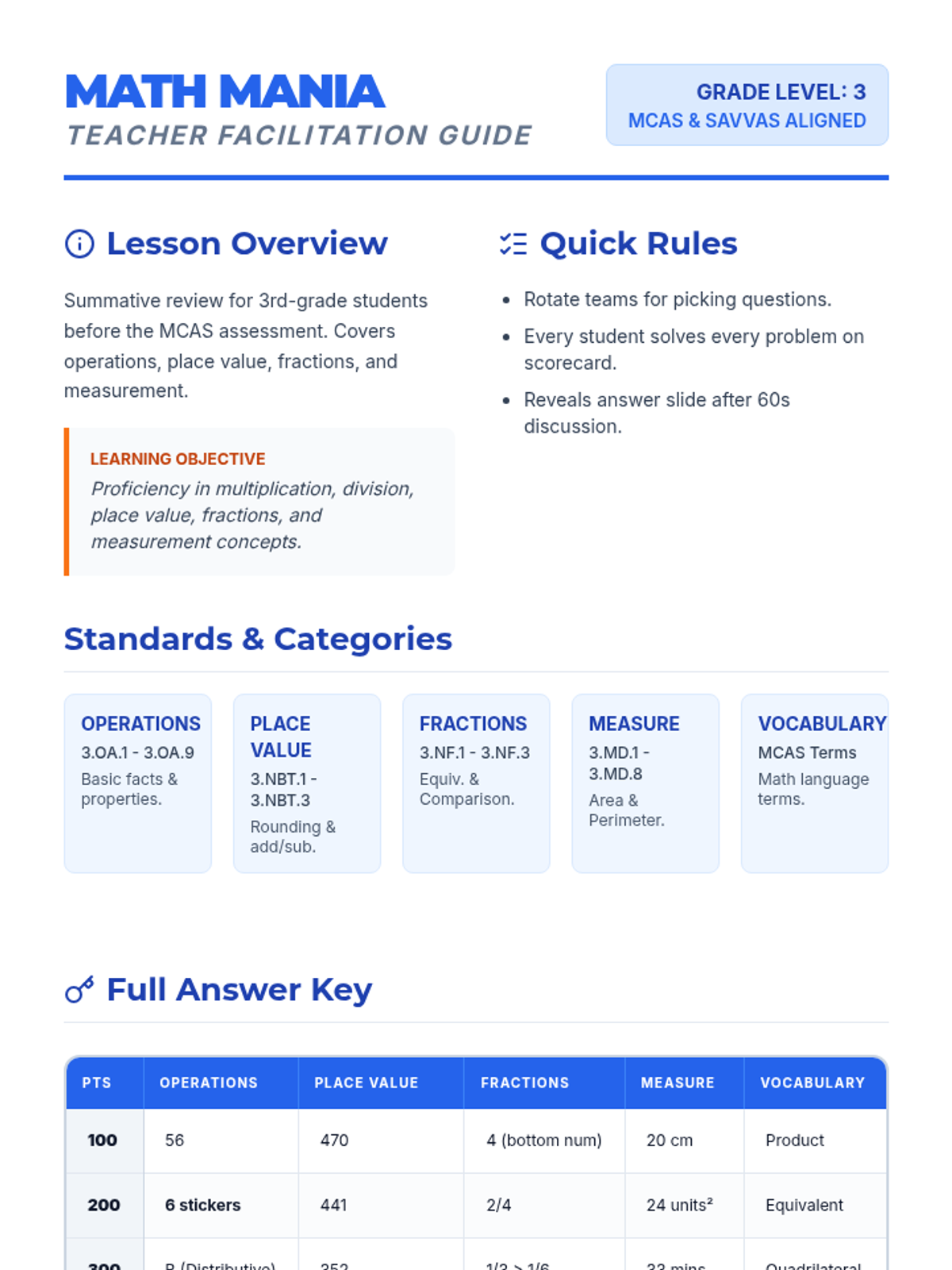
Teacher's facilitation guide for the Math Mania review game, including game rules, standards alignment for 3rd Grade MCAS, and a complete answer key. Organized for reliability and print clarity.
A 54-slide Jeopardy-style review game for 3rd-grade math, featuring categories in operations, place value, fractions, measurement, and vocabulary with MCAS-aligned questions. Every slide includes a category and point value header for clarity.
A presentation introducing clock anatomy, hour placement, and minute tracking by fives. Includes visual diagrams with all 12 numbers and step-by-step instructions.
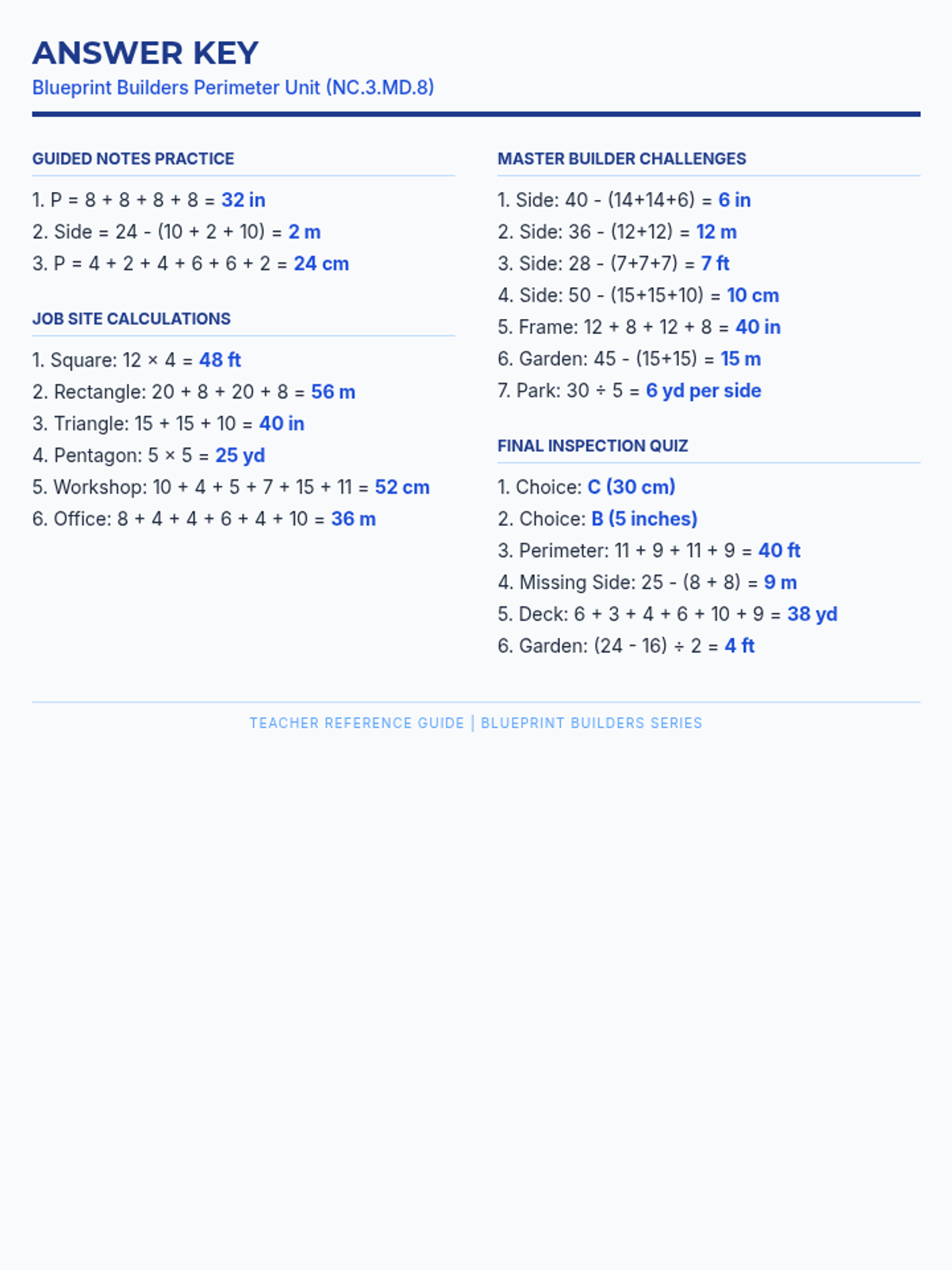
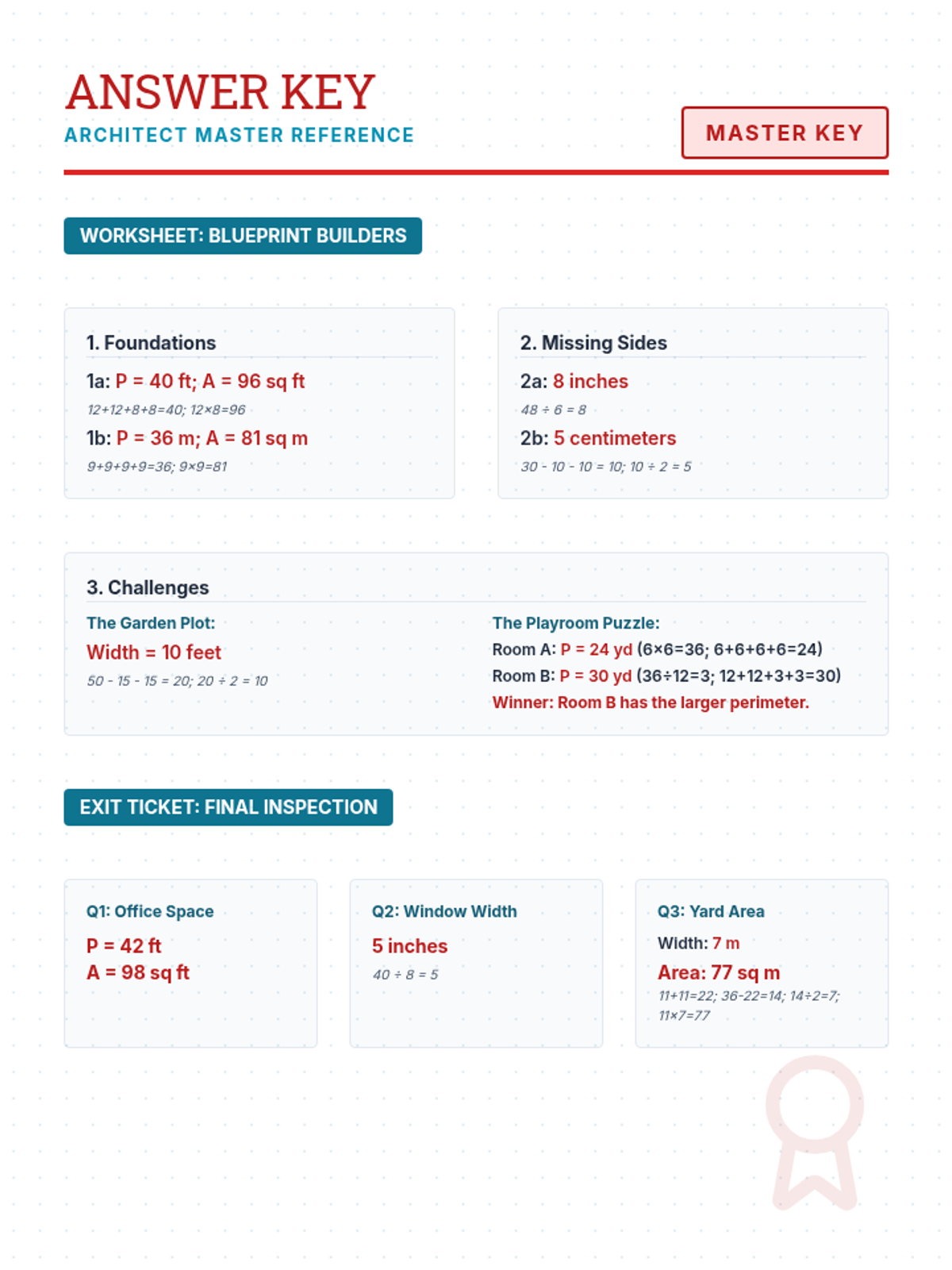
A consolidated single-page answer key for both the Blueprint Builders worksheet and the Final Inspection exit ticket. Includes all calculations and final solutions.
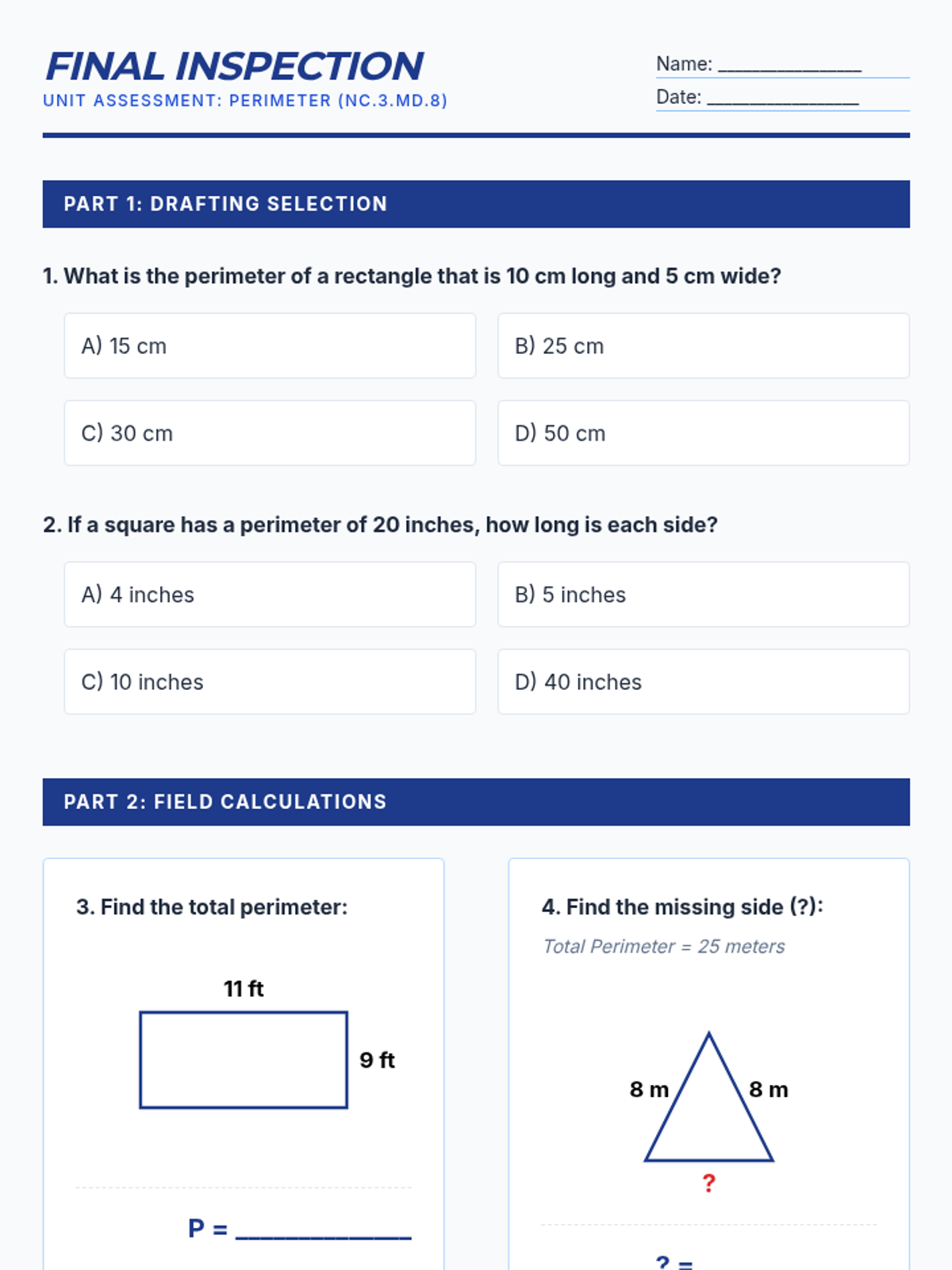
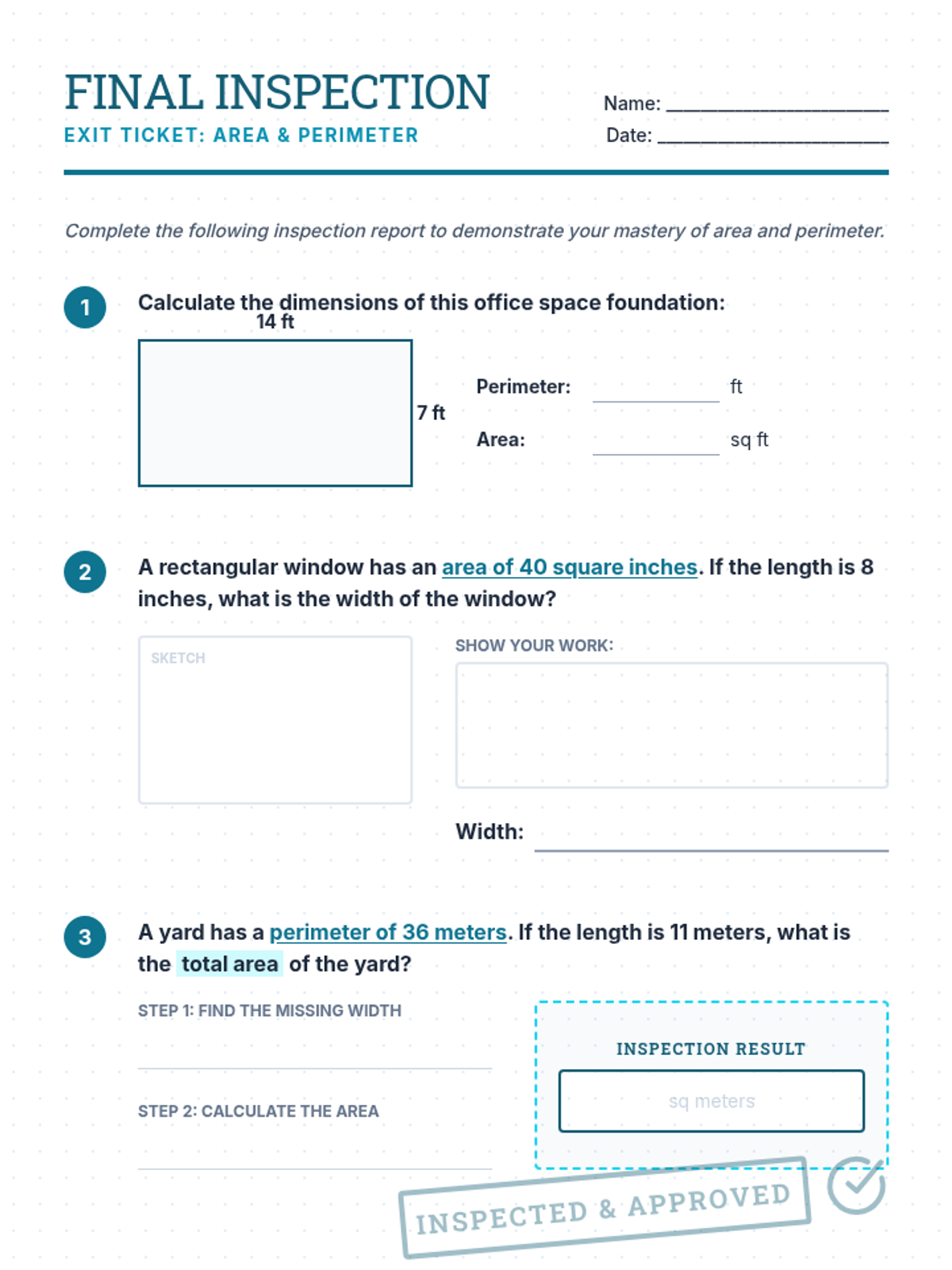
A 1-page summative assessment for the Blueprint Builders lesson. Revised with increased background contrast and expanded work areas for students.
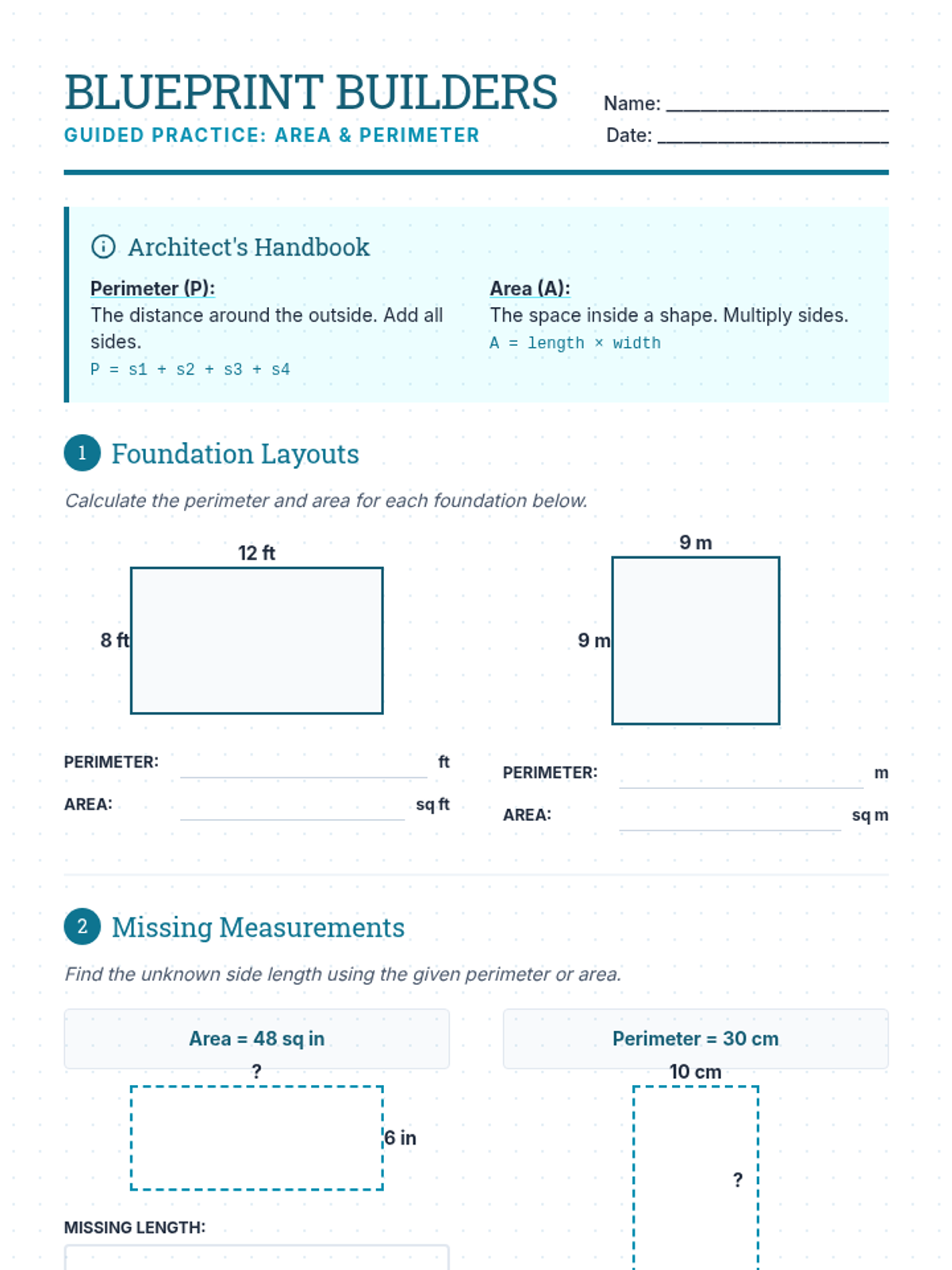
A 2-page guided practice worksheet where students solve area and perimeter problems in an architectural blueprint theme. Includes basic calculations, missing side lengths, and multi-step real-world word problems. Revised for better page flow and contrast.
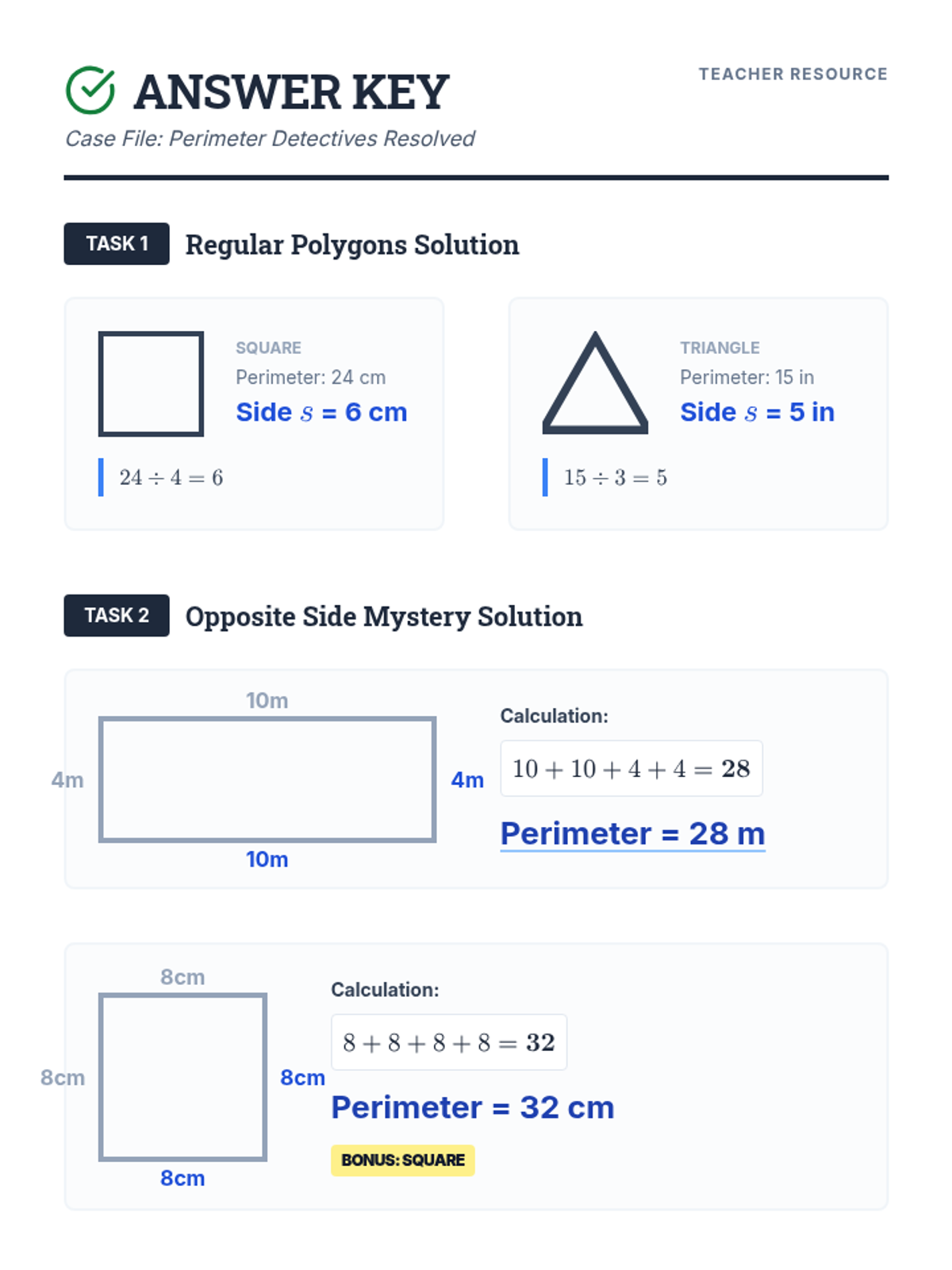
The answer key for the Perimeter Detectives worksheet, providing step-by-step solutions for missing side lengths and perimeter calculations.
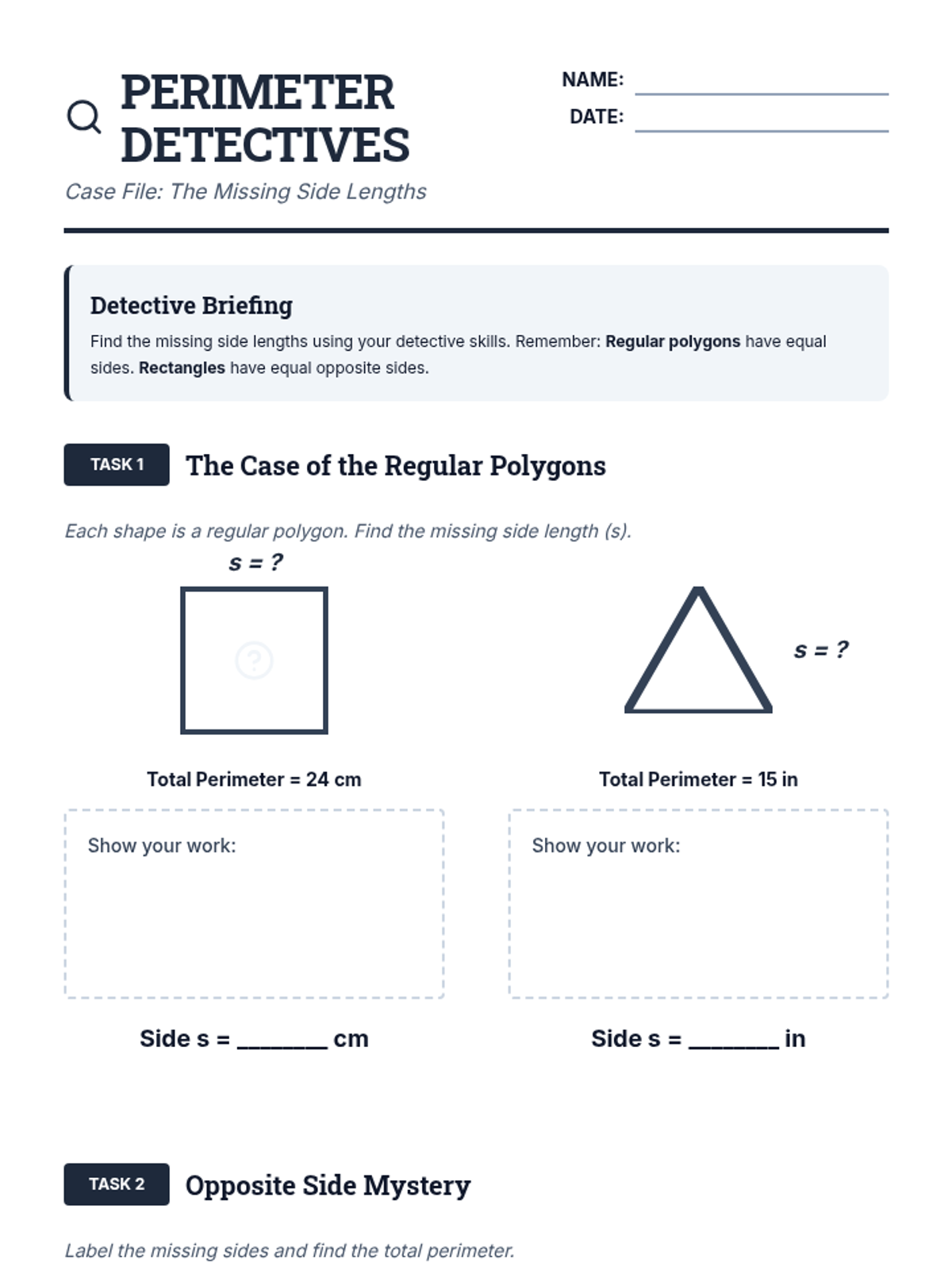
A student homework worksheet for practicing finding missing side lengths in regular polygons and rectangles, themed as a detective case file.
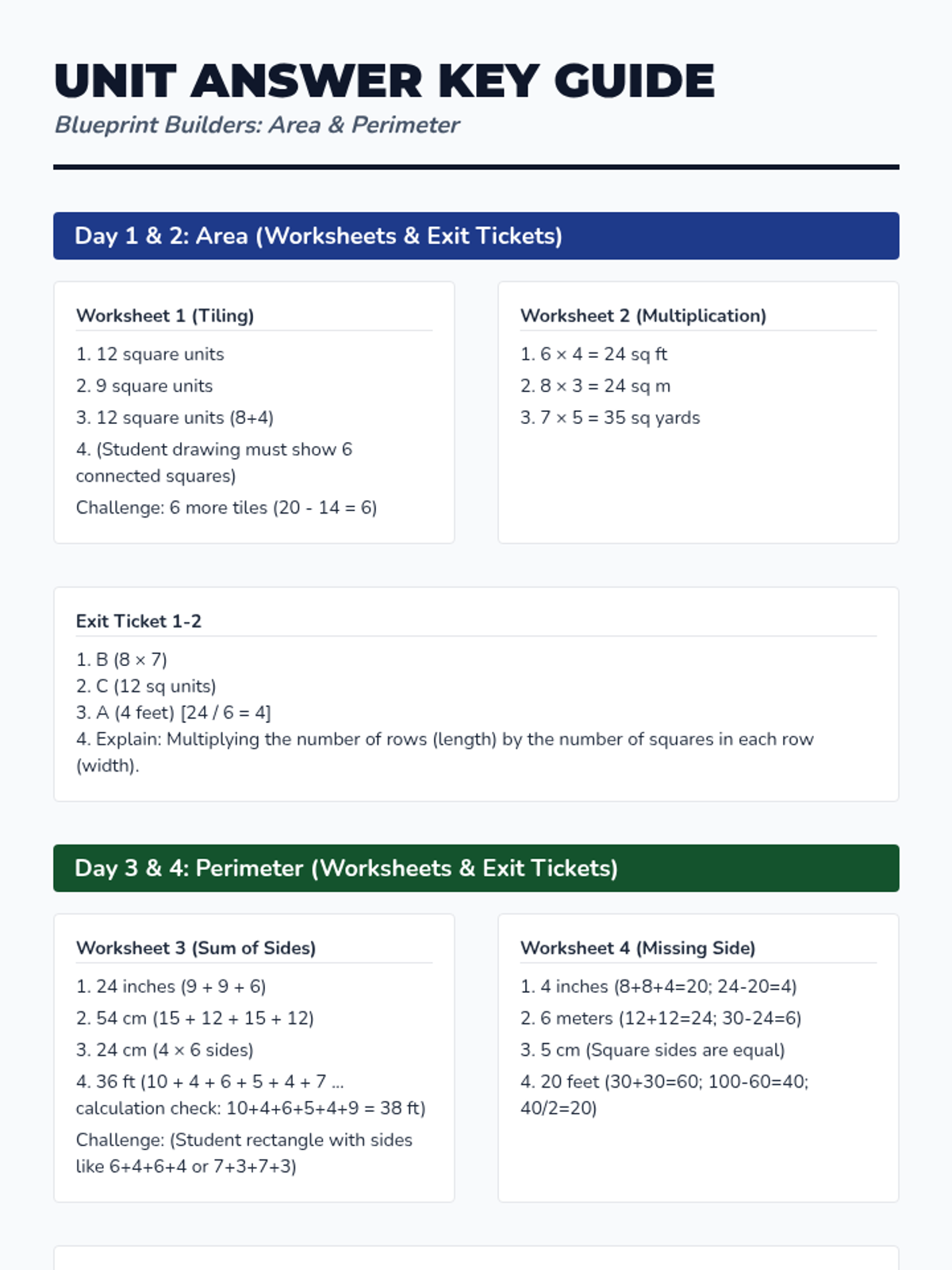
A comprehensive answer key for all worksheets, exit tickets, and the spiral review quiz within the 5-day Blueprint Builders math unit.
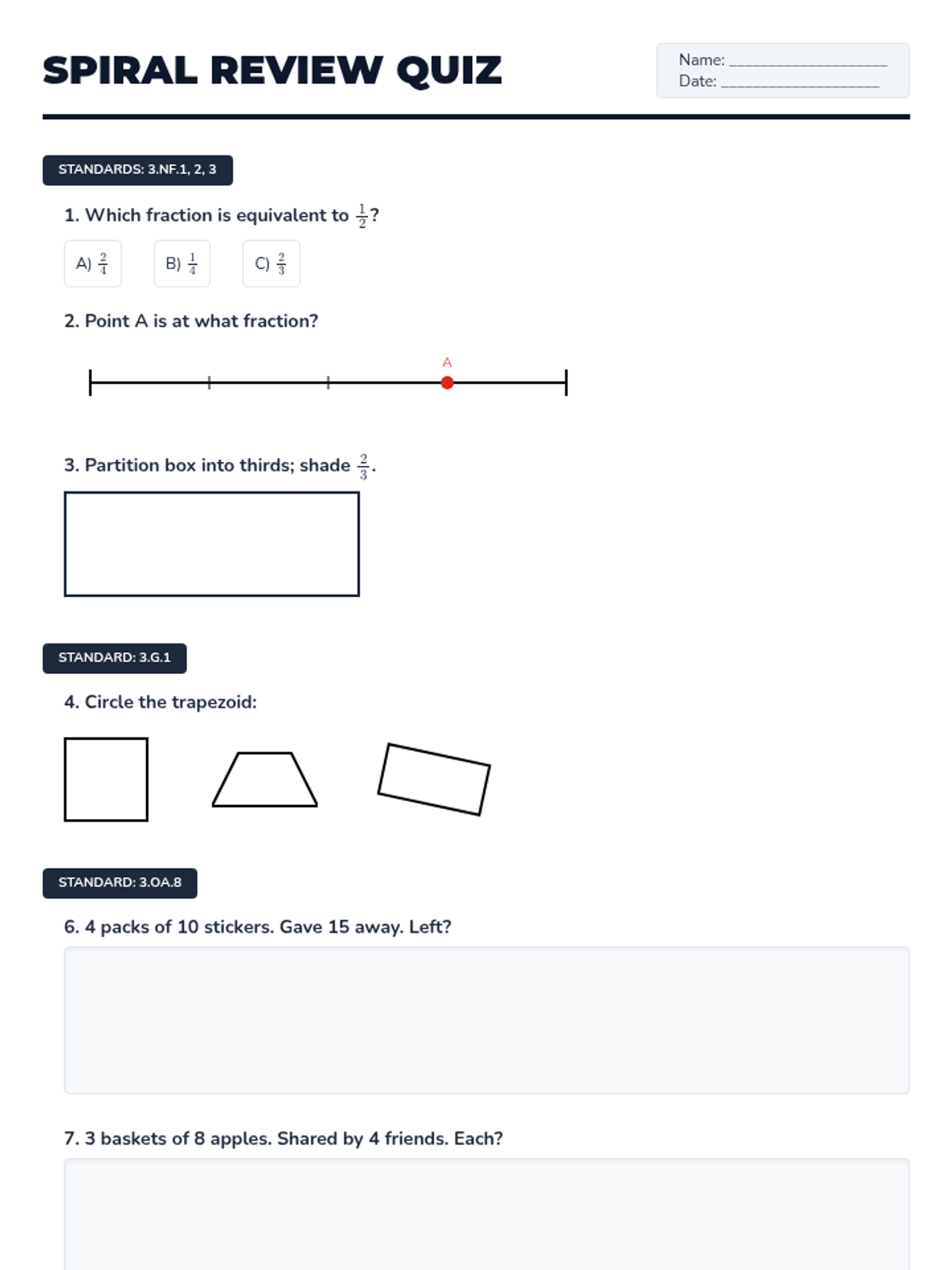
Revised Spiral Review Quiz. Added dedicated work areas for all multi-step and word problems, darkened grid lines for photocopy visibility, and increased the size of the partitioning and drawing diagrams for easier student use.
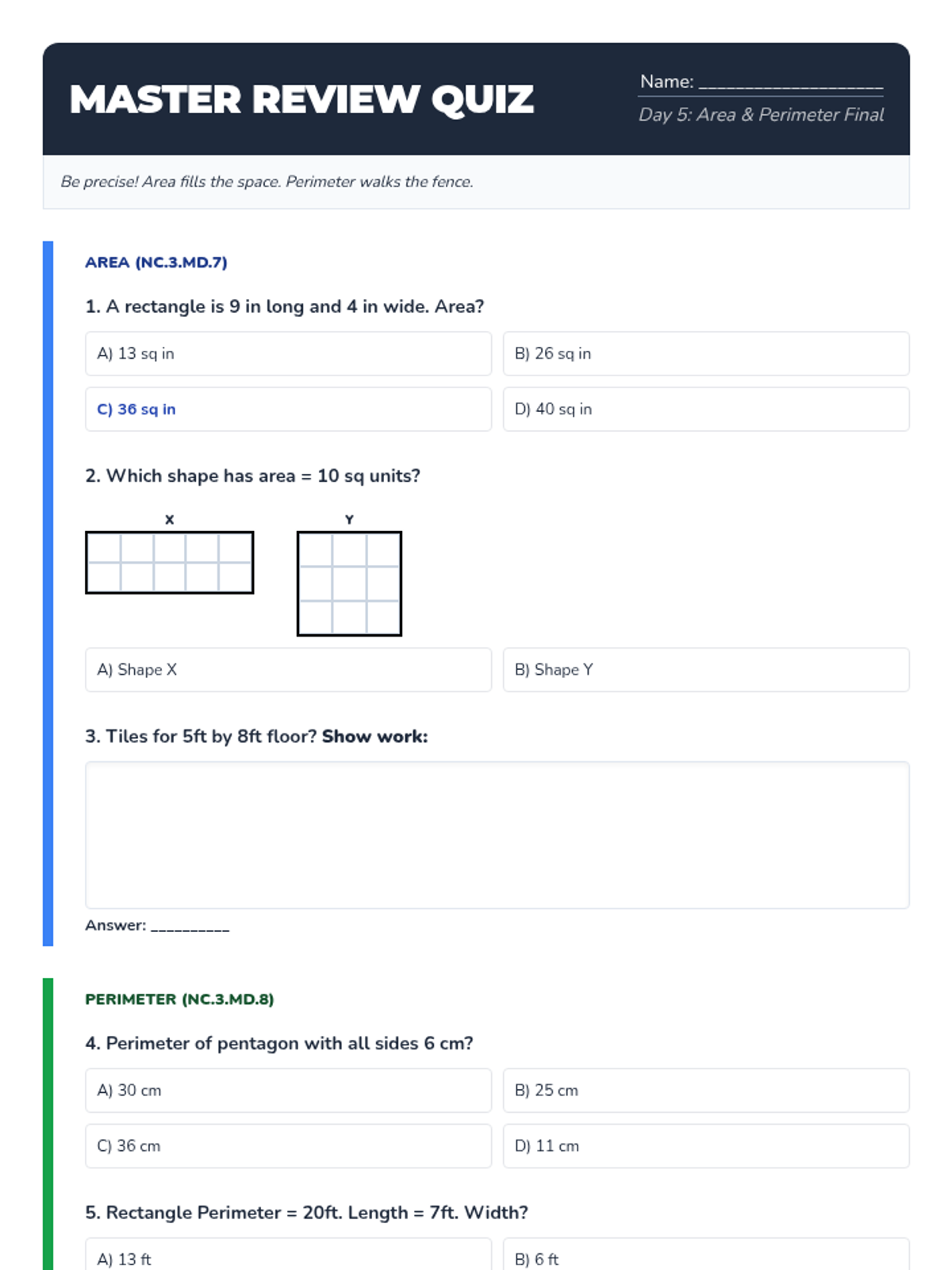
Revised Day 5 Master Review. Fixed the collapsed grid in Question 2, added high-contrast grid lines, labeled the shapes clearly as X and Y, and added student work areas for calculation questions.
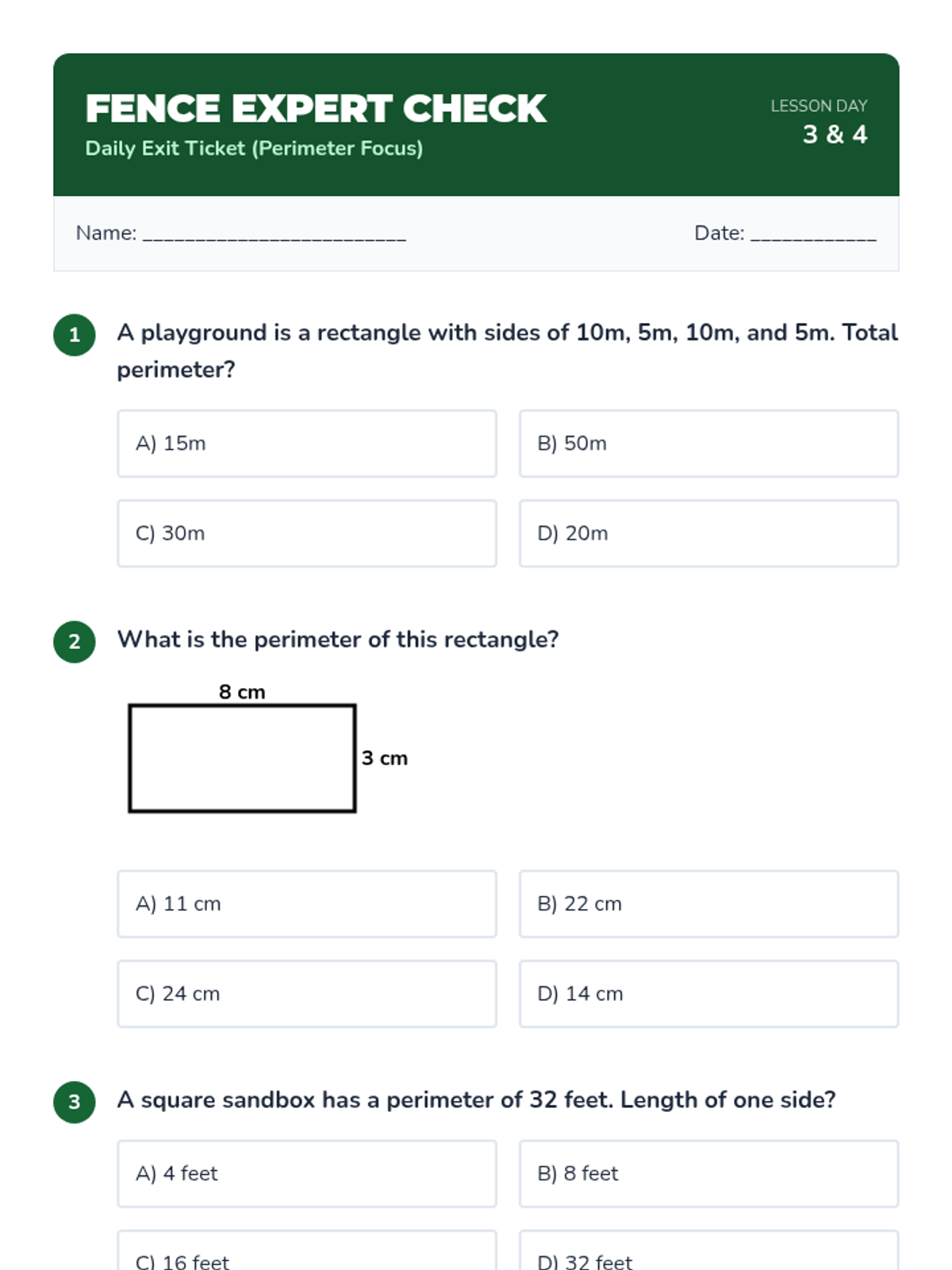
Revised Perimeter Exit Ticket. Increased SVG padding to prevent label cutoff, wrapped questions to ensure they stay on a single page, and expanded the short-answer box for handwriting.
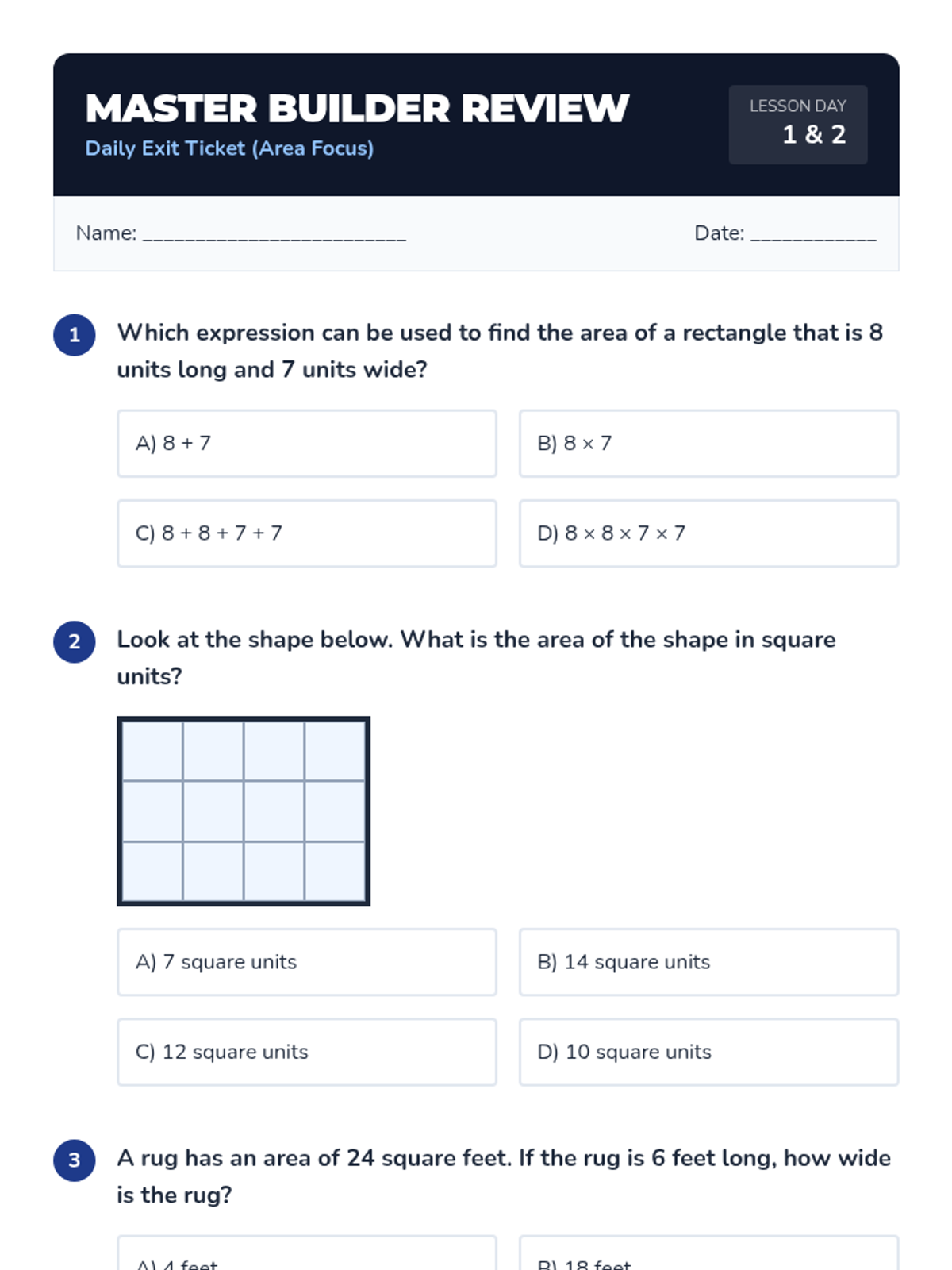
Revised Area Exit Ticket. Darkened grid lines for photocopy visibility, wrapped questions to prevent page breaks between prompts and options, and expanded the explanation box for better student use.
Revised Day 4 worksheet. Fixed page-break issues, doubled the height of student work areas, and improved the positioning of unknown side labels for better clarity.
Revised Day 3 worksheet. Darkened all grid and shape lines, fixed page-break issues by wrapping problems in avoidance containers, and doubled the height of student work areas for better usability.
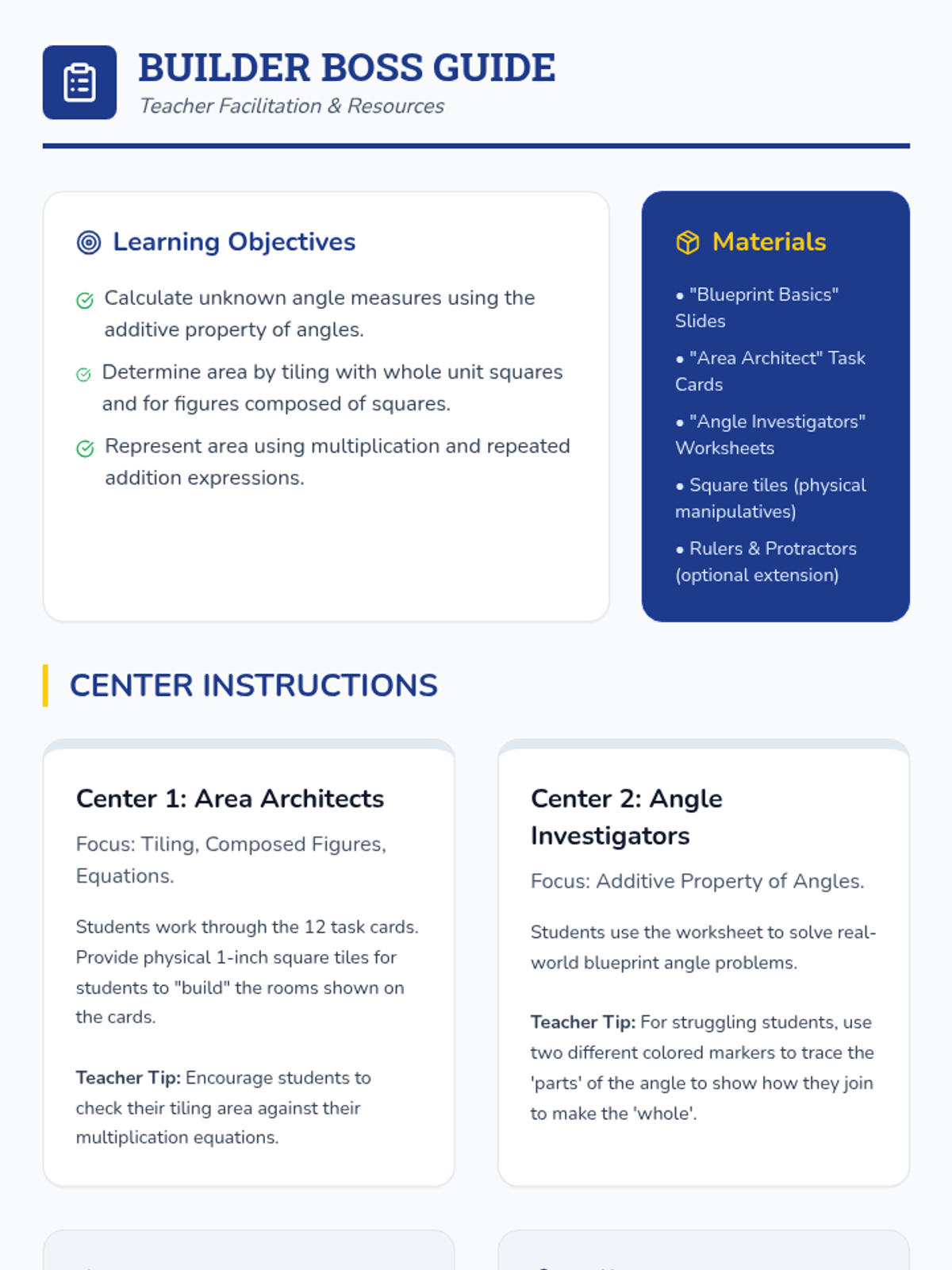
A teacher's facilitation guide for the Blueprint Builders math unit. Includes learning objectives, materials lists, center setup instructions, differentiation strategies, and complete answer keys.
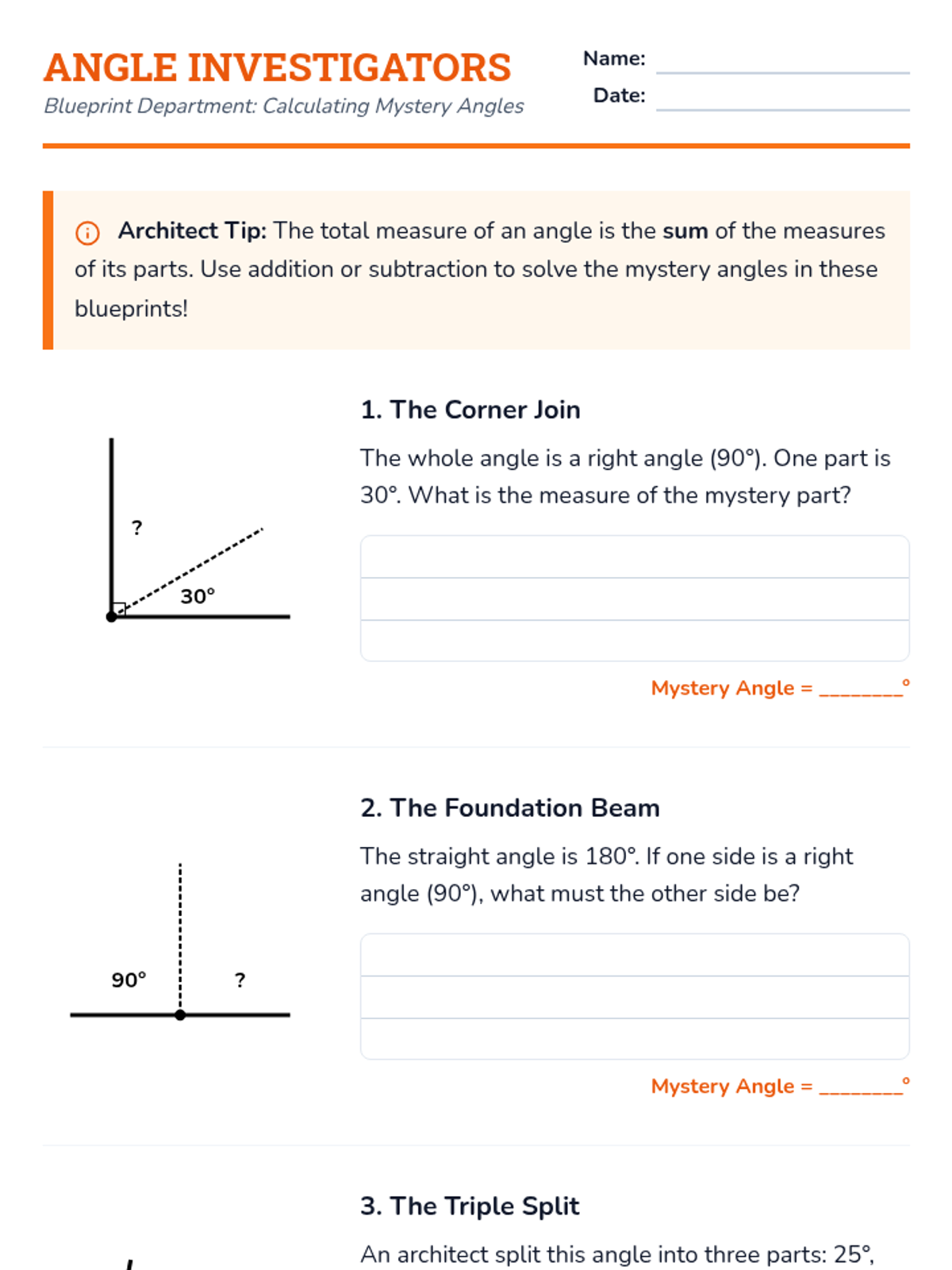
A 3rd-grade math worksheet for investigating unknown angle measures using the additive property. Features visual blueprint-themed problems and "show your work" areas.
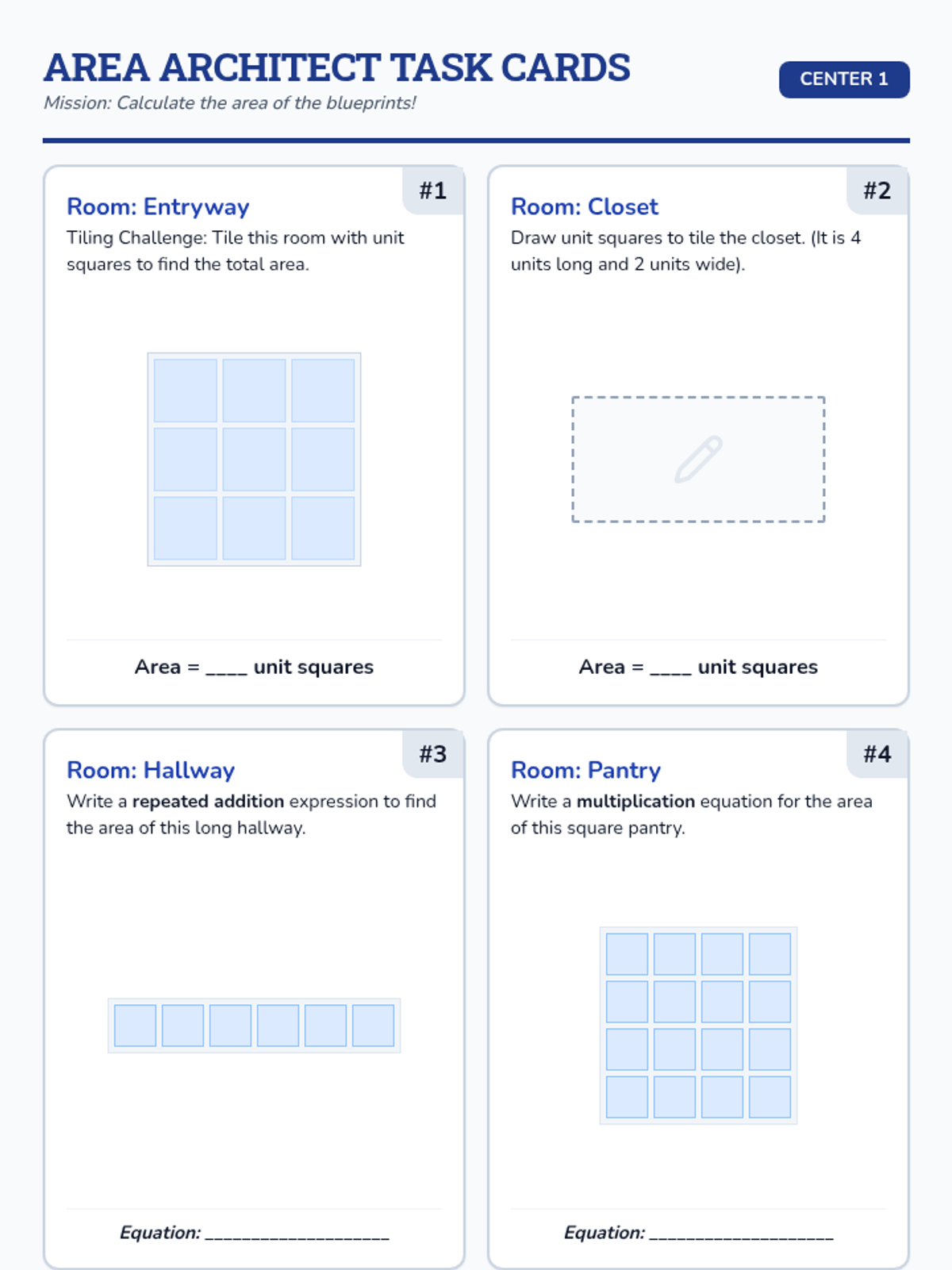
A set of 12 task cards for 3rd-grade math centers focused on determining area. Includes tasks for tiling with unit squares, calculating area of composed figures, and writing multiplication/repeated addition equations.
A visual slide deck introducing 3rd-grade area and angle measurement concepts through a 'Blueprint Builders' construction theme. Includes tiling methods, area equations, composed figures, and the additive property of angles.
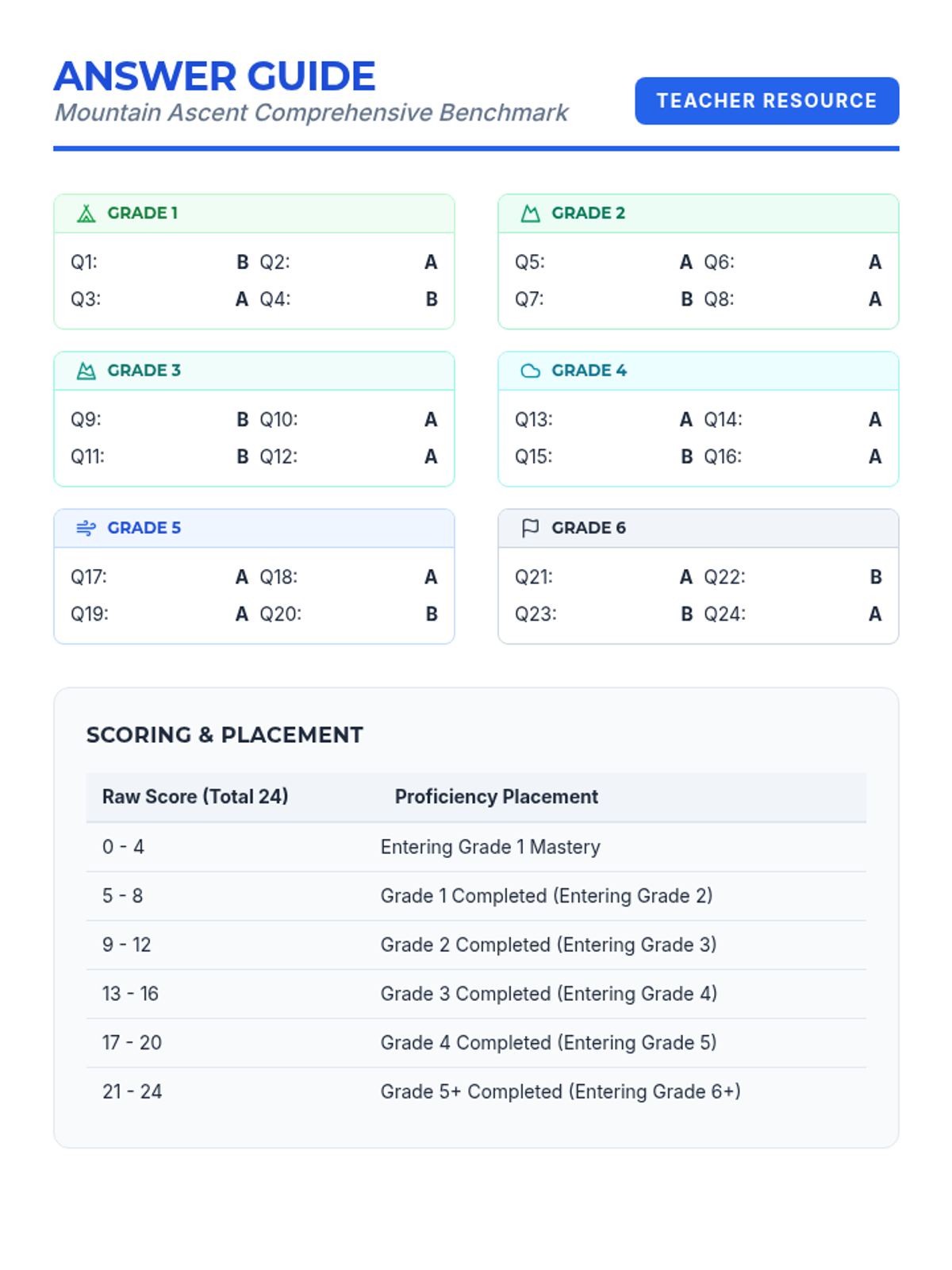
Updated teacher's answer guide for the comprehensive math assessment, featuring answers for all 24 questions and expanded placement guidelines.
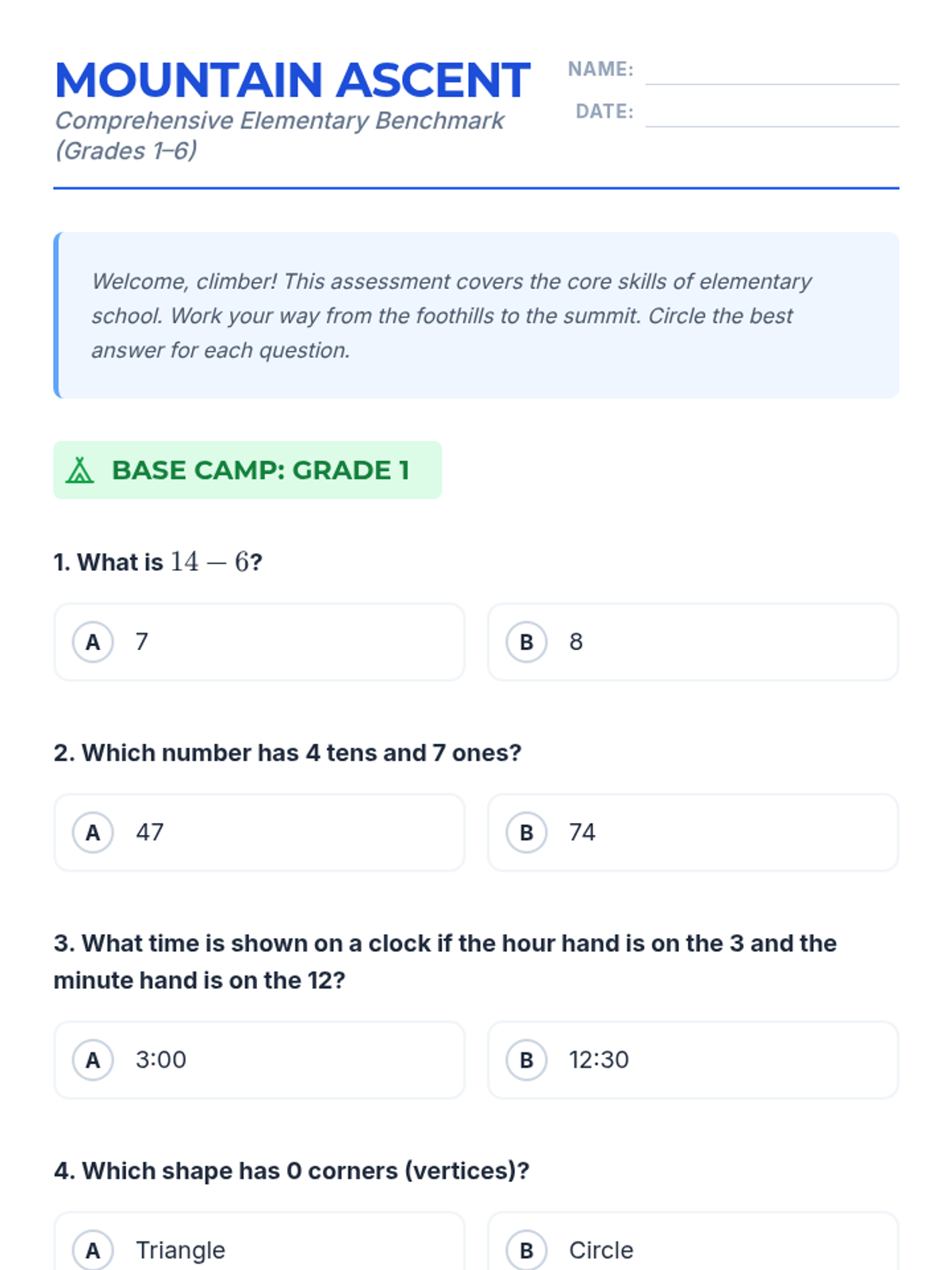
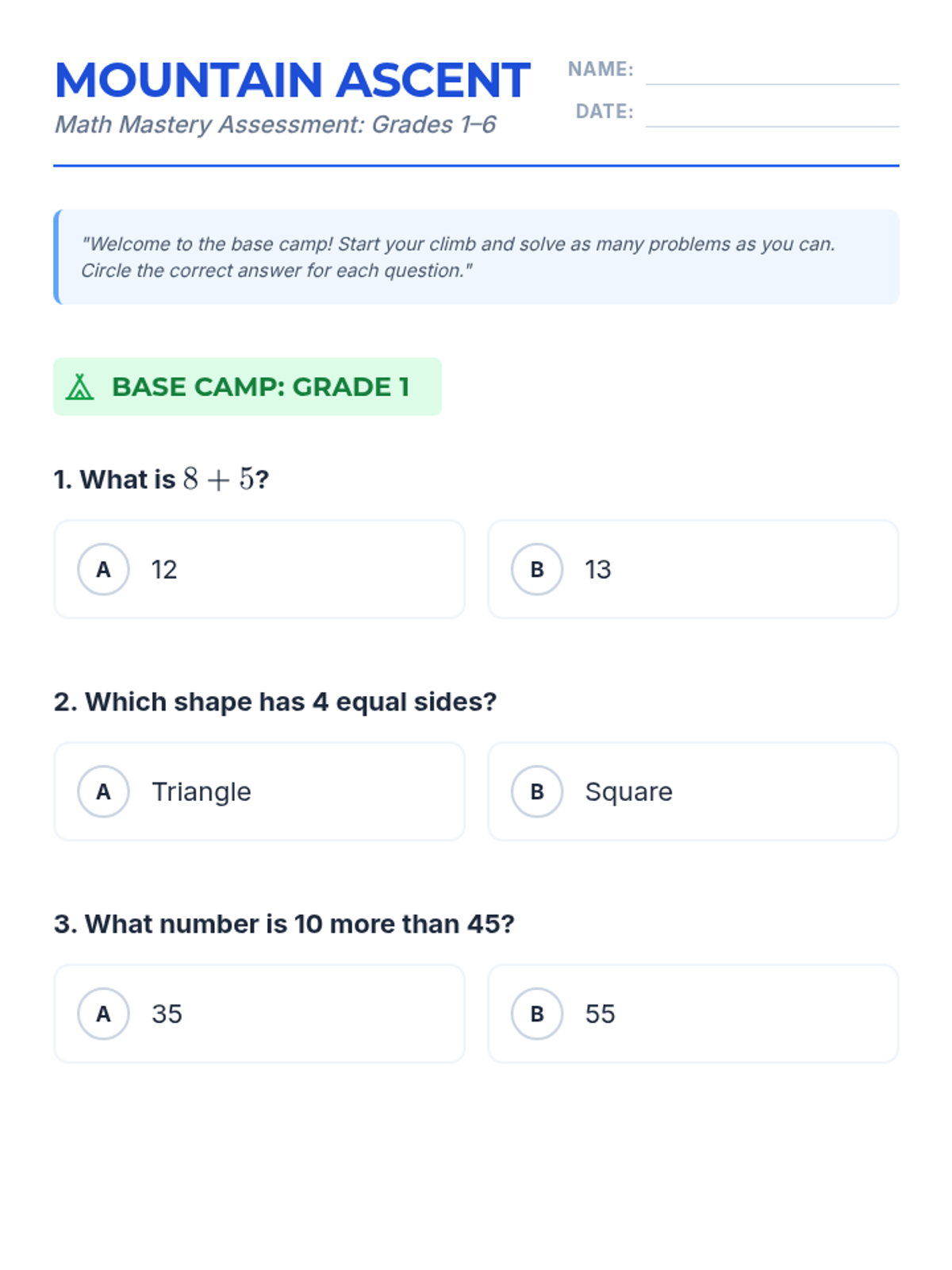
A comprehensive math benchmark assessment covering core elementary skills from Grades 1 to 6 with 24 multiple-choice questions and dedicated work areas.
Final polished version of the math assessment with 15 questions, dedicated work spaces for higher levels, and zero page-break issues.
Final polished answer guide with improved alignment and clear scoring metrics.
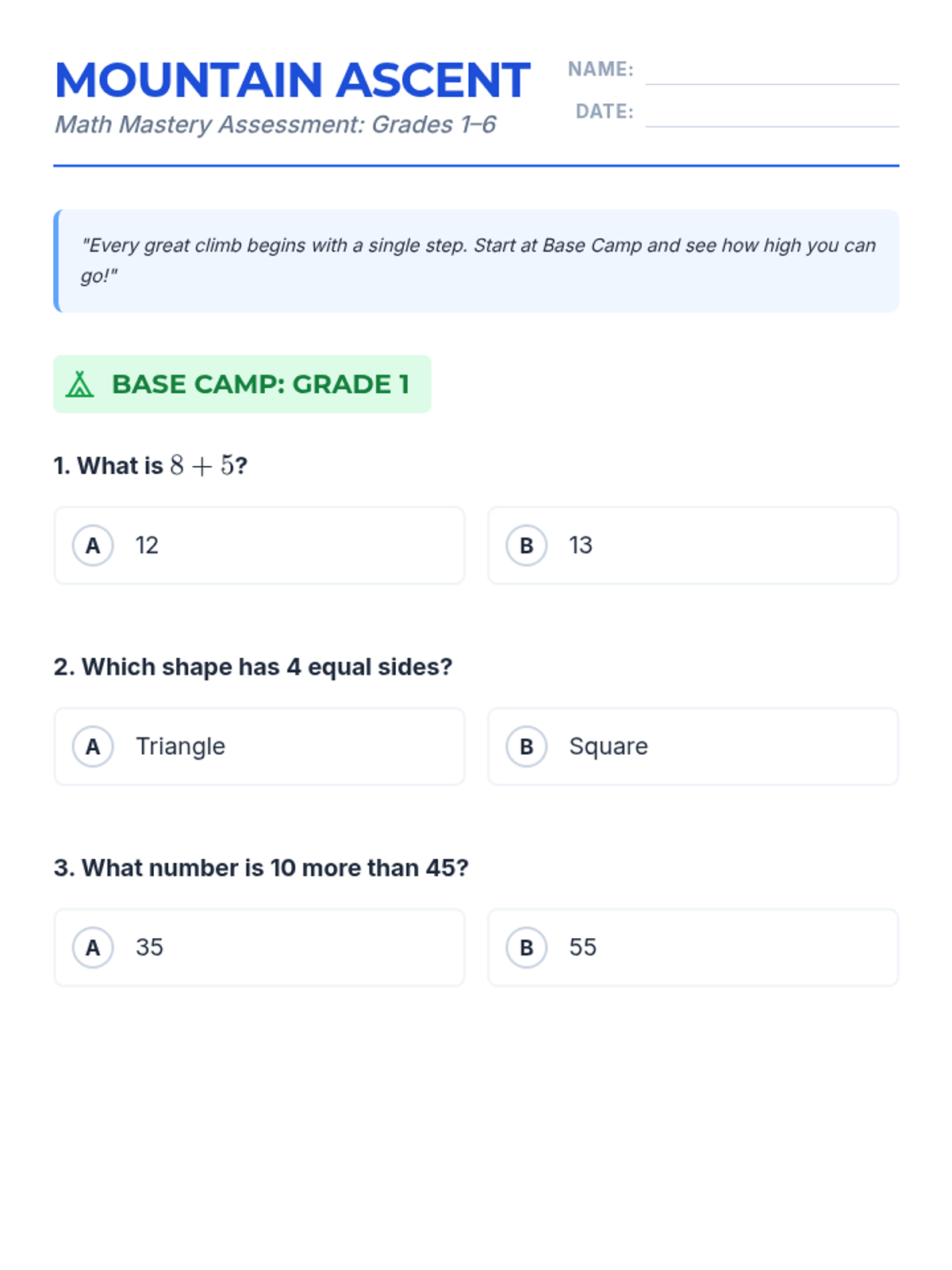
A final polished version of the math assessment with 15 questions, dedicated work spaces for higher levels, and zero page-break issues.
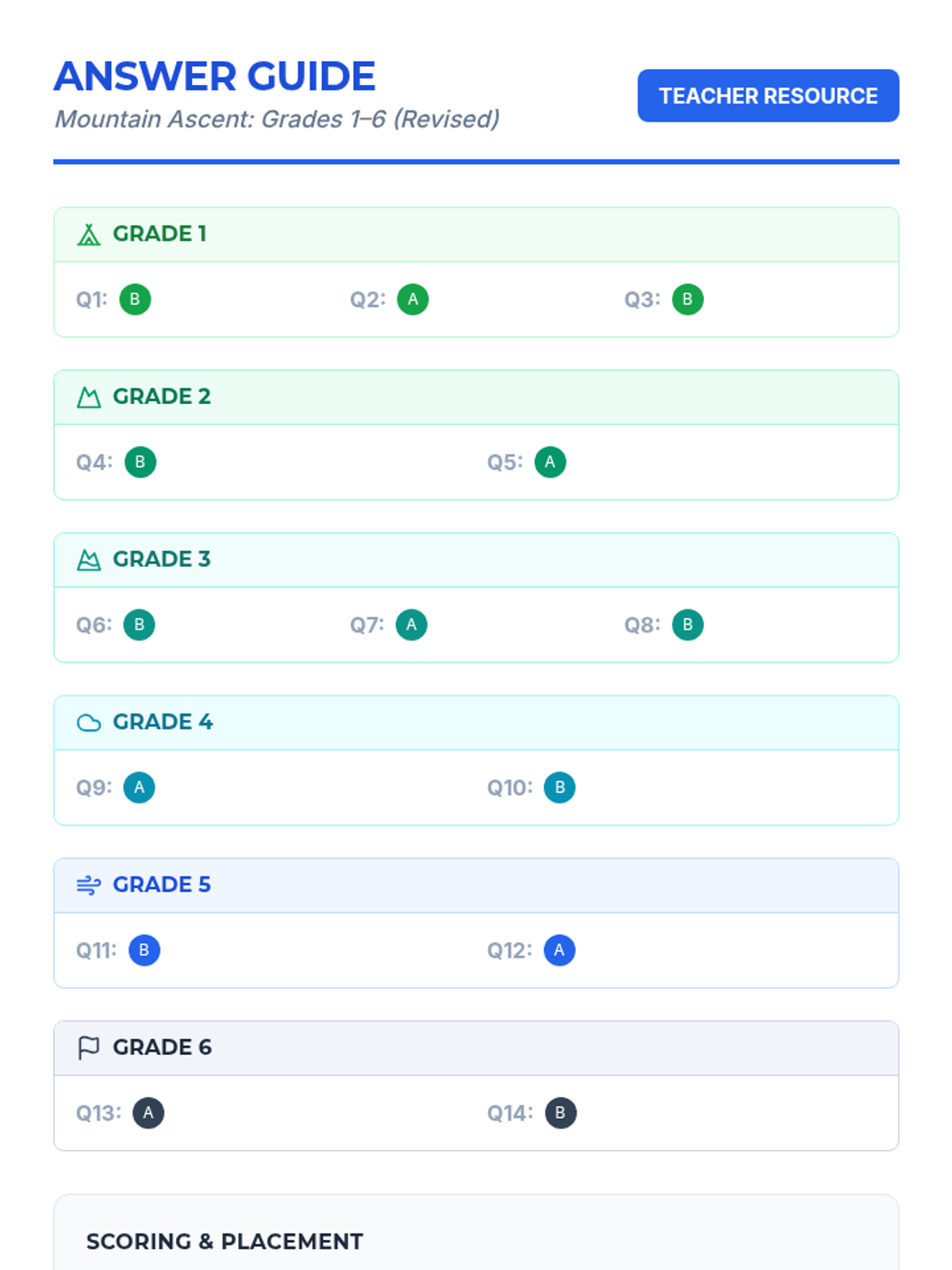
Updated teacher's answer guide for the revised Mountain Ascent Assessment, reflecting the changes in question count and content.
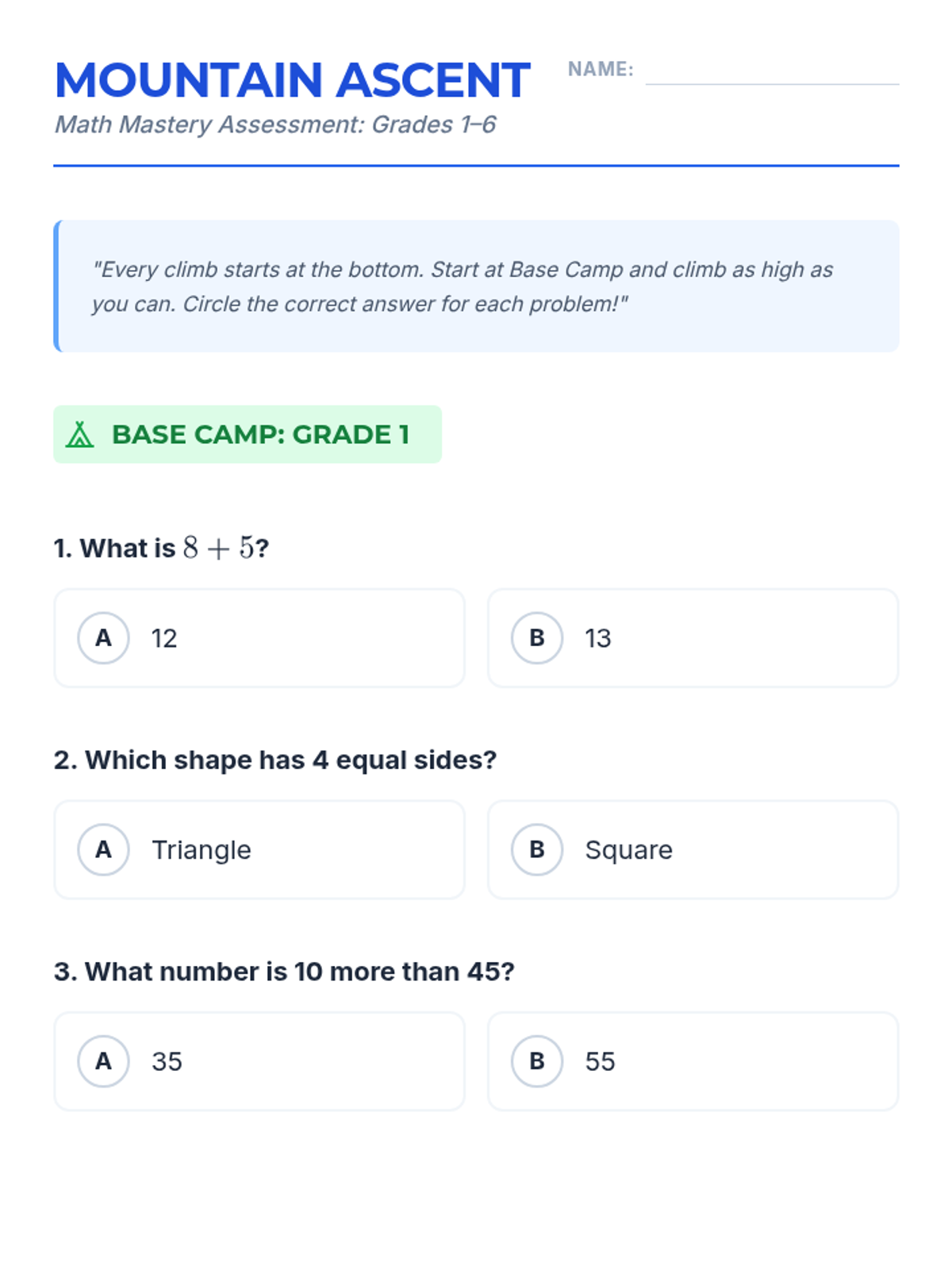
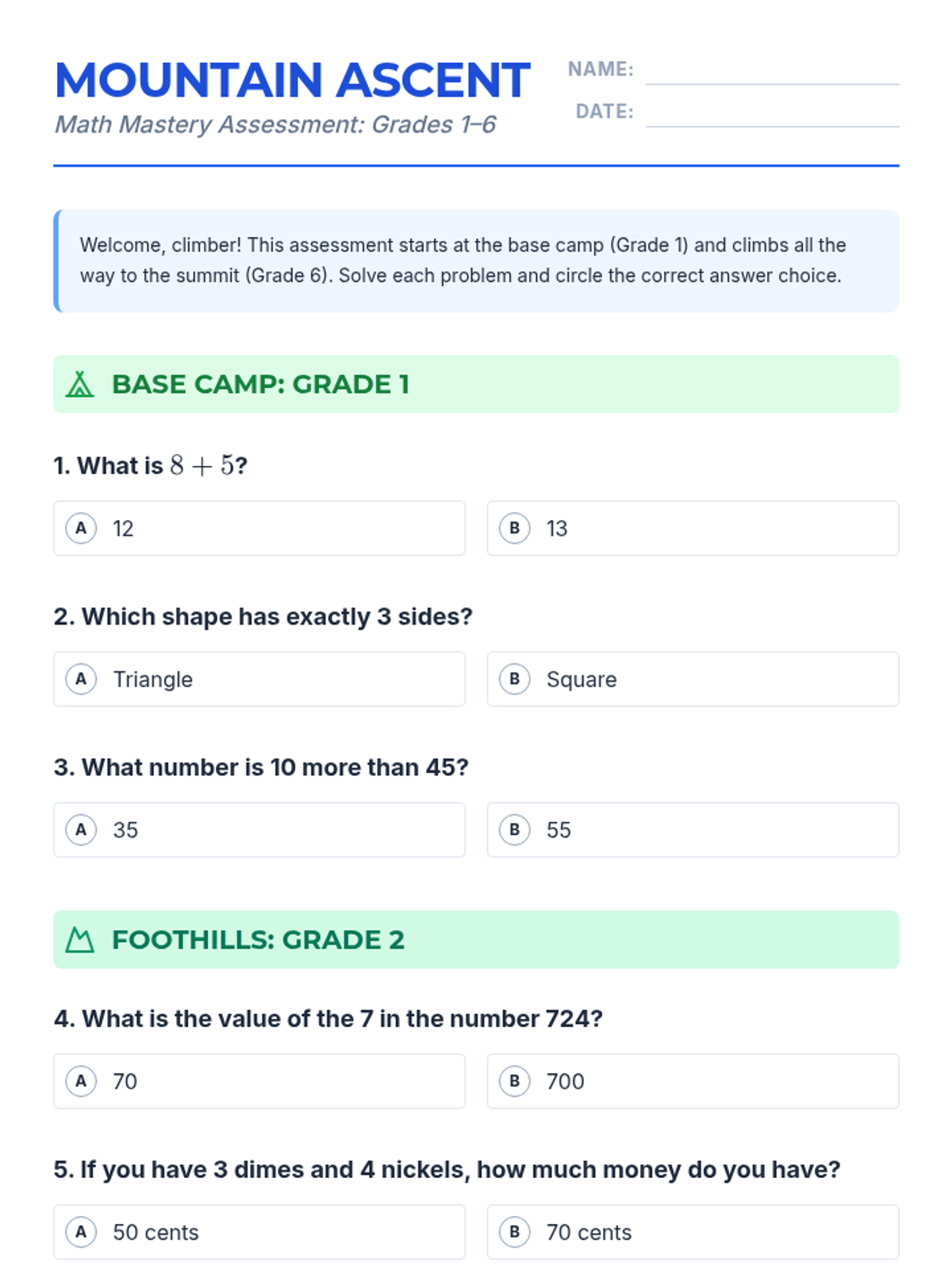
A revised math assessment featuring 14 multiple-choice questions from Grade 1 to 6 with improved spacing and layout to prevent orphaned headers and split questions.
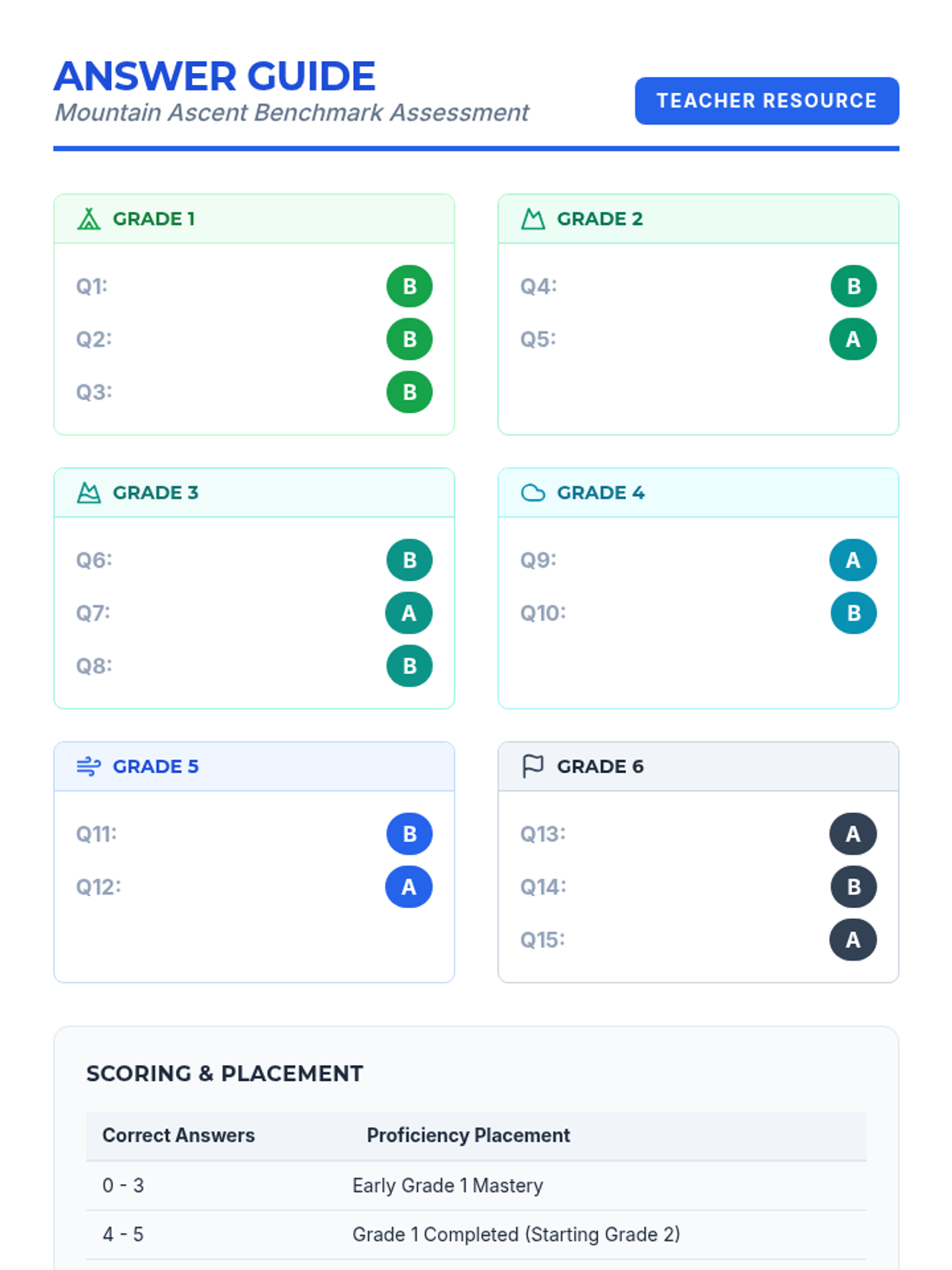
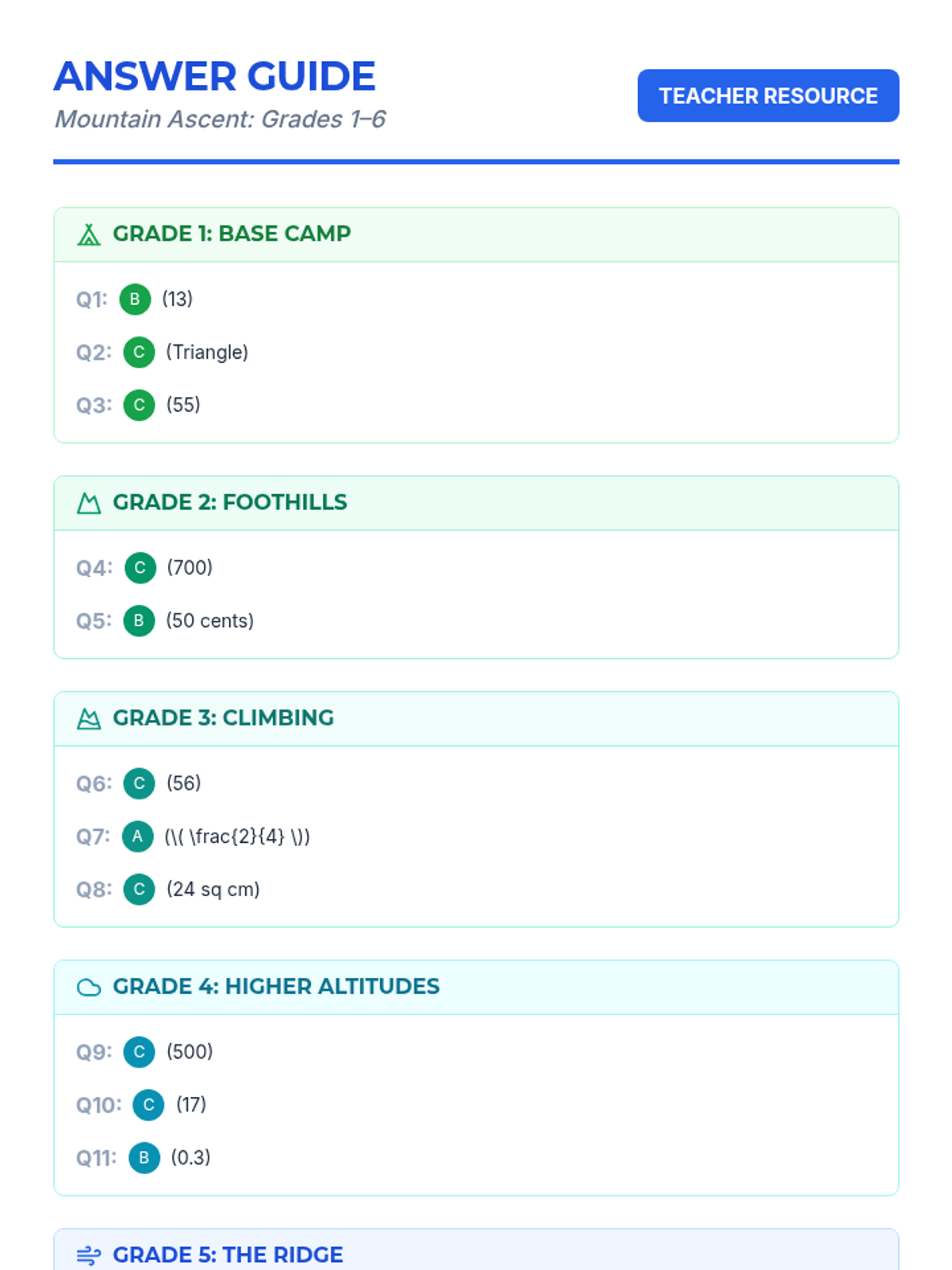
A teacher's answer guide for the Mountain Ascent Assessment, providing correct answers, specific values, and a scoring breakdown for student placement.
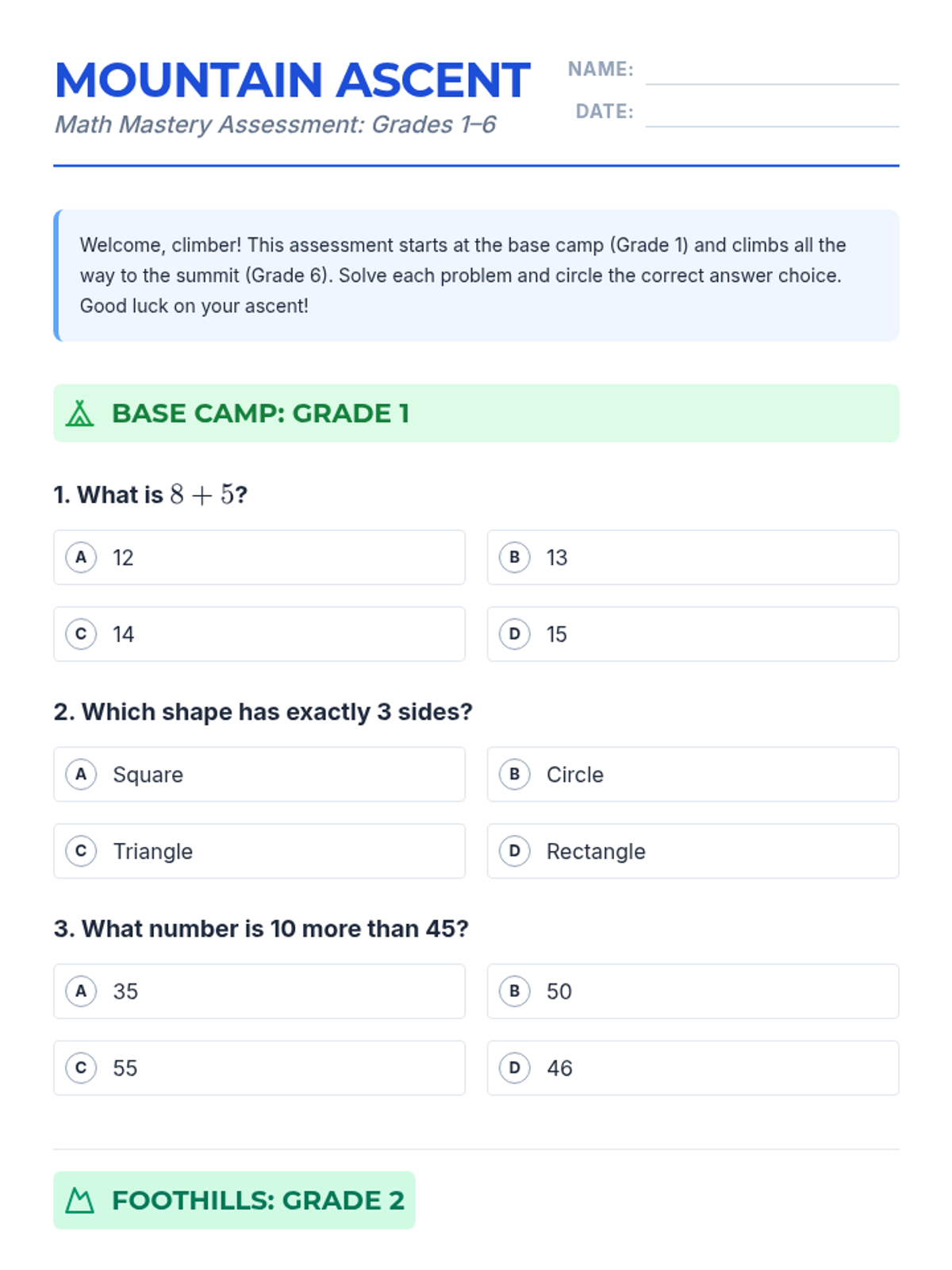
A math assessment document featuring 17 multiple-choice questions ranging from Grade 1 to Grade 6, themed around a mountain climbing journey.
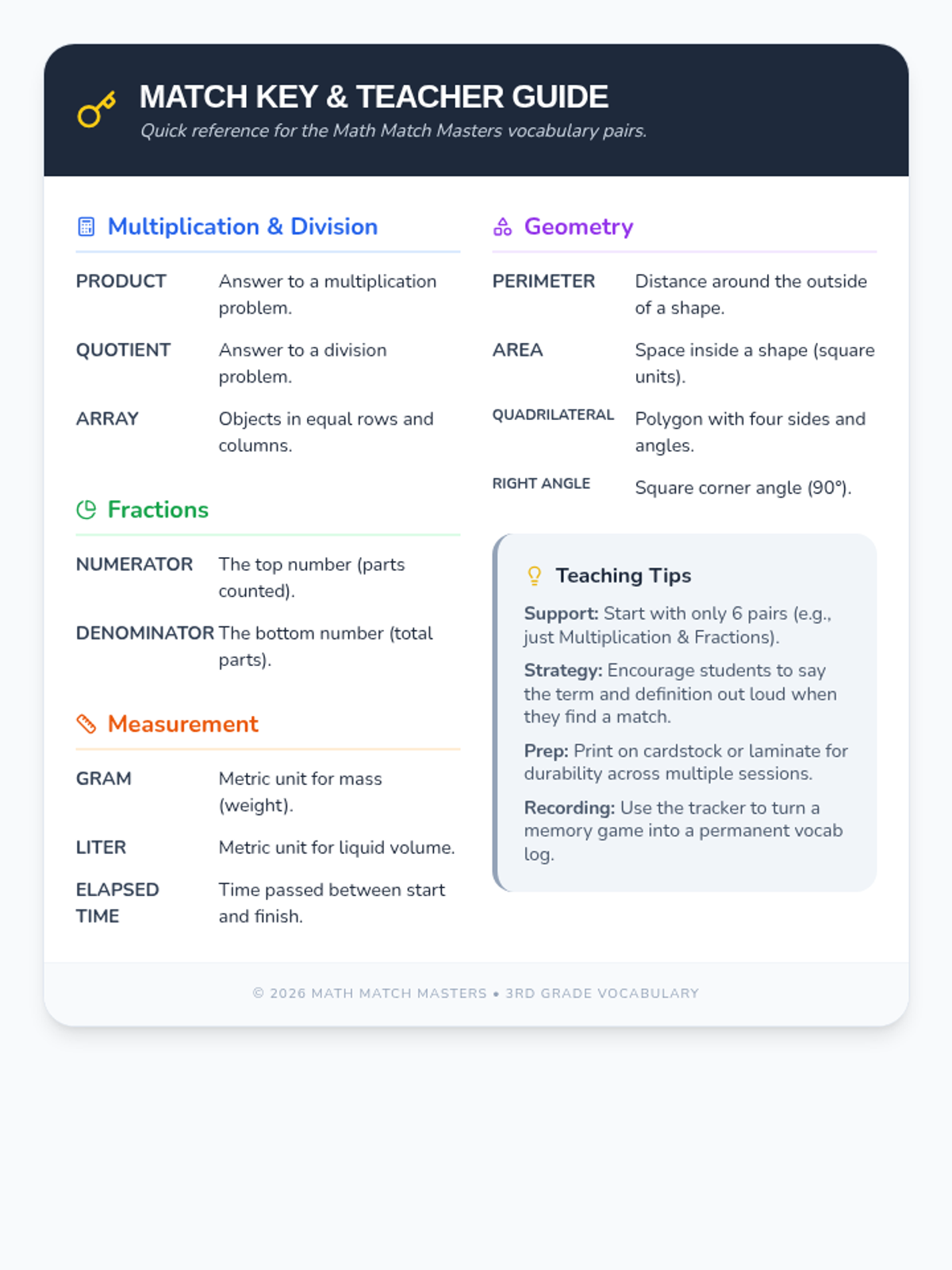
A teacher's quick-reference guide containing all vocabulary words, their definitions, and helpful teaching tips. Now optimized as a high-contrast, one-page reference sheet.
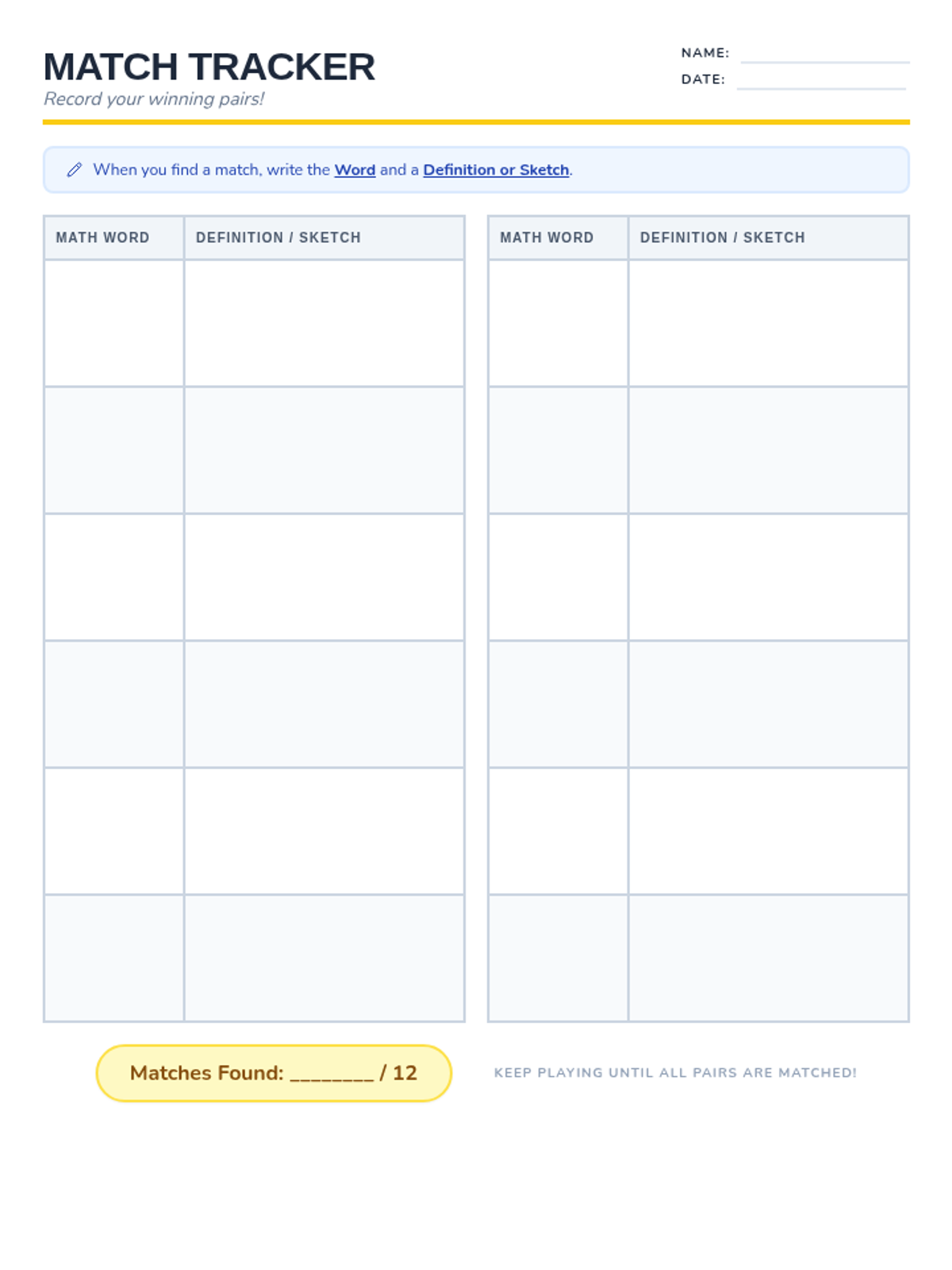
A student recording sheet to track matching pairs found during the game. Students practice writing definitions or drawing sketches of the vocabulary terms they've matched. Now consolidated to a single page with space for all 12 pairs and tall rows for handwriting and sketches.
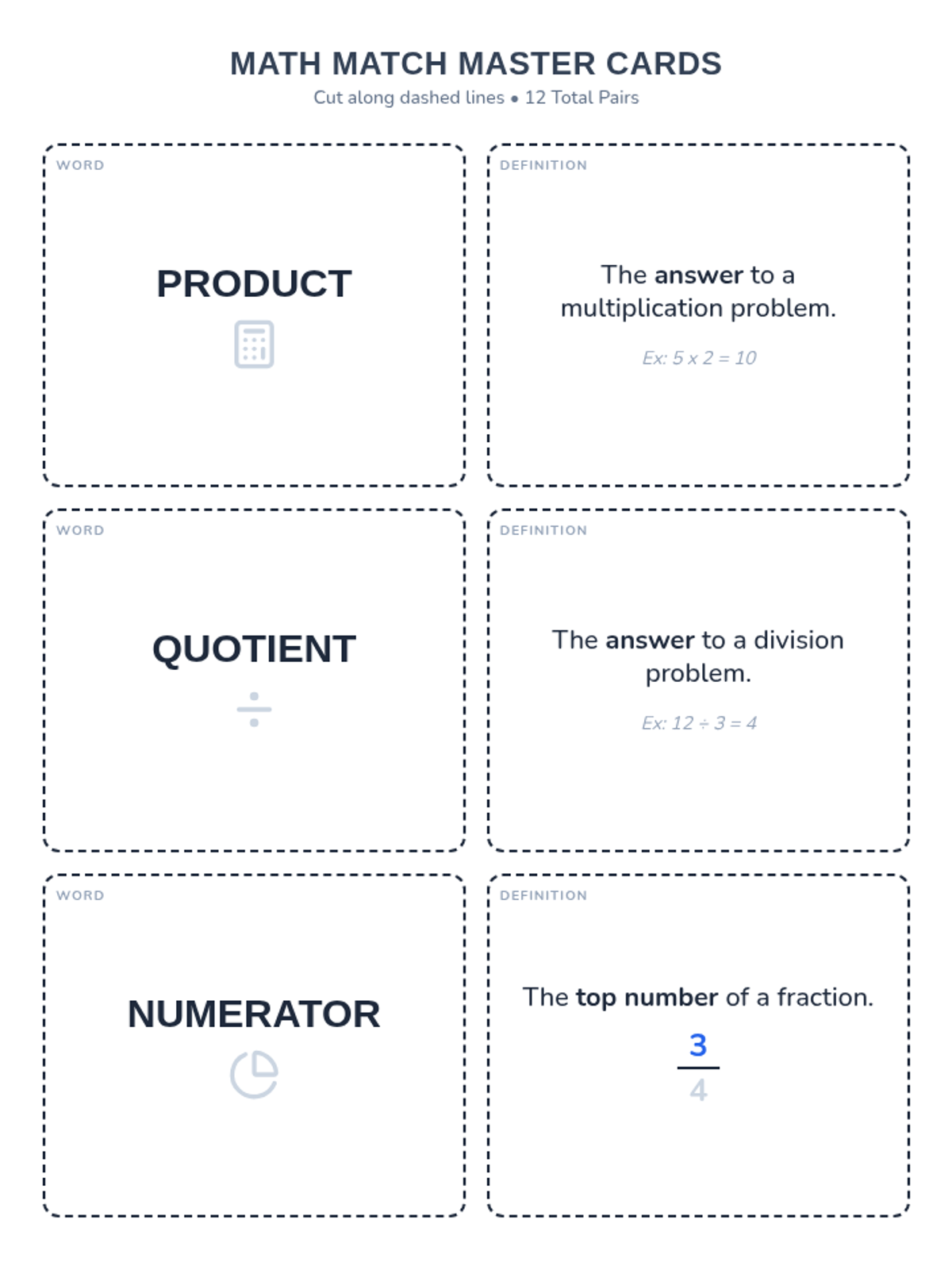
Printable memory match cards featuring key 3rd-grade math vocabulary words and their corresponding definitions and illustrations. Includes 12 pairs across multiplication, fractions, geometry, and measurement. Cards now use high-contrast icons and consistent backgrounds for optimal gameplay. Includes optional card back pattern.