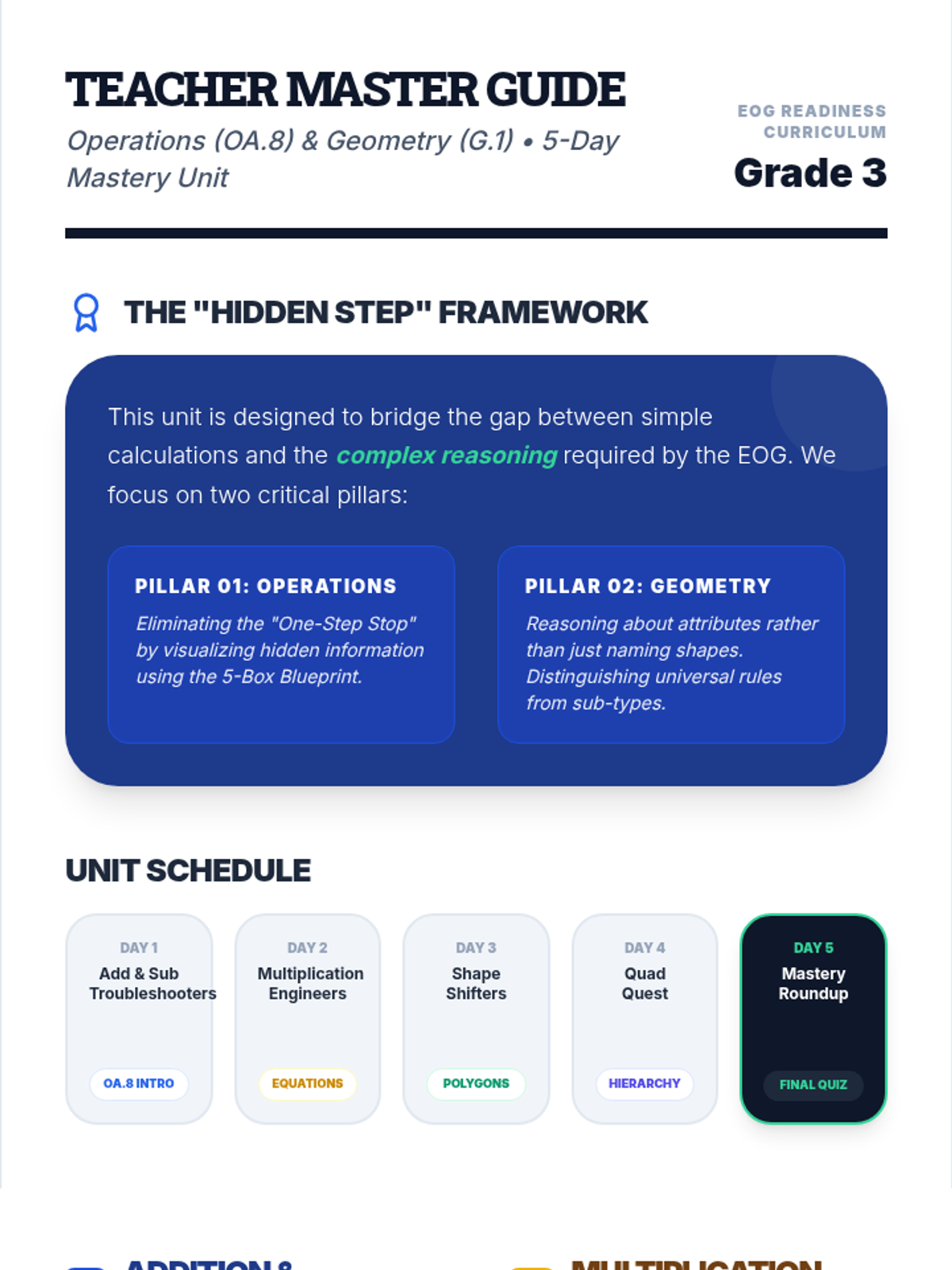
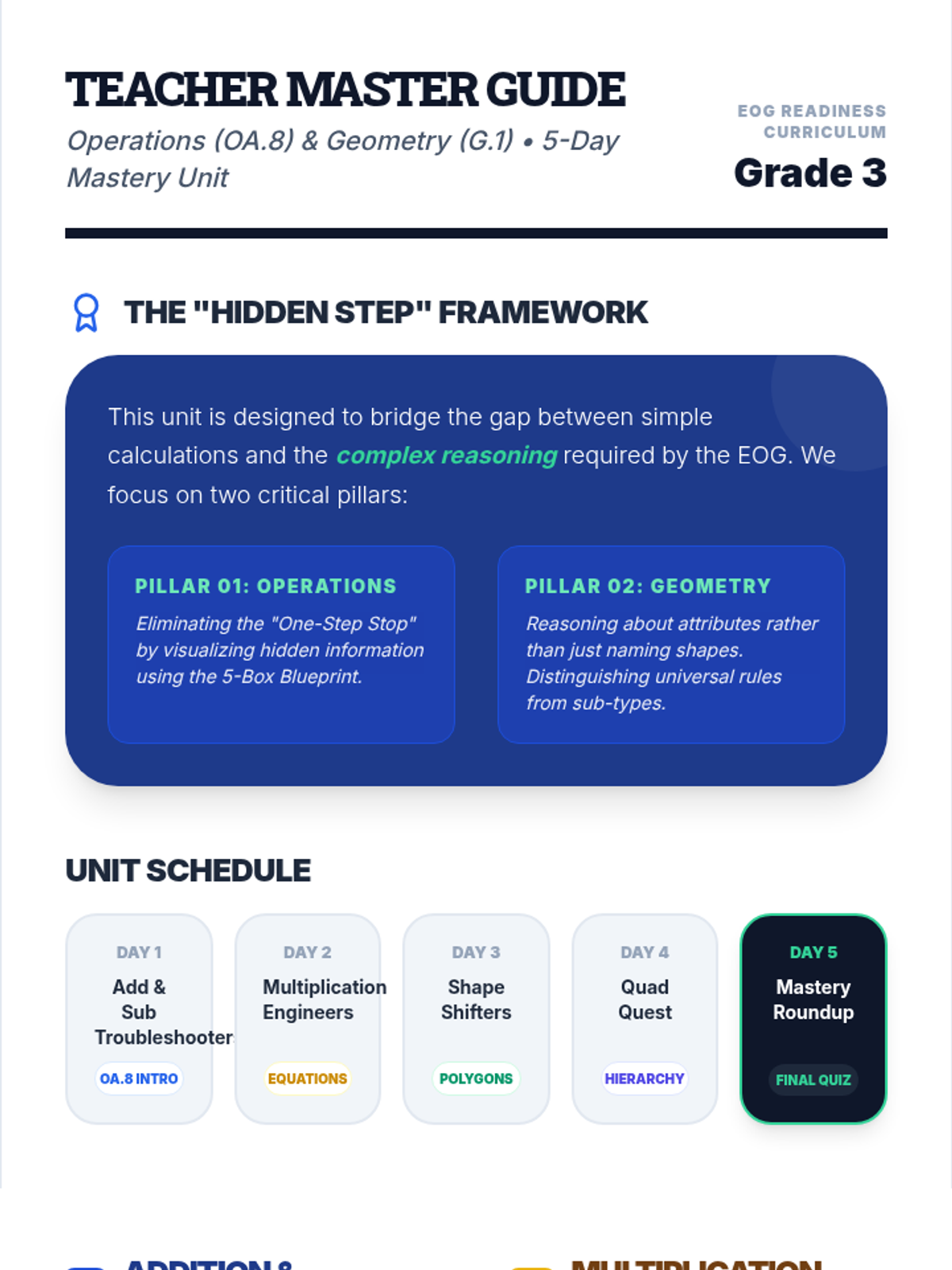
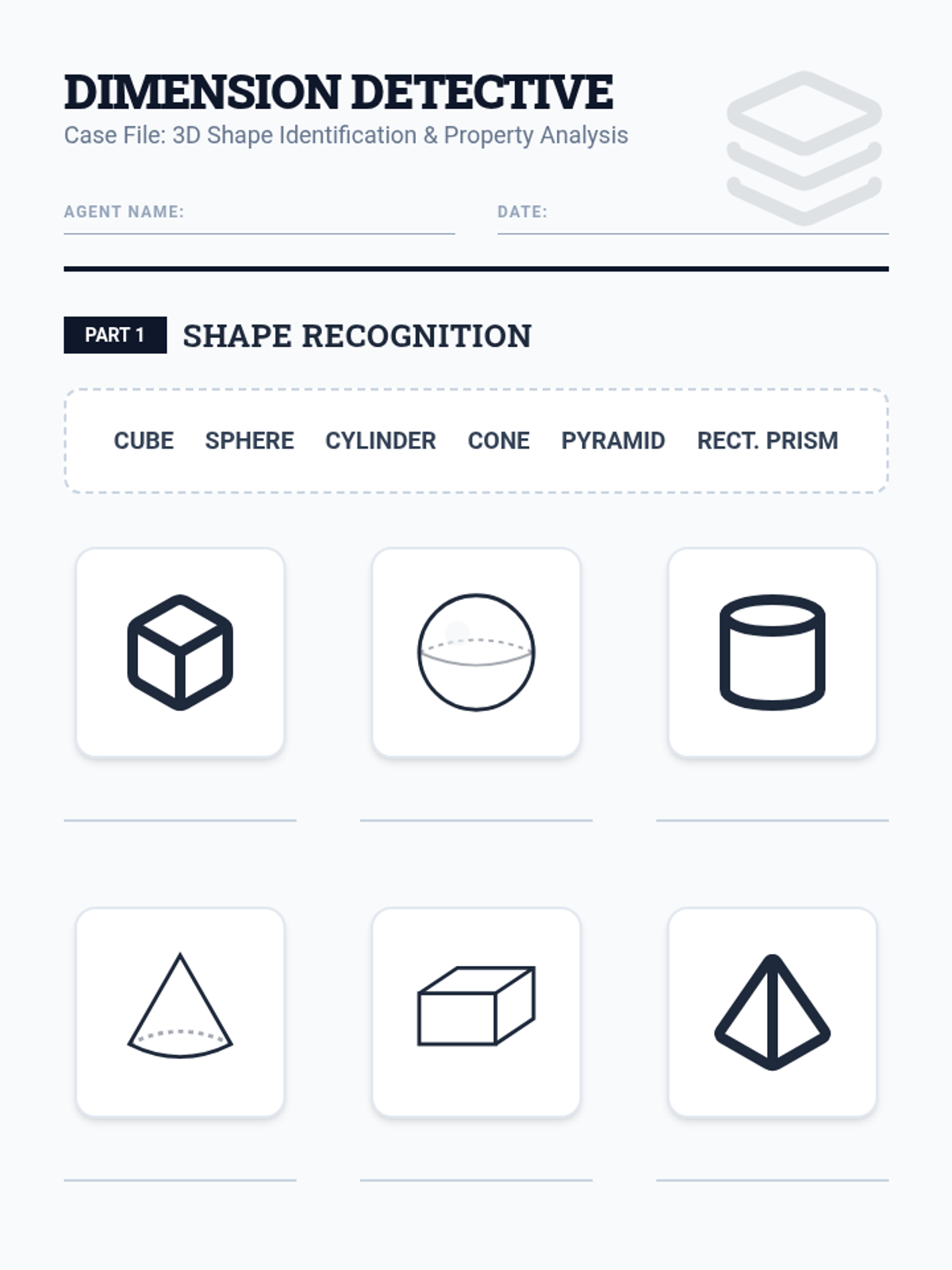
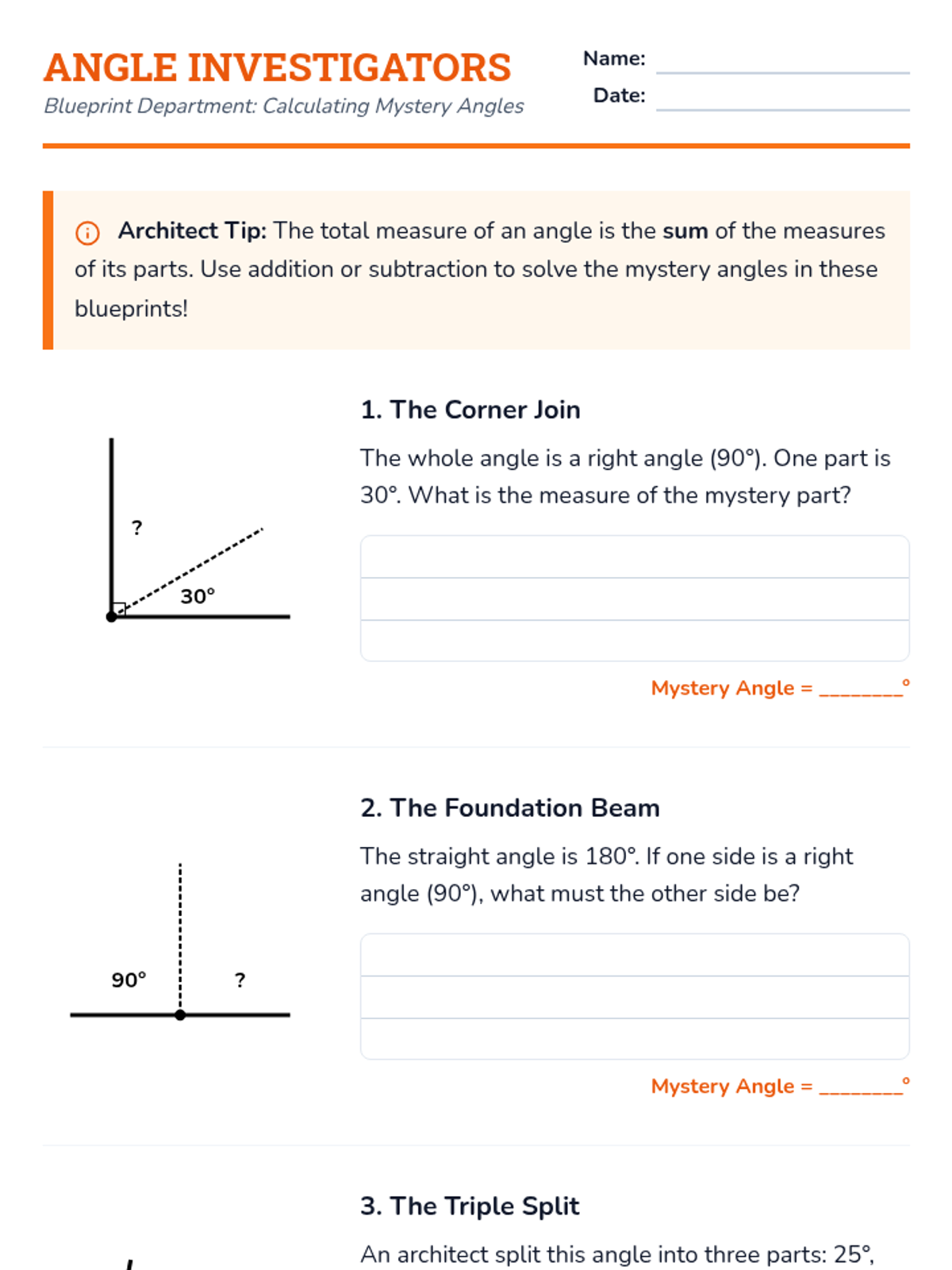
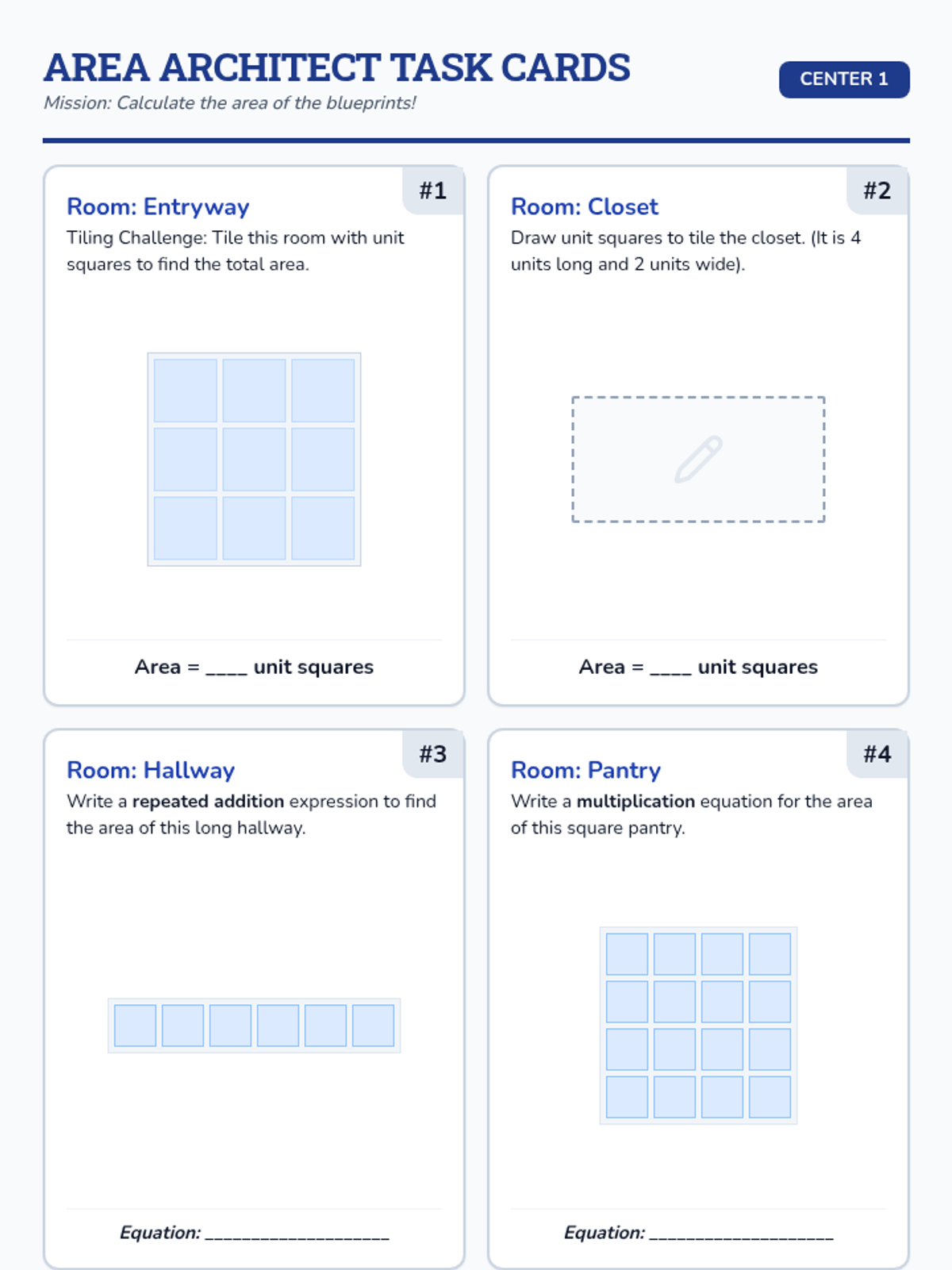
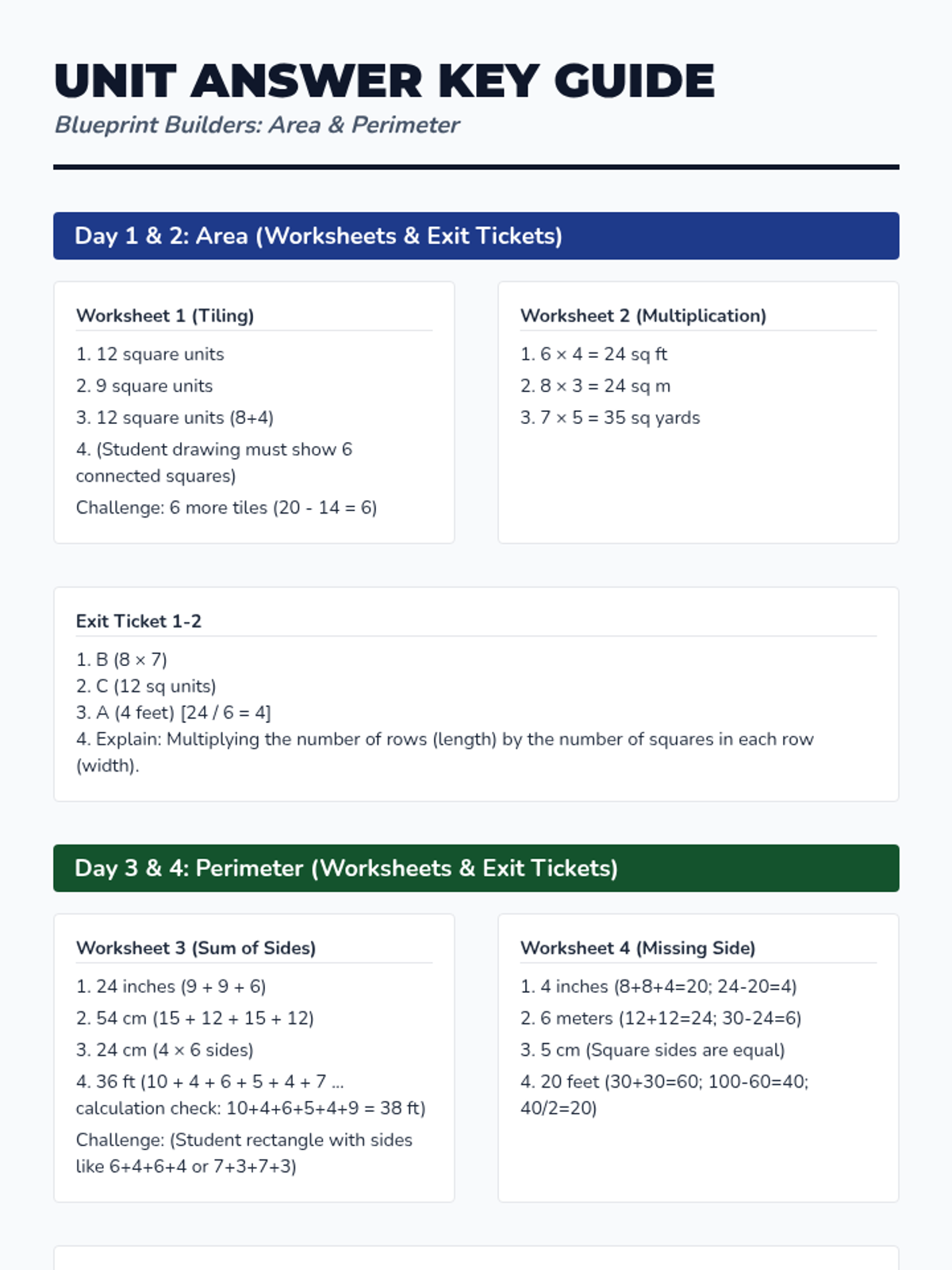
Geometric classification, measurement of area and volume, and the study of transformations and rigid motions. Builds toward complex proofs, trigonometry for general triangles, and the algebraic representation of conic sections.
A comprehensive answer key for the Symmetry Showdown Assessment, providing sample answers, grading rubrics, and visual solutions for geometric problems.
A formal unit assessment evaluating students' ability to define symmetry, identify symmetrical and asymmetrical objects, and draw precise lines of symmetry in complex polygons.
A skill-building activity where students use grid lines to draw the reflected halves of various objects, including a castle tower and a space invader.
A geometric worksheet for identifying and drawing lines of symmetry in various 2D shapes, featuring multiple-choice and open-ended drawing tasks.
Engaging instructional slides introducing the concepts of symmetry, lines of symmetry, and asymmetry with clear visual examples from math and nature.
A detailed facilitation guide for the first lesson in the Symmetry Squad unit, featuring pacing, supply lists, and differentiation strategies.
A printable card game that challenges students to race and build patterns based on specific rules, reinforcing both shape and number sequences.
Final lesson plan for Lesson 3, culminating in a complex pattern-solving vault challenge and a creative final architectural design project.
A numerical pattern worksheet where students solve "Staircase" sequences by identifying rules and filling in missing terms.
A classroom game kit including rules, pattern challenge cards, and printable point tokens (bricks) designed to build quick recognition of shape and number sequences.
Teacher's lesson plan for Lesson 2, focusing on number patterns and skip-counting rules within the context of palace architecture.
A hands-on activity mat where students use pattern blocks to design garden rows following specific repeating and growing rules.
A set of four hands-on activity cards featuring "damaged" palace floors that students must repair and extend using physical pattern blocks, ranging from simple repeating patterns to complex growing sequences.
An engaging slide deck for Lesson 1, introducing repeating and growing patterns through the lens of palace architecture and royal garden design.
A student practice worksheet designed as a palace blueprint, featuring sections for identifying repeating cores, extending number sequences, solving growing pattern word problems, and creating original designs.
A comprehensive teacher's lesson plan for Lesson 1, guiding students through the world of repeating and growing shape patterns using the theme of palace garden design.
Visual presentation for the Pattern Palace Architects lesson, introducing pattern concepts, repeating cores, growing rules, and numerical sequences with engaging royal-themed visuals.
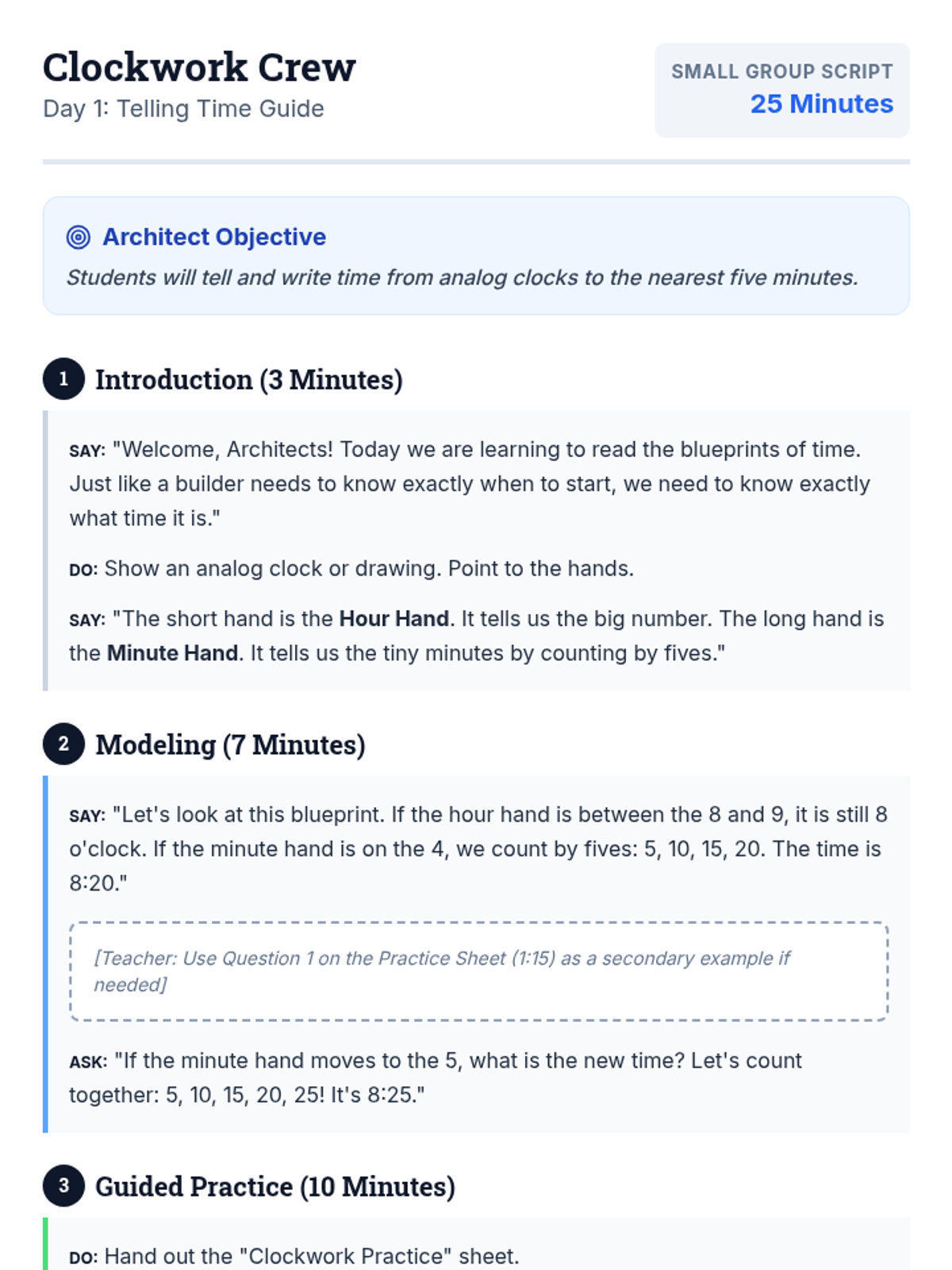
A comprehensive instructional guide for teachers to lead the Pattern Palace Architects lesson, including objectives, materials, timed activities, and differentiation strategies.
A high-impact visual presentation analyzing Grade 4 MCAS ELA data from 2023-2025. Features data visualizations of the School vs State gap, strength spotlights in reading comprehension, and deep dives into the writing and figurative language challenges.
A comprehensive multi-year analysis of Grade 4 MCAS ELA trends from 2023 to 2025. It identifies strengths in reading comprehension and character analysis, while highlighting a significant achievement gap in written expression and figurative language.
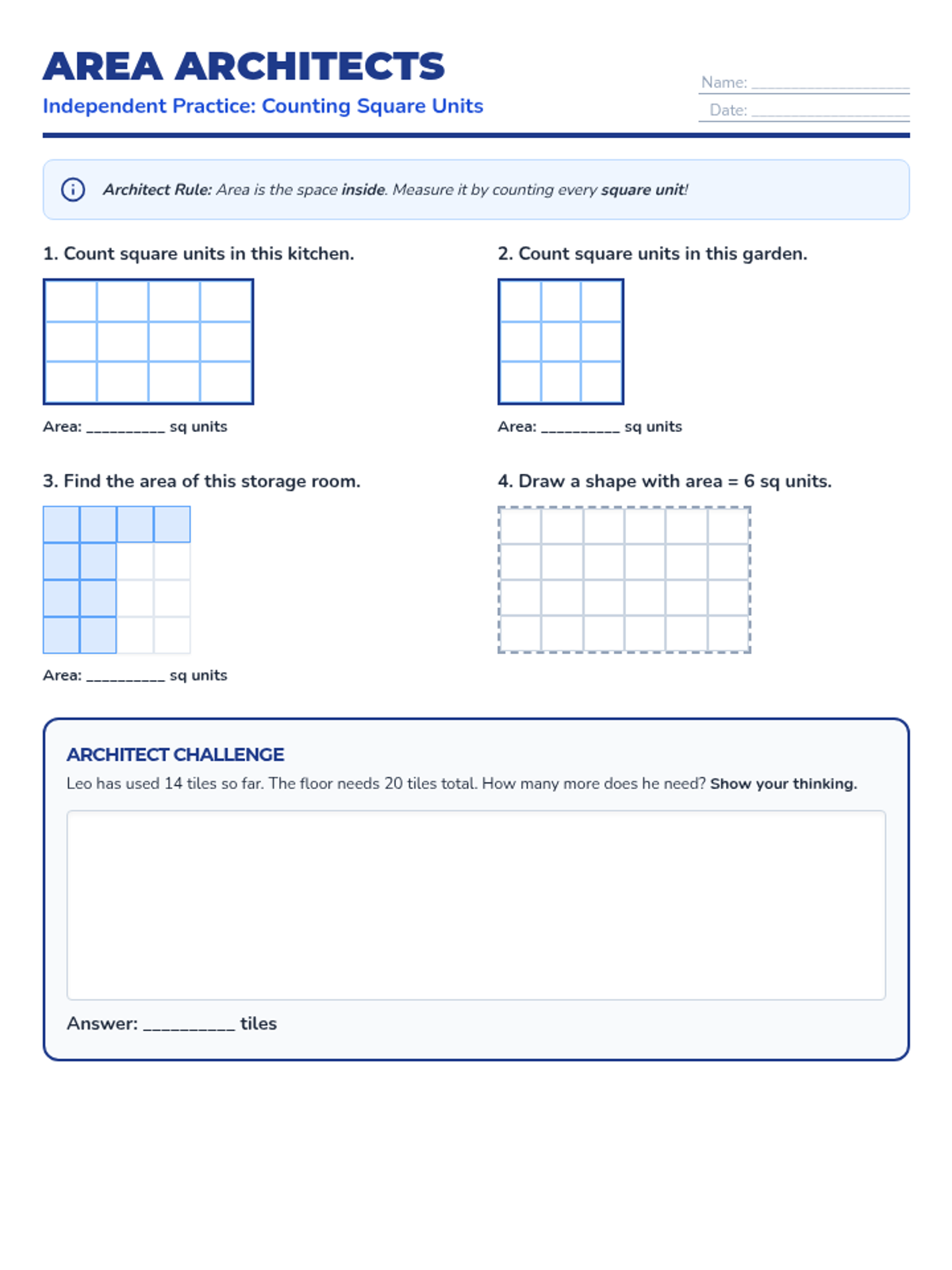
A teacher facilitation guide for the Area Architects lesson. Includes objectives, pacing, facilitation tips, common misconceptions, and a full answer key updated for the 4-step strategy (including "Eliminate Distractors"). Updated with precision values for the final visuals.
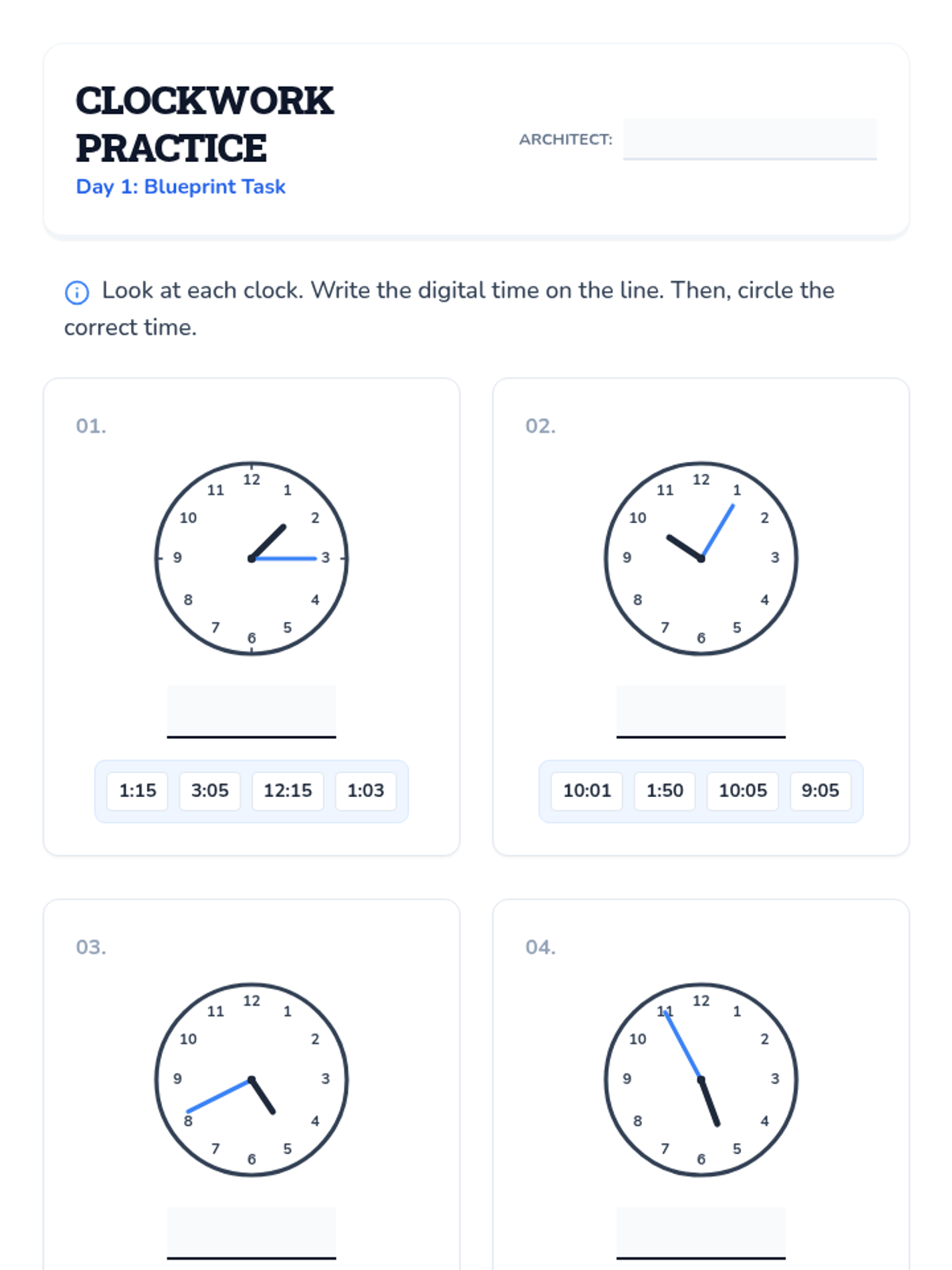
A student worksheet for finding the area of complex rectilinear figures by partitioning. Features 4 Independent Practice (You Do) problems across 2 pages. Updated with the Area Architect theme, Roboto/Montserrat fonts, and precision label alignment.
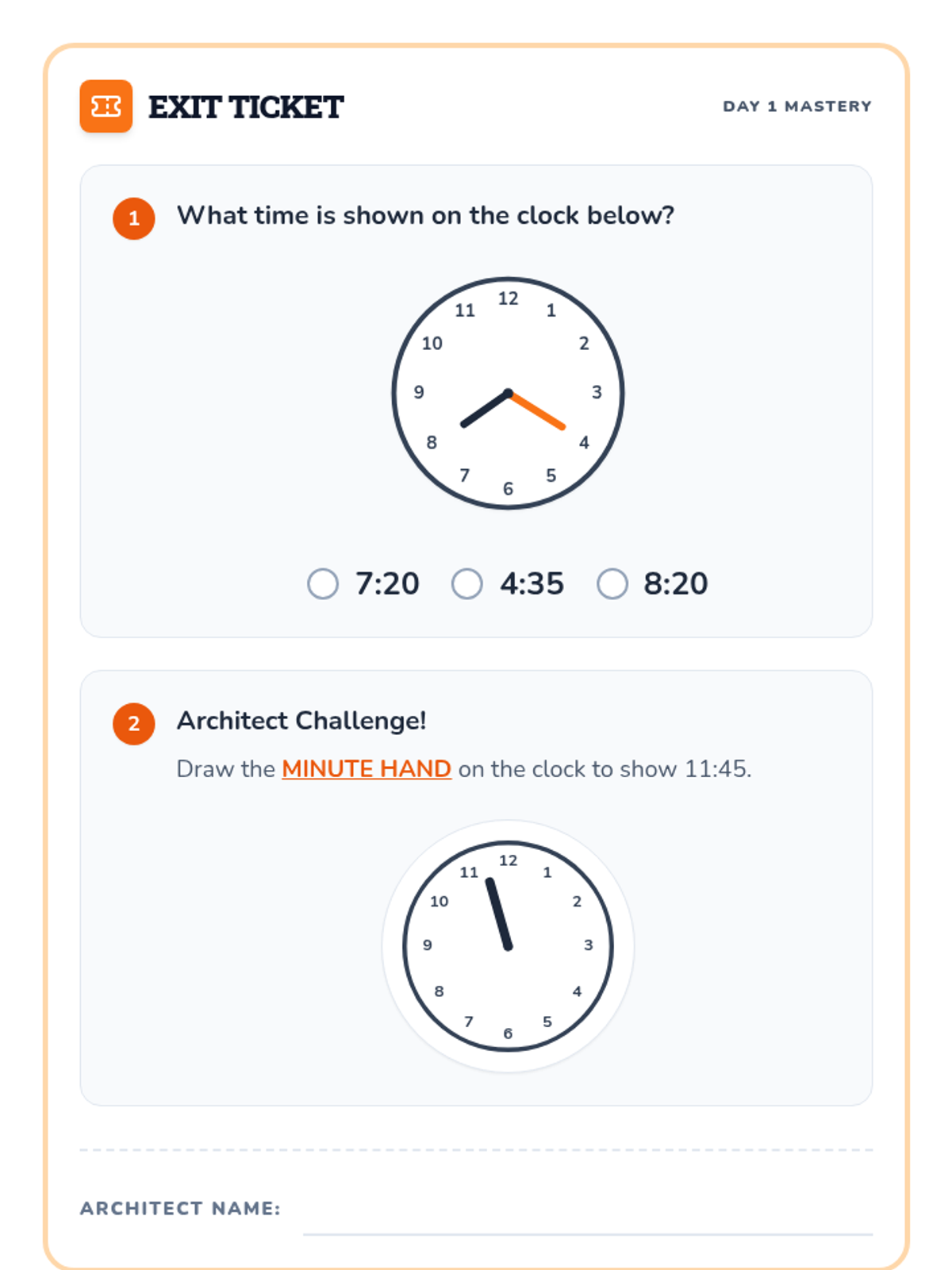
A concise exit ticket for assessing student understanding of finding the area of complex rectilinear figures. Features one problem. Updated for Day 1 with precise label alignment and consistent font usage.
A slide deck for a math refresher on finding the area of complex rectilinear figures. Features the 4-step Area Architect strategy and modeling with distractors. Updated with precision SVG alignment and a column-based strategy layout for unit cohesion.
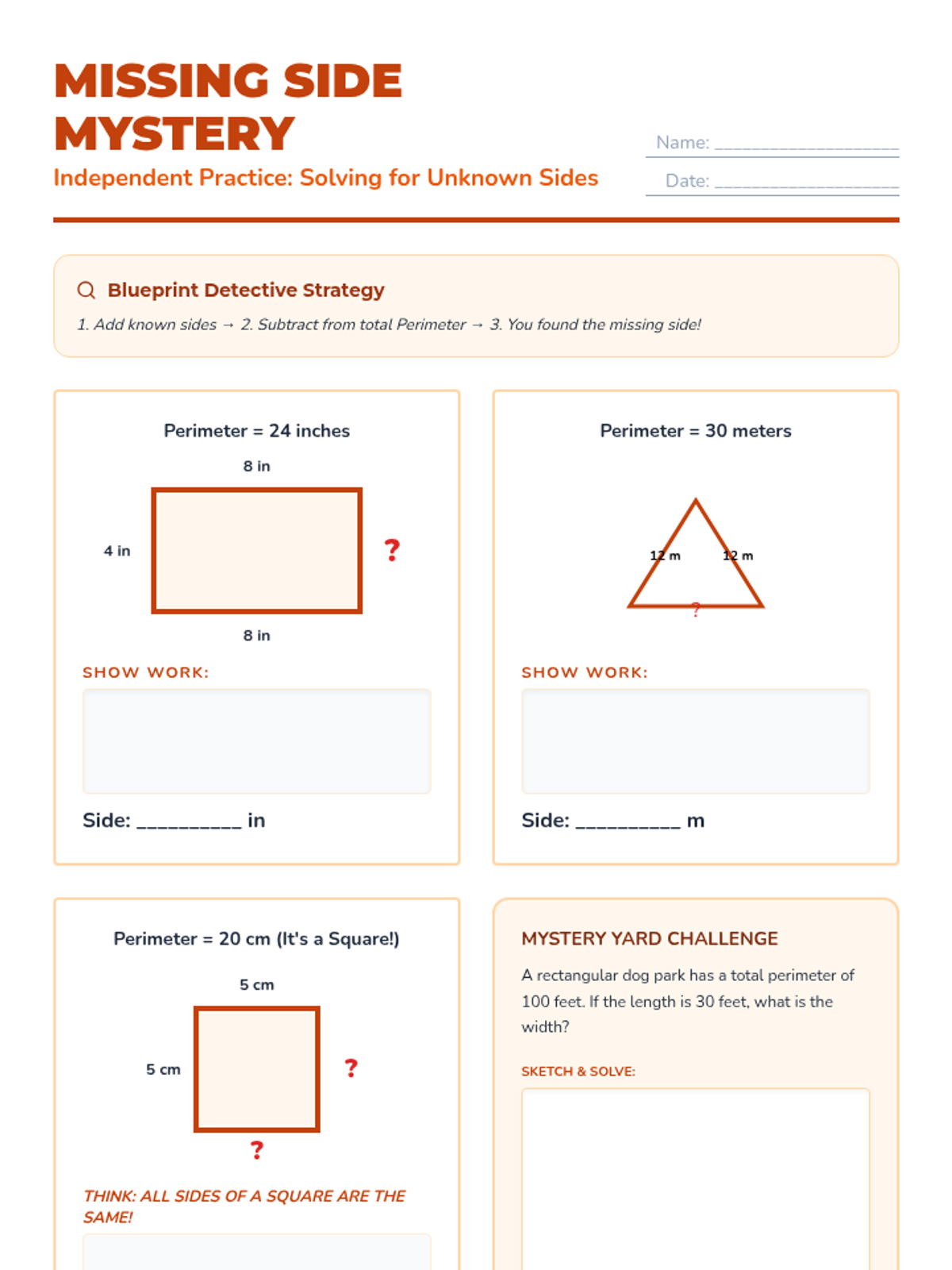
A teacher facilitation guide for Lesson 2 (Missing Measurements). Includes objectives, pacing, common misconceptions, and a detailed answer key for the worksheet and exit ticket. Updated with the 3-step Parallel Strategy and corrected Blueprint E values.
A concise exit ticket for assessing student understanding of identifying and calculating missing side lengths in rectilinear figures. Features one multi-part problem. Updated to ensure all side length labels are correctly aligned with their respective segments.
A student worksheet for identifying and calculating missing side lengths in rectilinear figures. Features 6 complex blueprints with missing horizontal and vertical measurements. Updated with the 3-step Parallel Strategy.
A teacher facilitation guide for Lesson 2 (Missing Measurements). Includes objectives, pacing, common misconceptions, and a detailed answer key for the worksheet and exit ticket. Updated to include the 3-step Parallel Strategy.
A student worksheet for identifying and calculating missing side lengths in rectilinear figures. Features 6 complex blueprints with missing horizontal and vertical measurements. Revised Blueprint F for mathematical accuracy.
A teacher facilitation guide for Lesson 2 (Missing Measurements). Includes objectives, pacing, common misconceptions, and a detailed answer key for the worksheet and exit ticket. Updated with final Blueprint F values.
A student worksheet for identifying and calculating missing side lengths in rectilinear figures. Features 6 complex blueprints with missing horizontal and vertical measurements. Revised Blueprint F for clarity.
A concise exit ticket for assessing student understanding of identifying and calculating missing side lengths in rectilinear figures. Features one multi-part problem.
A student worksheet for identifying and calculating missing side lengths in rectilinear figures. Features 6 complex blueprints with missing horizontal and vertical measurements.
A slide deck for Day 2 of the Blueprint Builders unit, focusing on finding missing side lengths in rectilinear figures. Features I Do, We Do, and You Do segments with precise label alignment and a consistent blueprint theme.
A dedicated student practice worksheet for Day 2 focusing exclusively on the 'Ghost Rectangle' (subtraction) strategy, featuring real-world architectural scenarios like courtyards and corner cutouts. Updated for better handwriting legibility.
A condensed, single-page tiered diagnostic assessment for Day 1, designed to gauge area proficiency from foundational rectangles to complex U-shapes. Optimized for single-sided printing with clear visual hierarchy.
A teacher facilitation guide for the Area Architects lesson. Includes objectives, pacing, facilitation tips, common misconceptions, and a full answer key updated for the 4-step strategy (including "Eliminate Distractors").
A class-wide data tracking chart designed for teachers to record diagnostic results across all domains for grades 2-5, helping to visualize instructional groups and skill gaps.
A comprehensive answer key and scoring guide for the Grade 2-5 math diagnostic assessments. Includes specific answers and helpful hints for interpreting student results.
A 5th-grade diagnostic assessment covering powers of 10, decimal operations, multi-digit division, and adding/subtracting fractions with unlike denominators. Aligned to Iowa Core standards.
A 4th-grade diagnostic assessment targeting multi-digit multiplication and division, place value to 1,000,000, fraction equivalence, and decimal comparisons. Aligned to Iowa Core standards.
A 3rd-grade diagnostic assessment covering rounding, multi-digit arithmetic, multiplication and division concepts, and introductory fraction number line and visual models. Aligned to Iowa Core standards.
A short 2nd-grade diagnostic assessment covering place value to 1,000, multi-digit addition and subtraction, two-step word problems, and early multiplication/fraction foundations. Aligned to Iowa Core standards.
Friday's morning work for Month 4, Week 1, focusing on weekly progress celebration and mixed math review.
Thursday's morning work for Month 4, Week 1, focusing on self-kindness, area word problems, and division with 12s.
Wednesday's morning work for Month 4, Week 1, focusing on mid-week goal setting, 2-step addition/subtraction word problems, and area of rectangles.
Tuesday's morning work for Month 4, Week 1, focusing on gratitude for personal strengths, area of squares, and review 12s.
Monday's morning work sheet for Month 4, Week 1, featuring a mood check-in, 3-digit review, and intro to area.
Final answer key for Month 3 (Days 56-60) of the Morning Mindset series.
Friday's morning work sheet for Month 3, Week 4, featuring a monthly goal reflection, mixed operations review, and a multi-step word problem.
Thursday's morning work for Month 3, Week 4, focusing on empathy and multiplication review.
Wednesday's morning work for Month 3, Week 4, focusing on mistake resilience and equivalent fractions review.
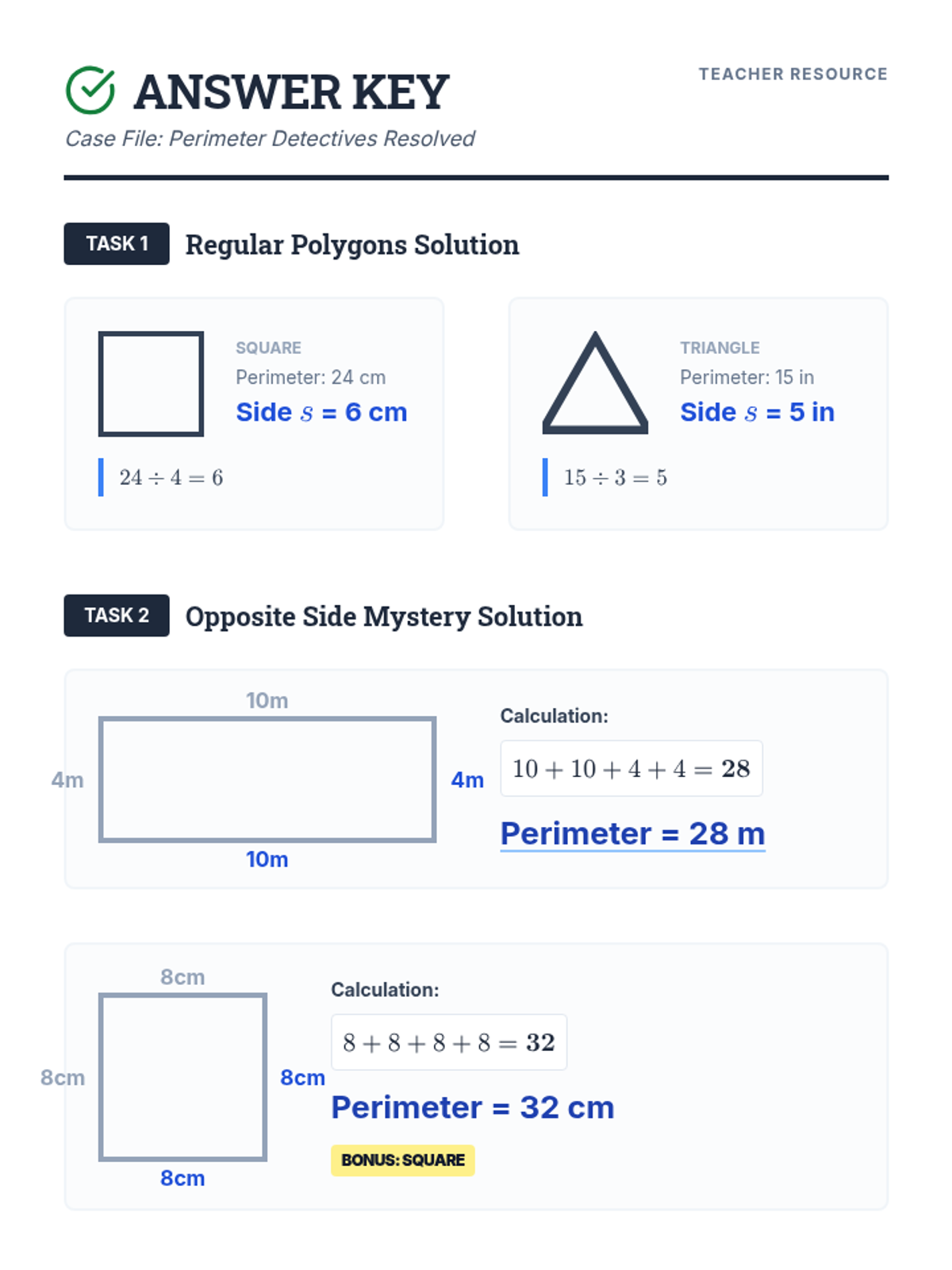
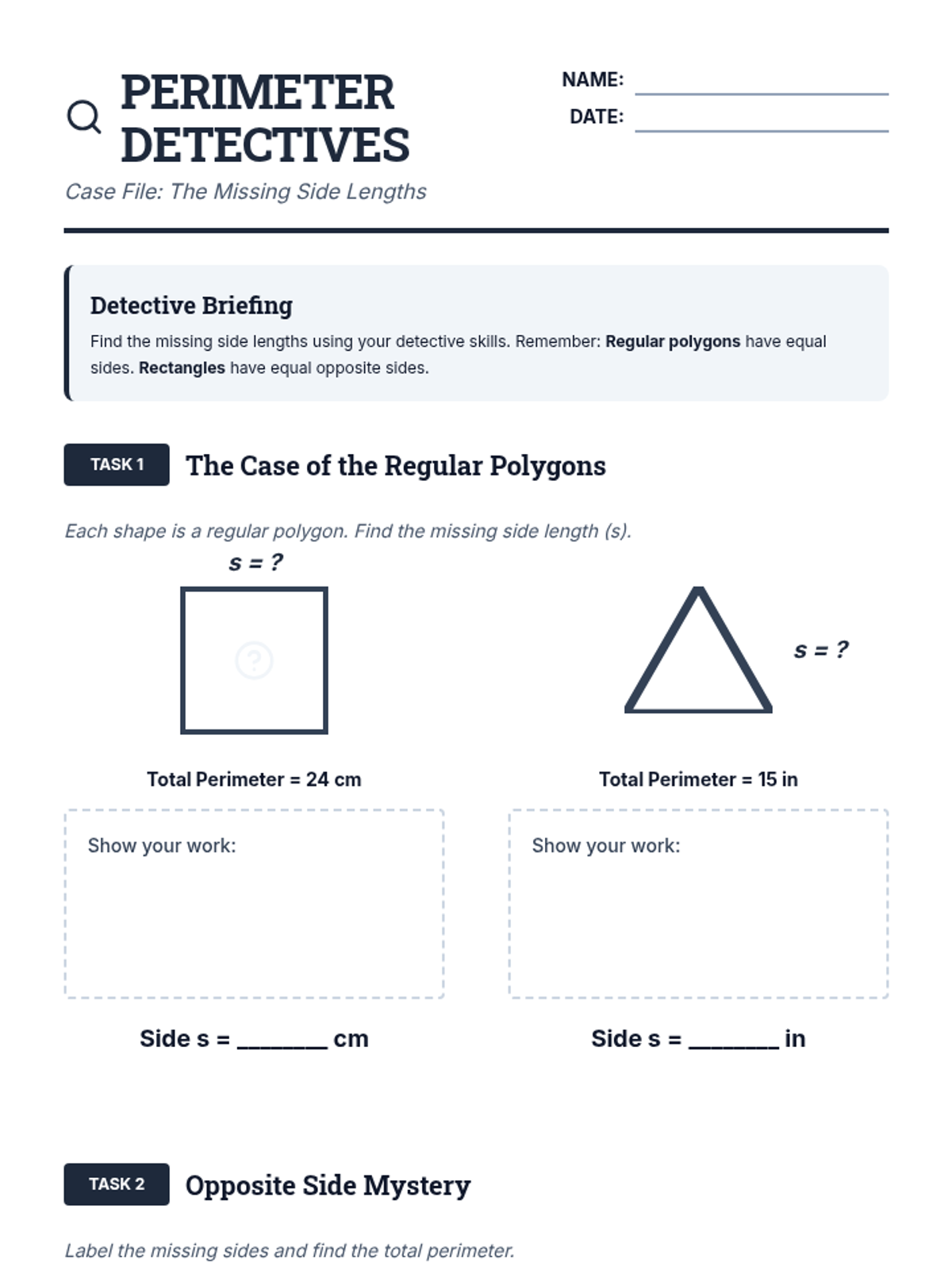
Tuesday's morning work for Month 3, Week 4, focusing on nature gratitude and perimeter missing sides.
Monday's morning work for Month 3, Week 4, featuring a weekend reflection, fractions review, and 12s multiplication.
Comprehensive answer key for Month 3, Week 3 (Days 51-55) of the Morning Mindset series.
Friday's morning work for Month 3, Week 3, featuring a weekly resilience reflection, mixed math review, and a multi-step word problem.
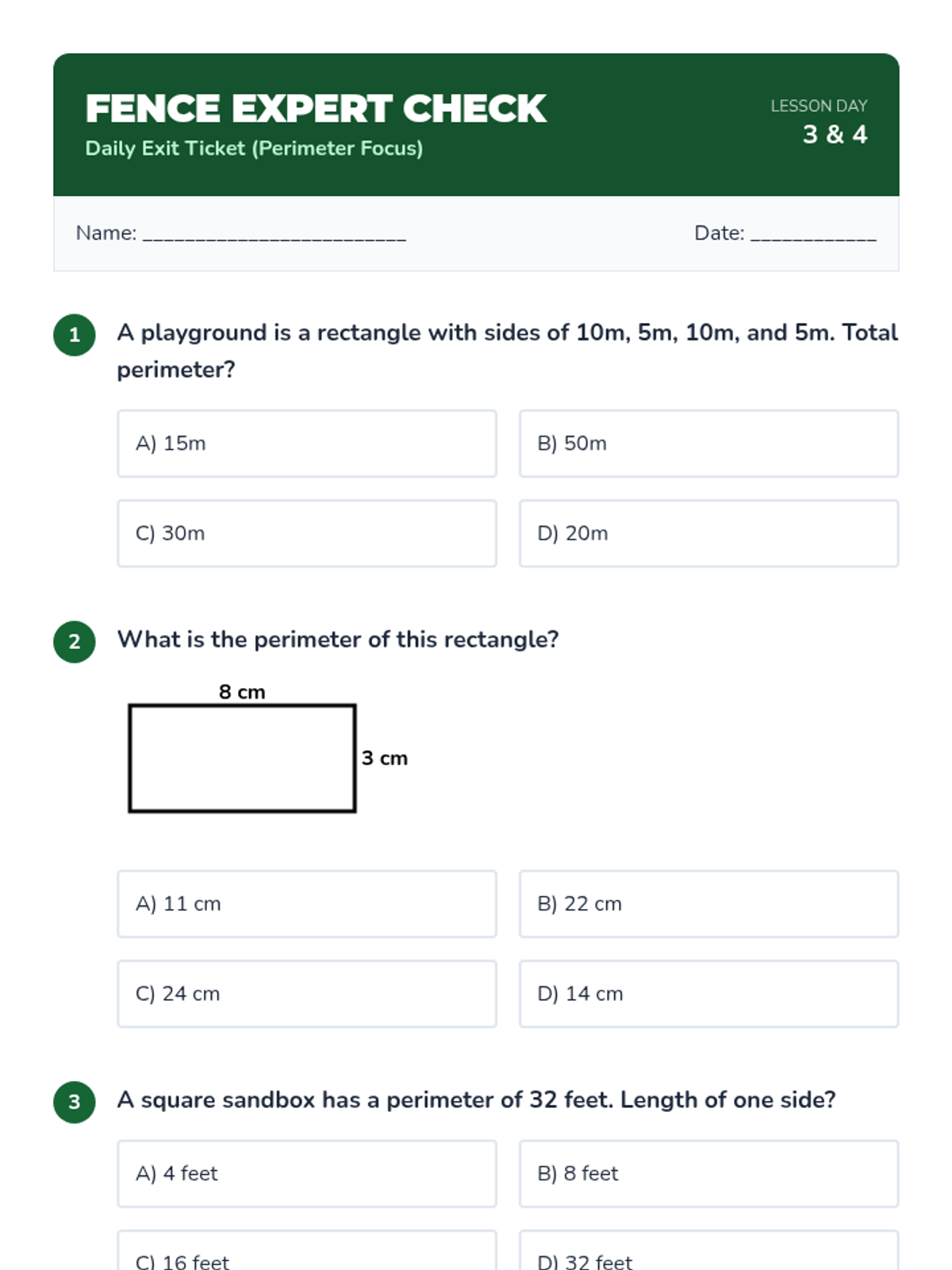
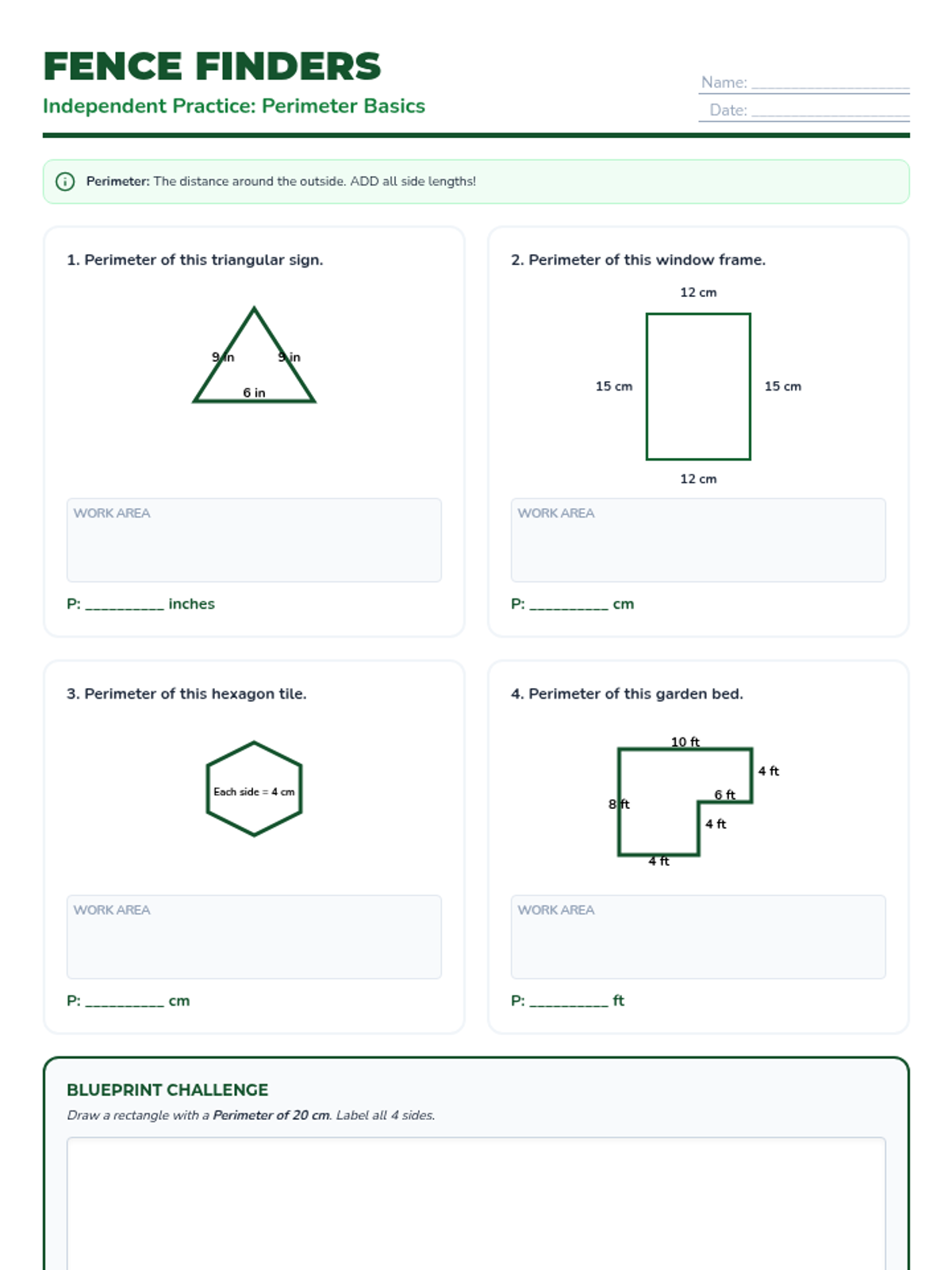
Thursday's morning work for Month 3, Week 3, focusing on kindness in action and perimeter word problems.
A comprehensive answer key for the 6 worksheet problems and the final exit ticket, including step-by-step calculations.
An exit ticket containing one composite area problem where students must find a missing vertical segment to calculate the total area.
A worksheet featuring 6 rectilinear area problems with missing side lengths, designed to mimic the provided example with a clean blueprint aesthetic.
A student-friendly math progress tracker with a "blueprint" theme, allowing students to self-assess their skills and set goals.
A professional teacher-facing rubric for assessing four core math domains across four levels of performance, including specific feedback sections.
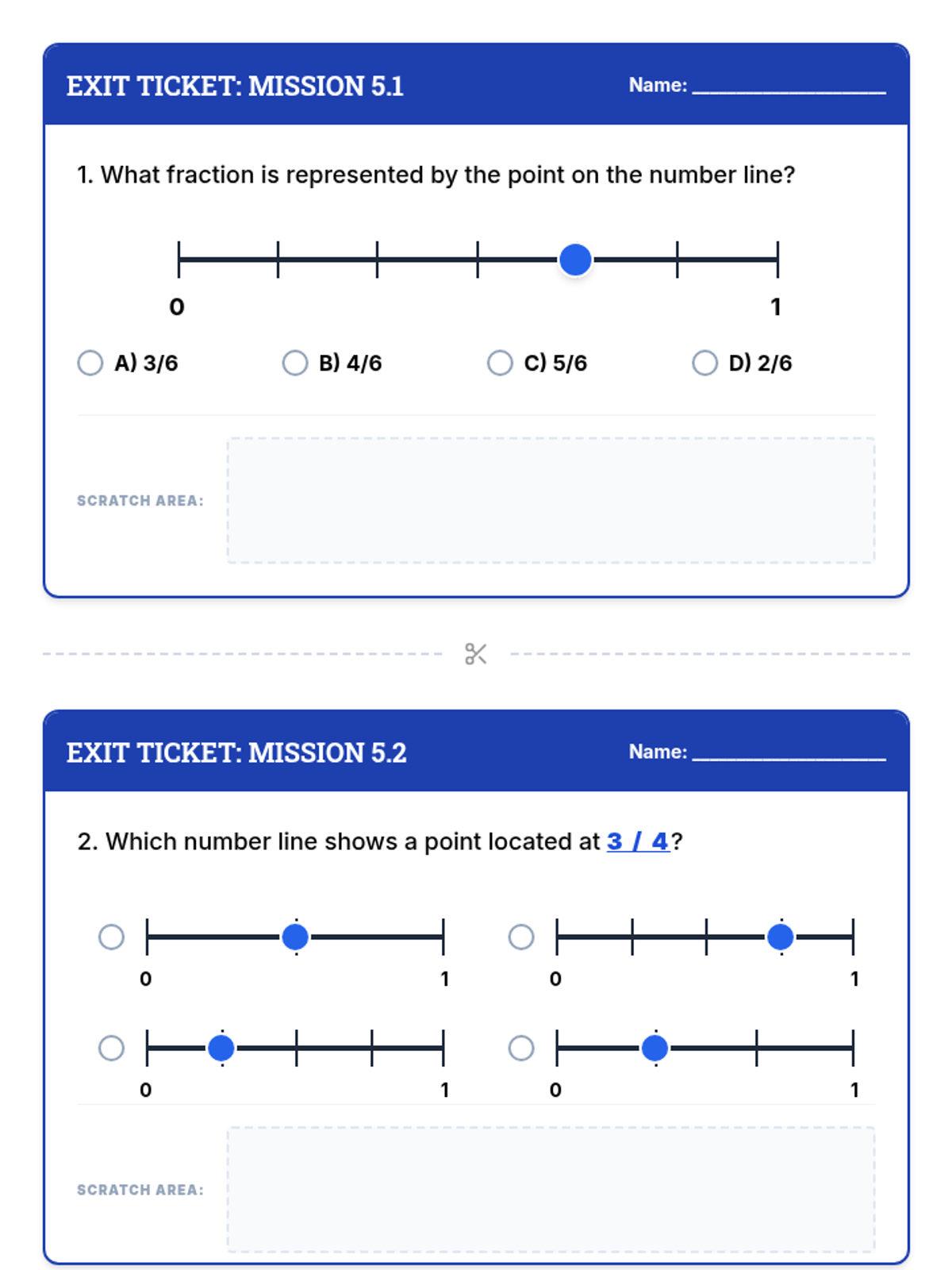
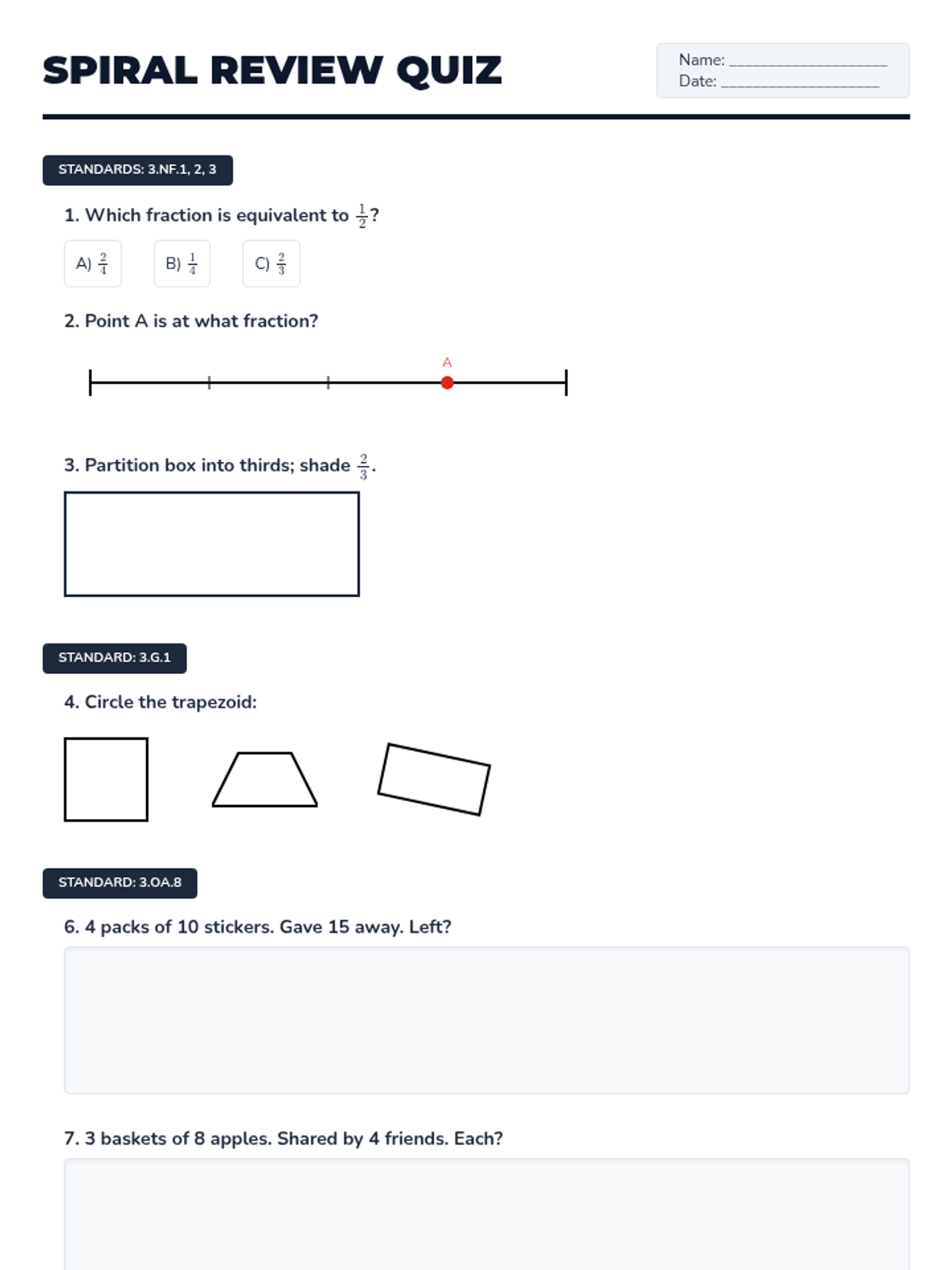
A set of two identical exit tickets on a single page, designed to be cut out. Includes three quick check questions on shading models, number lines, and equivalent fractions.
Teacher answer key for the Fraction Frenzy unit review worksheet. Provides clear answers, rationale for tricky problems, and guidance on identifying equivalent fractions on number lines.
A comprehensive 2-page student worksheet for the Fraction Frenzy unit review. Includes 10 problems covering area models, number lines (including challenging 8ths vs 4ths), equivalent fractions, and fractions as whole numbers. Updated with logical ordering and clear student work areas.
A 9-slide visual presentation for a 3rd-grade math review on Unit 5 (Fractions). Covers area models, number lines, equivalent fractions, and fractions as whole numbers with large, readable text and engaging visuals. Updated to include equivalent fraction models.
A detailed answer key for the Mirror Magic worksheet and Reflections Exit Ticket, featuring vertex coordinates and correct symmetry line counts.
A clear and concise student reference sheet defining the mirror line in geometry, featuring visual examples and key rules of reflection.
A quick assessment containing three questions on line symmetry, point reflection on a grid, and core geometric properties of reflection. Designed to be printed two per page.
A student worksheet with three parts: identifying lines of symmetry in geometric shapes, reflecting complex shapes across horizontal and vertical axes on a grid, and completing a symmetrical butterfly design.
A comprehensive teacher guide for the Mirror Magic lesson, including a timed procedure, hands-on activity instructions, and differentiation strategies.
A visually striking classroom anchor chart defining line symmetry and reflection with clear geometric and real-world examples.
A professional teacher-facing guide providing specific instructional strategies to address weaknesses in Grade 4 Fractions (NF) and Multi-step Word Problems (OA). It includes a 30-minute intervention protocol and success criteria for educators.
A high-impact visual presentation analyzing Grade 4 MCAS Math data from 2023-2025. Features clear data visualizations of the School vs State gap, strength spotlights in Base Ten, and deep dives into Fraction and Word Problem challenges.
A comprehensive summary report analyzing Grade 4 MCAS Math trends from 2023 to 2025. It details performance by reporting category, identifying Base Ten as a core strength and Fractions/Word Problems as critical areas for intervention.
Teacher-facing instructional guide providing lesson pacing, scripting prompts, key teaching points, and a full answer key for all student materials.
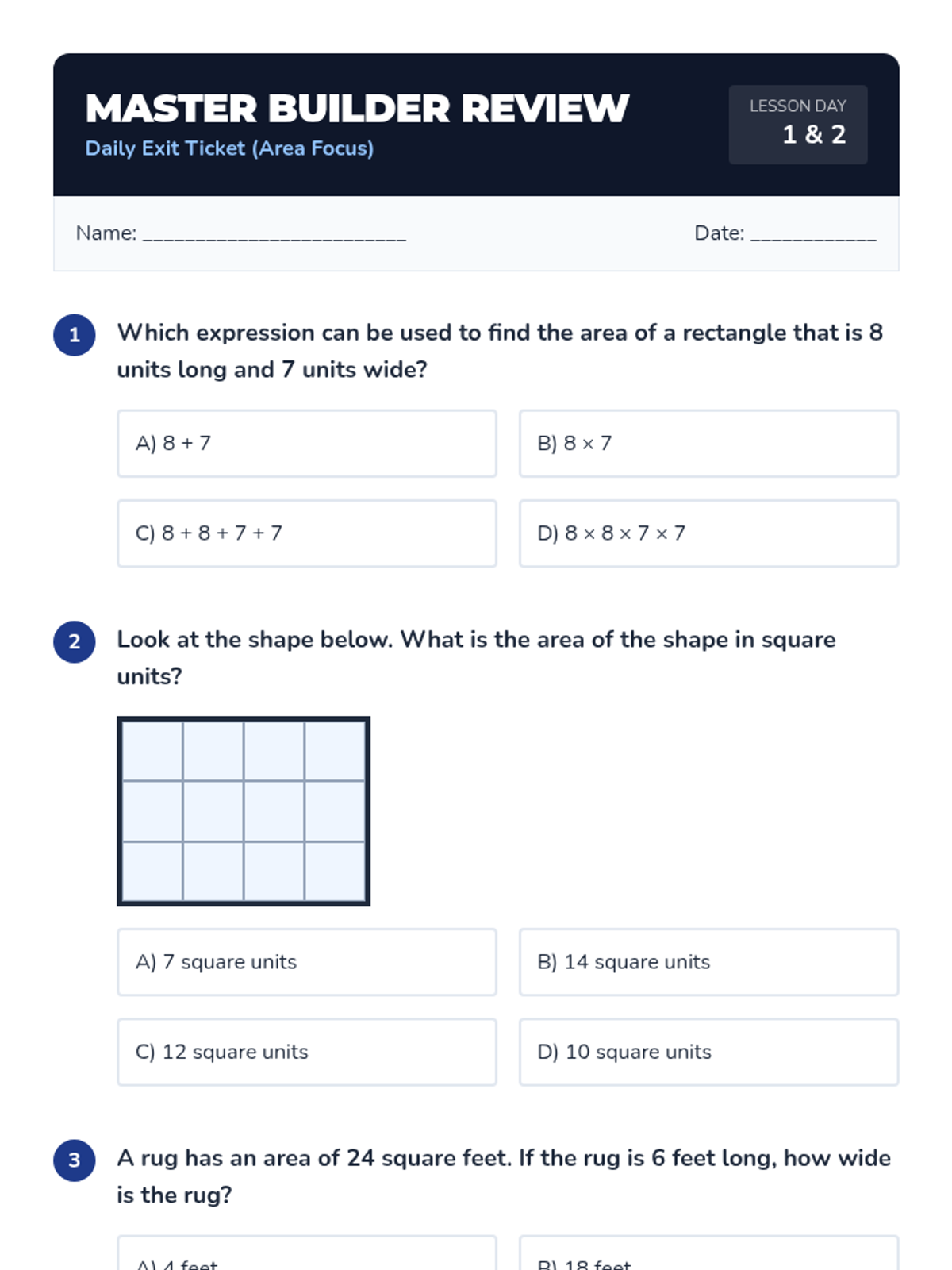
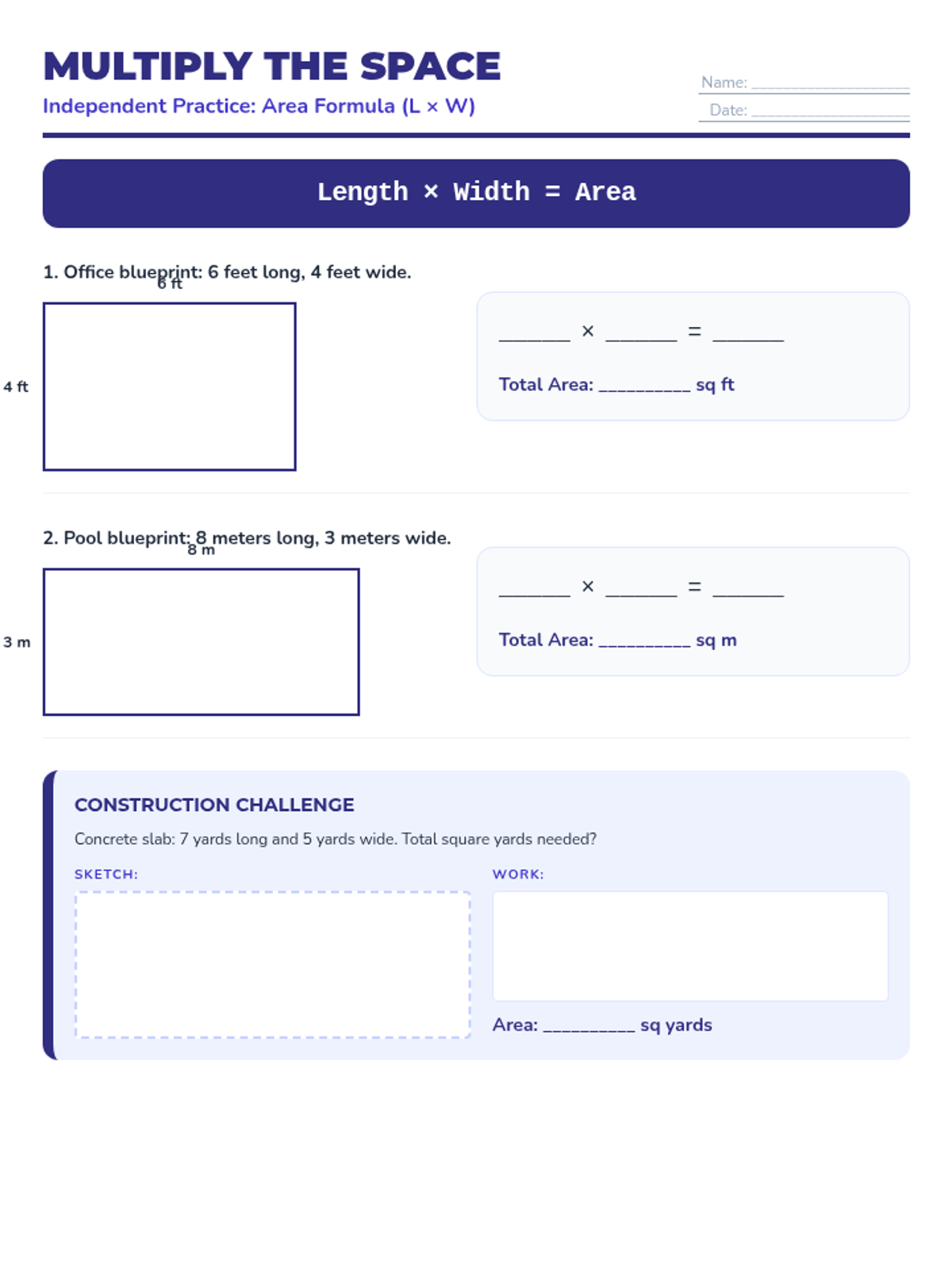
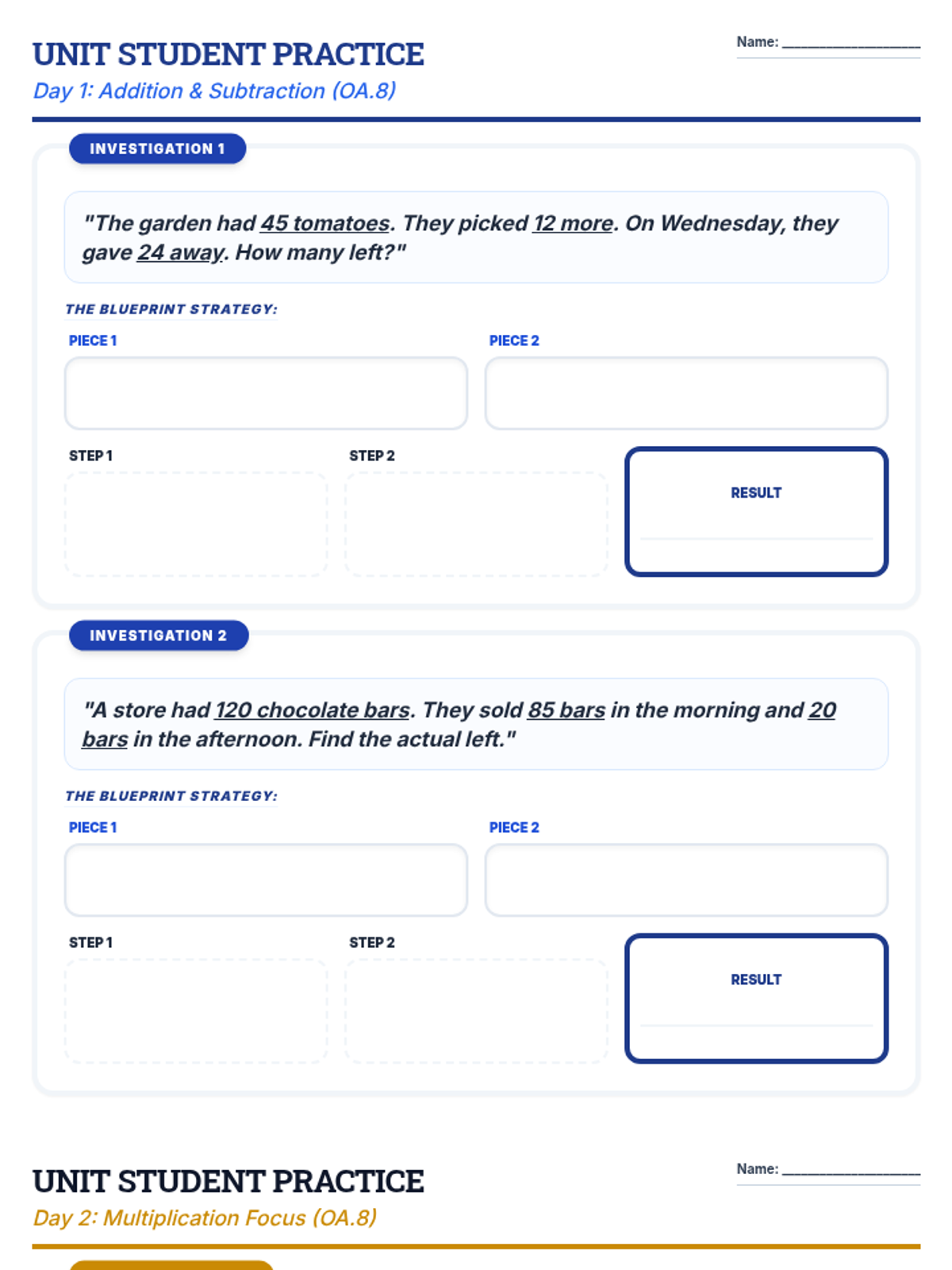
A post-lesson assessment where students solve two area word problems. Features 'clue hunting' tasks and specific workspaces for calculations and final answers with units.
Guided notes for students to use during the Area Sleuth Slides. Includes space for recording keywords, a mission objective, and guided practice problems.
A slide presentation for teaching students to identify and solve area word problems using 'detective clues' or keywords. Includes I Do, We Do, and You Do segments.
An answer key for the Blueprint Notes & Practice Handout, covering vocabulary, guided practice, and all six independent practice problems plus the master challenge.
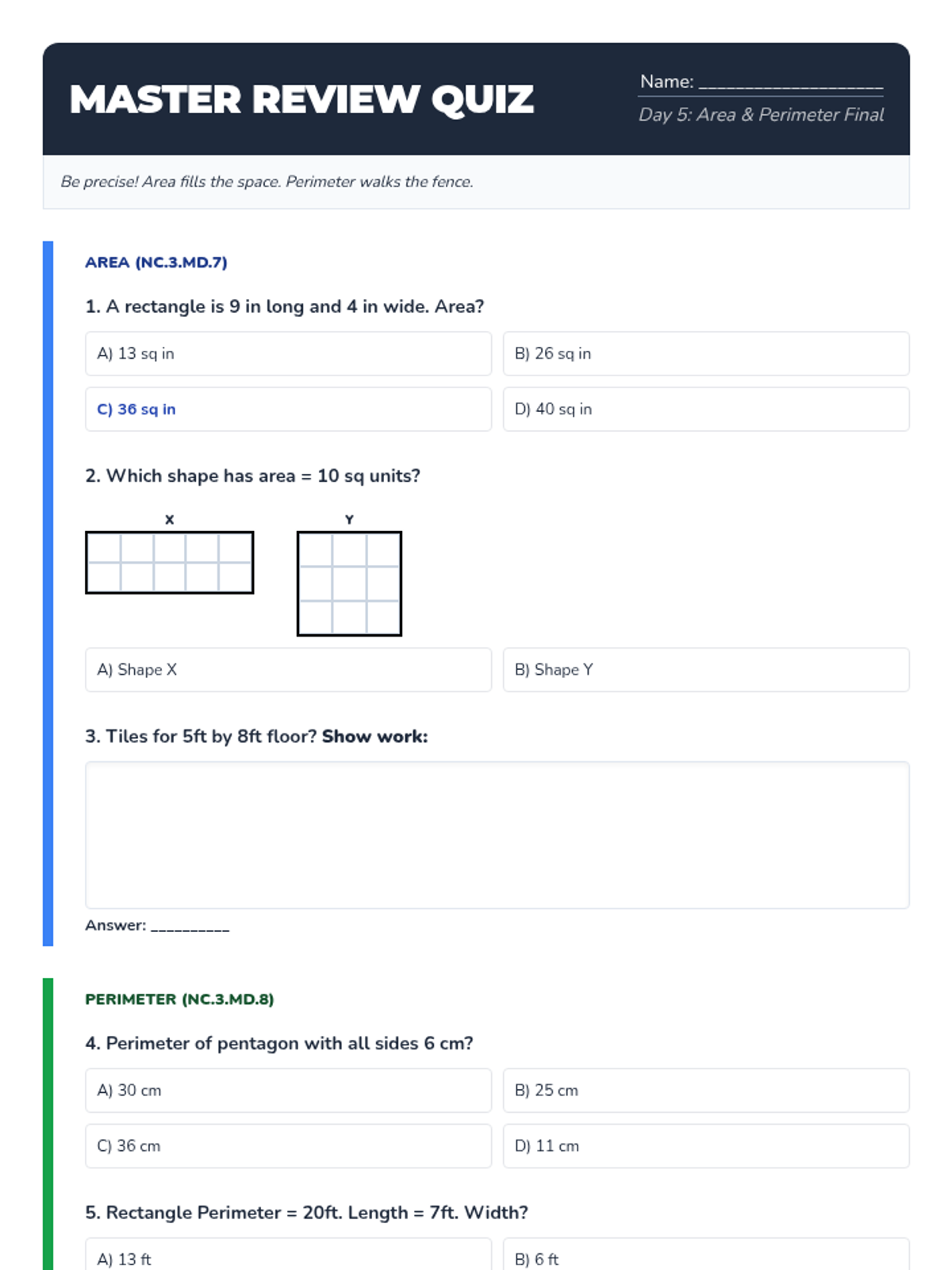
A comprehensive 2-page student handout (designed for double-sided printing) including Guided Notes on side 1 (vocabulary, distributive property formula, and model problem) and Independent Practice on side 2 (six rectilinear area problems and a challenge). Revised with larger, age-appropriate font sizes.
A teacher-facing lesson plan and facilitation guide for the Area Architect lesson, updated to utilize the 2-sided Blueprint Notes and Practice Handout.
An answer key for the Area Architect worksheet, updated to include Problem 5 and providing teacher notes on decomposition variations.
A student worksheet themed as an architectural blueprint, now expanded to two pages with more practice problems involving shape decomposition and the distributive property.
A comprehensive slide deck for teaching area of rectilinear shapes using the distributive property, featuring an architectural blueprint theme, vocabulary terms, and step-by-step visual guides.
Wednesday's morning work for Month 4, Week 2, focusing on mid-week resilience and area of complex shapes.
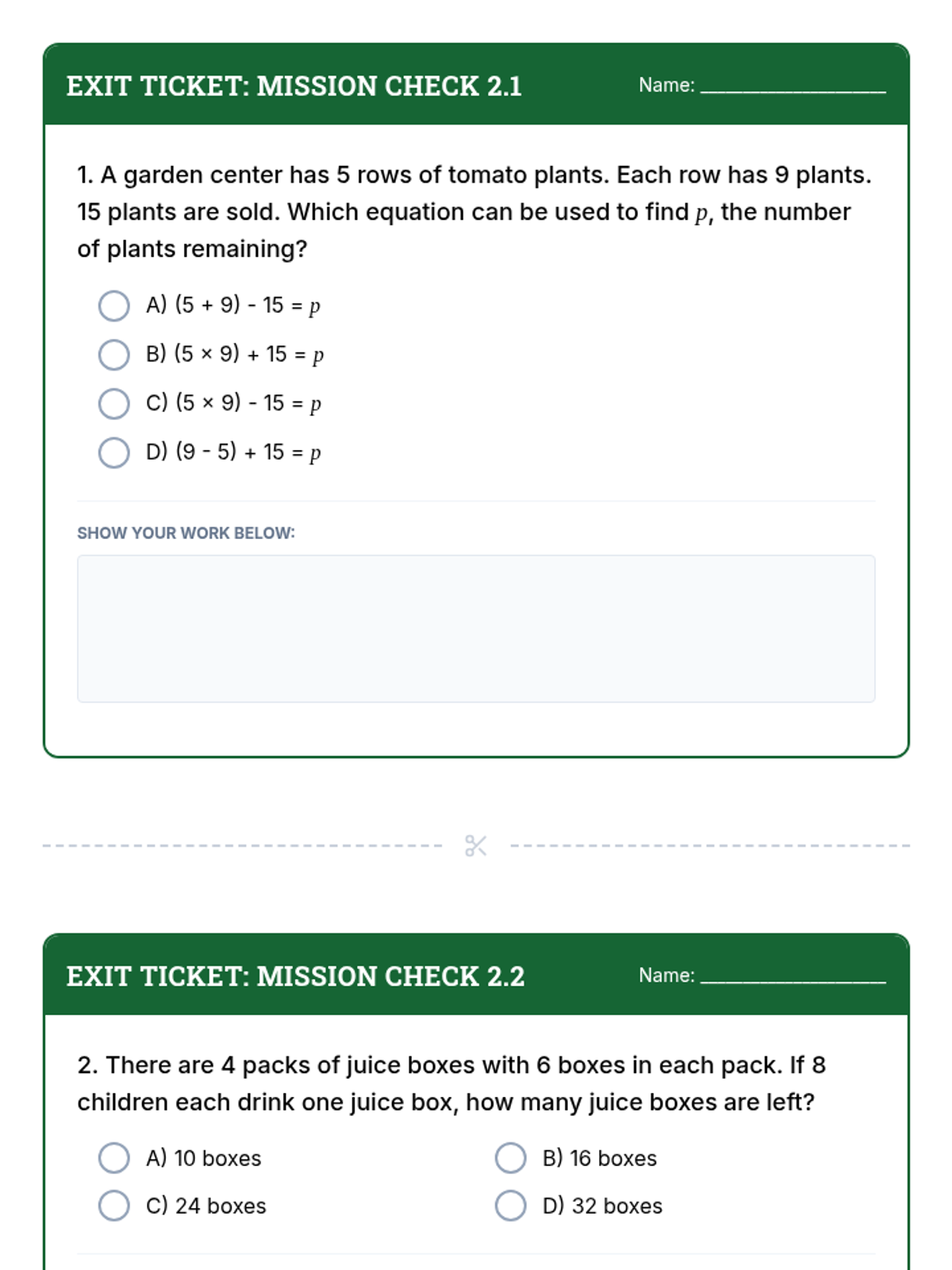
Tuesday's morning work for Month 4, Week 2, focusing on gratitude for school staff and 2-step multiplication/addition word problems.
Monday's morning work for Month 4, Week 2, focusing on weekend highlights and breaking apart area.
Answer key for Week 1 of Month 4 (Days 61-65) of the Morning Mindset series.
A high-level executive brief summarizing longitudinal MCAS Math data for Grades 3-4. It identifies procedural calculation as a systemic strength and highlights rational number reasoning (Fractions) as the primary curriculum gap requiring leadership intervention.
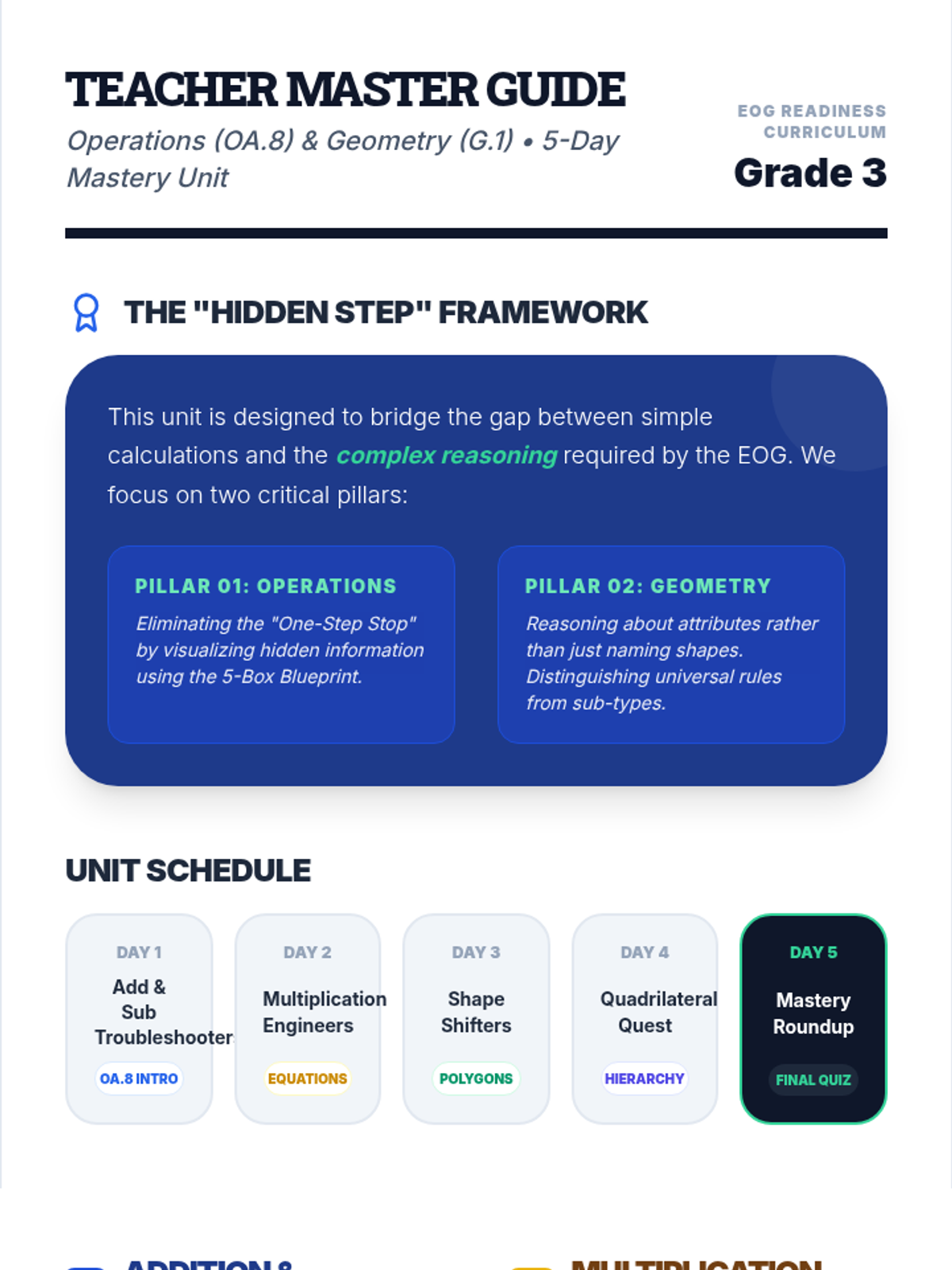
A specialized intervention guide for Grade 3 teachers focusing on the persistent conceptual gaps in Fractions (NF) and Geometry (GE) identified in the 2023-2025 data. It features partitioning strategies for number lines and attribute-based geometric instruction.
A high-impact visual presentation analyzing Grade 3 MCAS Math data from 2023-2025. Features data visualizations of the School vs State gap, strength spotlights in Multiplication/Division fluency, and deep dives into Fraction and Geometry attribute challenges.
A comprehensive multi-year analysis of Grade 3 MCAS Math trends from 2023 to 2025. It identifies procedural strengths in multiplication and area counting, while highlighting chronic weaknesses in fraction partitioning and geometry attribute identification.
Geoboard task cards for small group guided practice, providing specific challenges for constructing standard and non-standard quadrilaterals.
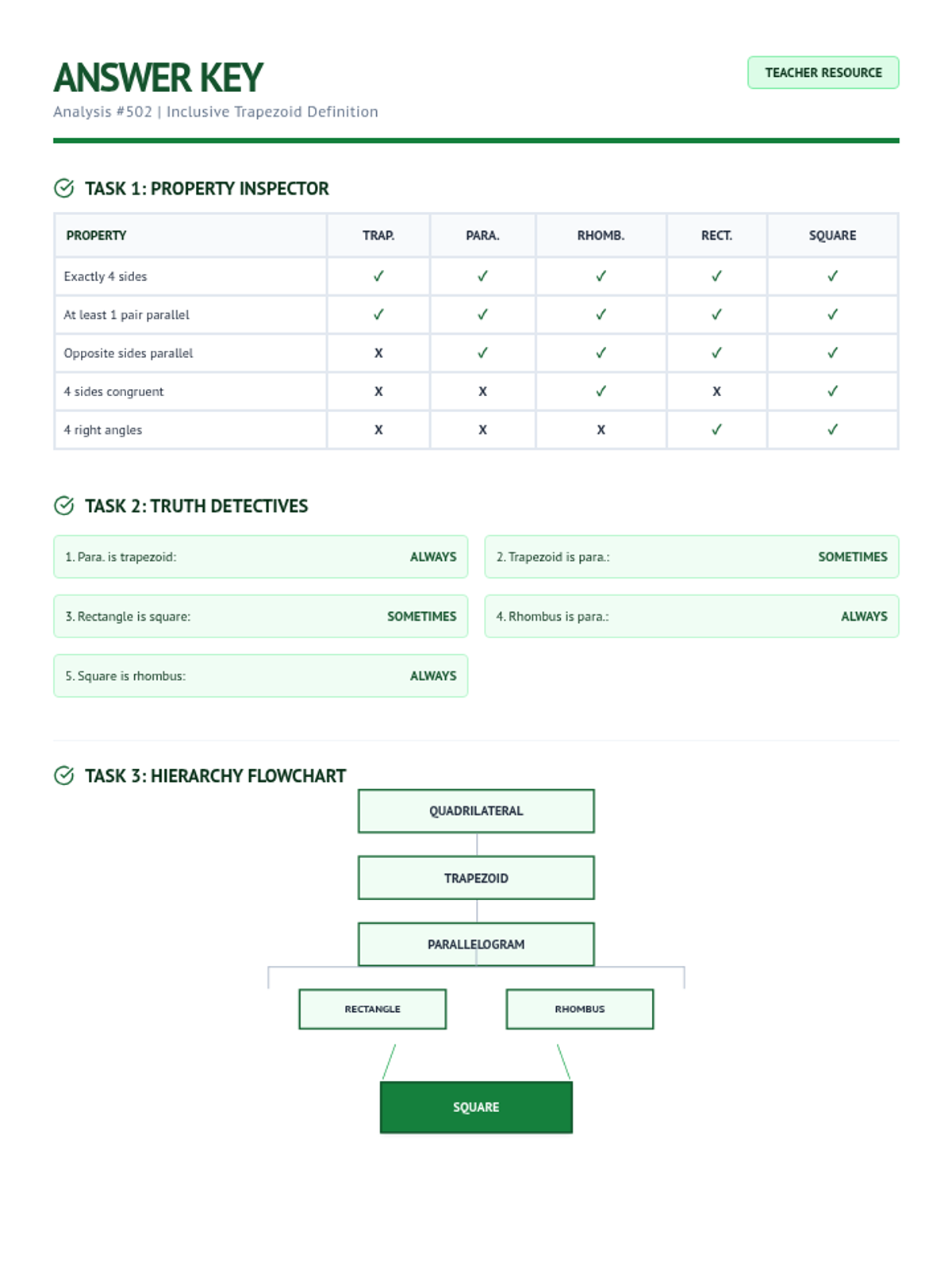
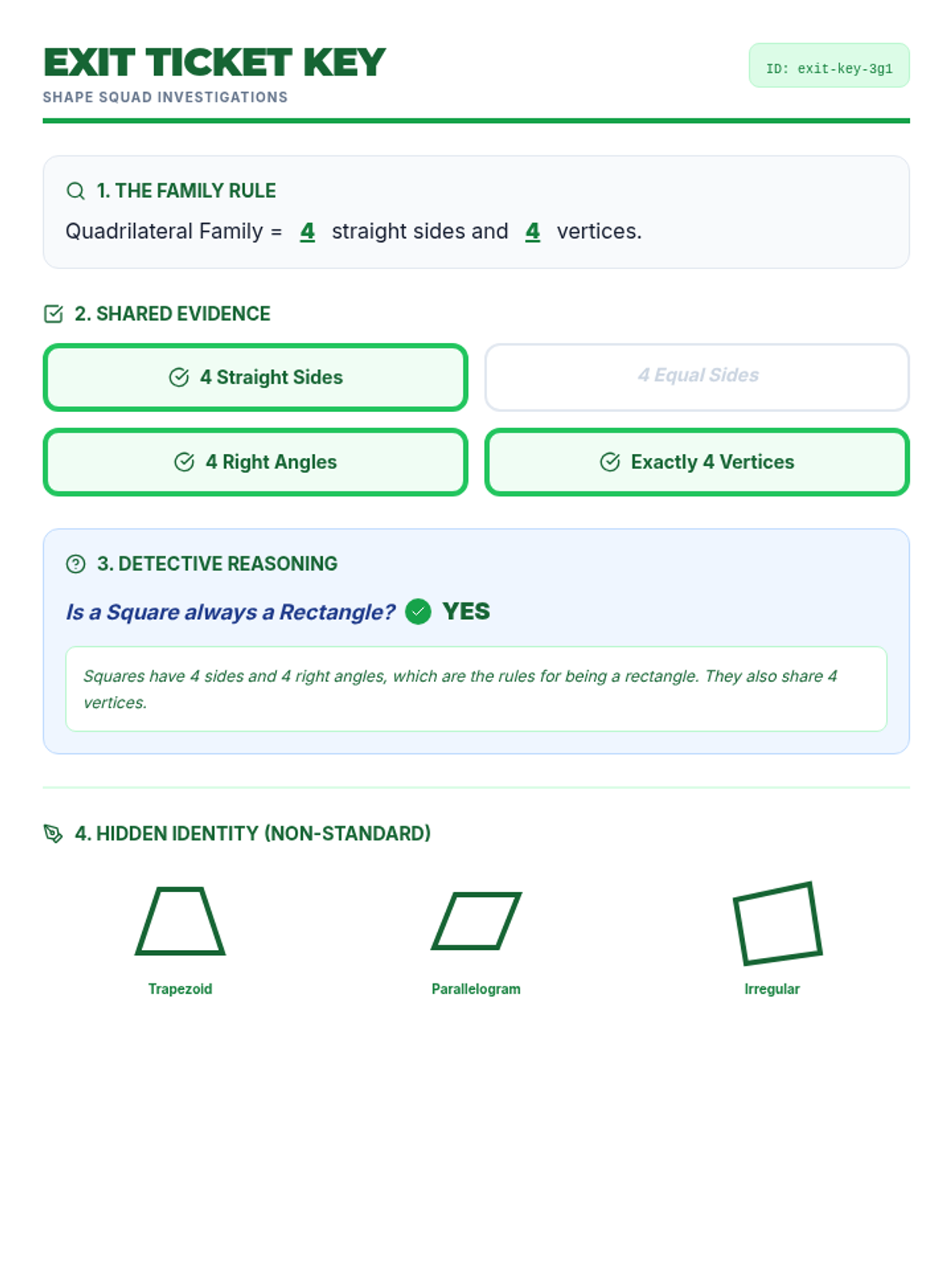
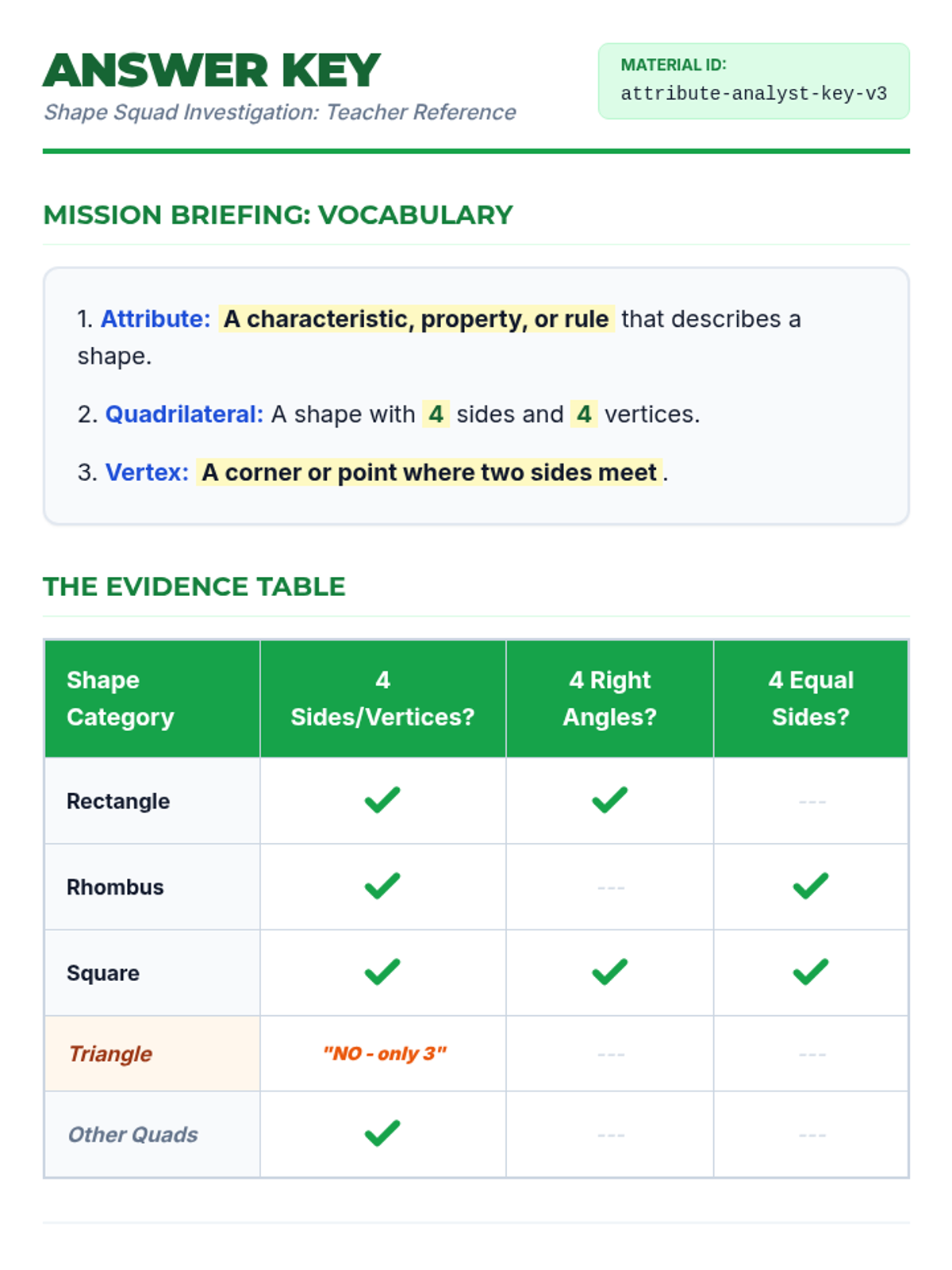
A comprehensive teacher's answer key for the Shape Specs Progress Monitor, including scoring guidance and common misconceptions to watch for during the intervention.
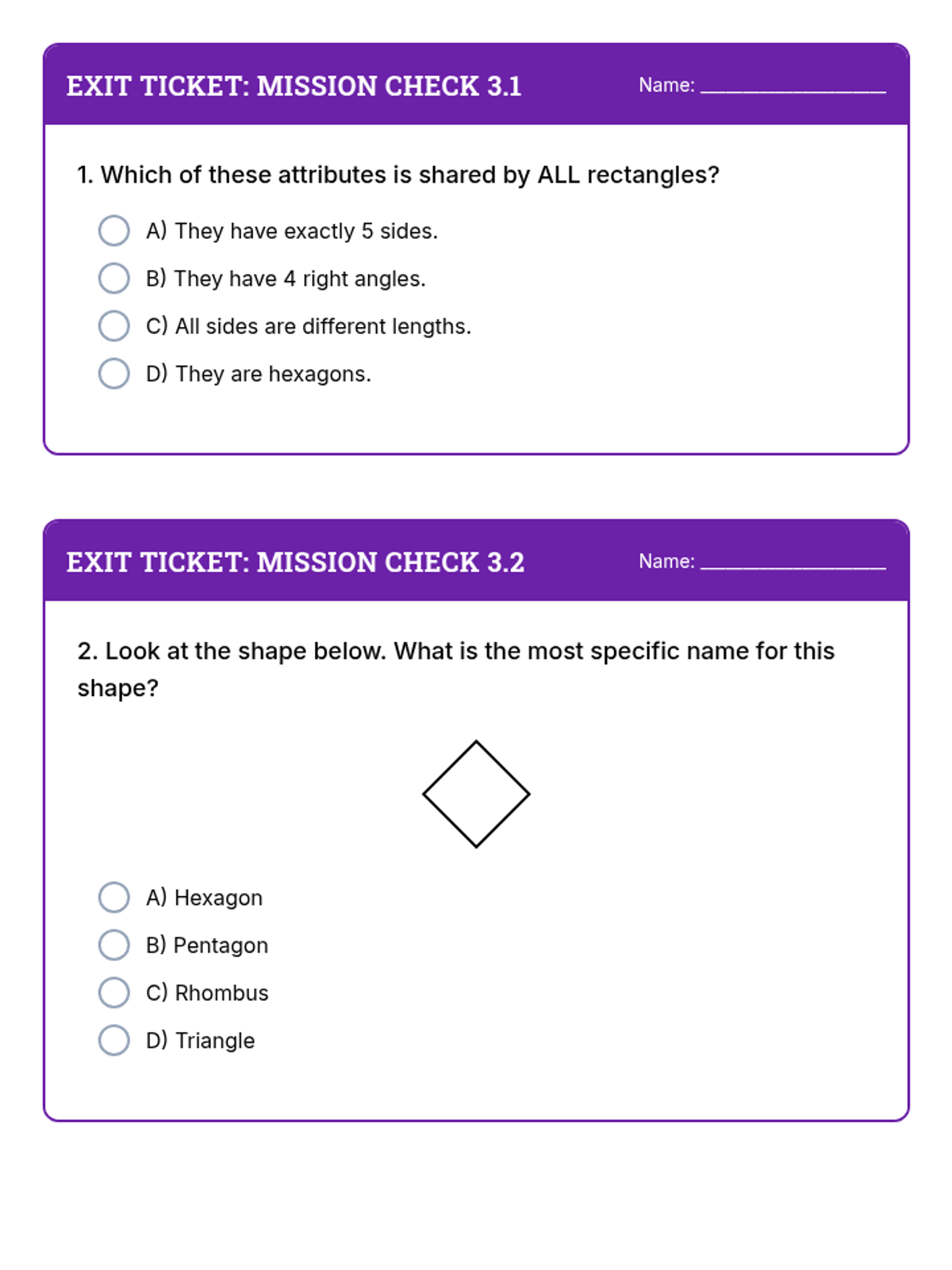
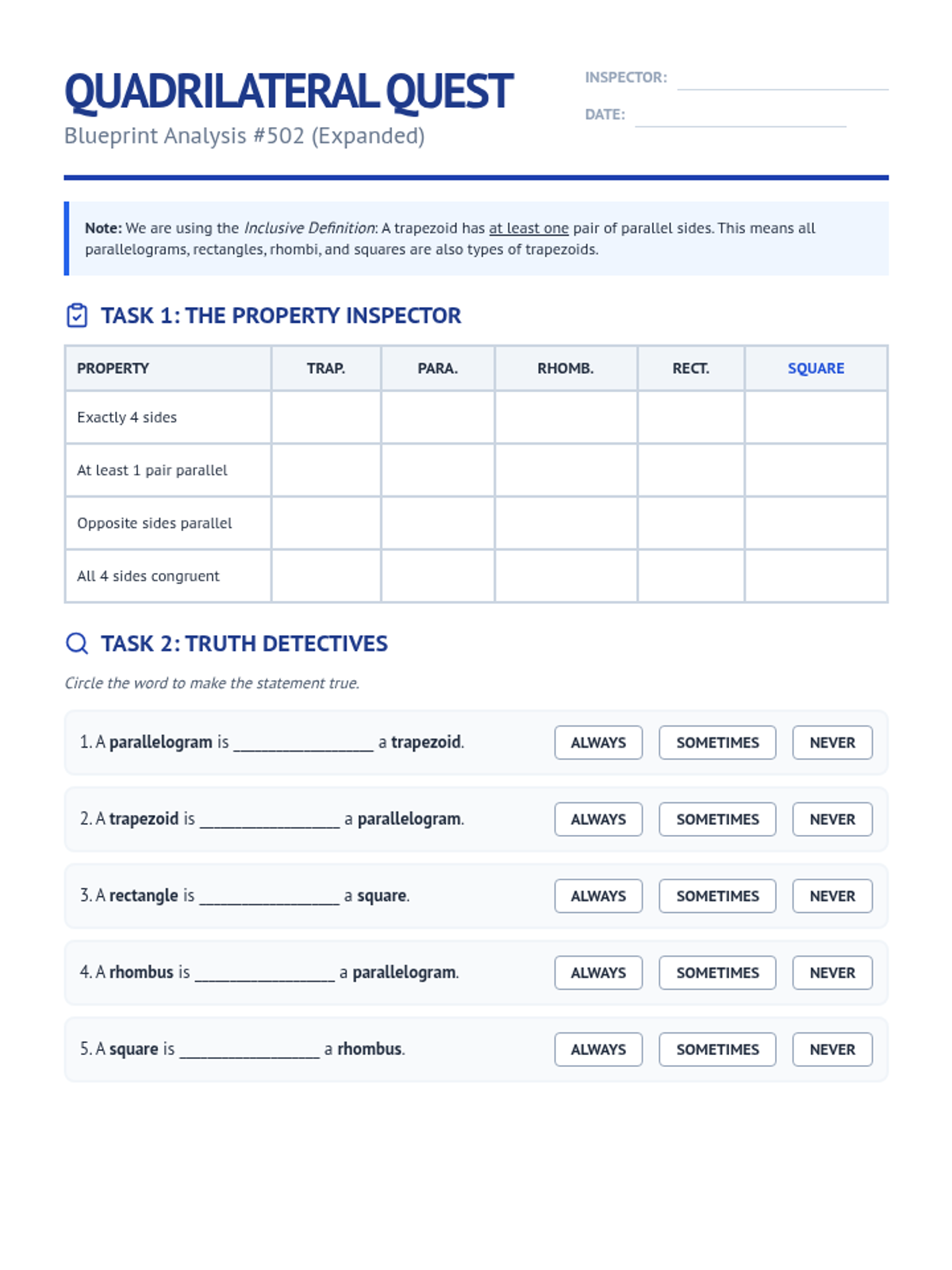
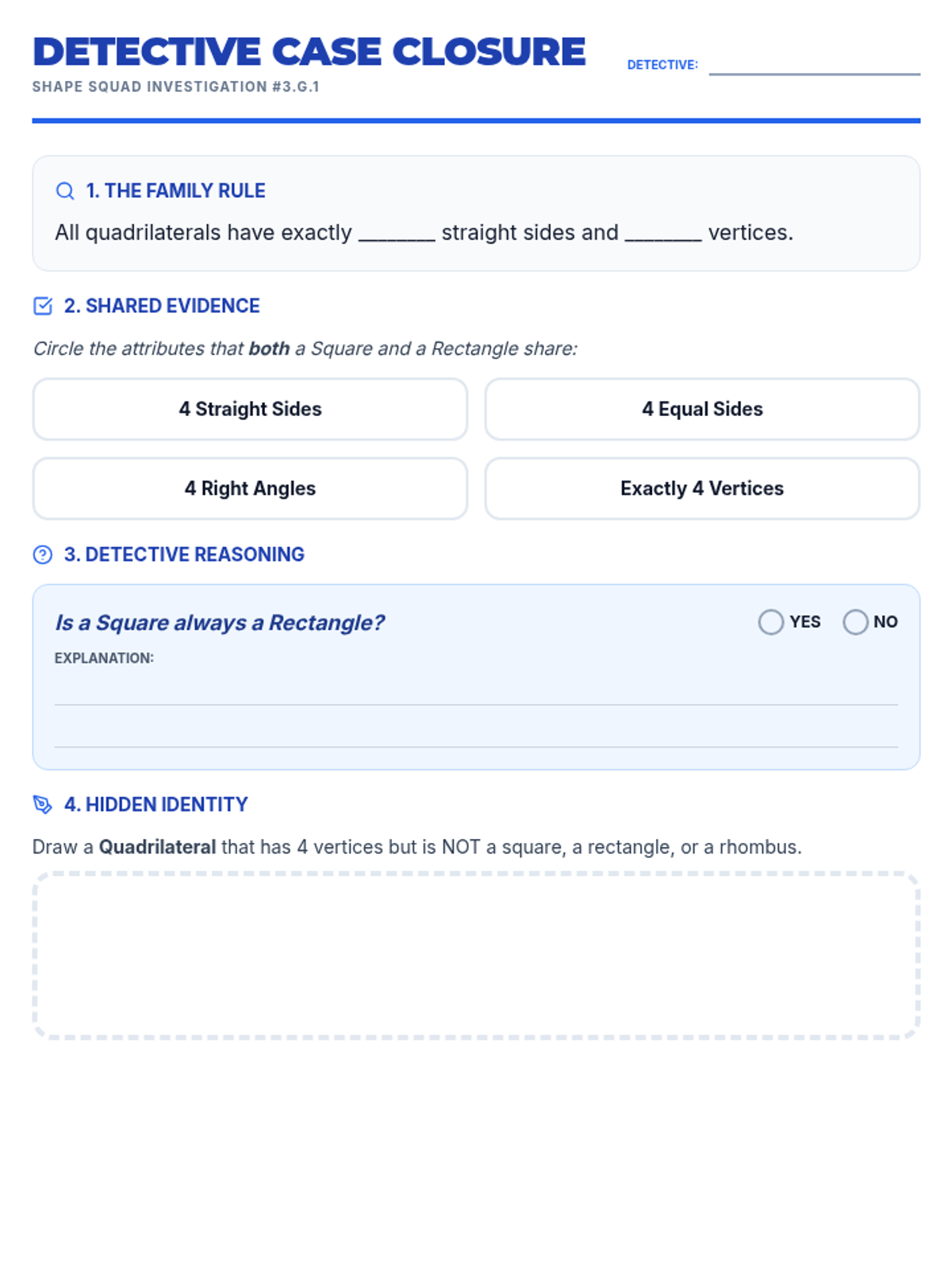
A progress monitoring tool designed for Tier 2 students to assess their understanding of quadrilateral attributes, hierarchy relationships, and ability to draw non-standard examples.
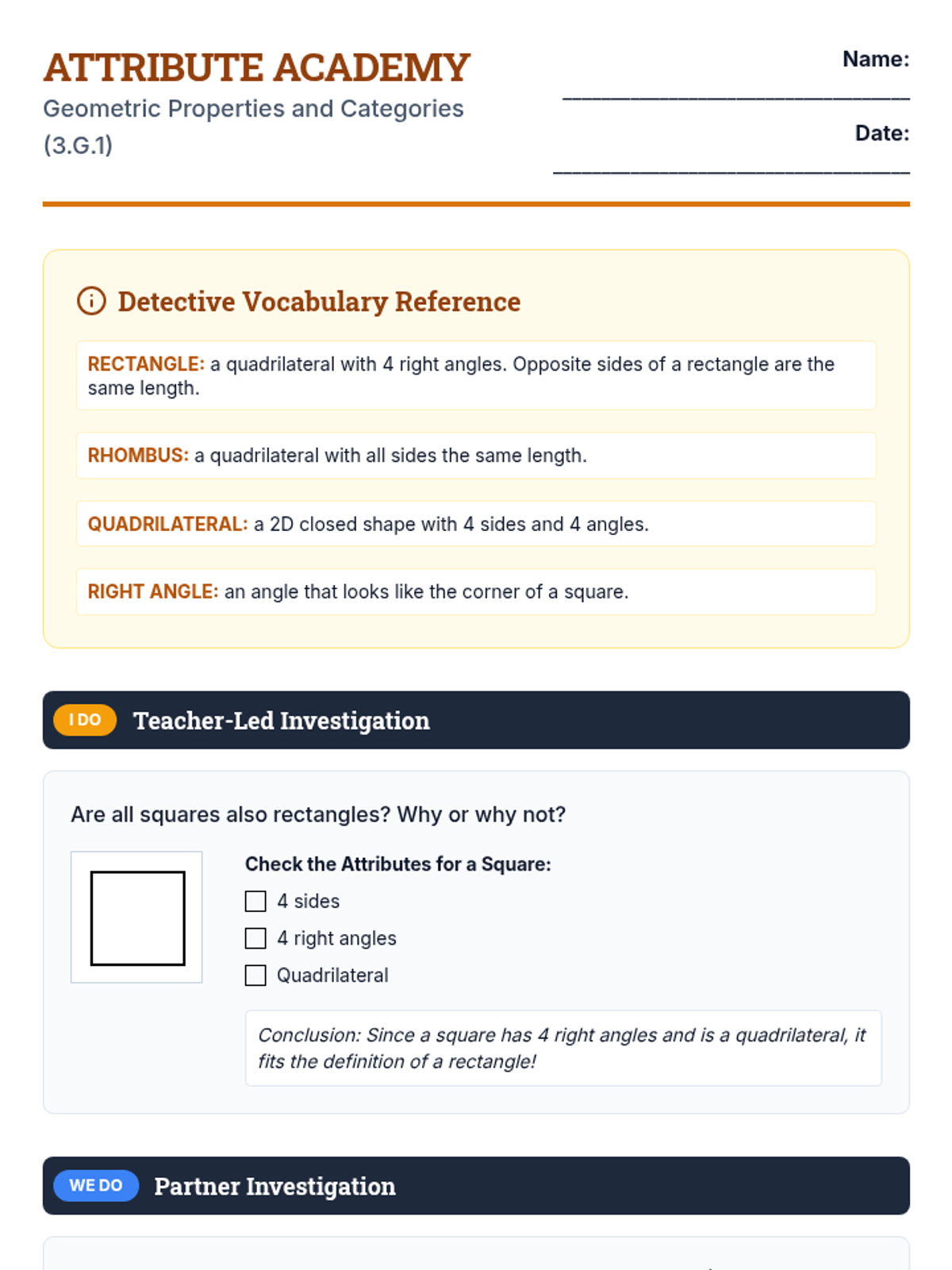
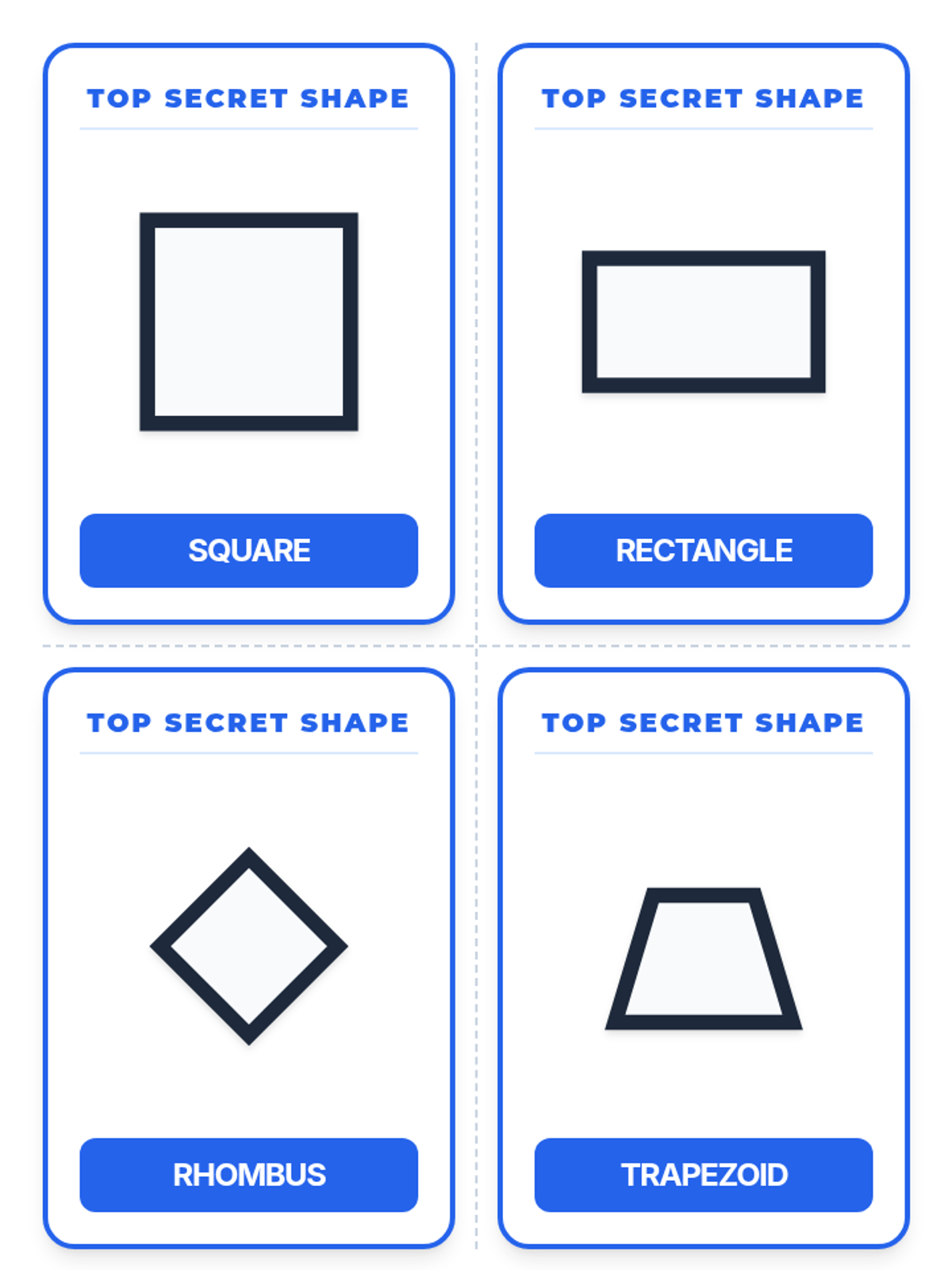
A set of printable shape cards featuring standard and non-standard quadrilaterals, as well as non-quadrilaterals, for hands-on sorting and classification activities.
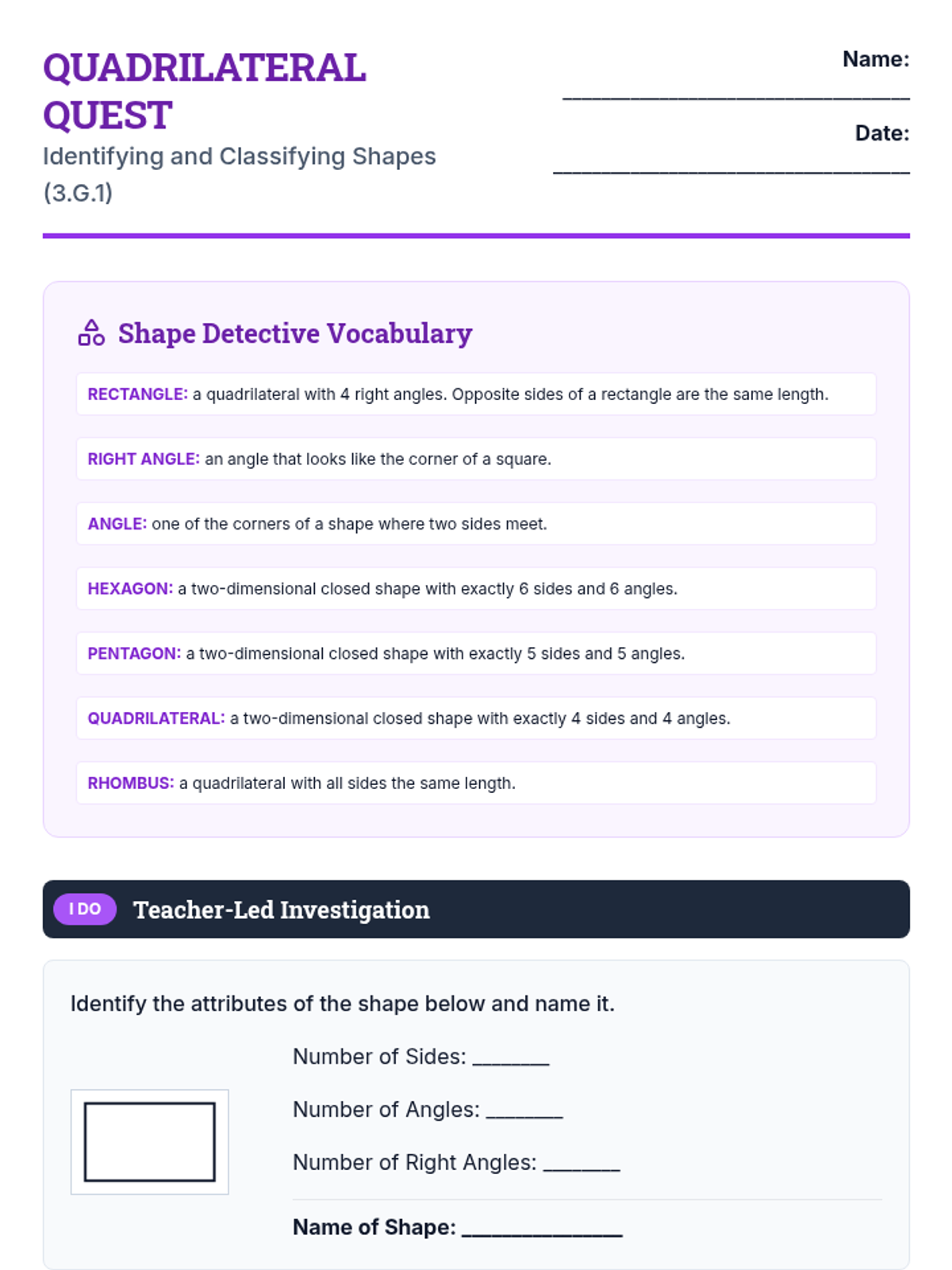
A student investigation worksheet titled 'Shape Case File' where students record tangram observations, define quadrilaterals, and practice 'Always/Sometimes/Never' reasoning.
A visual presentation deck for teaching quadrilateral hierarchies, defining key shapes, and presenting challenges for geoboard activities. Includes high-contrast visuals and minimal text for effective small-group instruction.
A visual slide deck for the 'Shape Lab Detectives' lesson, introducing shape attributes, category definitions (quadrilaterals), and 'Always/Sometimes/Never' reasoning with high-contrast, large-font design.
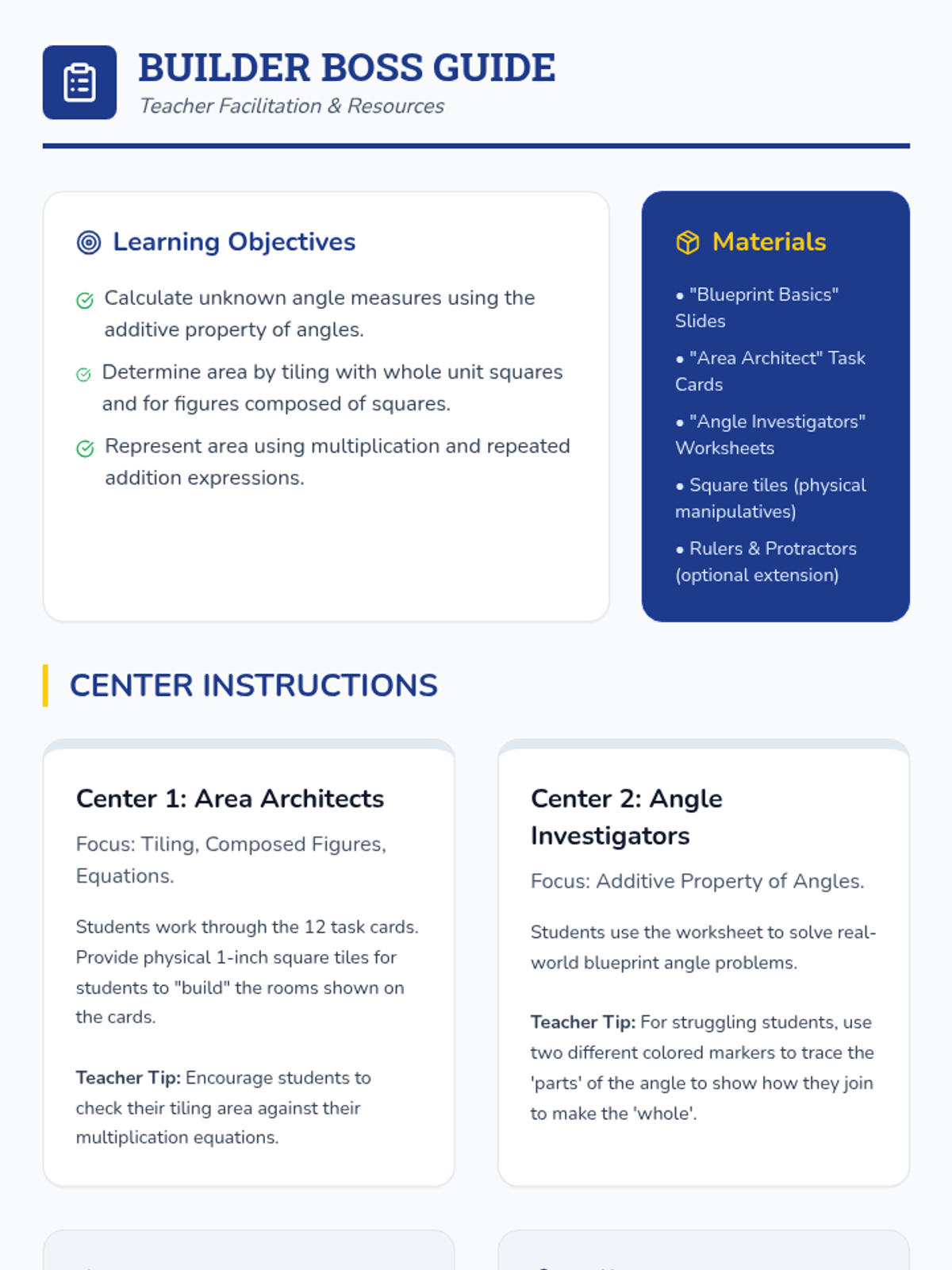
A comprehensive teacher facilitation guide for a Tier 2 intervention lesson on quadrilaterals, featuring learning objectives, step-by-step instructional procedures, and differentiation strategies.
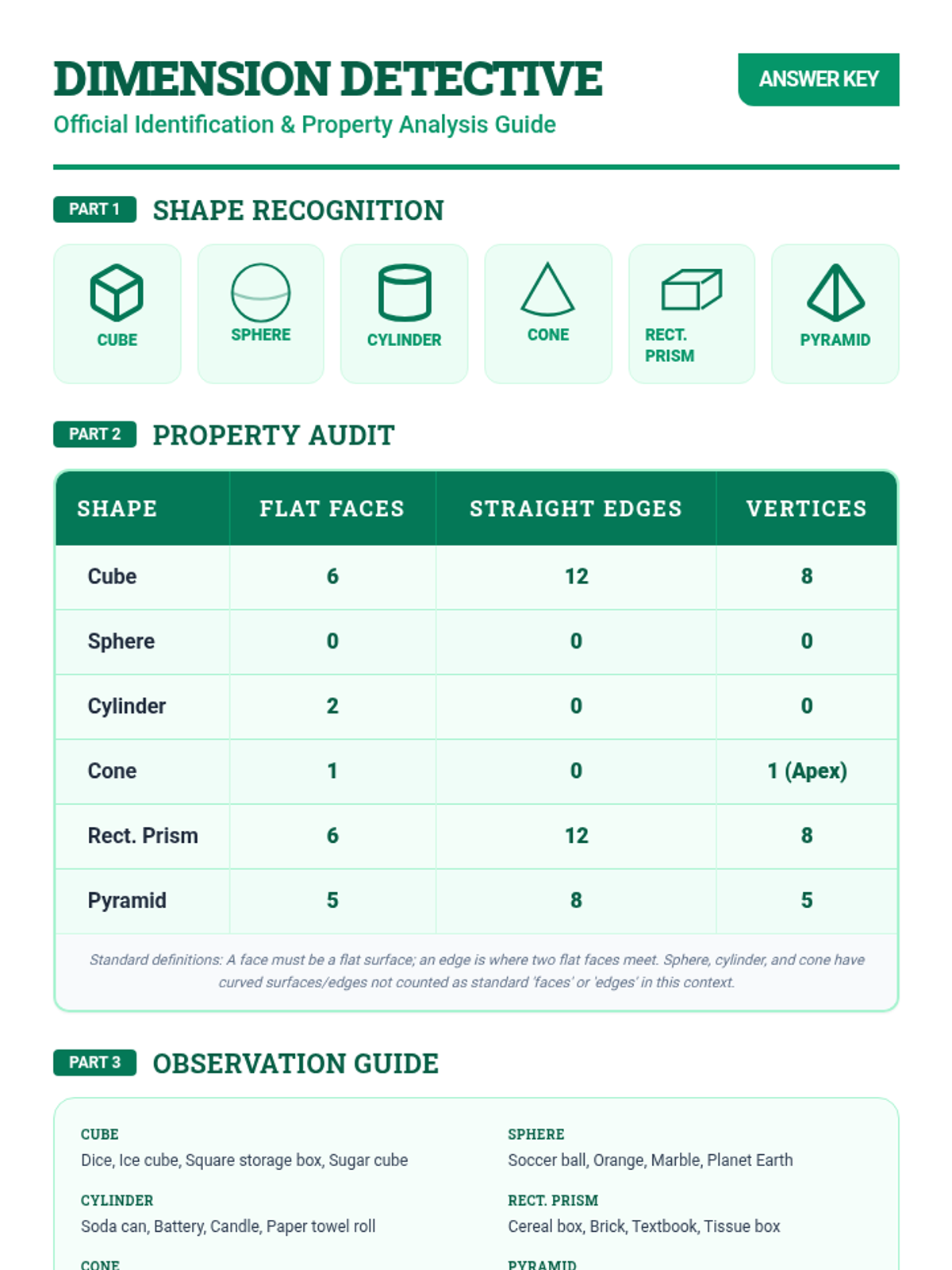
A teacher-facing answer key for the Constellation Constructor Activity, providing precise counts for vertices, edges, and faces for the modeled 2D and 3D shapes, along with reflection question exemplars.
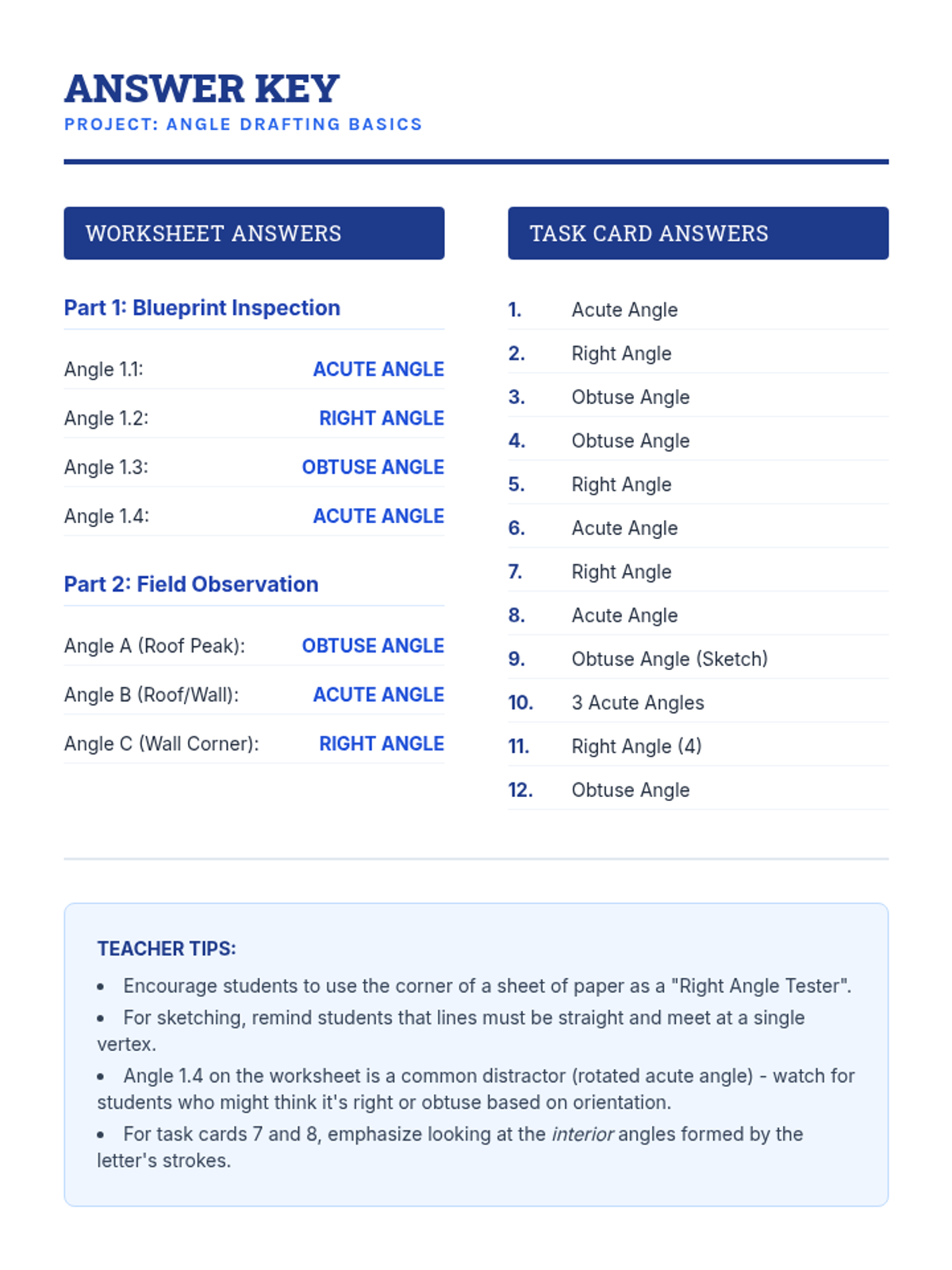
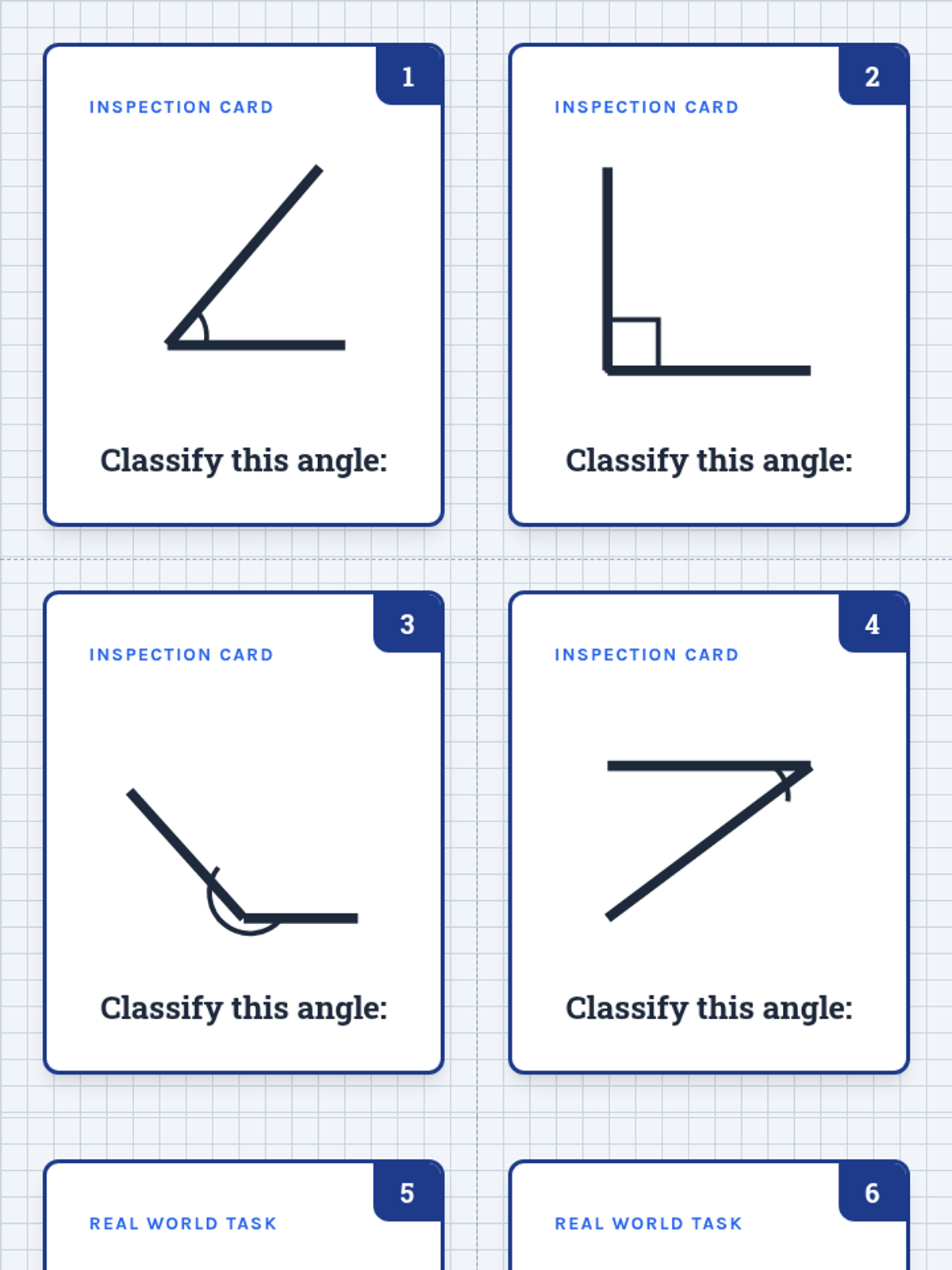
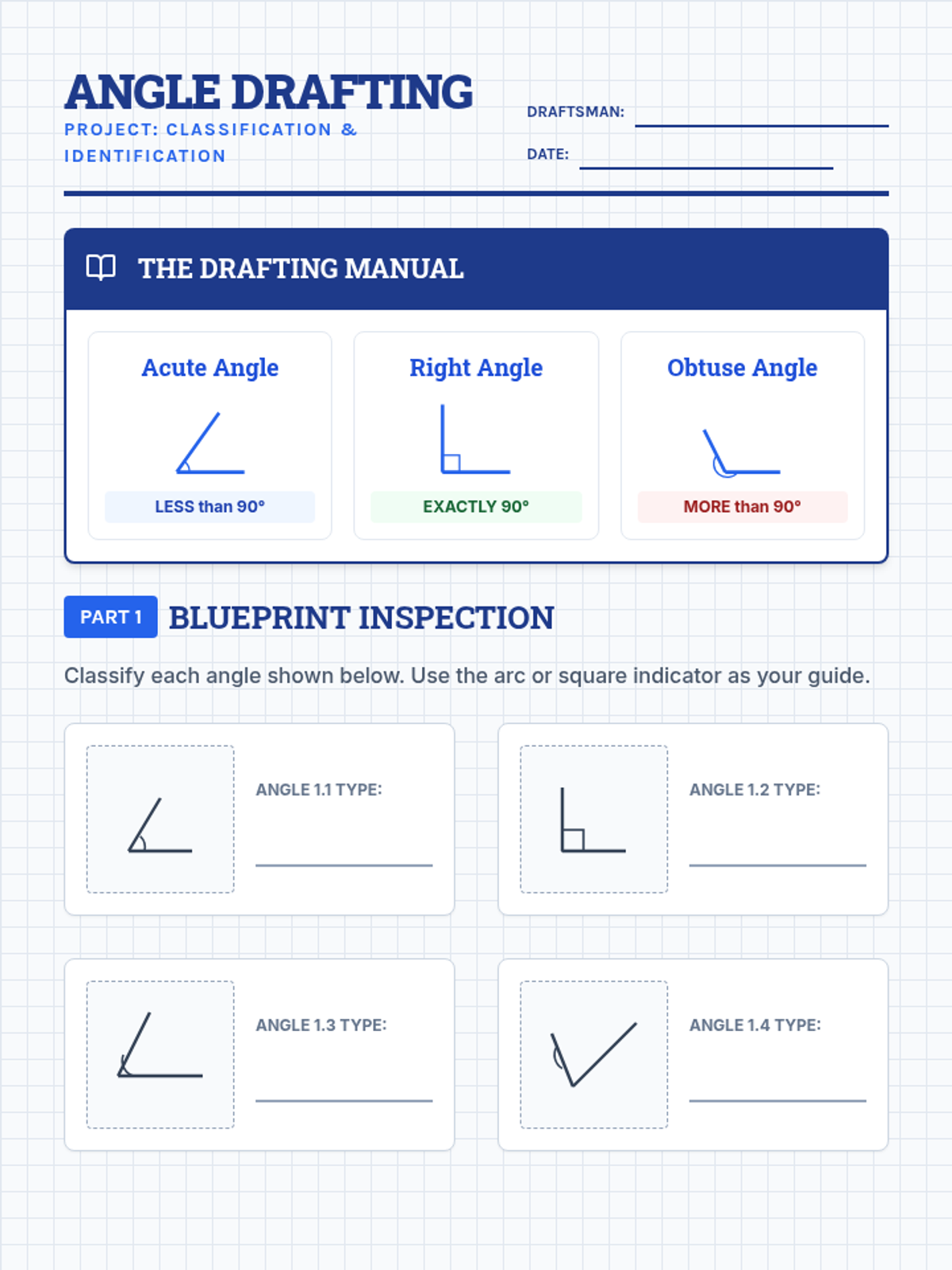
A teacher-facing answer key for the Nebula Navigator Worksheet, providing clear solutions for angle identification, shape classification, and 3D solid analysis.
A fun geometric bingo game including a cadet bingo board and a set of teacher caller cards with descriptive definitions. It covers 2D shapes, 3D solids, angle types, and geometric attributes like faces and vertices.