Develops proficiency in estimating and measuring length, area, volume, and mass using standard units and unit conversions. Integrates time, money, angle measurement, and data classification through counting and arithmetic applications.
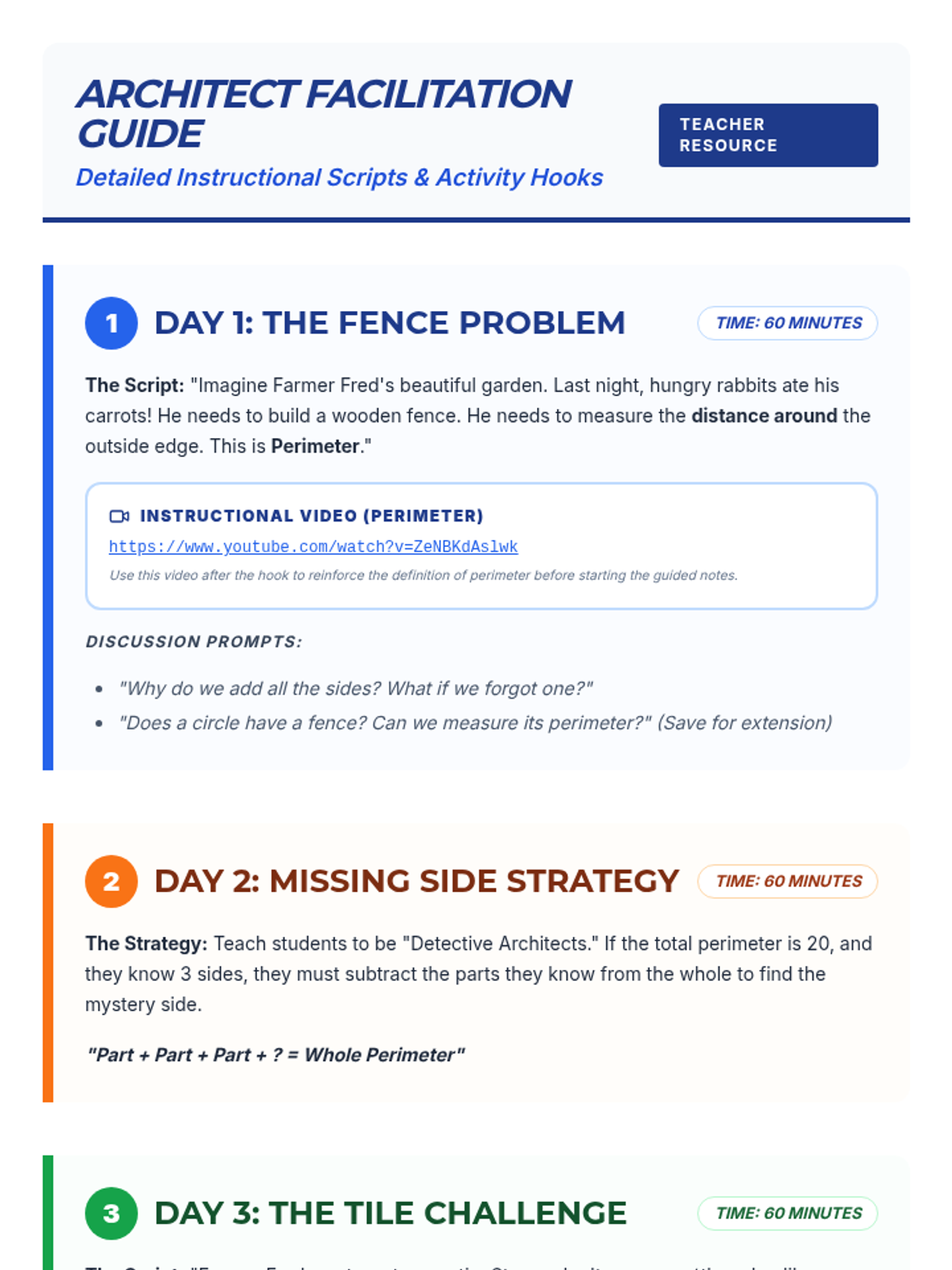
Updated teacher facilitation guide for the Shape Architects unit, aligning all daily instructional scripts and activity hooks with the unit's new color-coded system (Day 1-5) and specific paperwork references.
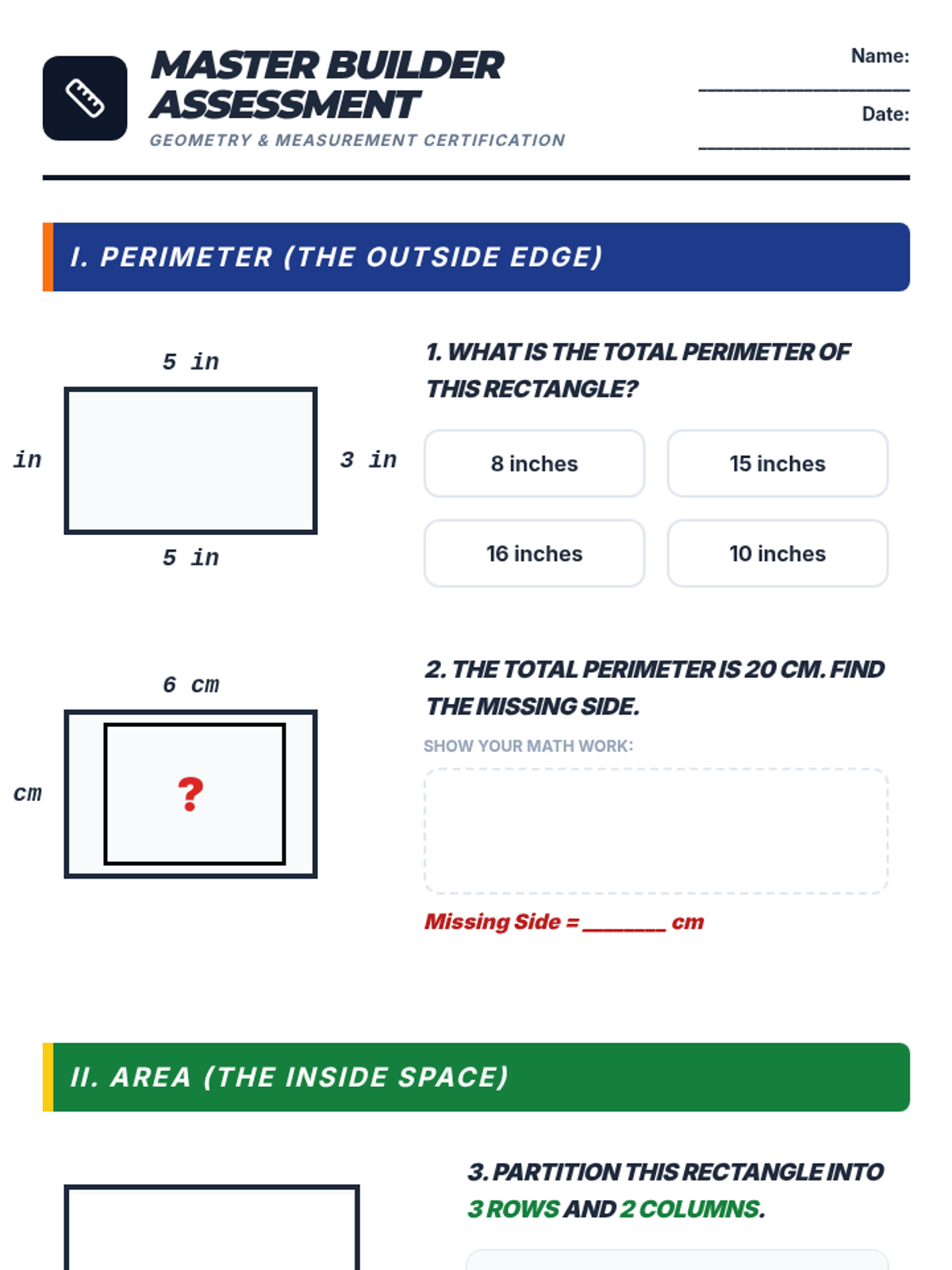
Final assessment for the Shape Architects unit. Fixes missing label values, corrects text clipping on geometry problems, removes heavy drop shadows for better printability, and ensures the final challenge stays on a single page.
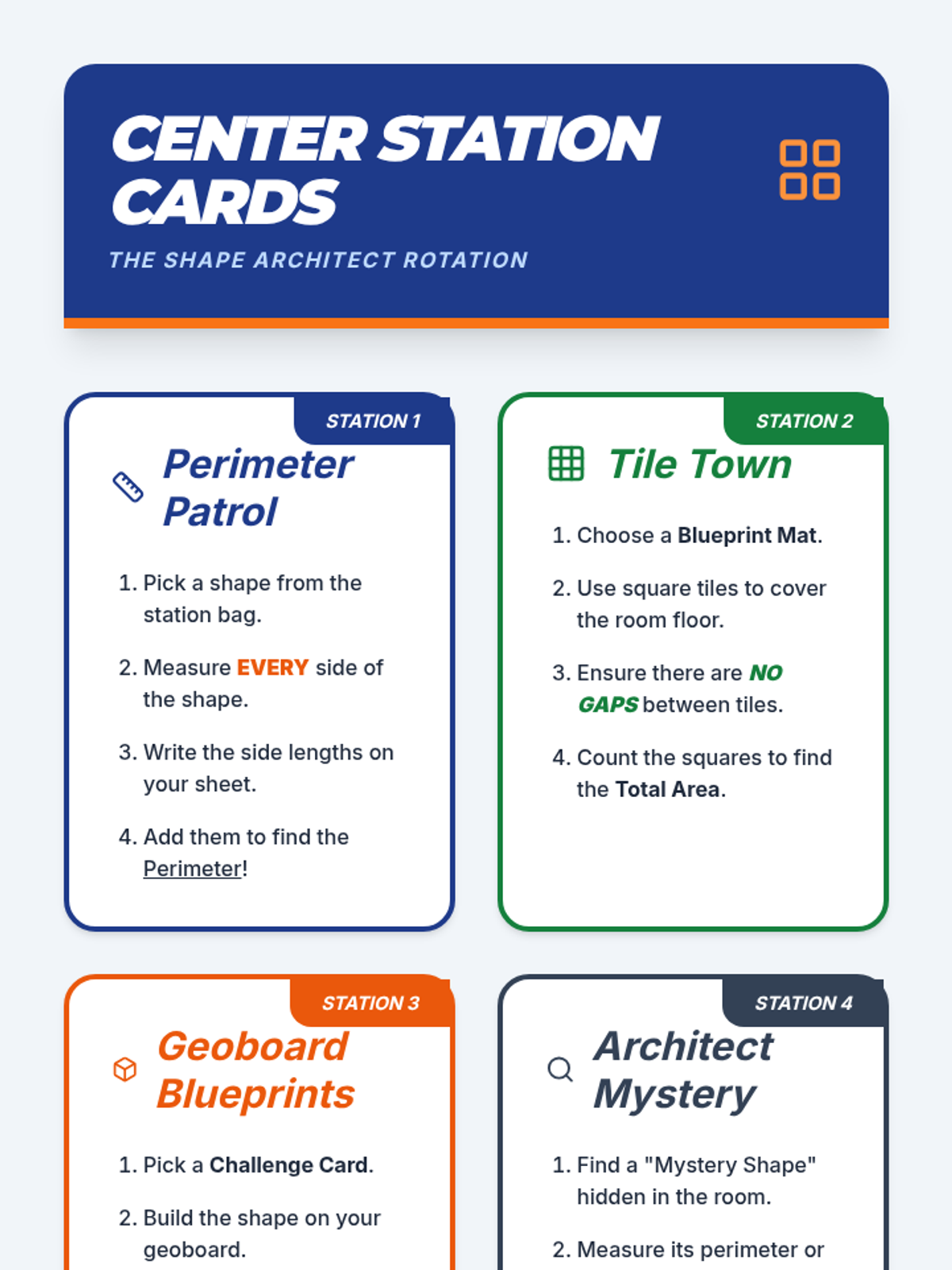
Station rotation cards for center activities. Fixes layout to ensure each card is self-contained, expands the recording sheet to include 6 rows for full rotation coverage, and improves legibility of student input areas.
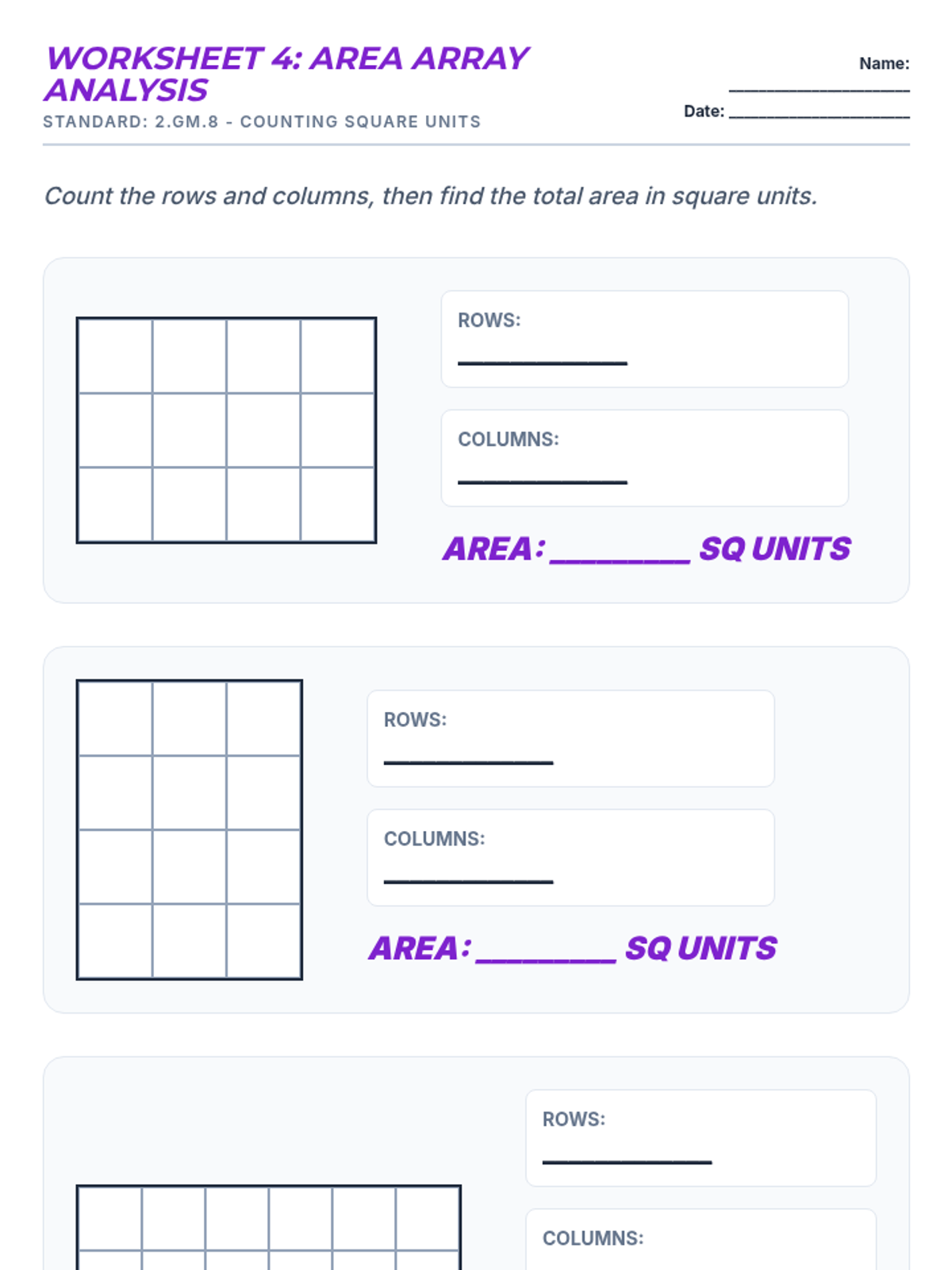
Updated Worksheet 4 for the Shape Architects unit. Ensures all problems fit on a single page, provides white backgrounds for handwriting in answer boxes, and increases contrast/legibility of grid lines and answer fields. Fixes unit text spacing issues.
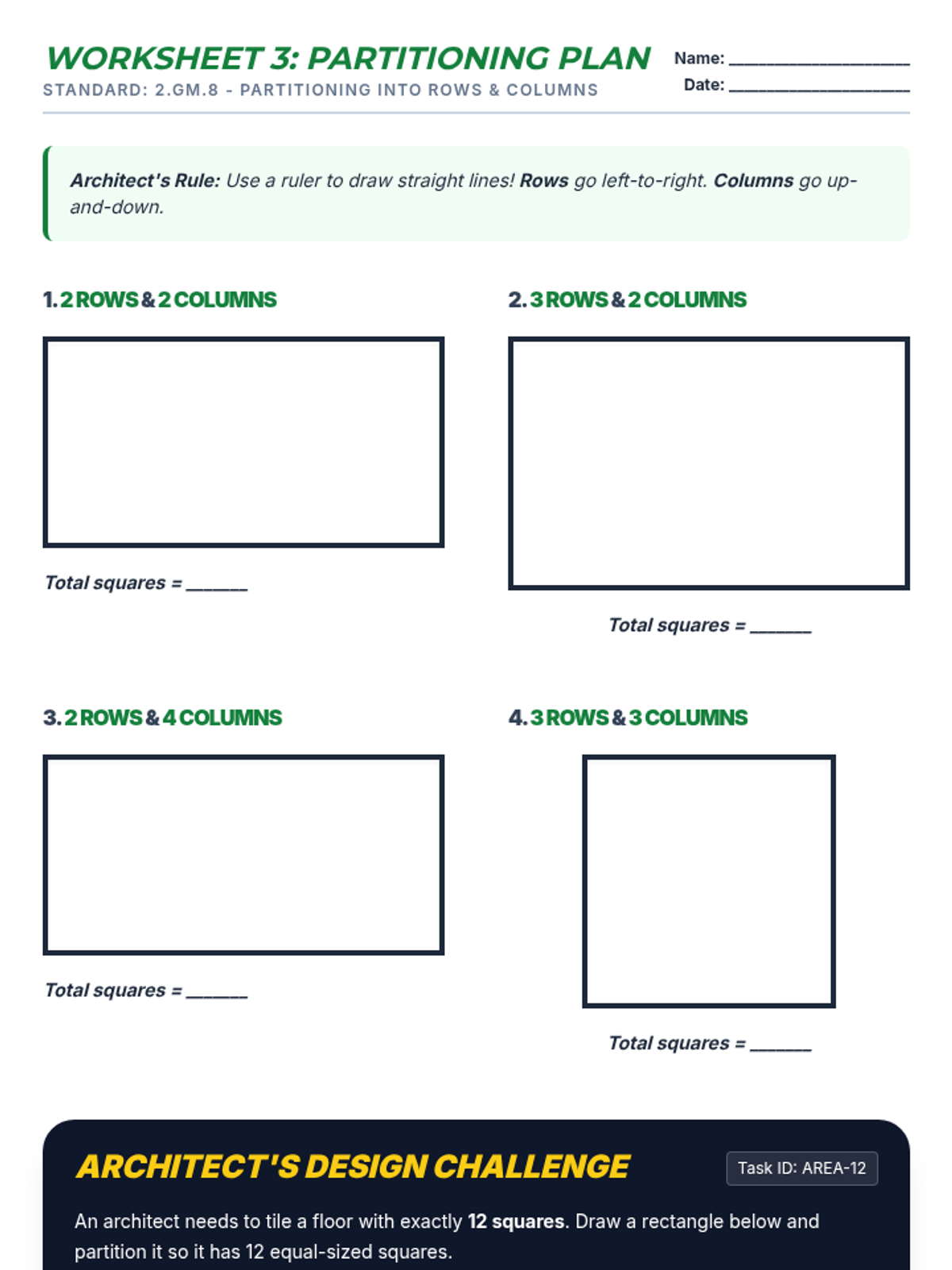
Updated Worksheet 3 for the Shape Architects unit. Fixes word spacing issues in headers, adjusts rectangle aspect ratios to match partitioning tasks (e.g., vertical for 3x2), ensures the challenge section stays on a single page, and provides white backgrounds for student handwriting.
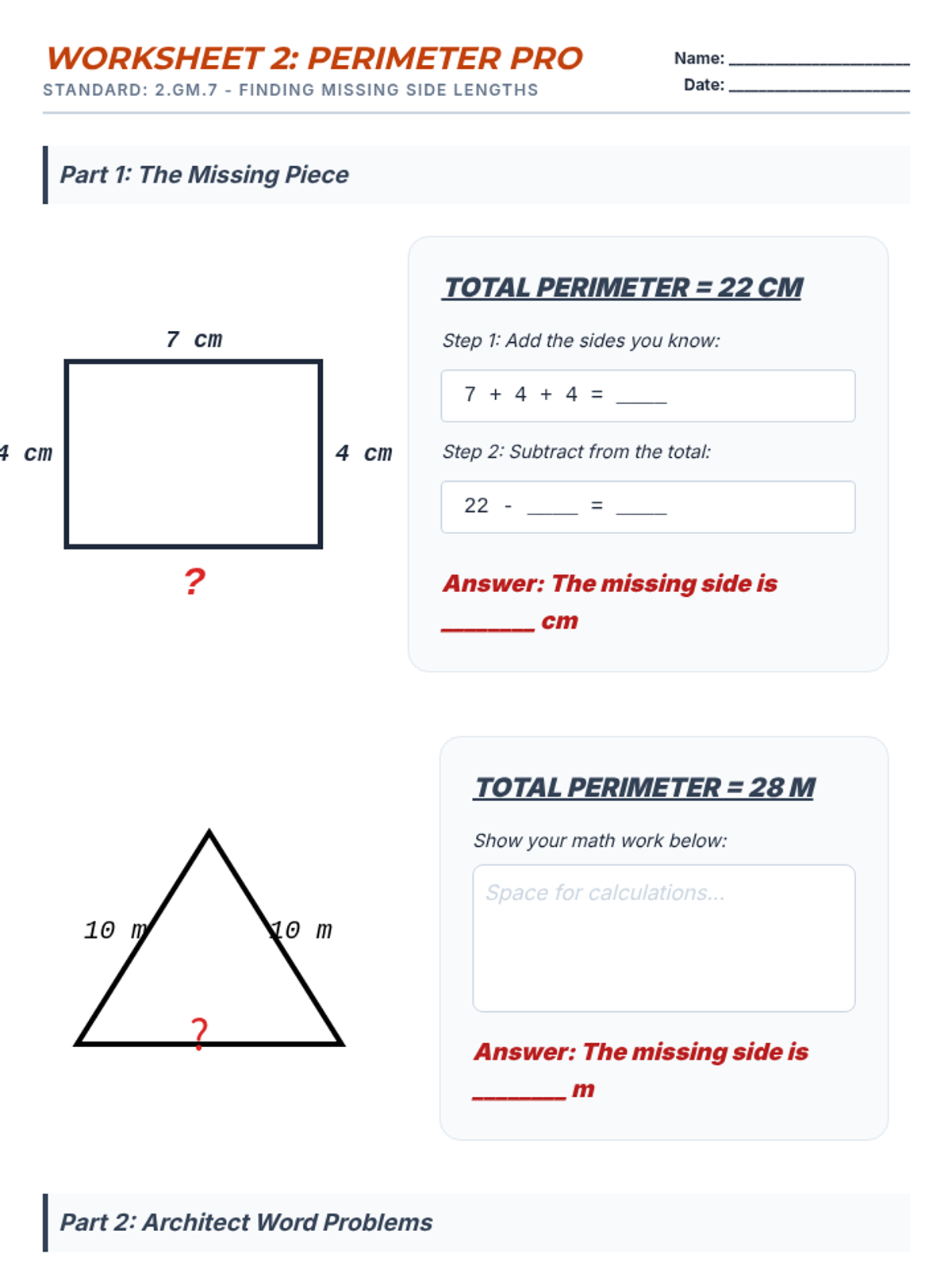
Advanced perimeter worksheet focusing on finding missing side lengths. Fixes duplicated/misaligned labels in Problem 1, ensures high-contrast borders for student sketches, and improves the layout of unit labels in calculation boxes.
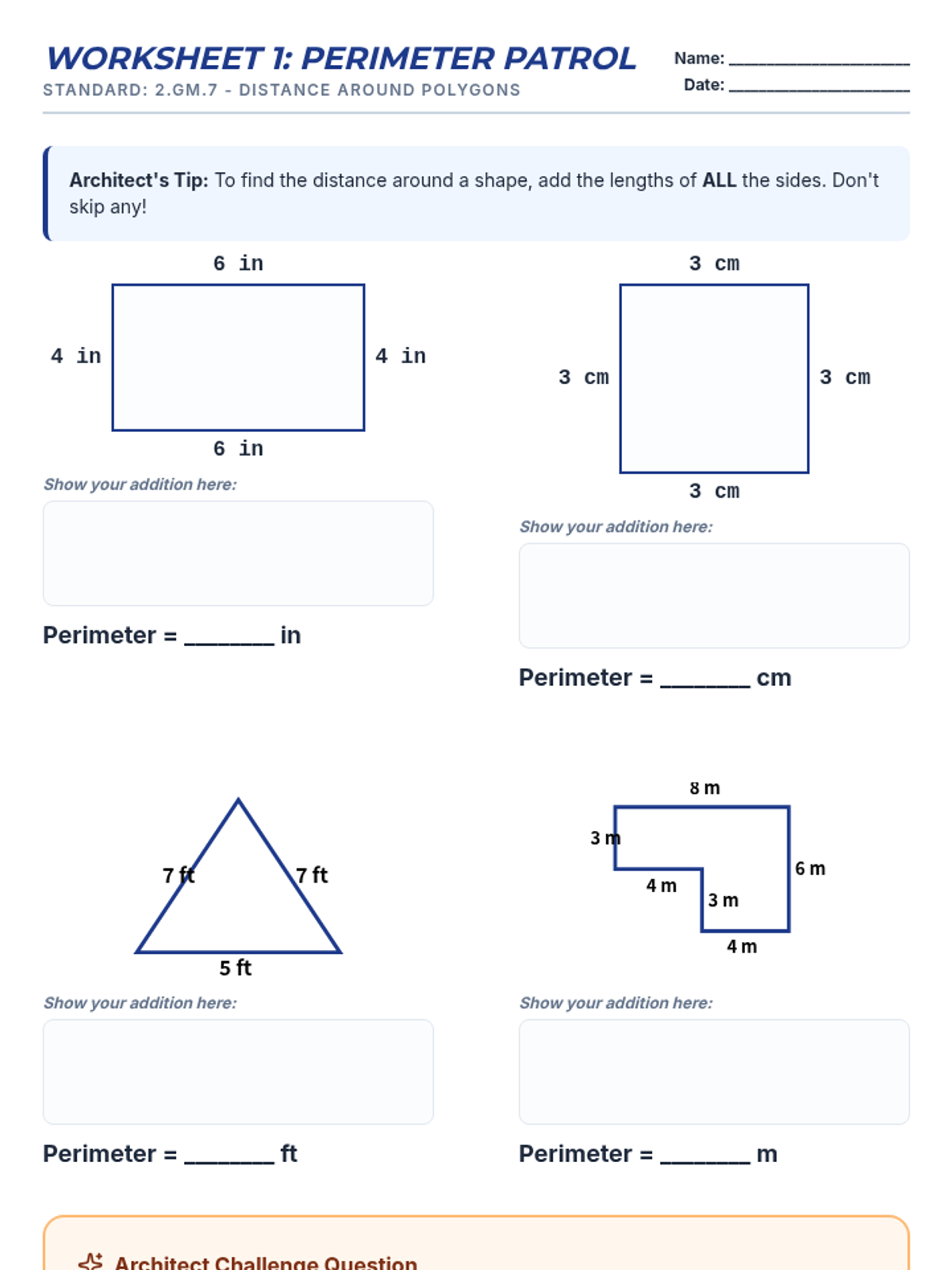
Introductory perimeter worksheet featuring various polygons with labeled side lengths. Fixes label overlap in SVG shapes, increases student work area height, and ensures the challenge question fits on a single page by tightening vertical spacing.
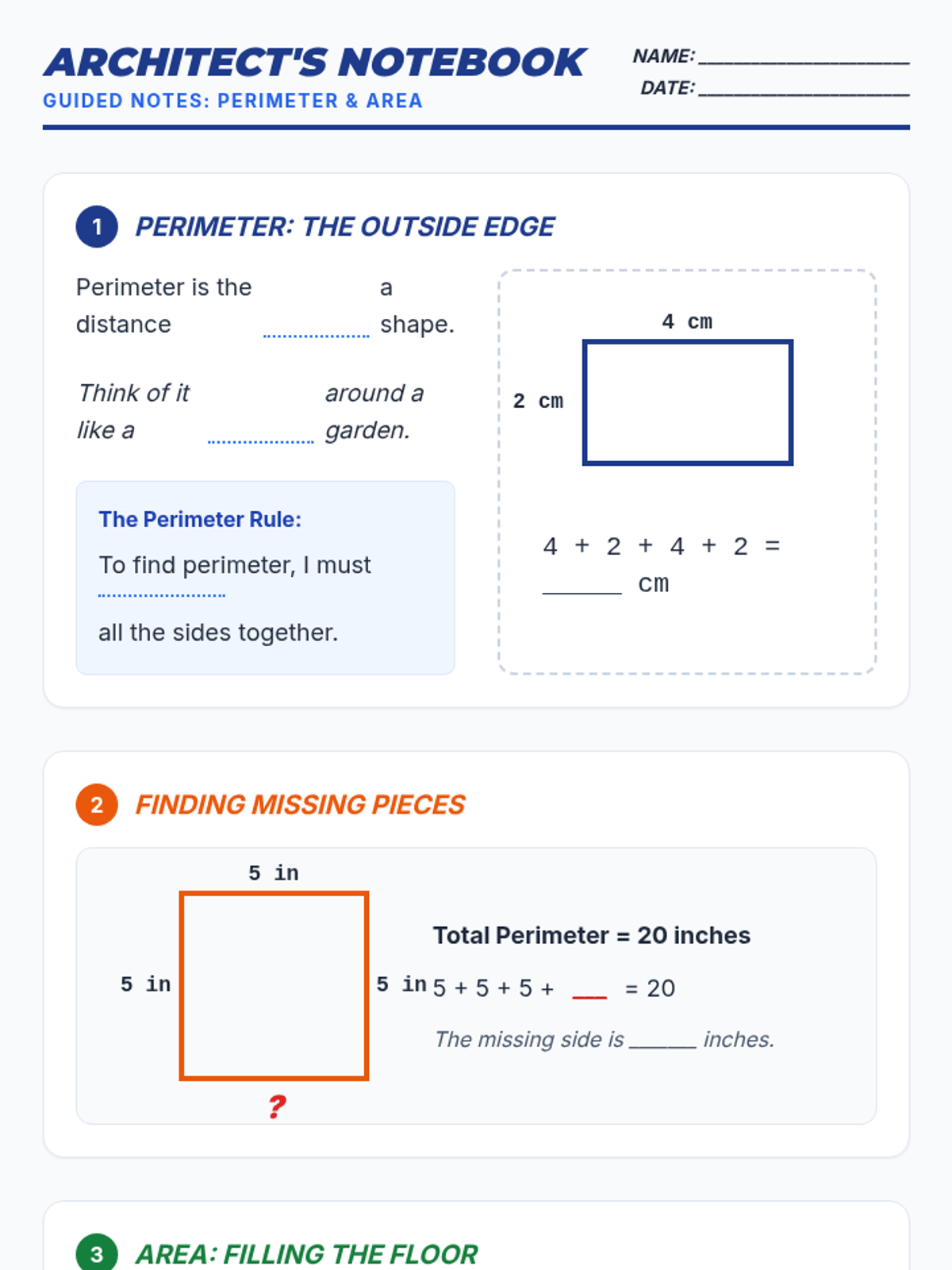
An updated student guided notes packet for the Shape Architects unit. Fixes alignment of fill-in-the-blank lines, increases partitioning work space, and ensures Day 4 labels and input fields are clearly aligned on single lines.
A redesigned slide deck for the Shape Architects unit, clearly partitioned into Day 1-5 sections with consistent color coding. Now includes embedded YouTube videos for Day 1 (Perimeter) and Day 3 (Area) with specific discussion prompts and a concluding Day 5 review slide.
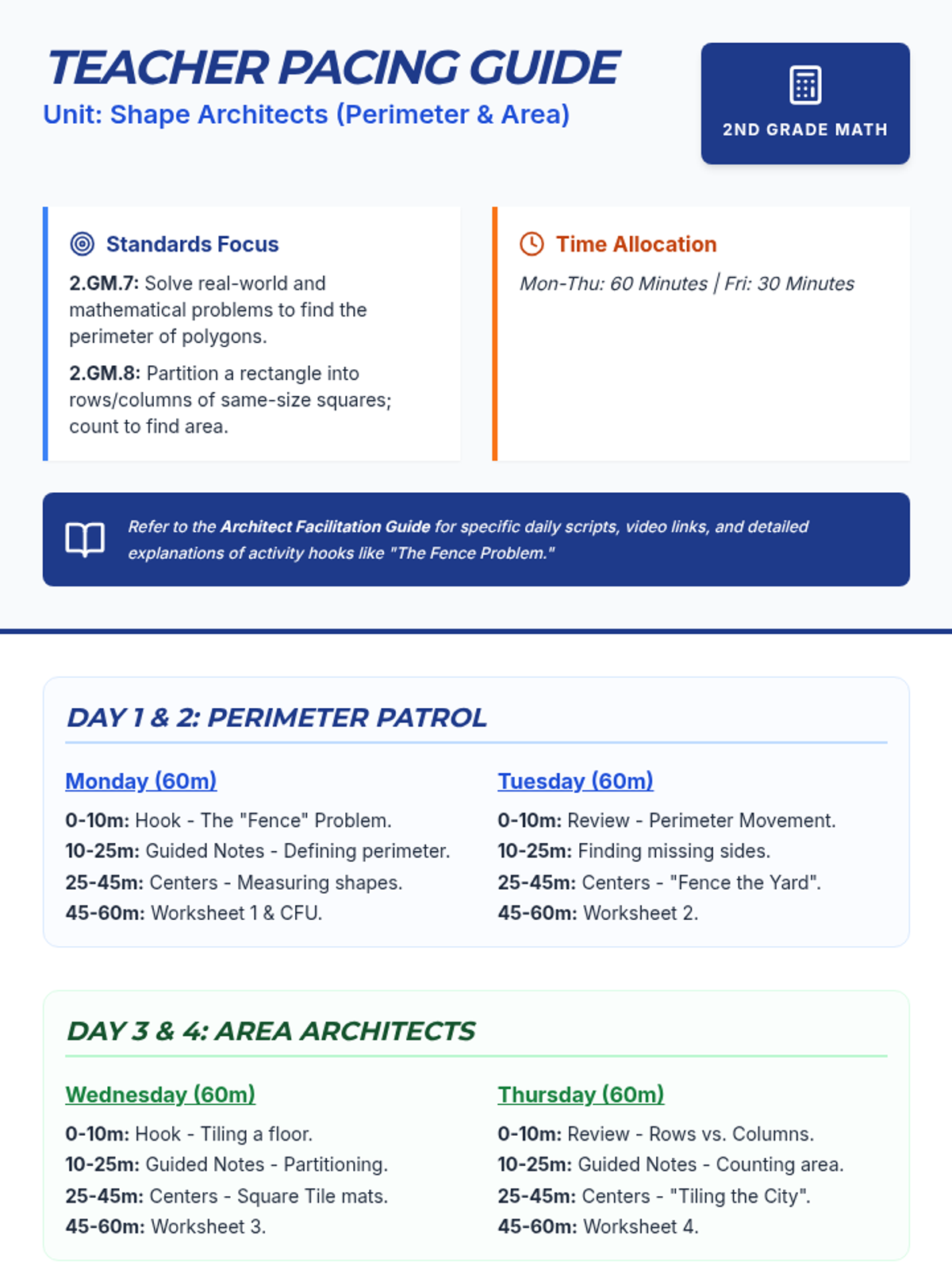
An enhanced teacher pacing guide for the Shape Architects unit, introducing a clear color-coded daily system (Day 1-5) that matches all student materials for better organization and clarity. Fixes page break and legibility issues.
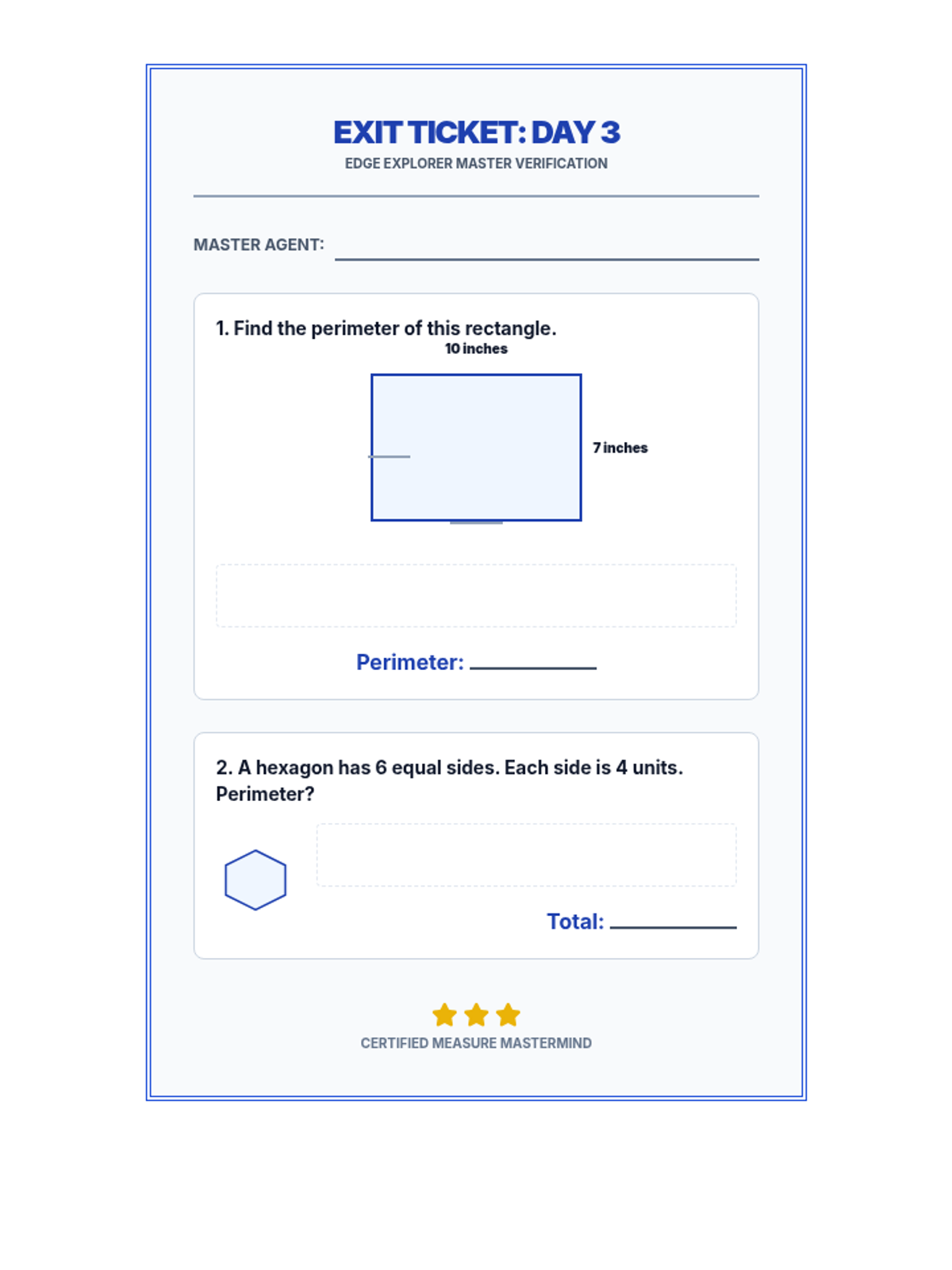
Day 3 exit ticket for the Measure Mastermind sequence, assessing student ability to find perimeter of shapes with implied side lengths and regular polygons.
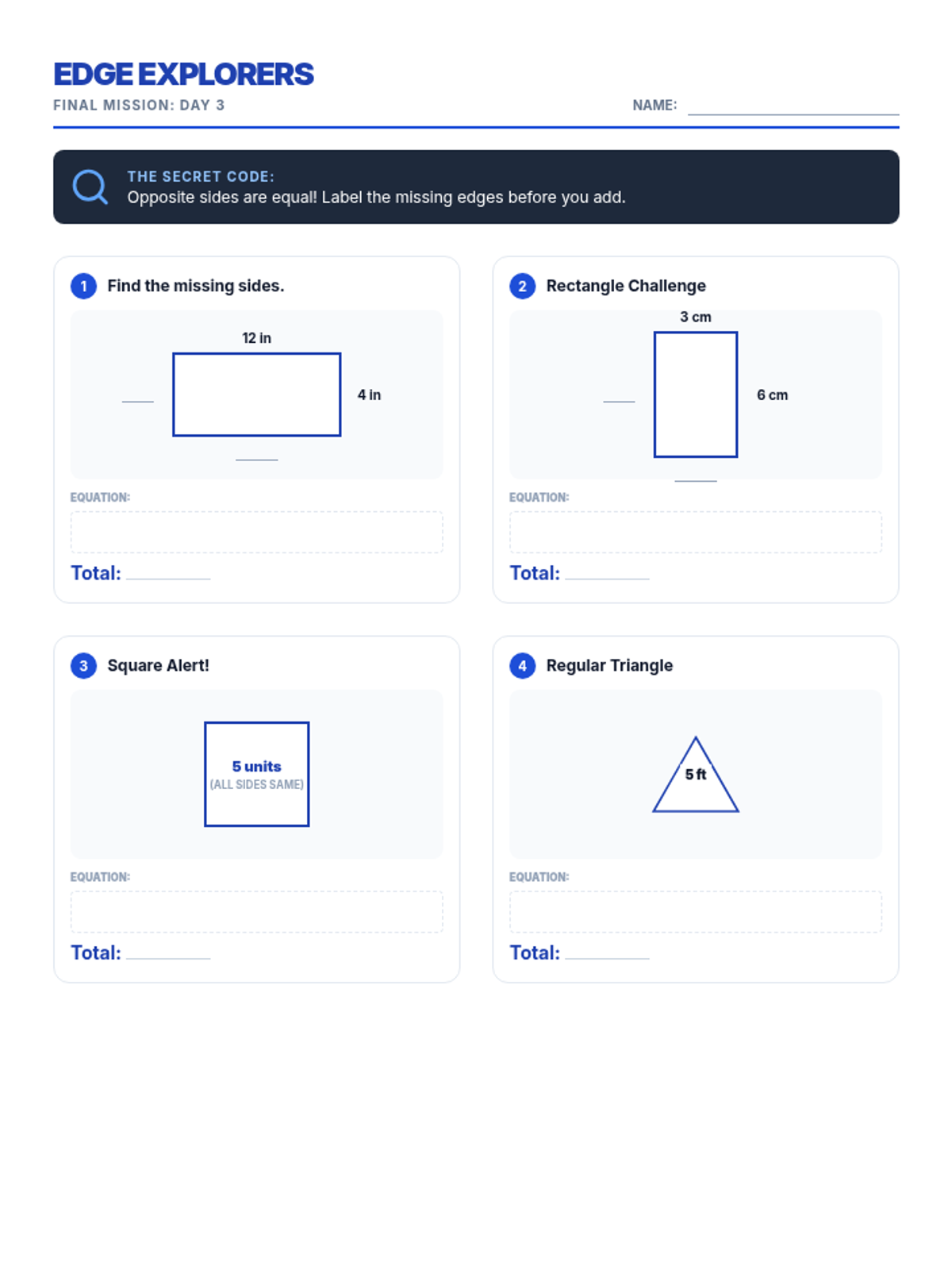
Student practice worksheet for Day 3 of the Measure Mastermind sequence, focused on finding perimeter of shapes with implied or missing side lengths.
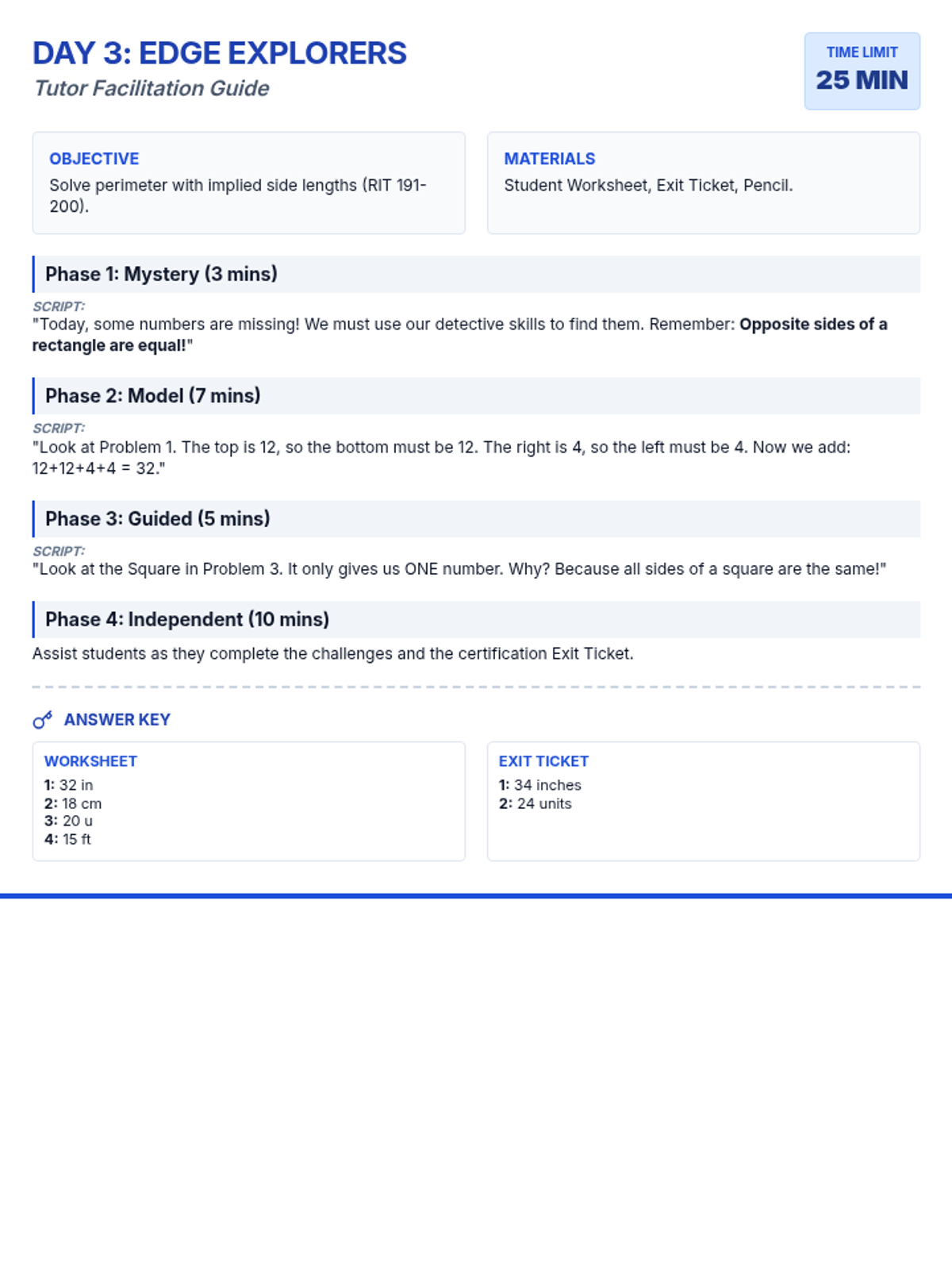
Tutor facilitation guide for Day 3 of the Measure Mastermind sequence, focusing on finding perimeter with implied side lengths in rectangles and regular polygons.
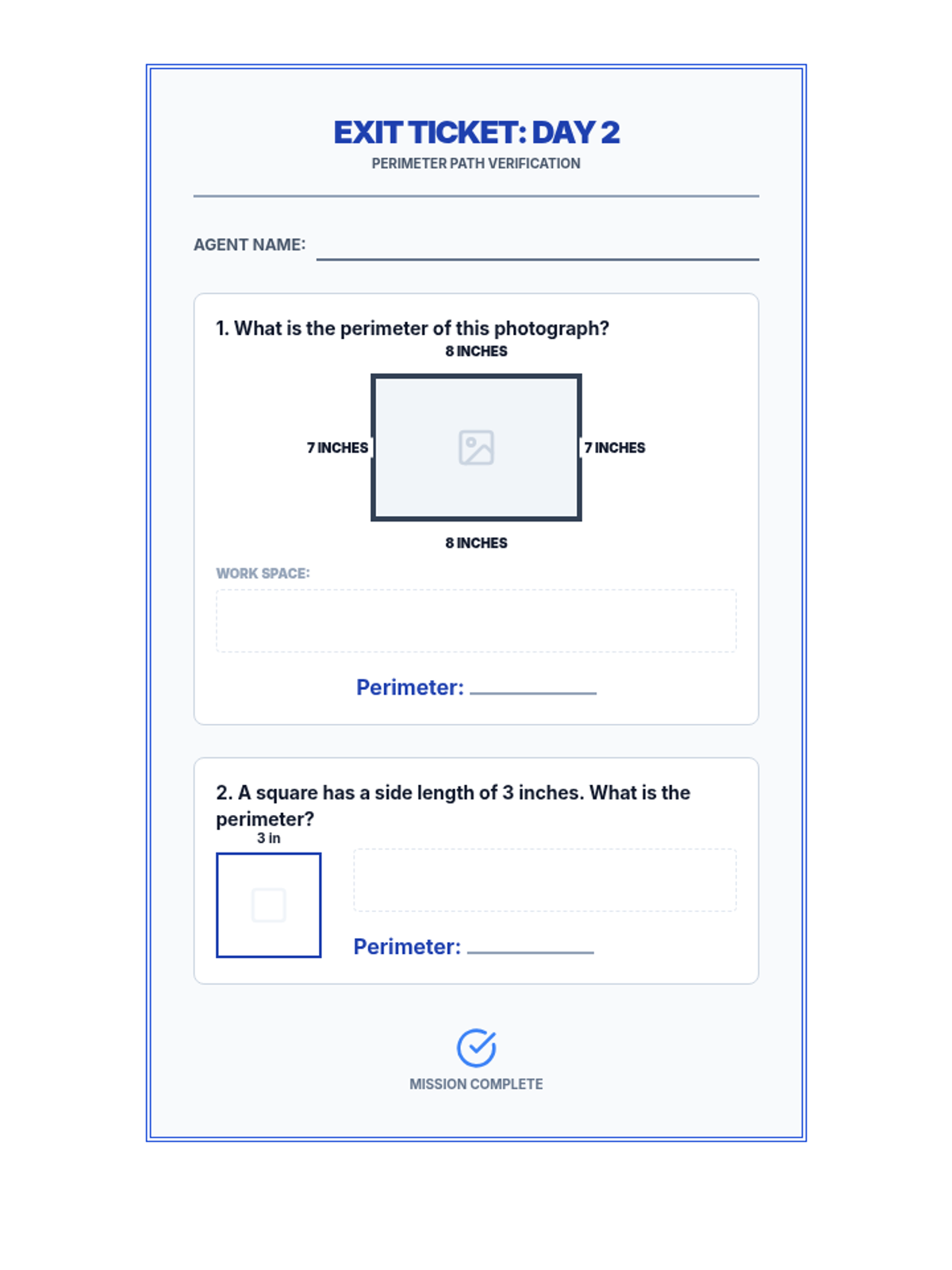
Day 2 exit ticket for the Measure Mastermind sequence, assessing student ability to calculate the perimeter of rectangles and squares.
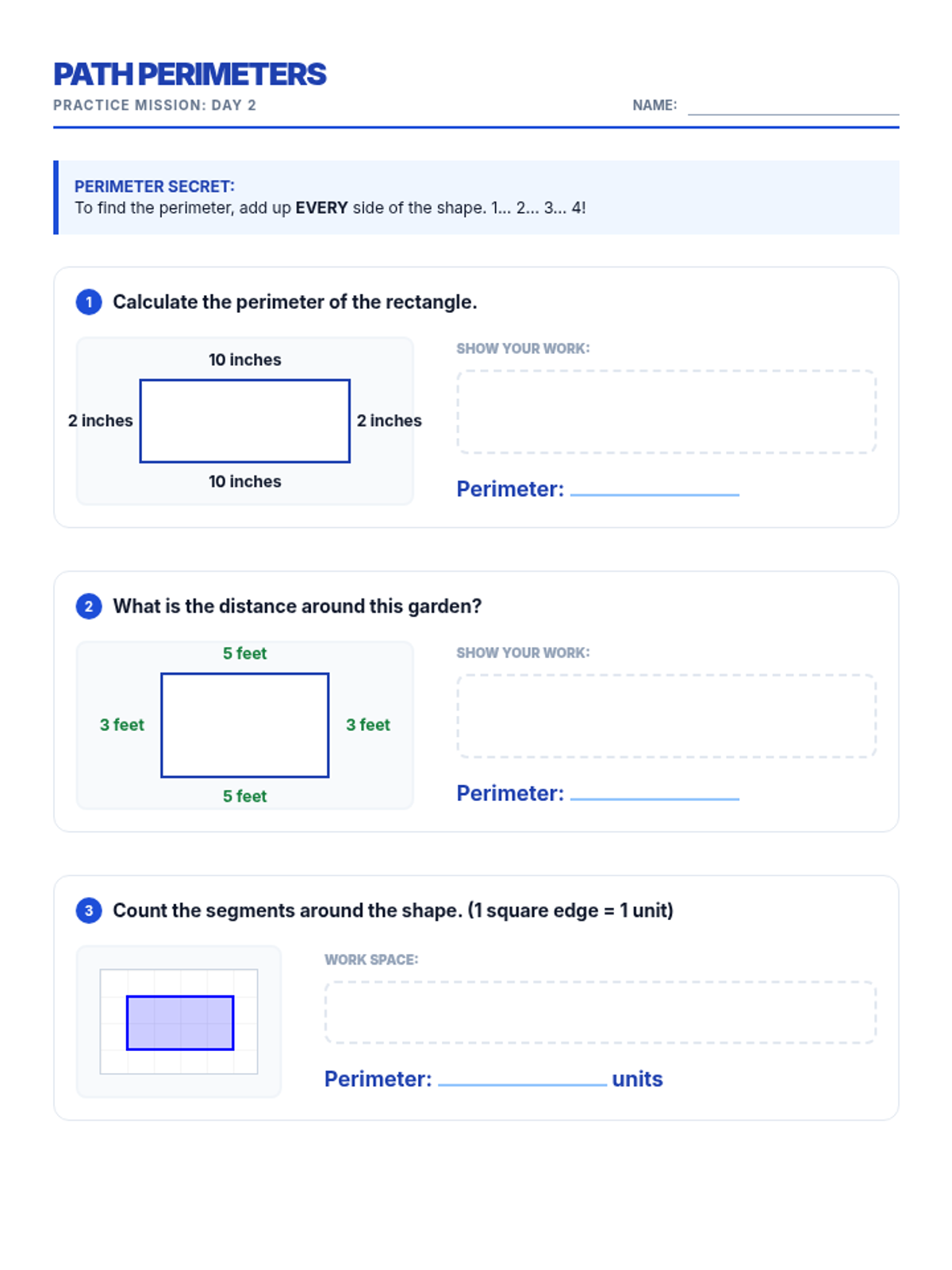
Student practice worksheet for Day 2 of the Measure Mastermind sequence, focused on calculating perimeter by adding all sides of rectangles.
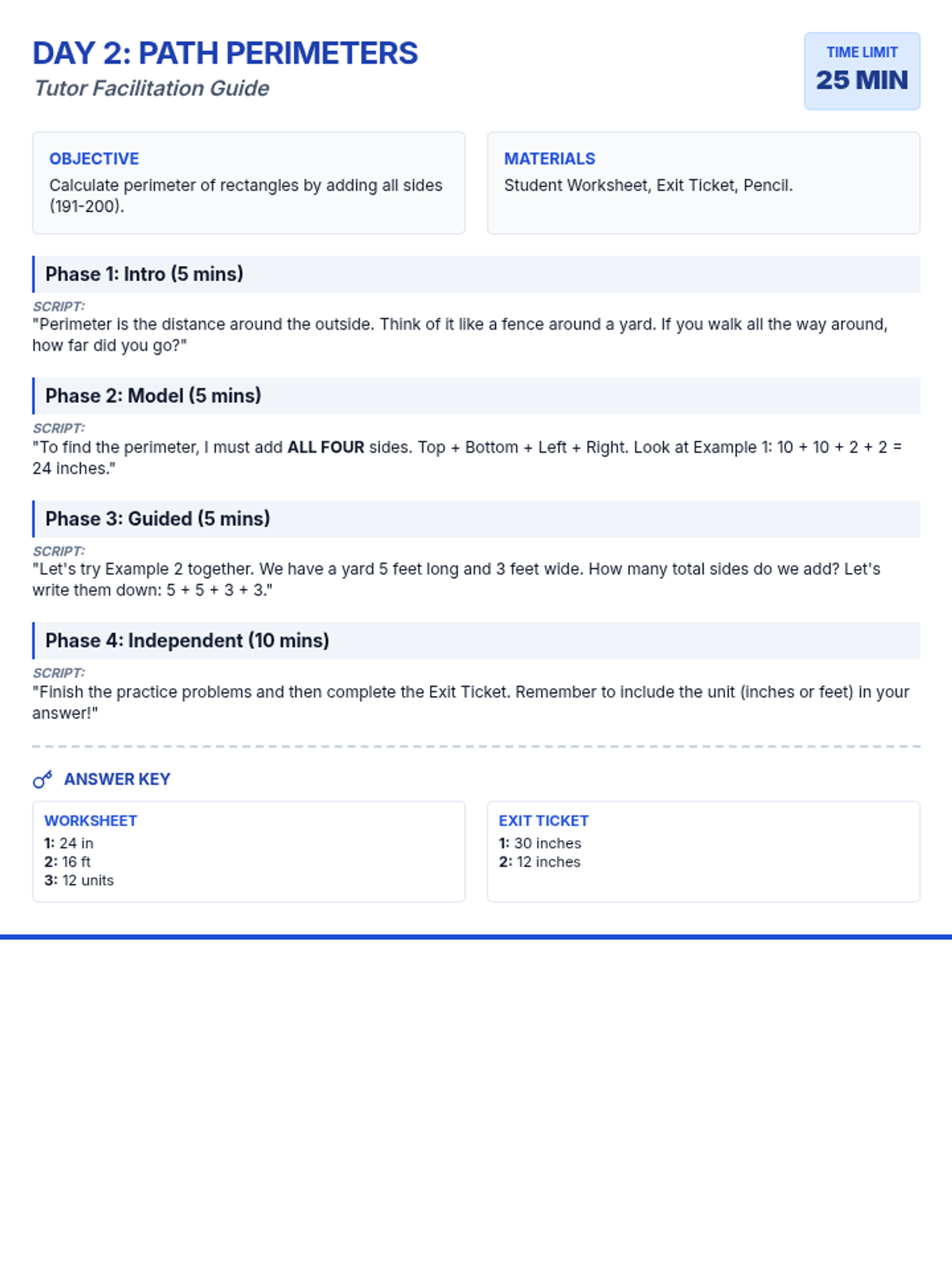
Tutor facilitation guide for Day 2 of the Measure Mastermind sequence, focusing on the fundamentals of perimeter and addition of all sides.
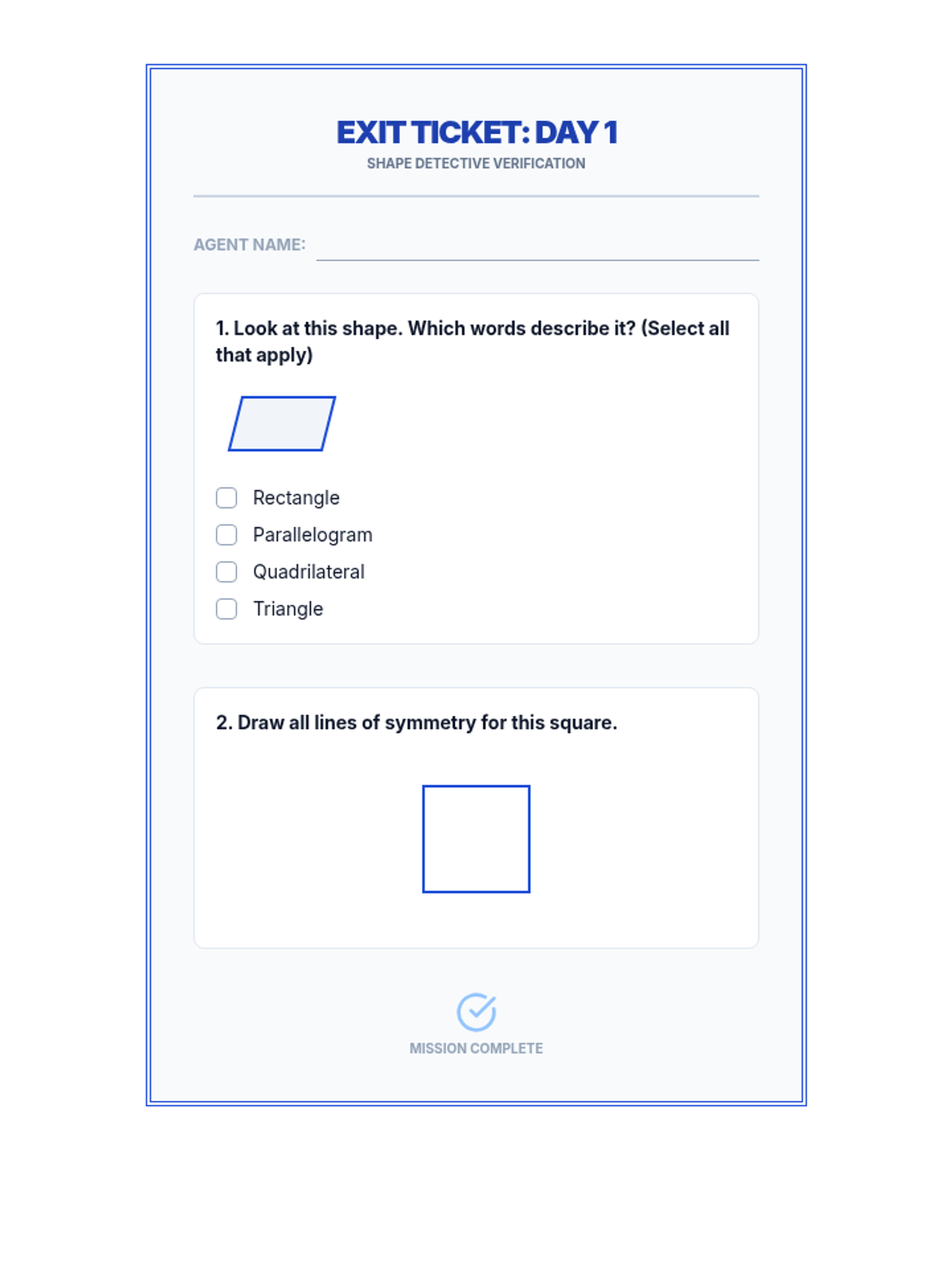
Day 1 exit ticket for the Measure Mastermind sequence, assessing student ability to identify quadrilaterals and draw symmetry lines.
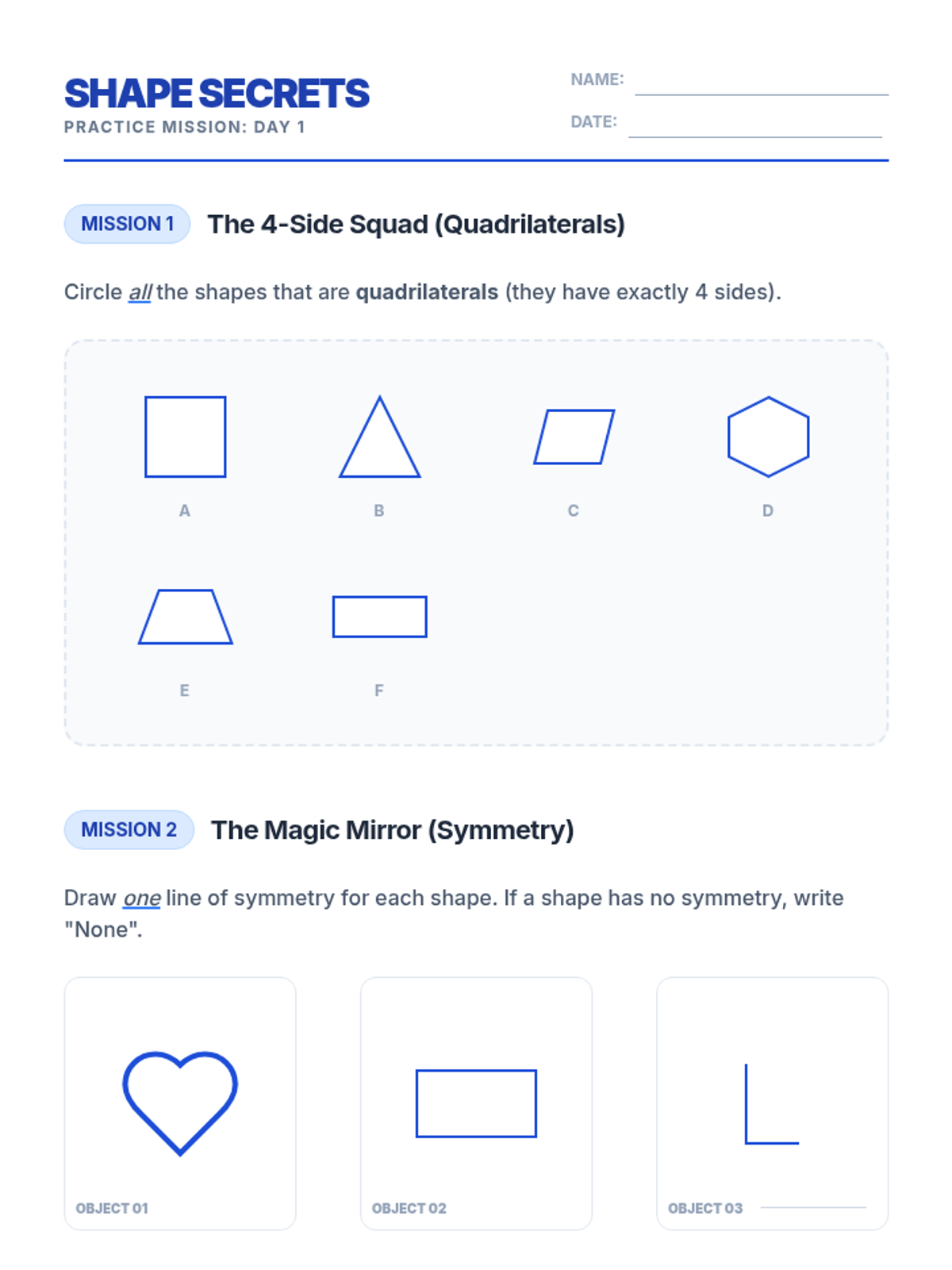
Student practice worksheet for Day 1 of the Measure Mastermind sequence, featuring quadrilateral identification and symmetry drawing. (Updated: removed helper text)
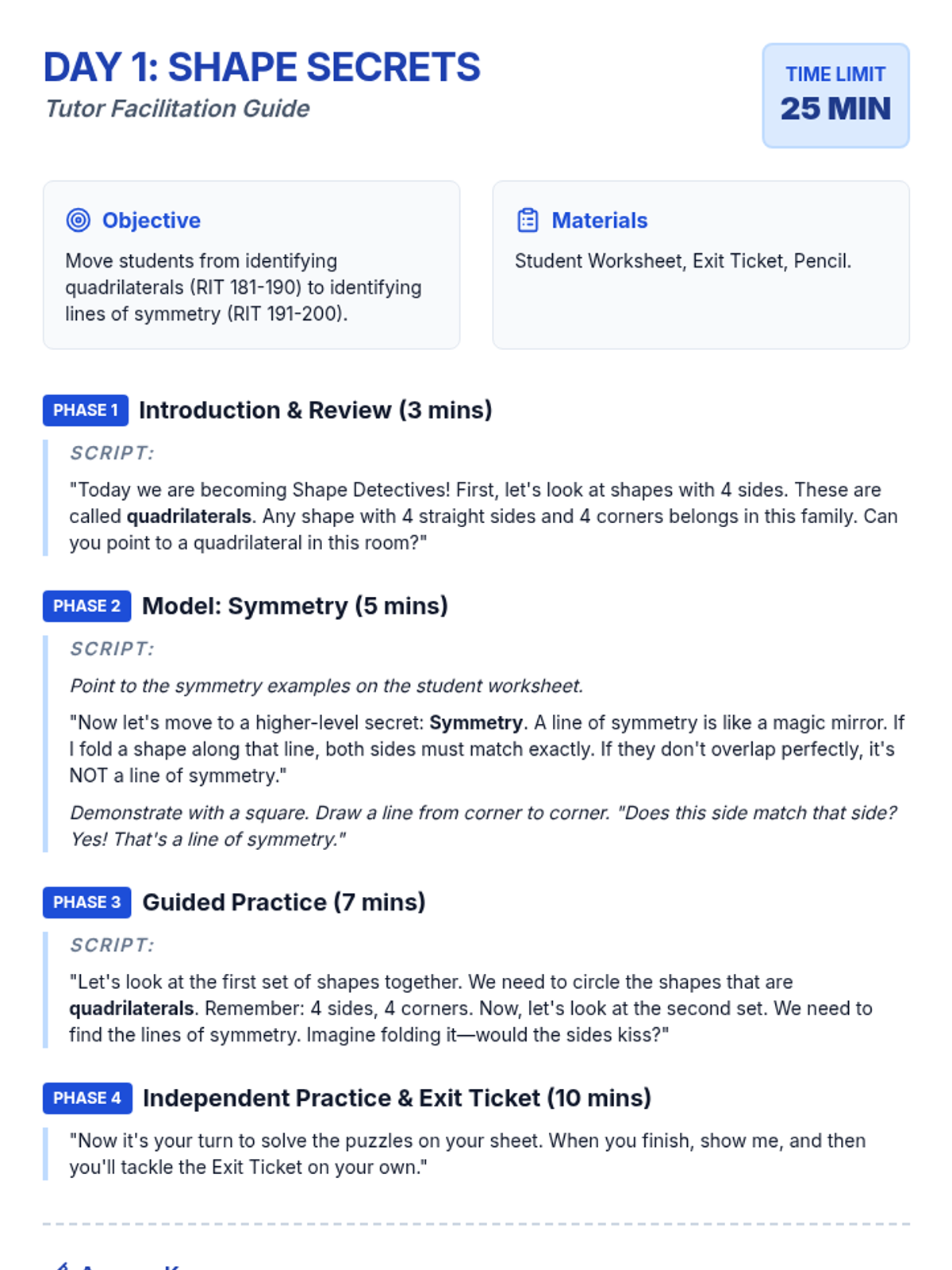
Tutor facilitation guide for Day 1 of the Measure Mastermind sequence, focusing on quadrilateral attributes and lines of symmetry with a full script and answer key.
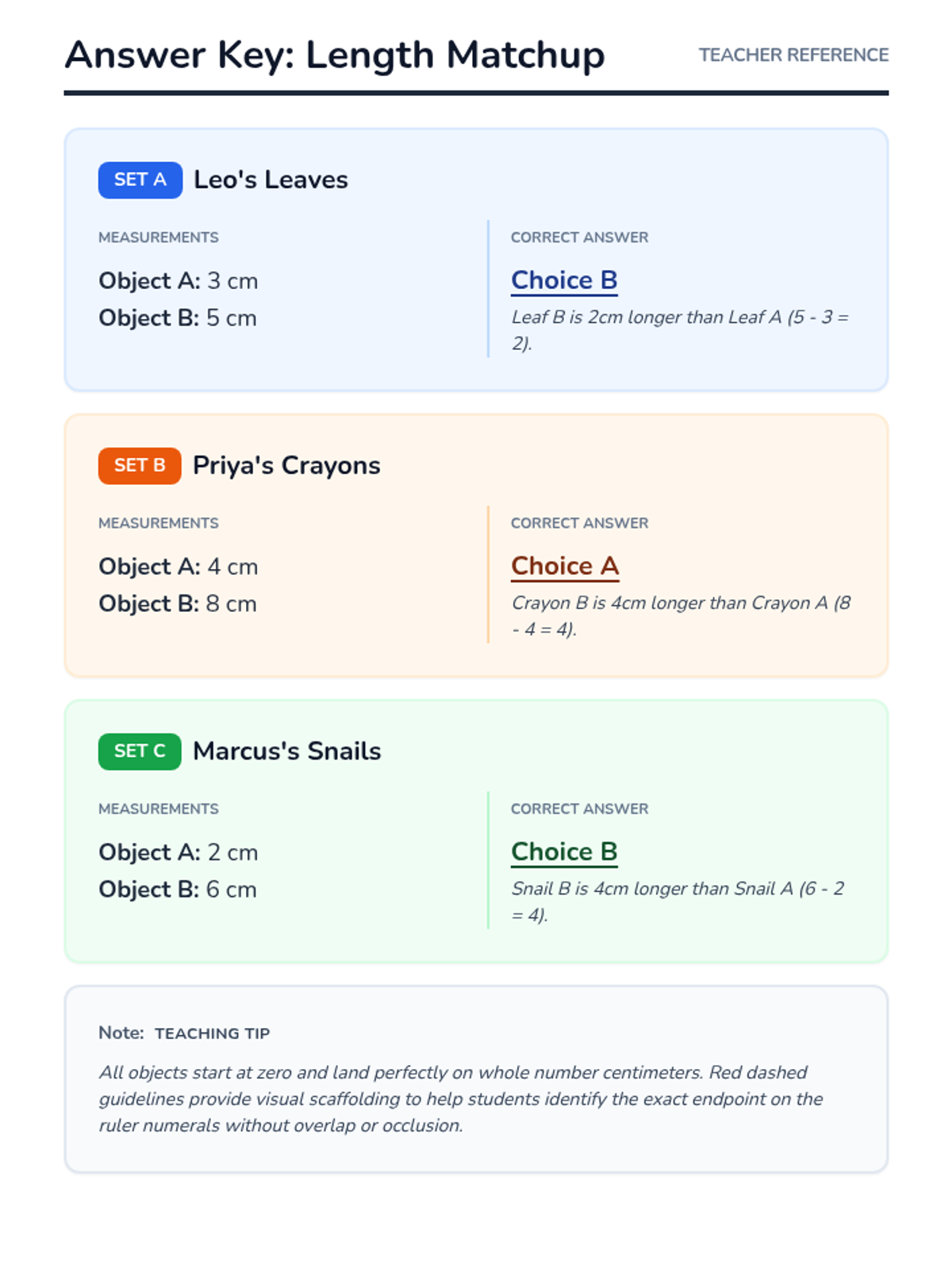
Teacher answer key for the Length Matchup At Bats worksheet, providing measurements for each object and the correct multiple-choice selection with supporting calculations. Designed for quick reference with a clear, color-coded layout. Corrected to match the final worksheet measurements and fixed layout issues.
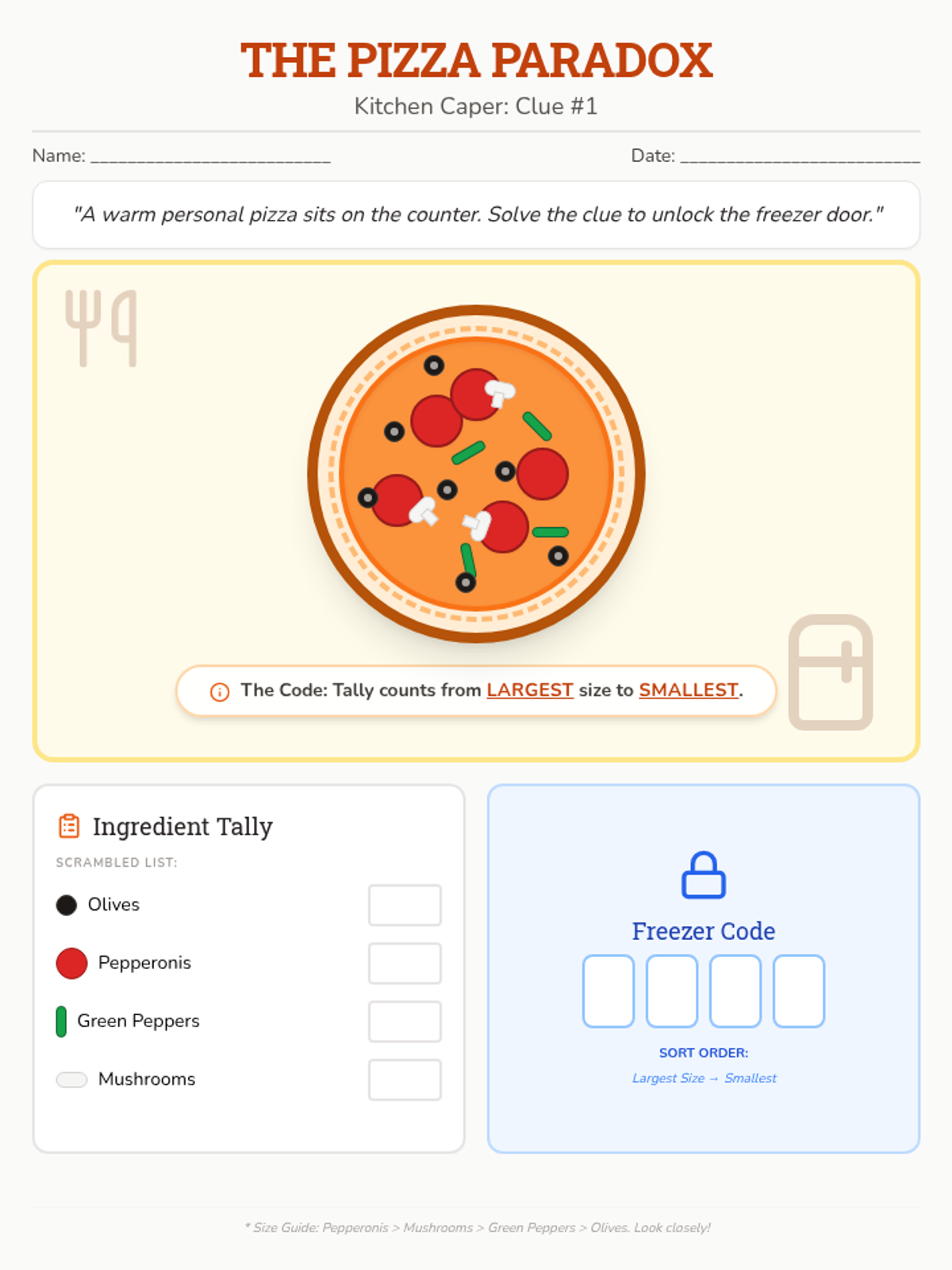
A visual observation puzzle where students tally pizza toppings to solve a freezer unlock code. Scrambled tally list and clarified size-based sorting logic. Fixed page break and opacity.
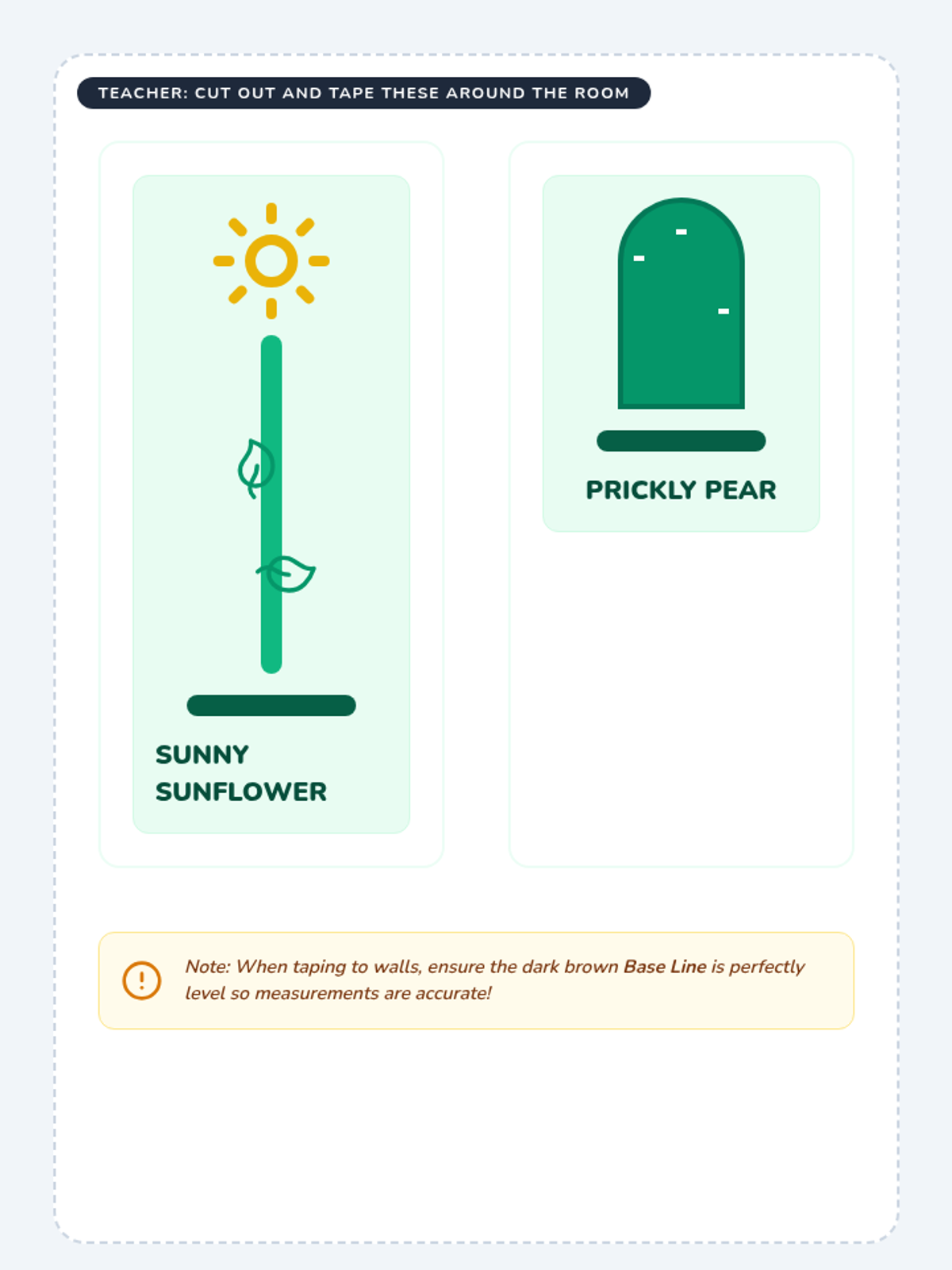
A set of printable paper plant cutouts designed for classroom walls, providing students with consistent visual targets for non-standard measurement practice.
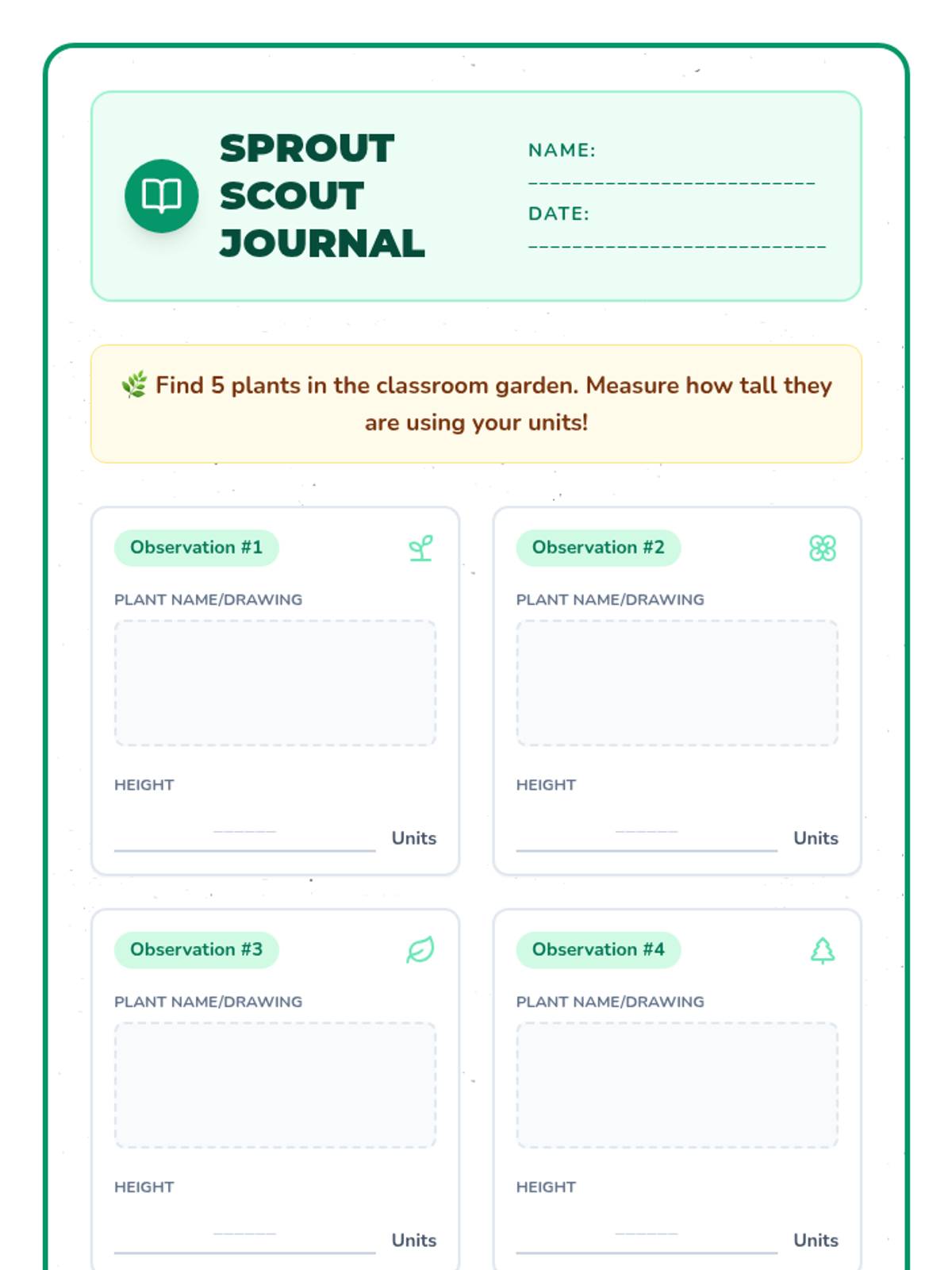
A student measurement log for recording data during the Garden Growth Giants activity, featuring drawing spaces and sections for non-standard units.
An engaging slide deck for the Garden Growth Giants lesson, introducing the 'Sprout Scout' mission and demonstrating proper non-standard measurement techniques with vibrant visuals.
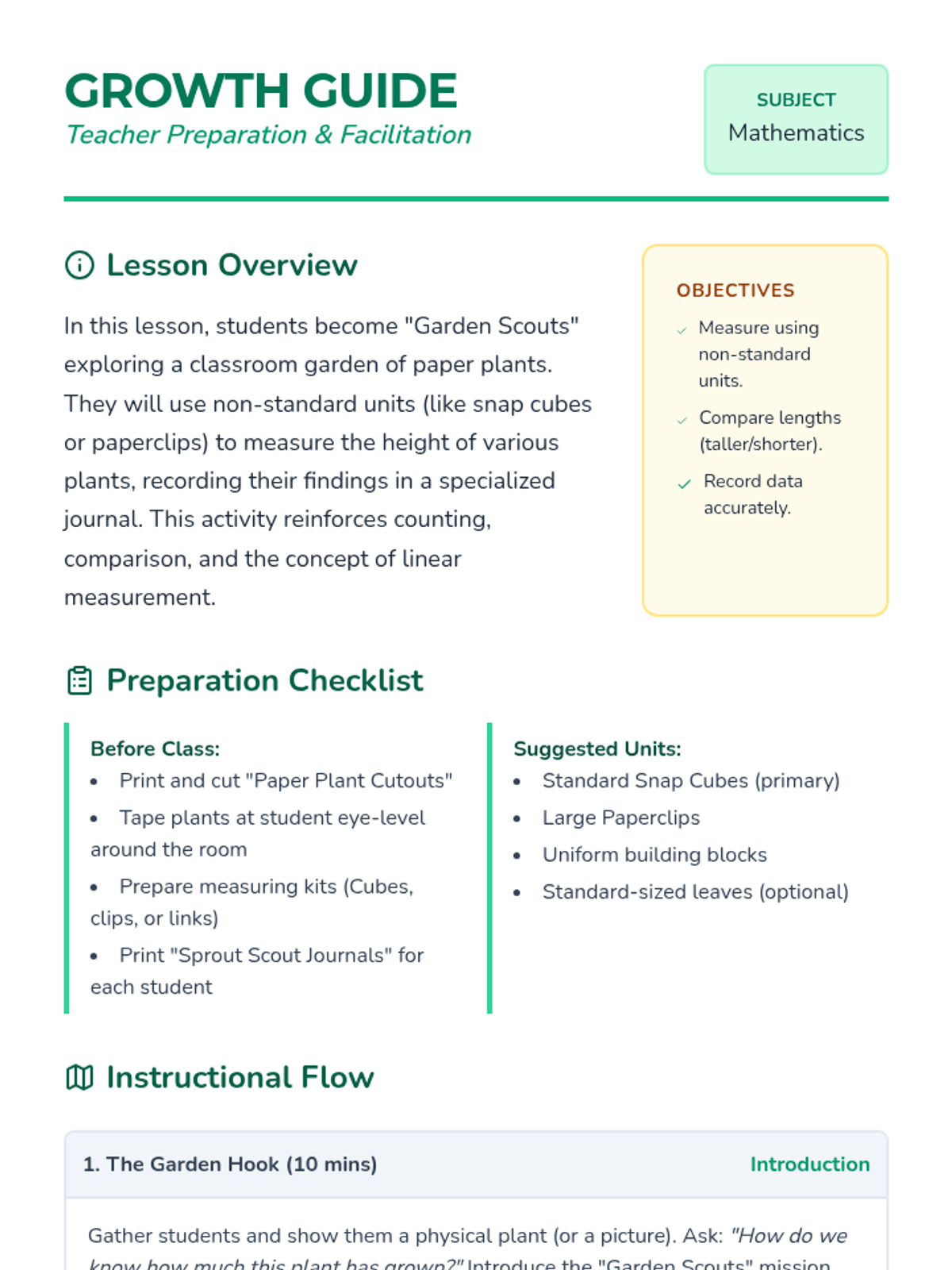
A comprehensive teacher guide for the Garden Growth Giants lesson, featuring instructional steps, preparation checklists, and differentiation strategies for teaching non-standard measurement.
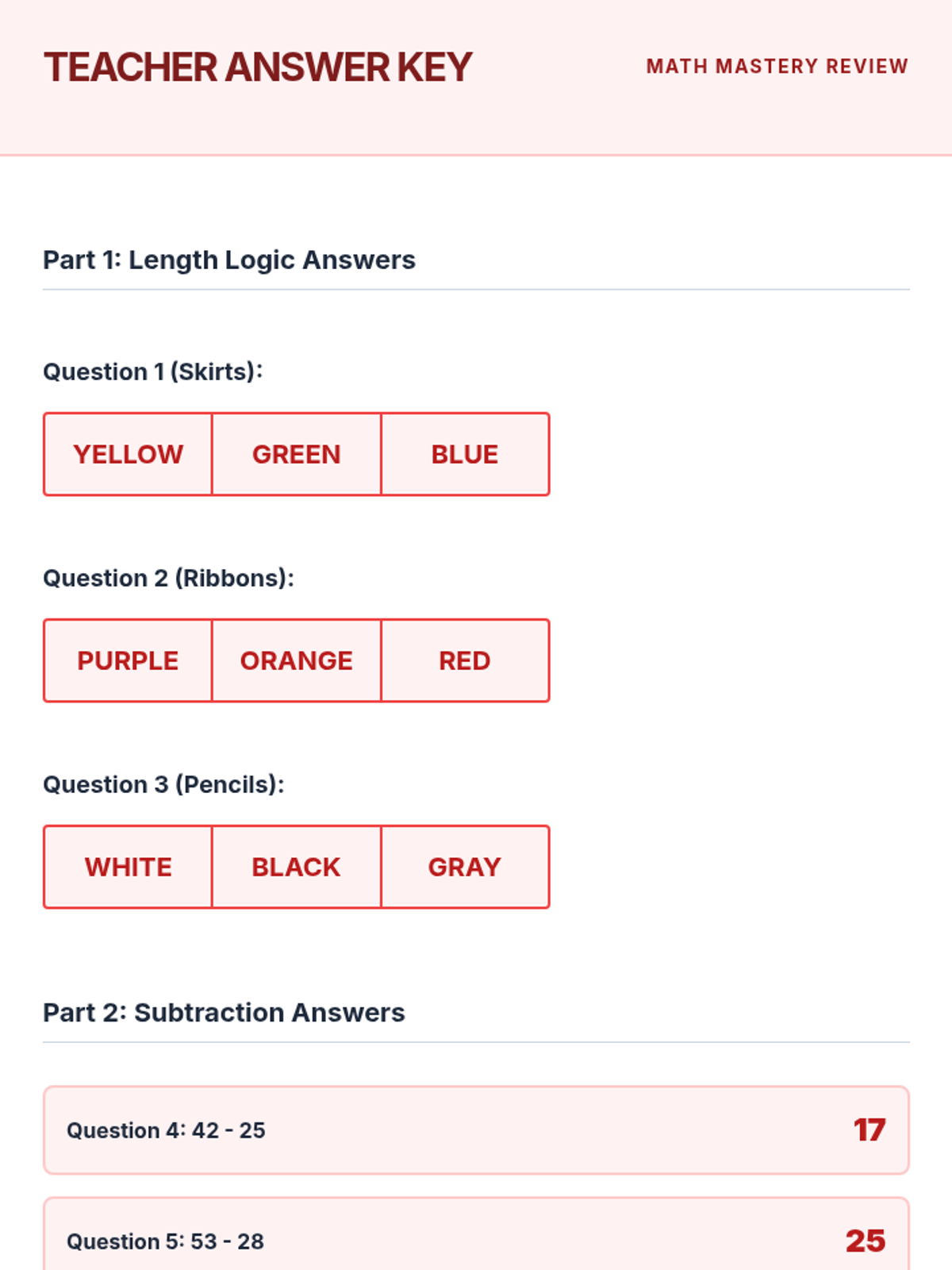
A teacher's answer key for the math review packet, providing solutions for length logic ordering, subtraction, shape sorting, geometry identification, and fractional identification. Each answer is clearly labeled by question number to match the 15-question sequence.
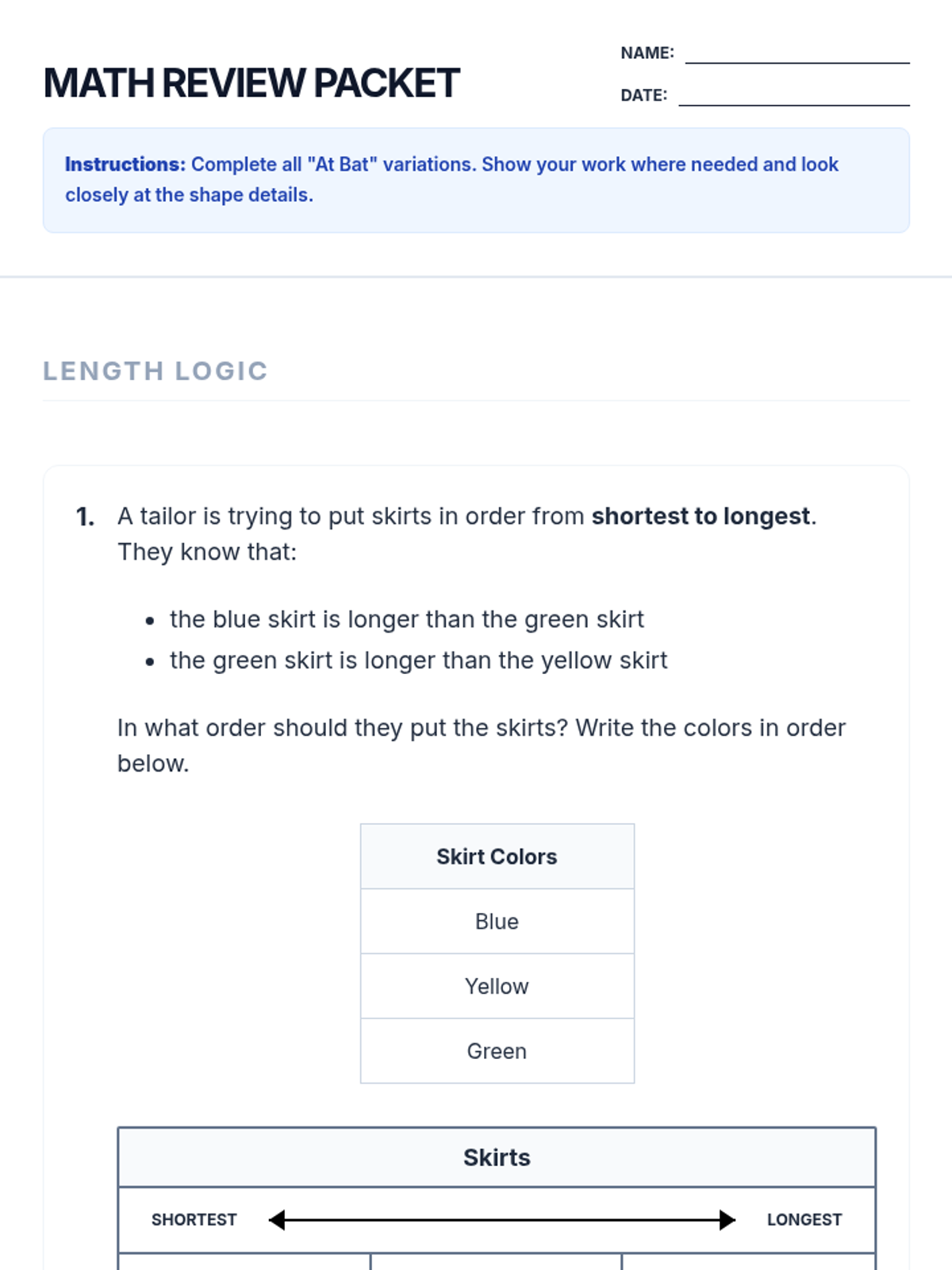
A math review packet for early elementary students covering logical ordering, subtraction, shape sorting, and fractions. The layout features one question per page (15 pages total). Revisions include left-aligned subtraction choices, clearer "non-triangle" geometry figures with expanded writing space, and additional shape sets in the fractional identification section. Standardized widths and alignments ensure visual consistency across all pages.
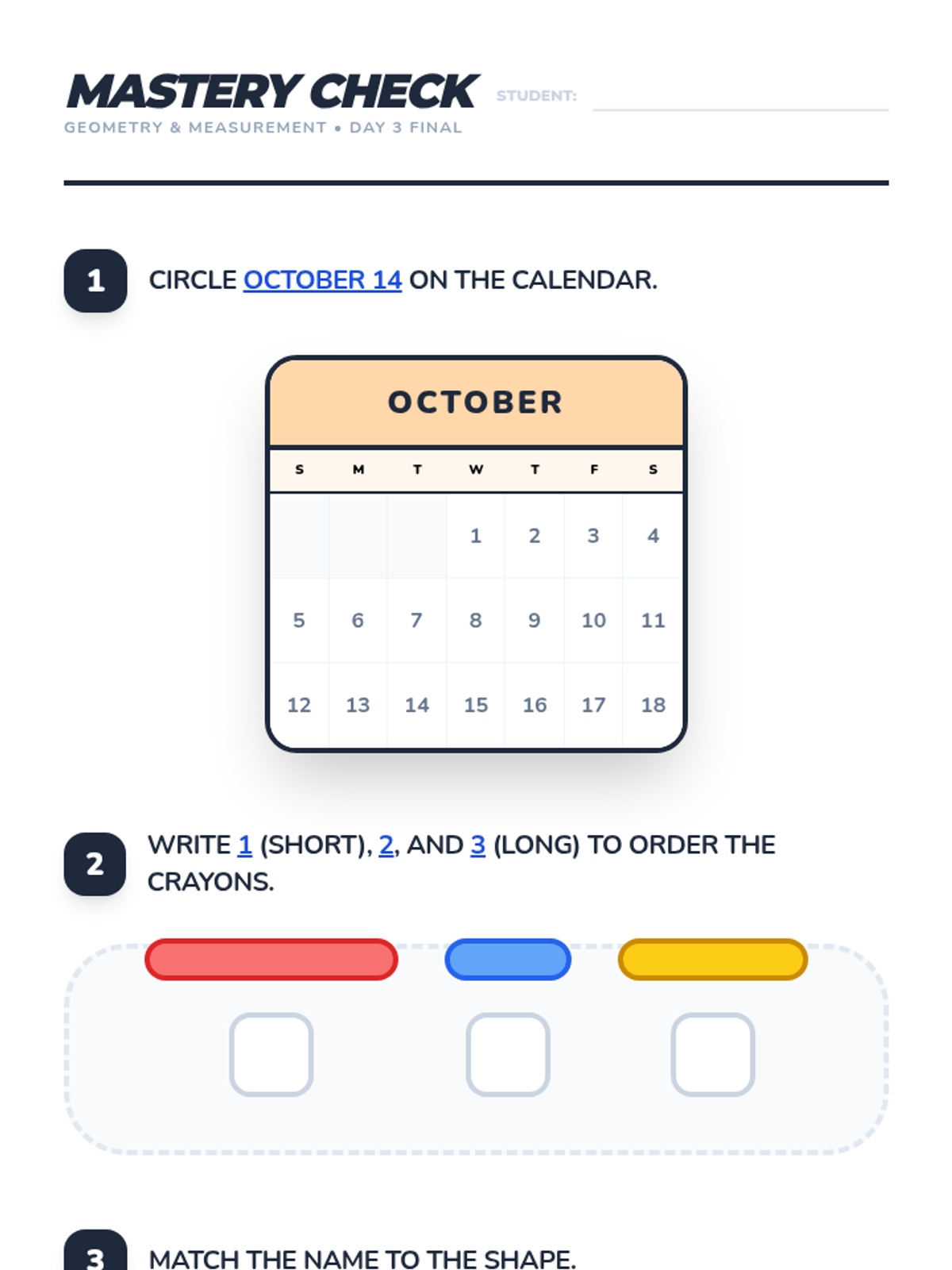
A cumulative assessment for the 3-day sequence, testing calendar navigation, length ordering, 3D shape identification, and positional vocabulary. All questions are neutrally styled to ensure a fair assessment.
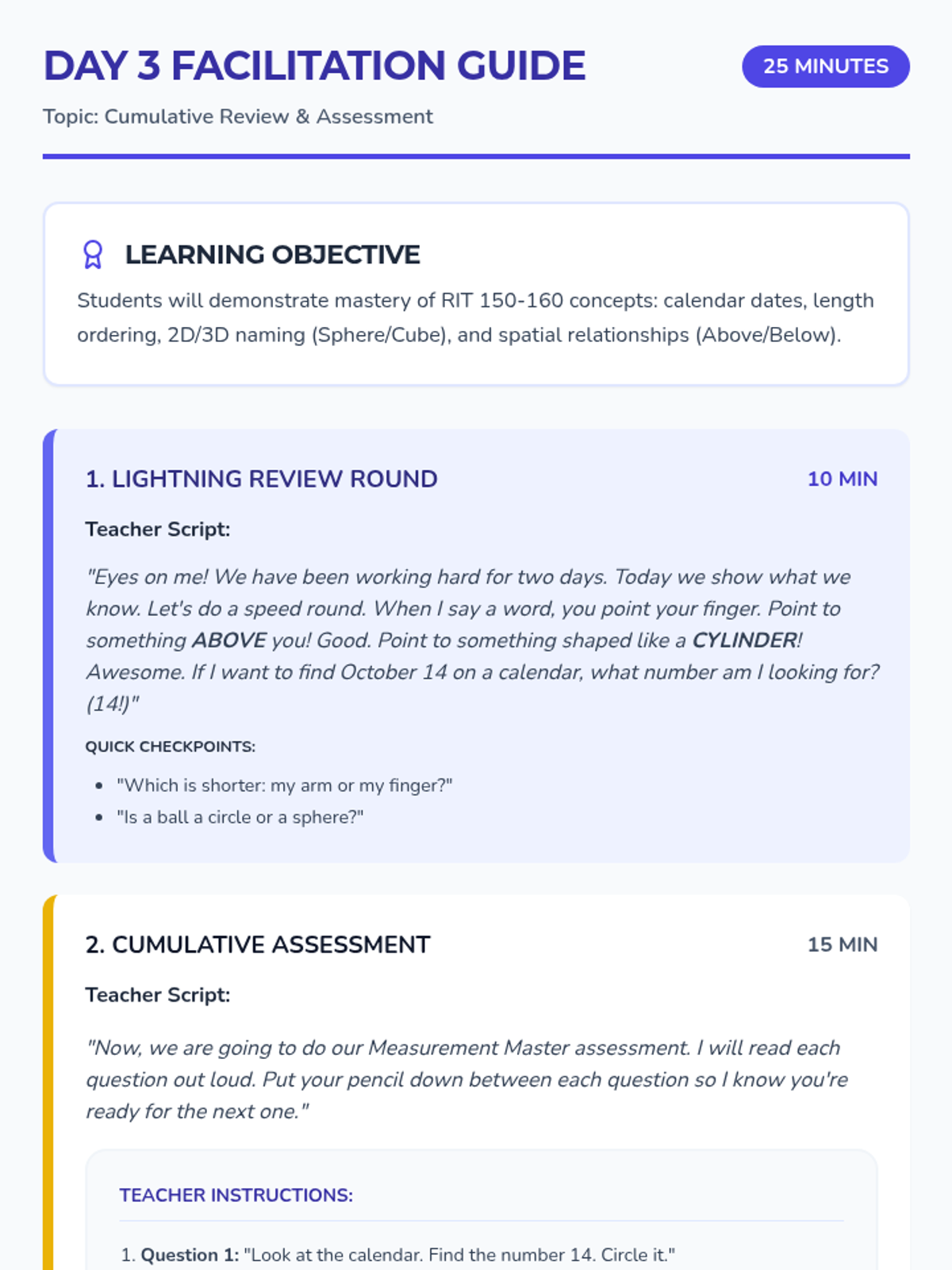
A facilitation guide for Day 3, featuring a lightning review script and instructions for administering the cumulative assessment.
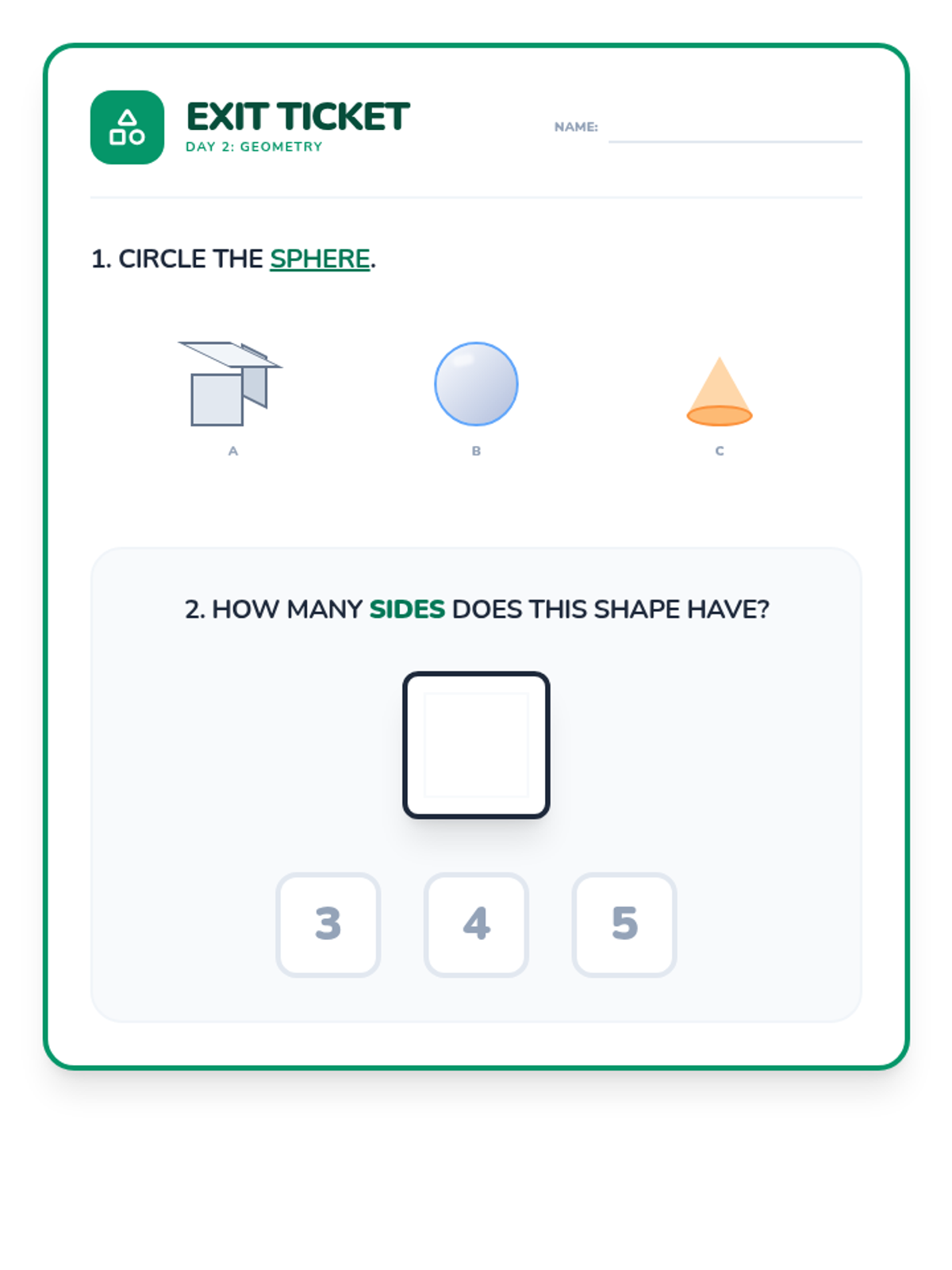
A Day 2 exit ticket that asks students to identify a sphere from a group of 3D shapes and count the sides of a square. Answer choices are styled identically to ensure a fair assessment.
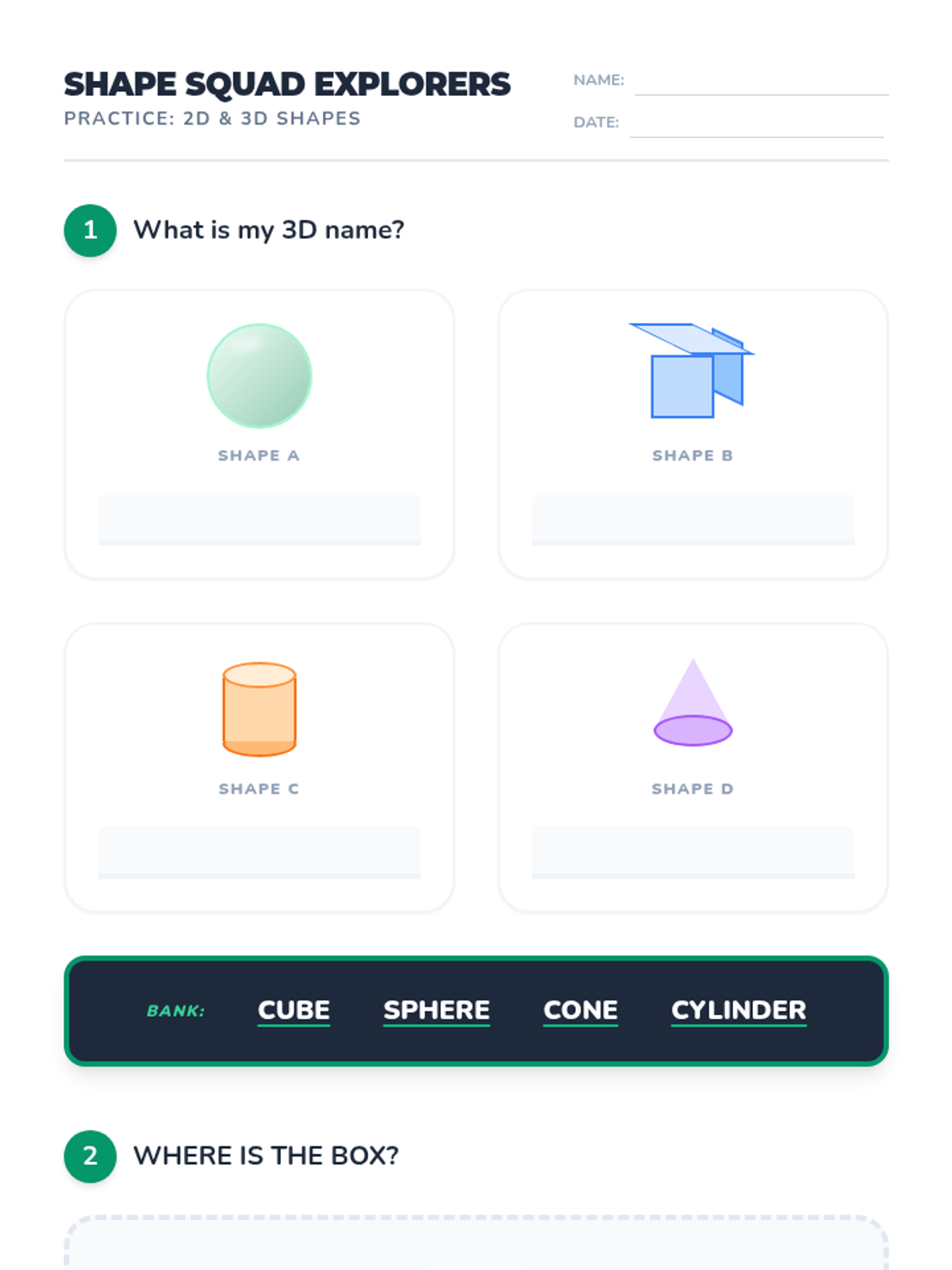
A Day 2 practice worksheet focusing on matching 3D shape images to their names and identifying positional relationships (above/below). Features improved isometric 3D shapes and identical styling for answer choices.
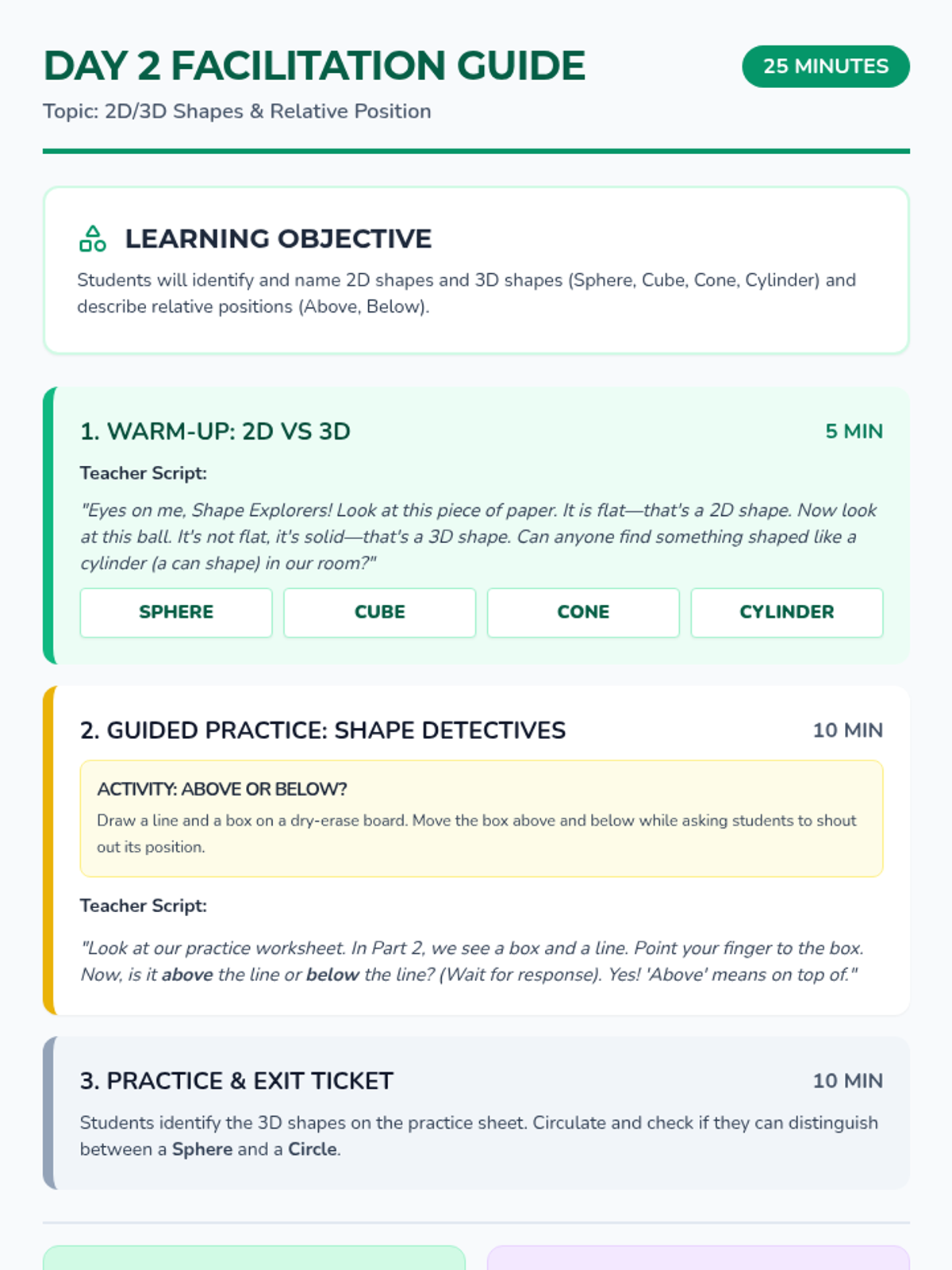
A facilitation guide for Day 2 focusing on 2D and 3D shape identification and positional vocabulary like "above" and "below". Pulls all teacher notes onto a single page for ease of use.
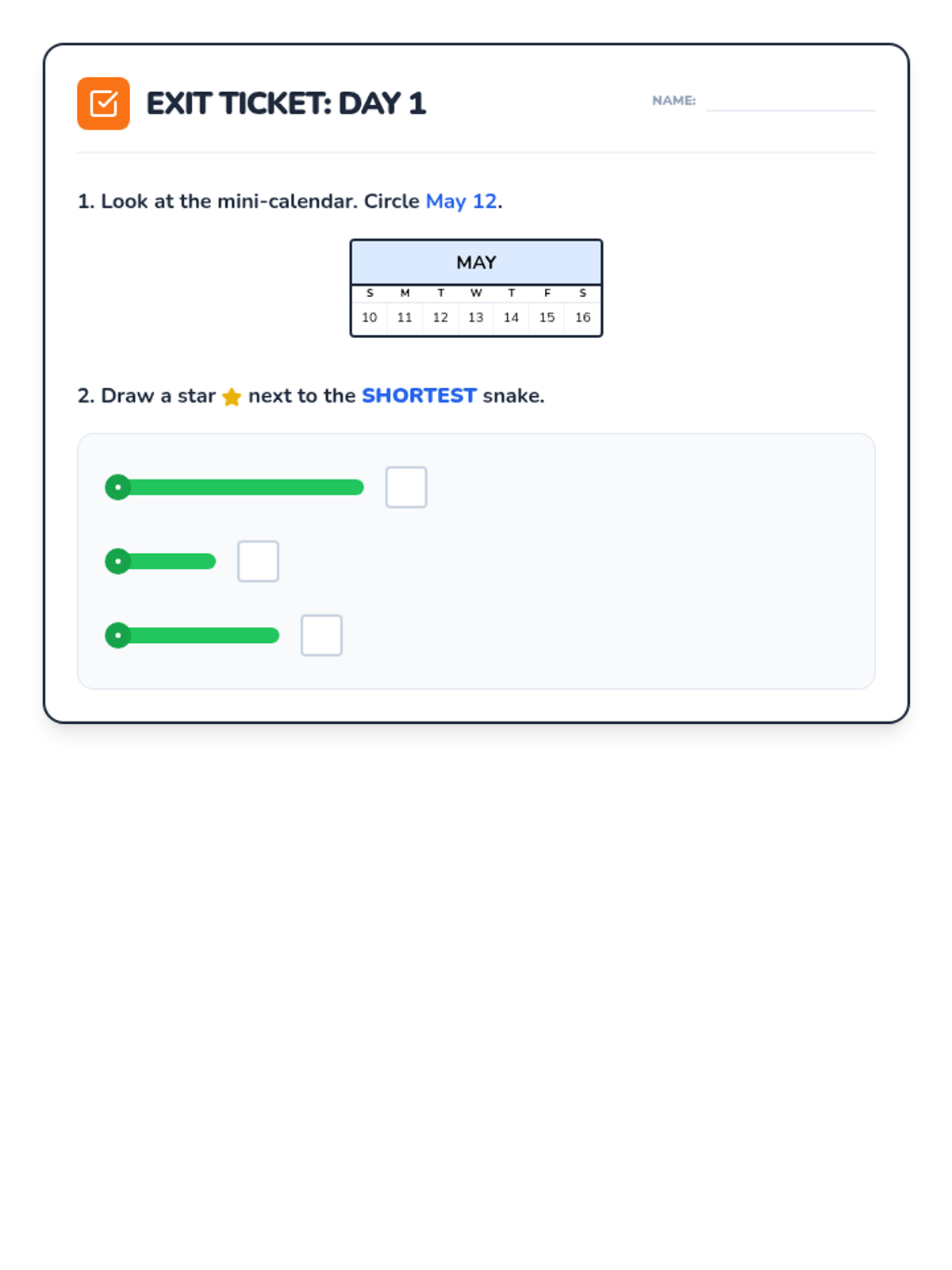
A compact Day 1 exit ticket covering calendar date identification and identifying the shortest object in a set.
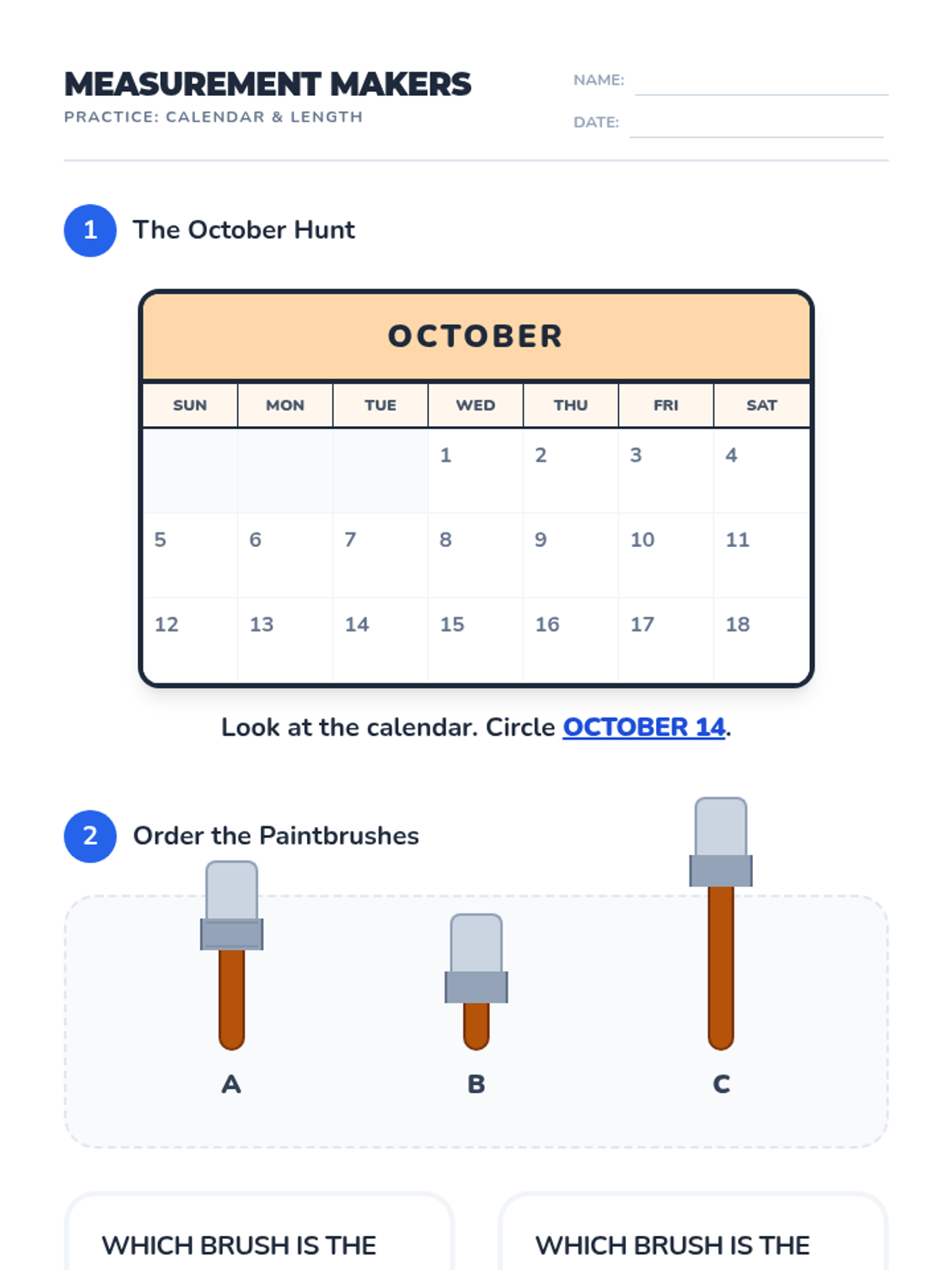
A practice worksheet for Day 1 featuring a calendar identification task and a length ordering activity with visual brush illustrations. All content is condensed onto a single page with large student work areas.
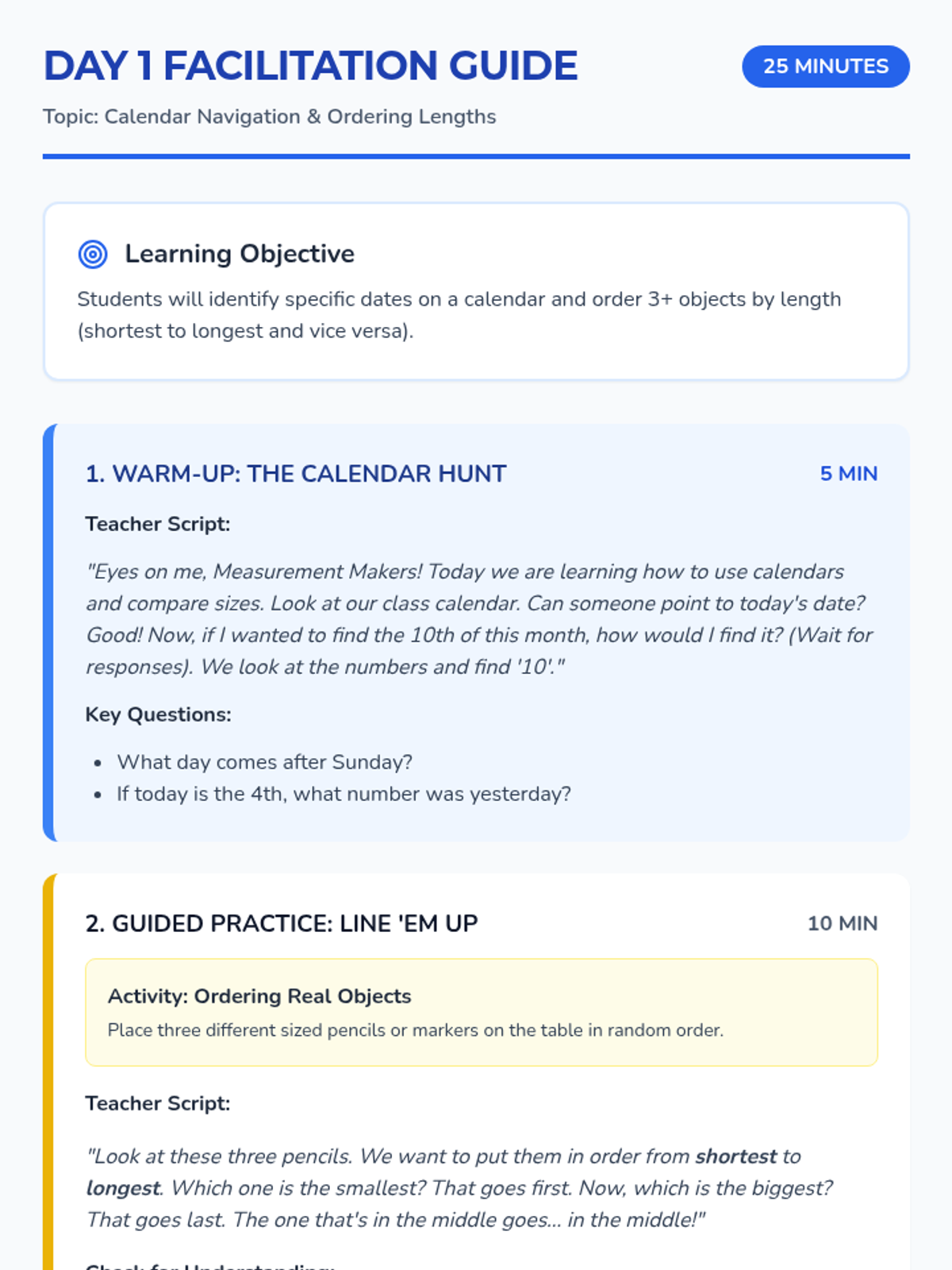
A detailed facilitation guide for the Day 1 small group lesson, including a teacher script, activity prompts, and pacing for calendar and length skills.
A 21-slide measurement presentation updated with 'clipart-style' graphics and perfect alignment. It includes a dashed reference line at the 'zero point' for all measurement questions to ensure students understand proper alignment for accurate results.
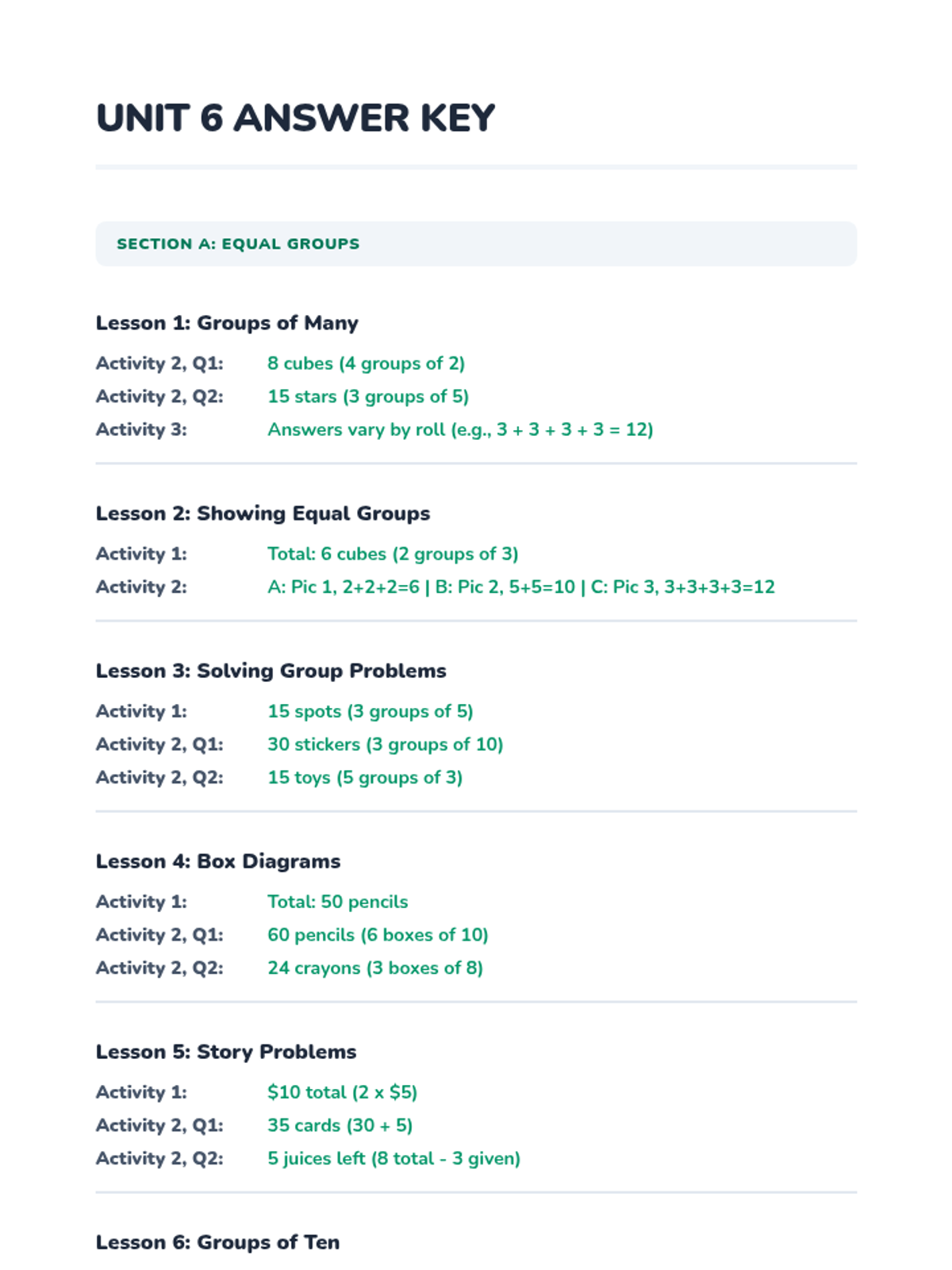
A comprehensive answer key for all 18 lessons in the Unit 5 Foundation unit. It provides specific solutions for all math problems, activities, and logic challenges across Sections A, B, and C. Now includes a Section TOC and worked examples for instructional support.
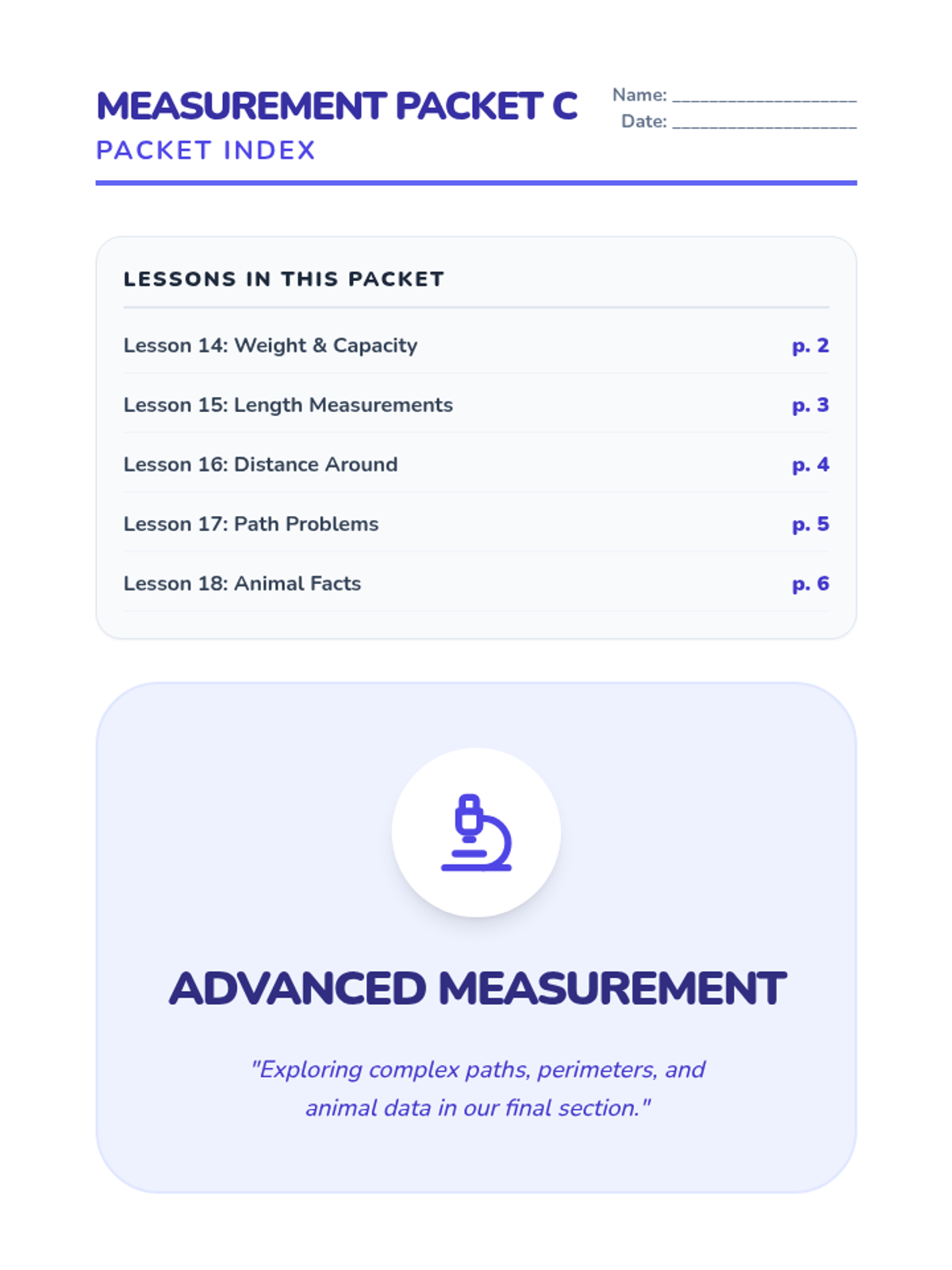
Student worksheet for Section C of Unit 5, focusing on advanced measurement skills. Includes a packet index, instructional 'Independent Guide' examples, and improved work areas with handwriting guides. Now features standardized formatting and uniform answer choice styling. Now in numeric order. No blank pages.
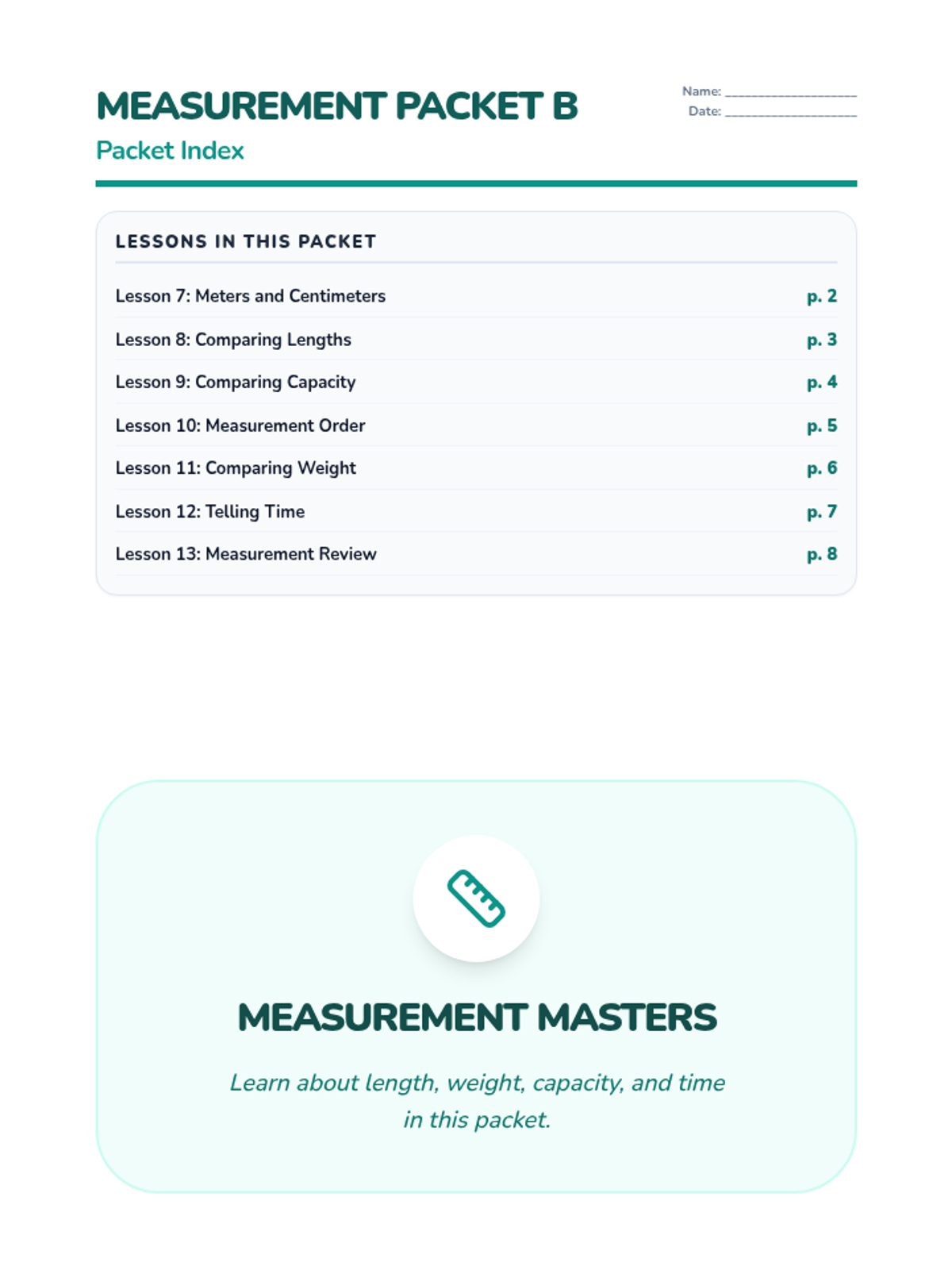
Student worksheet for Section B of Unit 5, covering measurement concepts including length (metric and standard), capacity, weight, and time. Includes a packet index and instructional 'Independent Guide' examples for all activities. Now in numeric order. No blank pages.
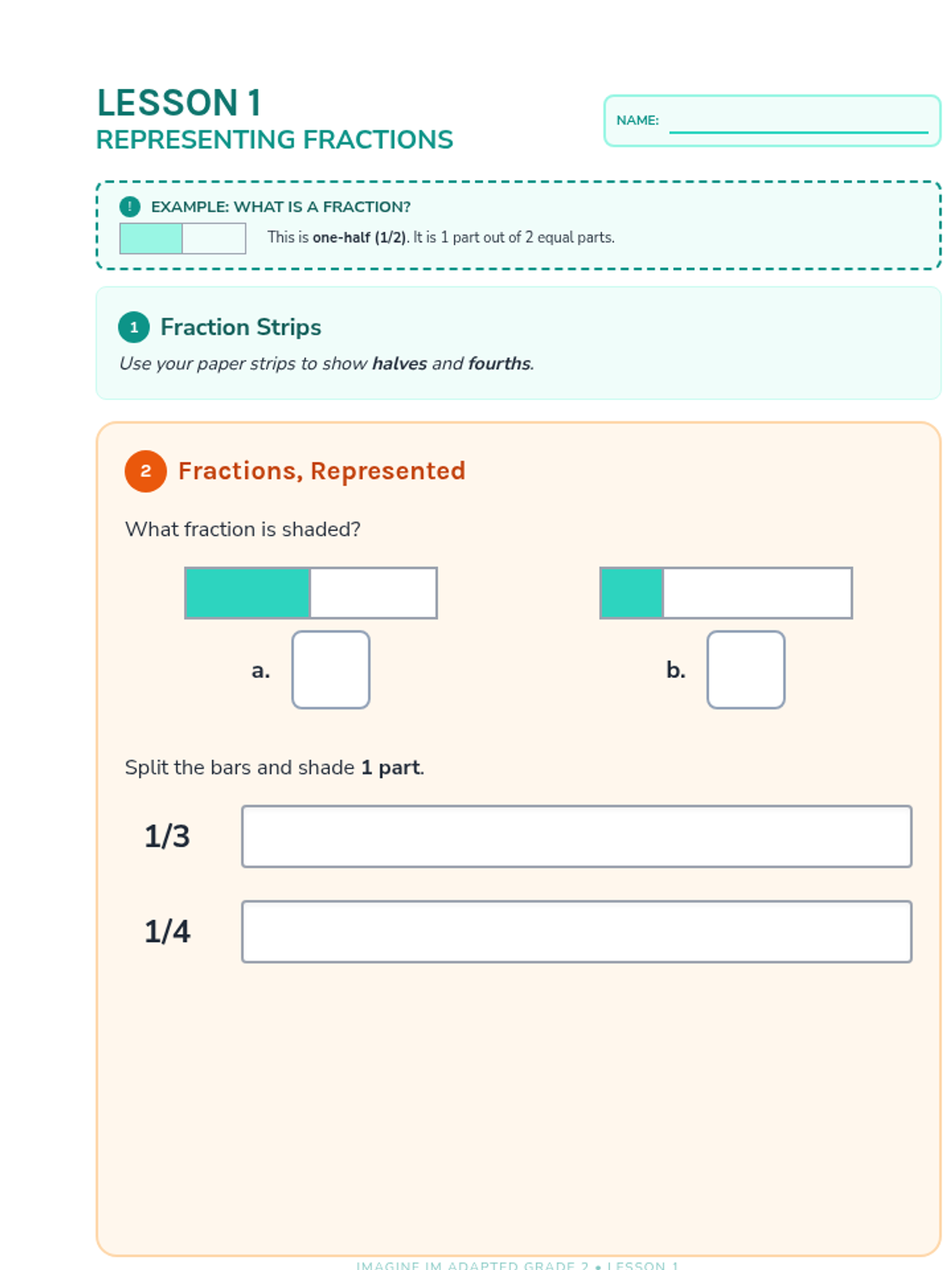
A 6-page math document adapting 4th grade fraction lessons to 2nd grade level, now updated with clear instructional 'Example' boxes at the top of each lesson to make the material more self-sufficient for students and teachers. Each page focuses on halves, thirds, and fourths through visual diagrams, partitioning activities, and number line placements. Revised for better page layout and clarity.
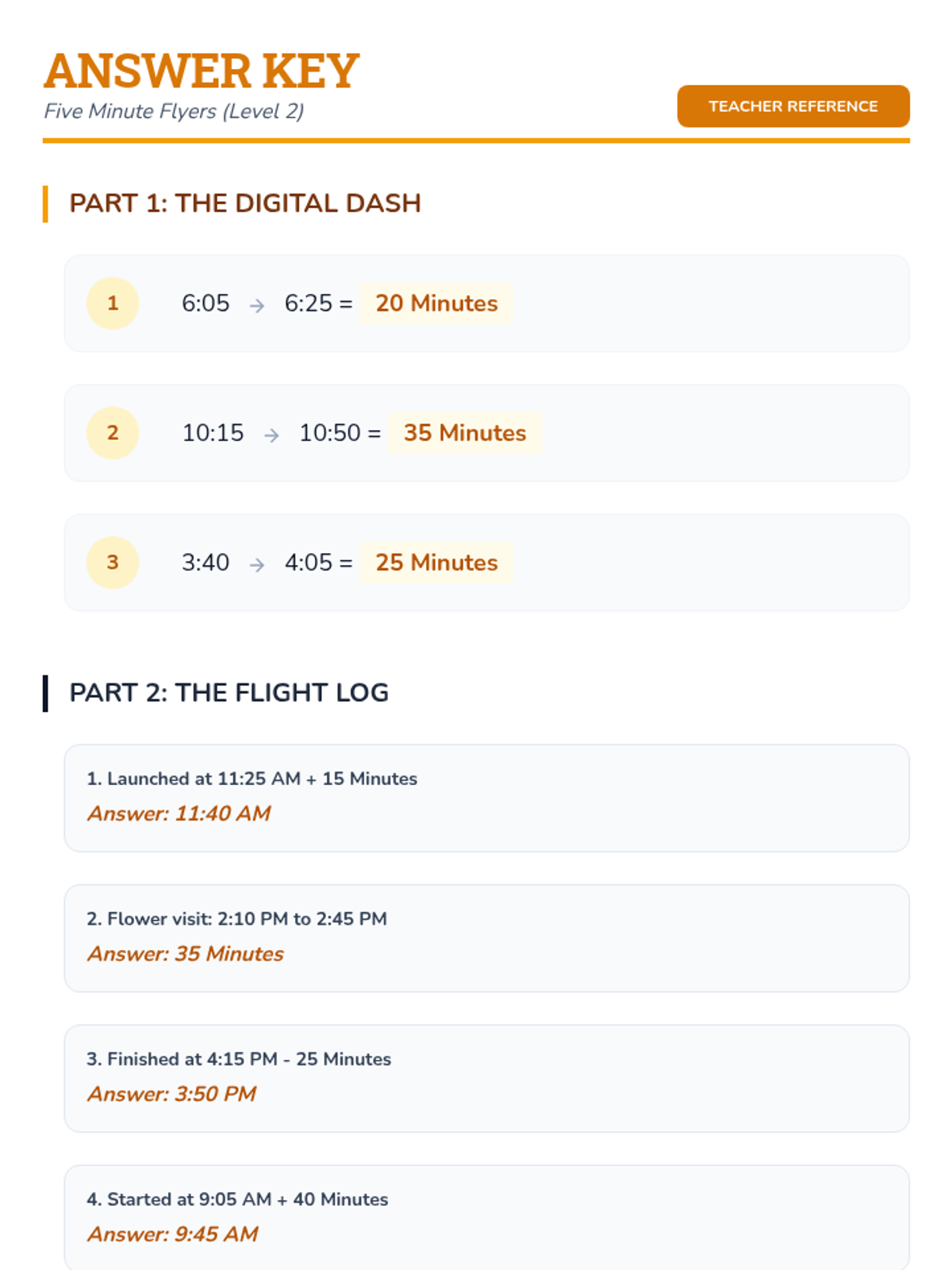
An answer key for the Five Minute Flyers worksheet, providing solutions for elapsed time problems in 5-minute increments.
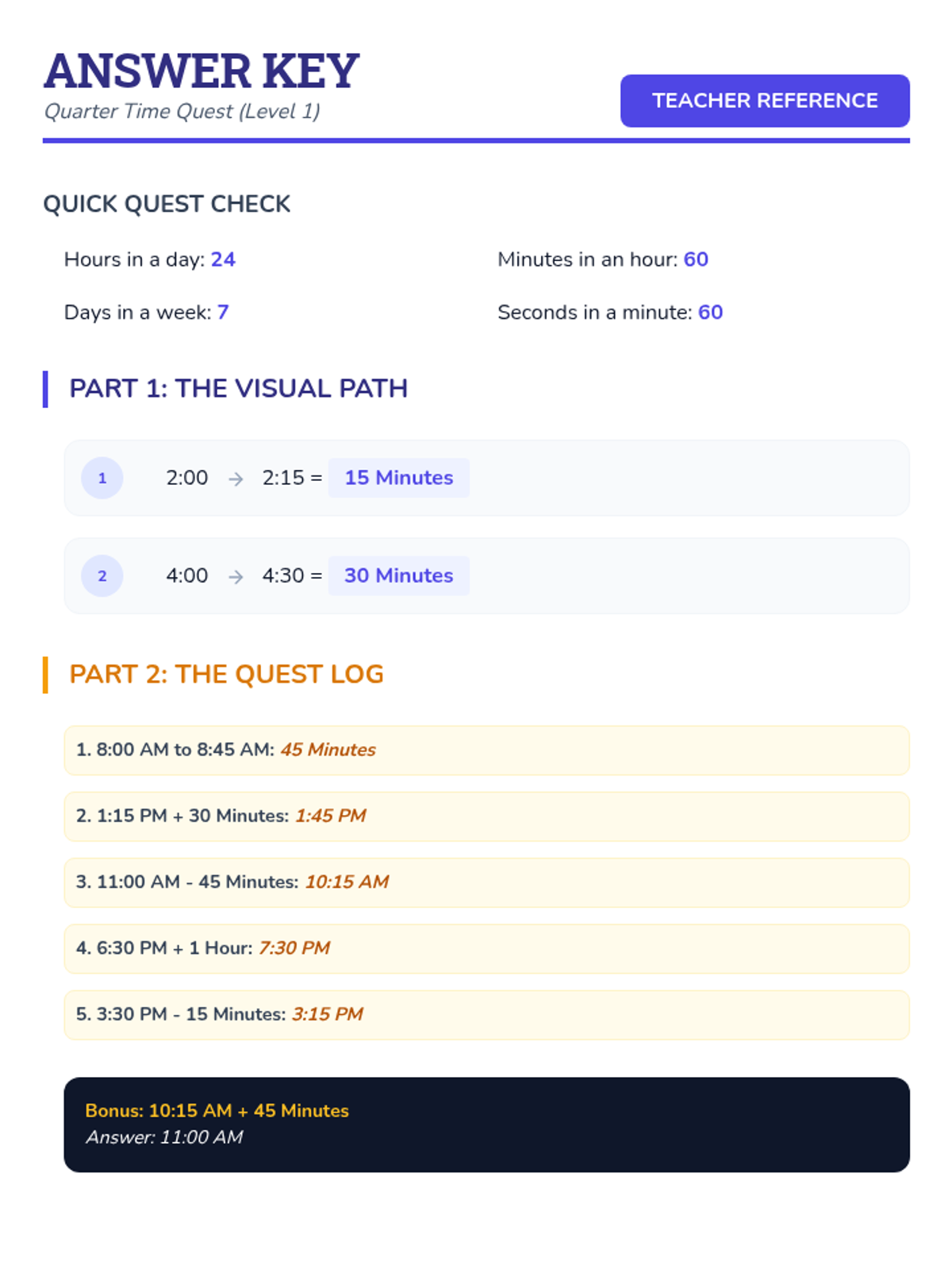
An answer key for the Quarter Time Quest worksheet, providing solutions for elapsed time problems in 15-minute increments.
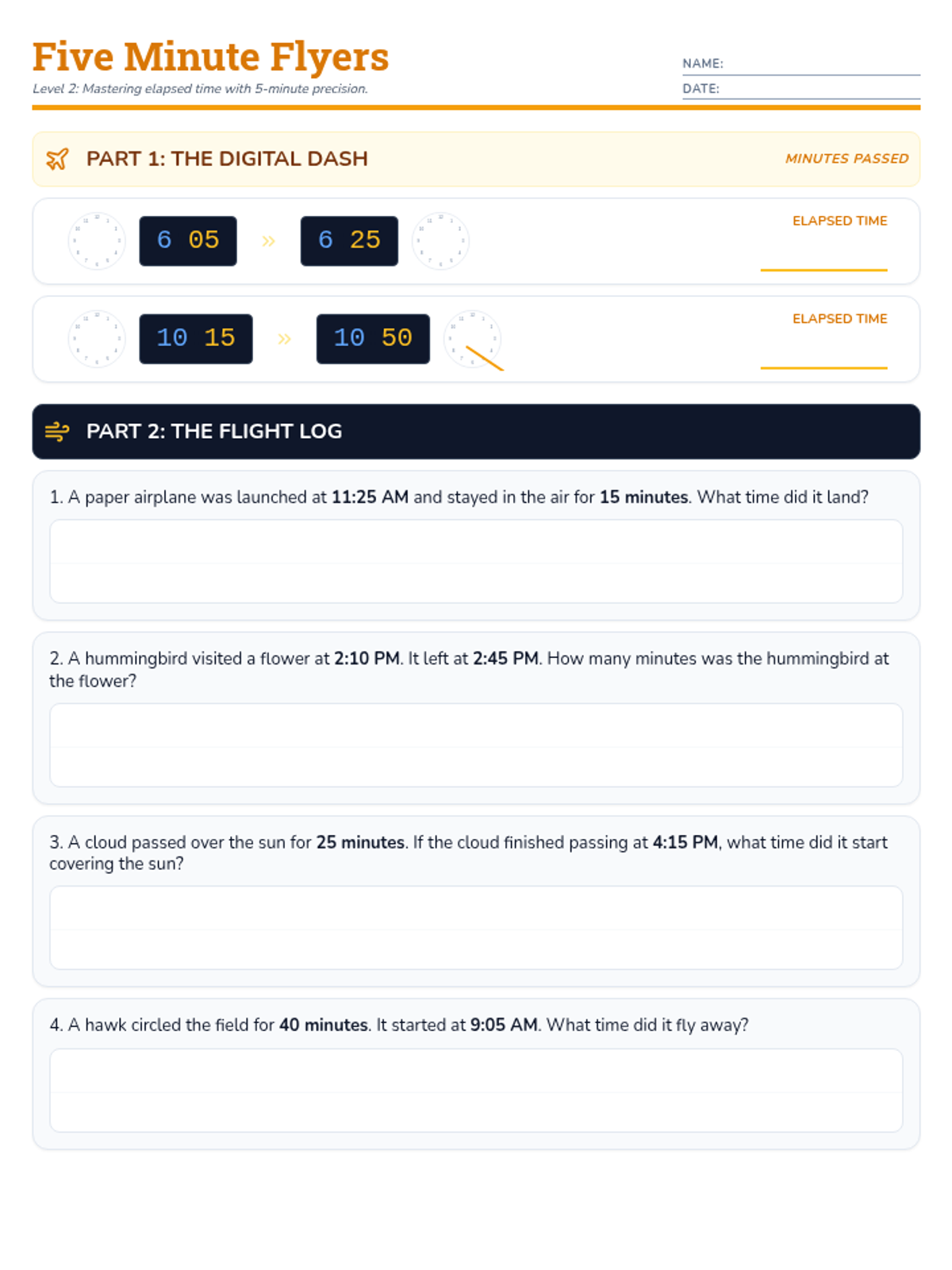
A Level 2 worksheet centered on calculating elapsed time in 5-minute increments. Features visual clock support with all 12 numbers and flight-themed word problems.
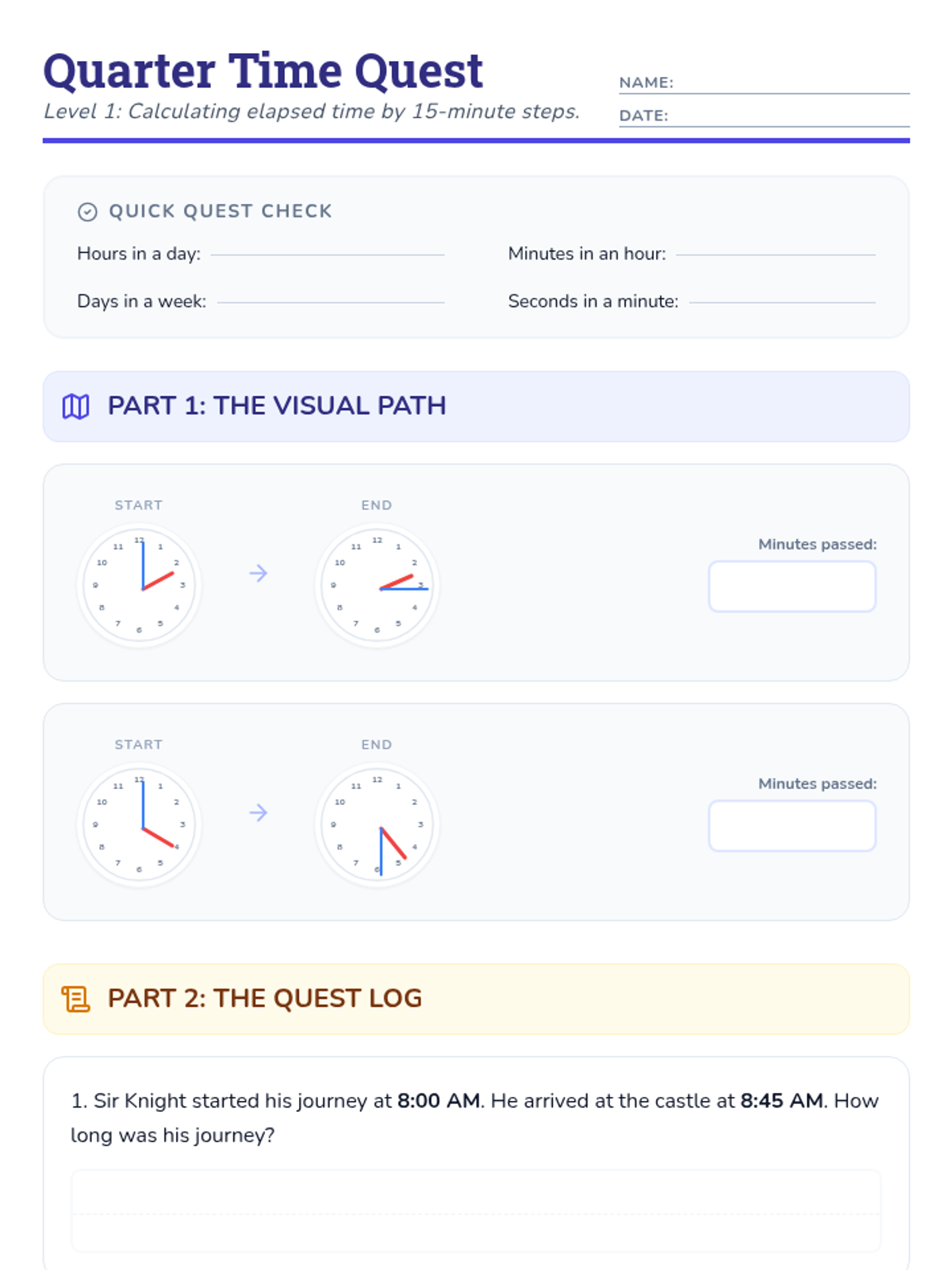
A Level 1 worksheet focused on calculating elapsed time in 15-minute increments. Includes visual clock comparisons with all numbers 1-12 and thematic word problems.
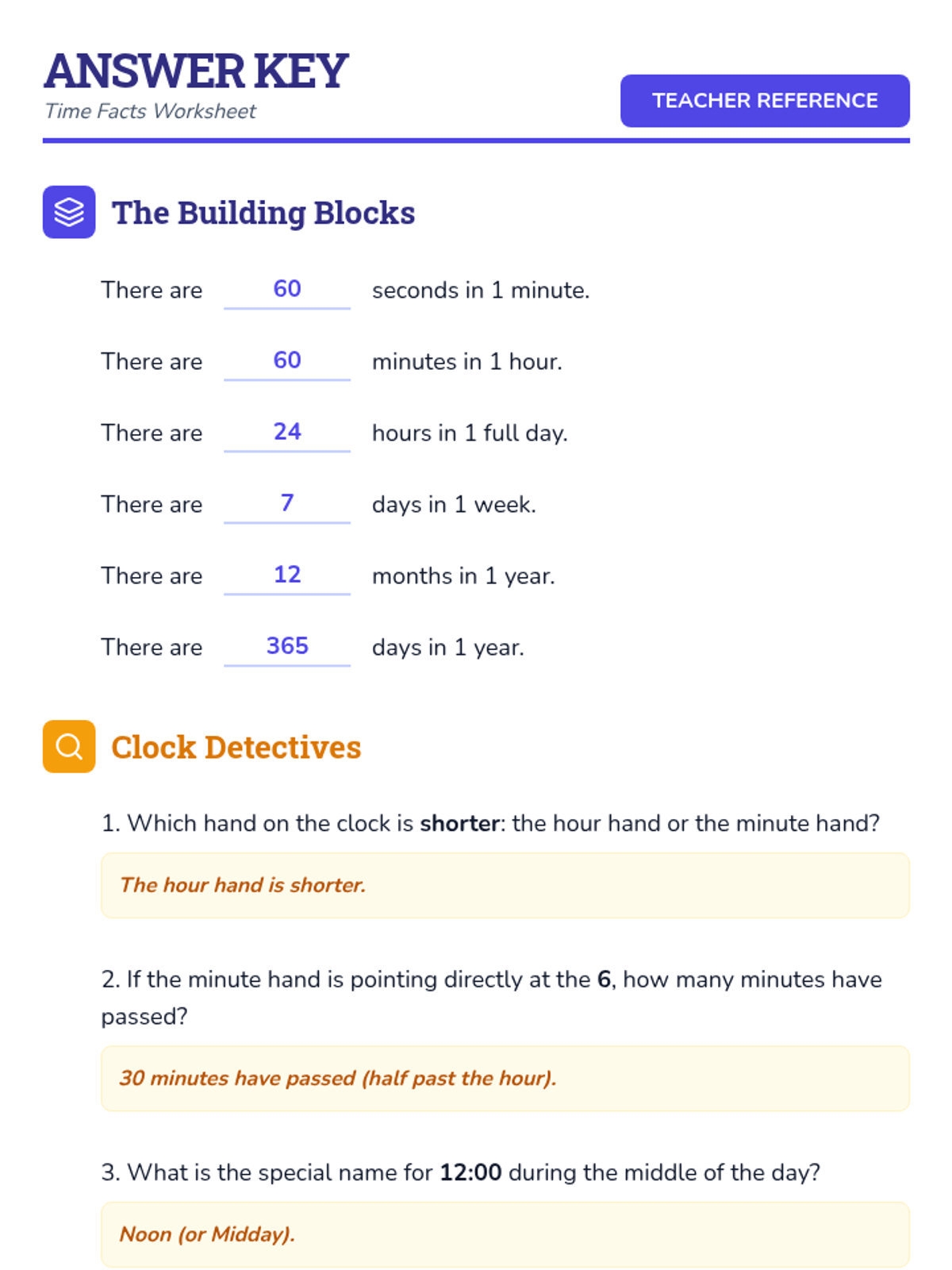
An answer key for the Time Facts Worksheet, providing correct answers for basic time units, clock anatomy, and the conceptual time challenge.
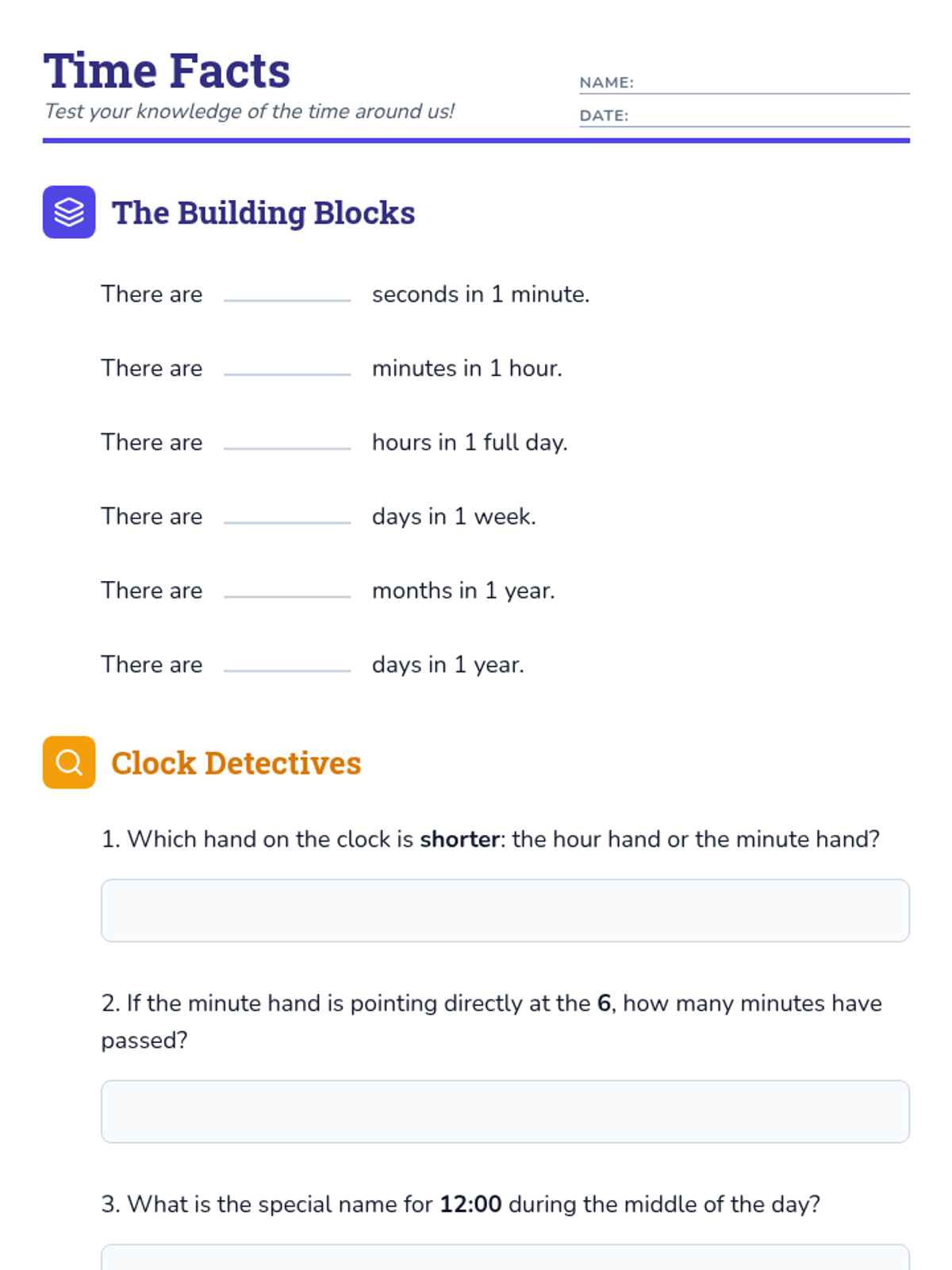
A conceptual worksheet covering basic time facts, including units of time (seconds, minutes, hours, days, weeks, years) and functional clock knowledge. Includes fill-in-the-blank and short explanation questions.
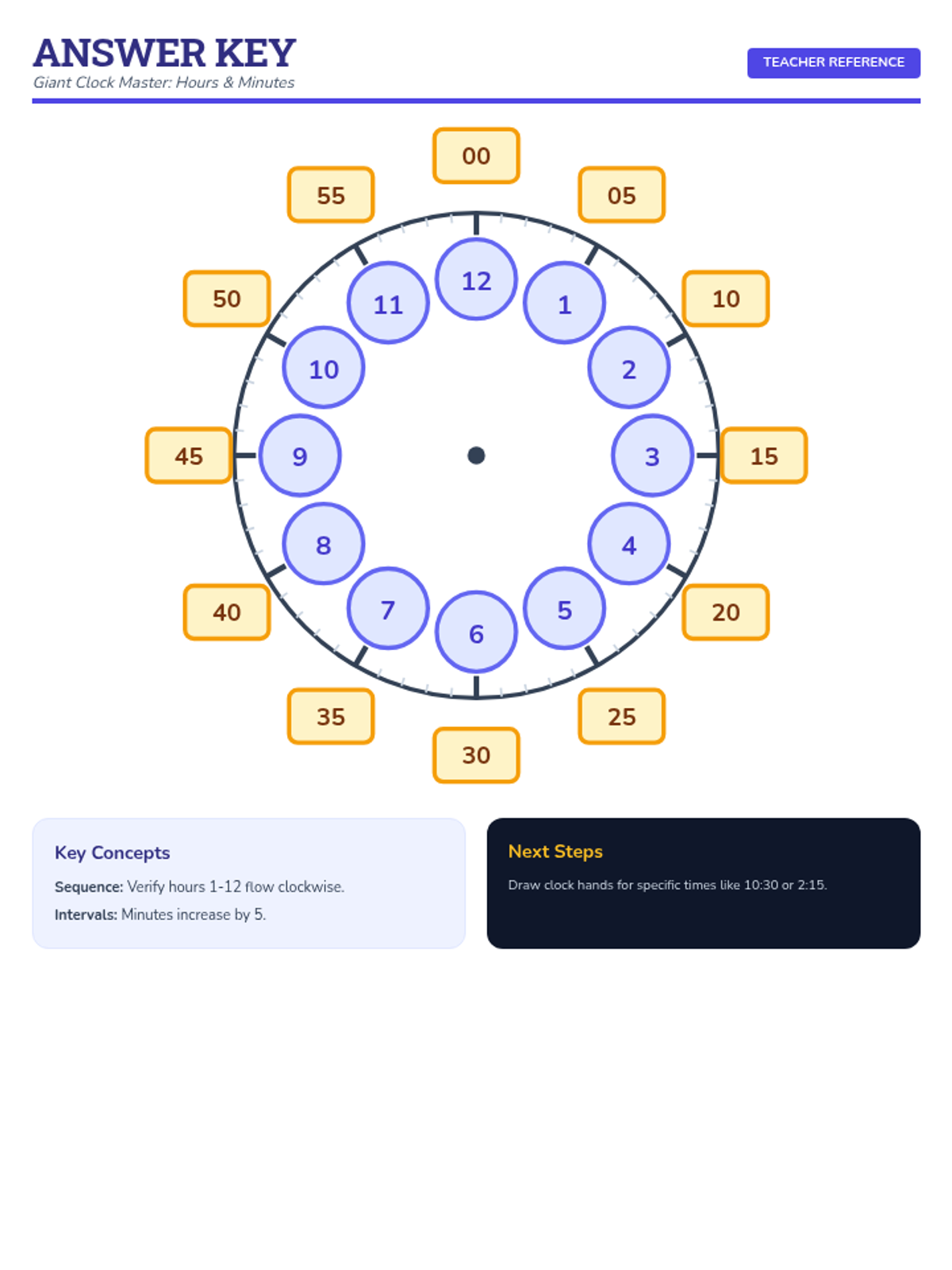
An answer key for the Giant Clock Worksheet, providing a clearly labeled example of all hour and minute positions. Includes key concepts and next step suggestions for teachers.
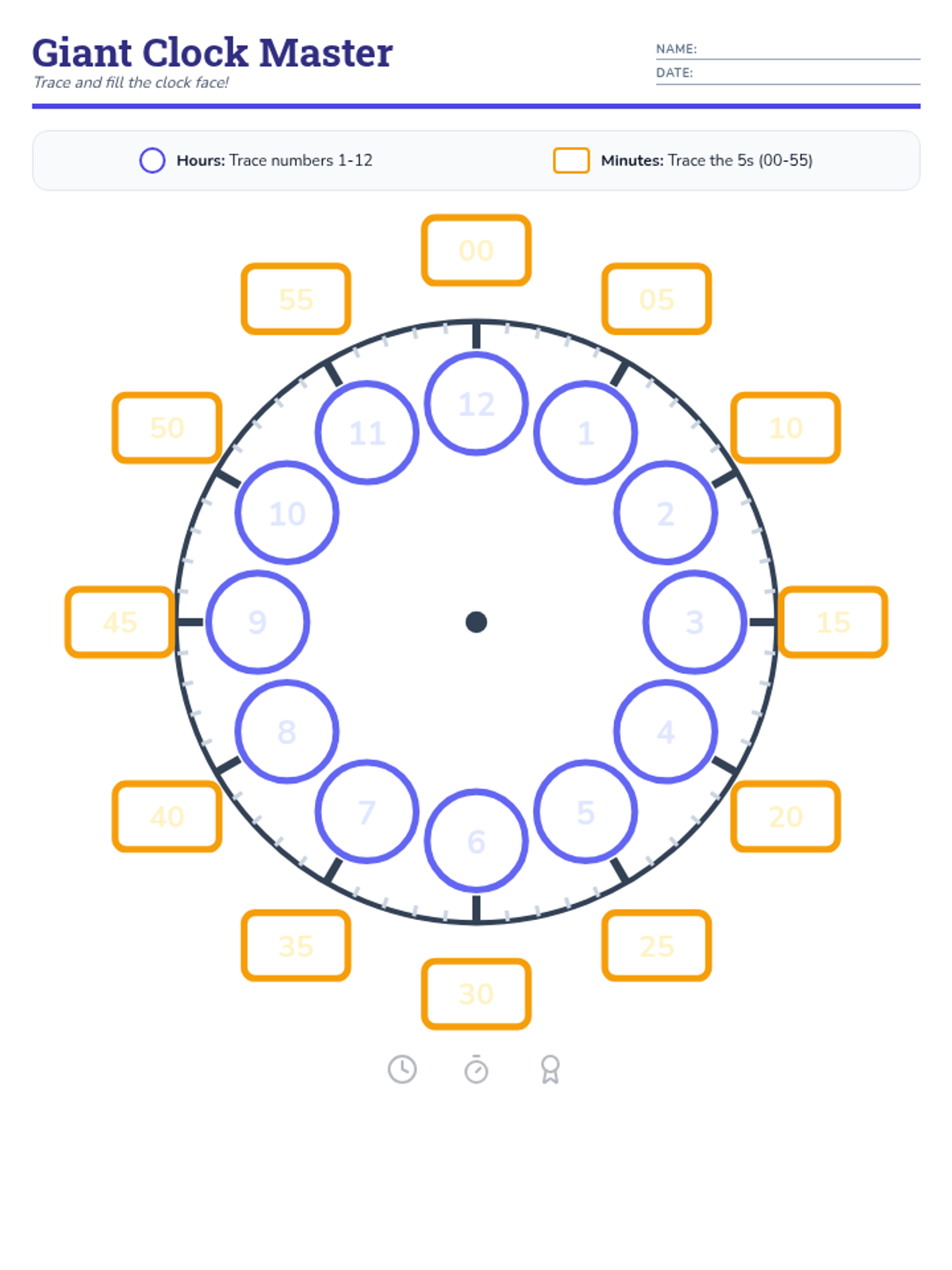
A full-page clock worksheet featuring one large clock face. Students fill in the 12 hour circles and 12 five-minute increment boxes, perfect for initial instruction or detailed practice.
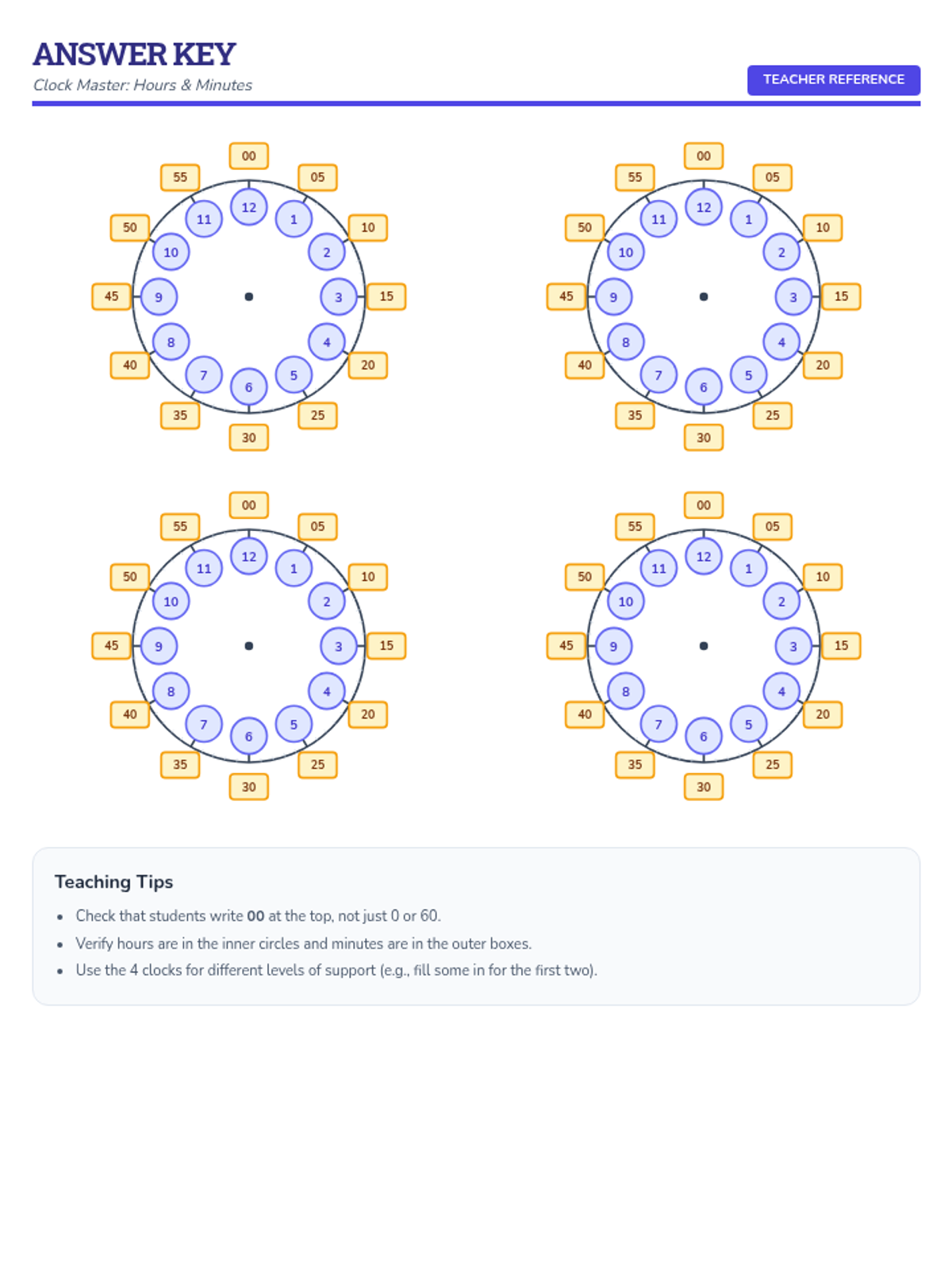
An answer key for the Clock Master Worksheet, displaying the correct placement of all 12 hours and 5-minute increments. Includes teaching tips for instruction.
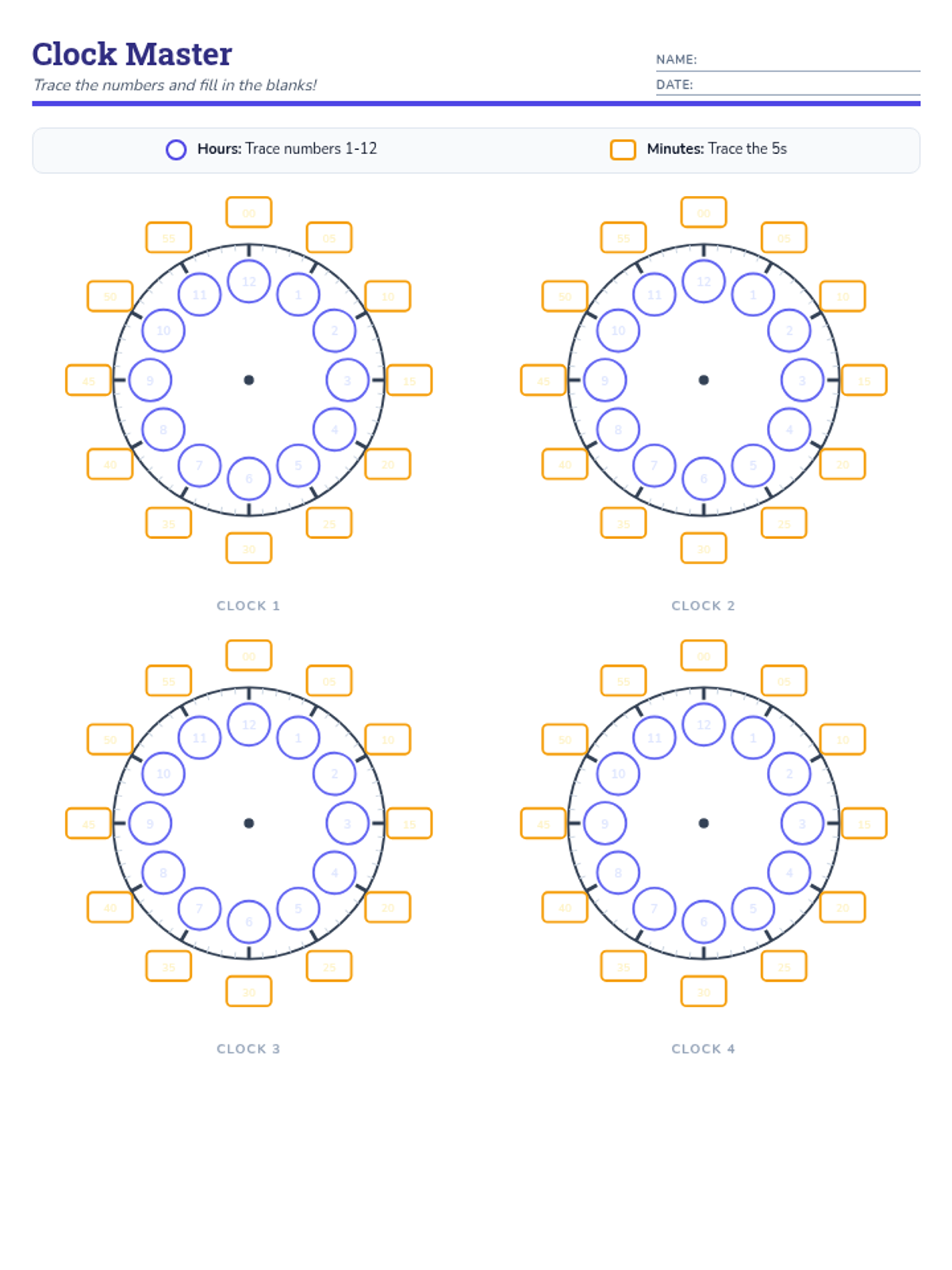
A practice worksheet with four clock faces on a single page. Students fill in color-coded hour circles and enlarged minute boxes to learn clock anatomy and five-minute intervals.
A presentation introducing clock anatomy, hour placement, and minute tracking by fives. Includes visual diagrams with all 12 numbers and step-by-step instructions.
A visually stunning, high-energy slide deck for 2nd graders teaching time-telling. Features cosmic gradients, rainbow visuals for counting by fives, and bold "portal" designs for AM/PM concepts. Accurate clock logic preserved. Revised for optimal layout and contrast.
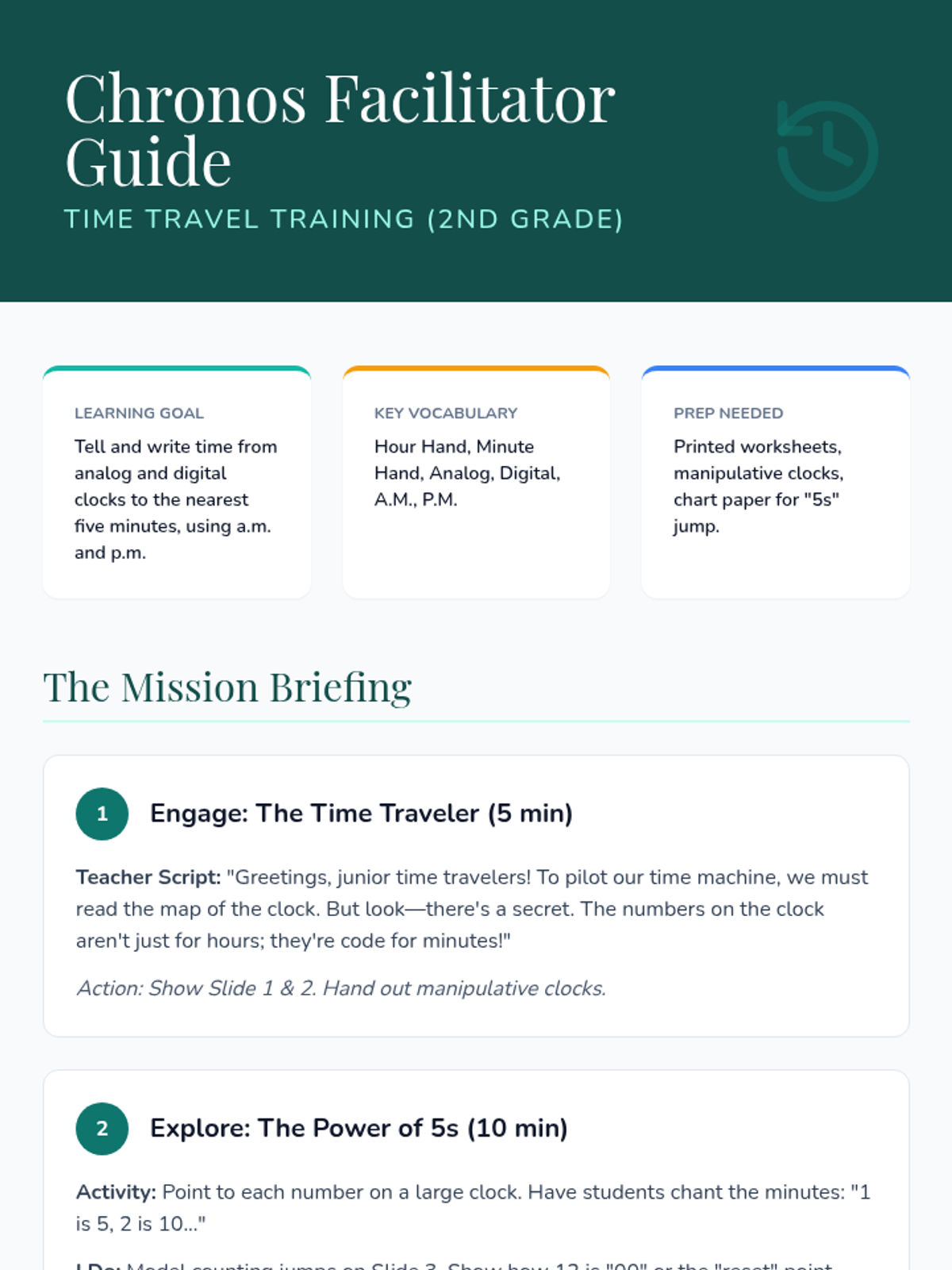
A facilitation guide for teachers to deliver the Time Travel Training lesson, including common misconceptions and differentiation tips. Revised with structured scripts and improved page layout.
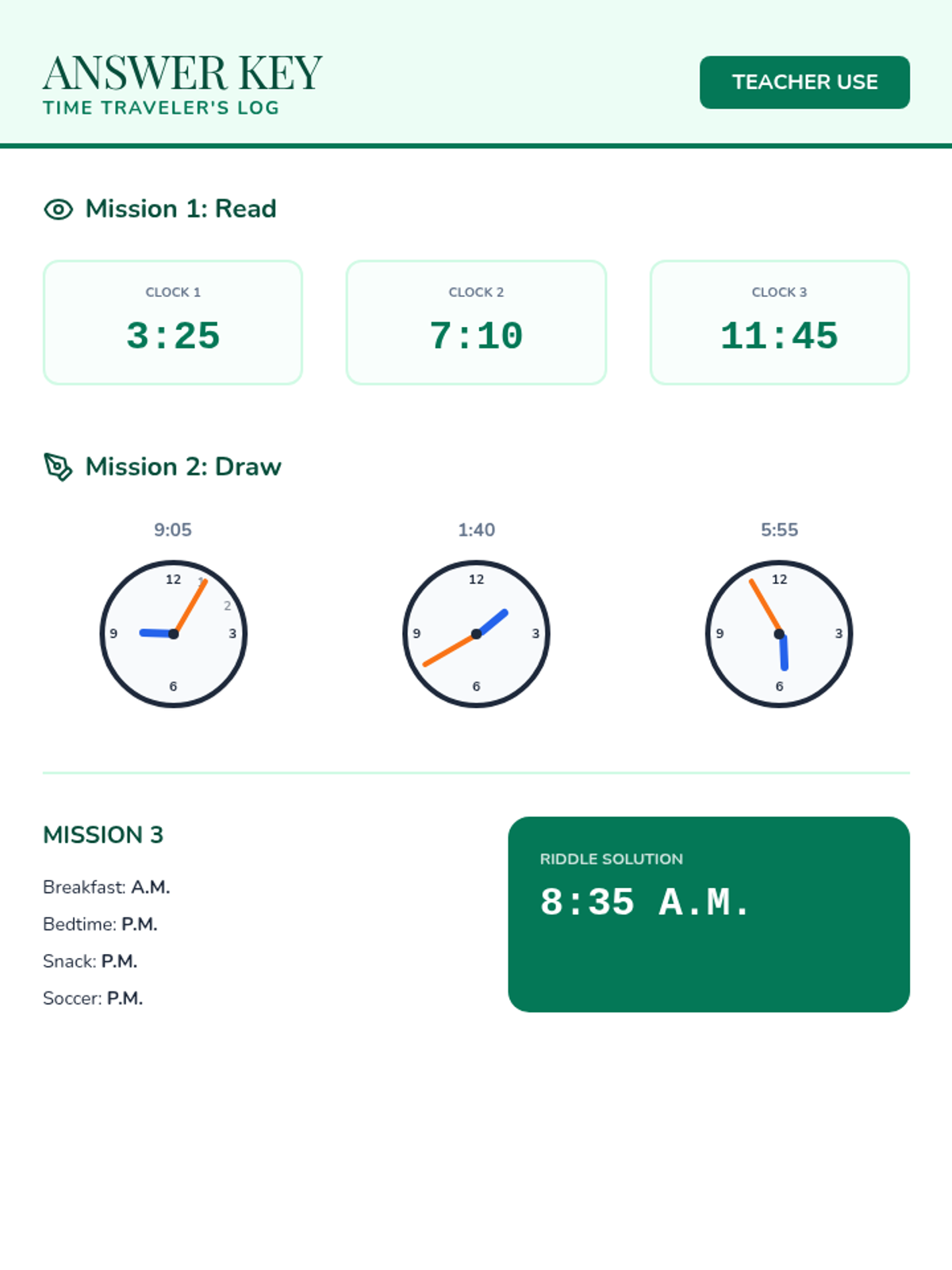
The answer key for the Time Travelers Log Worksheet. Revised with accurate clock hand rotations and full number markers on clocks.
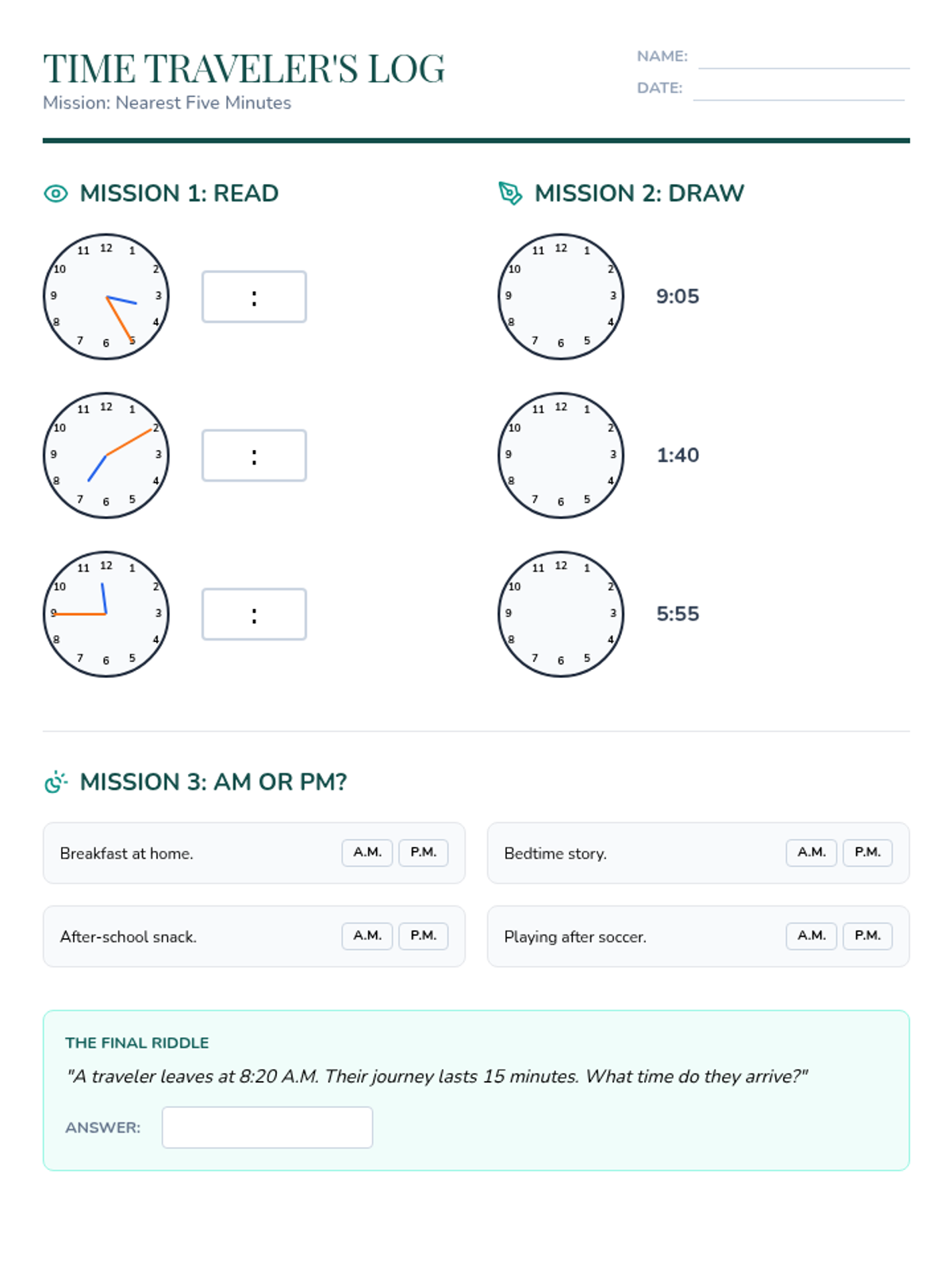
A student worksheet for 2nd graders to practice telling time to the nearest 5 minutes and identifying AM/PM scenarios. Revised with full clock numbers and improved page layout.
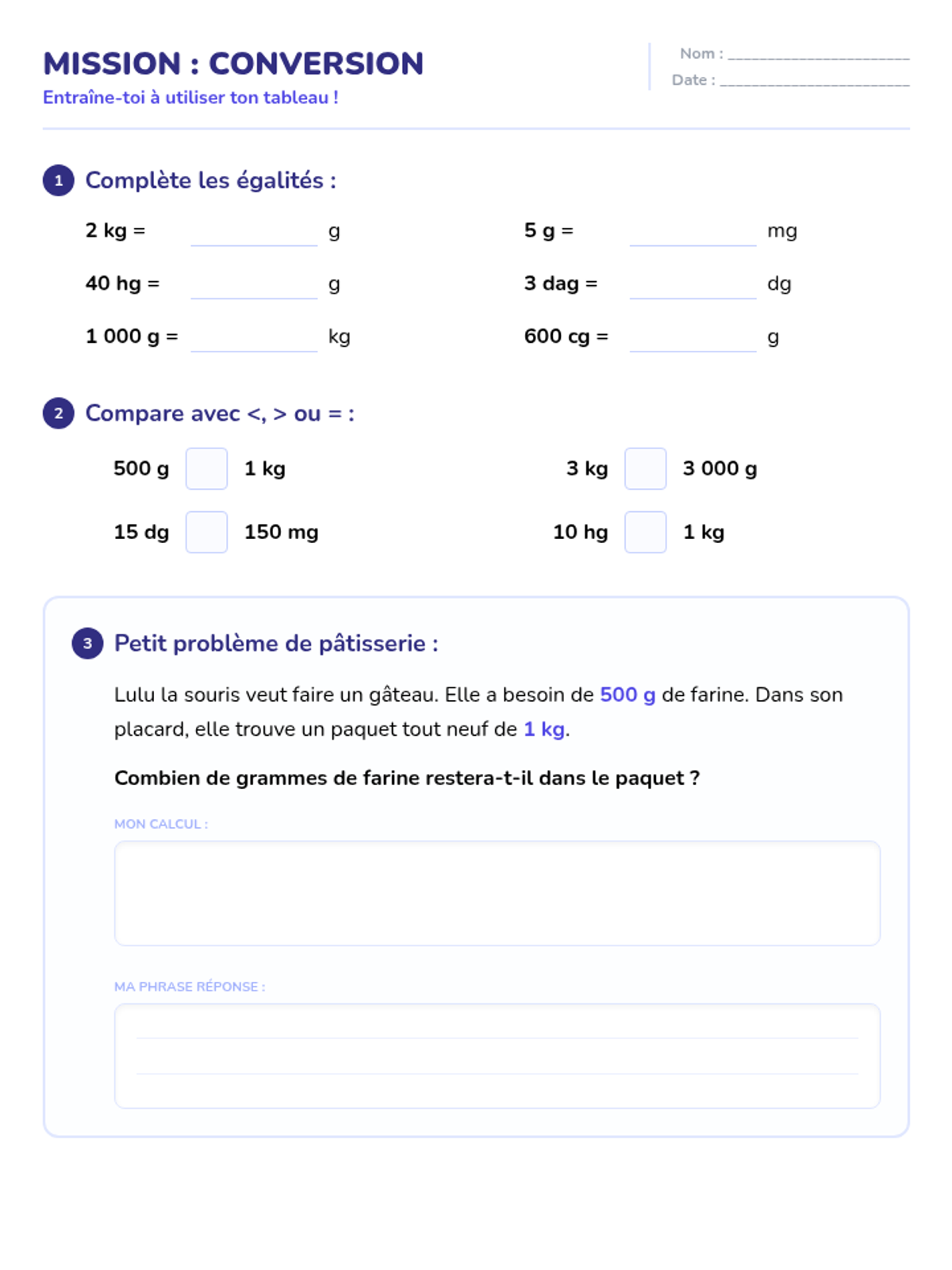
Fiche d'exercices sur les conversions de masses pour élèves de CE2, incluant des conversions directes, des comparaisons et un petit problème.
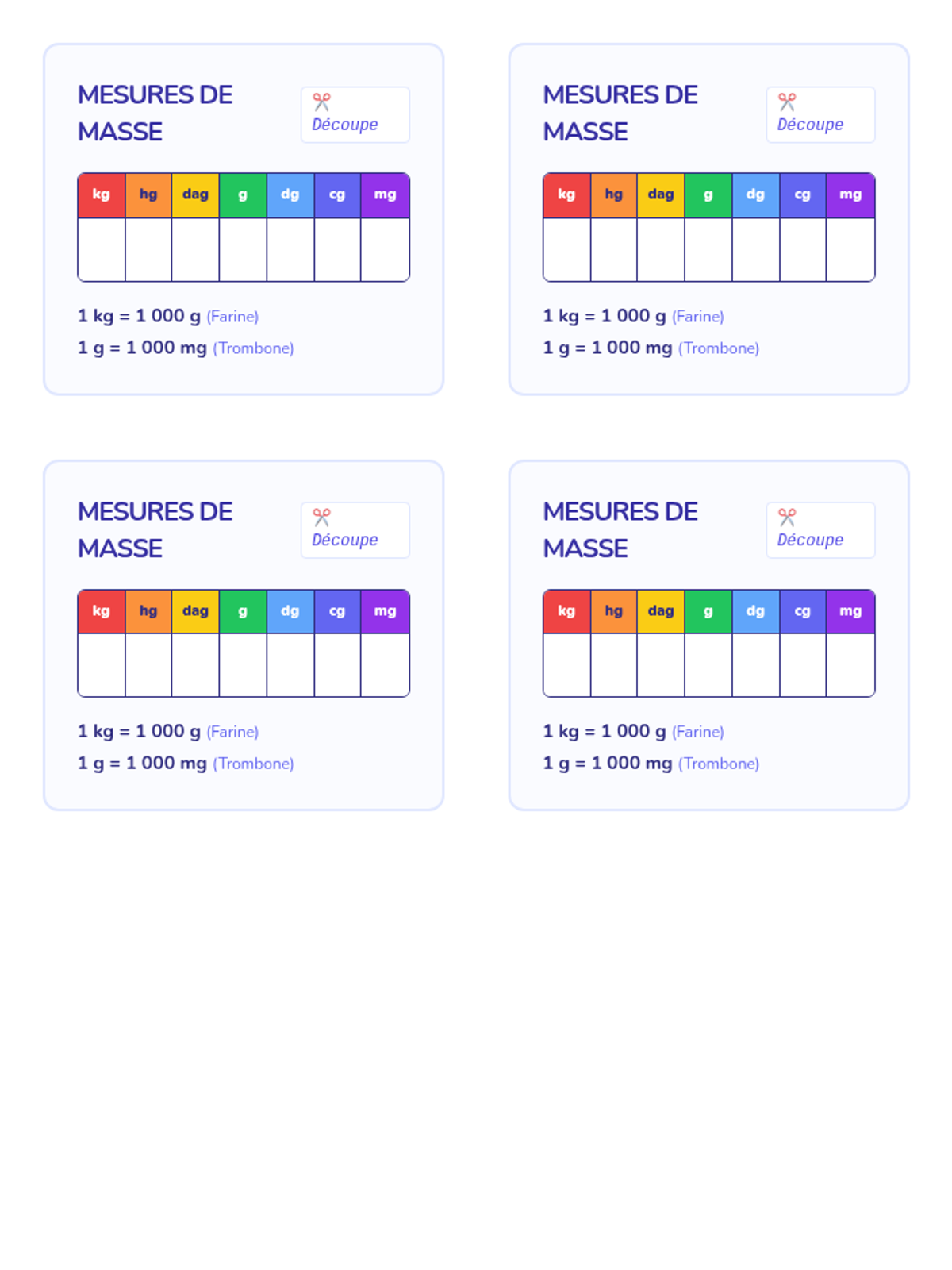
Petits tableaux de conversion à découper et à coller dans le cahier des élèves pour servir de référence rapide.
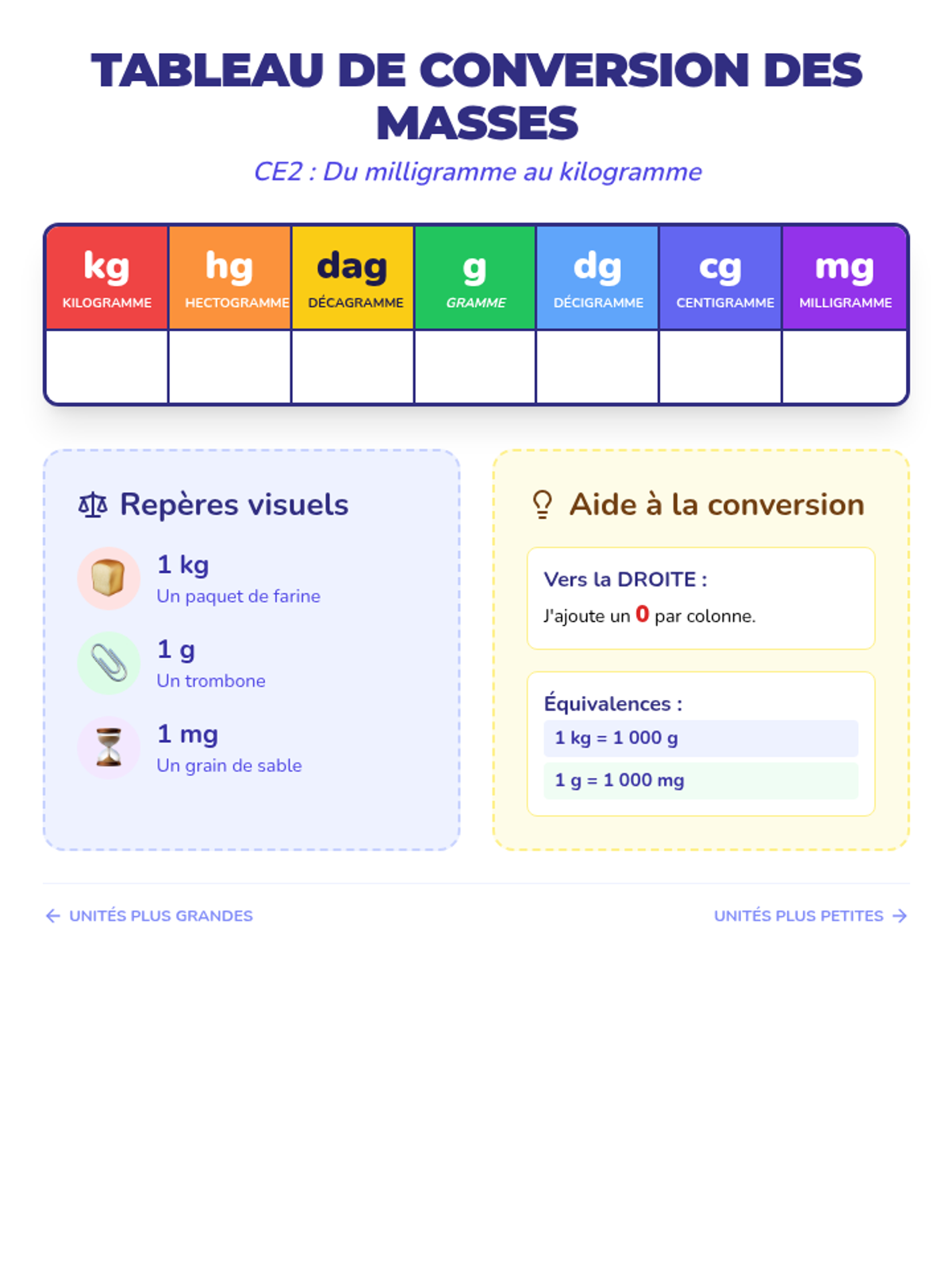
Une affiche murale colorée présentant le tableau de conversion des masses de mg à kg, avec des repères visuels (farine, trombone, grain de sable) et des rappels de conversion.
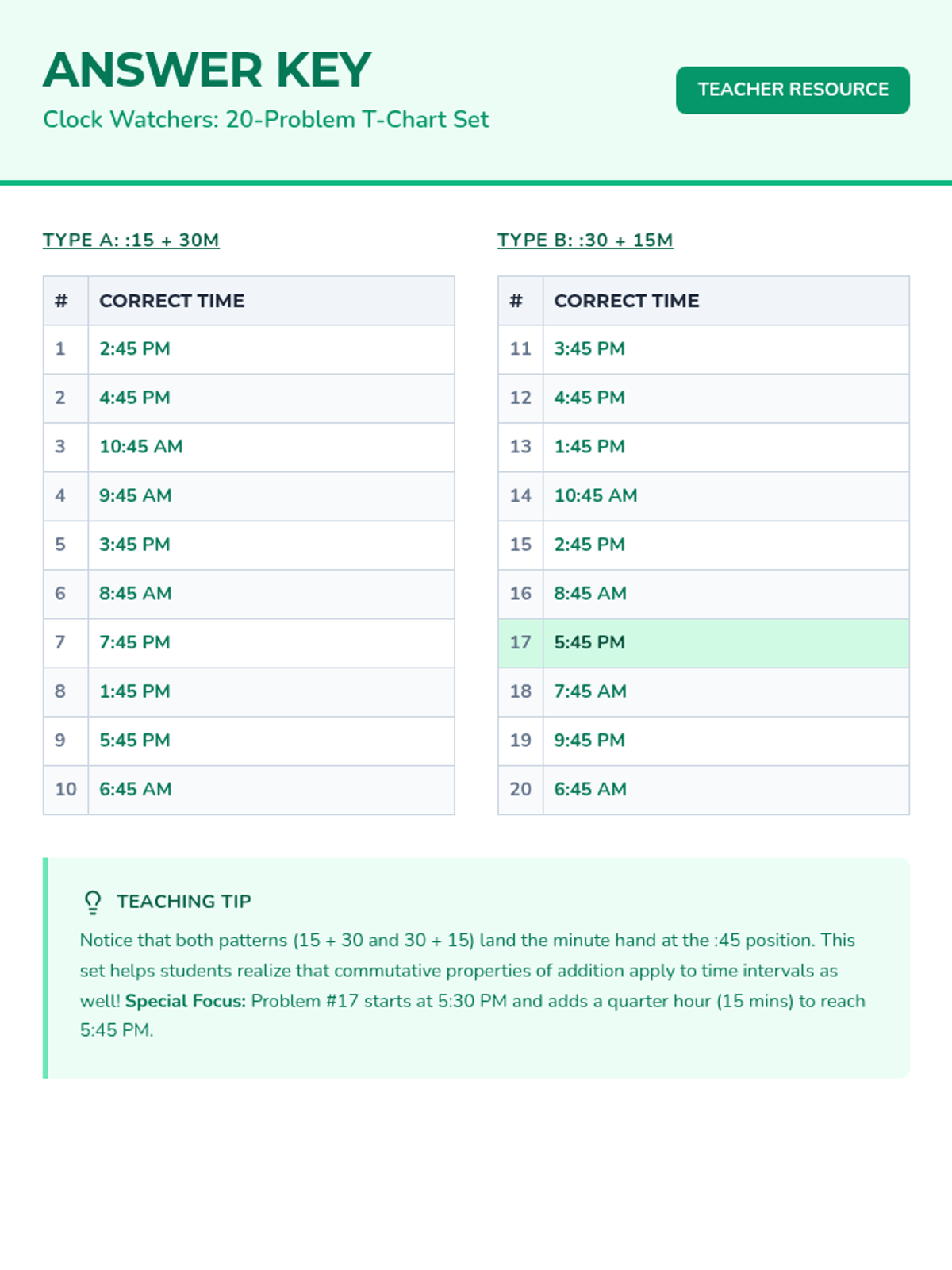
An updated answer key for the 20-problem Clock Watchers T-Chart packet, providing correct times for all problems with a specific focus on the new :30 + 15m pattern for problems 11-20.
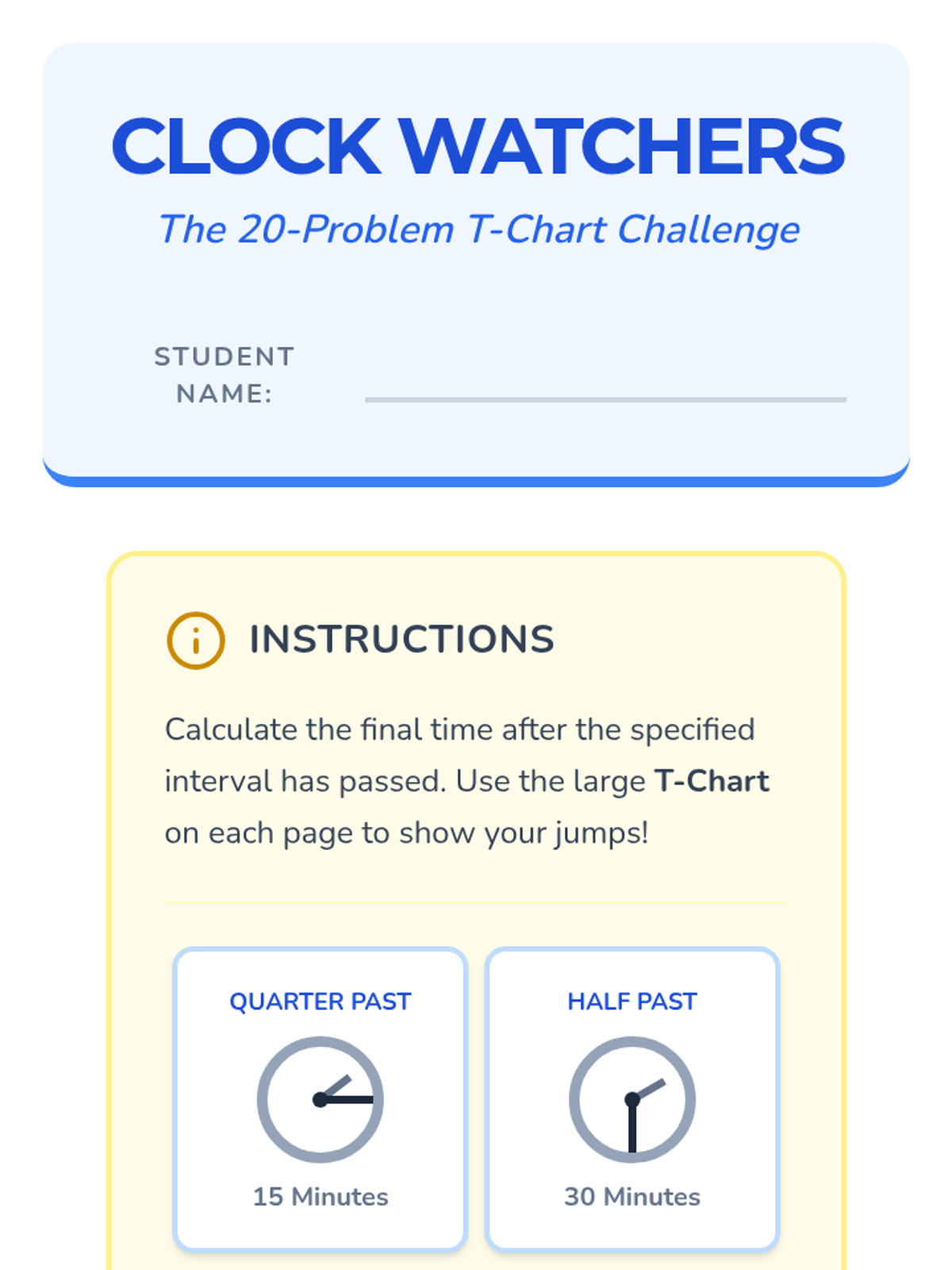
A 22-page packet (cover + 20 problems + footer) where each problem features a dedicated page with an identical, large work space for T-charts. Problems 1-10 start at 'quarter past' with a 30-minute change. Problems 11-20 start at 'half past' with a 'quarter past' (15m) change. Standardized fonts and layout ensure consistency across the entire set. Fixed problem #1 size discrepancy.
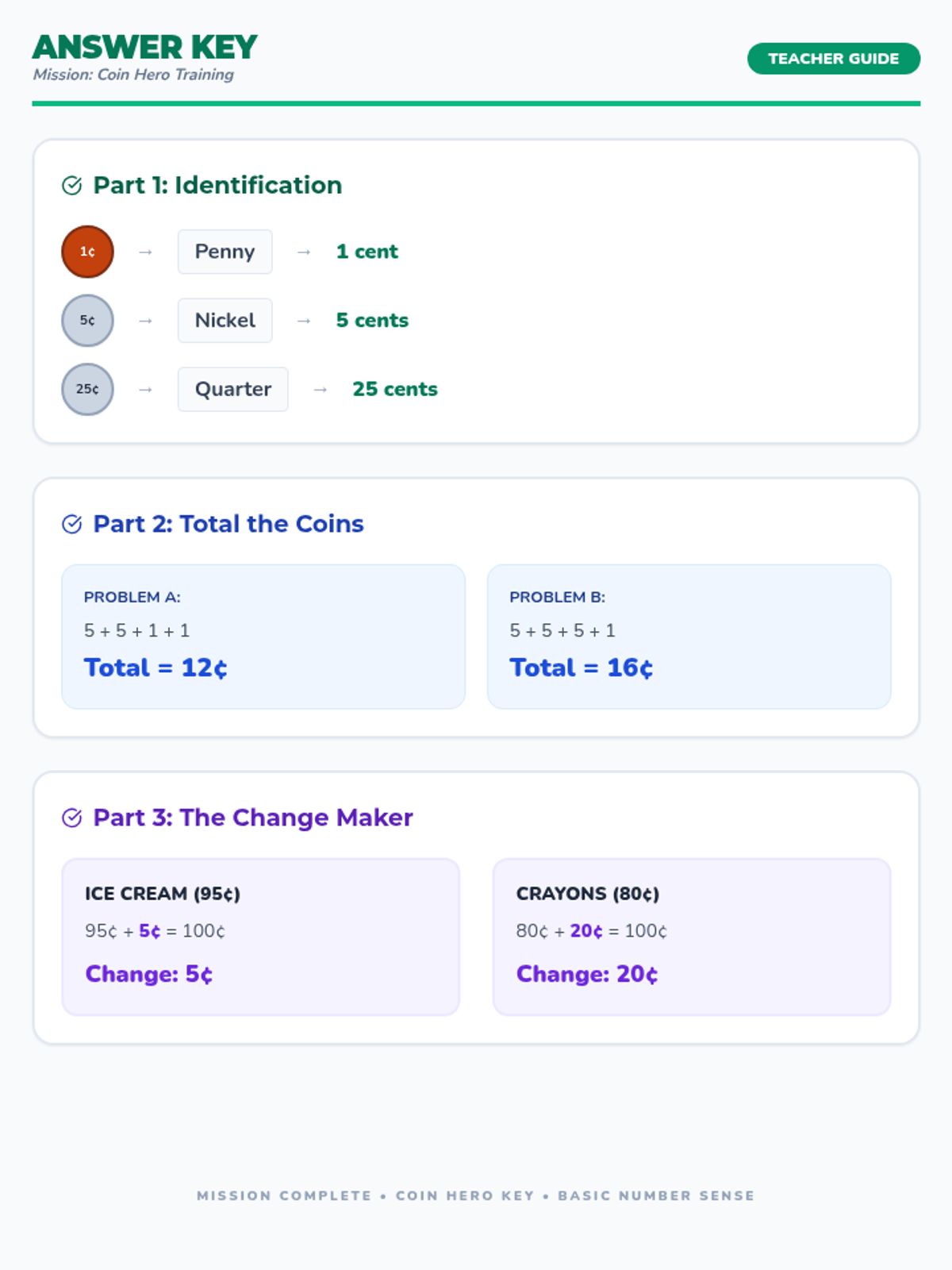
A clear answer key for the Coin Hero Mission practice worksheet. Provides step-by-step counting breakdowns and final answers for identification, total counting, and making change sections.
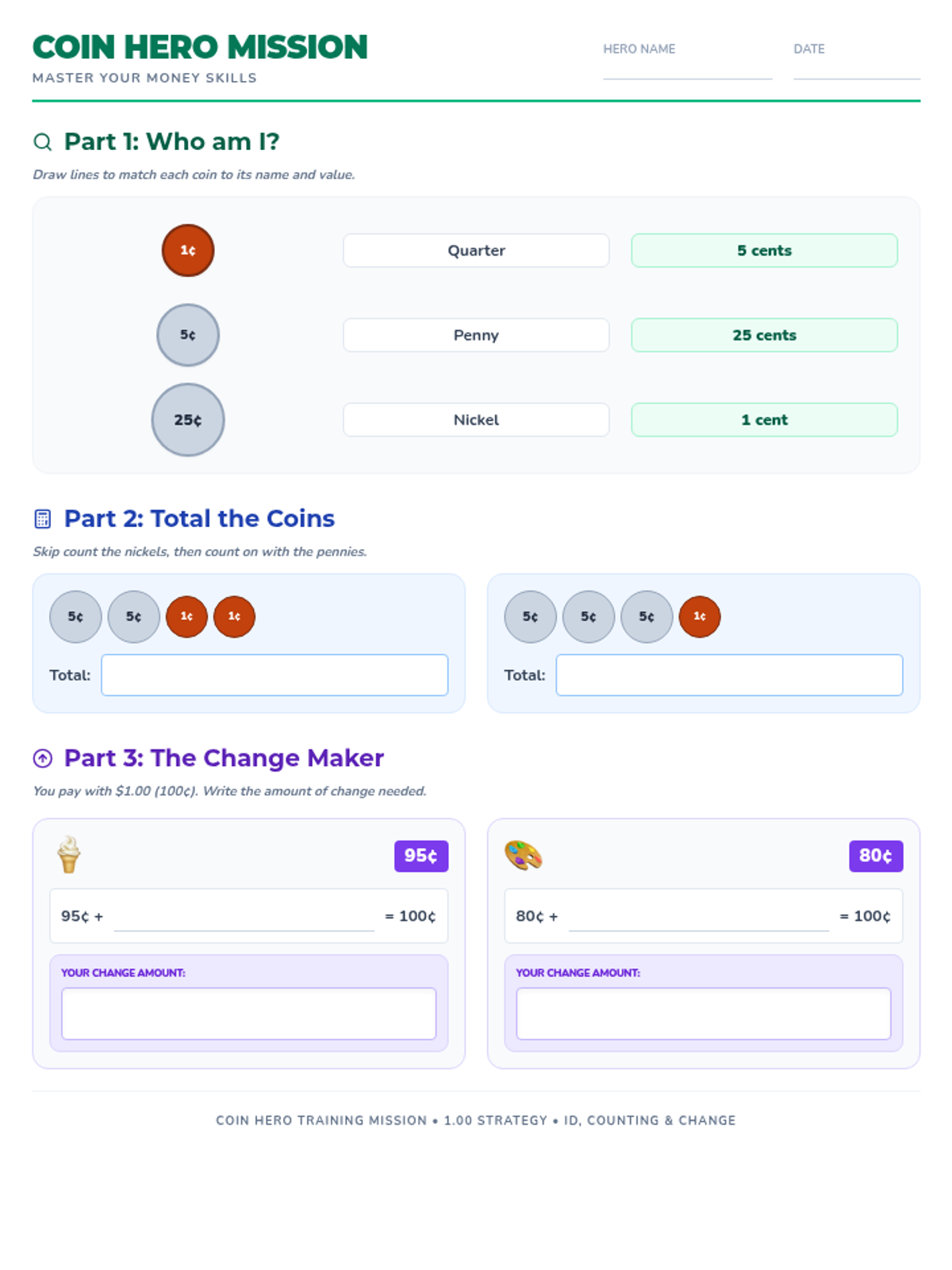
A skill-building worksheet for students to practice coin identification, skip counting with nickels and pennies, and calculating change from a dollar using the 'Counting Up' strategy. Includes visual coin representations and clear work areas.
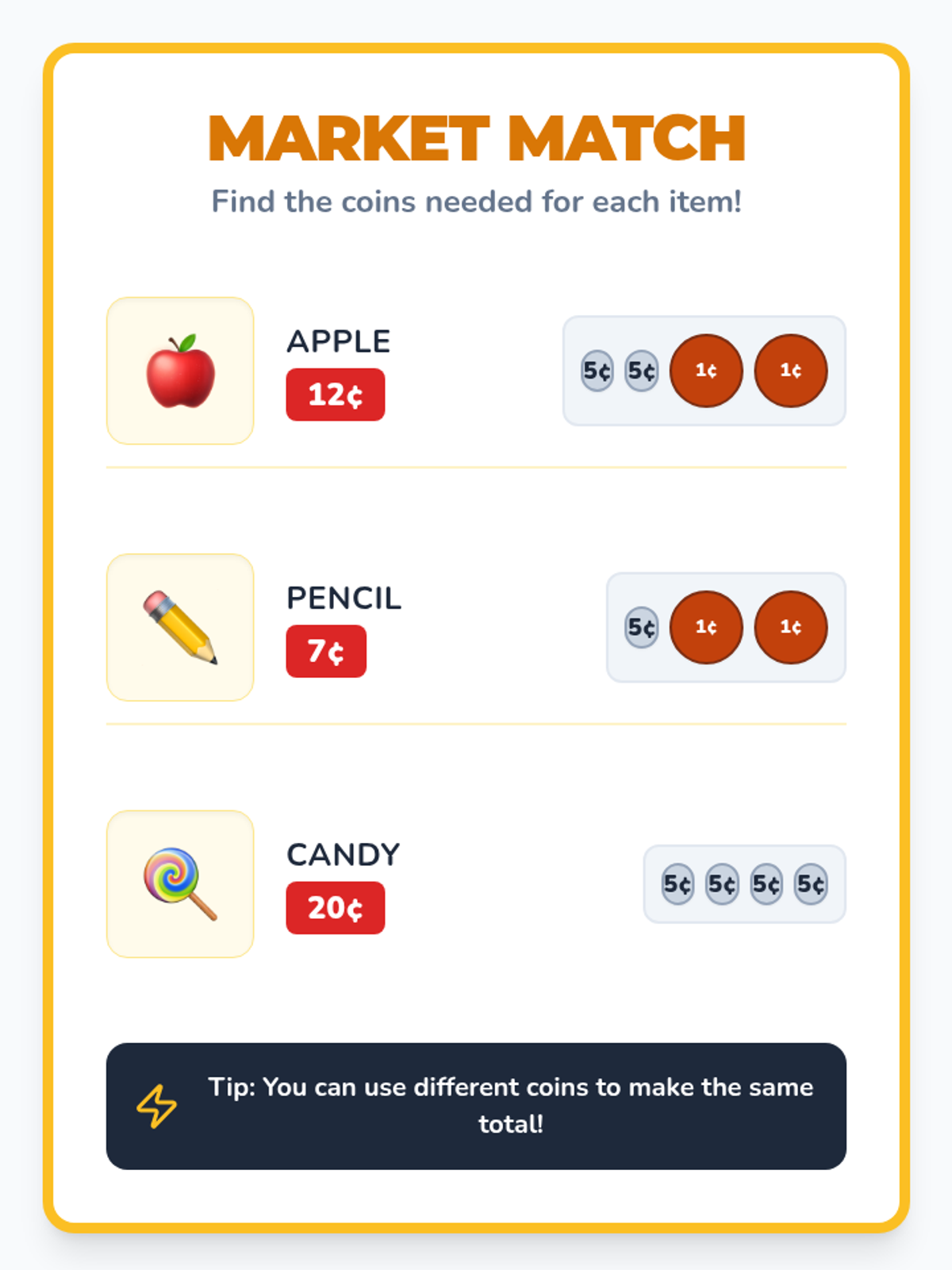
Two large visual anchor charts for classroom display. The first chart, 'Market Match', shows real-world items with price tags and the exact coin combinations needed. The second chart, 'The Change Maker', illustrates the 'Counting Up' strategy for finding change from one dollar using a visual number line and clear steps.
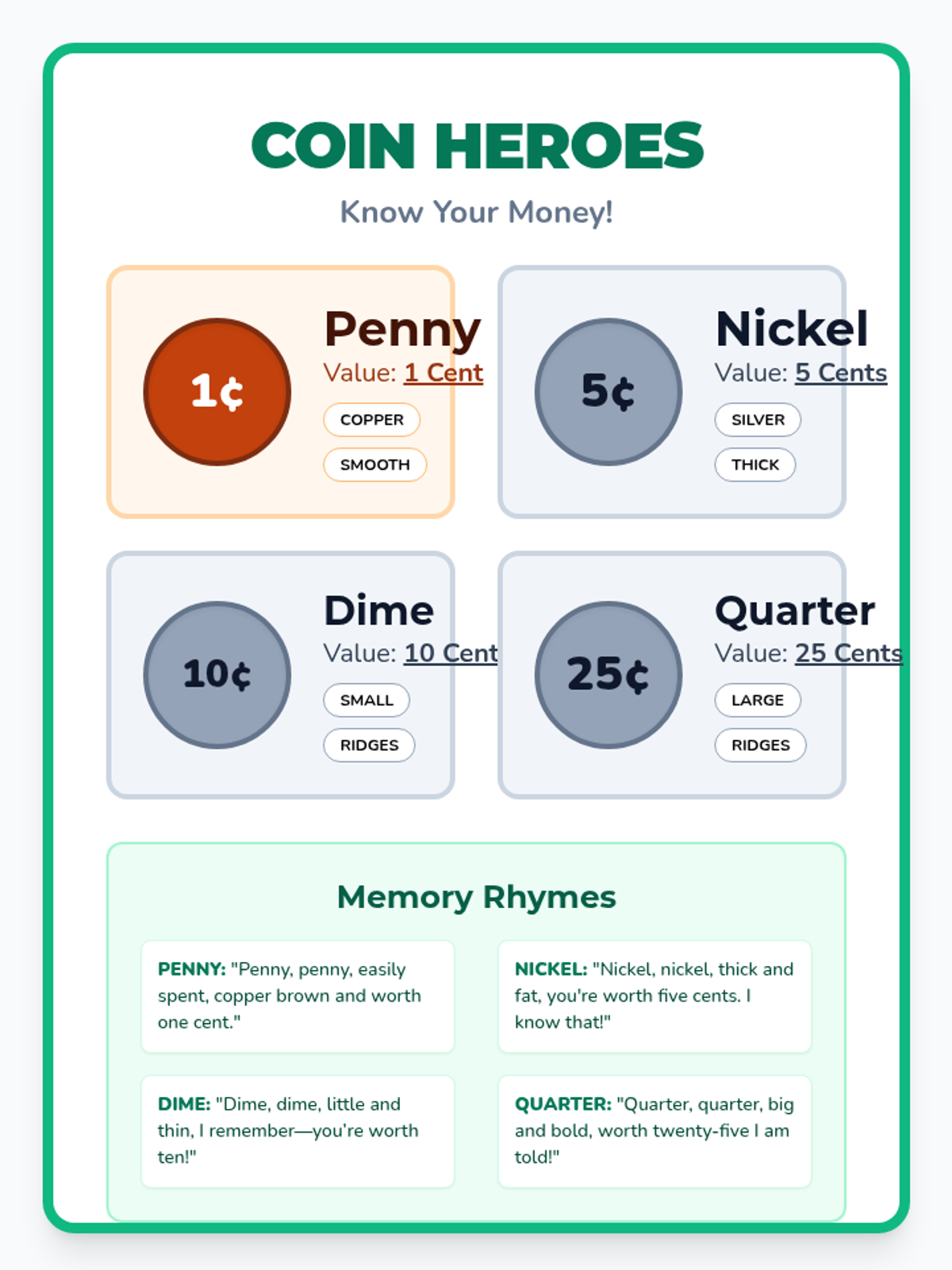
A set of two large visual anchor charts for classroom display. The first chart focuses on identifying coins (Penny, Nickel, Dime, Quarter) with names, values, and memory rhymes. The second chart provides a visual step-by-step guide for skip counting nickels and pennies to find a total value.
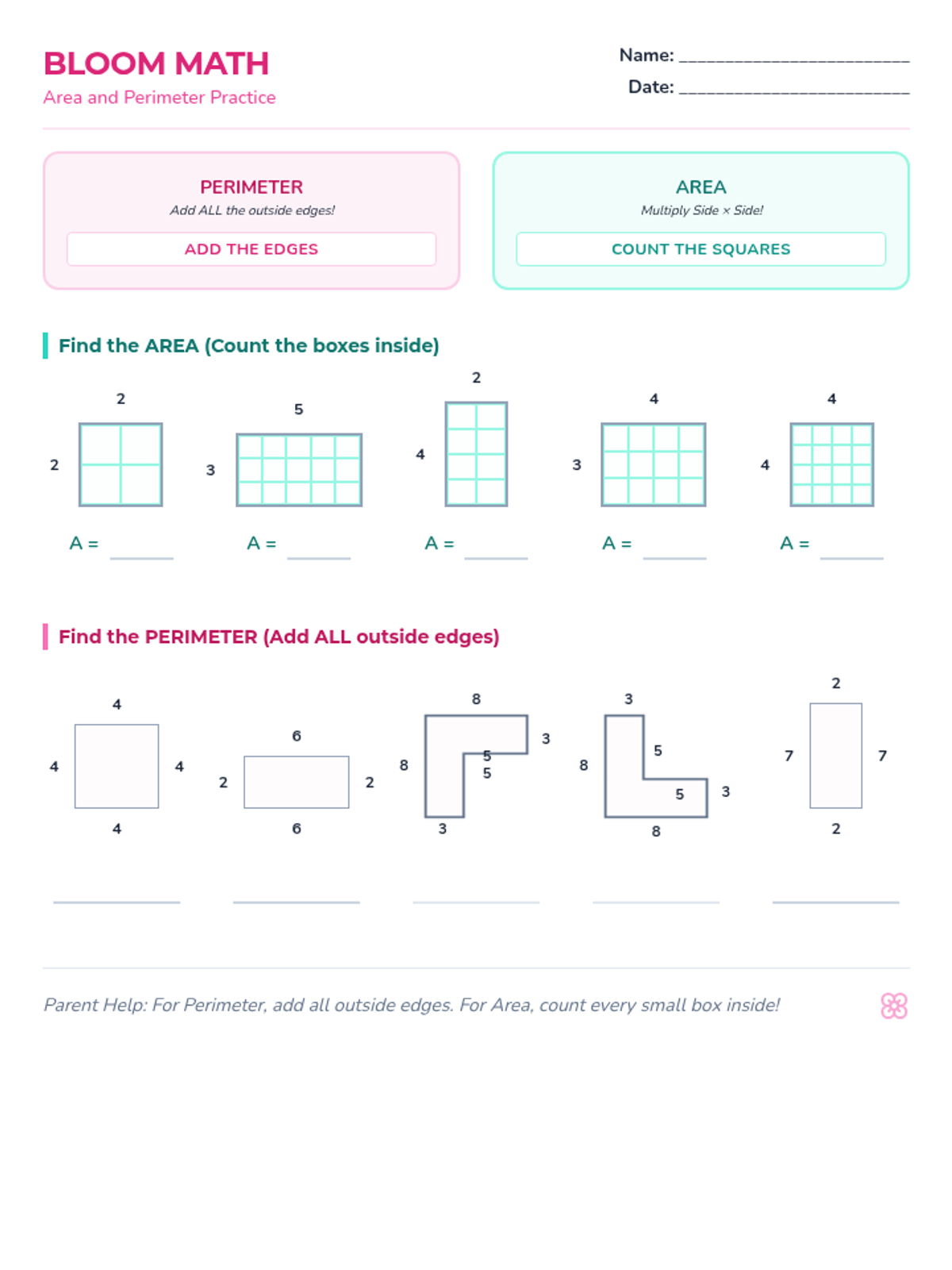
A math worksheet focusing on calculating area and perimeter. Improved for 1st-grade readability with clearer shapes, larger labels, and better spacing. Includes grid visuals for all area problems. L-shape labels are carefully positioned to avoid overlap. Answer lines are widened for handwriting. Grid lines in area shapes are darkened for contrast. Space for equations is increased. L-shape math is verified and labels are repositioned for clarity. stroke width reduced for clarity. Parent help text made more readable. Area labels now include "A=" prompt. Labels are consistent in color.
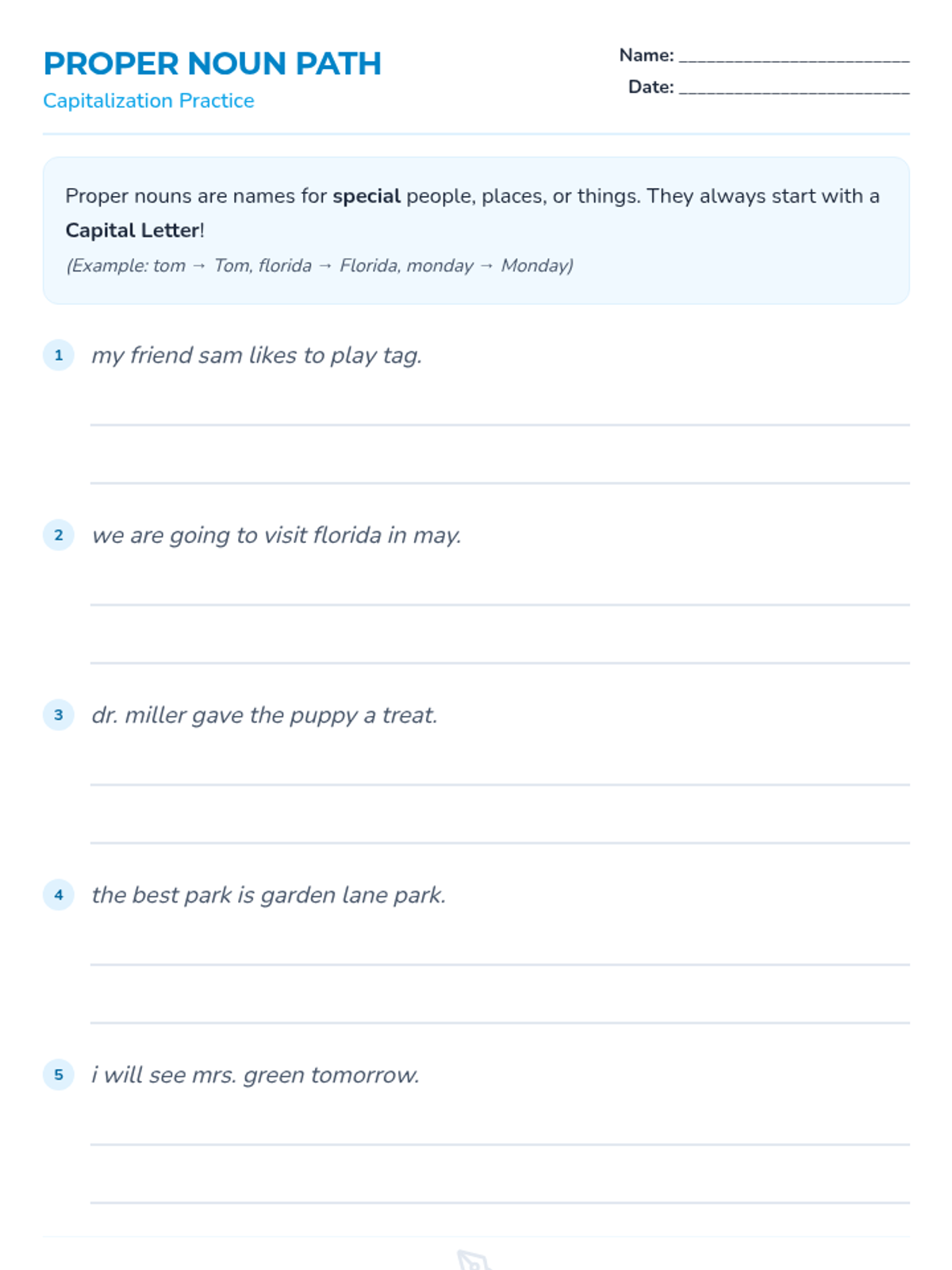
An editing worksheet where students identify and capitalize proper nouns in five sentences. Features larger handwriting space and single-page layout. Definition expanded to include titles. Optimized for single-page printing.
The answer key for the Time Traveler Worksheet, showing the correct digital times for each analog clock provided to students.
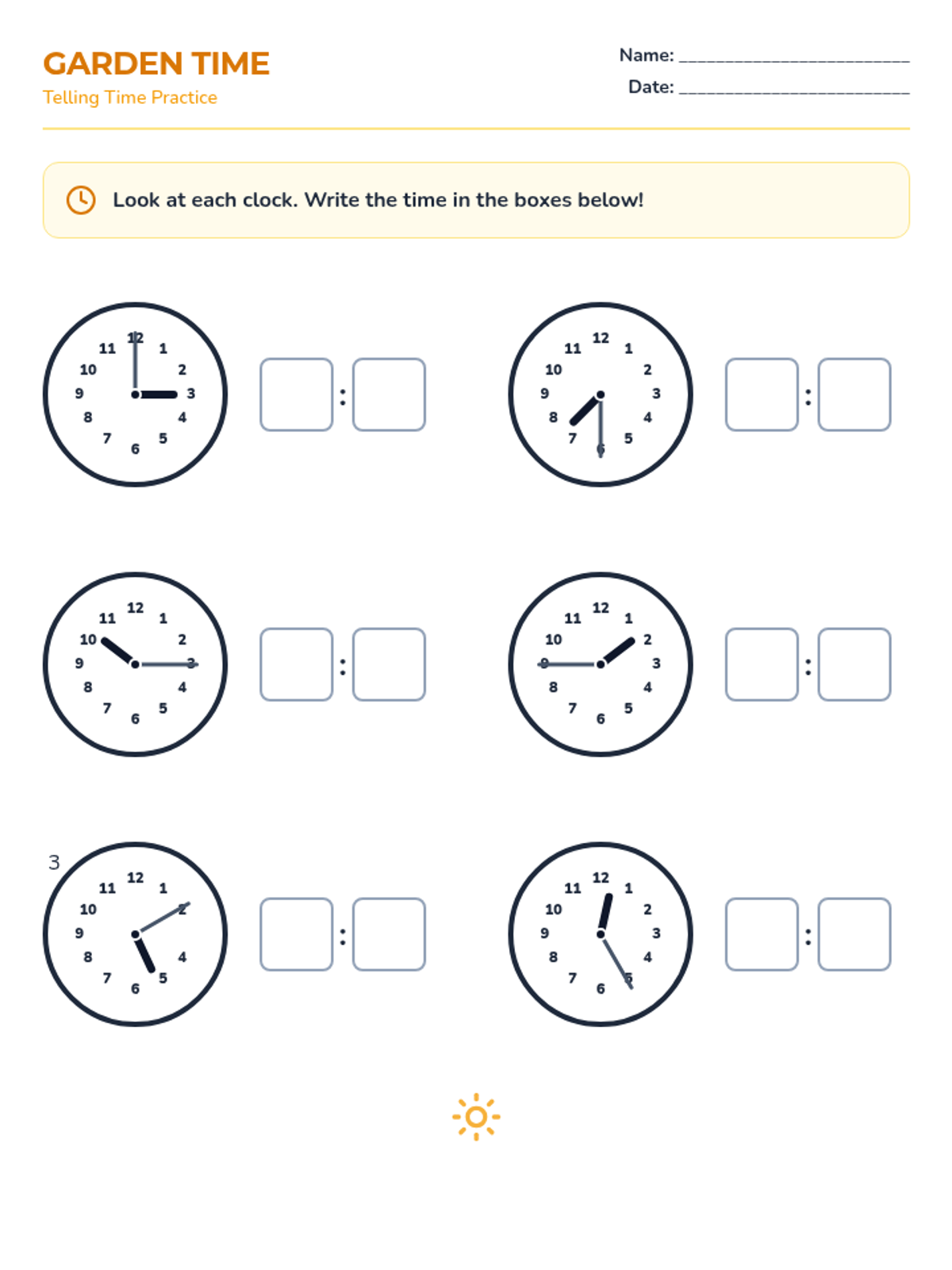
A math worksheet for practice in telling time. Adjusted for 1st-grade readability with clearer clock hands and simplified 5-minute increments while respecting the "to the minute" instruction through clear visuals. Clocks now include all hour numbers and guided answer fields. Hand rotations are mathematically corrected. Clock numbers are pulled away from the border for legibility. Sun icon is darkened for contrast. Time boxes are now symmetrical. Hand lengths reduced to prevent overlap. Clocks and boxes aligned. Corrected clock number rendering.
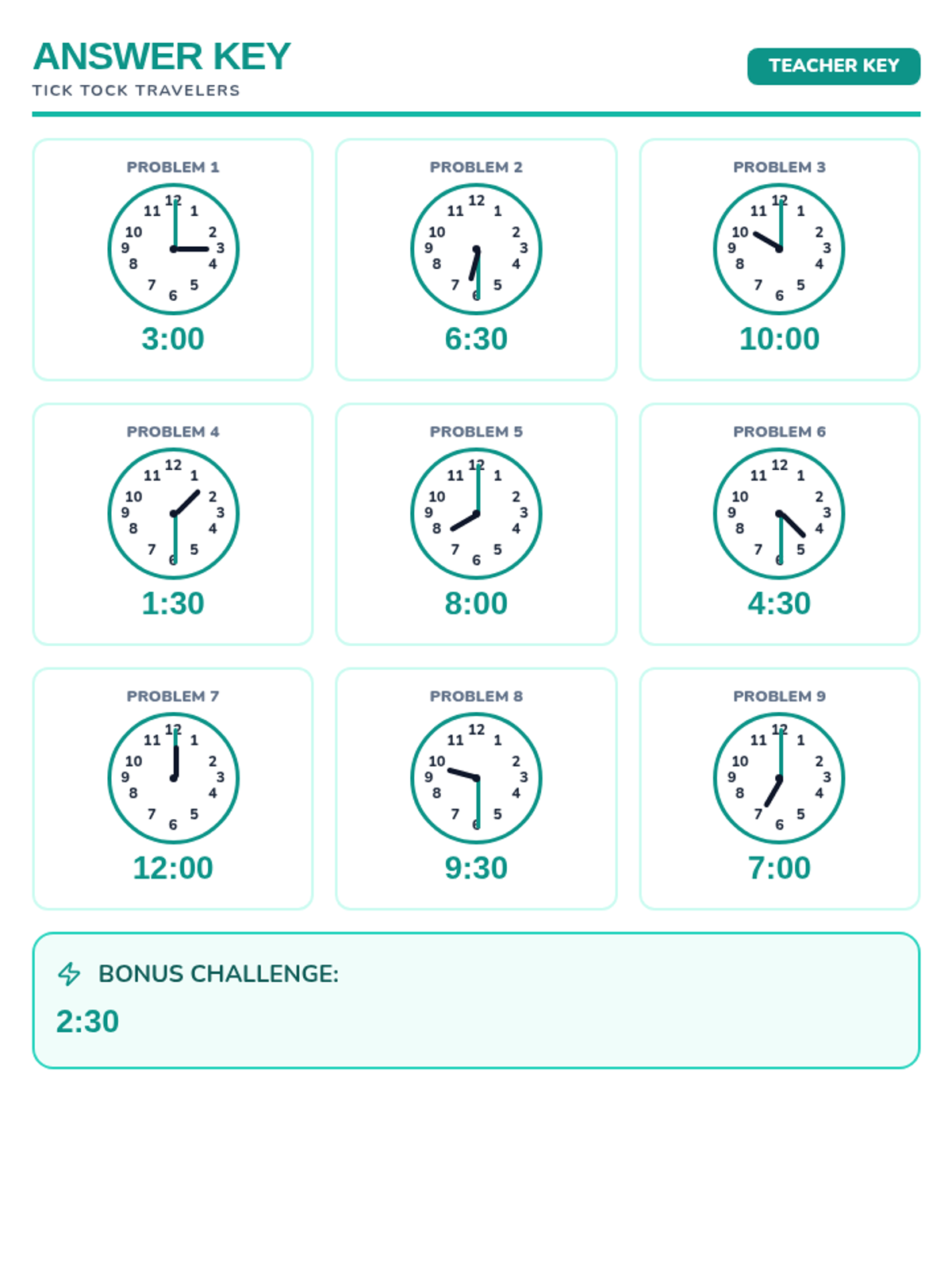
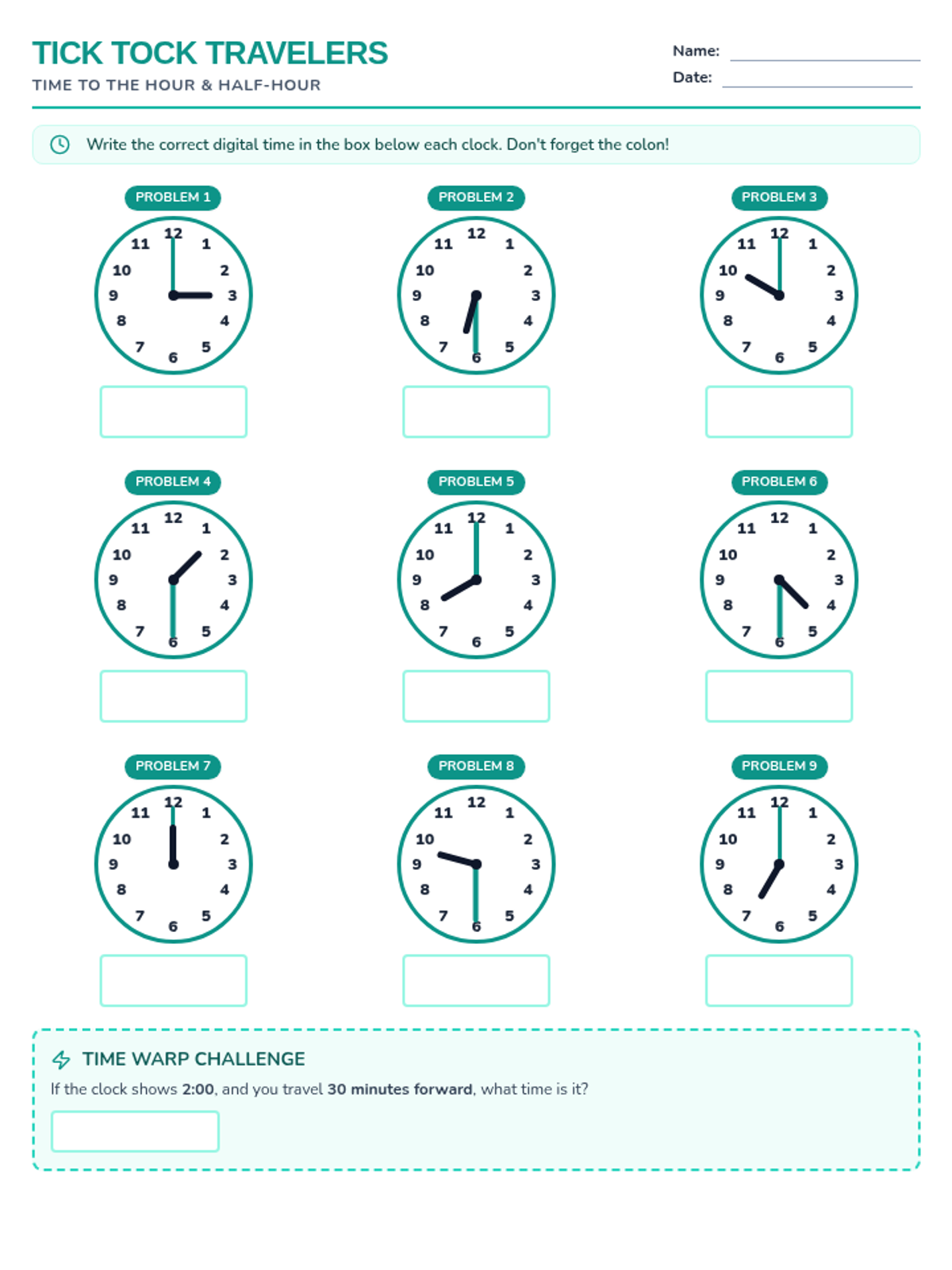
A 2nd-grade worksheet featuring analog clocks where students practice telling time to the hour and half-hour by writing the corresponding digital time. Includes a bonus challenge for time elapsed by 30 minutes.
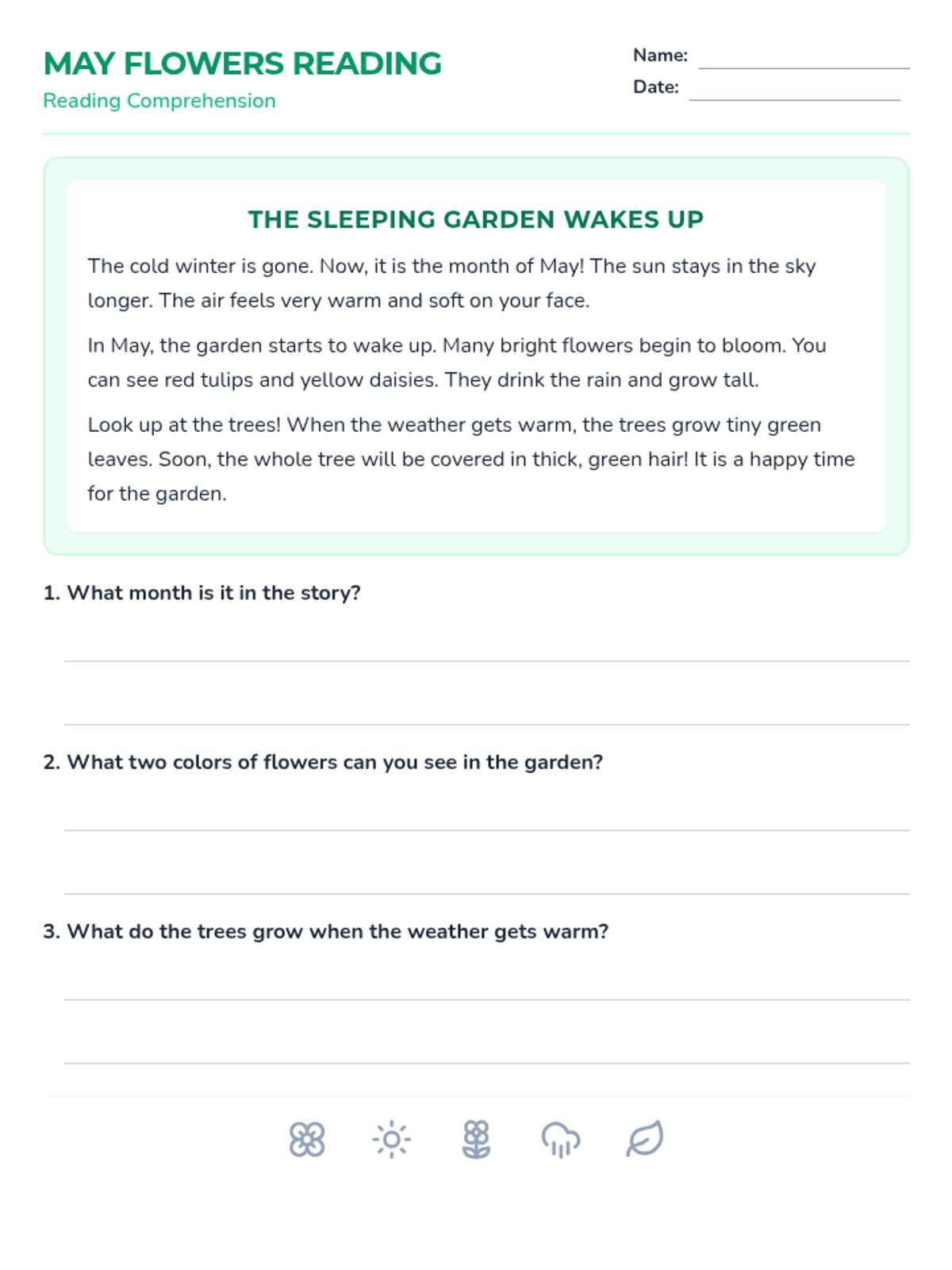
A 1st-grade level reading comprehension worksheet featuring a passage about springtime changes in May and three short-answer questions. Consistently formatted on one page with ample handwriting space. Adjusted to ensure single-page printing.
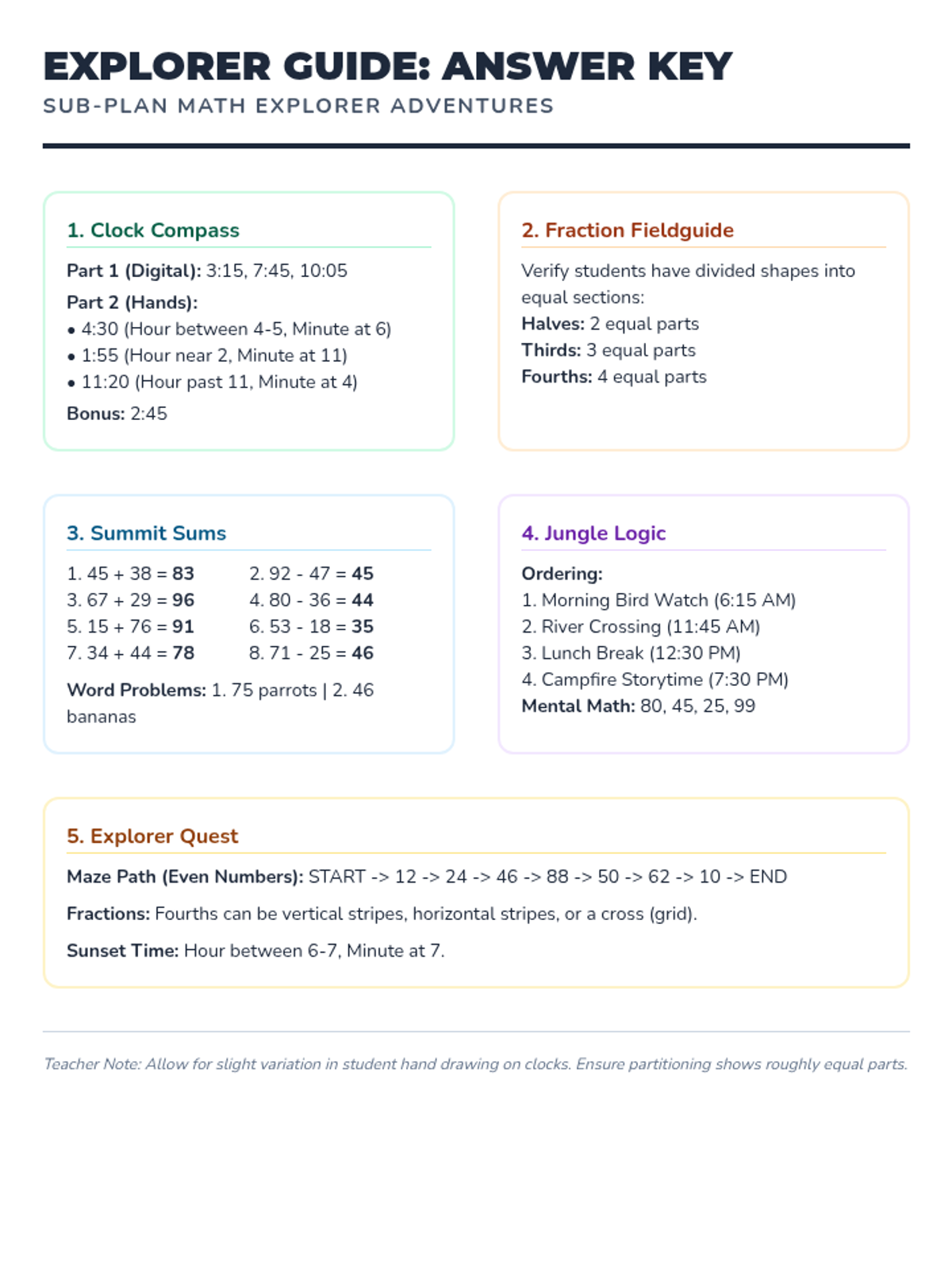
A condensed teacher's answer key for the 5-page Math Explorer Adventures sub-plan packet.
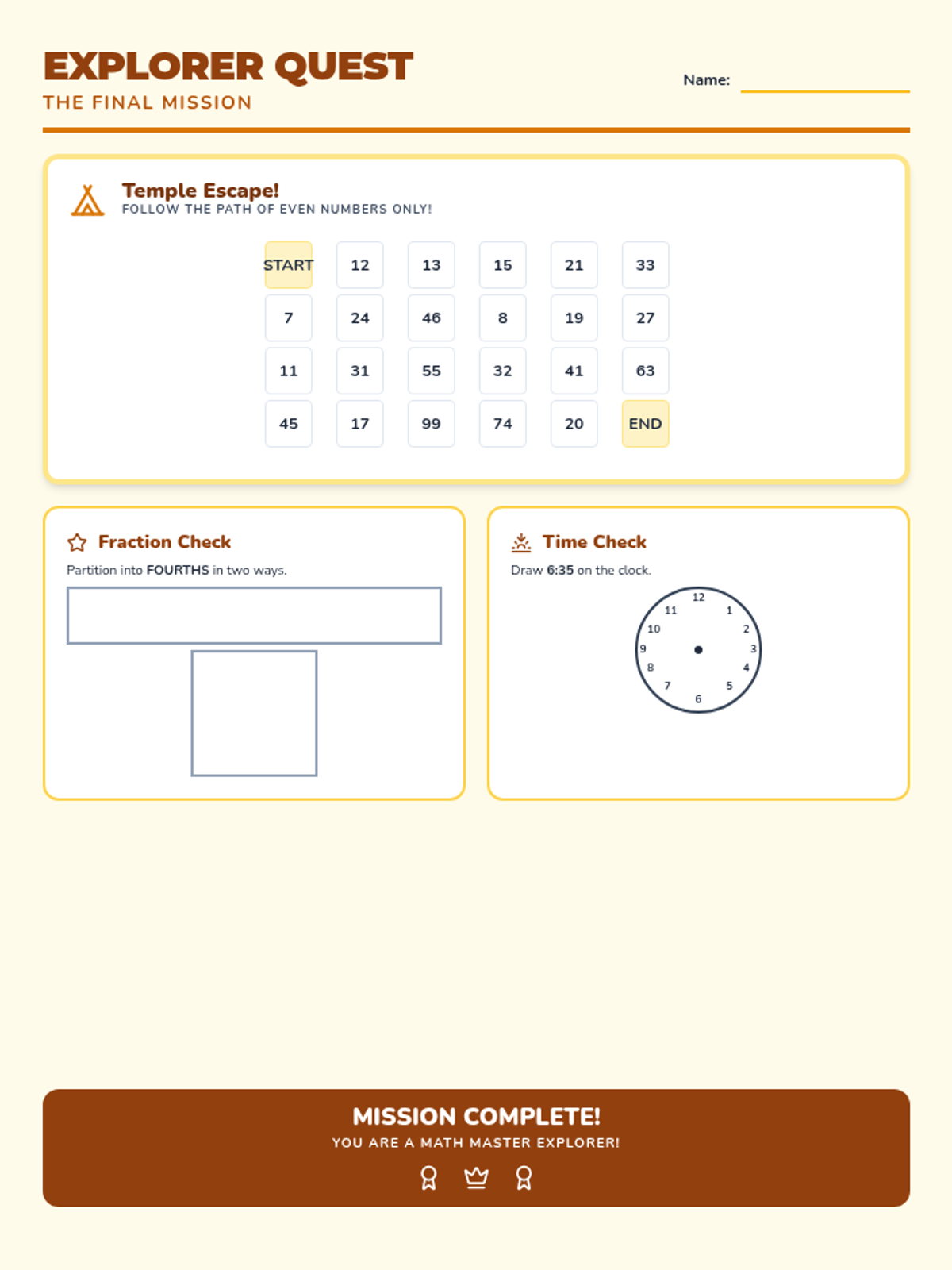
A final review worksheet in a maze format. This version fixes the maze logic (continuous even-number path), adds all clock numbers, and ensures everything fits on a single page.
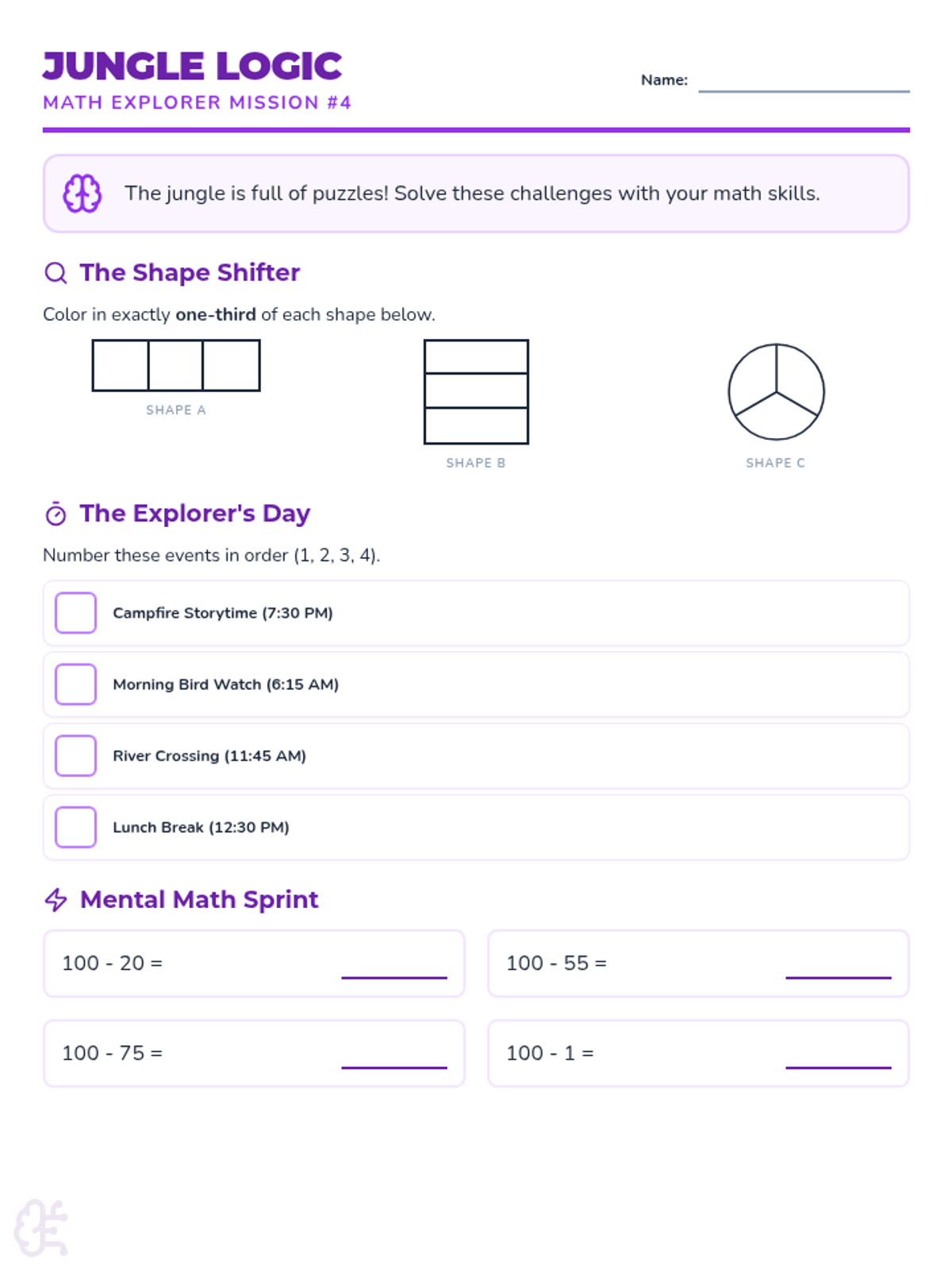
A critical thinking worksheet featuring fractions, time sequencing, and mental math subtraction. This version ensures all content fits on one page with high contrast for work areas.
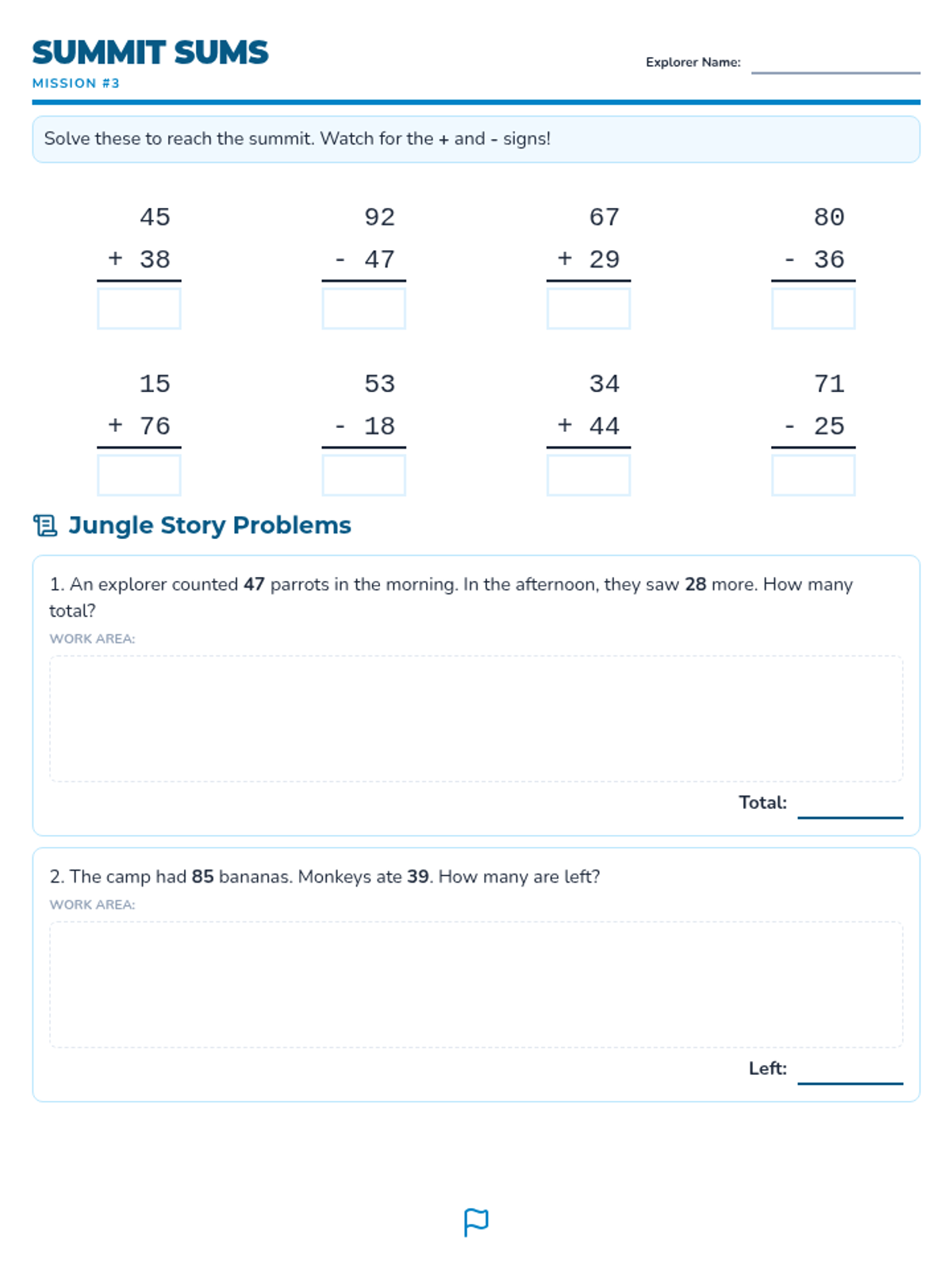
An addition and subtraction worksheet featuring two-digit numbers with and without regrouping. This version provides large work areas for students and fits on a single page.
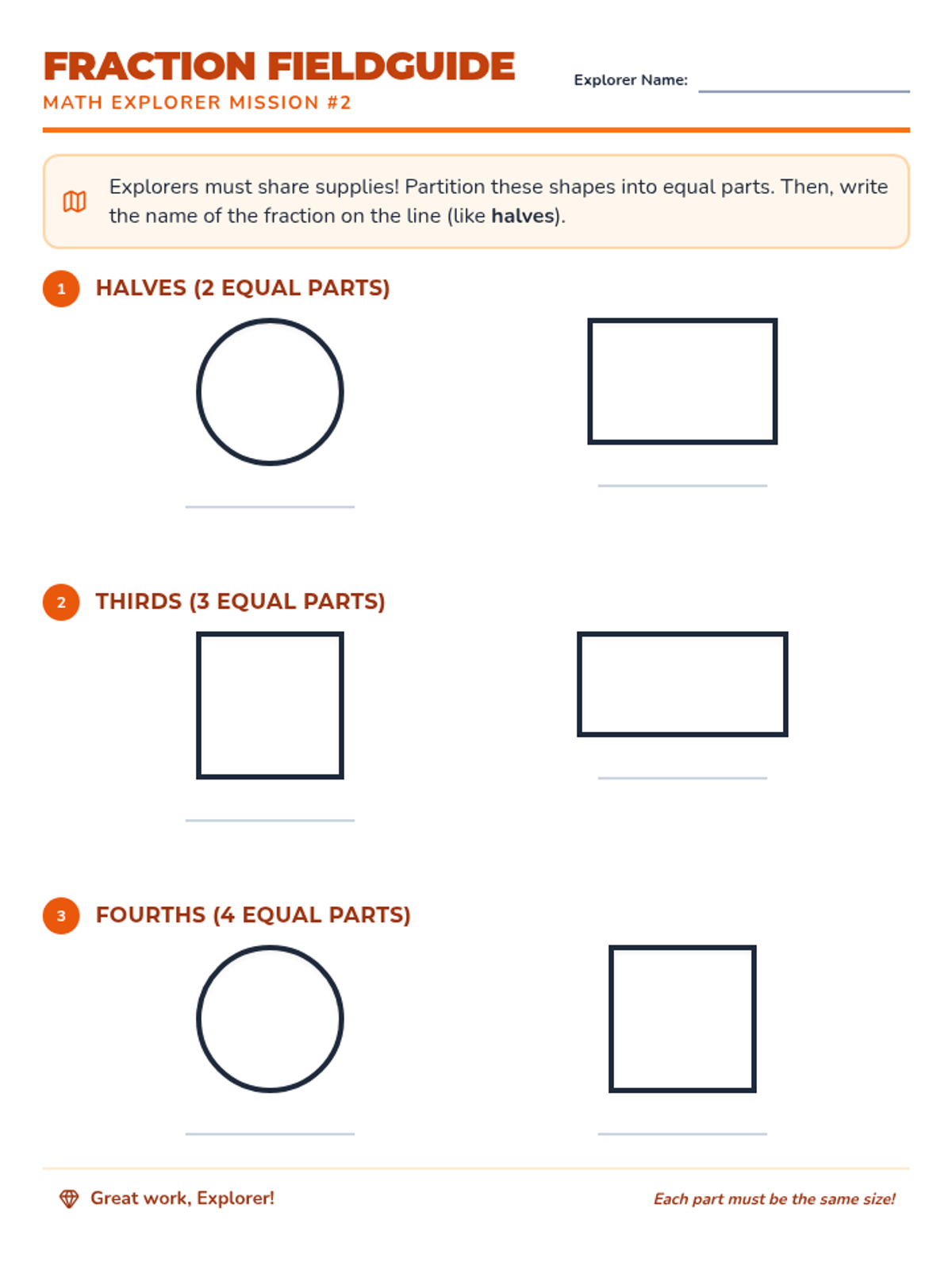
A geometry-focused worksheet where students practice partitioning circles, squares, and rectangles into halves, thirds, and fourths. This version fits on a single page with labeling lines.
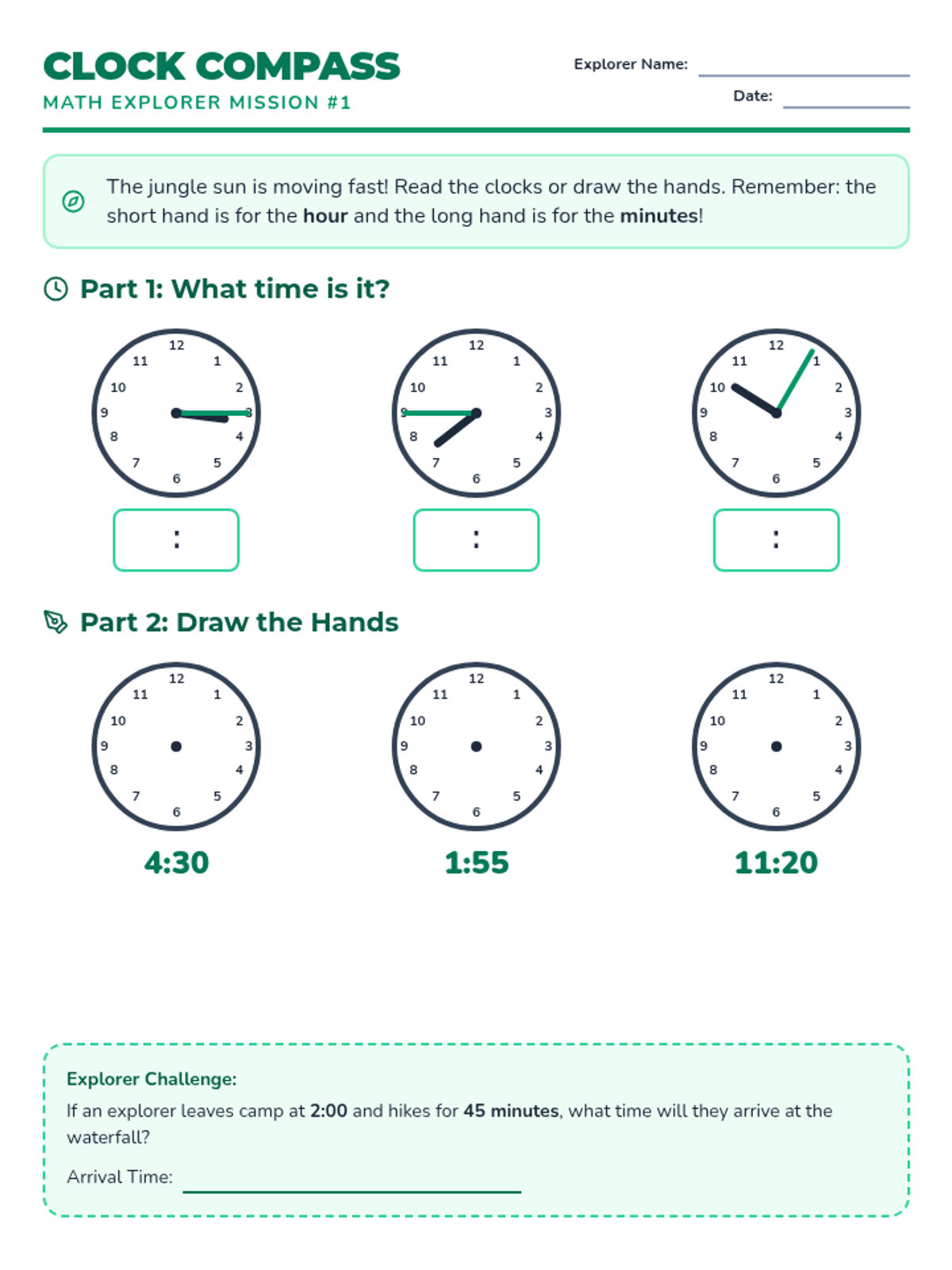
A clock-themed worksheet for 2nd graders to practice telling time to the nearest 5 minutes, including reading clocks and drawing clock hands. This version includes all clock numbers and fits on a single page.
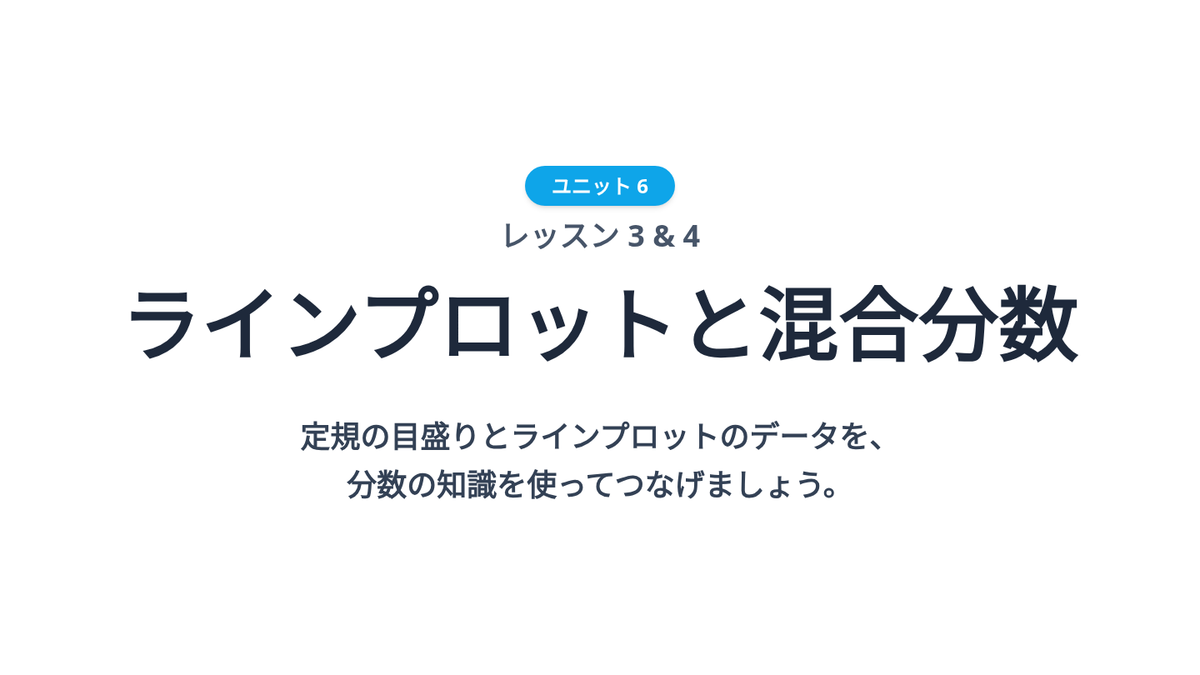
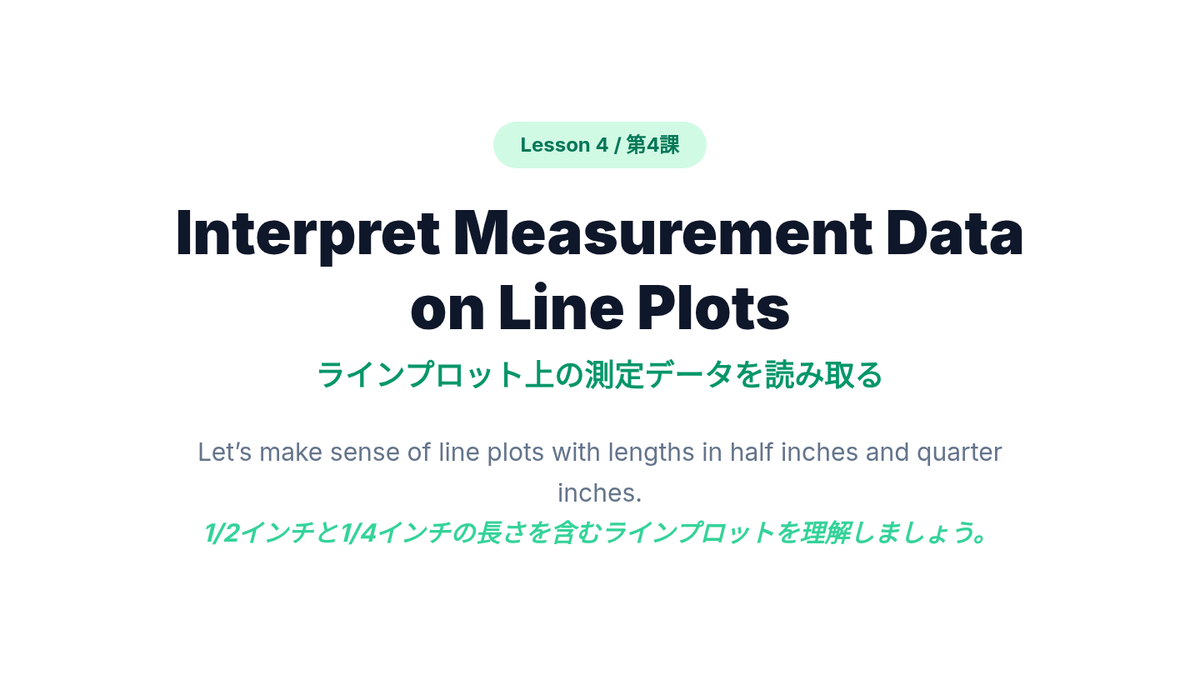
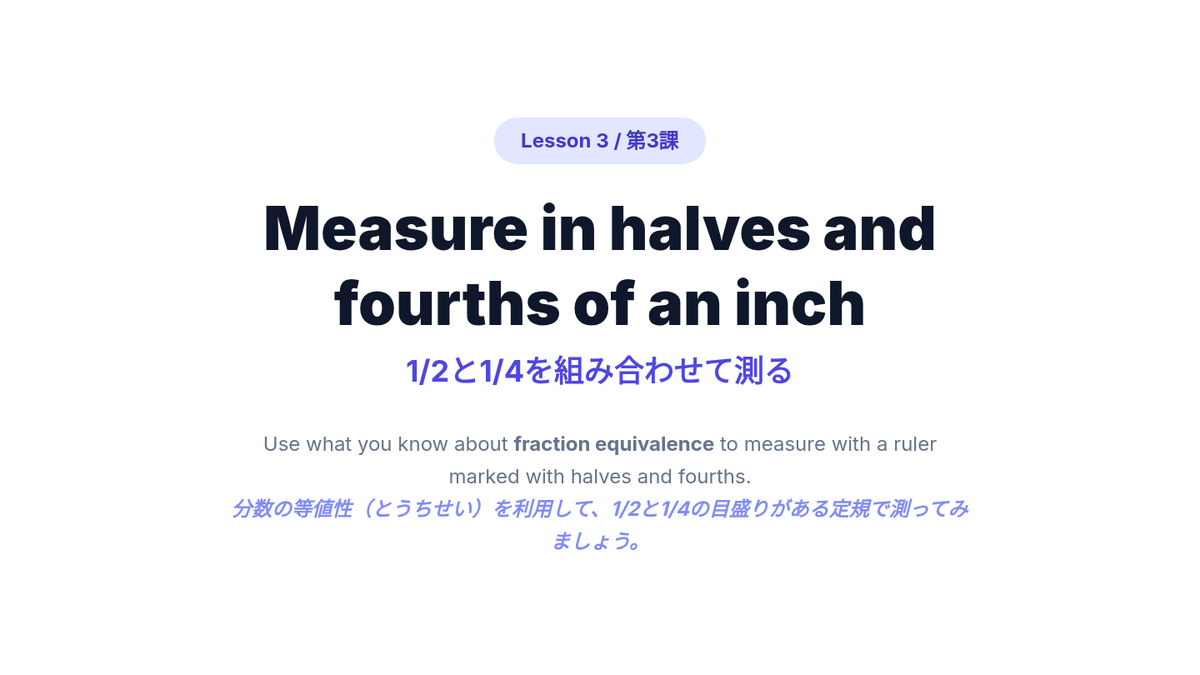
Measurement Unit Slides - Lessons 3 & 4: Mixed Fractions and Line Plots. Recreated and translated into Japanese with advanced instructional visuals, worm and leaf data examples, and rigorous synthesis prompts. Revisions made for page breaks and math rendering. Fixed 'X' alignment on plots and matched cool-down options. Fixed comma alignment and dark blue highlights.
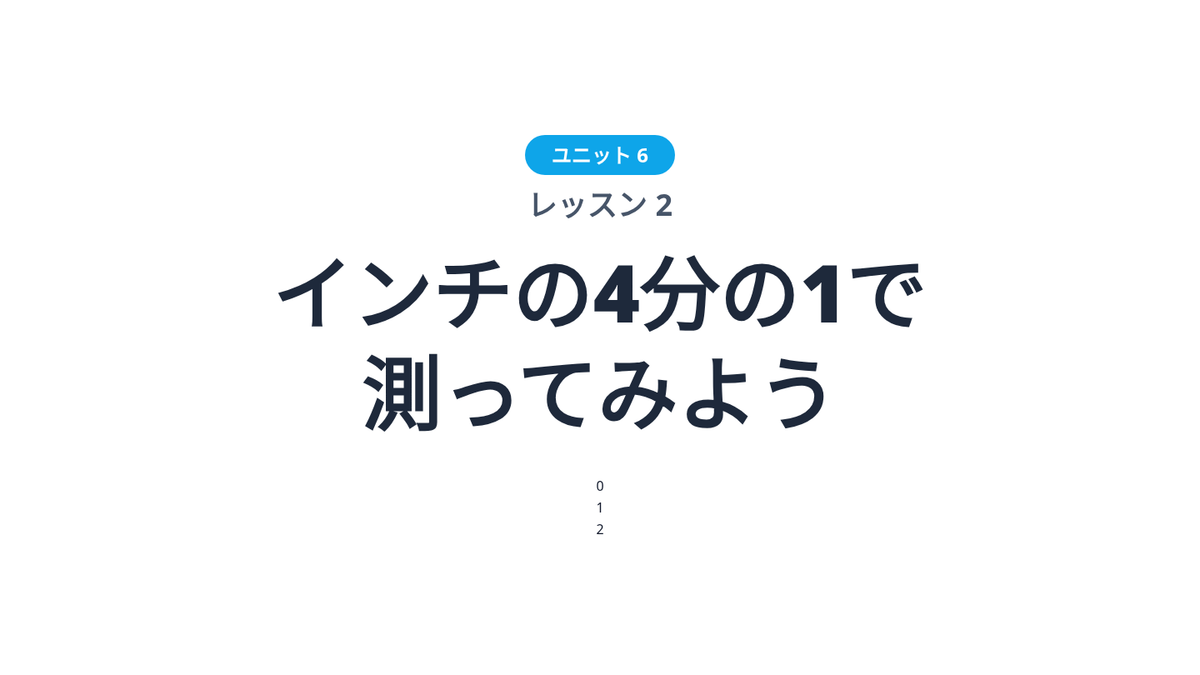
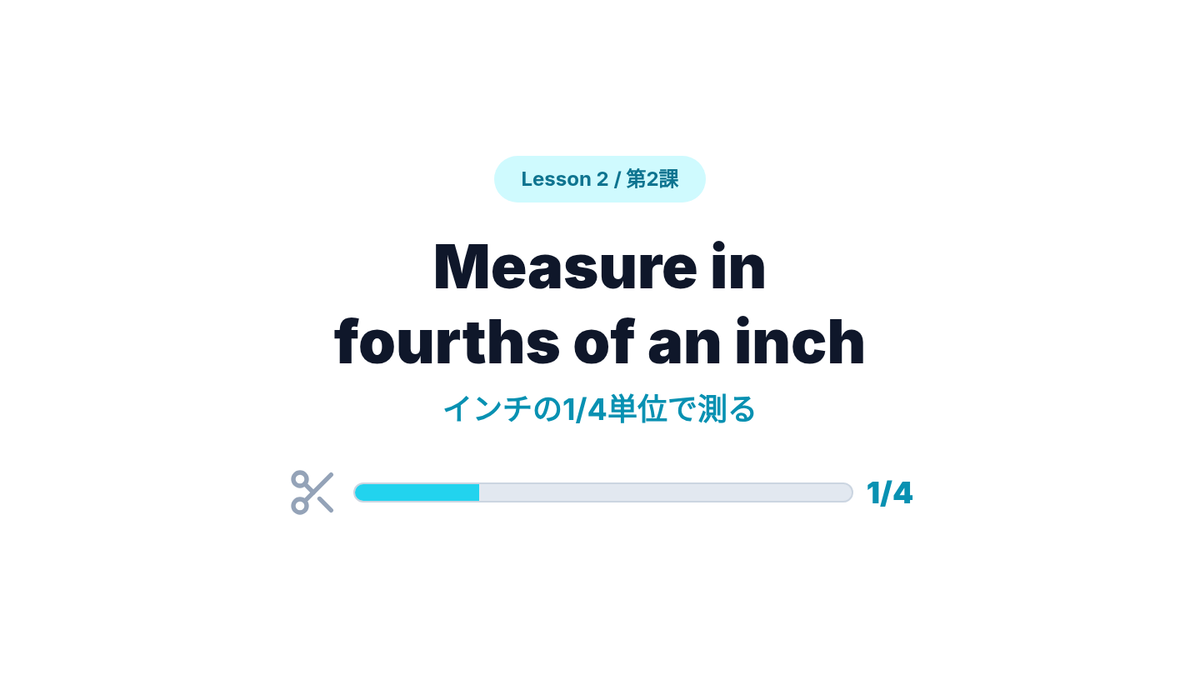
Measurement Unit Slides - Lesson 2: Inch Fourths. Recreated and translated into Japanese with professional instructional design, clear visuals of rulers, and interactive-style prompts. Revisions made for page breaks and math rendering. Fixed wrapping for 'inches'. Fixed paperclip alignment and ruler consistency. Improved mixed number visualization.
Measurement Unit Slides - Lesson 1: Inch Halves. Recreated and translated into Japanese with clean visuals, clear diagrams, and appropriate pedagogical structure. Revisions made for page breaks and math rendering. Fixed ruler zero positioning. Fixed eraser width to 1.5 units and improved layout. Corrected fraction terminology.
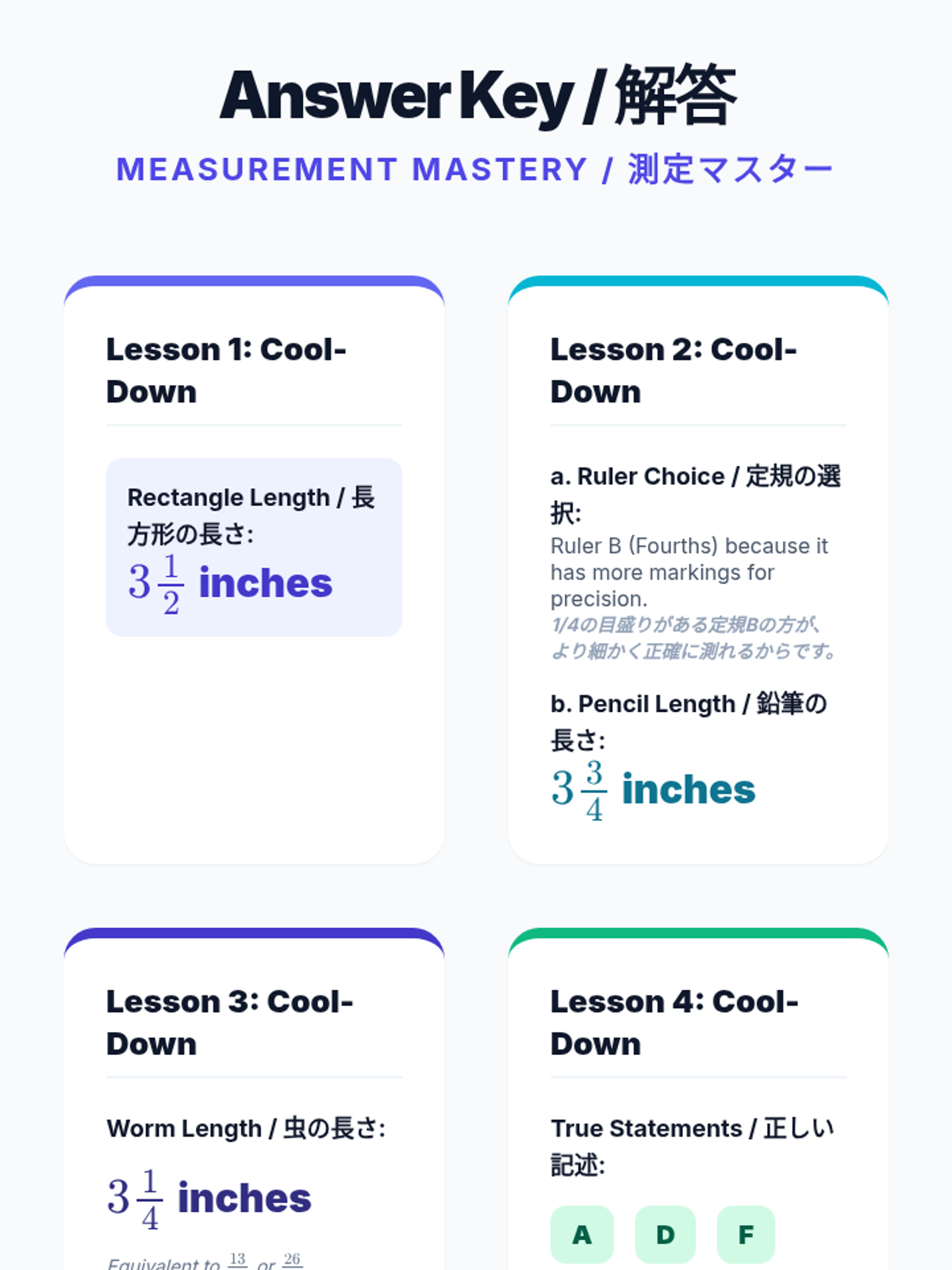
Comprehensive answer key for the unit. Revised for clarity, correct data references, and page break efficiency.
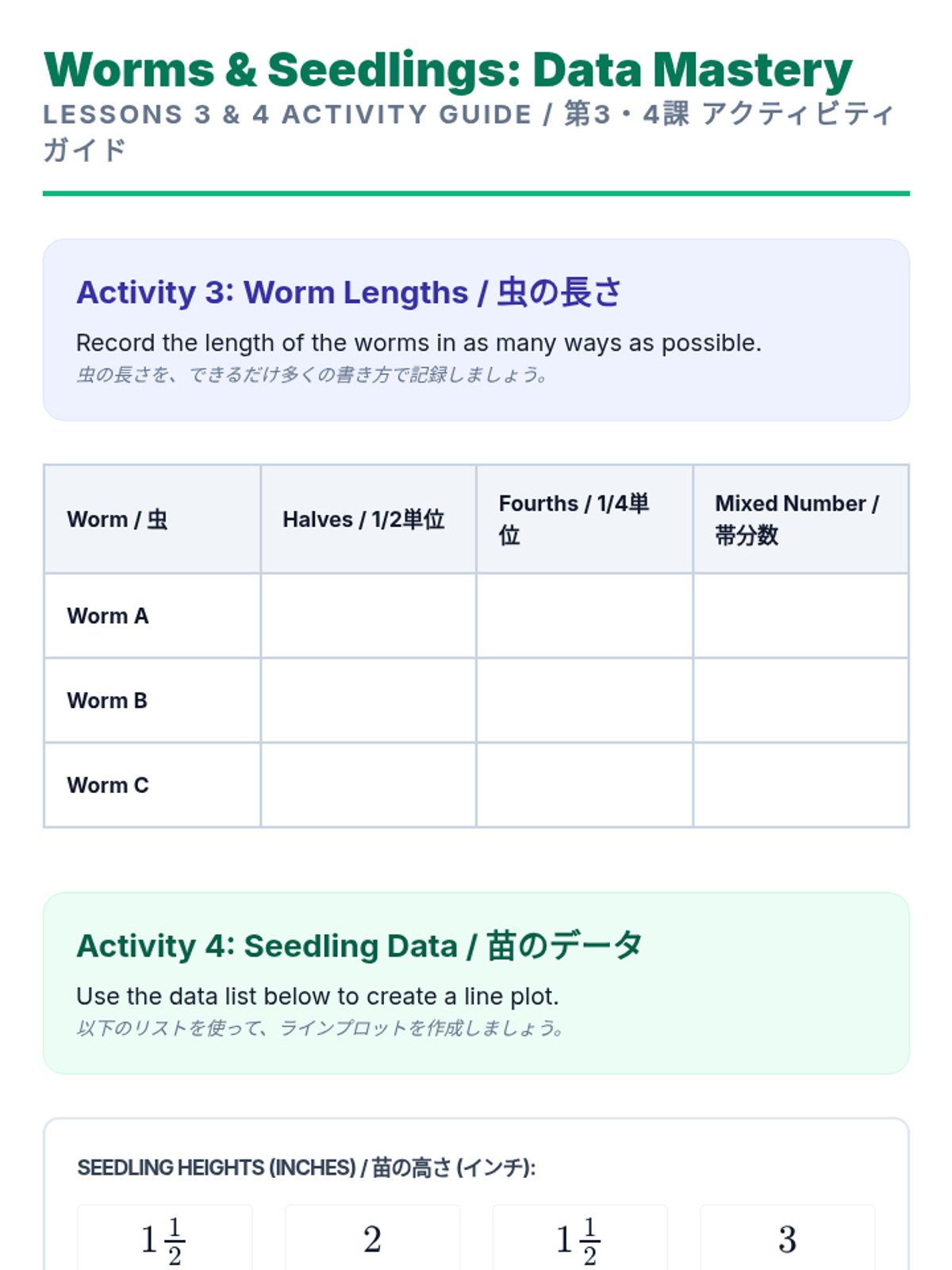
Handouts for Lessons 3 and 4. Revised to keep Activity 4 on one page, fix wrapping, and improve work area visibility.
Bilingual slides for Lesson 4 (Interpreting Line Plots). Focuses on analyzing data representations, identifying differences between lists and plots, and verifying statements based on data. Revised for populated data and alignment.
Bilingual slides for Lesson 3 (Equivalence and Mixed Numbers). Explores recording lengths in multiple ways and visualizing mixed number partitioning. Revised for ruler accuracy and visible diagrams.
Bilingual slides for Lesson 2 (Measuring in Fourths). Includes estimation exploration, partitioning activities, and a cool-down involving choosing the right tool for precision. Revised for ruler accuracy and alignment.
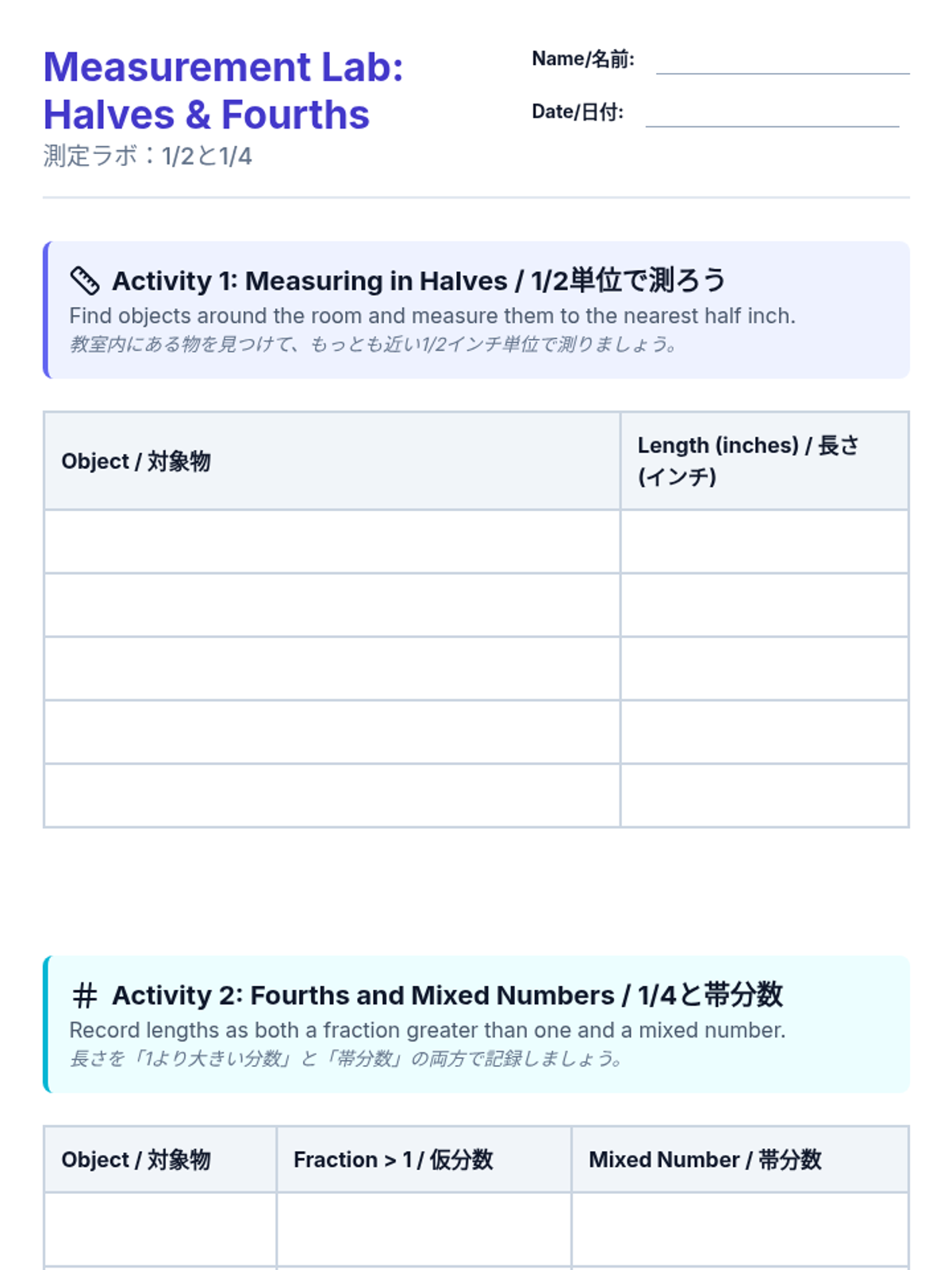
Recording sheets for measuring activities in Lessons 1 and 2. Bilingual format. Revised to prevent table splits and improve name/date formatting.
Bilingual slide deck for the Measurement unit, covering Unit Goals, Rubric, and Lesson 1 (Measuring in Halves). Includes specific terminology in both English and Japanese. Revised for ruler accuracy and alignment.
A comprehensive slide deck in Japanese for teaching measurement in inches and half-inches. It includes unit goals, a rubric, classroom activities, and a final cool-down assessment.
A presentation deck for 'Measurement Mastery' unit, covering length measurement in inches and half-inches. Each slide features the English content from the original curriculum alongside a Japanese translation for bilingual or ESL/ELL support.
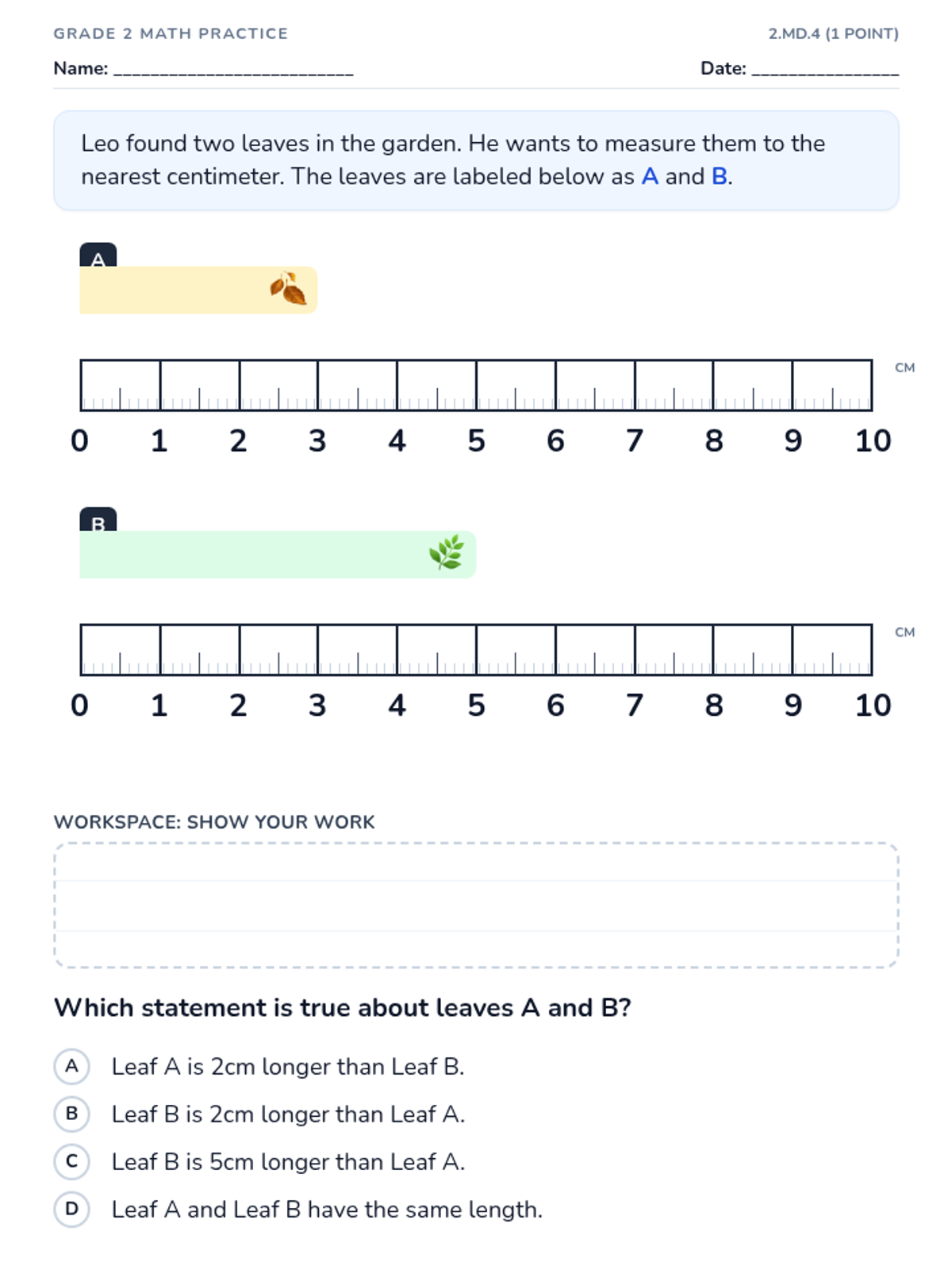
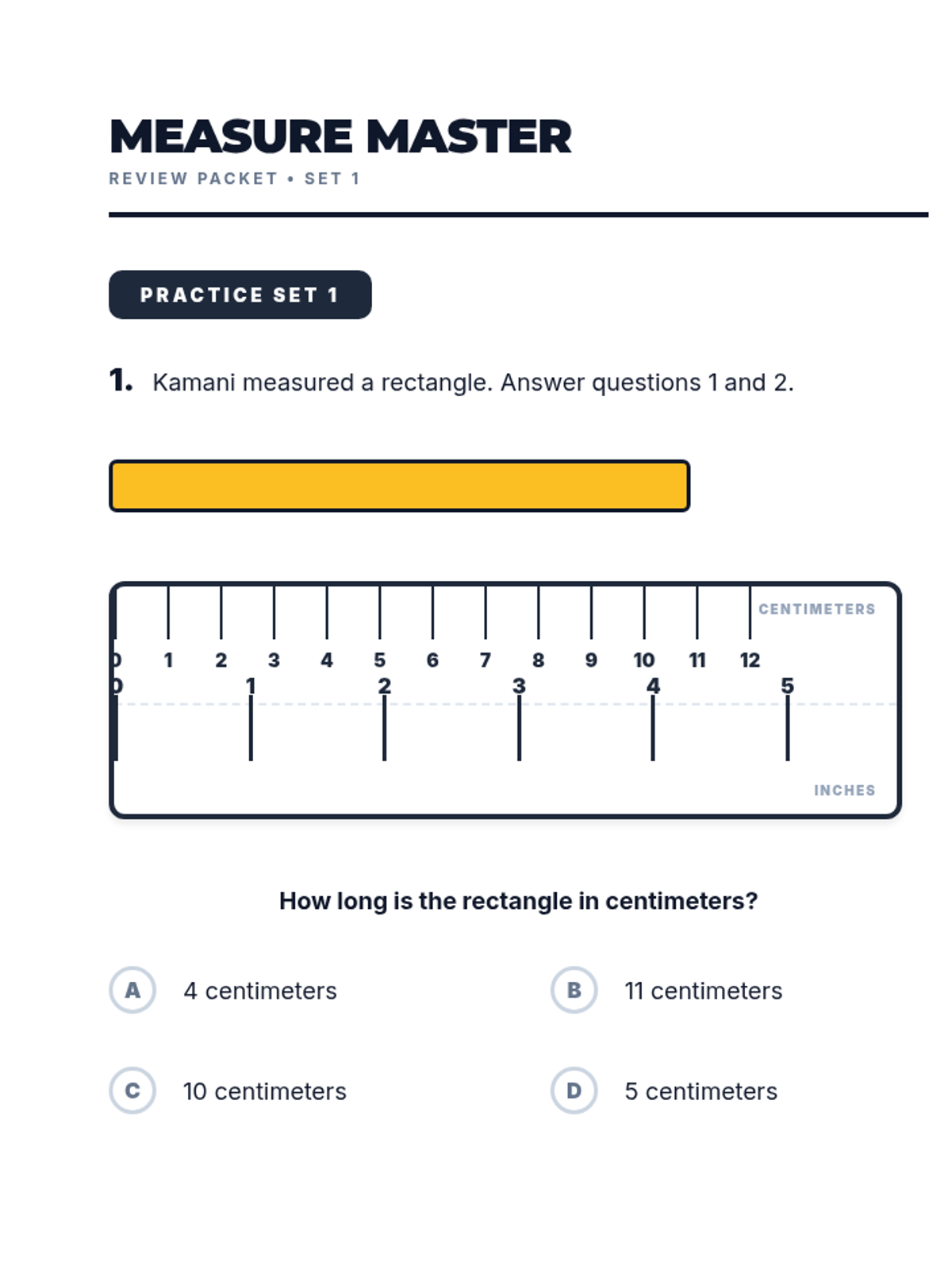
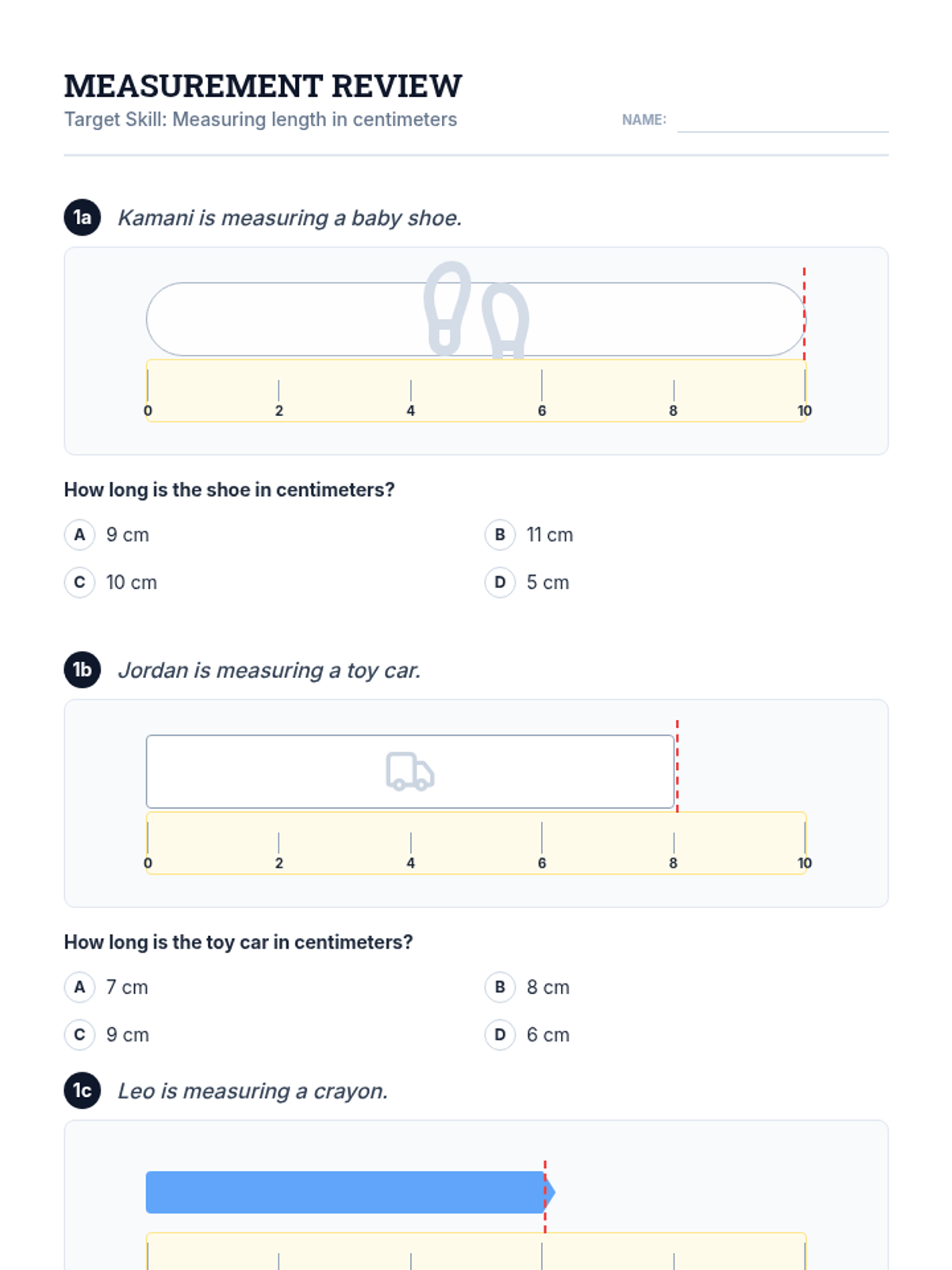
A collection of three practice problems (At Bats) focused on measuring objects in centimeters and comparing their lengths to determine differences. Each problem features two objects aligned with a ruler and a multiple-choice question. Each problem is on its own page for clarity. All rulers are identical and objects align perfectly with integer values, utilizing guidelines to show the exact measurement hit point on the numerals. Objects are represented as solid bars starting at zero and ending exactly on the target number. Workspace area is provided with writing lines. Layout refined to ensure no content is cut off and numerals are clearly visible.
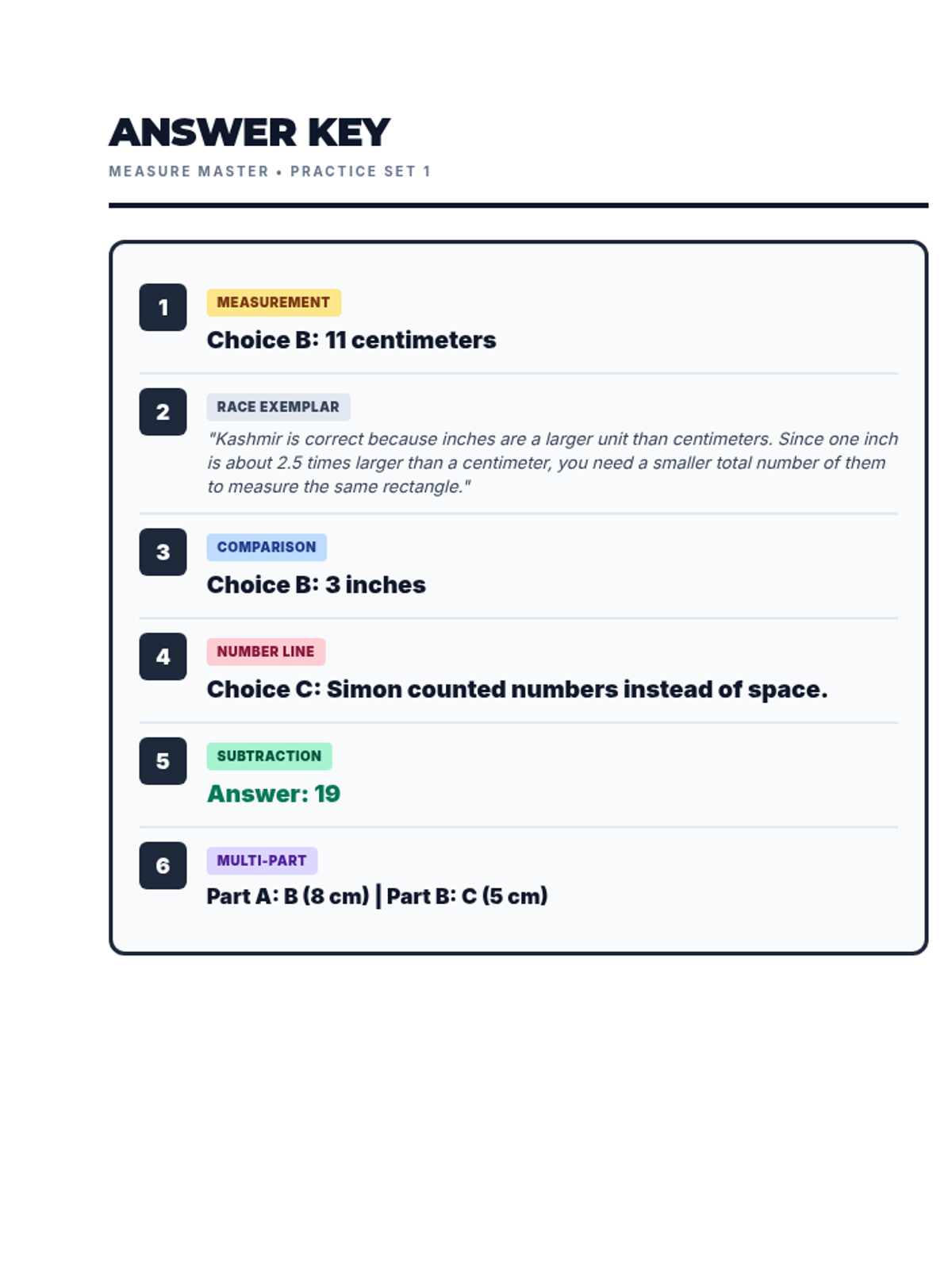
A complete teacher answer key for the Measure Master Review Packet. It provides detailed correct answers for all 18 questions across three practice sets, including RACE strategy exemplars, mathematical solutions, and categorized badges, all neatly organized one set per page.
A comprehensive math review packet focused on measurement and number lines. It includes three sets of practice problems (at-bats) covering length measurement in cm and inches, comparing lengths, conceptual measurement explanations using the RACE strategy, and subtraction modeling on number lines. Each set features realistic rulers and number lines with unit tick marks.
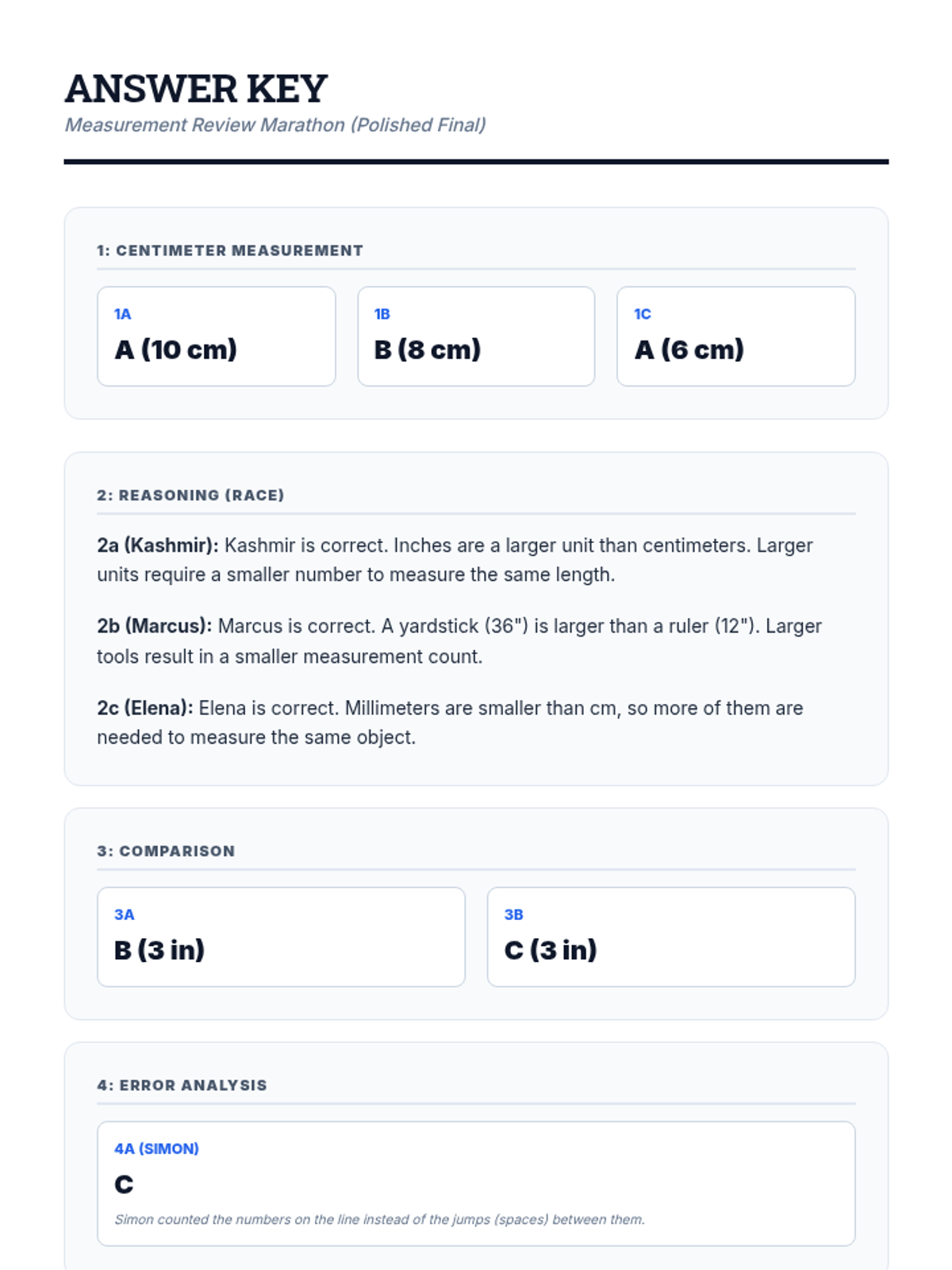
A comprehensive answer key for the revised math review packet, providing solutions for all measurement, reasoning, and operation variations. Matches the latest student packet layout. Fixed CSS syntax errors.
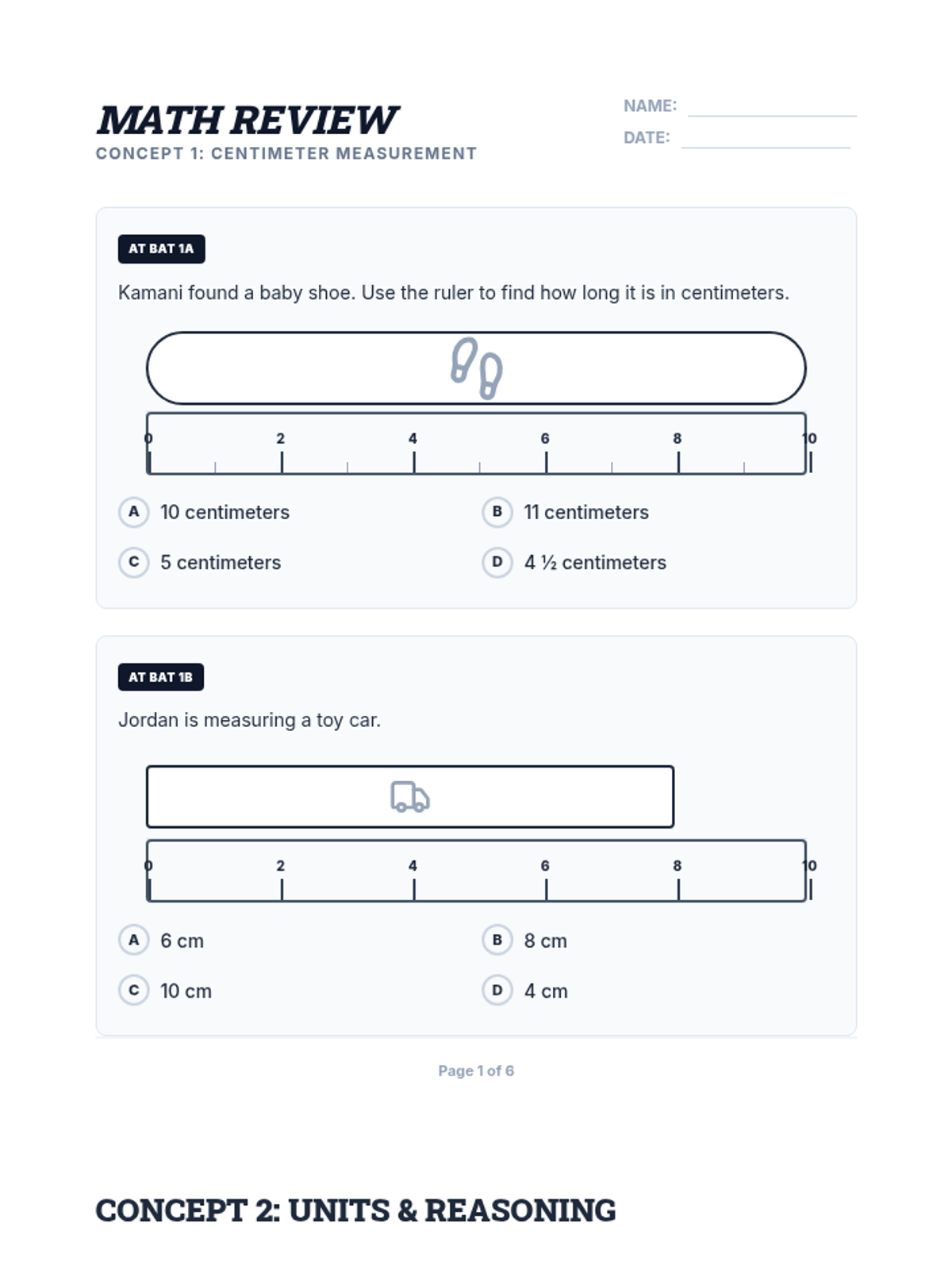
A 6-page math review packet with three variations per concept. Features precisely aligned measurement tasks, reasoning sections with RACE writing lines, and open number lines for operations, following the user's specific formatting requirements. Fixed object alignment, removed guidelines, and standardized choices. Improved layout to prevent overlap.
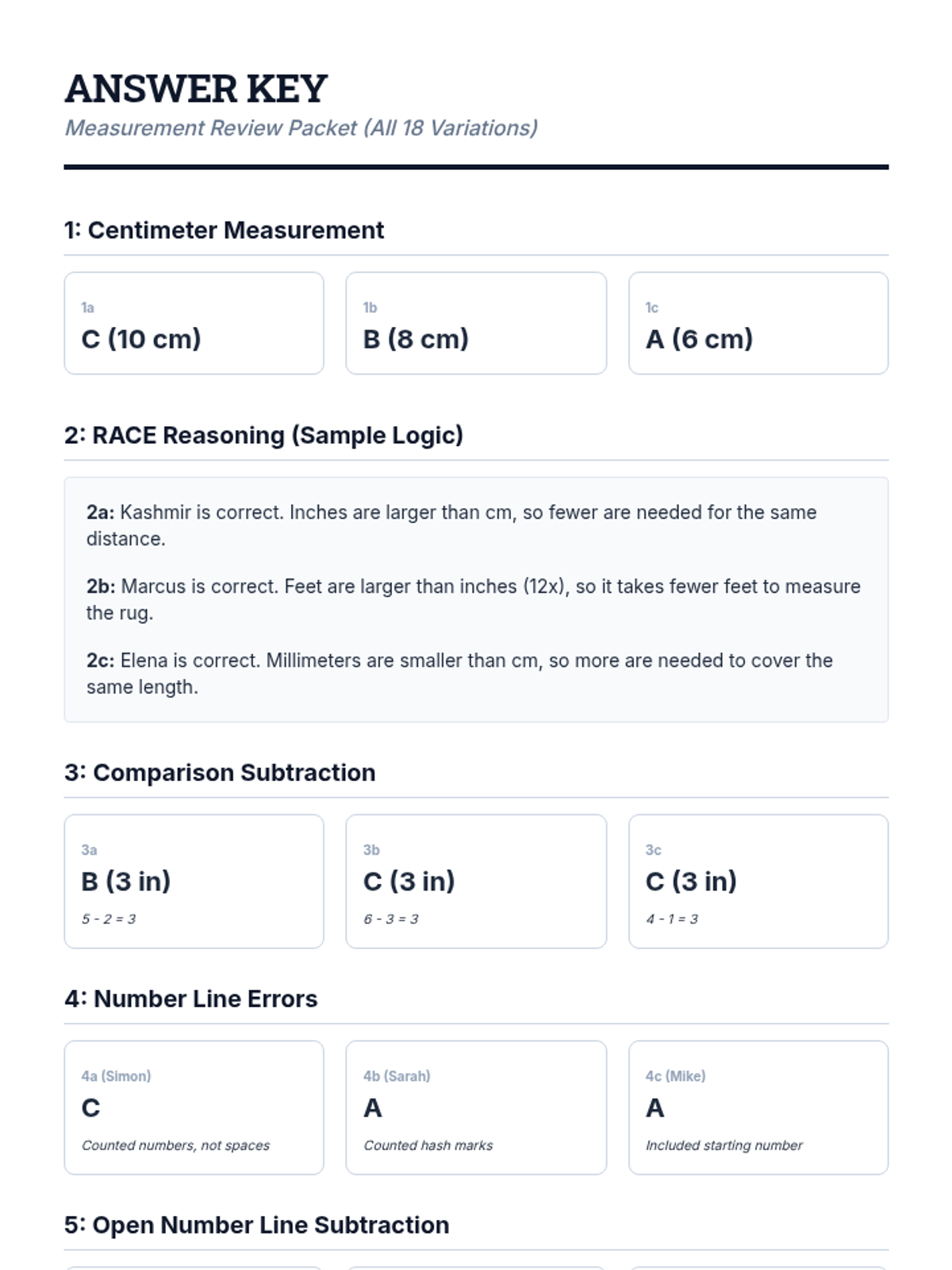
A concise, clear answer key for the Measurement Review Packet, providing correct multiple-choice answers, sample RACE explanations, and mathematical solutions for all 18 variations. Fixed layout to prevent page breaks across questions.
A 8-page comprehensive math review packet featuring 3 variations for 6 different measurement and number line concepts. Each page is carefully formatted to ensure no content is cut off during printing, with ample space for student work and clear visual aids. Fixed object alignment to start at 0. Added writing lines and page numbers.
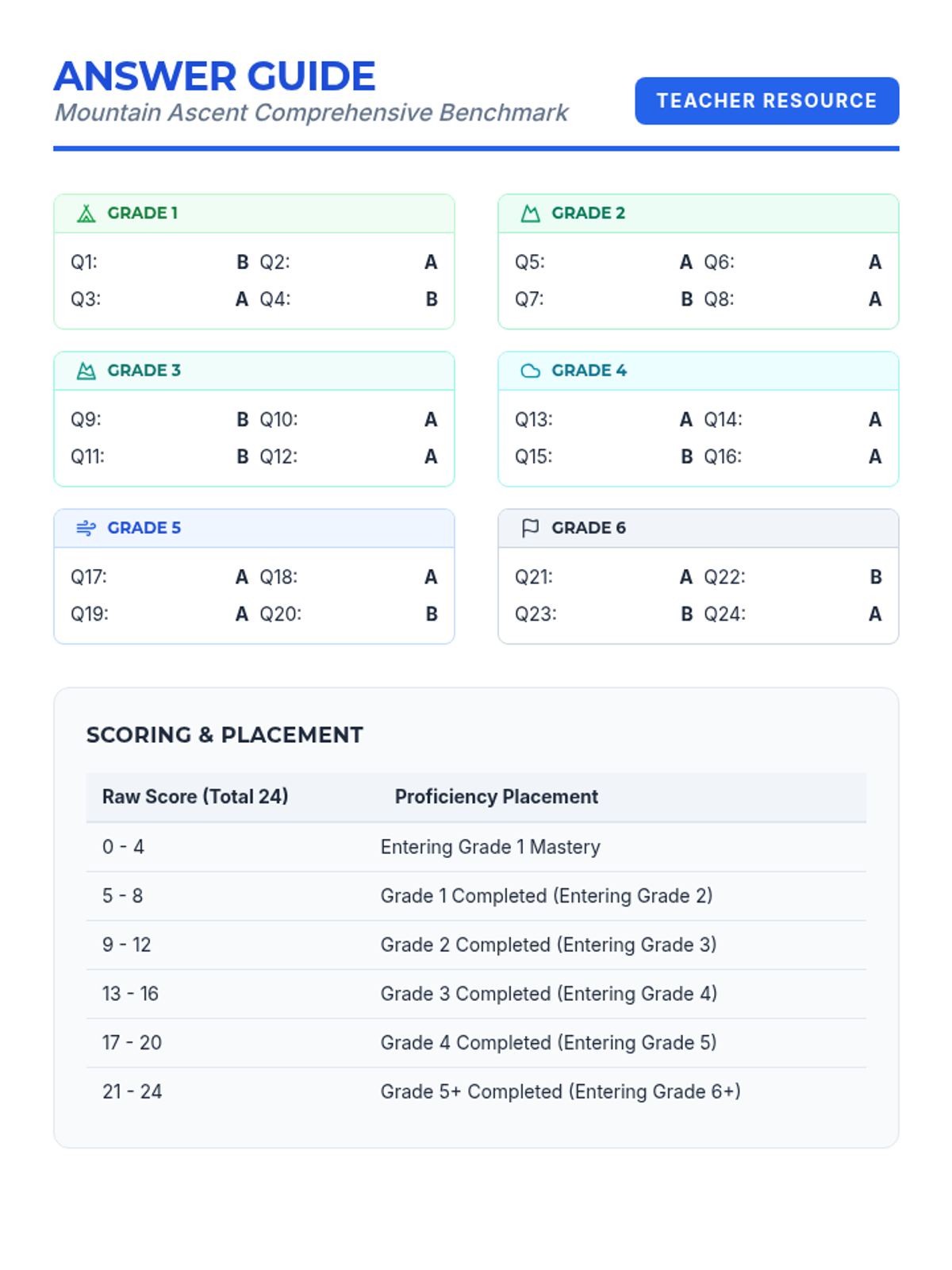
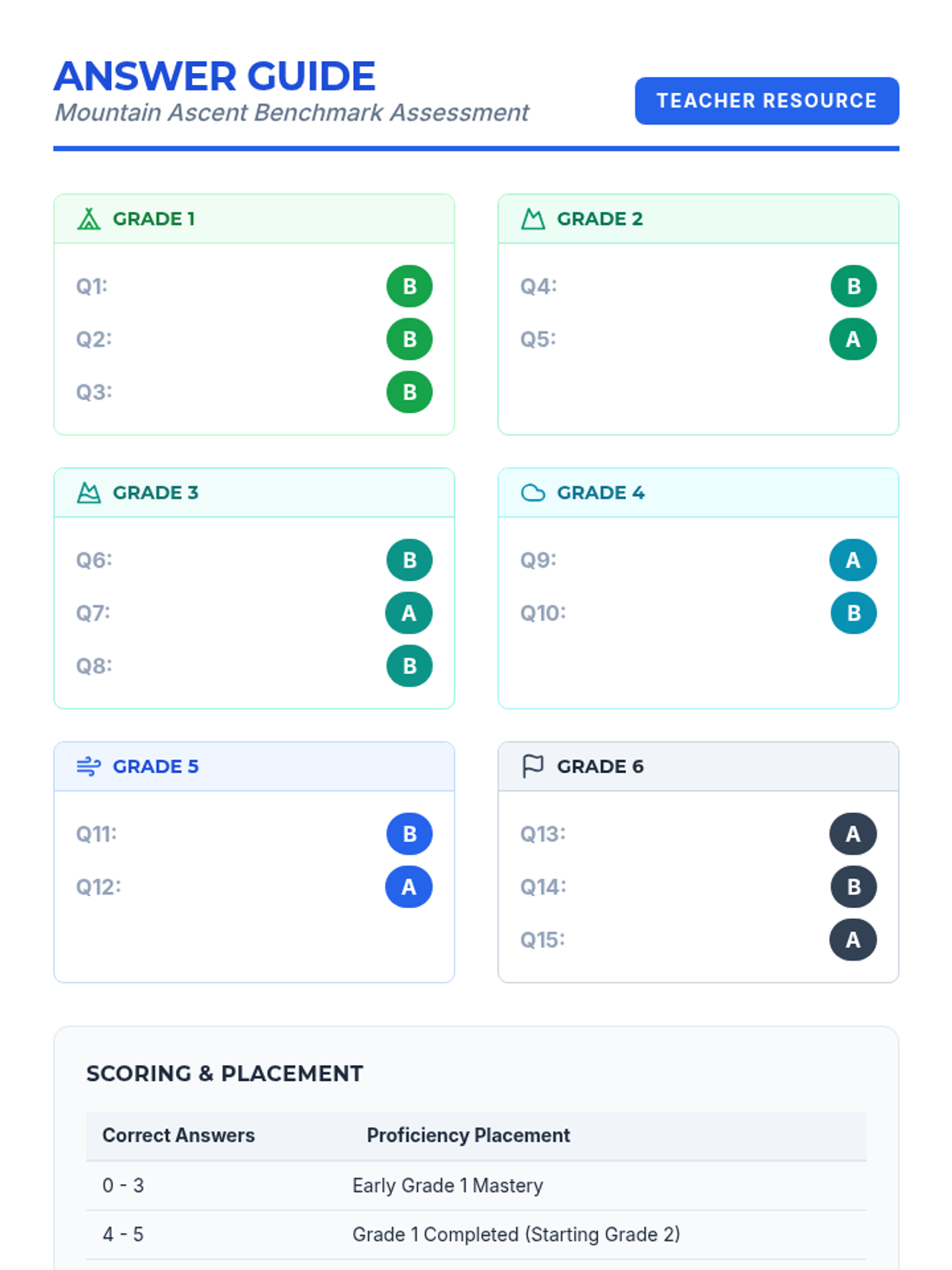
Updated teacher's answer guide for the comprehensive math assessment, featuring answers for all 24 questions and expanded placement guidelines.
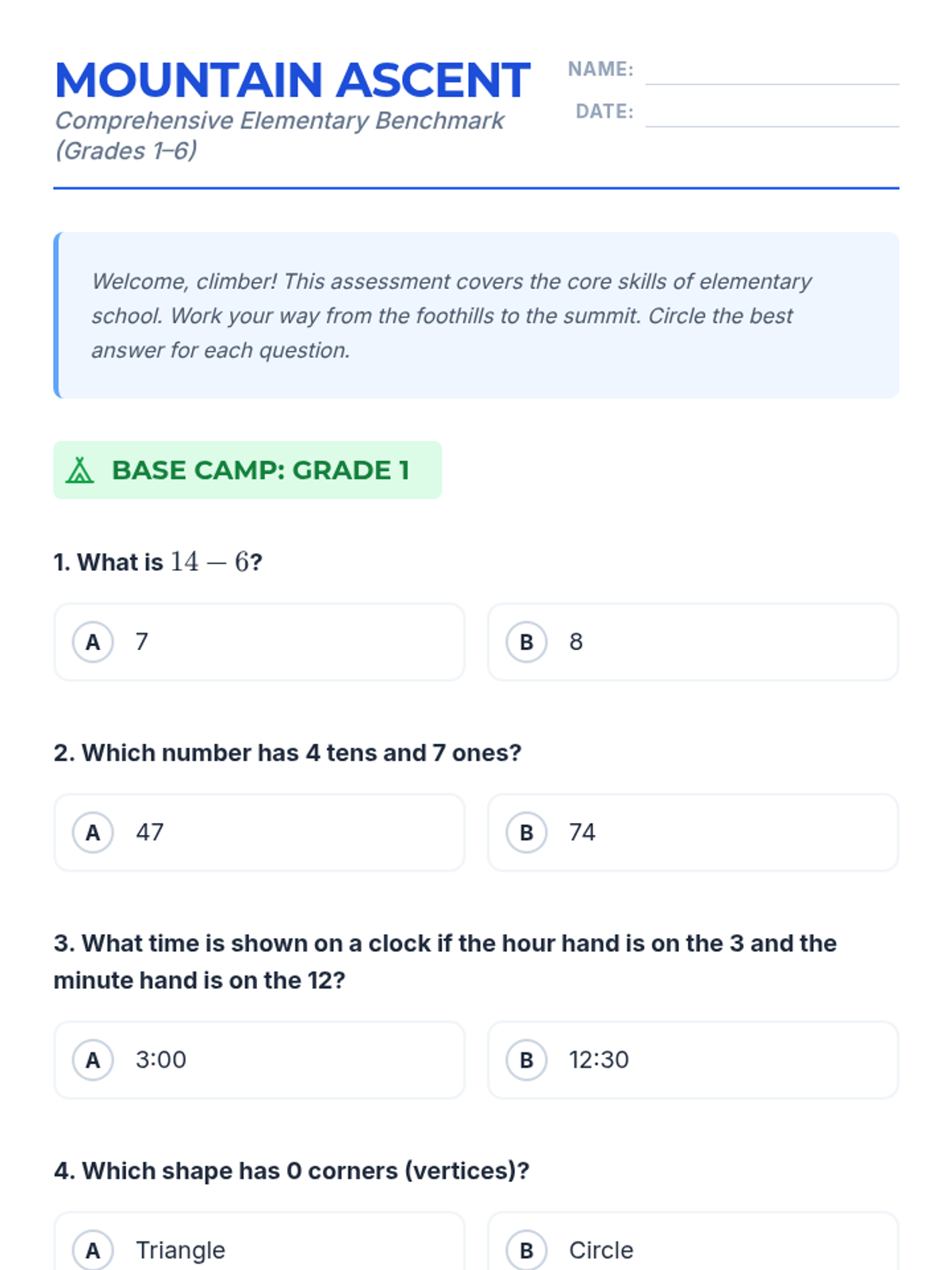
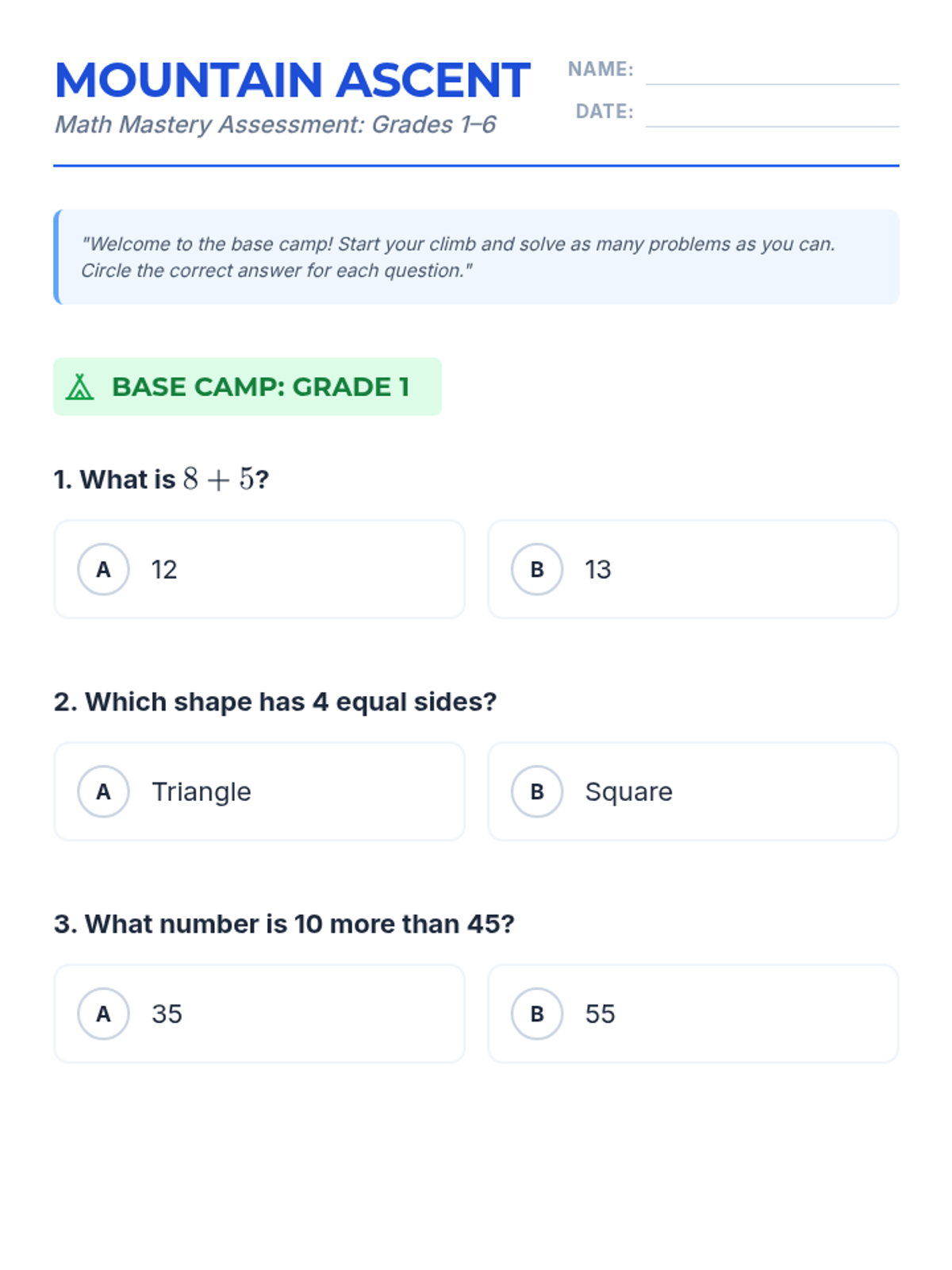
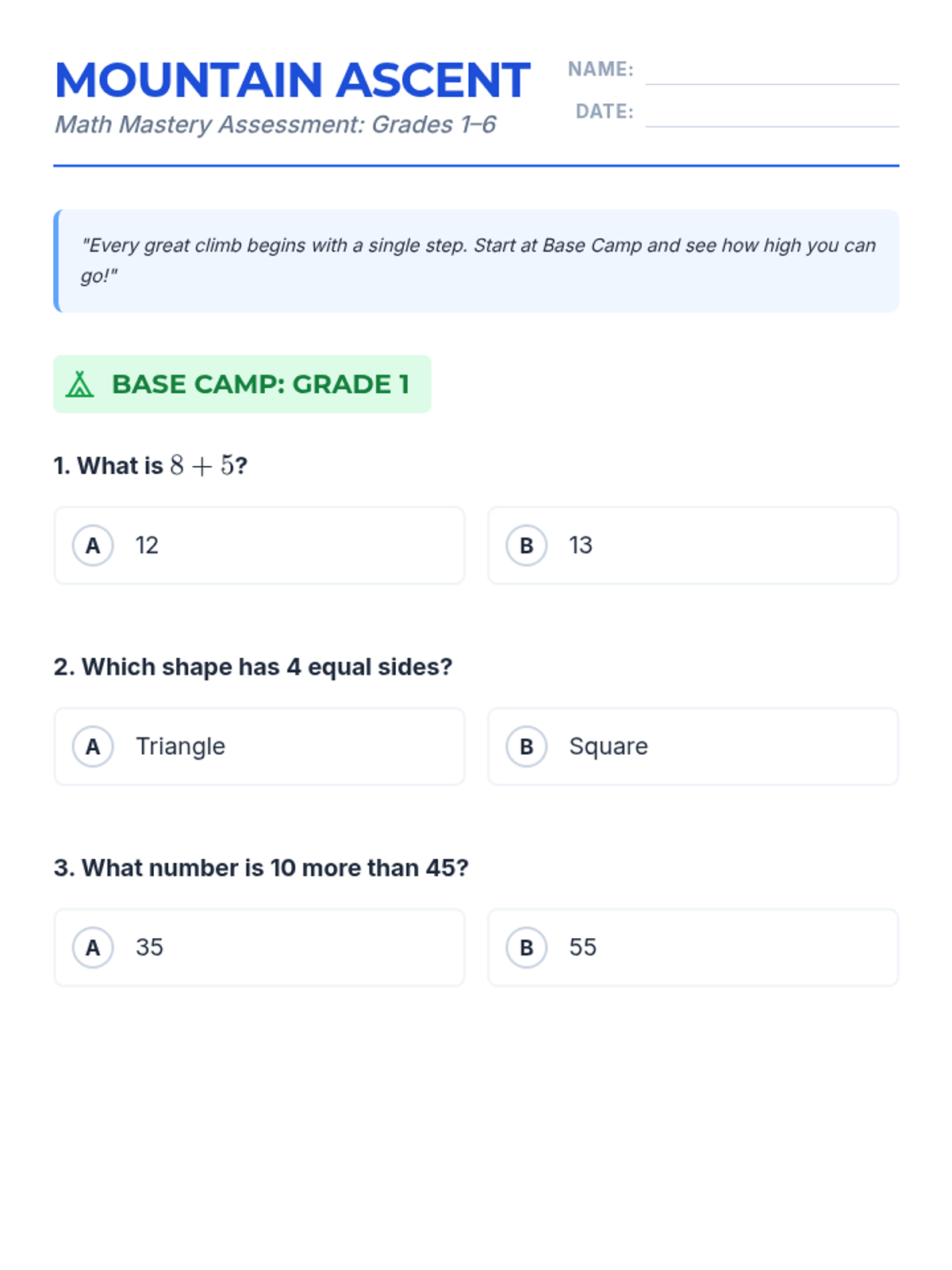
A comprehensive math benchmark assessment covering core elementary skills from Grades 1 to 6 with 24 multiple-choice questions and dedicated work areas.
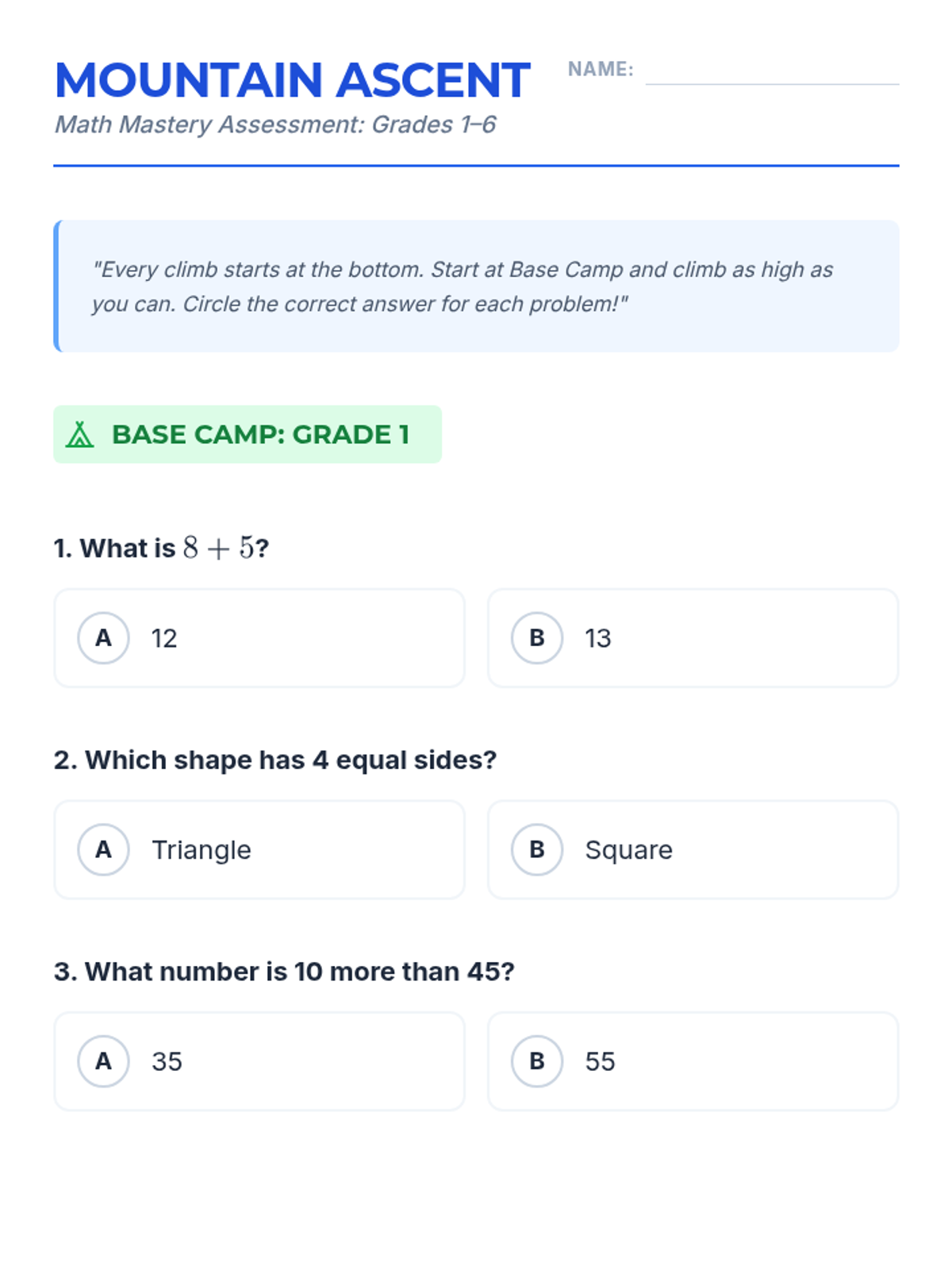
Final polished version of the math assessment with 15 questions, dedicated work spaces for higher levels, and zero page-break issues.
Final polished answer guide with improved alignment and clear scoring metrics.
A final polished version of the math assessment with 15 questions, dedicated work spaces for higher levels, and zero page-break issues.