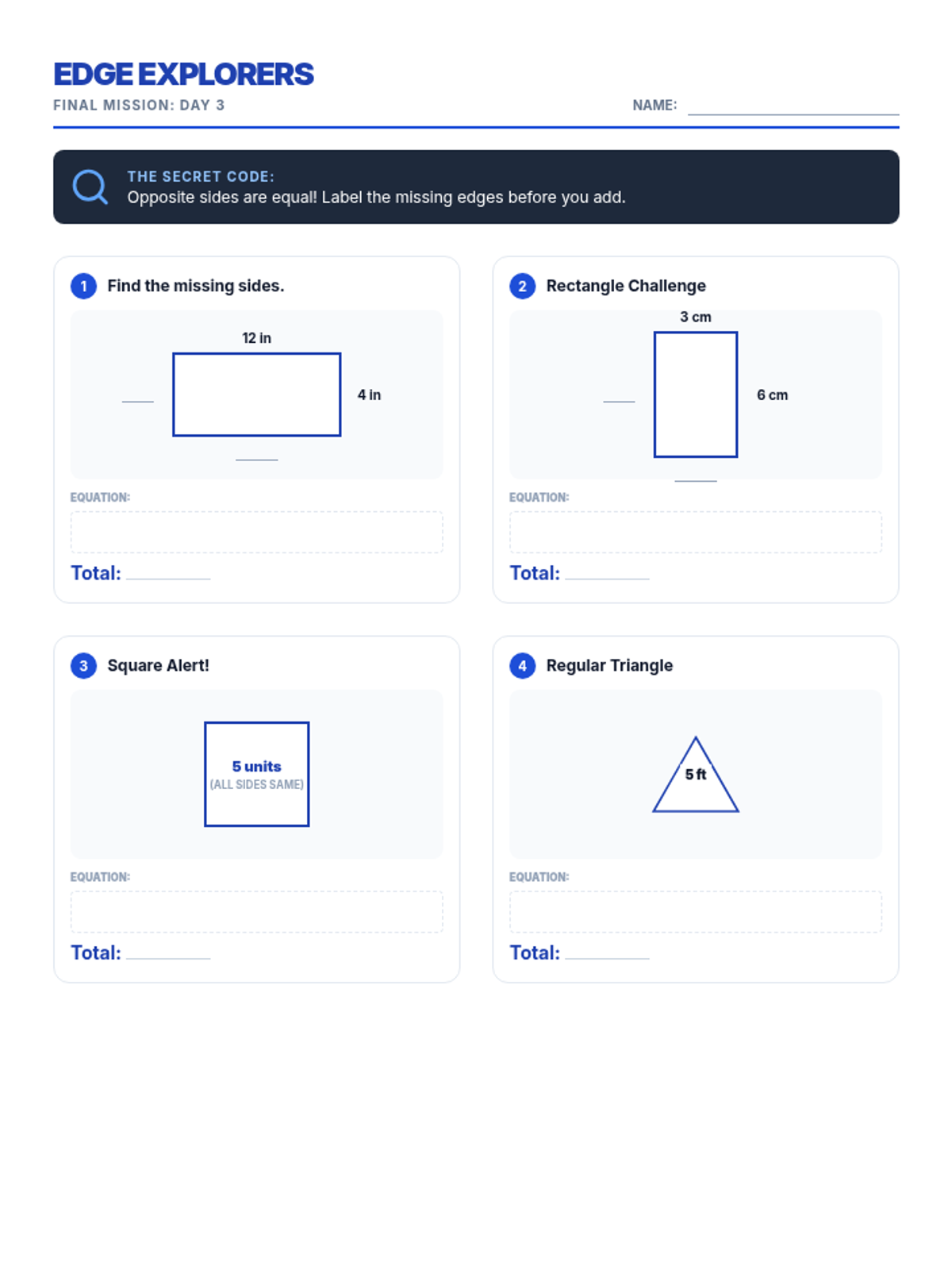
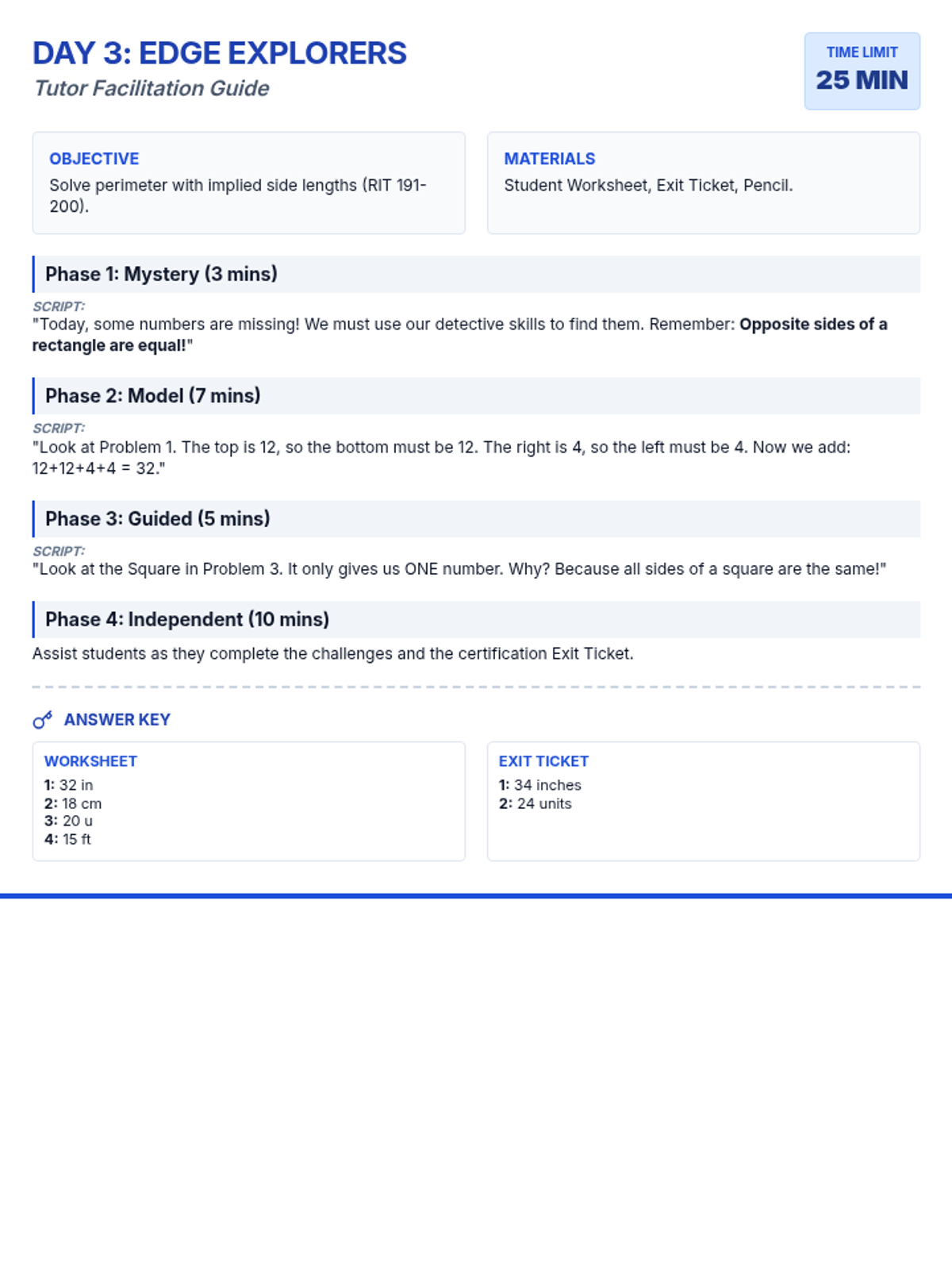
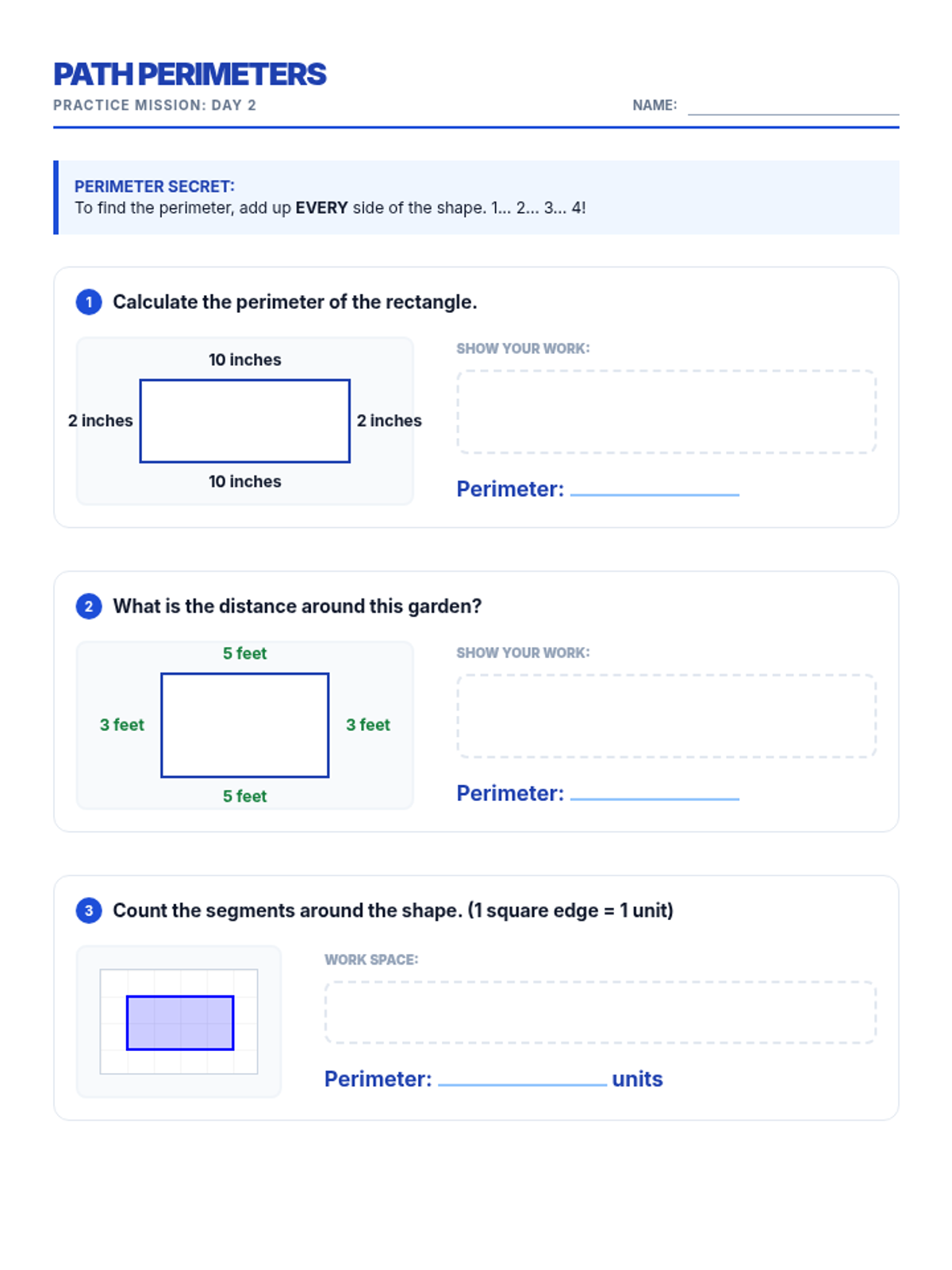
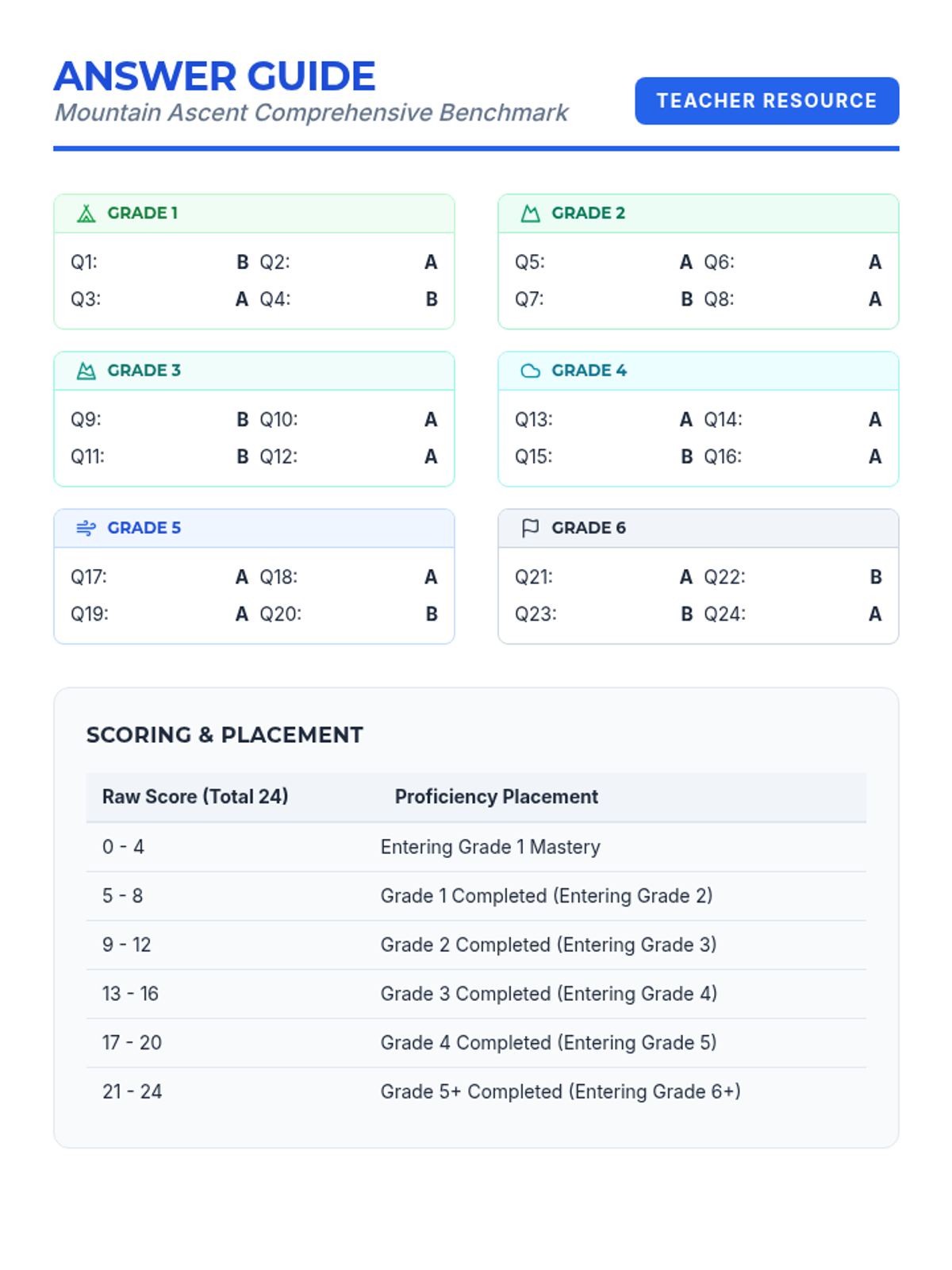
Geometric classification, measurement of area and volume, and the study of transformations and rigid motions. Builds toward complex proofs, trigonometry for general triangles, and the algebraic representation of conic sections.
A visual reference guide for students to keep at their desks, providing clear definitions and visual examples of polygons and quadrilaterals.
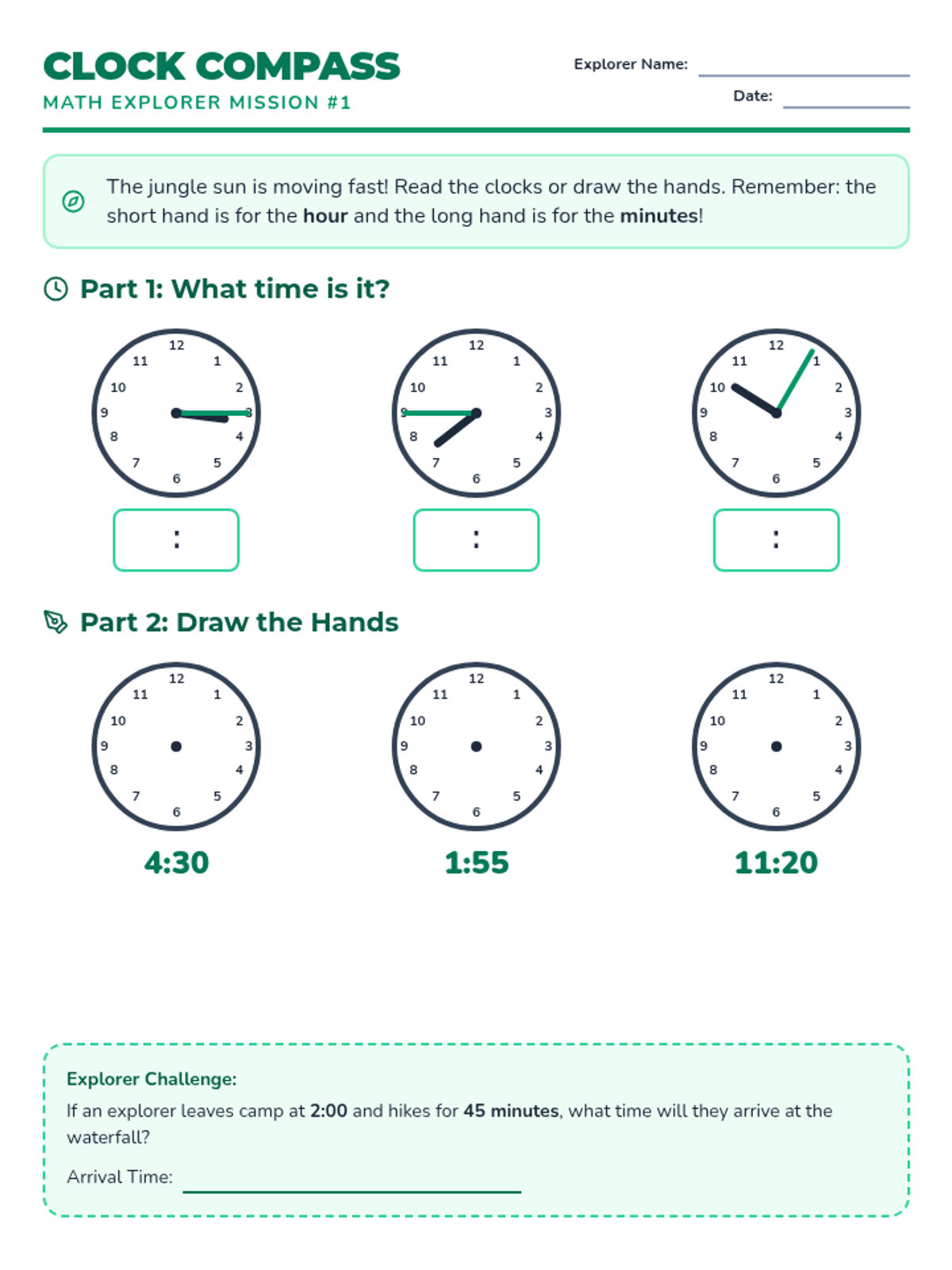
A simplified, high-focus version of the Shape Detective worksheet with task checkboxes, reduced clutter, and visual aids for a student with focusing difficulties.
Teacher guide for the Polygon Patrol lesson, including objectives, vocabulary, lesson flow, and differentiation strategies.
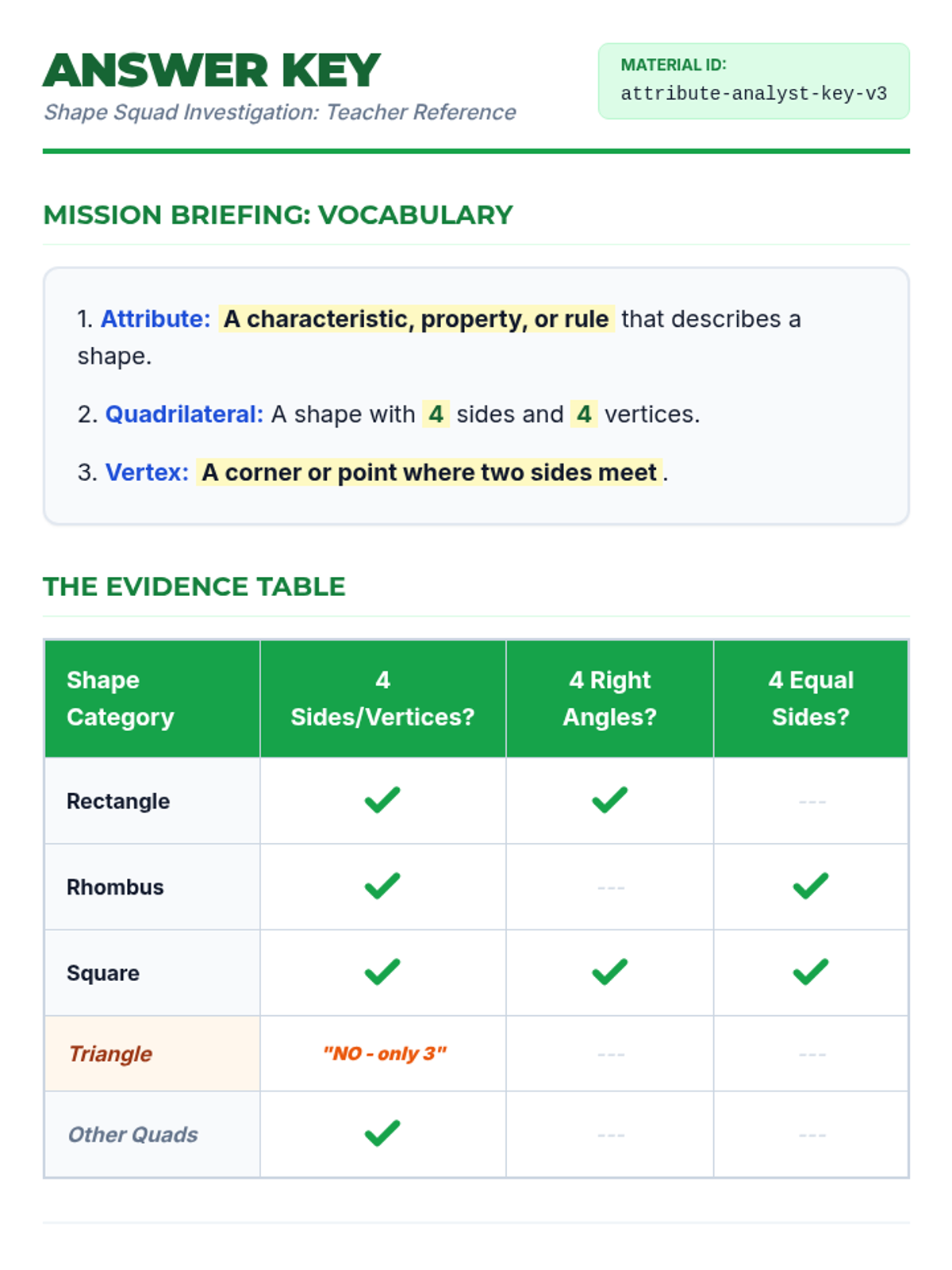
Answer key for the Shape Detective Worksheet with red markings and completed sections.
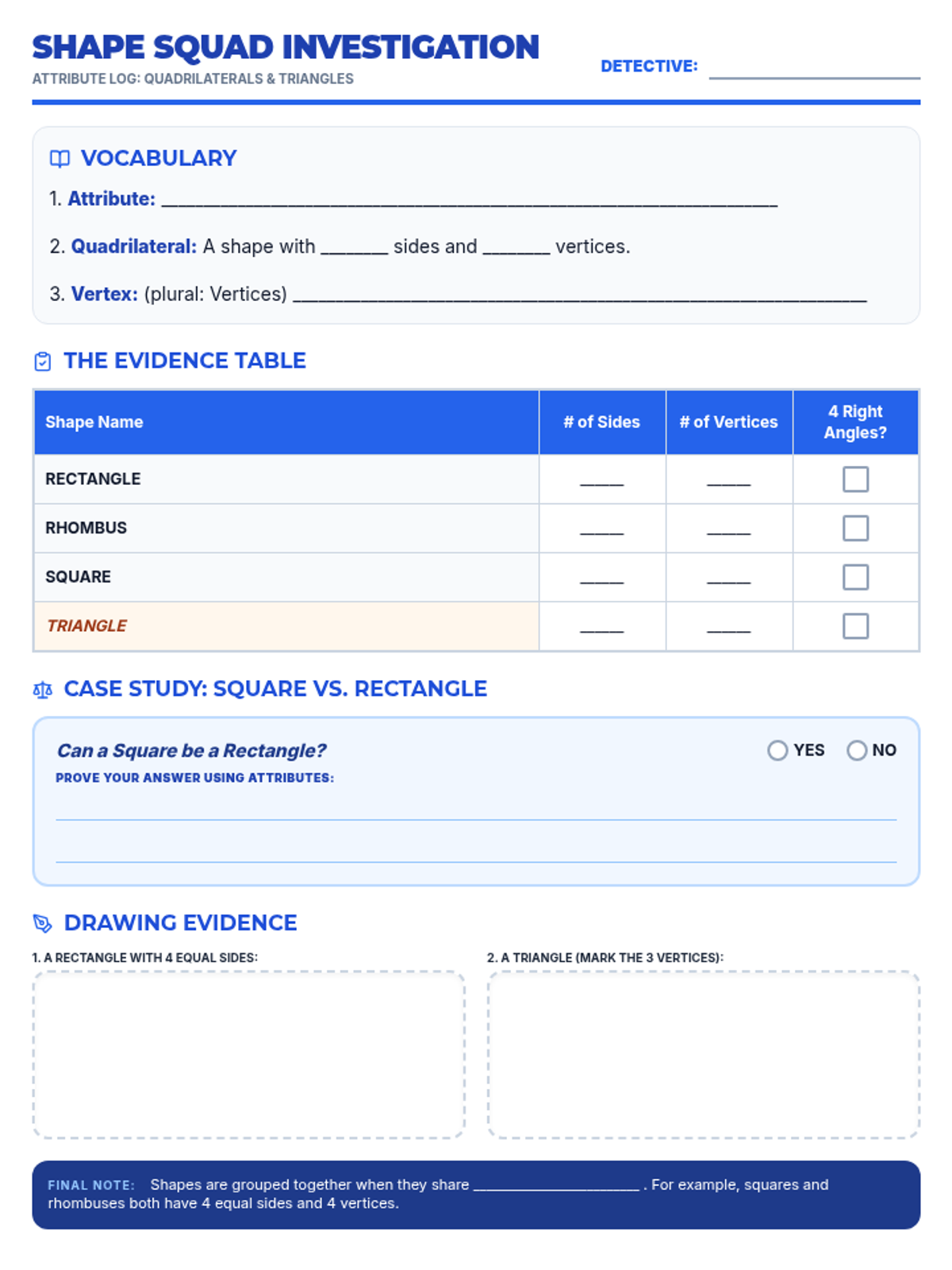
A detective-themed worksheet where students identify polygons, count attributes, and classify quadrilaterals based on clues.
A visually engaging presentation for introducing 2D shapes, polygons, and the classification of quadrilaterals with a detective theme.
A printable page of 'Angle Checker' tools, designed to be cut out and used as index-card substitutes. These tools help students physically verify right angles in the 'Shape Detectives' lesson.
A comprehensive teacher guide for the Shape Detectives lesson, including pacing, discussion prompts, material checklists, and common misconceptions for 2nd-grade geometry.
A slide deck for a 2nd-grade geometry lesson that guides students through a warm-up, a video on rectangle characteristics, and instructions for the 'Corner Test' activity. Includes the YouTube video embed.
A 2nd-grade worksheet where students test 10 different quadrilaterals using a right-angle checker. They color rectangles green and non-rectangles red, focusing on the 4 right angles rule.
A student worksheet designed as a "Case File" where learners write their own geometry riddles using shape attributes. Features a fold-up section to hide the answer and a word bank to support vocabulary usage.
Engaging slide deck for the Shape Detective Agency lesson, featuring the Khan Academy geometry video, visual pause points for teacher-led discussion, and high-impact graphics for right angles and quadrilaterals.
A vibrant, high-contrast anchor chart for a shape attributes lesson, featuring clear definitions and visual examples of triangles, rectangles, squares, rhombuses, trapezoids, and circles using the color-coding from the Khan Academy video.
A comprehensive teacher guide for the Shape Detective Agency lesson, including a timed lesson flow, specific video pause points, mystery bag prompts, and tips for addressing common geometric misconceptions.
A self-assessment and teacher rubric for the final "Shape Museum" project, measuring categorization, vocabulary, and justification skills.
Labels for students to write why shapes belong in specific museum exhibits, focusing on justification and vocabulary.
Introductory slides for the "Shape Museum" project, setting a scenario where students must act as museum curators.
A set of 4 riddle cards used for classroom games where students solve shape mysteries based on geometric properties.
A riddle writing template where students use precise geometric vocabulary to create their own shape mysteries.
Slides explaining key terms (vertices, parallel, etc.) and providing a recipe for writing effective geometric riddles.
An answer key for the Solid Shape Sort Worksheet, highlighting objects that fit into both "Rolls" and "Stacks" categories, such as cylinders.
A cut-and-paste sorting activity where students categorize real-world 3D objects (spheres, cubes, cylinders, cones, and prisms) into "Rolls" and "Stacks" based on their physical attributes.
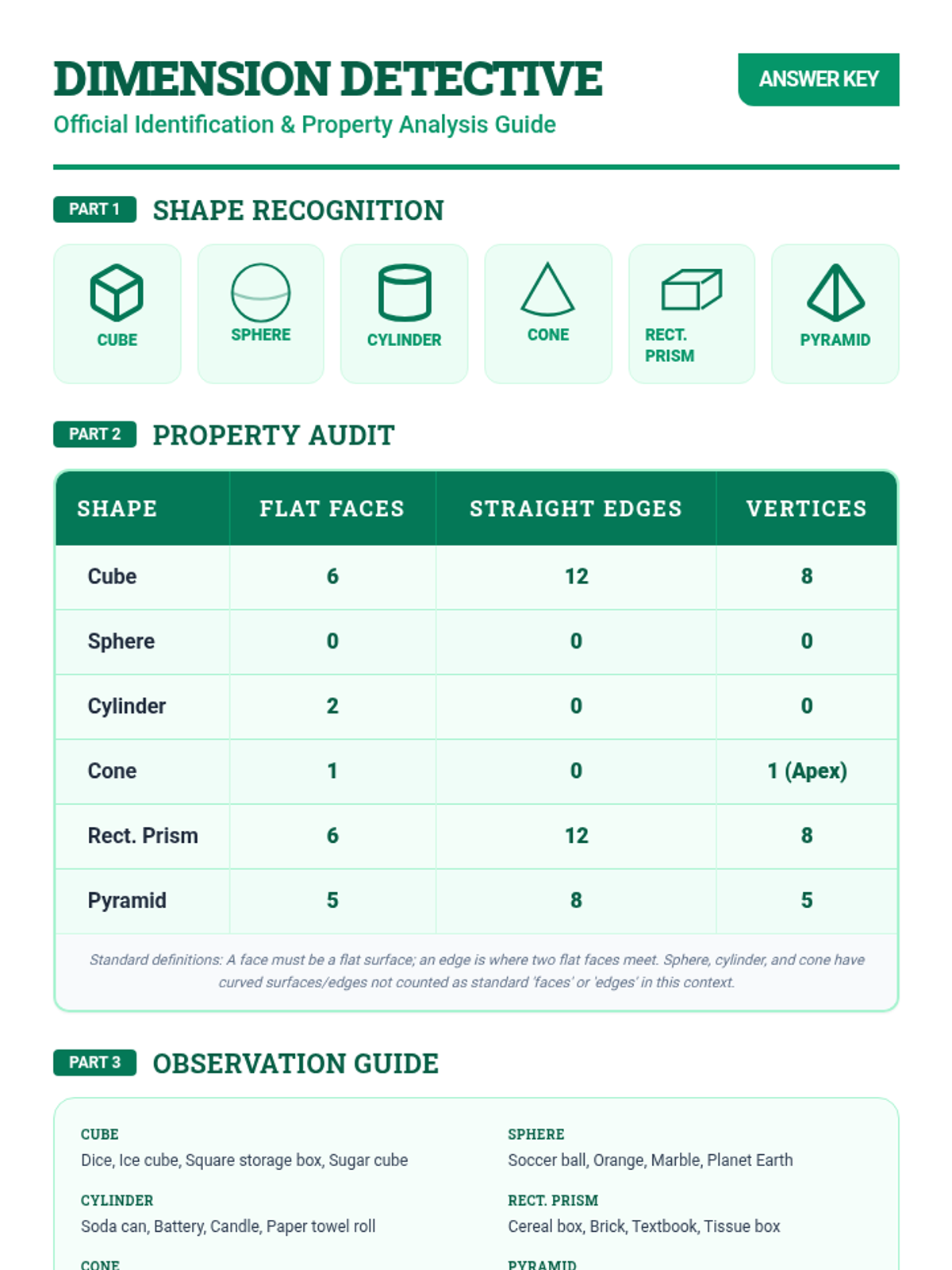
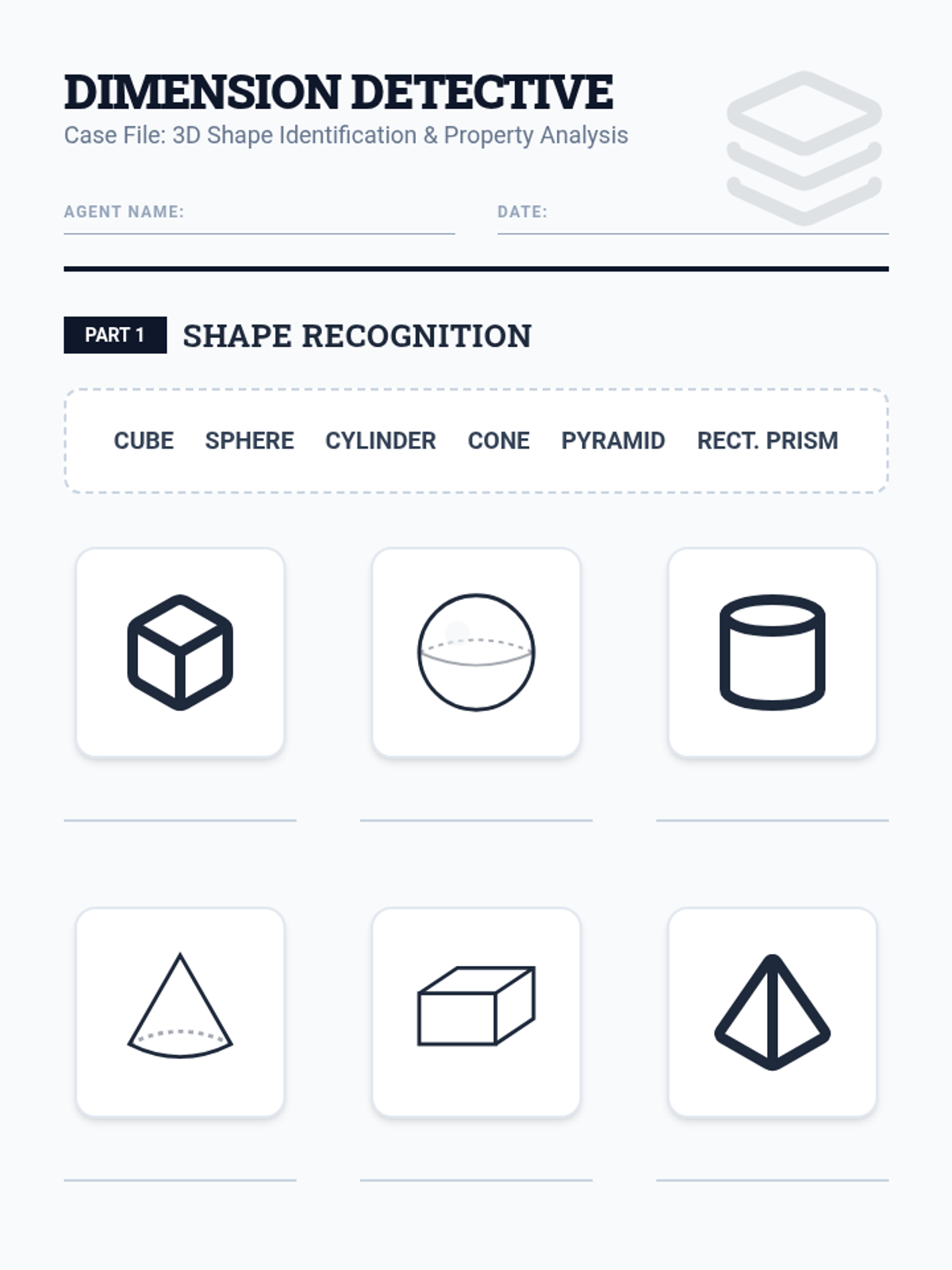
A visual presentation introducing 3D shapes (sphere, cube, cylinder, cone, rectangular prism, pyramid) and their attributes, including stacking, rolling, and sliding.
A printable card game that challenges students to race and build patterns based on specific rules, reinforcing both shape and number sequences.
Final lesson plan for Lesson 3, culminating in a complex pattern-solving vault challenge and a creative final architectural design project.
A numerical pattern worksheet where students solve "Staircase" sequences by identifying rules and filling in missing terms.
A classroom game kit including rules, pattern challenge cards, and printable point tokens (bricks) designed to build quick recognition of shape and number sequences.
Teacher's lesson plan for Lesson 2, focusing on number patterns and skip-counting rules within the context of palace architecture.
A hands-on activity mat where students use pattern blocks to design garden rows following specific repeating and growing rules.
A set of four hands-on activity cards featuring "damaged" palace floors that students must repair and extend using physical pattern blocks, ranging from simple repeating patterns to complex growing sequences.
An engaging slide deck for Lesson 1, introducing repeating and growing patterns through the lens of palace architecture and royal garden design.
A student practice worksheet designed as a palace blueprint, featuring sections for identifying repeating cores, extending number sequences, solving growing pattern word problems, and creating original designs.
A comprehensive teacher's lesson plan for Lesson 1, guiding students through the world of repeating and growing shape patterns using the theme of palace garden design.
Visual presentation for the Pattern Palace Architects lesson, introducing pattern concepts, repeating cores, growing rules, and numerical sequences with engaging royal-themed visuals.
A comprehensive instructional guide for teachers to lead the Pattern Palace Architects lesson, including objectives, materials, timed activities, and differentiation strategies.
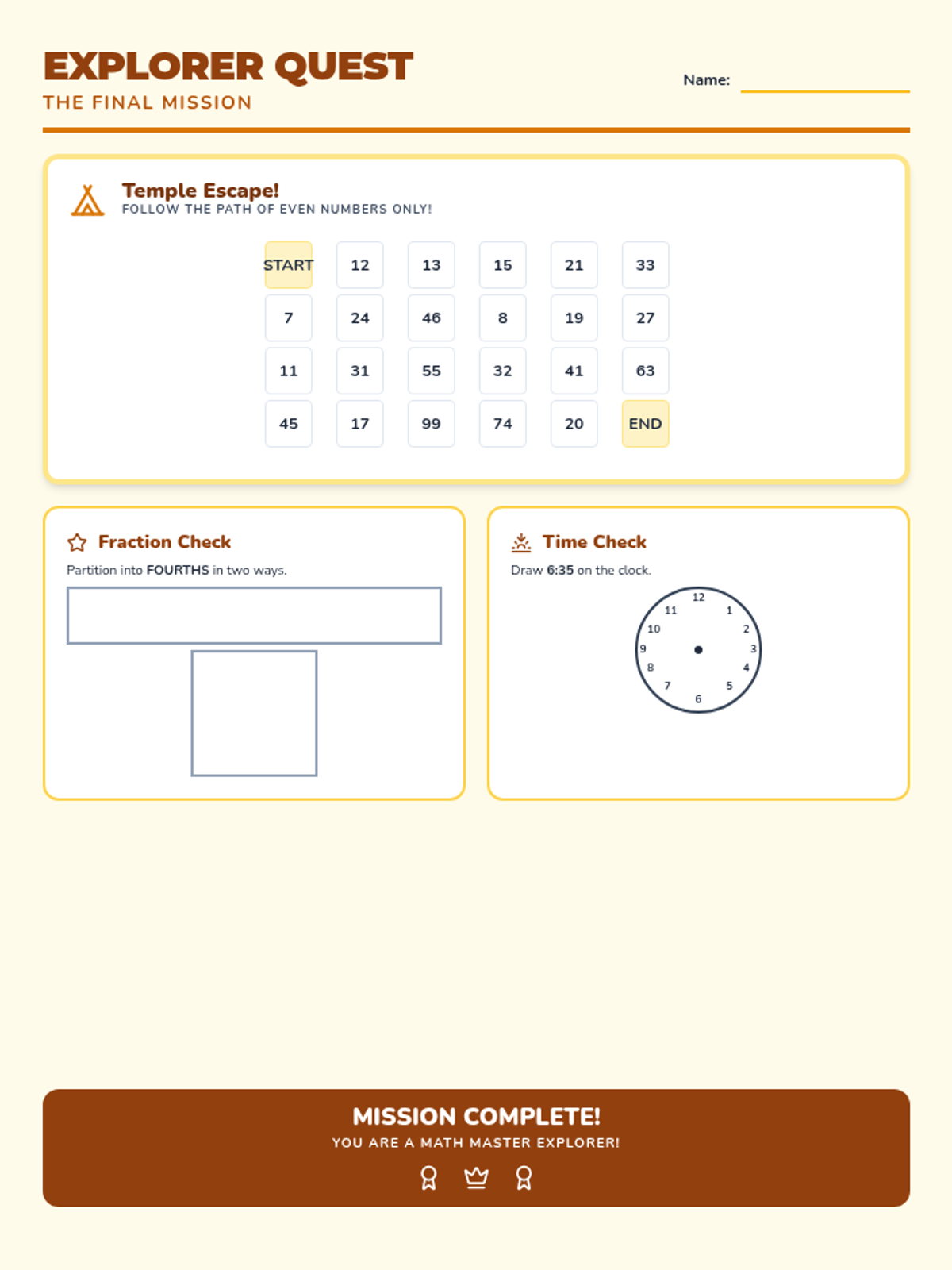
A quick exit ticket for 2nd-grade students to verify their understanding of partitioning shapes into fourths and identifying fraction vocabulary. Includes two identical copies per page.
Answer key for 2nd-grade pixel-based fractions worksheet. Provides specific pixel counts for halves and fourths, identifies correct "fair share" models, and gives grading criteria for the Boss Level.
Worksheet for 2nd-grade fractions. Students partition pixel grids into halves and fourths, identify equal shares (fair vs. unfair), and complete a "Boss Level" drawing different types of partitions.
Slide deck for 2nd-grade fractions. Introduces partitioning, halves, thirds, and fourths using visual grid models and emphasizing the importance of equal shares.
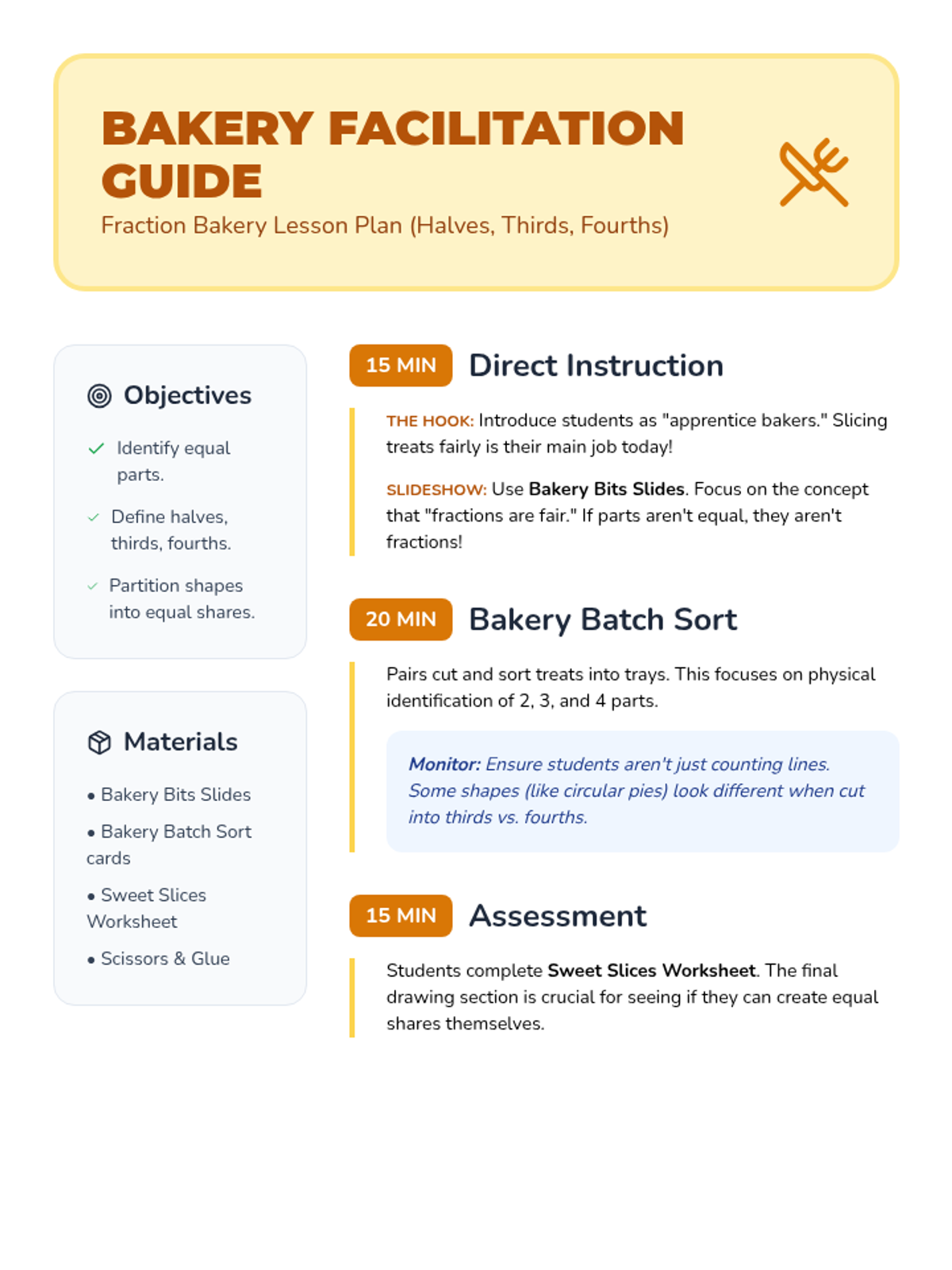
Teacher guide for 2nd-grade fractions lesson using pixel grids. Includes learning objectives, instructional sequence, vocabulary, and discussion prompts for halves, thirds, and fourths.
An answer key for the Fair Share Worksheet, providing correct partitioning examples and answers to the concept check and sharing story assessment.
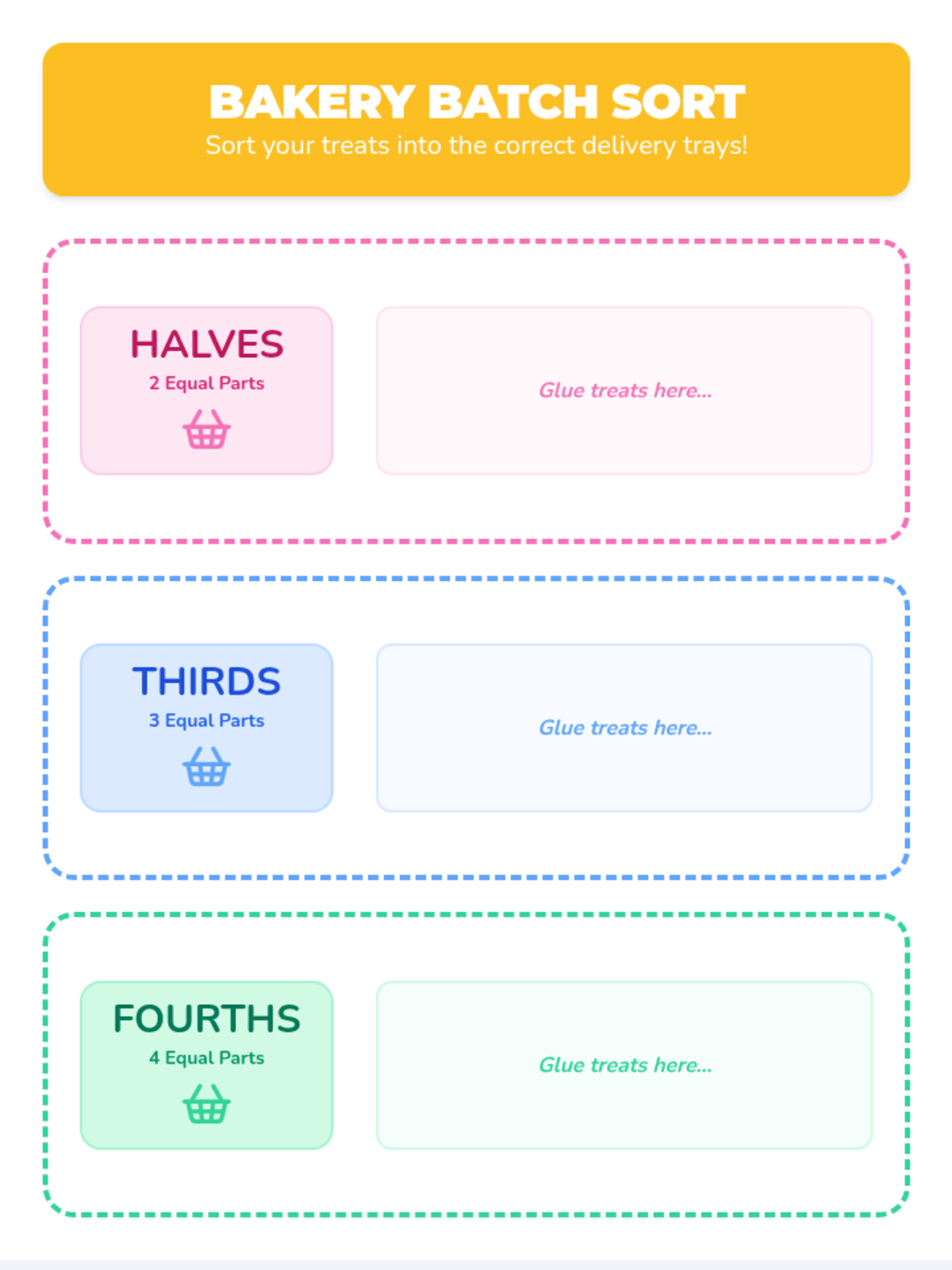
Answer key for the Bakery Shares worksheet, providing sample responses for error analysis and correct partitioning examples.
An answer key for the Square Builder Worksheet, providing clear visual and mathematical solutions for teacher use.
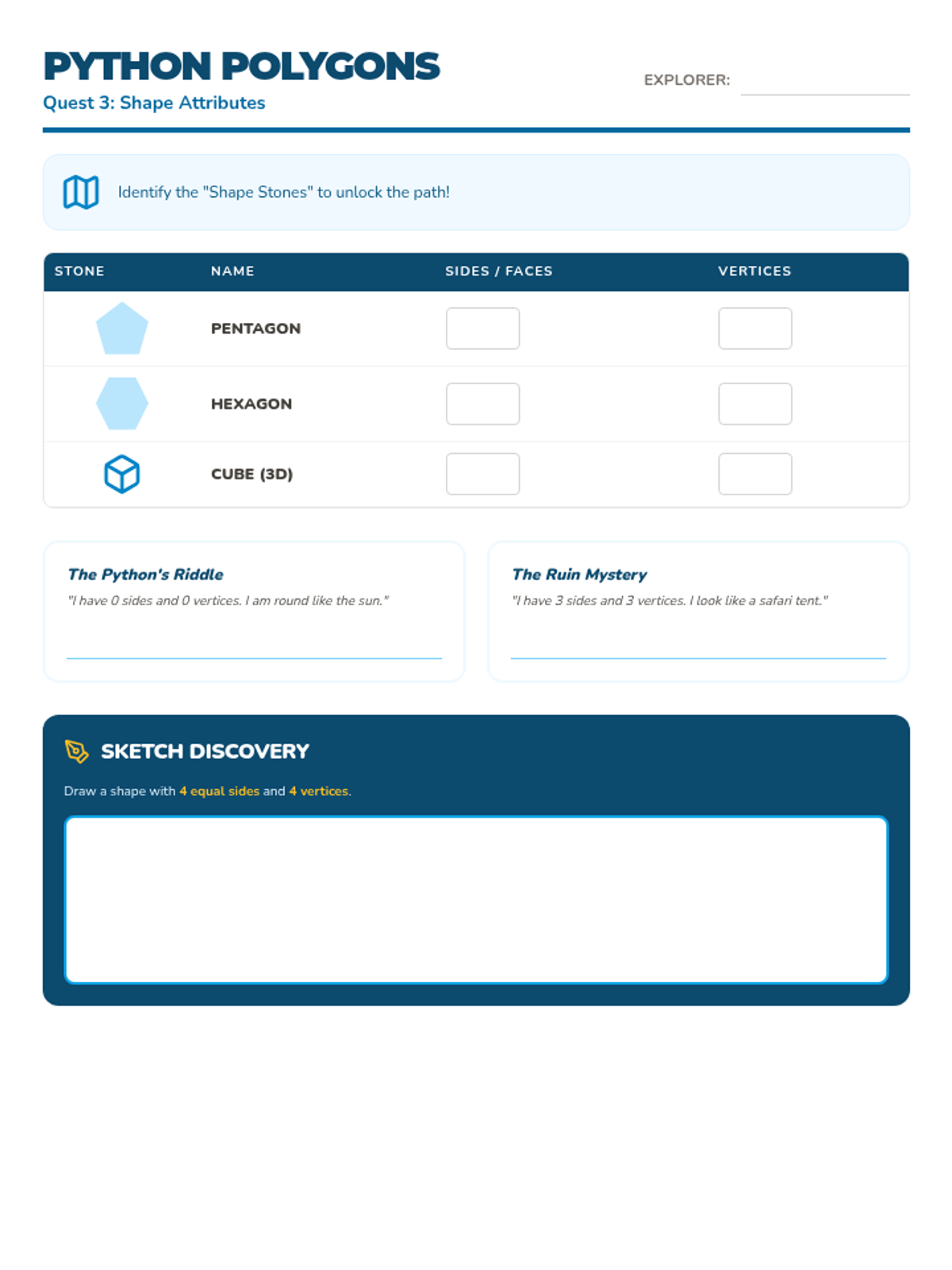
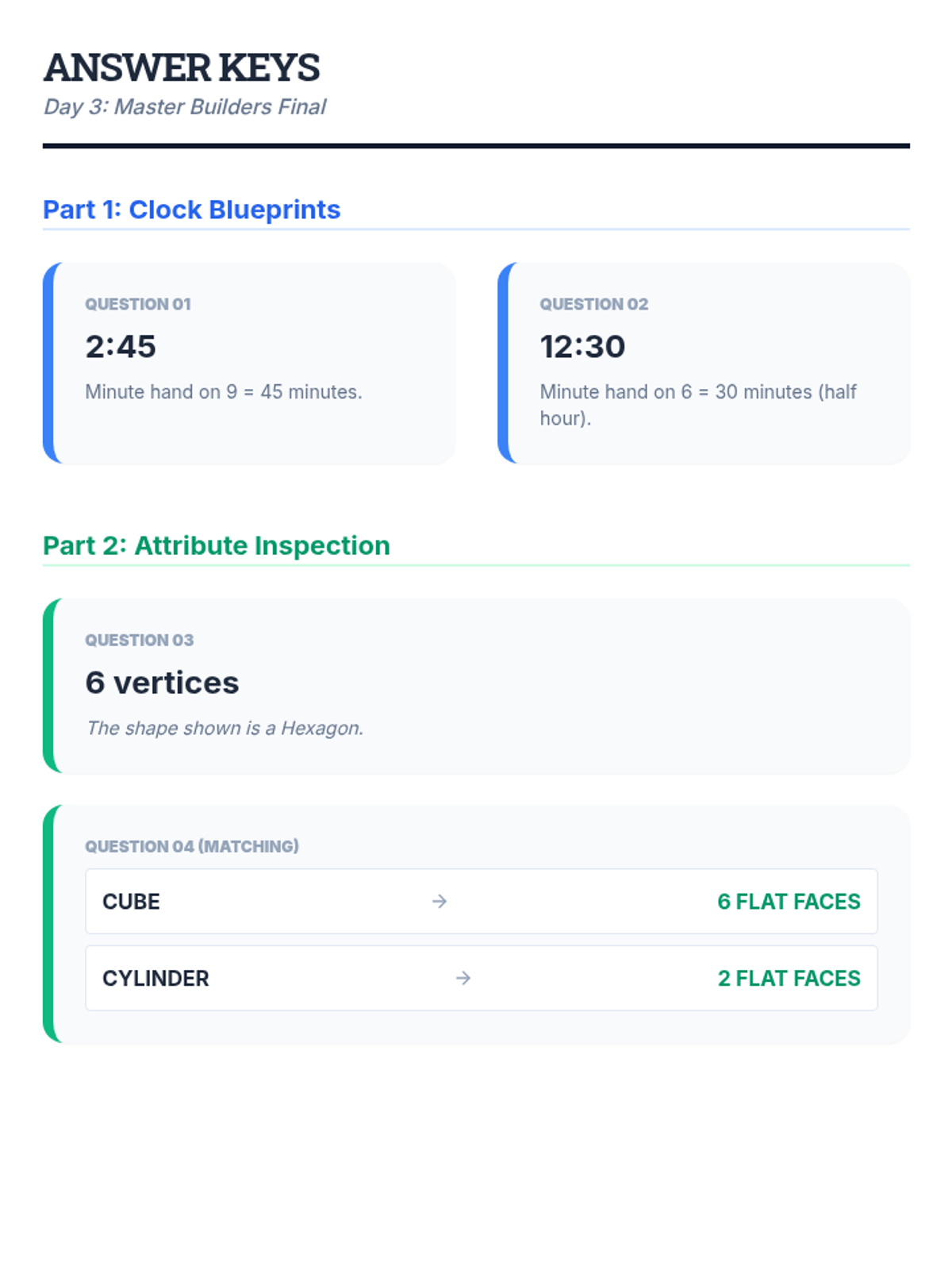
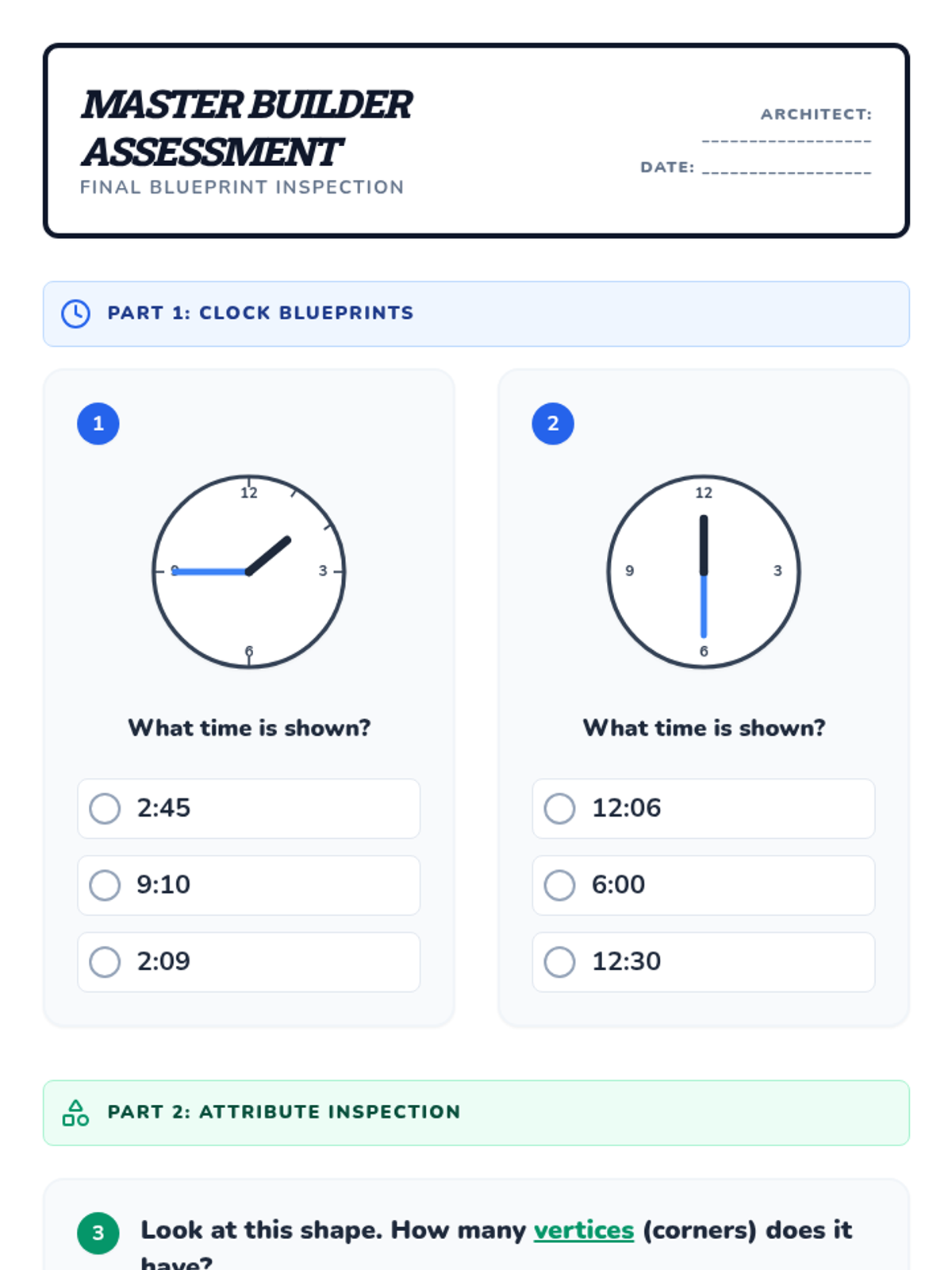
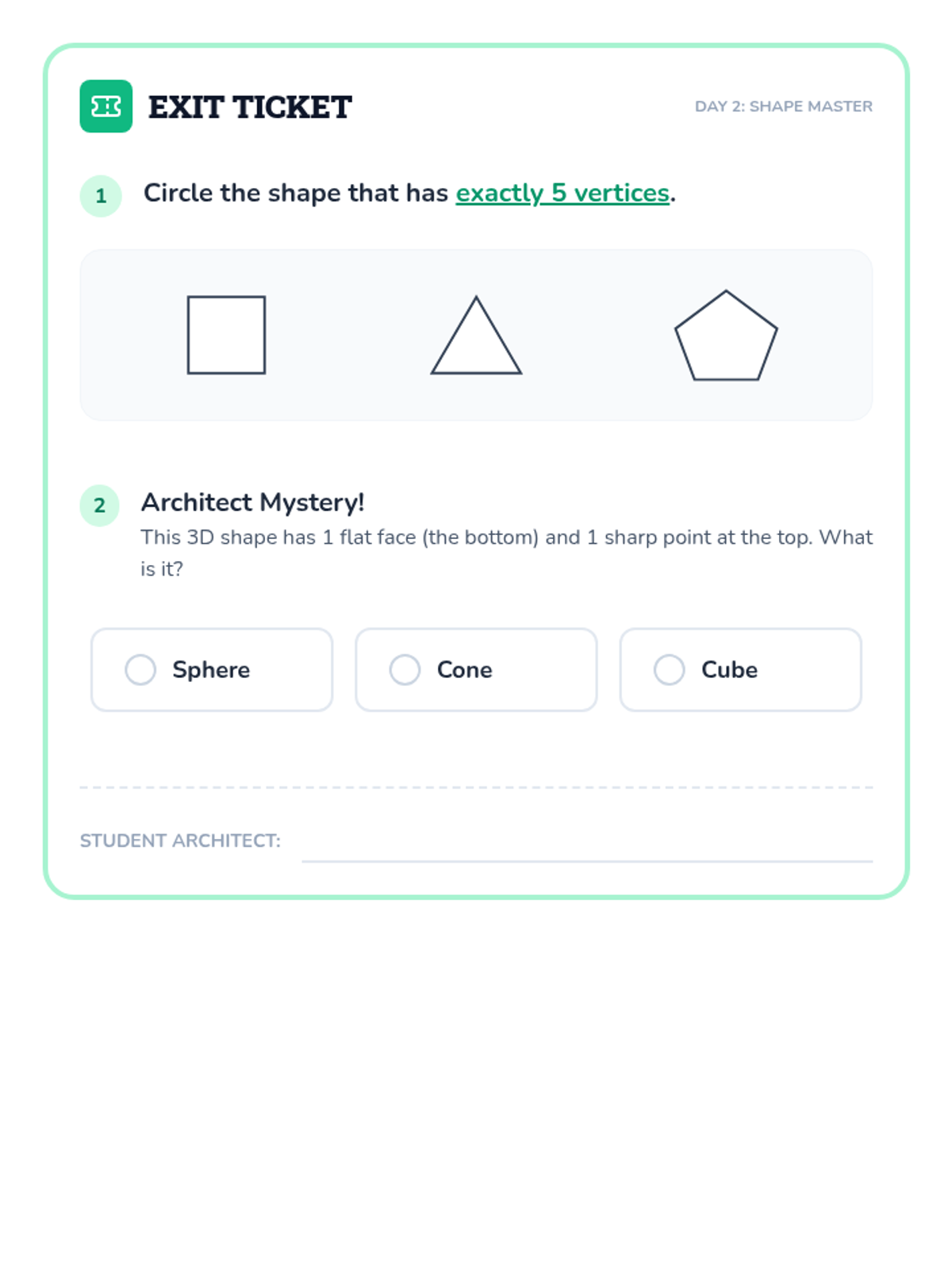
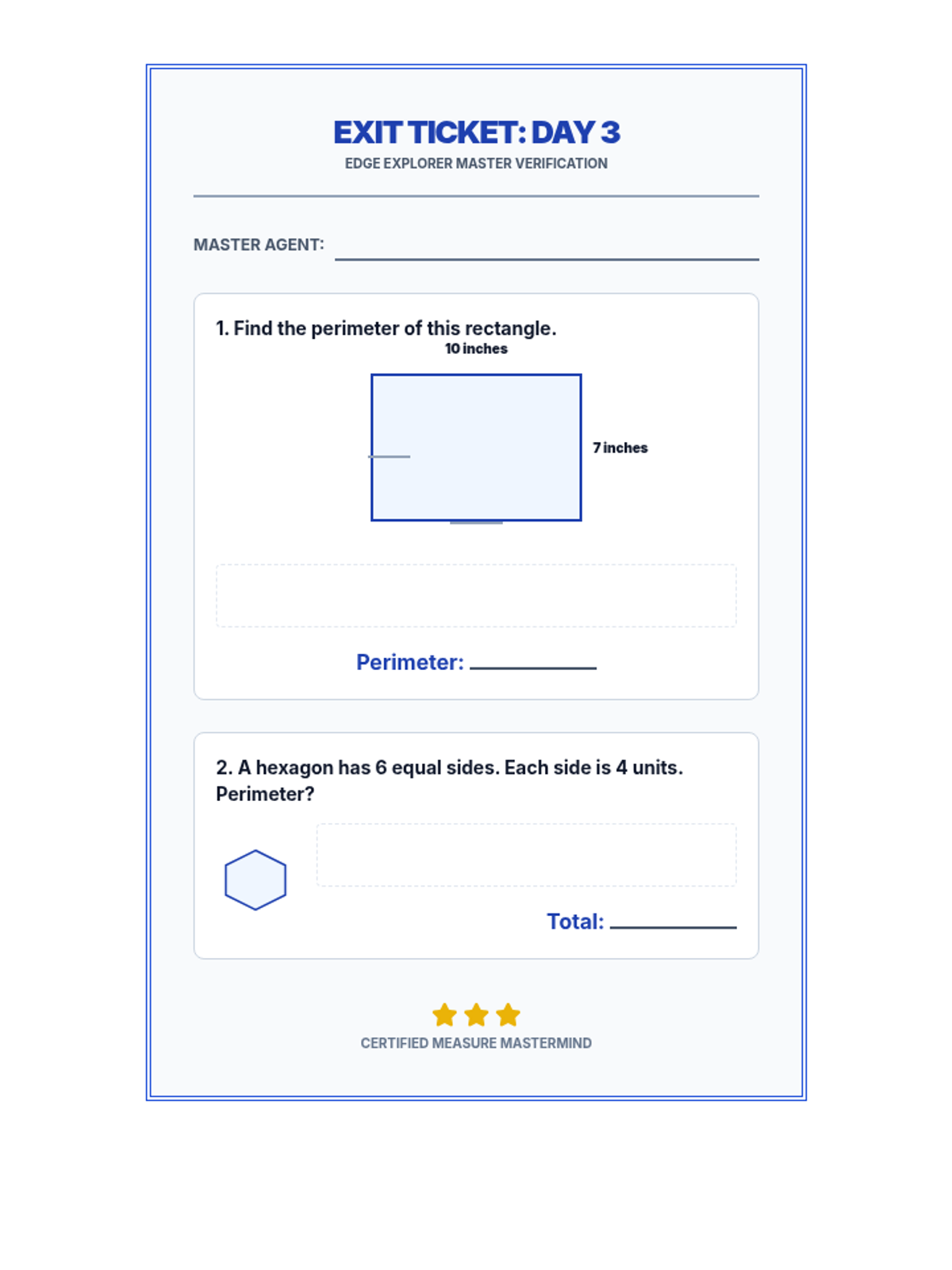
A formative assessment (exit ticket) for students to demonstrate their ability to identify 2D shapes by sides/angles, count attributes on a hexagon, identify a cube by its faces, and draw a pentagon.
A progress monitoring and assessment tool for teachers to track student mastery of partitioning rectangles. Includes a data tracker, observational checklist, and a quick individual assessment (exit ticket).
A student worksheet for identifying fair shares, explaining errors in partitioning, and drawing halves and fourths on circles and rectangles.
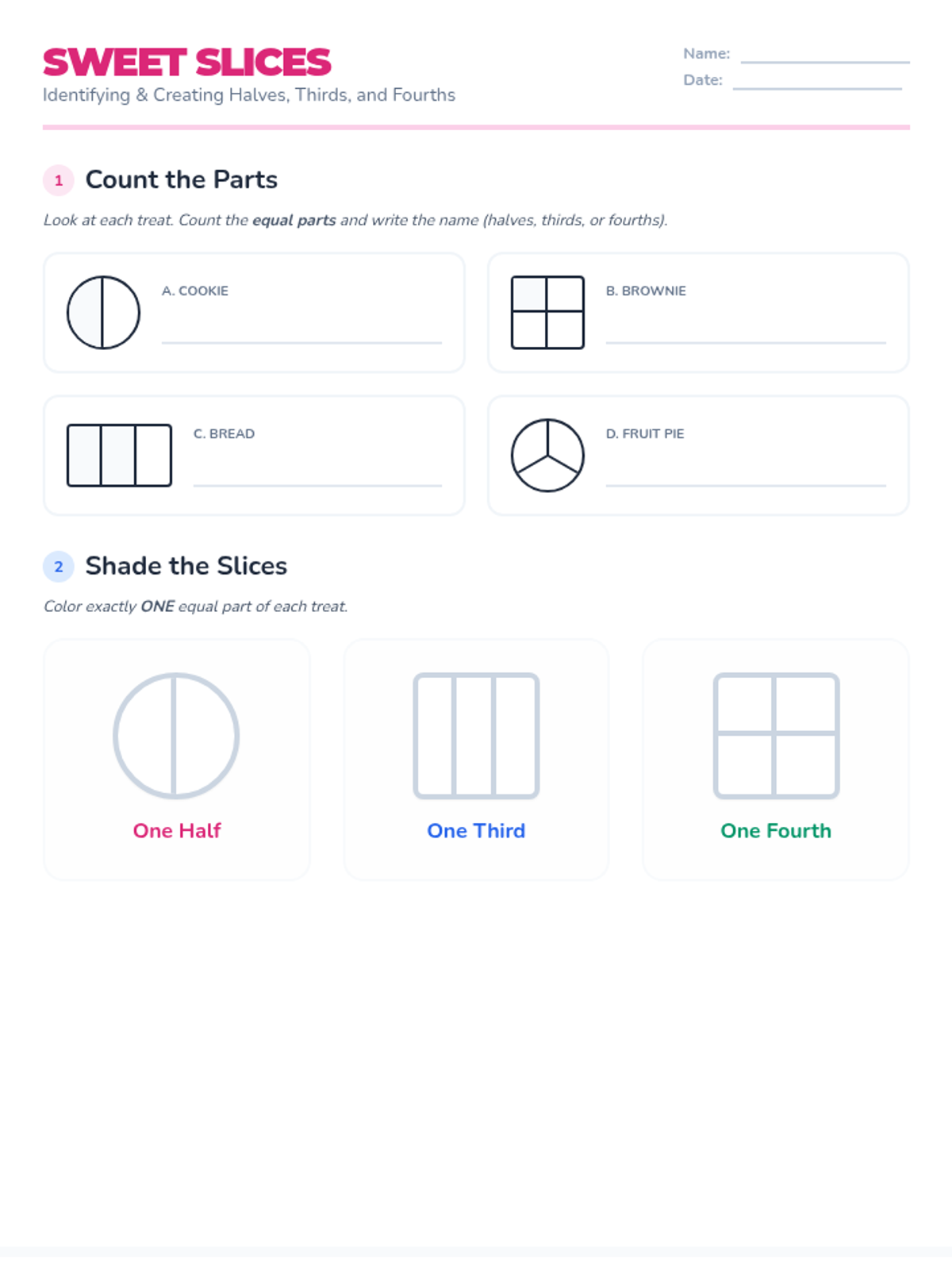
A student practice worksheet for partitioning circles and rectangles into halves and fourths. Includes visual identification of fair shares, guided partitioning tasks, and a sharing story problem assessment.
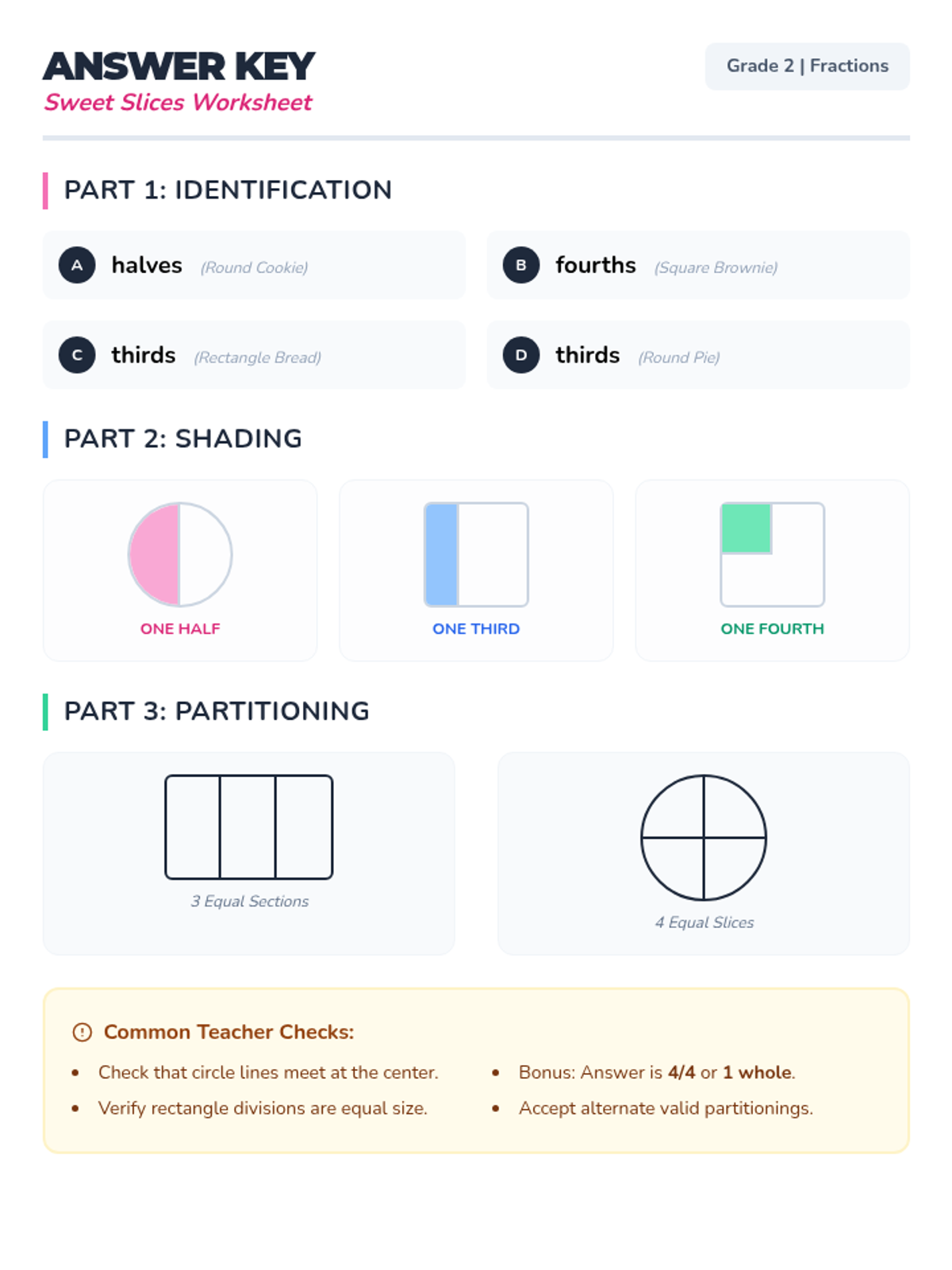
A visual answer key for the Share Squad Lab Worksheet, showing correct partitioning for halves, thirds, and fourths with teacher-facing scoring guidance.
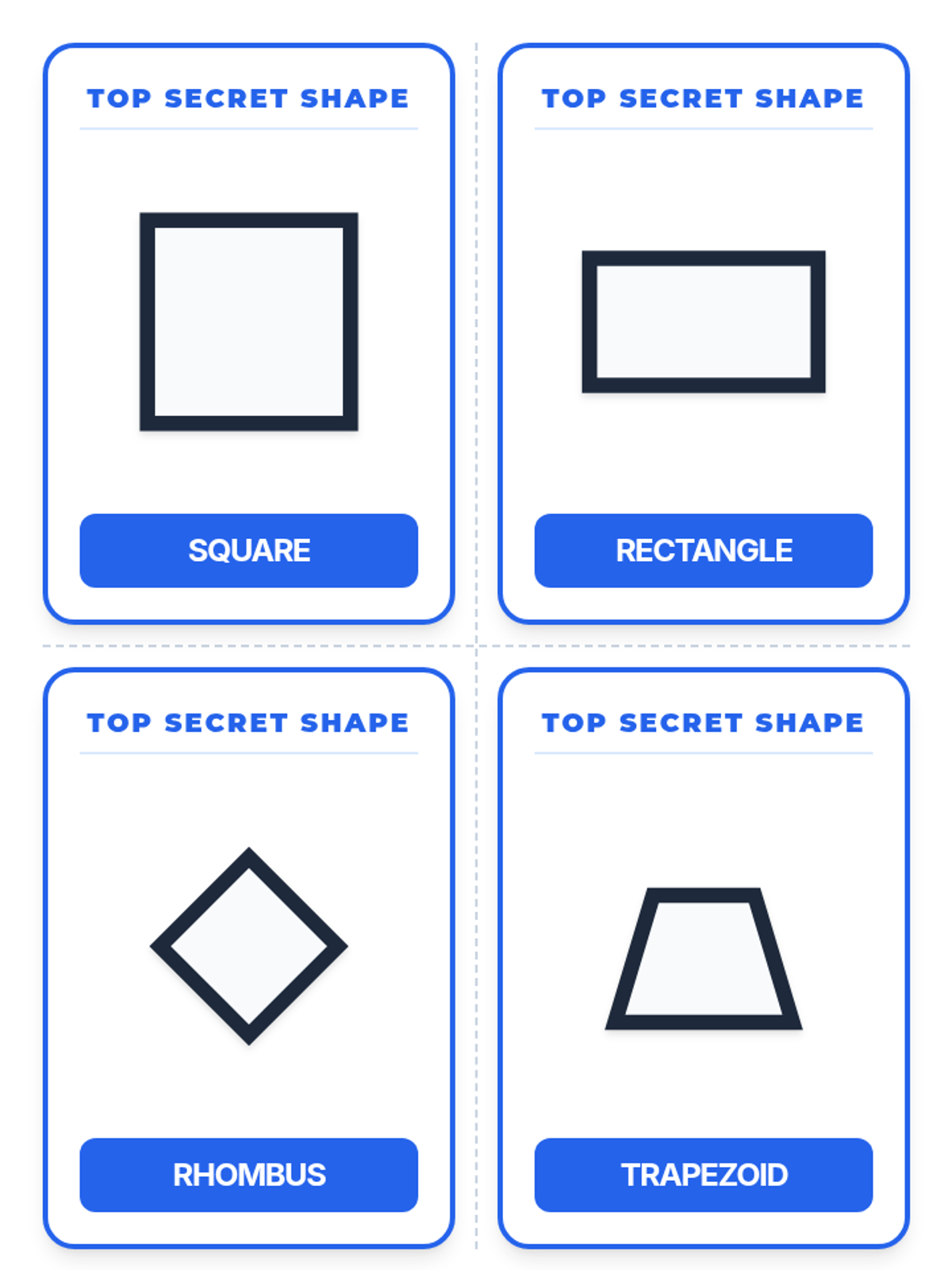
A set of printable "Sleuth Evidence Cards" featuring attribute clues (e.g., "3 sides & 3 angles") and matching shape name cards. Ideal for attribute games like Mystery Bag or matching activities.
A quick, 2-question exit ticket for assessing student understanding of fourths and thirds. Includes two copies per page for efficient printing.
A short progress monitoring exit ticket designed for Tier 2 intervention. It checks shape identification (pentagon, hexagon, cube), attribute knowledge for pentagons, and the ability to draw a quadrilateral. Includes a teacher scoring footer.
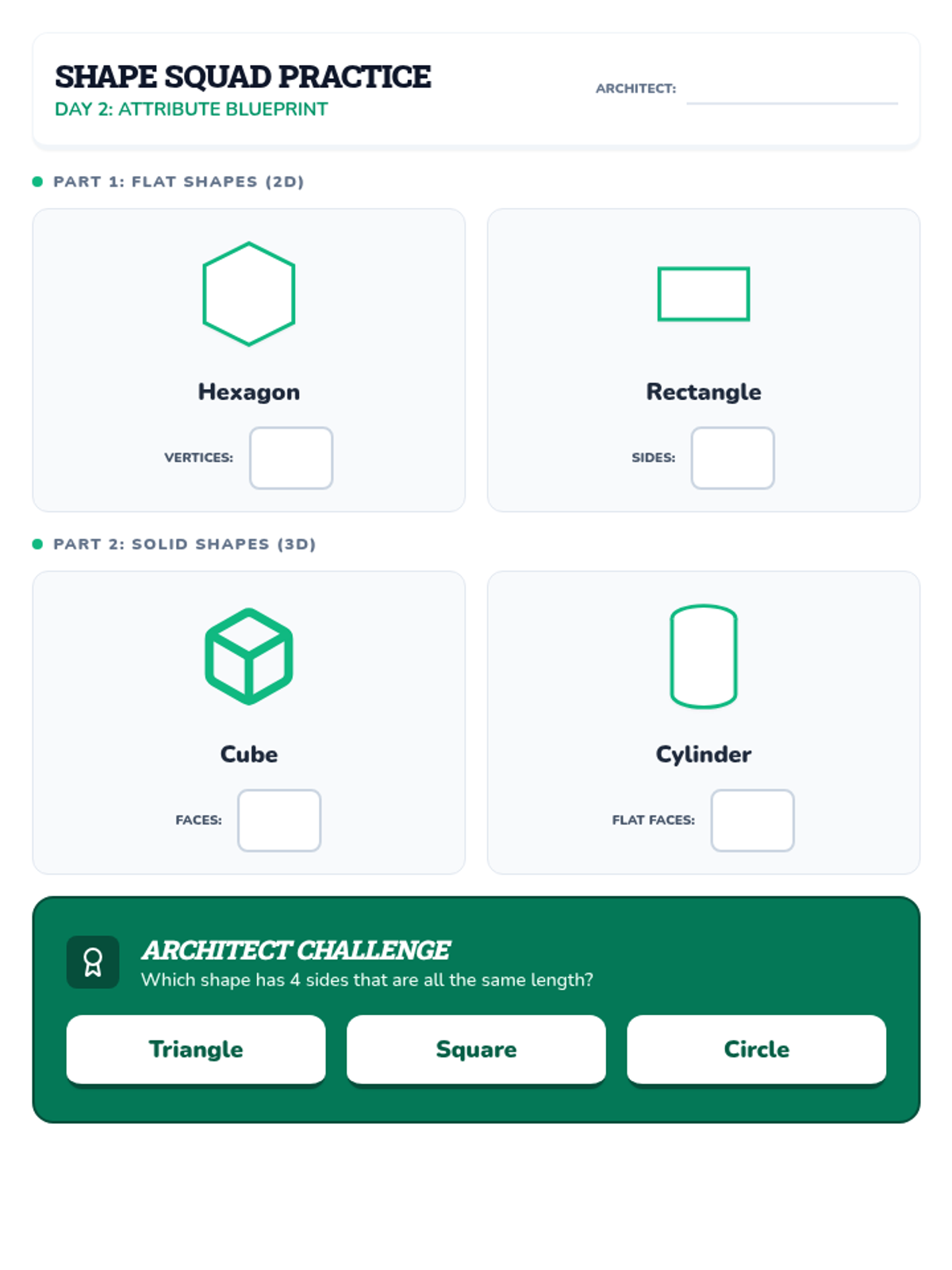
A student-facing worksheet for hands-on exploration of 2D and 3D shapes. Includes a recording table for sides and angles, a section for counting faces on a cube, and a sketching area.
Scaffolded task cards for geoboard activities. Each card features a shape (triangle, quadrilateral, pentagon, hexagon), its required attributes, and a visual model. Includes a bonus challenge for higher-order thinking.
A class-wide data tracking chart designed for teachers to record diagnostic results across all domains for grades 2-5, helping to visualize instructional groups and skill gaps.
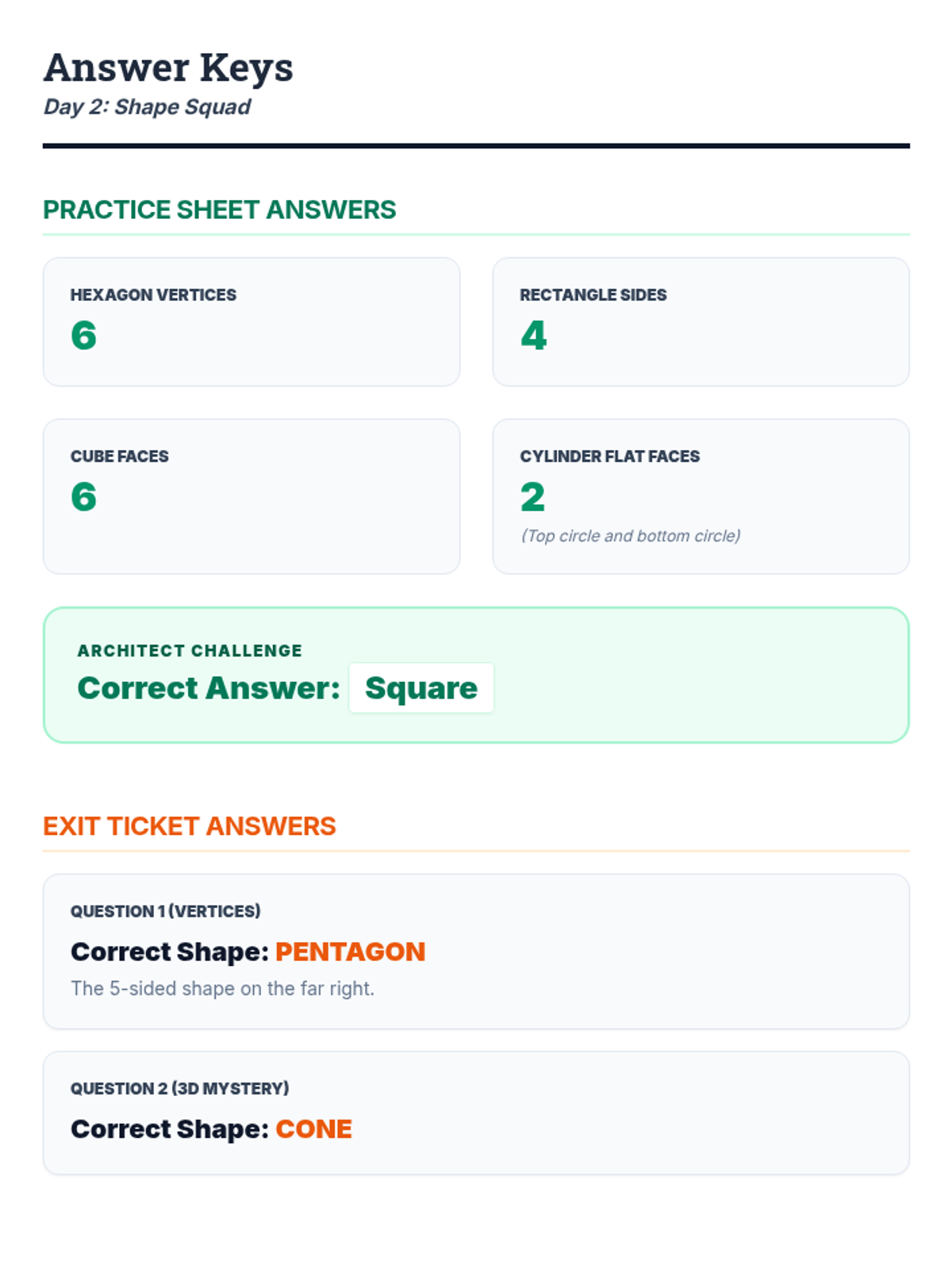
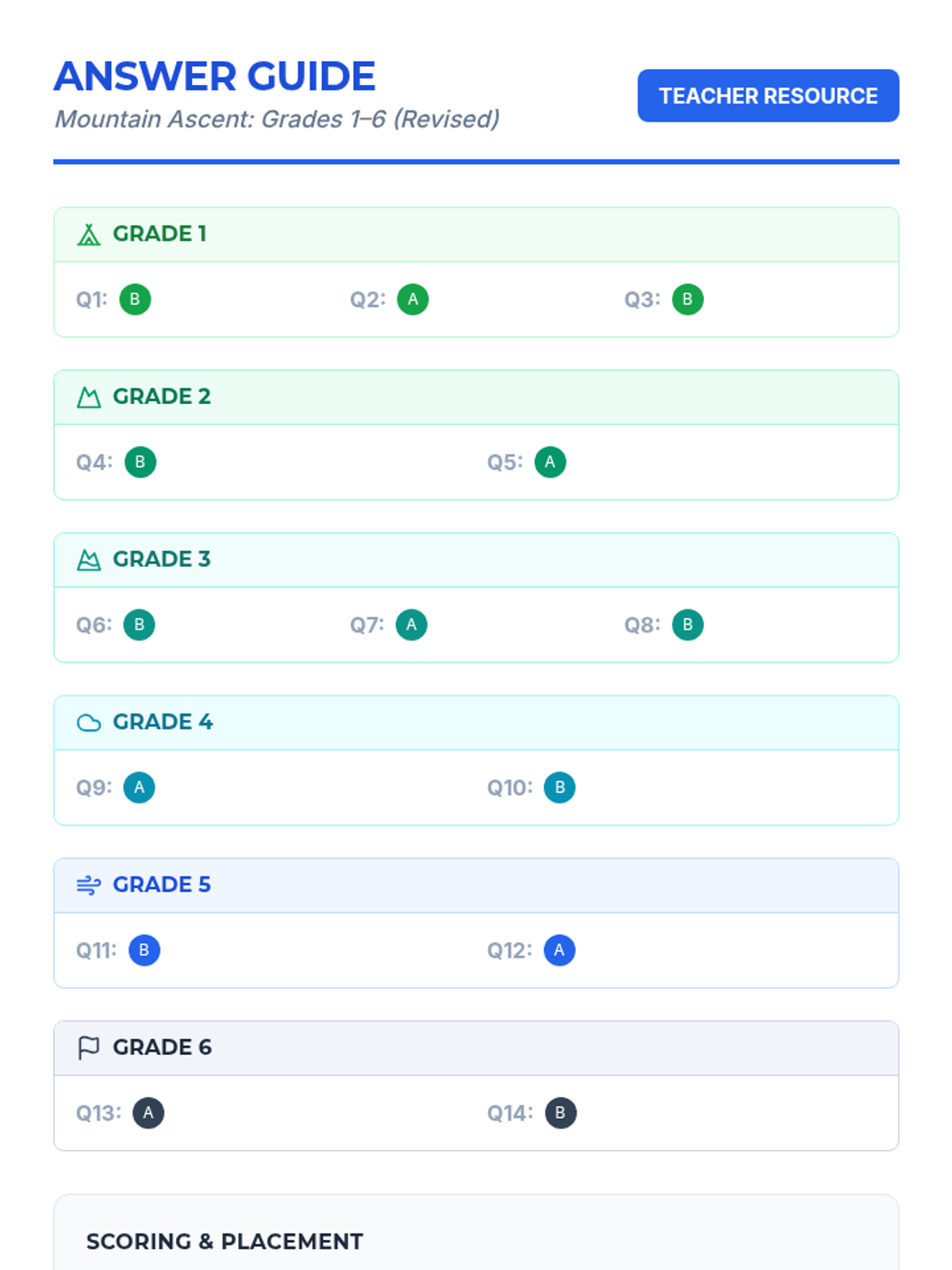
A comprehensive answer key and scoring guide for the Grade 2-5 math diagnostic assessments. Includes specific answers and helpful hints for interpreting student results.
A 5th-grade diagnostic assessment covering powers of 10, decimal operations, multi-digit division, and adding/subtracting fractions with unlike denominators. Aligned to Iowa Core standards.
A 4th-grade diagnostic assessment targeting multi-digit multiplication and division, place value to 1,000,000, fraction equivalence, and decimal comparisons. Aligned to Iowa Core standards.
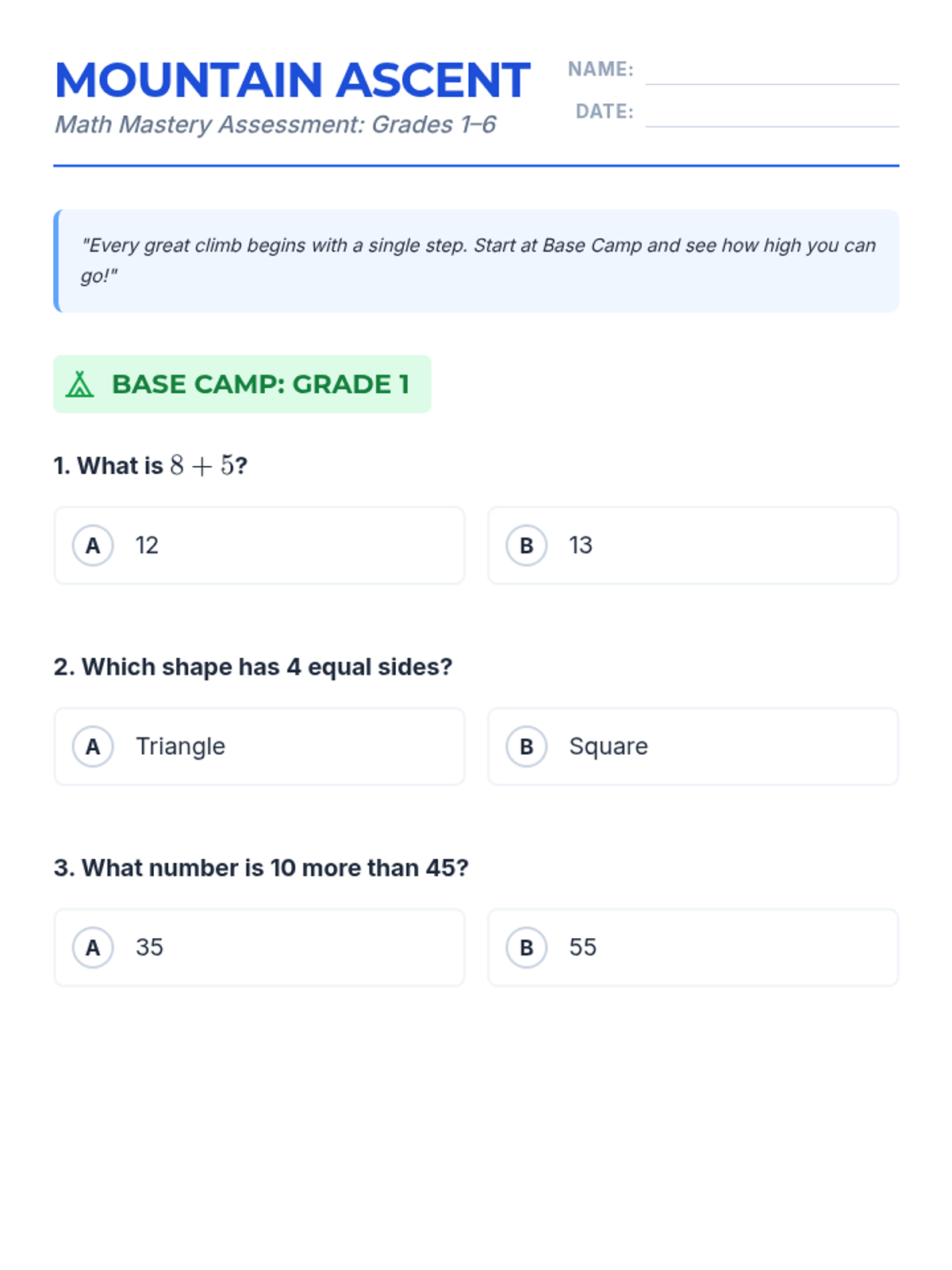
A 3rd-grade diagnostic assessment covering rounding, multi-digit arithmetic, multiplication and division concepts, and introductory fraction number line and visual models. Aligned to Iowa Core standards.
A short 2nd-grade diagnostic assessment covering place value to 1,000, multi-digit addition and subtraction, two-step word problems, and early multiplication/fraction foundations. Aligned to Iowa Core standards.
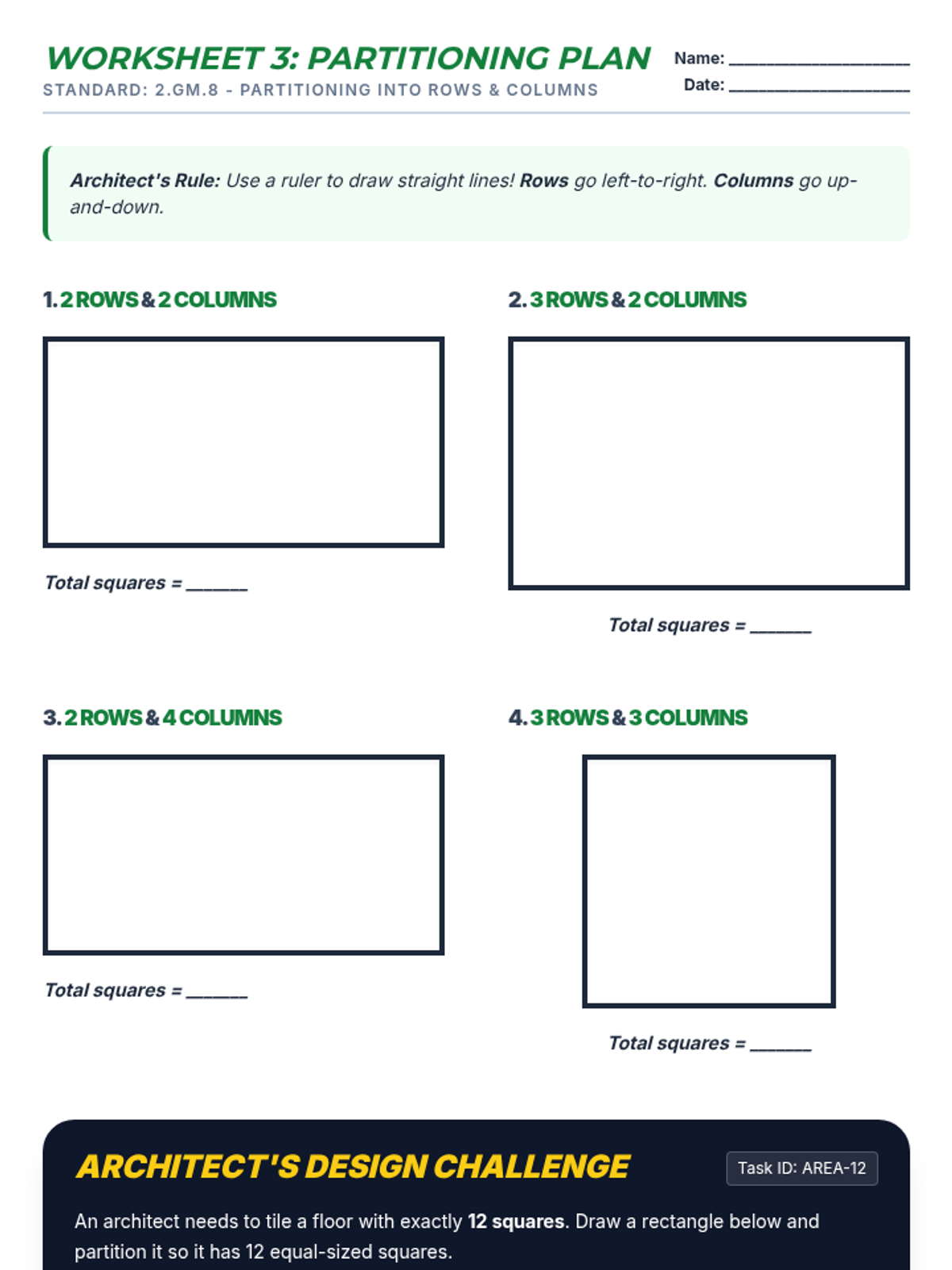
A scaffolded student practice worksheet for partitioning rectangles. Includes tasks for building with tiles, drawing partitioning lines on a grid, and writing repeated addition equations to find totals.
A visual presentation for a Grade 2 intervention on partitioning rectangles. Features high-contrast visuals, vocabulary focus, and clear modeling of rows and columns with common misconceptions highlighted.
A comprehensive teacher facilitation guide for a Tier 2 intervention on partitioning rectangles. Includes learning objectives, materials, a structured I Do/We Do/You Do sequence, and specific scaffolding strategies for Grade 2 students.
A comprehensive teacher guide for the Monster Mirror Magic lesson, including equipment lists, step-by-step facilitation instructions, and specific video discussion cues.
A detailed facilitation guide for teachers to deliver the Symmetry Land lesson, including timing, procedure, and key teaching moments.
A creative writing extension sheet where students write a short story and develop a profile for their symmetrical monster creation.
A fun, amusement-park-themed worksheet where students identify and trace vertical lines of symmetry for objects seen in the Symmetry Land video.
Visual presentation slides to guide students through the symmetry land video, key concepts of reflection, and the step-by-step monster-making activity.
A vibrant slide deck for 2nd graders to learn about vertical symmetry, featuring a warm-up game, embedded video, and concept visualization using 'Symmetry Land' amusement park themes.
A structured art activity and analysis worksheet where students create a paint-blot symmetrical monster, identify its line of symmetry, and document matching features.
A teacher-facing reference guide with examples of real-world angles found in classrooms and tips for addressing common 2nd-grade misconceptions.
A student recording sheet for the 'Angle Detectives' scavenger hunt, including a log for objects found and printable labels to identify small and large turns.
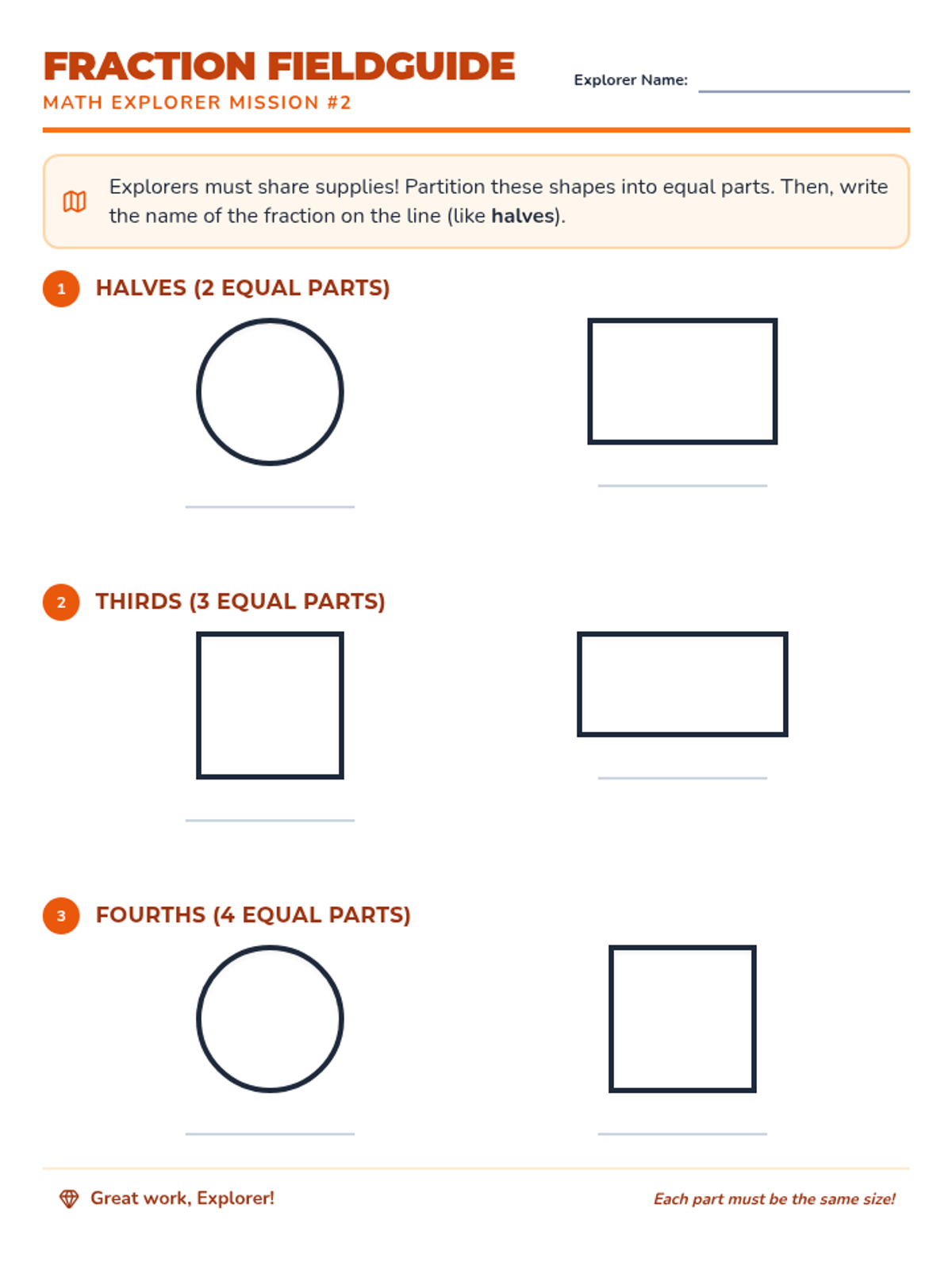
A guided practice worksheet for students to partition rectangles and circles into halves, thirds, and fourths. Includes a challenge to show fourths in two different ways.
A set of printable rectangular strips and circles for hands-on folding activities. Includes scaffolded dotted lines for thirds and fourths to support Tier 2 learners.
A visually engaging slide deck for the Shape Sleuths lesson, featuring a "Mystery Case" theme. It covers 2D attributes (sides, angles), 3D attributes (faces), and specific shape case studies to guide small group instruction.
A progress monitoring tool for teachers and students, featuring two 'Mission Logs' for quick checks on shape identification and drawing, along with a group mastery tracker for the teacher.
A bright, visual slide deck for Grade 2 Tier 2 instruction on partitioning shapes. Focuses on the definition of equal shares, halves, thirds, and fourths with clear geometric examples.
A student worksheet with scaffolded activities including shape sorting, drawing shapes based on attributes (angles/sides), and identifying features of a cube. Includes clear work areas and Grade 2 friendly instructions.
Engaging instructional slides for Grade 2 geometry intervention, defining attributes (sides, angles, faces) and showcasing 2D and 3D shapes with clear, large-scale visuals.
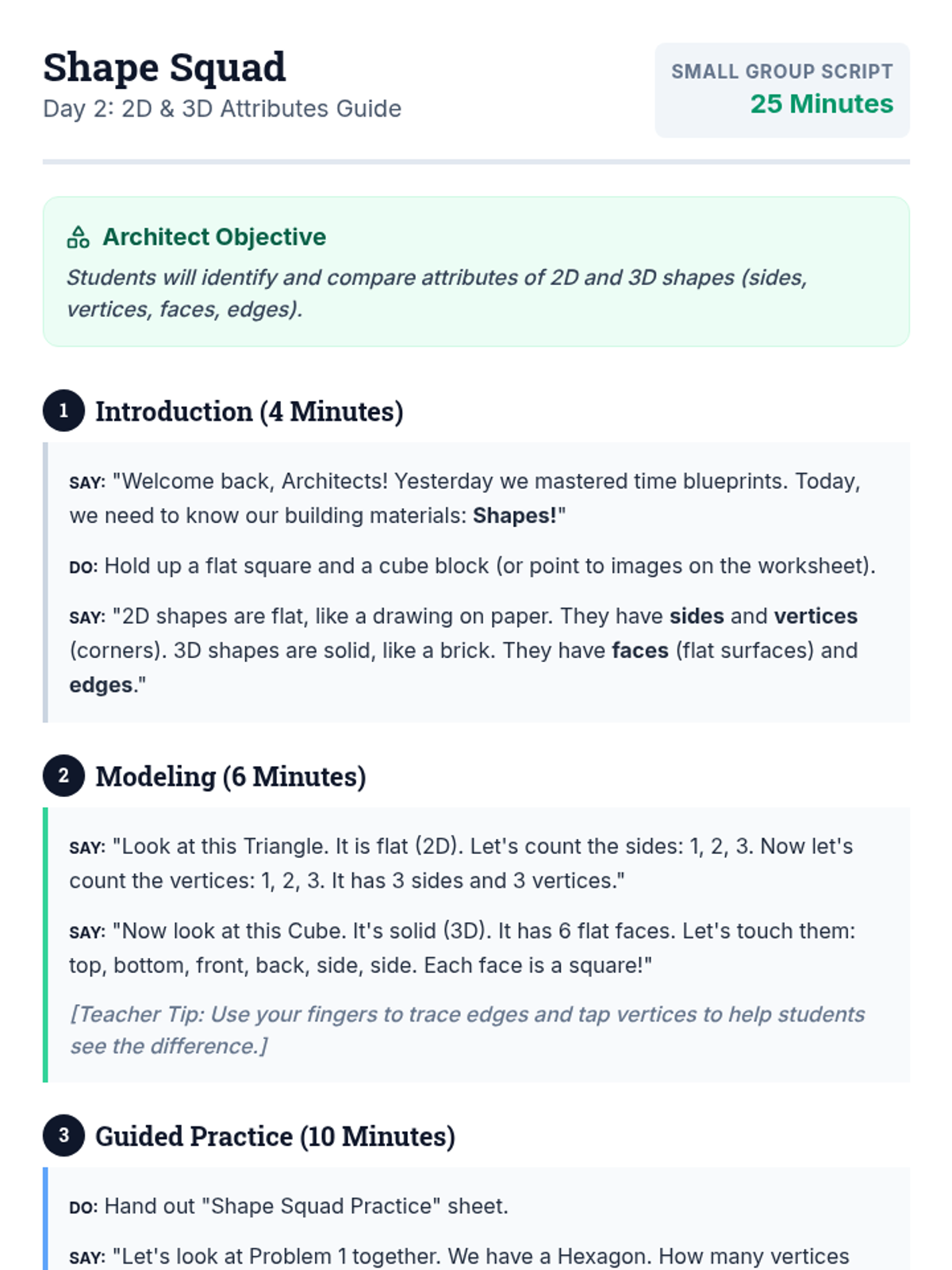
A comprehensive teacher guide for the Shape Sleuths intervention lesson, including objective, materials list, a 4-step instructional routine, and tips for addressing common misconceptions.
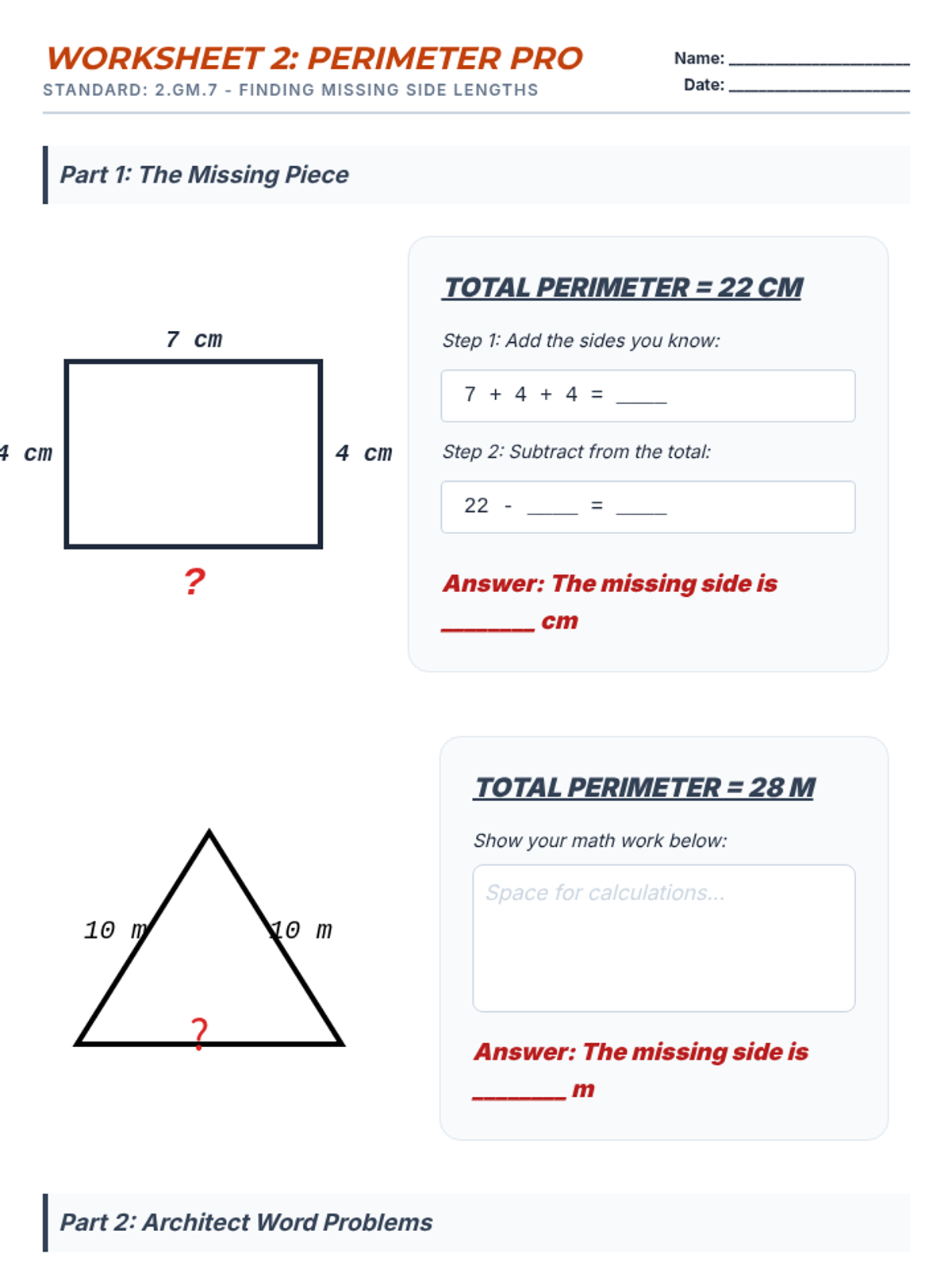
A clear grading rubric for the Zoo Designer project, evaluating perimeter accuracy, mathematical equations, design clarity, and reflection.
A 4-page student project packet for designing a zoo, featuring perimeter calculation planning, a large blueprint grid, and a final reflection checklist.
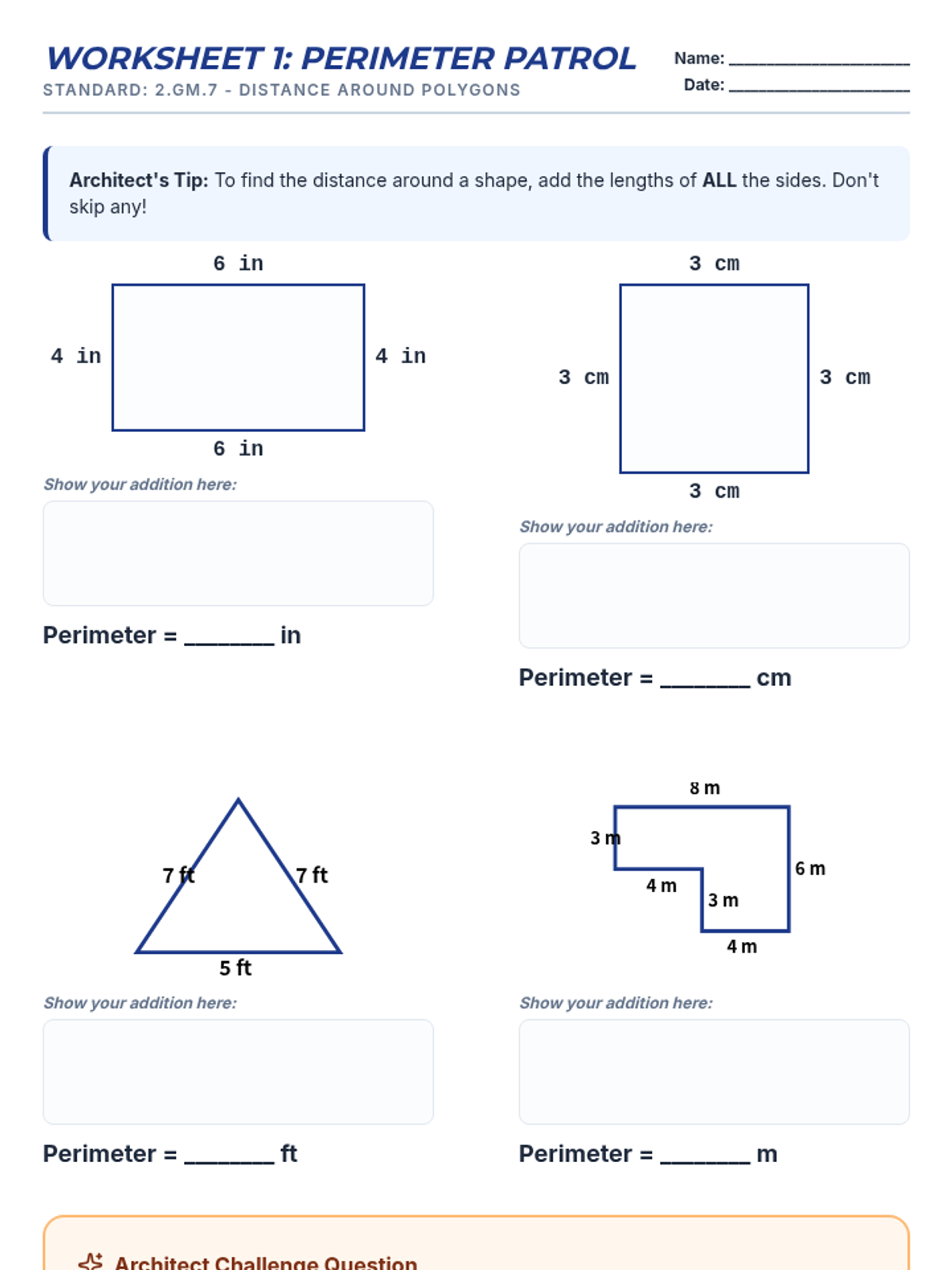
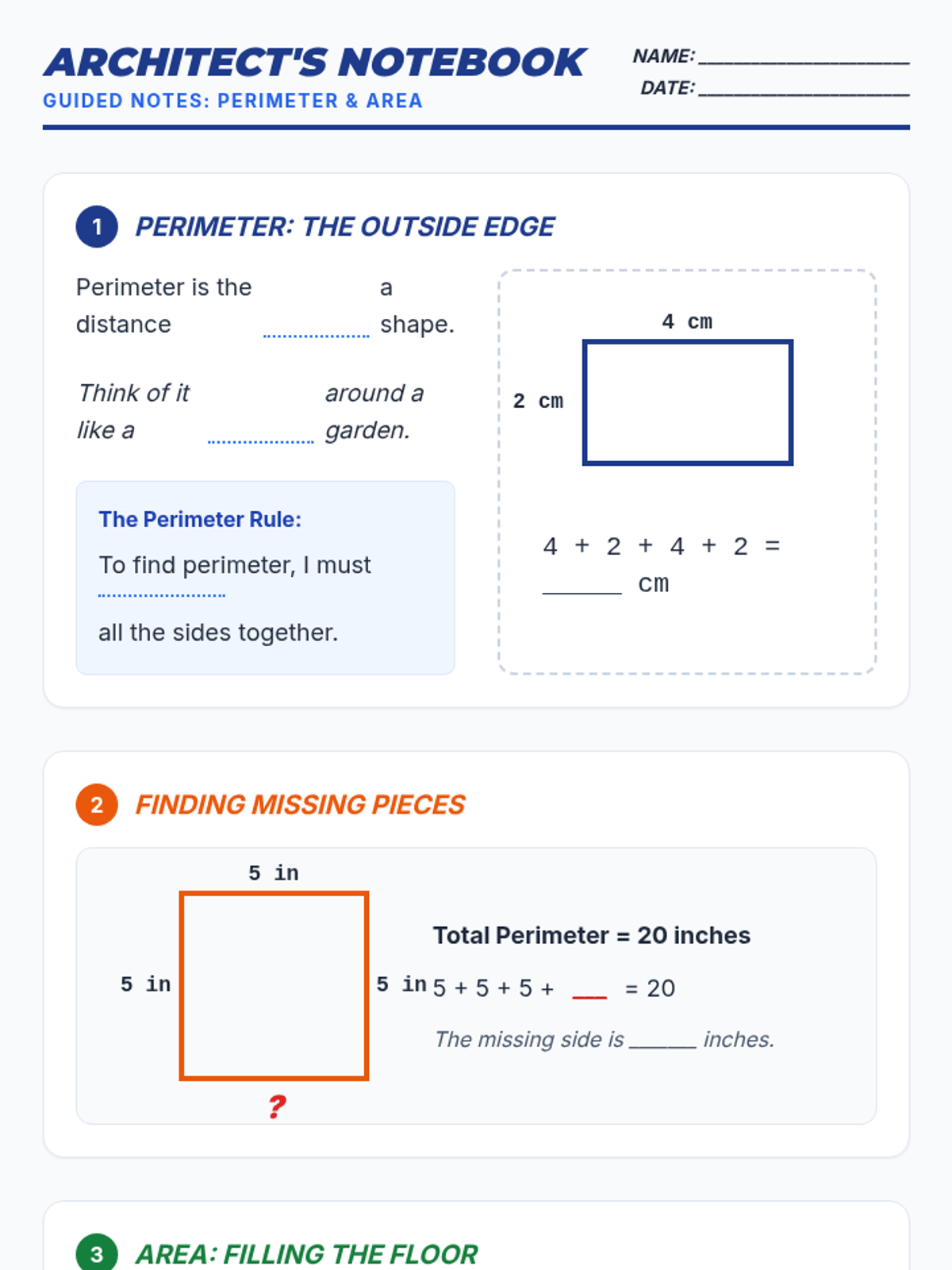
A bright, visual anchor chart for 2nd graders that defines perimeter as the distance around a shape, featuring a zoo-themed example and step-by-step instructions.
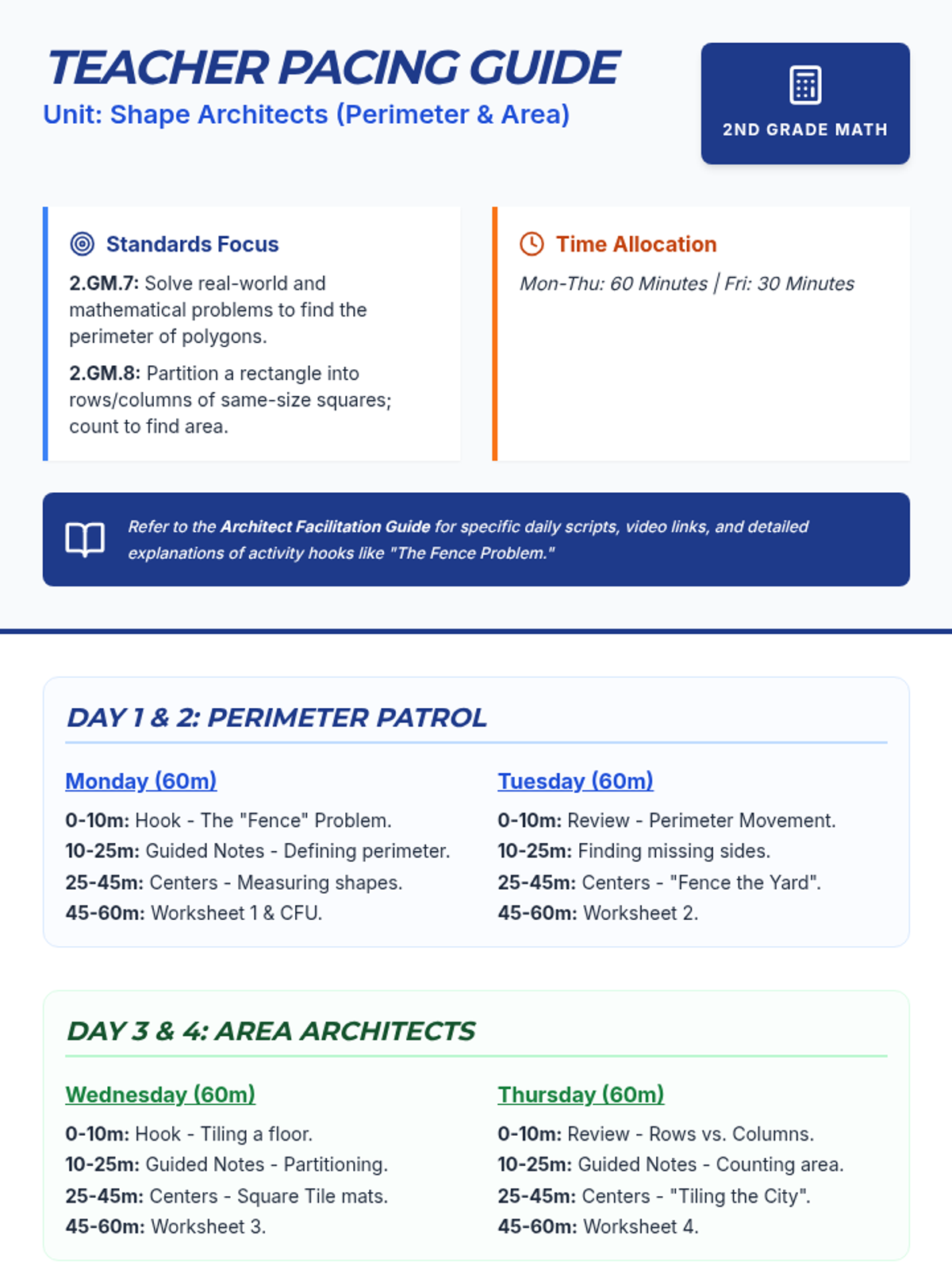
A comprehensive teacher's lesson plan for a 2nd-grade perimeter project, including learning objectives, a step-by-step instructional flow, and differentiation strategies.
A quick progress monitoring tool for partitioning rectangles. Features two assessment items focusing on row/column identification and repeated addition equation construction.
A scaffolded student worksheet for partitioning rectangles. Includes a tile-and-trace activity with 1-inch scale, repeated addition equation practice, and an independent blueprint drawing task.
A formative assessment exit ticket for the Grid Gliders lesson. It features three items: identifying rows and columns in a given grid, partitioning a blank rectangle into 4 rows and 2 columns, and identifying an array with a specific total count.
A student practice mat for the Grid Gliders lesson. It includes a specific area for hands-on tile placement (sized for 1-inch tiles) and a drawing section with dot guides to help students partition a 3x3 grid.
Visual instructional slides for a small group intervention on area. Features clear vocabulary for rows and columns, visual tiling rules, and step-by-step repeated addition connections.
A comprehensive teacher facilitation guide for the Grid Gliders lesson. Includes specific instructional steps, common student misconceptions to watch for, and differentiation strategies for Tier 2 intervention.
A visual slide deck designed for Grade 2 small group intervention. It introduces the concepts of rows and columns, demonstrates how to tile a rectangle, and shows the transition from physical tiles to a drawn grid.
A comprehensive teacher guide for a Grade 2 intervention lesson on partitioning rectangles. Includes learning objectives, success criteria, common misconceptions, and a step-by-step instructional sequence with targeted talk moves.
A vibrant, lab-themed slide deck for 2nd grade math students, teaching the concepts of volume using unit cubes, layers, and 3D visualization.
Student activity worksheet for the Pattern Block Puzzle challenge, designed with large visual recording areas and simple 'Equal/Not Equal' check-boxes for 1st-3rd grade SPED students.
Large printable chocolate bar prop with designated cut lines to demonstrate 'fair' (equal) versus 'unfair' (unequal) shares during the lesson warm-up.
A printable sheet of square unit tiles that can be cut out and used as physical manipulatives for building rectangles and exploring area concepts.
Set of large-scale printable shape mats (Square, Hexagon, Circle, Rectangle) designed for students to practice creating equal shares using physical manipulatives like pattern blocks and square tiles.
A student recording sheet for the 'Row by Row' activity, providing structured space for students to build three specific rectangles and write the corresponding repeated addition sentences.
Interactive slide deck for the Hands-On Equal Shares lesson, featuring embedded Khan Academy video, pause-and-build challenges, and visual reinforcement for 1st-3rd grade SPED students.
A visually striking anchor chart designed for classroom display that compares counting unit squares one-by-one with the more efficient 'Row Power' method of repeated addition.