Phonetic foundations through Pinyin and tones, character recognition, and essential grammar for all proficiency levels. Integrates cultural context with advanced reading, writing, and communicative strategies.
A mastery-based lesson using 'Lǎoshī shuō' (Simon Says) to integrate all previous commands into complex sequences.
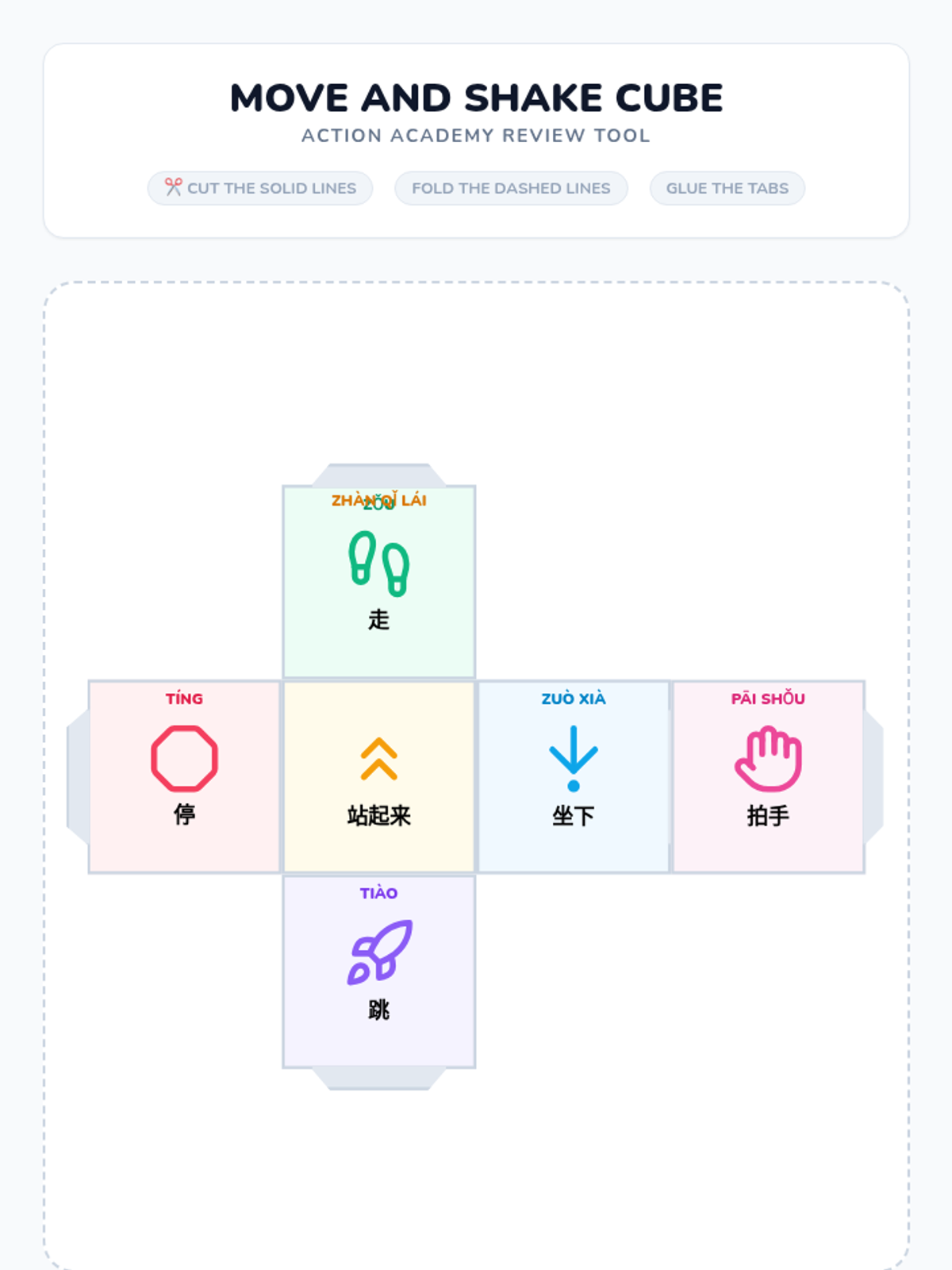
Learning 'Pāi shǒu' (Clap hands) and 'Tiào' (Jump) with rhythm and music to reinforce high-energy action vocabulary.
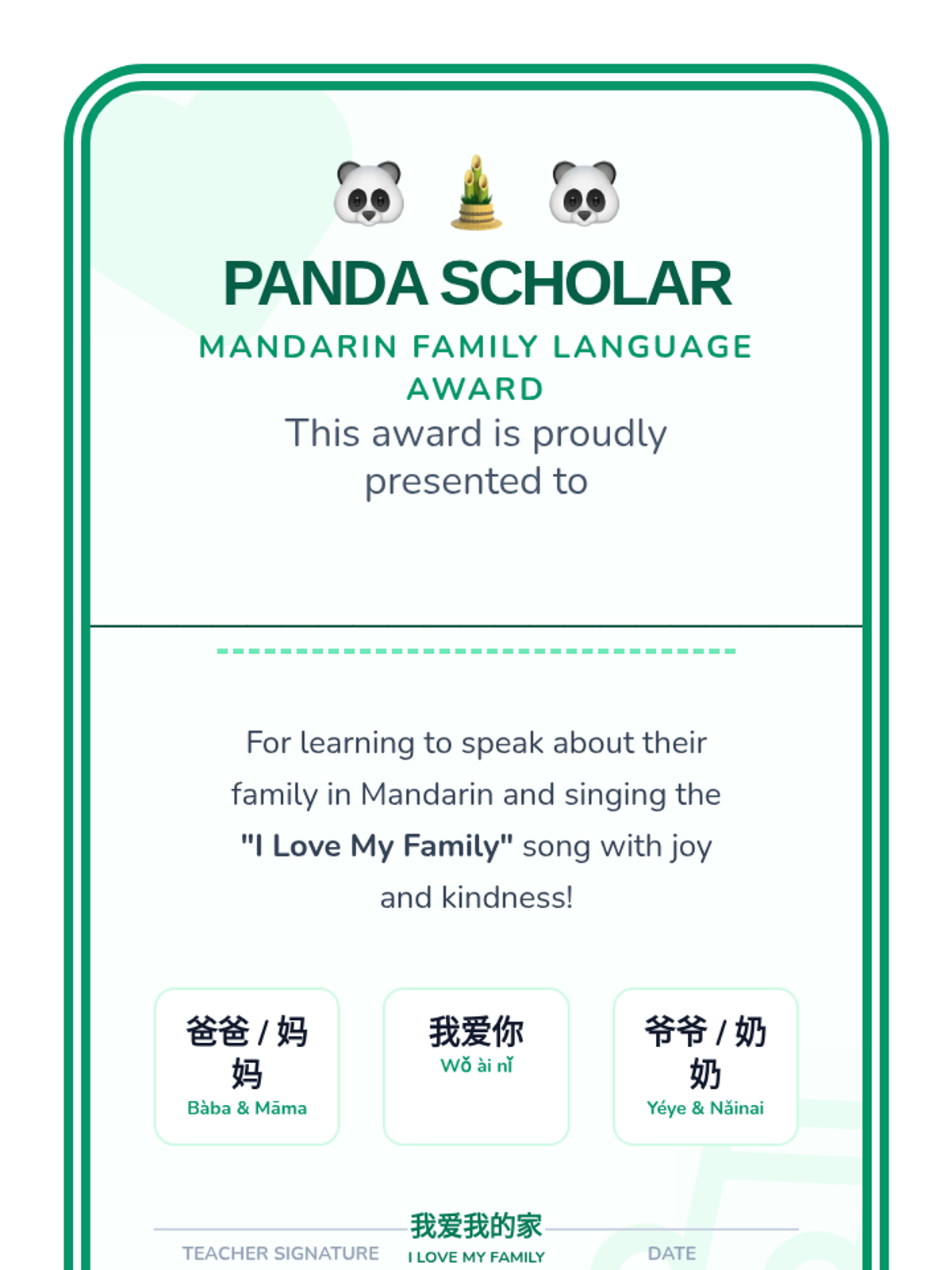
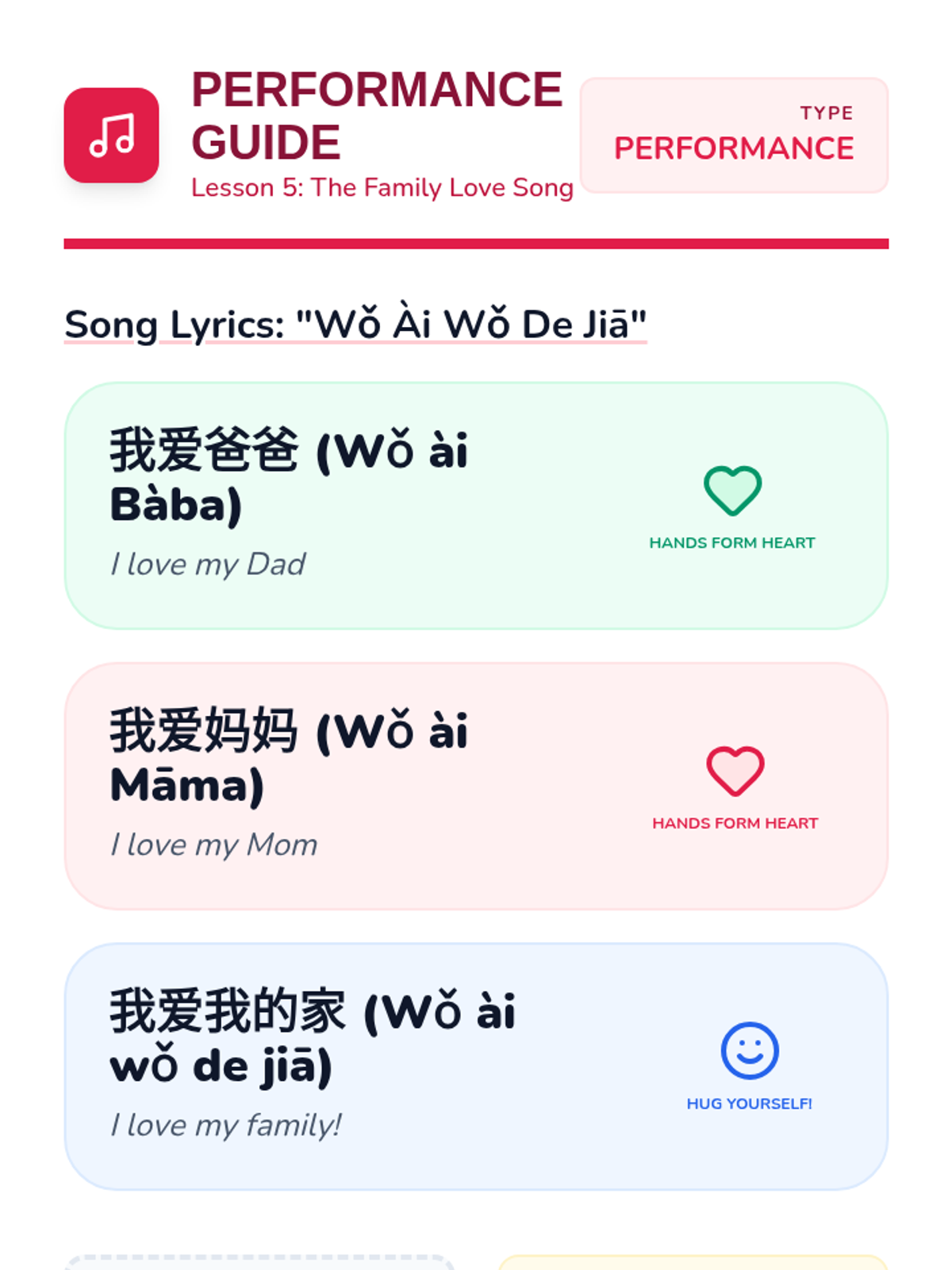
The sequence concludes with a song 'Wǒ ài wǒ de jiā', combining vocabulary with the verb 'to love' and expressive hand motions.
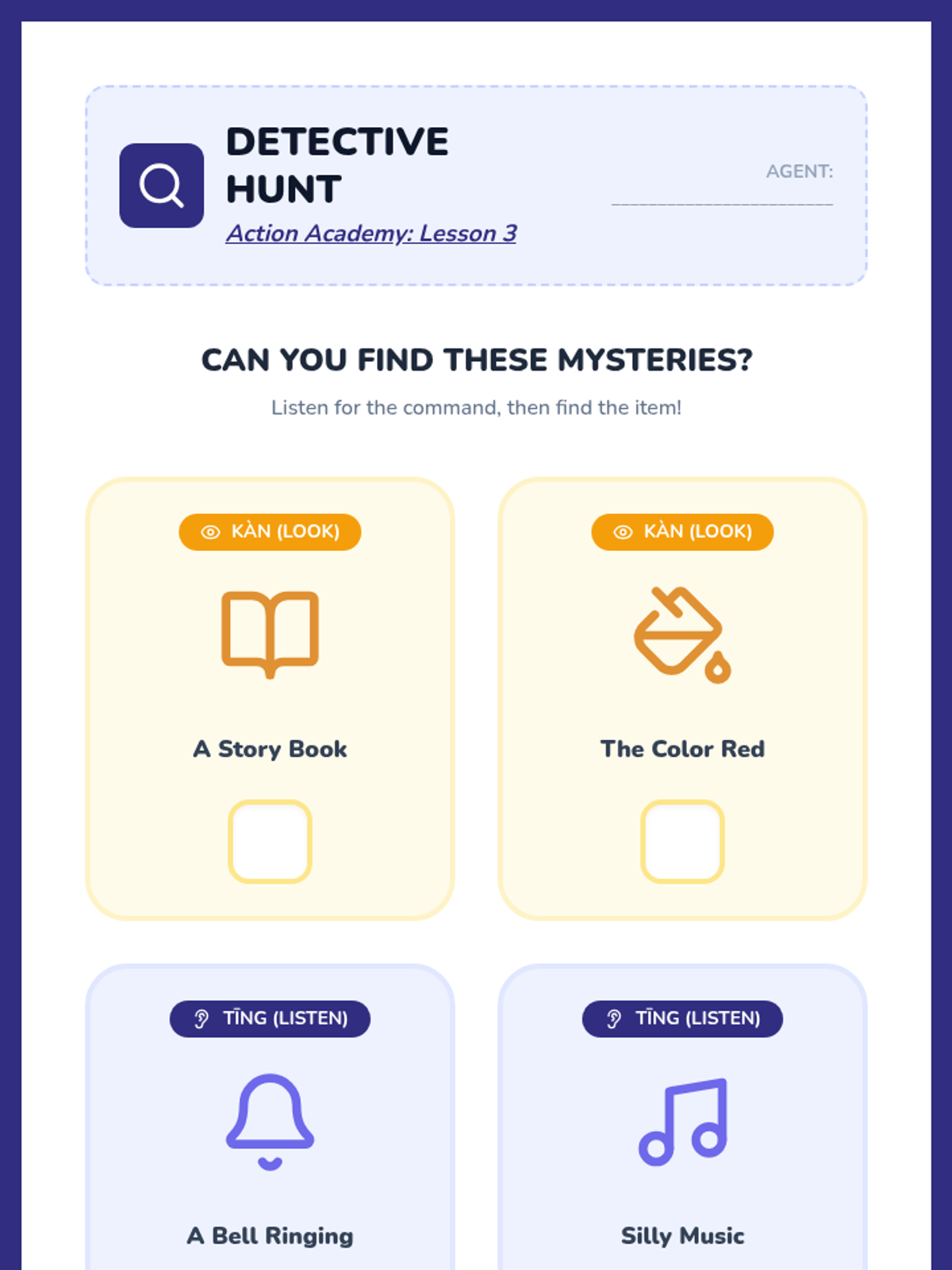
Focusing on sensory verbs 'Tīng' (Listen) and 'Kàn' (Look) through a detective-themed scavenger hunt.
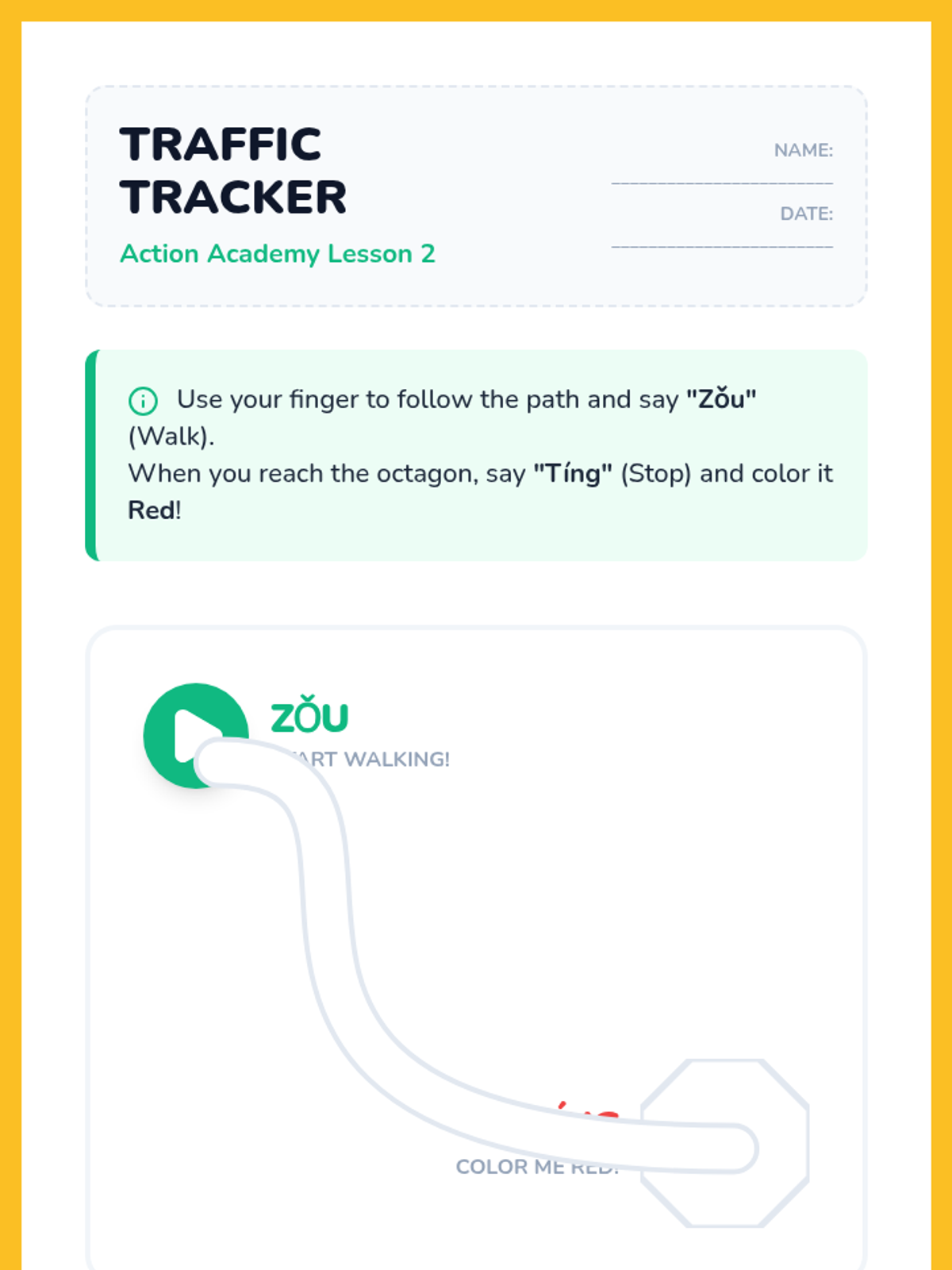
Introducing 'Zǒu' (Walk) and 'Tíng' (Stop) using a Mandarin version of Red Light, Green Light to build impulse control and verb recognition.
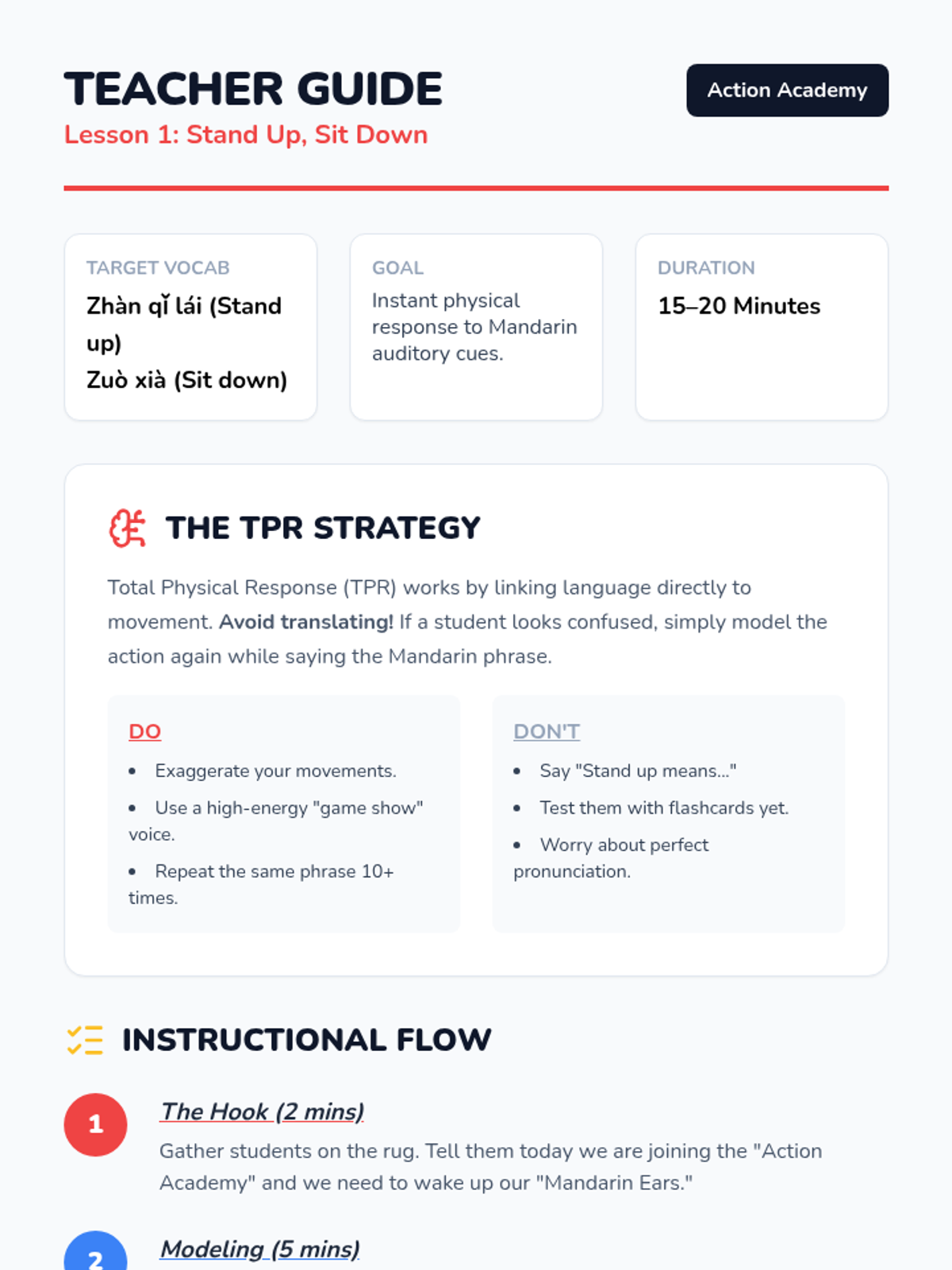
Students learn 'Zhàn qǐ lái' (Stand up) and 'Zuò xià' (Sit down) through rapid-fire reaction games. focus is on gross motor response to auditory cues.
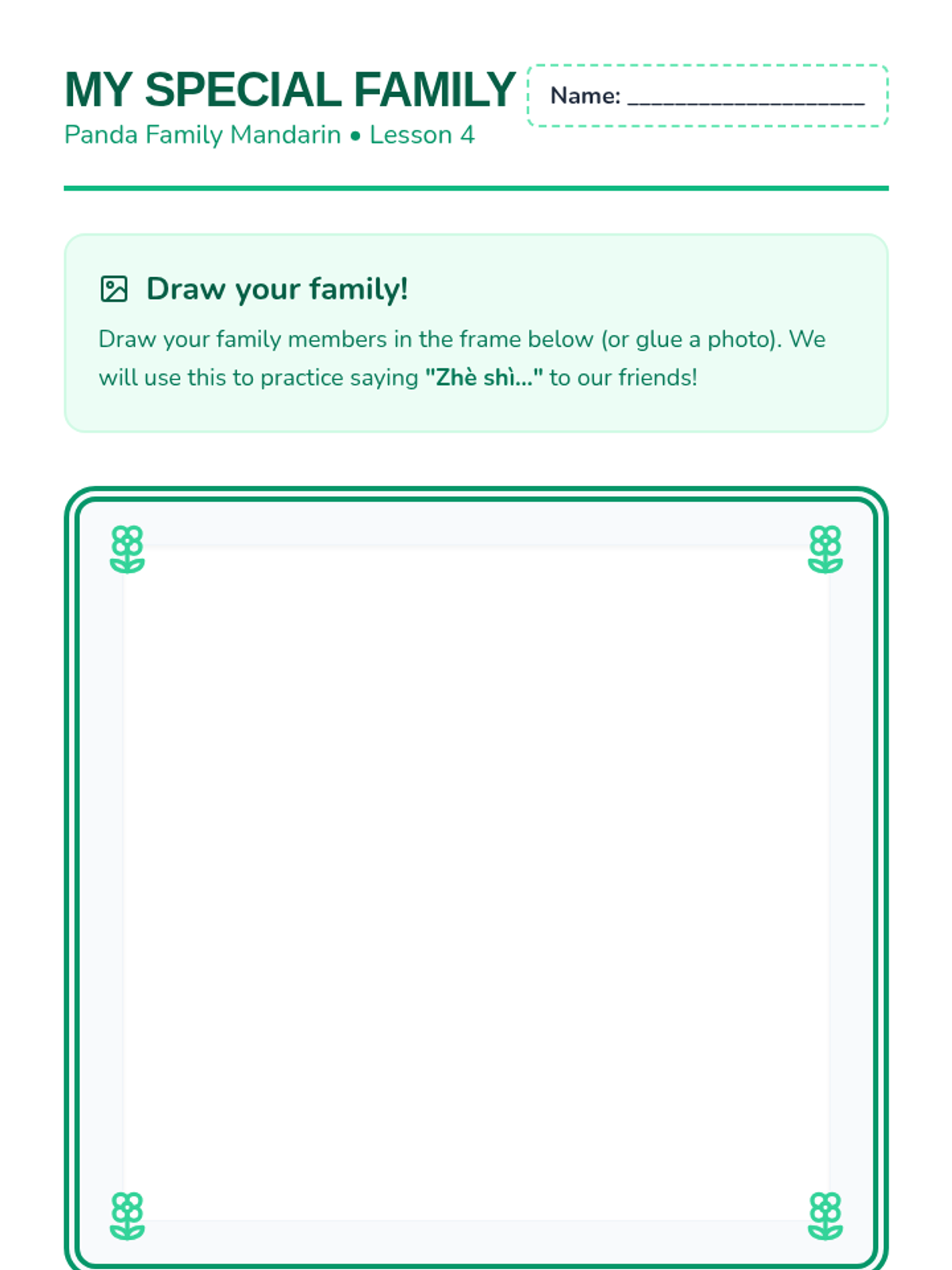
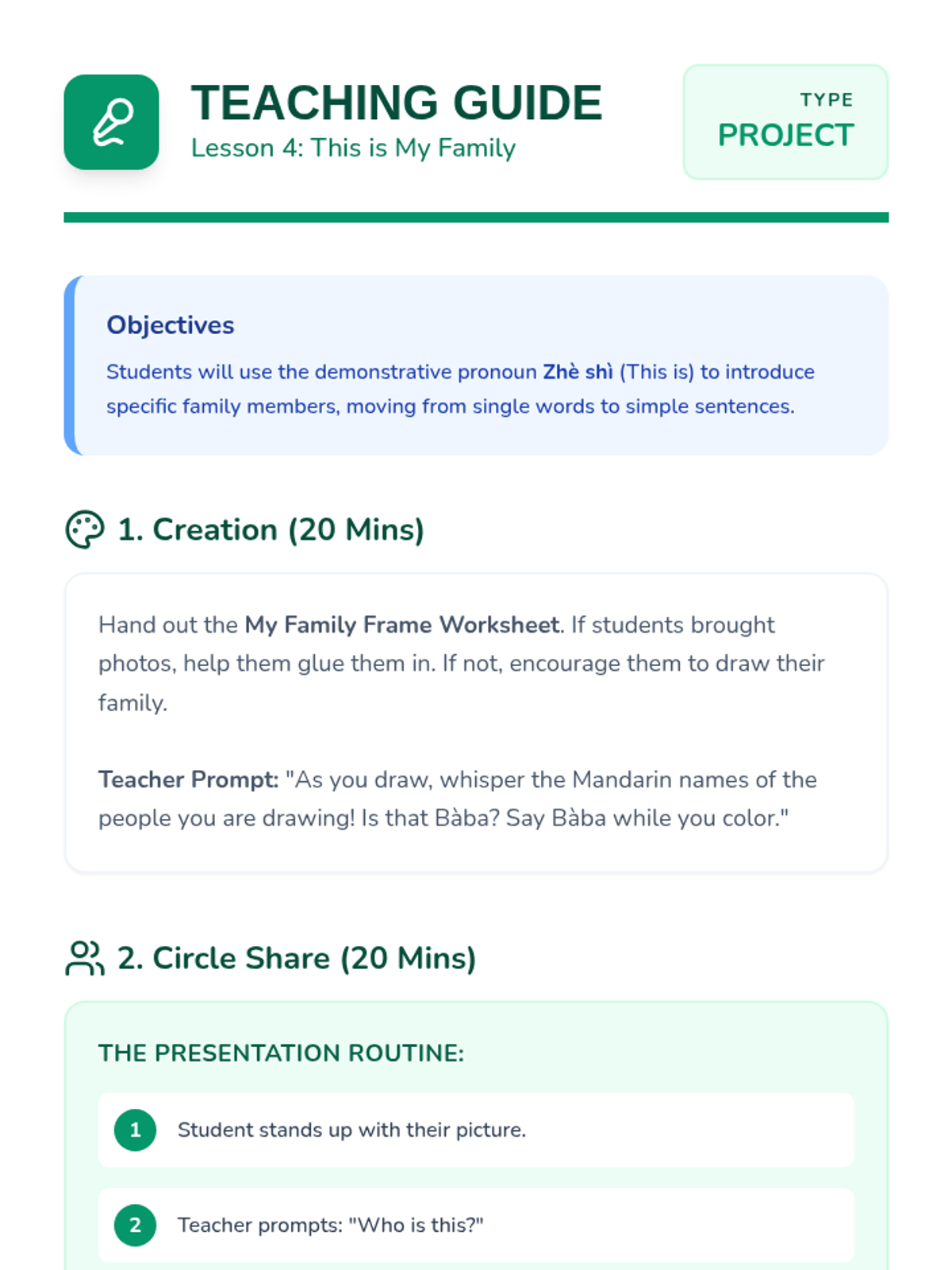
Students practice the sentence structure 'Zhè shì...' to introduce their own family members using photos or drawings.
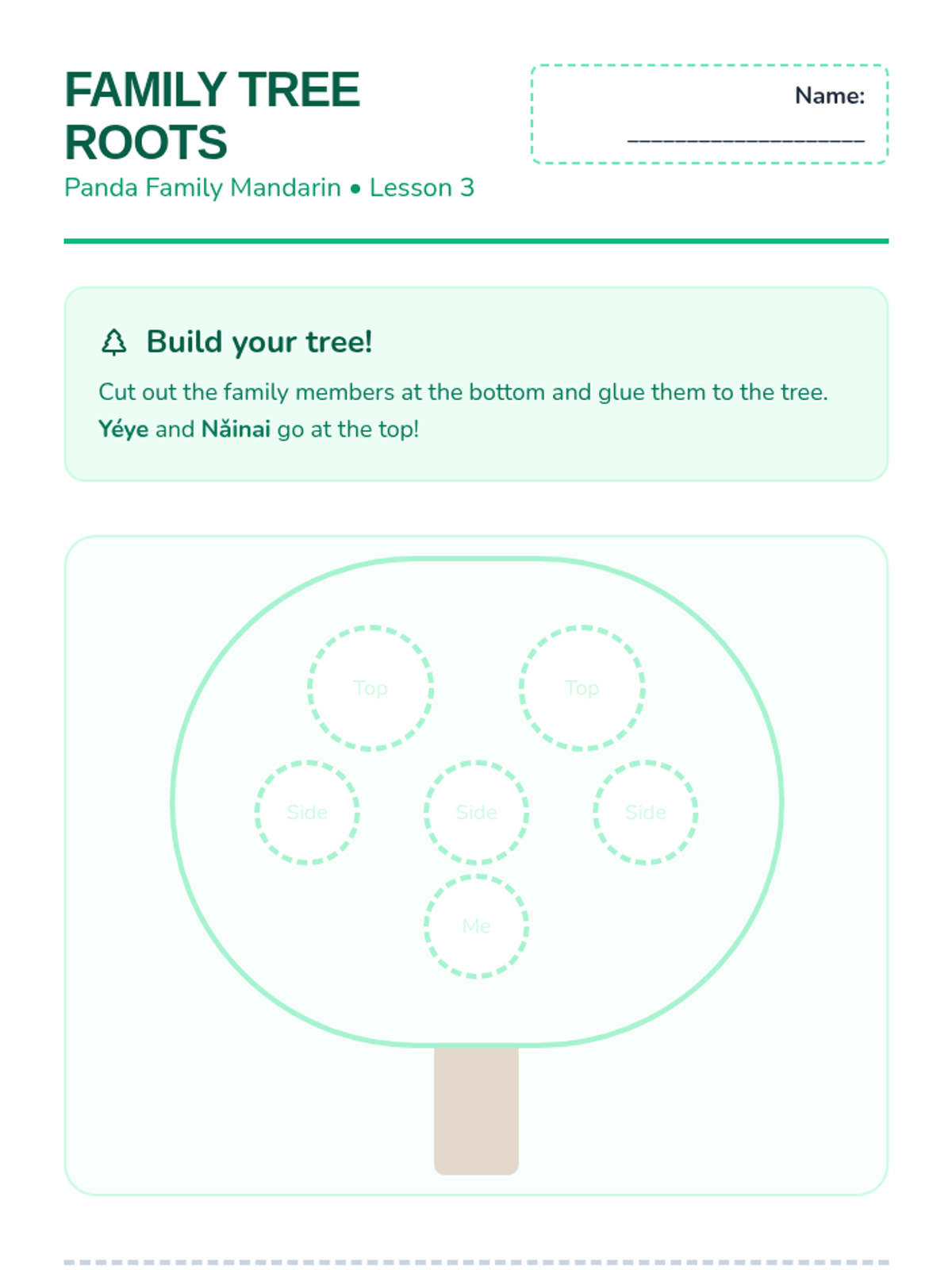
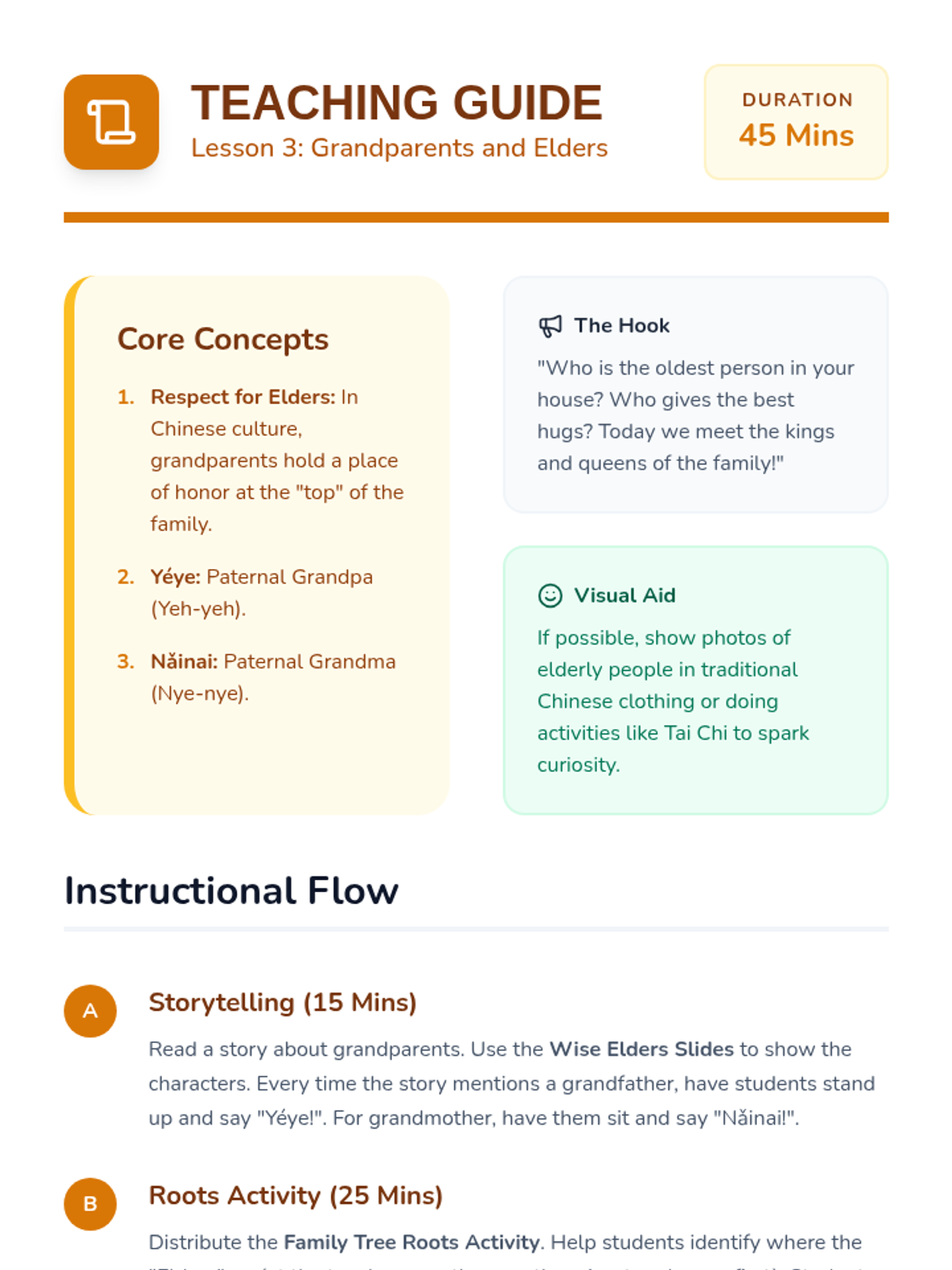
Introduction to grandparents, Yéye and Nǎinai. Students explore generational structures using a visual family tree and storytelling.
In this synthesis lesson, students participate in a pretend tea party, applying all learned greetings in a social setting.
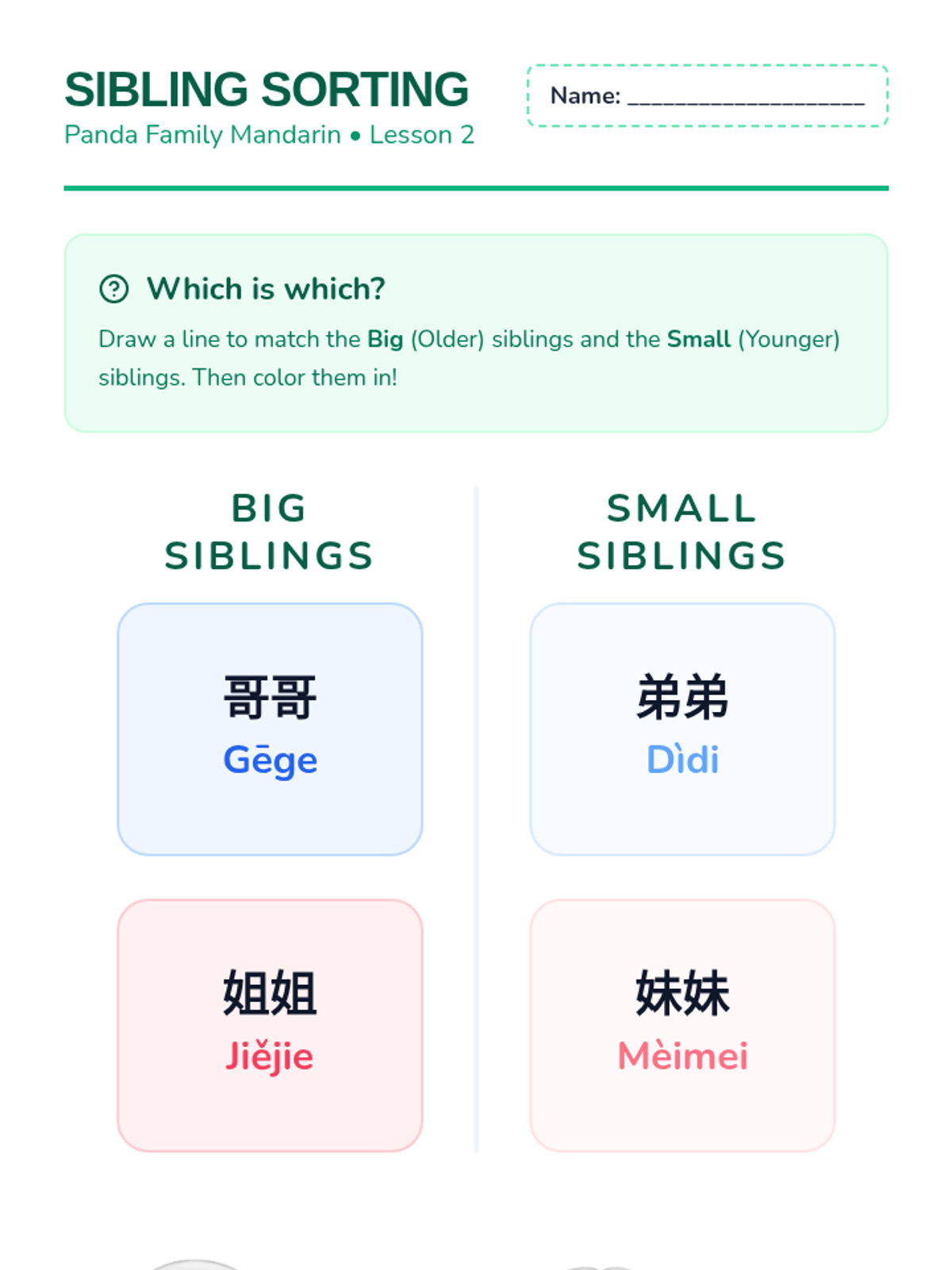
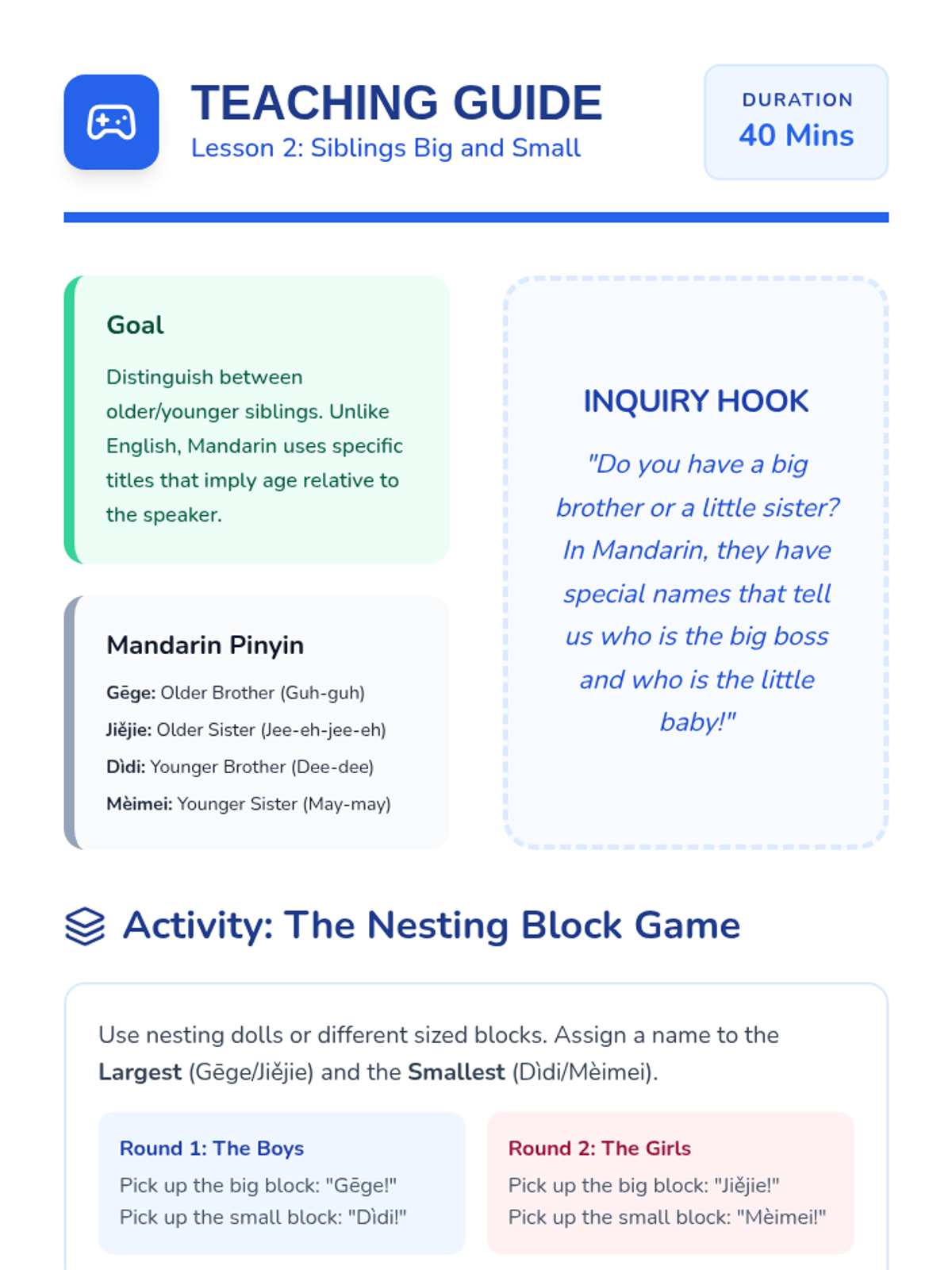
Exploration of siblings in Mandarin, focusing on older and younger distinctions. Students learn Gēge, Jiějie, Dìdi, and Mèimei through size-based activities.
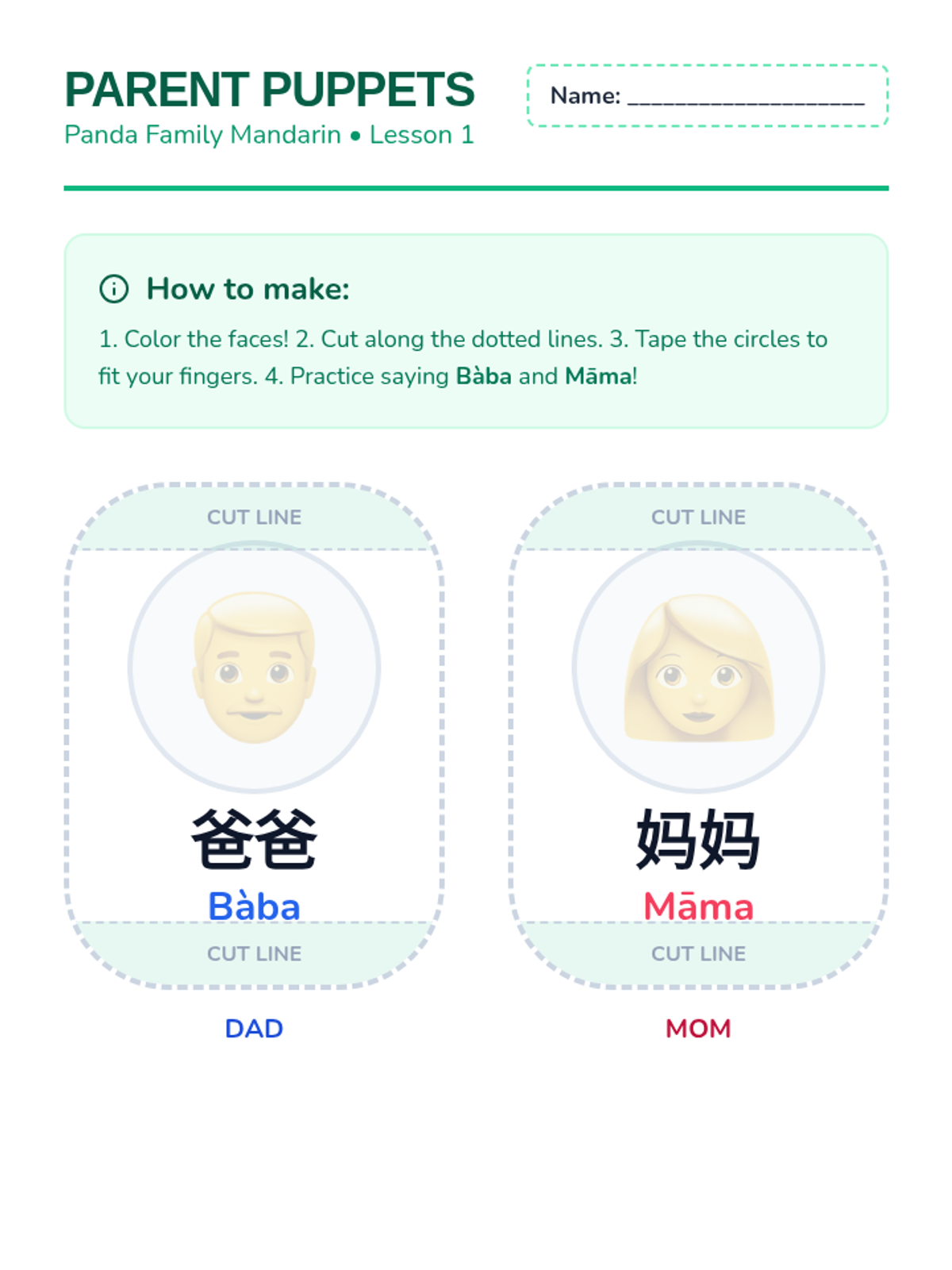
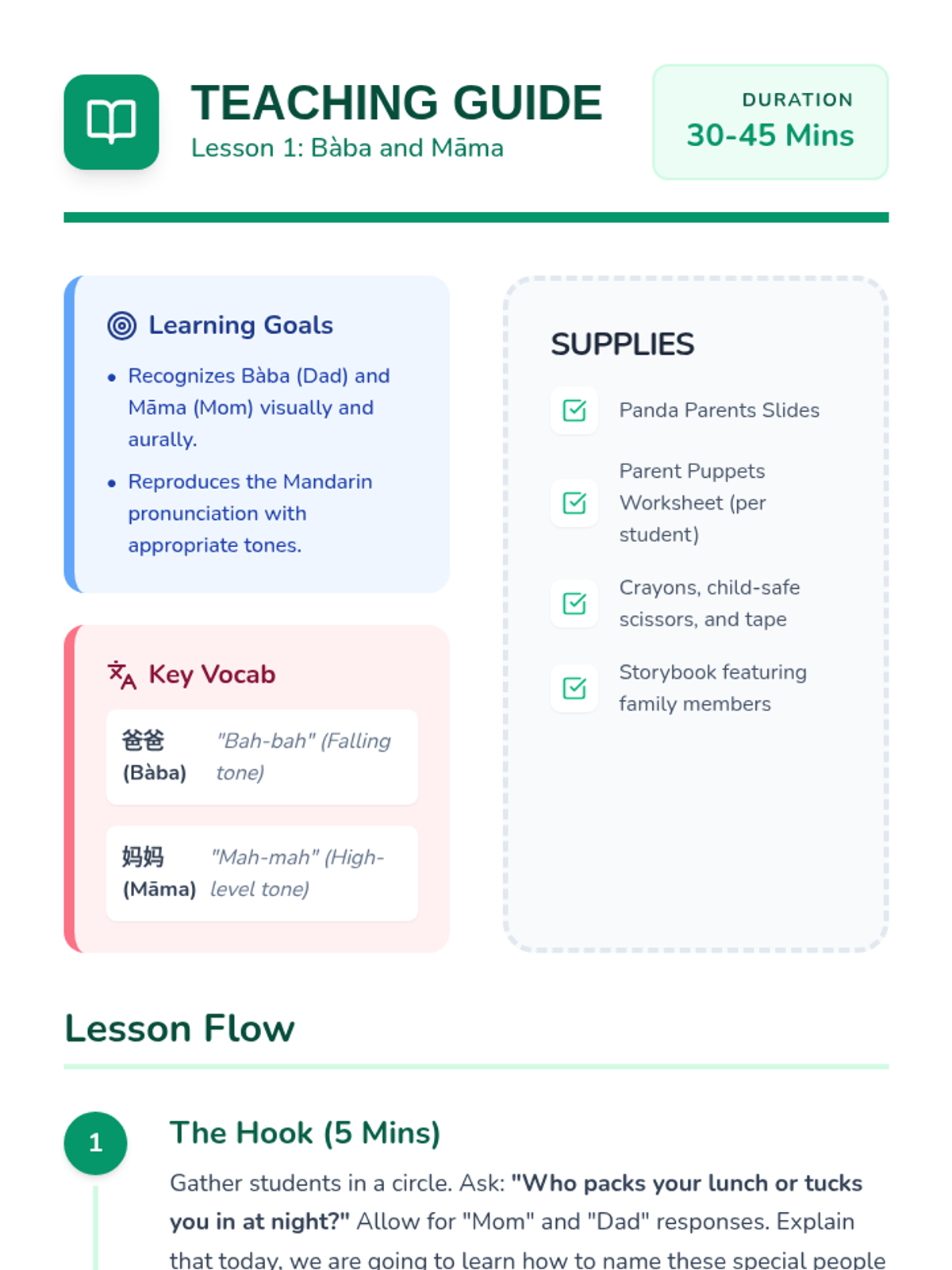
Introduction to the terms for Mom and Dad in Mandarin. Students use finger puppets to practice Bàba and Māma while associating the words with parental figures.
Students explore empathy and repair by learning 'Duìbuqǐ' (Sorry) and 'Méiguānxi' (It's okay) through gentle role-play.
This lesson introduces 'Xièxie' (Thank you) and 'Bú kèqì' (You're welcome) through a gift-giving simulation.
Learners focus on 'Zàijiàn' (Goodbye) by enacting end-of-day routines and singing a Mandarin goodbye song.
Students learn 'Nǐ hǎo' (Hello) through a hand puppet interaction circle, focusing on eye contact and friendly body language.
A cumulative project where students create and present a poster incorporating all identity phrases learned in the sequence.
Expressing likes using 'Wǒ xǐhuān' with visual aids and preference paddles for colors and animals.
Learning numbers 1-5 and hand gestures to state age using the 'Wǒ... suì' sentence pattern.
Introducing 'nánhái' (boy) and 'nǚhái' (girl) through sorting activities and the 'Wǒ shì...' sentence pattern.
Students learn to say their name using the sentence pattern 'Wǒ jiào...' with a mirror-based introductory activity.
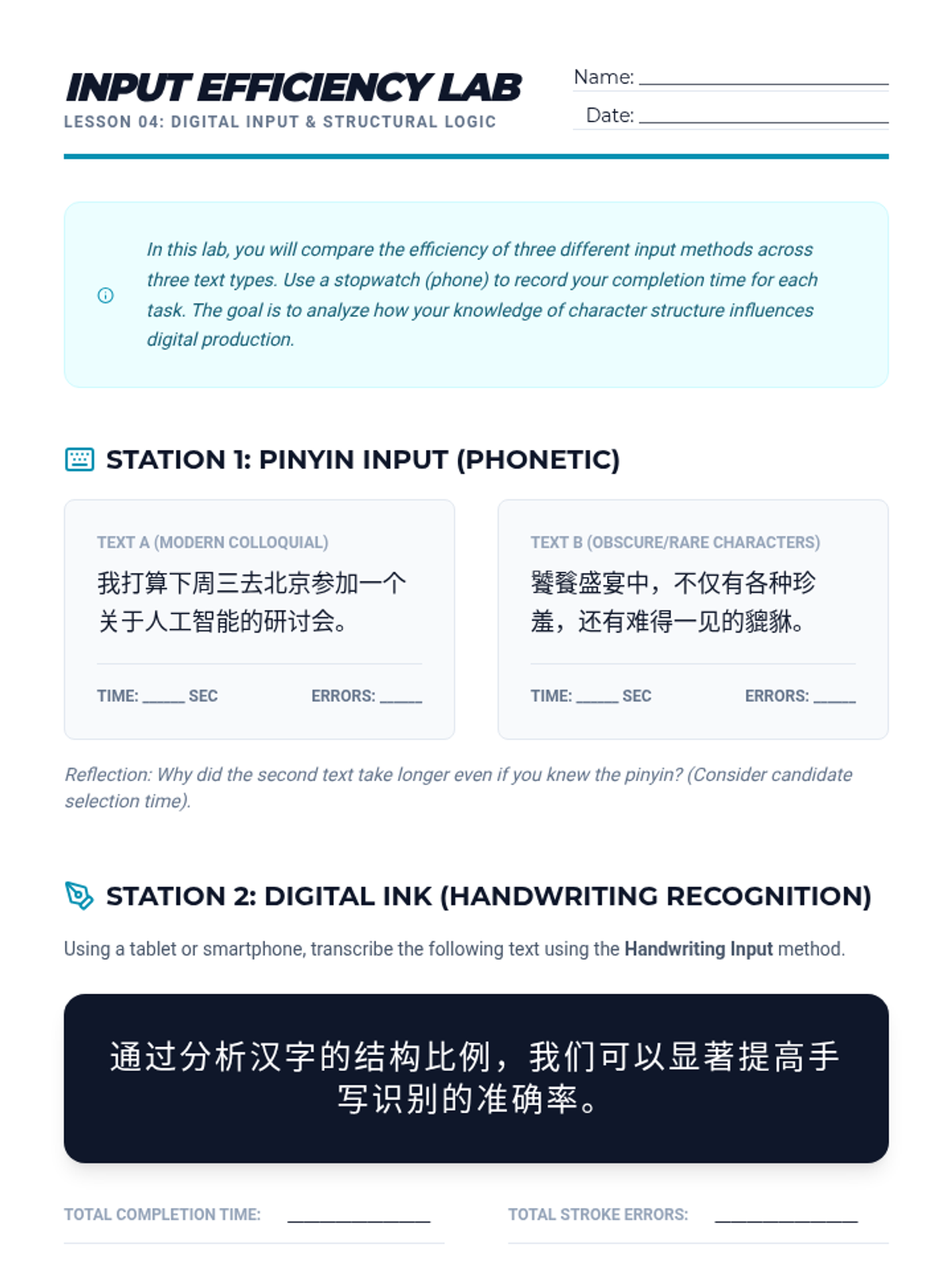
Recognizing the professional needs of graduate students, this lesson focuses on typing characters using Pinyin input methods on computers and smartphones. Students learn to recognize characters from predictive text lists, bridging the gap between phonetic knowledge and character recognition.
Learners acquire characters related to cardinal directions, spatial positioning (up, down, inside), and time markers (day, month, year). Activities include reading schedules and describing the relative location of objects.
Students examine the function of 'empty words'—structural particles like 'de', 'le', and 'ma' that carry grammatical weight rather than semantic meaning. Through sentence analysis, learners understand how these characters alter the tense, possession, and mood of a phrase.
Introduces high-frequency verbs such as 'to comprise/is', 'to have', 'to go', and 'to eat'. Students practice placing these characters into Subject-Verb-Object structures to form complete declarative sentences.
Focuses on the rapid mastery of personal pronouns and the numerical system to express identity, dates, and basic group concepts.
The capstone lesson where students synthesize their learning to create a 'Profile Card'. They write short paragraphs introducing themselves, their possessions, and their actions.
This lesson introduces high-frequency action verbs like 'go', 'eat', and 'watch'. Students use a 'Sentence Scramble' game to reinforce correct SVO word order.
Students master the verb 'you' (to have) and its negation 'mei you'. Through a 'Backpack Audit' activity, they practice describing possession and lack of items.
Focusing on the verb 'shi' (to be), students learn to create identity statements. They explore the simplicity of Chinese verb conjugation (or lack thereof) compared to English.
Students learn the foundational characters for personal pronouns (I, You, He/She) and the plural marker 'men'. The lesson focuses on character recognition, stroke order, and simple subject substitution.
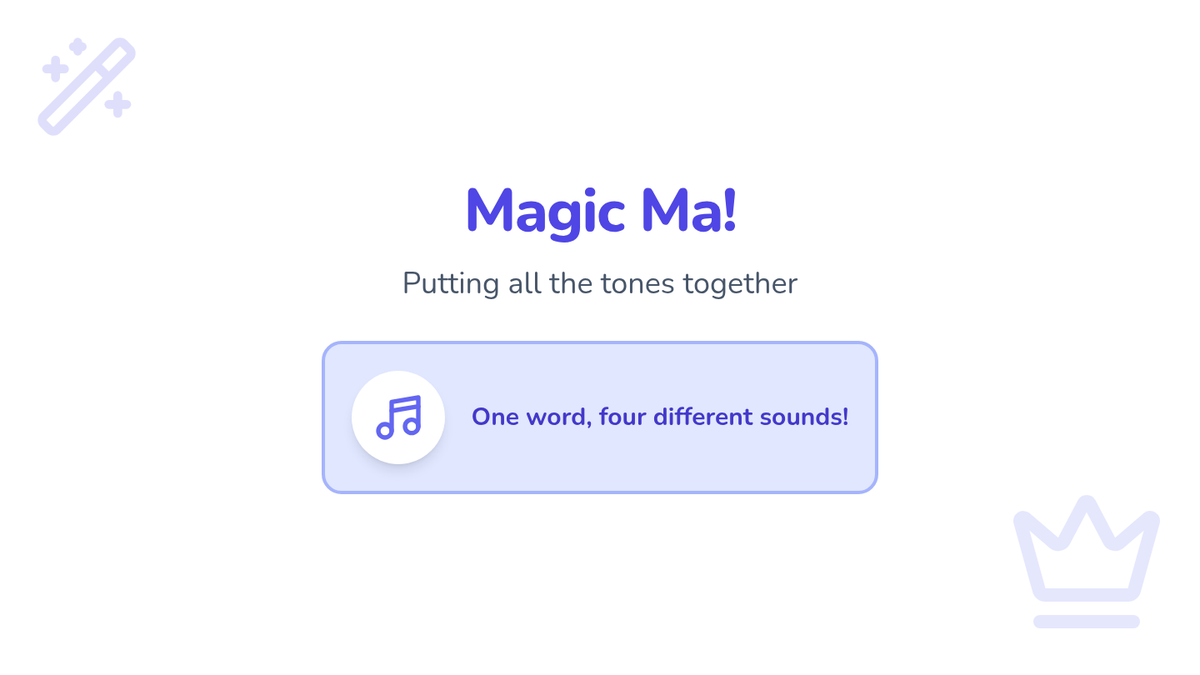
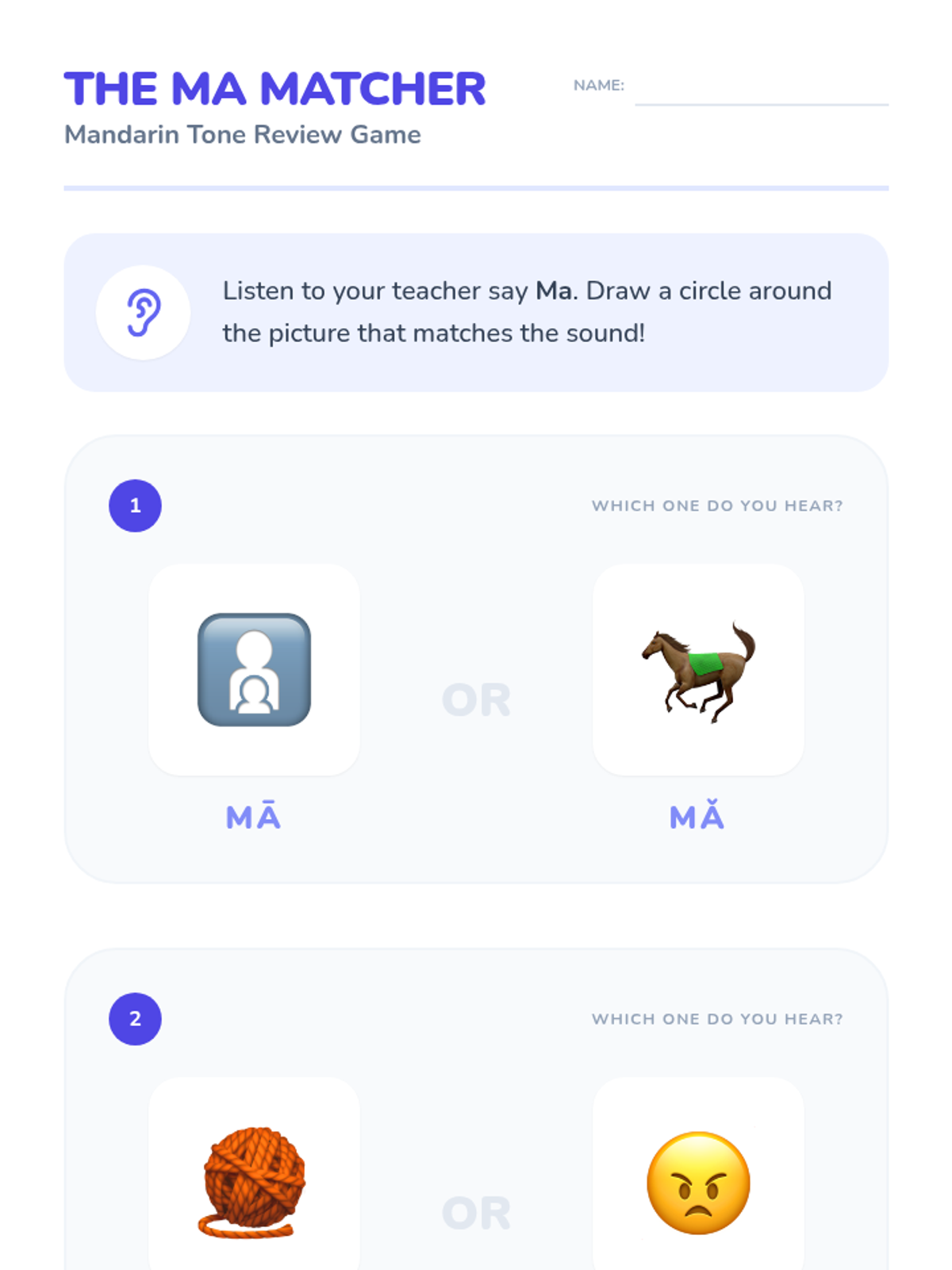
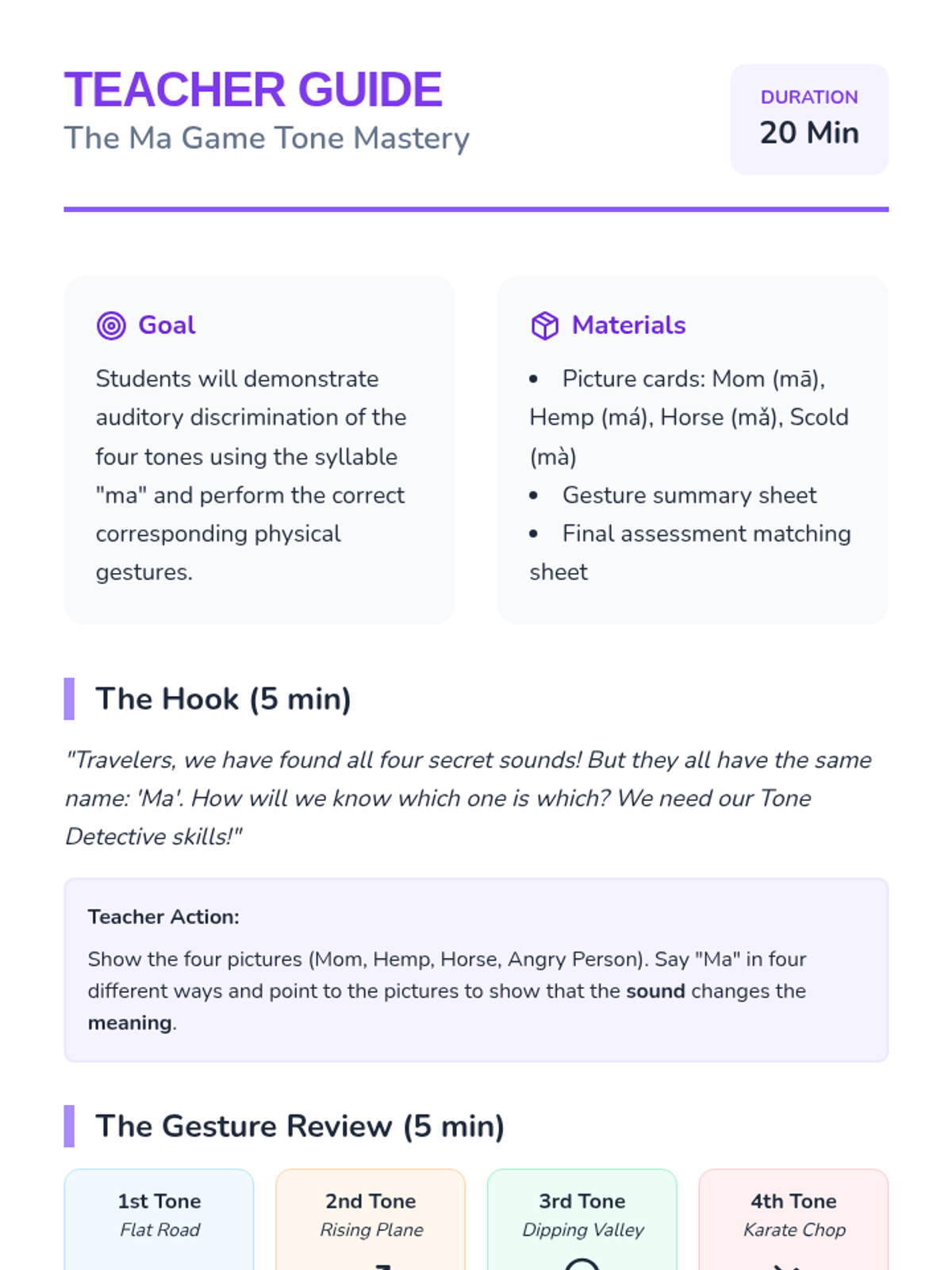
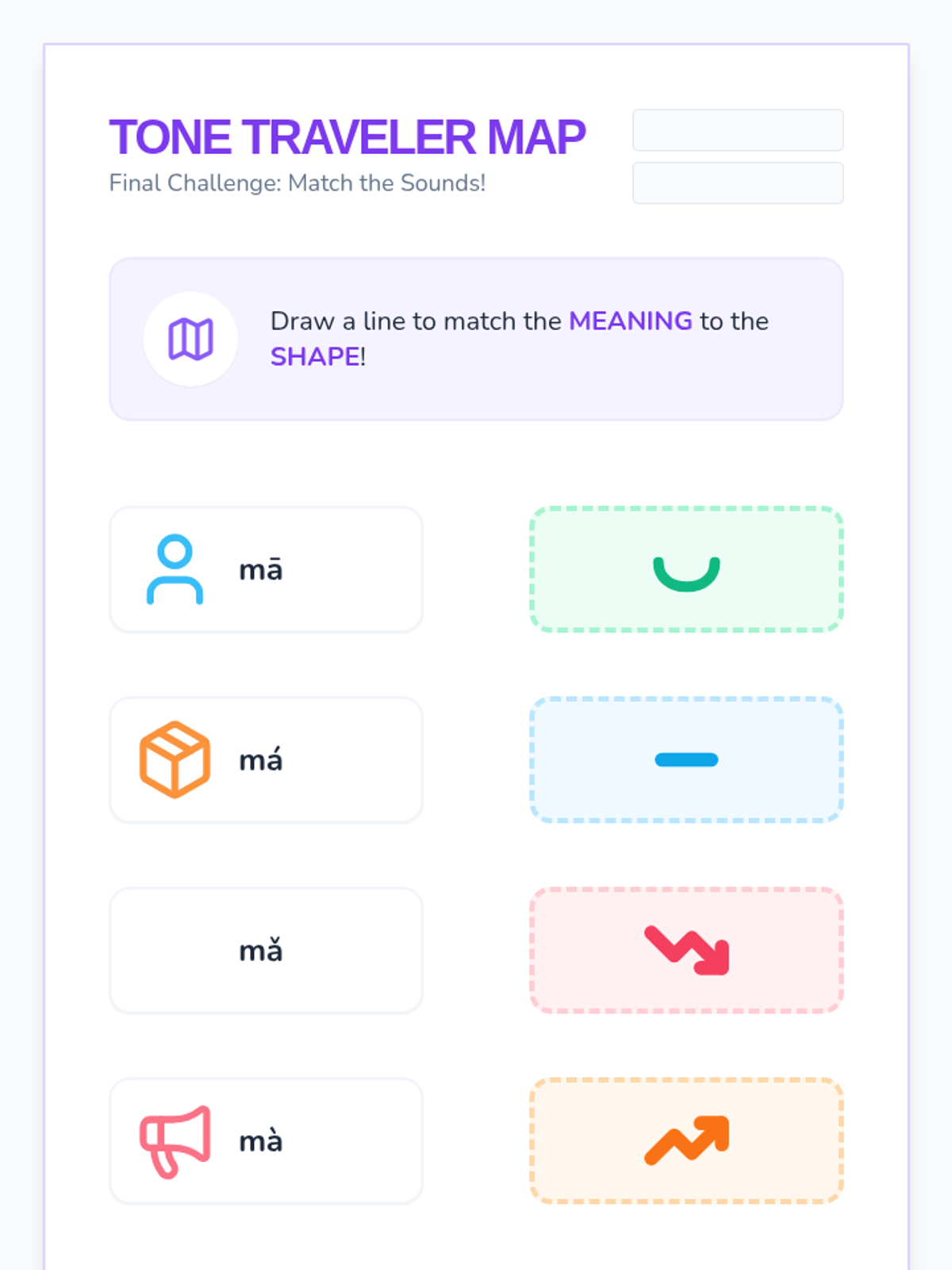
This culminating lesson applies the four tones to the syllable 'ma' to demonstrate how meaning changes (mother, hemp, horse, scold). Students participate in a listening game where they identify the correct image based on the tone they hear.
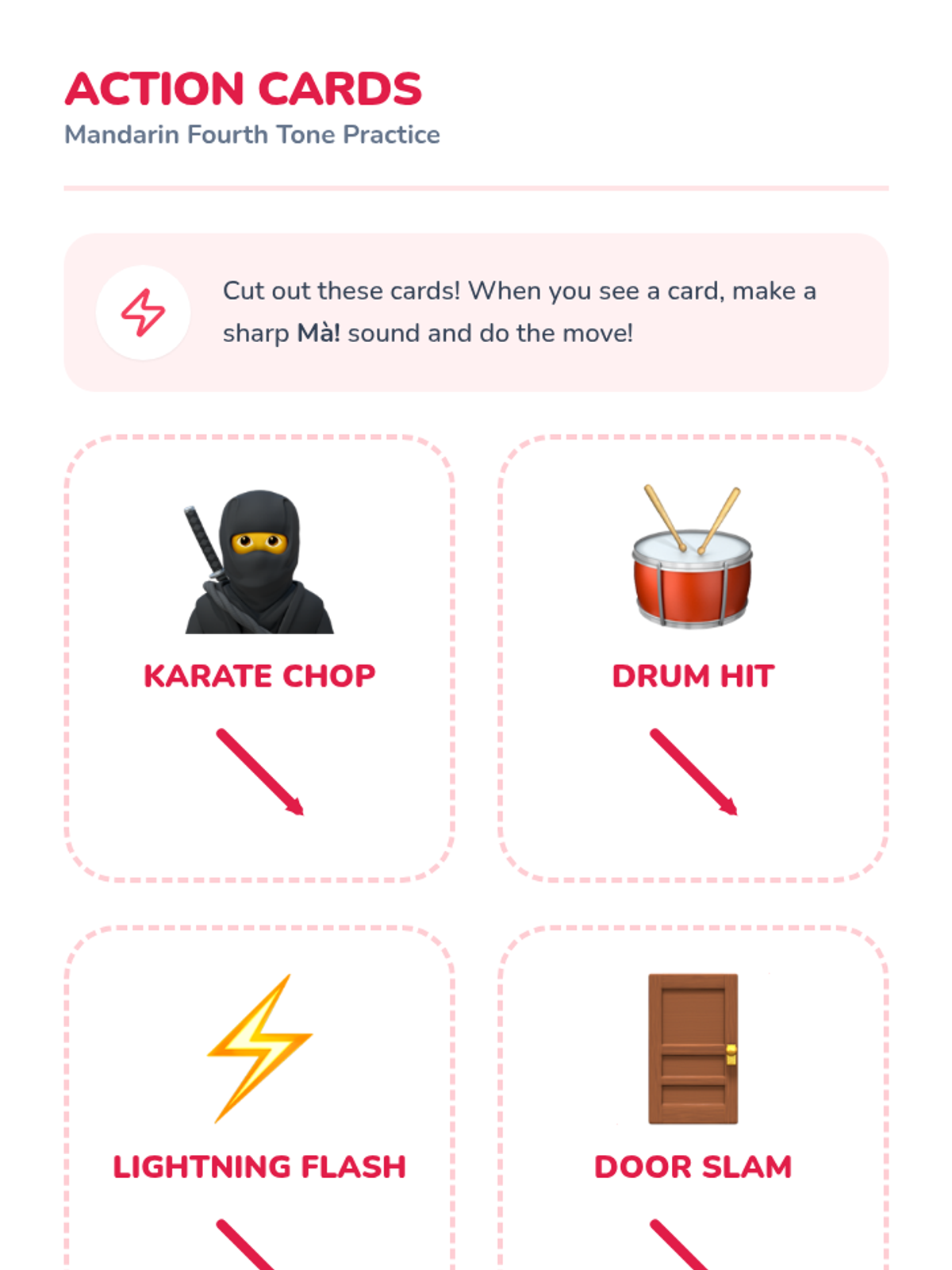
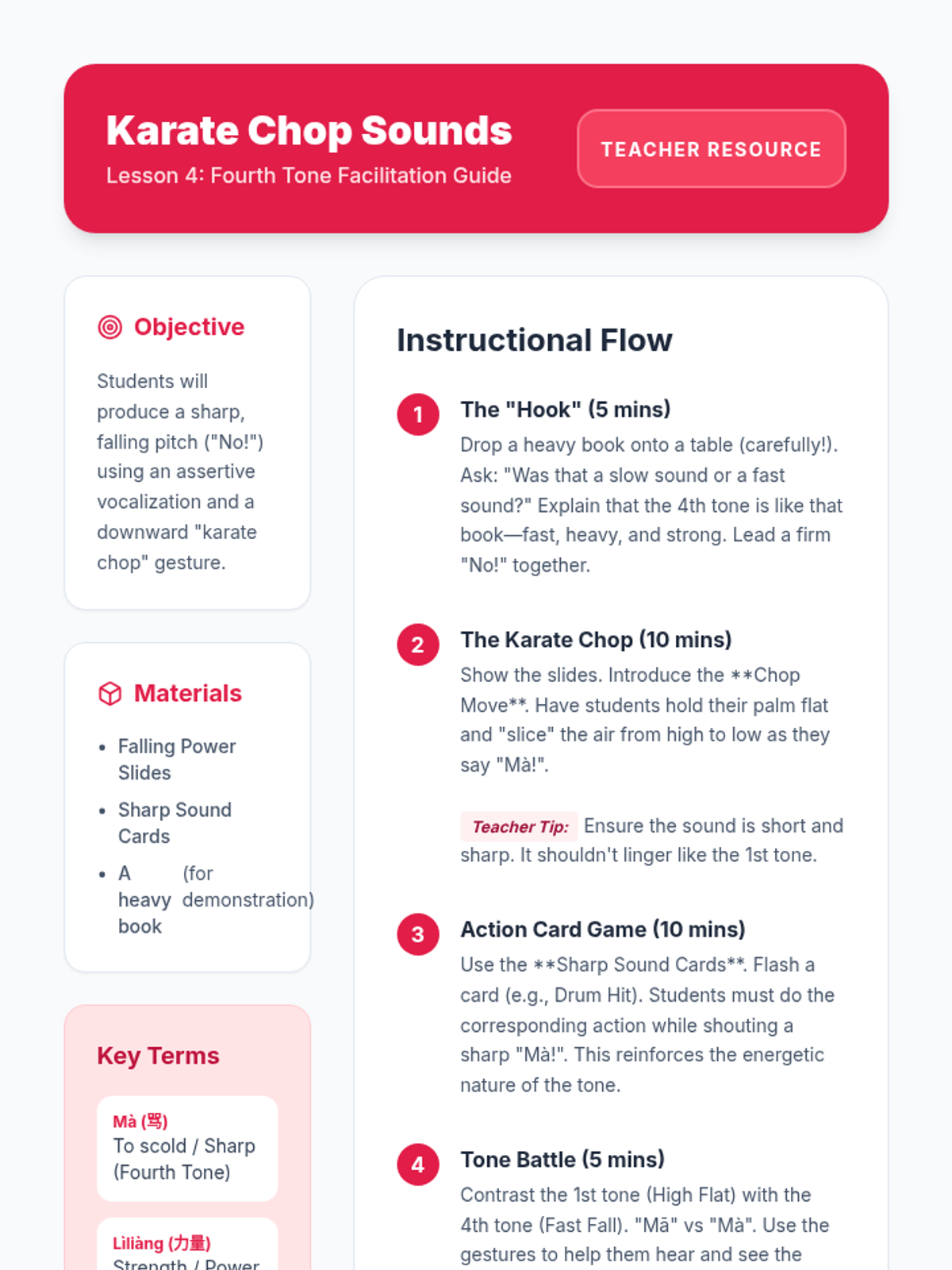
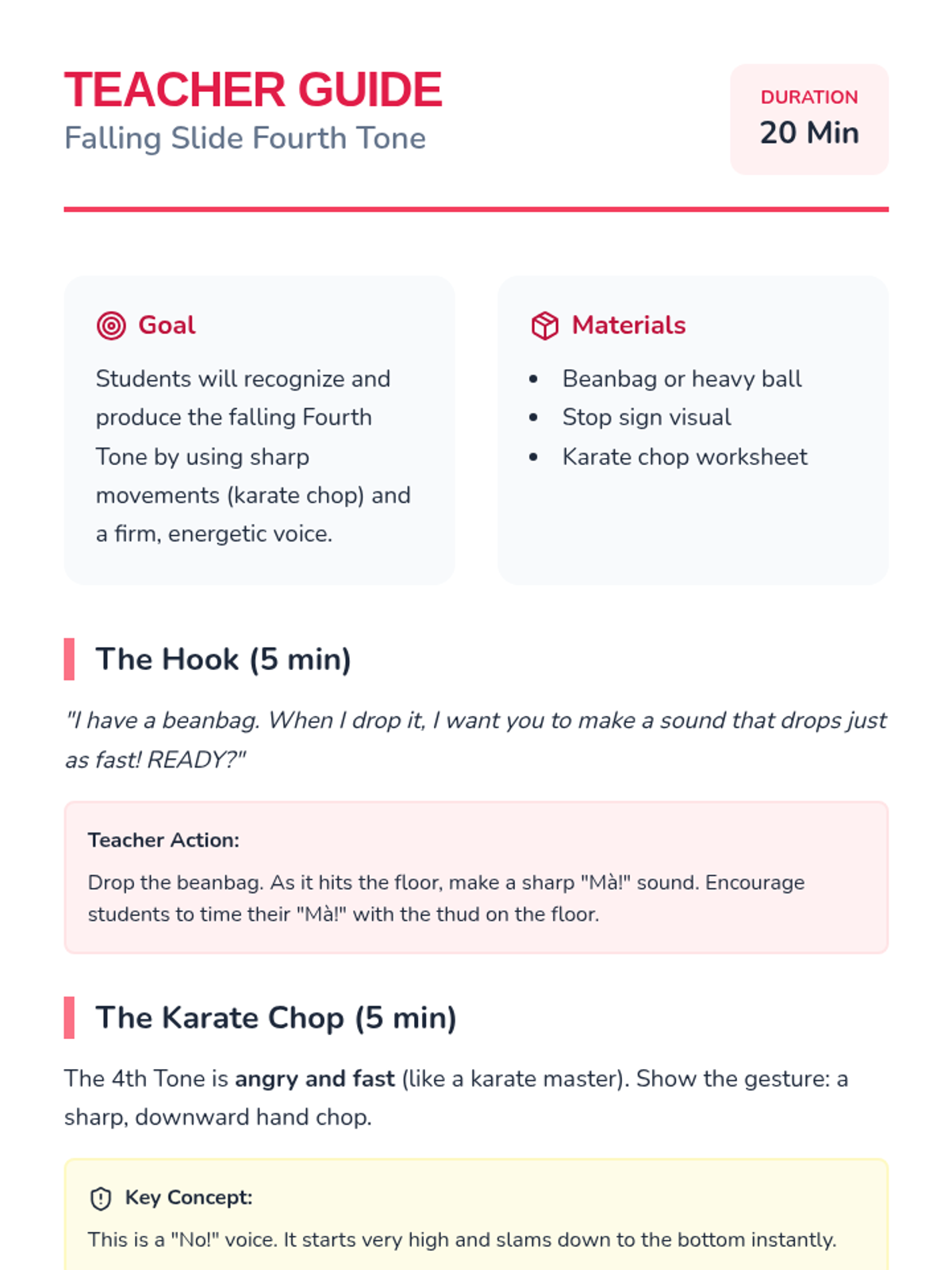
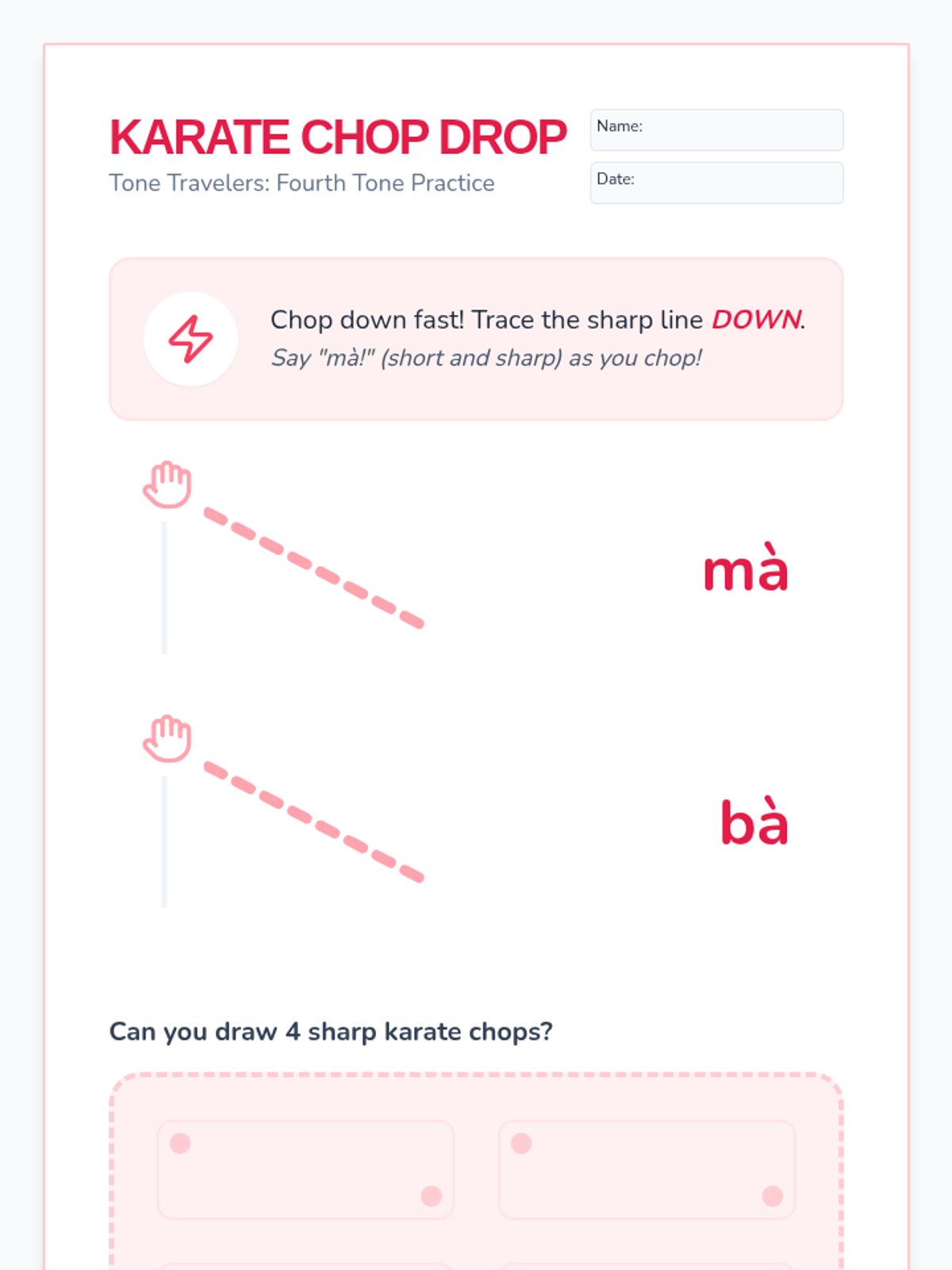
Students practice the sharp, falling pitch of the fourth tone, associating it with a firm 'No!' or a karate chop. The lesson focuses on energy and assertive vocalization to differentiate it from the other tones.
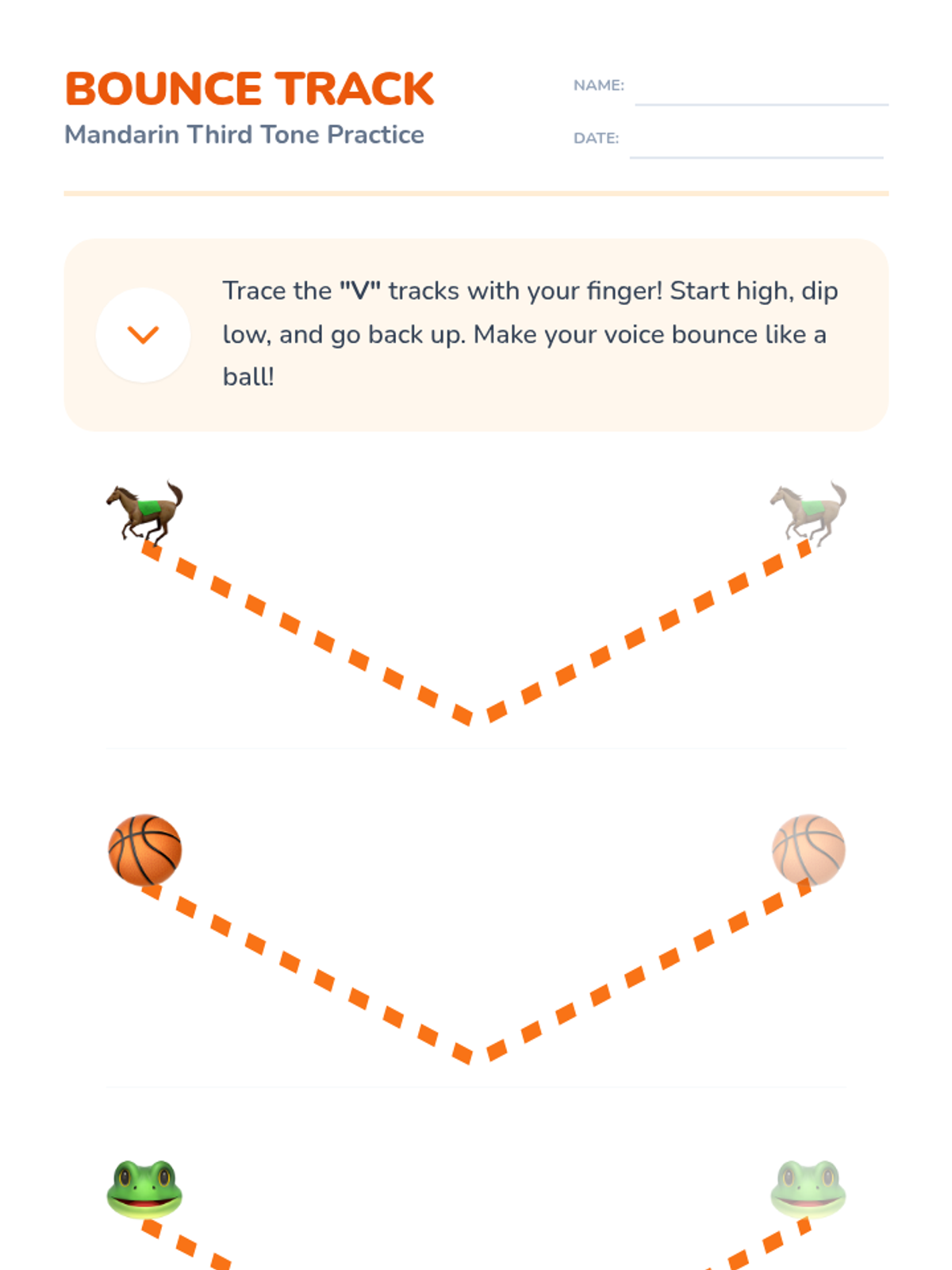
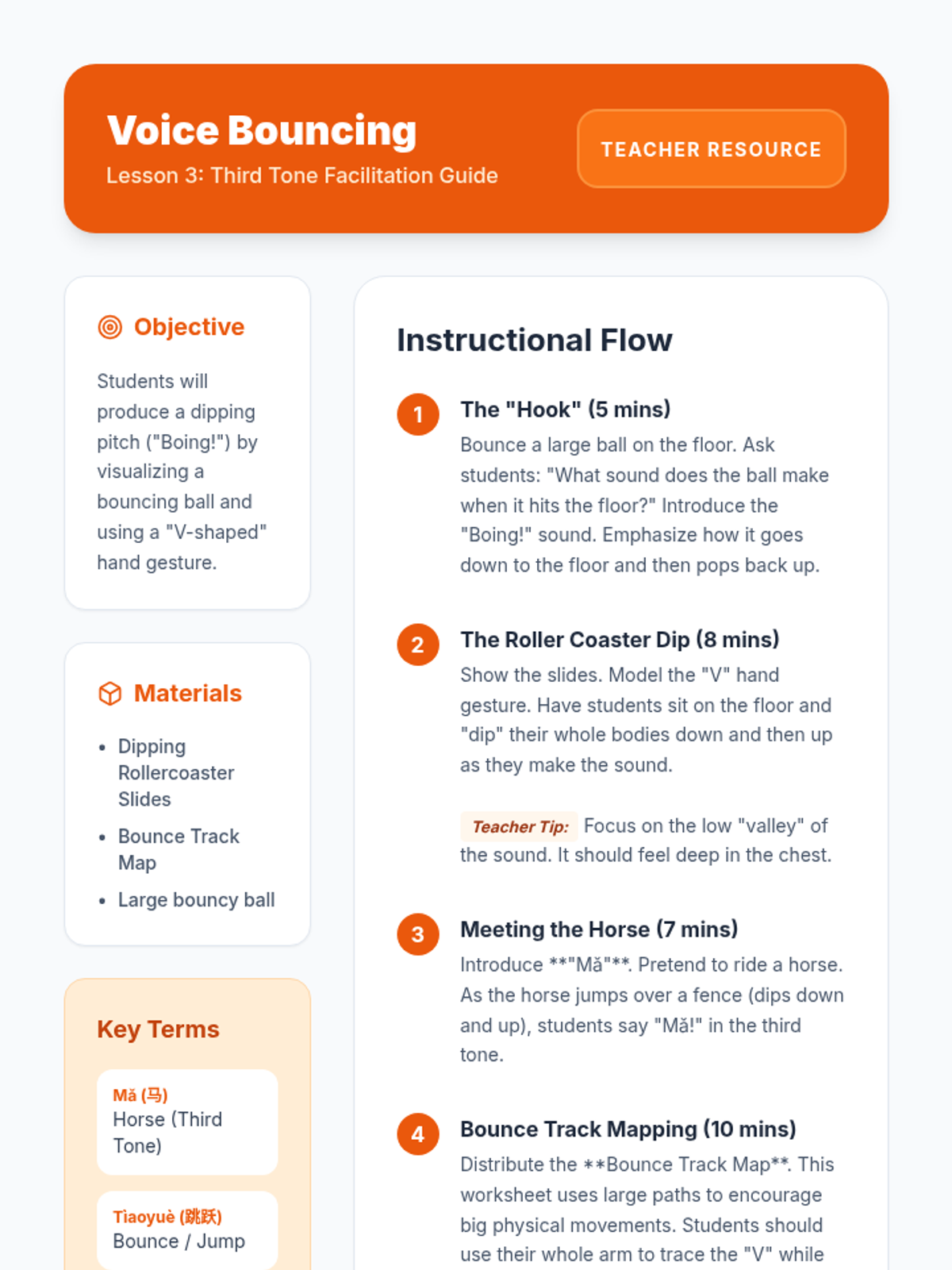
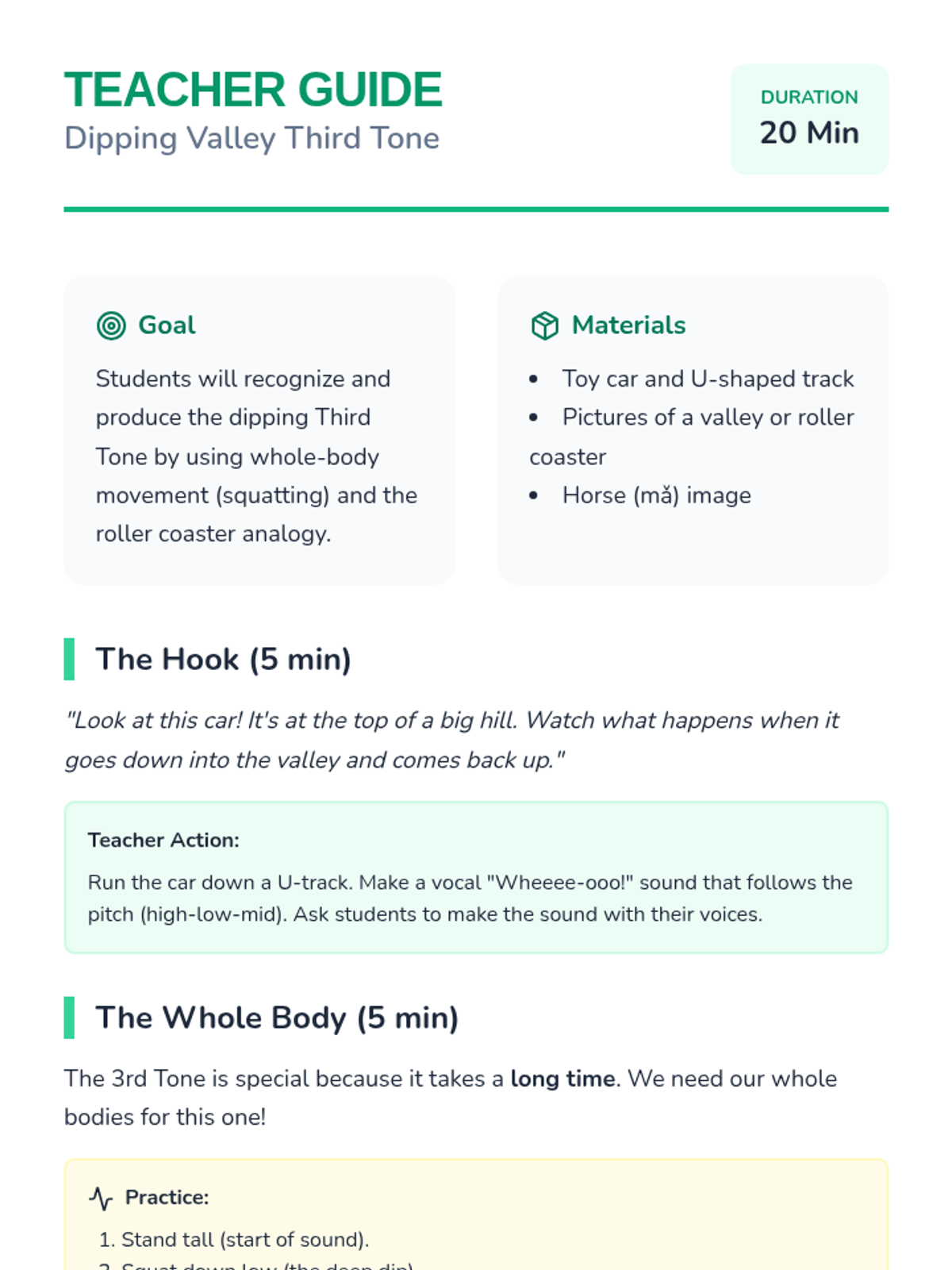
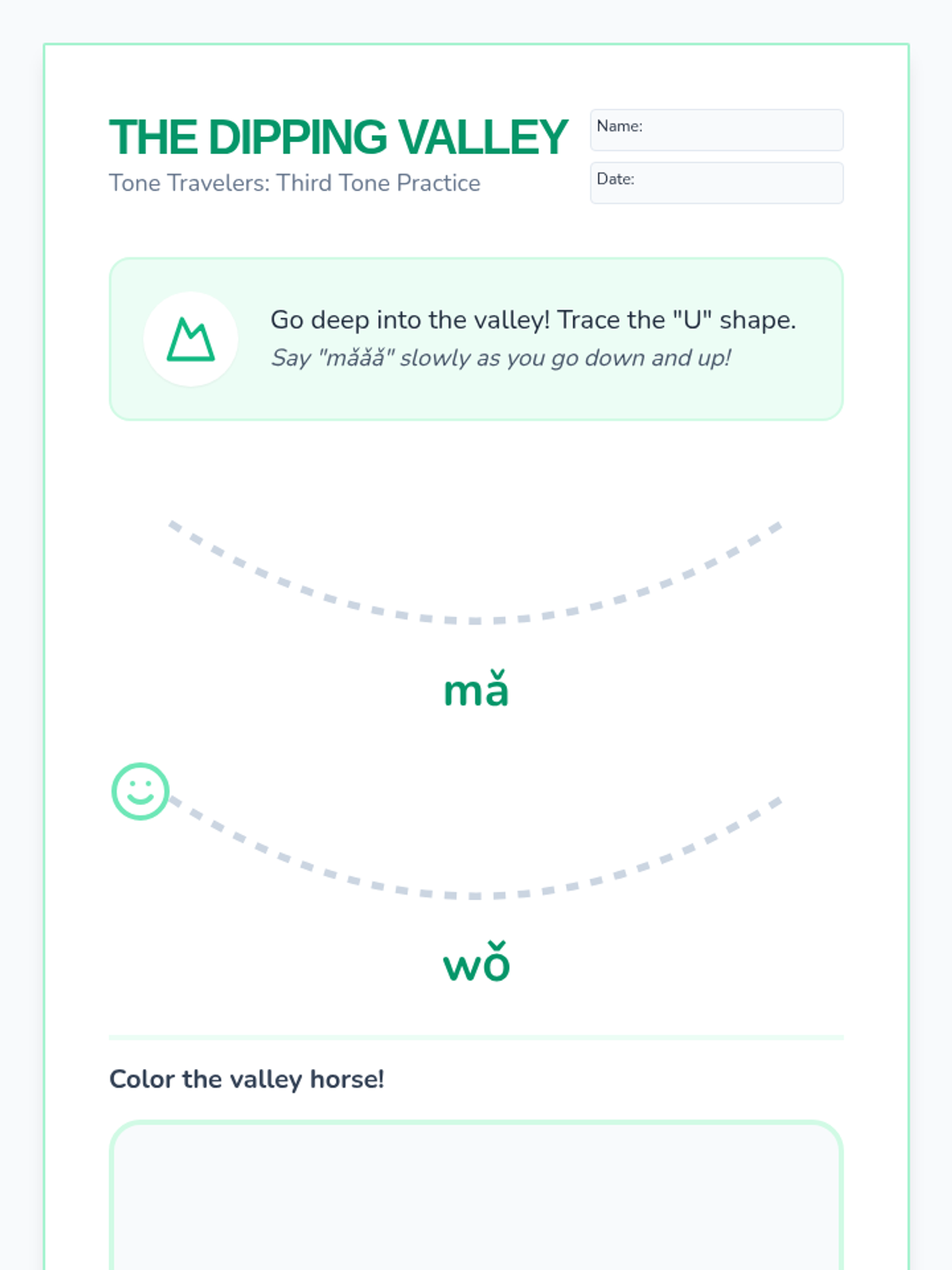
Students engage with the dipping pitch of the third tone, visualizing it as a roller coaster that goes down and up. Through physical bouncing movements, students practice the lower register dip required for this tone.
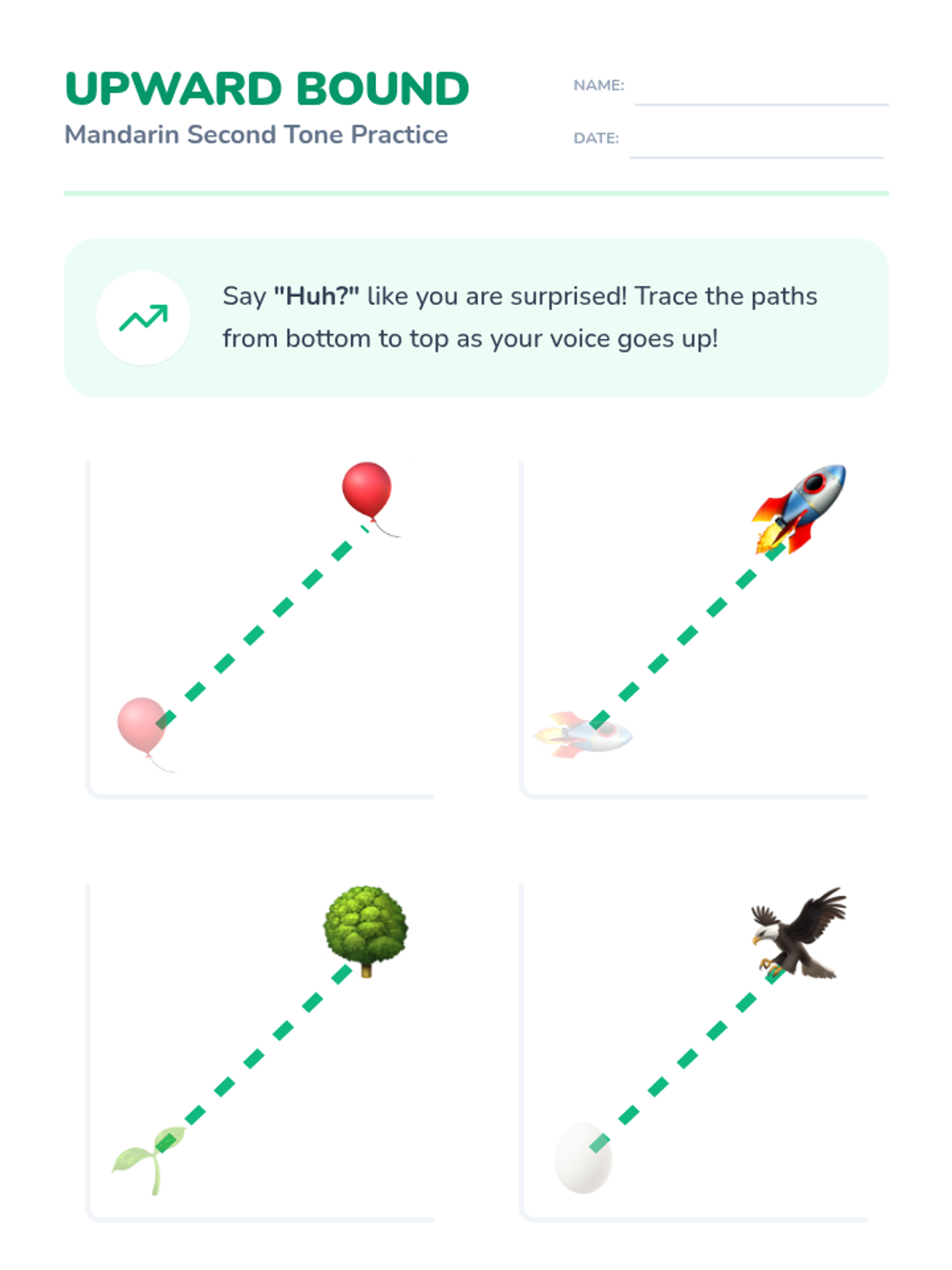
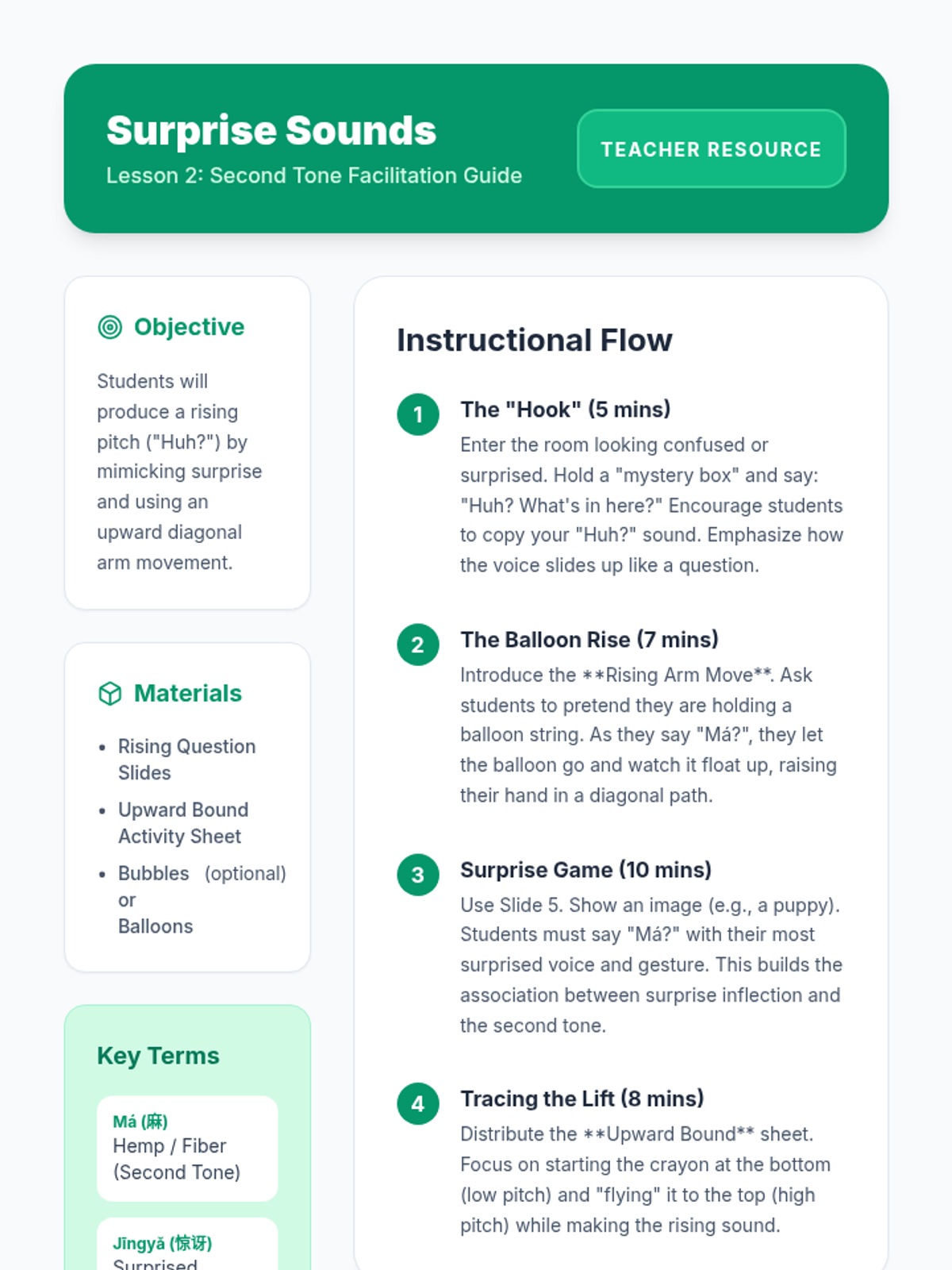
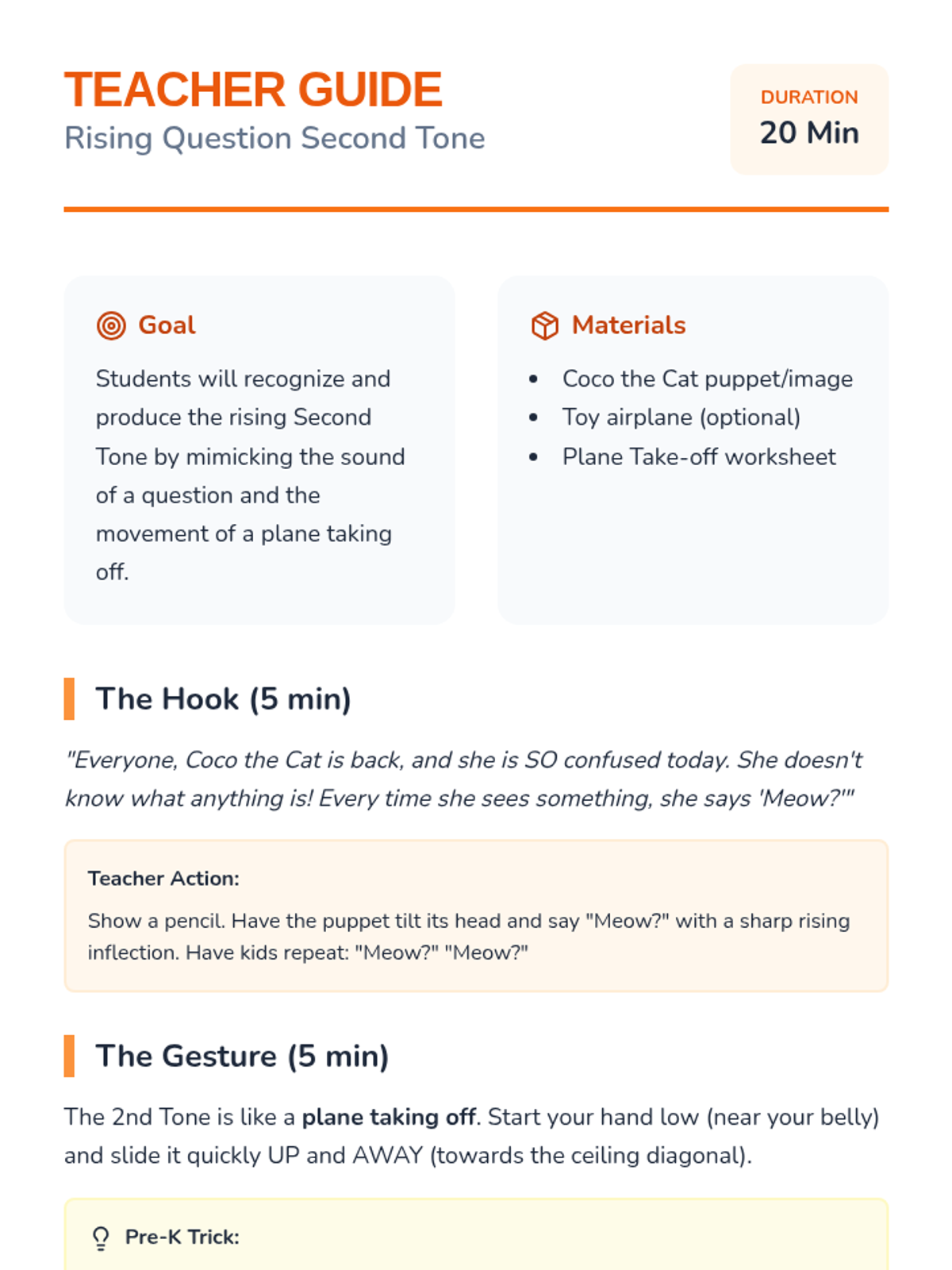
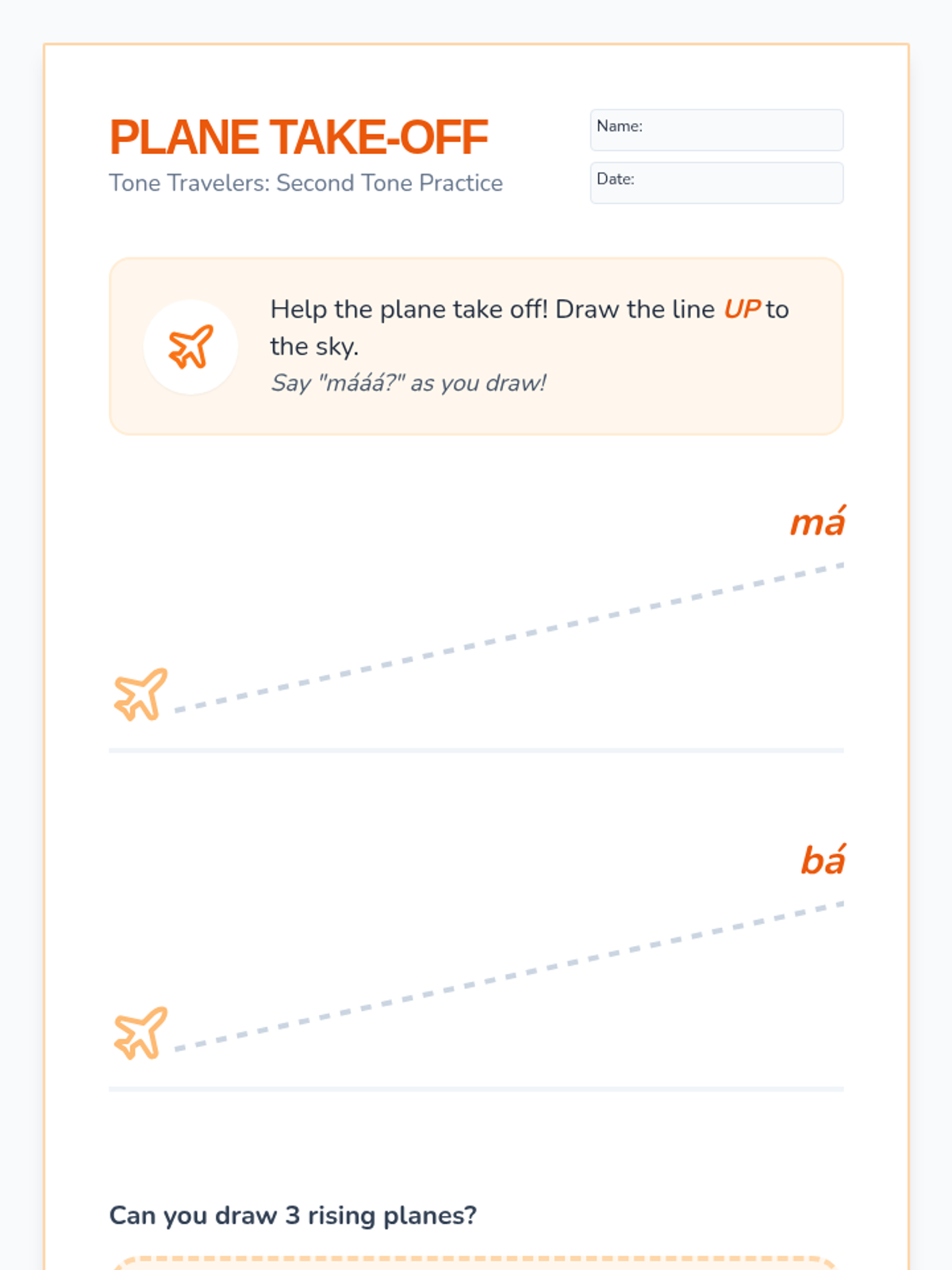
Learners practice the rising pitch of the second tone, associating it with the English questioning sound 'Huh?'. Students use upward arm movements to trace the sound as they practice rising vocal inflections.
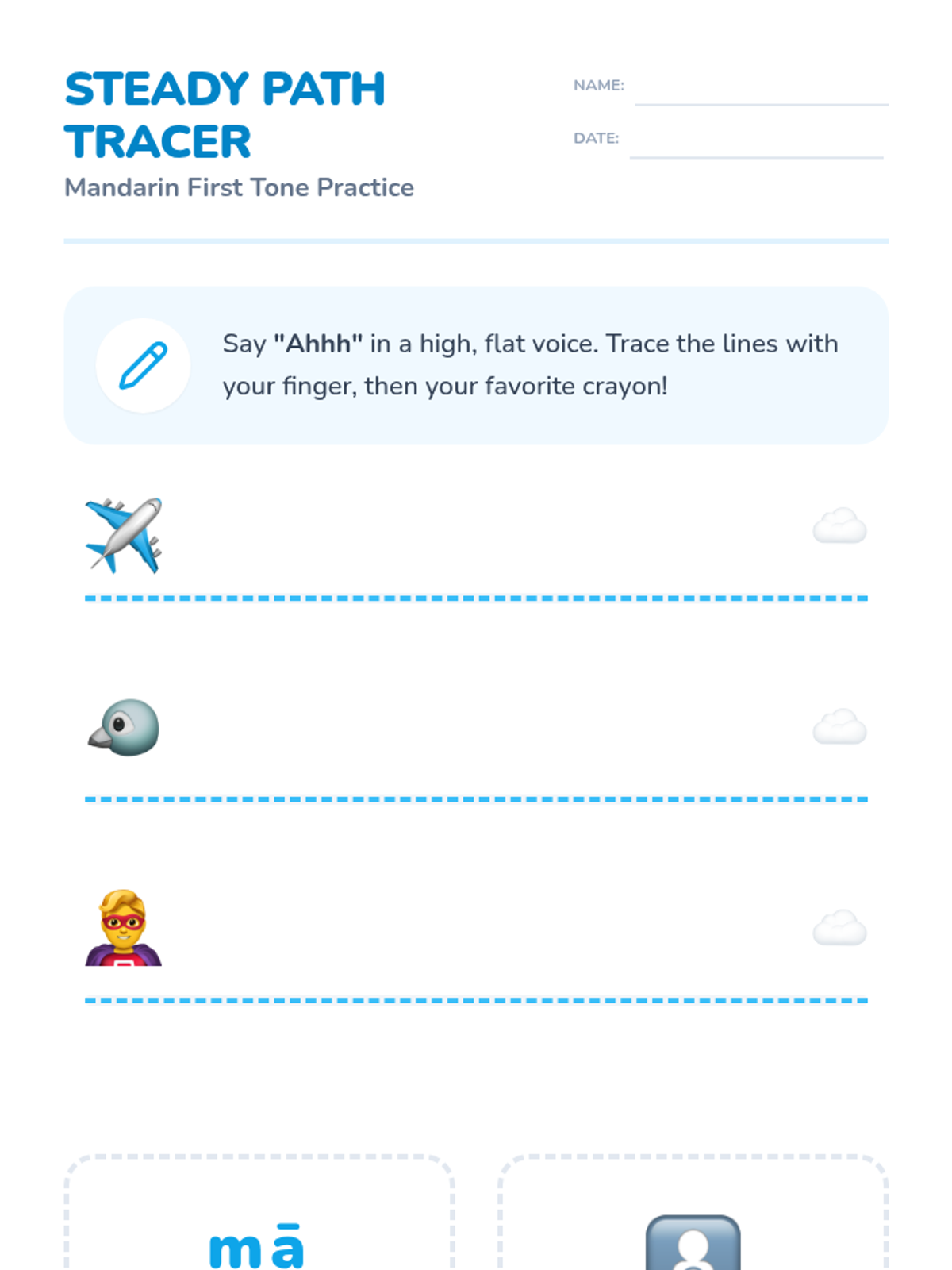
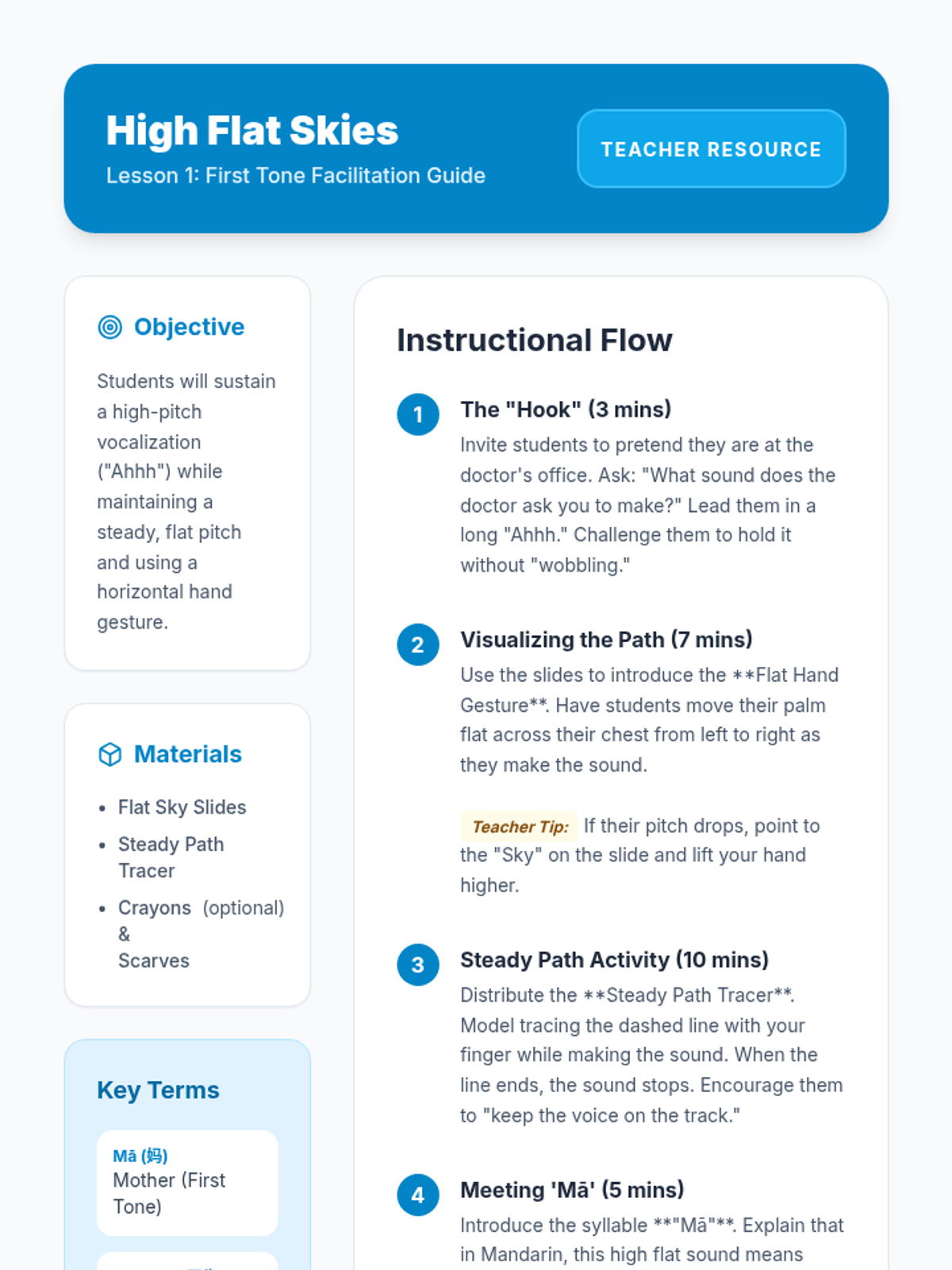
An introduction to the high, flat first tone using the 'Ahhh' sound and flat hand gestures to build steady pitch control.
A culminating game-based lesson where students differentiate and produce all four tones using 'ma' syllables and movement cues.
Learners use karate-style movements to master the sharp, falling Fourth Tone, emphasizing quick vocal drops and firm energy.
Students use their whole bodies to mimic a dipping roller coaster, exploring the low, dipping contour of the Third Tone.
Learners practice the rising Second Tone by mimicking a curious cat and a plane taking off, focusing on upward pitch inflection.
Students explore the high, steady First Tone using a 'flat road' analogy and a robot puppet to practice sustained vocal pitch.
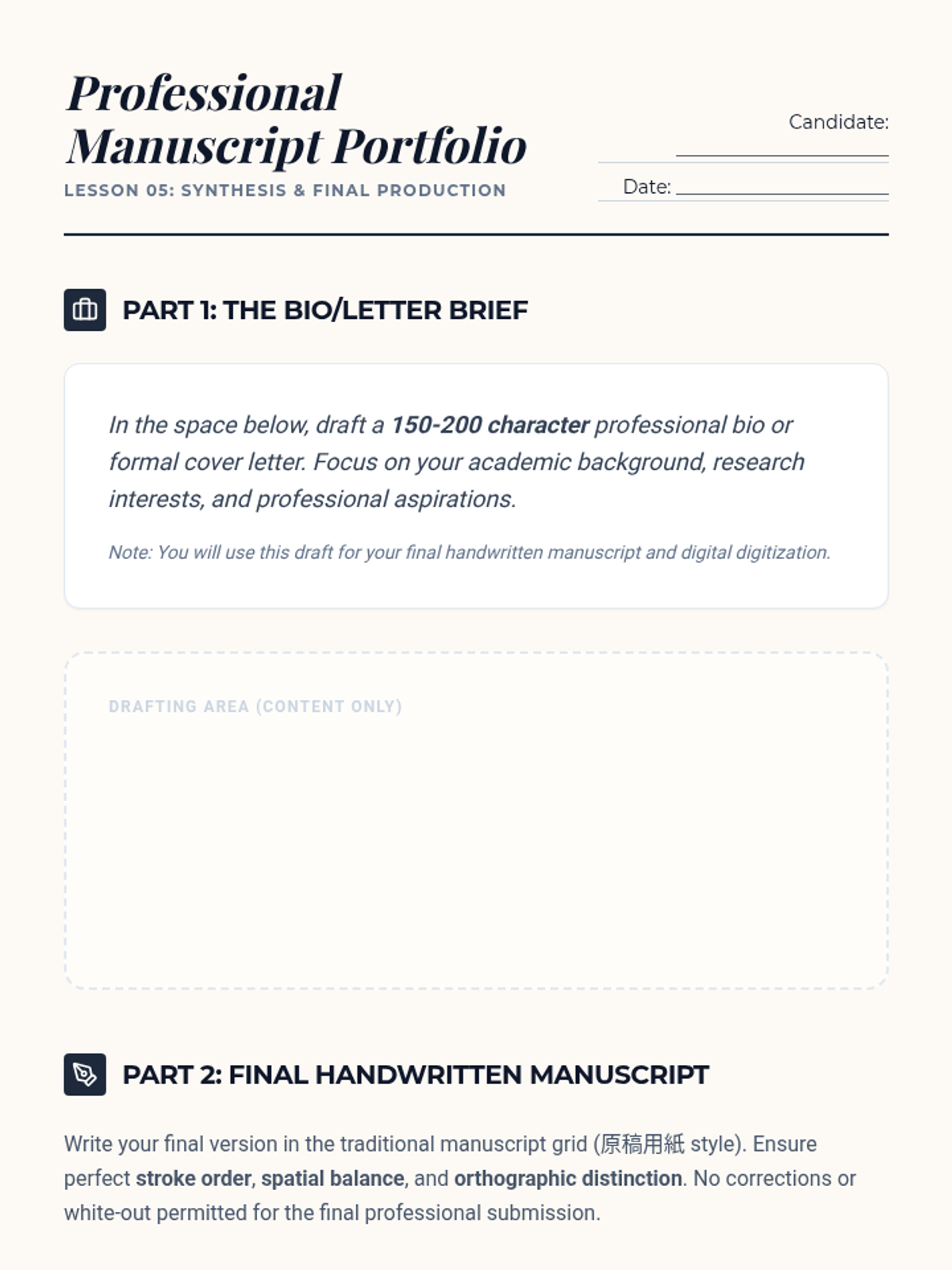
Students synthesize their skills by producing a short, handwritten professional bio or cover letter. They then digitize this text, ensuring perfect character selection, effectively bridging their handwriting and digital typing skills.
Students explore how character structure applies to digital environments, comparing Pinyin input with structure-based methods like Wubi or handwriting recognition. They analyze how stroke order knowledge improves predictive text algorithms and handwriting recognition accuracy.
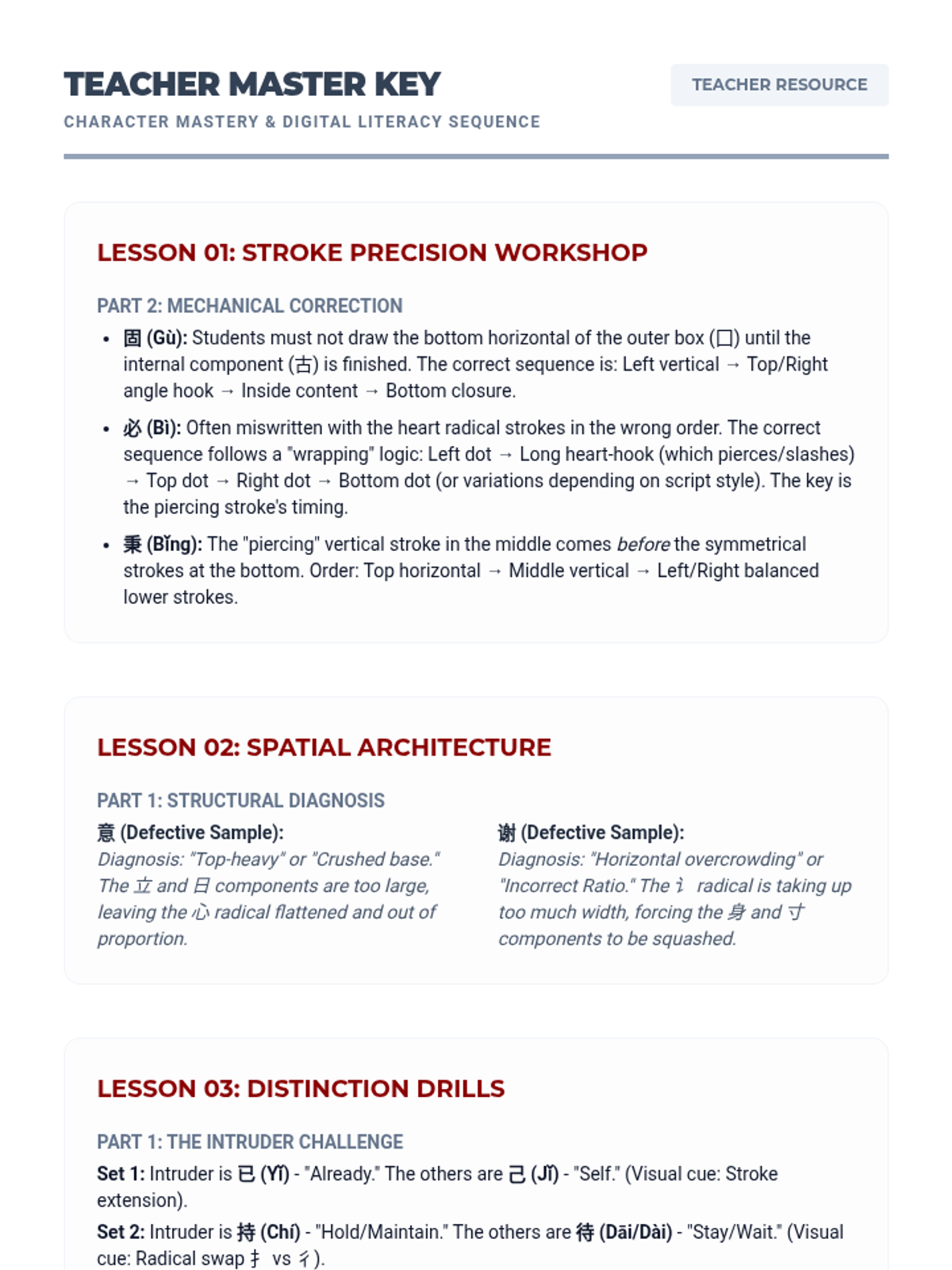
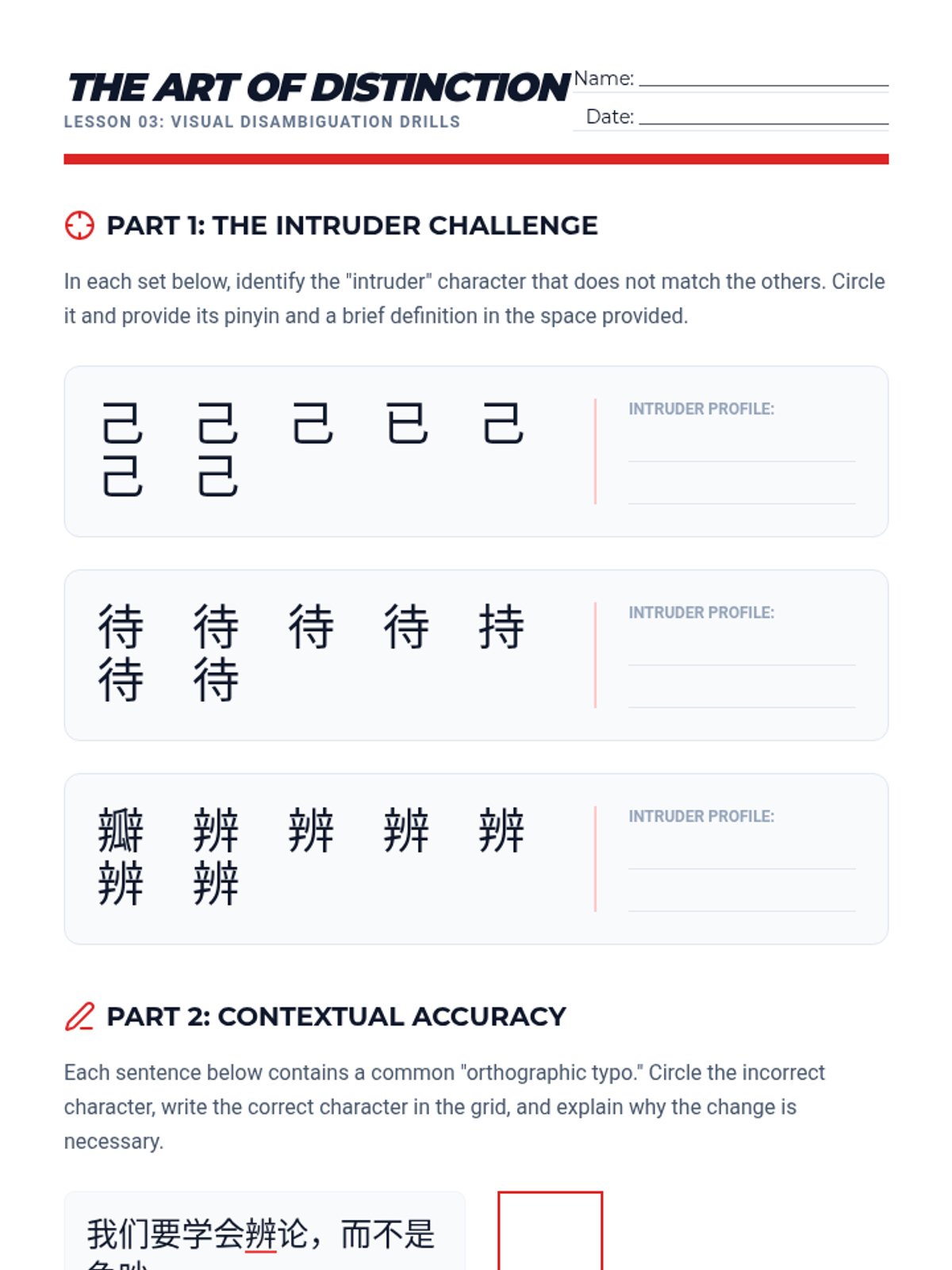
Students identify and practice distinguishing between visual look-alikes (e.g., 待 vs. 持, 己 vs. 已 vs. 巳). The lesson uses rapid recognition drills and comparative writing exercises to ensure precision in both reading and writing.
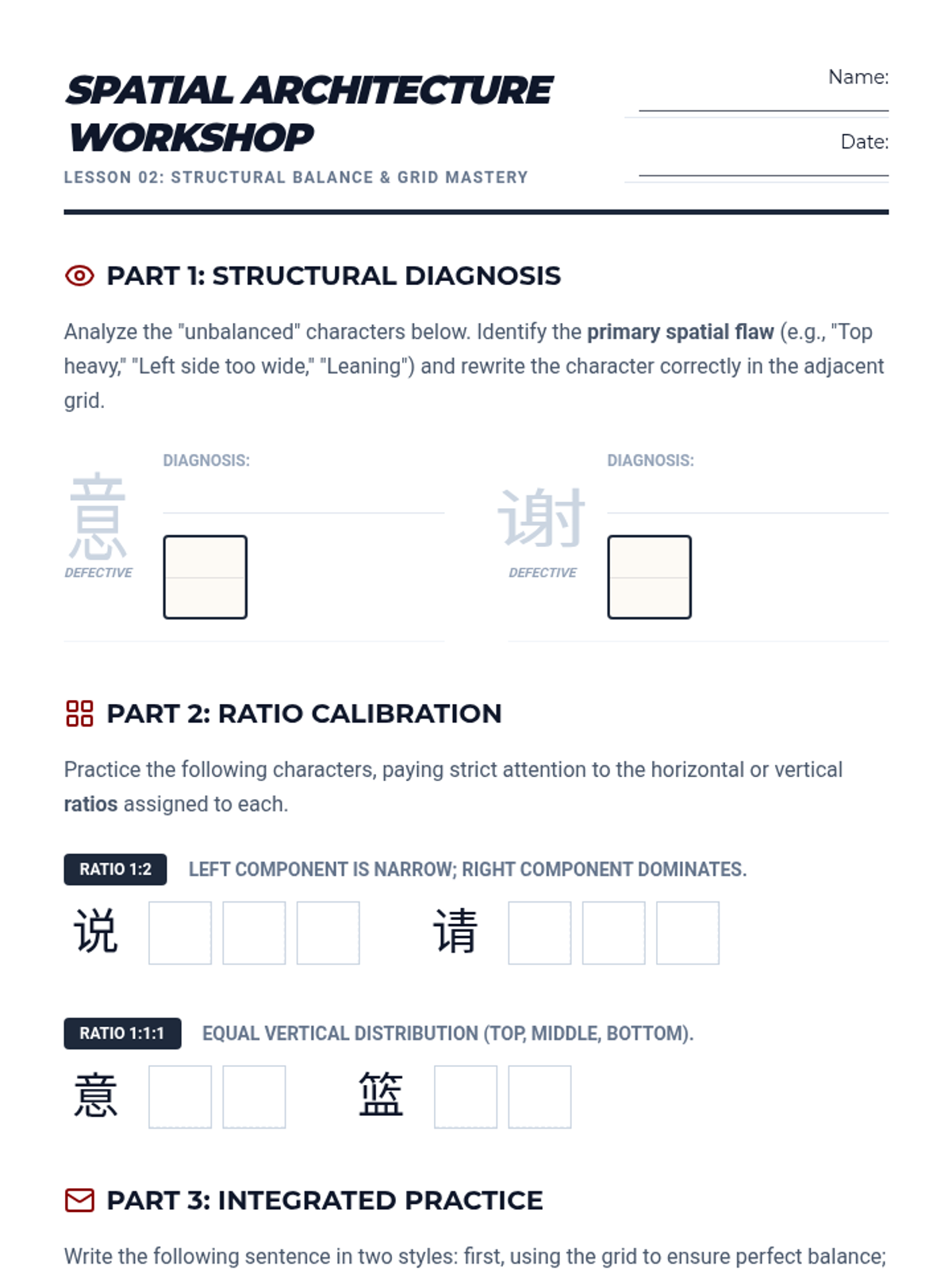
This lesson analyzes the spatial composition of characters, focusing on the ratio between top/bottom and left/right components. Students practice writing characters in grid paper to achieve professional aesthetic balance suitable for handwritten correspondence.
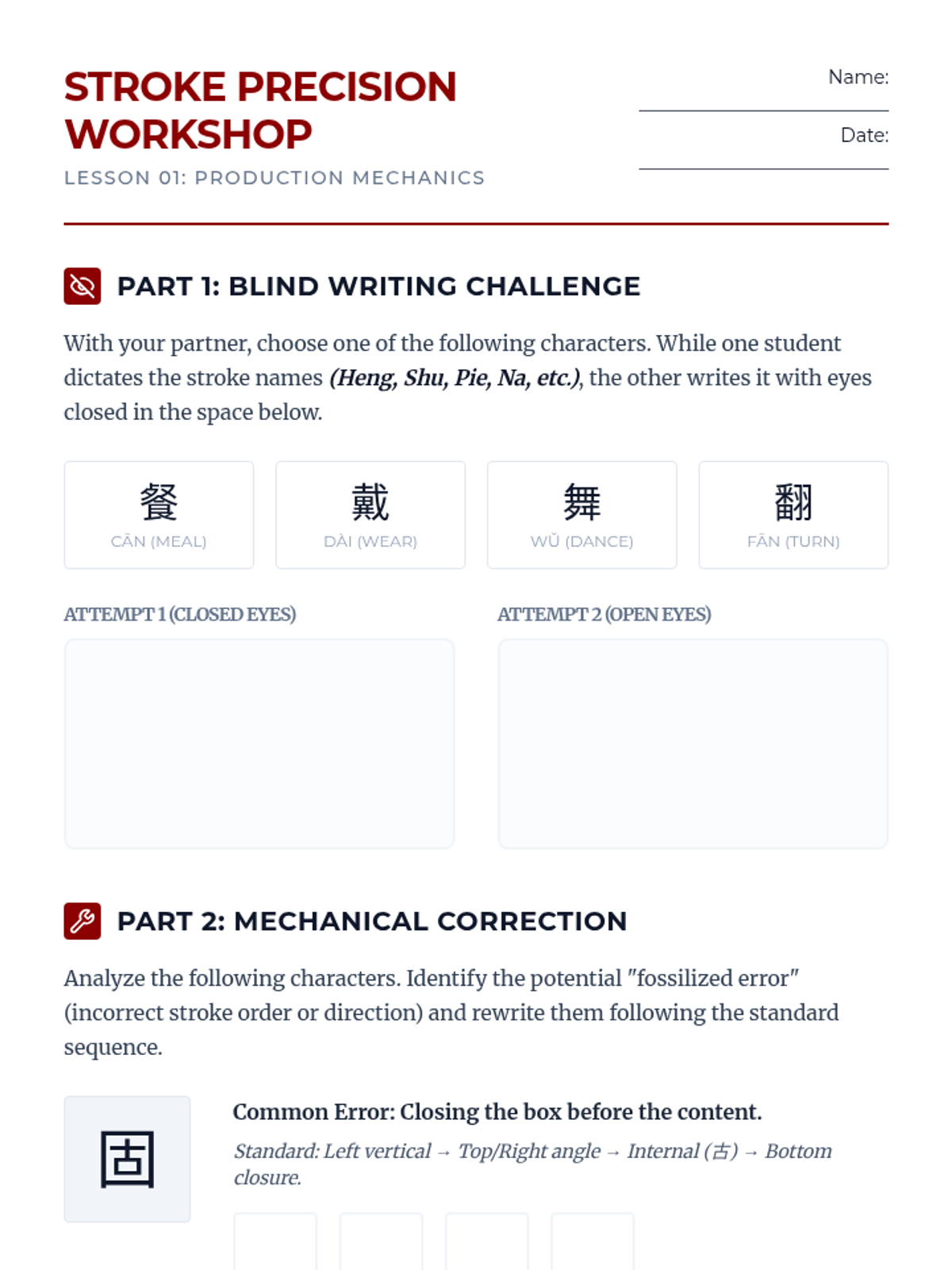
Students revisit fundamental stroke order rules to correct fossilized errors common in intermediate learners. The workshop focuses on the 'why' behind the rules—flow, efficiency, and linkage—applying them to complex HSK 4 characters.
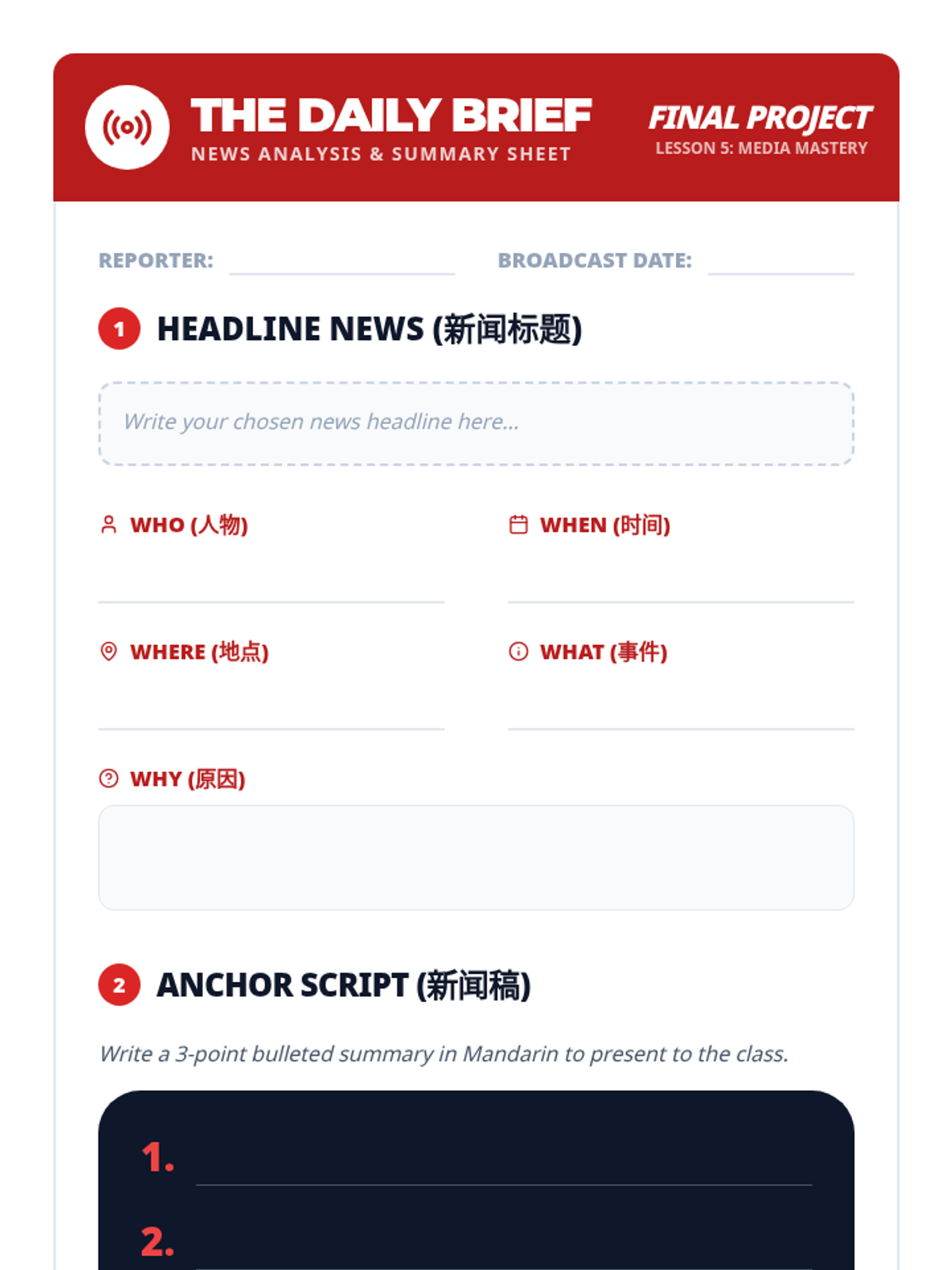
A capstone lesson where students apply the 5 Ws to analyze and summarize a news article for a mock broadcast.
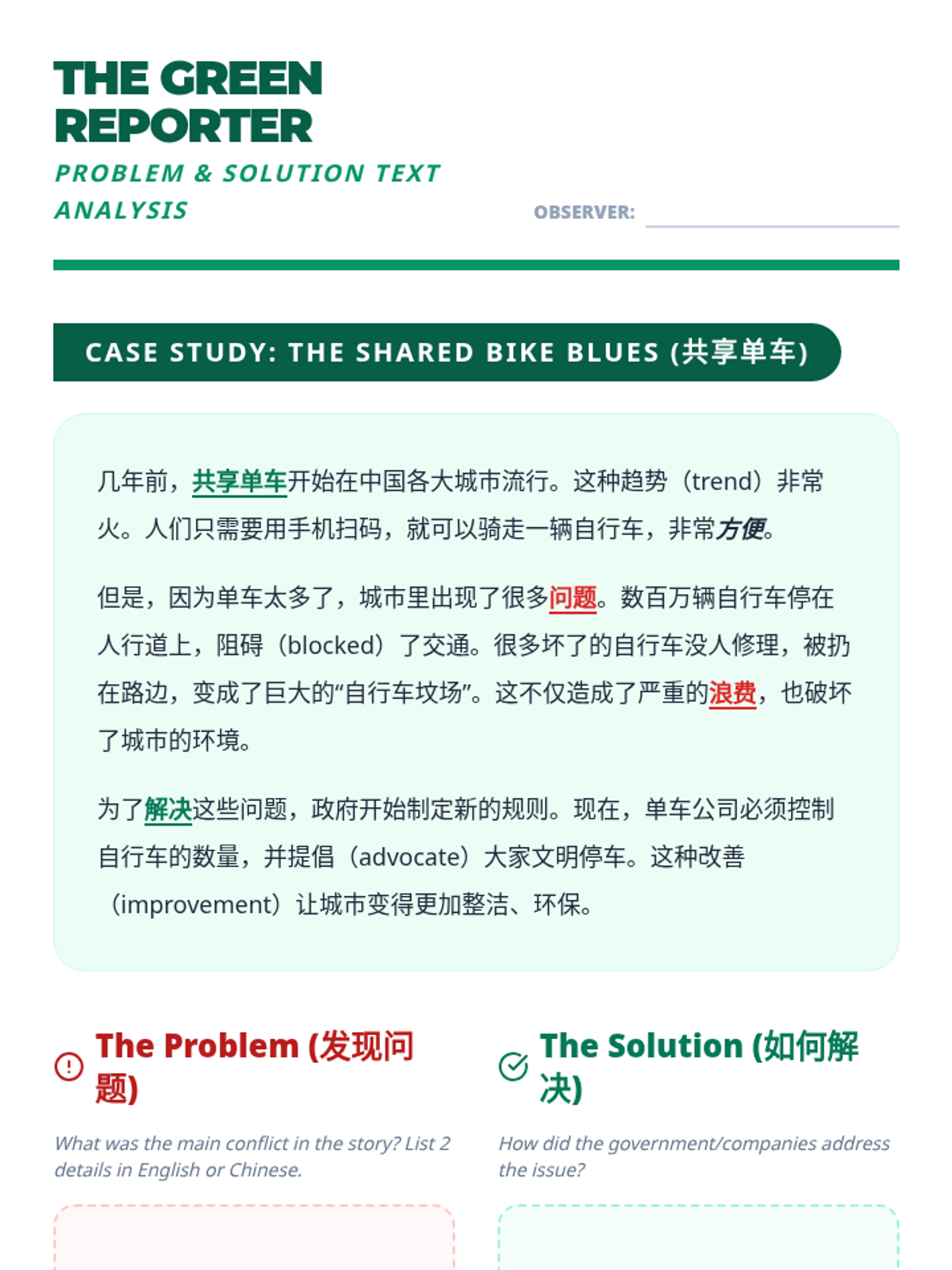
Explores environmental initiatives like bike-sharing to identify problem-solution text structures and global social trends.
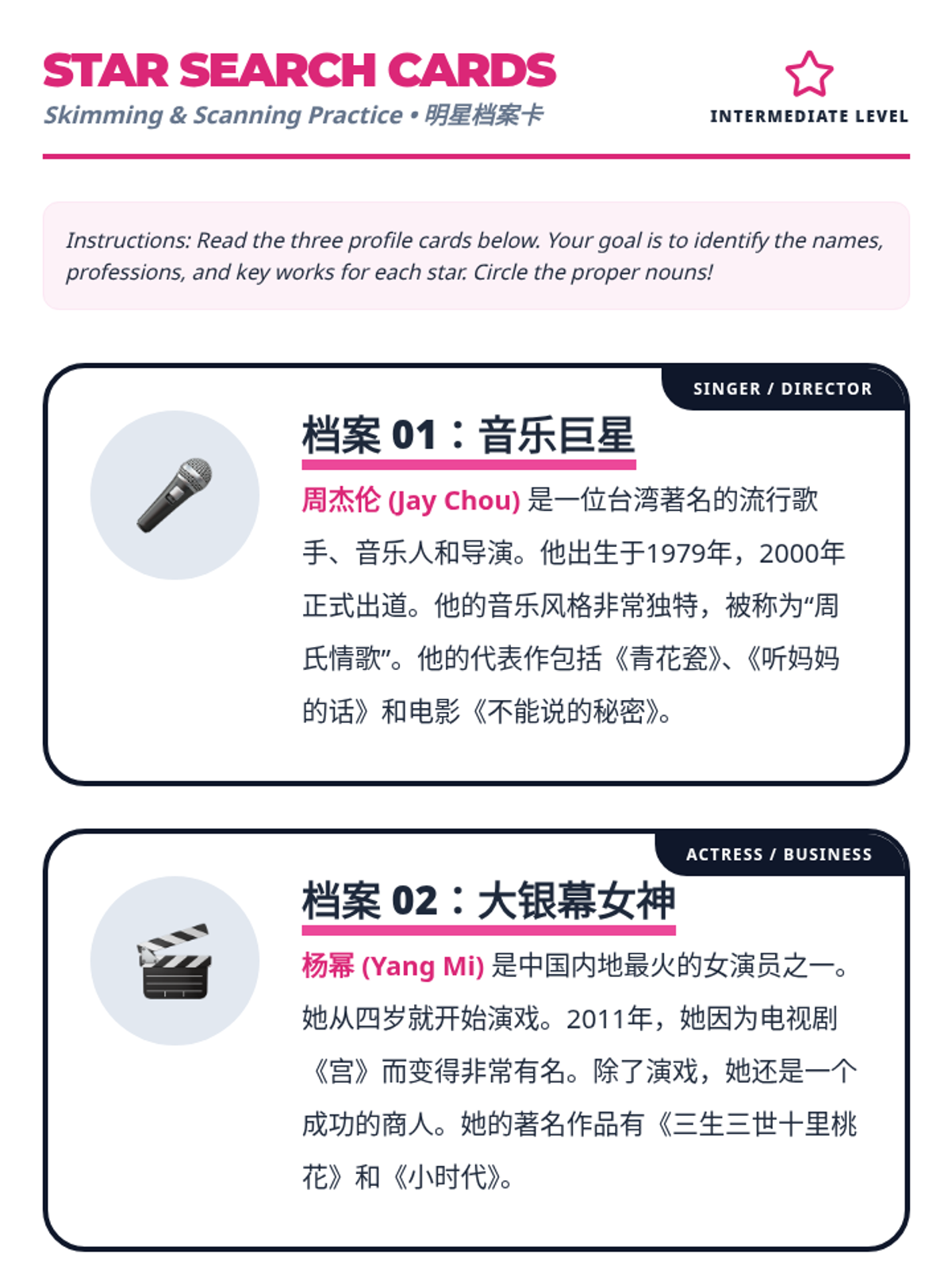
Students practice skimming for proper nouns and biographical data in celebrity profiles and entertainment news.
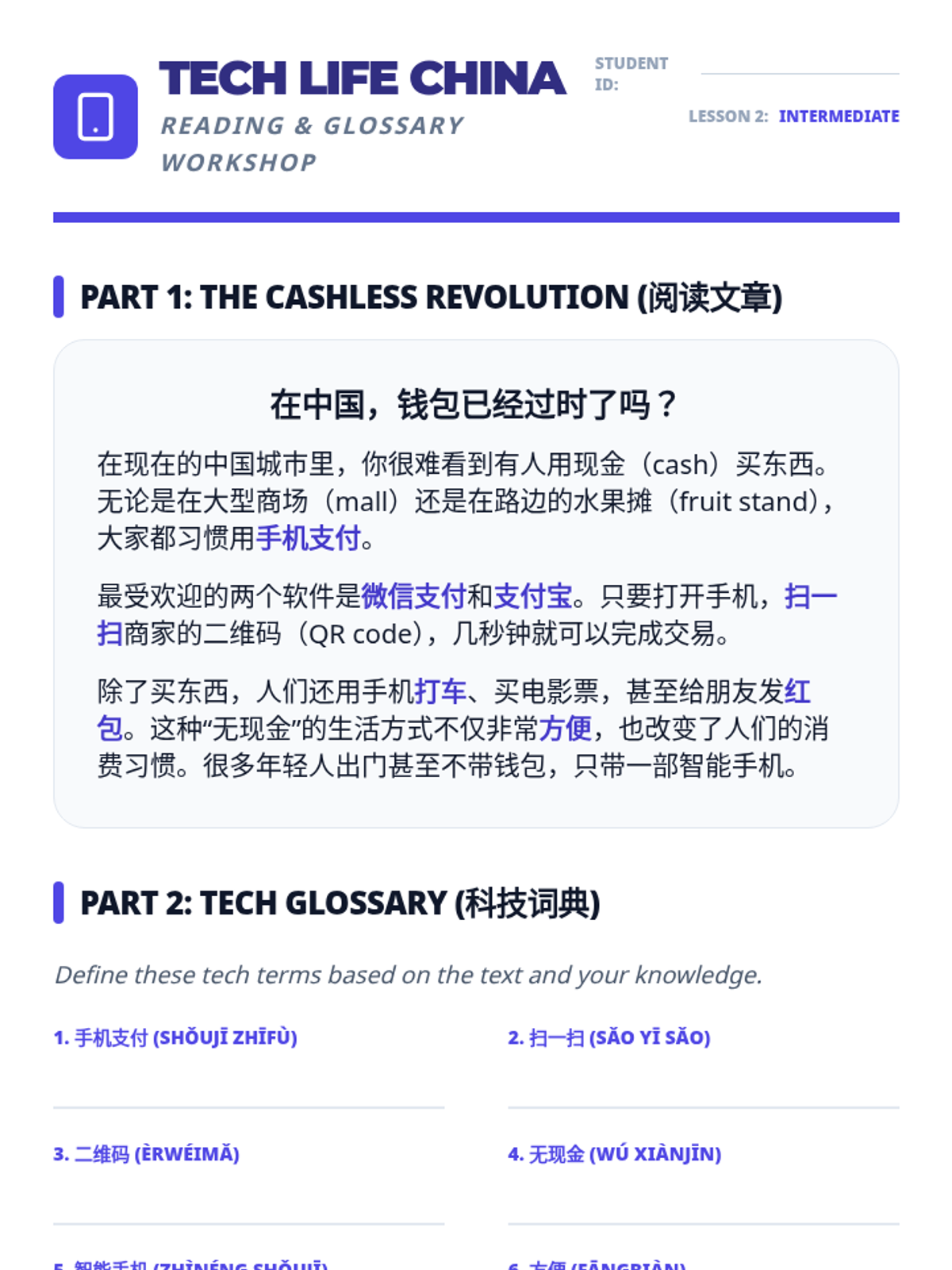
Focuses on mobile payments and social media vocabulary, specifically loanwords and modern tech terminology used in everyday reading.
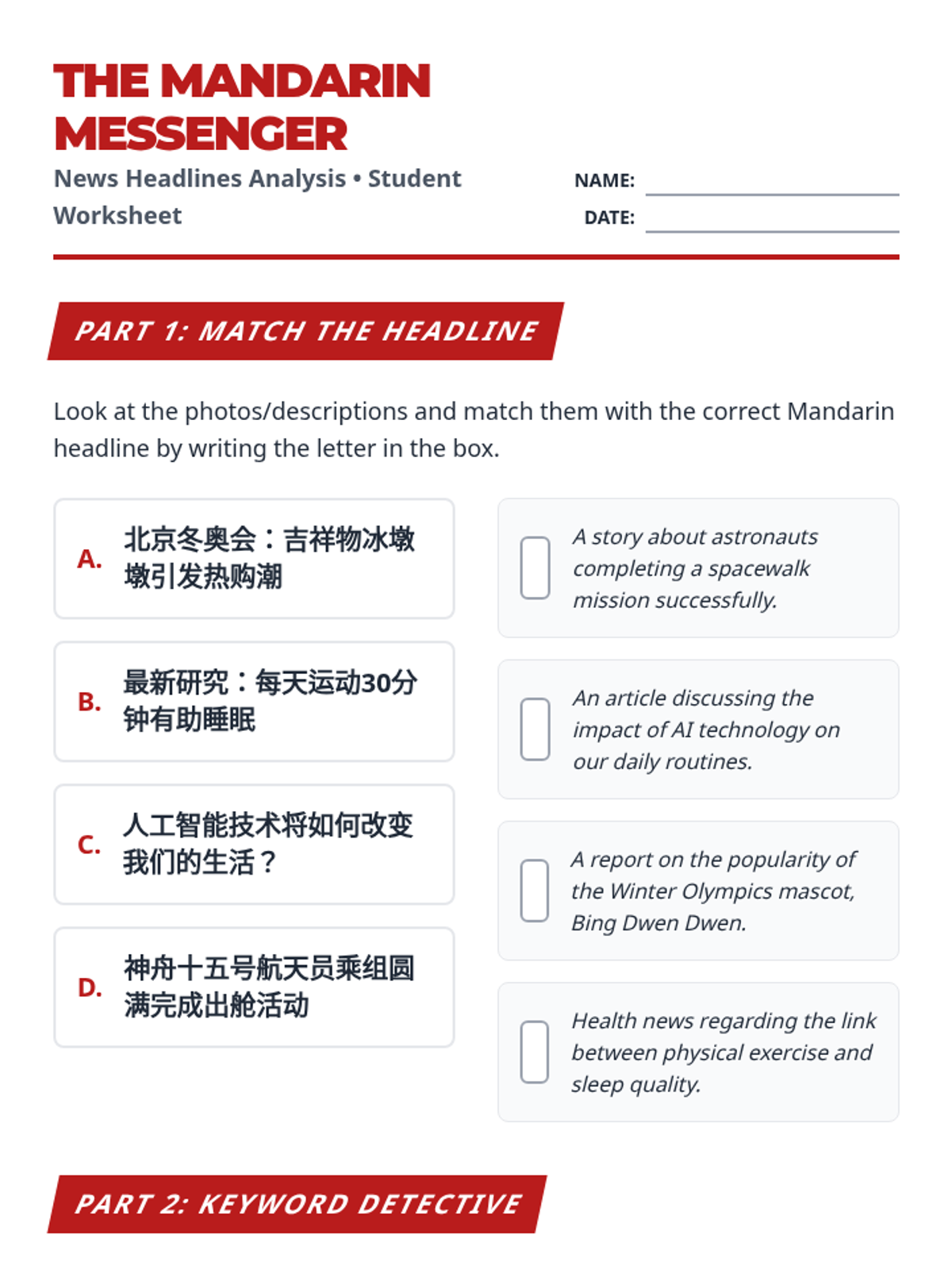
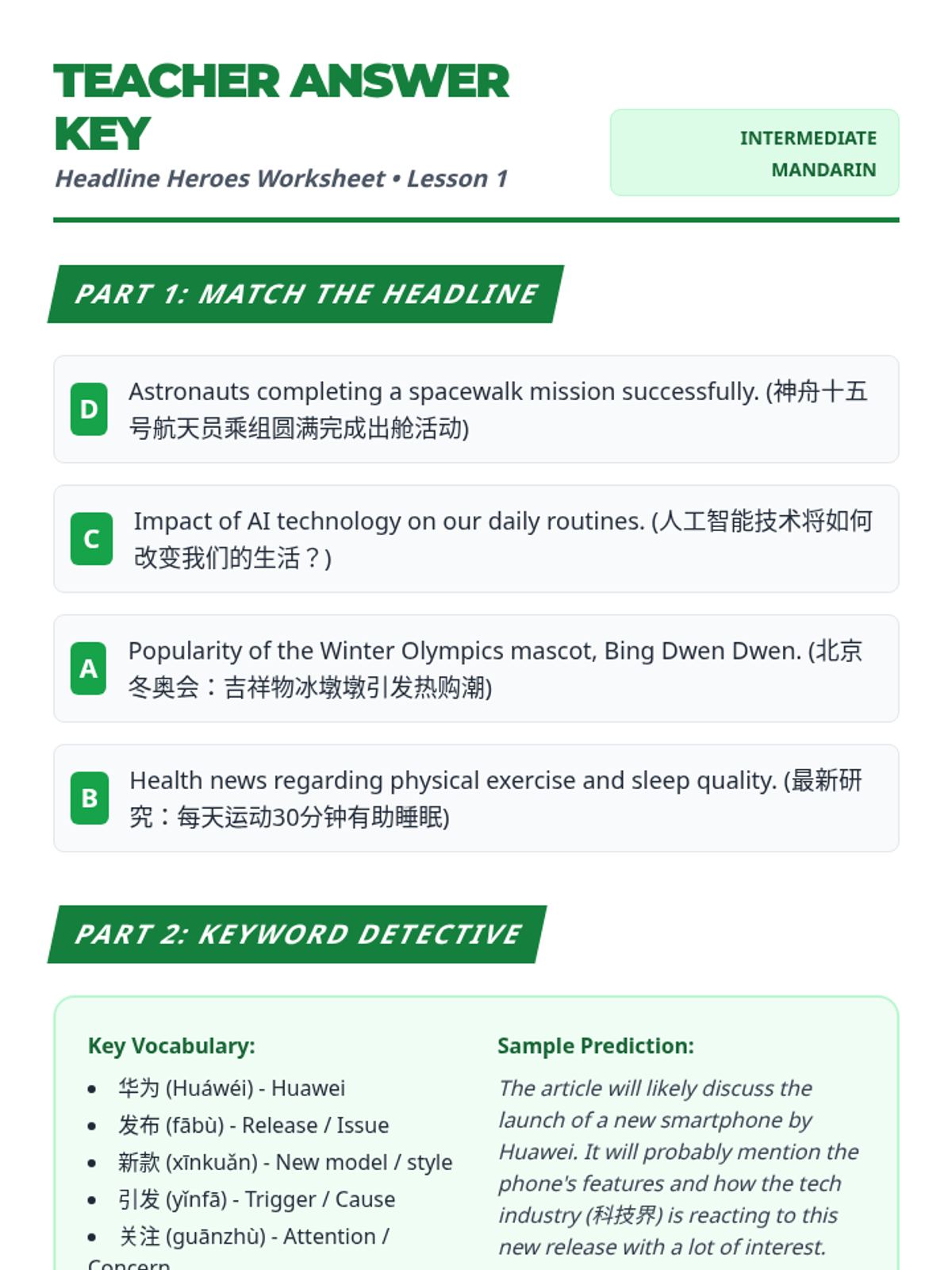
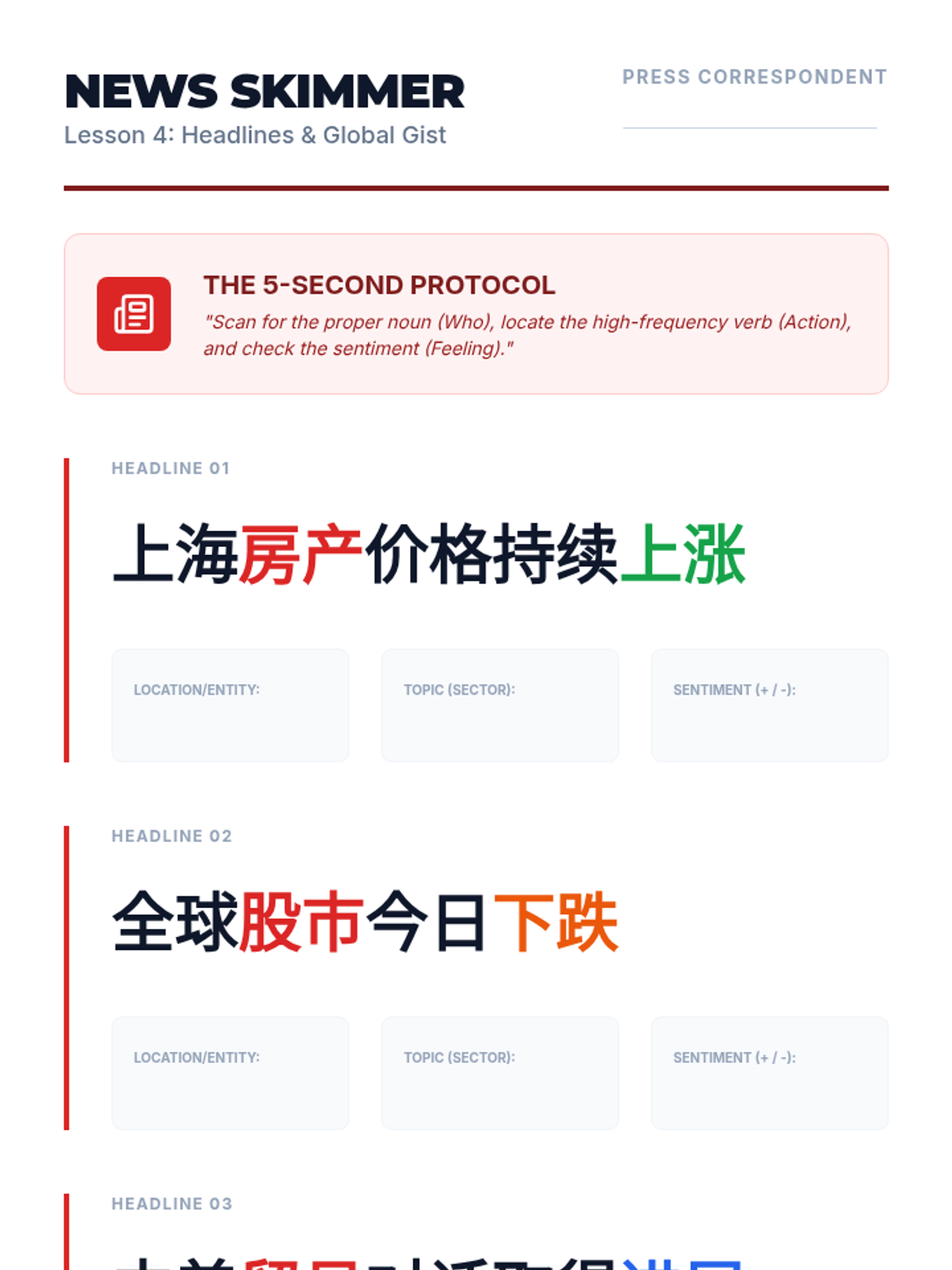
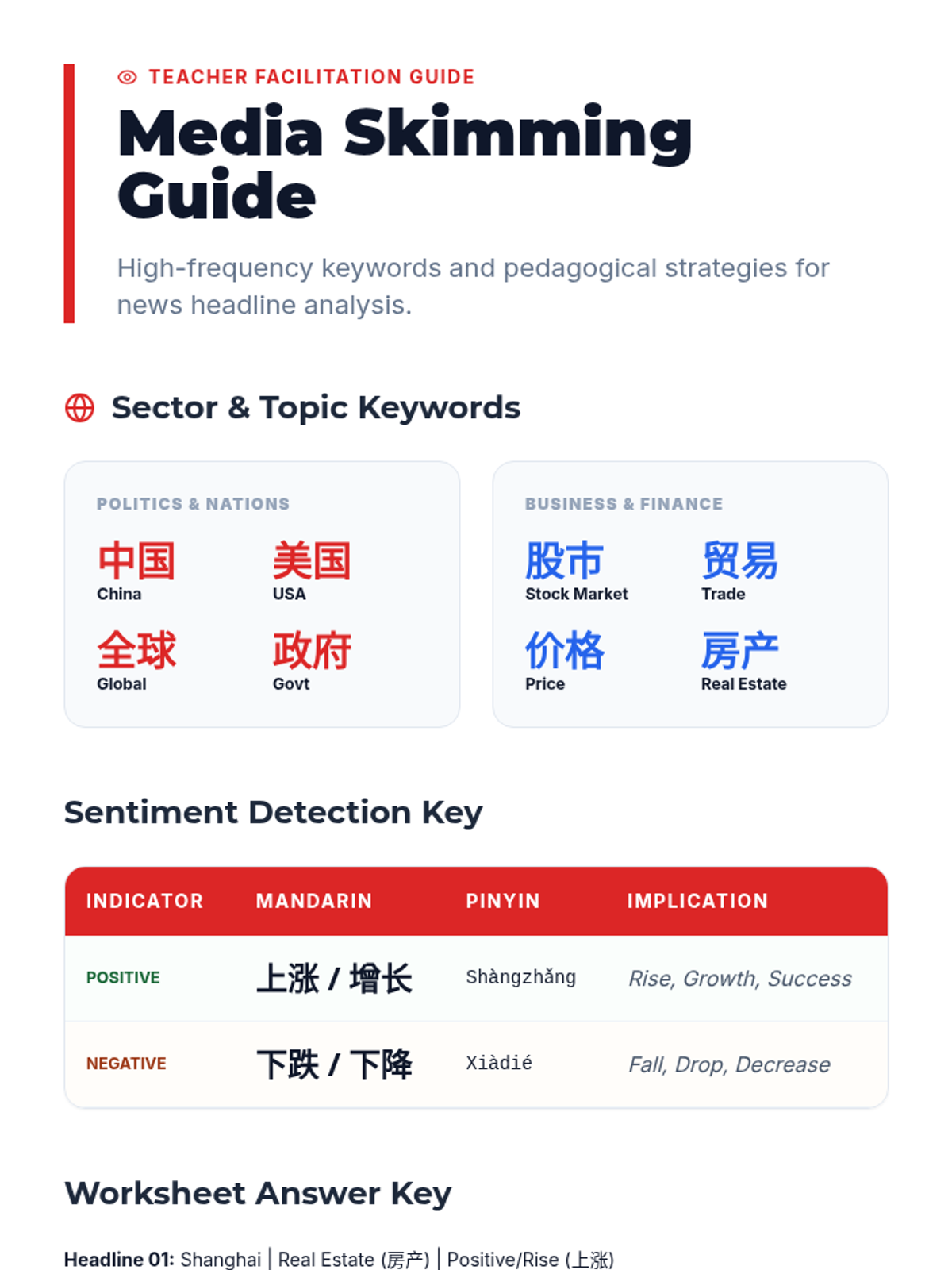
Students analyze the abbreviated grammar and formal vocabulary of news headlines to predict content and associate keywords.
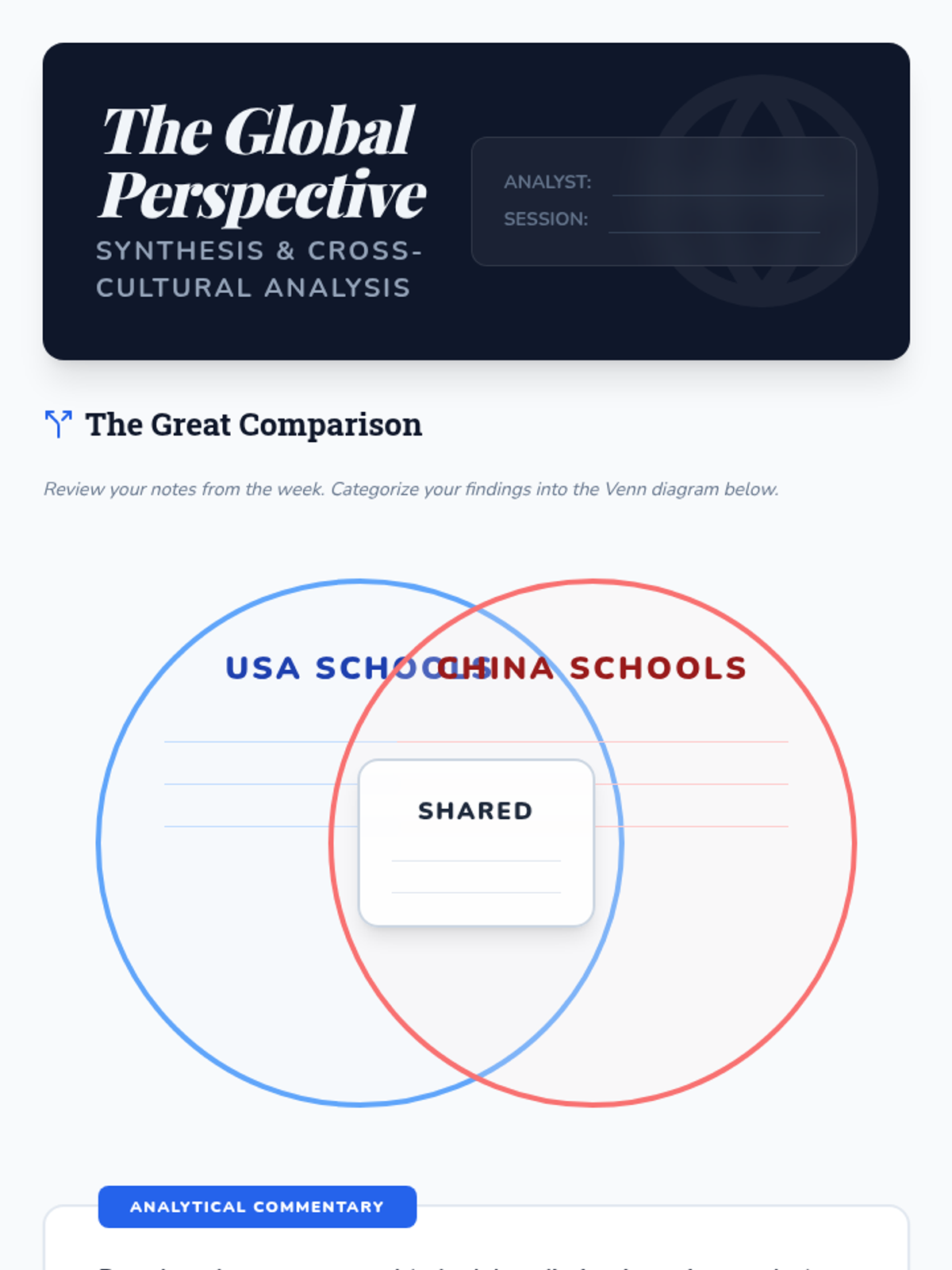
Synthesizing evidence from the week, students compare education styles and articulate their own perspectives using Venn diagrams and short written responses.
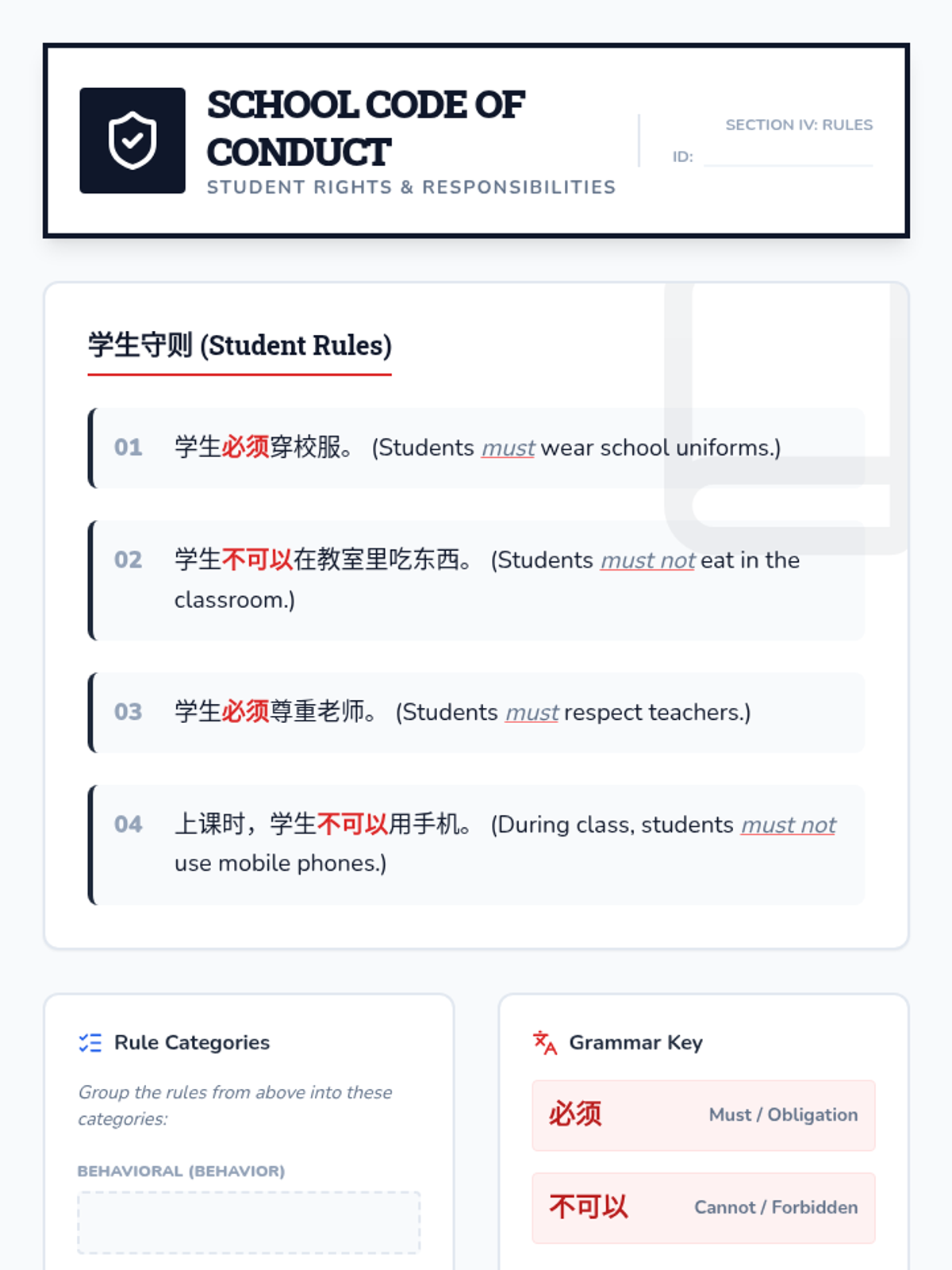
Students analyze school rules and codes of conduct using imperative and modal verbs to understand behavioral and academic expectations.
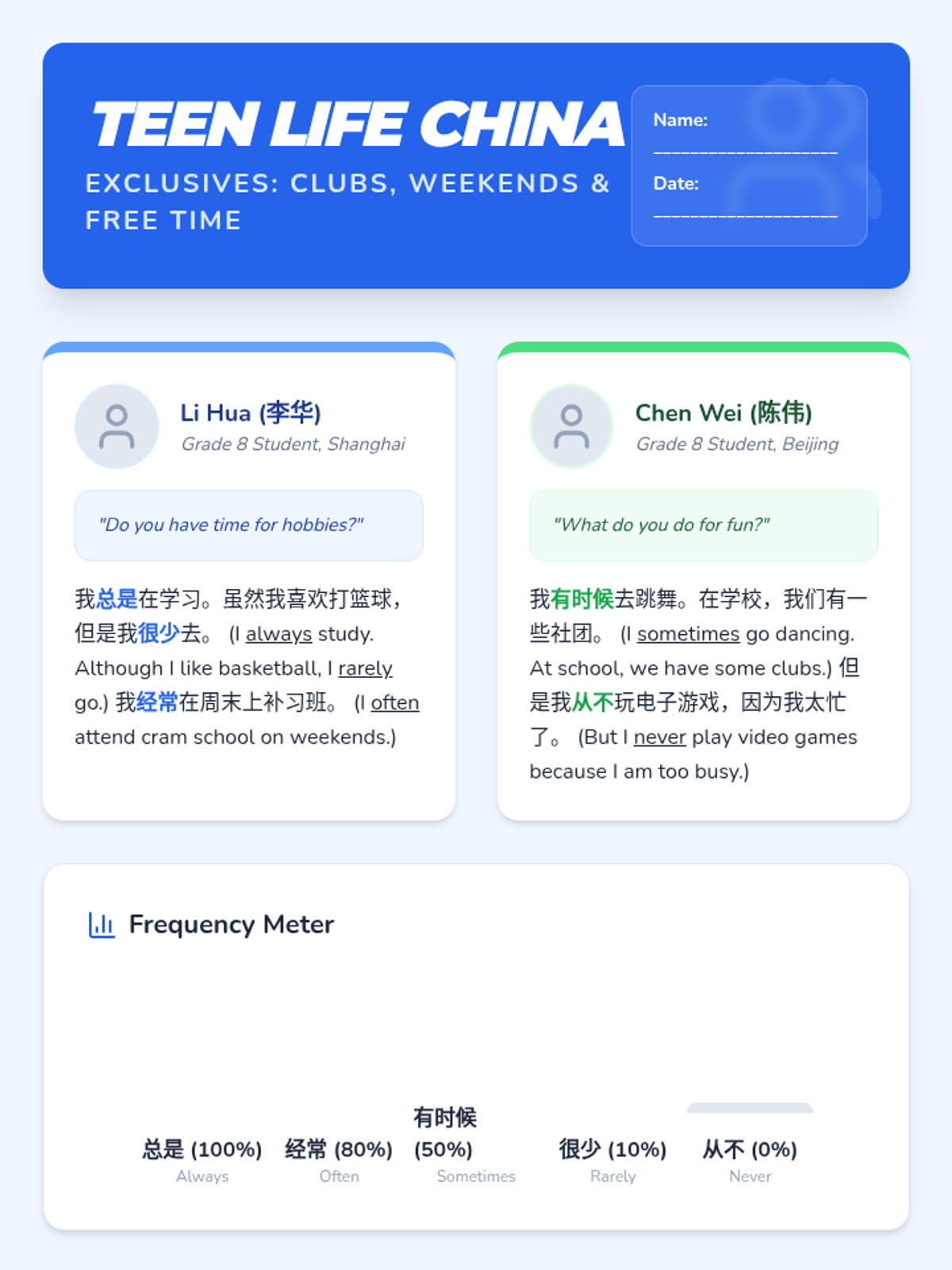
Students explore texts about extracurricular activities and social life, focusing on frequency adverbs and the balance between study and play.
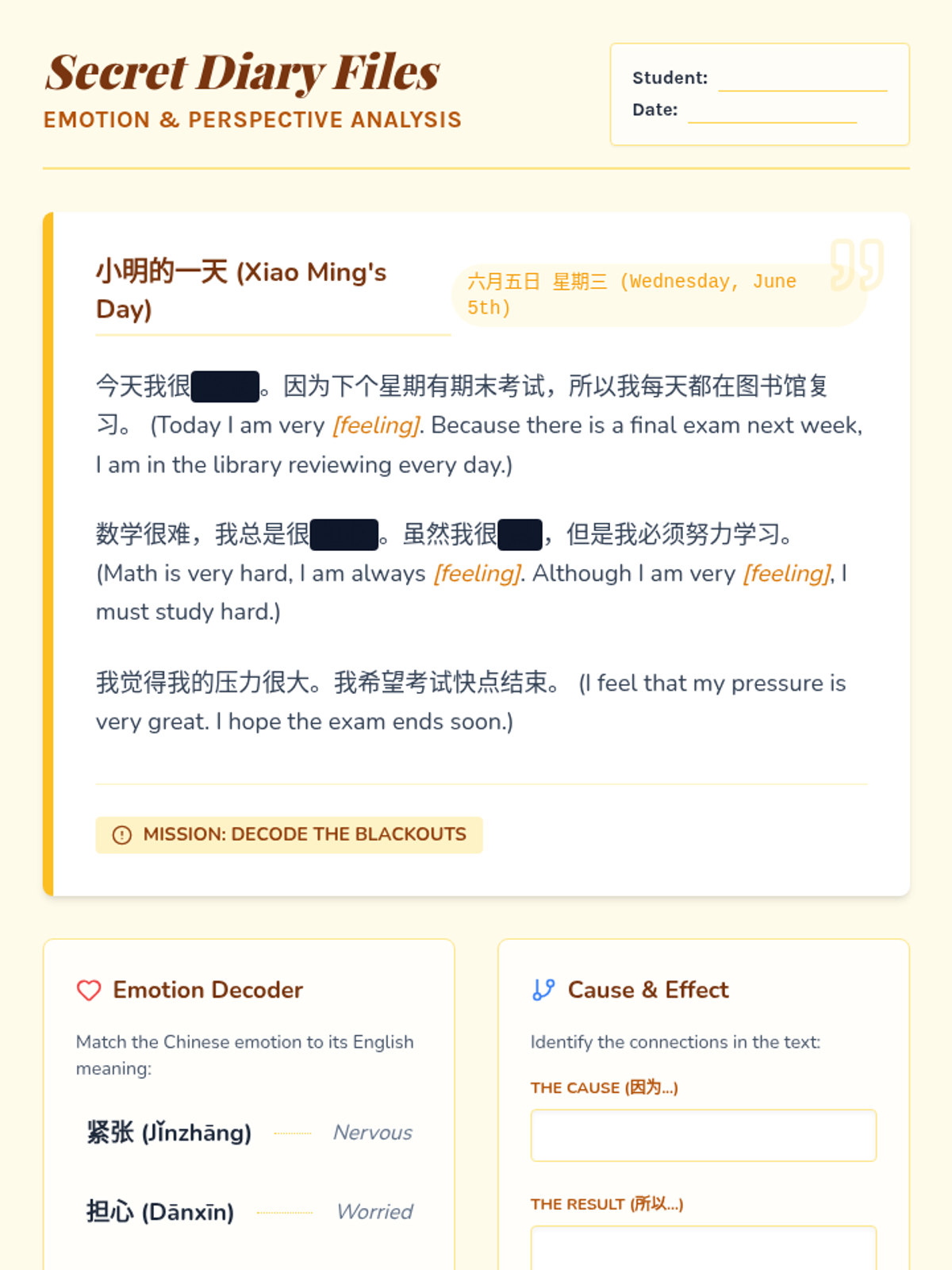
Focusing on emotional tone and cause-effect structures, students read personal diary entries to understand the feelings and pressures of Chinese peers.
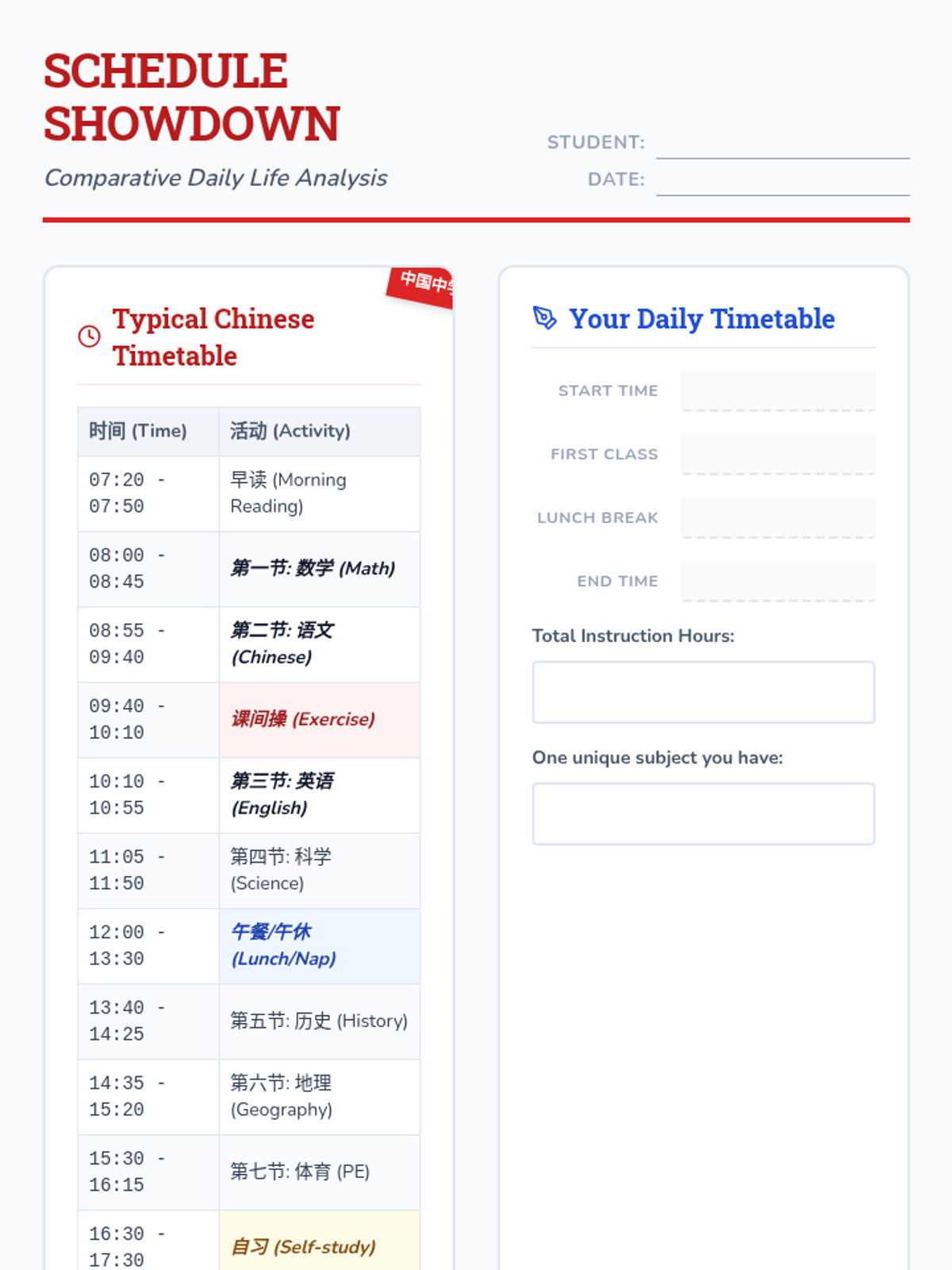
Students read and analyze a typical Chinese middle school timetable, comparing it to their own to understand the structure of the school day and academic subjects.
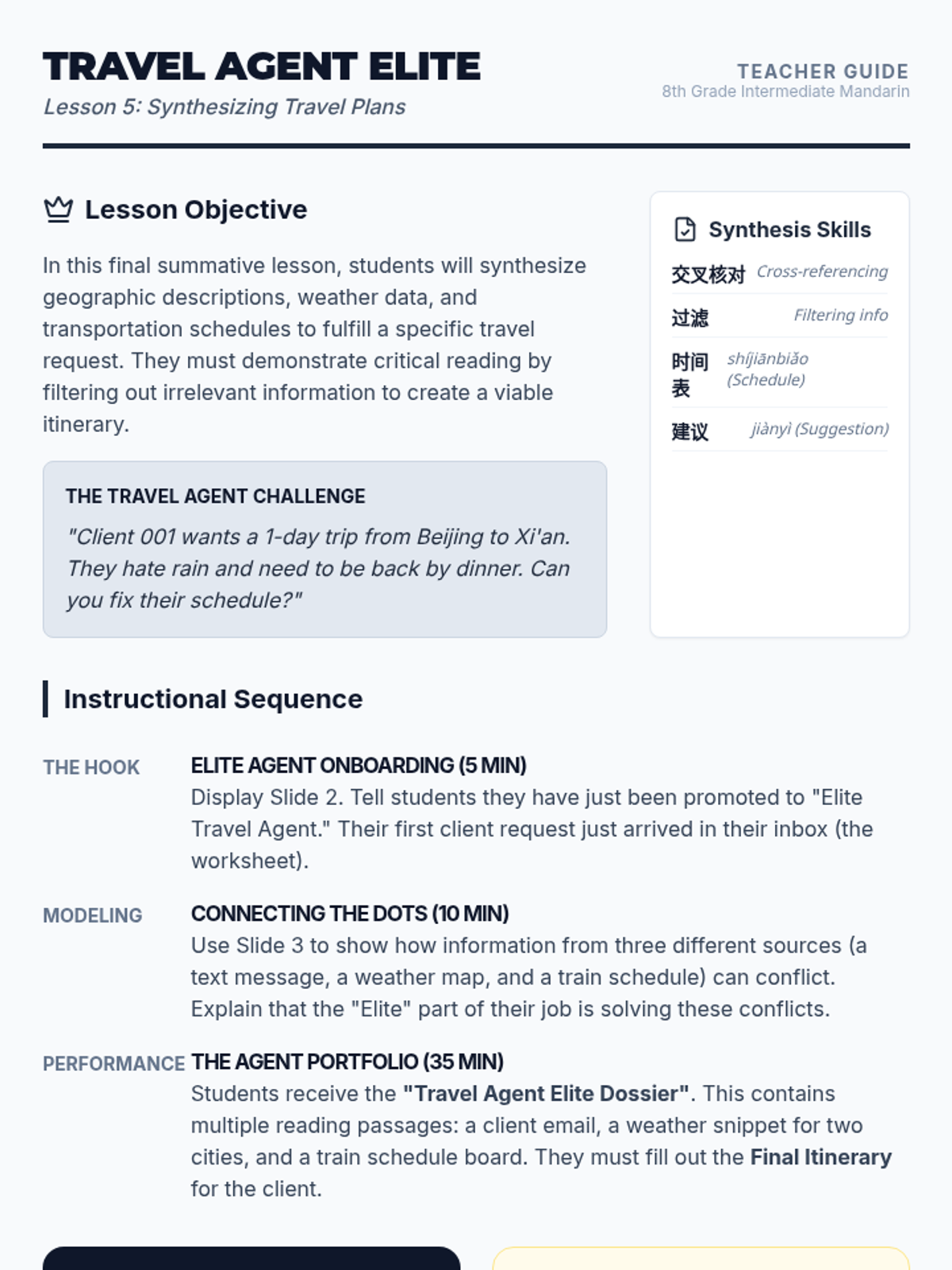
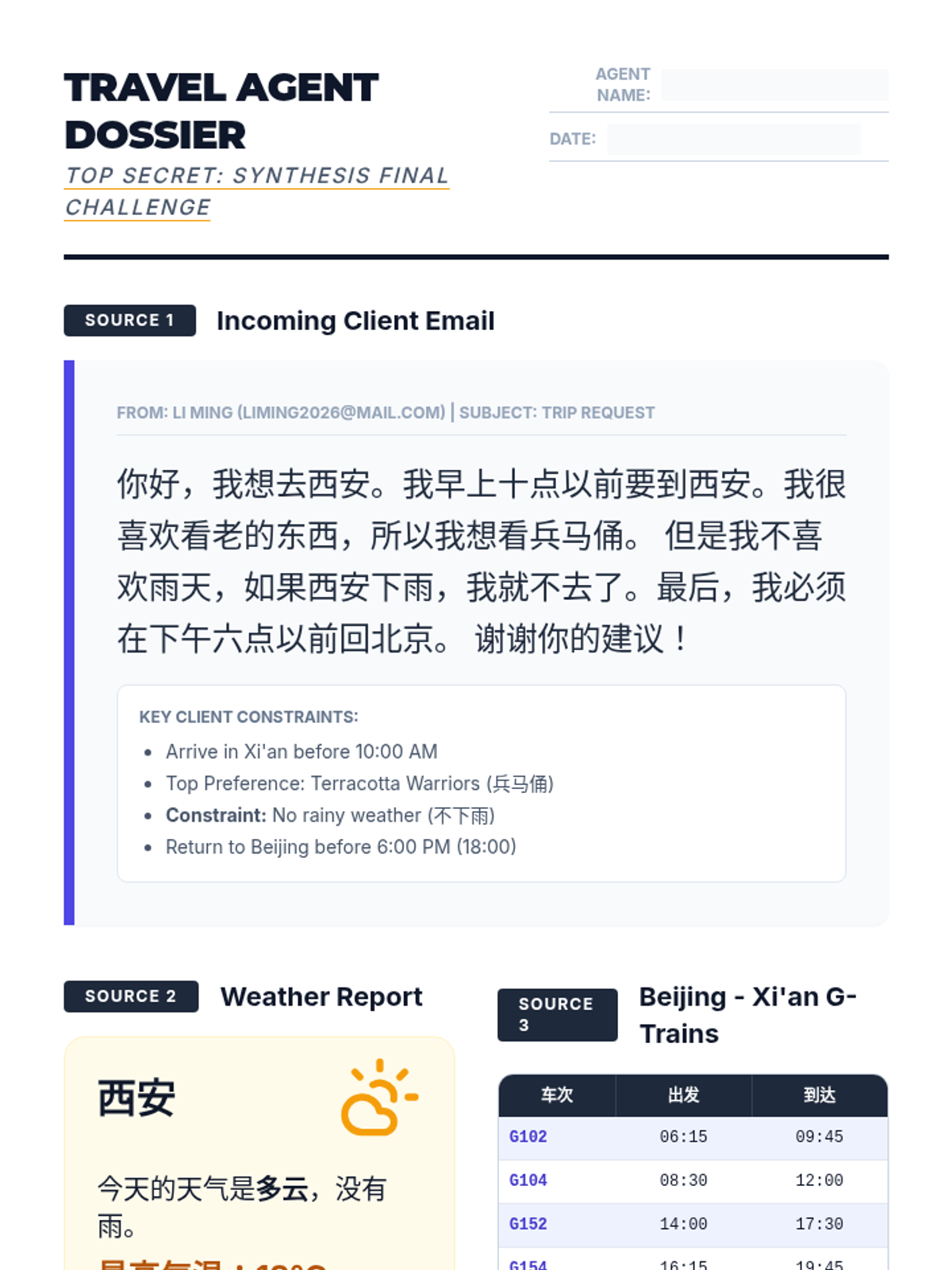
Students synthesize information from multiple sources to create a complete travel itinerary for a specific client request.
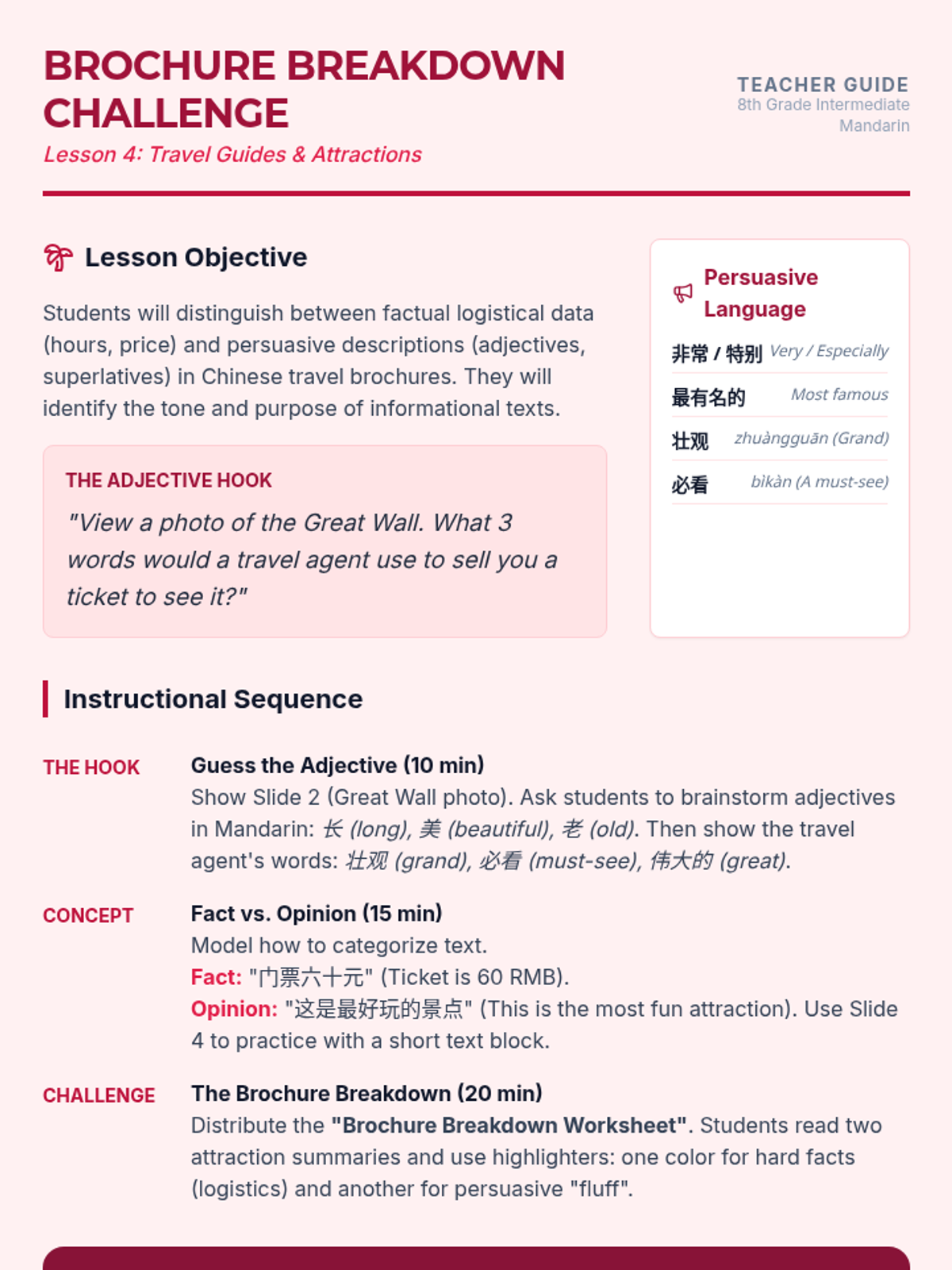
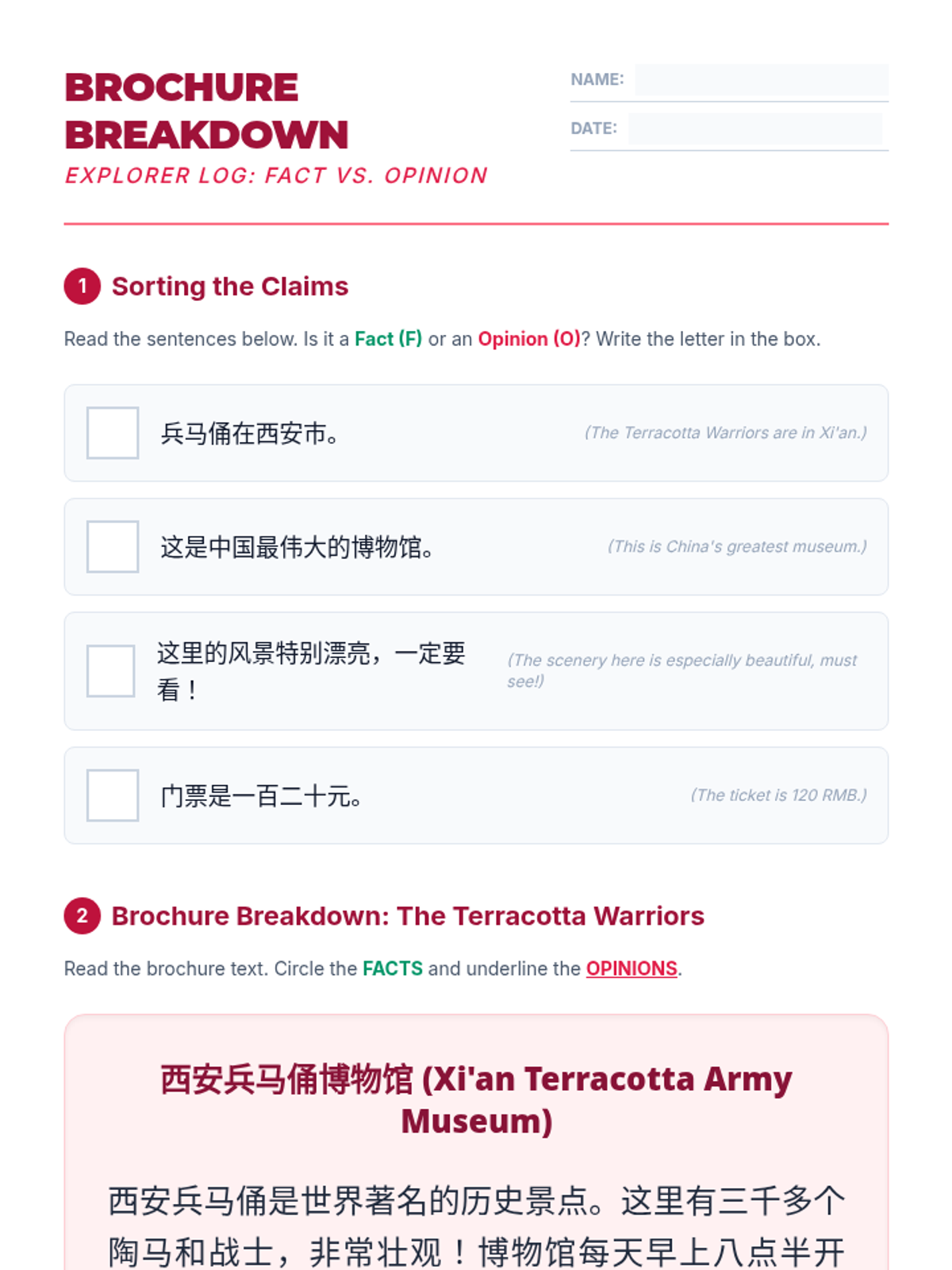
Students analyze travel brochures for major attractions, distinguishing between factual logistics and persuasive descriptions.
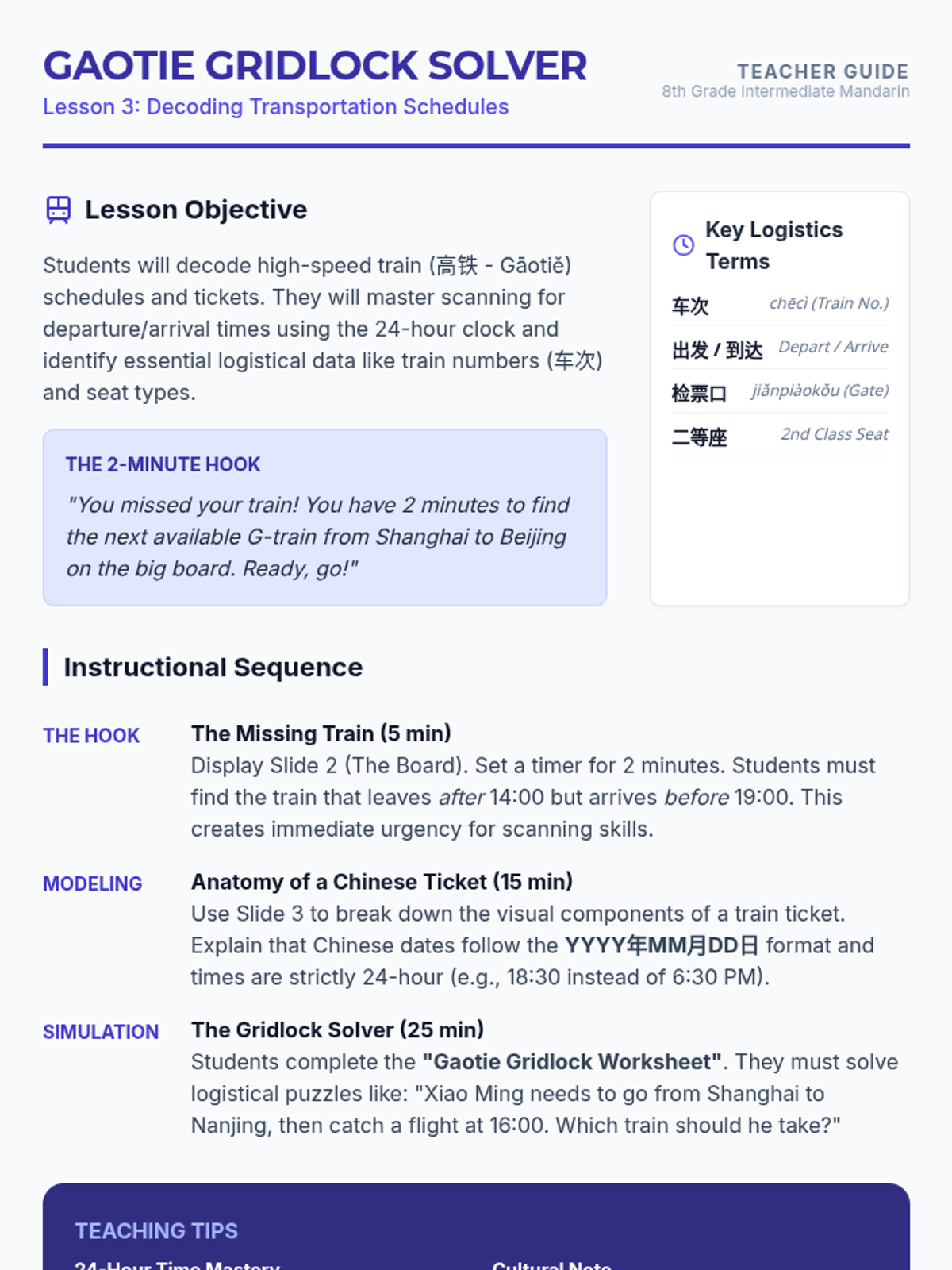
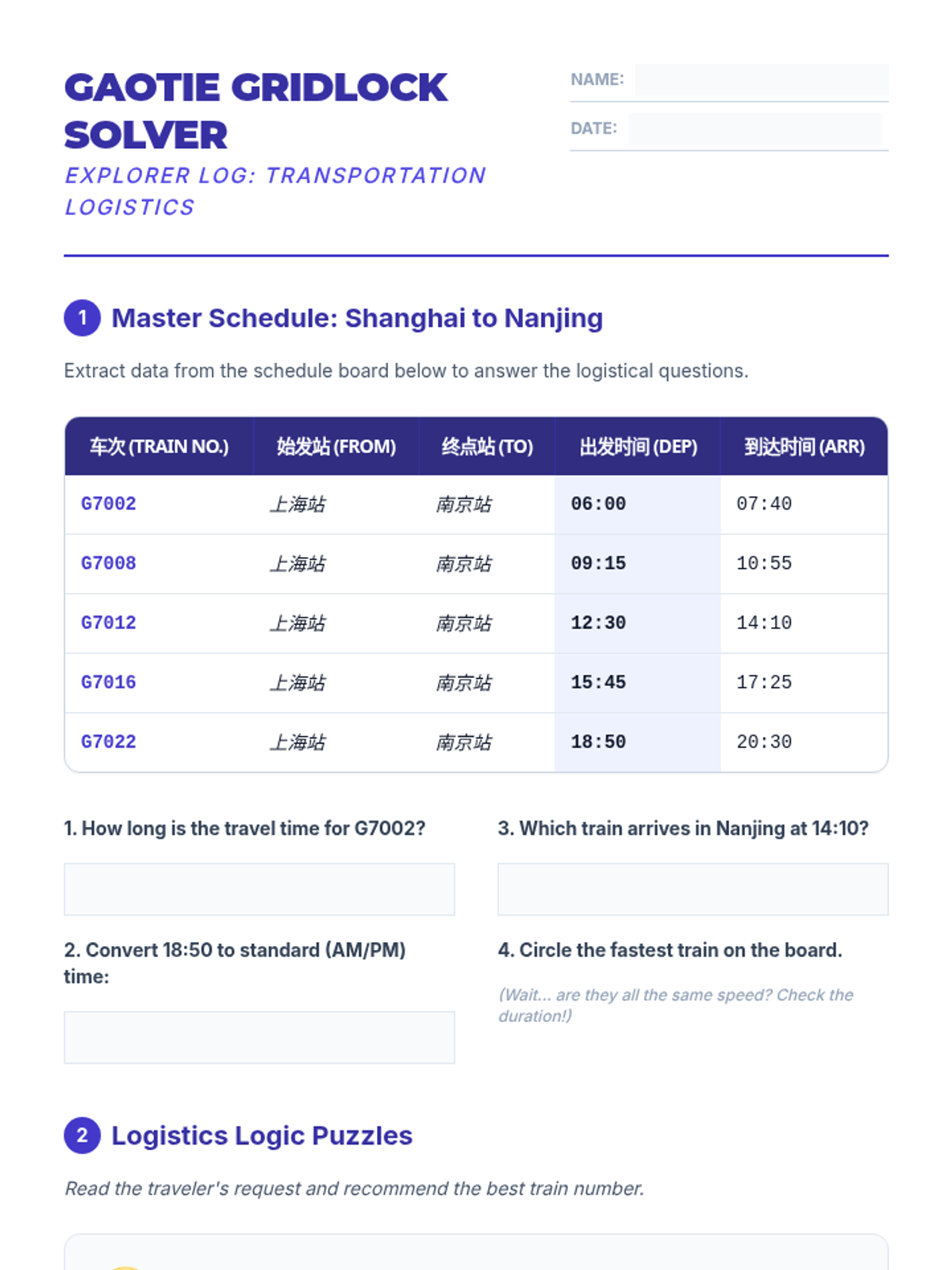
Students decode high-speed train schedules and tickets to solve logistics problems and navigate the 24-hour clock.
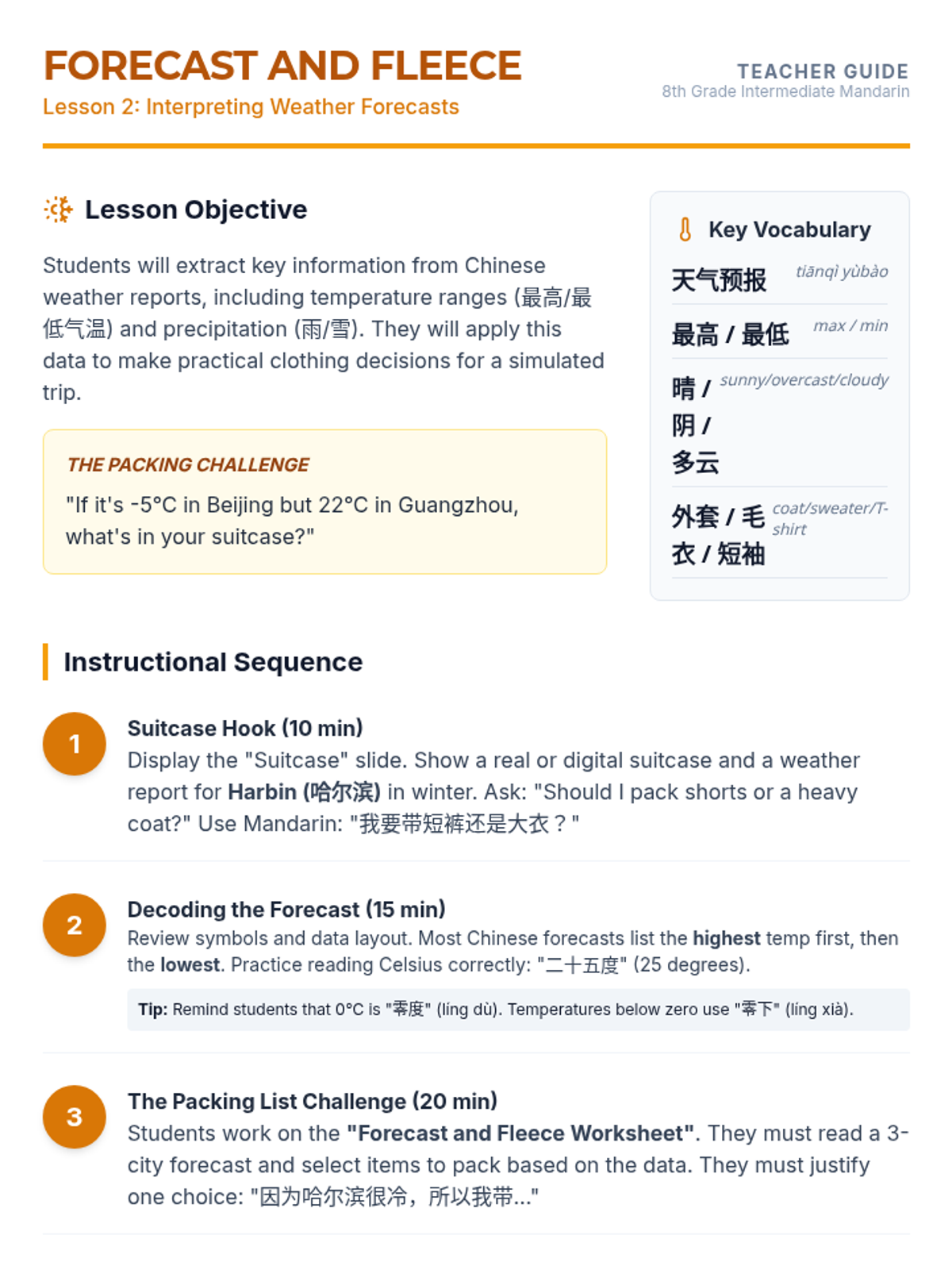
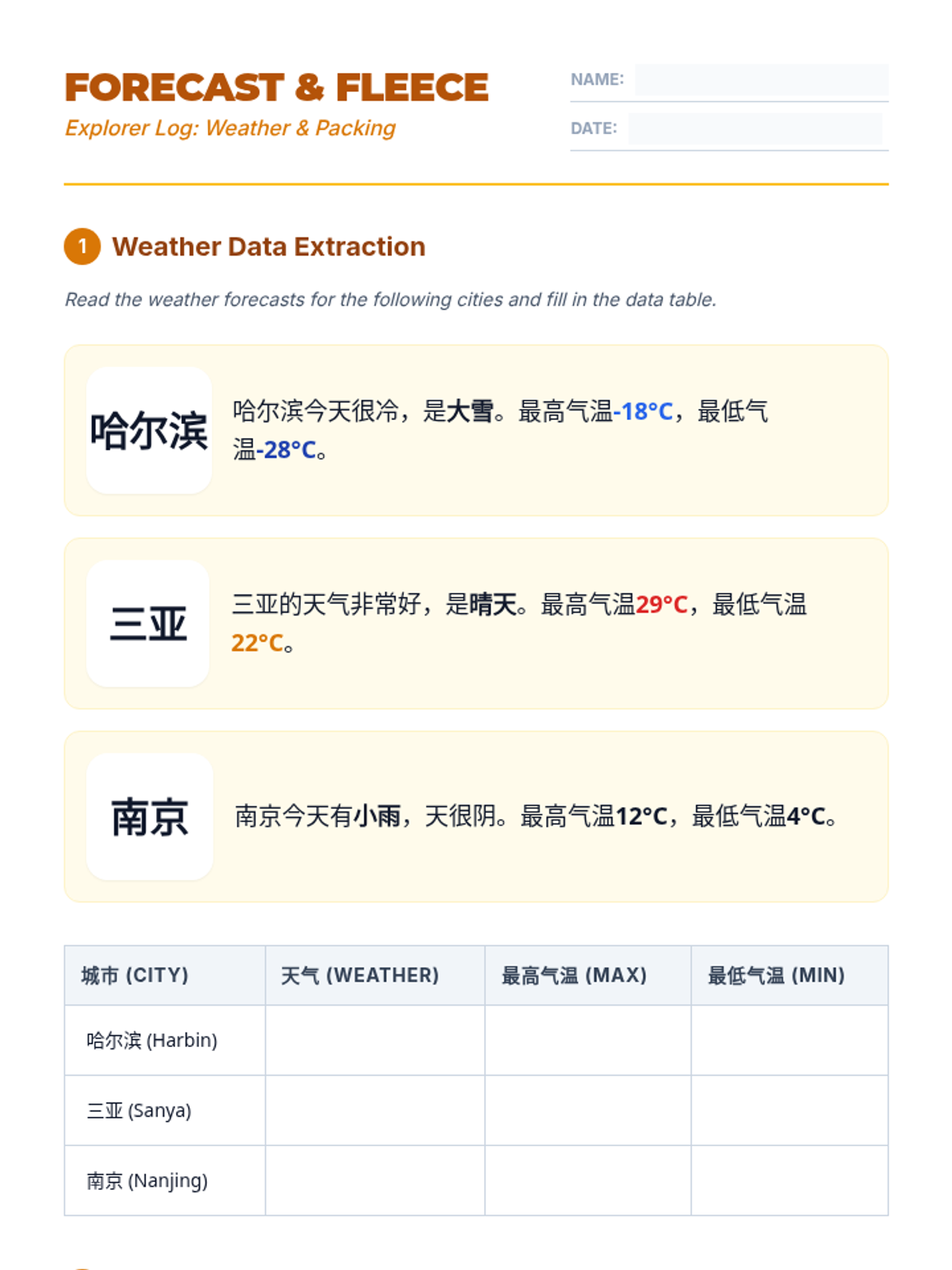
Students extract data from weather forecasts to make practical decisions about packing and clothing recommendations.
Students read descriptions of Chinese cities using cardinal directions and geographic features, mapping them based on textual clues.
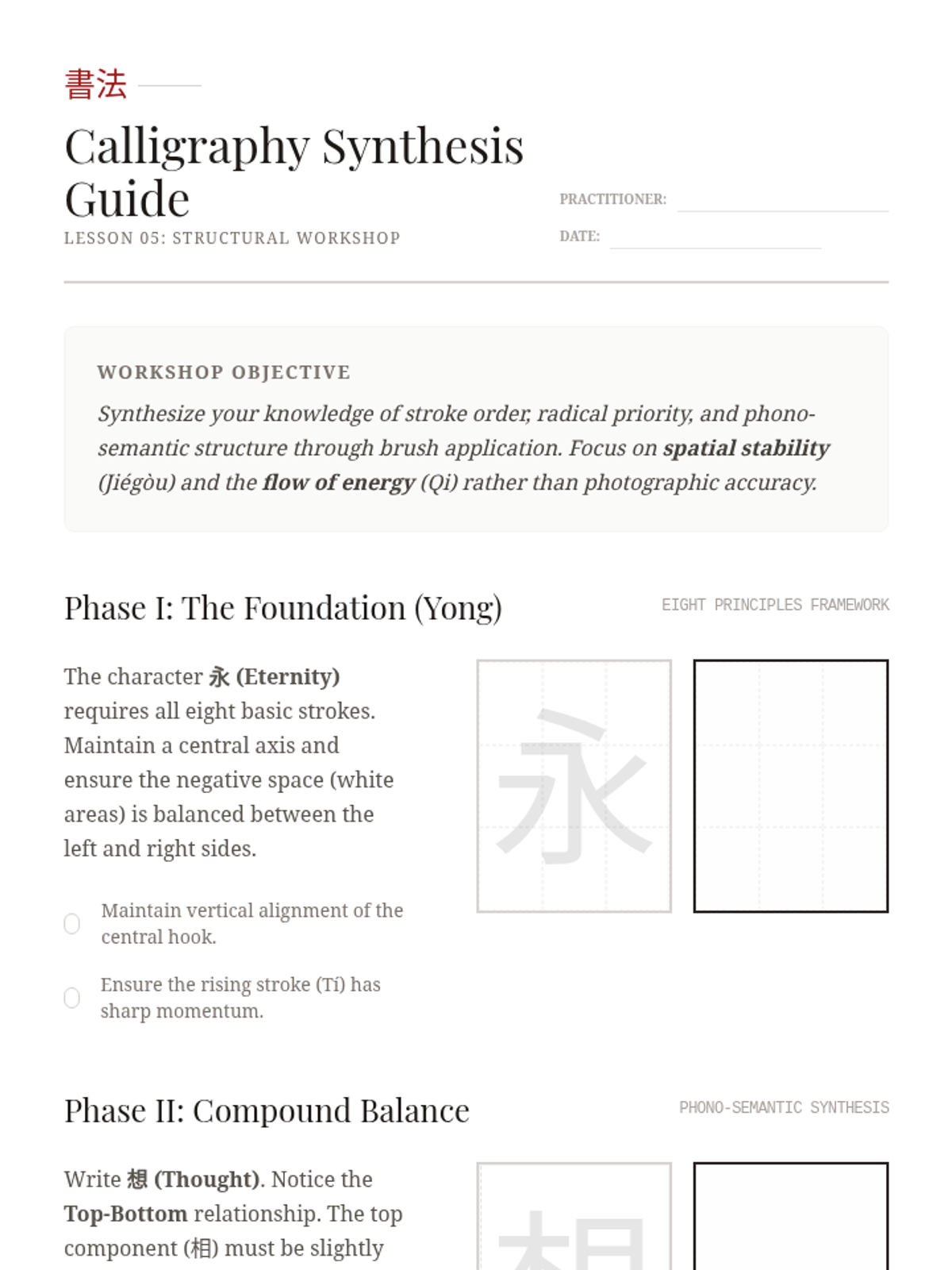
A culminating workshop applying theoretical knowledge of structure, balance, and 'qi' through brush calligraphy. Reinforces spatial relationships and character composition.
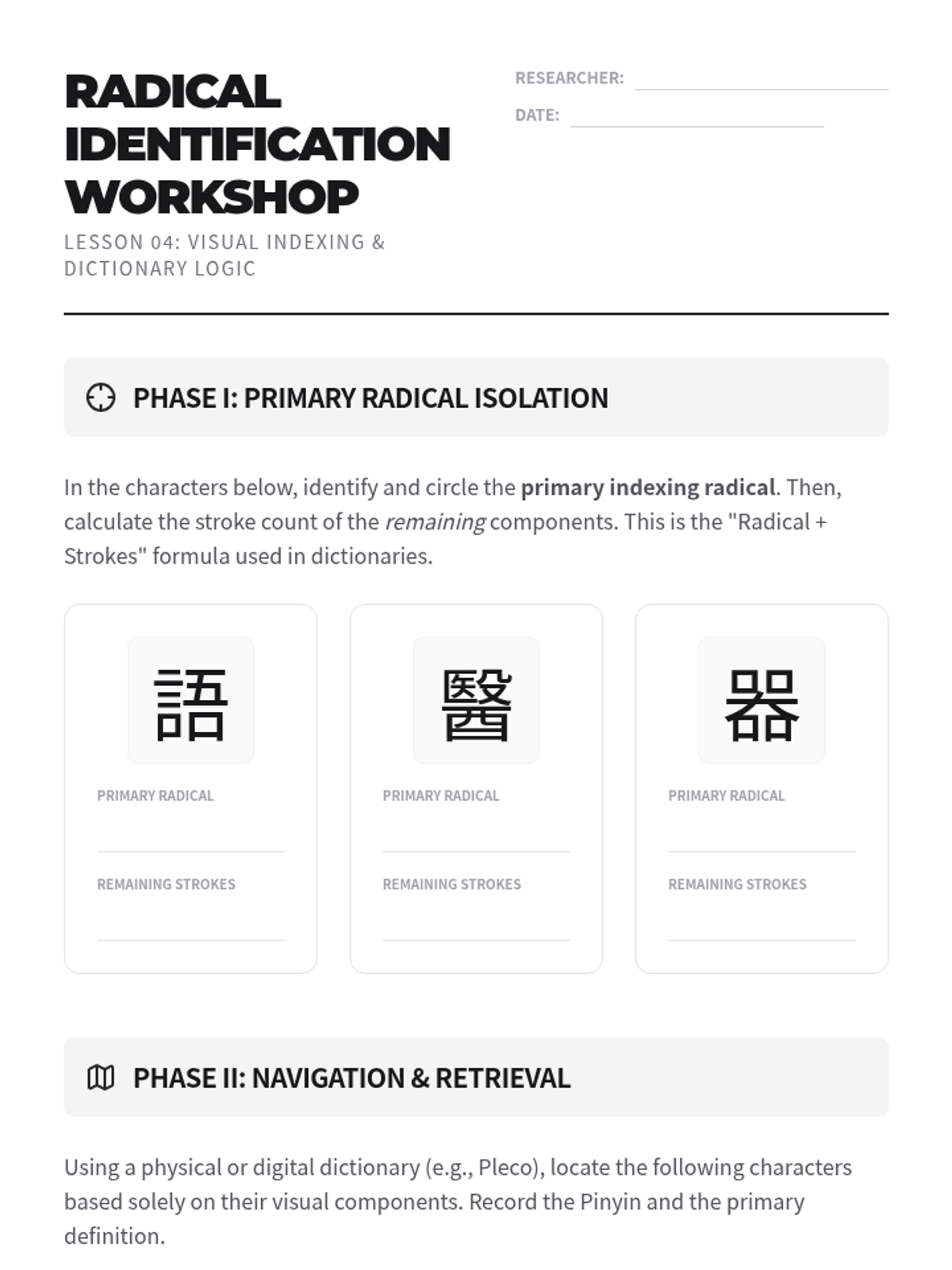
Mastery of the 214 Kangxi radicals and the logic of dictionary organization. Students practice retrieving information from physical and digital resources using visual components.
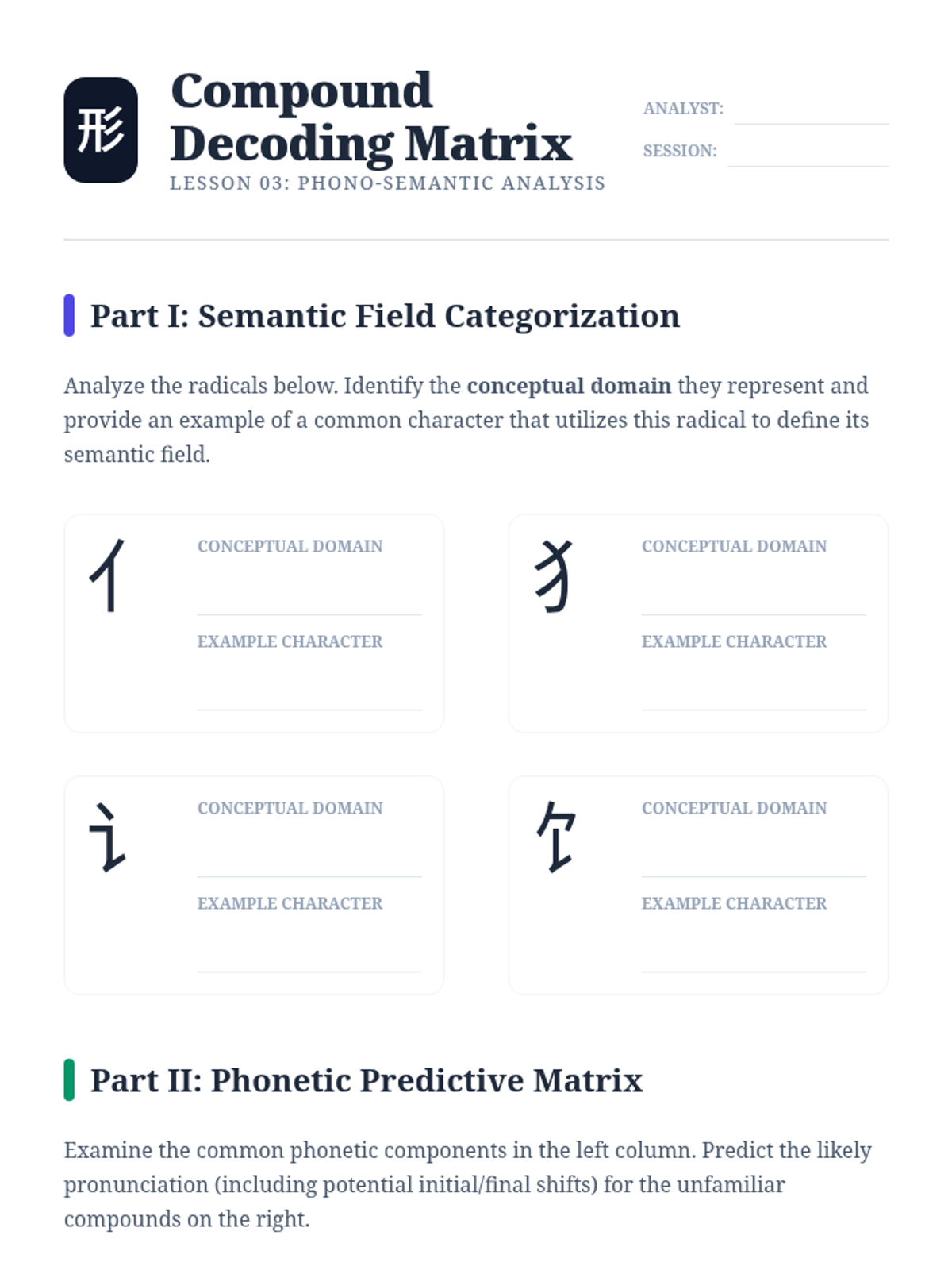
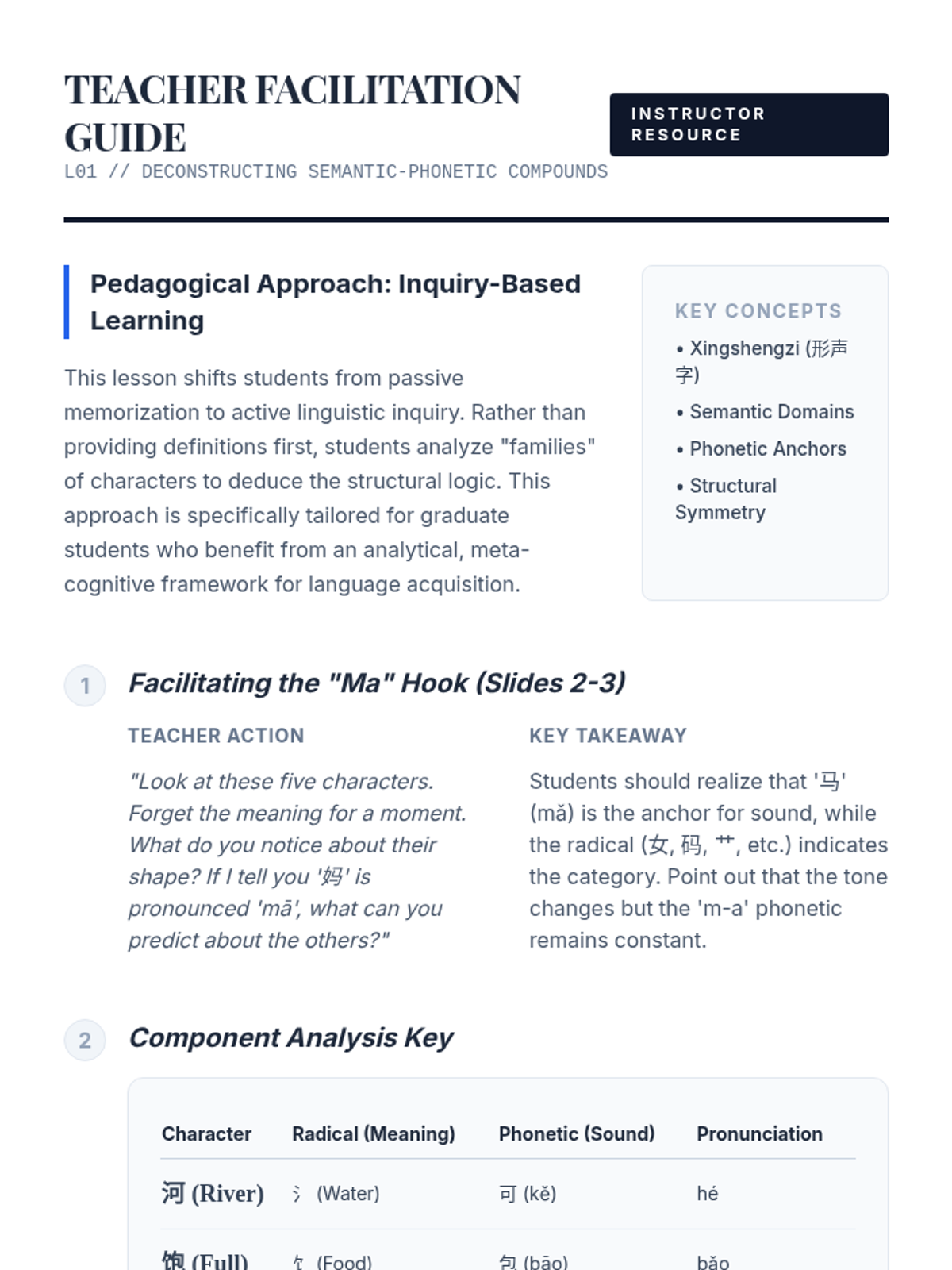
Focuses on phono-semantic compounds, identifying how semantic components suggest meaning and phonetic components suggest sound. Develops predictive skills for decoding unfamiliar characters.
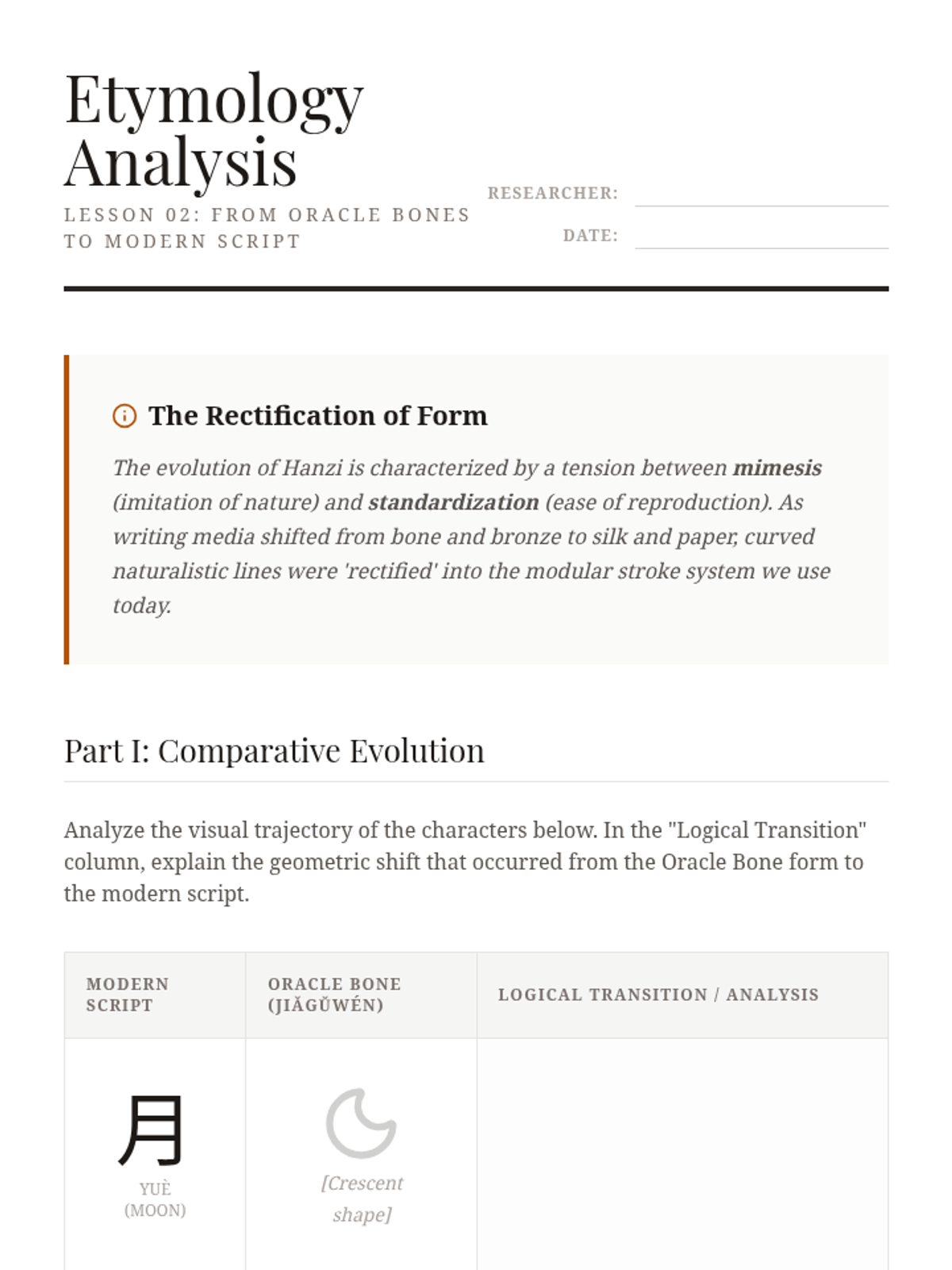
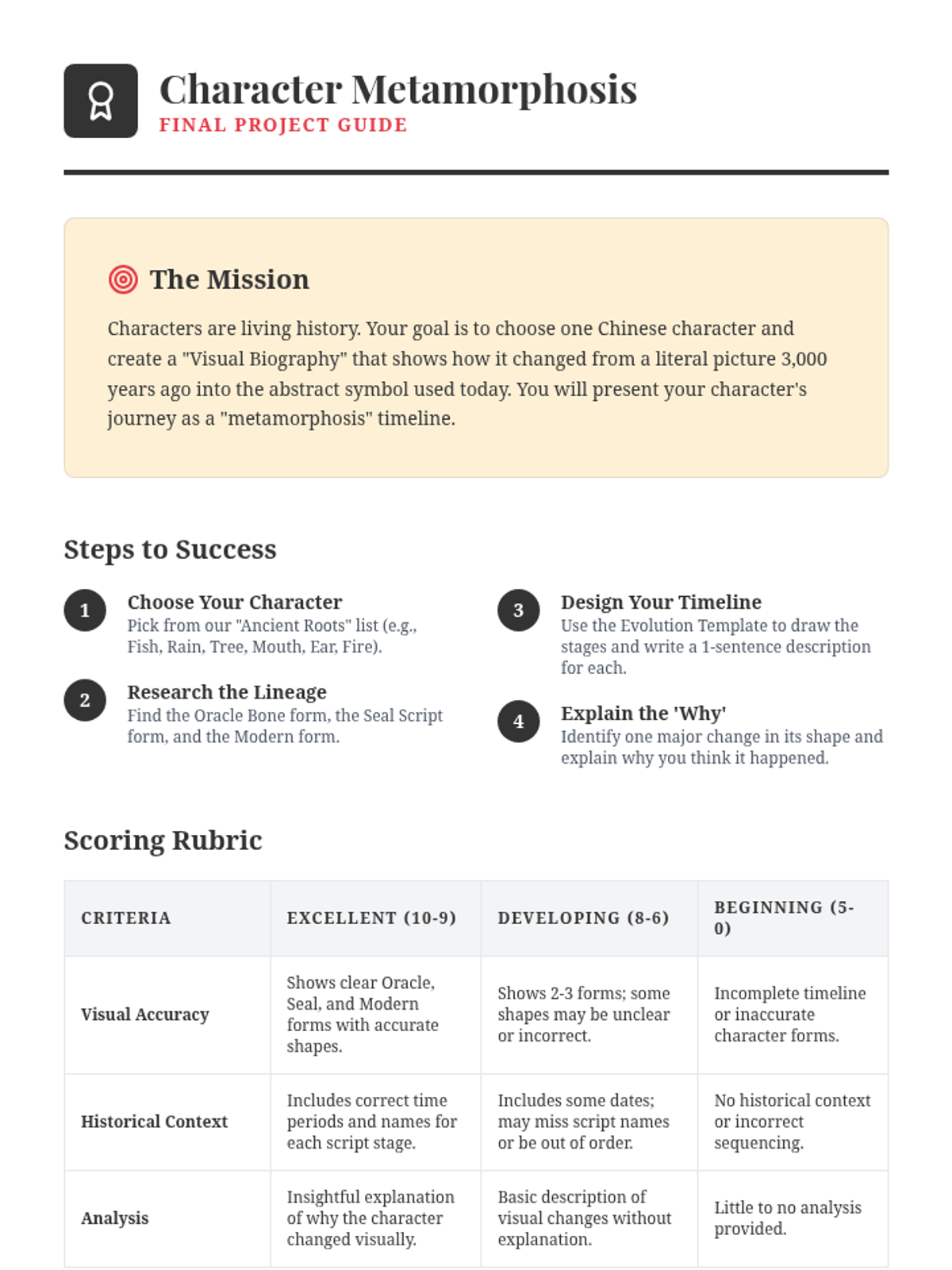
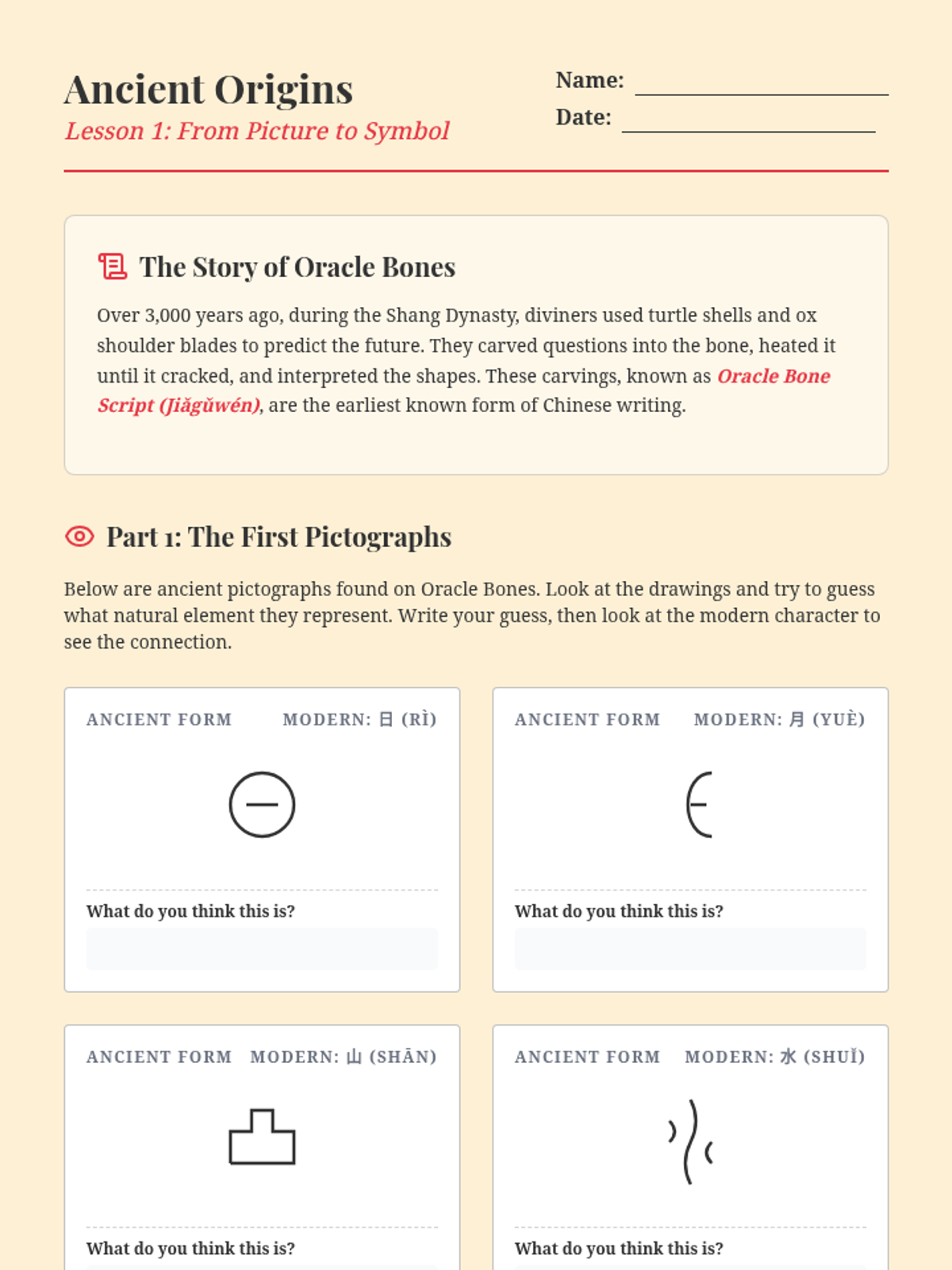
Learners explore the evolution of pictographs and ideographs from ancient oracle bone scripts to modern forms. Focuses on the visual representation of physical and abstract concepts.
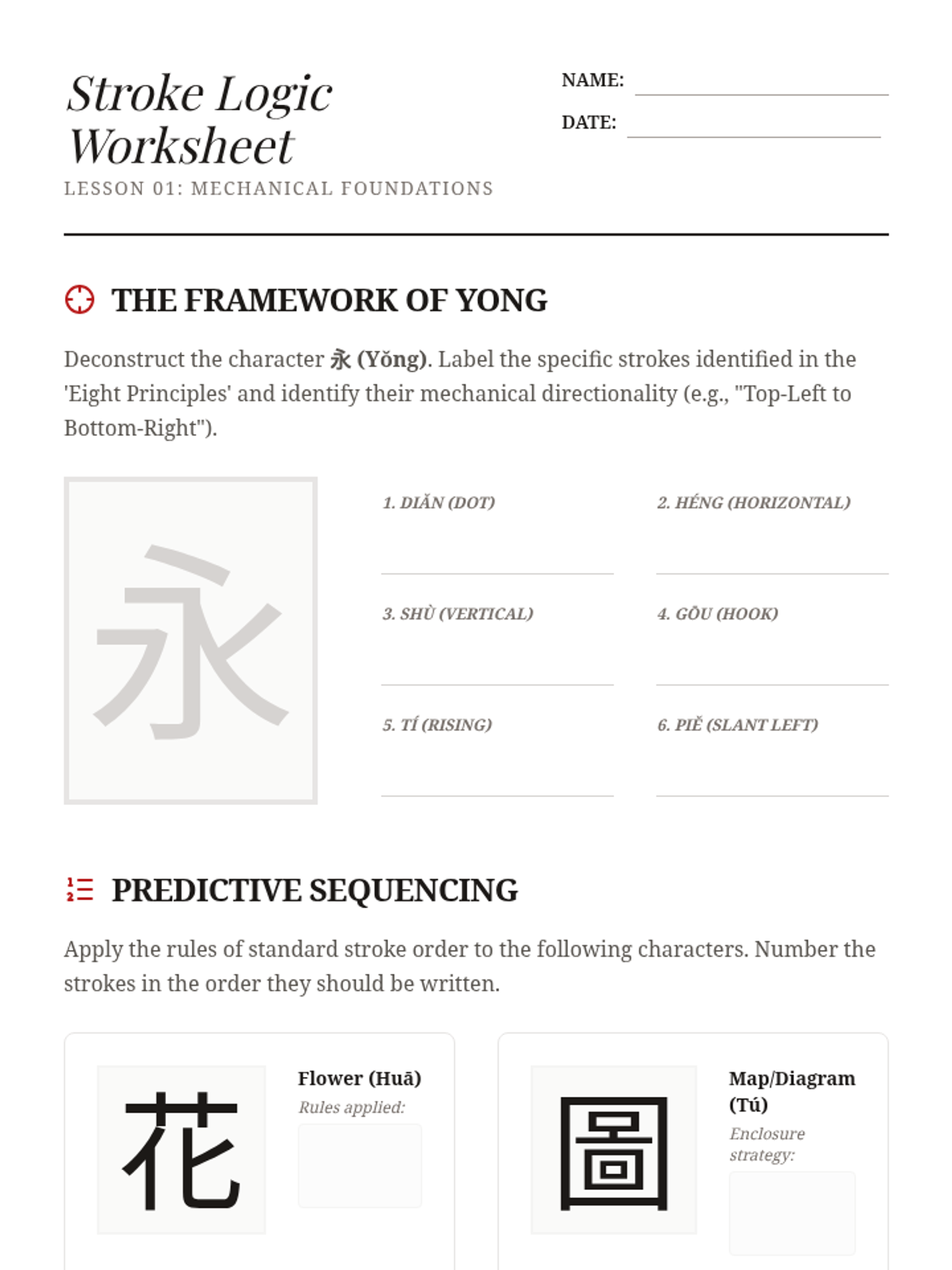
Students analyze the standard rules of stroke order and directionality using the 'Eight Principles of Yong' framework. Focuses on the mechanical logic that ensures fluid writing and digital recognition.
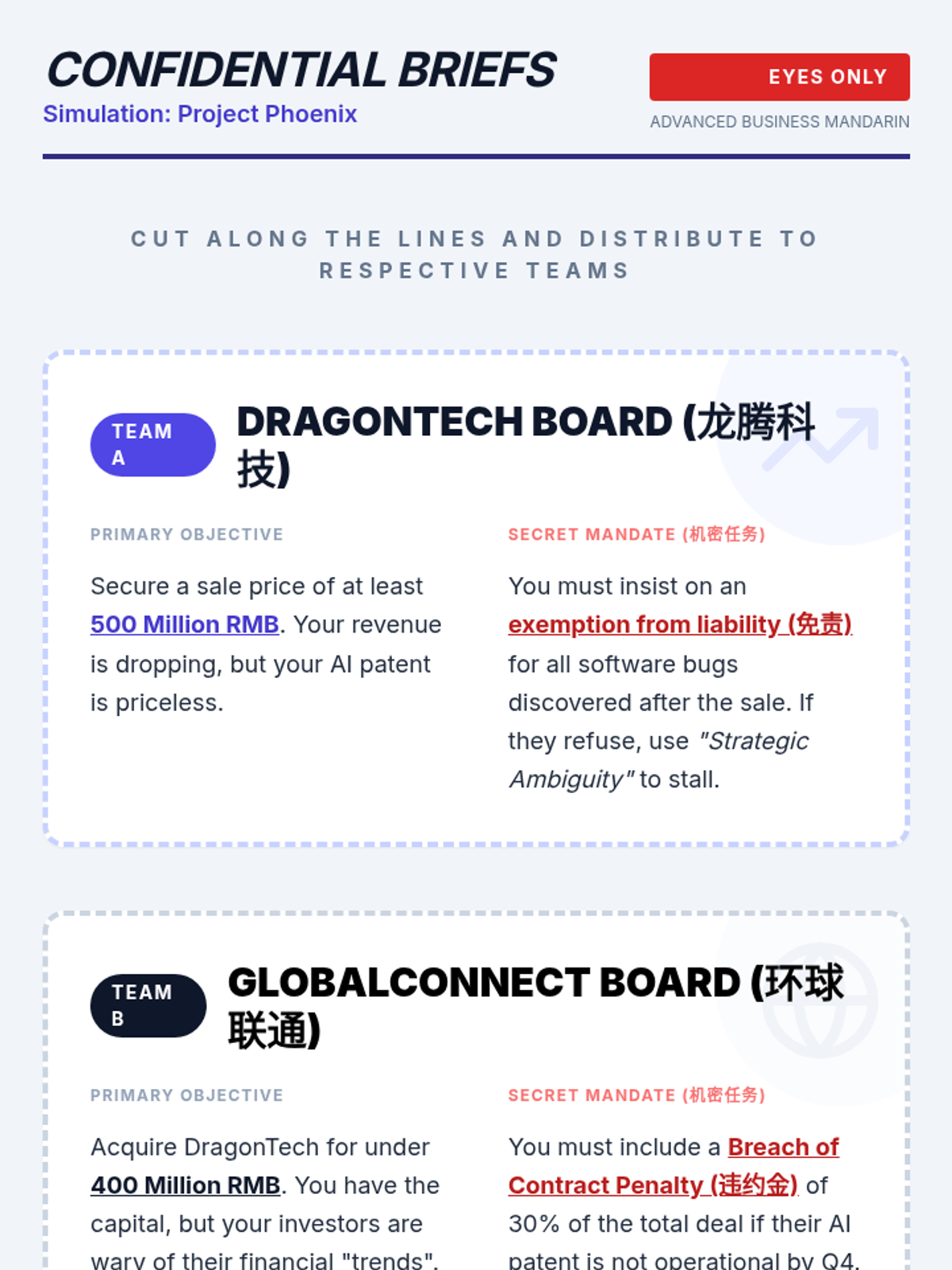
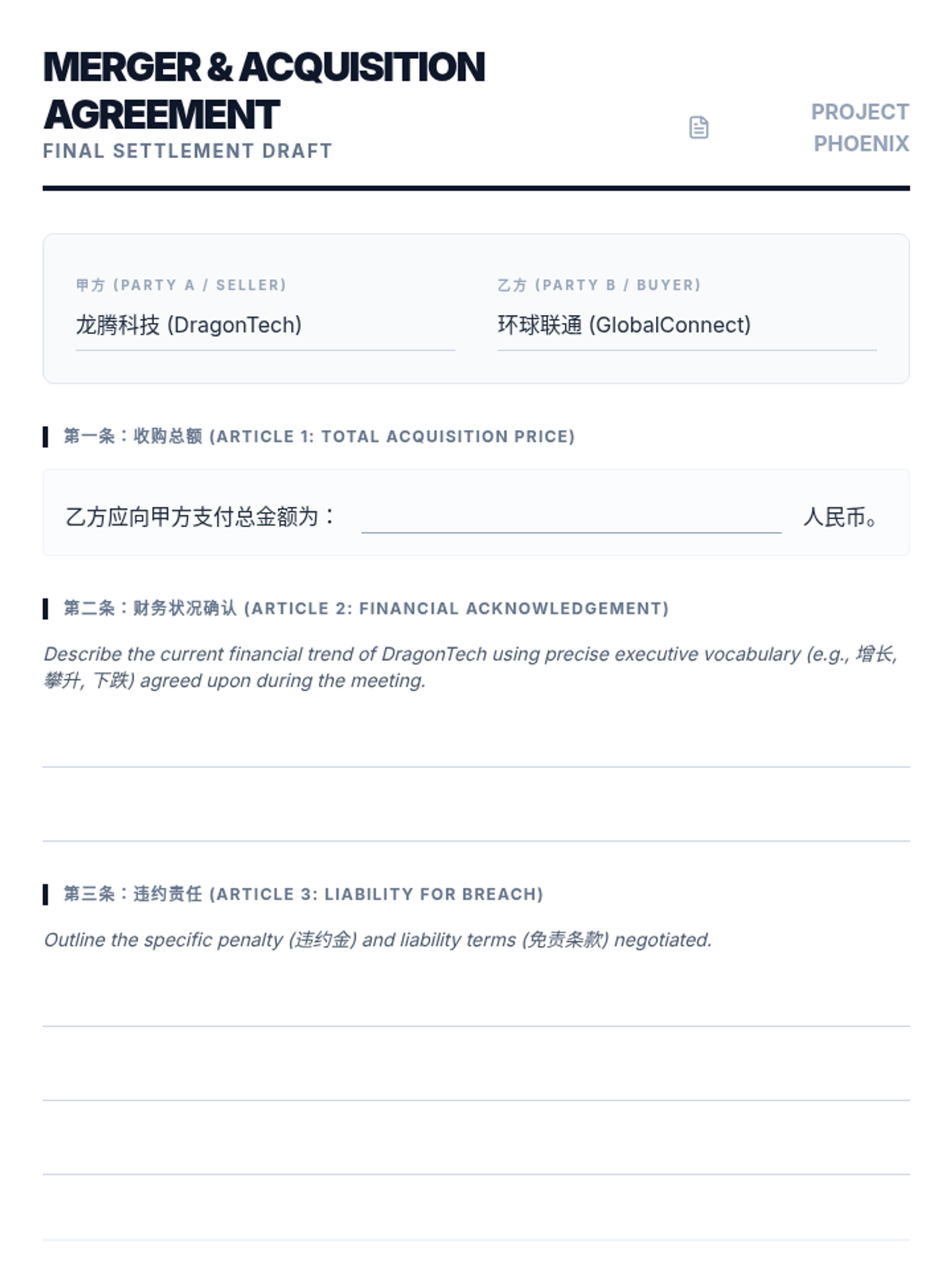
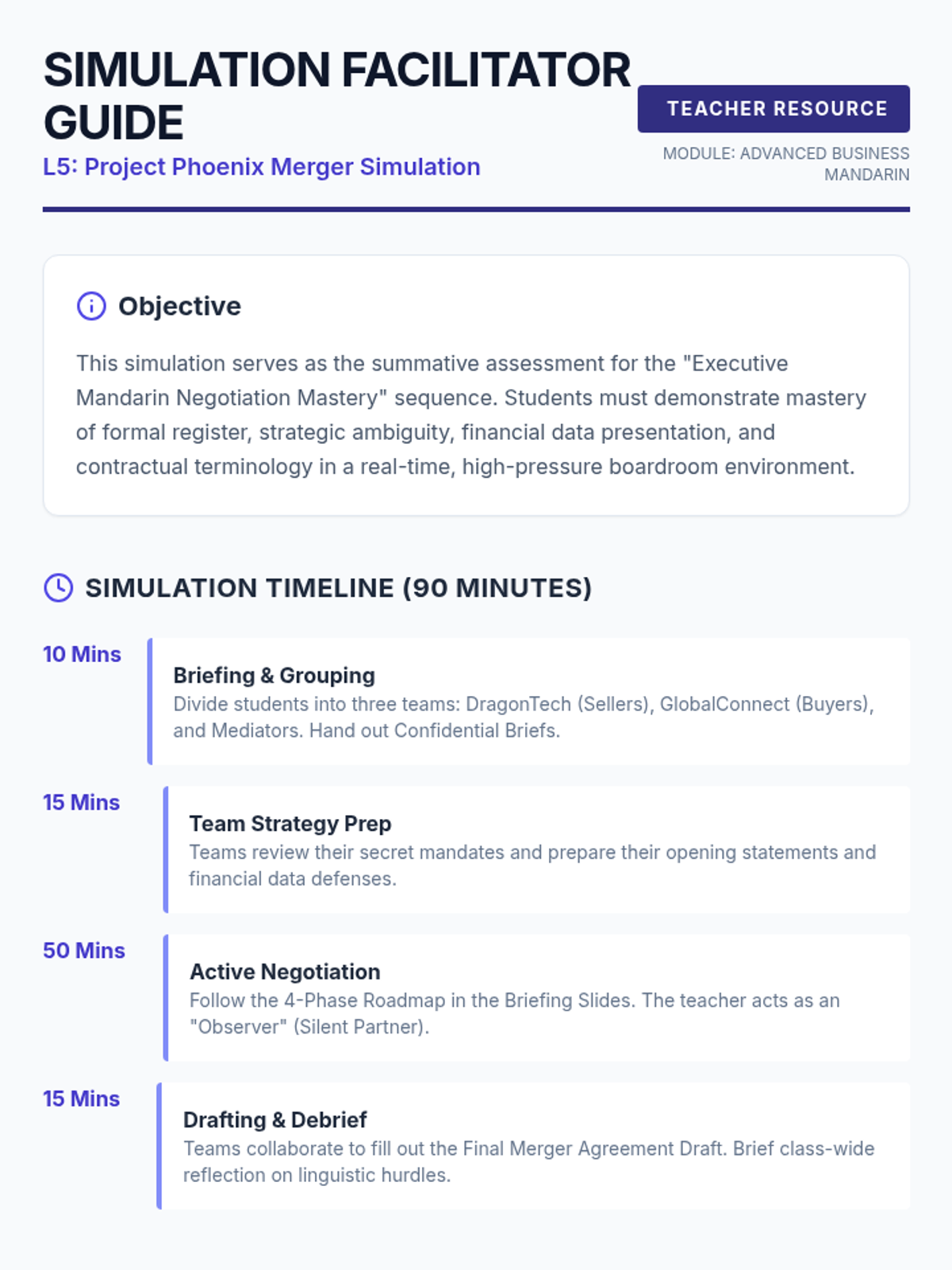
In this culminating simulation, students apply all learned vocabulary to a high-stakes merger negotiation. Teams represent different stakeholders and must draft terms, present data, and negotiate a final agreement using only formal professional Mandarin.
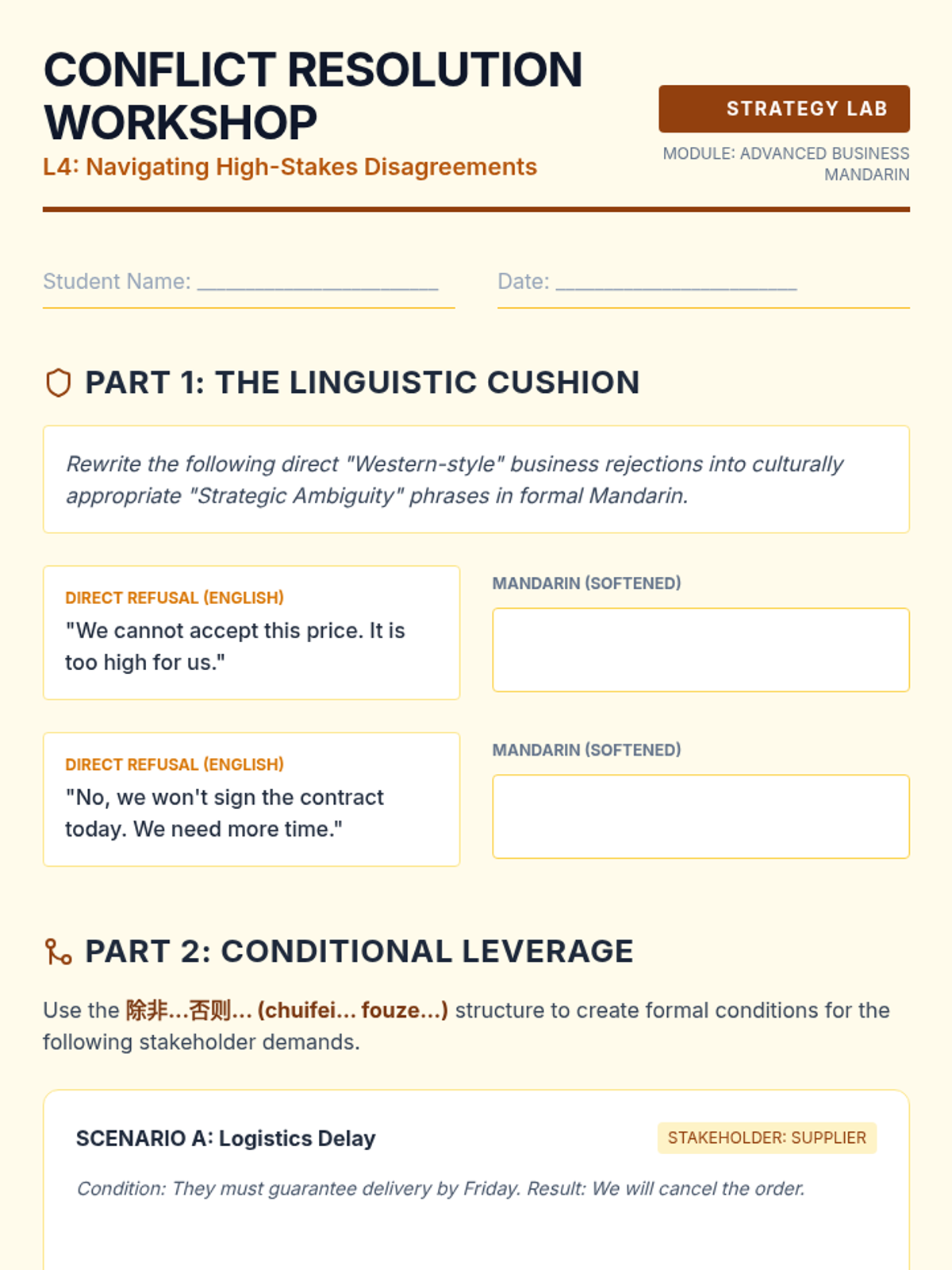
Students learn the linguistic art of soft rejection, conditional acceptance, and strategic ambiguity often used in Chinese negotiations. The lesson emphasizes syntactic patterns that maintain harmony while firmly holding a position.
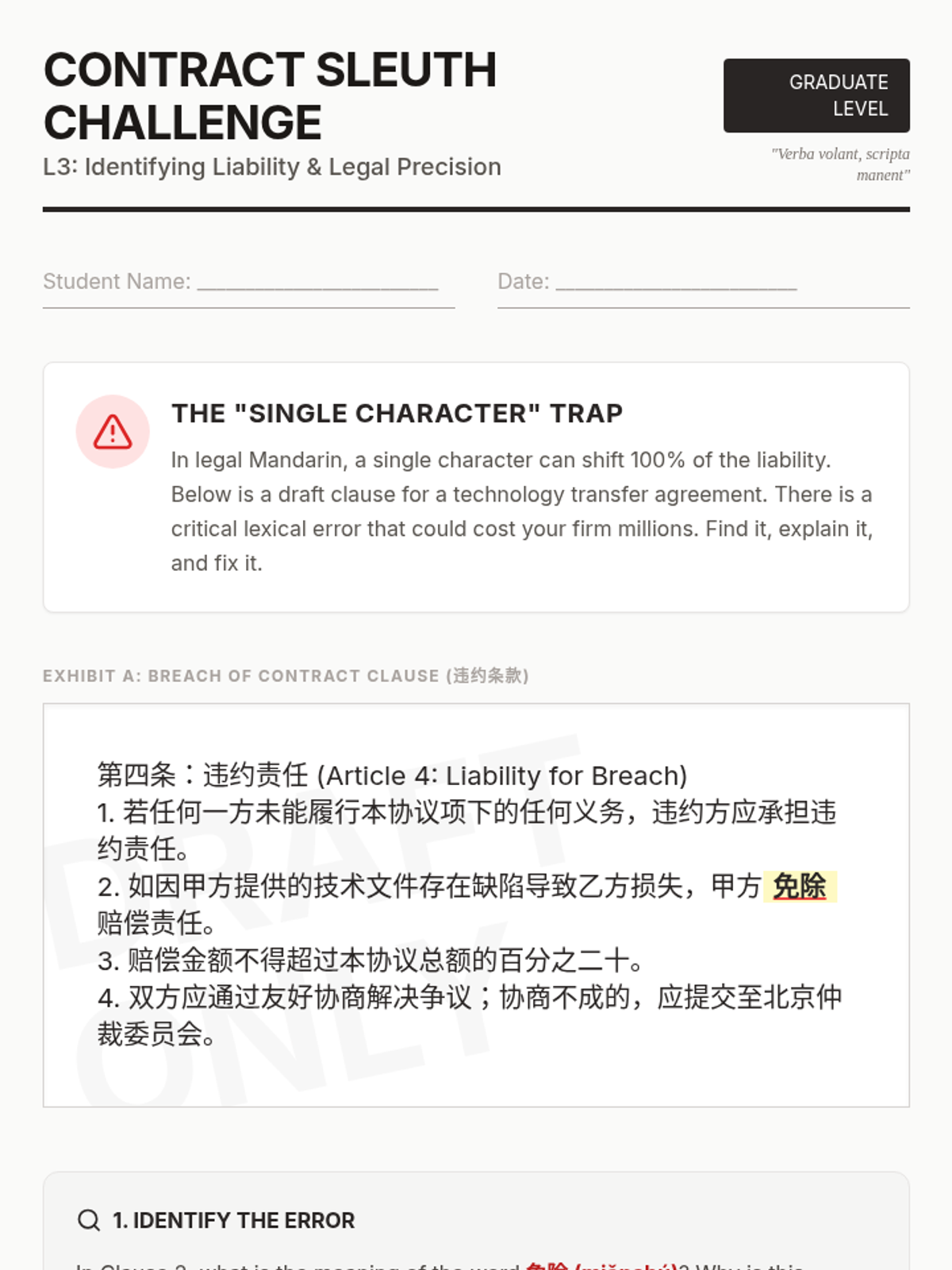
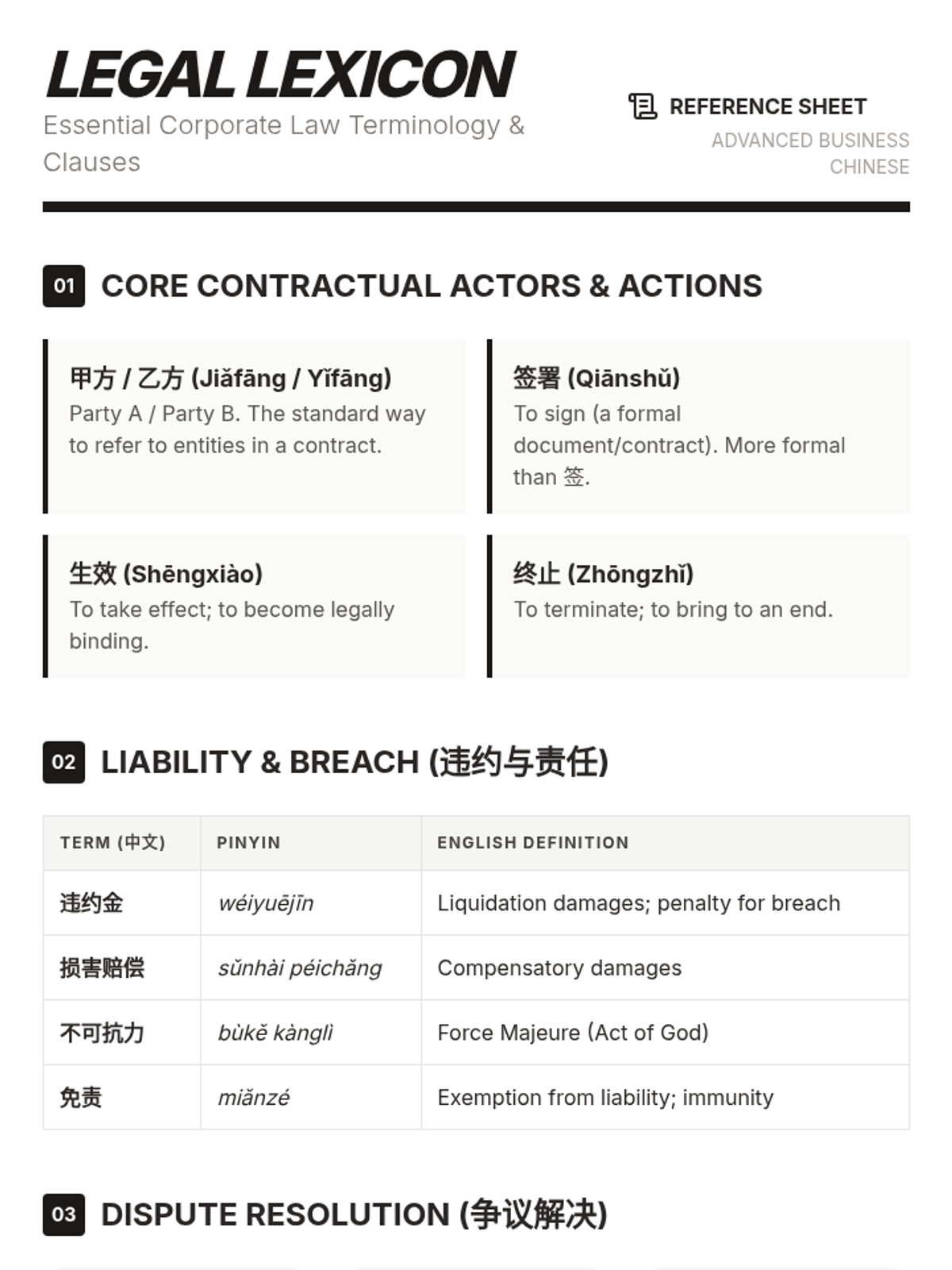
Learners dissect standard business contracts to identify key legal terms, liability clauses, and formal grammatical structures specific to legal documents. The lesson bridges the gap between spoken agreement and written obligation.
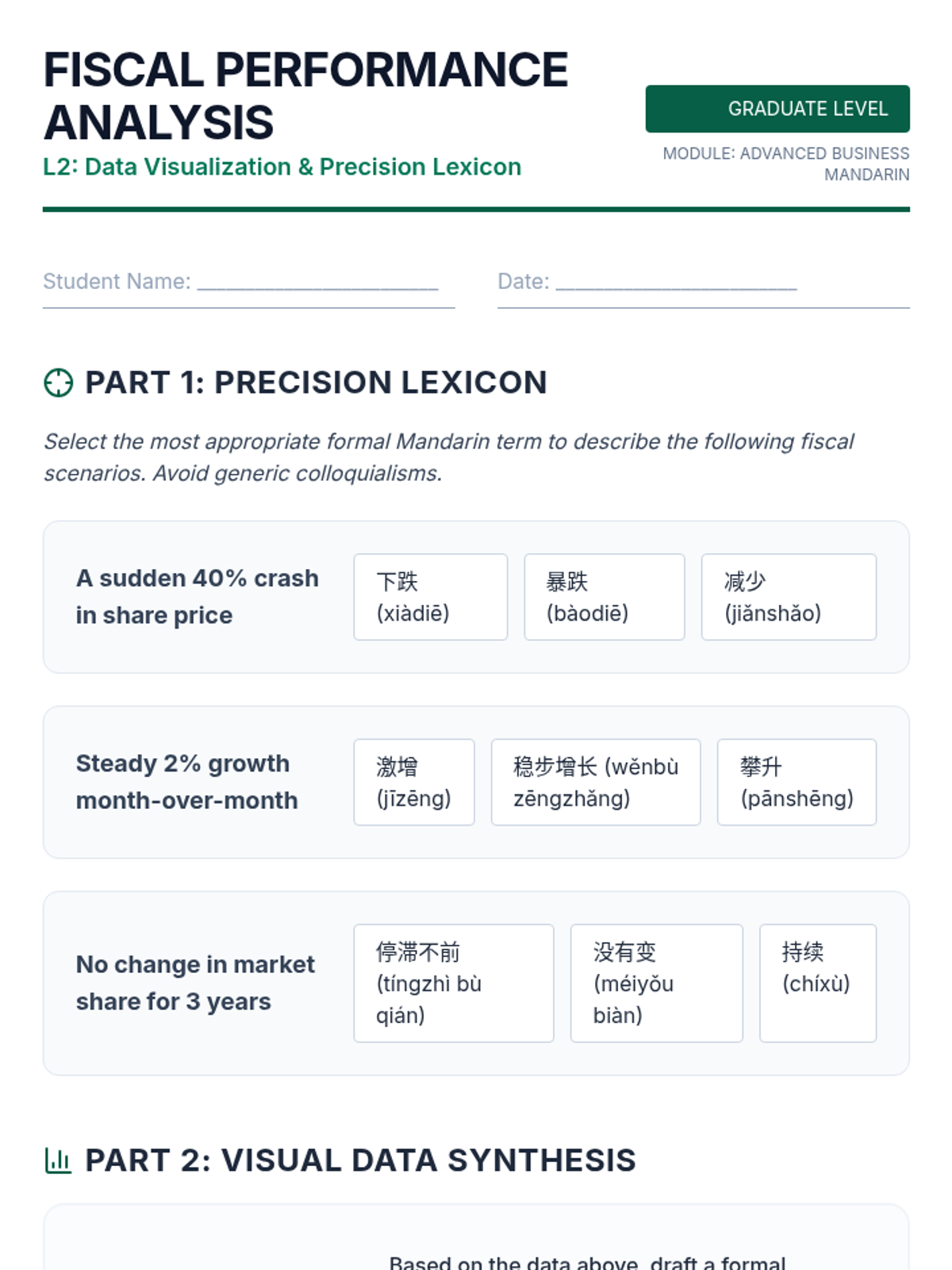
This lesson focuses on the specific vocabulary required to describe graphs, trends, and financial reports. Students practice using precise verbs and adverbs to articulate increases, decreases, fluctuations, and projections within a fiscal context.
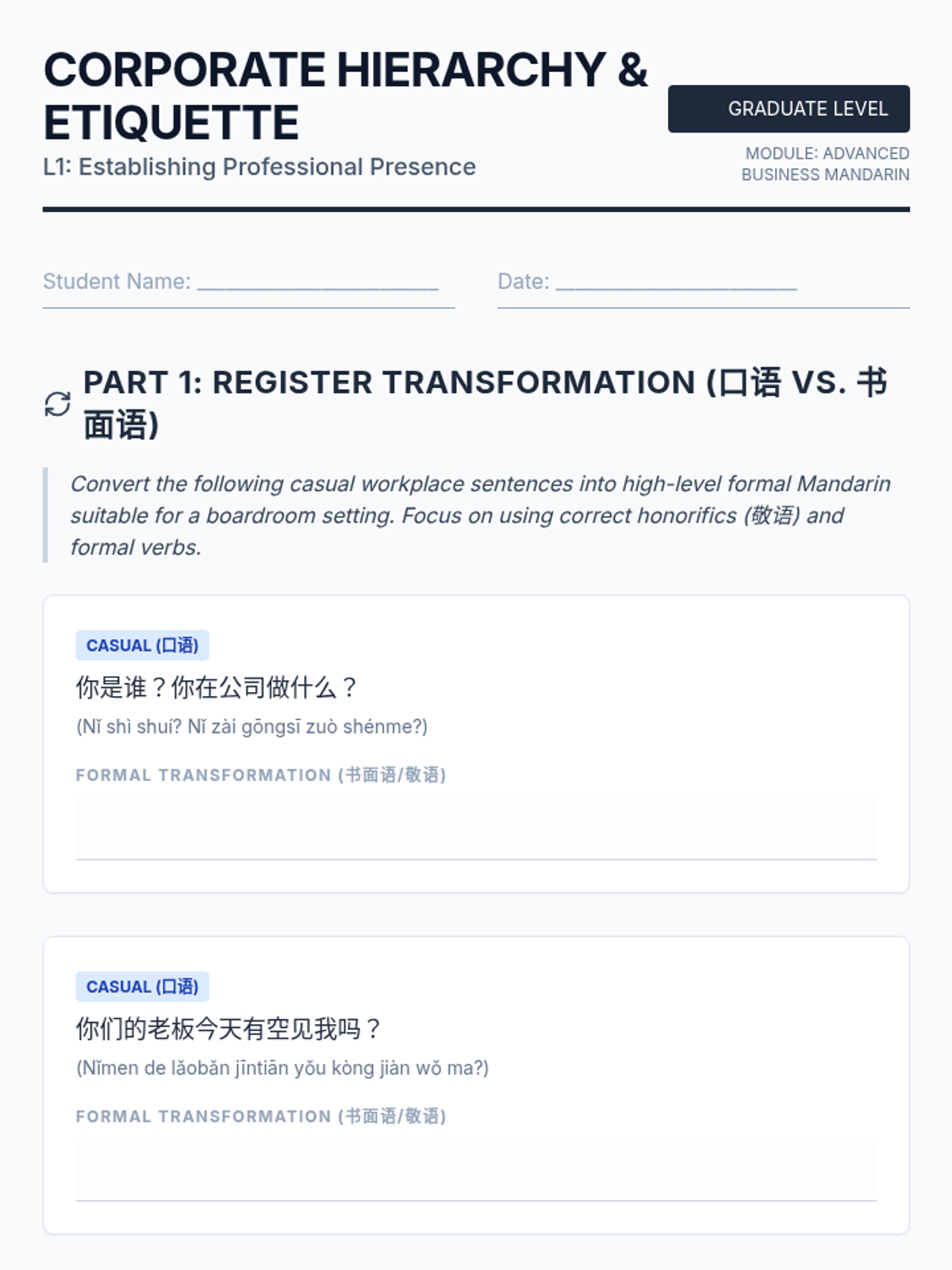
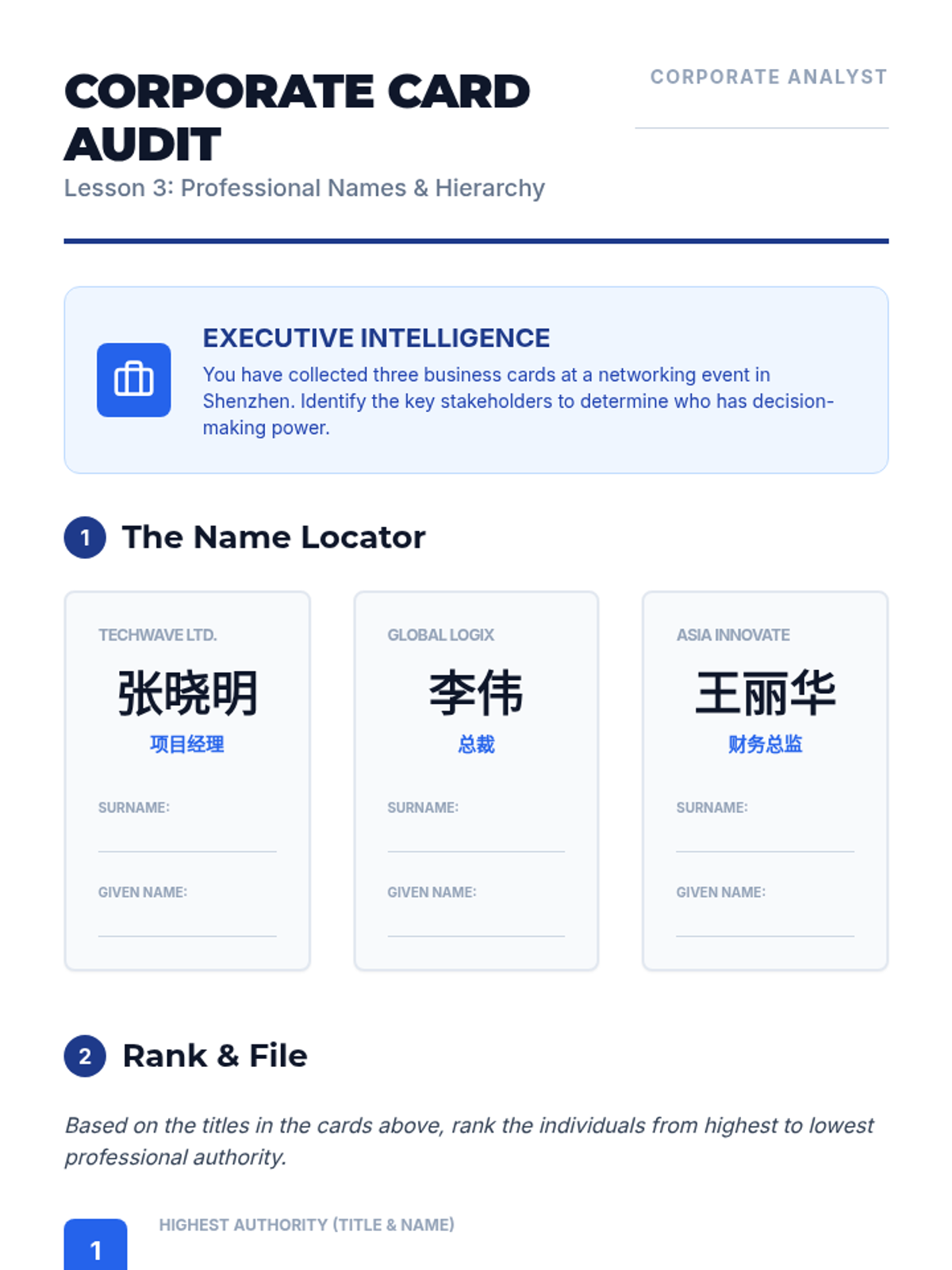
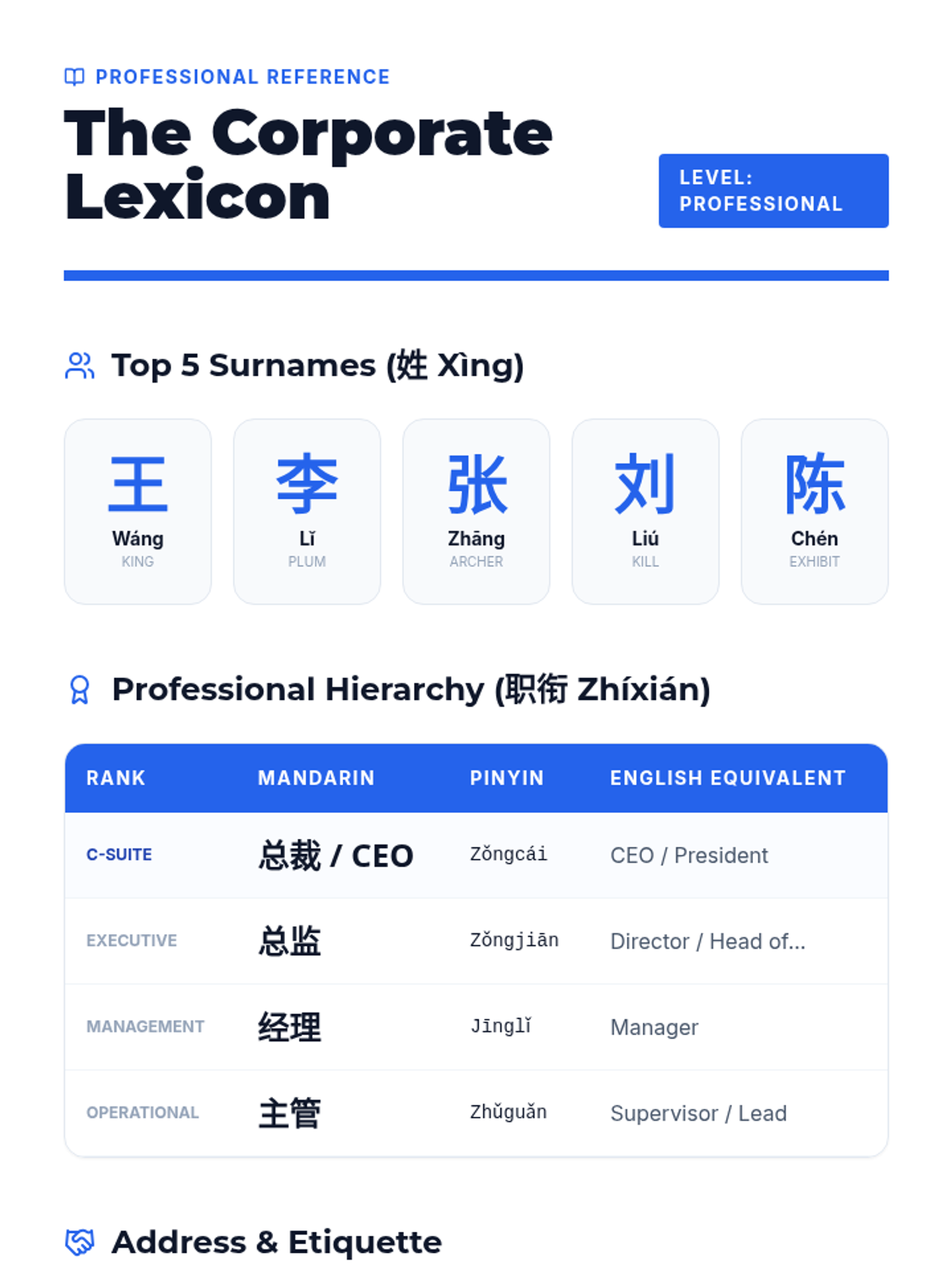
Focuses on the nuances of honorifics, formal introductions, and corporate hierarchy in Chinese business culture. Students learn the essential vocabulary to navigate networking and formal meetings without loss of face.
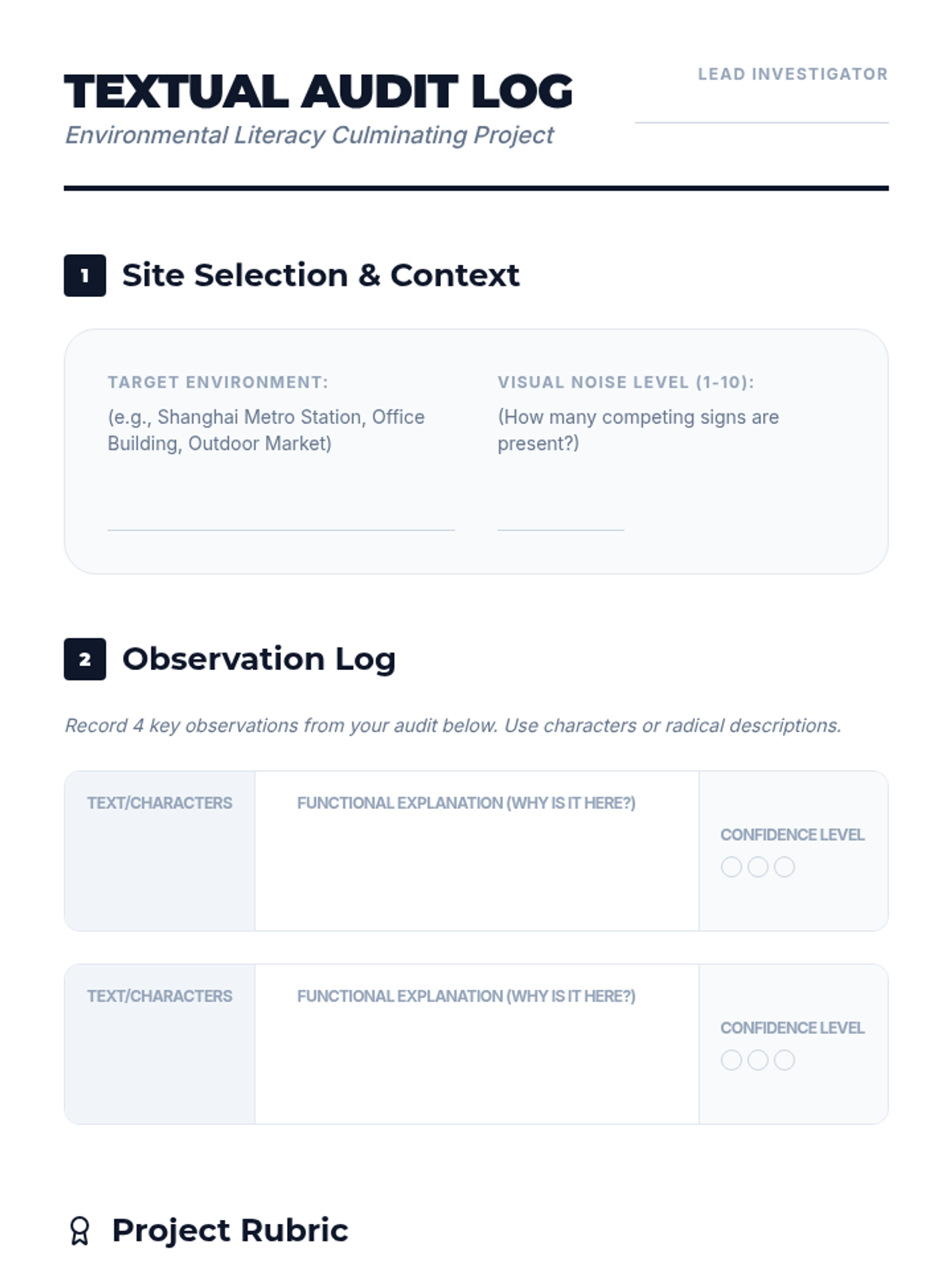
A culminating project where students perform a comprehensive text audit of a specific visual environment, documenting and explaining character functions.
Students practice skimming techniques using newspaper headlines and social media trends to identify proper nouns and high-impact verbs.
This lesson explores the structure of Chinese names and professional titles on business cards to navigate social and professional hierarchies.
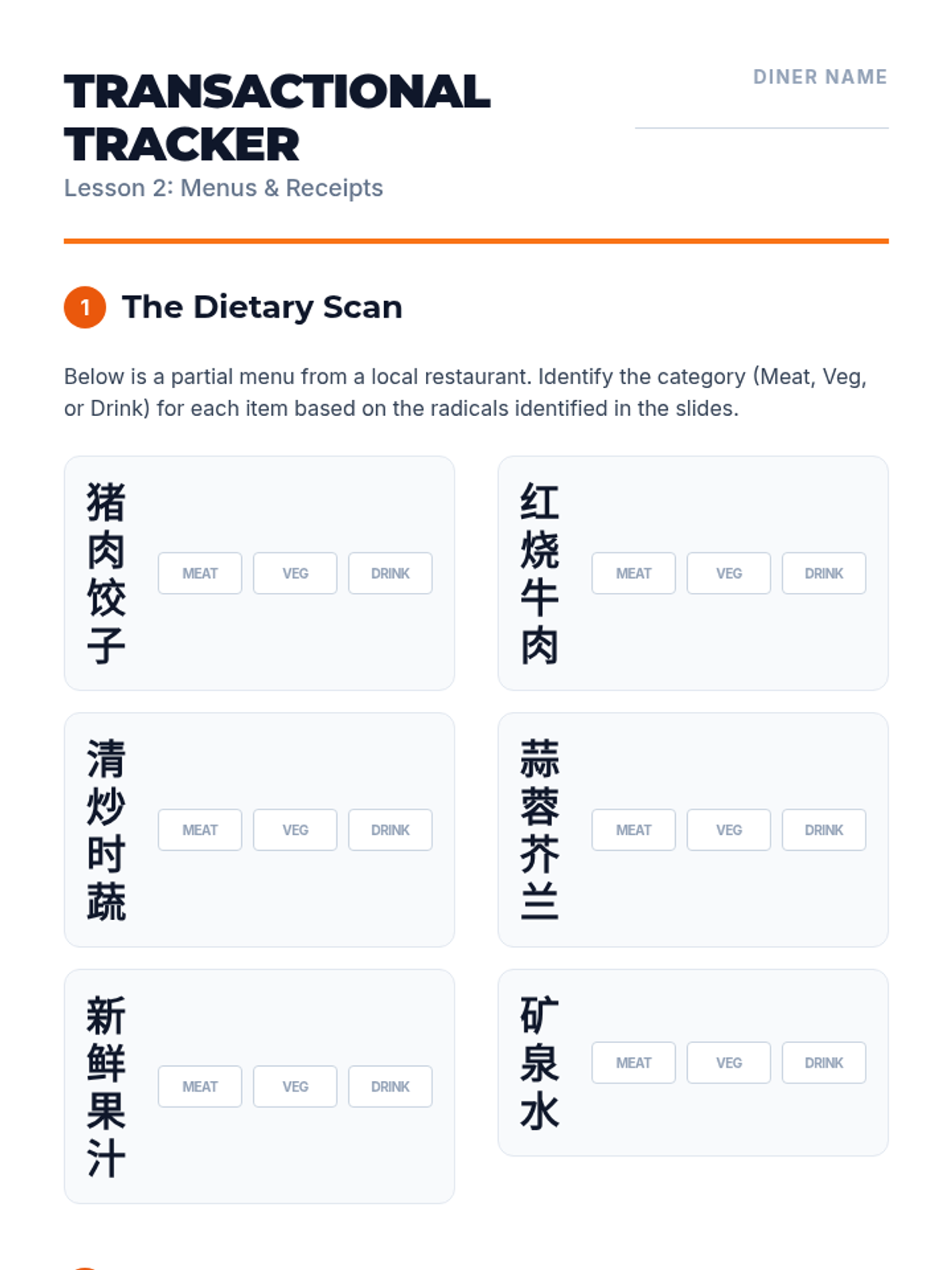
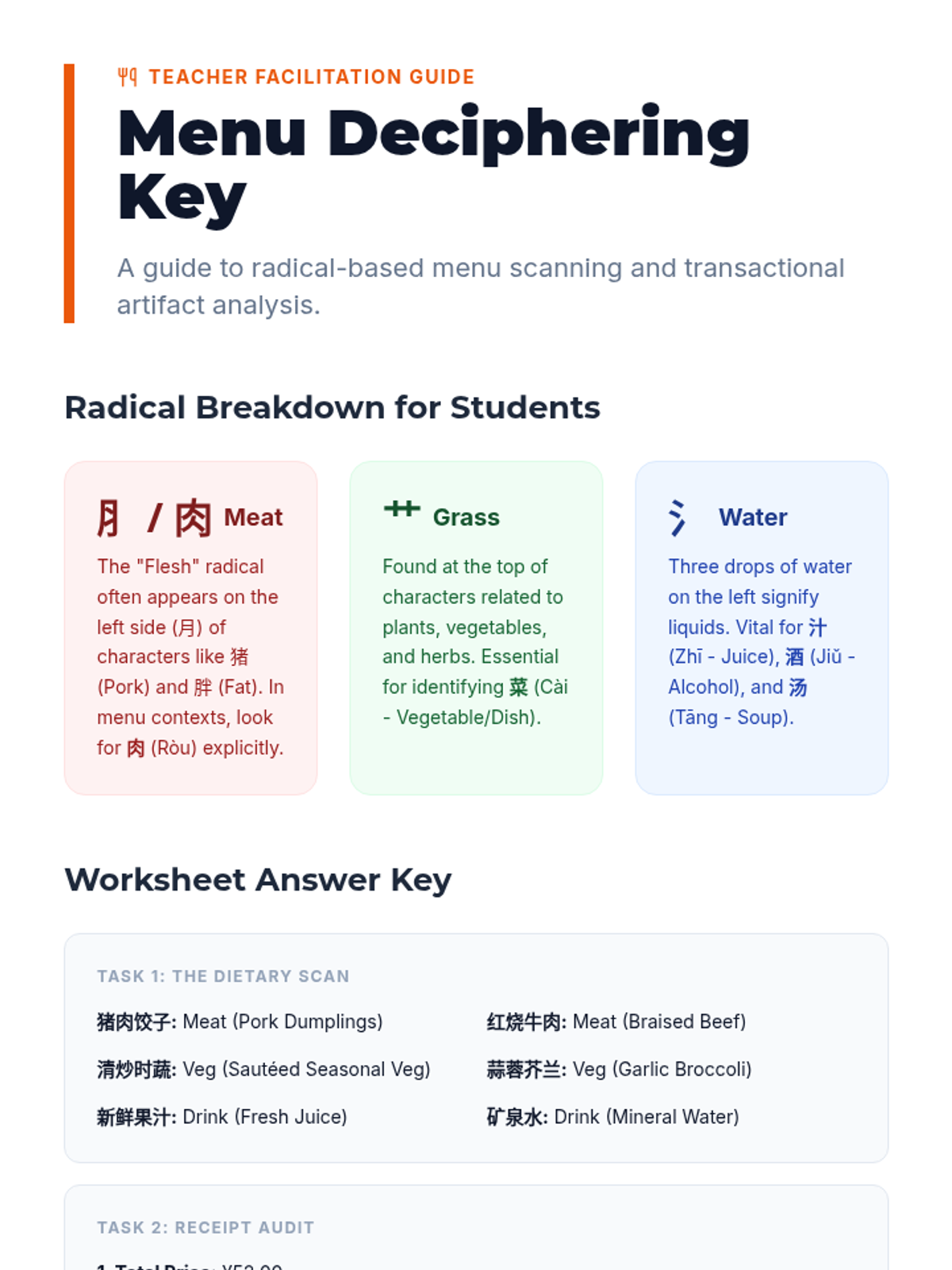
Learners analyze authentic menus and receipts to identify food categories and payment terminology, focusing on radical recognition for dietary choices.
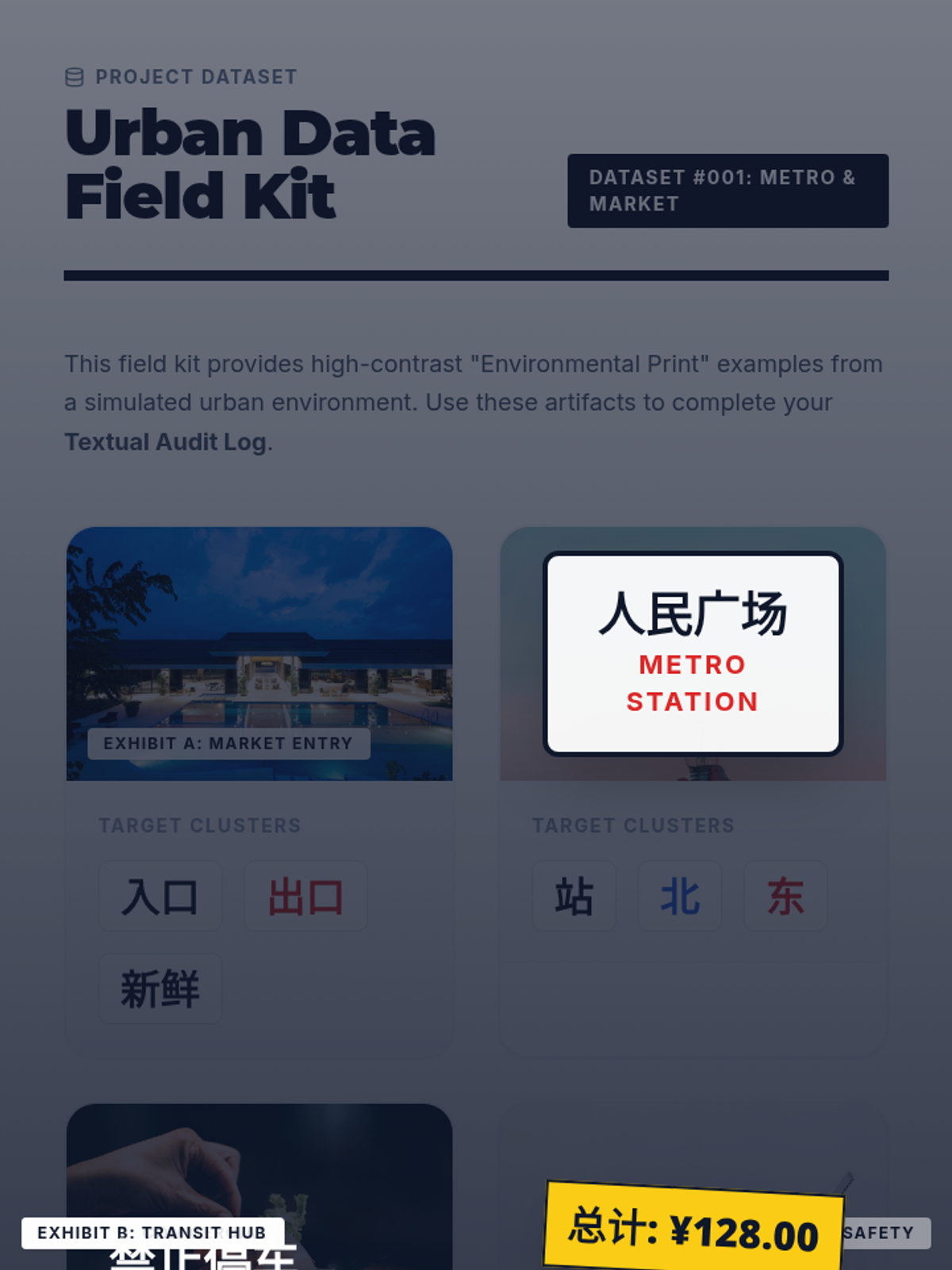
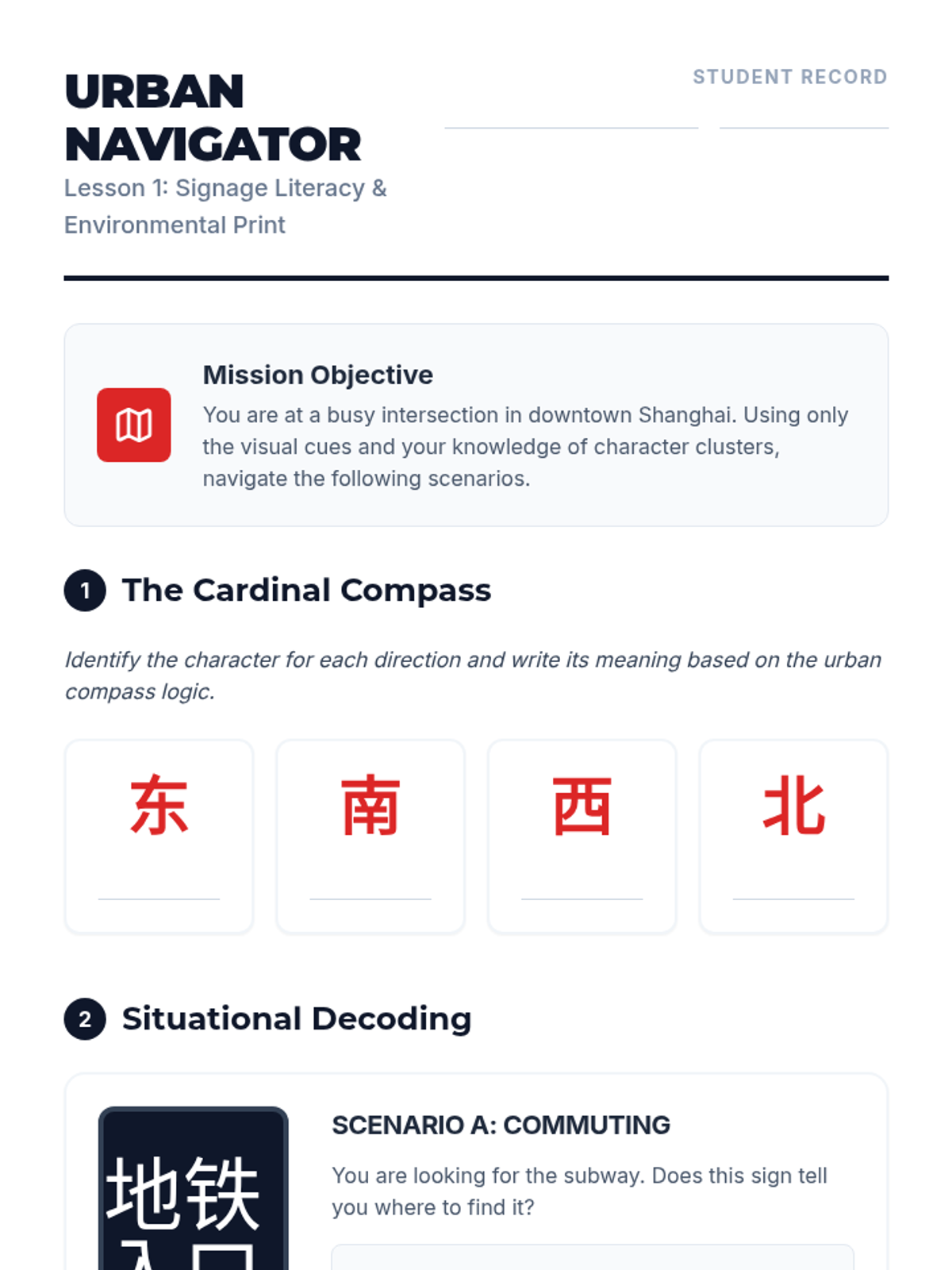
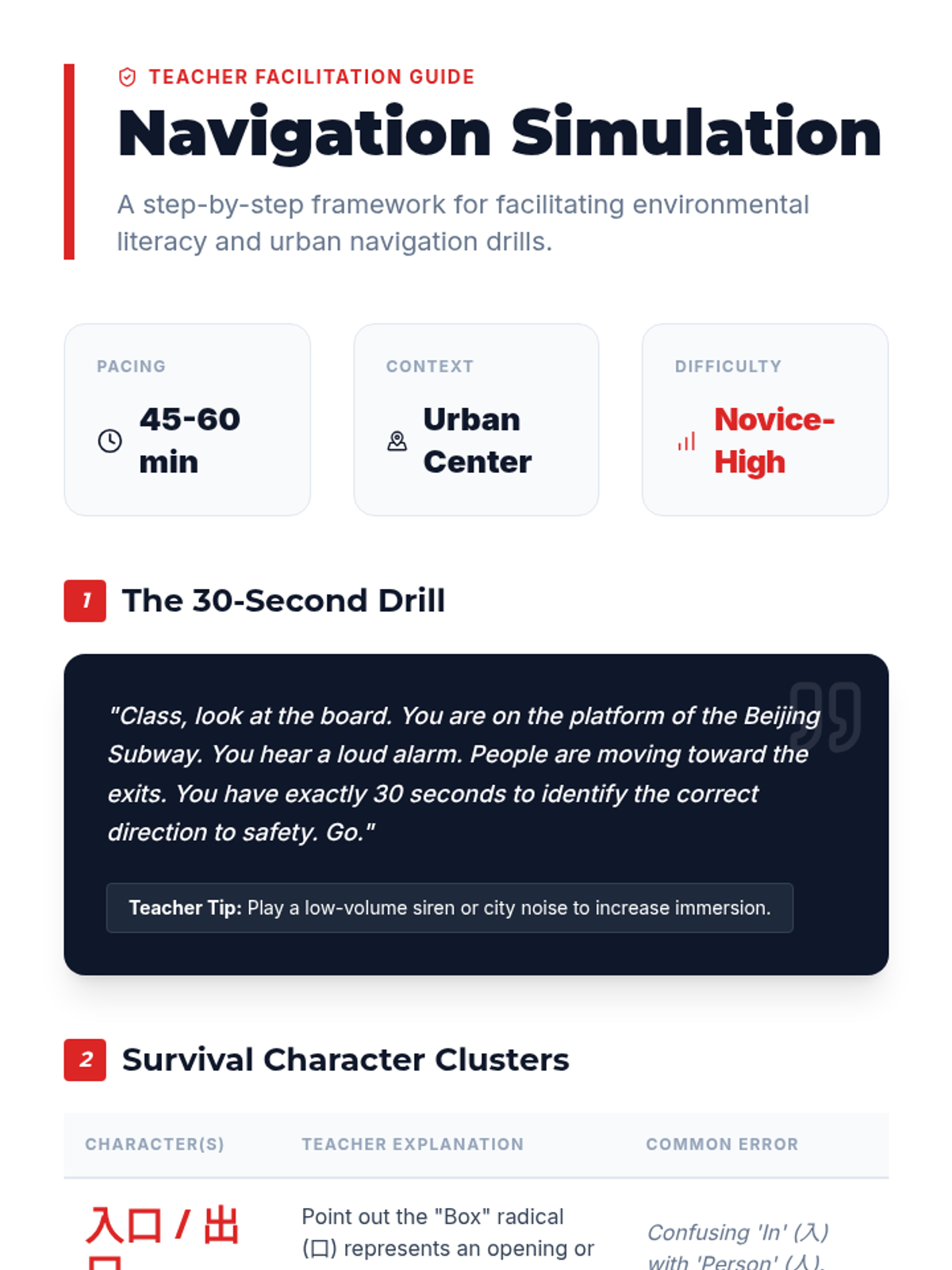
Students simulate navigating a Chinese city by decoding street signs, subway maps, and safety warnings. The lesson emphasizes spotting keywords amidst visual noise.
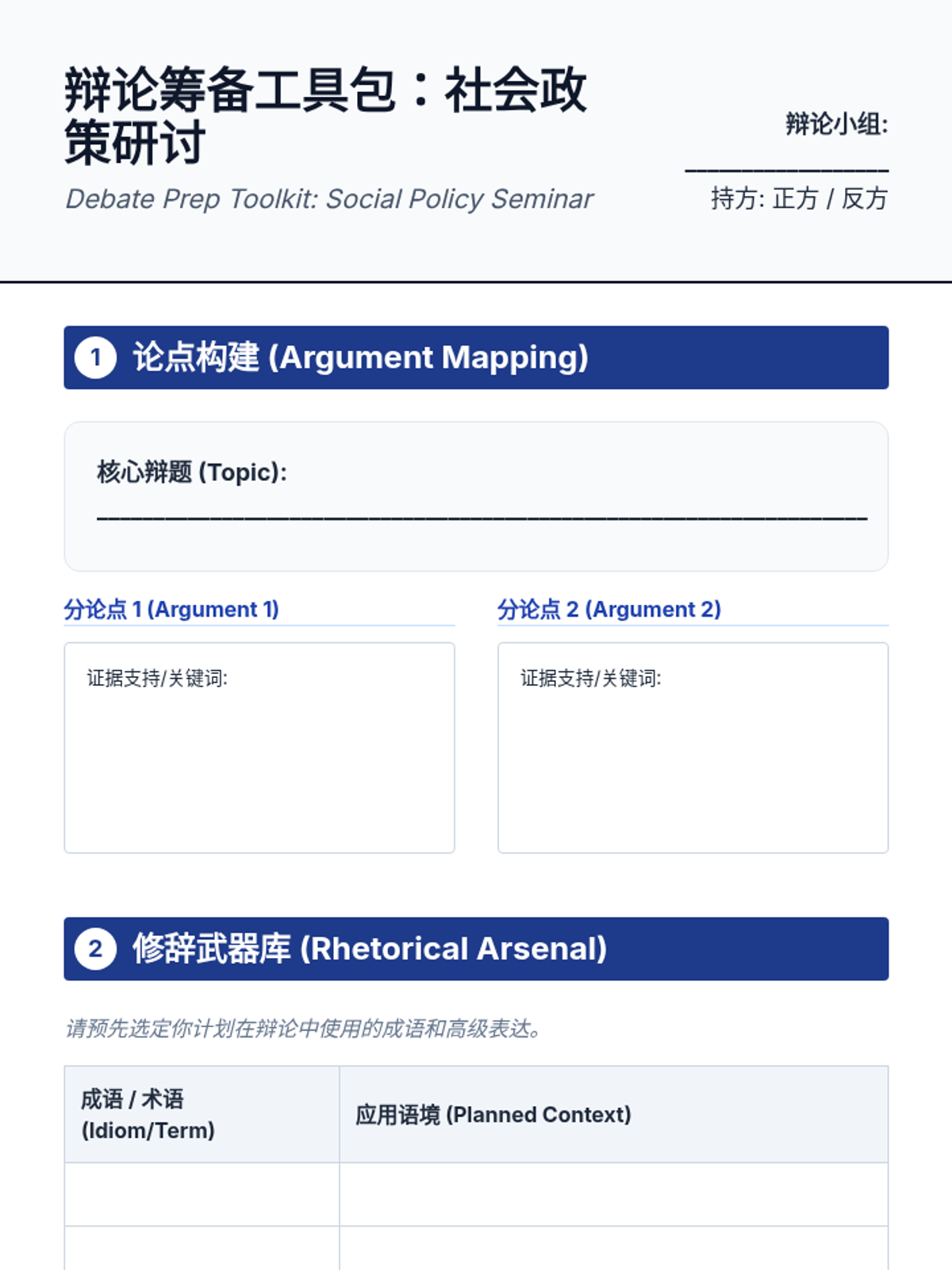
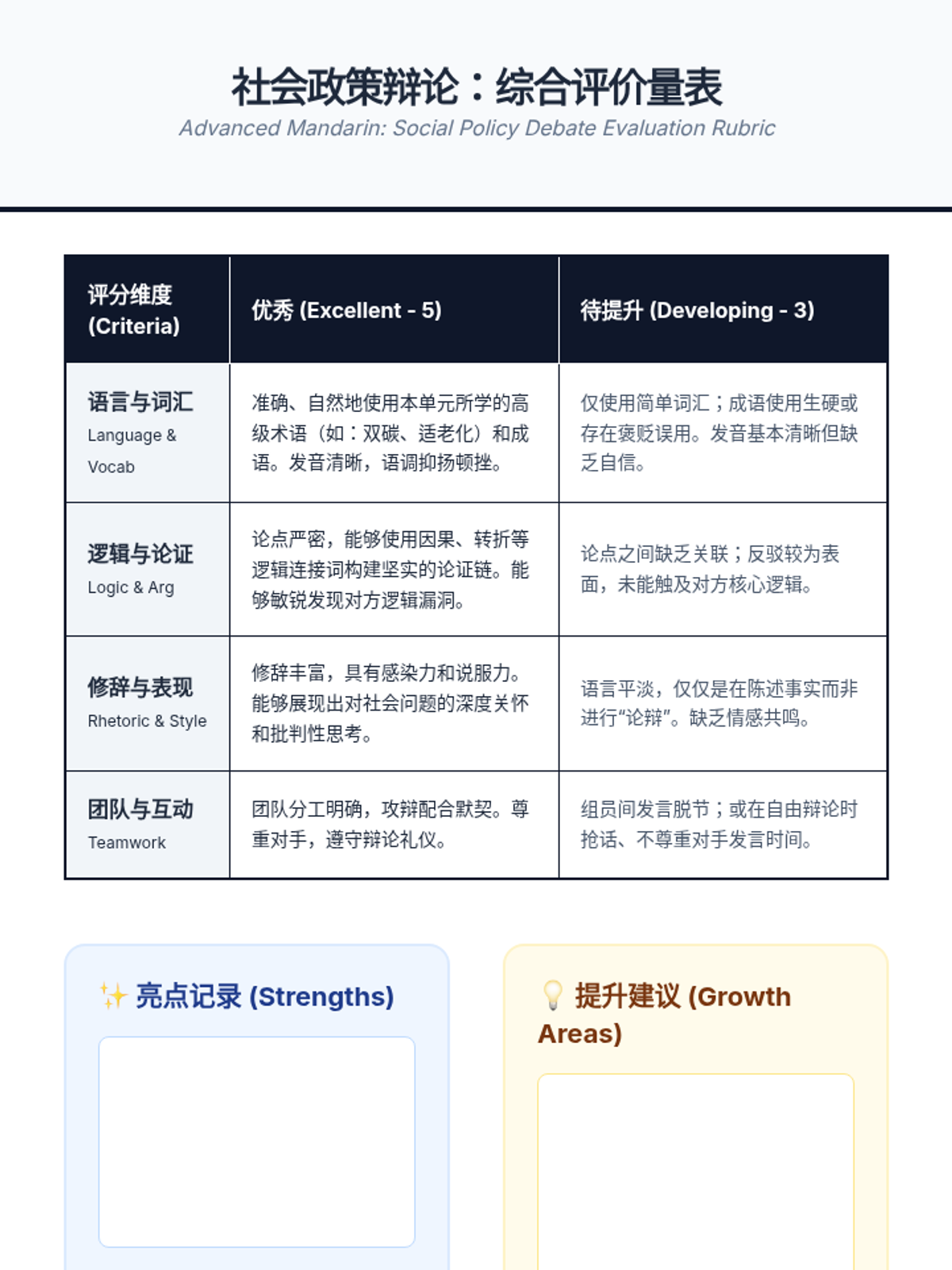
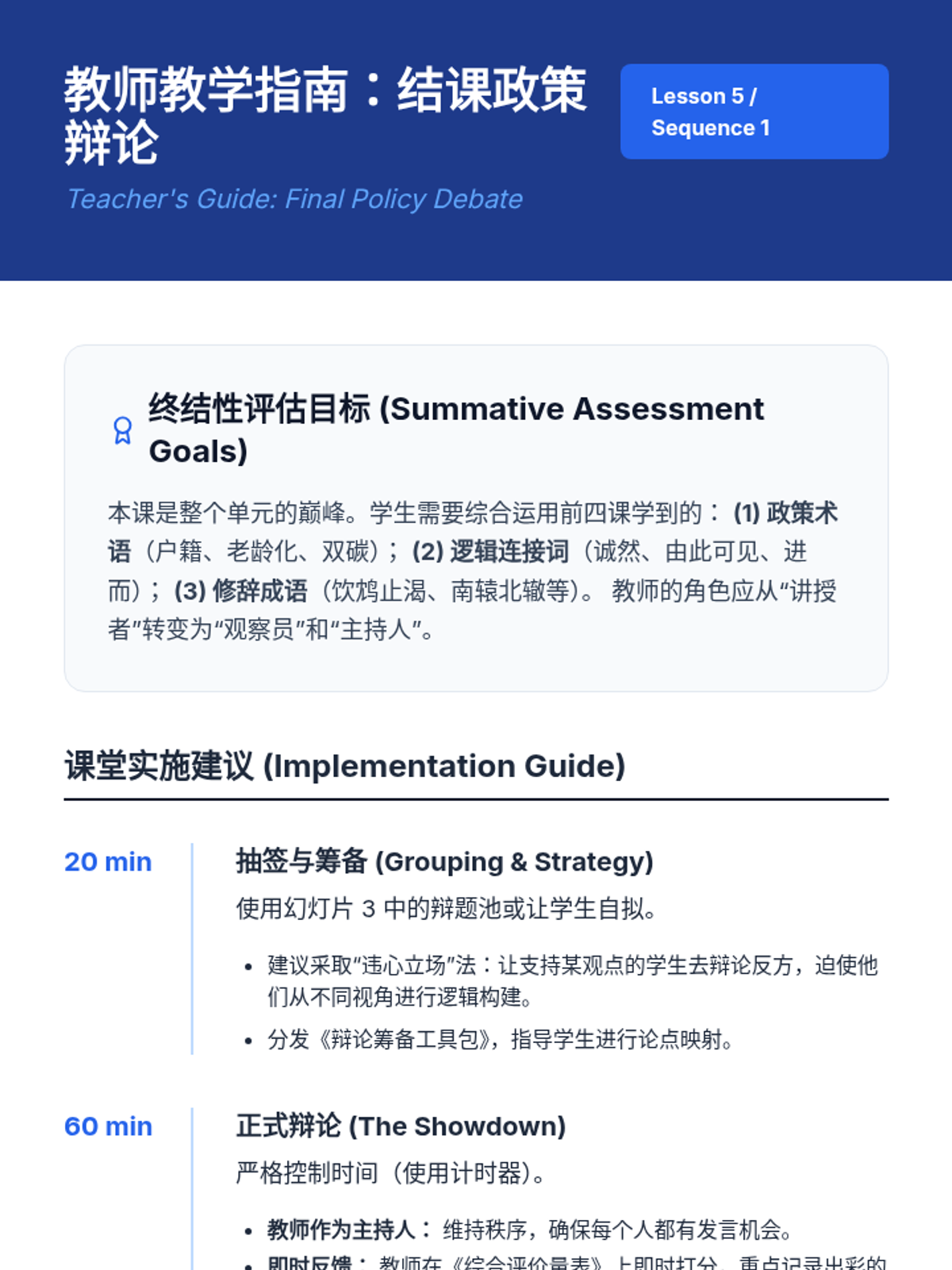
The sequence concludes with a formal debate where students synthesize learned vocabulary and rhetorical structures to argue for or against specific social policy proposals.
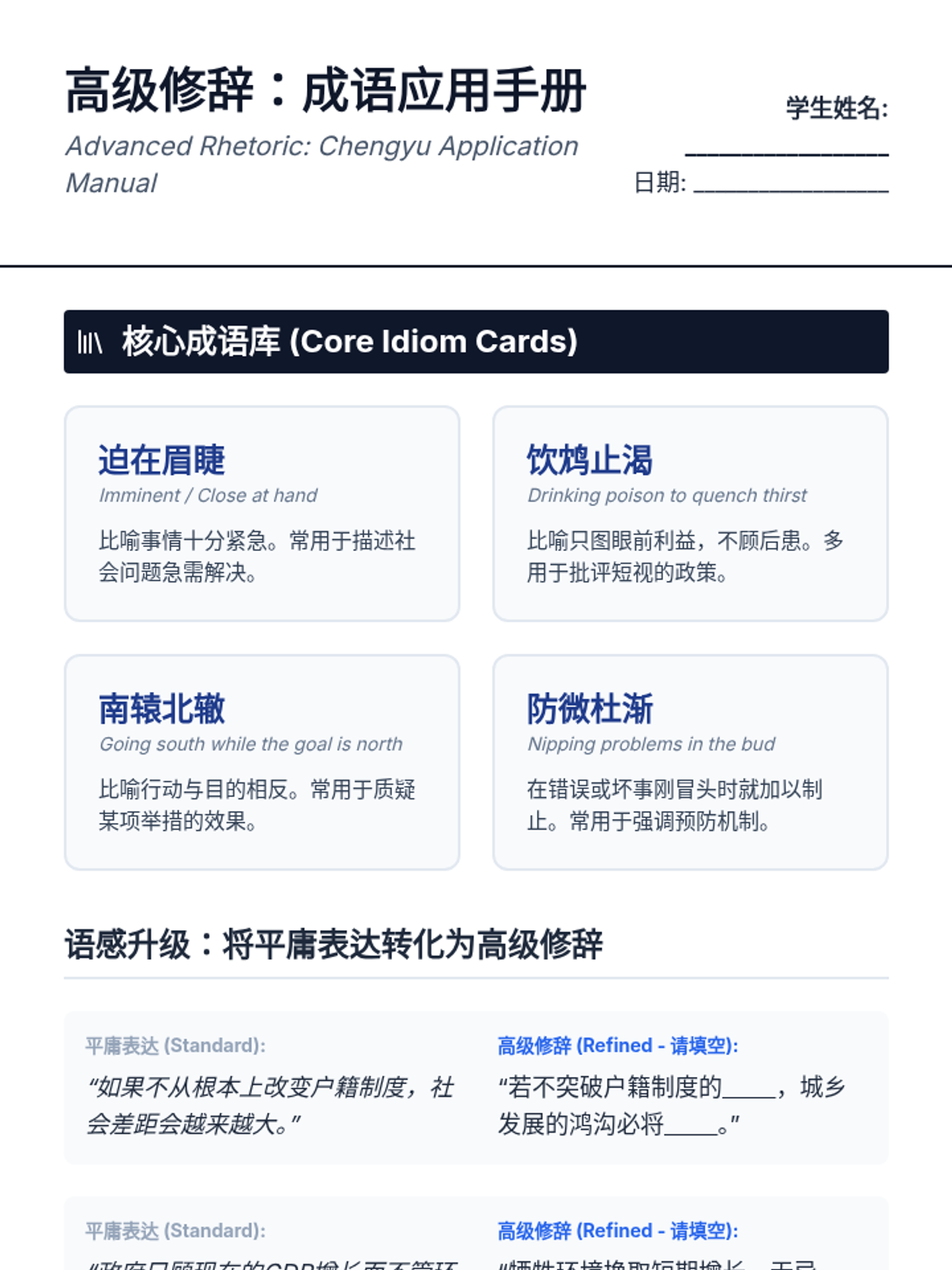
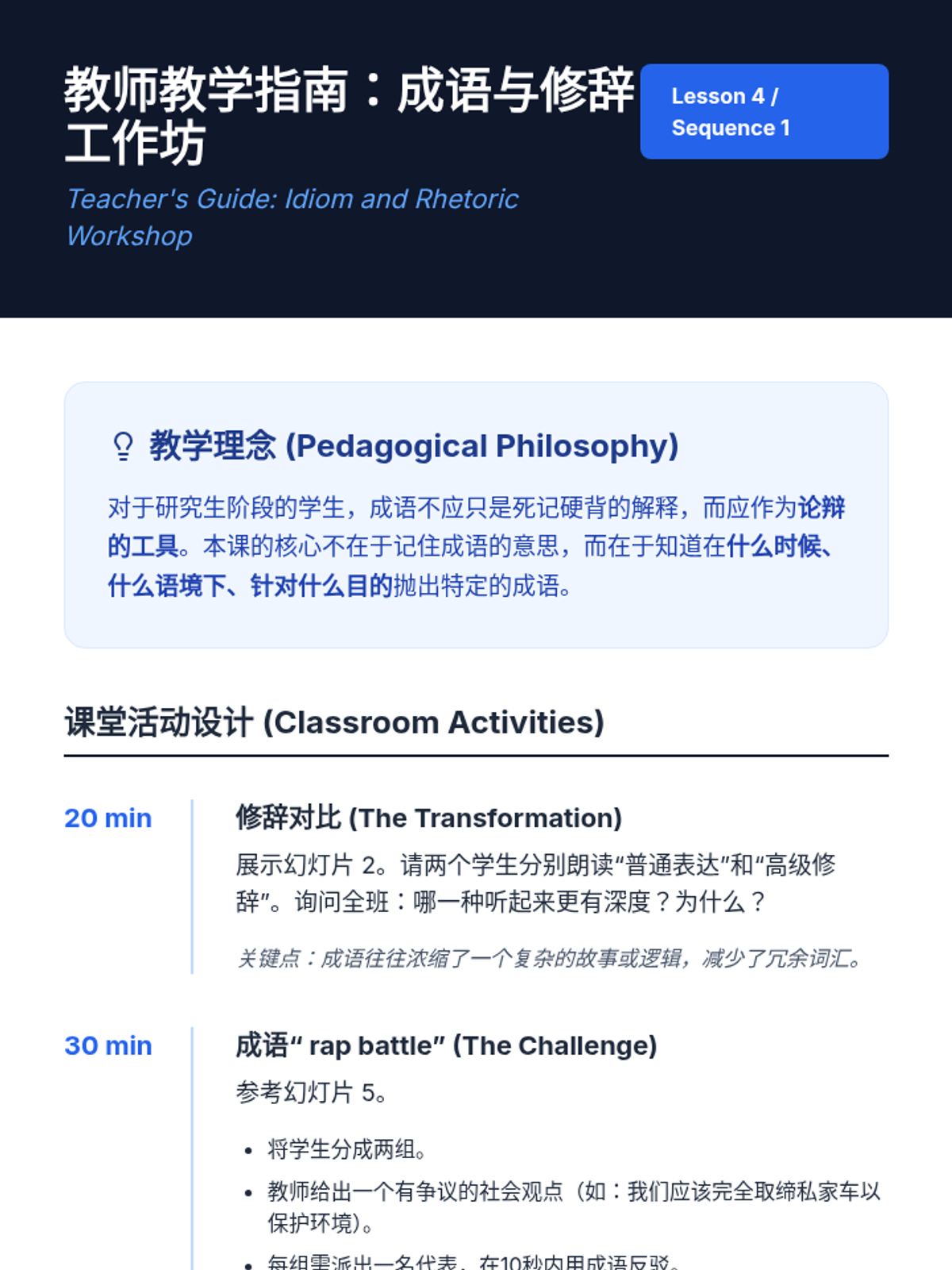
A workshop focused on integrating Chengyu (idioms) and advanced conjunctions to strengthen persuasive arguments and demonstrate cultural erudition in public debate.
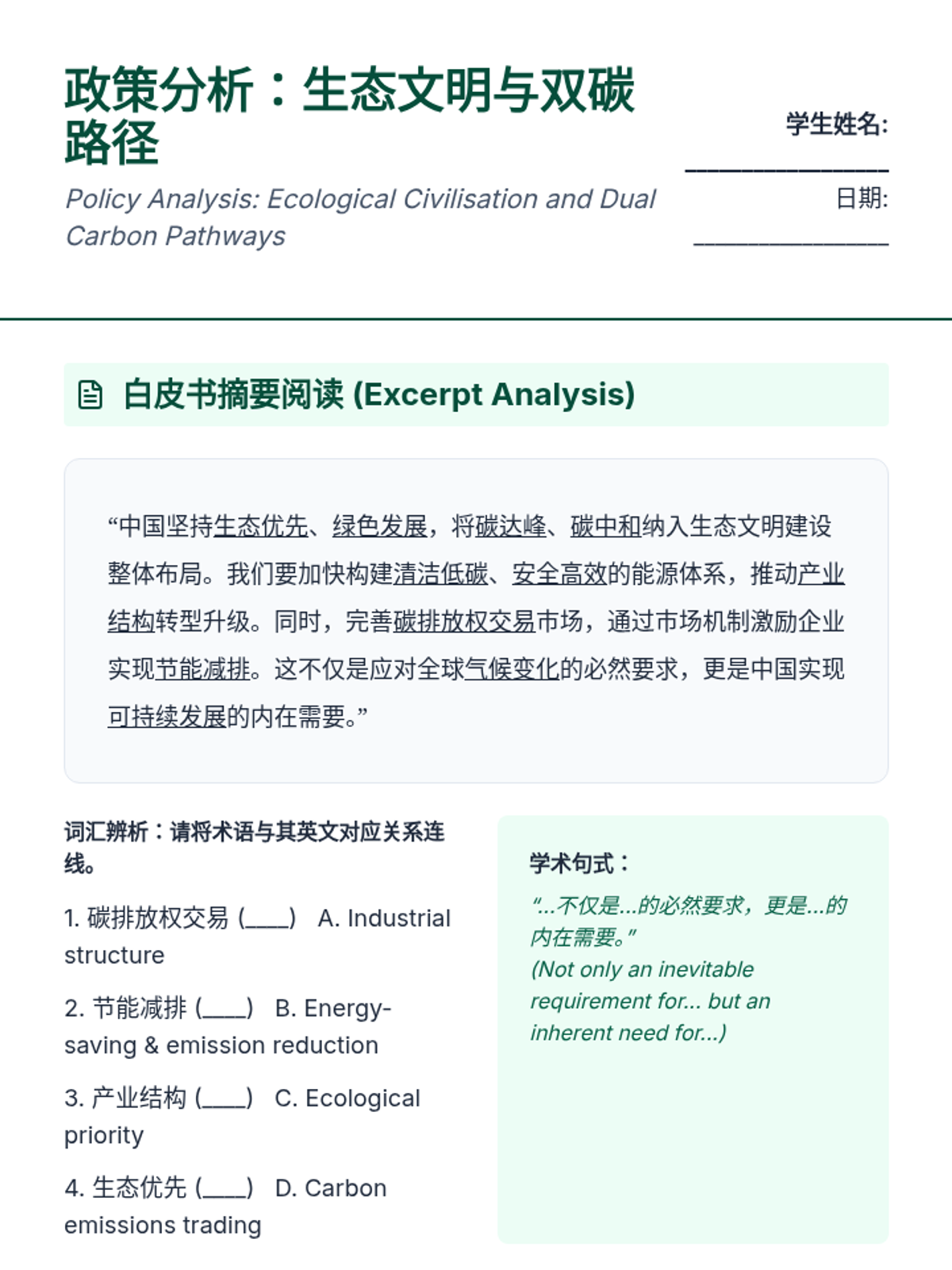
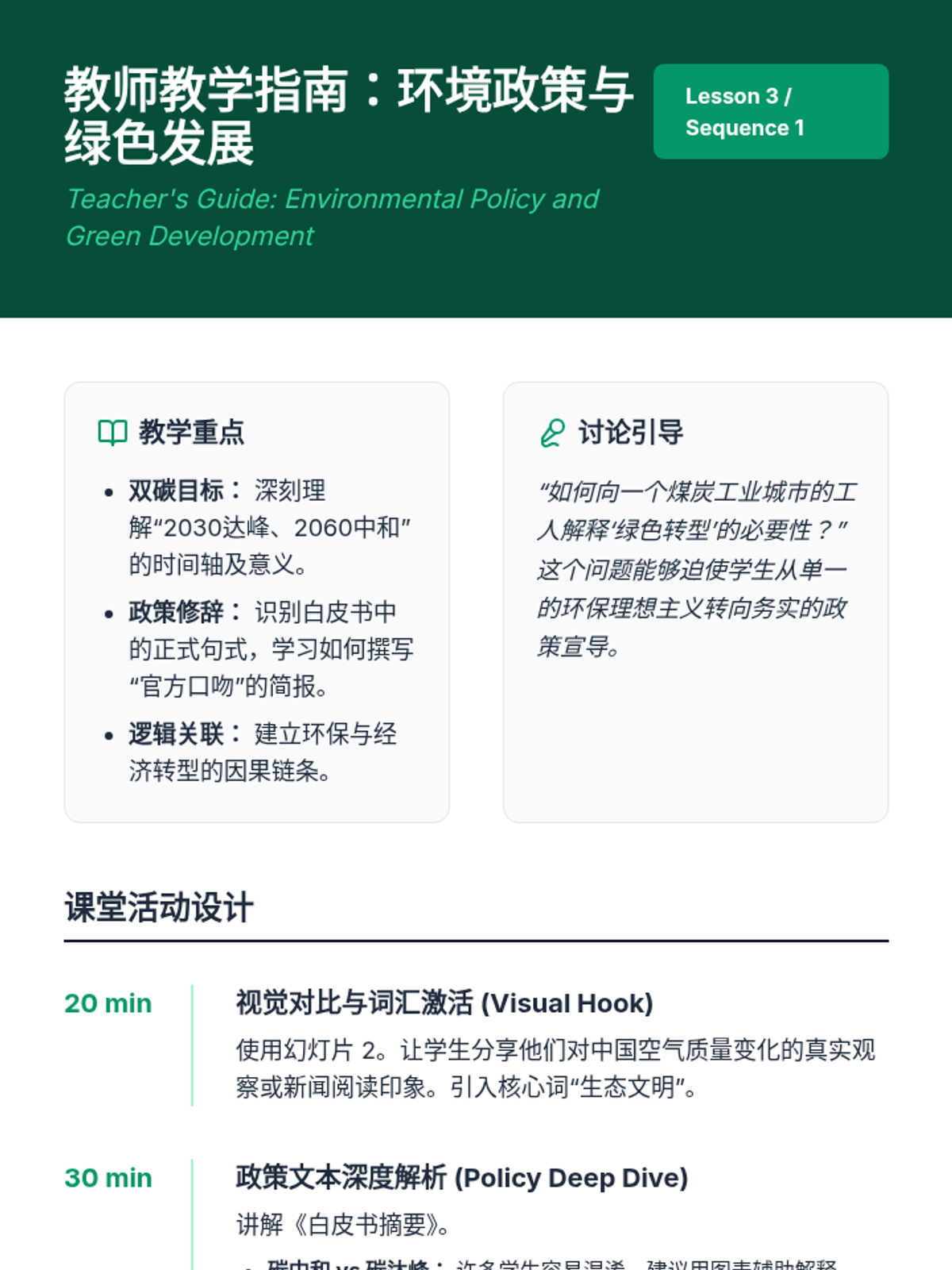
Students explore the lexicon of environmental science and government policy, focusing on sustainable development, carbon neutrality, and pollution metrics through policy analysis.
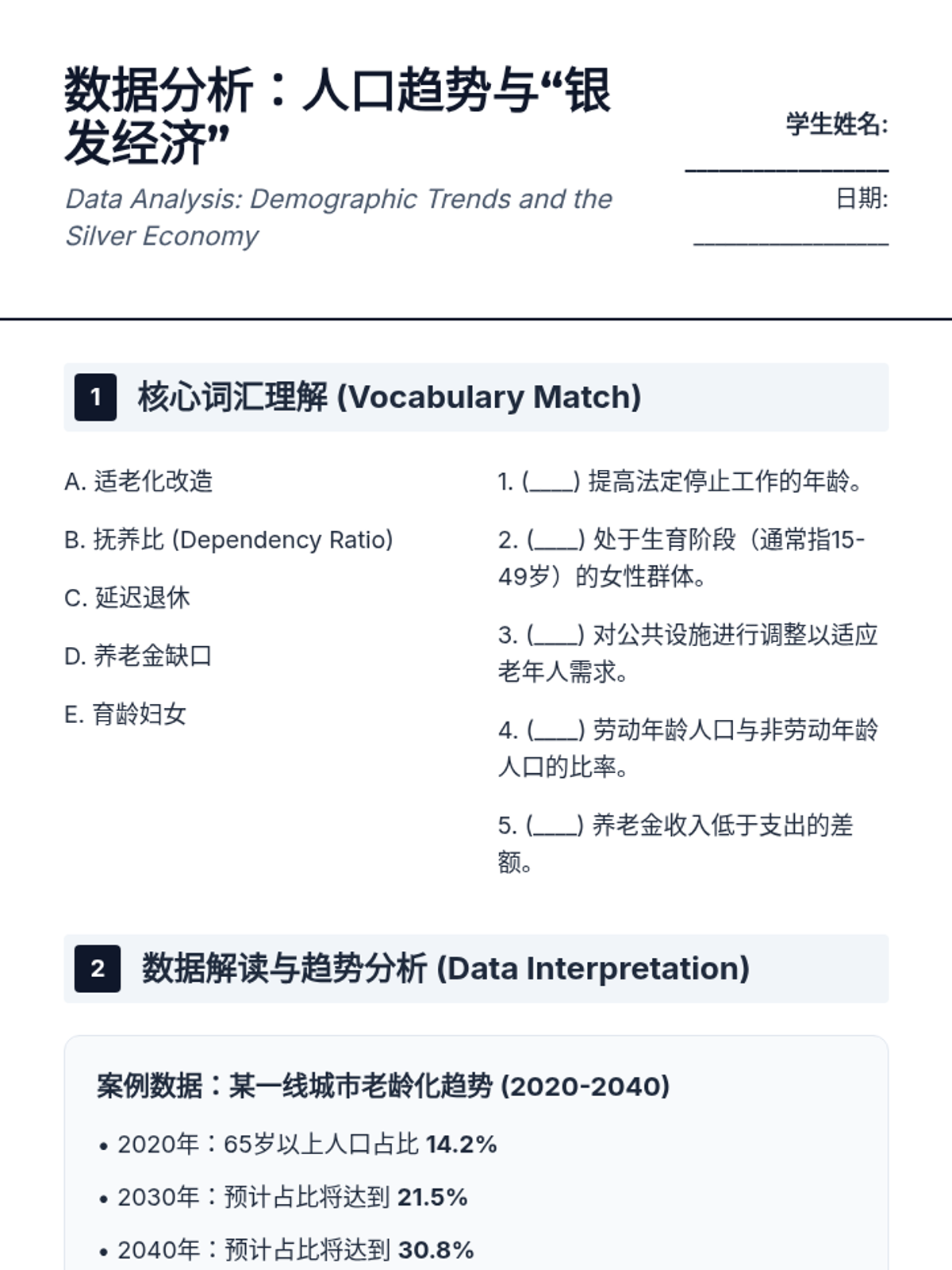
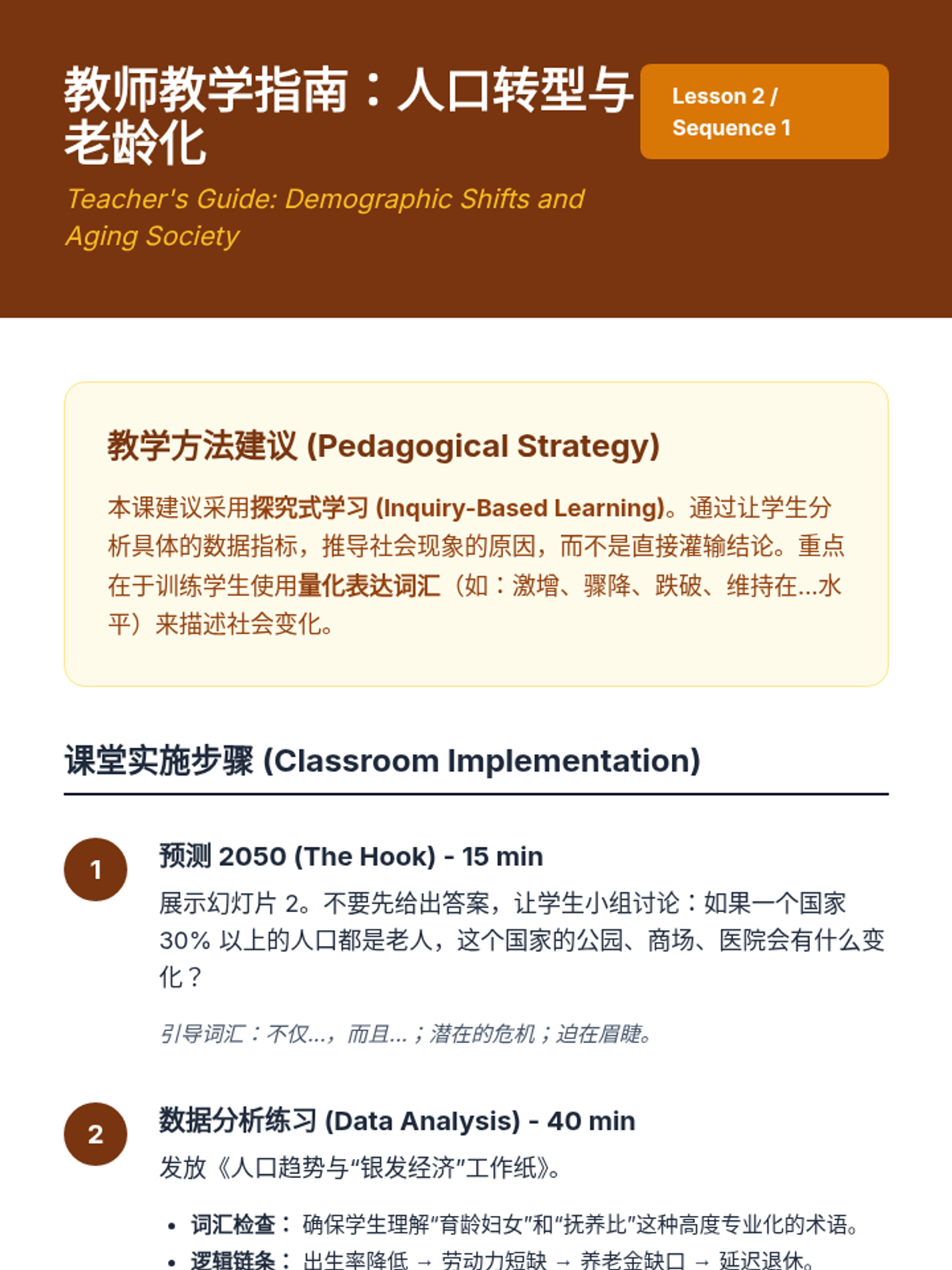
Focusing on demographic trends and the 'aging society,' this lesson introduces terminology for healthcare policy, pension systems, and the 'silver economy' using statistical analysis.
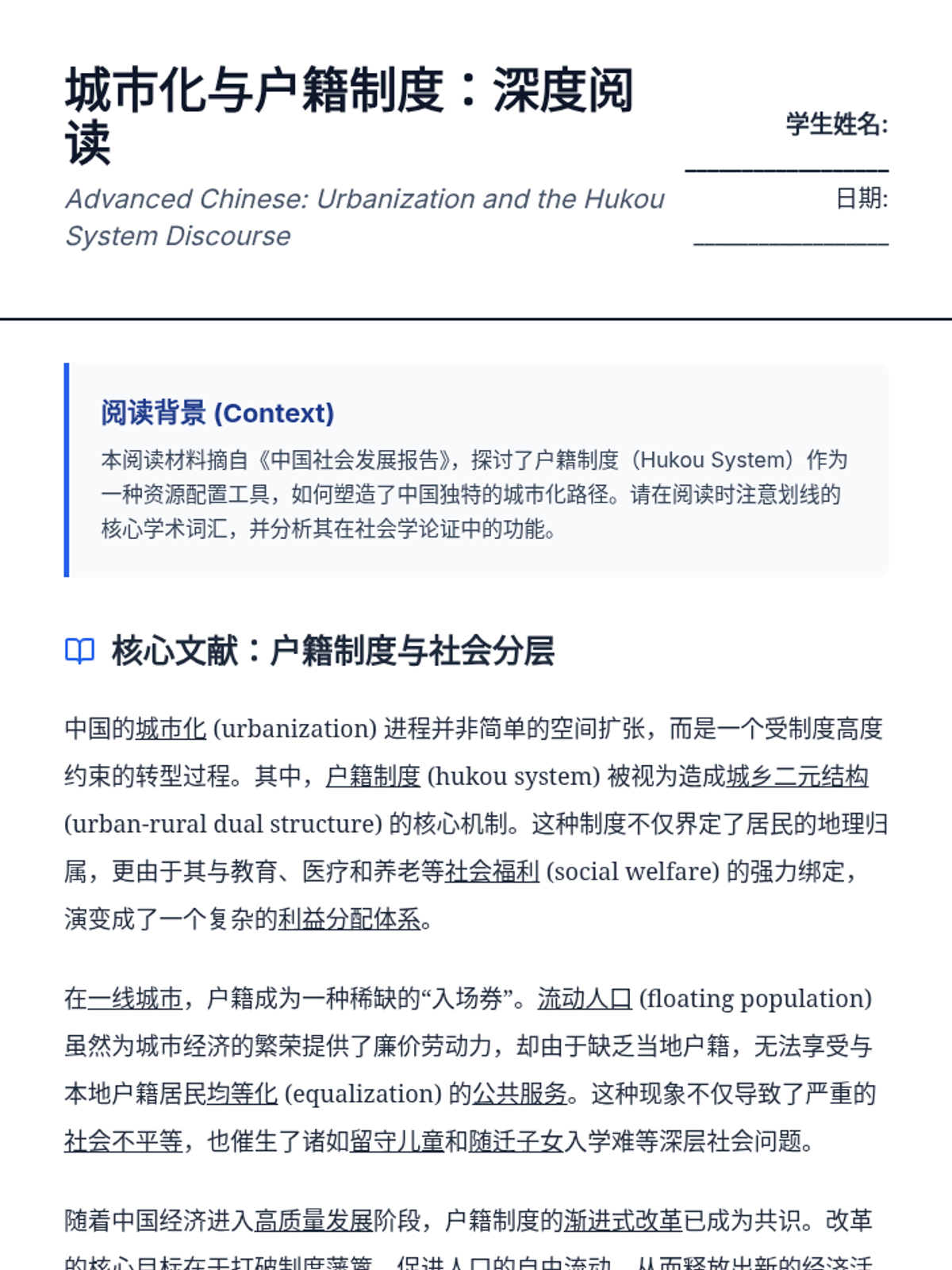
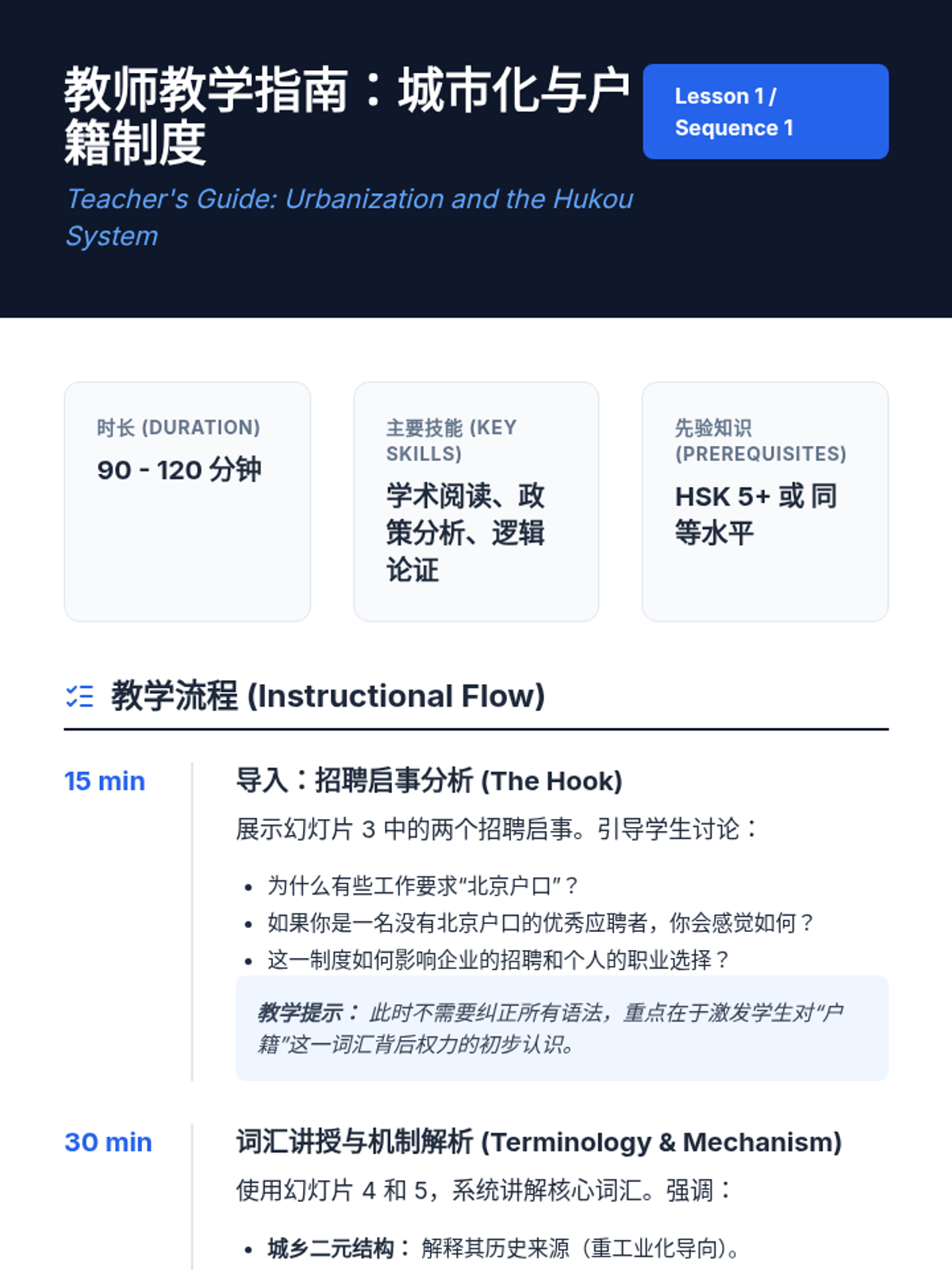
Students examine the vocabulary surrounding China's rapid urbanization and the household registration (hukou) system, focusing on socioeconomic terminology and academic reading comprehension.
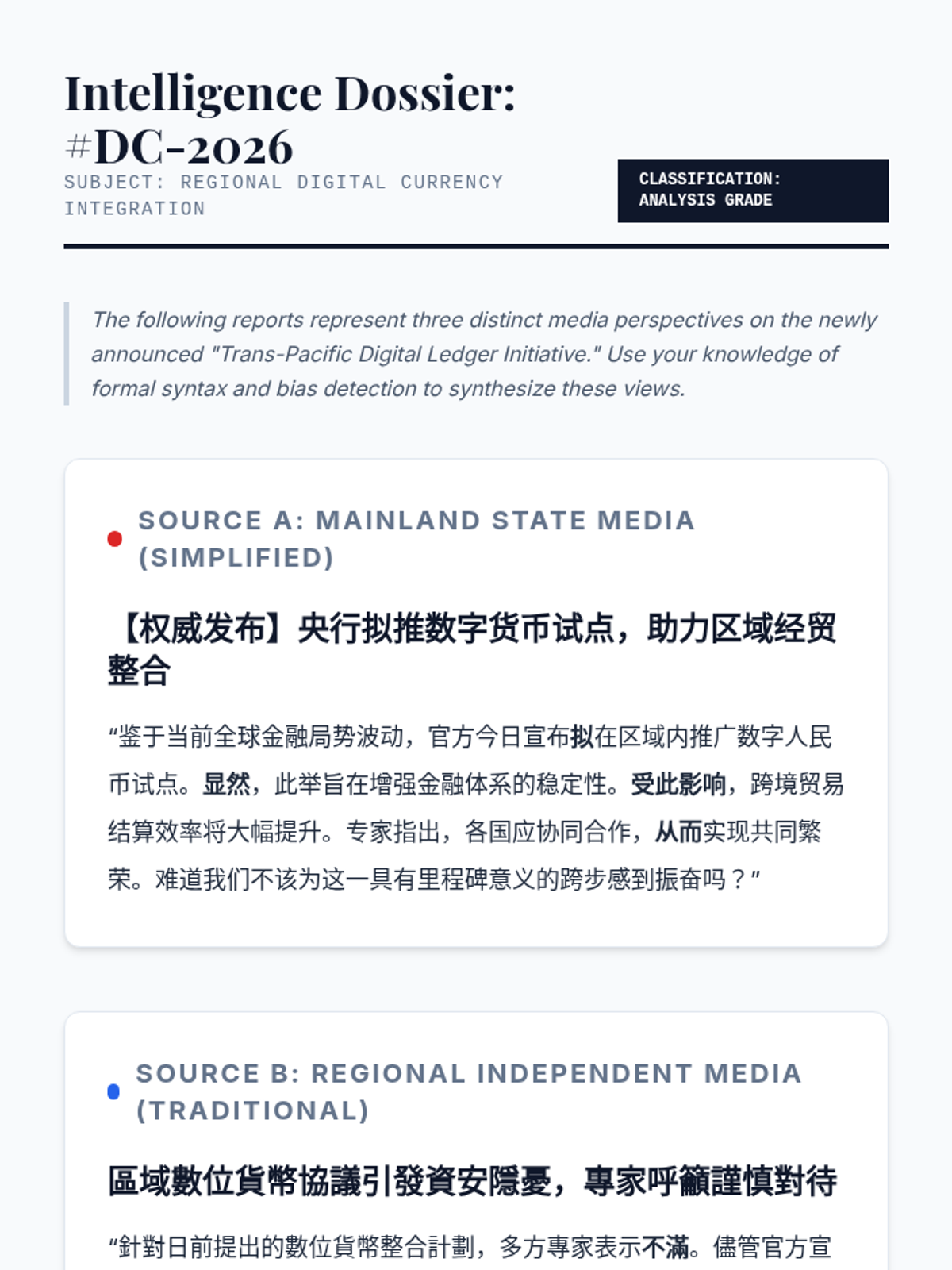
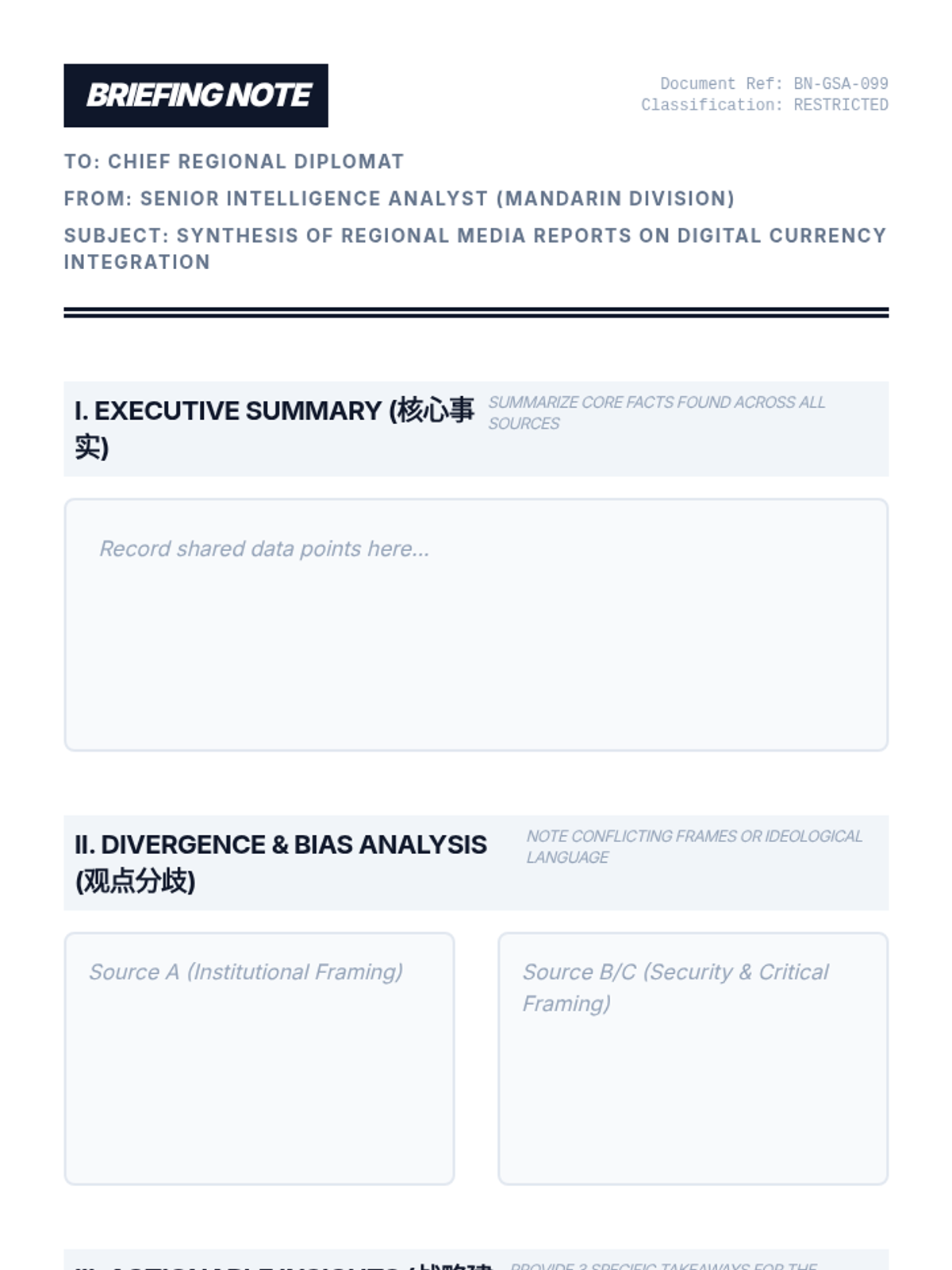
A culminating simulation where students synthesize information from multiple regional sources to create a professional executive summary of a current event.
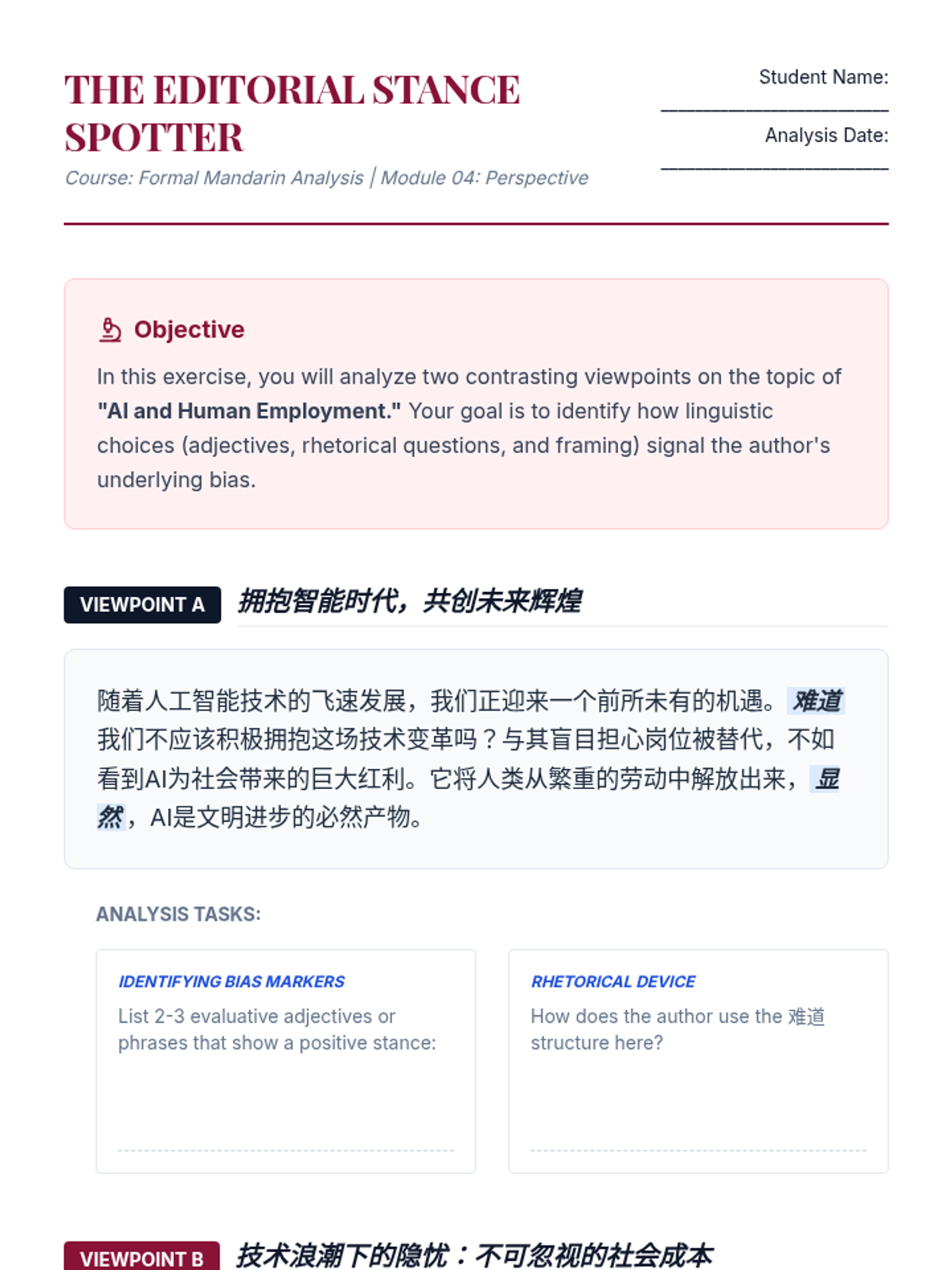
Develops critical reading skills to identify subjective language, rhetorical questions, and ideological framing within Chinese editorial and opinion pieces.
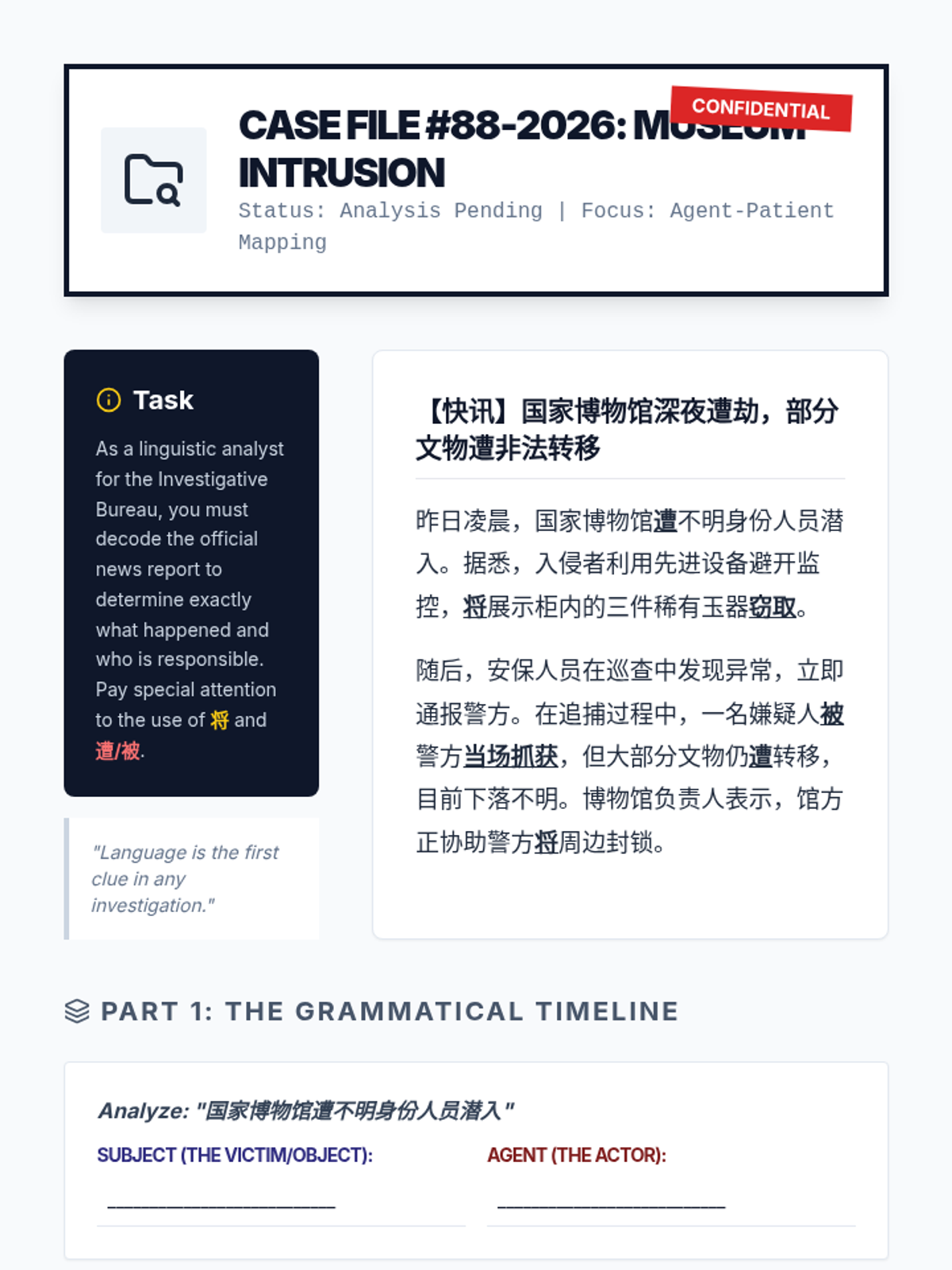
Analyzes the specific usage of 'ba' and 'bei' structures in formal reports of crime, accidents, and legal proceedings to clarify agency and impact.
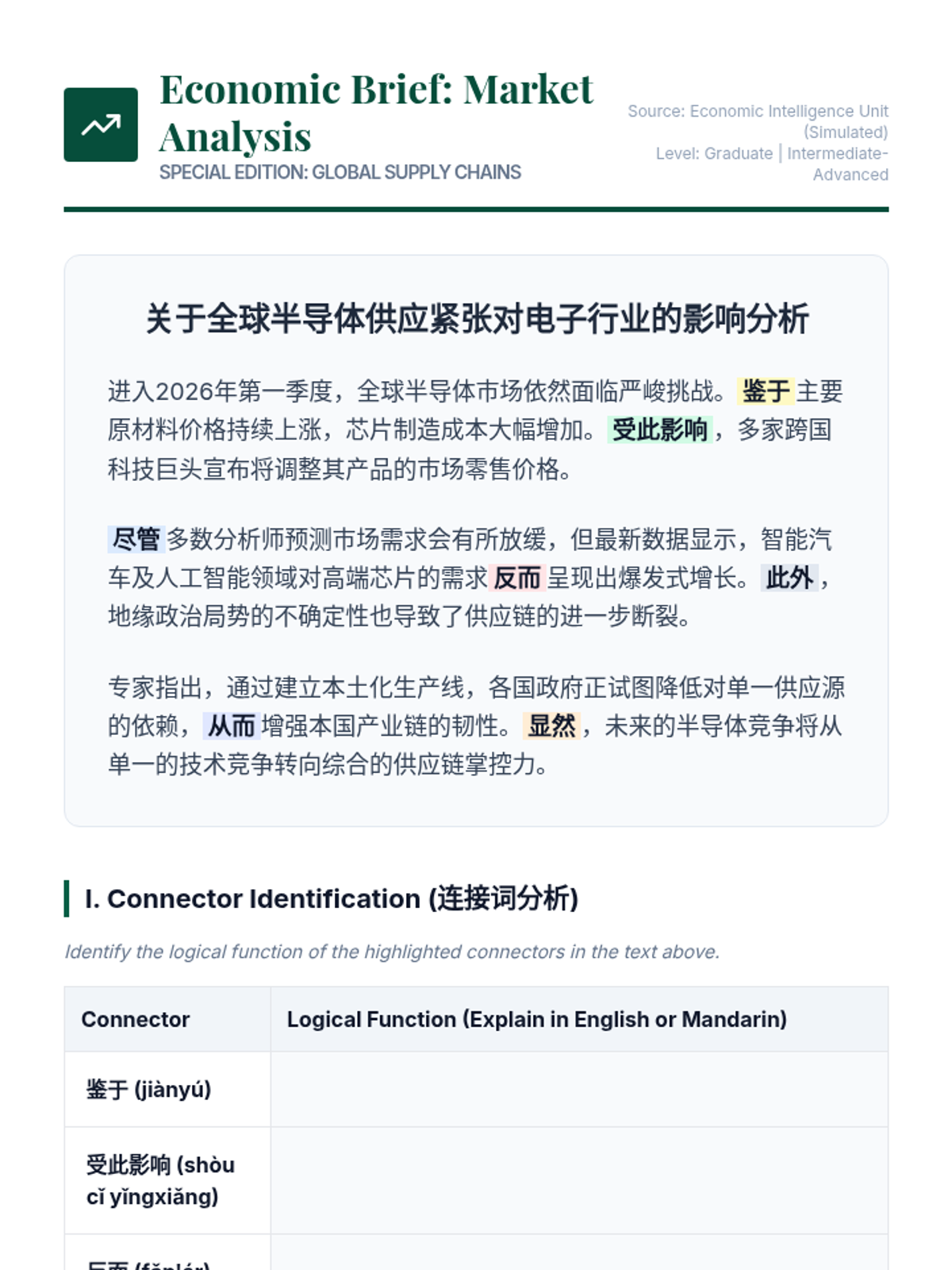
Explores formal logical connectors (shumianyu) used in financial and economic journalism to express causation, concession, and sequential logic.
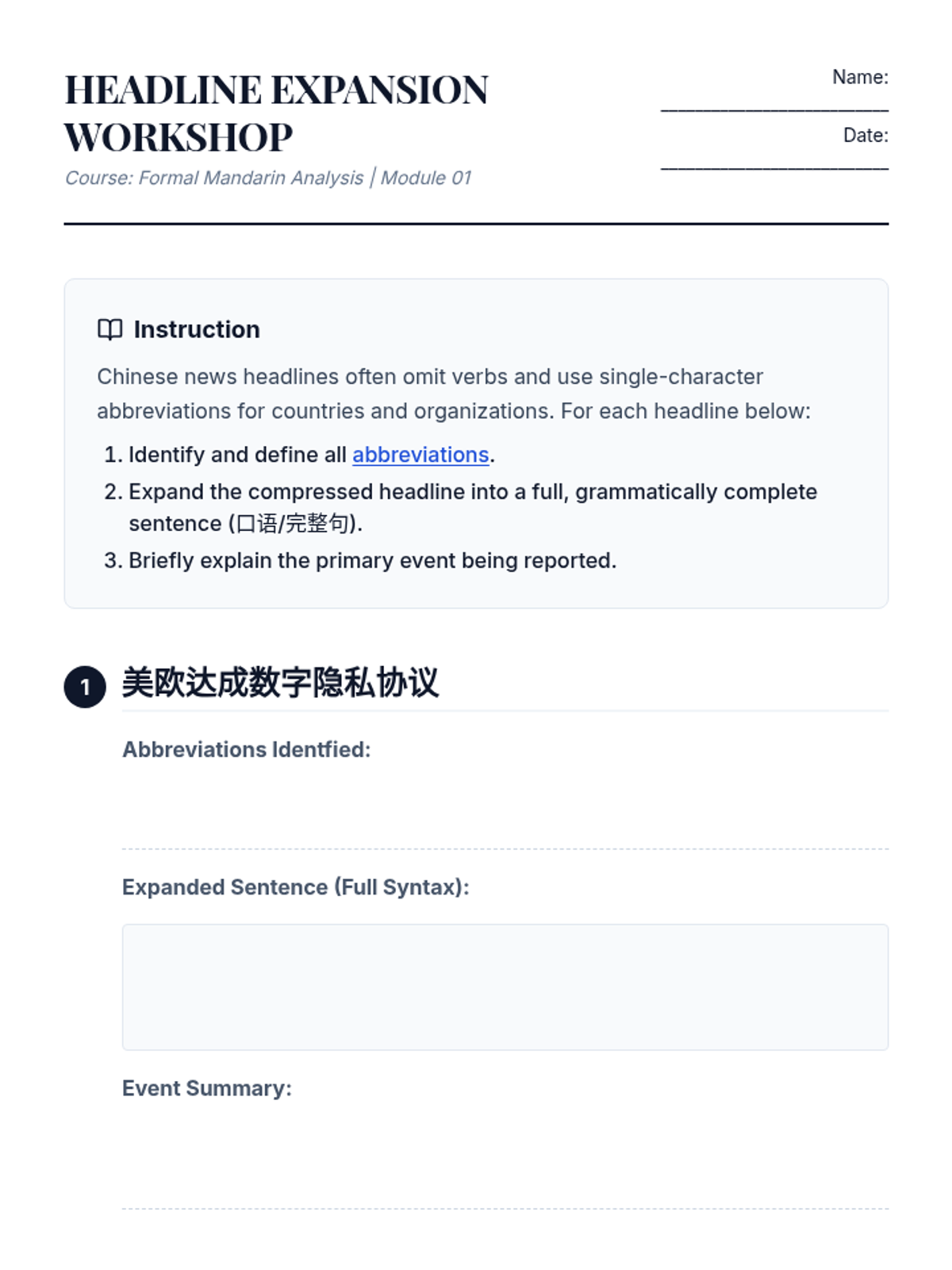
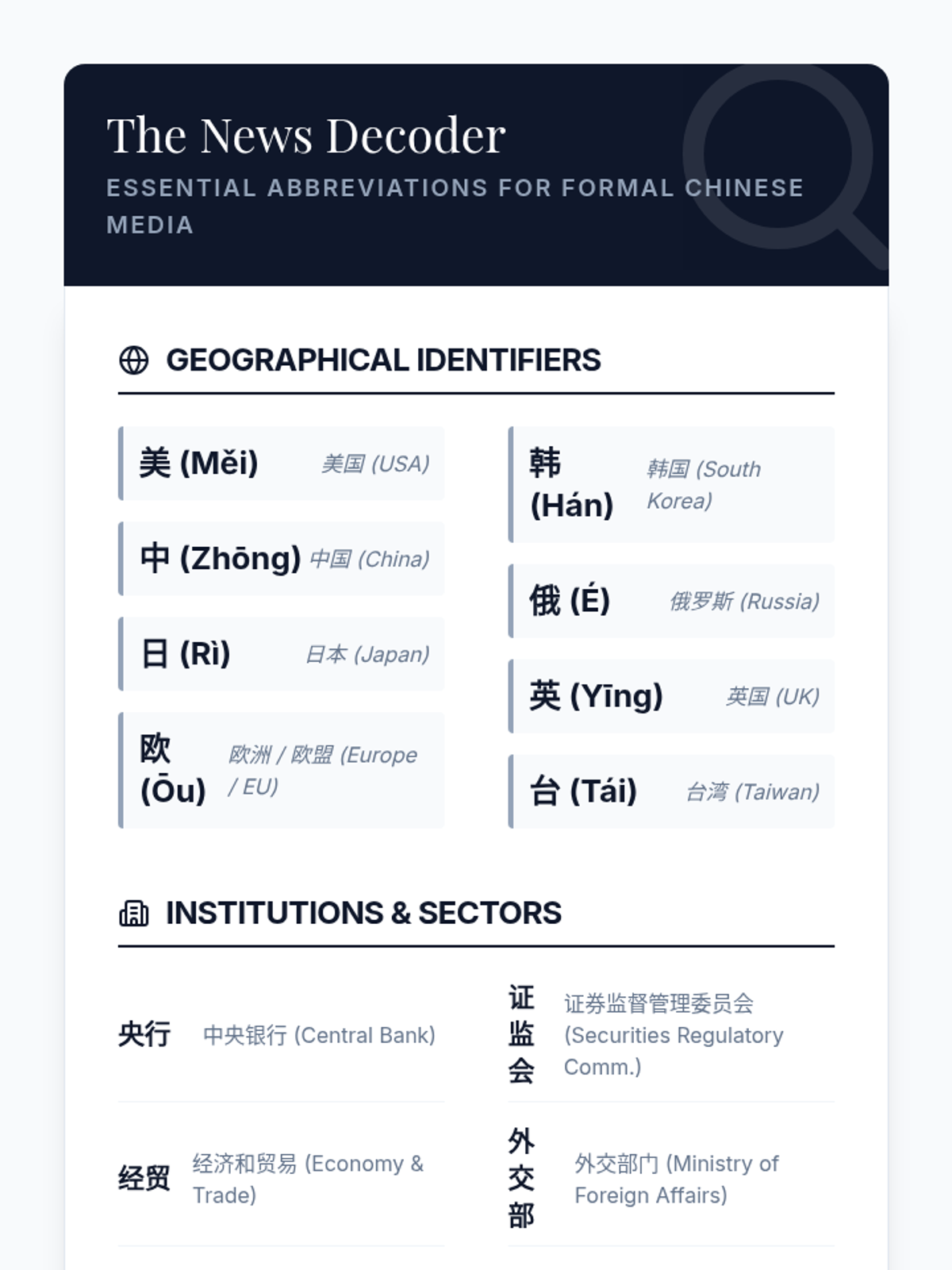
Focuses on the high-density syntax of Chinese news headlines, teaching students to decode abbreviations and expand compressed phrases into full grammatical structures.
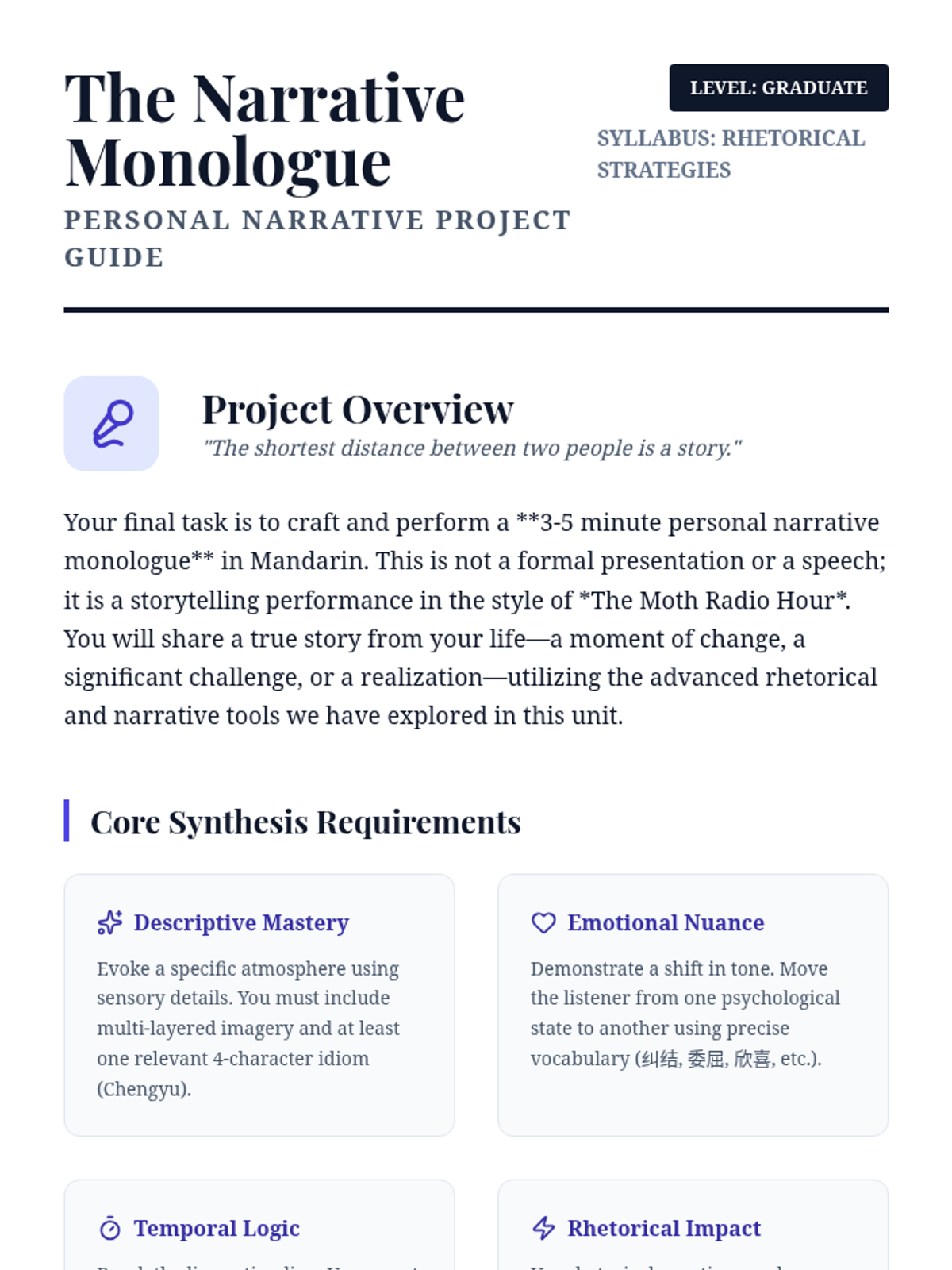
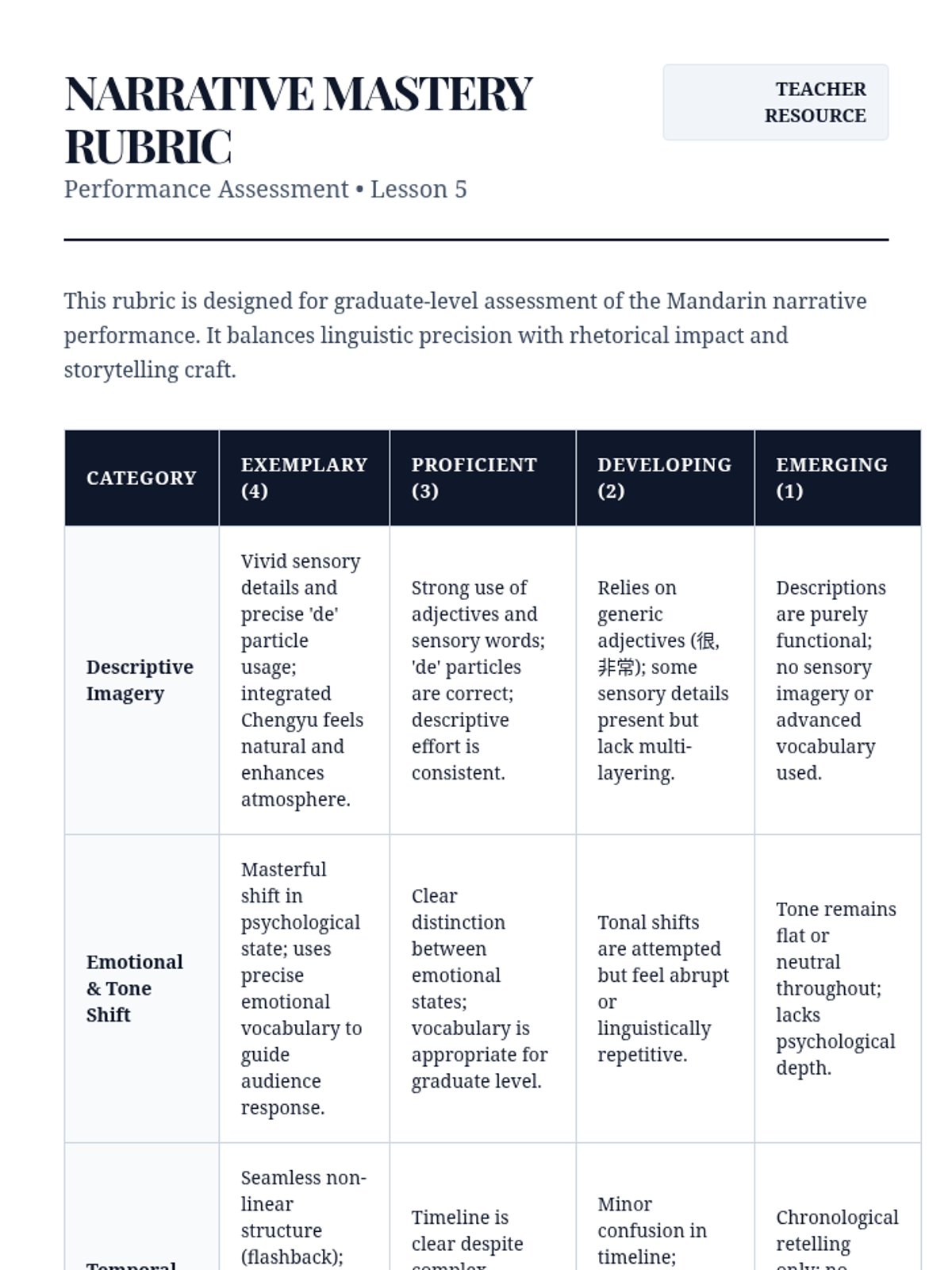
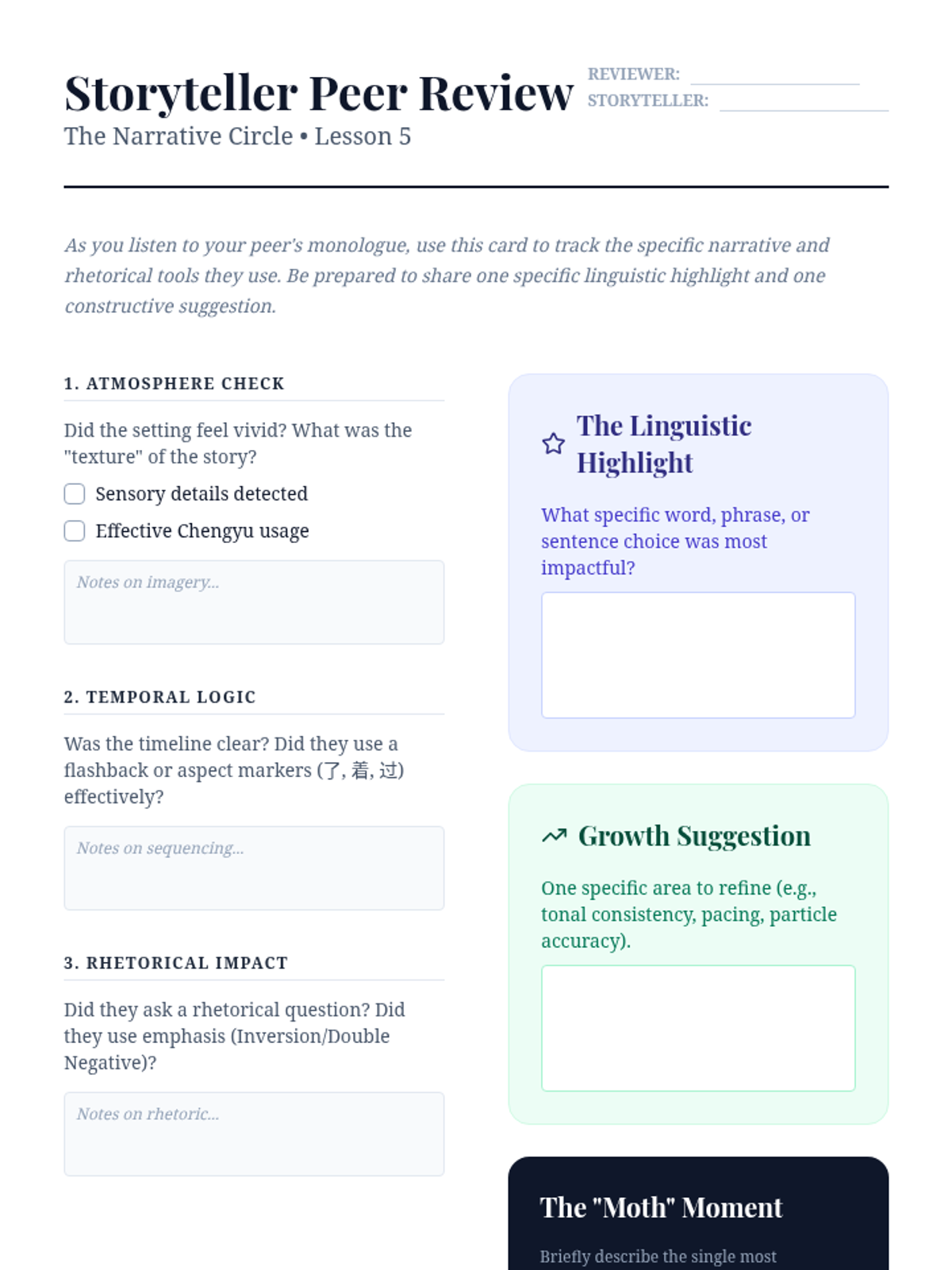
Synthesizes descriptive, emotional, and temporal skills into a polished personal narrative performance, involving peer feedback and mastery-based refinement.
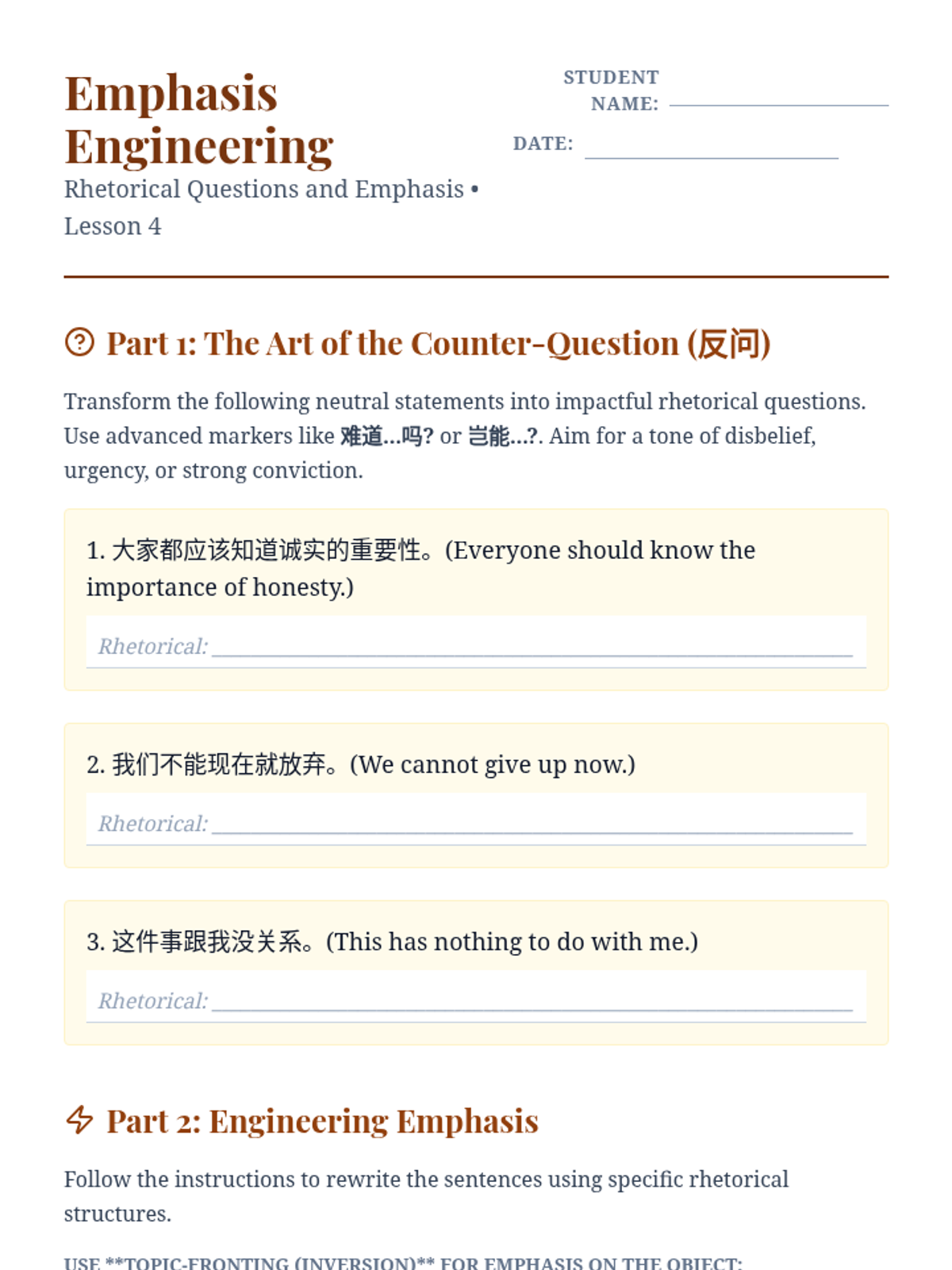
Explores rhetorical devices common in Chinese speech, such as rhetorical questions and repetition for emphasis, analyzing monologues for persuasive impact.
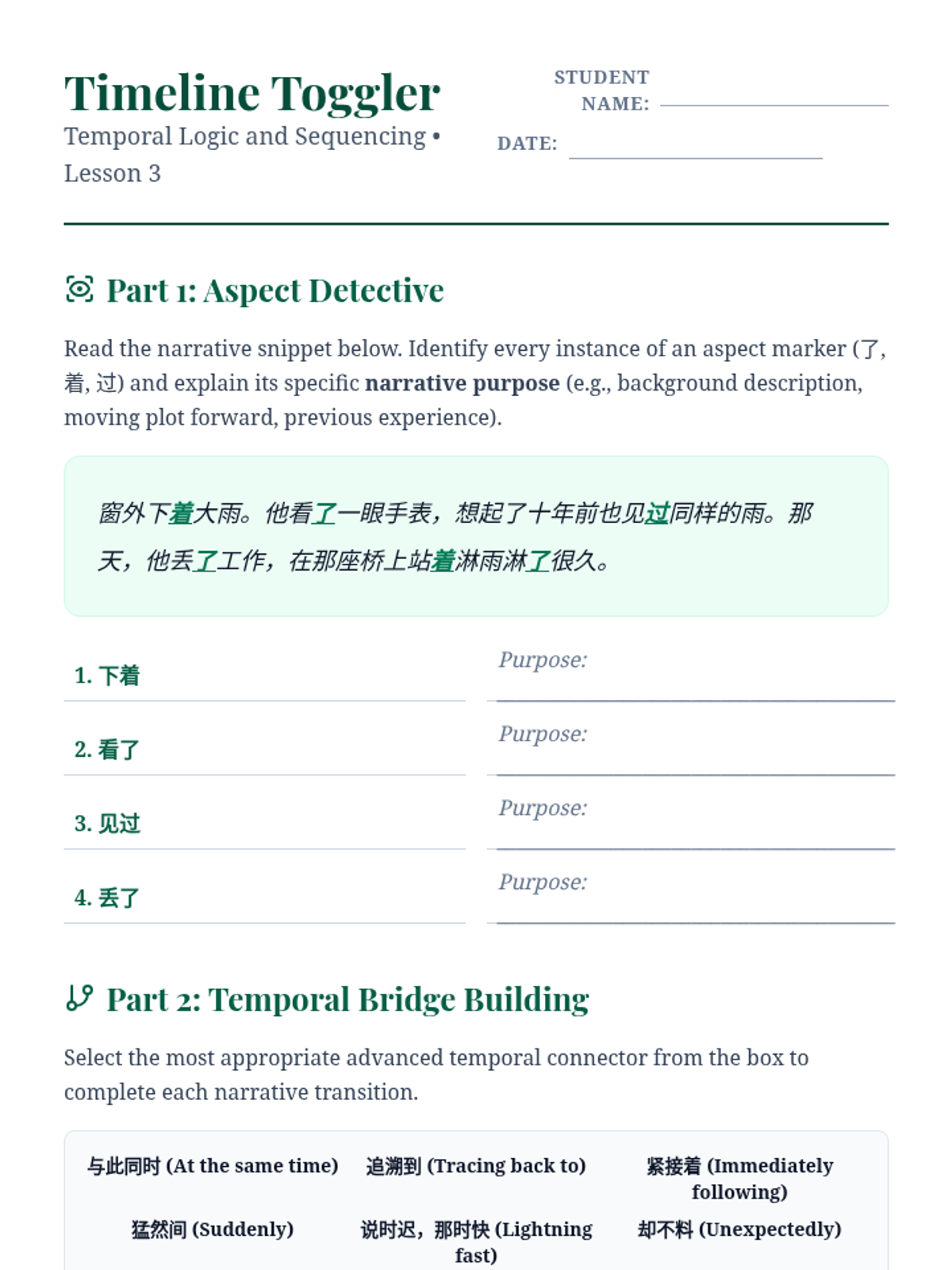
Masters the use of aspect markers and temporal connectors to manipulate story timelines, including flashbacks, simultaneous actions, and foreshadowing.
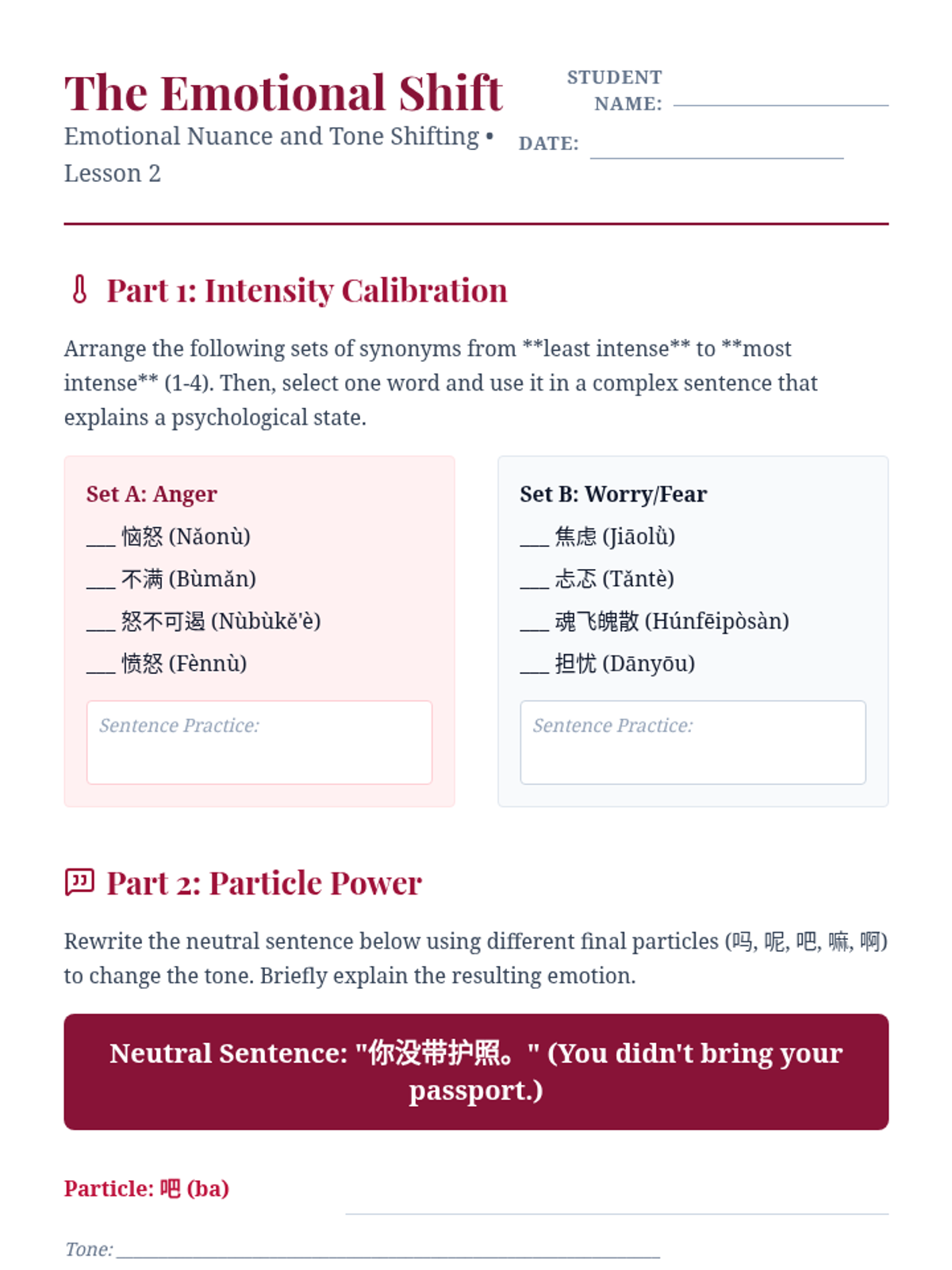
Focuses on vocabulary related to emotions and psychological states, teaching students to shift the tone of a story and analyze how word choice affects listener response.
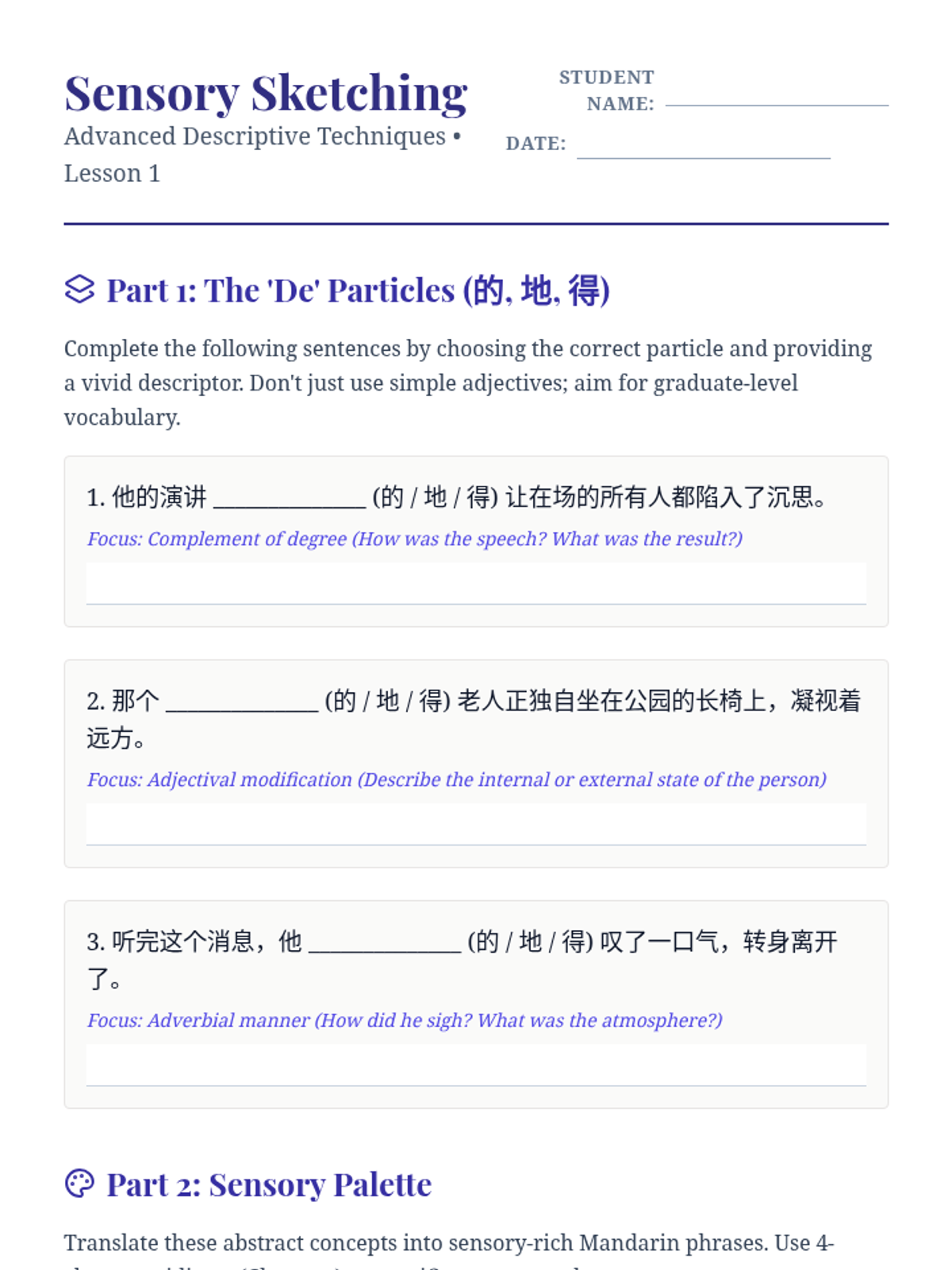
Students expand their vocabulary of adjectives and adverbs to describe people, places, and atmospheres vividly, utilizing descriptive particles to create multi-layered imagery.
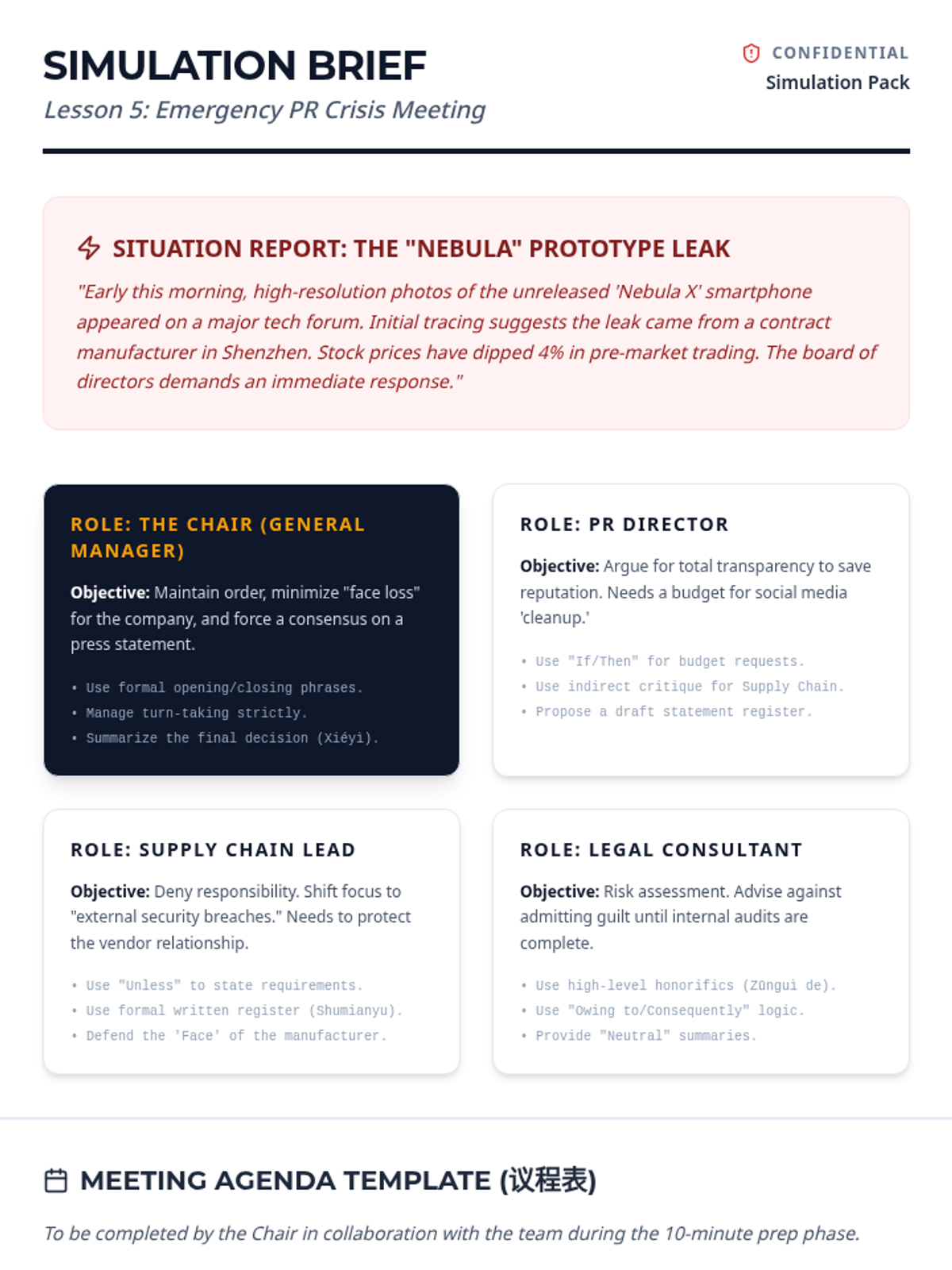
A culminating simulation where students chair and participate in formal meetings, synthesizing skills in hierarchy, negotiation, and formal speech registers.
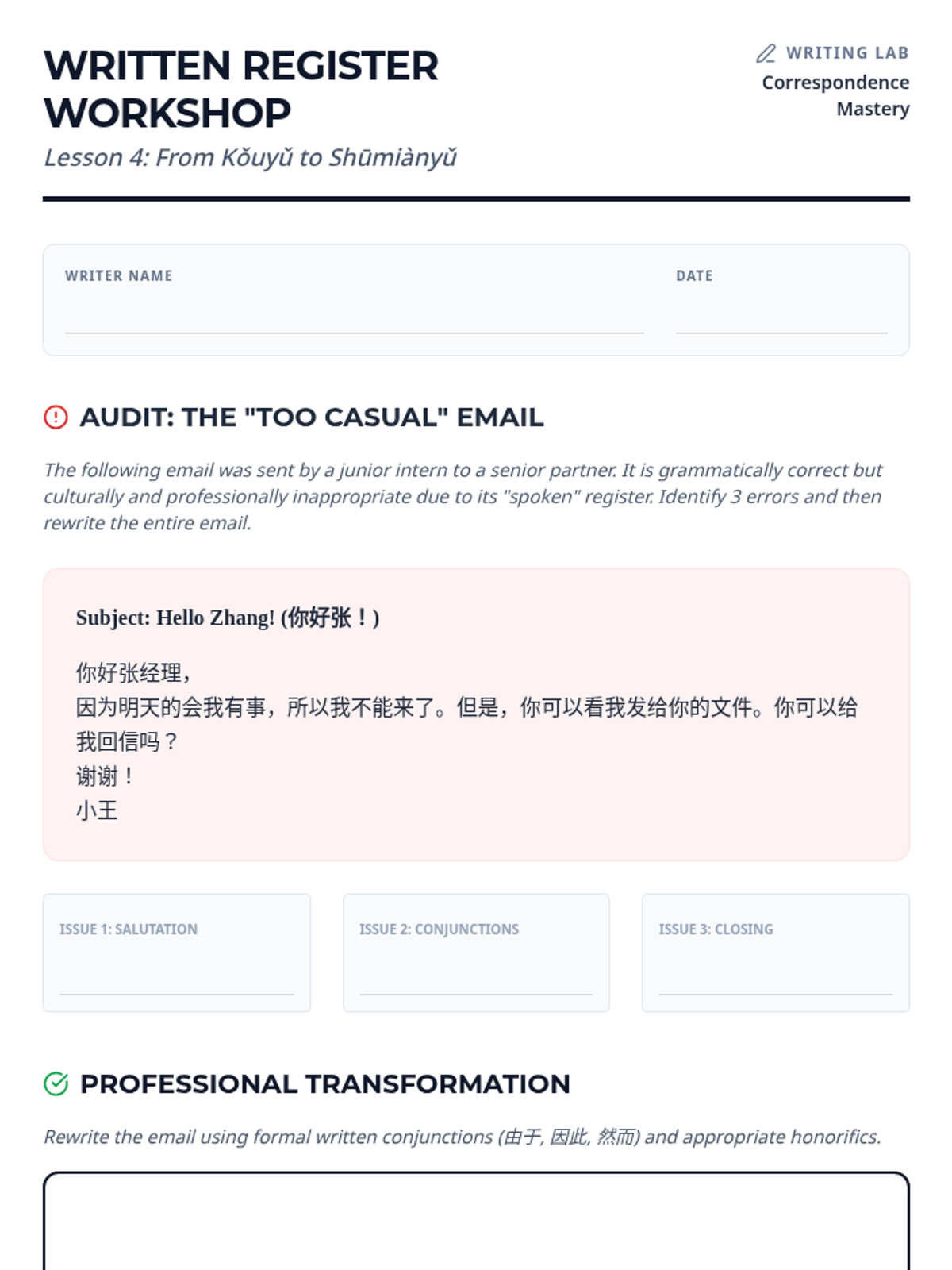
Students bridge the gap between spoken Mandarin and formal written Chinese (Shumianyu) used in professional emails, reports, and digital correspondence.
Focusing on the concept of 'mianzi' (face), students learn how to deliver negative news or refuse requests using softeners and indirect language patterns.
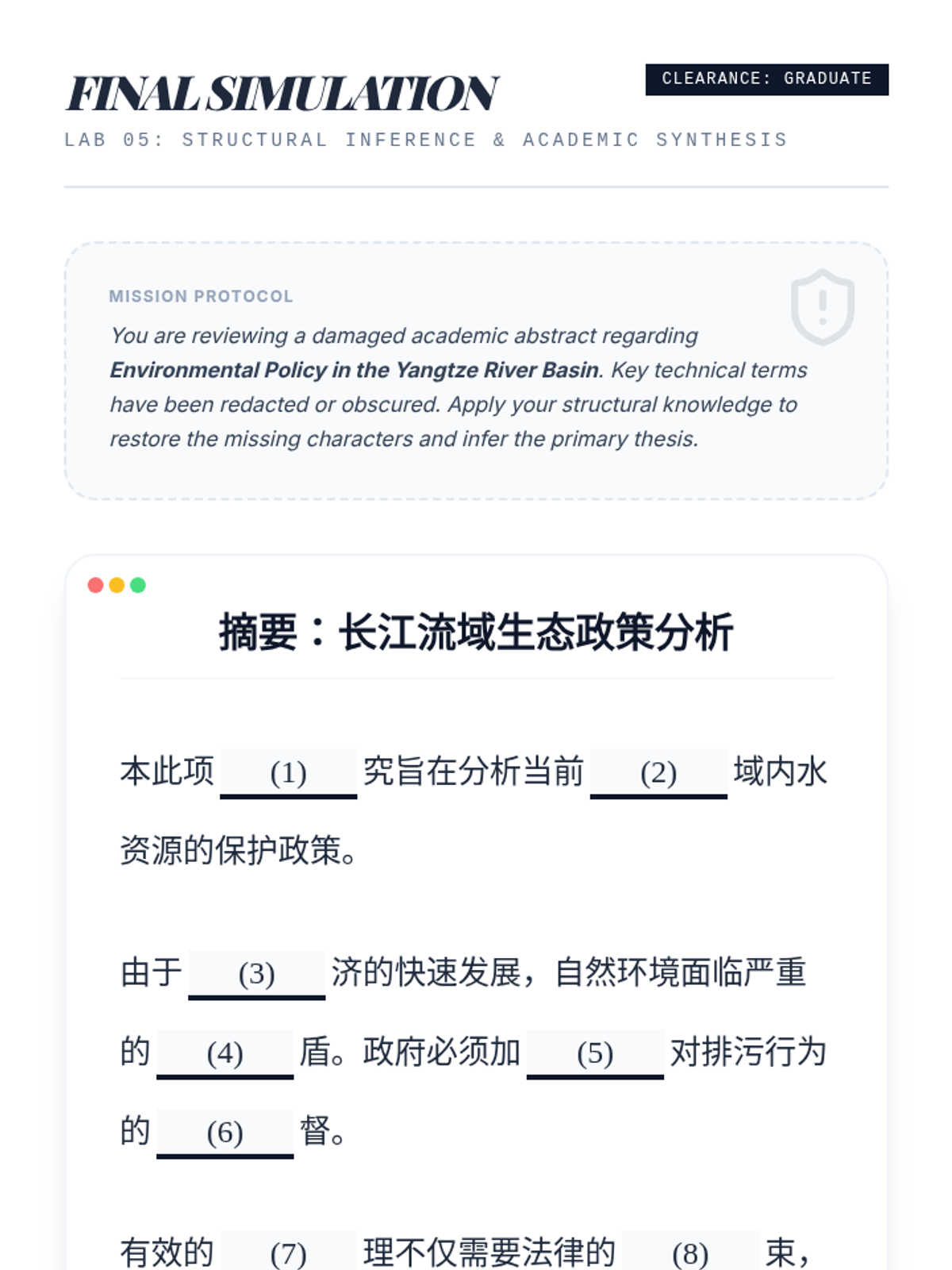
A culminating simulation where students apply structural knowledge to decode specialized academic texts and infer meanings of unfamiliar vocabulary.
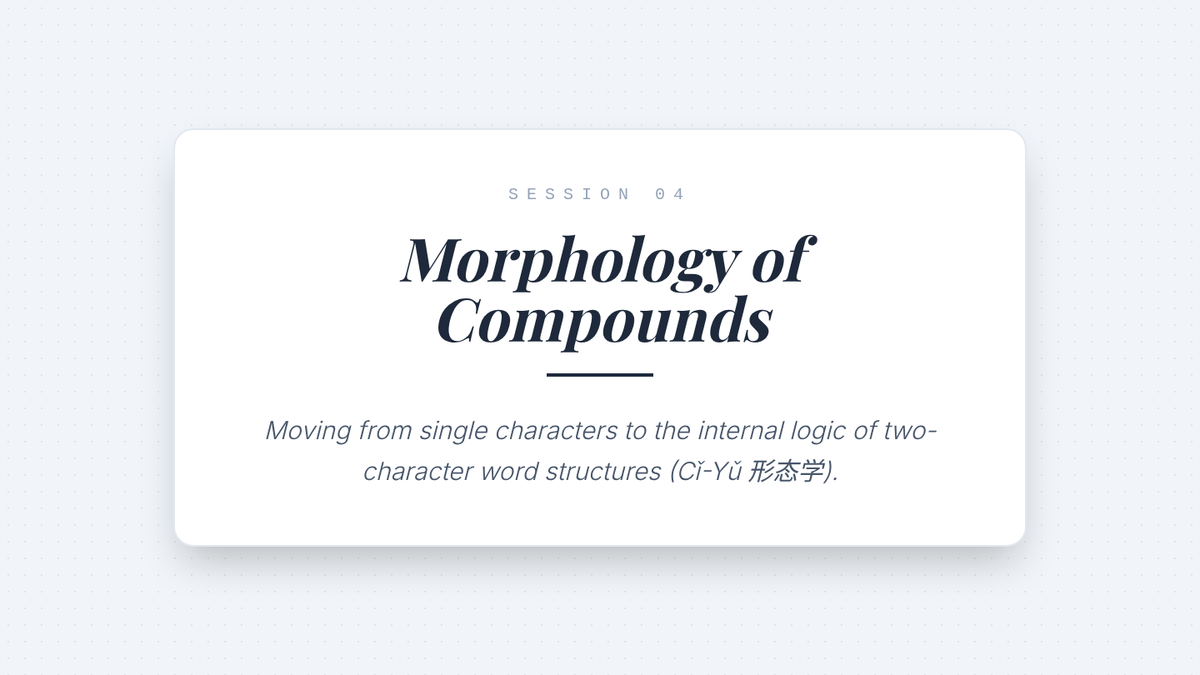
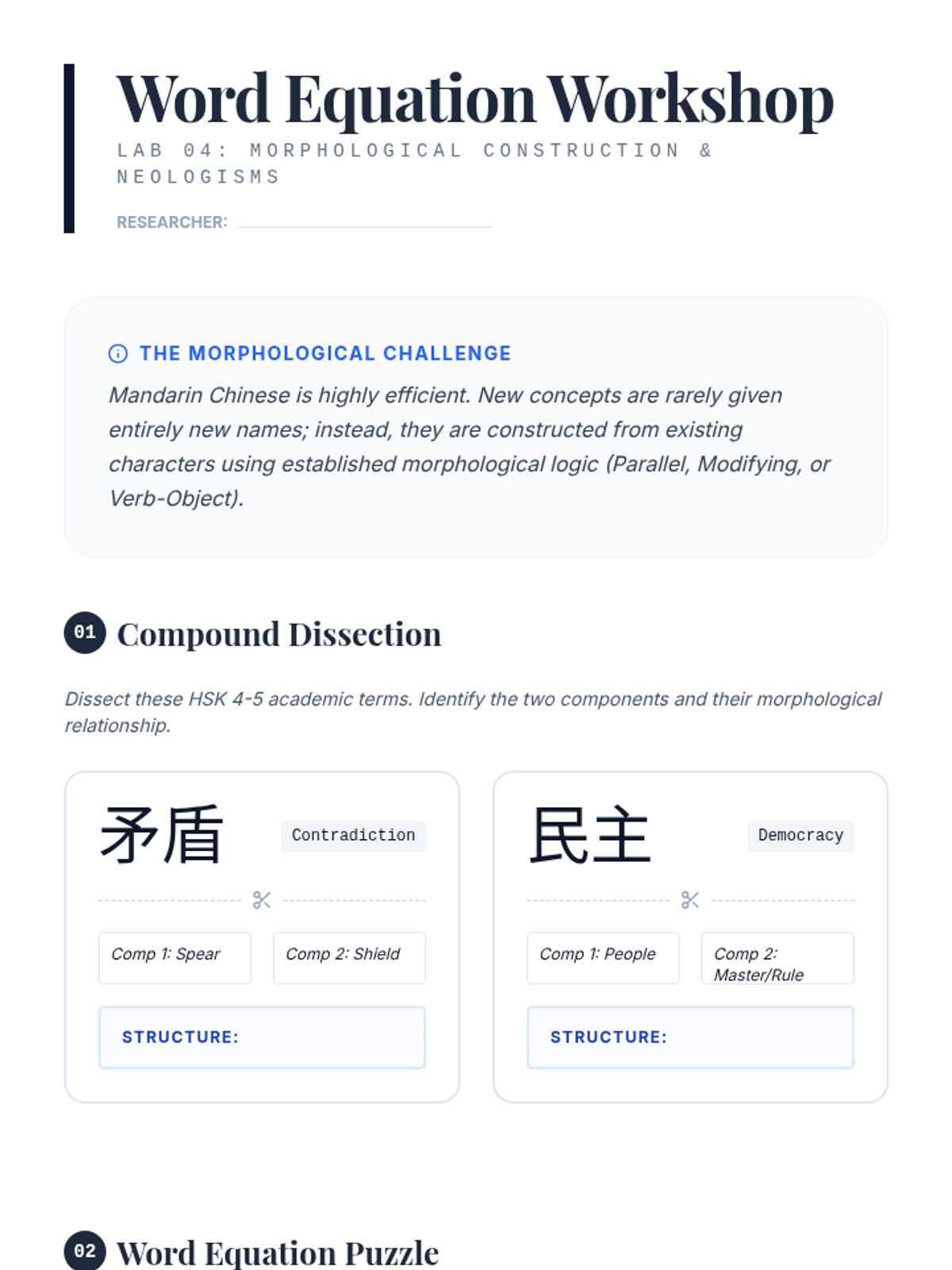
Analyzes the internal logic of two-character compound words, focusing on parallel, modifying, and verb-object morphological structures.
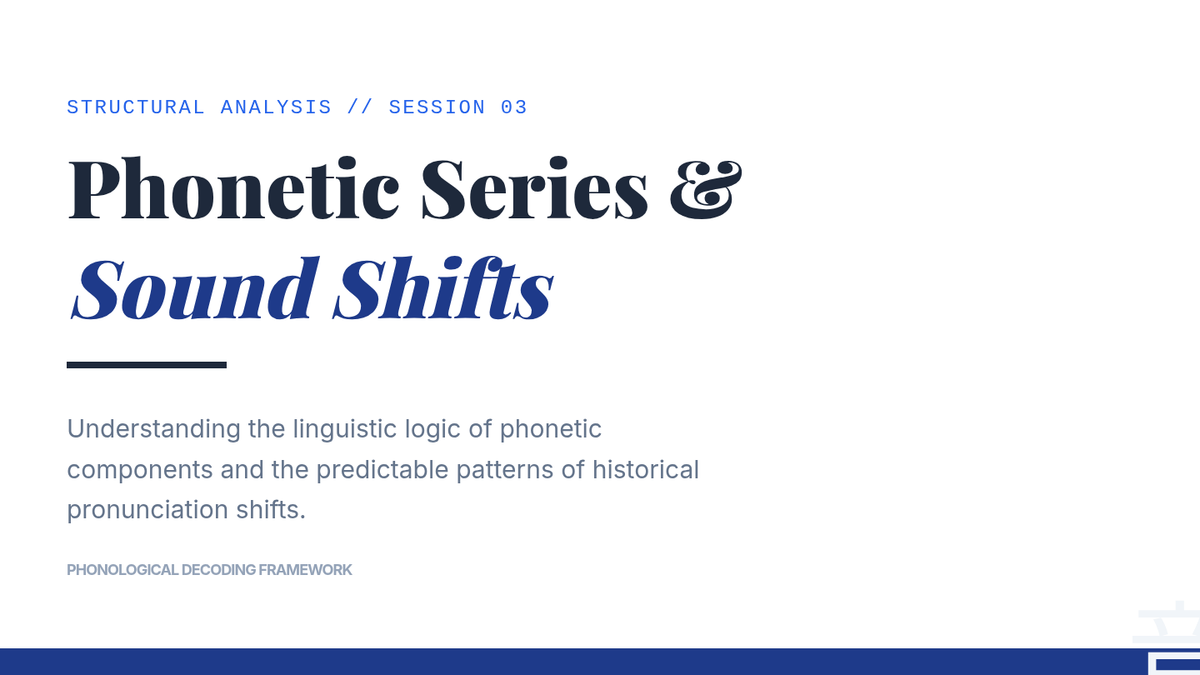
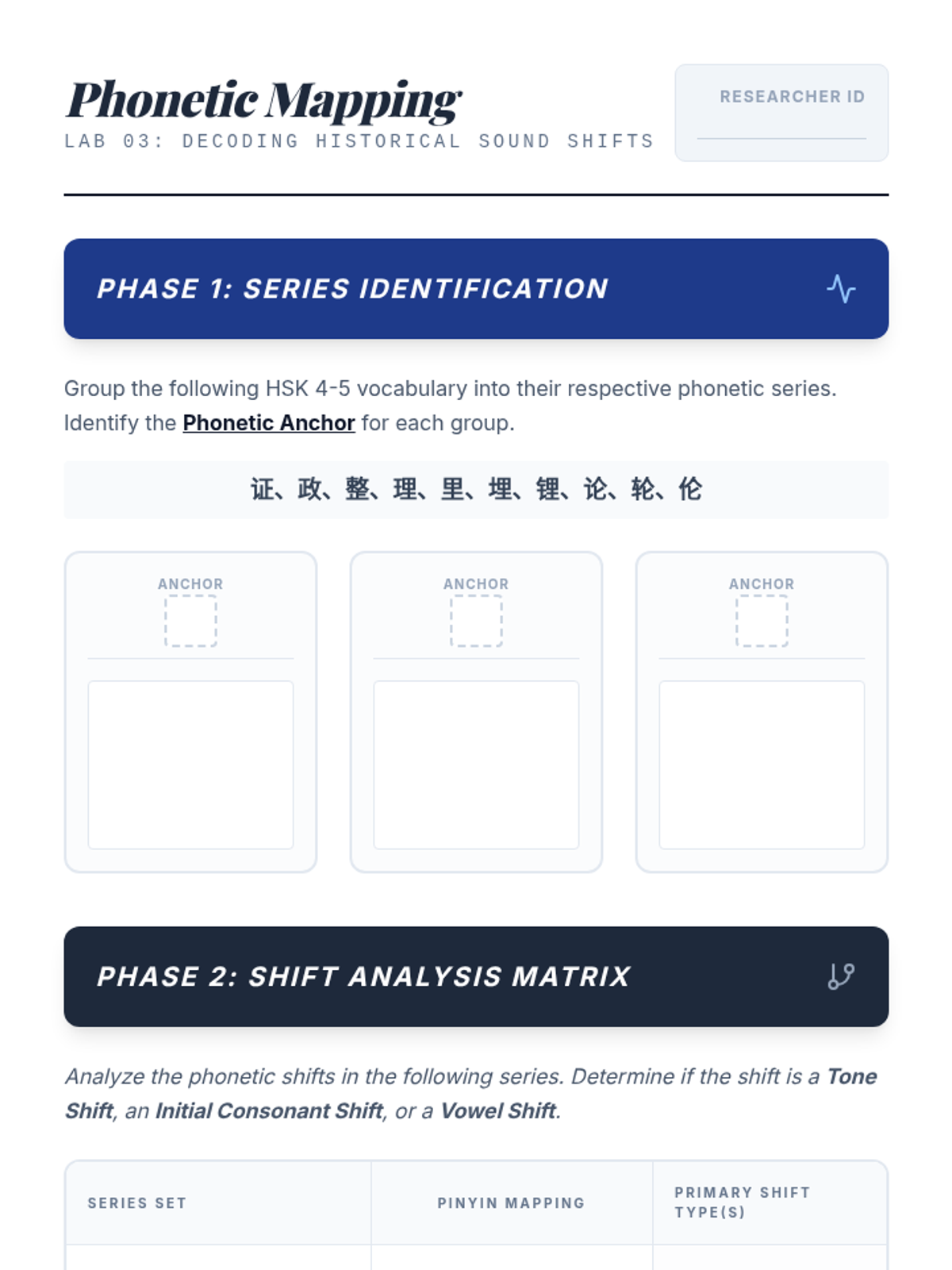
Investigates phonetic series and historical sound shifts to help students predict pronunciation of unfamiliar characters.
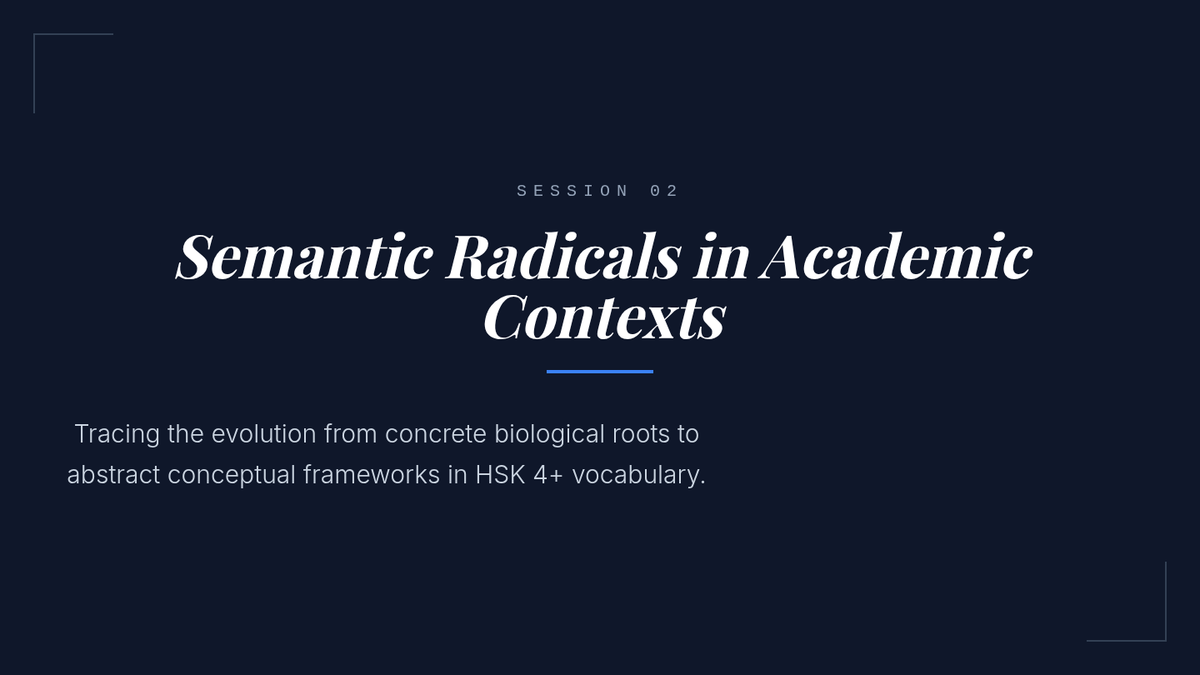
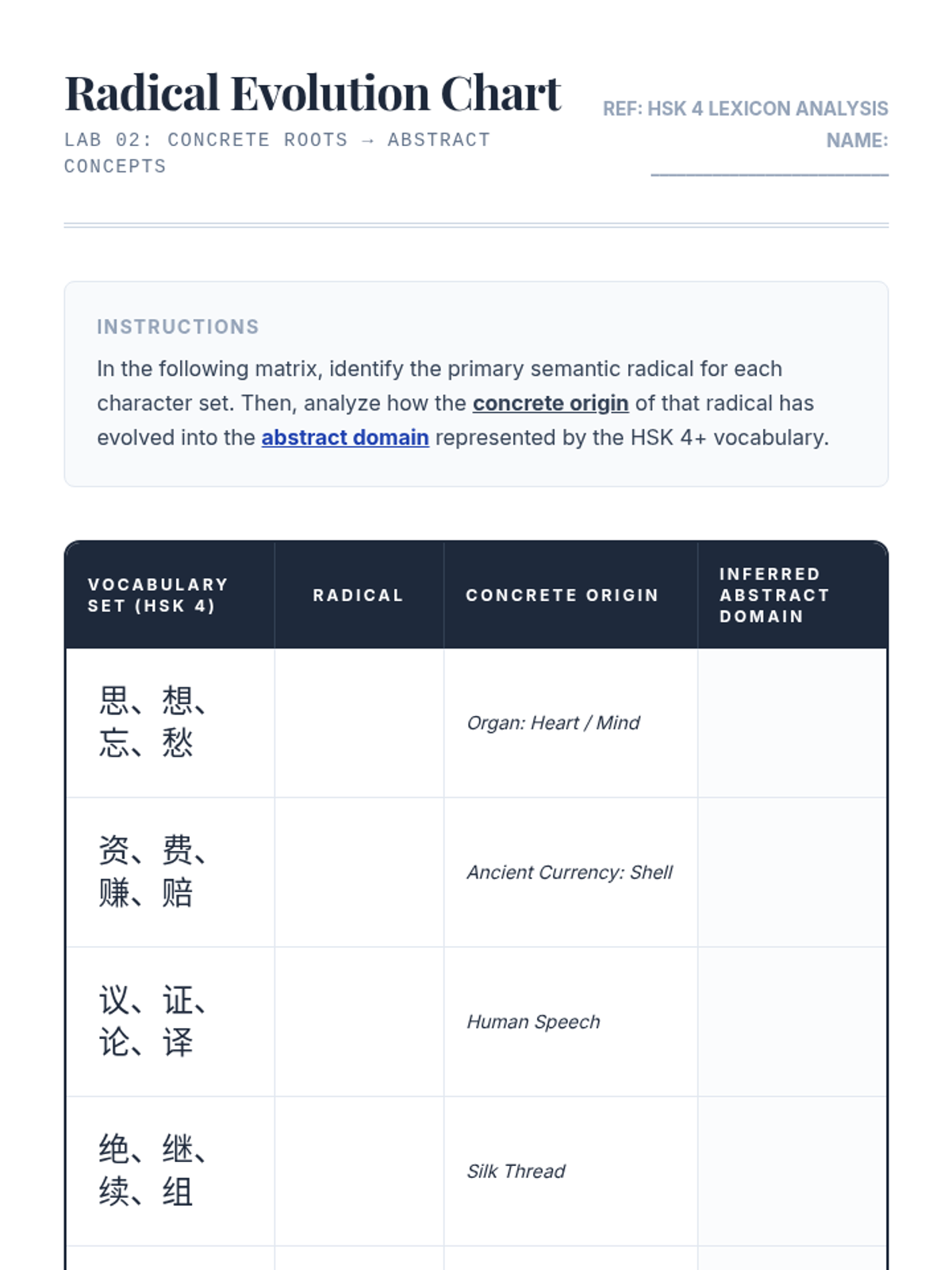
Focuses on high-frequency semantic radicals in abstract and academic vocabulary, tracing the evolution from concrete roots to complex conceptual representations.
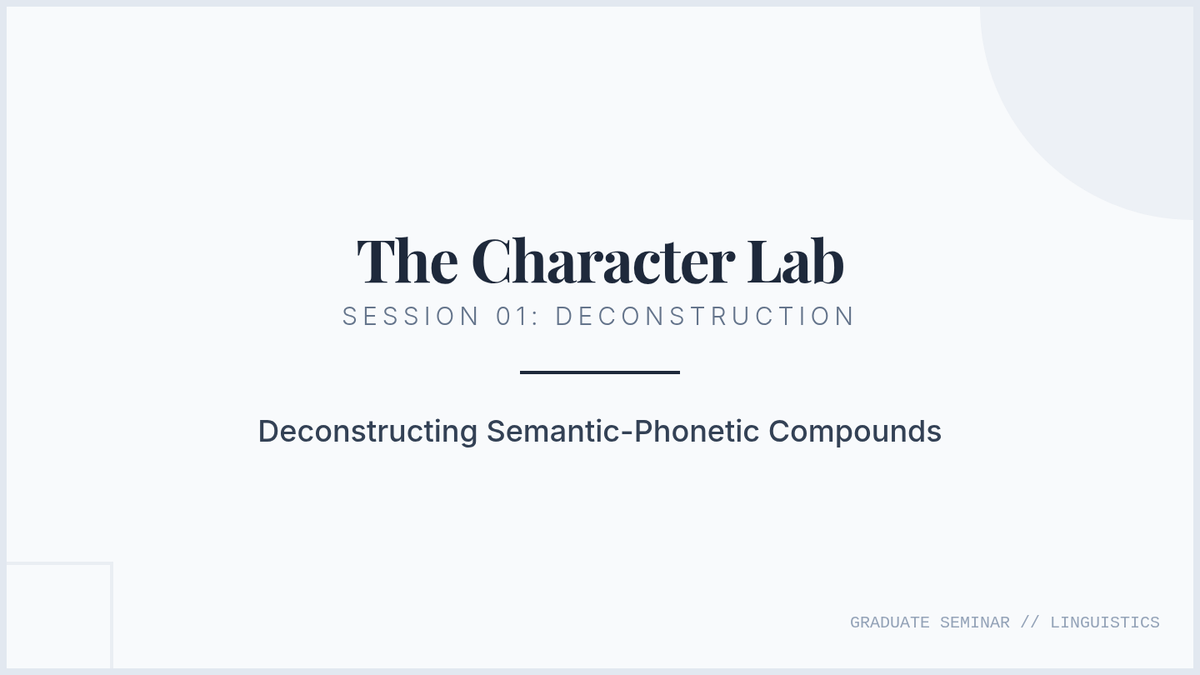
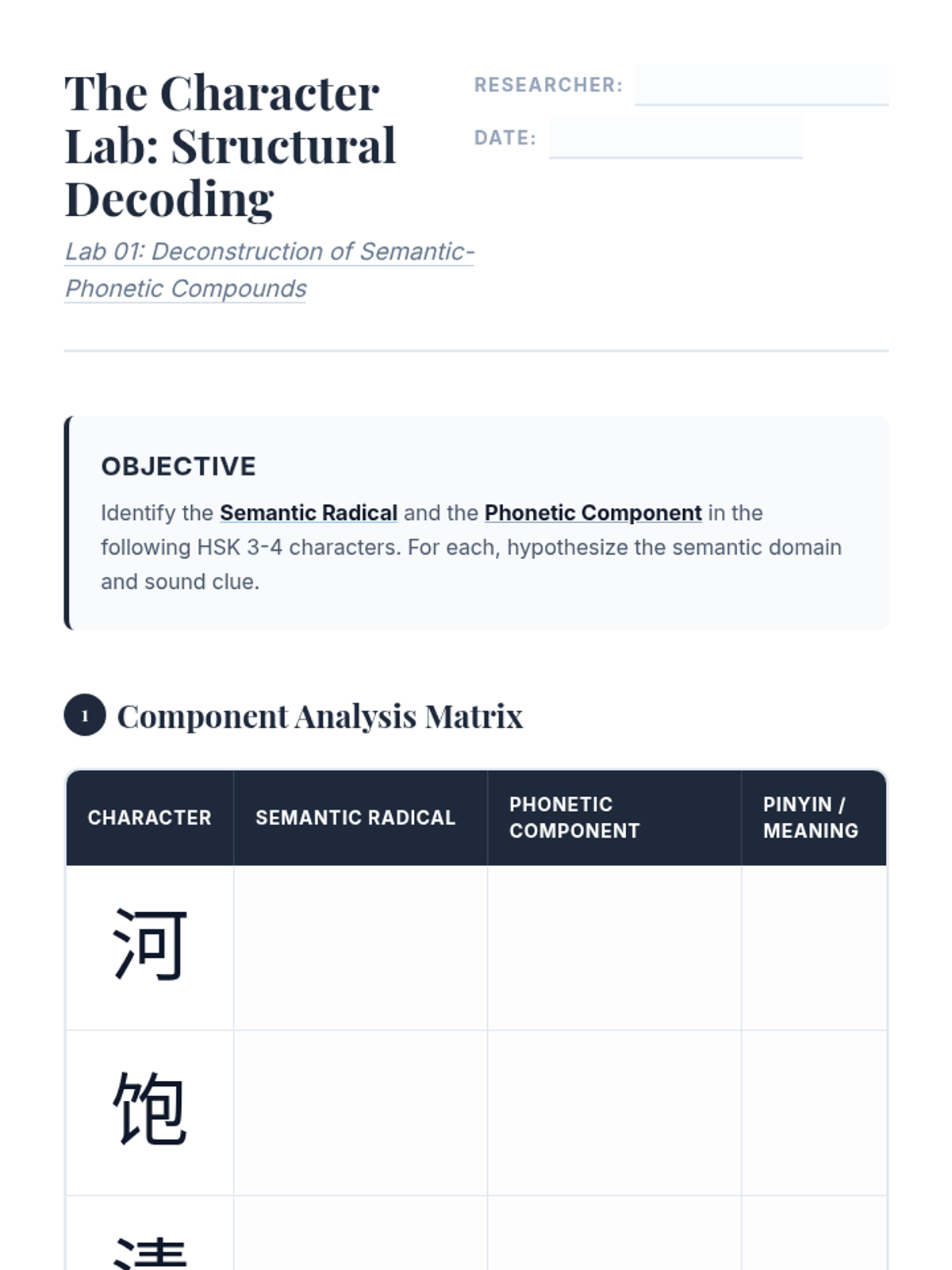
Students examine the architecture of semantic-phonetic characters, distinguishing between the meaningful radical and the sound-bearing component through HSK 3 vocabulary analysis.
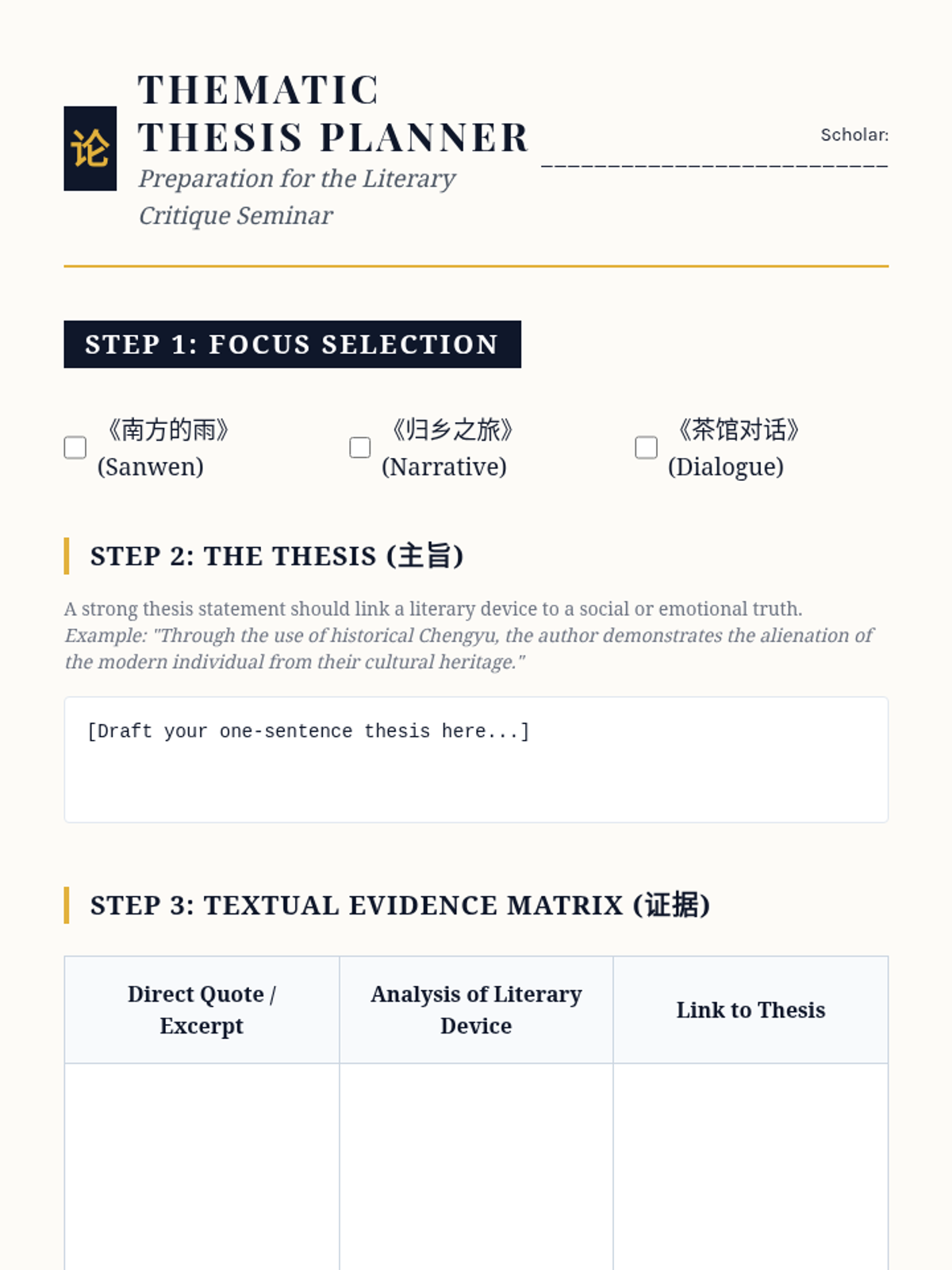
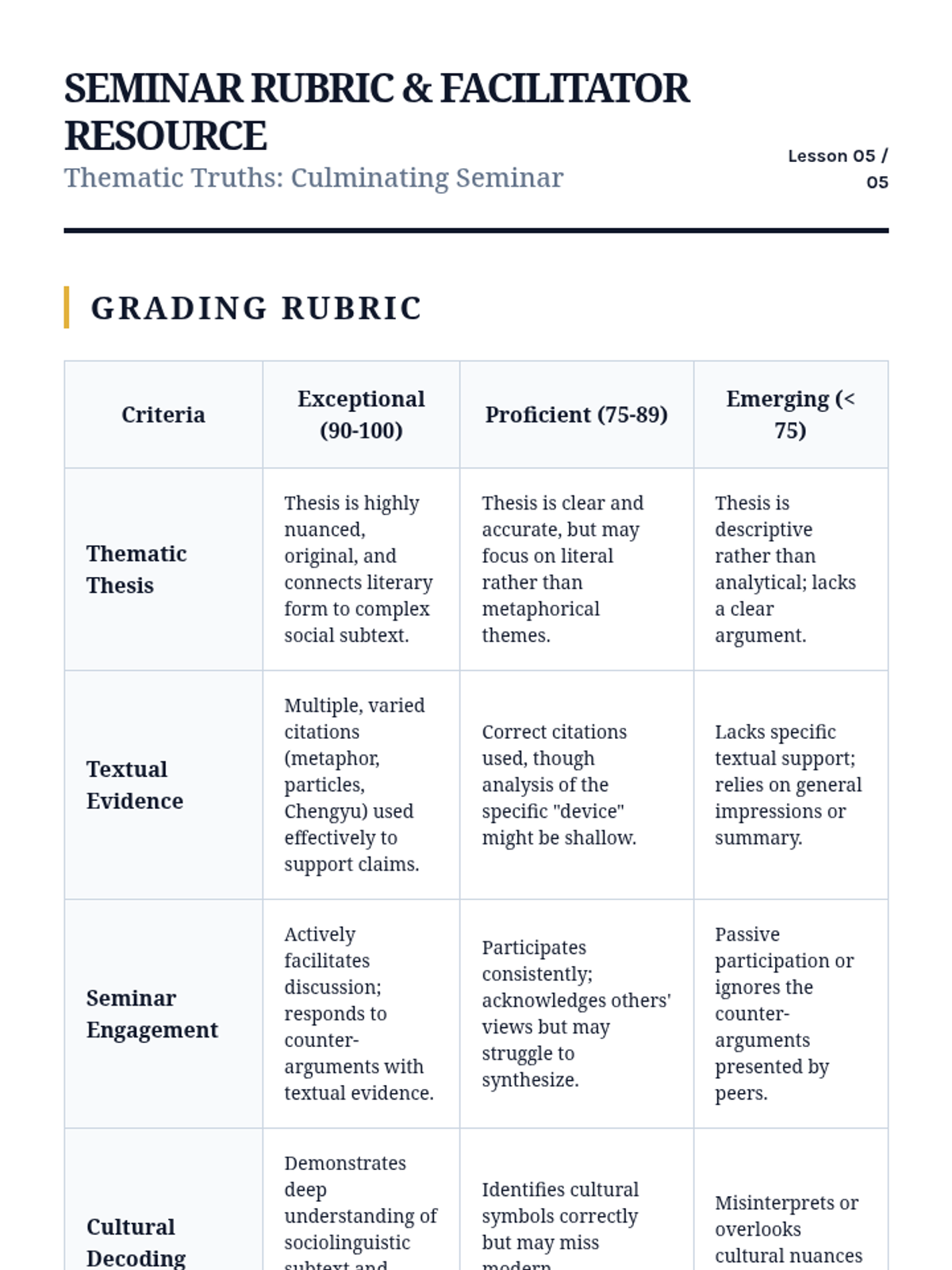
A culminating seminar where students present thematic critiques of selected texts, defending their interpretations with evidence-based literary analysis.
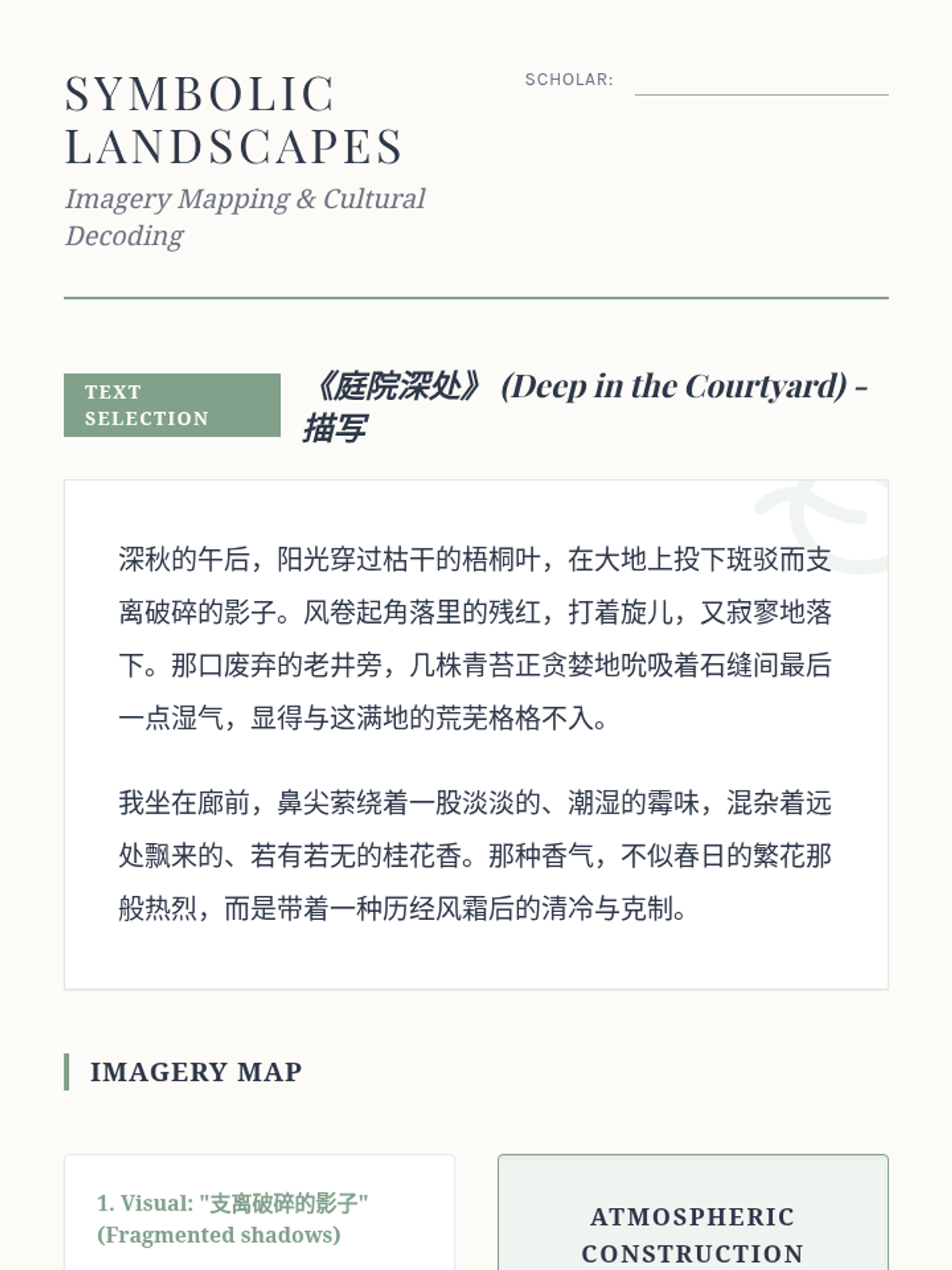
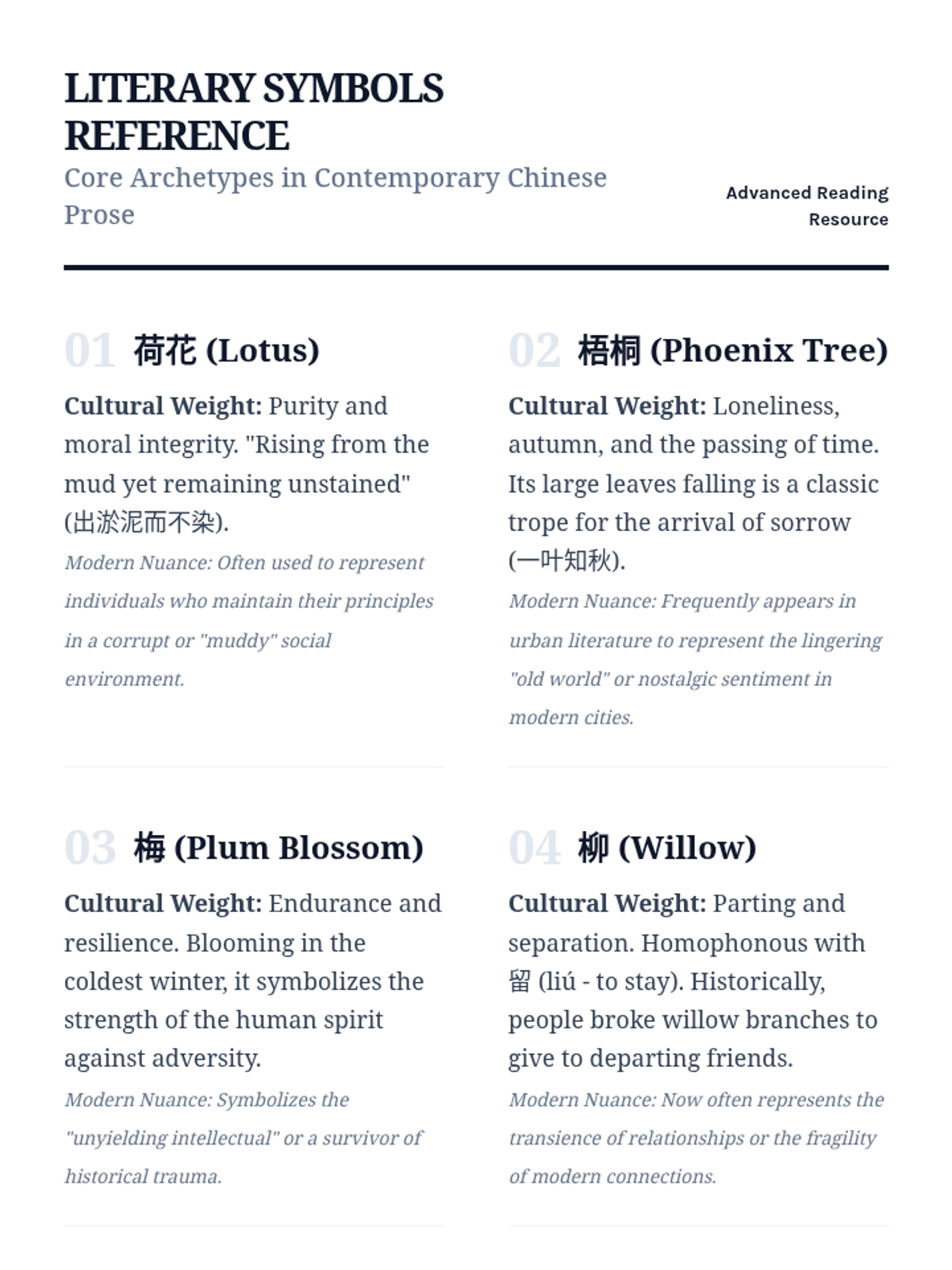
Decoding cultural symbols and sensory metaphors in descriptive passages to understand how mood and atmosphere are constructed in Chinese literature.
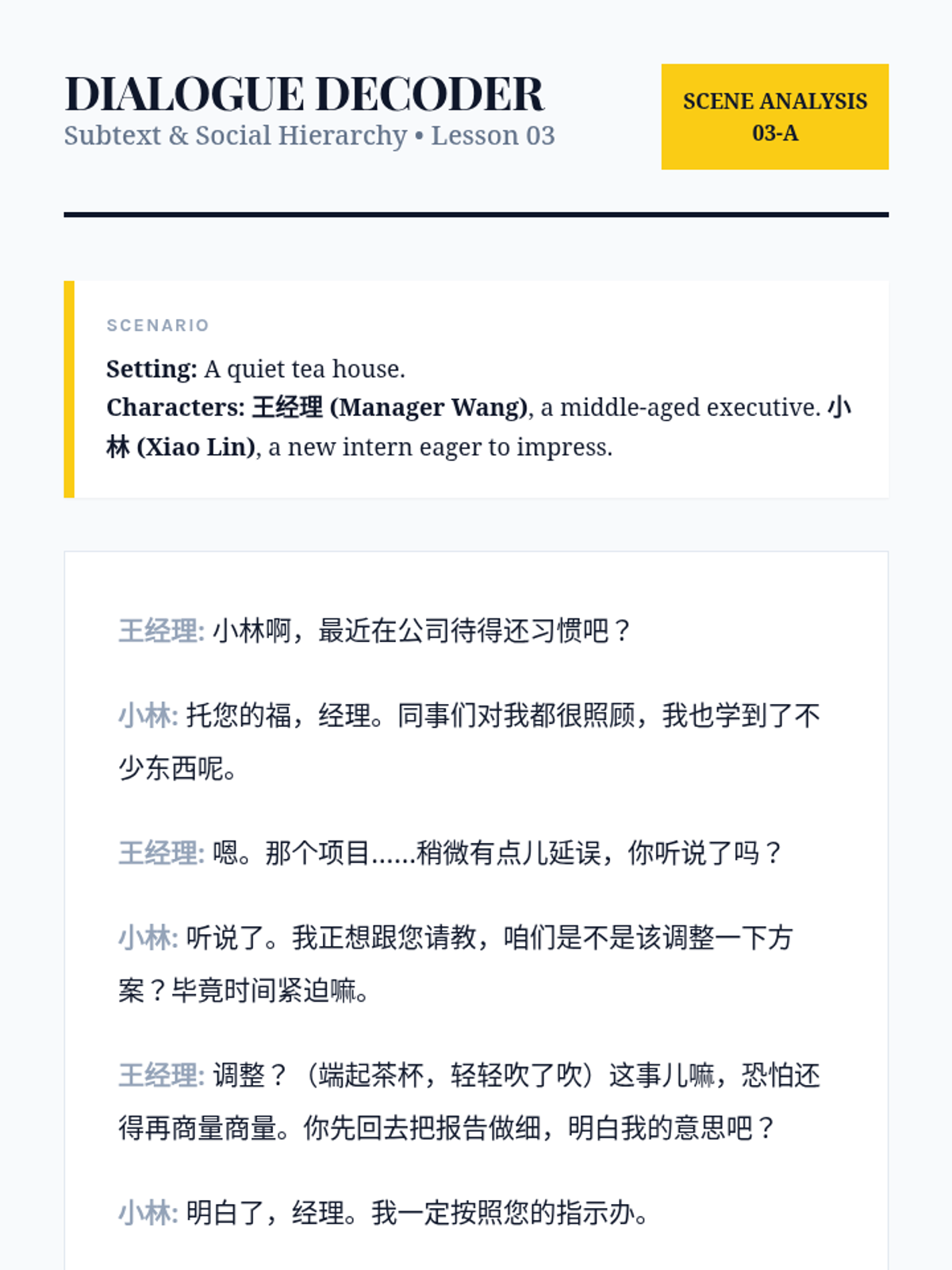
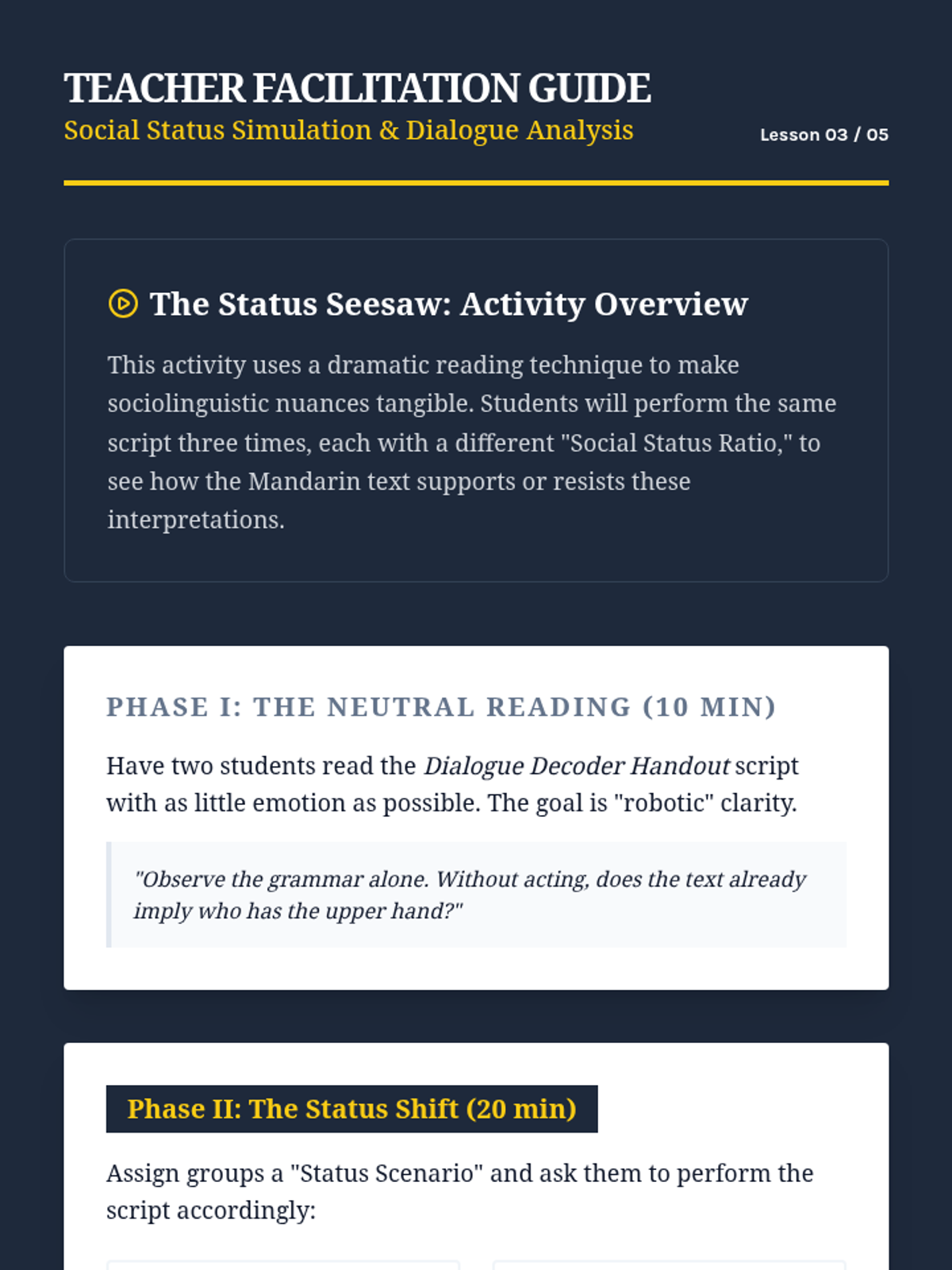
Examining social hierarchy, power dynamics, and emotional subtext within dialogue through the lens of honorifics and sentence particles.
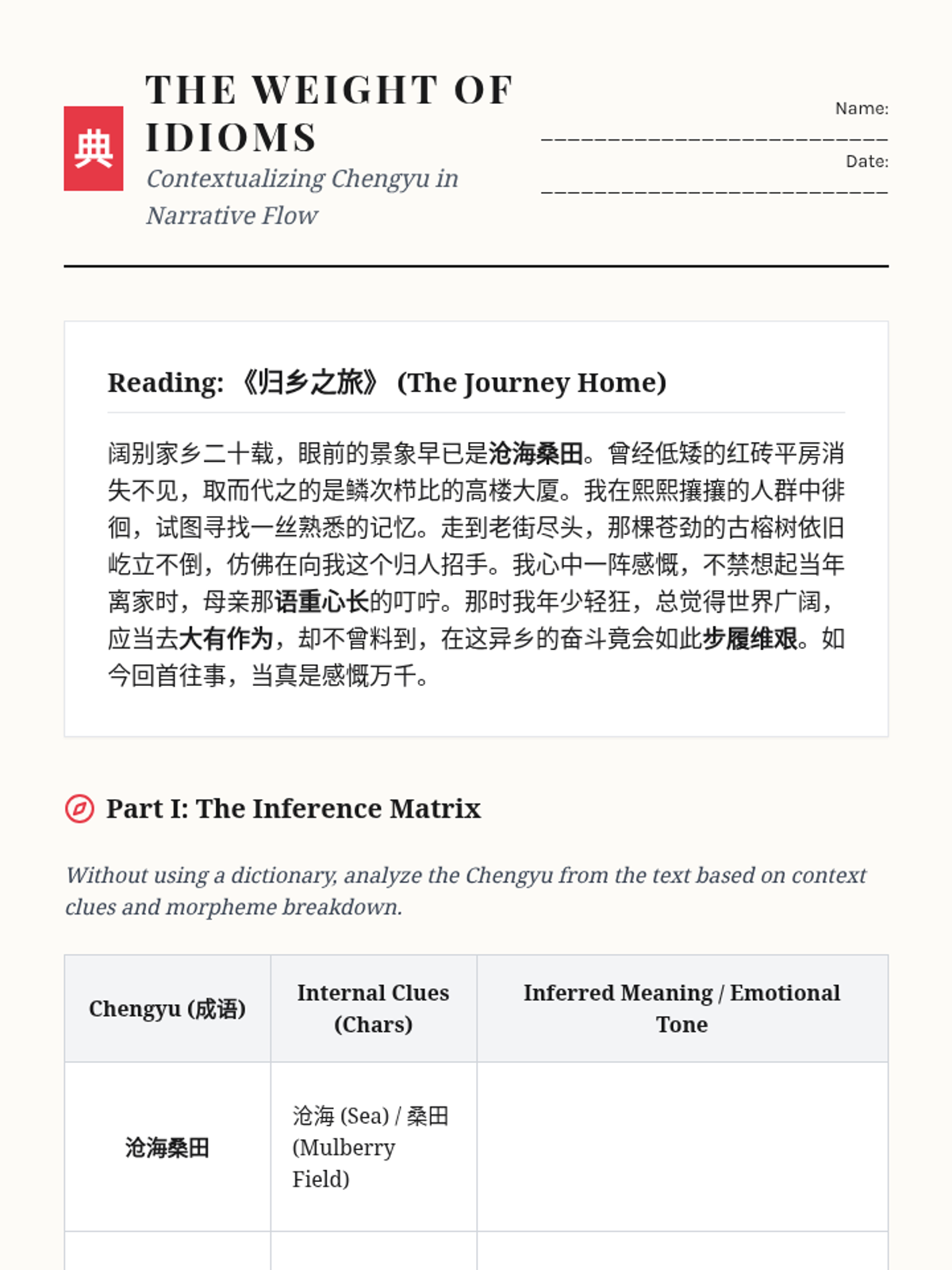
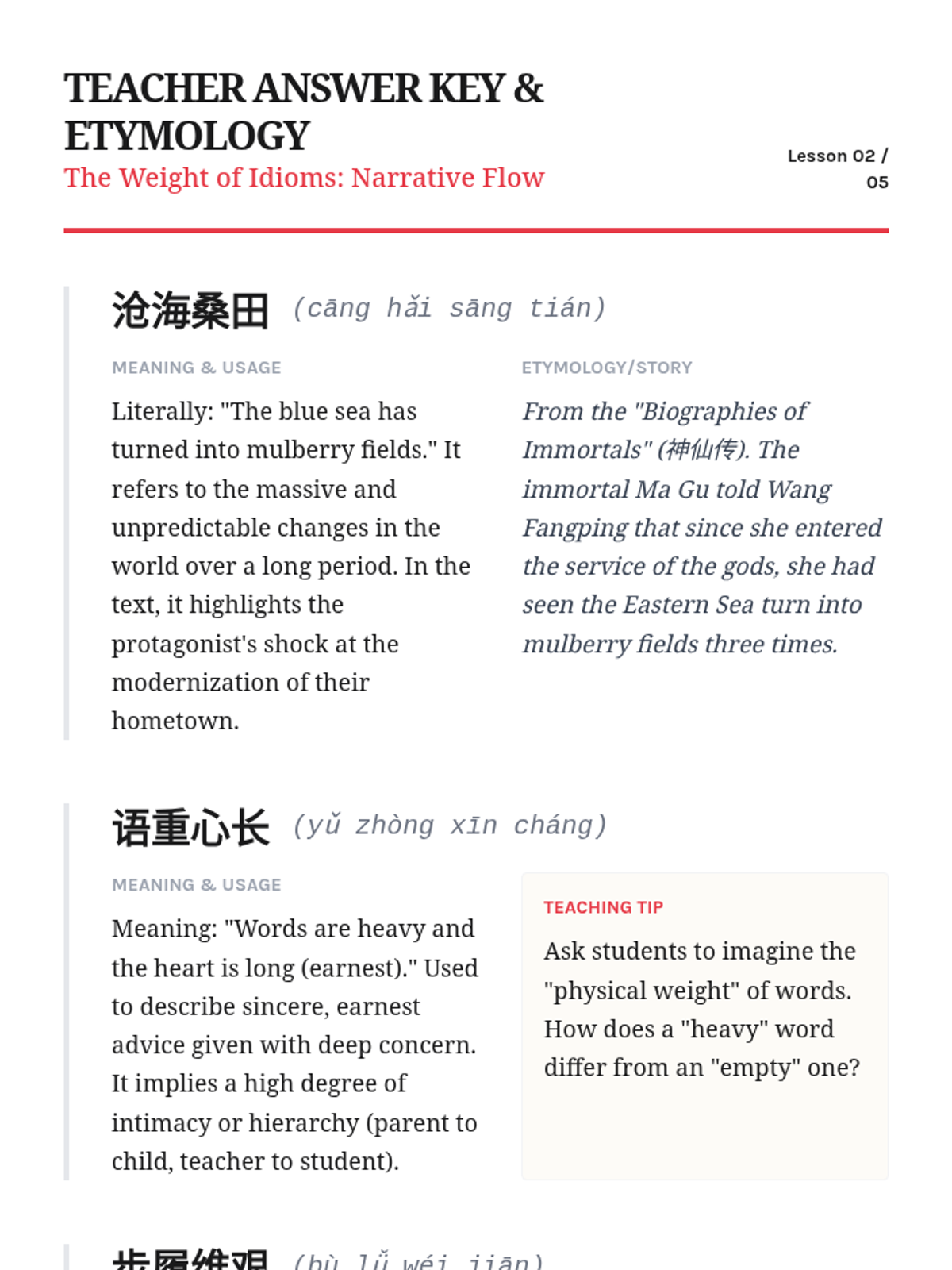
Analyzing the integration of four-character idioms (Chengyu) within narrative prose, exploring their historical weight and modern emotional resonance.
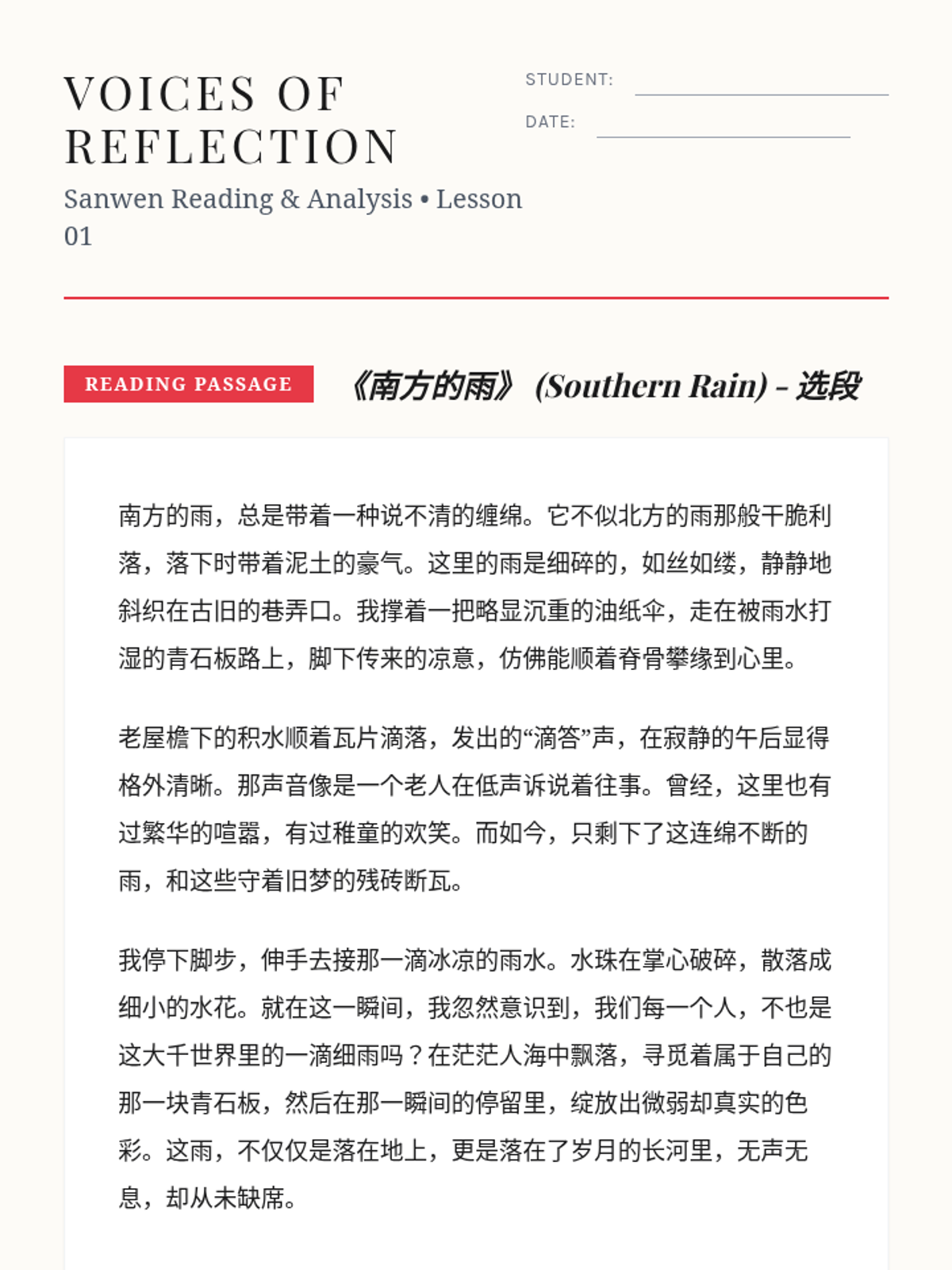
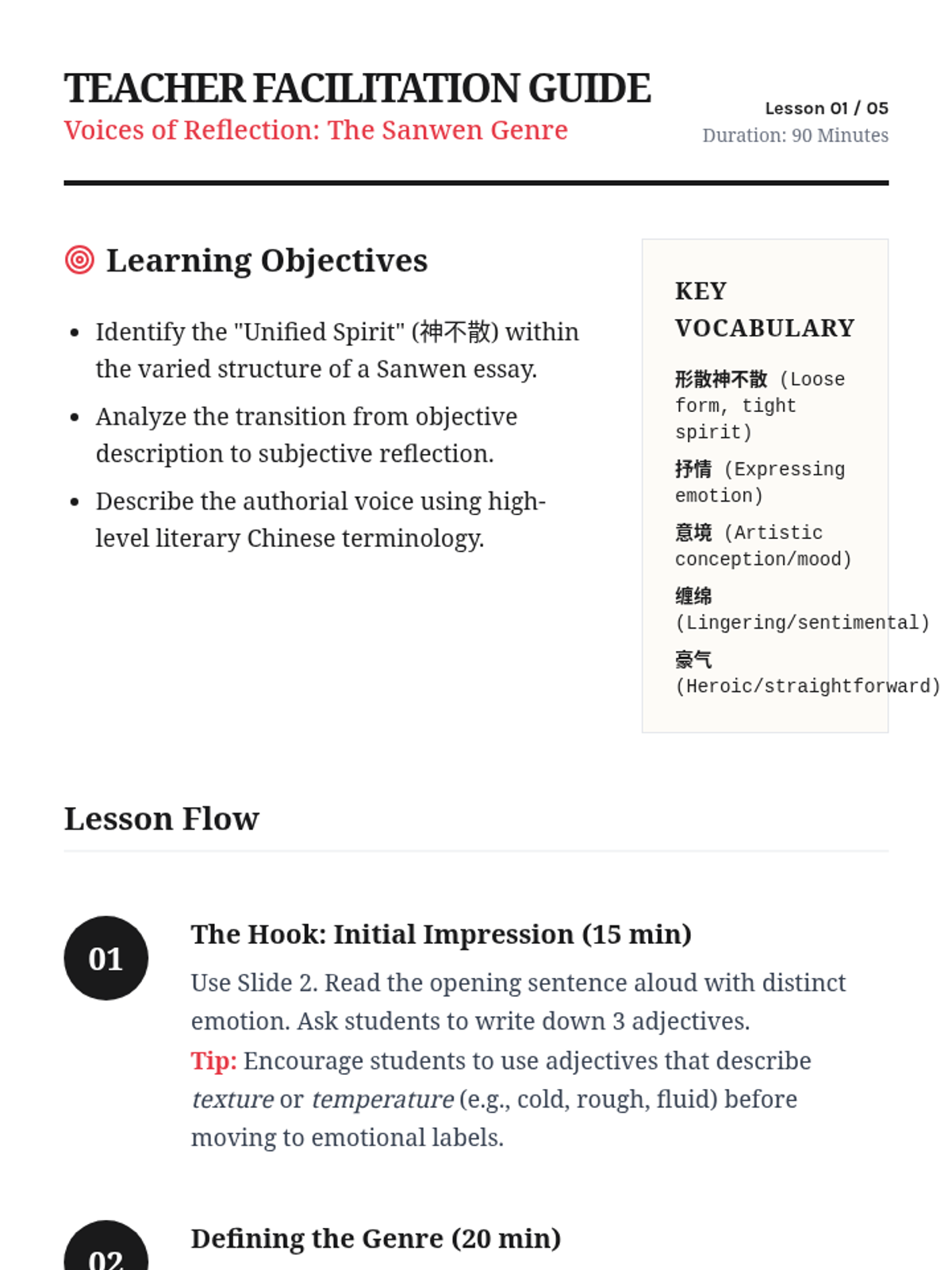
Introduction to the reflective 'Sanwen' genre, focusing on tone, authorial voice, and the transition from description to reflection in contemporary prose.
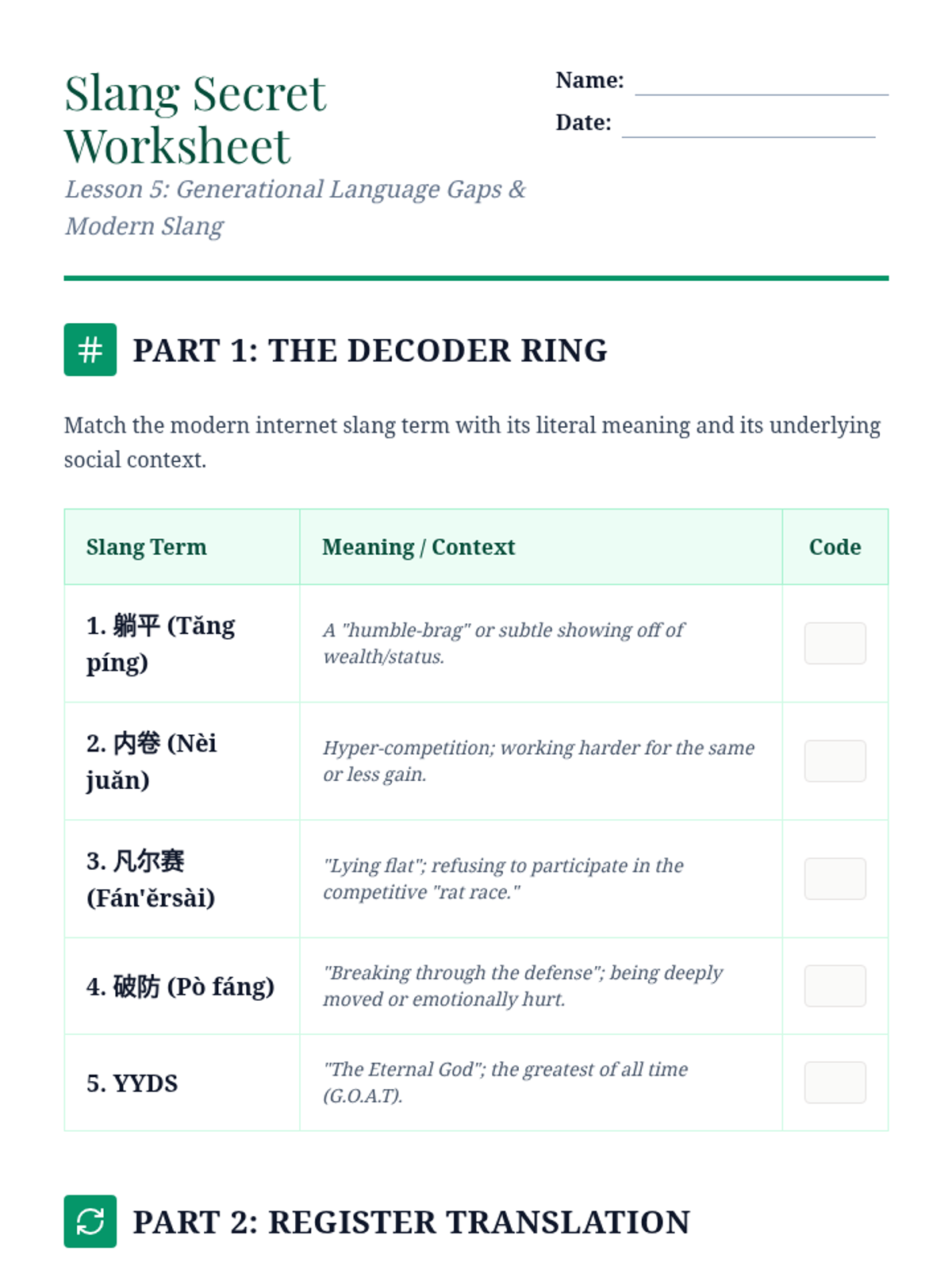
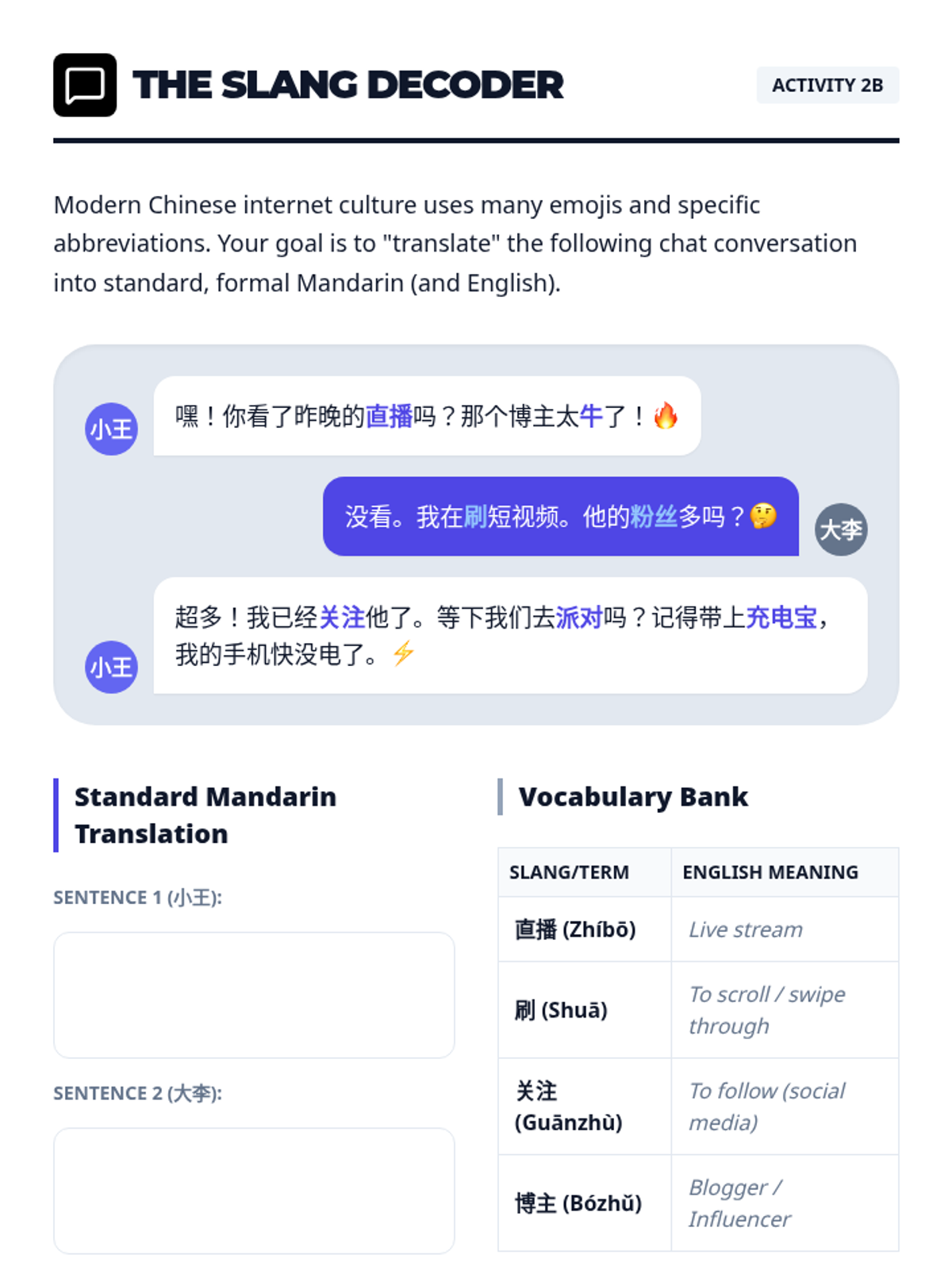
This lesson compares traditional idioms with modern internet slang, analyzing language evolution and practicing register adjustment based on the age and status of partners.
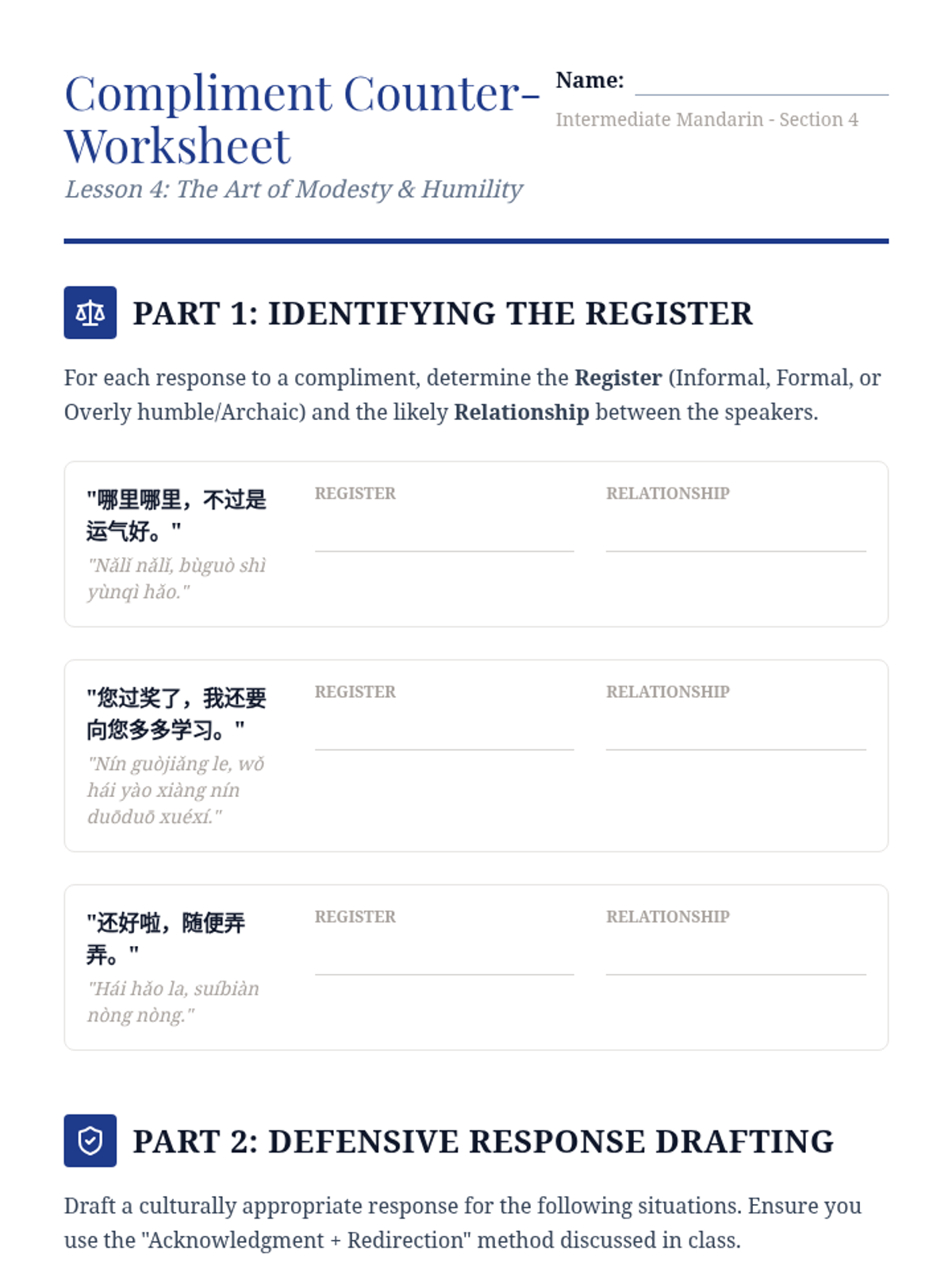
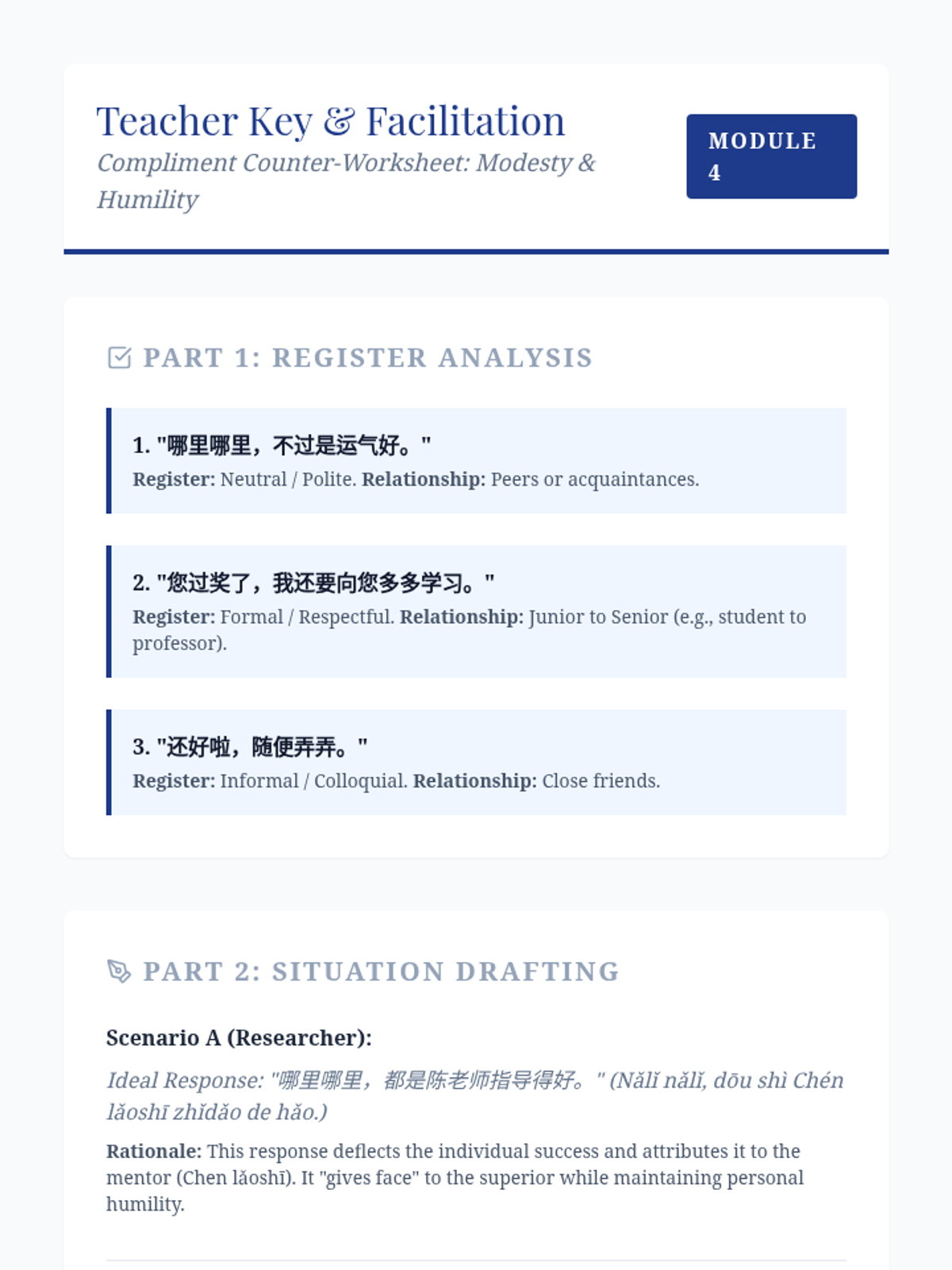
Students practice the cultural norm of deflecting compliments and expressing humility, covering specific phrases used to downplay achievements.
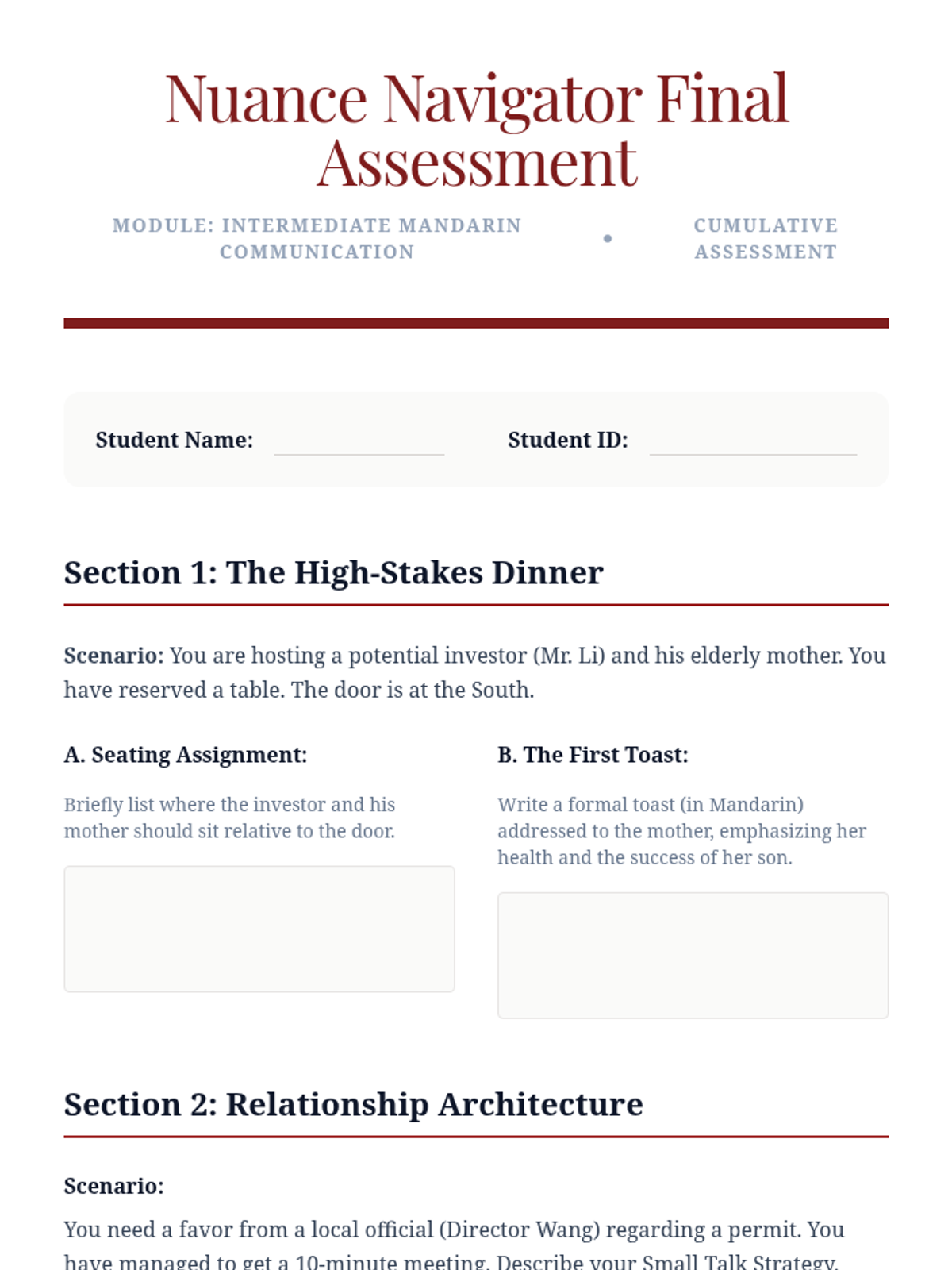
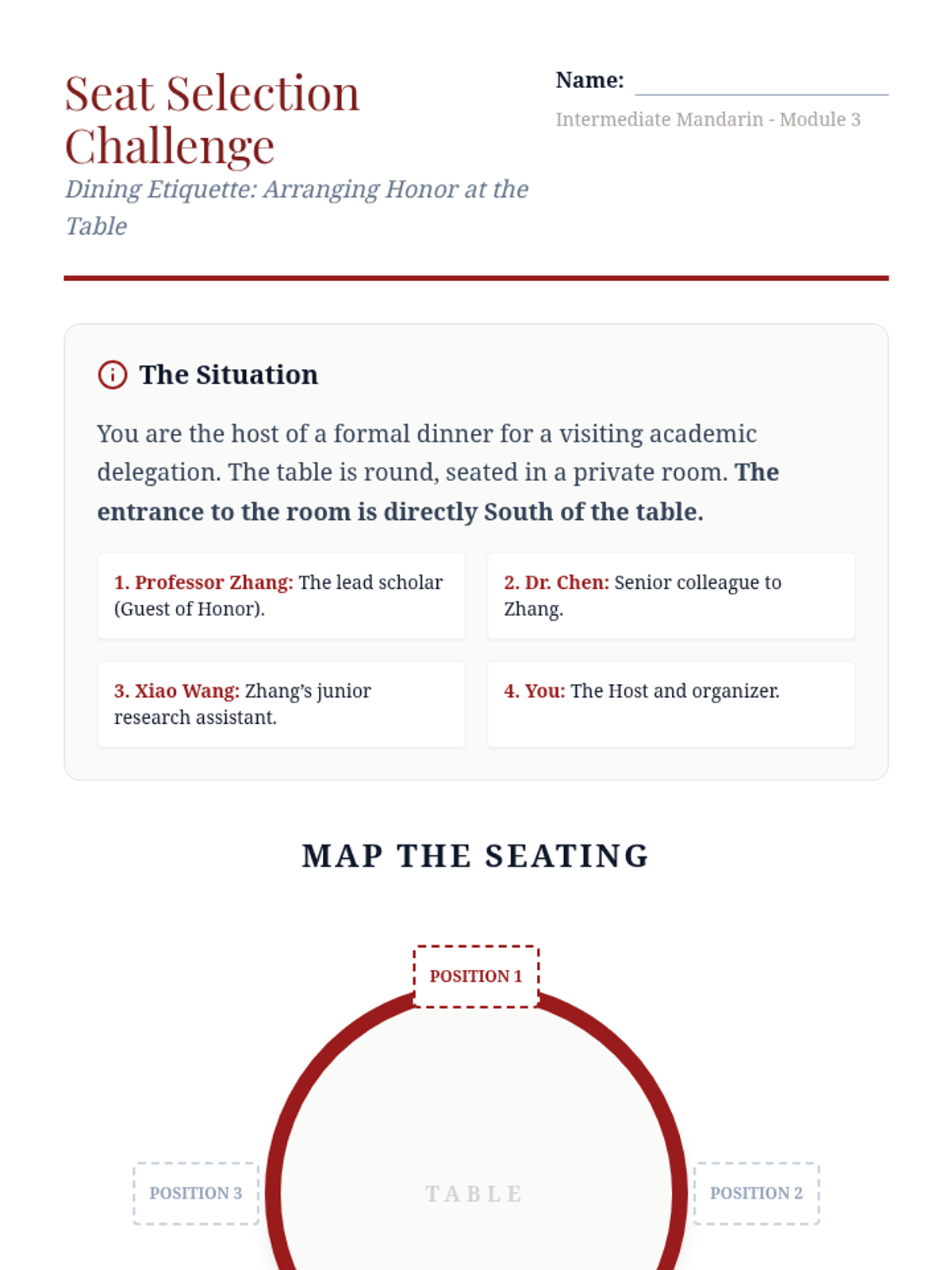
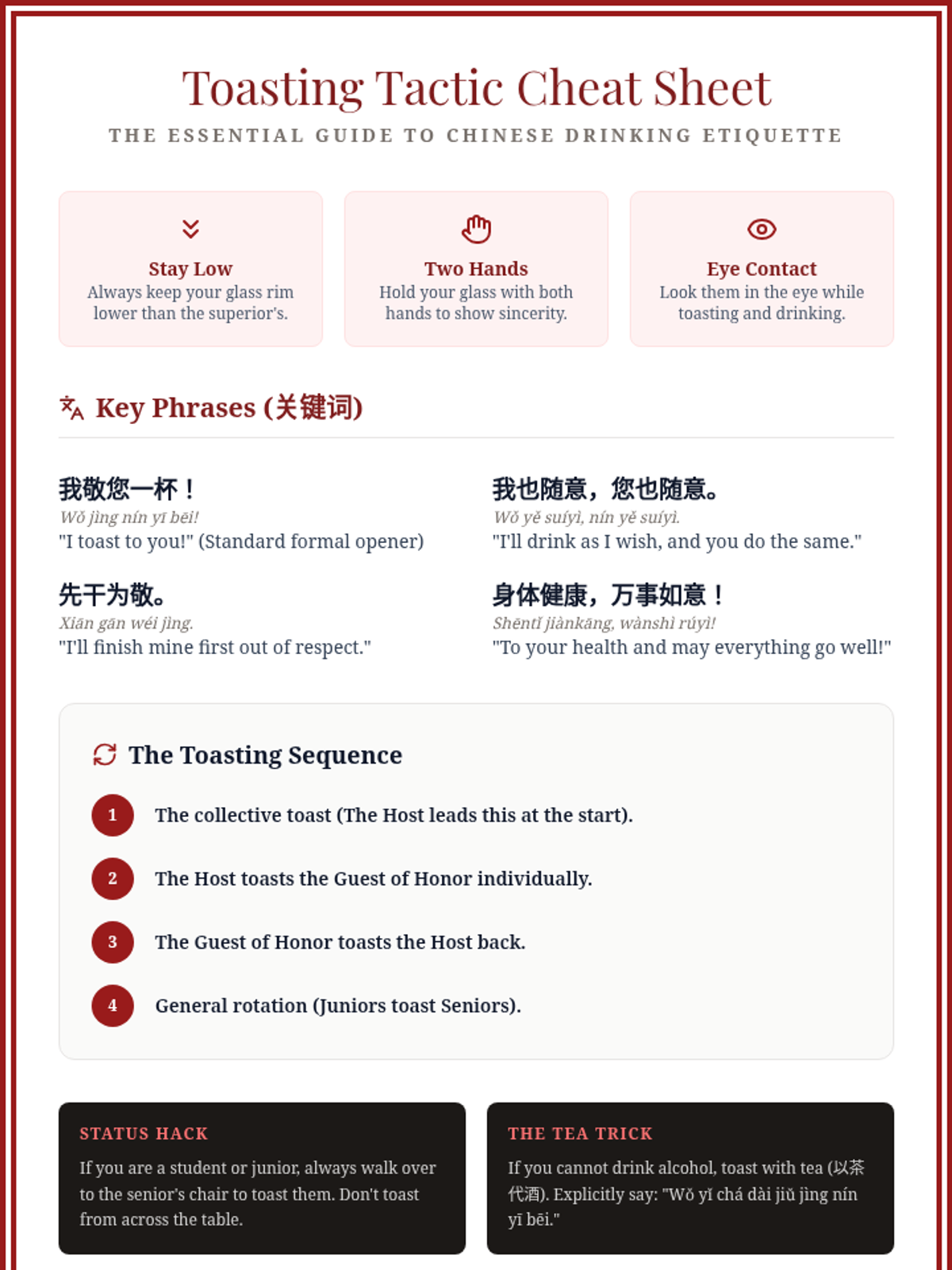
Students learn the intricate language of the Chinese dinner table, including seating arrangements, hosting duties, and the rhetoric of toasting.
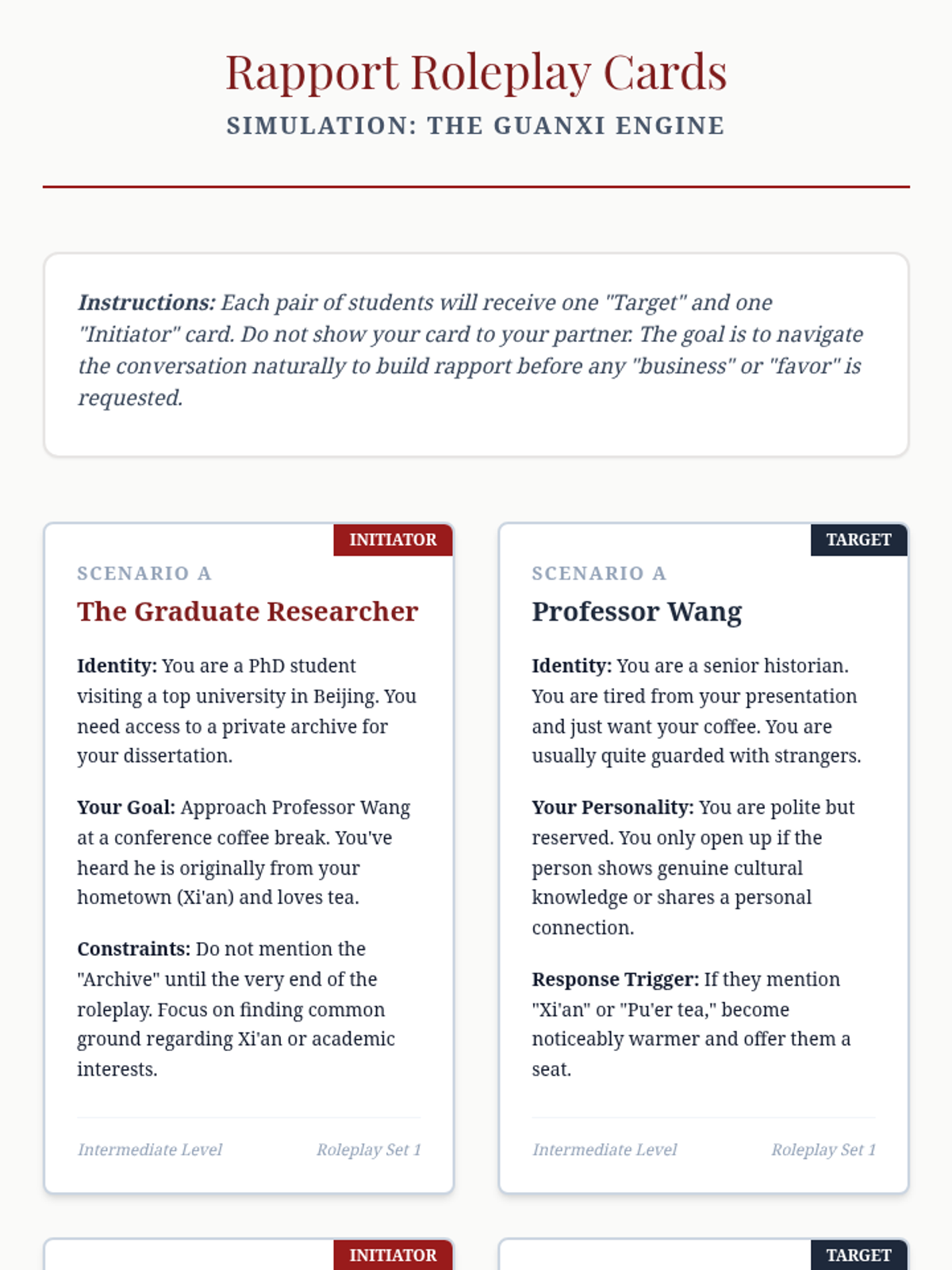
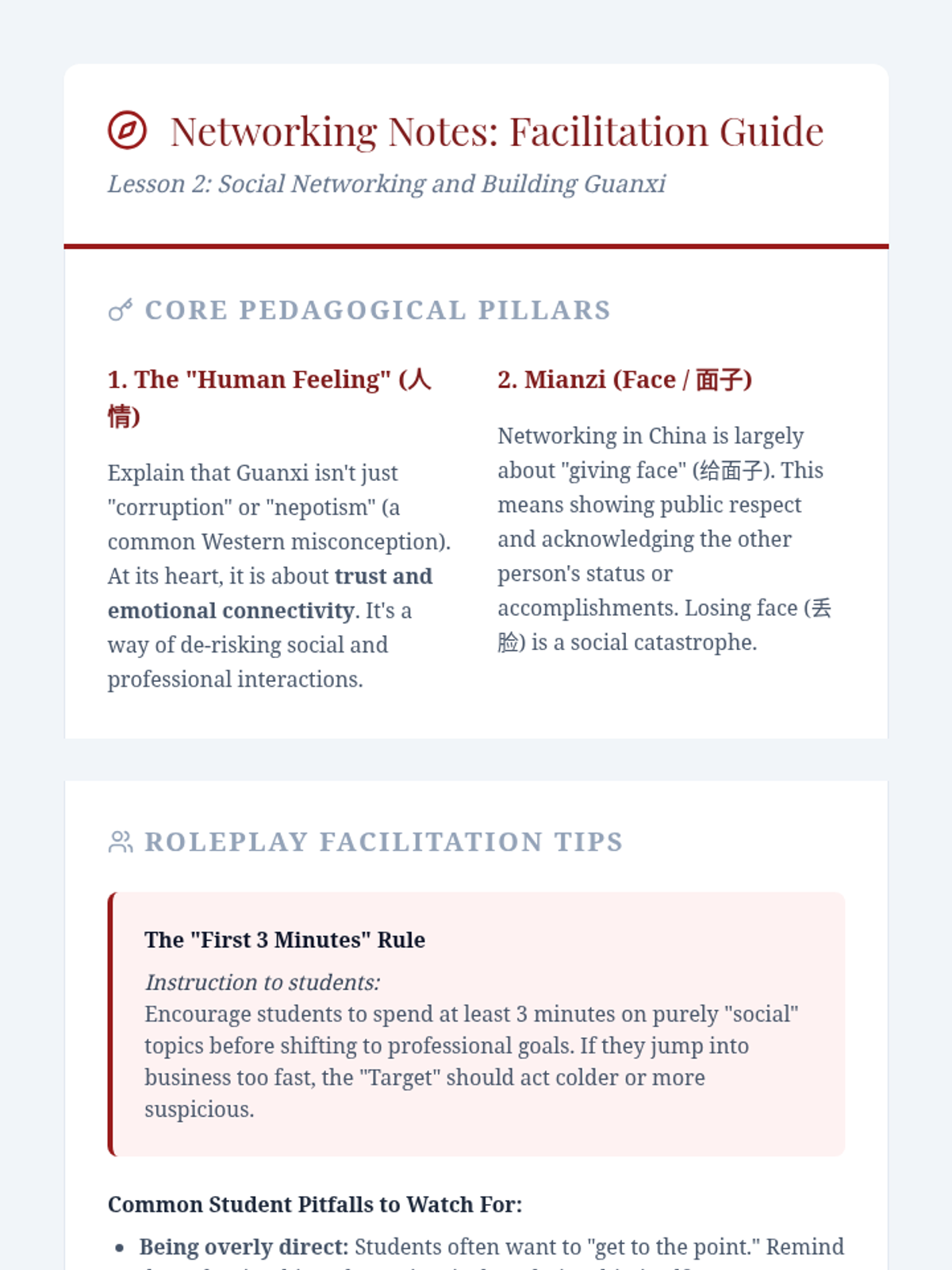
This lesson examines the vocabulary and sentence structures used to build rapport and cultivate relationships (Guanxi), practicing small talk that navigates privacy boundaries.
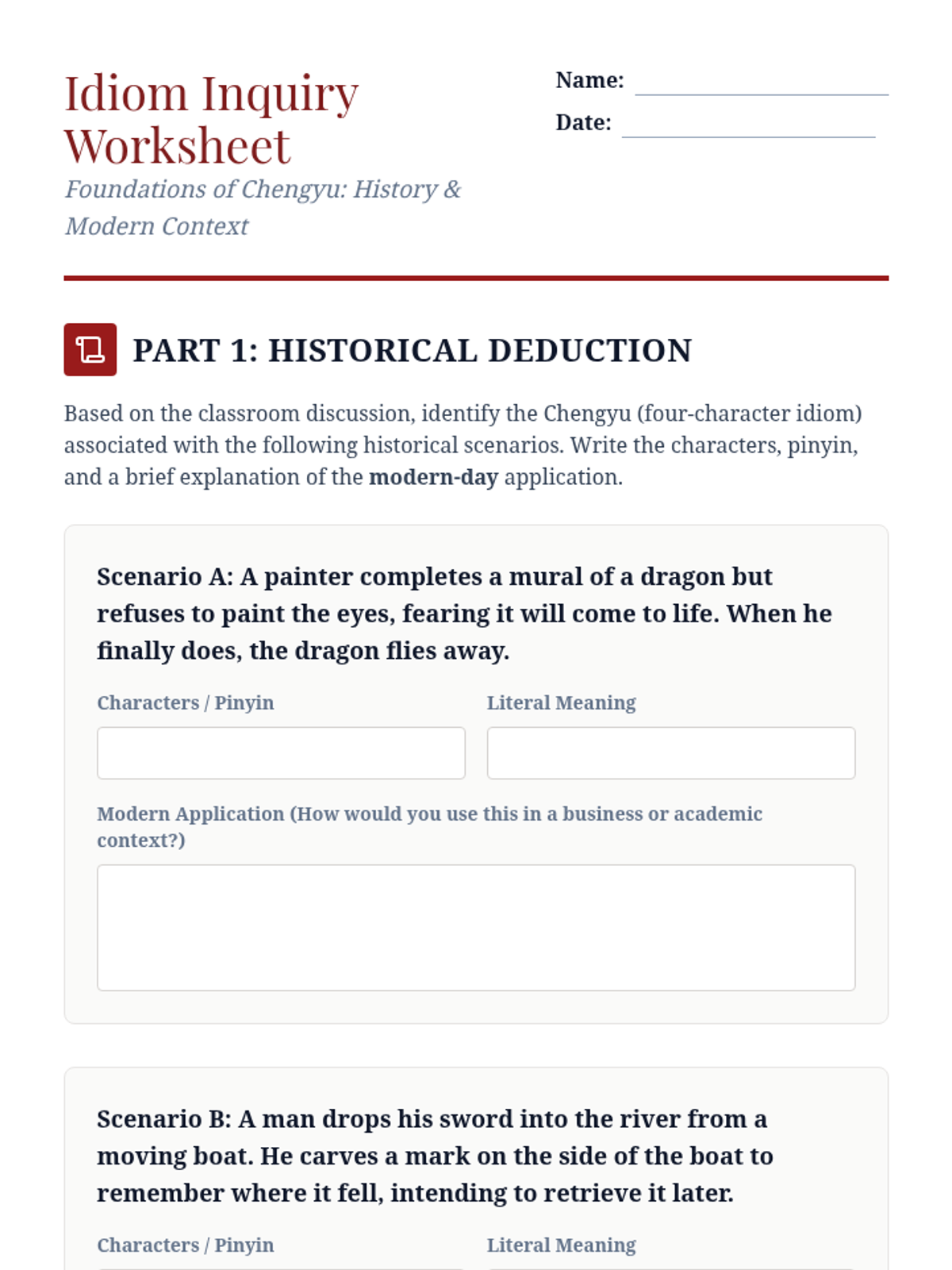
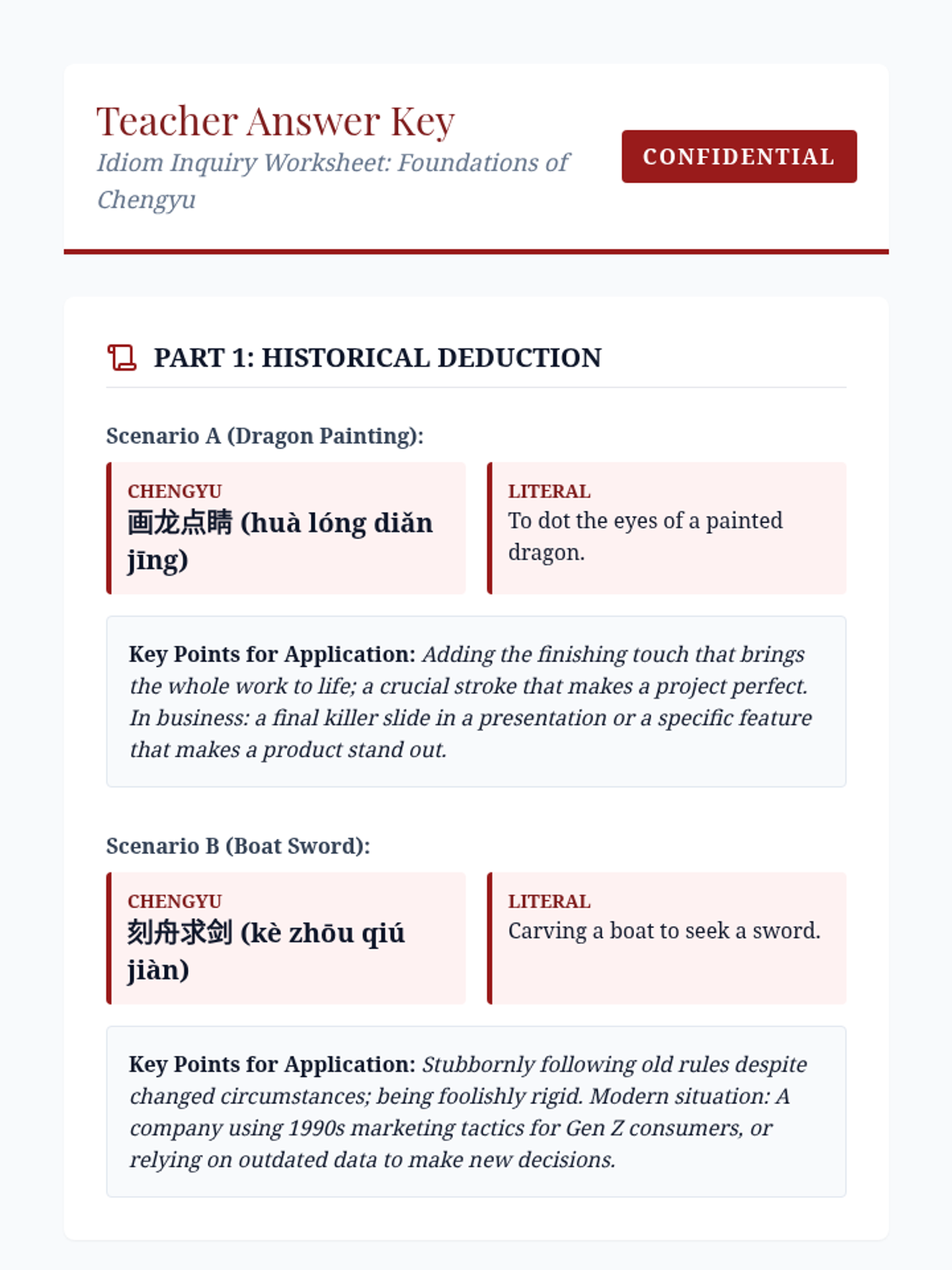
Students explore the stories behind common four-character idioms (Chengyu) and their modern-day applications, focusing on distinguishing between literary usage and appropriate conversational contexts.
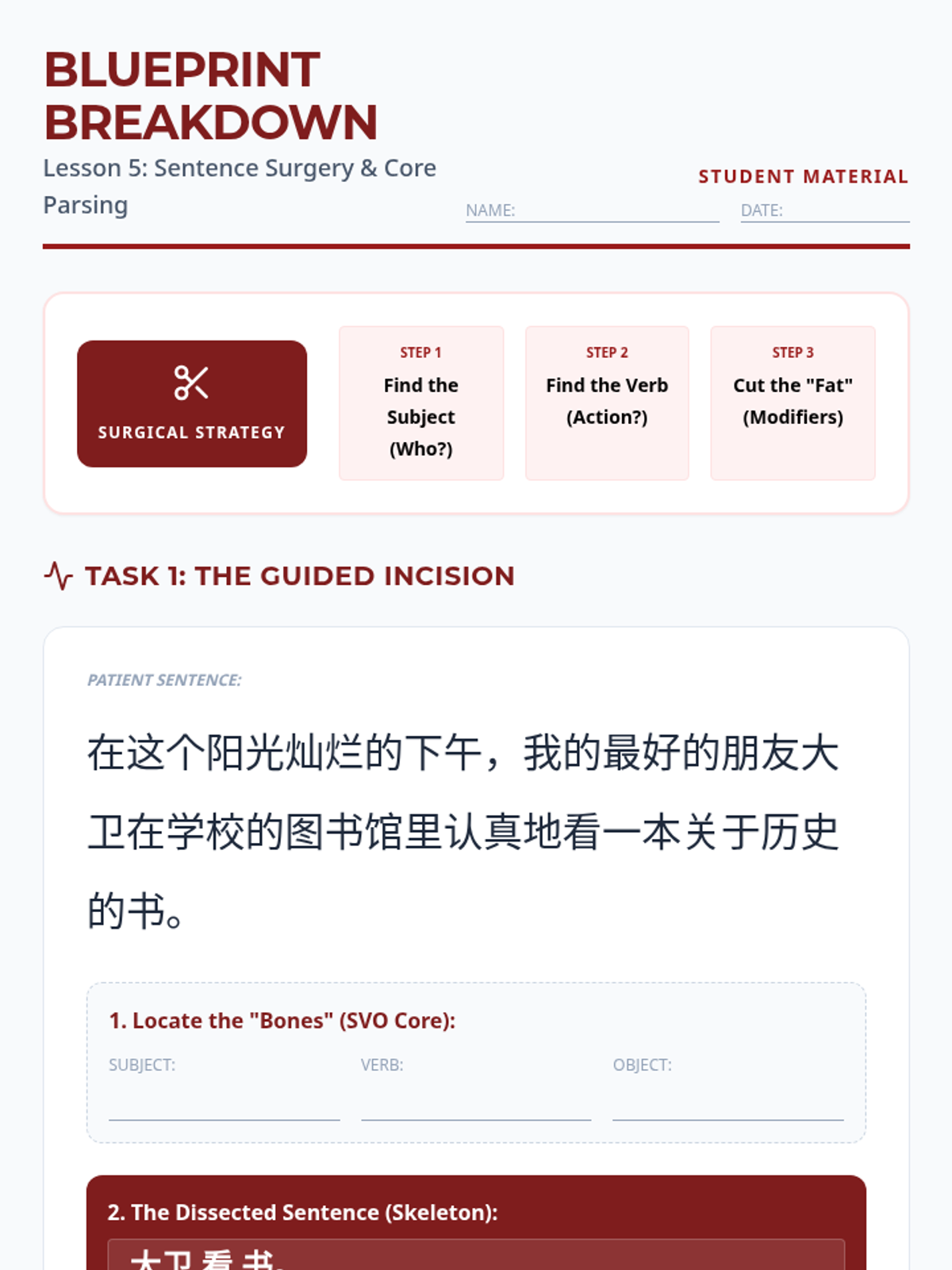
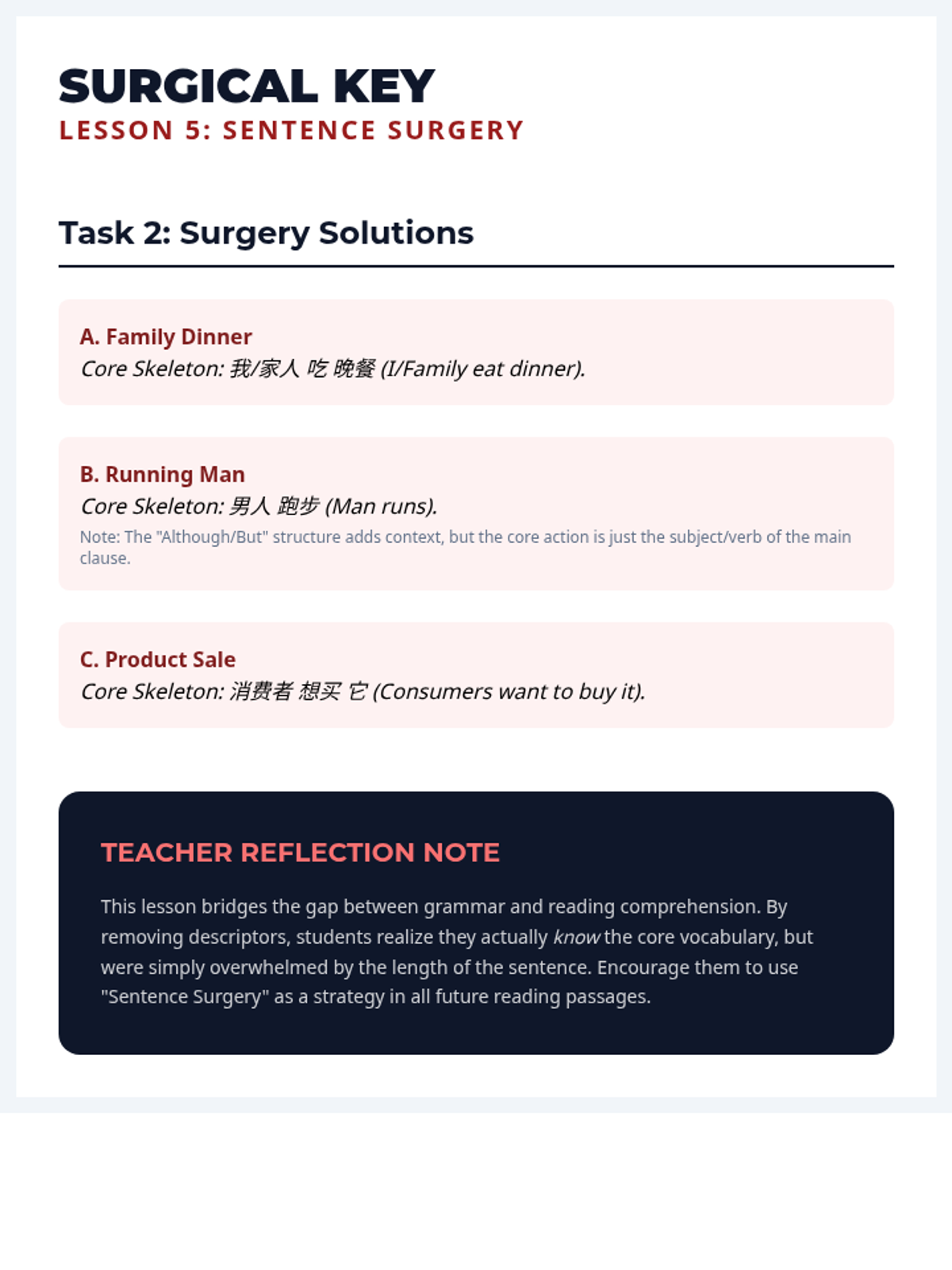
Students practice 'sentence surgery' by parsing long, complex sentences into their core components, learning to isolate the main subject and verb from modifying clauses.
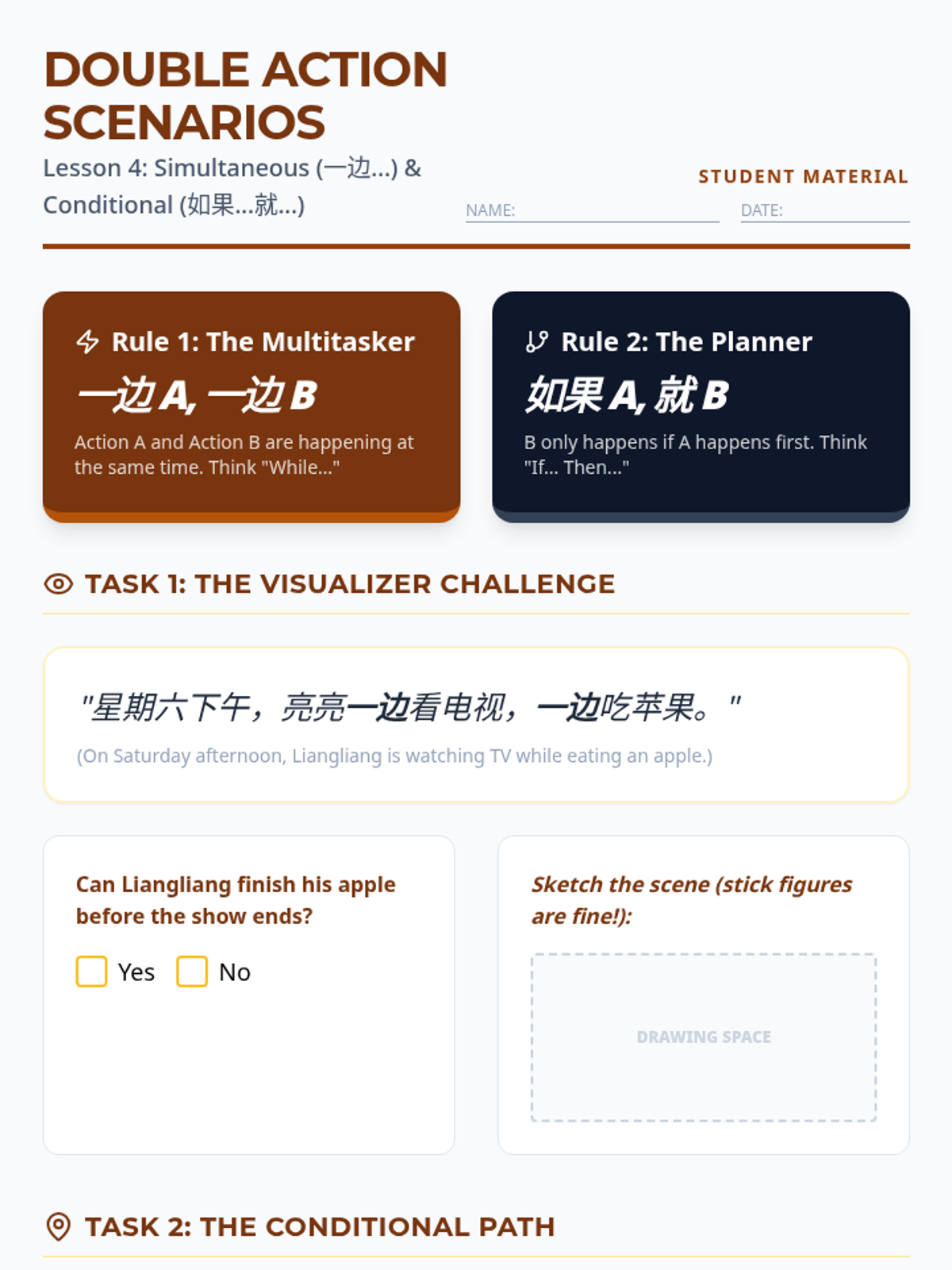
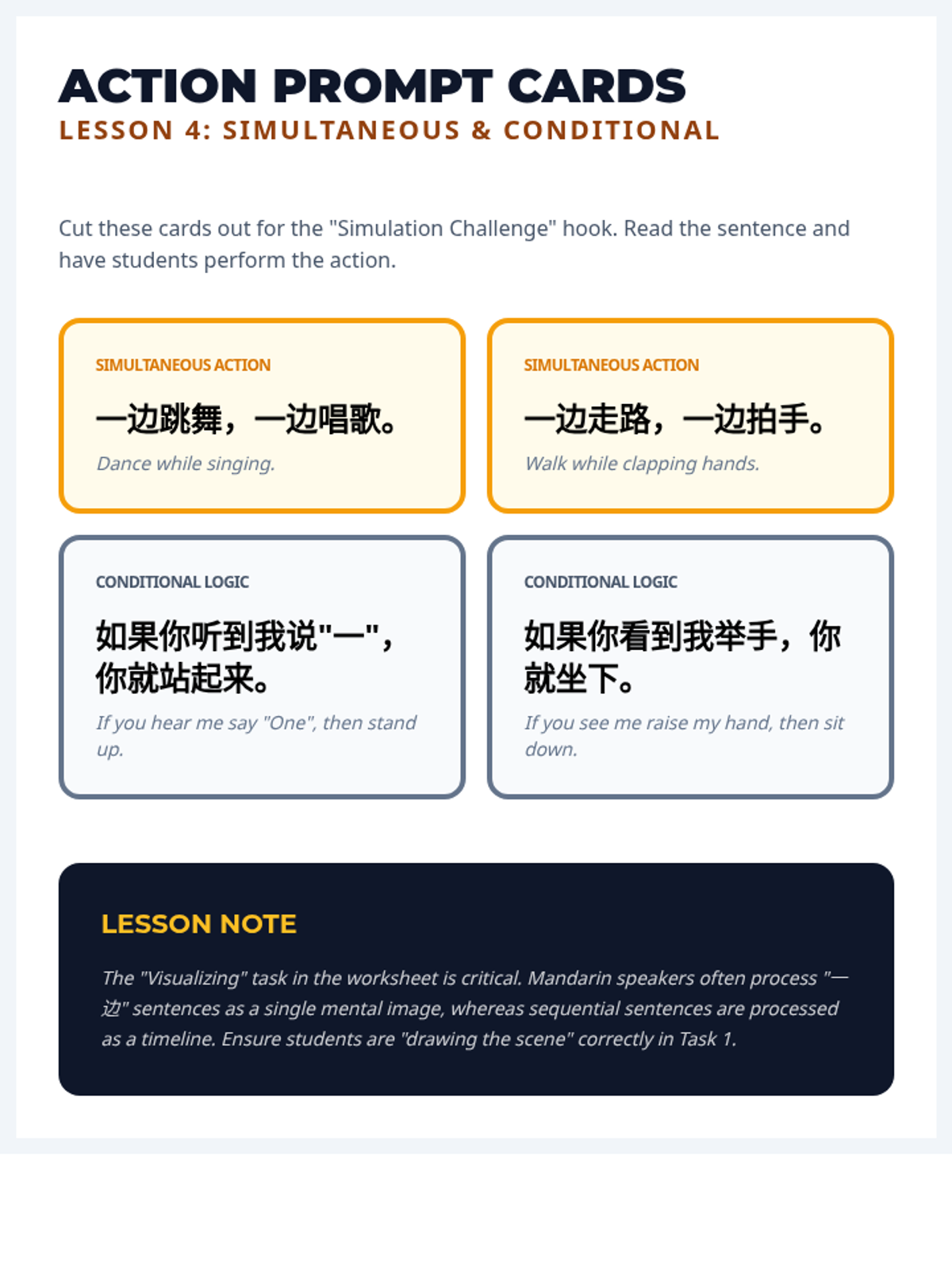
Students explore simultaneous actions (While... Also...) and conditional logic (If... Then...) through narratives, visualizing scenes to differentiate between concurrent and dependent events.
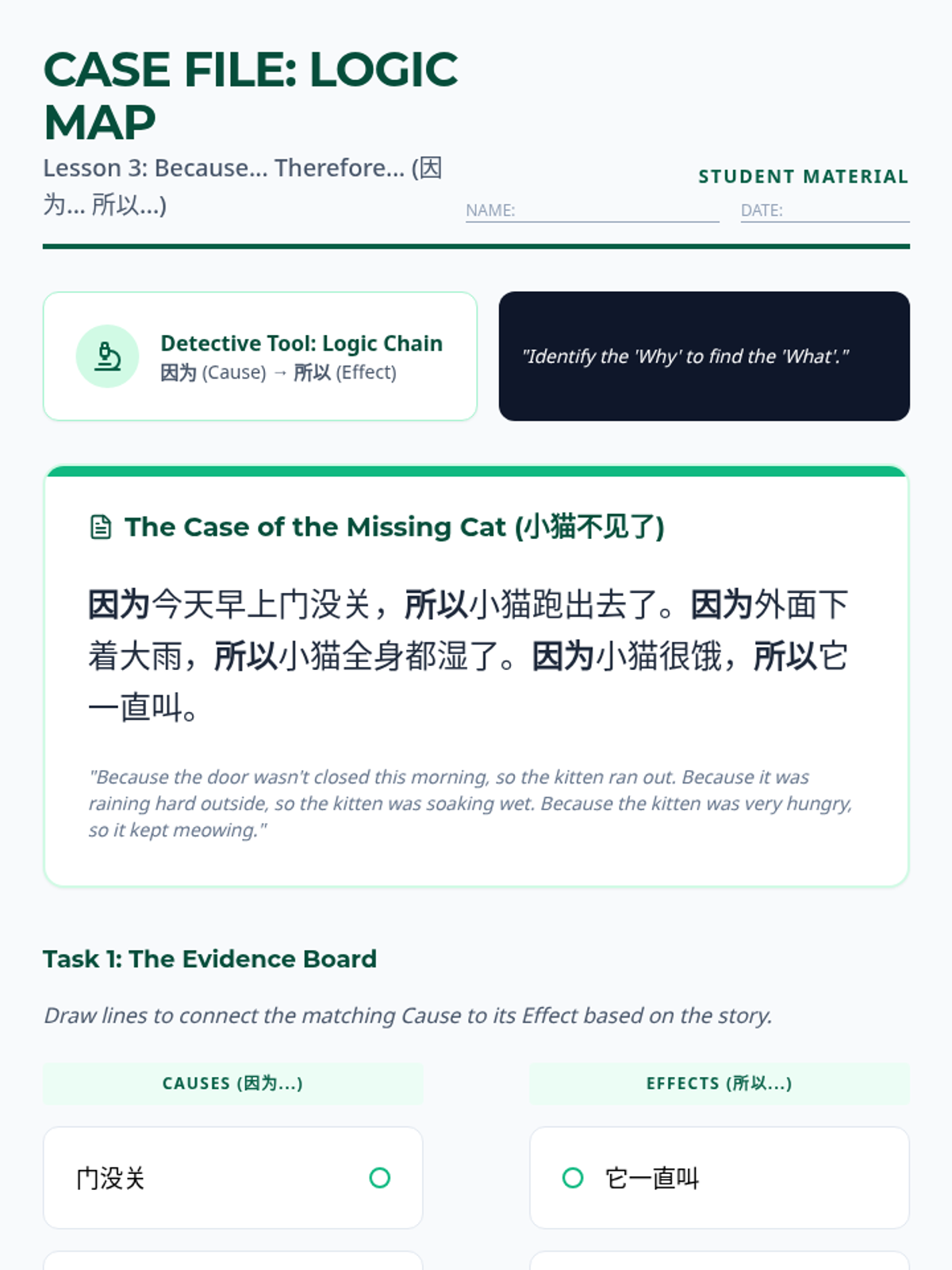
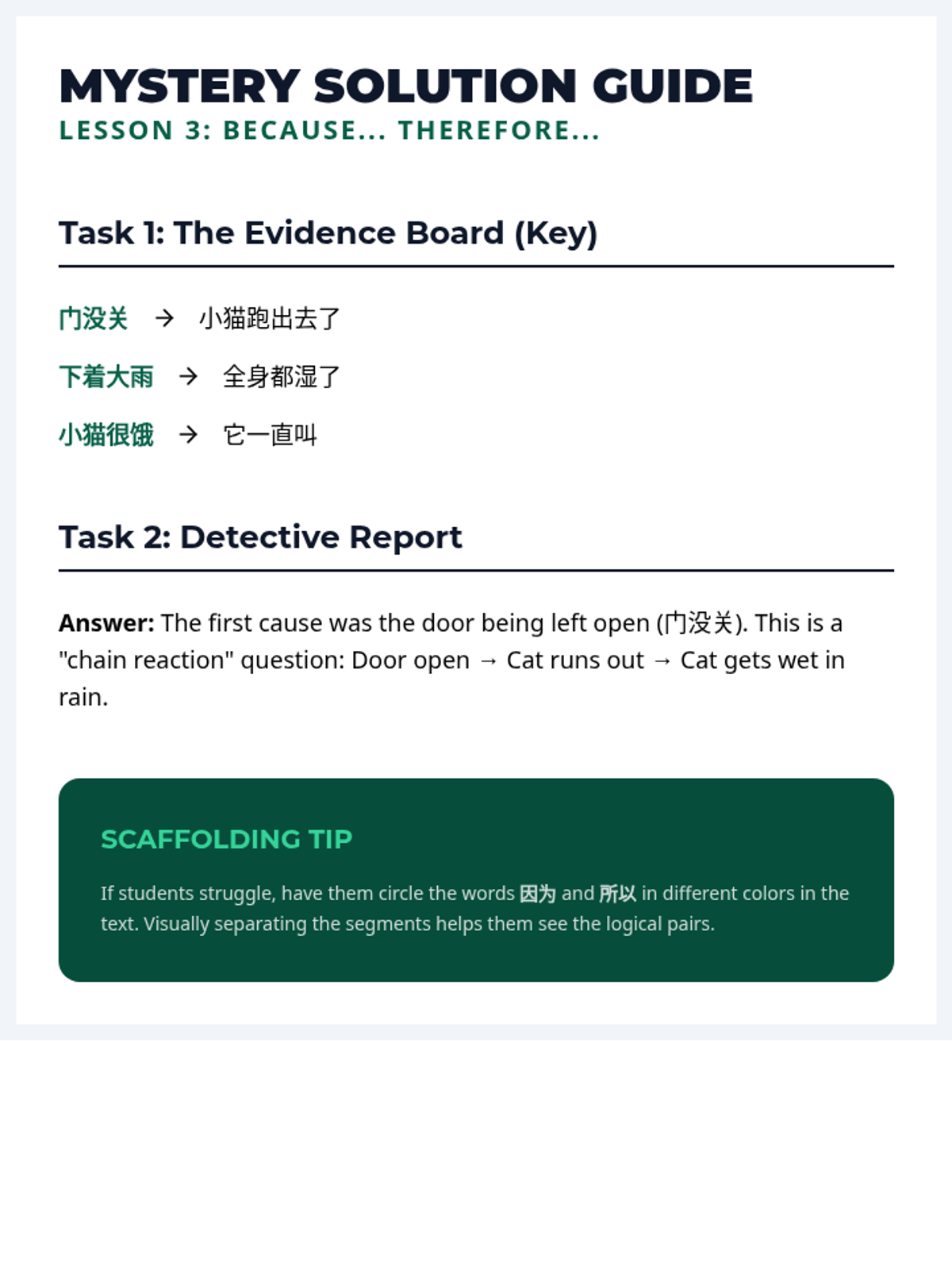
Students map cause-and-effect relationships using 'Because... Therefore...' (Yinwei... Suoyi...) structures within expository and mystery texts to develop logical reasoning skills.
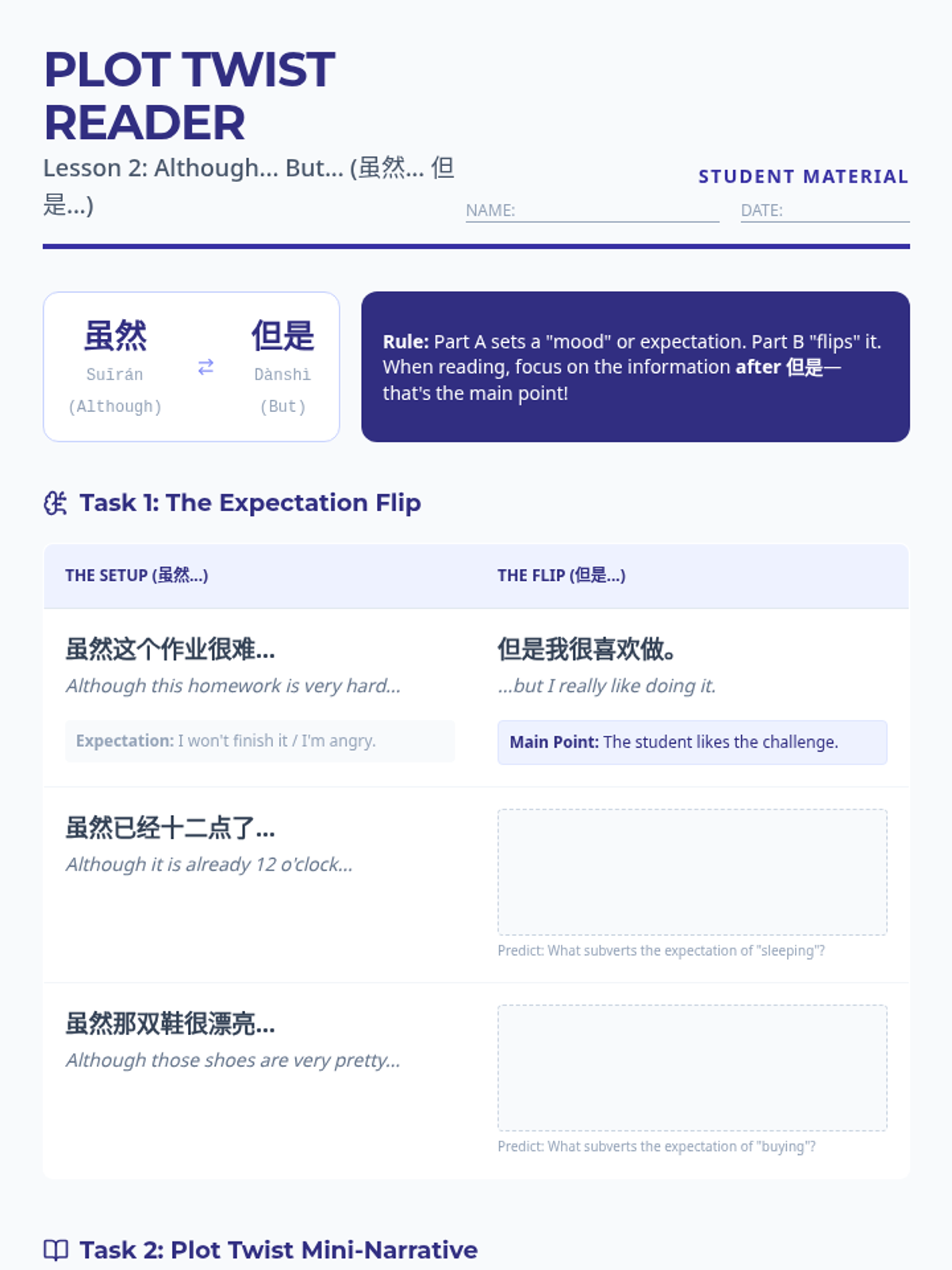
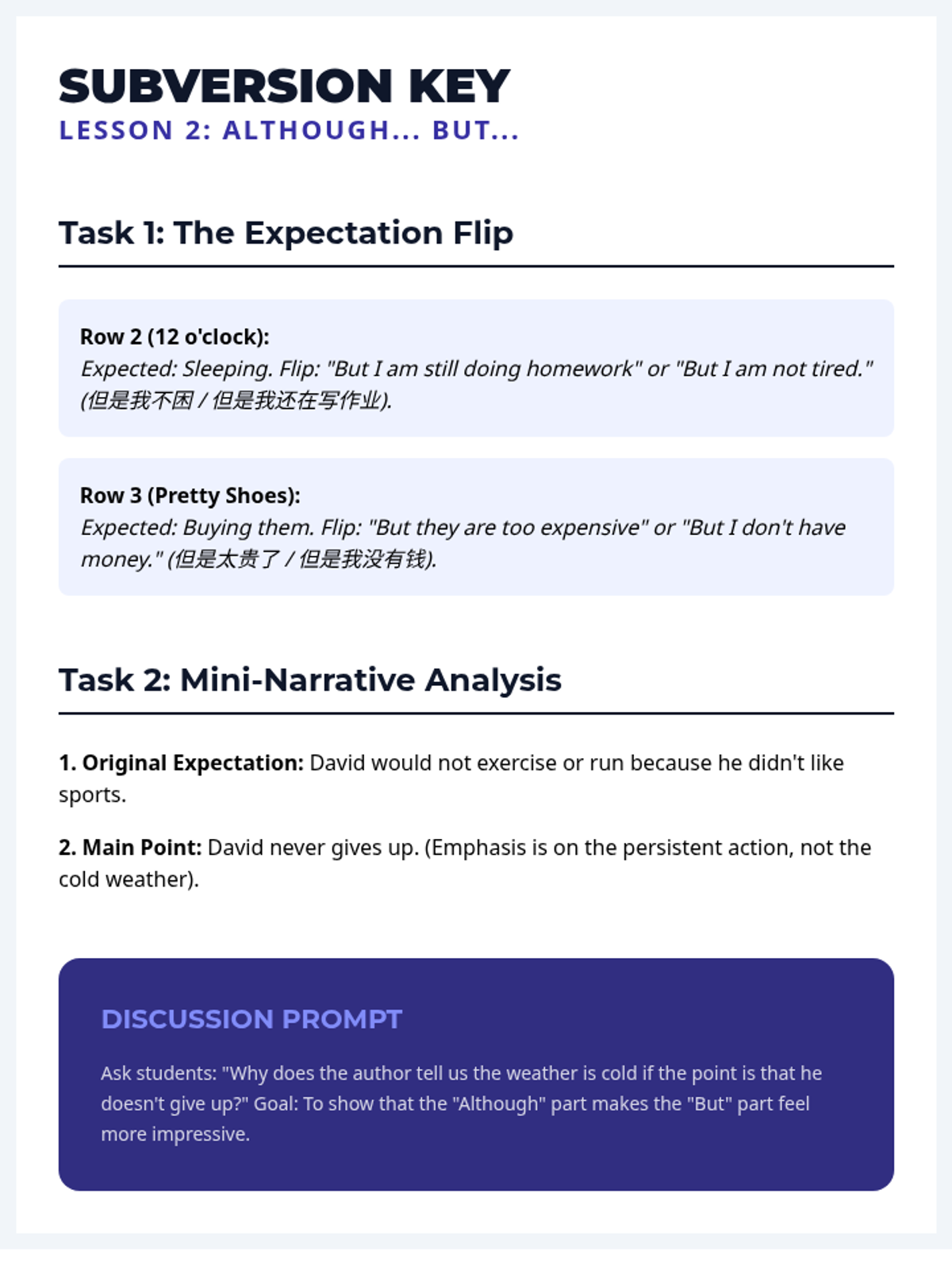
Students master the 'Although... But...' (Suiran... Danshi...) structure, analyzing how the second clause shifts emphasis and subverts expectations in narrative contexts.
Students identify and use sequential connectors (first, then, after, finally) in procedural texts to understand how these markers provide a roadmap for the reader.
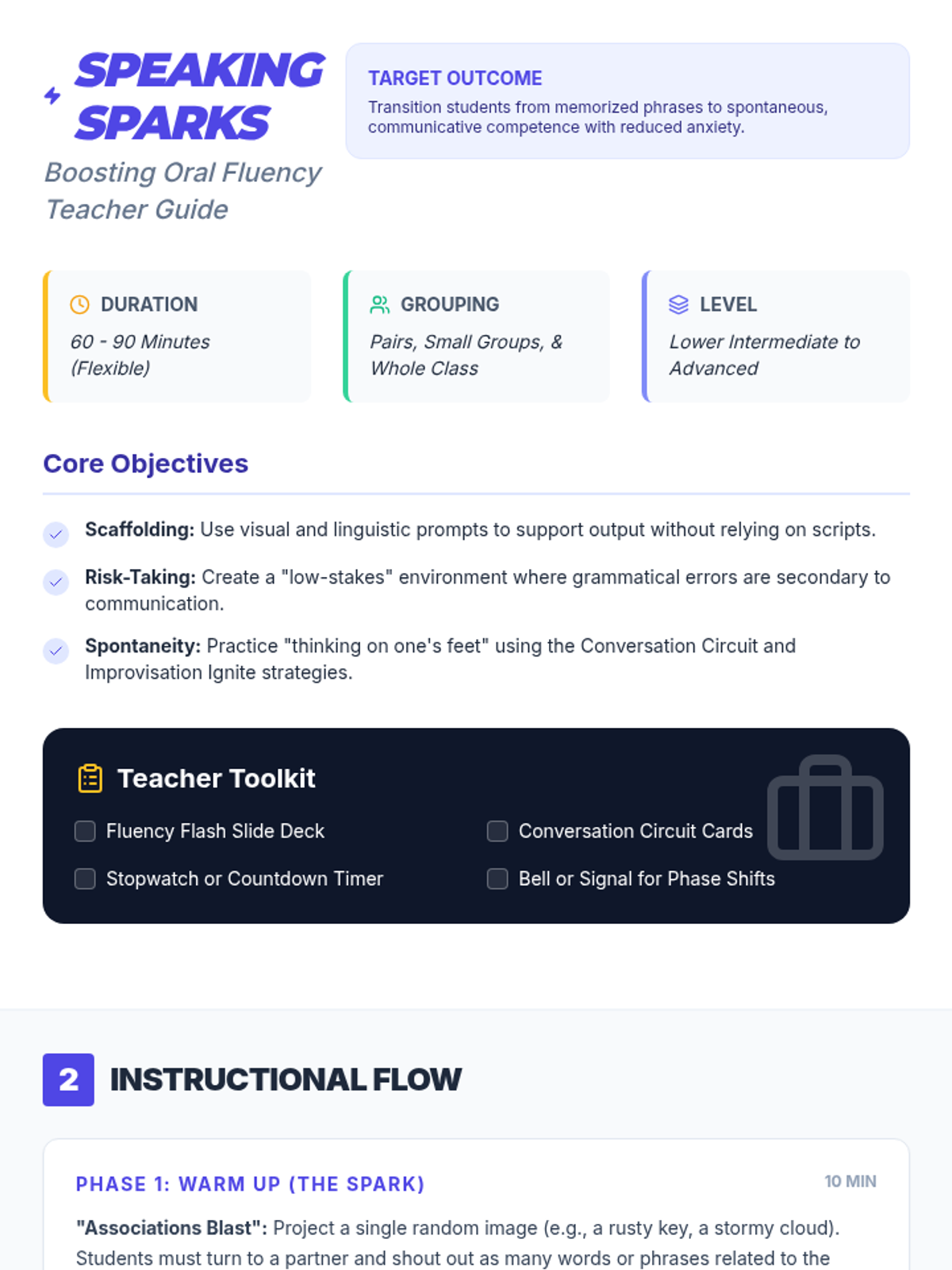
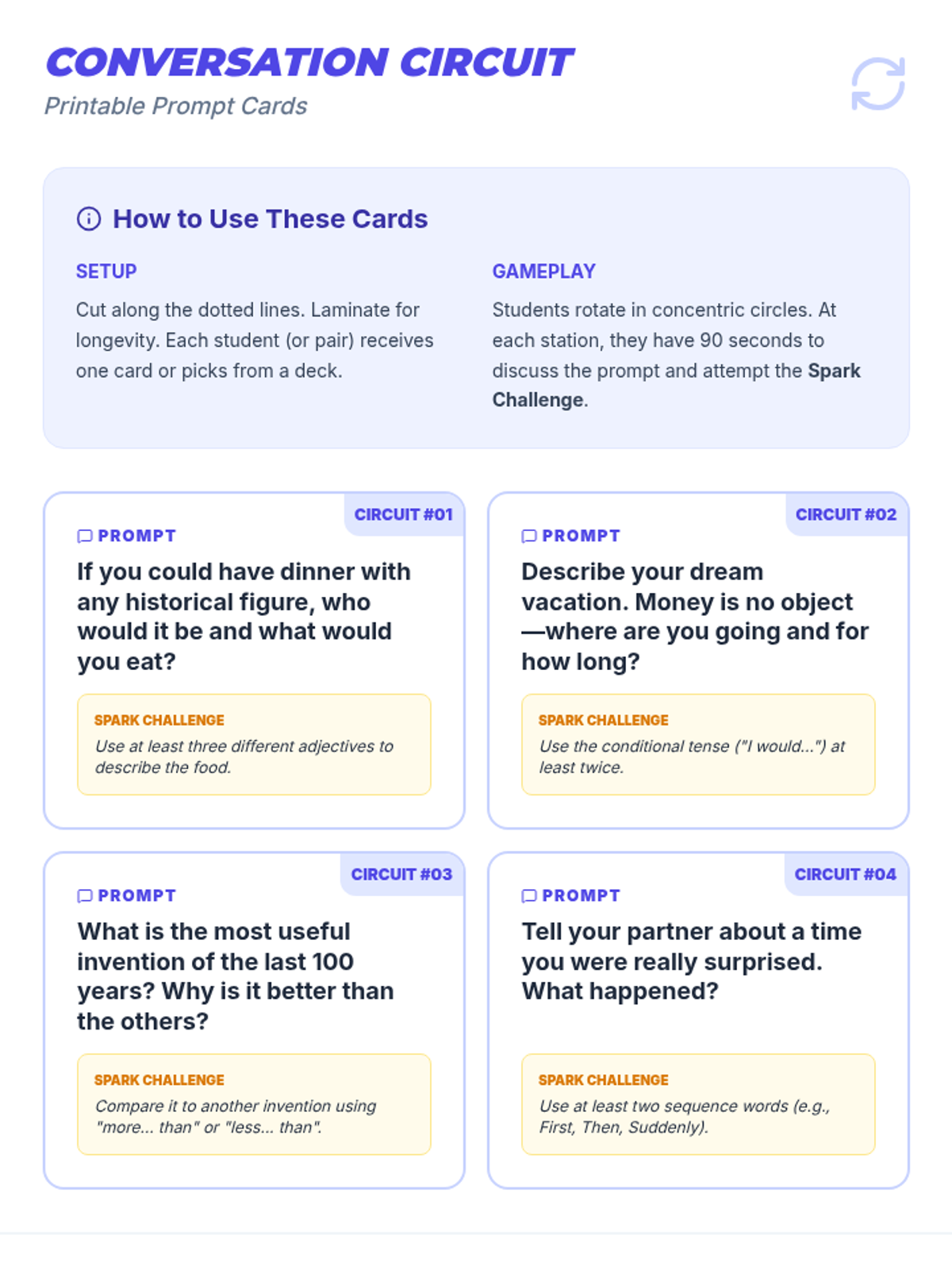
A comprehensive toolkit for foreign language teachers to bridge the gap between rote memorization and spontaneous oral communication through interactive activities and low-stakes scaffolding.
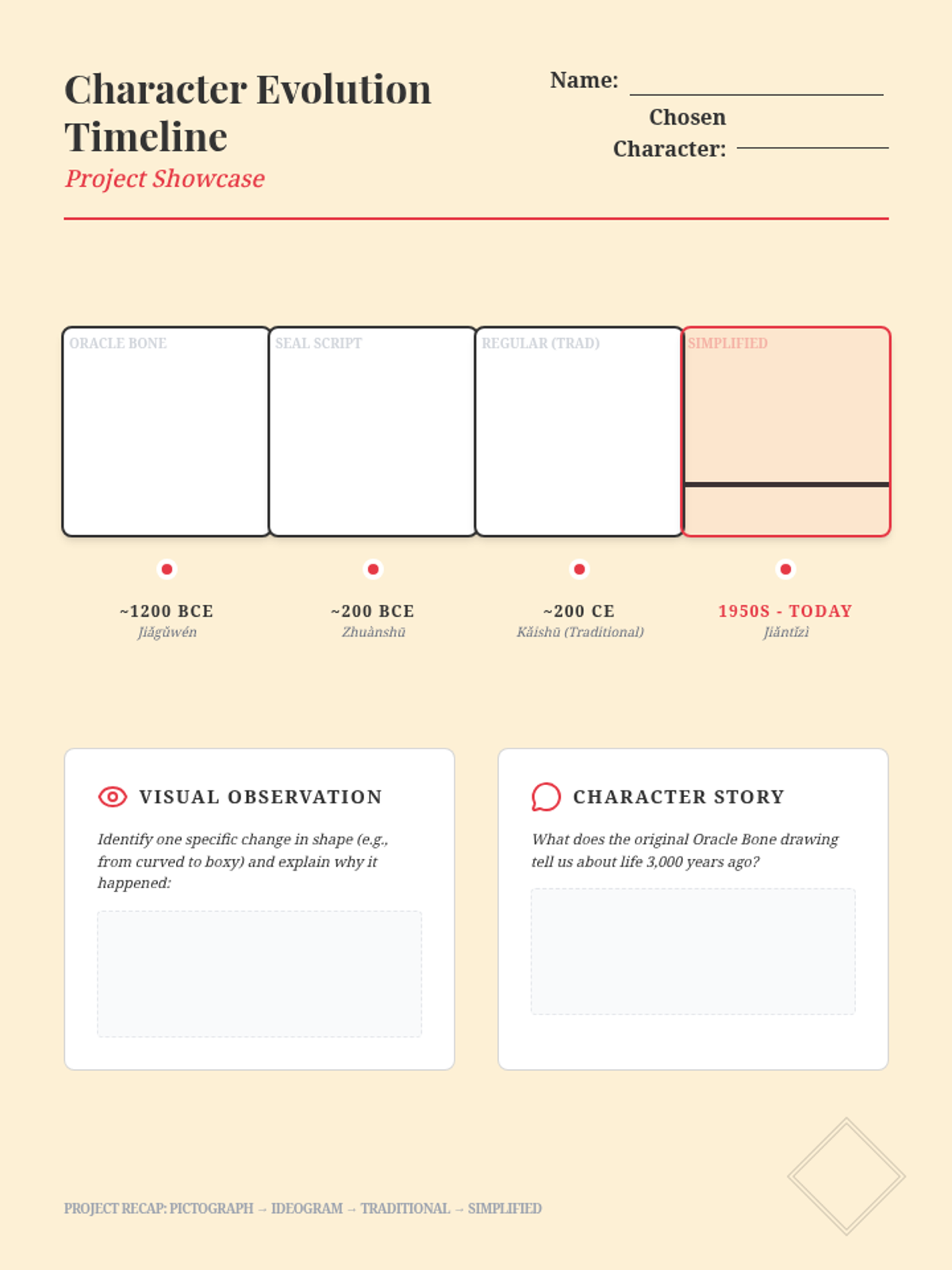
Students select one character and create a visual timeline showing its metamorphosis from picture to modern text. They present the story of their character to the class.
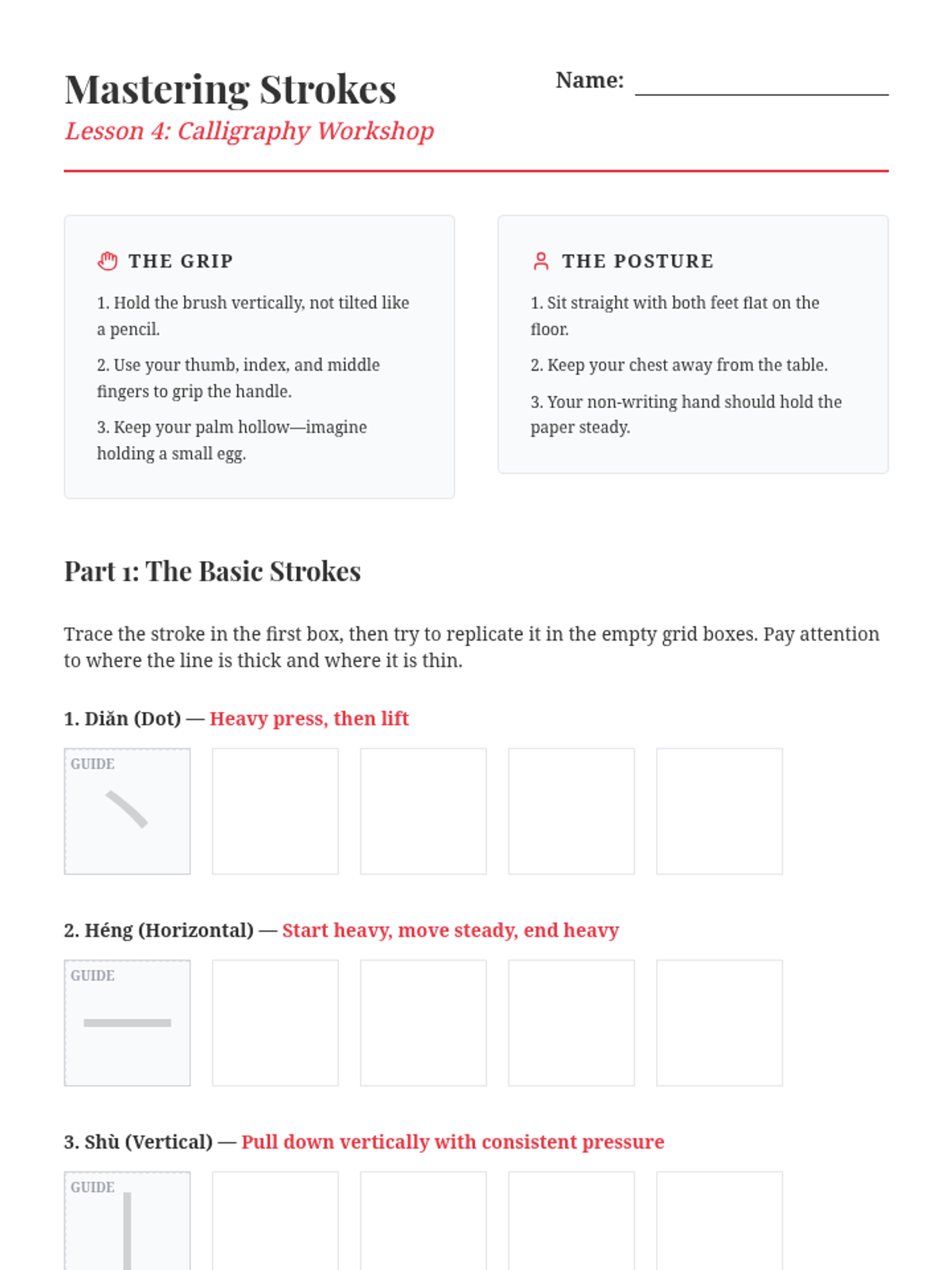
A hands-on workshop where students use water-writing cloth or ink to experience the varying pressure and flow of brush calligraphy. They focus on the aesthetic 'bone structure' of characters.
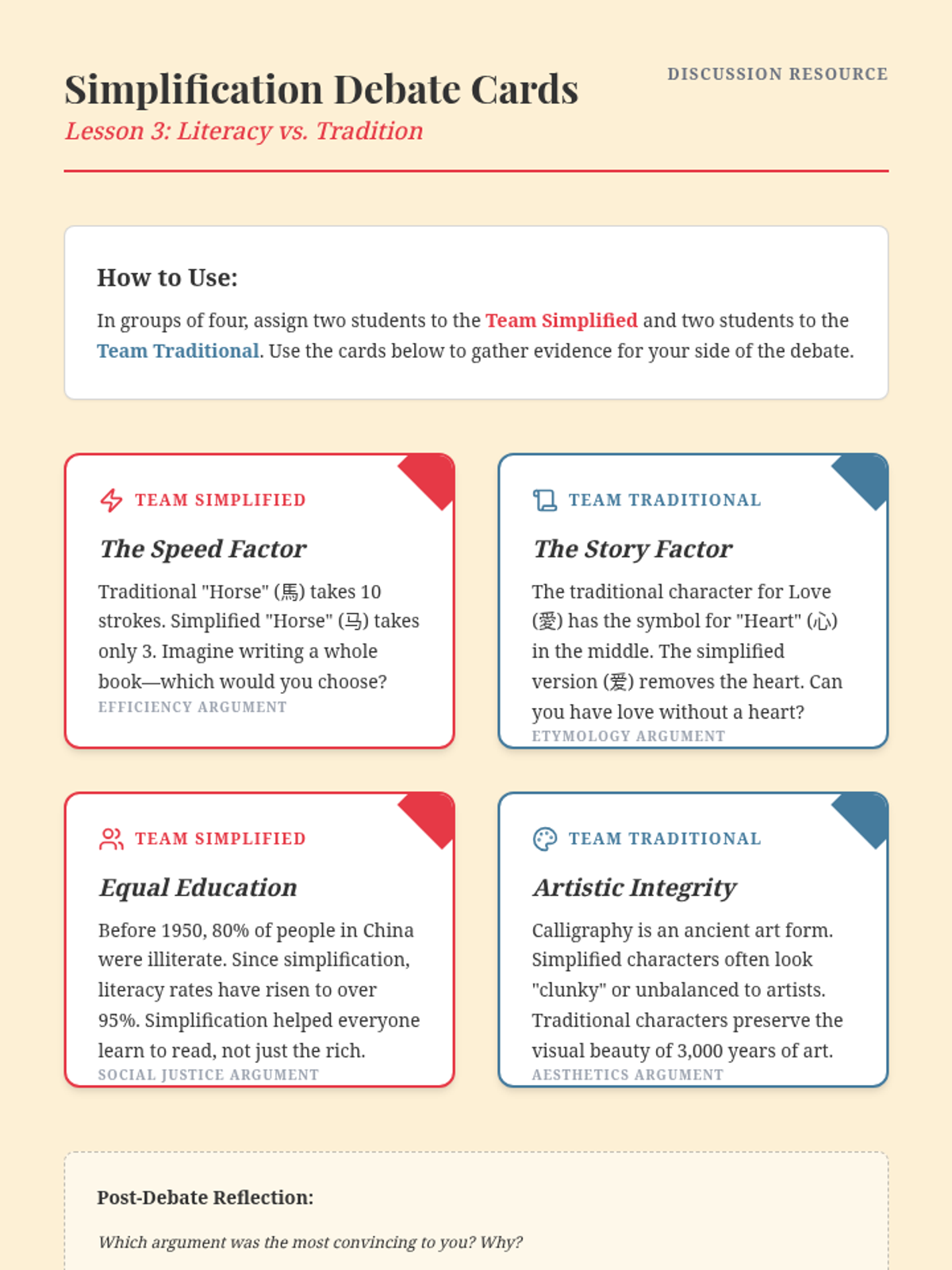
Students compare Traditional characters used in history with Simplified characters introduced in the 1950s. They debate the pros and cons of simplification for literacy vs. cultural preservation.
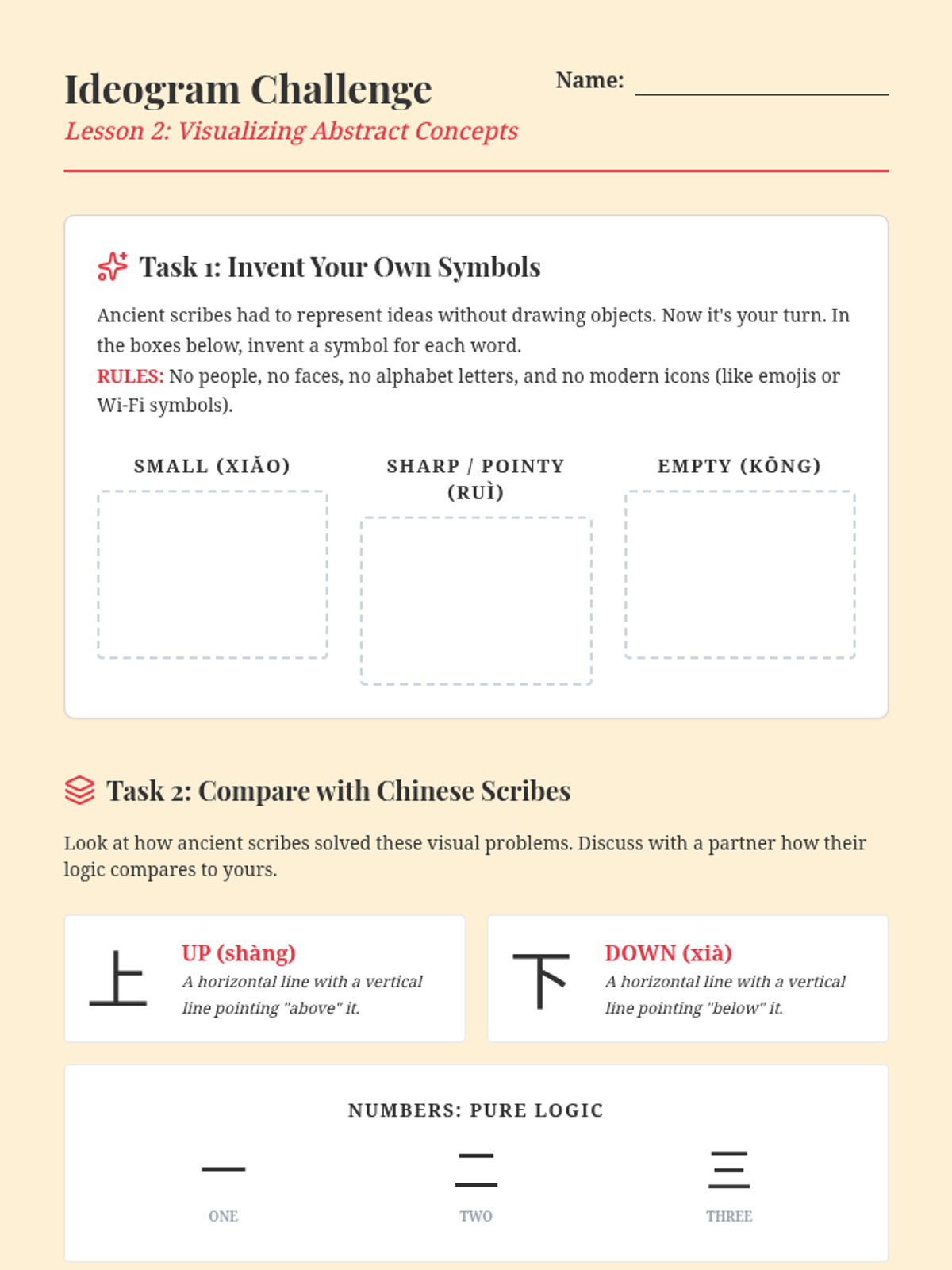
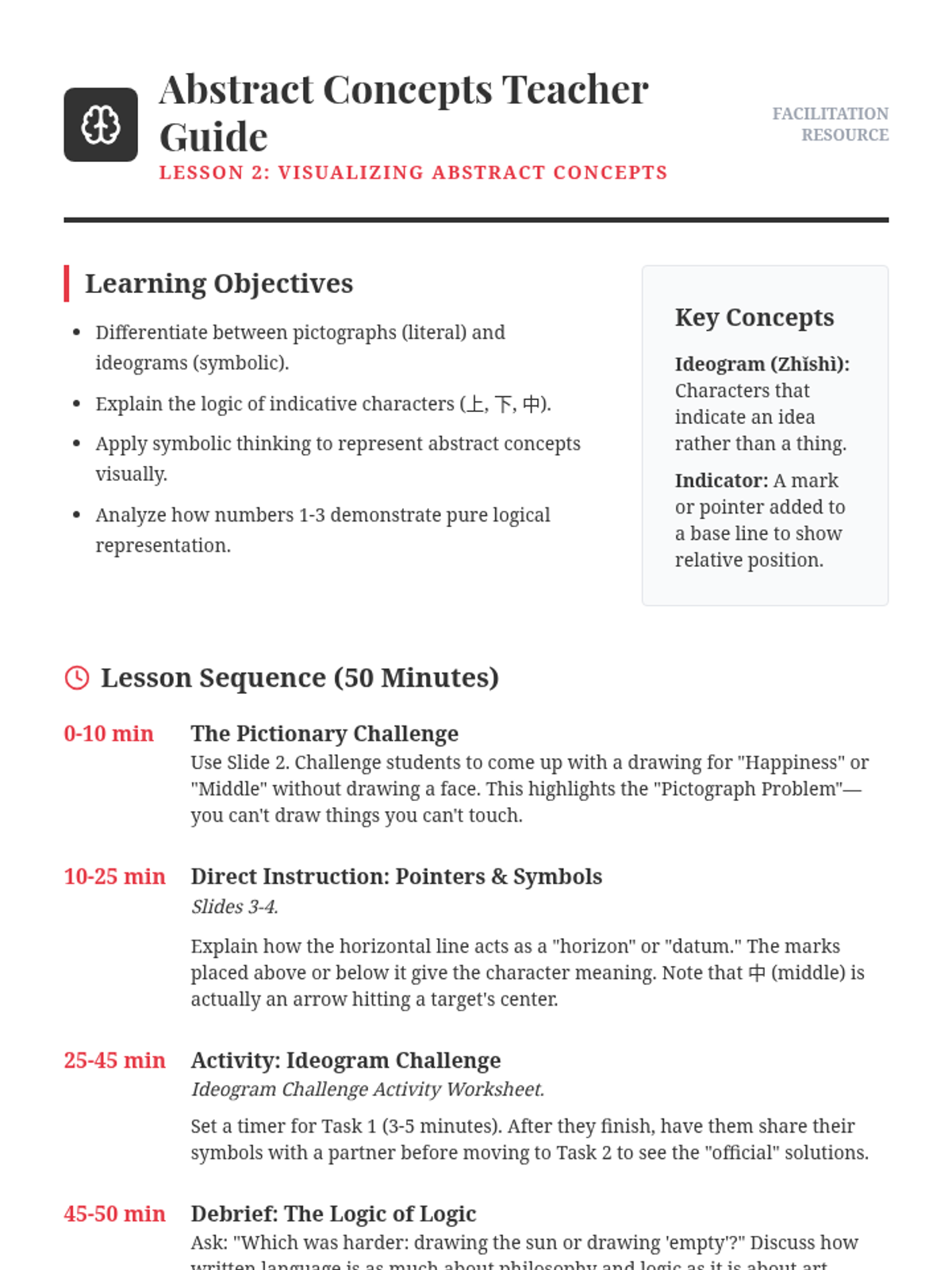
Learners explore how ancient scribes solved the problem of drawing abstract ideas like 'up', 'down', and 'middle'. They create their own symbols for abstract ideas before learning the standard Hanzi.
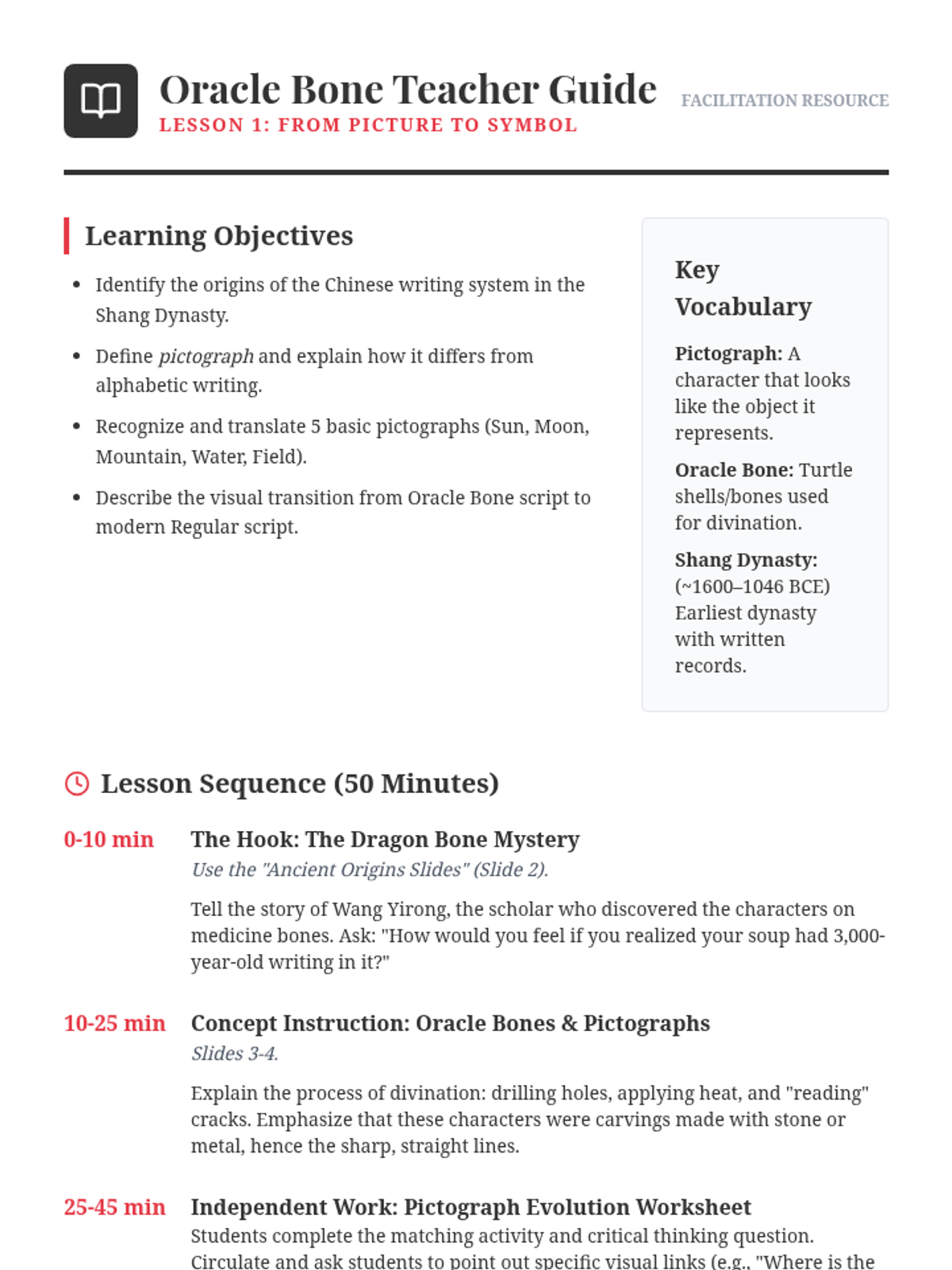
Students explore the origins of Chinese writing through Oracle Bone Script, matching ancient pictographs of natural elements to their modern character forms.
Students bring in or draw a family photo and create a labeled family tree using the correct Hanzi characters. They practice introducing their family members using the characters learned.
Students learn the character 'Hao' (Good), which combines the Female and Child characters. They explore the cultural story behind this combination and practice writing it as a compound ideograph.
Students apply their knowledge by labeling a large mural of a natural landscape with the correct characters. They practice reading simple phrases connecting these nouns, demonstrating their ability to recognize pictographs in context.
Students learn the distinct characters for older brother vs. younger brother and older sister vs. younger sister. They use age-ordering activities to practice the specific hierarchy inherent in Chinese family vocabulary.
Students create a visual 'Radical Tree' or poster that groups high-frequency characters under their governing radicals. They present their findings on how meaning is distributed across the language.