Fundamental principles of supply, demand, and monetary systems alongside micro- and macroeconomic structures. Examines the impact of corporate power, labor market dynamics, and global systems on social mobility and class inequality.
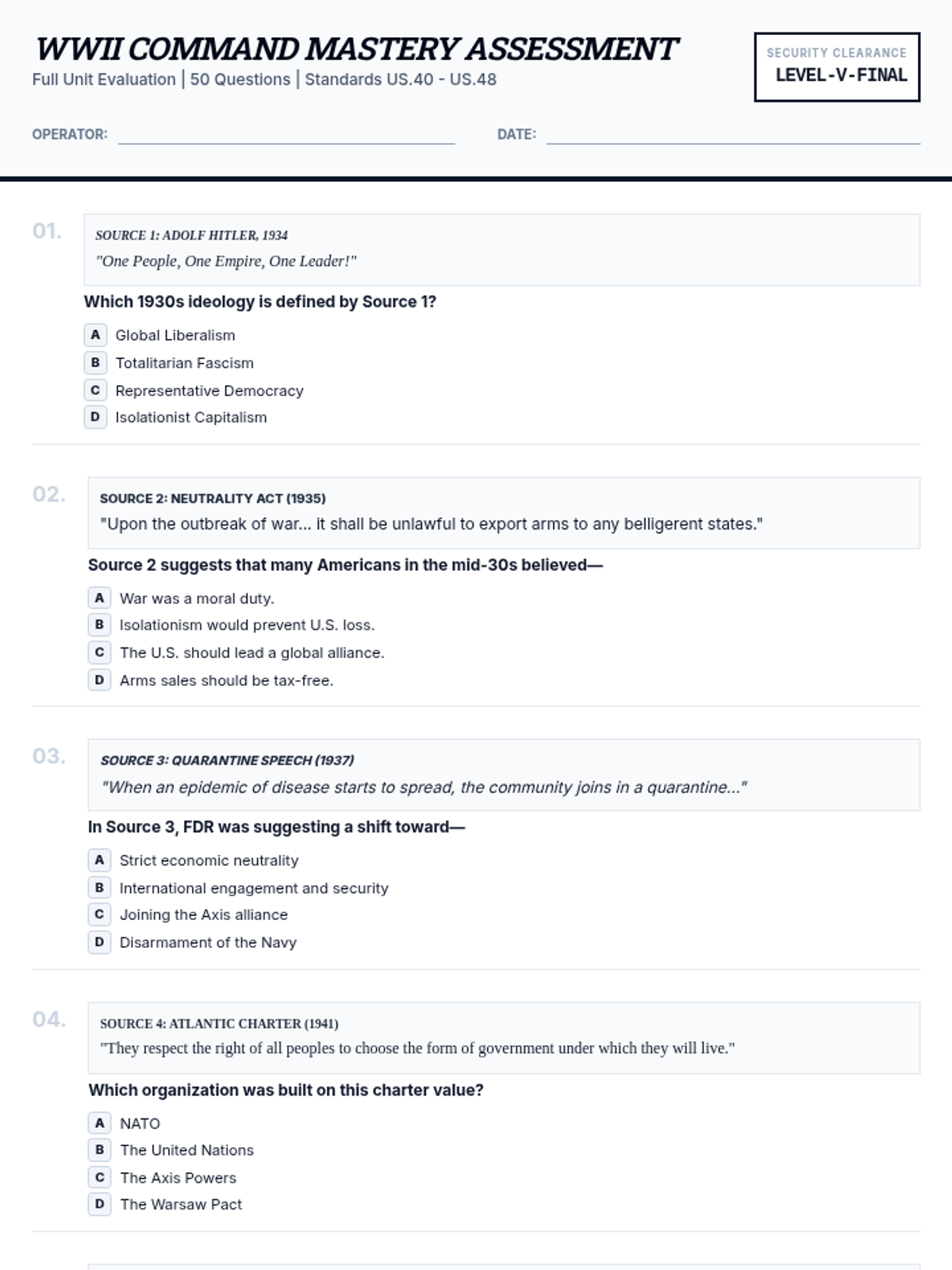
A comprehensive 50-question mastery test for World War II, featuring 100% primary source analysis. Covers the rise of dictators, home front mobilization, turning points, the Holocaust, and post-war reorganization. High-quality questions for summative unit evaluation. Optimized for paper efficiency with 4-5 questions per page.
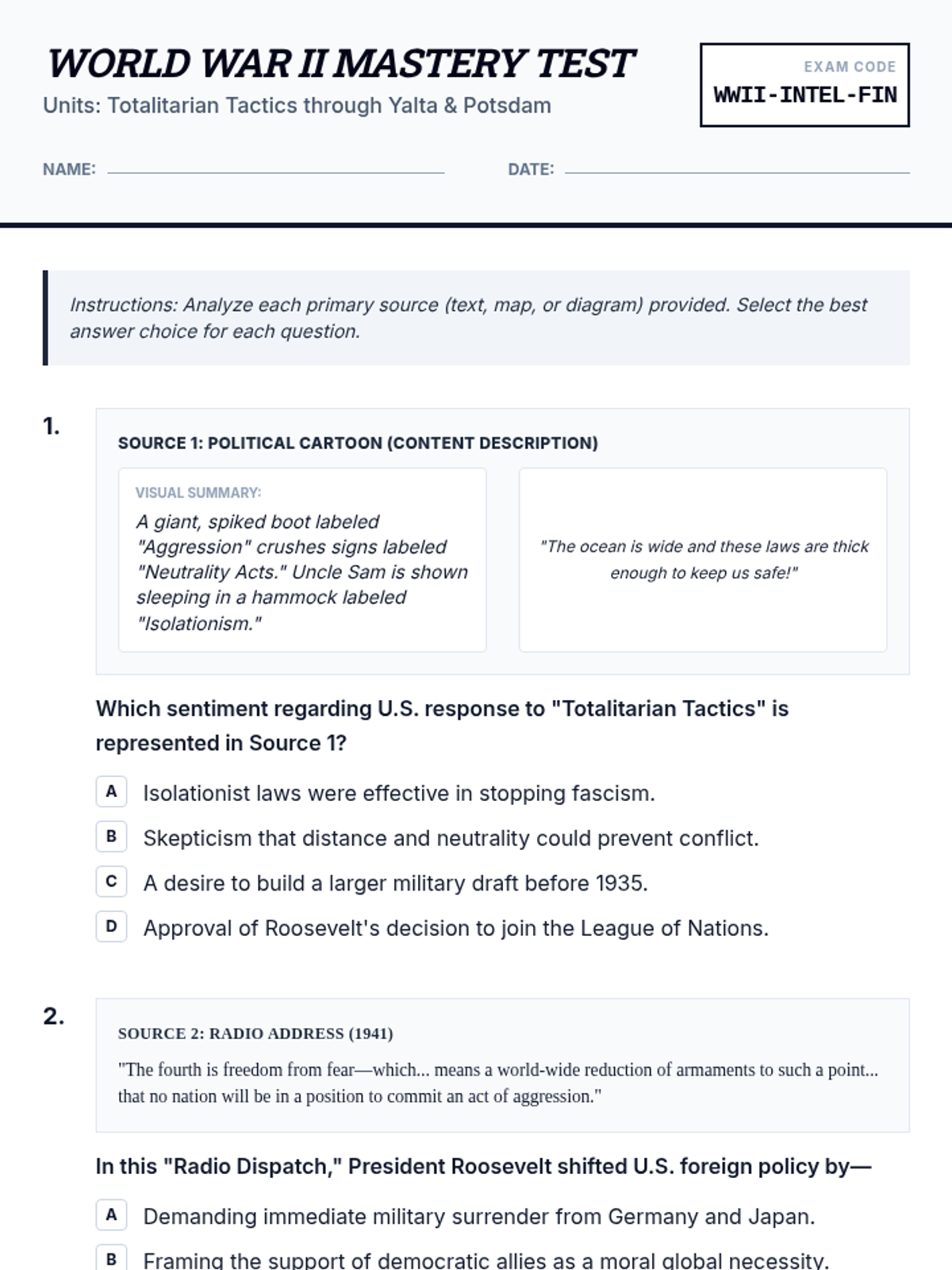
A multiple-choice mastery test for World War II based on the lessons Totalitarian Tactics through Yalta & Potsdam. Features 100% primary source analysis. Now includes a Teacher Resource Index with Answer Key, TN State Standards, and Source Citations on separate pages at the end.
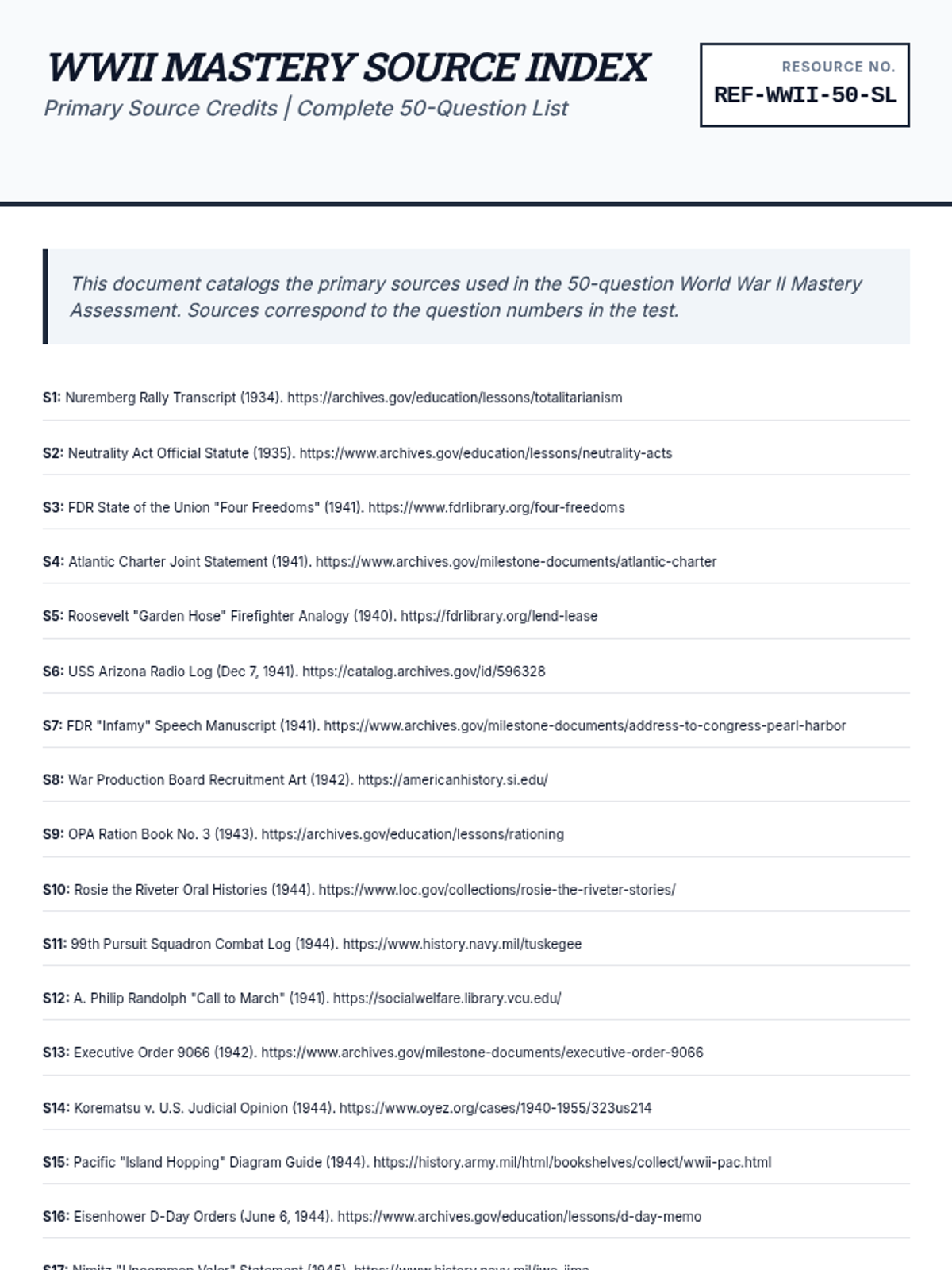
A comprehensive primary source bibliography for the 50-question WWII Mastery Test, including names, dates, historical context, and deep links to official archives for all 50 items. Fulfills the user's specific requirement for a separate source document with high specificity.
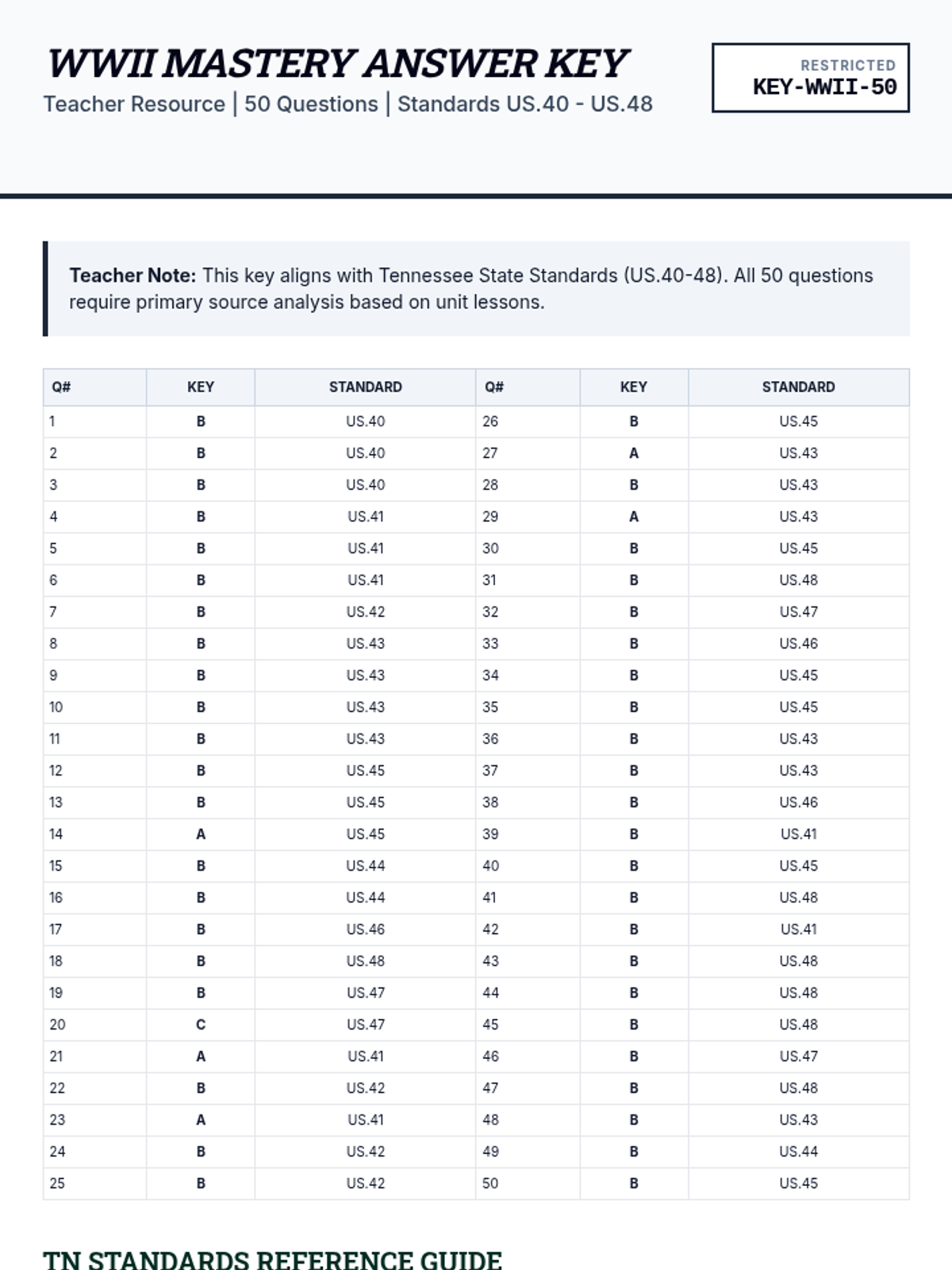
A comprehensive teacher answer key for the 50-question WWII Mastery Test, providing correct answers and Tennessee State Standard mapping for all items. Standardized for professional grading and evaluation.
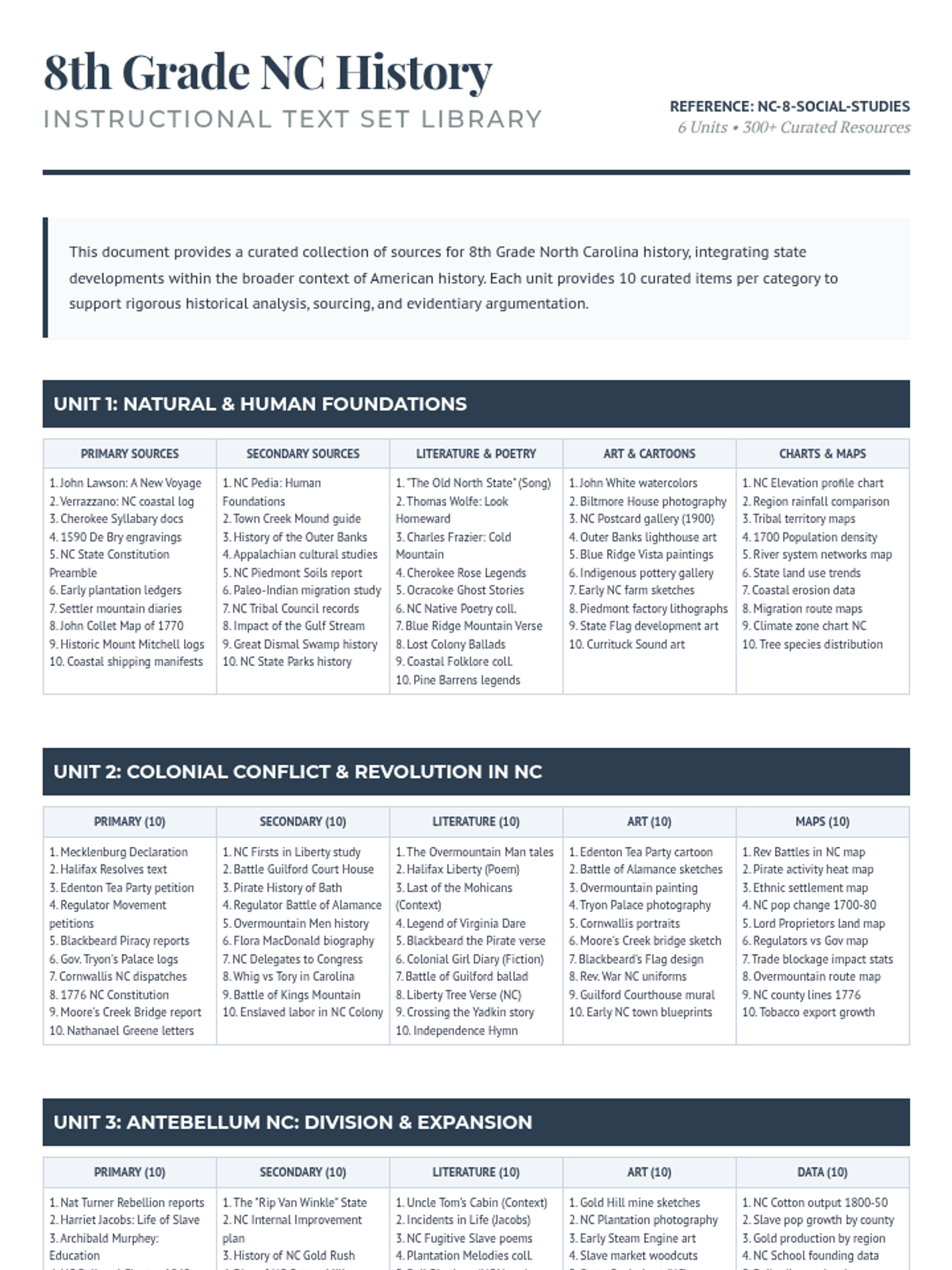
A comprehensive text set reference document for 6 units of 8th Grade North Carolina History, including 10 curated items per column (Primary/Secondary Sources, Literature, Art, and Data) for every unit. Highly dense instructional resource.
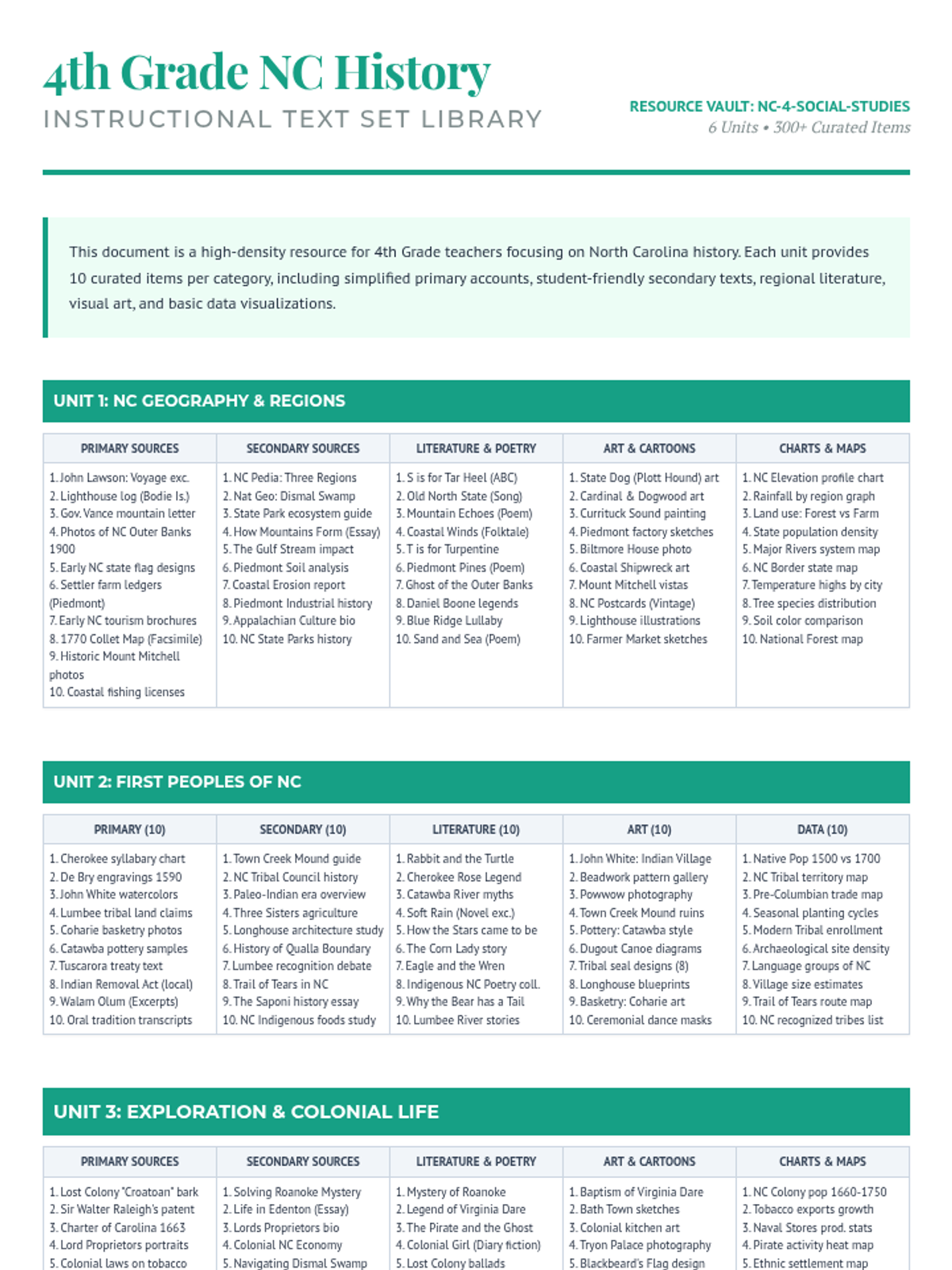
A comprehensive text set reference document for 6 units of 4th Grade North Carolina History, including 10 curated items per column (Primary/Secondary Sources, Literature, Art, and Data) for every unit. Student-friendly and aligned to NC standards.
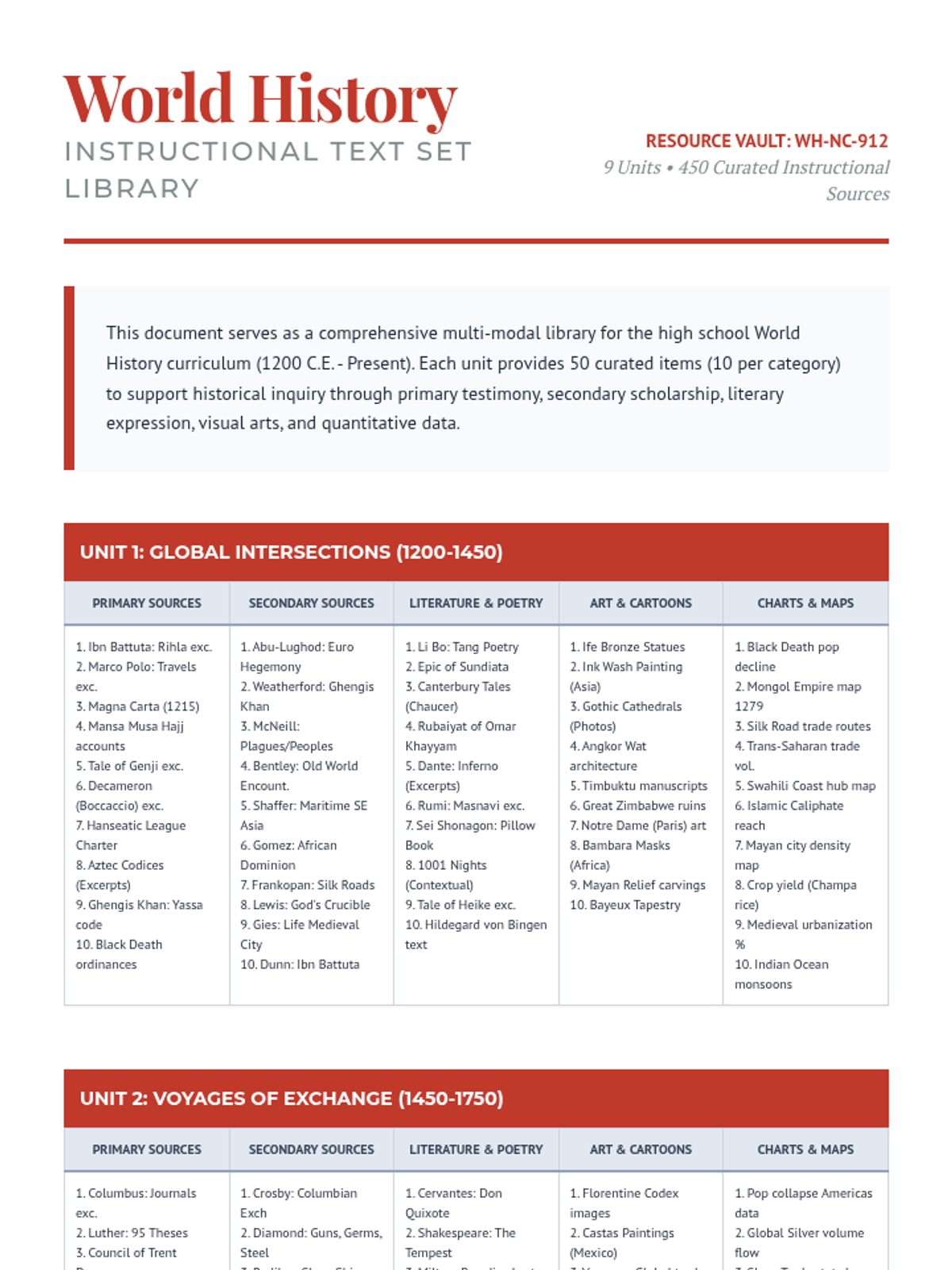
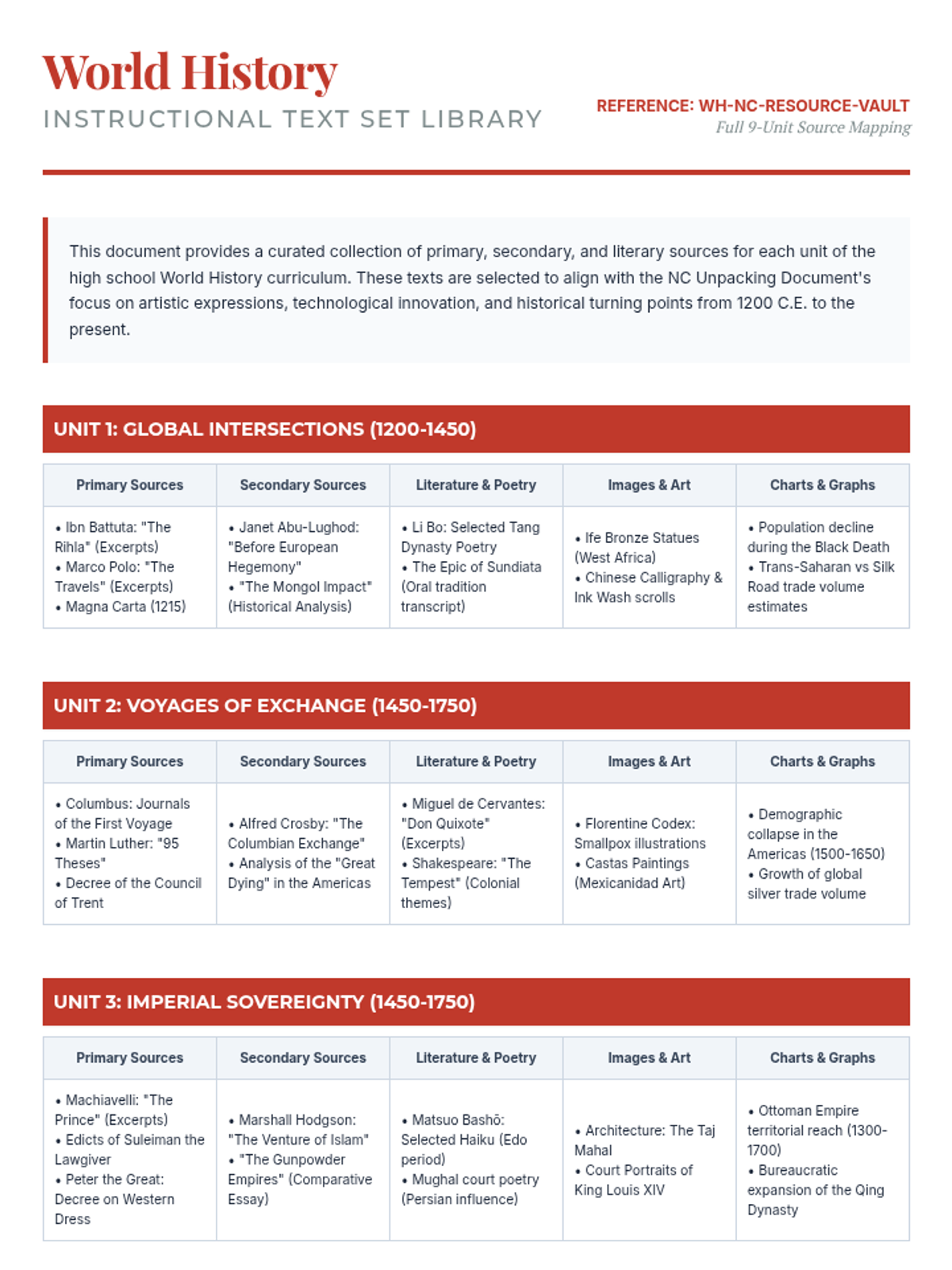
A comprehensive text set reference document for 9 units of World History, including 10 curated items per column (Primary/Secondary Sources, Literature, Art, and Data) for every unit. Highly dense instructional resource.
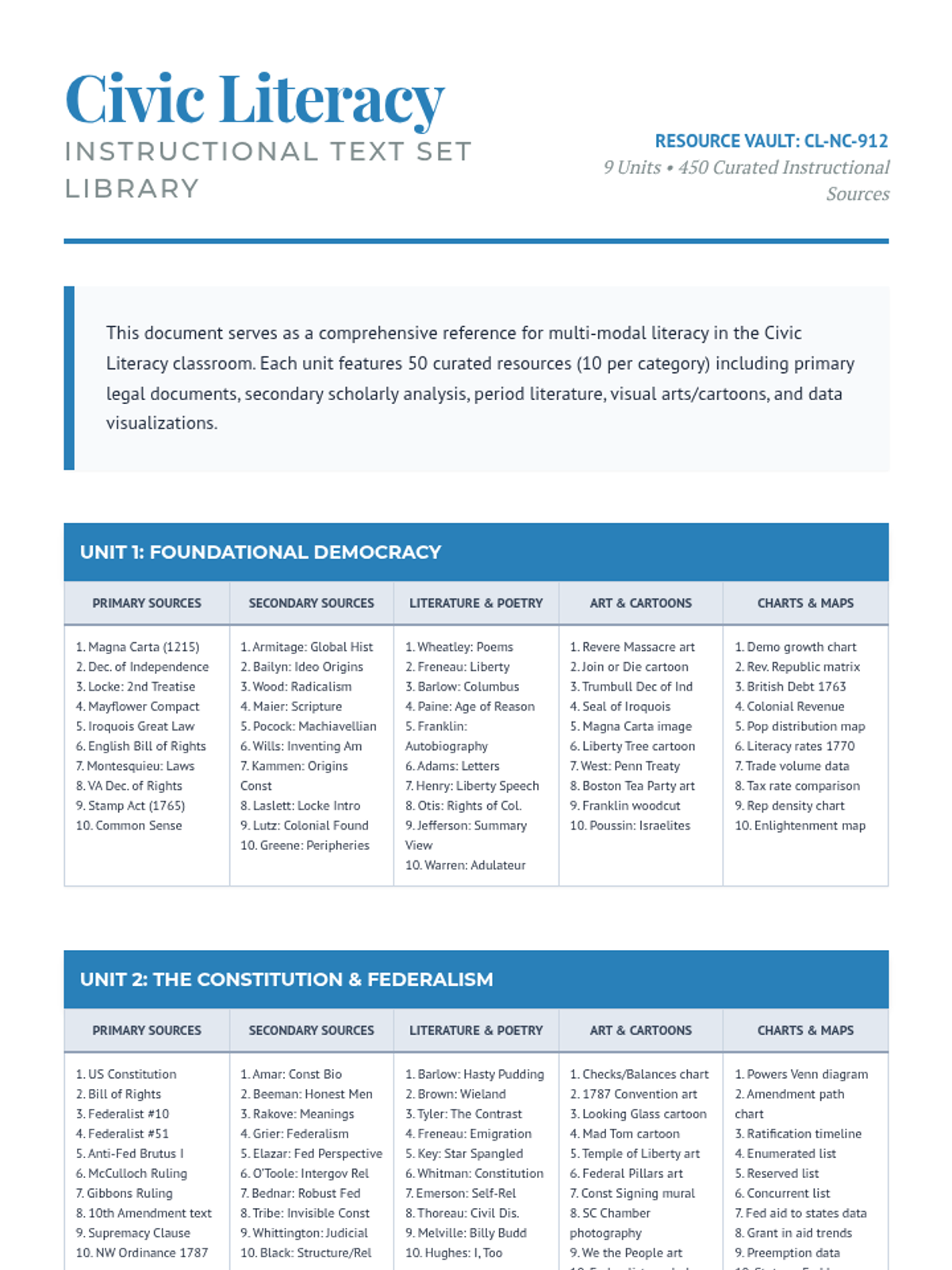
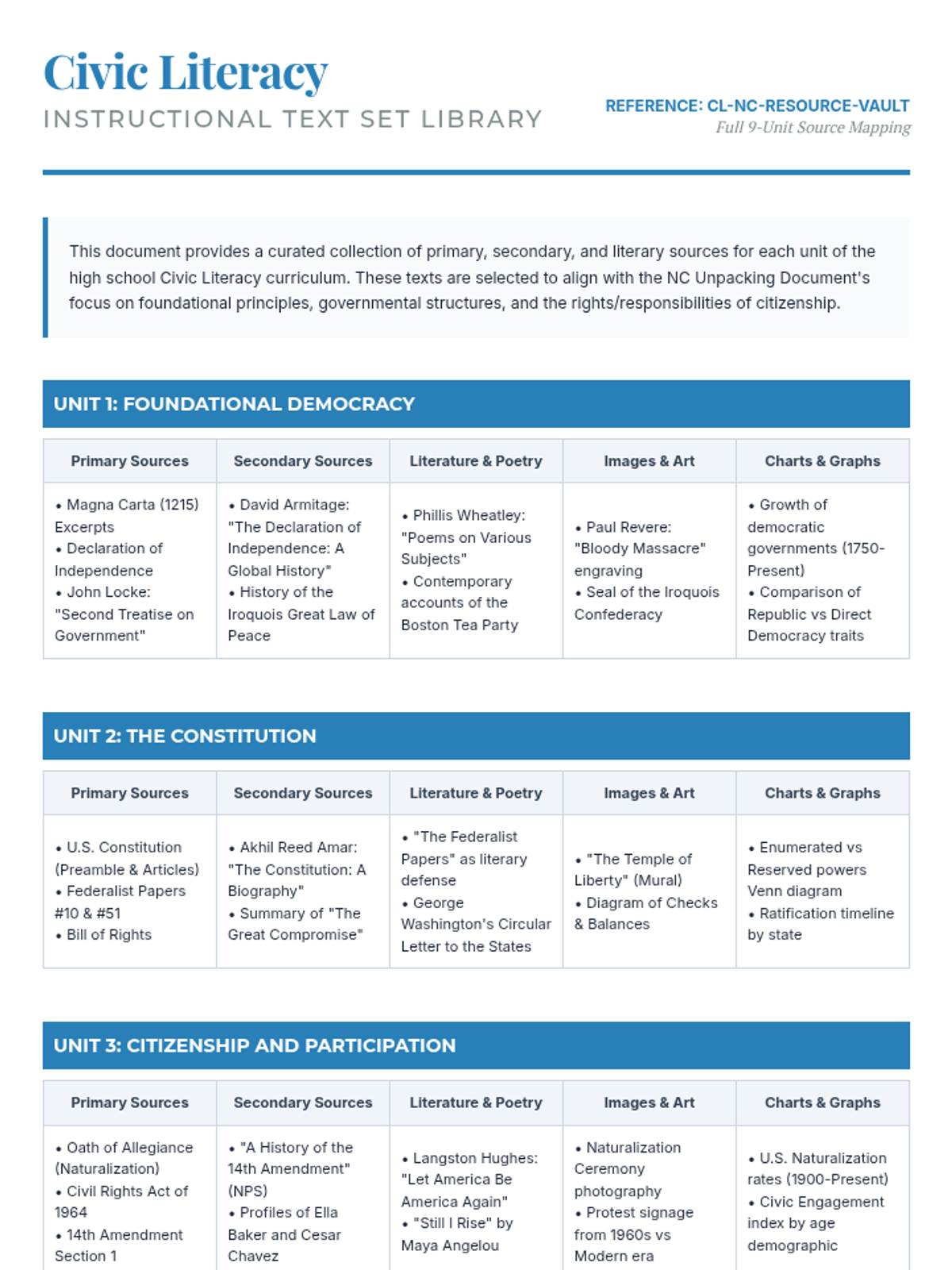
A comprehensive text set reference document for 9 units of Civic Literacy, including 10 curated items per column (Primary/Secondary Sources, Literature, Art, and Data) for every unit. Highly dense instructional resource aligned to NC standards. Revised for readability and depth.
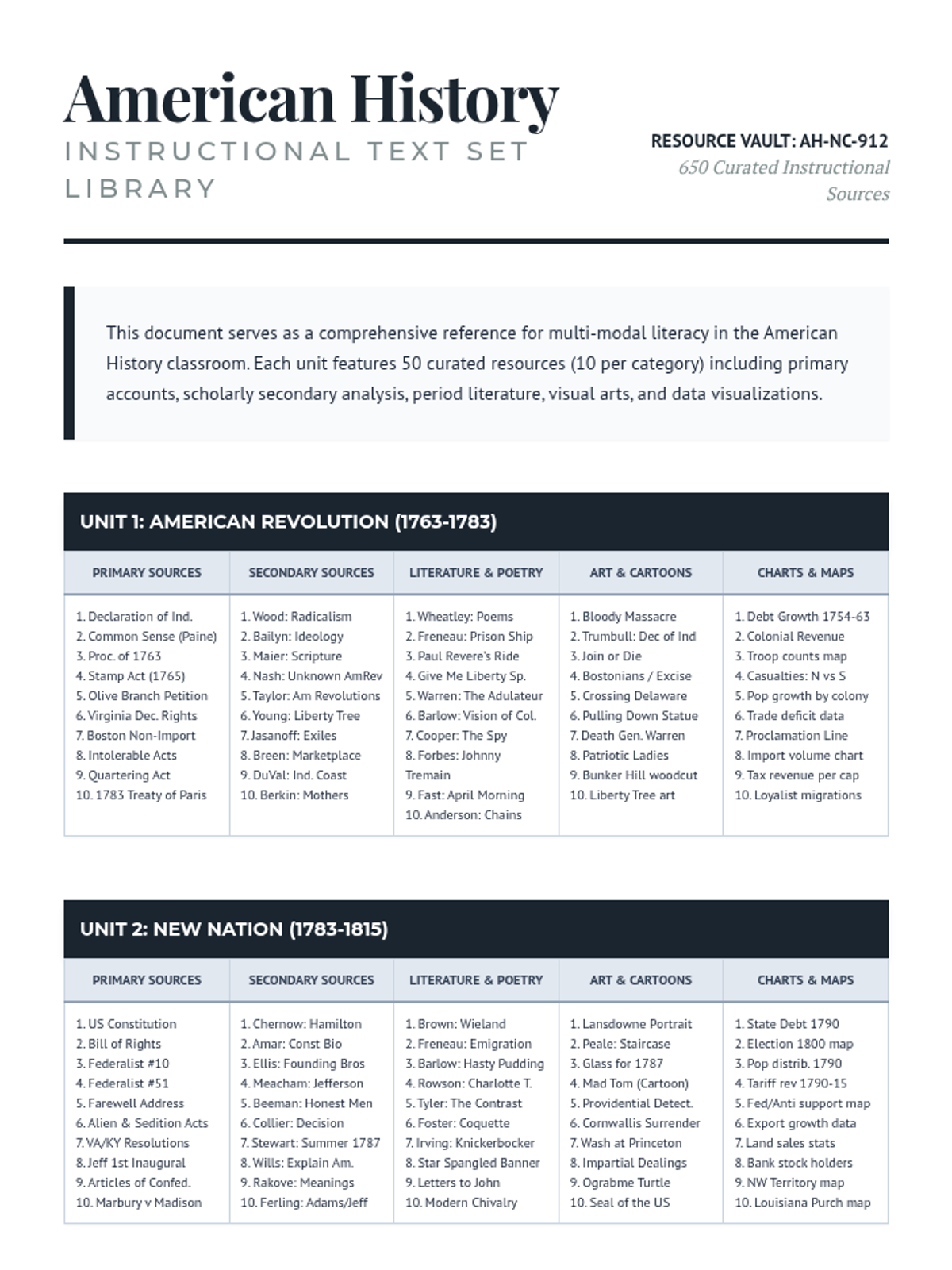
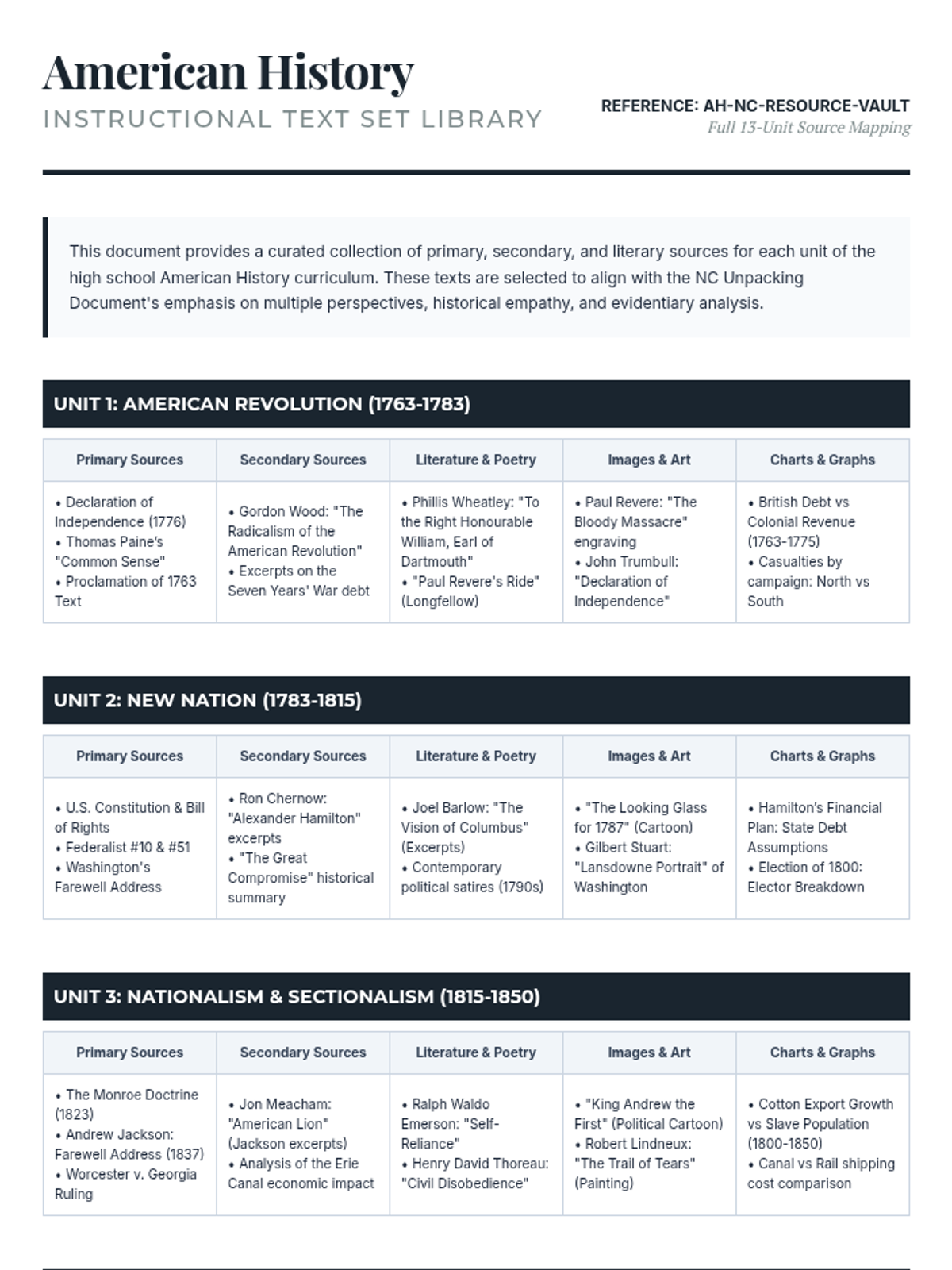
A comprehensive 7-page text set reference document for 13 units of American History, including 10 curated items per column (Primary/Secondary Sources, Literature, Art, and Data) for every unit. Highly dense instructional resource.
A comprehensive text set reference document for 9 units of World History, including curated primary/secondary sources, literature, visual arts, and data visualizations for classroom use. Spanning 1200 C.E. to the present.
A comprehensive text set reference document for 9 units of Civic Literacy, including curated primary/secondary sources, literature, visual arts, and data visualizations for classroom use. Revised for typographical accuracy and improved font legibility.
A comprehensive text set reference document for 13 units of American History, including curated primary/secondary sources, literature, visual arts, and data visualizations for classroom use.
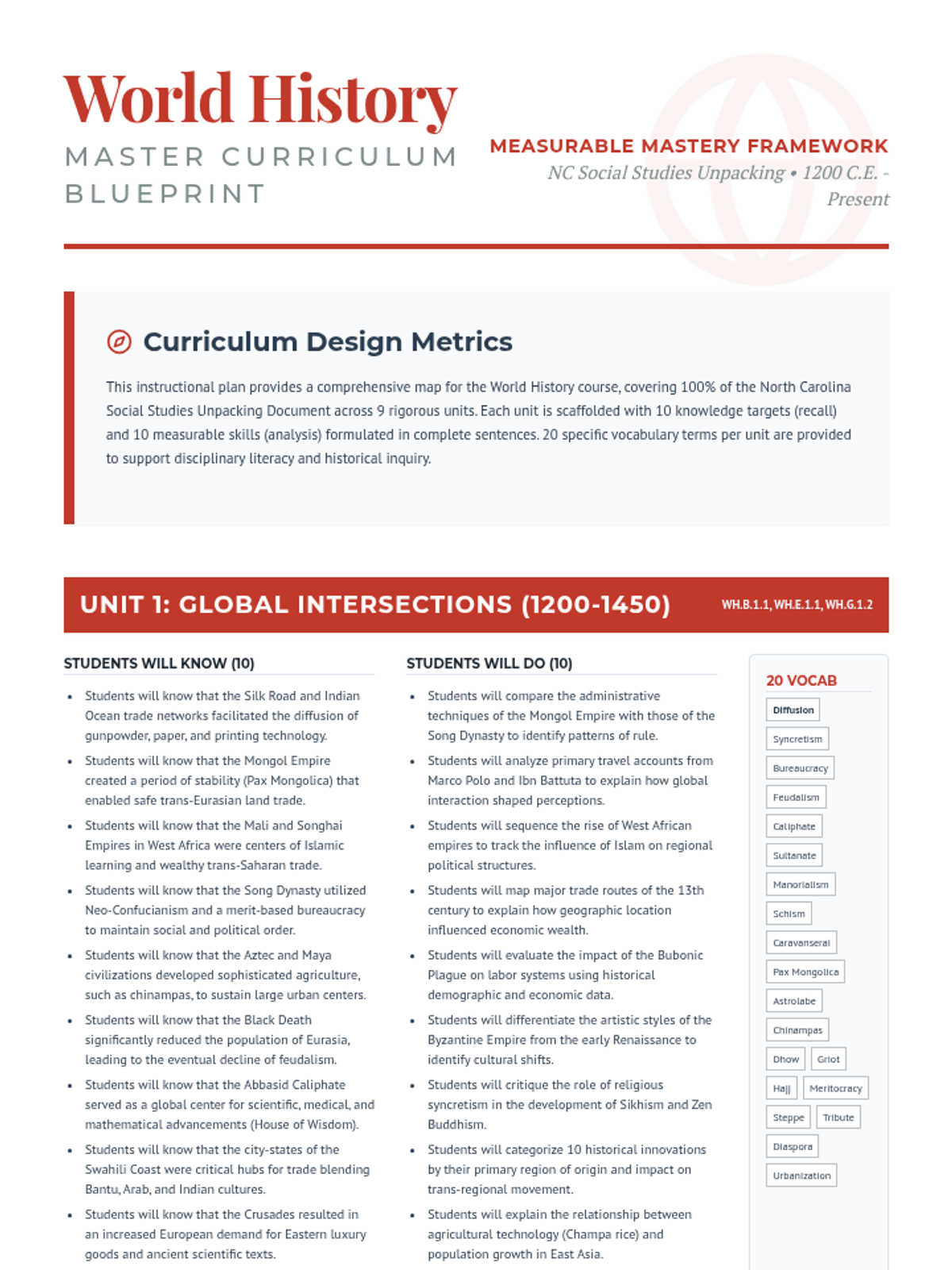
A comprehensive curriculum document for high school World History, detailing 9 instructional units with 10 knowledge and 10 skill goals each (written in full sentences), plus 20 vocabulary words per unit. Spanning 1200 C.E. to present while explicitly mapping all 23 state objectives. Includes a complete standards alignment matrix.
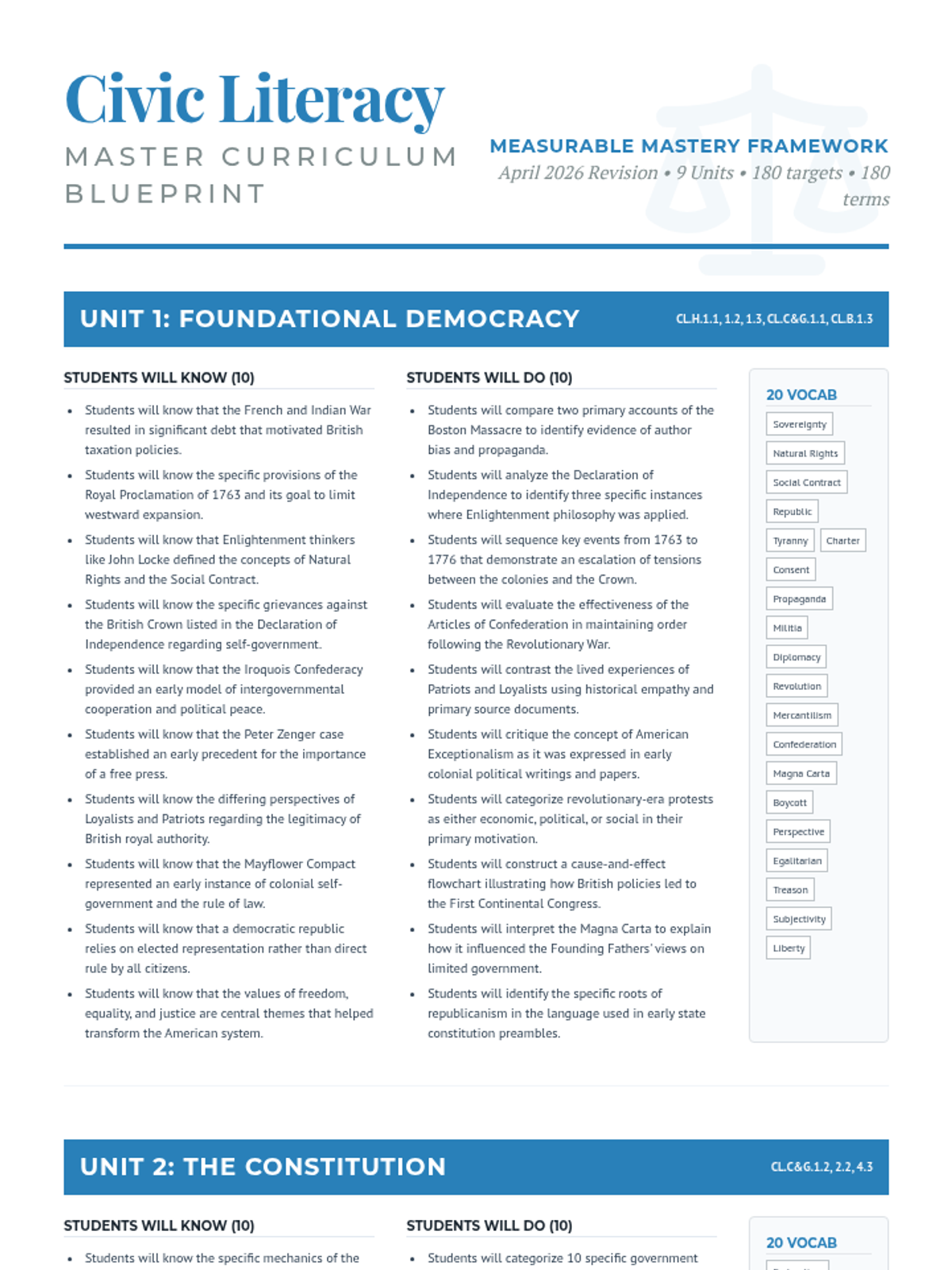
A comprehensive curriculum document for high school Civic Literacy, detailing 9 instructional units with 10 knowledge and 10 skill goals each (written in full sentences), plus 20 vocabulary words per unit. Reorganized into the requested 9 units while explicitly mapping all state objectives. Revised for alignment and polish.
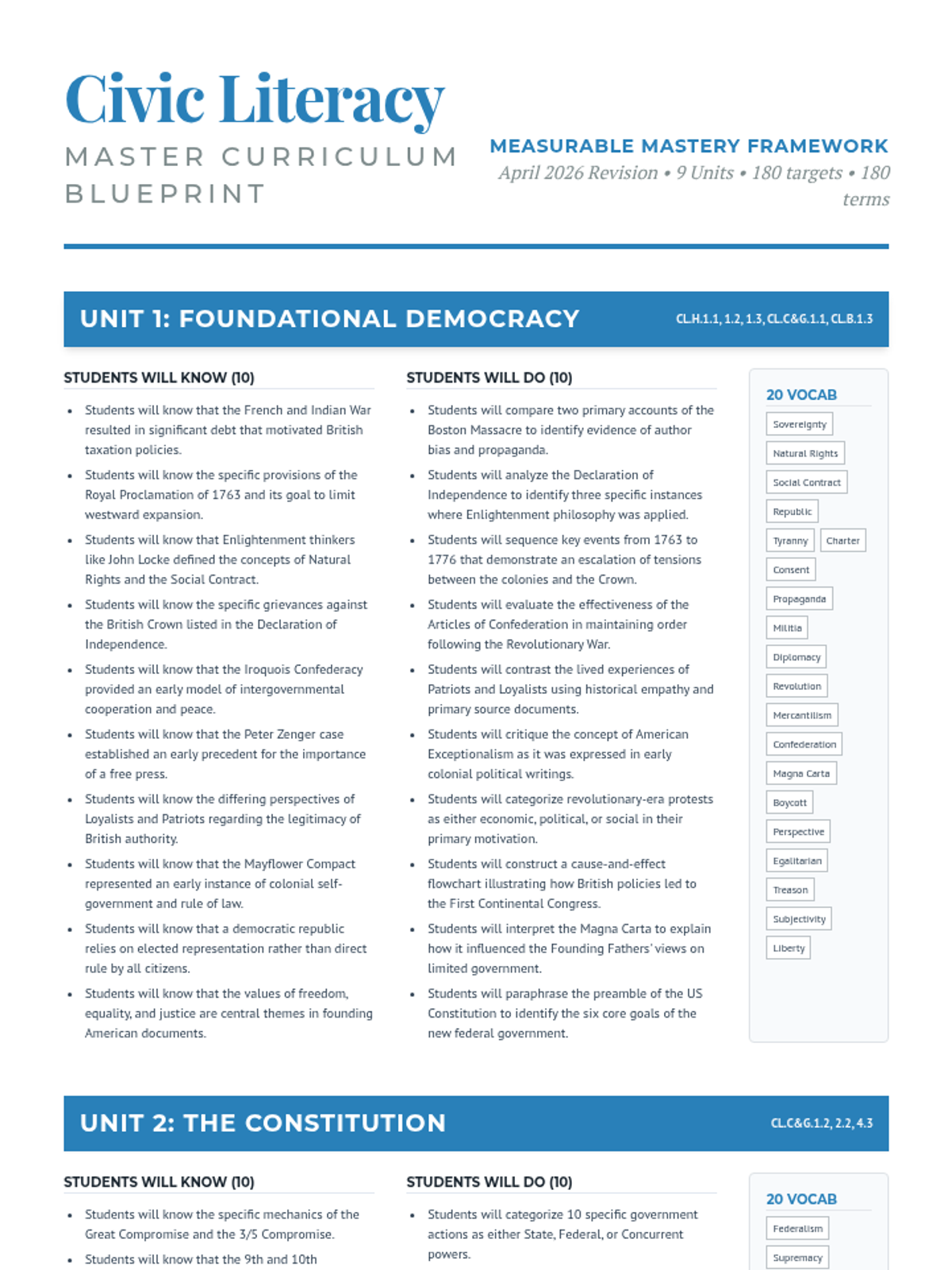
A comprehensive curriculum document for high school Civic Literacy, detailing 9 instructional units with 10 knowledge and 10 skill goals each (written in full sentences), plus 20 vocabulary words per unit. Reorganized into the requested 9 units while explicitly mapping all 35 state objectives.
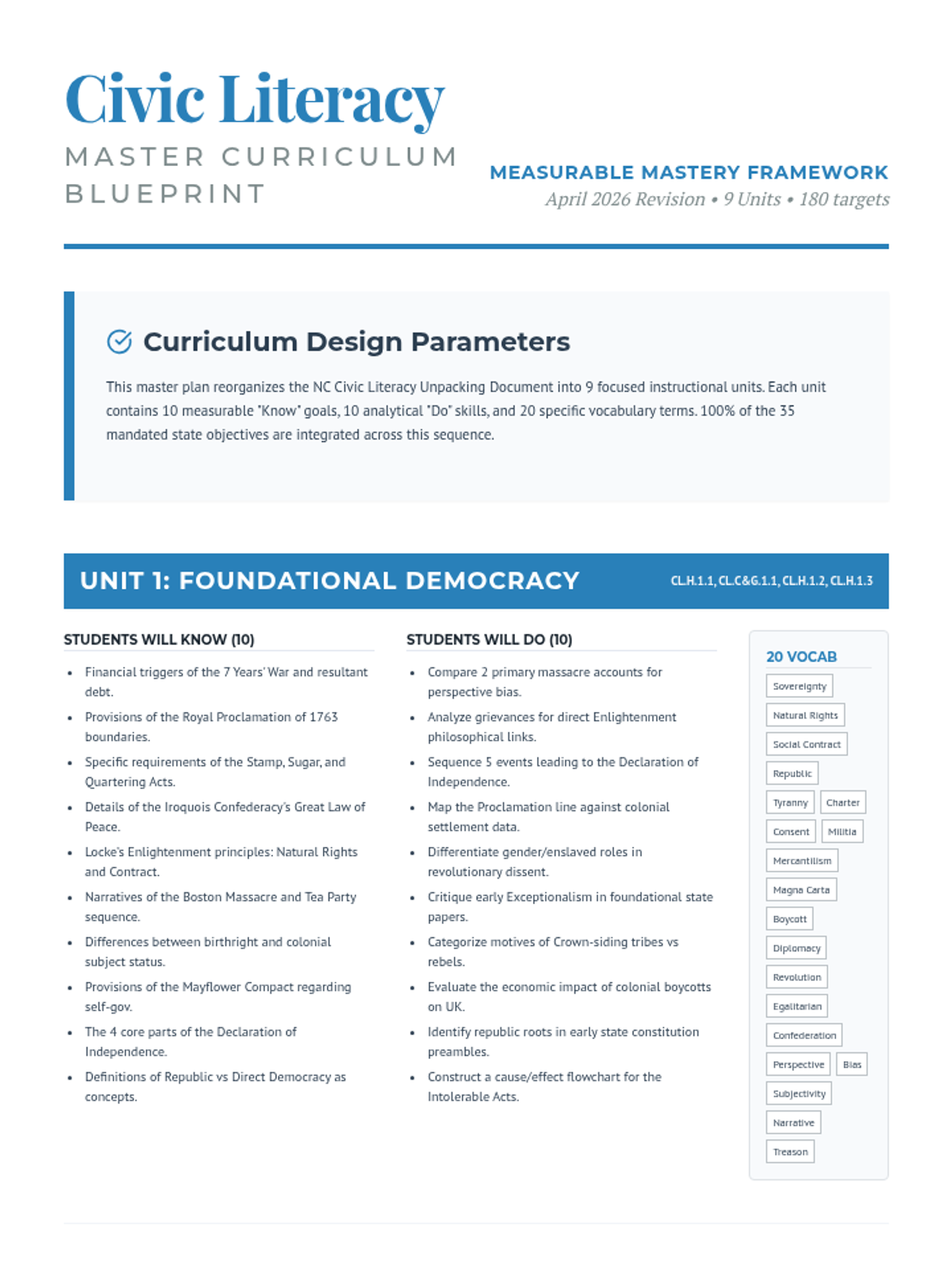
A comprehensive curriculum document for high school Civic Literacy, detailing 9 instructional units with 10 knowledge and 10 skill goals each, plus 20 vocabulary words per unit. Reorganized as requested while explicitly mapping all 35 state objectives.
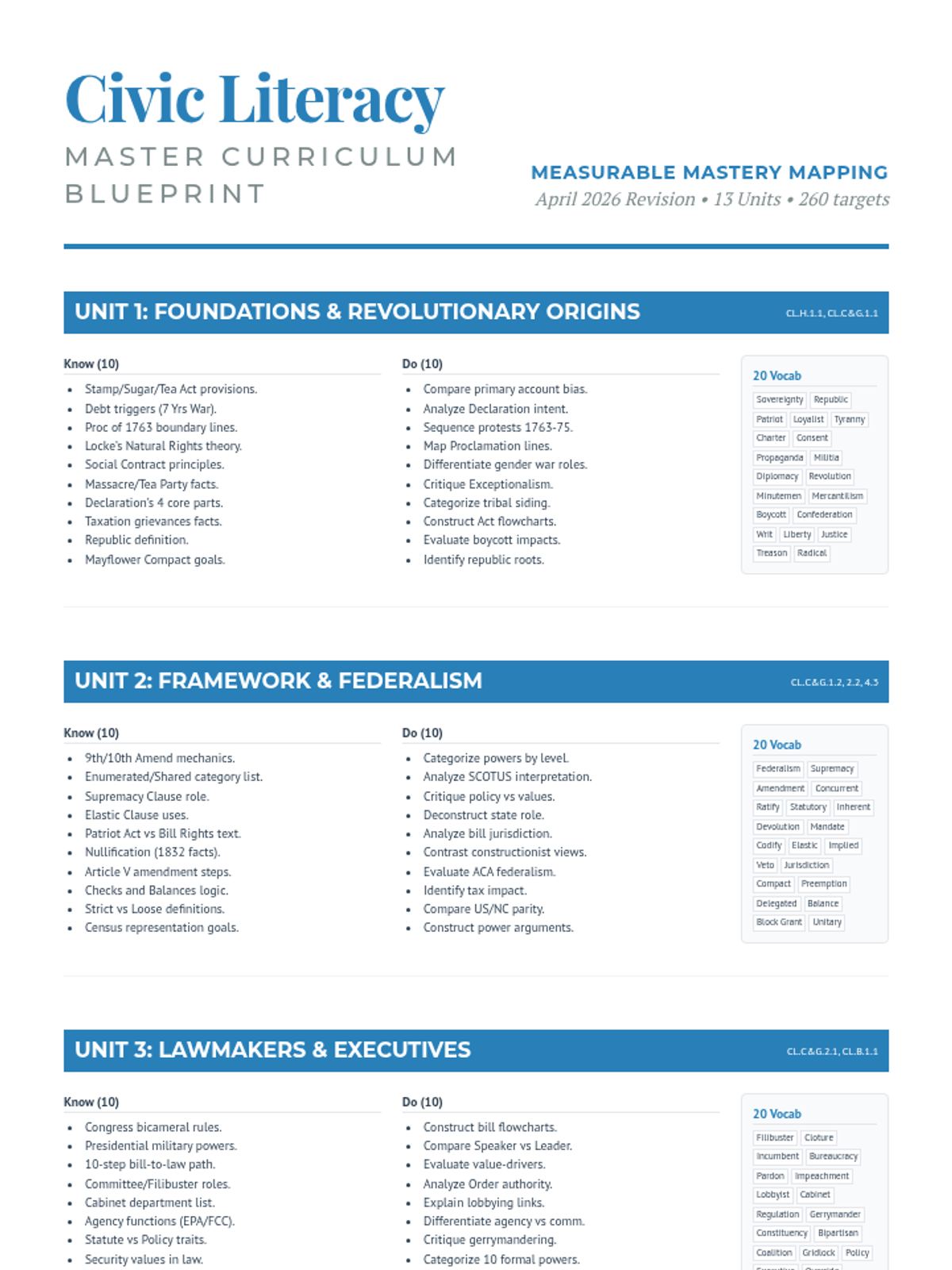
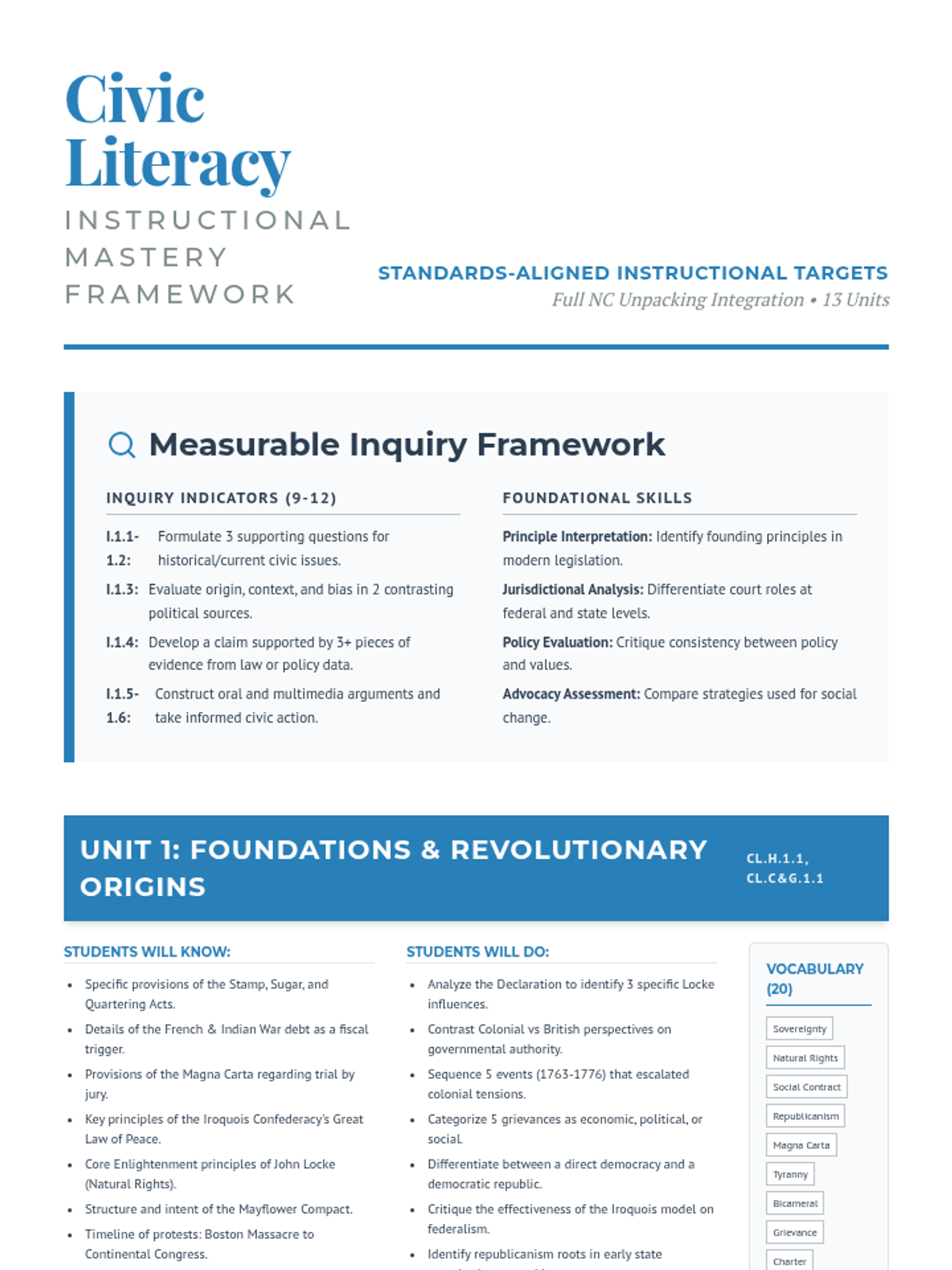
A comprehensive 7-page curriculum document for high school Civic Literacy, detailing 13 instructional units with 10 knowledge and 10 skill goals each (260 total), plus 20 vocabulary words per unit. Explicitly mapped to all state objectives and designed for measurement and rigor. Includes a complete standards alignment matrix.
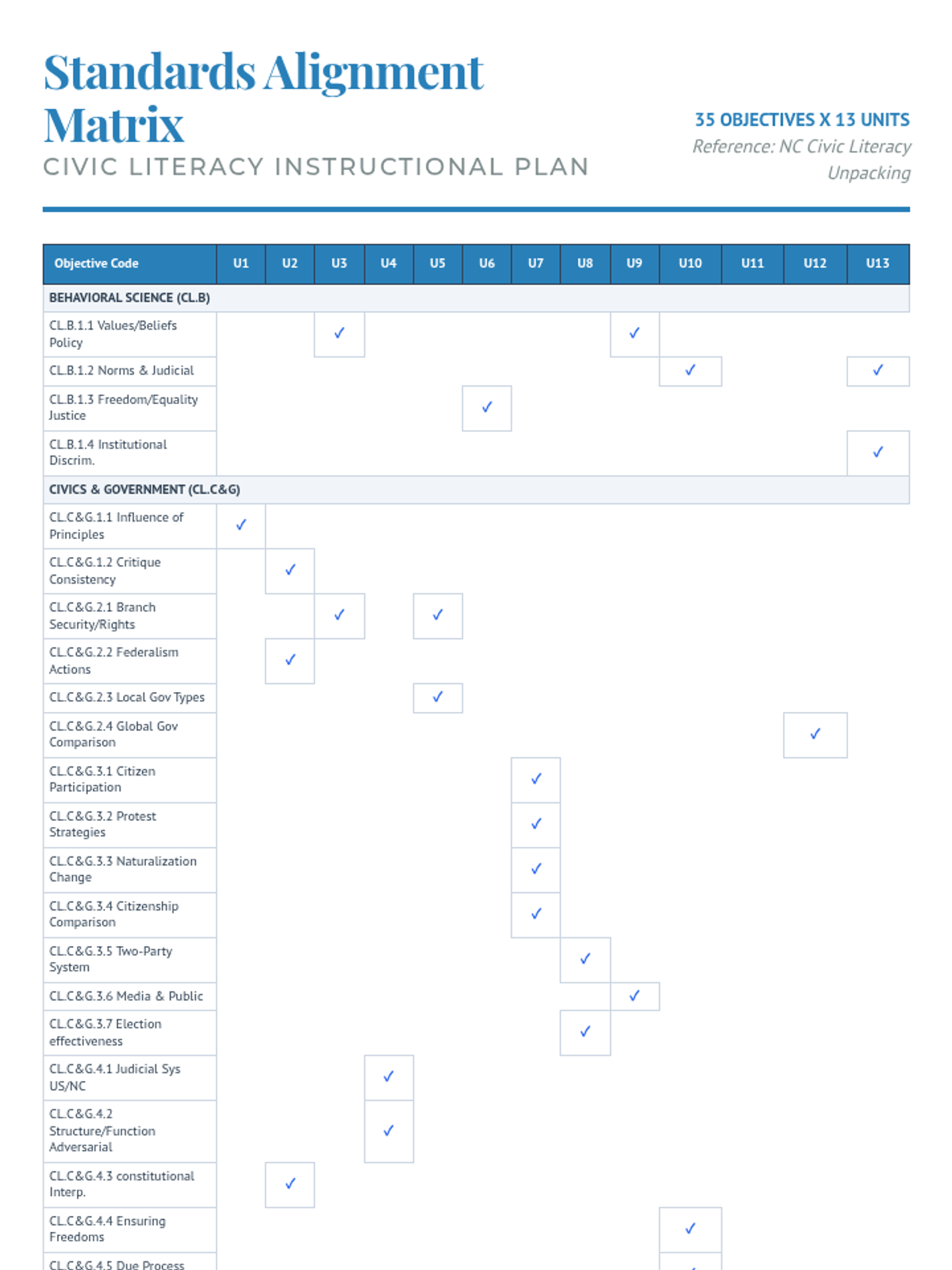
A detailed standards alignment matrix that cross-lists the 35 state objectives against the 13 units of the Civic Literacy curriculum, providing visual verification of 100% standard coverage.
A comprehensive 7-page curriculum document for high school Civic Literacy, detailing 13 instructional units with 10 knowledge and 10 skill goals each (260 total), plus 20 vocabulary words per unit. Explicitly mapped to all state objectives and designed for measurement and rigor.
A vibrant 29-slide presentation outlining the 13-unit American History curriculum, highlighting the explicit mapping of all 35 state objectives and the scaffolding of student learning goals (Know/Do). Expanded to include full 10/10 goals and 20 vocab terms per unit. Revised for measurement and rigor.
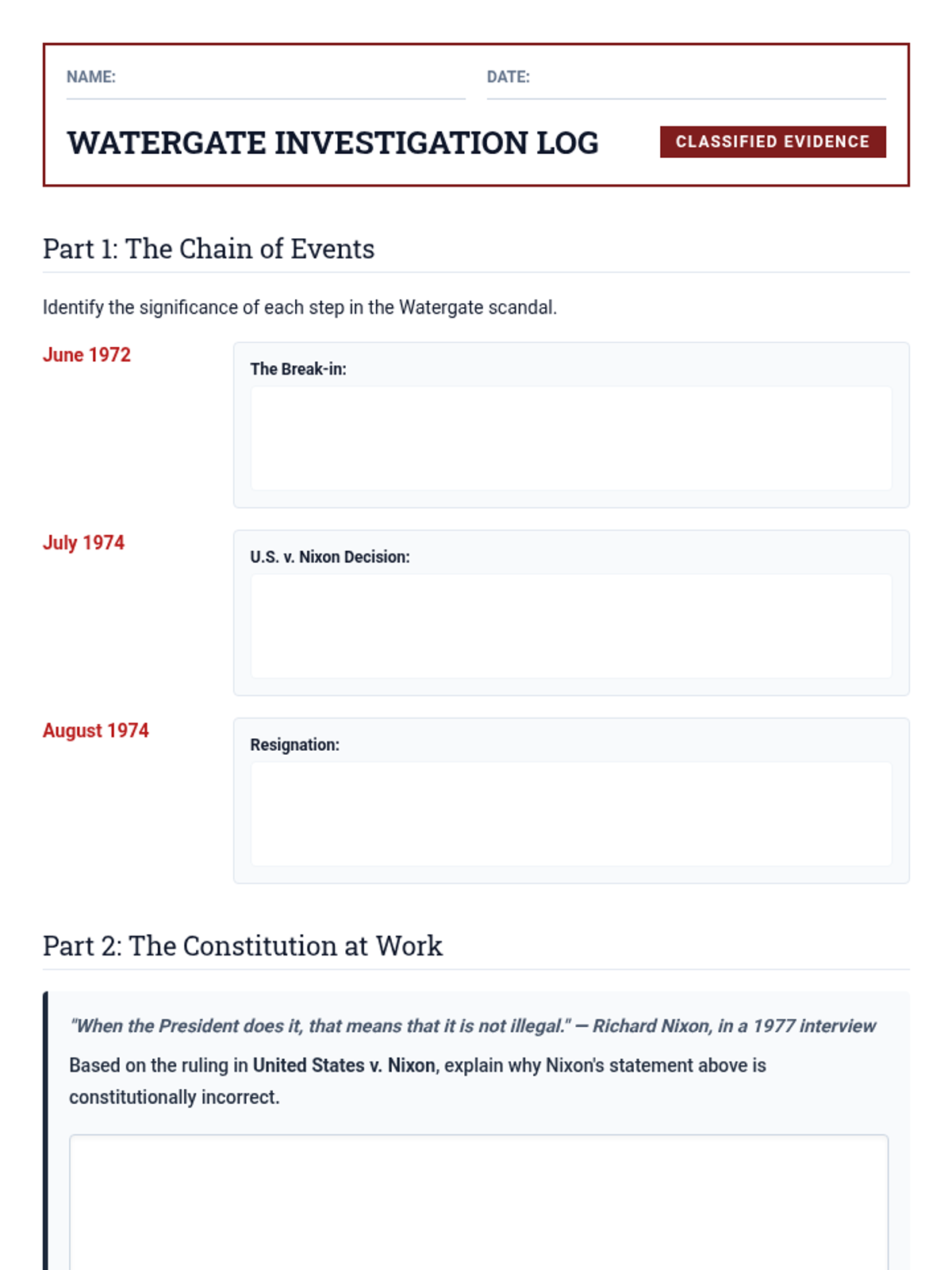
Student worksheet for Lesson 5, featuring a Watergate timeline, analysis of US v. Nixon, and a final unit reflection on the legacy of the 1960-1980 era.
Instructional slides for Lesson 5, covering the Watergate scandal, the Supreme Court decision in US v. Nixon, and the broader political and cultural legacy of the era.
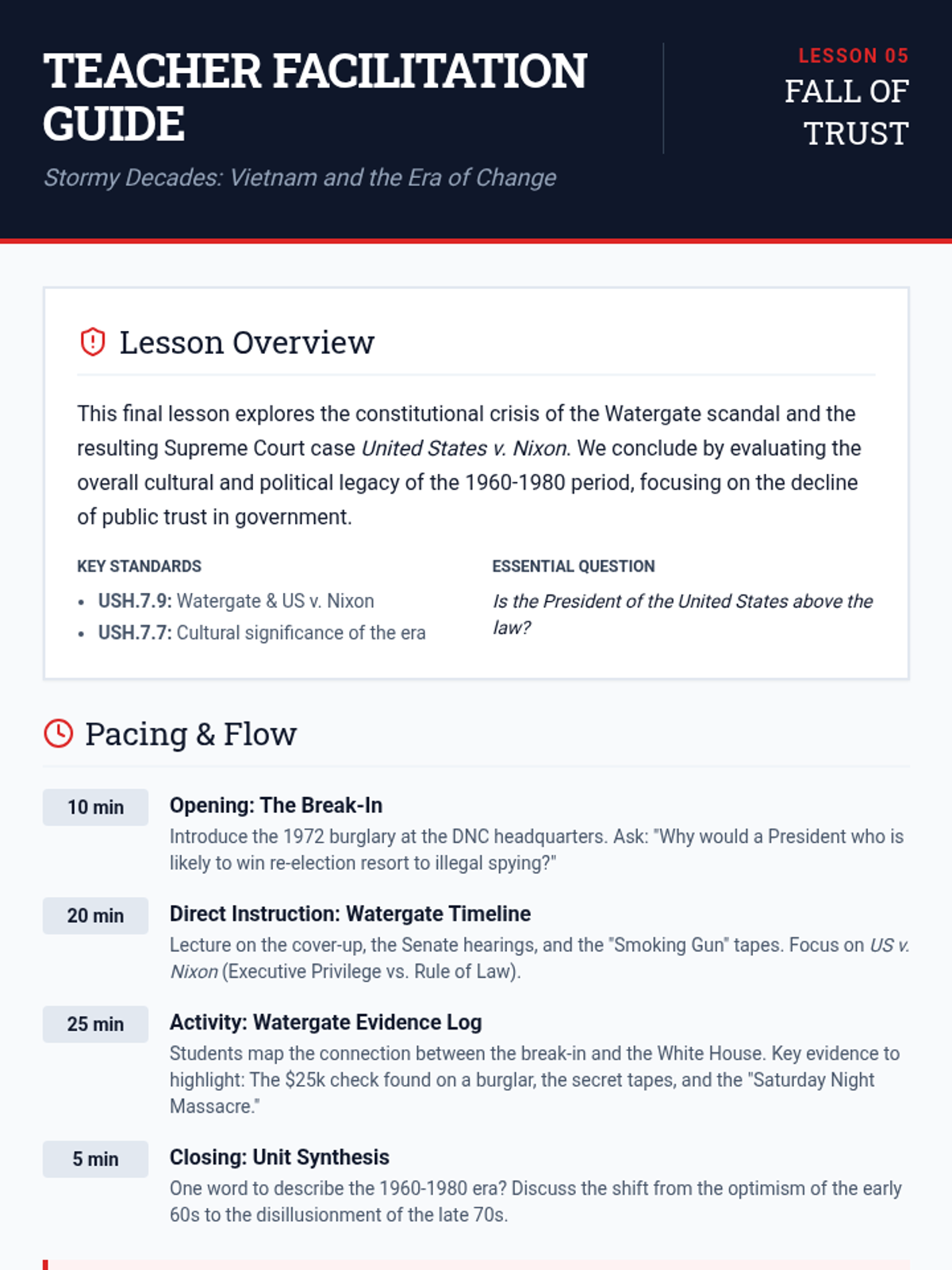
Teacher facilitation guide for Lesson 5, focusing on the Watergate scandal, the Supreme Court's ruling in US v. Nixon, and the unit's final synthesis.
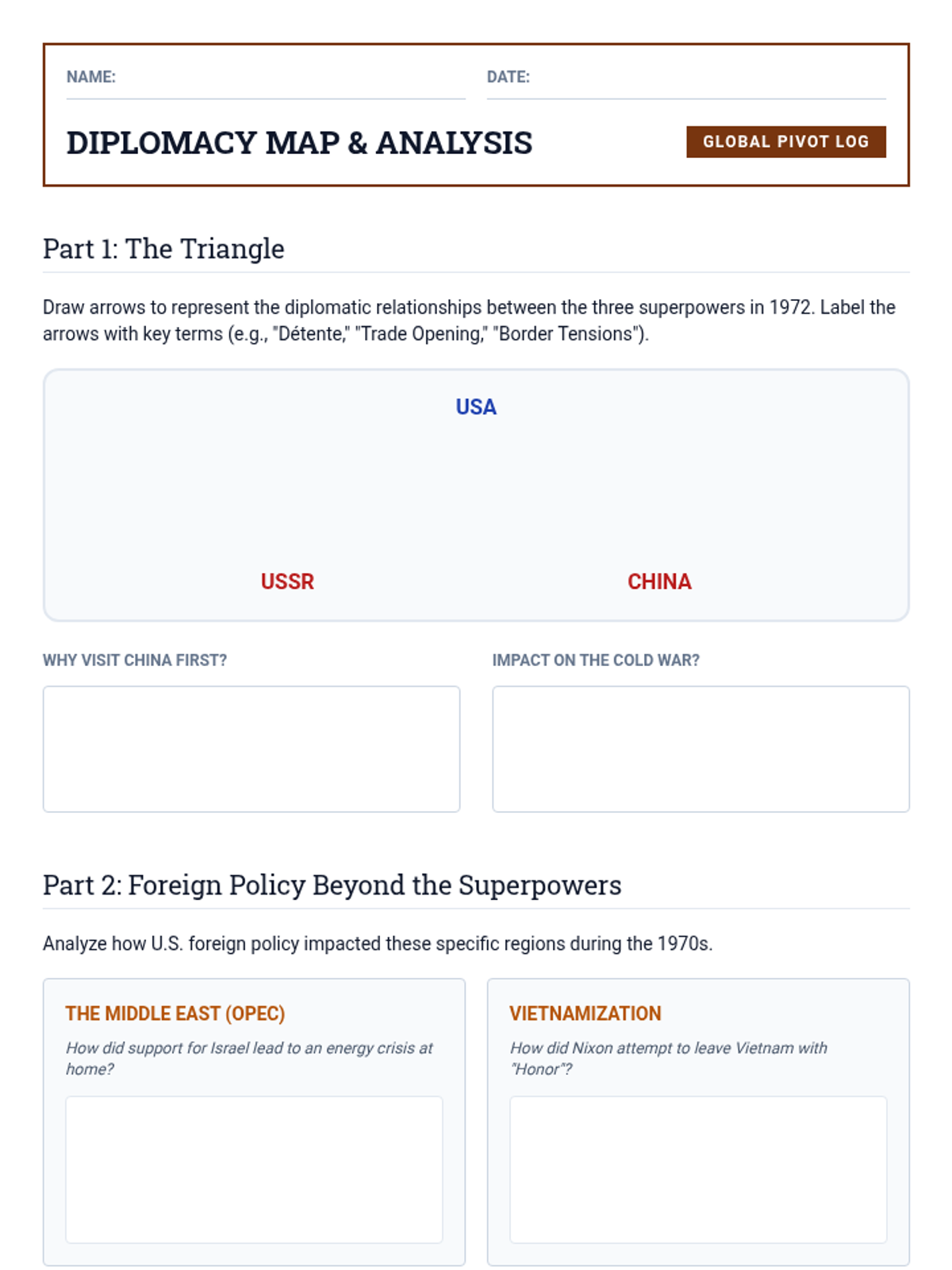
Student worksheet for Lesson 4, featuring a triangular diplomacy mapping exercise and analysis of 1970s foreign policy in the Middle East and Vietnam.
Instructional slides for Lesson 4, illustrating the concept of Realpolitik, the diplomatic opening of China, SALT I, and the policy of Vietnamization.
Teacher facilitation guide for Lesson 4, detailing Nixon's Realpolitik, détente with the USSR, and the diplomatic opening to China.
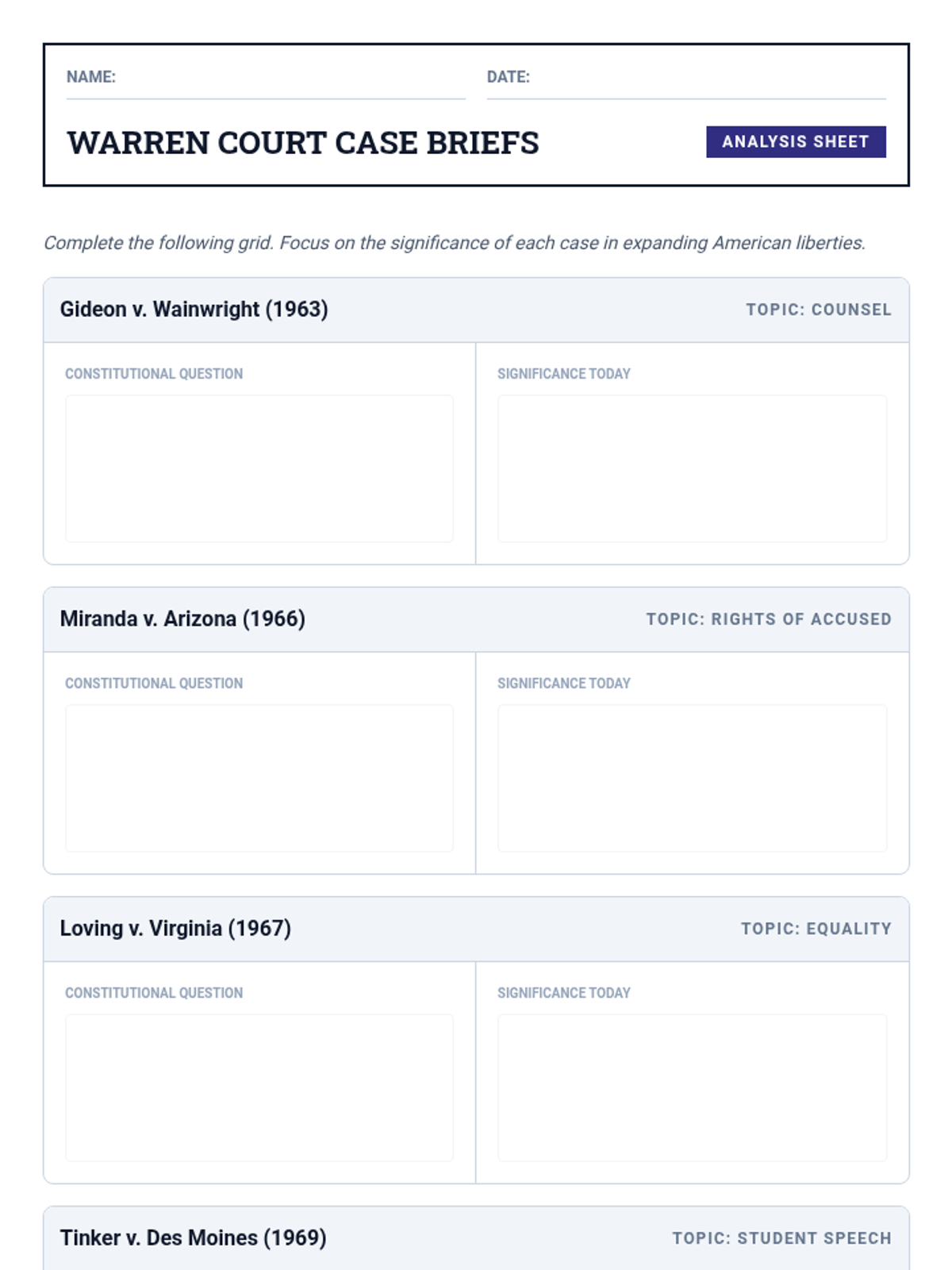
Student graphic organizer for Lesson 3, used to analyze and summarize the significance of key Warren Court decisions.
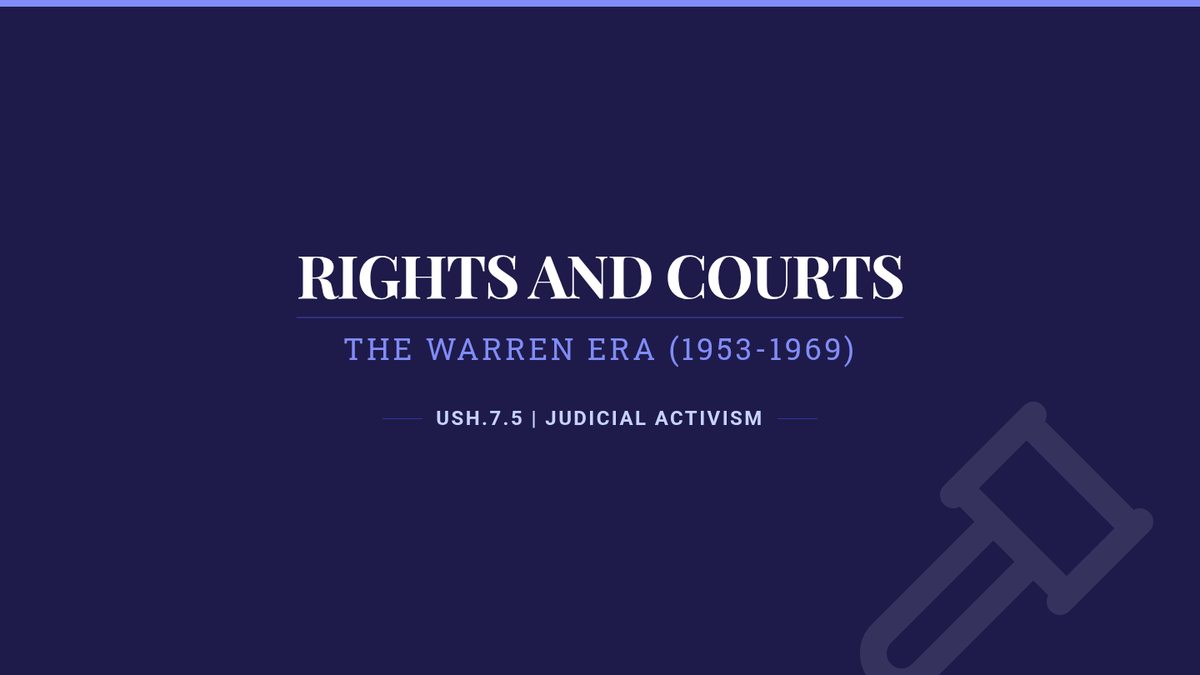
Instructional slides for Lesson 3, covering the concept of judicial activism and the landmark Warren Court cases like Gideon, Miranda, and Tinker.
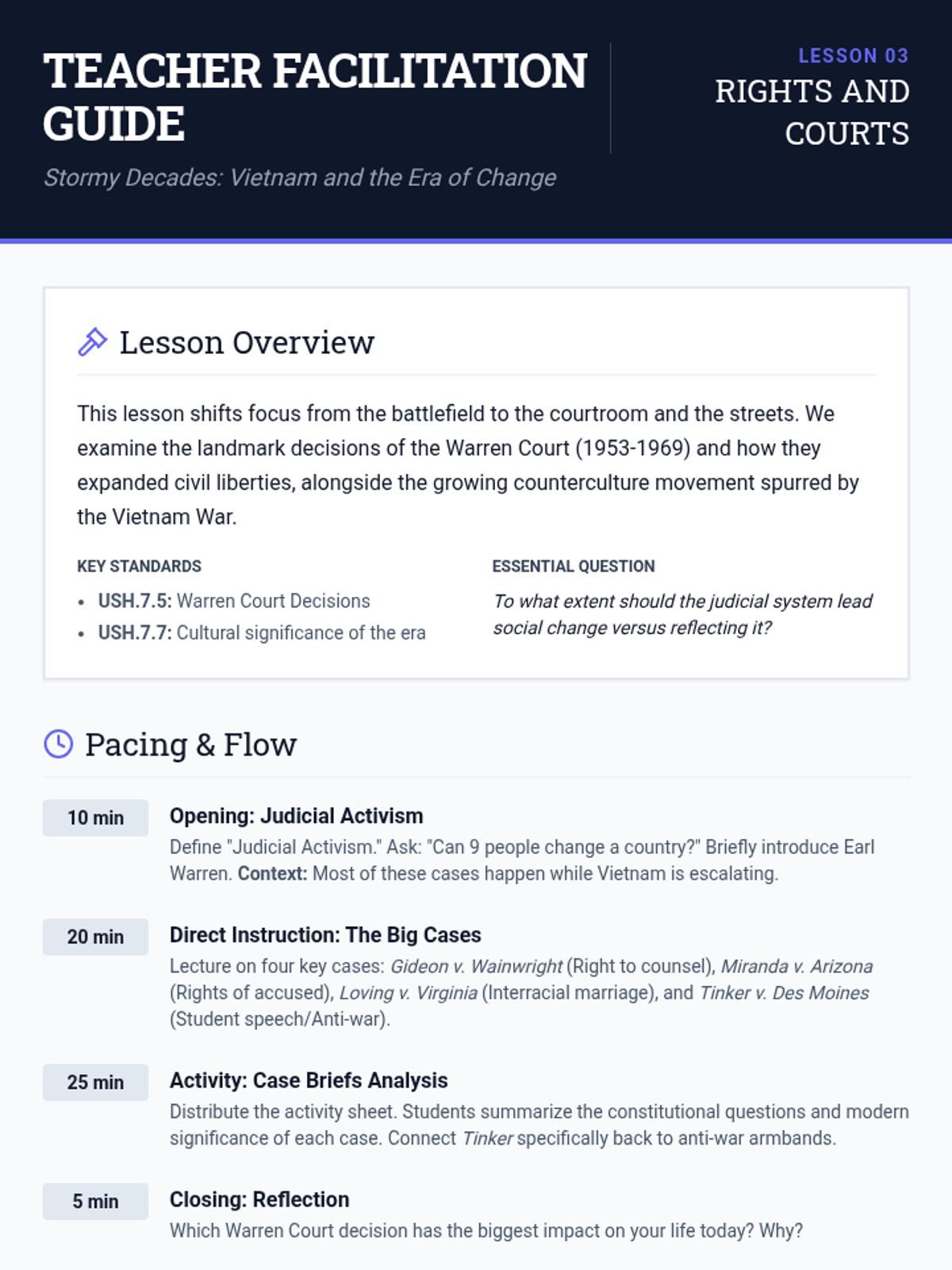
Teacher facilitation guide for Lesson 3, covering the Warren Court's major decisions and their intersection with the social climate of the Vietnam era.
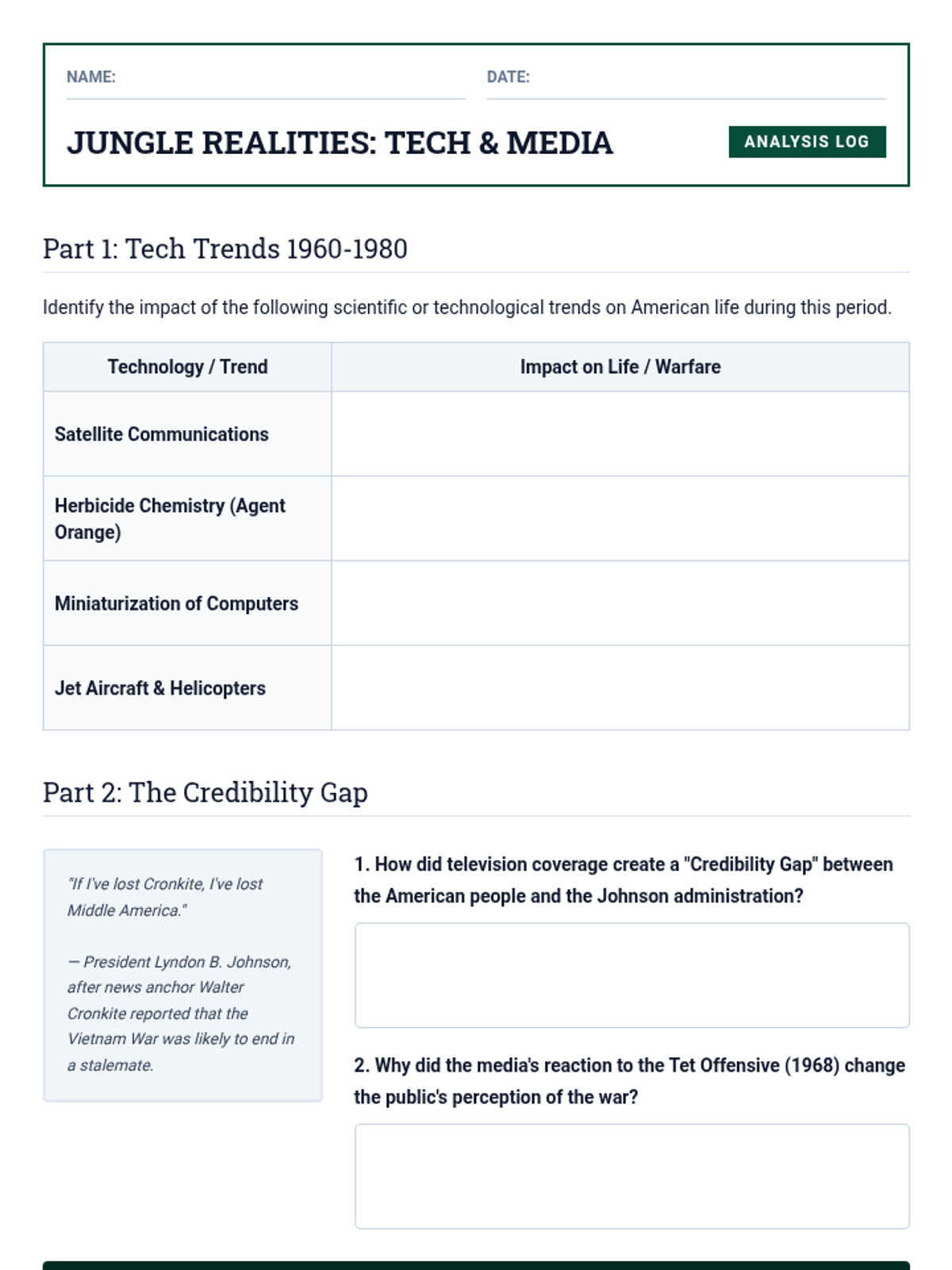
Student worksheet for Lesson 2, analyzing the impact of 1960s tech trends and media on American perception of the Vietnam War and the 'Credibility Gap'.
Instructional slides for Lesson 2, exploring the Space Race, chemical weaponry (Napalm, Agent Orange), and the societal impact of the first televised war.
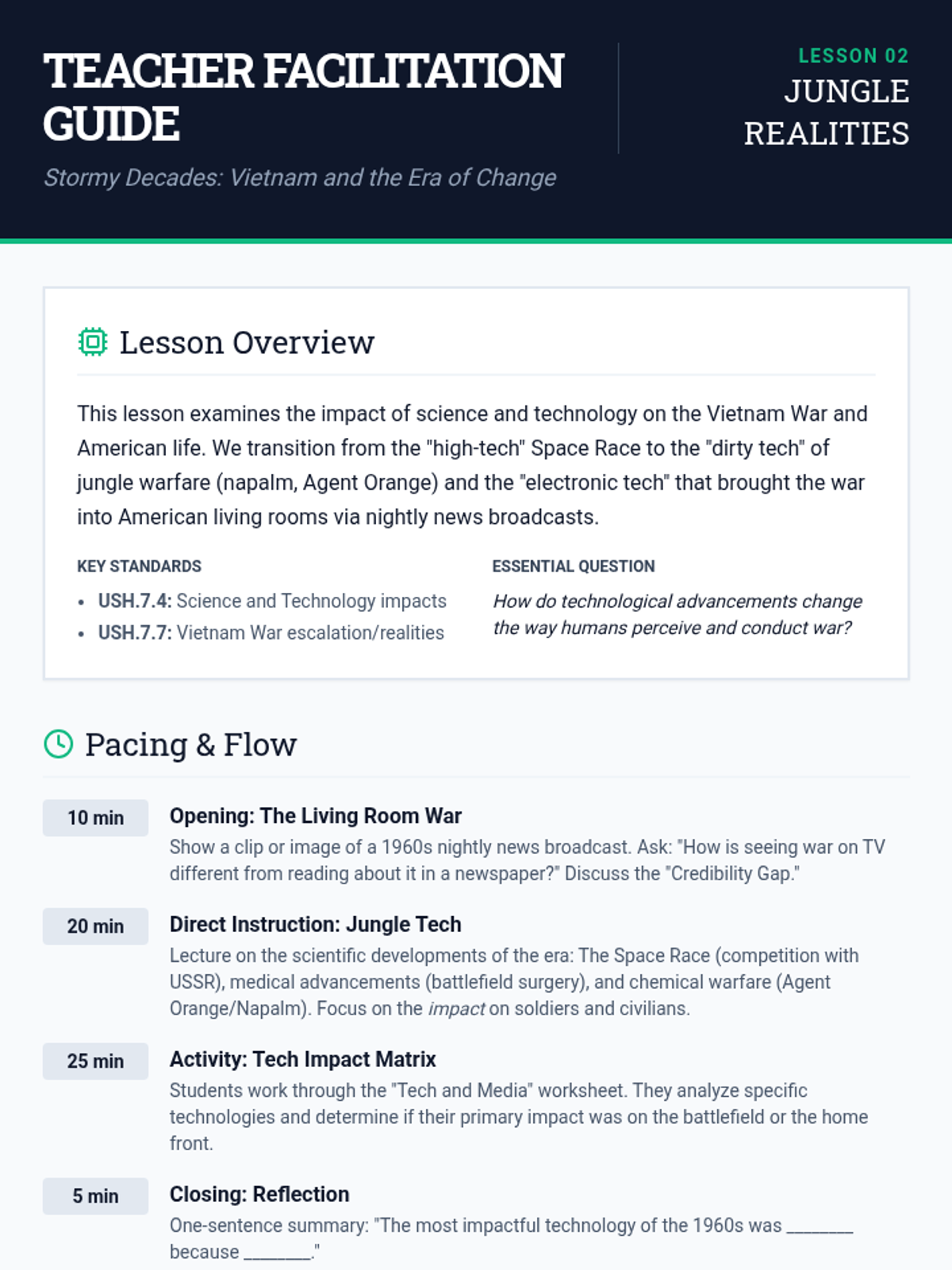
Teacher guide for Lesson 2, focusing on the intersection of 1960s technology, media, and the realities of the Vietnam War. Includes pacing and discussion prompts.
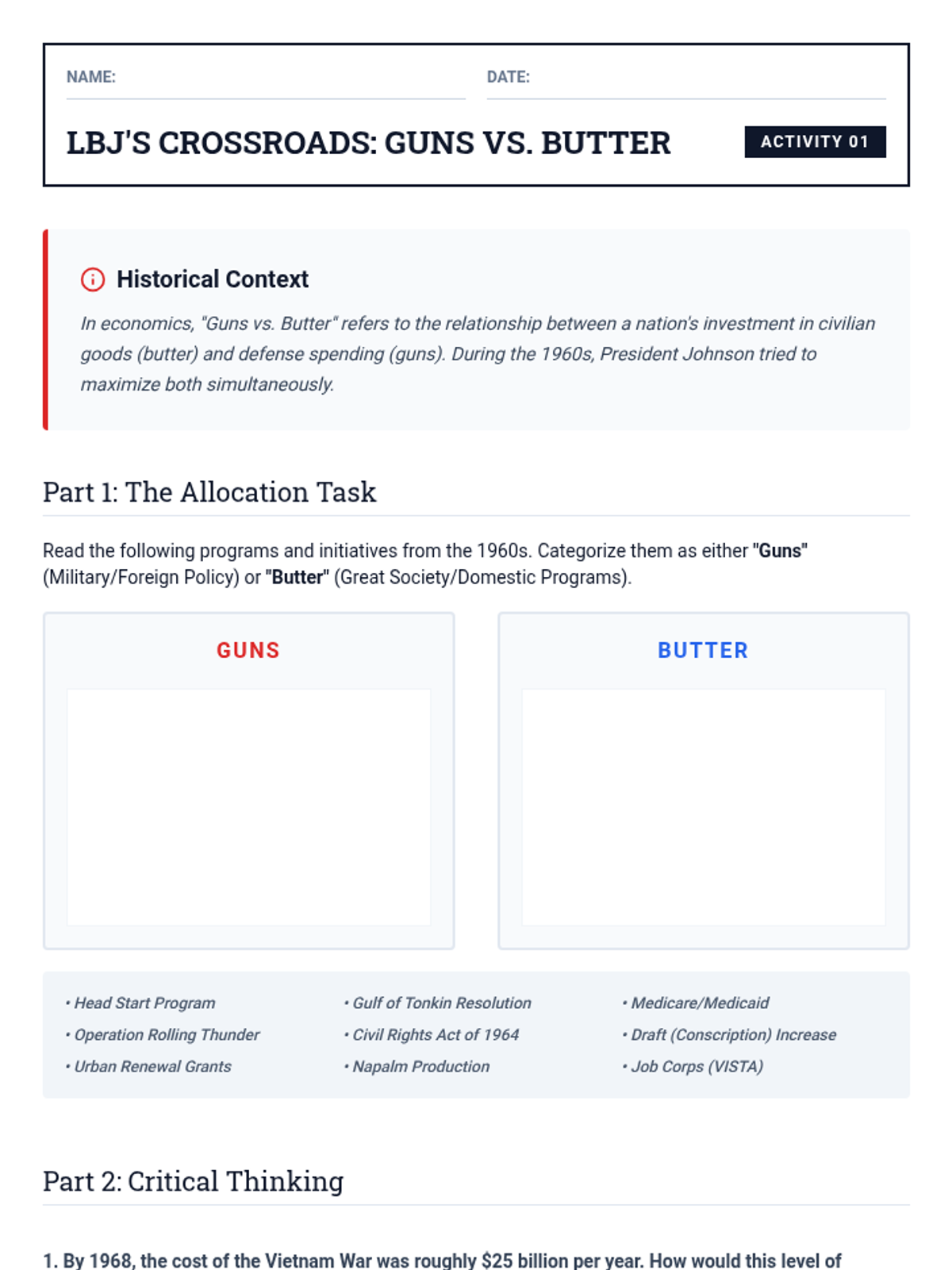
A student worksheet for Lesson 1 where students categorize 1960s initiatives into 'Guns' or 'Butter' and analyze the impact of war spending on social programs.
Instructional slides for Lesson 1, illustrating the Great Society programs, the Gulf of Tonkin Resolution, and the economic conflict between domestic and military spending.
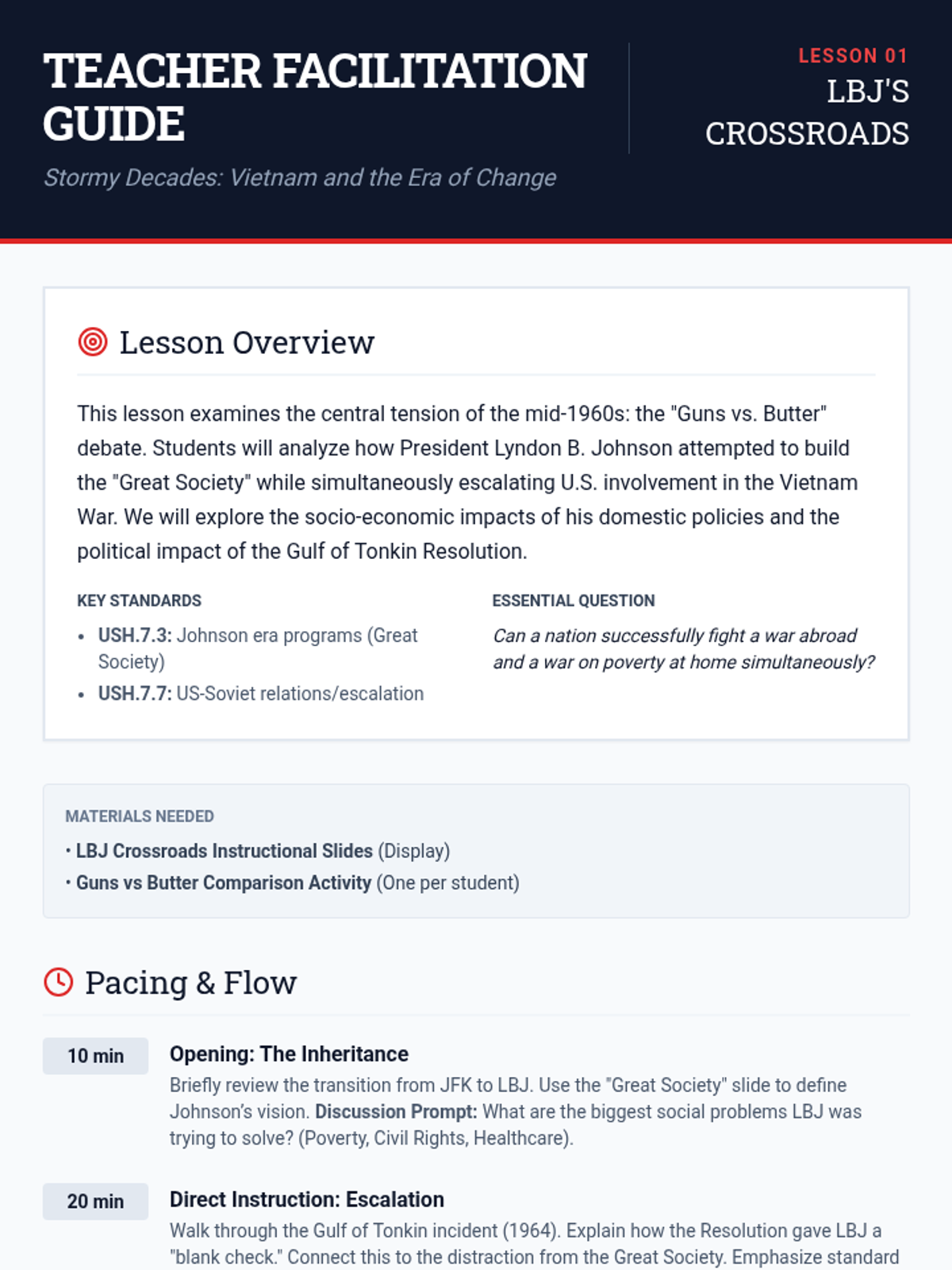
A teacher's facilitation guide for Lesson 1, detailing the 'Guns vs. Butter' debate, lesson pacing, and instructional strategies for teaching LBJ's Great Society and Vietnam escalation.
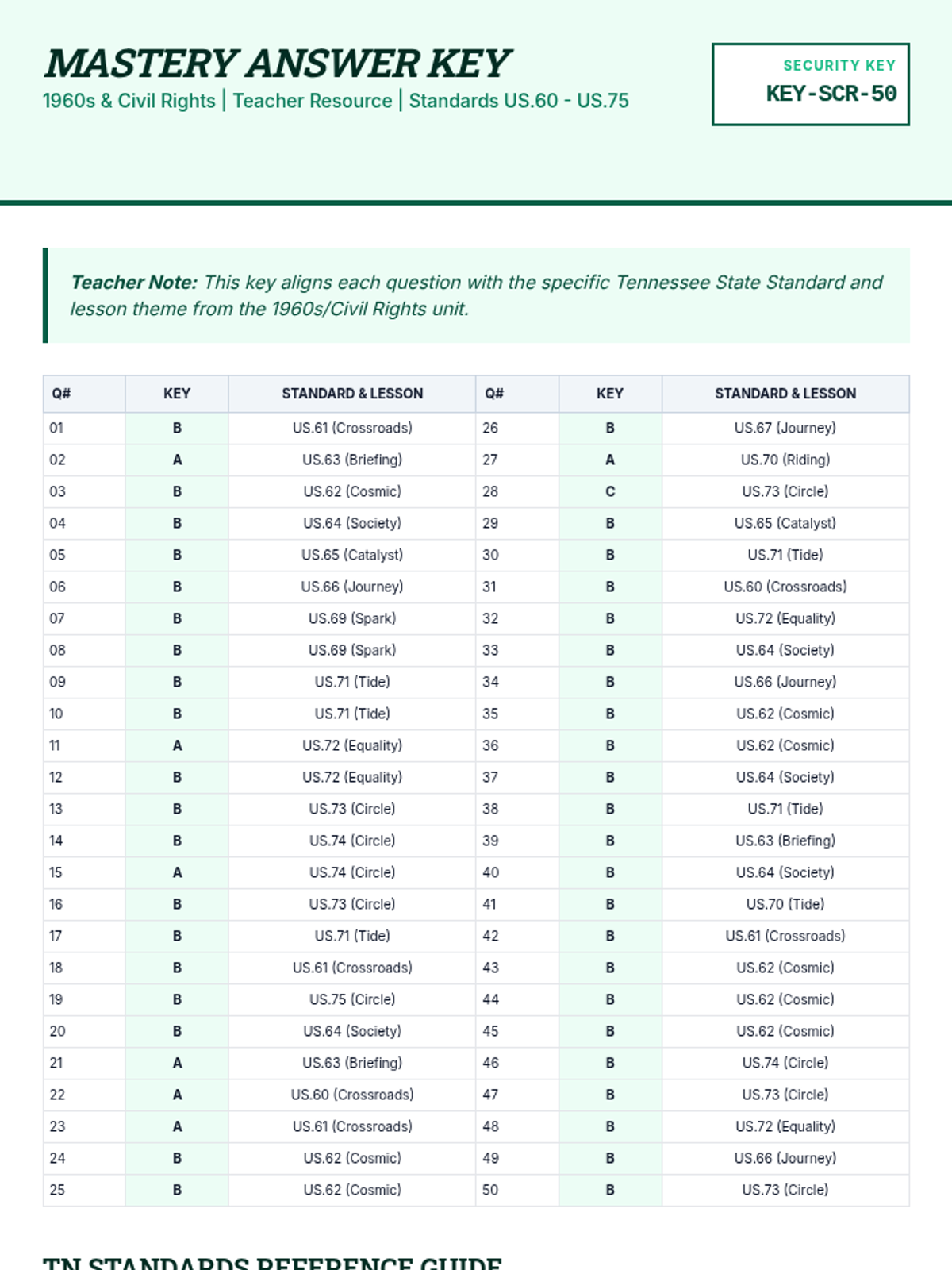
A comprehensive teacher answer key for the 50-question Sixties and Civil Rights Mastery Test, providing correct answers and Tennessee State Standard mapping for all items. Randomized distribution for grading integrity. Corrected contrast and layout.
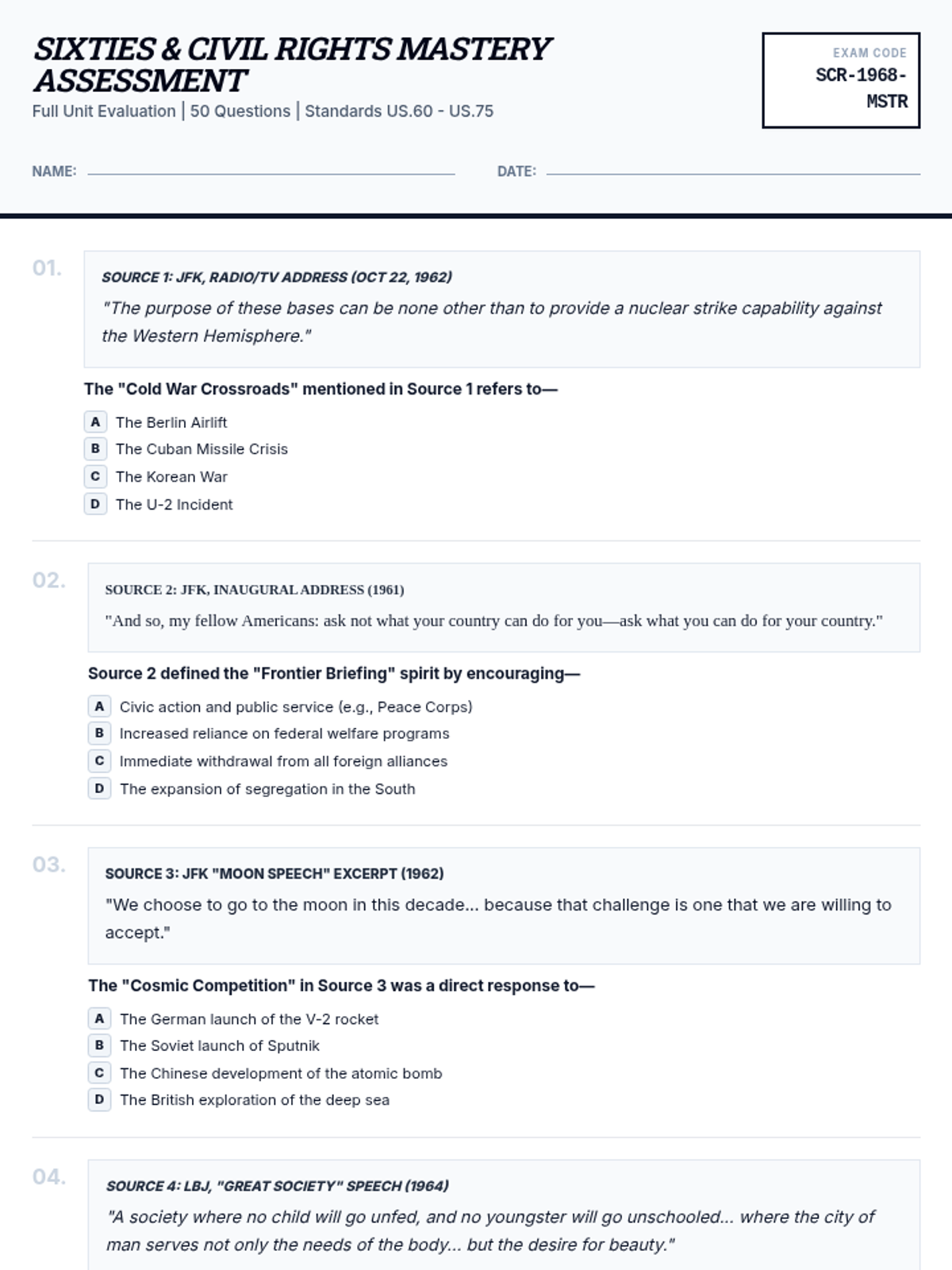
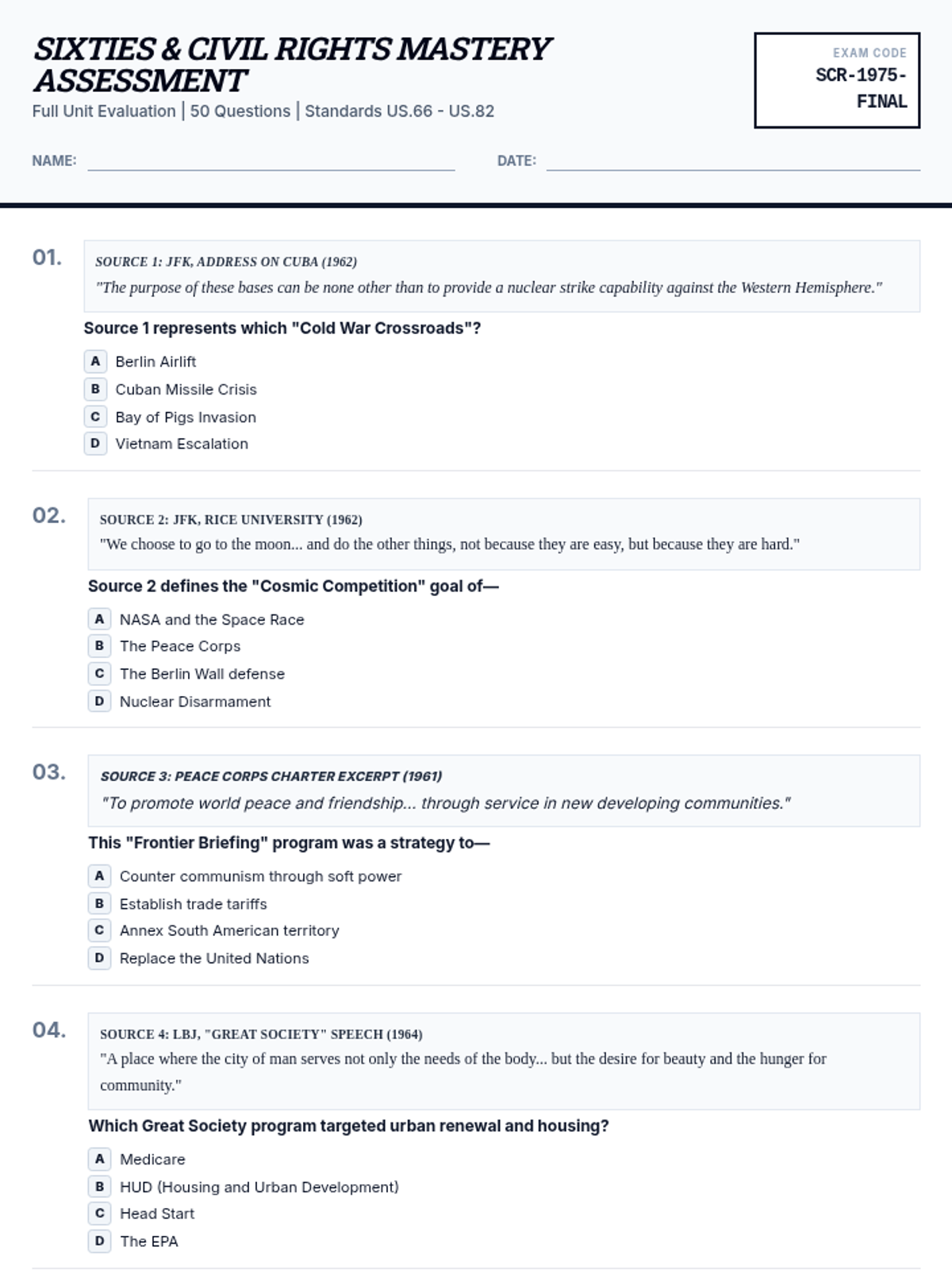
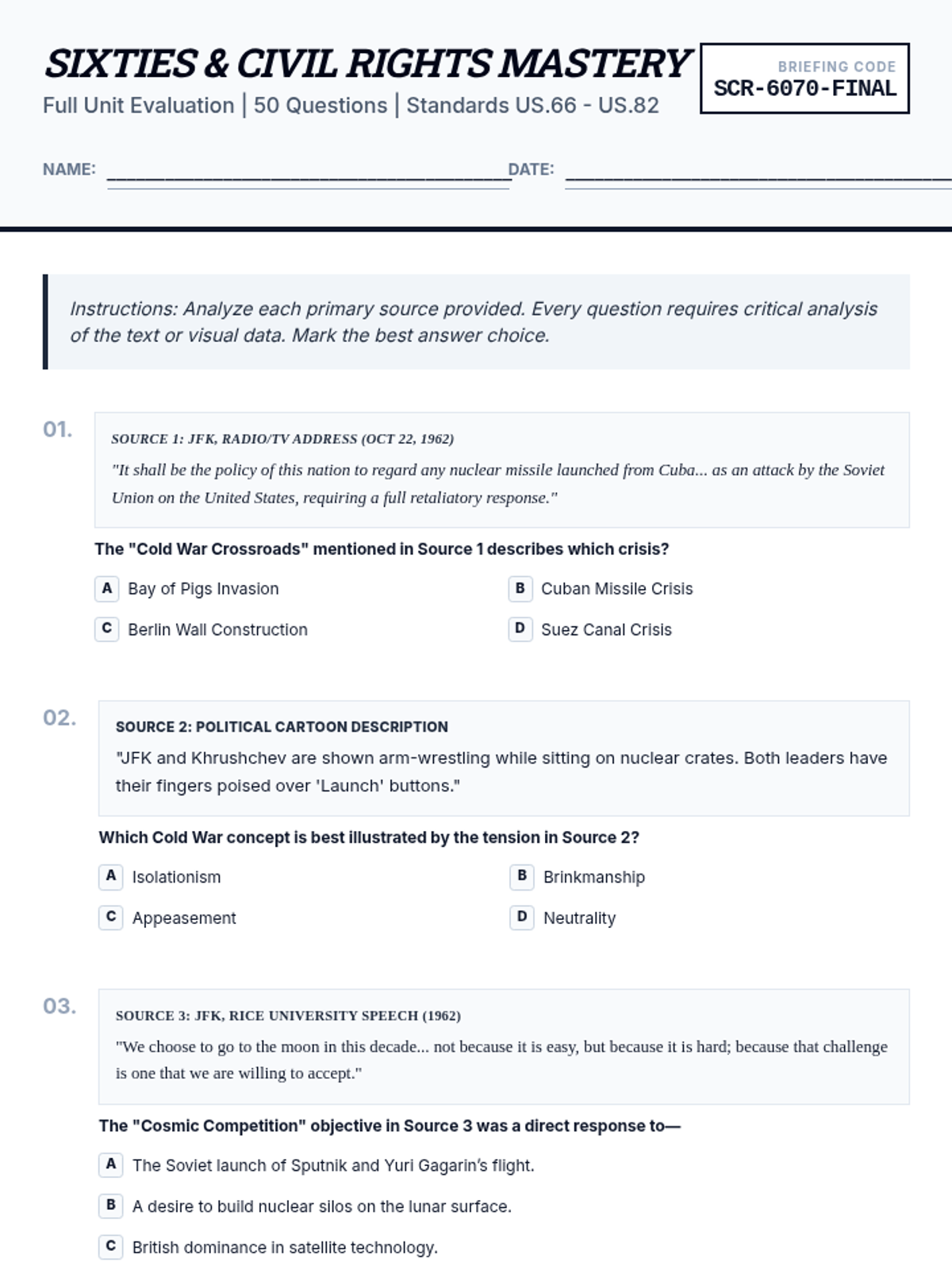
A comprehensive 50-question mastery test for the 1960s and Civil Rights Era, featuring 100% primary source analysis. Covers the New Frontier, Great Society, Space Race, and the various civil rights movements for women, Latinos, and Native Americans. Includes a teacher answer key with TN state standards.
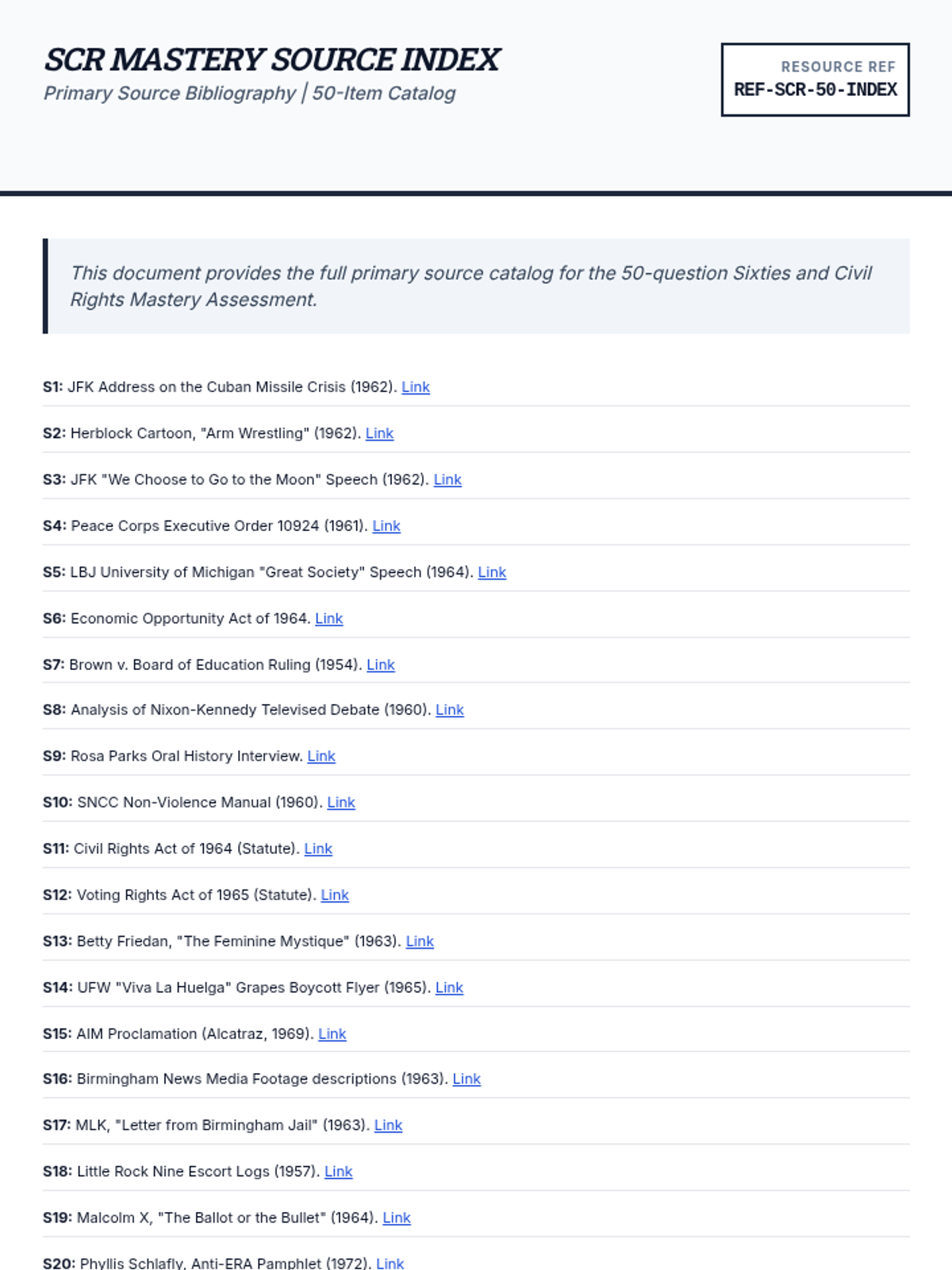
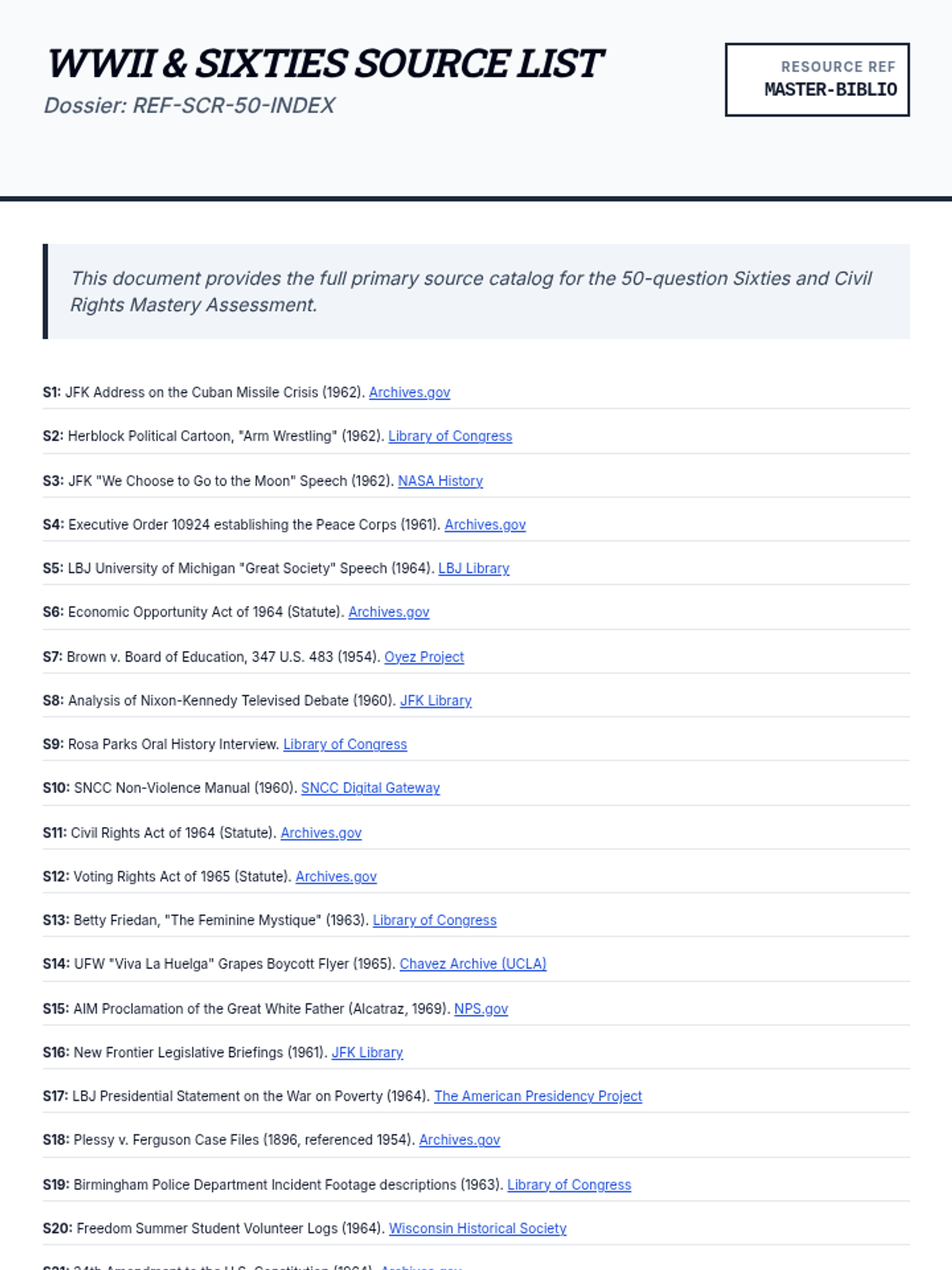
A comprehensive primary source bibliography for the 50-question Sixties and Civil Rights Mastery Test, including names, dates, historical context, and deep links to official archives for all 50 items used in the assessment. Fully authored with 50 specific entries.
A comprehensive 50-question mastery test for the 1960s and Civil Rights Era, featuring 100% primary source analysis. Covers the New Frontier, Great Society, Space Race, and the various civil rights movements for women, Latinos, and Native Americans. Includes a teacher answer key with TN state standards. Optimized for paper efficiency with 4-5 questions per page. Fulfills the 50-question requirement. Corrected typos and authoring gaps.
A comprehensive primary source bibliography for the 50-question Sixties and Civil Rights Mastery Test, including names, dates, historical context, and deep links to official archives for all 50 items used in the assessment.
A 'Case Study' worksheet that uses detailed textual snapshots of real London locations (Brixton, Brick Lane, Battersea) to illustrate the before-and-after effects of gentrification. Designed to be used alongside real photographs displayed in class. Revised to fix layout, page breaks, and student work areas.
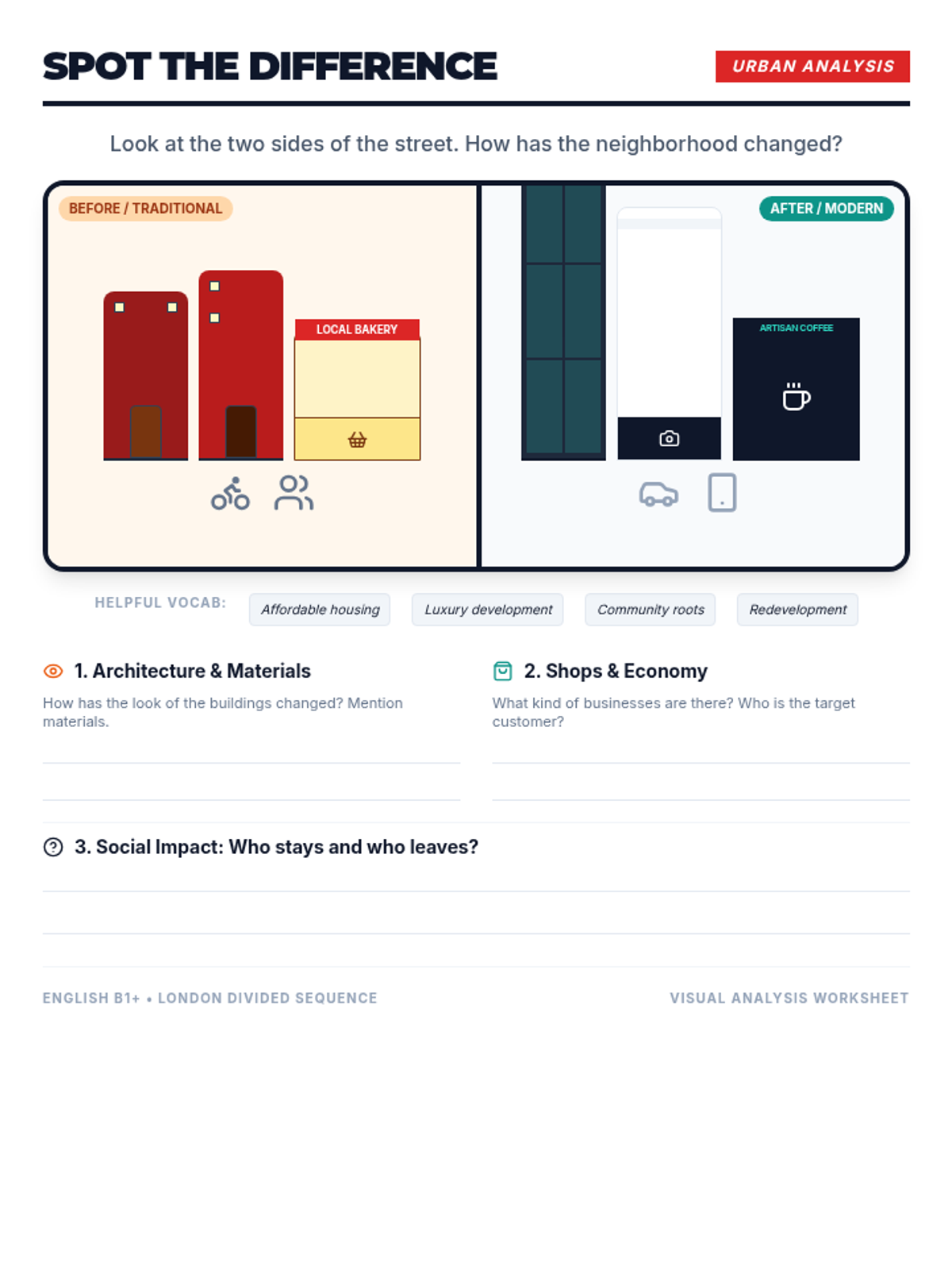
A visual comparison poster/worksheet featuring a stylized "Before and After" urban scene to elicit vocabulary related to architecture, social class, and neighborhood transformation. Revised to ensure one-page fit and include student work areas.
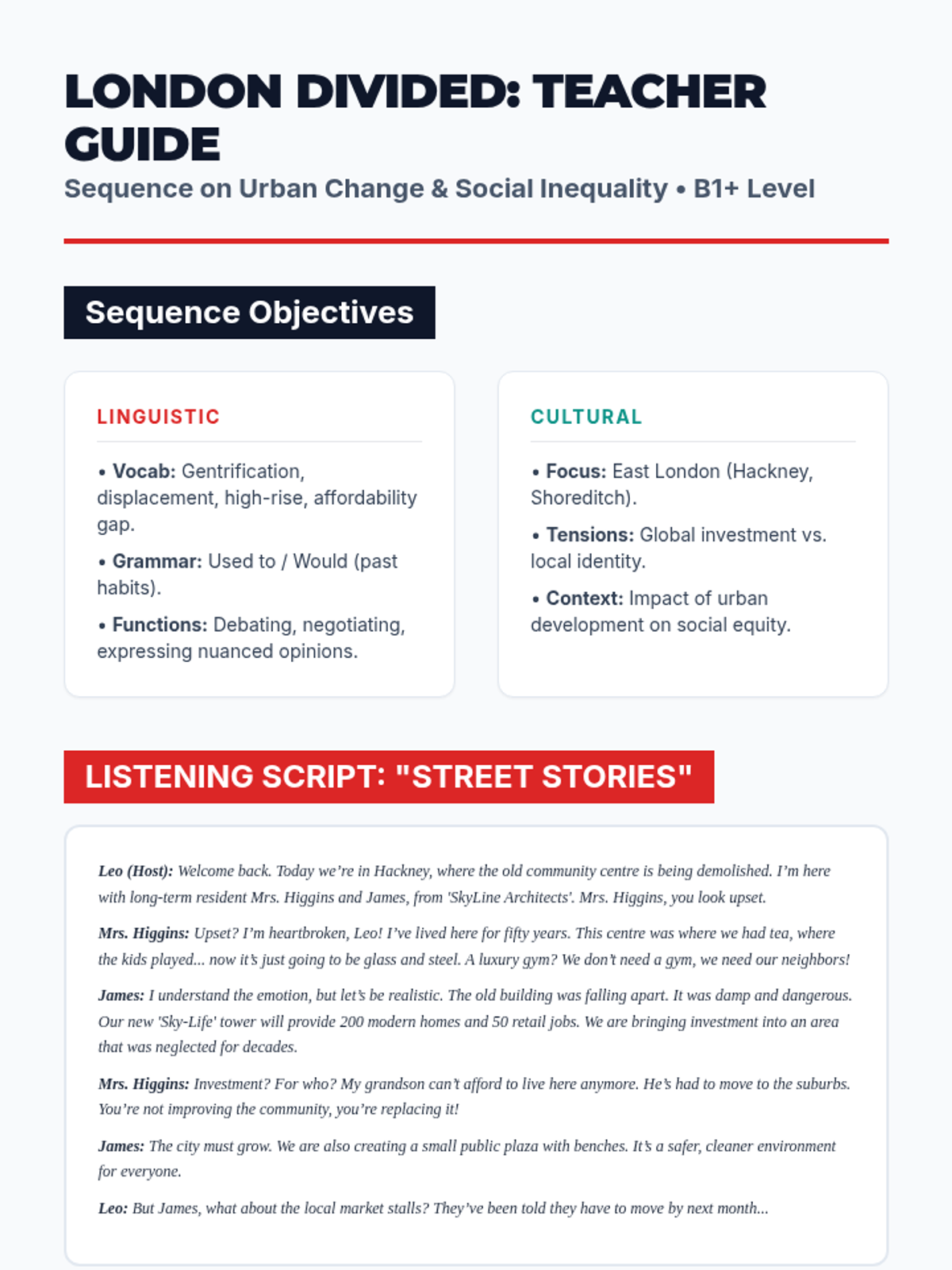
A comprehensive teacher guide for the London Divided sequence. Revised to balance white space on page 1, ensure answer key stays together, and fix teaching tips layout.
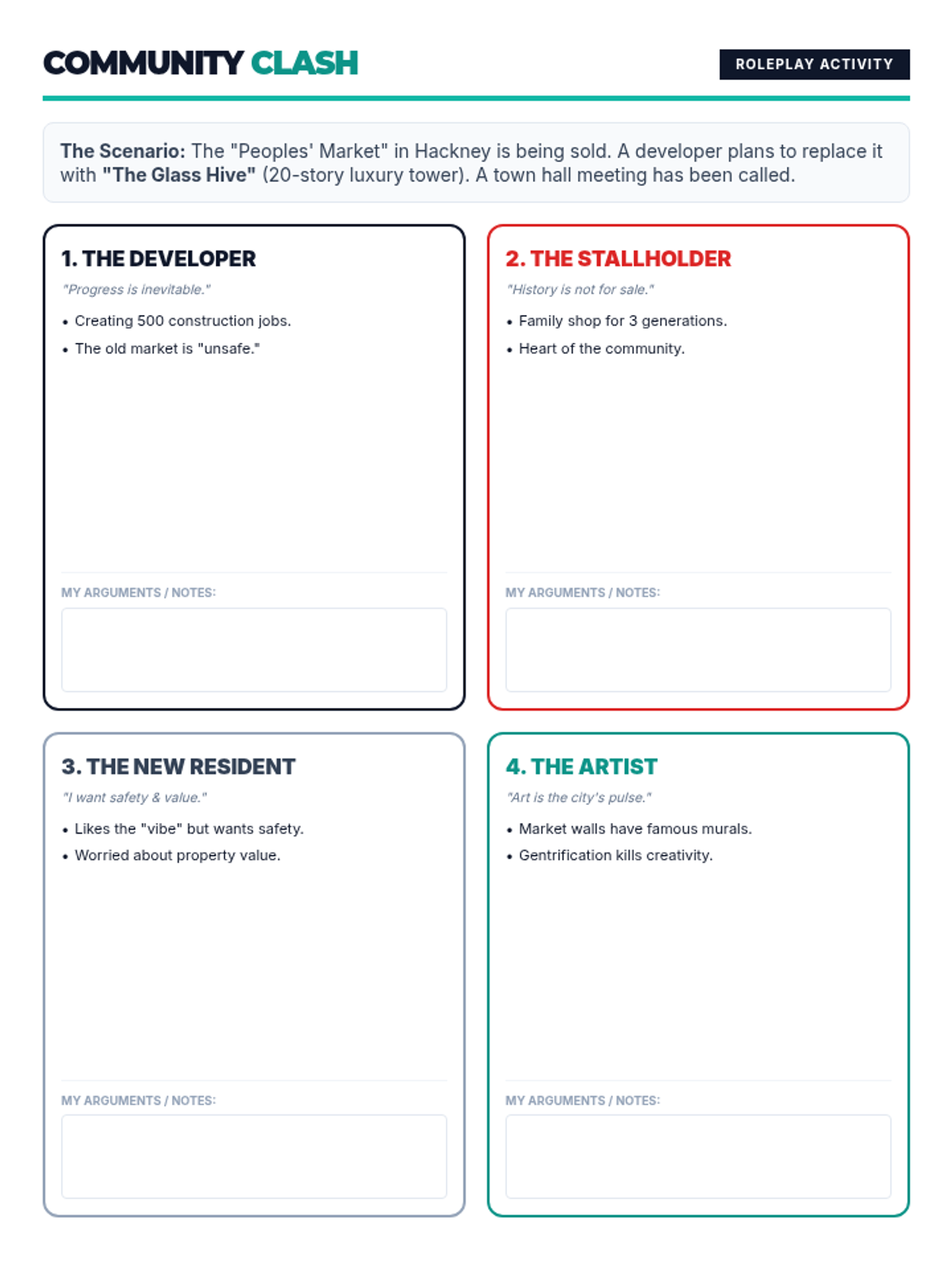
A set of role-play cards and a debate toolkit for a speaking activity. Revised for a two-page layout, improved note-taking areas with white backgrounds, and fixed overflow issues.
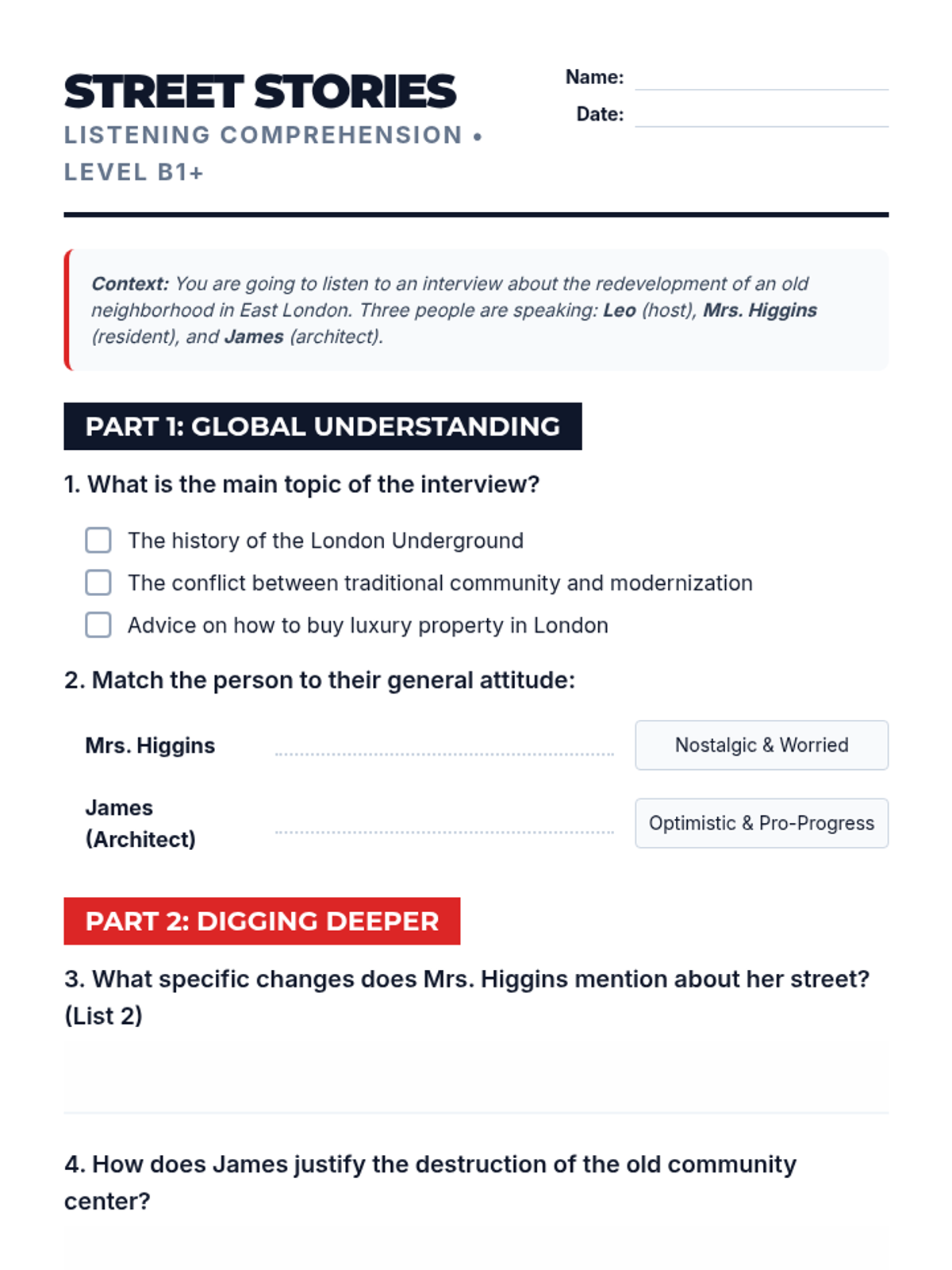
A listening comprehension worksheet for students to use with an interview about gentrification. Revised to fix logical errors in matching, improve table column balance, and ensure questions don't split across pages. Adjusted height to prevent stray 3rd page.
Introductory slides for the London Divided sequence, featuring visual contrasts, key vocabulary for B1+ students, and discussion prompts about urban change and gentrification. Revised for improved alignment, contrast, and clarity.
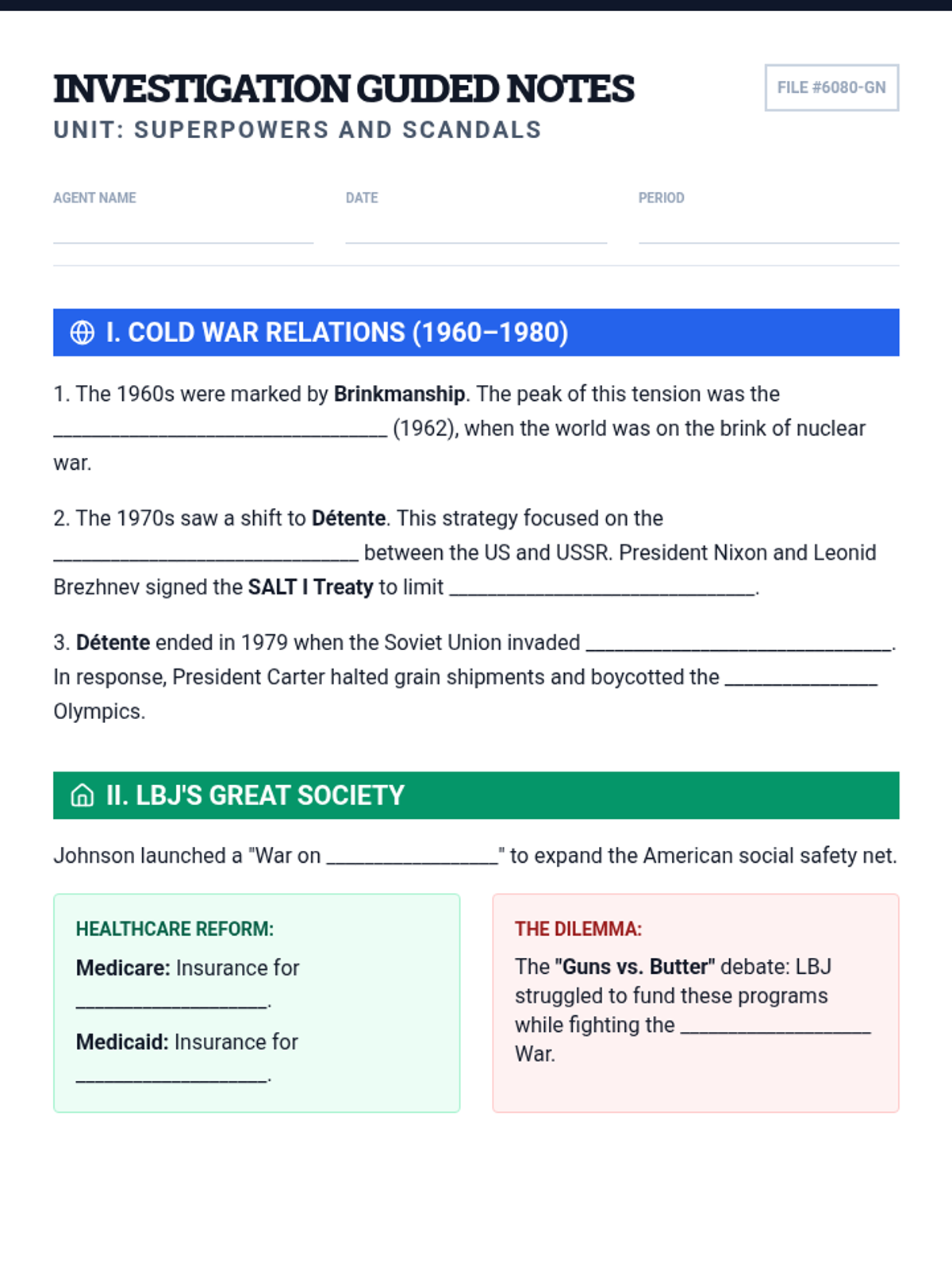
A student-facing guided notes document designed to accompany the Crisis and Change Presentation, covering US History from 1960 to 1980 including the Cold War, Great Society, and Watergate.
A comprehensive visual presentation covering US History from 1960 to 1980, featuring sections on the Cold War, LBJ's Great Society, the Warren Court, technological advancements, and the Watergate scandal.
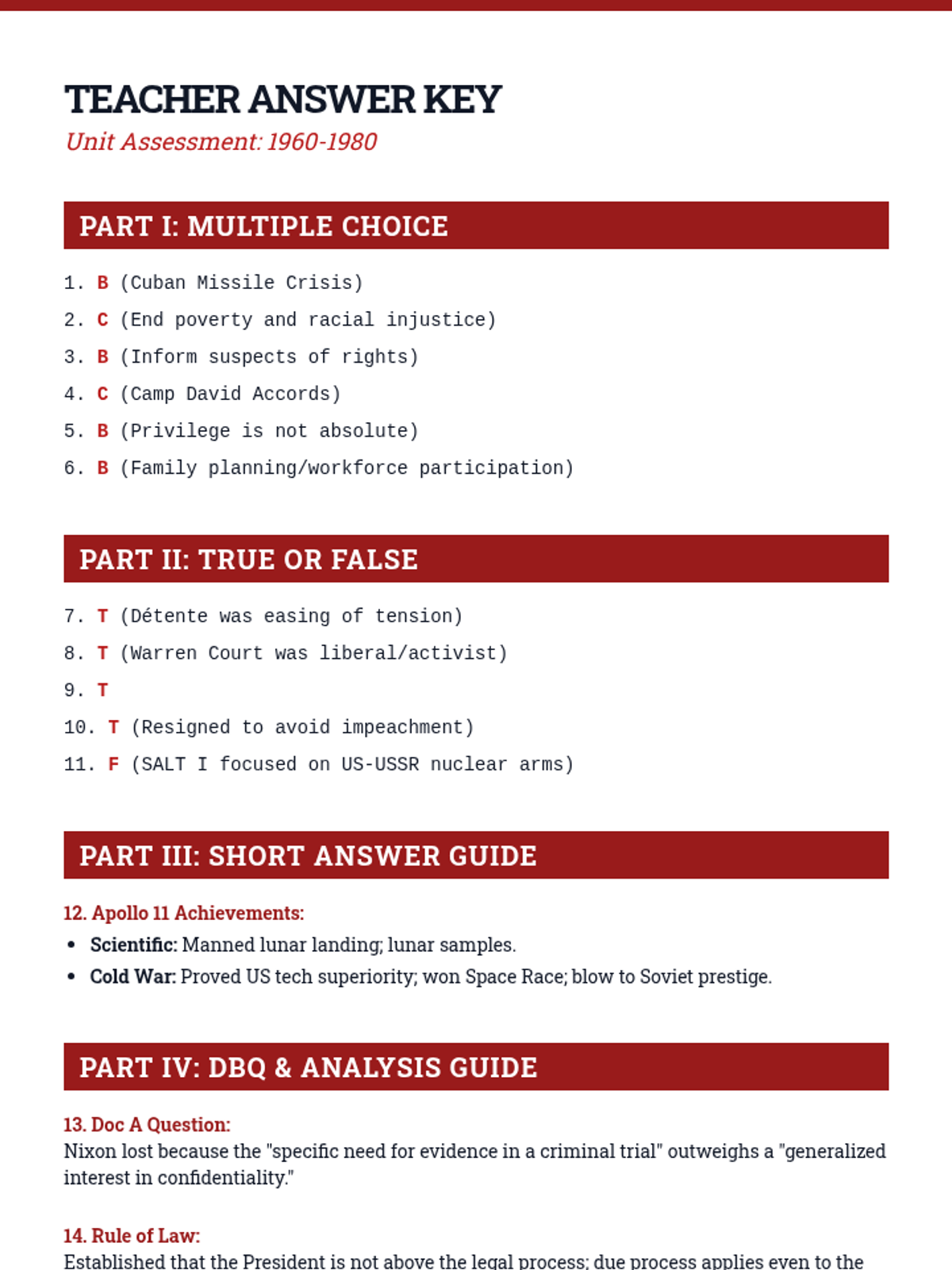
A teacher answer key and grading guide for the 1960-1980 US History unit assessment.
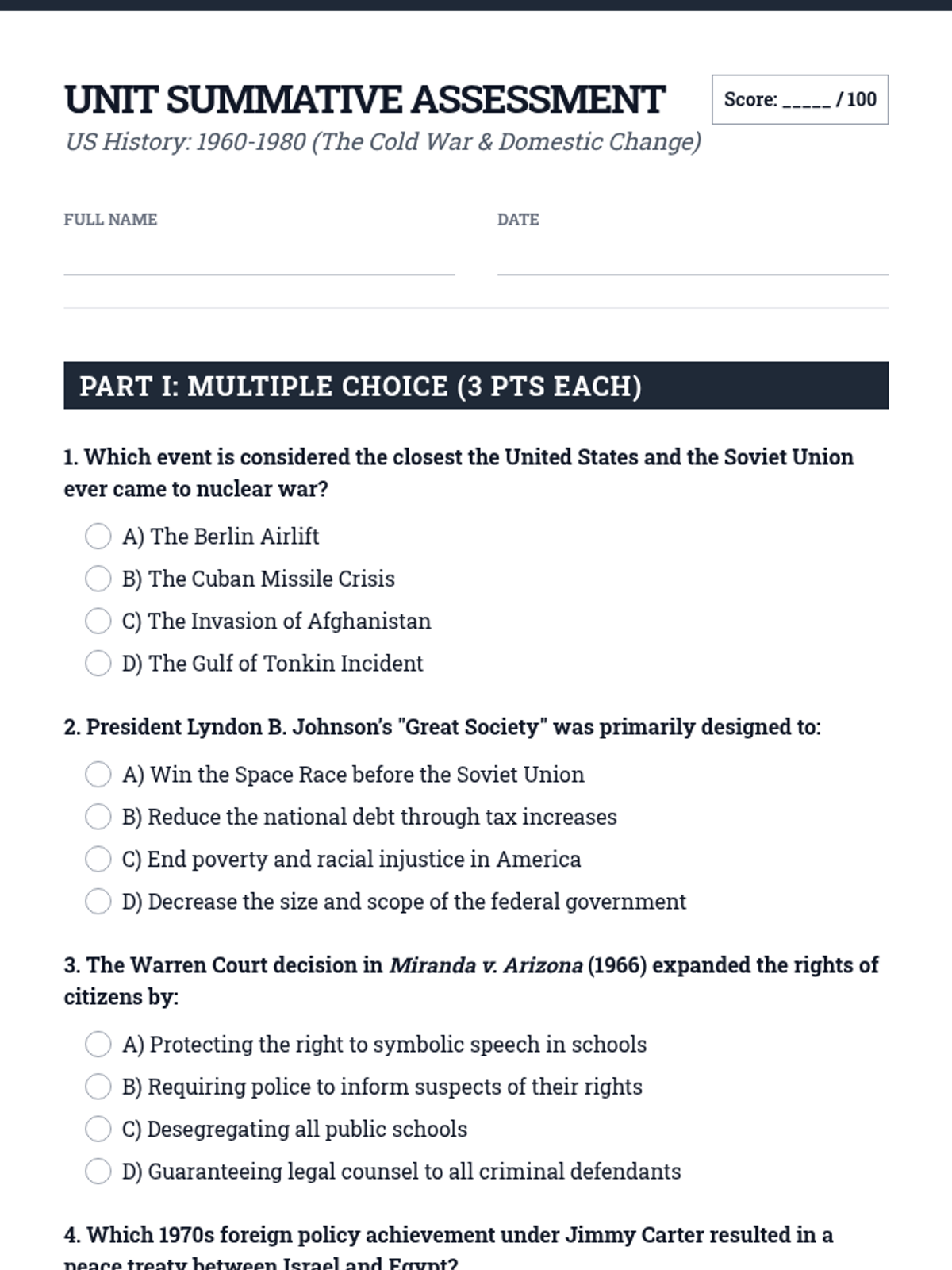
A summative unit assessment for US History (1960-1980), featuring multiple choice, true/false, short answer, and document-based questions covering the Cold War, Great Society, and Watergate.
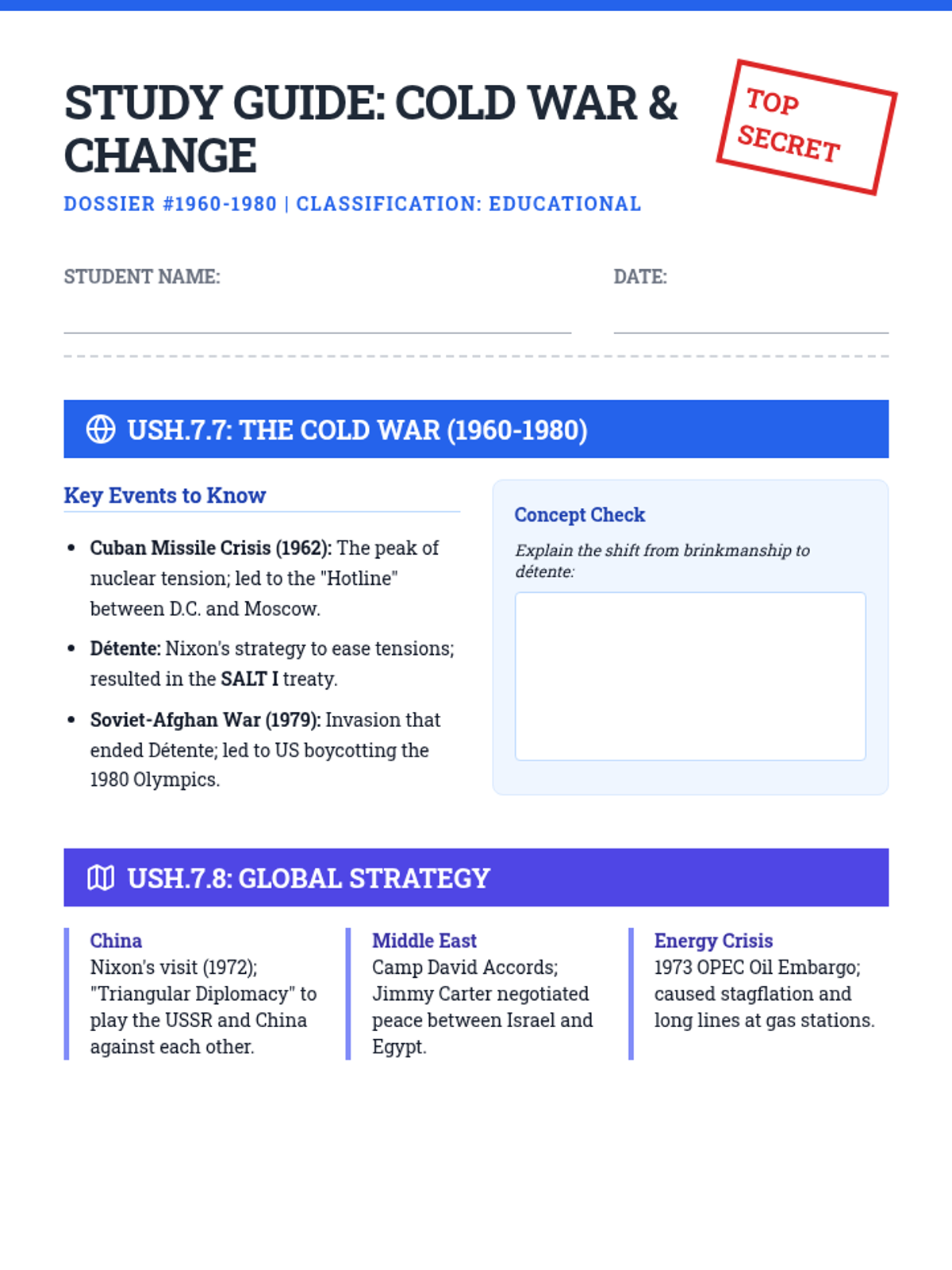
A multi-page, comprehensive study guide for US History standards from 1960 to 1980, including sections on the Cold War, LBJ's Great Society, the Warren Court, and the Watergate scandal, plus a practice quiz section.
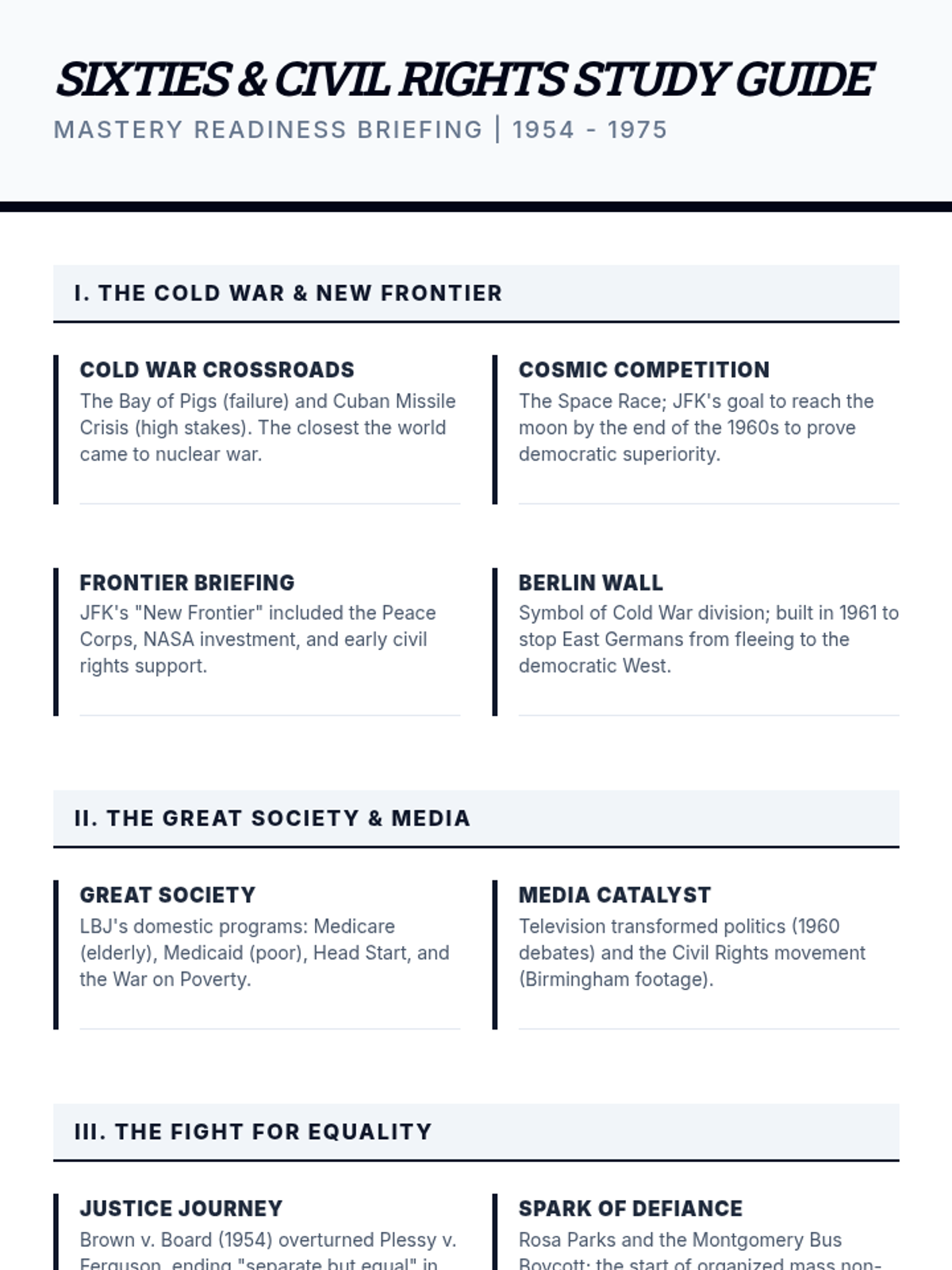
A comprehensive study guide for the Sixties and Civil Rights unit. Covers the New Frontier, Great Society, Cold War crises, and the major legislative and social milestones of the Civil Rights Movement. Designed for test preparation. Now with student work areas and improved page breaking.
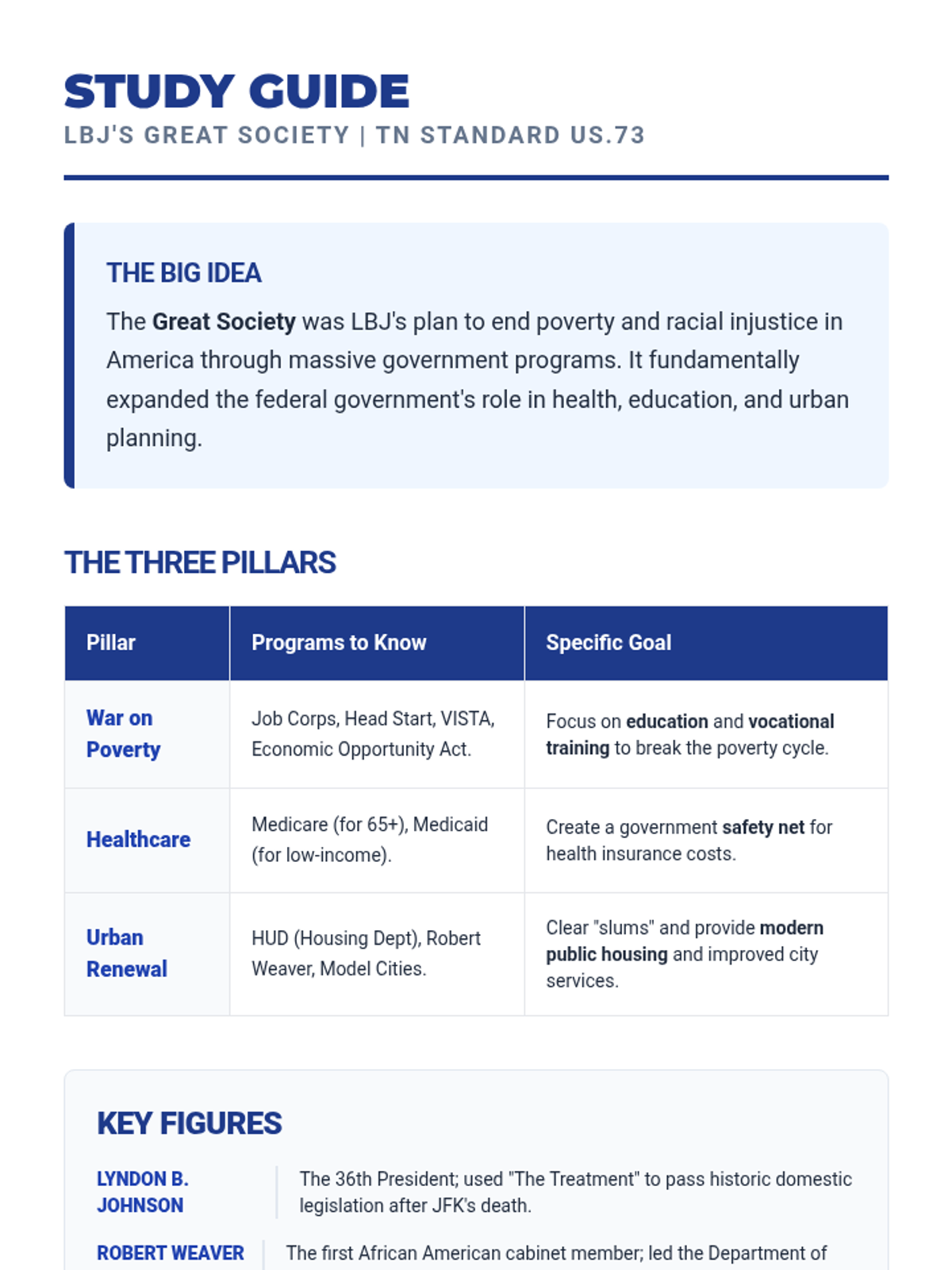
A comprehensive study guide for the Great Society lesson, summarizing key programs (Medicare, urban renewal, War on Poverty), key figures, and essential vocabulary for student review.
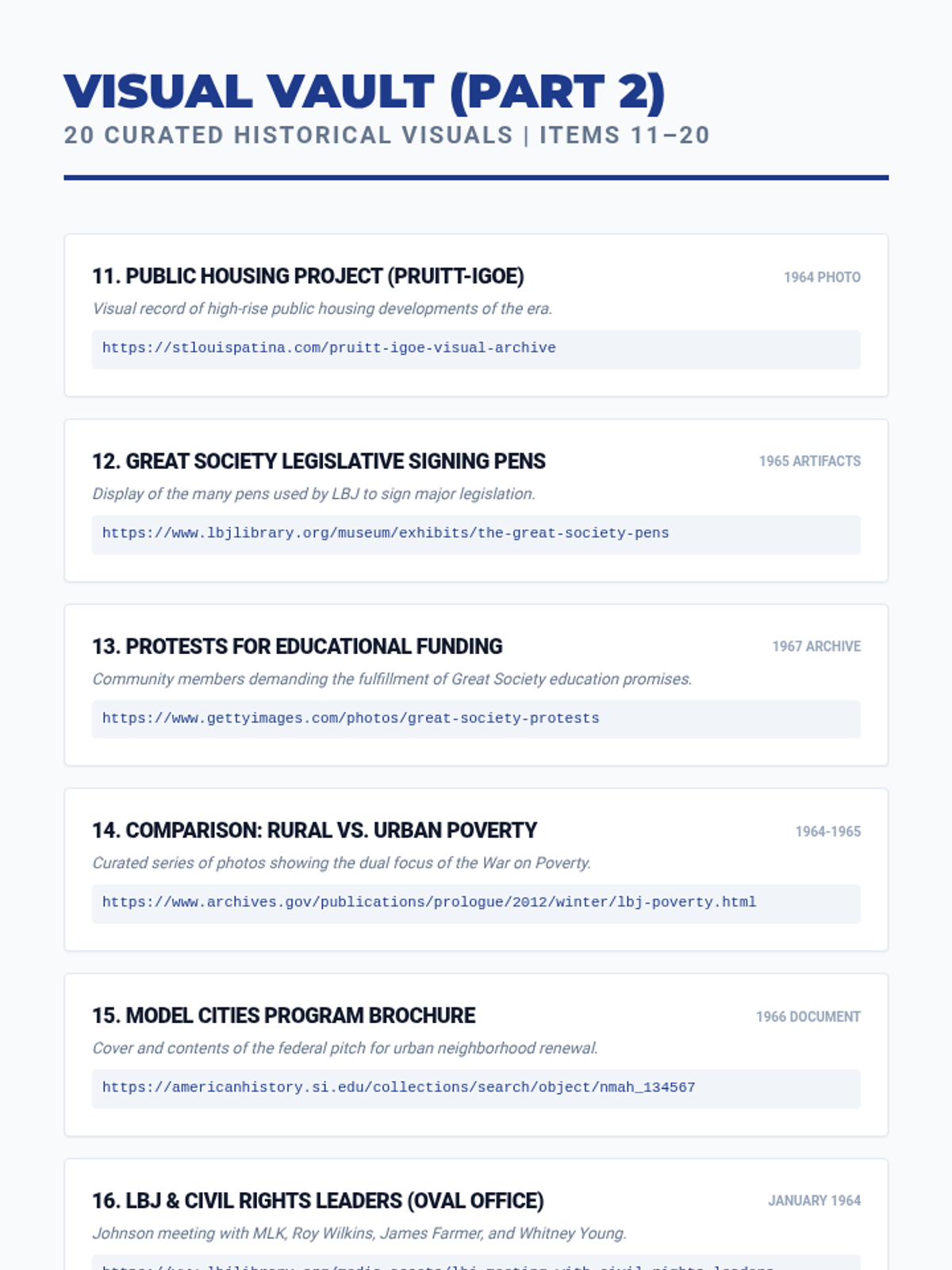
The second page of a curated list of 20 visual resources for the Great Society lesson, featuring authentic historical archive links for urban renewal projects, Medicare cards, and War on Poverty posters.
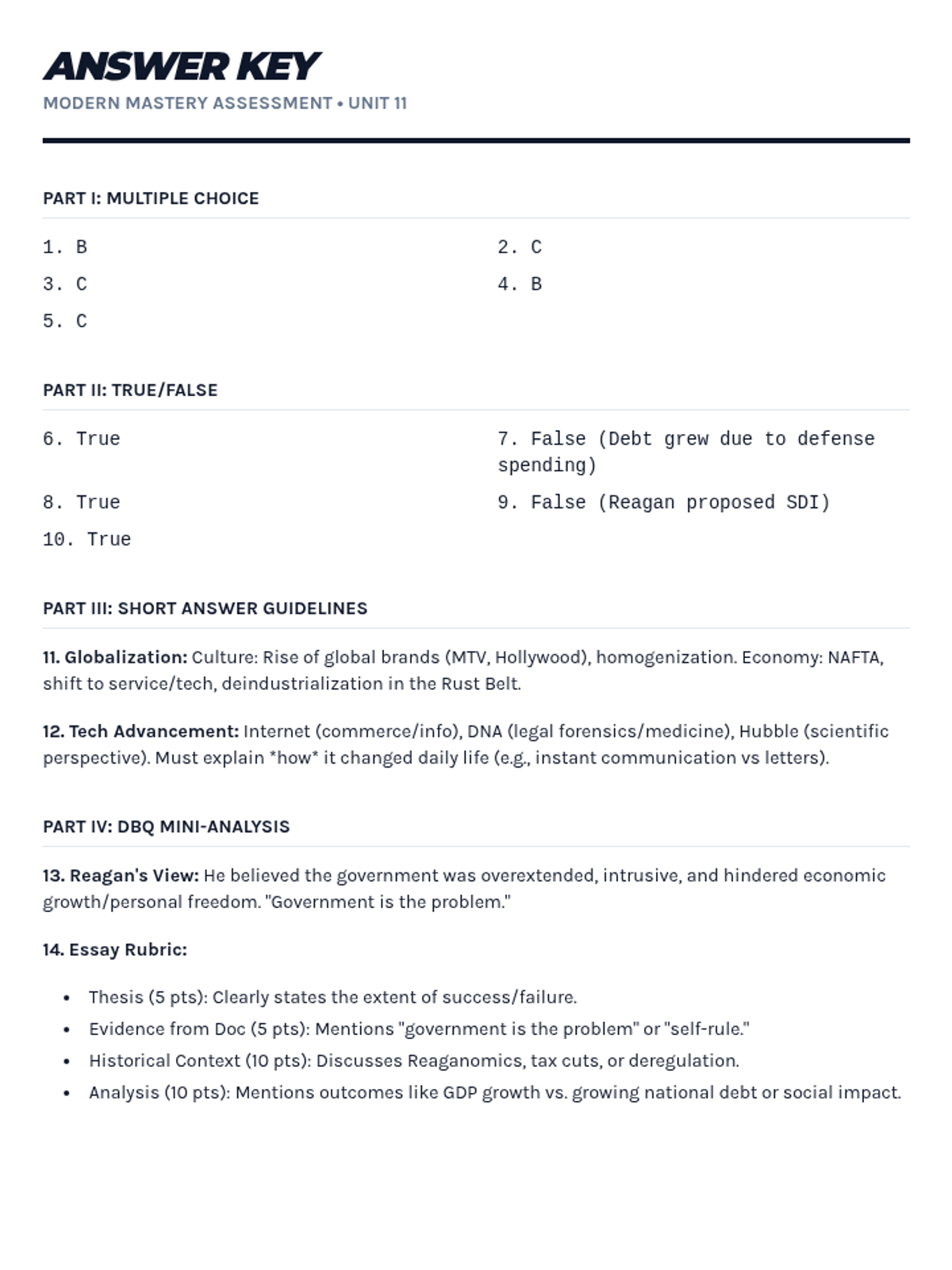
An answer key and grading rubric for the Unit 11 Modern Mastery Assessment.
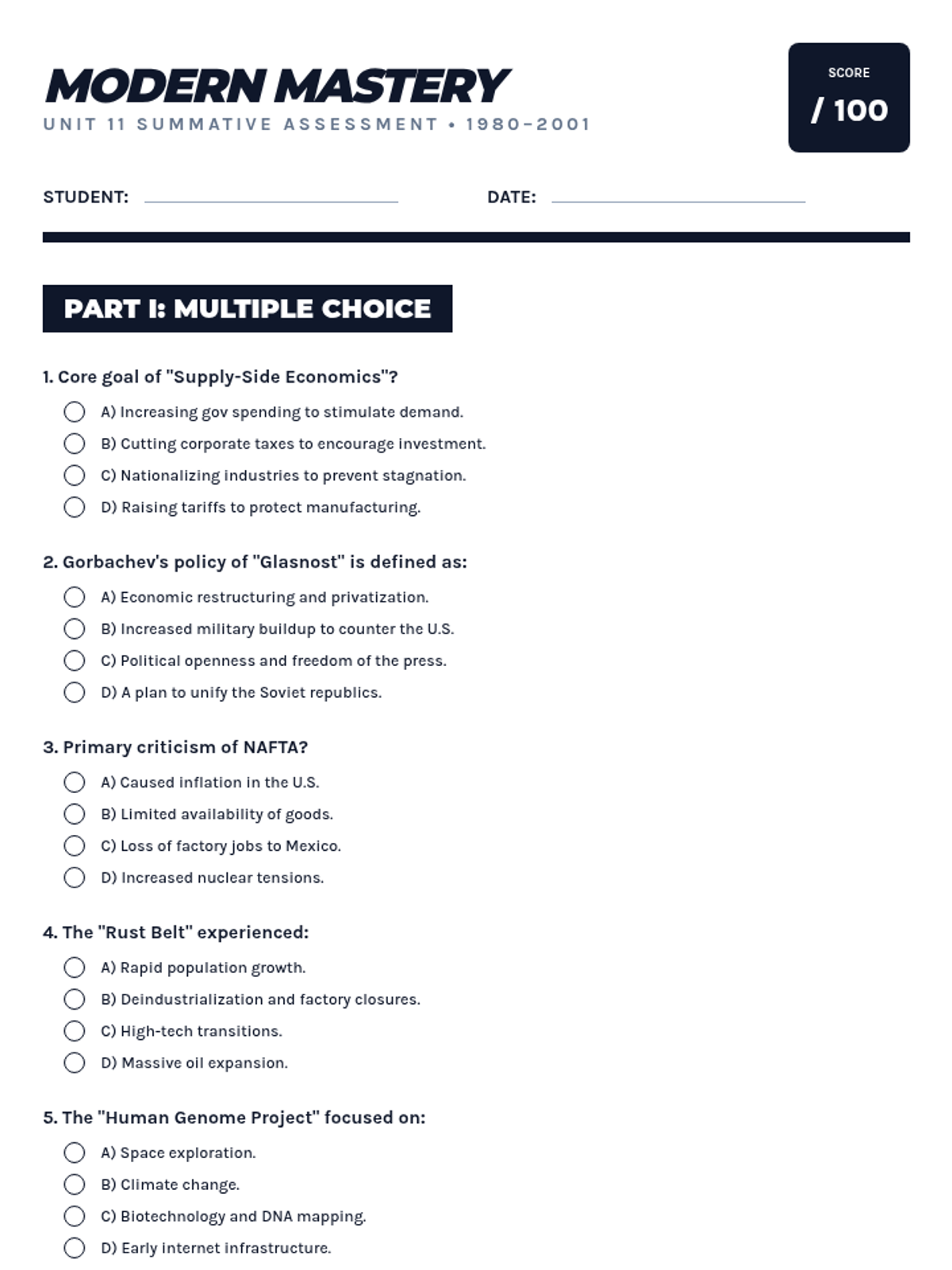
A summative assessment for Unit 11, including multiple-choice, true/false, short answer, and a mini-DBQ focused on the Reagan Revolution and the shifts of the 1980s and 90s.
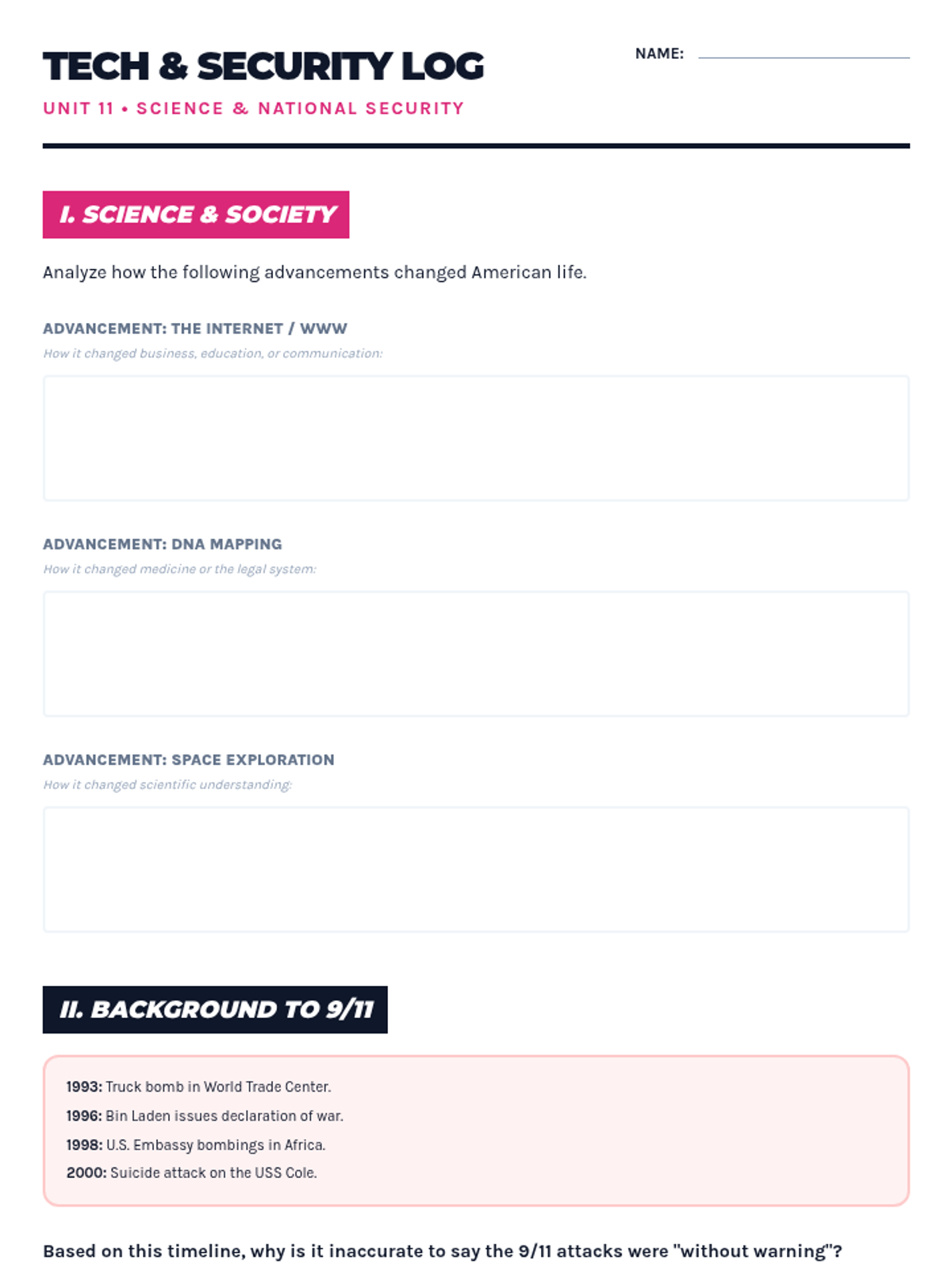
A student research and analysis log for tracking technological advancements and the emerging security challenges of the late 20th century.
Expanded presentation slides covering the Internet revolution, the Human Genome Project, NASA's 90s milestones, energy policy/climate change, and the emerging threat of Al-Qaeda leading to 9/11.
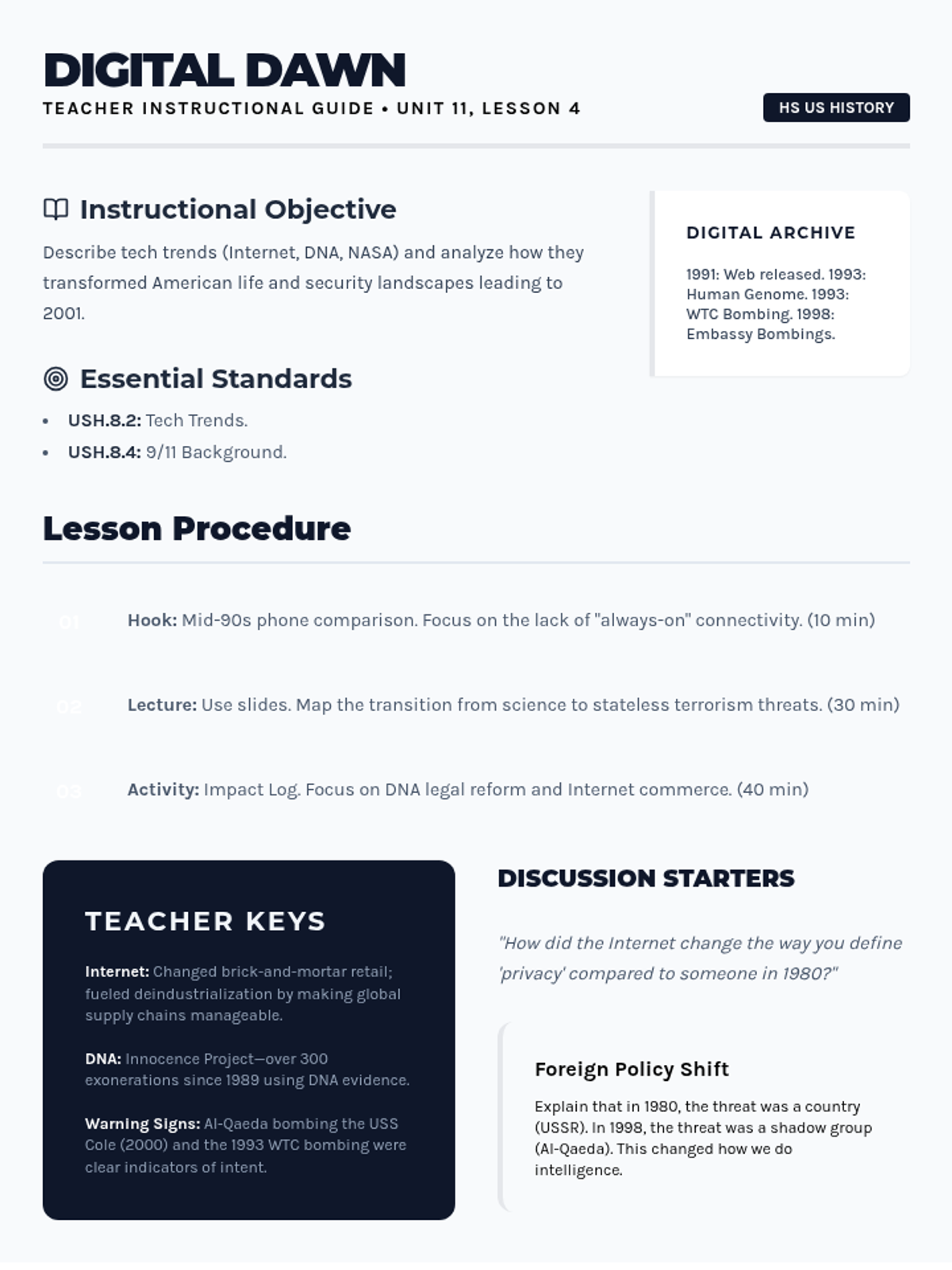
Teacher guide for Lesson 4, detailing instructional strategies for teaching about the 90s technological revolution and the emerging security threats leading to 9/11.
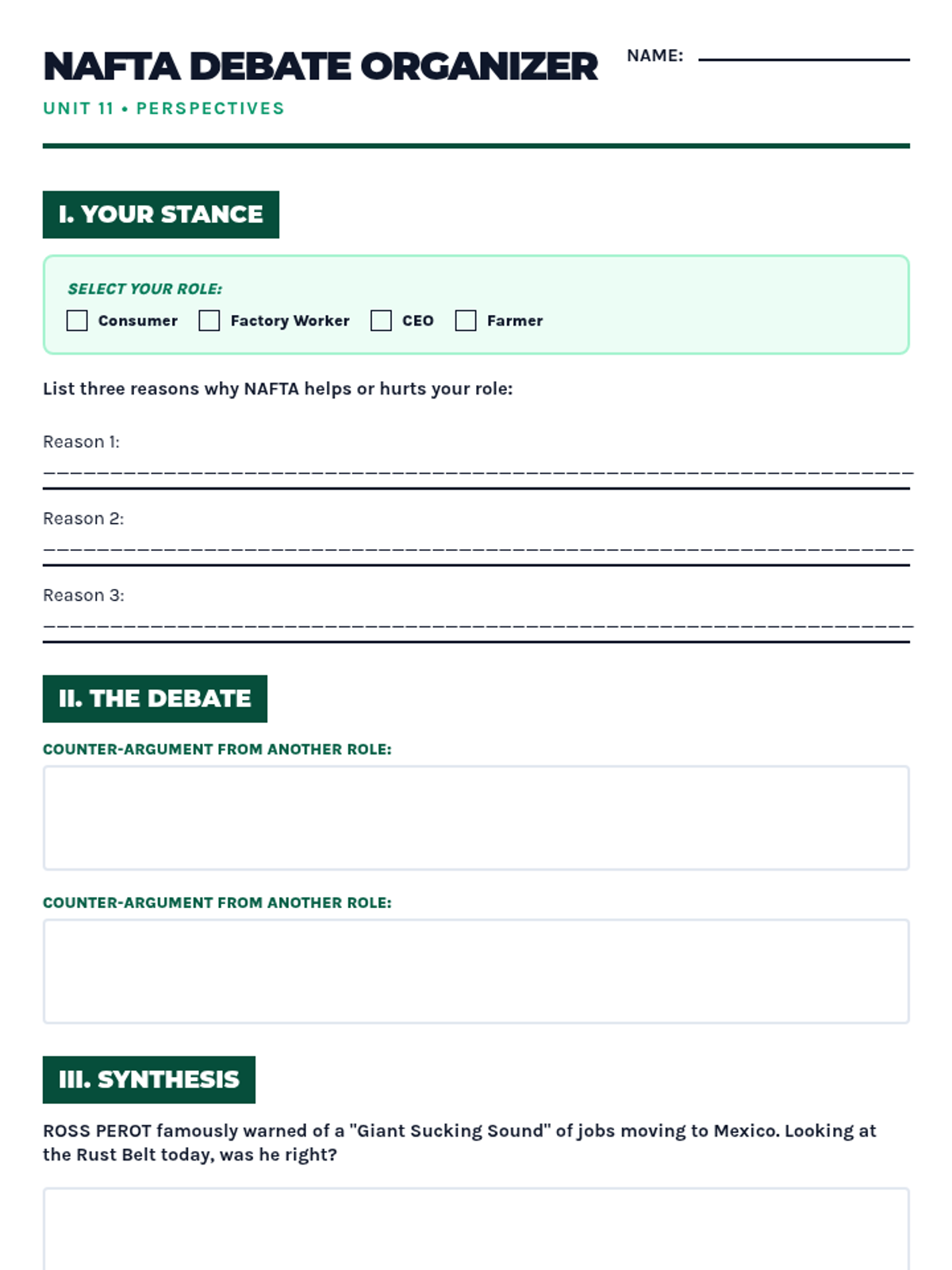
A student role-playing and debate organizer for analyzing the multiple perspectives on the North American Free Trade Agreement (NAFTA).
Expanded presentation slides covering globalization's cultural and economic impacts, NAFTA's pros and cons, and the specific causes of deindustrialization in the Rust Belt.
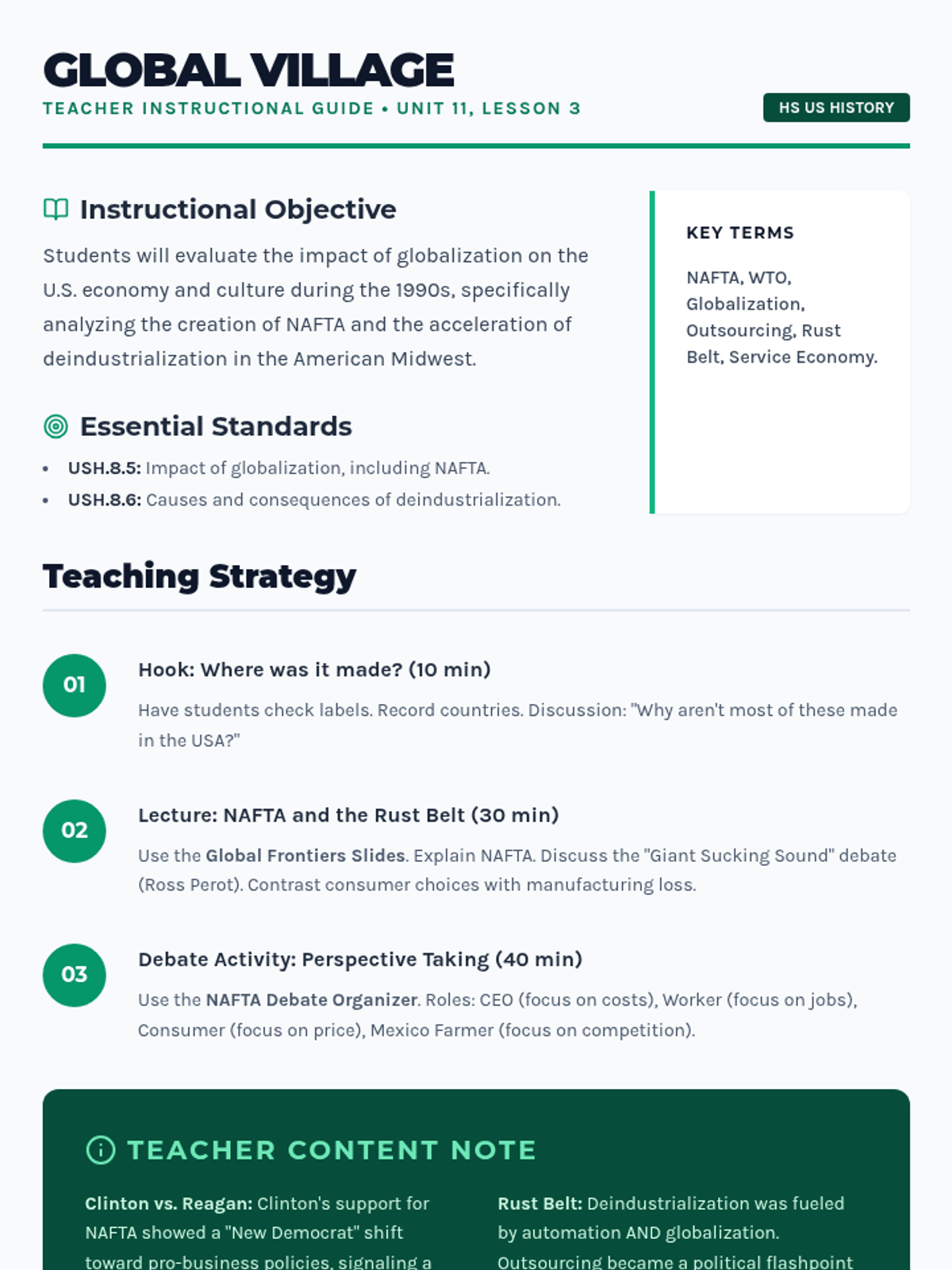
Teacher guide for Lesson 3, focusing on globalization, NAFTA, and the shift from manufacturing to a service-based economy in the 1990s.
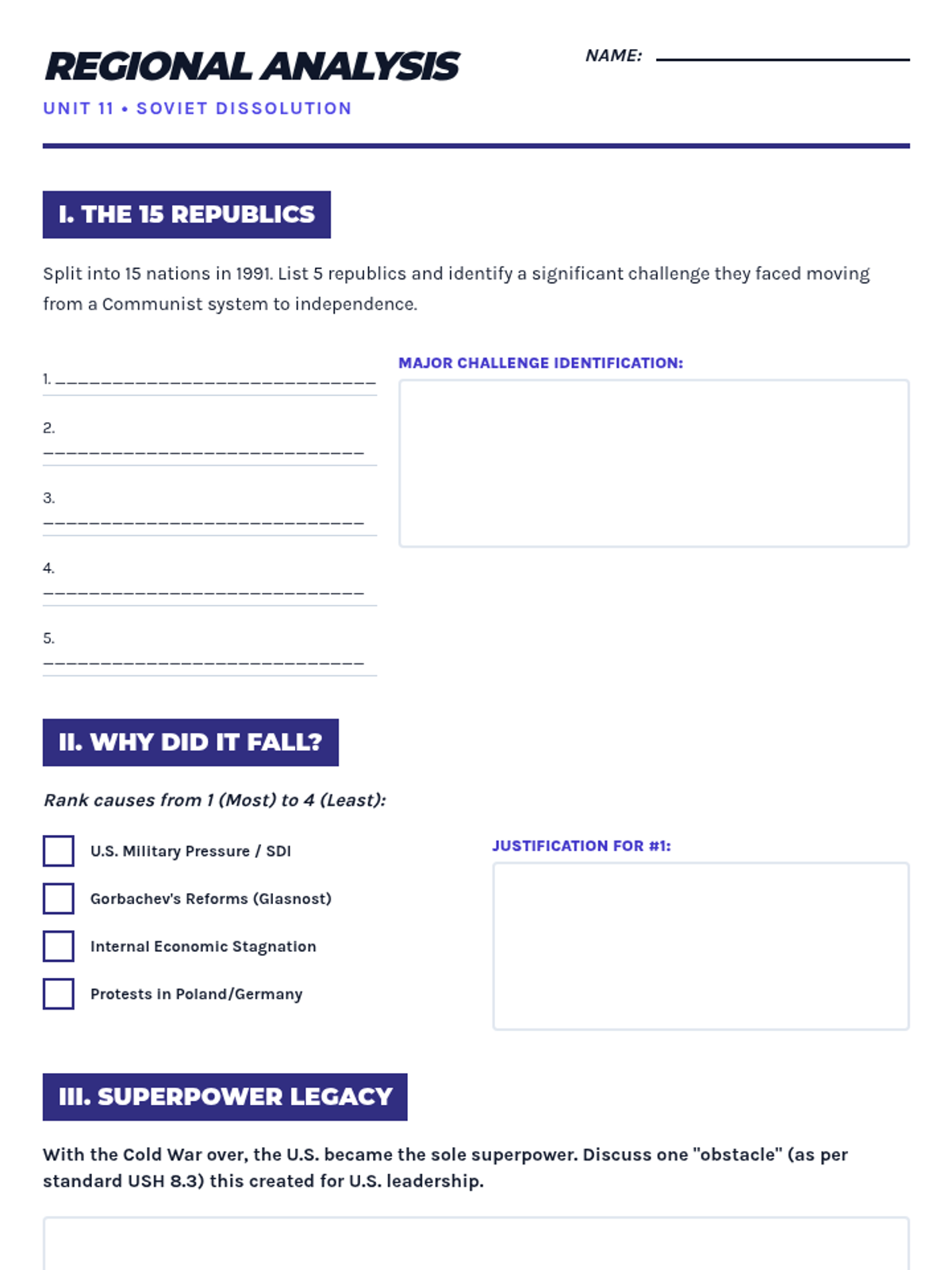
A student regional analysis and cause-analysis activity regarding the dissolution of the Soviet Union and the aftermath of the Cold War.
Expanded presentation slides detailing the end of the Cold War, including Reagan's strategy, Gorbachev's reforms, the Polish Solidarity movement, the fall of the Wall, and the "New Obstacles" to U.S. leadership.
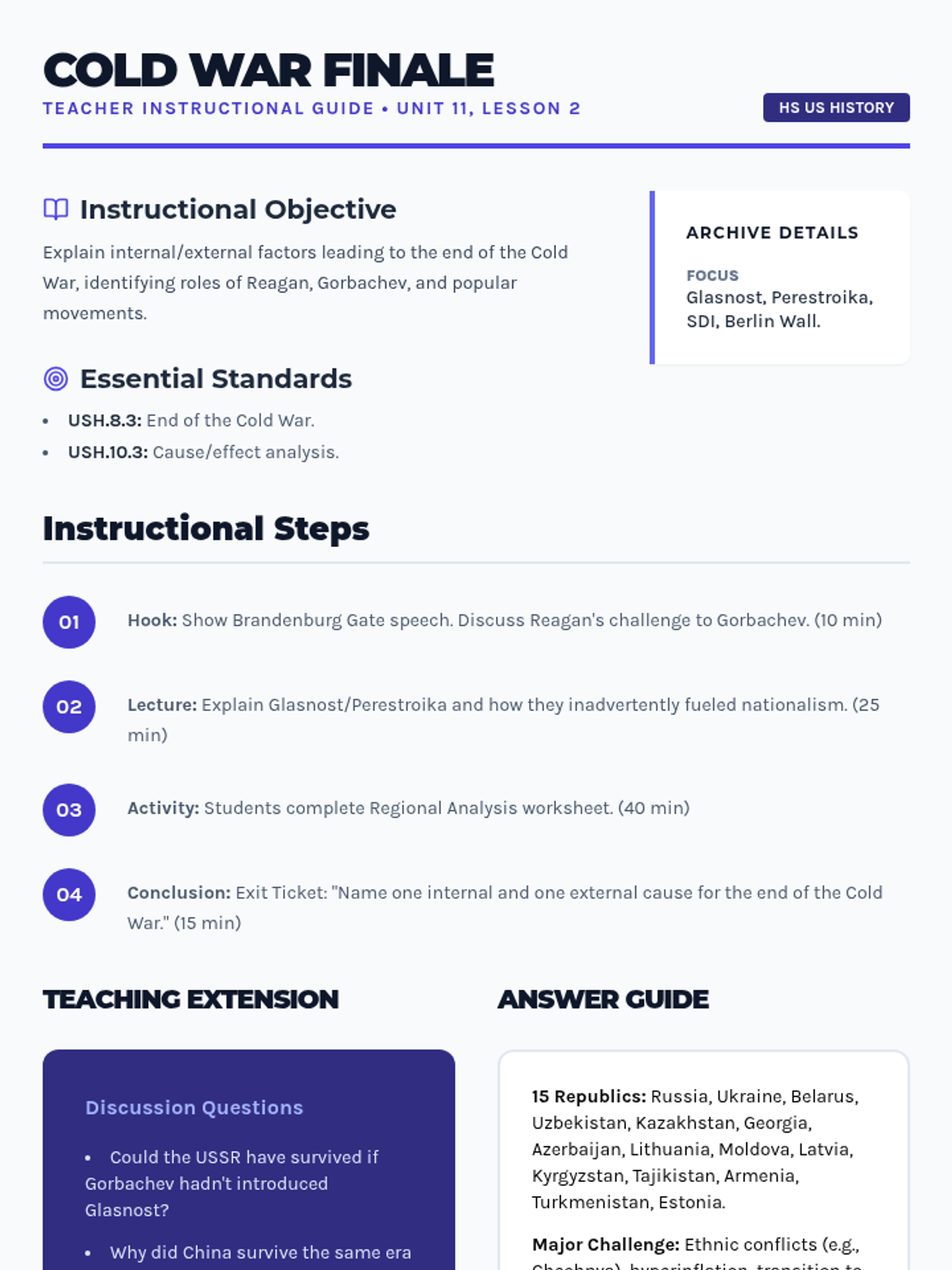
Teacher instructional guide for Lesson 2, covering the end of the Cold War, Gorbachev's reforms, and the fall of the Soviet Union.
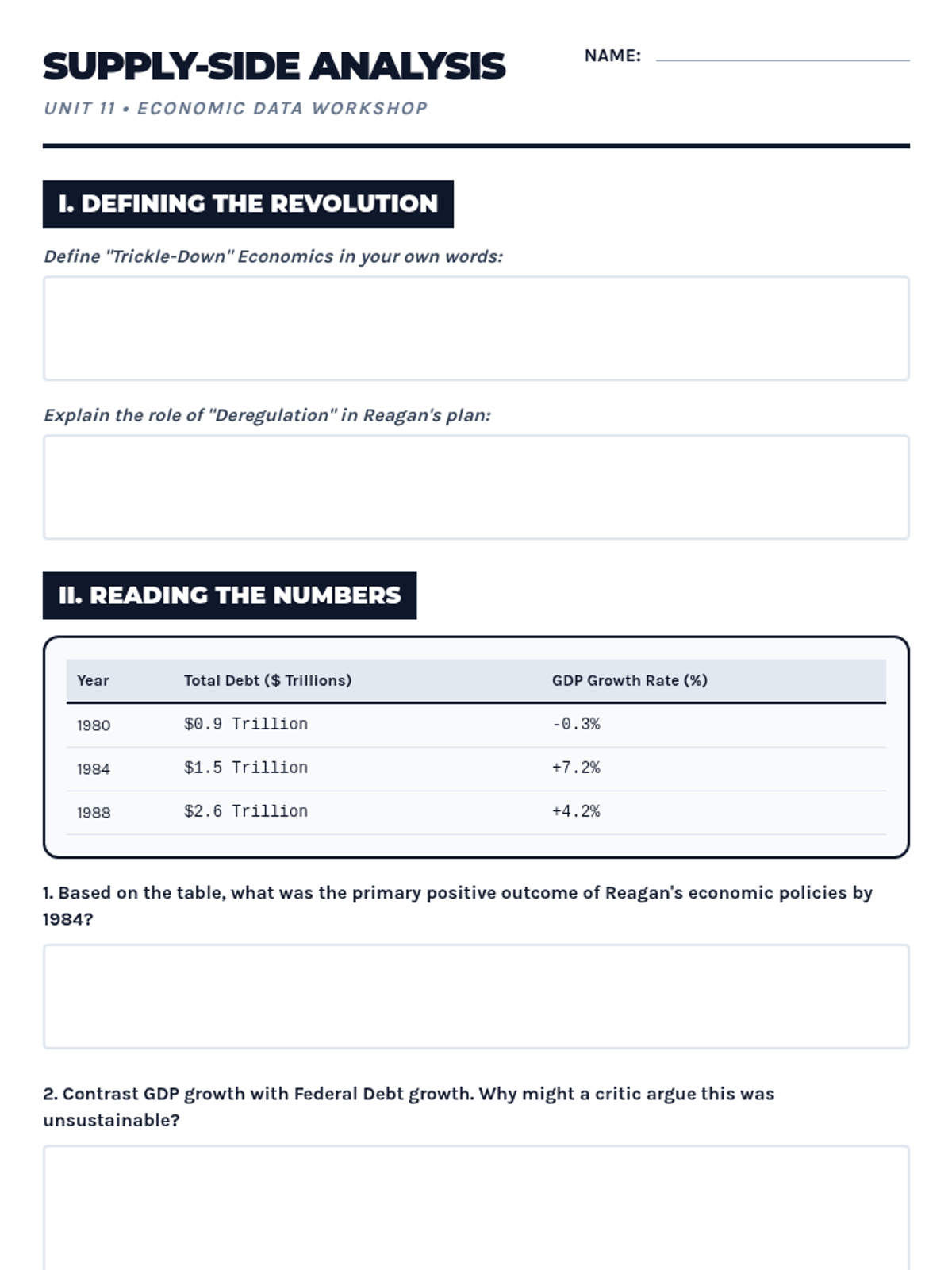
A student analysis worksheet for evaluating Reagan's economic policies (Reaganomics) through data analysis and reflecting on the social impact of the War on Drugs.
Expanded visual presentation slides covering the Reagan Revolution, Reaganomics, the Reagan Coalition, the PATCO strike, social challenges, and Reagan's foreign policy strategy leading toward the end of the Cold War.
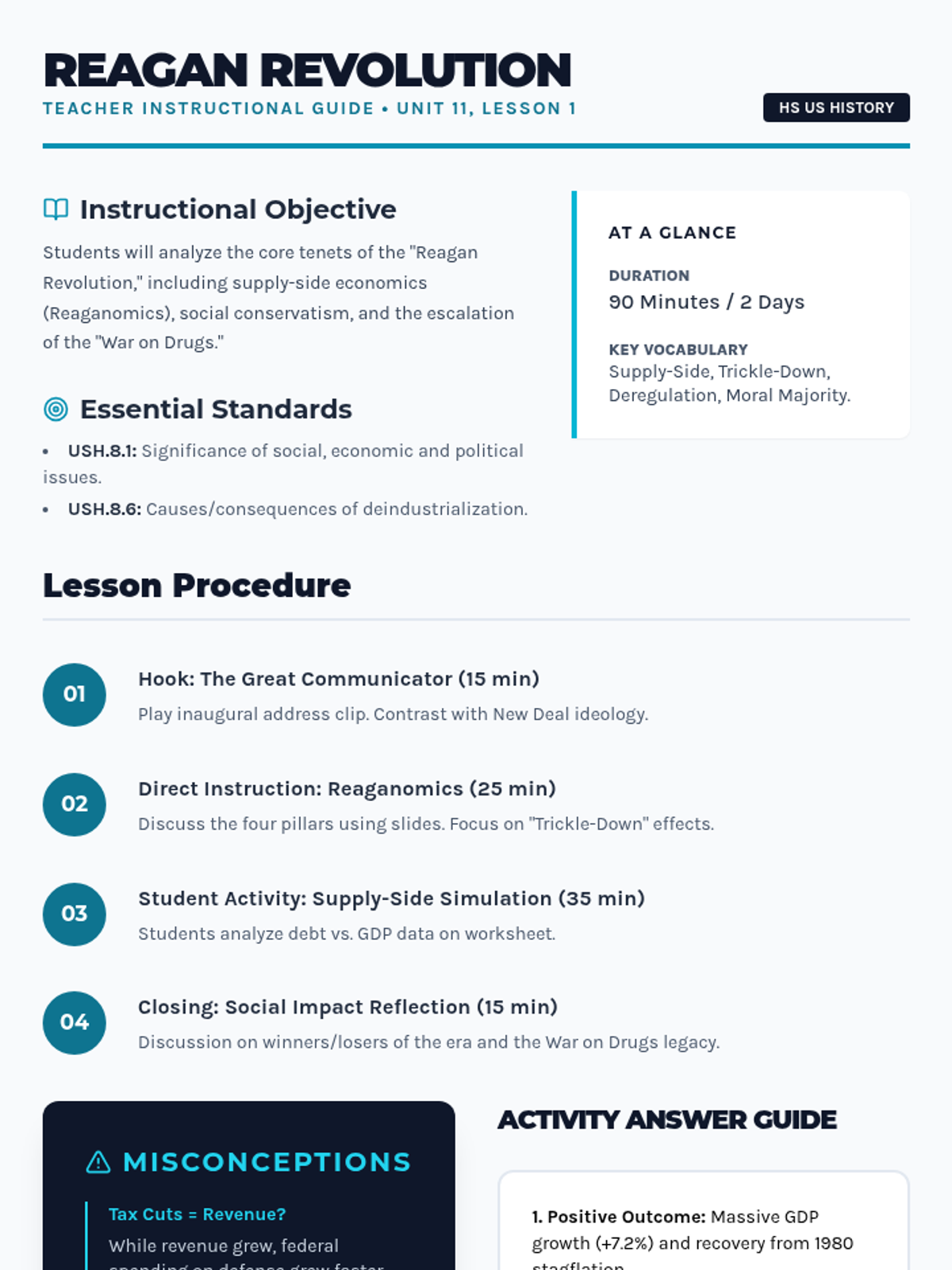
A comprehensive teacher instructional guide for Lesson 1, detailing the lesson plan, key vocabulary, common misconceptions, and procedures for teaching the Reagan Revolution and its economic impacts.
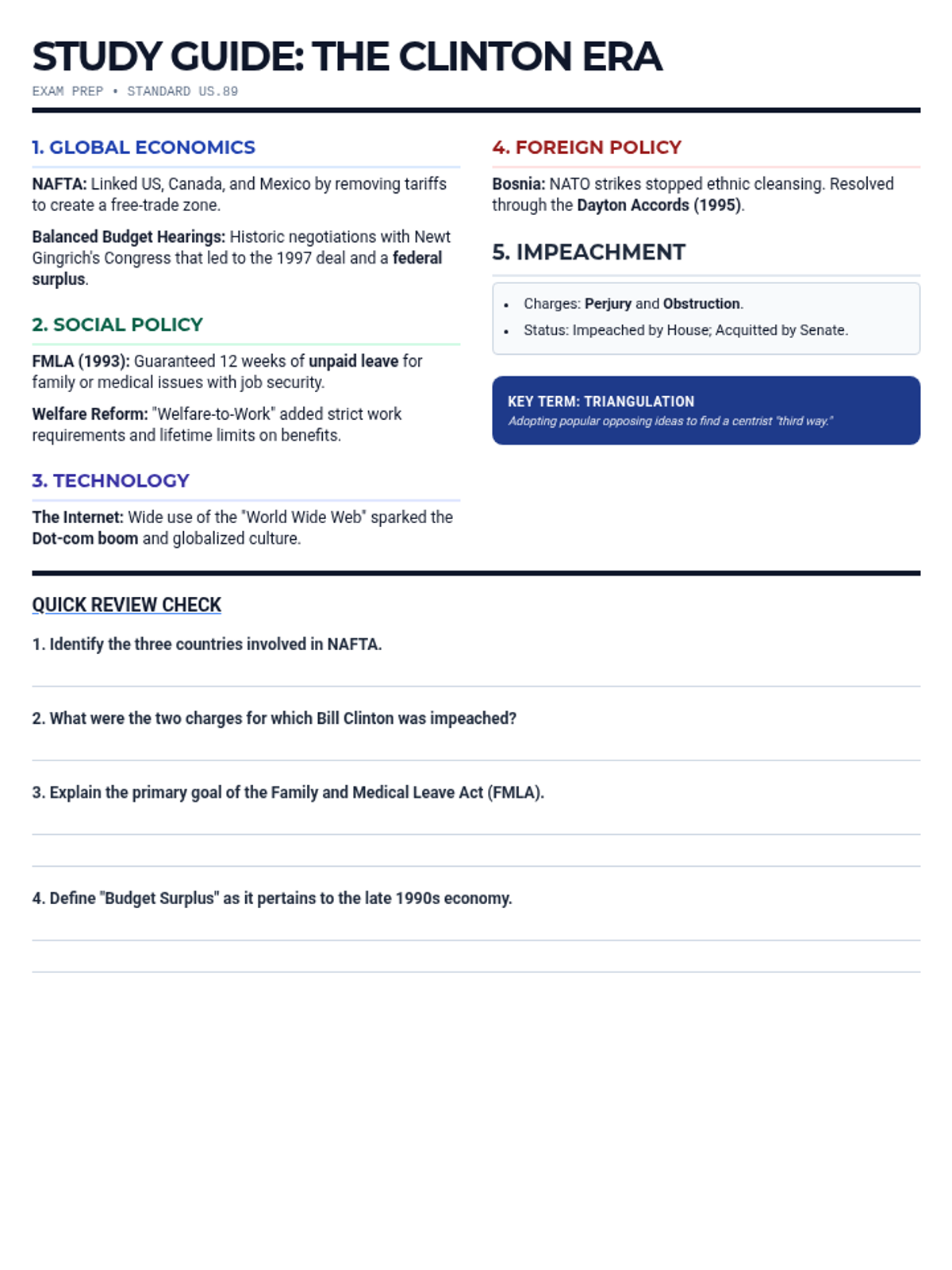
Comprehensive study guide for students. Revised to fit strictly onto a single page by tightening margins and headers, while providing ample writing lines for the review questions. Increased font size and spacing for better readability and added missing 'Balanced Budget Hearings' context.
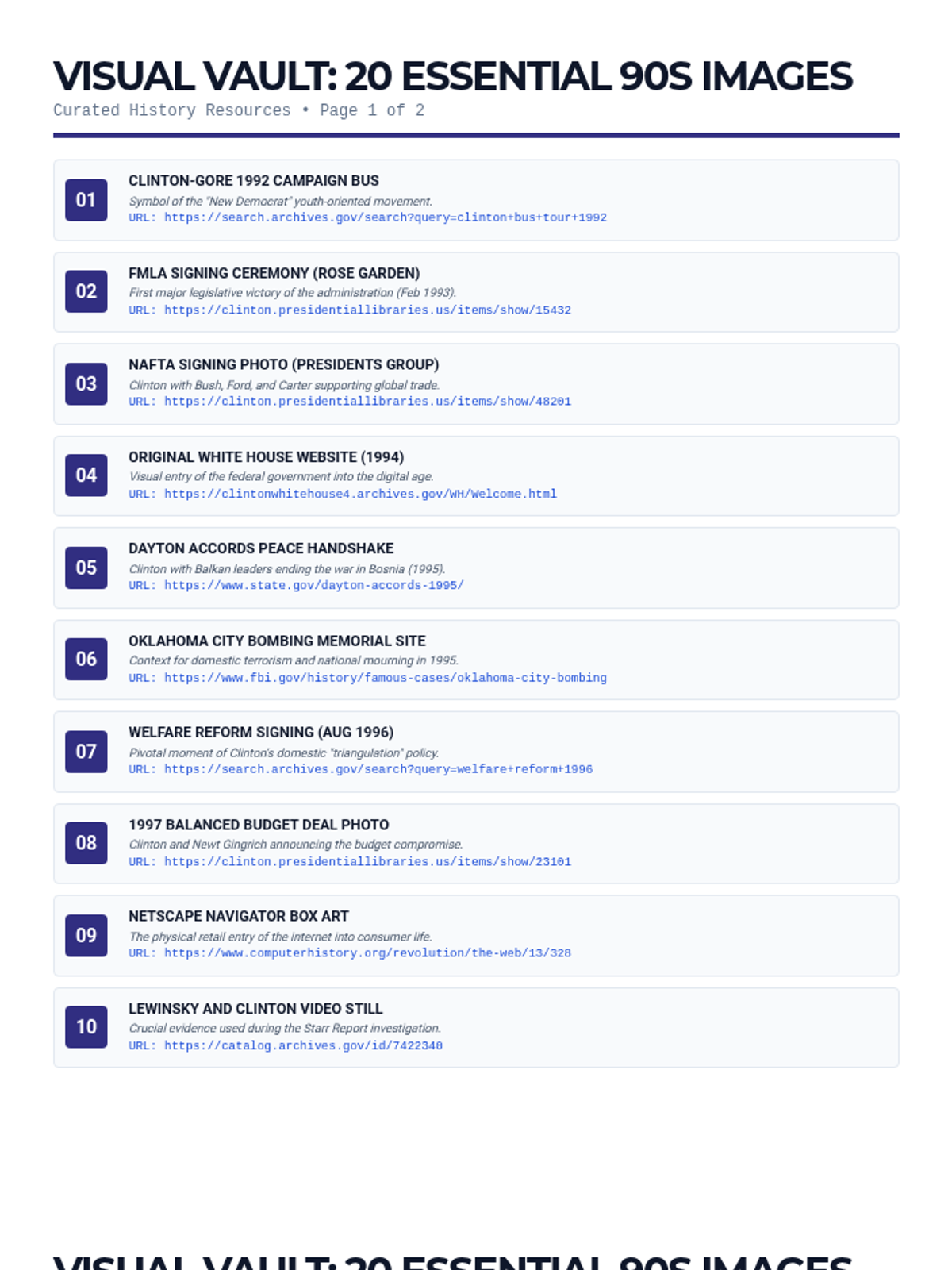
Visual resource list for the Clinton era. Revised to fit exactly two pages as requested, using 'break-inside-avoid' to prevent item splitting, and correcting header labels.
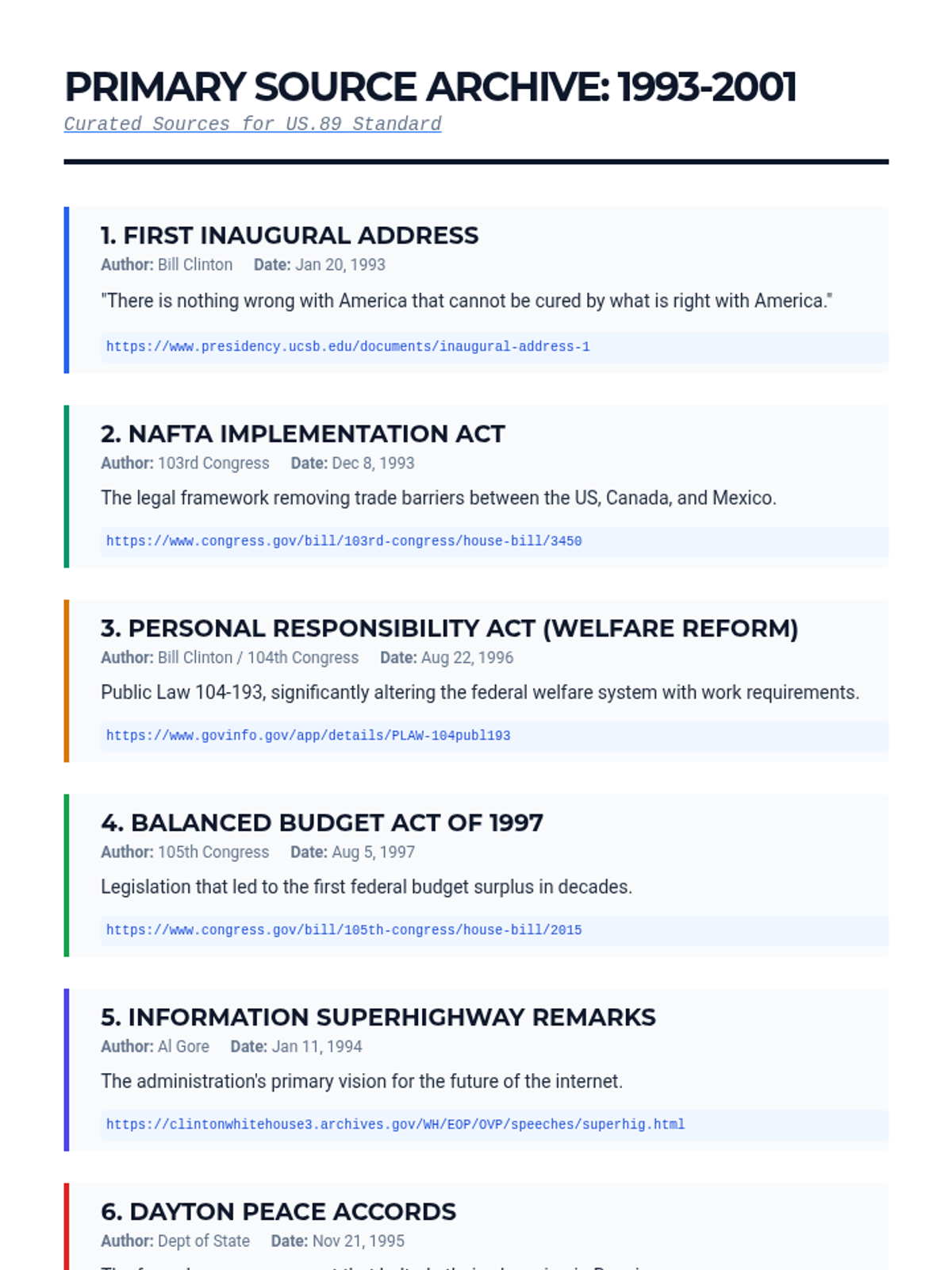
Primary source list for the Clinton administration. Revised with 'break-inside-avoid' to prevent orphaned headers and added required sources for Welfare reform and Balanced Budget.
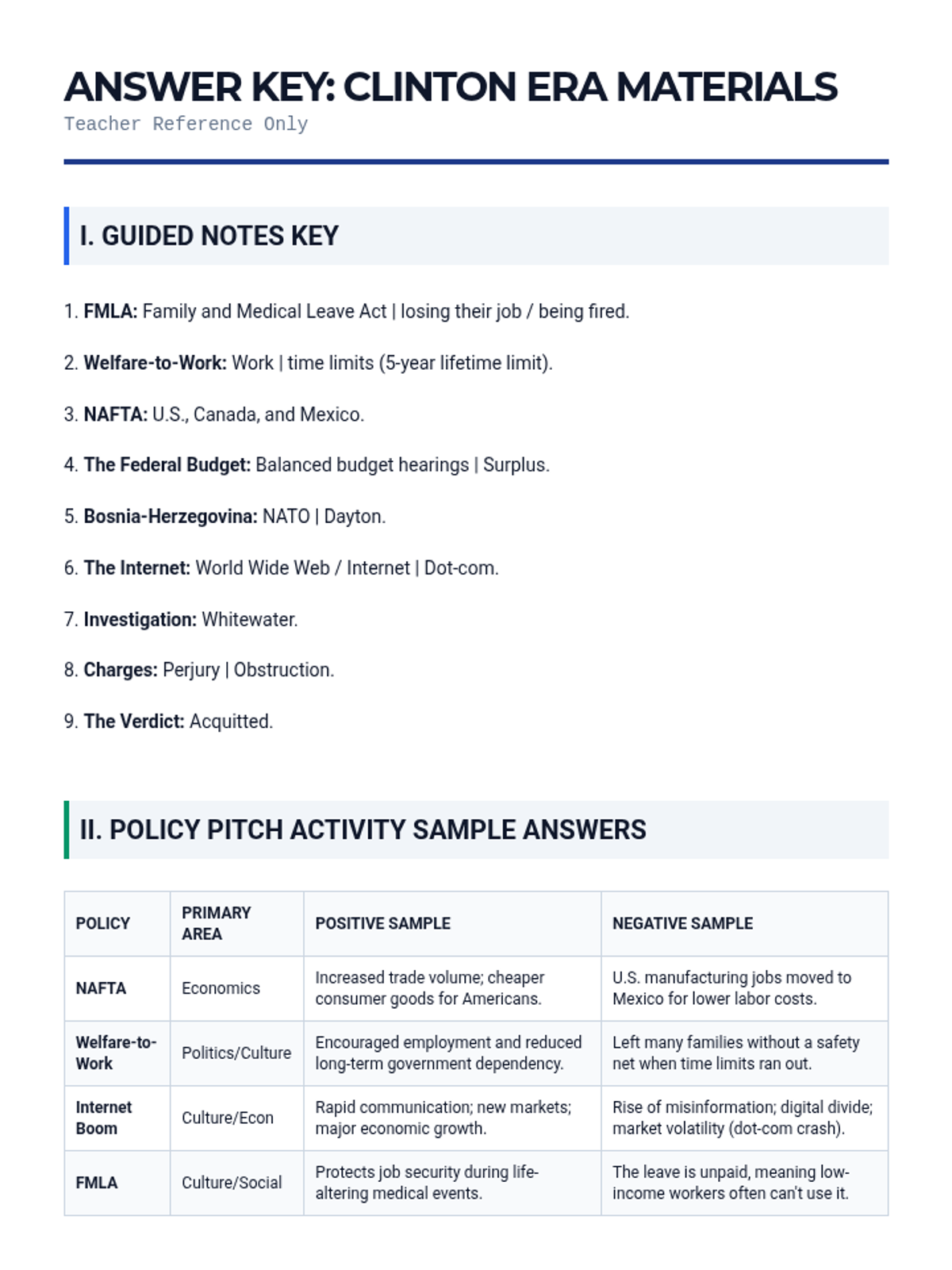
Answer key for the guided notes and Policy Pitch activity, providing sample responses and correct terminology.
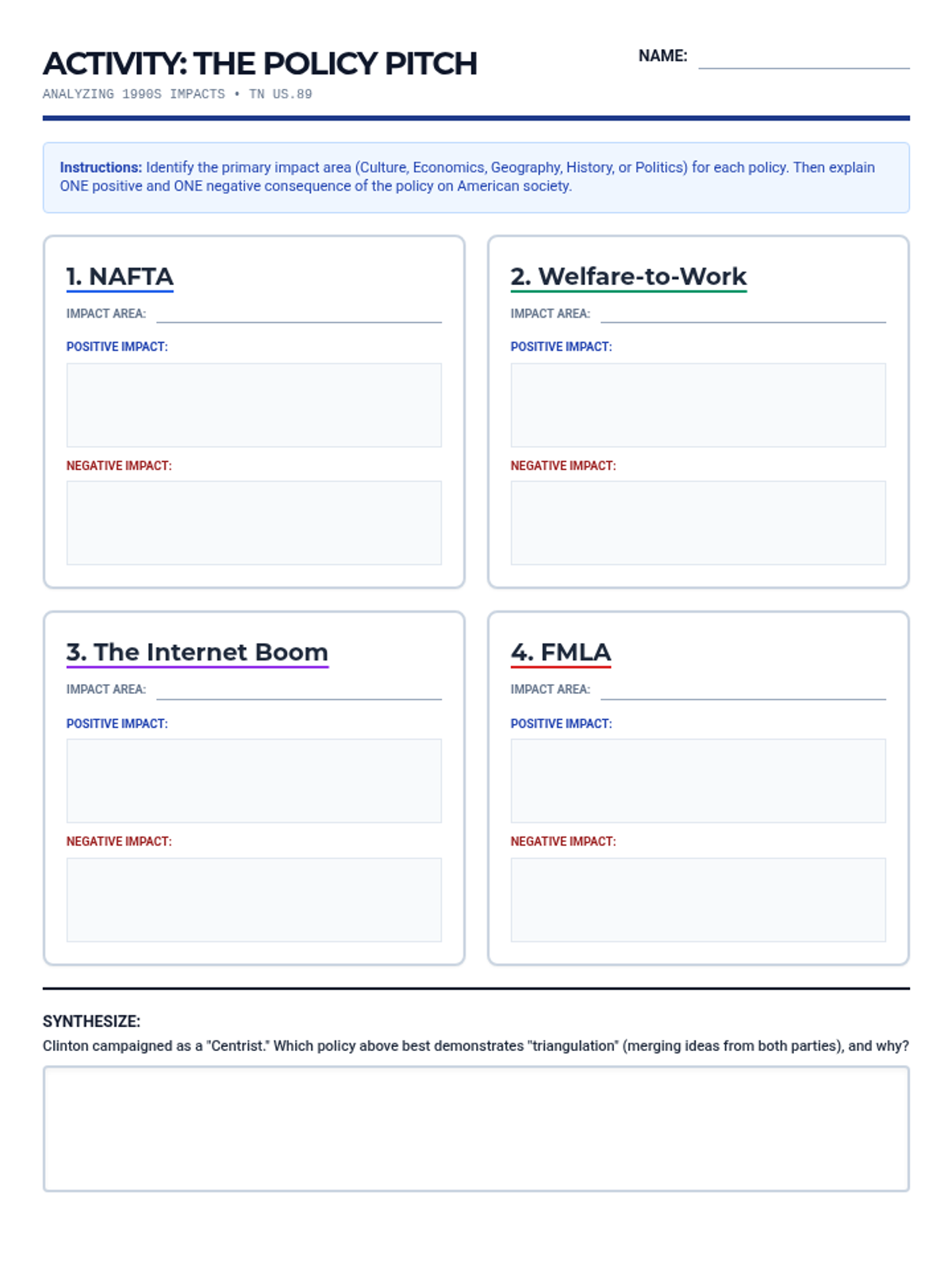
Activity sheet for analyzing policy impacts. Revised to fit strictly onto one page with better contrast and appropriate writing space.
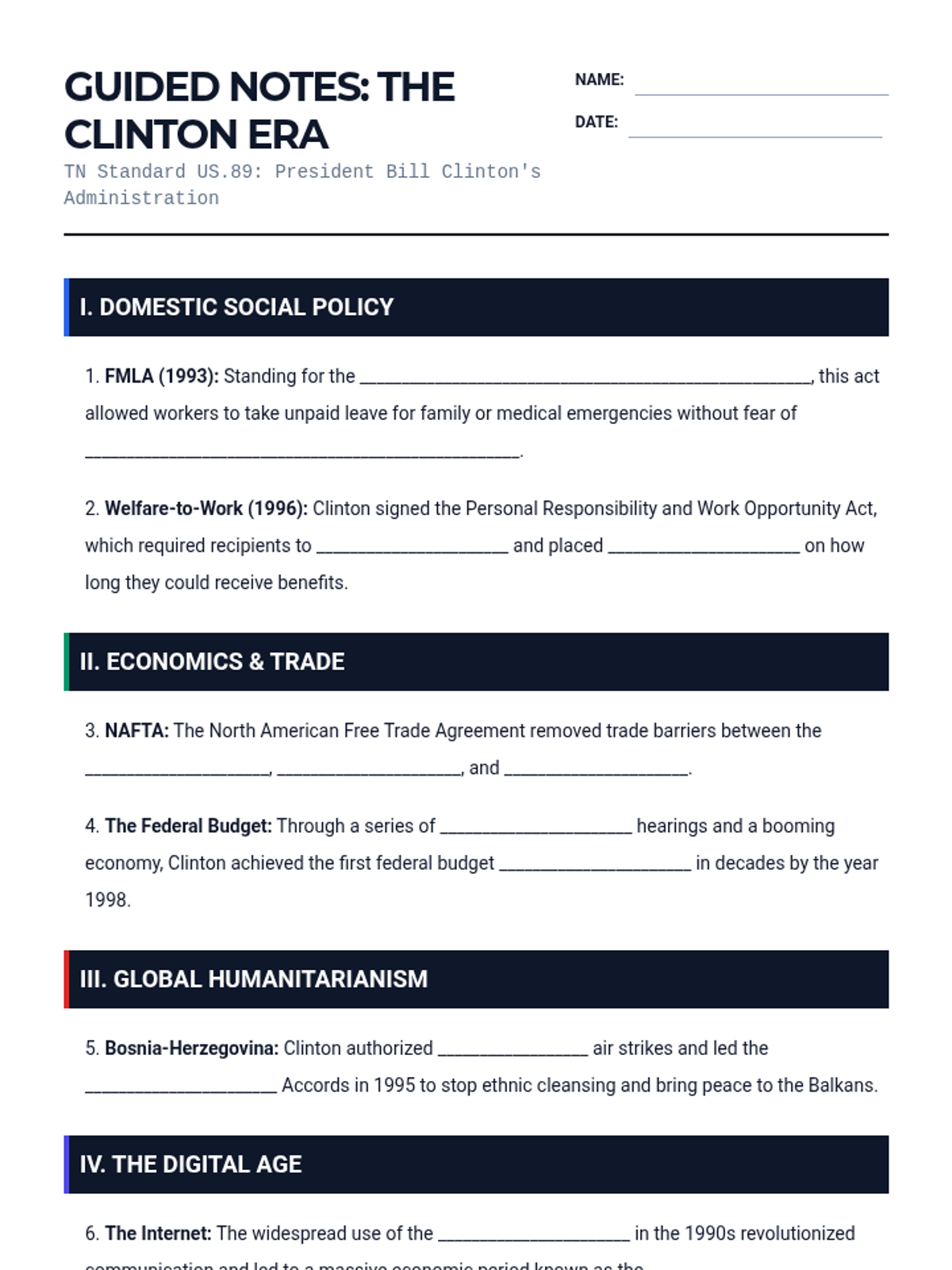
Student guided notes worksheet. Revised with 'break-inside-avoid' to prevent orphaned sentences and adjusted line lengths for better student response space.
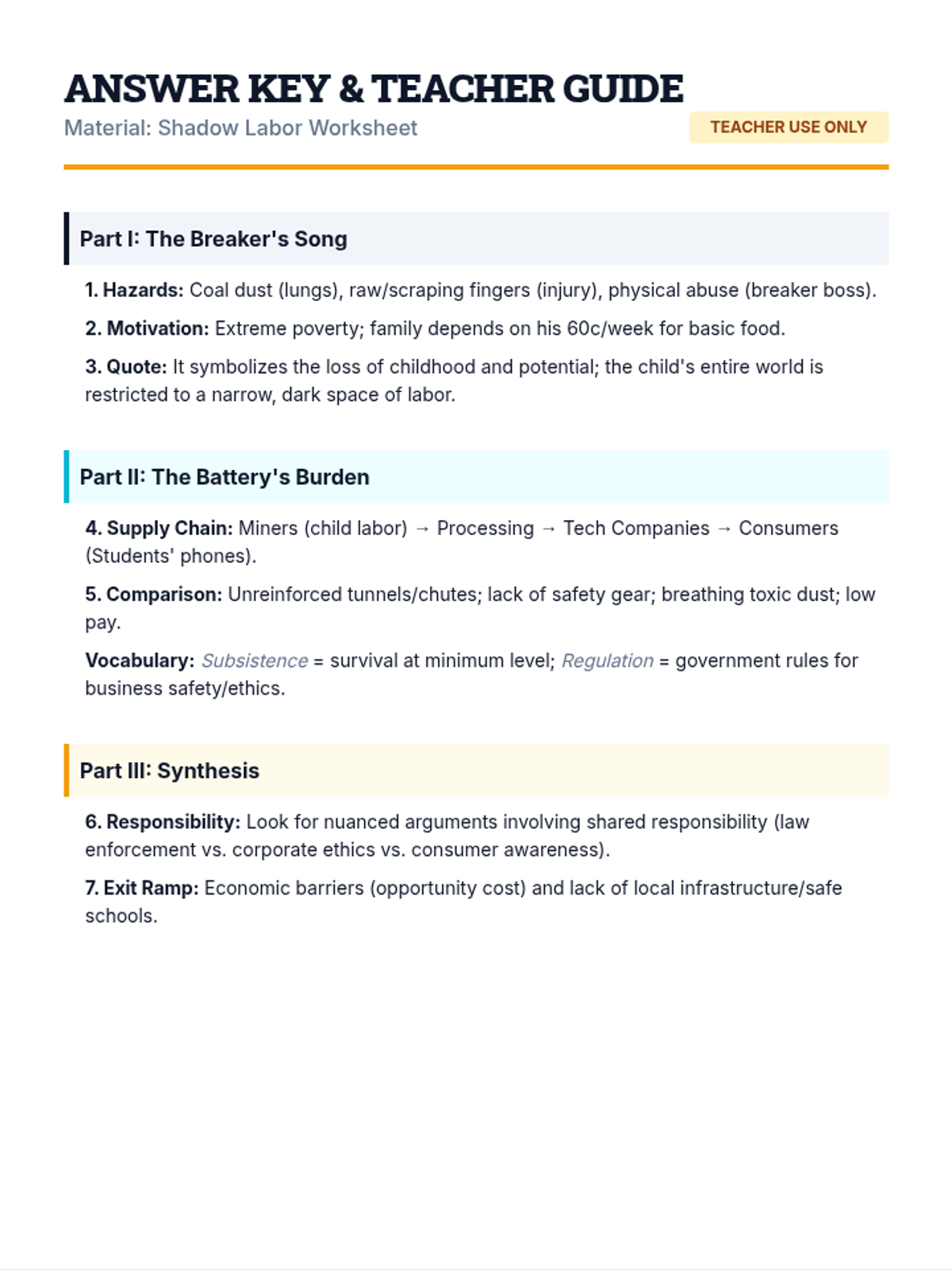
A teacher-facing answer key and facilitation guide for the 'Shadow Labor' worksheet, providing suggested responses and instructional tips.
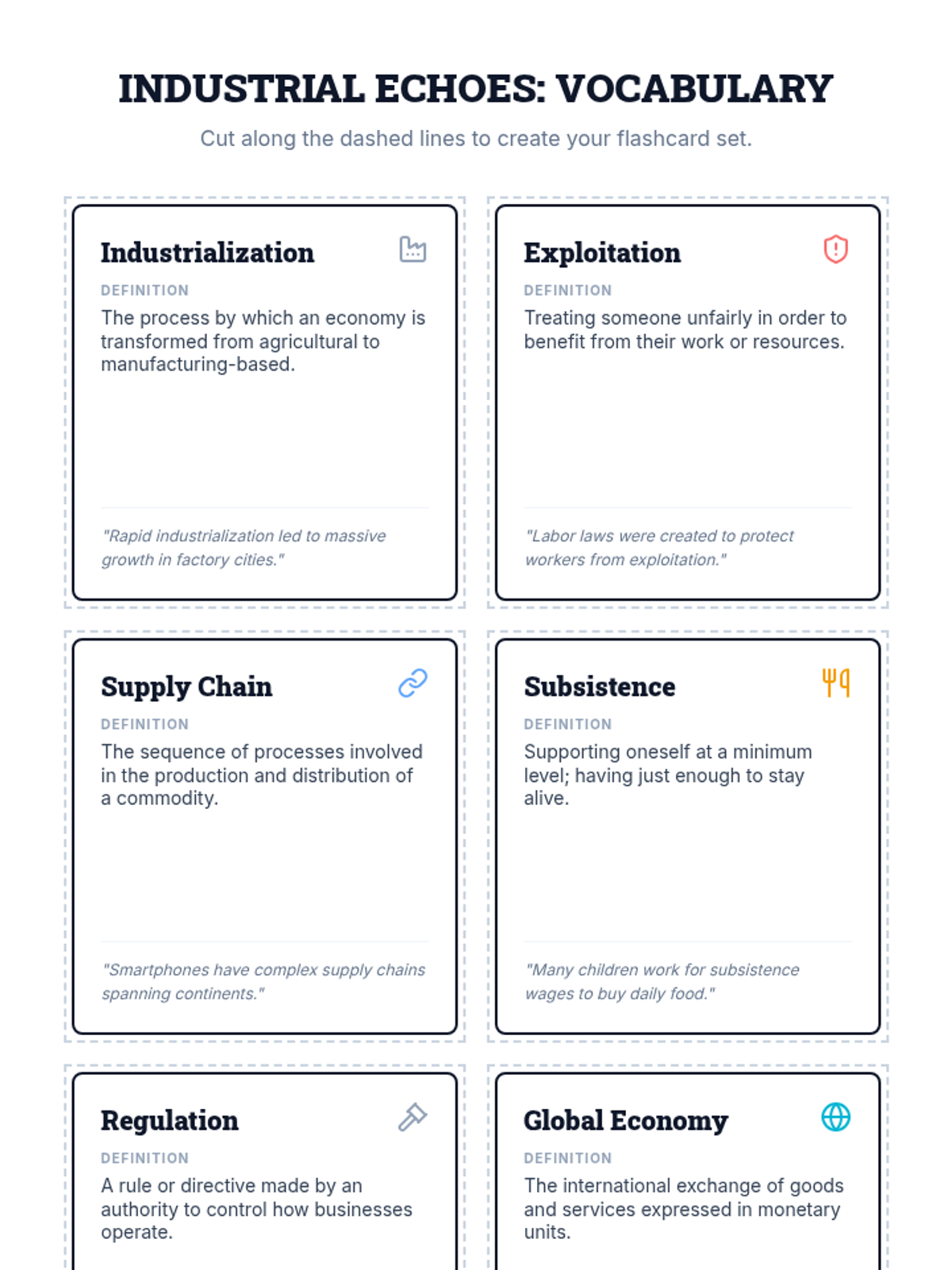
A set of 6 printable vocabulary cards with key terms, definitions, and usage examples for the child labor unit.
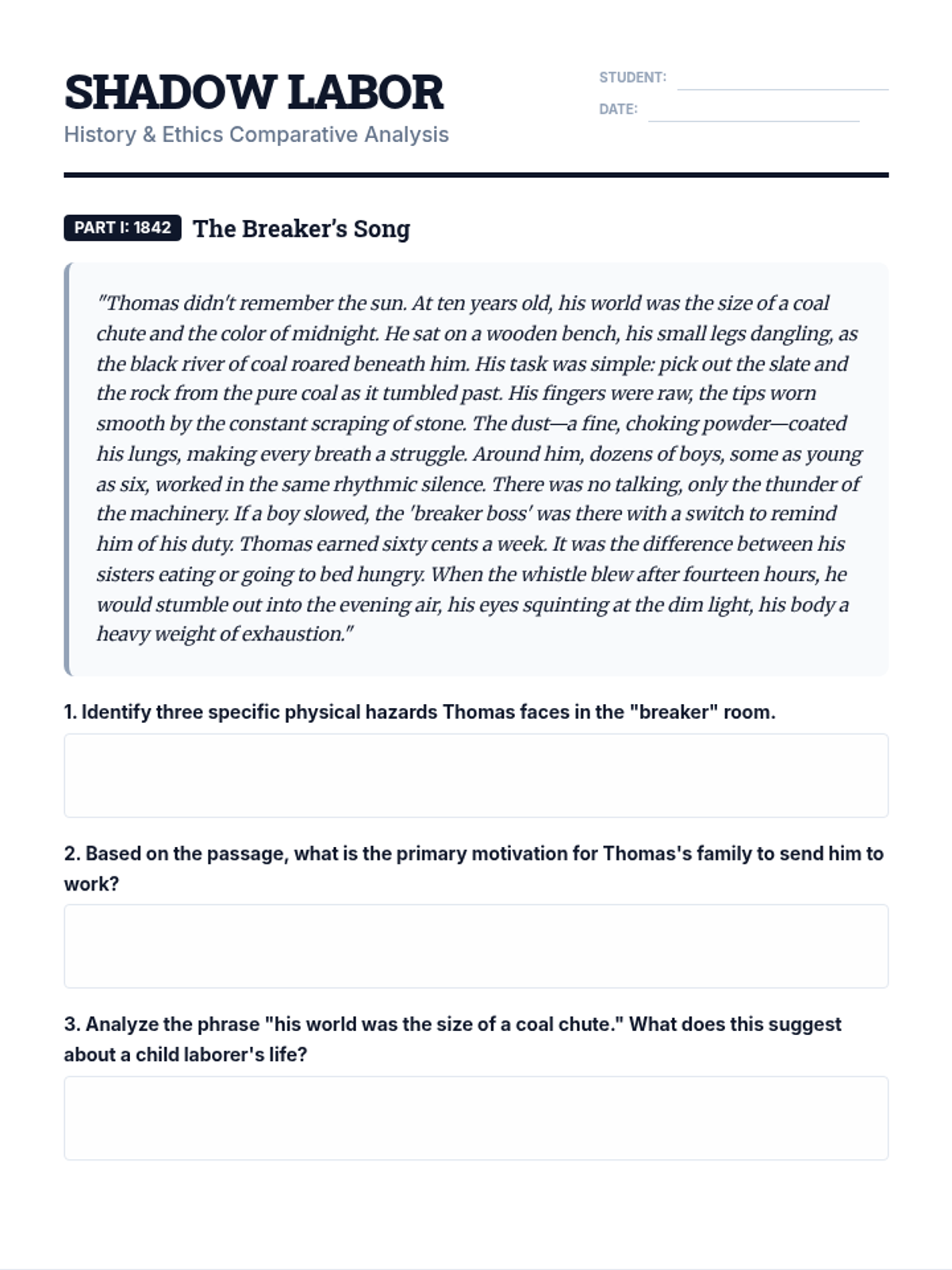
A comprehensive 3-page worksheet featuring two comparative reading passages (historical fiction and modern non-fiction) with comprehension, analysis, and critical thinking questions.
A visually striking slide presentation comparing historical and modern child labor, featuring data, key drivers, and comparison tables for 9th-grade students.
Expanded introductory slides for Lesson 1 covering the full range of landforms and bodies of water with a global focus, featuring comparative visuals and global examples like the Andes and Italy.
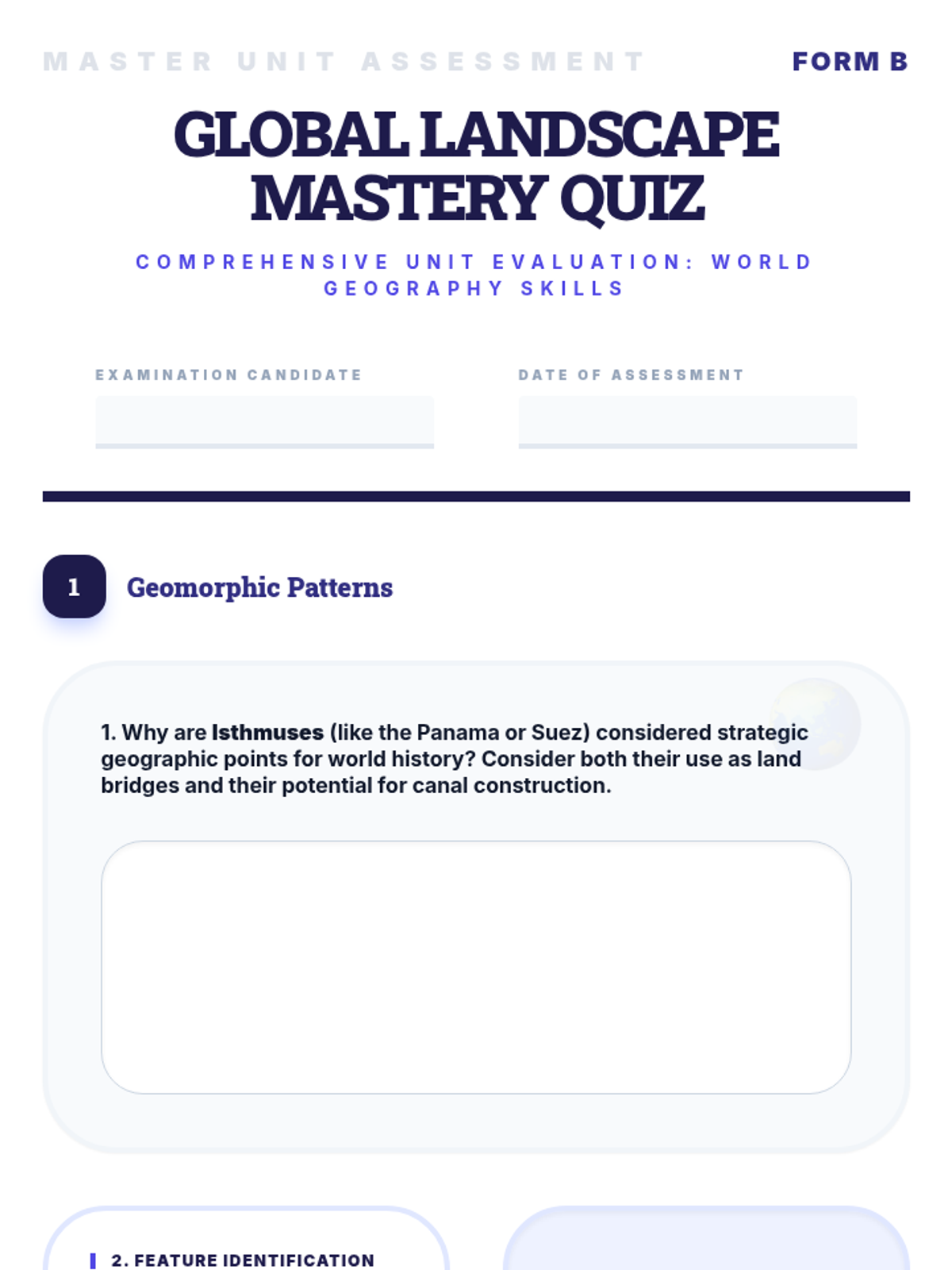
Global-focused final mastery quiz (Form B) featuring questions on isthmuses, world elevation averages, and regional economic advantages. Part of a secondary assessment set.
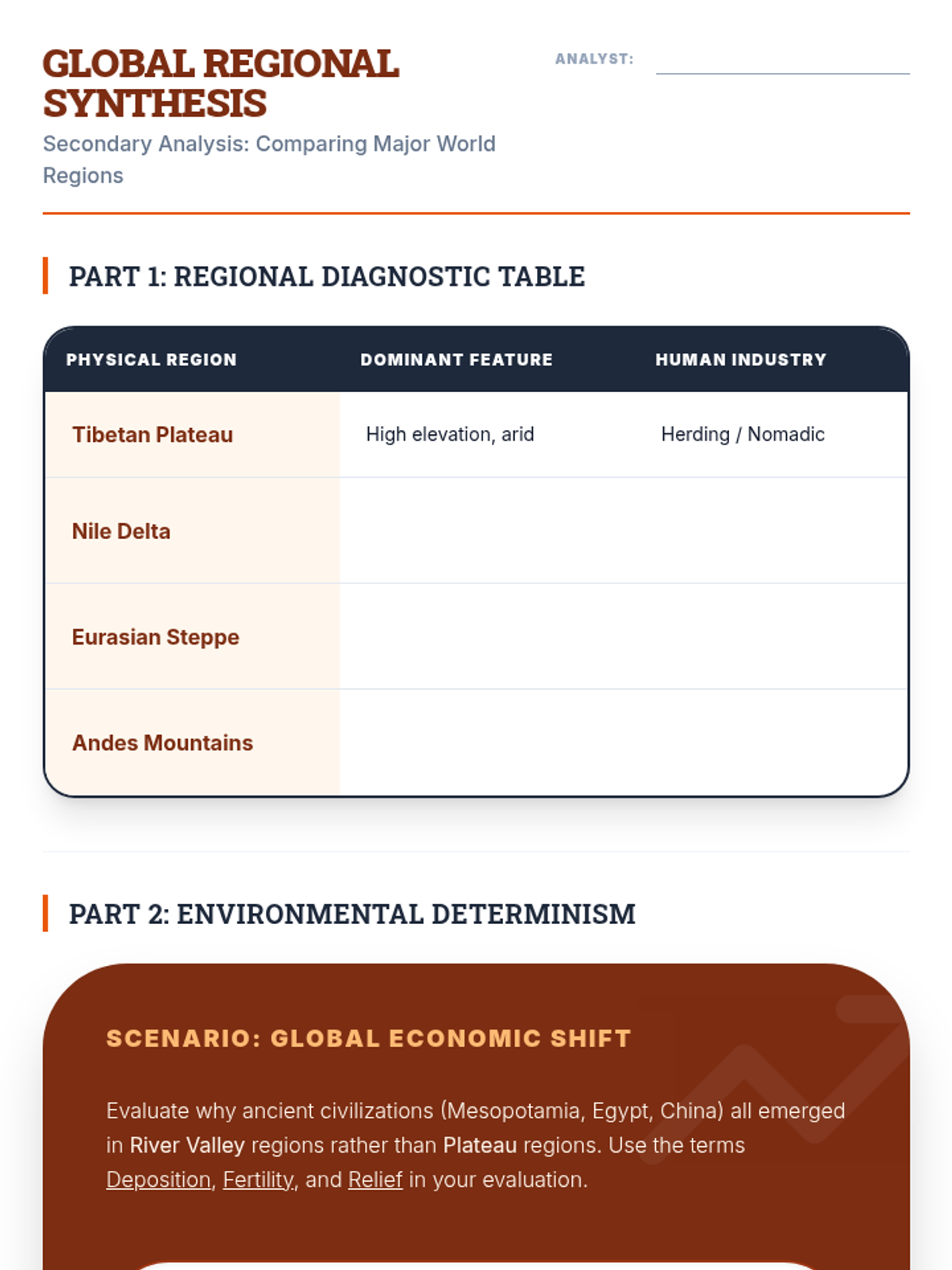
Secondary worksheet for Lesson 4 focusing on global regional diagnostics and the socio-economic analysis of river valleys vs. plateaus.
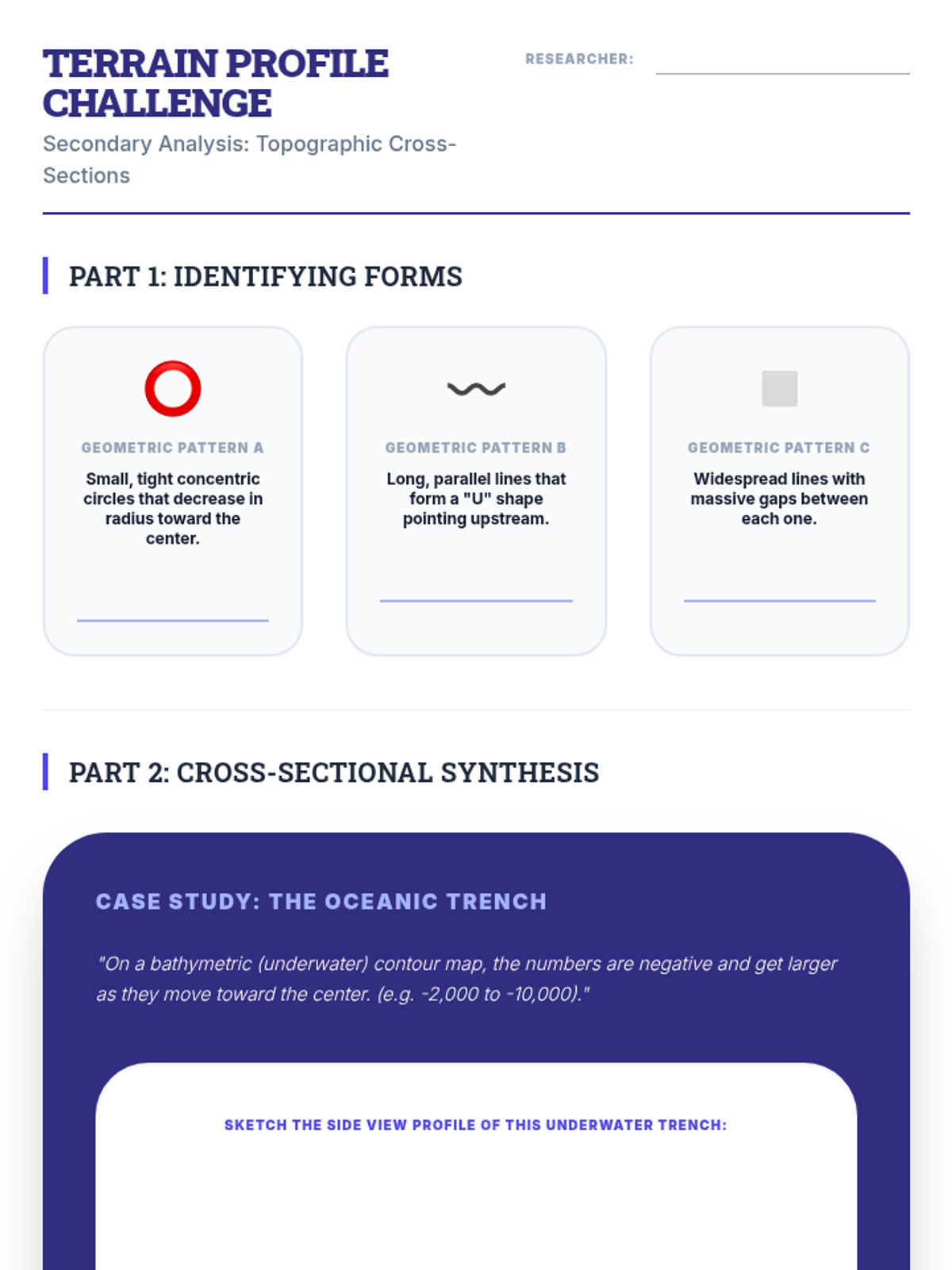
Secondary worksheet for Lesson 3 focusing on topographic pattern recognition and the construction of vertical profiles from contour data.
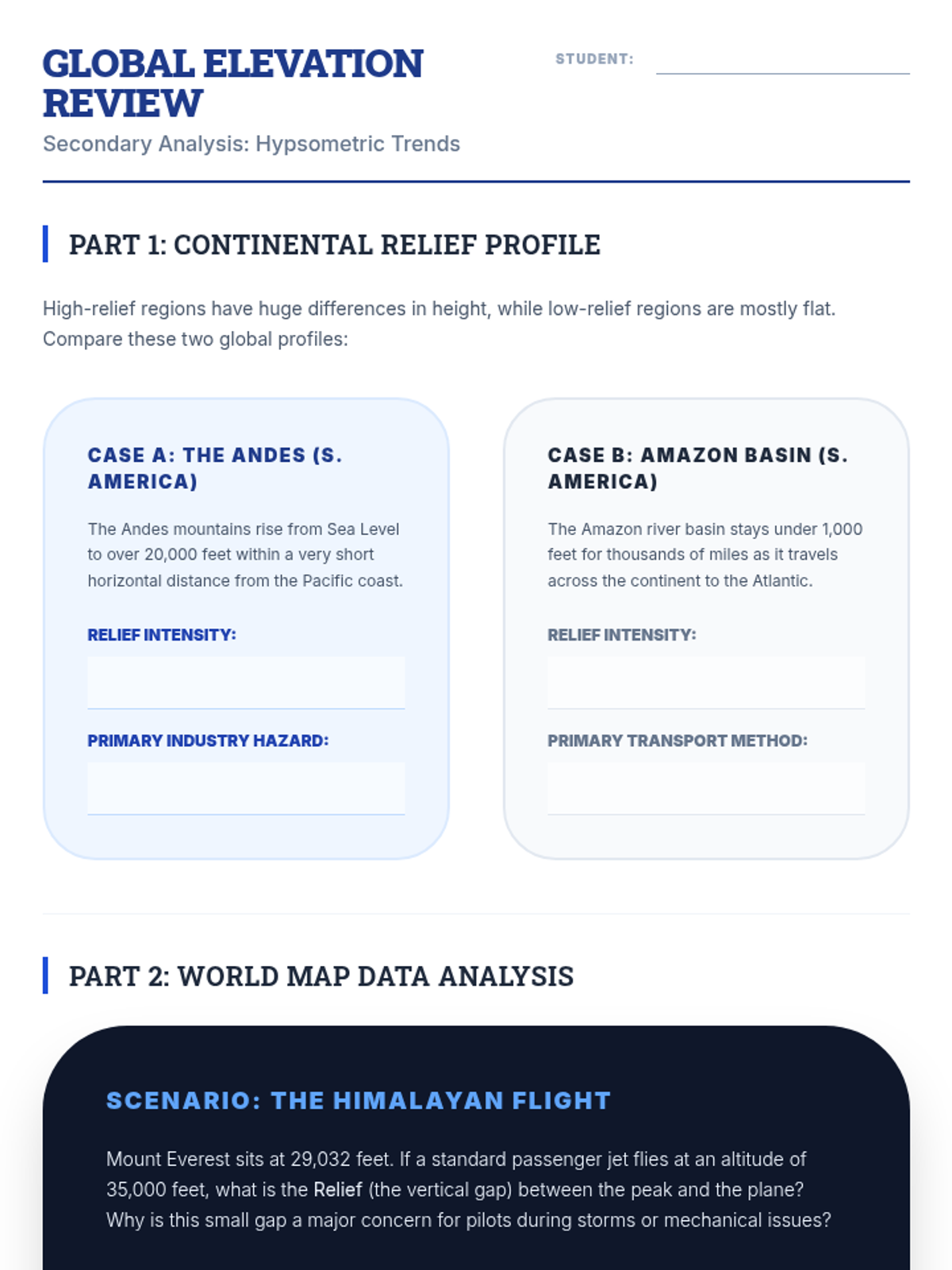
Secondary worksheet for Lesson 2 focusing on global relief comparisons, continental elevation profiles, and mathematical synthesis of flight data relative to world peaks.
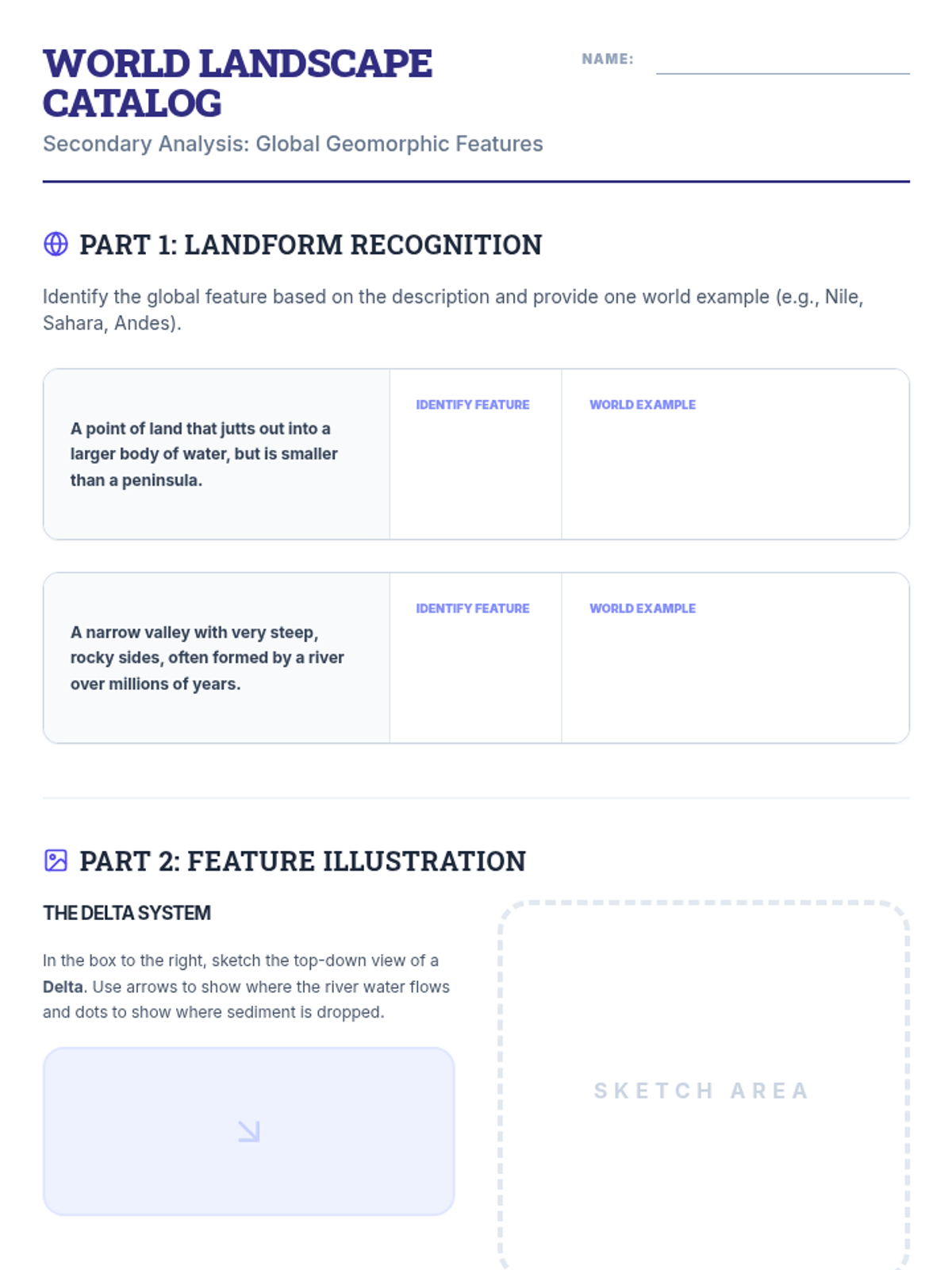
Secondary worksheet for Lesson 1 focusing on global landform identification and visual representation of geomorphic systems.
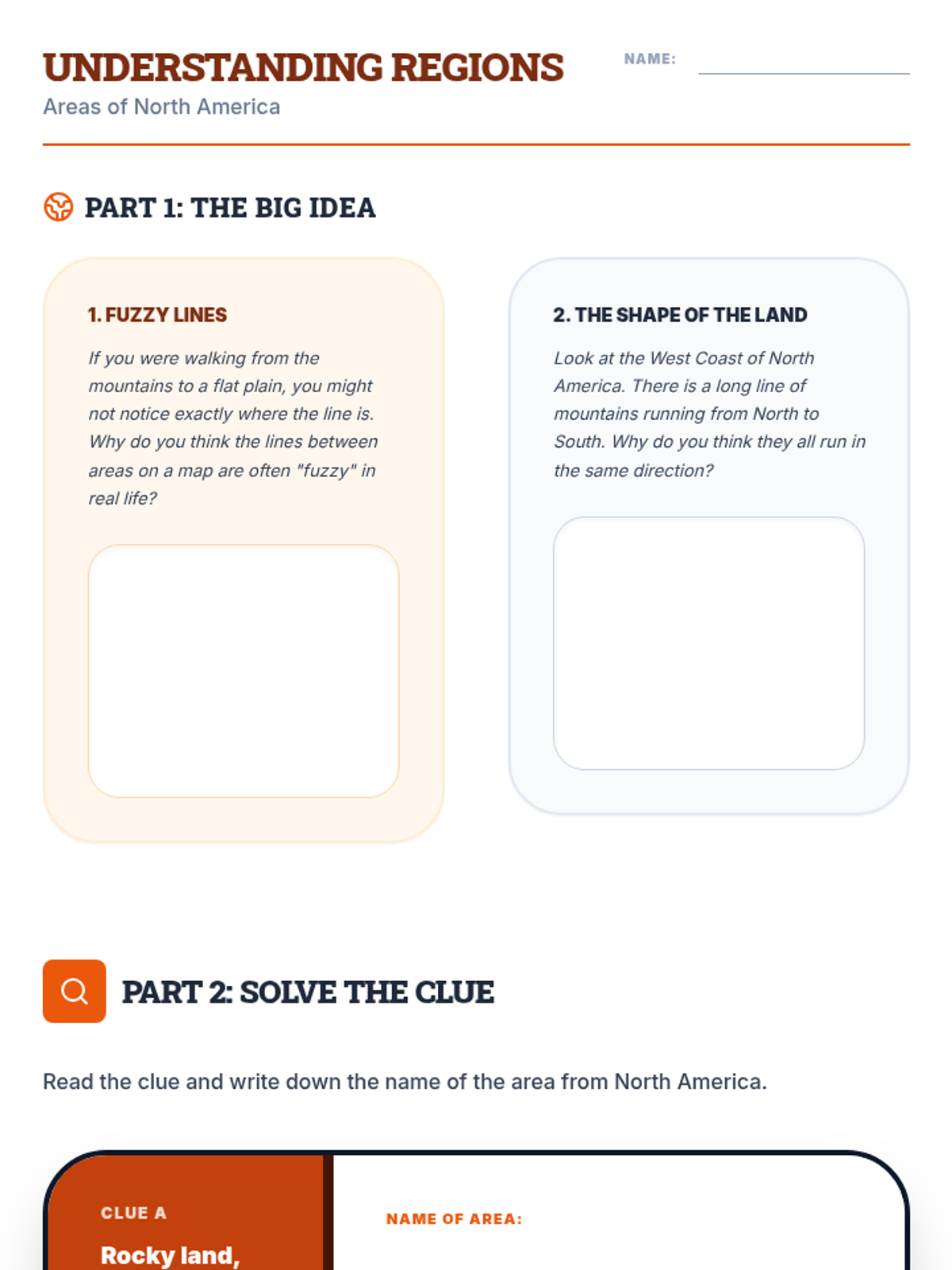
Worksheet for understanding the physical regions of North America and how they affect where people work and live, using simple language.
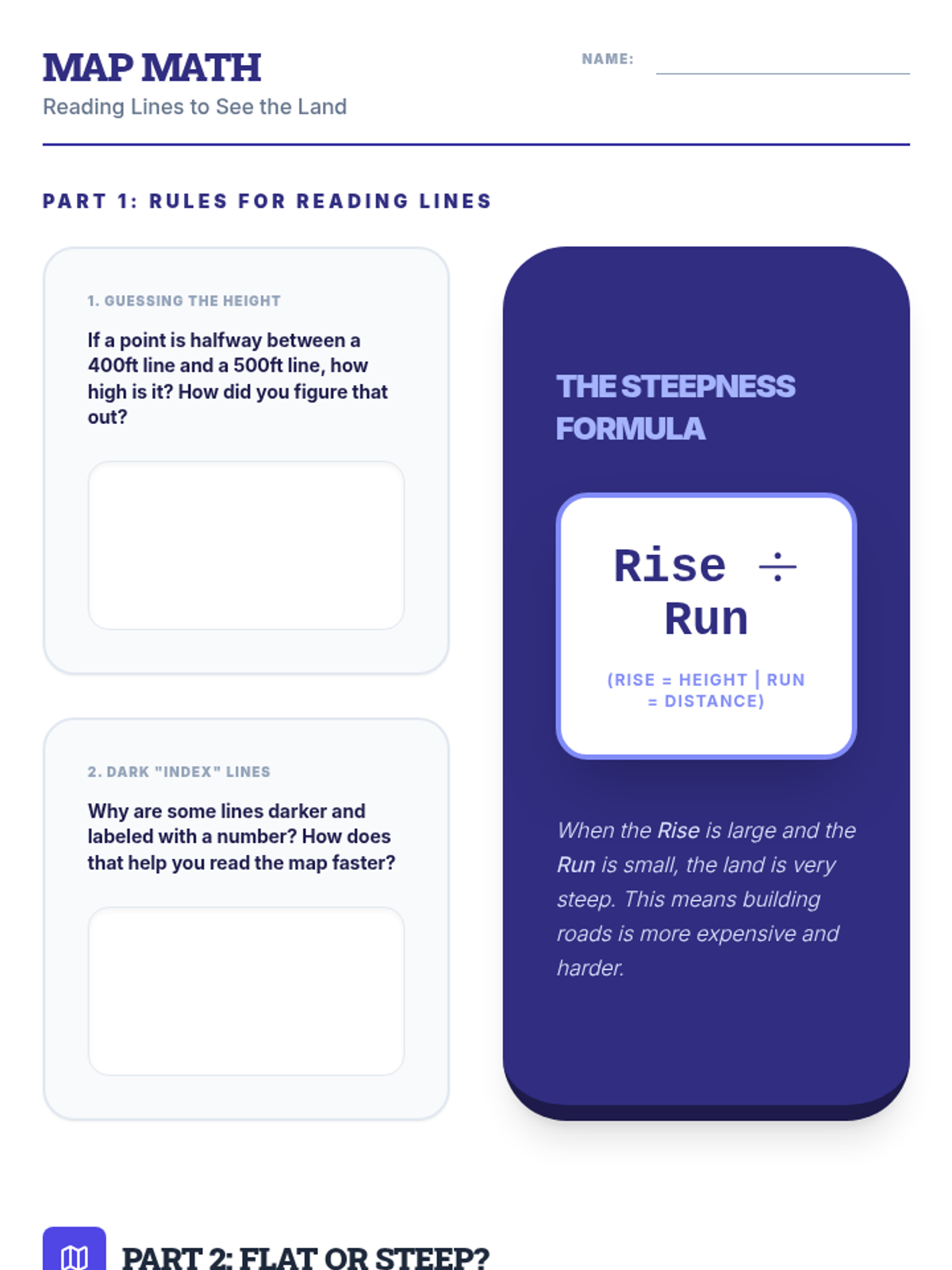
Worksheet for understanding contour lines, intervals, and terrain steepness using simple, easy-to-follow language.
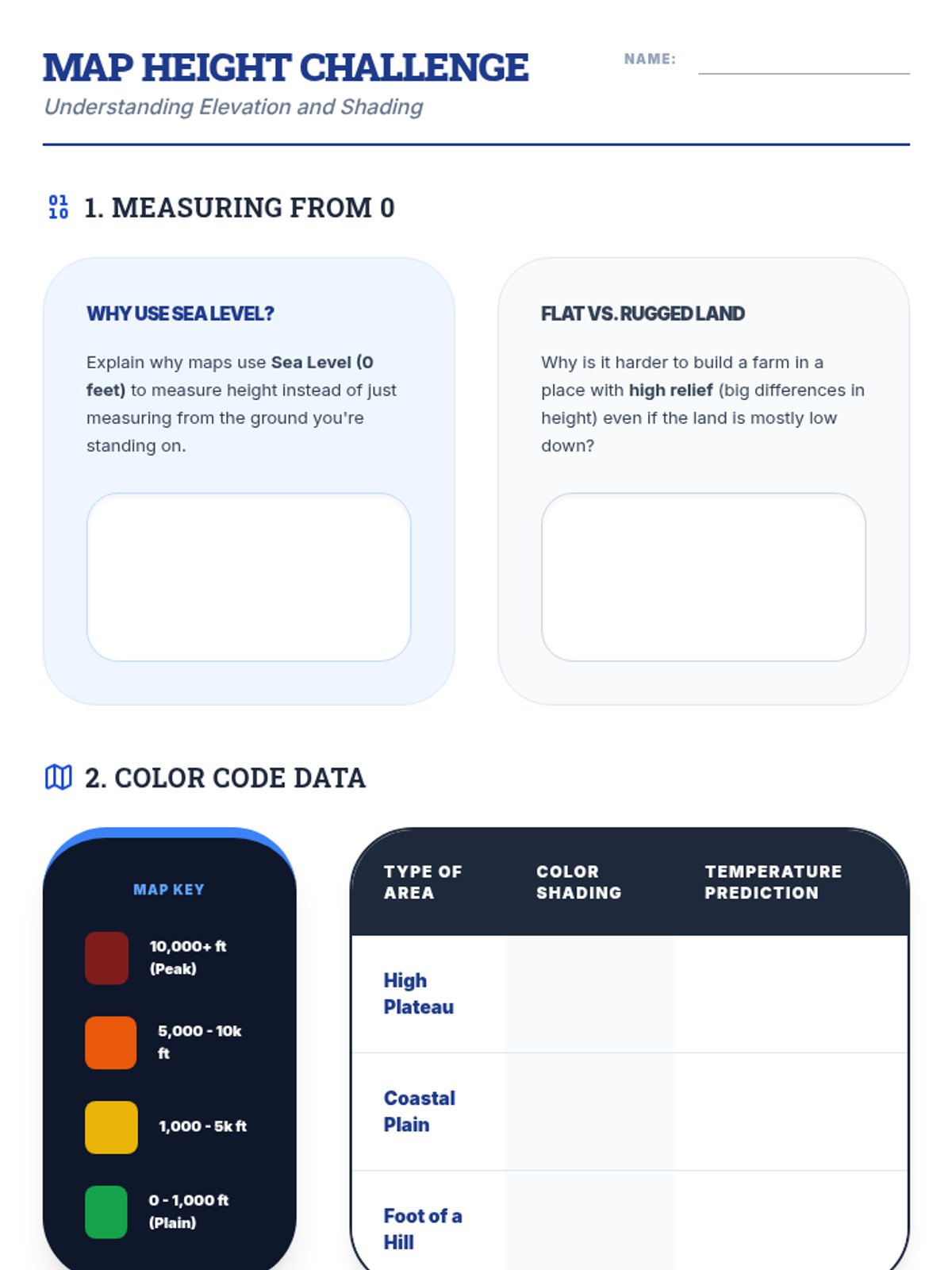
Worksheet for understanding elevation maps, legends, and temperature changes with height, using simple language.
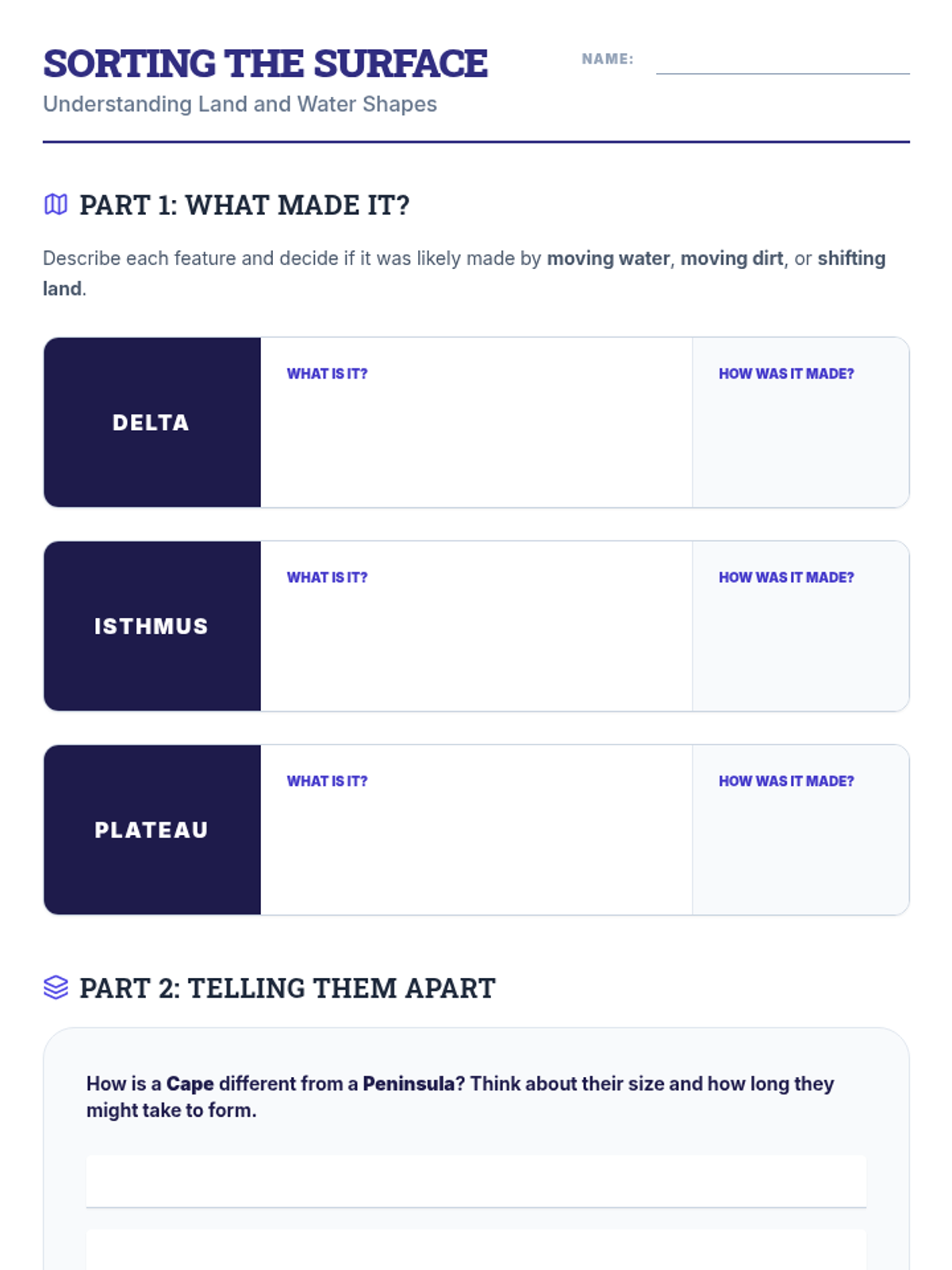
Worksheet focusing on landform shapes and how they affect human life, using clear and accessible language.
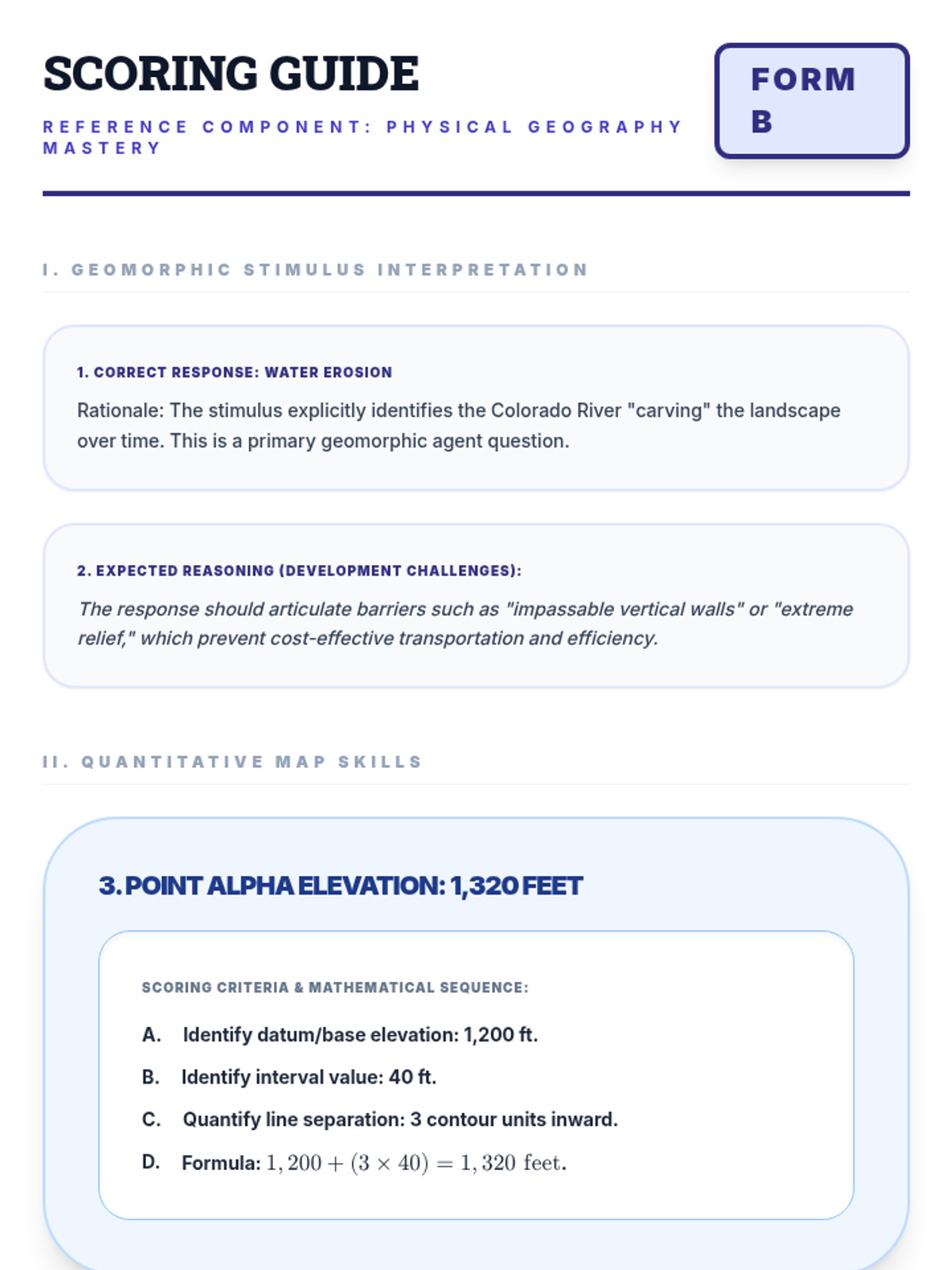
Scoring key for the Mapping Mastery Quiz, providing detailed rationales and evaluation criteria for text interpretation and quantitative map skills. All level labels removed for general use.
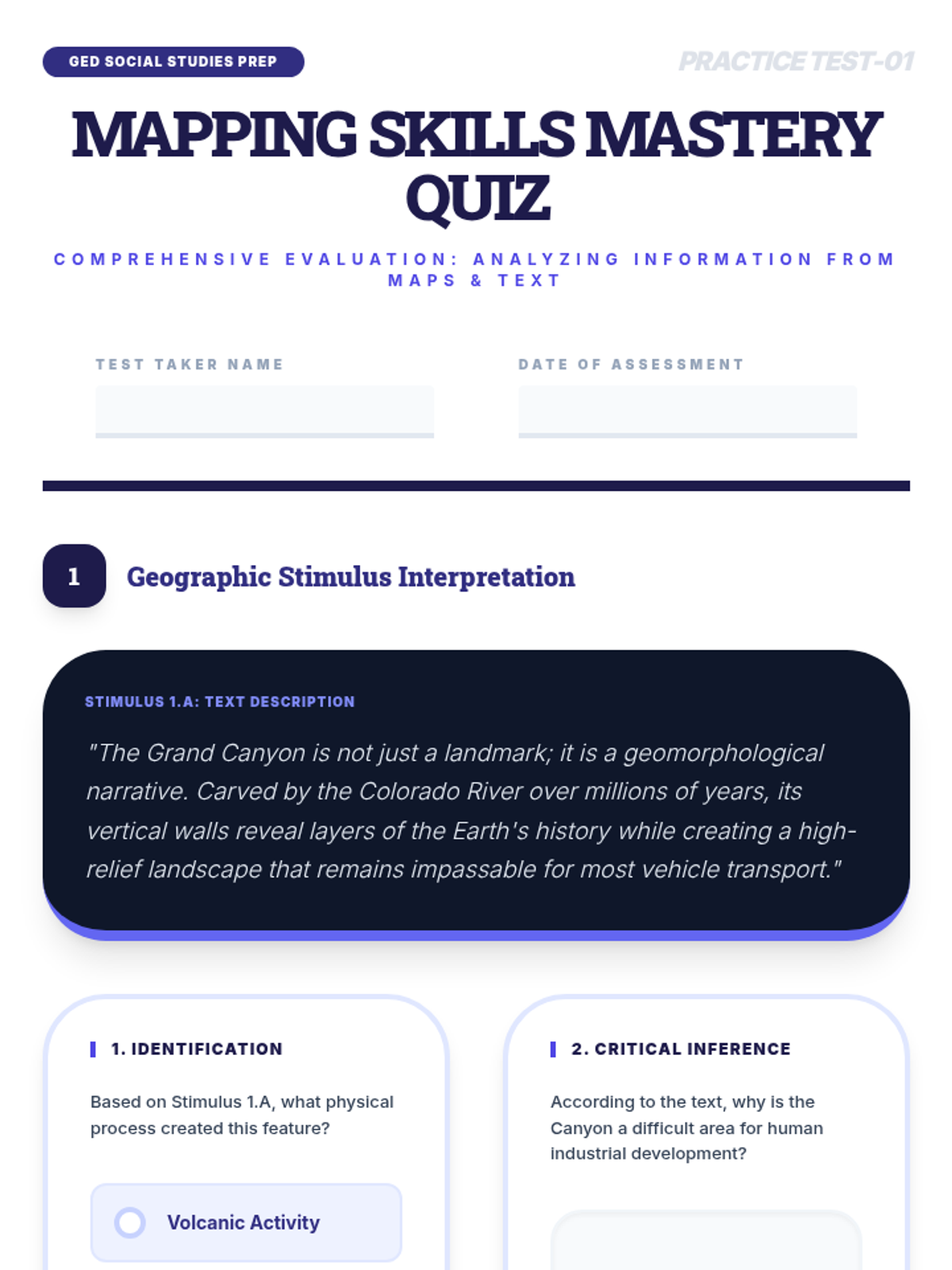
GED-formatted final mastery quiz focusing on interpreting informational text stimulus, quantitative contour calculations, and synthesizing geographic data for economic analysis.
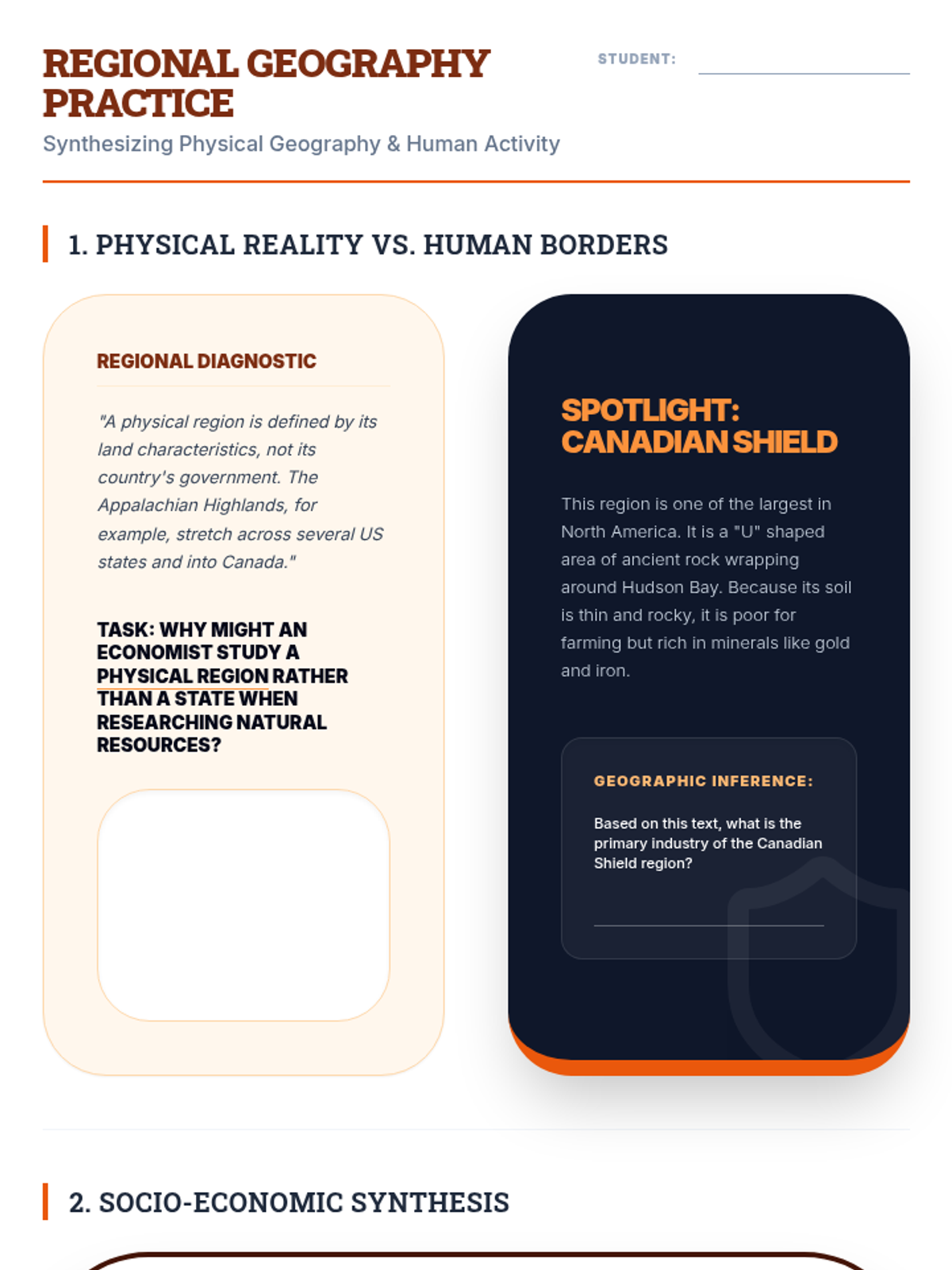
Worksheet for physiographic regions, focusing on interpreting regional text descriptions and analyzing how physical terrain dictates regional economies and industry. Level labels removed for general use.
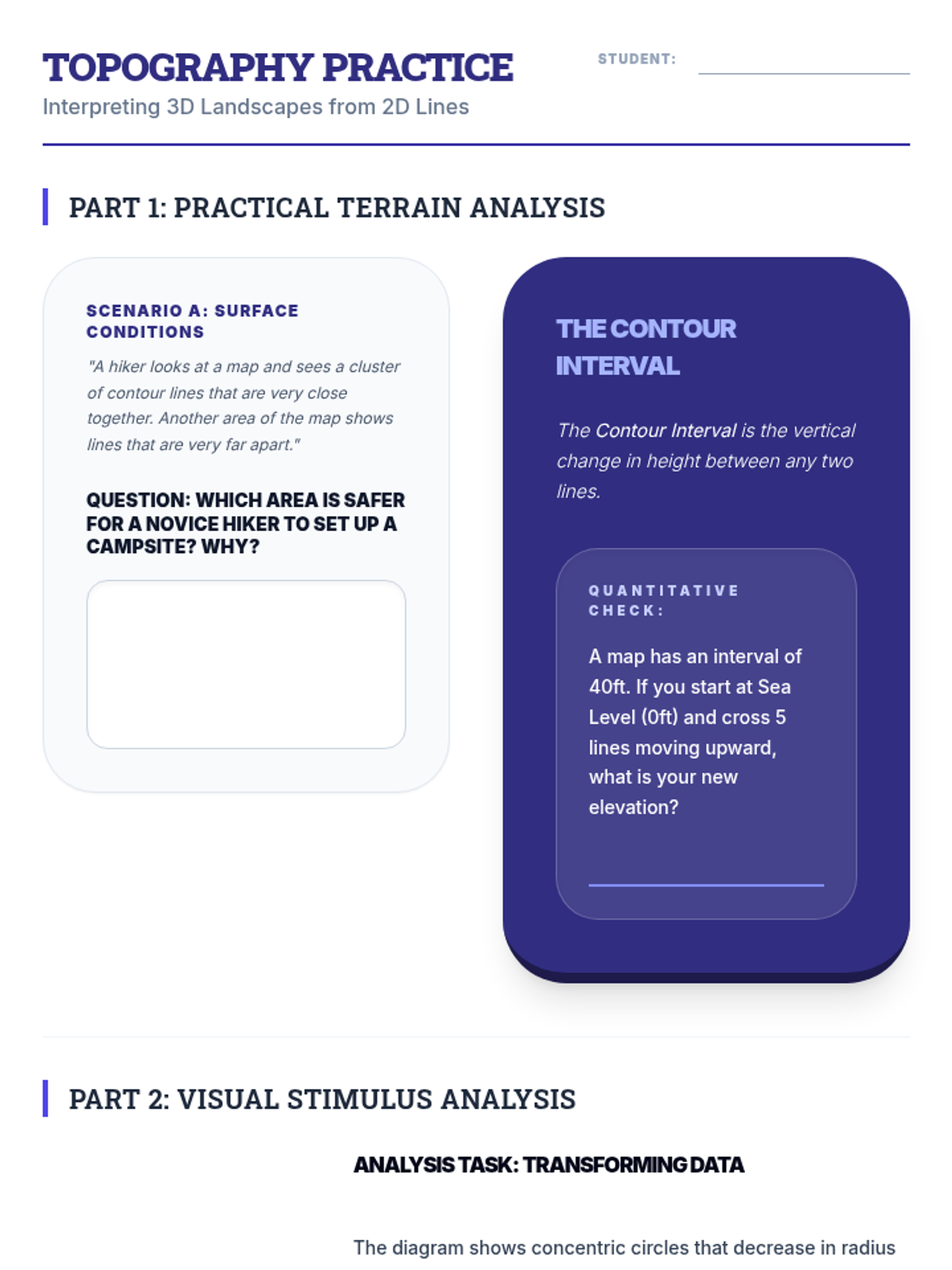
Worksheet for topographic maps, focusing on practical terrain application, contour interval math, and visualizing 3D landforms from 2D diagrams. Level labels removed for general use.
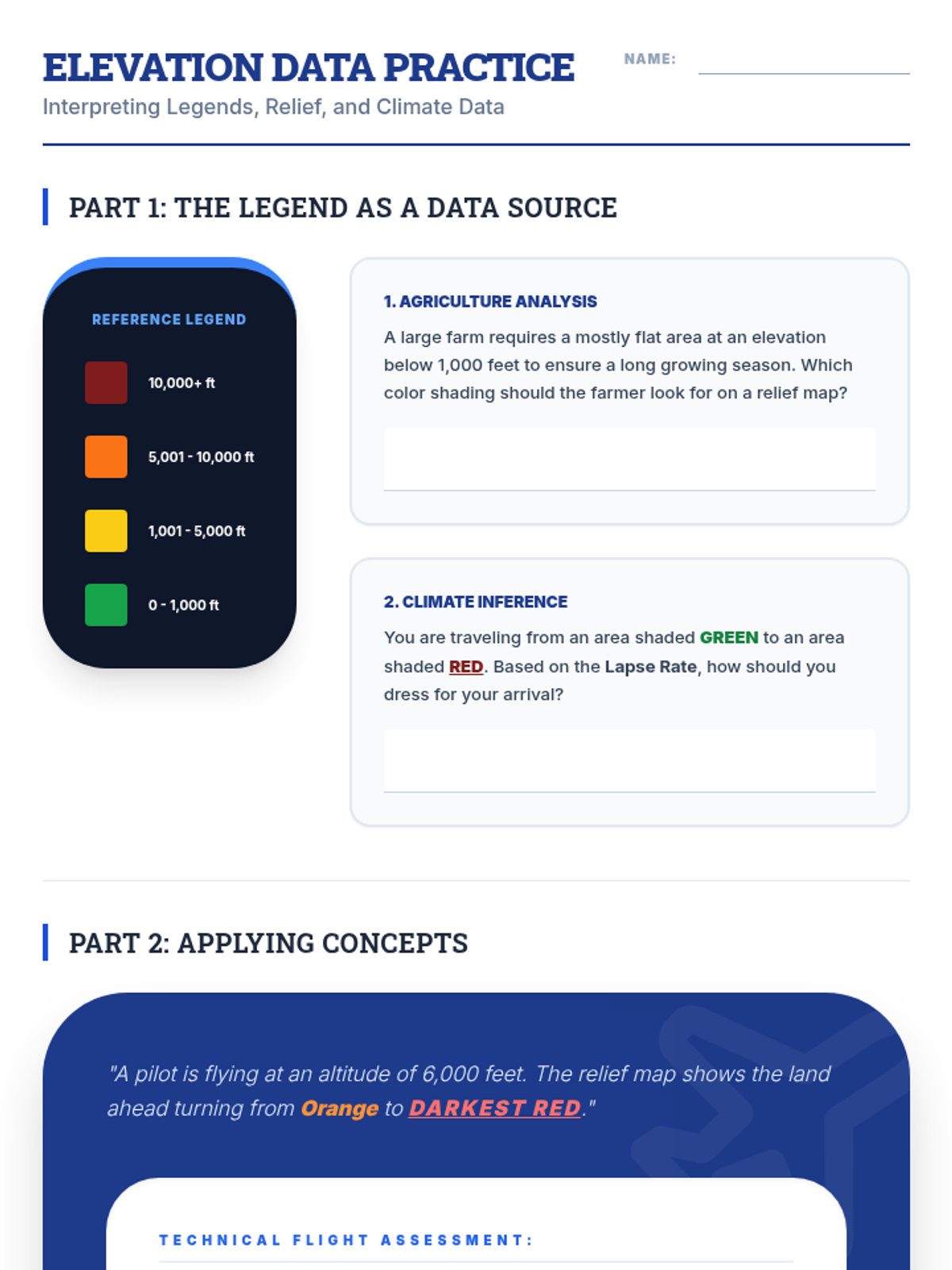
Worksheet for elevation maps, focusing on using legends to make inferences about agricultural suitability, climate shifts, and aviation safety. Level labels removed for general use.
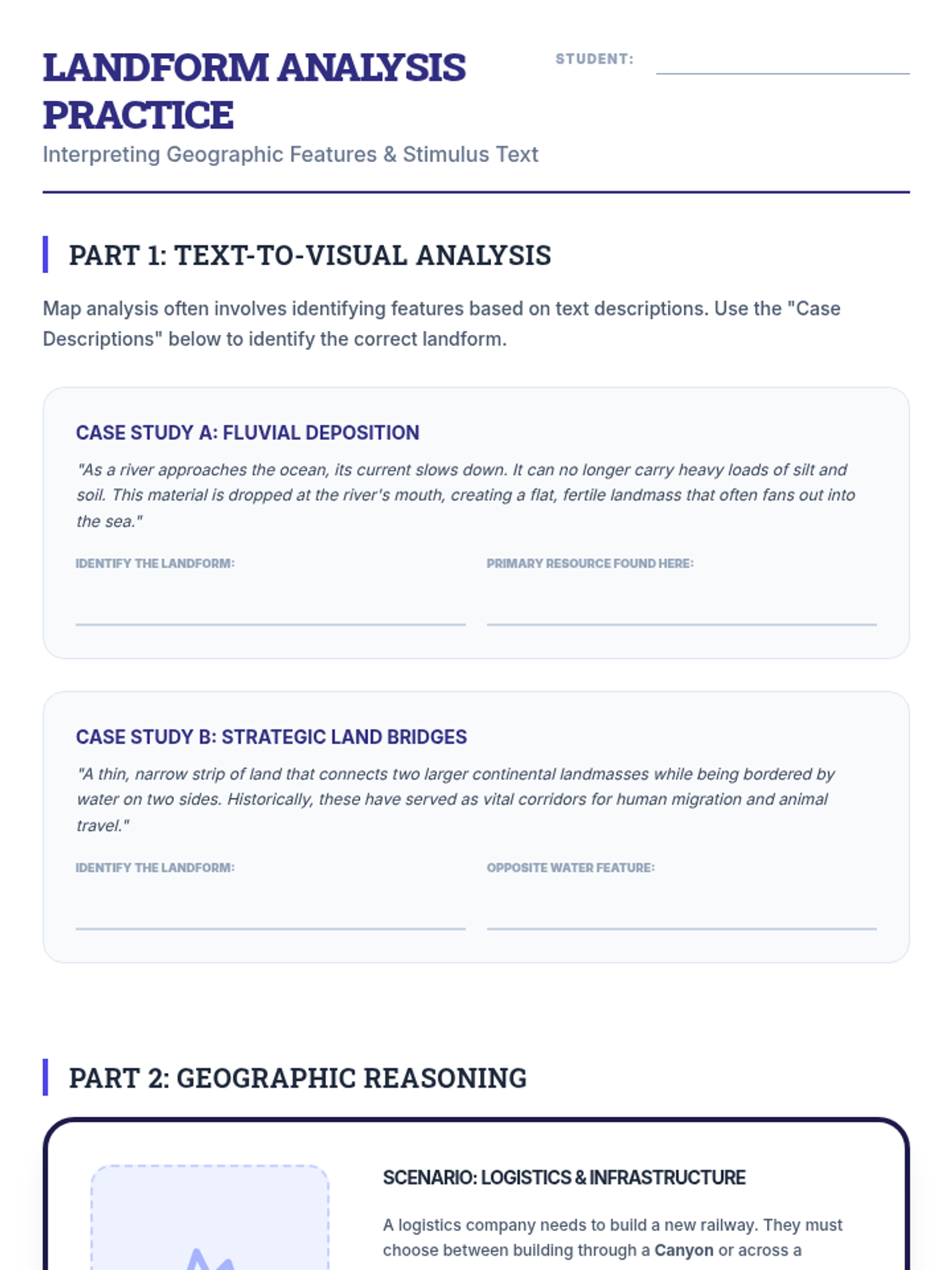
Worksheet focusing on identifying landforms from text-based stimulus and applying geographic reasoning to transportation and resource scenarios. Level labels removed for general use.
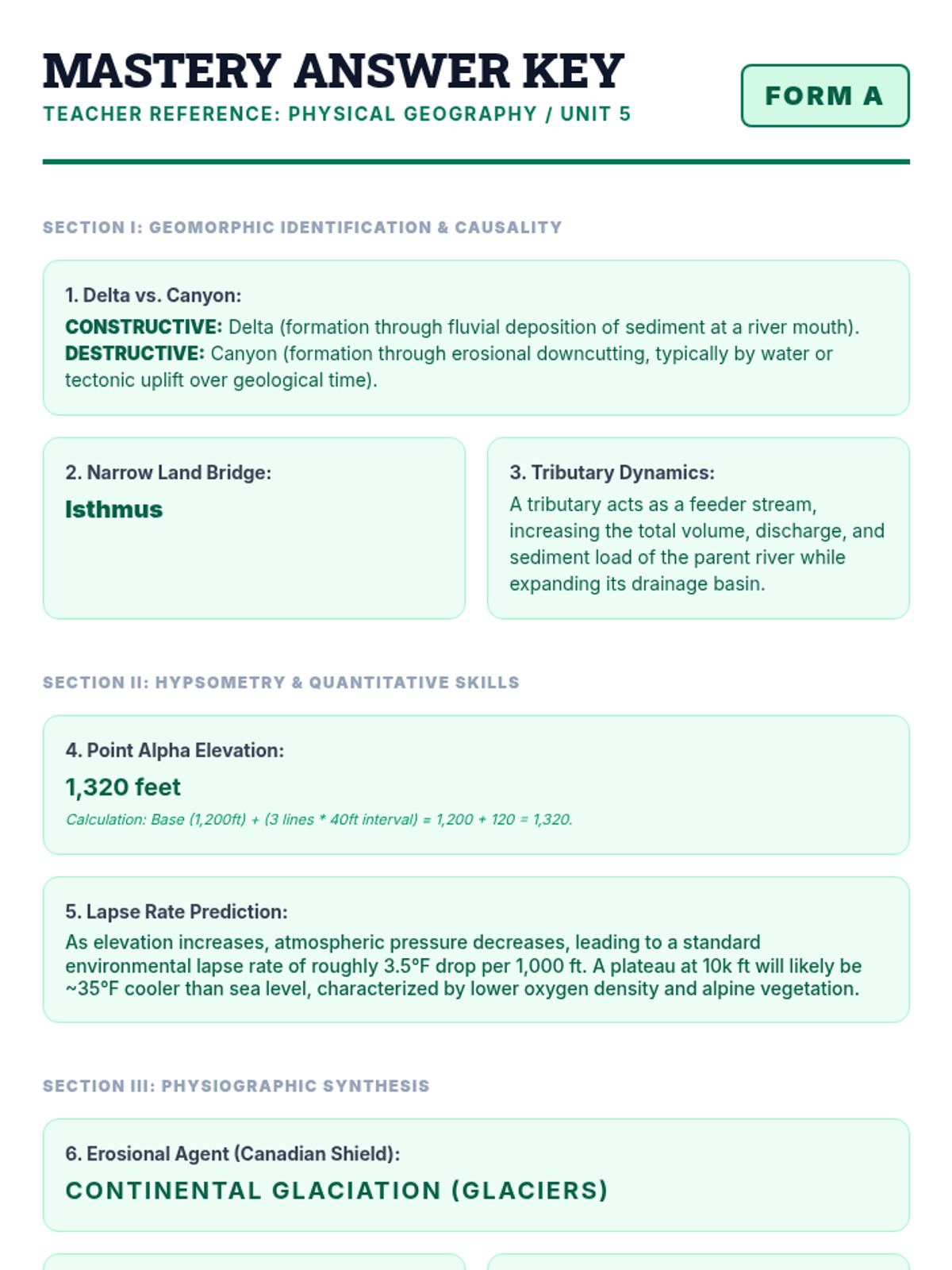
Teacher-facing answer key for the Mapping Mastery Quiz, providing technical geological explanations and mathematical solutions for high-school level analysis. All level labels removed for general use.
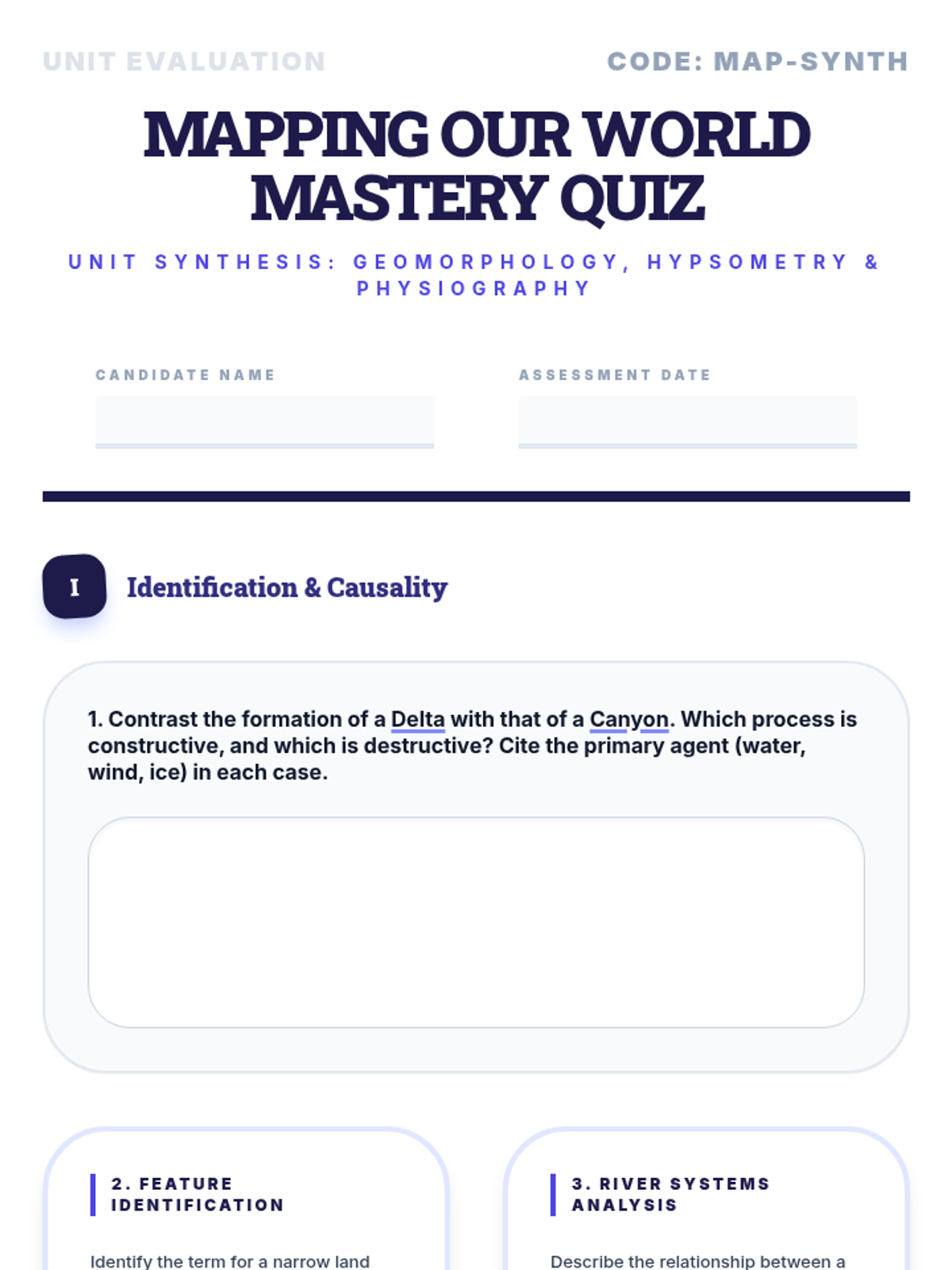
Mastery quiz covering landforms, elevation, and North American regions. All level labels removed for a general assessment experience.
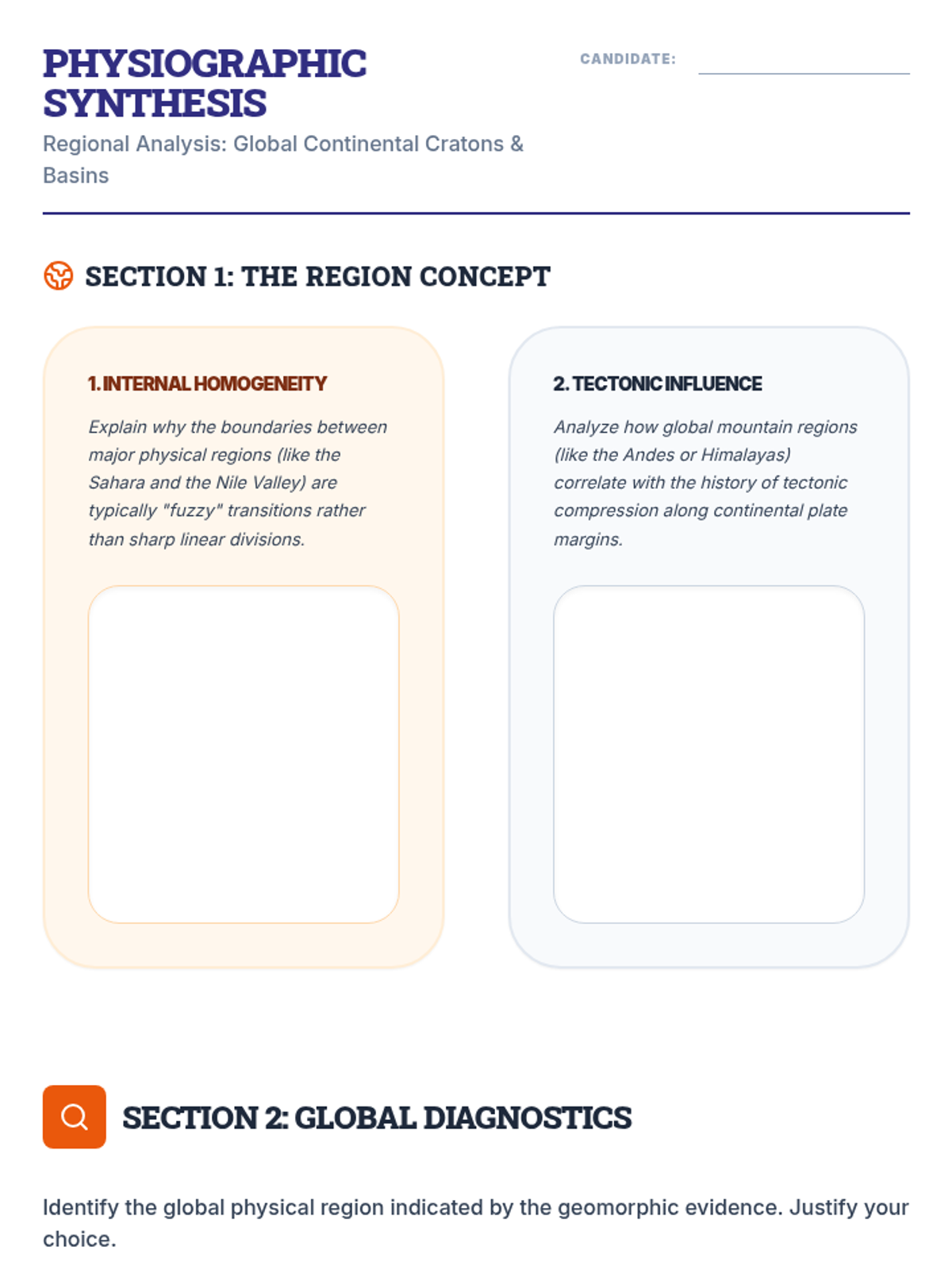
High-school level worksheet for Lesson 4 focusing on physiographic analysis, tectonic influences on regional formation, and the synthesis of physical geography with economic industrialization patterns. Fixed page breaks and contrast.
Exploration of global physical regions, their characteristics, and their impact on human development. Updated to a world-wide focus with visual context.
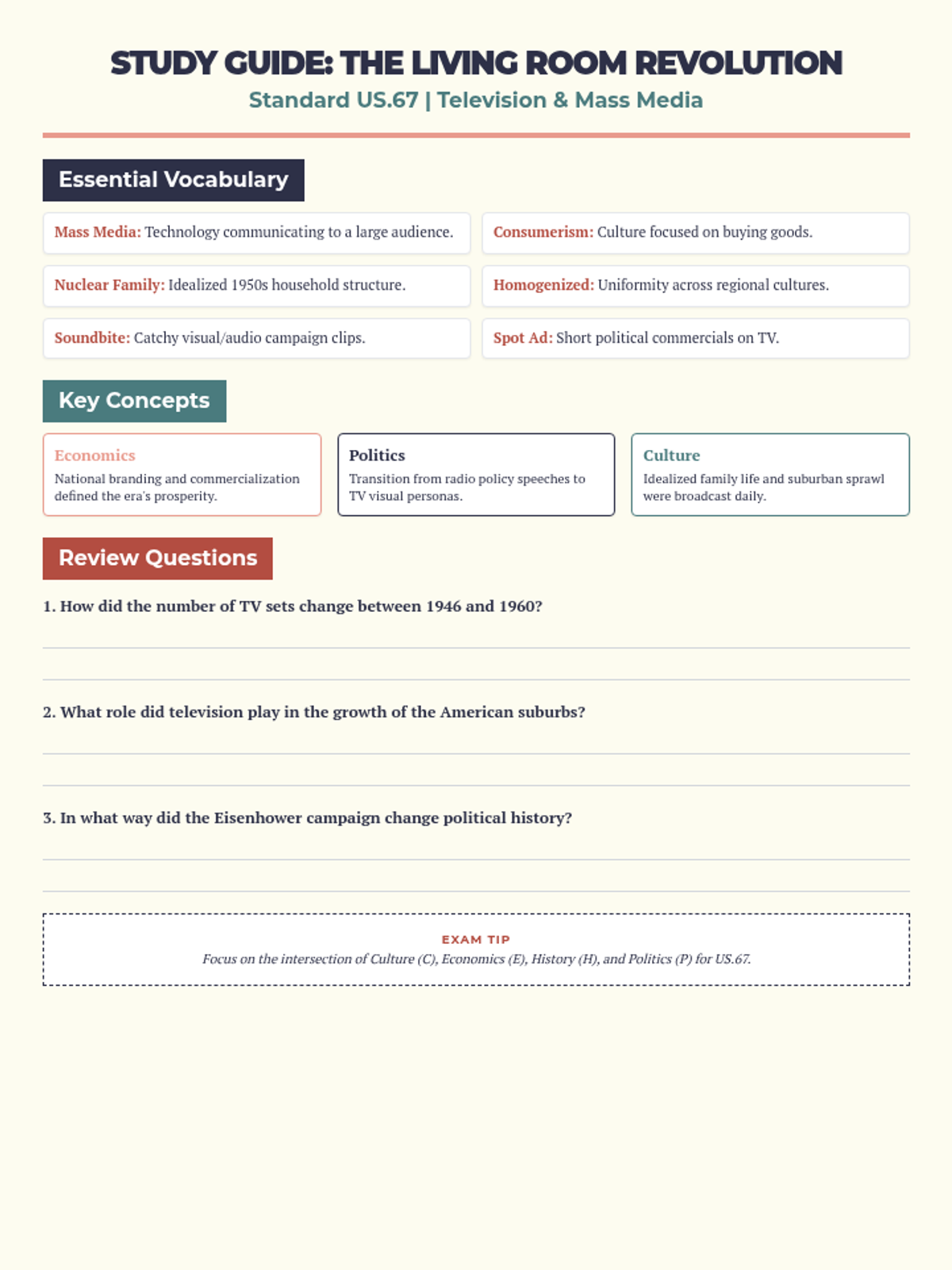
A concise study guide for students covering key vocabulary, core concepts, and review questions. Revised for a single-page layout with clear student work areas.
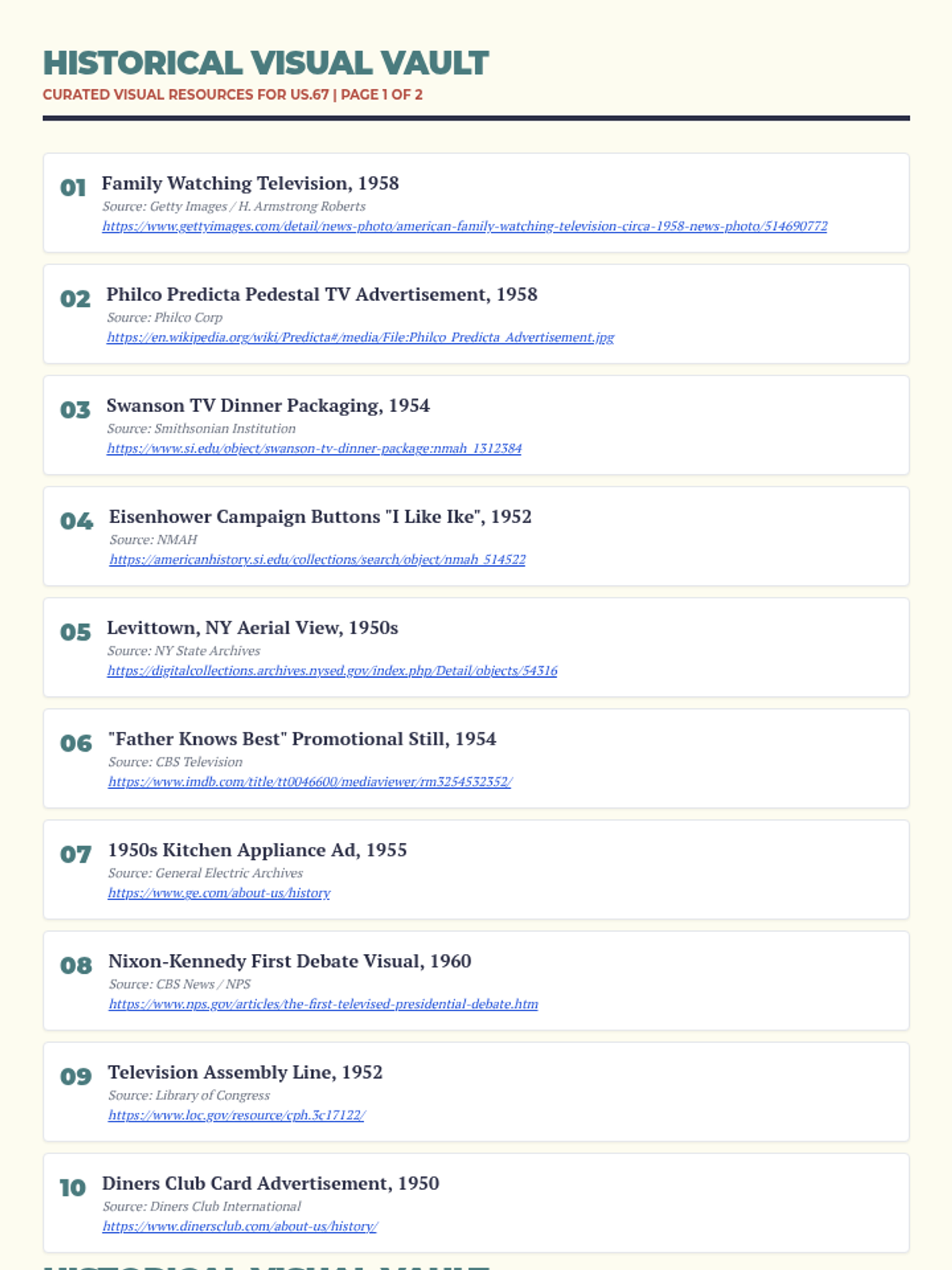
A two-page curated list of 20 historical visuals and primary sources related to 1950s mass media. Revised with tightened layout to fit exactly two pages and corrected header positioning.
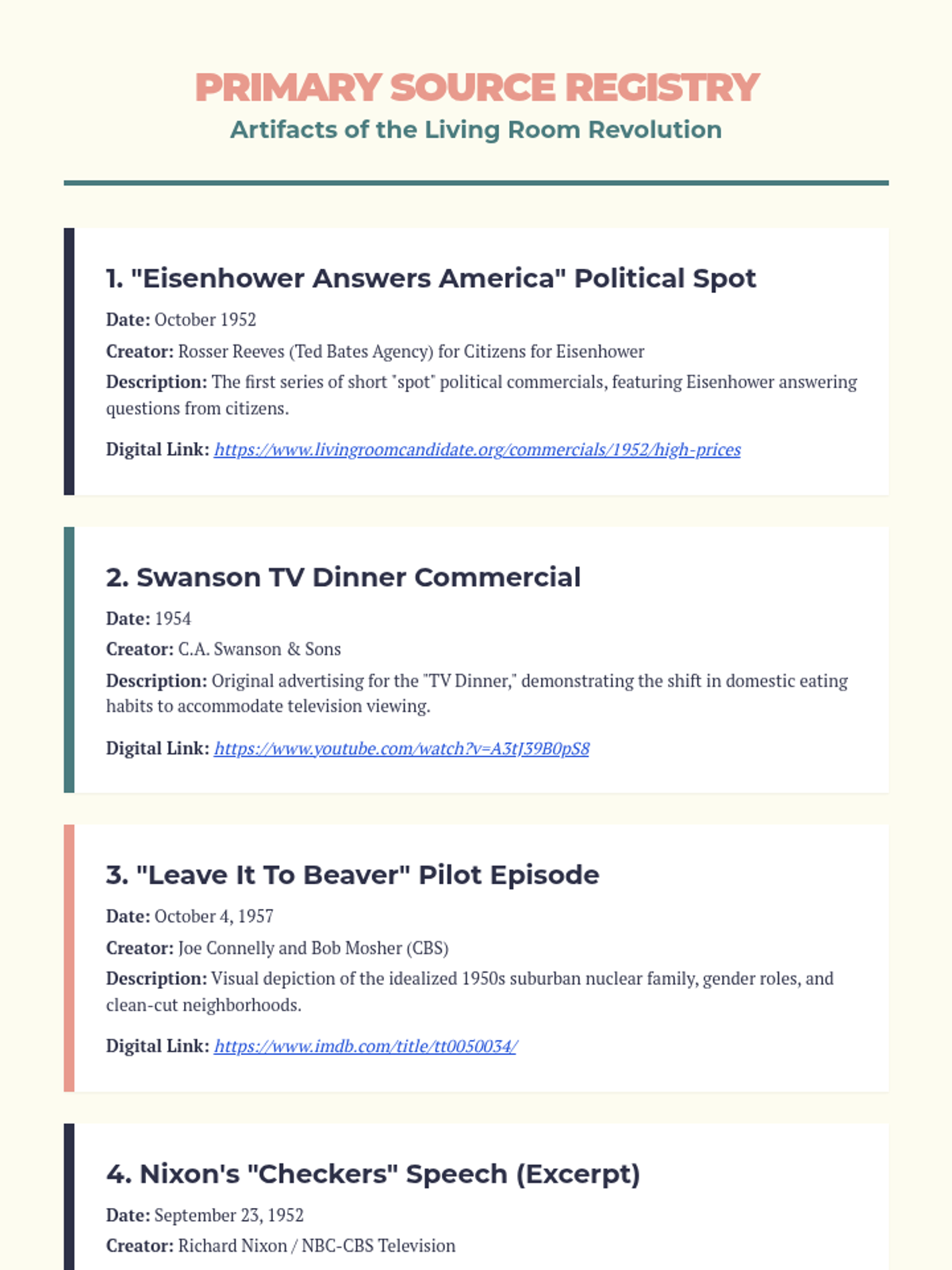
A curated list of primary sources (commercials, political ads, and show excerpts) from the 1950s. Revised with better contrast, link styling, and page-break management.
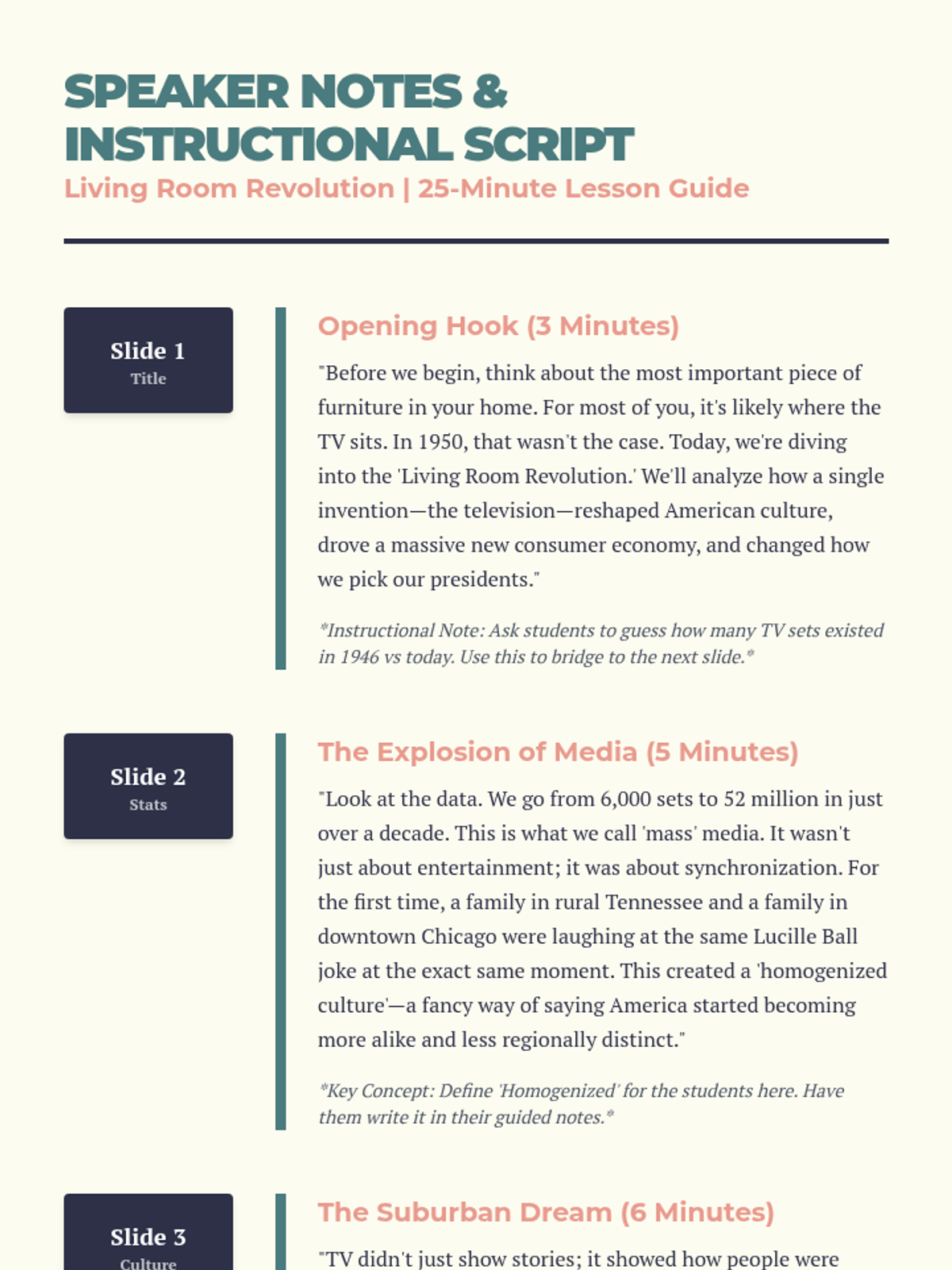
Detailed speaker notes and instructional script for the Living Room Revolution presentation. Revised with expanded content to fill a 25-minute lesson and corrected page-break logic.
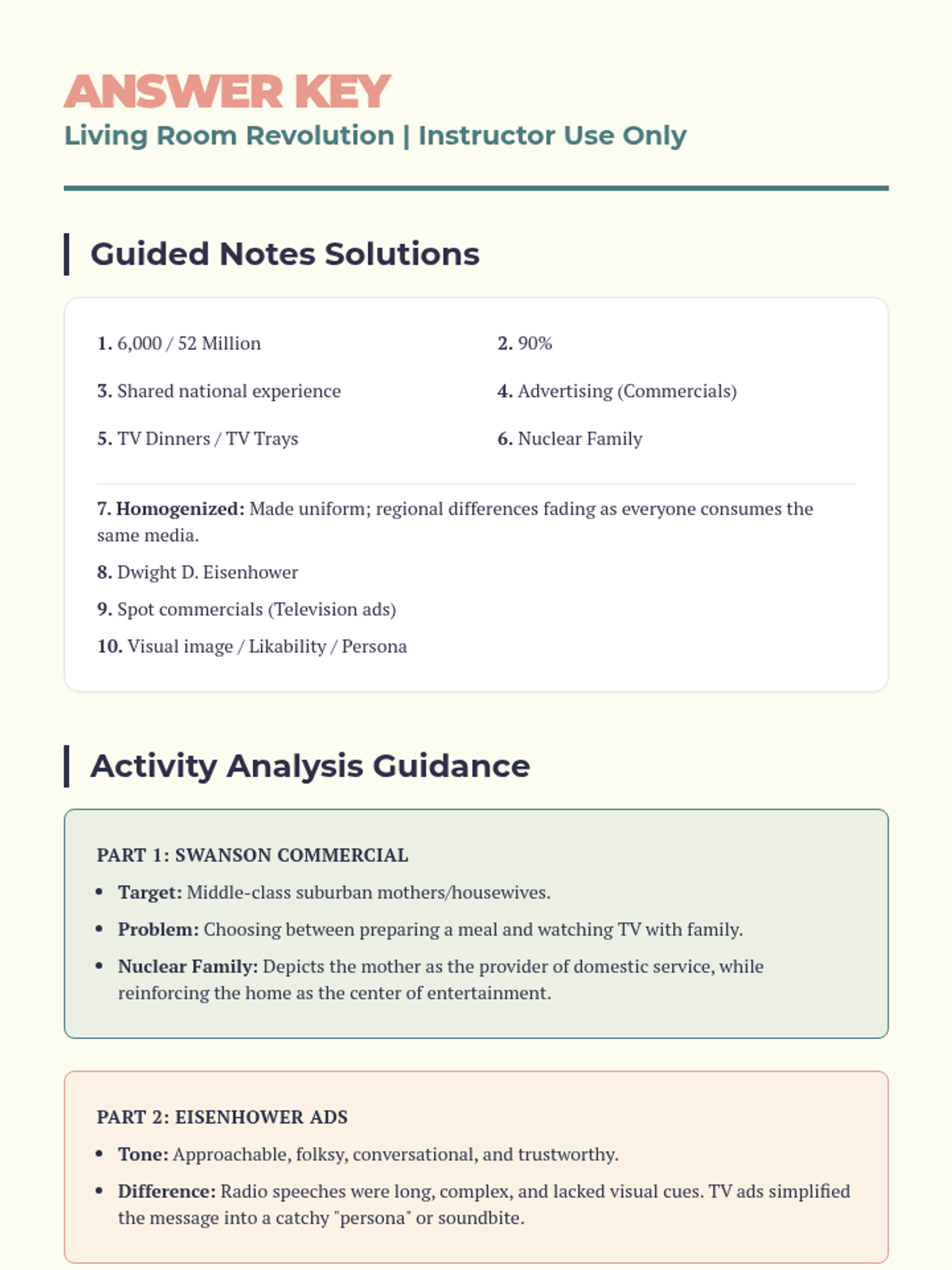
Complete answer key for the Living Room Revolution guided notes and analysis activity. Revised for better layout density and page-break management to keep sections together.
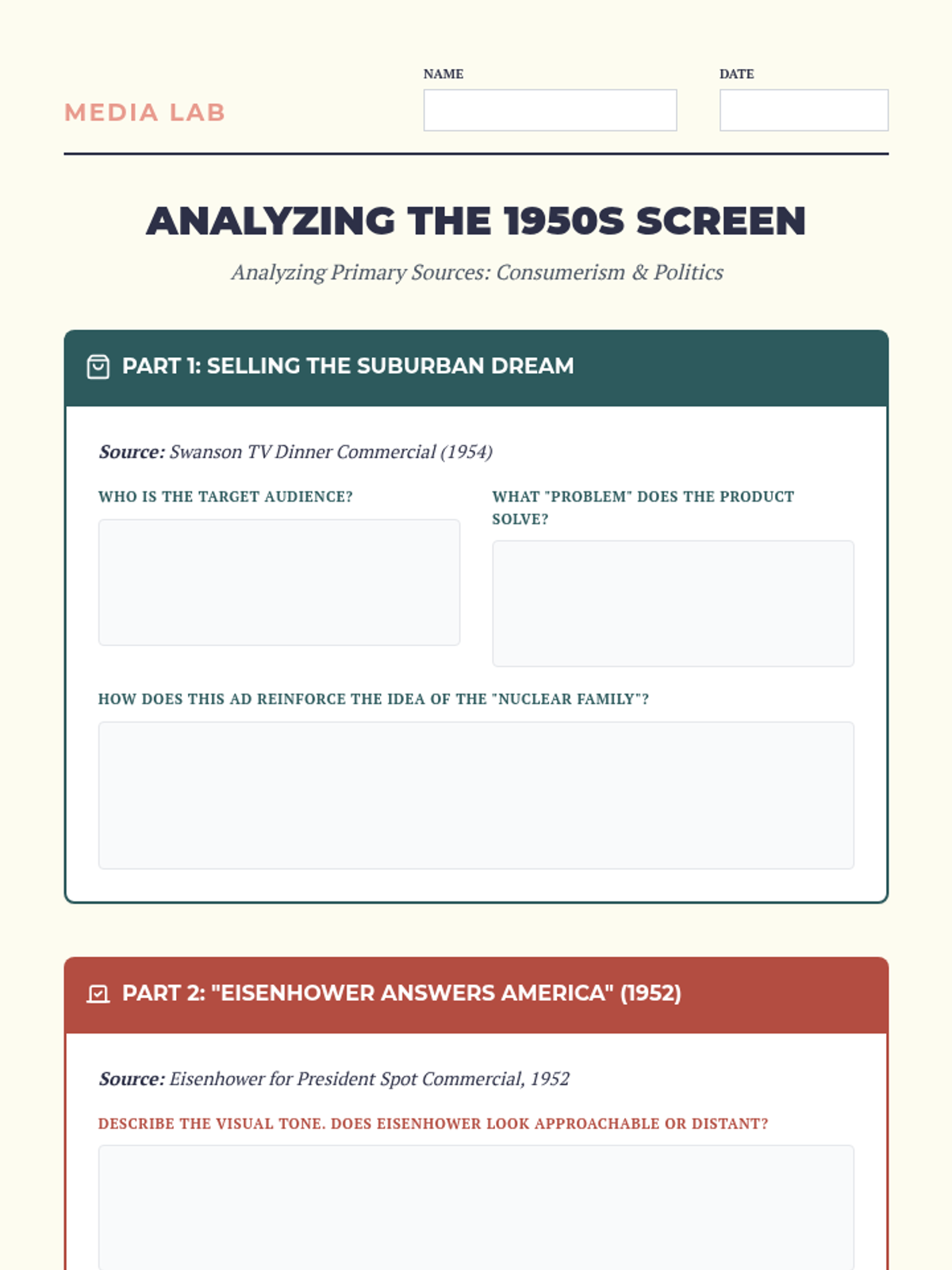
A student activity worksheet for analyzing primary sources from the 1950s, including a Swanson TV Dinner commercial and an Eisenhower political spot. Revised with higher contrast labels, better page breaks, and expanded writing areas.
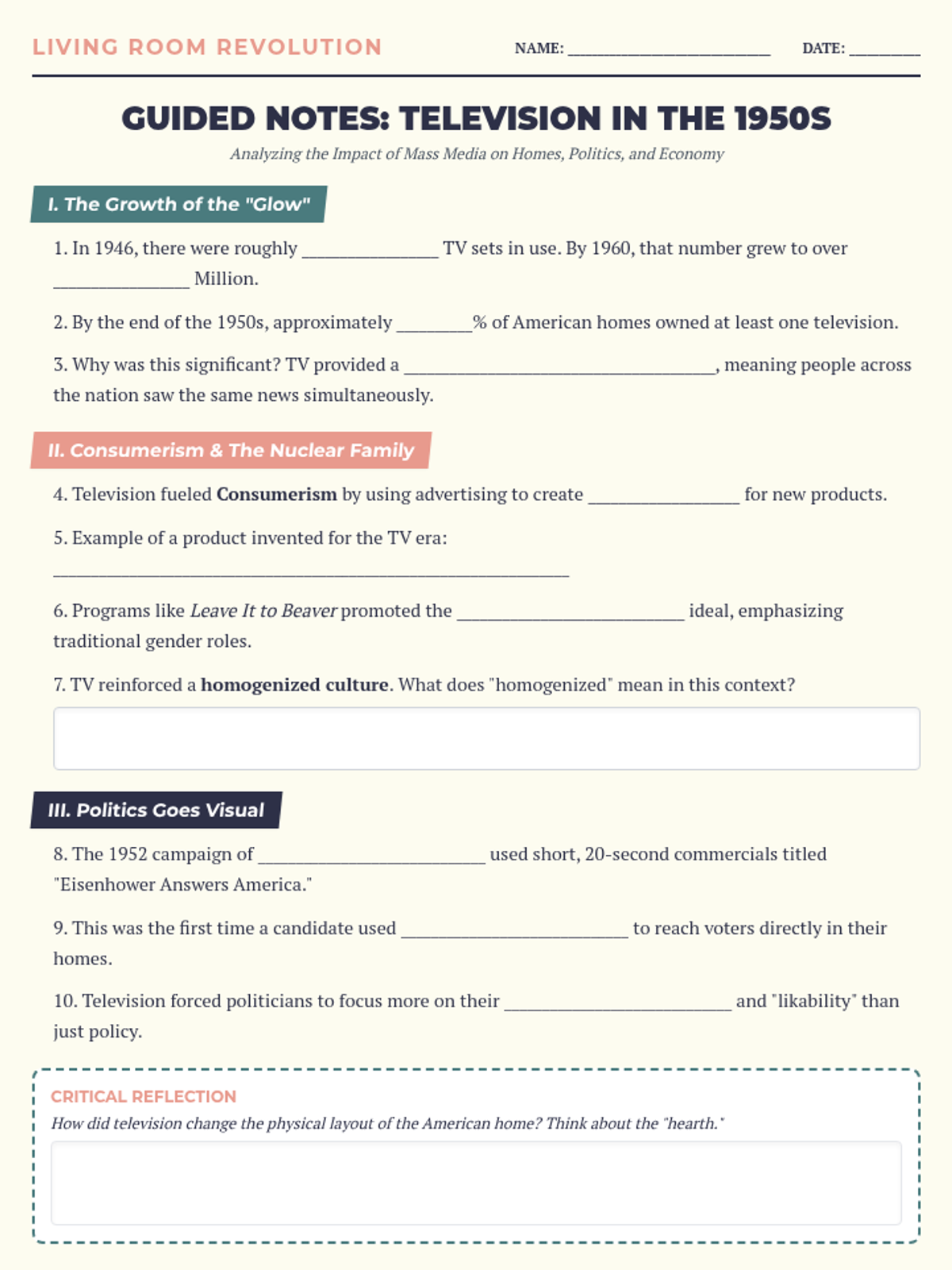
A student guided notes document to accompany the Living Room Revolution slide deck. Revised with tightened spacing and padding to ensure a clean, one-page layout and fixed font sizes for header labels.
Presentation slides for the Living Room Revolution lesson, exploring the explosive growth of television, its impact on consumerism/economics, and its transformation of political campaigning in the 1950s. Revised for better contrast, fixed rotation, and adjusted badge positioning.
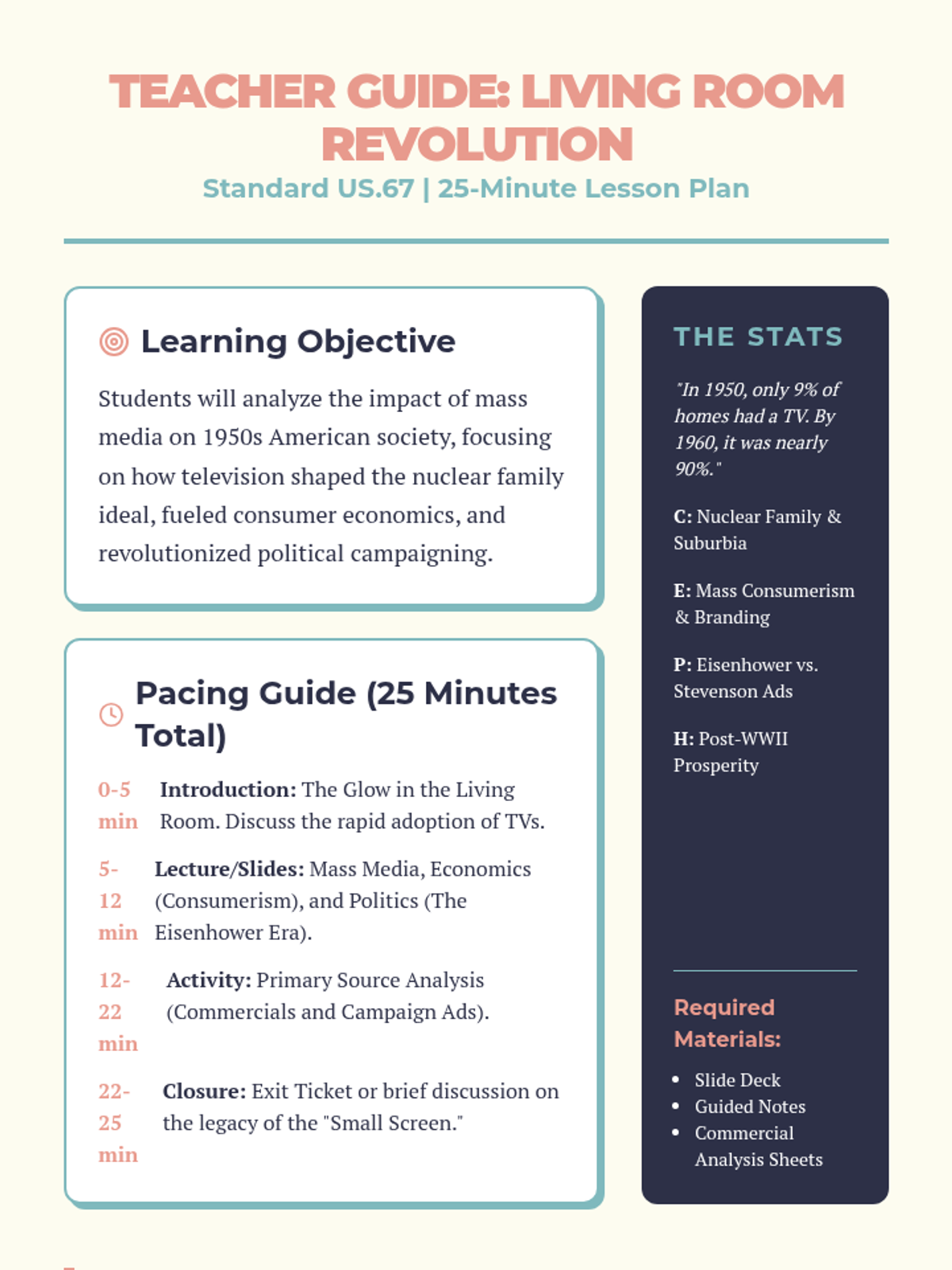
A comprehensive teacher guide for the Living Room Revolution lesson, providing a pacing guide, instructional priorities, and learning objectives for TN Standard US.67.
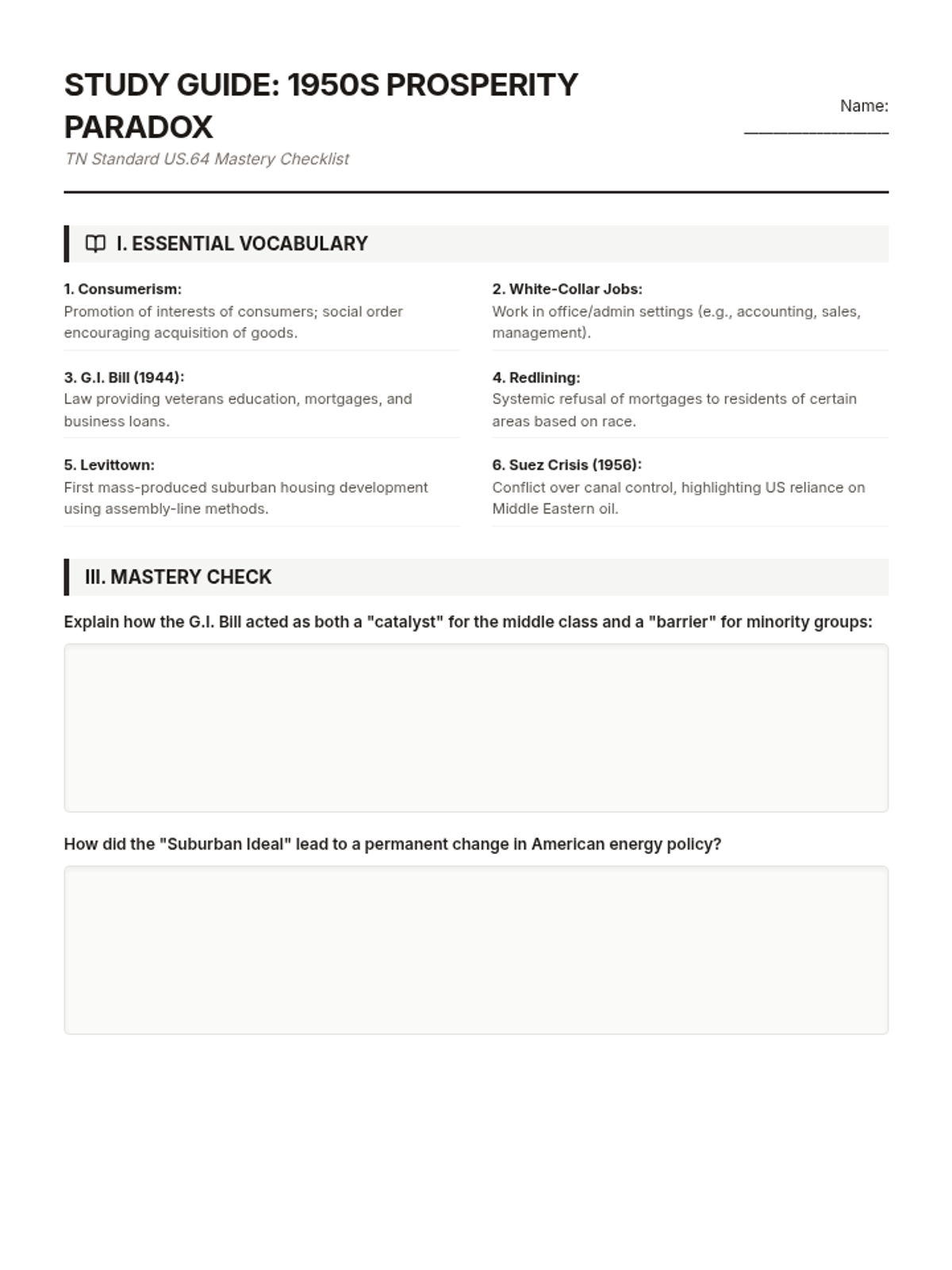
A study guide for students featuring key terms and a concept mapping activity to visualize the interconnectedness of 1950s economic trends.
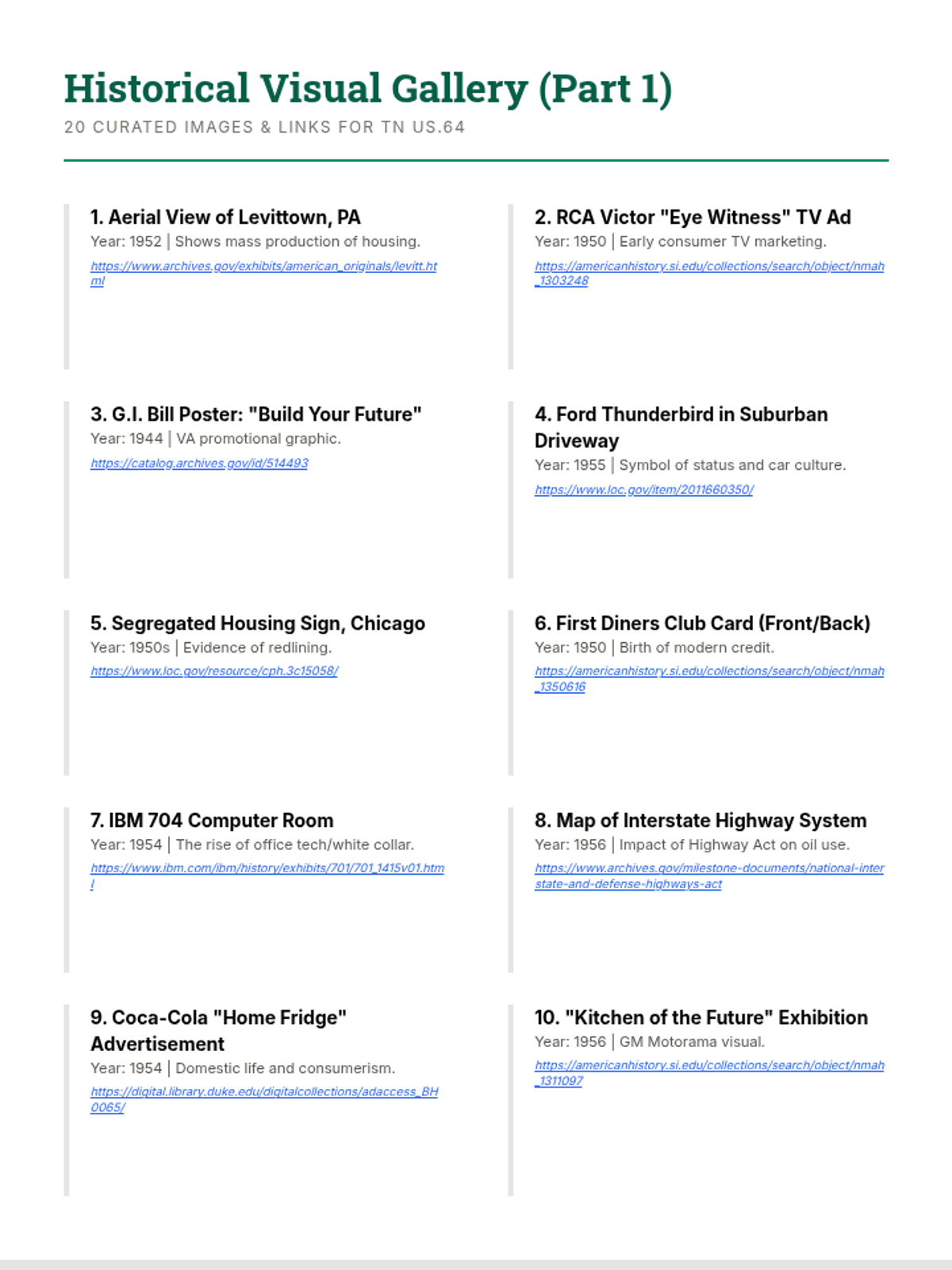
Two pages of curated links and descriptions for 20 high-quality historical visuals to support the lesson on 1950s prosperity.
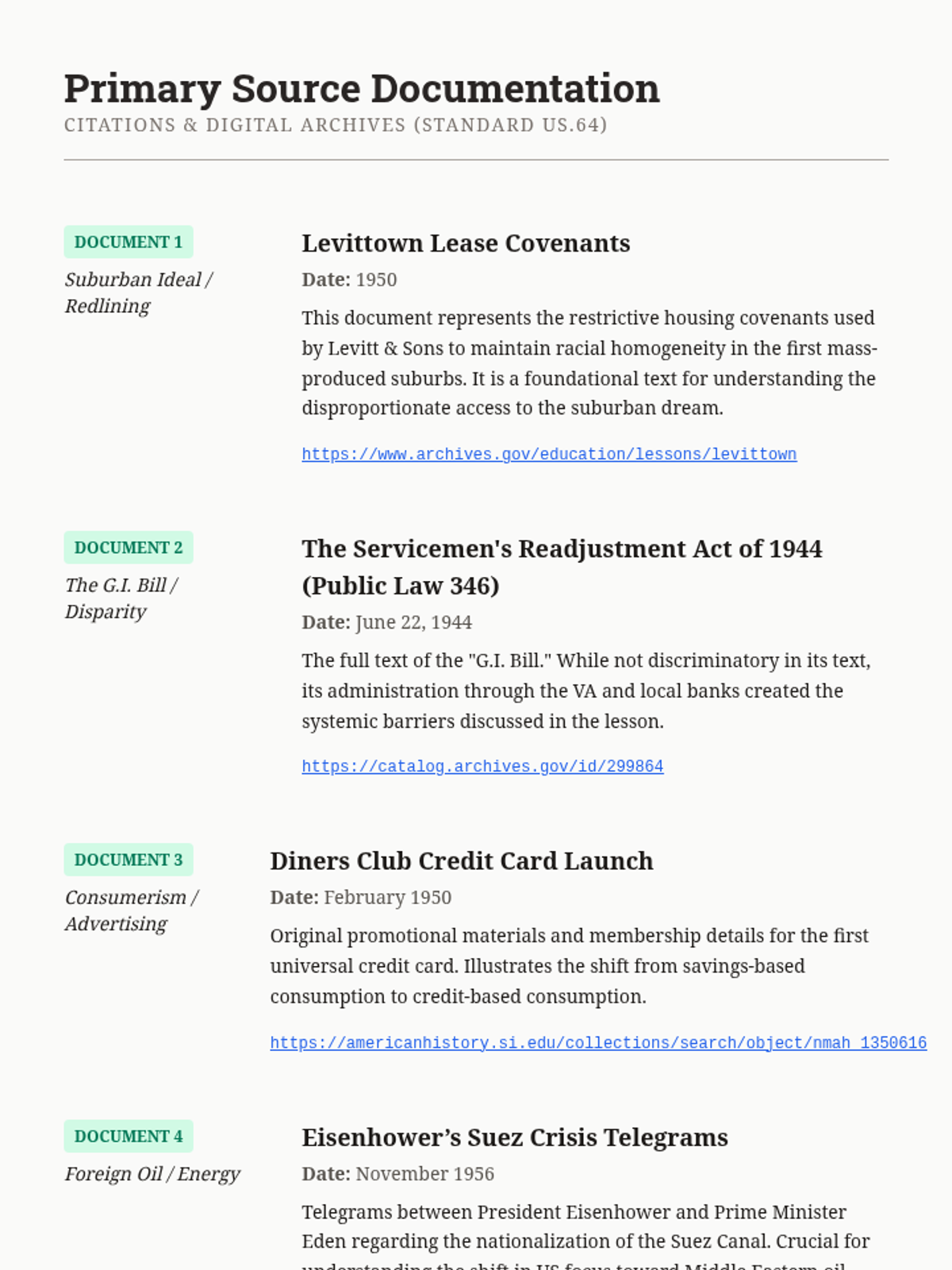
A curated list of primary sources with full names, dates, and direct links to digital archives for further study.
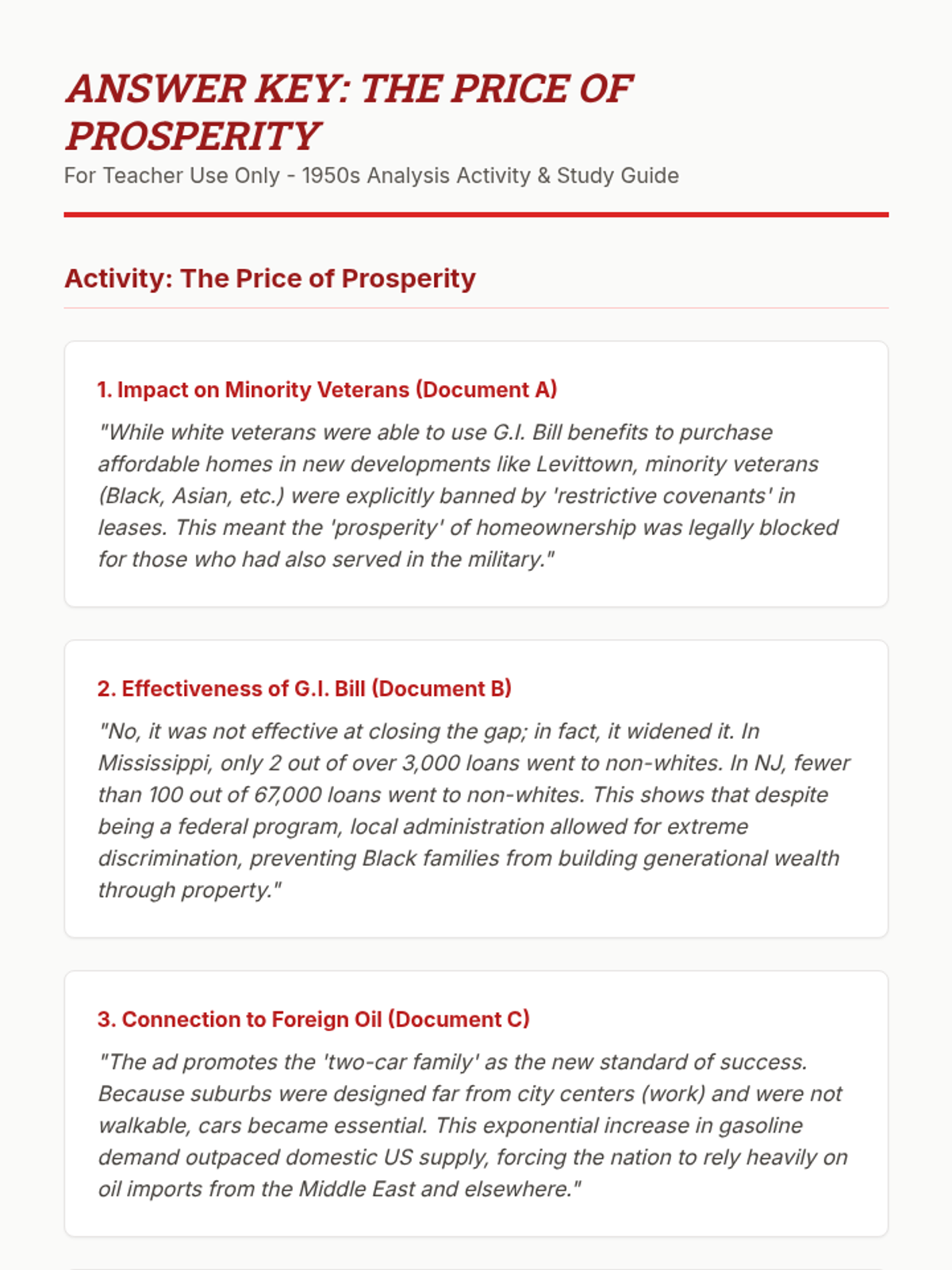
An answer key for both the "Price of Prosperity" activity and the guided notes, providing detailed expected responses.
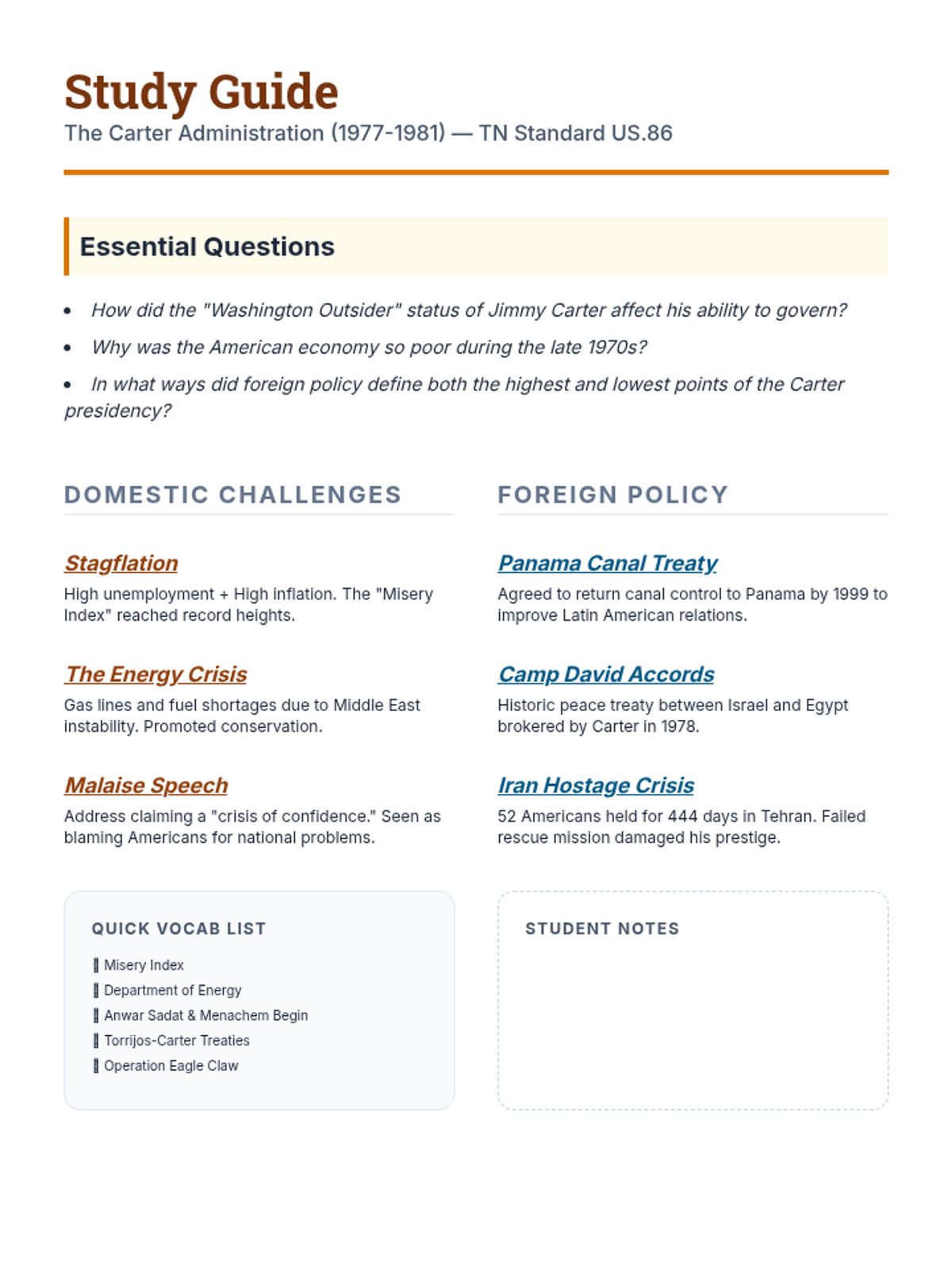
A comprehensive study guide for the Jimmy Carter presidency. Revised to fit on a single page and include a student work area.
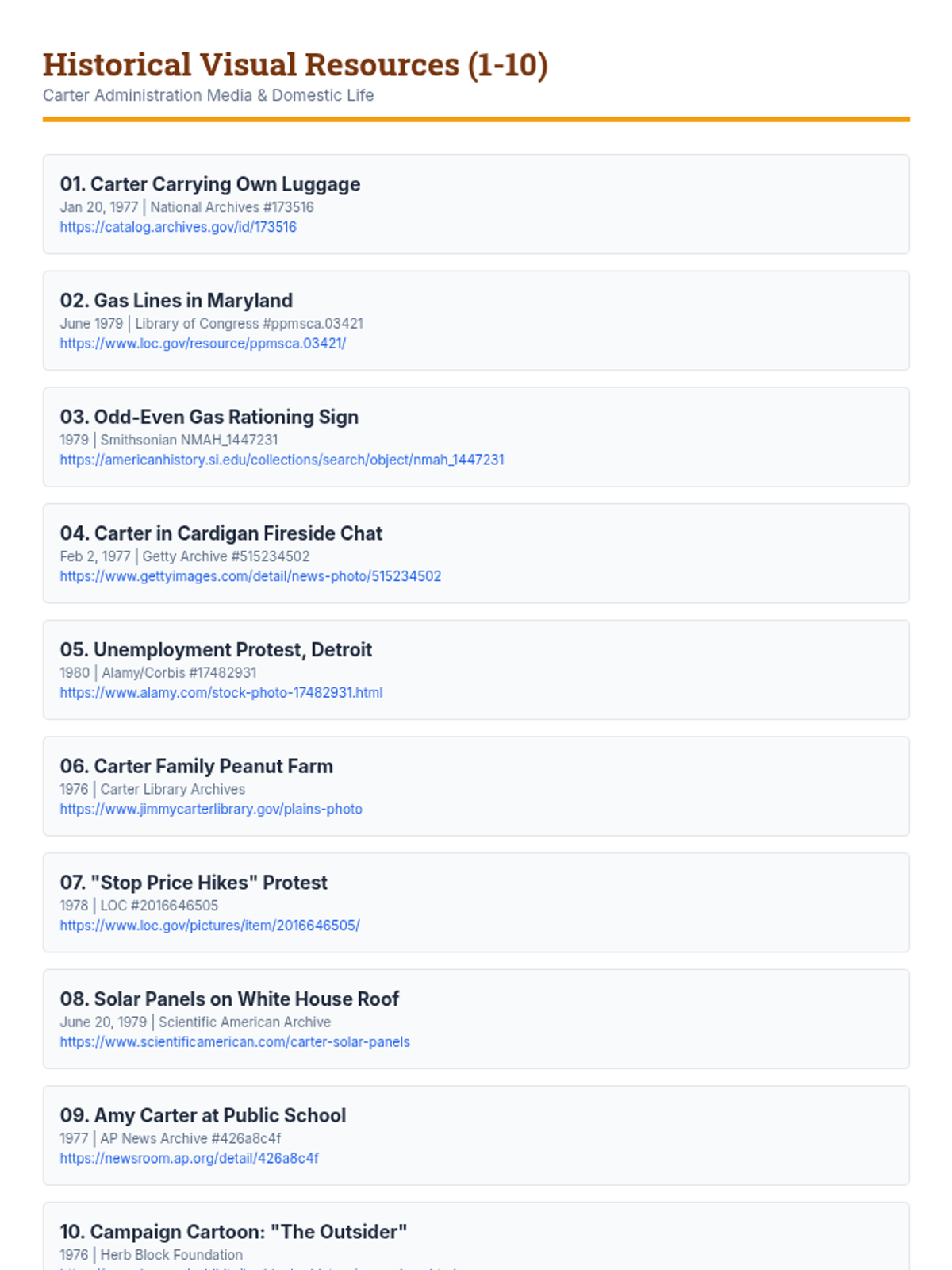
A two-page resource list of 20 historical visual links. Revised to fit exactly two pages and ensure all items stay together with their metadata.
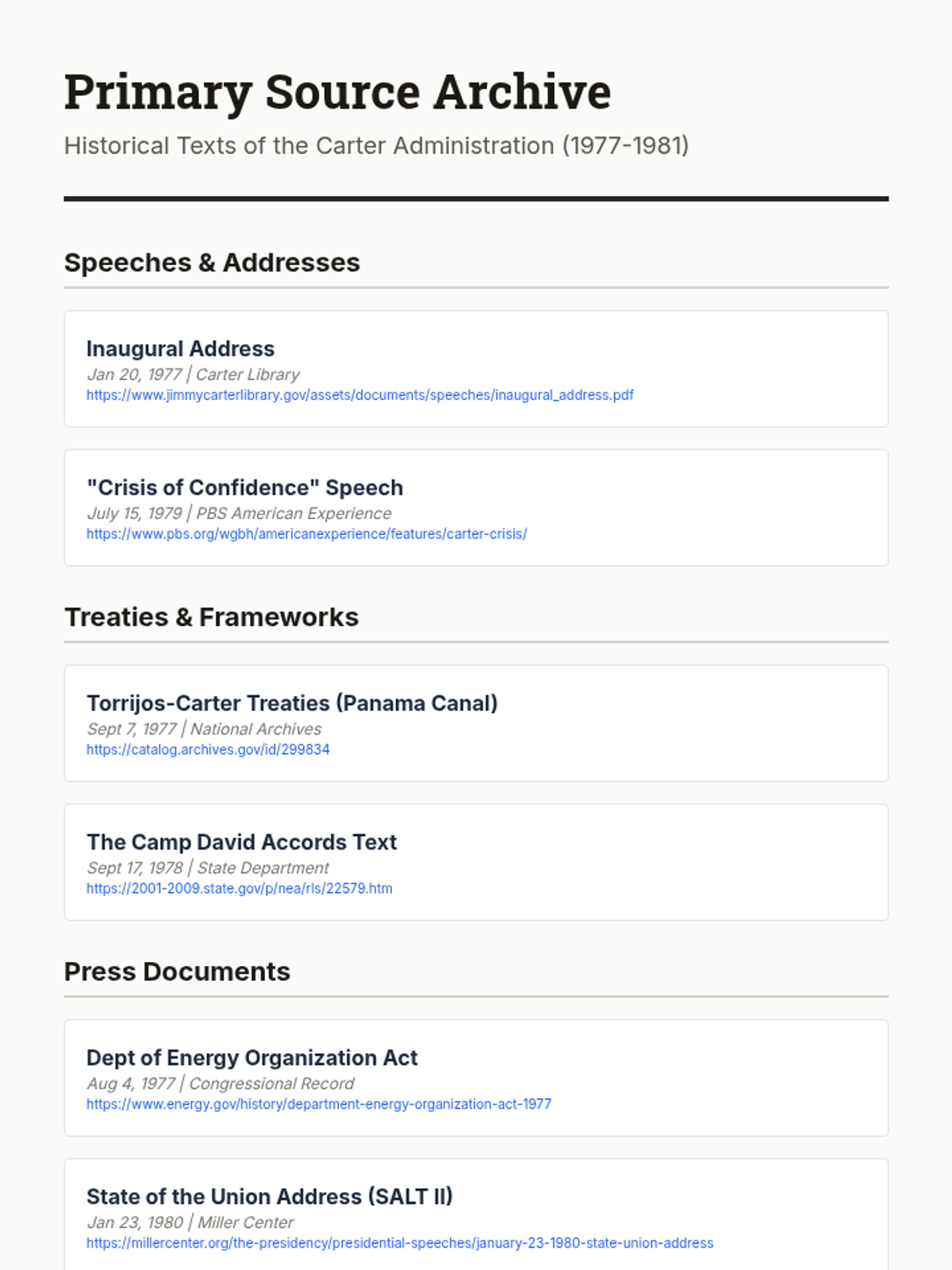
A list of primary source texts and speeches for the Carter administration. Revised for cleaner URL handling and better page-break behavior.
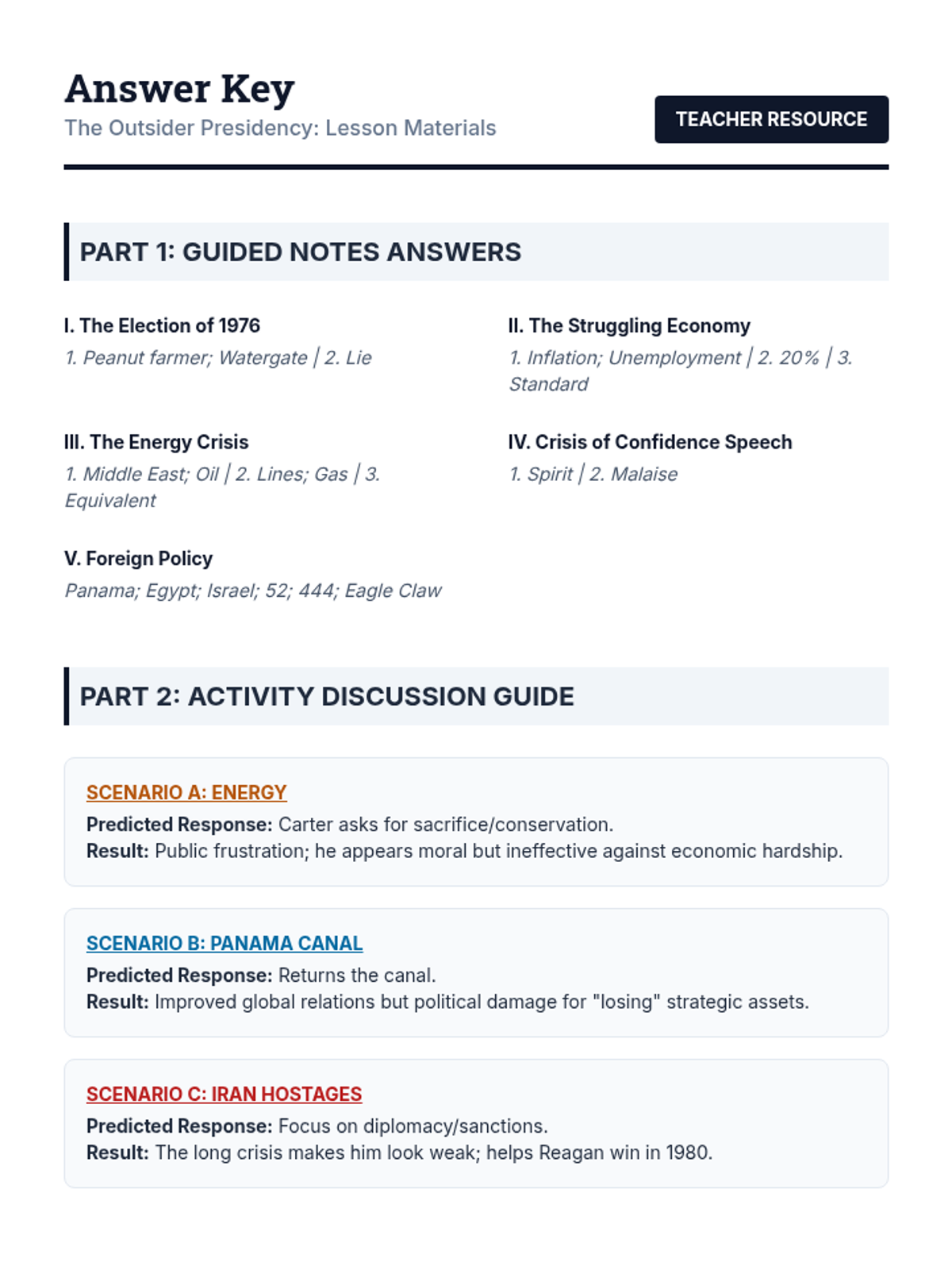
Comprehensive answer key for the Outsider Presidency lesson materials. Revised with improved visual hierarchy and fixed page-break behavior.
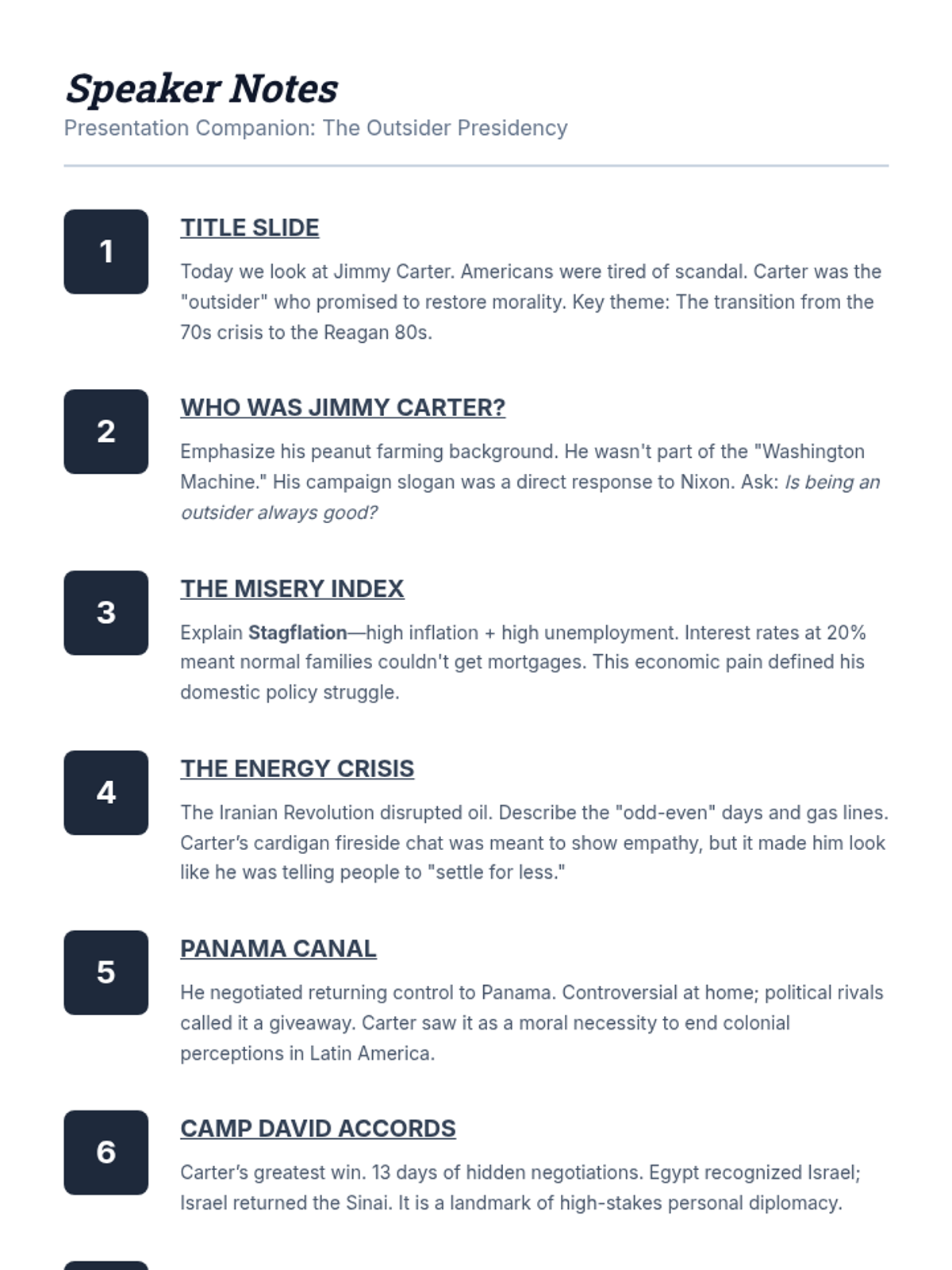
Detailed presentation notes for the teacher, providing background information and key talking points. Revised for better page breaks and professional tone.
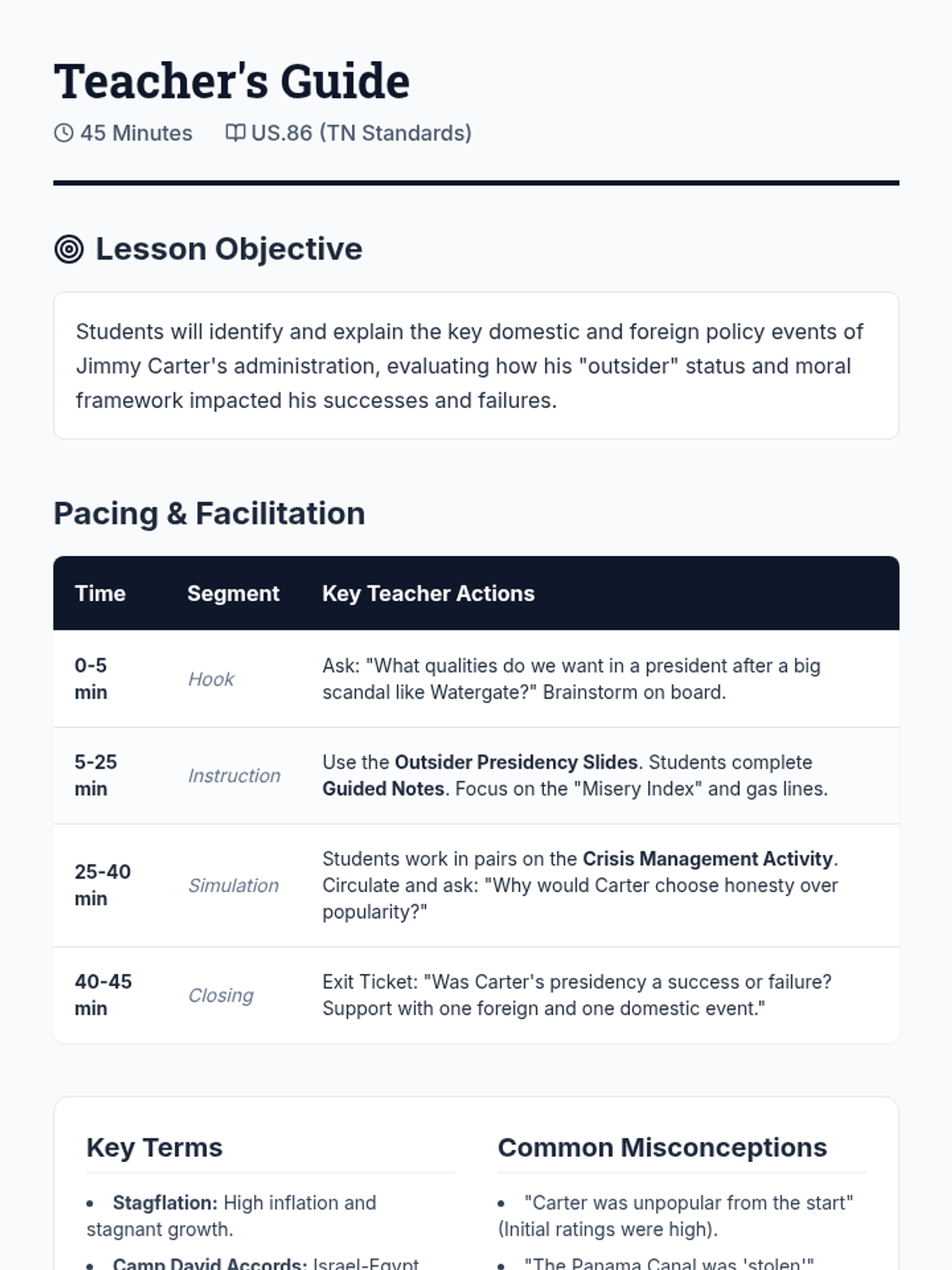
Instructional guide for the Jimmy Carter lesson, including a 45-minute pacing guide, lesson objectives, and key vocabulary. Revised for better layout and content stability.
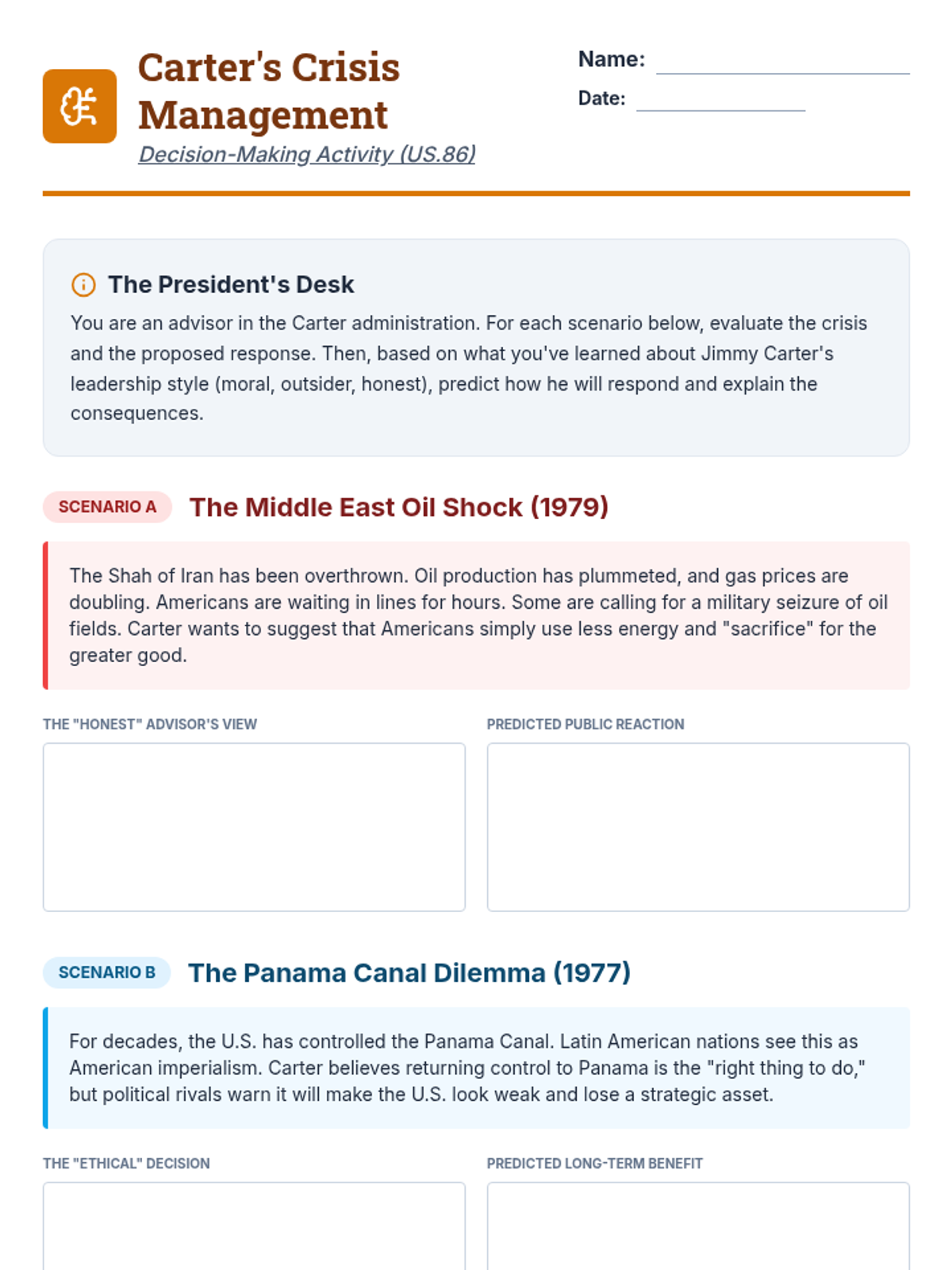
A decision-making activity where students evaluate scenarios from the Carter administration (Energy Crisis, Panama Canal, Iran Hostages). Revised with better spacing and page-break rules.
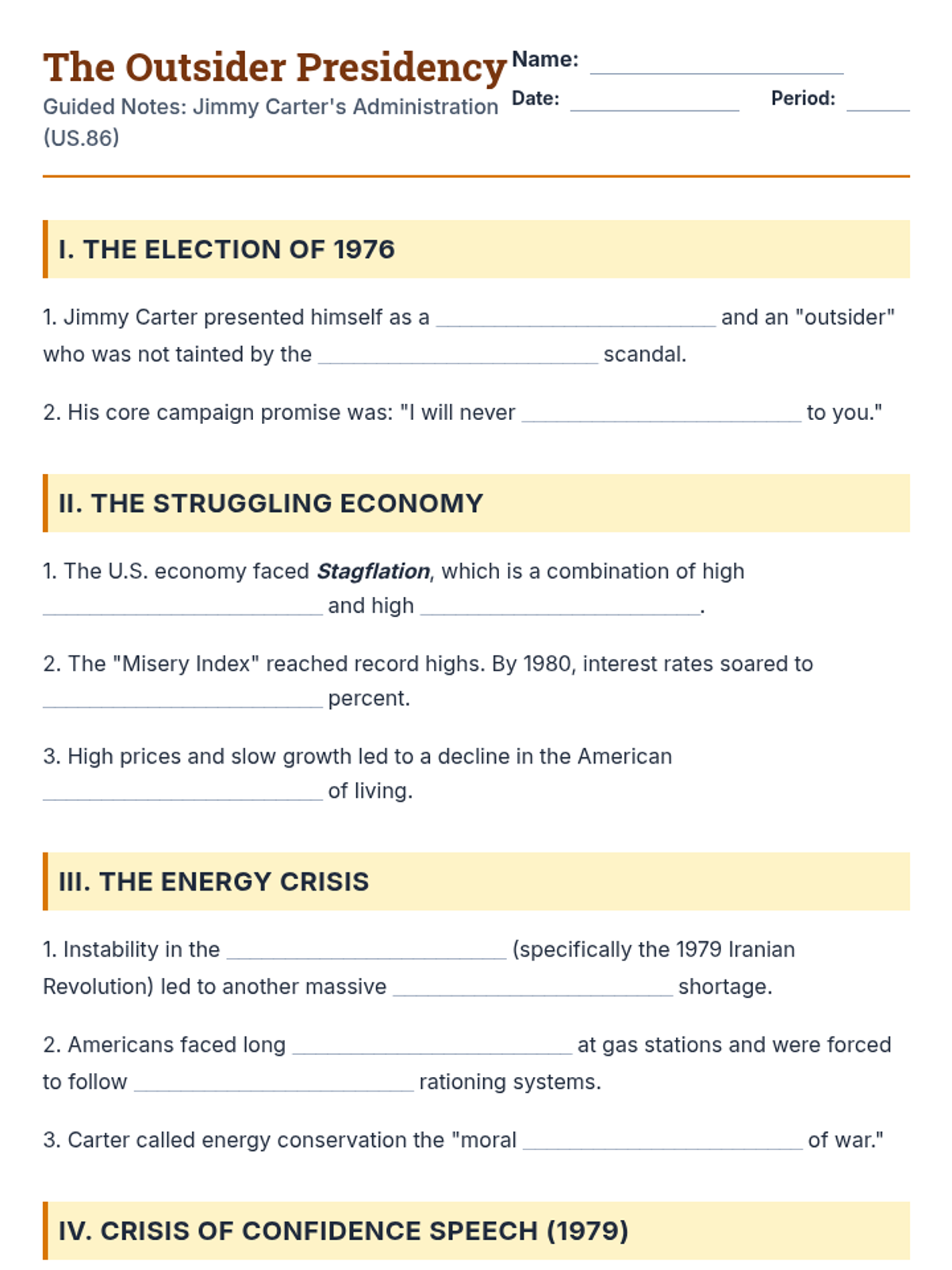
Fill-in-the-blank guided notes for students to use during the Jimmy Carter administration presentation. Includes sections for the 1976 election, economic stagflation, the energy crisis, and key foreign policy events. Revised for improved page breaks and formatting.
A set of visual slides for the lesson on Jimmy Carter's presidency, featuring high-contrast design and large text for classroom visibility. Covers economic stagflation, the energy crisis, the Panama Canal, Camp David Accords, and the Iran Hostage Crisis.
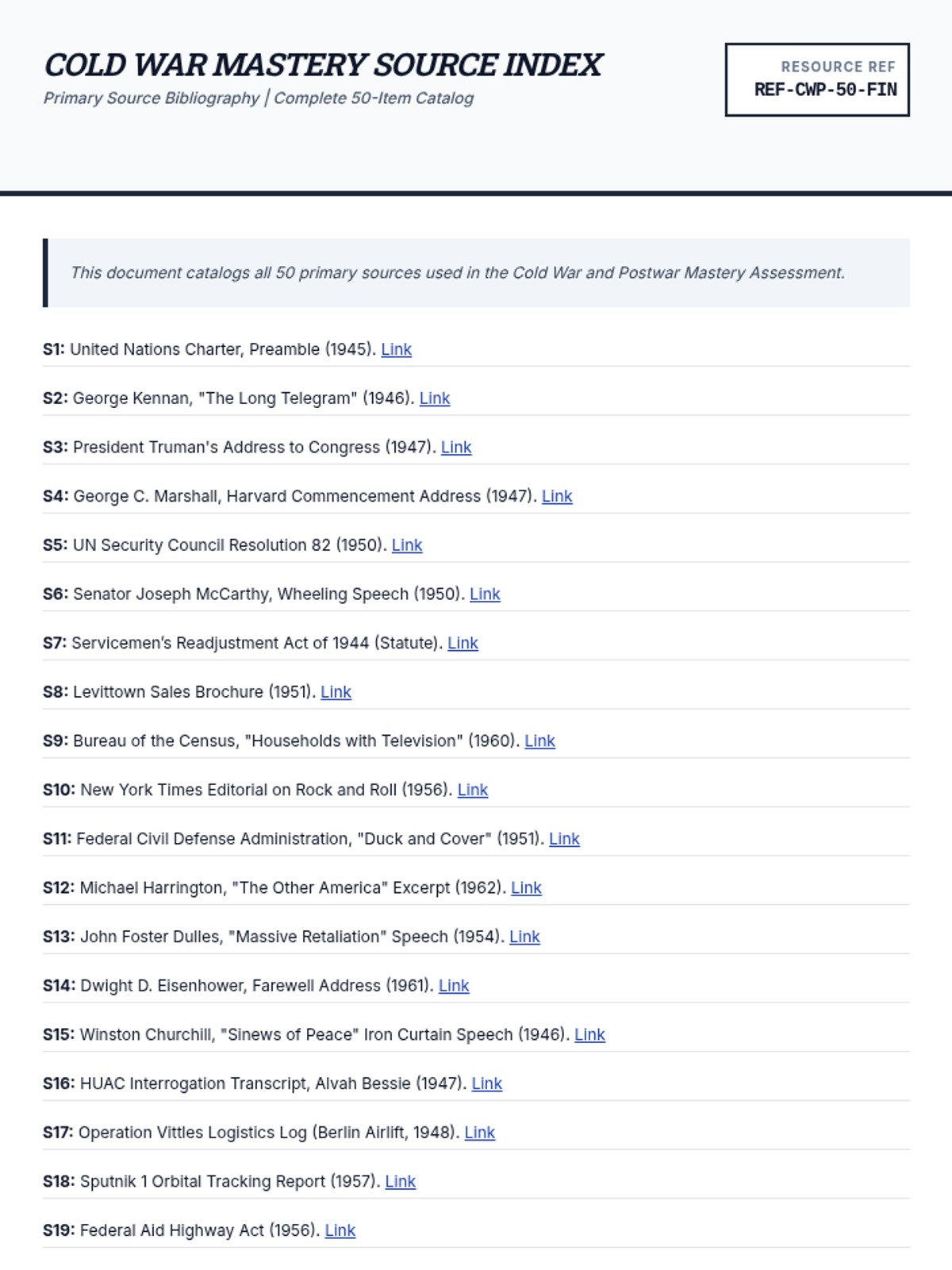
A comprehensive primary source bibliography for the 50-question Cold War and Postwar Mastery Test, including names, dates, and clickable deep links to official archives for the unit's core primary sources. Fulfills the user's specific request for a detailed source list.
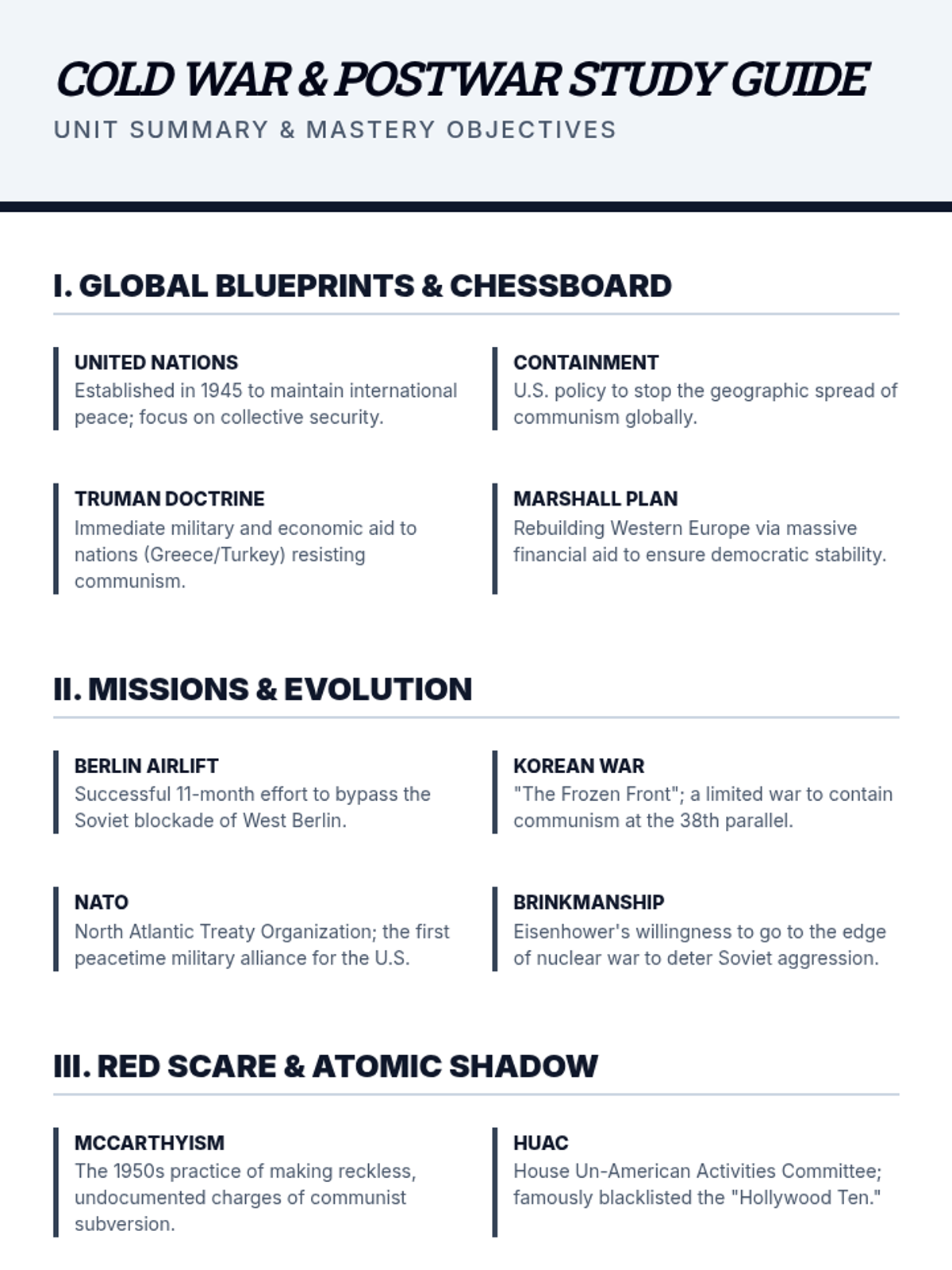
A concise study guide for students preparing for the Cold War and Postwar America unit test. Covers essential terminology, geopolitical strategies, domestic issues like McCarthyism, and the cultural shifts of the 1950s. Now with a workspace section and fixed page breaks.
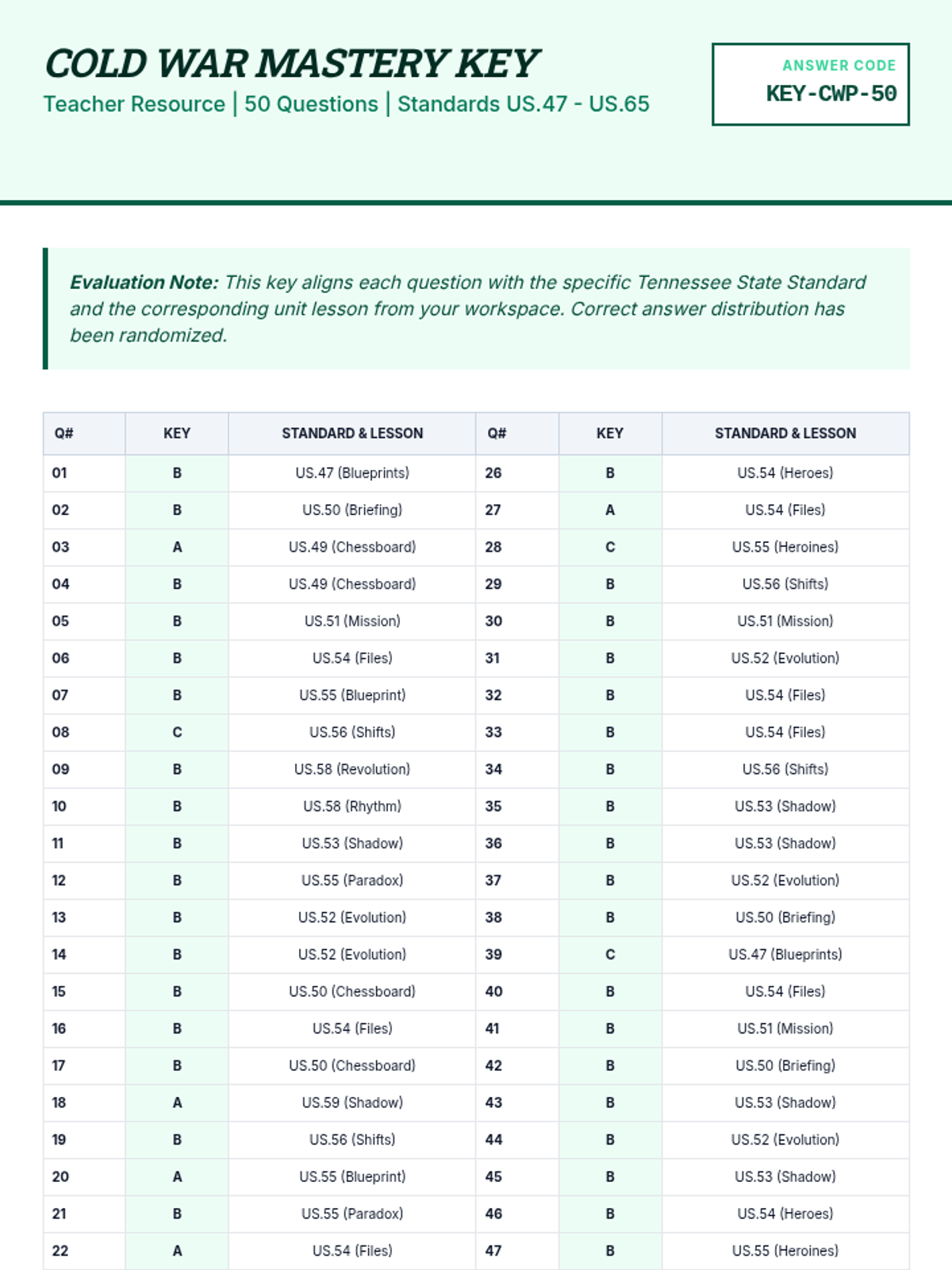
A comprehensive teacher answer key for the 50-question Cold War and Postwar Mastery Test, providing correct answers and Tennessee State Standard mapping for every item. Standardized for professional evaluation. Corrected to fit on a single page.
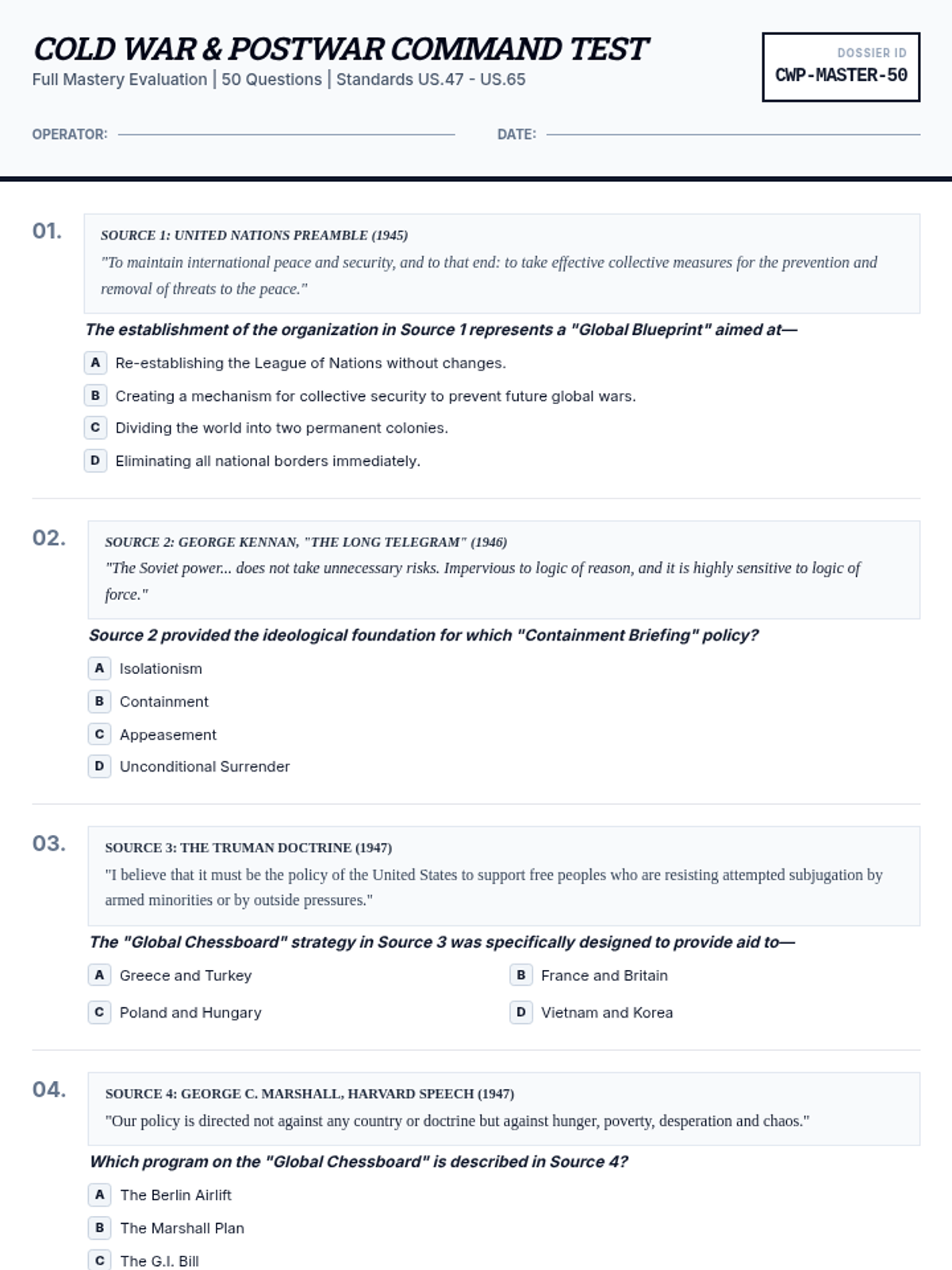
A comprehensive 50-question mastery test covering the Cold War and Postwar America (US.47-US.65). Features 100% primary source analysis based on lessons like Global Blueprints, Containment Evolution, and Rhythm Revolution. Optimized for summative unit evaluation.
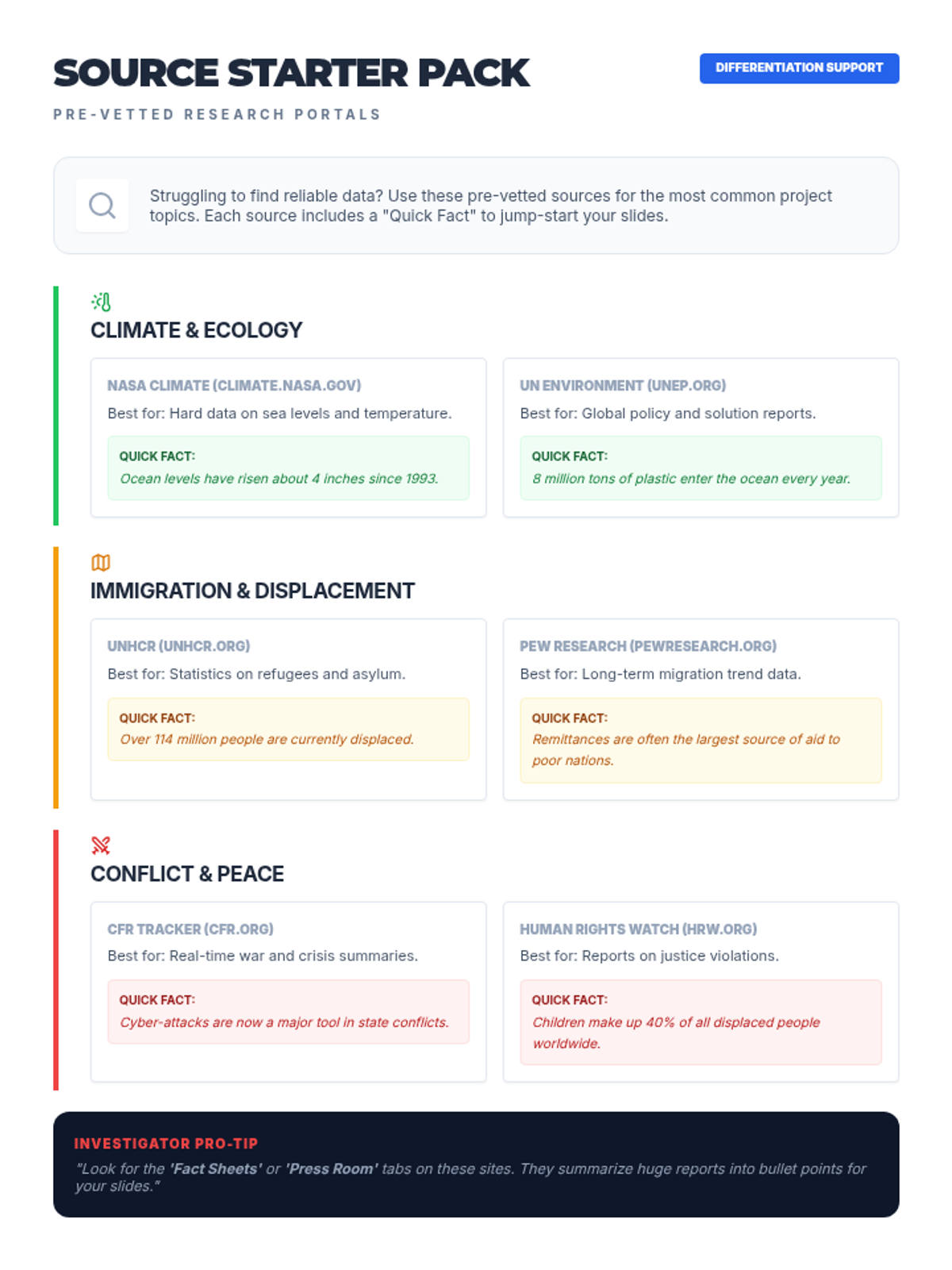
A curated reference sheet with pre-vetted, high-quality sources for common project topics, designed to help students who struggle with the initial research phase.
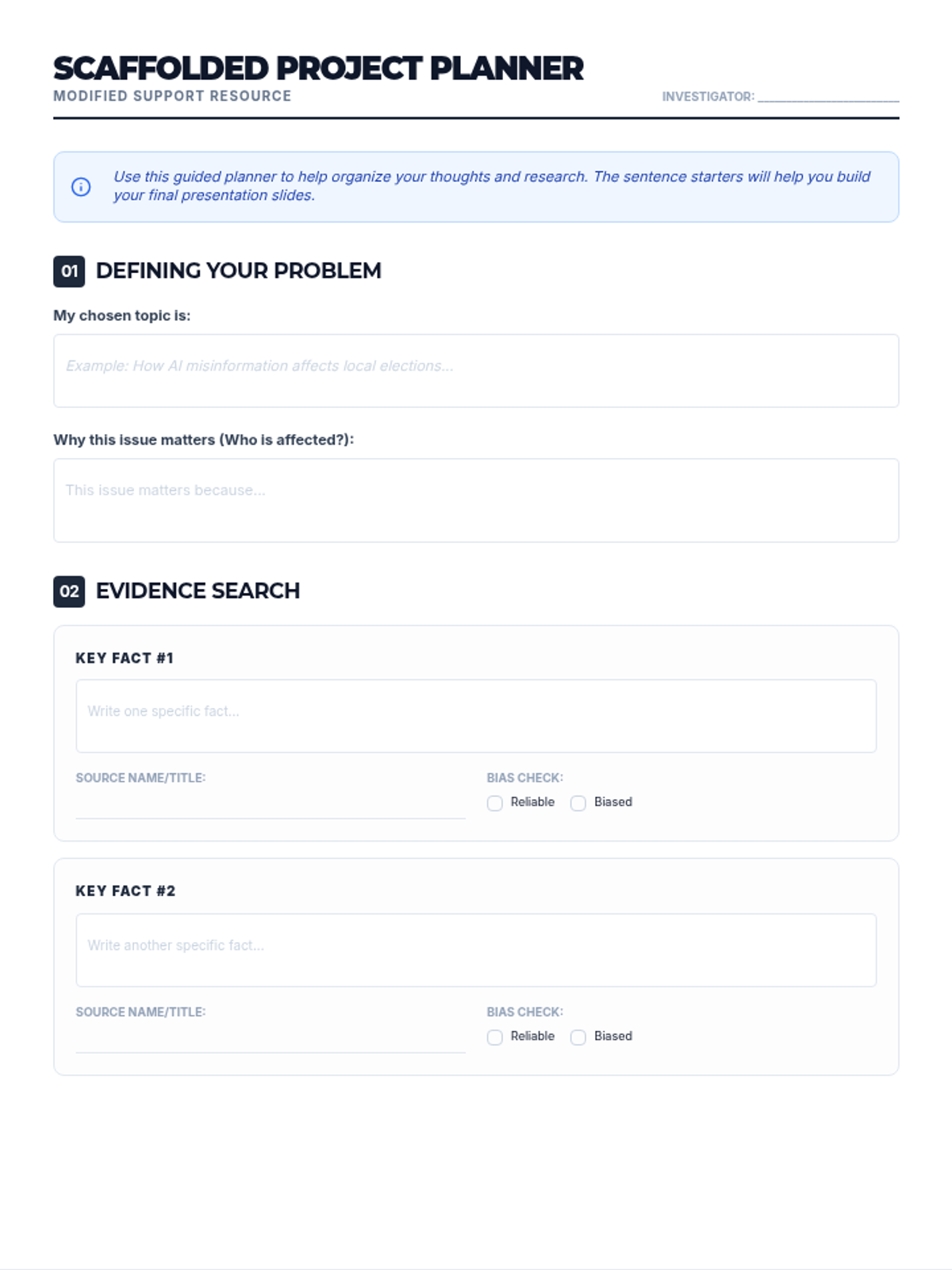
A highly structured version of the project researcher log for students needing additional scaffolding, featuring sentence starters, simplified source evaluation, and a slide-by-slide guide.
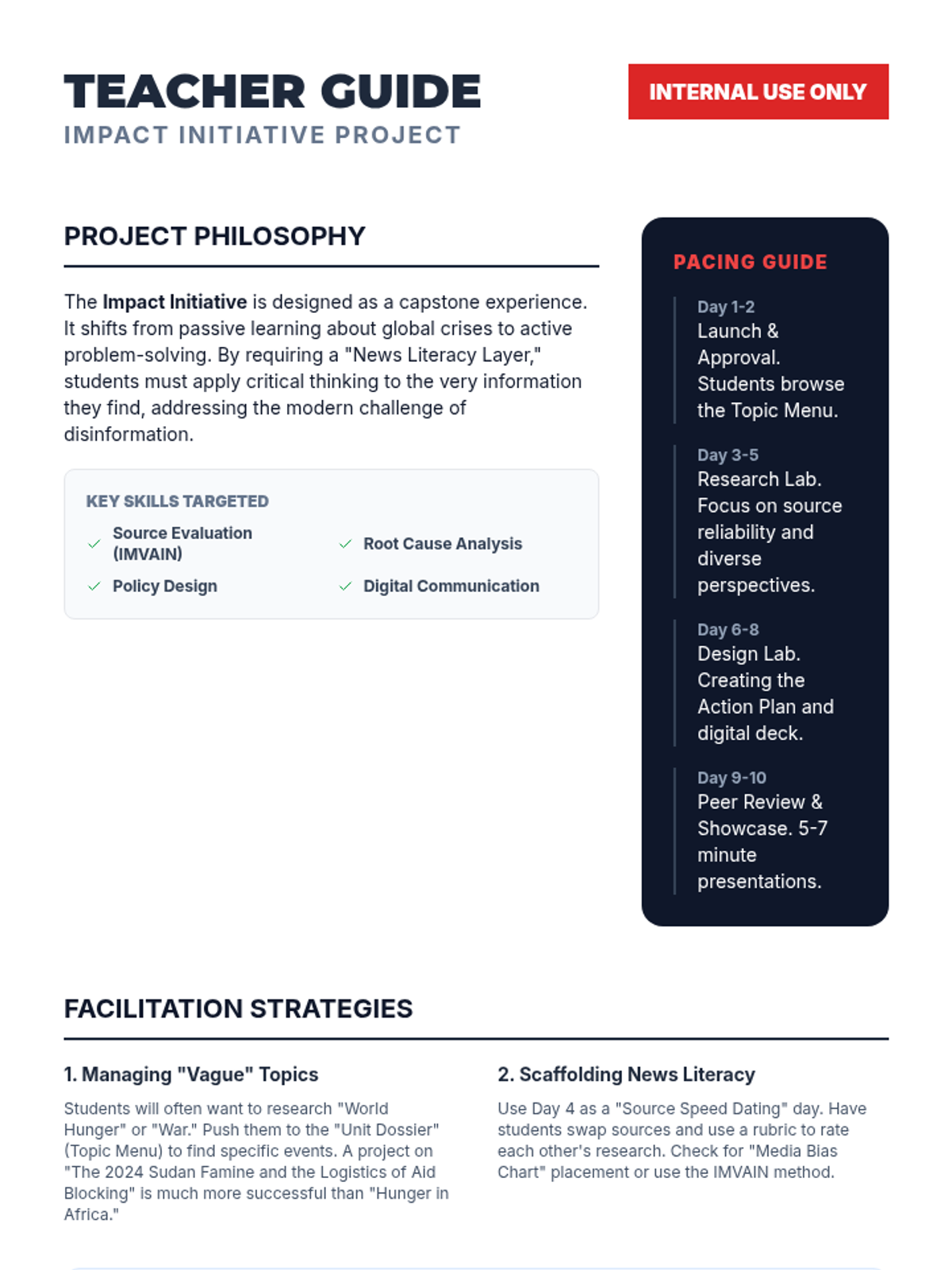
A teacher-facing facilitation guide for the Impact Initiative, including project philosophy, a 10-day pacing guide, and strategies for scaffolding news literacy and differentiation.
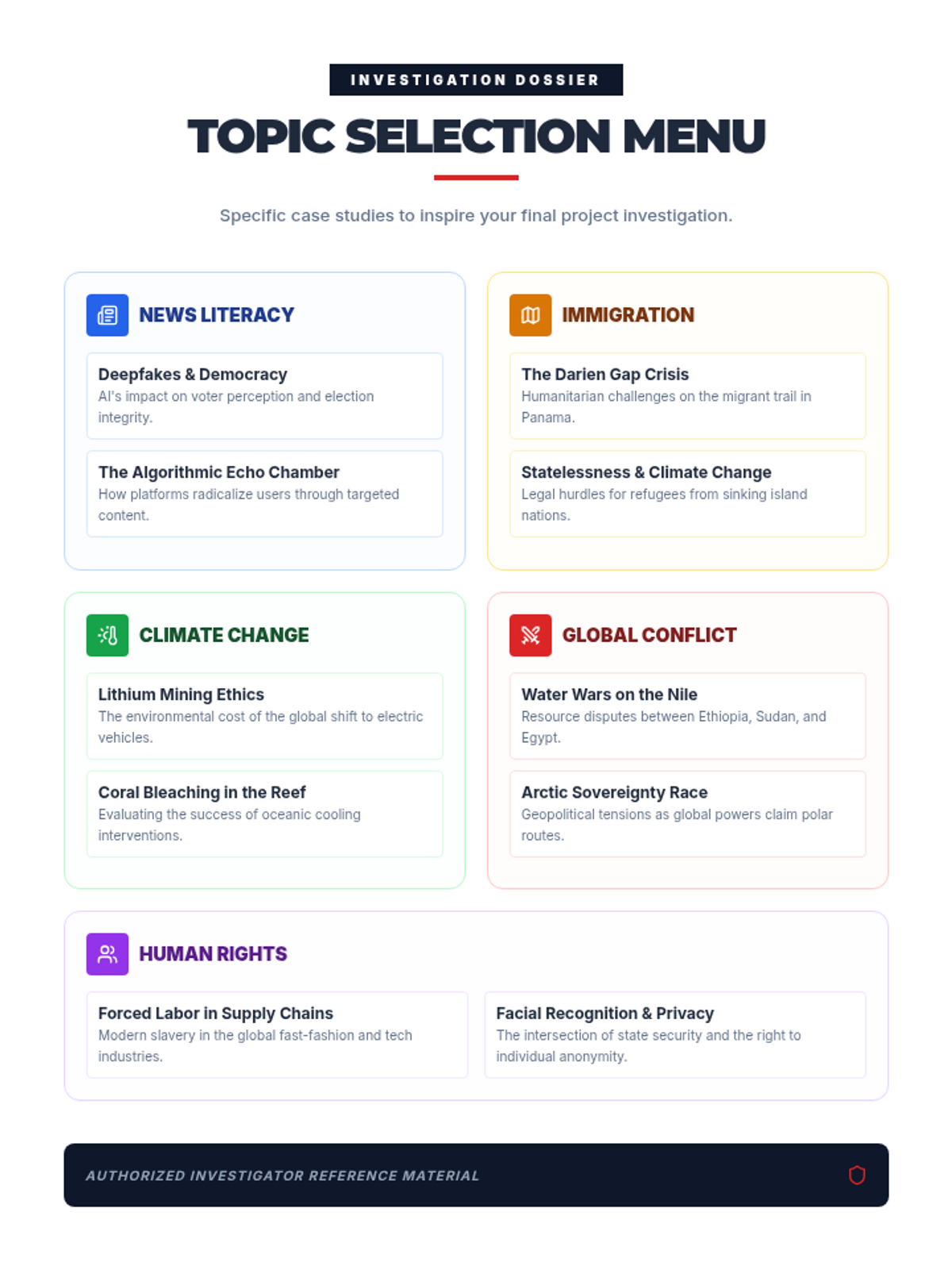
A curated list of specific case studies for each unit (News Literacy, Immigration, Climate Change, Global Conflict, Human Rights) to help students select high-impact project topics.
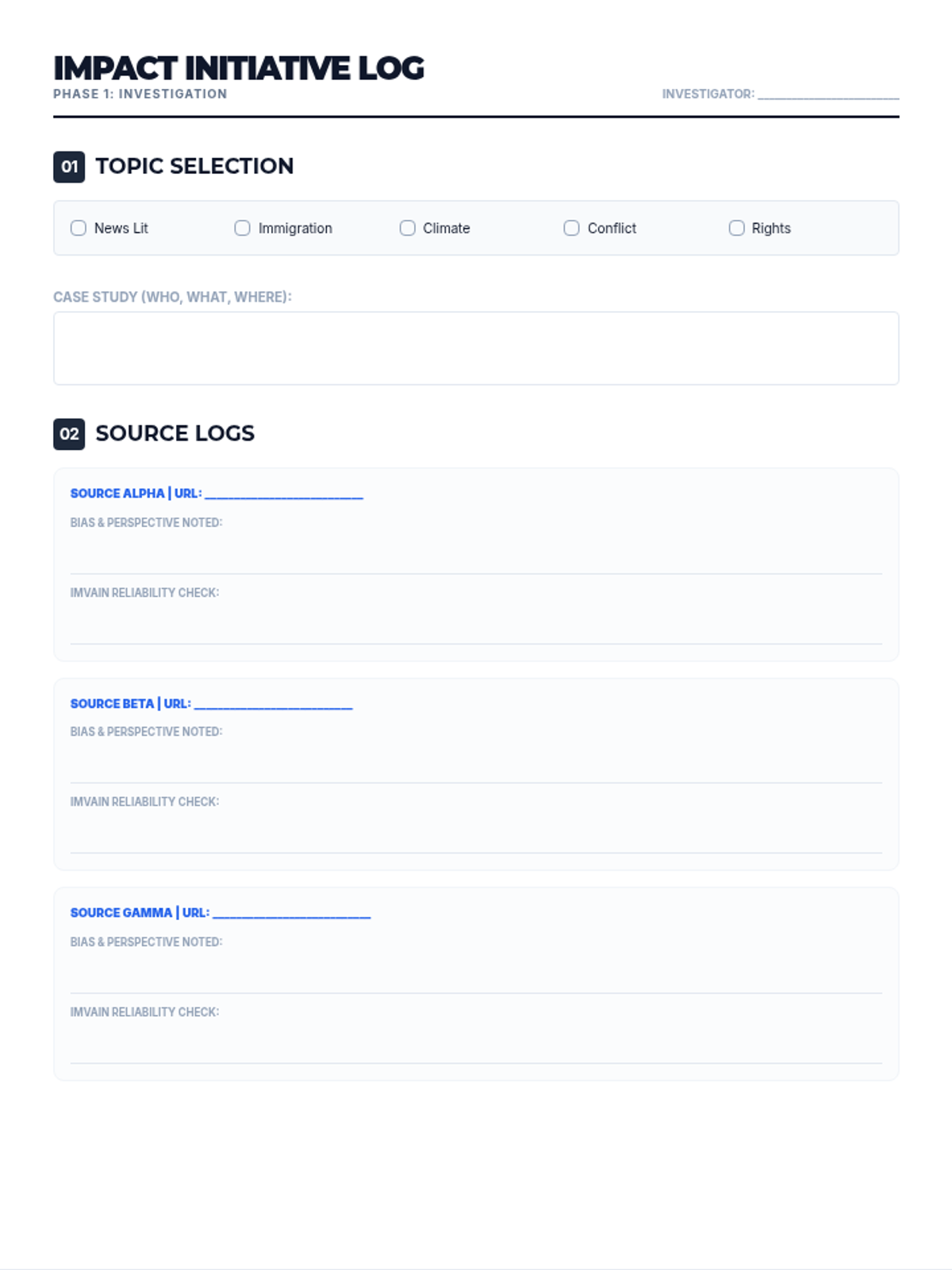
A 2-page student workbook to scaffold the two-week project, including topic selection, source verification logs, action plan brainstorming, and peer review sections.
Introductory slides for the Impact Initiative project, outlining the 2-week timeline, unit choices, and the "Verification Layer" (News Literacy).
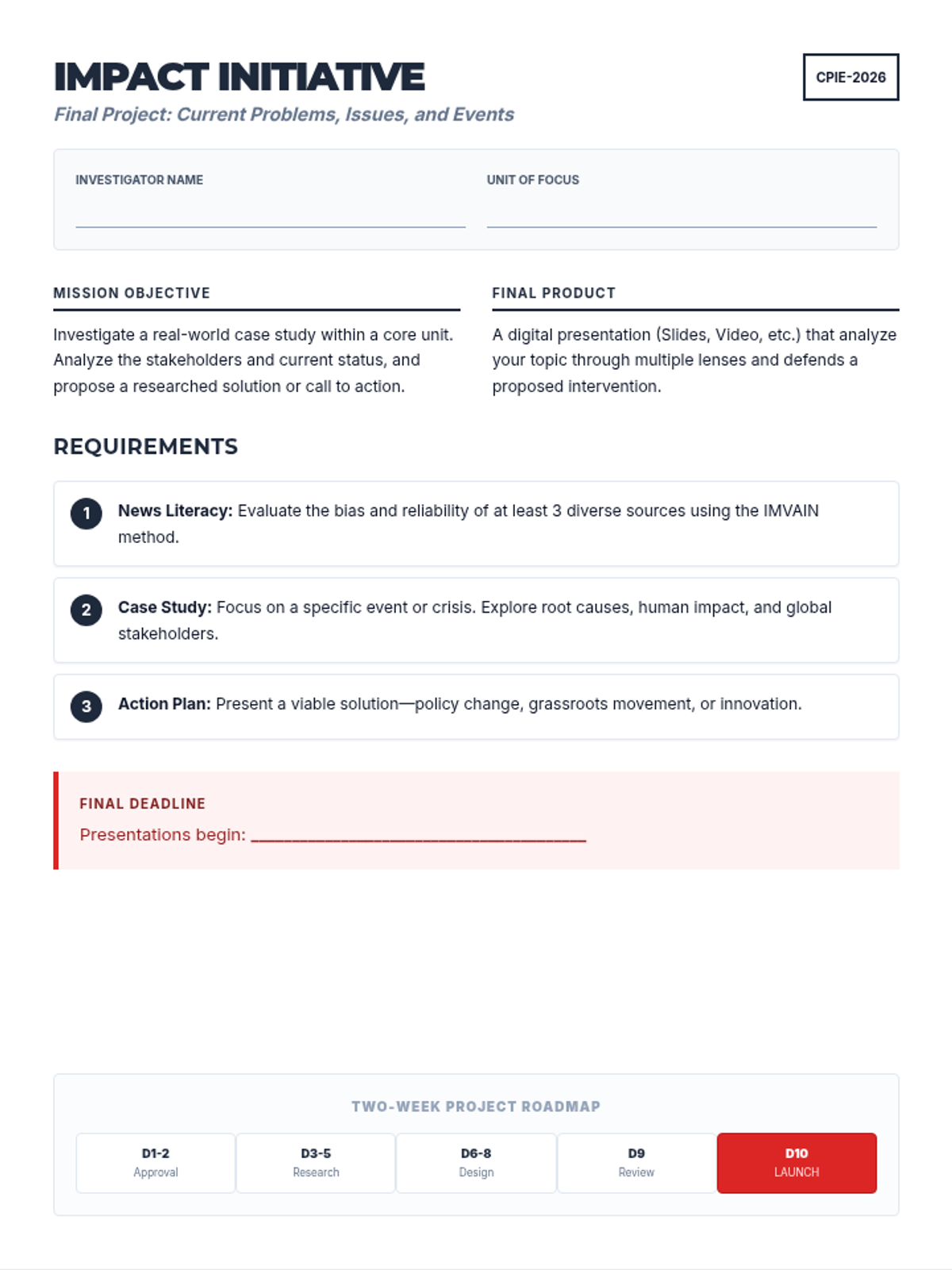
The core project handout detailing the Impact Initiative requirements, grading rubric, and two-week timeline for high school students.
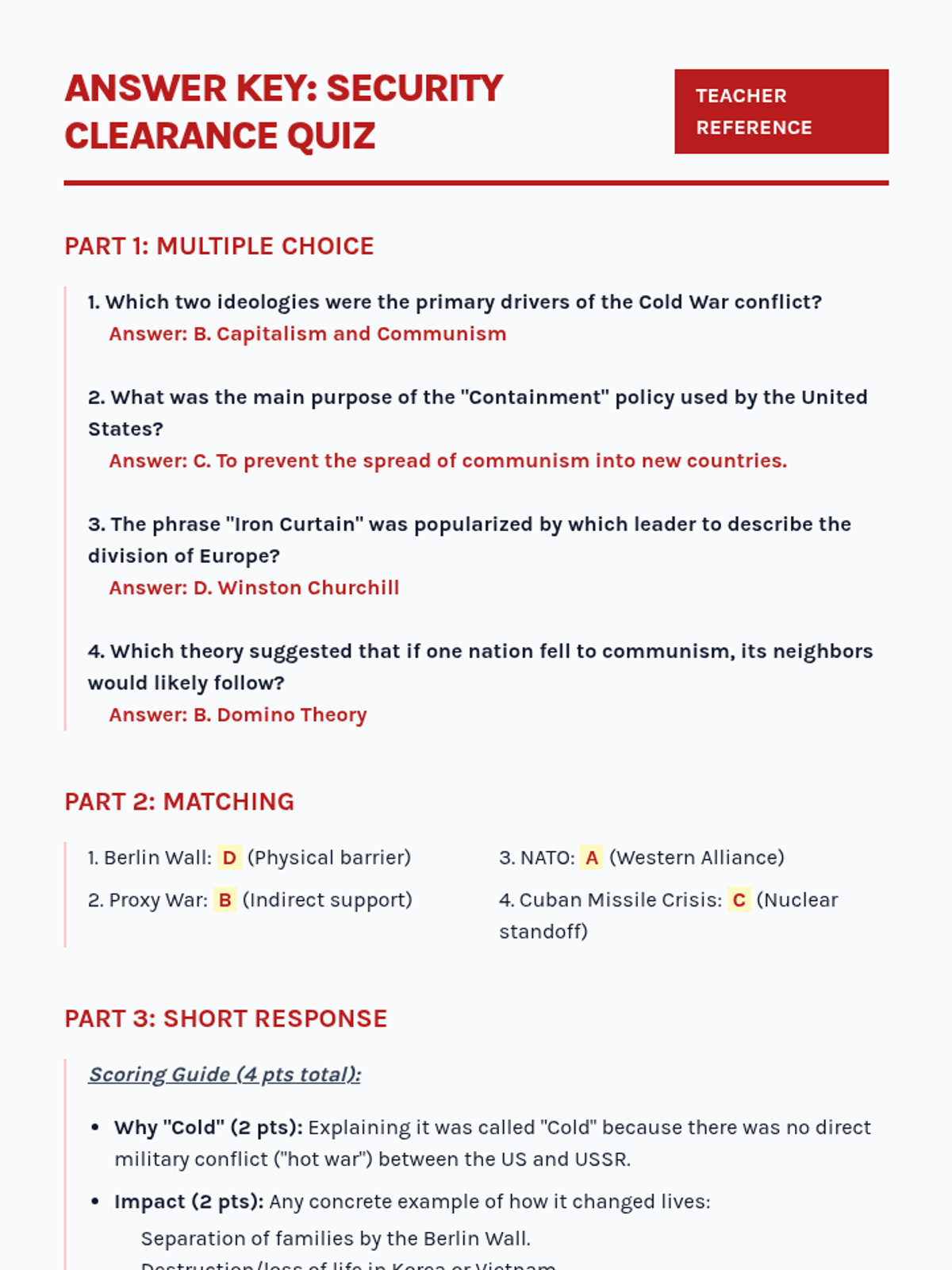
An answer key for the Security Clearance Quiz, providing correct answers for multiple choice and matching questions, plus a grading guide for the short response section. Revised to include full question stems and corrected question 4.
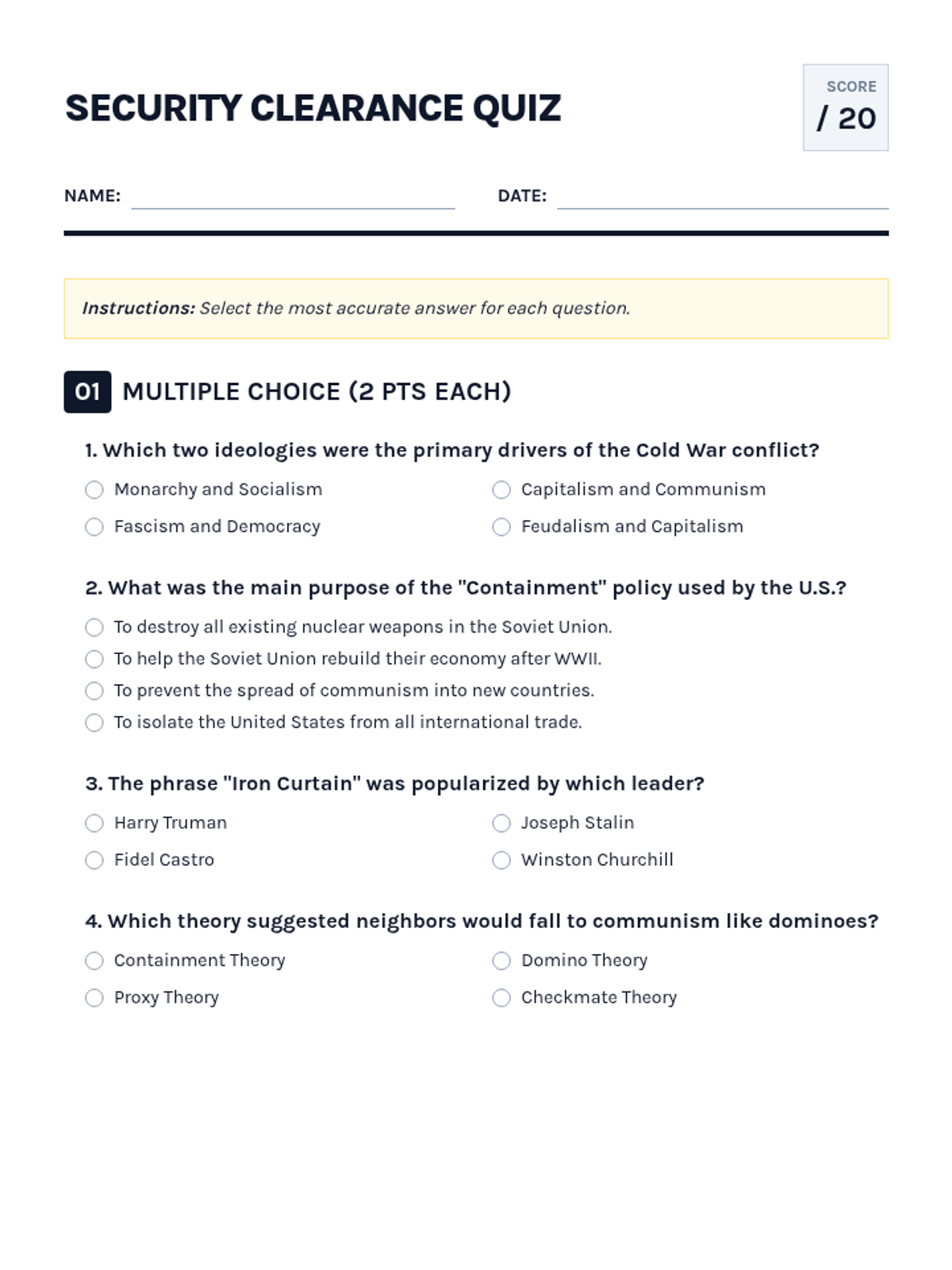
A summative assessment for the Cold War lesson. Includes multiple choice questions on ideologies and policies, matching for key events, and a short response section. Revised to improve question layout and provide more handwriting space. Condensed to fit on two pages.
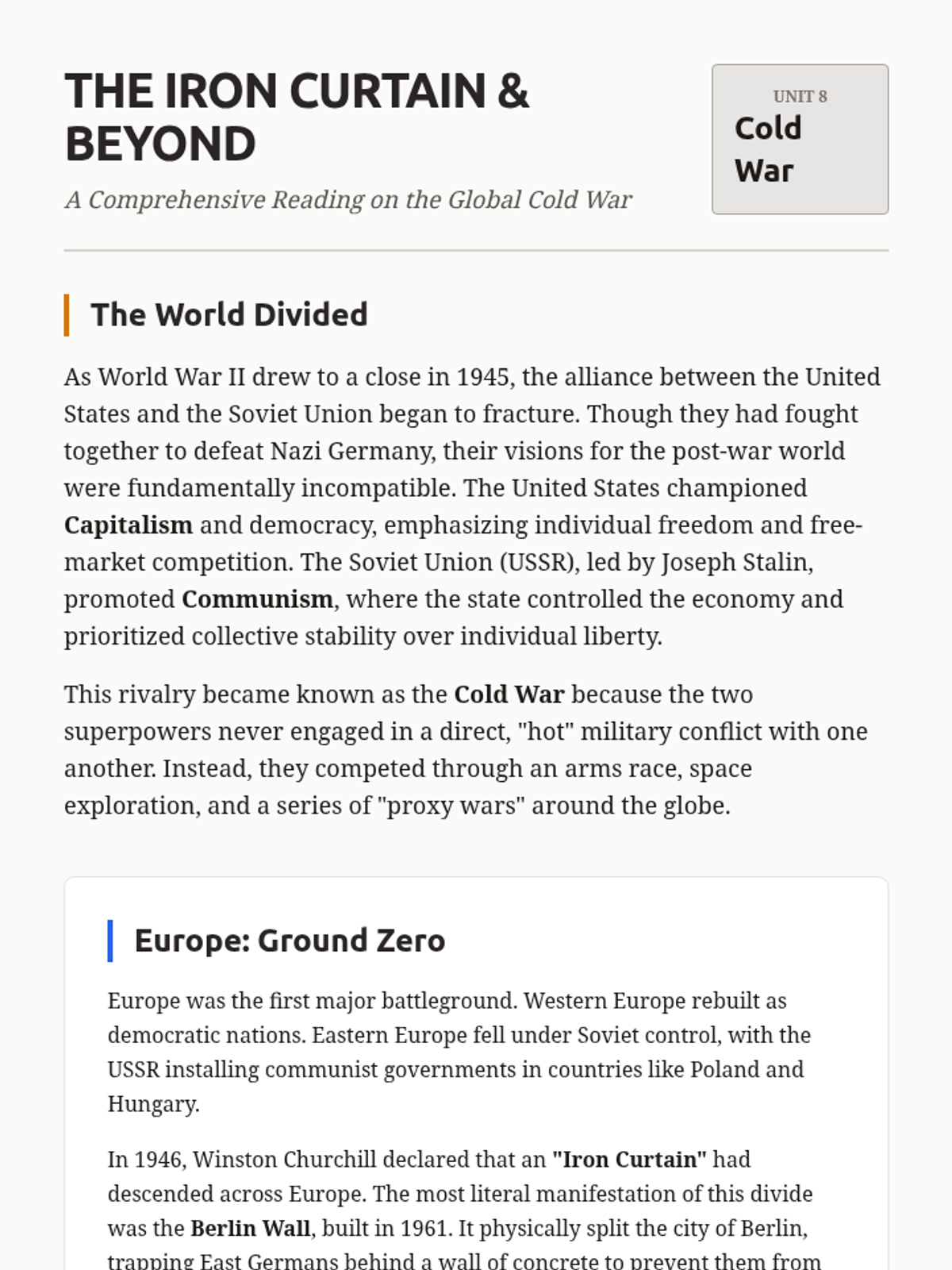
A detailed unit reading covering the origins of the Cold War, the Iron Curtain, the Berlin Wall, and major proxy wars in Korea, Vietnam, and Cuba. Revised to improve page breaks and provide student reflection space. Condensed for efficient printing.
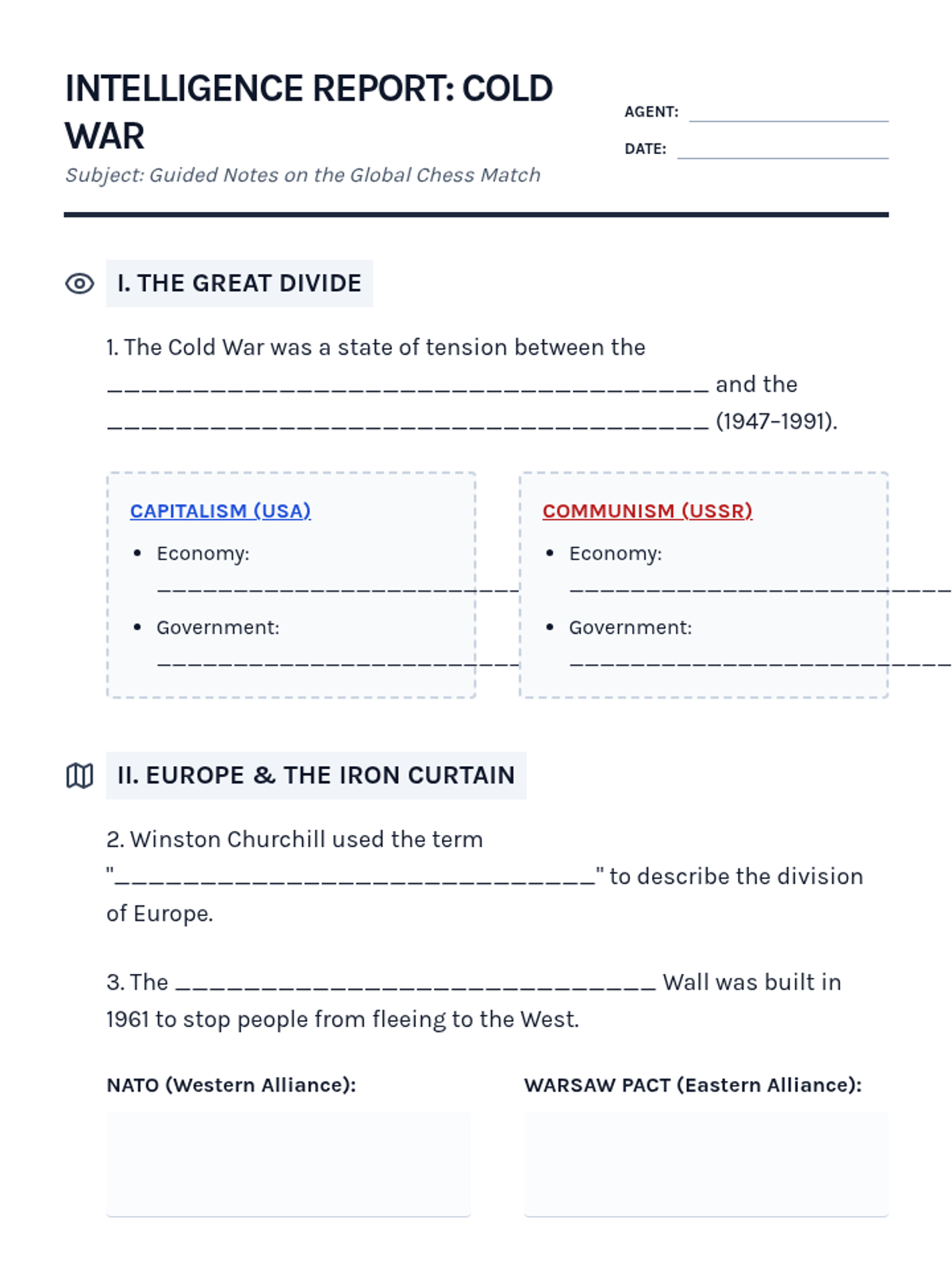
A guided notes worksheet for students to complete while following the presentation. Uses an "intelligence report" theme with fill-in-the-blanks and graphic organizers for key Cold War concepts. Revised to provide more handwriting space and cleaner page breaks.
A visually striking slide presentation on the Cold War's global impact. Features key concepts like proxy wars, the Iron Curtain, the Berlin Wall, and the Cuban Missile Crisis with a sleek "intelligence dossier" aesthetic. Replaced placeholder text with a visual schematic of divided Europe. Revised contrast for better legibility.
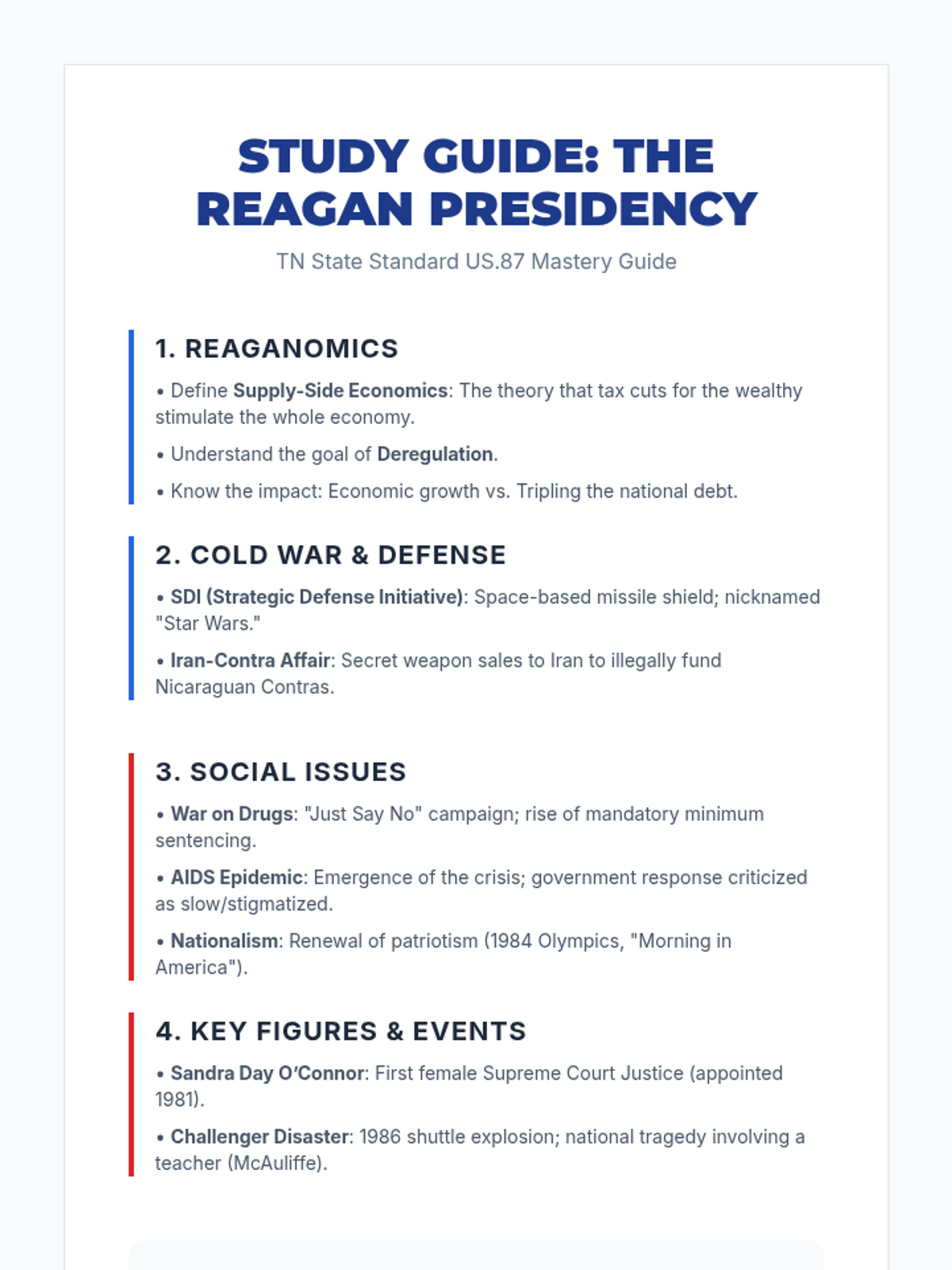
A concise student study guide summarizing the Reagan administration's key policies, events, and figures for exam preparation.