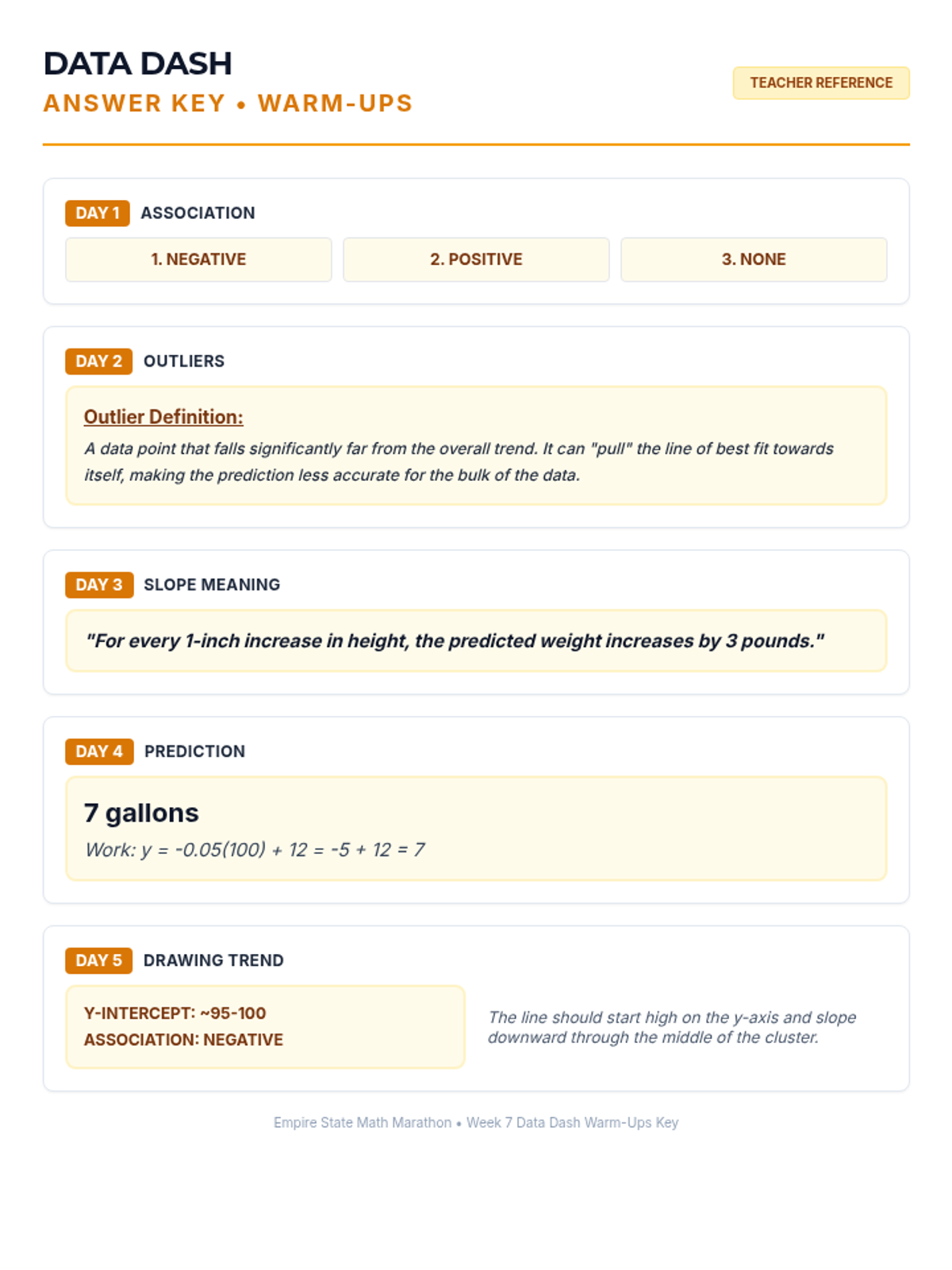
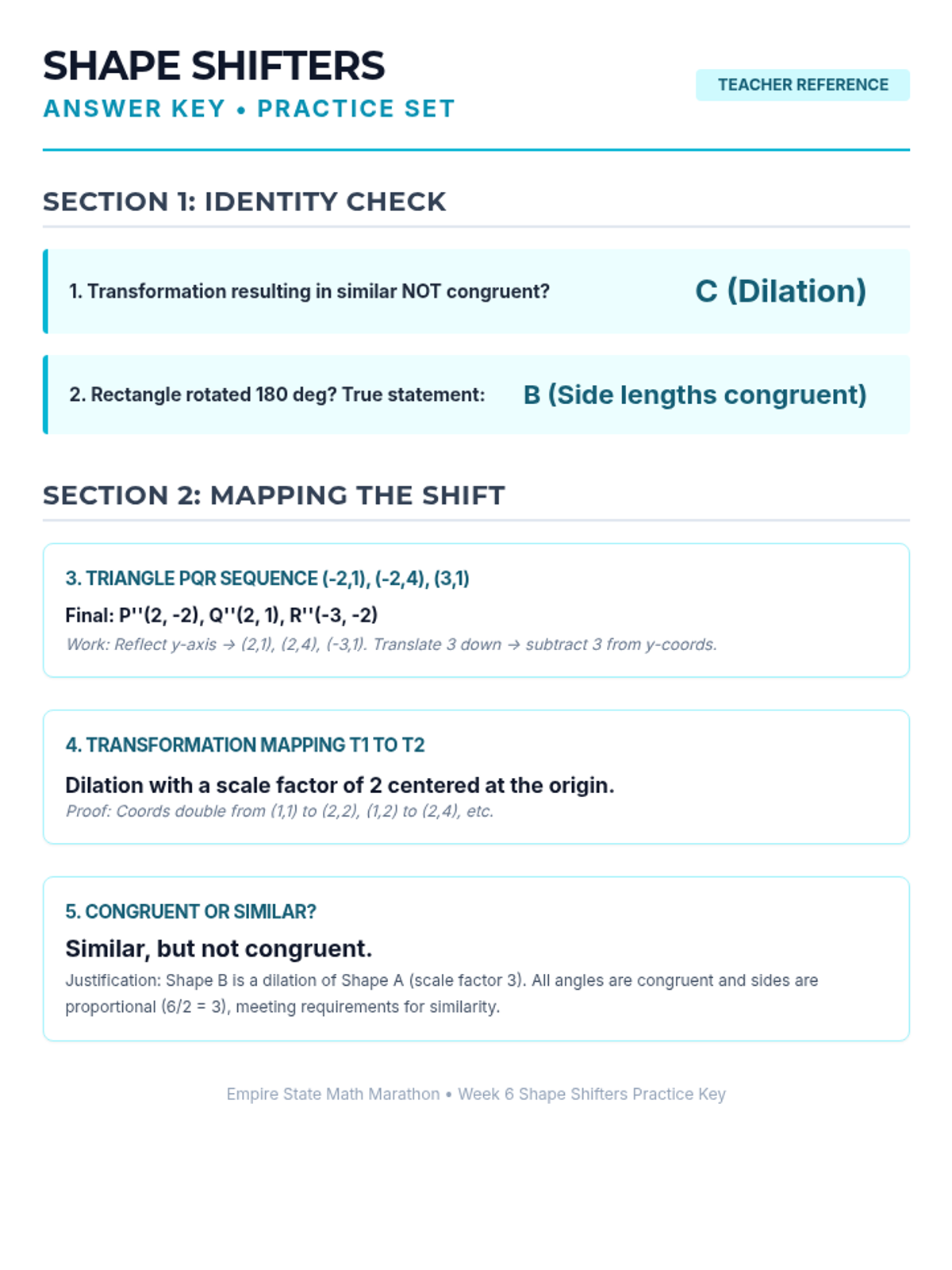
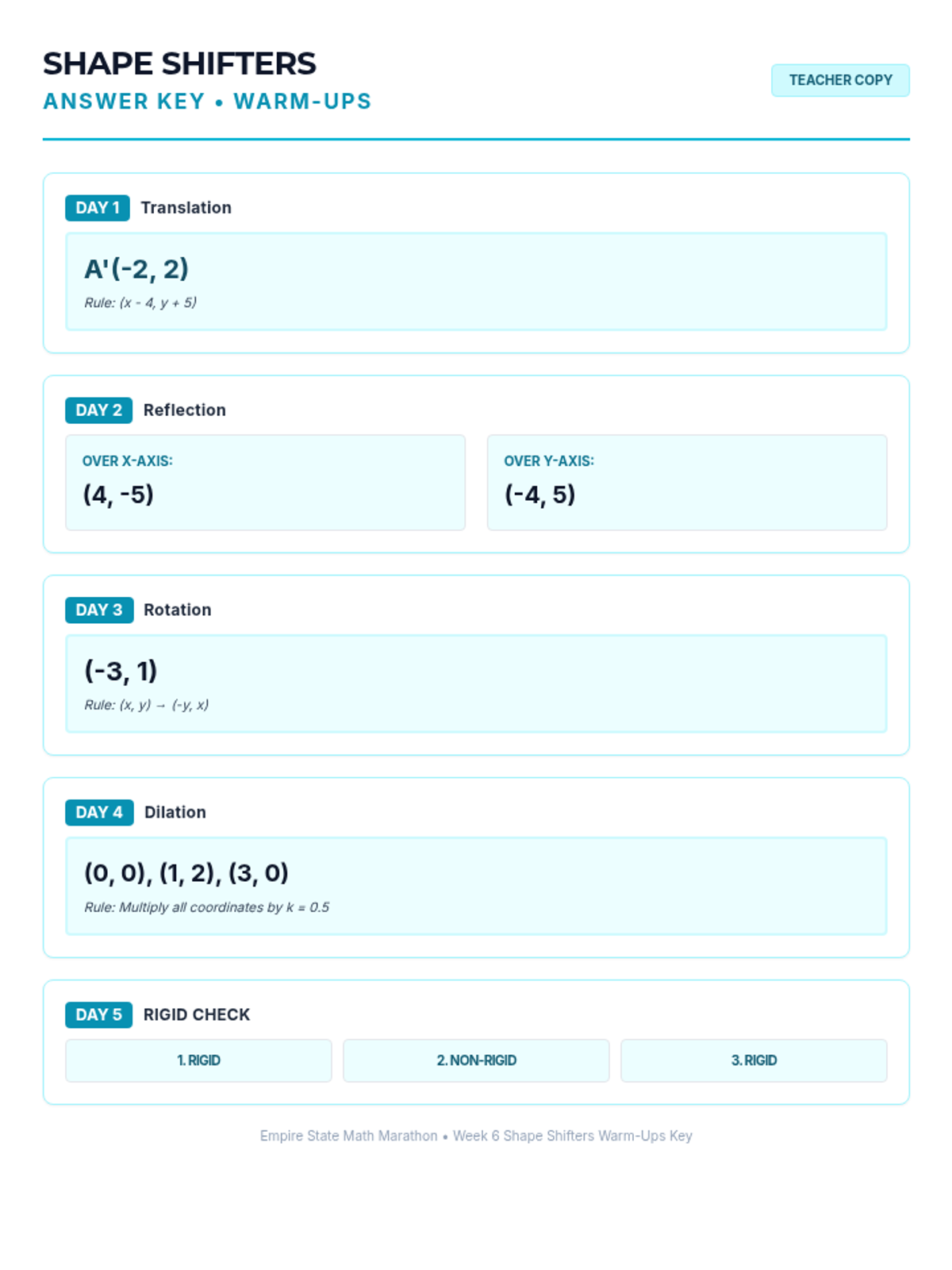
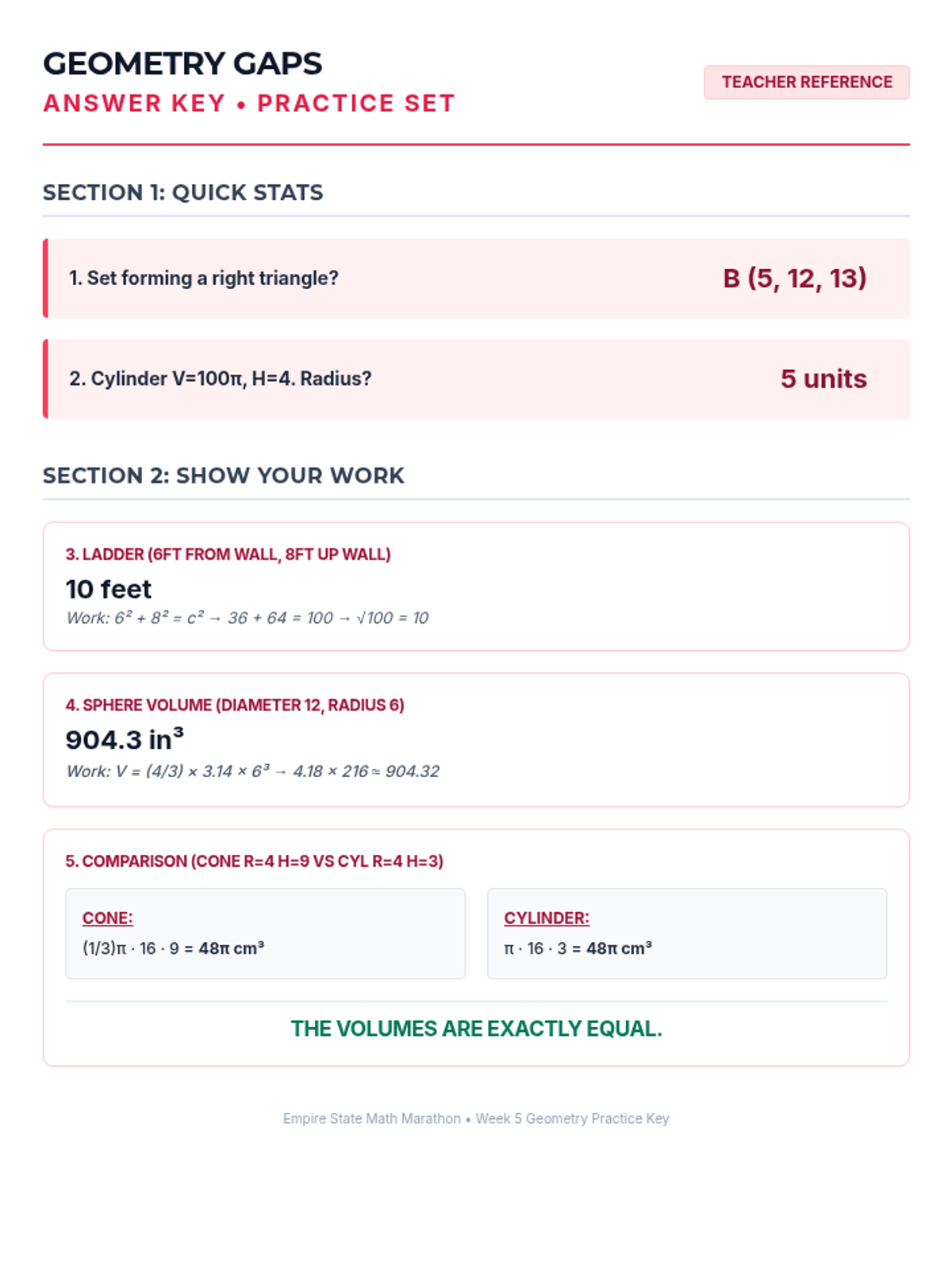
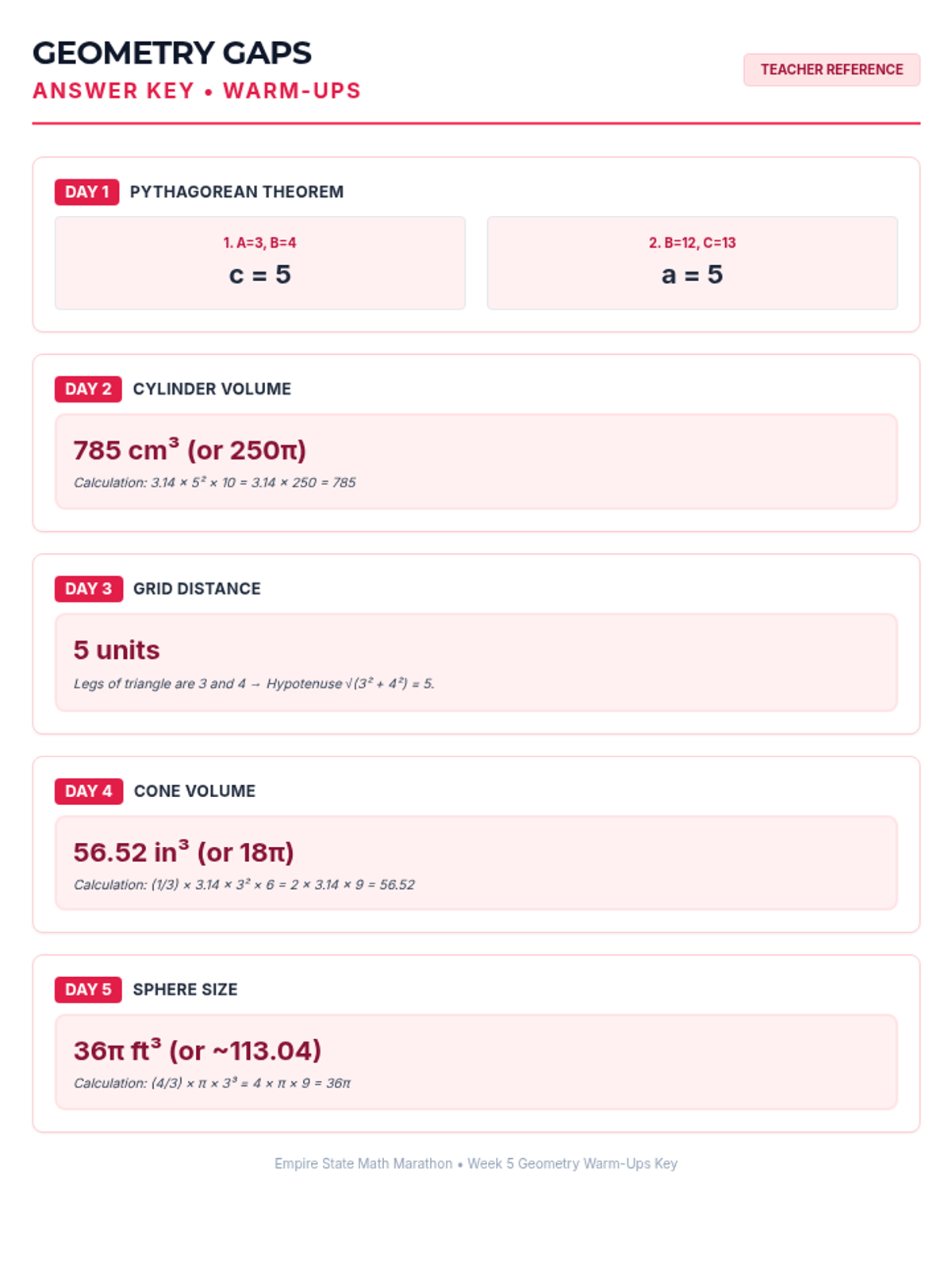
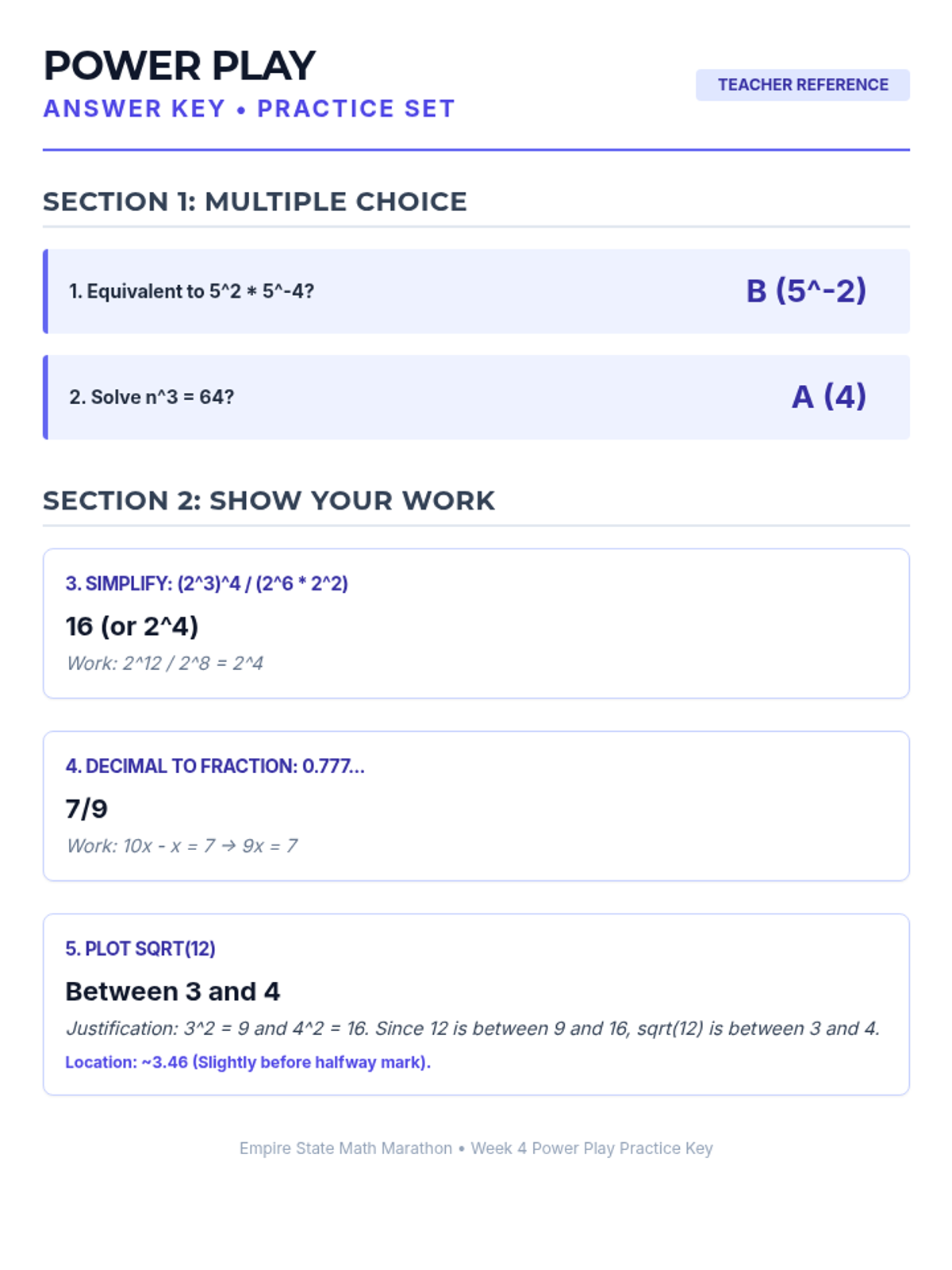
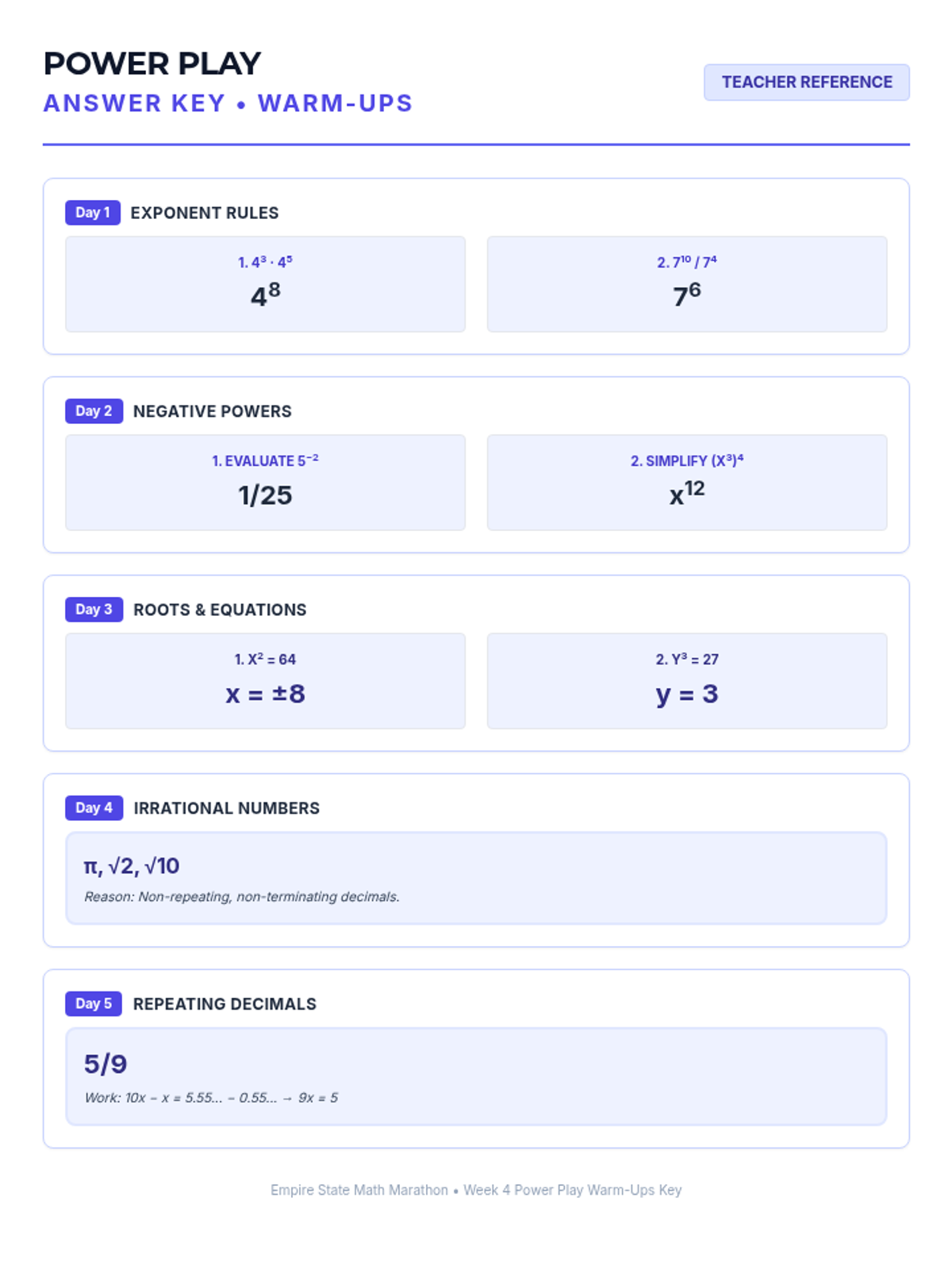
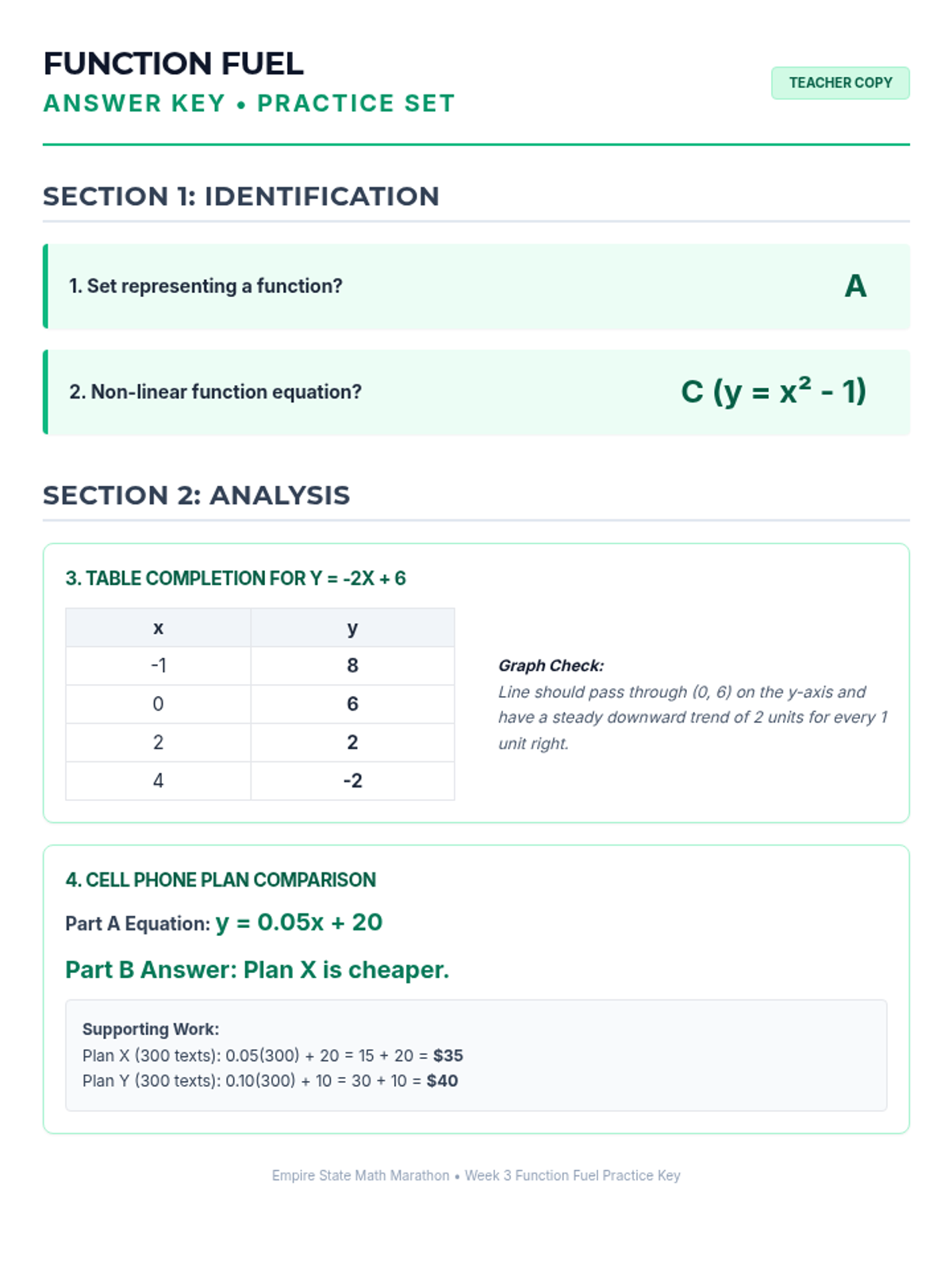
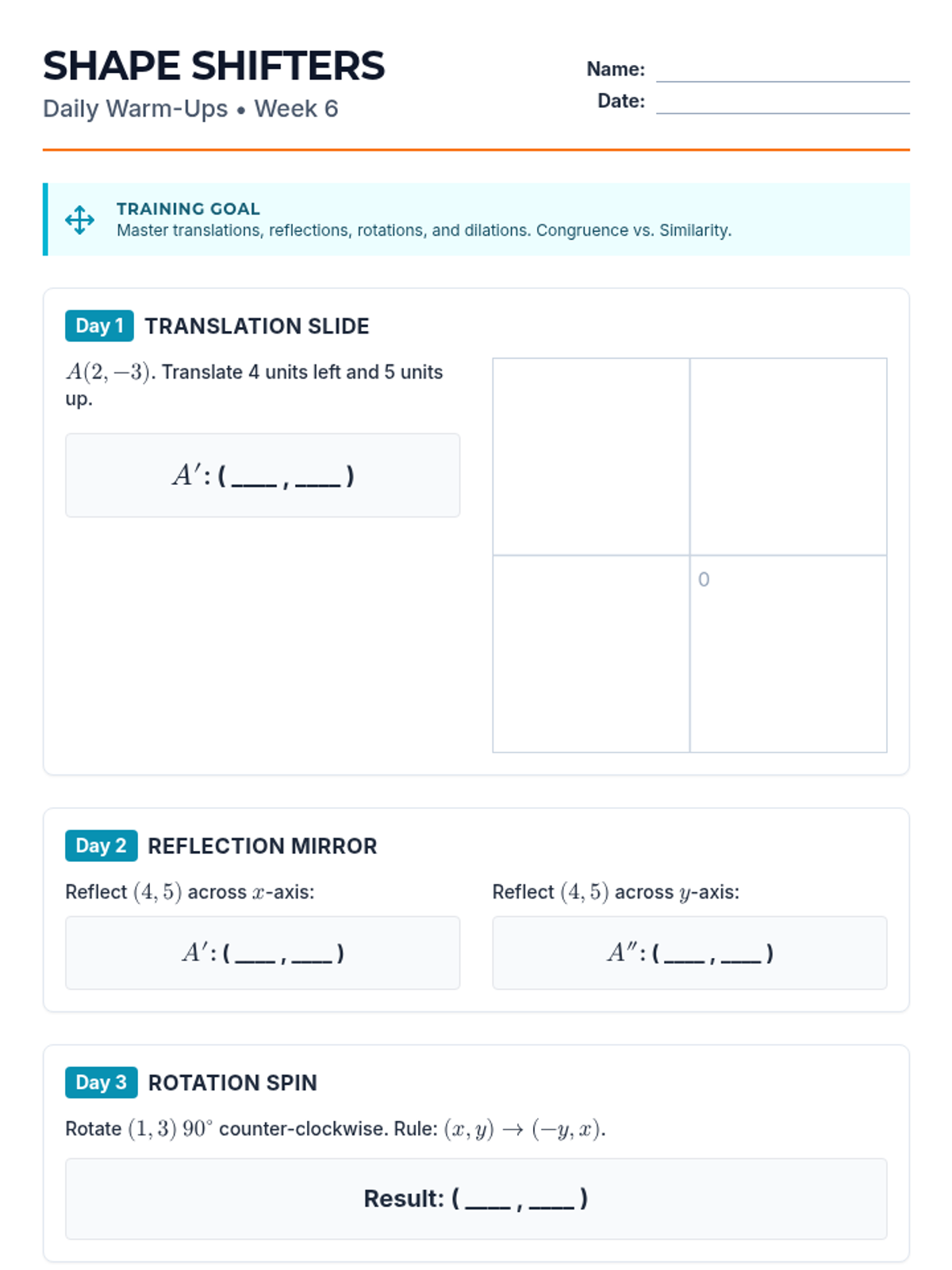
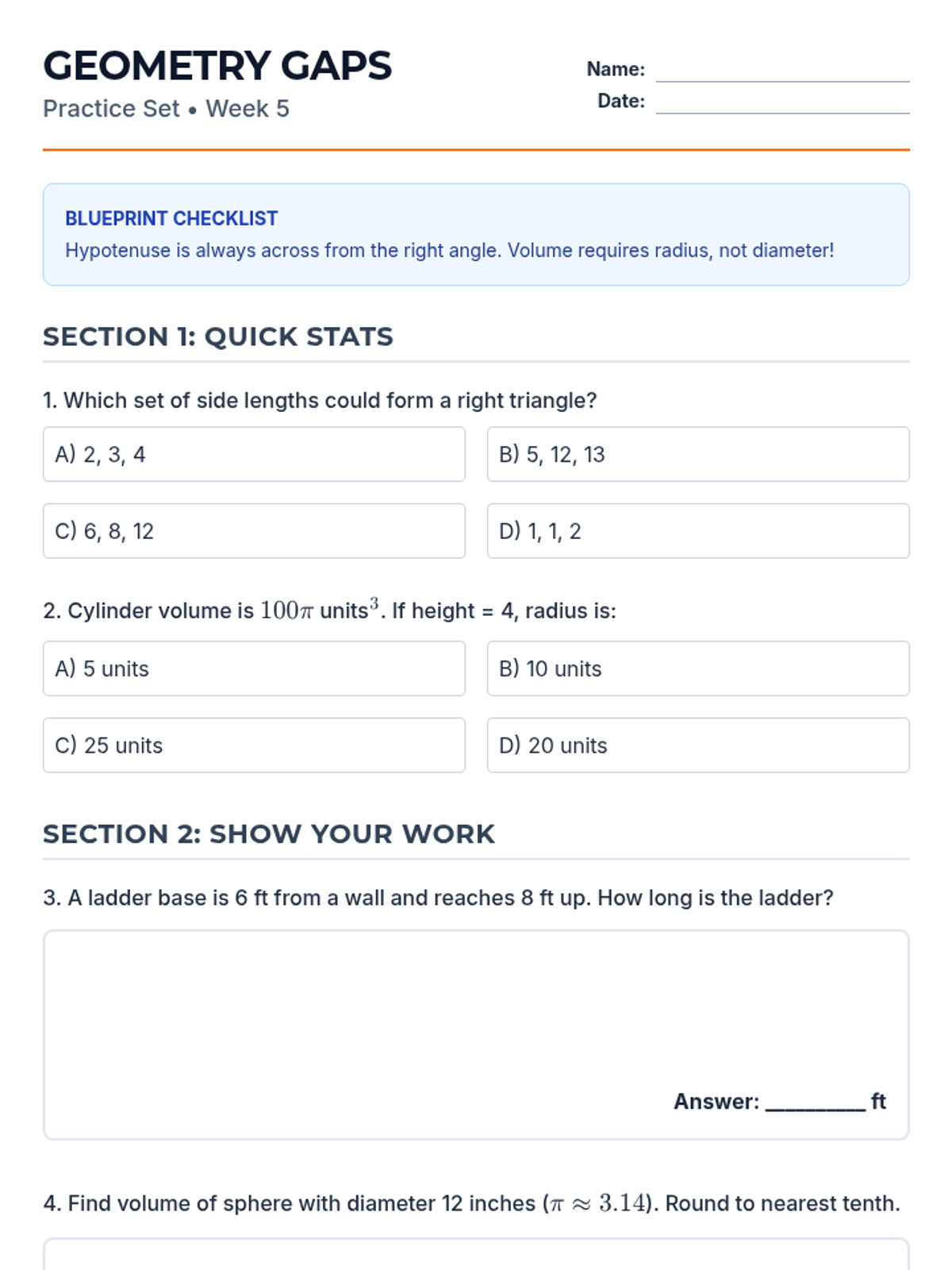
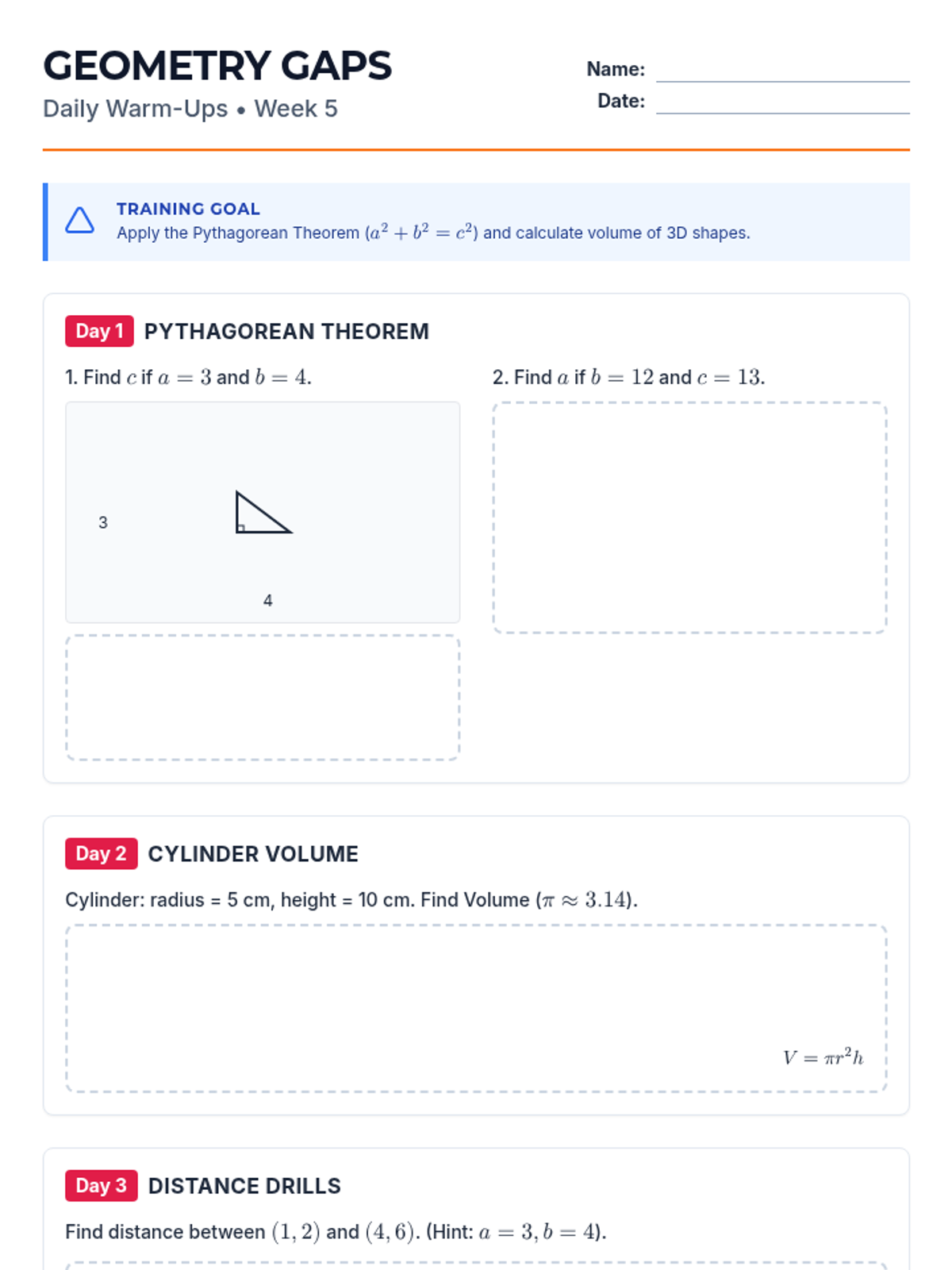
Geometric classification, measurement of area and volume, and the study of transformations and rigid motions. Builds toward complex proofs, trigonometry for general triangles, and the algebraic representation of conic sections.
A set of four hands-on field missions for students to experiment with daylight estimation, historical nautical timekeeping, fractal scaling, and sun-based coordinate mapping. All missions now feature consistent, professional layouts with scientific sidebars.
A comprehensive quiz covering fixed-point navigation, coordinate axes, microcosms vs macrocosms, and different types of symmetry. Refactored for standard portrait format.
A reference page explaining Longitude as the X-axis of navigation, along with advanced symmetry concepts like Rotational and Logarithmic Spirals. Updated for scientific accuracy regarding the difficulty of longitude and spiral patterns. Standard portrait format.
A conceptual worksheet for students to identify patterns of symmetry and scale in nature. Updated with 'Mission Break' callouts after Section 1 and Section 2 to guide students to specific field activities.
A two-page reference sheet covering the North Star (Polaris) as a navigation tool on page one, and the concepts of symmetry and scale (Microcosm/Macrocosm) in nature on page two. Updated for scientific accuracy and refactored for standard portrait format with small, professional font sizes.
A teacher guide providing a 15-minute pacing plan, discussion script, and answer key for the Cosmic Symmetry lesson. Updated for scientific accuracy regarding precession and terminology. Standard portrait format.
A student worksheet focused on identifying microcosm/macrocosm patterns and using coordinate symmetry (reflection) to complete a geometric compass rose design. Refactored for standard portrait format with an added 'Mission Break' callout.
A visual slide deck distinguishing between the North Star (fixed points) and Nature's Symmetry (repeating patterns) as tools for ancient navigation, now updated with integrated 'Mission Break' slides to signal field work timing.
A teacher-facing lesson guide with pacing, hands-on activity instructions, discussion prompts, and key concepts for the 15-30 minute Cosmic Compass lesson. Redesigned with a modern star chart aesthetic.
A three-page student resource featuring 'The Navigator's Codex' (informational text) and a two-part 'Blueprint Analysis' (interactive worksheet). Covers the historical breakthrough of Polaris, rotational symmetry in nature and navigation, Greek root decoding, and mathematical coordinate prediction. Redesigned with a modern star chart aesthetic and updated with the specific 'Why it matters' takeaway requested by the user. Vertical spacing tightened and font sizes adjusted to prevent content overlap.
Instructional slides for the 'Cosmic Compass' lesson, redesigned with a modern star chart aesthetic. Features neon accents, geometric layouts, and high-contrast digital motifs to teach the Greek roots micro/macro/cosmos and rotational symmetry. Updated with the specific 'Why it matters' takeaway requested by the user.
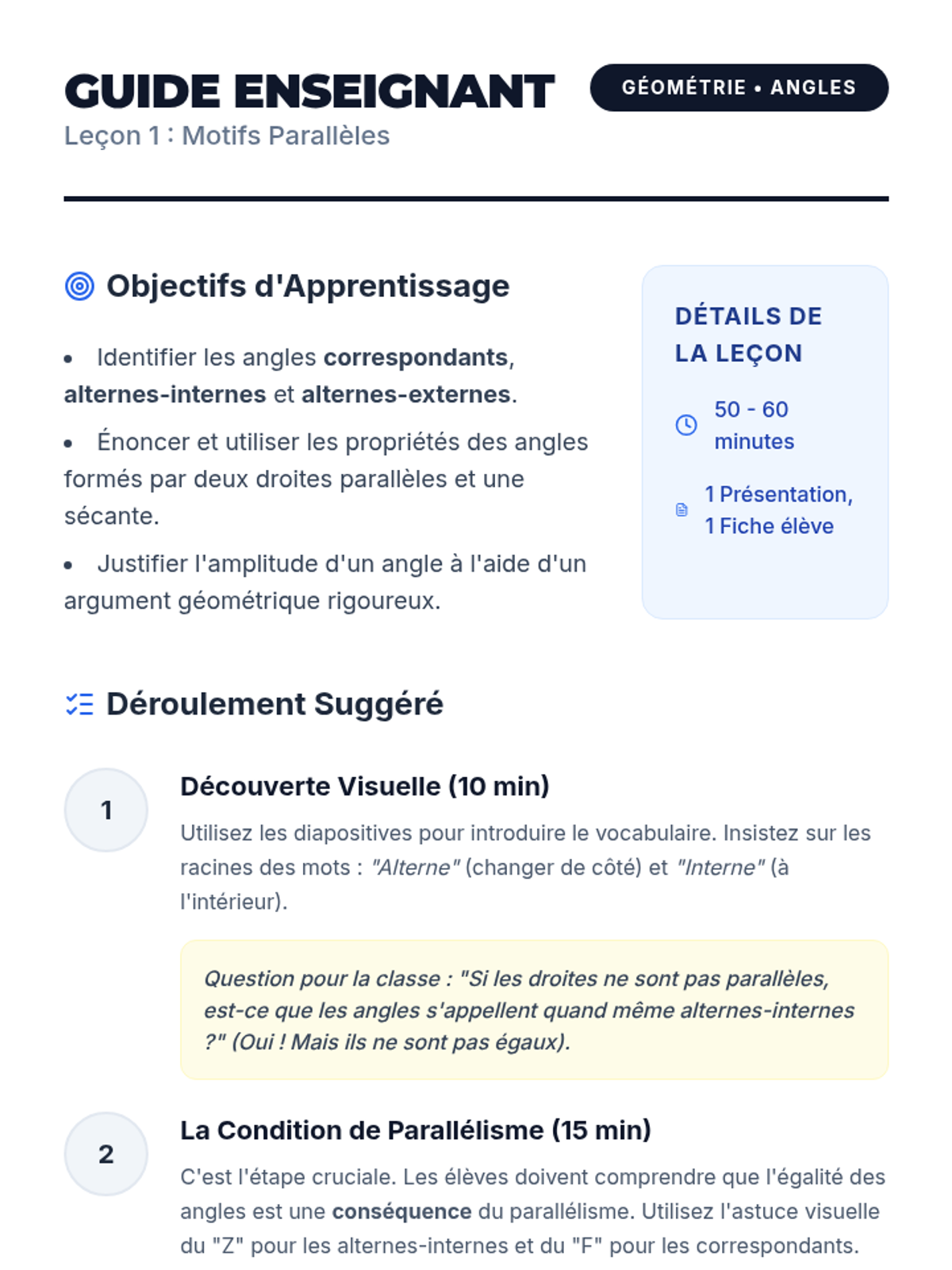
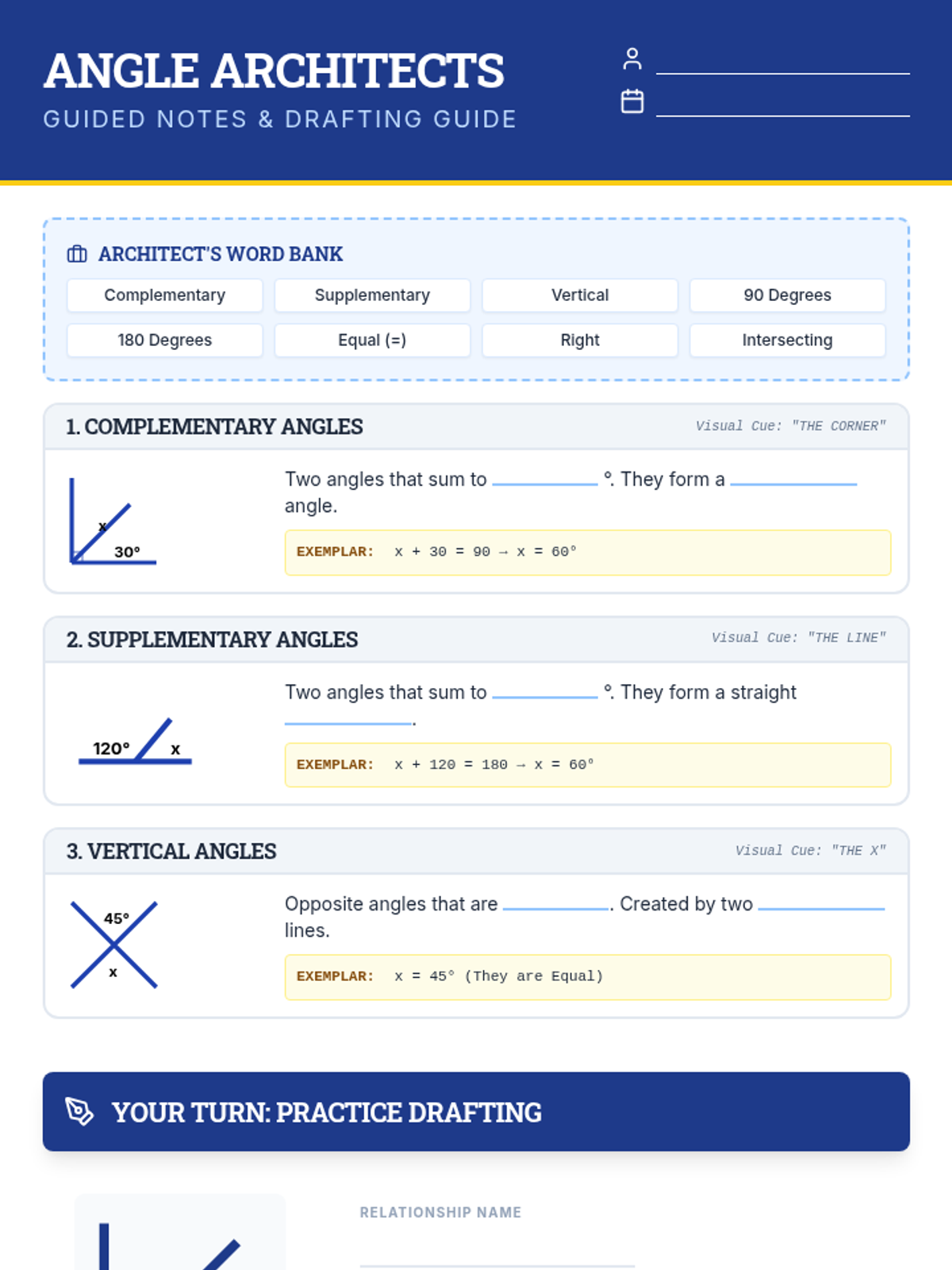
Comprehensive facilitation guide for the Angle Alliances lesson, including CCSS standards, time-stamped instructional sequence, and differentiation strategies.
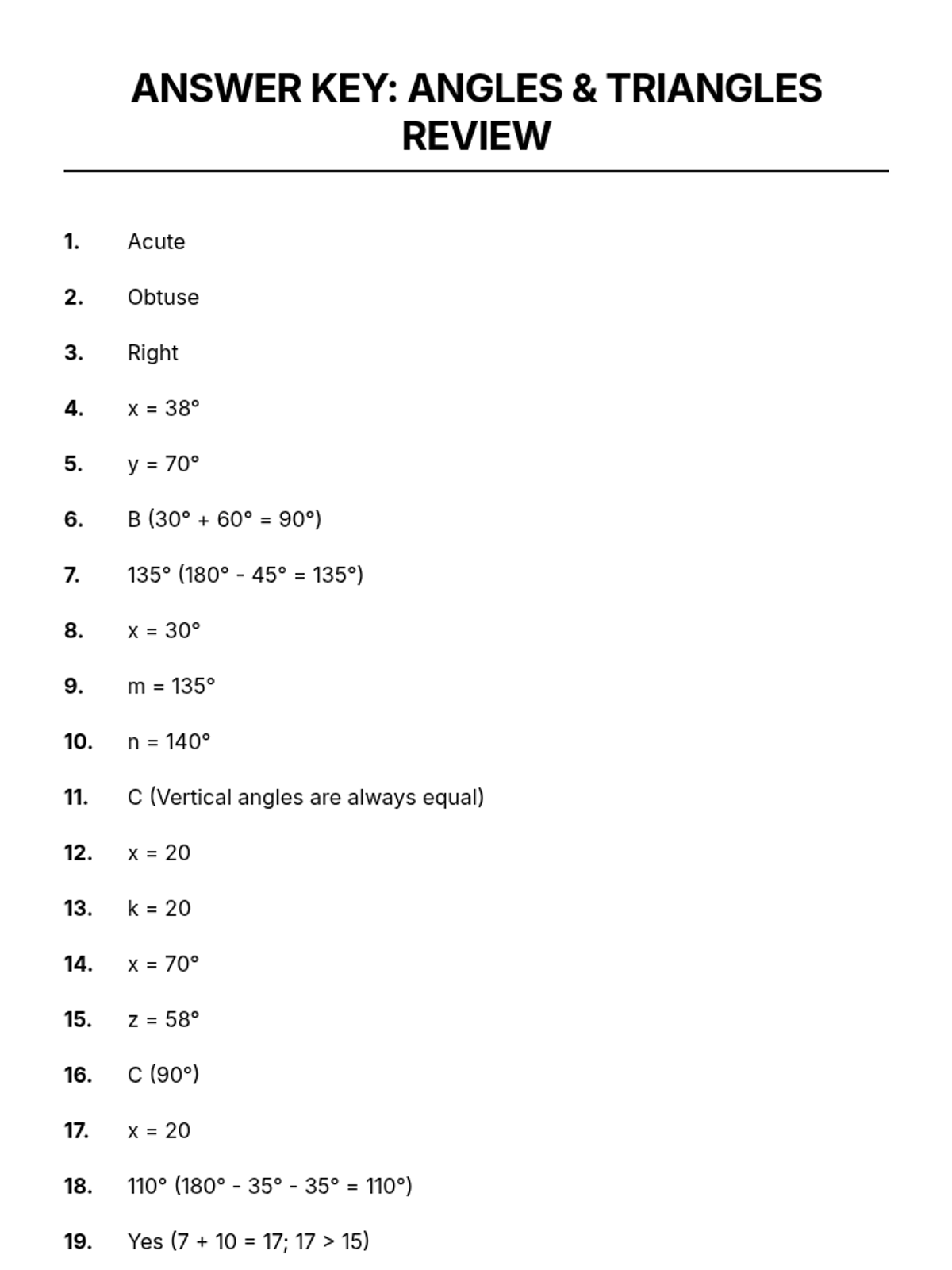
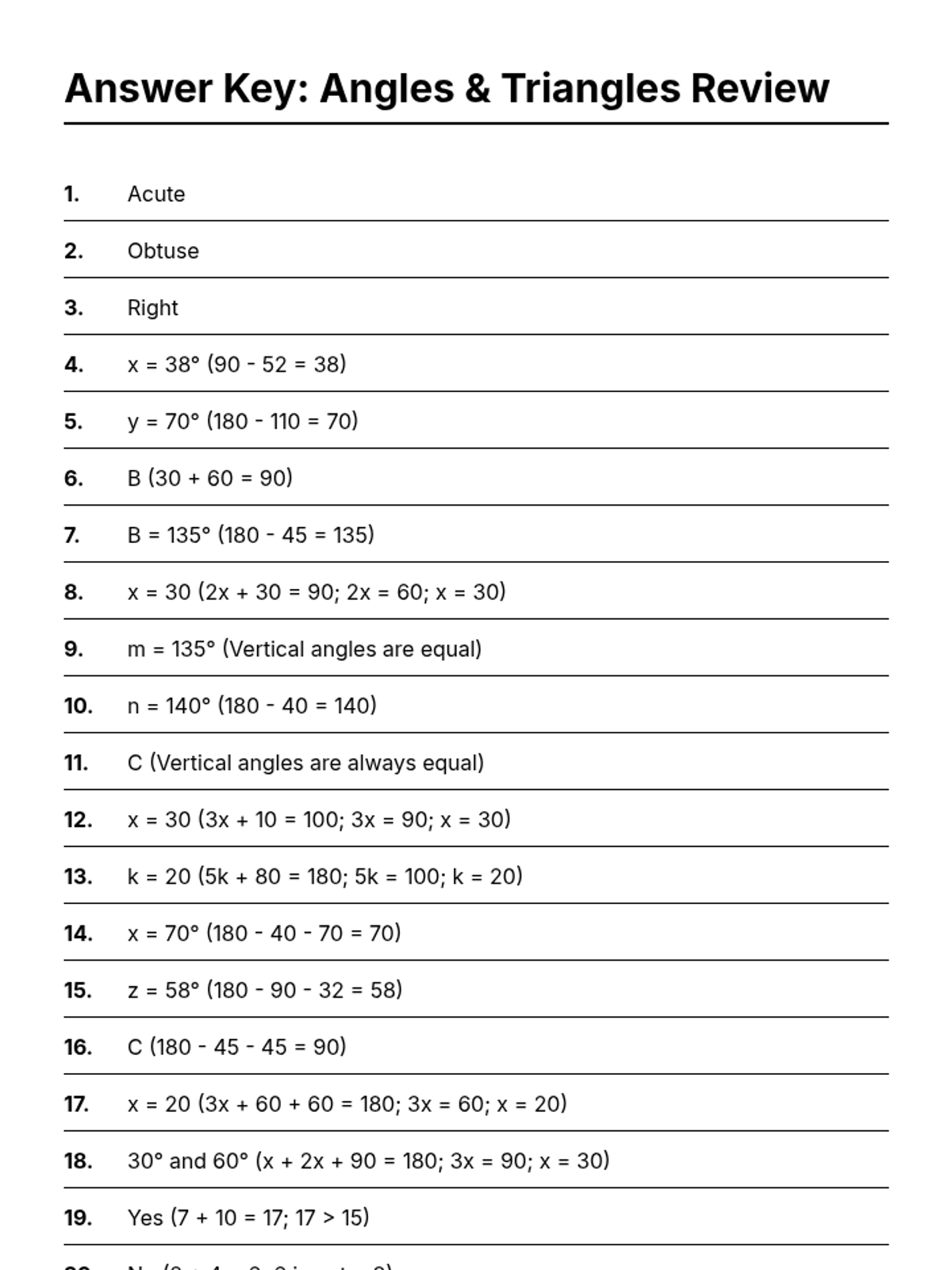
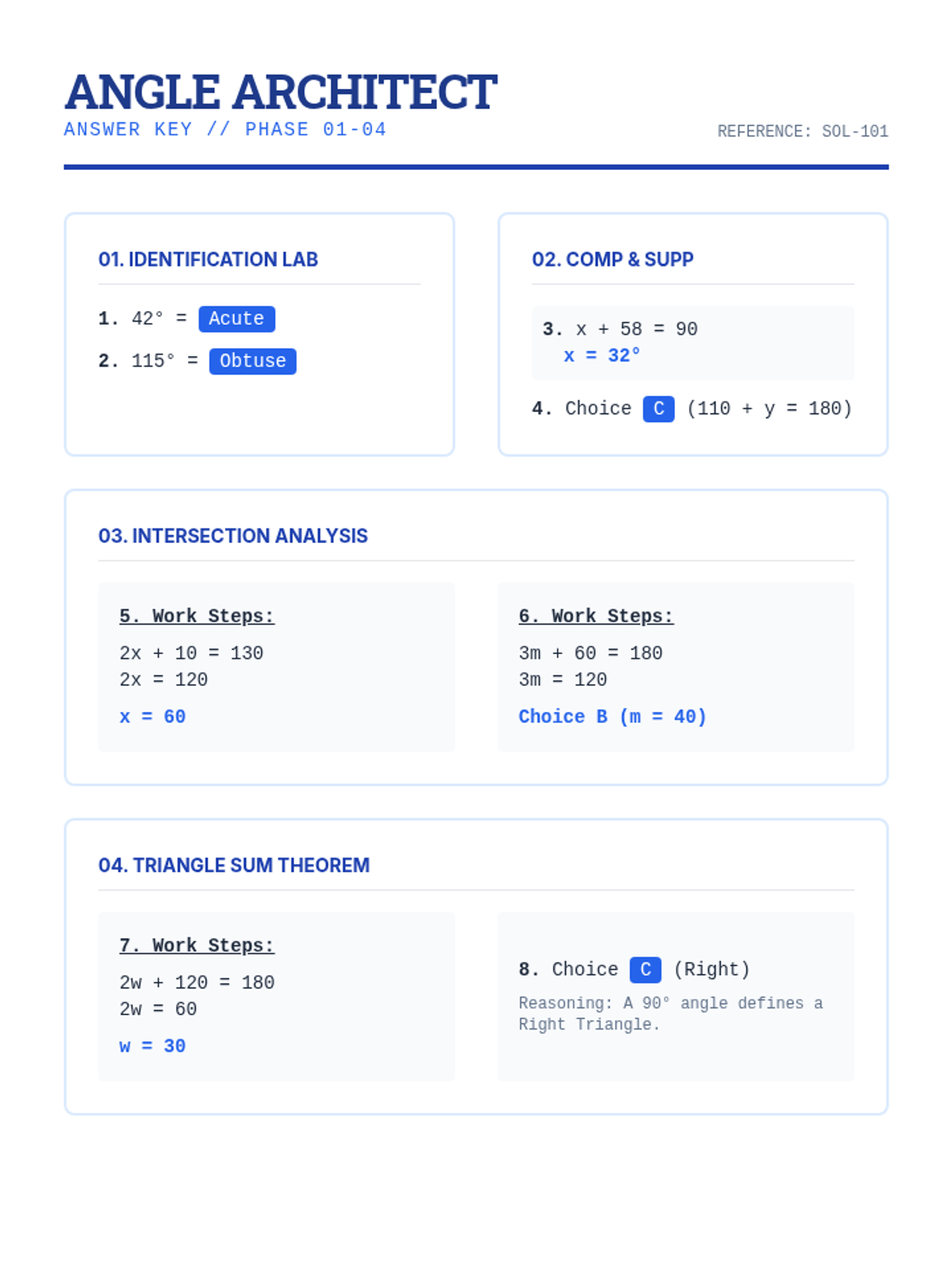
Detailed answer key for the Angle Alliances worksheet, including step-by-step algebraic solutions for all geometric problems.
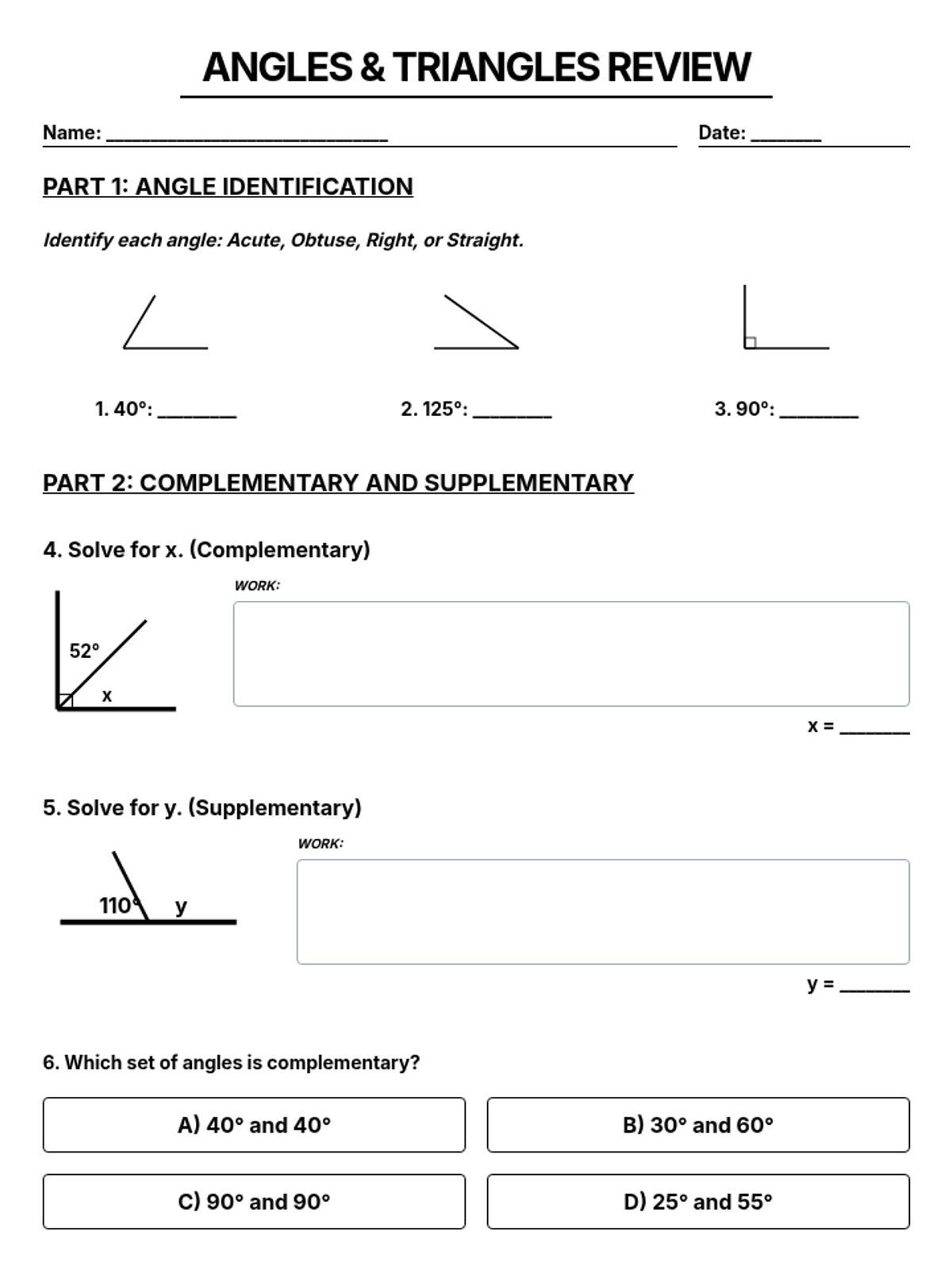
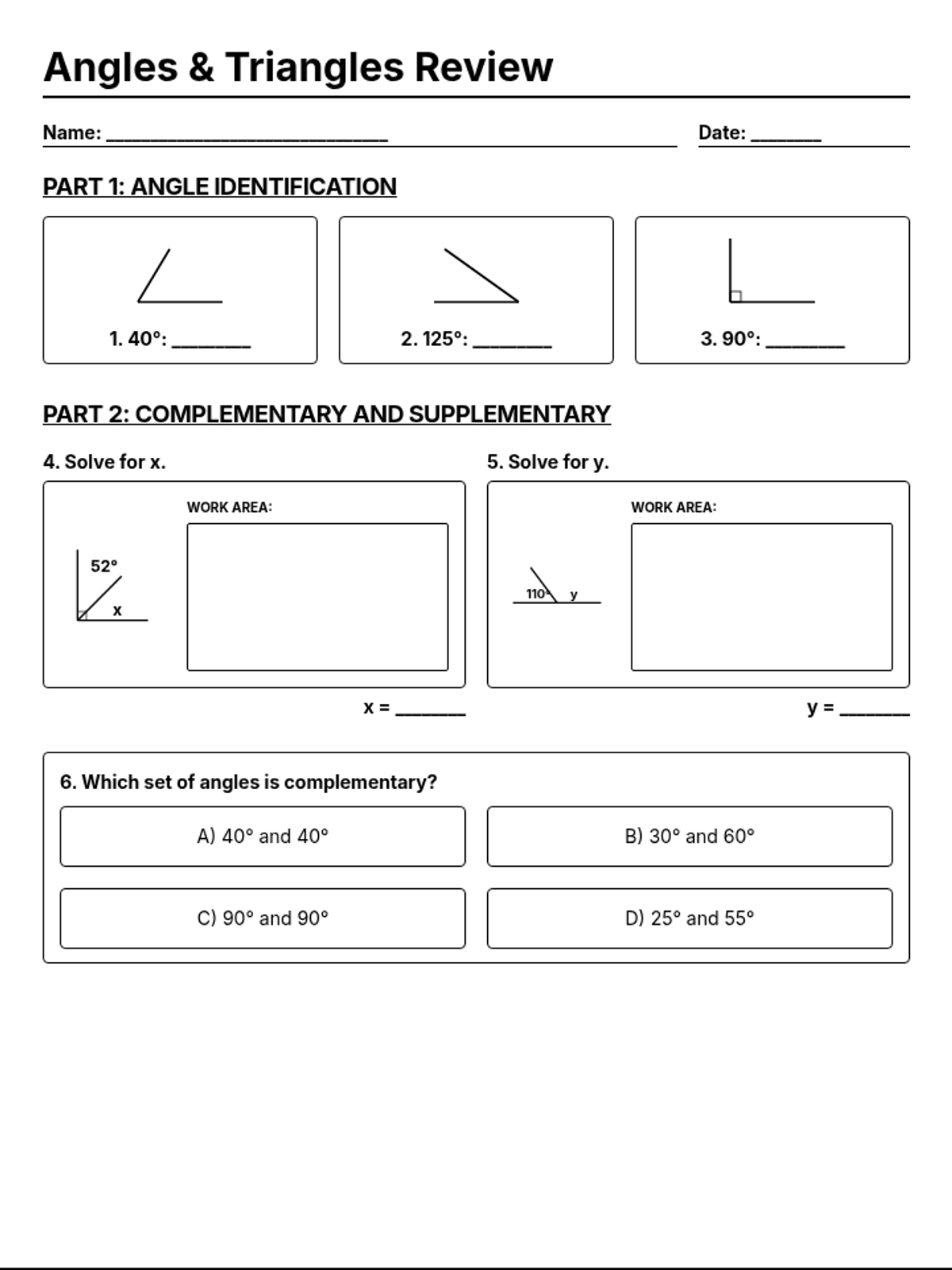
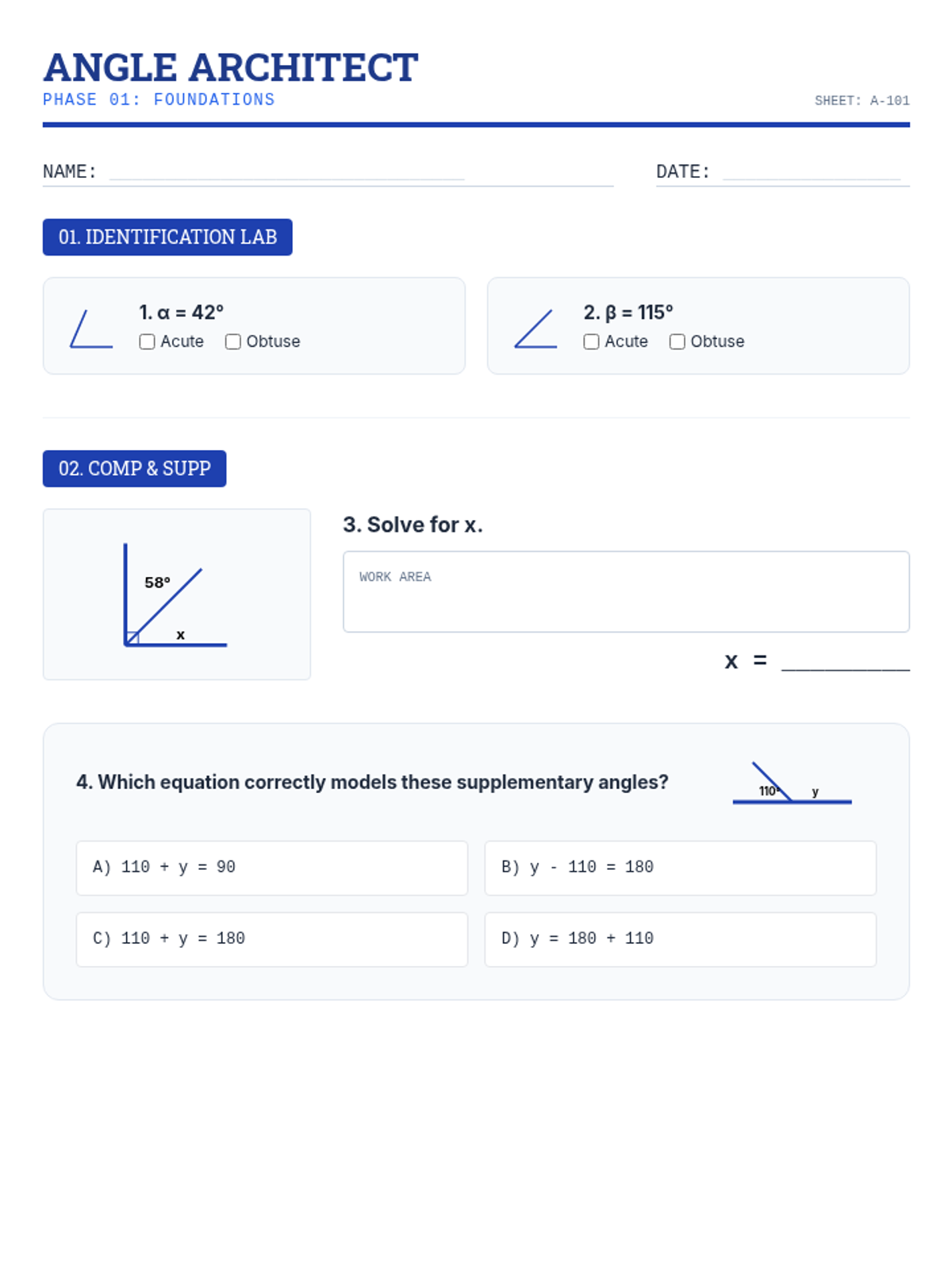
A comprehensive investigation worksheet where students identify angle relationships, measure triangles to discover the angle sum theorem, and solve algebraic equations based on geometric properties.
A visually striking presentation for 7th-grade geometry covering angle relationships and the triangle sum theorem with an architectural blueprint theme.
A comprehensive teacher guide for facilitating geometric rotation lessons, featuring an instructional sequence, tips for patty paper use, and common misconception alerts.
A highly simplified, scaffolded practice worksheet for geometric rotations, focusing on matching and guided calculation with explicit hints.
An ultra-simplified investigation worksheet focusing on the rotation of a single point (2, 4) to make coordinate changes obvious and manageable.
An ultra-simplified reference sheet for rotations using large fonts, color-coded "front/back" number labels, and clear "Secret" instructions for 90 and 180-degree turns.
A visual introduction slide deck for geometric rotations, covering the concept of the origin, degrees of rotation (90, 180, 270), and direction (CW/CCW).
An error-analysis worksheet where students act as medical diagnosticians to find and correct common mathematical mistakes in algebra, geometry, and proportional reasoning.
The student practice packet for the Math Medics review, containing real-world application problems and state-assessment style items for proportional relationships, equations, and geometry. Includes ample workspace for calculations.
An engaging, high-energy slide deck for a 50-minute middle school math review, featuring a medical clinic theme with segments on proportions, equations, and geometry formulas.
A comprehensive teacher facilitation guide and answer key for the Math Medics review lesson, including a 50-minute pacing guide, instructional tips, and detailed solutions for all student activities.
A high-impact, spy-themed cover page for the 4-day student cooldown packet. Fixed layout sizing.
A comprehensive answer key for teachers to quickly verify student work from all four mission days. Updated for structural consistency.
A student worksheet for the final day's creative mission debrief and gadget design tasks, spread across two pages for ample workspace. Structure updated for better structural consistency. Includes two coloring pages at the end.
A student worksheet for the third day of the mission, featuring algebraic equations on page 1 and geometry problems on page 2. Updated for structural consistency and to prevent page overlap. Includes two coloring pages at the end.
A student worksheet for the second day of the mission, involving ratio and proportion word problems and a spy-themed word scramble activity. Updated for consistent pagination and improved spacing. Structure updated for better structural consistency and to prevent page overlap. Includes two coloring pages at the end.
A student worksheet for the first day of the cooldown mission, featuring ELA context clues on page 1 and a logic grid puzzle on page 2. Structure updated for better structural consistency and to prevent page overlap. Includes two coloring pages at the end.
An answer key and teaching guide for the Area Architect Worksheet, featuring a step-by-step solution, a 4-point grading rubric, and common student misconceptions.
A single-problem math worksheet designed to assess a student's ability to calculate the area of a rectangle with fractional side lengths, requiring four distinct lines of mathematical evidence.
Day 5 review worksheet focusing on the relationships within circles, specifically calculating area and circumference given radius or diameter. Includes formula summaries and practice problems.
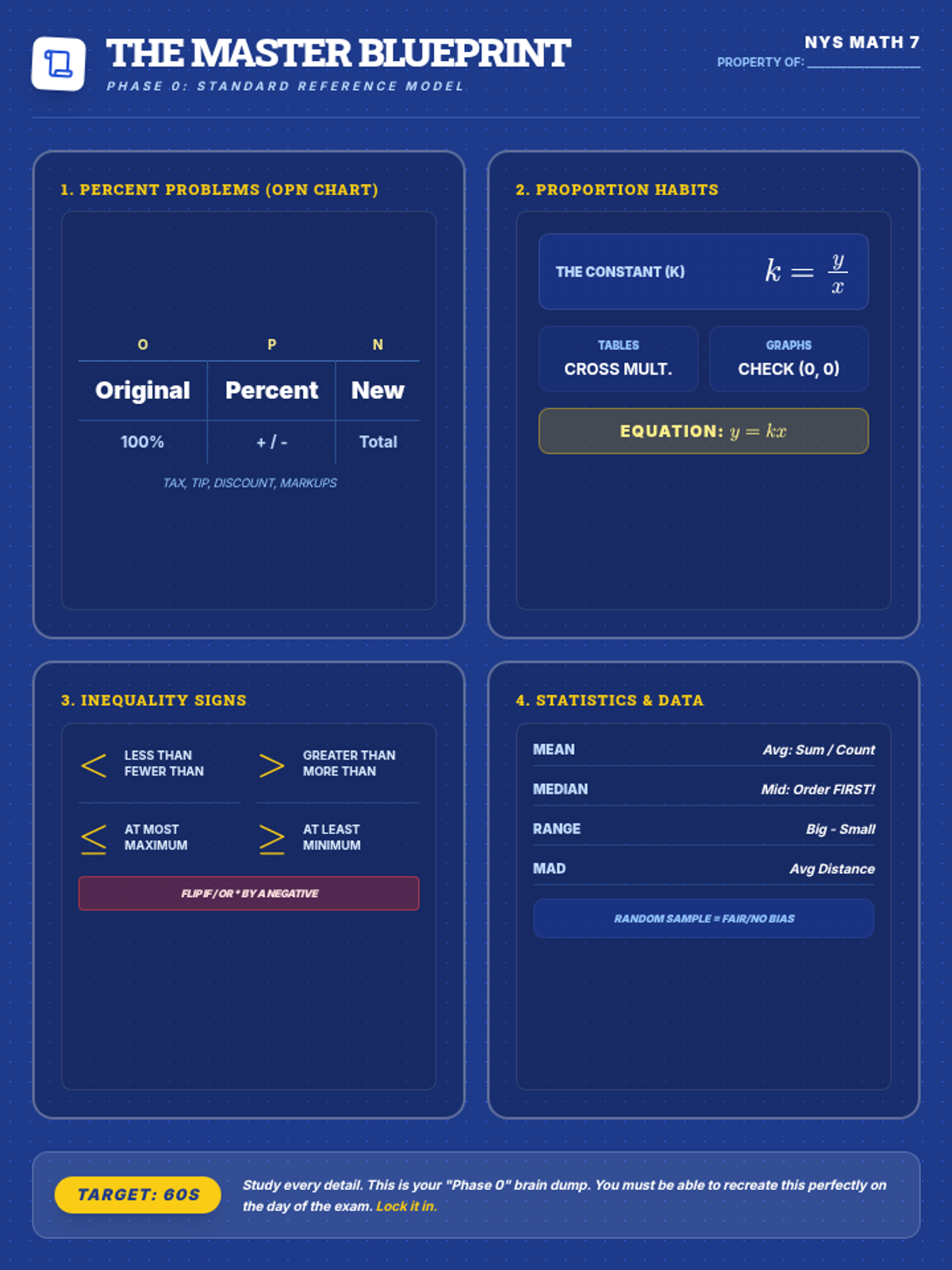
Day 4 review worksheet focusing on multi-step percent problems including tax, commission, discounts, and compound percent changes. Includes strategy tips and practice problems.
Day 3 review worksheet focusing on identifying proportional relationships through tables, graphs, and equations, and finding the constant of proportionality.
Day 2 review worksheet focusing on simplifying linear expressions and solving multi-step equations involving rational numbers. Includes strategy tips and word problems.
A visual reference sheet for students to memorize common square roots and cube roots, featuring "Architect Tips" and conceptual reminders.
A short formative assessment (exit ticket) to evaluate student understanding of square and cube roots using symbolic notation and conceptual models.
A comprehensive teacher facilitation guide providing instructional strategies, common misconceptions, and discussion prompts for the 'Root Architects' intervention lesson.
A student-facing worksheet for building square and cube models, recording observations, and practicing symbolic notation with scaffolded work areas.
A visual slide deck for the 'Root Architects' lesson, introducing square and cube roots through area and volume models, symbolic notation, and memory aids.
Facilitation guide for teachers to lead the Shape Architect intervention. Includes pacing, instructional steps for each material, key discussion questions, and common student misconceptions to watch for.
A cumulative skills tracker for progress monitoring, designed as an 'Architect's Ledger' to track mastery of area, surface area, and volume concepts with specific performance indicators.
Facilitation guide for teachers including instructional scripts, common misconceptions, pacing suggestions, and a progress monitoring tracker for Tier 2 geometry intervention.
Printable hands-on building activity with nets for a cube and a rectangular prism. Includes assembly instructions and a reporting area for students to record dimensions and surface area after construction.
A progress monitoring tool for teachers to track student mastery of composite shape concepts. Includes a dual computation/reasoning exit ticket and a standardized monitoring log for Tier 2 data collection.
Scaffolded student workspace for calculating area, surface area, and volume with guided steps, visual aids (nets and unit cubes), and a self-monitoring checklist.
A student worksheet designed for Tier 2 intervention. Features 2D decomposition problems, a 3D volume problem with scaffolded workspaces, and a reasoning task for surface area misconceptions. Includes grid supports and clear visual cues.
A scaffolded reference sheet with visual formula cards for area, surface area, and volume, including step-by-step guided practice problems for composite 2D shapes and 3D volume.
A visual slide deck for the Shape Shifters intervention lesson, focusing on 2D decomposition, volume addition, and the surface area "trap" of shared faces. Includes high-contrast visuals and strategy modeling.
Visual presentation for a small group intervention on area, volume, and surface area, featuring an architectural blueprint theme and scaffolded visual aids like nets and unit cubes.
A 6-slide visual presentation for teaching area, surface area, and volume. It uses a 'Shape Architect' theme to simplify complex geometric concepts through visual decomposition and clear formula application.
Updated instructional slide deck that teaches surface area using the specific formula SA = 2B + Ph. Features step-by-step examples for rectangular and triangular prisms, plus the composite "Hidden Face" rule.
A comprehensive answer key for teachers, providing full step-by-step solutions for the word problems, guided practice worksheet, and multiple-choice quiz within the Master Builders Surface Area lesson.
A 5-question multiple-choice quiz assessment for 7th-grade students on composite surface area. Features identical styling for all answer choices and a professional certification-themed layout.
A guided practice worksheet that breaks down the process of calculating surface area into three clear steps: individual area calculation, identification of hidden faces, and final summation. Features a cube-on-cube composite and a triangular prism, now with mixed number dimensions.
A redesigned project-based learning activity focused exclusively on 3D surface area. Students design a composite monument made of multiple prisms with mixed number dimensions, requiring them to calculate individual surface areas using 2B+Ph and subtract overlapping "hidden" areas.
A set of 5 word problems for 7th-grade students focused on calculating the surface area of composite 3D objects using the formula SA = 2B + Ph, now featuring mixed number dimensions.
A comprehensive student worksheet for tracking and calculating the surface area of various 3D figures using the net-unfolding technique. Includes structured tables for face tracking and two real-world word problems.
A set of printable nets for a rectangular prism and a triangular prism, designed with a blueprint aesthetic. Includes dimensions, labels, and assembly tabs for hands-on concrete building during the lesson.
Visual presentation for the "Surface Area Blueprints" lesson, featuring a construction theme to introduce nets, face identification, and step-by-step surface area calculation for prisms and pyramids.
A comprehensive teacher facilitation guide for the Shape Shifters intervention lesson, featuring instructional strategies, manipulative tips, common misconceptions, and a progress monitoring rubric.
Updated answer key to match all final 3D isometric worksheets. Includes calculations, multiple correct dimension sets for the design challenge, and teaching insights for spatial reasoning.
A teacher-facing facilitation guide and answer key for the Cube Clash lesson, including video pause points, discussion prompts, and solved problems.
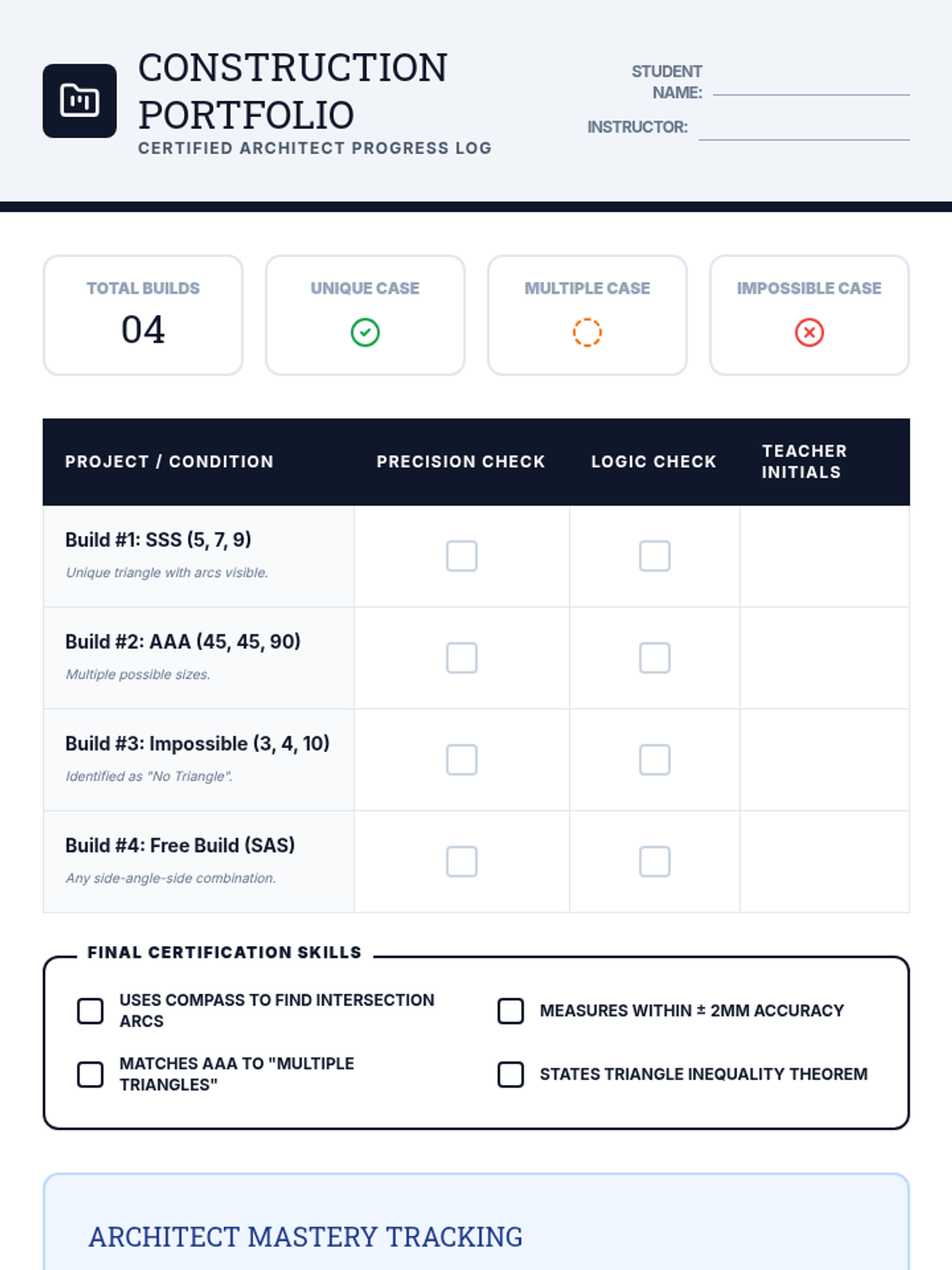
Progress monitoring tool for both students and teachers, formatted as an architectural construction portfolio tracker. Includes a build log, skills checklist, and mastery tracking graph for Tier 2 data collection.
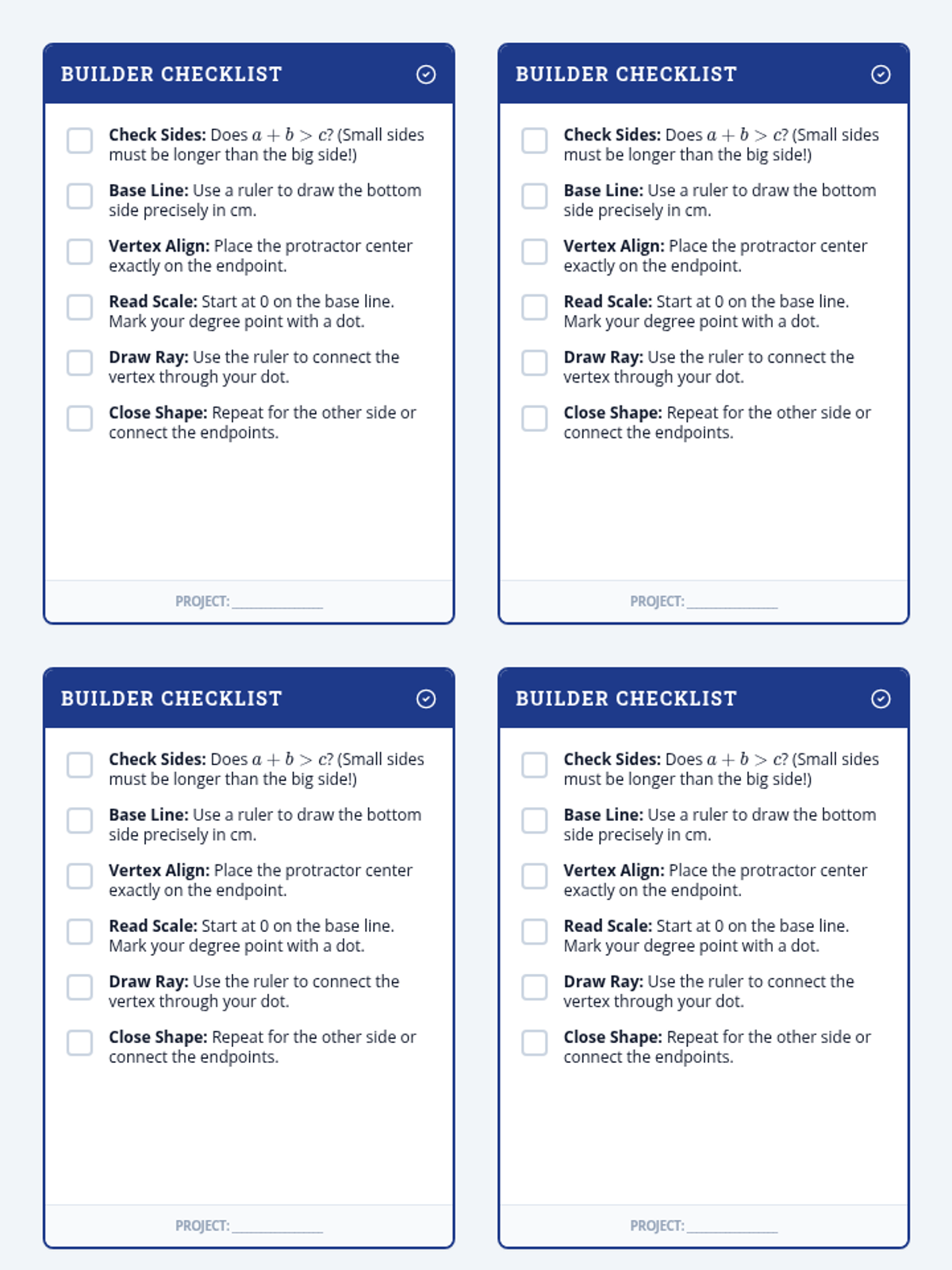
A student-facing construction checklist and teacher monitoring tool designed to guide students through precision triangle drafting steps.
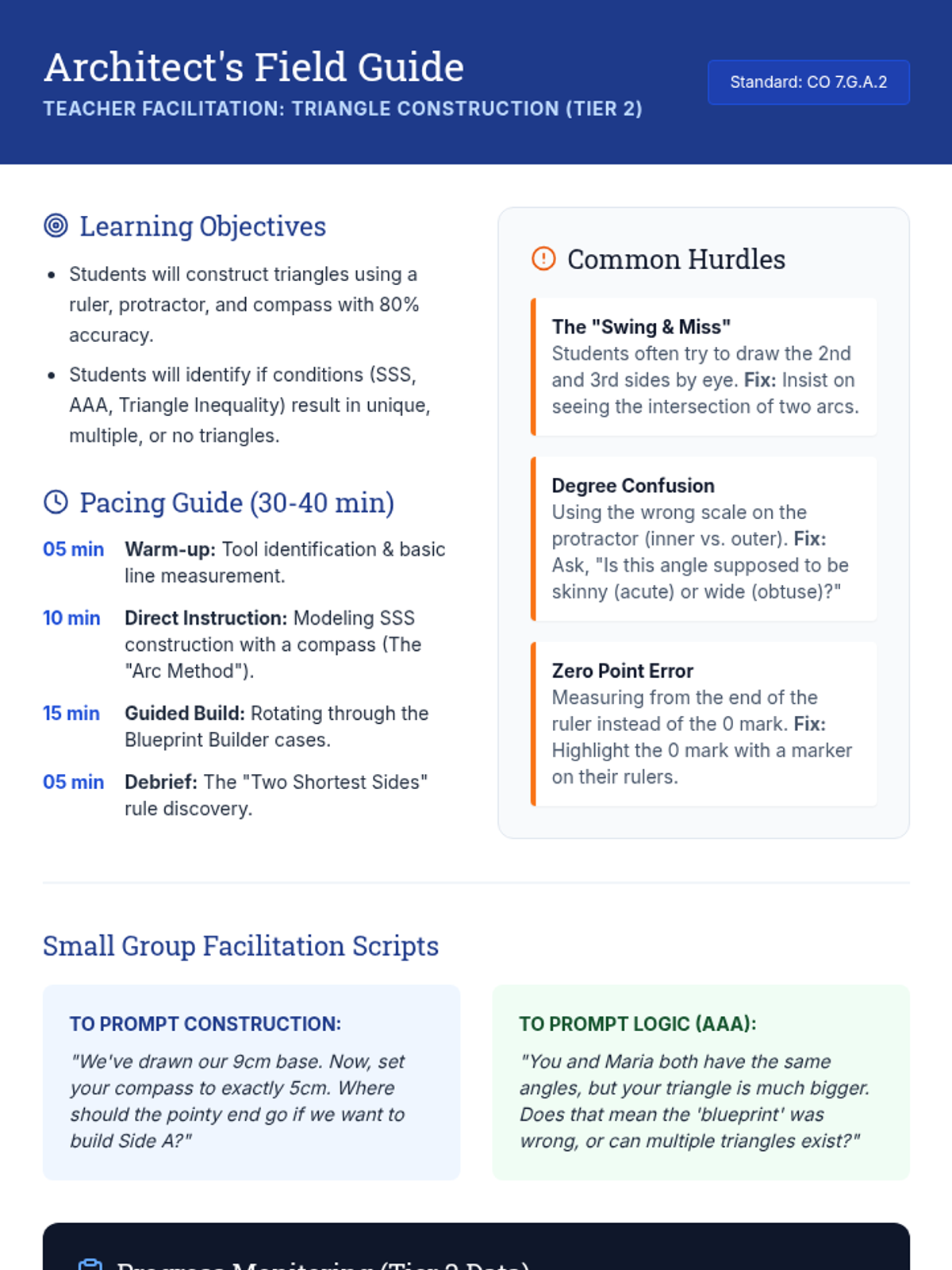
Facilitation guide for teachers, providing Tier 2 intervention strategies, common student misconceptions, small group scripts, and pacing for the triangle construction lesson.
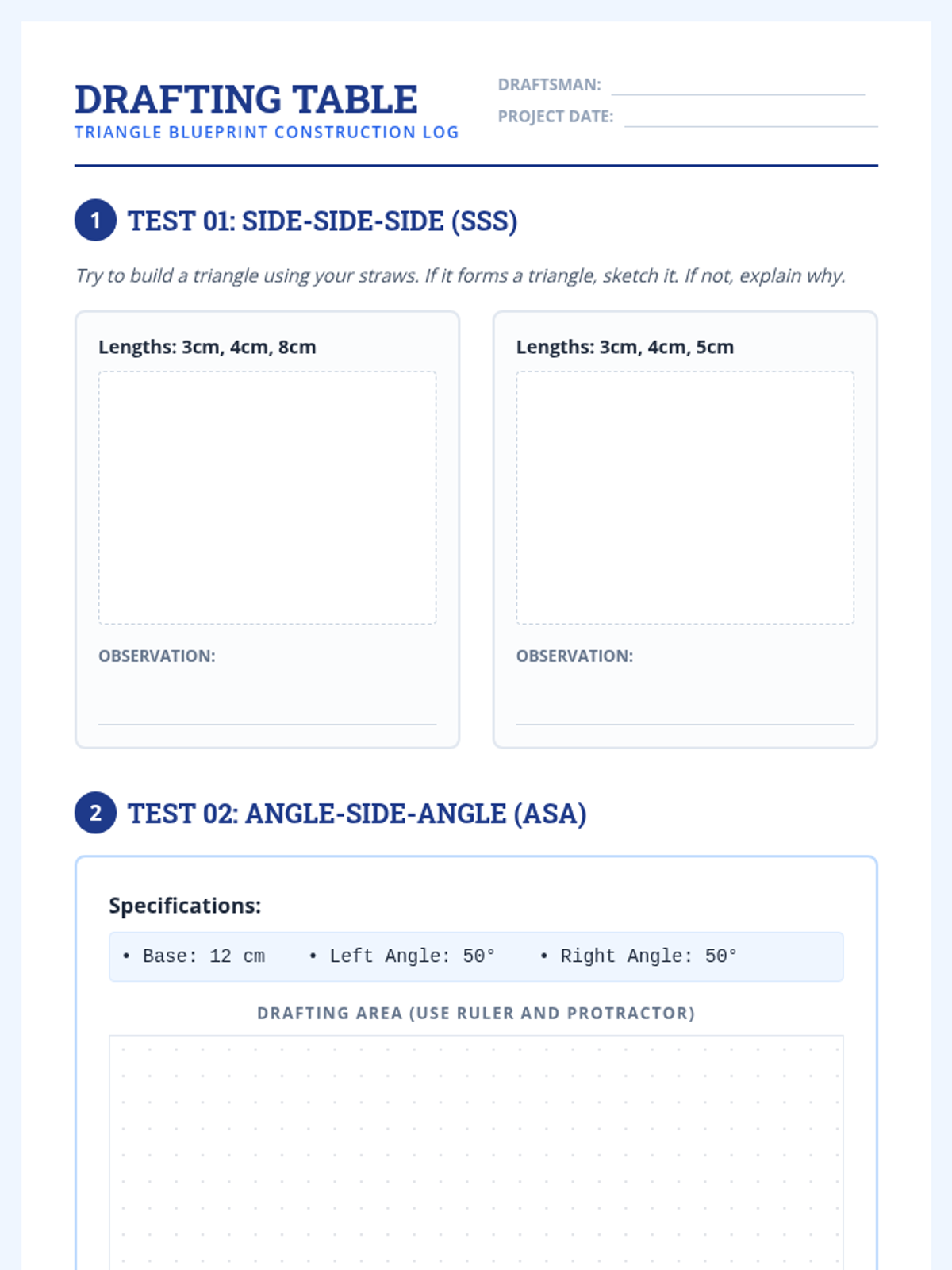
A hands-on student activity worksheet for constructing triangles with straws, rulers, and protractors, featuring sections for SSS, ASA, and AAA investigations.
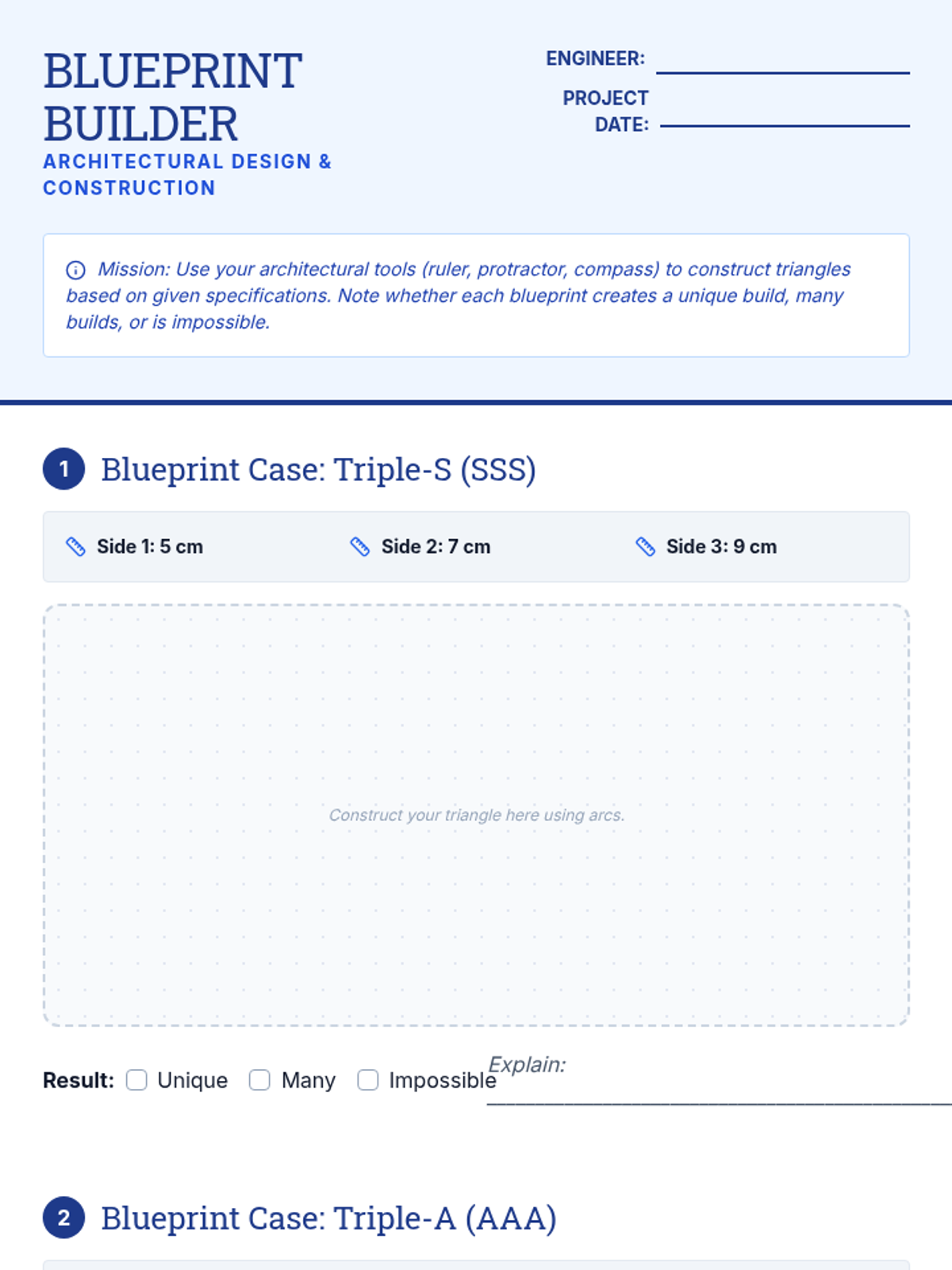
Scaffolded construction worksheet for students, guiding them through SSS, AAA, and impossible triangle builds. Includes dedicated space for tool use and reflection on triangle conditions.
A visual presentation for a Tier 2 intervention lesson on triangle construction, featuring the Triangle Inequality Theorem, step-by-step drafting guides, and a comparison of unique vs. non-unique conditions.
Visual slide deck for Tier 2 intervention, introducing triangle construction conditions (SSS, AAA, and impossible triangles) with an architectural theme. Includes instructional visuals for tool use and a summary decision chart for triangle outcomes.
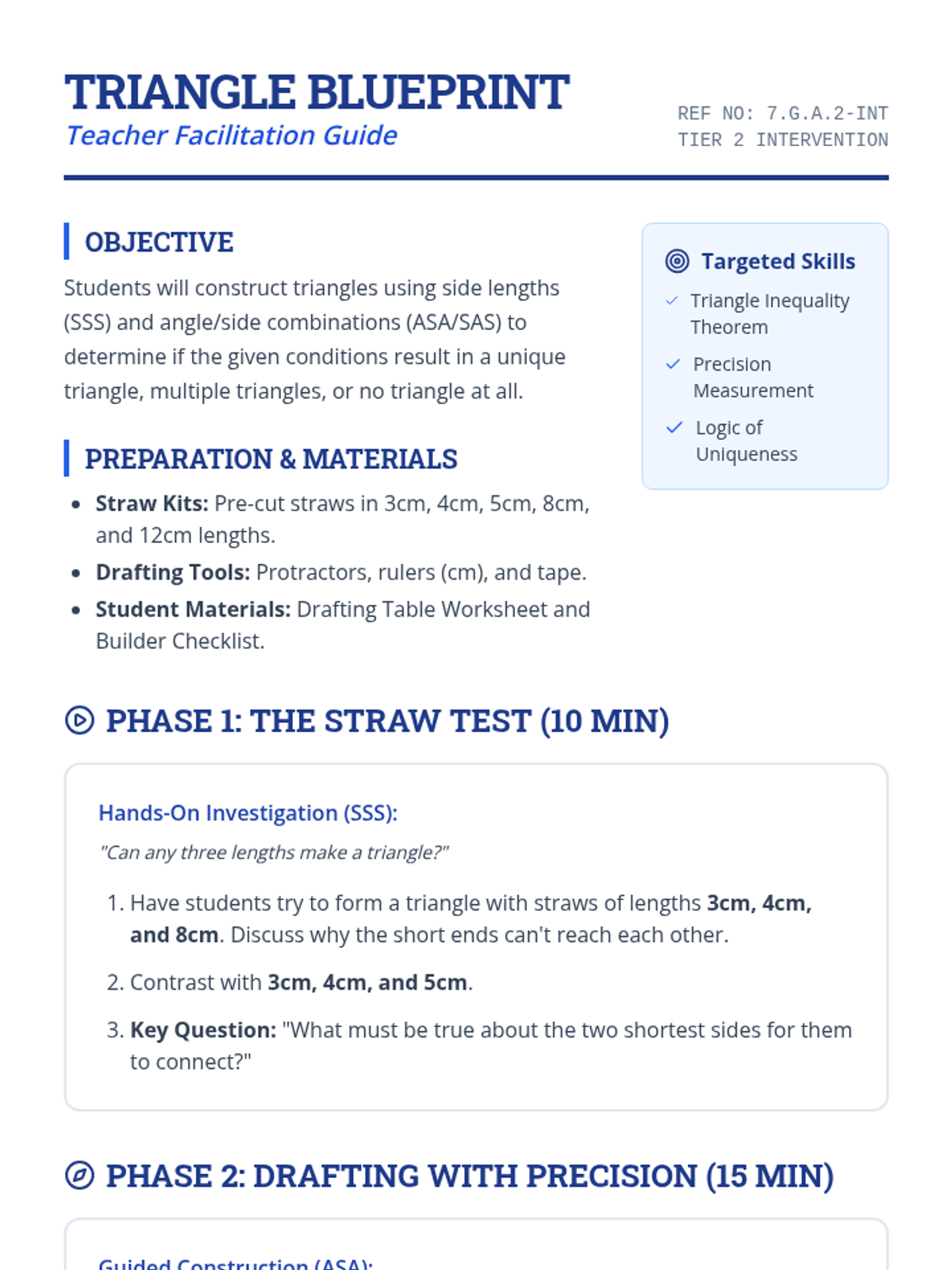
A comprehensive teacher facilitation guide for a Tier 2 intervention lesson on triangle construction, featuring instructional phases, common misconceptions, and progress monitoring indicators.
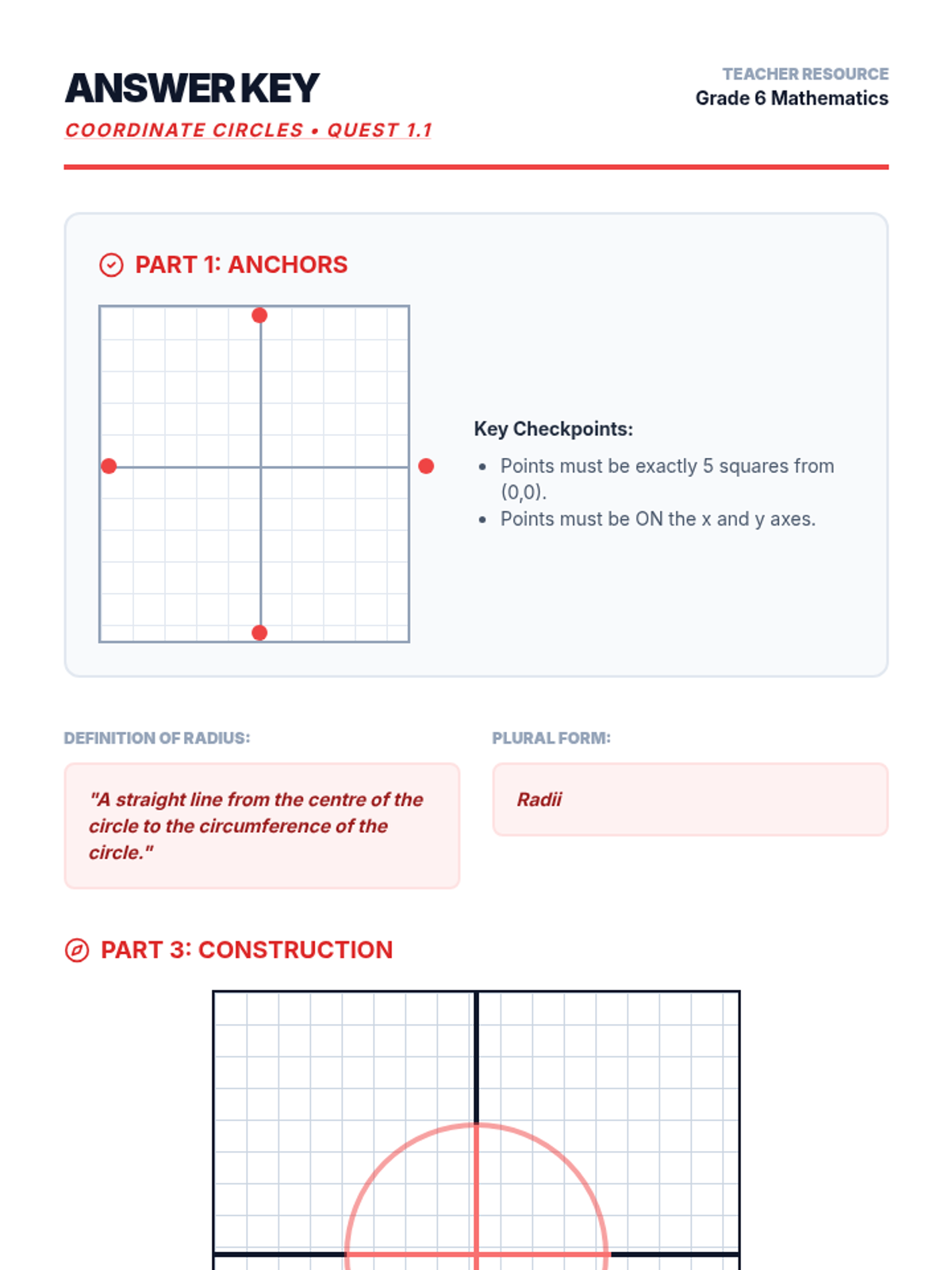
The answer key for the Coordinate Circles worksheet, providing the correct plotting of points, definitions, and multiple solutions for the Level Up Challenge.
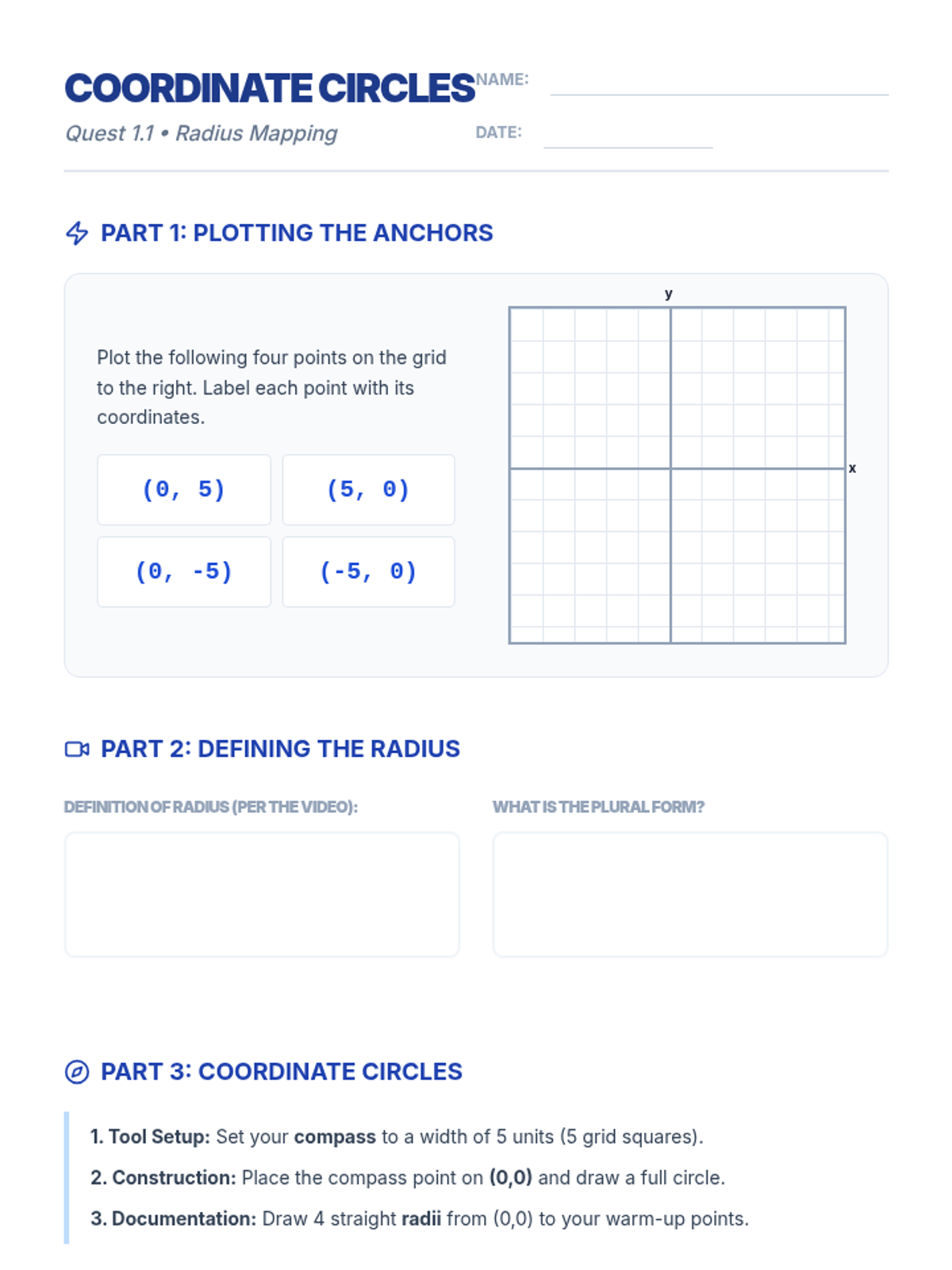
A student worksheet for the Coordinate Circles lesson, featuring a warm-up plotting activity, video note-taking space, a large coordinate grid for circle construction, and a Pythagorean challenge extension.
A visual presentation for the Radius of a Circle lesson, including the video embed, vocabulary terms, and step-by-step instructions for the coordinate graphing activity.
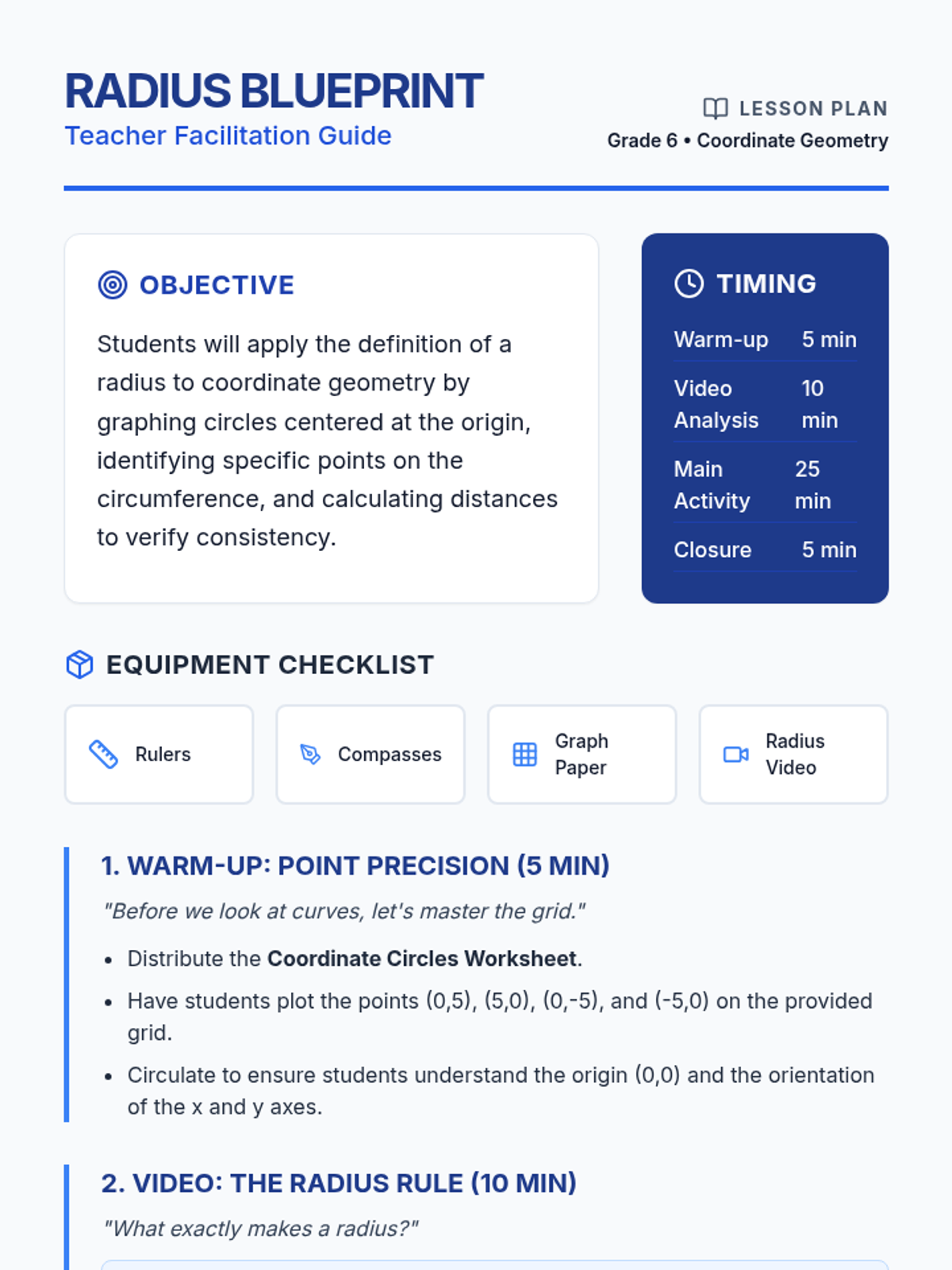
A comprehensive teacher guide for the Coordinate Circles lesson, including pacing, critical pause moments for video analysis, and instructional tips for the main activity.
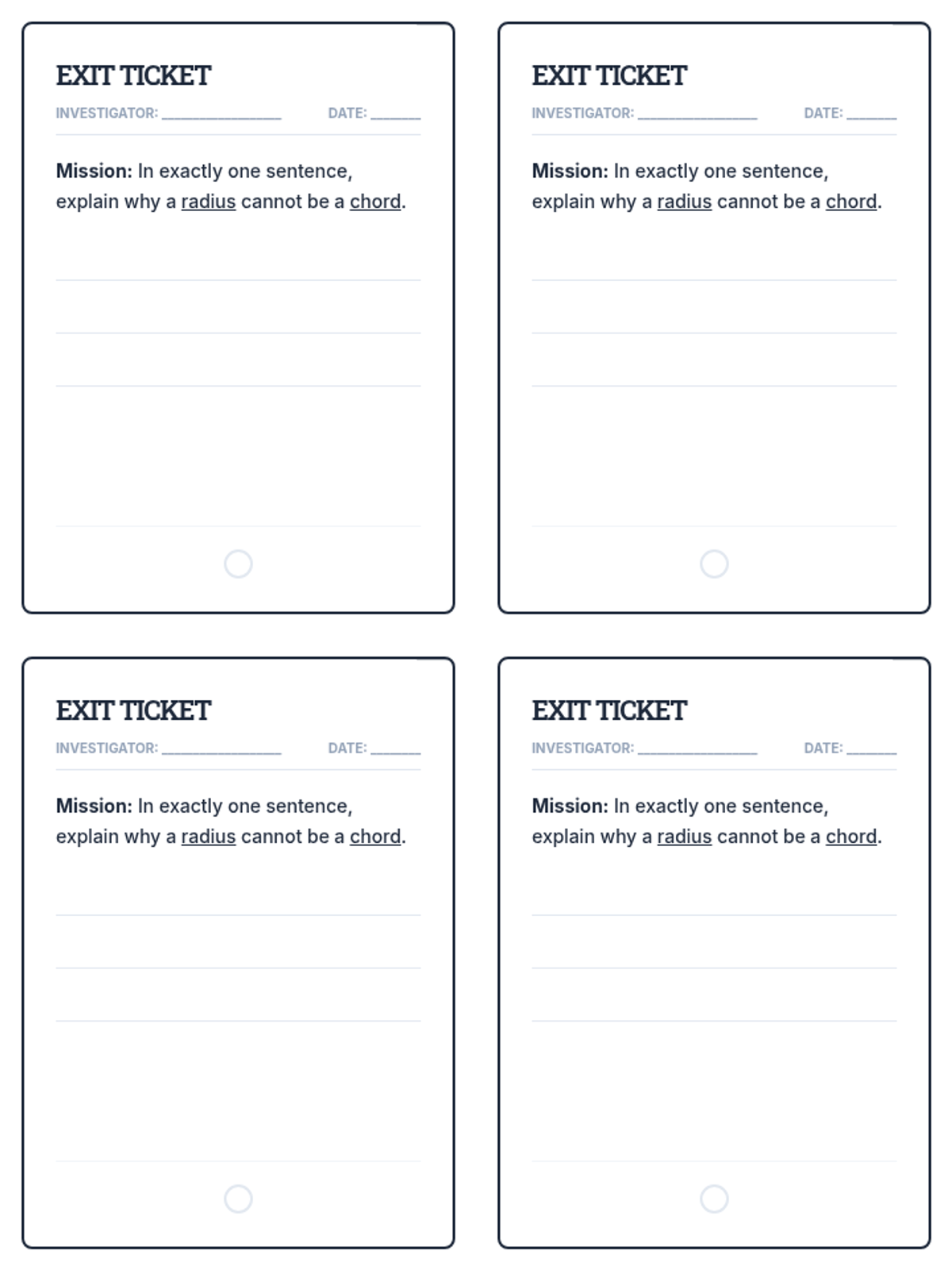
A 4-up printable exit ticket for the Circle Sleuths lesson, asking students to explain the relationship between a radius and a chord.
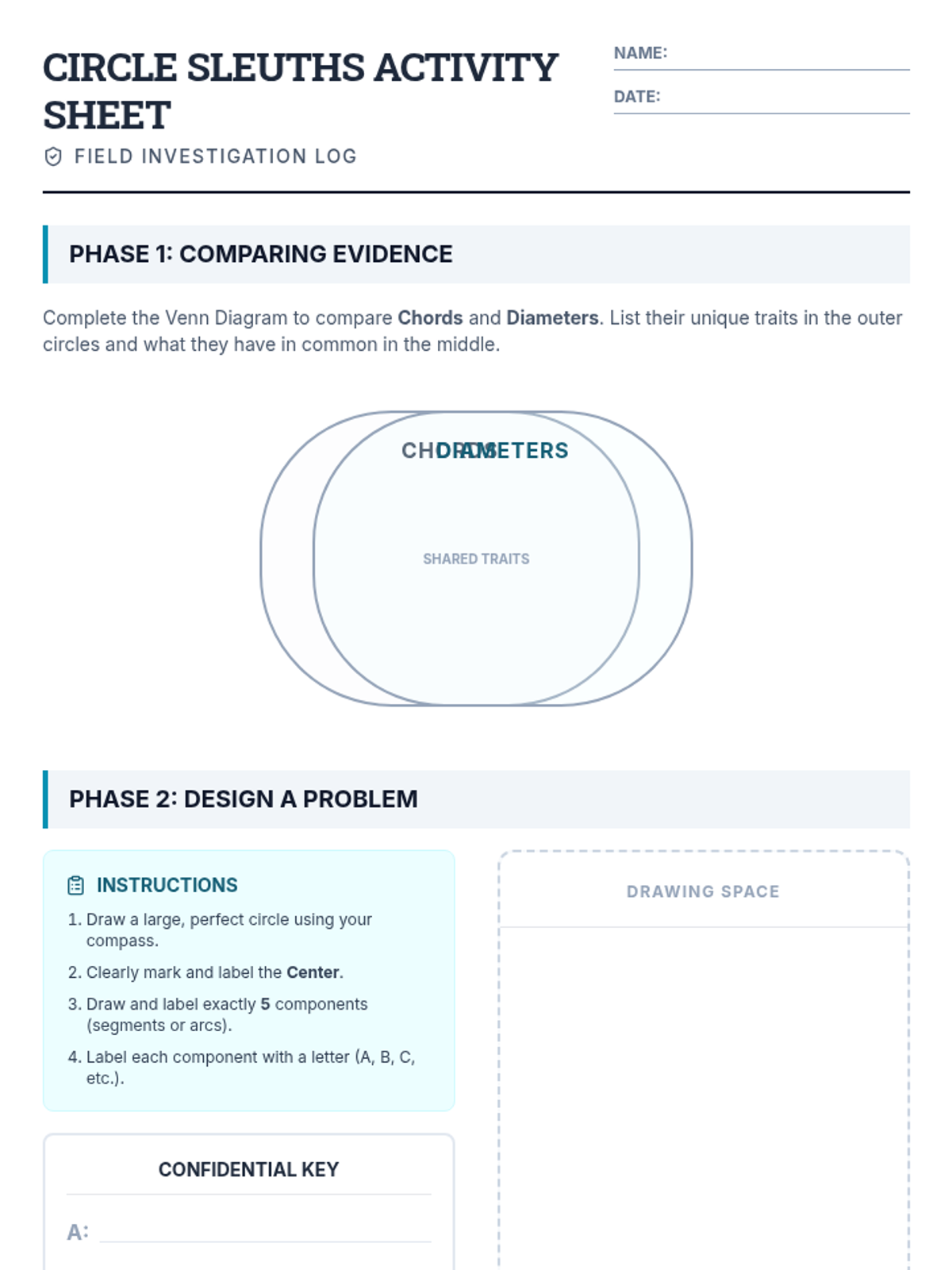
A student worksheet for the Circle Sleuths lesson, featuring a Venn diagram for chord/diameter comparison and a "Design a Problem" workspace for creating and solving geometry diagrams.
A vibrant 6-slide presentation for the Circle Sleuths lesson, including a warm-up activity, video integration, Venn diagram comparison, and main activity instructions.
A comprehensive teacher guide for the Circle Sleuths lesson, including detailed timing, video pause prompts, and common student misconceptions to address.
A student-facing activity sheet for the "Perfect Three" lesson, guiding students through the geometric construction of an equilateral triangle and providing space for reflection.
A visual presentation deck for "The Perfect Three" lesson, featuring real-world applications, embedded instructional video, and clear steps for the construction challenge.
A comprehensive teacher guide for facilitating the "The Perfect Three" lesson, including learning objectives, a detailed pacing guide, and pedagogical tips for the construction activity.
A structured student note-taking sheet and activity checklist designed to accompany the video lesson and 'Compass Art' activity.
Answer key for the 2D coordinate plane version of the error analysis worksheet, providing corrected graphs and identification of sign-flip and shading errors.
A 2D coordinate plane version of the error analysis worksheet, focusing on linear inequalities in two variables with incorrect shading and sign-flip errors.
A slide deck introducing the Inequality Investigators theme, providing a warm-up error analysis example, and explaining the "flip rule" for negative coefficients.
Answer key for the Shady Solutions worksheet, providing identified errors and correct graph visualizations for teacher reference.
A detective-themed error analysis worksheet where students identify and correct errors in inequality graphs, specifically focusing on shading direction and boundary circles.
Facilitation guide for teachers, including lesson objectives, timing, common student misconceptions, and a step-by-step instructional flow.
Detailed answer key for the Grid Shifters Worksheet, including step-by-step logic for translations and reflections, final coordinates, and sample explanations.
Engaging classroom presentation slides introducing coordinate transformations. Includes visual rules for translations and reflections over the axes, along with guided practice problems.
A set of printable 2D nets for 3D geometric shapes, including cubes, rectangular prisms, and pyramids, designed for student construction of a miniature city.
A professional architectural-themed rubric for evaluating the City Architects project, covering geometry, construction, planning, and documentation.
A multi-page student worksheet and project log for planning, drafting, and reflecting on the City Architects geometric construction project.
A visually engaging slide deck that introduces the City Architects project, covers geometric terminology, and outlines project requirements.
A comprehensive teacher facilitation guide for the City Architects project, including lesson objectives, standards alignment, and a detailed instructional sequence.
Guide pédagogique pour l'enseignant. Contient les principes de la micro-méthode (10 min), les corrigés des fiches et des conseils pour l'engagement des élèves en difficulté.
Une fiche d'activité finale combinant toutes les notions : mise à l'échelle de photos, calcul de grille, gestion des marges pour encarts et optimisation papier.
Réaliser la mise à l'échelle complète d'un projet client : 6 photos, encarts de texte et calcul des dimensions finales sur format Raisin. Présentation finale.
Une fiche d'activité pour calculer la surface de papier utilisée et la surface de "perte" (chutes). Sensibilisation à l'optimisation.
Présentation sur la surface de papier utilisée et la surface de "perte" (chutes). Sensibilisation à l'optimisation et au coût écologique du gâchis.
Une fiche d'activité pour calculer le facteur d'agrandissement maximal d'un modèle A4 vers le format Raisin. Focus sur la comparaison des limites.
Présentation sur le passage d'un modèle A4 au format Raisin. Apprendre à trouver le facteur d'agrandissement maximal en comparant les dimensions.
Une fiche d'activité pour calculer les dimensions d'une grille de 6 photos sur A4 en tenant compte des marges. Travail sur la division et la soustraction.
Présentation sur l'organisation de 6 photos sur une page A4. Introduction à la division de l'espace et à la gestion des marges pour les encarts explicatifs.
A refined two-page performance debrief worksheet for the Math IA 3 assessment. It features official NY Grade 7 standard names (7.NS, 7.RP, 7.EE, 7.G) with "I Can" statements, replaces retake goals with "State Test Targets," and provides structured areas for IXL study checklists and dual student/parent commitments, all optimized to fit a front-and-back print format.
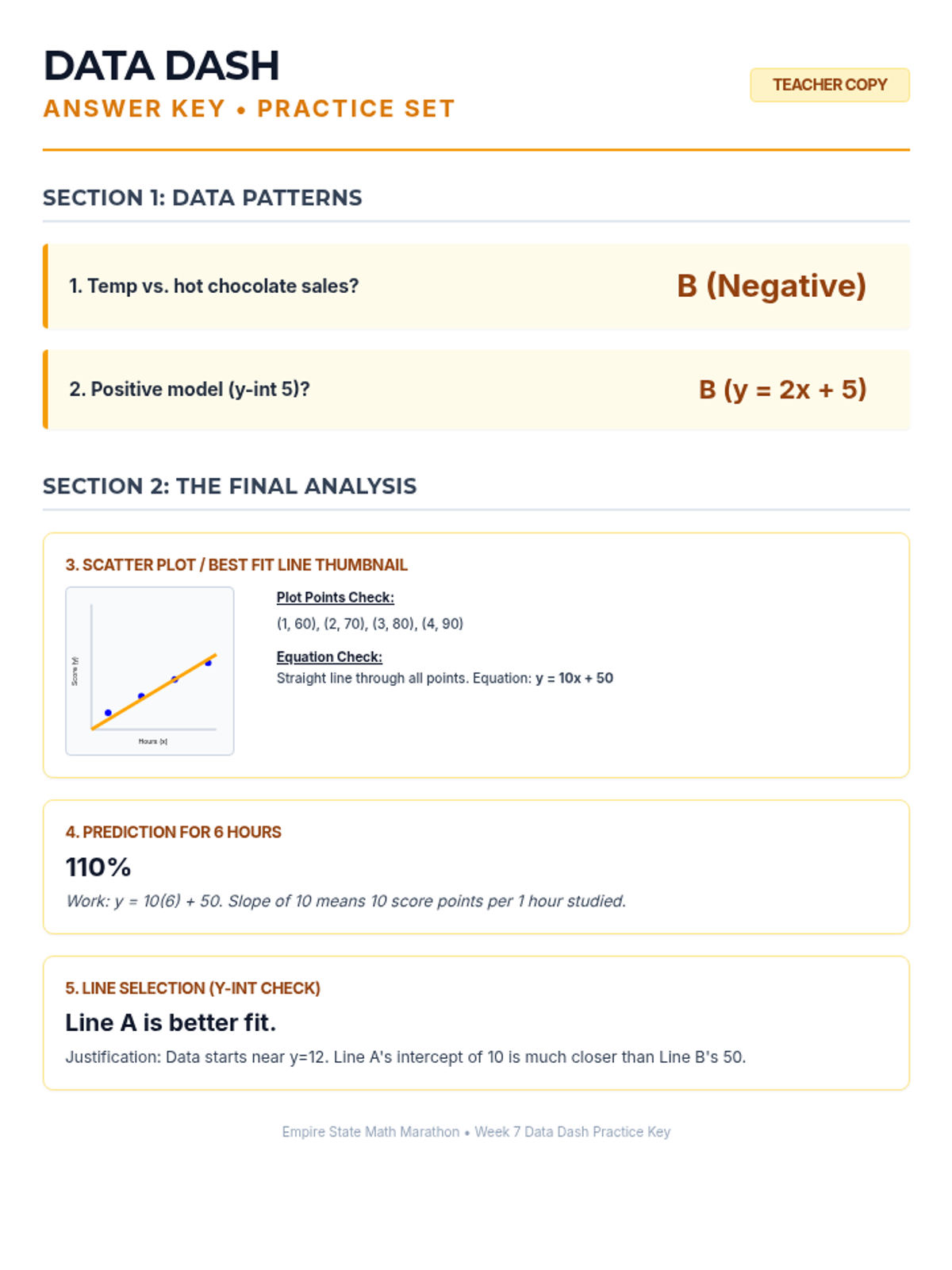
An answer key for the Math Morning Sprint worksheet, including step-by-step solutions for scale drawings, equations, percents, and proportionality.
A 5-question morning work assignment for 7th grade math featuring scale drawings, linear equations, percent word problems, and proportional relationships.
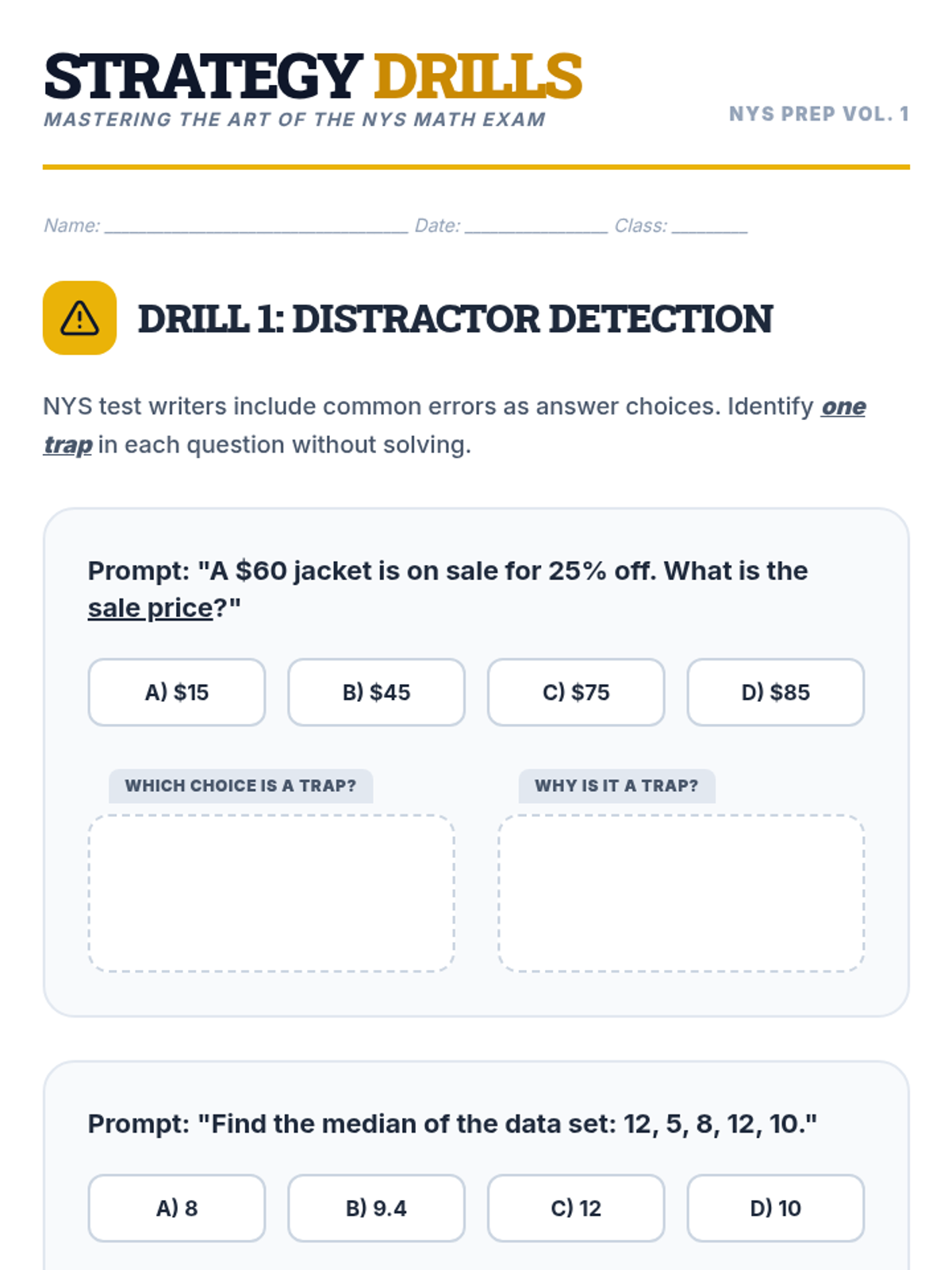
A 15-question comprehensive review sheet for the 7th Grade Math IA 3, featuring multiple-choice questions with common error-based distractors and dedicated work spaces. Question 6 is isolated on its own page for detailed practice.
A set of four weekly exit tickets for quick formative assessment of linear expression skills including combining terms, expansion, factoring, and subtraction.
A visual 5-slide presentation deck for small group instruction, covering linear expression anatomy, expansion, factoring, and equivalence with high visibility and clear modeling.
A comprehensive answer key for the 4-week small group instruction sequence, covering all 12 sessions of expressions work.
A student-facing weekly practice mat for the fourth week of instruction, focusing on adding and subtracting linear expressions and applying these skills to geometric perimeter problems.
Math Intensive Lab Unit Overview: A comprehensive high-level summary of the 12-lesson intervention sequence. Now includes a prominent callout highlighting major grade-level focus standards and star indicators in the standards matrix.
Teacher Facilitation Guide for Area Architects: Provides instructional strategies for decomposing complex shapes into rectangles and triangles using grid-based visual tools. Now includes standards and materials.
Teacher Facilitation Guide for Metric Mission: Provides instructional strategies for mastering unit conversions within the metric system. Now includes standards and materials.
Teacher Facilitation Guide for Spread Spectators: Provides instructional strategies for teaching measures of center and variability through visual data distributions. Now includes standards and materials.
Teacher Facilitation Guide for Integer Island: Provides instructional scripts and strategies for introducing negative numbers and absolute value using vertical number lines. Now includes standards and materials.
Teacher Facilitation Guide for Net Navigators: Provides instructional strategies for connecting 2D nets to 3D surface area and volume concepts. Now includes standards and materials.
Teacher Facilitation Guide for Expression Engine: Provides instructional strategies for translating phrases into algebraic expressions and evaluating variables. Now includes standards and materials.
Teacher Facilitation Guide for Ratio Radar: Provides instructional scripts and strategies for teaching ratios and proportional relationships using double number lines and multiplicative reasoning. Now includes standards and materials.
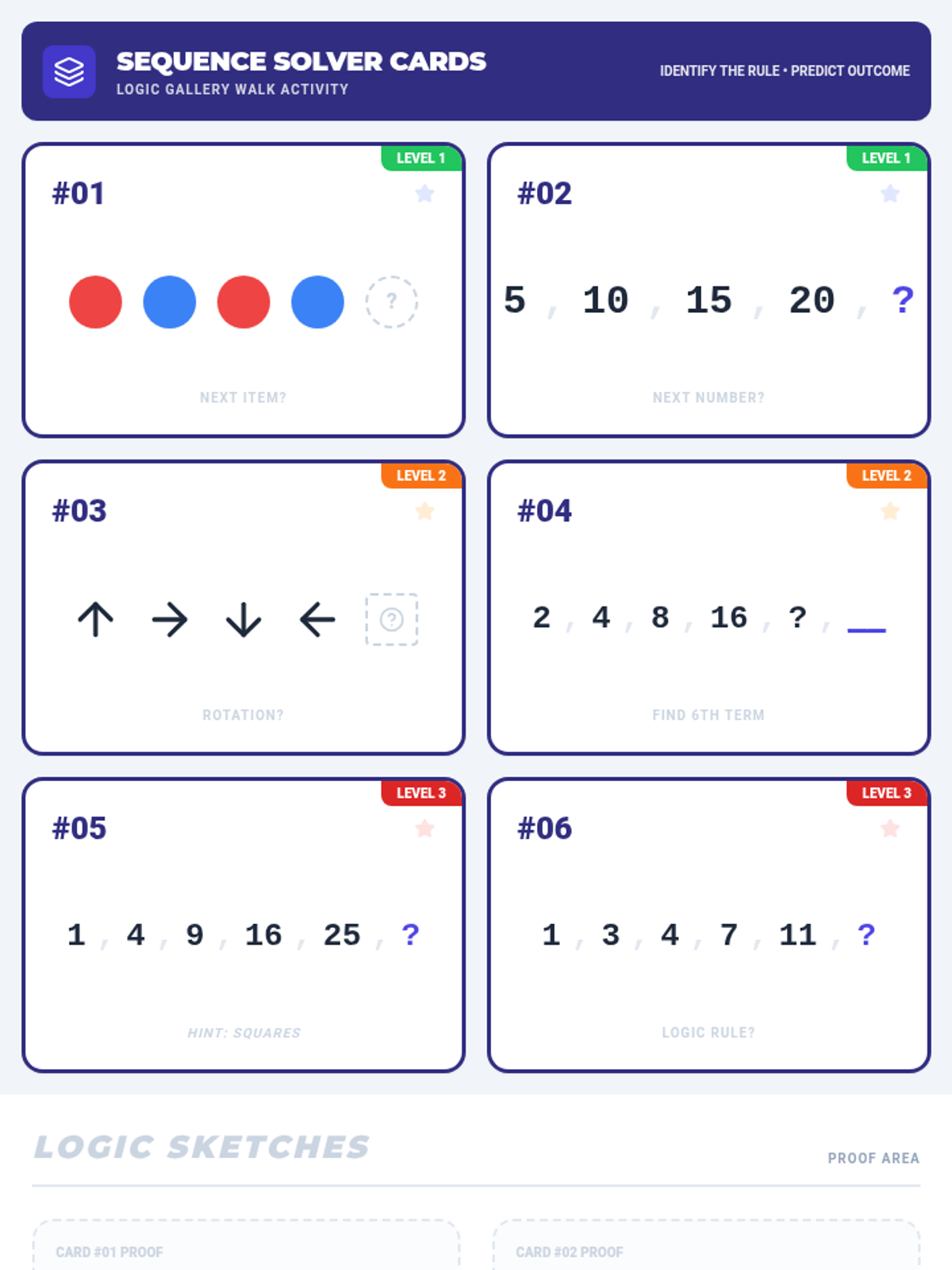
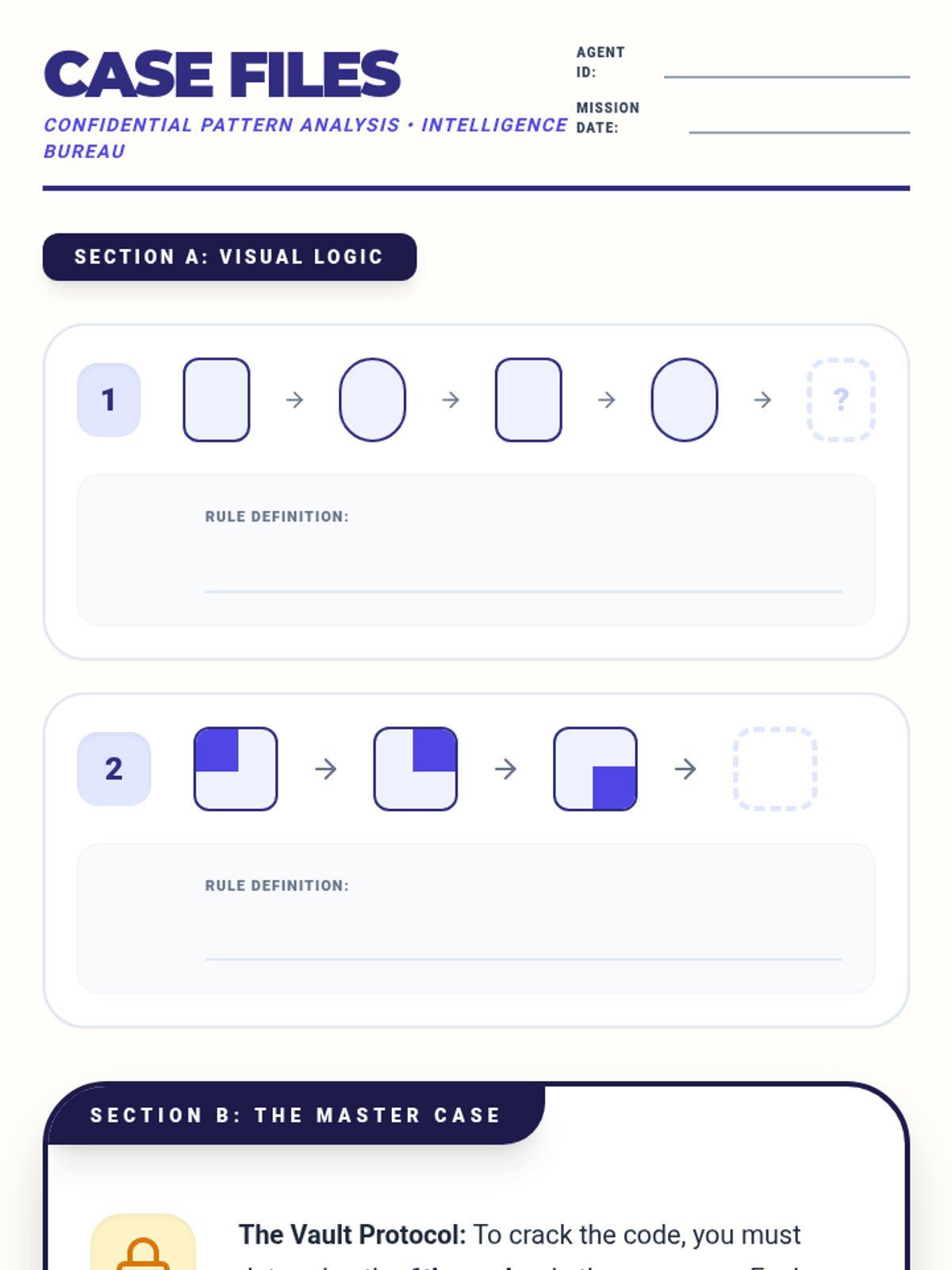
Student Lab Sheet for Pattern Pursuit: A structured workspace for extending geometric sequences, testing function machine rules, and solving real-world algebraic scenarios.
Teacher Facilitation Guide for Pattern Pursuit: Provides instructional scripts and strategies for teaching numerical and geometric patterns using visual growth models and function machines. Now includes standards and materials.
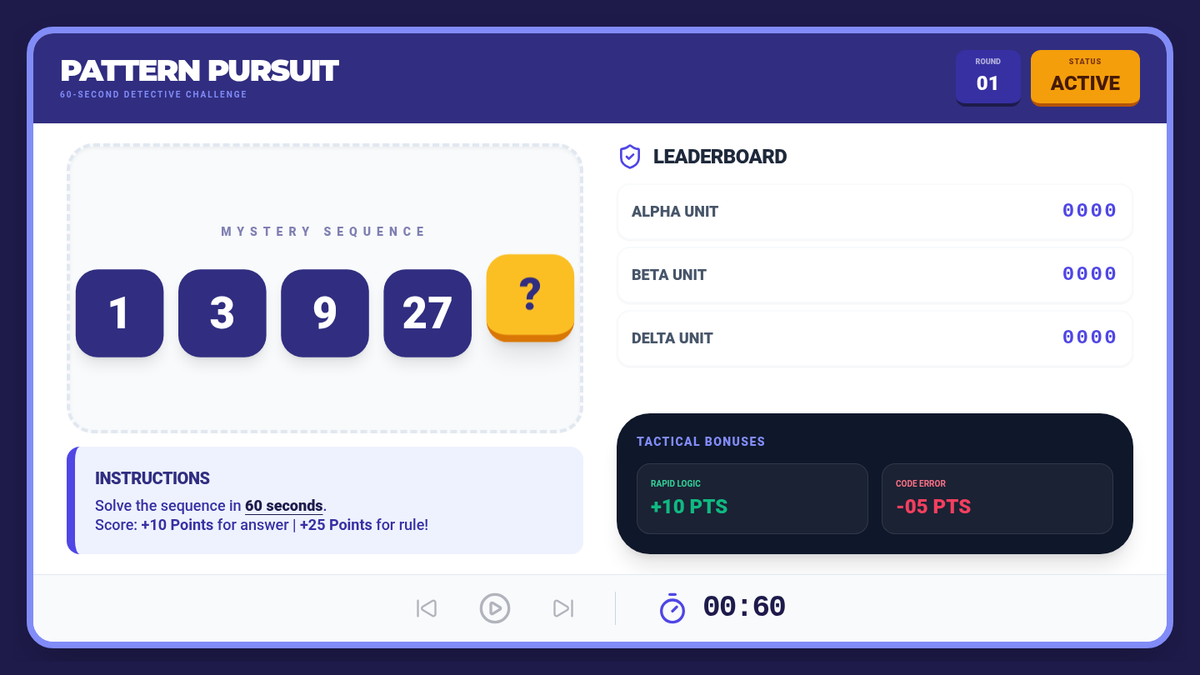
Pattern Pursuit Slides: A high-visual presentation focusing on numerical and geometric patterns using 'Function Machines' and growing shape sequences. Now includes an embedded YouTube demonstration of a function machine.
A student activity log for tracking the geometric properties (faces, edges, vertices) of each building constructed in their Geo-City.