Syllogisms, deductive validity, and the principles of inductive probability for evaluating evidence-based claims. Targets common logical fallacies and the construction of sound, persuasive arguments.
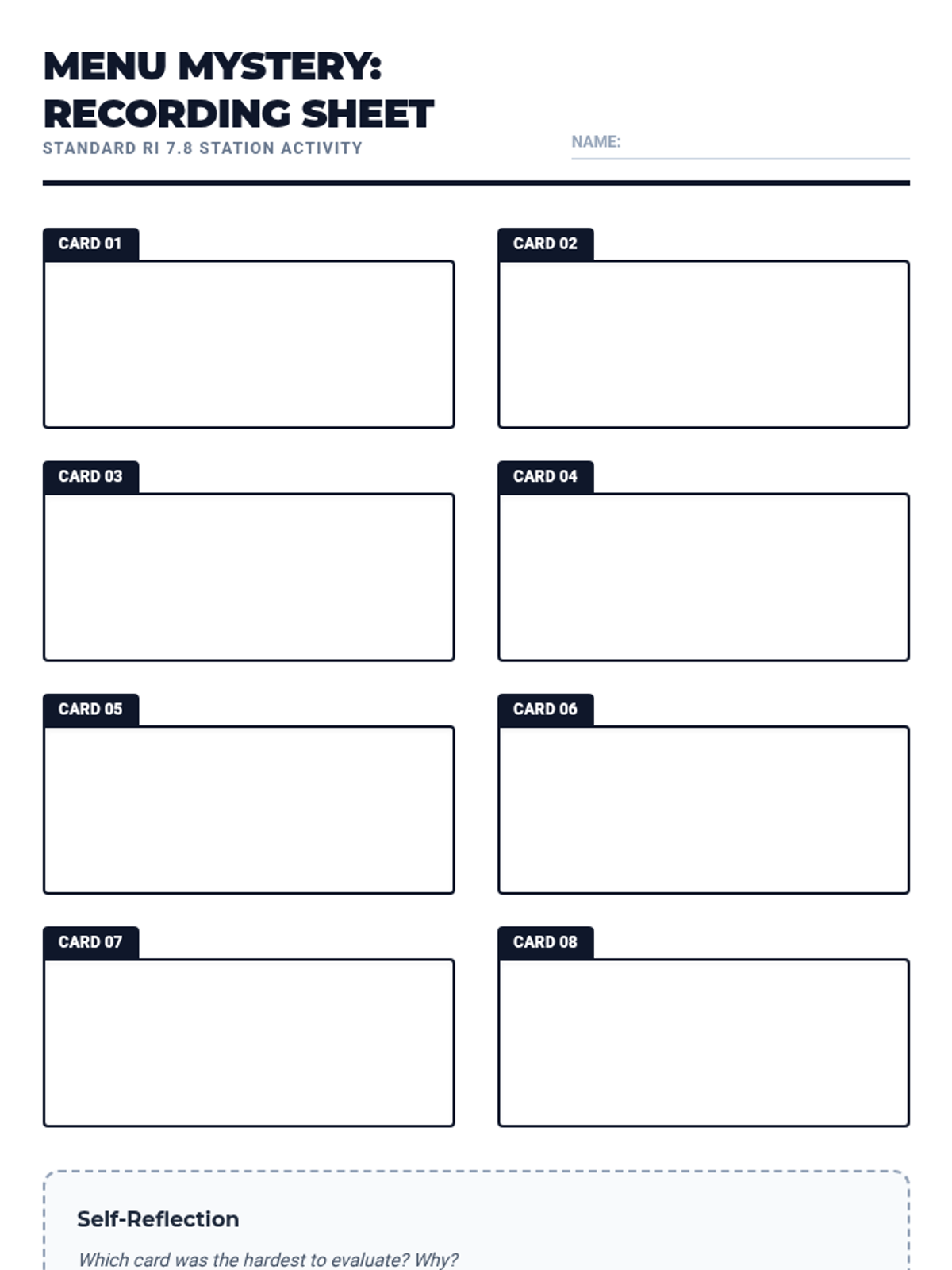
A student recording sheet for the Menu Mystery Task Cards, featuring numbered boxes for responses and a reflection section.
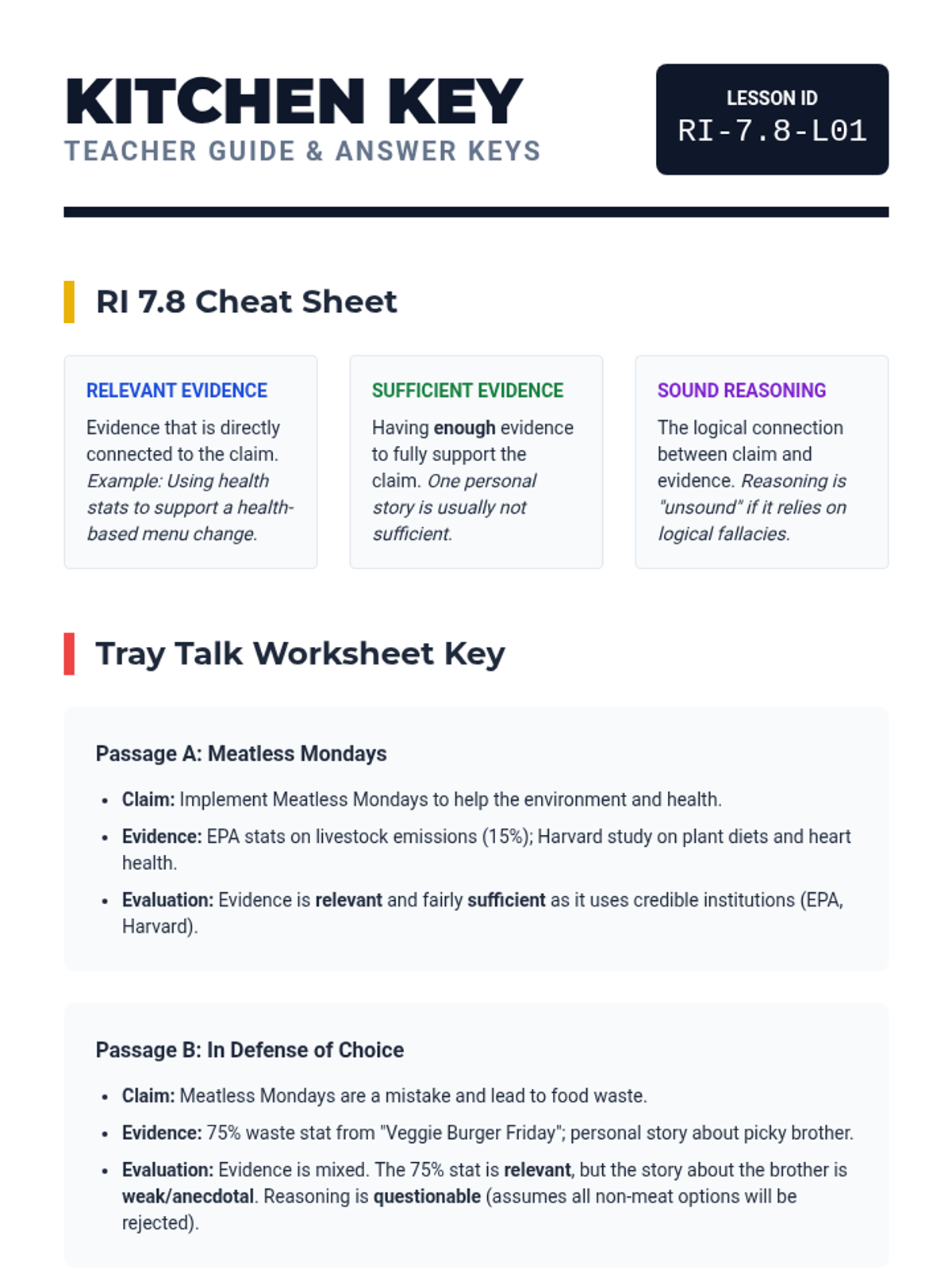
Teacher guide and answer key for the Lunchroom Logistics lesson. Includes quick reference for RI 7.8 concepts and detailed answers for the worksheet, quiz, and task cards.
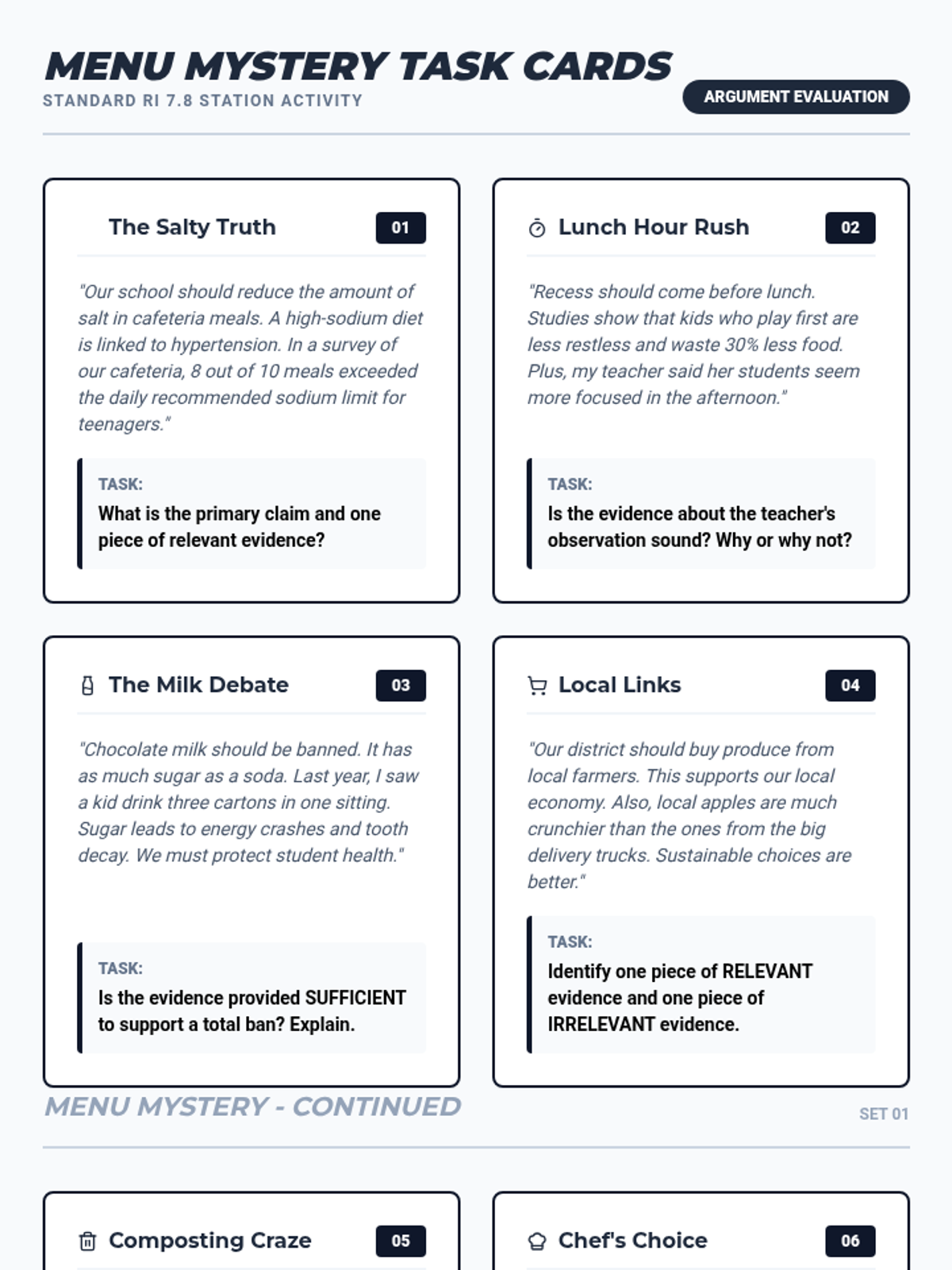
A set of 8 task cards for classroom stations focused on RI 7.8. Each card features a school lunch-themed argument snippet and a specific prompt to trace or evaluate the claim, evidence, or reasoning. Revised for layout and readability.
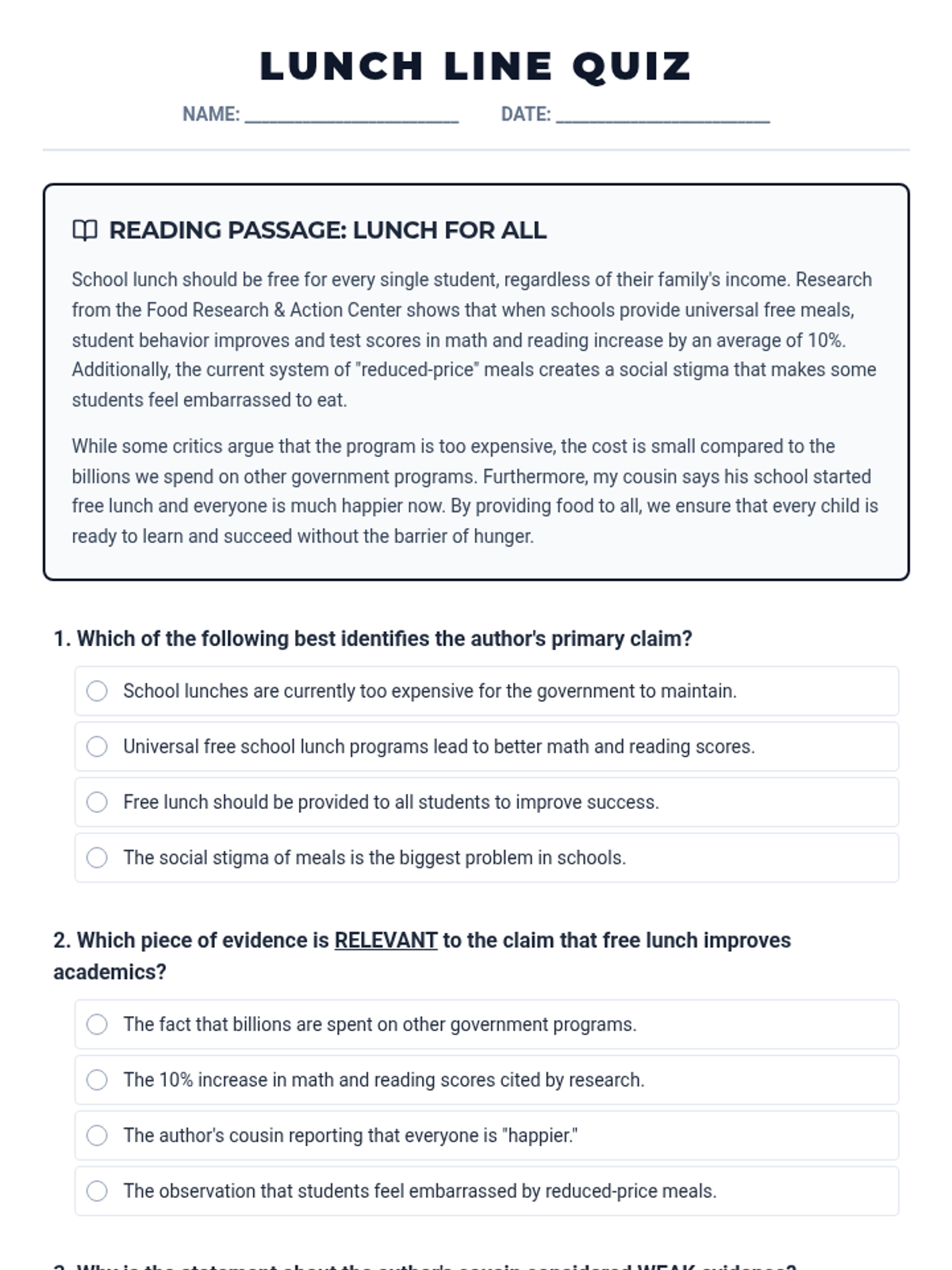
A mini-assessment quiz for RI 7.8 centered on a passage about universal free school lunch. Questions focus on identifying the claim, evaluating evidence quality, and assessing sufficiency. Revised for readability and page breaks. Final polish to 1 page.
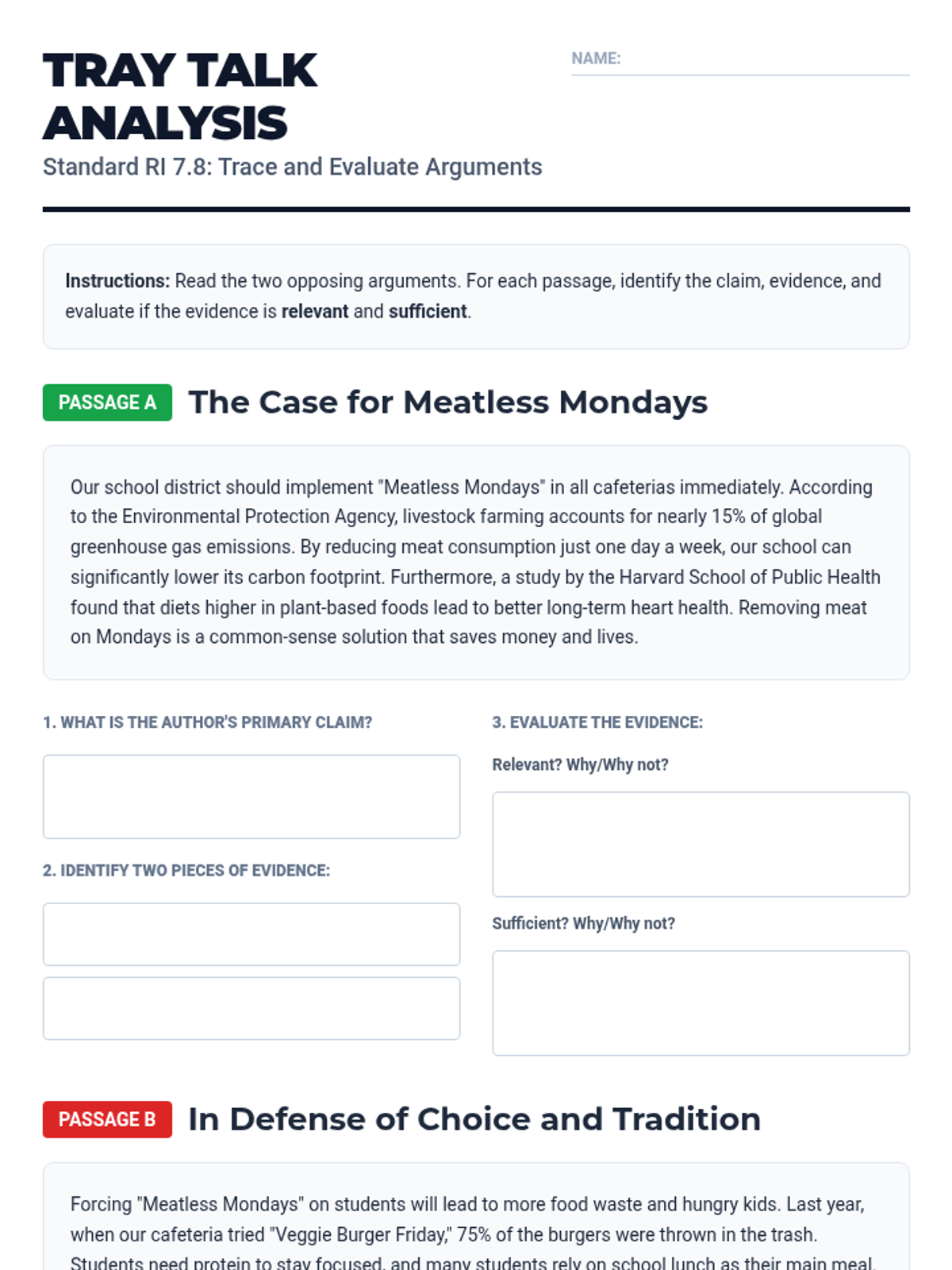
Worksheet featuring two opposing passages on school lunch policies (Meatless Mondays vs. Traditional Menus) with analysis questions to identify claims, evaluate evidence, and assess reasoning. Revised for page breaks and work area space. Final polish to keep on 2 pages.
Introductory slide deck for RI 7.8 focusing on tracing and evaluating arguments about school lunches. Includes a case study on vending machines and key vocabulary for argument evaluation.
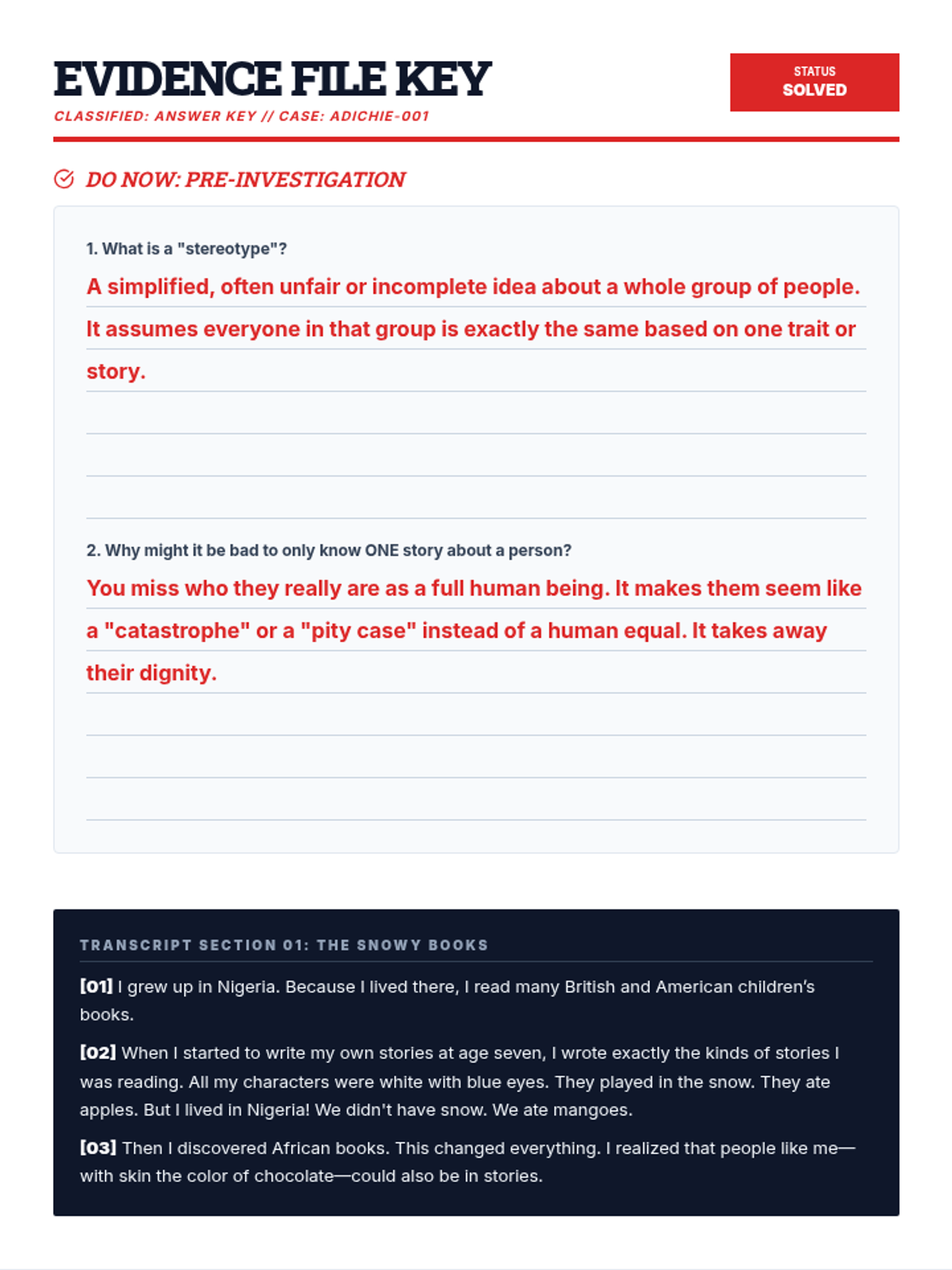
An answer key for the 'Danger Case File Worksheet' that perfectly replicates the student worksheet's 6-page layout and integrated transcript, but with all student work areas filled with suggested responses in red text. Uses 'strip them' terminology and reflects updated labeling and 4-choice MC format. Revised for matching layout and clarity.
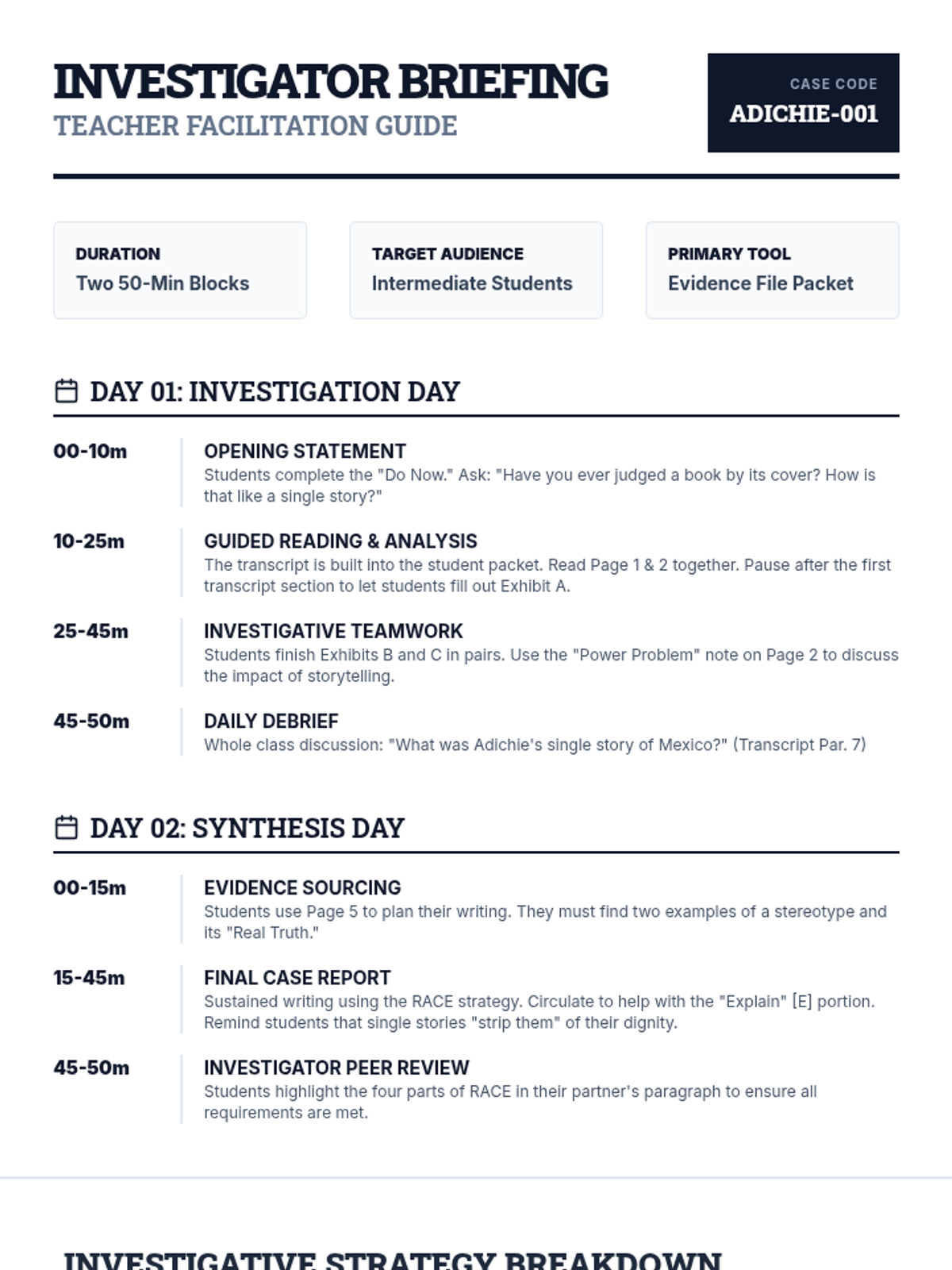
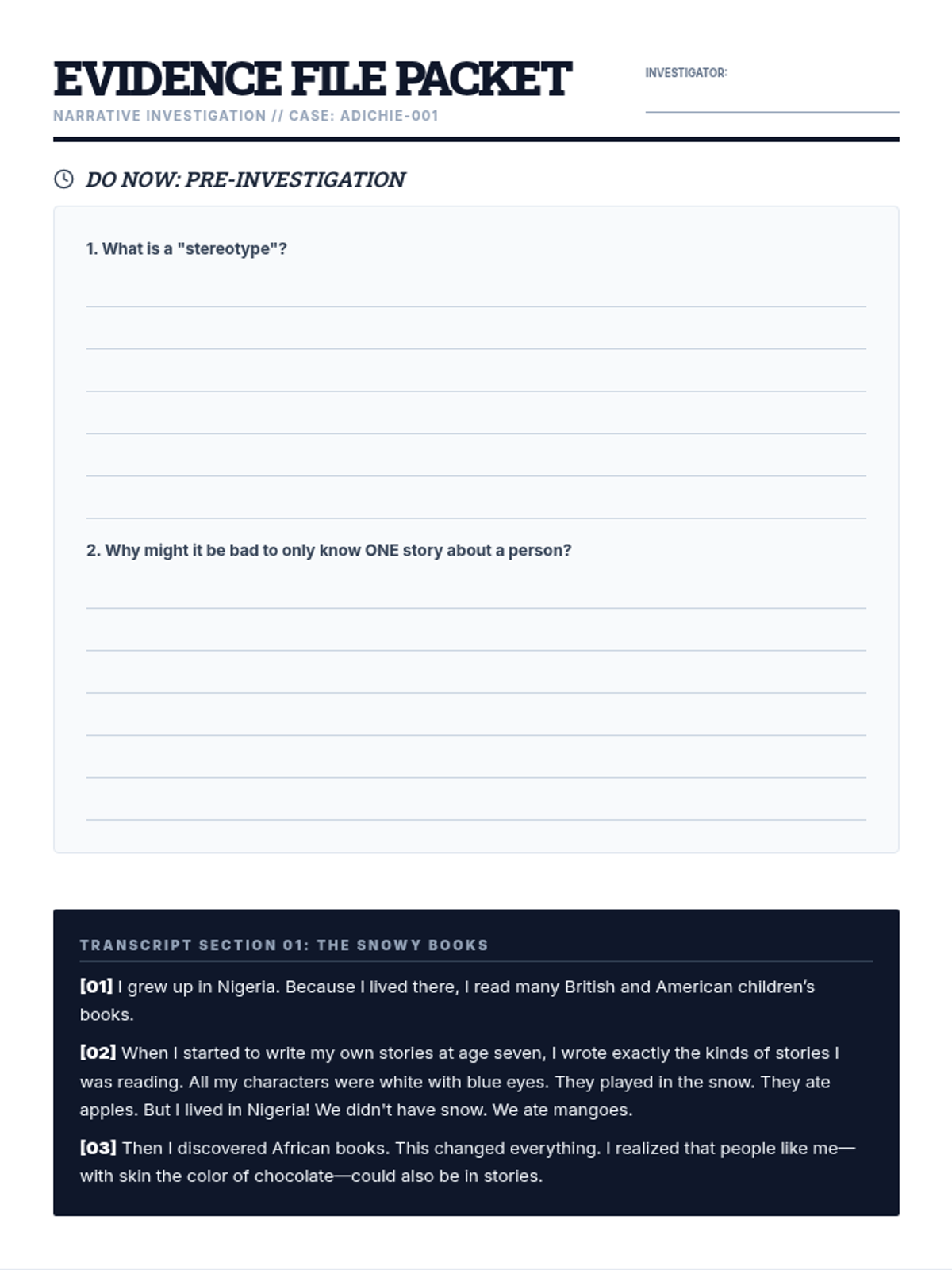
A 2-page teacher guide for a lesson on Chimamanda Ngozi Adichie's 'The Danger of a Single Story.' Includes pacing for two 50-minute blocks, teaching tips, and focus on the simplified RACE strategy. Revised for polish and clarity.
A 6-page student Evidence File Packet. Features an abridged transcript with integrated analysis questions. Every student response area includes 6 writing lines. Features a 4-choice multiple-choice section and a RACE-structured Writing Prompt. Terminology updated to 'strip them'. Revised for polish and clarity.
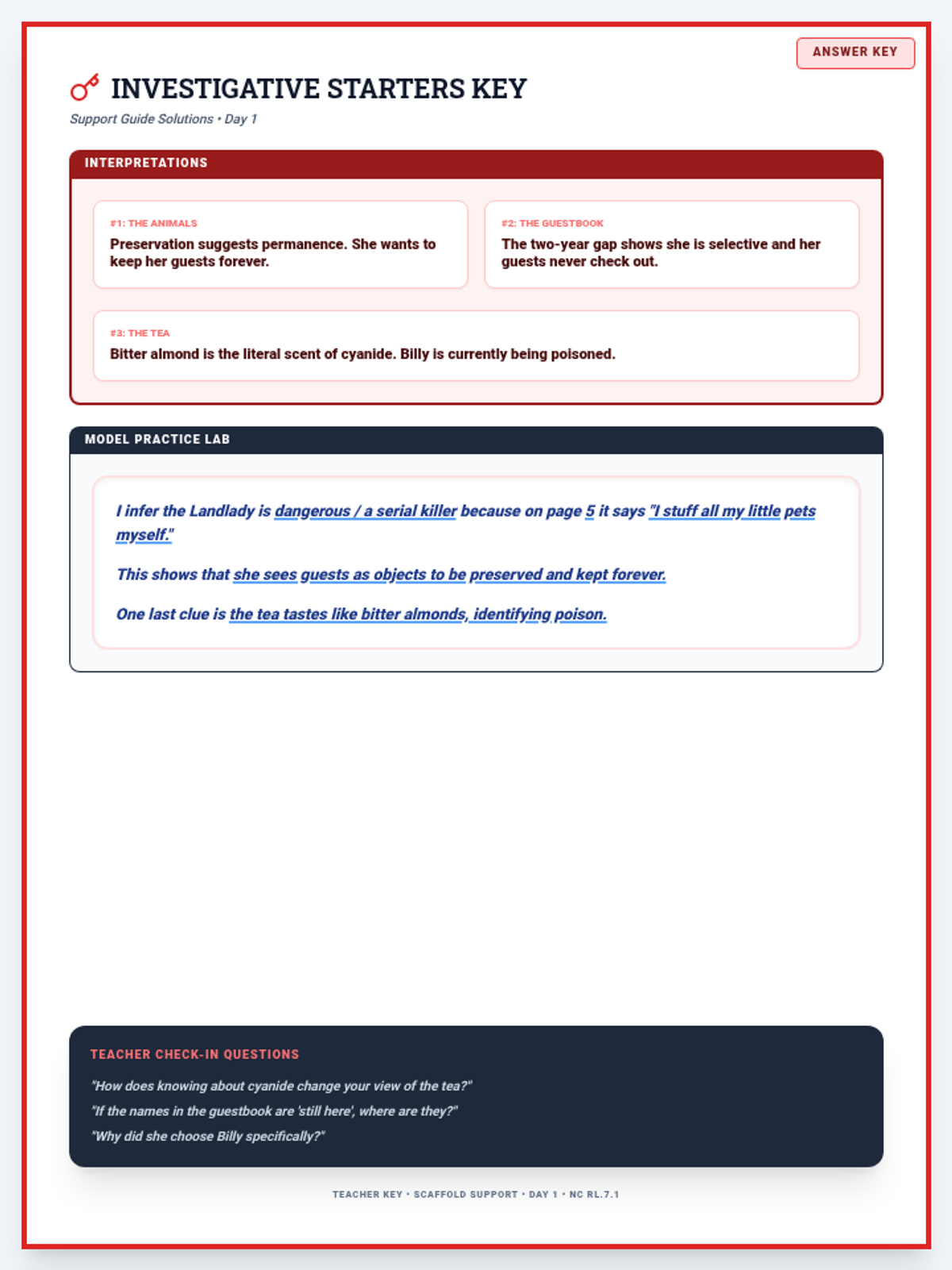
The Investigative Starters Answer Key provides solutions and teacher-check-in questions for the scaffolded 'Landlady' analysis, focusing on key clues and evidence-based writing.
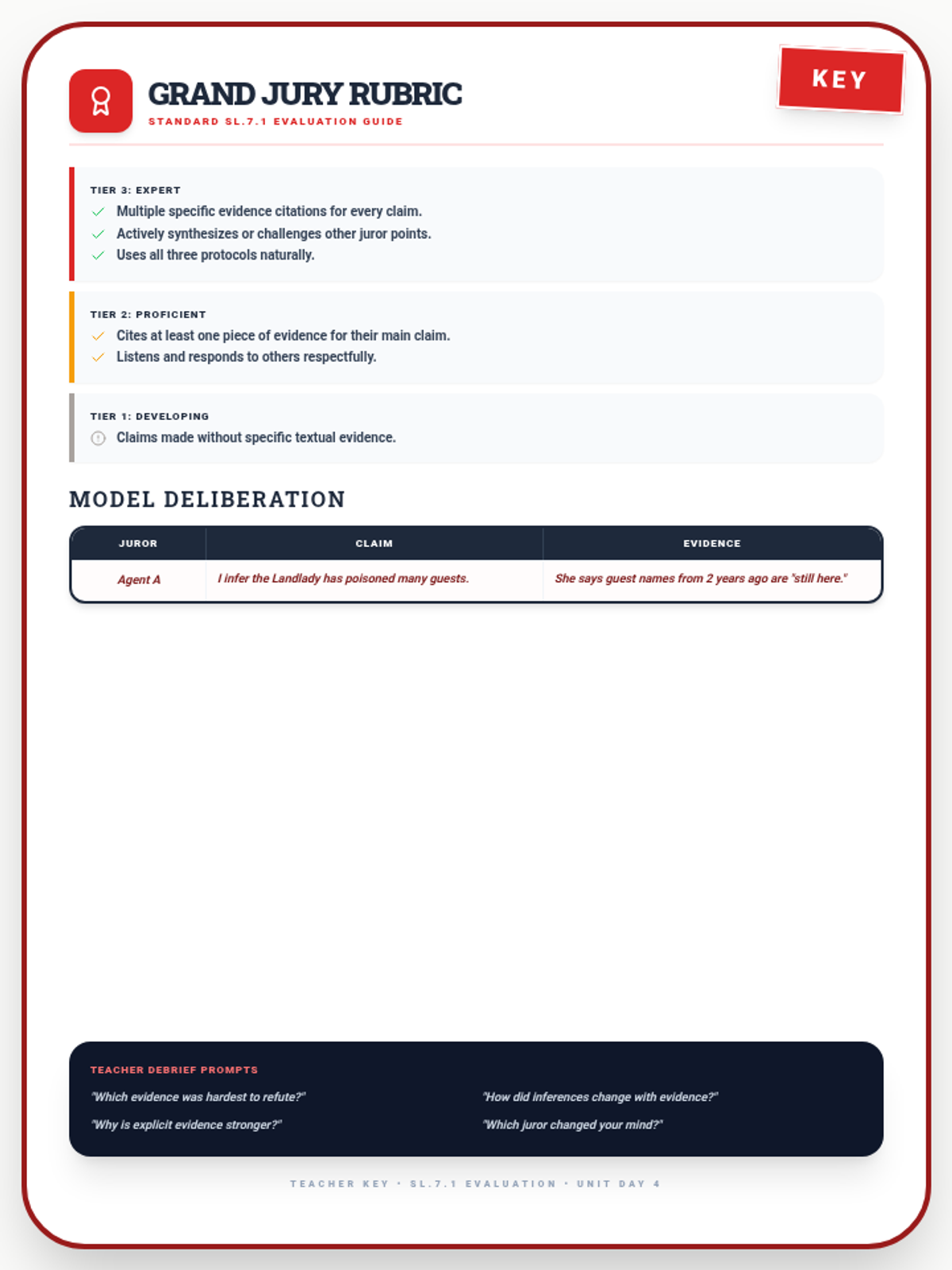
The Grand Jury Rubric Answer Key provides success criteria for the collaborative discussion, a model log entry, and debrief prompts for the teacher.
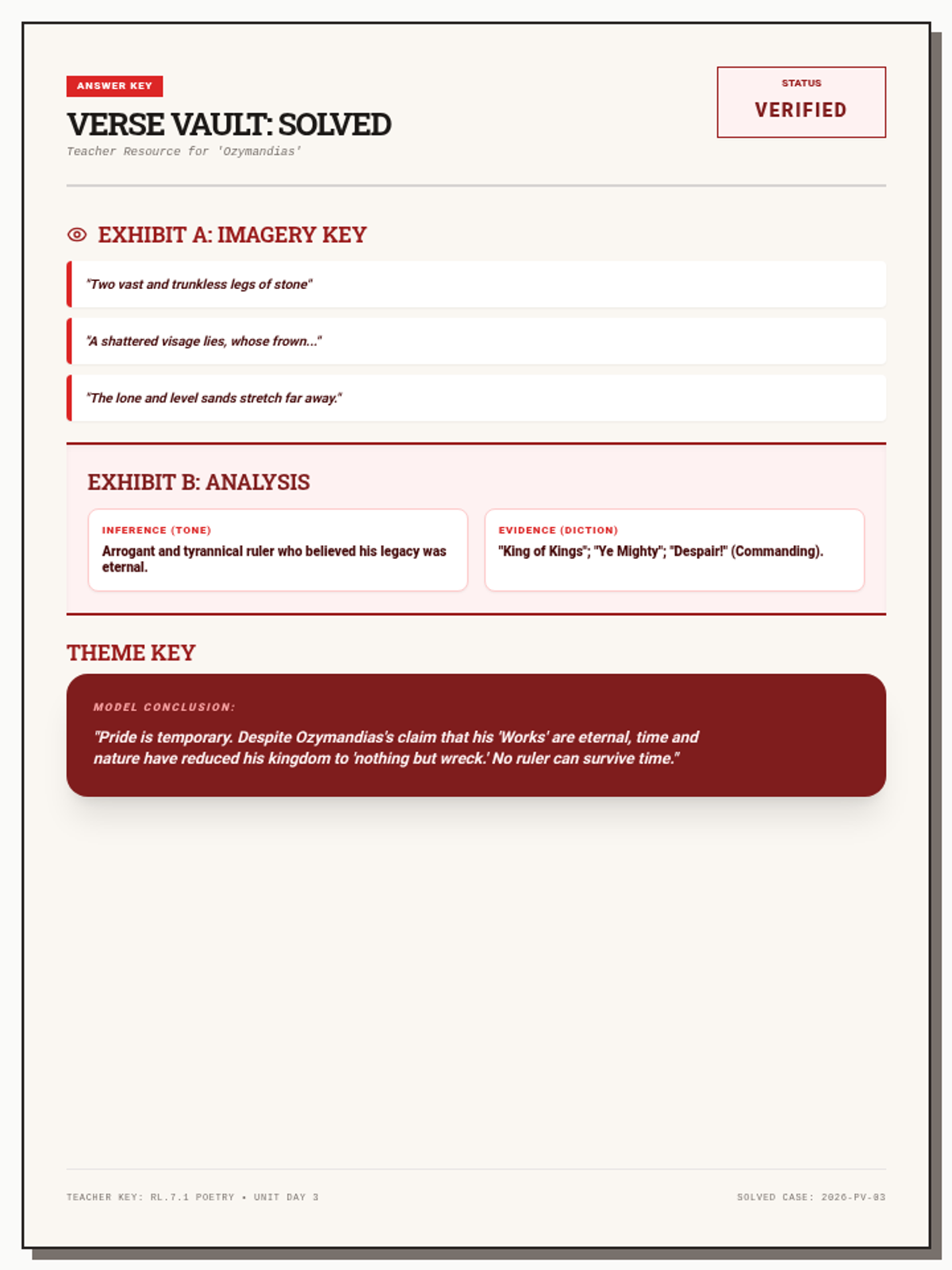
The Verse Vault Answer Key provides imagery evidence, tone analysis, and theme synthesis for 'Ozymandias', assisting teachers in assessing student poetry analysis.
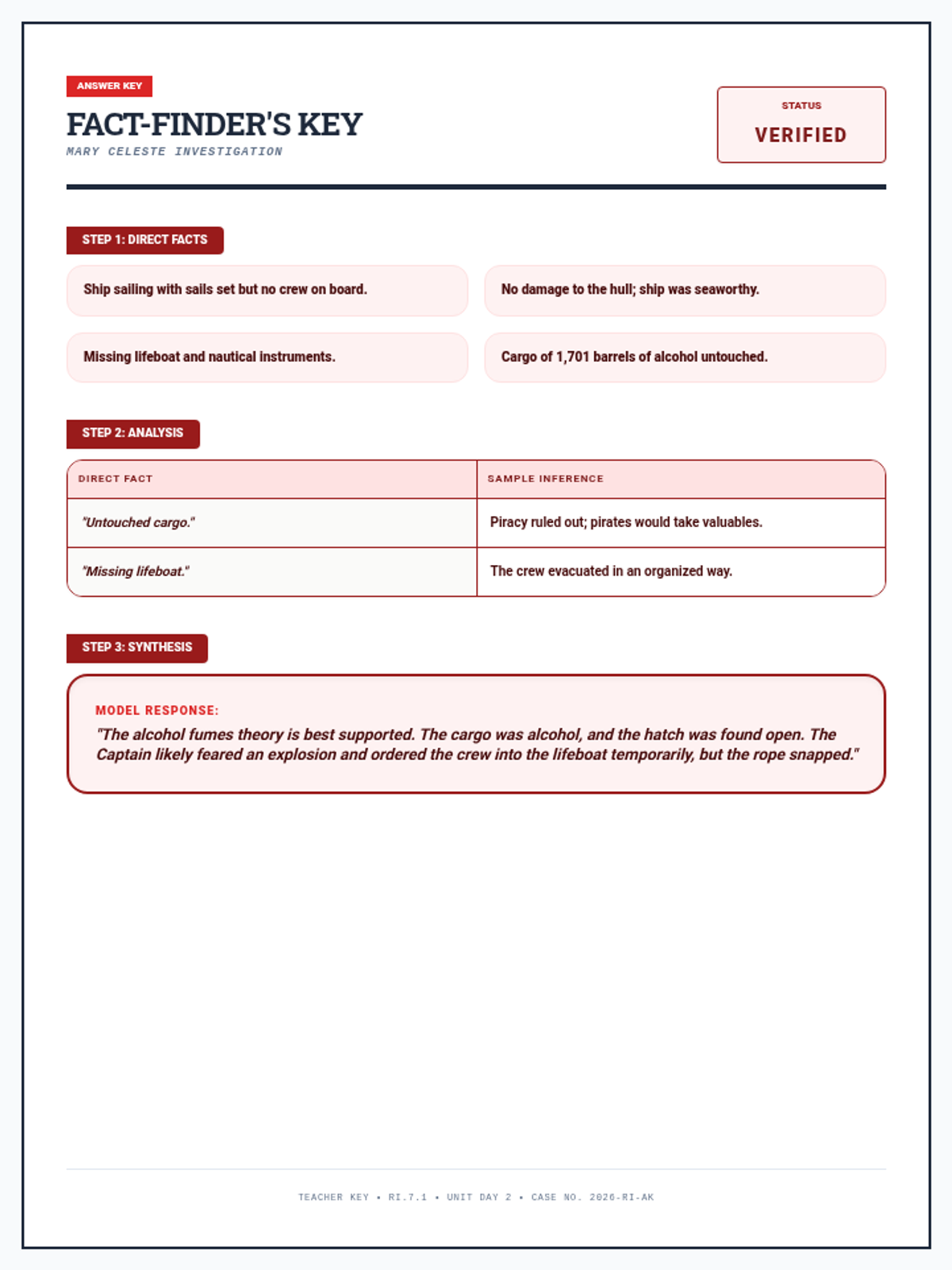
The Fact Finders Answer Key provides factual evidence and sample inferences for the Mary Celeste investigation, including a model synthesis response.
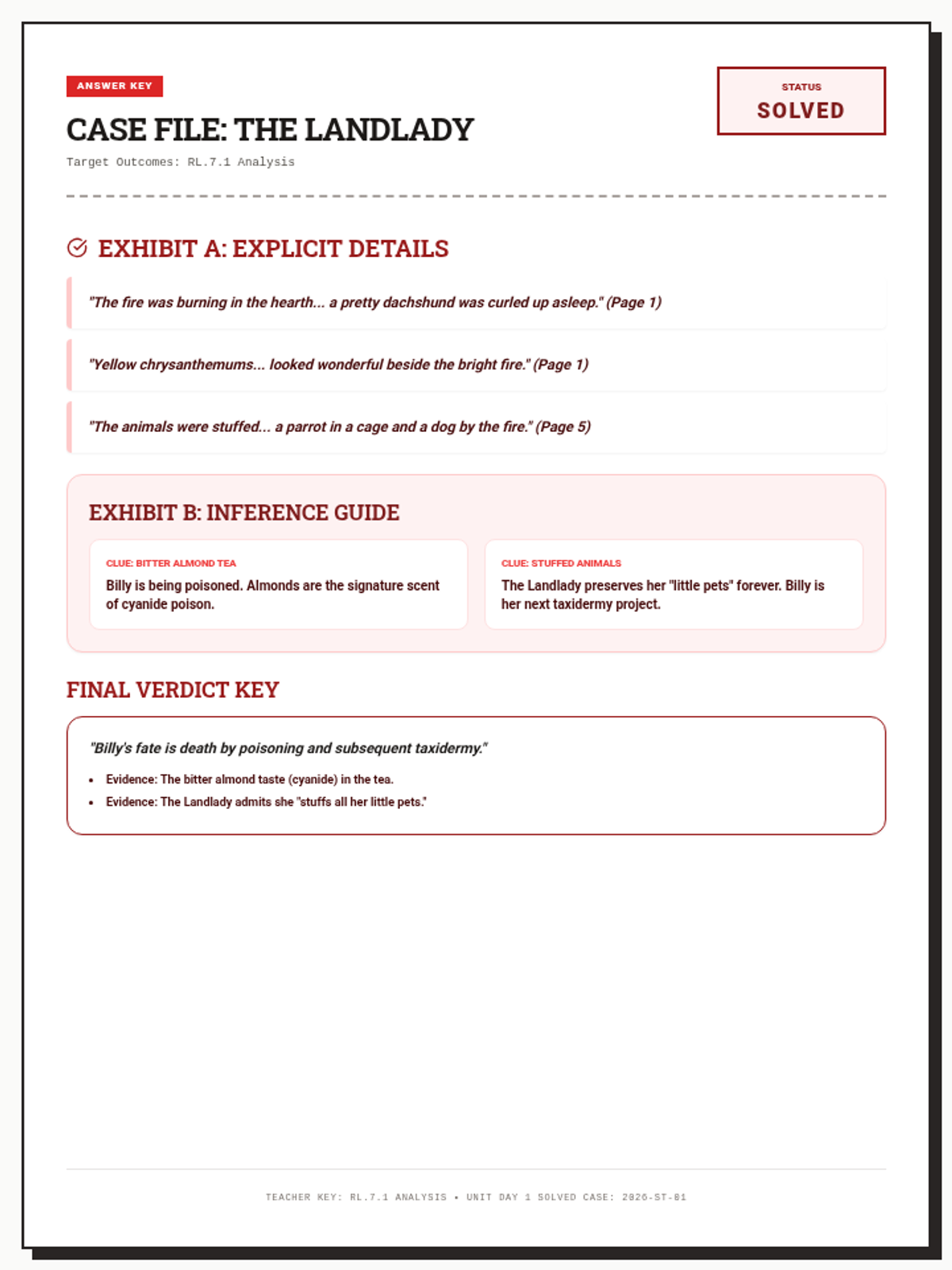
The Story Sleuths Answer Key provides detailed textual evidence and sample inferences for 'The Landlady' case study, helping teachers evaluate student work.
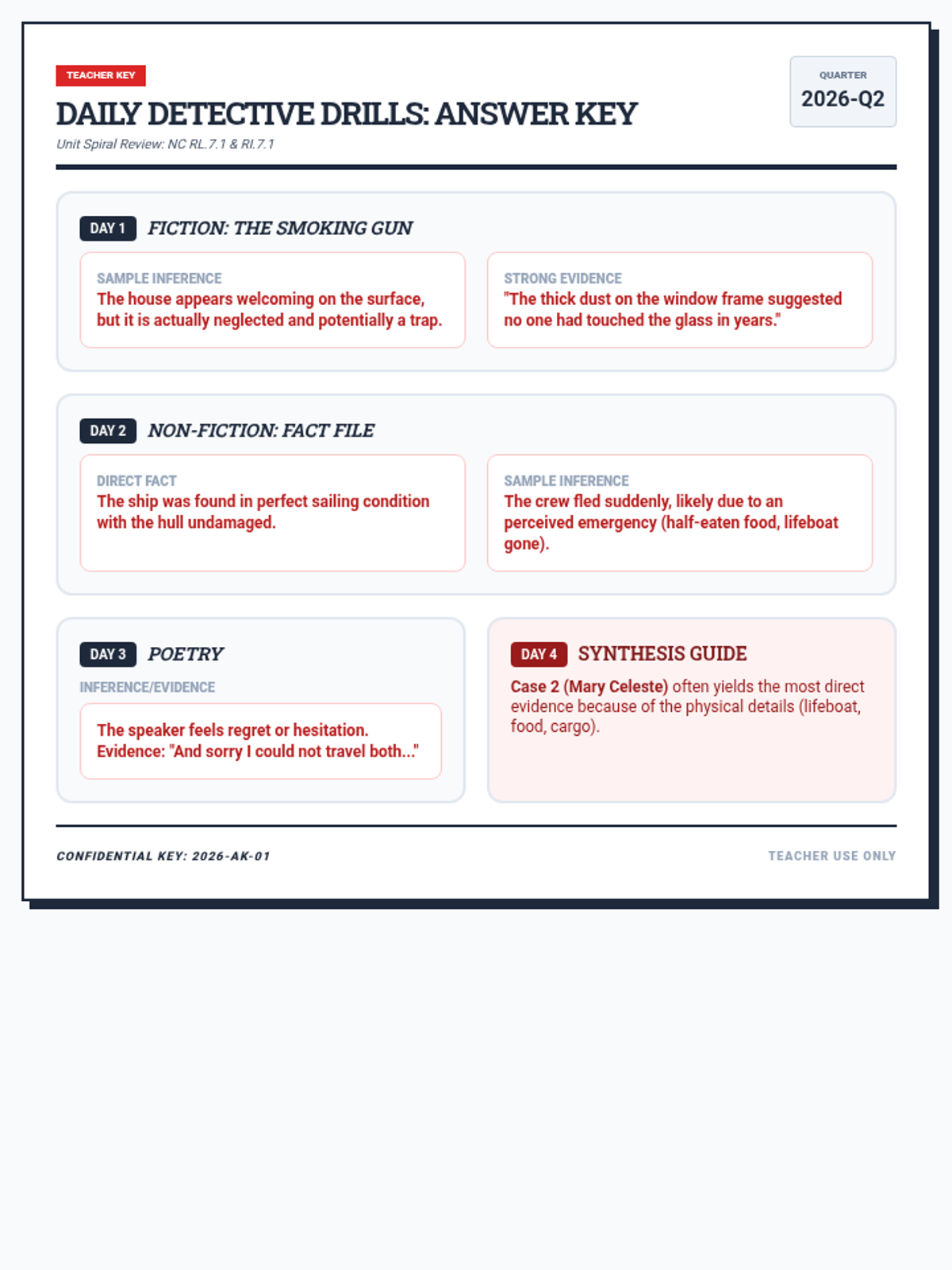
The Daily Detective Drills Answer Key provides sample inferences and specific textual evidence for the four-day spiral review exercises.
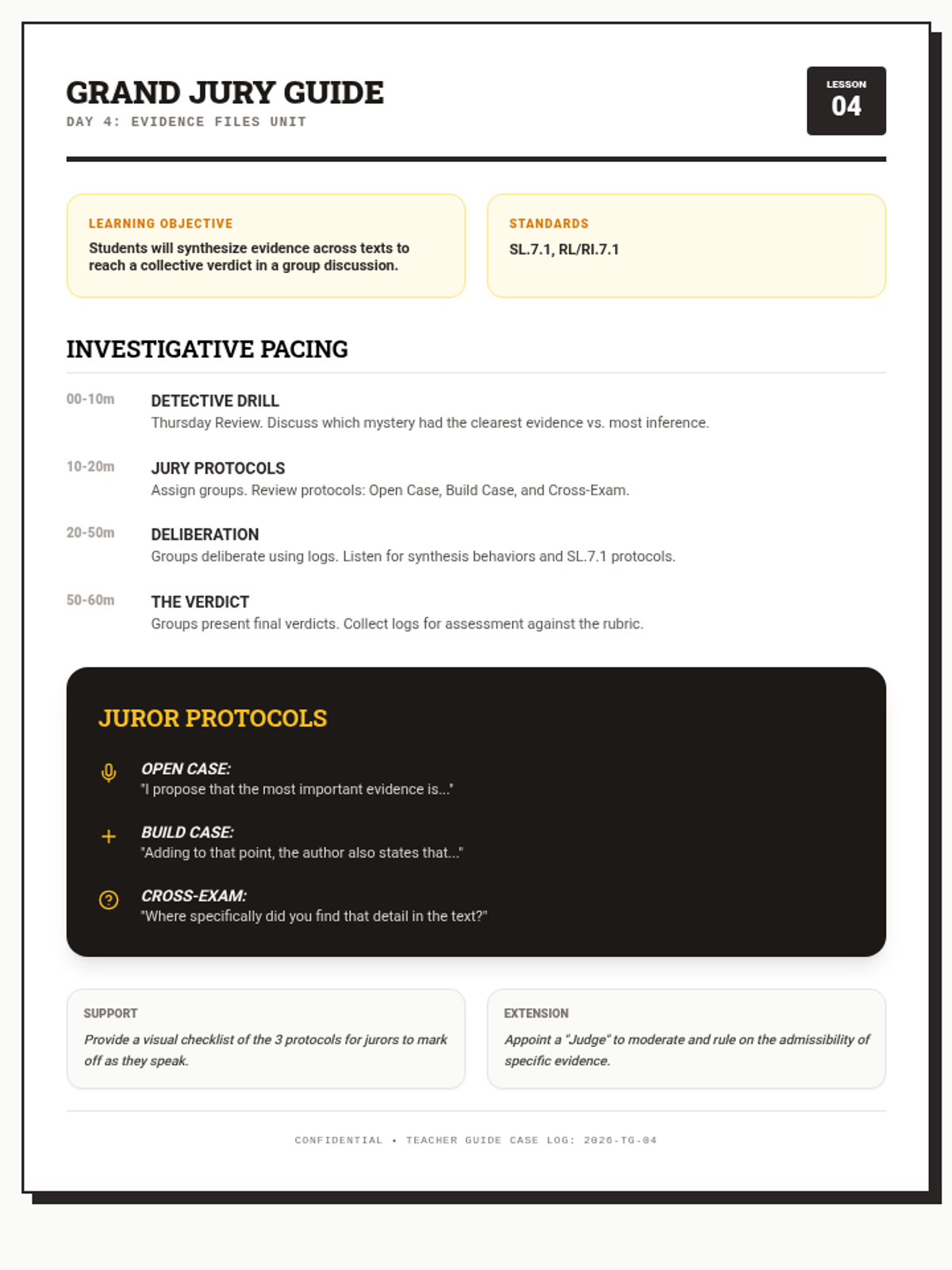
The Grand Jury Teacher Guide facilitates the final collaborative discussion of the unit, focusing on synthesis of evidence, discussion protocols, and group deliberation.
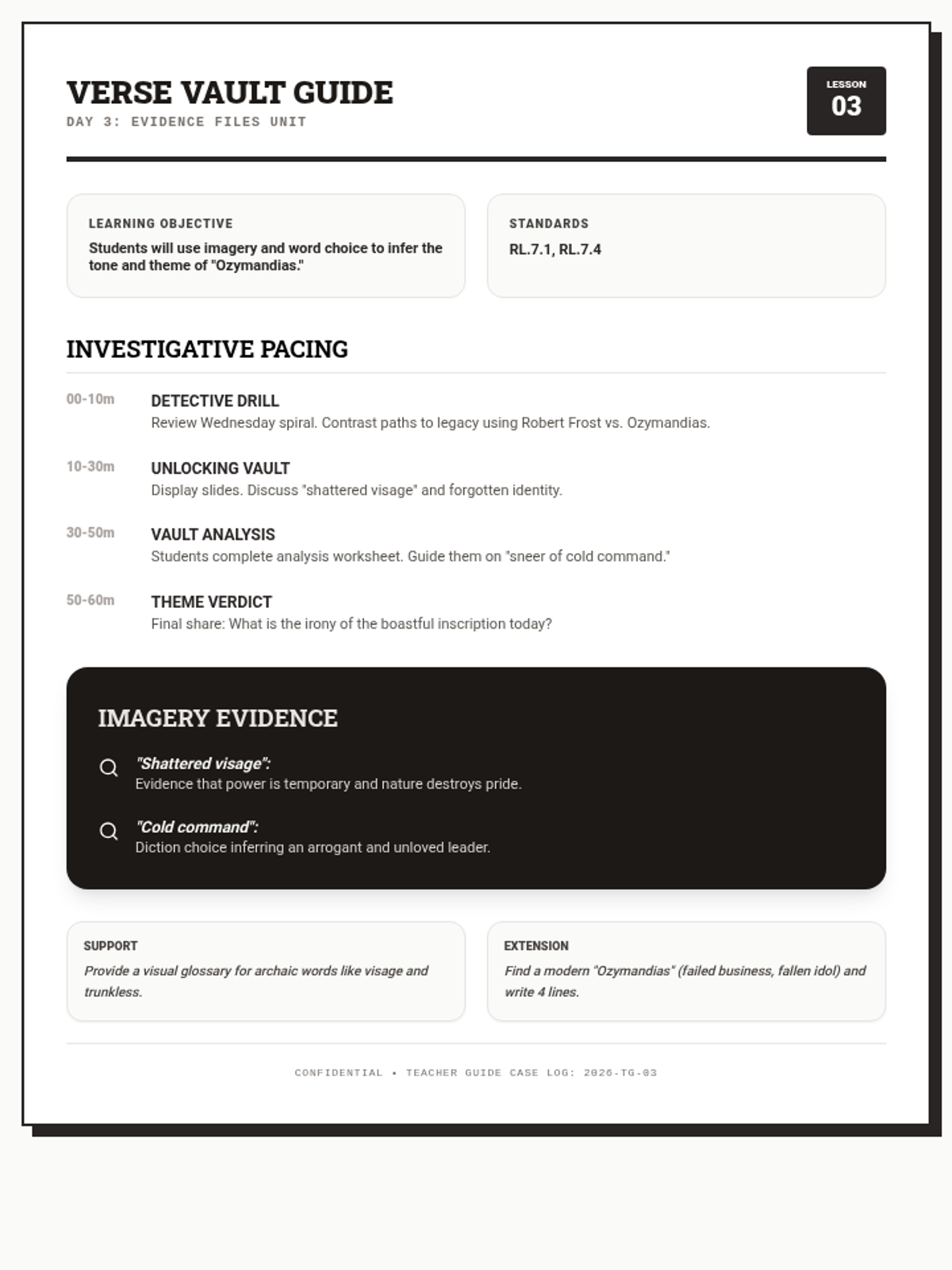
The Verse Vault Teacher Guide provides instructional support for teaching Percy Bysshe Shelley's 'Ozymandias', focusing on poetic imagery, word choice, and theme.
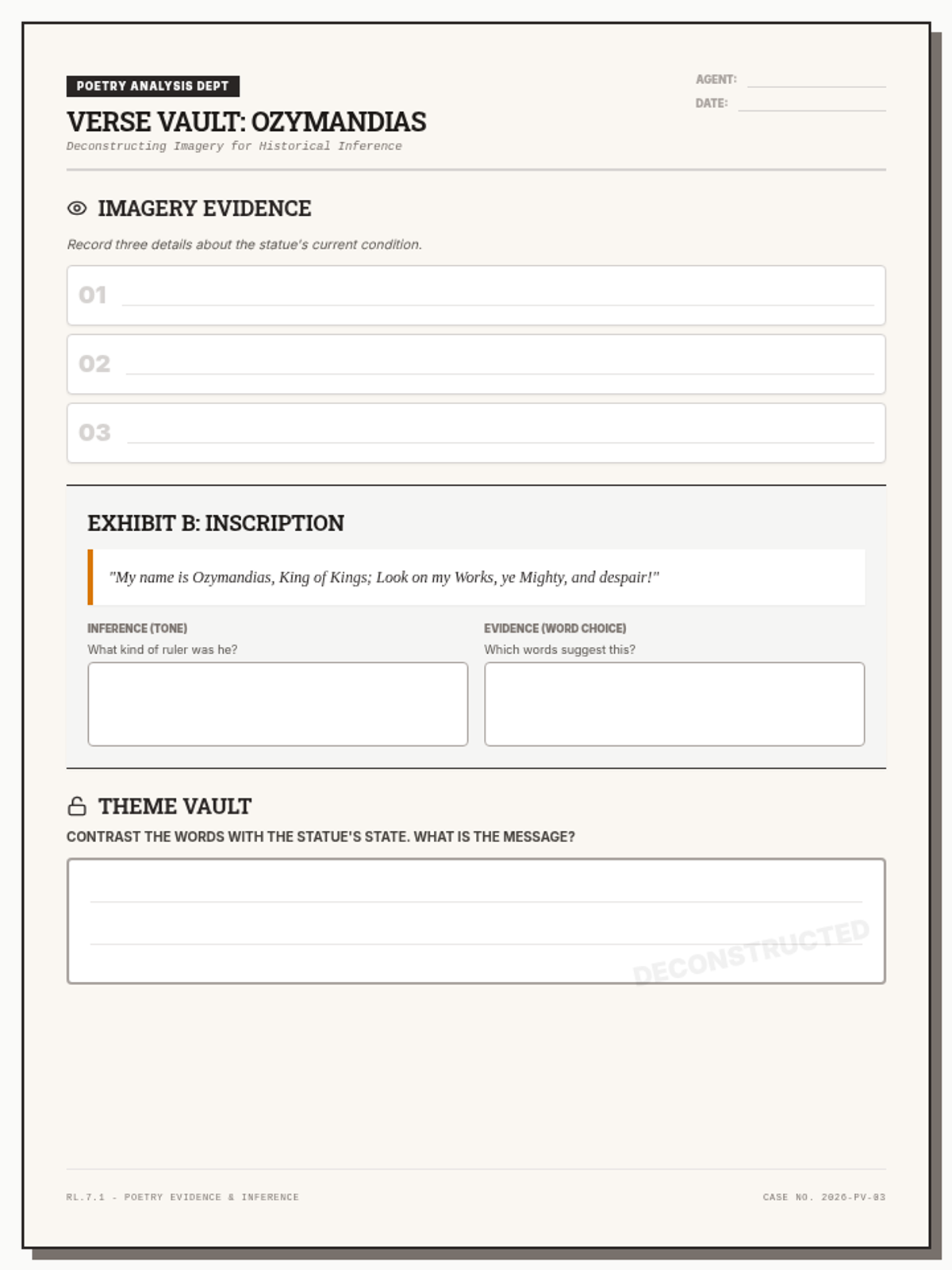
The Verse Vault Analysis Worksheet guides students through an evidence-based analysis of 'Ozymandias', focusing on visual imagery, word choice in inscriptions, and inferring the poem's theme.
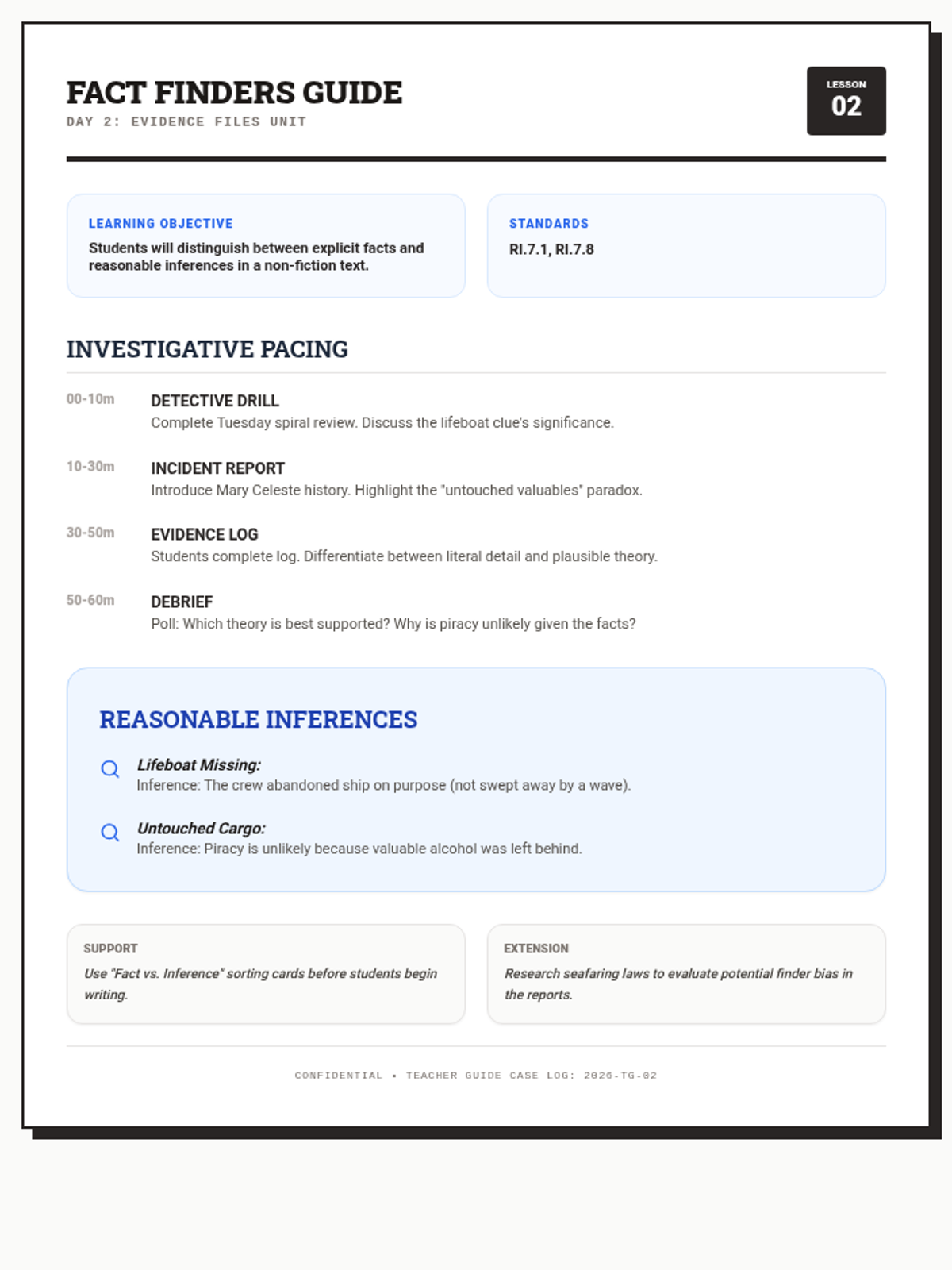
The Fact Finders Teacher Guide outlines the Day 2 instruction for analyzing the Mary Celeste mystery, focusing on the distinction between direct facts and reasonable inferences in non-fiction.
The Story Sleuths Teacher Guide provides a day-one instructional framework, including pacing, evidence look-fors, and differentiation strategies for analyzing 'The Landlady'.
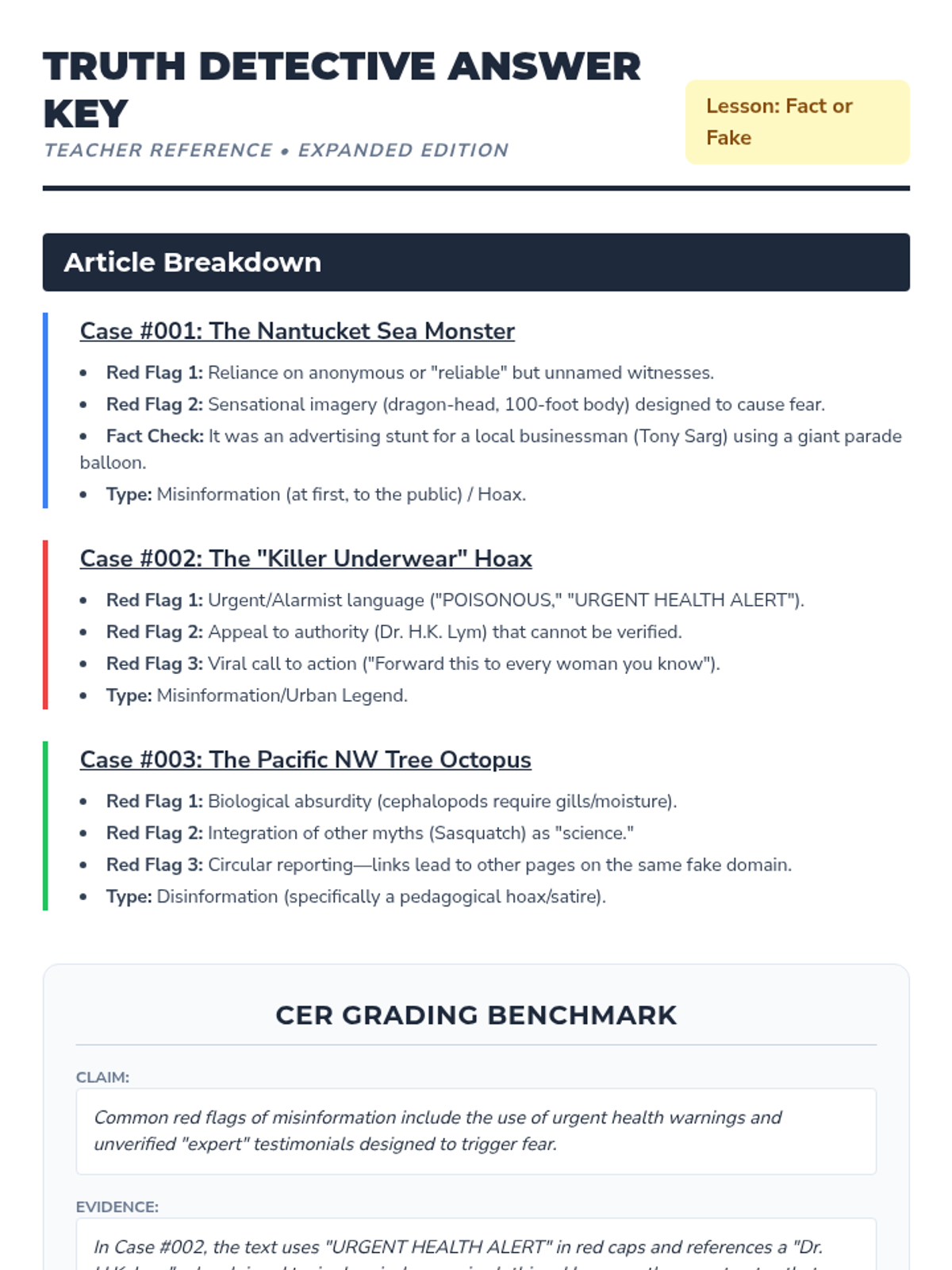
A teacher's answer key for the Truth Detective lesson, providing breakdown of the case studies and a sample CER response for grading and discussion.
Visual presentation to accompany the Truth Detective lesson, explaining the difference between misinformation and disinformation and highlighting digital red flags.
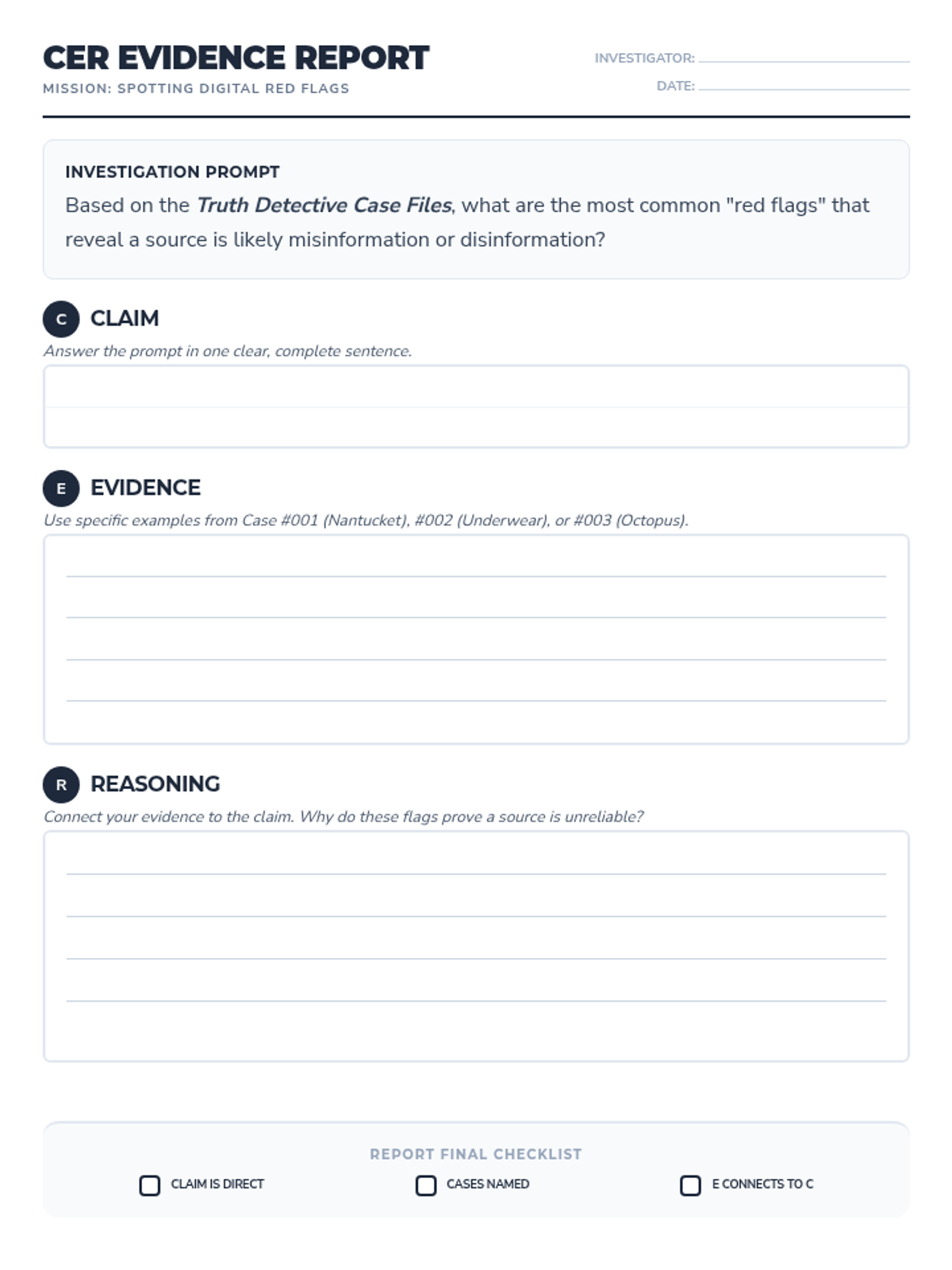
A graphic organizer for students to write a CER (Claim, Evidence, Reasoning) paragraph based on the Truth Detective Case Files, focusing on identifying red flags of fake information.
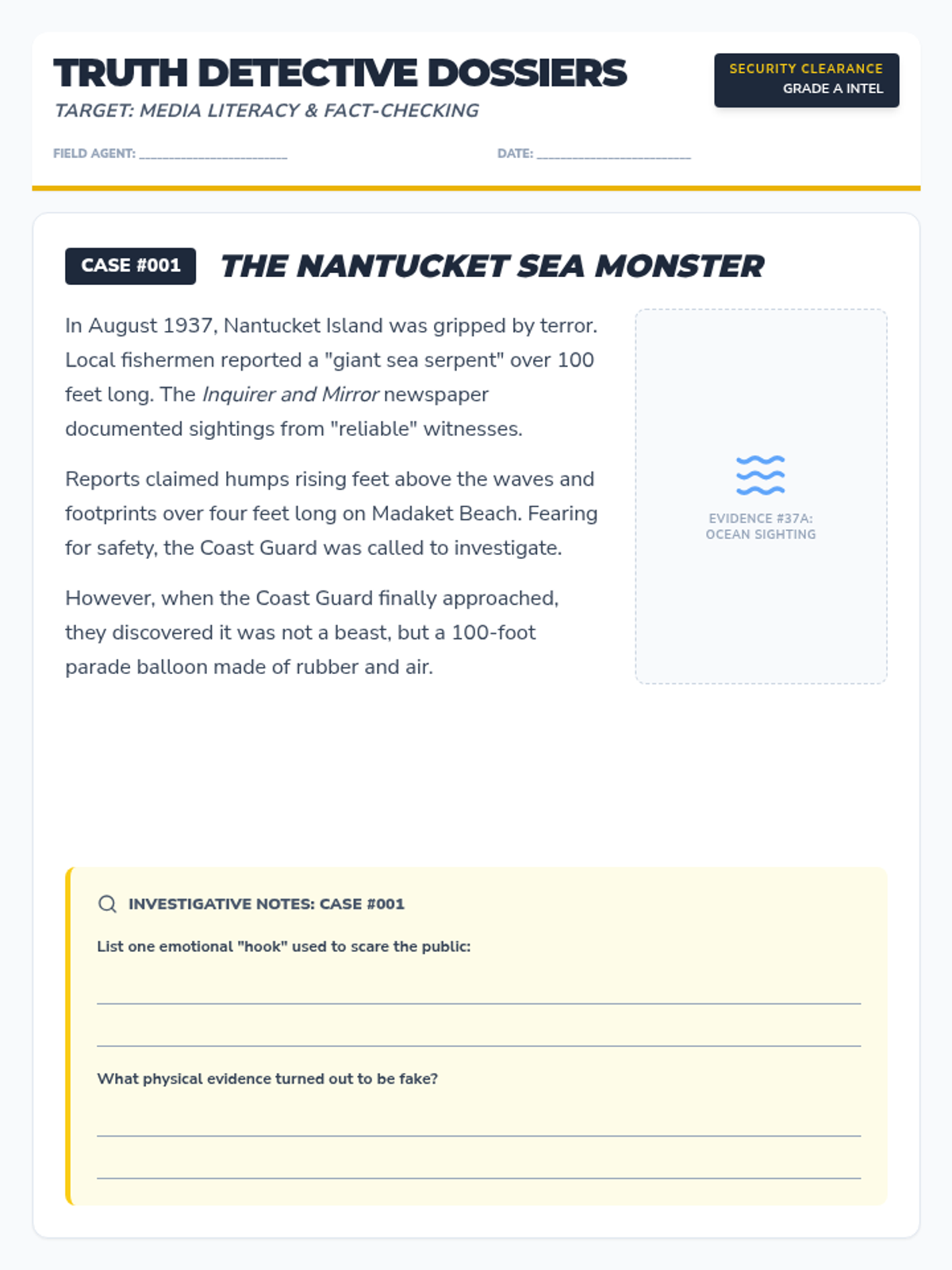
A collection of three short case studies—The Banana Shortage, The Tree Octopus, and Miracle Glow-Water—designed for students to practice identifying red flags of misinformation and disinformation.
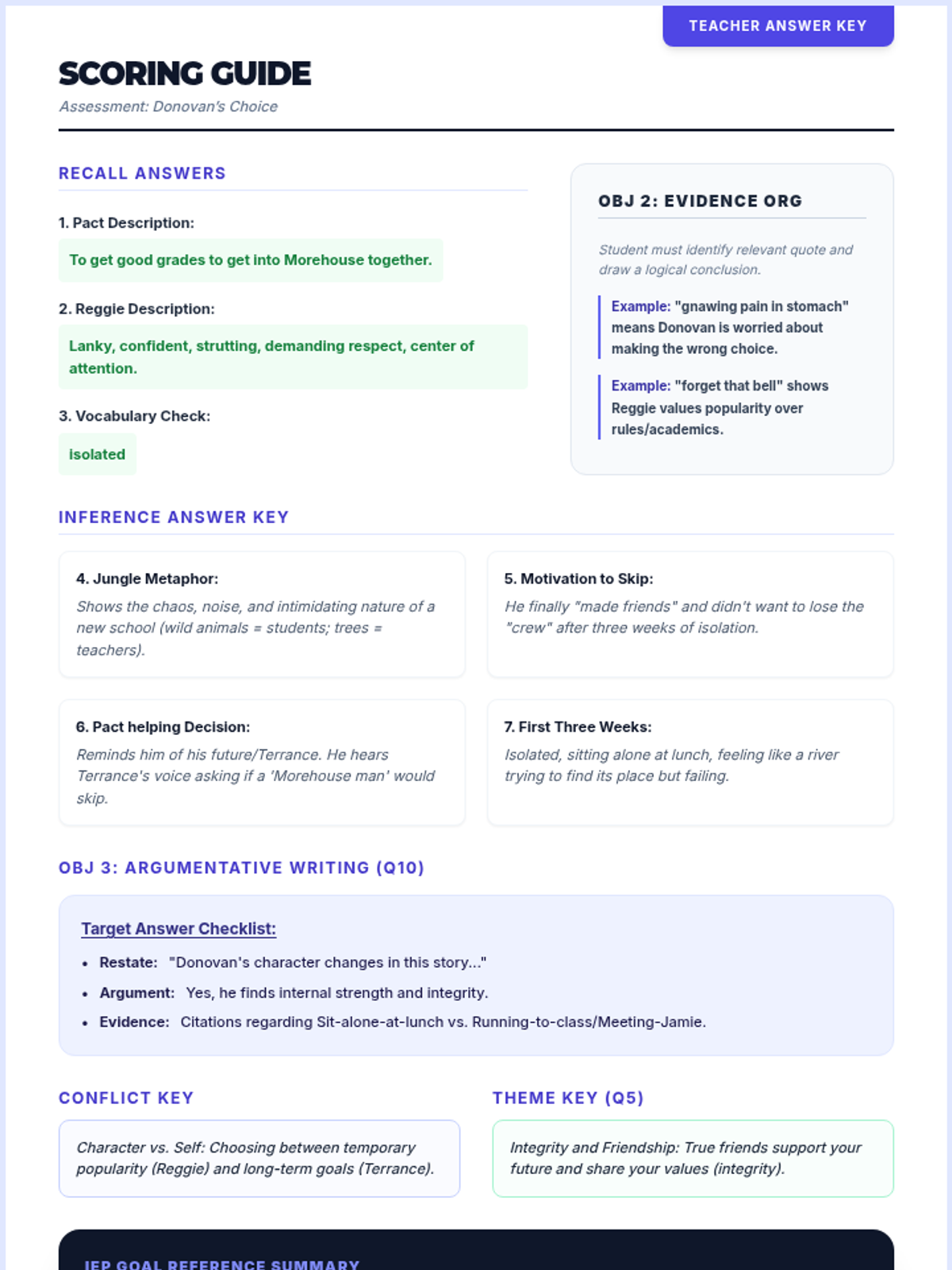
A teacher guide and answer key for the revised Donovan's Choice assessment. Provides clear scoring criteria for active reading reflections, evidence citation, restate/answer formatting, and identification of conflict and theme.
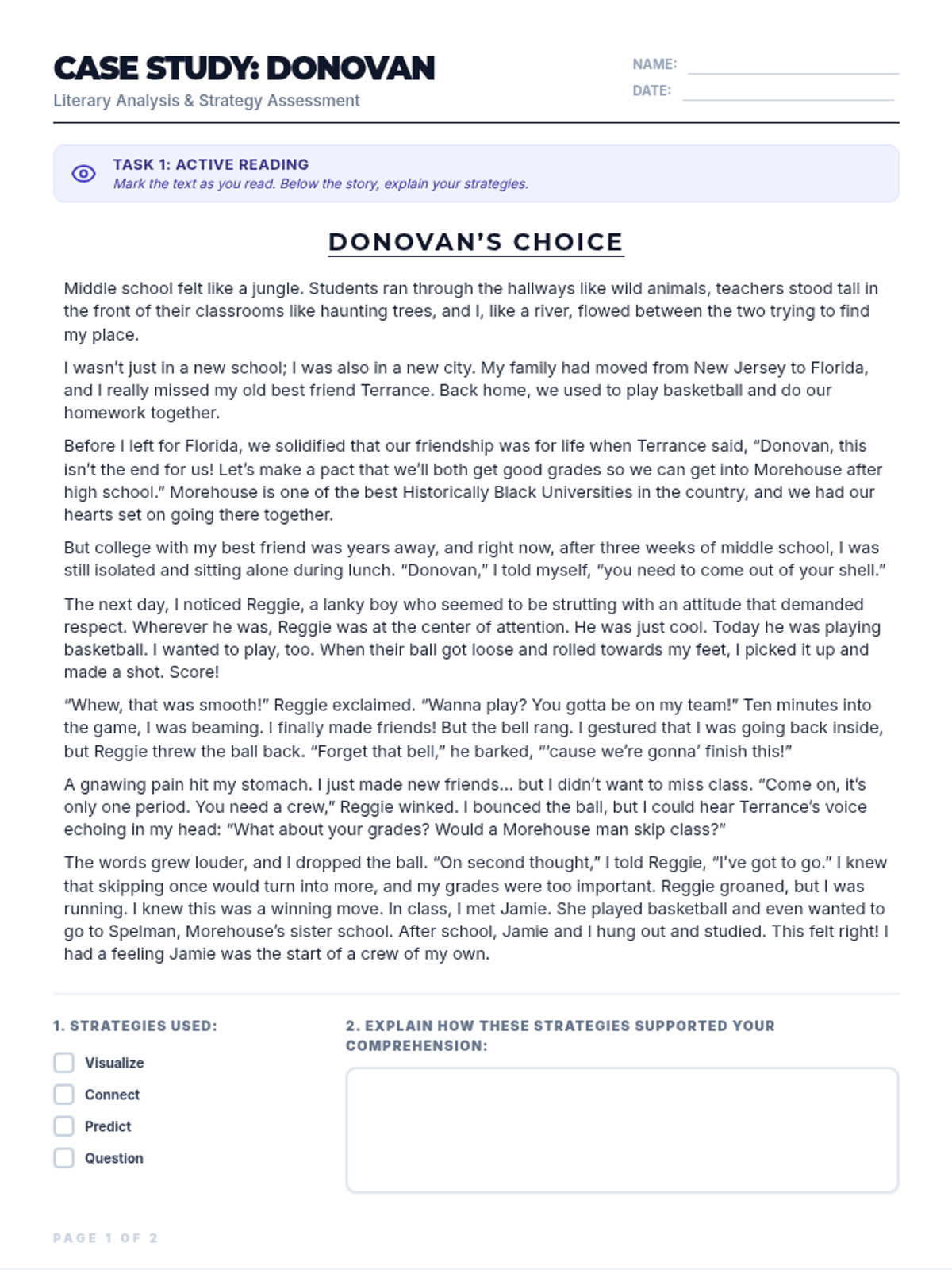
A 2-page student assessment document mapping to specific IEP objectives and incorporating 10 targeted comprehension questions. Includes sections for active reading strategy reflection, a textual evidence organizer, inferential writing with restate/answer formatting, and a conflict/theme graphic map.
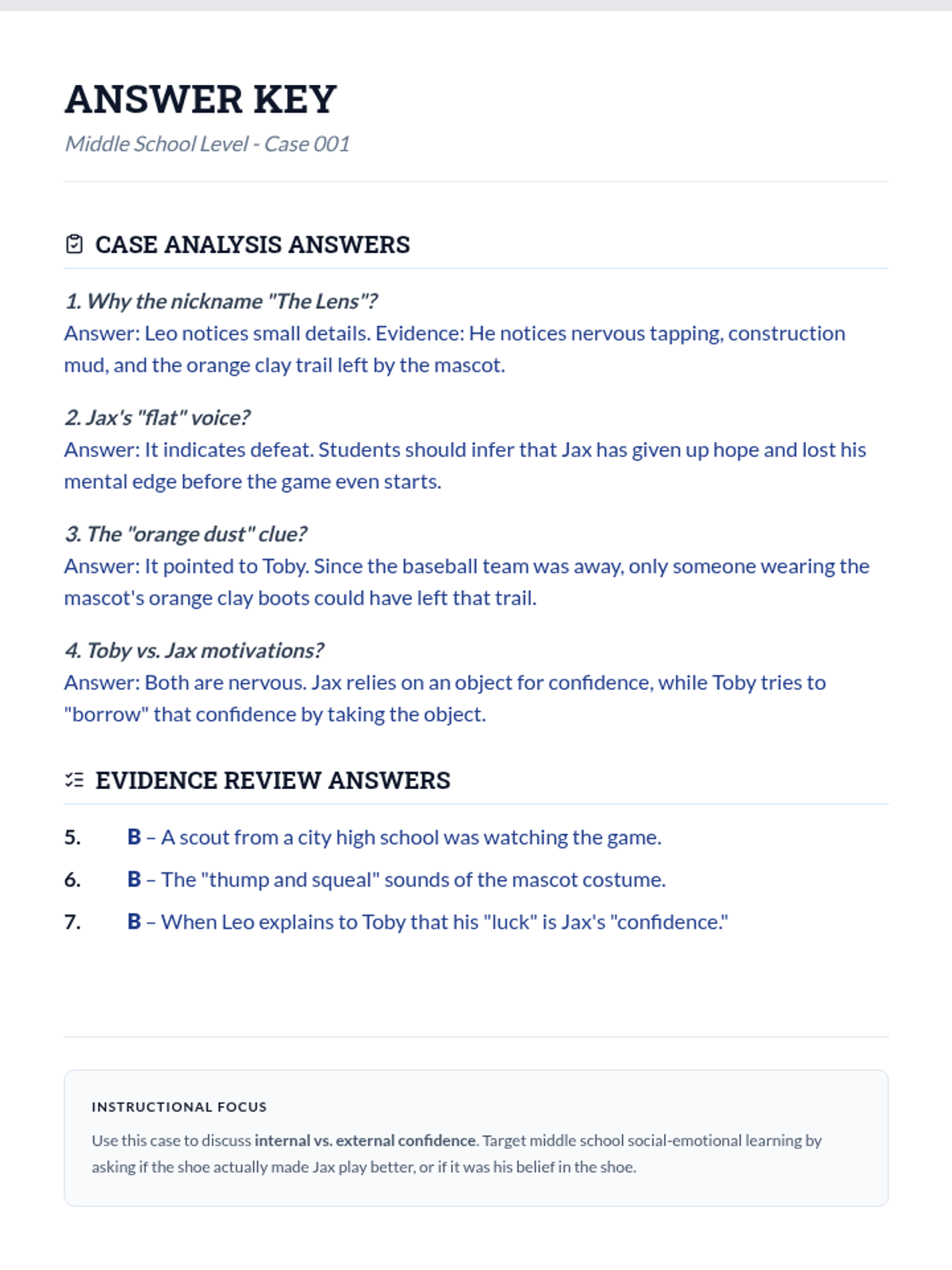
Comprehensive answer key for the middle-school level 'The Case of the Missing High-Top' story and worksheet, including discussion points on theme and character motivation. Now consolidated into a single page.
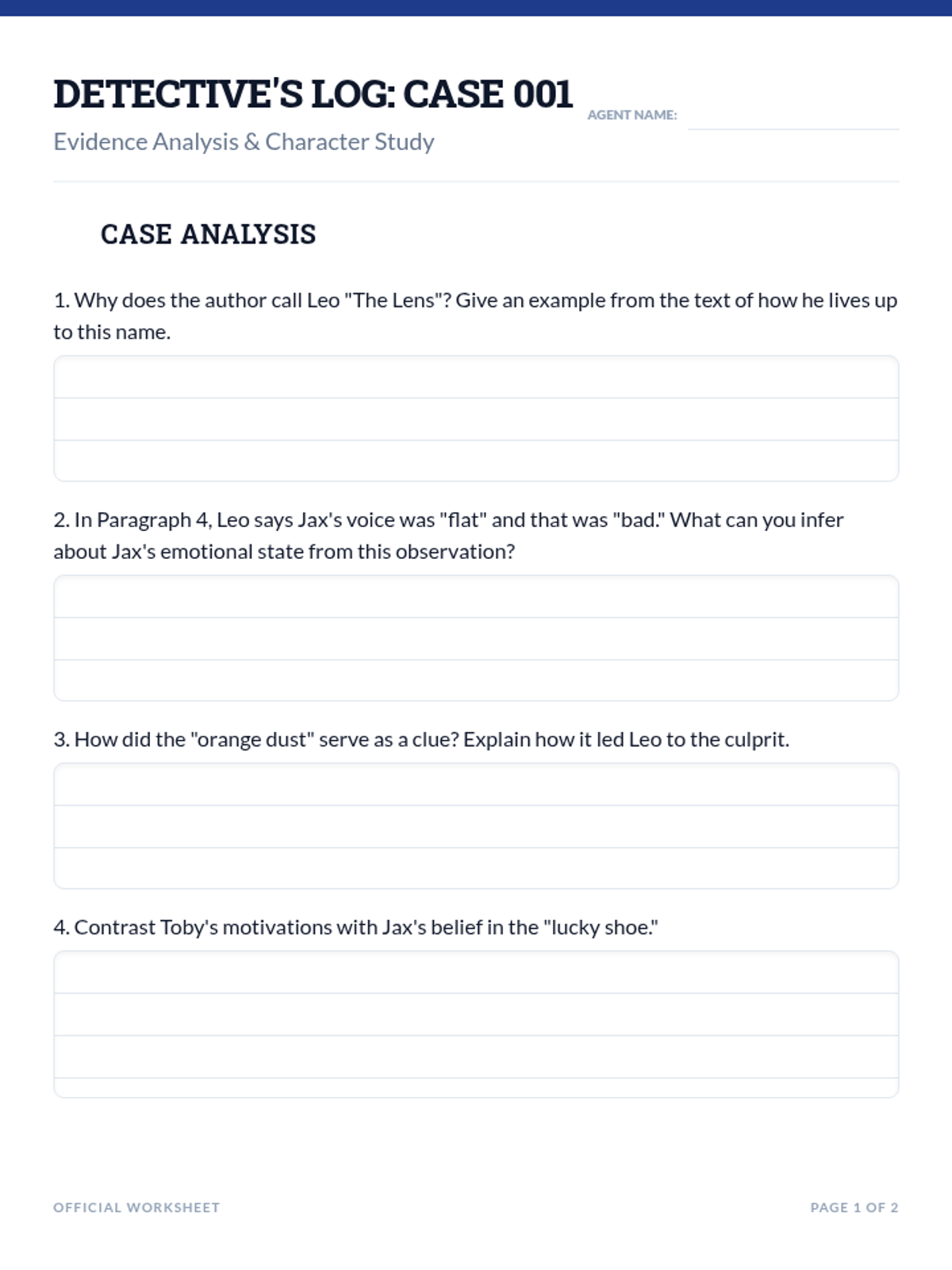
A higher-level comprehension worksheet for the middle-school version of 'The Case of the Missing High-Top'. Questions focus on character analysis, inference, plot structure, and evidence-based reasoning. Hand-writing lines adjusted for 5th-8th grade readability.
A more mature, middle-school focused mystery story titled 'The Case of the Missing High-Top' featuring Leo 'The Lens' Logan. The plot involves higher stakes and a mascot-related twist, written at an accessible 4th-5th grade Lexile level. Final polish for punctuation and spacing.
Updated answer key for the 'Championship Chills Worksheet' now including answers for both the open-ended questions and the new multiple-choice section, with improved contrast and layout.
An expanded 2-page comprehension worksheet for 'The Case of the Missing High-Top' that now includes both open-ended inference questions and multiple-choice evidence checks. Hand-writing lines have been adjusted for 3rd-4th grade accessibility.
A 3-page mystery story titled 'The Case of the Missing High-Top' featuring Leo 'The Lens' Logan, a student detective who solves the mystery of a missing lucky basketball shoe. Written at a 3rd-4th grade reading level.
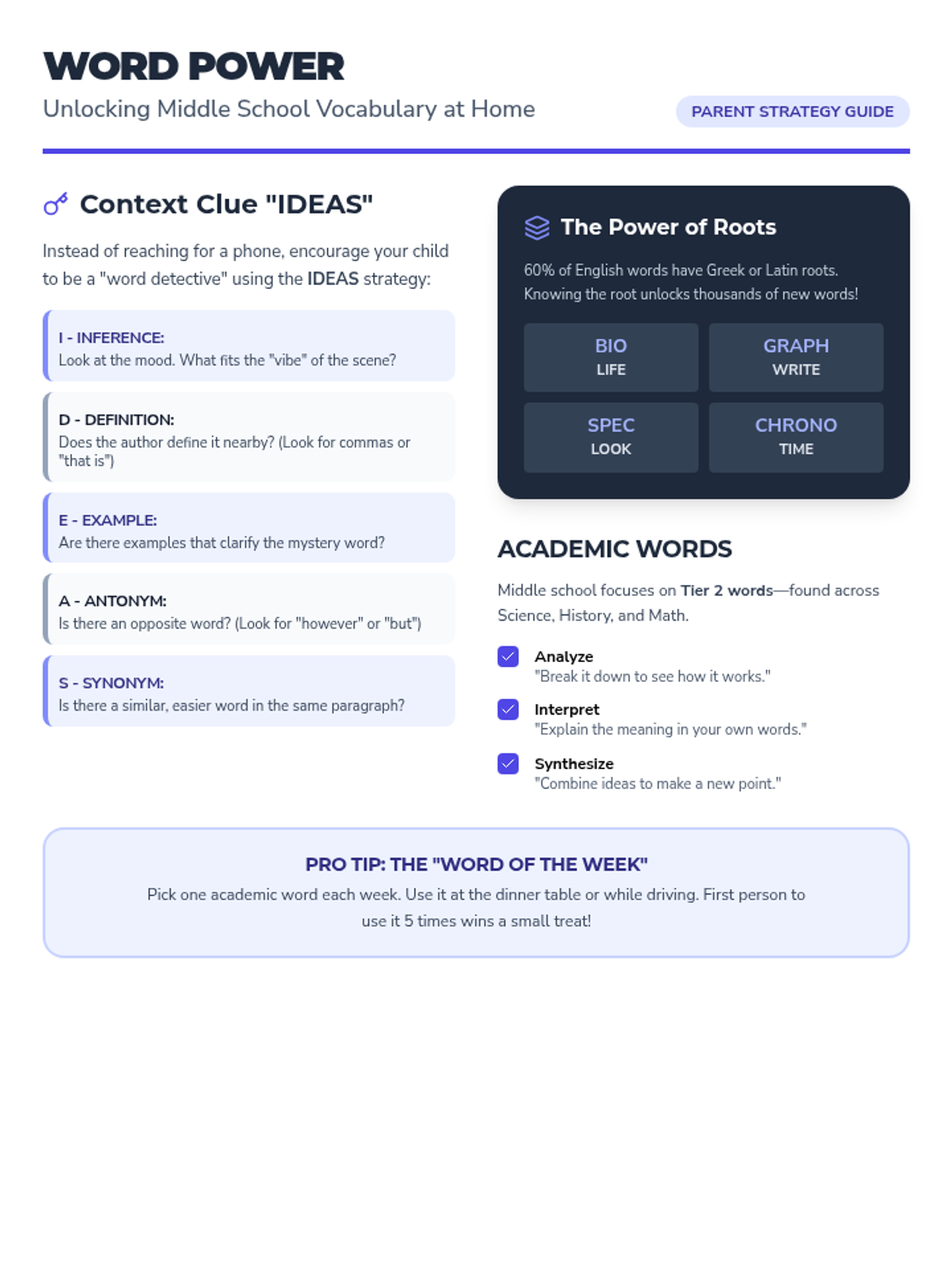
A one-page guide for parents on helping middle schoolers master vocabulary, featuring context clue strategies (IDEAS), Greek and Latin roots, and academic vocabulary tips.
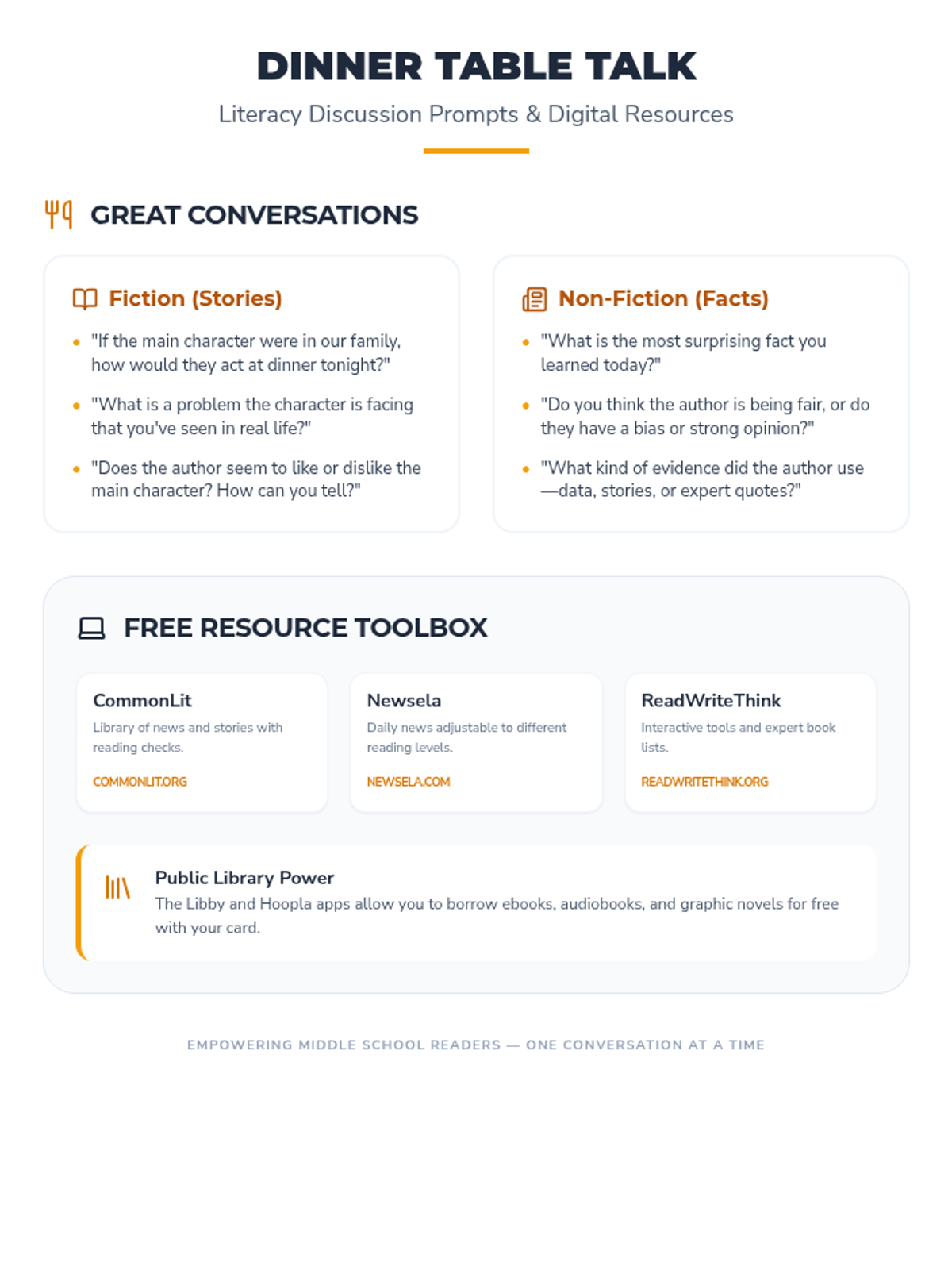
A resource list for parents featuring standard-aligned discussion prompts for fiction and non-fiction, along with a curated list of free digital literacy tools.
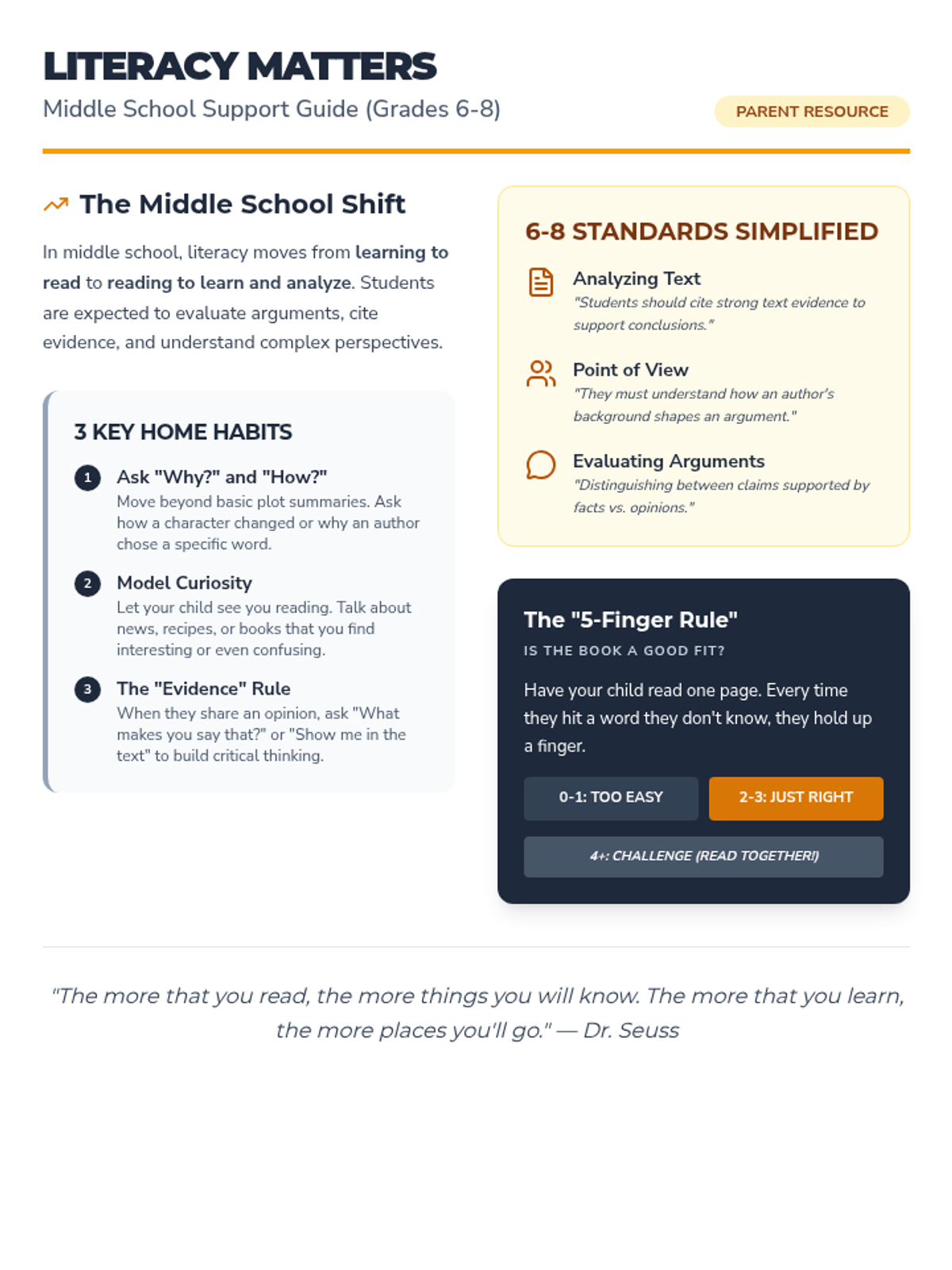
A one-page guide for middle school parents explaining the shift in literacy expectations from elementary to middle school, with actionable habits and standards-aligned tips.
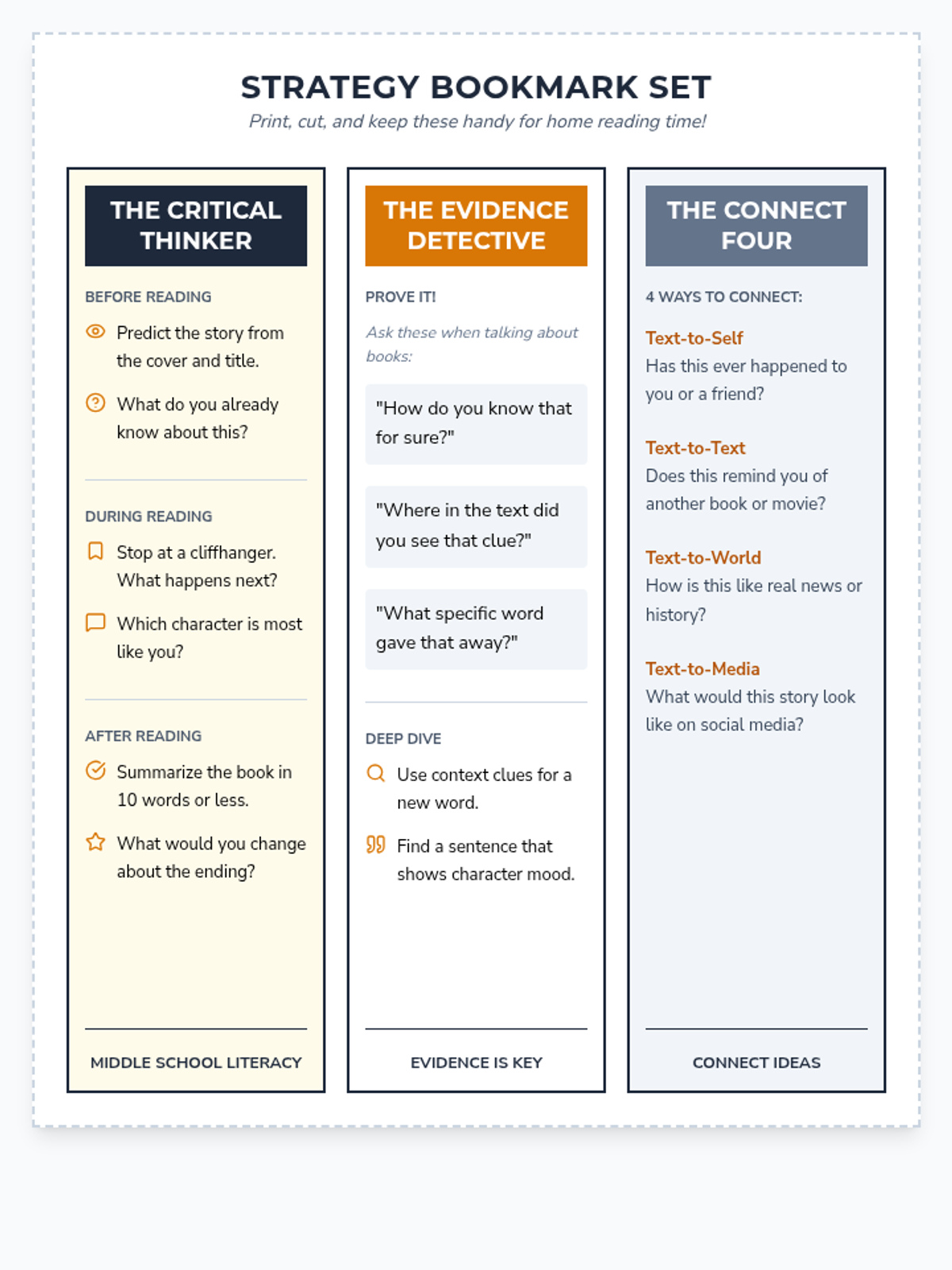
A set of three printable reading strategy bookmarks for middle school parents, providing quick prompts for before, during, and after reading, evidence-based questioning, and making connections.
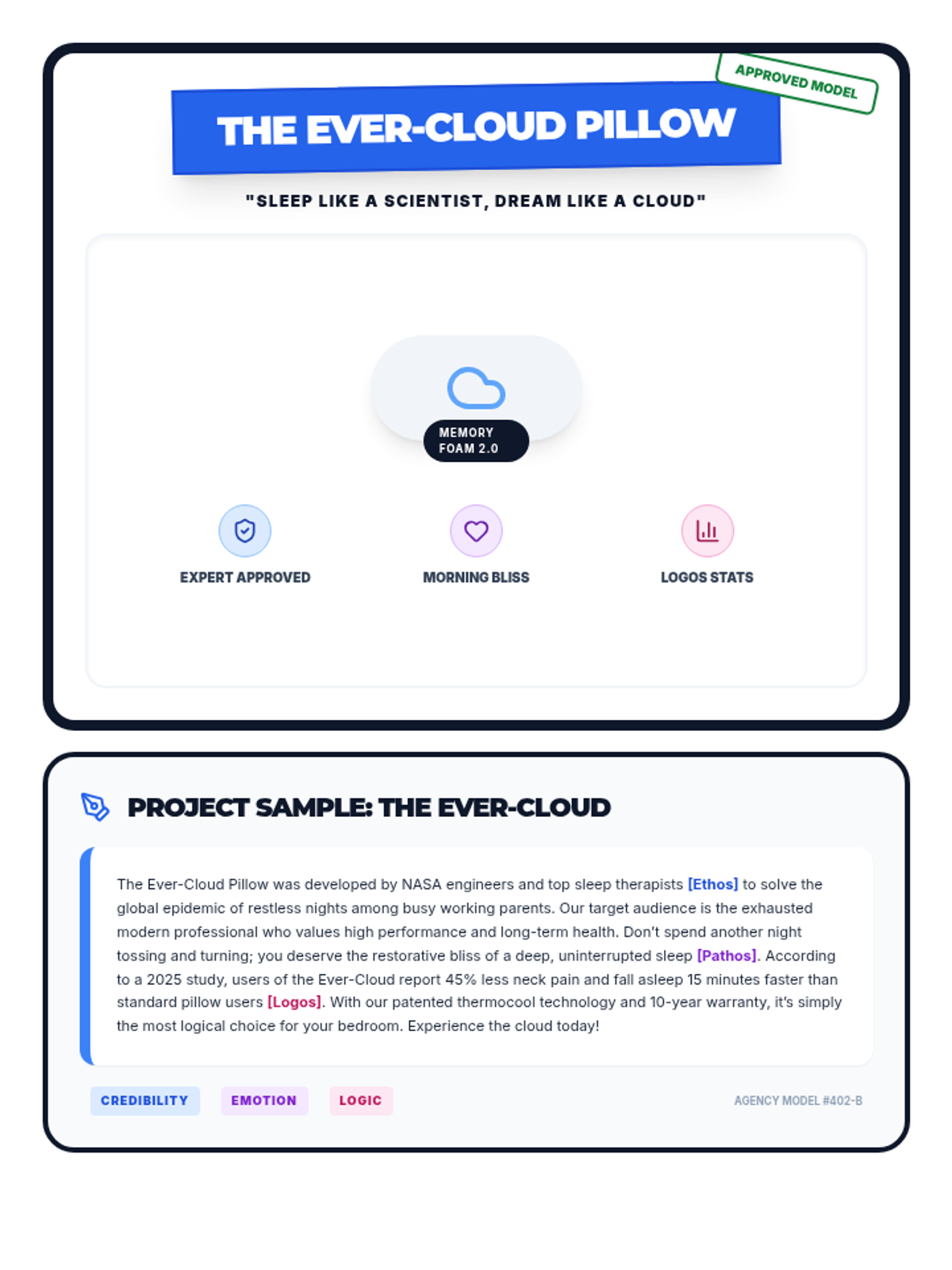
A completed model of the Pitch Perfect project to show students what a successful poster and paragraph look like, using a fictional "Ever-Cloud Pillow" as the example.
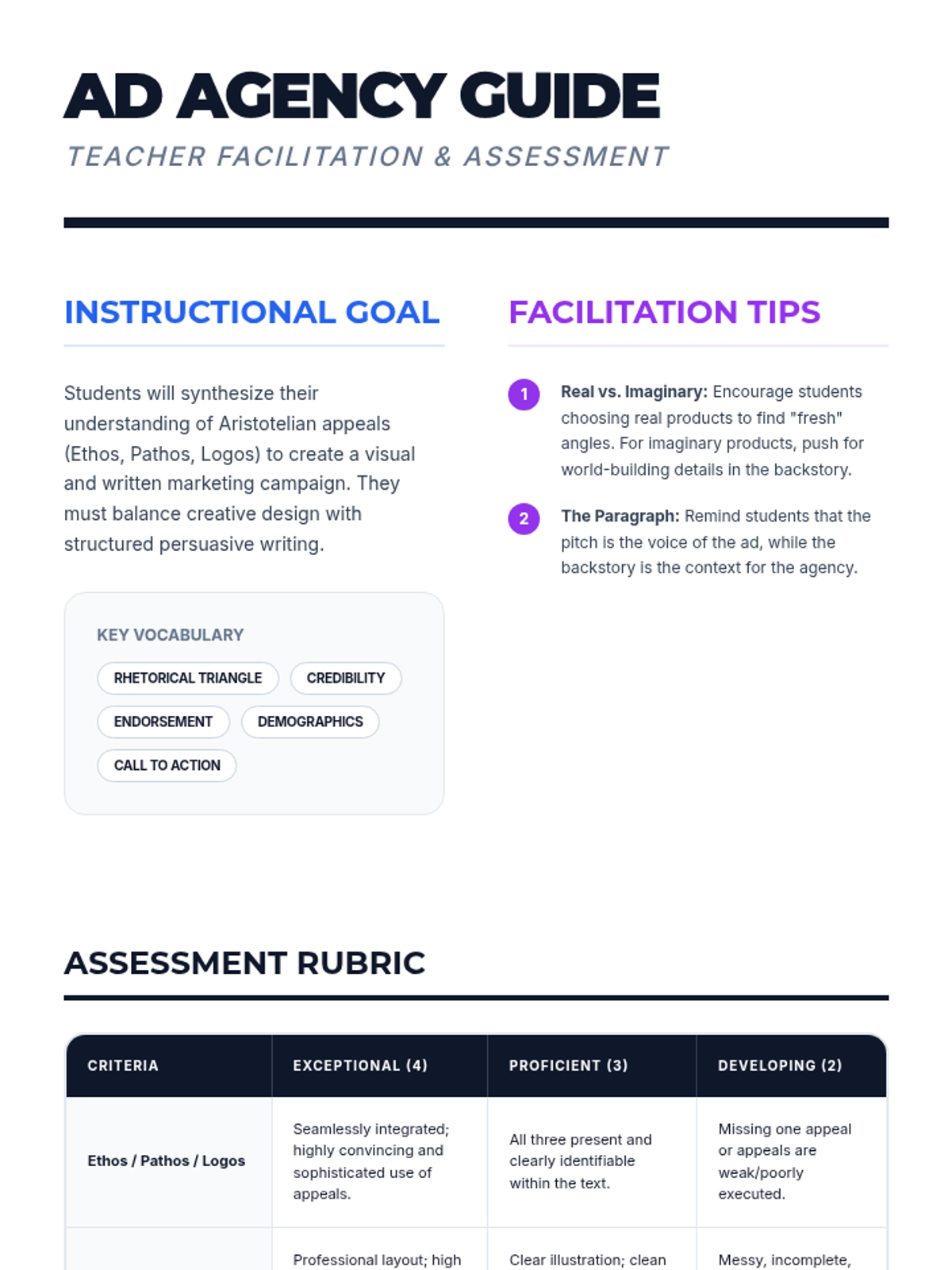
A comprehensive teacher's guide for the Pitch Perfect project, including lesson goals, facilitation tips, a detailed grading rubric, and differentiation strategies.
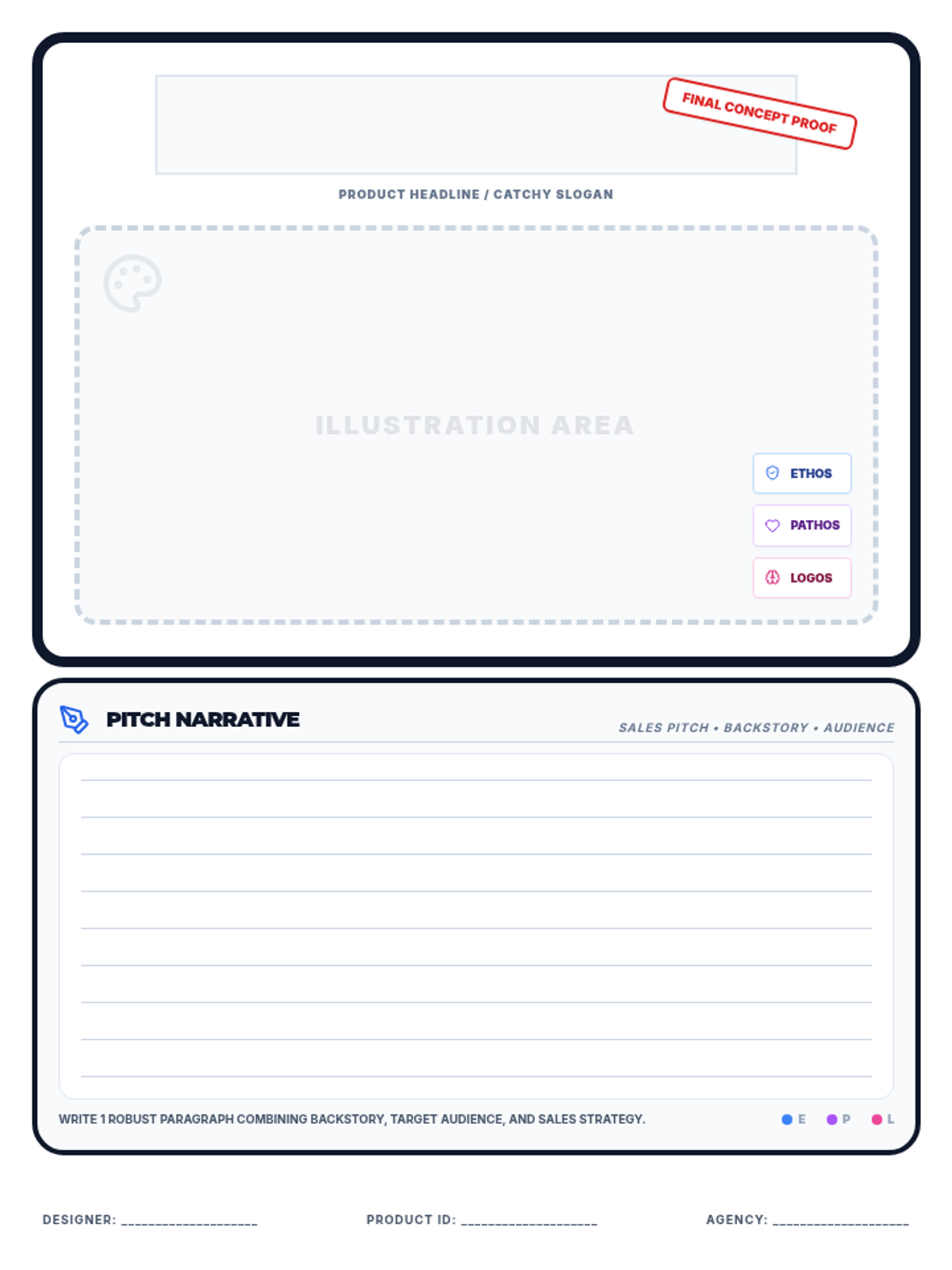
A clean, high-impact poster template designed for students to illustrate their product and write their persuasive pitch. Includes visual markers for rhetorical appeals and a structured layout.
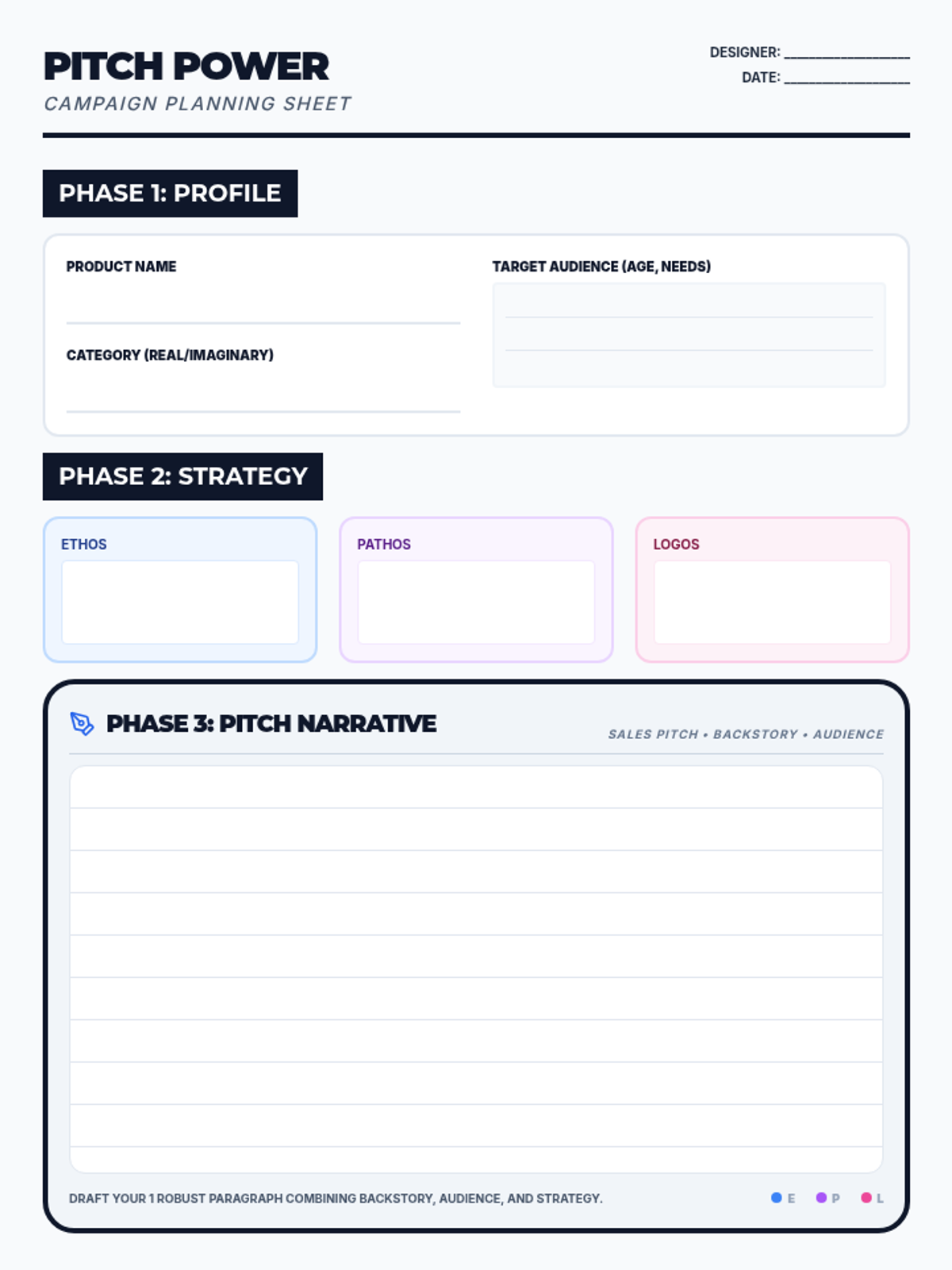
A detailed planning worksheet to help students brainstorm their product, identify their target audience, and map out their rhetorical strategies before creating their final poster. Includes the pitch narrative draft section.