Systematic research, evidence evaluation, and logical reasoning skills for formal discourse. Equips speakers to organize persuasive arguments, identify fallacies, and execute strategic impact calculus during competitive engagement.
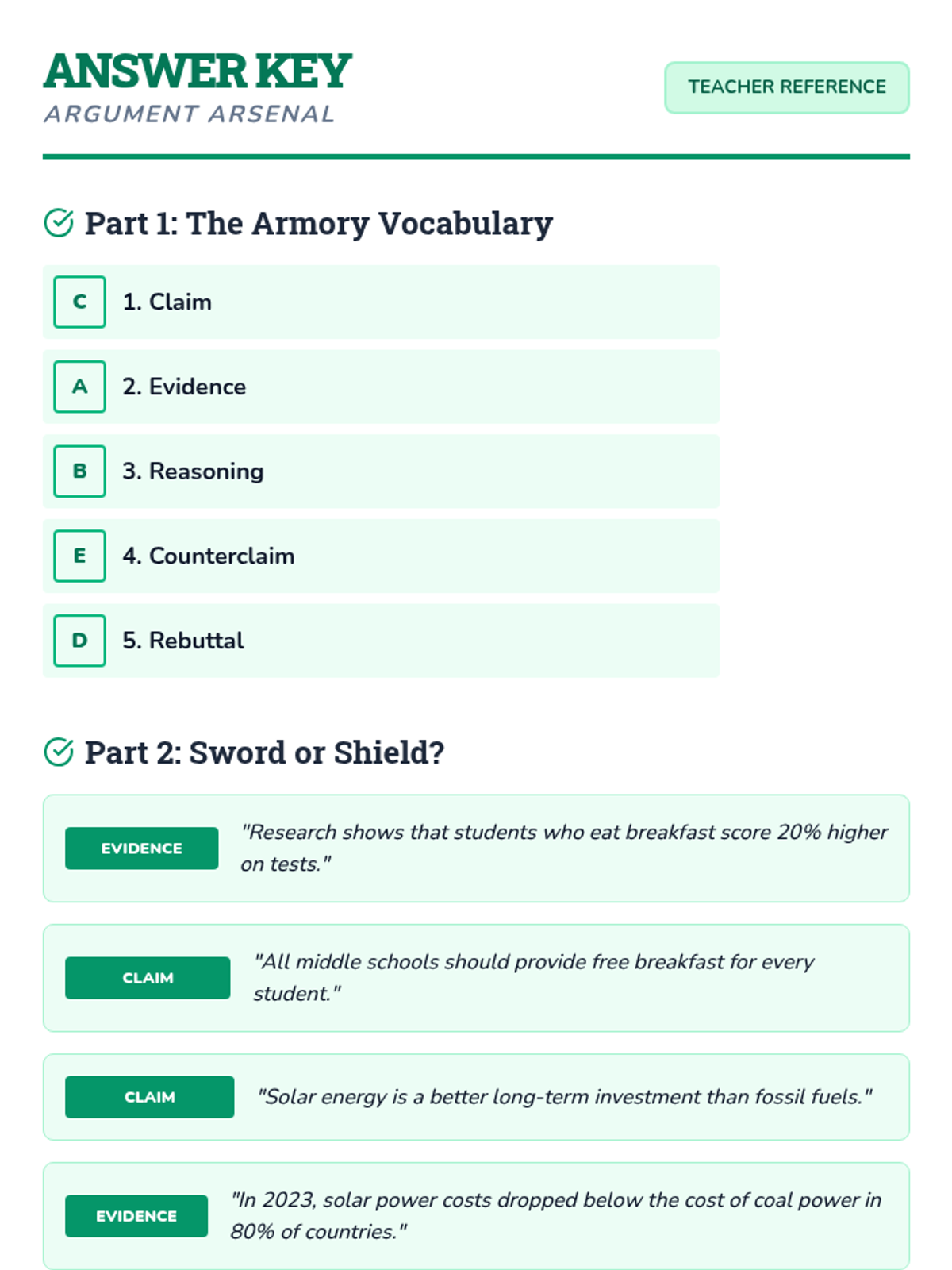
Teacher's answer key for the Argument Arsenal worksheet, including correct vocabulary matches and example evidence responses.
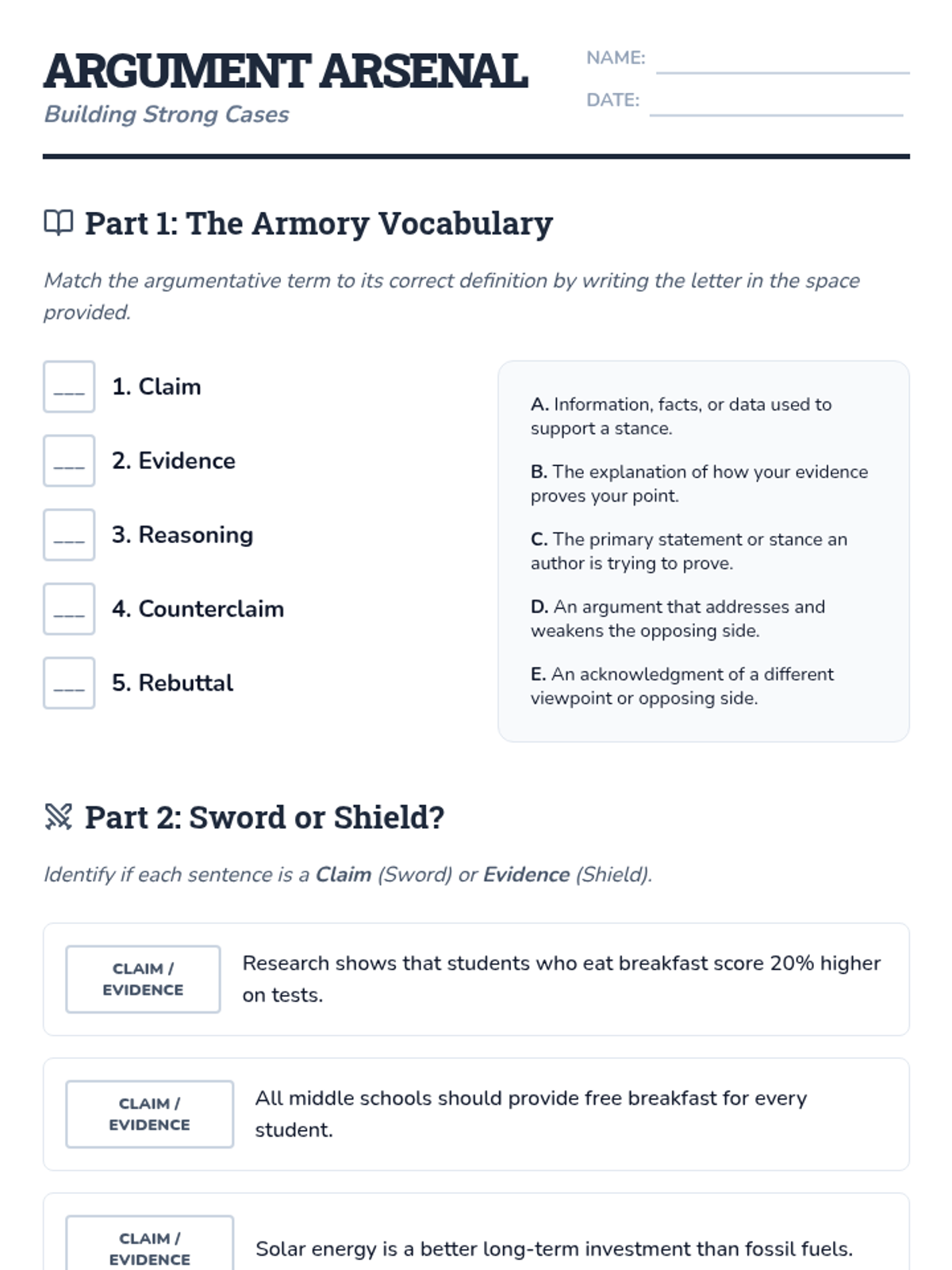
A vocabulary-focused worksheet on argumentative claims and evidence, featuring matching and sentence identification exercises. Revised for better page flow and contrast.
Instructional slides for the "Argument Arsenal" lesson, defining claim, evidence, and reasoning with a medieval armory visual theme.
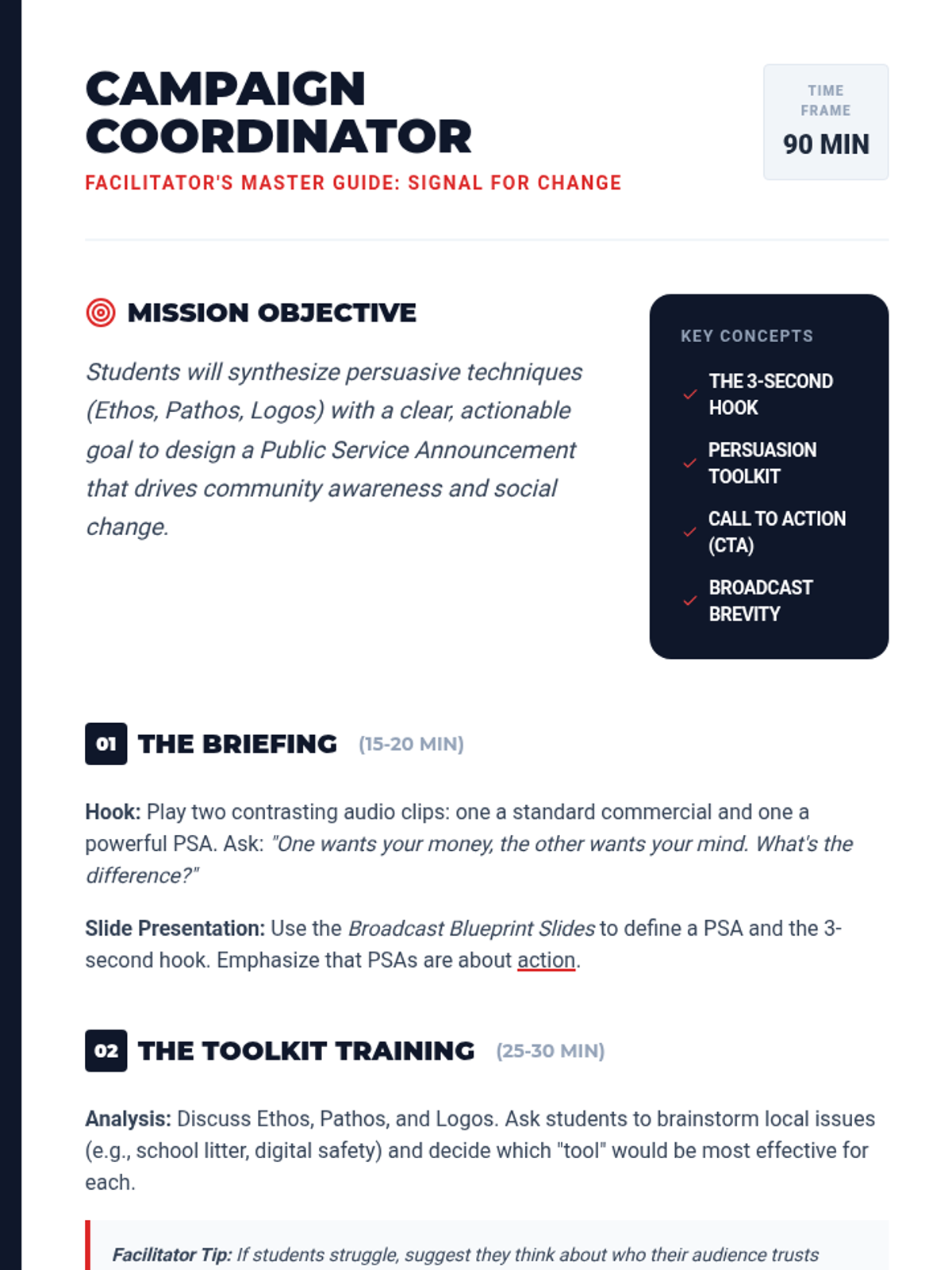
A comprehensive facilitator guide for teachers, providing a step-by-step lesson flow, discussion prompts, differentiation strategies, and extension activities for the PSA creation unit.
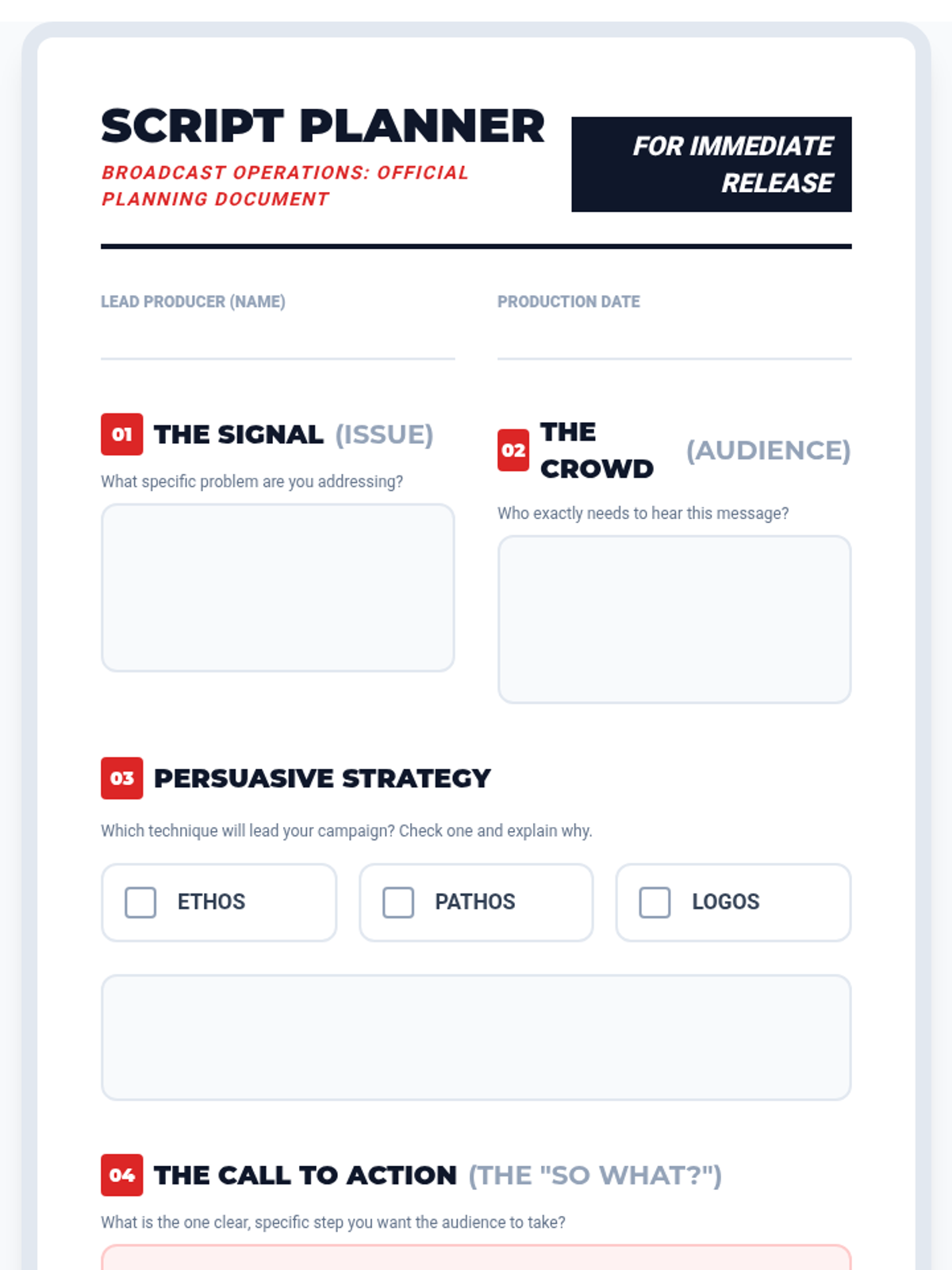
A structured script-planning worksheet for students to develop their PSA from initial concept through a timed script draft, featuring dedicated sections for the hook, core message, and call to action.
A dynamic visual presentation for introducing the core components of a Public Service Announcement, including the 3-second hook, Ethos/Pathos/Logos, and crafting a powerful Call to Action.
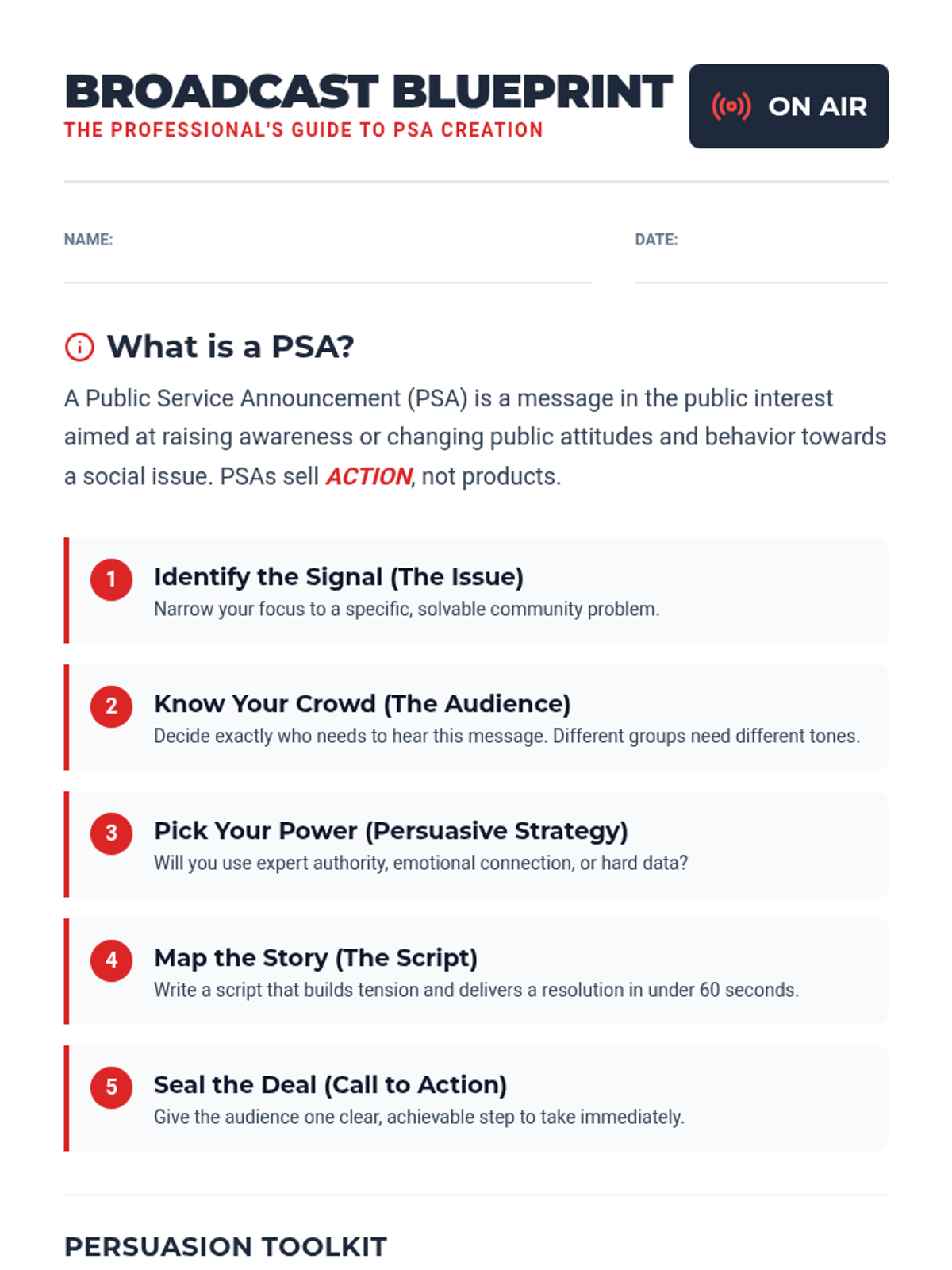
Updated instructional guide for students on creating Public Service Announcements, now featuring the full 5-step process, persuasion toolkit (Ethos, Pathos, Logos), and a production checklist.
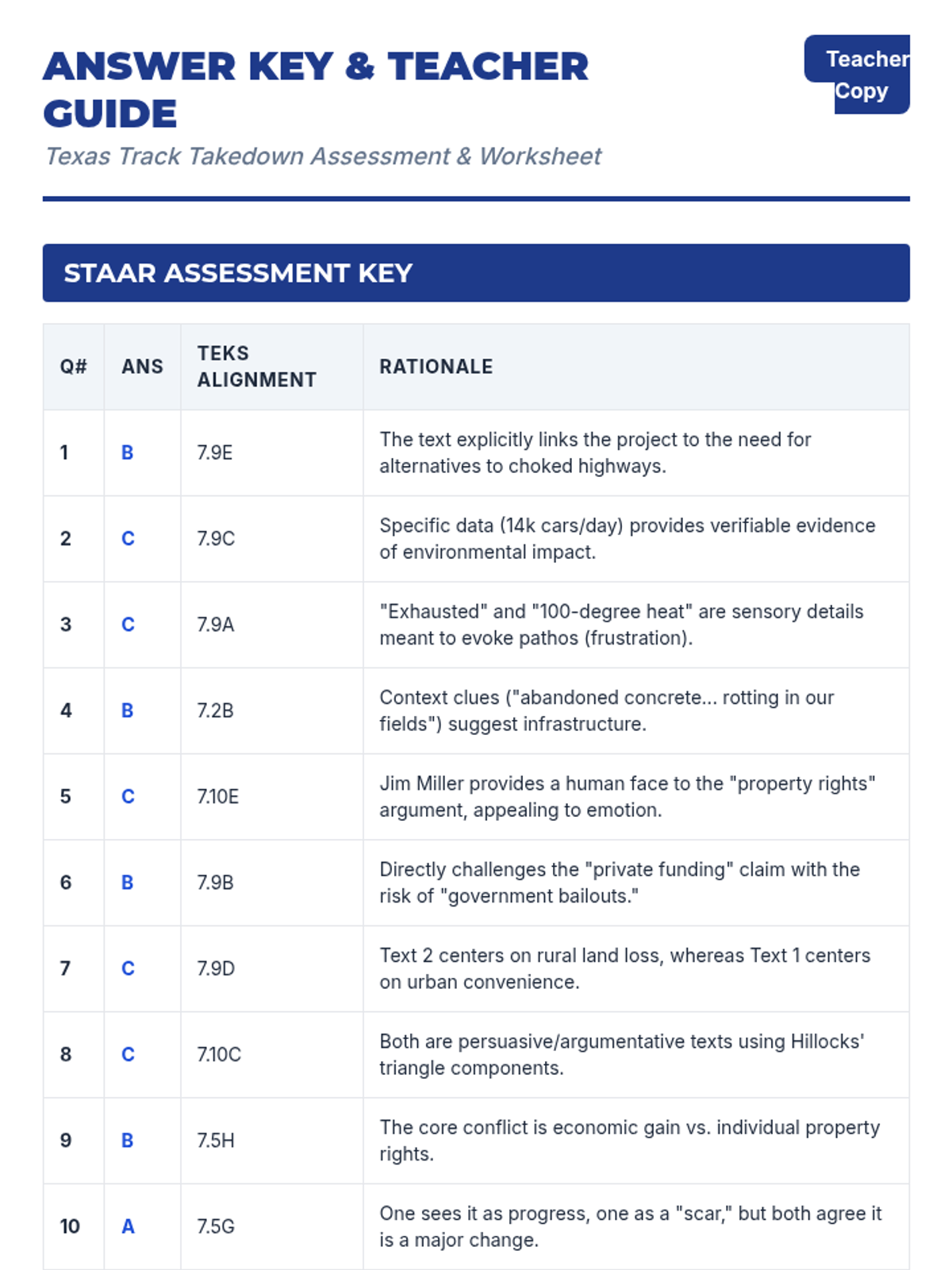
An answer key and teacher guide providing correct responses for the assessment, sample responses for the worksheet, and pedagogical tips for facilitating the lesson.
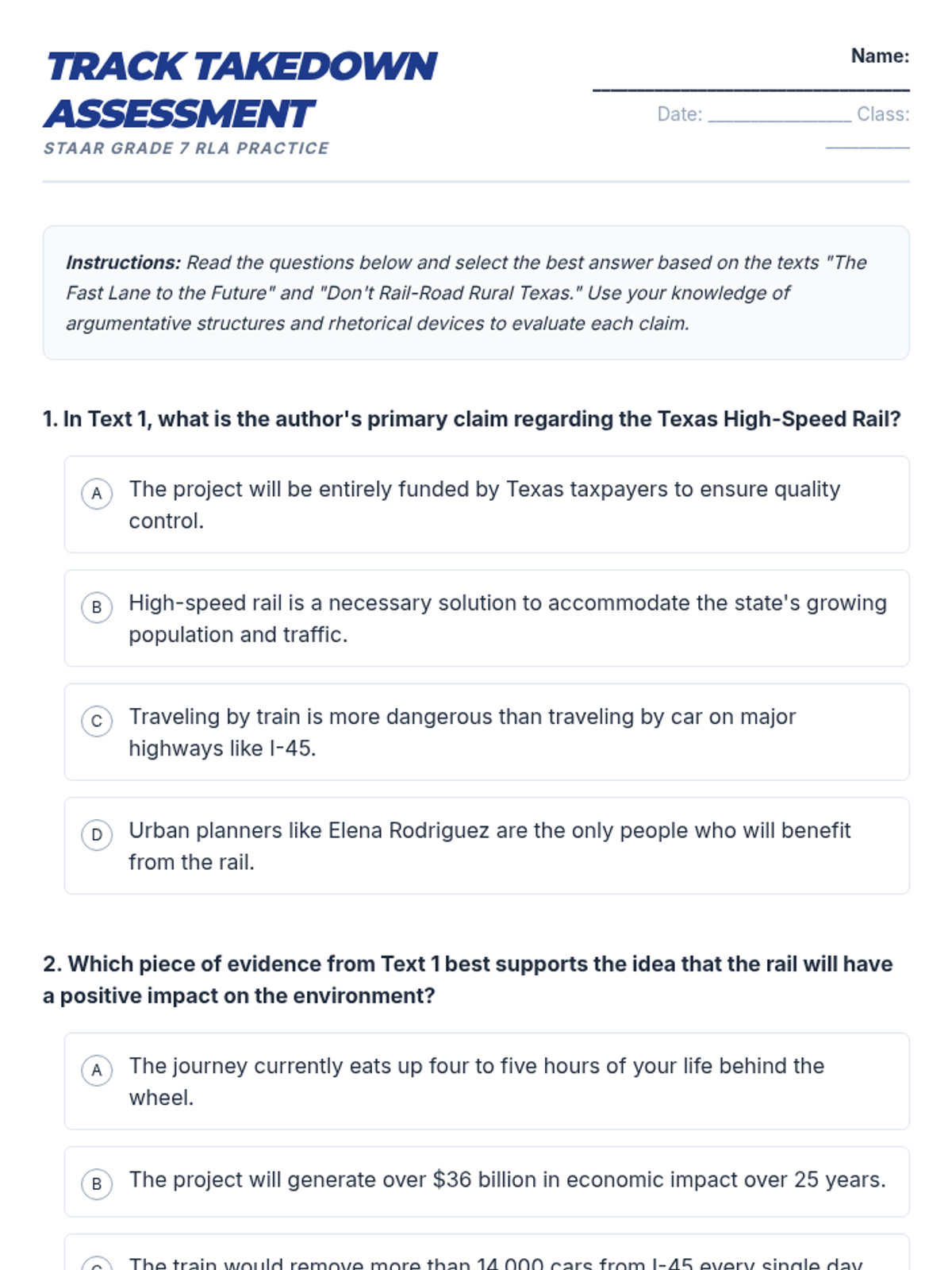
A 10-question STAAR-format assessment focusing on the analysis of paired argumentative and informational texts about the Texas high-speed rail debate.
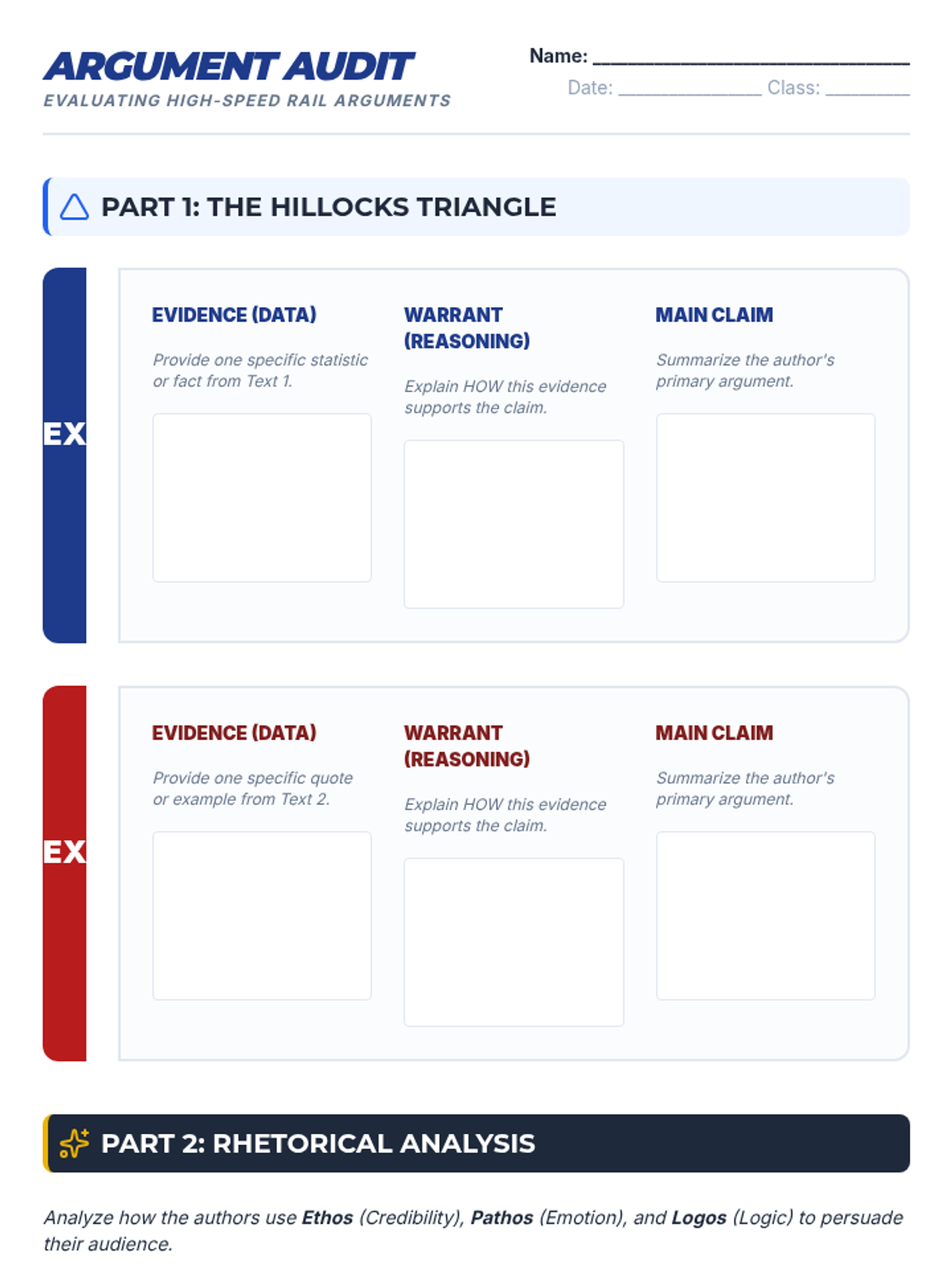
A student worksheet for analyzing the claims, evidence, warrants, and rhetorical appeals in the Texas high-speed rail texts using the Hillocks method.
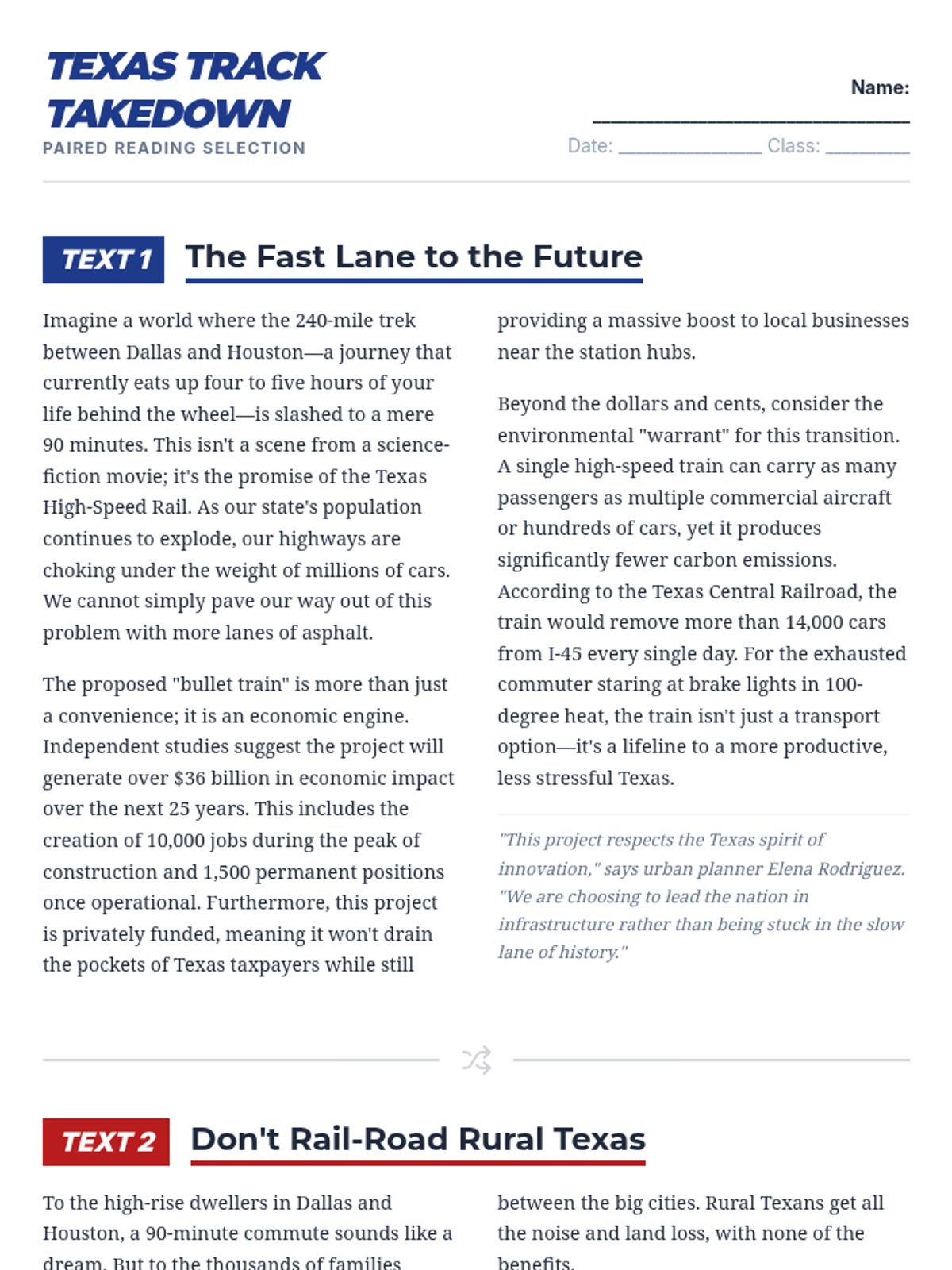
Two paired informational texts presenting opposing viewpoints on the Texas high-speed rail debate. Text 1 focuses on economic and environmental benefits, while Text 2 highlights property rights and the impact on rural communities.
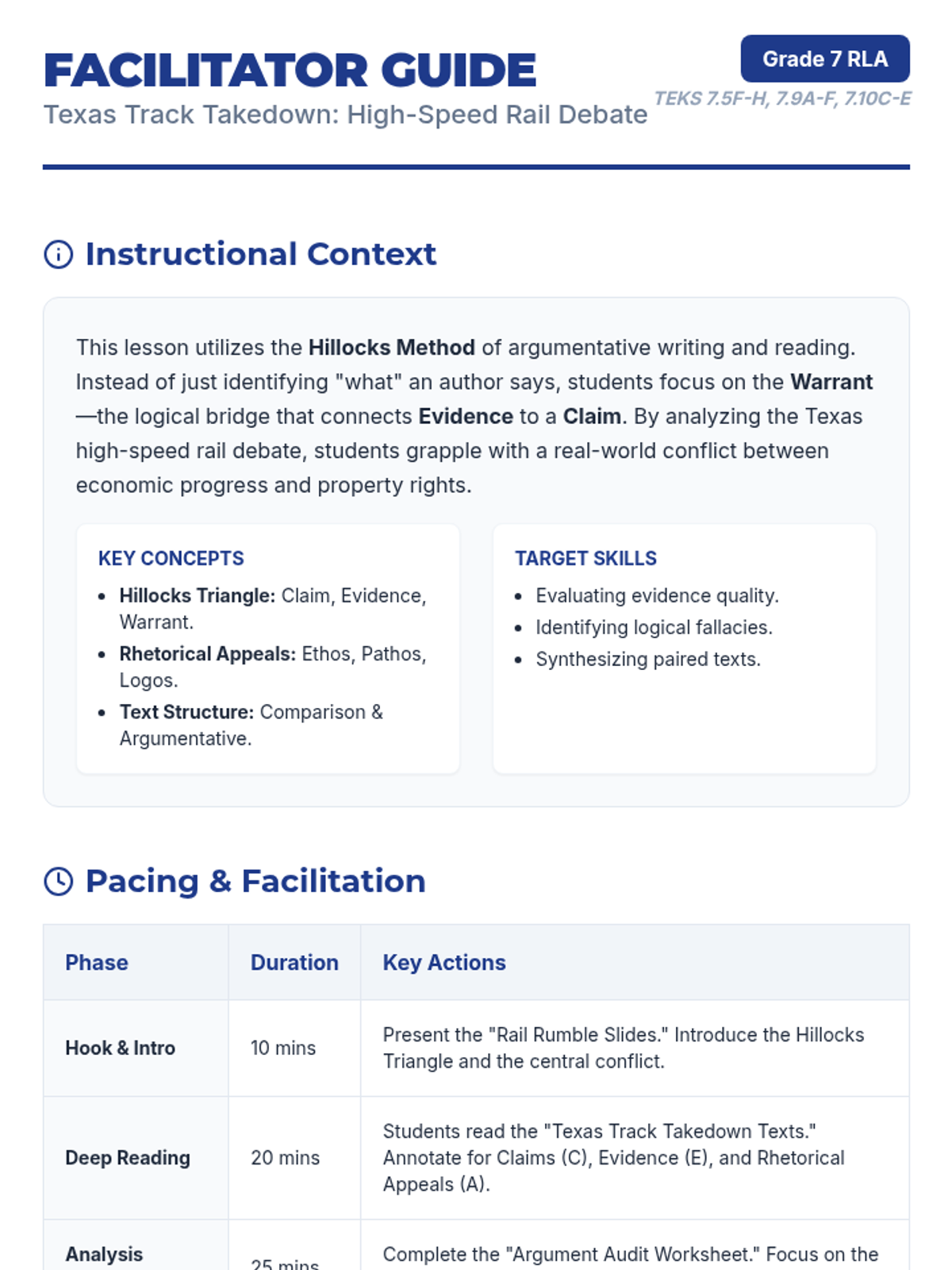
A comprehensive teacher resource for facilitating the Texas high-speed rail debate lesson. Includes instructional context on the Hillocks method, pacing guides, Socratic seminar protocols, and differentiation strategies.
A presentation introducing Hillocks' argument triangle (Evidence, Warrant, Claim) and rhetorical devices (Ethos, Pathos, Logos) through the lens of the Texas high-speed rail debate.
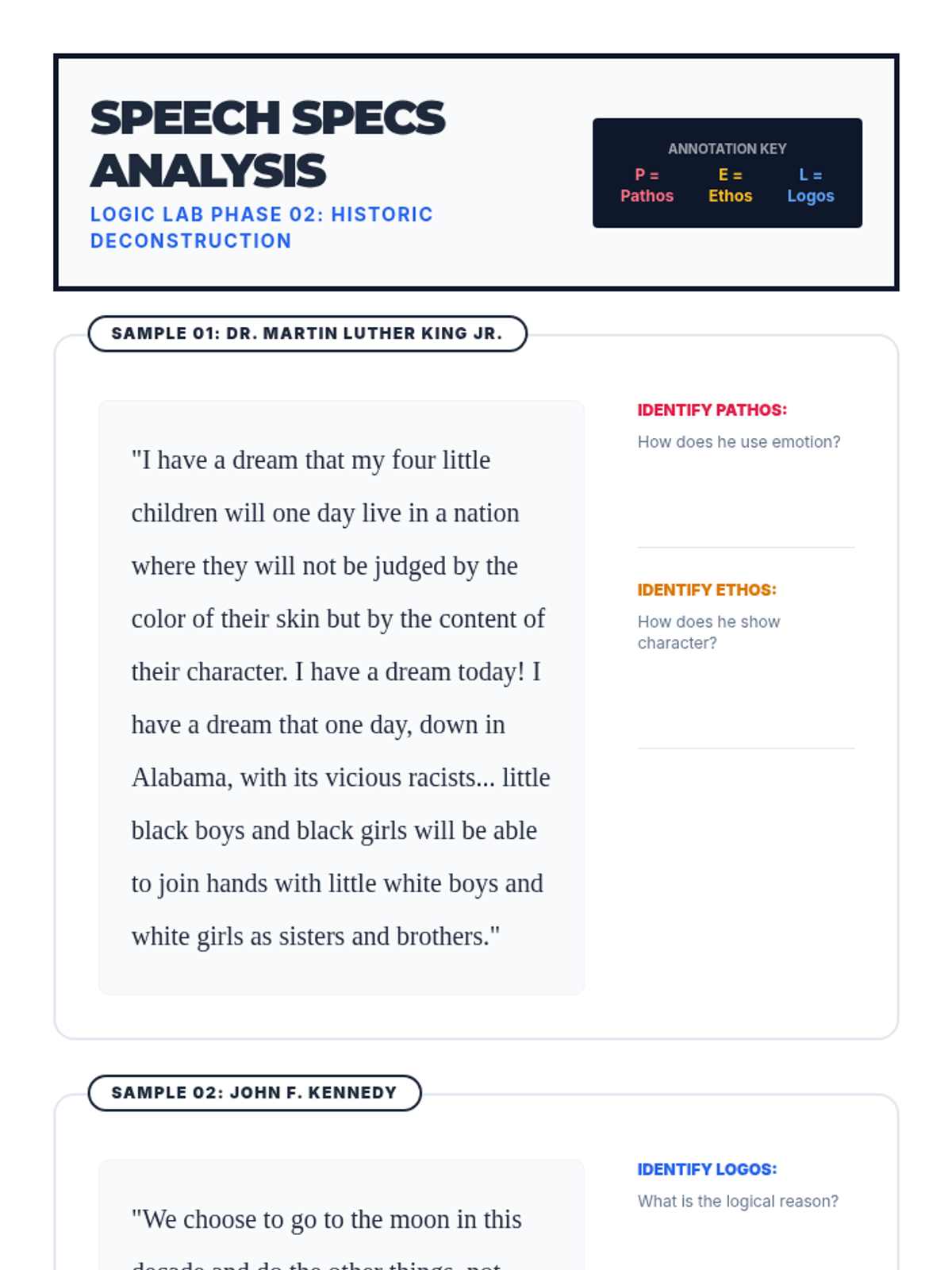
A student annotation guide featuring excerpts from historic speeches by Dr. Martin Luther King Jr. and John F. Kennedy. Designed for students to identify and analyze rhetorical appeals in a real-world, high-impact context.
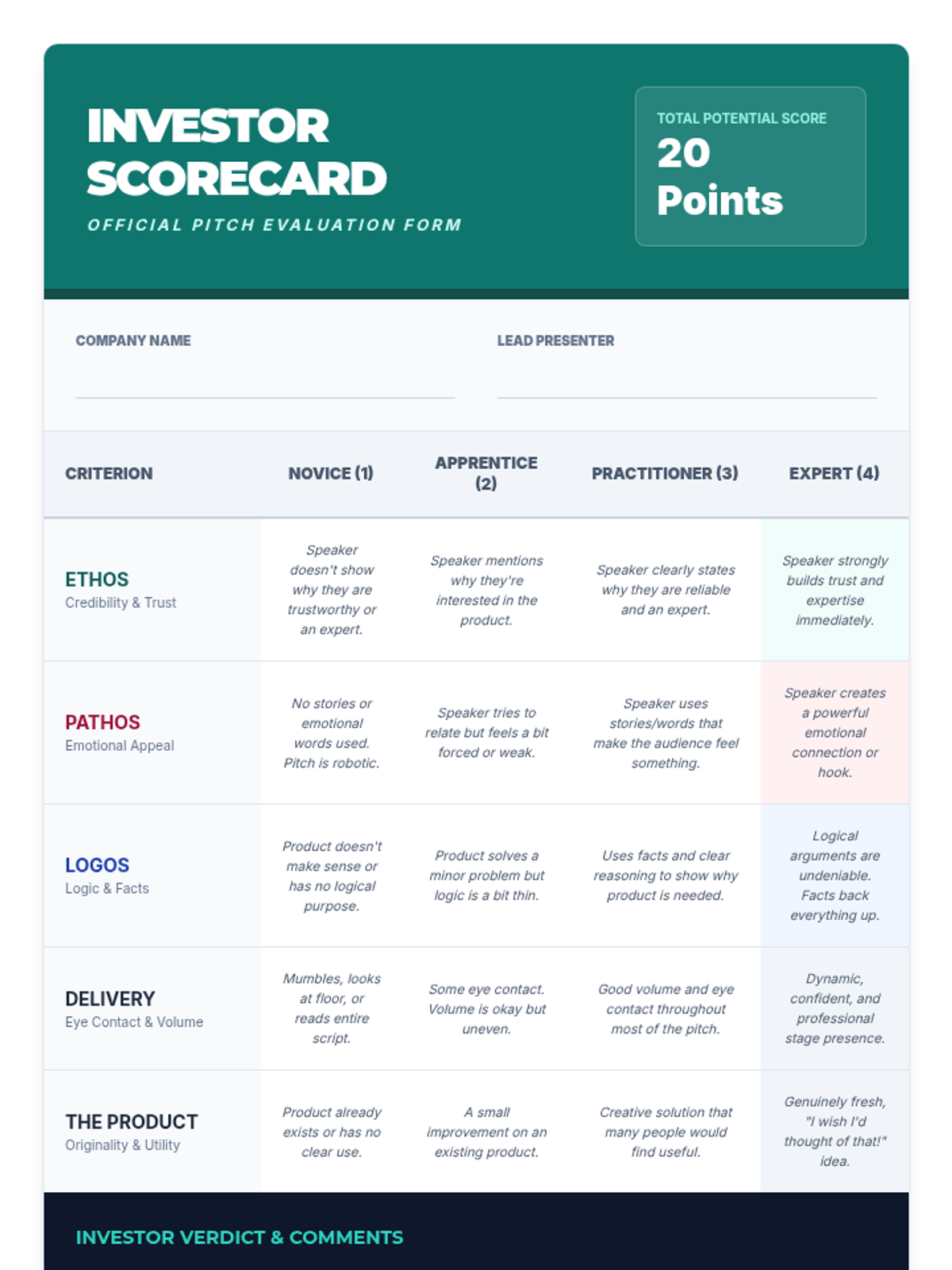
An evaluation rubric for both teachers and peer 'investors' to assess student pitches across rhetorical devices, delivery, and product originality.
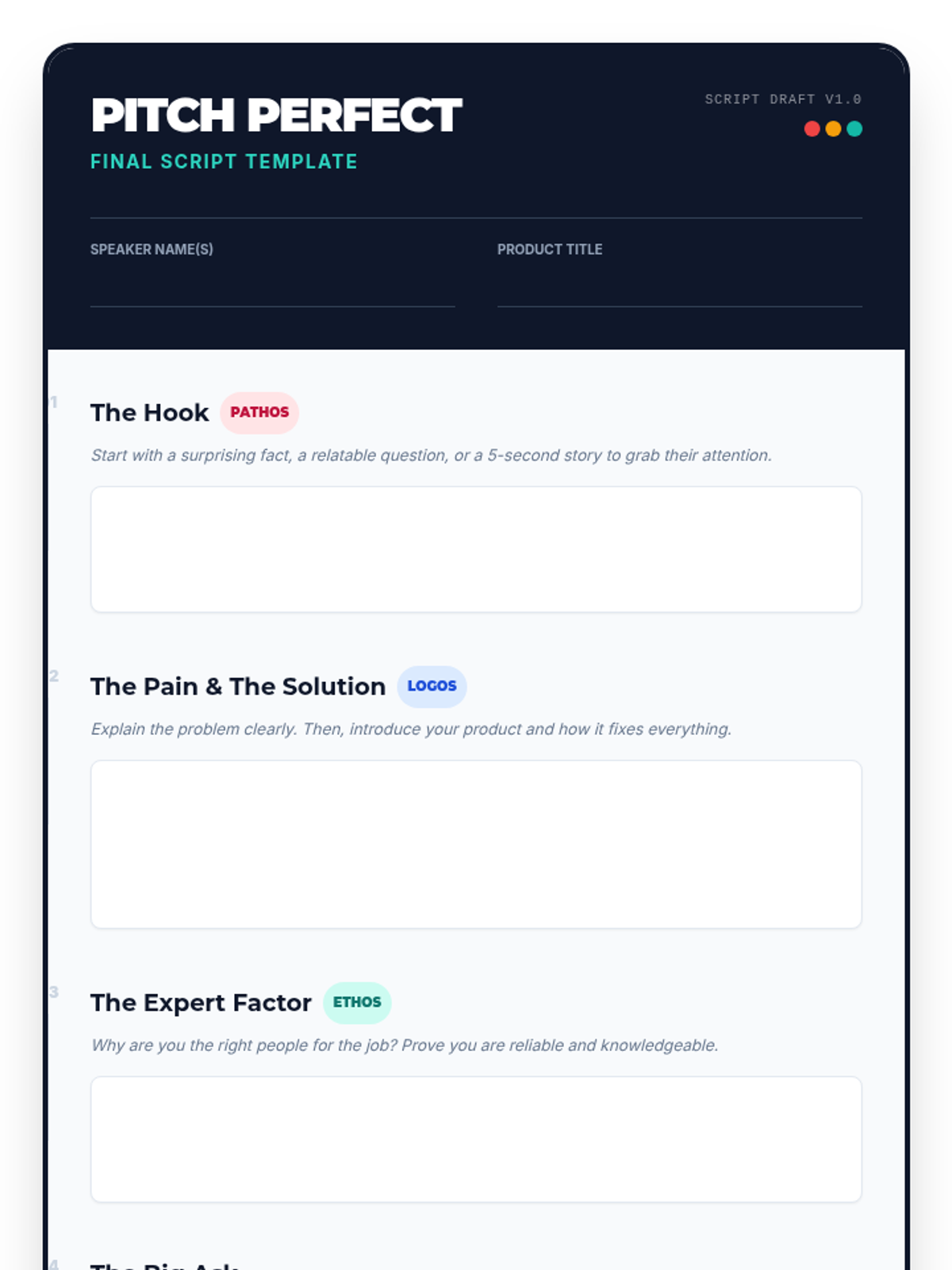
A structured script template for students to organize their 2-minute pitch, with specific sections for the hook, the problem/solution, ethos building, and the final ask.
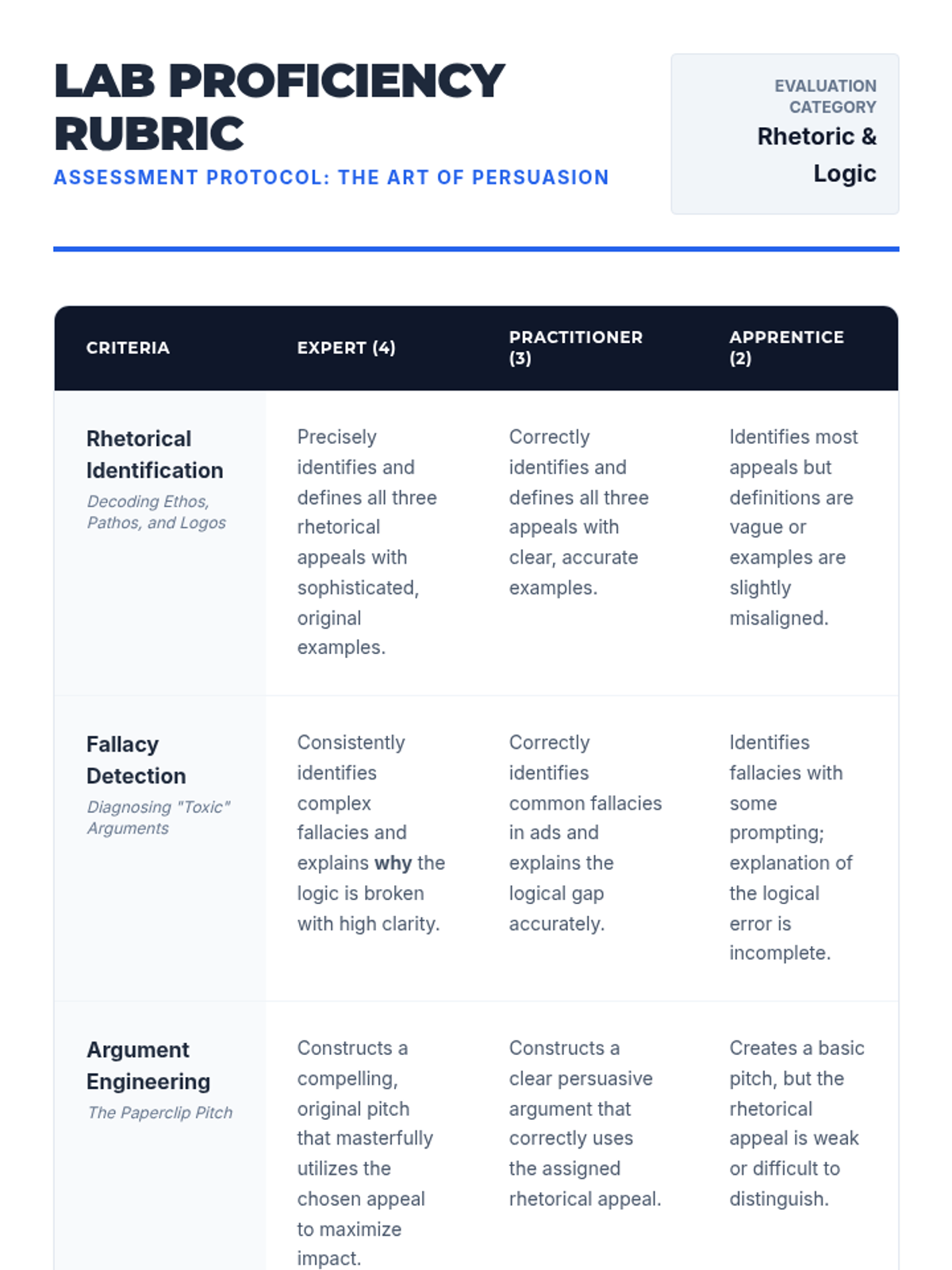
A proficiency rubric for assessing student understanding of rhetorical appeals and logical fallacies. Evaluates identification accuracy, analytical depth, and persuasive writing skills through a 'Lab Technician' thematic lens.
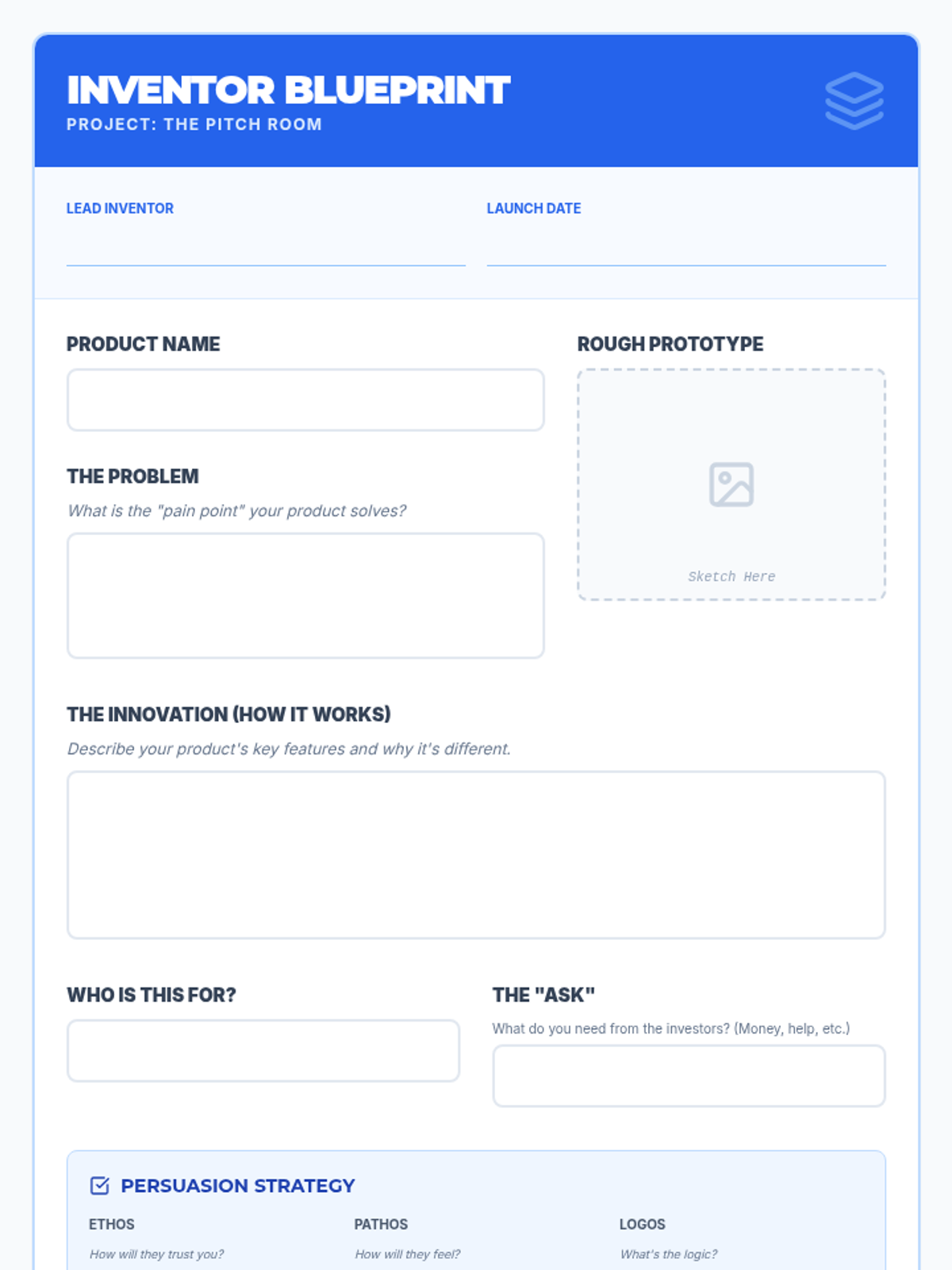
A planning worksheet for students to conceptualize their invention, define the problem it solves, identify their target audience, and outline their rhetorical strategy.
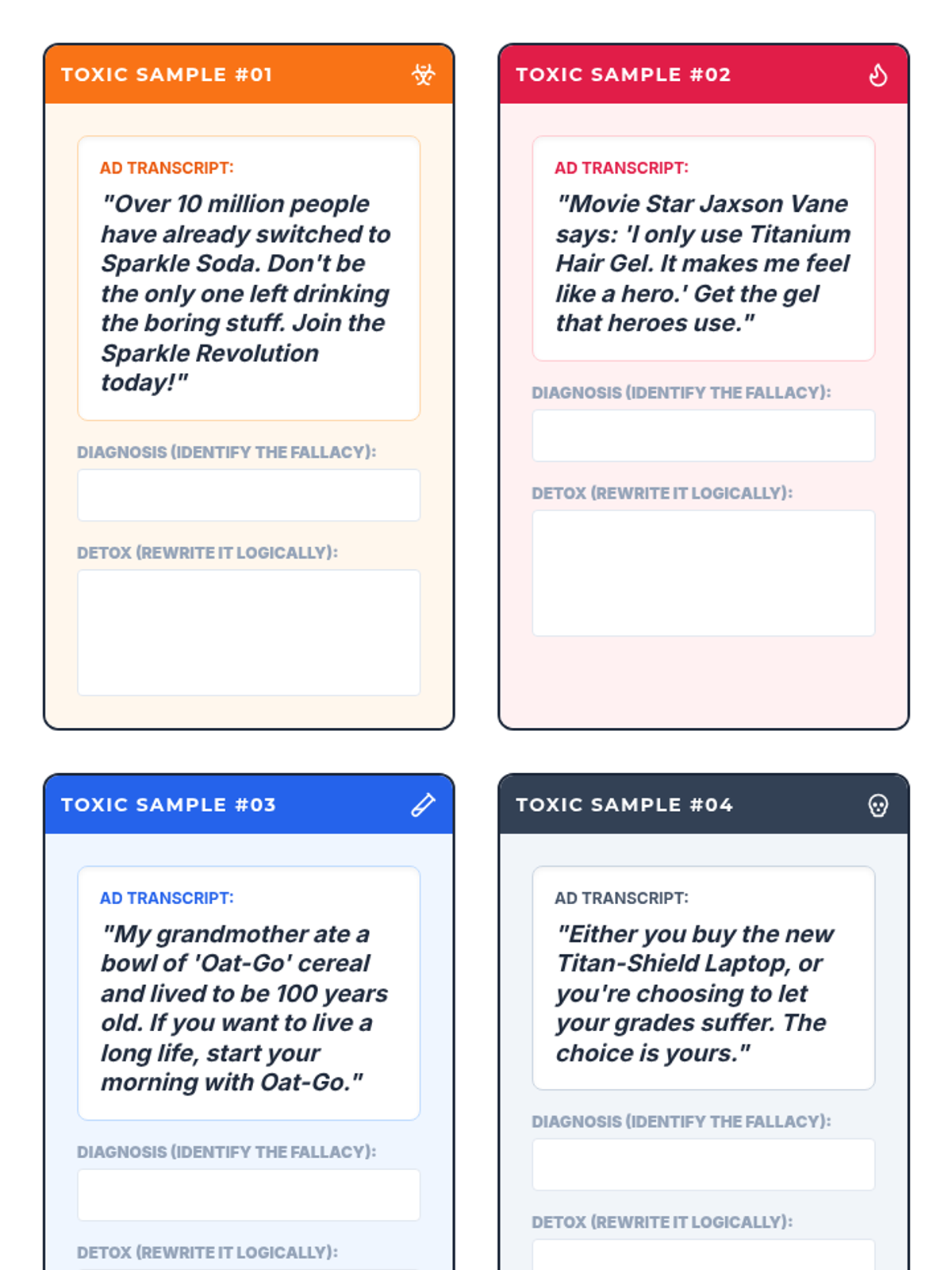
A set of activity cards for students to identify logical fallacies in 'toxic' advertisement samples and rewrite them to be logically sound. Includes a teacher answer key with detoxification paths.
A visual presentation deck designed to introduce students to the 'Big Three' rhetorical devices (Ethos, Pathos, and Logos) and the structure of a persuasive pitch.
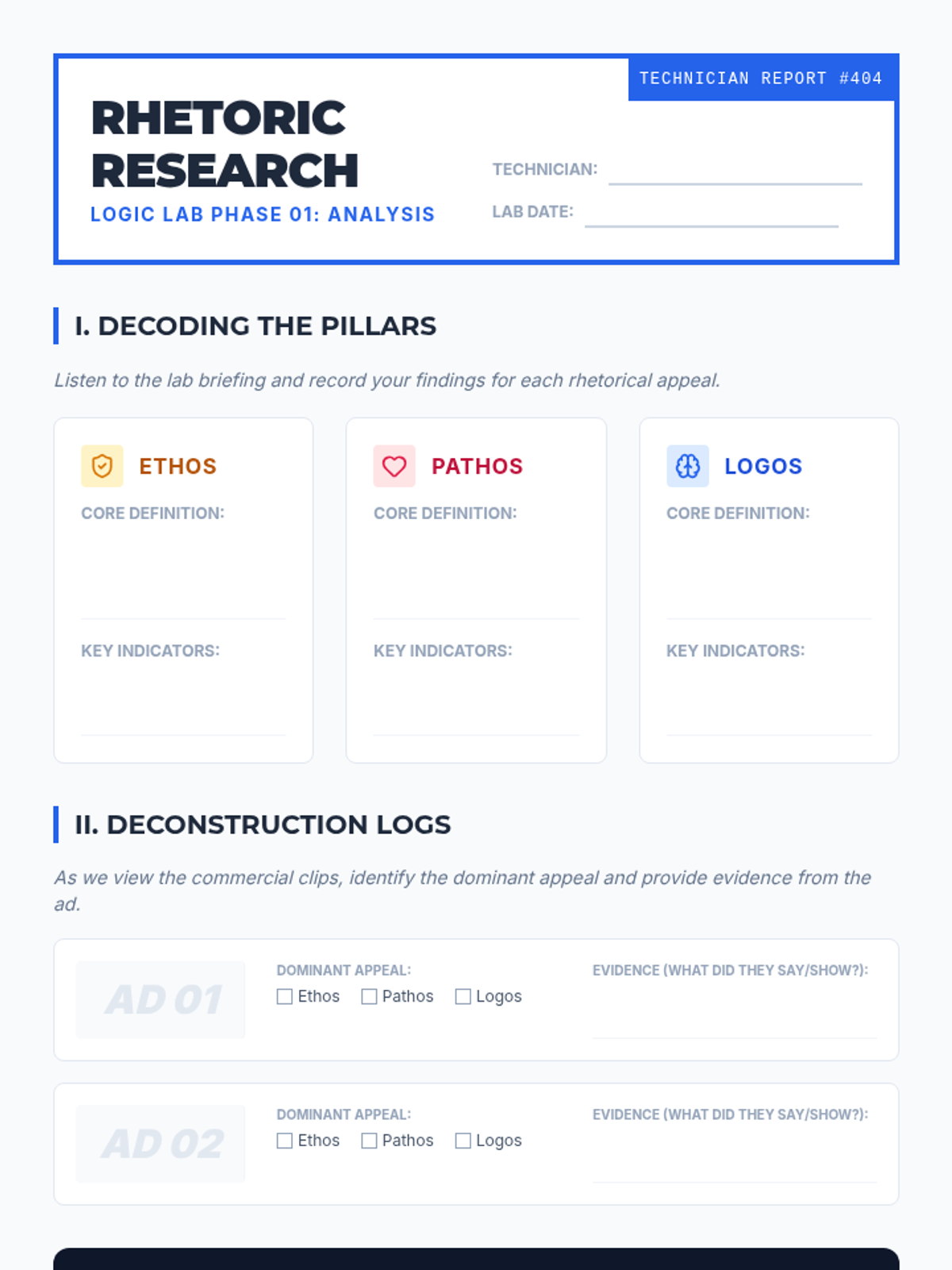
A student-facing worksheet for documenting definitions of Ethos, Pathos, and Logos during instruction and analyzing real-world advertisements. Includes a creative work area for the final 'Paperclip Pitch' challenge.
A visually striking slide deck for presenting rhetorical appeals (Ethos, Pathos, Logos) and logical fallacies. Uses a 'Logic Lab' technical theme with high-contrast colors and clear definitions for middle school students.
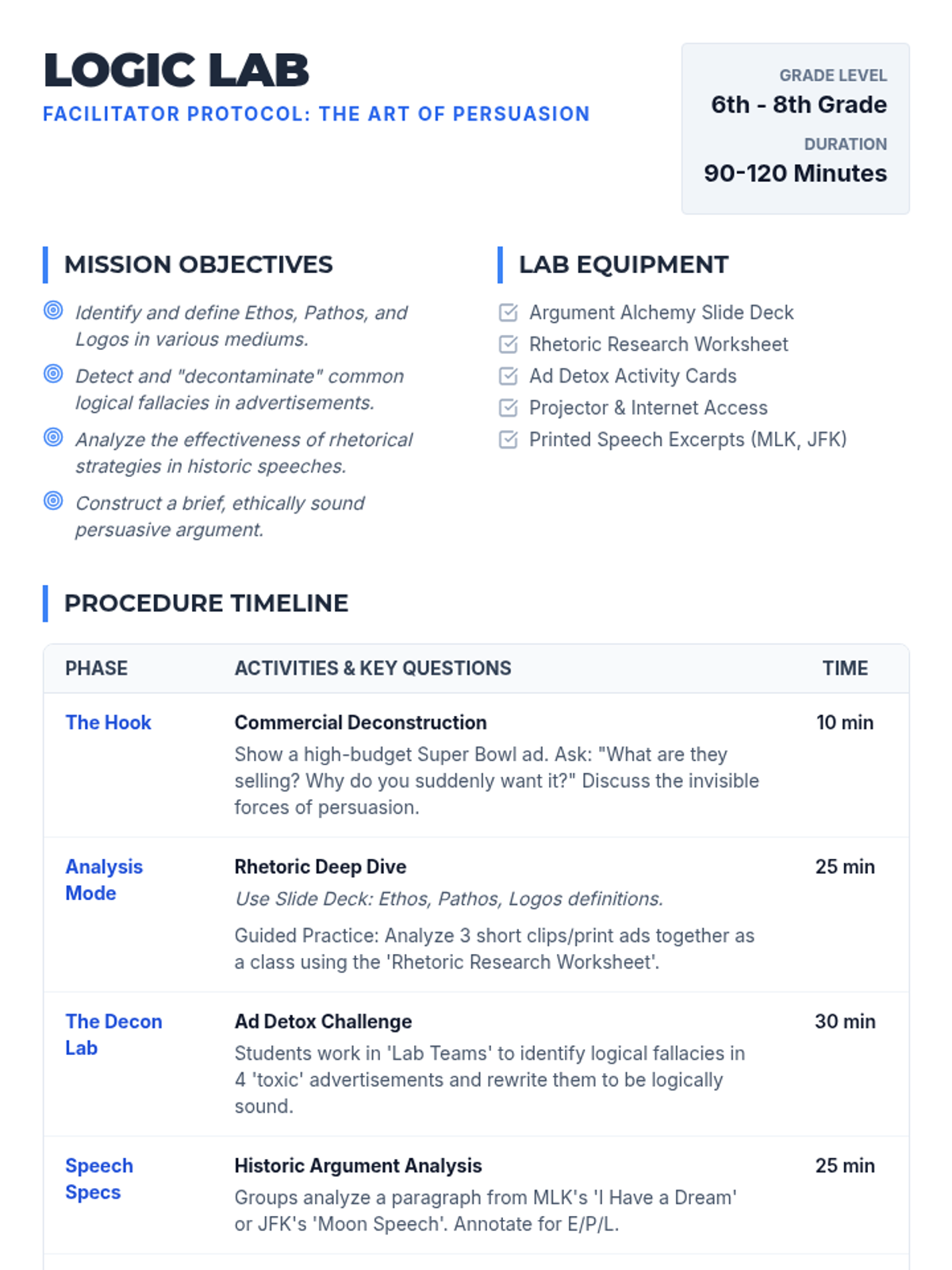
A comprehensive lesson plan for middle school teachers covering rhetorical appeals and logical fallacies. Includes a structured timeline, terminology, differentiation strategies, and discussion prompts.
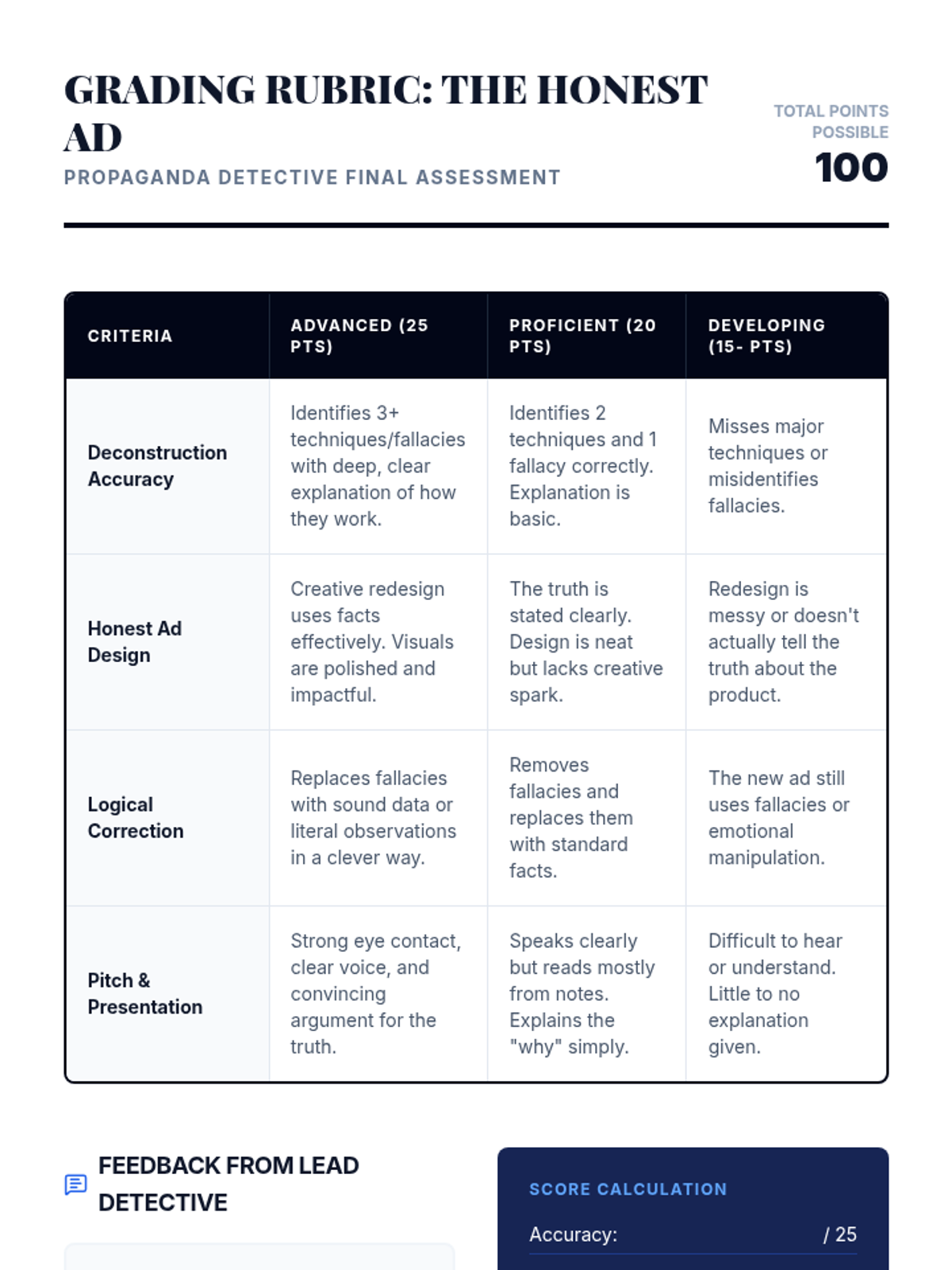
A grading rubric for the 'Honest Ad' final project, evaluating students on deconstruction accuracy, design, and logical reasoning.
A slide deck for Lesson 3 of the Hype Hunters sequence, introducing the 'Honest Ad' project and providing examples of how to deconstruct and redesign advertising.
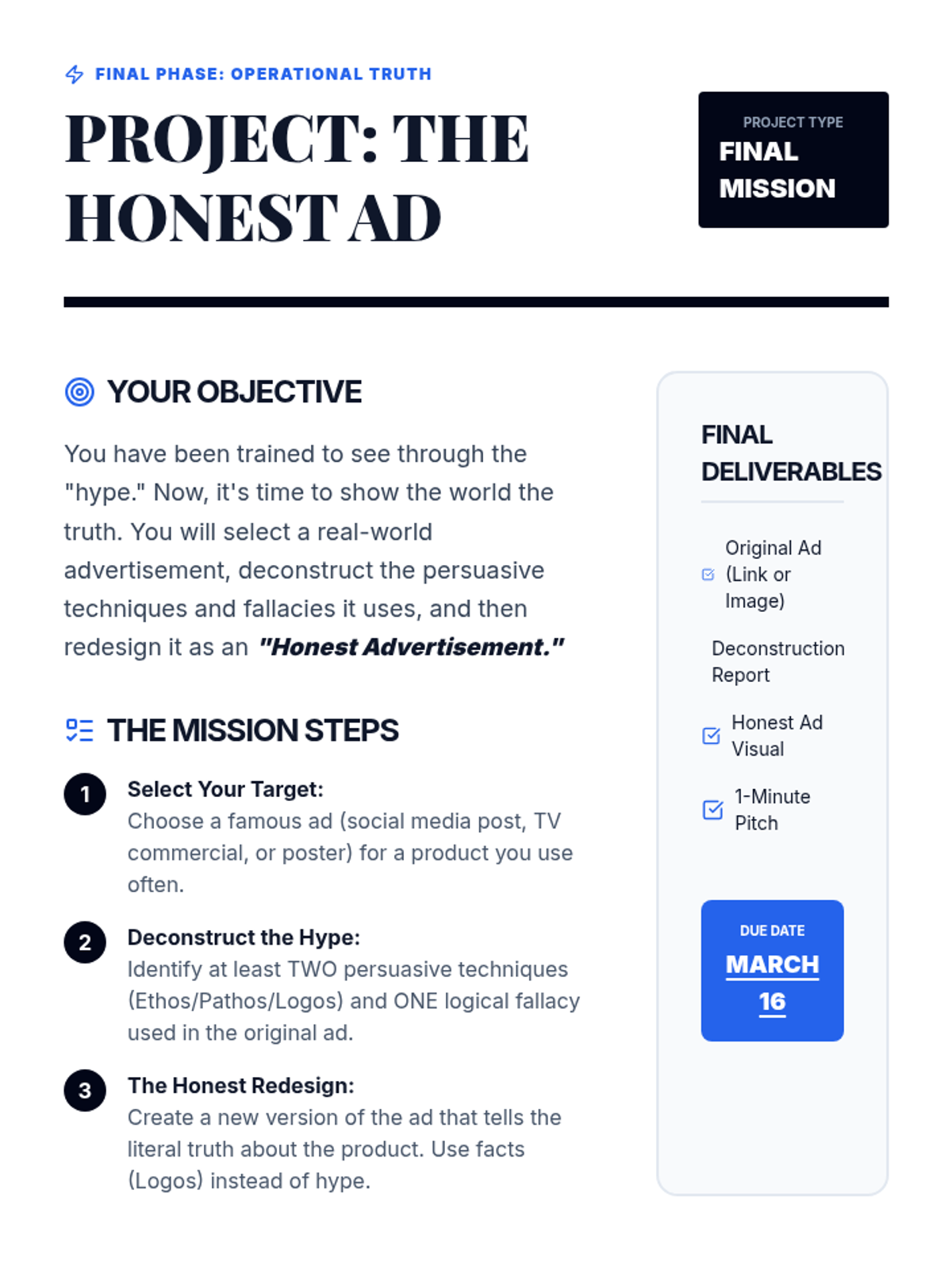
The project guide for 'The Honest Ad' final assignment, where students deconstruct a real ad and create a truthful redesign using media literacy skills.
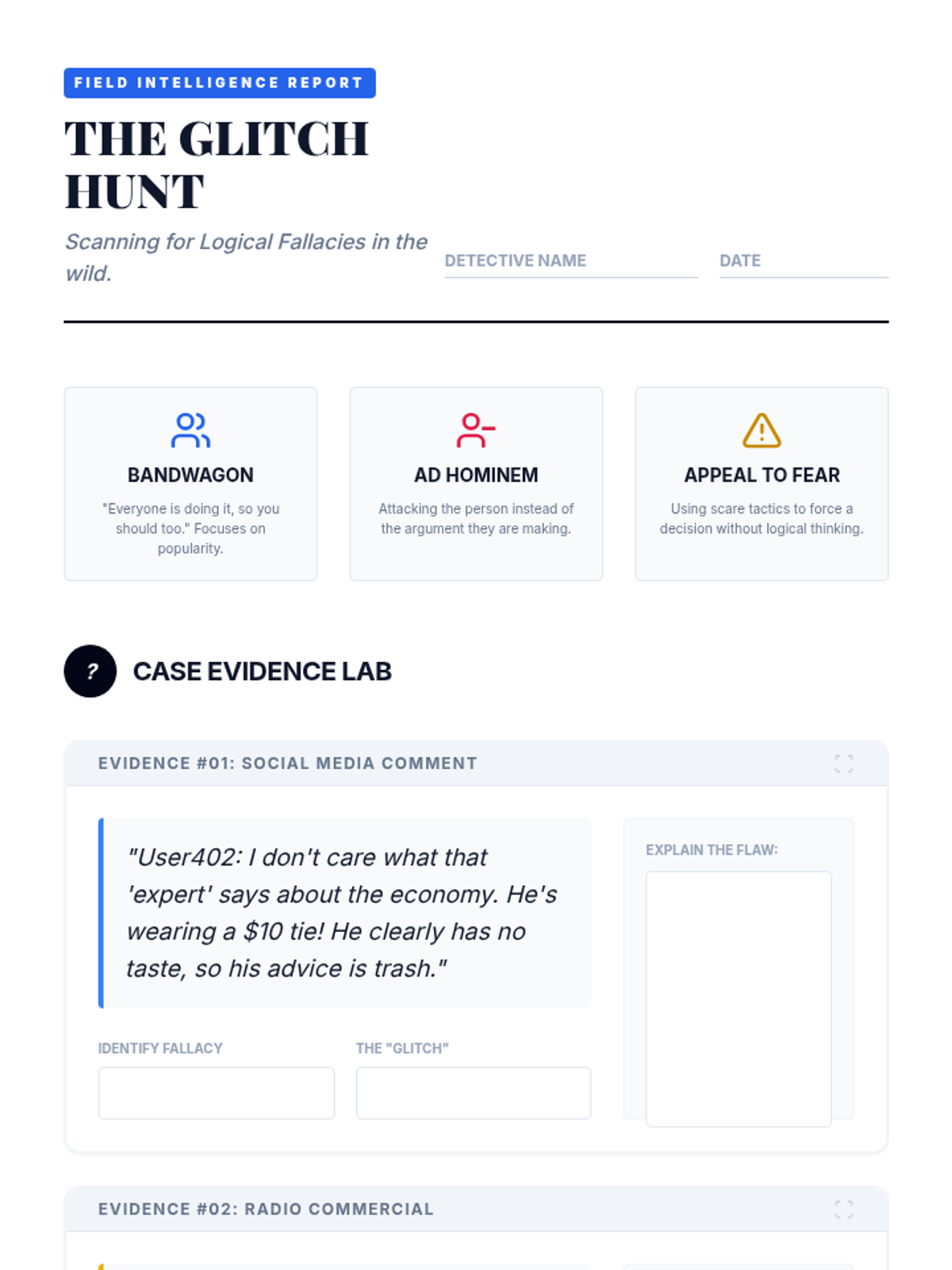
A worksheet for Lesson 2 of the Hype Hunters sequence where students analyze examples of logical fallacies and practice writing their own 'tricky' ads with logical corrections.
A slide deck for Lesson 2 of the Hype Hunters sequence, focusing on identifying common logical fallacies like Bandwagon, Ad Hominem, and Appeal to Fear.
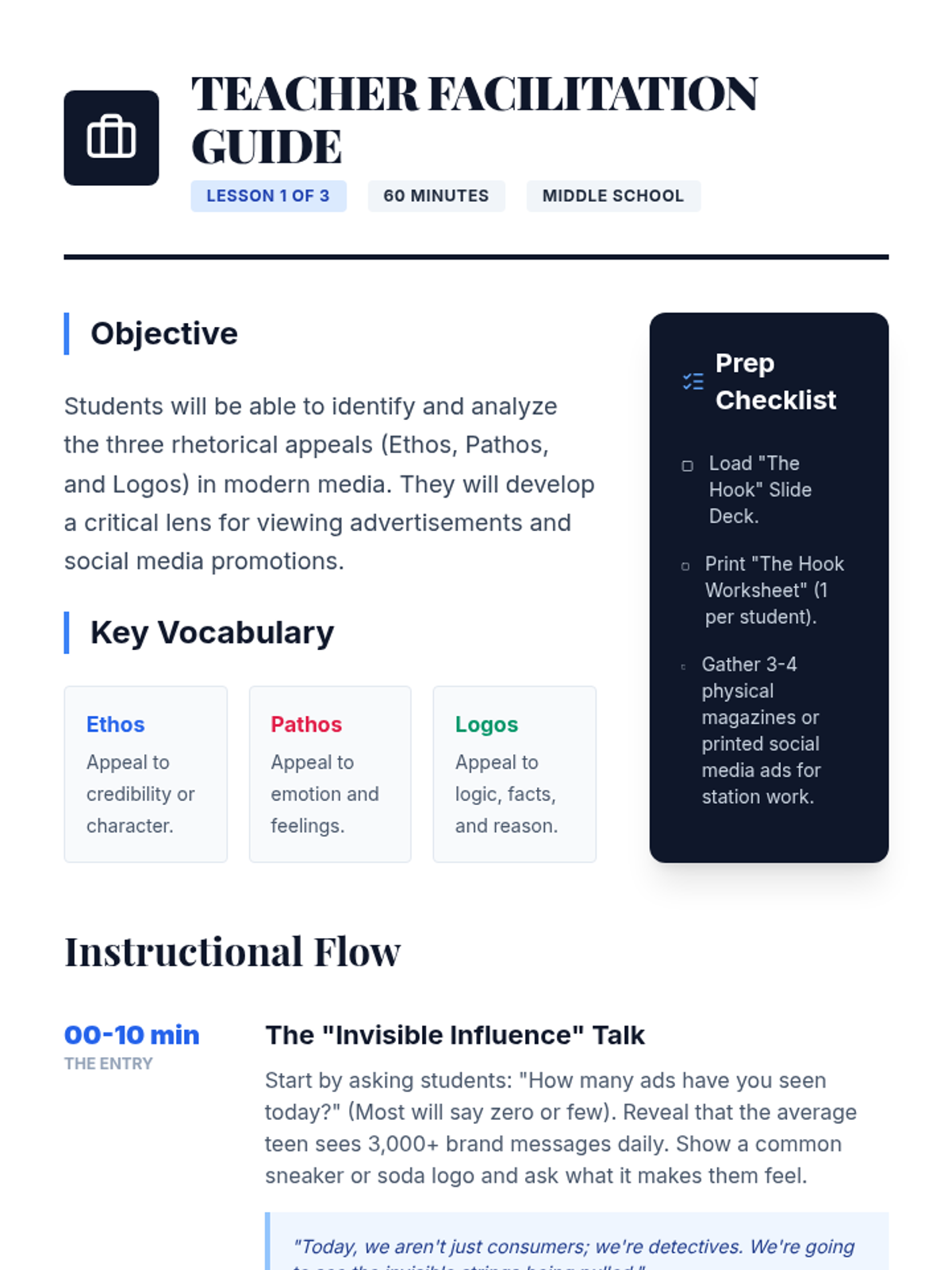
A comprehensive lesson plan for teachers for Lesson 1 of the Hype Hunters sequence, including learning objectives, pacing, and discussion prompts.
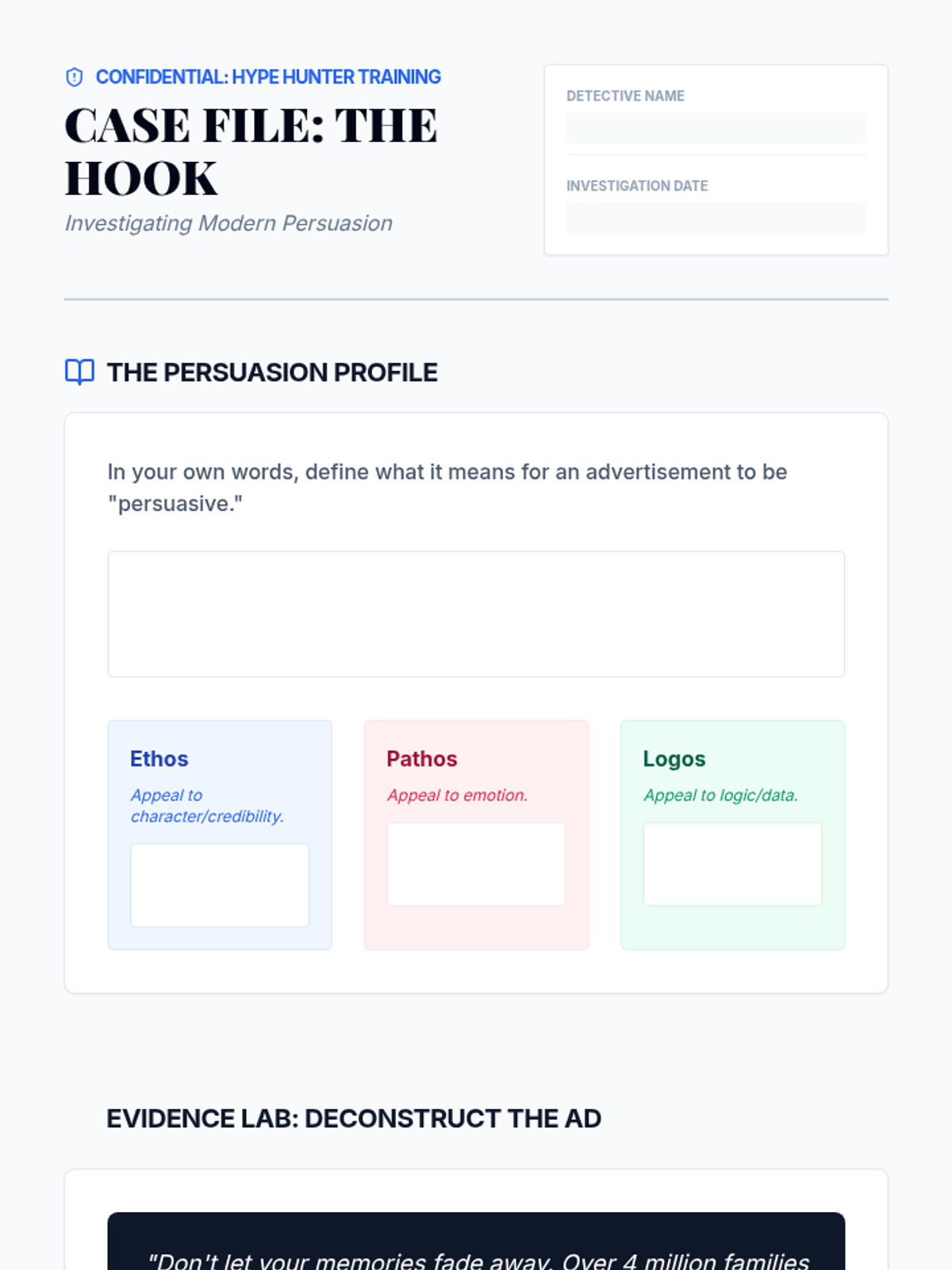
A worksheet for Lesson 1 of the Hype Hunters sequence where students practice identifying and deconstructing persuasive techniques in a sample advertisement.
An introductory slide deck for Lesson 1 of the Hype Hunters sequence, defining persuasion and the three rhetorical appeals (Ethos, Pathos, Logos).
An engaging slide deck to introduce the hobby presentation project, explaining the difference between facts and opinions and providing structural tips.
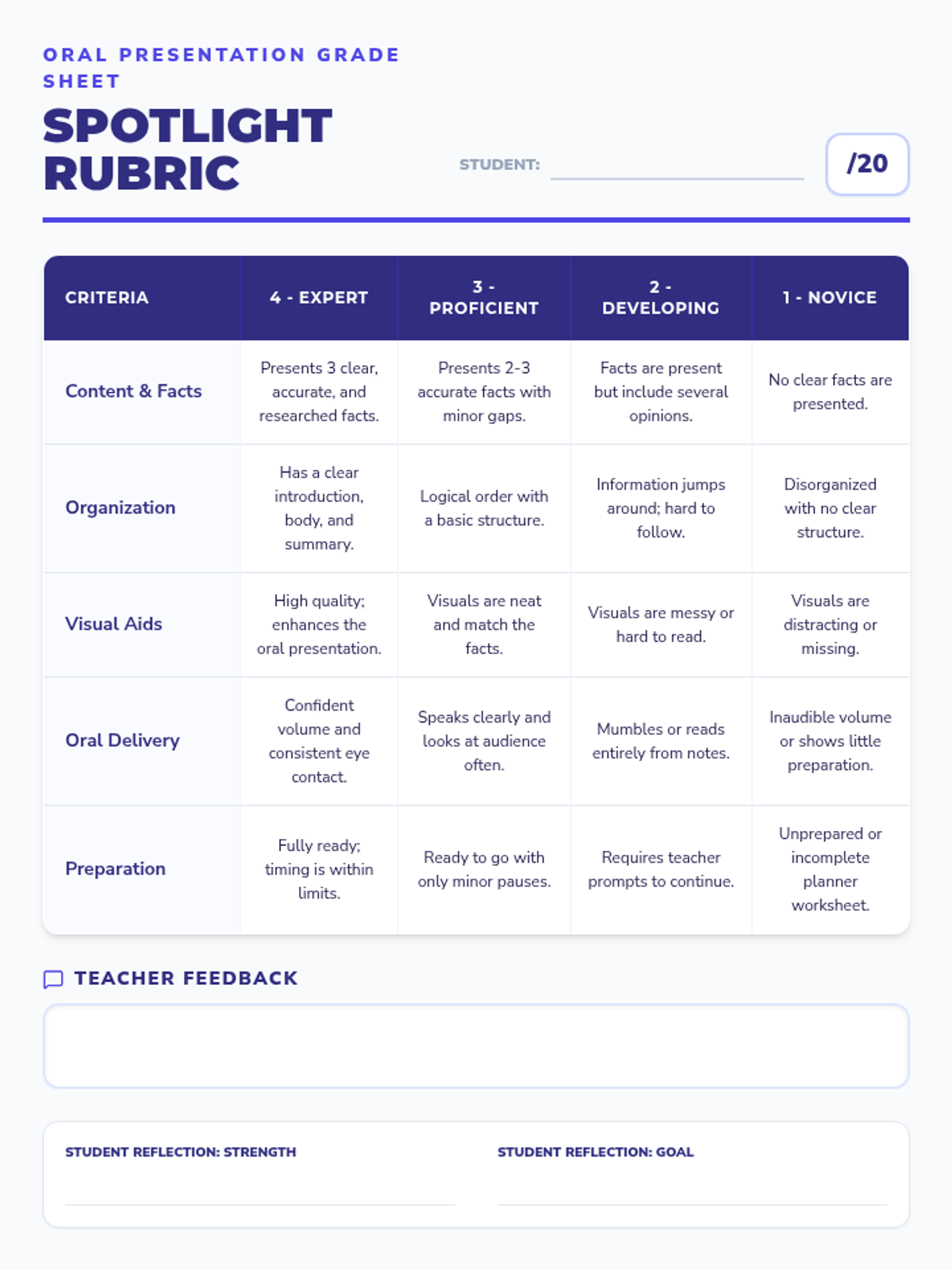
A comprehensive rubric for grading middle school oral presentations, covering content, organization, visuals, and delivery with a clear 4-point scale.
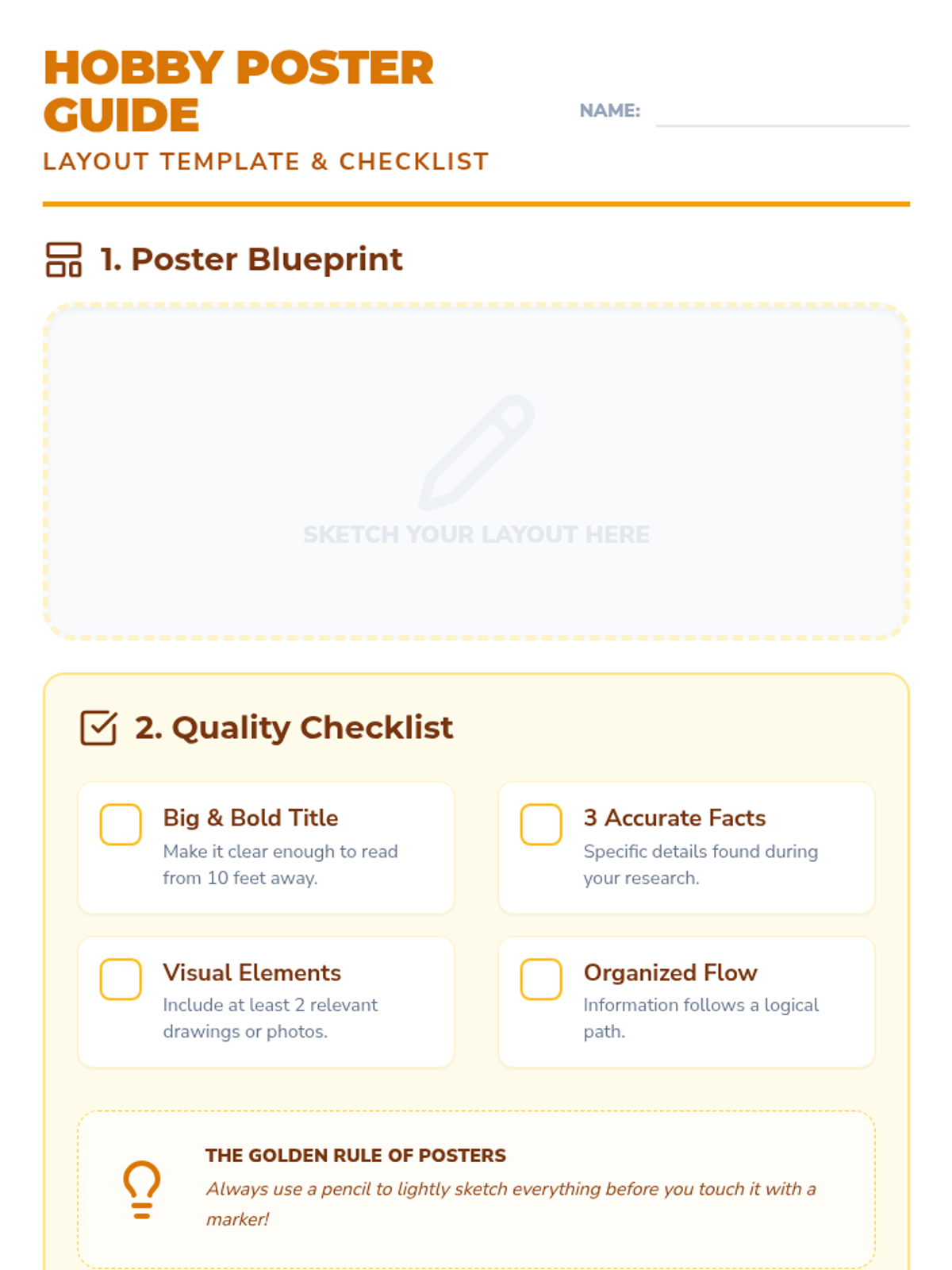
A design guide for students creating a physical poster, including a layout blueprint and a comprehensive quality checklist.
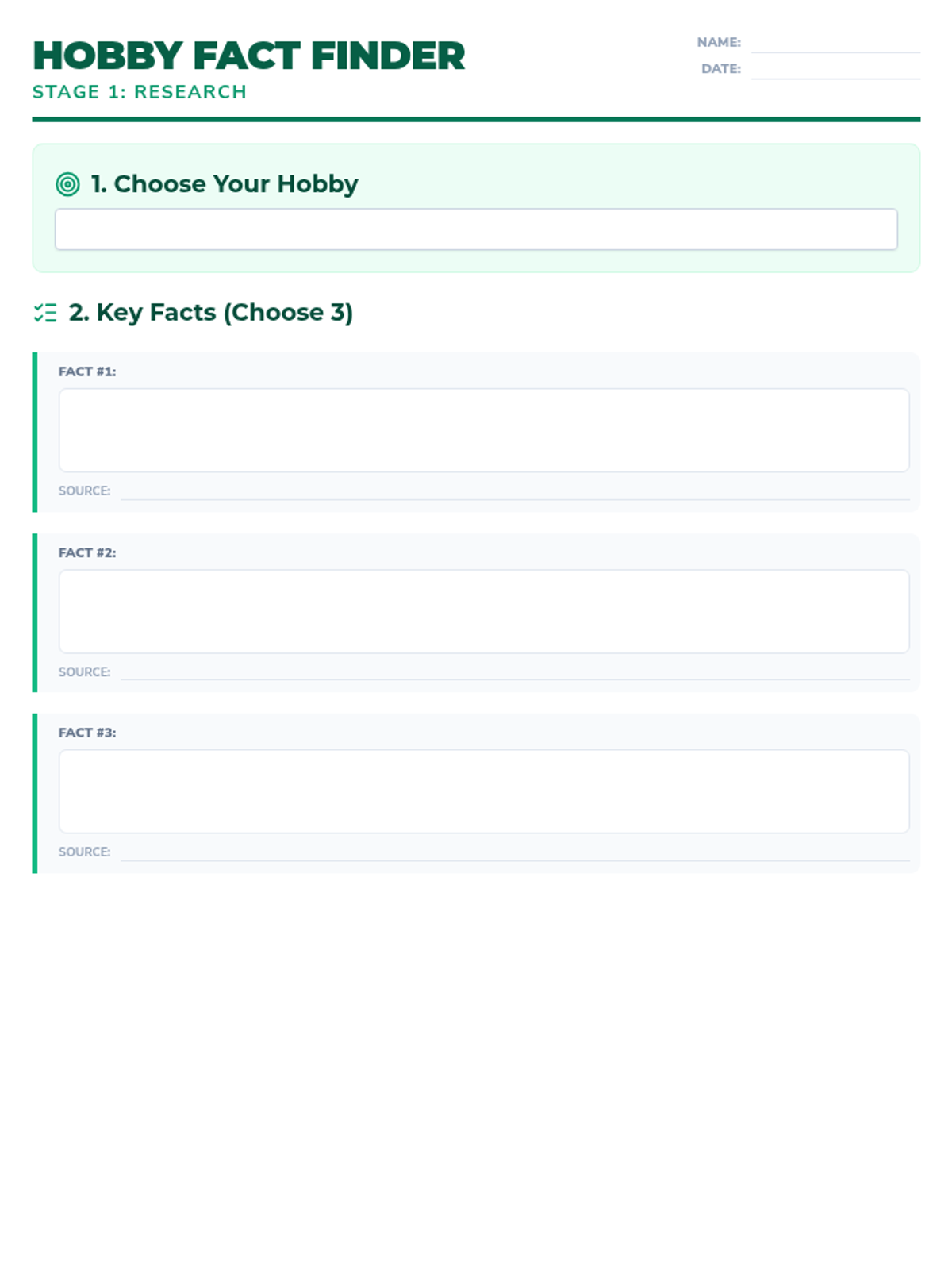
A planning worksheet for students to research facts about their chosen hobby and outline their presentation slide deck or poster structure.
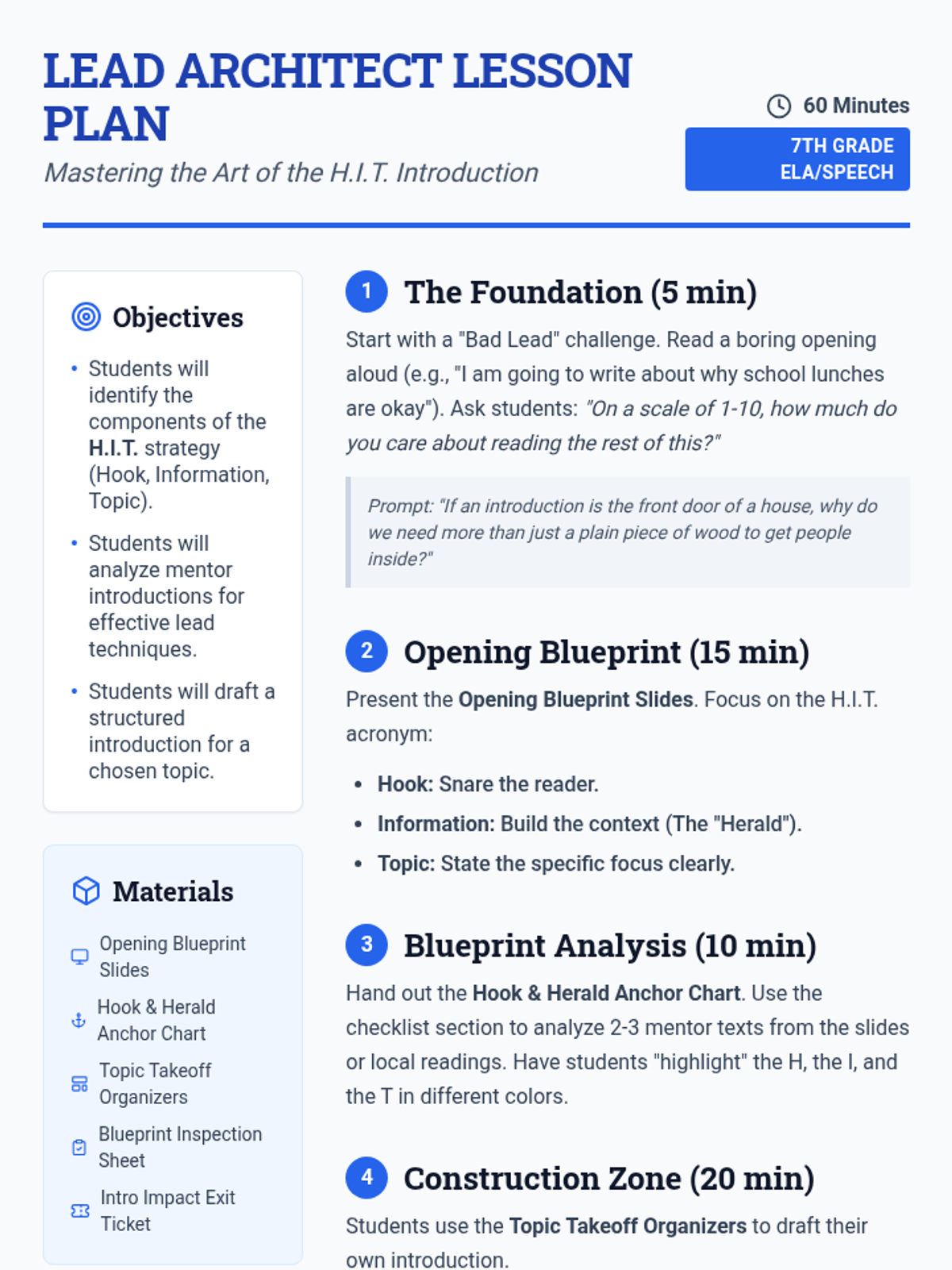
A detailed teacher-facing lesson plan for a 60-minute session on crafting effective introductions. It includes learning objectives, materials lists, a step-by-step procedural guide, and differentiation strategies.
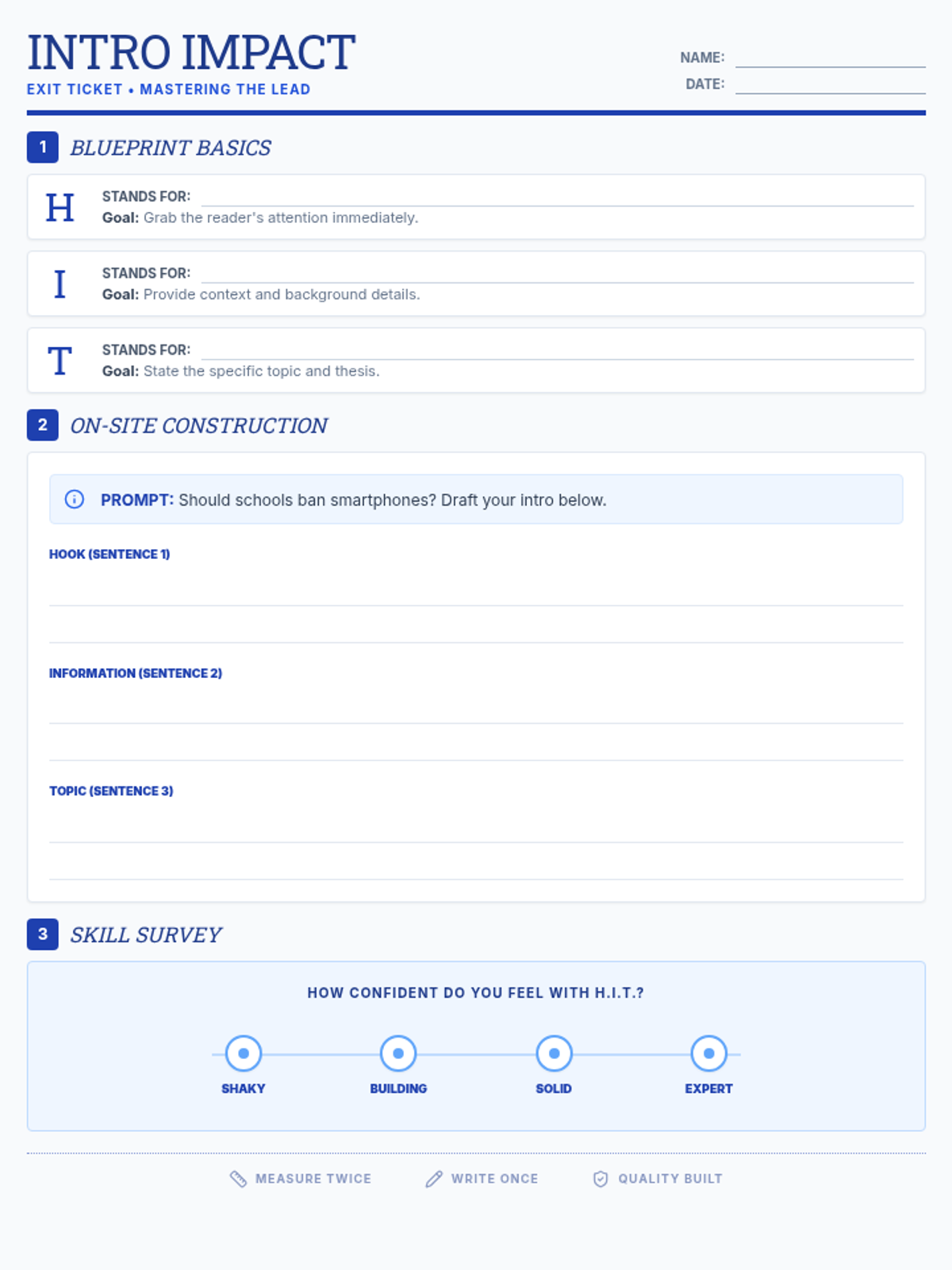
A formative assessment exit ticket for 7th-grade students to demonstrate their understanding of the H.I.T. (Hook, Information, Topic) strategy and practice writing a short introduction.
A slide deck for Lesson 5 focusing on character perspective and the 'Hot Seat' technique. Revised for 'Active Craft' branding and During Reading categorization. Global travel theme.
A slide deck for Lesson 4 exploring informational text structures (cause/effect). Revised for 'Active Craft' branding and During Reading categorization. Environment theme.
A slide deck for Lesson 3 introducing tableaux centered on the 'Joy of Hobbies' theme and narrative story structure. Revised for 'Active Craft' branding and During Reading categorization.
A reporting sheet for character comparison. Revised for 'Active Craft' branding and After Reading categorization for evaluation across texts. Culture/tradition theme. Increased space and shadow depth.
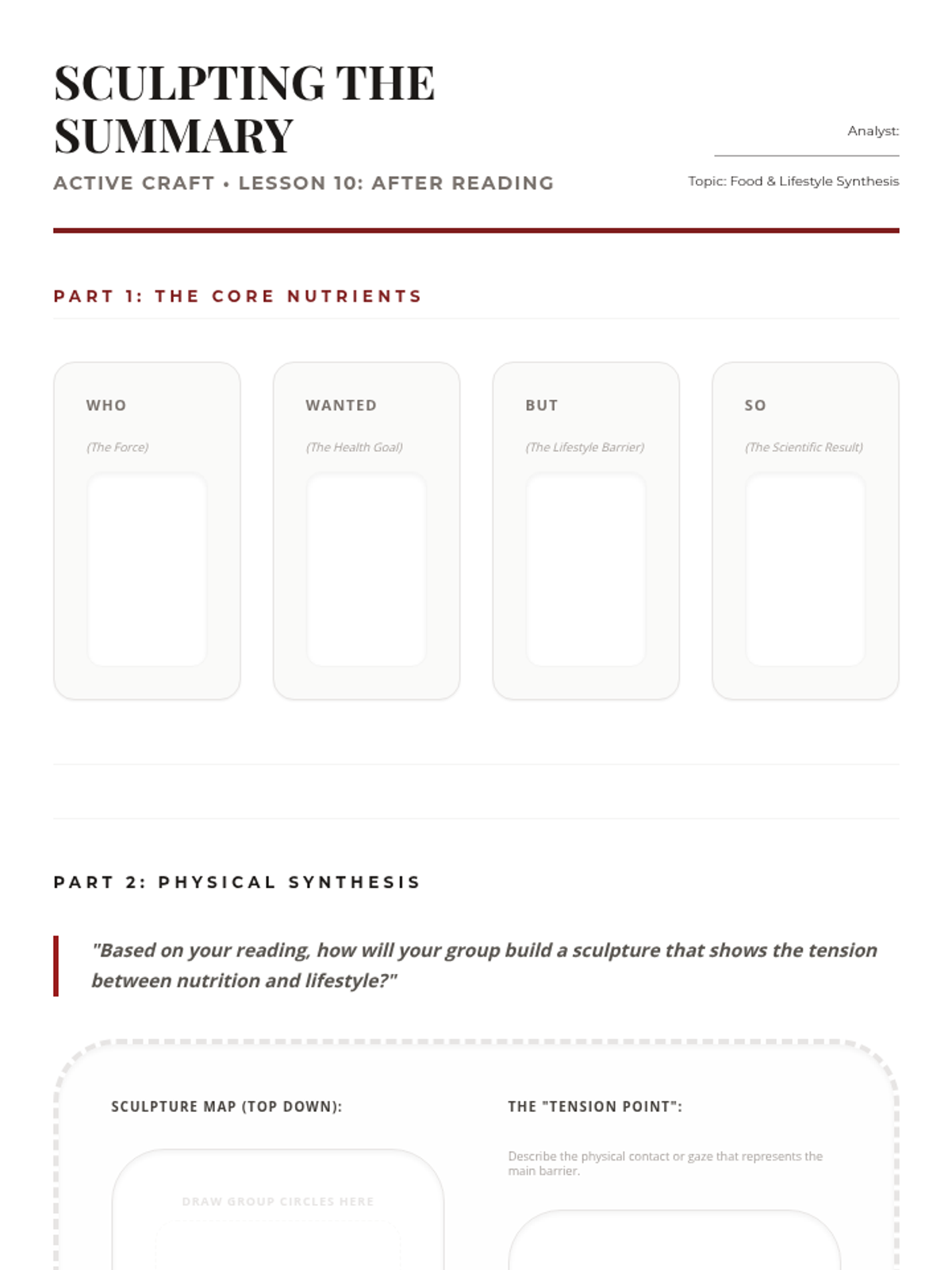
A planning sheet for summary sculptures. Revised for 'Active Craft' branding and After Reading categorization for summarization. Food and health theme. Increased response box heights and improved layout.
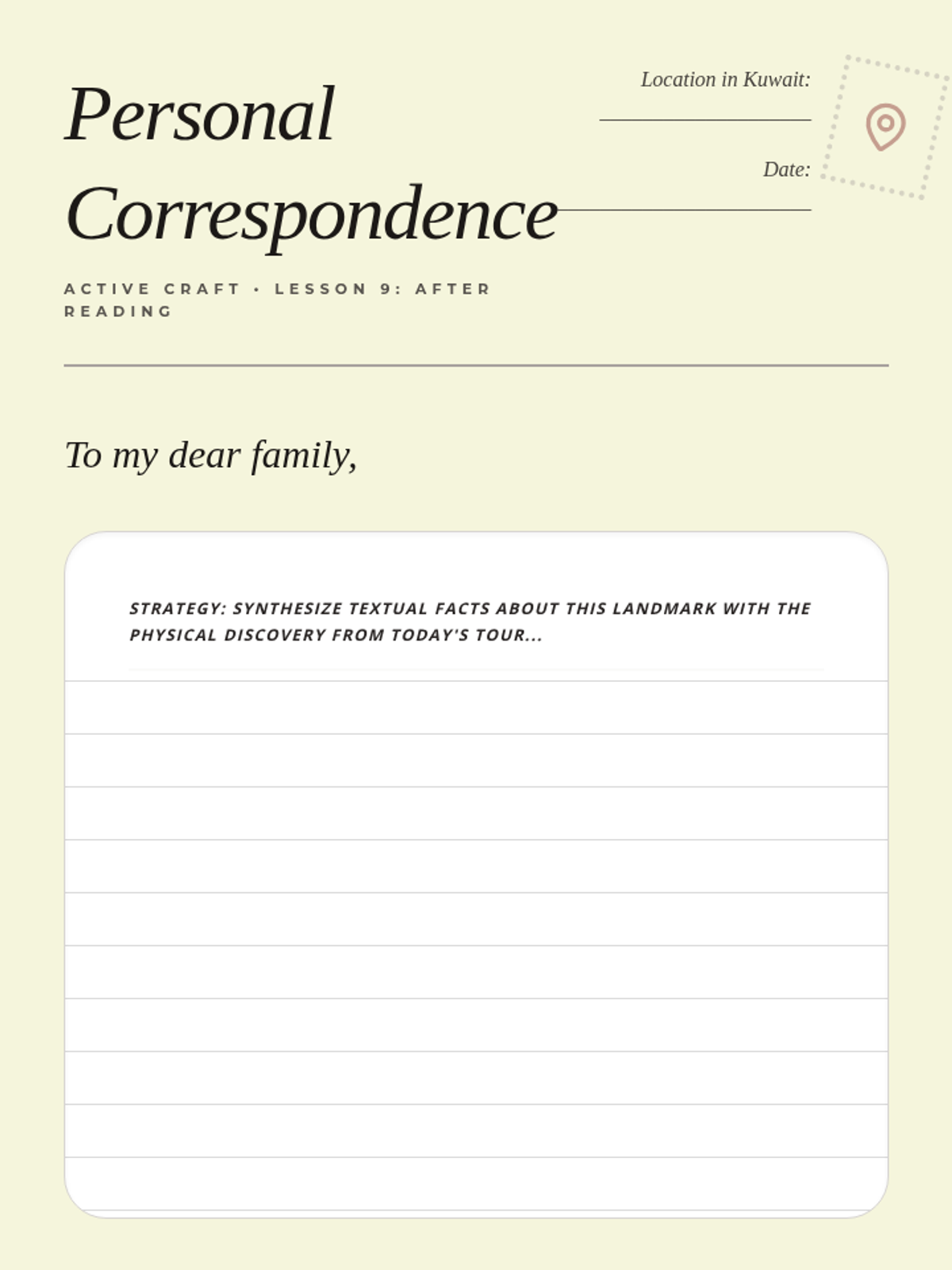
A character-themed stationery sheet for Lesson 9. Revised for 'Active Craft' branding and After Reading categorization. Landmarks theme. Increased space and contrast.
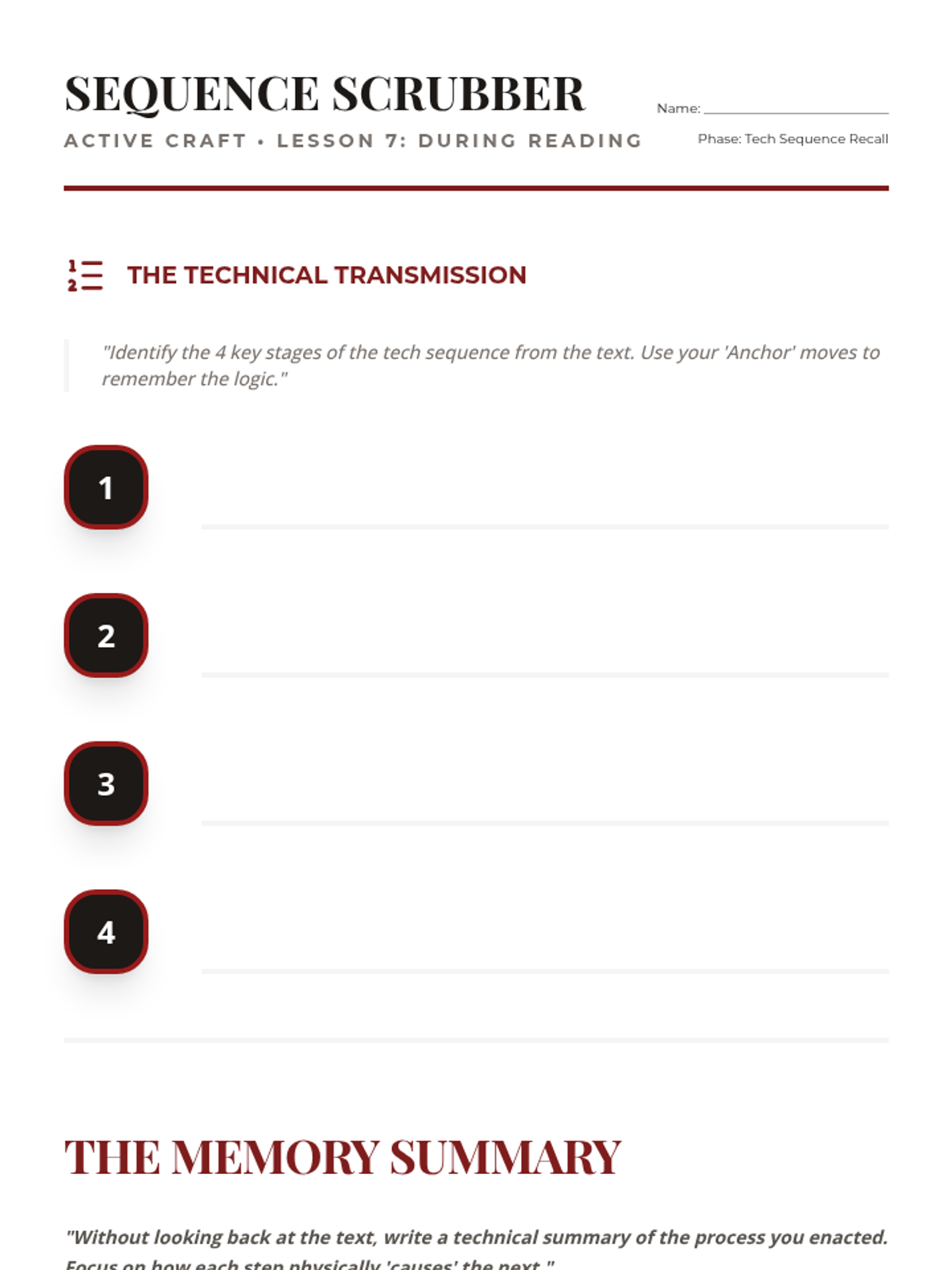
A student worksheet for sequencing events and creating physical 'anchors' to boost recall. Revised for 'Active Craft' branding and During Reading categorization. Tech theme. Increased writing space.
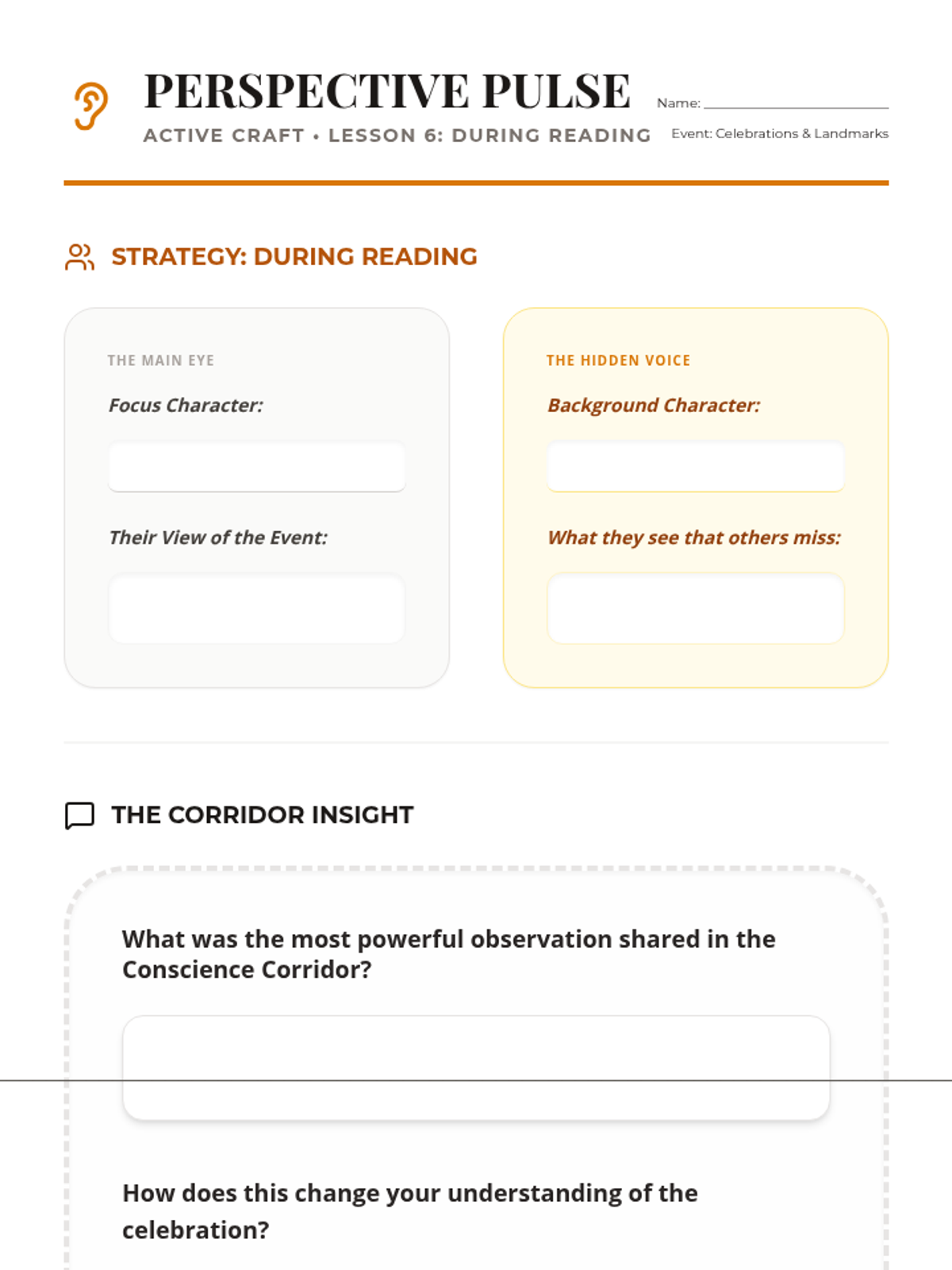
A student activity sheet for tracking perspectives during celebrations and events. Revised for 'Active Craft' branding and During Reading categorization. Increased writing space.
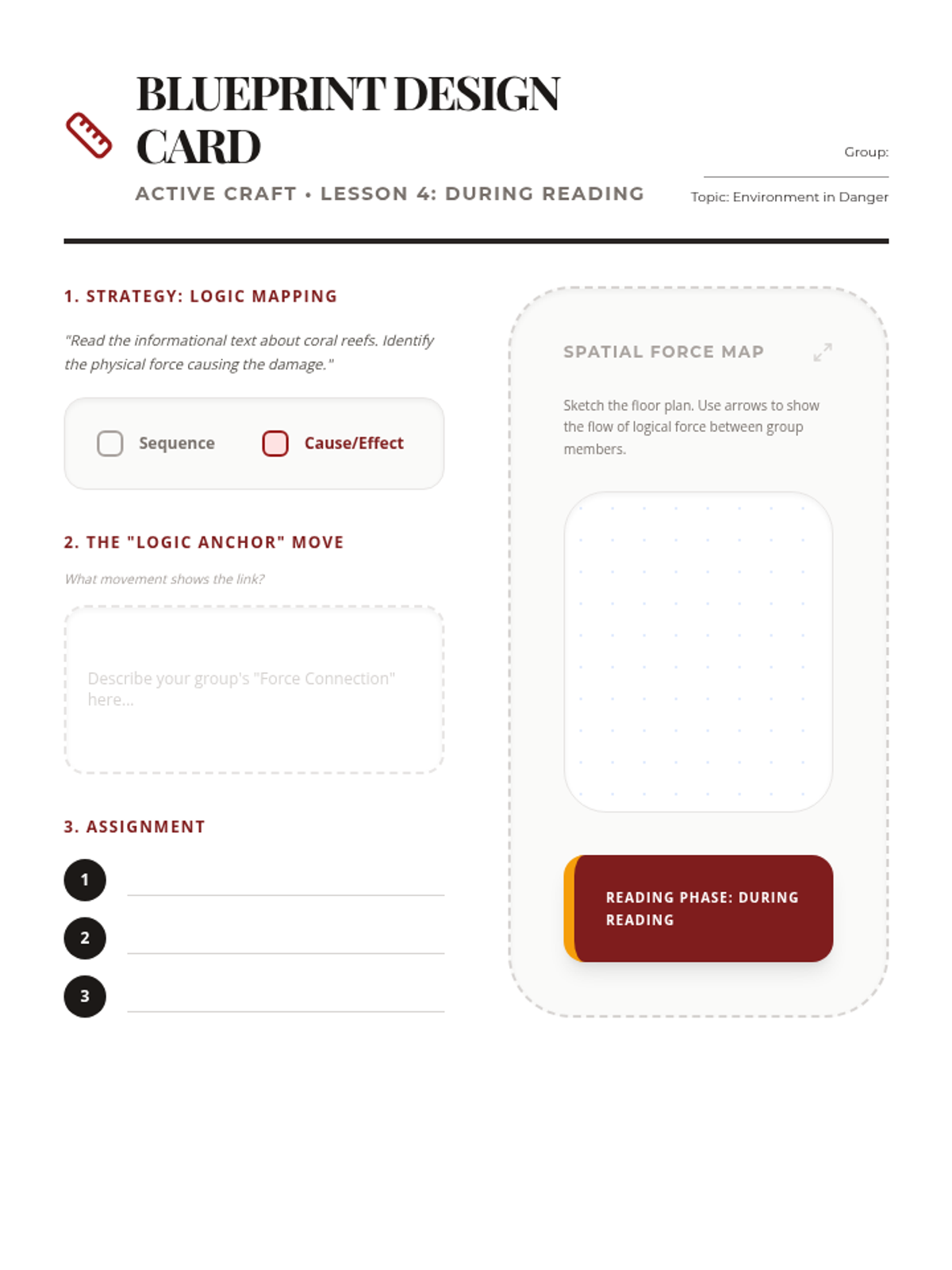
A planning card for informational structure enactment. Revised for 'Active Craft' branding and During Reading categorization for expository structure. Environment theme.
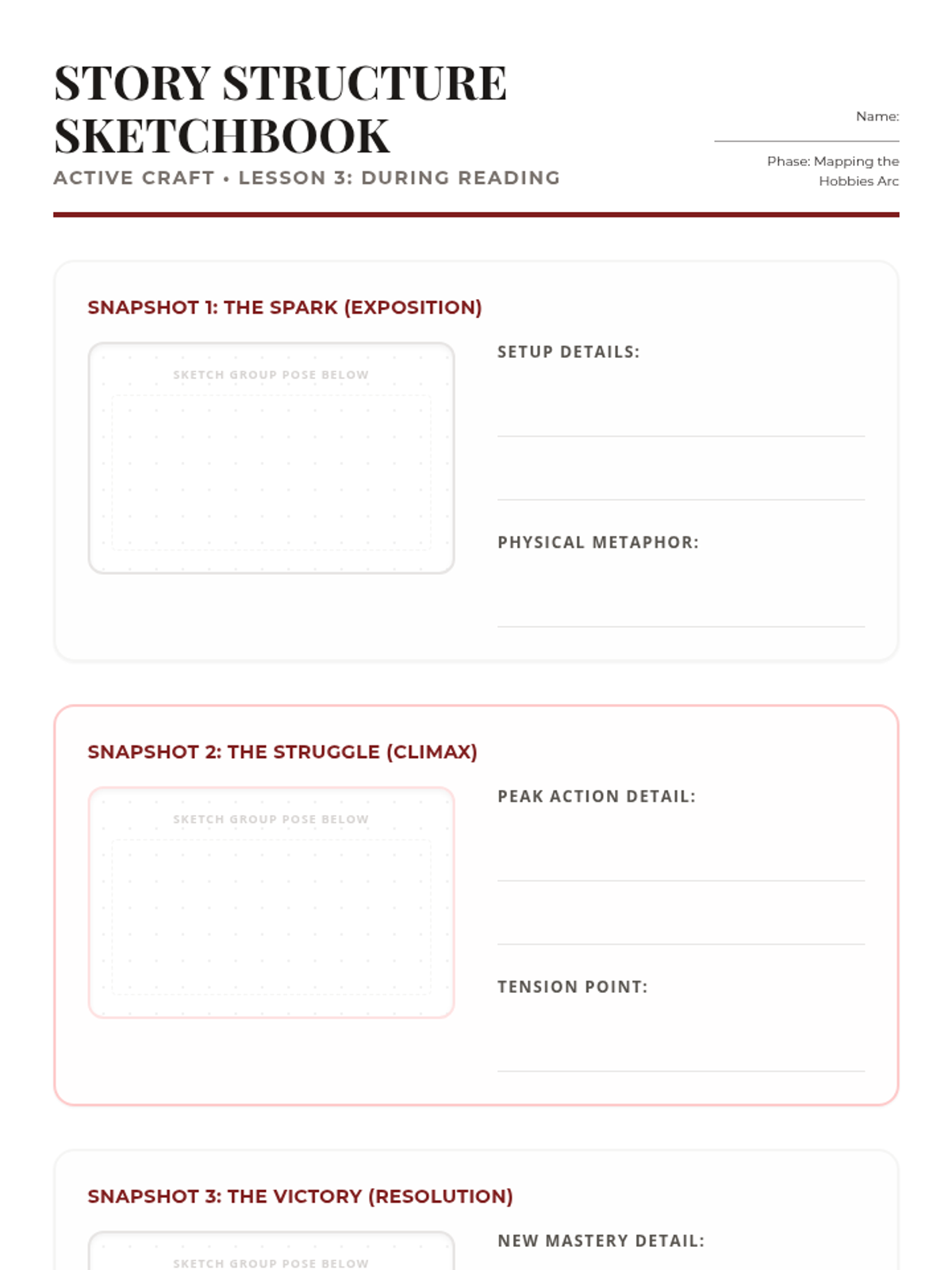
A planning worksheet for tableaux. Revised for 'Active Craft' branding and During Reading categorization for narrative structure. Hobbies theme.
A slide deck for Lesson 2 focusing on inferences about health. Revised for 'Active Craft' branding and During Reading categorization.
A slide deck for Lesson 11 focusing on comparing perspectives across different texts using the 'Meeting of Minds' technique. Revised for 'Active Craft' branding and After Reading categorization.
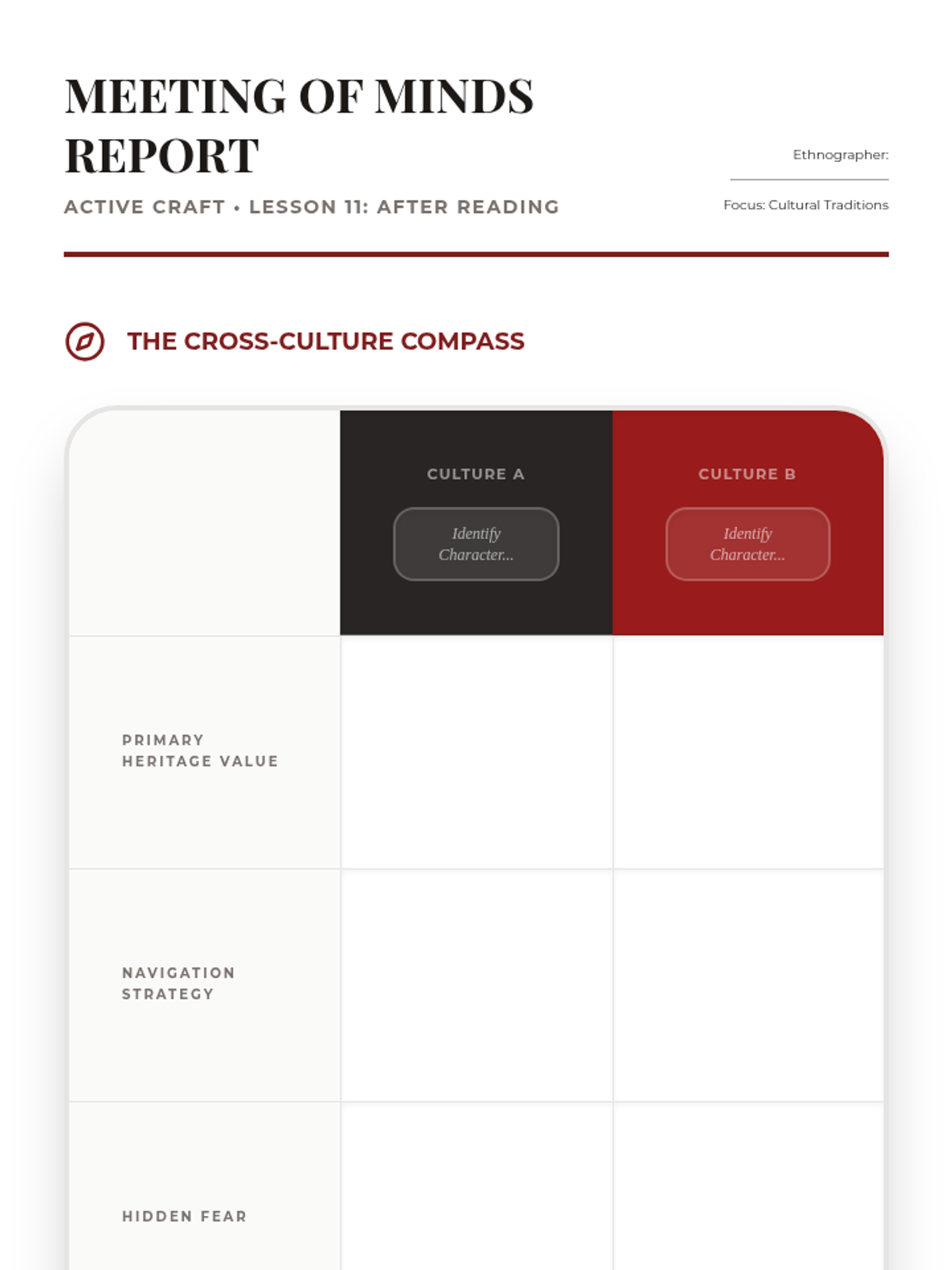
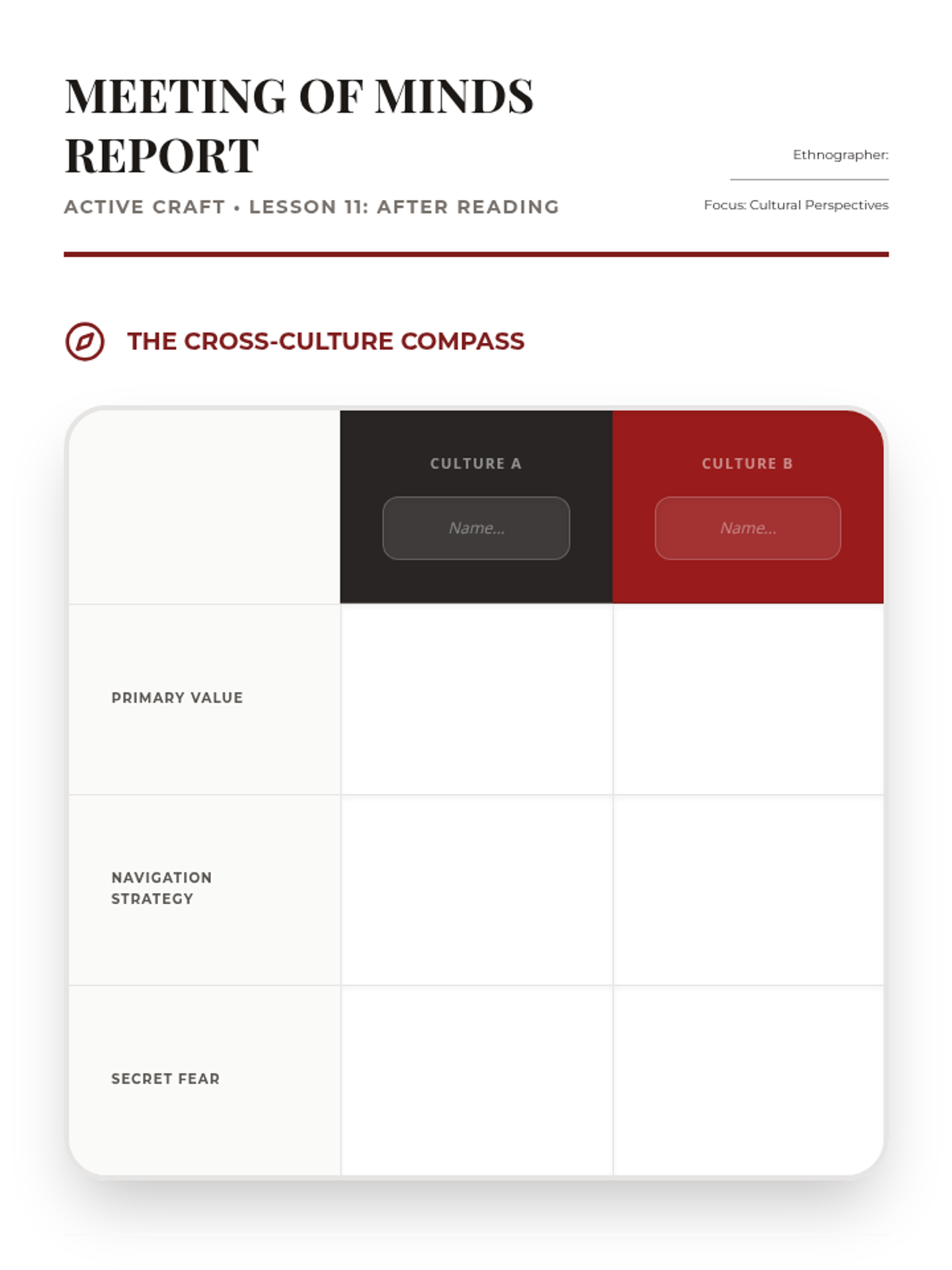
A reporting sheet for character comparison. Revised for 'Active Craft' branding and After Reading categorization for evaluation across texts. Culture/tradition theme.
A slide deck for Lesson 8 focusing on reading fluency and 'Radio Drama' for weather forecasts. Revised for 'Active Craft' branding and Before Reading categorization.
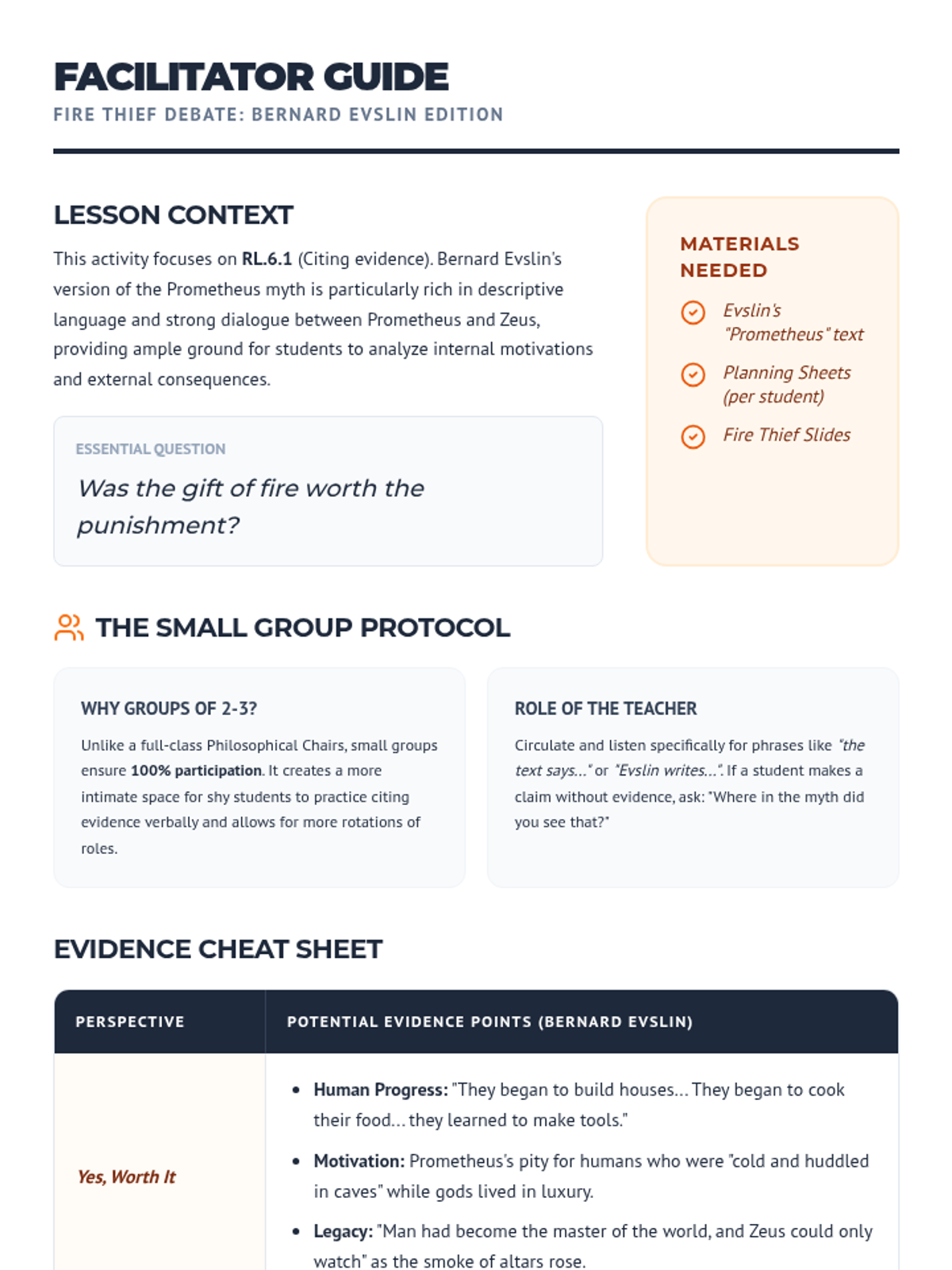
A facilitator guide for teachers to lead the Fire Thief debate. It includes the small group protocol, a cheat sheet of textual evidence from Bernard Evslin's myth, and differentiation strategies for various learner levels.
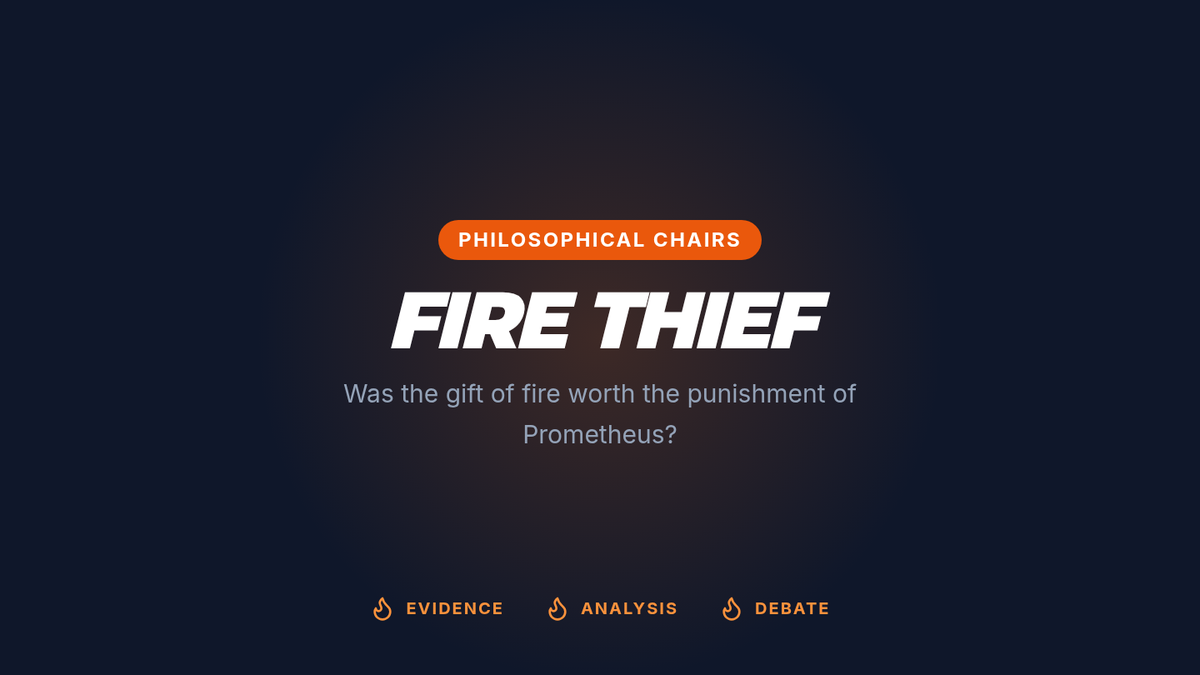
A visual presentation to guide the Fire Thief debate. It includes the learning target, the central debate question, discussion protocols for small groups, and textual clues to help students find evidence.
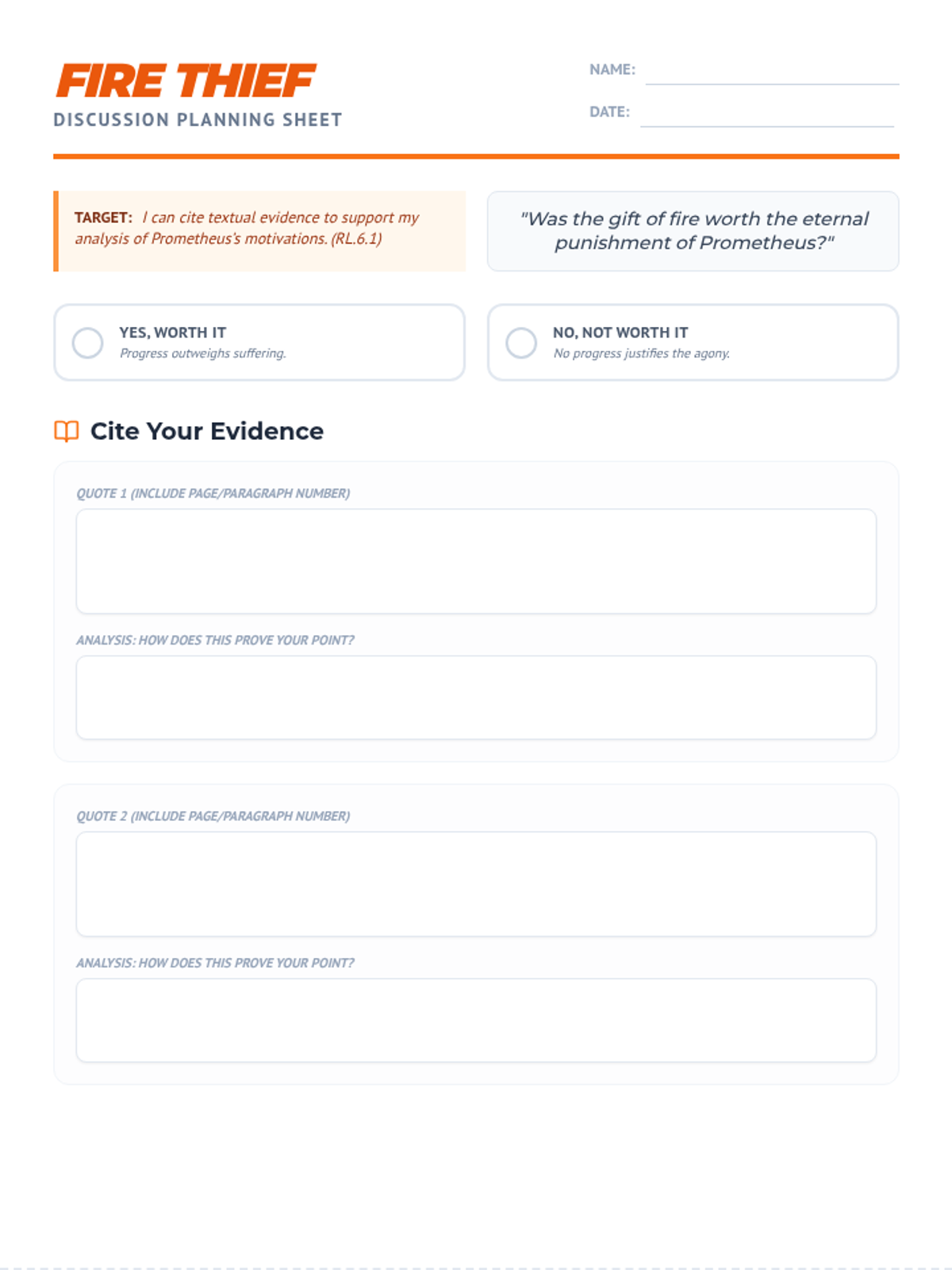
A student planning sheet for the Philosophical Chairs activity. It guides students through selecting a stance, gathering textual evidence from Bernard Evslin's myth, and preparing for a structured 2-3 person discussion.
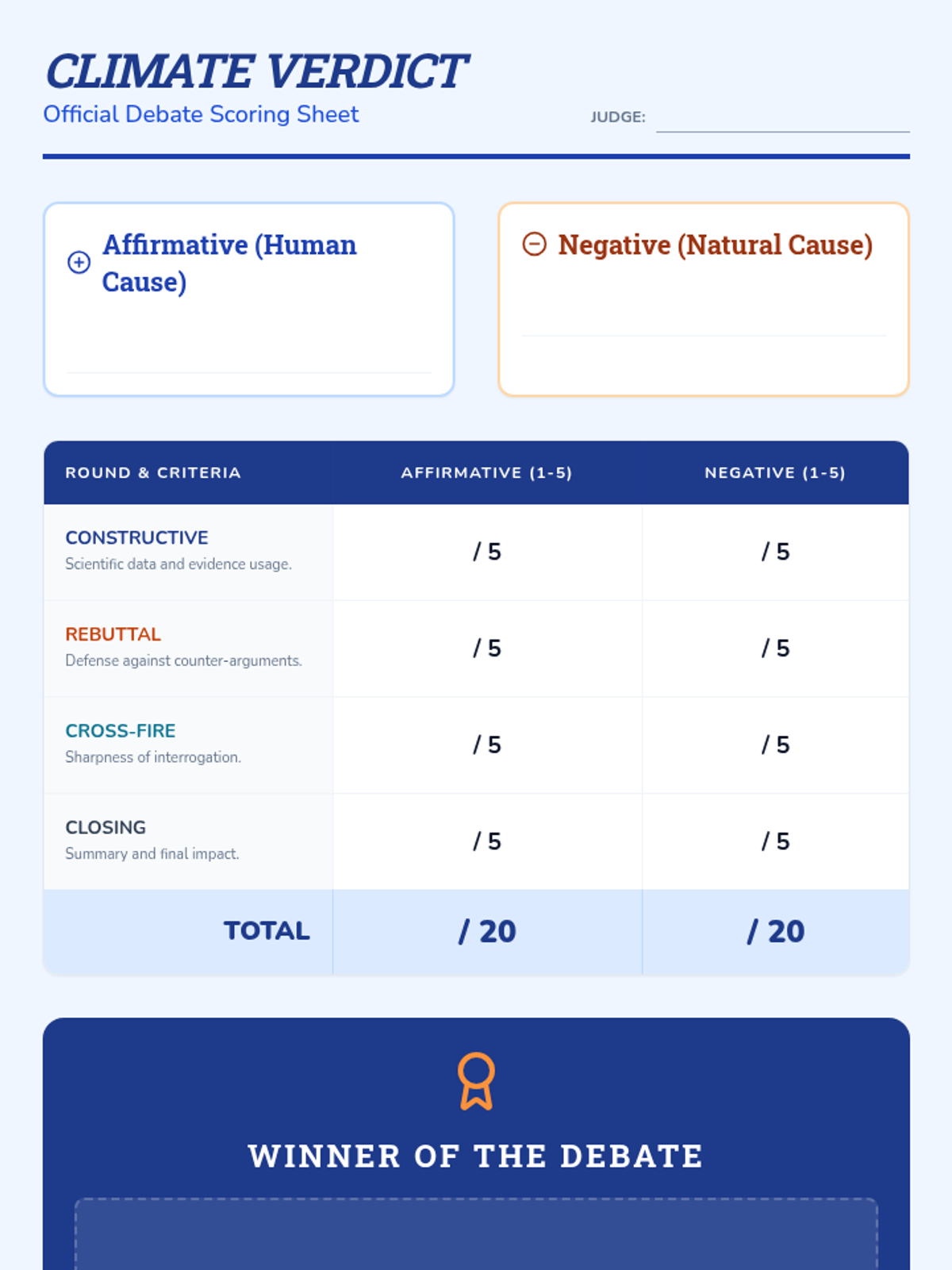
A scoring sheet for teachers or student judges to evaluate the climate change debate, featuring specific criteria for evidence, rebuttals, and cross-fire.
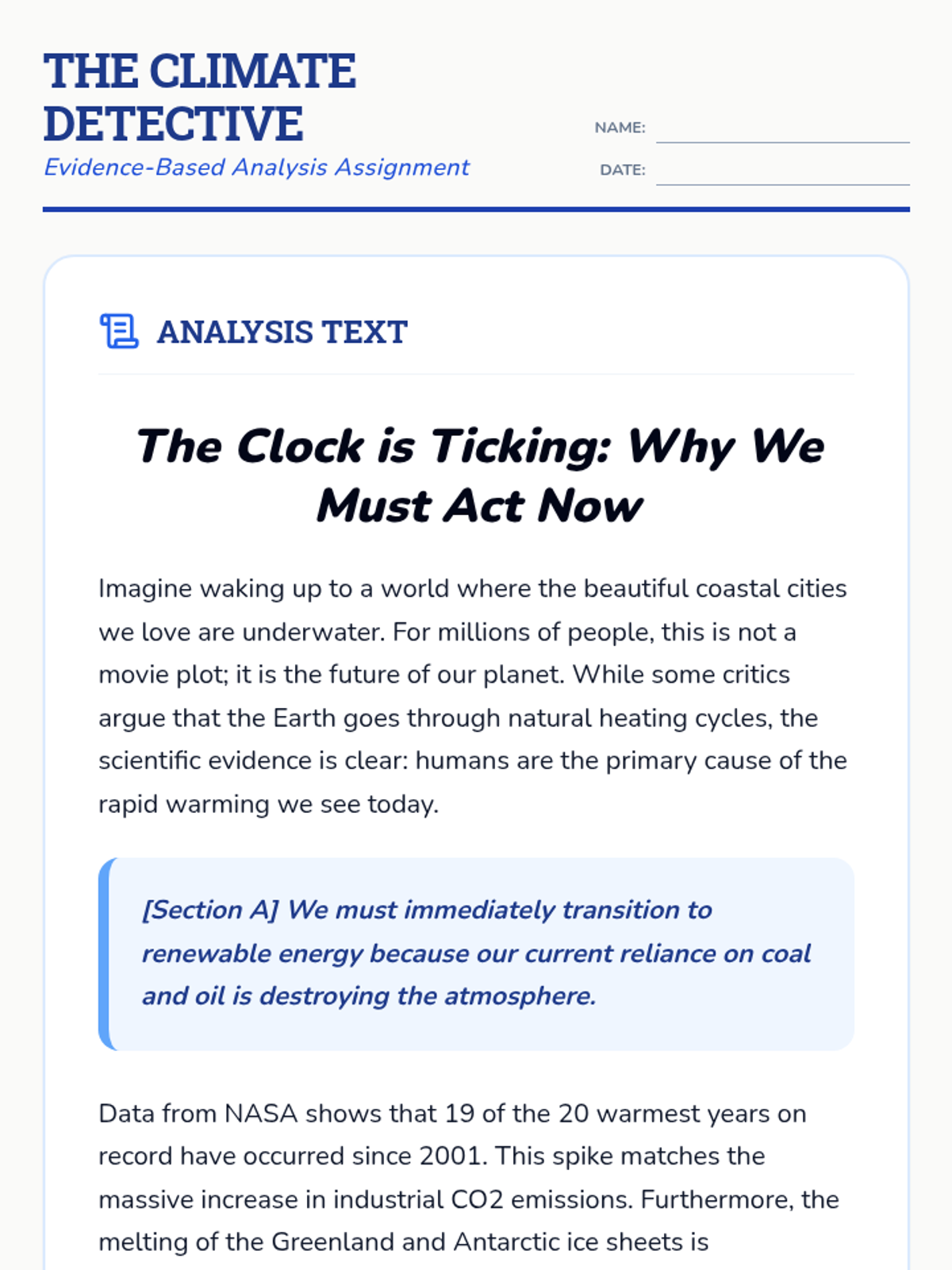
An expanded two-page assignment where students analyze a persuasive article about climate change, identifying key structures like the hook, thesis, and counter-argument, with ample space for writing and analysis.
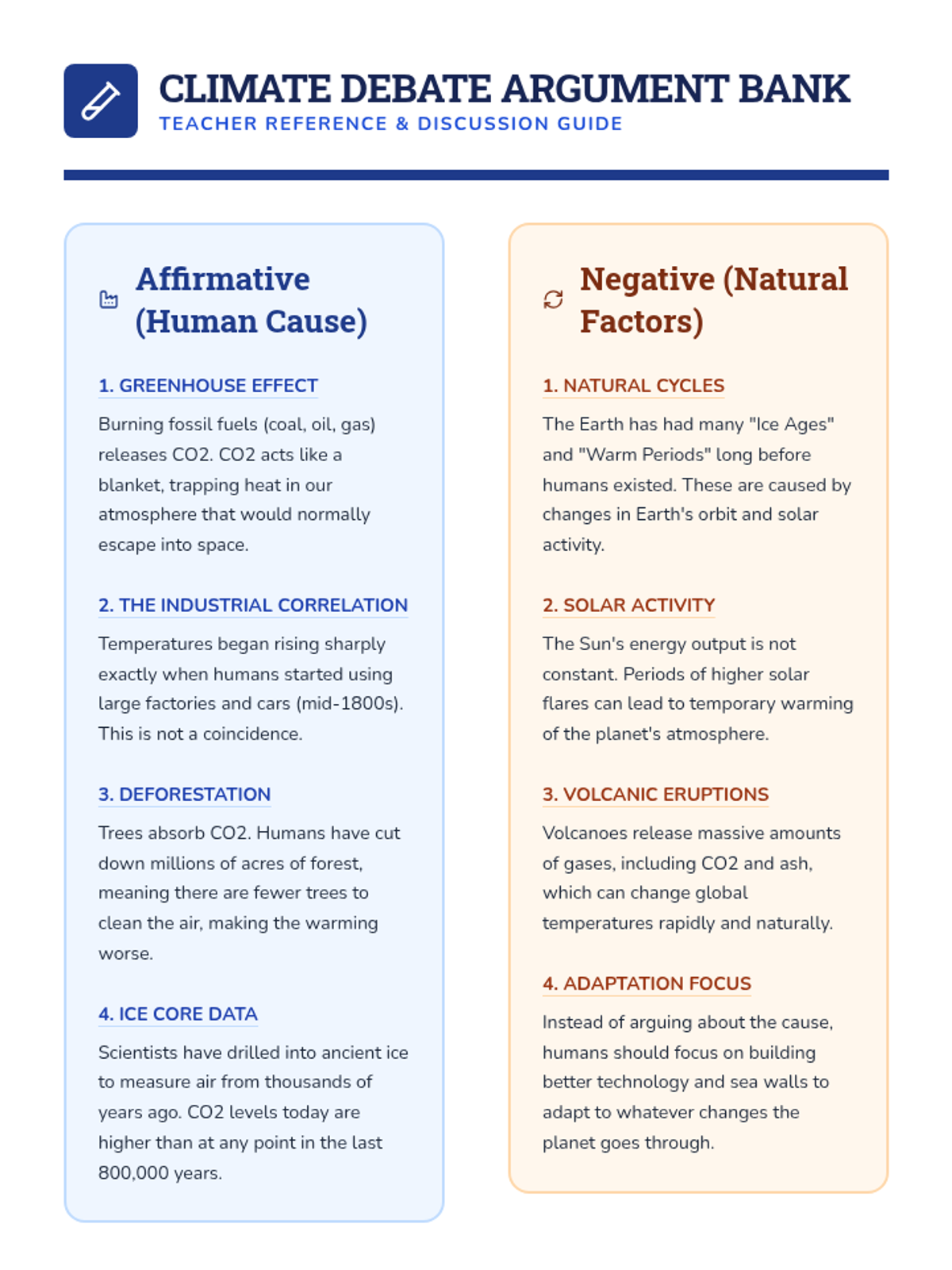
A teacher-facing argument bank for the climate change debate, featuring scientific evidence for both human-caused and natural-factor arguments.
A visual presentation deck for 6th-grade students to learn the formal four-round debate structure applied to the topic of global warming.
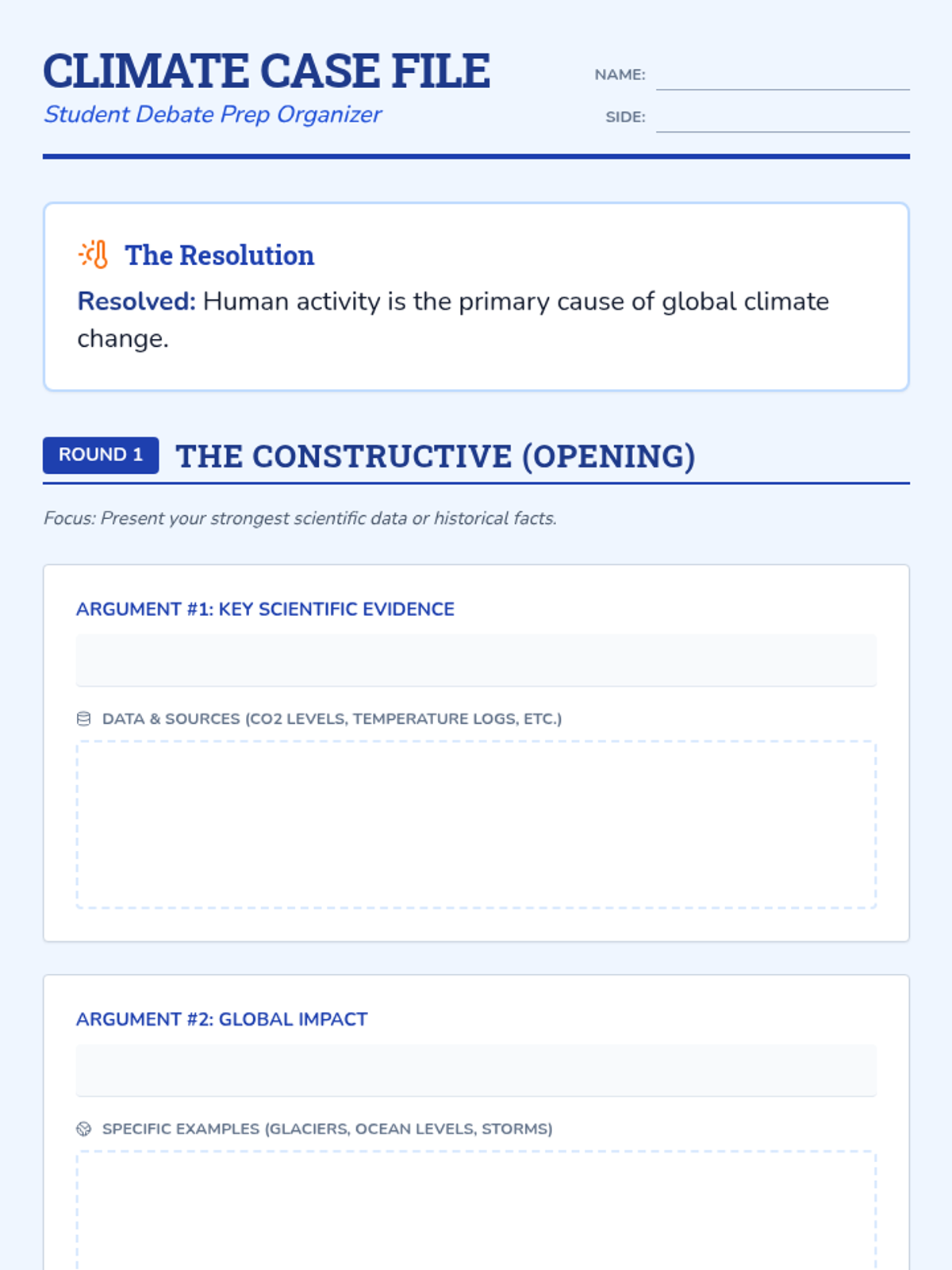
A structured debate prep worksheet for 6th-grade students to organize their research, arguments, rebuttals, and closing statements for a formal debate on global warming.
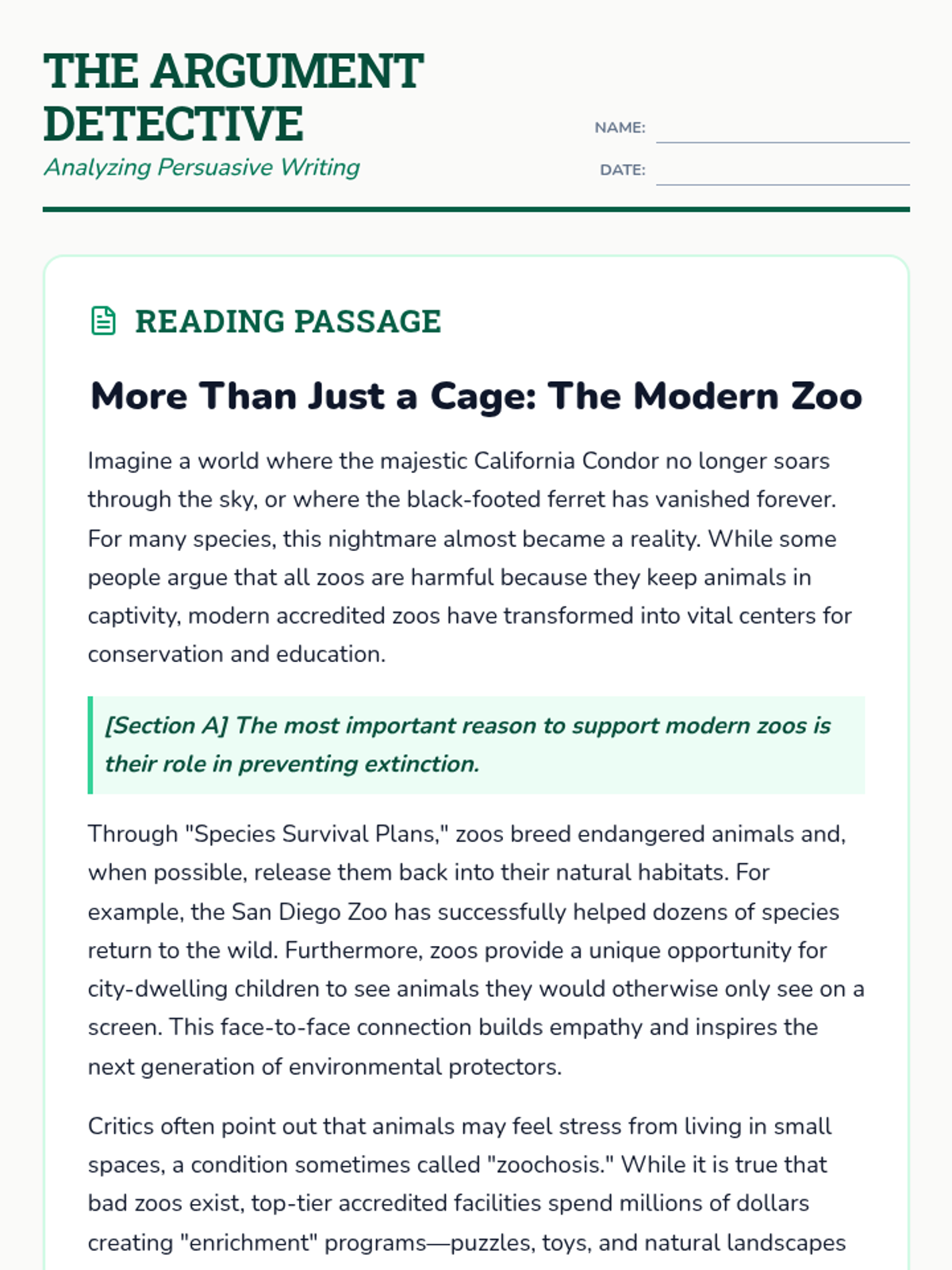
An assignment where students analyze a persuasive article about zoos, identifying key structures like the hook, thesis, and counter-argument, while answering comprehension questions.
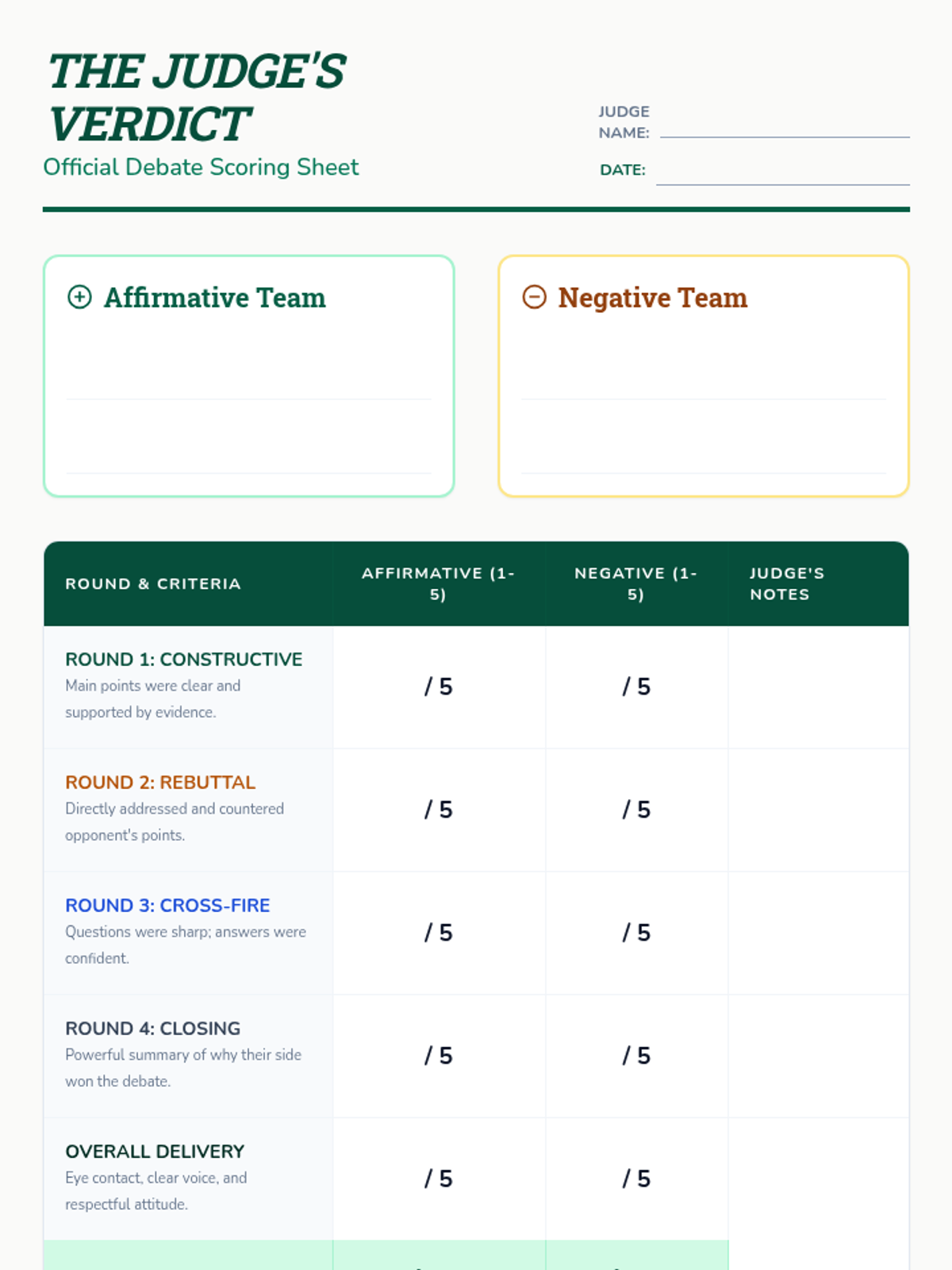
A debate scoring sheet for teachers or student judges to evaluate the zoo ethics debate, featuring round-by-round scoring for constructives, rebuttals, cross-fire, and delivery.
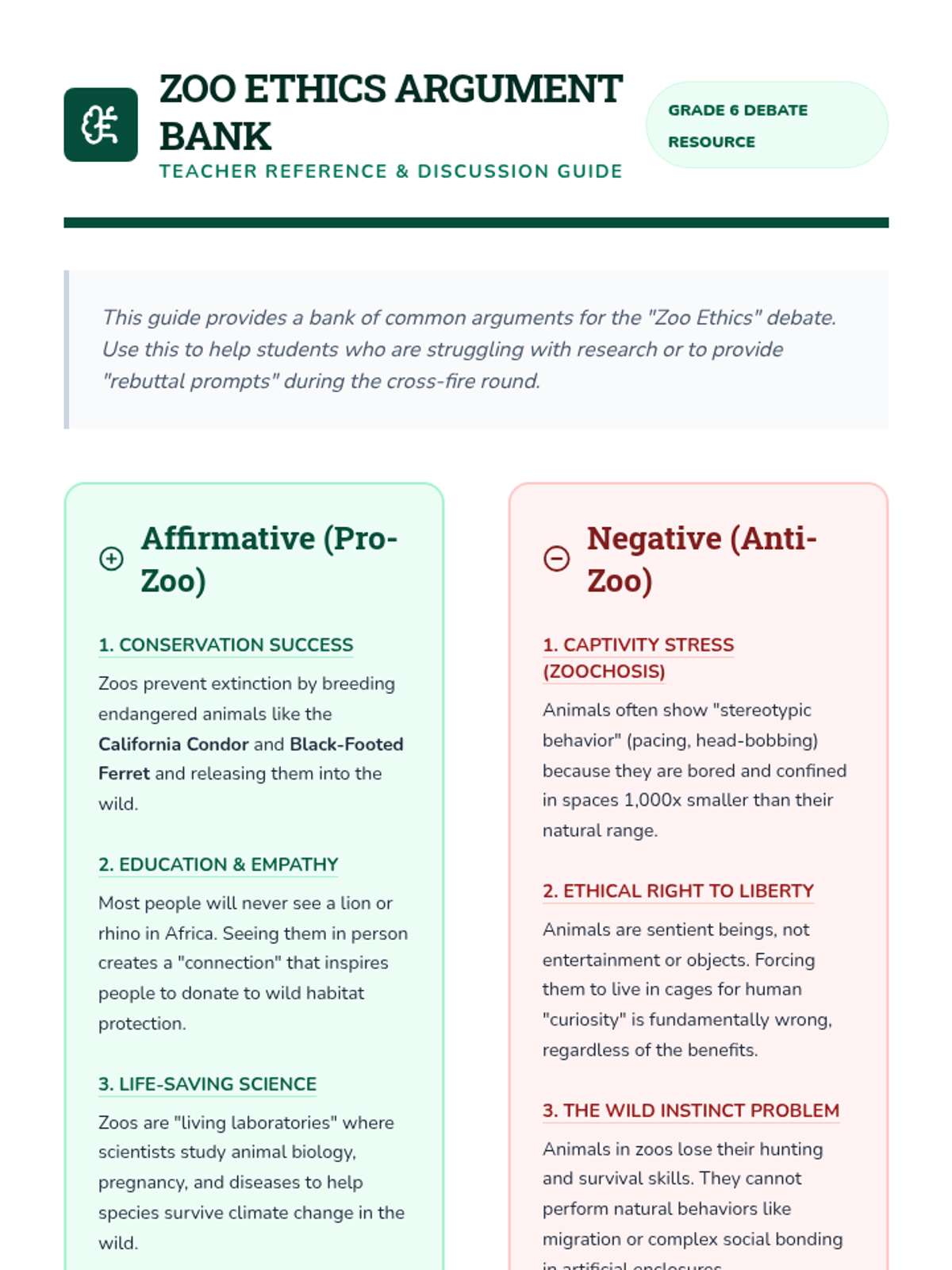
A teacher-facing argument bank and discussion guide for the zoo ethics debate, featuring pros and cons, rebuttal prompts, and key vocabulary for 6th-grade students.
A visual presentation deck for 6th-grade students to learn the formal four-round debate structure, including constructive speeches, rebuttals, cross-fire, and closing strategies.
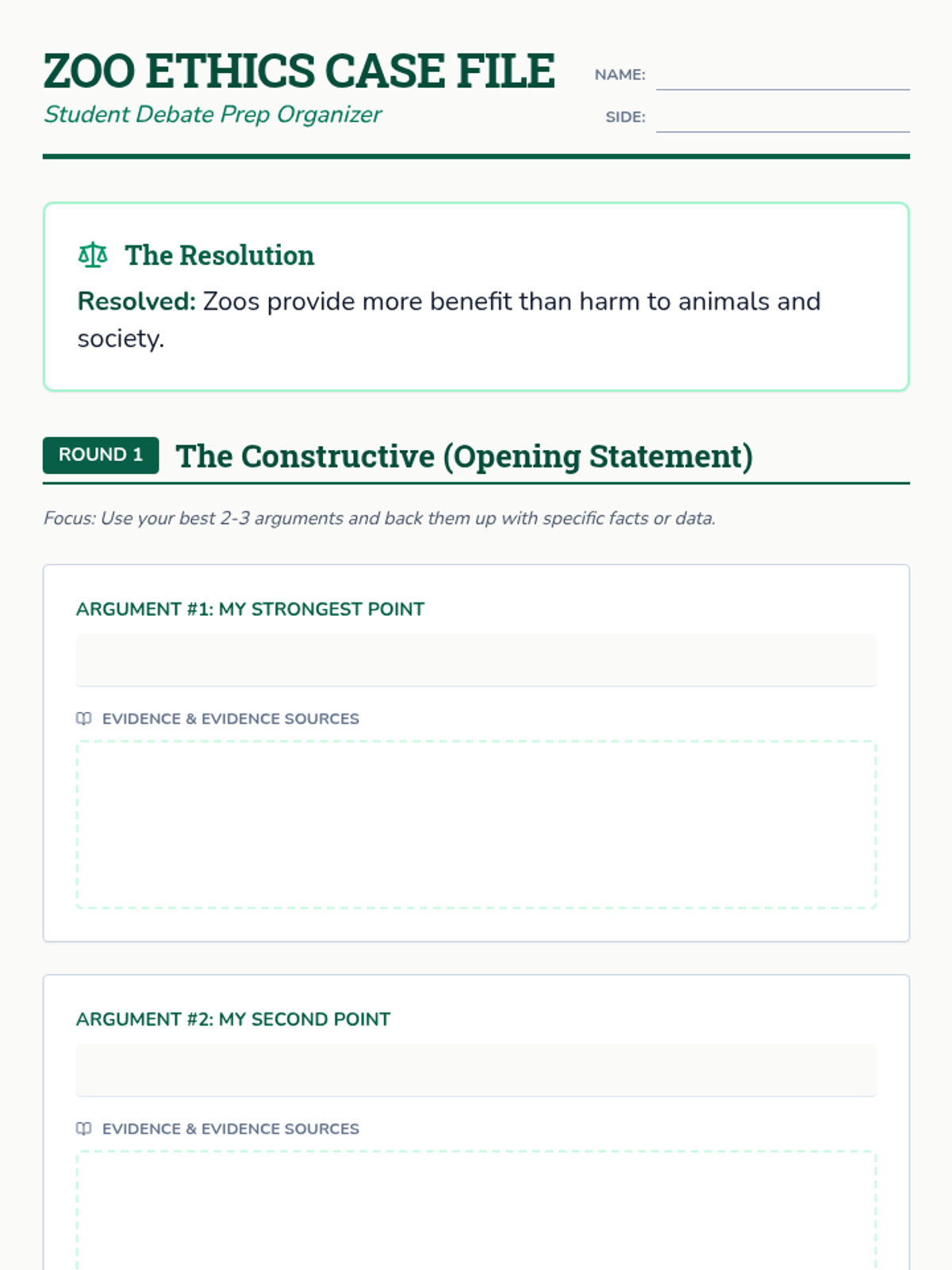
A structured debate prep worksheet for 6th-grade students to organize their research, arguments, rebuttals, and closing statements for a four-round formal debate on zoo ethics.
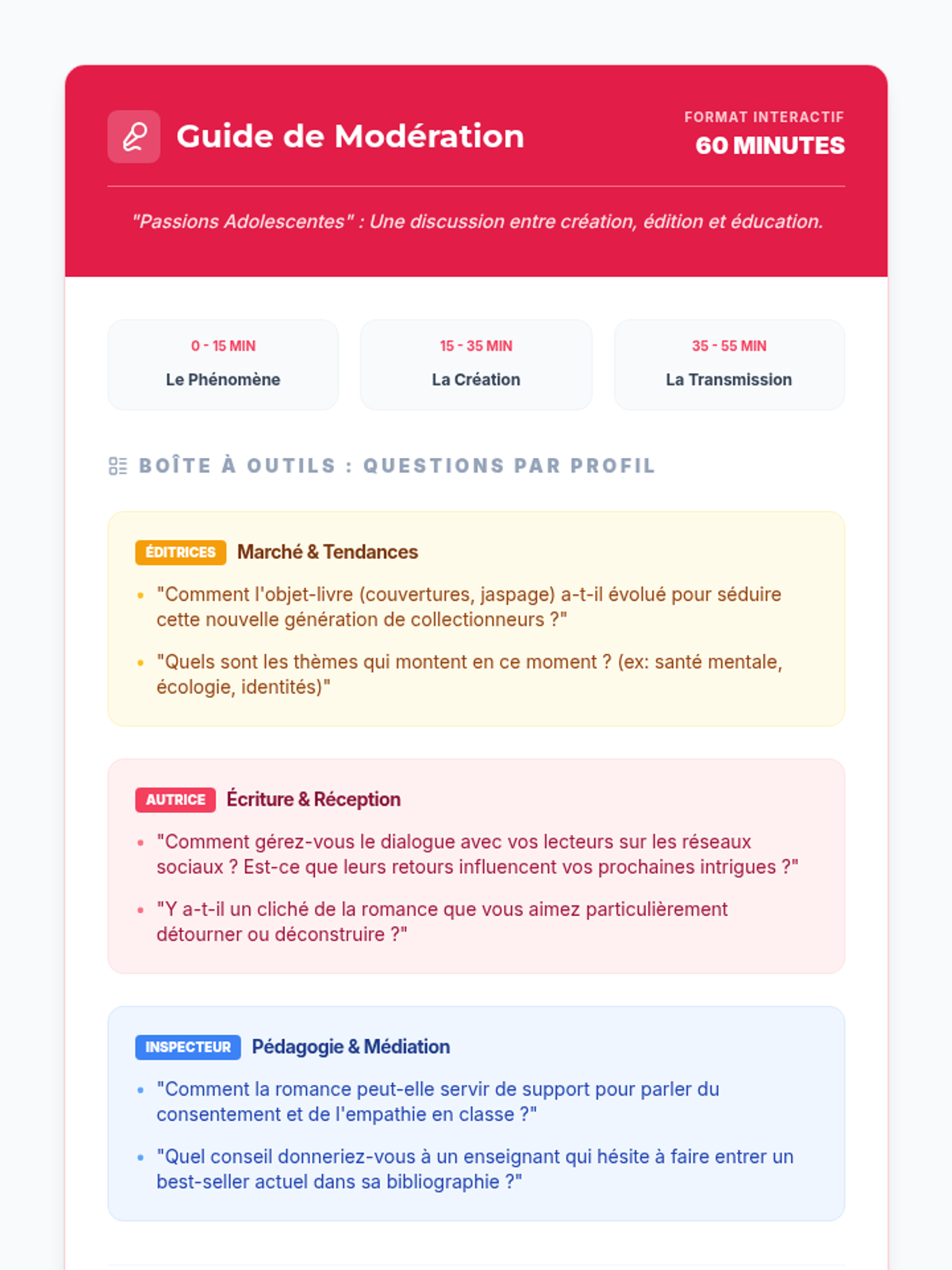
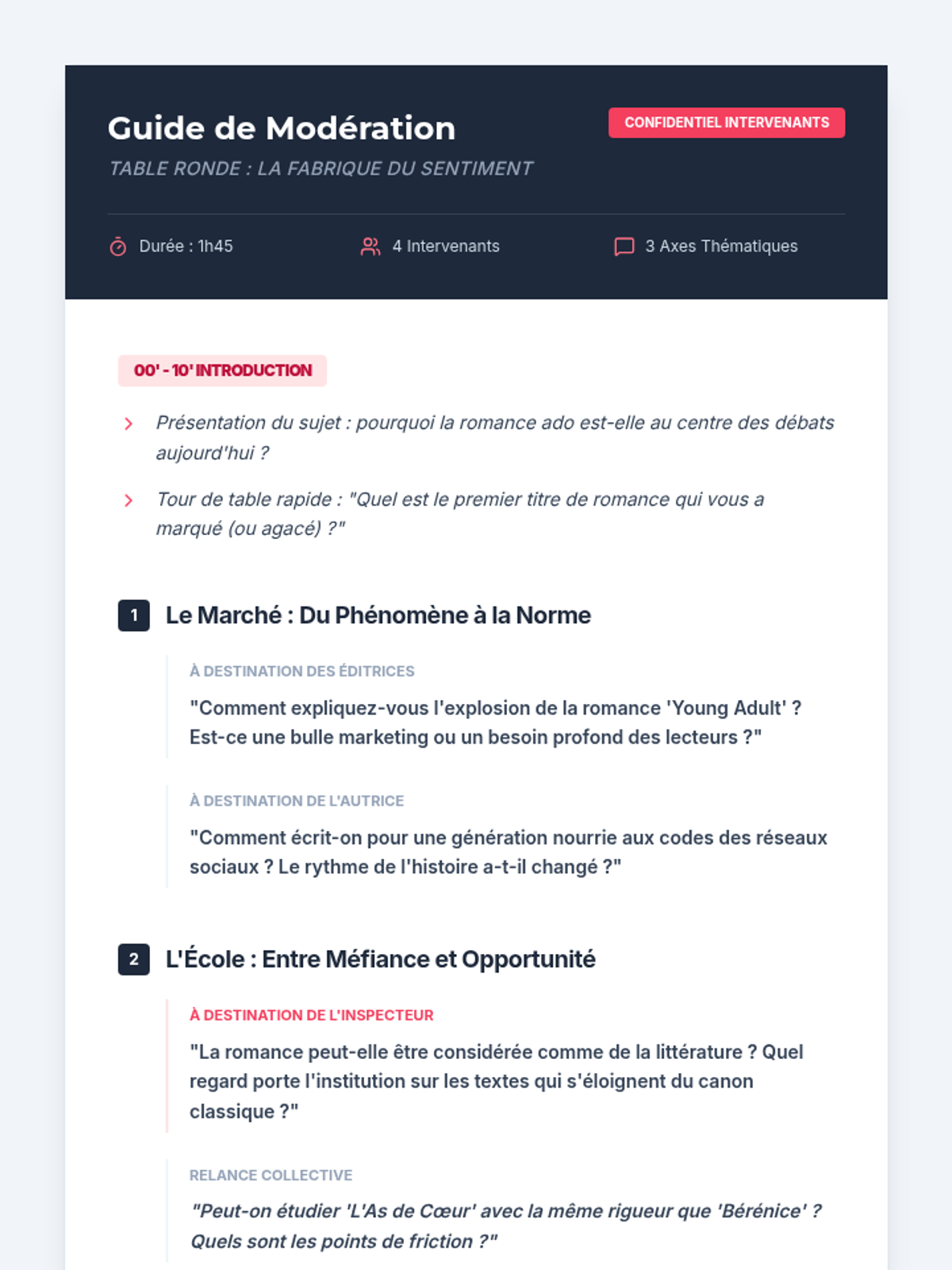
Un guide de modération enrichi proposant une boîte à outils de questions spécifiques pour chaque intervenant, idéal pour une table ronde d'une heure.
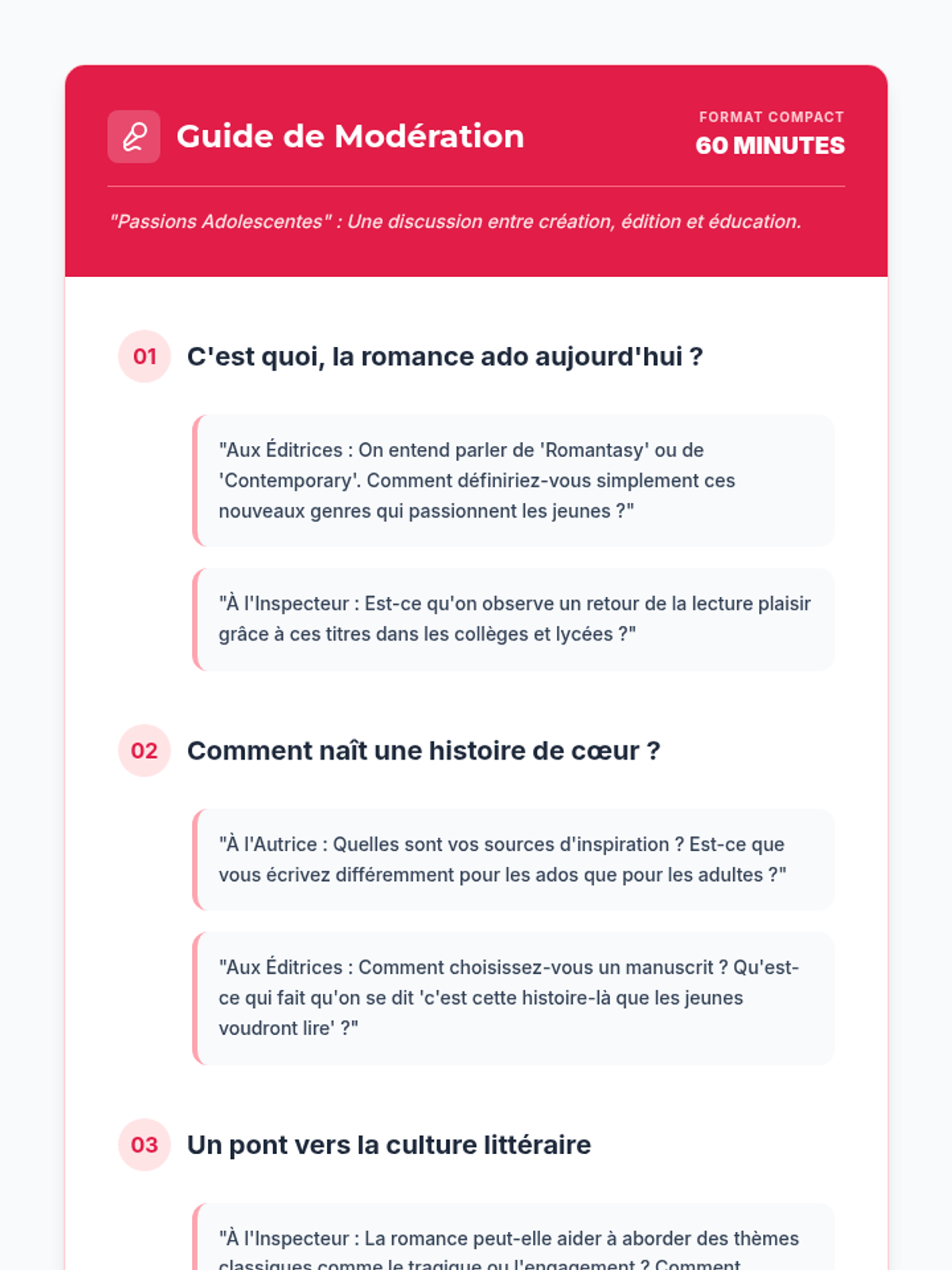
Un guide de modération optimisé pour une table ronde d'une heure, proposant des questions accessibles et équilibrées pour un large public.
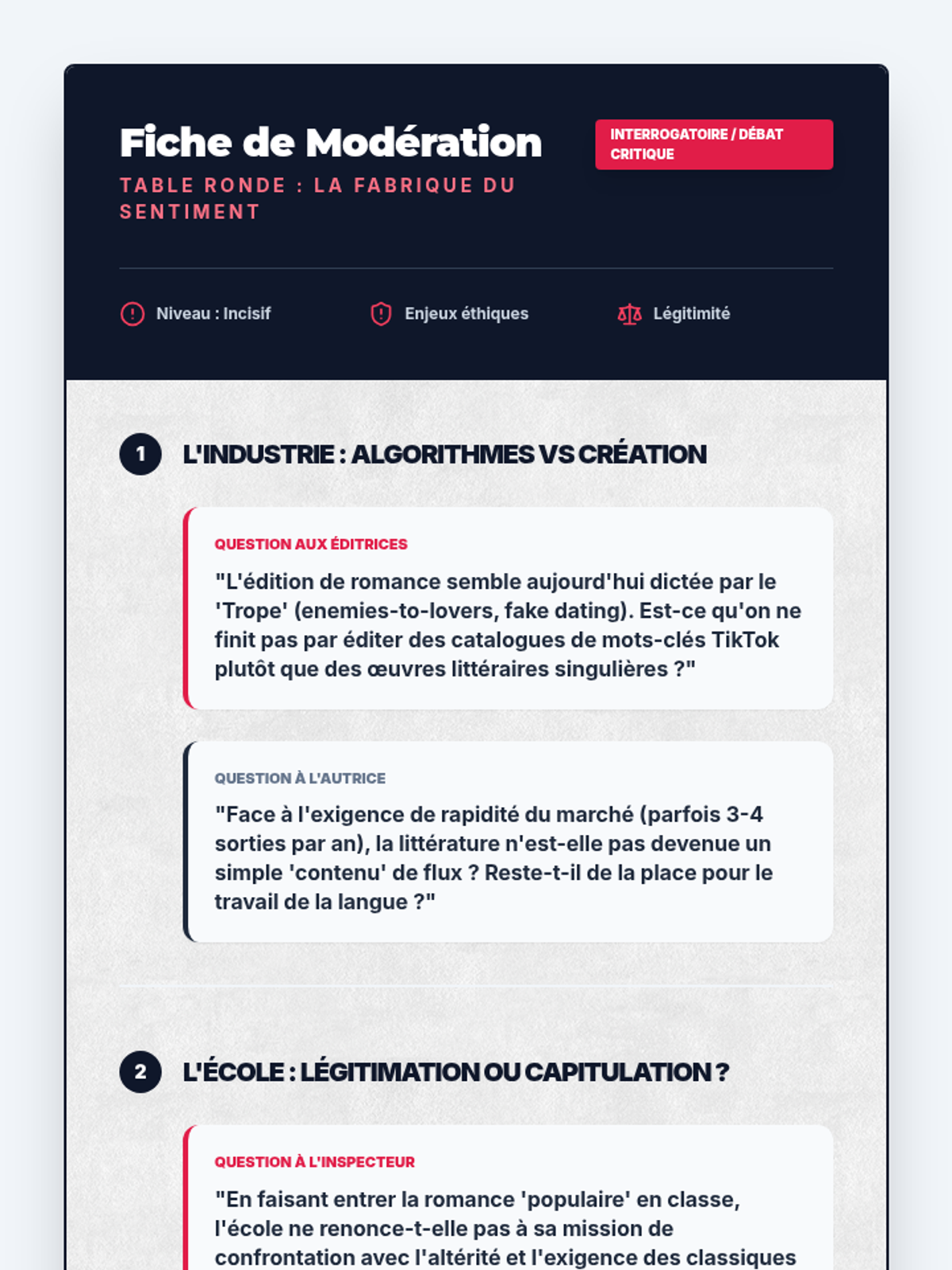
Une version "questions incisives" du guide de modération, conçue pour un débat de haut niveau interrogeant l'éthique, la qualité littéraire et les enjeux marketing du genre.
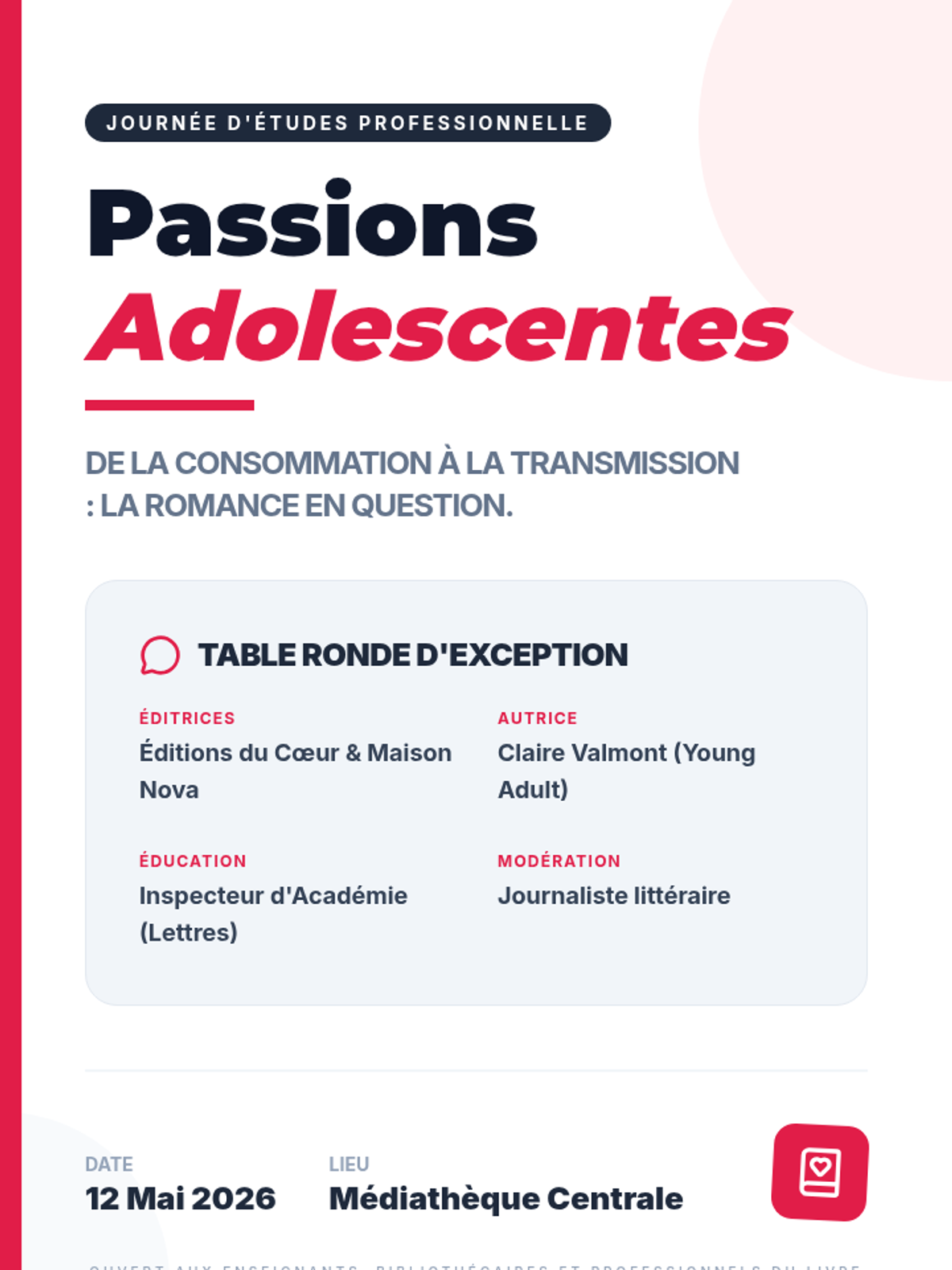
Une affiche promotionnelle élégante et percutante pour la journée d'études, mettant en avant les intervenants et le titre phare de l'évènement.
Un guide de modération professionnel pour l'animateur de la table ronde, incluant les temps forts, les questions clés pour chaque intervenant et des conseils de relance.
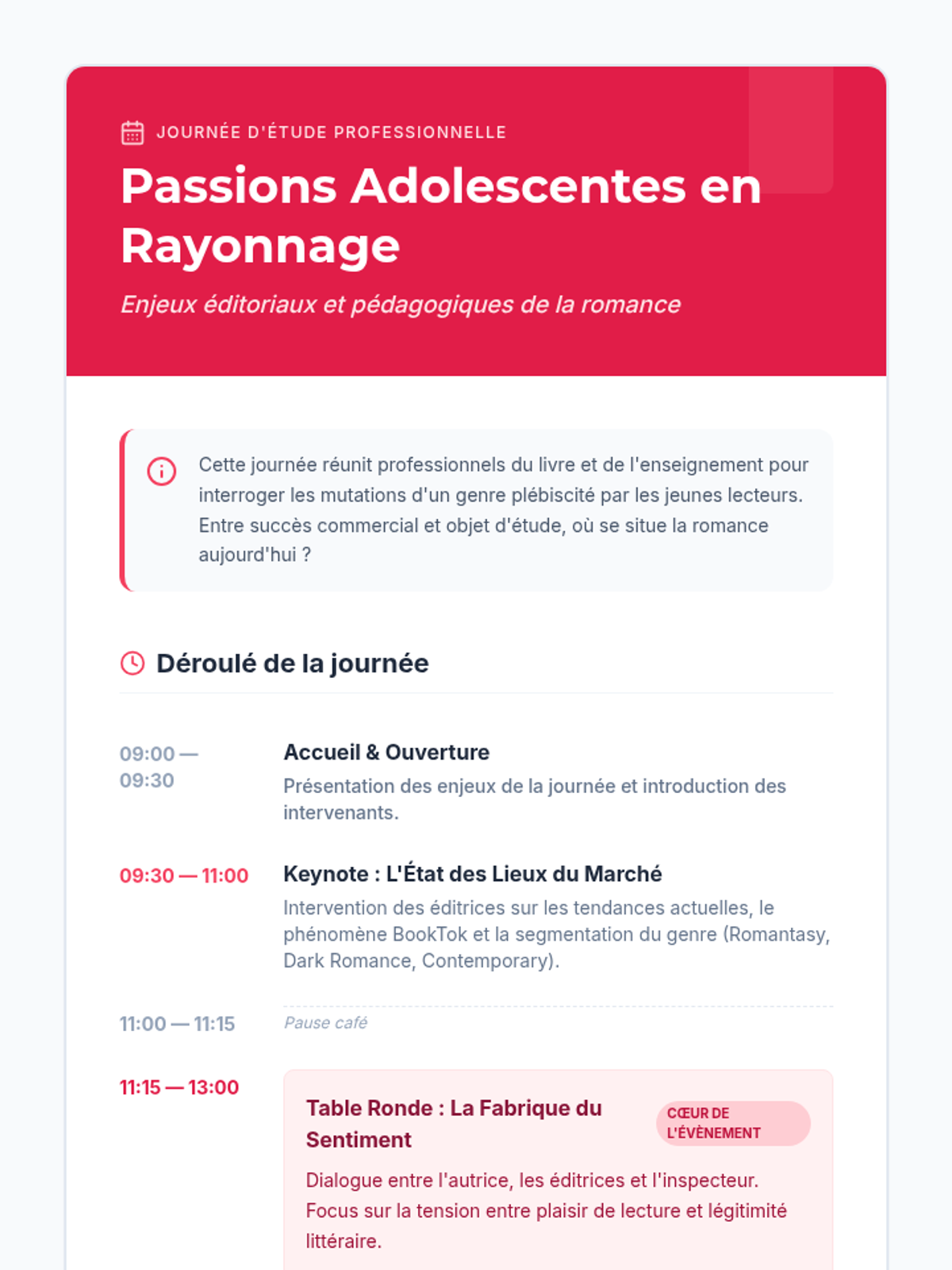
Le programme détaillé de la journée d'études "Passions Adolescentes en Rayonnage", incluant les horaires, les sessions et la liste des intervenants.
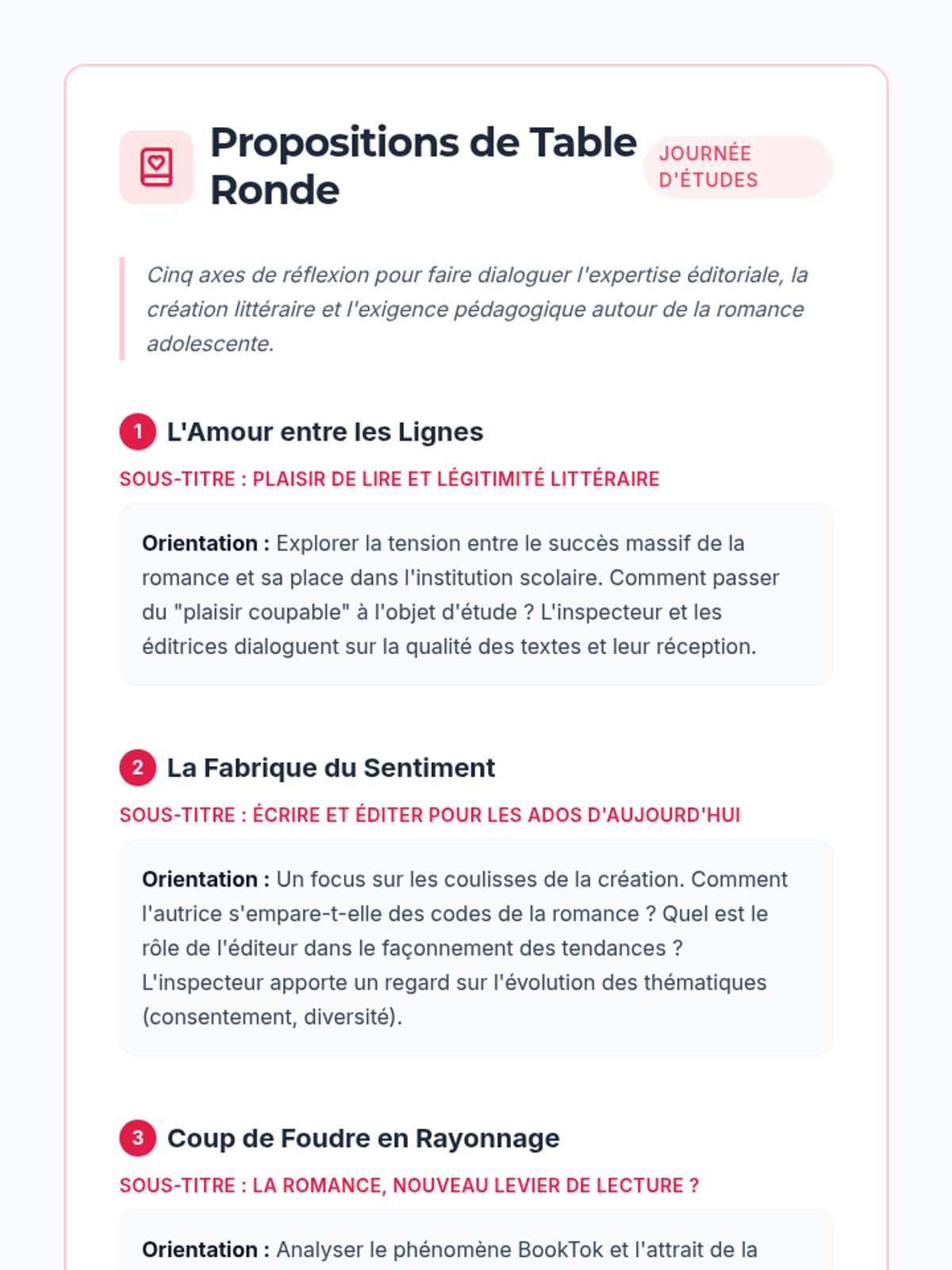
Une fiche de planification présentant 5 propositions de titres et d'orientations pour une table ronde sur la romance adolescente, mêlant perspectives éditoriales et pédagogiques.
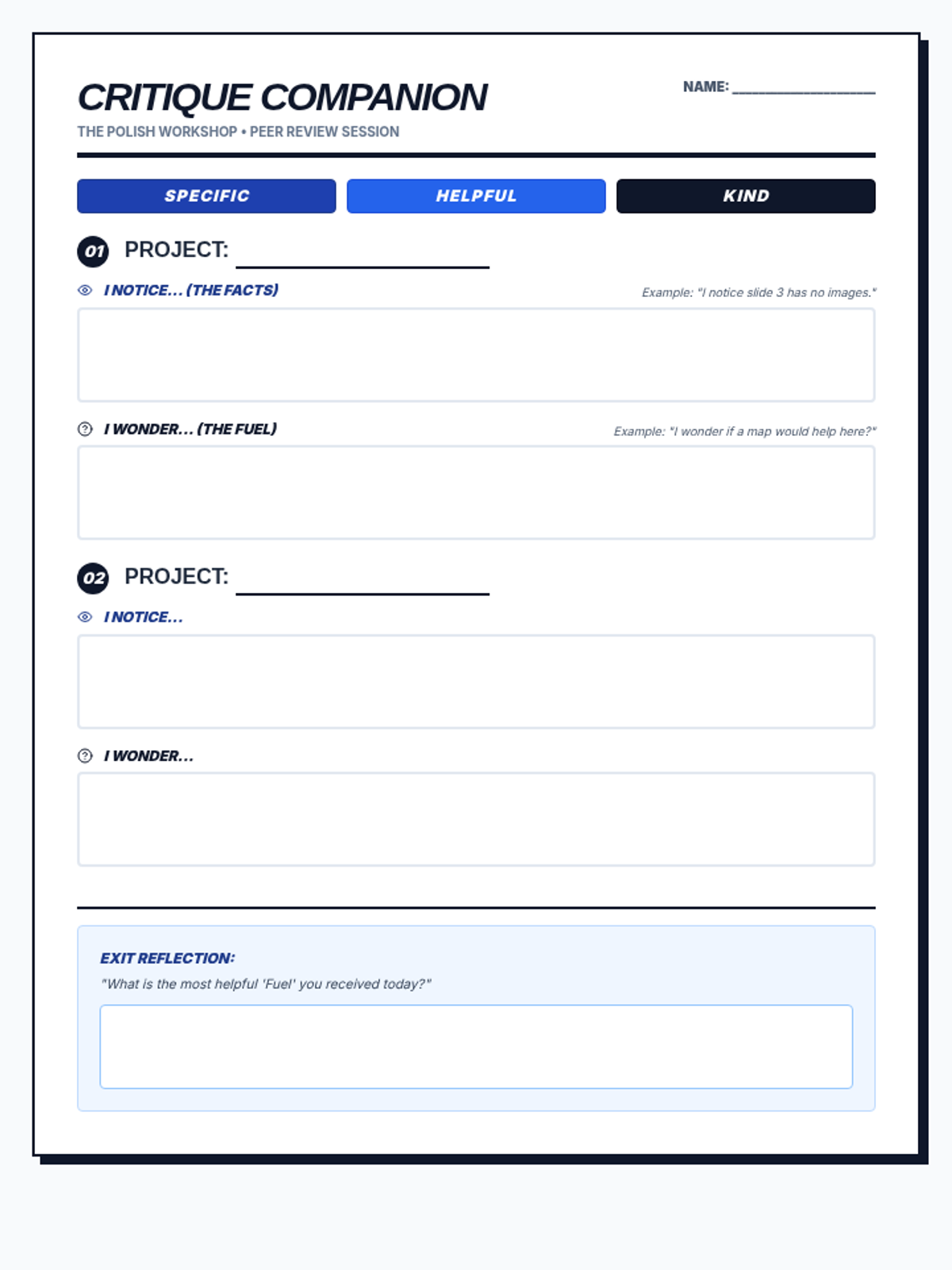
A student worksheet for recording peer feedback using the 'I Notice / I Wonder' framework during 'The Polish Workshop' session.
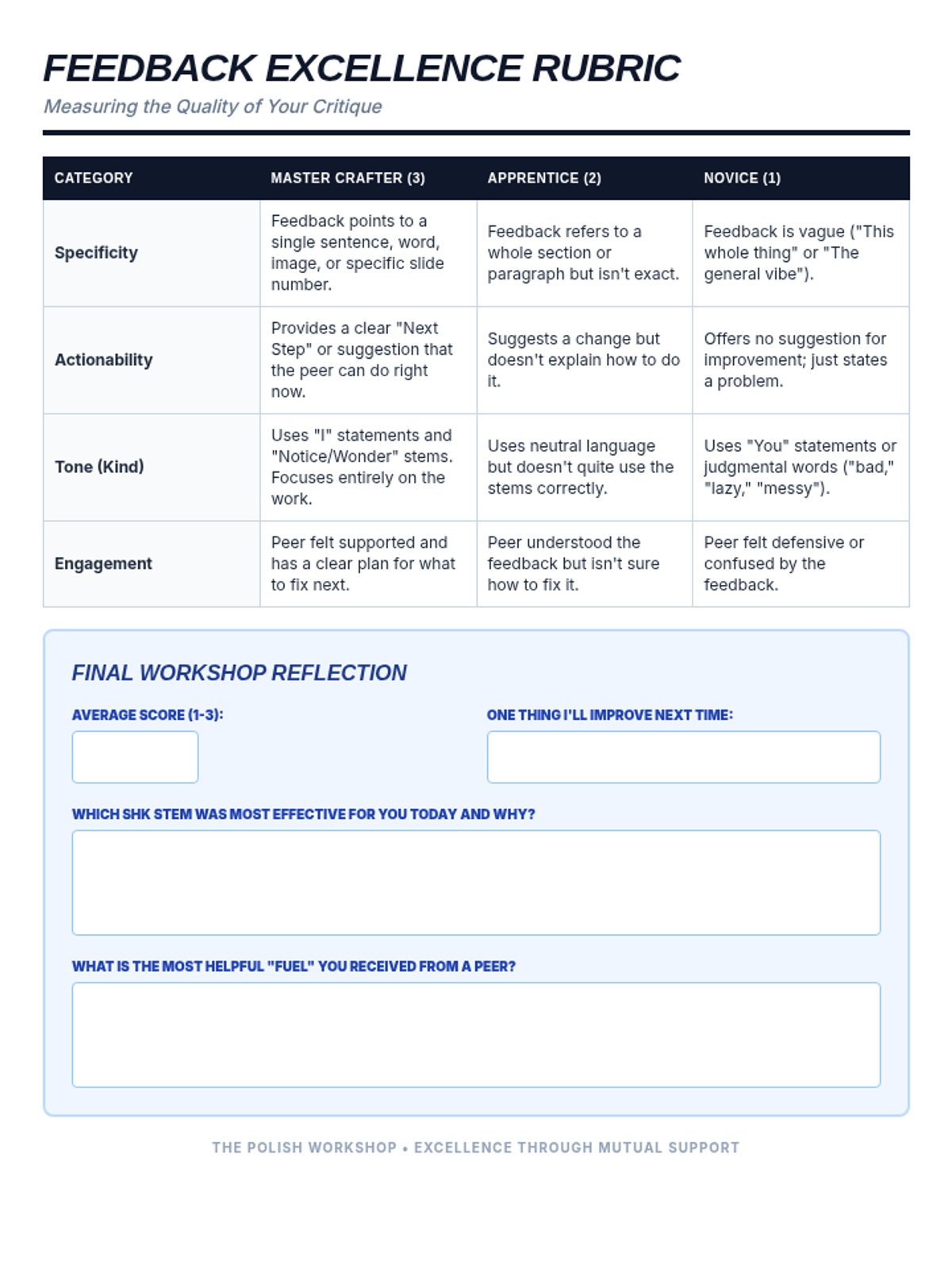
A rubric for students to self-assess the quality of their peer feedback based on specificity, actionability, tone, and engagement.
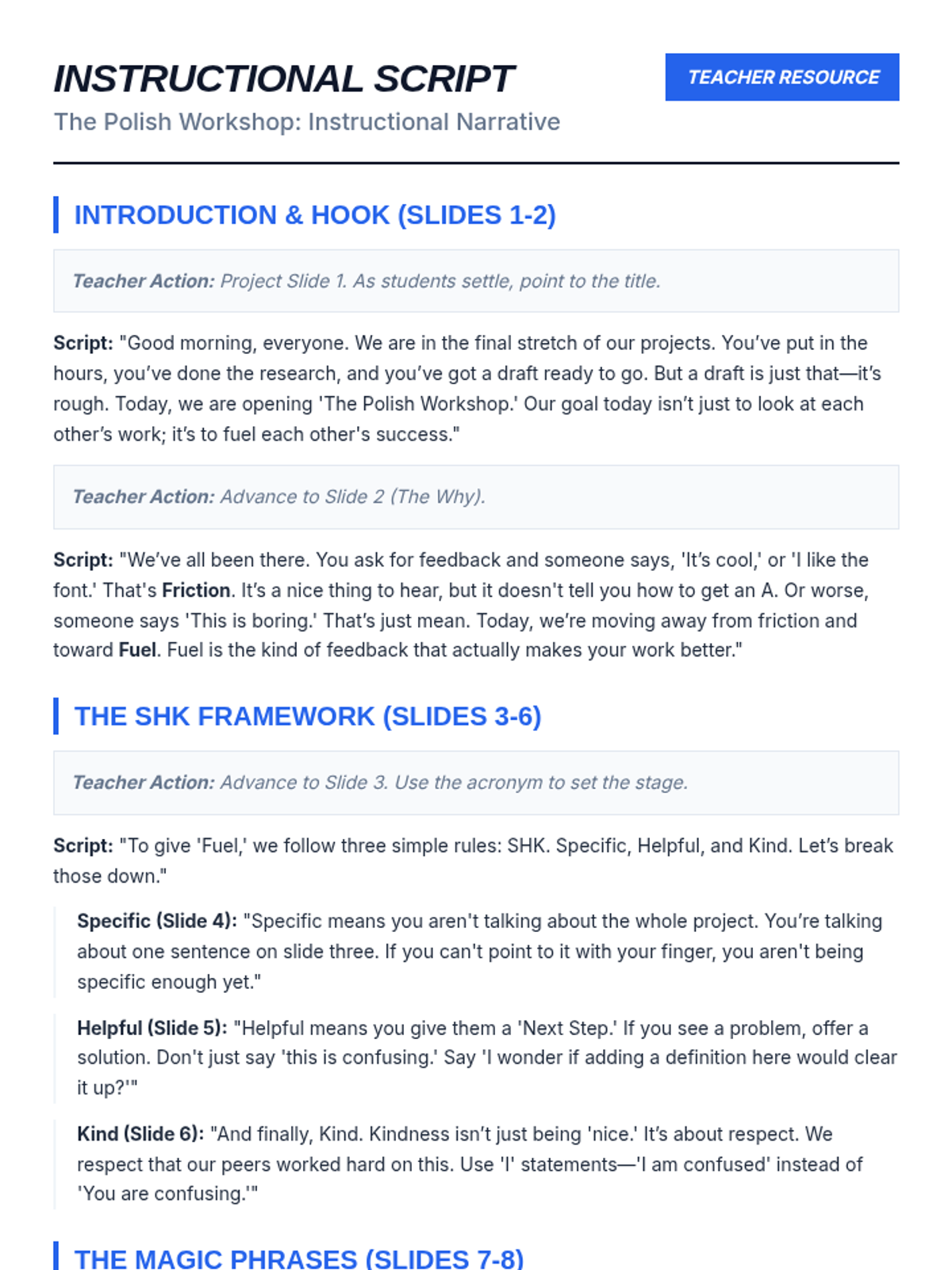
A teacher-facing script providing word-for-word guidance and instructional actions for delivering 'The Polish Workshop' lesson and slides.
A visual presentation for students that introduces the SHK (Specific, Helpful, Kind) framework and the 'I Notice / I Wonder' strategy for peer feedback.
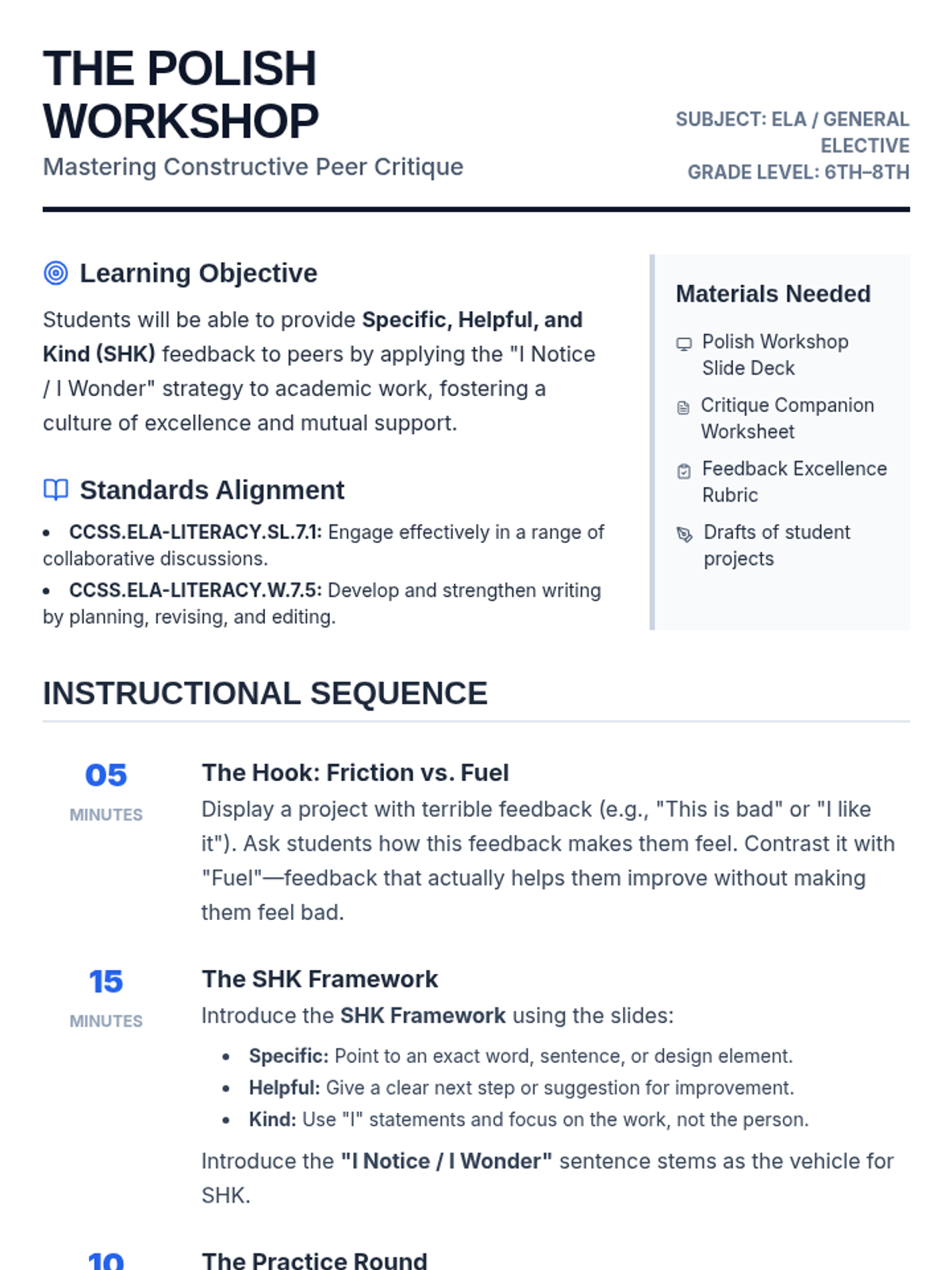
A detailed lesson plan for 'The Polish Workshop' including objectives, standards, materials, and a step-by-step instructional sequence for teaching constructive peer feedback.
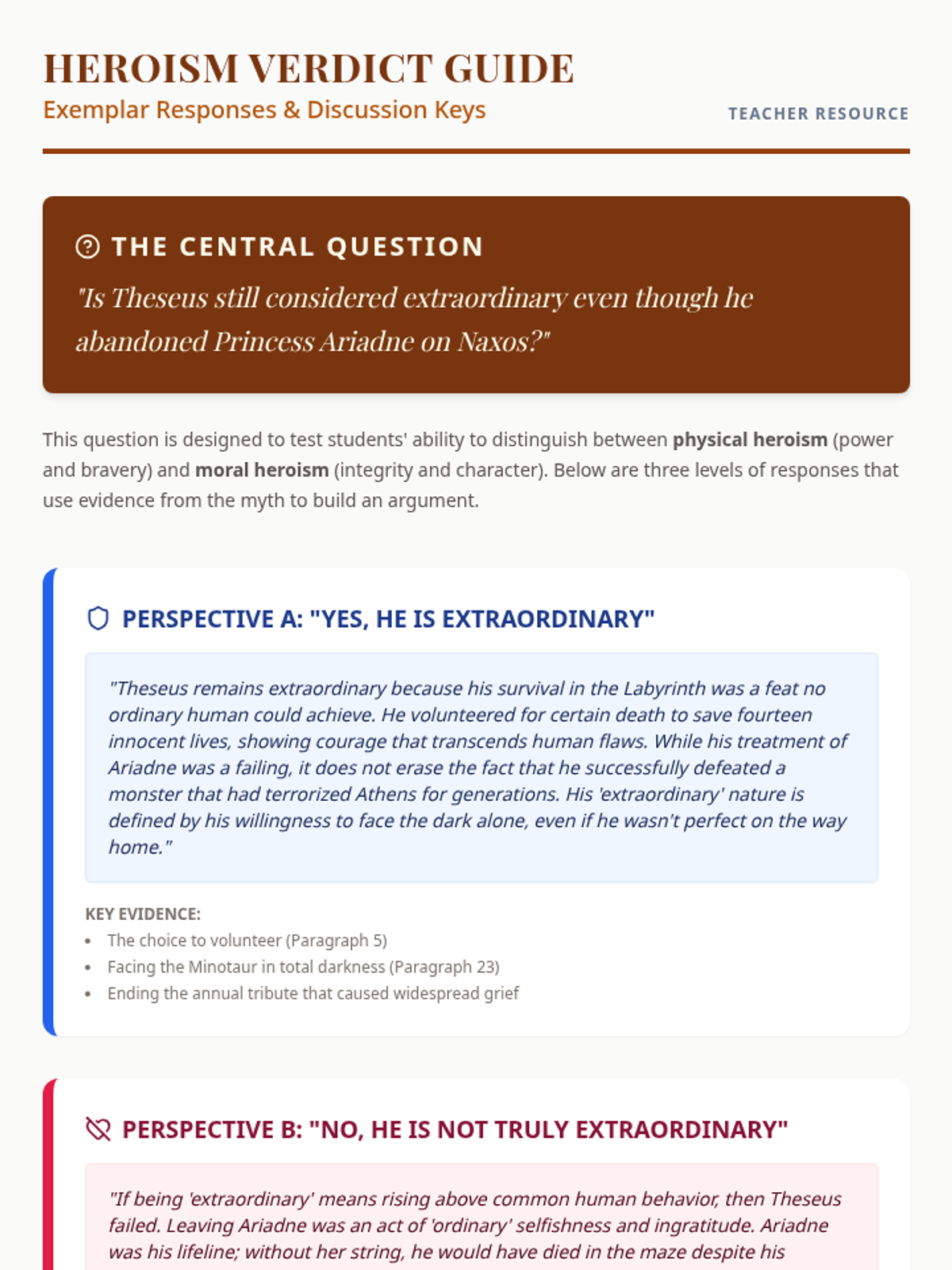
A teacher resource providing exemplar responses and discussion points for the complex question of Theseus's heroism and his abandonment of Ariadne. It offers multiple perspectives based on textual evidence.
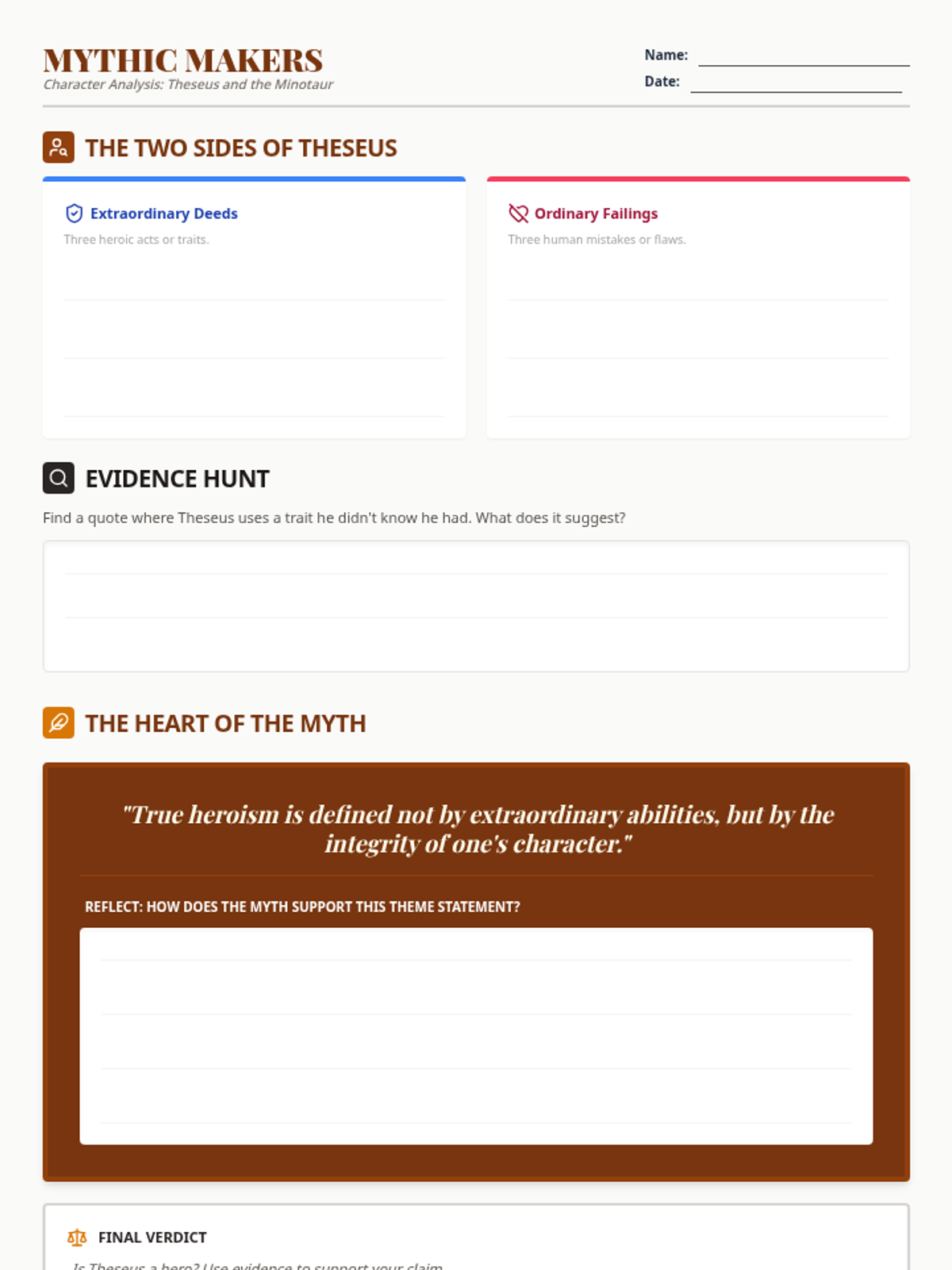
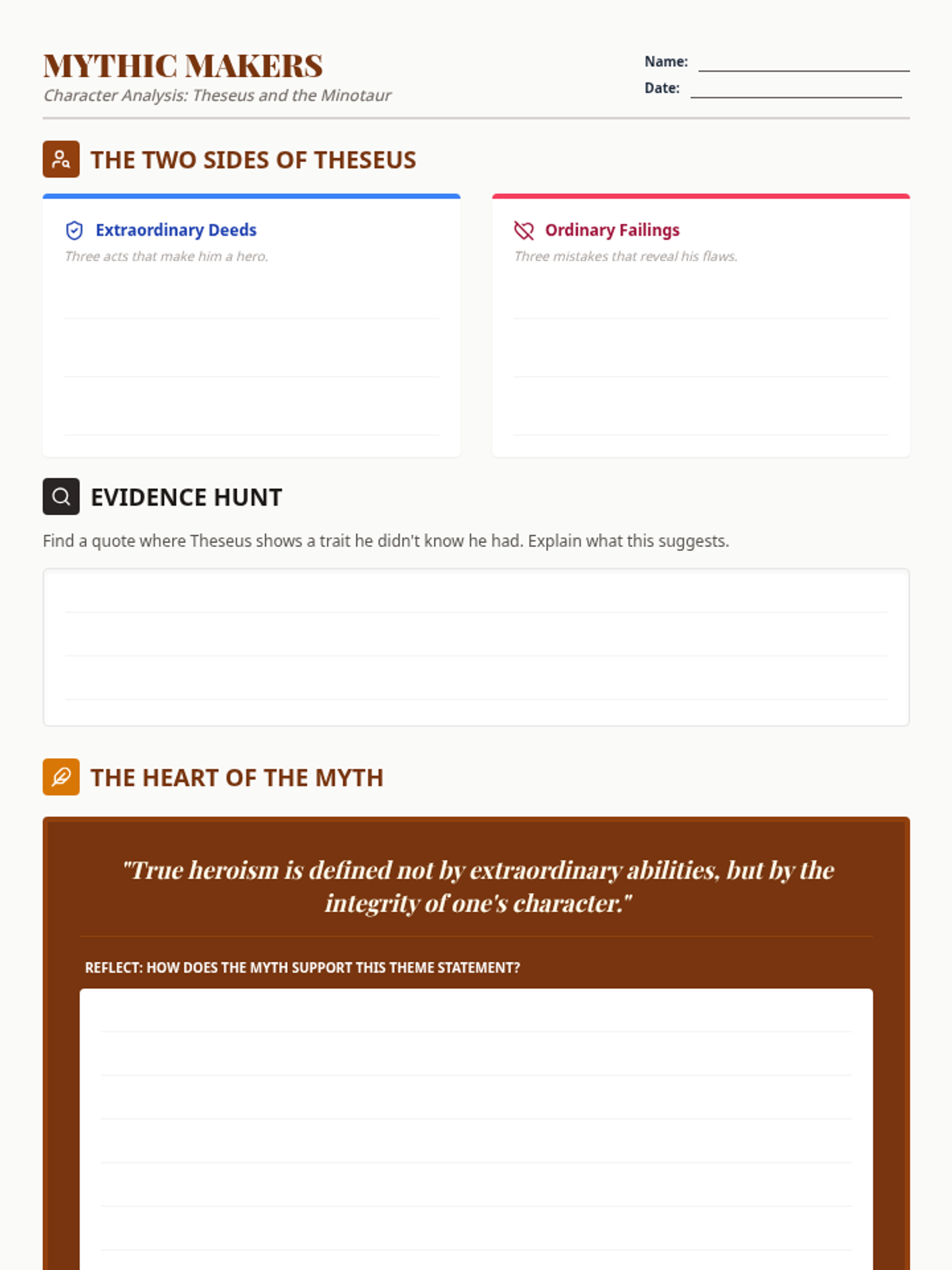
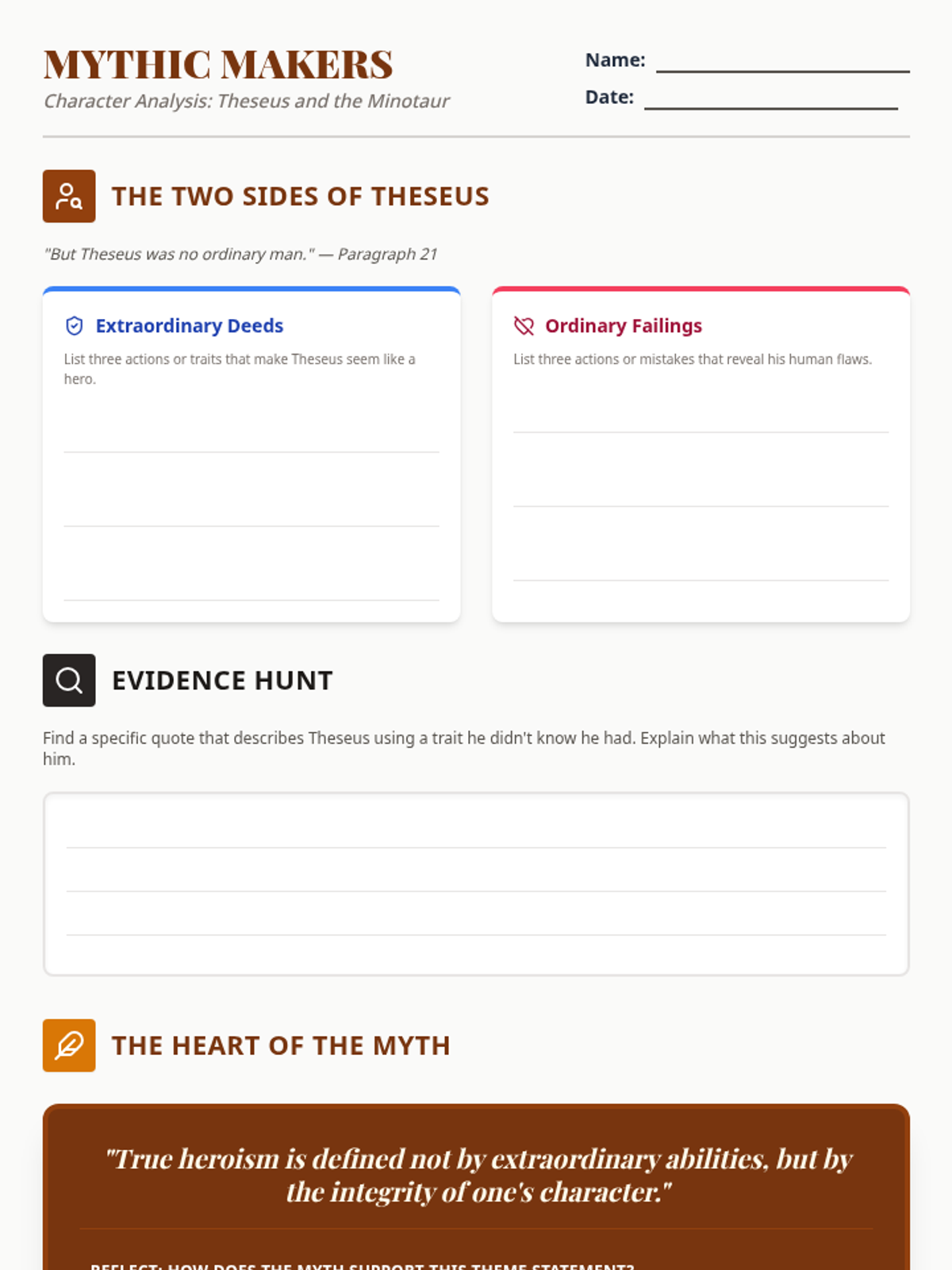
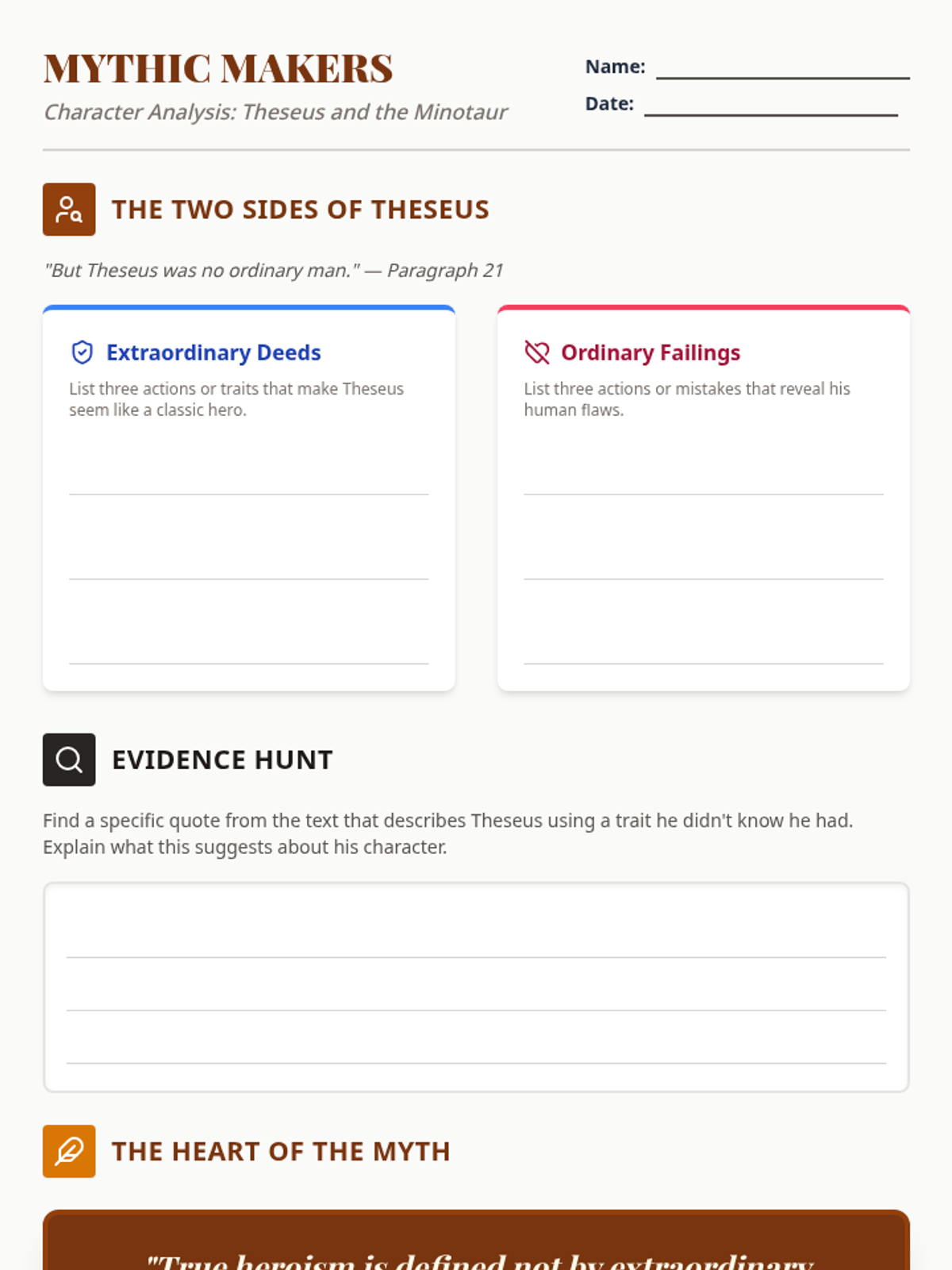
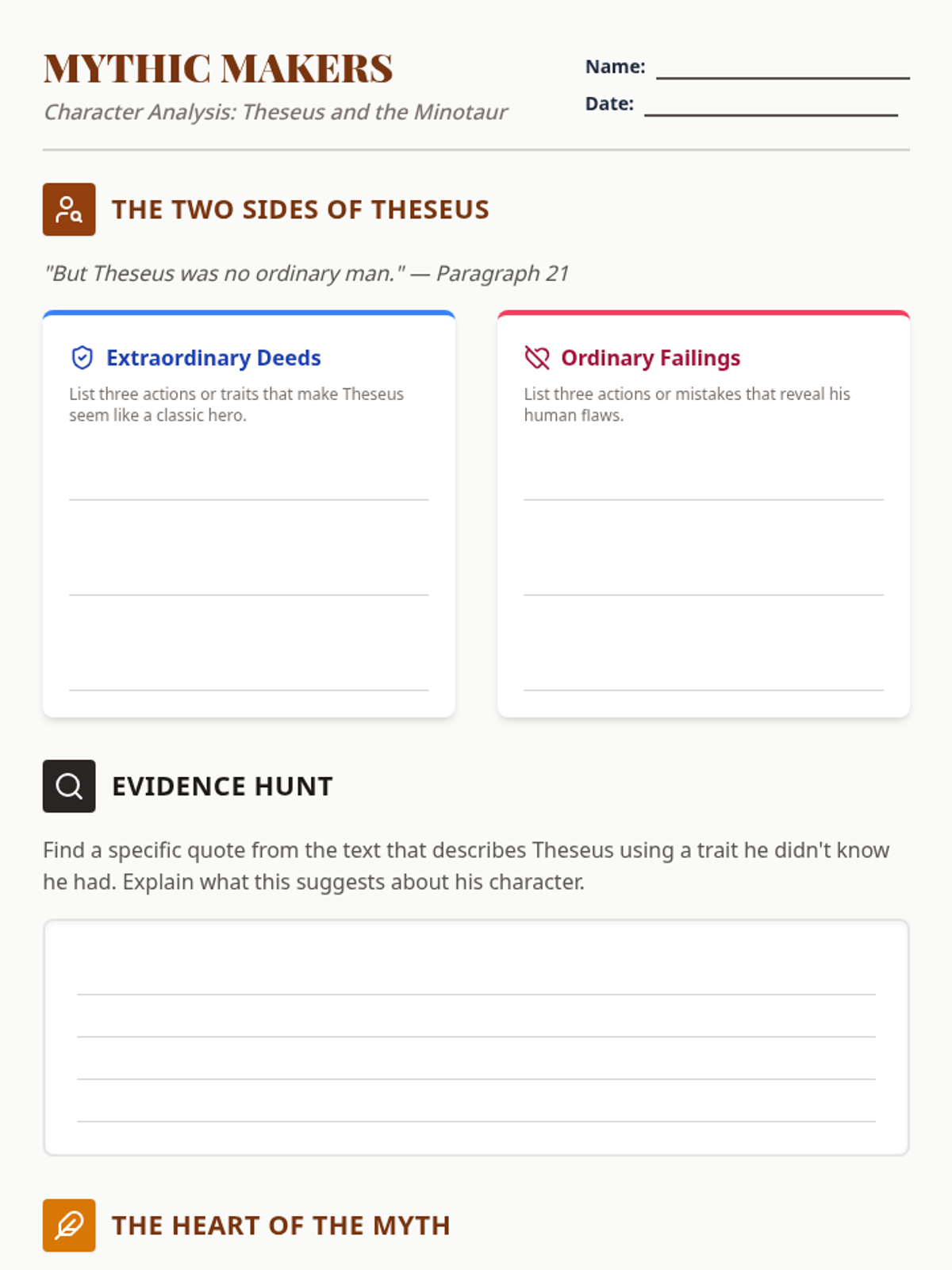
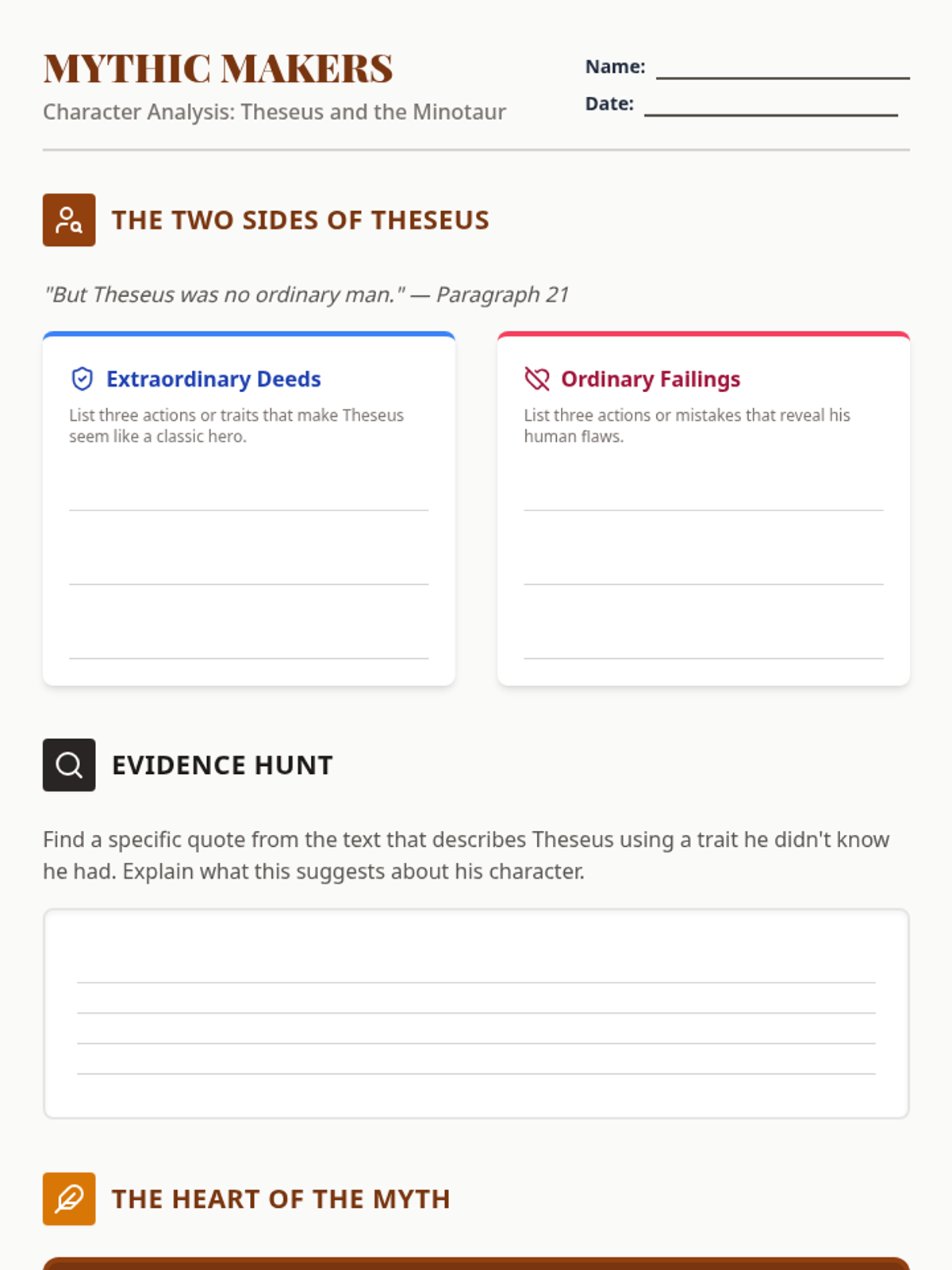
A student worksheet that facilitates character analysis of Theseus, focusing on the contrast between his extraordinary deeds and his moral failings. Includes evidence-finding tasks and deep reflection prompts.
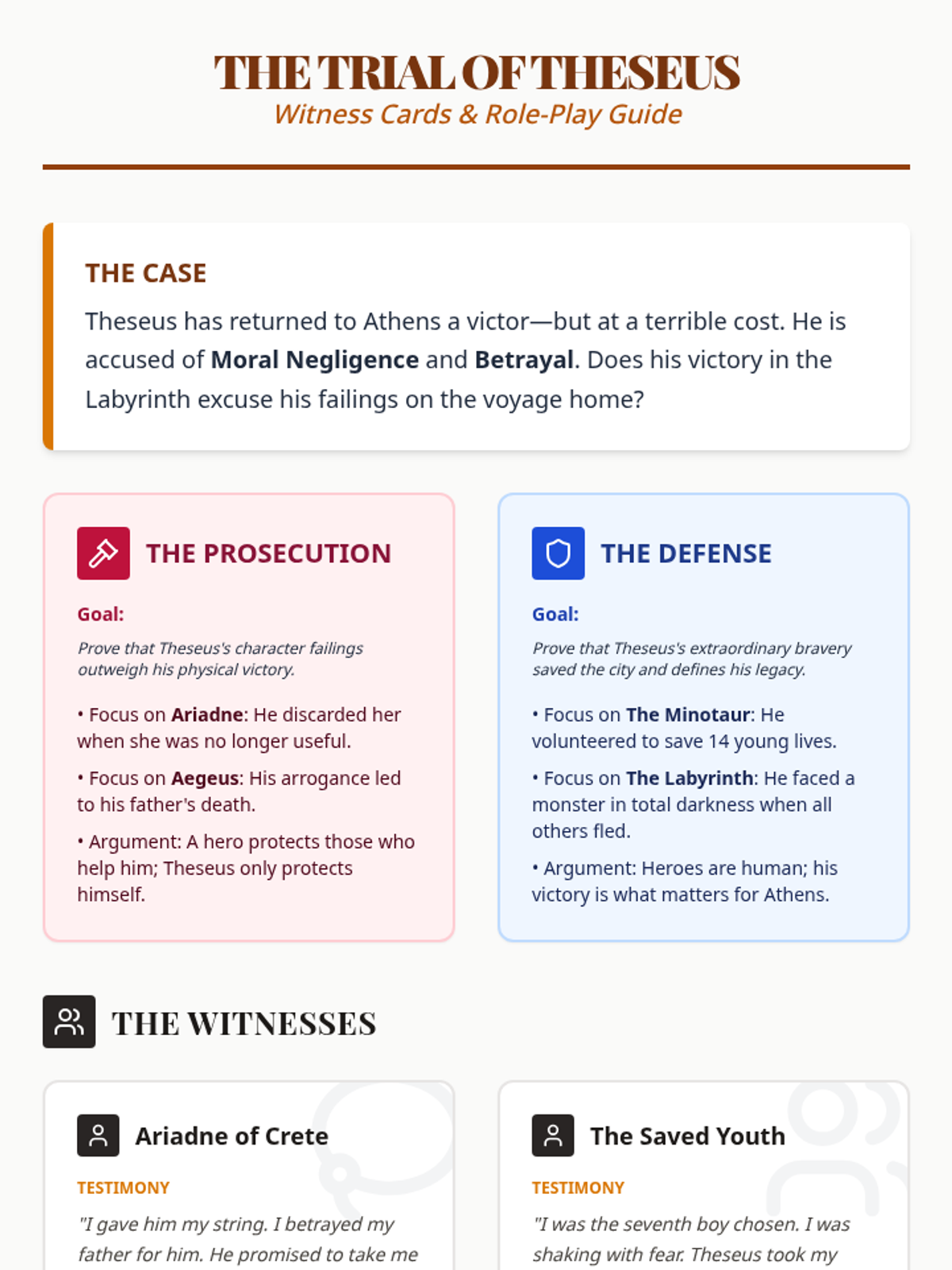
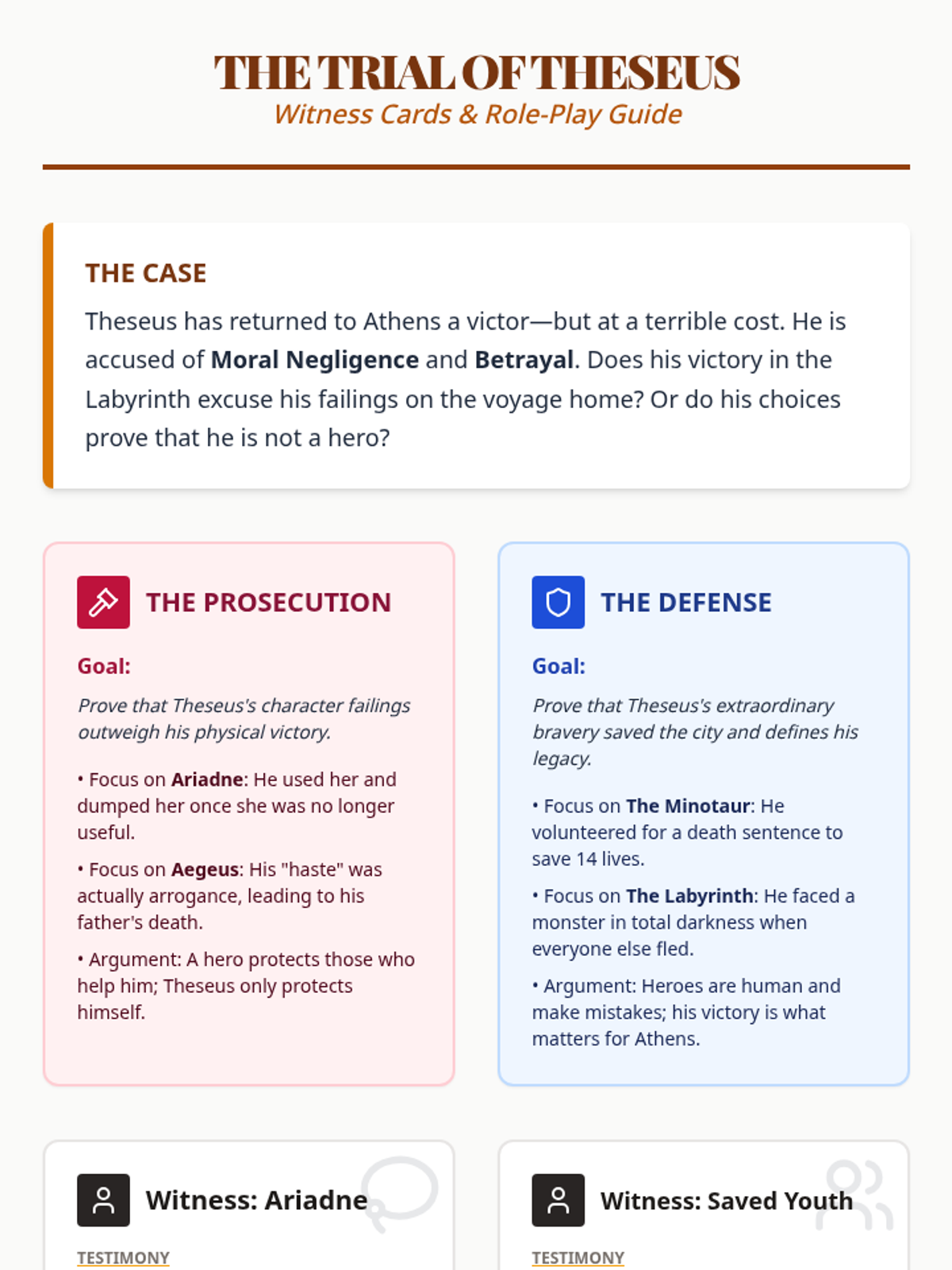
A classroom role-play activity featuring witness cards and a trial procedure to help students debate the heroism of Theseus. It focuses on the moral conflict of his abandonment of Ariadne and the death of King Aegeus.
A visually engaging slide deck designed for the 'Heroic Heart' lesson, walking students through the myth of Theseus while prompting deep reflection on the nature of heroism and character.
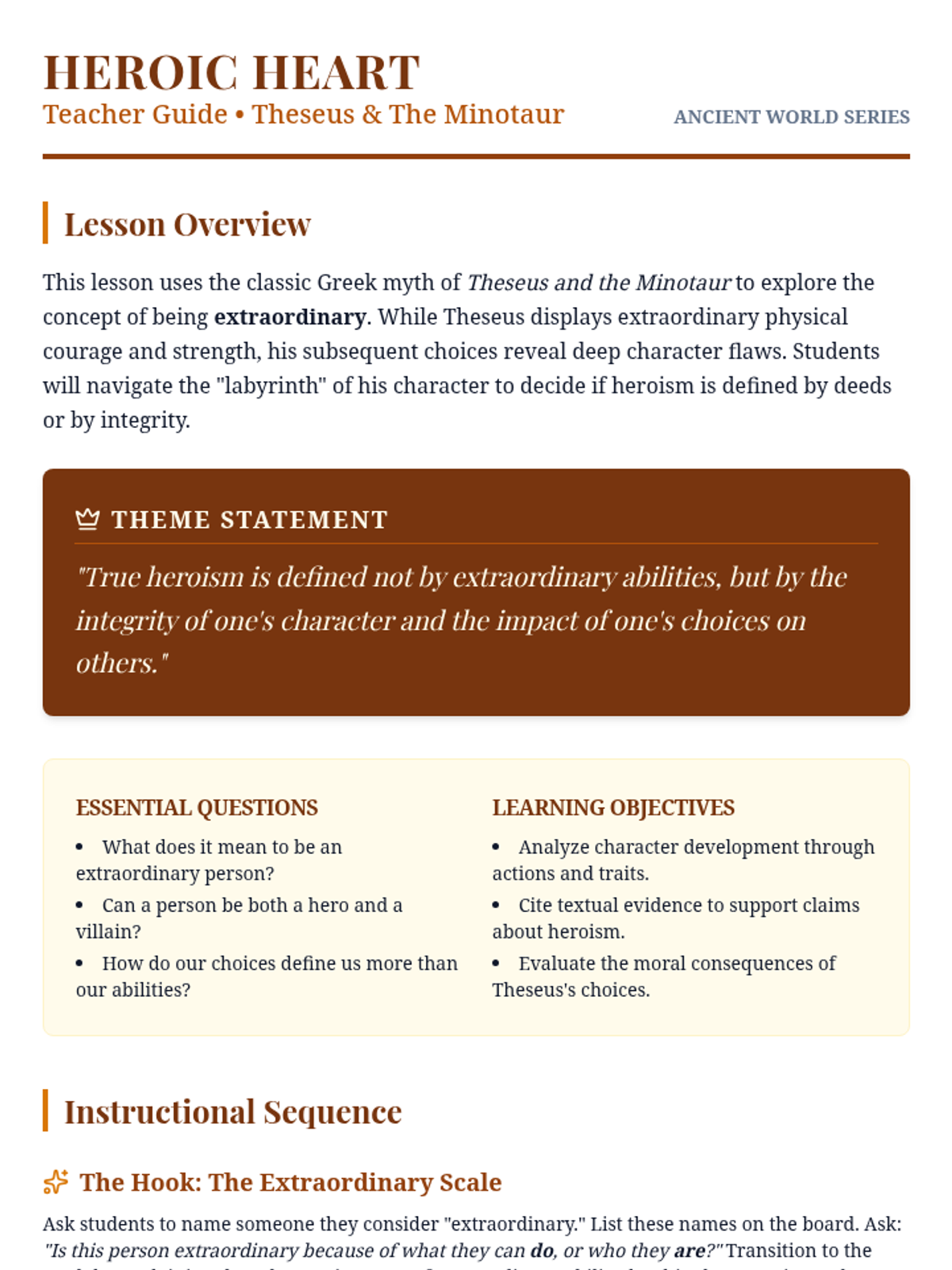
A comprehensive teacher guide for the 'Heroic Heart' lesson, featuring instructional strategies, discussion prompts focused on the concept of being extraordinary, and a detailed answer key for text-dependent questions.
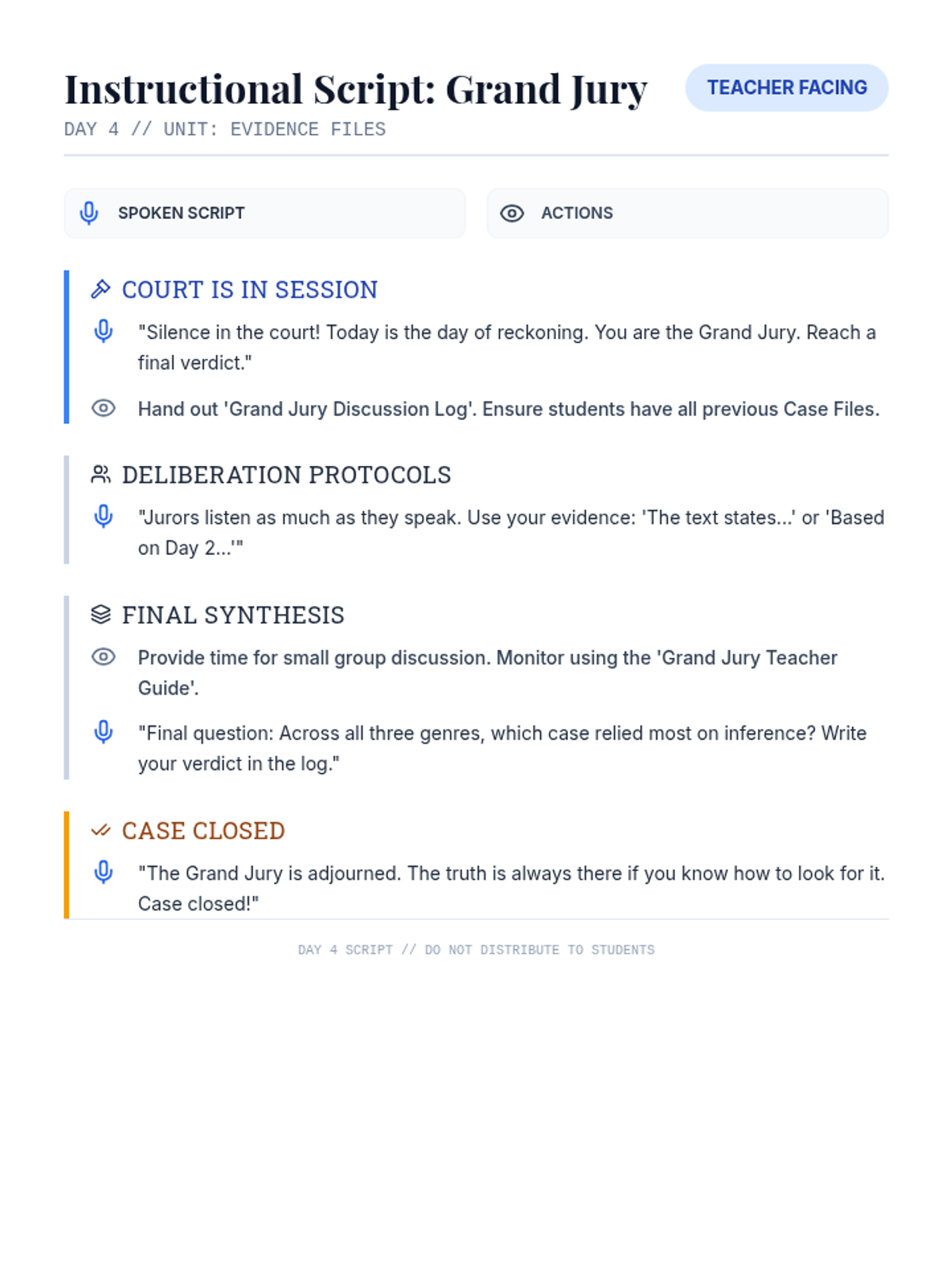
The Grand Jury Script provides the teacher with a structured instructional path for Day 4, focusing on the final synthesis and collaborative deliberation of the unit's key texts. Updated for improved contrast and page-break handling.
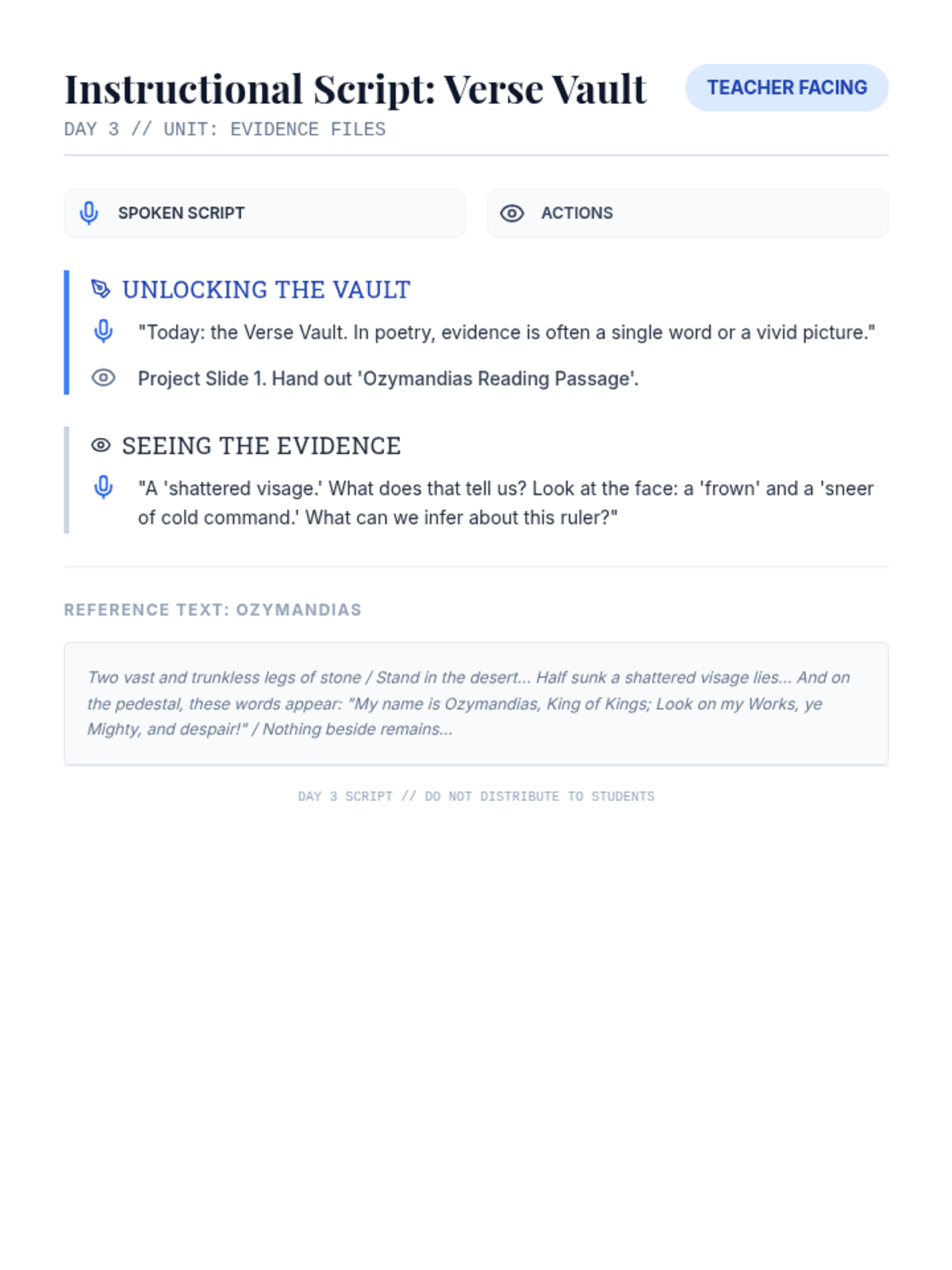
The Verse Vault Script provides the teacher with a step-by-step instructional path for Day 3, focusing on analyzing imagery and word choice in 'Ozymandias'. Updated for improved contrast and single-page fit.
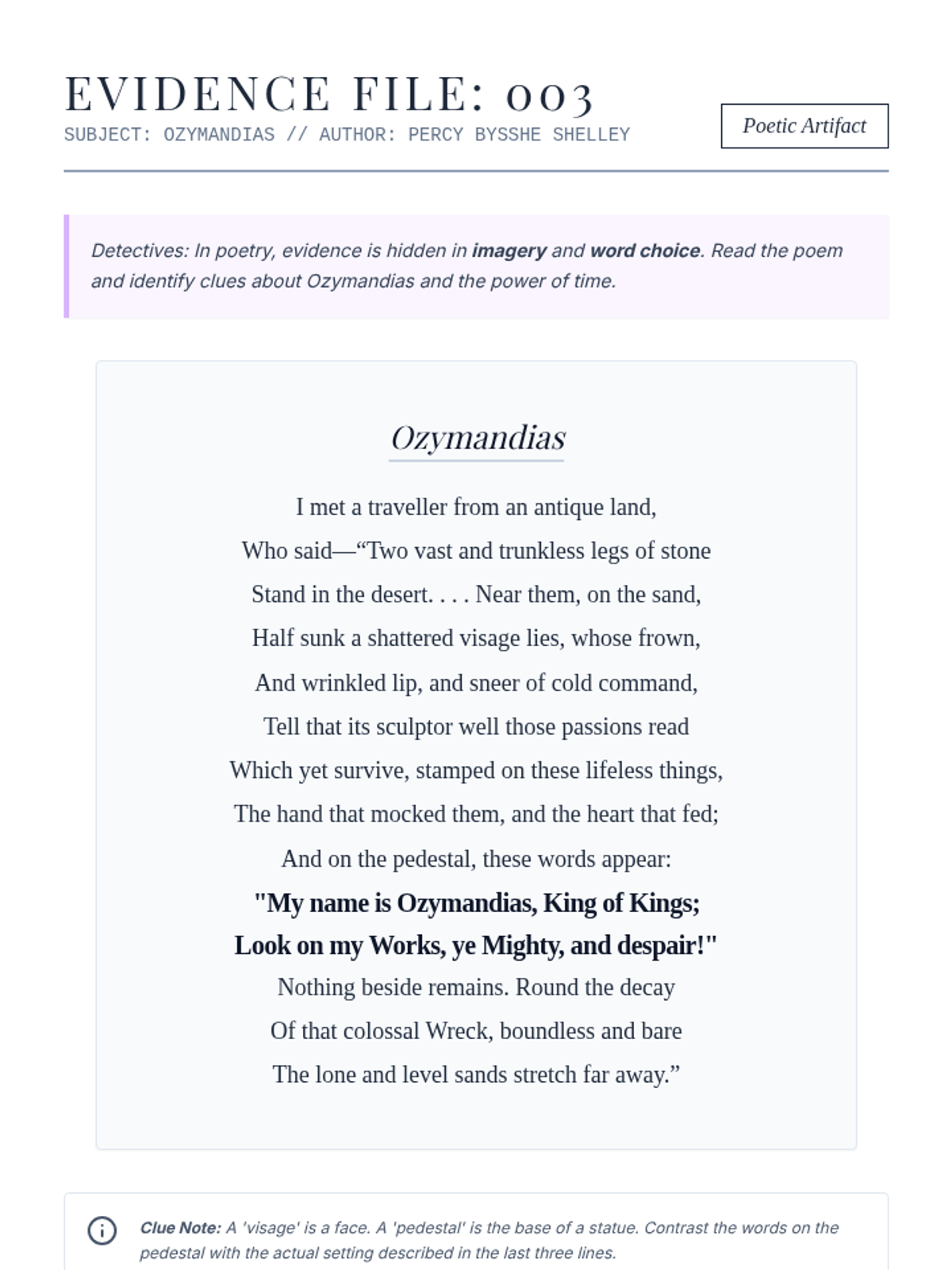
The Ozymandias Reading Passage provides the full text of Percy Bysshe Shelley's poem, formatted for student analysis with clear typography and helpful vocabulary notes. Updated to ensure single-page fit.
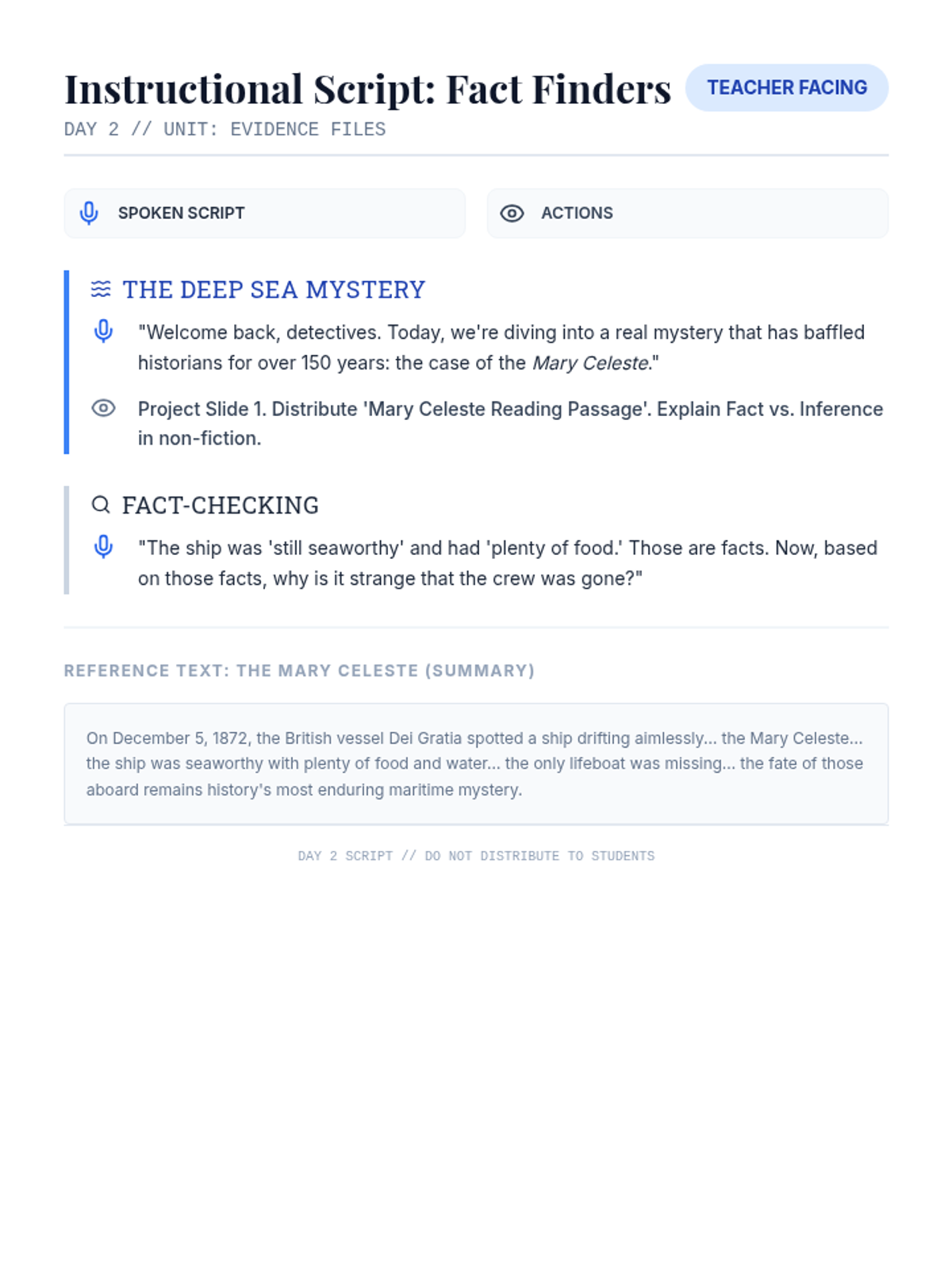
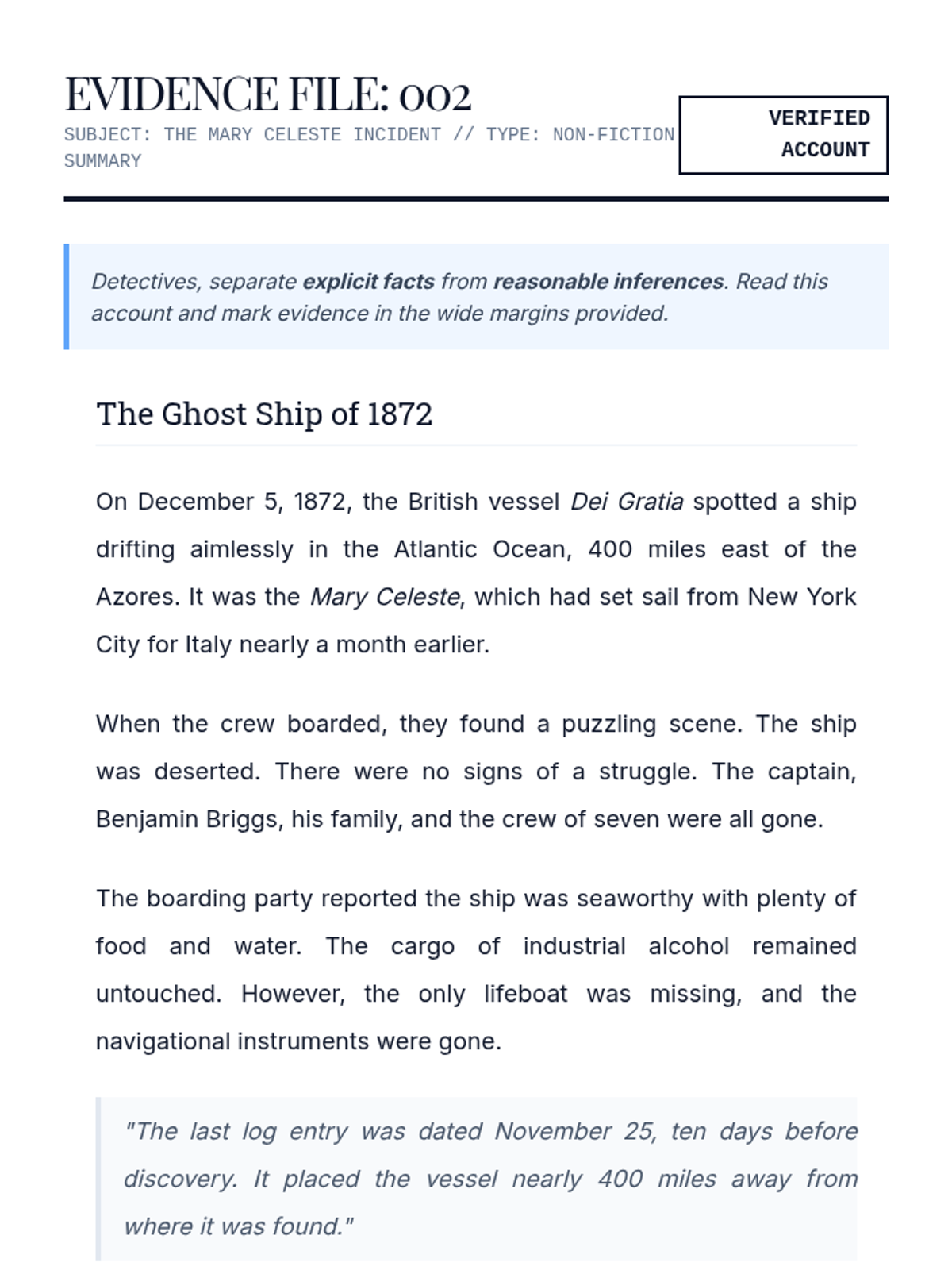
The Fact Finders Script provides the teacher with a structured instructional path for Day 2, focusing on the Mary Celeste mystery and the distinction between facts and inferences in non-fiction. Updated for improved contrast and page layout.
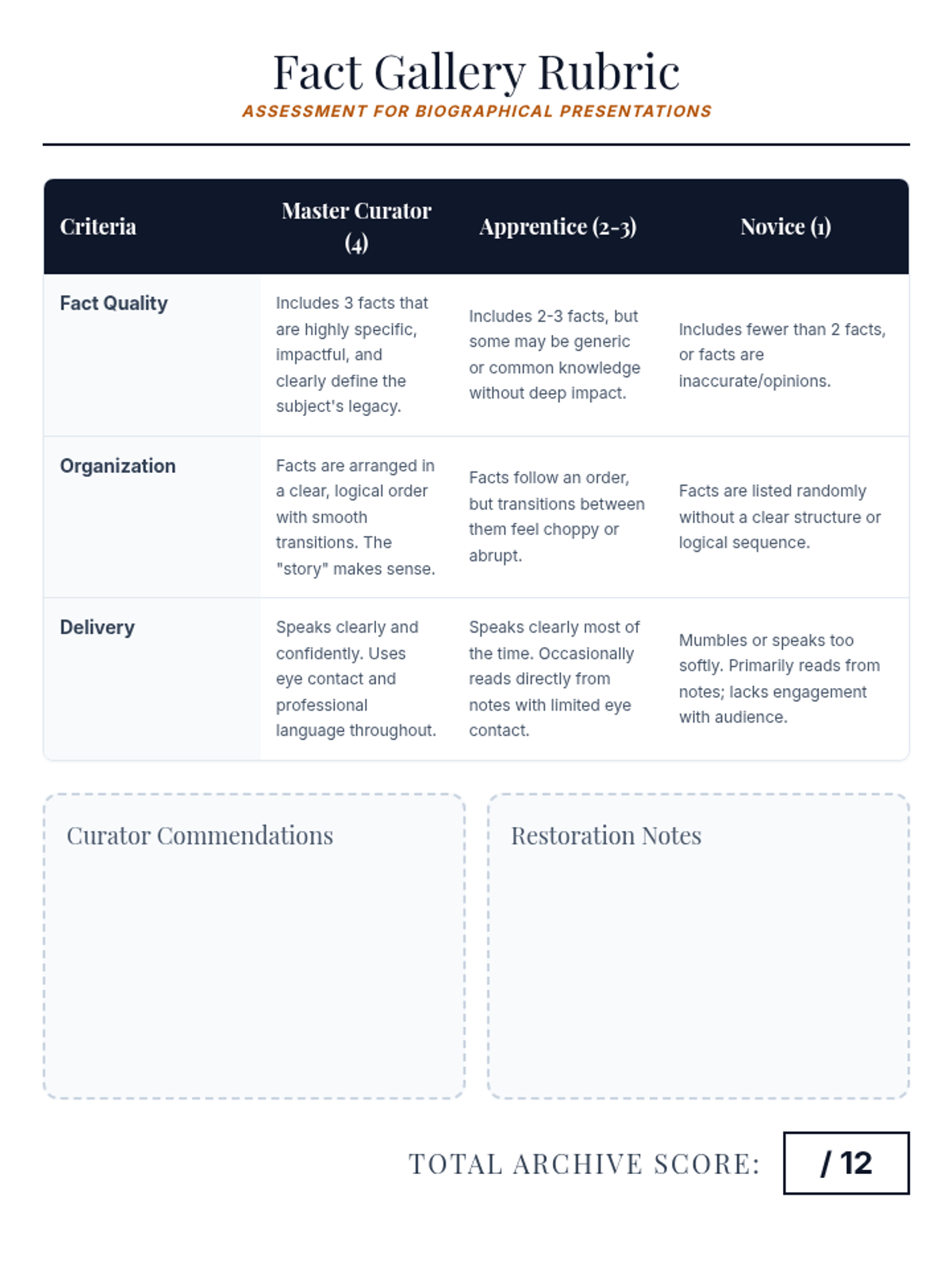
Rubric for assessing biographical presentations. Revised to fit all content on a single page, improve text contrast for labels, and ensure clear presentation for printing.
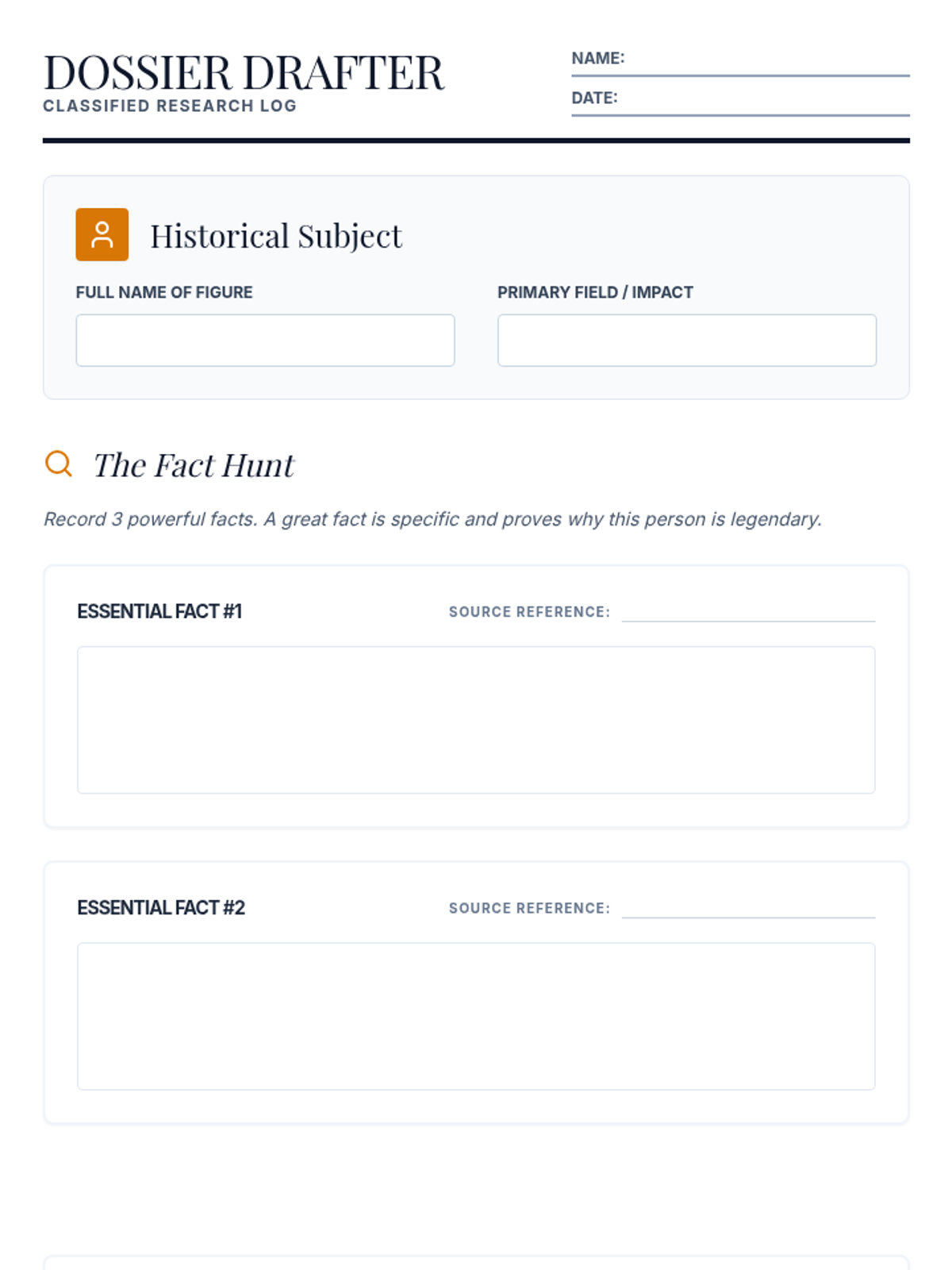
Student worksheet for researching and organizing biographical facts. Revised with improved handwriting space, distinct transition word lines, and optimized page layout to ensure the planning section is easy to use. Final polish added for label spacing and contrast.
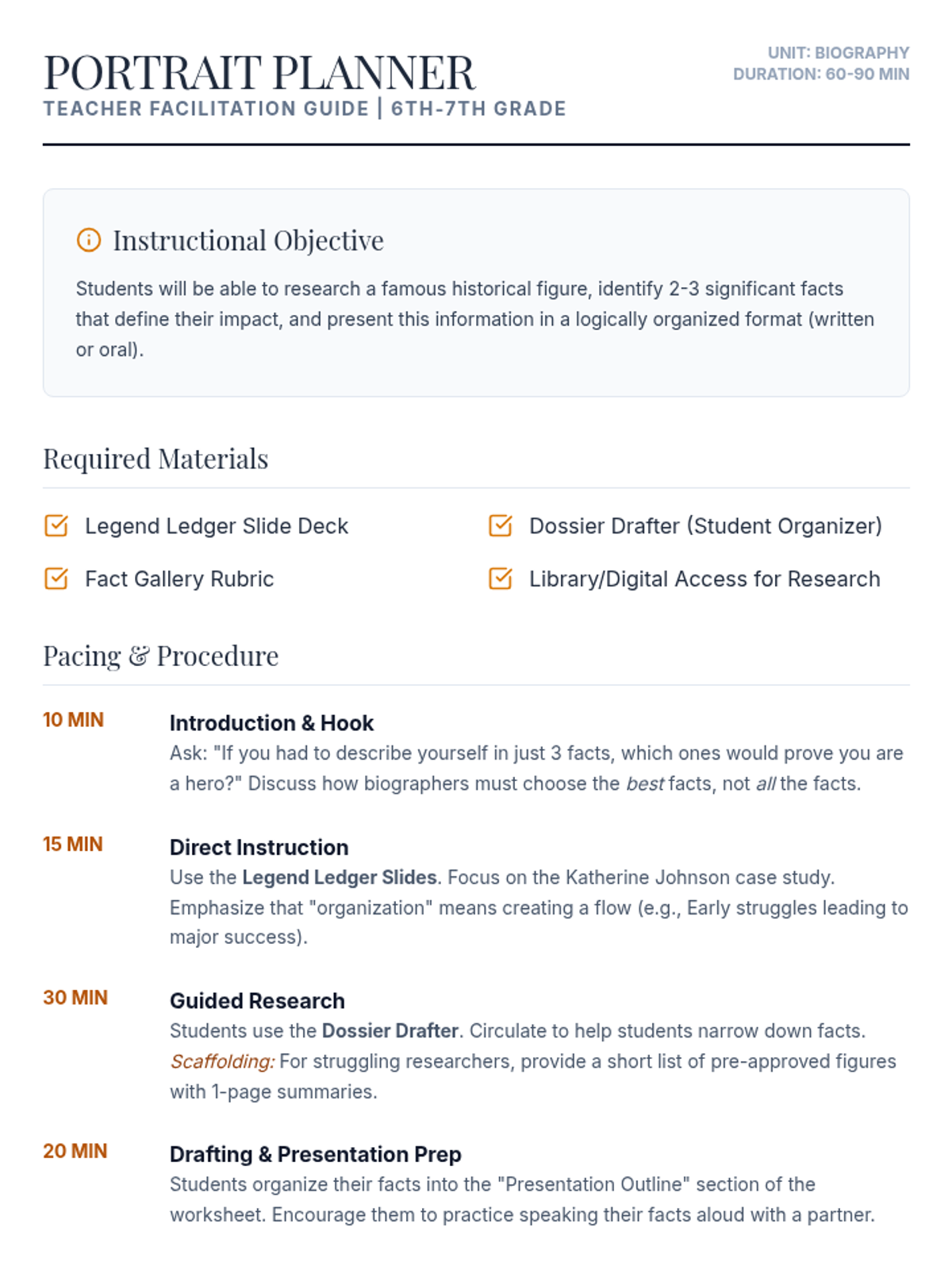
Comprehensive teacher guide for the biography lesson, including learning objectives, a detailed pacing guide, discussion prompts, and common student misconceptions to watch for during the research phase. Now includes extension activities and teacher tips.
Instructional slides for teaching students how to research, select, and organize 2-3 key biographical facts about a historical figure. Includes a case study on Katherine Johnson and tips for presentation delivery.
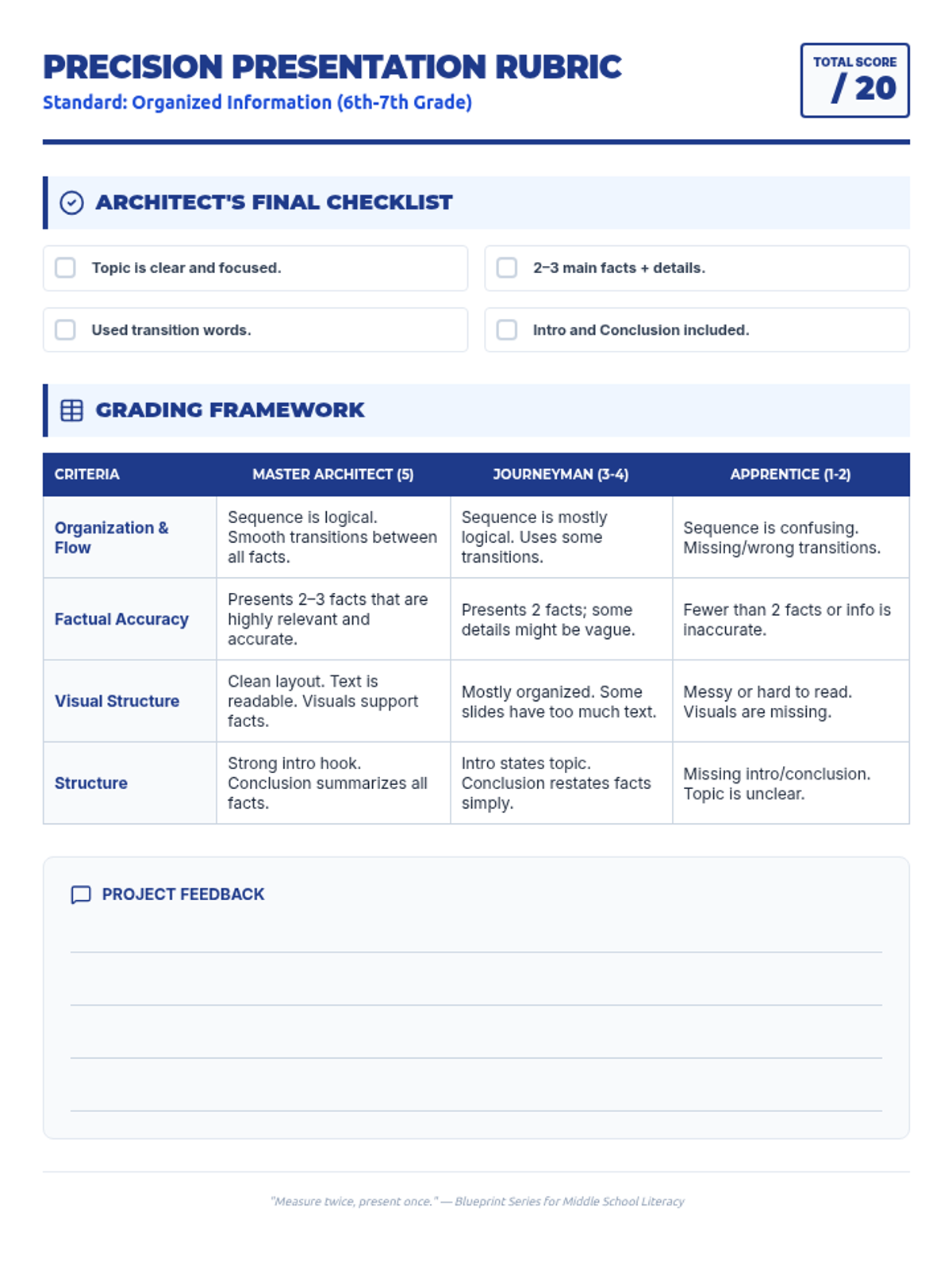
A comprehensive checklist and rubric for evaluating 6th and 7th-grade presentations on their organization, factual content, and visual structure. Revised to fit on a single page.
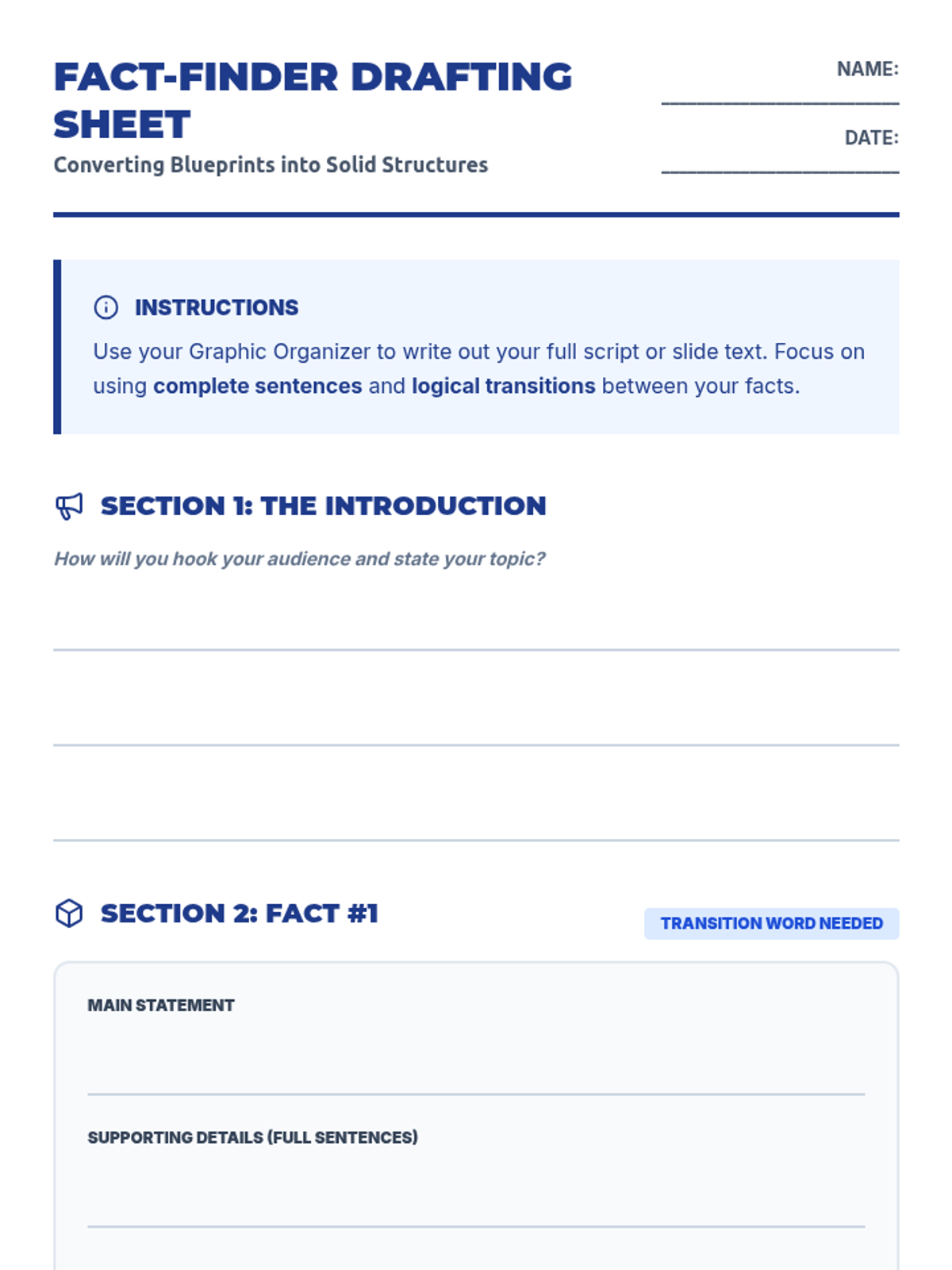
A drafting worksheet for 6th and 7th-grade students to expand their organized facts into full sentences and structured paragraphs, revised for better layout and handwriting clarity.
Instructional and template slides for a 'Blueprint' themed presentation lesson, teaching 6th and 7th-grade students how to structure their information and facts visually. Revised with improved contrast, additional templates, and layout fixes.
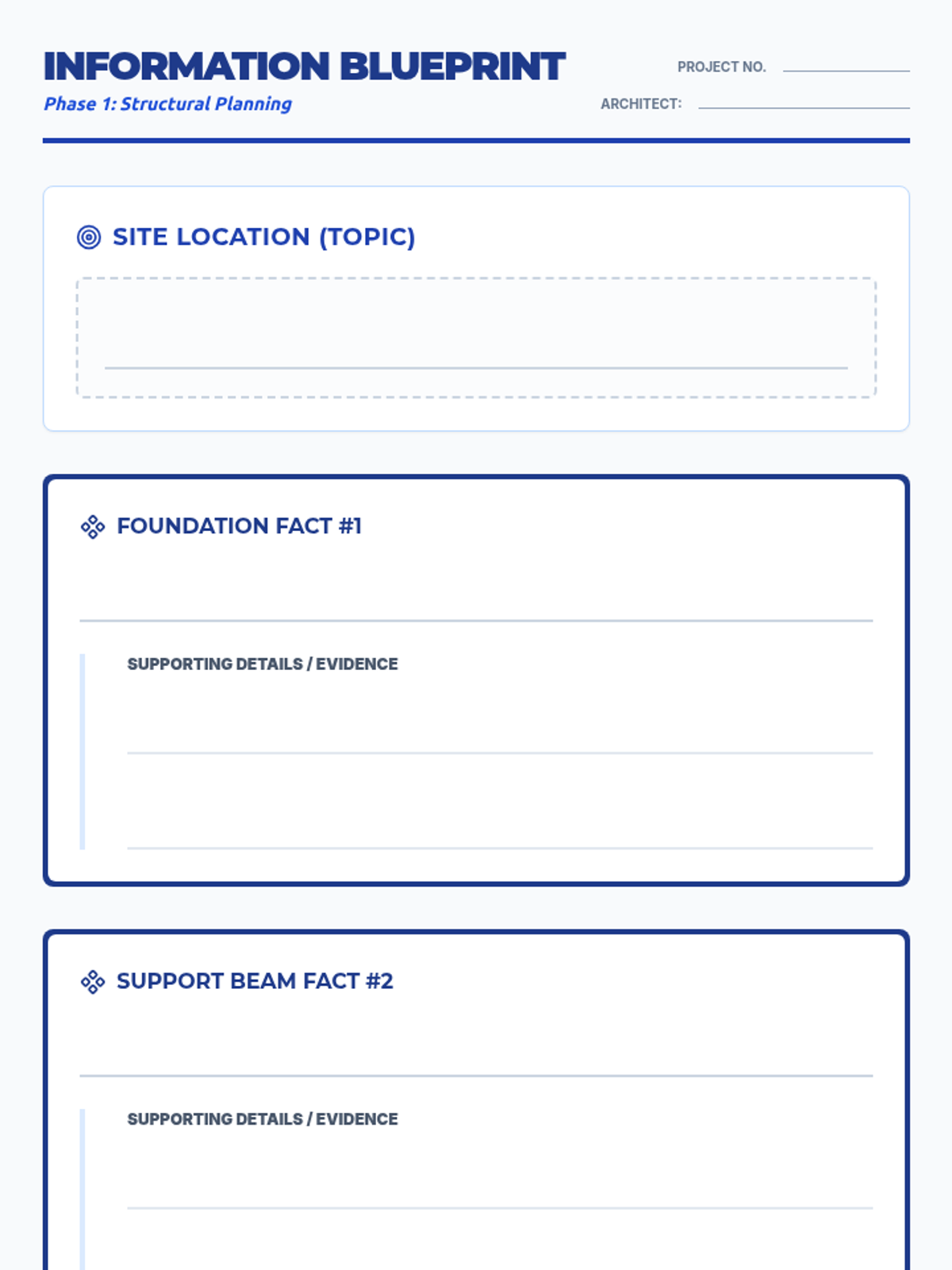
A blueprint-themed graphic organizer for 6th and 7th-grade students to plan their research by identifying a topic and organizing 2-3 main facts with supporting details. Revised for improved line spacing and page break consistency.
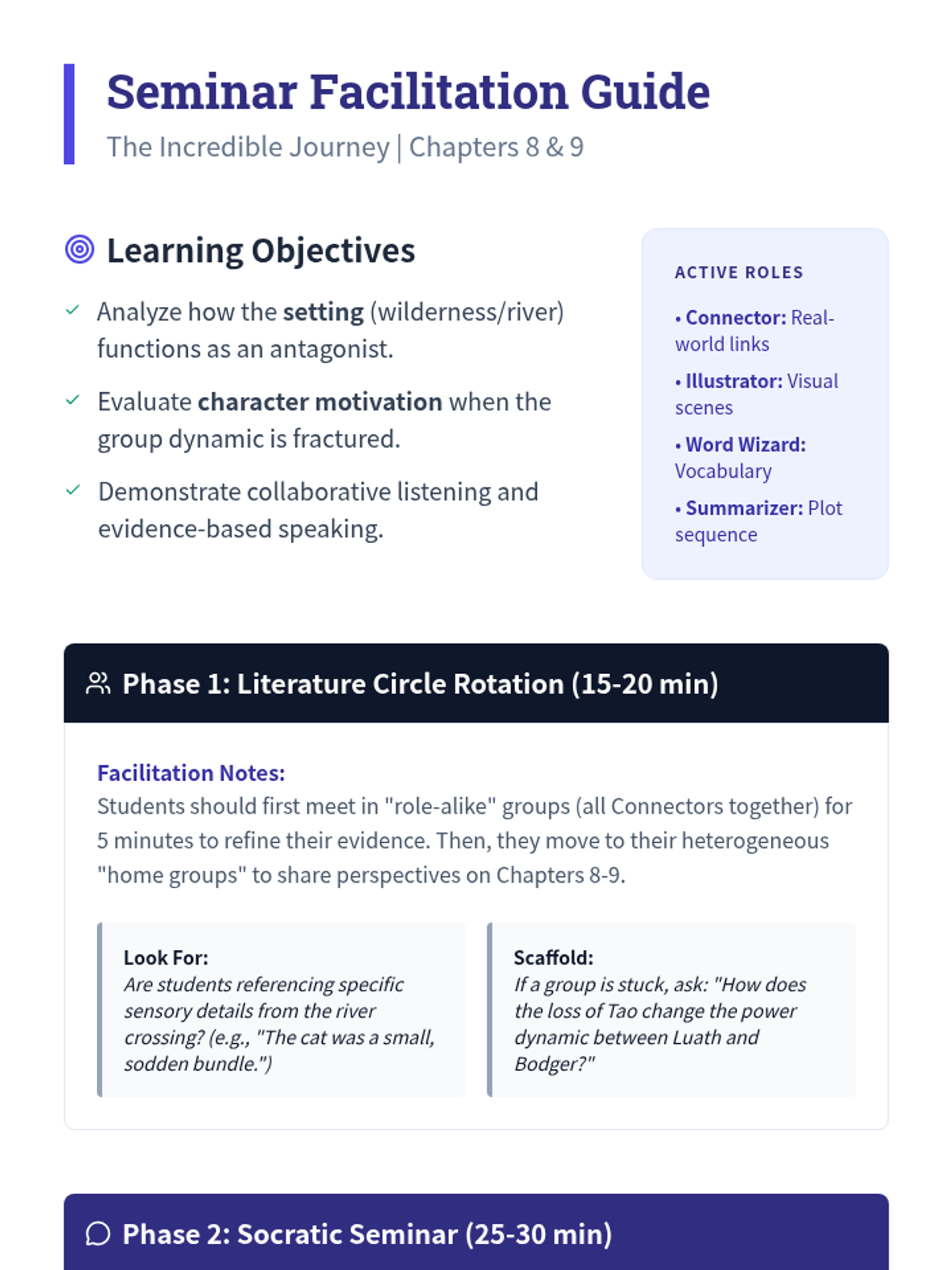
A facilitation guide for teachers to manage Literature Circles and a Socratic Seminar on 'The Incredible Journey' Chapters 8-9, including discussion prompts, objectives, and key vocabulary.
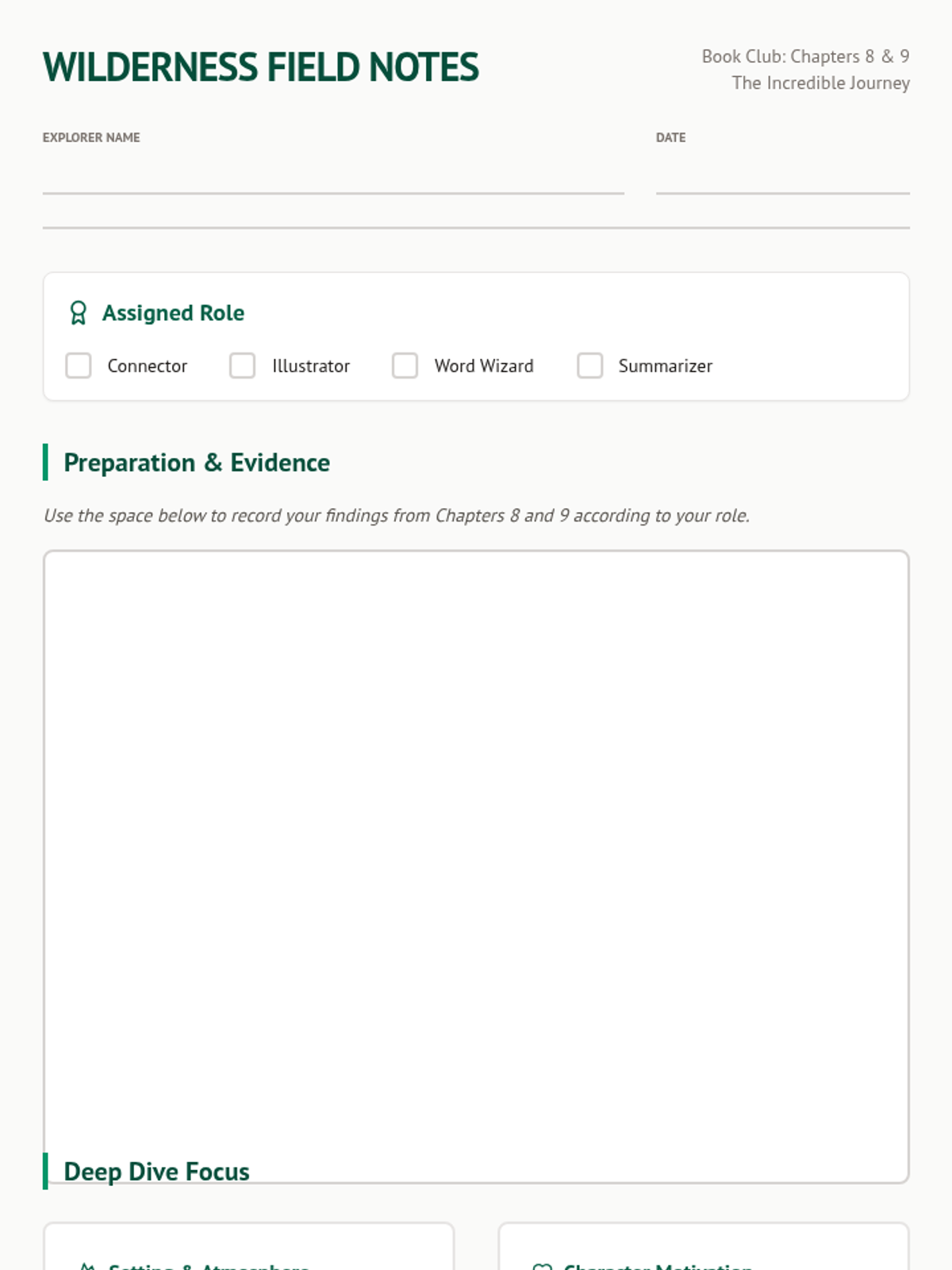
A student worksheet for Literature Circle roles and Socratic Seminar preparation, focusing on gathering evidence for character motivation and atmospheric setting.
A comprehensive slide deck for a book club discussion on 'The Incredible Journey' (Chapters 8-9), featuring a summary of previous events, character motivation analysis, and Socratic Seminar prompts focusing on setting and atmosphere.
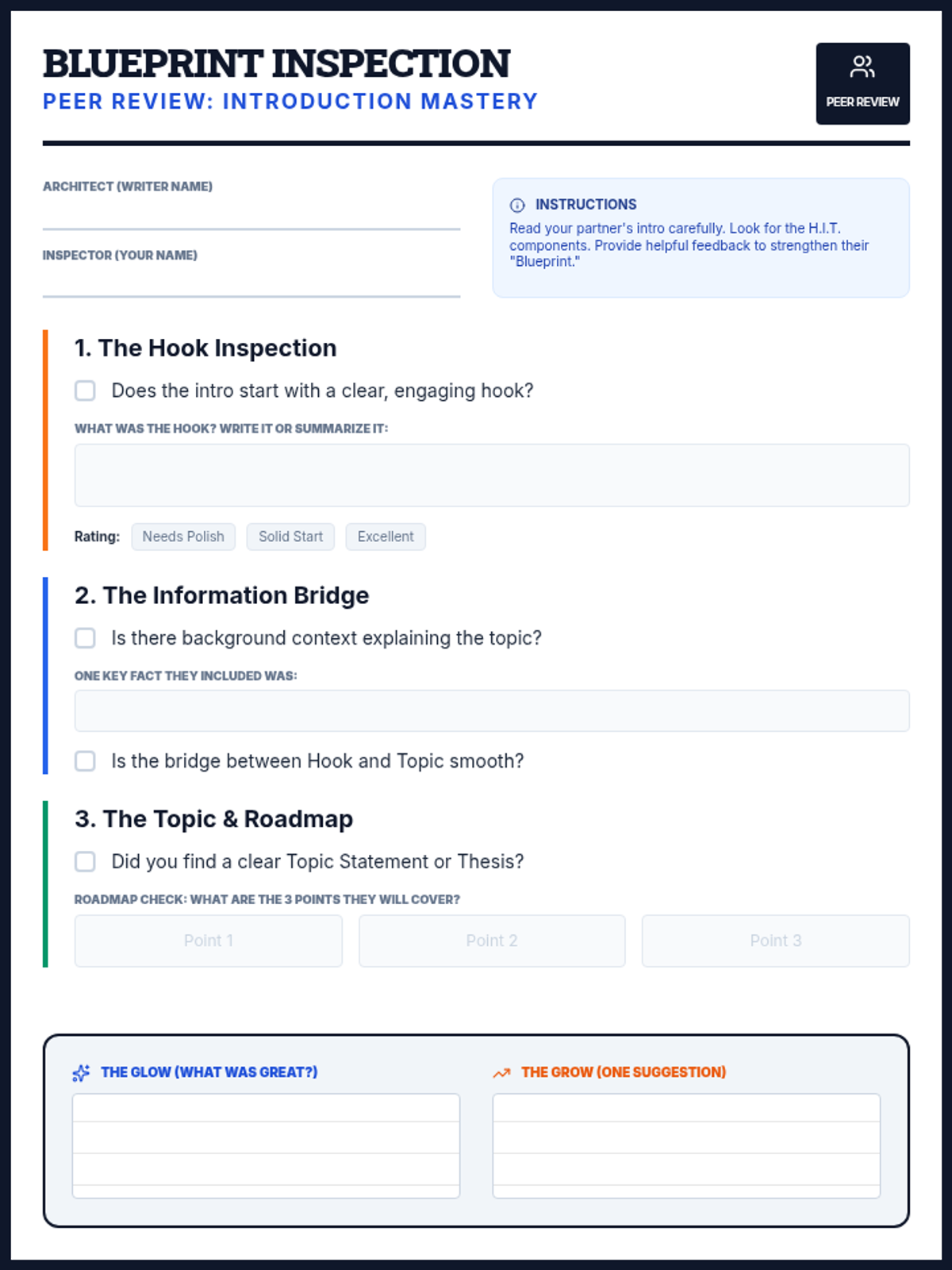
A structured peer-review worksheet for 7th-grade students to evaluate their classmates' introductions using the H.I.T. strategy, featuring specific sections for the hook, background info, and topic statement.
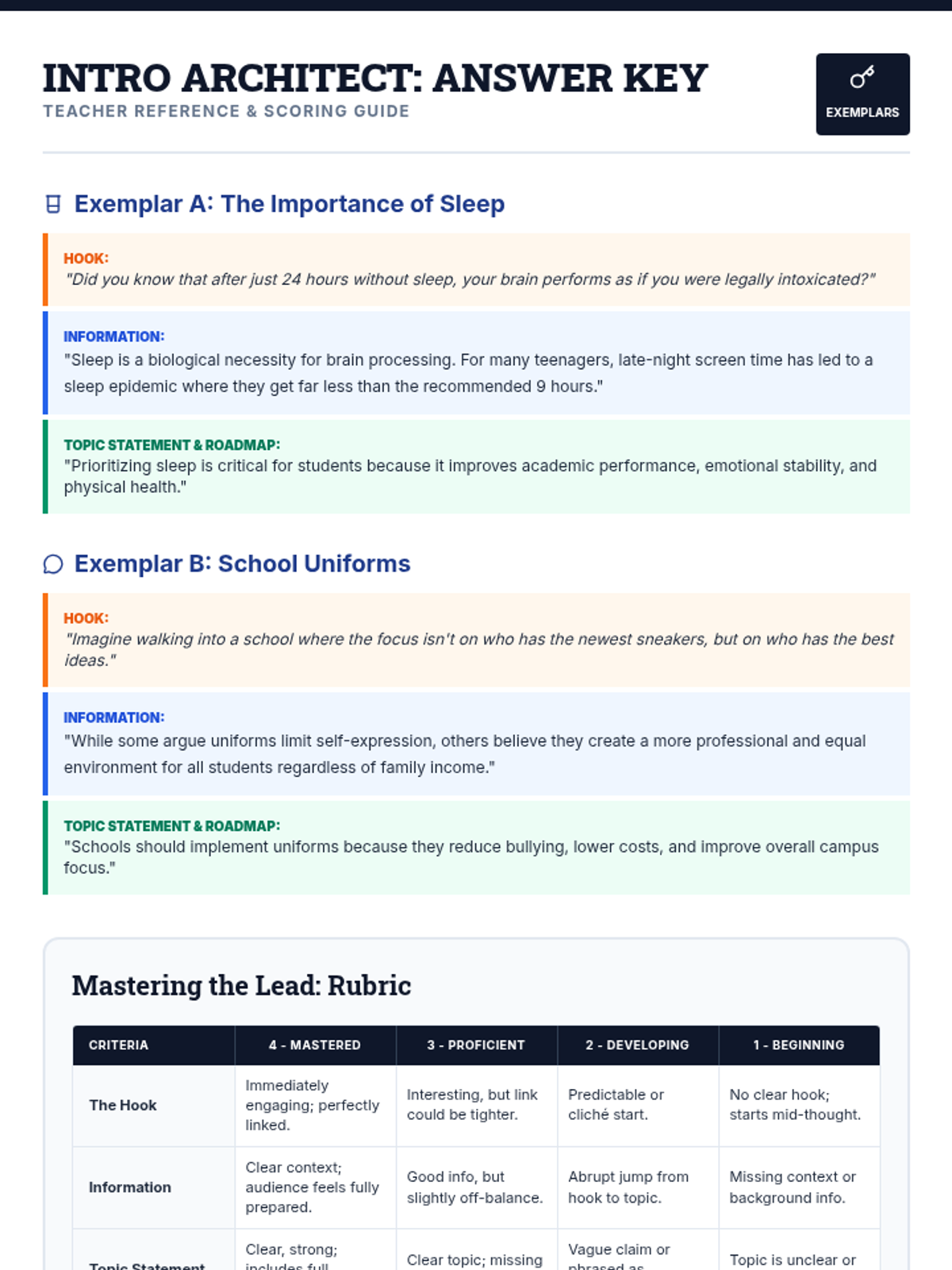
A teacher-facing resource providing exemplar introductions for common 7th-grade topics, along with a simplified 4-point scoring rubric for assessment.
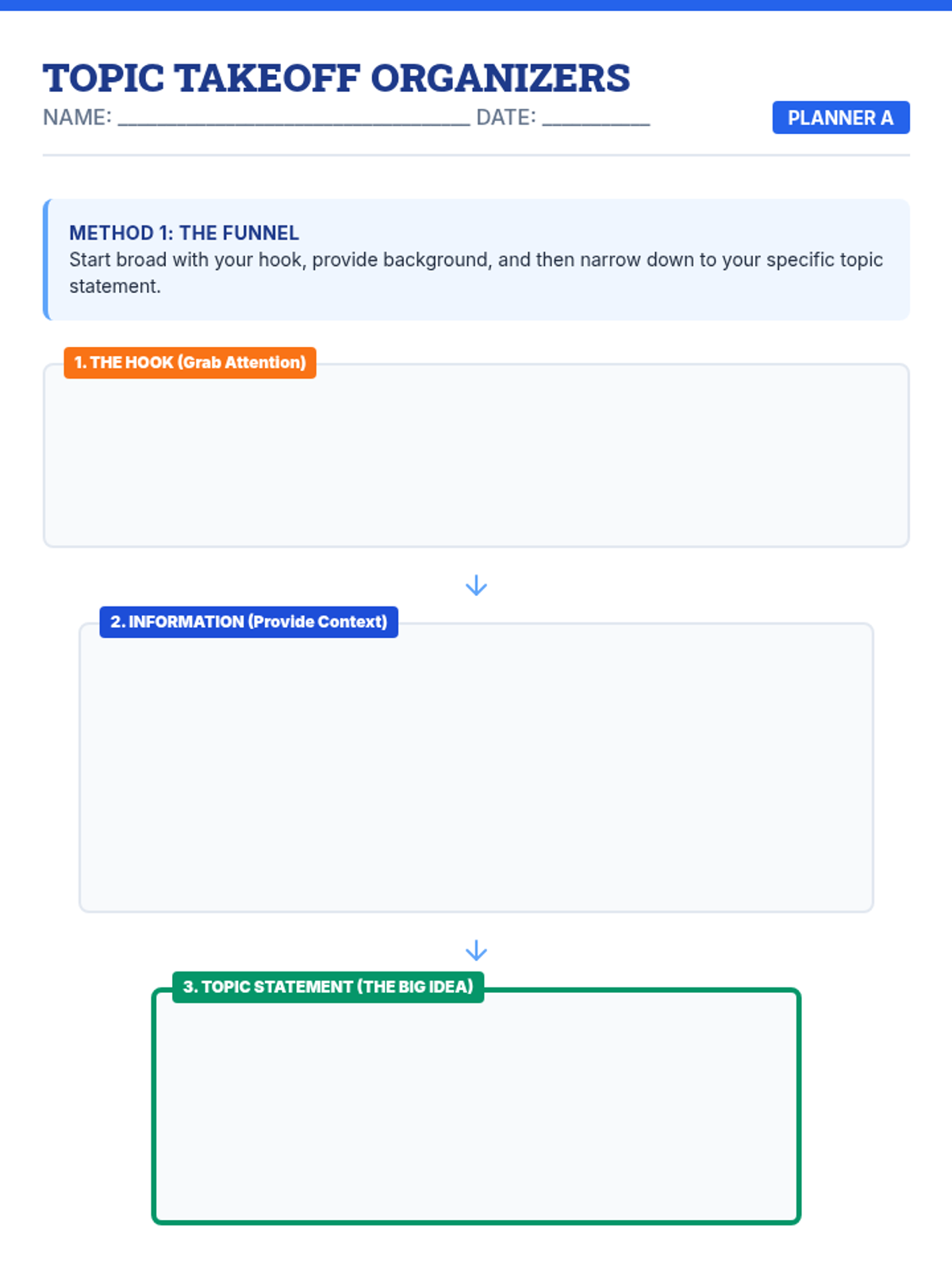
A set of versatile graphic organizers and outlines designed to help 7th-grade students plan and structure their introductory paragraphs or speech openings using the funnel and blueprint methods.
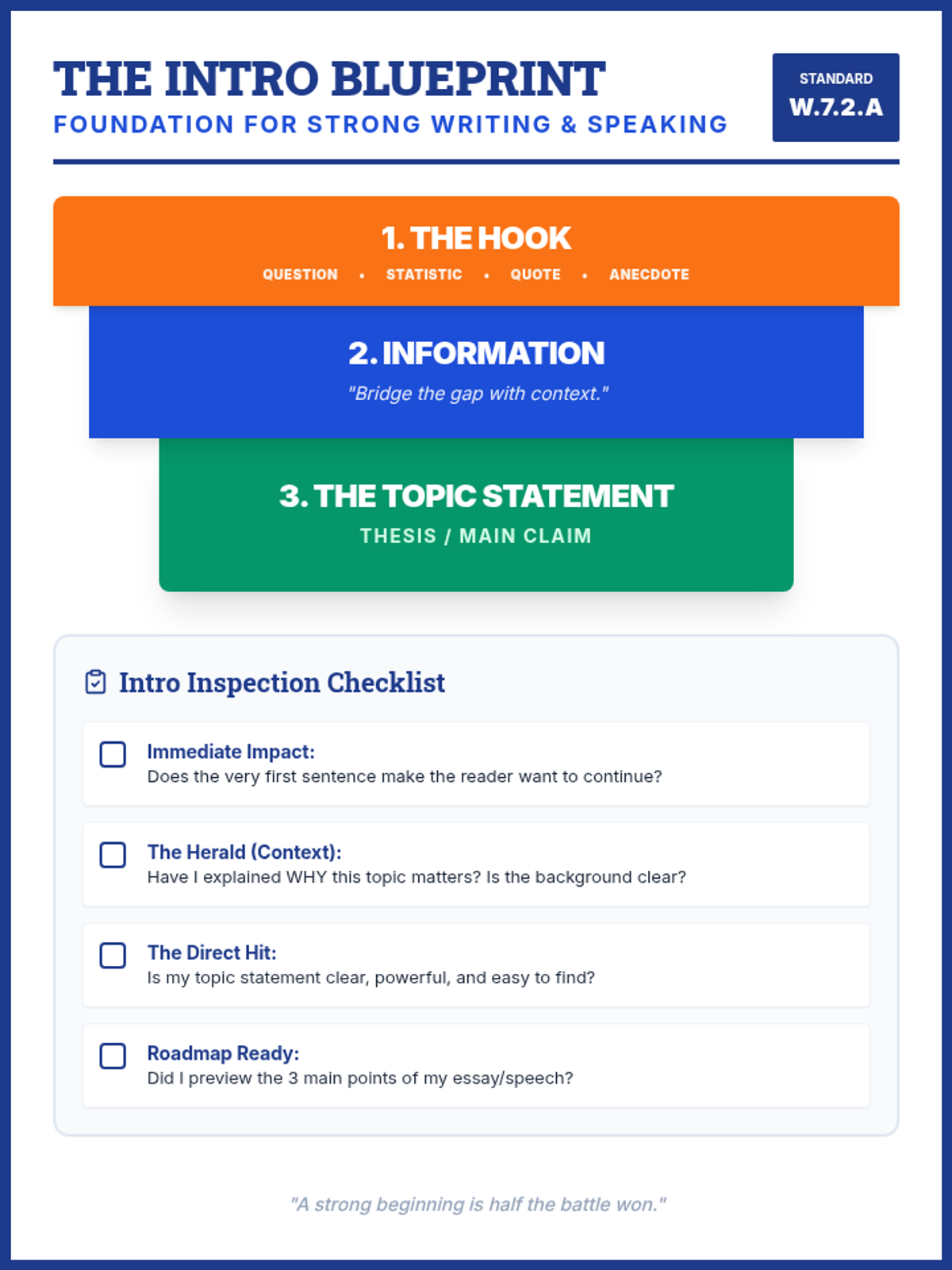
A dual-purpose printable resource: a visual anchor chart explaining the H.I.T. structure and a comprehensive checklist for students to self-assess their writing or speaking introductions.
A visually engaging slide deck that teaches the H.I.T. (Hook, Information, Topic) strategy for creating clear and compelling introductions for 7th-grade students.
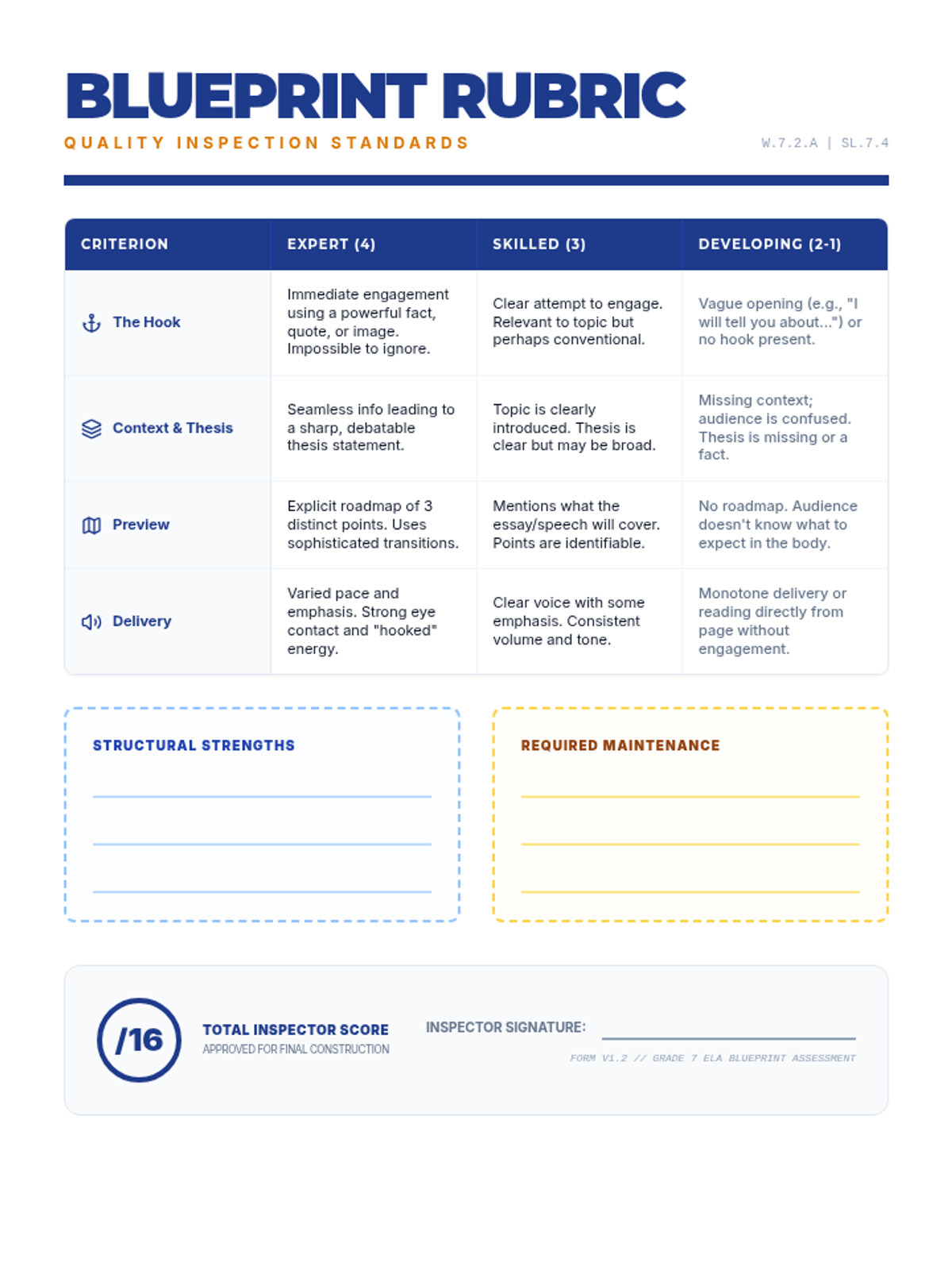
A dual-purpose rubric for assessing both written and spoken introductions based on the '4 Pillars' framework (Hook, Context, Thesis, Preview).
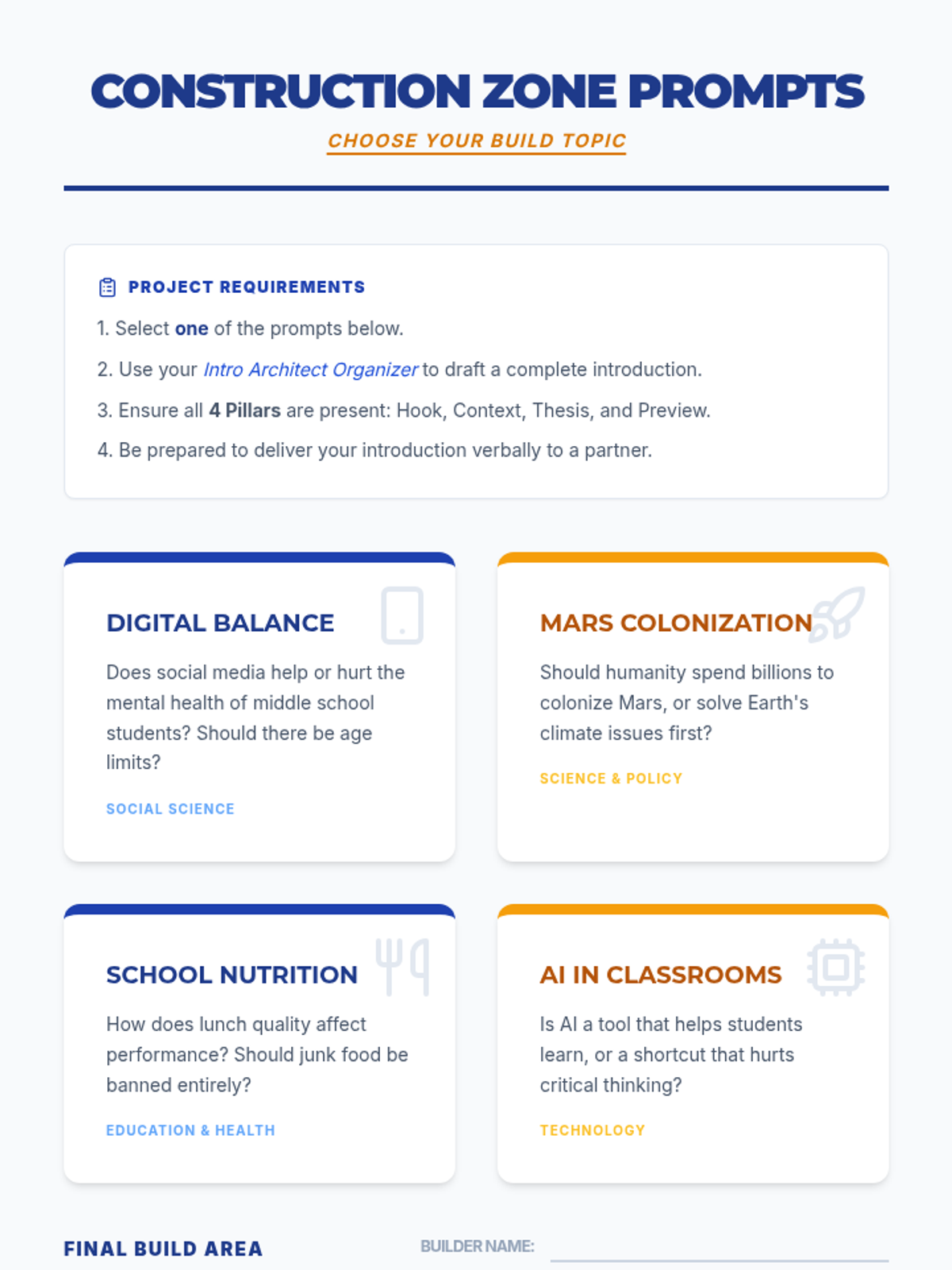
Writing and speaking prompts for the 'Blueprint for Success' lesson, featuring four engaging topics for 7th graders and a final writing area.
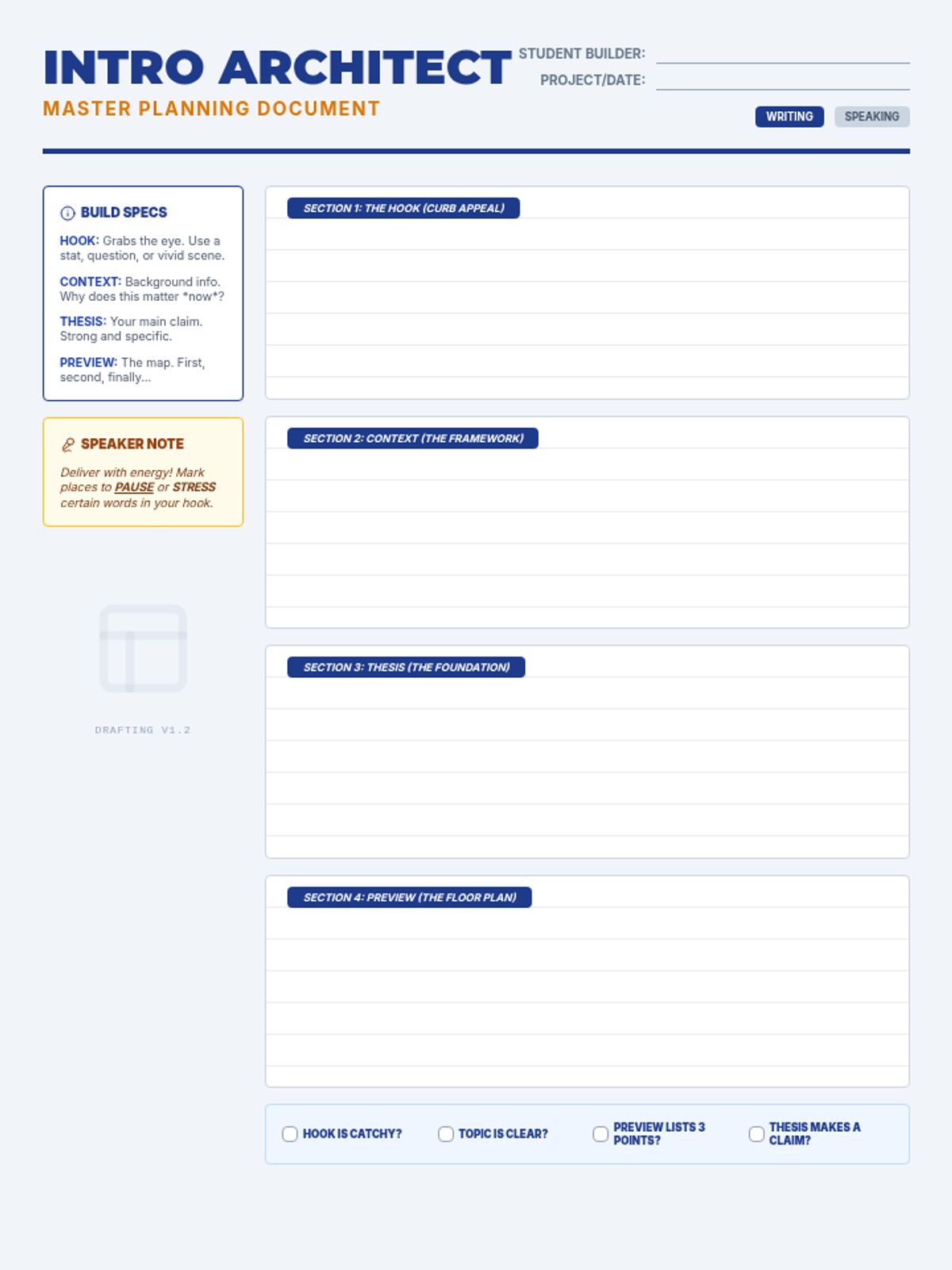
Graphic organizer titled 'Intro Architect' designed to help students plan each section of their introduction with architectural prompts and clear work areas.
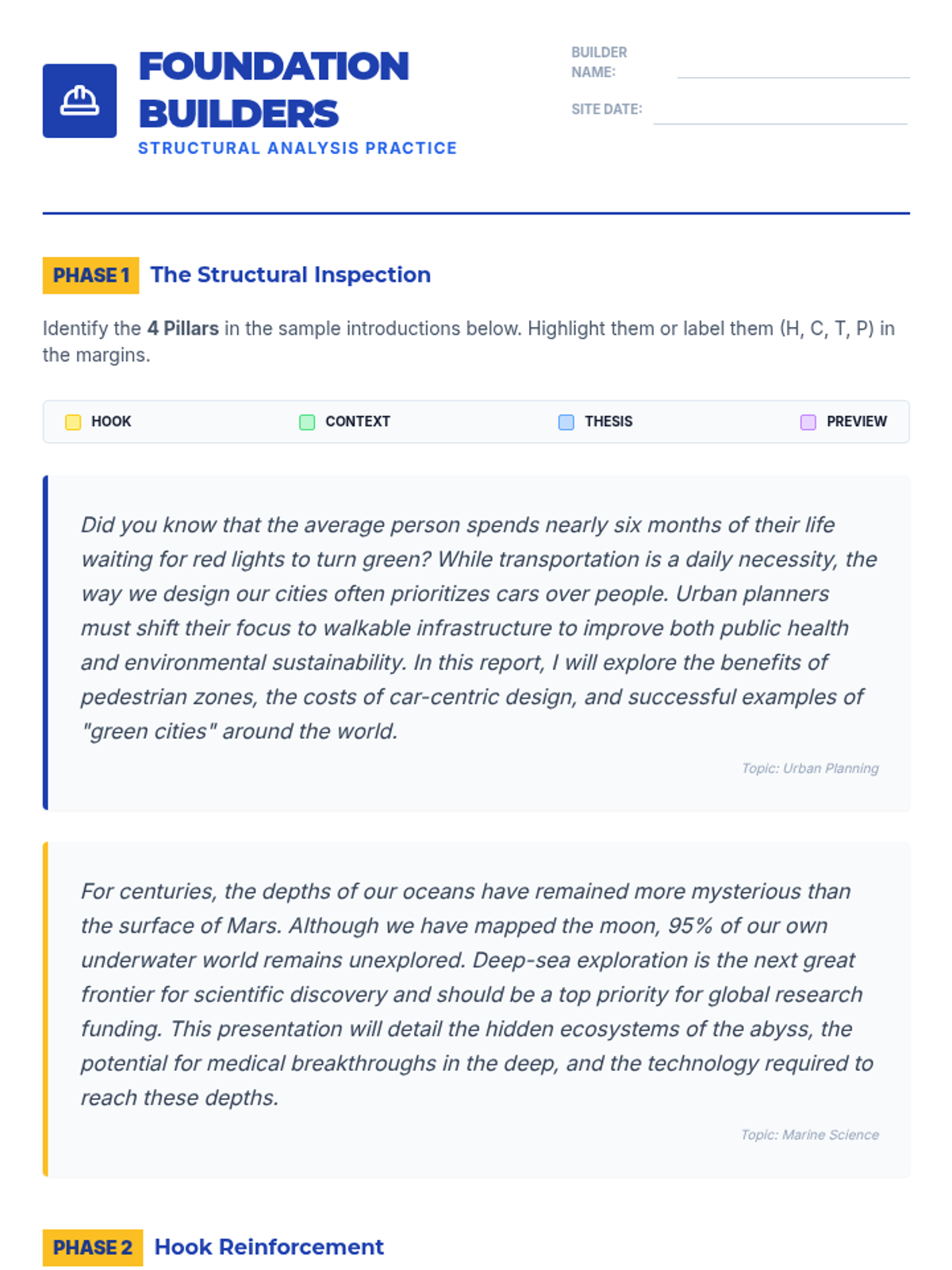
Practice worksheet titled 'Foundation Builders' focusing on identifying components of an introduction and upgrading hooks and preview sentences.
Instructional slide deck for teaching the '4 Pillars' of introductions (Hook, Context, Thesis, Preview) with a focus on both writing and speaking.
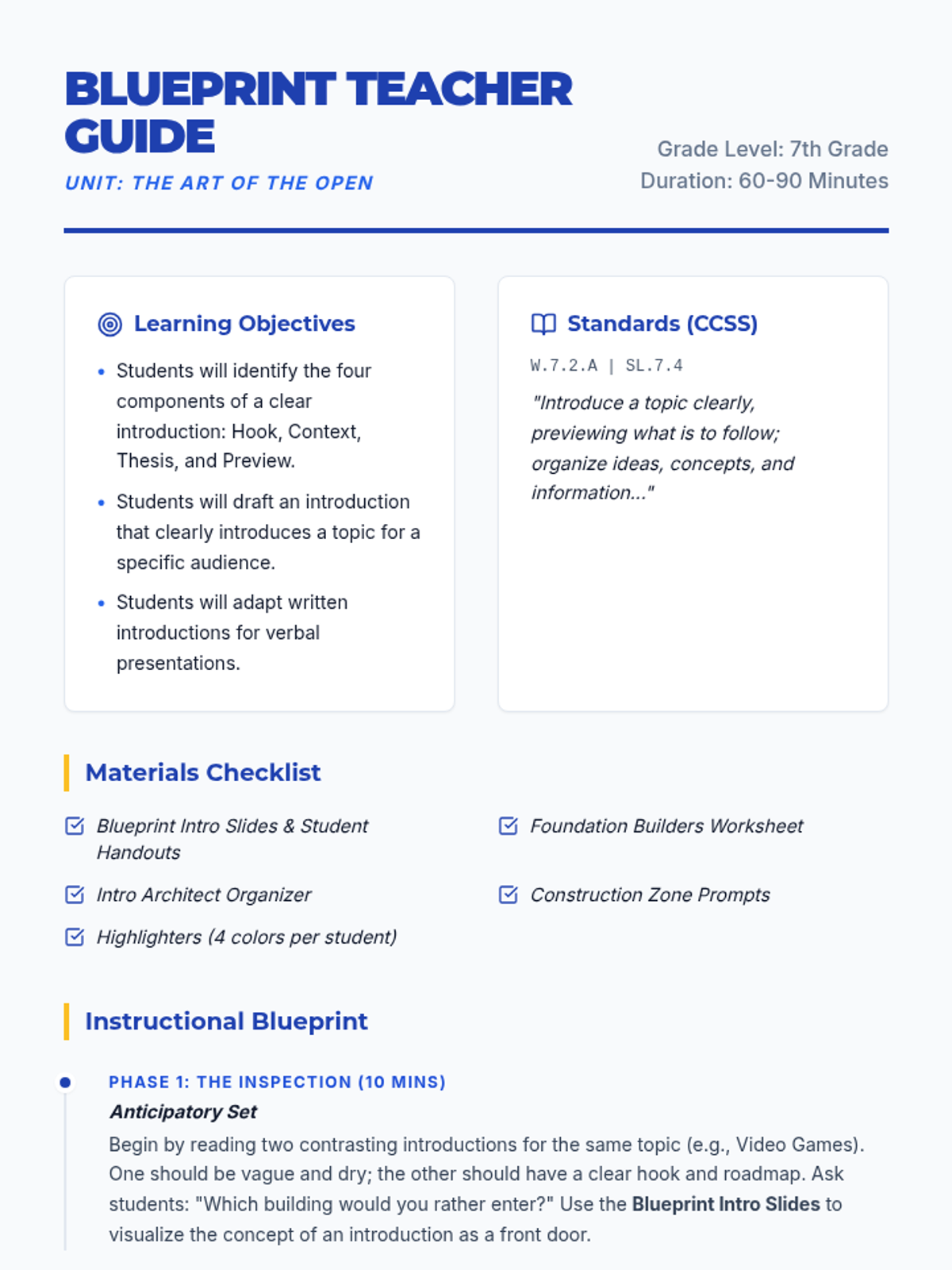
A teacher-facing lesson plan titled 'Blueprint Teacher Guide' detailing the instructional flow, standards, and objectives for teaching introductions using an architectural theme.
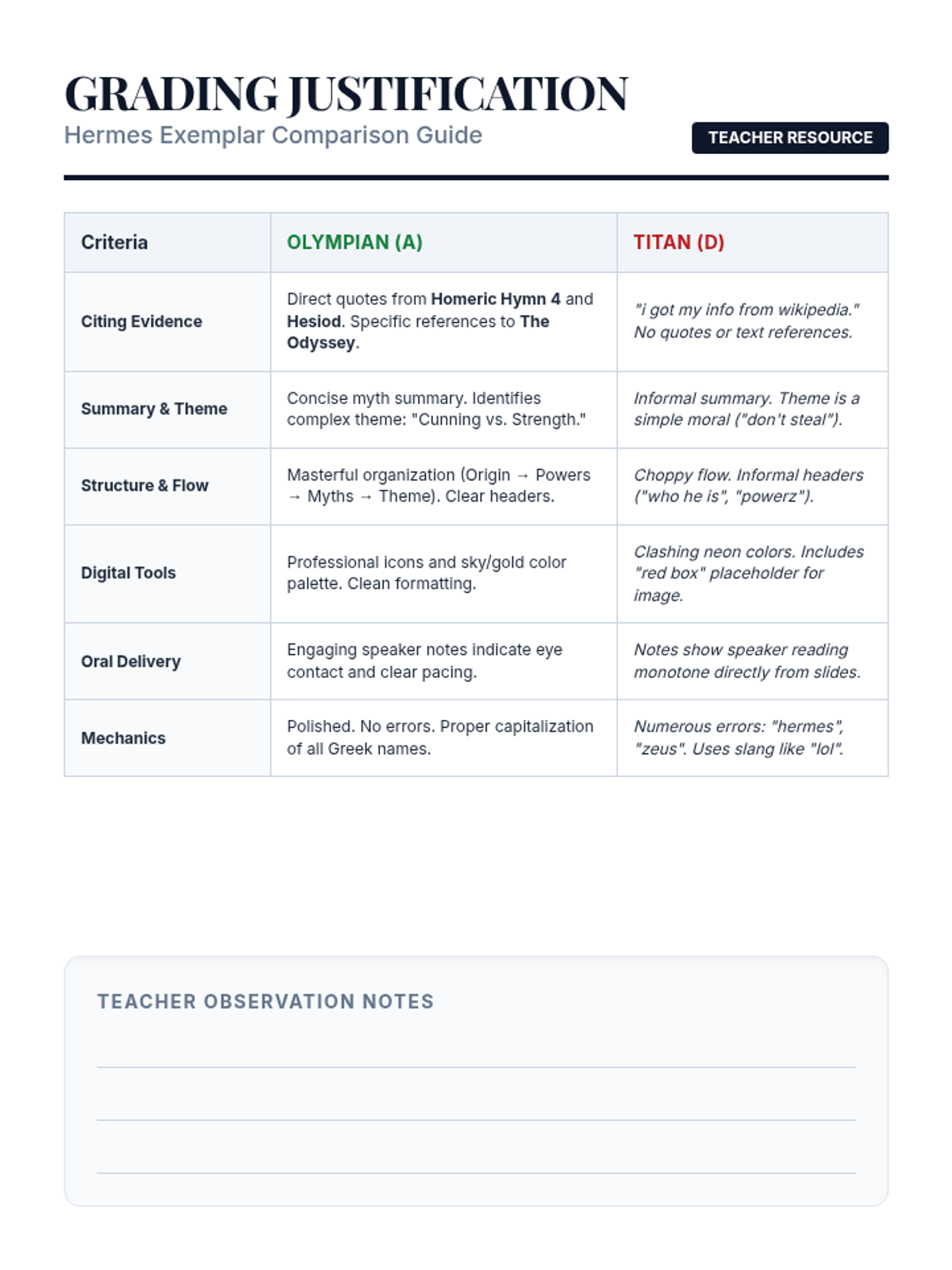
A teacher-facing guide that justifies the grades for the Olympian and Titan exemplars using the provided rubric, complete with discussion prompts for student analysis.
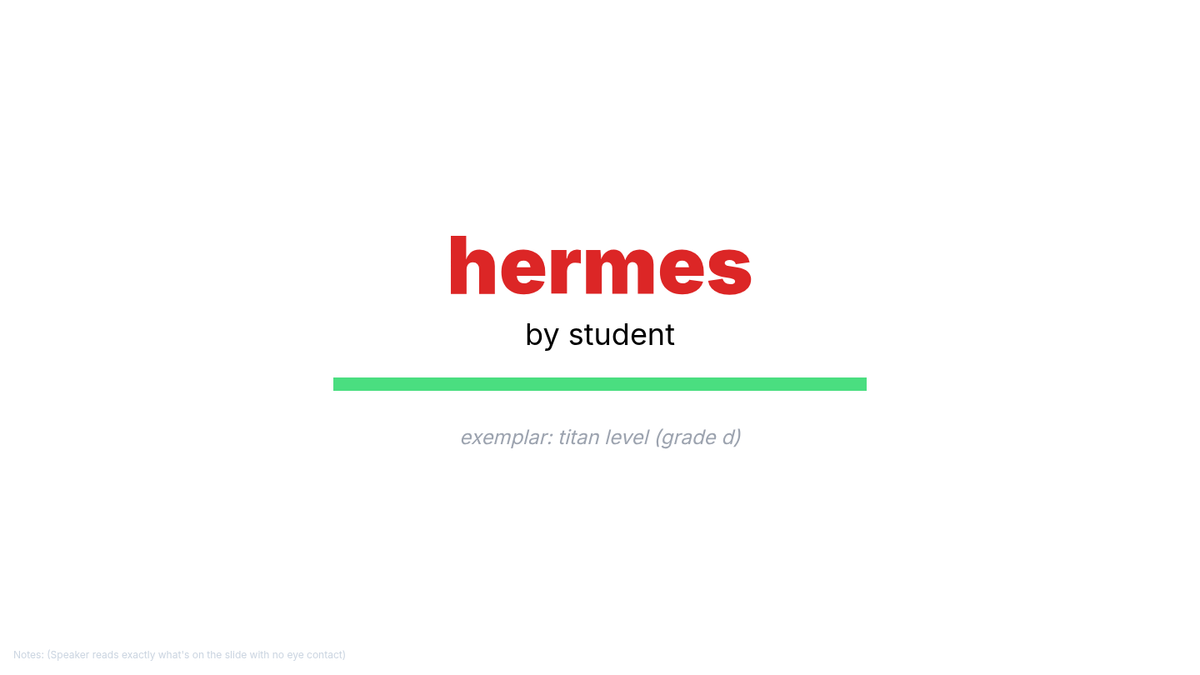
A low-achieving (D) exemplar presentation on the Greek god Hermes, featuring poor organization, lack of evidence, informal language, spelling errors, and minimal effort in design.
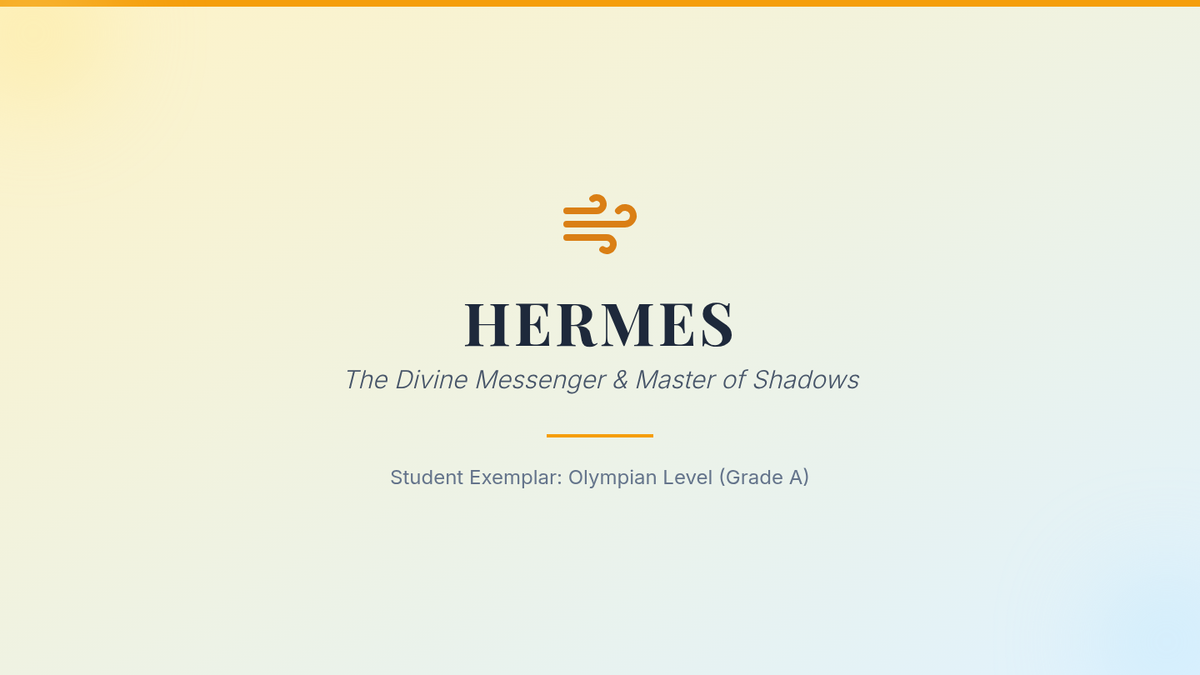
An updated high-achieving (A) exemplar presentation on Hermes, now including an embedded multimedia video summary to demonstrate mastery of digital tools.
A comprehensive 7-slide deck for a "Pairs Compare" activity, featuring detailed sharing directions for both pairs and clear submission steps.
The Mary Celeste Reading Passage provides a factual summary of the famous maritime mystery, designed for students to practice distinguishing between explicit facts and inferences in non-fiction text. Updated for better page-fit and annotation space.
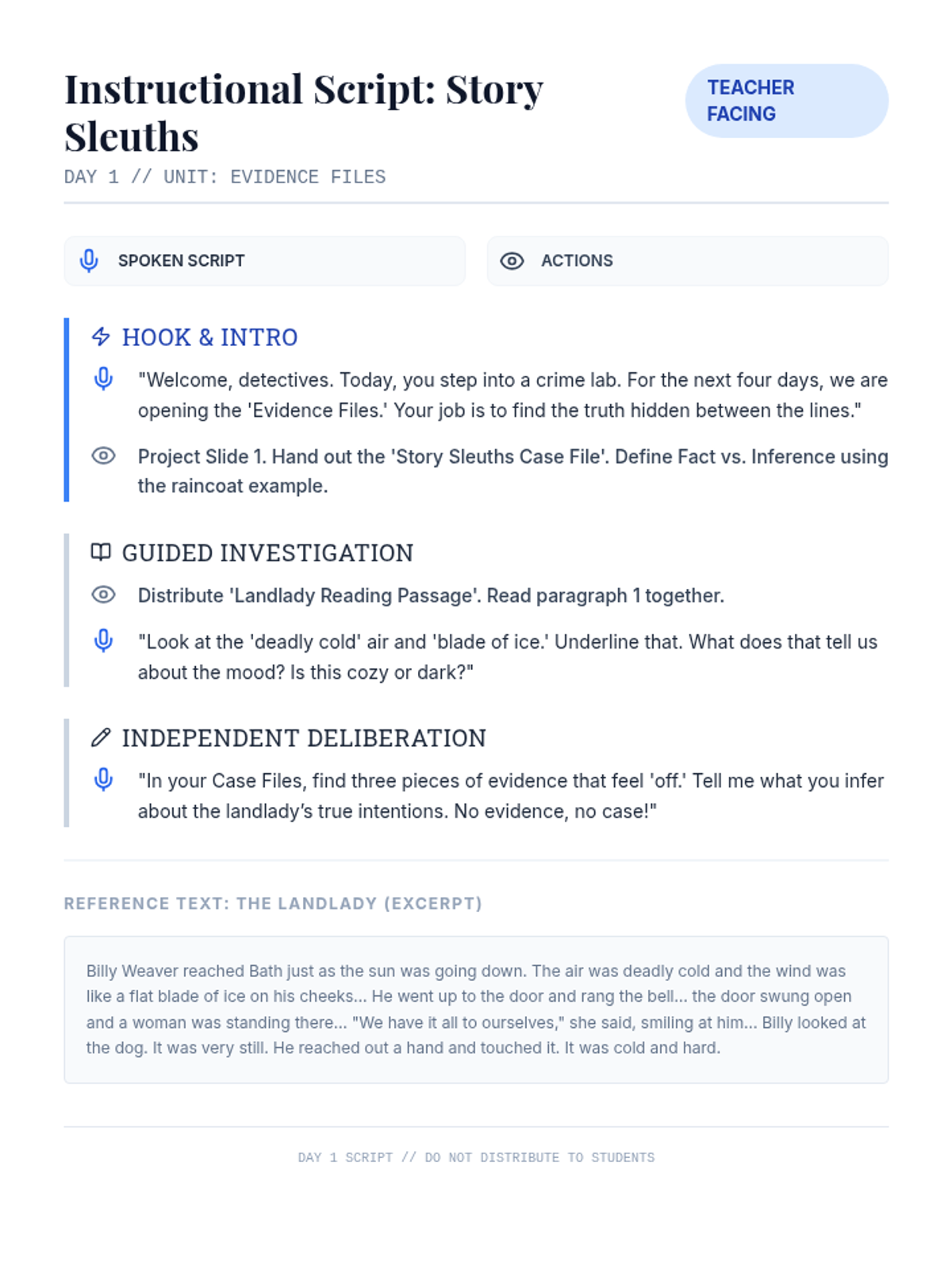
The Story Sleuths Script provides a teacher with a step-by-step instructional narrative for Day 1, including hook lines, guided reading prompts, and activity transitions. Updated for improved contrast and section layout.
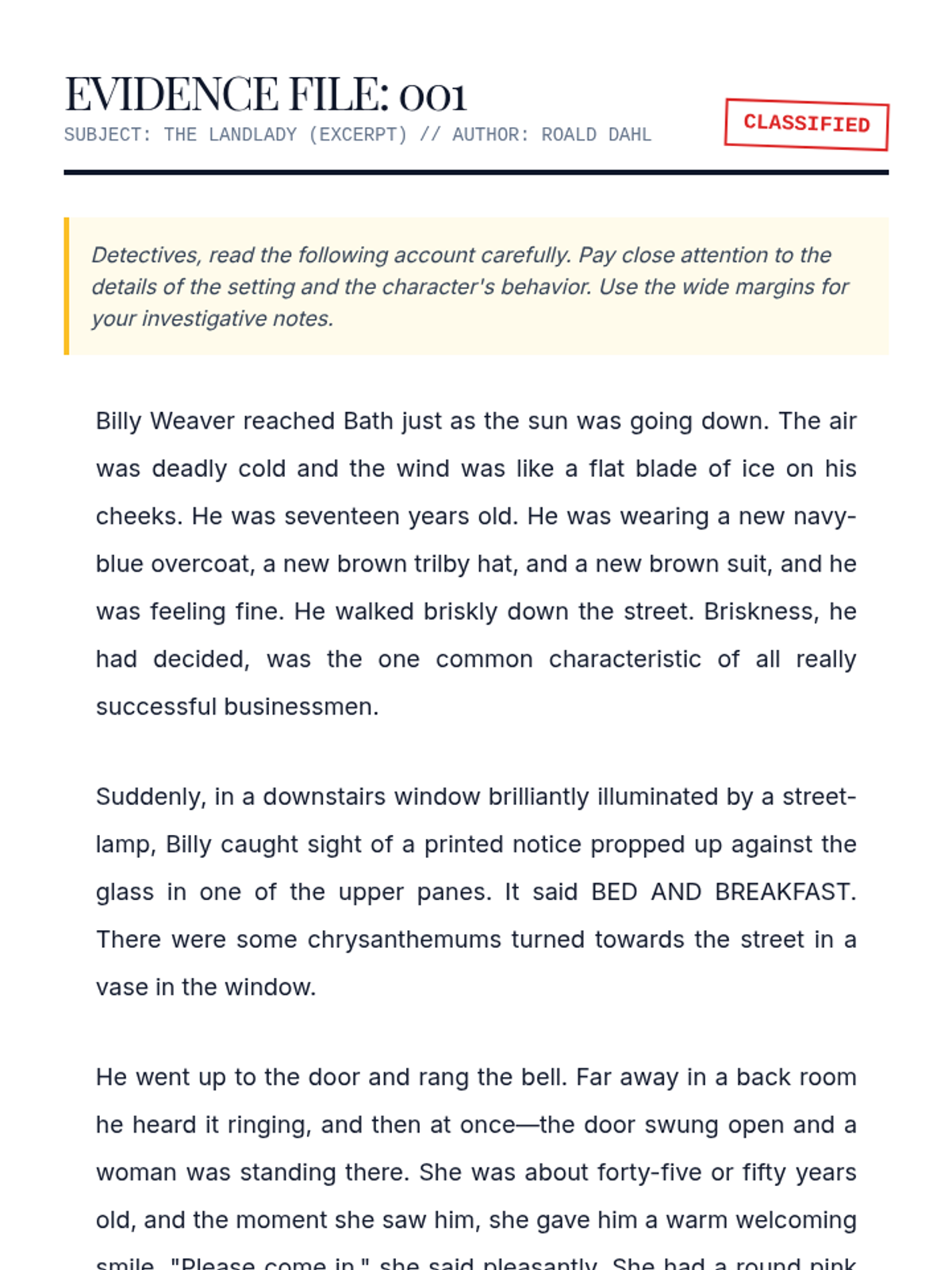
The Landlady Reading Passage provides an edited excerpt of Roald Dahl's short story, formatted as an official evidence file for student analysis. It highlights key atmospheric and character details used for making inferences. Updated for better page-fit and annotation space.
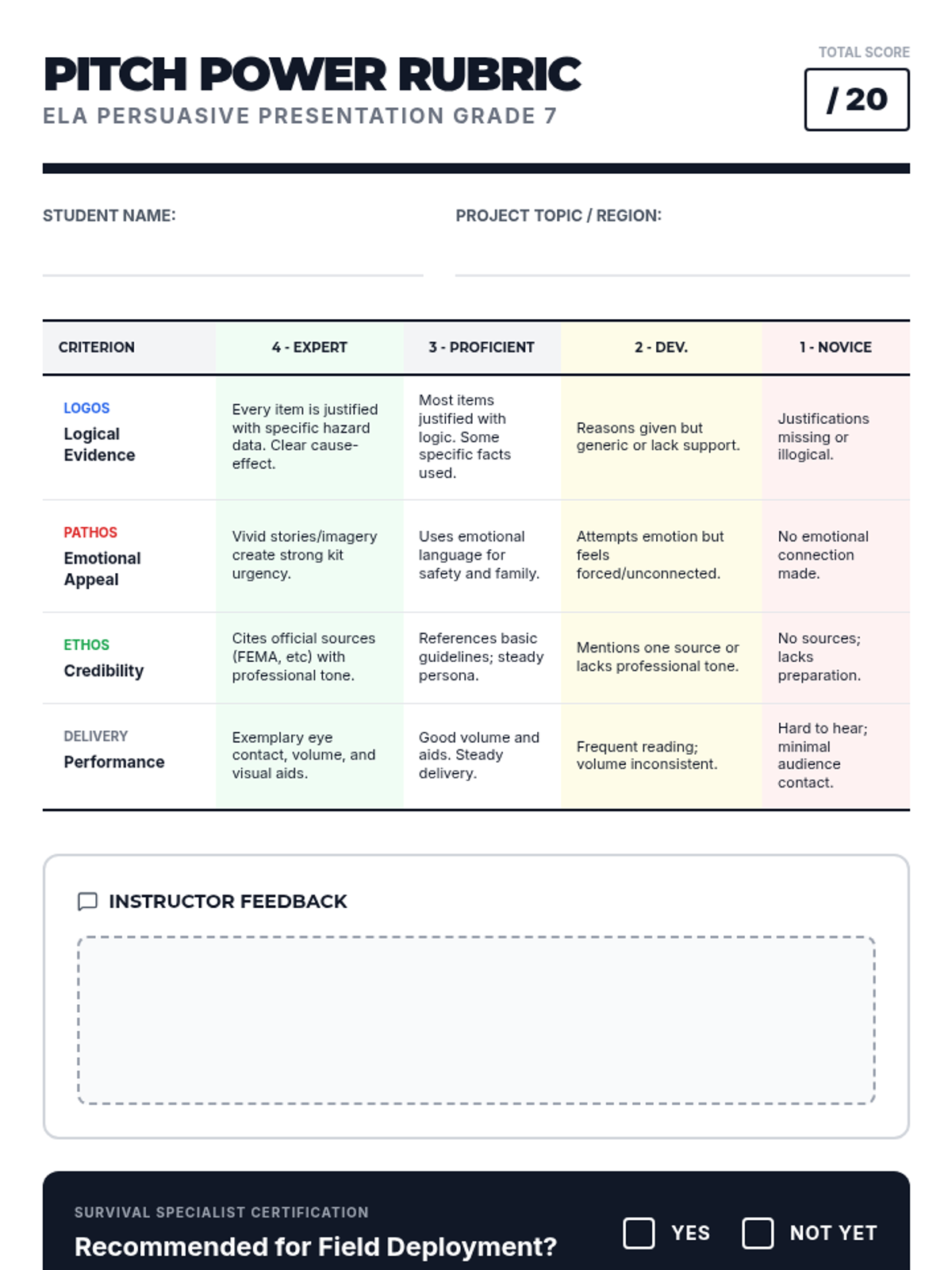
A detailed grading rubric for the Storm Shield project. Revised for single-page printing with better text sizing, reinforced borders, and optimized spacing for student/instructor feedback.
An introductory slide deck for the Storm Shield project. Revised for better text contrast, improved kerning on headings, and clearer presentation instructions.
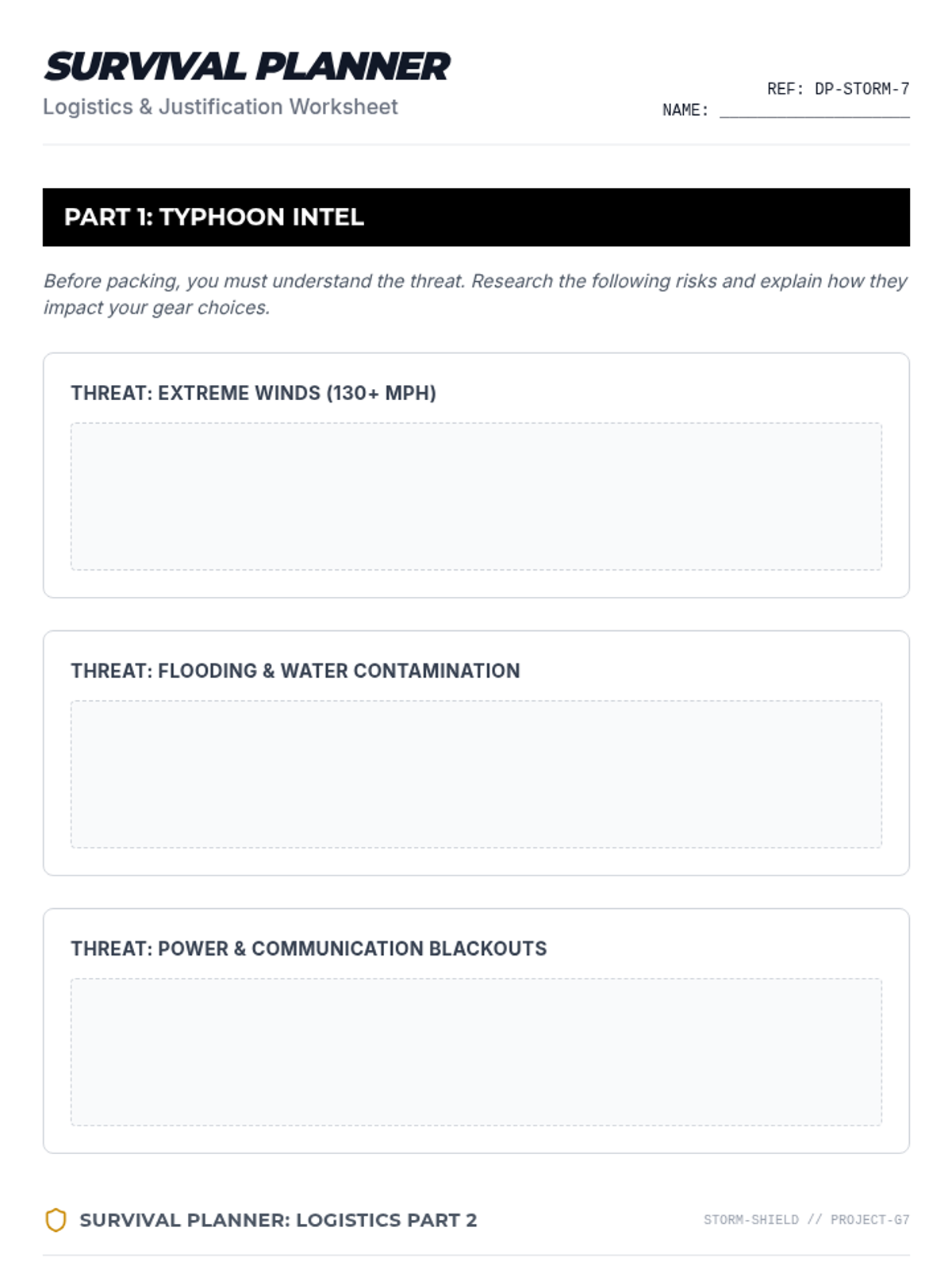
A graphic organizer for students to research typhoon risks and plan their survival kit items. Revised with larger work areas, improved page breaks, and consistent branding on all pages.
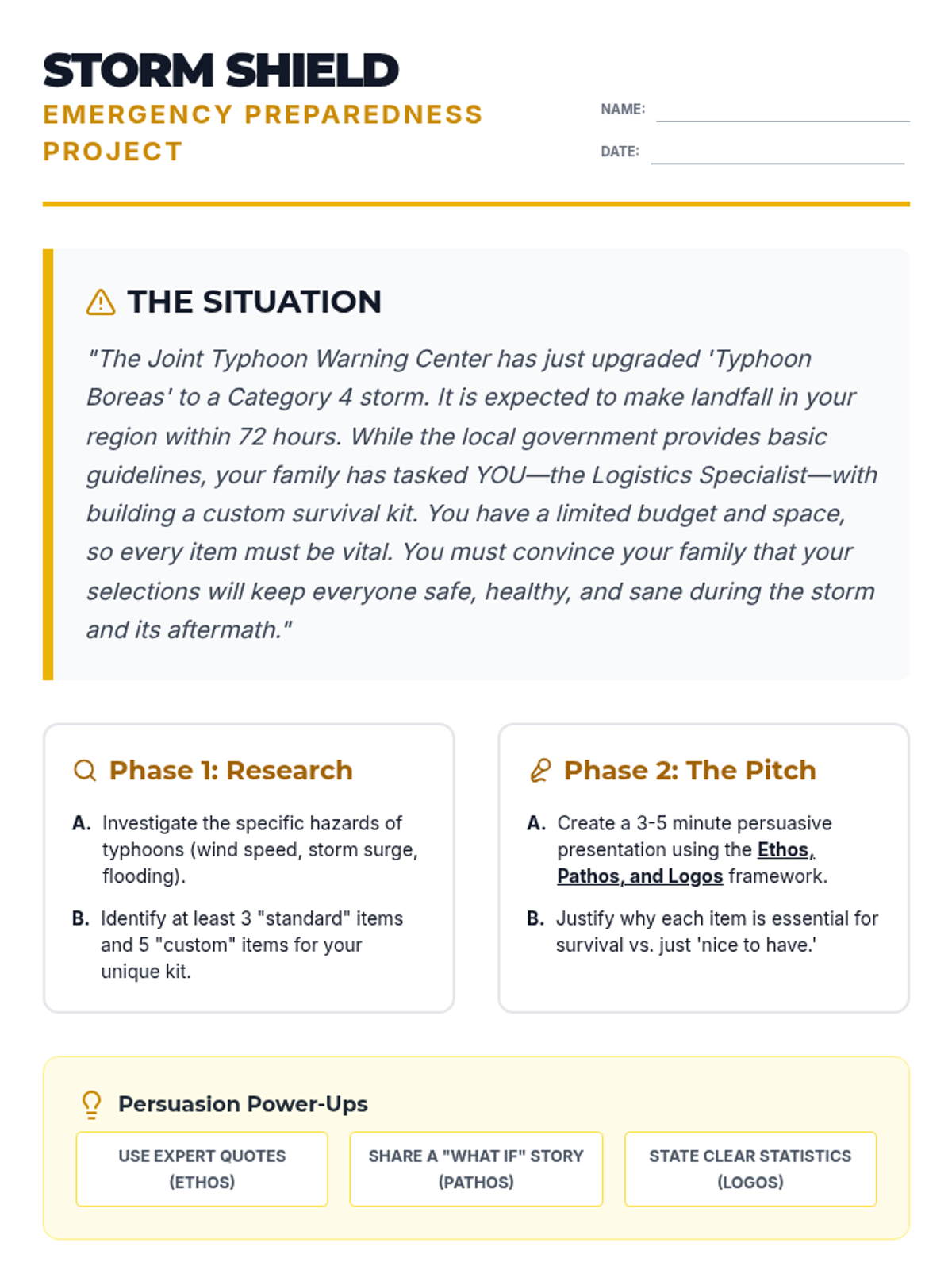
A project handout for 7th-grade students outlining the 'Storm Shield' typhoon survival project. It presents a realistic scenario, project requirements, and key ELA focus areas for their persuasive presentations. Revised to include brainstorming space and improved formatting.
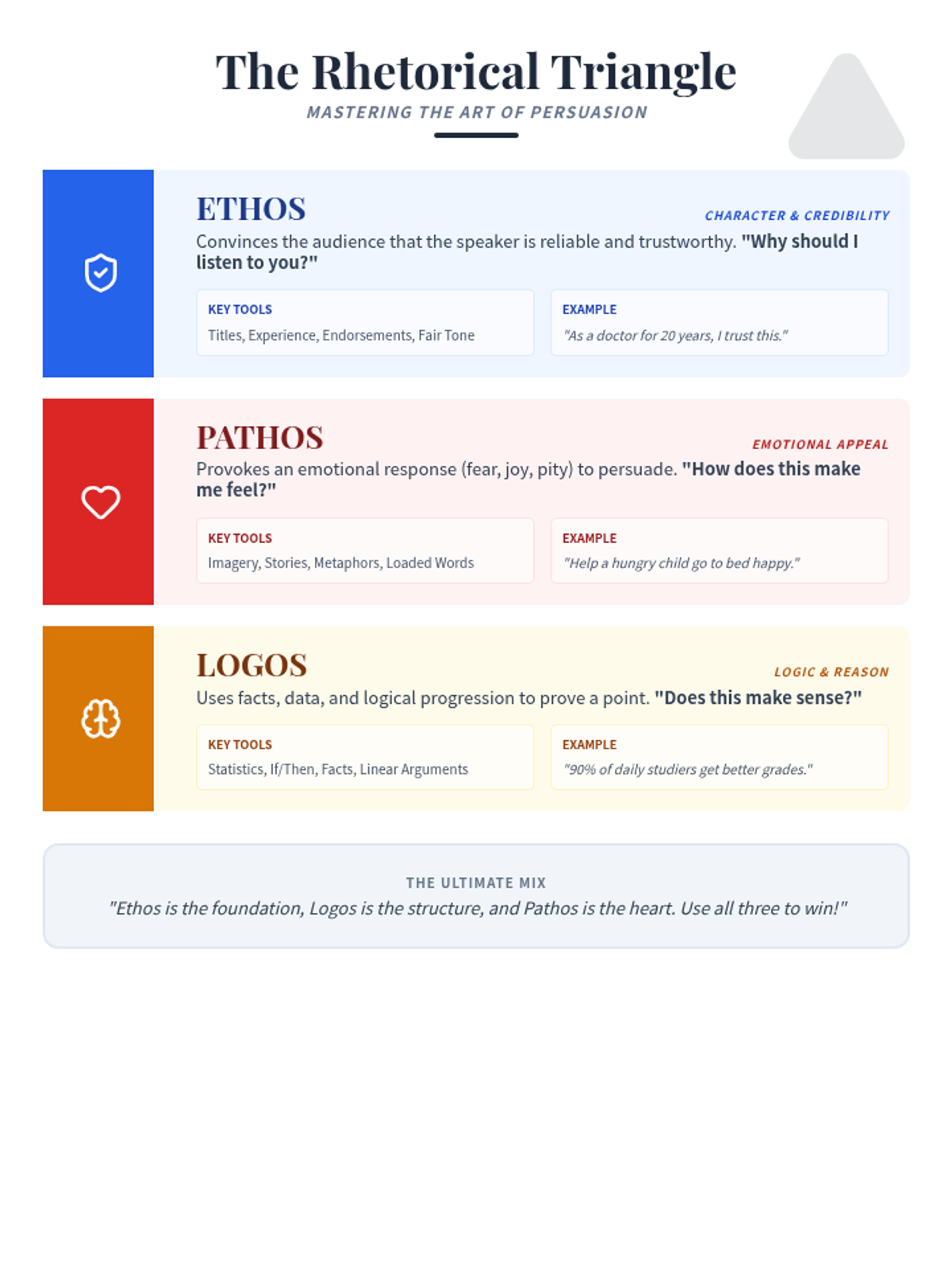
A student reference sheet defining Ethos, Pathos, and Logos. Includes clear definitions, key tools used for each appeal, and concrete examples to help students master the concepts. Visual motifs and compact layout ensure single-page fit.
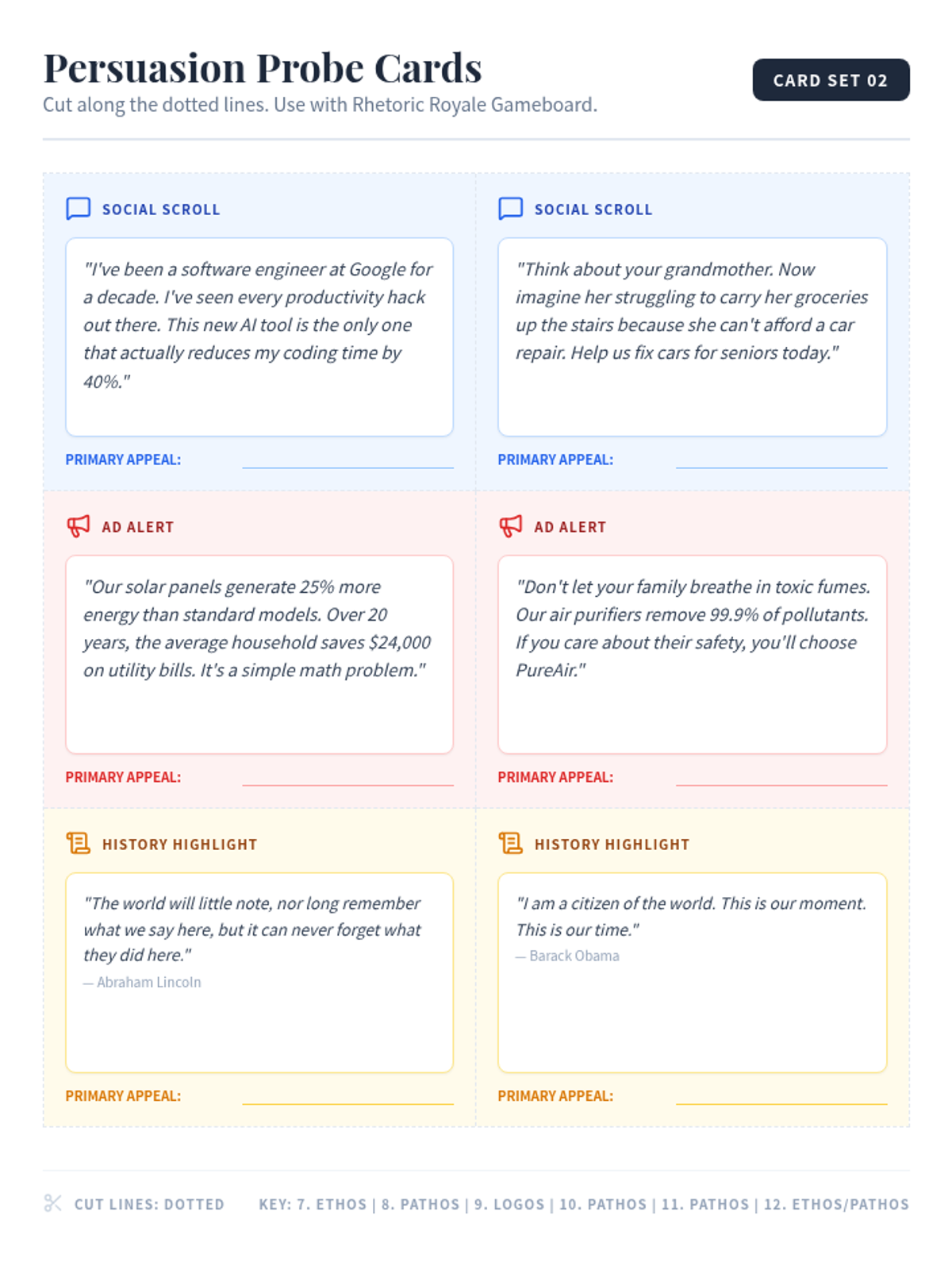
A second set of printable challenge cards for the Rhetoric Royale game. Features additional modern social media posts, advertisement scripts, and historical speech excerpts focused on Ethos, Pathos, and Logos identification.
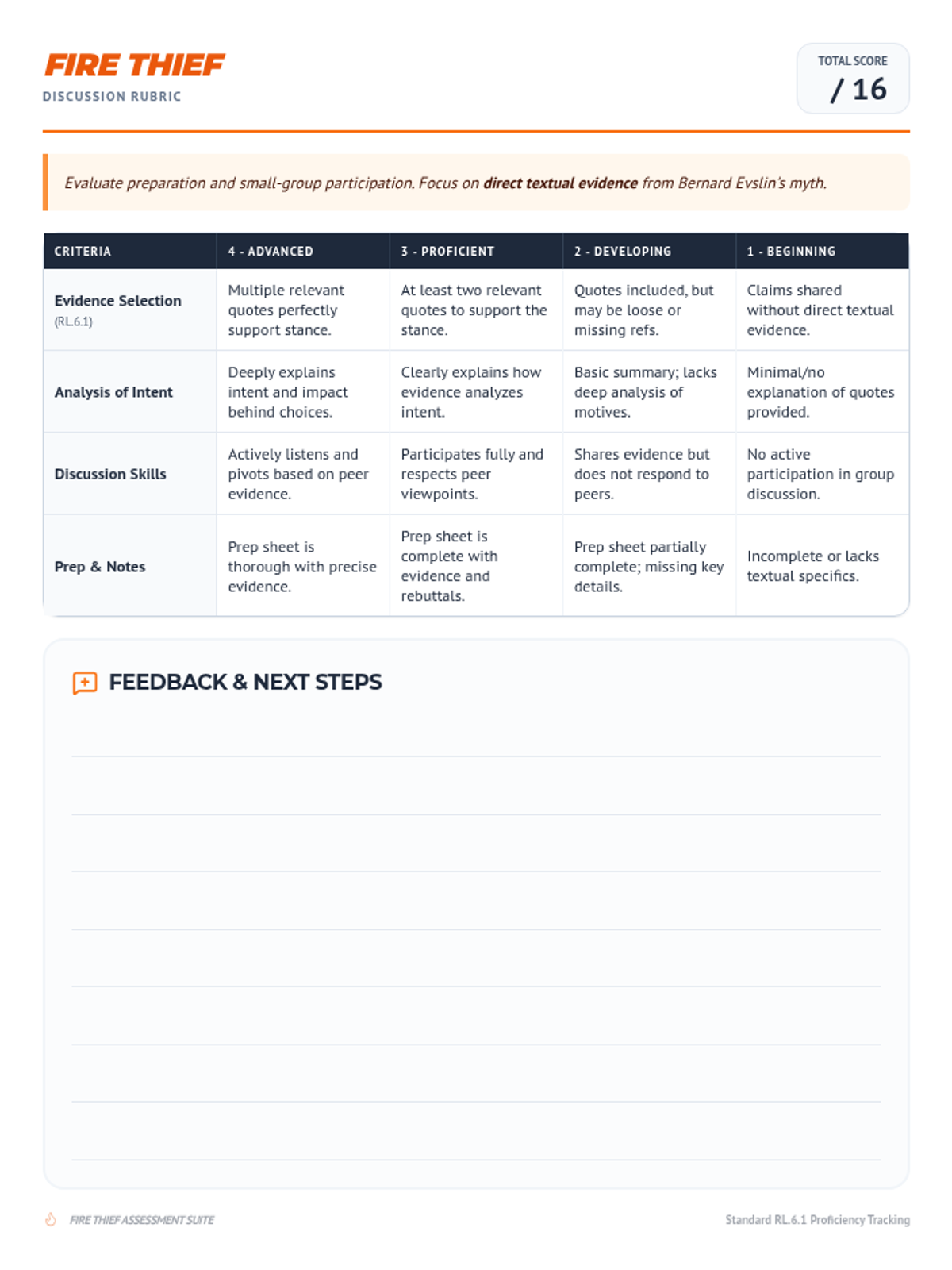
A student-facing rubric for evaluating the Fire Thief debate. It assesses preparation (the planning sheet), use of textual evidence (RL.6.1), analysis of character motivations, and collaborative discussion skills.
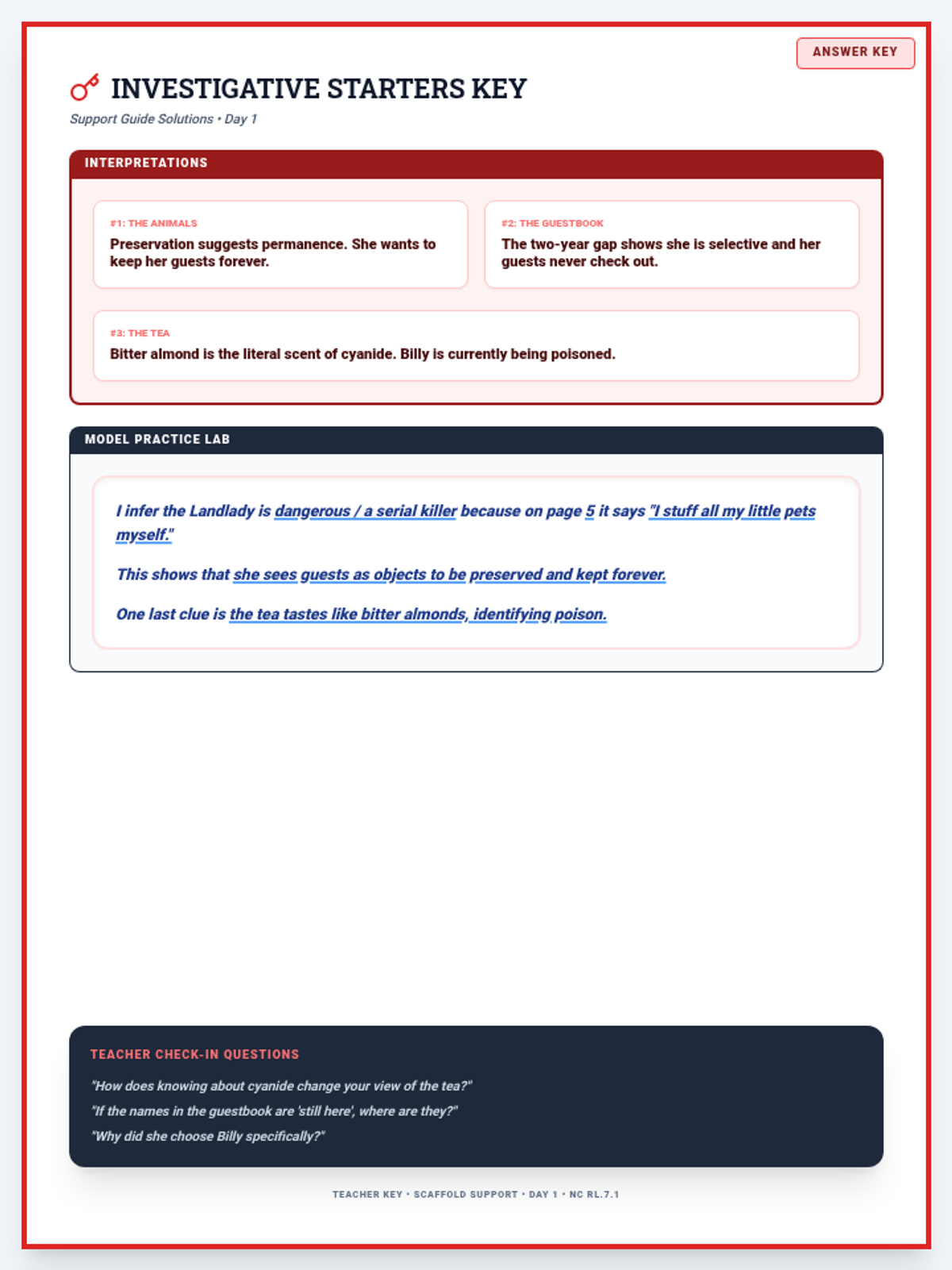
The Investigative Starters Answer Key provides solutions and teacher-check-in questions for the scaffolded 'Landlady' analysis, focusing on key clues and evidence-based writing.