Essential grammar structures, high-frequency vocabulary, and foundational literacy skills. Equips learners with basic speaking and listening abilities for everyday interactions and introductory text comprehension.
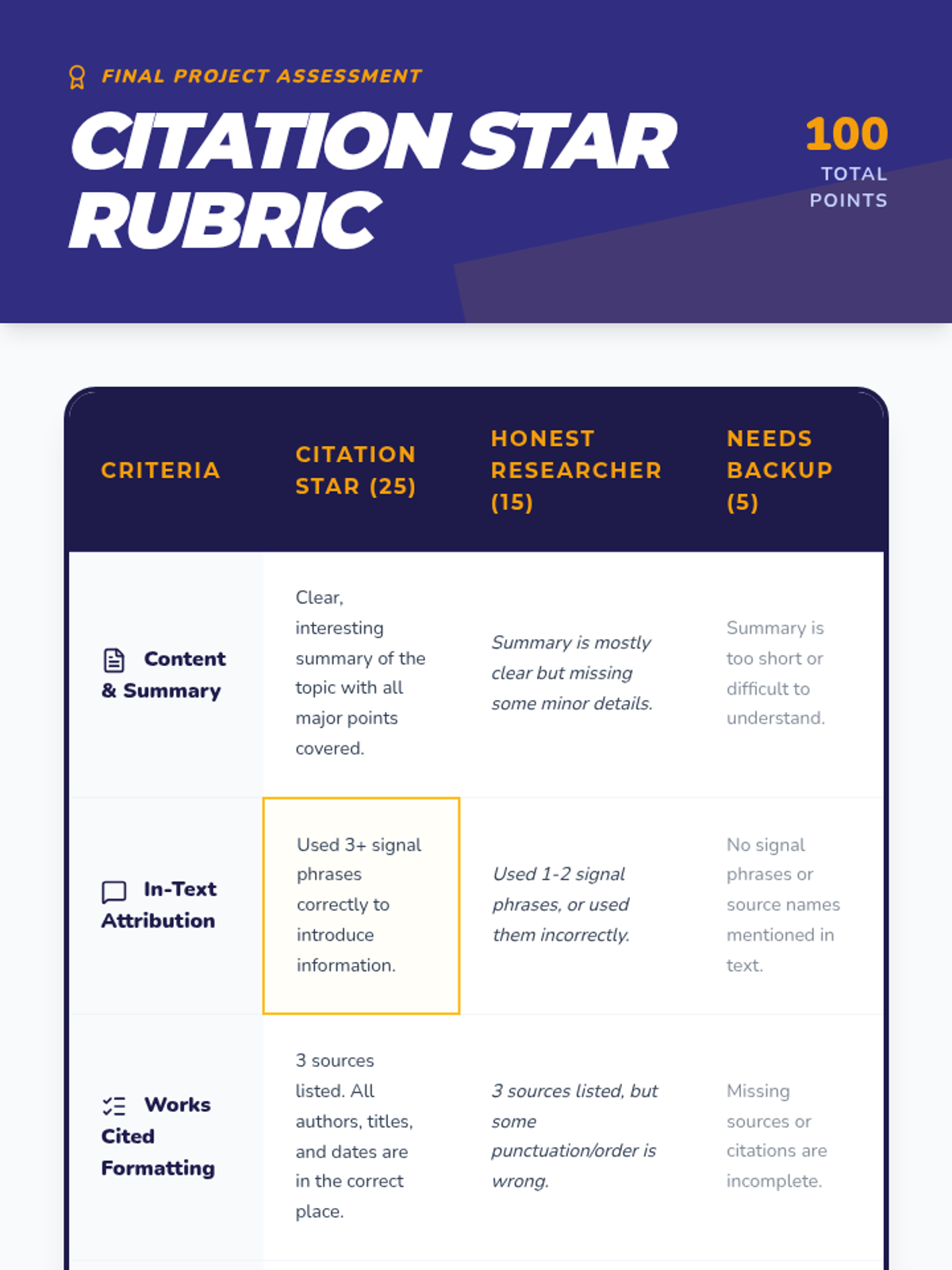
Comprehensive grading rubric for the Research Credits poster project, evaluating summary quality, in-text attribution, Works Cited formatting, and visual design.
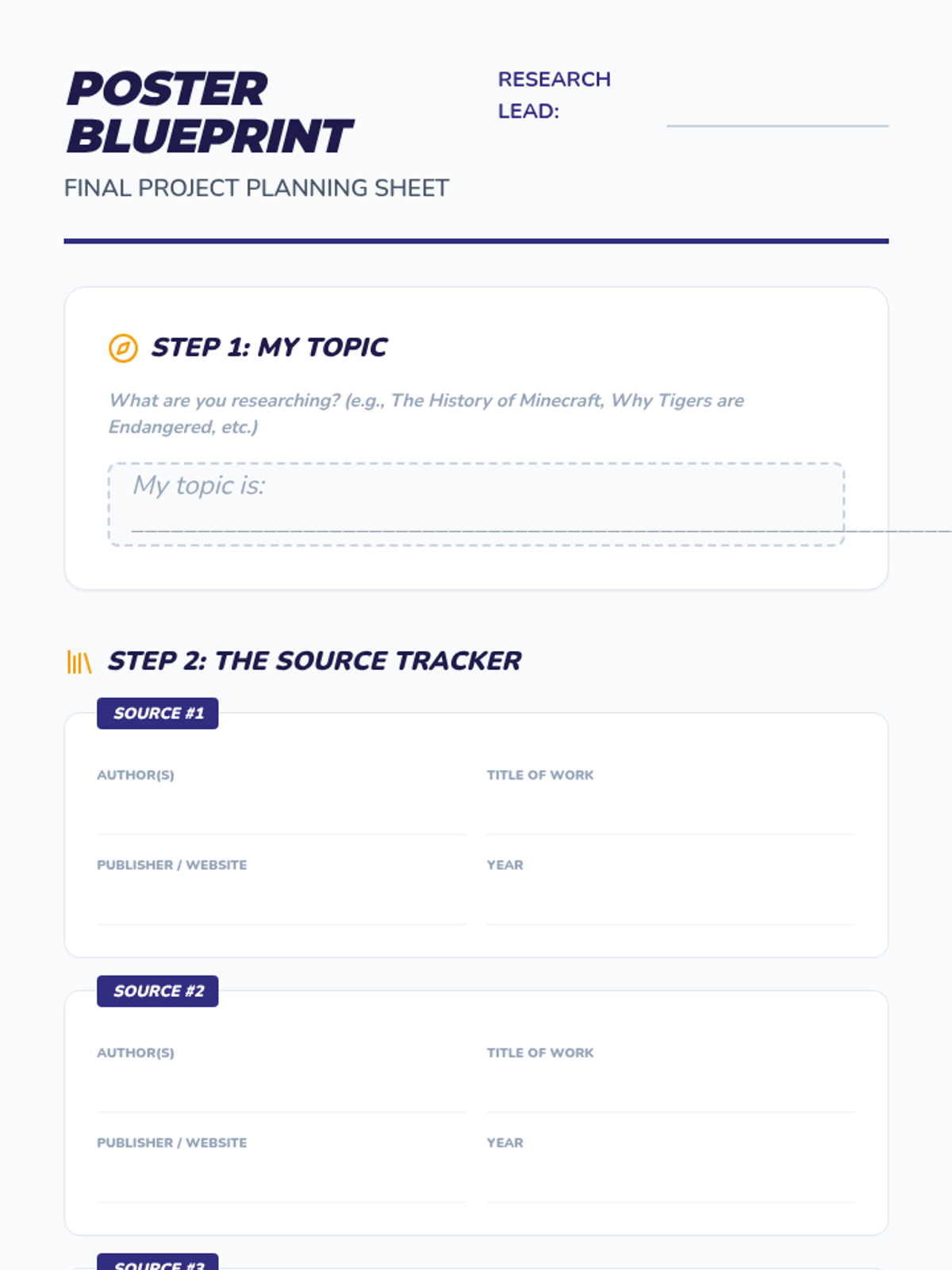
Detailed planning document for the Research Credits poster project, providing space for 6th-grade students to track sources, draft their summary, and plan their layout.
Slide deck for the final project of the sequence, explaining the "Research Credits" poster requirements and connecting academic integrity to the concept of a movie's credit roll.
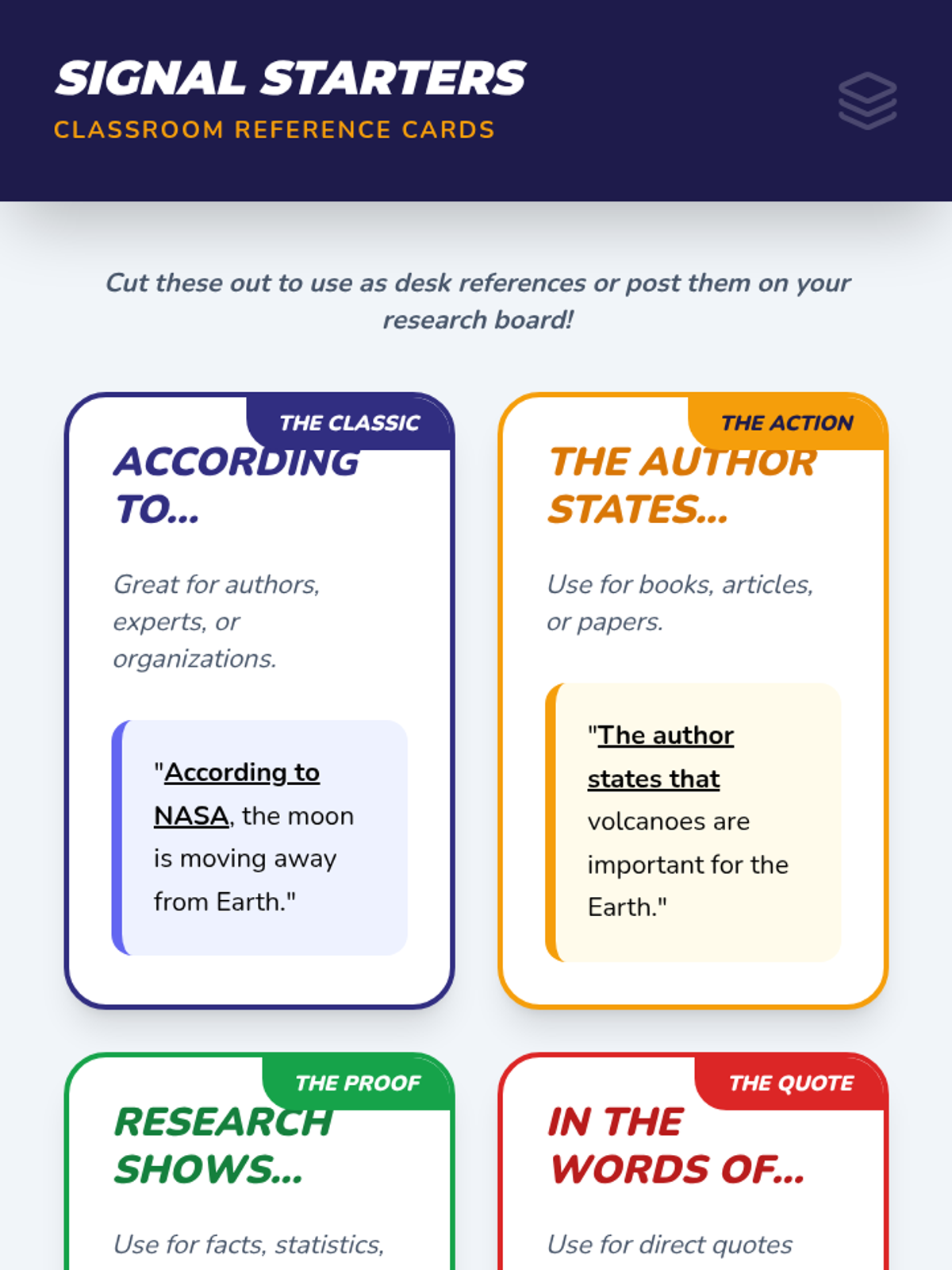
Set of classroom reference cards for 6th-grade students, featuring common signal starters for in-text citations with examples and punctuation tips.
Guided practice worksheet for 6th-grade students to master in-text attribution by creating sentences that integrate expert sources using signal phrases.
Slide deck for Lesson 4, introducing students to the concept of in-text attribution using signal phrases and the "newsroom technique" for credible research writing.
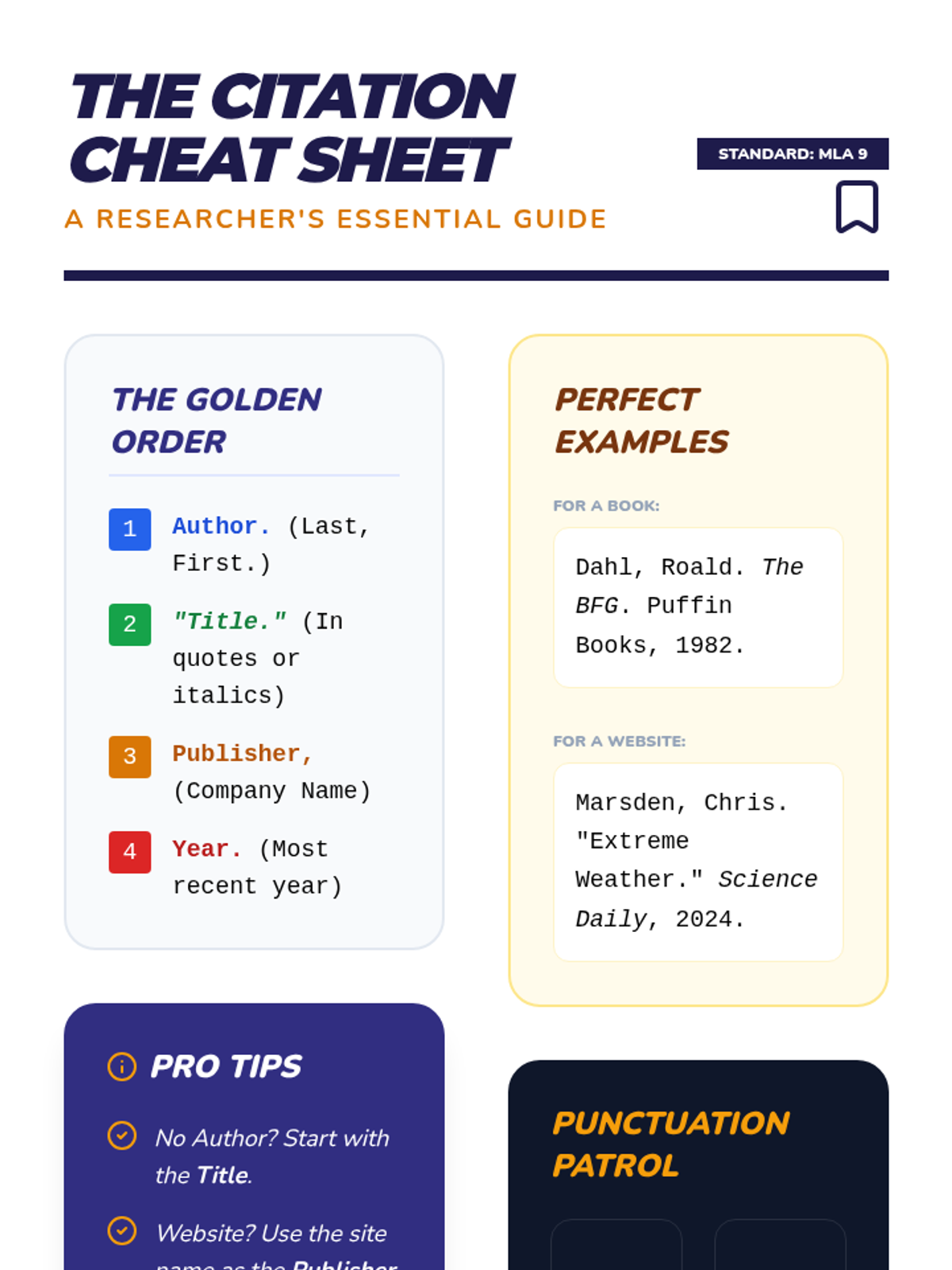
Compact reference sheet for 6th-grade students providing a clear visual guide to MLA citation structure, punctuation rules, and examples for books and websites.
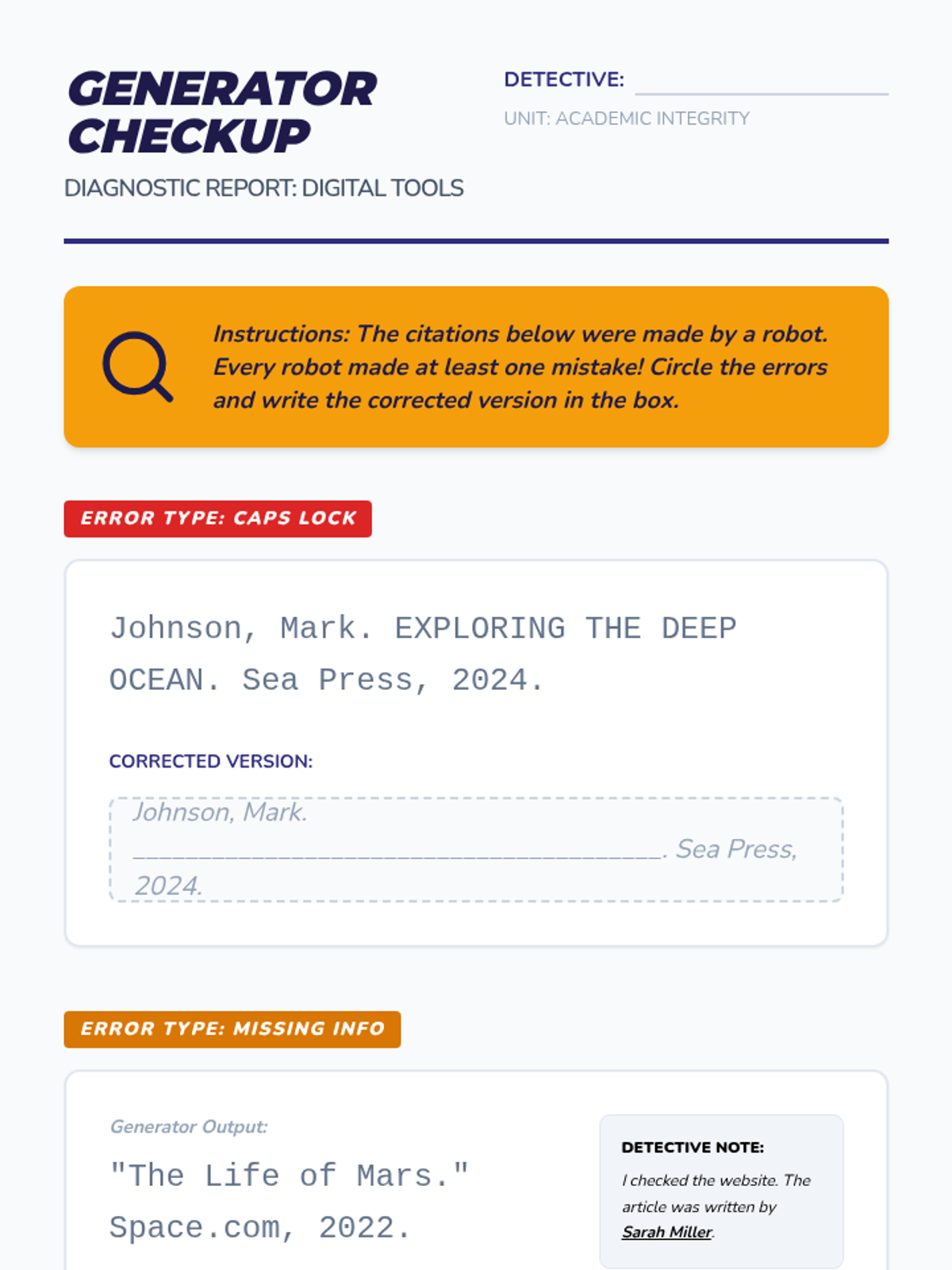
Diagnostic worksheet for students to identify and fix common errors made by citation generators, emphasizing critical thinking over automated reliance.
Slide deck for Lesson 3, teaching 6th-grade students how to critically evaluate the output of digital citation generators and identify common errors.
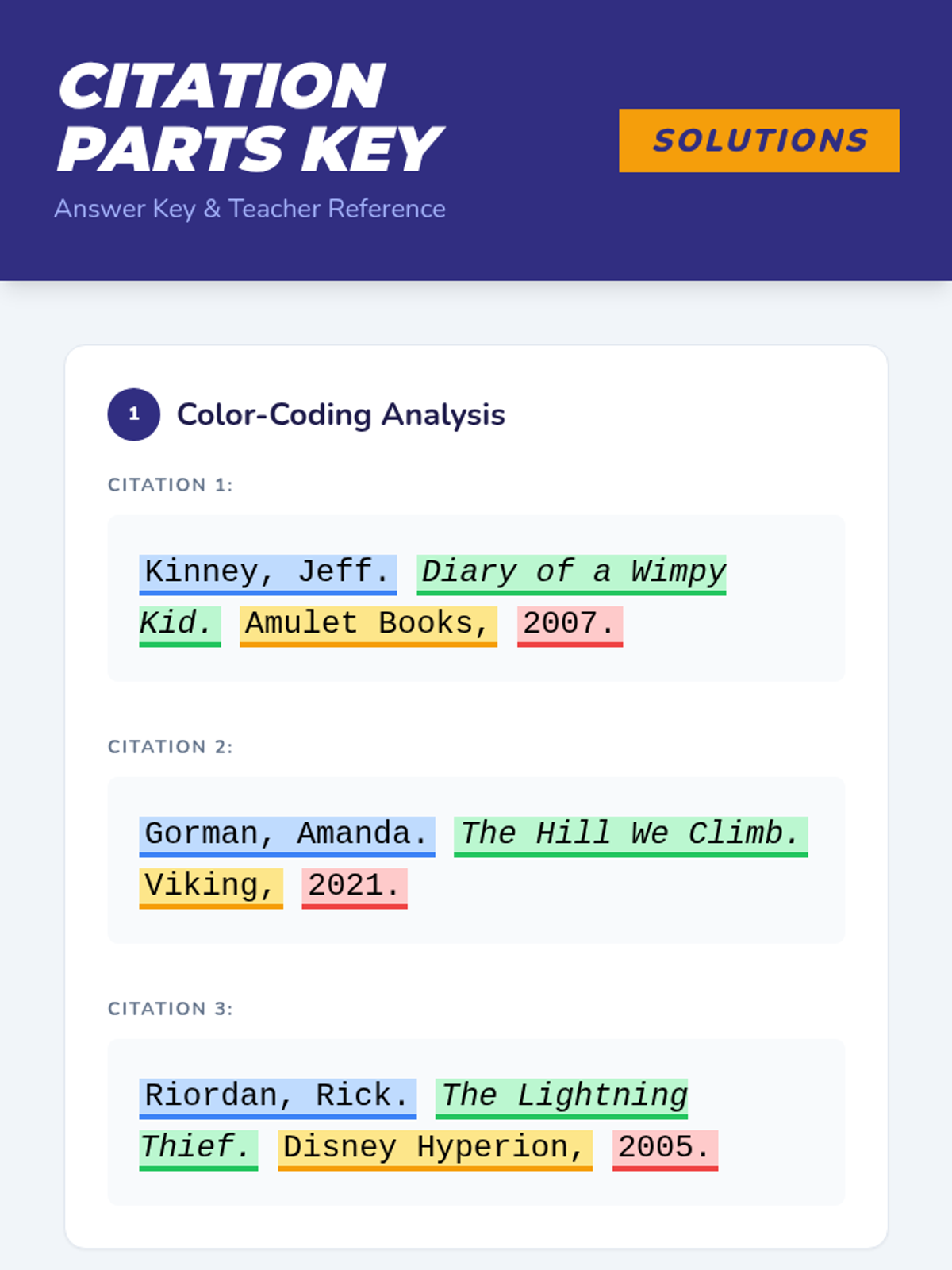
Answer key for the Citation Code-Cracker worksheet, providing visual solutions for color-coding and detailed explanations for punctuation corrections.
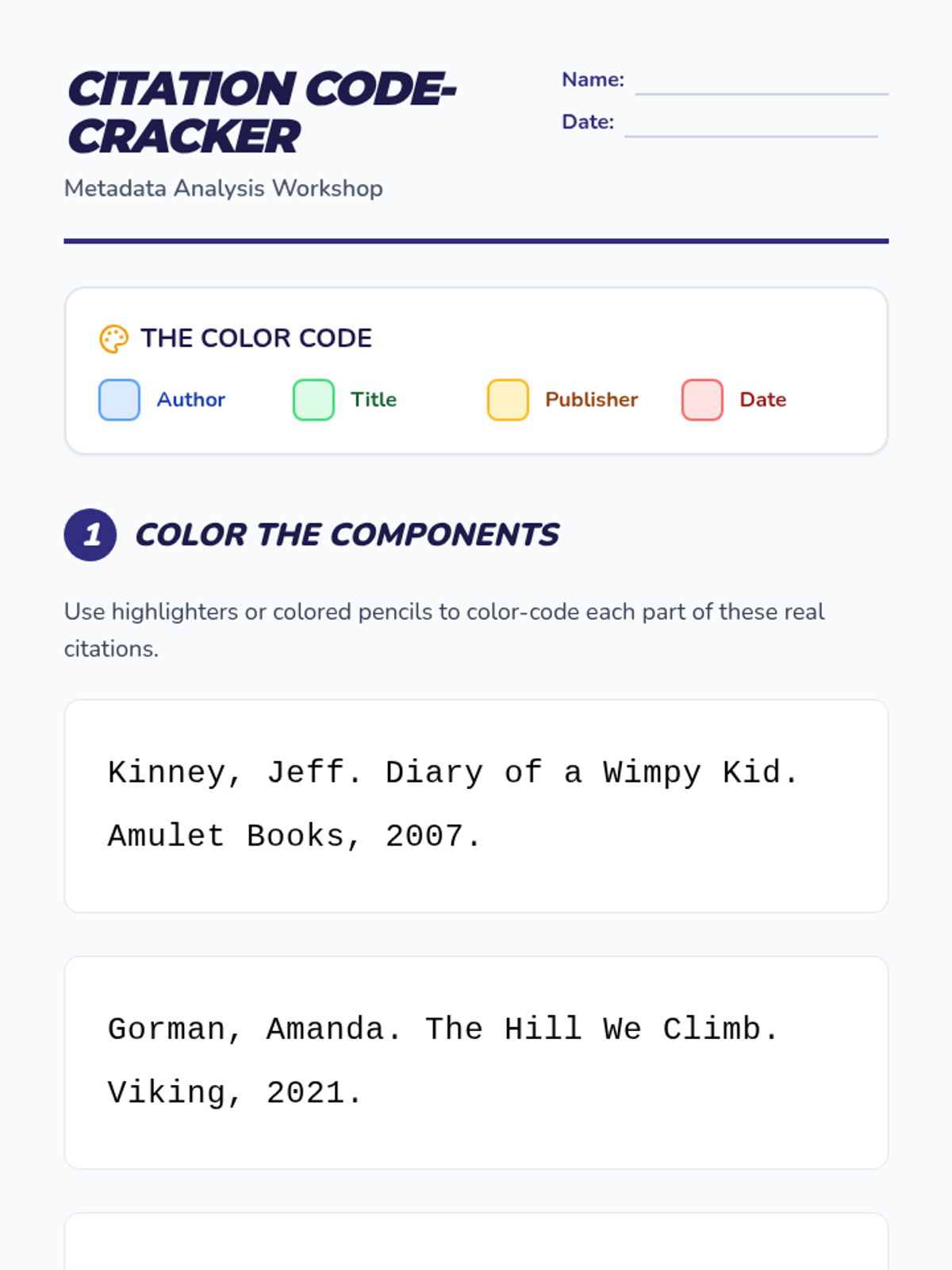
Hands-on worksheet for 6th-grade students to practice identifying citation components through color-coding, assembling raw data into citations, and identifying formatting errors.
Slide deck for Lesson 2, breaking down the anatomy of an MLA citation into four key parts: Author, Title, Publisher, and Date, with a focus on punctuation and formatting.
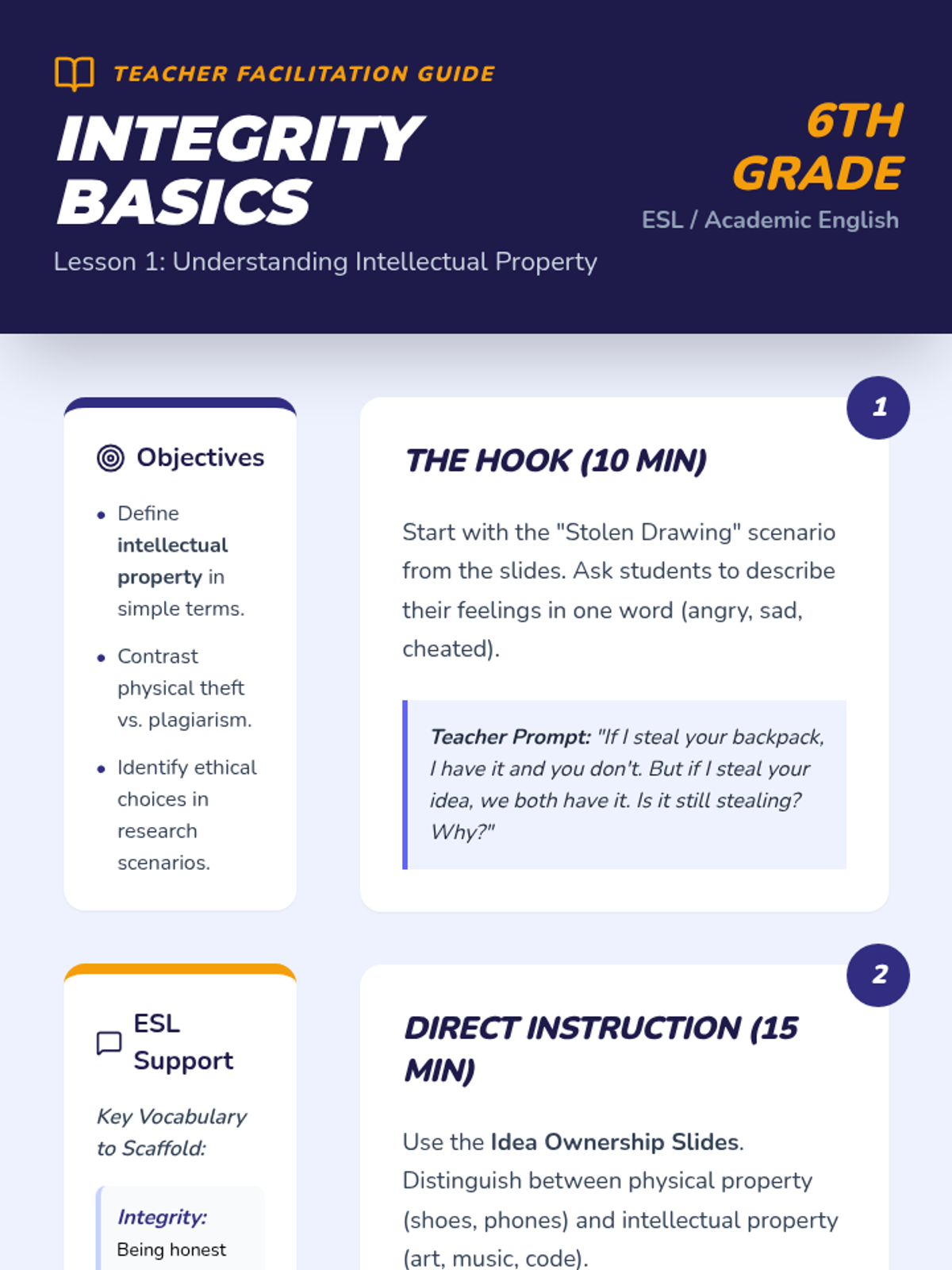
Teacher facilitation guide for Lesson 1, including objectives, ESL-specific scaffolding strategies, lesson procedures, and discussion prompts about intellectual property.
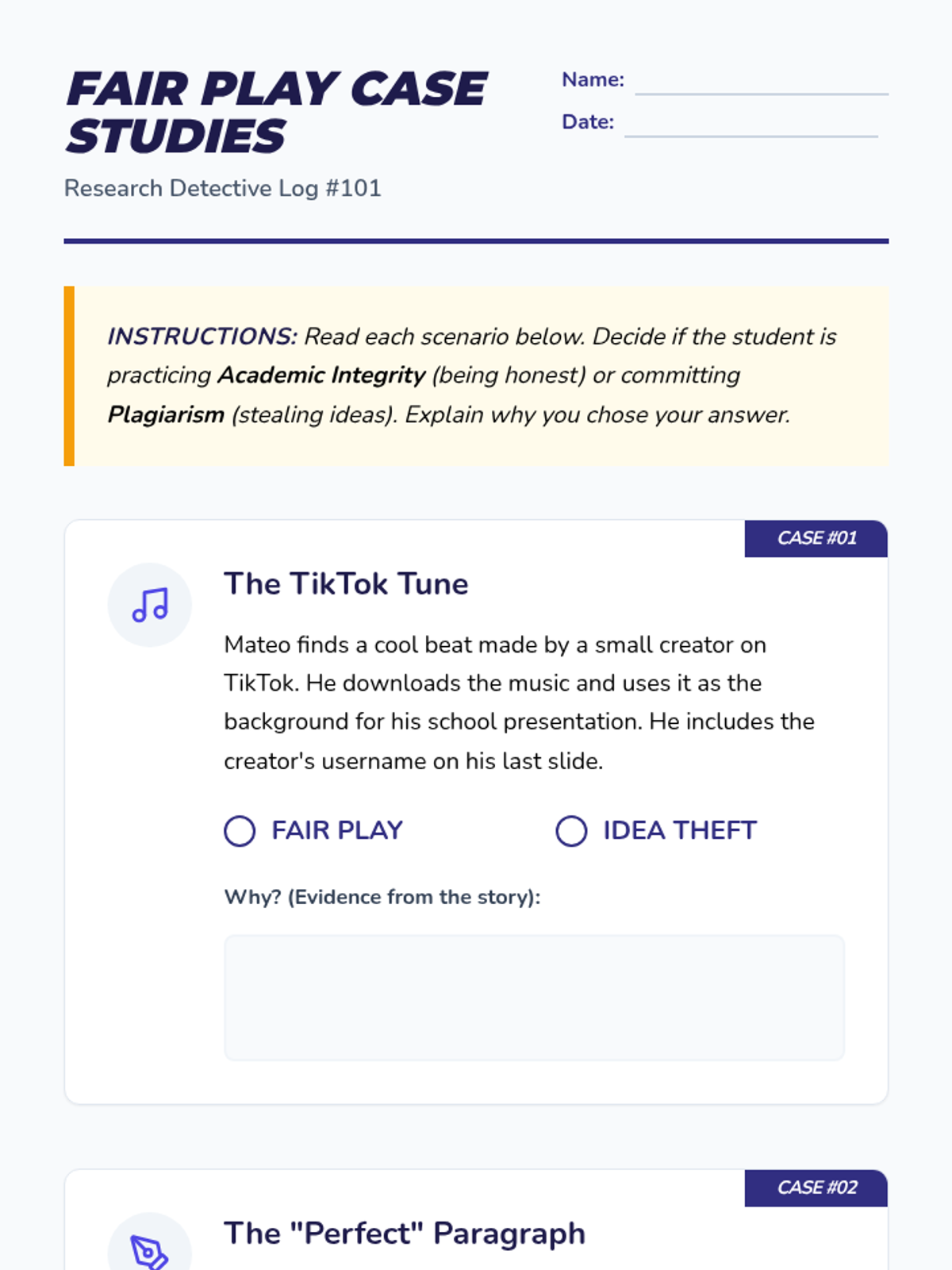
Student worksheet featuring three case studies to help 6th-grade ESL students differentiate between academic integrity and plagiarism through real-world scenarios.
Introductory slide deck for Lesson 1, exploring the concept of intellectual property and why academic integrity is essential for young researchers.
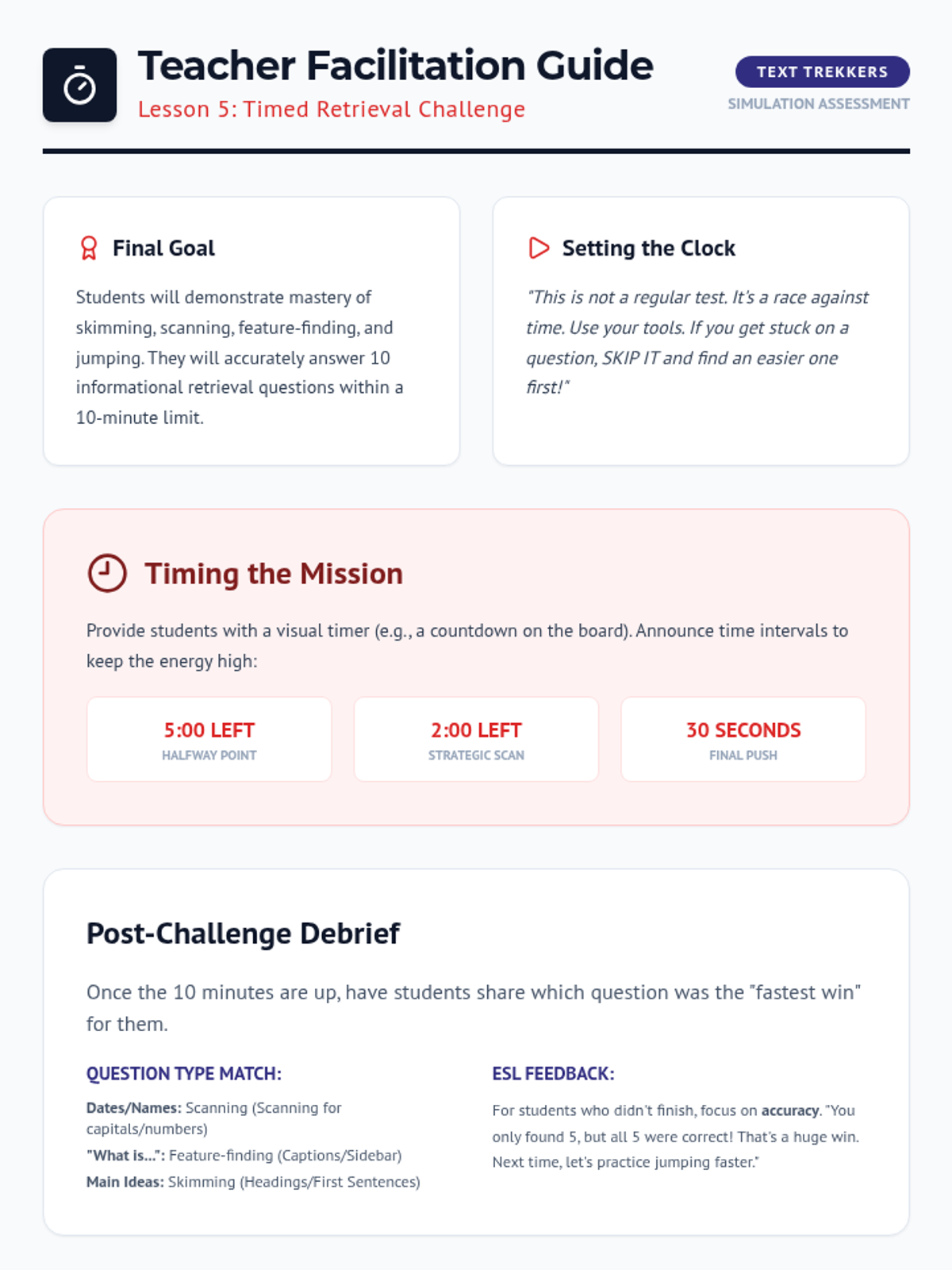
A facilitation guide for teachers for Lesson 5, including the "Beat the Clock" challenge rules, scoring guide, and a complete answer key for the assessment.
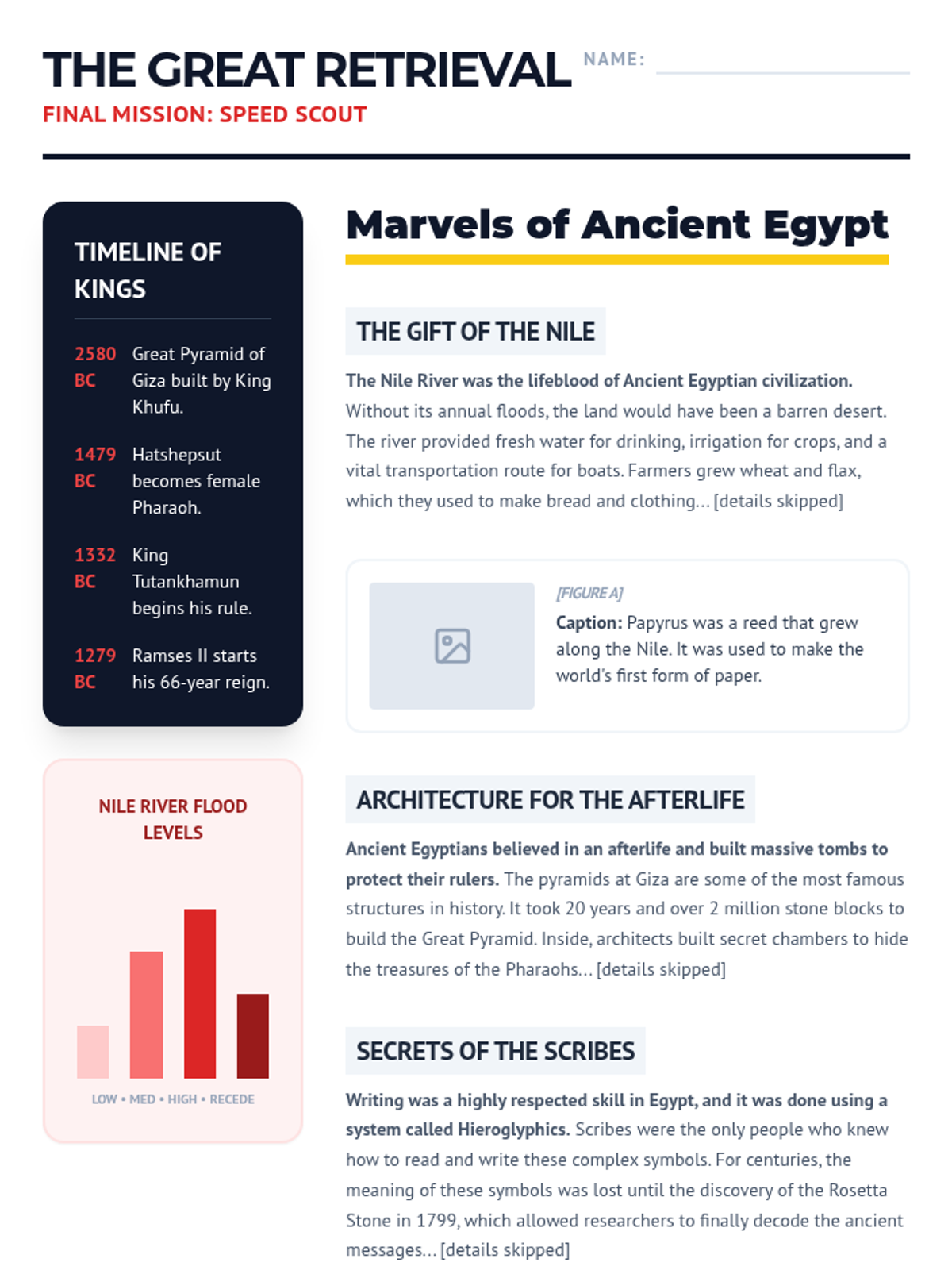
The culminating assessment worksheet for Lesson 5. Features a text about Ancient Egypt with various text features and 10 retrieval questions to be answered in 10 minutes.
Instructional slides for Lesson 5, the culminating retrieval challenge. Reviews all skimming and scanning strategies and sets the rules for the "Beat the Clock" challenge.
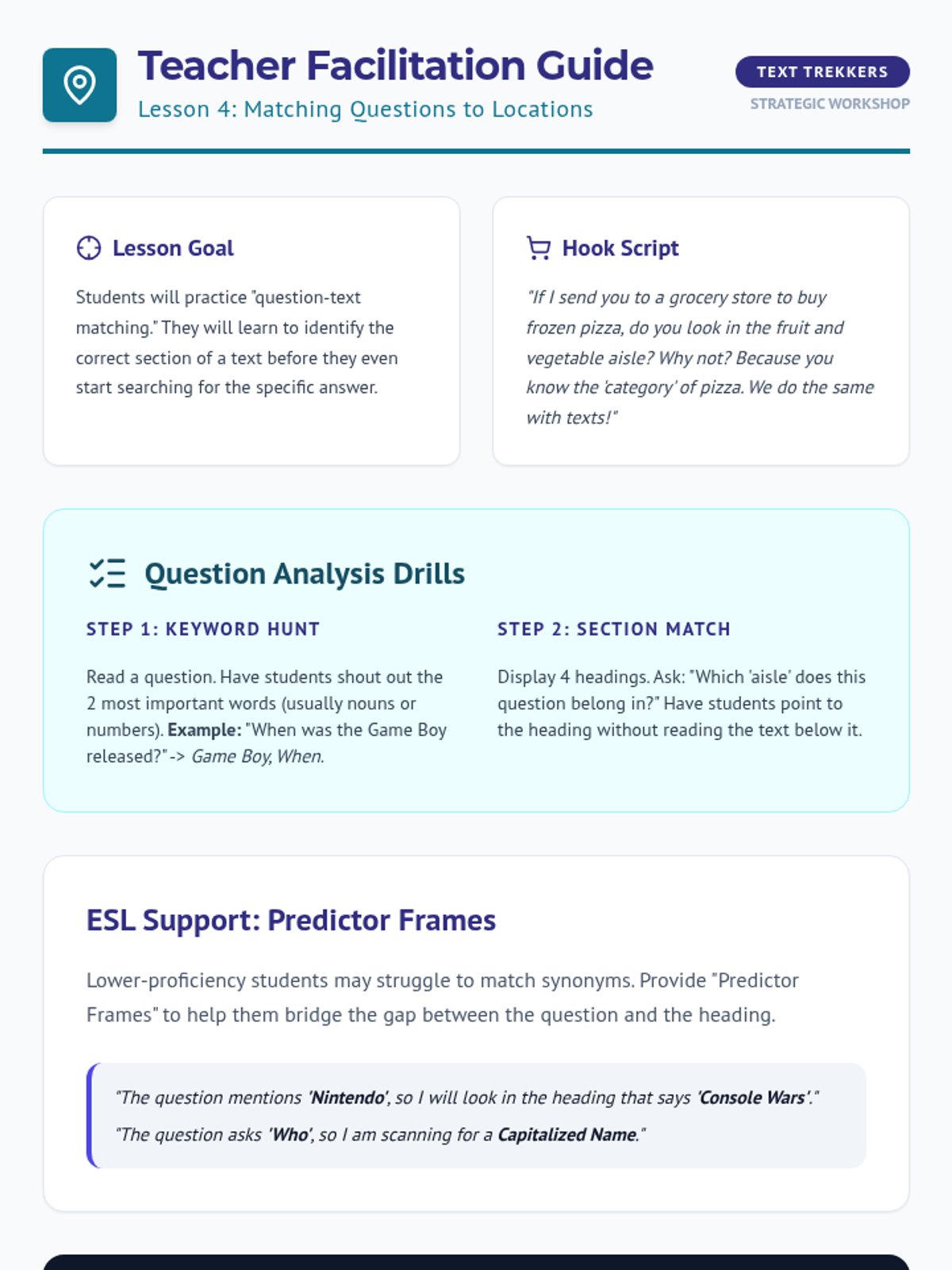
A facilitation guide for teachers for Lesson 4, including the "Grocery Store" hook script, worksheet answers, and tips for synonym matching and predicting answer locations.
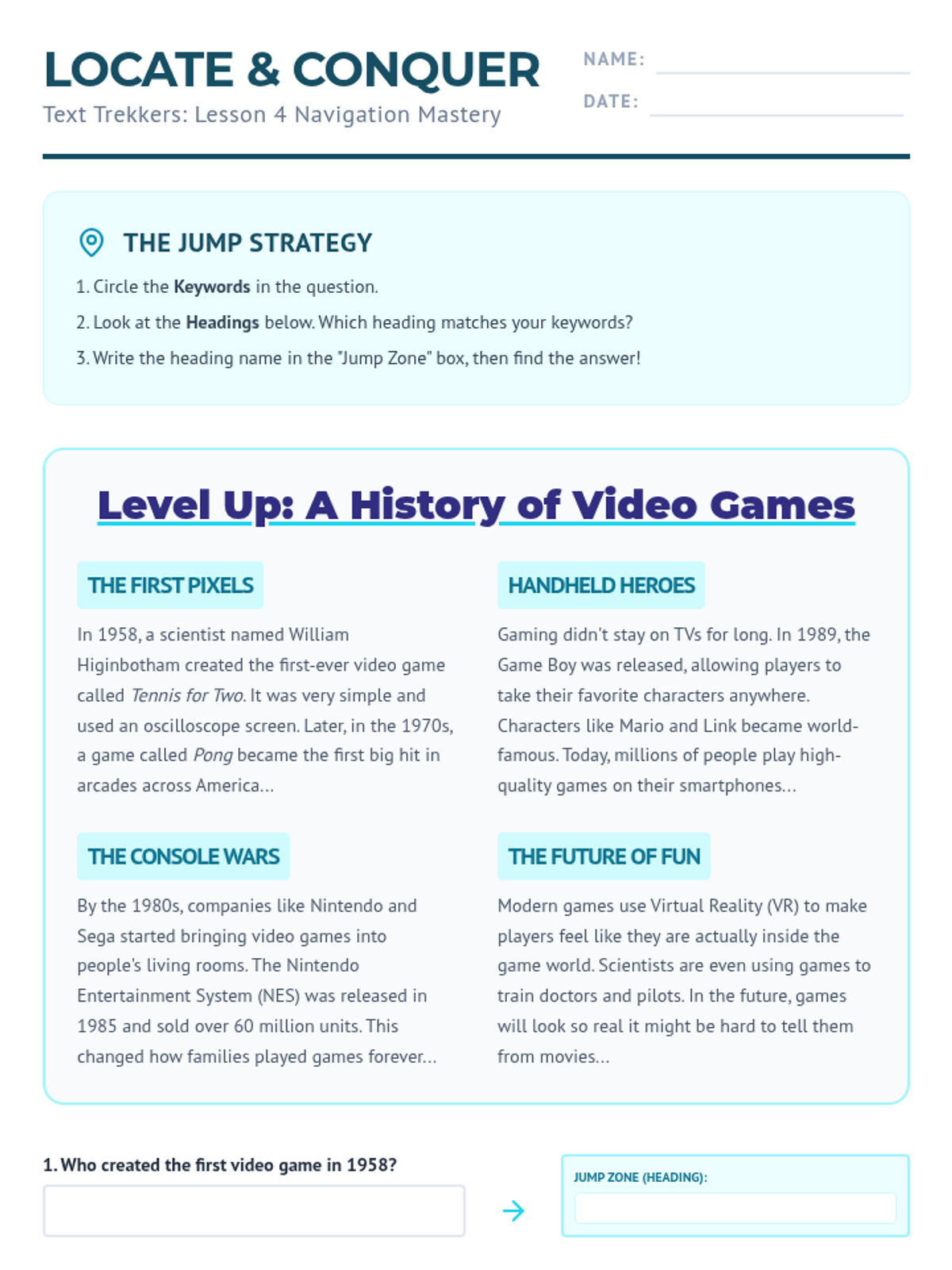
A student worksheet for practicing matching question types to text locations. Students analyze keywords in questions and predict which section heading holds the answer before finding it.
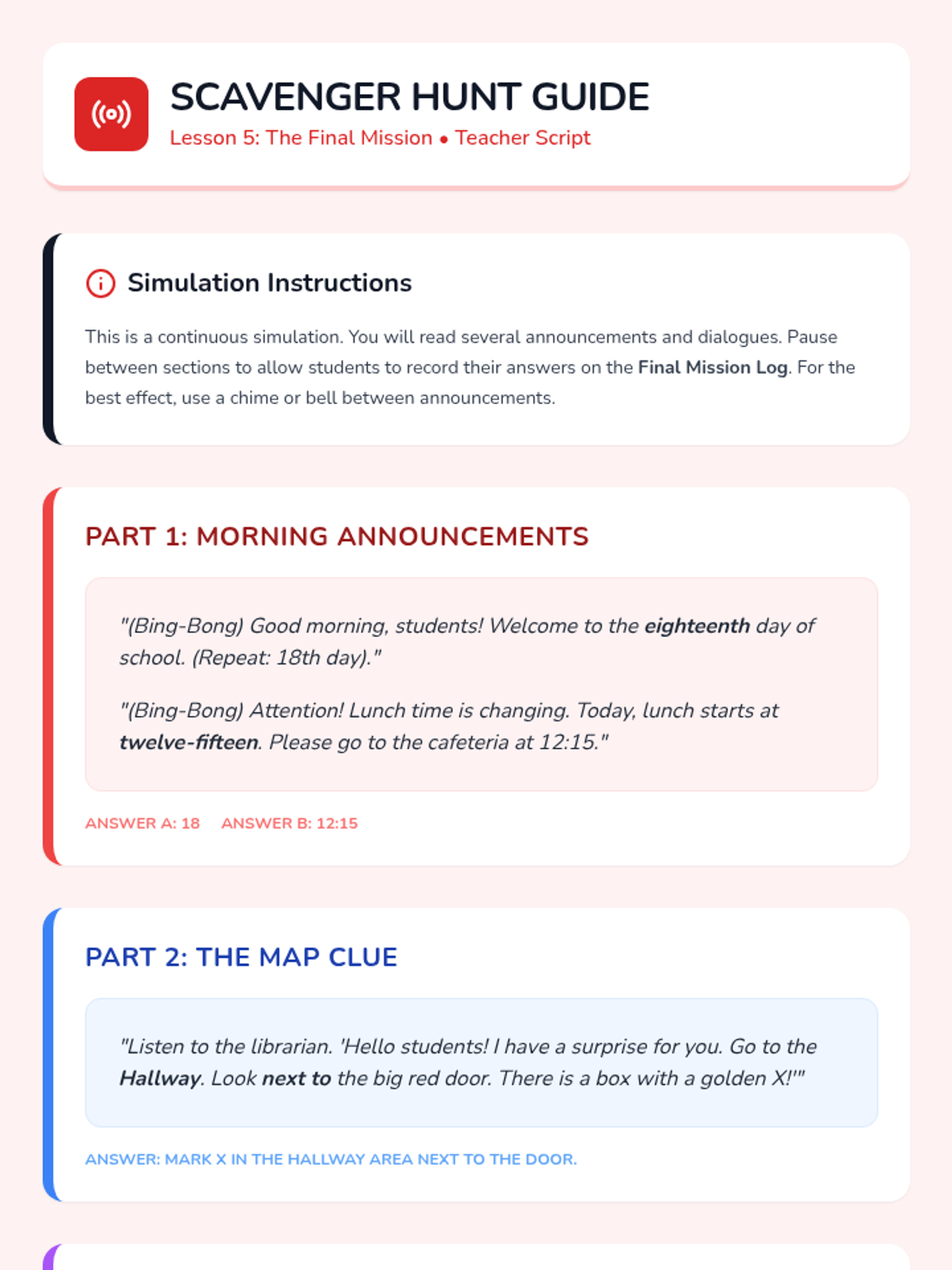
Teacher master script and scoring guide for the comprehensive 'First Day of School' simulation, synthesizing all listening skills.
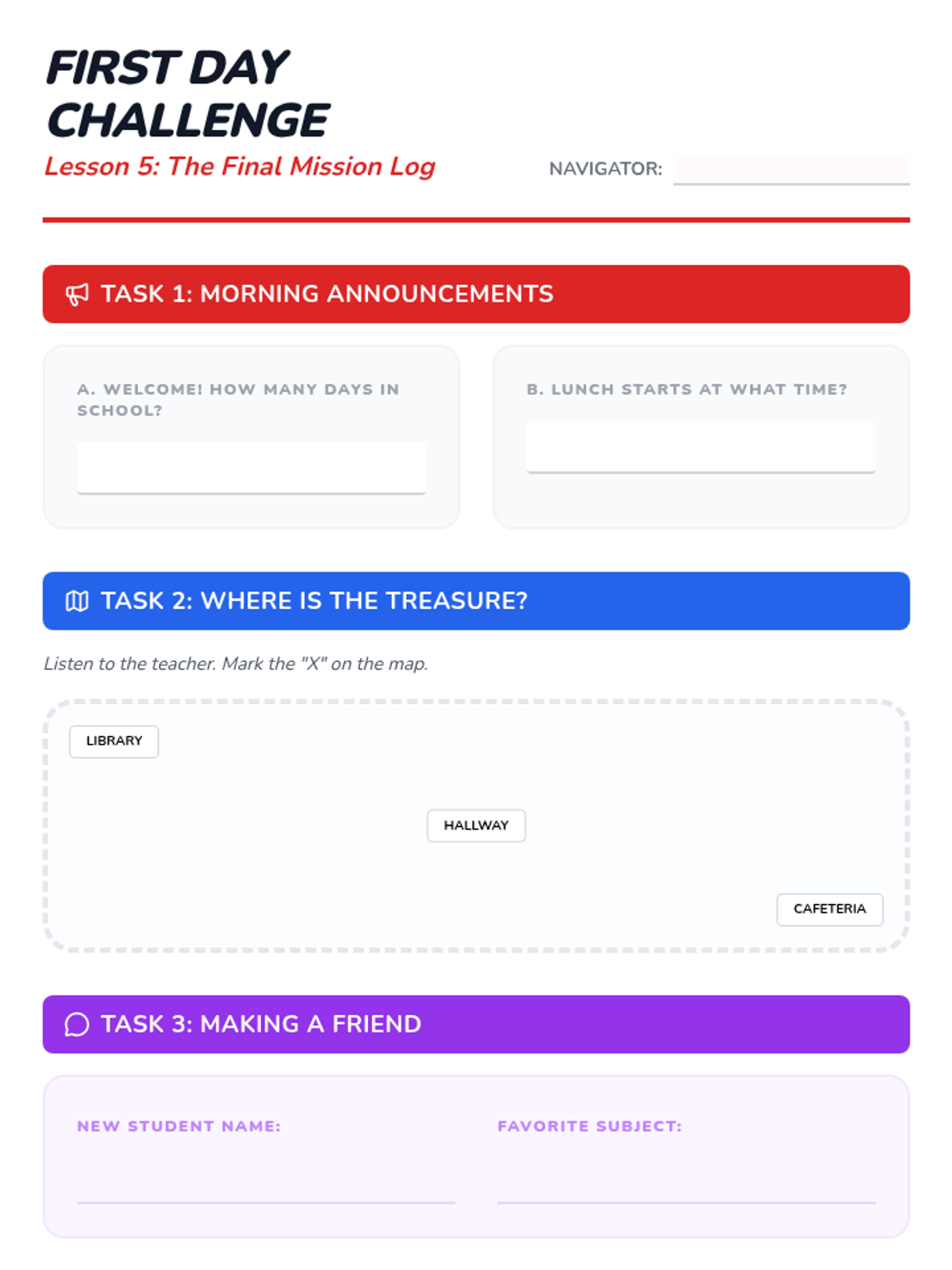
Student scavenger hunt/audio log for the culminating 'First Day of School' simulation, synthesizing all previous listening skills.
Visual guide for the 'First Day of School' culminating simulation, synthesizing all listening skills from the sequence.
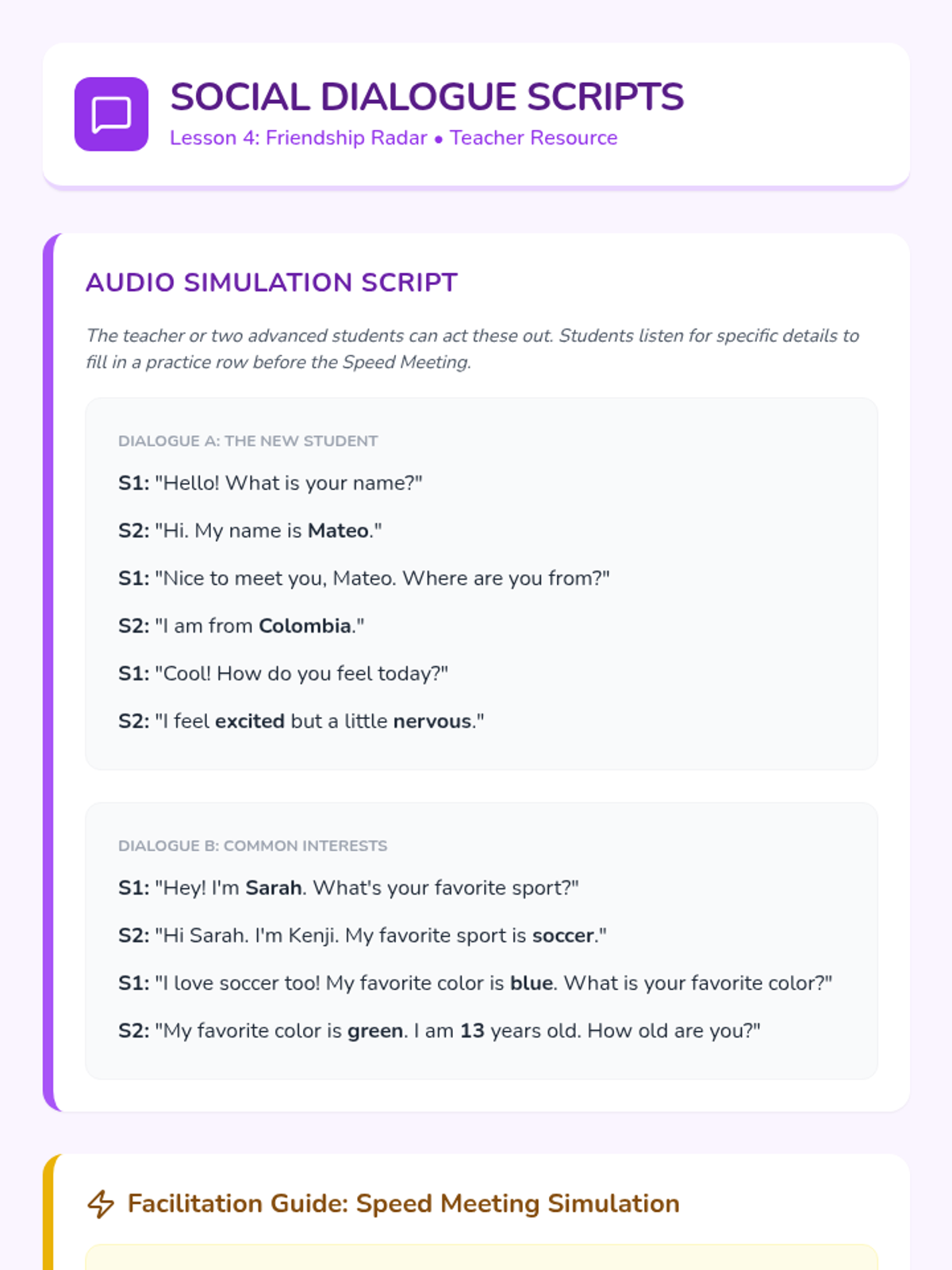
Teacher instructions and audio scripts for the social listening activities, including the introductory dialogues and Speed Meeting facilitation guide.
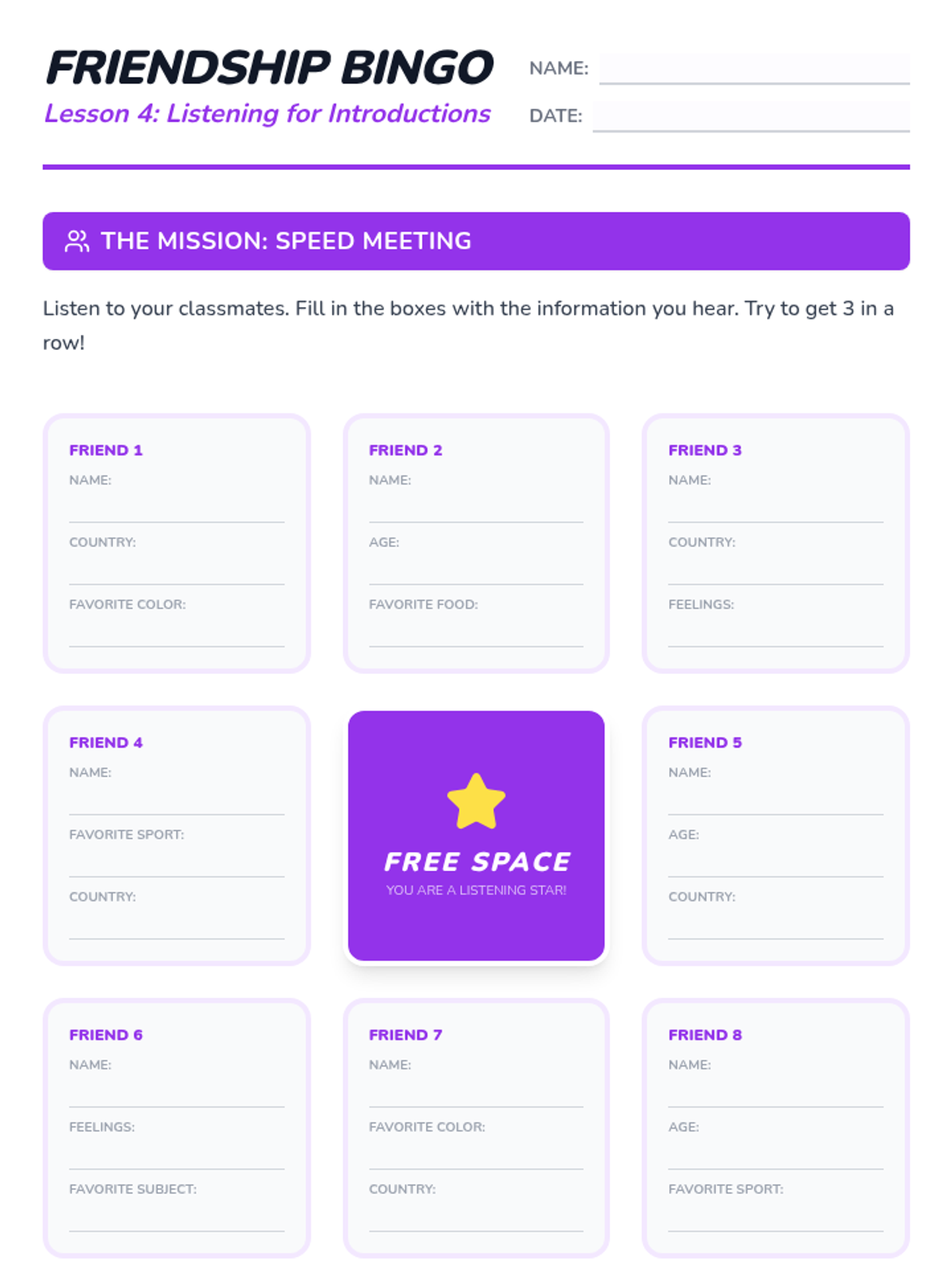
Social listening bingo card for recording personal information during a Speed Meeting simulation with peers.
Visual presentation for teaching 'Wh-' questions and social listening cues for personal introductions.
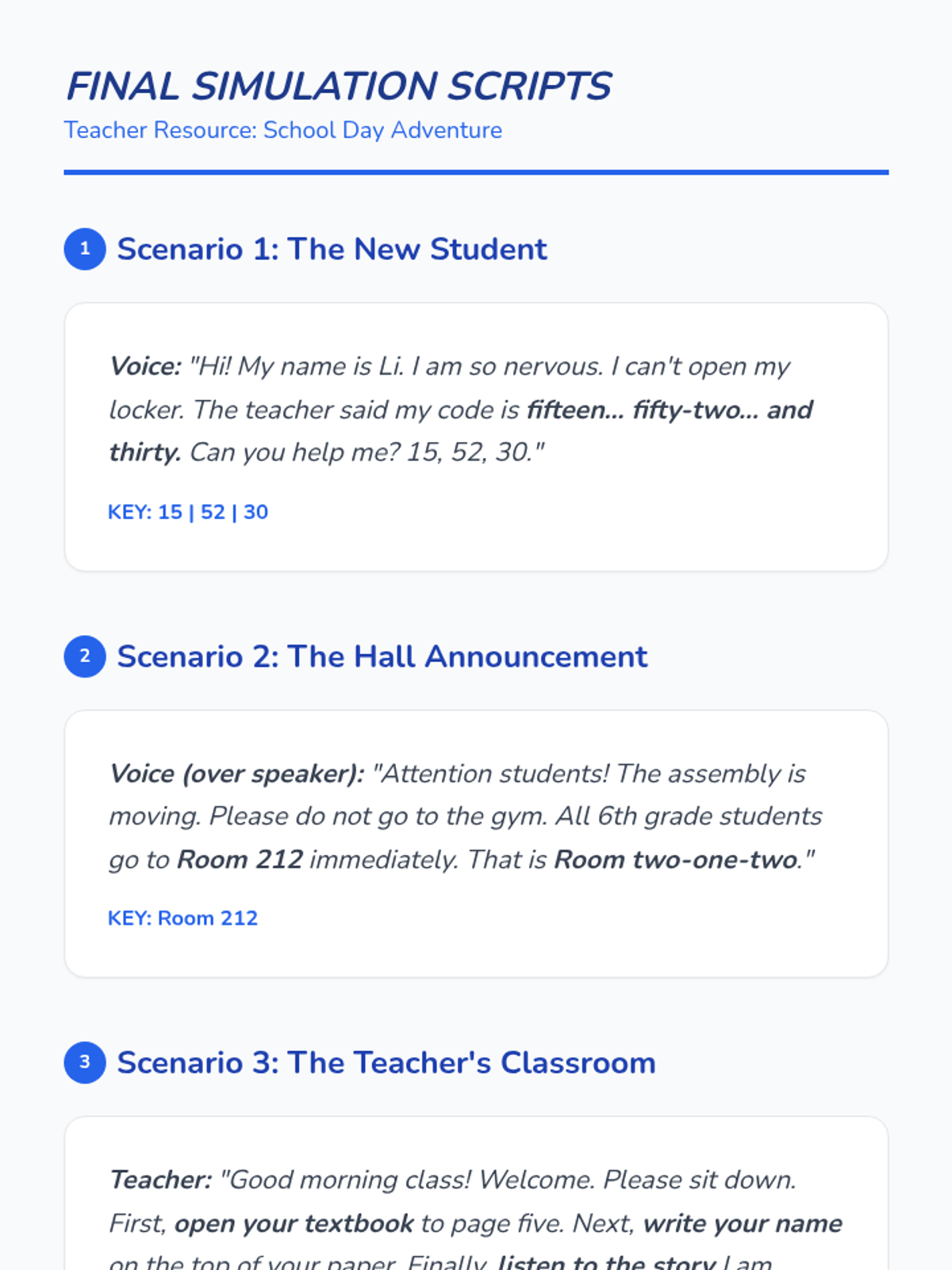
Scripts for the three scenarios in the final listening simulation adventure, including the answer key and an assessment checklist.
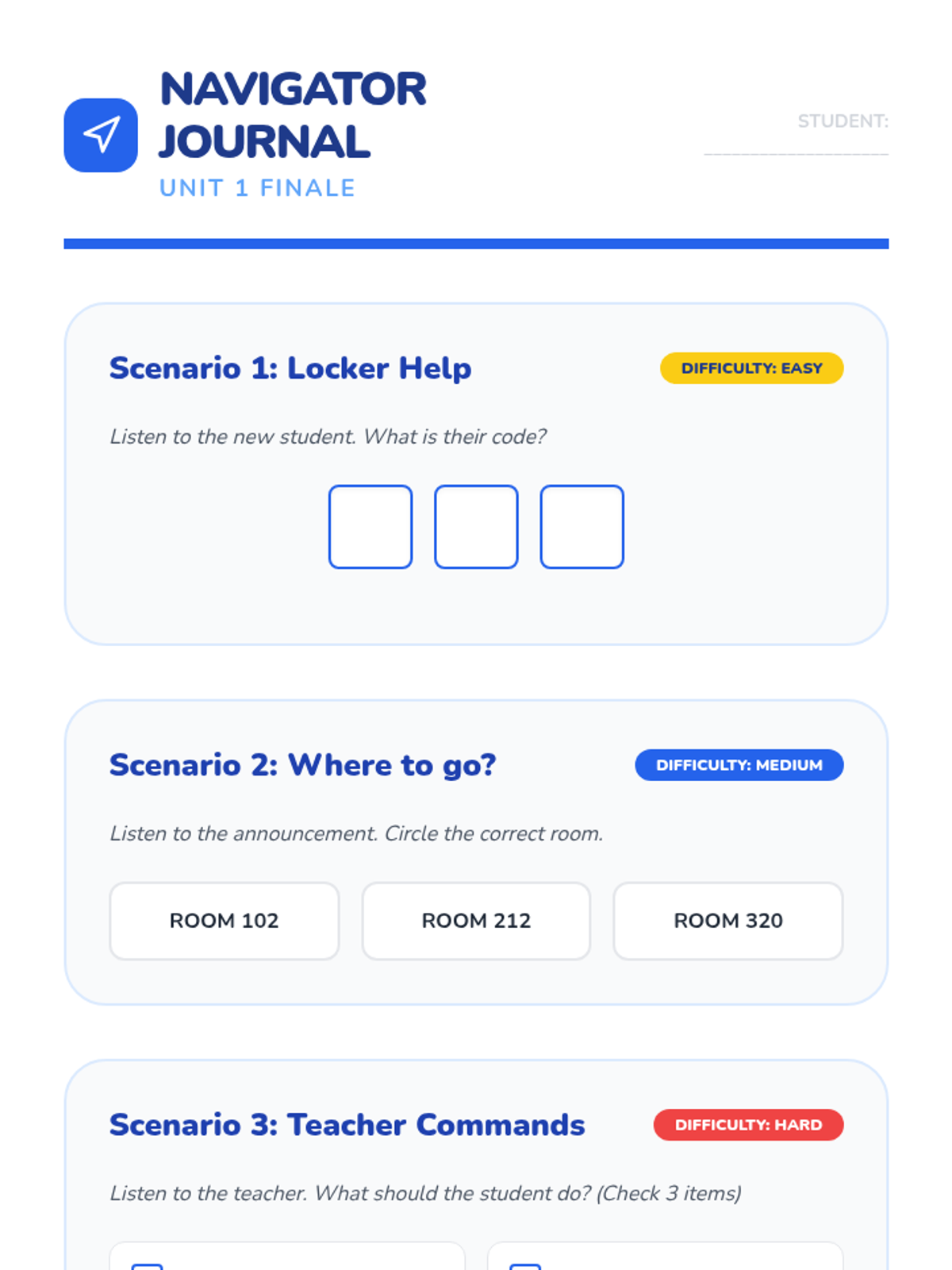
Student journal for the final simulation, where they record answers and make choices based on three increasingly difficult audio scenarios.
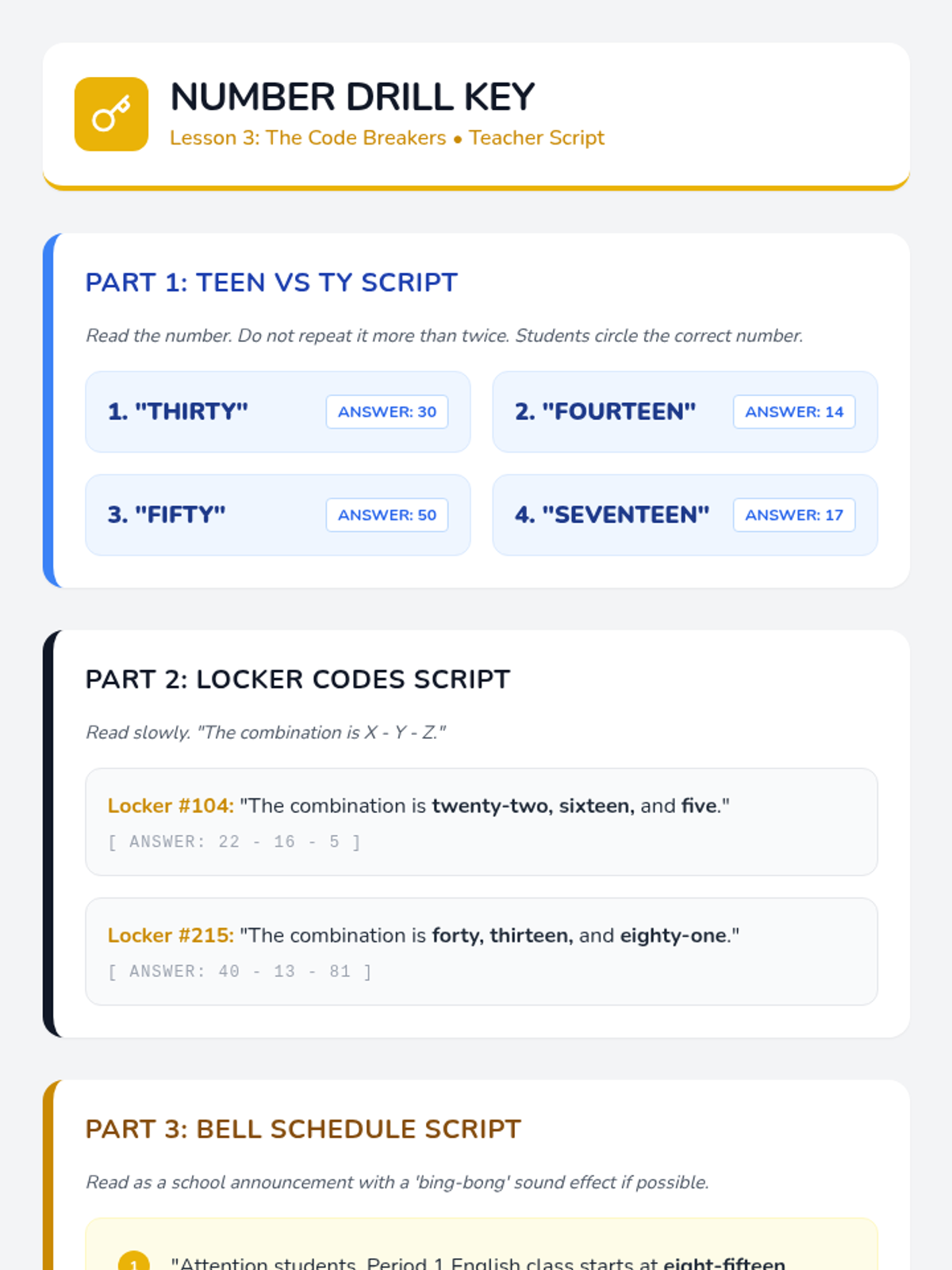
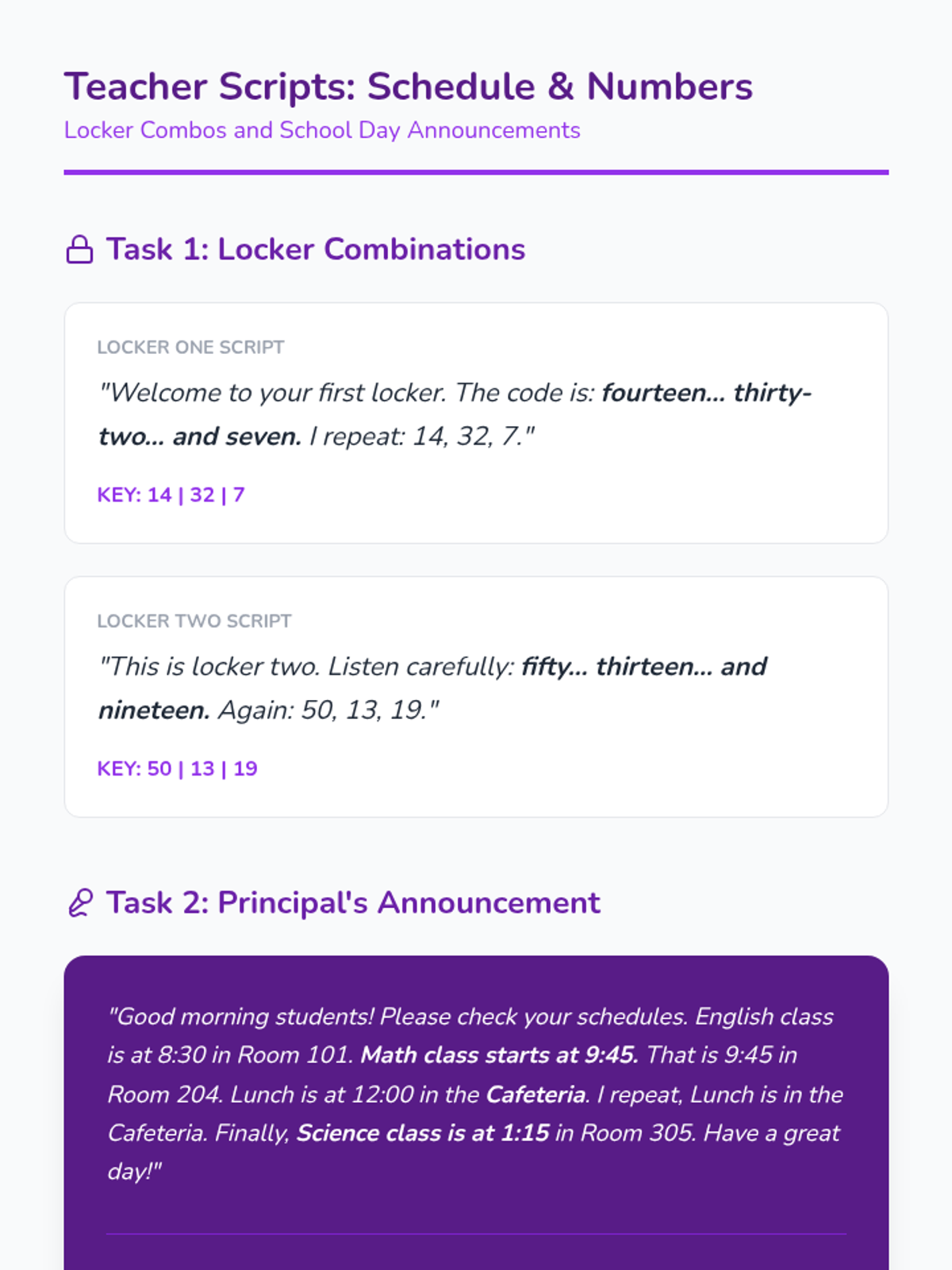
Teacher scripts and answer key for the numerical listening drills, locker combinations, and school schedules.
Visual presentation for the final simulation lesson, setting the mission and scenarios for the "First Day Navigator" activity.
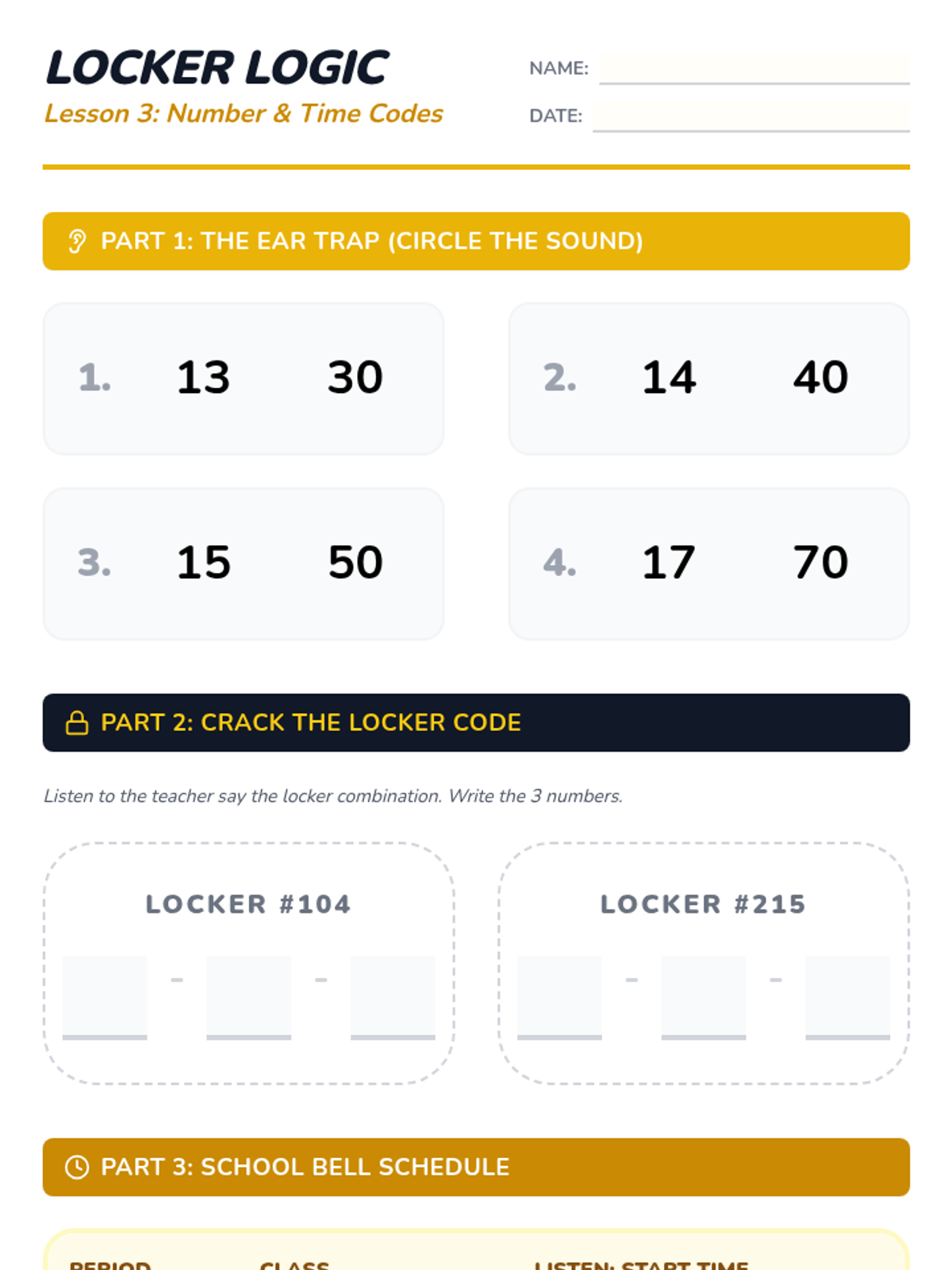
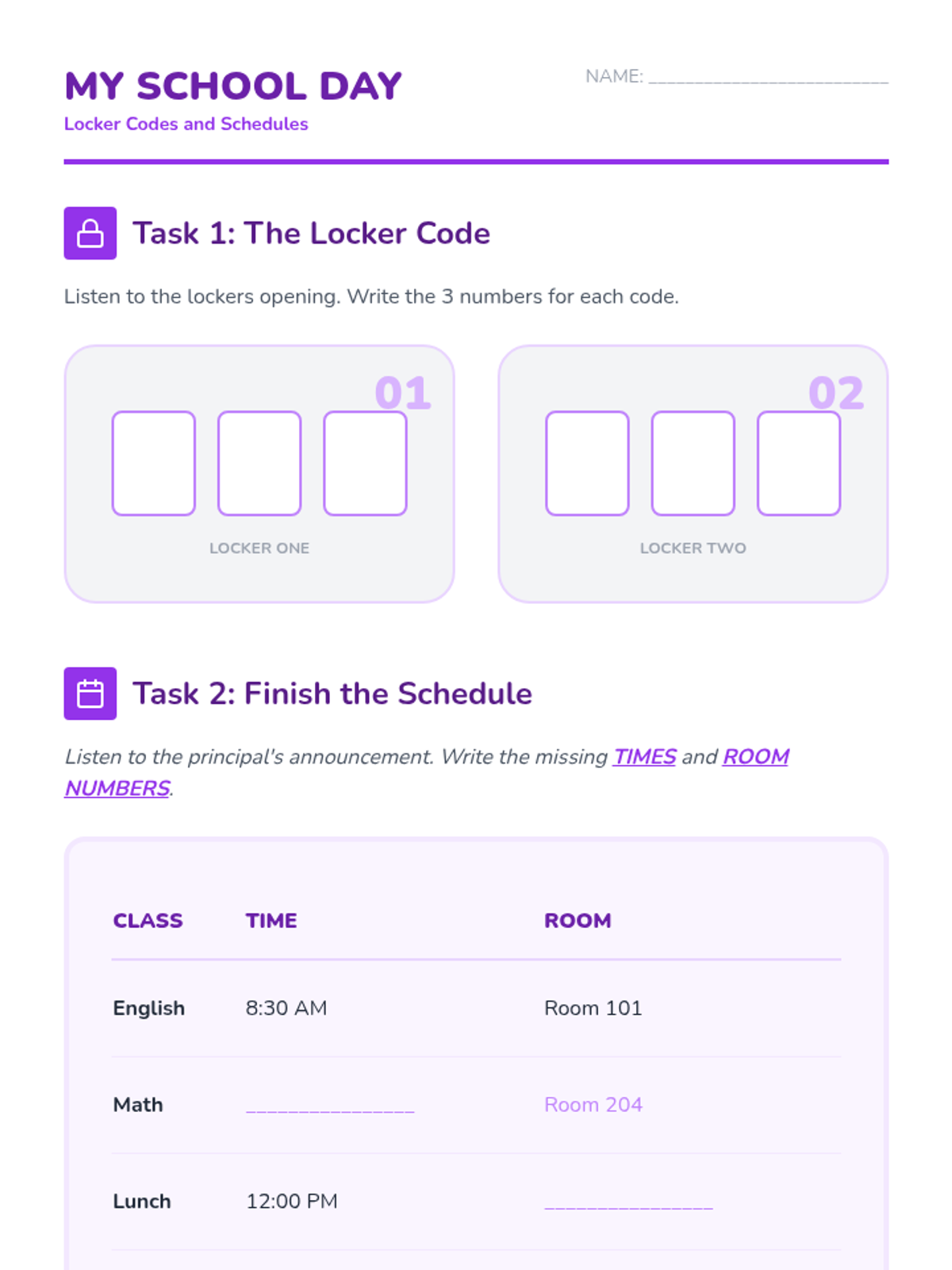
Student worksheet for recording auditory numerical information including teen/ty discrimination, locker combinations, and class times.
Scripts for the teacher to read aloud for locker combinations and a school schedule announcement, with answer key.
Student worksheet for recording locker combinations and filling in a school schedule based on spoken announcements.
Visual presentation for auditory discrimination of numbers (teen vs ty) and time-telling in a school context.
Slides for teaching numbers (teen vs ty) and time vocabulary, including instructions for the locker code hook.
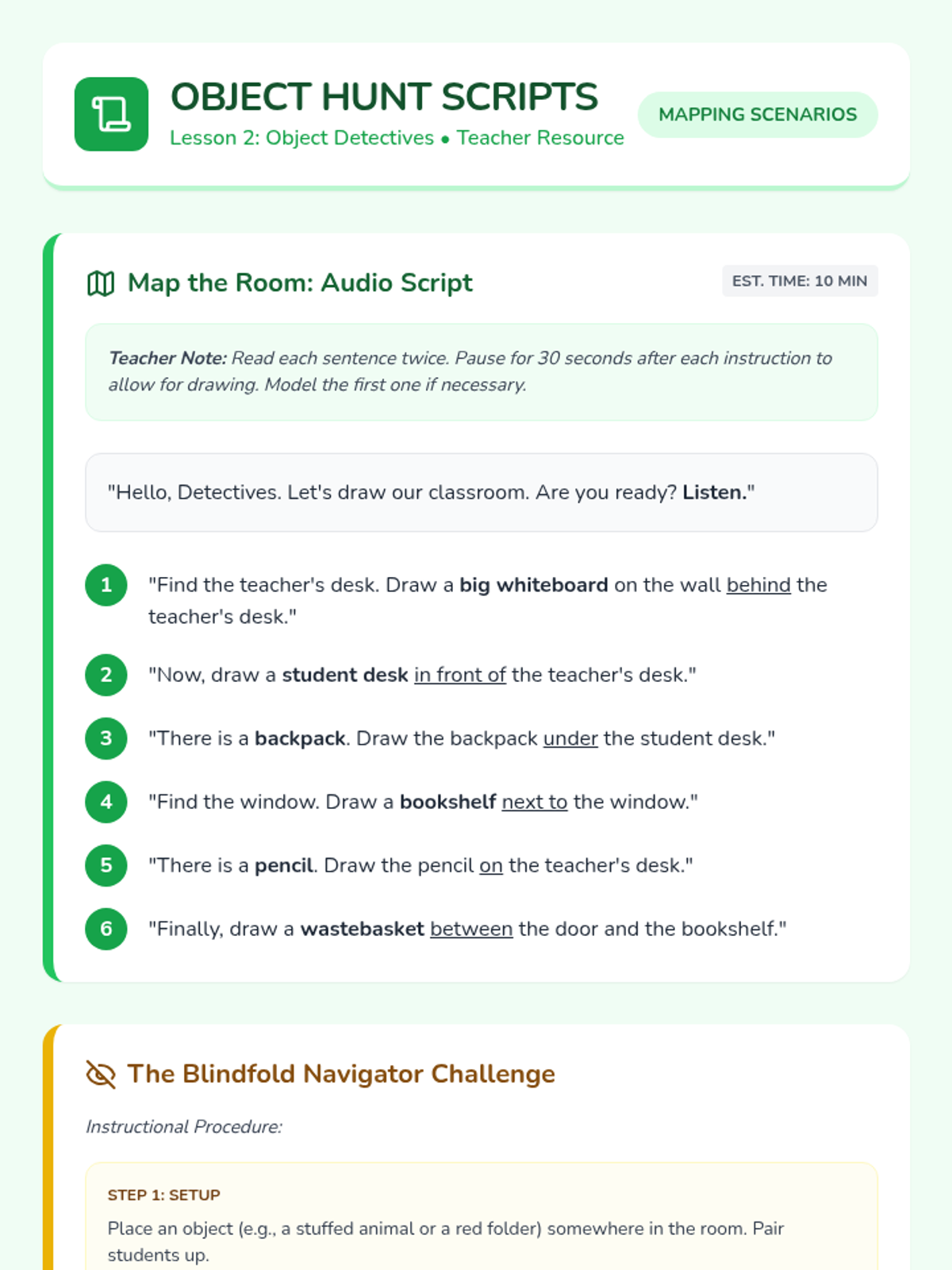
Teacher instructions and audio scripts for the spatial listening activities, including the Map the Room narrative and blindfold navigator prompts.
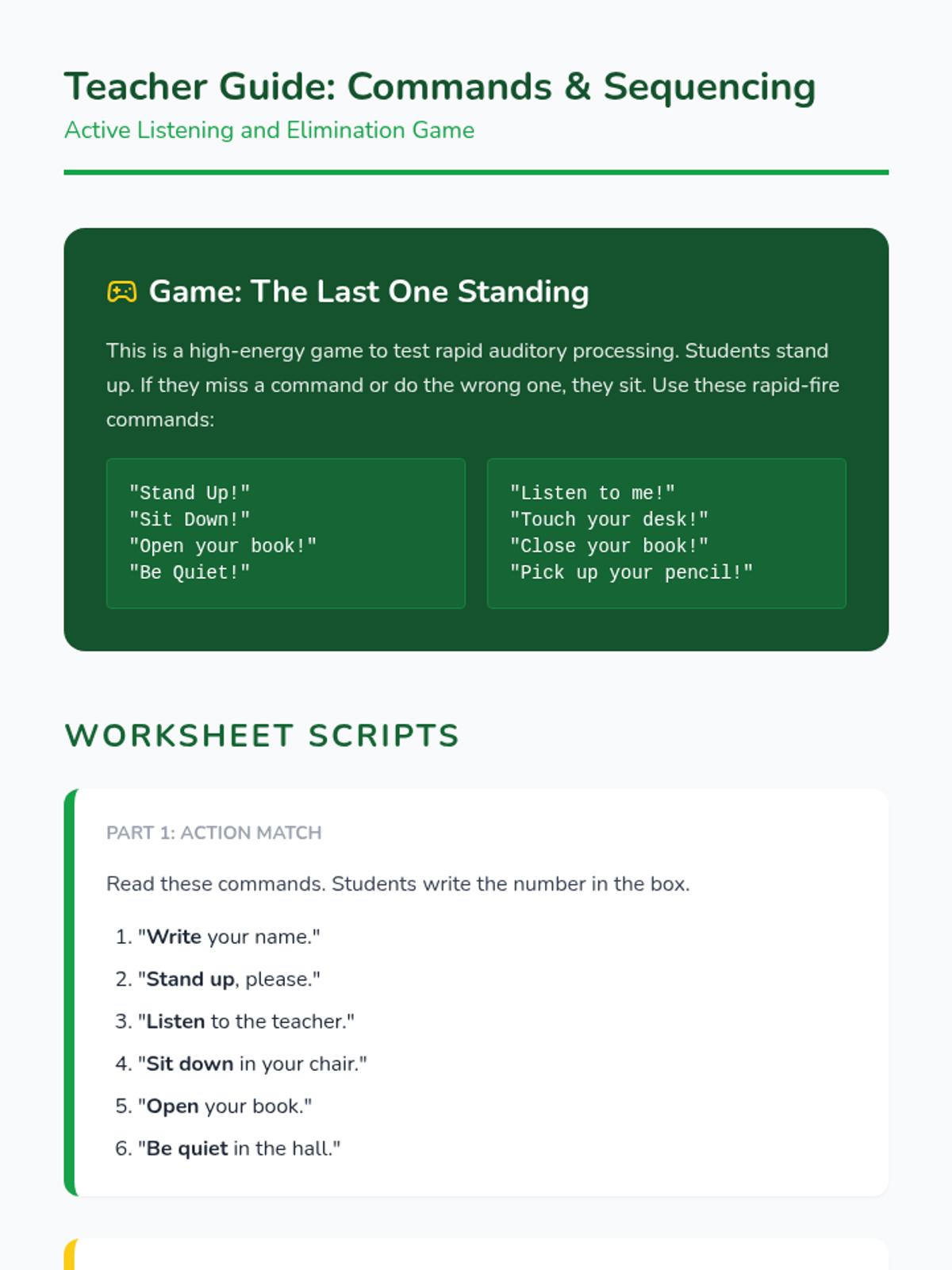
Teacher instructions for the elimination game and scripts for the sequencing activities on the student worksheet.
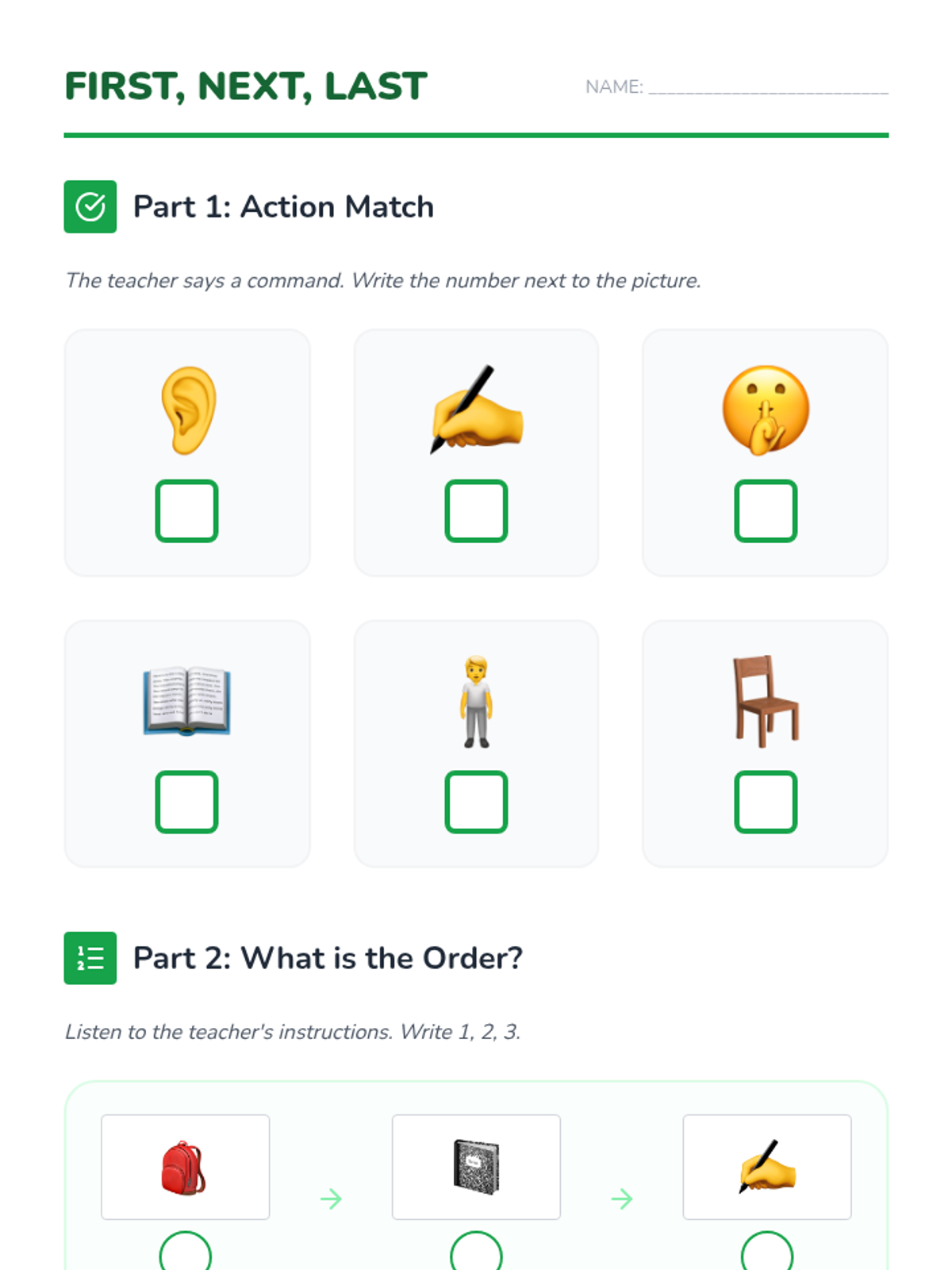
Worksheet for students to match spoken commands to images and sequence multi-step directions.
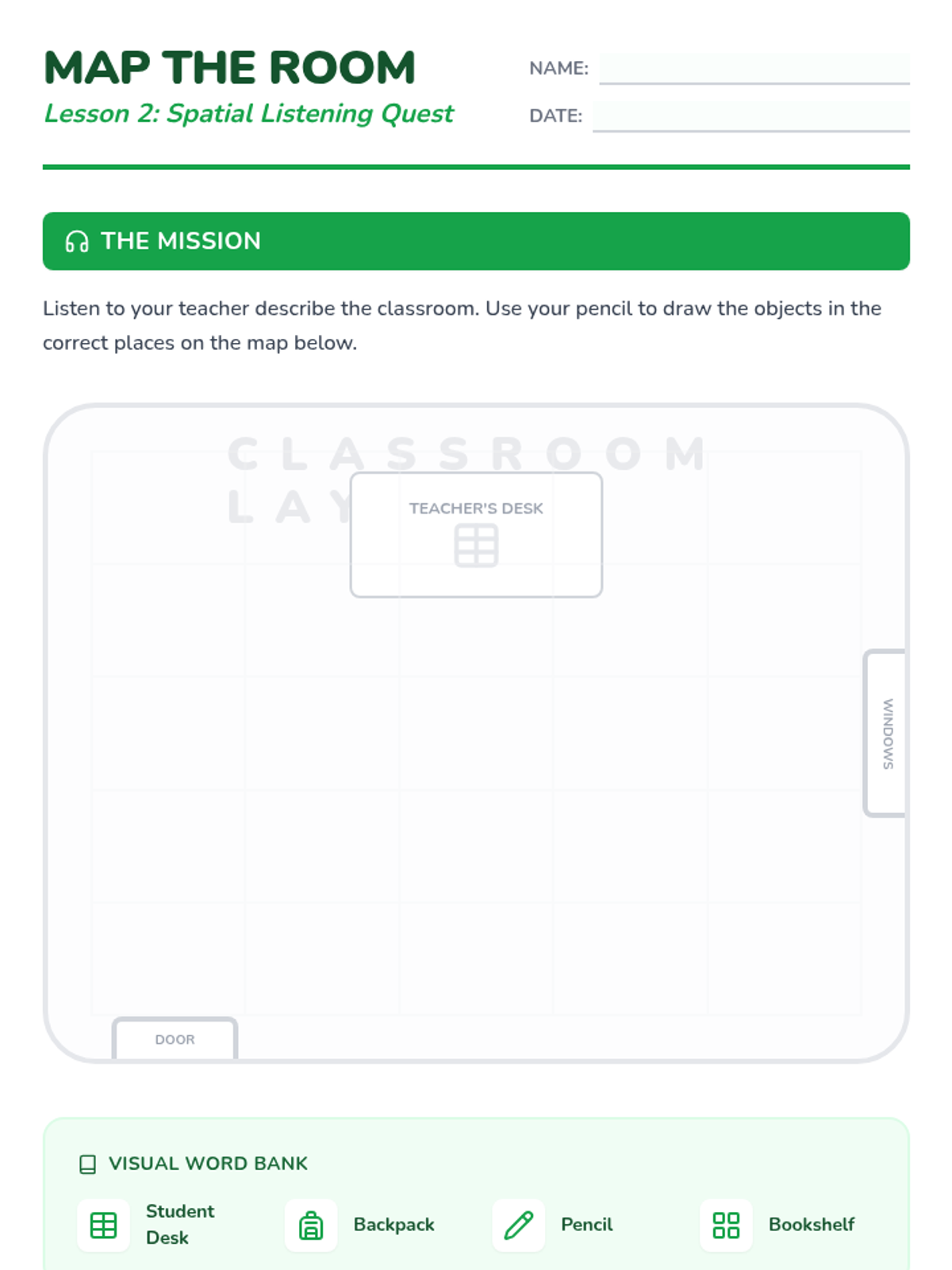
Student mapping activity for spatial listening, providing a classroom layout grid for students to draw objects based on verbal descriptions.
Visual aids for learning classroom command verbs and instructions for the elimination listening game.
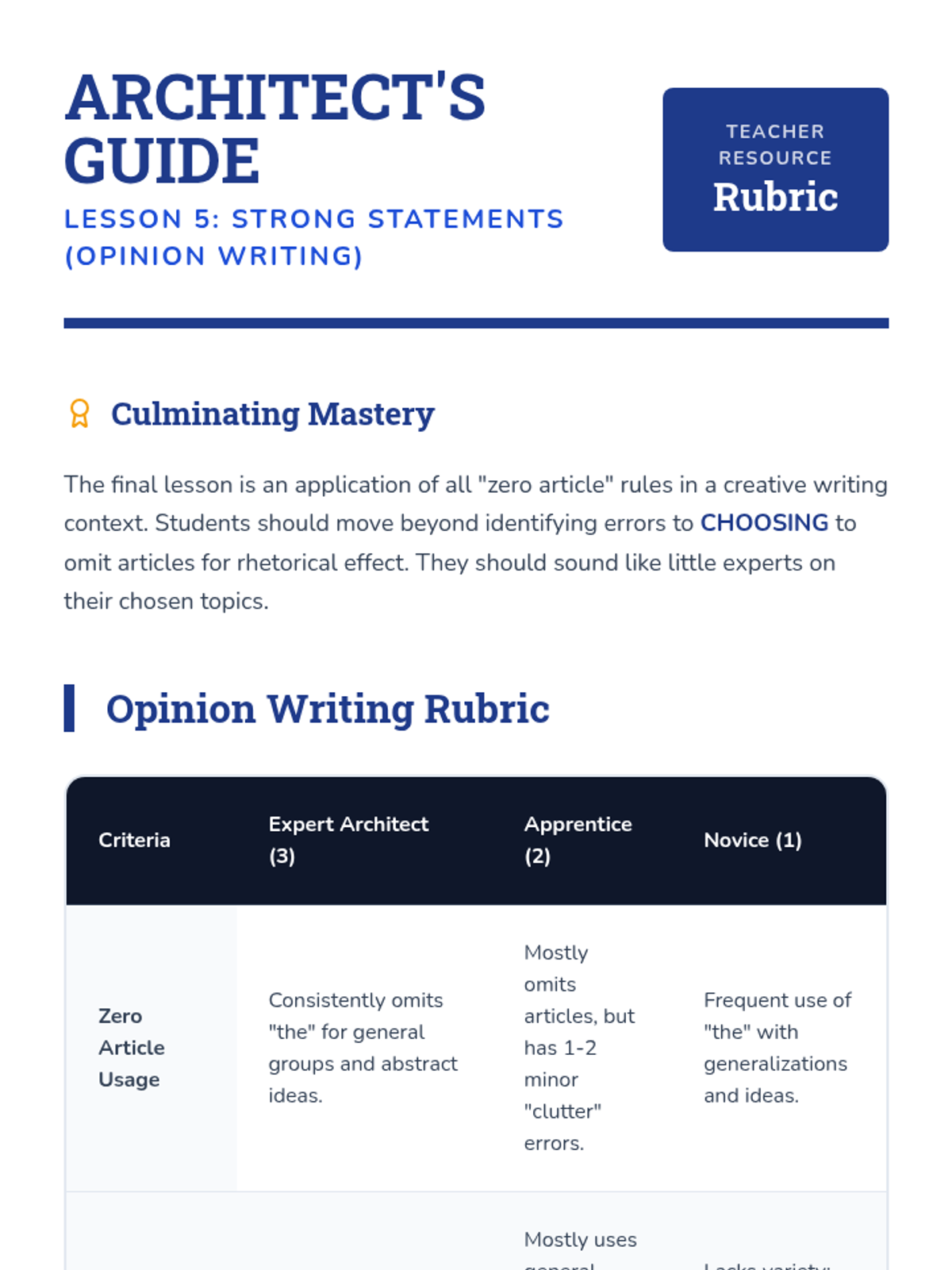
Teacher guide for Lesson 5, including a rhetorical rationale, a scoring rubric, and a peer-conference guide.
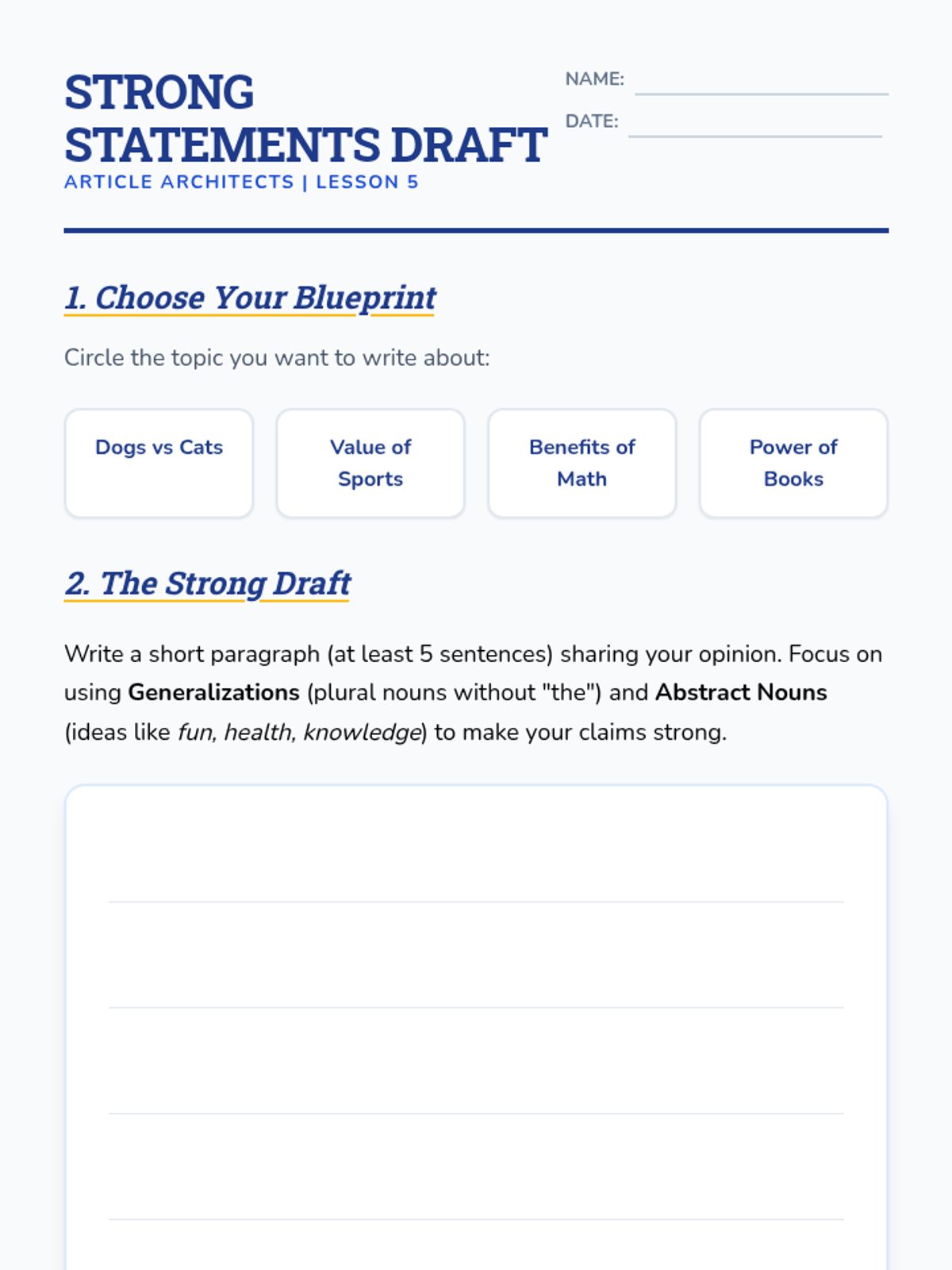
Final drafting sheet for Lesson 5 where students apply all zero article rules to write a persuasive opinion paragraph.
Lesson 5 slide deck teaching students how to use the zero article to make authoritative claims in opinion writing and debates.
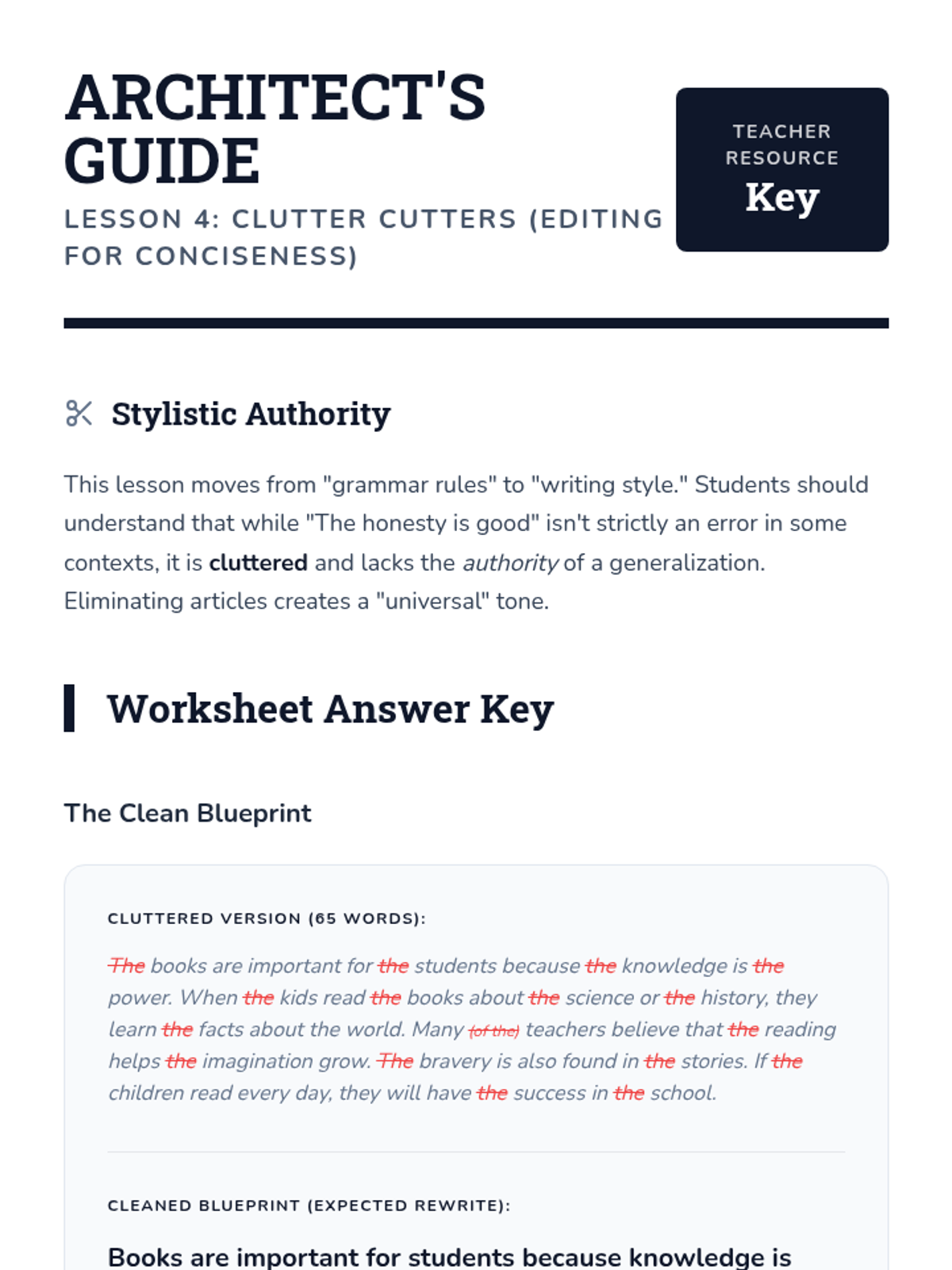
Teacher guide for Lesson 4, including the corrected 'Clean Blueprint' paragraph and a breakdown of word count savings.
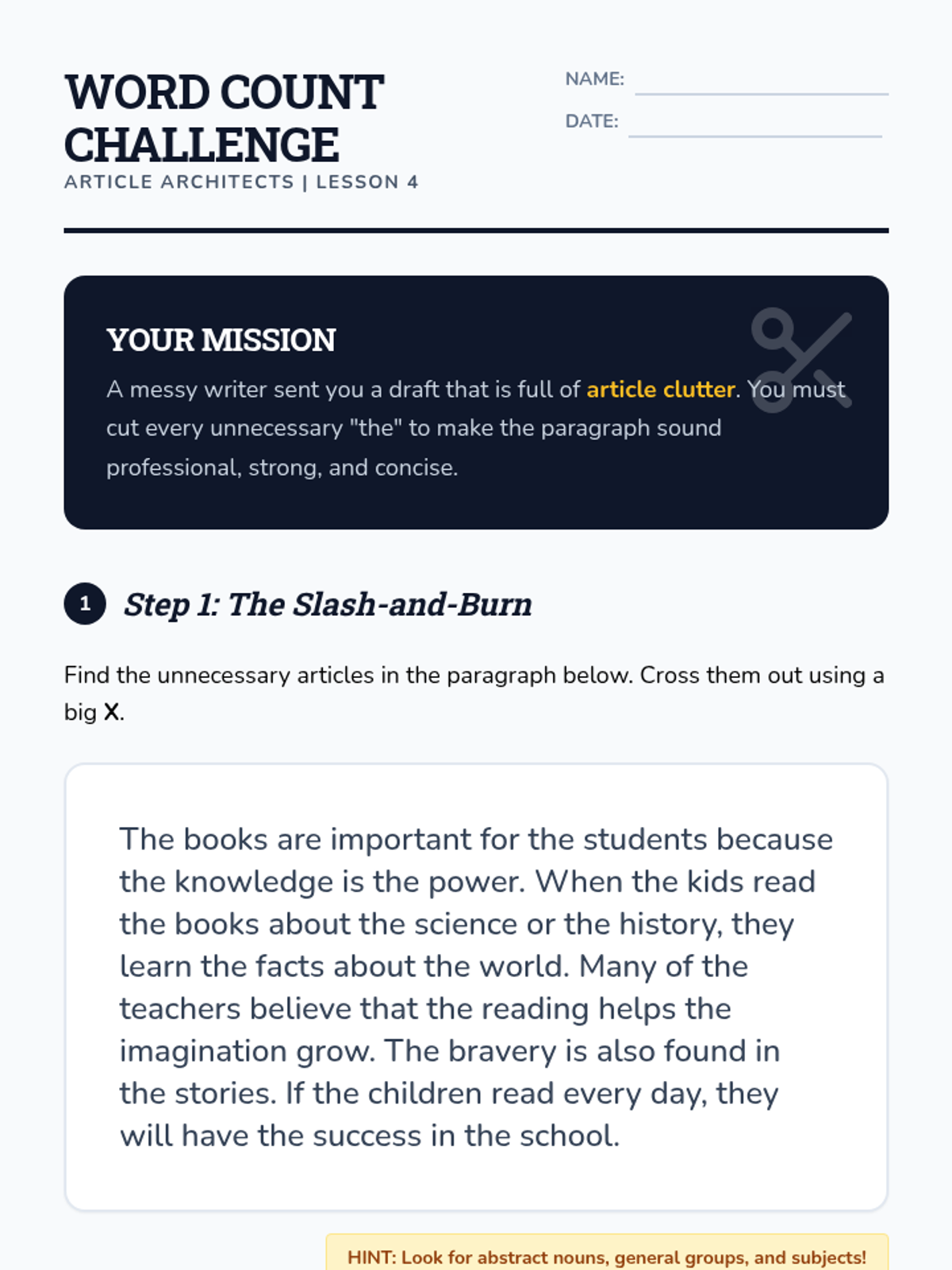
Worksheet for Lesson 4 where students take text that is 'cluttered' with unnecessary articles and edit it for flow and generalization.