Specialized vocabulary across disciplines, research methodologies, and effective note-taking systems. Equips learners with information literacy skills and strategies for navigating standardized exams.
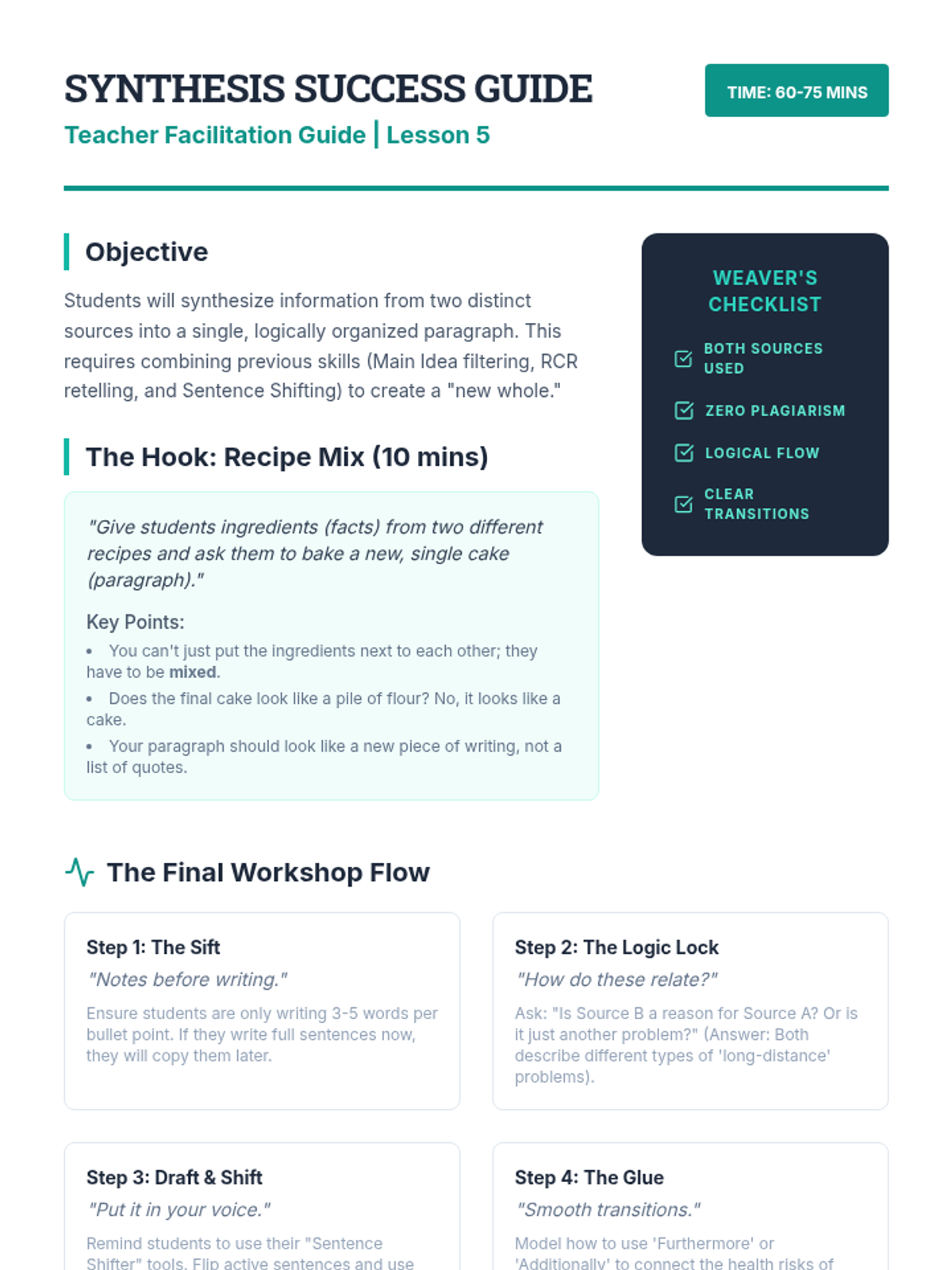
Teacher guide for "The Source Weaver" lesson. It outlines the synthesis process, provides a hook activity, transition words for ESL support, and a sample synthesized paragraph.
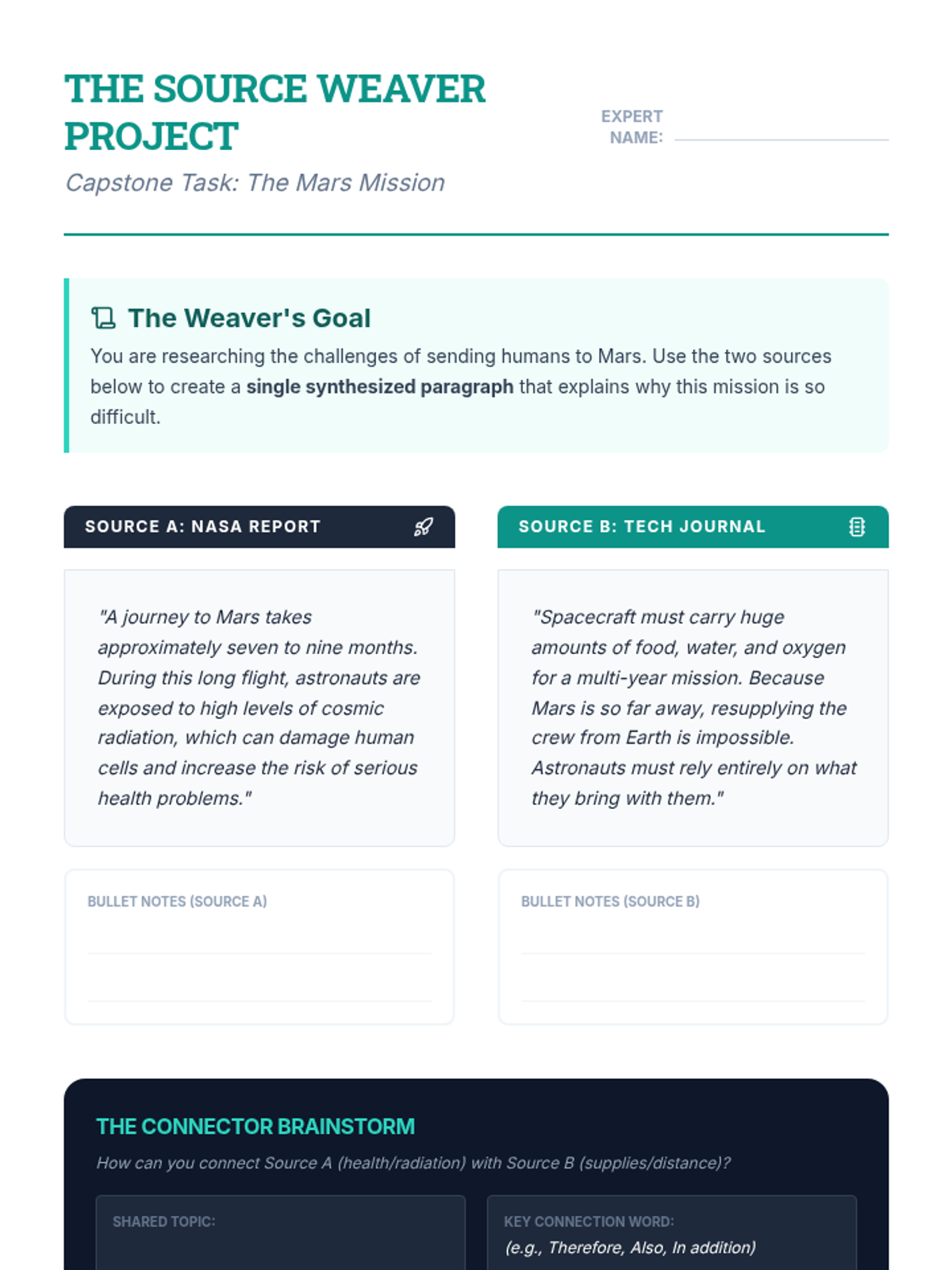
Capstone student project for "The Source Weaver" lesson. Students analyze two short texts about Mars, take notes, and synthesize the information into a single coherent paragraph using their own vocabulary and sentence structures.
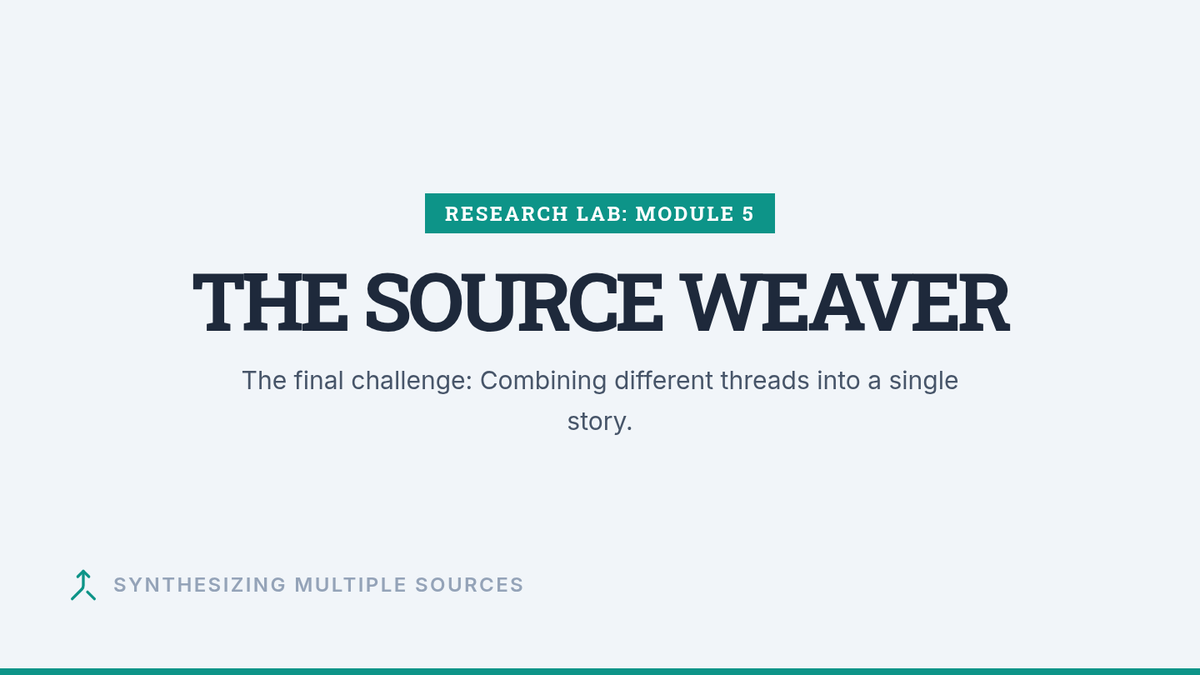
Visual slides for "The Source Weaver" lesson. These slides introduce students to the concept of synthesis as connecting ideas from multiple sources to create a new, coherent whole.
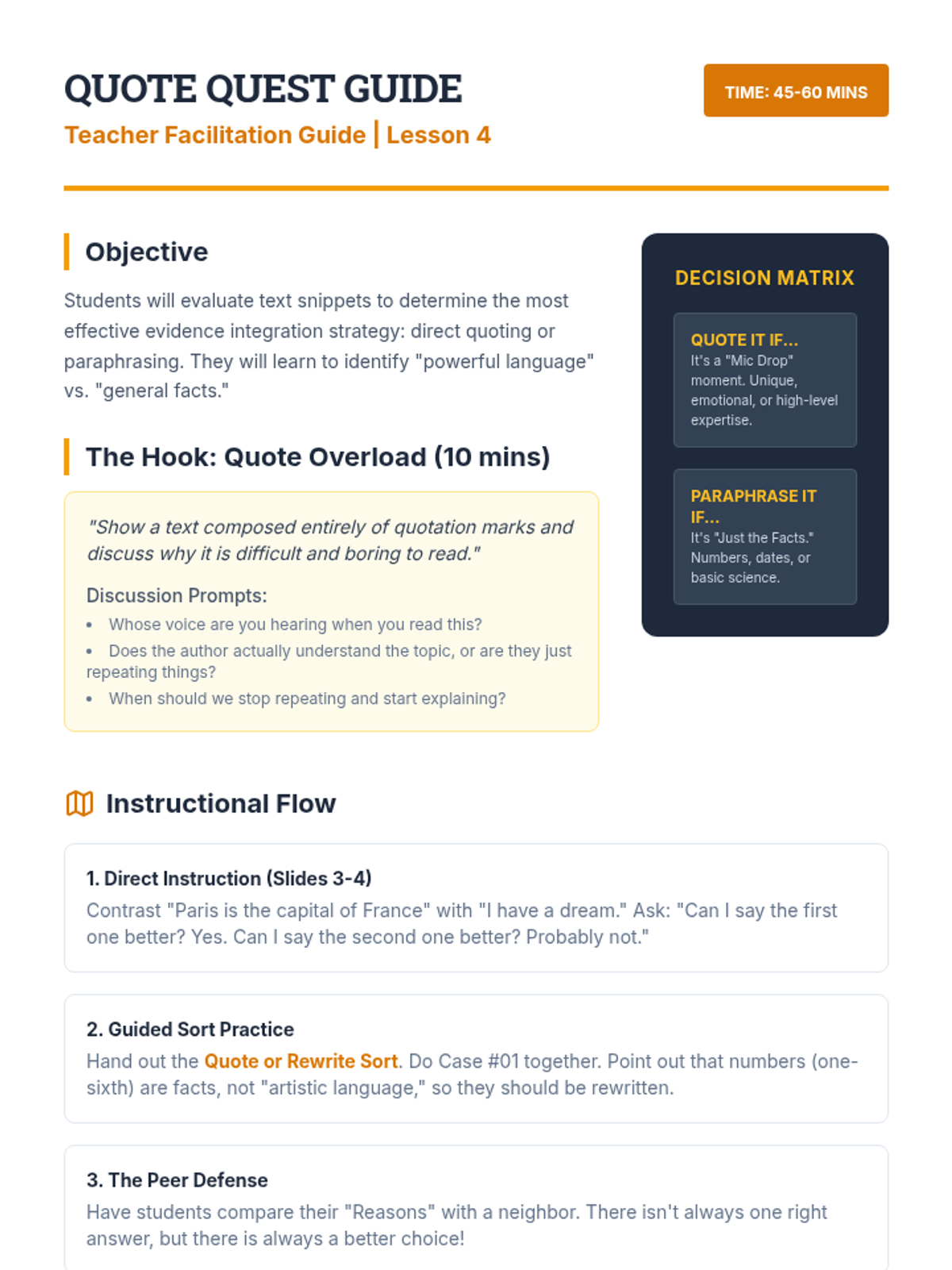
Teacher guide for "Quote Quest" lesson. It outlines the decision-making criteria for quoting vs. paraphrasing, provides instructional steps, and includes an answer key for the sorting activity.
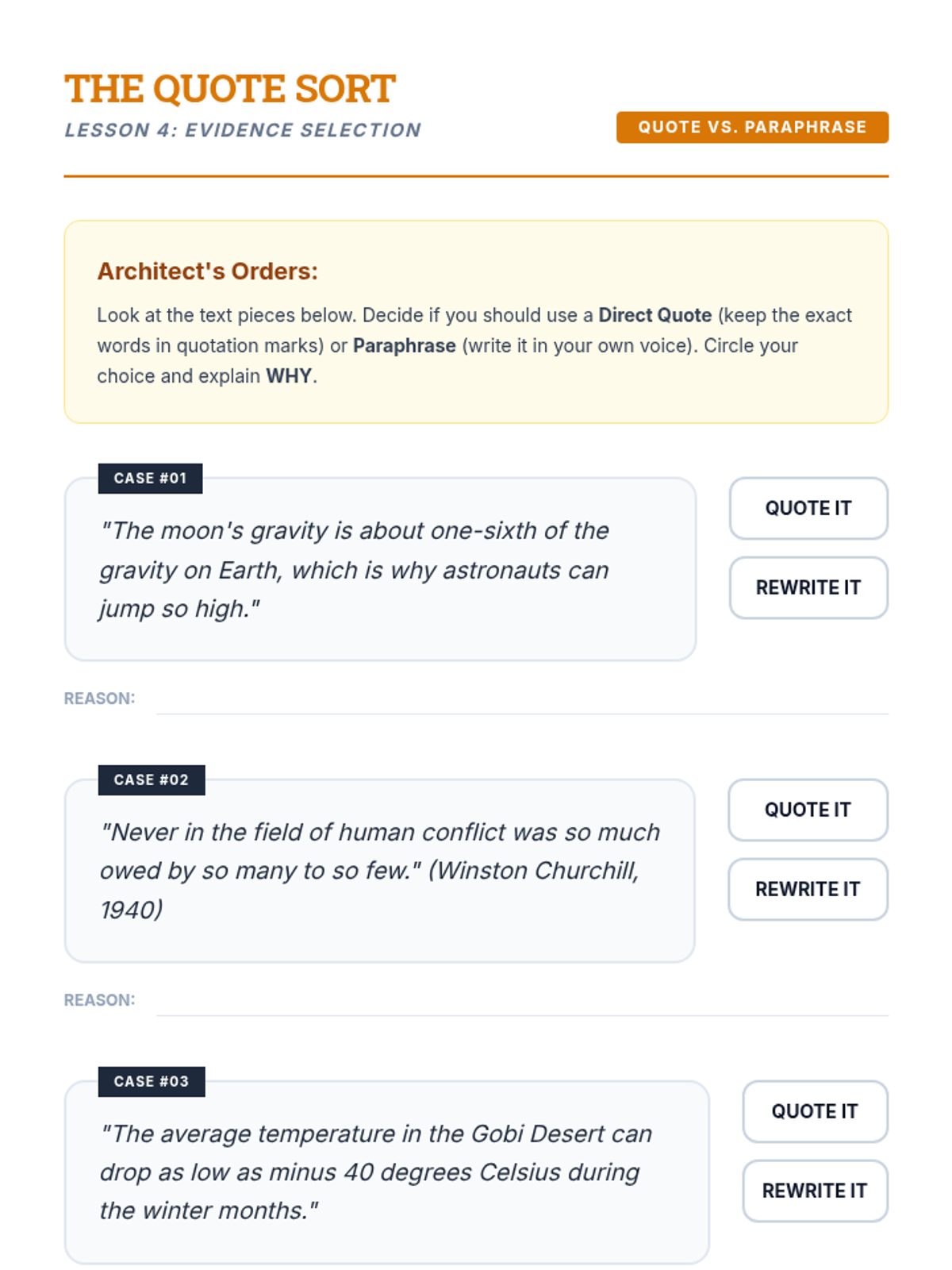
Student activity for "Quote Quest" lesson. It presents several textual scenarios and requires students to decide whether to use a direct quote or a paraphrase, providing a justification for their choice.
Visual slides for "Quote Quest" lesson. These slides help students distinguish between when to use direct quotes for impact and when to paraphrase for factual clarity.
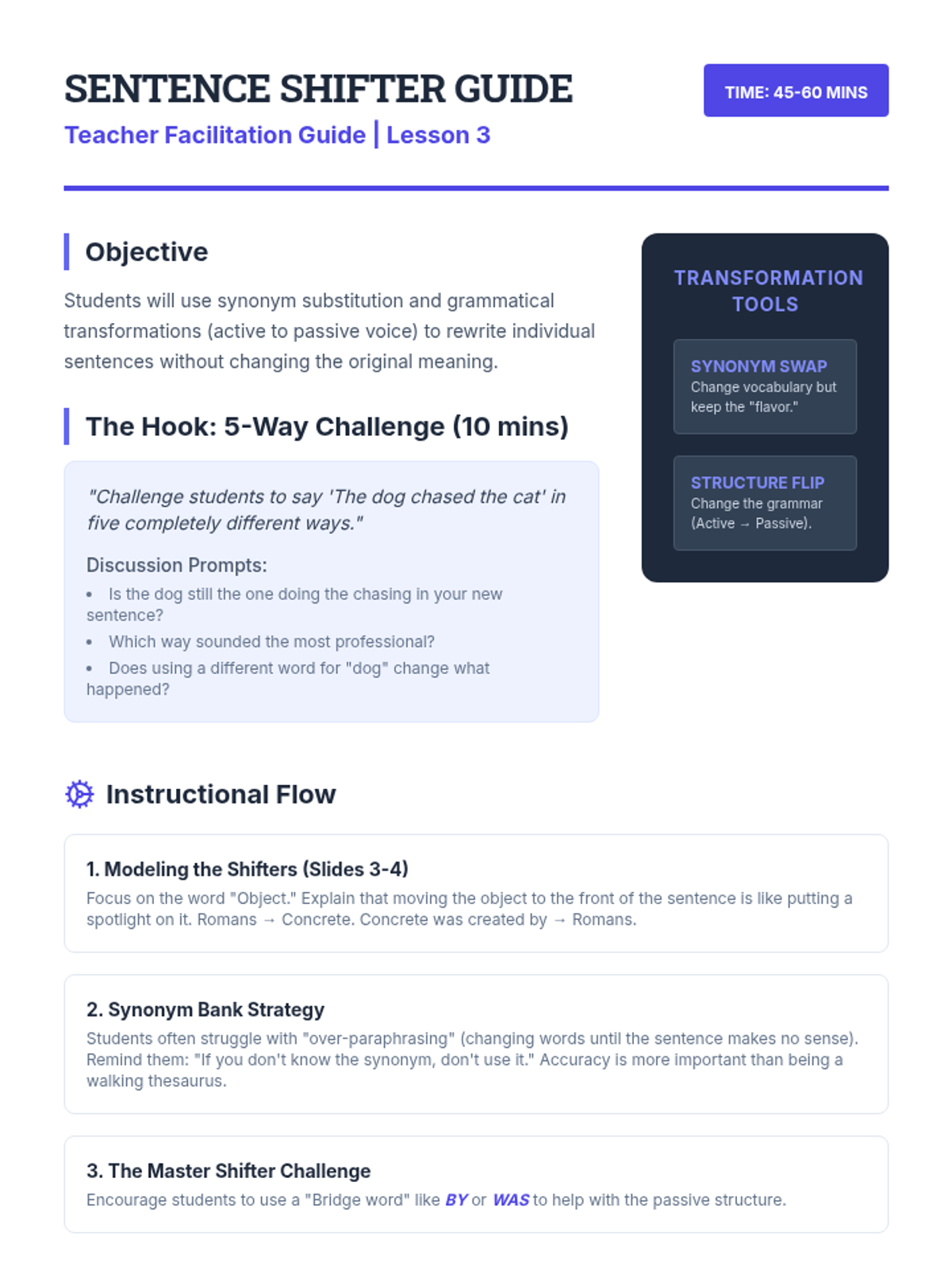
Teacher guide for "Sentence Shifters" lesson. It outlines the instructional flow for synonym substitution and active-to-passive transformation, including a sample answer key.
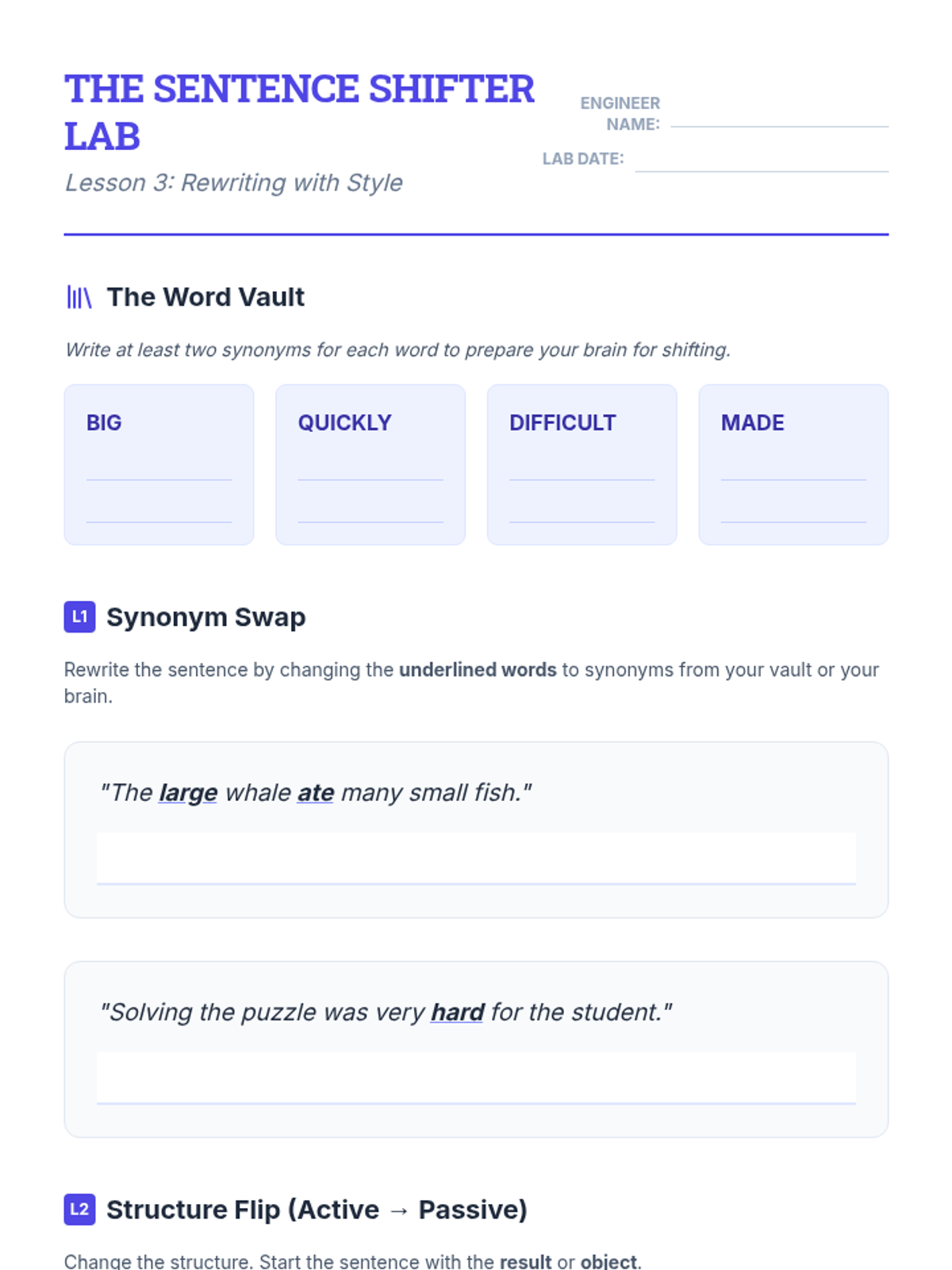
Student worksheet for "Sentence Shifters" lesson. It includes a synonym bank and tiered practice exercises for synonym replacement, active-to-passive transformation, and combined paraphrasing.
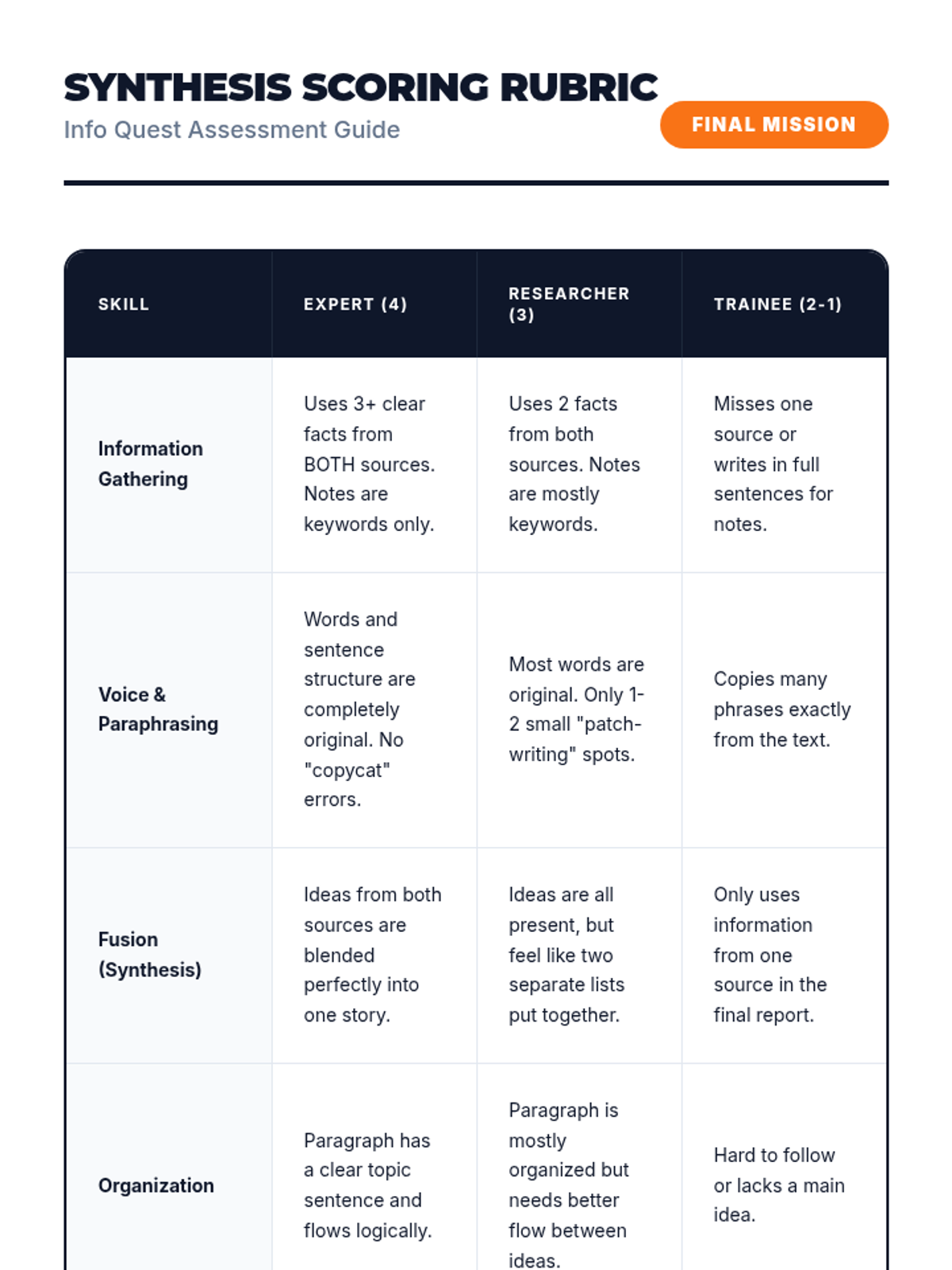
Synthesis scoring rubric for evaluating students' final research project based on information gathering, paraphrasing, fusion of ideas, and organization.
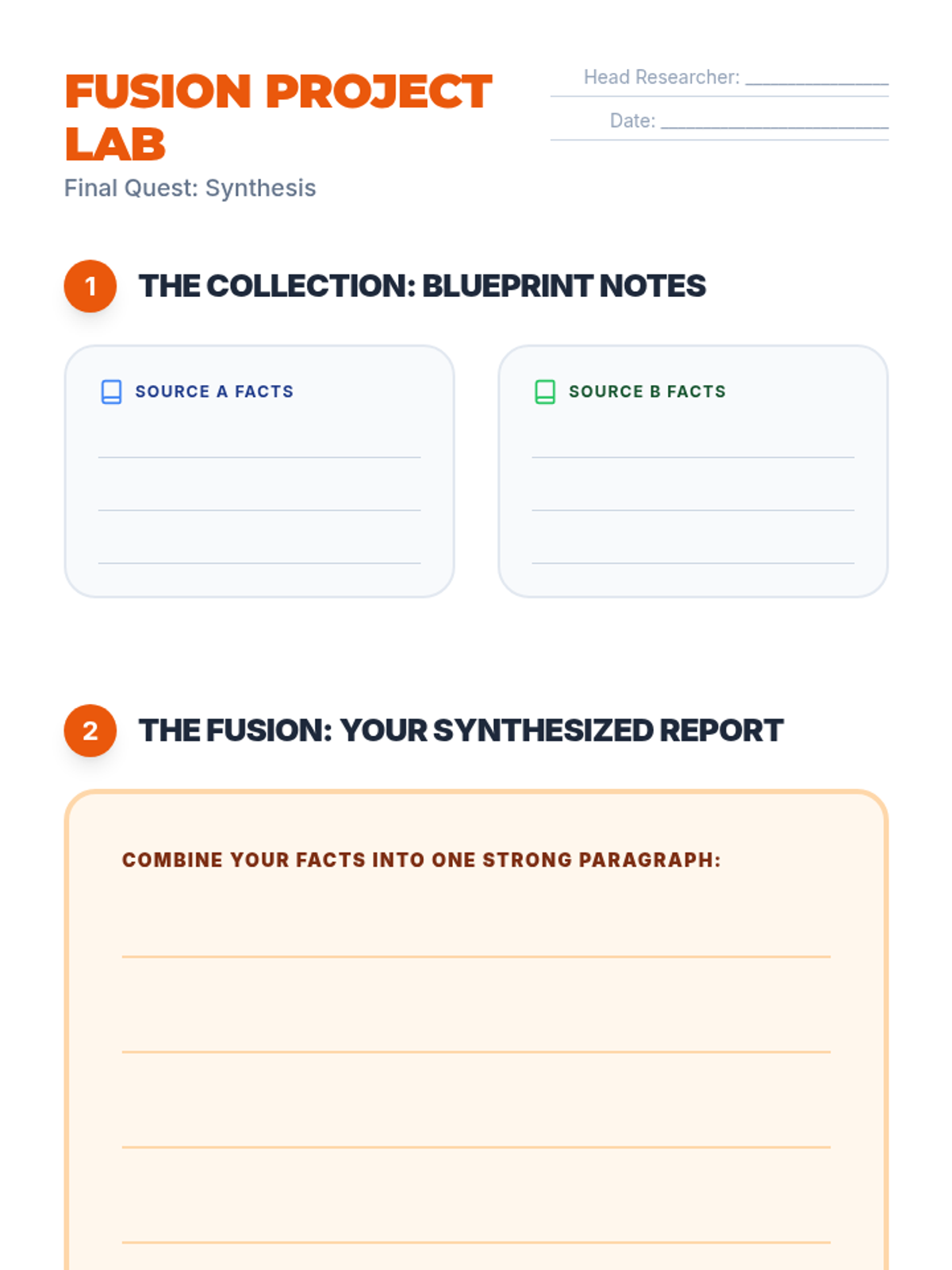
Final project worksheet where students collect notes from two sources and synthesize them into a cohesive paragraph.
Visual slides for "Sentence Shifters" lesson. These slides introduce students to two primary paraphrasing tools: Synonym Swap and Structure Flip (Active/Passive voice).
Slide deck for Lesson 5, focusing on the final stage of research: synthesizing information from multiple sources into a single cohesive output.
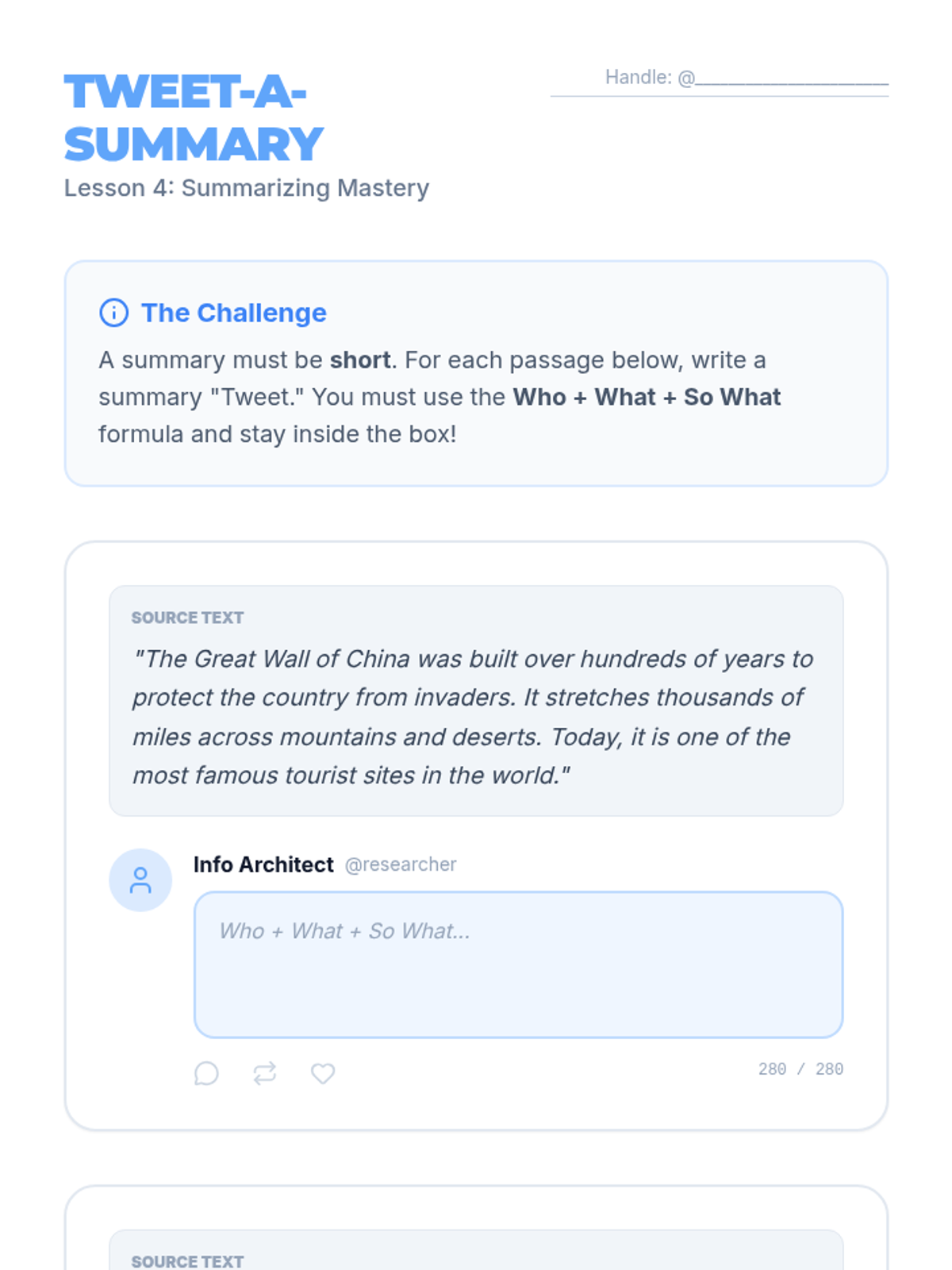
Student activity worksheet where they practice condensing information into short "Tweets" using the "Who, What, So What" framework.
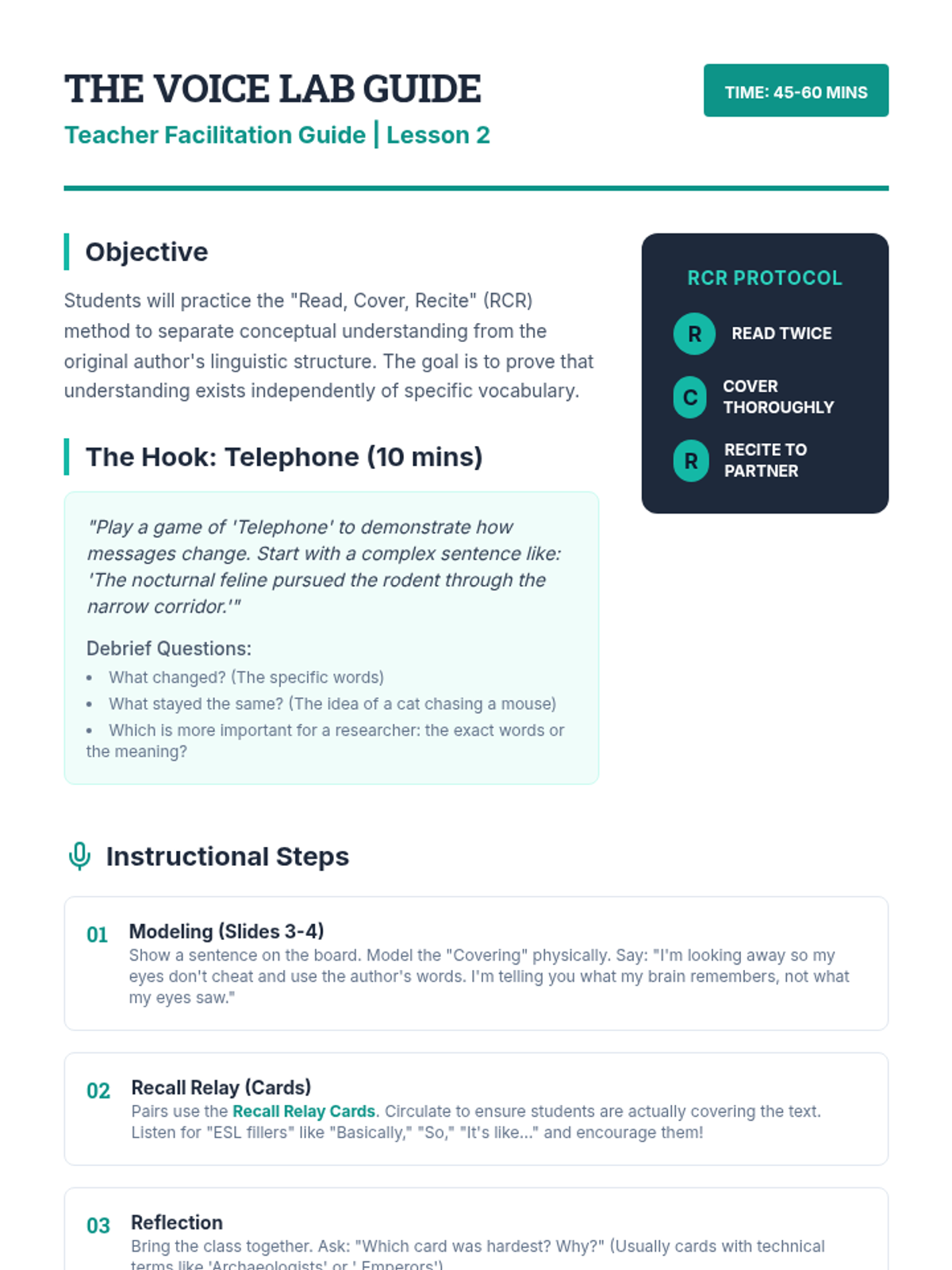
Teacher guide for "The Voice Lab" lesson. It outlines the 'Read, Cover, Recite' protocol, providing a hook activity, instructional steps, and specific ESL scaffolds for concept retrieval.
Slide deck for Lesson 4, introducing the "Who, What, So What" summarizing technique and the "Tweet a Summary" challenge.
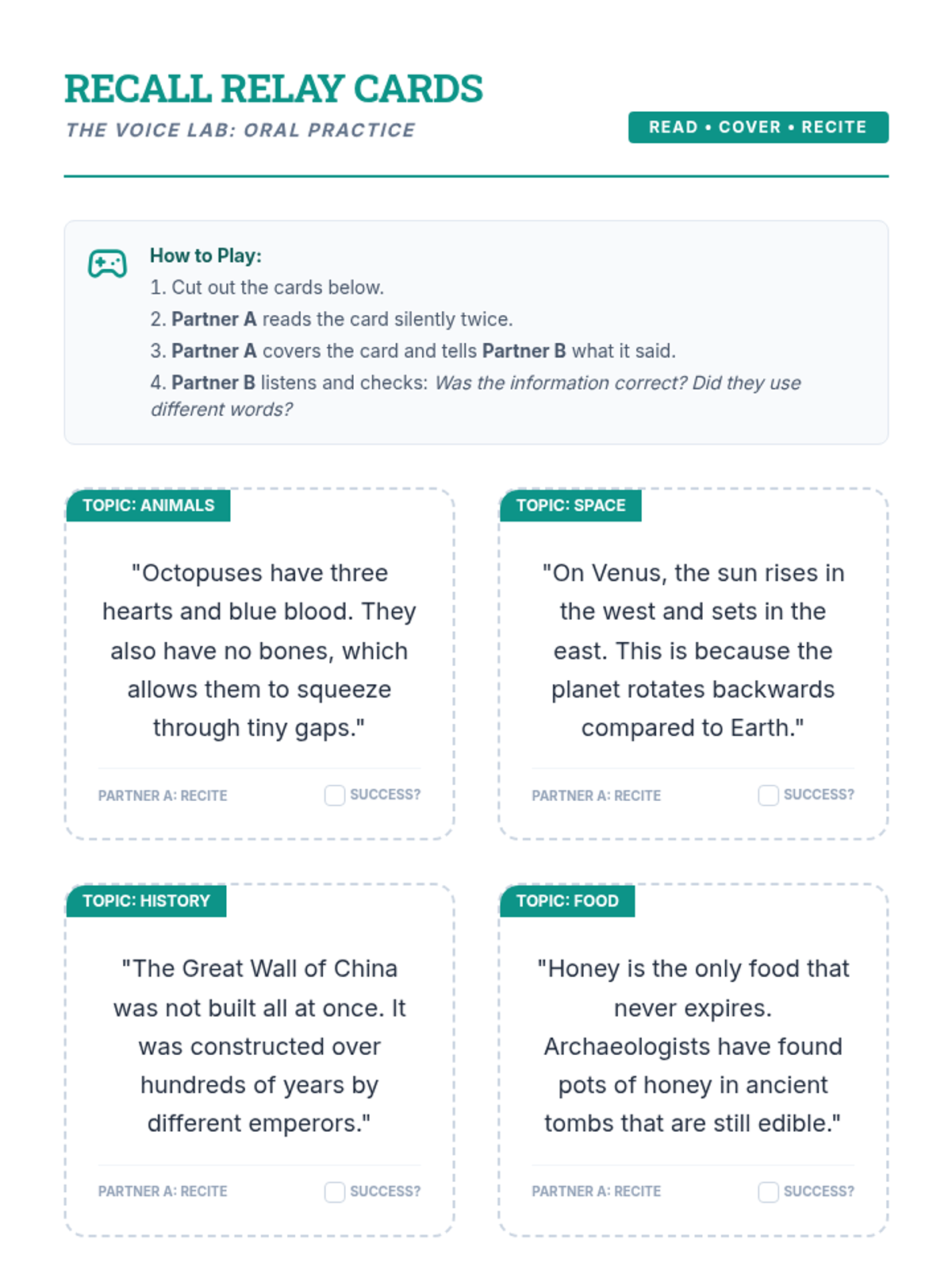
Student activity cards for "The Voice Lab" lesson. These cards provide short, interesting facts that students must read, cover, and orally paraphrase to a partner to practice the RCR method.
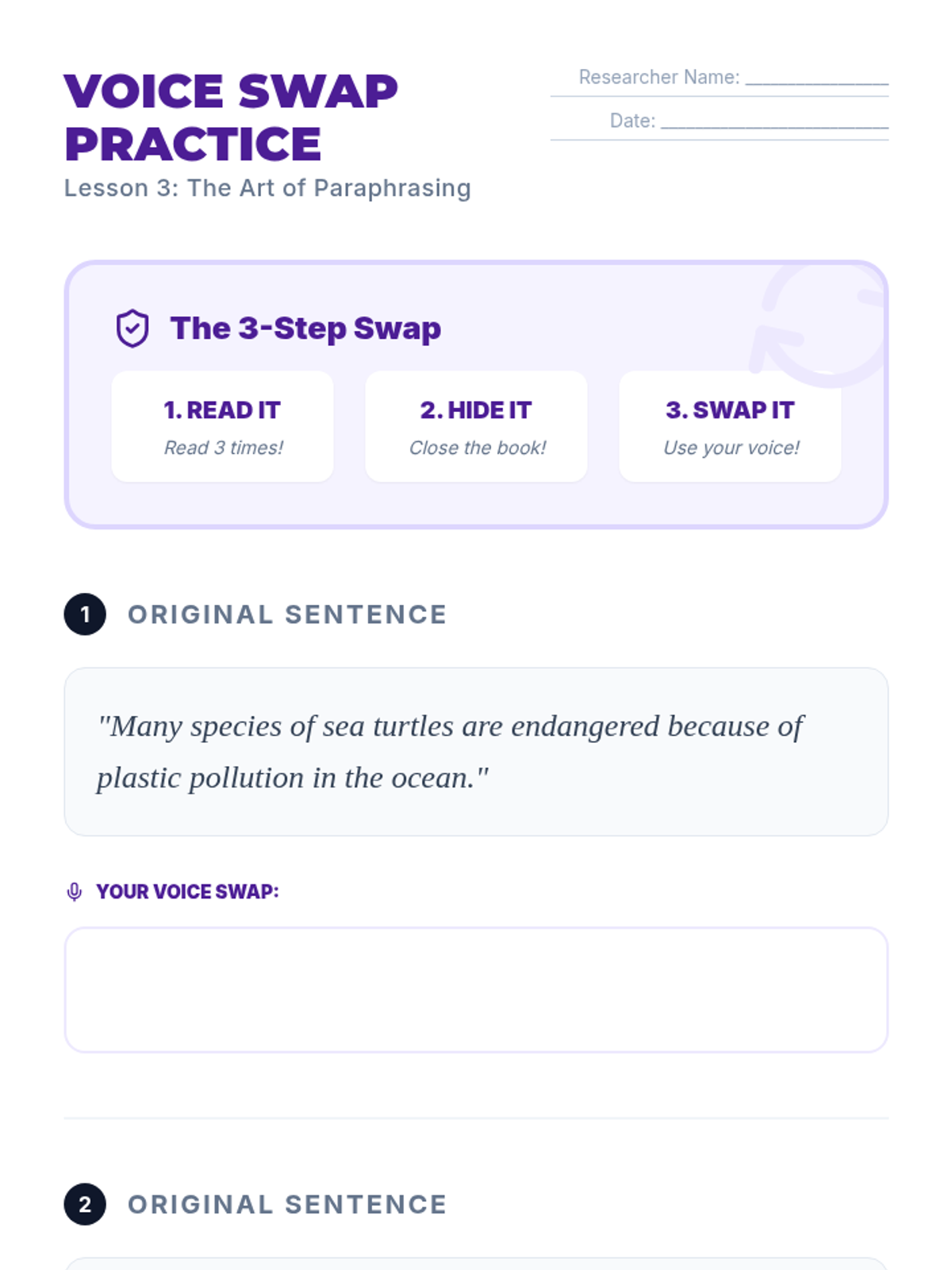
Student worksheet for practicing paraphrasing using the "Read-Hide-Write" technique with a variety of academic sentences.
Visual slides for "The Voice Lab" lesson. These slides introduce the 'Read, Cover, Recite' (RCR) method for oral paraphrasing, emphasizing the separation of conceptual understanding from linguistic structure.
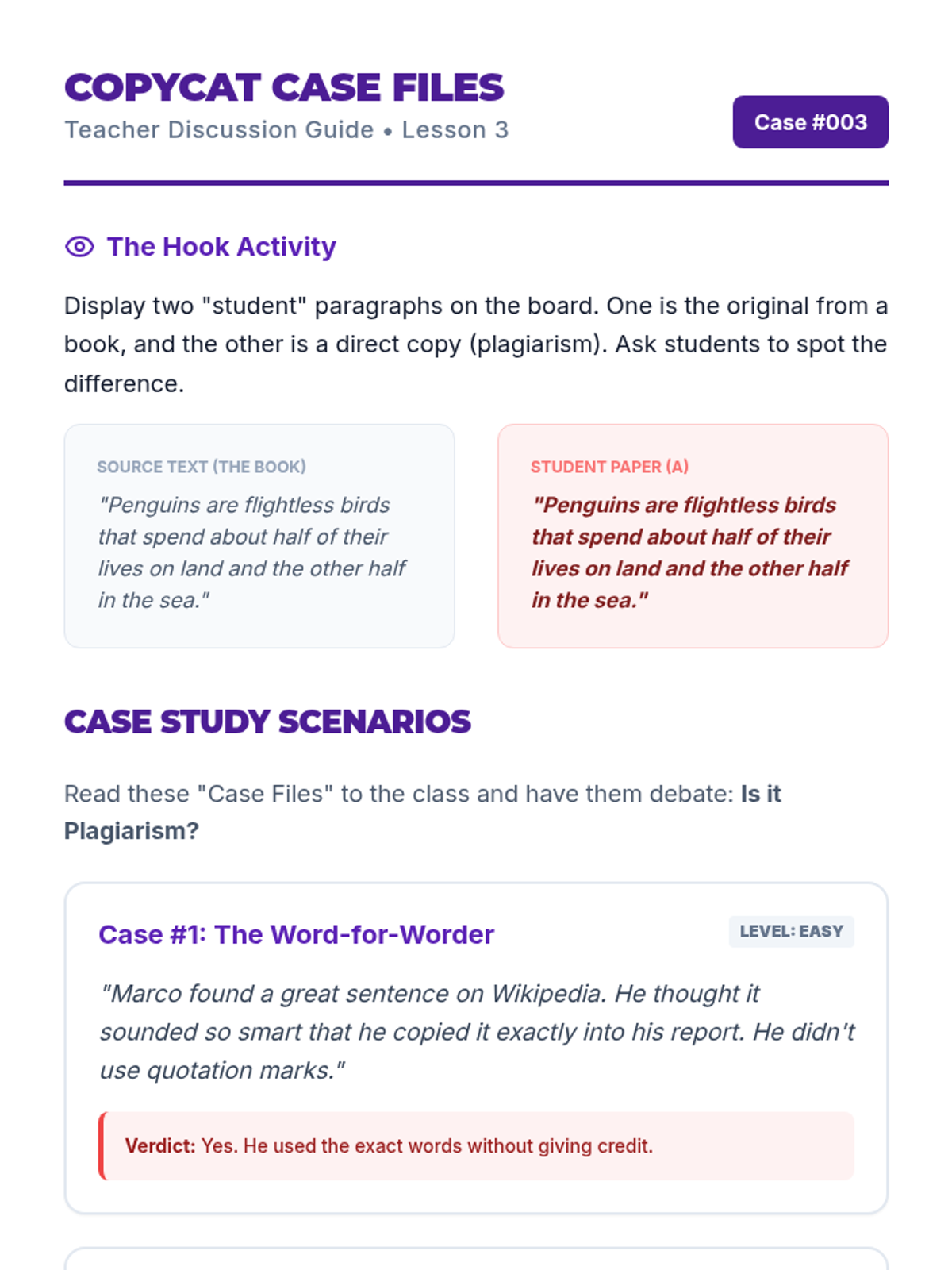
Scenario-based teacher resource for discussing plagiarism and identifying the difference between copying, patch-writing, and successful paraphrasing.
Slide deck for Lesson 3, introducing paraphrasing techniques like "Read-Hide-Write" and how to use synonyms and change sentence structure.
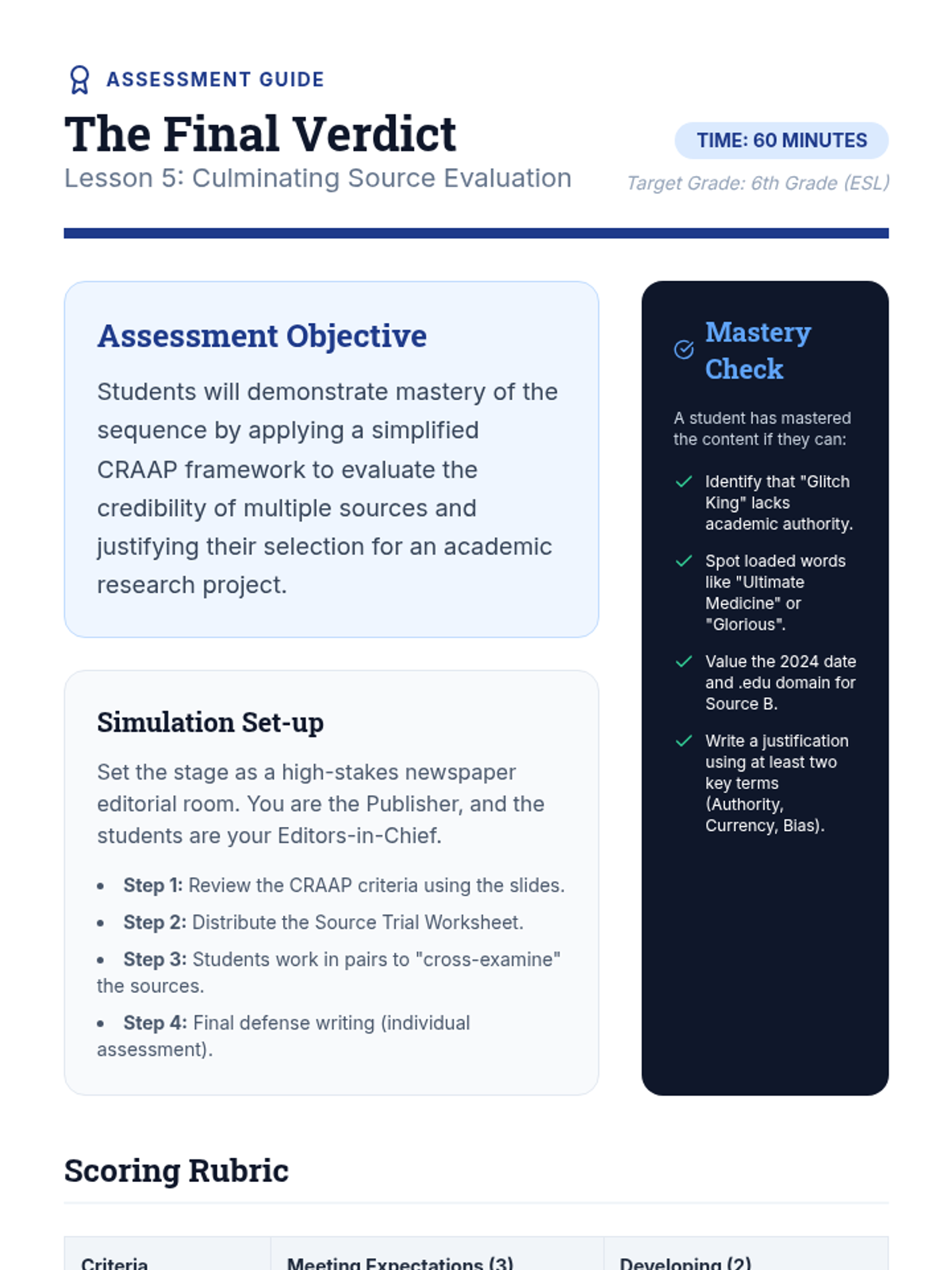
A teacher guide for the The Final Verdict lesson, providing a simulation setup, a scoring rubric for the assessment, and debrief discussion questions.
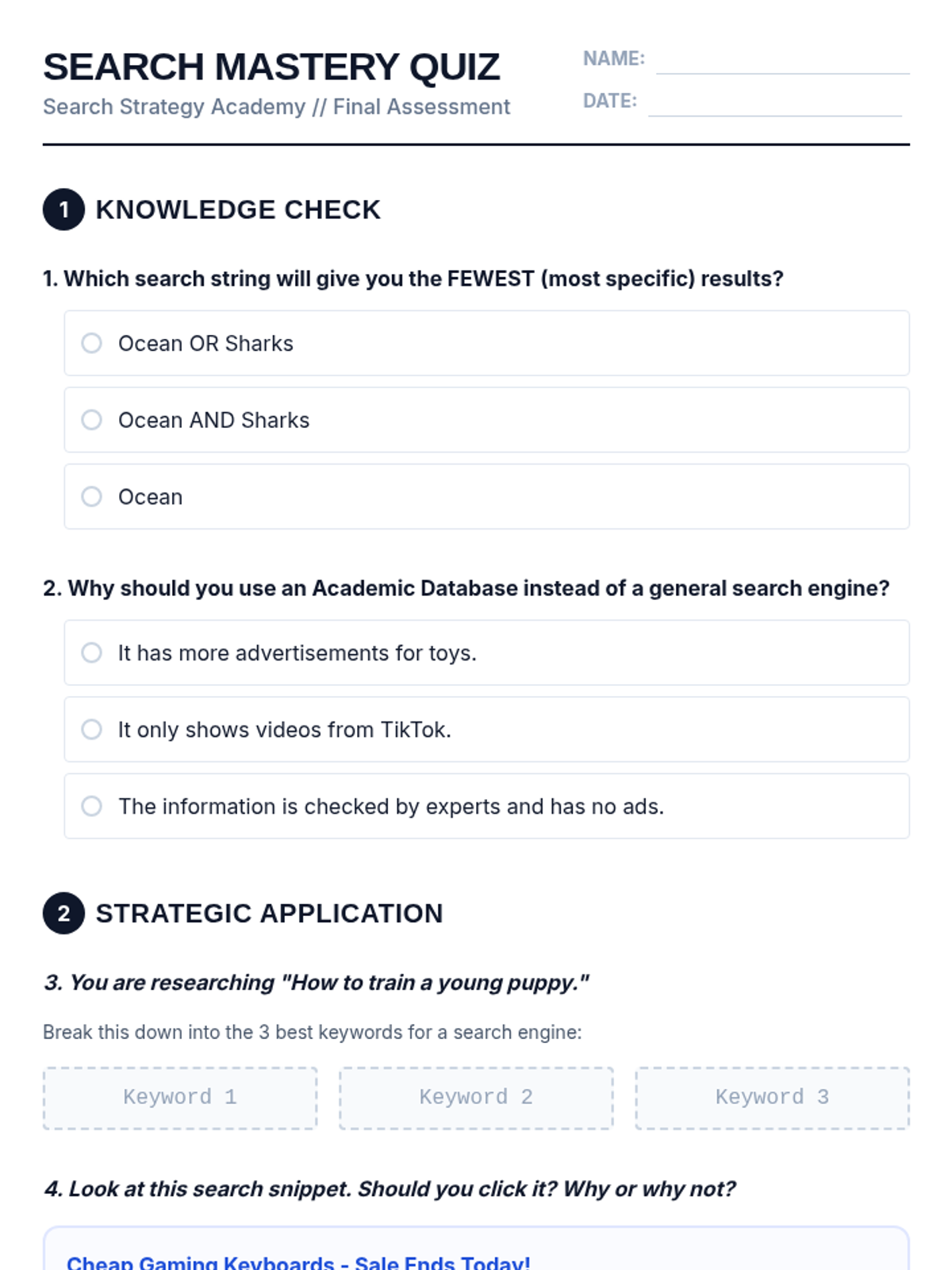
Final assessment for the Search Strategy Academy unit, covering keywords, Boolean operators, database use, and snippet analysis.
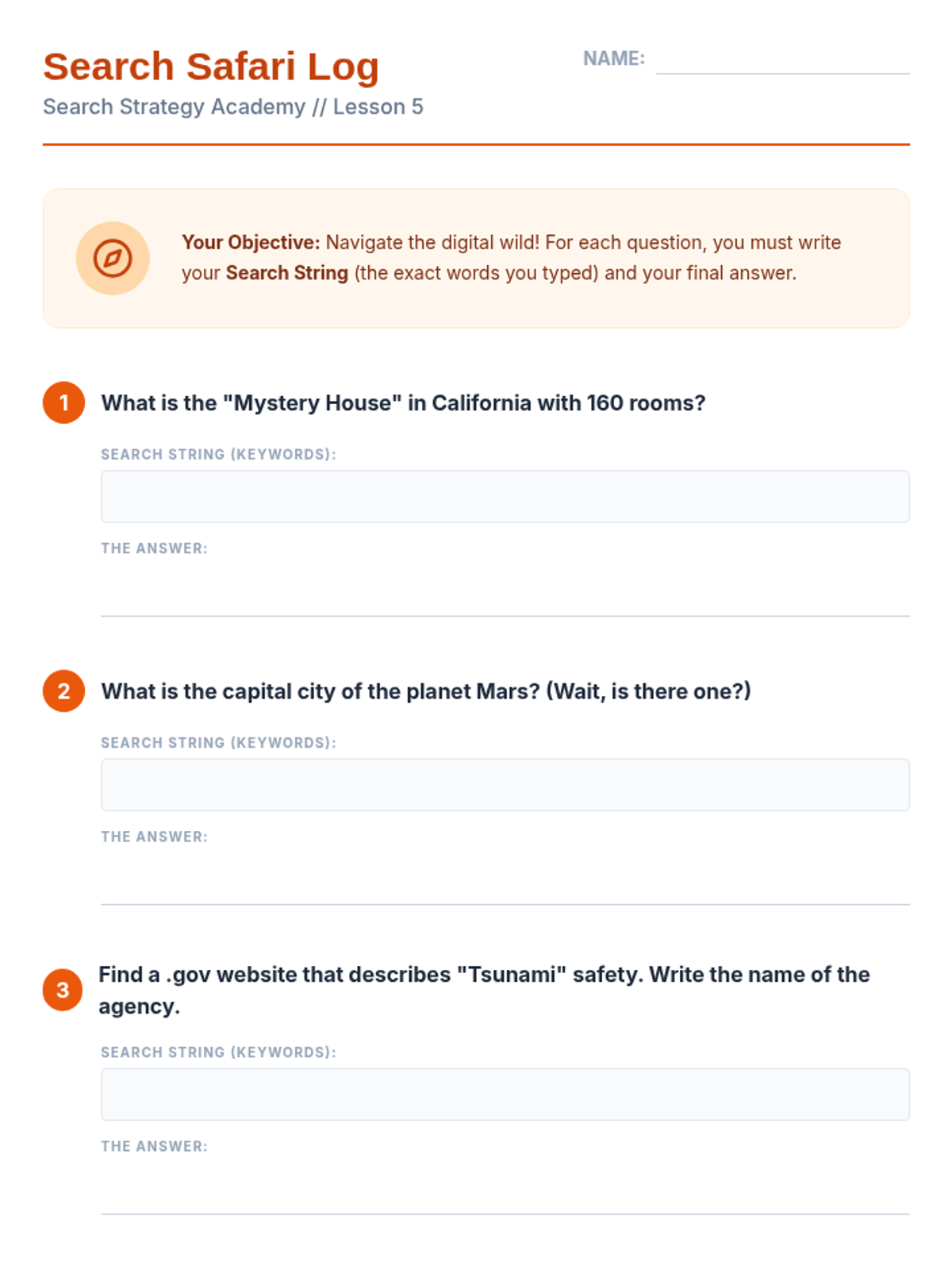
Student scavenger hunt log for Lesson 5, where students document their search strings and answers to obscure research questions.
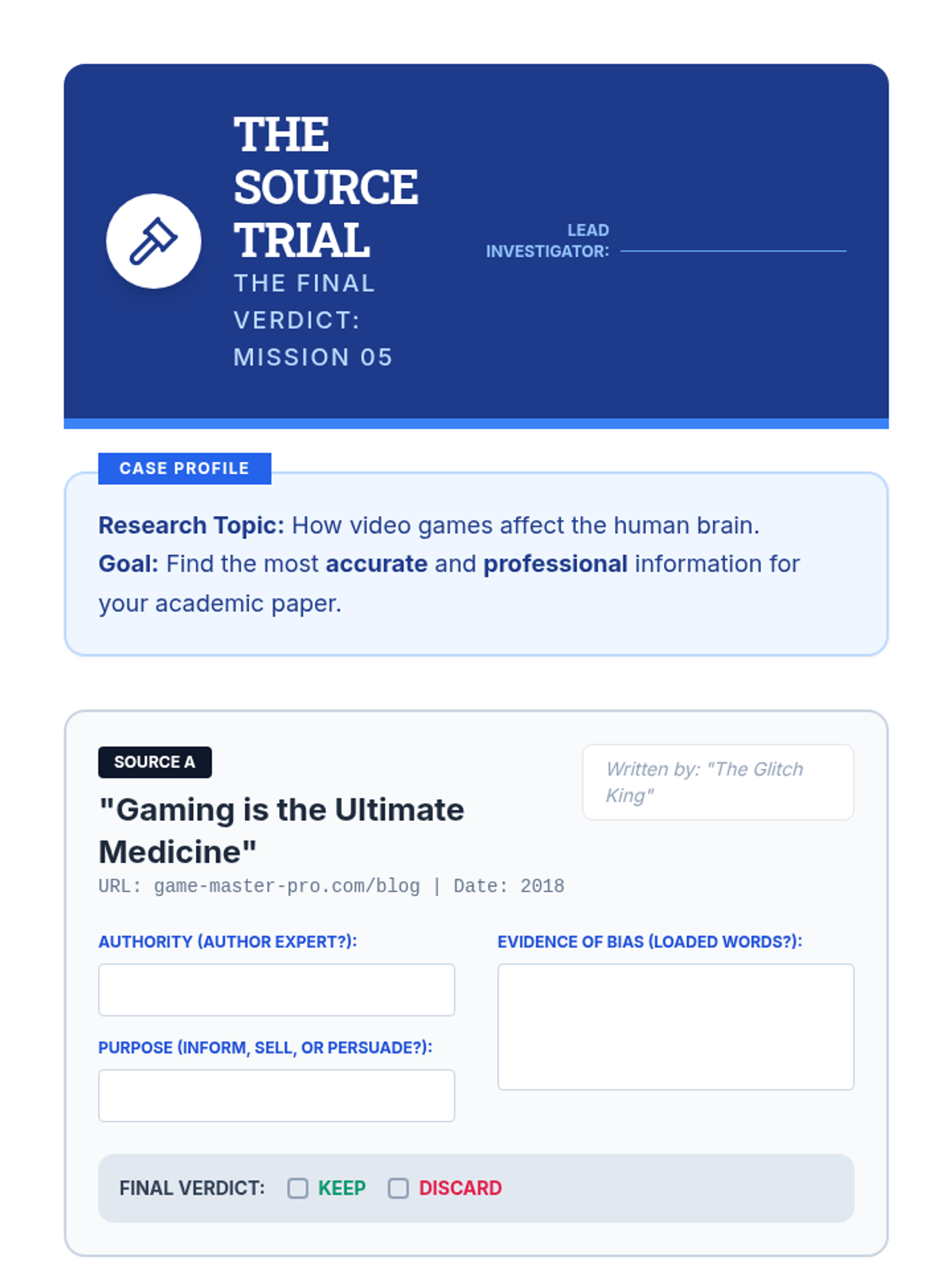
A student assessment worksheet for evaluating the credibility of two different sources on the same topic using a structured framework.
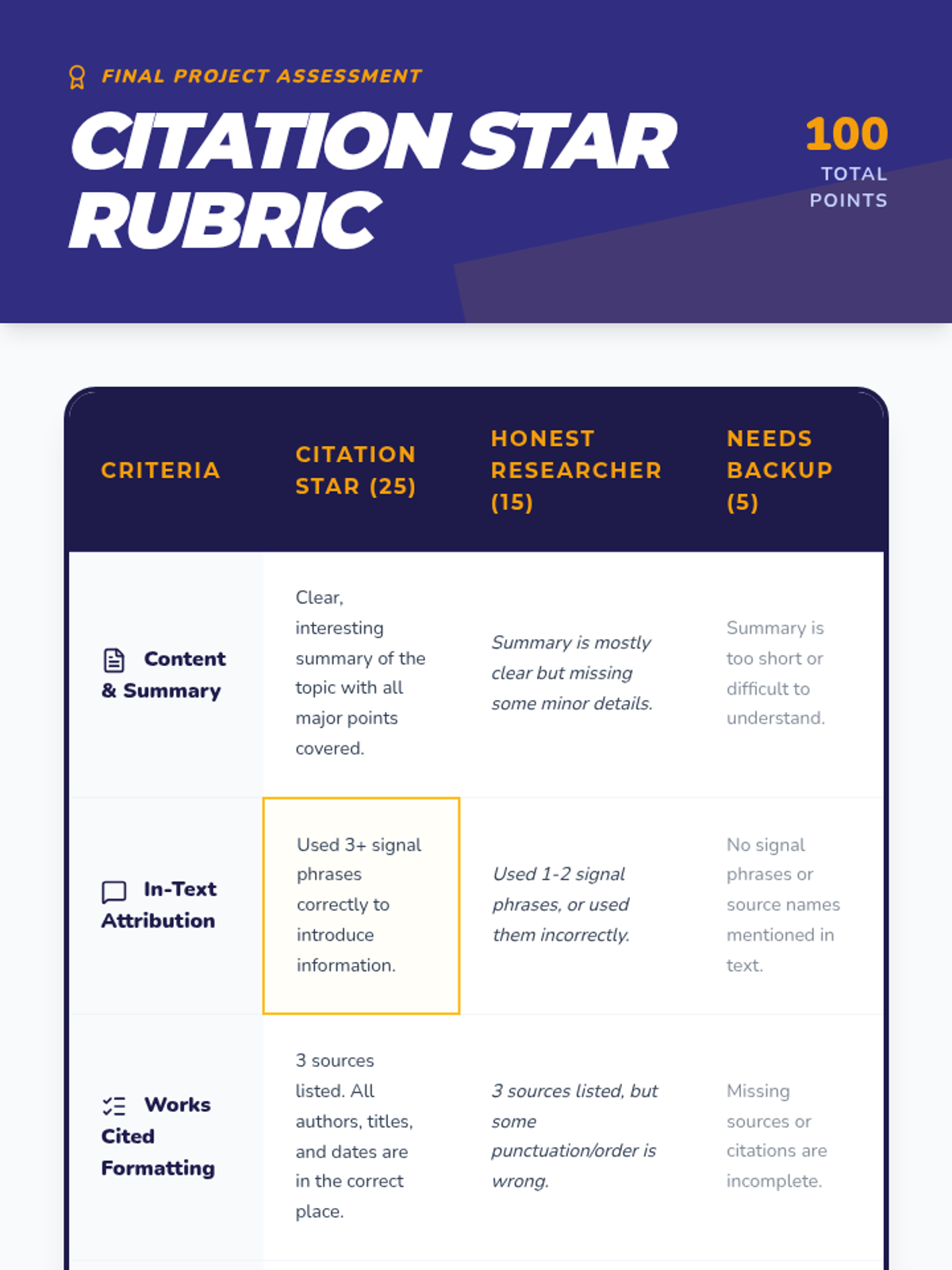
Comprehensive grading rubric for the Research Credits poster project, evaluating summary quality, in-text attribution, Works Cited formatting, and visual design.
Introductory slide deck for Lesson 5, reviewing all strategic search techniques and introducing the culminating Scavenger Hunt challenge.
Introductory slides for "The Final Verdict", teaching students a simplified evaluation framework (Currency, Relevance, Authority, Purpose) to apply to sources.
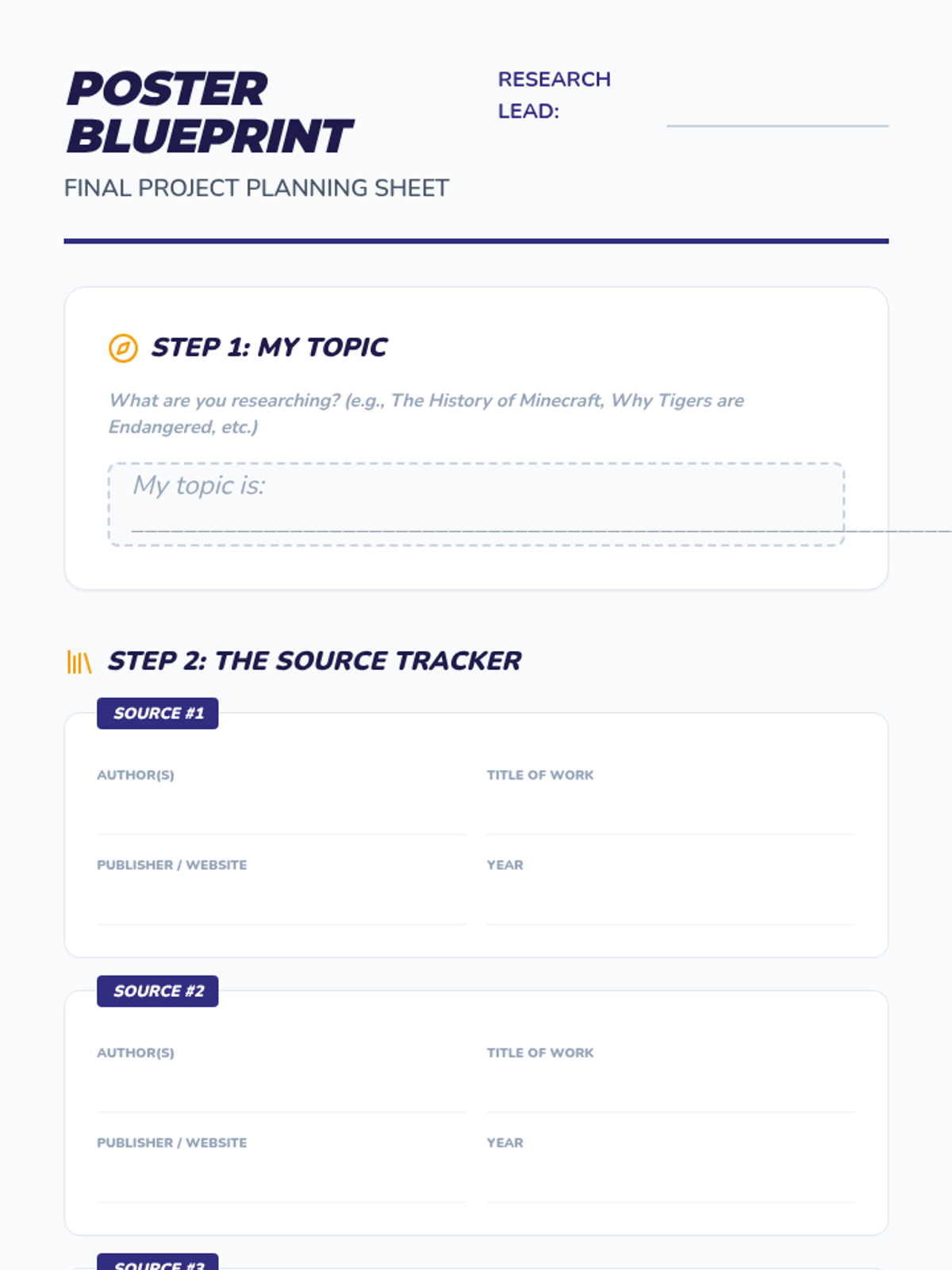
Detailed planning document for the Research Credits poster project, providing space for 6th-grade students to track sources, draft their summary, and plan their layout.
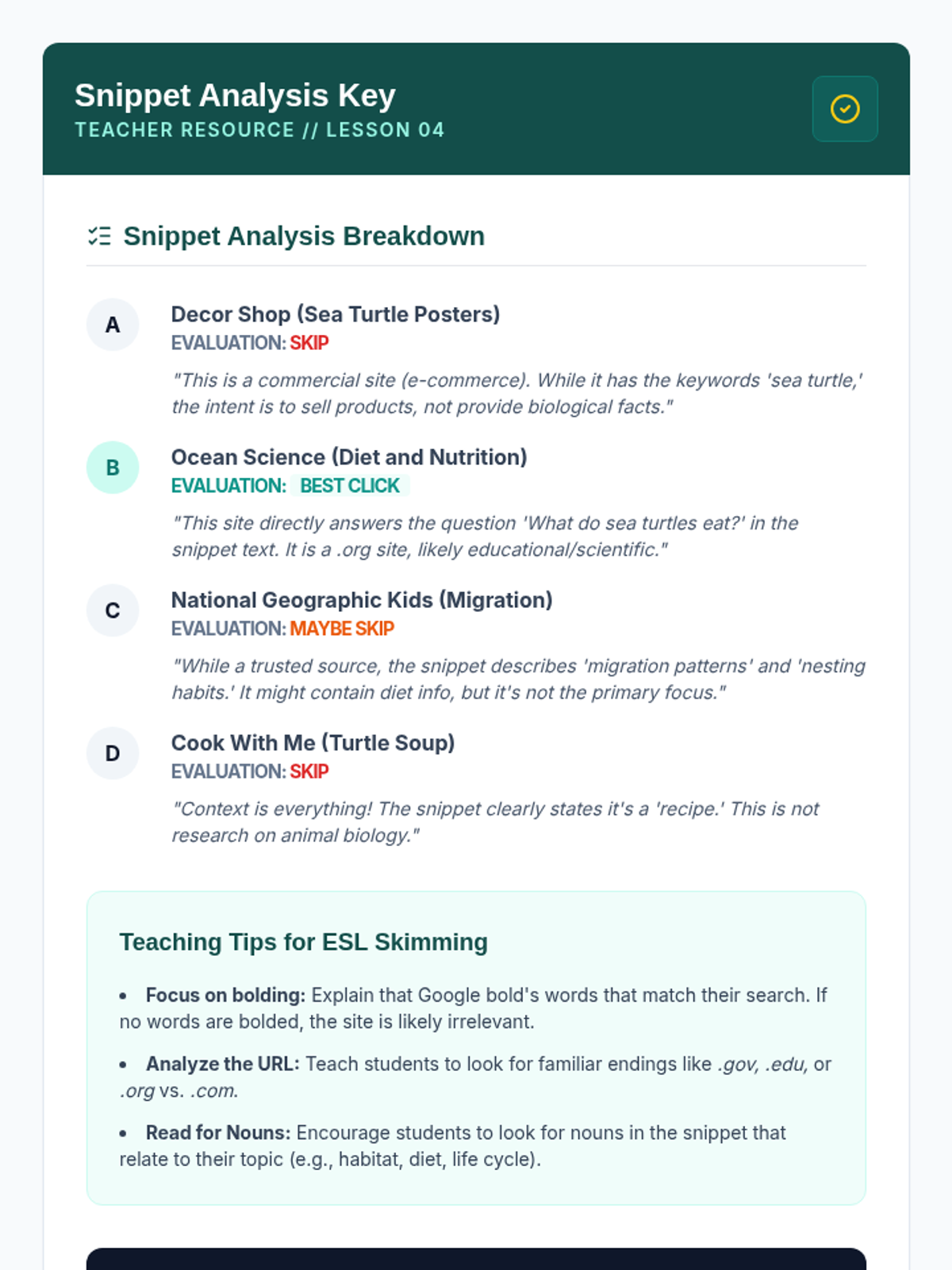
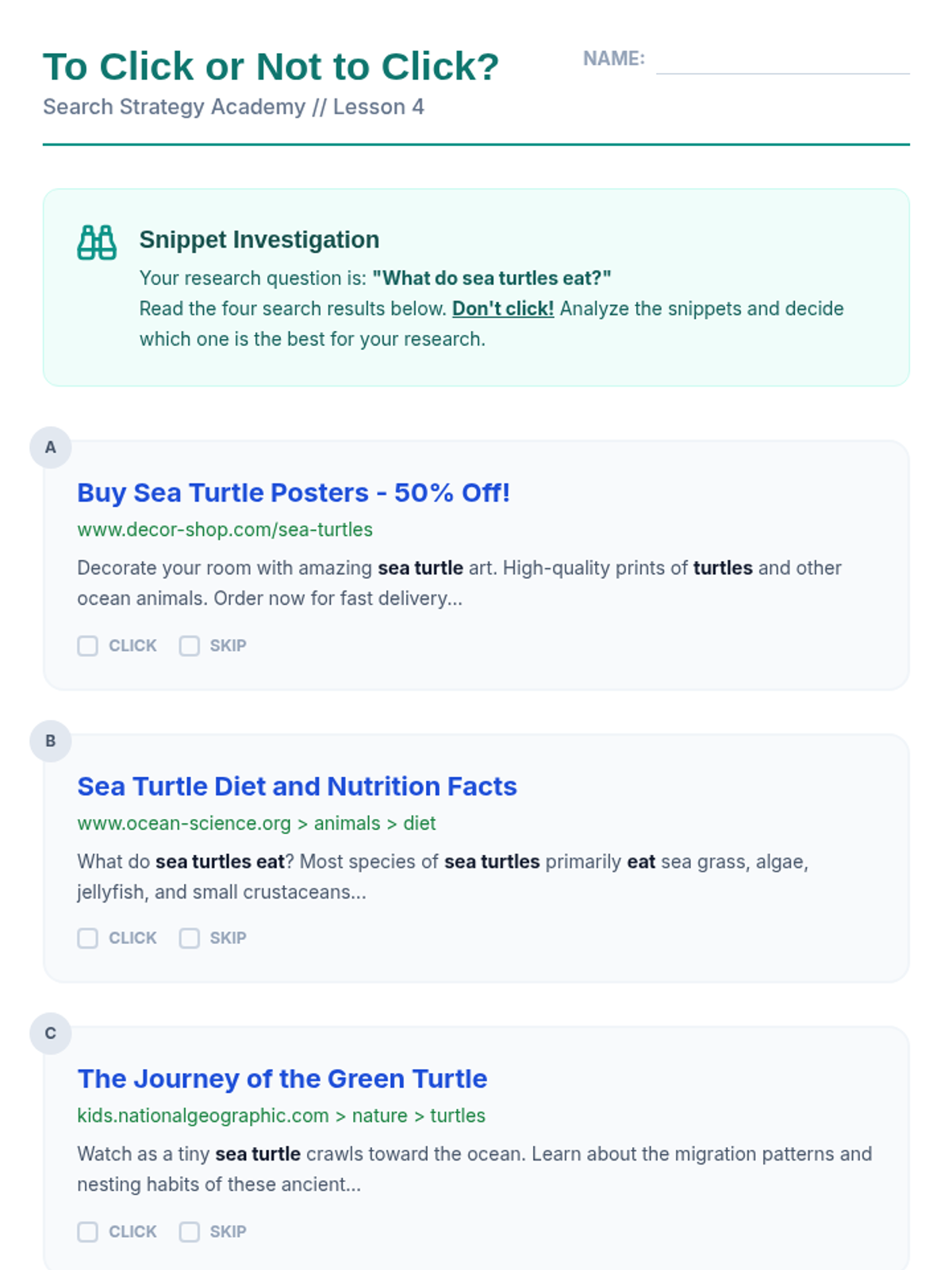
Teacher answer key and discussion guide for the "To Click or Not to Click" worksheet, focusing on snippet analysis and evaluation.
Slide deck for the final project of the sequence, explaining the "Research Credits" poster requirements and connecting academic integrity to the concept of a movie's credit roll.
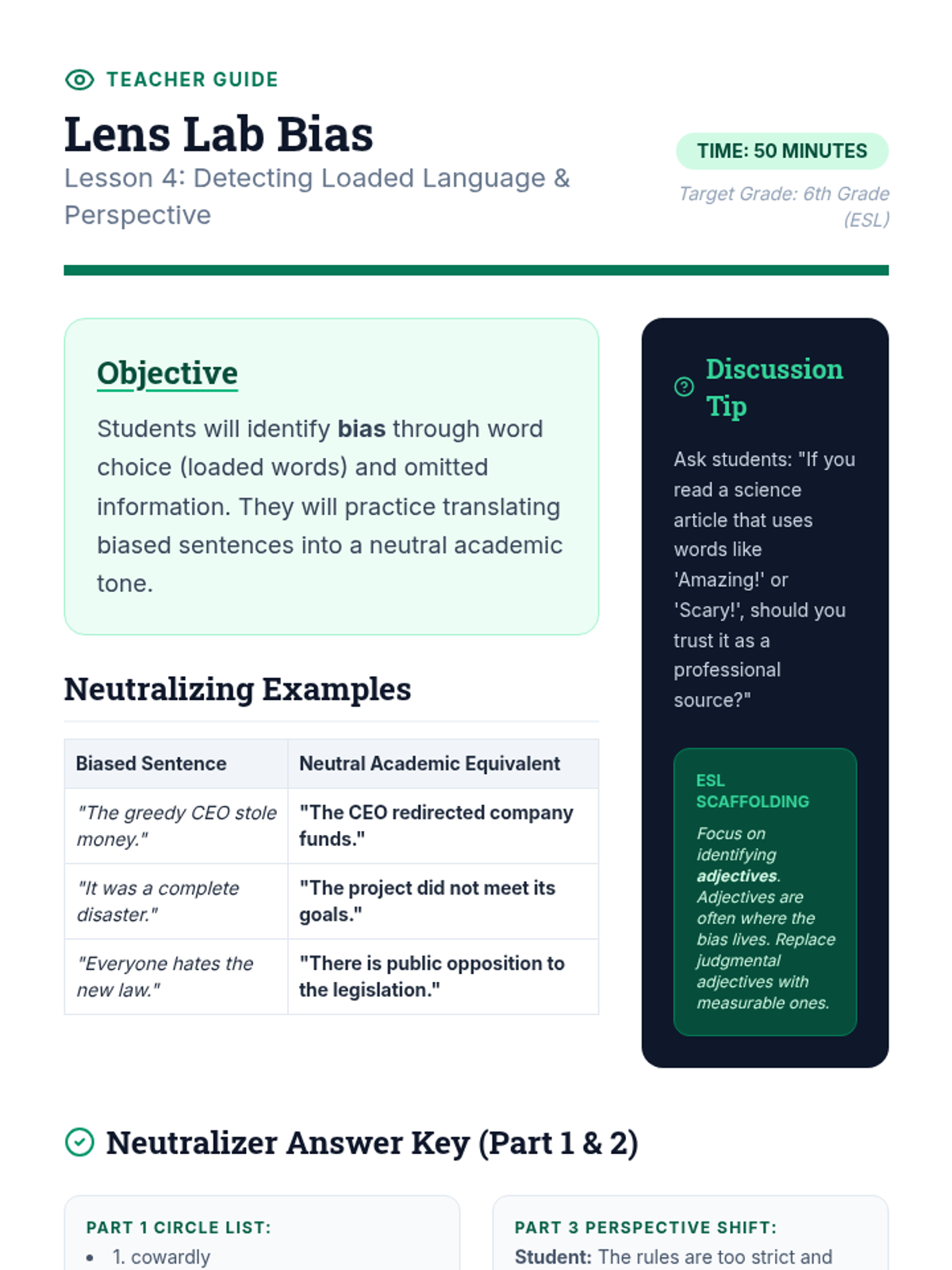
A teacher guide for the Lens Lab Bias lesson, providing neutralizing examples, a rubric for student work, and an answer key for the worksheet.
Student worksheet for Lesson 4 where students practice identifying the best search result based on snippets, titles, and URLs.
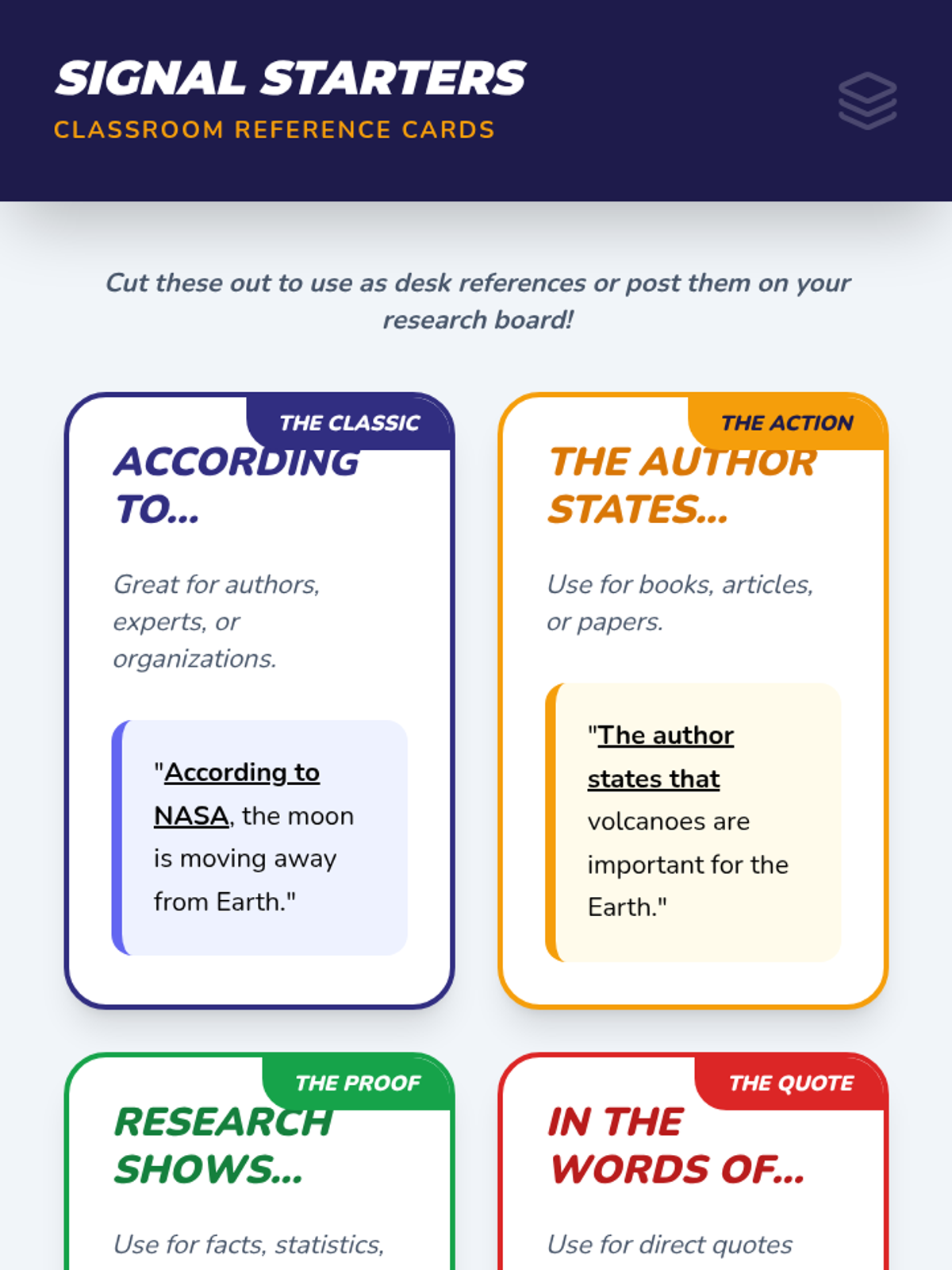
Set of classroom reference cards for 6th-grade students, featuring common signal starters for in-text citations with examples and punctuation tips.
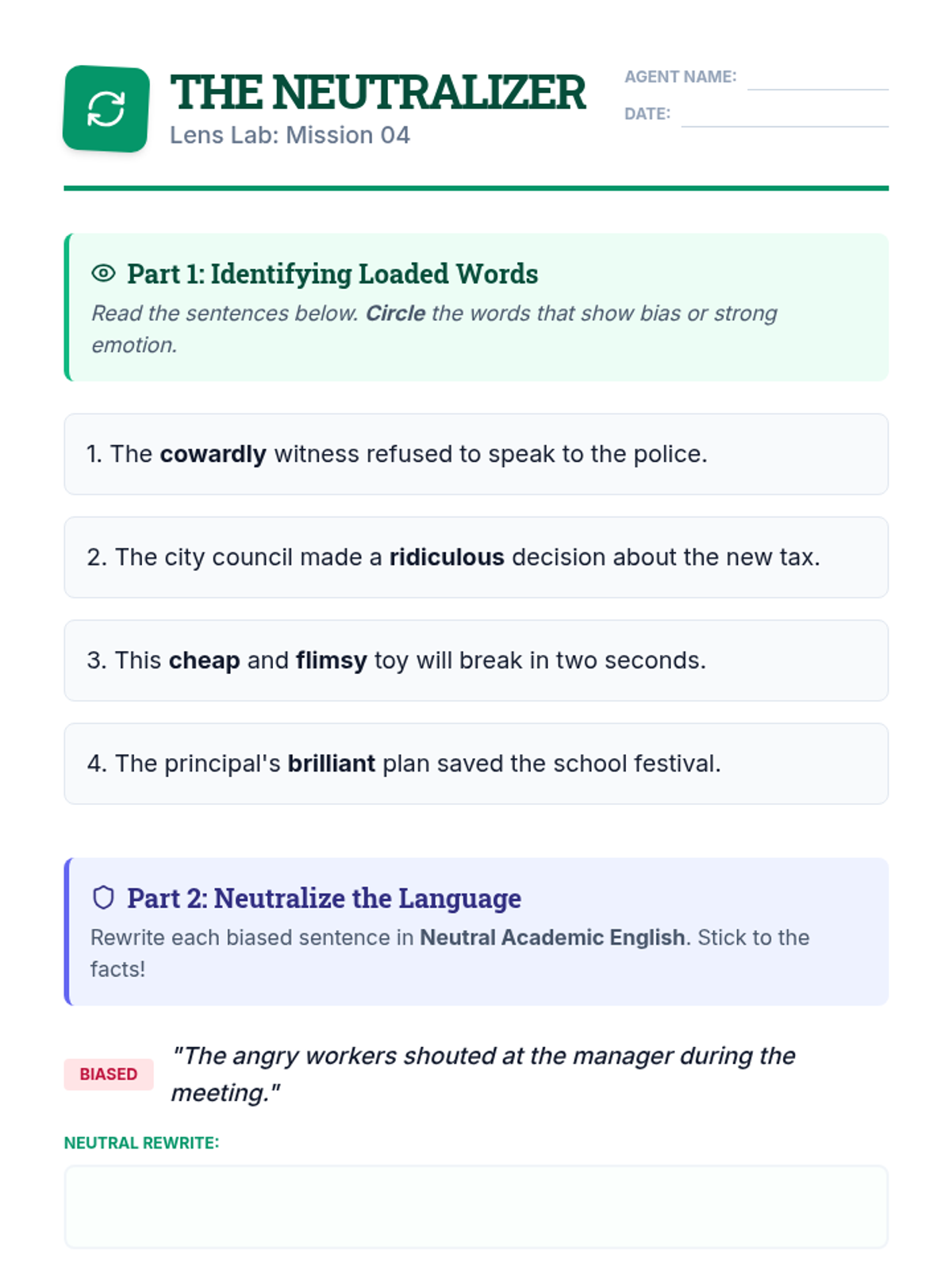
A student activity worksheet for identifying loaded words and practice rewriting biased sentences into neutral academic language.
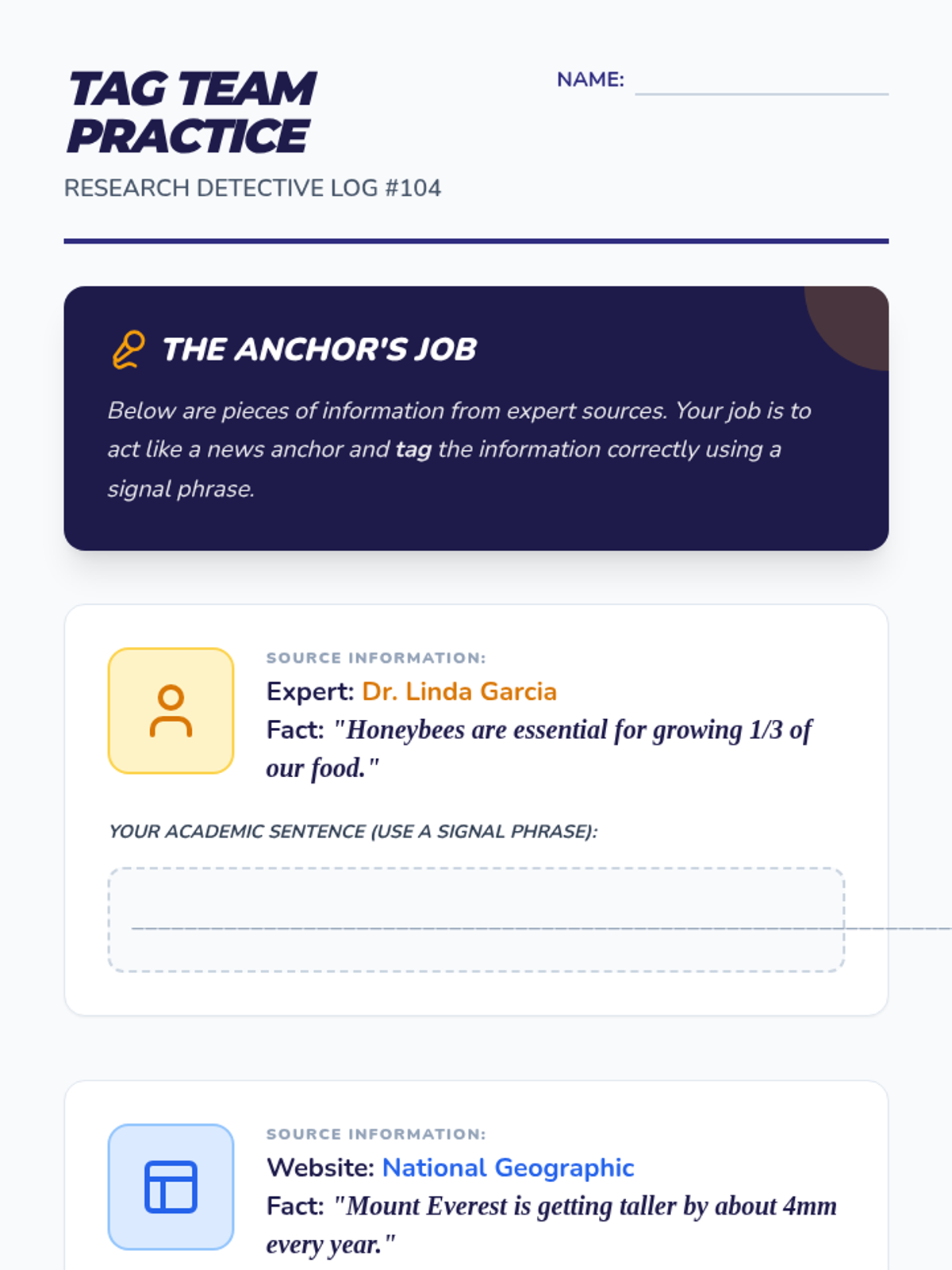
Guided practice worksheet for 6th-grade students to master in-text attribution by creating sentences that integrate expert sources using signal phrases.
Introductory slide deck for Lesson 4, teaching students how to read and interpret search result snippets, titles, and bolded terms before clicking.
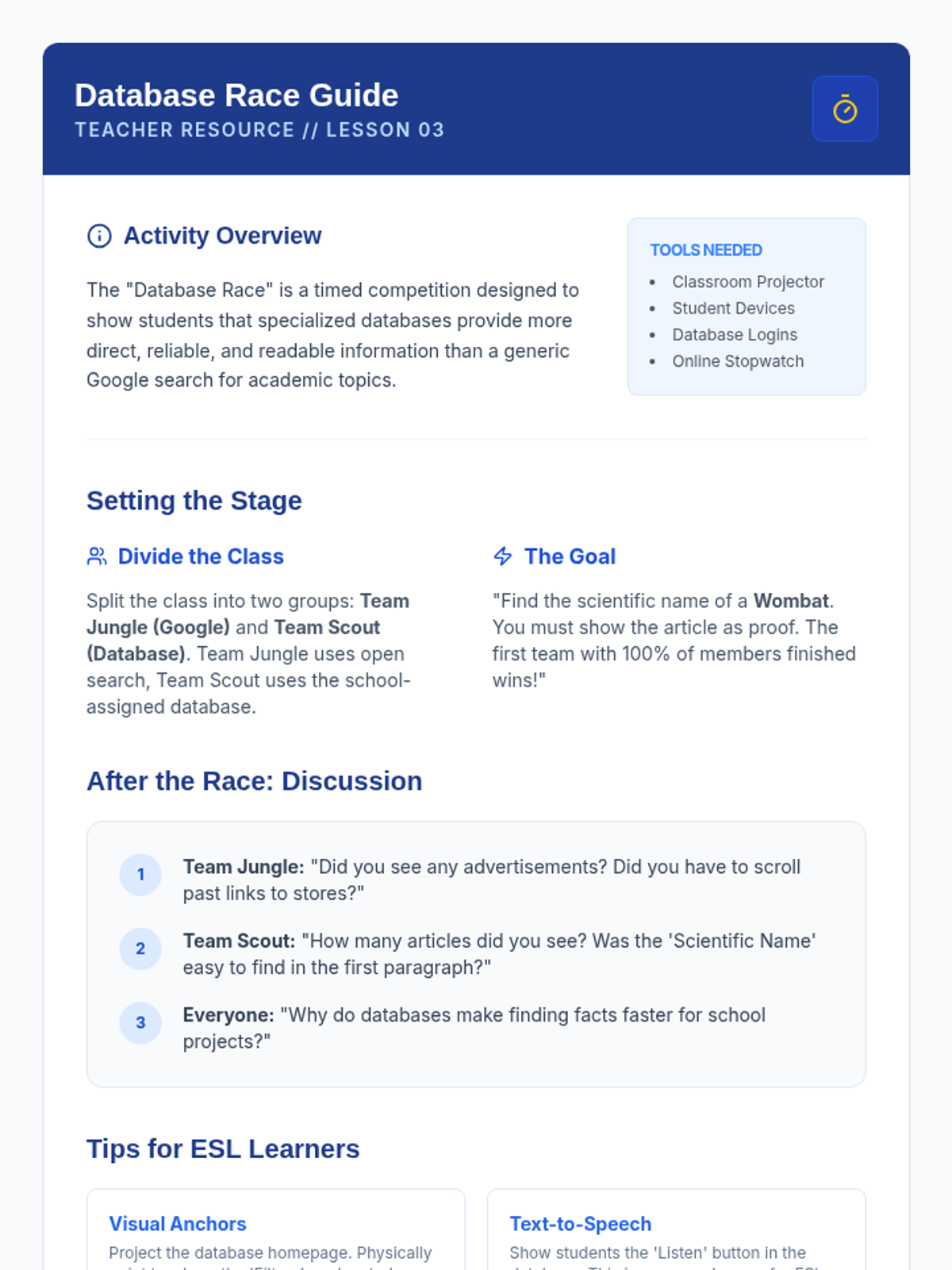
Teacher facilitation guide for Lesson 3, providing instructions for the "Database Race" activity and tips for database exploration.
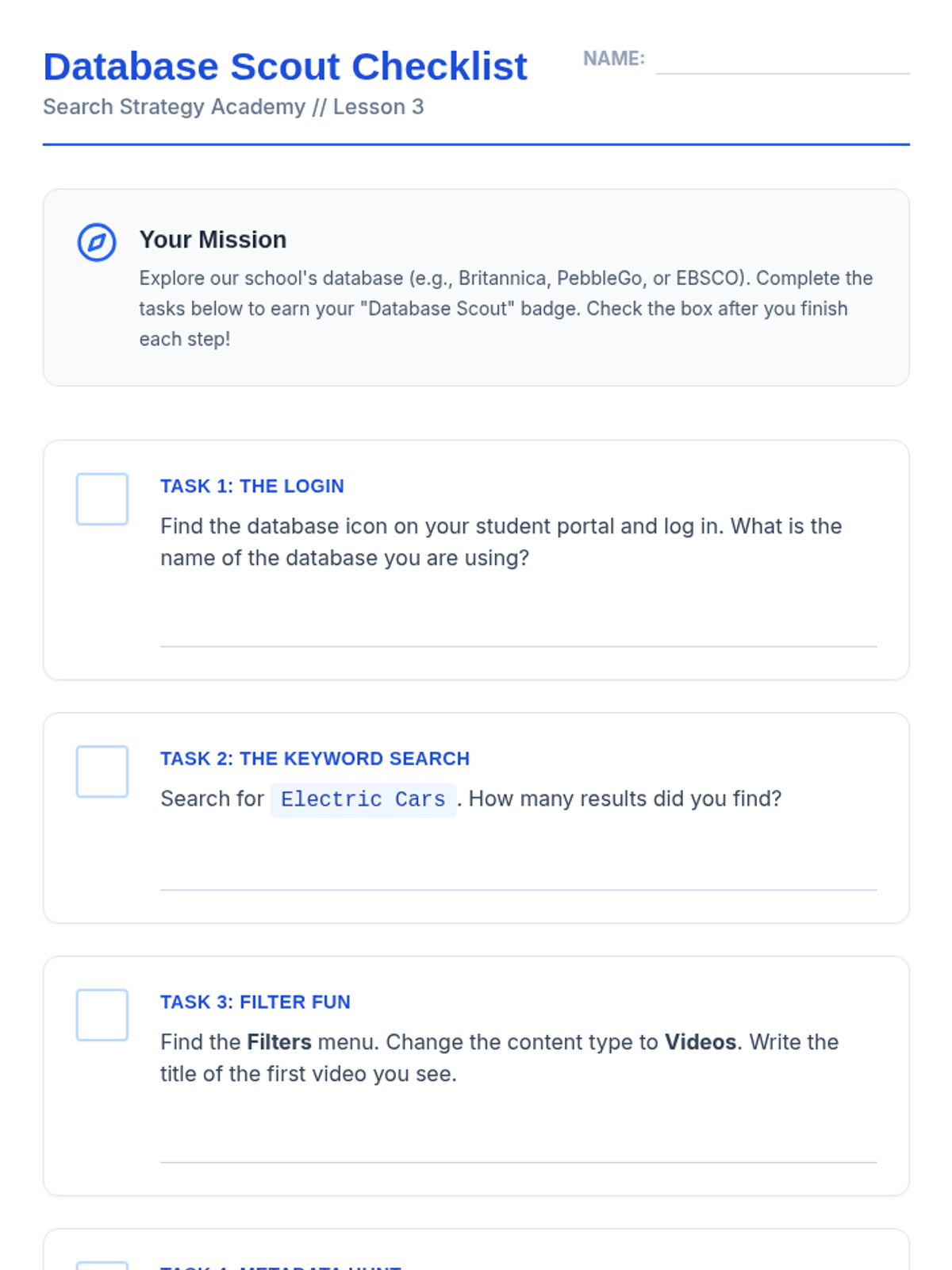
Student checklist for Lesson 3 where students explore an academic database by performing a keyword search, applying filters, and identifying metadata.
Introductory slide deck for Lesson 3, teaching students about academic databases, filters, and how they differ from general search engines.
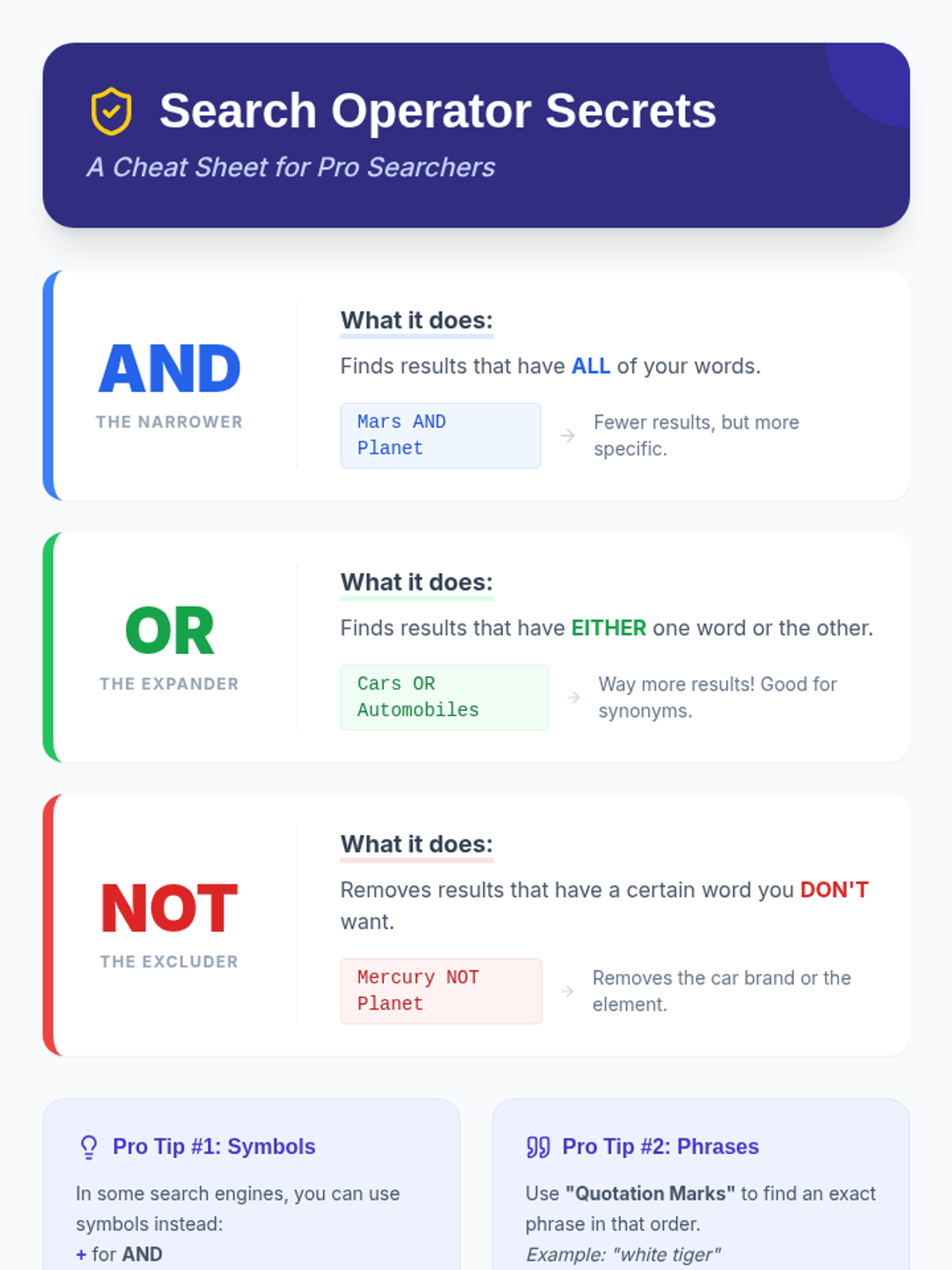
Student reference cheat sheet for Lesson 2, providing a clear summary of AND, OR, and NOT Boolean operators with examples.
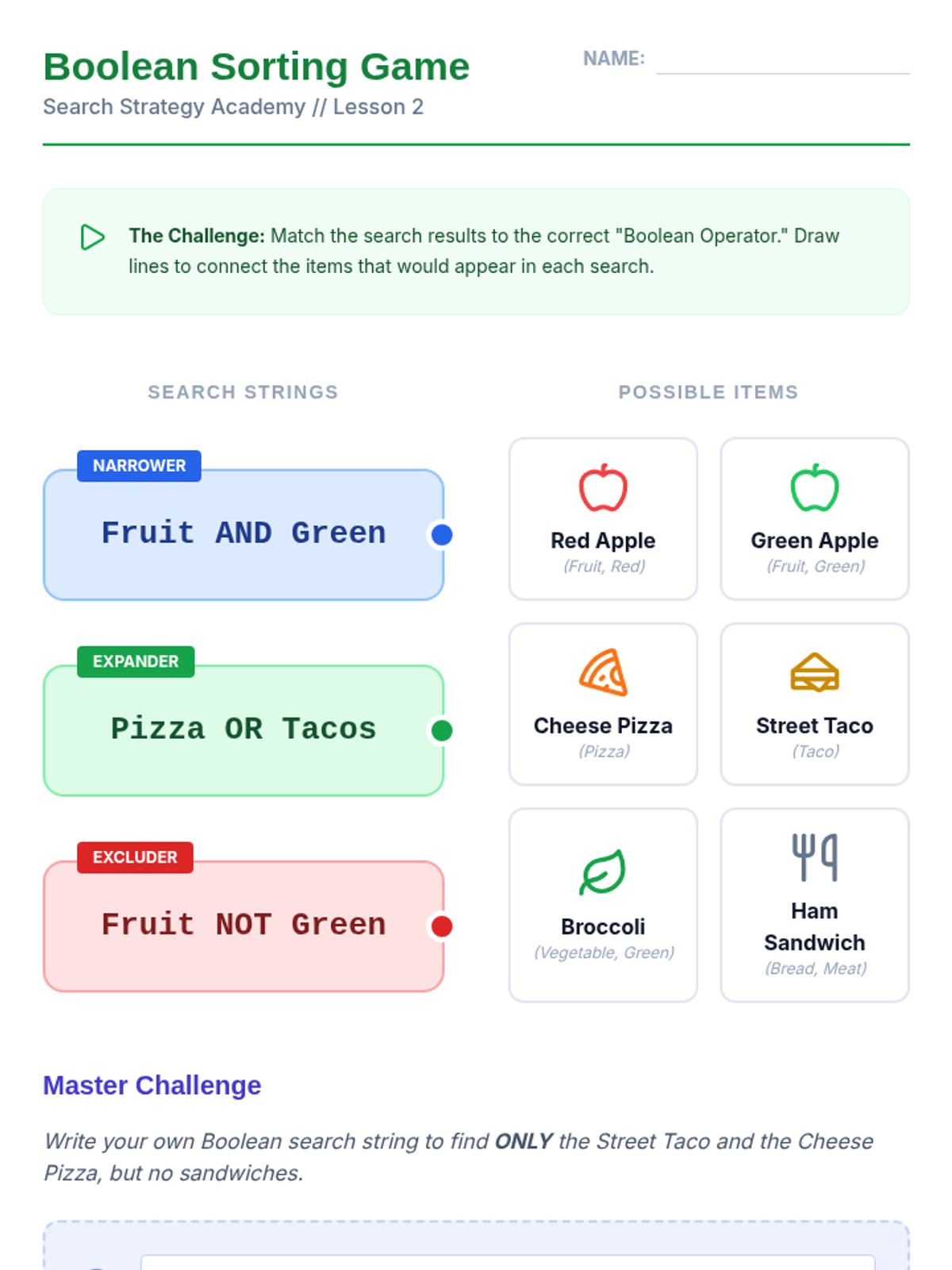
Student matching activity for Lesson 2 where students connect Boolean search strings to their corresponding results.
Visual slide deck for Lesson 2, introducing Boolean operators (AND, OR, NOT) with Venn diagrams and a "Human Search Engine" game.
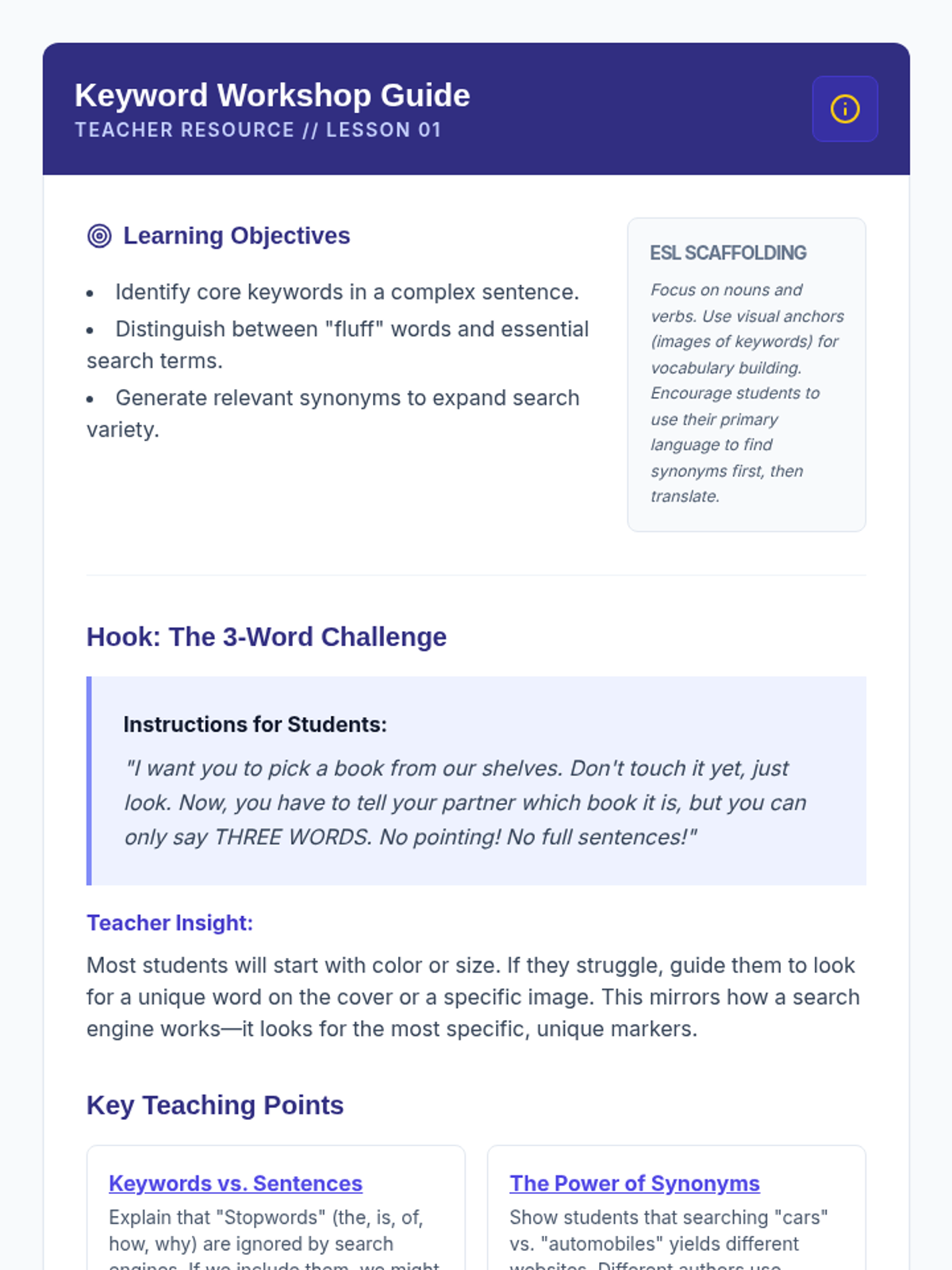
Teacher facilitation guide for Lesson 1, including instructional scripts, ESL scaffolding tips, and discussion prompts for the keyword workshop.
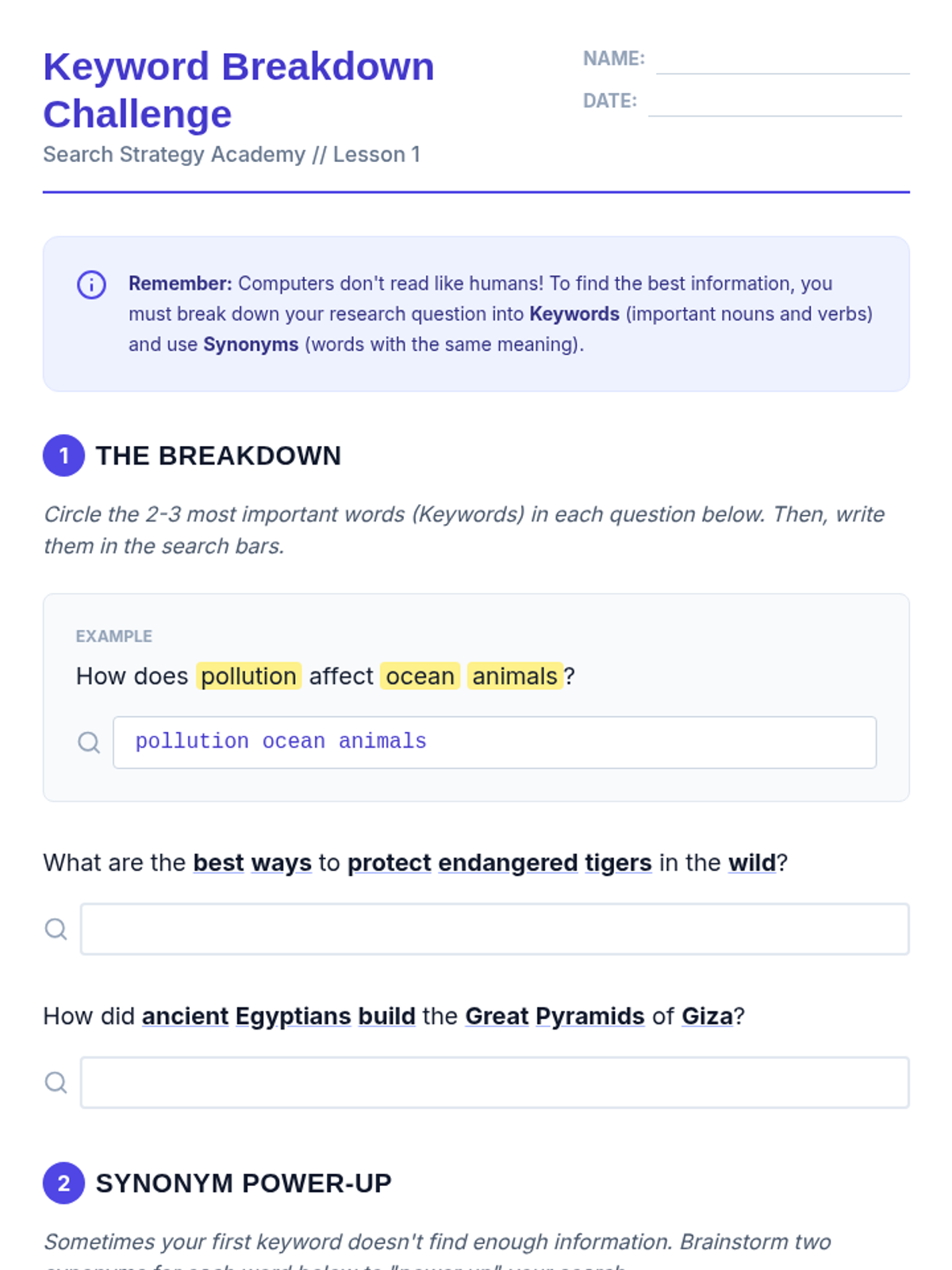
Student worksheet for Lesson 1 where students practice deconstructing research questions into keywords and brainstorming synonyms for search terms.
Introductory slide deck for Lesson 1, teaching students the difference between natural language questions and strategic keywords, including the use of synonyms.
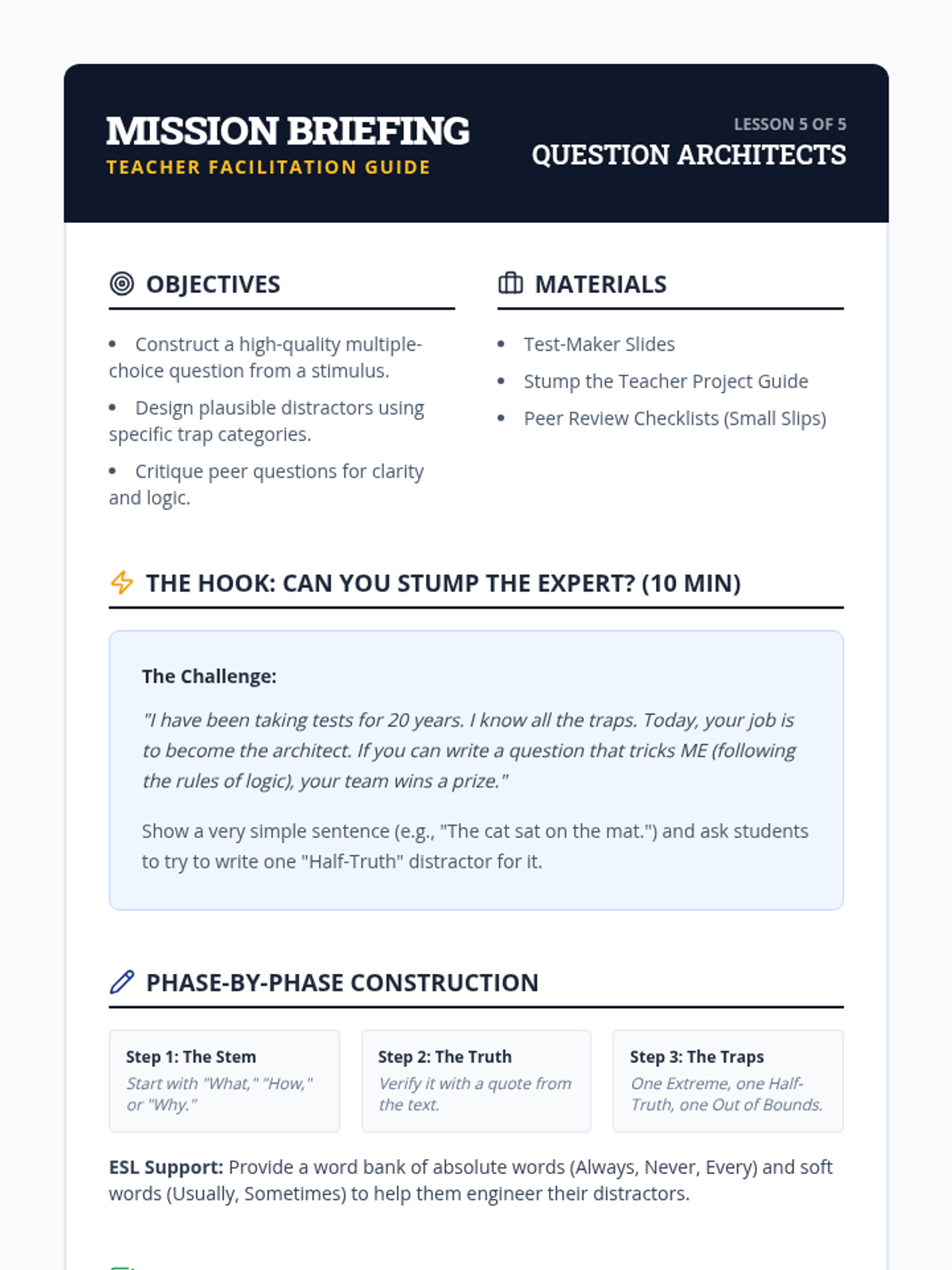
Facilitation guide for Lesson 5, including the "Stump the Expert" hook, phase-by-phase question construction steps, and a peer review protocol.
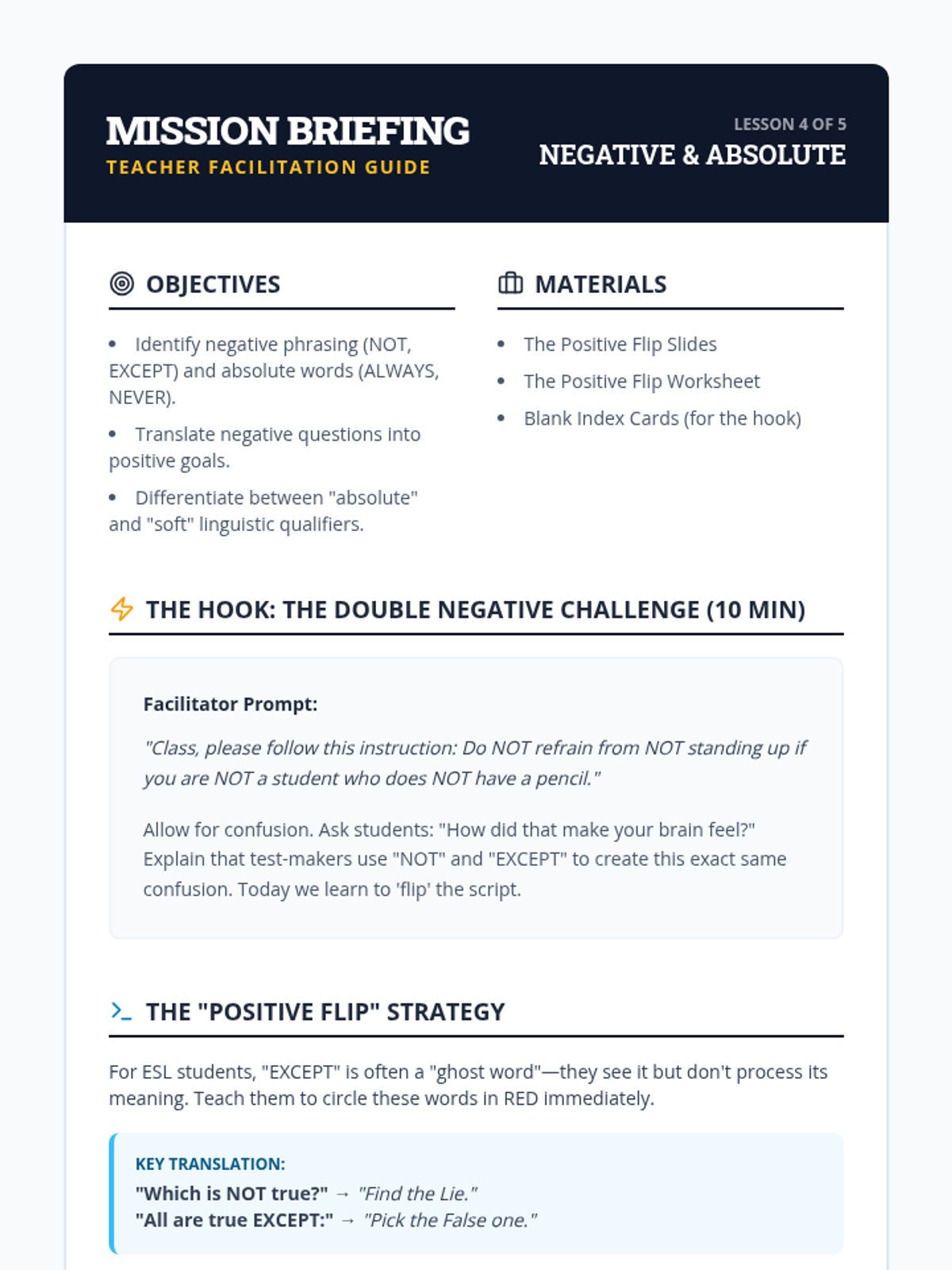
Facilitation guide for Lesson 4, including the "Double Negative Instructions" hook, translation strategies for "NOT" and "EXCEPT," and an answer key for the Positive Flip worksheet.
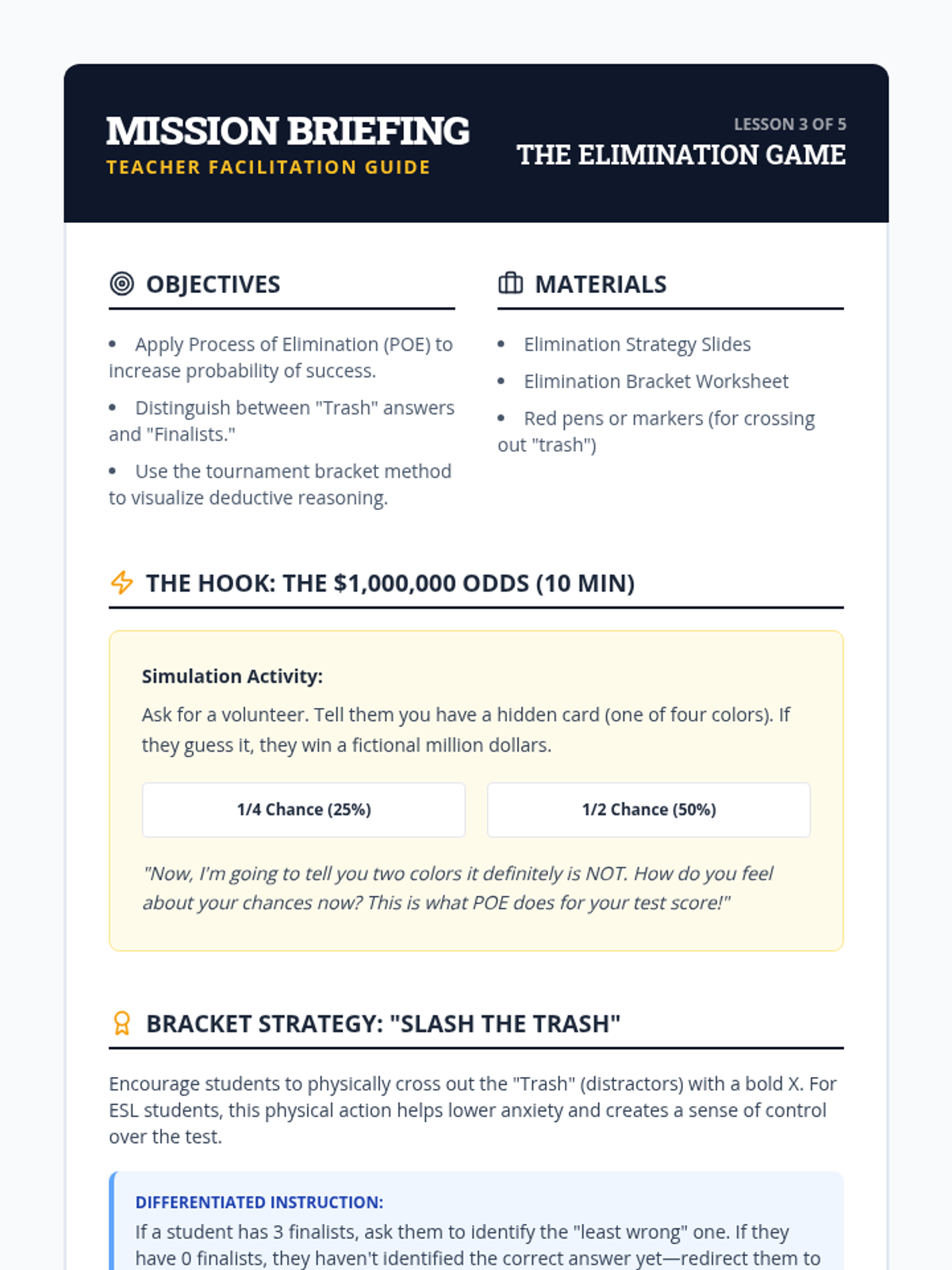
Facilitation guide for Lesson 3, including the odds simulation hook, the "Slash the Trash" technique, and an answer key for the Elimination Bracket worksheet.
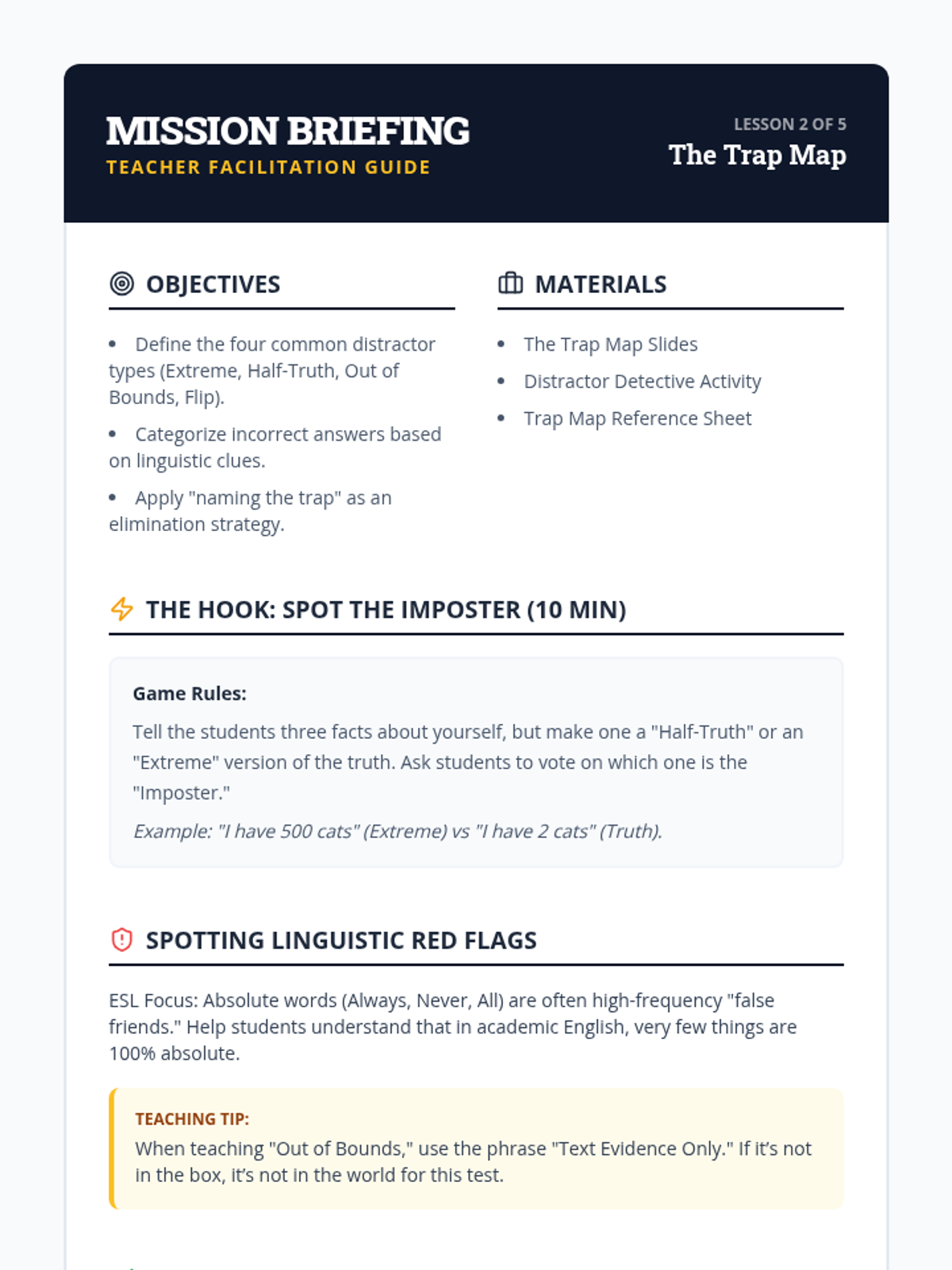
Facilitation guide for Lesson 2, including the 'Spot the Imposter' hook, linguistic red flags for ESL learners, and an answer key for the Distractor Detective activity.
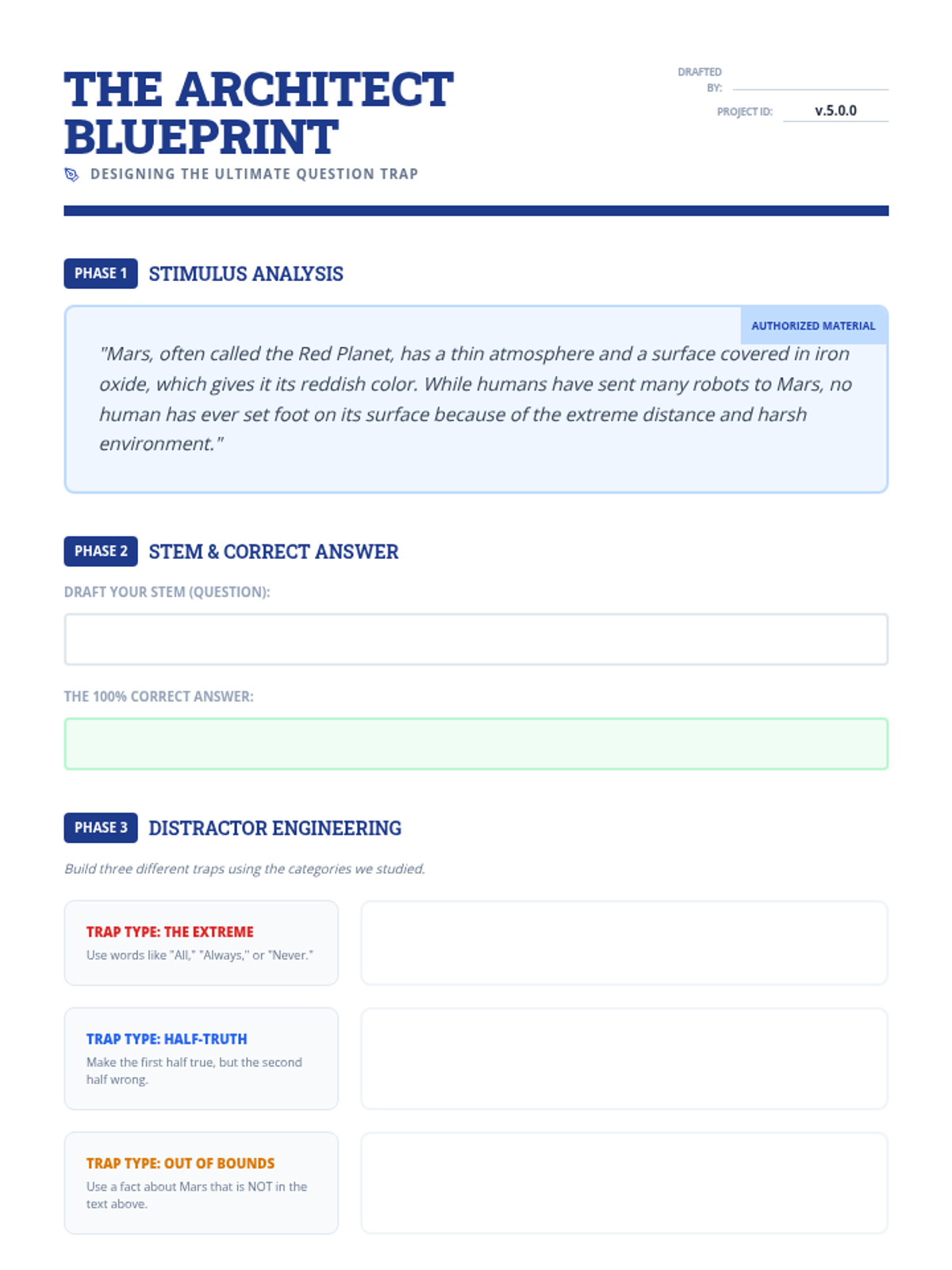
Worksheet for Lesson 5 where students switch roles and become the test-makers. They write their own multiple-choice questions based on a shared text, intentionally creating plausible distractors.