Sentence structure fundamentals, subject-verb agreement, and precise usage of parts of speech including pronouns, conjunctions, and adjectives. Targets technical accuracy through mastery of capitalization, punctuation, spelling, and verb mood.
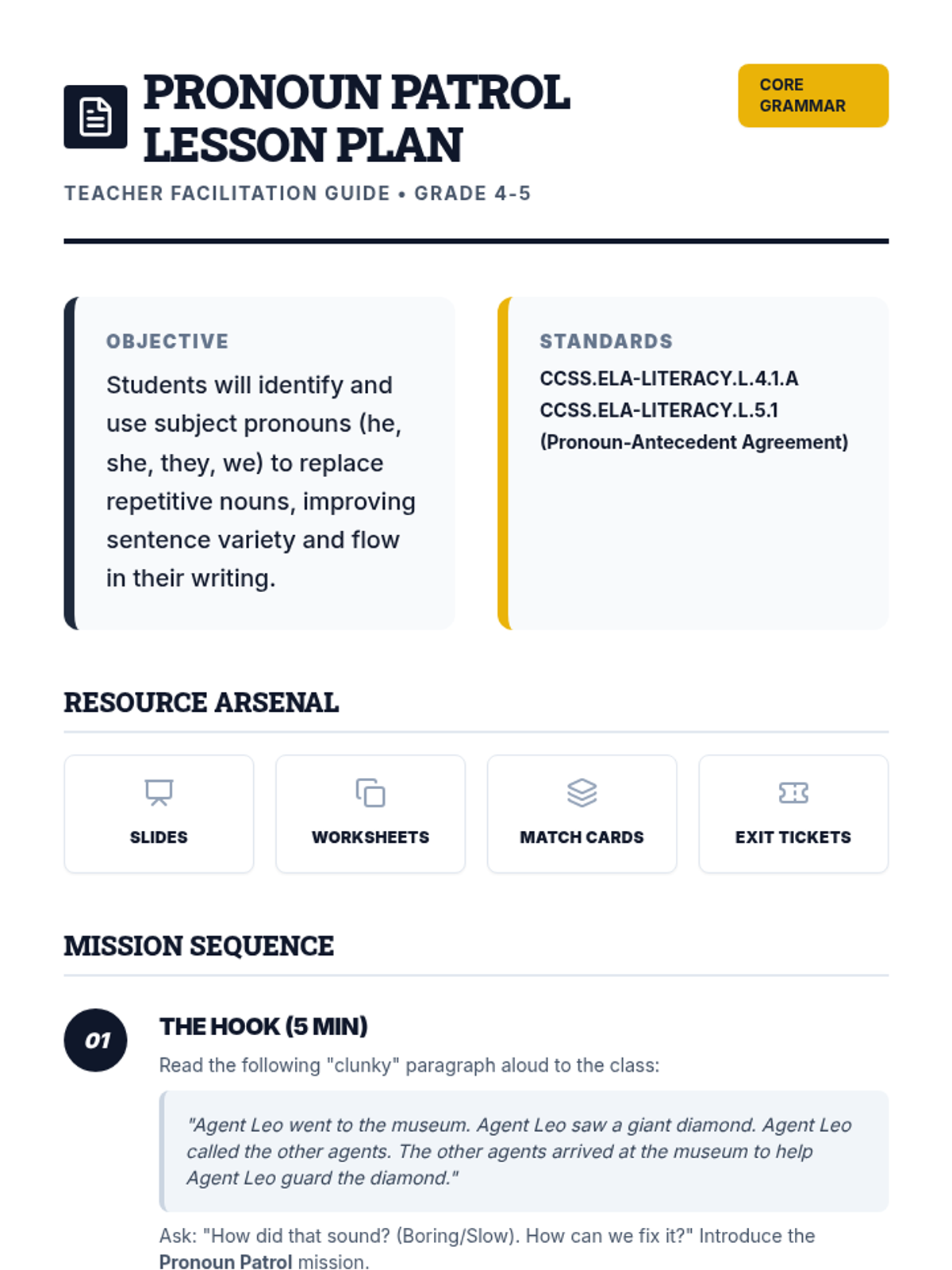
A comprehensive teacher's guide for the Pronoun Patrol lesson. Includes objectives, standards, a step-by-step facilitation sequence, and differentiation strategies for grades 4-5.
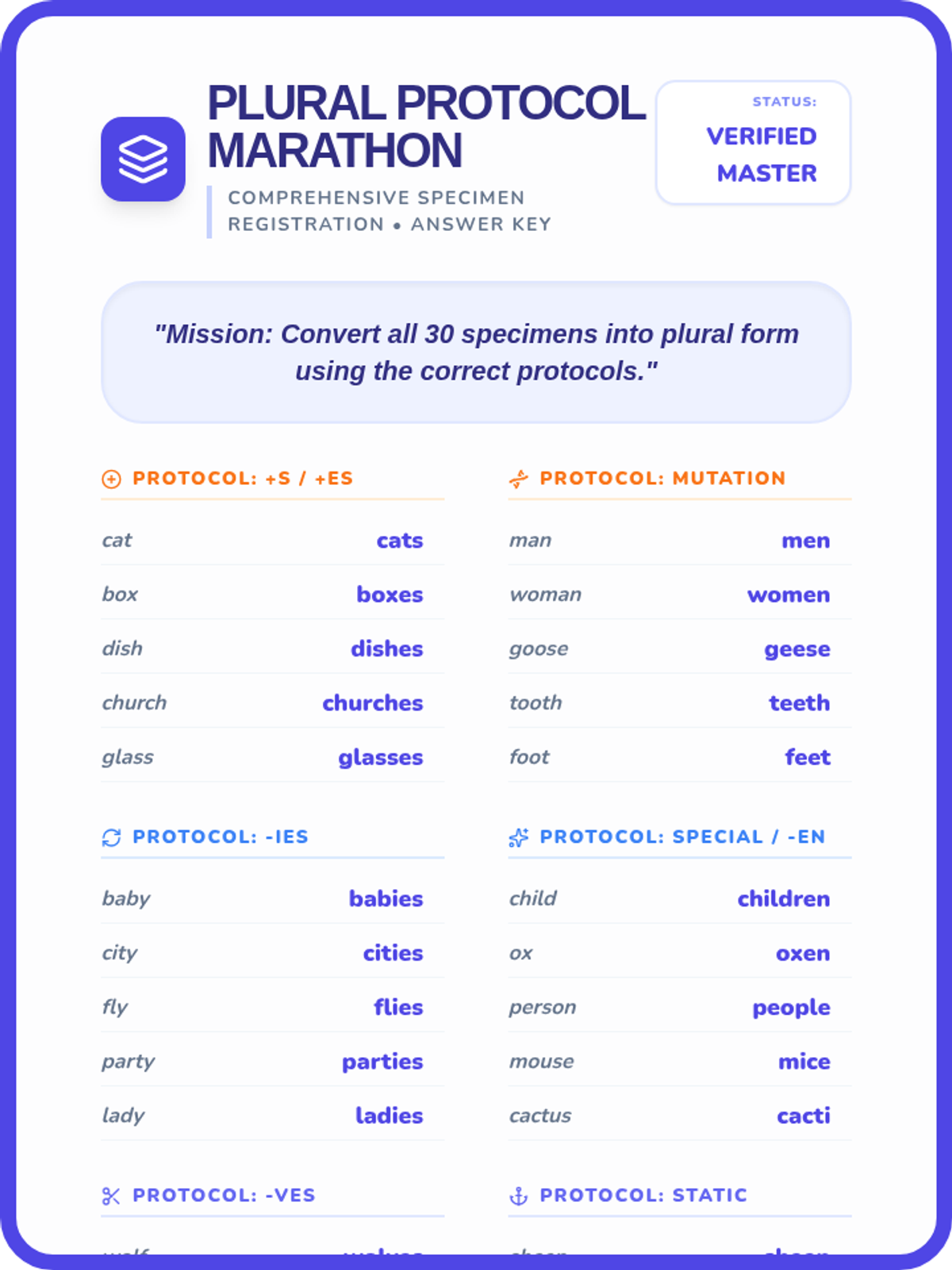
The official teacher answer key for the Plural Protocol Marathon worksheet, featuring all 30 plural conversions categorized by linguistic rule. Designed with high-contrast formatting for easy grading.
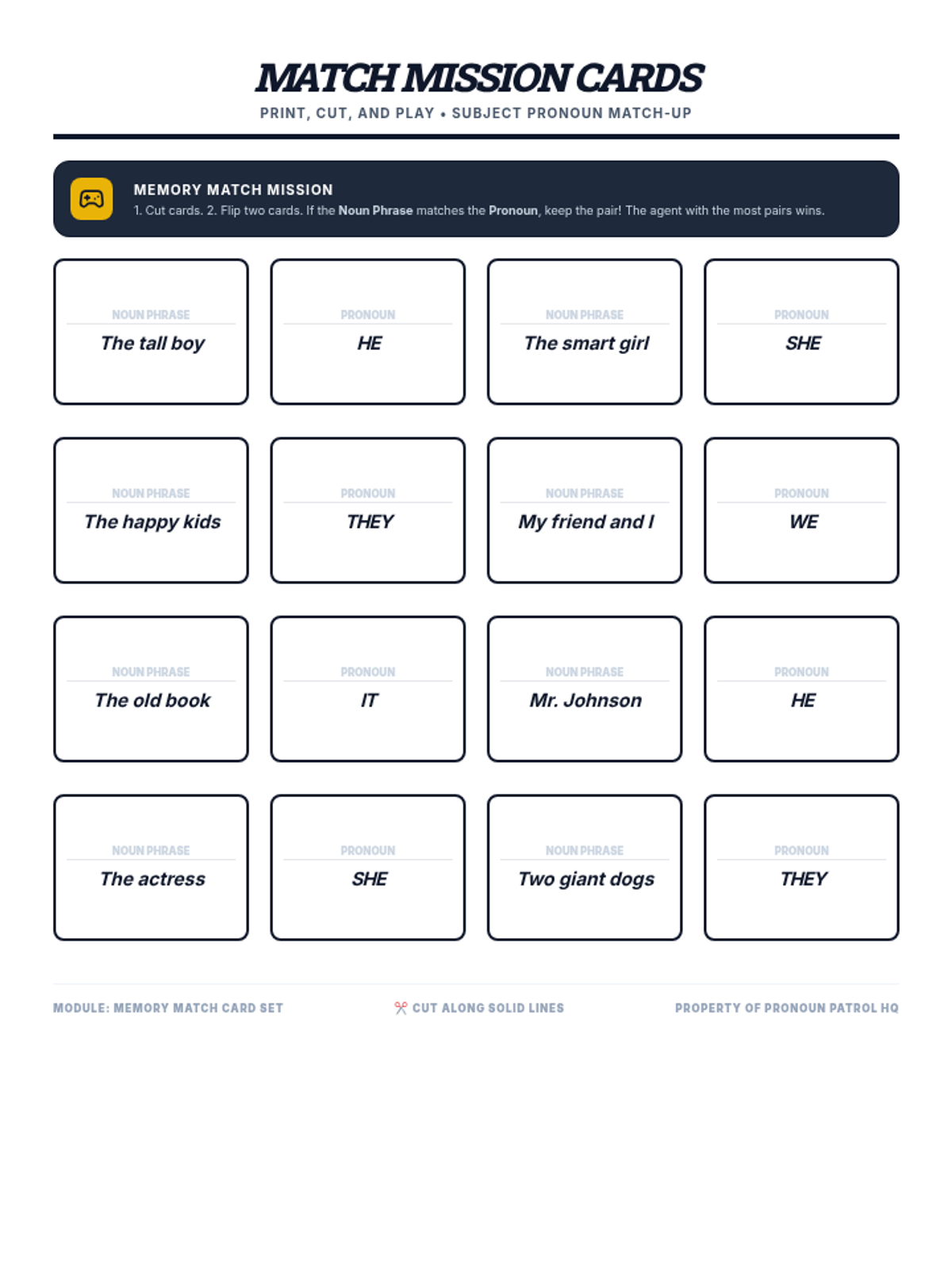
A matching game for kinesthetic learning. Revised to include 8 matches (16 cards total), uniform card styling for memory-game compatibility, and instructions on the same page. Card content was refined for natural phrasing.
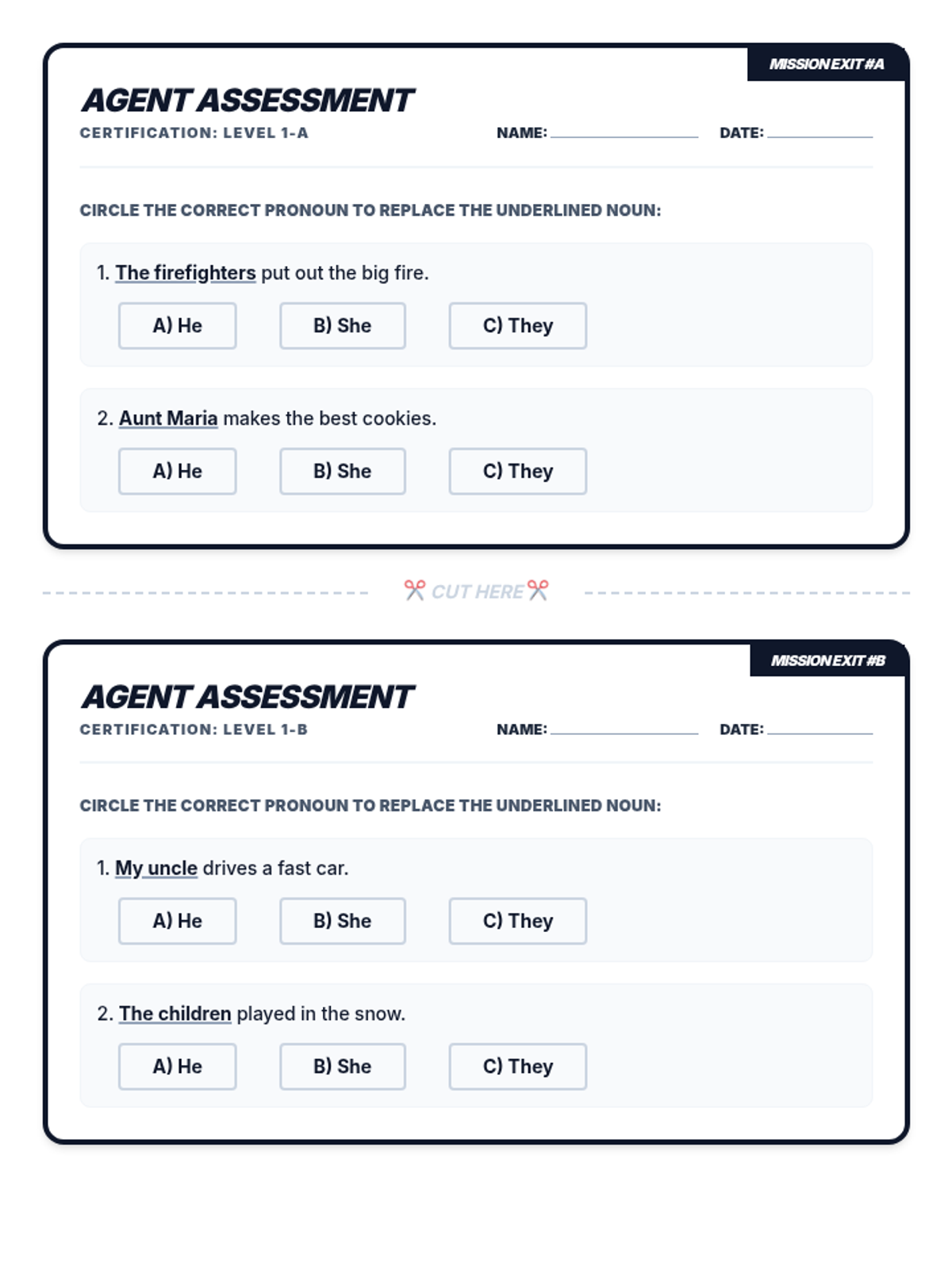
A two-per-page exit ticket for quick assessment. Revised for single-page layout, removed ink-heavy background, and improved contrast for student accessibility. version B includes unique questions.
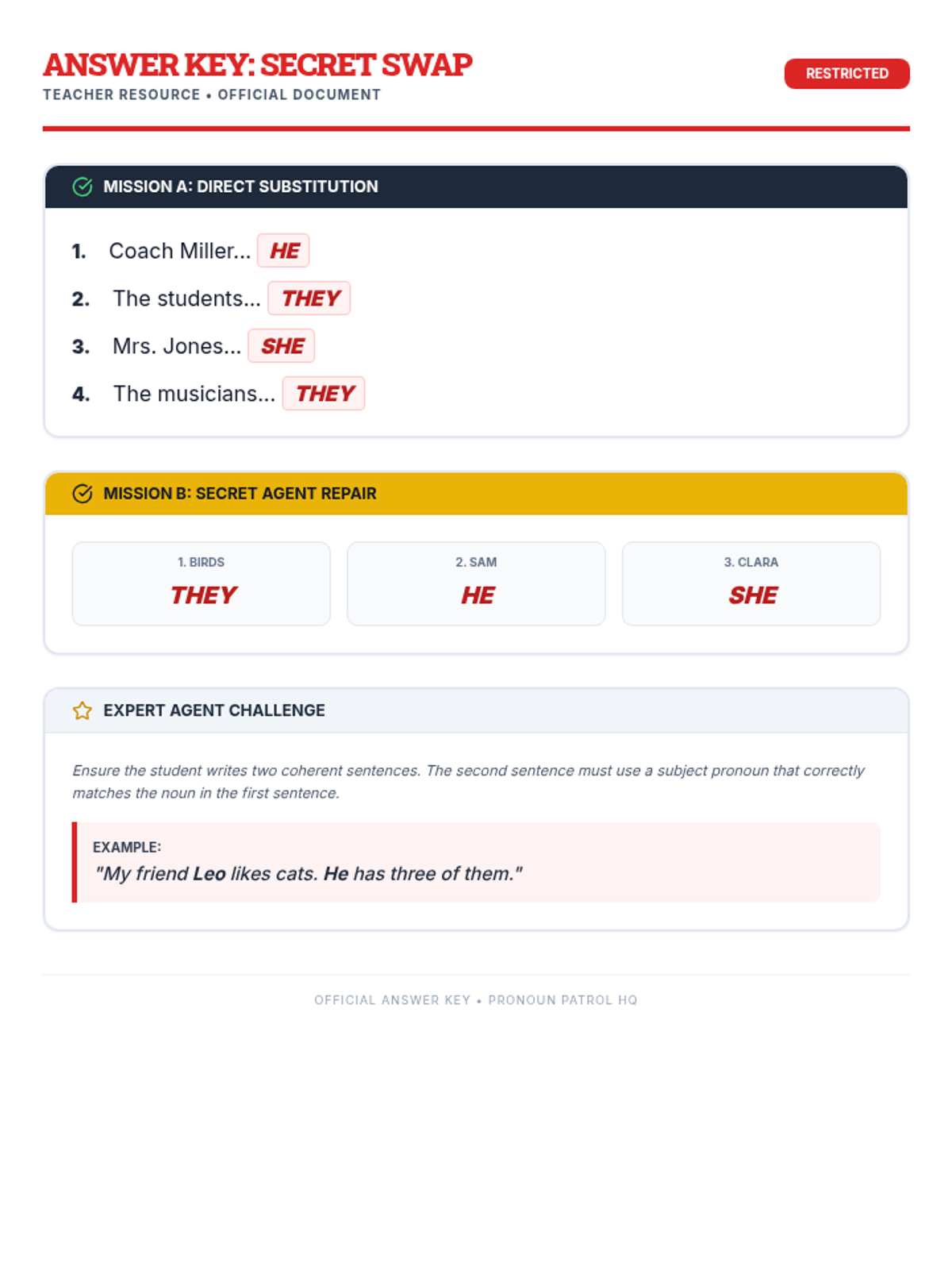
A clear, easy-to-use answer key for the 'Secret Swap' practice worksheet. Revised to fit on a single page, improved contrast for accessibility, and fixed potential page-break issues.
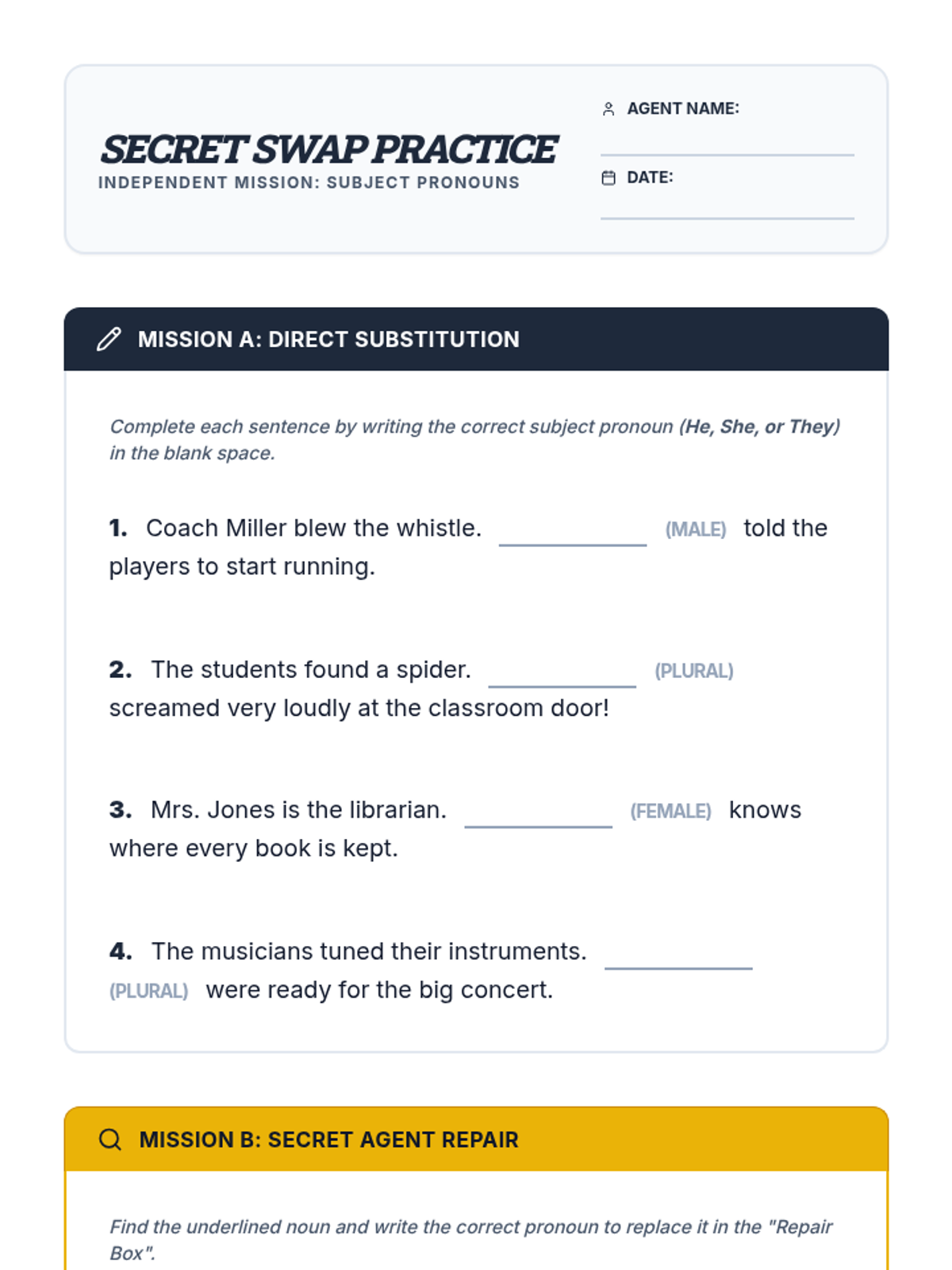
An independent practice worksheet with a 'Secret Agent Repair' theme. Revised for legibility in the Expert Challenge section, fixed page breaks for Mission B, and improved line wrapping in Mission A.
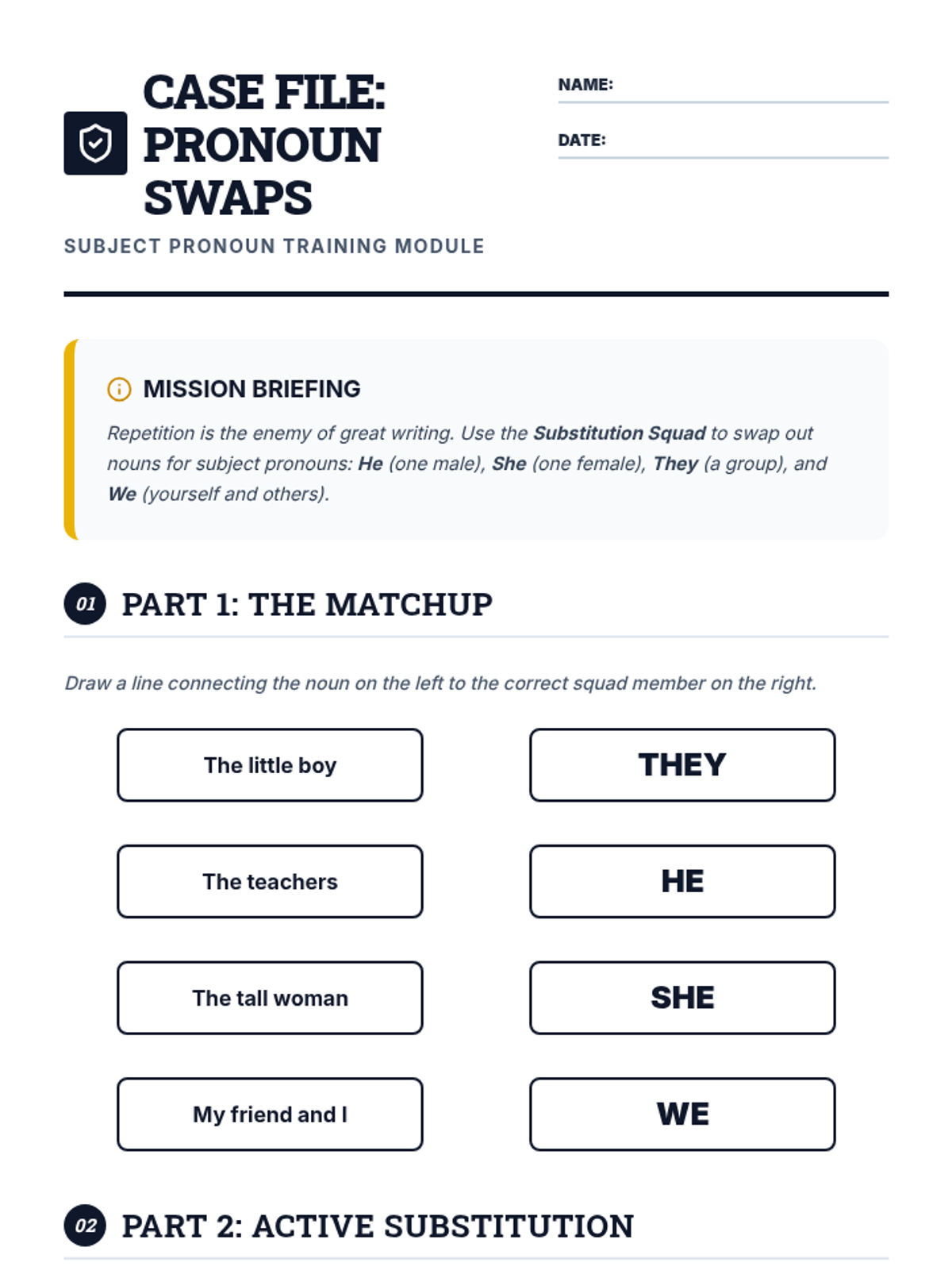
A guided practice worksheet following the 'Case File' theme. Includes a matching section and a sentence rewriting section. Revised for uniform answer styling, improved handwriting space, and removed duplicate options.
An engaging, high-contrast slide deck themed around a 'Pronoun Patrol' detective agency. Covers the basic use of subject pronouns (he, she, they) with examples and rules. Revised for PDF compatibility with separate answer slides.
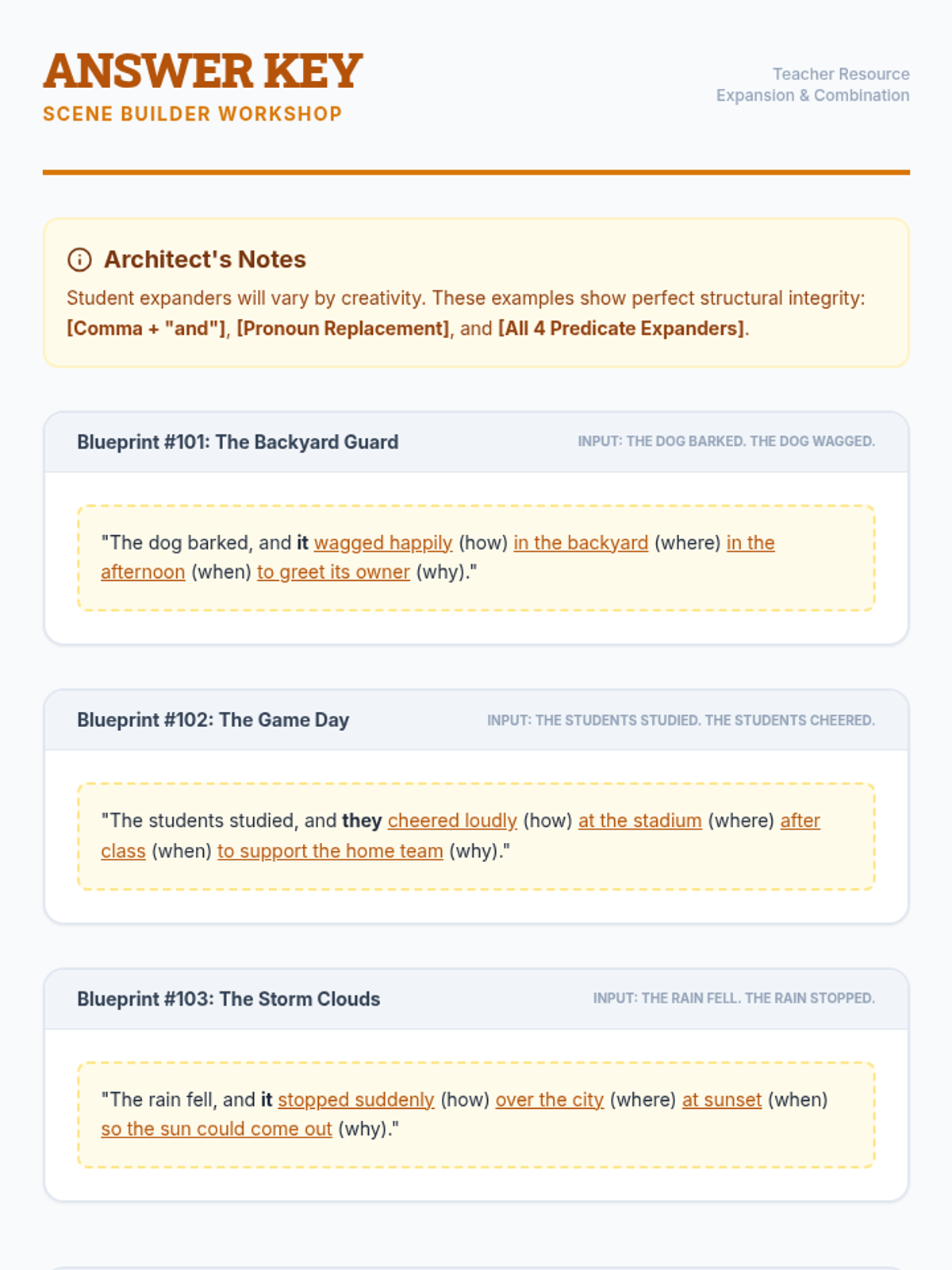
A teacher's answer key for the Scene Builder worksheet, featuring example answers and a structural grading rubric.
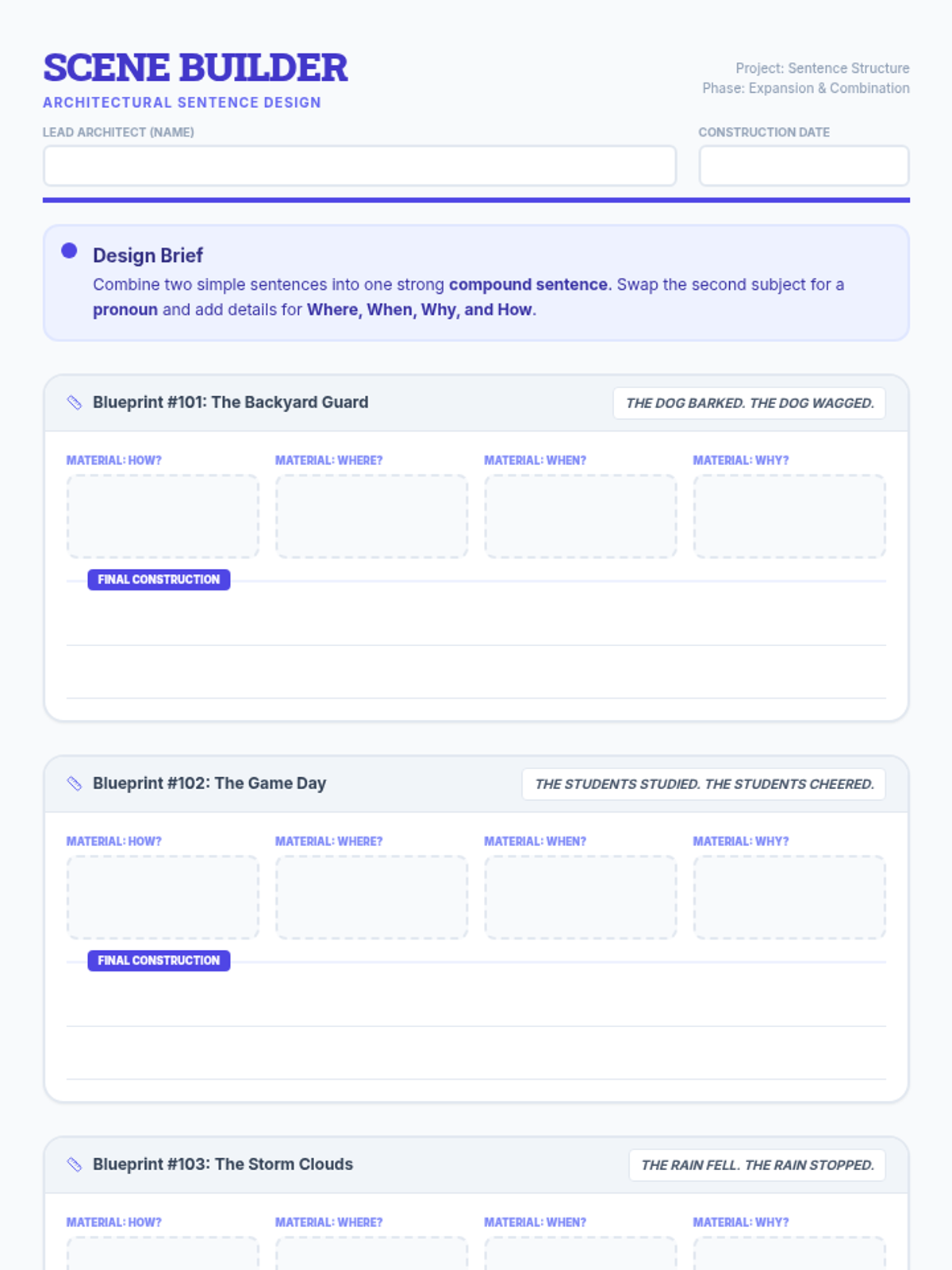
A second practice worksheet for the Sentence Lab lesson, using an architectural "Scene Builder" theme. Students combine simple sentences using pronouns and expand them with four descriptive predicates. Optimized for a 2-page layout.
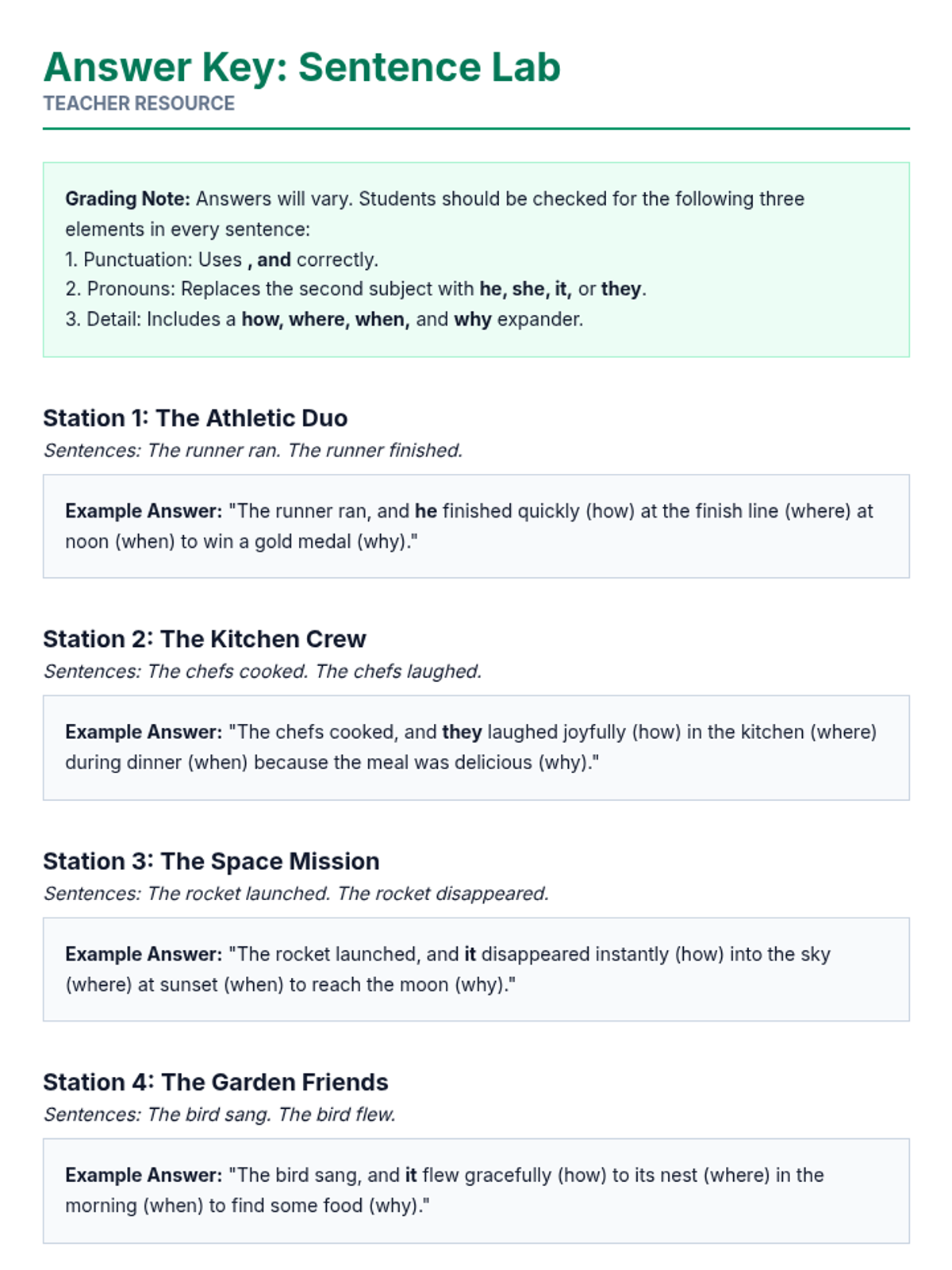
A Google Docs friendly version of the teacher's answer key, using standard text and table formatting that translates perfectly when copied into a digital document.
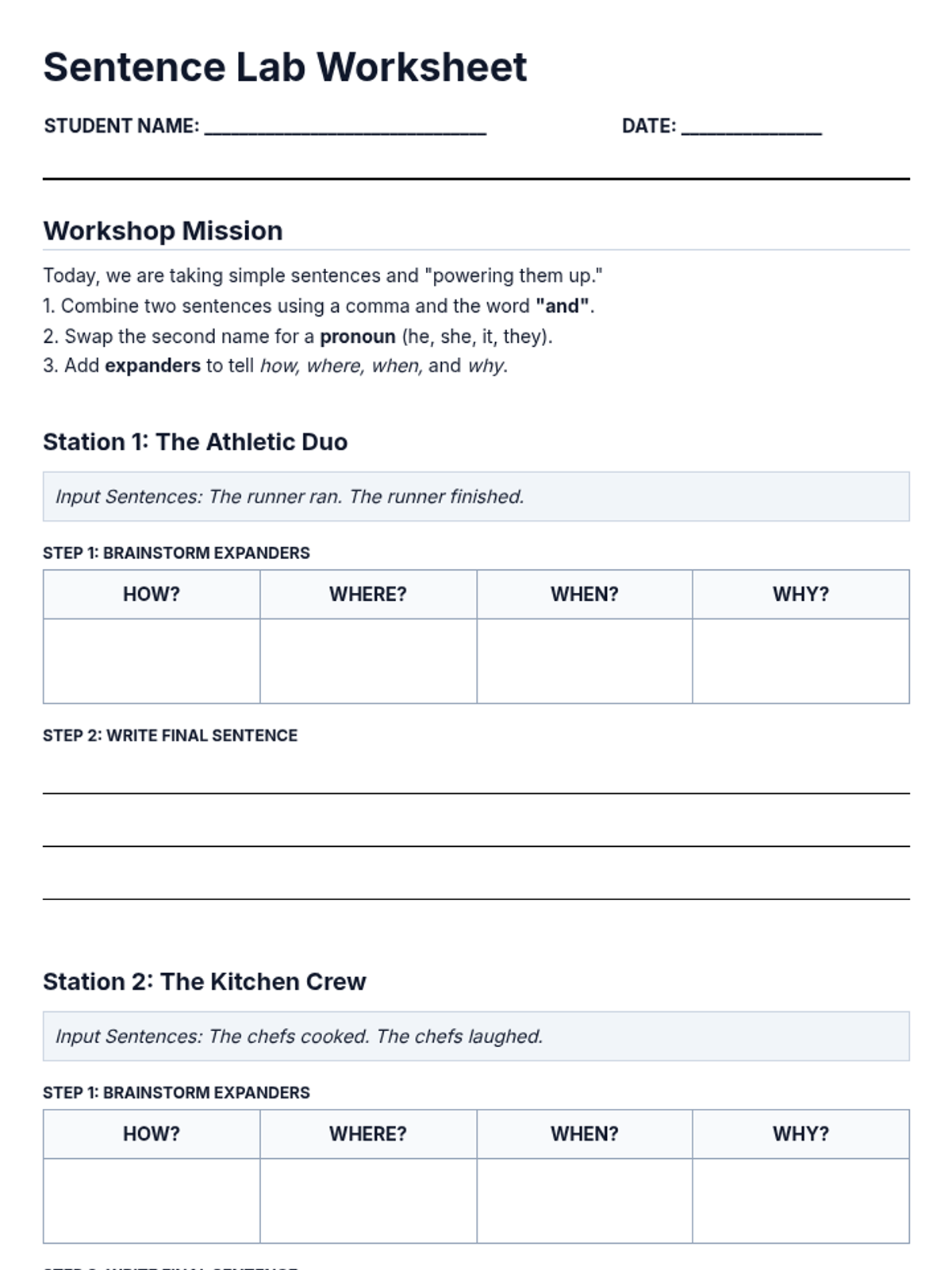
A Google Docs friendly version of the Sentence Lab worksheet, using a simplified table-based layout and standard formatting that translates easily when copied and pasted. Includes a bonus challenge station.
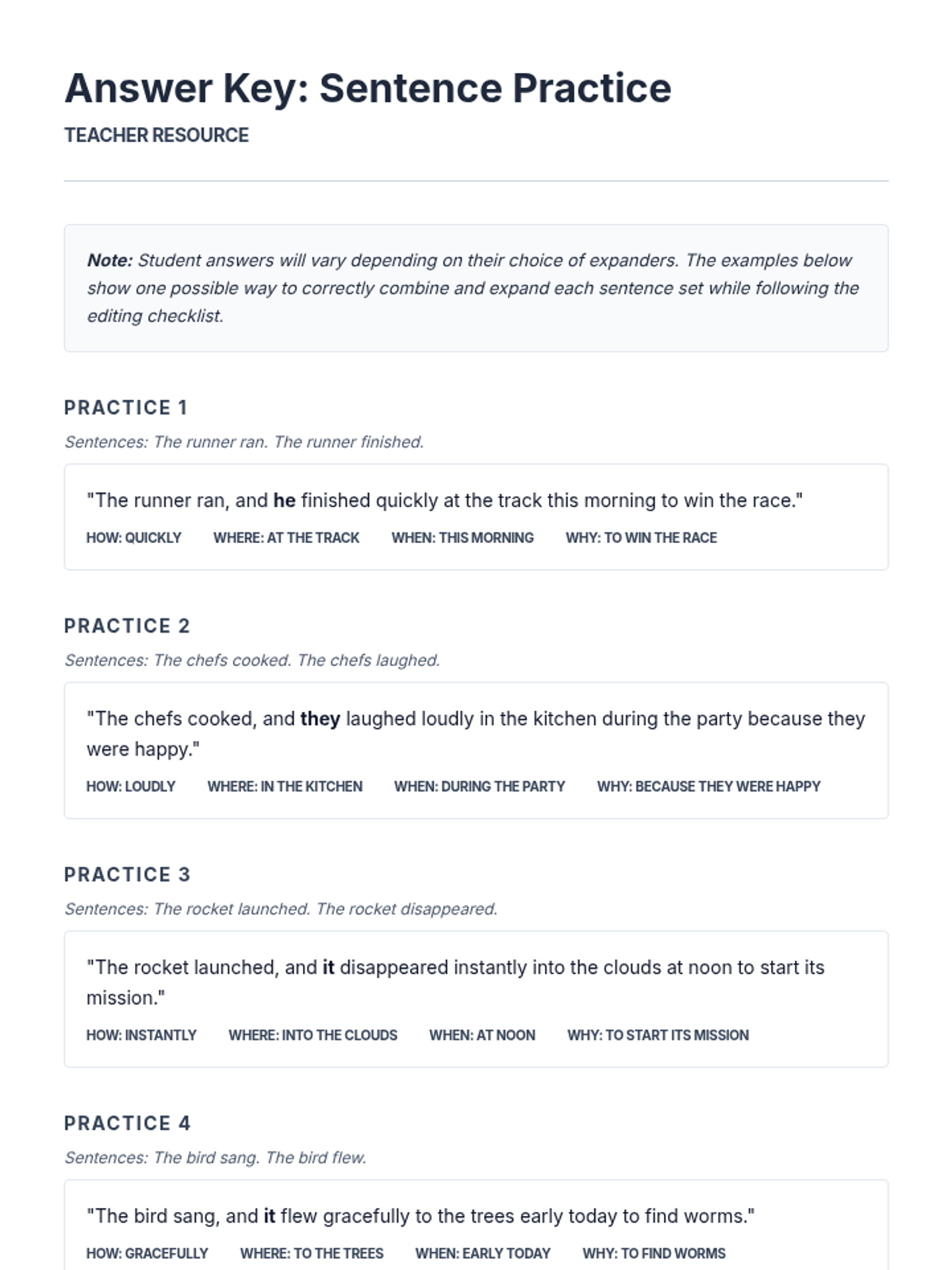
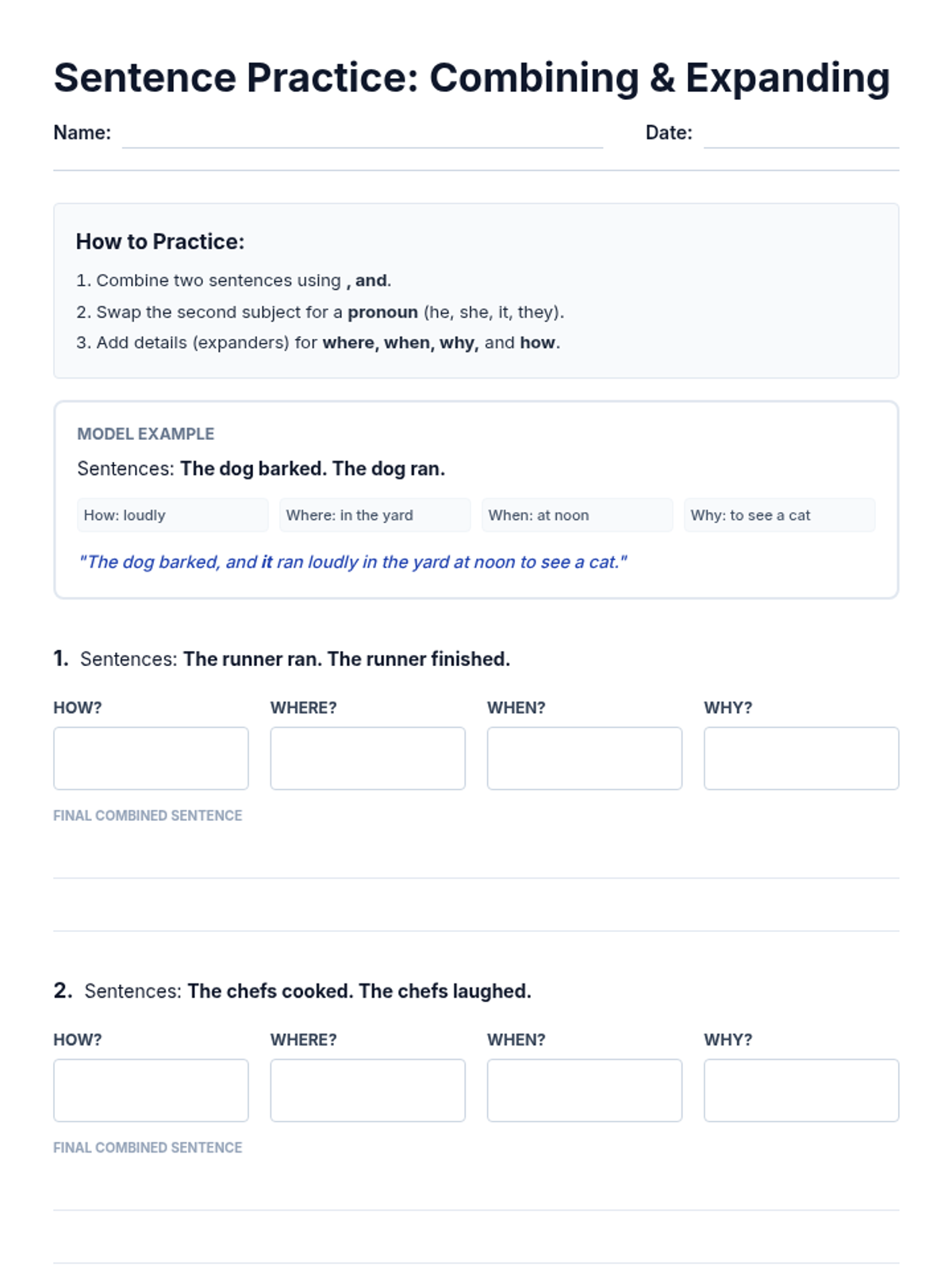
A teacher's answer key for the sentence practice worksheet, featuring example answers and a guide for the mobility punctuation rule.
A basic sentence practice worksheet for middle school students, focusing on combining sentences with pronouns and adding predicate expanders. Includes a comprehensive editing checklist.
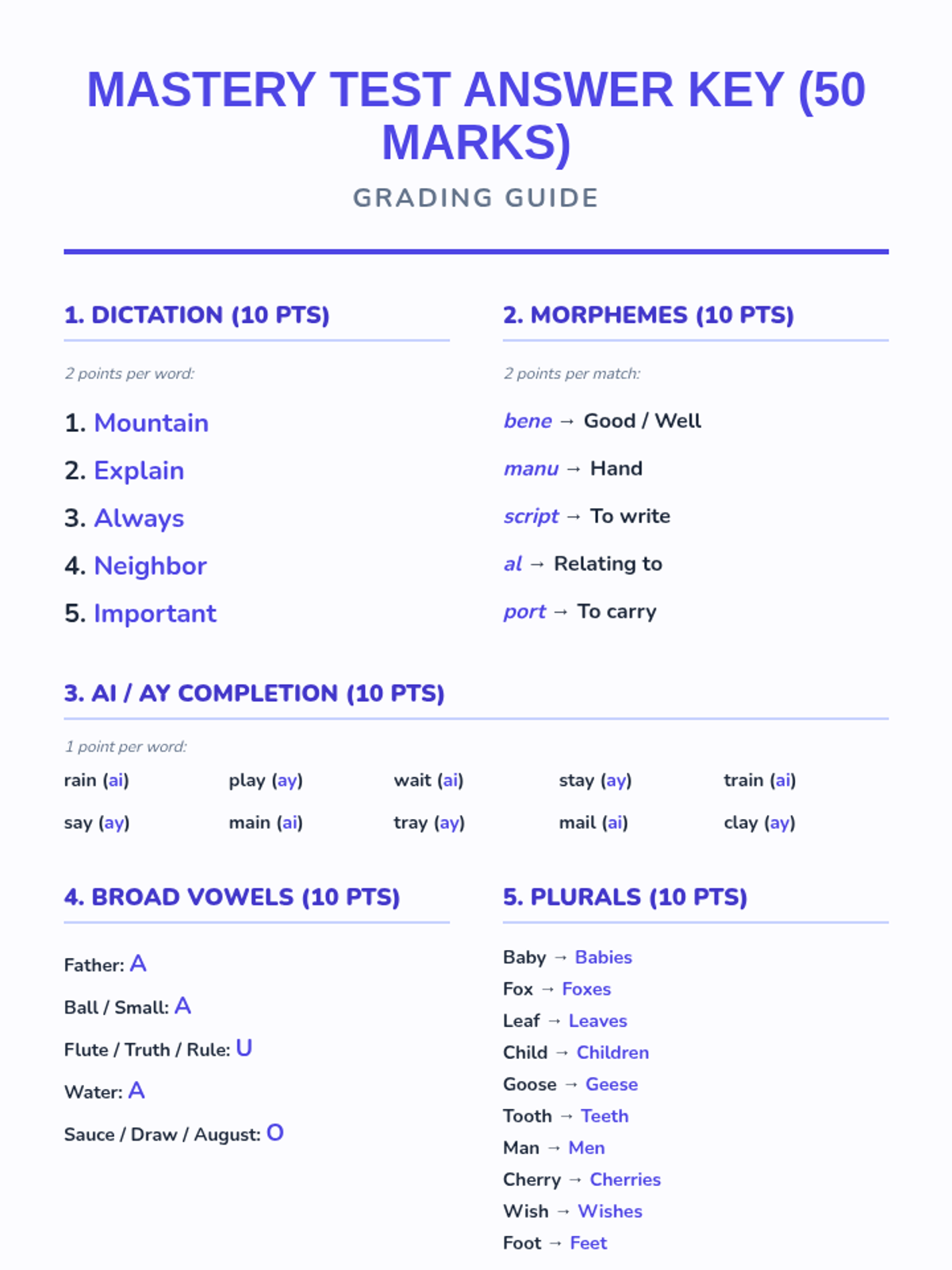
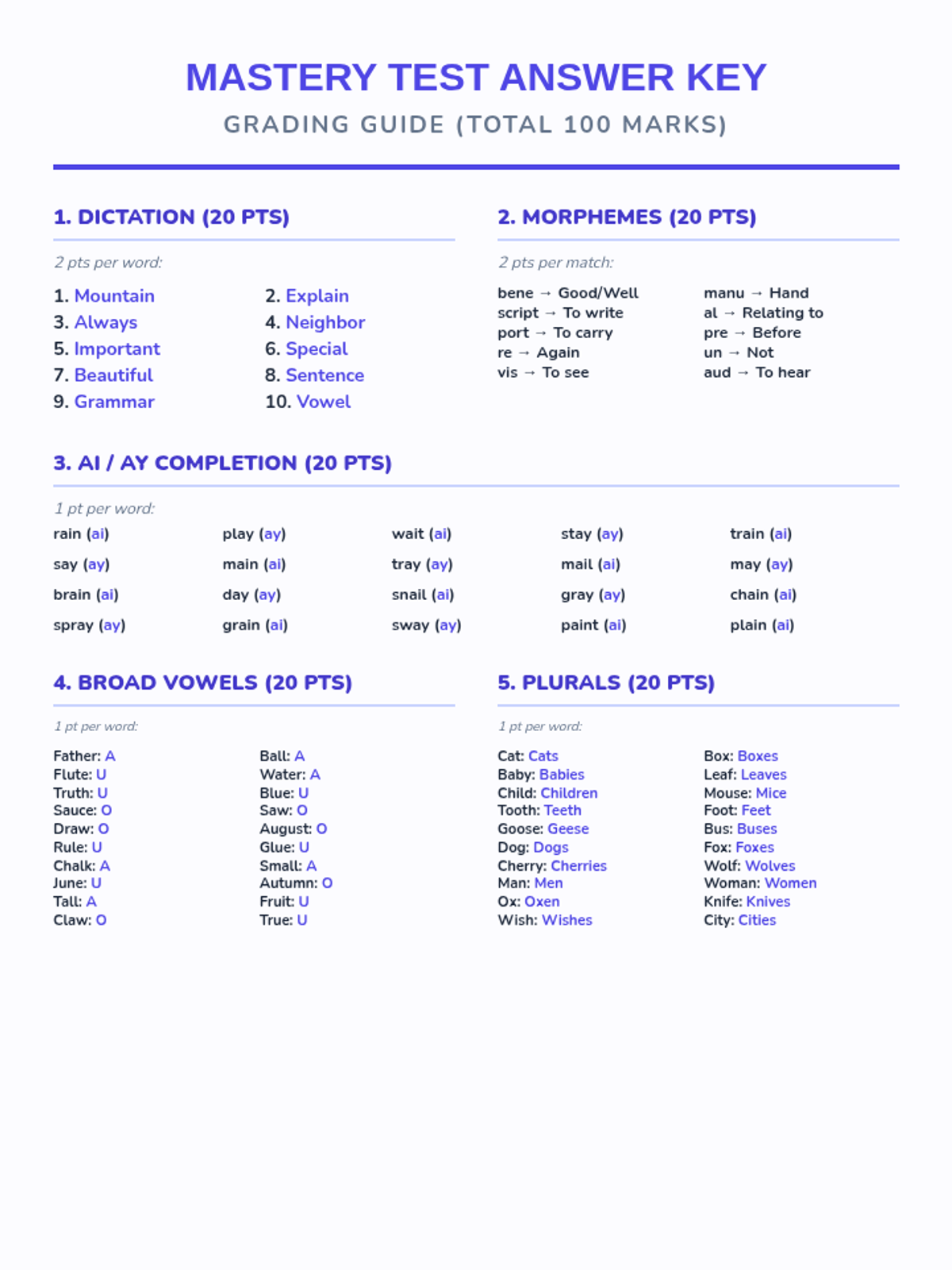
Answer key for the 50-mark Word Power Mastery Test, featuring 5 secret dictation words and clear answers for morphemes, AI/AY completion, broad vowels, and plural forms.
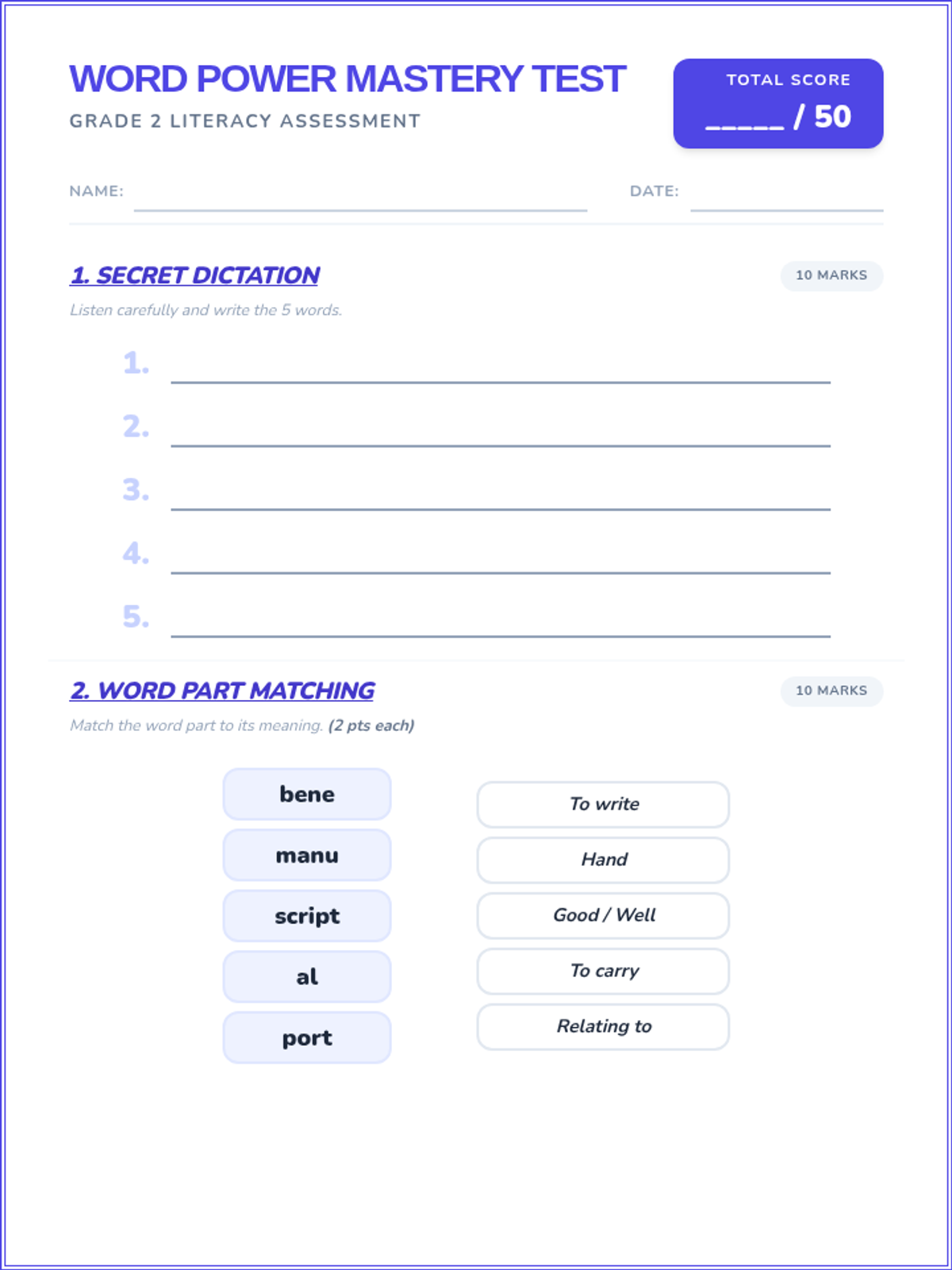
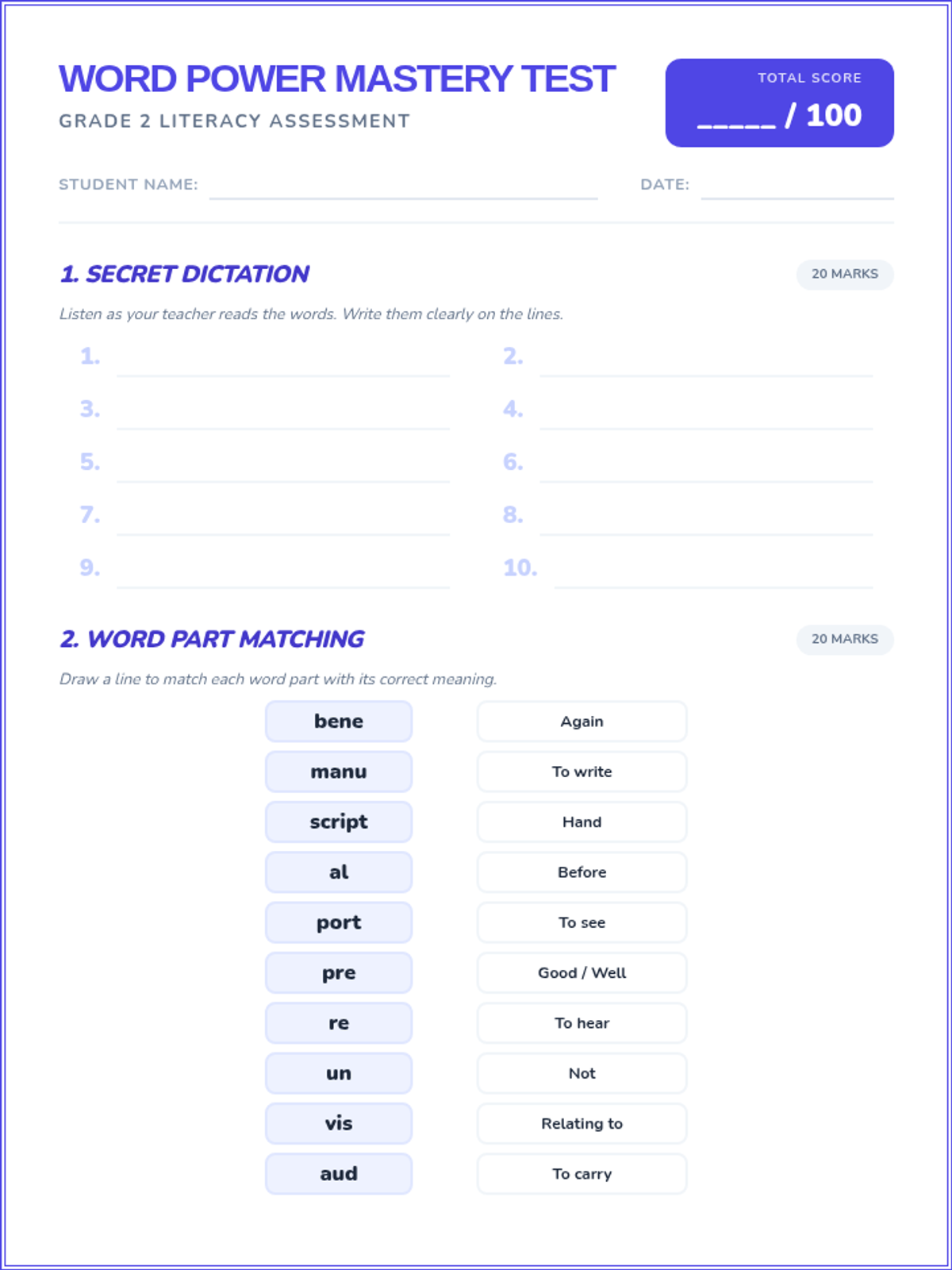
A 50-mark Grade 2 literacy test with a 5-word dictation section (10 marks), followed by morpheme matching, AI/AY completion, broad vowel identification, and plural power. Optimized for student handwriting and print.
Updated 100-mark Answer Key for the Word Power Mastery Test with corrected duplicate items and increased font size for improved teacher readability.
Expanded 100-mark Grade 2 literacy test featuring 10 dictation words, 10 morpheme matches, 20 AI/AY words, 20 broad vowel identifications (mix of A, O, U), and 20 plural transformations. Corrected duplicate items in the vowel hunt.
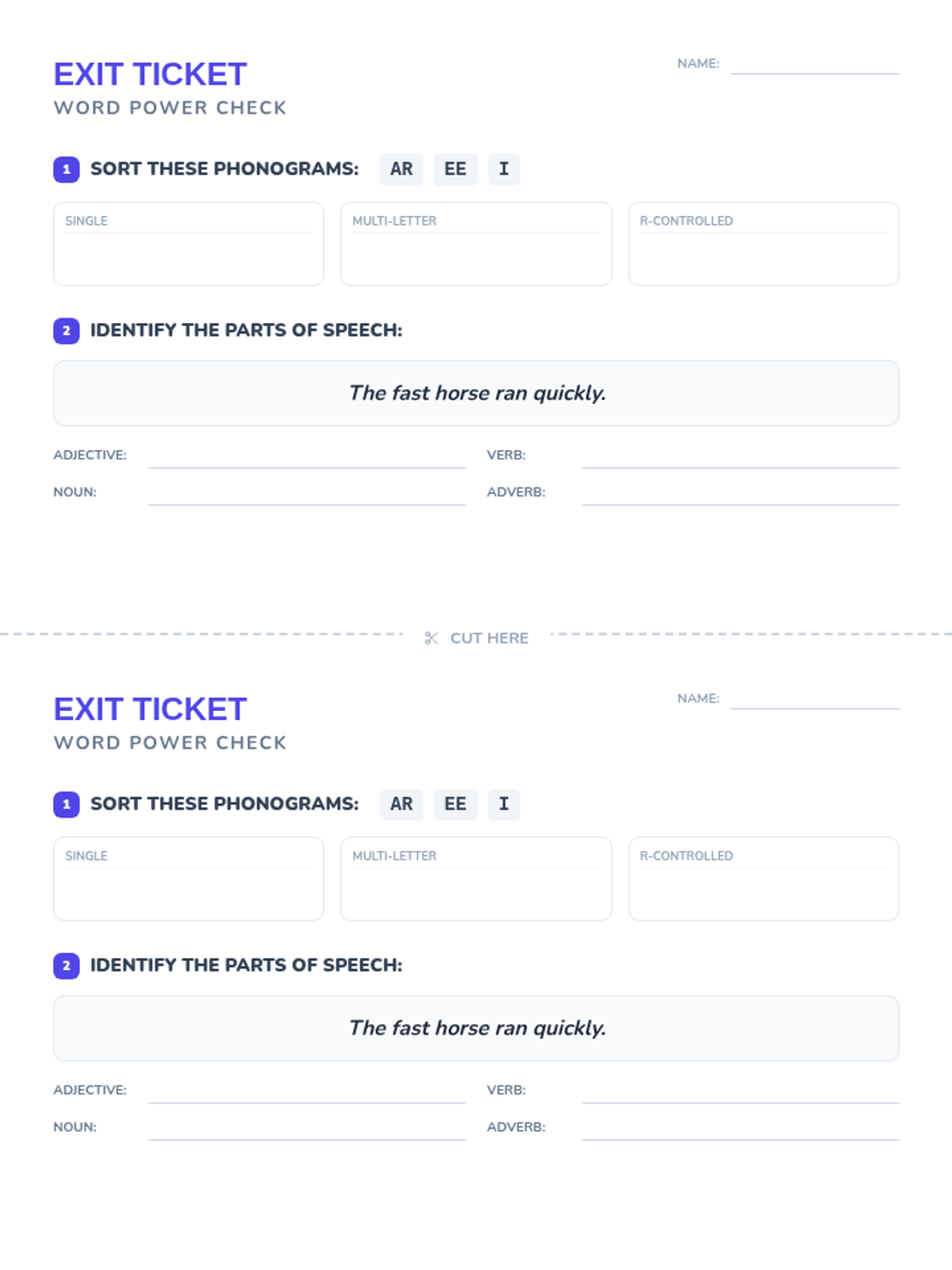
A half-sheet exit ticket for quick student assessment, featuring a phonogram sorting task and a grammar identification sentence. Two tickets per page to save paper.
A visual slide deck for instruction on phonograms and grammar identification, featuring review slides, interactive practice sentences, and Think-Pair-Share activities.
A cinematic, secret agent themed presentation deck to introduce irregular plurals with vowel shifts.
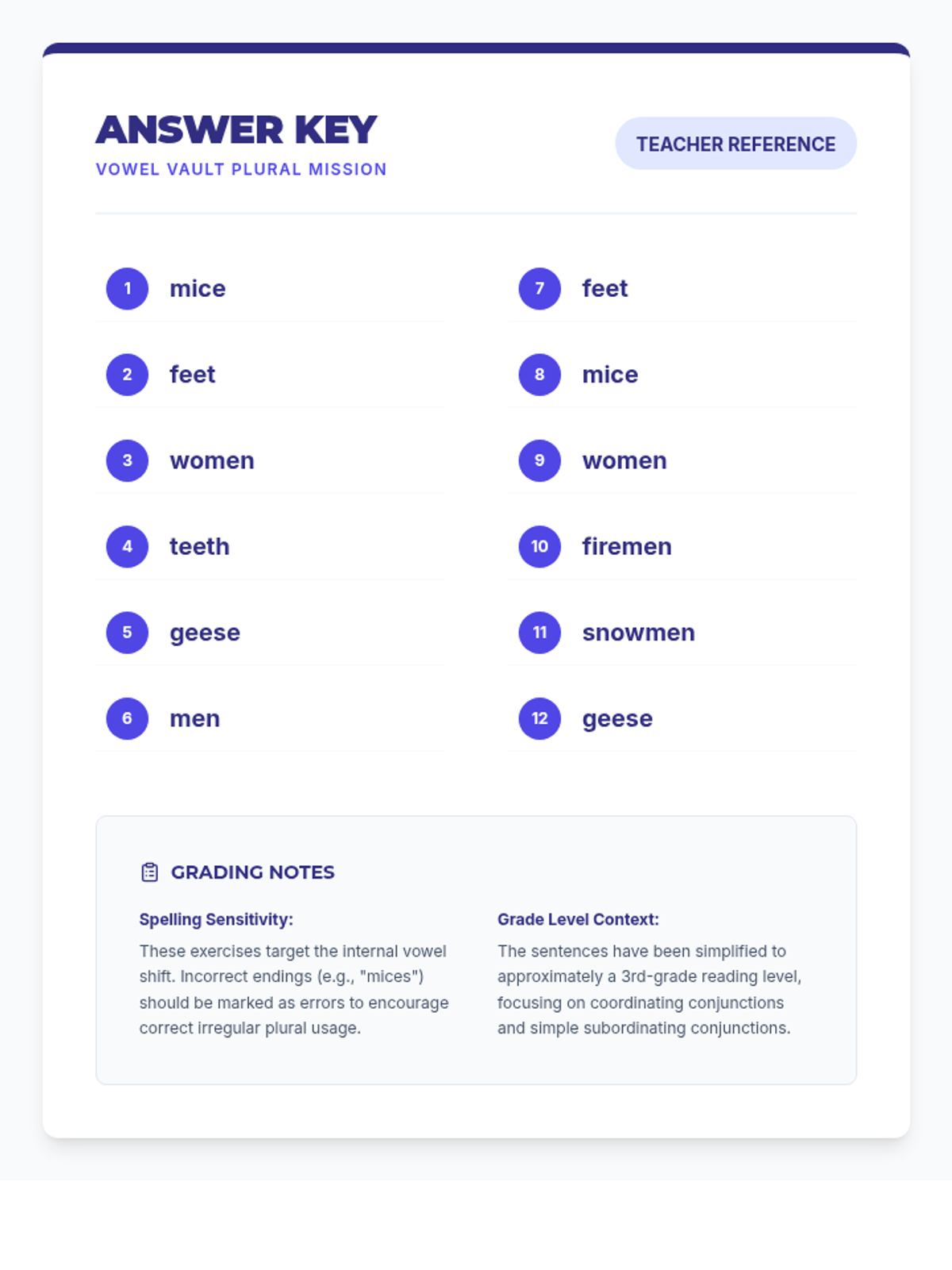
The answer key for the updated Vowel Vault Worksheet, providing correct plural forms and grading notes at a 3rd-grade reading level.
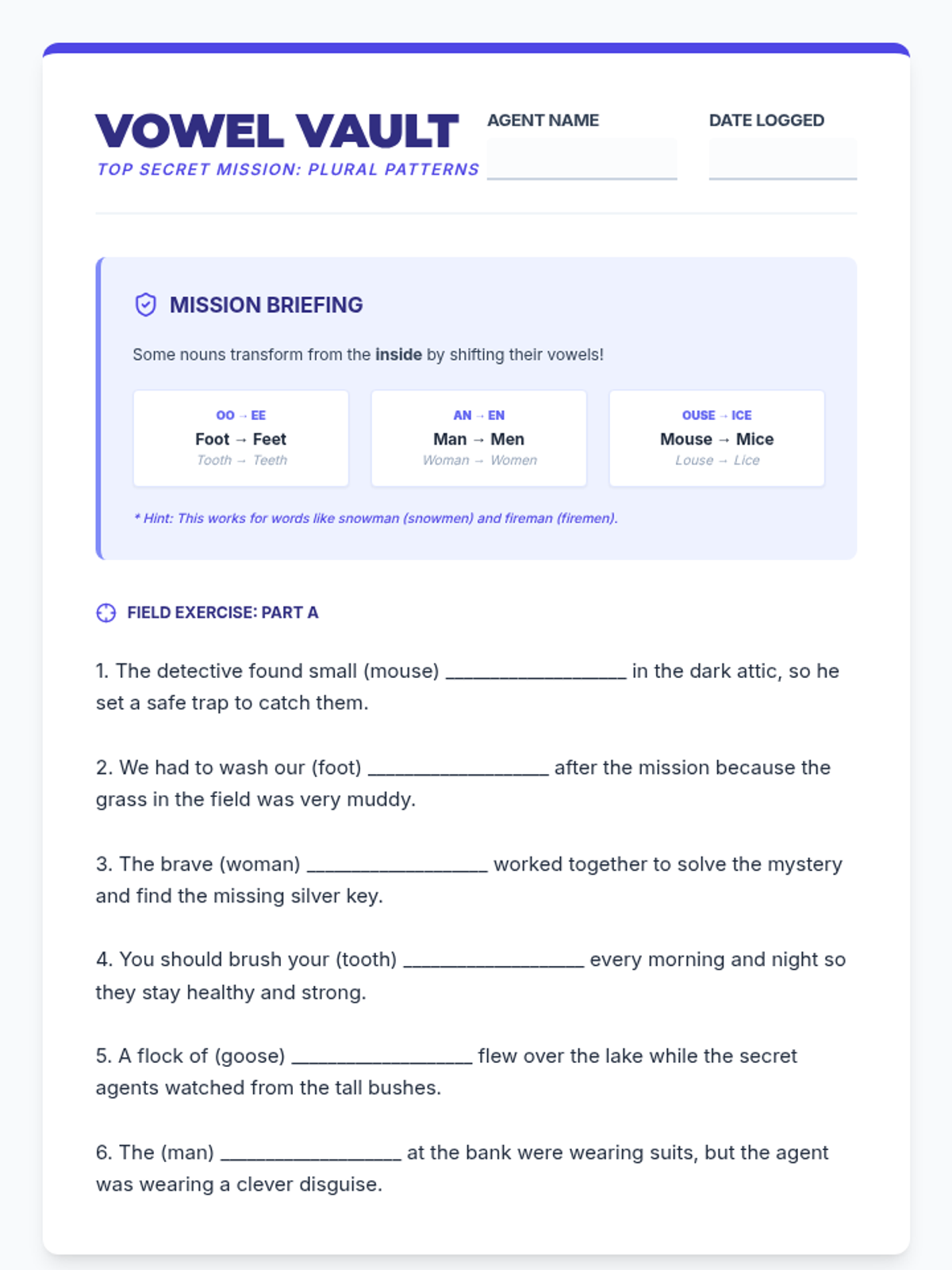
A two-page secret agent themed worksheet for practicing irregular plurals with vowel shift patterns through sentence completion at a 3rd-grade level.
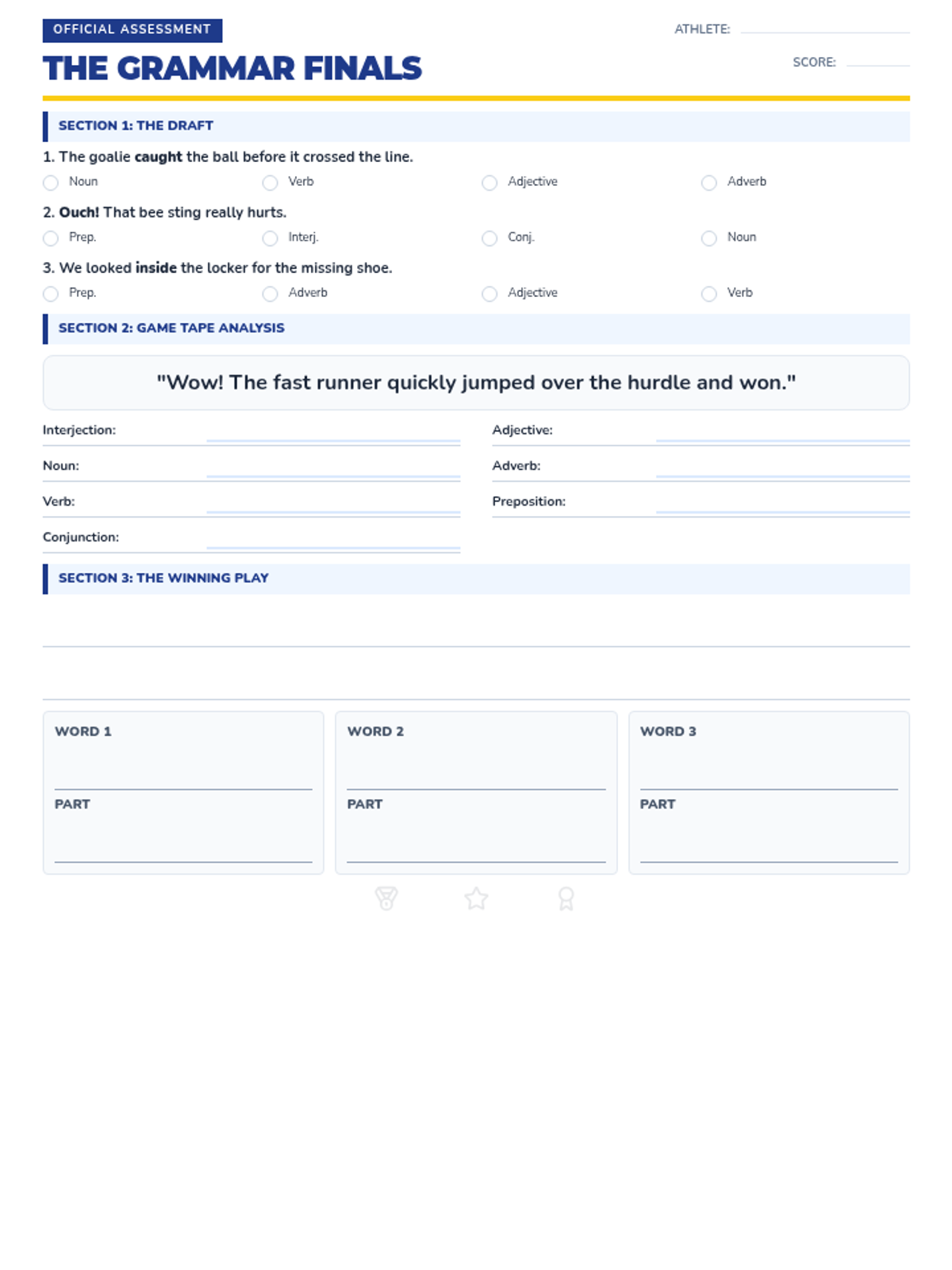
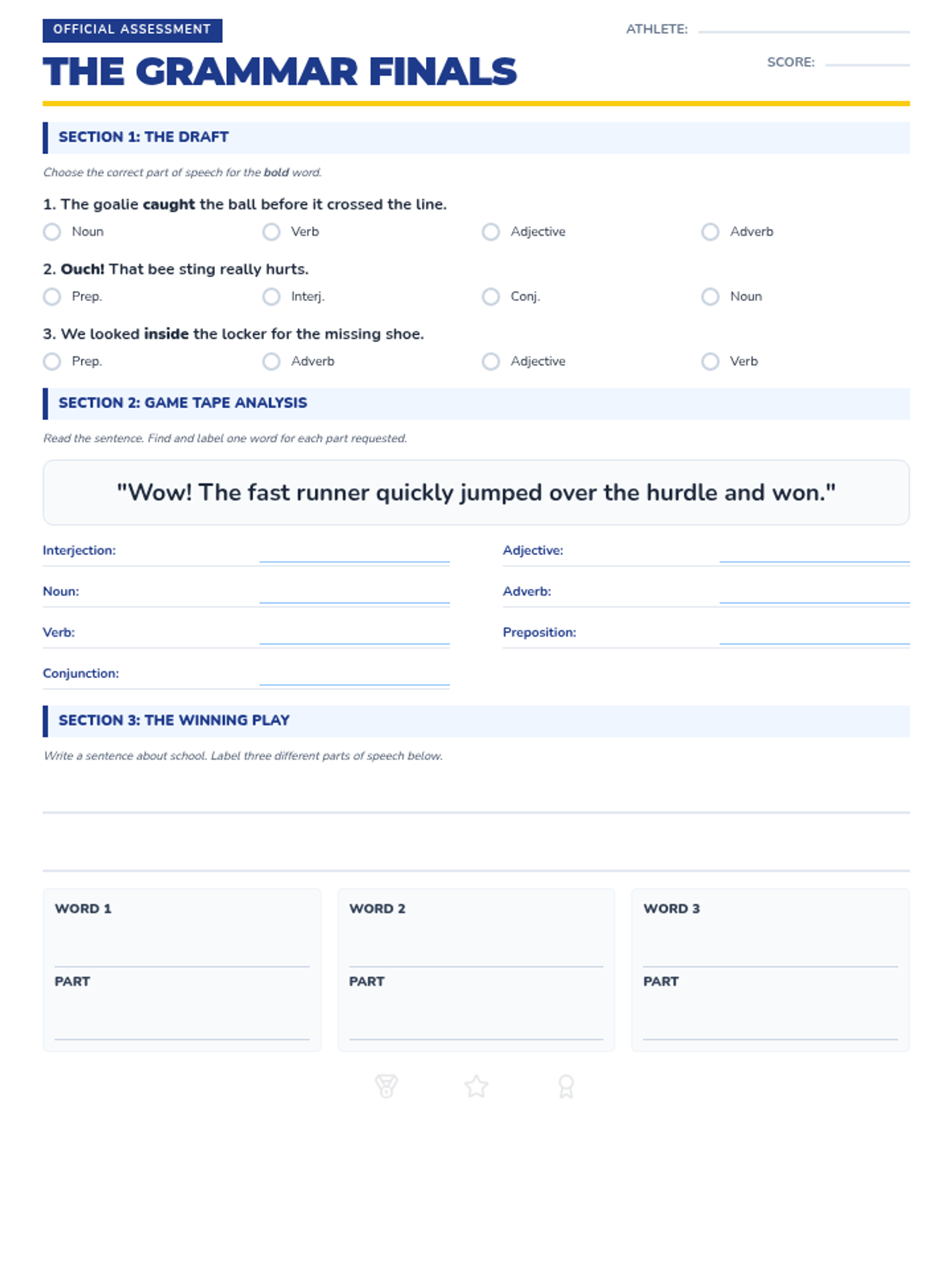
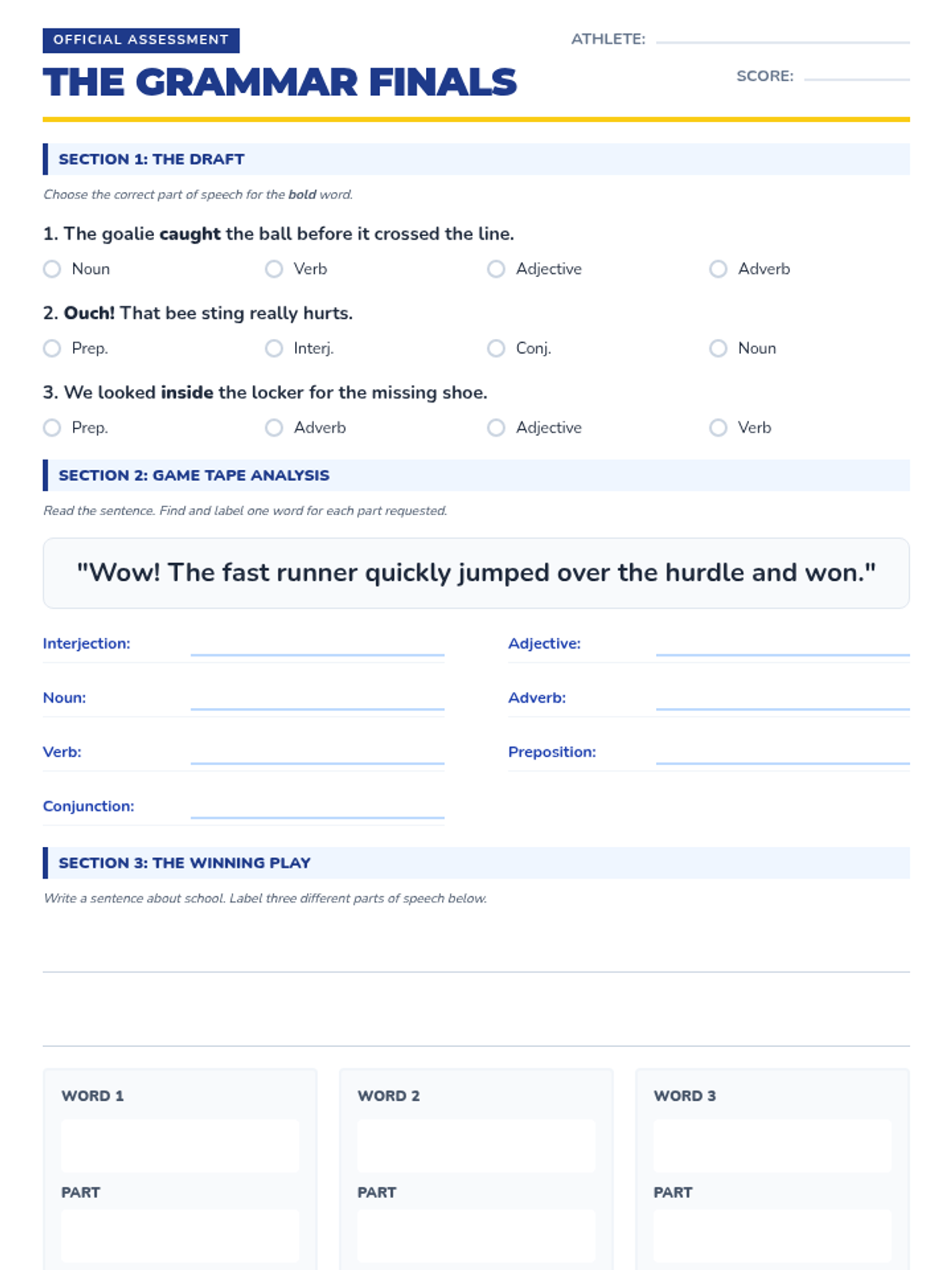
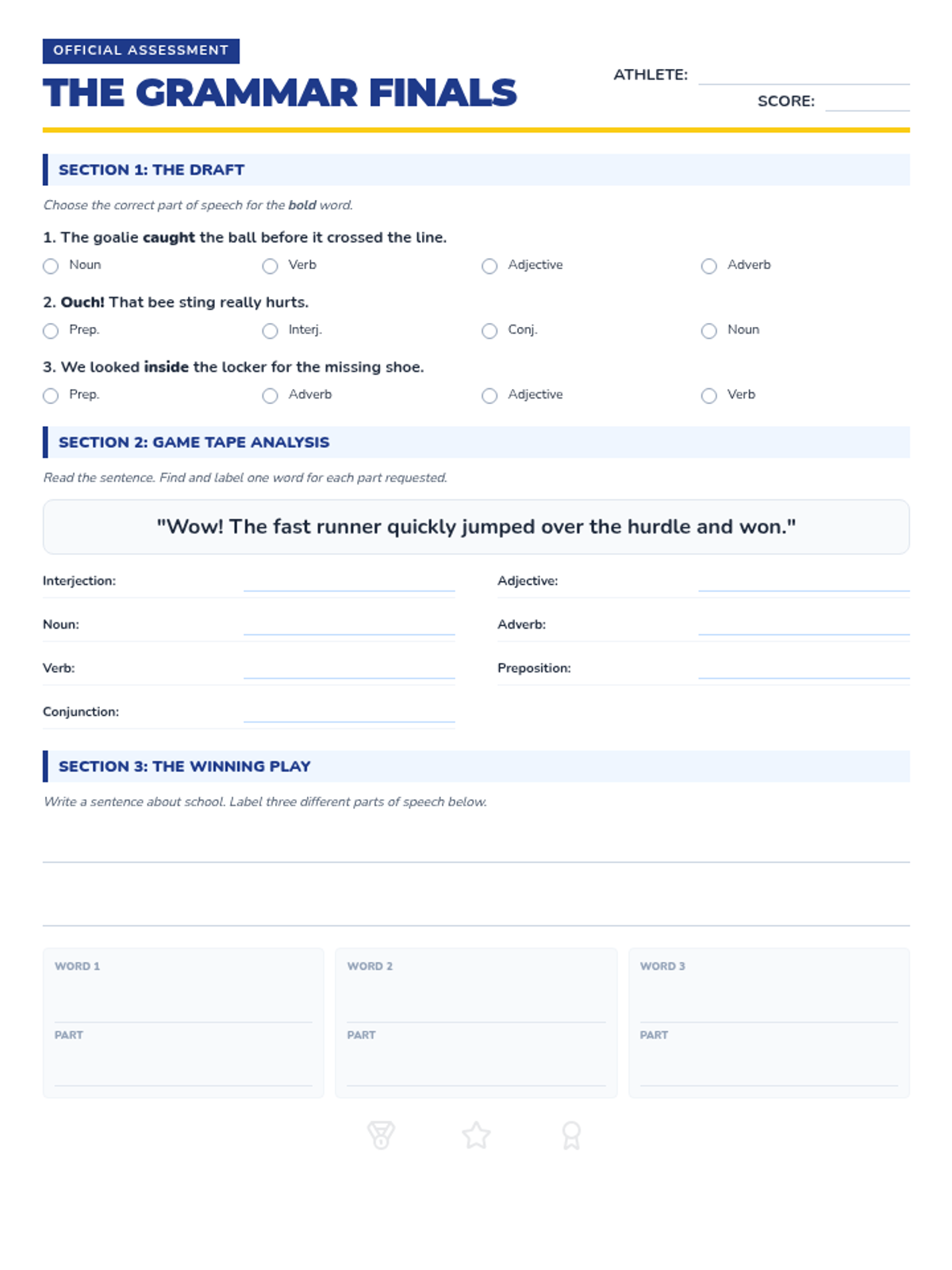
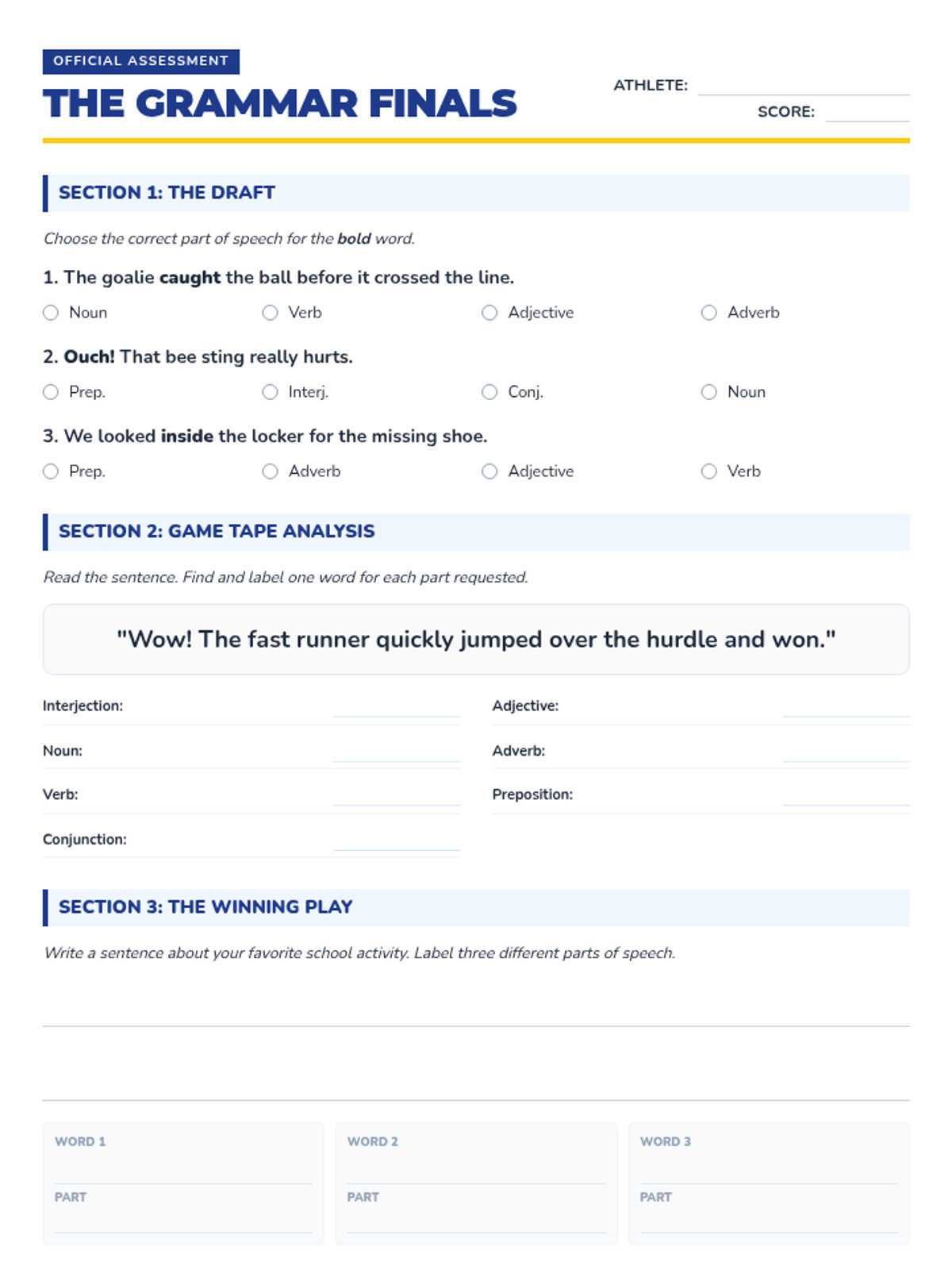
A comprehensive 1-page assessment quiz featuring multiple-choice identification, contextual analysis, and creative writing. Revised to fit on a single page with improved handwriting space.
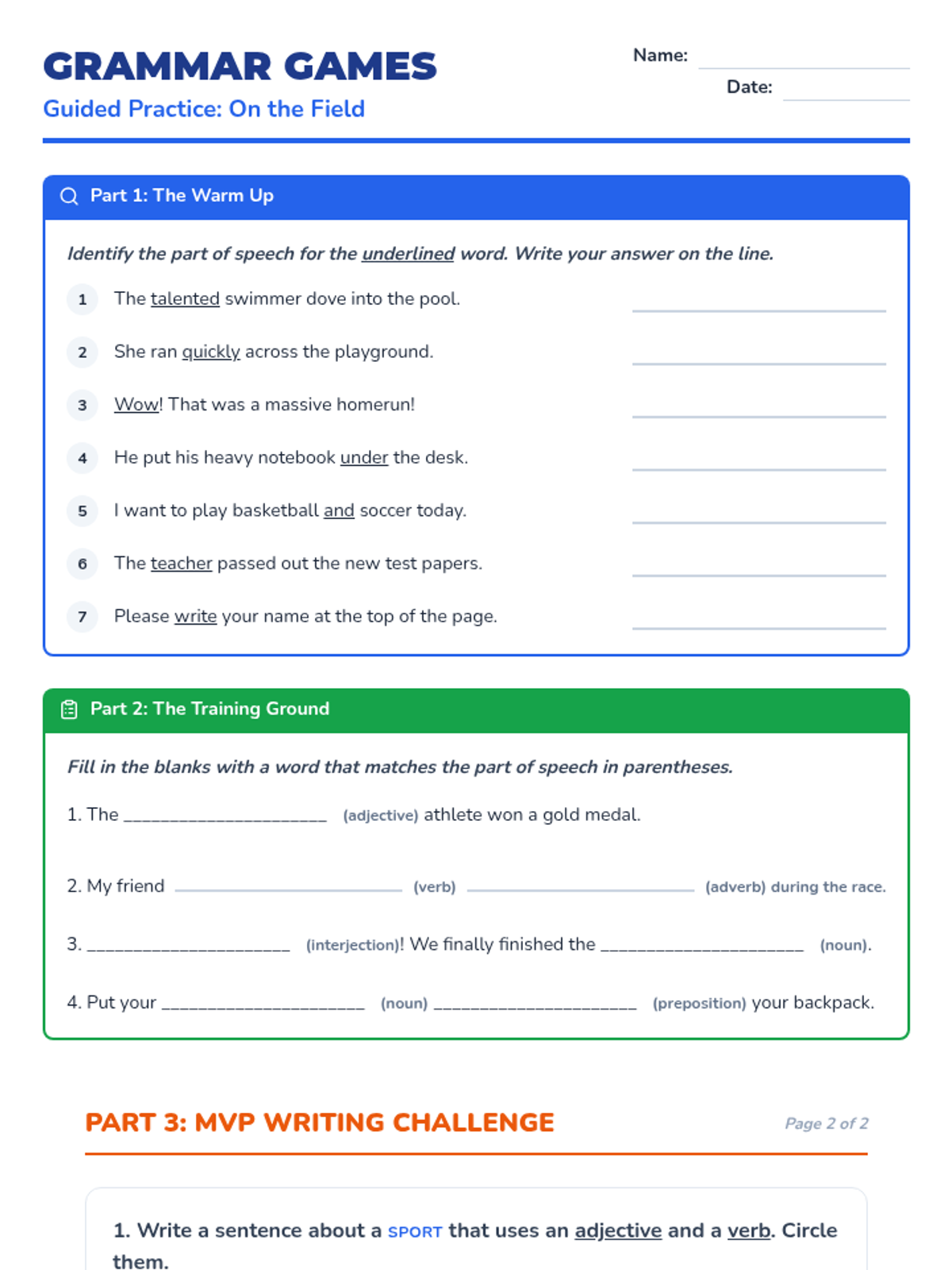
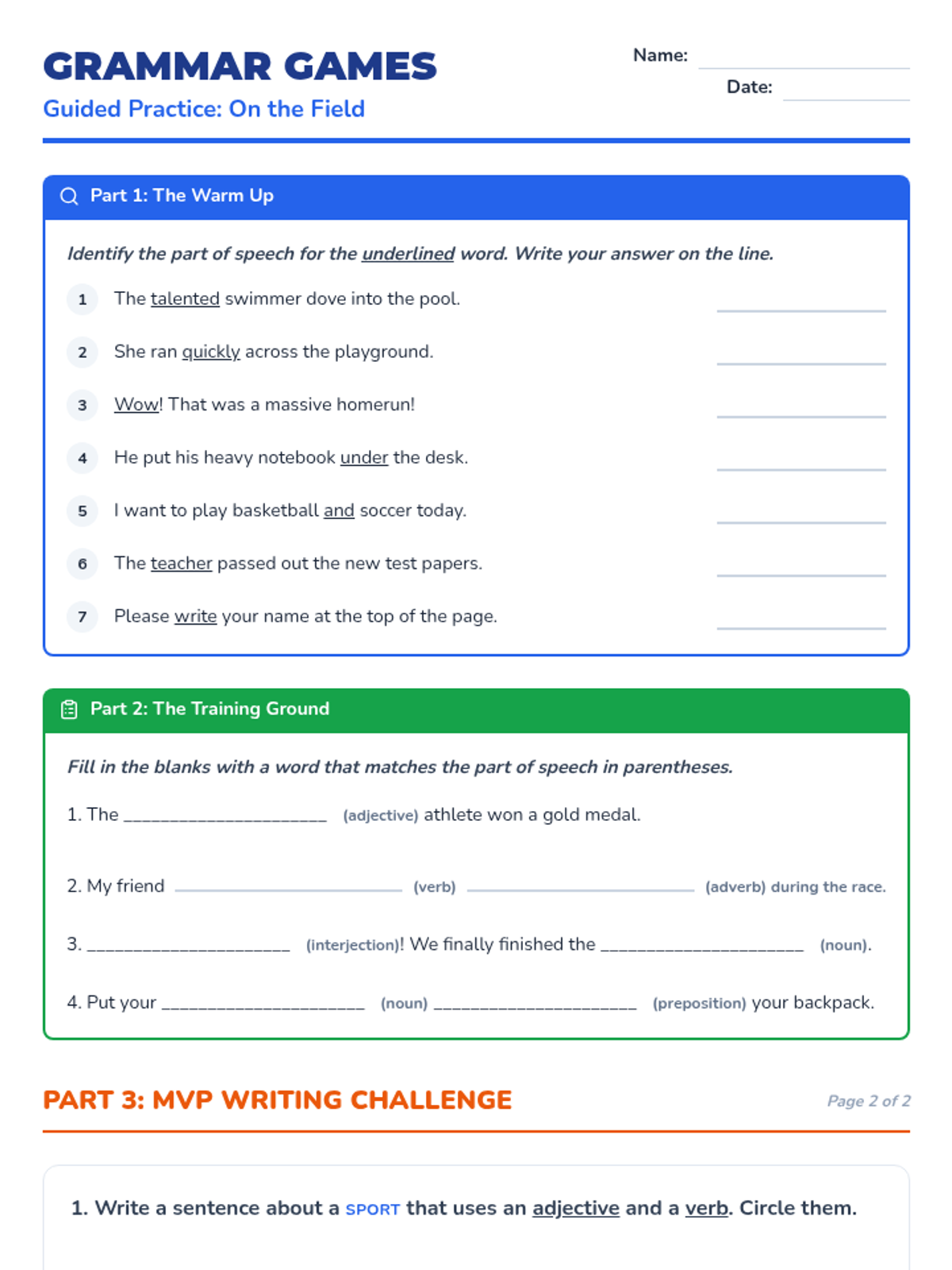
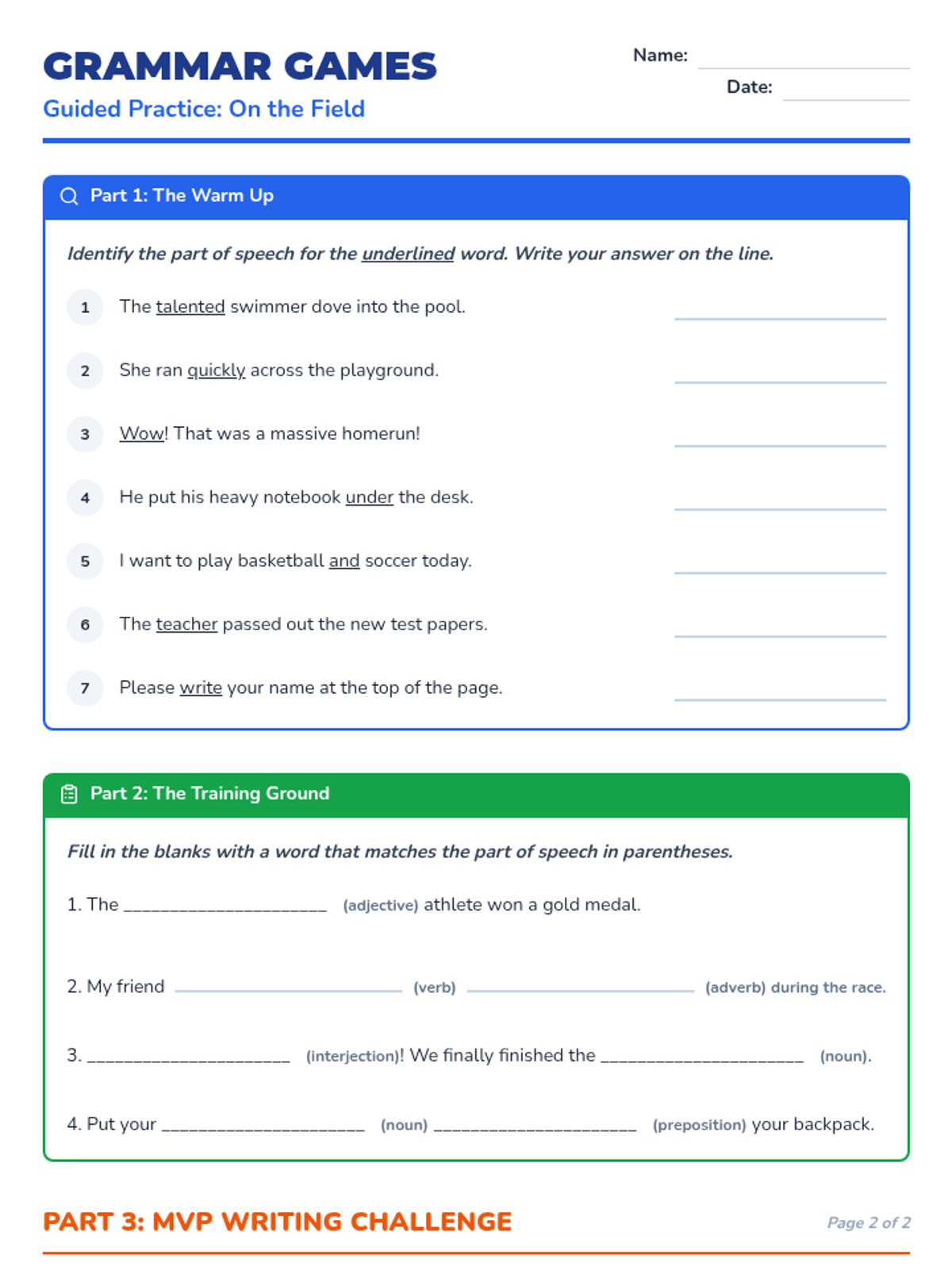
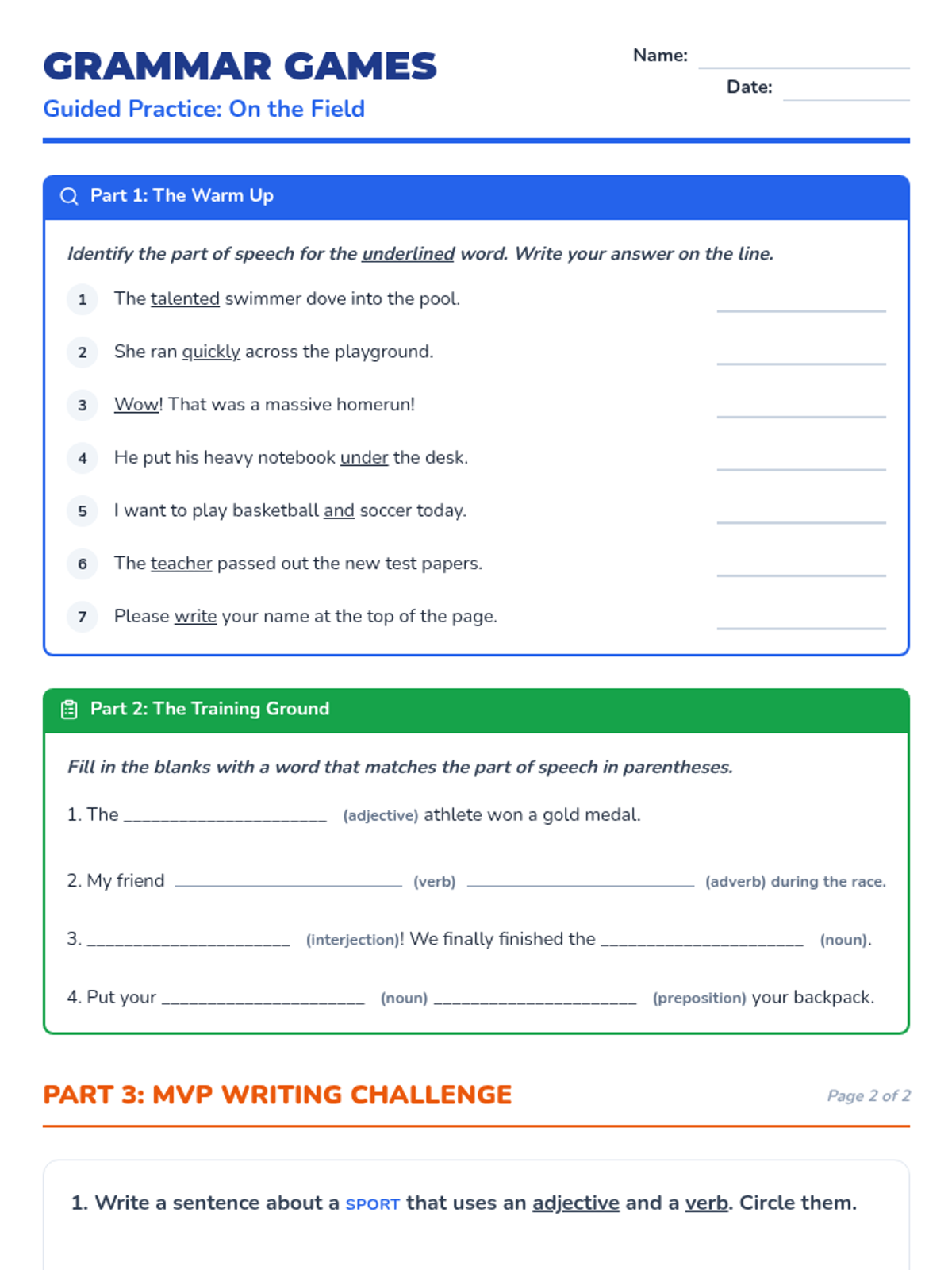
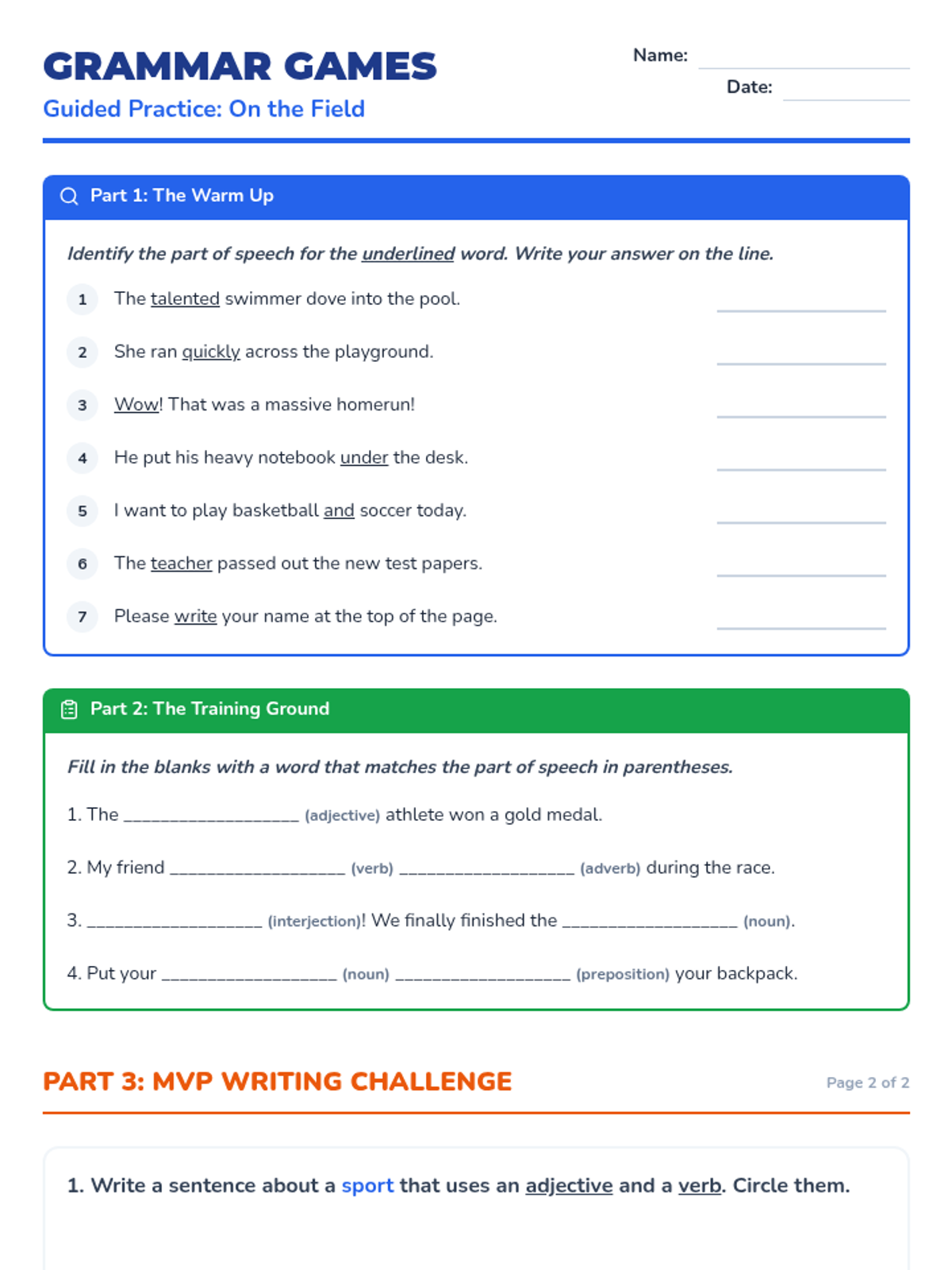
A 2-page guided practice worksheet where students identify parts of speech in athletic and academic contexts and apply their knowledge by writing original sentences. Revised for better page flow and student work areas.
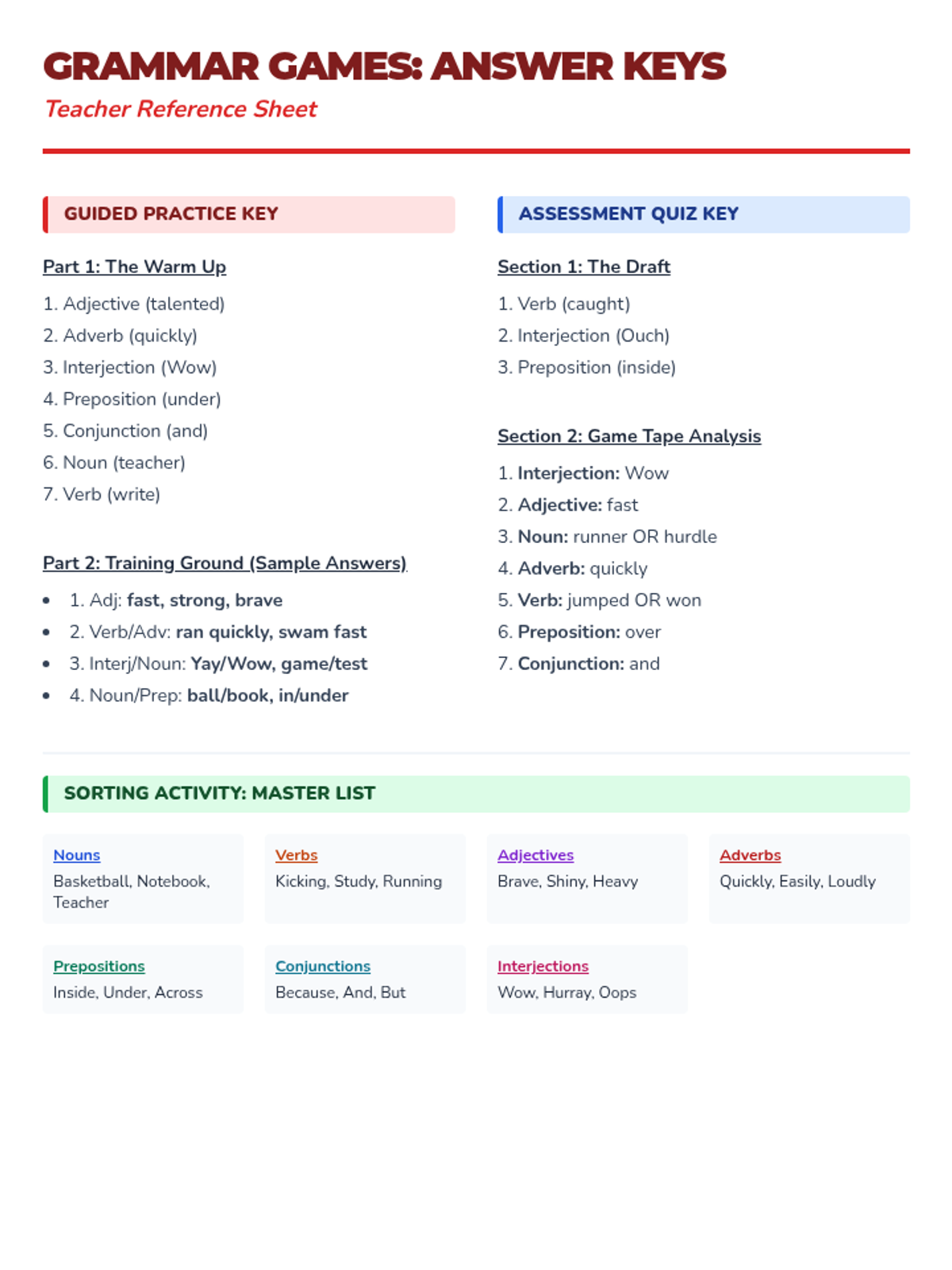
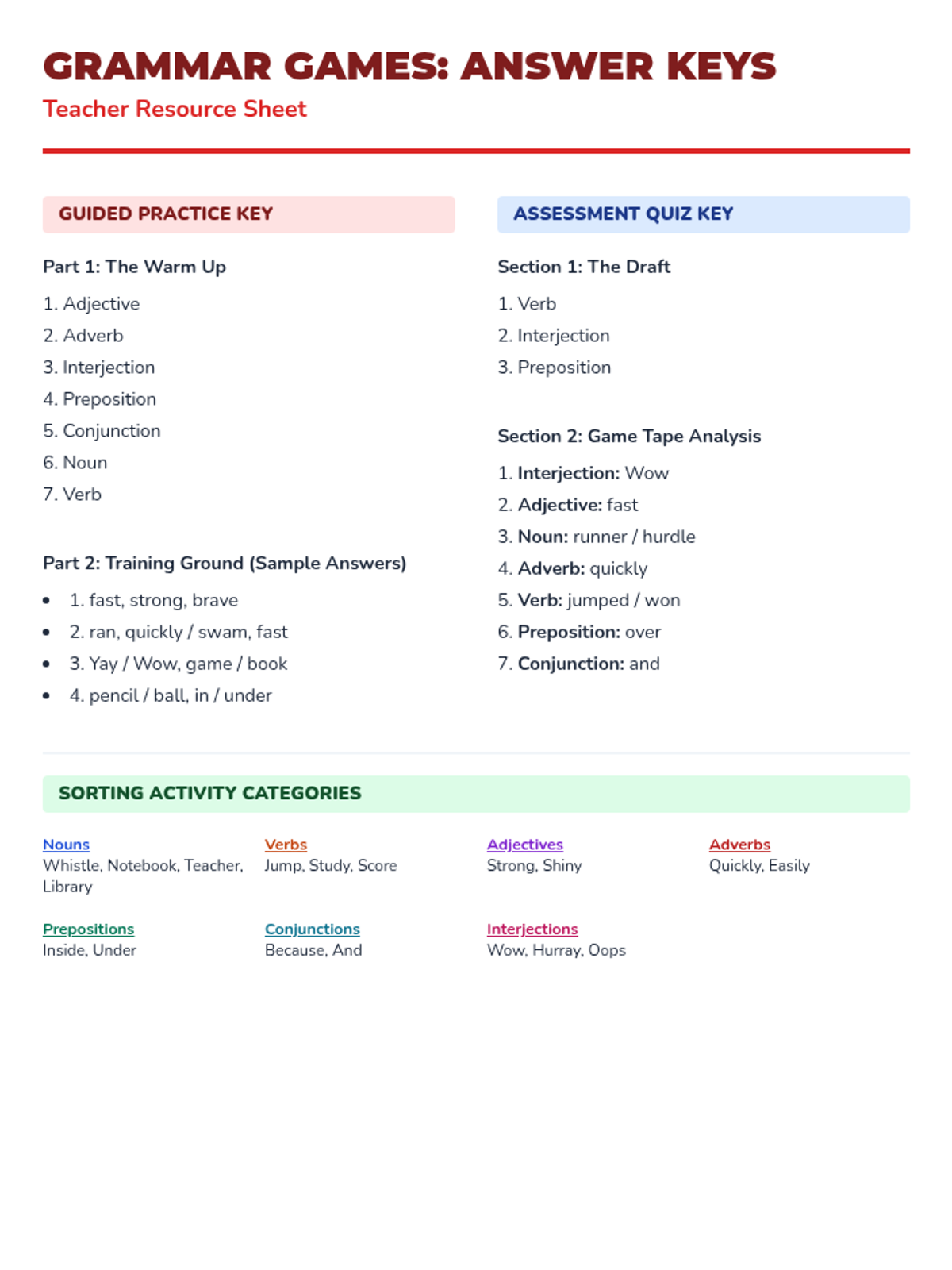
A comprehensive answer key for teachers, covering the guided practice worksheet, sorting activity, and assessment quiz. Updated to match revised layouts and word choices.
A comprehensive answer key for teachers, covering the guided practice worksheet, the sorting activity, and the assessment quiz. Includes sample answers for open-ended writing prompts.
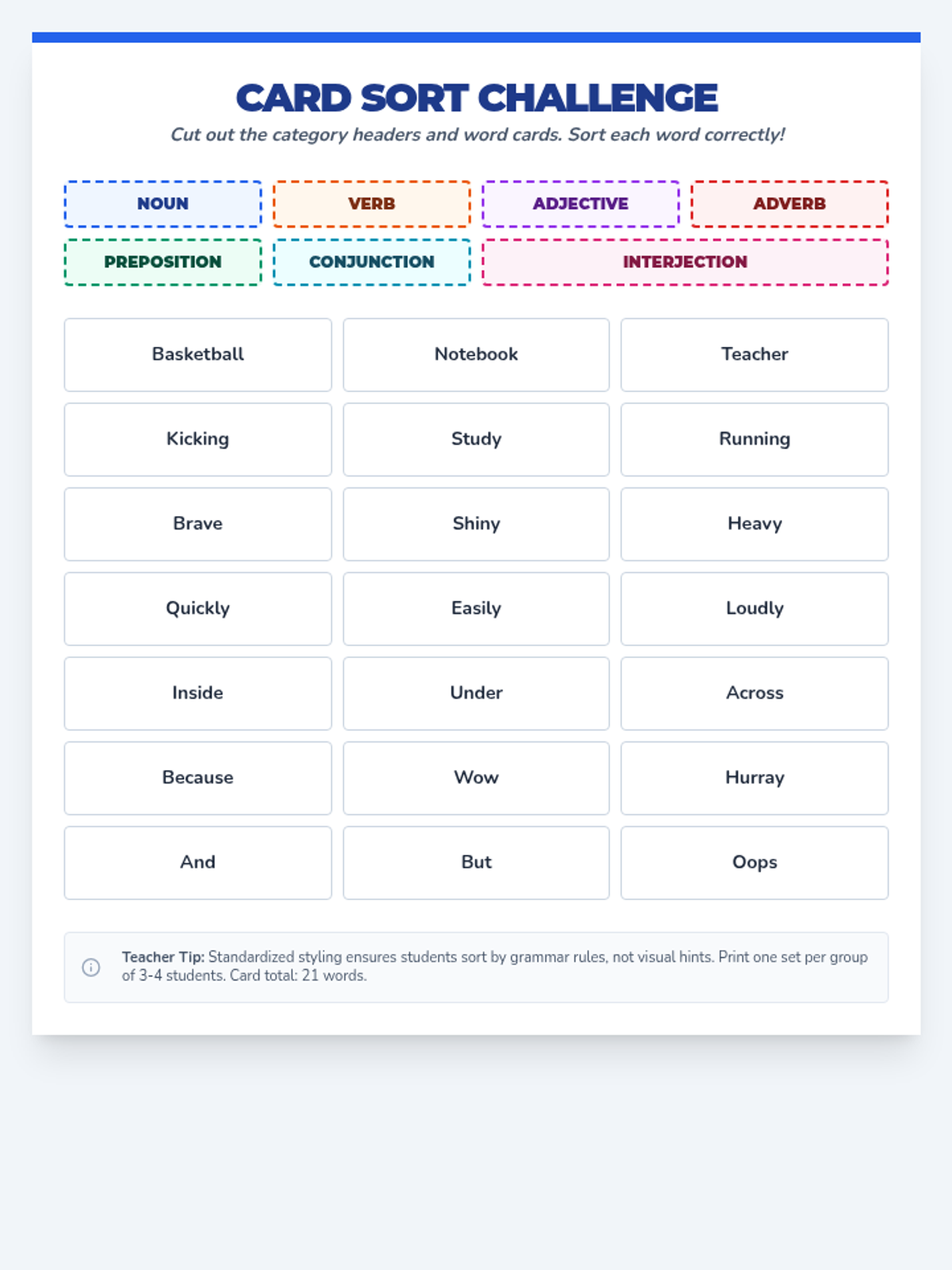
A hands-on small group activity featuring cut-out cards for all seven parts of speech. Revised to fit on a single page with standardized styling to prevent visual cues.
A set of 8 instructional slides defining the seven primary parts of speech with clear definitions and themed examples from sports and school life.
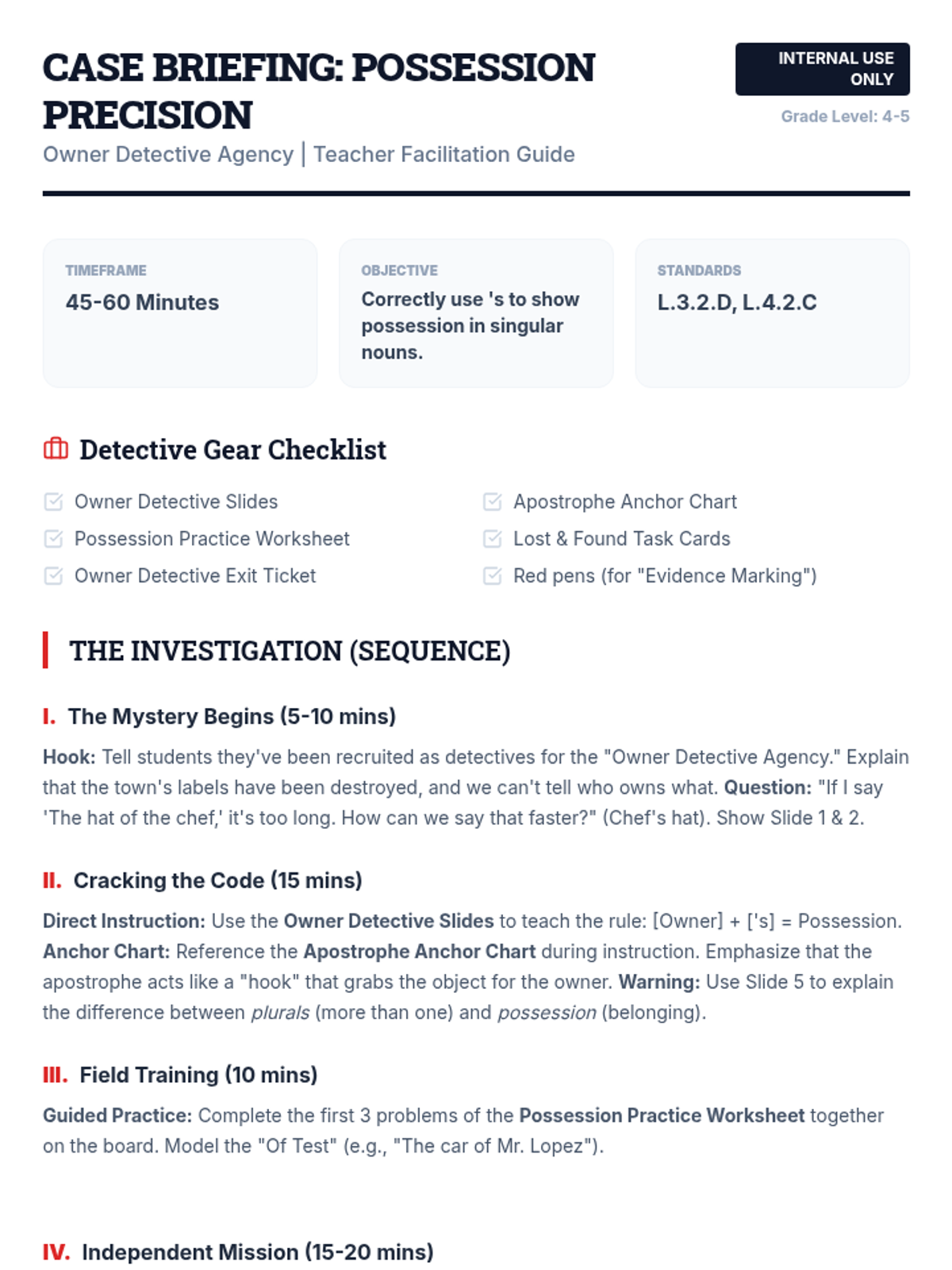
A comprehensive teacher lesson plan for the Possession Precision lesson, outlining objectives, materials, procedures, and differentiation strategies.
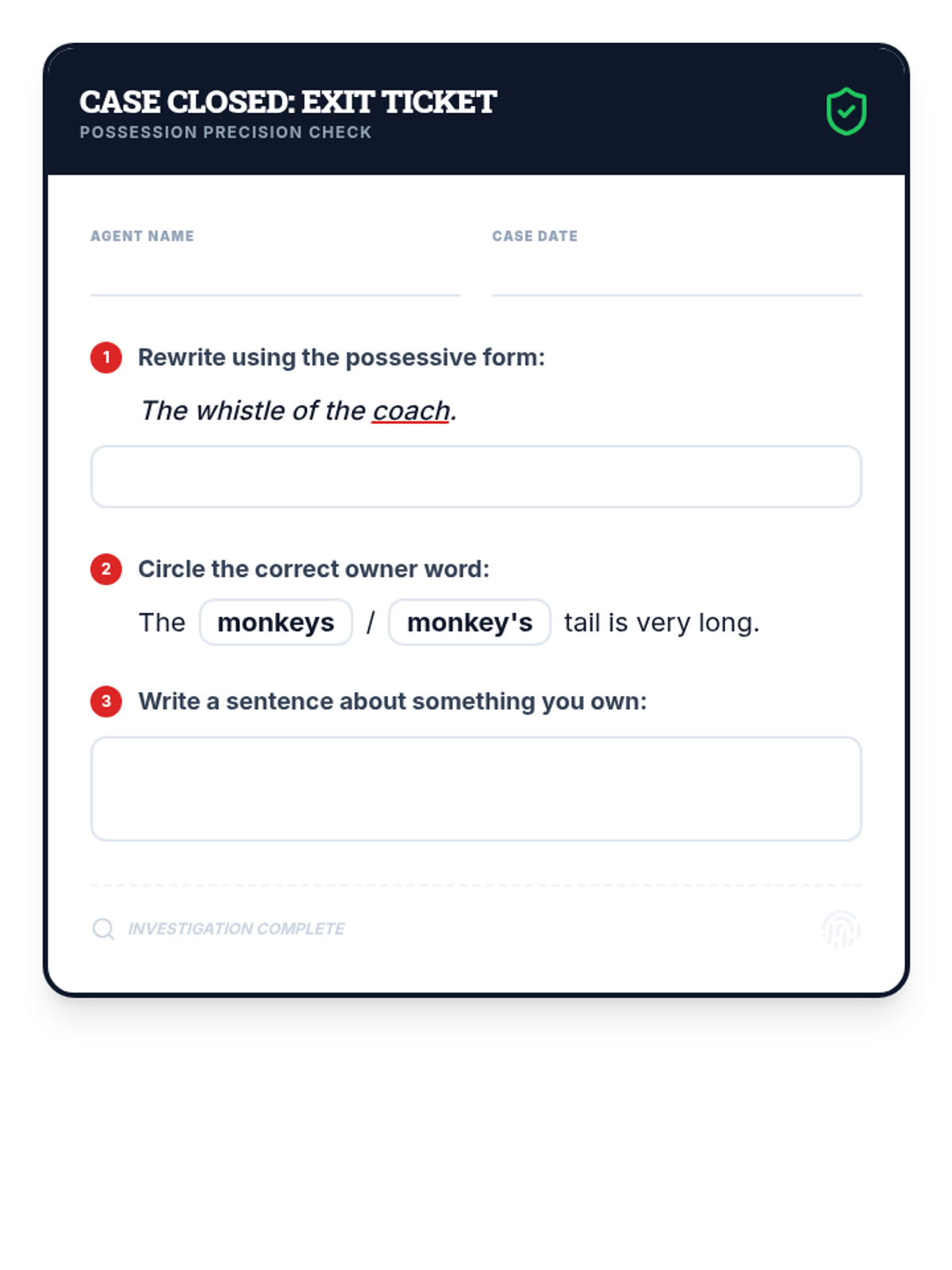
A detective-themed exit ticket for a quick end-of-lesson assessment of singular possessive noun rules.
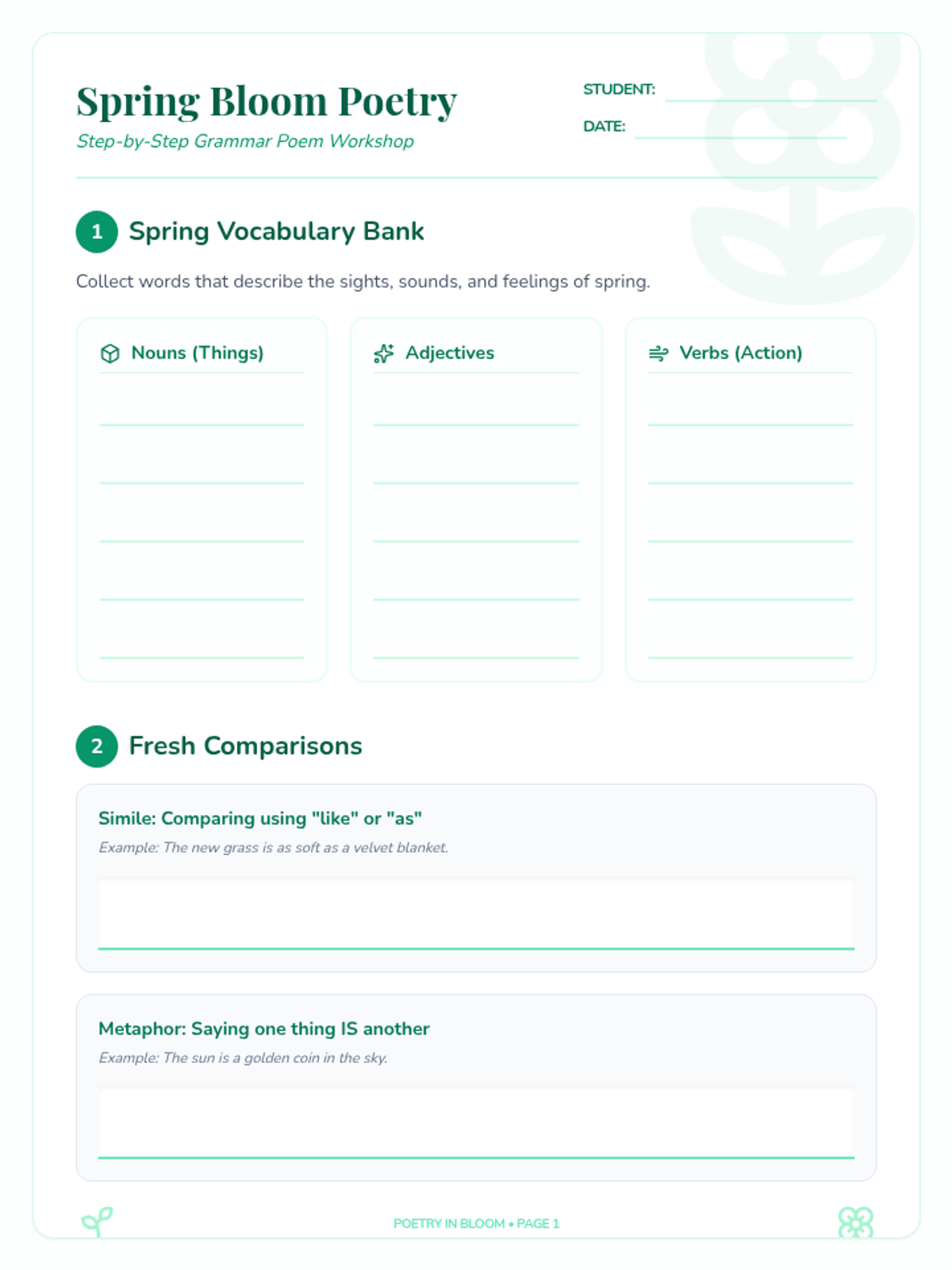
A two-page guided worksheet for students to brainstorm spring-themed grammar and figurative language, then craft a structured poem.
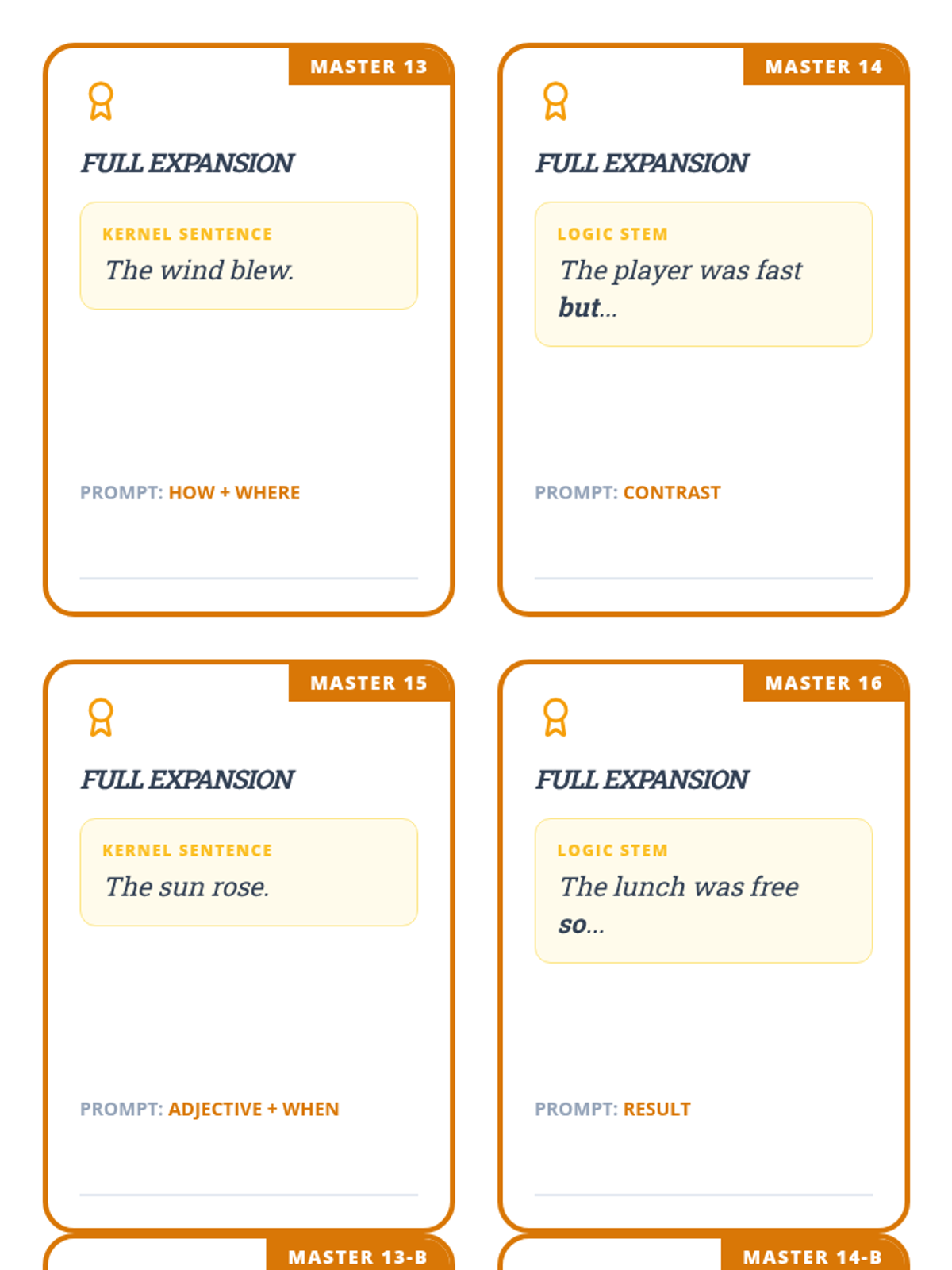
A final set of 8 task cards for mixed review of all sentence expansion strategies. These cards are designed for final progress monitoring.
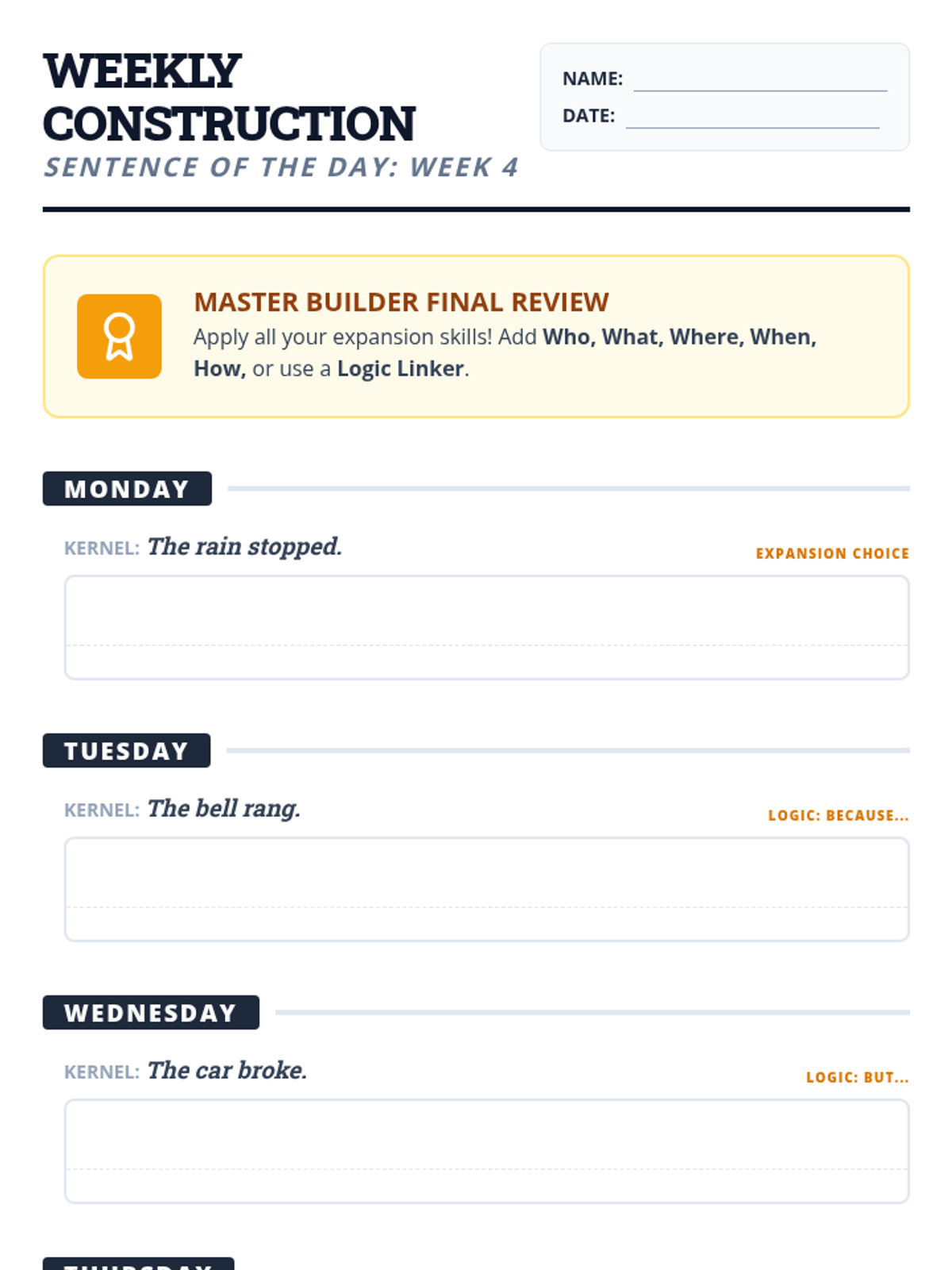
A weekly student worksheet focusing on mixed sentence expansion and logical completion for the final review week.
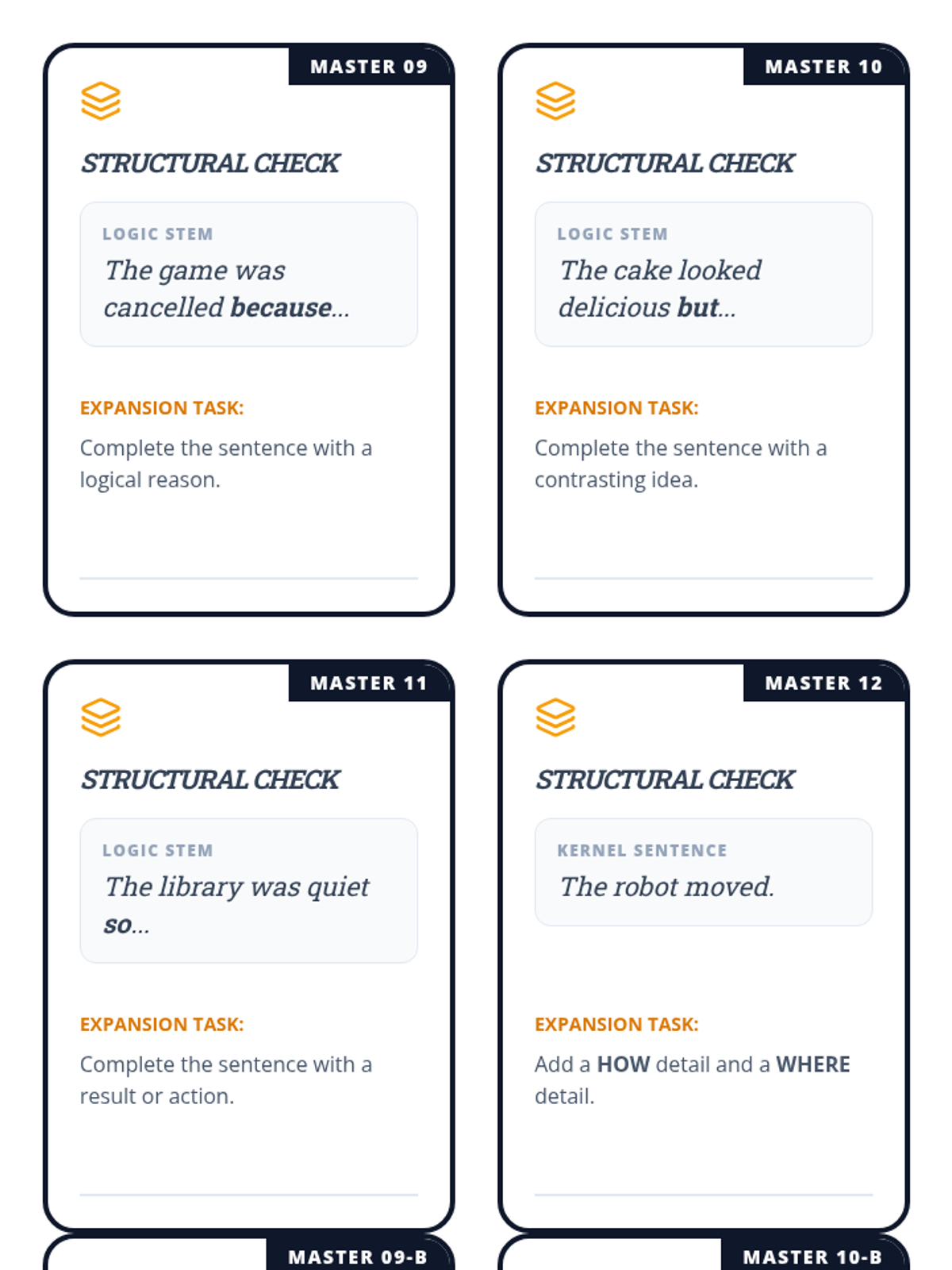
A set of 8 printable task cards for mastering logical conjunctions (Because, But, So) and mixed kernel expansion. Ideal for progress monitoring.
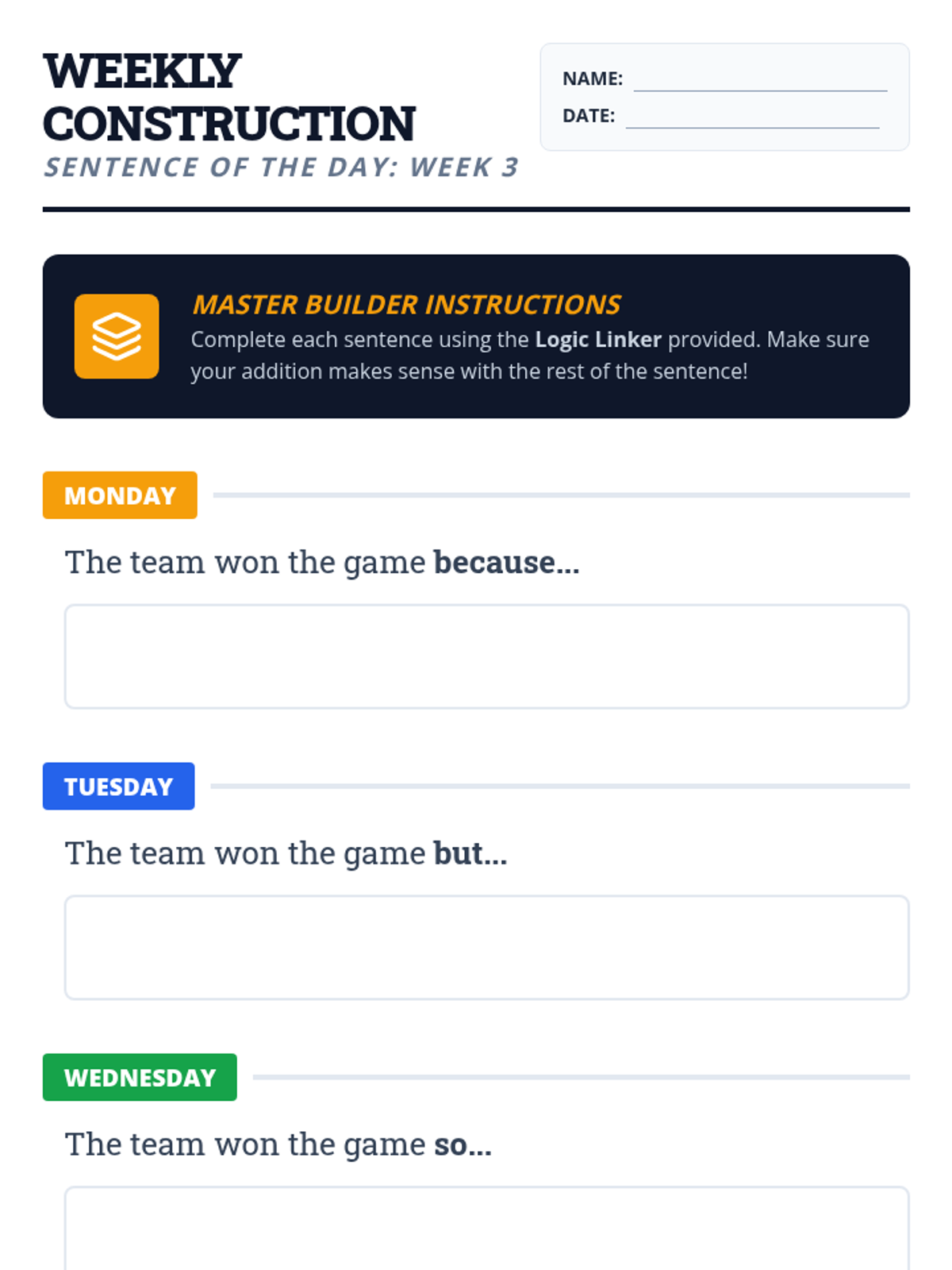
A weekly student worksheet focusing on logical sentence completion using 'Because, But, So' conjunctions.
Instructional slides for the third lesson in the Sentence Architects series. These slides focus on using 'Because, But, So' conjunctions to expand sentences logically, following the Hochman Method framework.
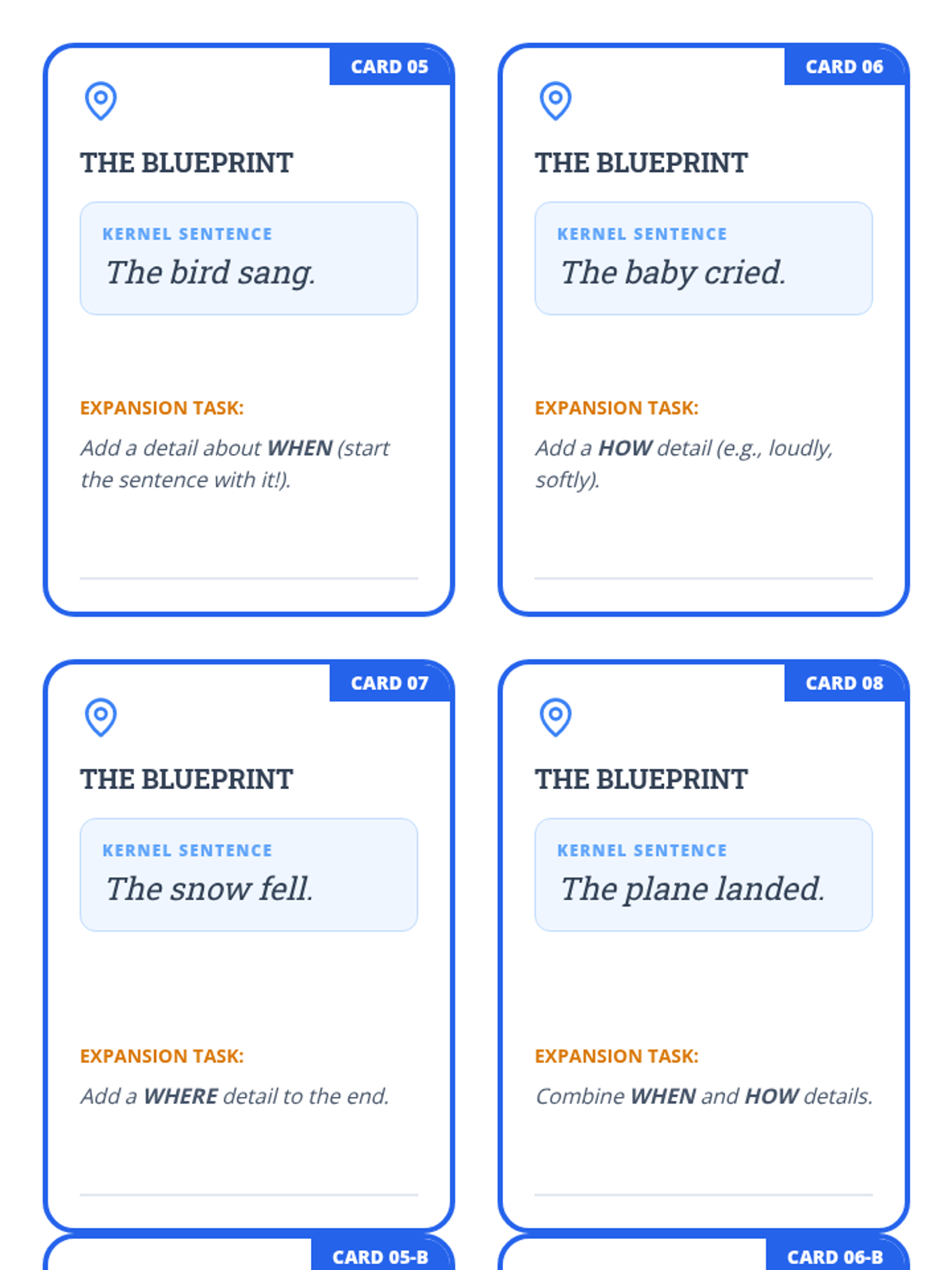
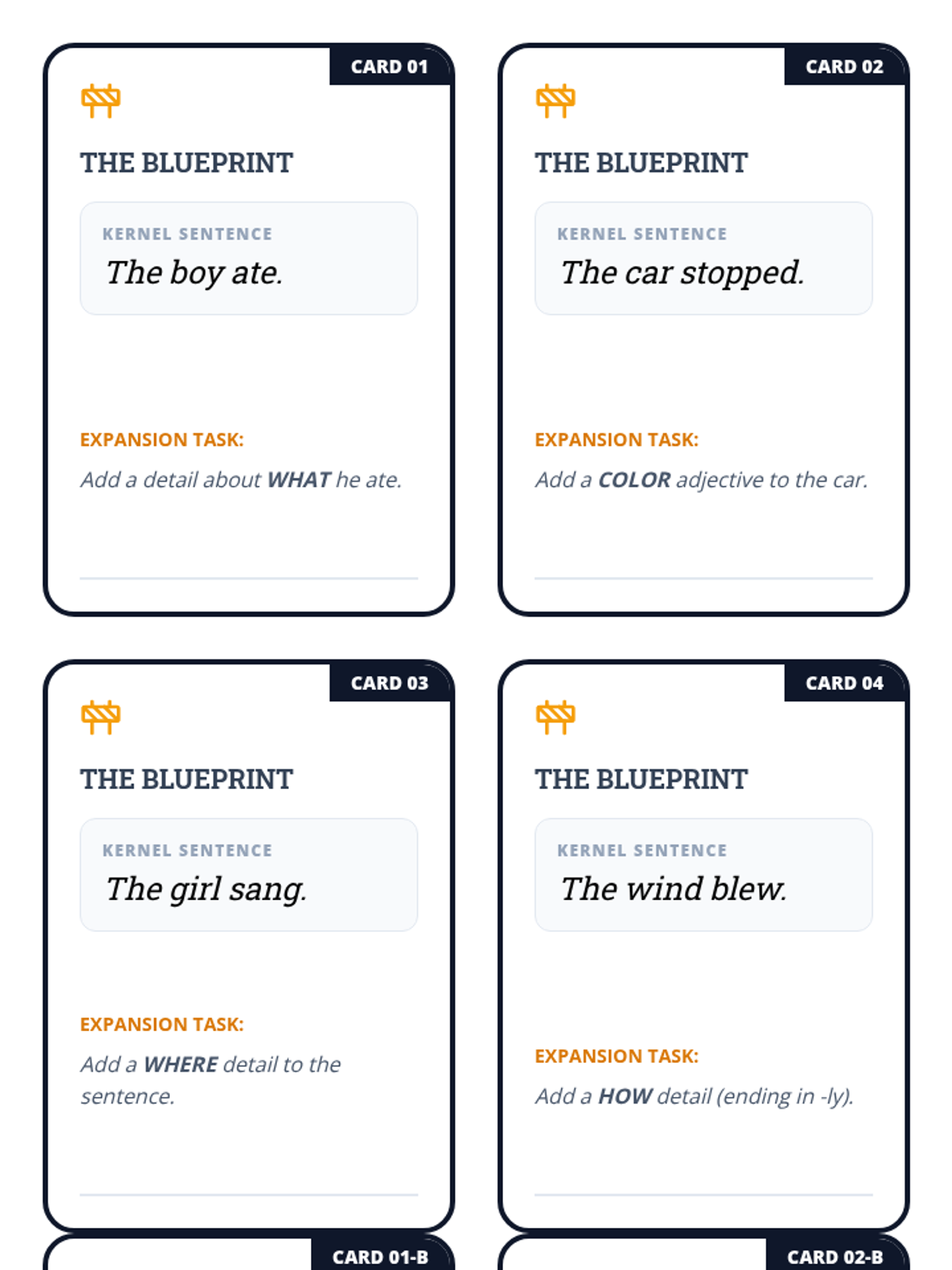
A second set of task cards for sentence expansion, specifically targeting 'When', 'Where', and 'How' details. These cards are designed for progress monitoring data collection.
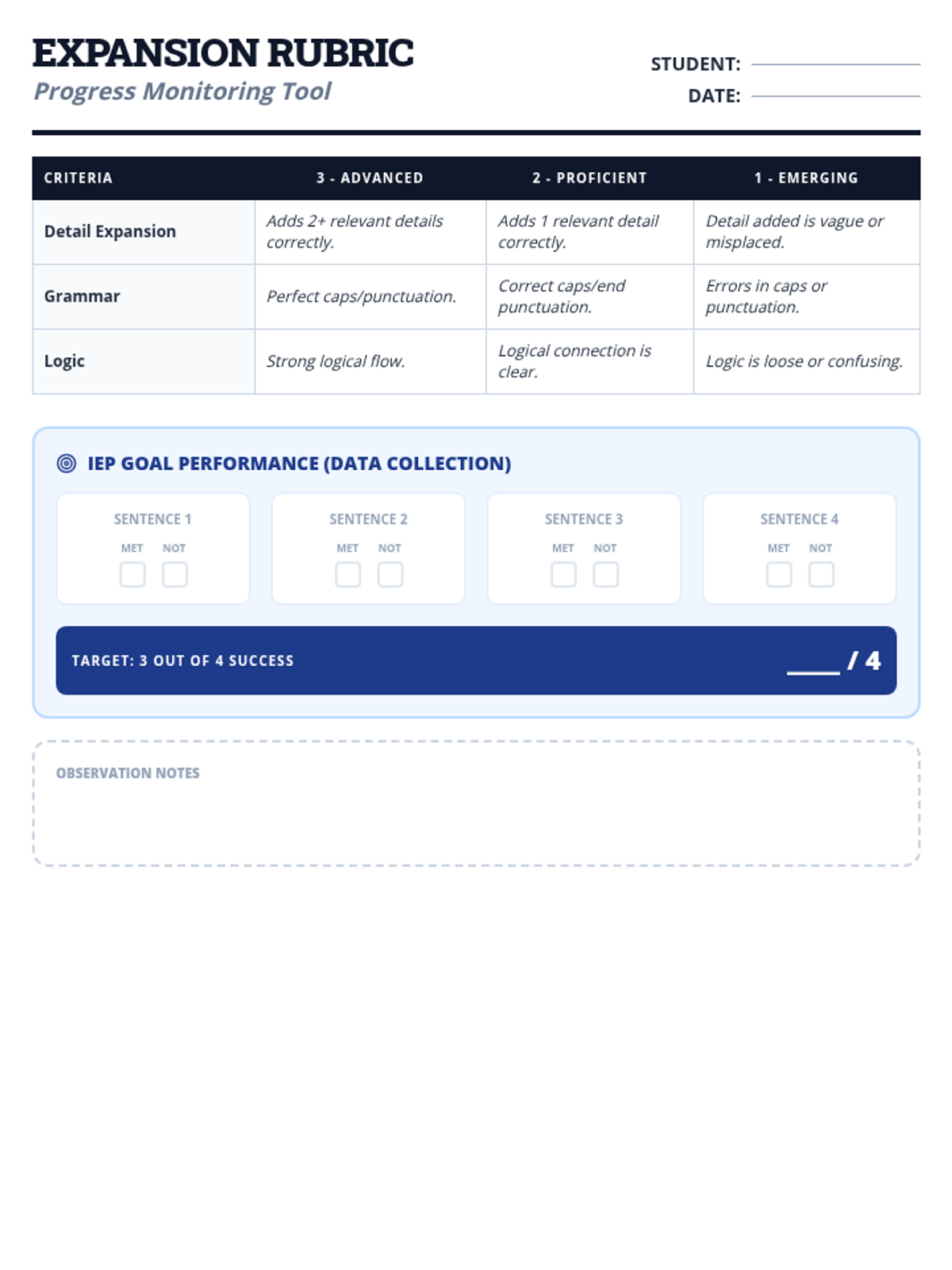
A comprehensive teacher resource for tracking student progress toward sentence expansion IEP goals. Includes a 3-point rubric and a specific data collection area for monitoring the 3-out-of-4 success rate.
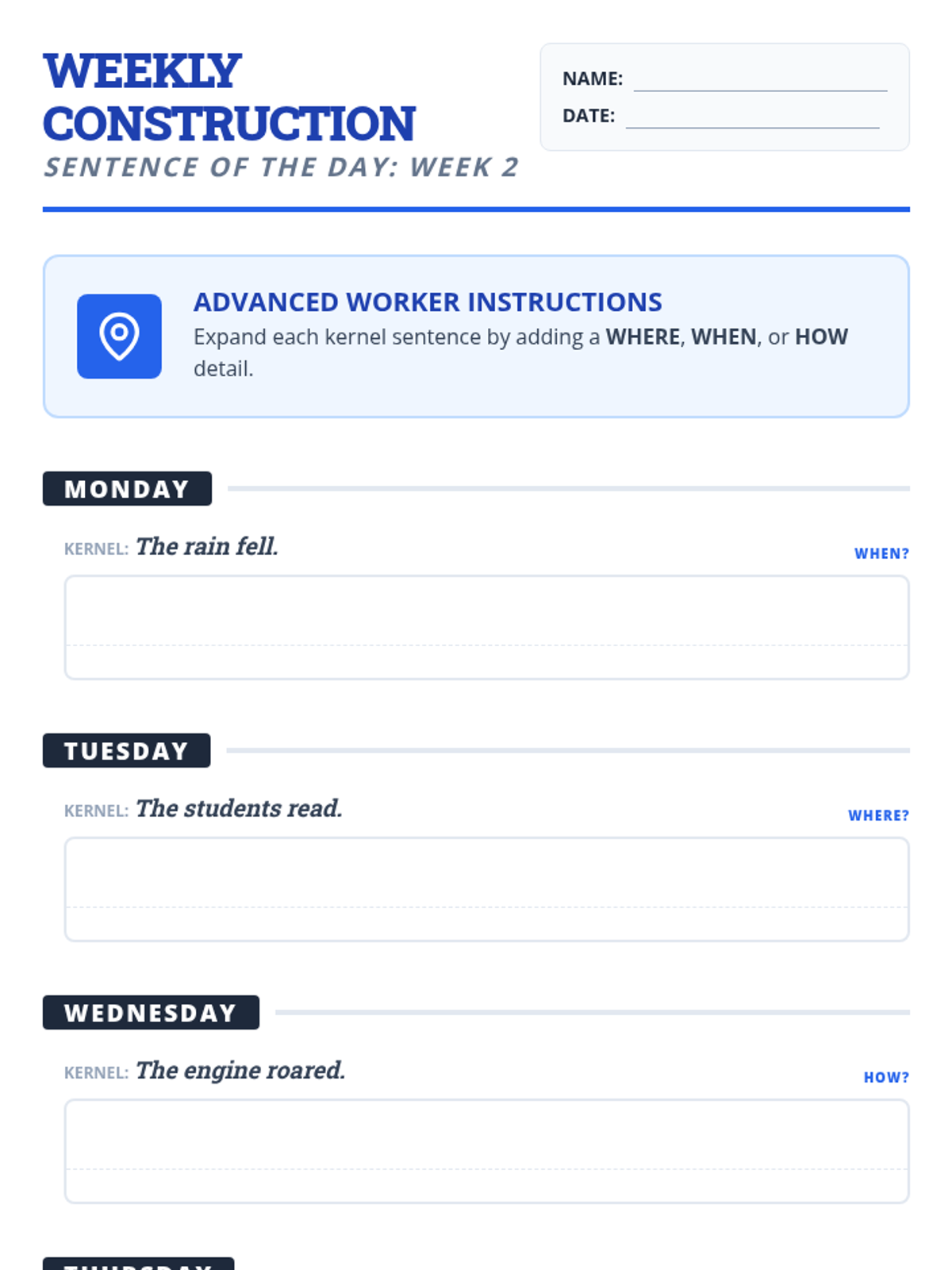
A student worksheet for the second week of instruction, focusing on expanding sentences with 'Where', 'When', and 'How' details.
Instructional slides for the second lesson in the Sentence Architects series. These slides focus on expanding kernel sentences using 'Where', 'When', and 'How' question words, including correct comma usage for introductory phrases.
A robust set of 8 printable task cards for practicing basic kernel sentence expansion. Each card features a kernel sentence and a specific construction prompt.
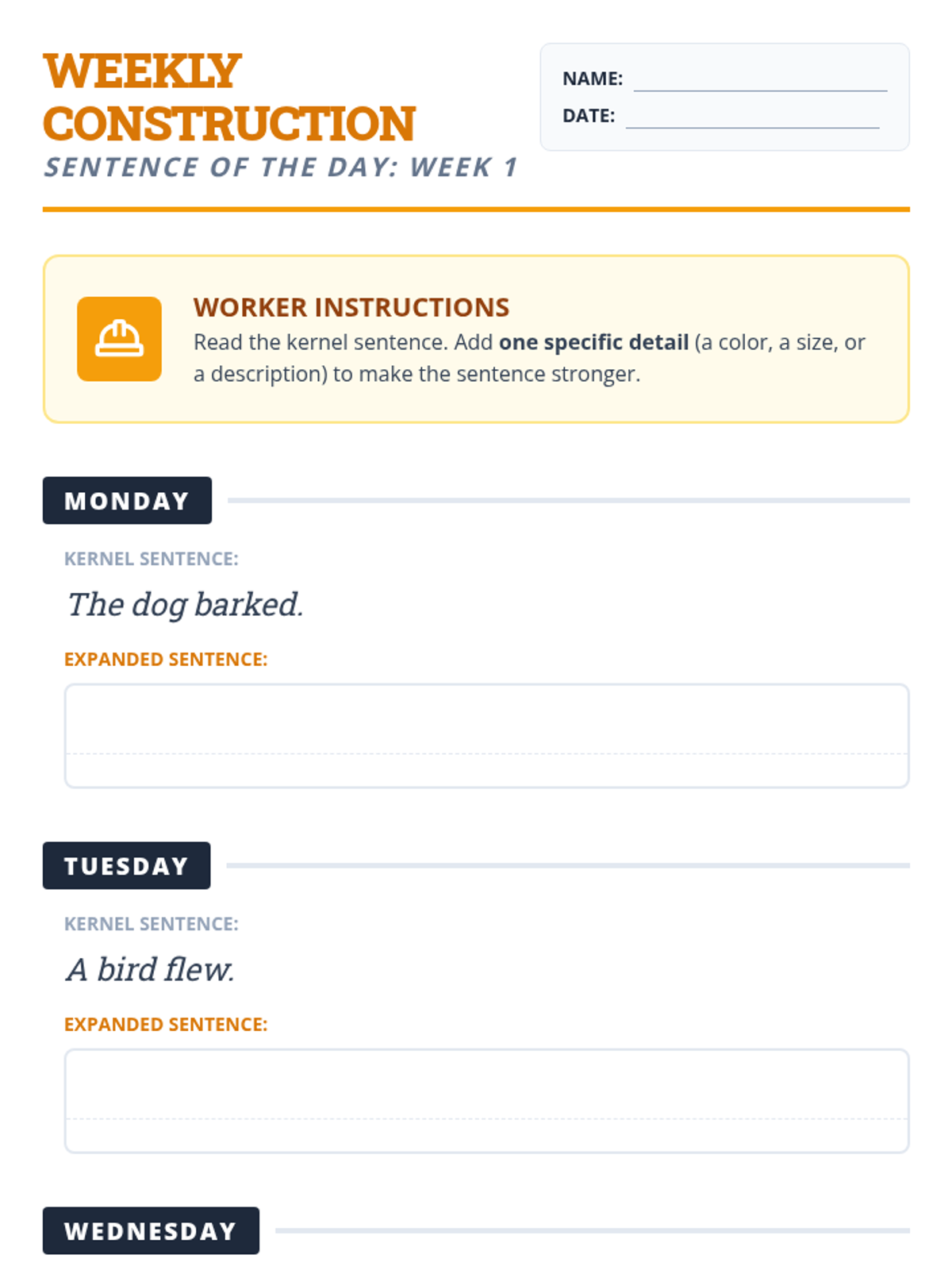
A weekly student worksheet featuring five days of "Sentence of the Day" warm-ups, focusing on basic kernel expansion with descriptive details.
Instructional slides for the first lesson in the Sentence Architects series. These slides cover fragments vs. sentences and the basics of kernel expansion, including newly added slides on adjectives (Standard L.4.1.d), adverbs, and prepositional phrases (Standard L.4.1.e) to align with Massachusetts fourth-grade standards. Now features three embedded instructional videos.
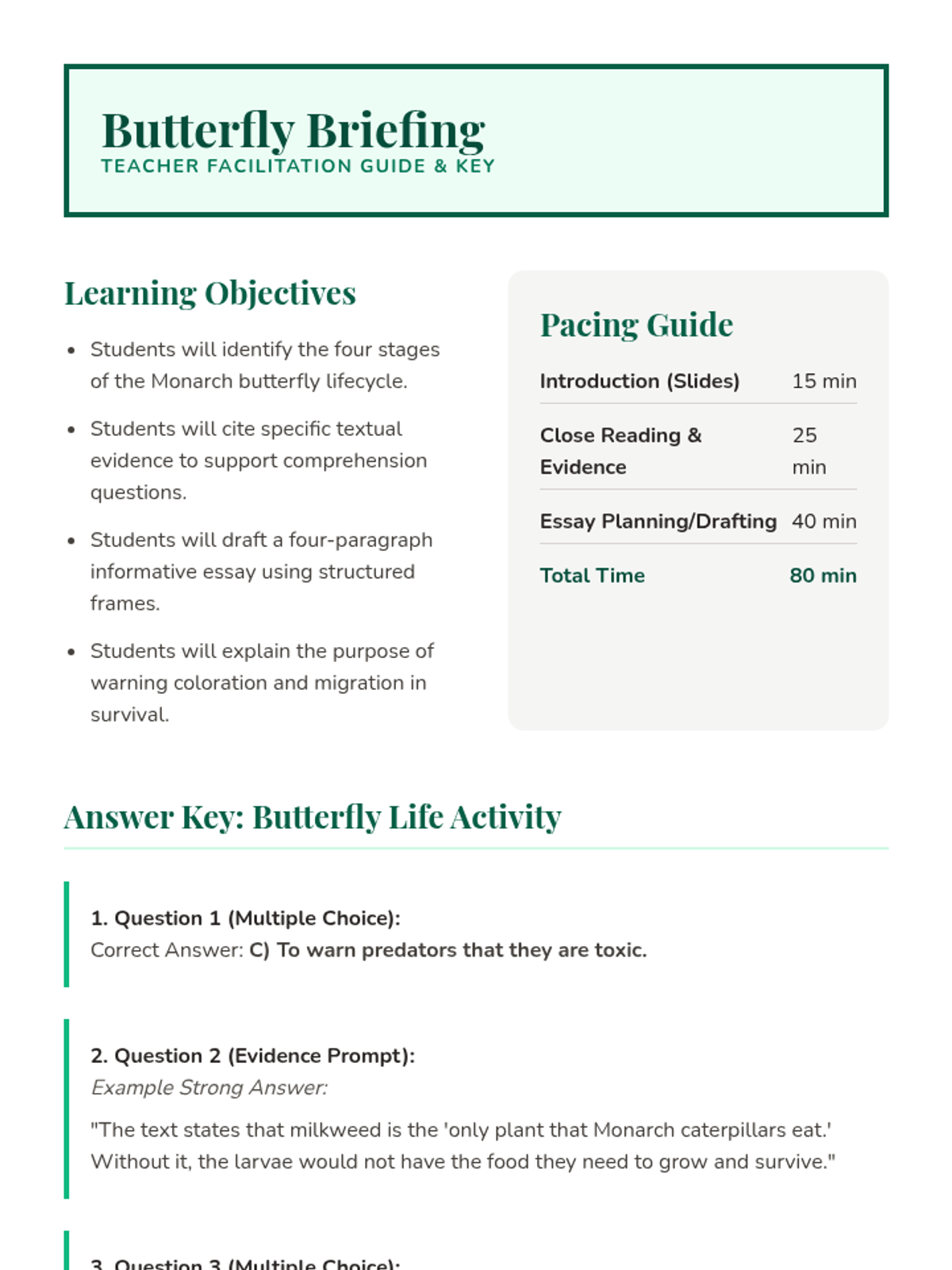
A comprehensive teacher guide for the Winged Wonders lesson, including learning objectives, pacing, answer keys, and a rubric for the informative essay and poster project. Optimized for clean page breaks.
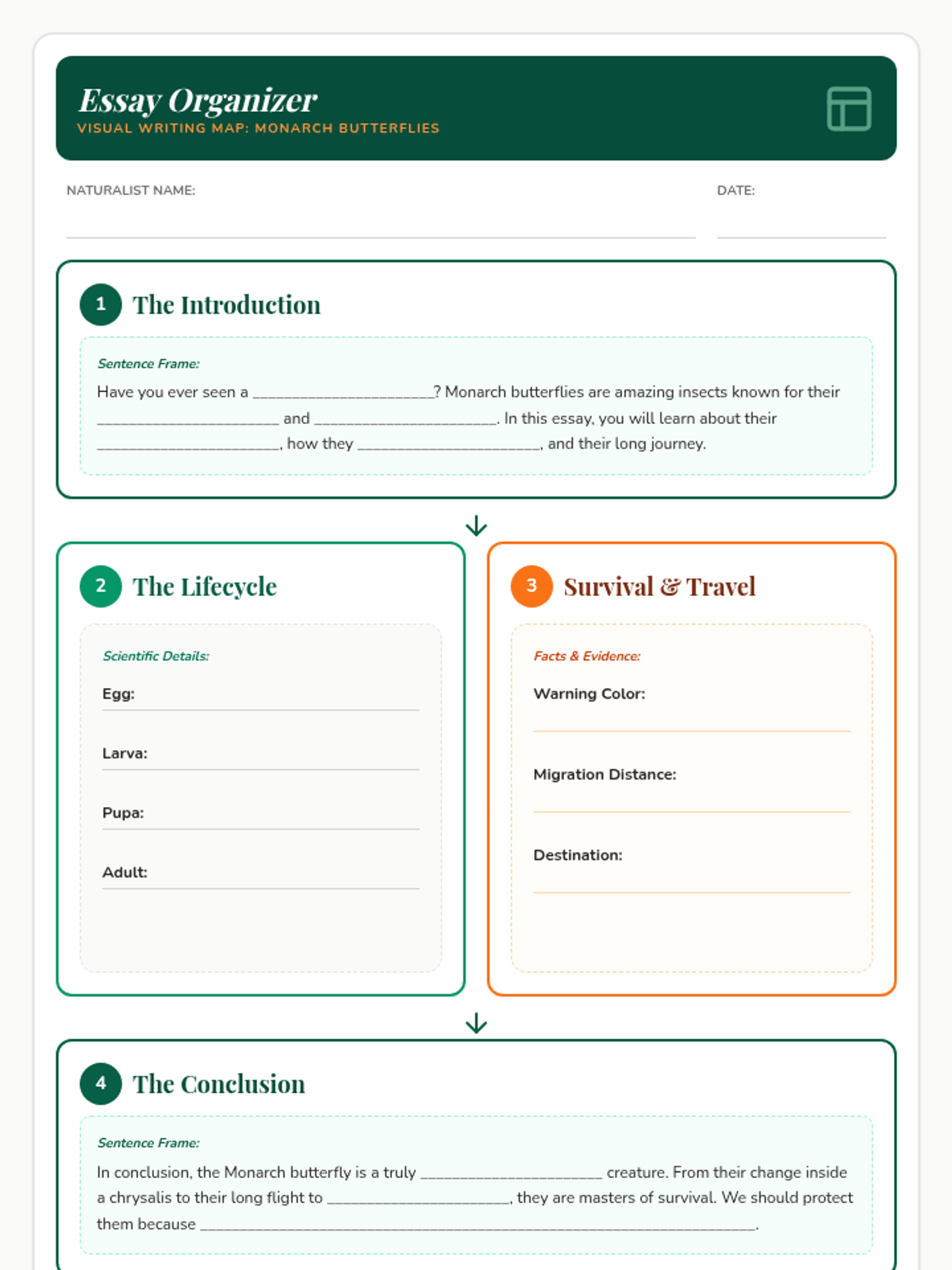
A visual graphic organizer designed to help 4th-5th graders plan their informative butterfly essay, featuring a structured planning map with spacious boxes and a final drafting area. Optimized for clean 2-page printing. Removed sentence starters to allow for independent planning and ensured printable layout. Added darker lines for better printing. Standardized student info fields.
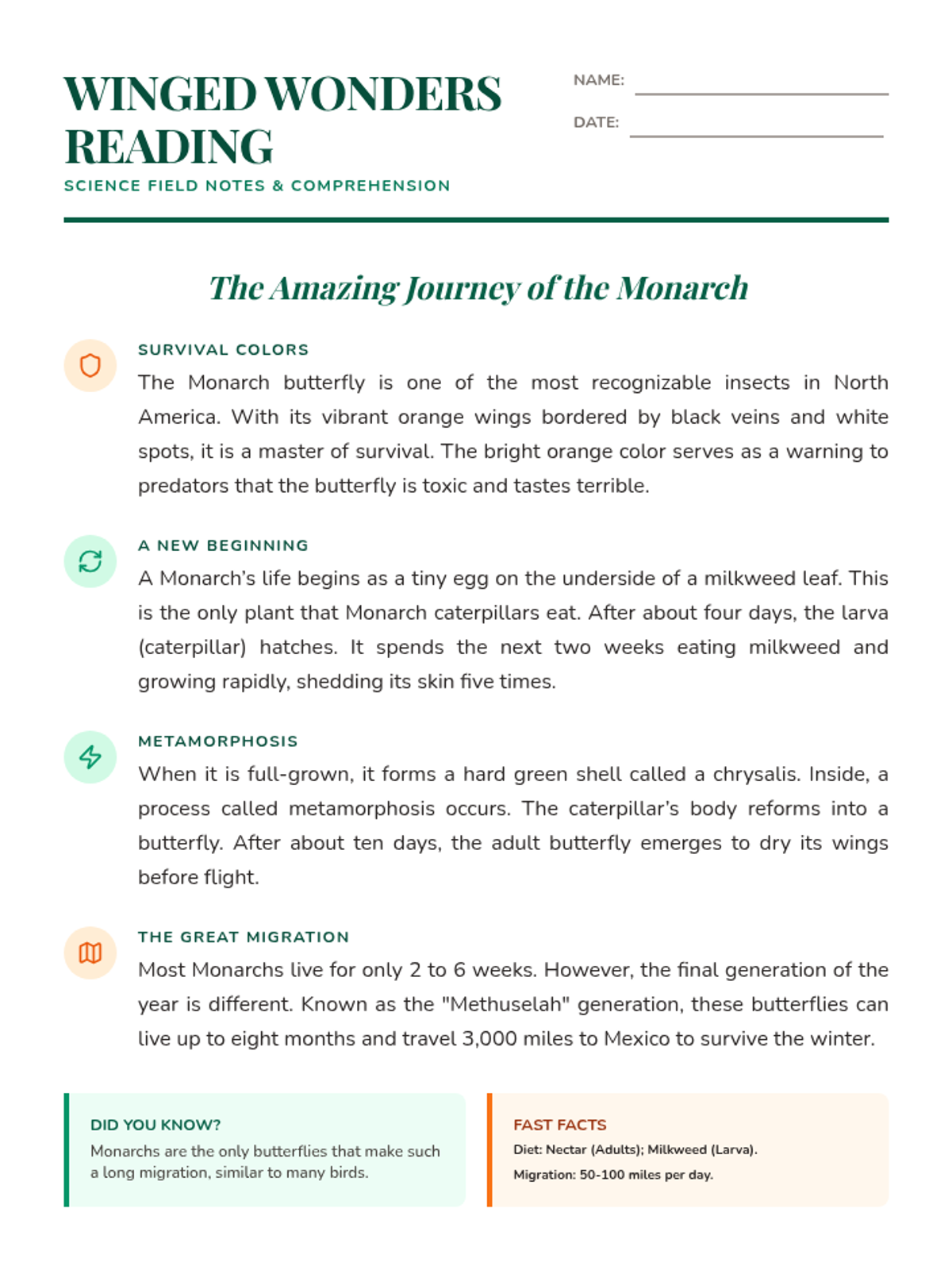
Revised reading comprehension worksheet that guides students through analyzing the Butterfly Research Article, citing evidence, and drafting their informative essay. Includes an expanded set of reading comprehension questions covering all sections of the article. Added integrated article pages for a self-contained printable packet. Typos fixed and vertical stacking for MCQs. Consolidates content to ensure clean page breaks and high-quality printing.
An updated, visually engaging slide deck with added instruction on citing evidence and a structured essay blueprint. Now includes visual poster exemplars for student inspiration.
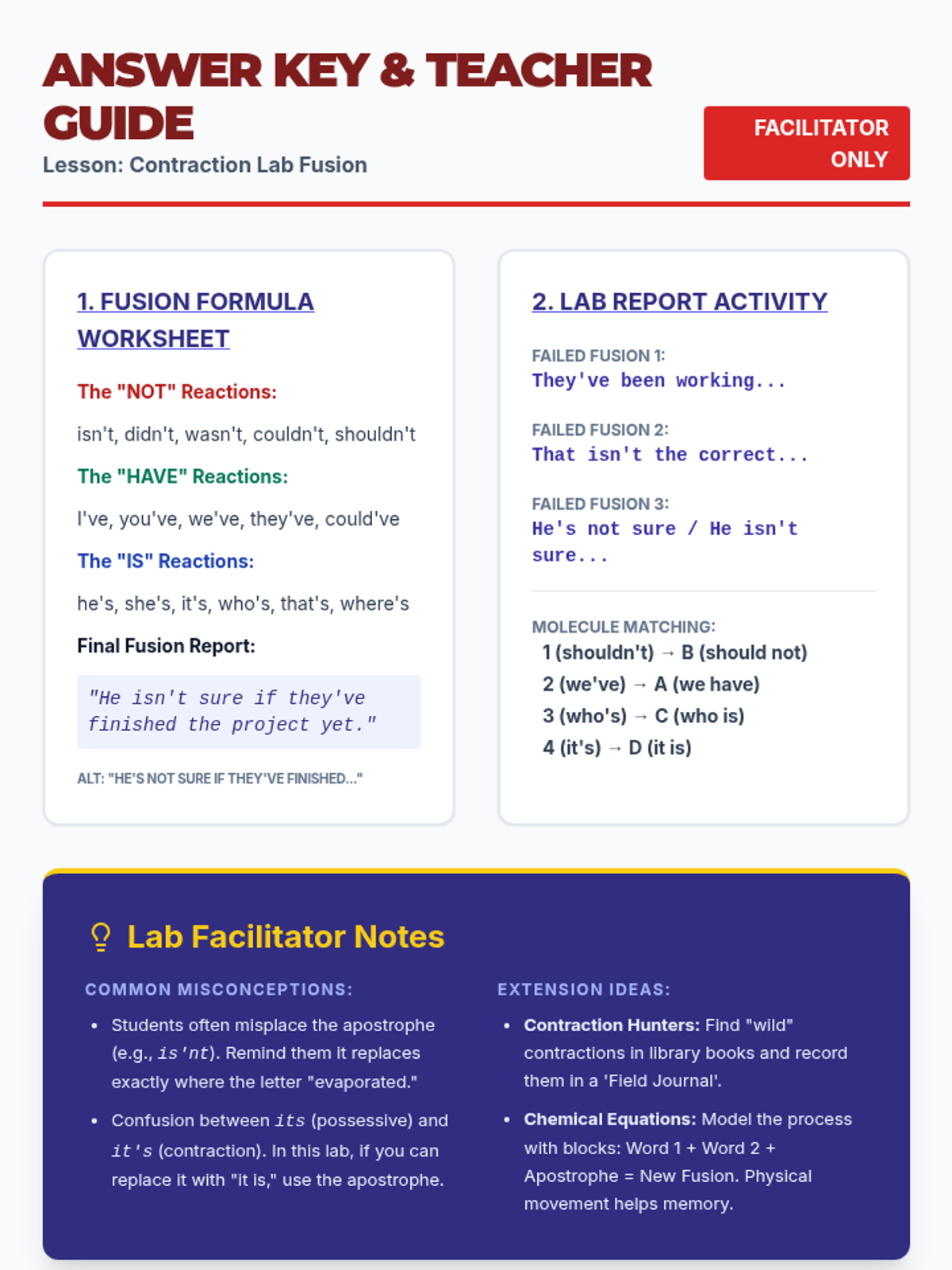
A comprehensive answer key and teacher guidance document for the Contraction Lab Fusion lesson. Includes common misconceptions, extensions, and clear answers with high-contrast text.
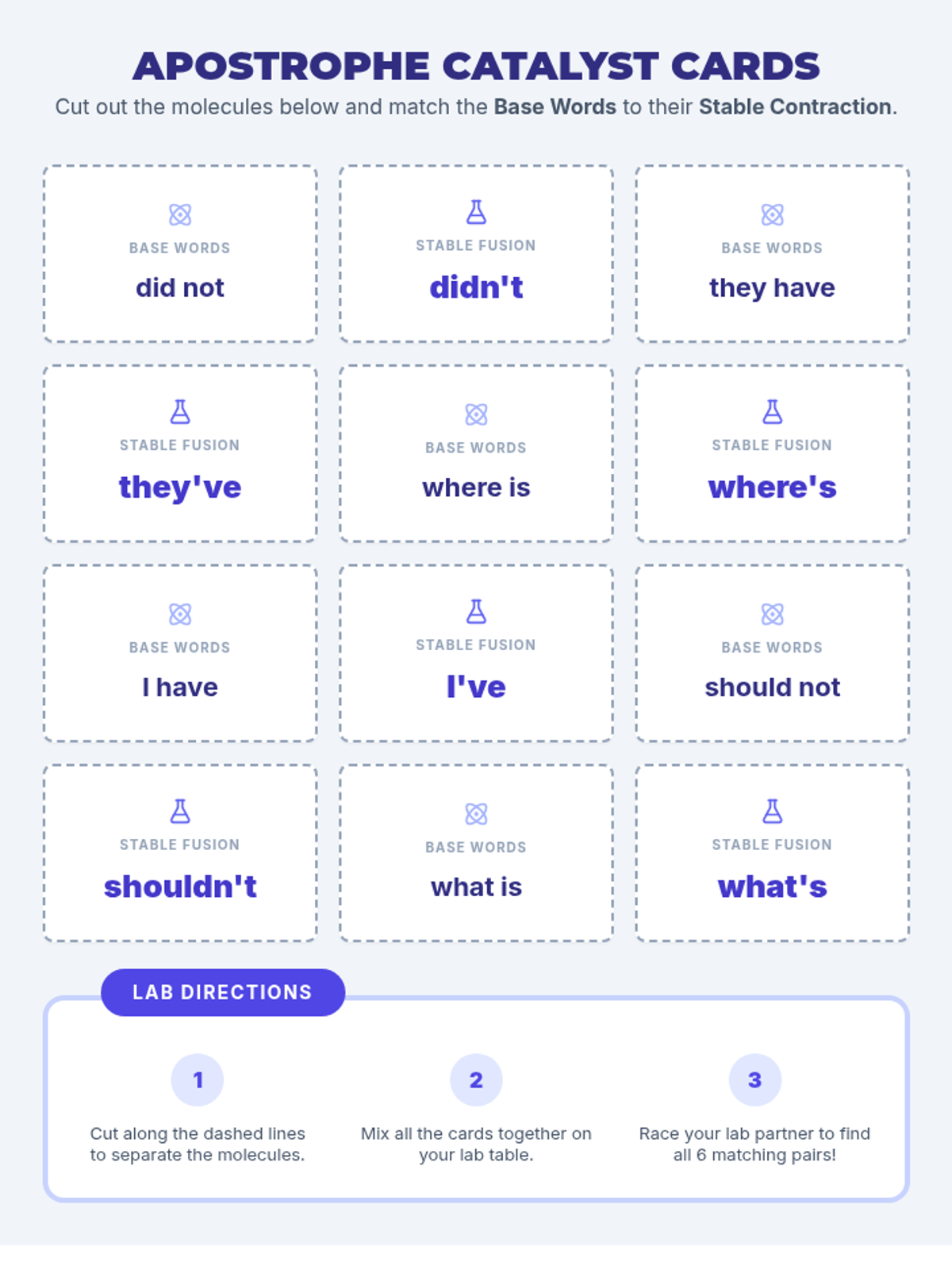
A set of cut-and-match cards for hands-on practice. Students match base word pairs to their corresponding contractions. All cards share uniform backgrounds to ensure the matching task requires reading.
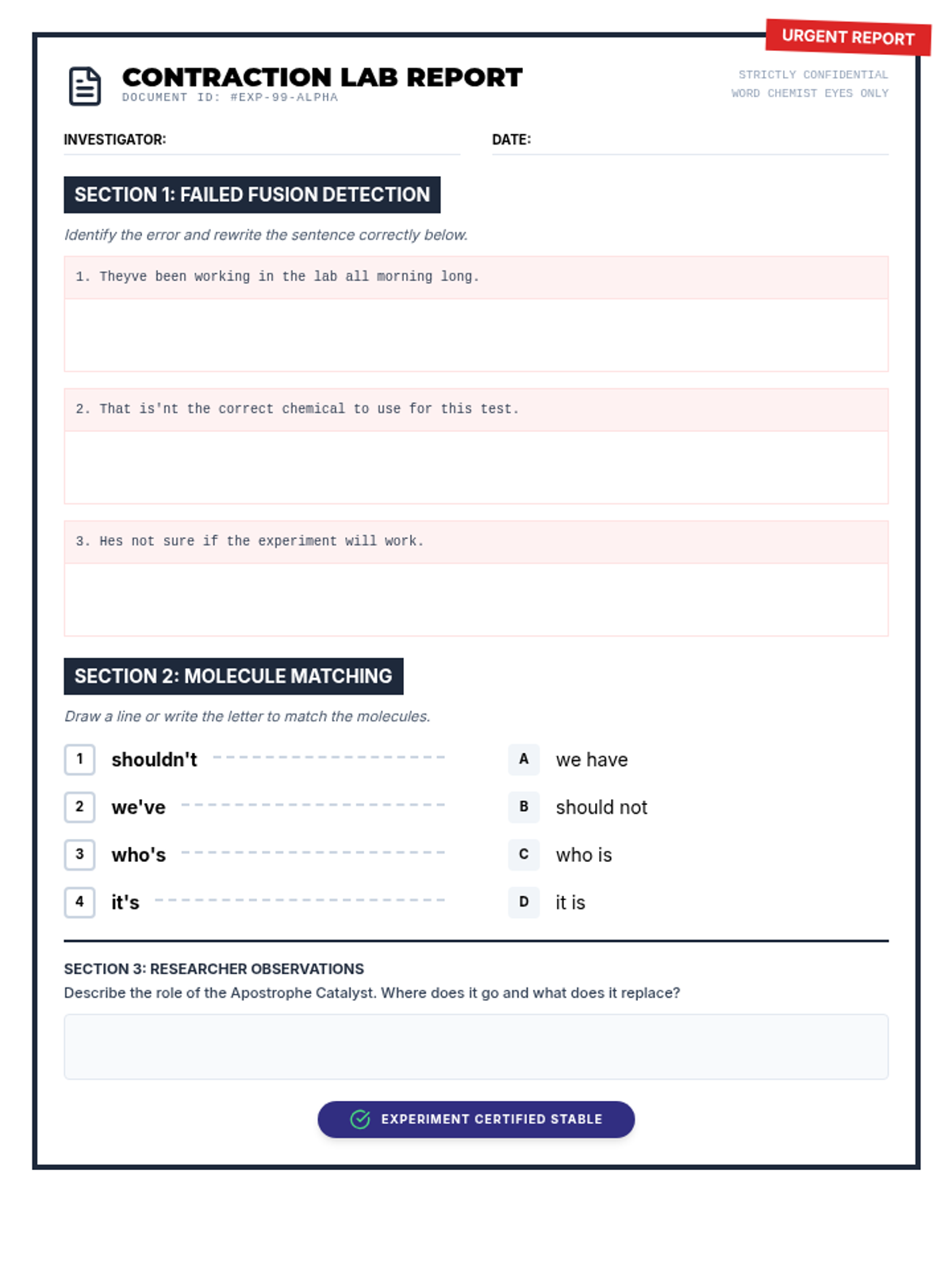
An interactive activity page designed as a scientific lab report. Students identify errors in failed fusions and match contractions to their base words. Sized correctly for single-page printing with optimized student work areas.
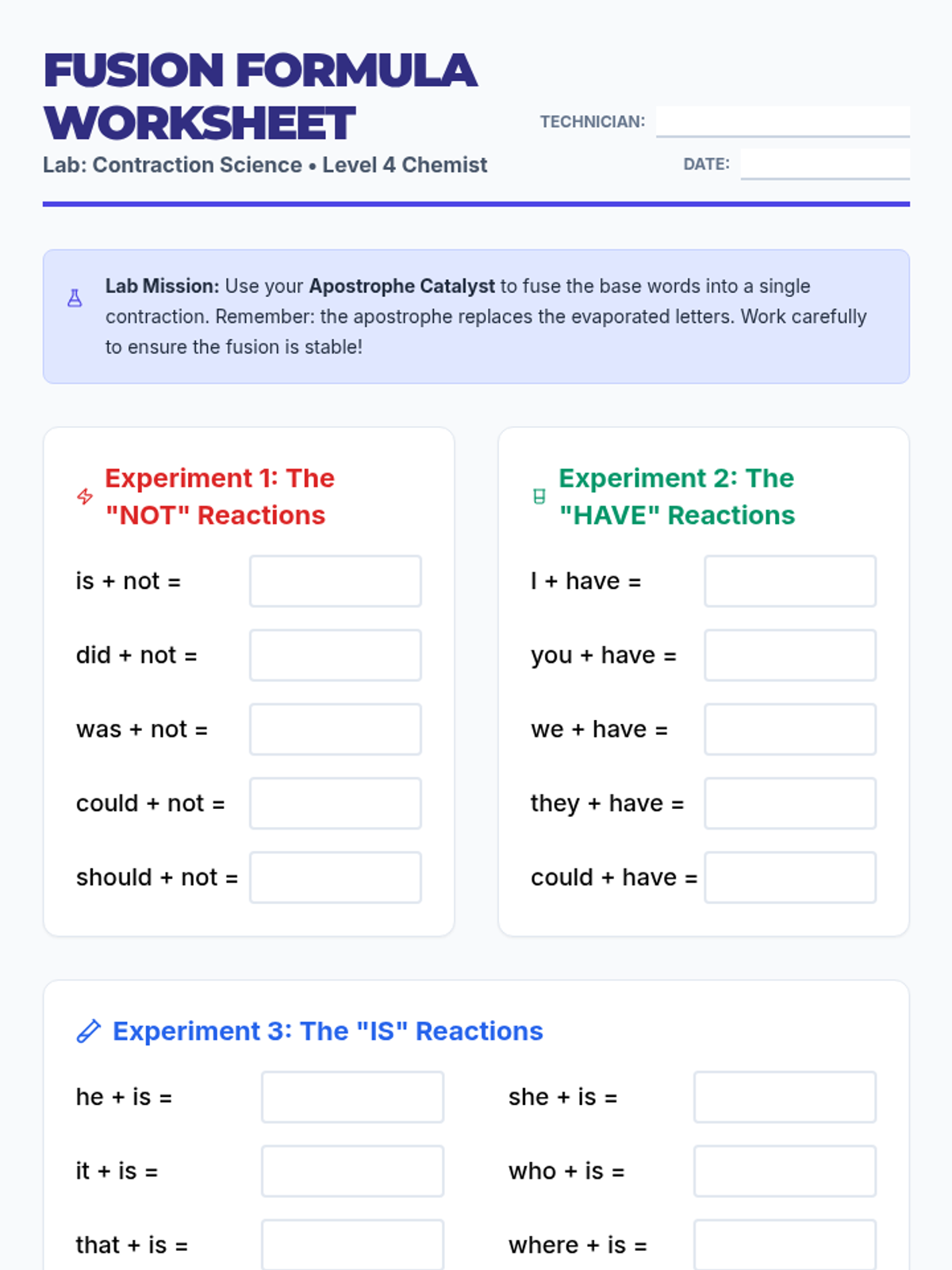
A guided practice worksheet where students practice fusing words using contractions with 'not', 'have', and 'is'. Includes a final sentence rewrite task with optimized legibility for handwriting.
A high-energy, science-themed slide deck that introduces the concept of contractions and provides visual demonstrations of fusing words with 'not', 'have', and 'is'.
A revised "Do Now" slide deck for Unit 9 Lesson 12, focusing on sentence variety in a library passage and editing compound sentences and title capitalization in a history text. Aligned with TEKS 4.11. Features uniform answer choice styling and improved answer key contrast.
A revised "Do Now" slide deck for Unit 9 Lesson 11, featuring uniform answer choice styling, improved scratch paper visibility, and corrected layout. Aligned with TEKS 4.11.
A revised "Do Now" slide deck for Unit 9 Lesson 10, featuring uniform answer choice styling, improved scratch paper visibility, and corrected layout. Aligned with TEKS 4.11.
A revised "Do Now" slide deck for Unit 9 Lesson 9 with all SustainED Leaders logos and prominent branding removed. Aligned with TEKS 4.11. Featuring uniform answer choice styling and improved answer key contrast.
A revised "Do Now" slide deck for Unit 9 Lesson 8, featuring uniform answer choice styling, improved scratch paper visibility, and corrected layout. Aligned with TEKS 4.11.
A revised "Do Now" slide deck for Unit 9 Lesson 7, featuring uniform answer choice styling, improved scratch paper visibility, and corrected layout. Aligned with TEKS 4.11.
A revised "Do Now" slide deck for Unit 9 Lesson 6, featuring uniform answer choice styling, improved scratch paper visibility, and corrected layout. Aligned with TEKS 4.11.
A revised "Do Now" slide deck for Unit 9 Lesson 5, featuring uniform answer choice styling, improved scratch paper visibility, and corrected layout. Aligned with TEKS 4.11.
A revised "Do Now" slide deck for Unit 9 Lesson 4, featuring uniform answer choice styling, improved scratch paper visibility, and corrected layout. Aligned with TEKS 4.11.
A revised "Do Now" slide deck for Unit 9 Lesson 3, featuring uniform answer choice styling, improved scratch paper visibility, and corrected layout. Aligned with TEKS 4.11.
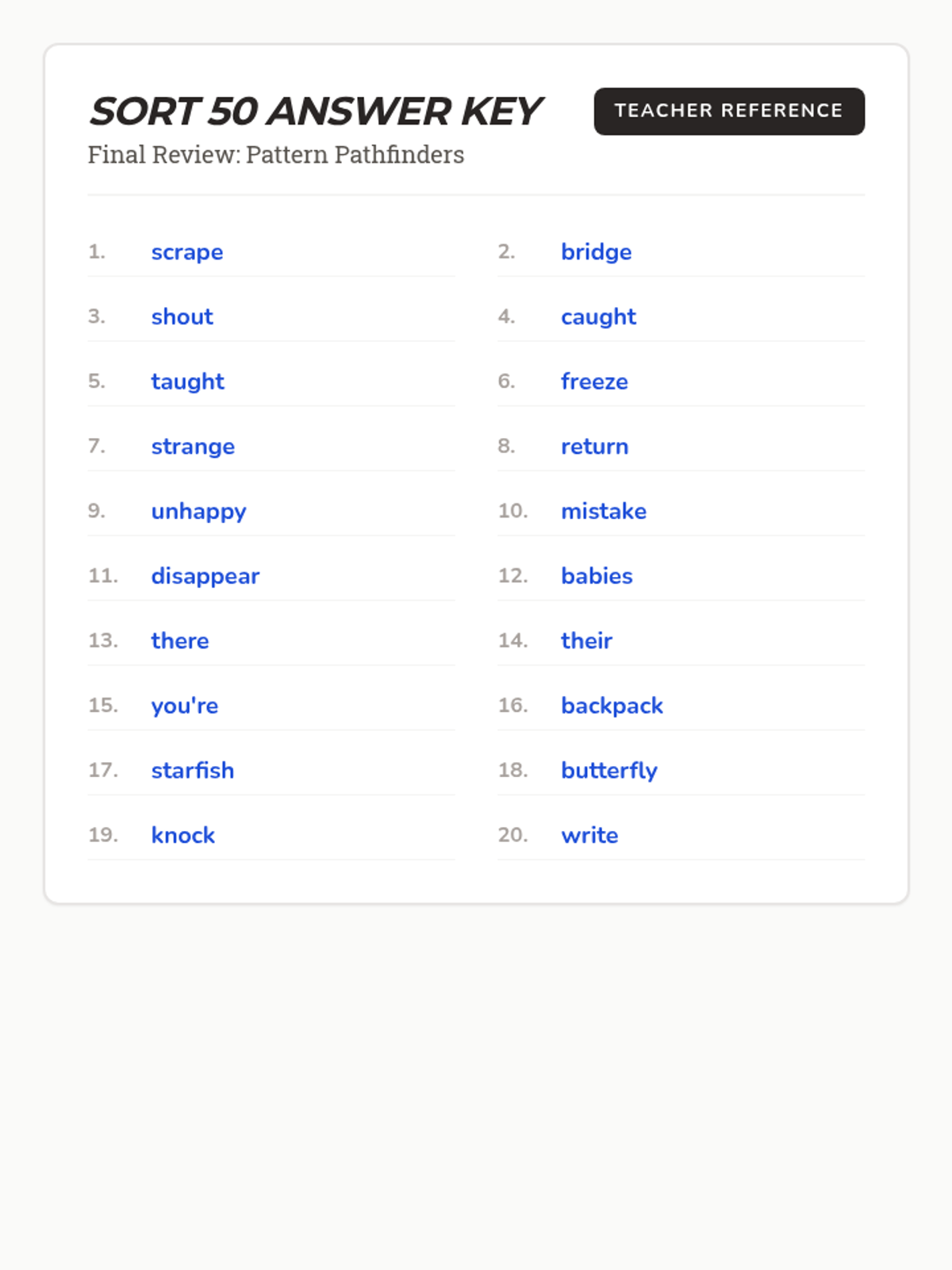
Final comprehensive answer key for the Pattern Pathfinders sequence (Sort 50), covering a variety of word study patterns.
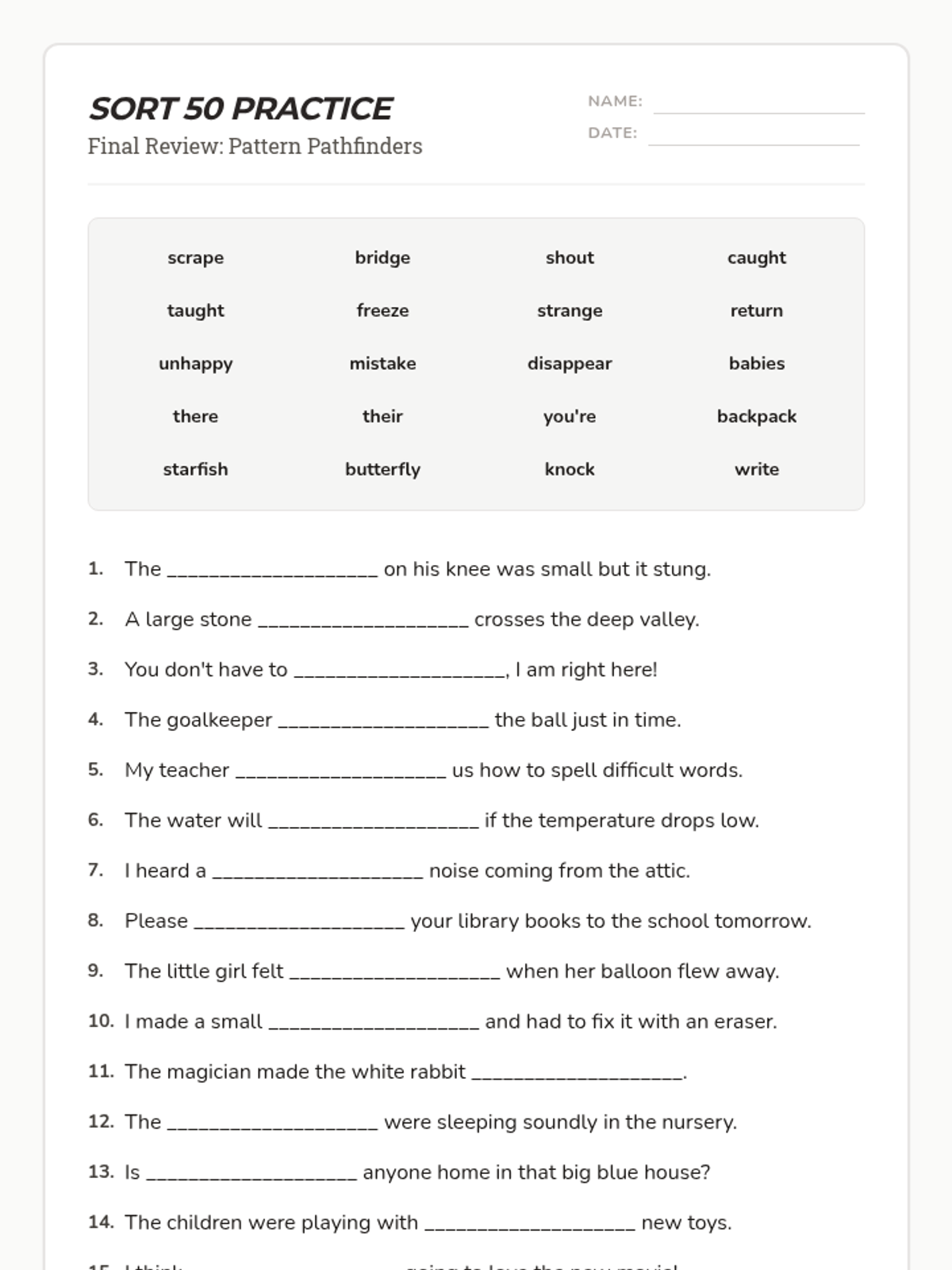
Comprehensive review practice materials for Sort 50, covering short and long vowels, r-controlled vowels, diphthongs, and prefixes. Now features a full 3-page packet with word search and word scramble activities.
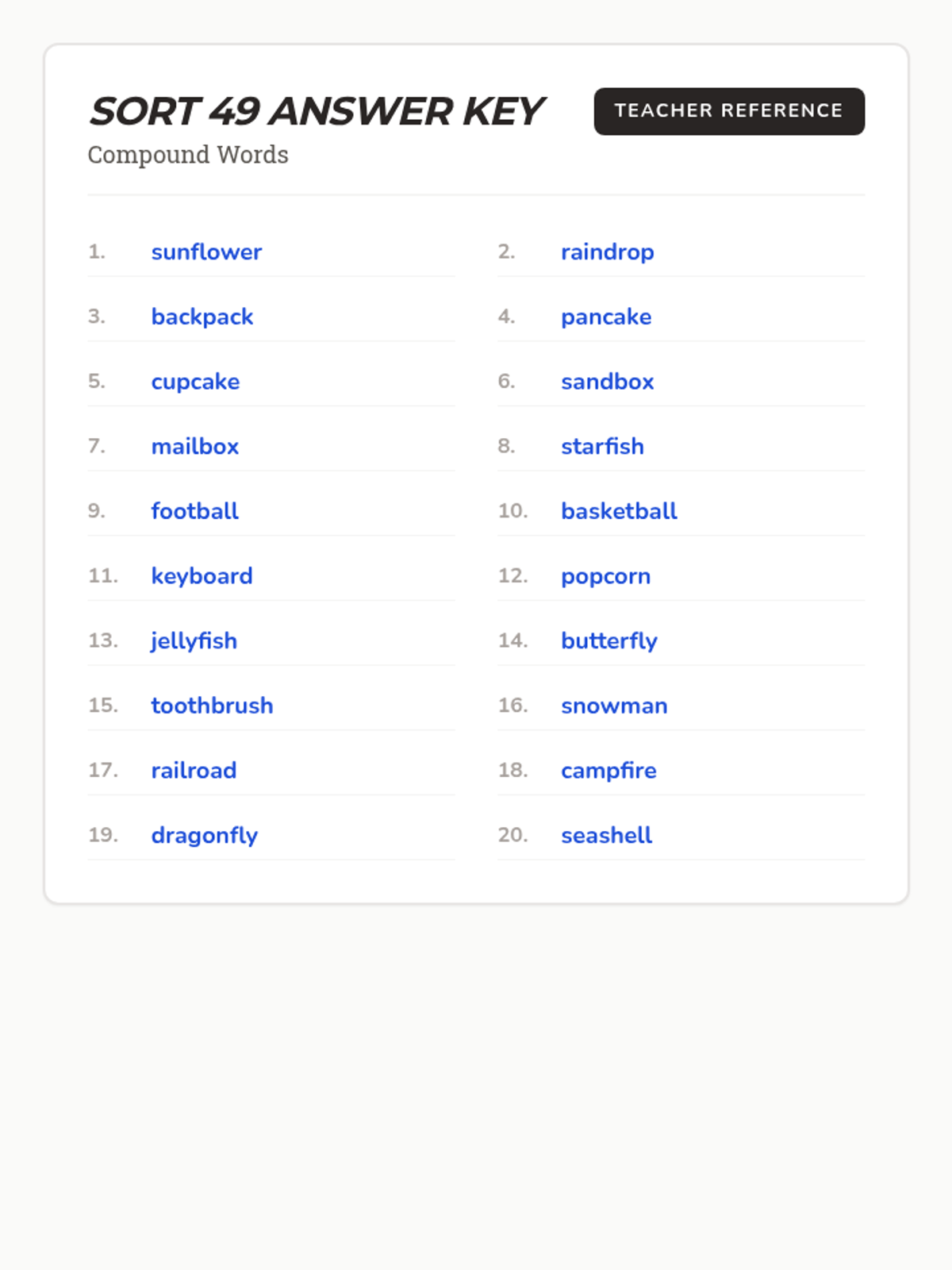
Answer key for Sort 49 Practice Pack, featuring all sentence answers and a clear teacher reference layout.
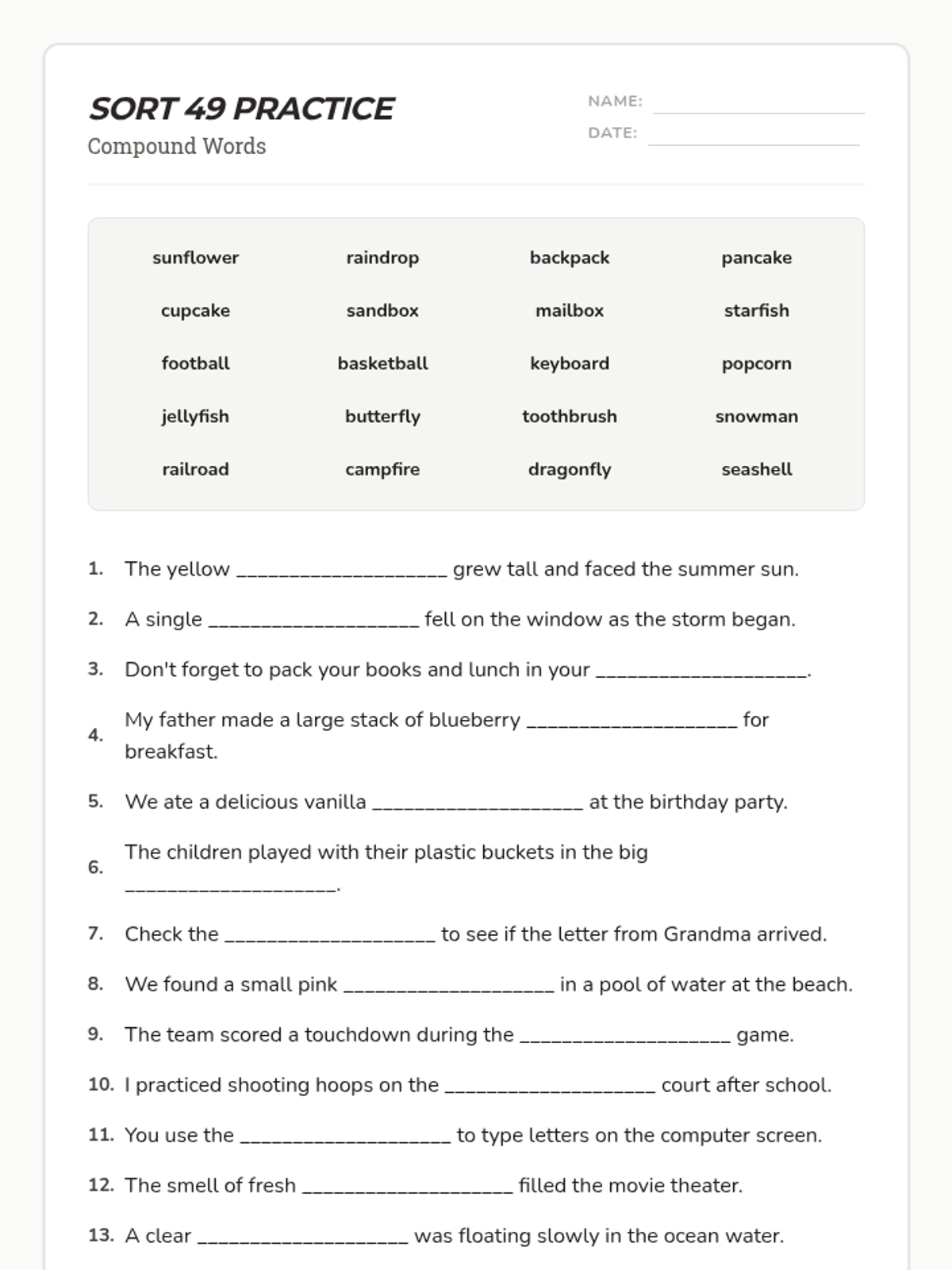
Practice materials for Sort 49 focusing on compound words. Now features a 3rd-page word scramble and a full-page word search grid with 15+ words. Full word bank included.
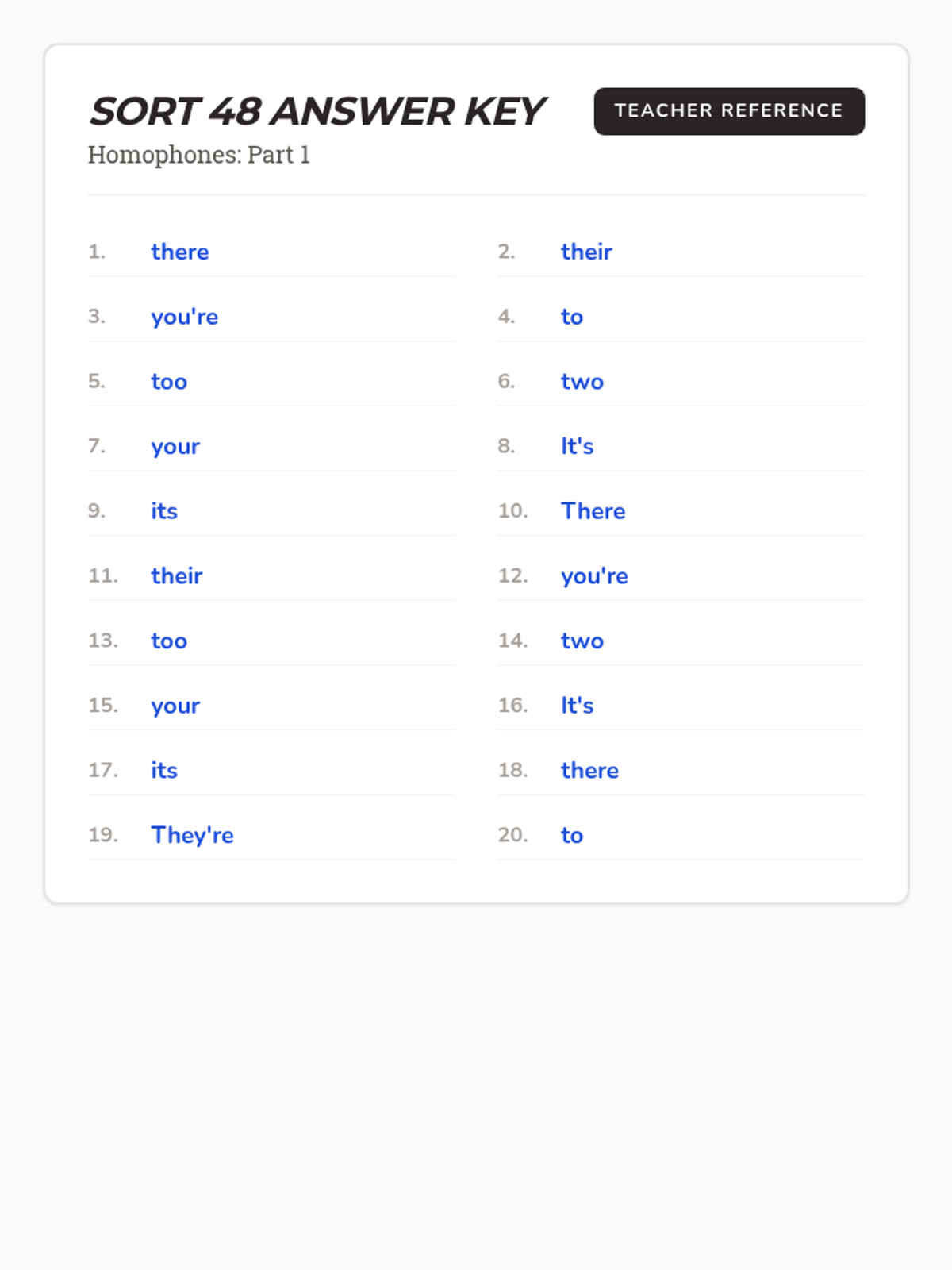
Updated answer key for Sort 48 with the new randomized sentence order. Features all sentence answers for the shuffled pack. Now includes word scramble answers.
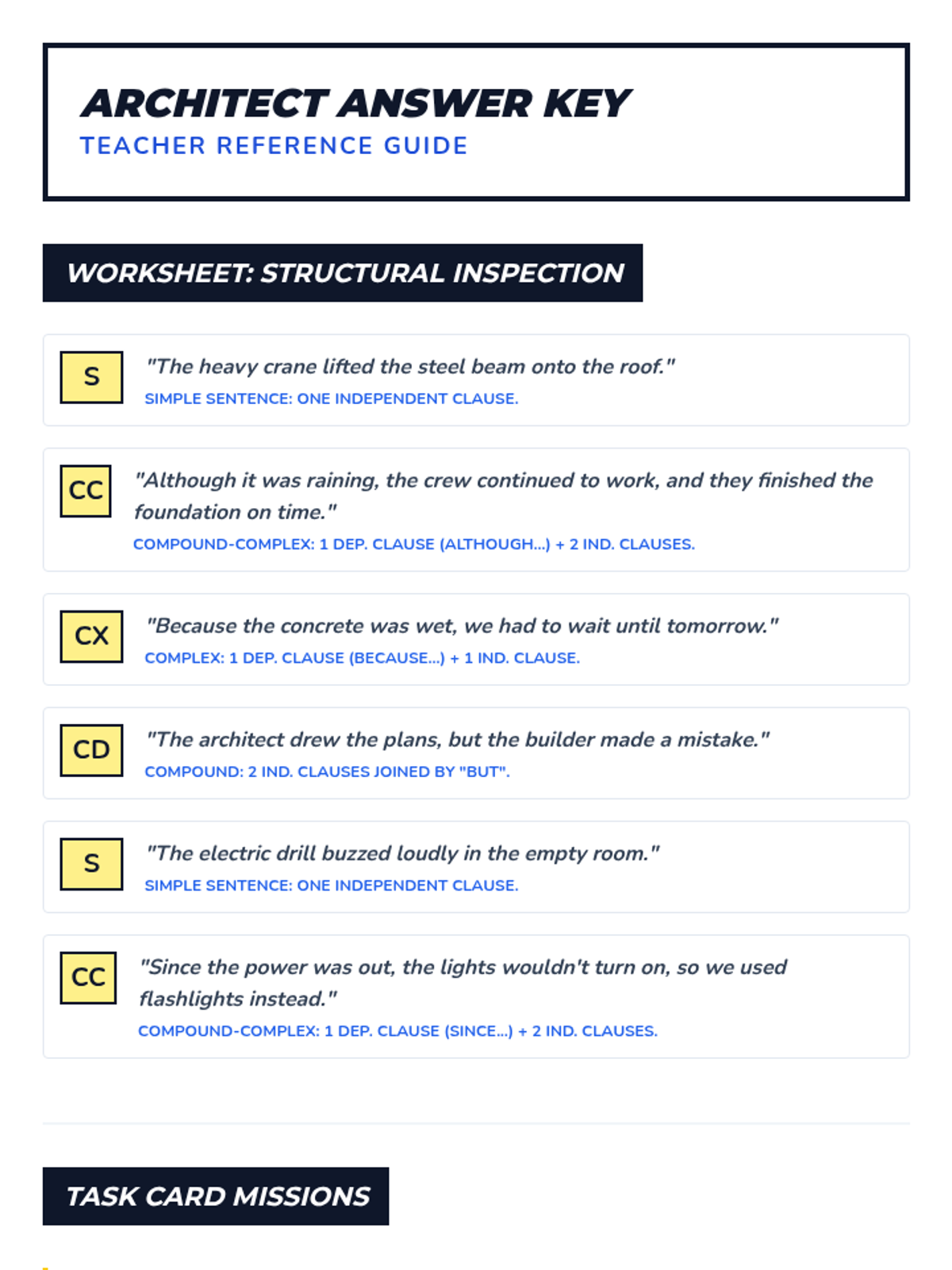
A comprehensive answer key for both the Sentence Blueprints worksheet and the Structure Squad task cards, designed for easy teacher reference. Updated with improved contrast and layout.
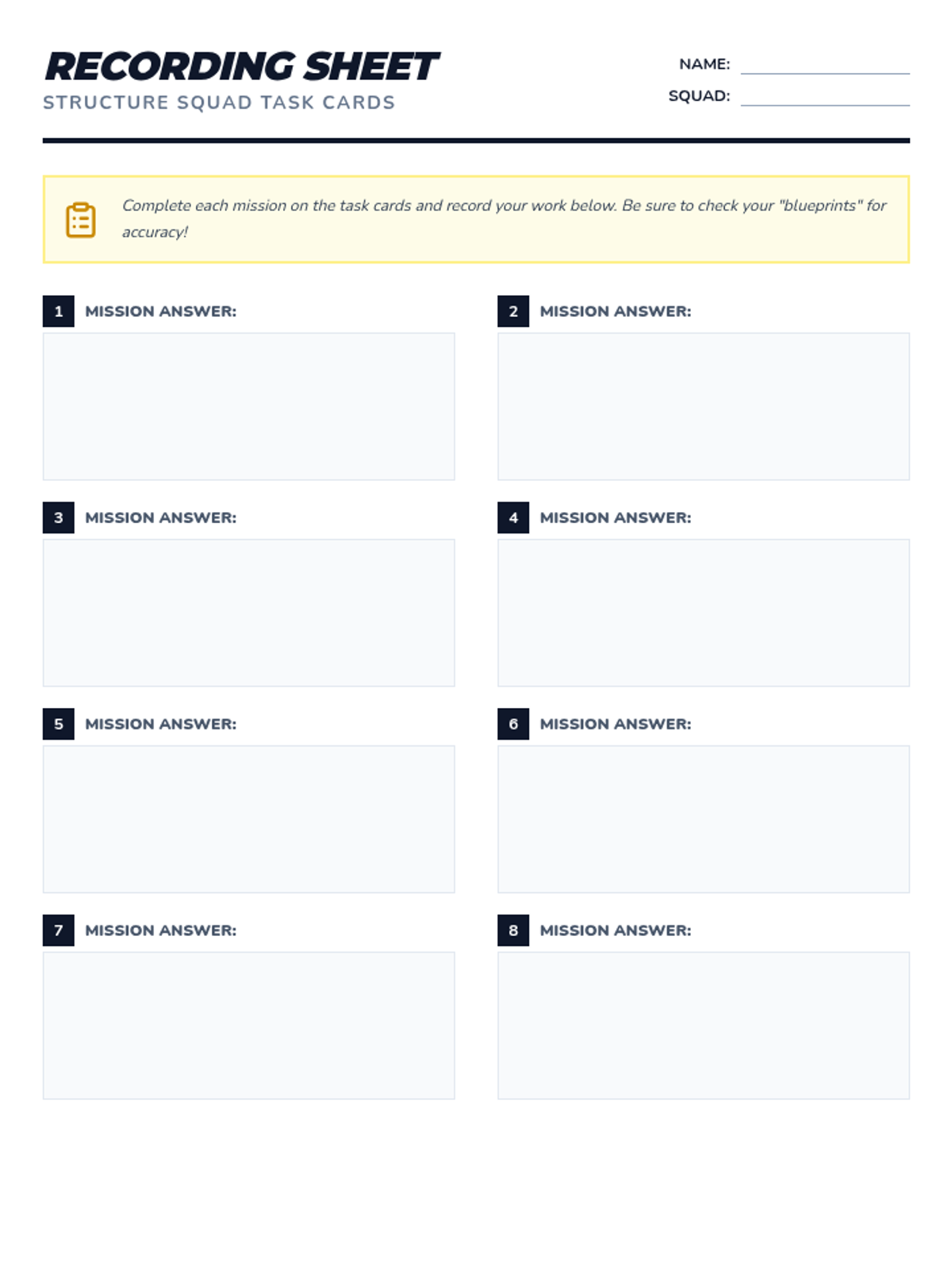
A student recording sheet for the Structure Squad task cards, providing organized spaces for students to write their answers to each mission. Optimized to fit on a single page.
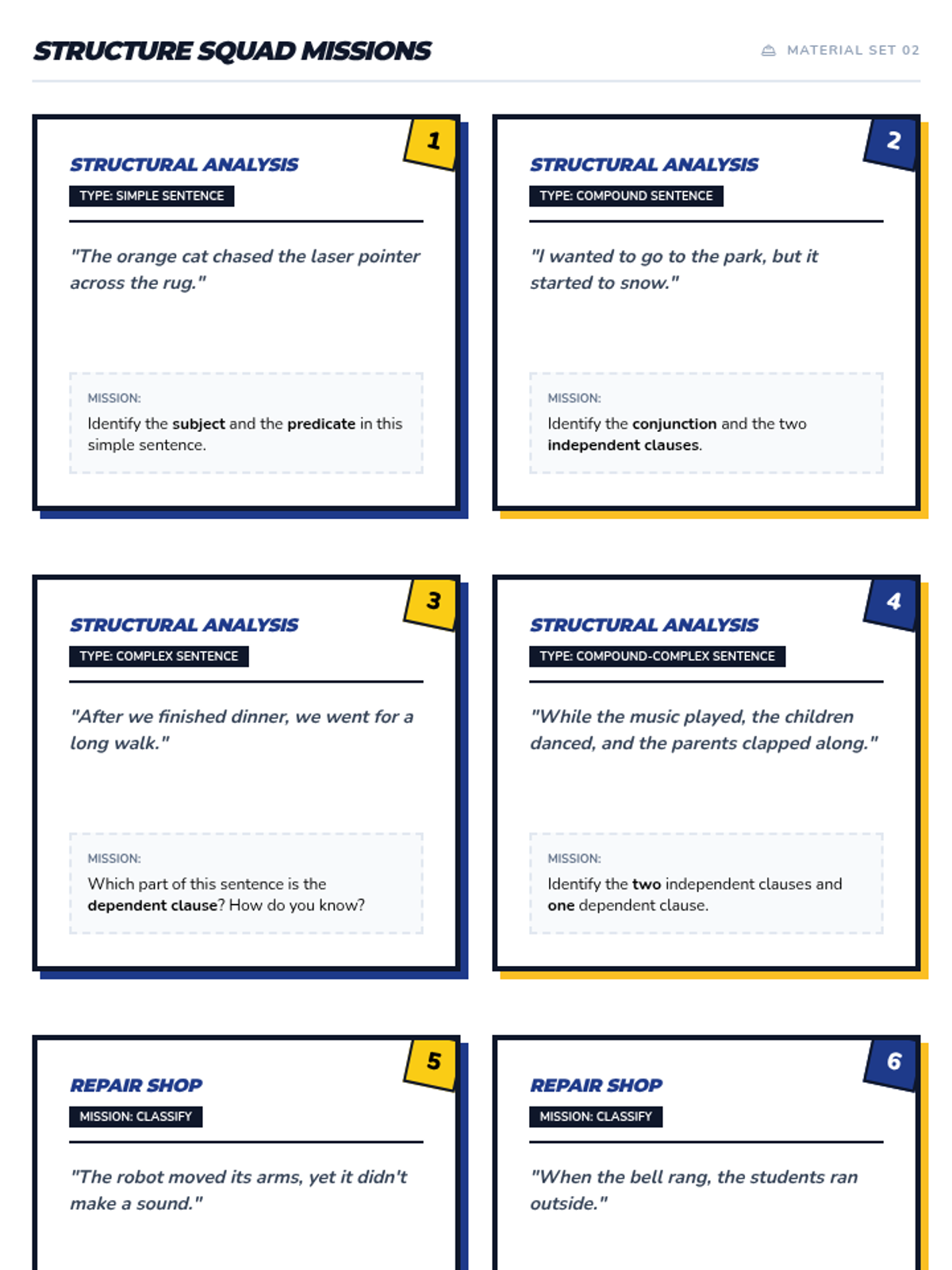
Eight construction-themed task cards for small group review of sentence structures. Each card challenges students to analyze, classify, or build simple, compound, complex, and compound-complex sentences. Features fixed page breaks and standardized terminology.
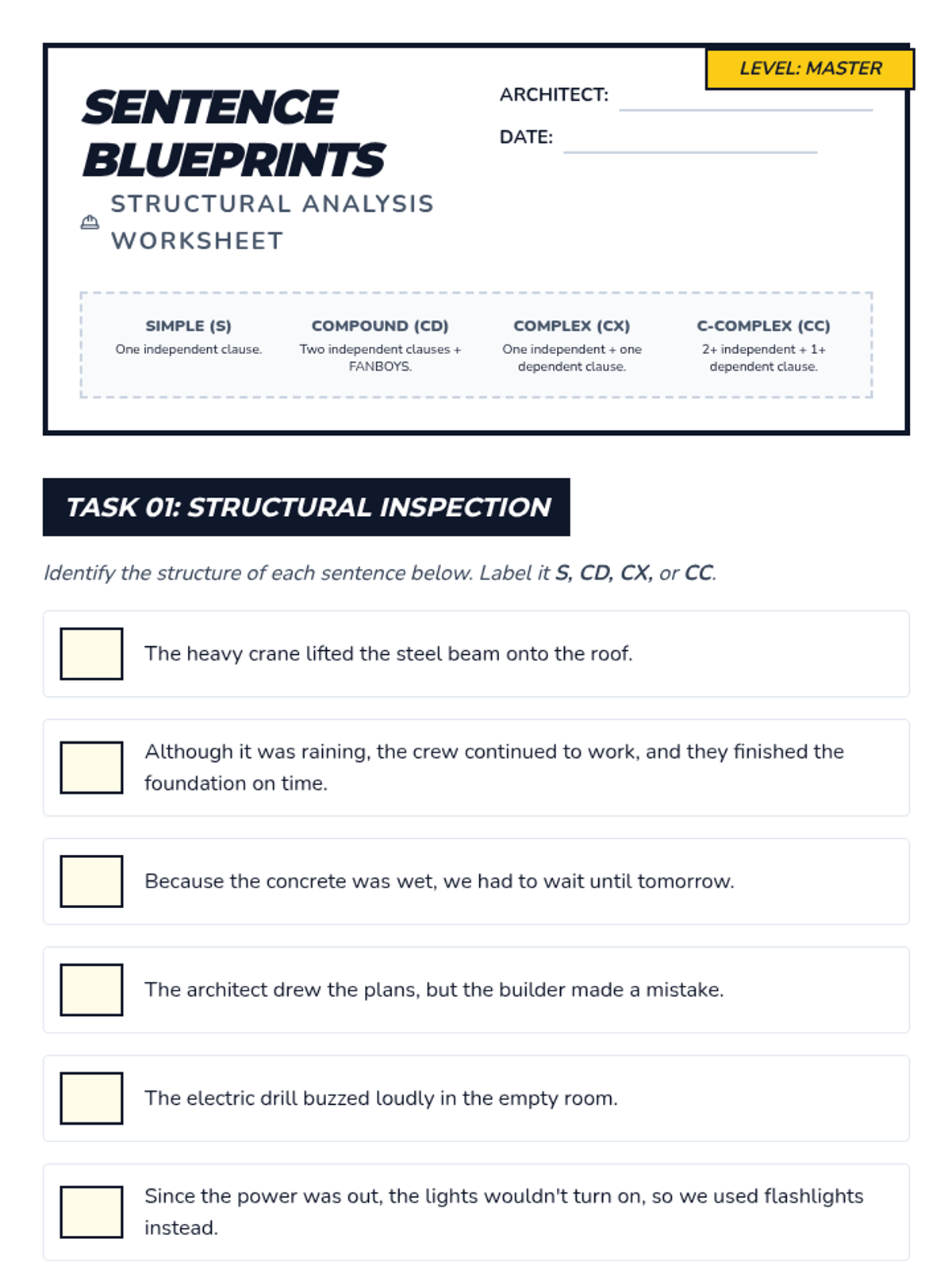
A construction-themed worksheet for 4th graders to practice identifying and writing simple, compound, complex, and compound-complex sentences. Features a 'Sentence Blueprints' motif with clear identification tasks and creative building prompts.
A revised "Do Now" slide deck for Unit 9 Lesson 2, featuring corrected answer keys, improved passage legibility, and refined attribution slide layout. Aligned with TEKS 4.11 standards.
A revised "Do Now" slide deck for Unit 9 Lesson 1, featuring corrected answer keys, improved passage legibility, and refined attribution slide layout. Aligned with TEKS 4.11 standards.
A revised "Do Now" slide deck for Unit 8 Lesson 15, featuring corrected answer keys, improved passage legibility, and refined attribution slide layout. Aligned with TEKS 4.11 standards.
A revised "Do Now" slide deck for Unit 8 Lesson 14, featuring corrected answer keys, improved passage legibility, and refined attribution slide layout. Aligned with TEKS 4.11 standards.
A revised "Do Now" slide deck for Unit 8 Lesson 13, featuring corrected answer keys, improved passage legibility, and refined attribution slide layout. Aligned with TEKS 4.11 standards.
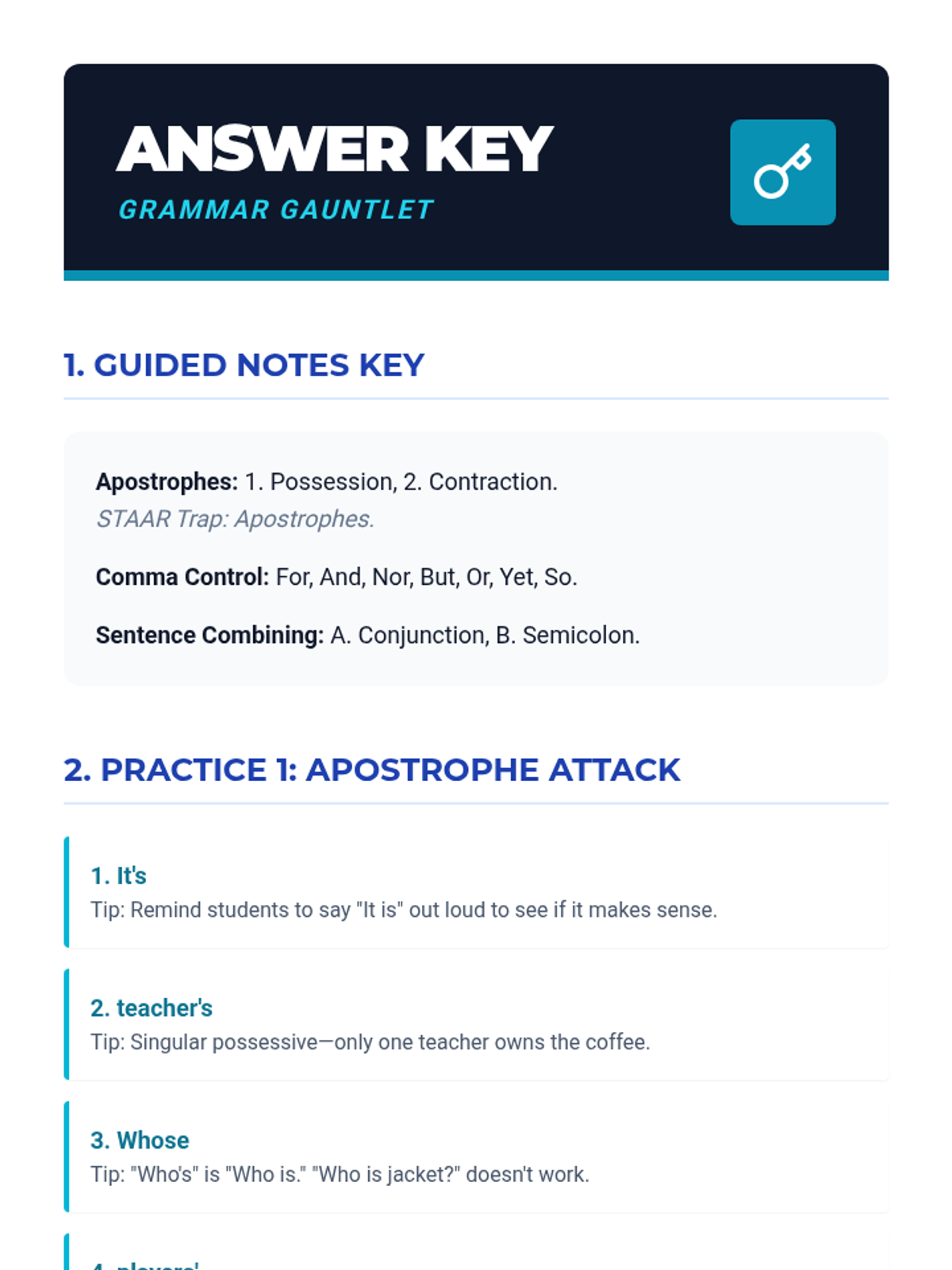
An answer key and teacher facilitation guide for the Grammar Gauntlet session, providing correct answers, explanations, and small-group teaching tips.
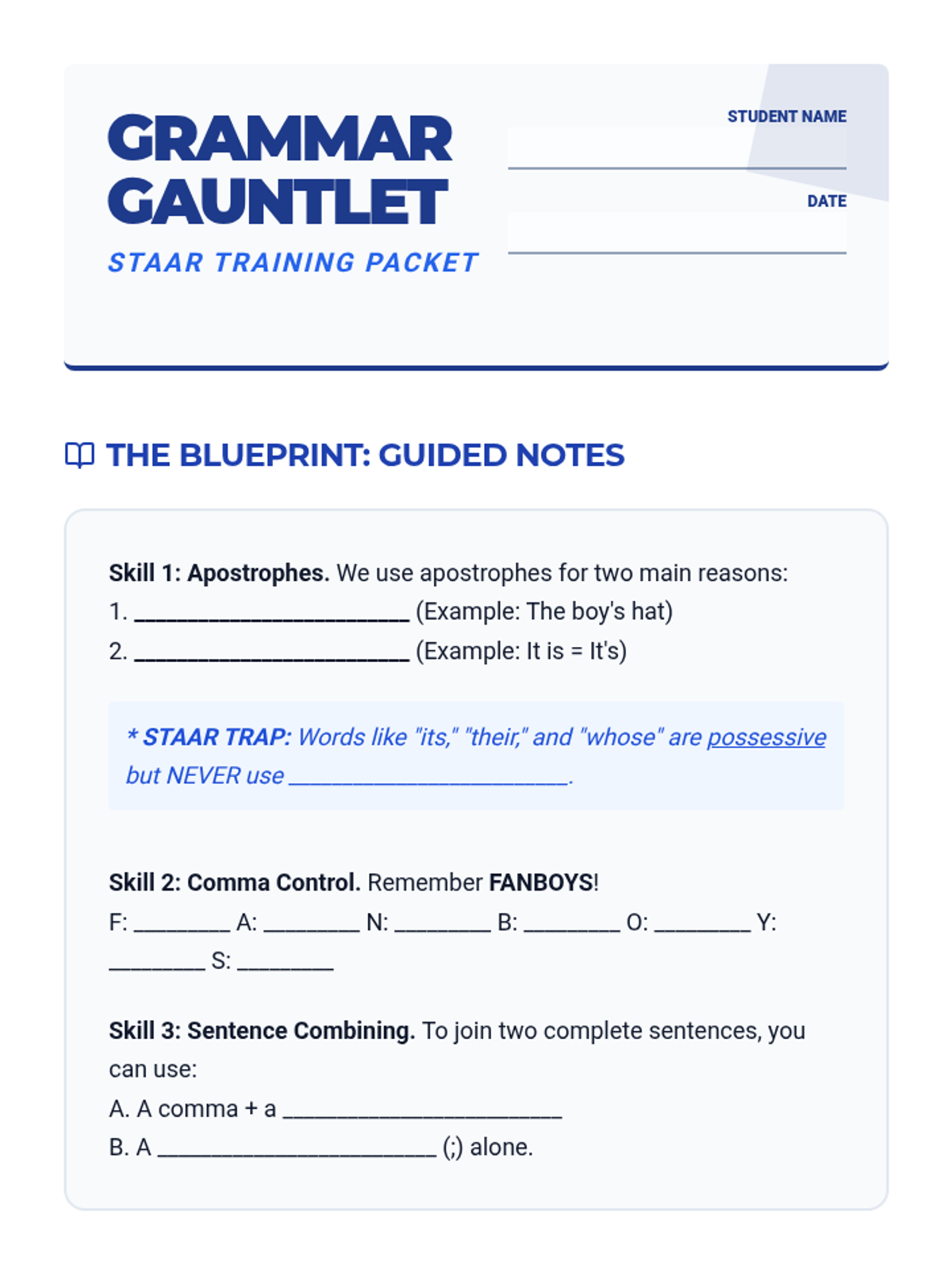
A student practice packet for a STAAR grammar tutoring session, featuring guided notes, focused practice on apostrophes and commas, and a STAAR-modeled mini-test.
A visual presentation for a STAAR grammar tutoring session, covering apostrophes, commas, and sentence combining with clear examples and visual aids.
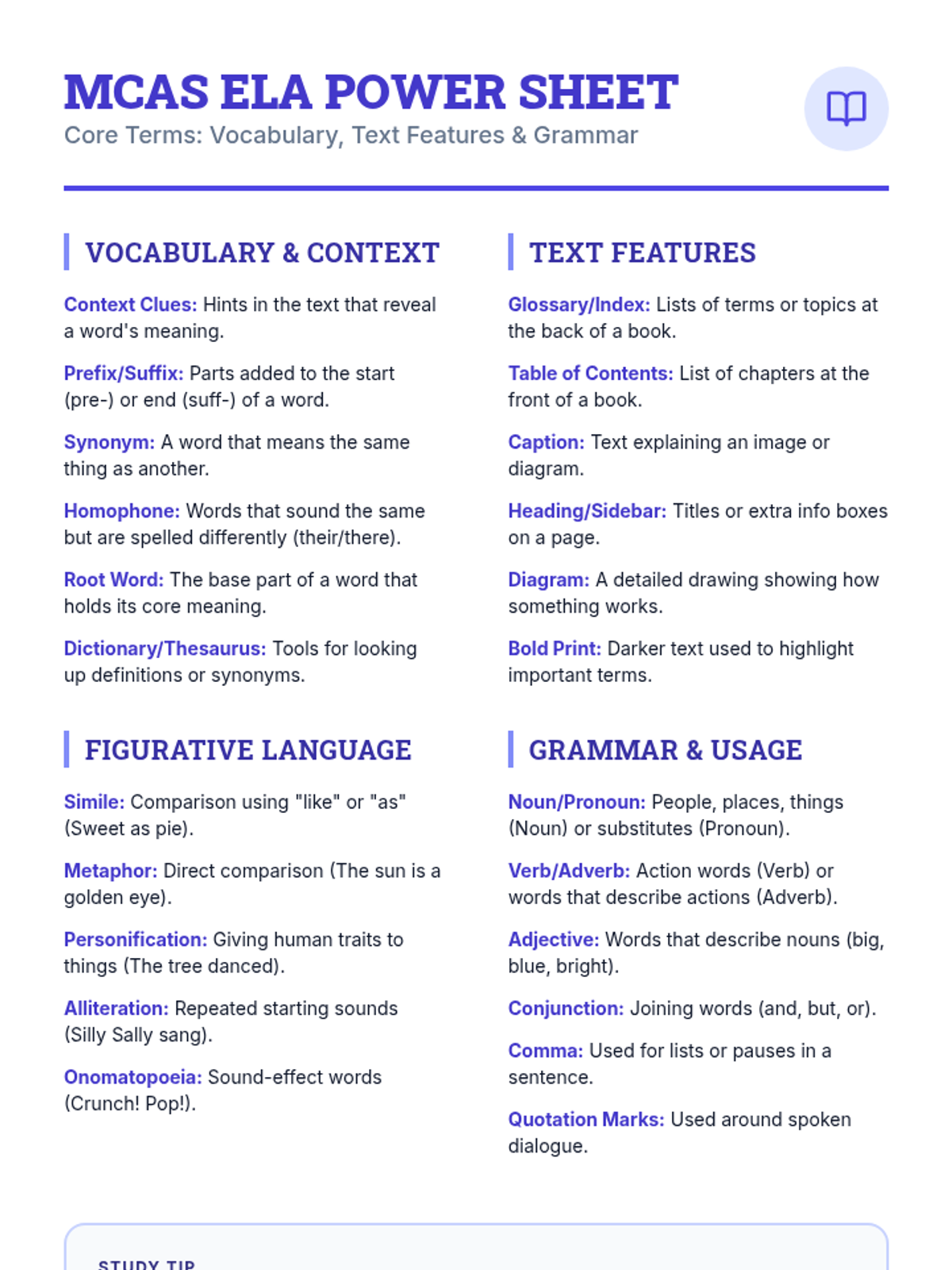
A one-page student reference sheet containing the key ELA terms, definitions, and examples featured in the bingo game. Perfect for pre-game study or as a reference during the activity. Revised to align with new categories.
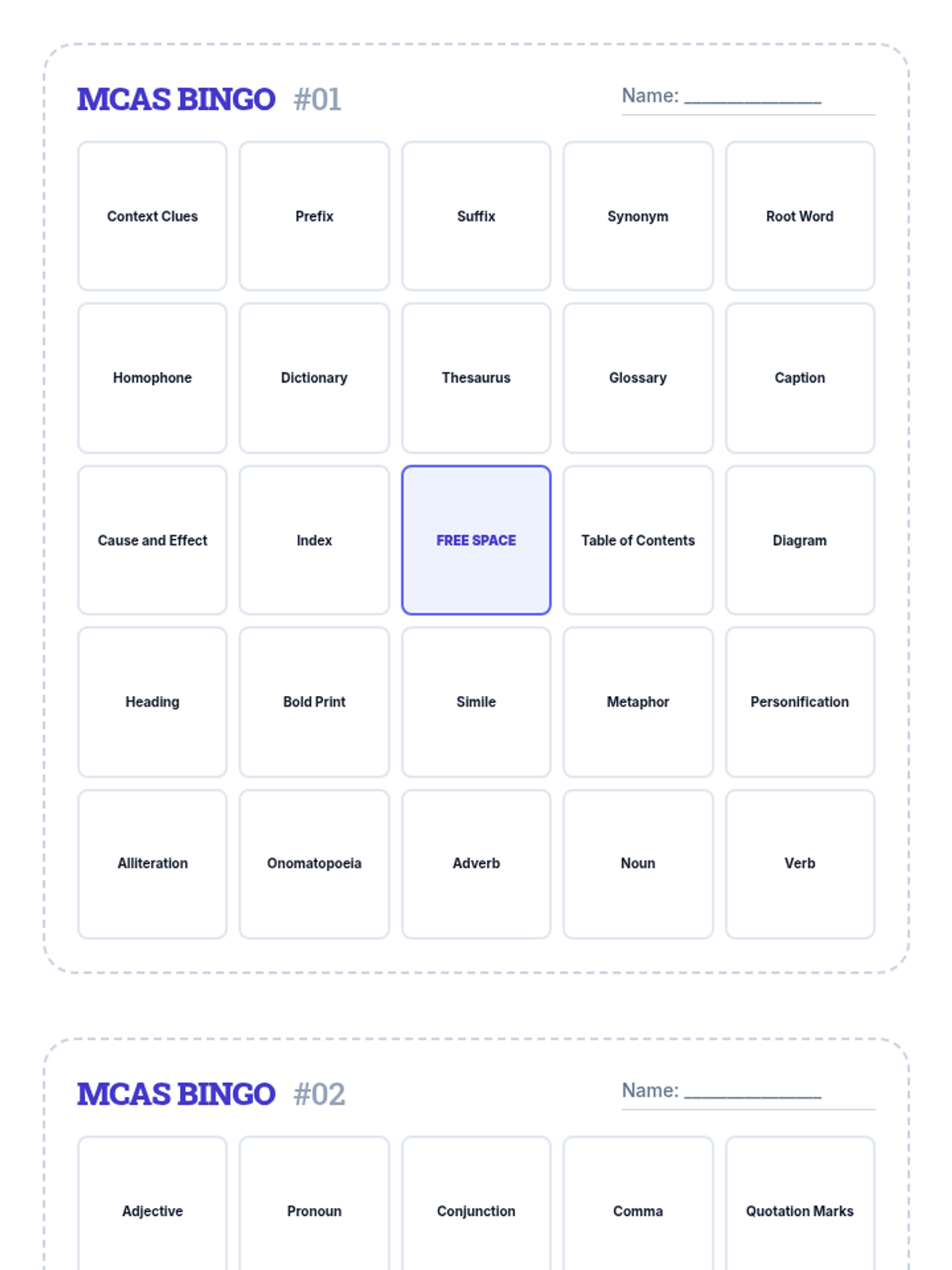
A collection of 22 unique bingo cards for ELA review, featuring academic vocabulary, text features, and grammar terms. Each page contains two cards with randomized terms. Revised to remove forbidden literary and vocabulary terms.
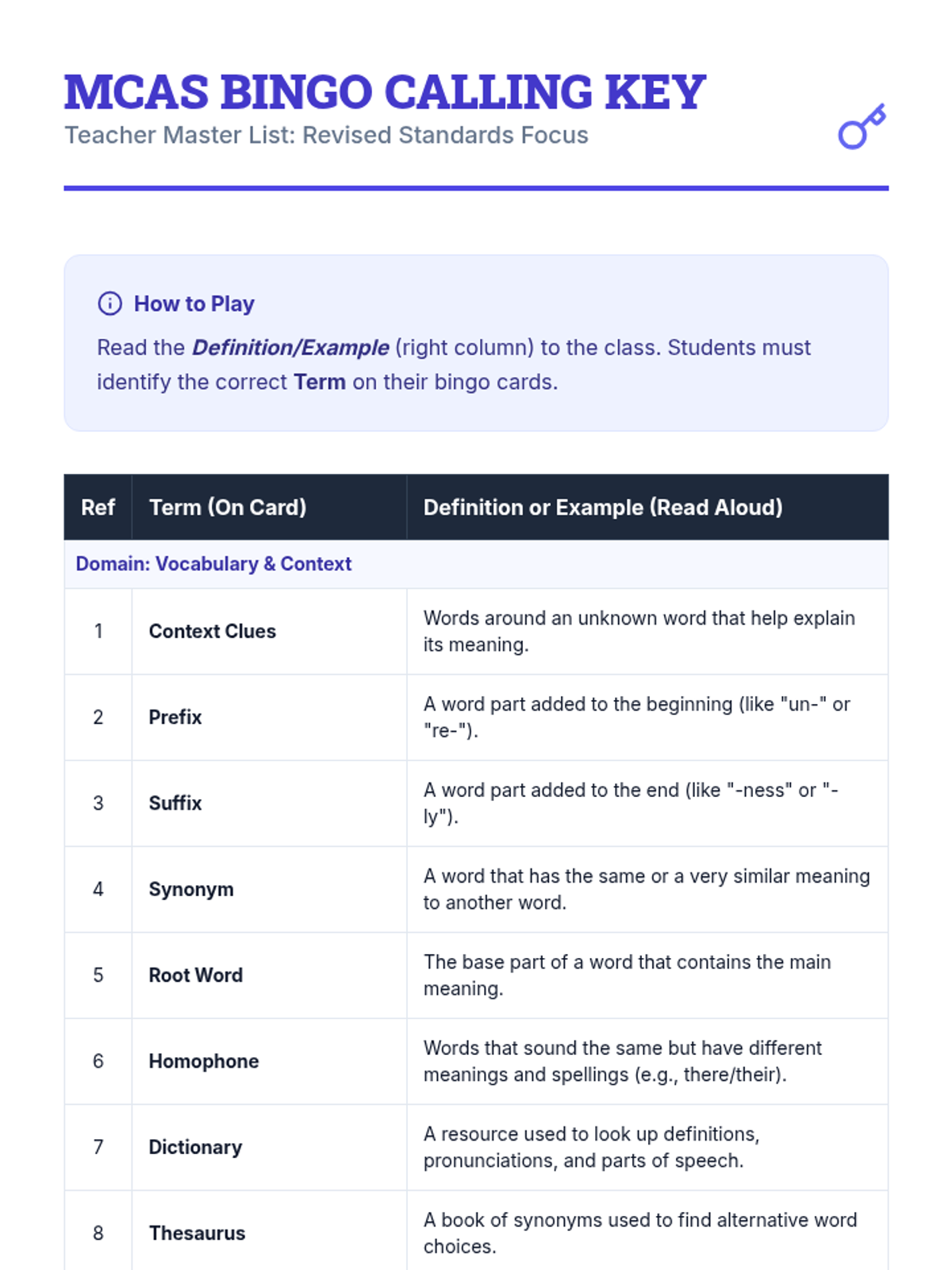
A comprehensive master calling key for the teacher, listing 30 ELA terms, their definitions, and examples aligned with MCAS standards. Revised to remove literary elements and focus on vocabulary, text features, and grammar.
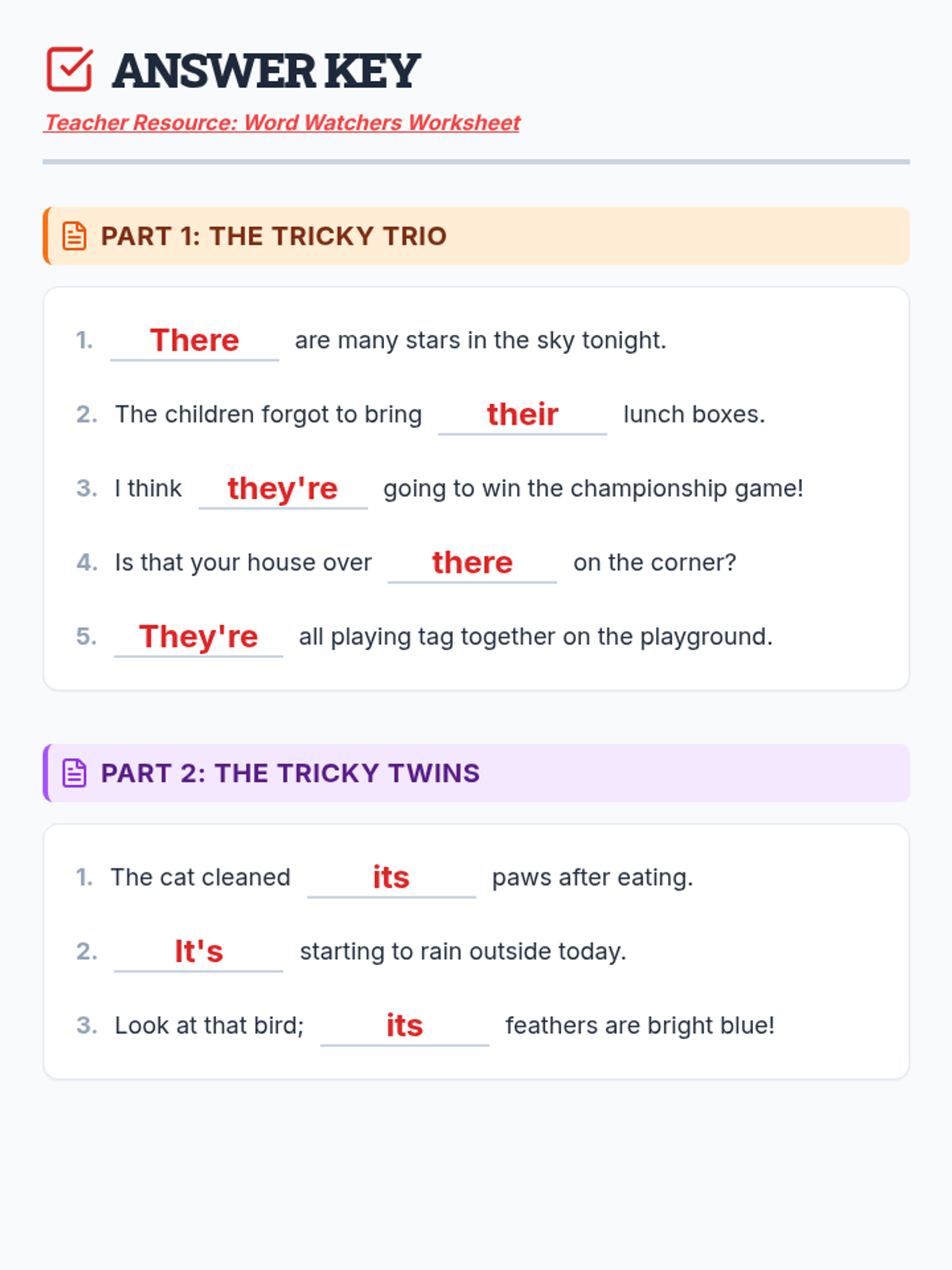
The teacher's answer key for the Word Watchers Worksheet, with all correct answers filled in, including the second page on general apostrophe usage and plural error correction.
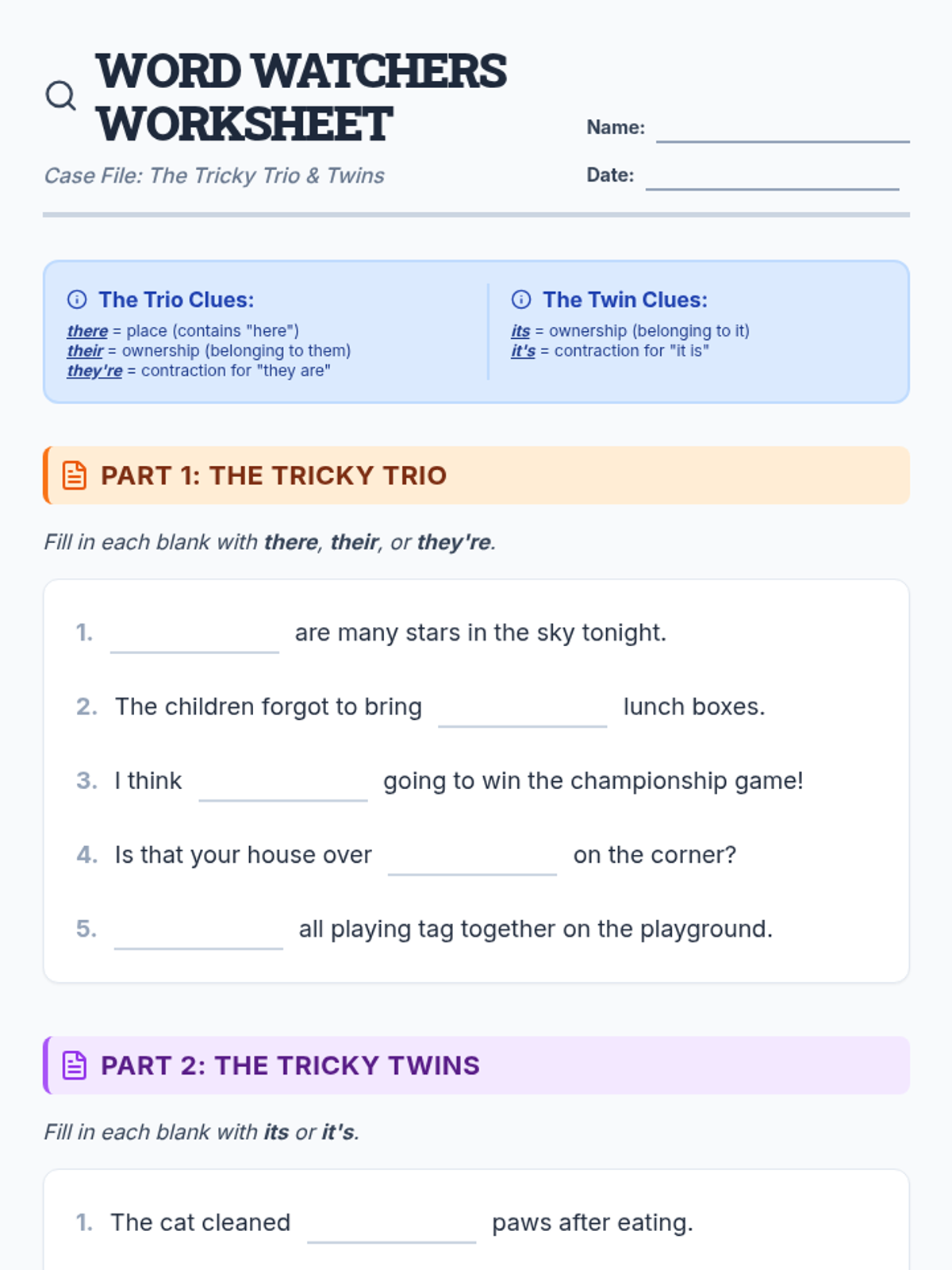
A student practice worksheet featuring fill-in-the-blank sentences and sentence writing activities for there/their/they're and its/it's, plus a second page on general apostrophe usage with mixed error detection.
A visual presentation for teaching the differences between there/their/they're and its/it's, plus general apostrophe usage for contractions and possession, including a warning about incorrect plural use.
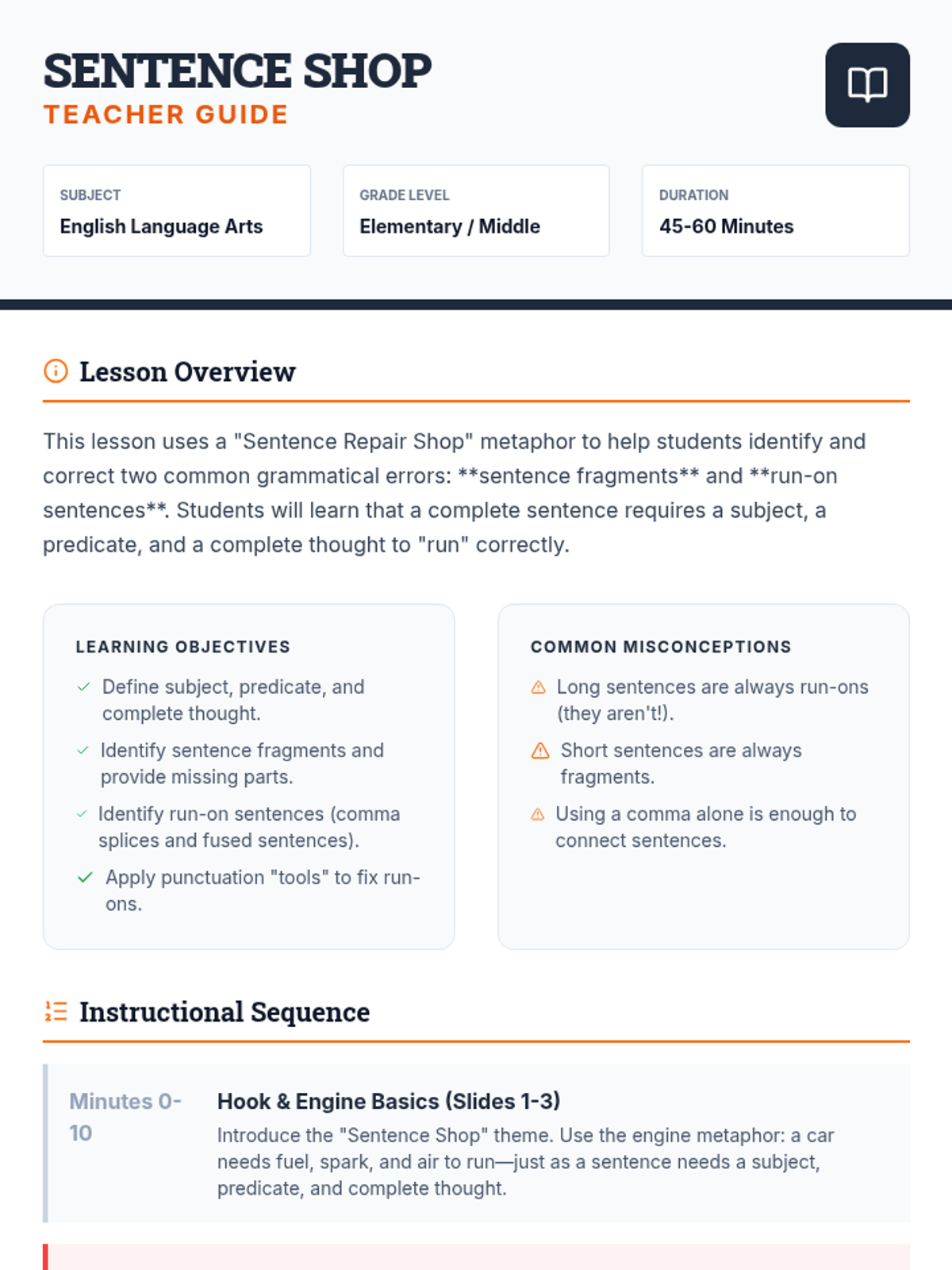
A comprehensive teacher guide for the 'Sentence Shop' lesson, featuring lesson objectives, a timed instructional sequence, differentiation strategies, and discussion prompts.
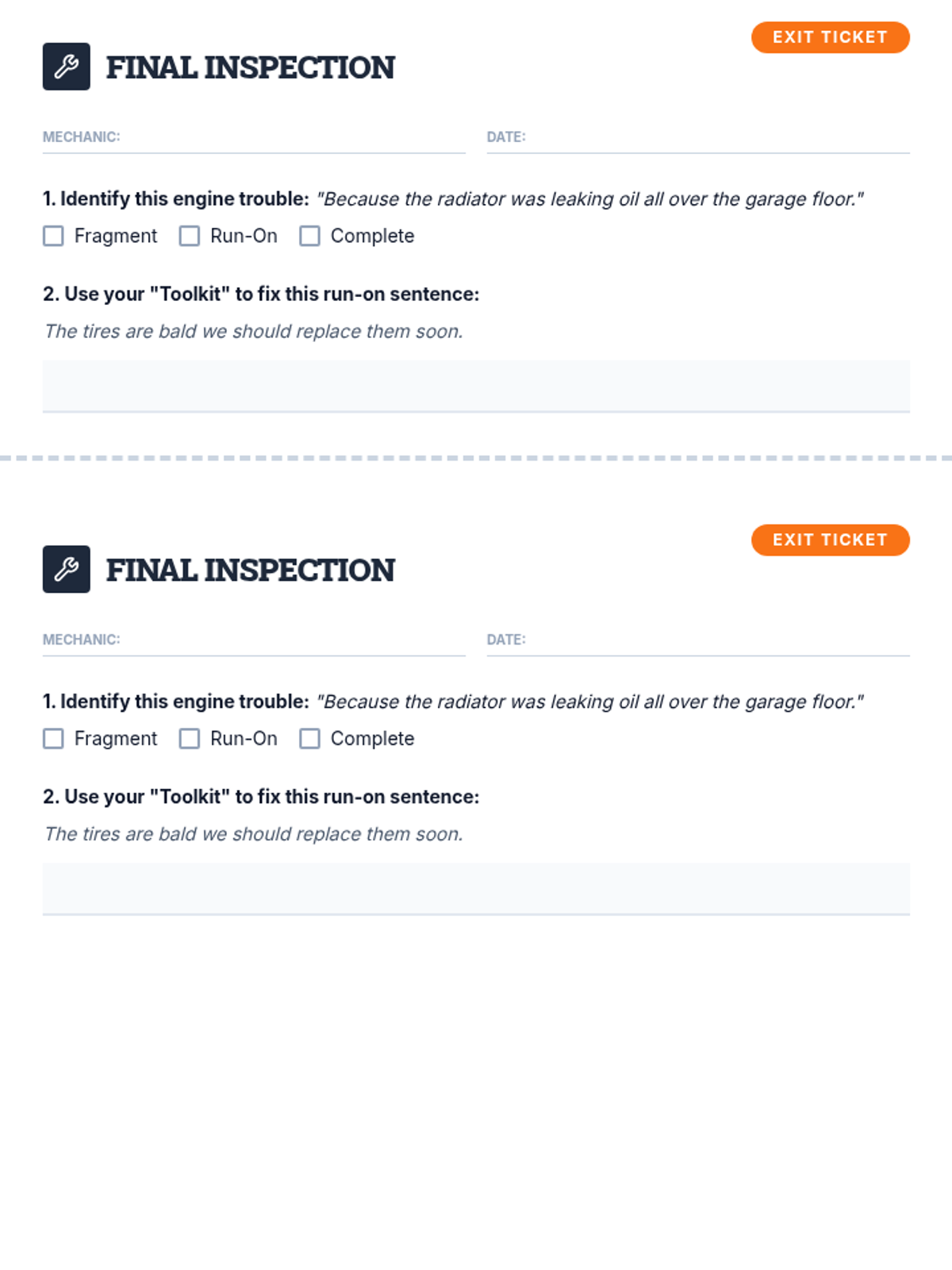
A quick end-of-lesson assessment (exit ticket) featuring identification and correction tasks, designed with two tickets per page for efficient printing.
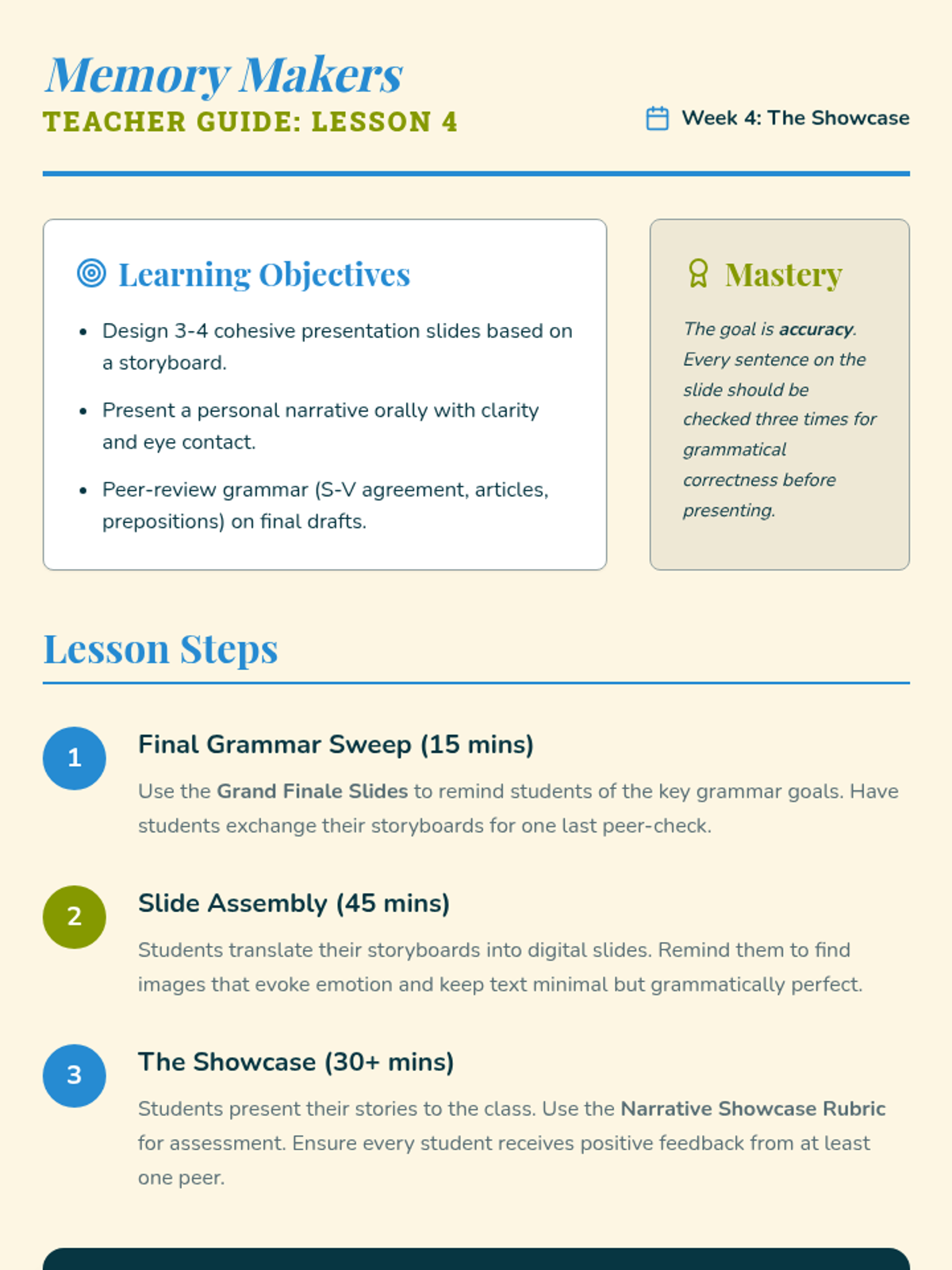
Teacher's guide for the final week of the program, focusing on slide creation, final grammar checks, and the oral presentation showcase.
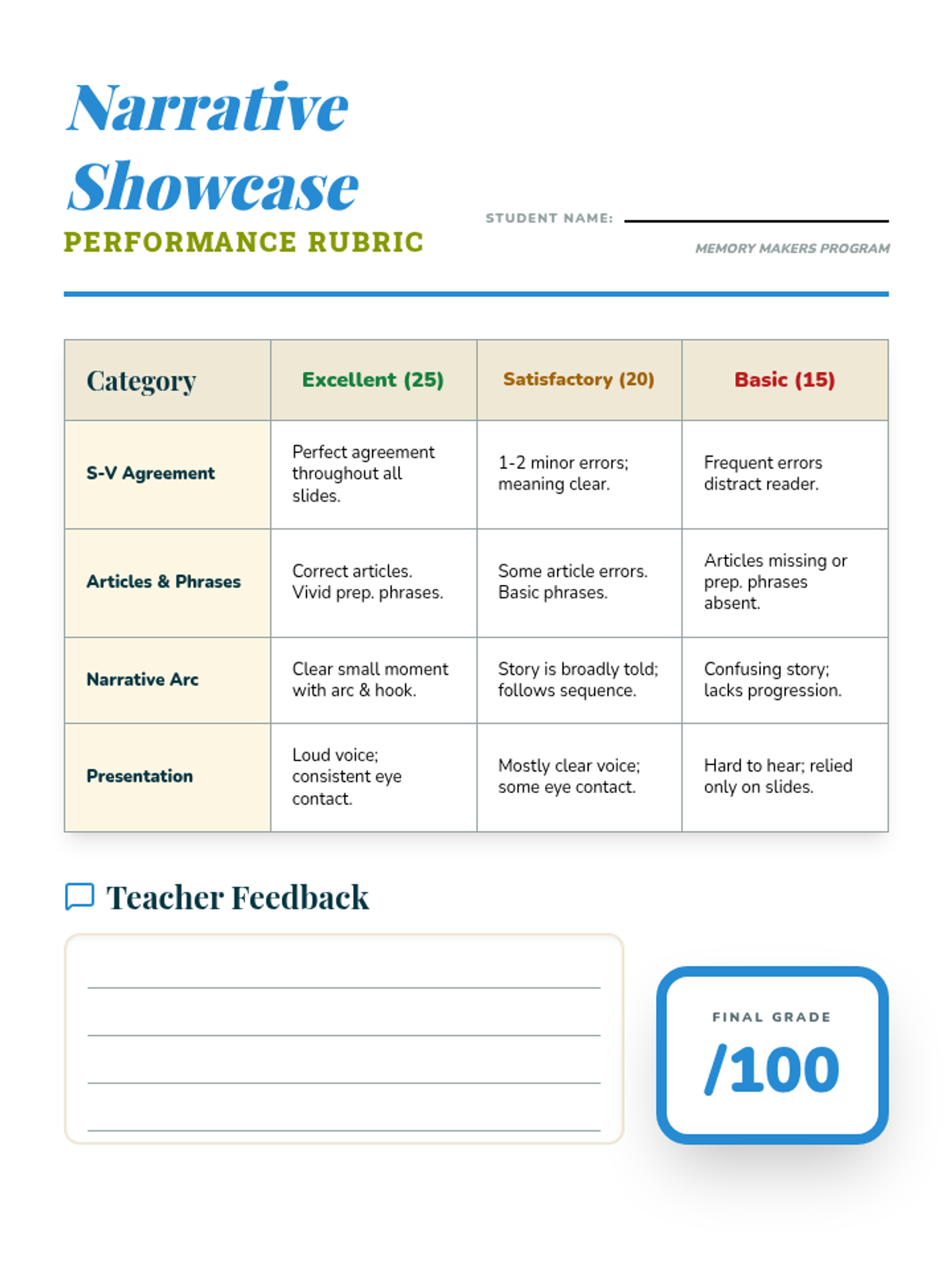
A comprehensive grading rubric for the final personal narrative oral presentation, including grammar, content, and delivery criteria.
Final slide deck for Lesson 4, guiding students through the preparation and delivery of their oral personal narrative presentations.
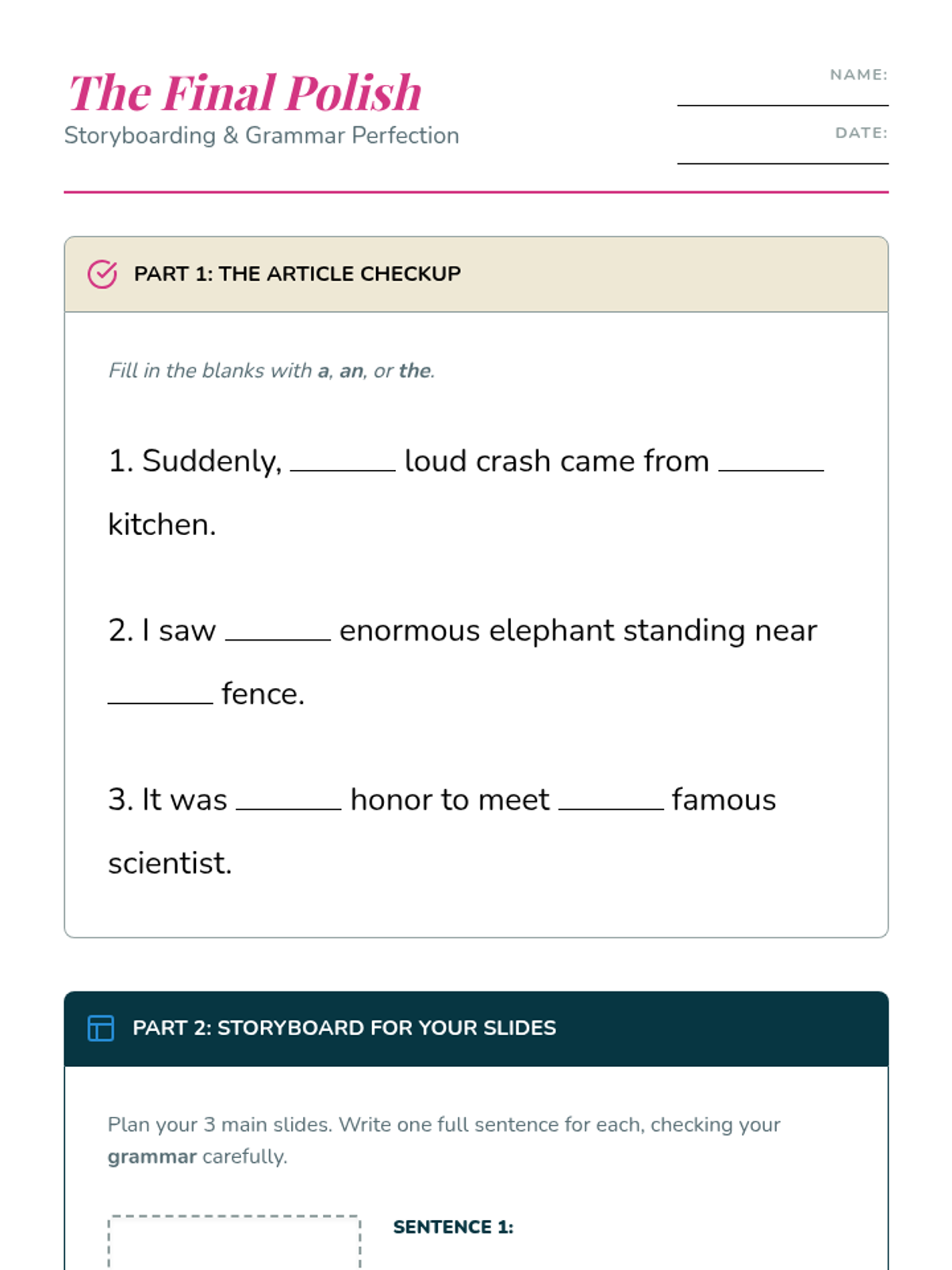
Worksheet for Lesson 3 to practice article usage and begin storyboarding for the final oral presentation slides.
Slides for Lesson 3 focusing on the correct use of definite and indefinite articles (a, an, the) within the context of a story.
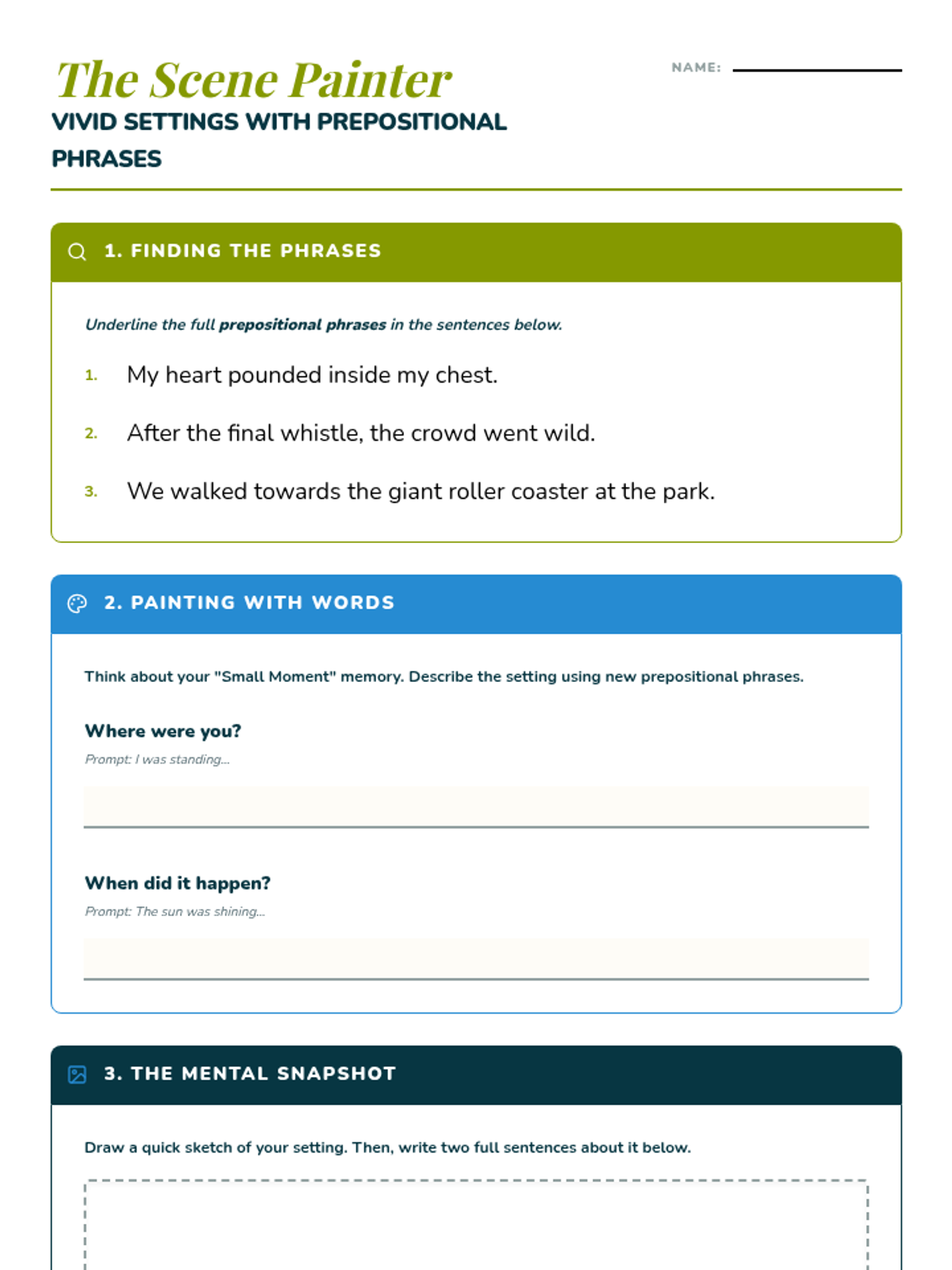
Worksheet for Lesson 2 focusing on identifying and using prepositional phrases to describe the setting of a personal narrative.
Slide presentation for Lesson 2 focusing on setting description and the use of prepositional phrases to add detail.
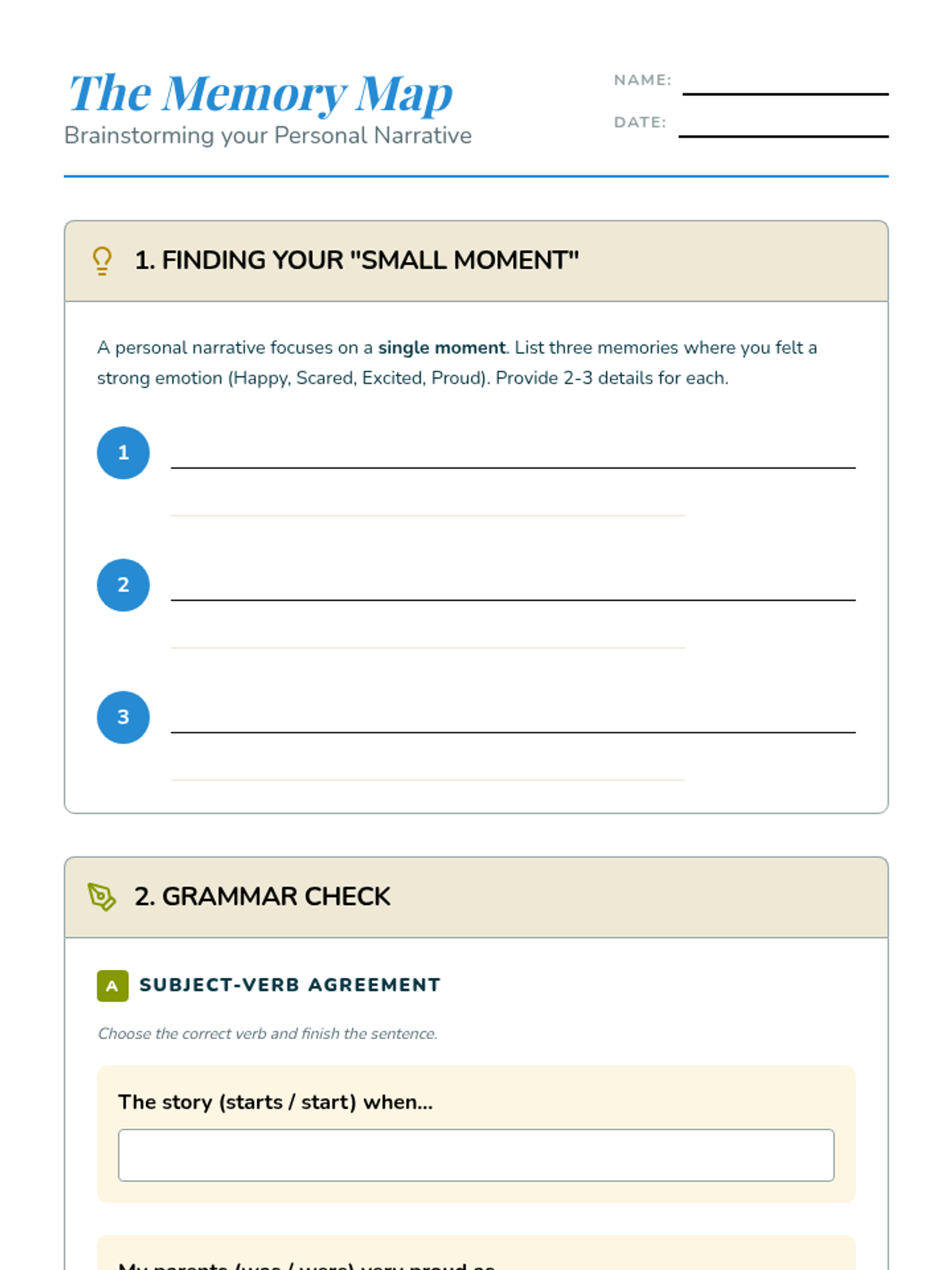
A student worksheet for brainstorming personal narrative topics and practicing subject-verb agreement.
Introductory presentation for Lesson 1, covering the concept of personal narratives and the rules of subject-verb agreement.
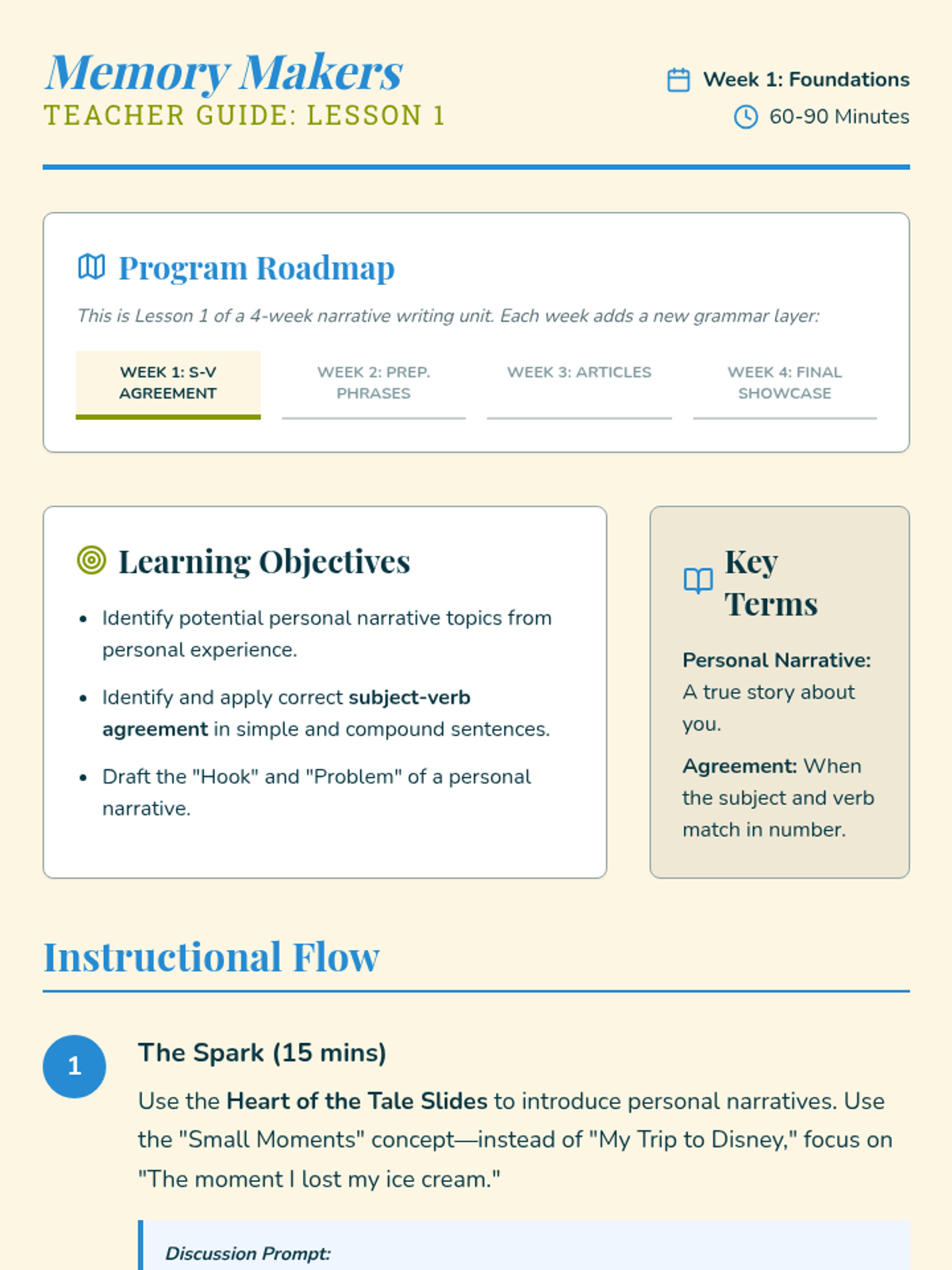
A teacher's guide for the first week of the Memory Makers program, covering personal narrative basics and subject-verb agreement instruction.
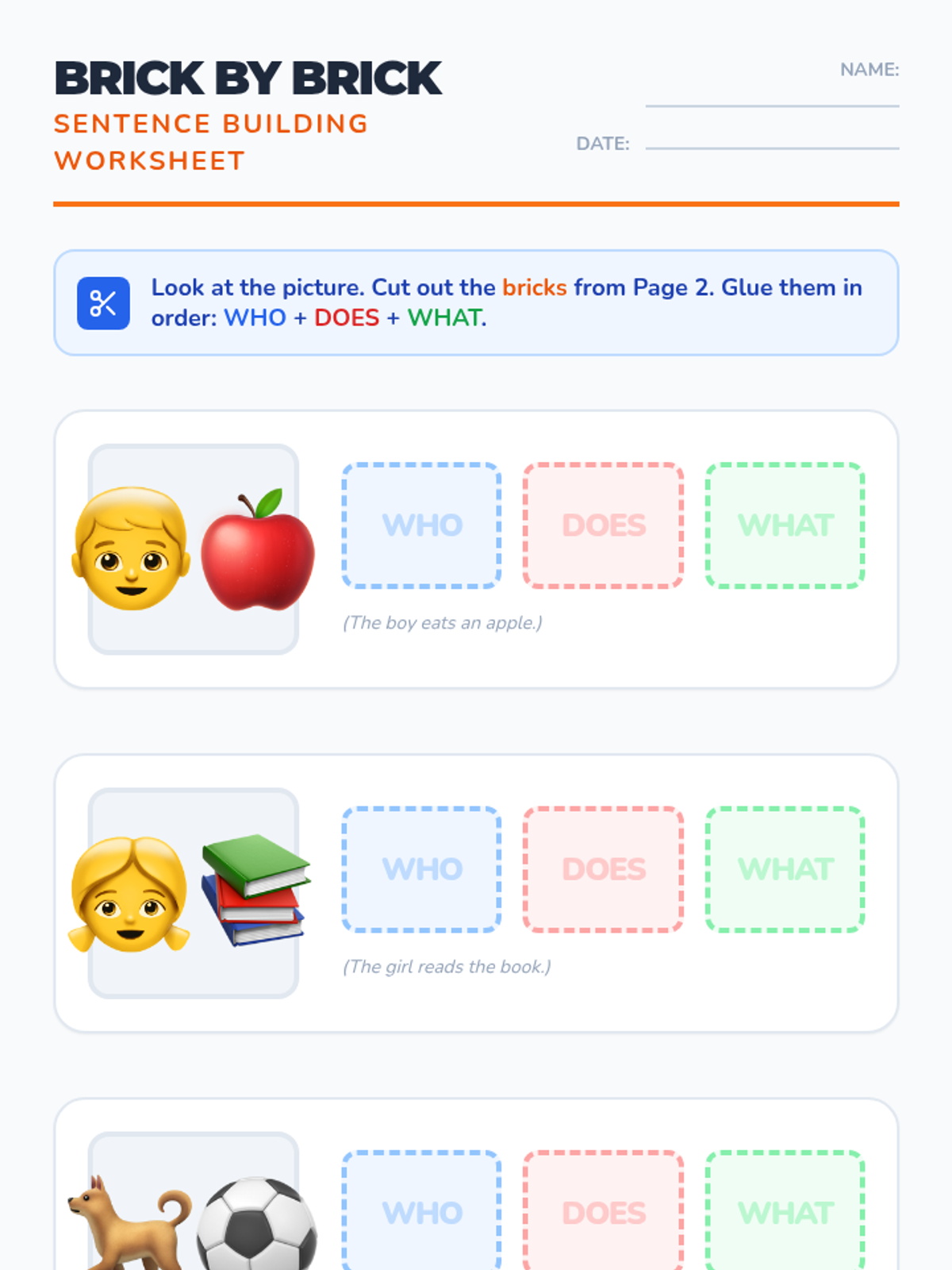
A picture-based sequencing worksheet where MLL students cut and paste words (Who, Does, What) to construct sentences matching visual prompts.
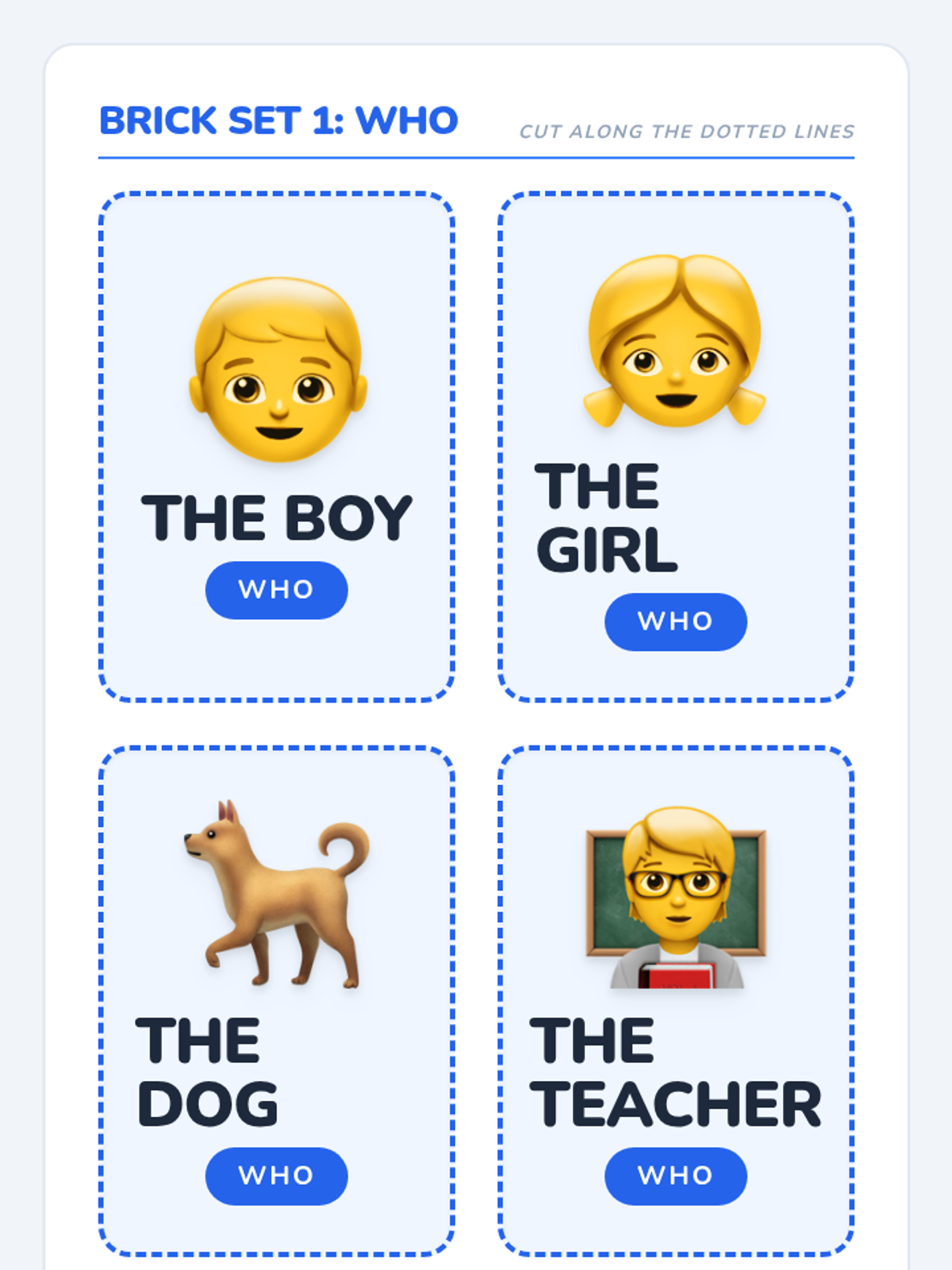
A set of 12 color-coded flashcards (4 Who, 4 Does, 4 What) with large icons and words to help MLL students build Subject-Verb-Object sentences physically.
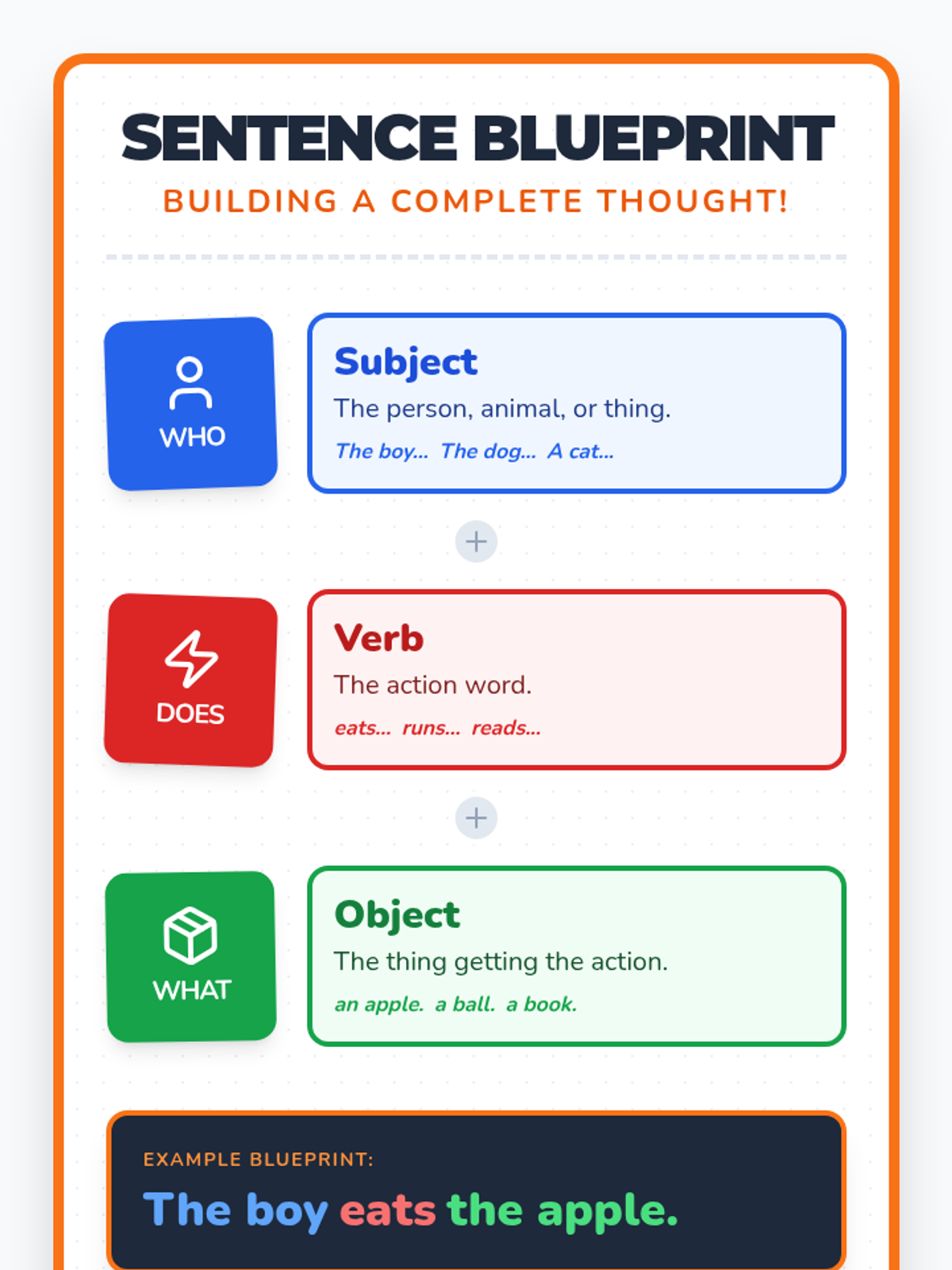
A visual anchor chart illustrating the Subject-Verb-Object sentence structure using color-coded blocks and simple icons to support MLL students.
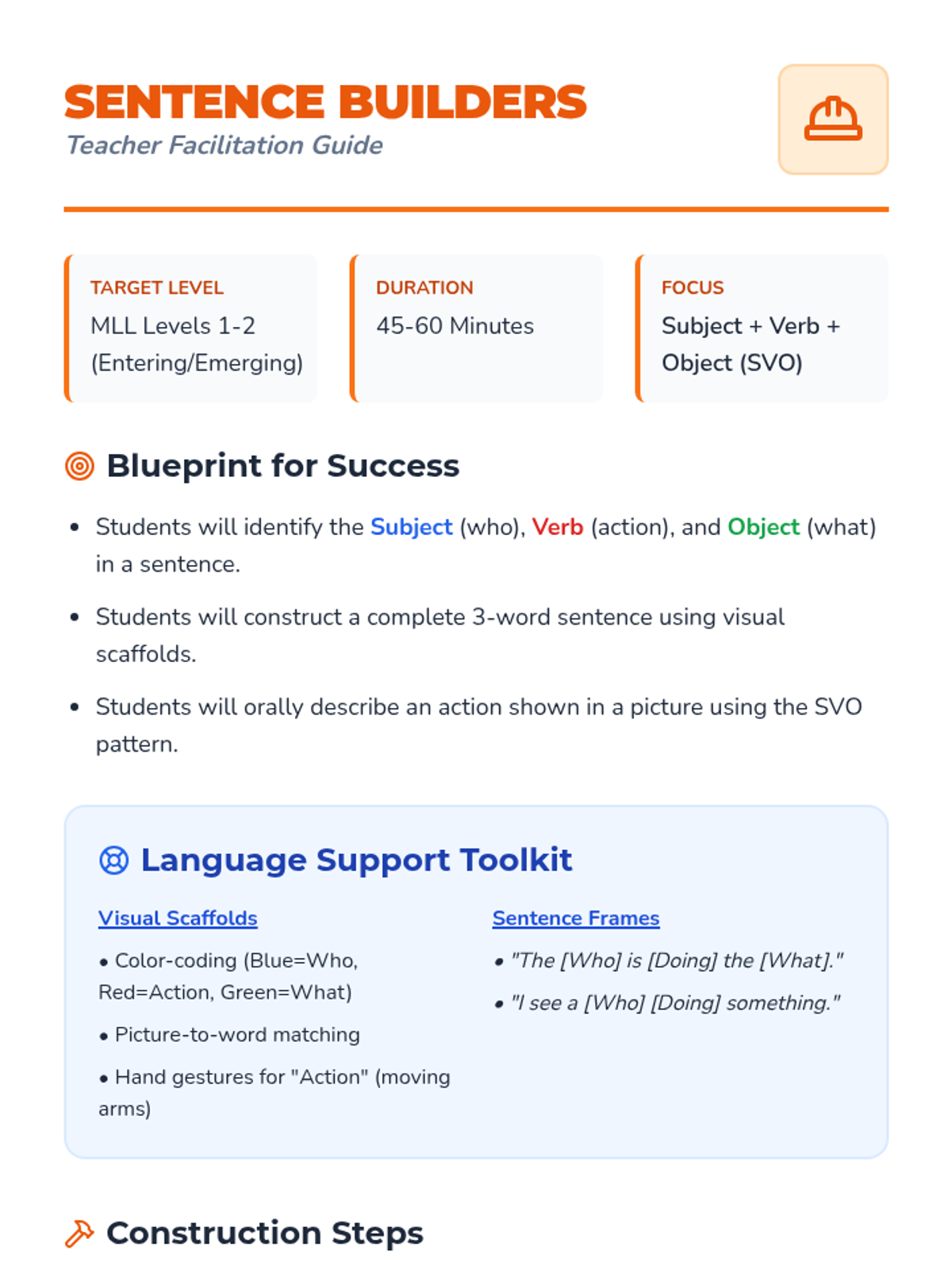
A comprehensive teacher facilitation guide for teaching basic SVO sentence structure to MLL students, featuring color-coded scaffolding, visual cues, and explicit instructional steps.
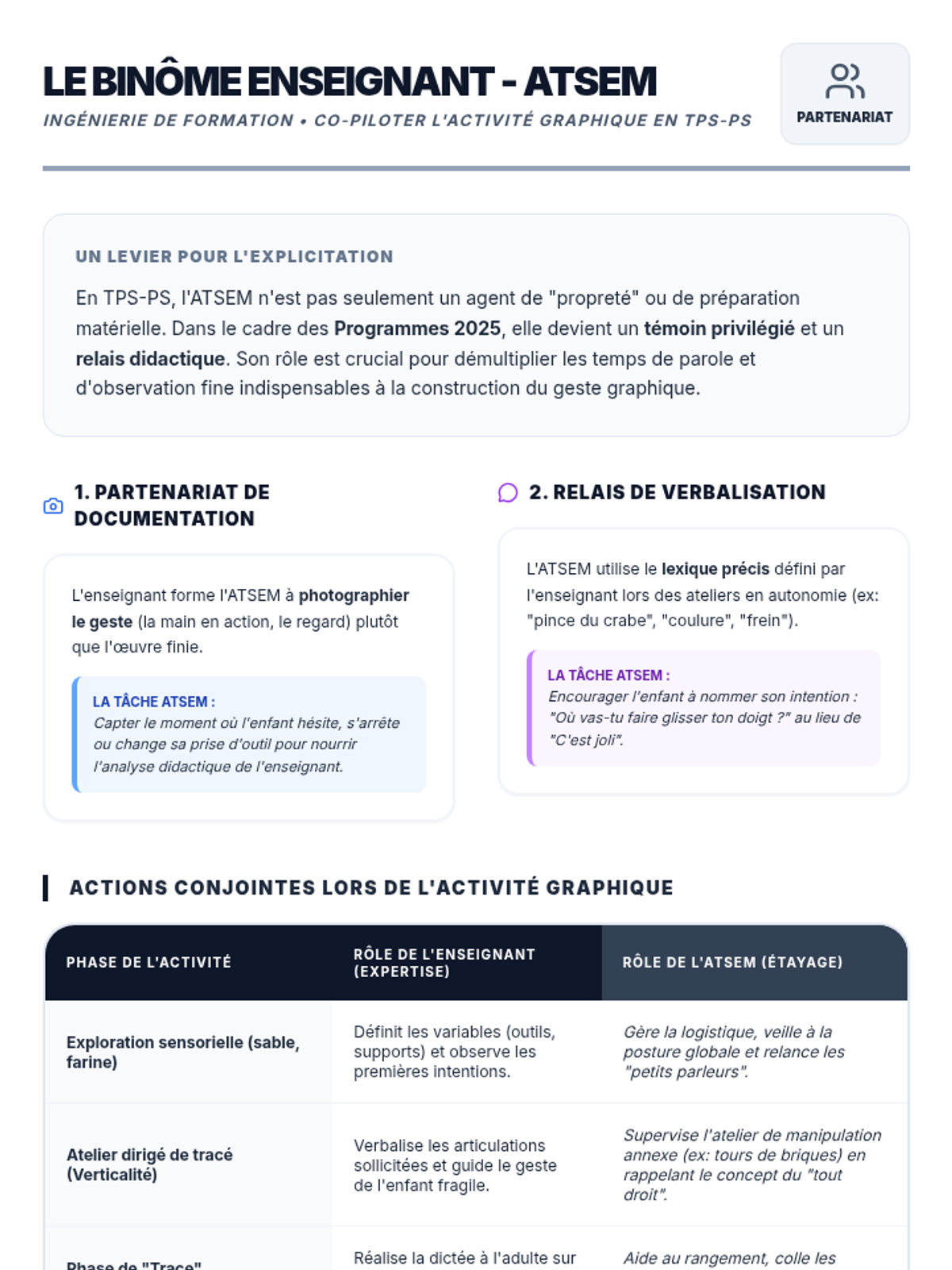
Guide méthodologique sur la collaboration entre l'enseignant et l'ATSEM en maternelle (TPS-PS) lors des activités graphiques. Définit les rôles respectifs pour l'observation, la verbalisation et la gestion de la trace selon les nouveaux programmes.
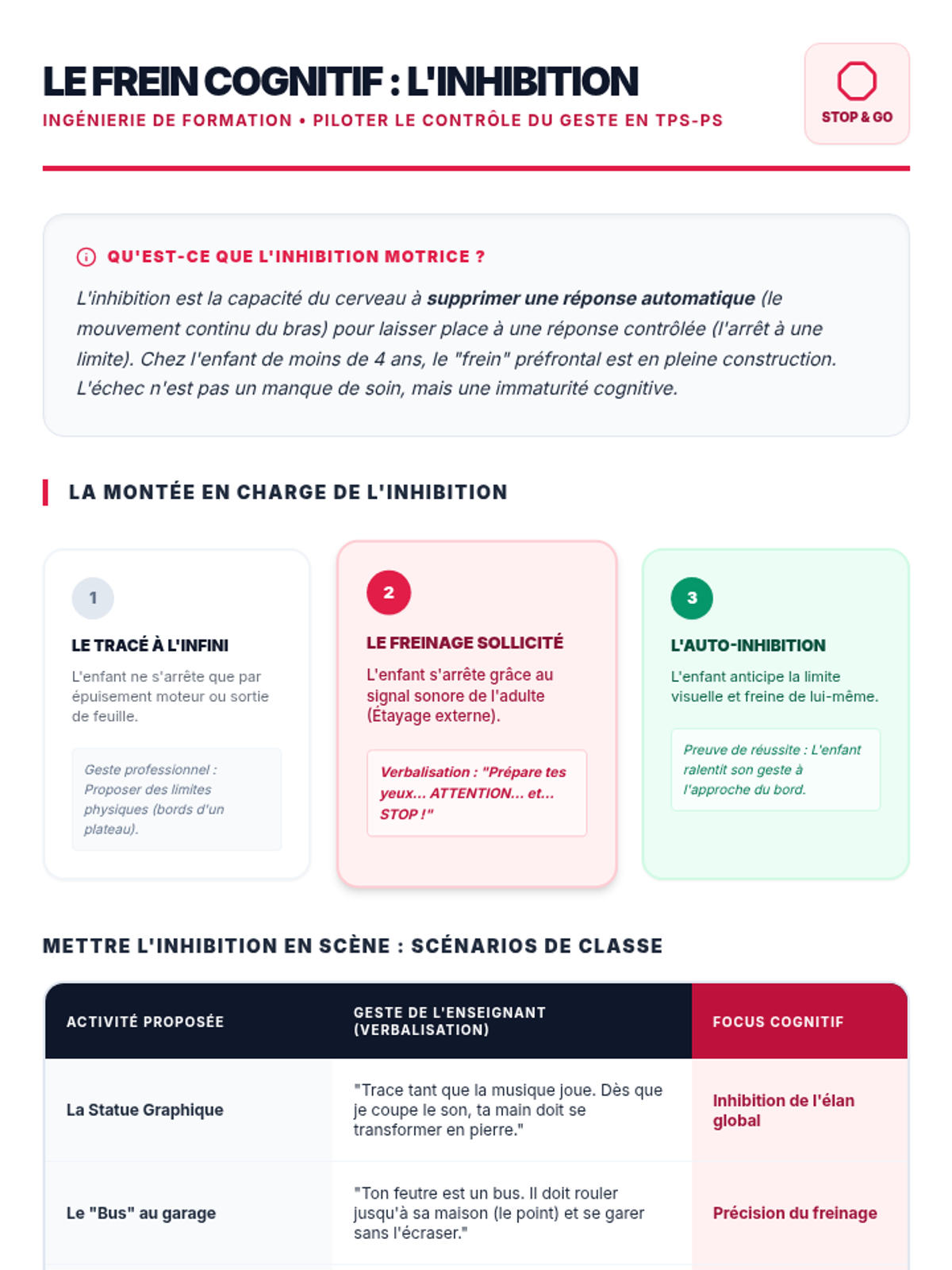
Note d'expertise ciblée sur la fonction d'inhibition dans le geste graphique chez les élèves de maternelle (TPS-PS). Analyse les stades de développement du freinage moteur et propose des scénarios pédagogiques pour le renforcer.
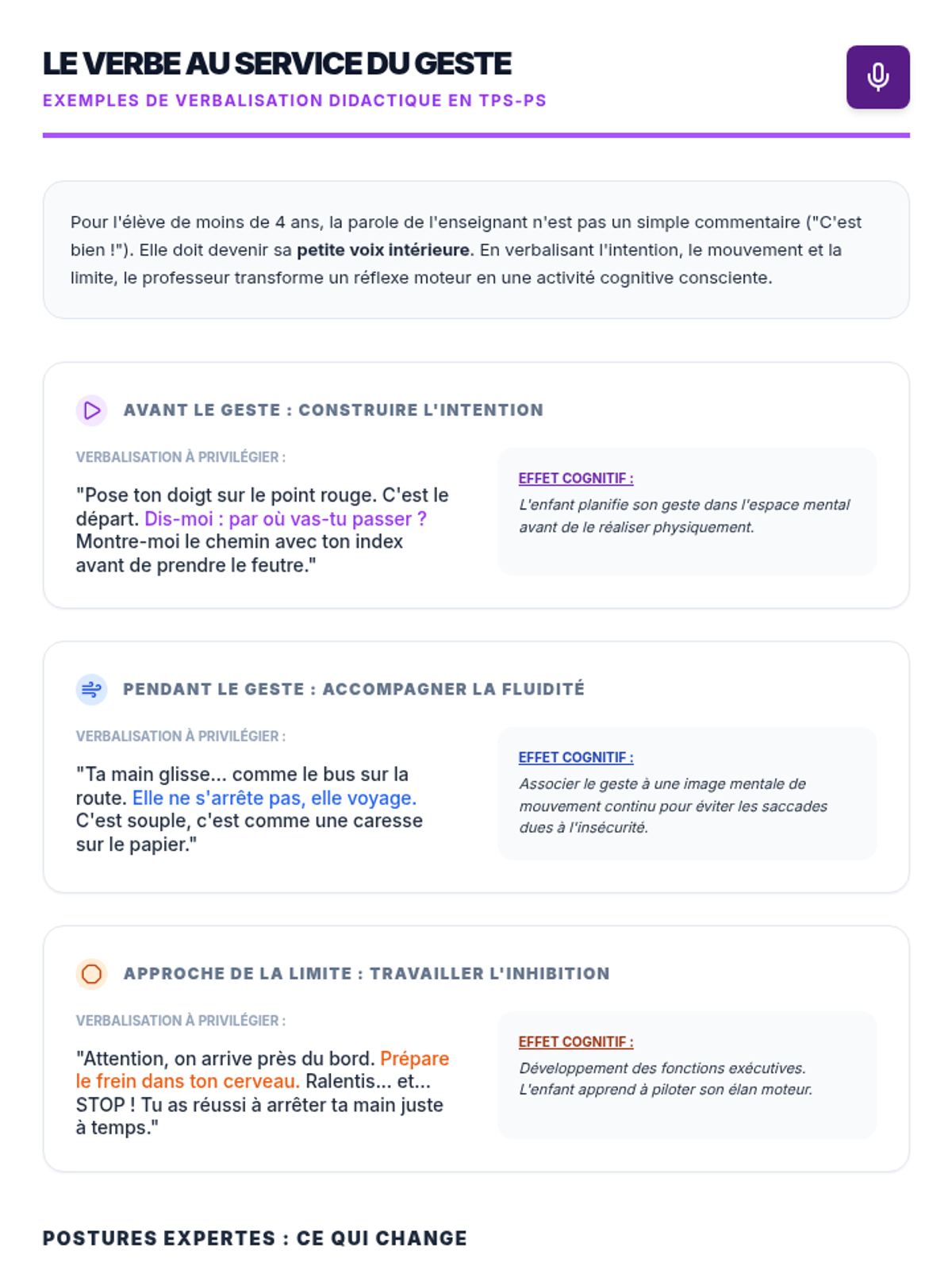
Guide de verbalisation didactique pour les enseignants de TPS-PS. Propose des scénarios concrets de prise de parole pour accompagner les étapes cognitives du geste graphique (intentionnalité, fluidité, inhibition).
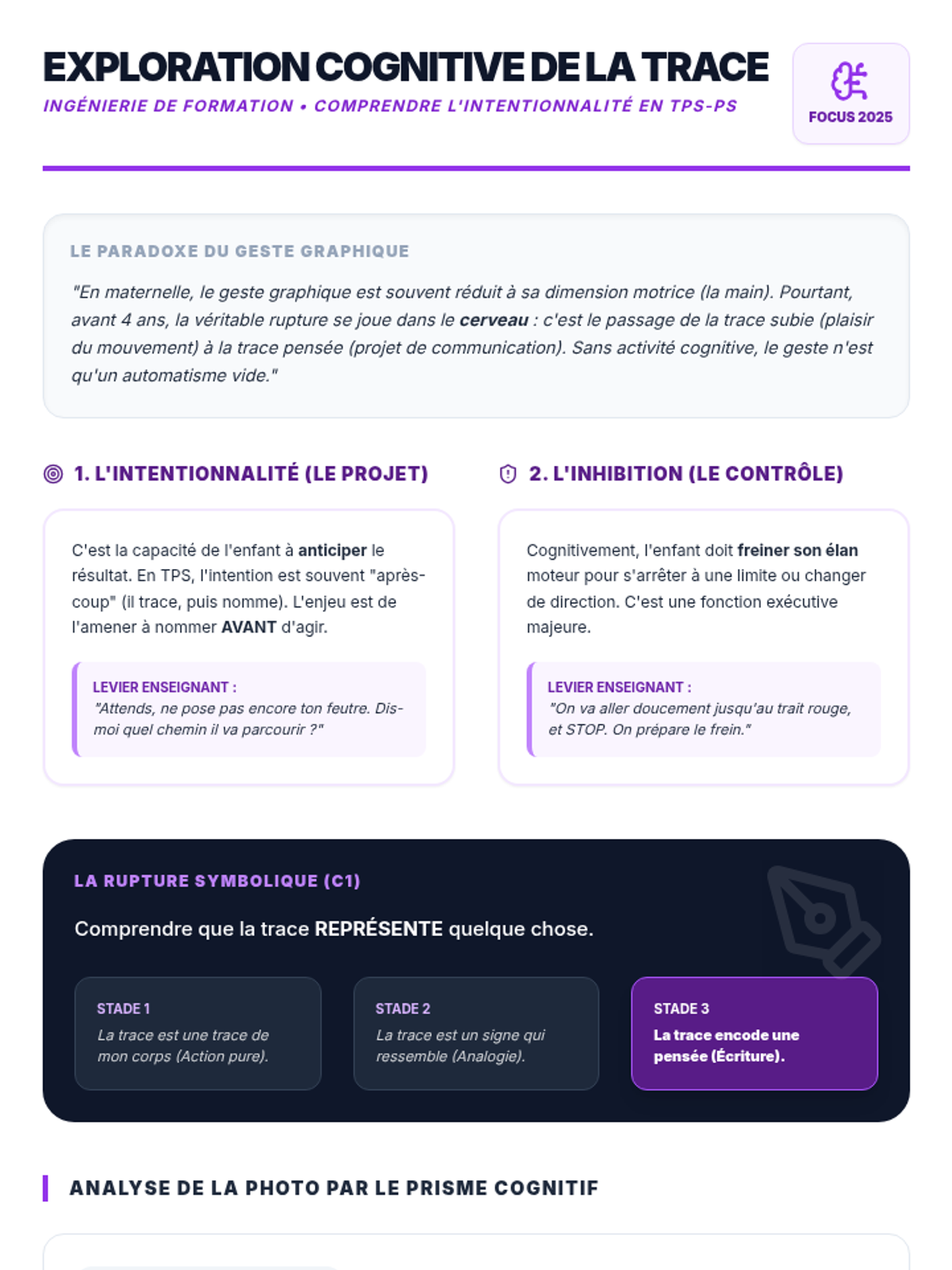
Ressource d'expertise approfondie sur les processus cognitifs engagés dans le geste graphique chez les enfants de moins de 4 ans (TPS-PS). Détaille l'intentionnalité, l'inhibition et la rupture symbolique pour guider l'observation des enseignants.
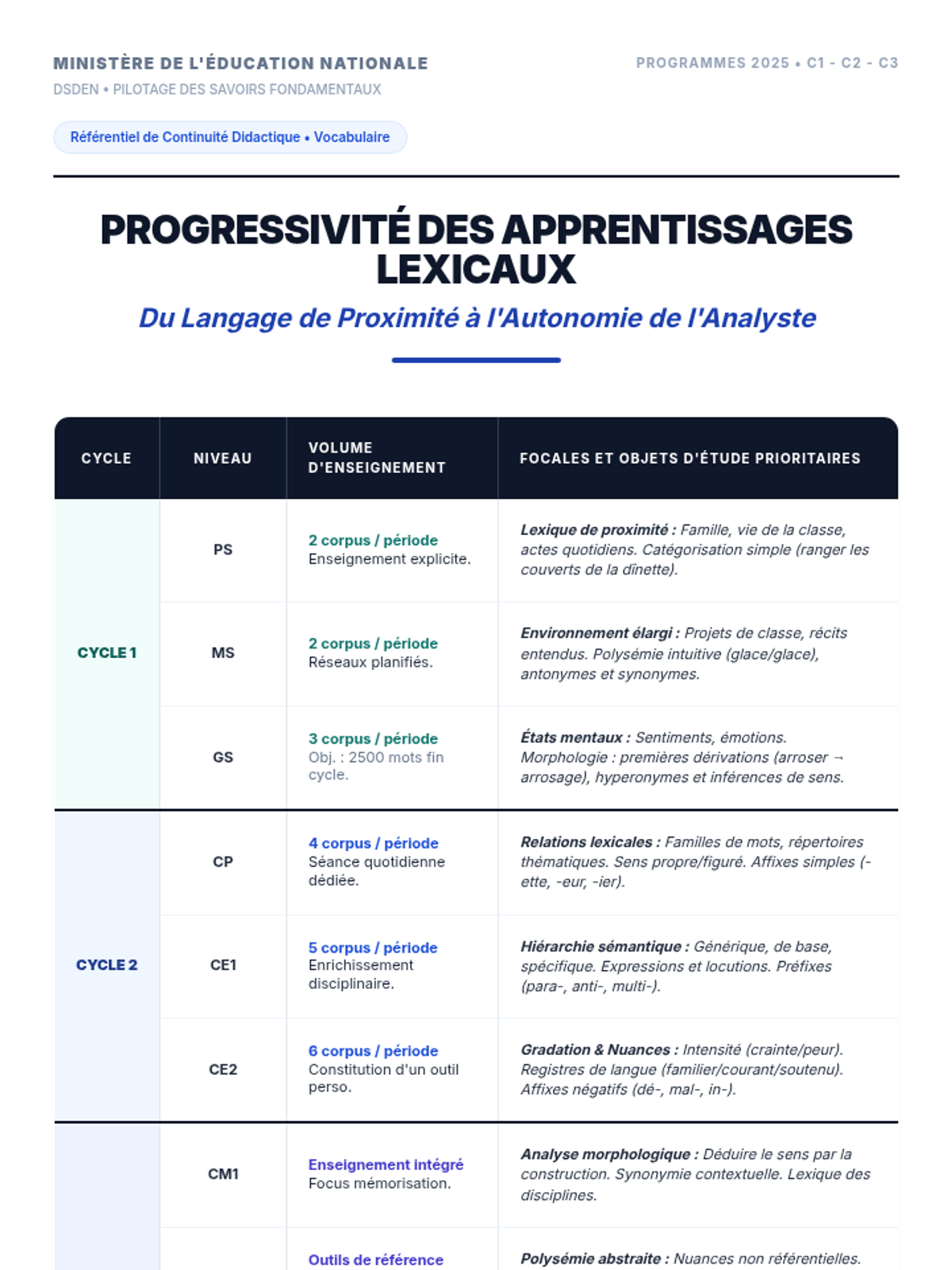
Note de synthèse comparative détaillant la progressivité de l'enseignement du vocabulaire du CP à la 6ème selon les programmes 2025. Elle structure la montée en charge des corpus de mots et le passage d'une découverte intuitive à une analyse morphologique et sémantique experte.
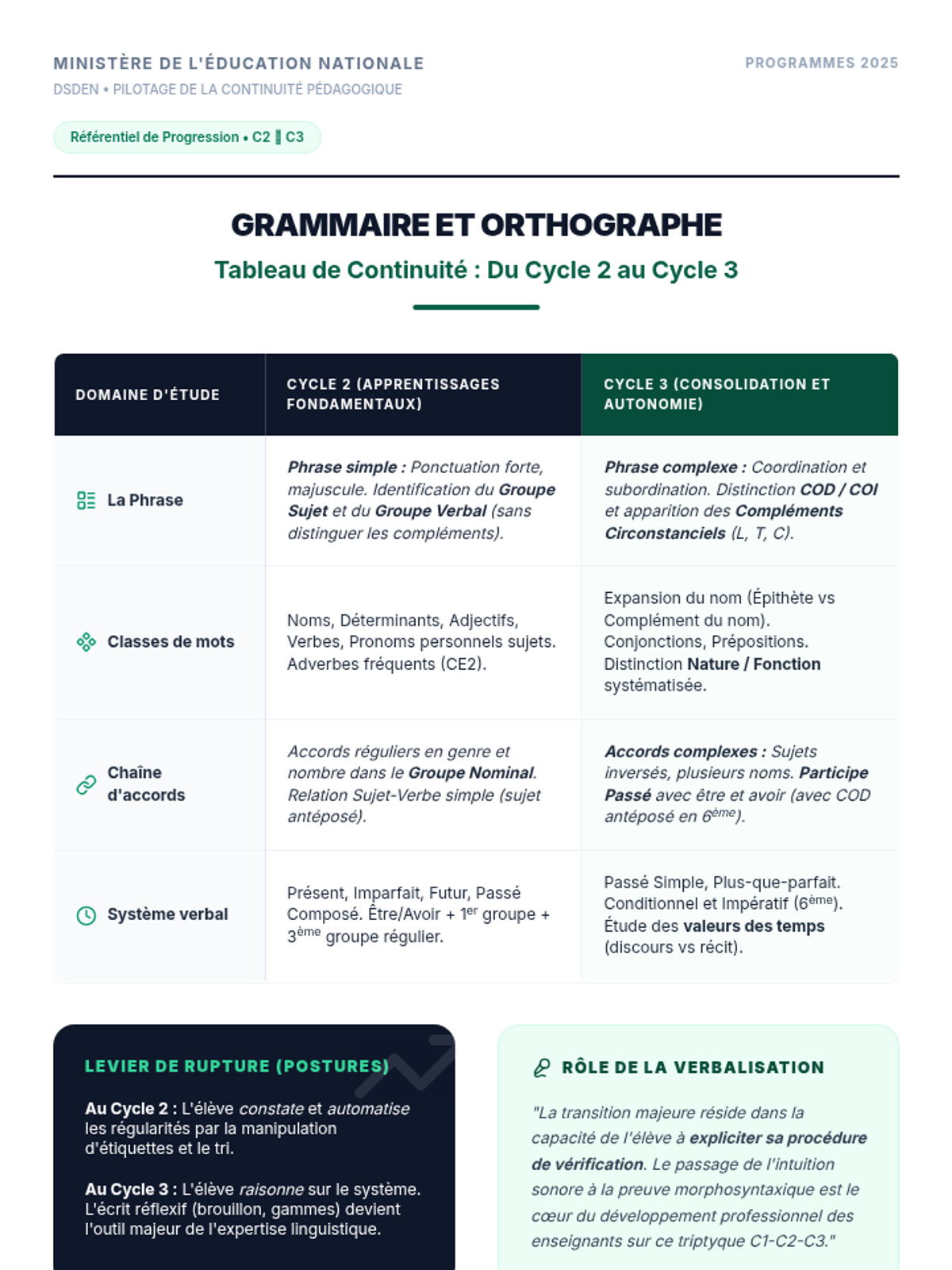
Note de synthèse comparative détaillant la progression des notions de grammaire et d'orthographe du Cycle 2 au Cycle 3 selon les programmes 2025. Elle met en évidence le passage de l'automatisation (C2) au raisonnement systémique (C3).
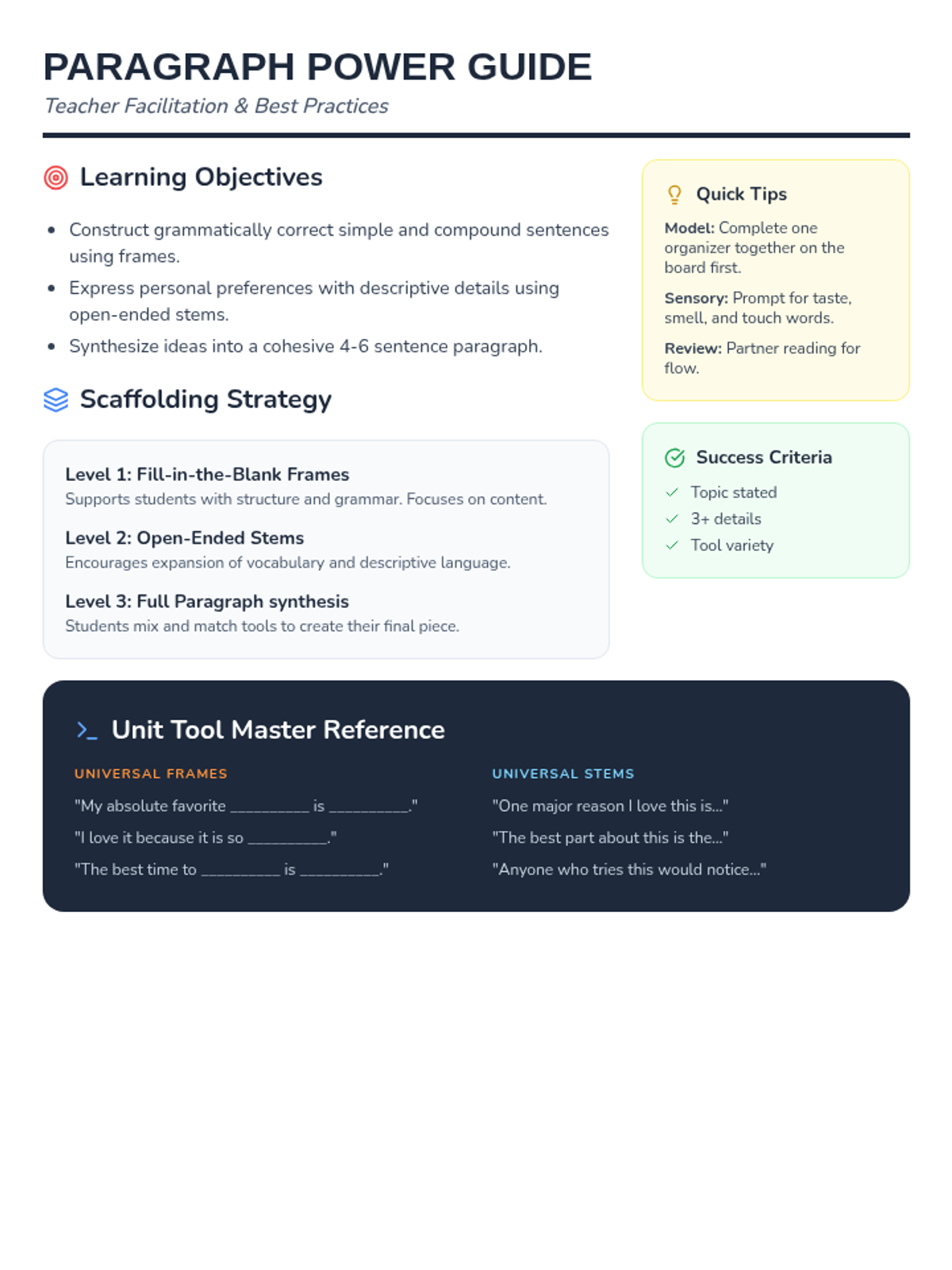
A teacher-facing guide with learning objectives, scaffolding strategies, success criteria, and model paragraphs for all 5 'Favorite Things' topics. Consistently formatted to fit on two pages.
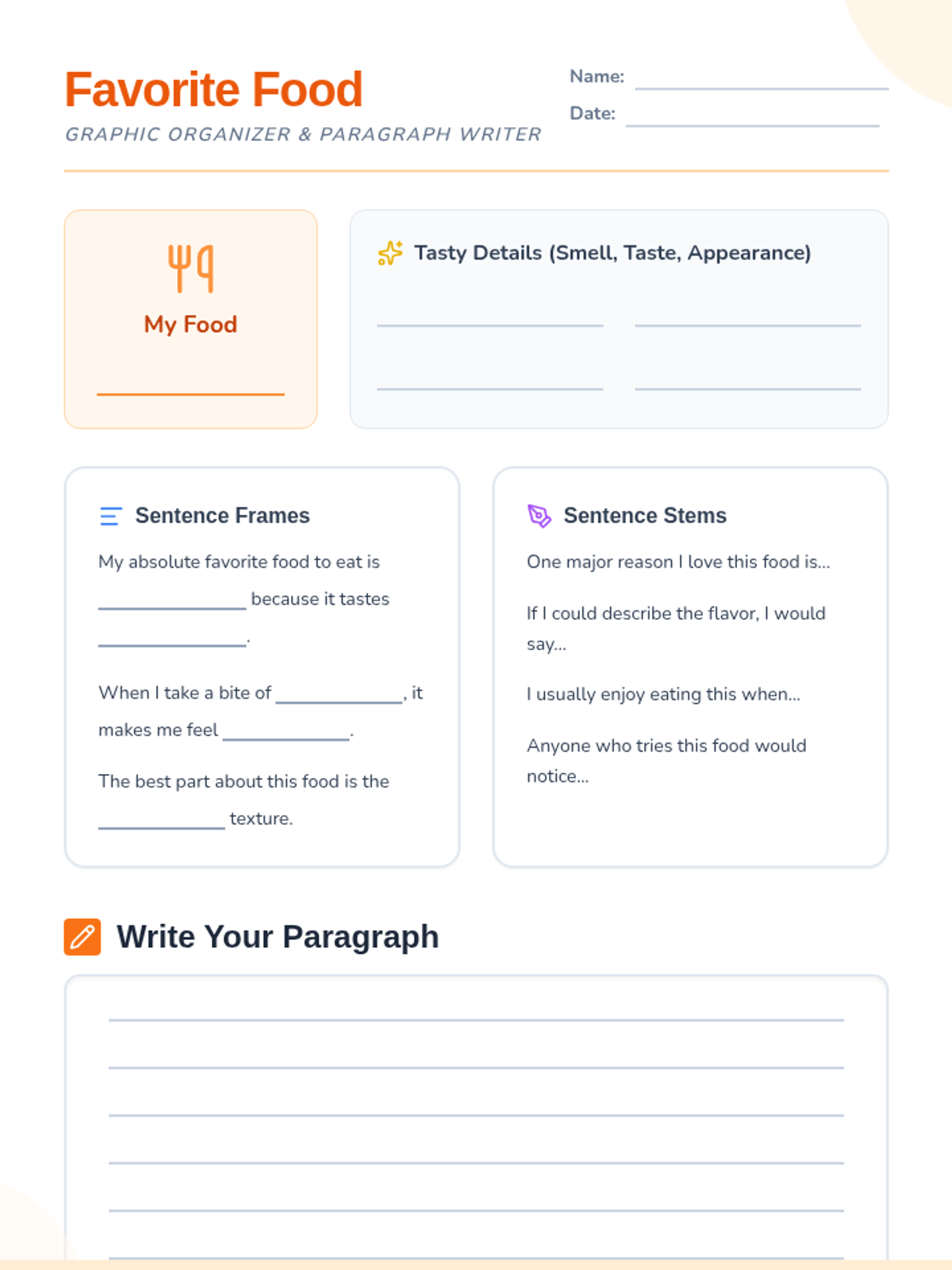
A 5-page set of graphic organizers for student writing, each covering a different 'favorite' topic with sentence frames, stems, and paragraph space. Includes expanded writing lines (9 per page) and darker detail grids for better usability.
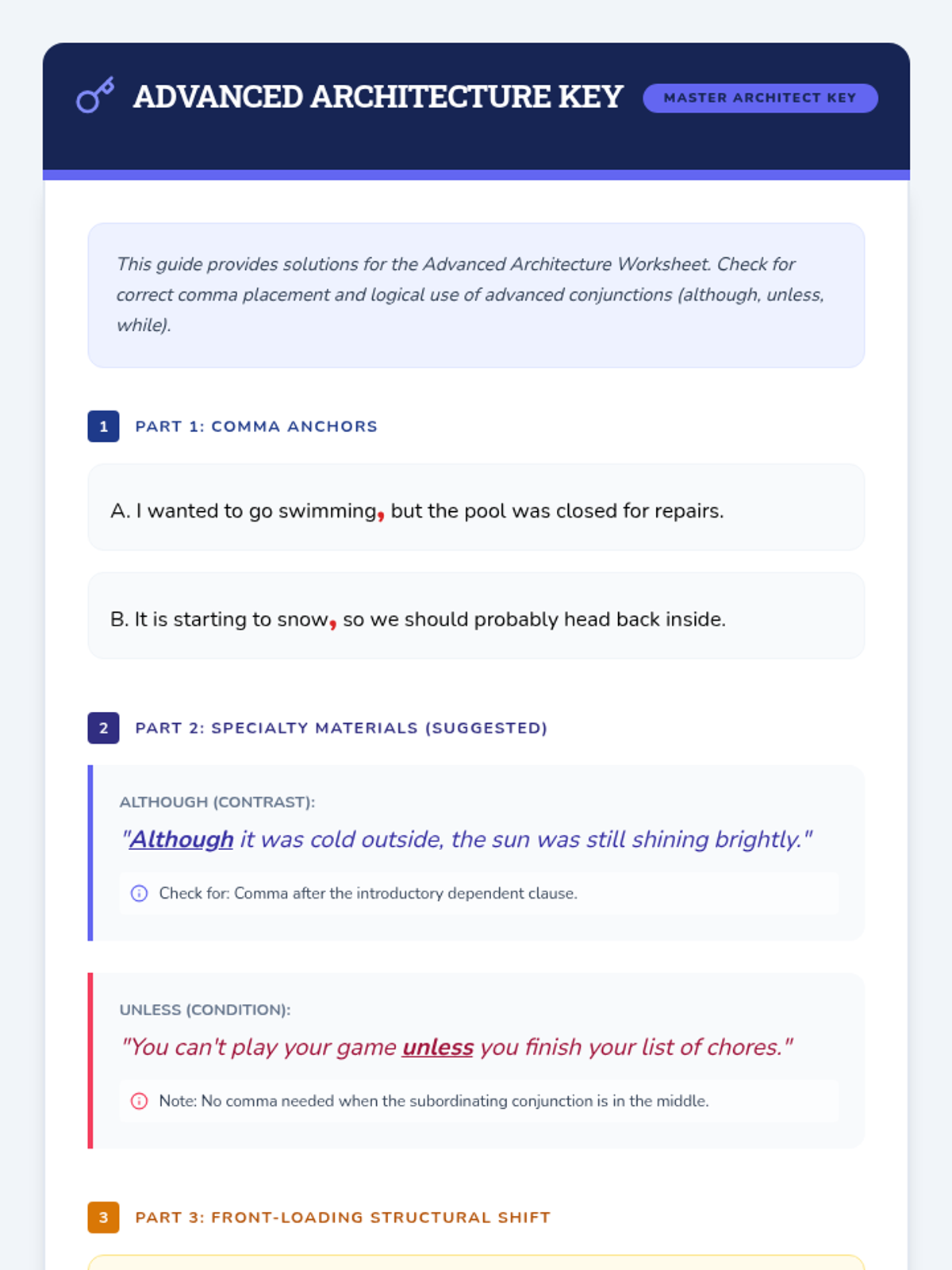
An answer key for the Advanced Architecture Worksheet, providing solutions and punctuation tips for complex conjunction structures.
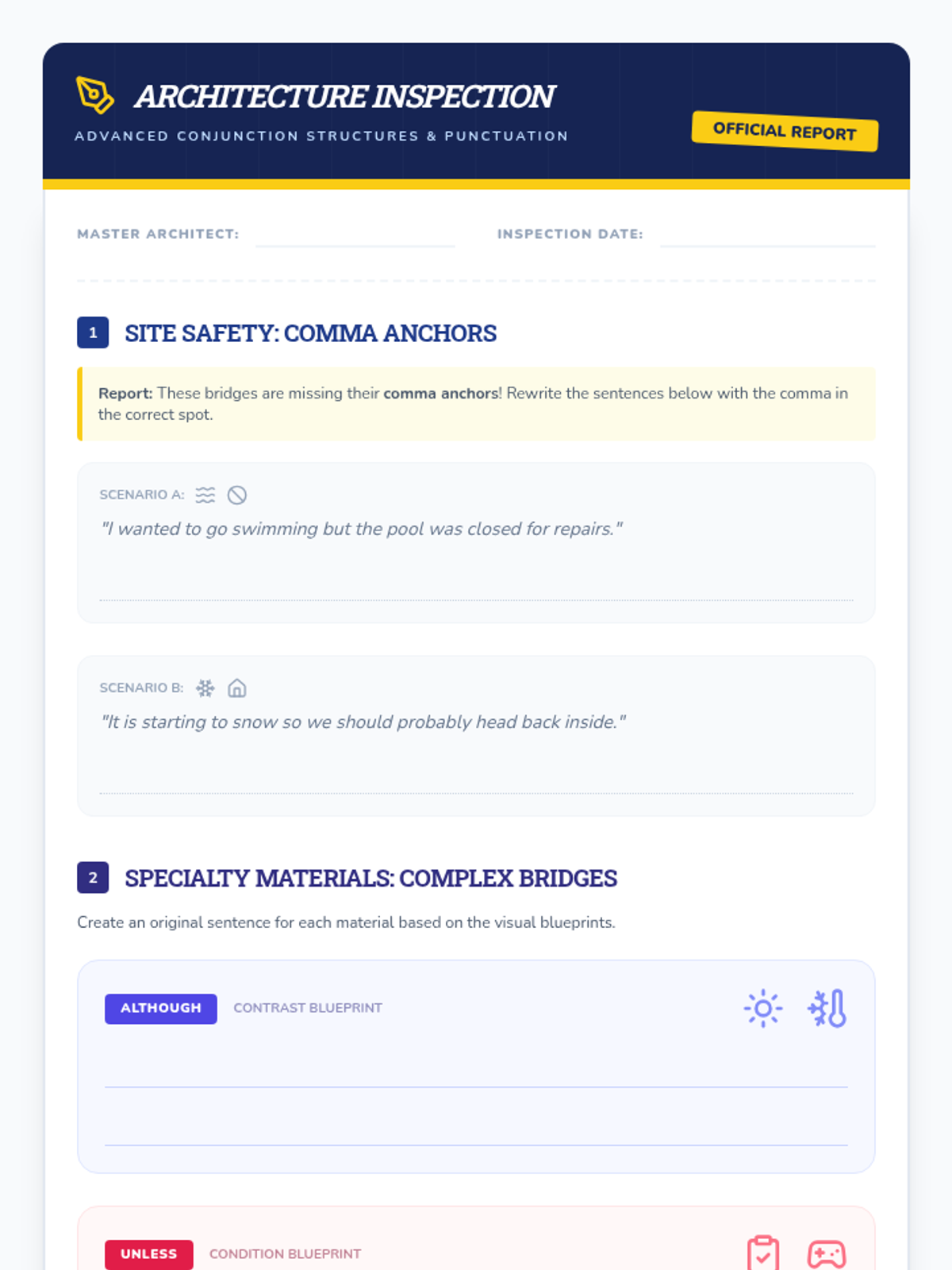
A worksheet for practicing advanced conjunction structures, including comma placement in compound sentences, using 'although' and 'unless', and rewriting sentences in front-loaded structures.
An advanced slide deck for conjunctions, introducing 'although', 'unless', and 'while'. It focuses on comma usage in compound sentences and complex sentences starting with subordinating conjunctions.
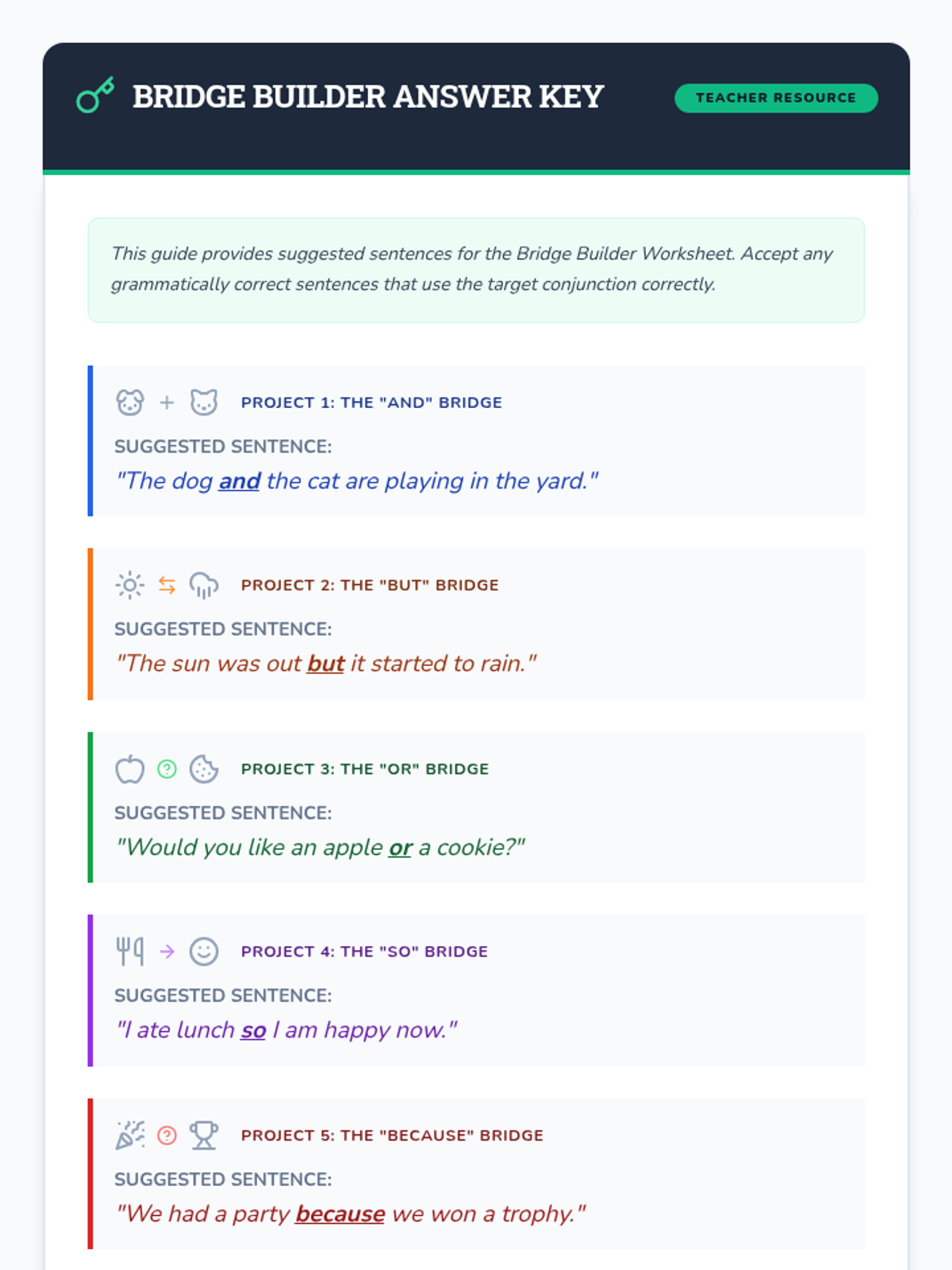
An answer key for the Bridge Builder Worksheet, providing example sentences and teaching tips for each conjunction visual prompt.
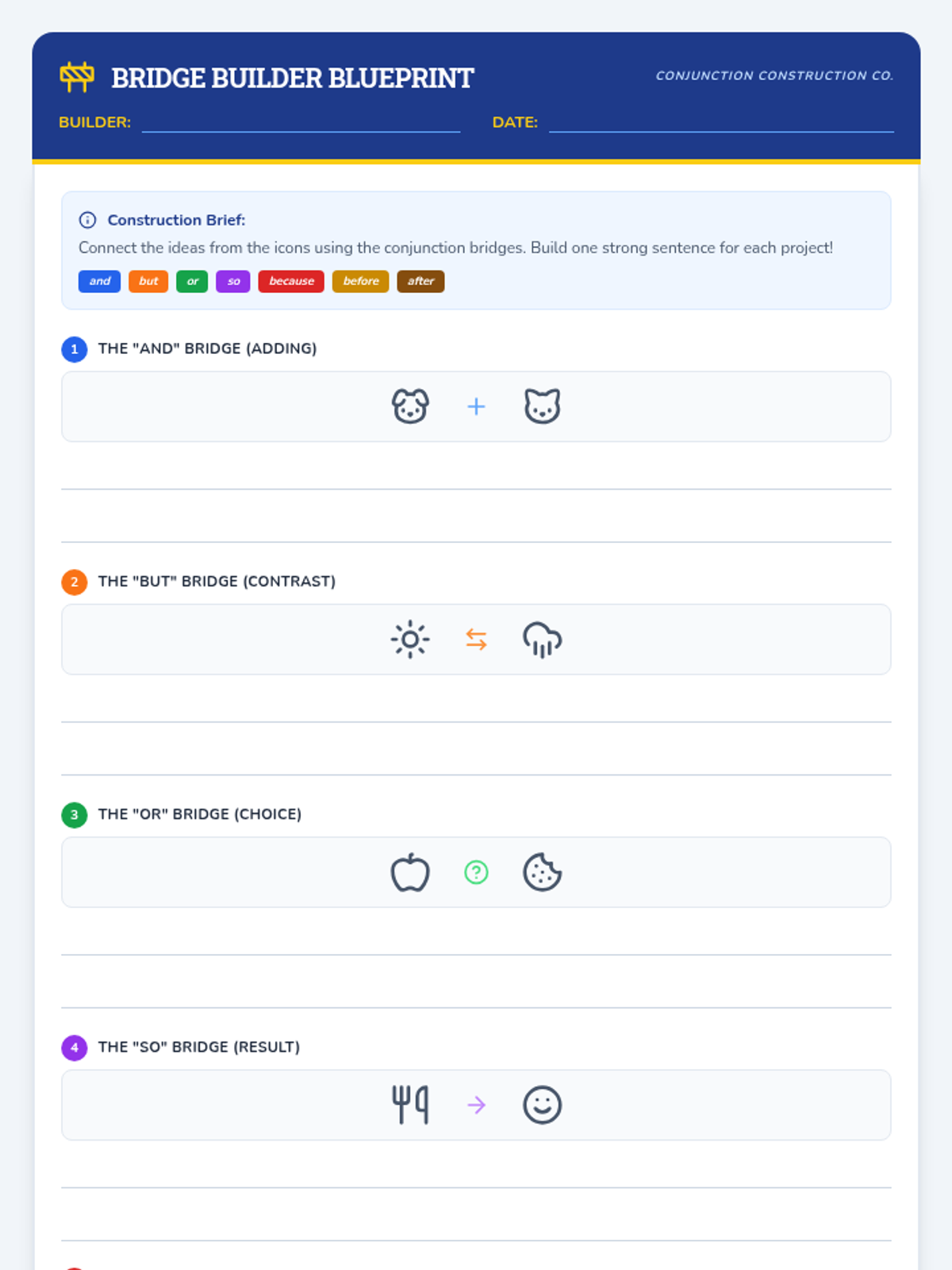
A visual worksheet where students build sentences using 'and', 'but', 'or', 'so', 'because', 'before', and 'after'. Each section includes visual icon prompts and designated writing lines in a fun construction-blueprint theme.
A visual slide deck that introduces coordinating and subordinating conjunctions using a bridge-building theme. It includes clear definitions, examples with visual icons, and practice prompts for seven key conjunctions.
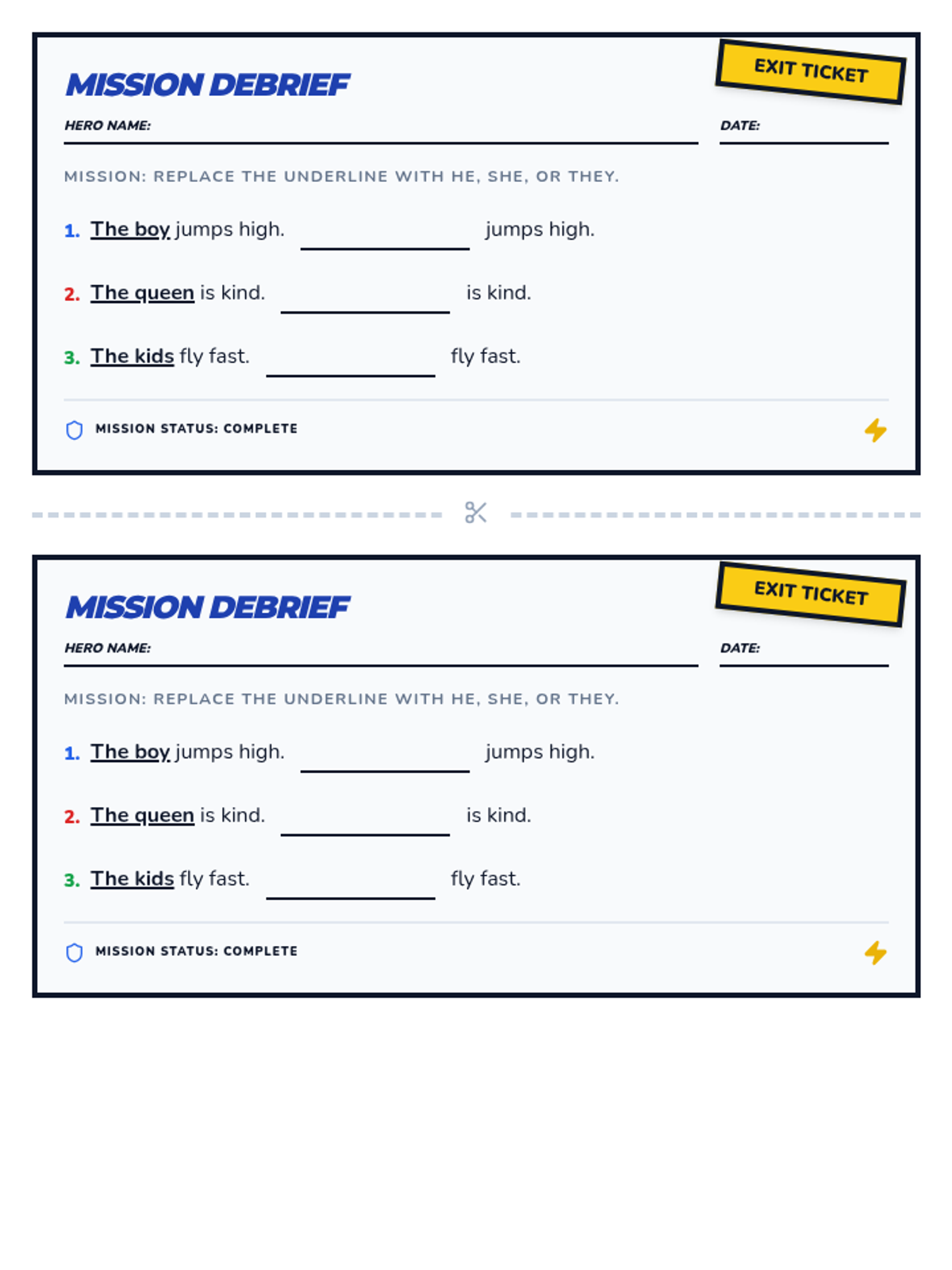
A quick 3rd-grade exit ticket themed as a 'Mission Debrief'. It features three sentence-replacement questions where students practice using 'he', 'she', and 'they'. Designed as a two-to-a-page printable for paper saving.
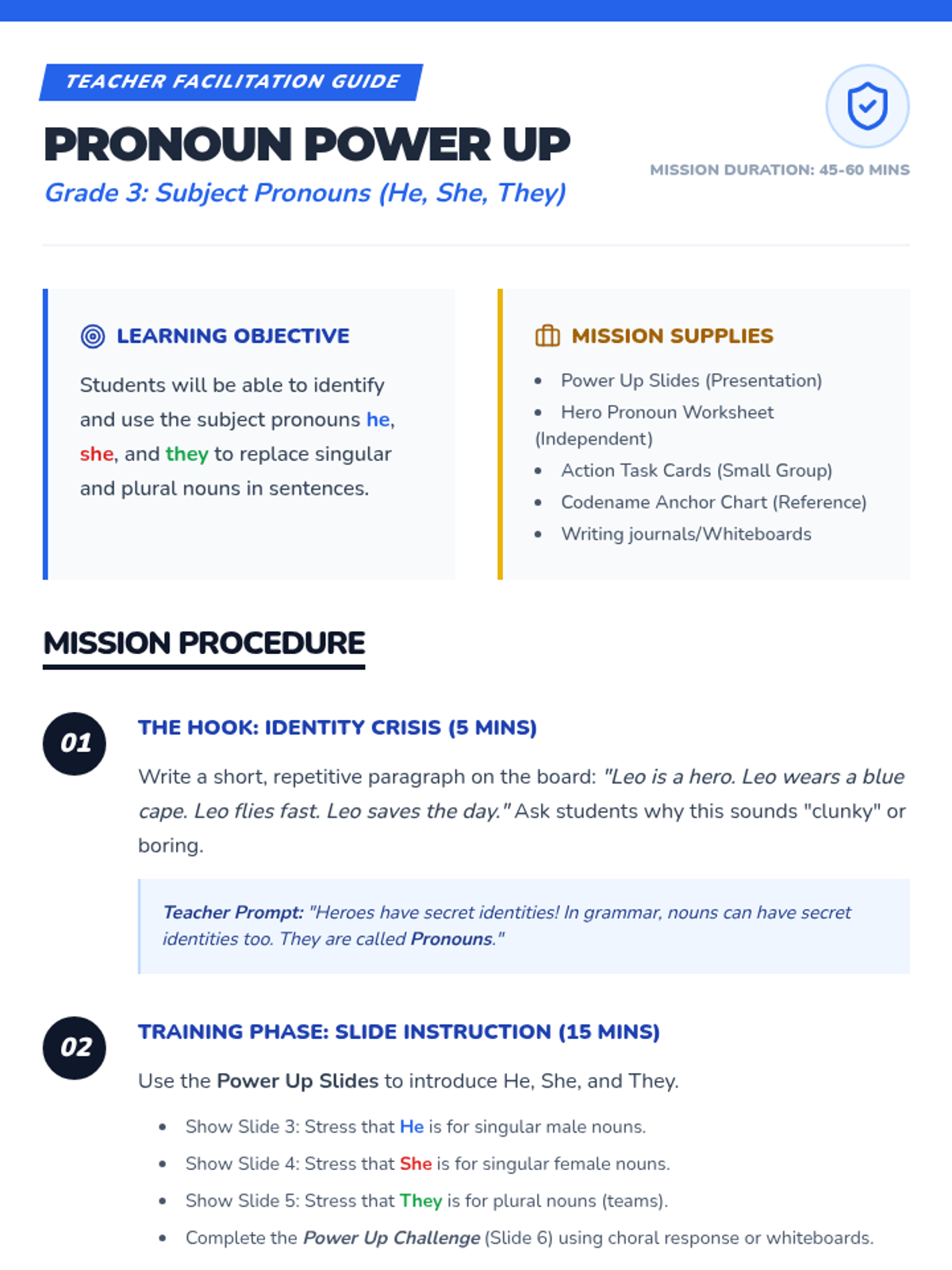
A detailed, superhero-themed teacher's lesson plan for 3rd-grade subject pronouns (he, she, they). Includes a hook, direct instruction steps using slides, guided practice with an anchor chart, and differentiation strategies using task cards.
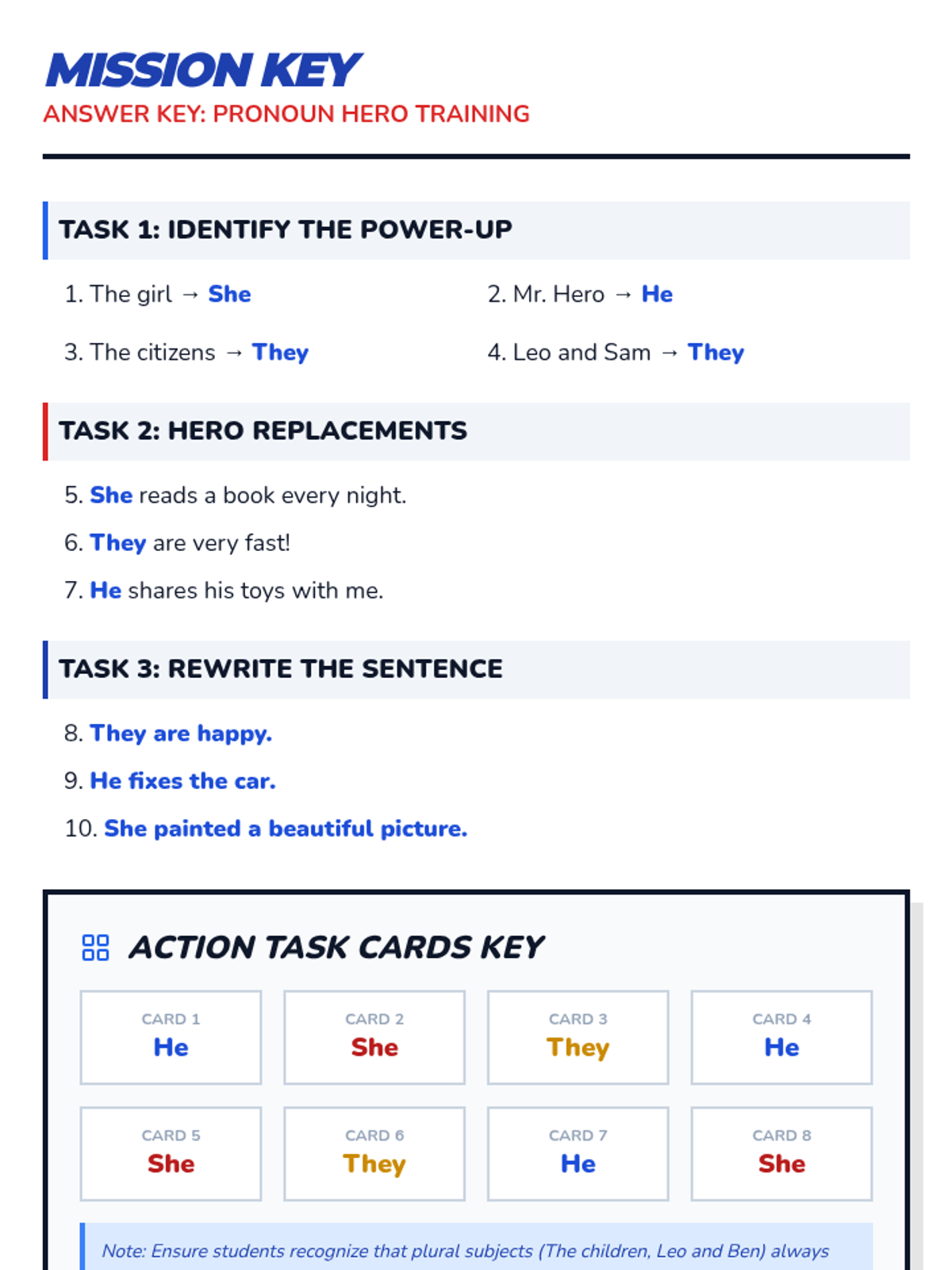
Teacher-facing answer key for the Hero Pronoun Worksheet and Action Task Cards. Provides clear, bold answers for all exercises to facilitate quick grading.
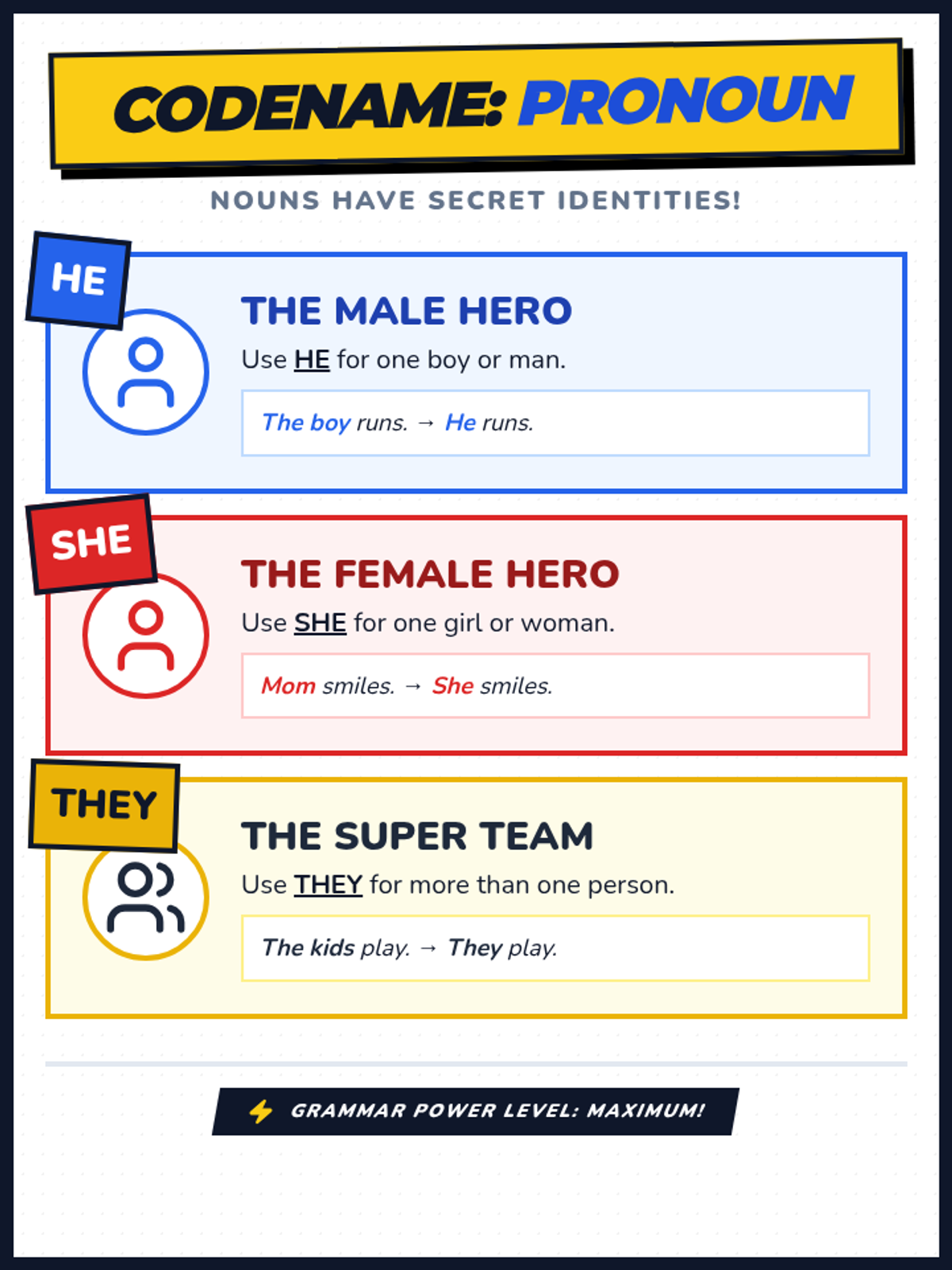
A visually engaging superhero-themed anchor chart for subject pronouns (he, she, they). It features bold comic book styling, clear definitions, icon-based visuals, and comparative examples to help students remember which pronoun to use.
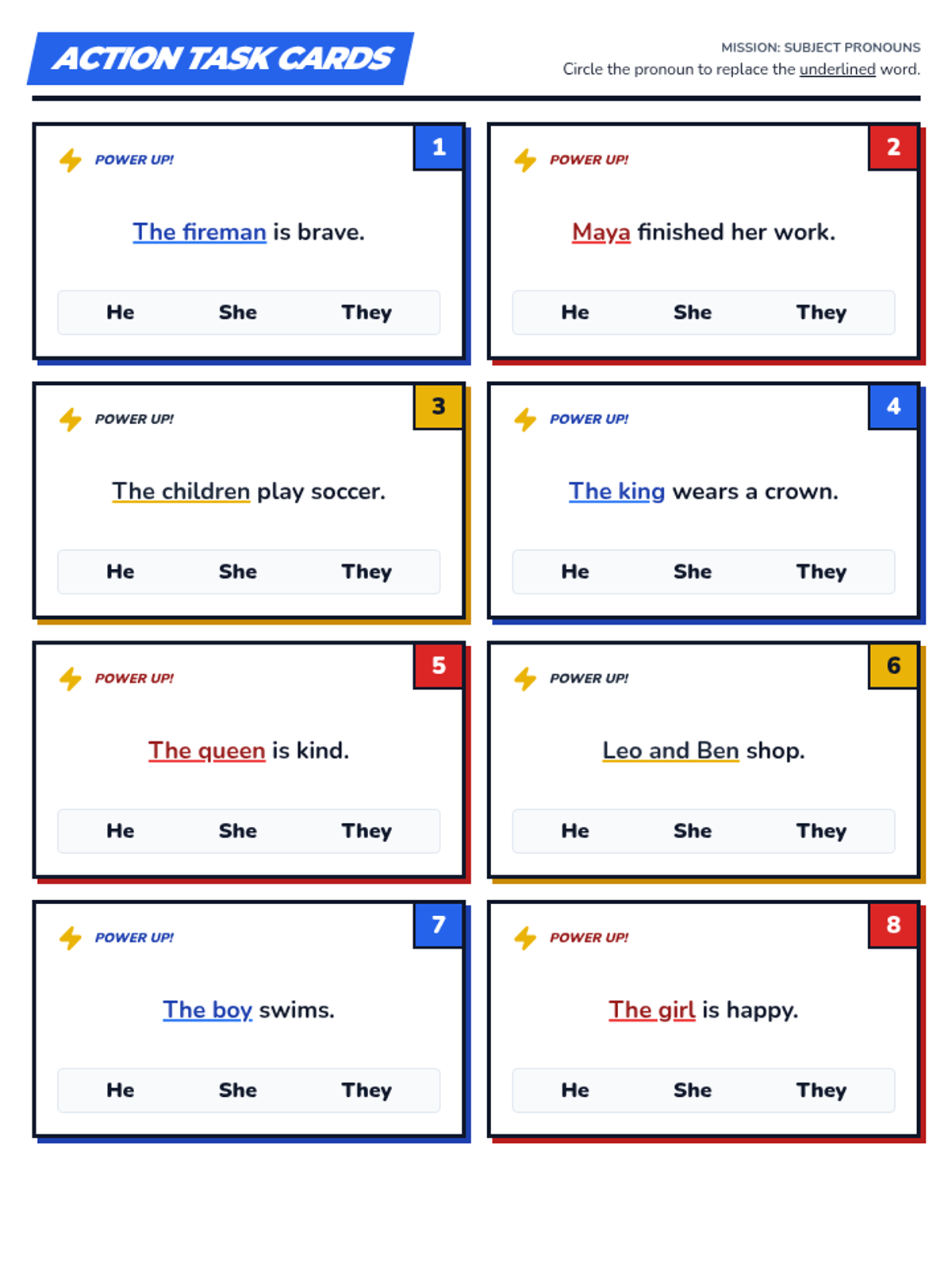
A set of 8 superhero-themed task cards for practicing subject pronouns. Each card presents a sentence with an underlined noun and asks students to select the correct replacement pronoun: 'he', 'she', or 'they'. Designed for small group work or classroom scavenger hunts.
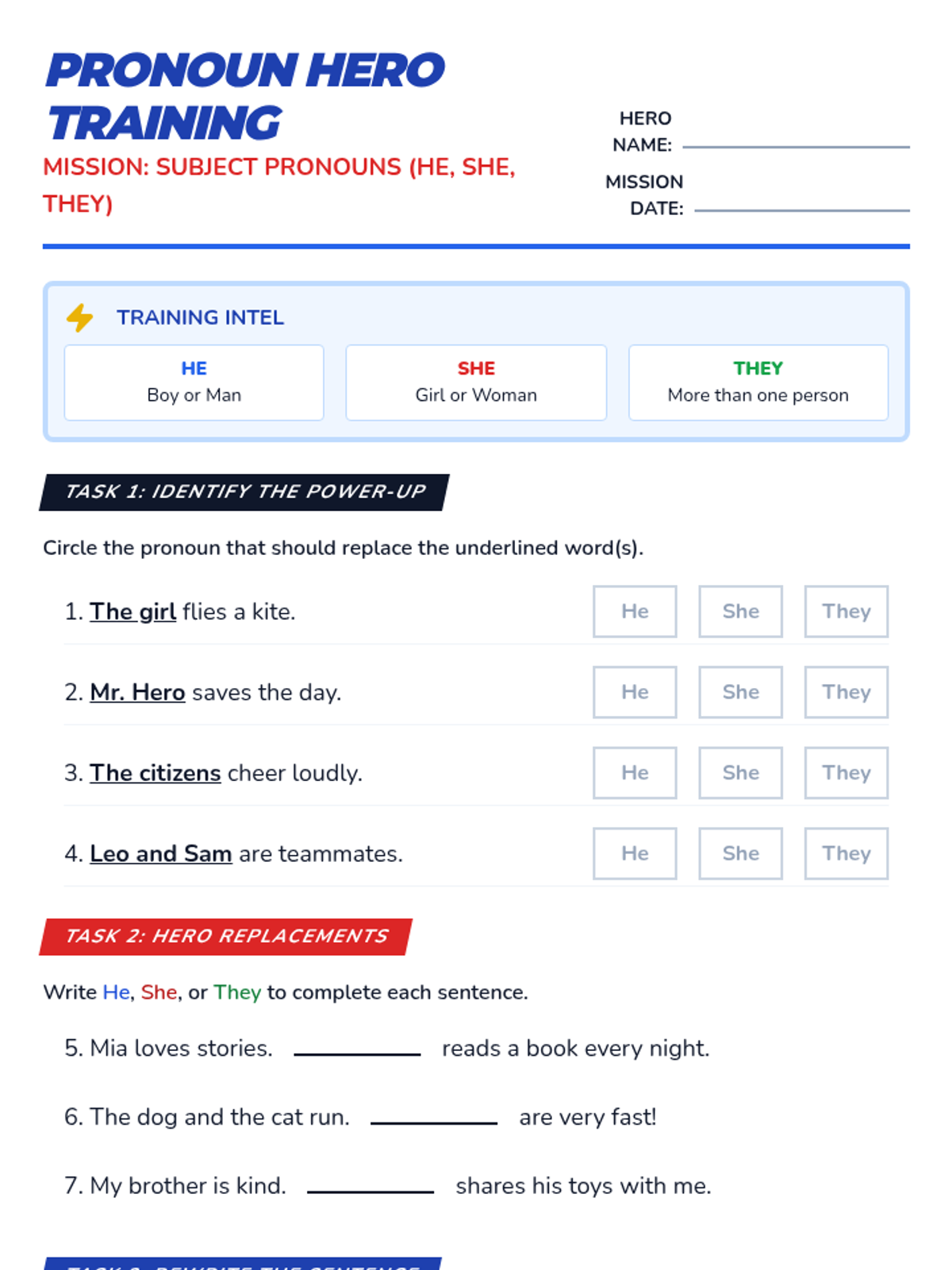
A 3rd-grade subject pronouns worksheet themed around 'Hero Training'. It features three distinct sections (Identify, Replace, and Rewrite) to practice using 'he', 'she', and 'they' correctly. Includes a bonus creative writing challenge.
A colorful, superhero-themed slide deck introducing the subject pronouns 'he', 'she', and 'they'. Includes clear definitions, examples, and interactive practice questions for whole-class engagement.
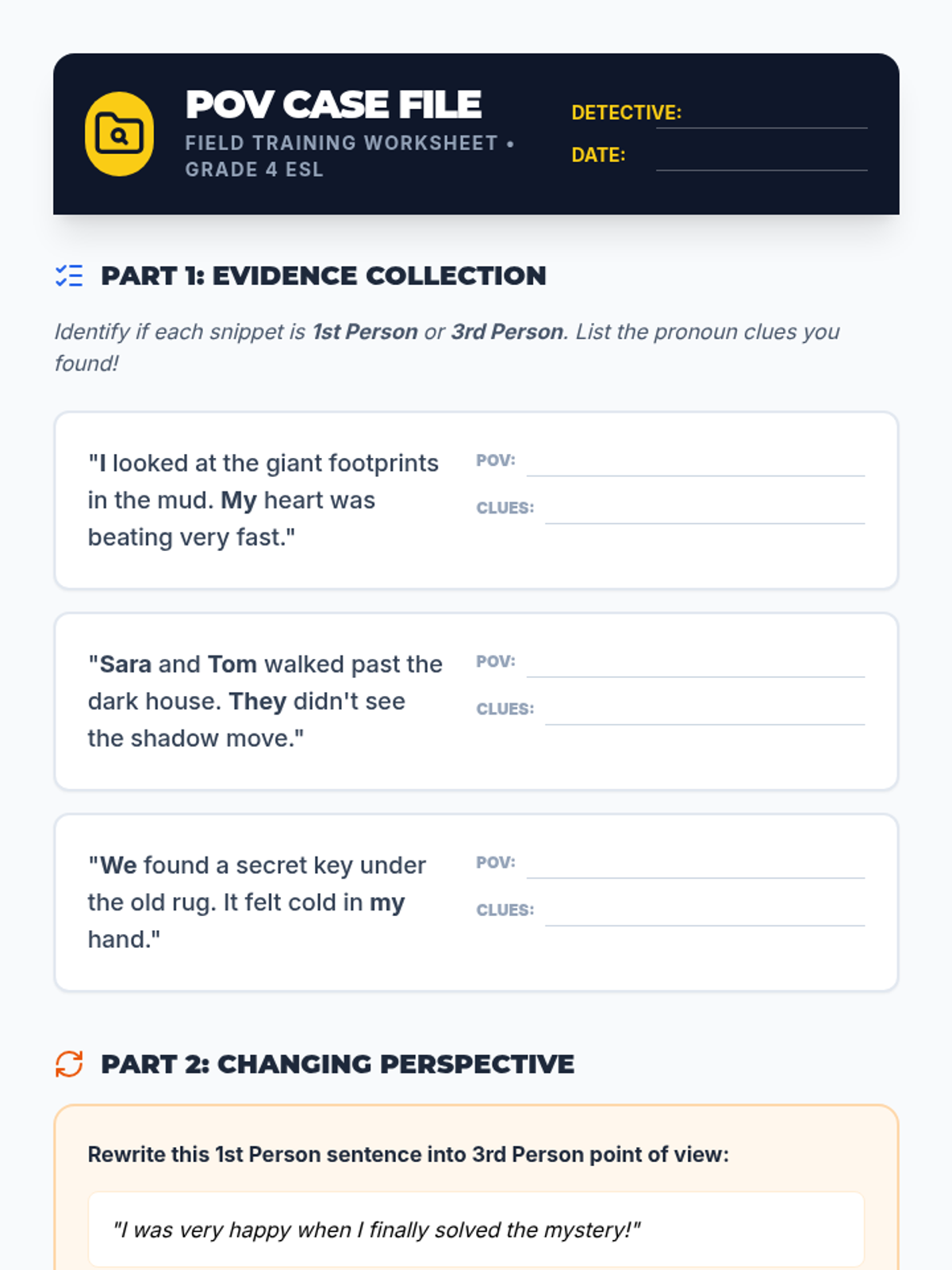
A student-facing worksheet for independent practice identifying POV and rewriting sentences. Features sections for evidence collection, perspective changing, and comparison.
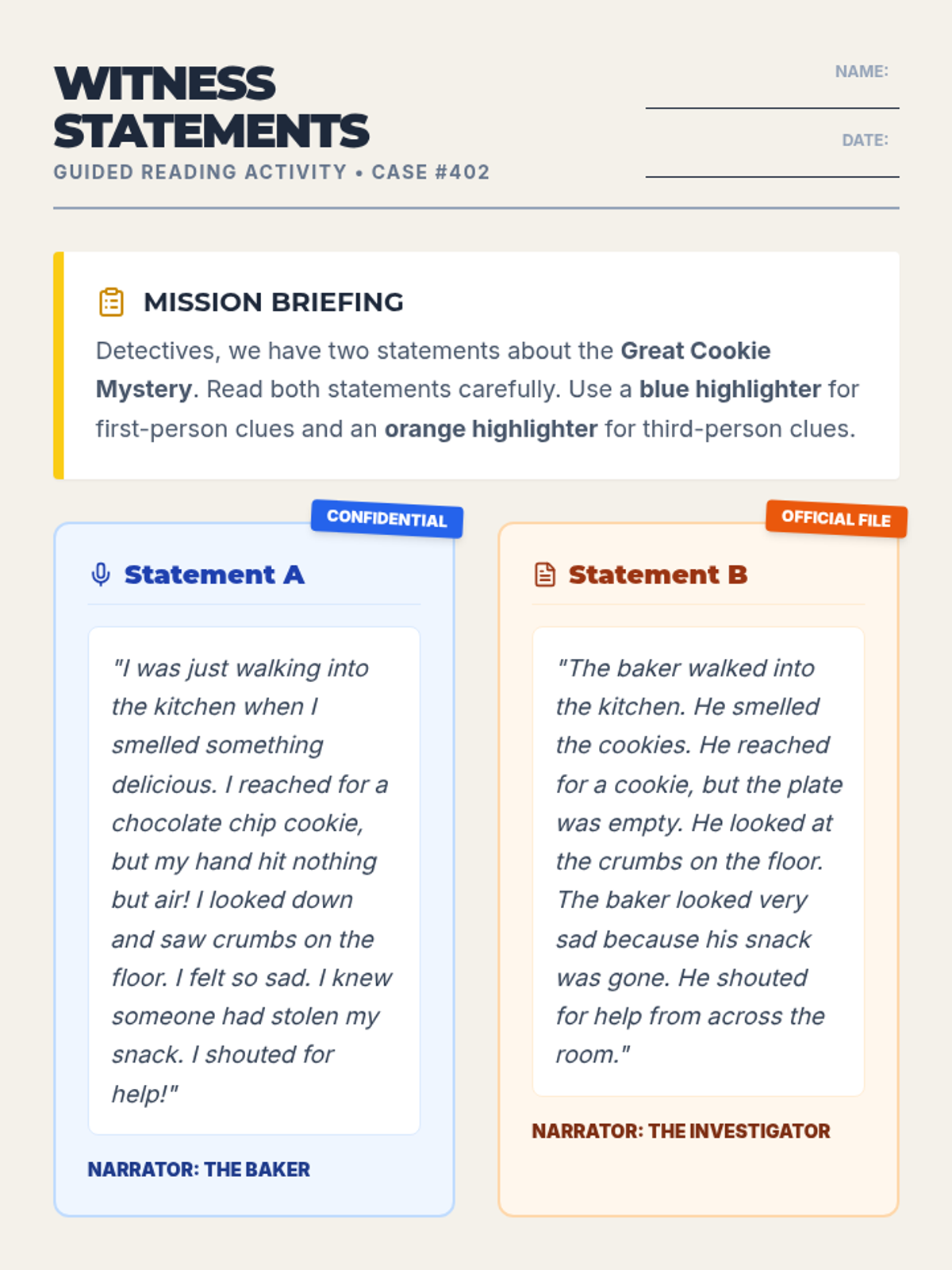
A guided reading activity featuring two versions of 'The Great Cookie Mystery' (1st person vs 3rd person). Includes highlighting instructions and scaffolded analysis questions for comparing and contrasting.
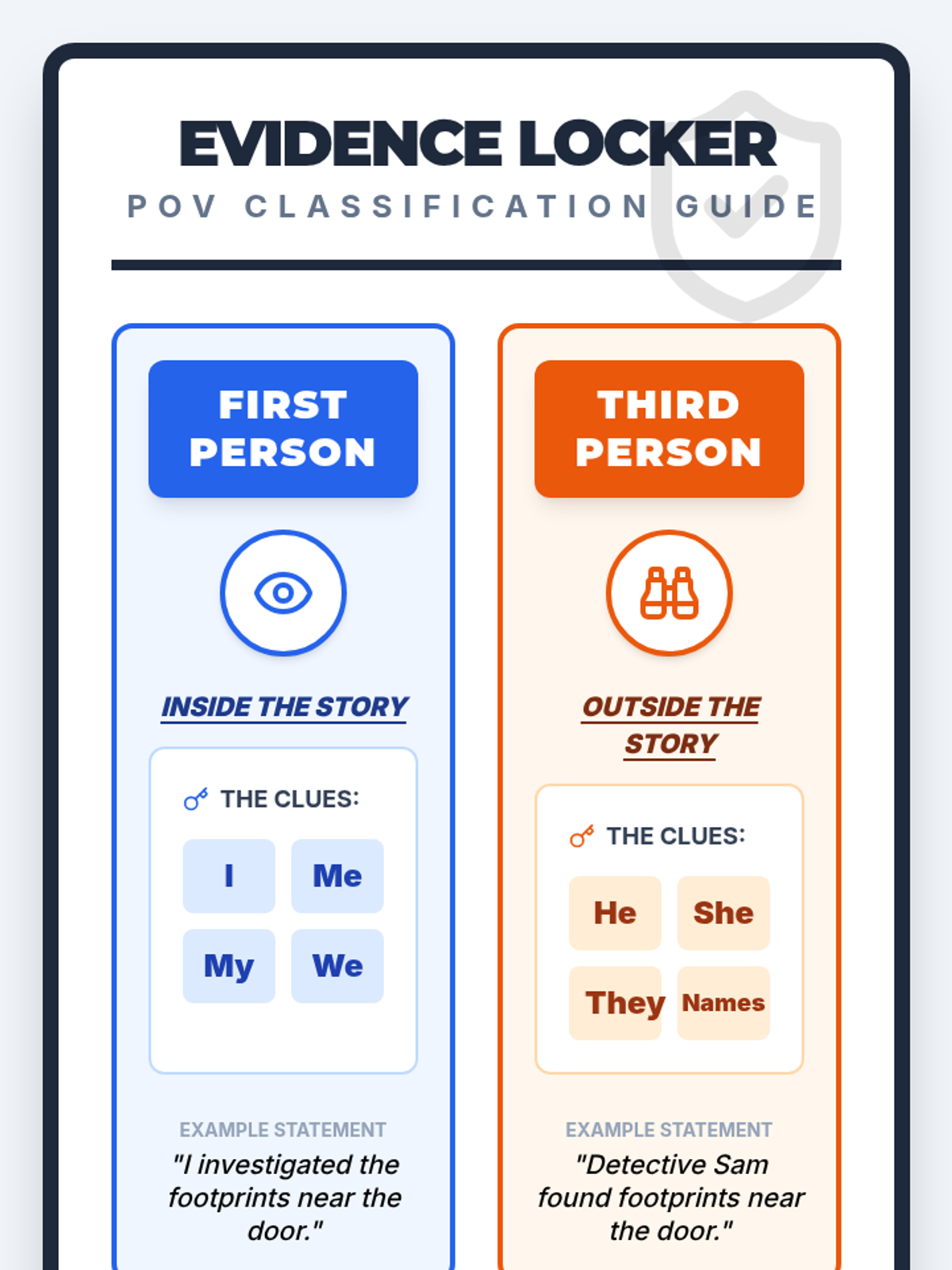
A visually organized reference anchor chart for identifying first and third-person POV. Includes icons, pronoun lists for both categories, and a helpful 'Detective Tip' for distinguishing between dialogue and narration.
Visual slide deck for training students as POV Detectives. Features high-contrast designs, clear pronoun charts, and practice examples to distinguish between first and third-person perspectives.
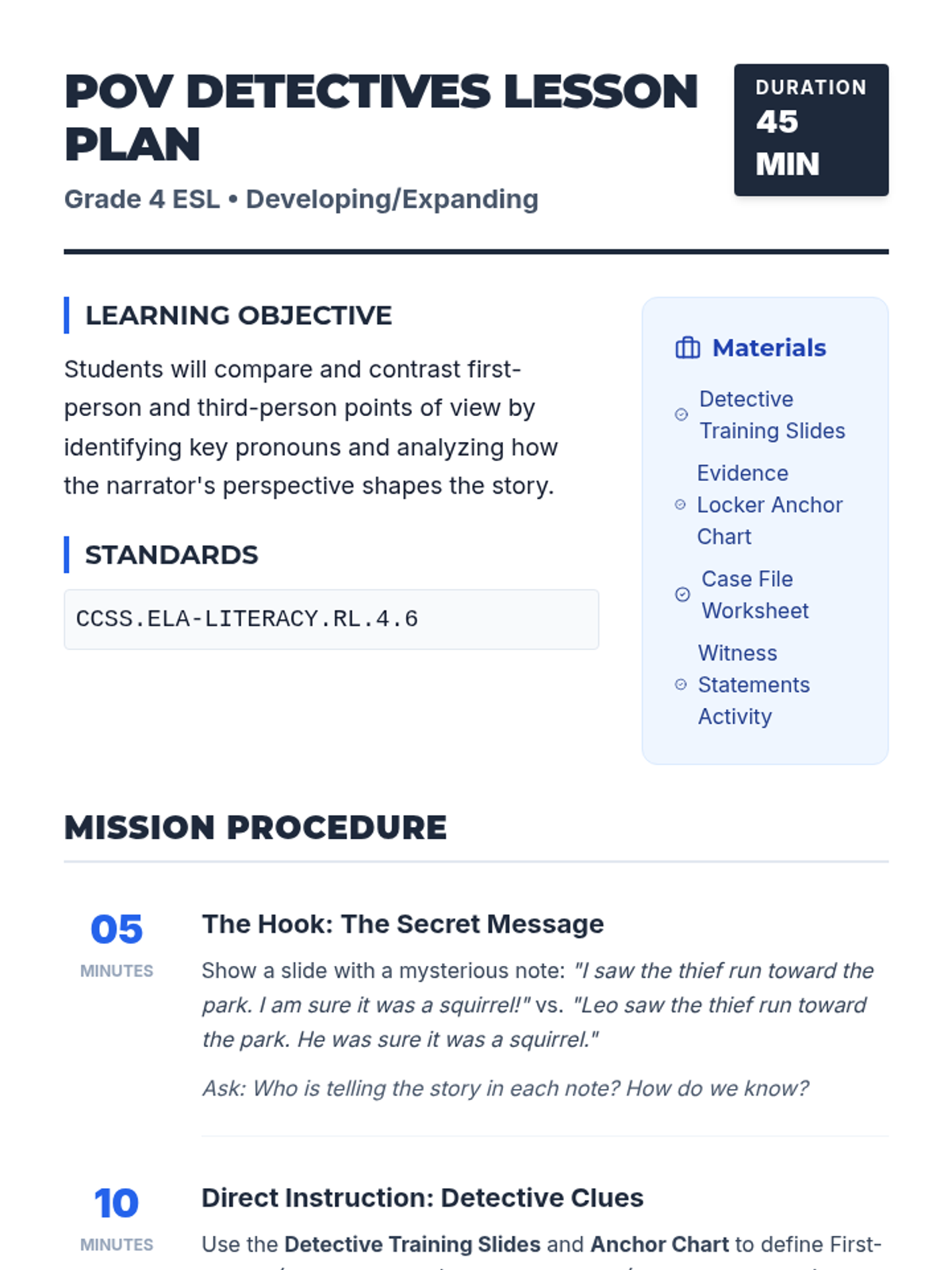
A comprehensive teacher-facing lesson plan for a 45-minute ESL lesson on first and third-person point of view. includes time breakdowns, learning objectives, and ESL scaffolding strategies.
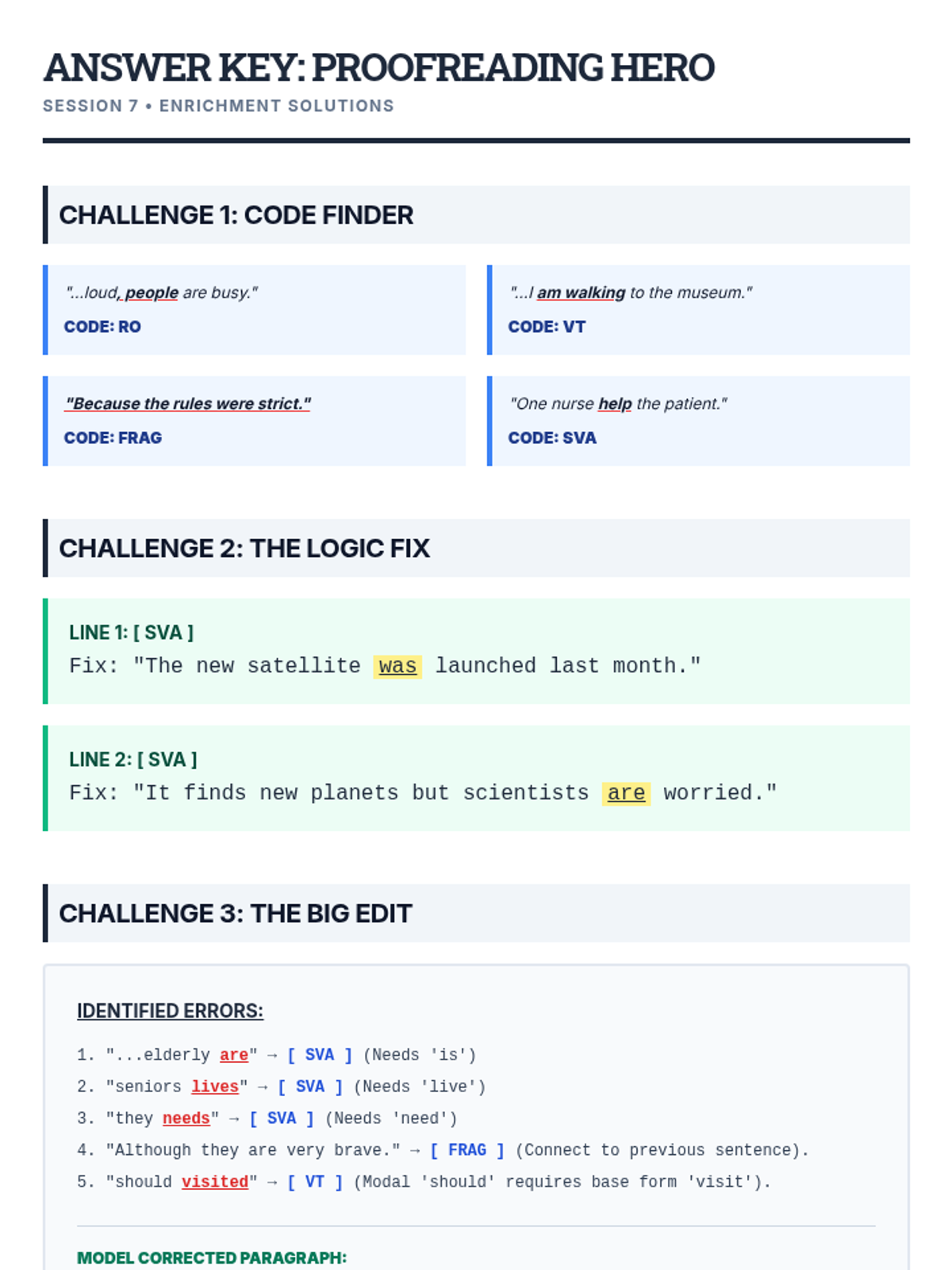
A teacher answer key for the Proofreading Hero Worksheet, including identified error codes and model corrected paragraphs for all challenges. Updated for matching expanded worksheet and includes a legend.
Instructional slides for the mock exam session, providing a visual pacing guide (10-30-5 breakdown) and specific phase-by-phase writing strategies.
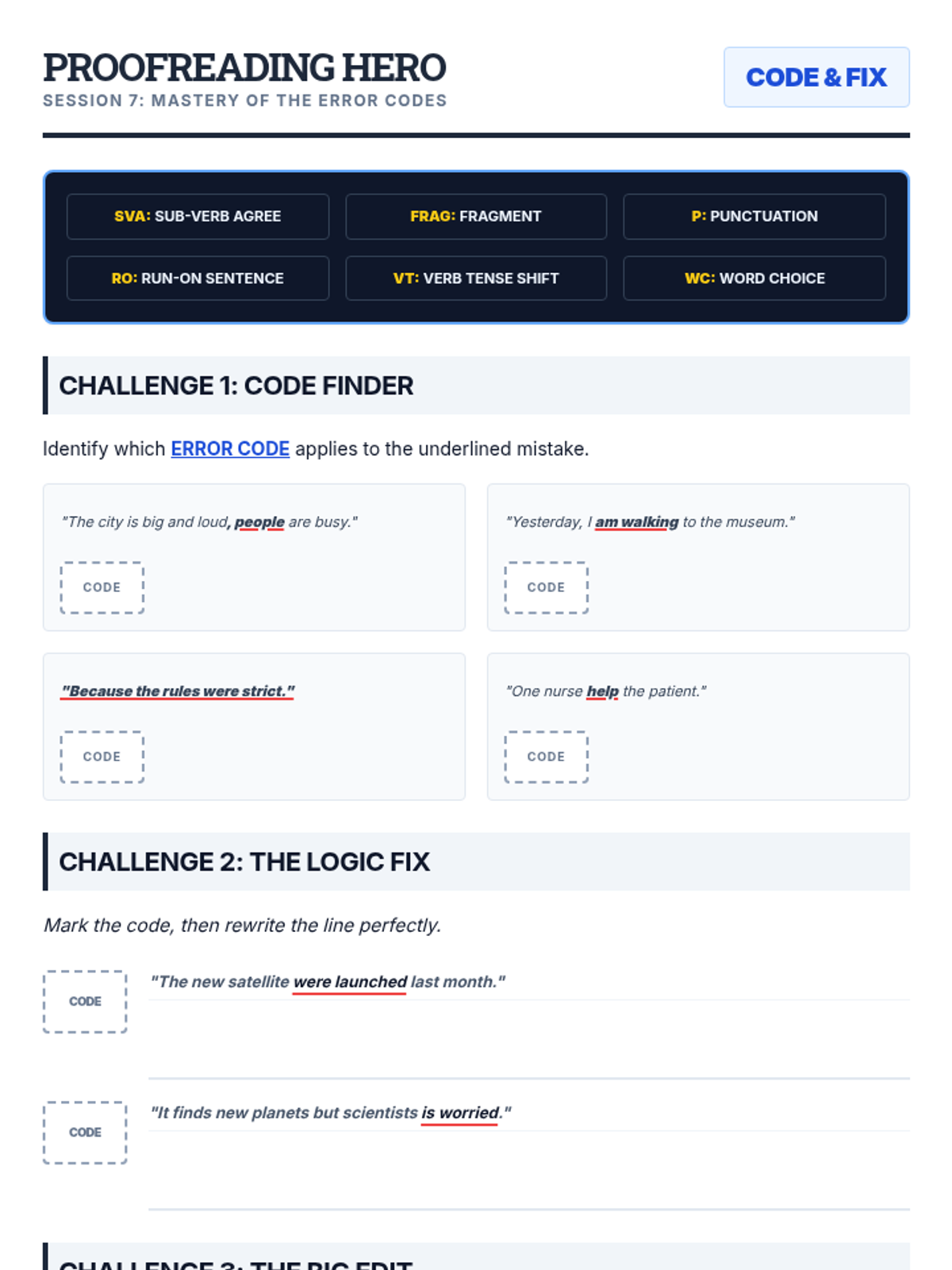
An interactive proofreading worksheet where students apply the teacher's Error Coding Key to identify and fix grammar, punctuation, and structure mistakes in sample texts. Updated with expanded items and unit-themed examples across two pages.
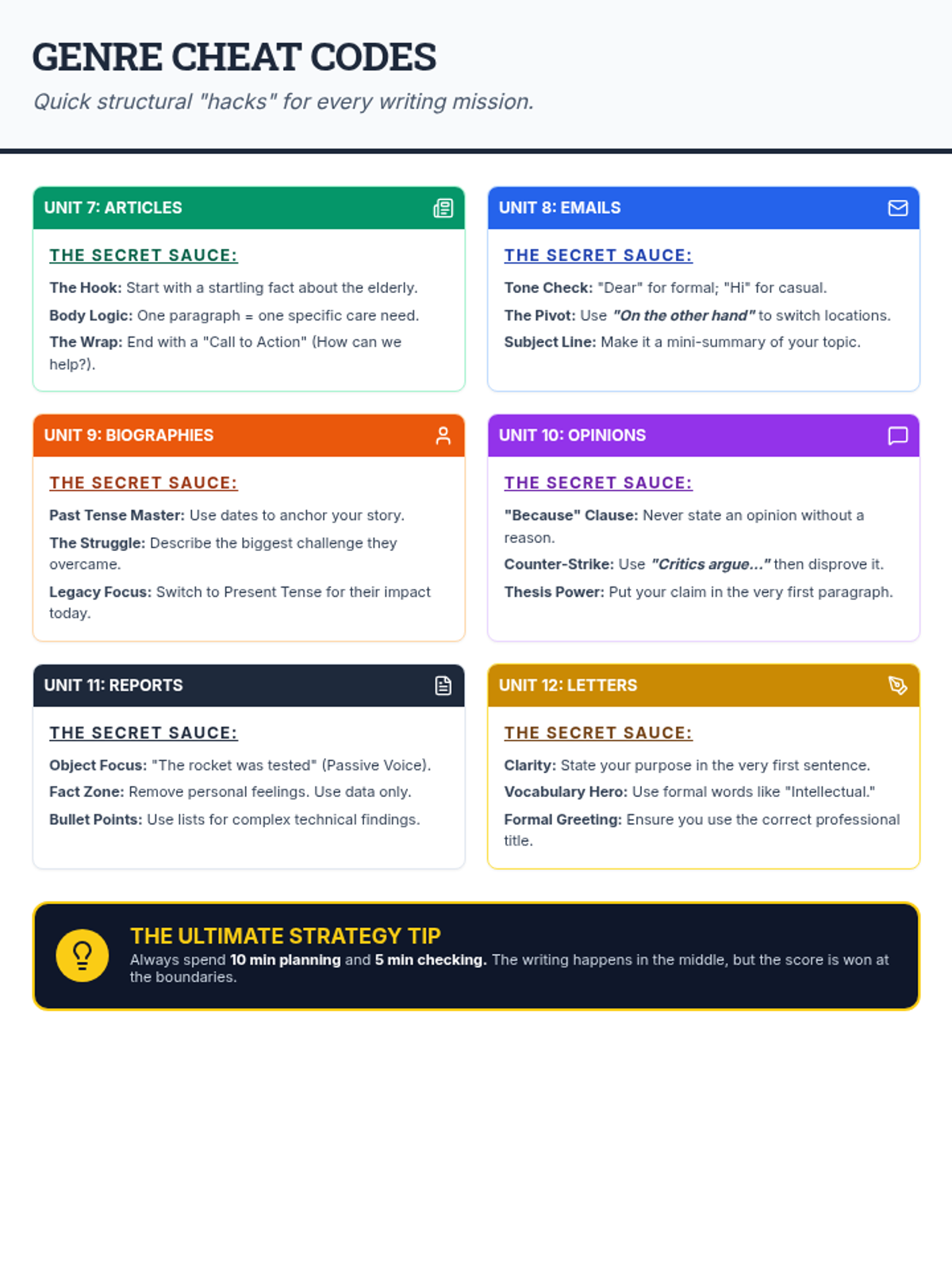
A one-page reference guide containing structural "hacks" and specific strategies for each of the six writing genres covered in the program. Updated for single-page efficiency.
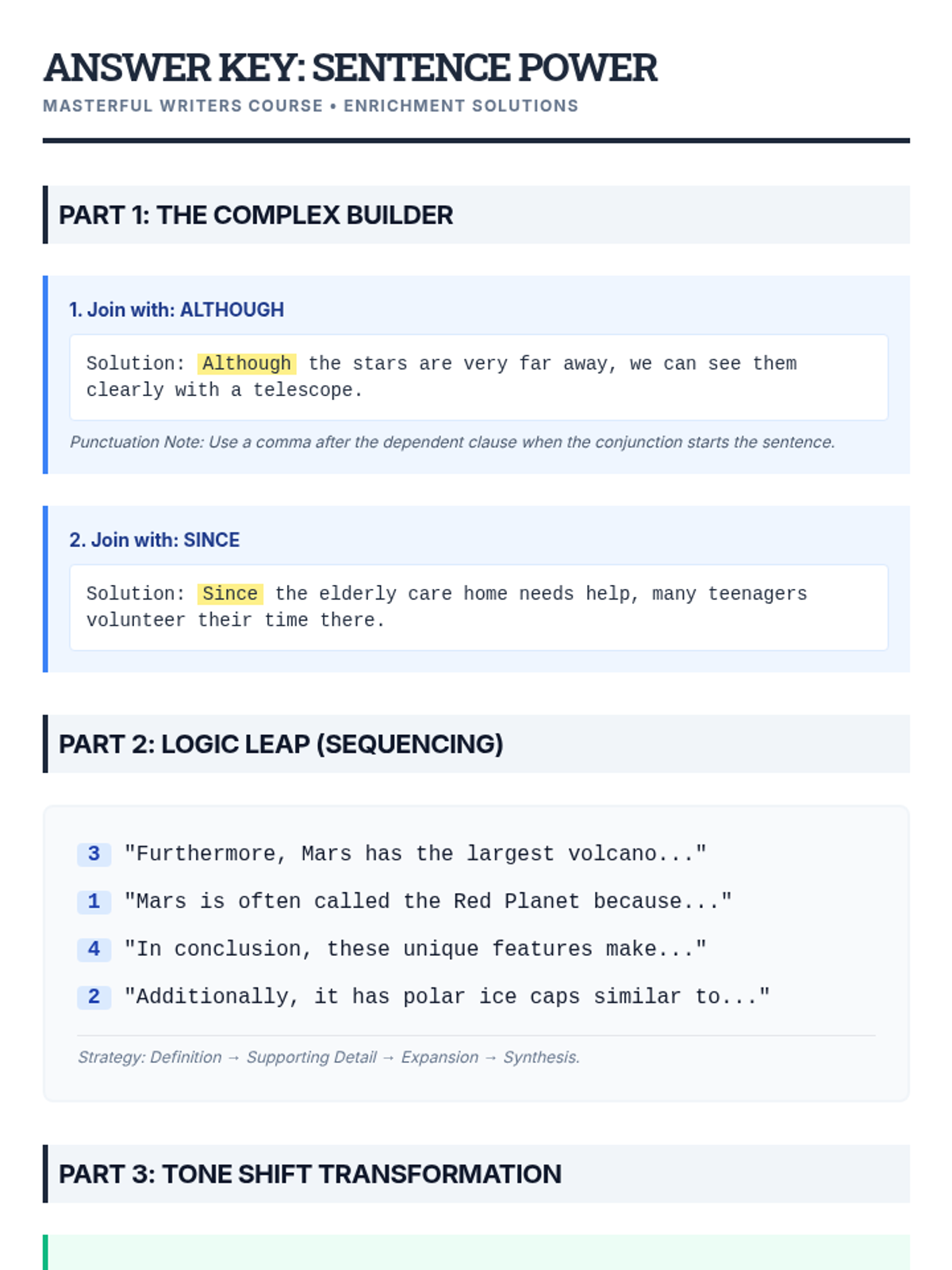
A teacher answer key for the Sentence Power Practice Worksheet, including model answers and grammar rationales. Updated for clarity and visual organization.
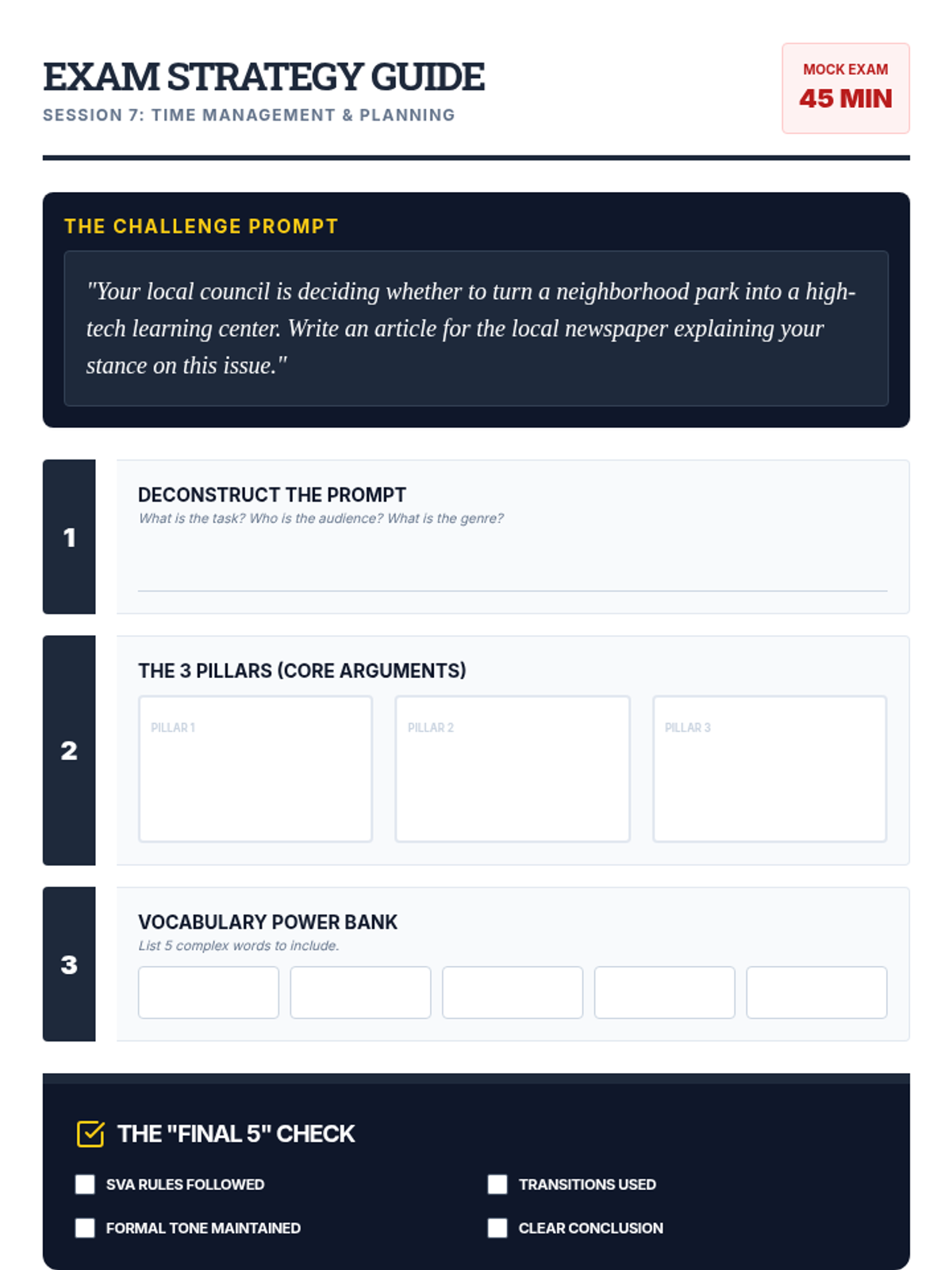
A strategic planning worksheet for students to use during exam preparation, featuring a practice prompt, increased workspace, and a consolidated single-page layout.
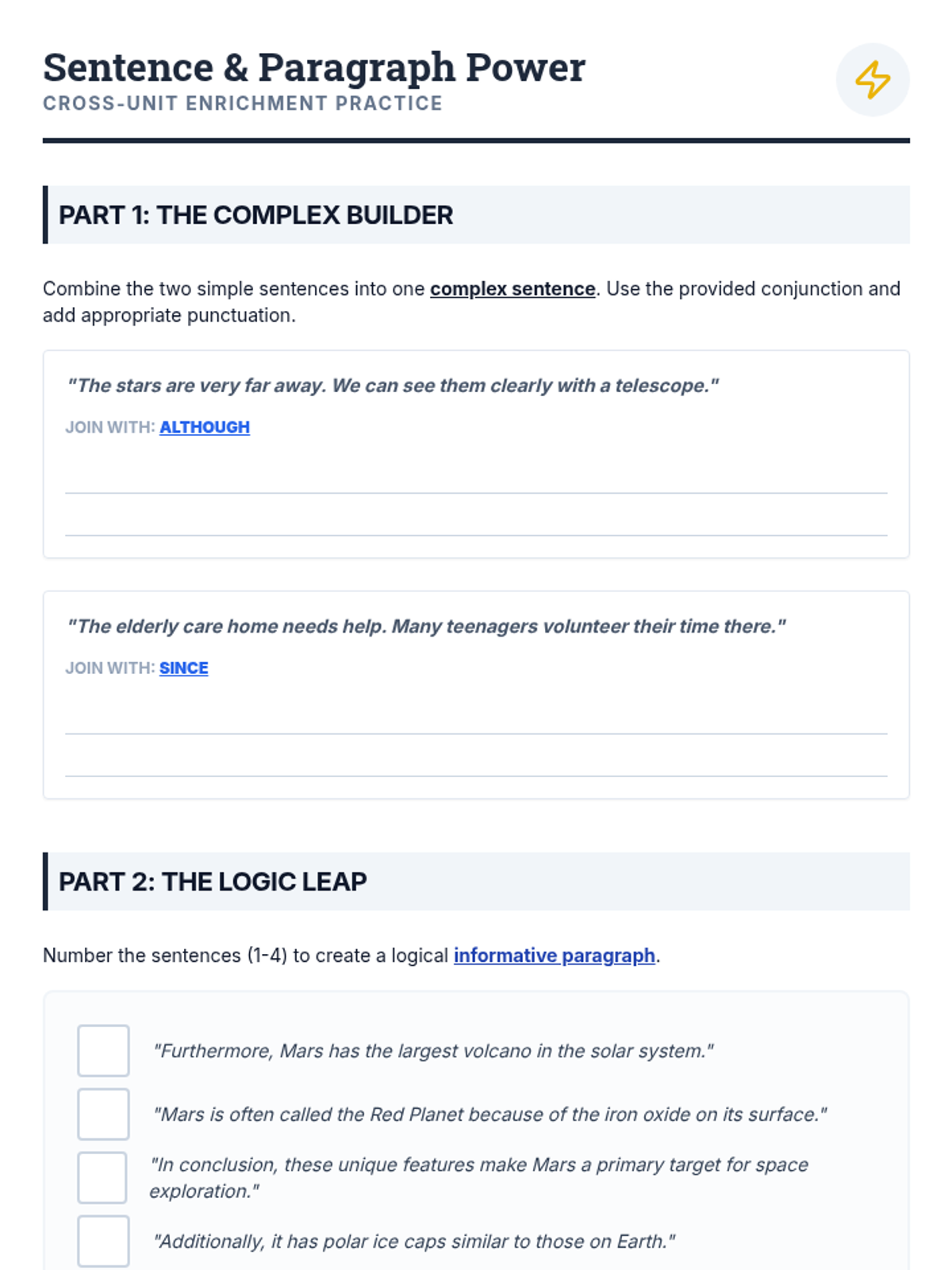
An enrichment worksheet focused on advanced sentence combining, logical paragraph sequencing, and tone transformation. Updated for handwriting legibility and clear instruction.
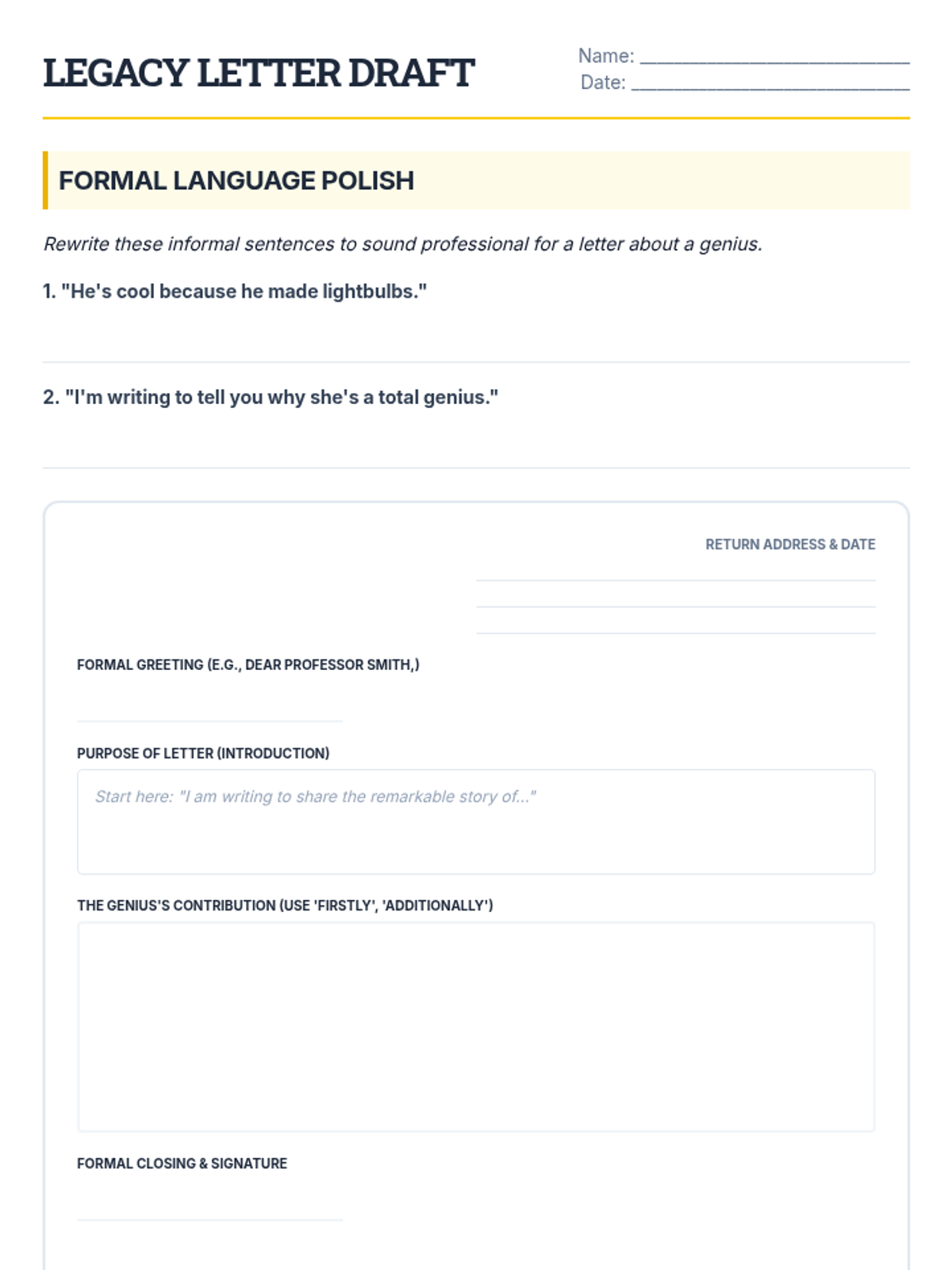
A student worksheet for formal letter writing about a genius. Includes a formal language rewrite activity and a structured letter template. Updated to fit one page and improve contrast.
Instructional slides for formal letter writing, focusing on the achievements of geniuses, formal tone vs. informal tone, and letter structure. Updated with specific examples and curriculum cohesion.
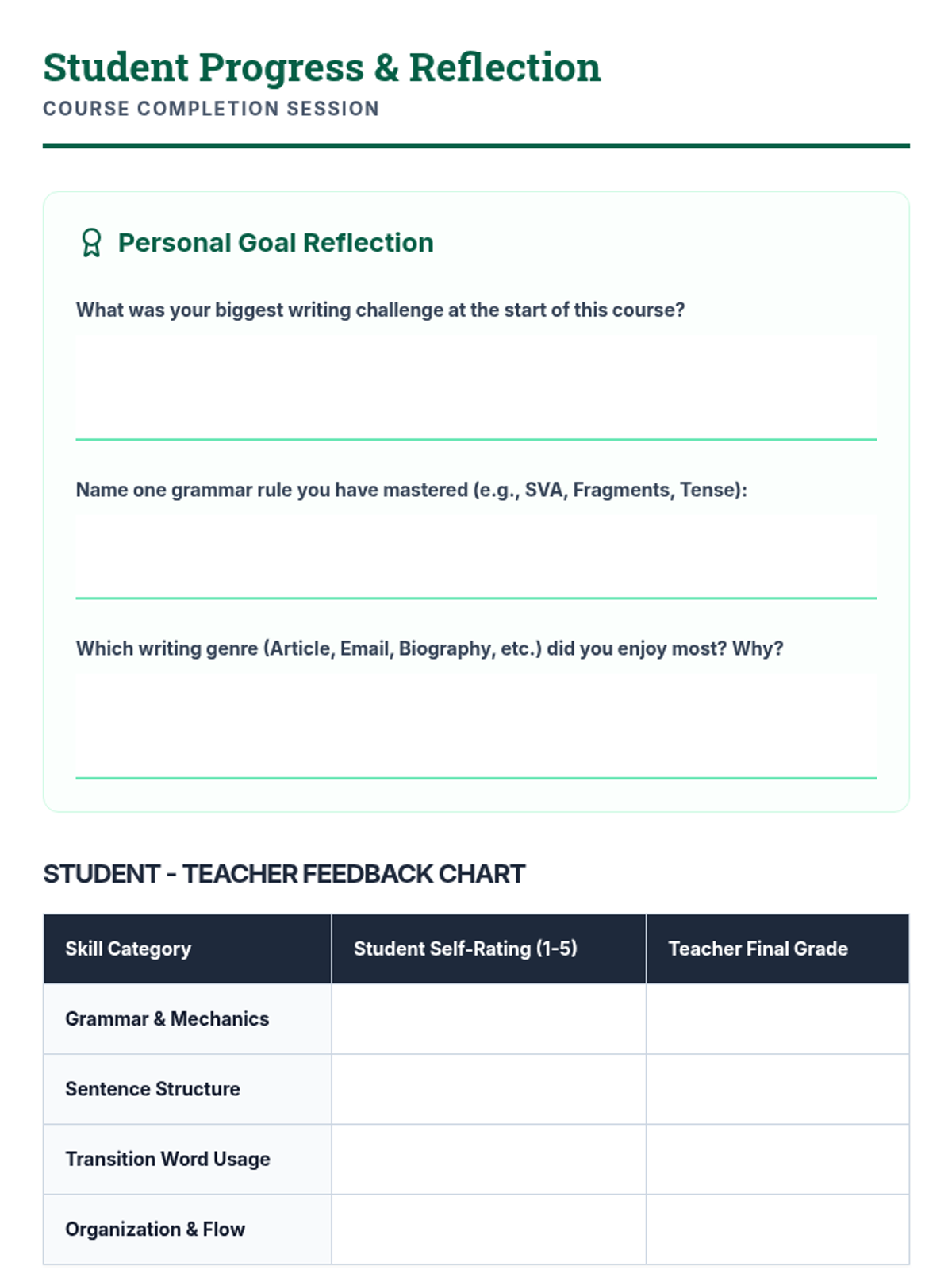
A final reflection and feedback document for students to self-assess their progress, receive teacher evaluations across core skill categories, and review strategy tips for future writing success.
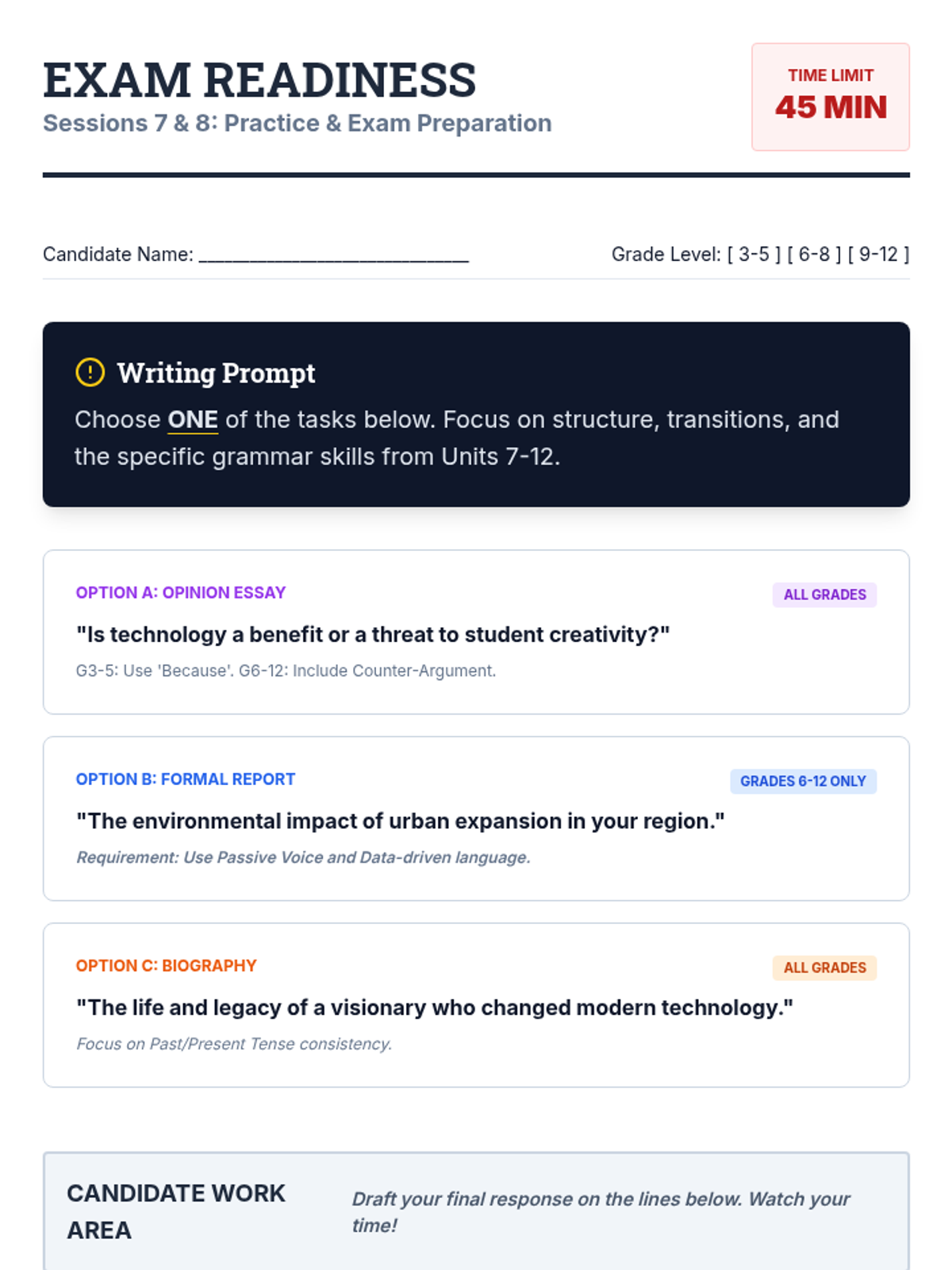
A mock exam writing prompt and workspace for sessions 7 and 8, featuring tiered options for different writing genres (essay, report, biography) and a lined writing area for timed practice.
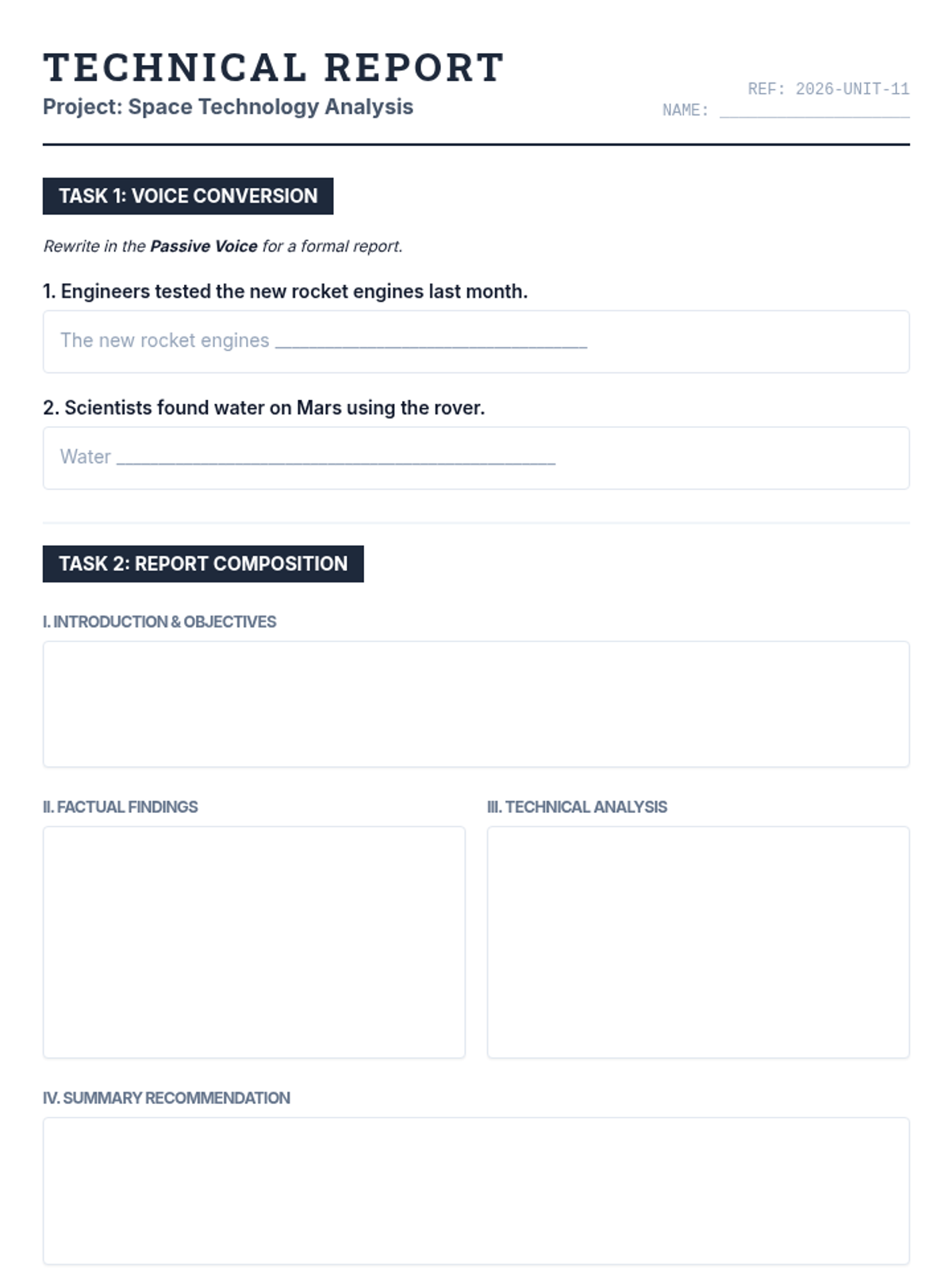
A technical report writing worksheet for students, including an active-to-passive voice conversion exercise and a structured four-part report layout for space technology analysis.
Instructional slides for report writing on space technology, focusing on the distinction between active and passive voice and the formal structure of a data-driven report.
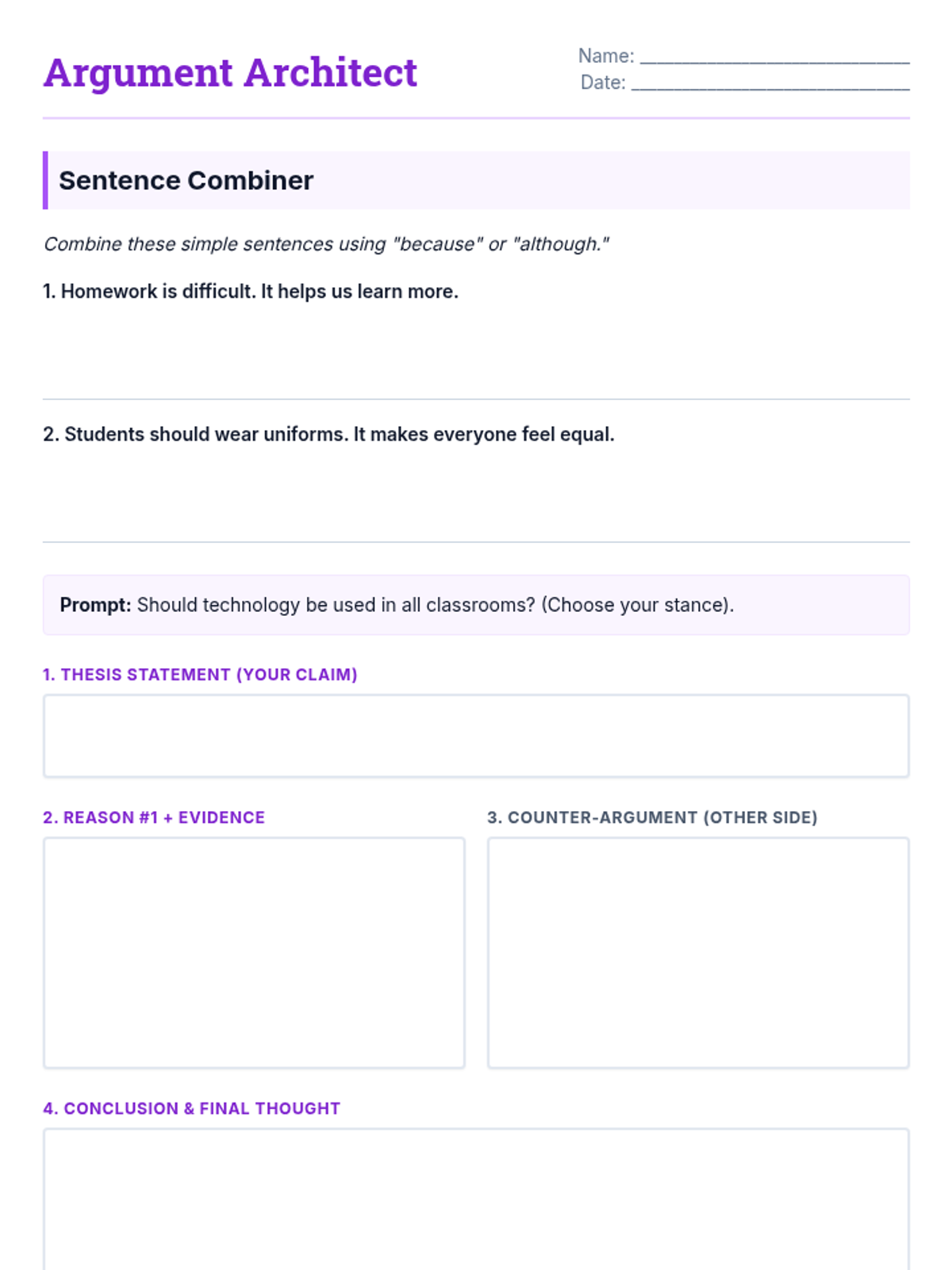
A student worksheet for opinion essay writing, featuring a conjunction-combining grammar activity and a structured multi-part outline for a thesis, evidence, counter-argument, and conclusion.
Instructional slides for opinion essay writing, emphasizing the use of conjunctions (because, although) and the structure of a multi-paragraph argument including counter-arguments.
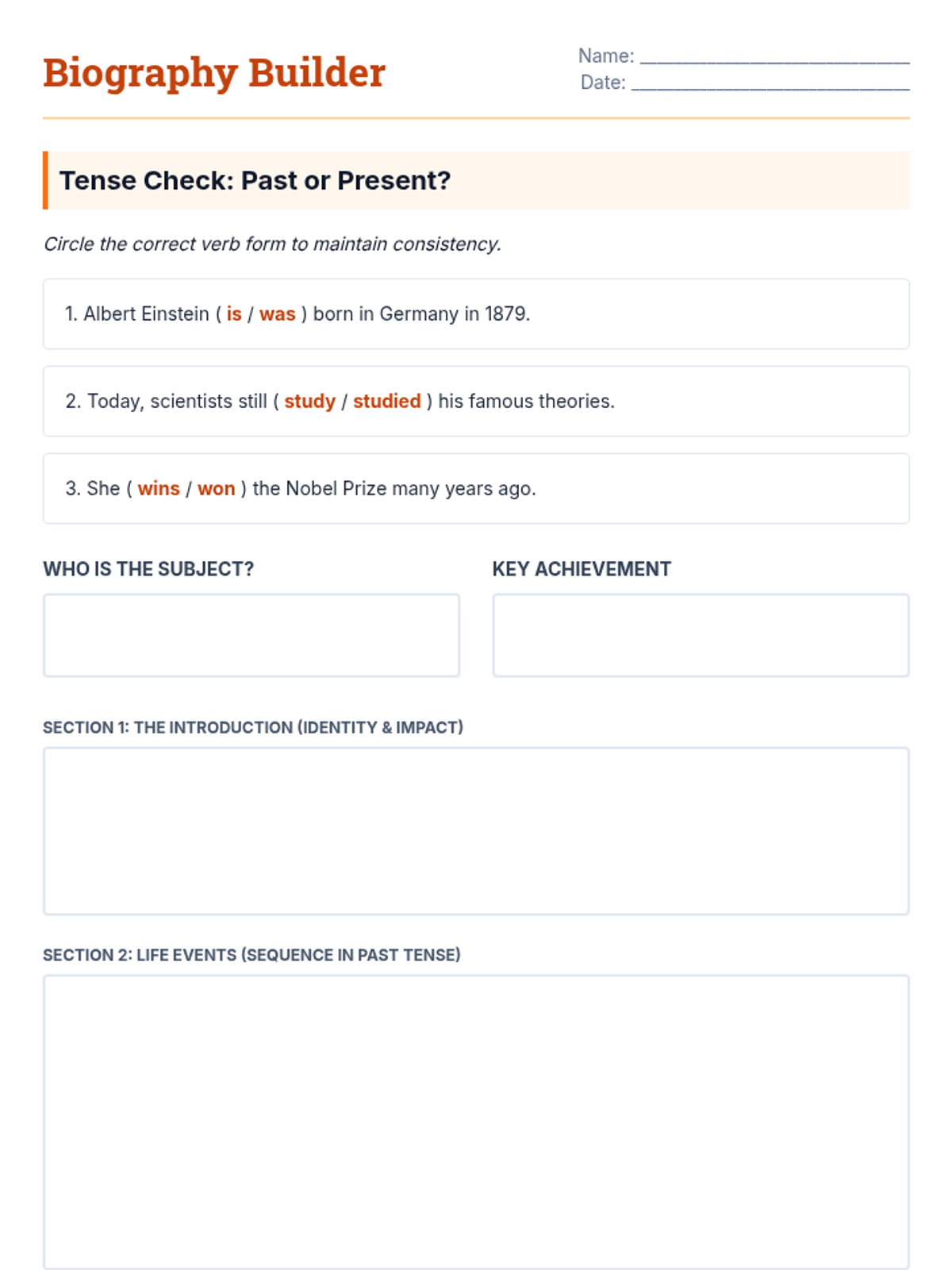
A student worksheet for biography writing, including a tense-selection warm-up activity and a three-section drafting organizer (Introduction, Life Events, Legacy).
Instructional slides for biography writing, focusing on tense consistency (past vs. present) and logical sequencing of life events for historical figures.
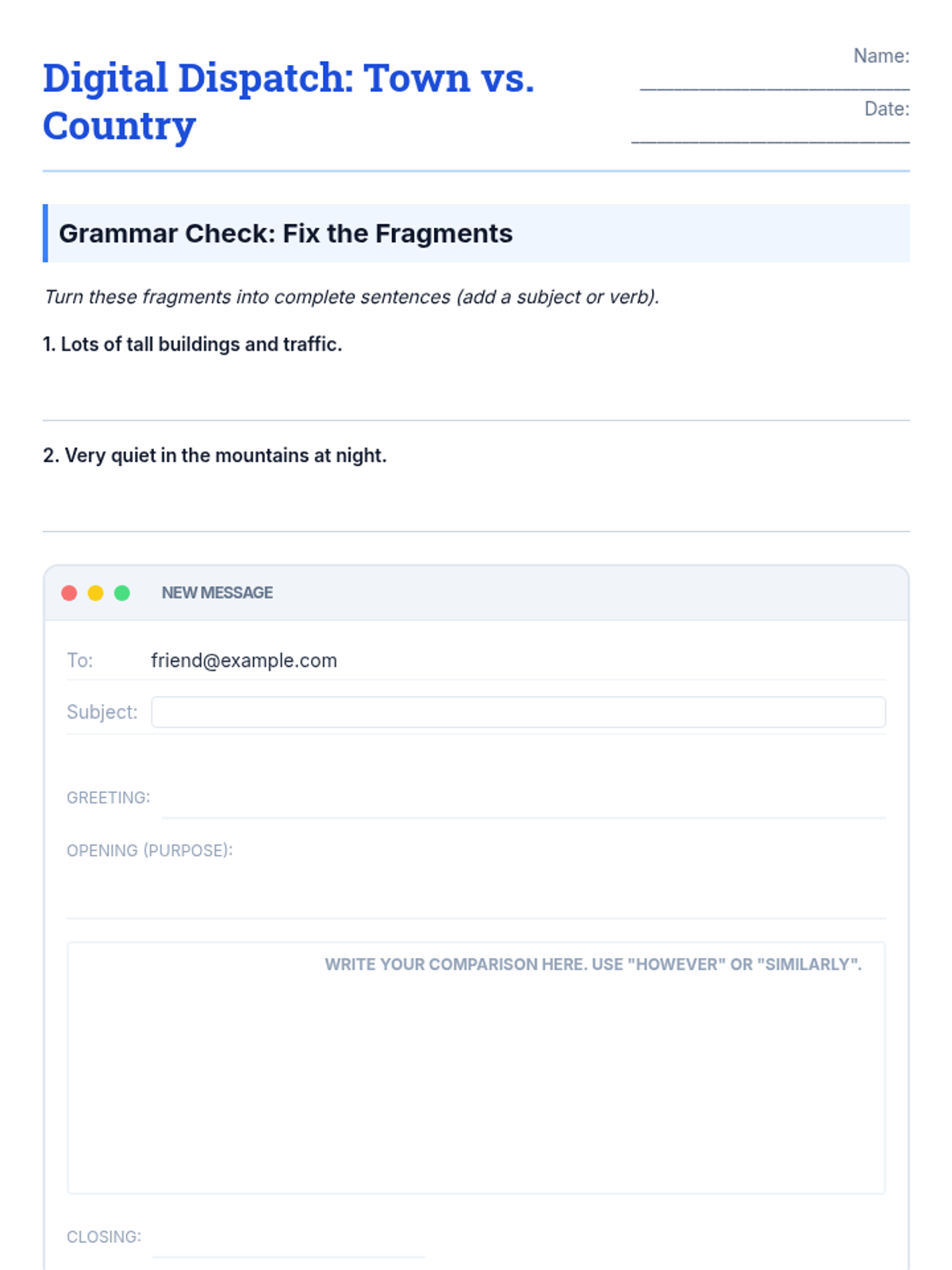
A student worksheet for writing an email comparing urban and rural life. Features a grammar activity to correct sentence fragments and a structured email template with comparison-word prompts.
Instructional slides for email writing, focusing on the comparison between urban and rural living, grammar instruction on sentence fragments, and transitional words for comparison.
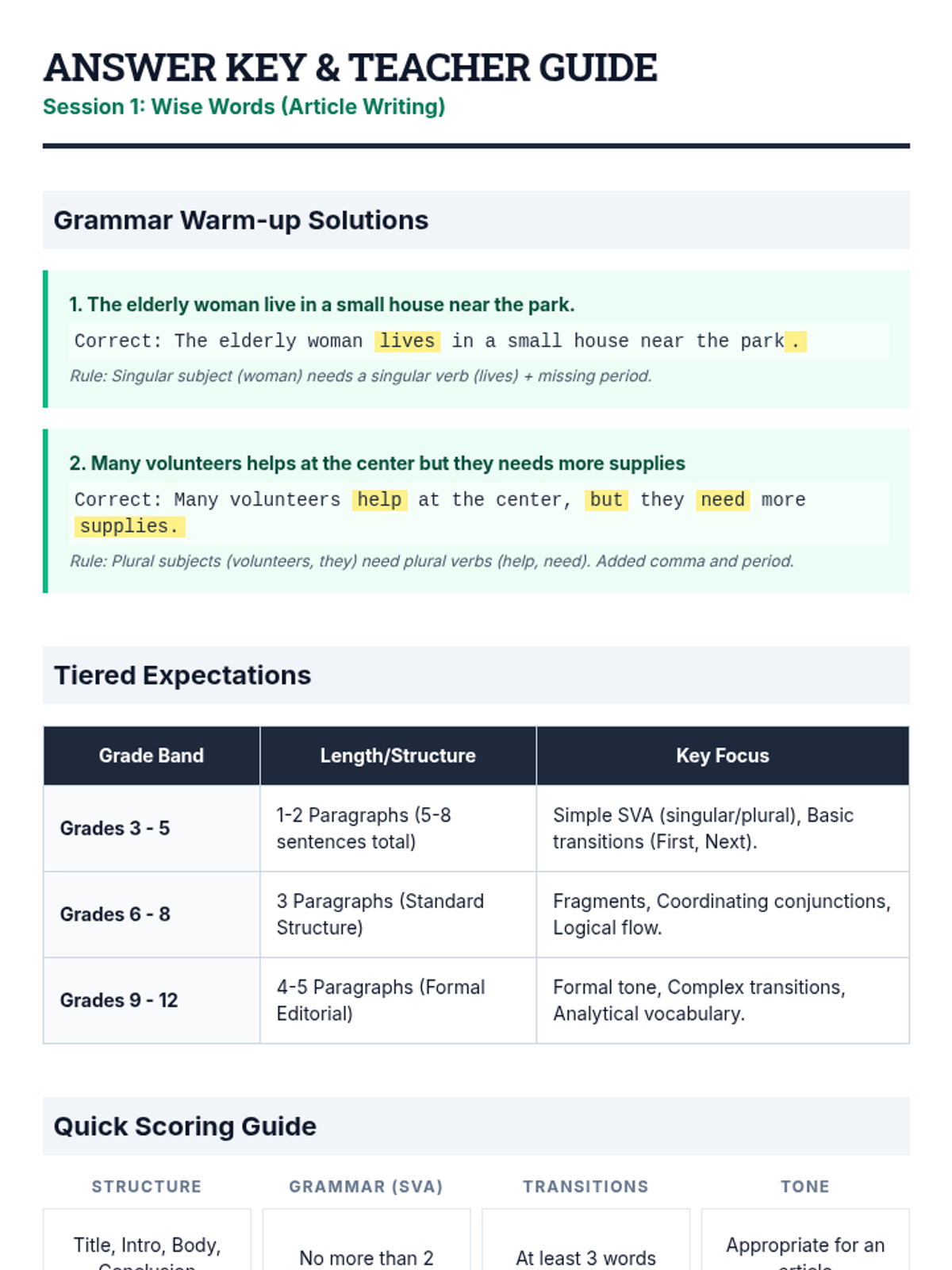
Teacher reference guide for Session 1, containing grammar solutions, tiered expectations for different grade bands, and a quick scoring rubric for the article writing task.
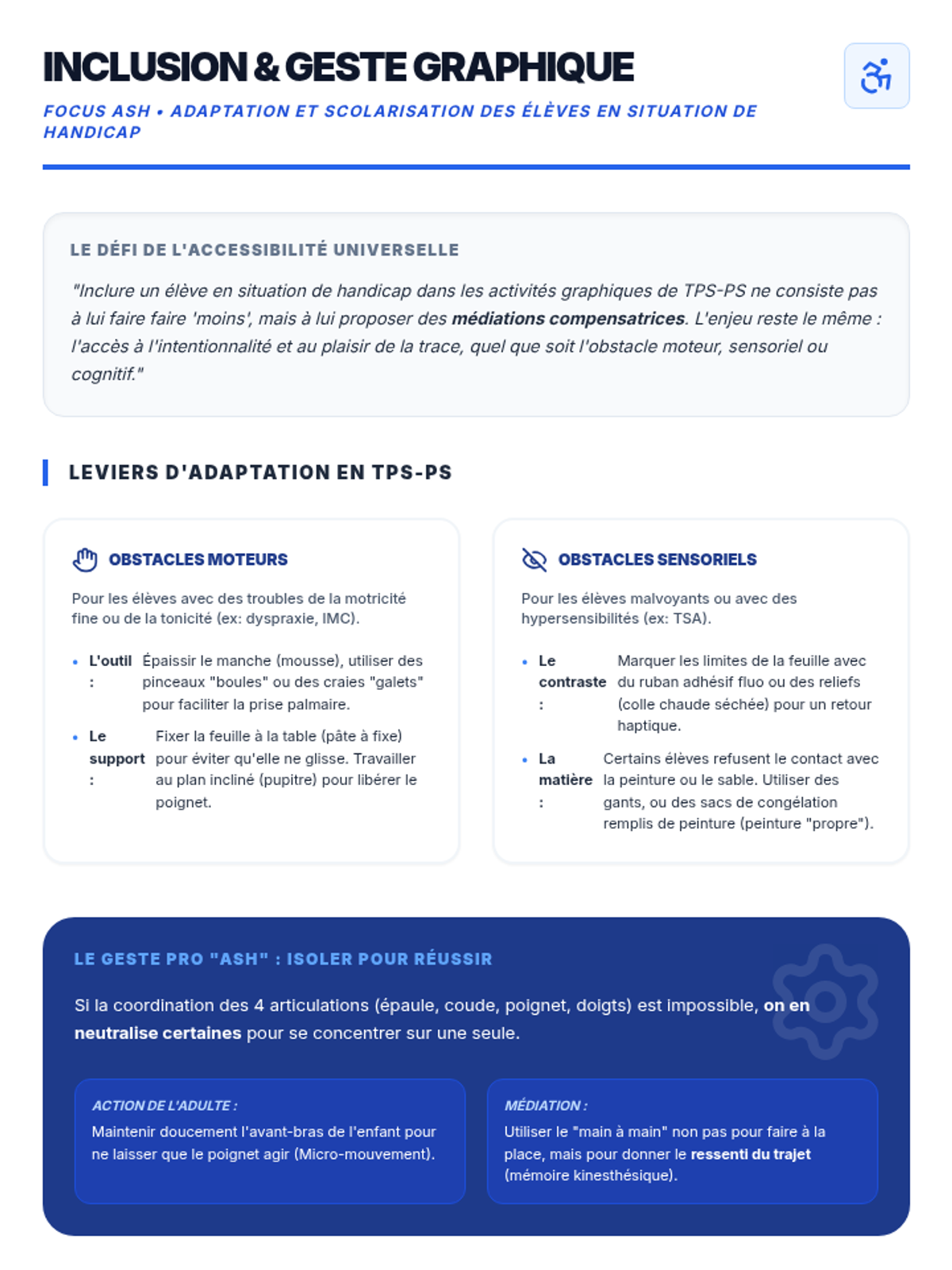
Ressource d'expertise sur l'adaptation des activités graphiques pour les élèves en situation de handicap (ASH) en maternelle. Propose des compensations motrices, sensorielles et cognitives pour garantir l'inclusion dans la construction du geste.
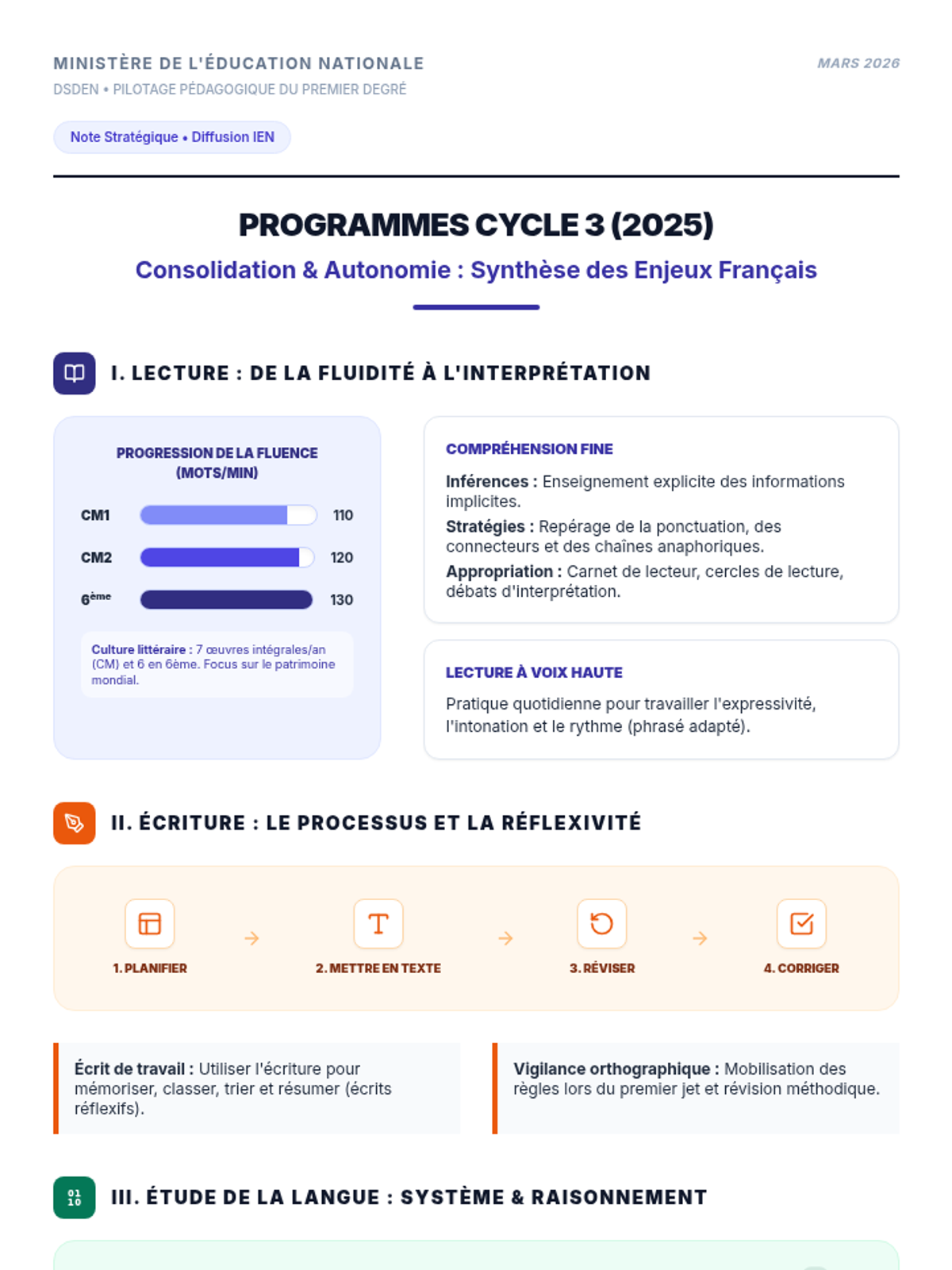
Note de synthèse institutionnelle récapitulant les orientations majeures des programmes Cycle 3 (2025) pour les IEN. Elle met en évidence la progression de la fluence, le processus d'écriture (planification/révision) et l'analyse systémique de la langue (phrase complexe, système verbal).
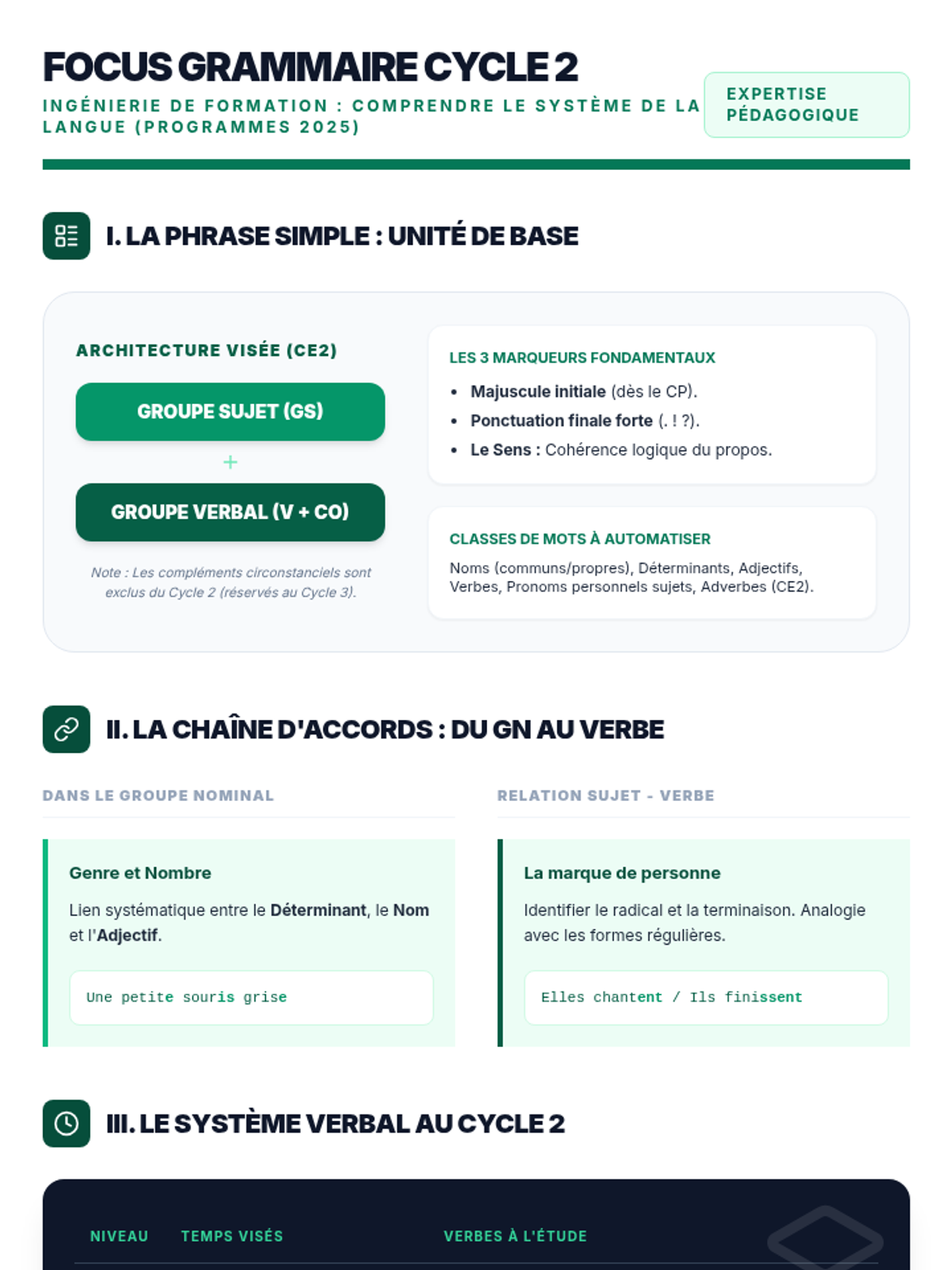
Guide d'expertise sur l'enseignement de la grammaire au Cycle 2 selon les programmes 2025. Détaille la structure de la phrase simple, les chaînes d'accords et la progression du système verbal du CP au CE2.
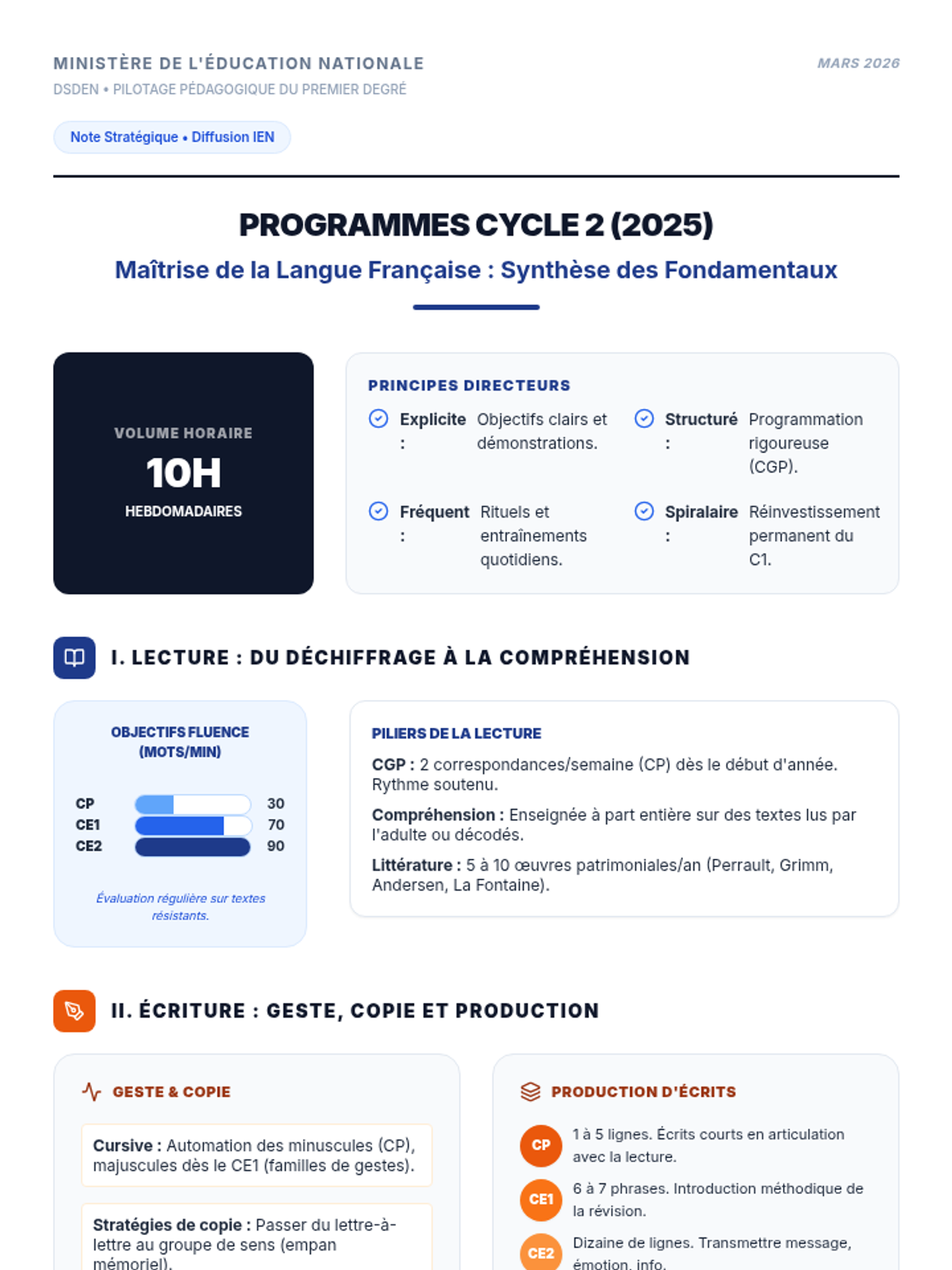
Note de synthèse institutionnelle pour les IEN récapitulant les programmes Cycle 2 de 2025. Structure les priorités (CGP, Fluence, Copie, Vocabulaire) et inclut des visualisations sur la progression de la fluence et du lexique.
Note de synthèse visuelle pour les IEN récapitulant les programmes maternelle 2025. Inclut des schémas sur le processus lexical, la hiérarchie phonologique et le cycle de production d'écrit (dictée à l'adulte).
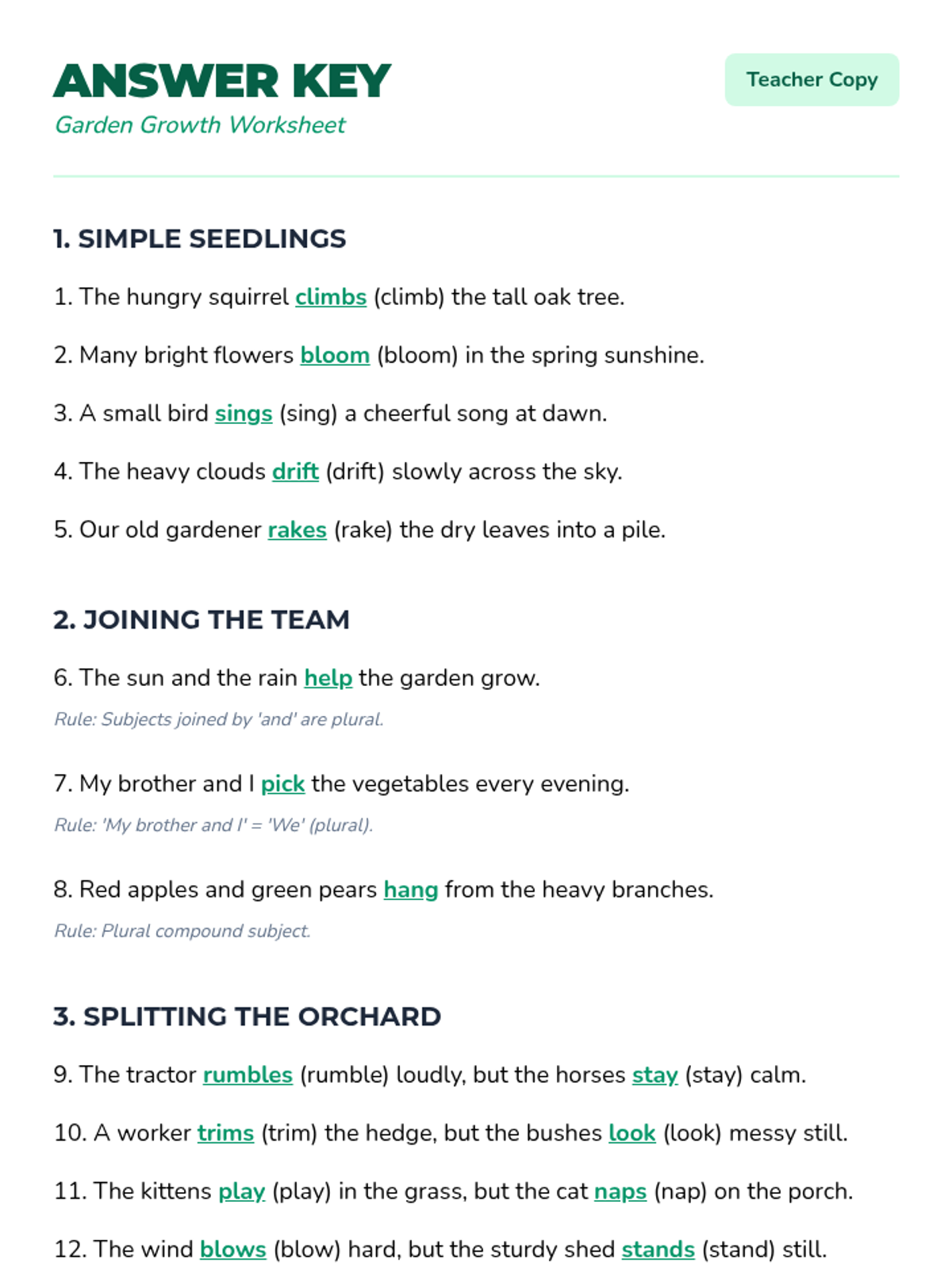
An answer key for the Garden Growth Worksheet, providing correct verb forms and brief explanations for each section.
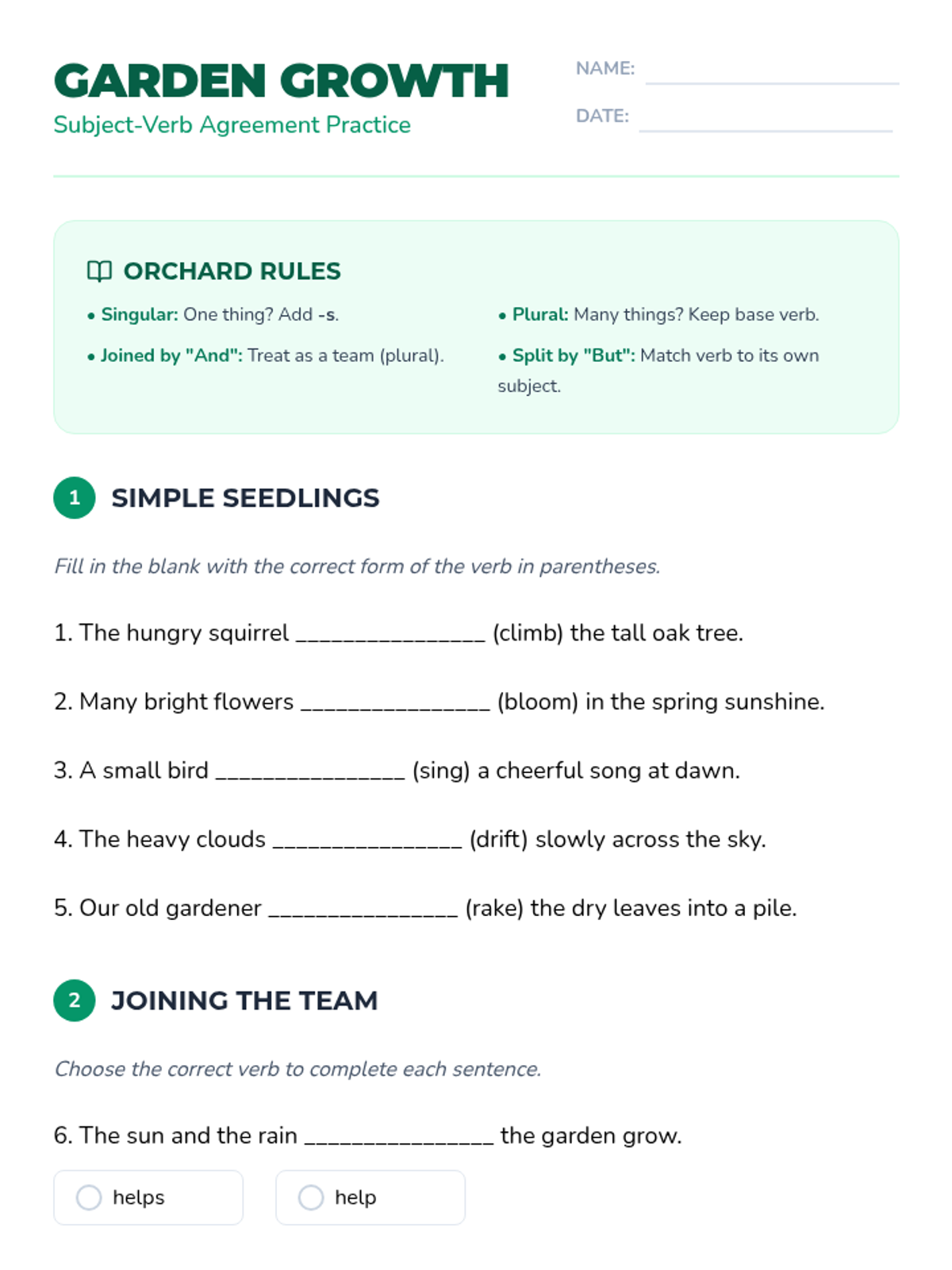
A student worksheet focusing on subject-verb agreement. Corrected layout issues, added writing lines, and ensured consistency in question formatting. Removed unnecessary page breaks for better flow.
An instructional slide deck covering subject-verb agreement for simple and compound subjects using 'and' and 'but'. Includes visual rules and review challenges. Corrected answer choices and layout issues.
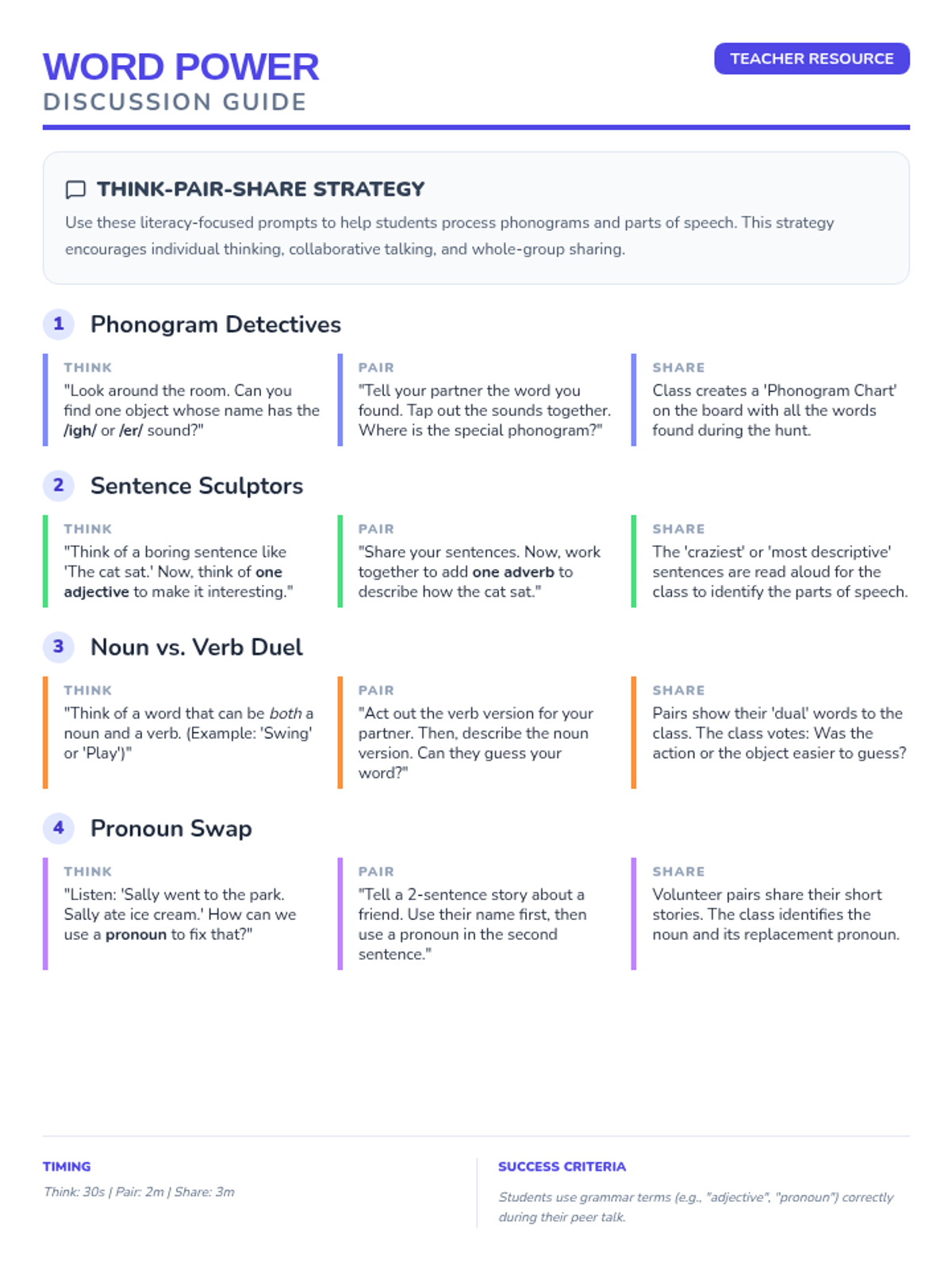
A condensed teacher resource guide providing four literacy-based Think-Pair-Share activities focusing on phonograms, parts of speech, and sentence structure on a single page.
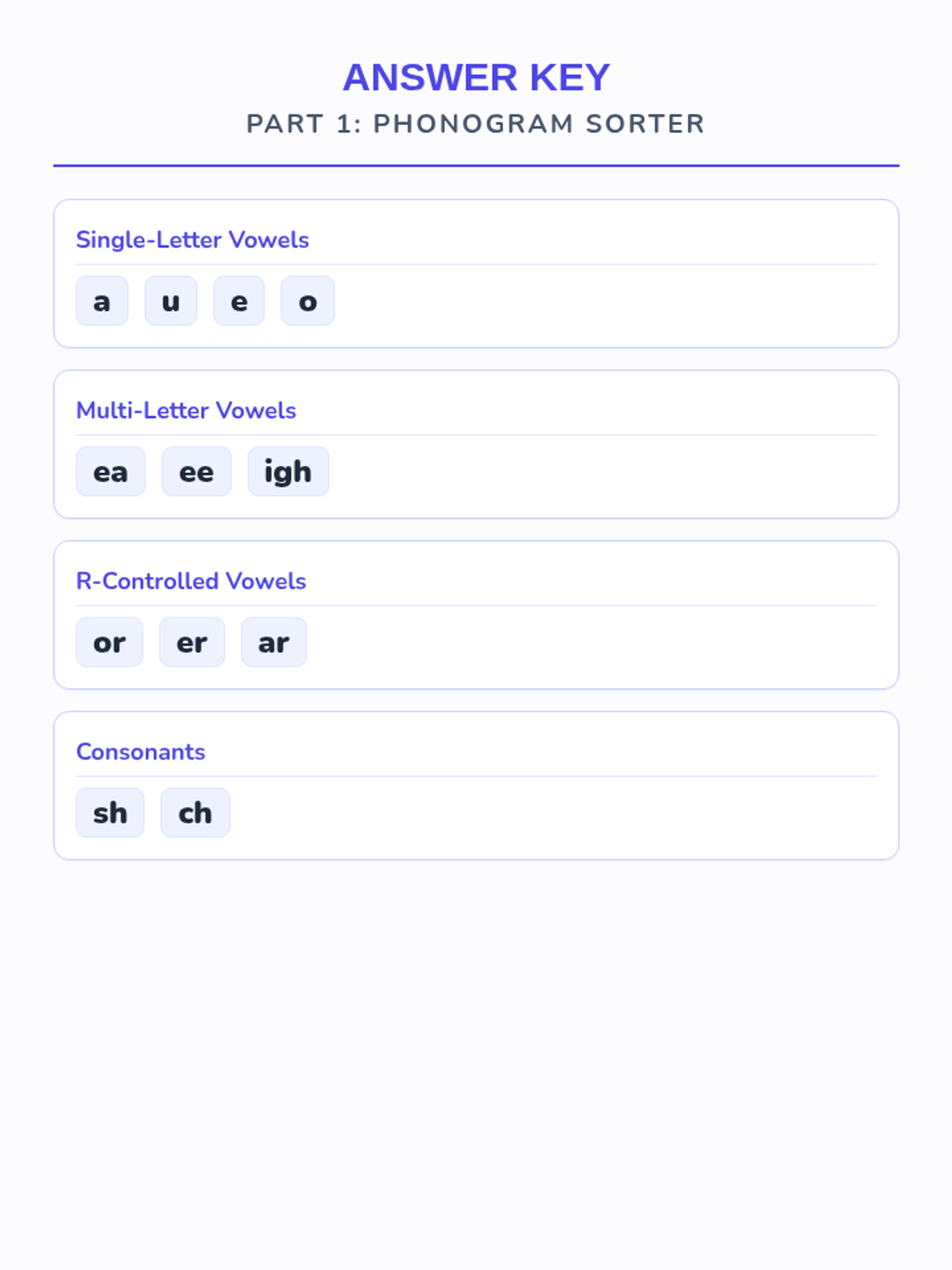
Updated Answer Key matching the new animal-themed sentences for the grammar identification task.
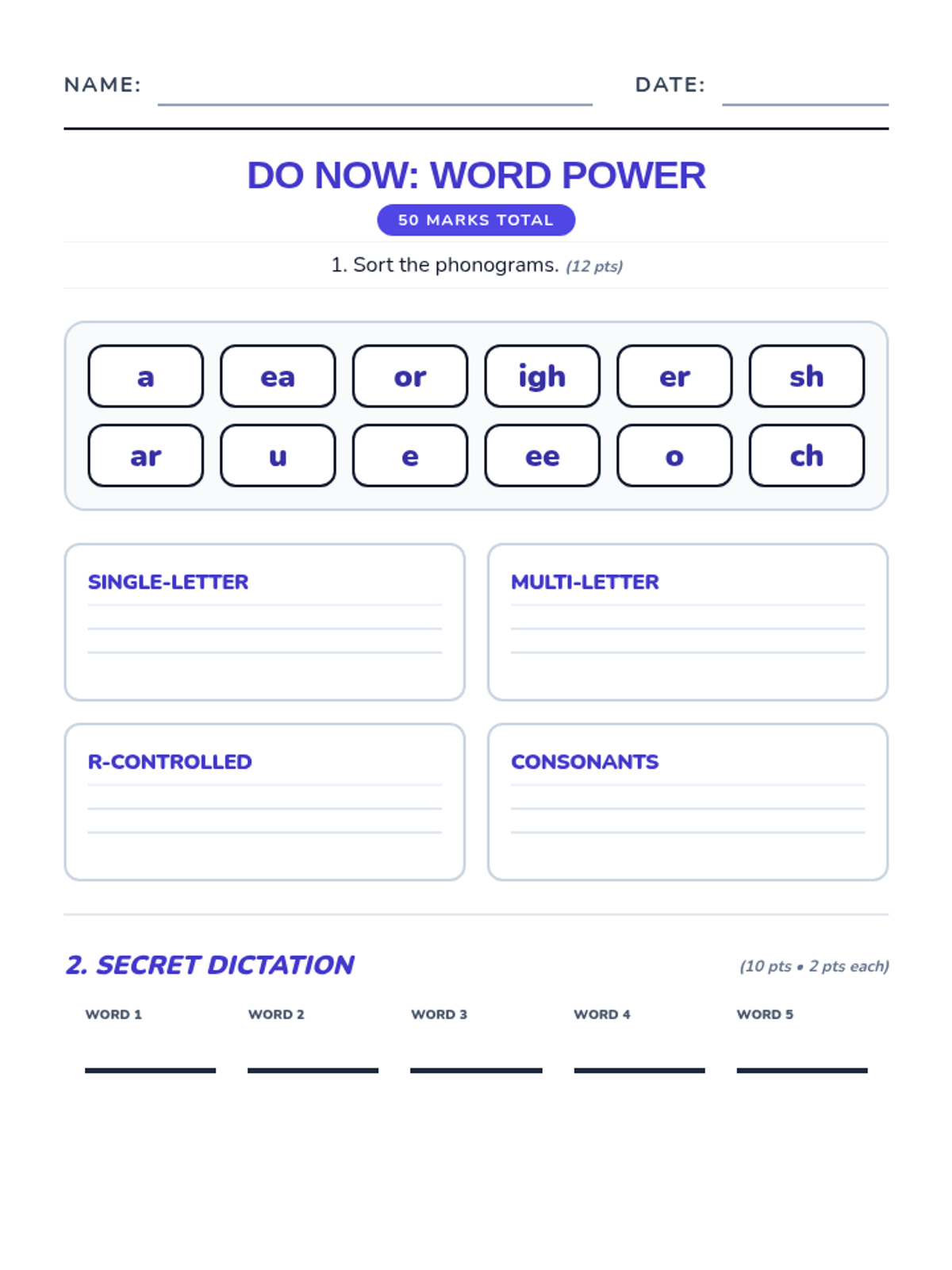
A high-contrast, print-optimized double-sided 'Do Now' worksheet with 50 marks. Includes a phonogram sorter, a 5-word secret dictation section, and a grammar hunt. Features large handwriting areas and clear point values.
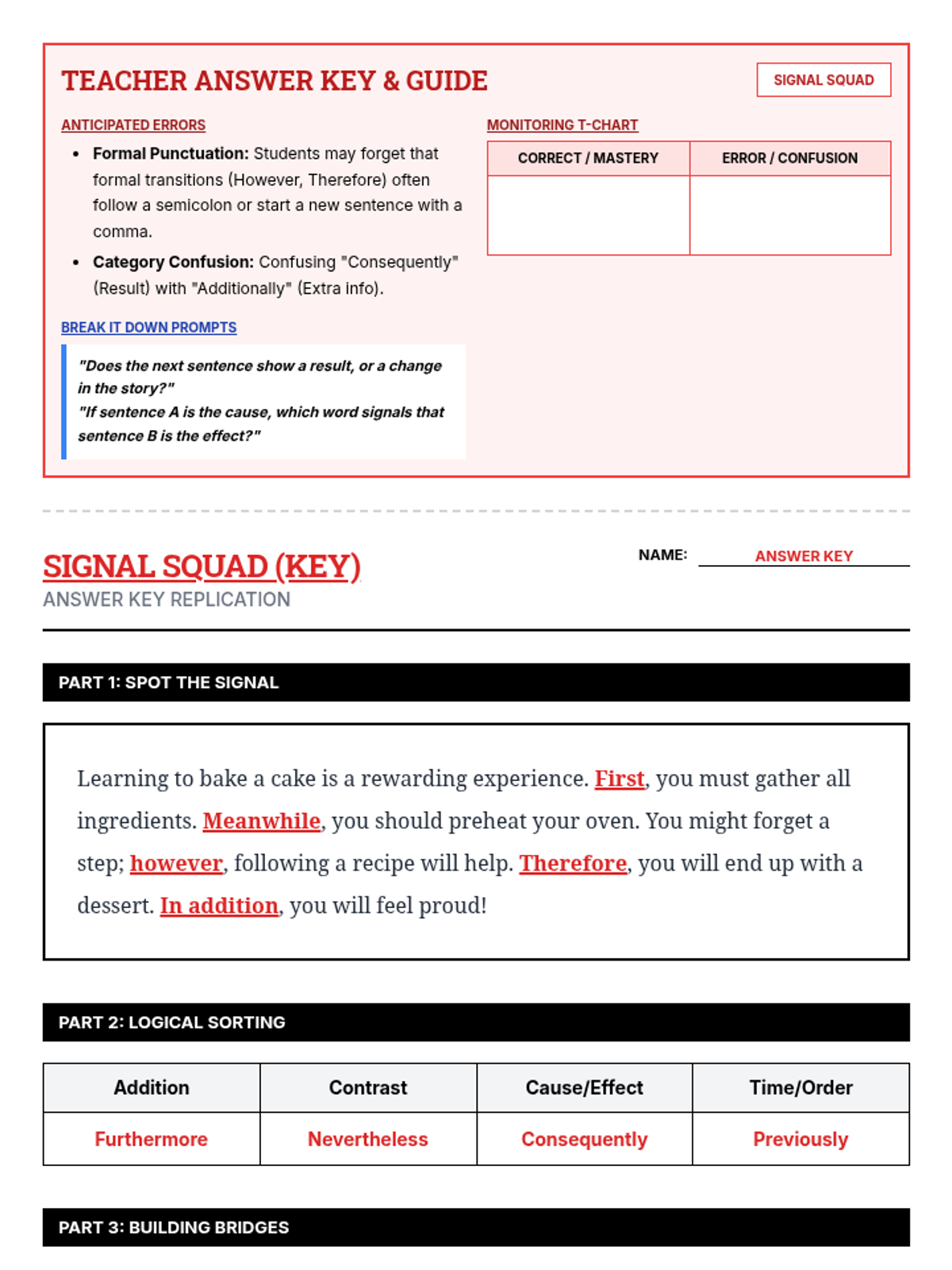
A comprehensive answer key for the Signal Squad handout. Includes teacher scaffolding with interrogative 'Break it down' prompts and marks challenging items with a star. Revised to exclude FANBOYS and fix spacing/fragment issues identified in review.
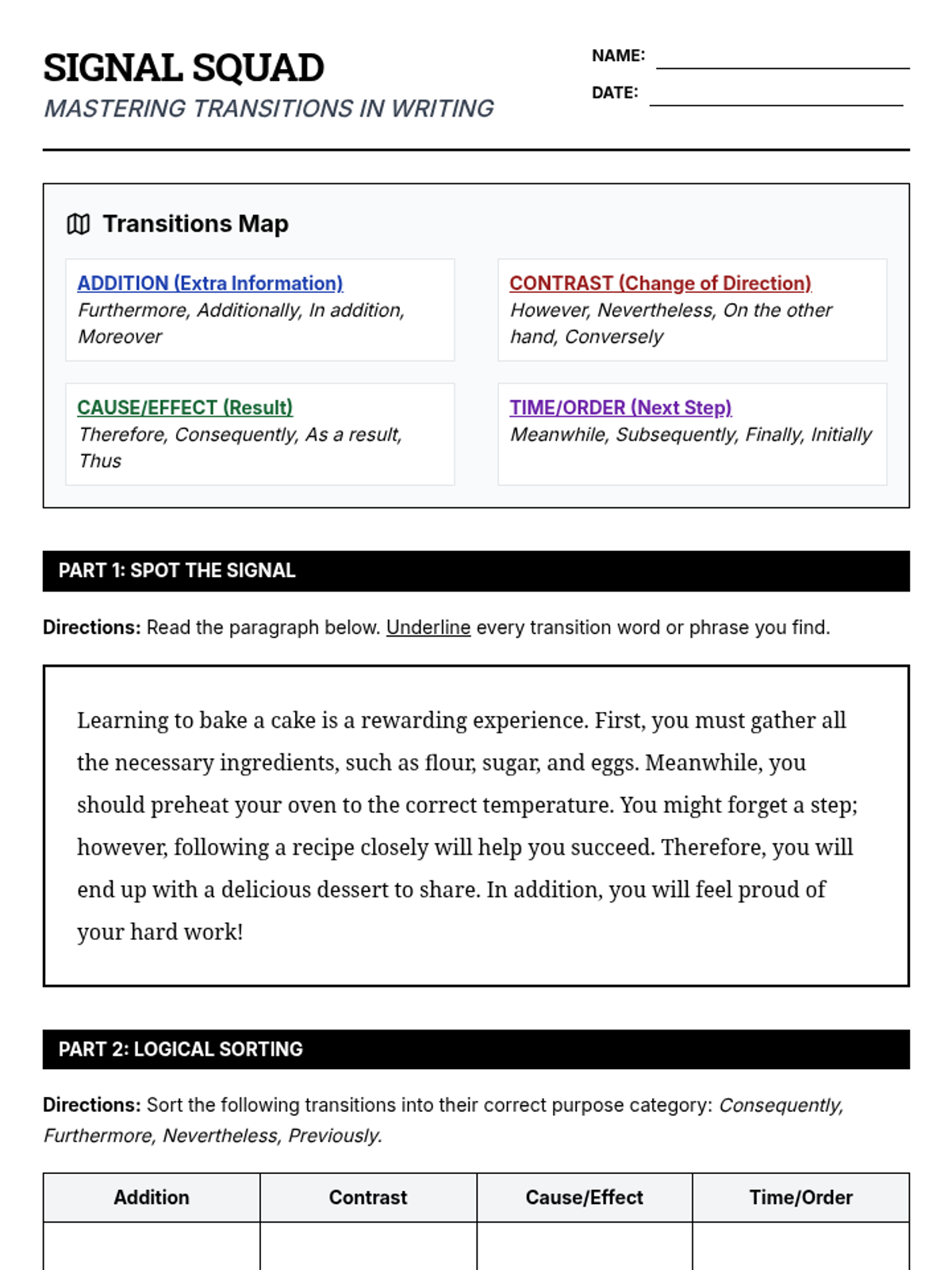
A student handout for identifying and categorizing transition words. Features three sections: identifying transitions in a paragraph, sorting words by purpose, and selecting the best transition to bridge two sentences. Revised to exclude FANBOYS and focus on formal transitions.
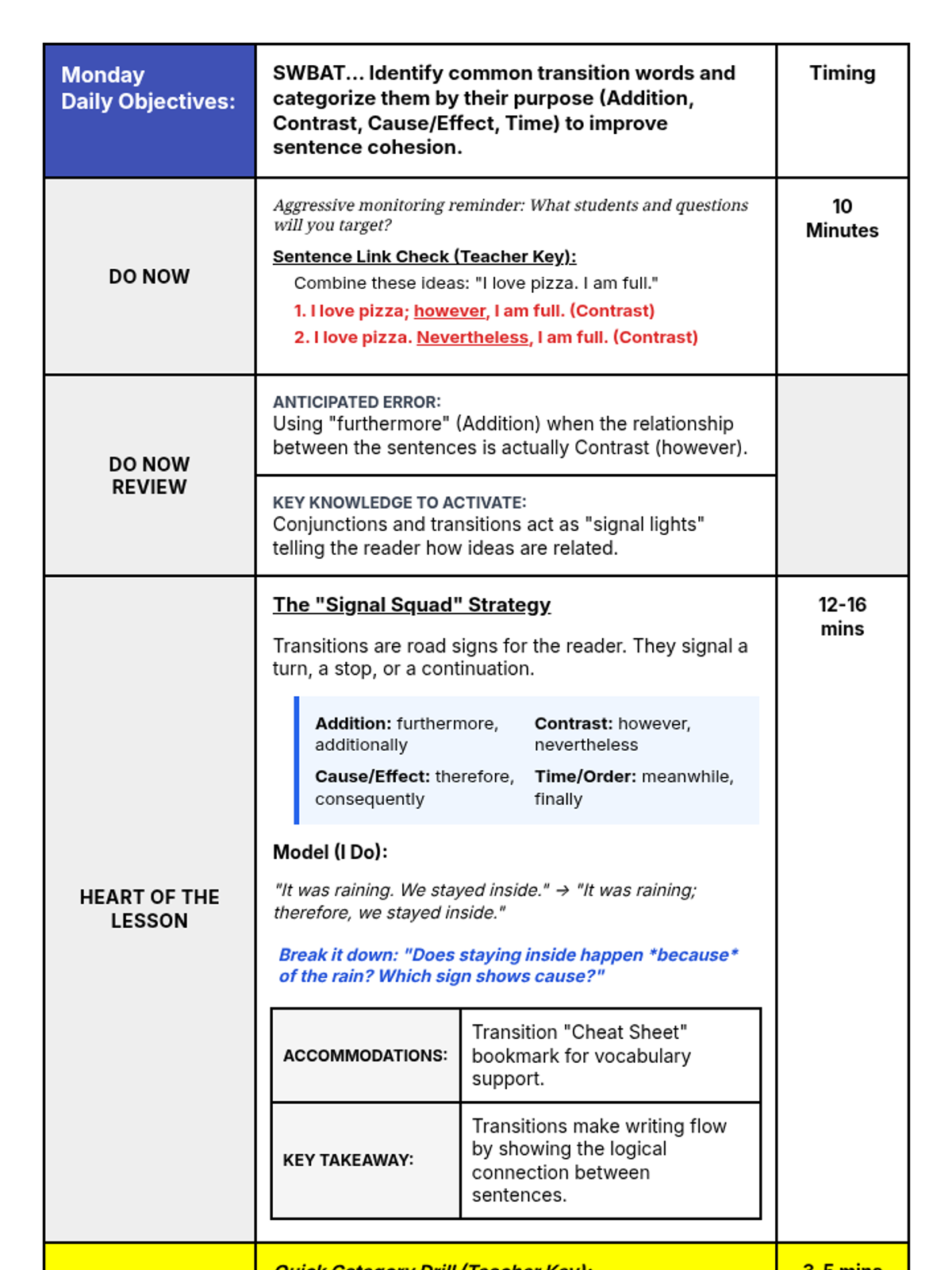
A structured lesson plan for teaching transition words, following the 'Impact LP Template'. Includes objectives, categorize-by-purpose strategies, and a monitoring T-chart. Revised to exclude coordinating conjunctions (FANBOYS) and include full context sentences in the teacher key.
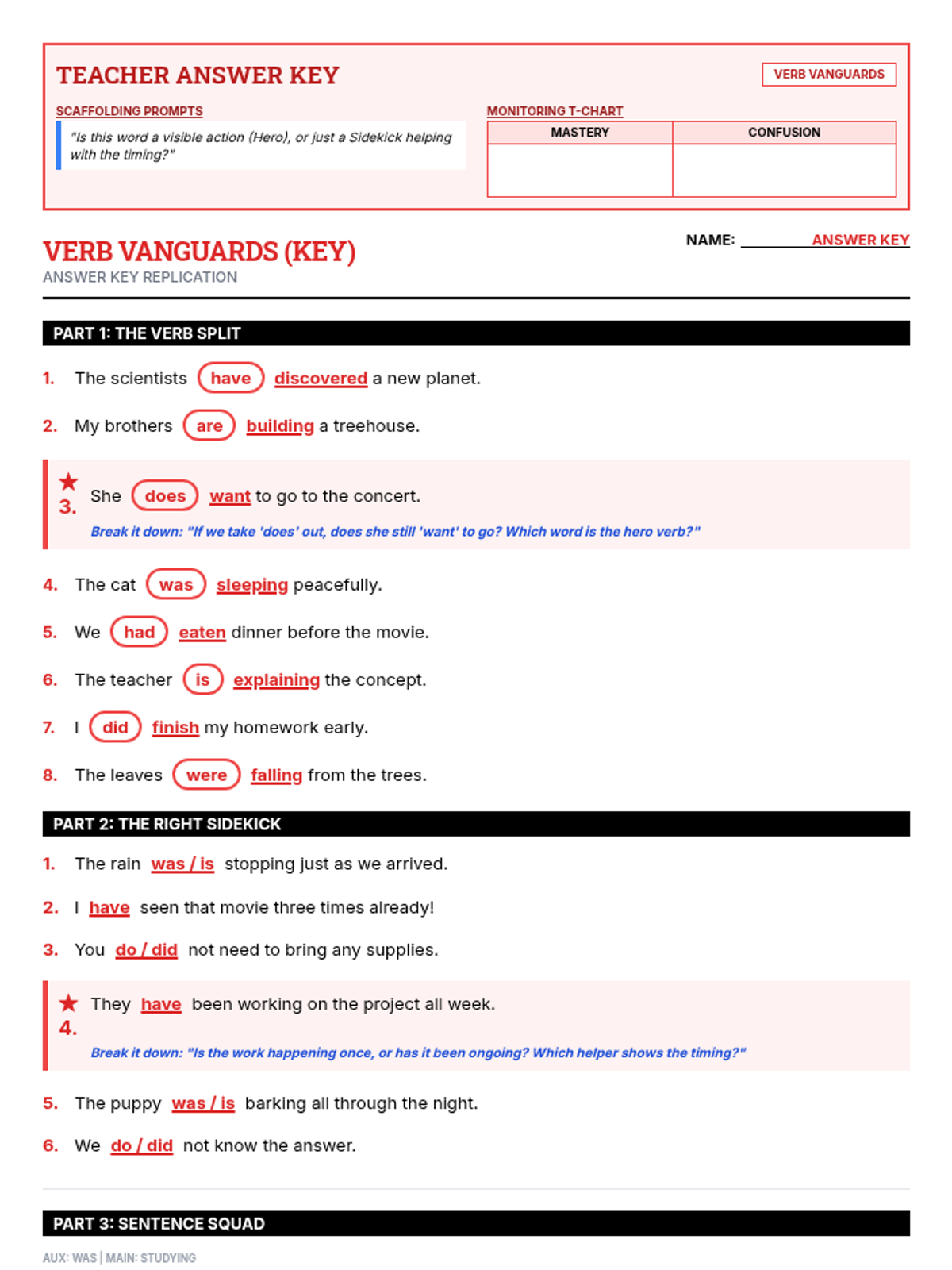
A comprehensive answer key for the Verb Vanguards handout. Includes teacher scaffolding with interrogative 'Break it down' prompts for struggling students and marks challenging items with a star for targeted monitoring. Replicates the student handout format with answers highlighted.
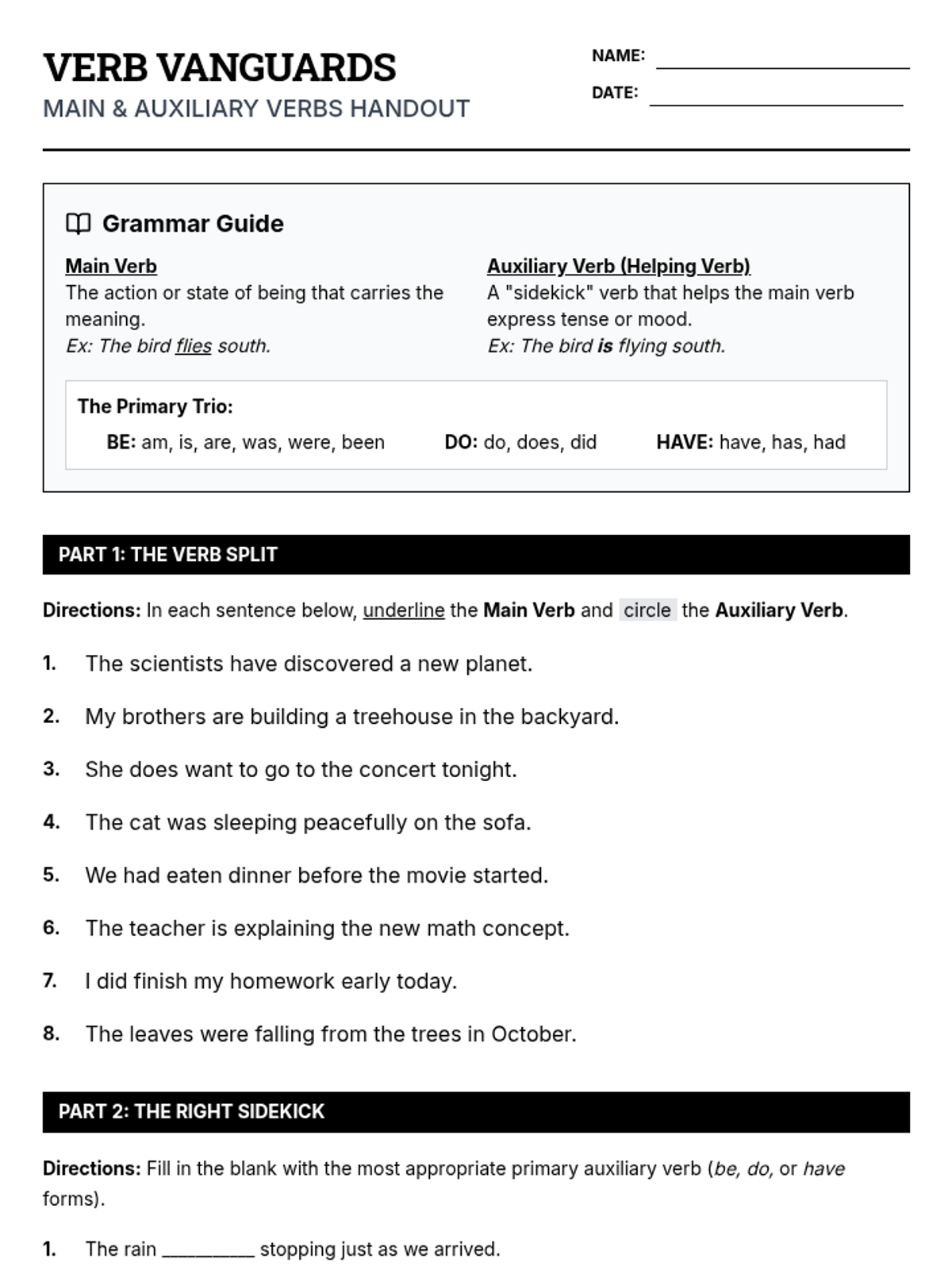
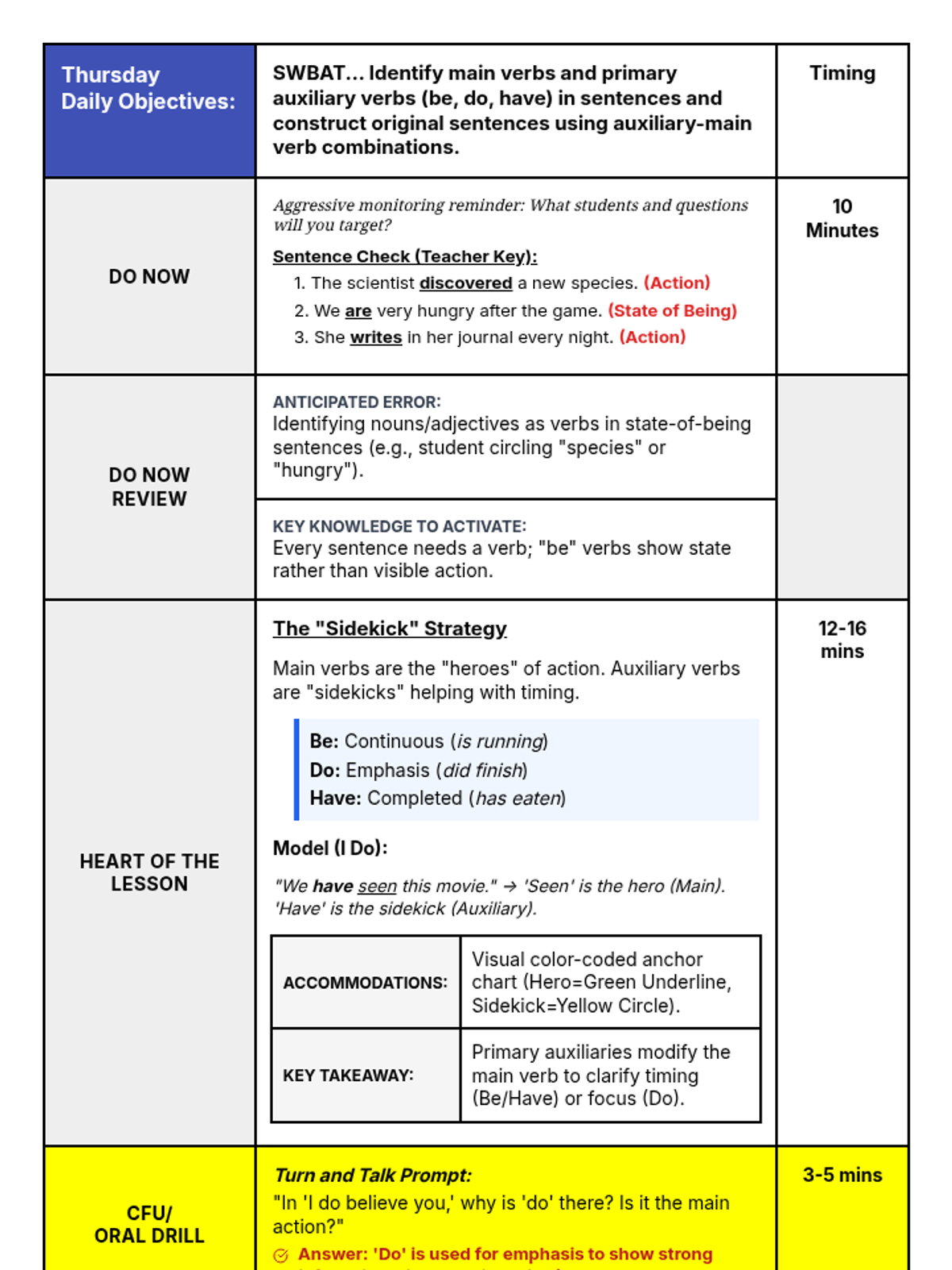
A student handout for identifying and using main and primary auxiliary verbs. Features three sections: identifying verbs in sentences, selecting the correct auxiliary verb, and constructing original sentences. Revised with improved spacing and additional practice items.
A structured lesson plan for teaching main and primary auxiliary verbs (be, do, have), following the new 'Impact LP Template'. Includes objectives, monitoring notes, detailed instruction, and a complete teacher key for the 'Verb Vanguard' handout integrated into the Independent Practice section. Revised with improved spacing and taller T-chart rows.
A bilingual (English and Japanese) educational slide deck exploring the fundamental components of a complete sentence: subjects and predicates. All prompts, questions, and definitions are presented in both languages for optimal understanding.
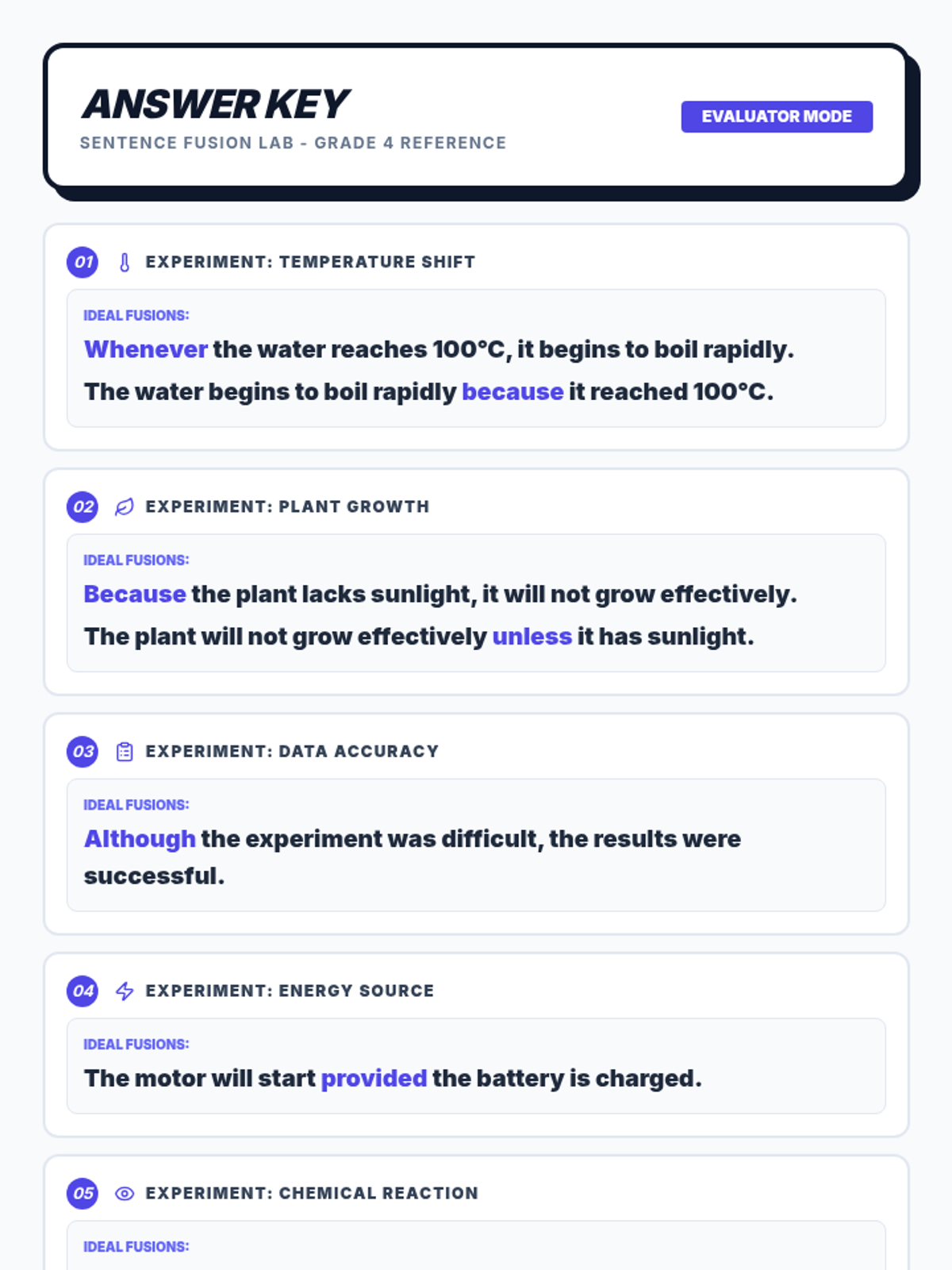
A teacher-facing answer key for the Sentence Fusion Worksheet, providing ideal fused sentence examples and grading guidance.
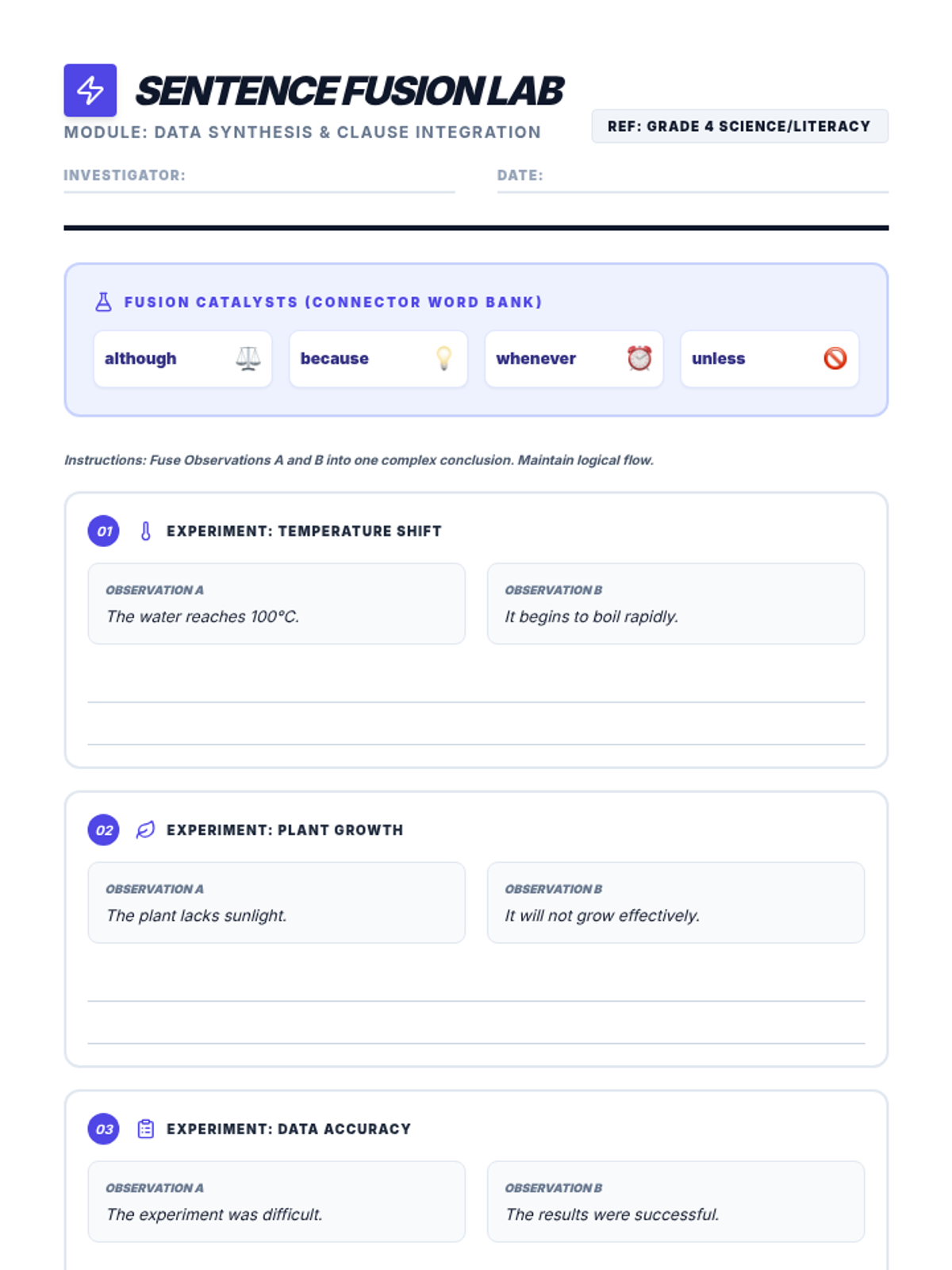
A second worksheet for the Action Lab lesson where students 'fuse' simple observations into complex sentences using specific connector words, reinforcing 4th-grade syntax.
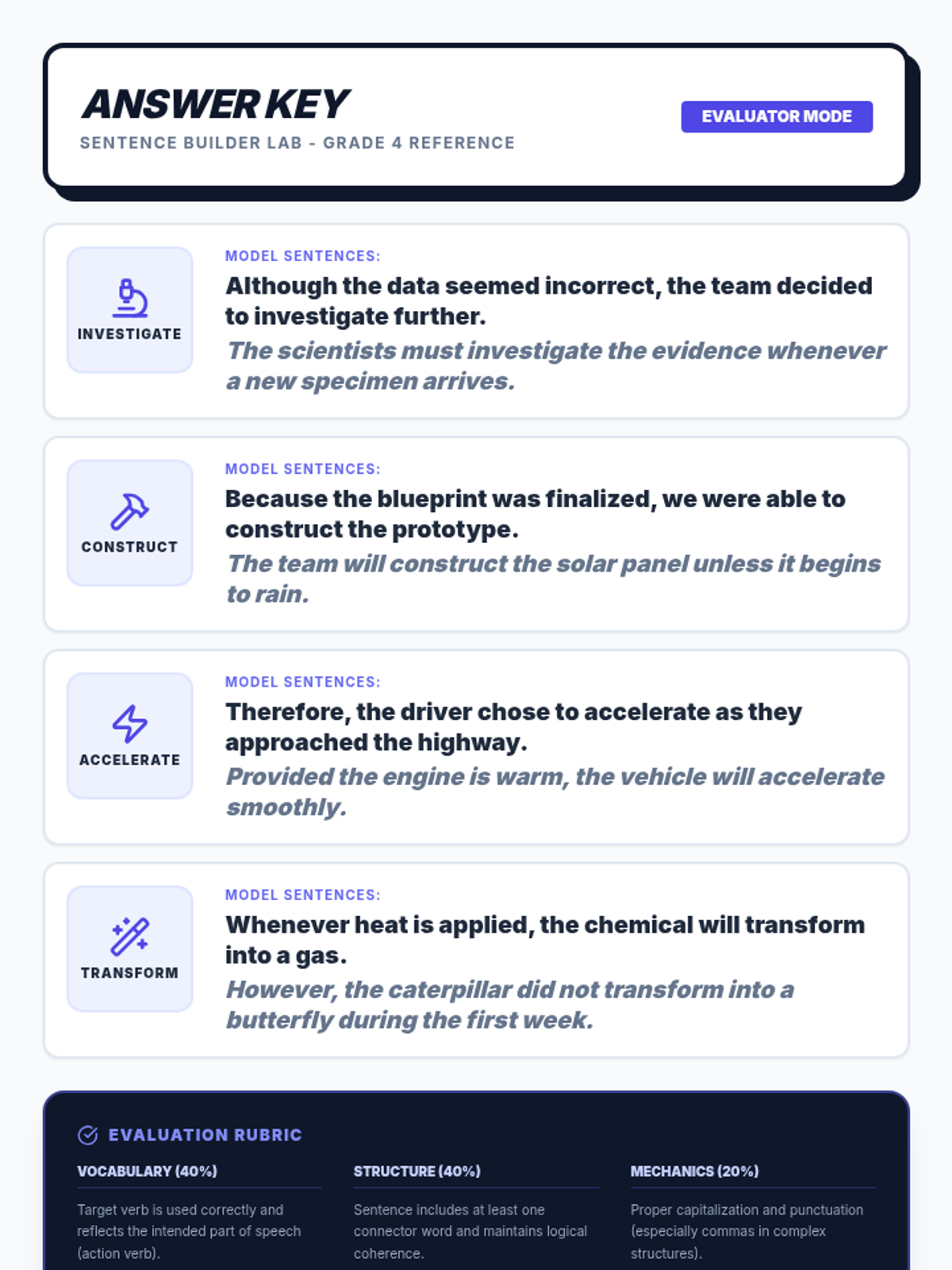
A teacher-facing answer key providing example sentences for the Sentence Builder worksheet, along with specific grading criteria for capitalization and punctuation.
A dynamic visual presentation to introduce 4th-grade students to advanced sentence construction, modeling complex structures with academic vocabulary.
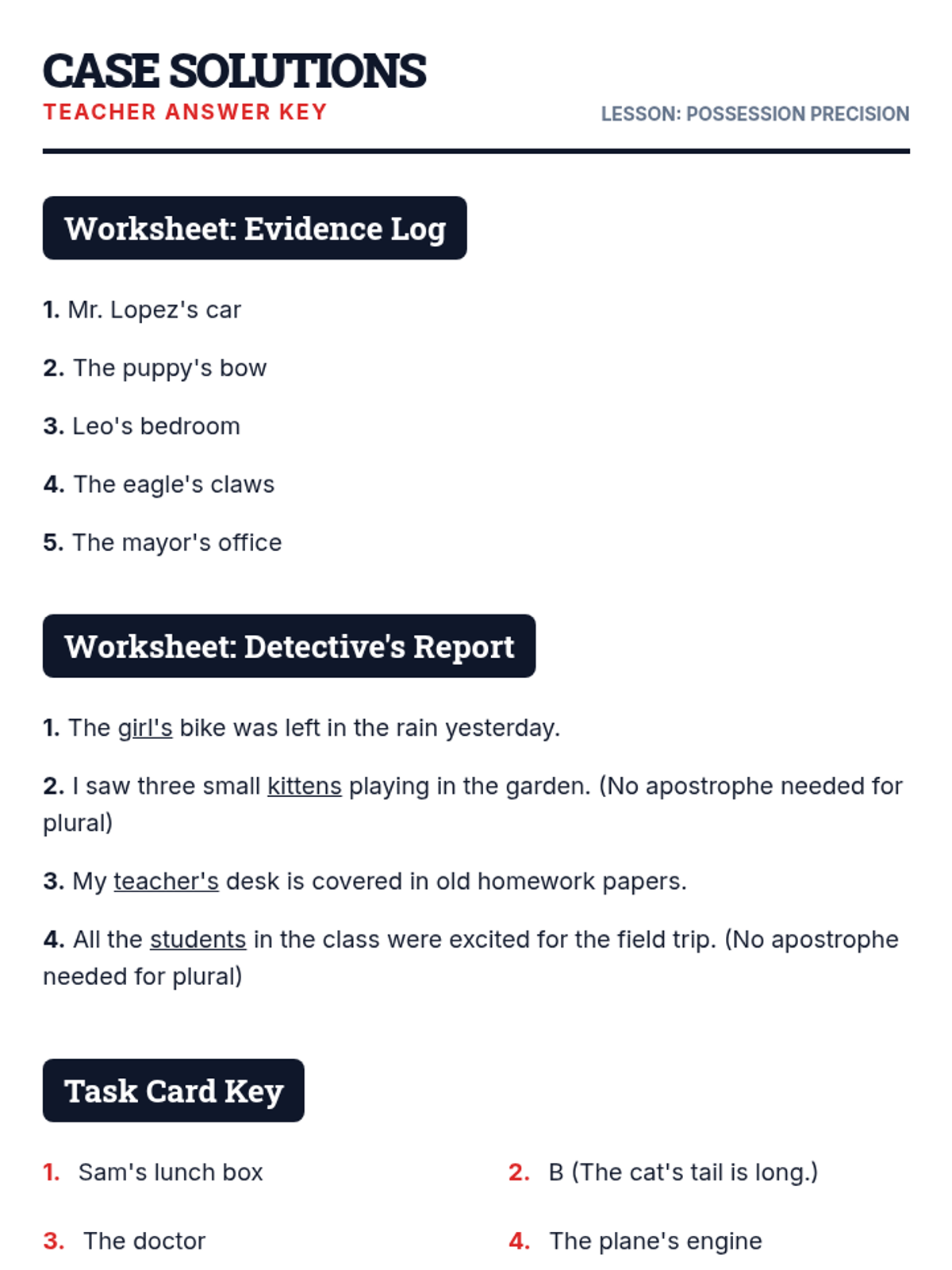
An answer key for the Possession Practice Worksheet and Lost and Found Task Cards, including teaching tips for identifying owners.
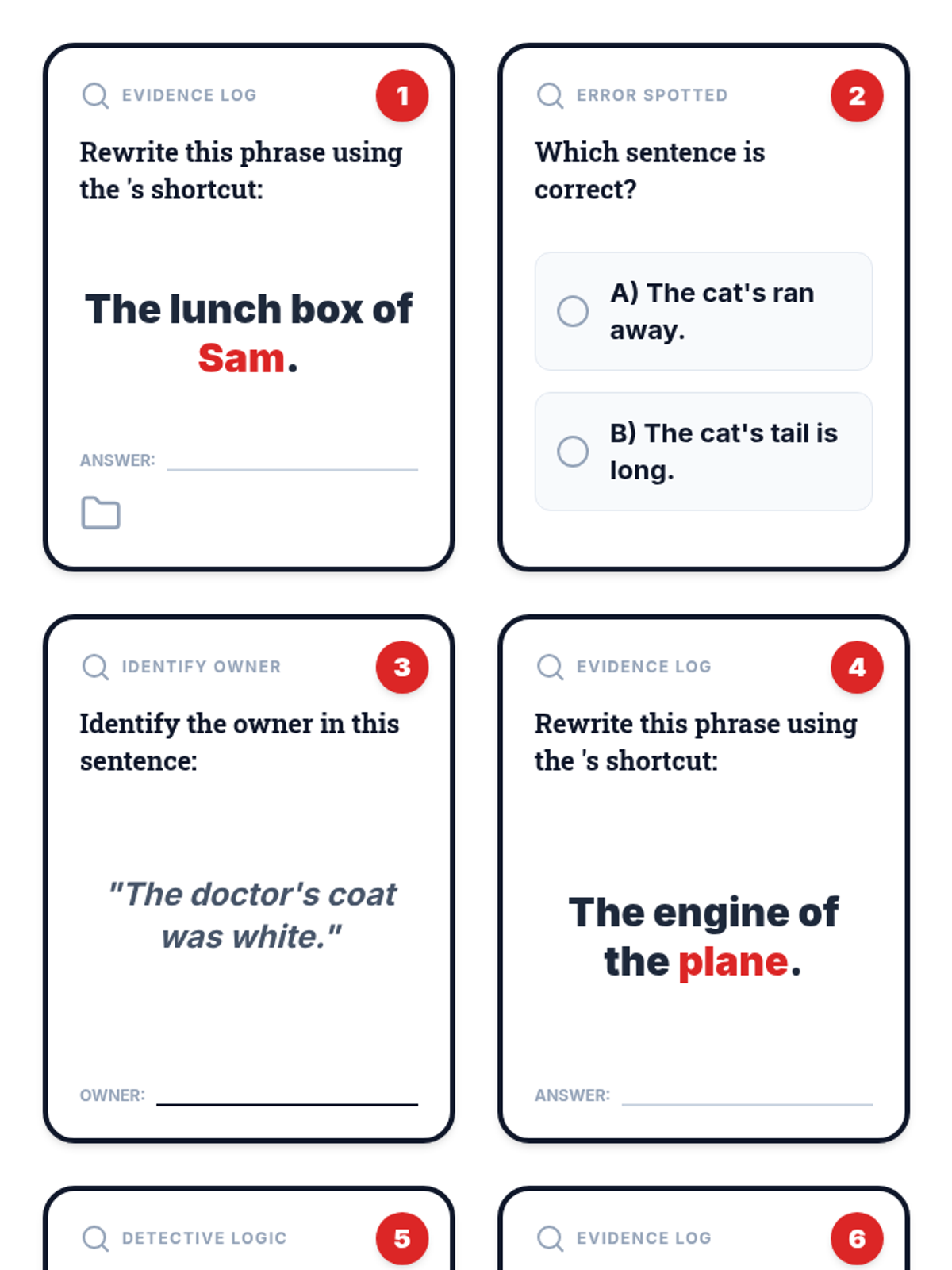
Eight detective-themed task cards for possessive noun practice, including rewriting phrases, identifying errors, and creative writing.
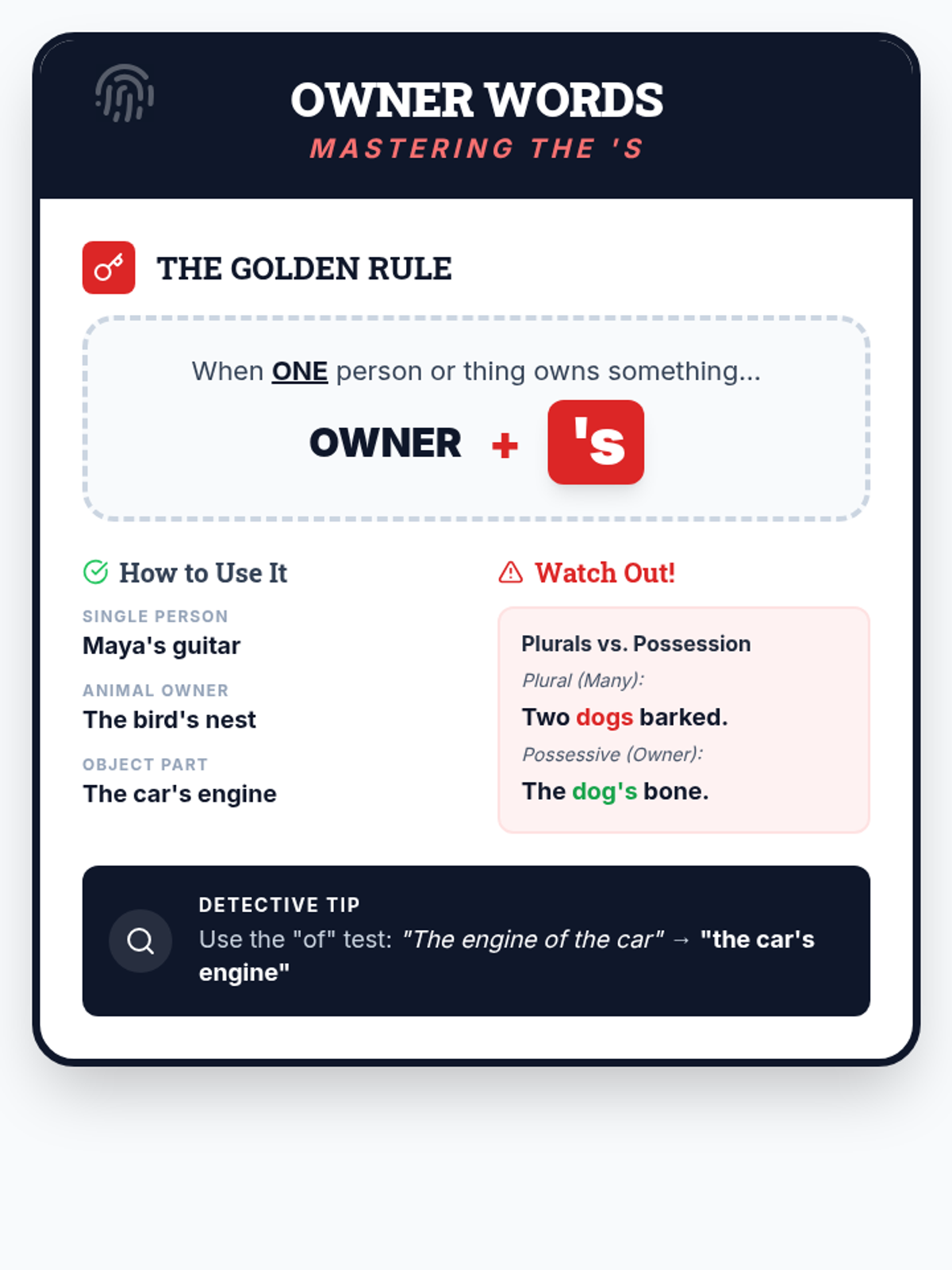
A high-contrast, visually engaging anchor chart poster that explains the rule for singular possessive nouns and warns against plural confusion.
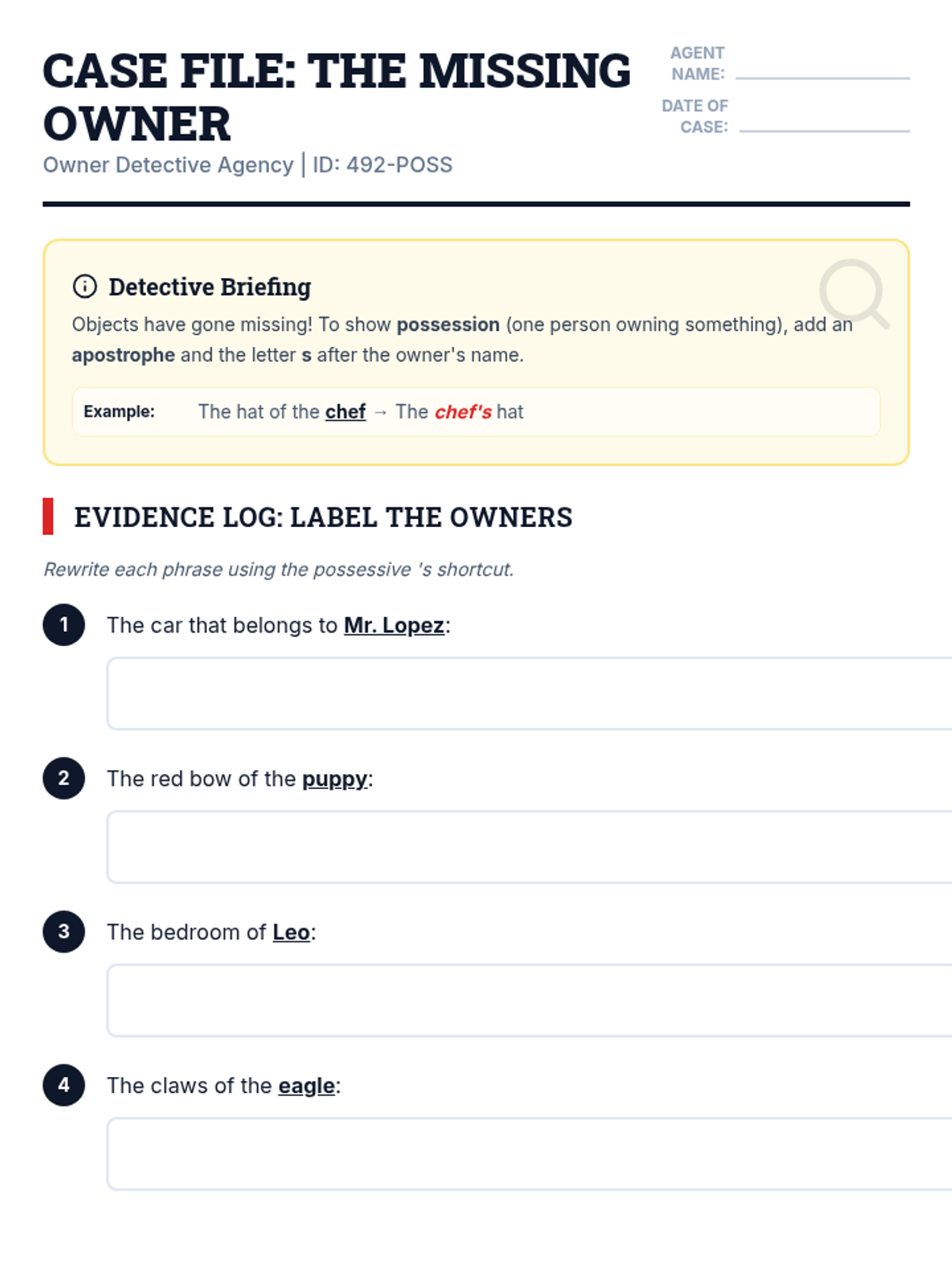
A practice worksheet where students rewrite phrases into possessive forms and correct errors involving plural vs. possessive nouns.
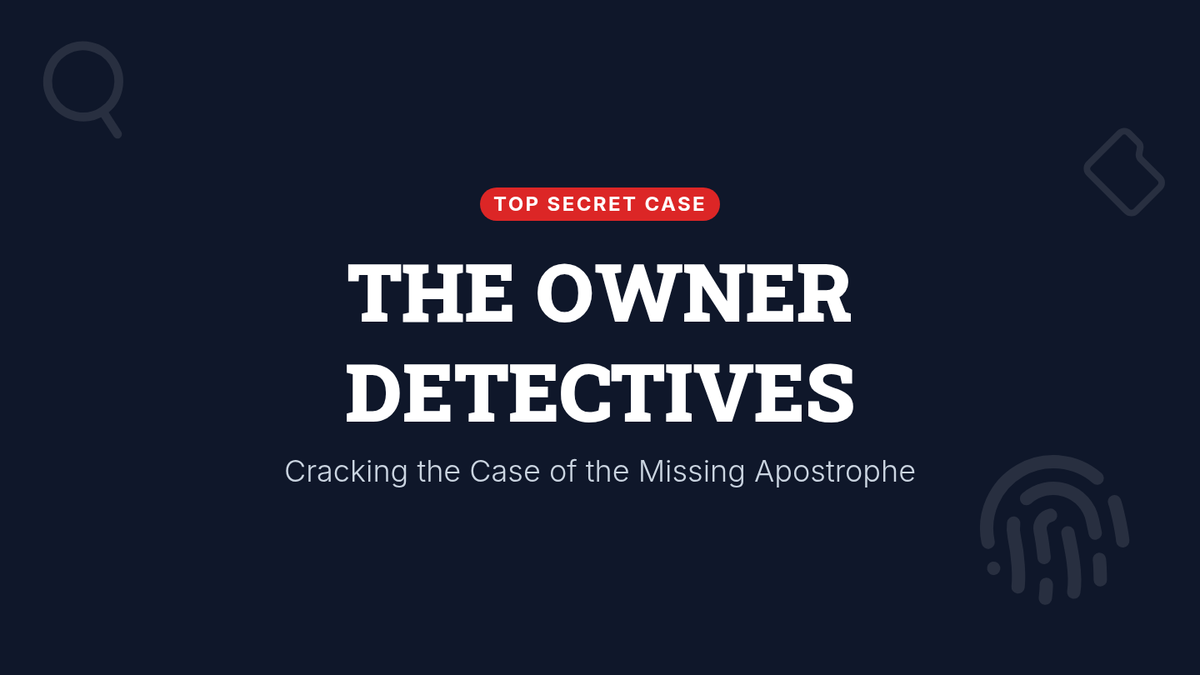
A detective-themed slide deck that teaches students how to use 's to show possession, including common pitfalls like plural vs. possessive nouns.
Instructions for the Mystery Performance Lab, guiding students through solo reading, role assignment with tie-breakers, plot analysis, fluency practice, and final presentation.
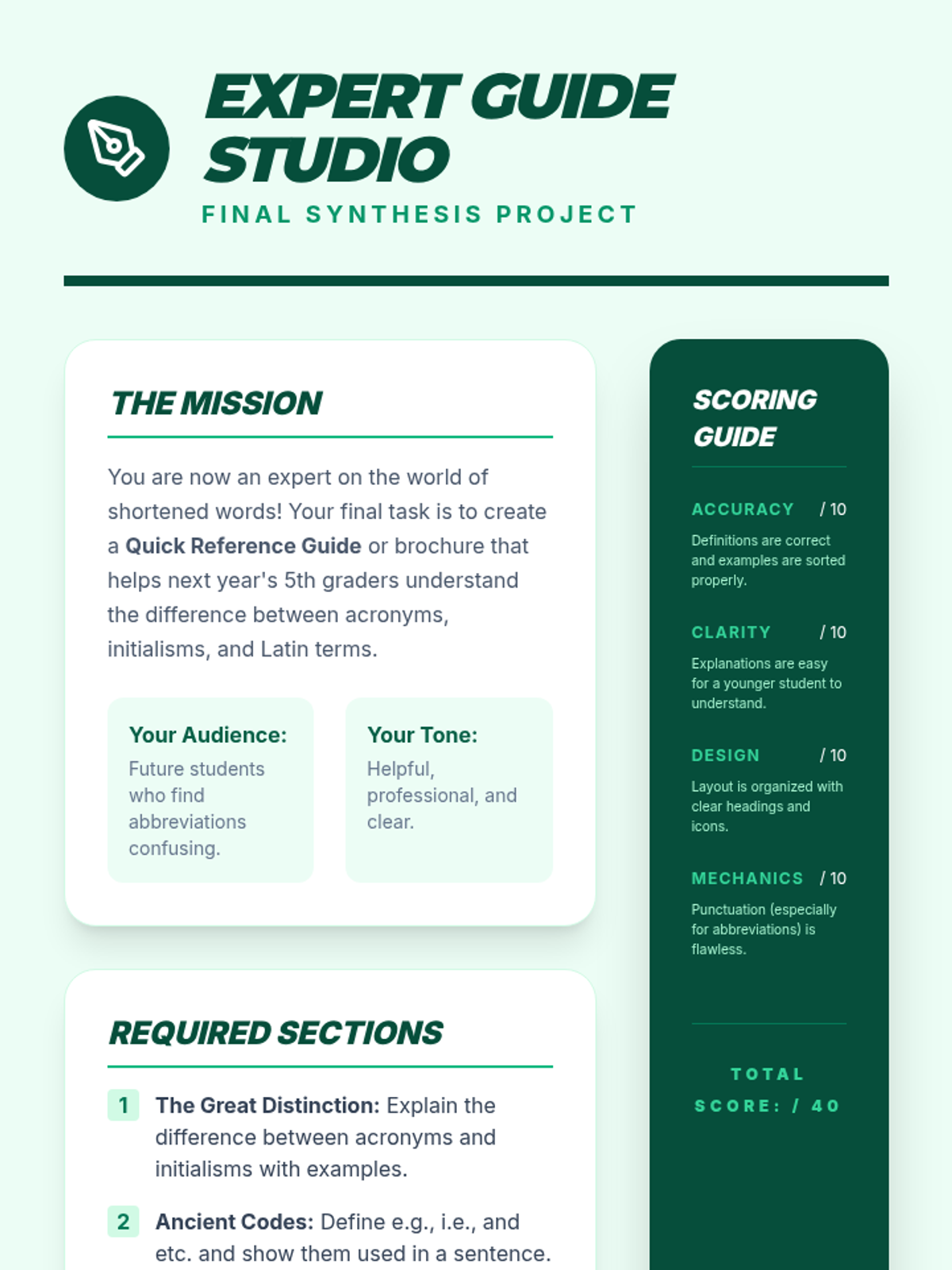
Final project instructions and rubric for creating an abbreviation reference guide, including specific requirements for content and scoring criteria.
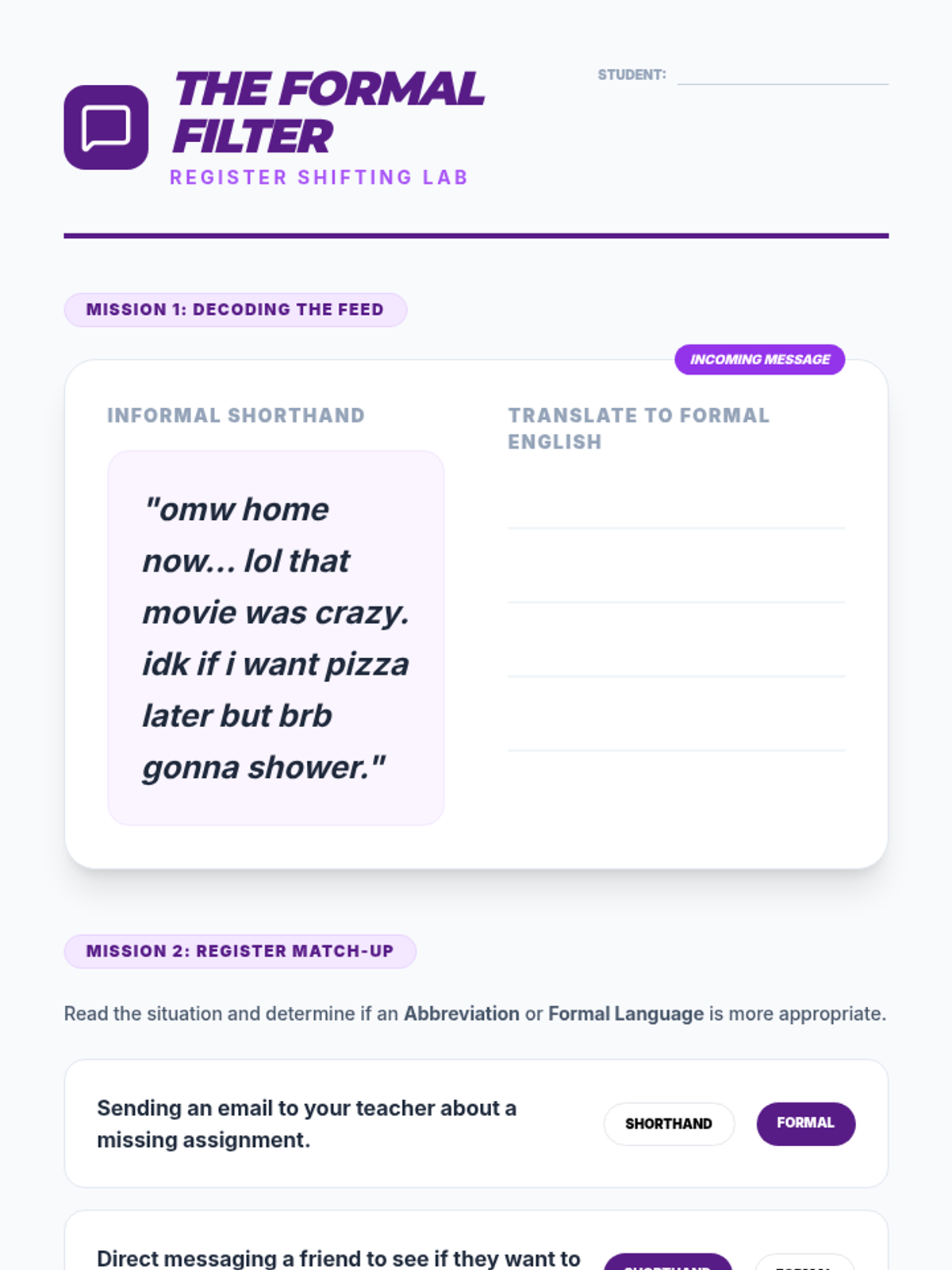
A worksheet for translating texting shorthand into formal English and identifying appropriate registers for different social contexts.
Slides exploring digital shorthand and texting language, focusing on the concept of register shifting and the evolution of communication speed.
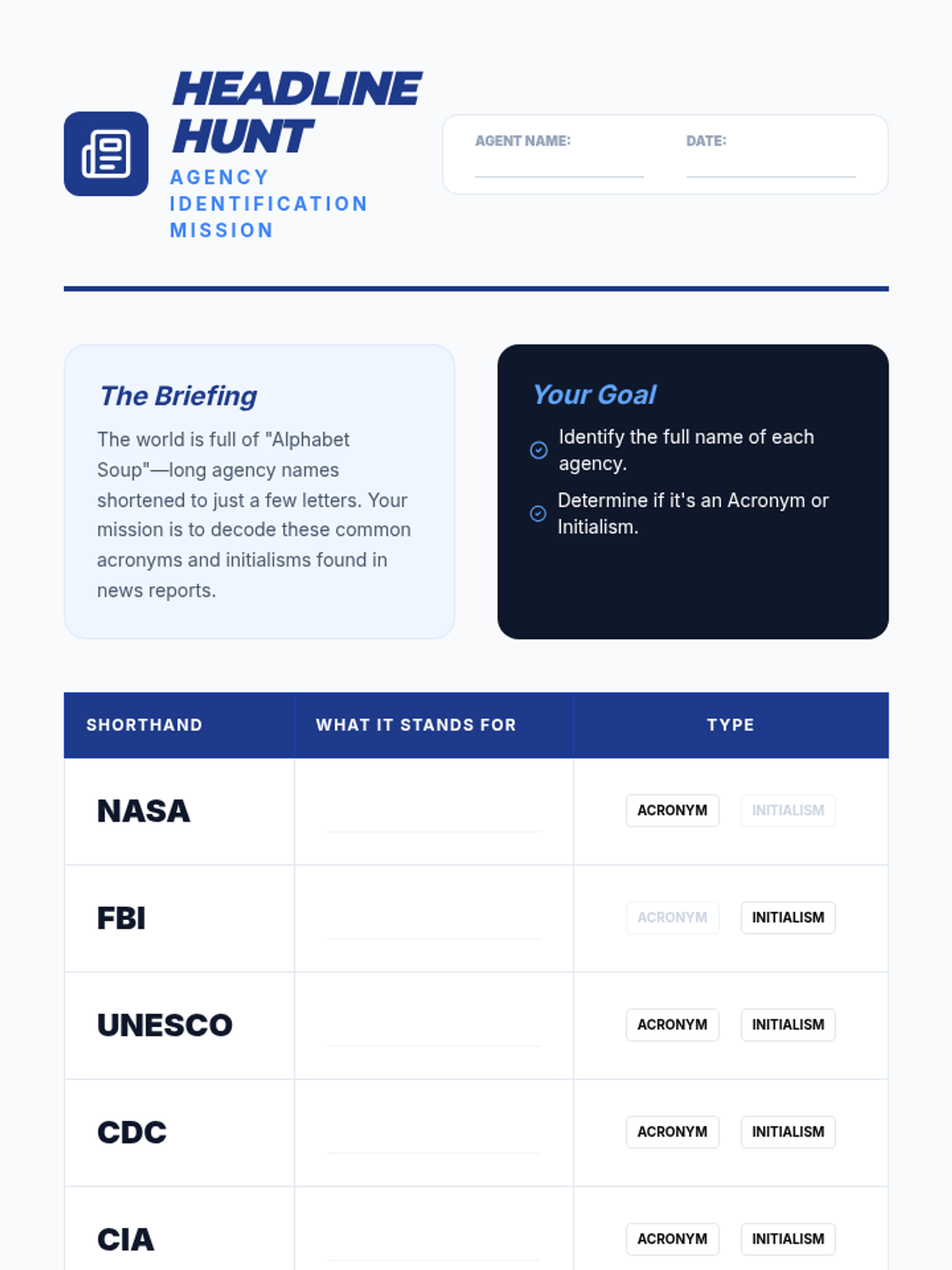
A research-based worksheet where students identify full agency names and determine if they are acronyms or initialisms.
Slides focused on government and organizational abbreviations, explaining why long names are shortened for branding, speed, and media space.
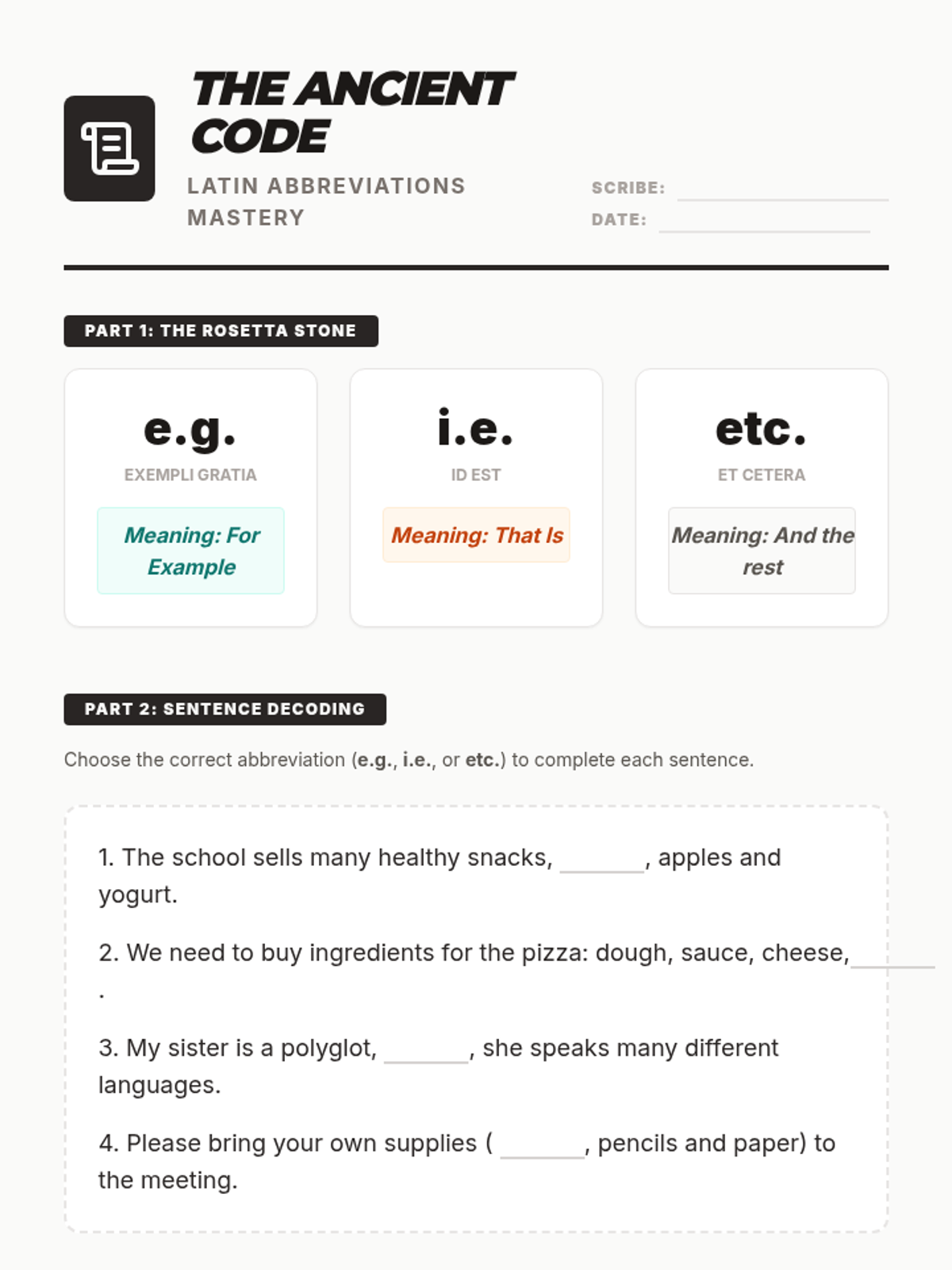
A practice worksheet for Latin abbreviations featuring a reference section, sentence completion tasks, and original sentence writing.
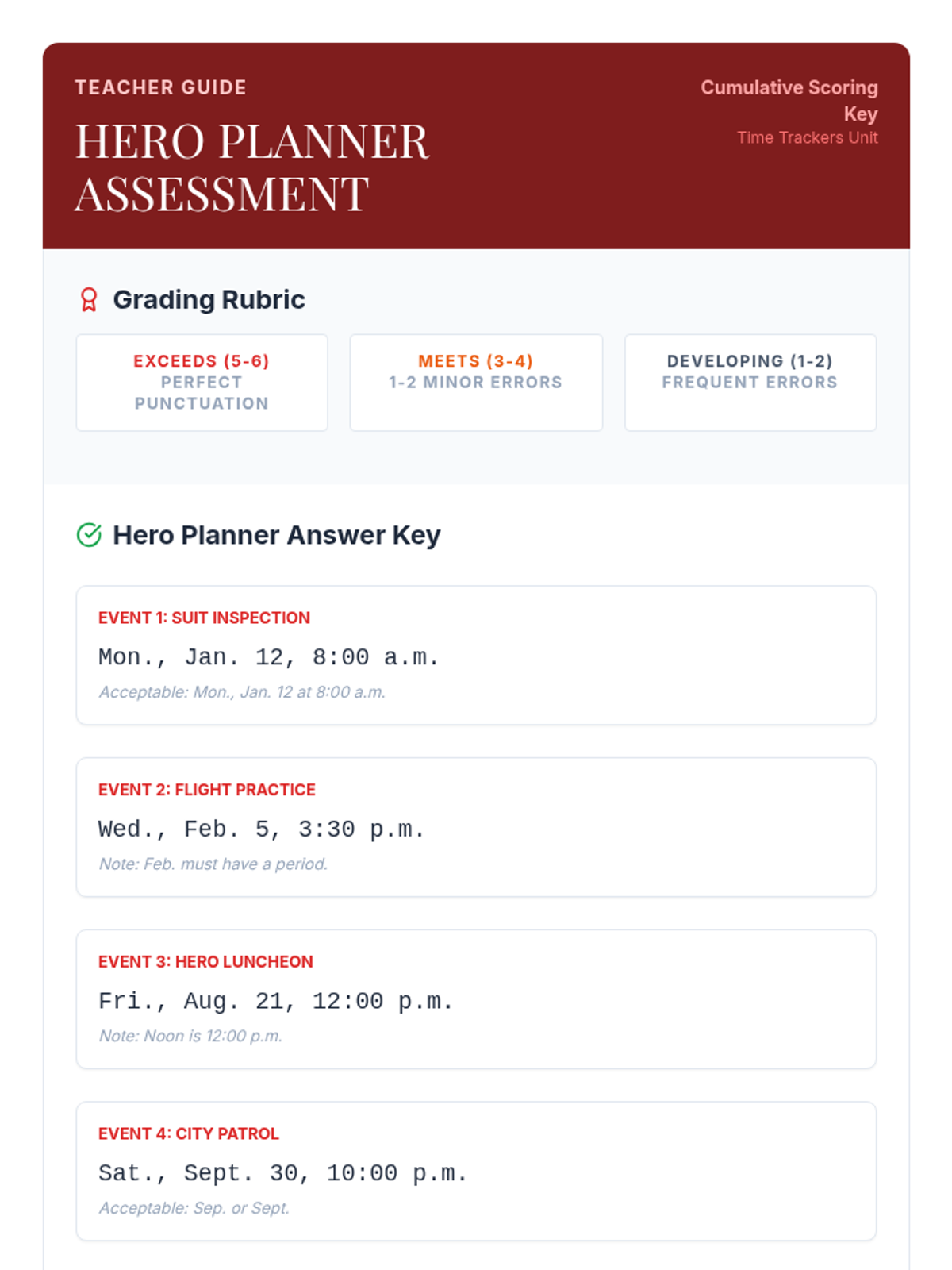
Teacher answer key for the final Hero Planner cumulative assessment.
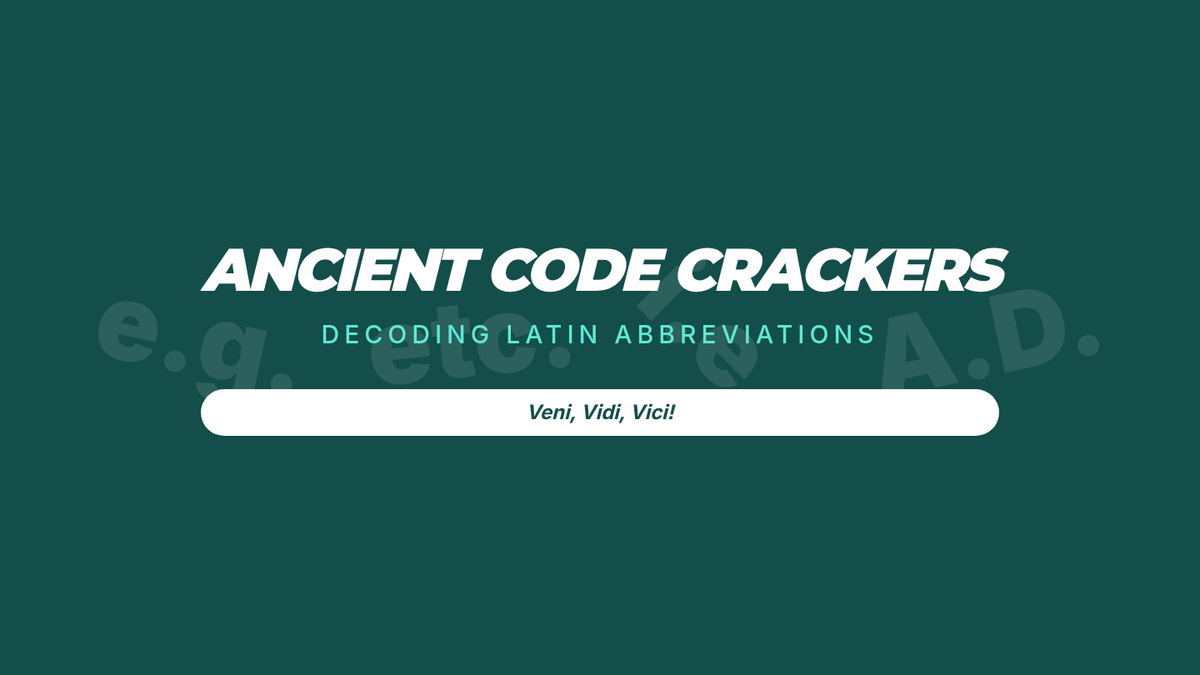
Slides introducing common Latin abbreviations (e.g., i.e., etc.), their meanings, and how to use them in sentences.
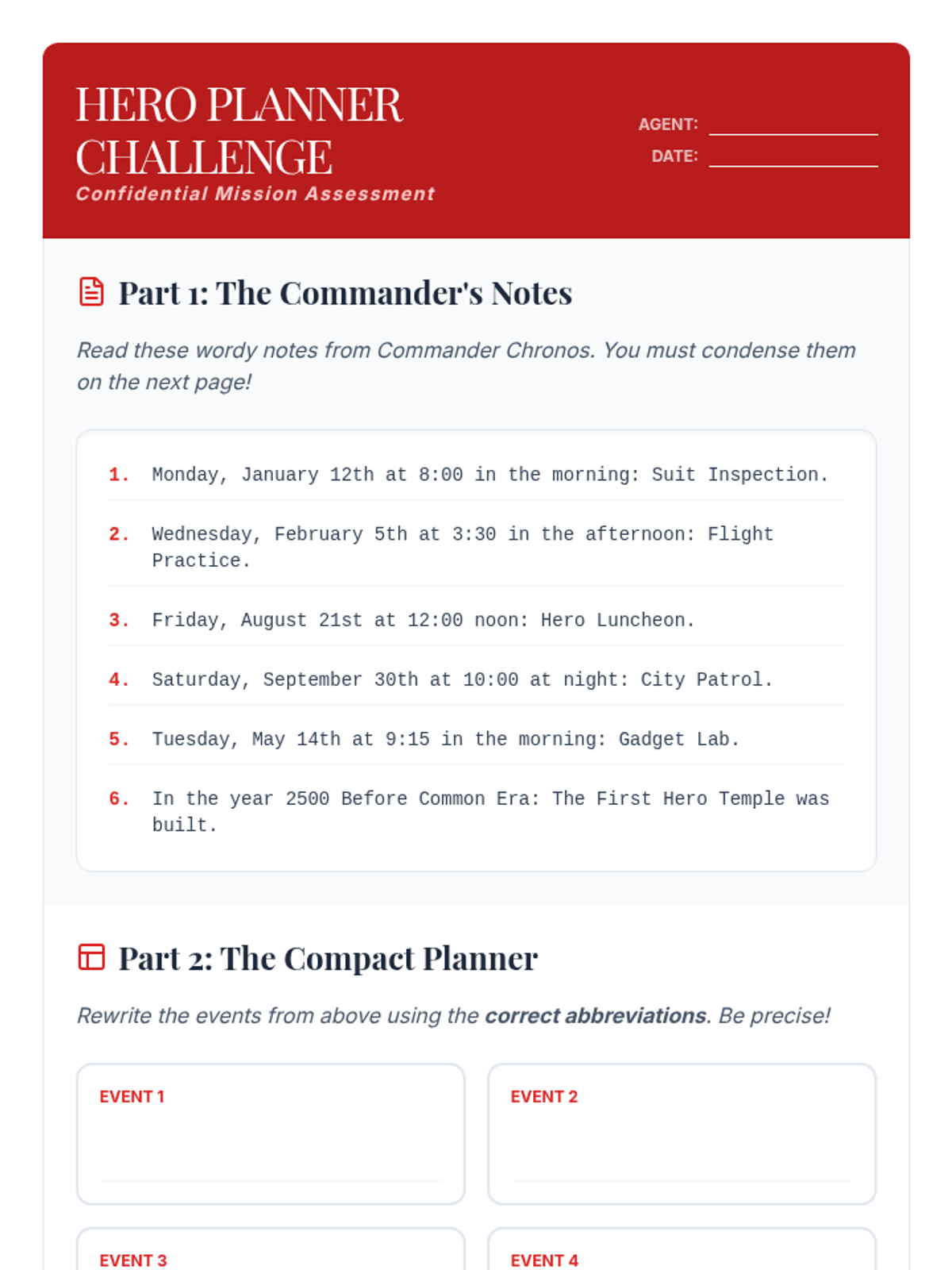
Cumulative assessment worksheet for the Time Trackers sequence, requiring students to transcribe wordy schedules into a condensed planner format.
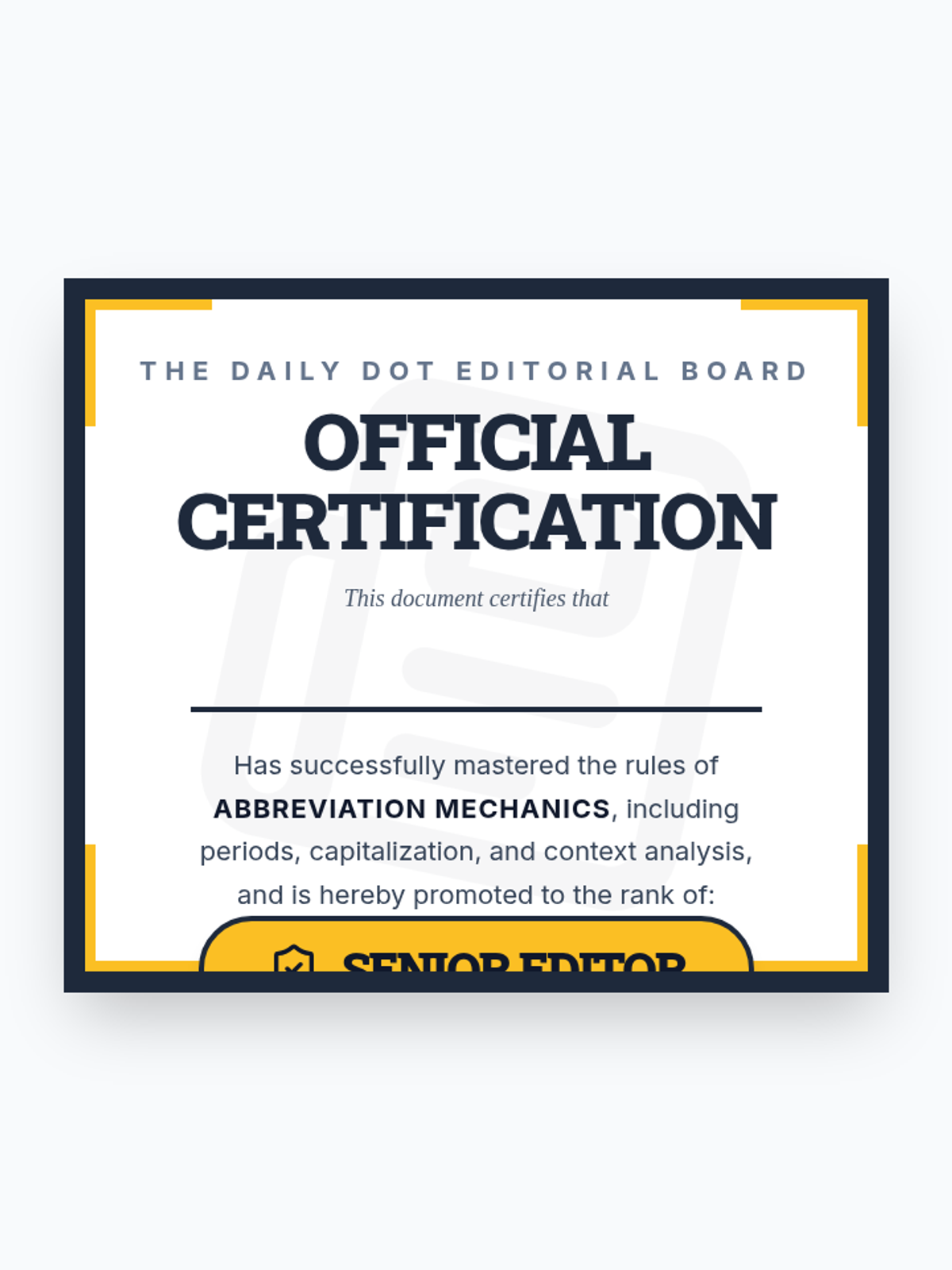
A certificate of promotion to 'Senior Editor' for students who successfully complete the abbreviation mastery sequence.
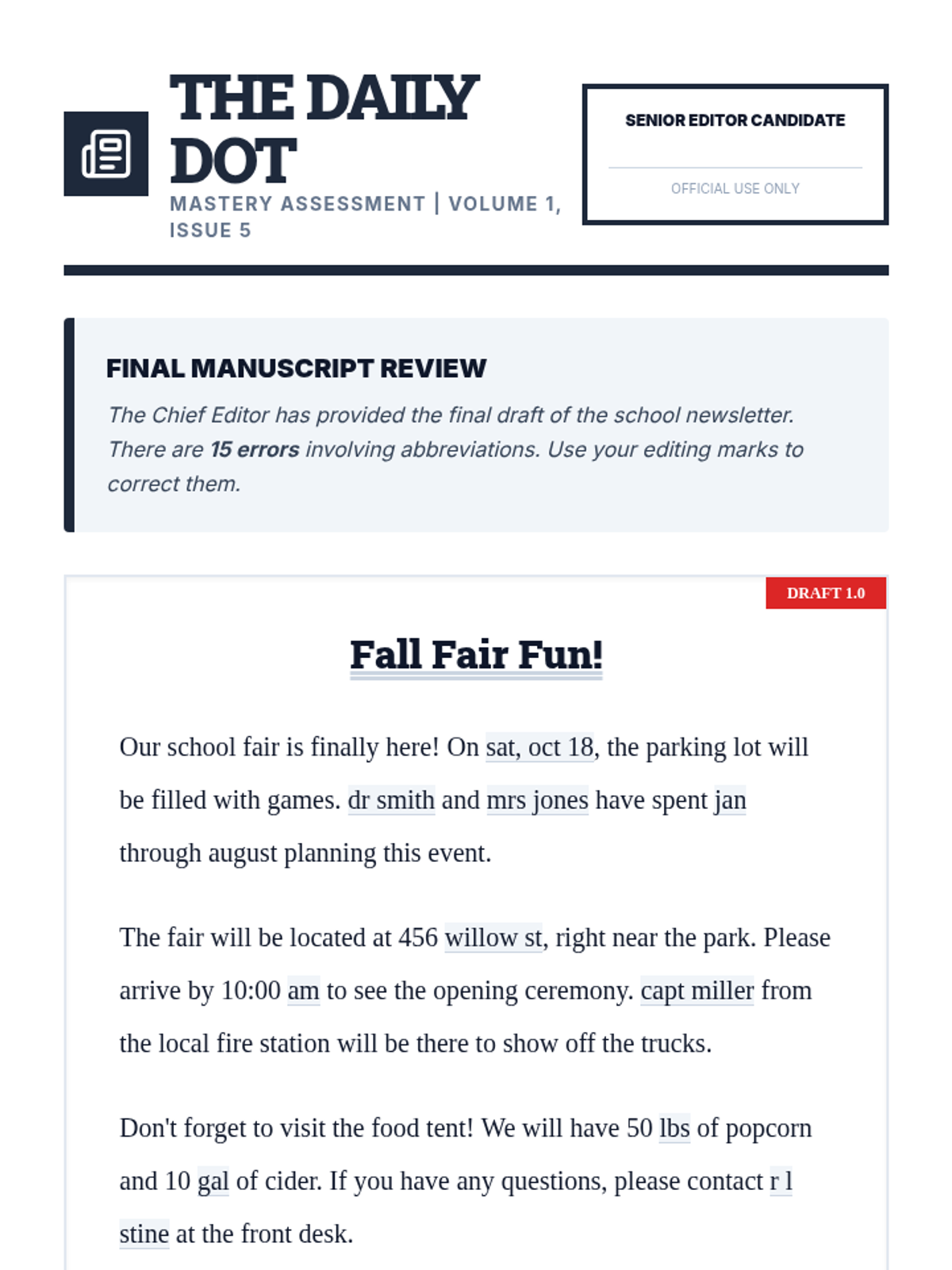
The final assessment manuscript where students must find and correct 15 abbreviation-related errors across various categories to demonstrate mastery.
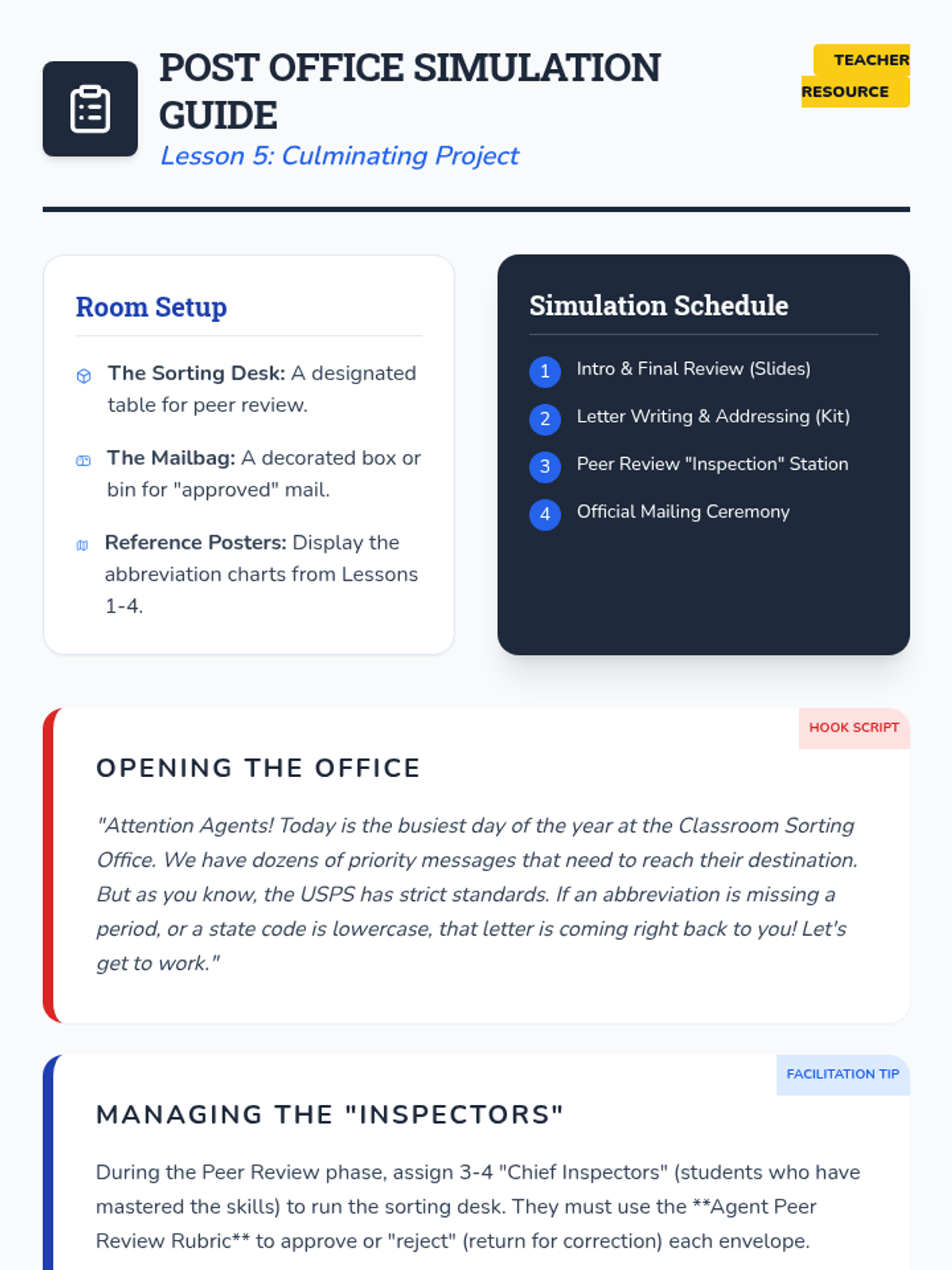
Teacher guide for the final post office simulation, including room setup ideas, facilitation scripts, and a formal assessment rubric for grading the envelopes.
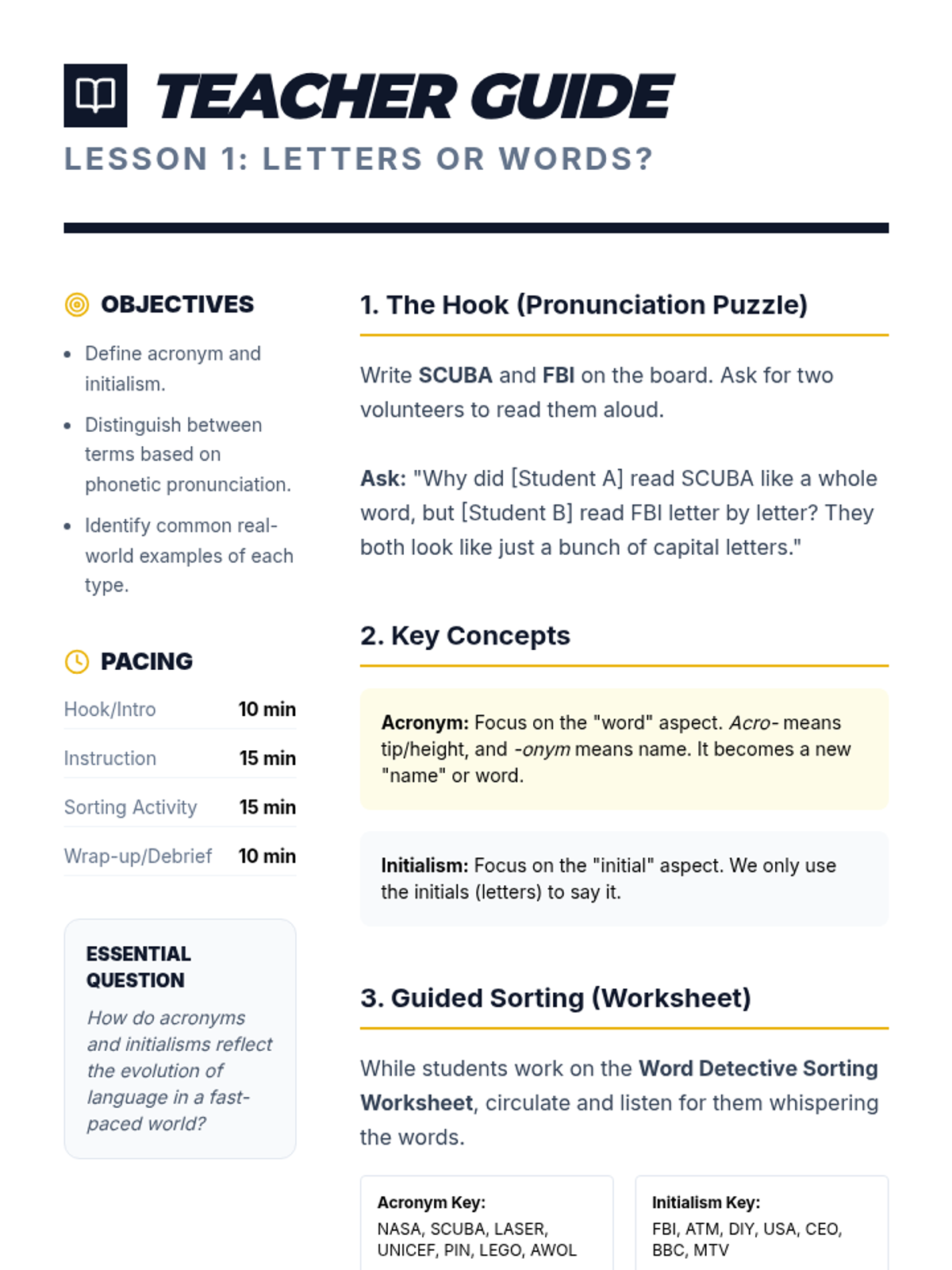
Teaching guide for Lesson 1, including objectives, pacing, discussion prompts, and an answer key for the sorting activity.
Mission briefing slides for the final Hero Planner challenge, setting the stage for the cumulative assessment.
Final slide deck for Lesson 5, setting the stage for the newsletter manuscript editing challenge and Senior Editor certification.
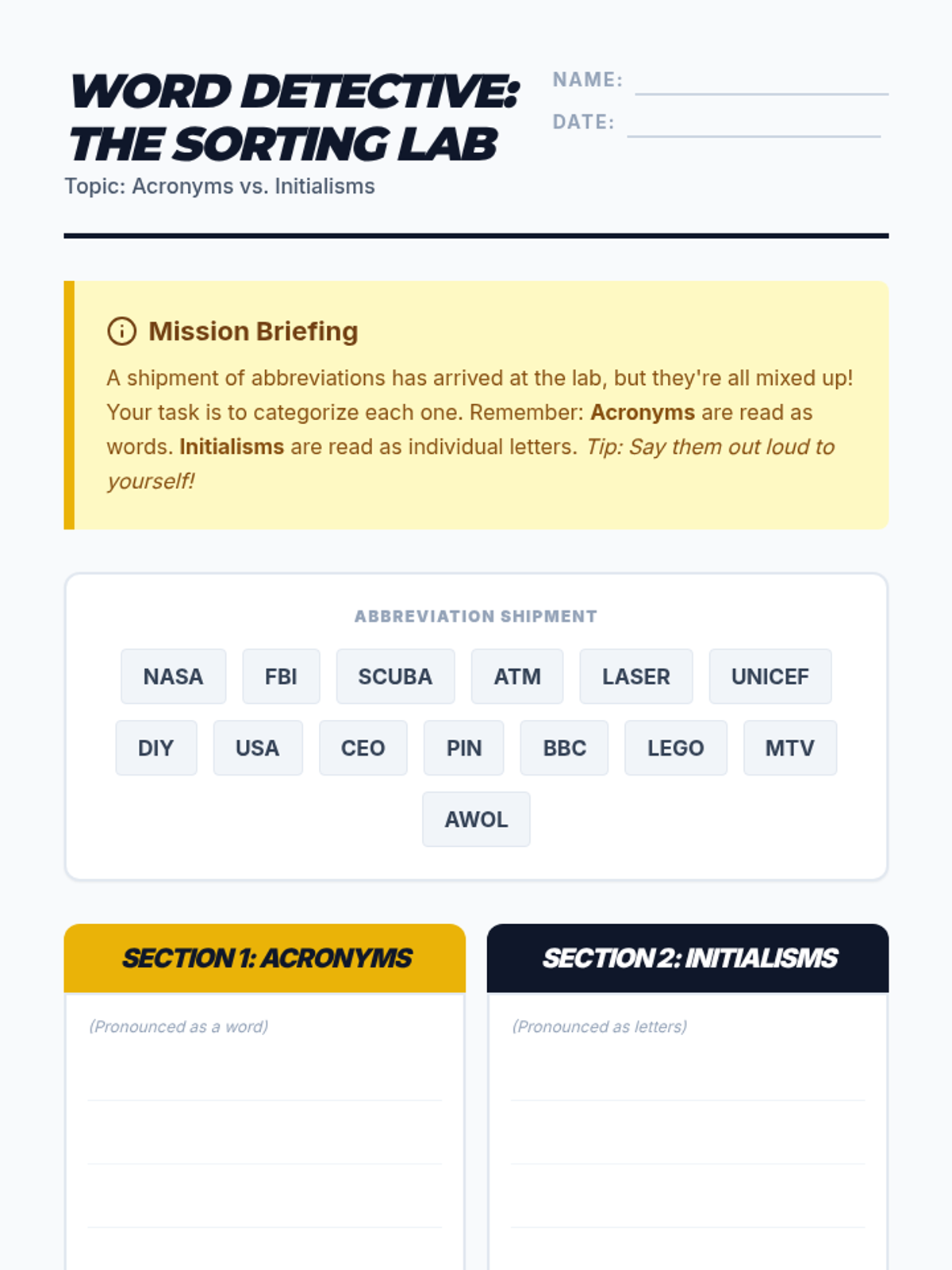
A sorting activity worksheet where students categorize common abbreviations into acronyms and initialisms, including a research-based deep dive section.
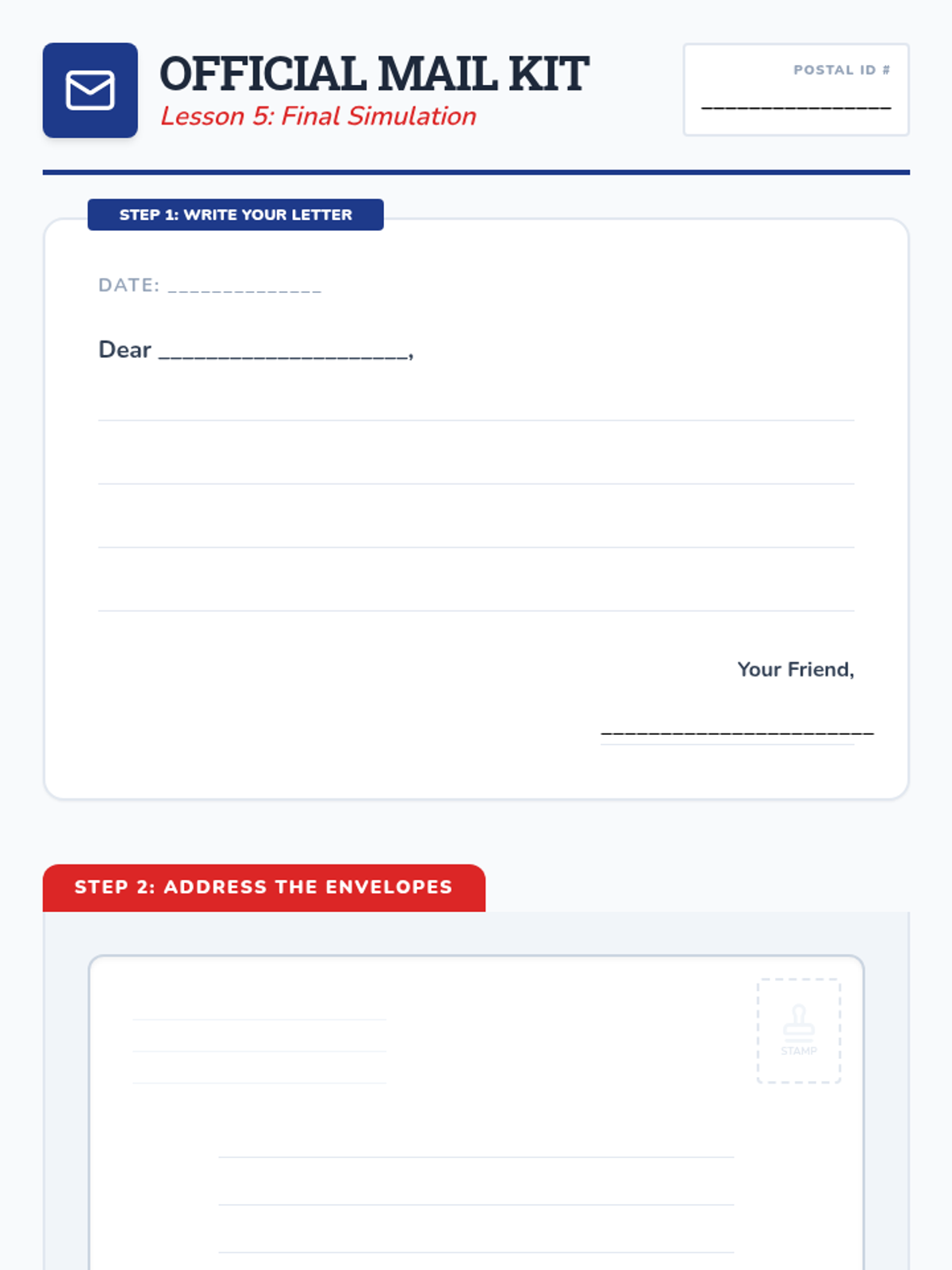
Final activity kit for Lesson 5 including a letter template, printable envelope layouts for addressing practice, and a peer-review rubric for postal accuracy.
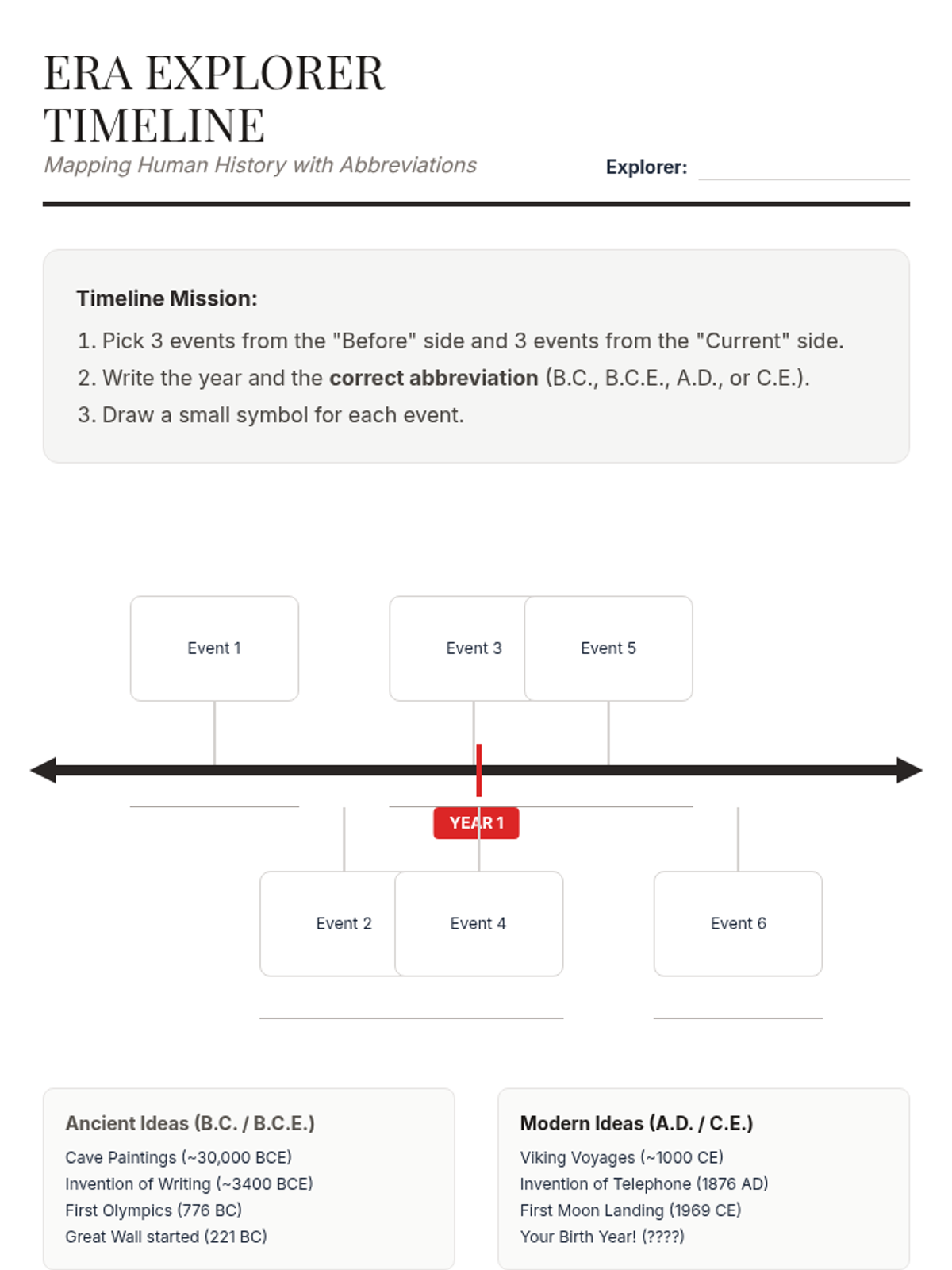
Timeline project template for students to practice using historical abbreviations (B.C., A.D., BCE, CE) while mapping events.
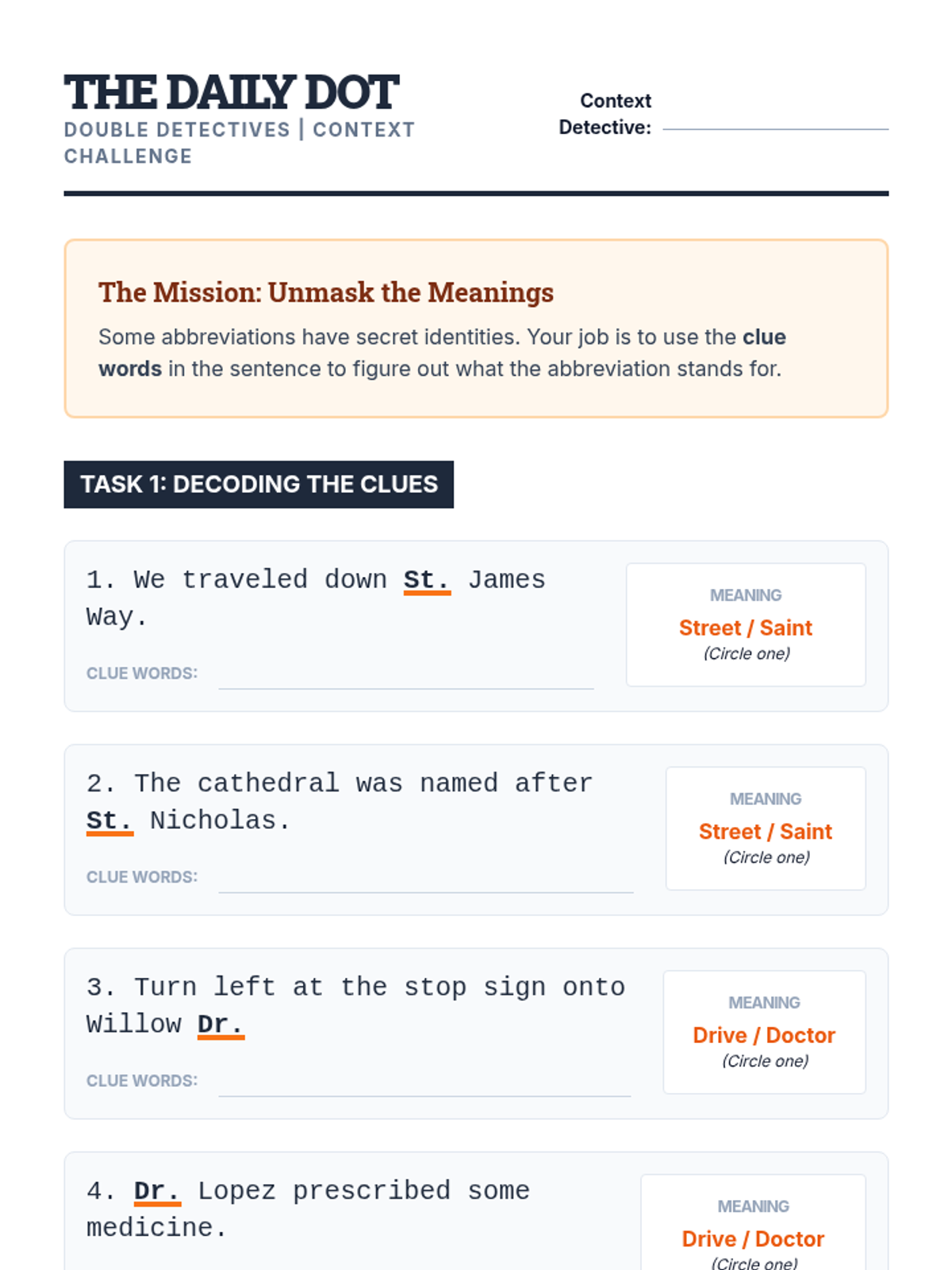
Worksheet where students use context clues to identify the meaning of abbreviations like St. and Dr. and resolve ambiguous sentences.
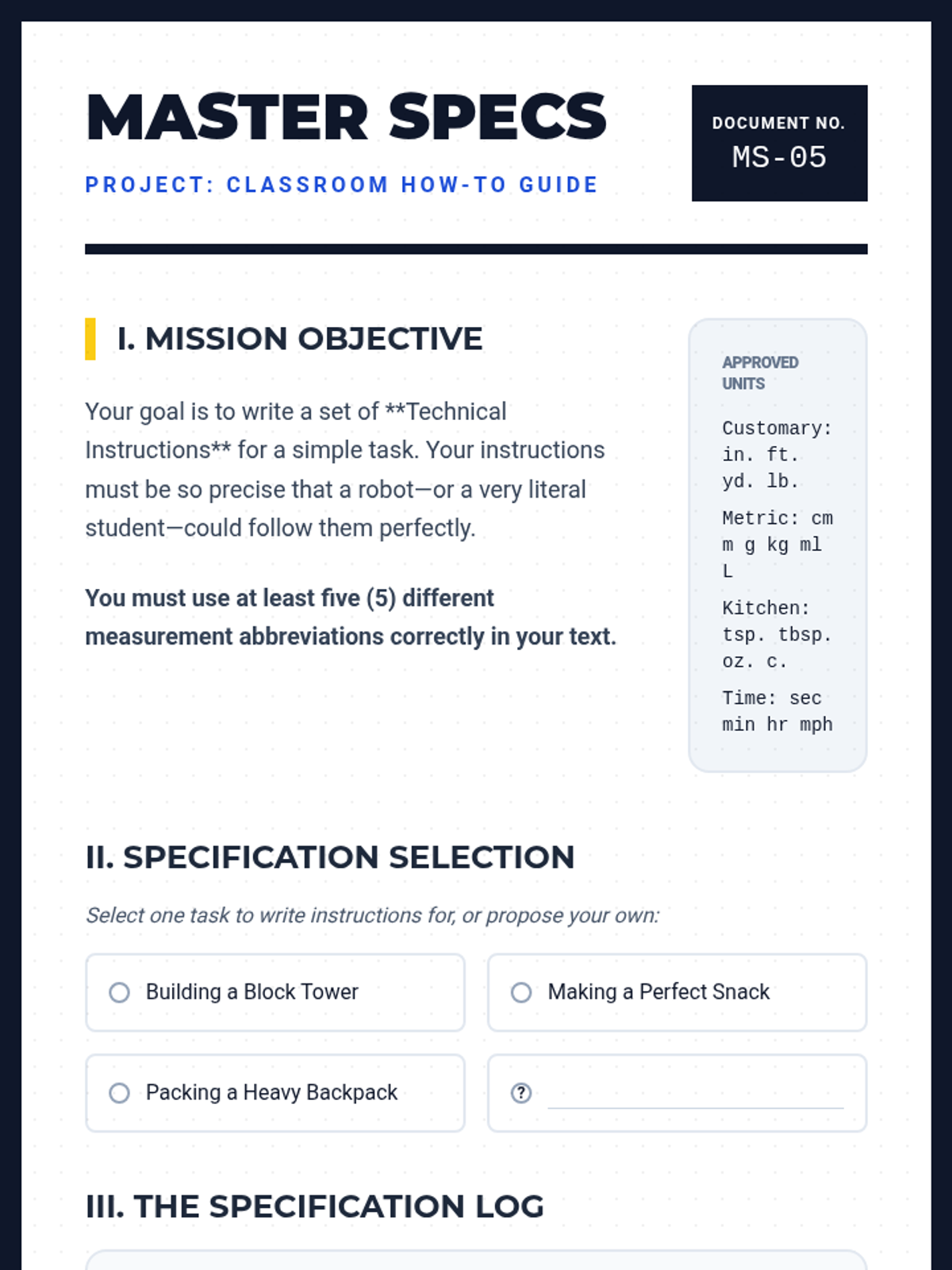
The final project guide and rubric for the sequence. Students write technical instructions for a simple task, applying all the abbreviation rules learned throughout the five lessons.
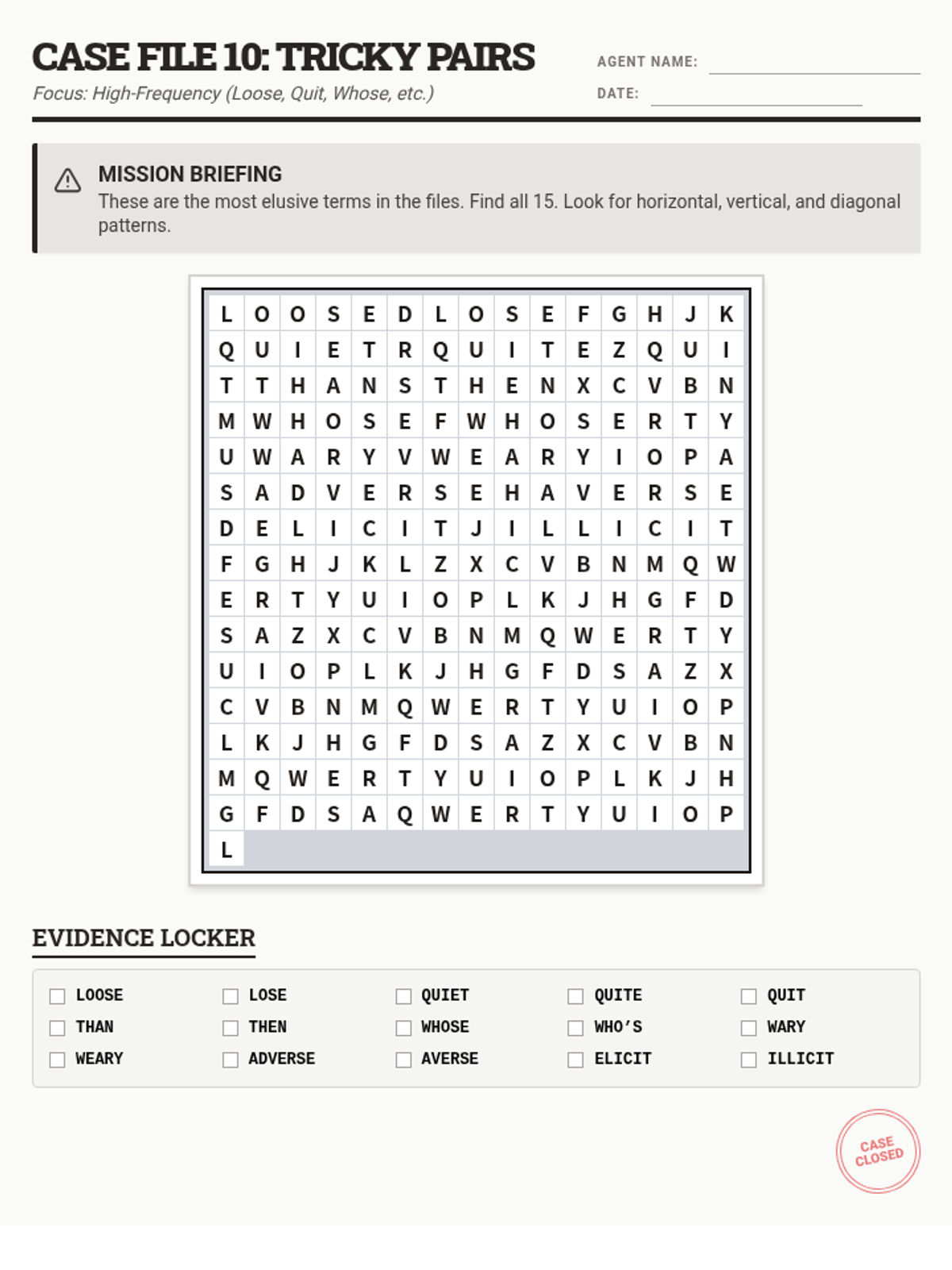
The final word search worksheet focusing on the most difficult commonly confused word pairs like loose/lose and than/then. Closes the detective case theme.
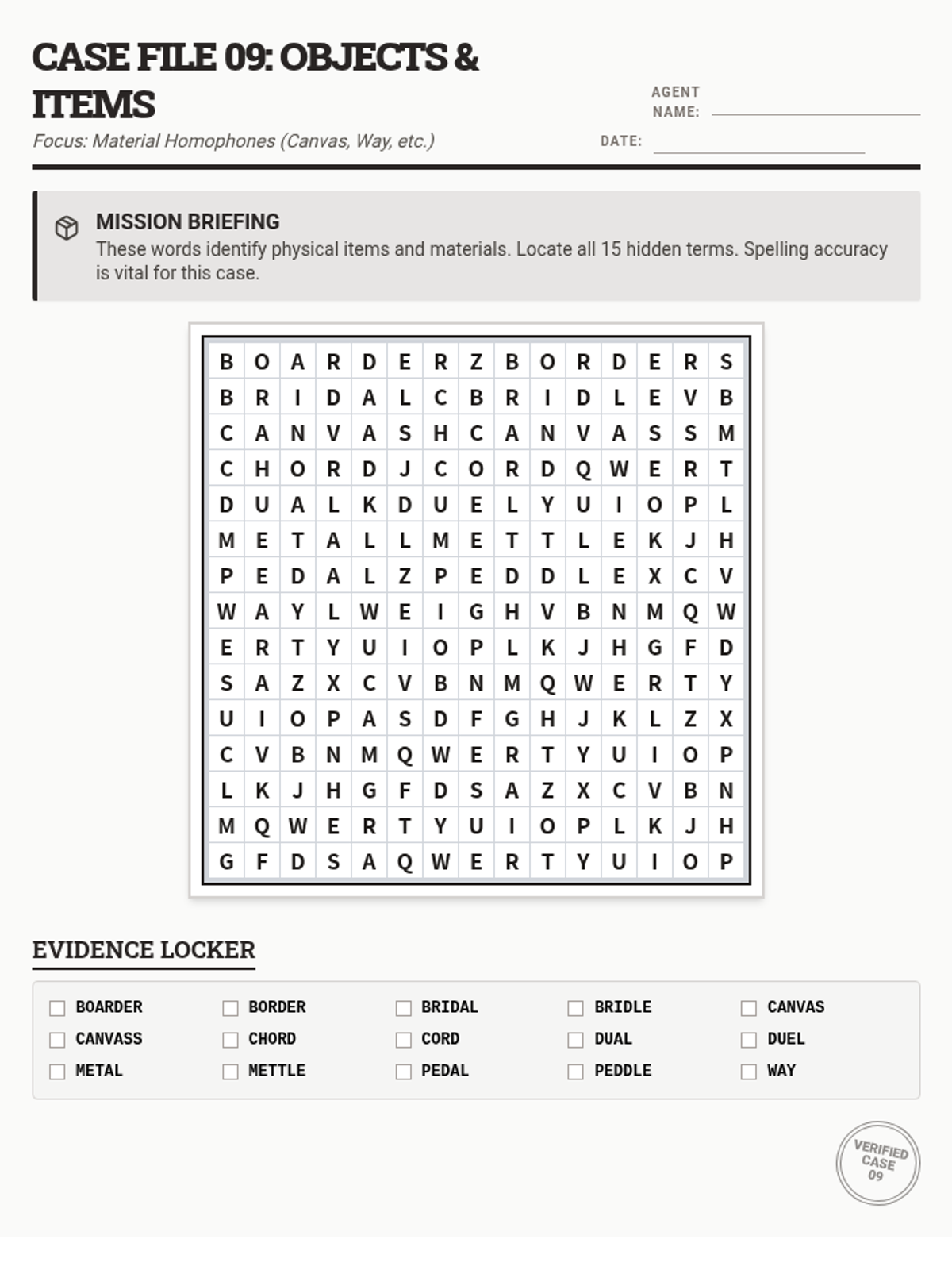
A word search focused on object-based homophones like metal/mettle and canvas/canvass. Features an industrial materials case theme.
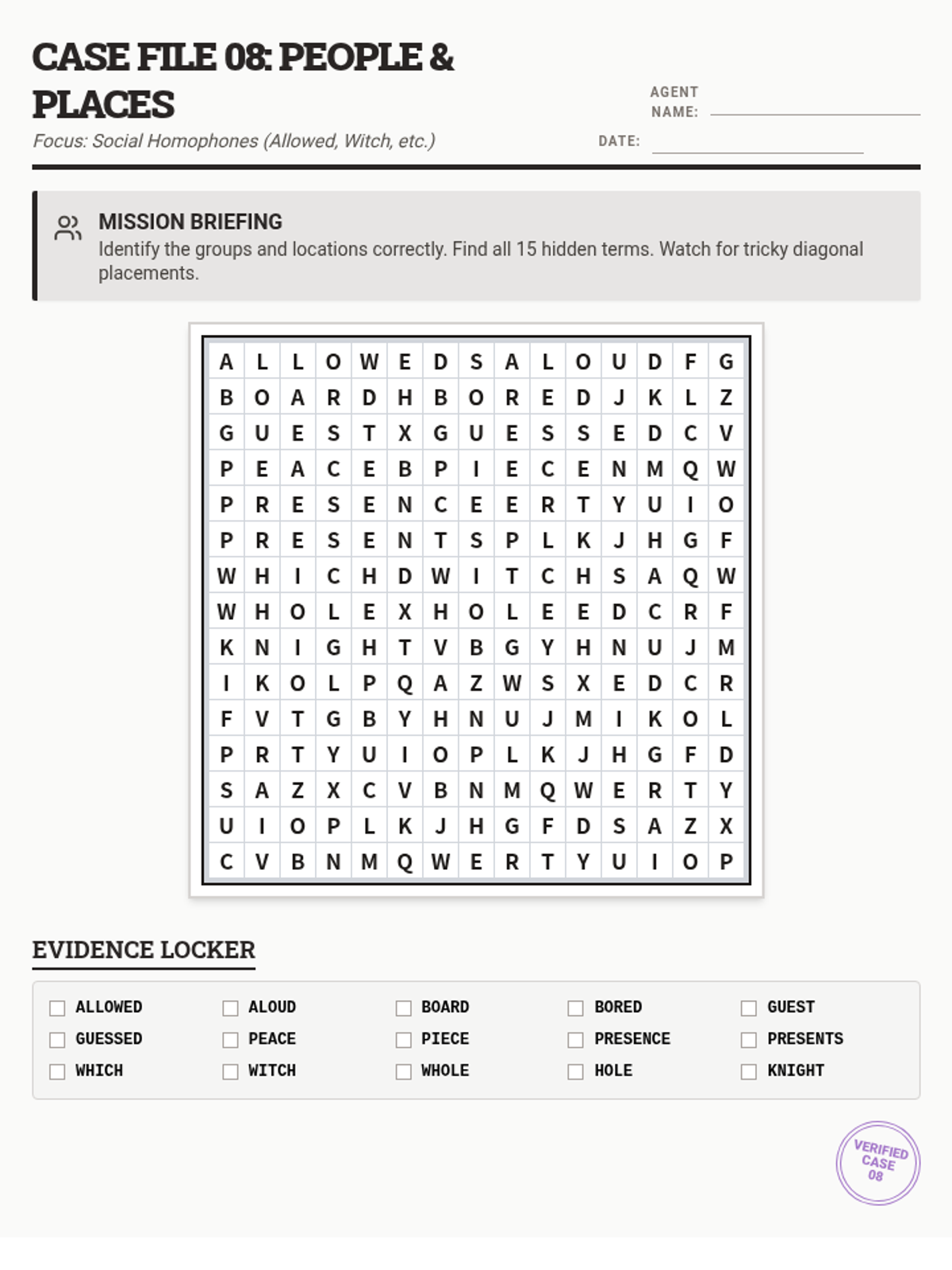
A word search worksheet covering social and location-based homophones like allowed/aloud and which/witch. Community case file theme.
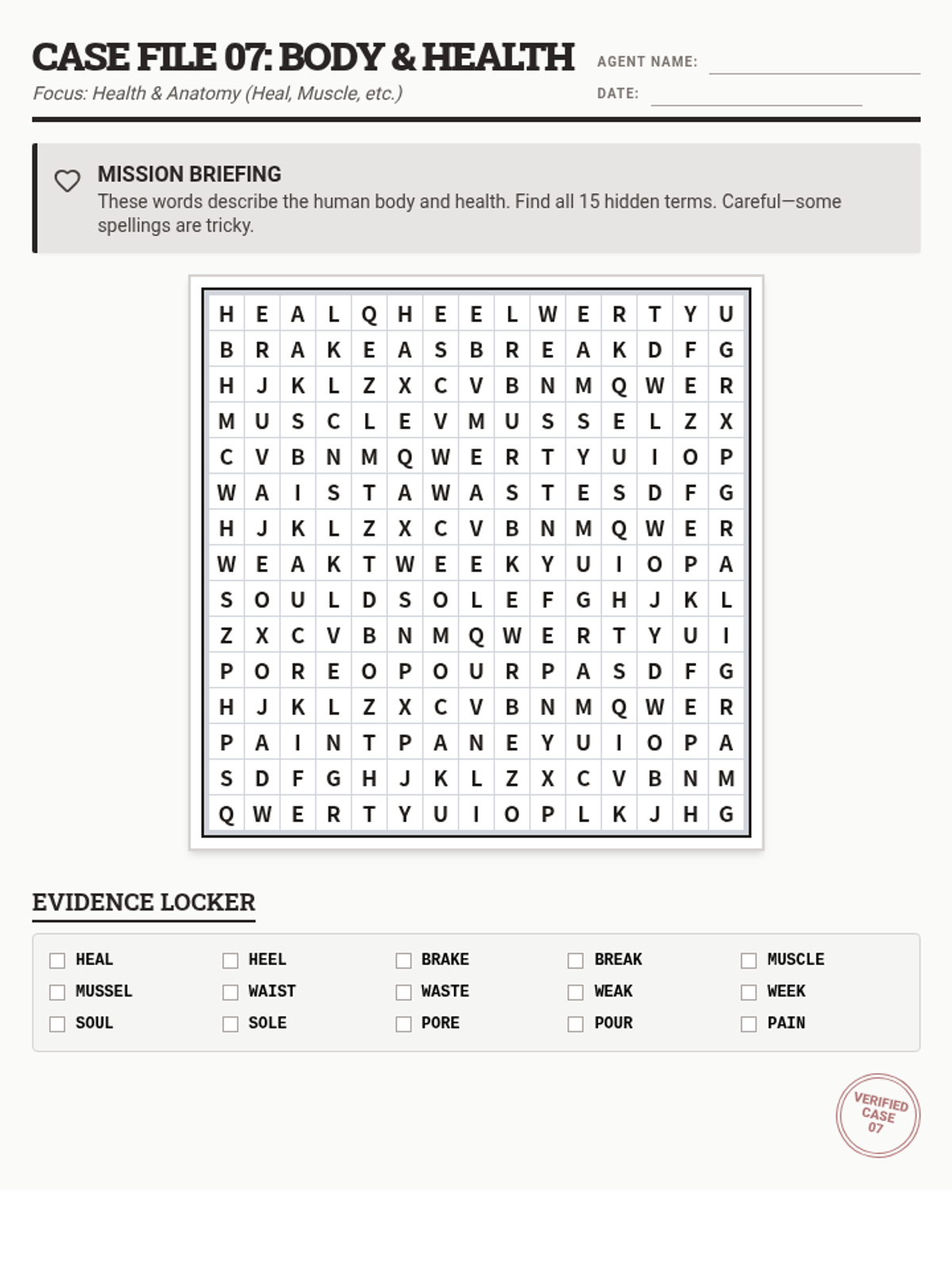
A word search worksheet exploring homophones related to health and anatomy, like heal/heel and muscle/mussel. Professional medical case theme.
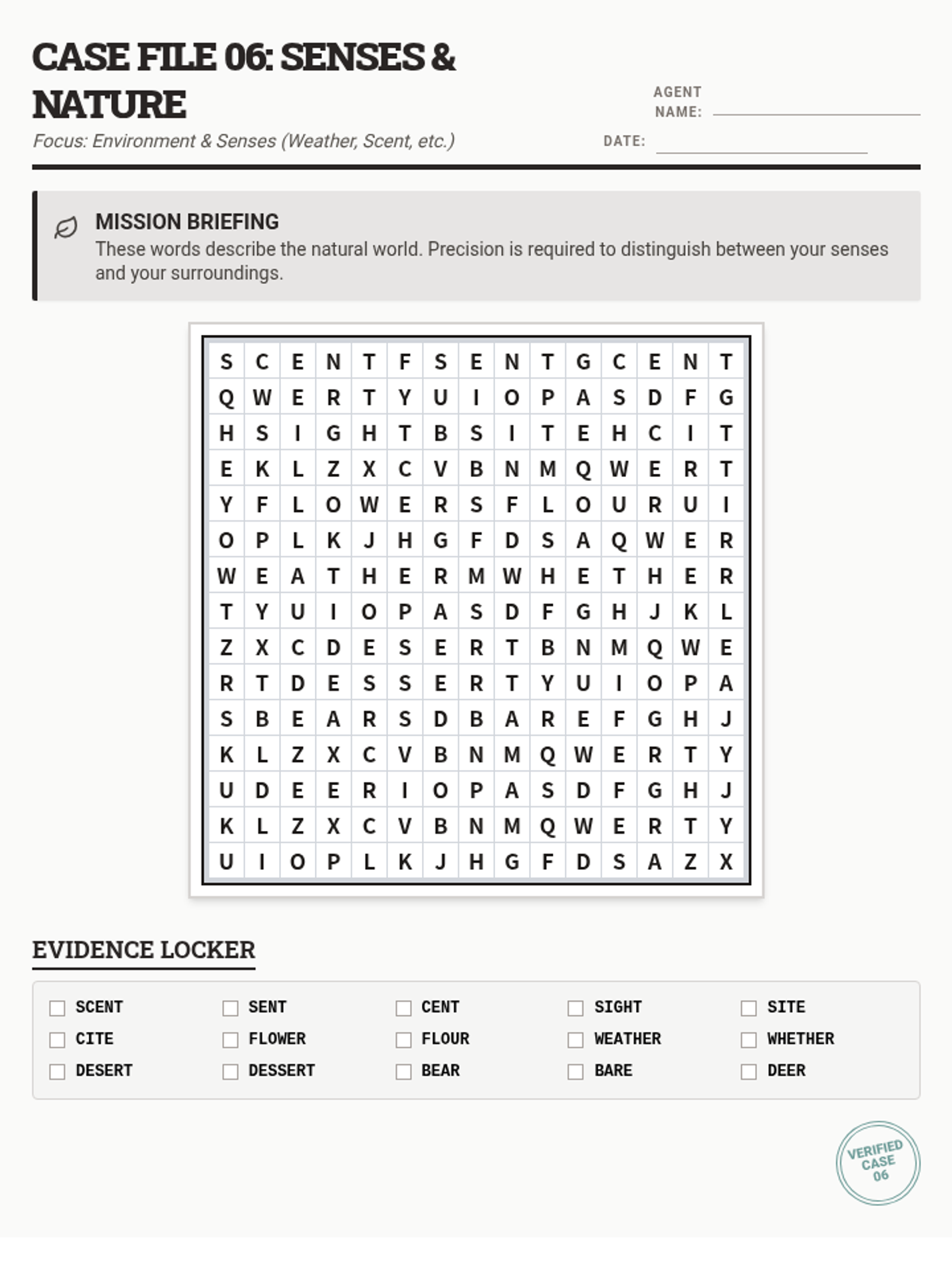
A word search targeting nature and sensory homophones like scent/sent/cent and desert/dessert. Designed with a natural science case theme.
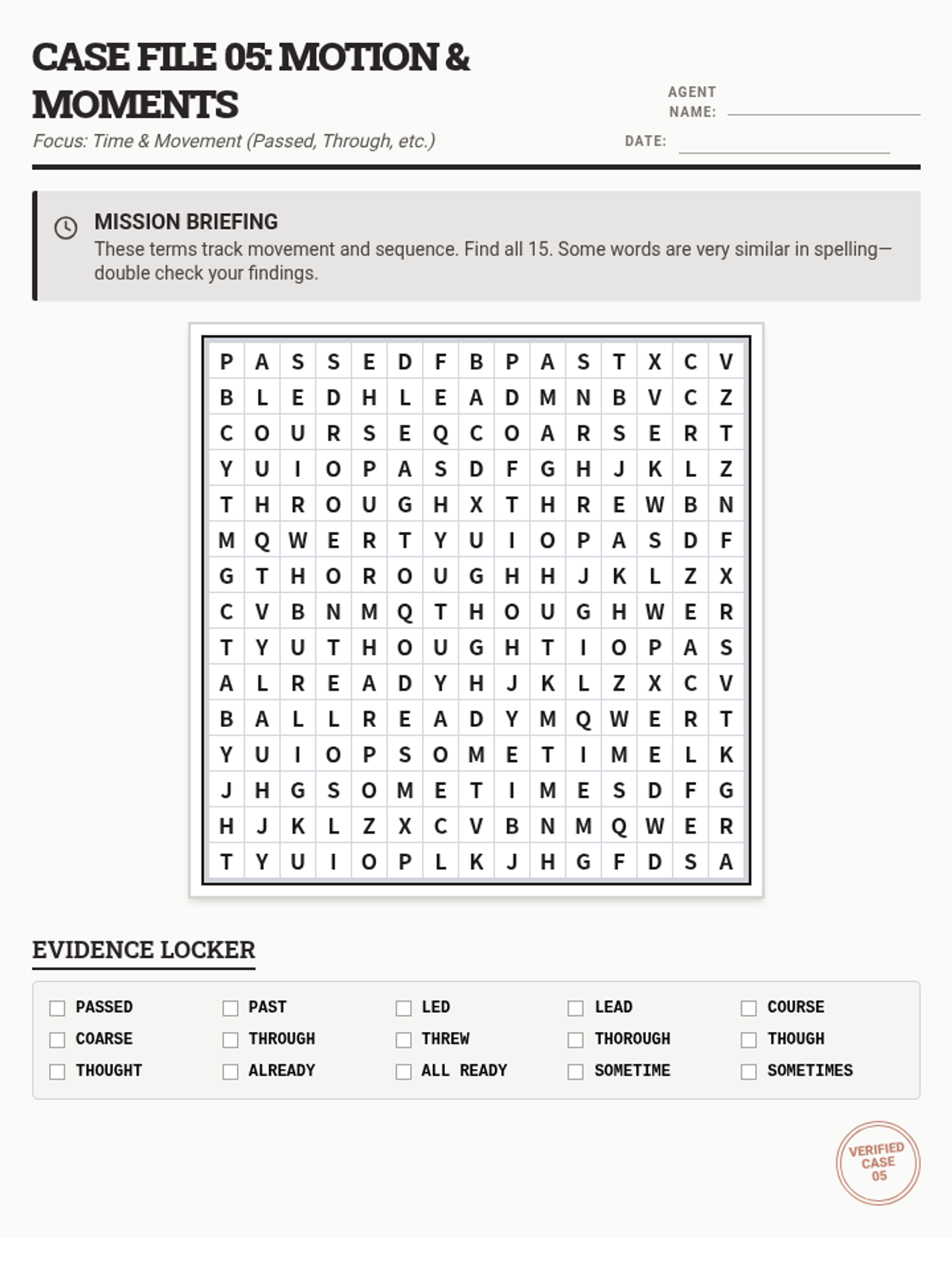
A word search focused on movement and time-related confusions such as passed/past and through/threw/thorough. Features a "case file" investigative design.
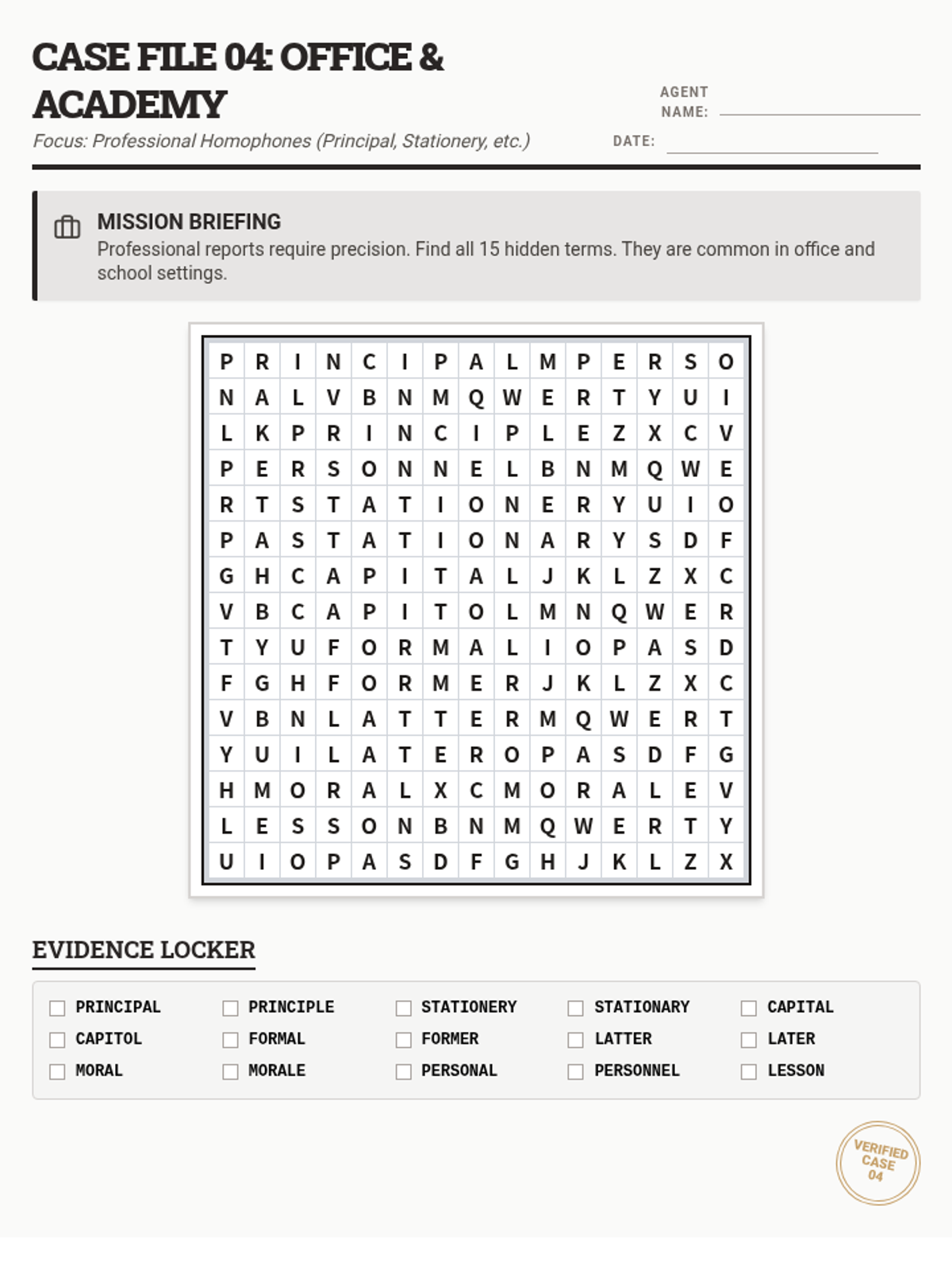
A word search worksheet covering professional and academic homophones like principal/principle and personnel/personal. Features a business case theme.
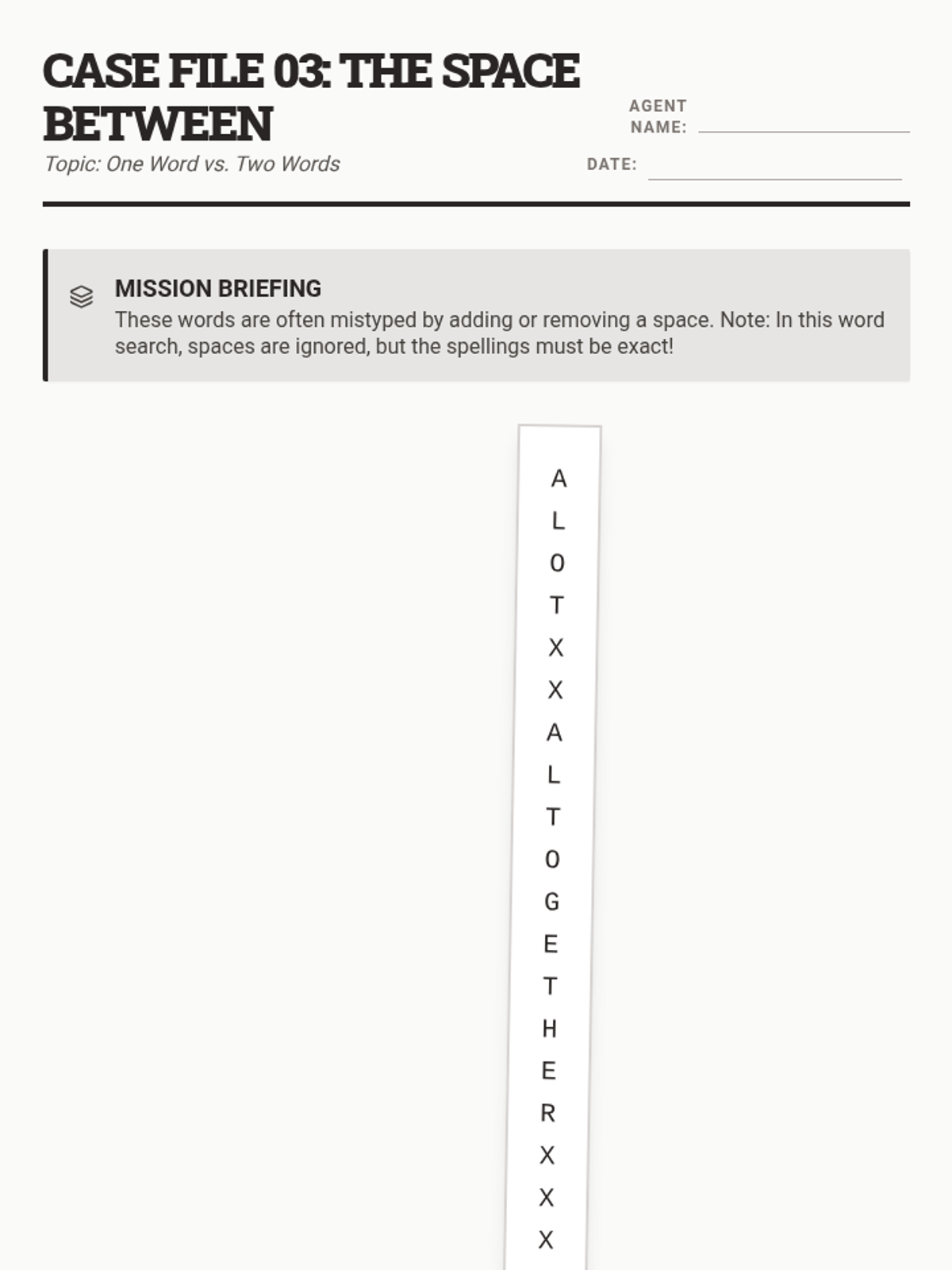
A word search focusing on one-word vs. two-word confusions like everyday/every day and into/in to. Encourages attention to spelling and usage.
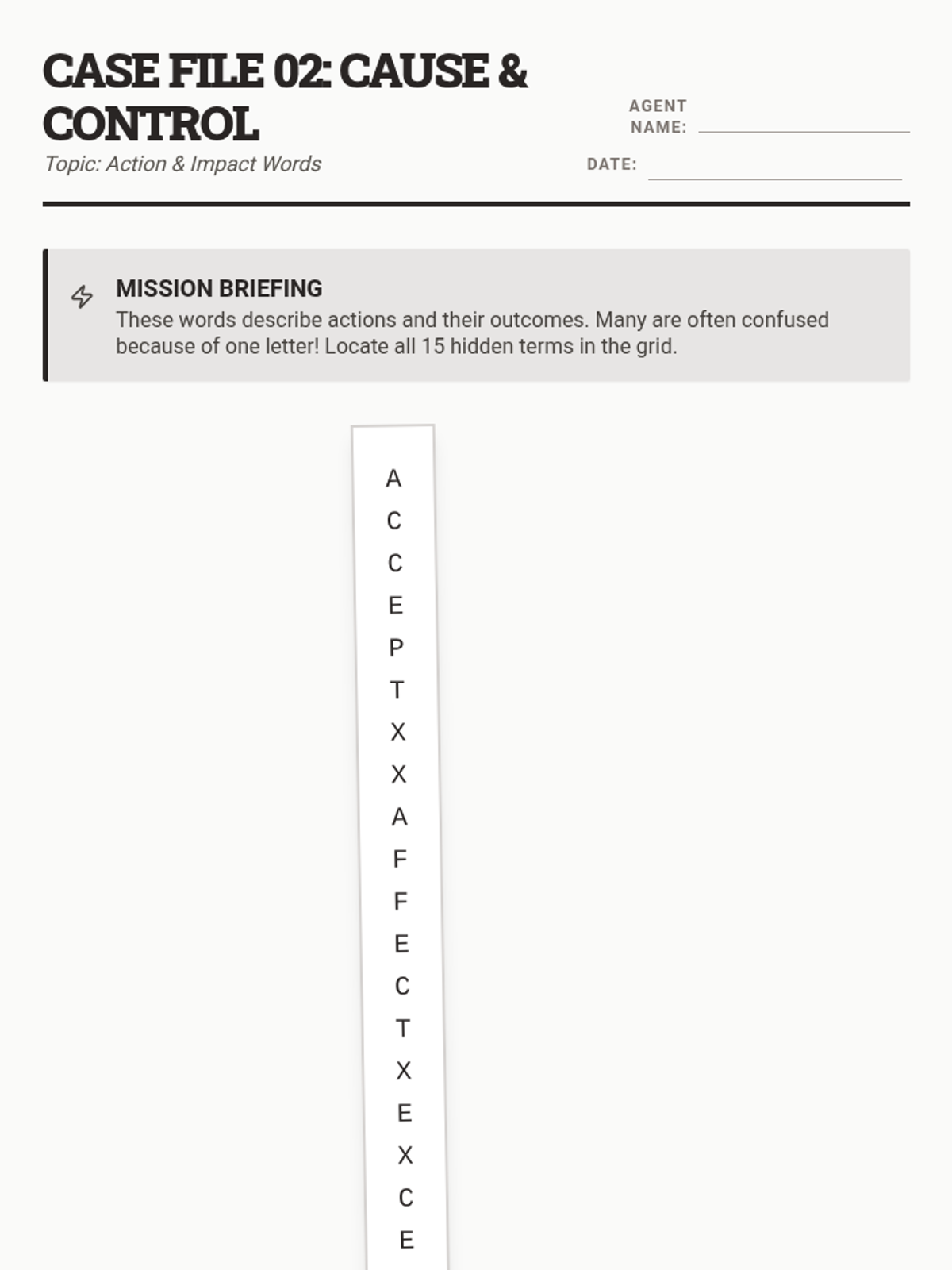
A second word search worksheet targeting verbs and nouns that are frequently confused, such as affect/effect and advice/advise. Uses a detective notebook style.
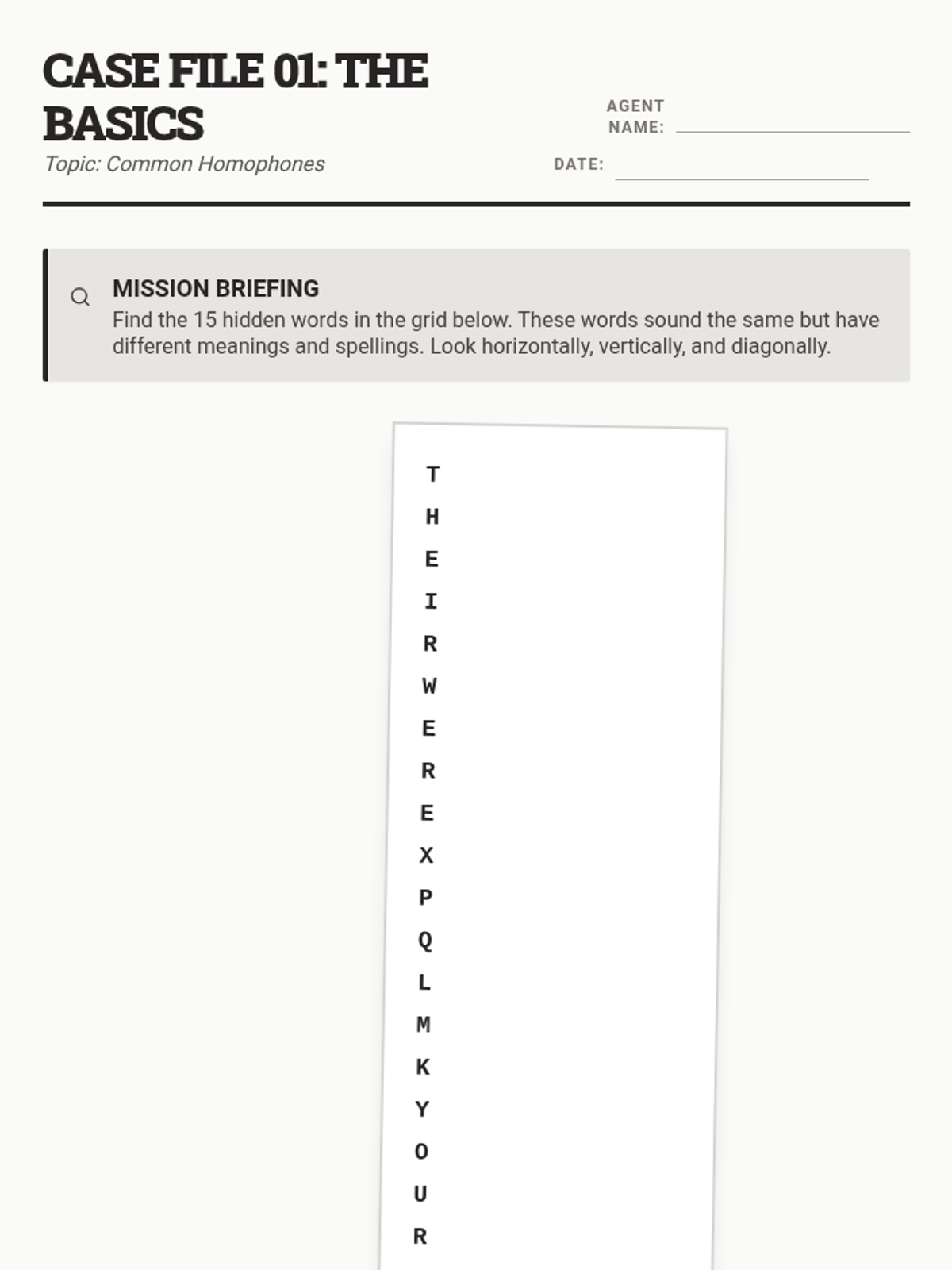
A word search worksheet focusing on basic homophones like to/too/two and their/there/they're. Features a detective case file theme with a 15x15 grid and word bank.
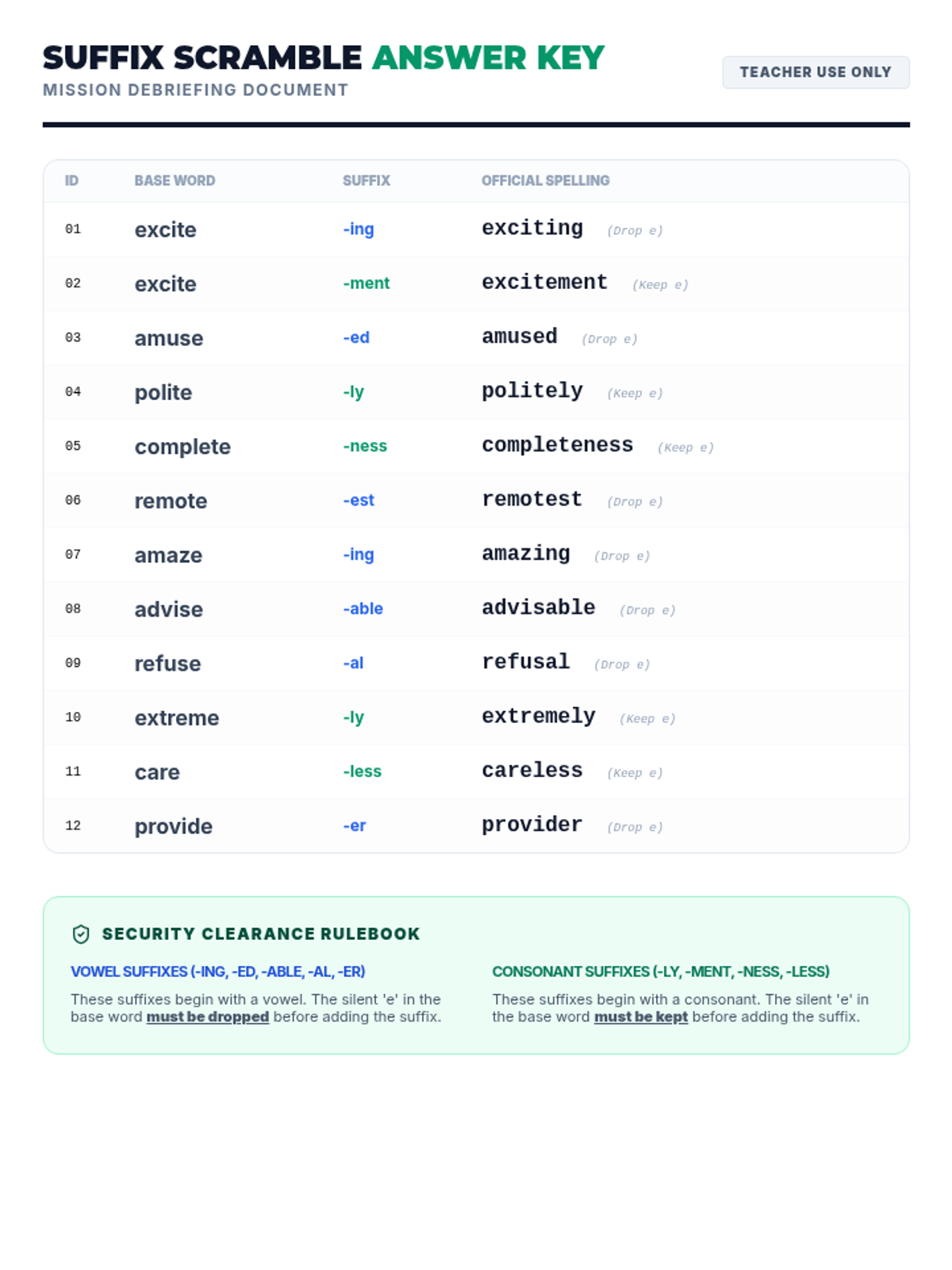
The teacher's answer key for the Suffix Scramble Worksheet, including the logic for dropping or keeping the silent 'e'. (Revised for space and more content).
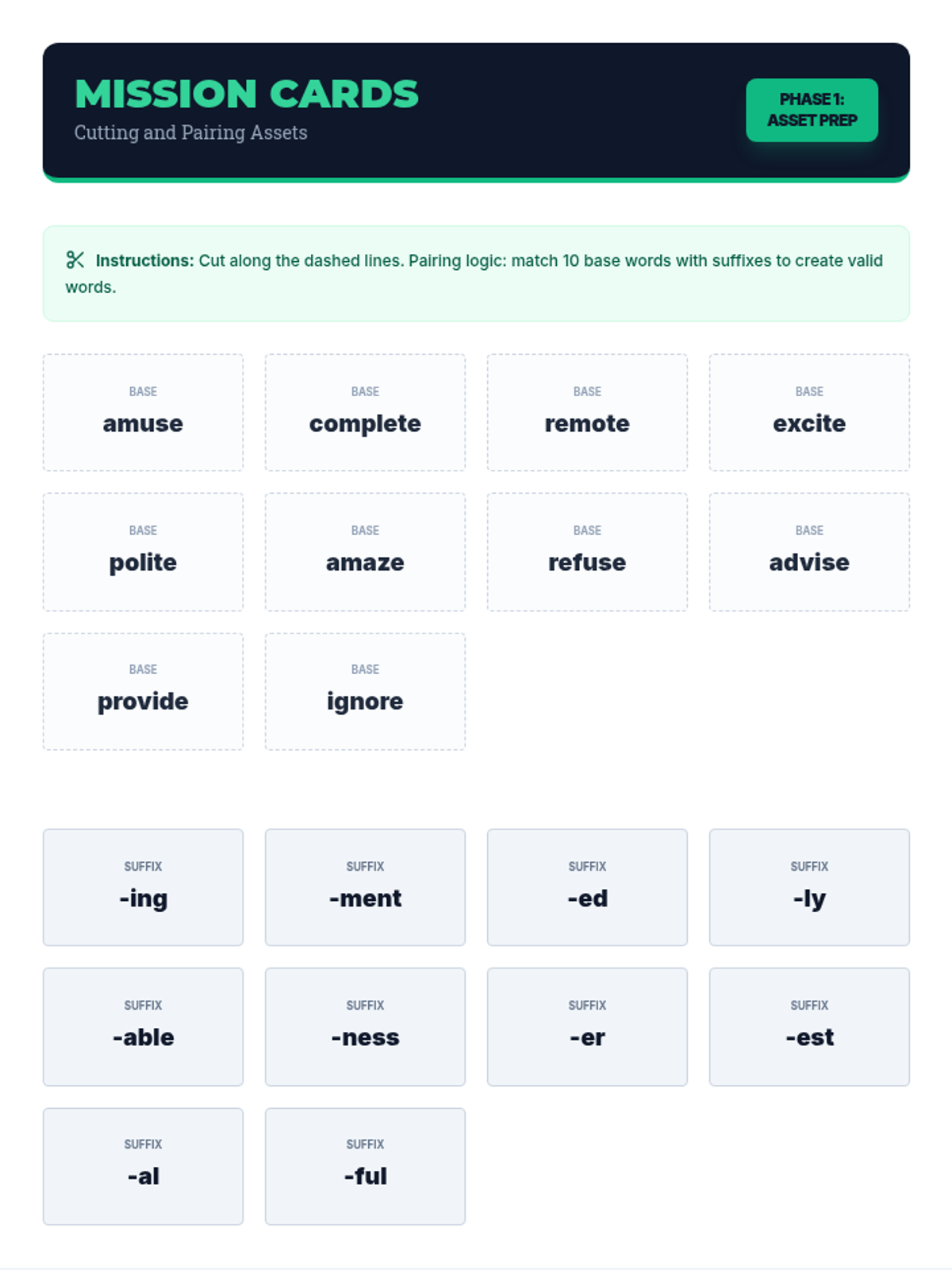
A hands-on word sorting activity where students pair base words with suffixes and categorize them based on whether the silent 'e' is dropped or kept. (Revised for space and usability).
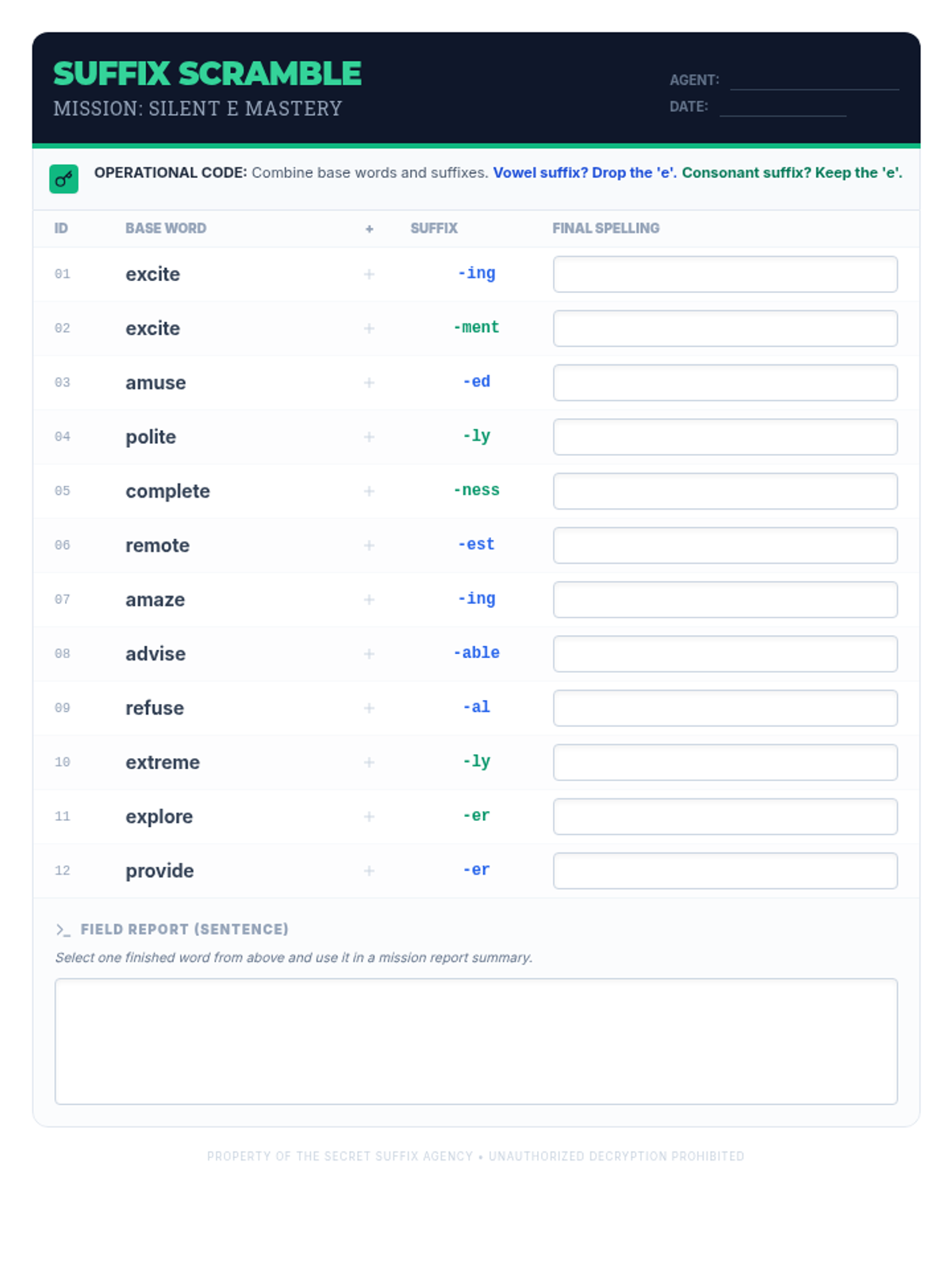
A practice worksheet where students combine multi-syllabic base words ending in silent 'e' with various vowel and consonant suffixes. (Revised for space and content).
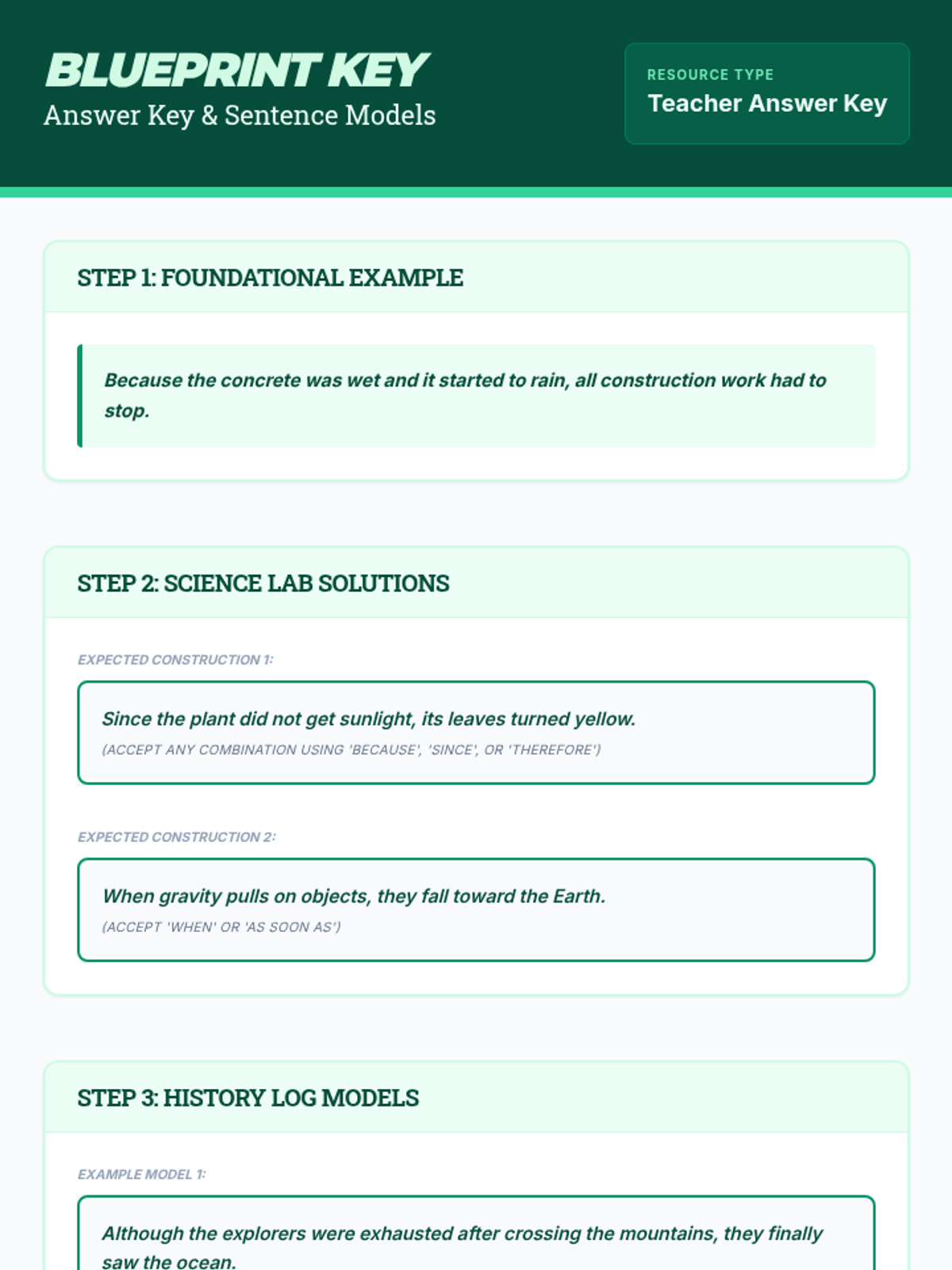
A detailed teacher answer key for the Sentence Blueprint worksheet, providing model complex and compound sentences using science and history themes.
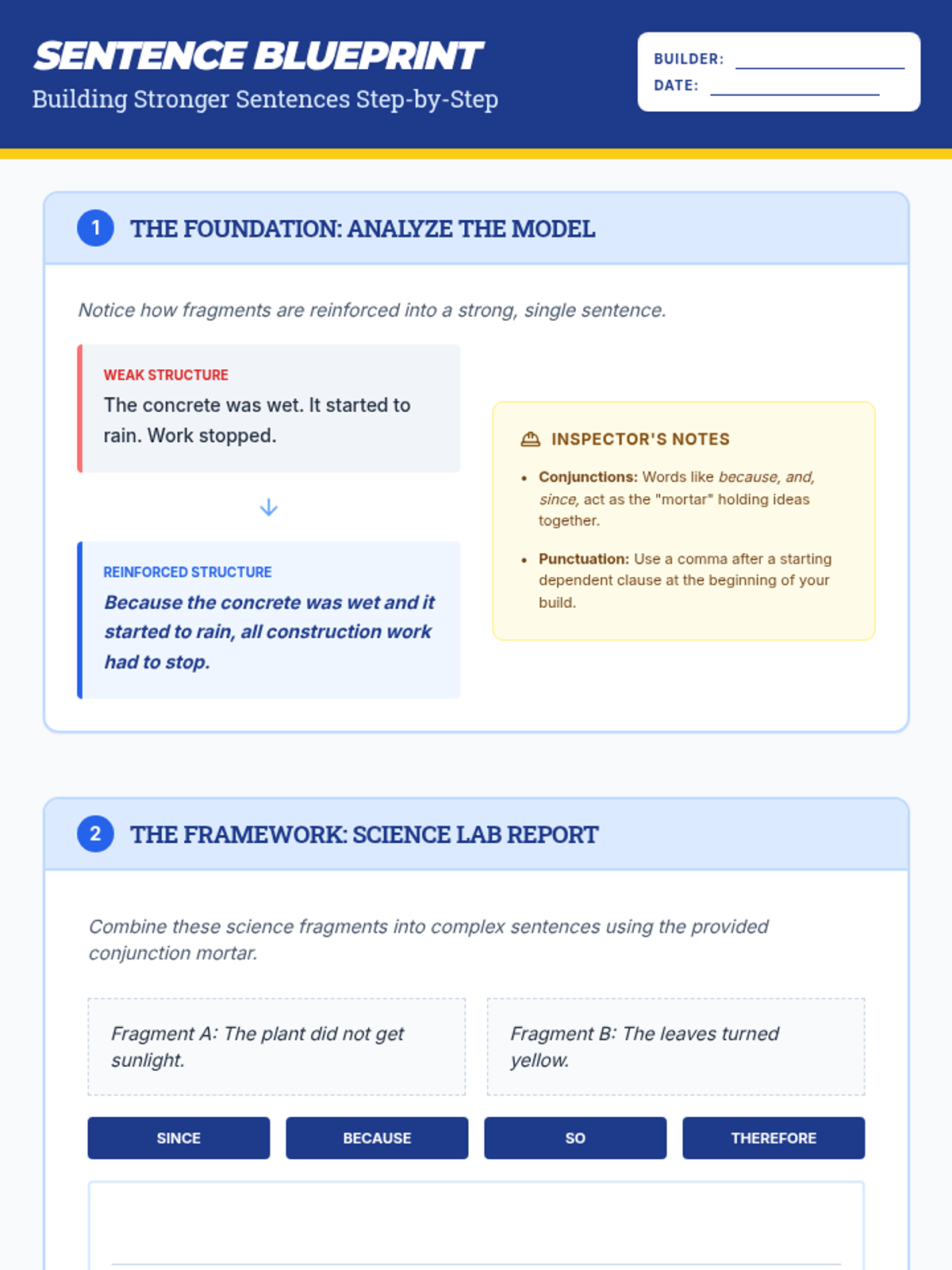
A 3-step guided practice worksheet with a construction theme, designed to help students combine fragments and simple sentences into compound and complex sentences within science and social studies contexts.
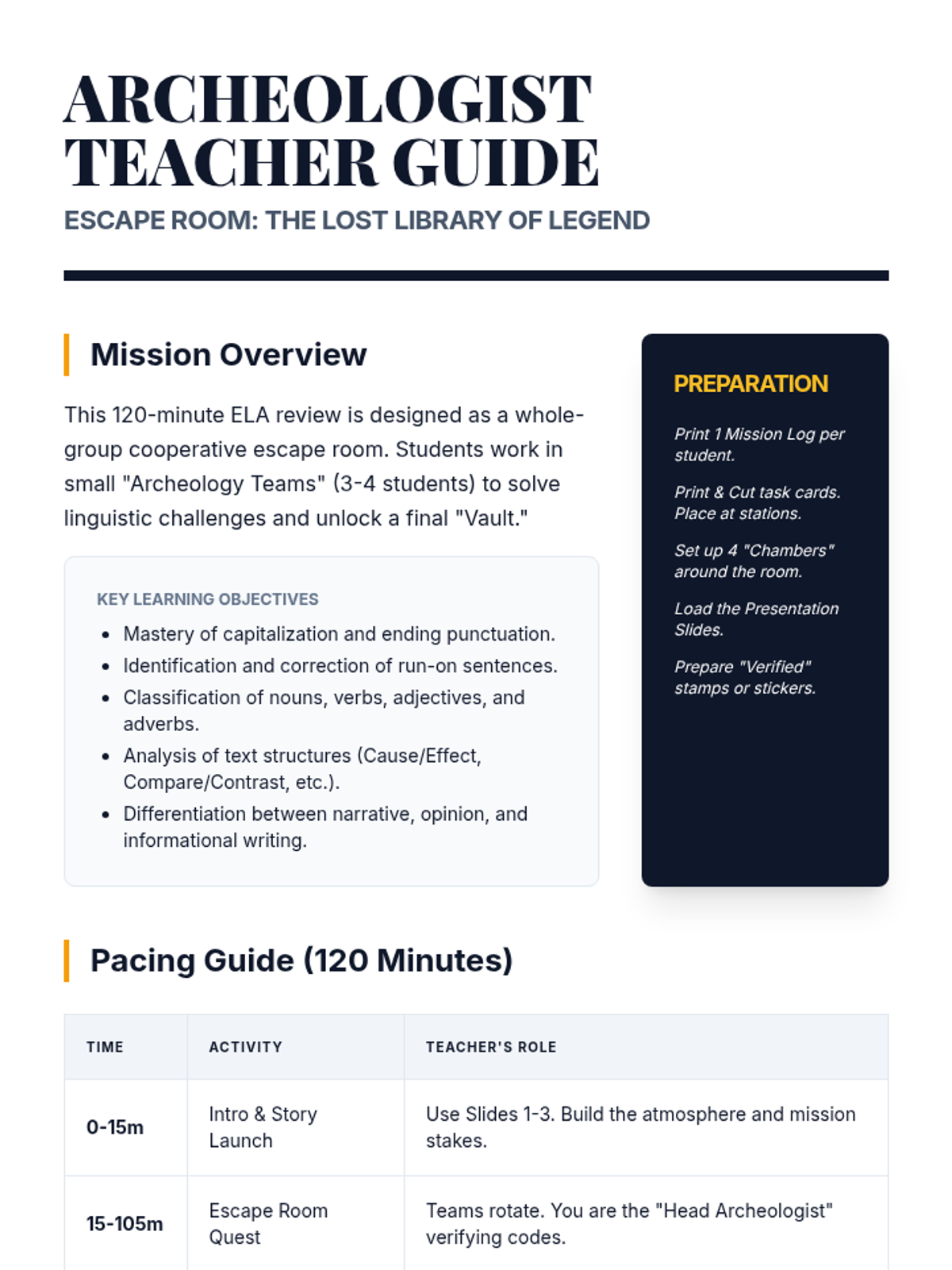
A comprehensive teacher guide for the 'Legend Library Escape' ELA review. Includes setup instructions, a detailed 120-minute pacing guide, facilitation tips, and the full answer key for all four chambers.
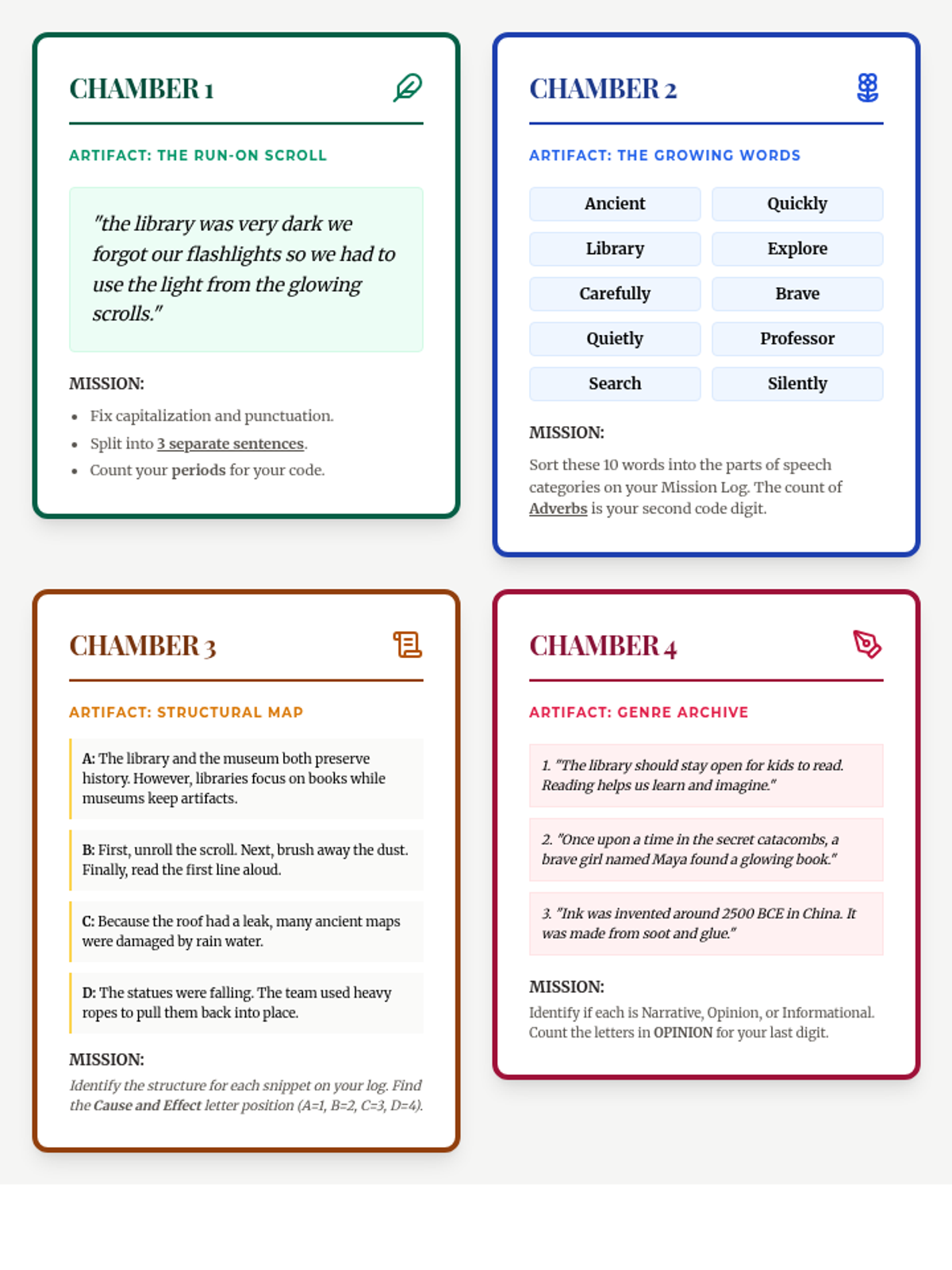
A set of printable task cards for each of the four escape room chambers. Each card contains specific ELA problems (sentence fixing, word sorting, text structure analysis) that students must solve to find their vault code digits.
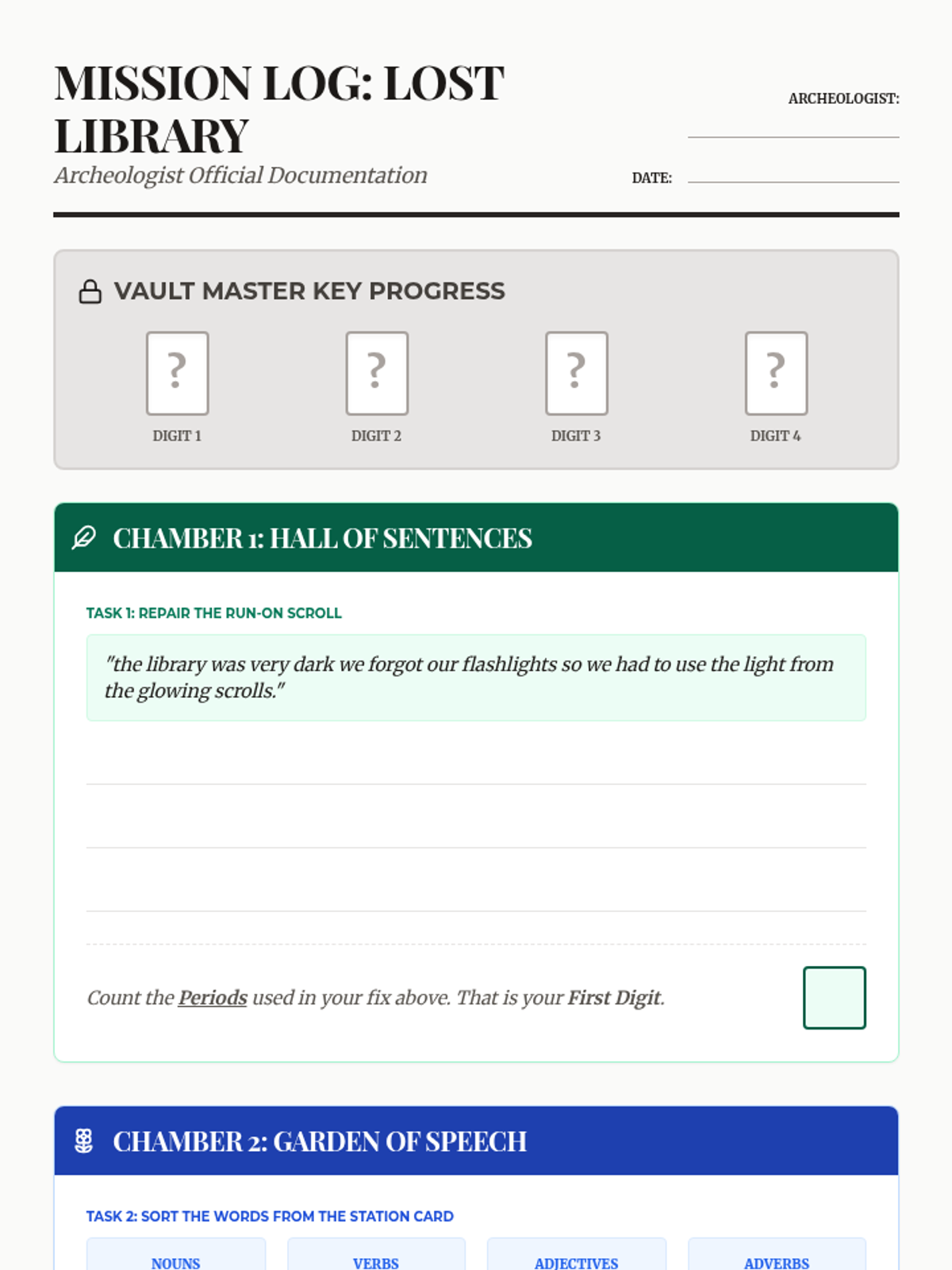
A student-facing mission log for tracking escape room progress. It provides designated spaces for working through problems in each 'chamber' and recording the digits for the final vault code.
A visually immersive slide deck for 'The Lost Library of Legend' escape room. It includes mission briefings, rules, and chamber overviews with a high-contrast vintage library theme.