Fundamental techniques for soccer, volleyball, football, and basketball alongside strategic gameplay and communication skills. Emphasizes sportsmanship and collaborative tactics within a competitive team environment.
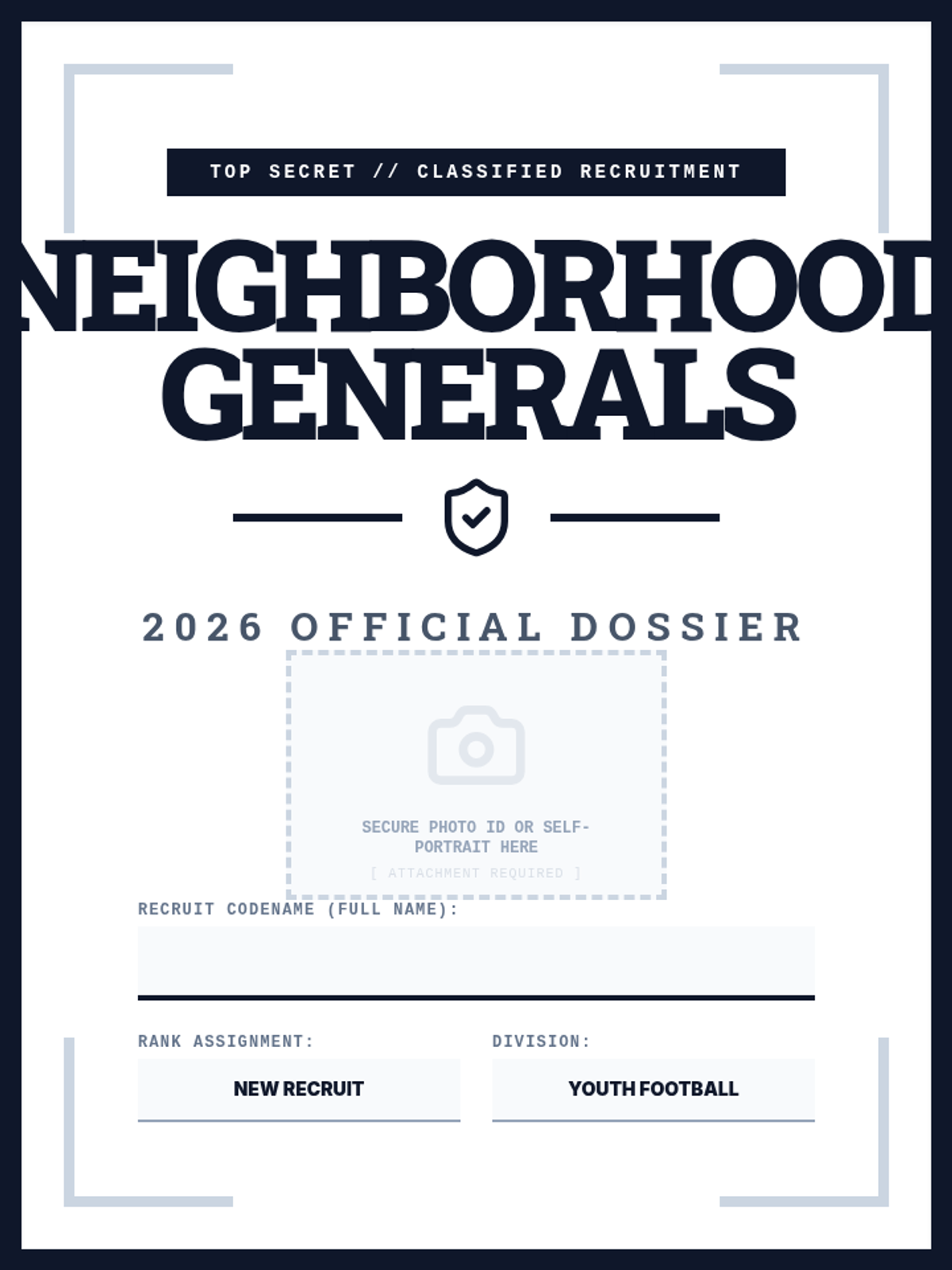
A thematic 4-page registration and interest form for the Neighborhood Generals youth football team. Designed as a "Top Secret" recruitment dossier, it provides generous writing space for personal info, football goals, and school interests, helping students aged 8-10 practice their literacy skills while joining the team.
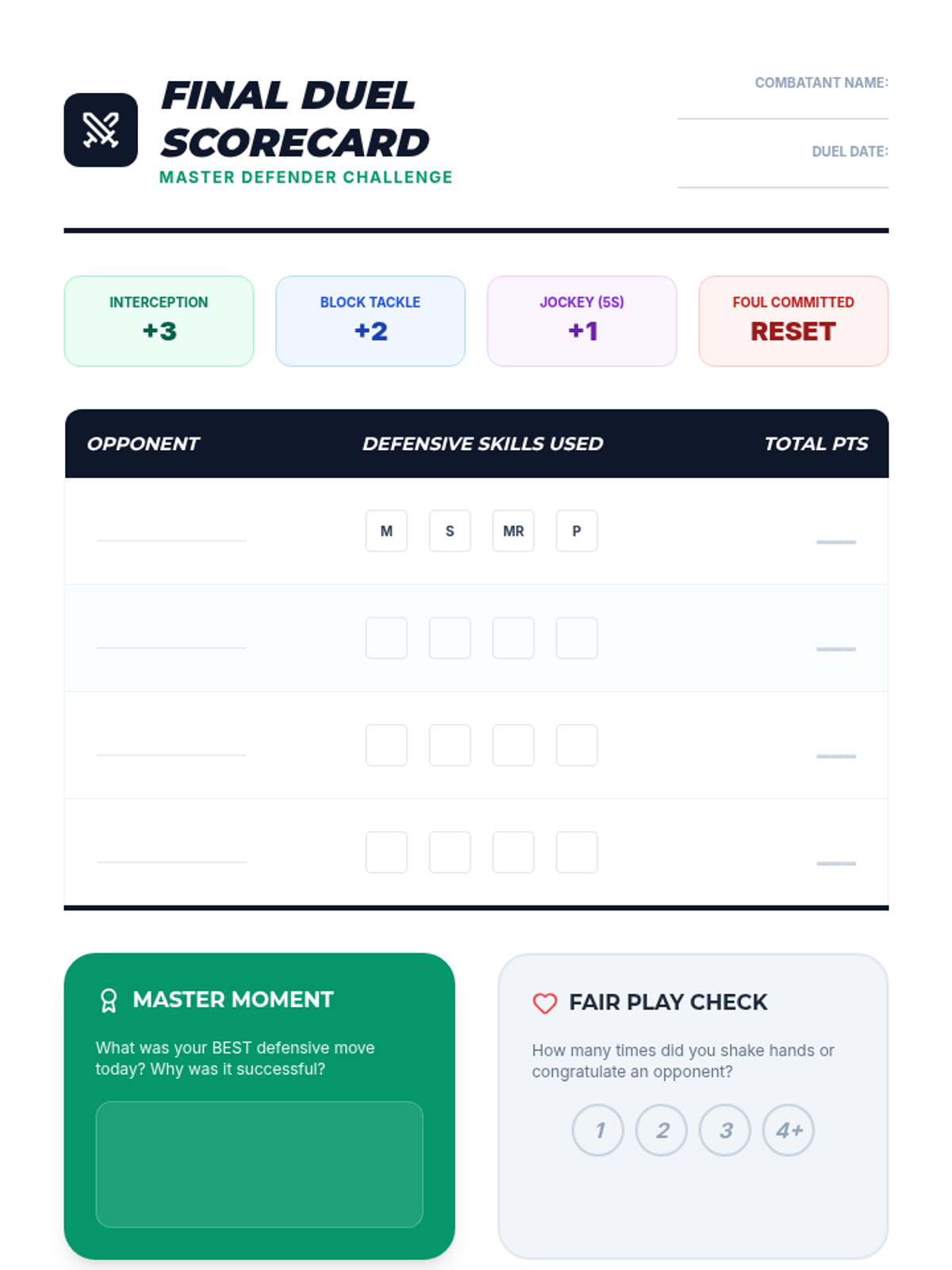
Student scorecard for Lesson 5, the final tournament. Students track their defensive points across multiple duels and reflect on their mastery of specific skills and fair play.
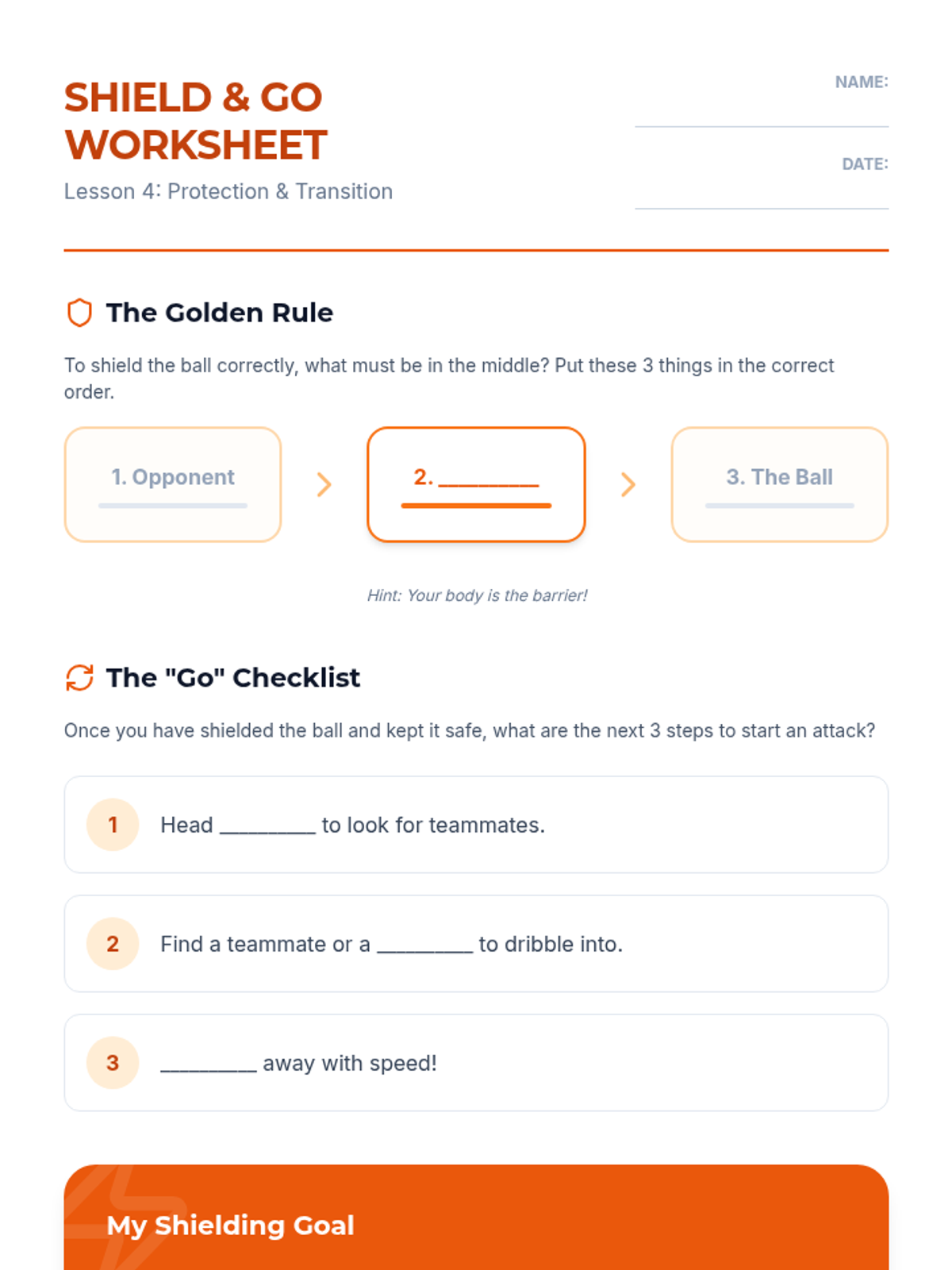
Student worksheet for Lesson 4, focusing on ball protection and the transition from defense to offense. Includes a sequencing task, a fill-in-the-blank checklist, and a goal-setting prompt.
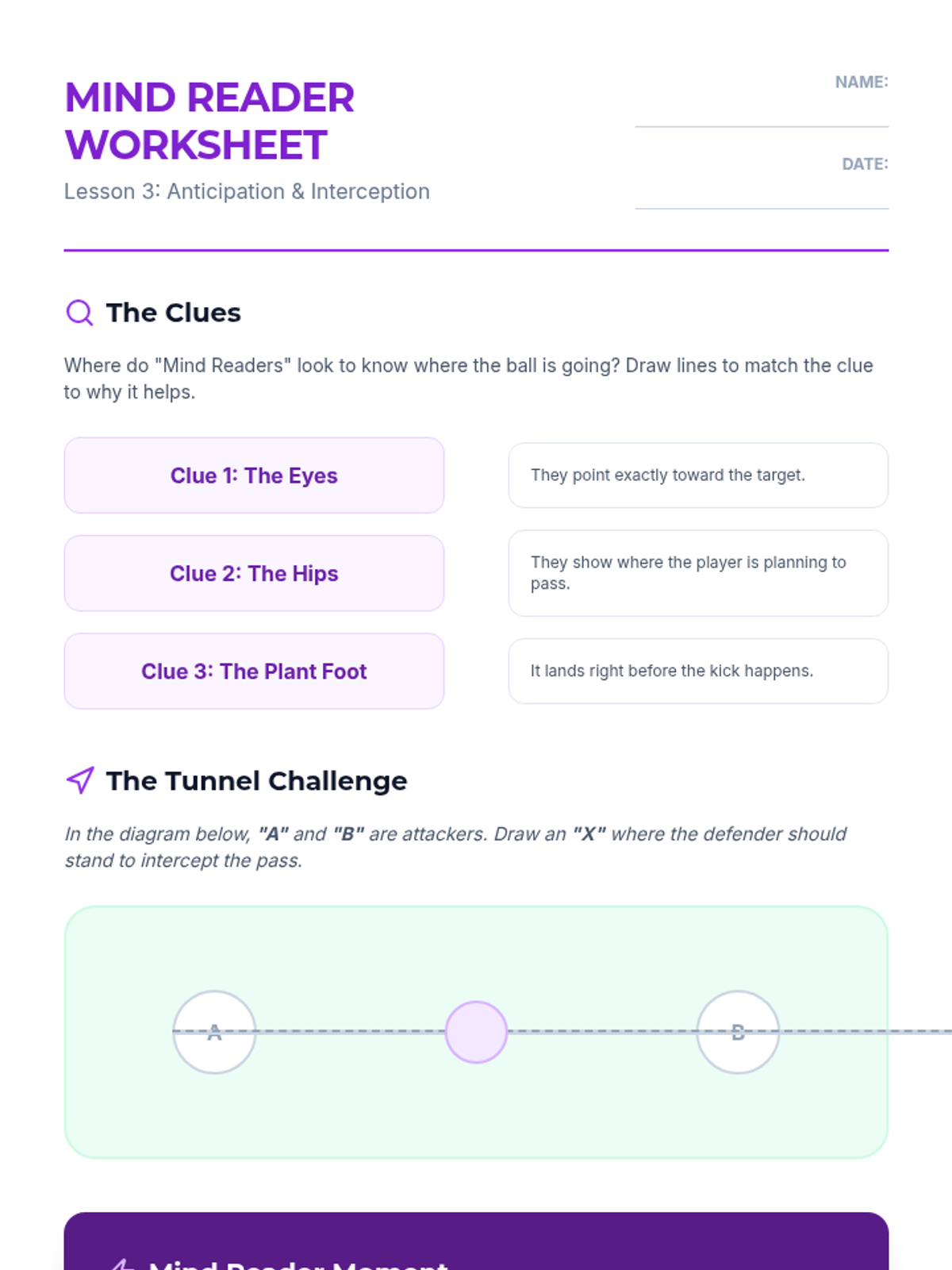
Student worksheet for Lesson 3, reinforcing the skill of anticipating passes through visual cues and positioning. Includes a matching task, a spatial diagram challenge, and a reflective writing prompt.
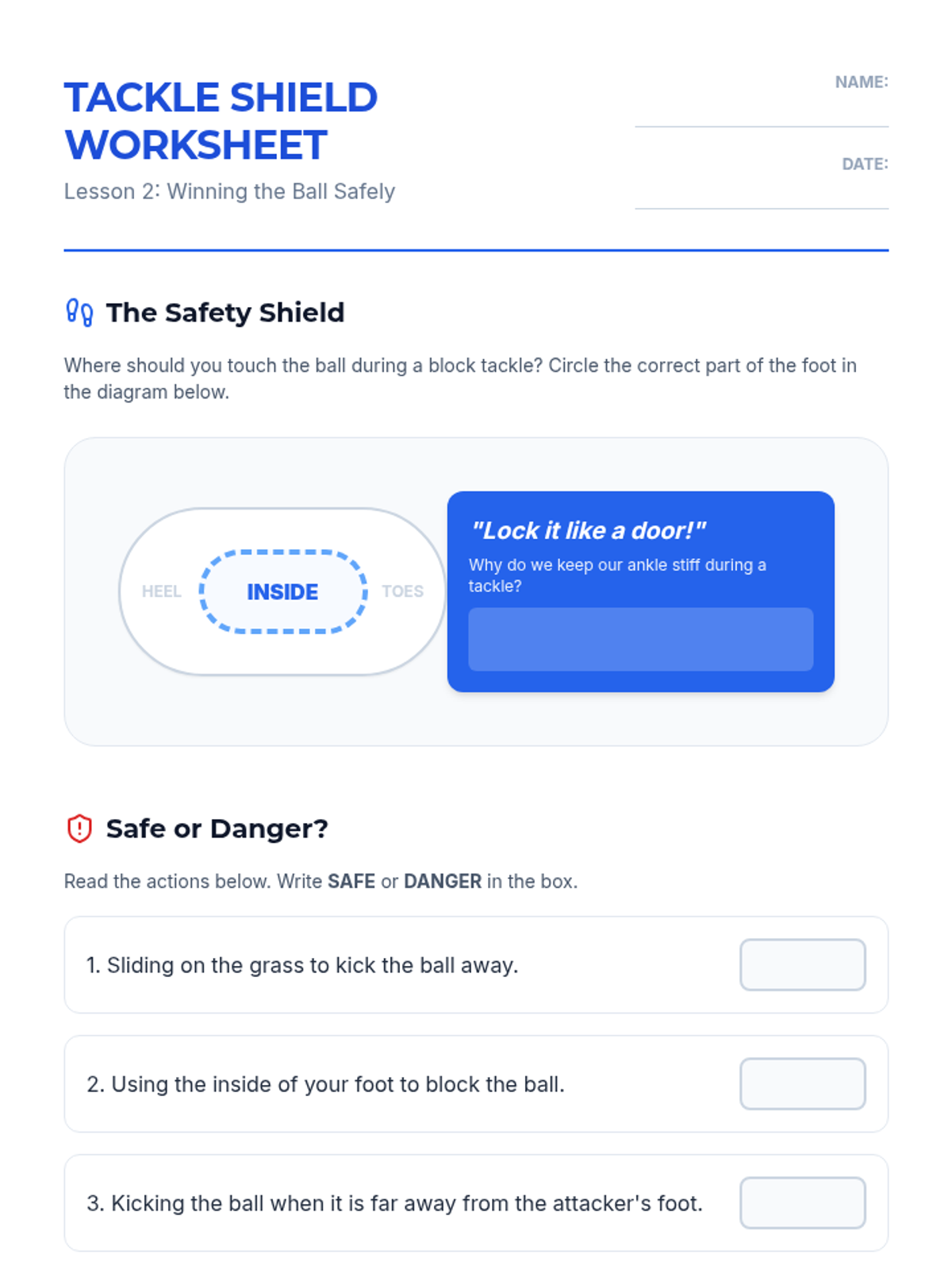
Student worksheet for Lesson 2, focusing on the technique and safety of the block tackle. Includes a foot anatomy diagram, a safety categorization task, and a short-response reflection on timing.
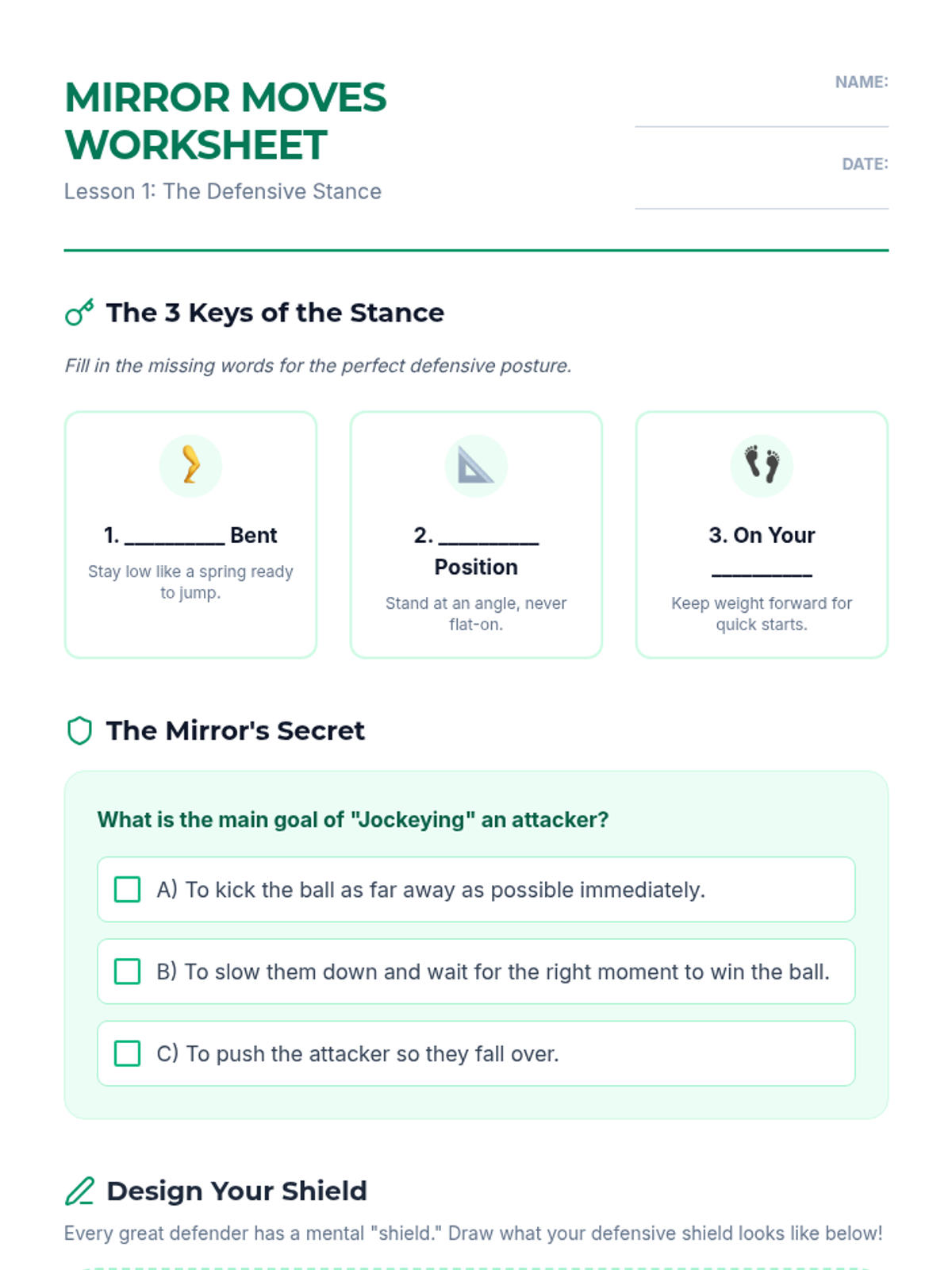
Student worksheet for Lesson 1, reinforcing the three keys of the defensive stance and the concept of jockeying. Includes a labeling activity, a multiple-choice question, and a creative drawing space.
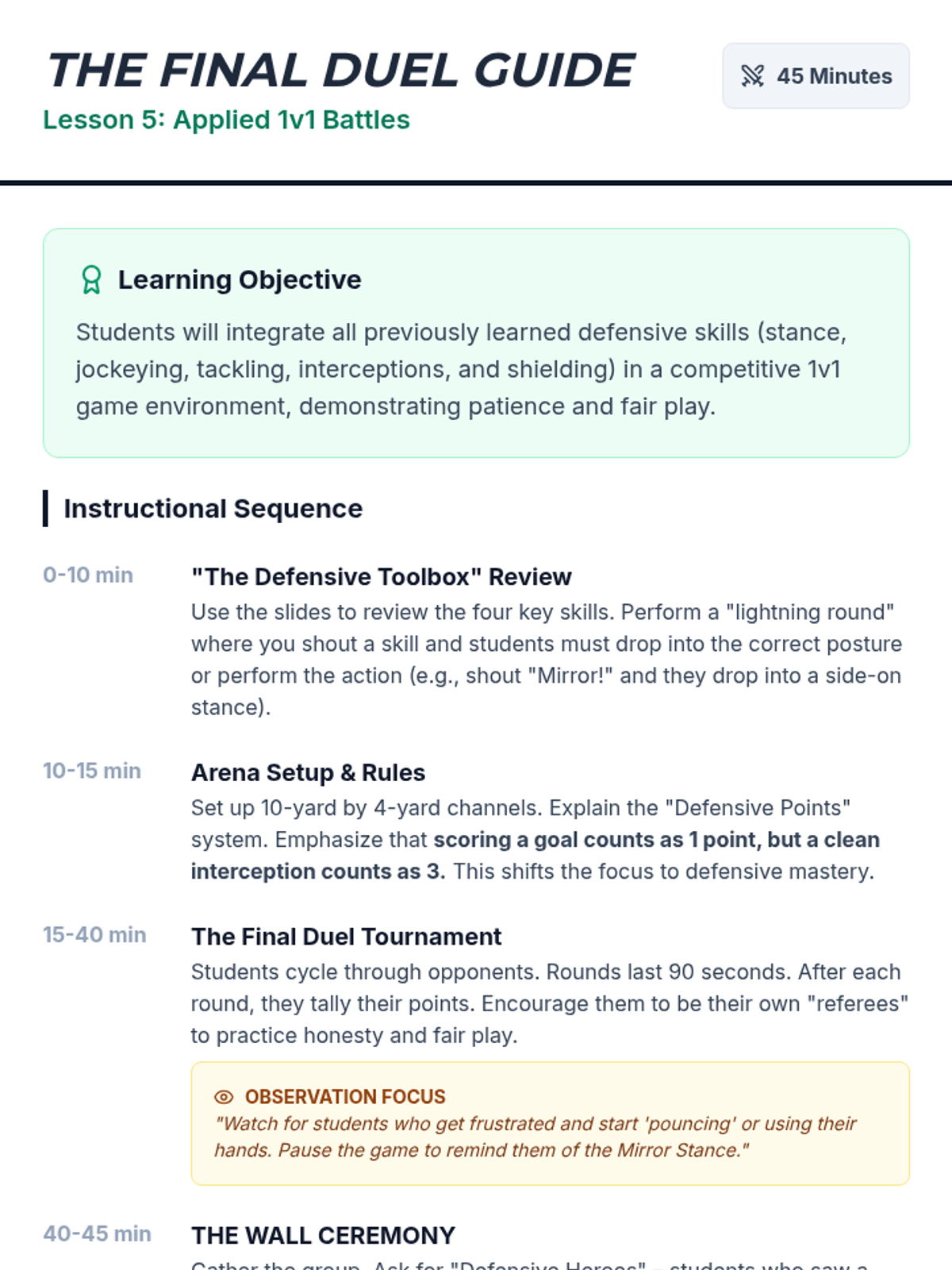
Facilitation guide for teachers to lead Lesson 5. Includes specific timing, instructional cues for integrating all defensive skills, tournament rules, and reflection strategies.
Instructional slides for Lesson 5, the final session of the sequence. Focuses on reviewing all defensive skills, setting the competition rules for 1v1 battles, and emphasizing fair play and defensive points.
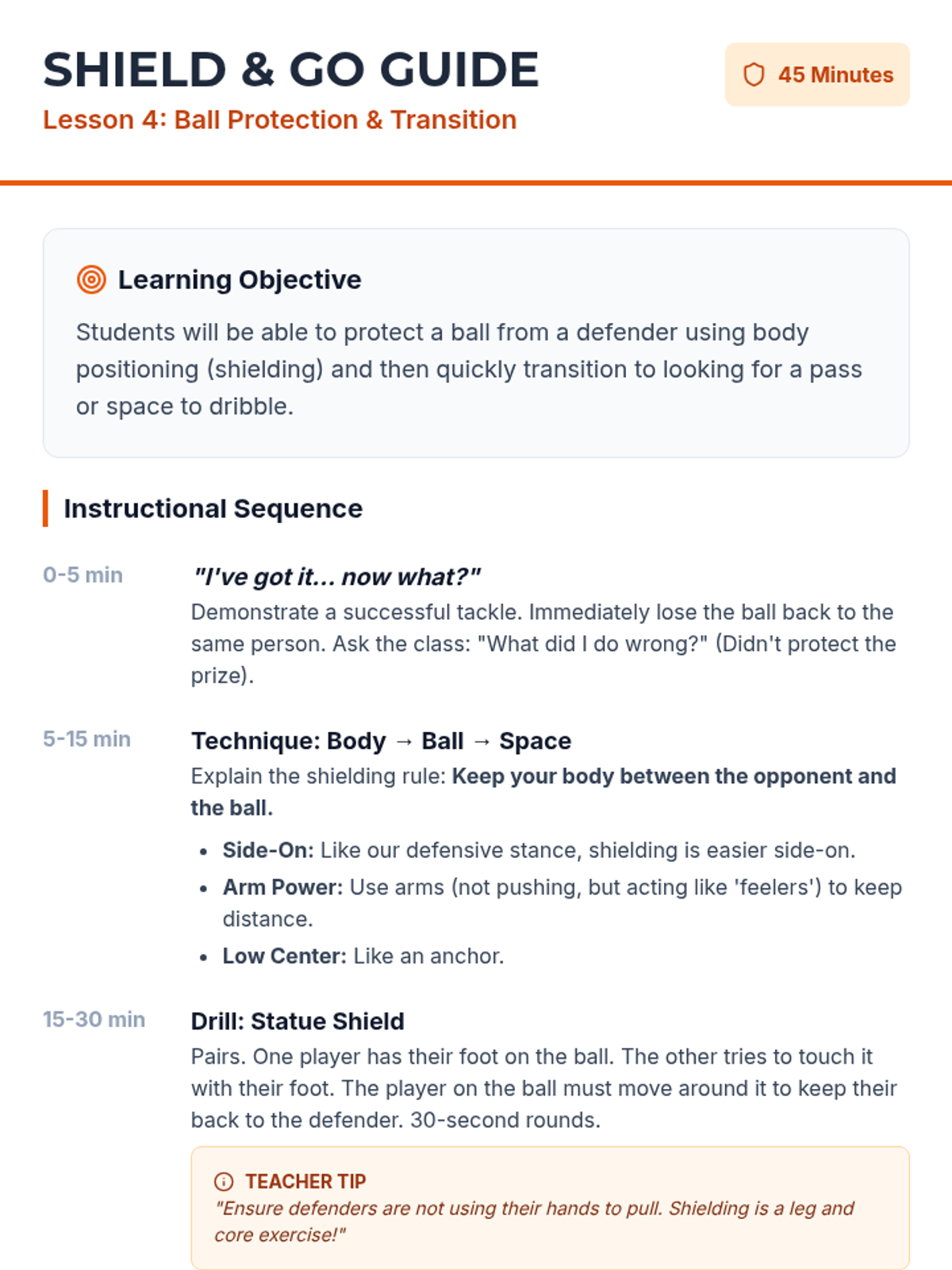
Facilitation guide for teachers to lead Lesson 4. Includes specific timing, instructional cues for ball shielding, transition drills, and reflective questions for students.
Instructional slides for Lesson 4, focusing on ball protection and shielding. Introduces the concept of using the body as a barrier and transitioning from defensive recovery to offensive play.
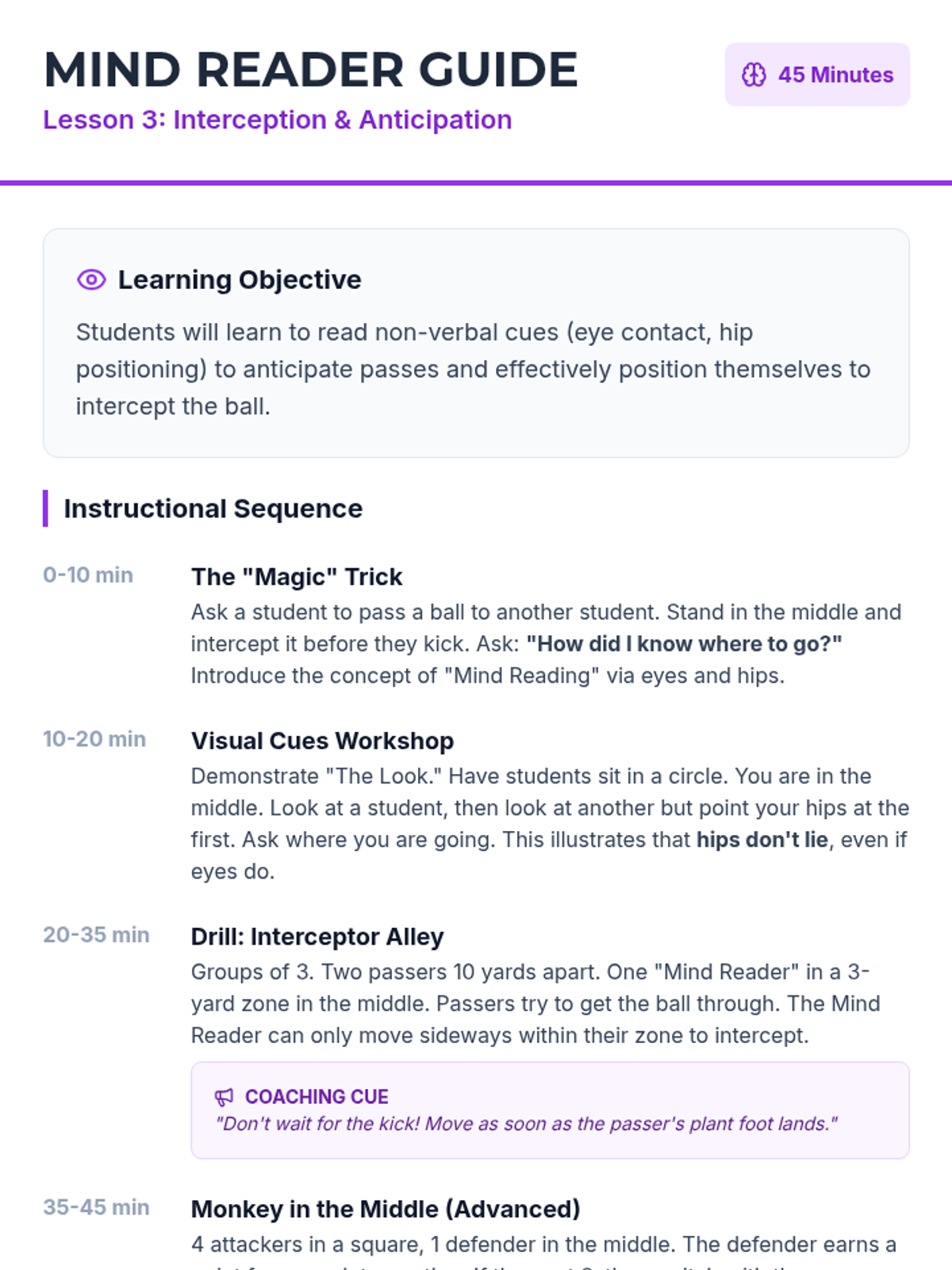
Facilitation guide for teachers to lead Lesson 3. Includes specific timing, instructional cues for reading eyes and hips, activity descriptions for 'Interceptor Alley', and common misconceptions.
Instructional slides for Lesson 3, focusing on reading the game to intercept passes. Introduces visual cues like eye contact and hip positioning to predict pass direction.
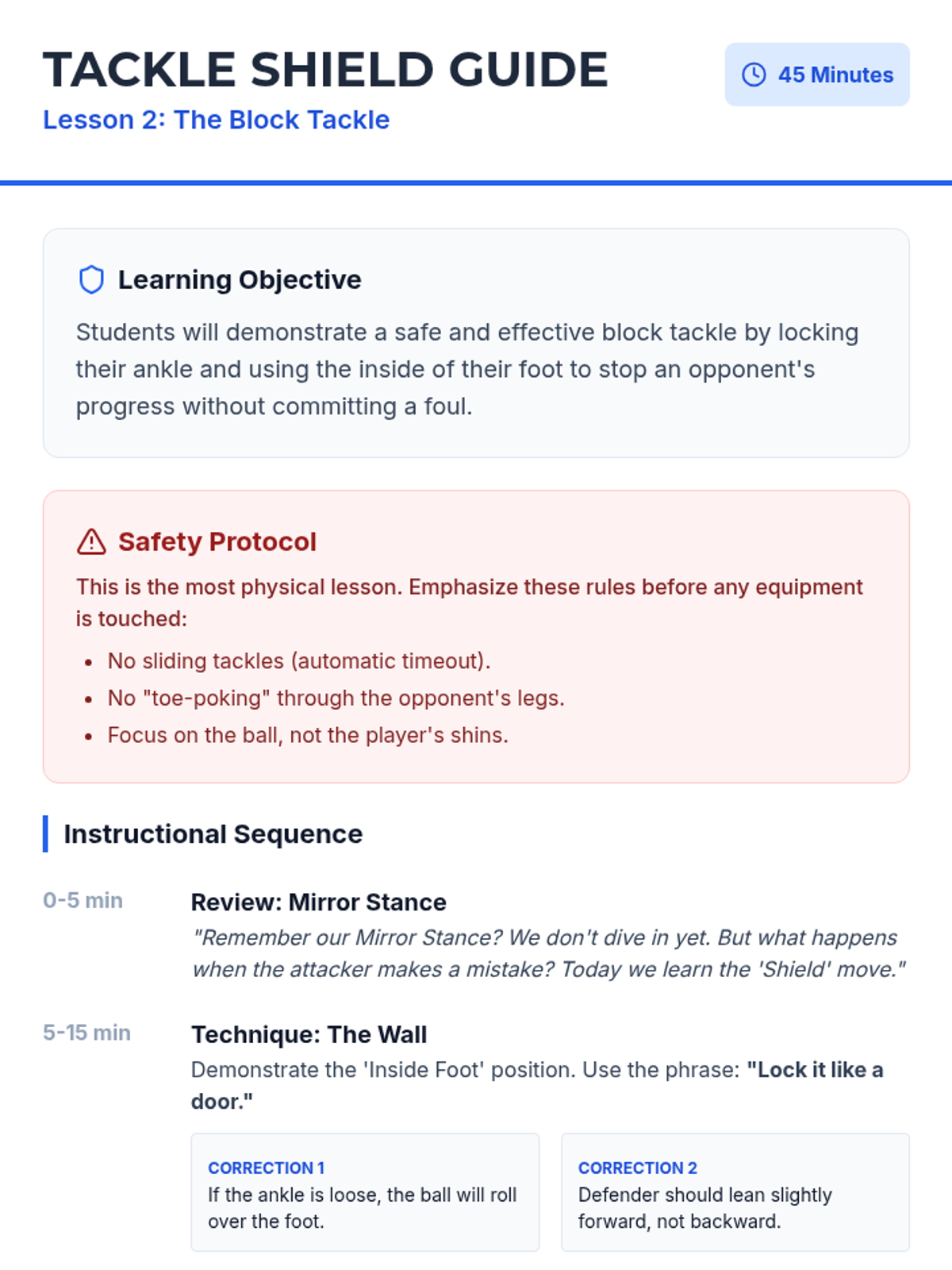
Facilitation guide for teachers to lead Lesson 2. Includes specific timing, instructional cues for the block tackle, safety protocols, and activity descriptions.
Instructional slides for Lesson 2, introducing the block tackle technique. Focuses on using the inside of the foot, locking the ankle, and timing the challenge safely.
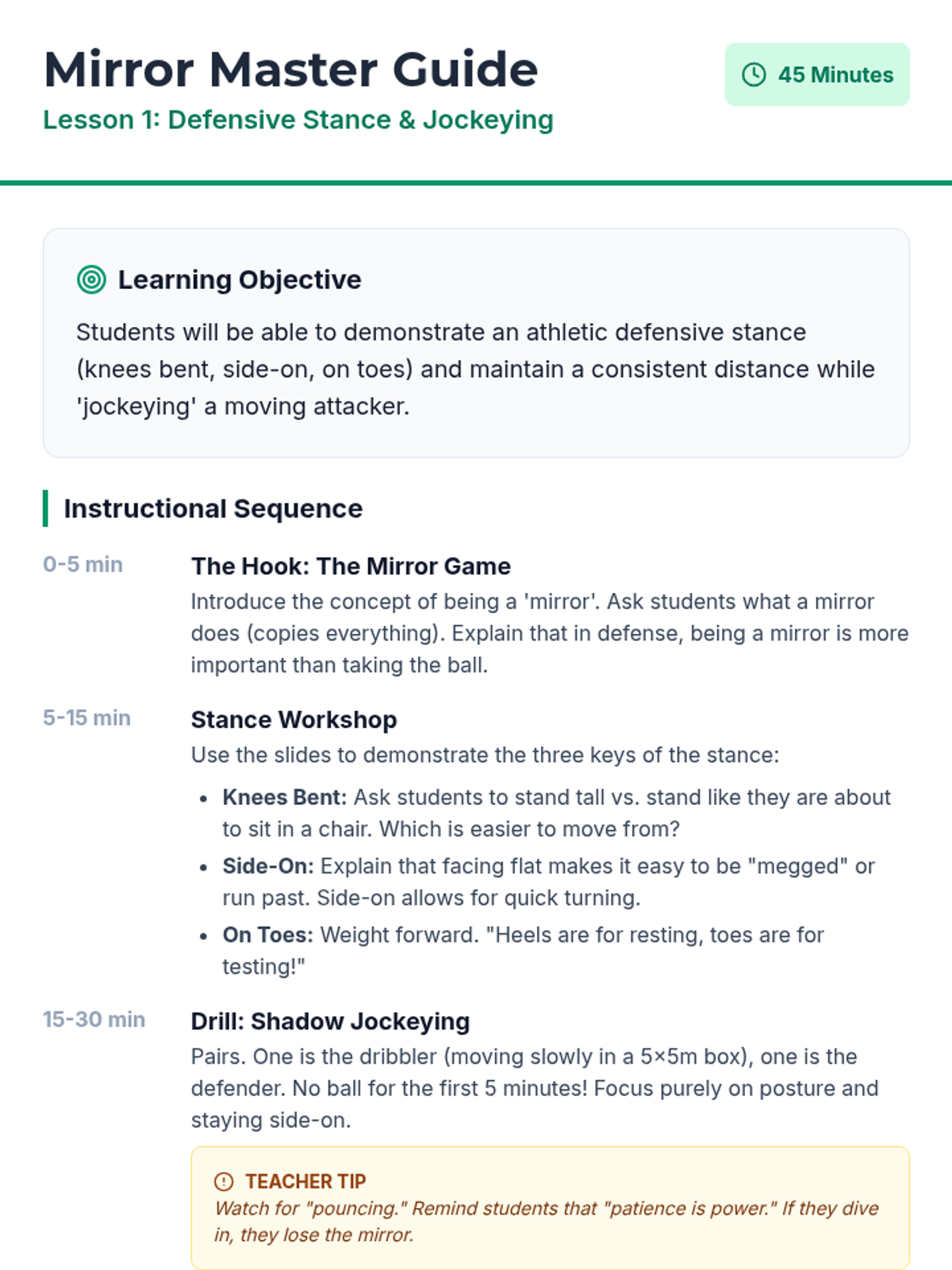
Facilitation guide for teachers to lead Lesson 1. Includes specific timing, instructional cues for the athletic stance, activity descriptions for 'Shadow Jockeying', and differentiation strategies.
Instructional slides for Lesson 1, introducing the athletic defensive stance and the concept of 'jockeying' through the 'Mirror' metaphor. Includes visual cues for side-on positioning and activity instructions.
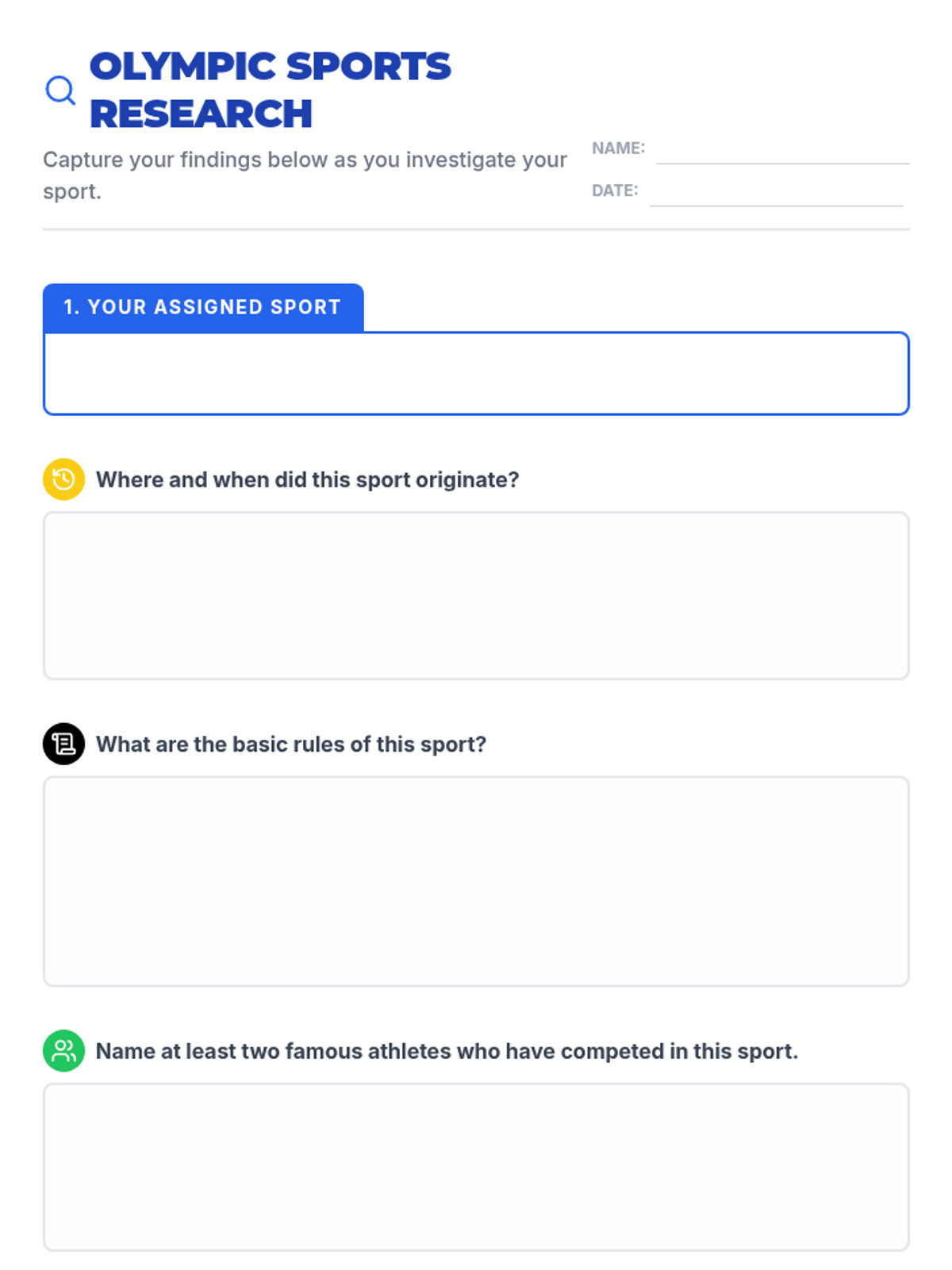
A guided research worksheet for students to record key facts about their assigned Olympic sport, including origins, rules, and famous athletes.
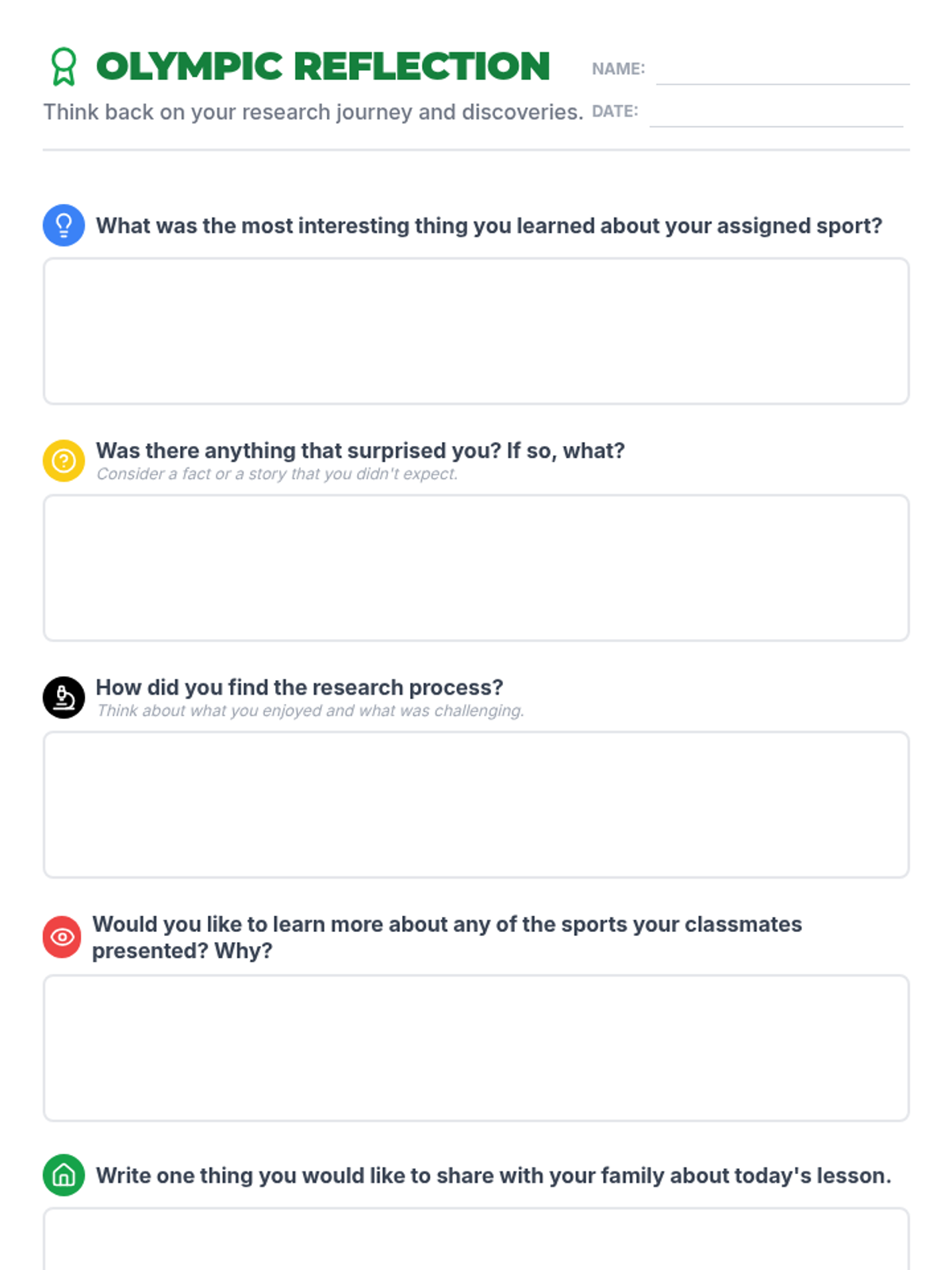
A reflection handout for students to evaluate their learning experience, the research process, and their peers' presentations.
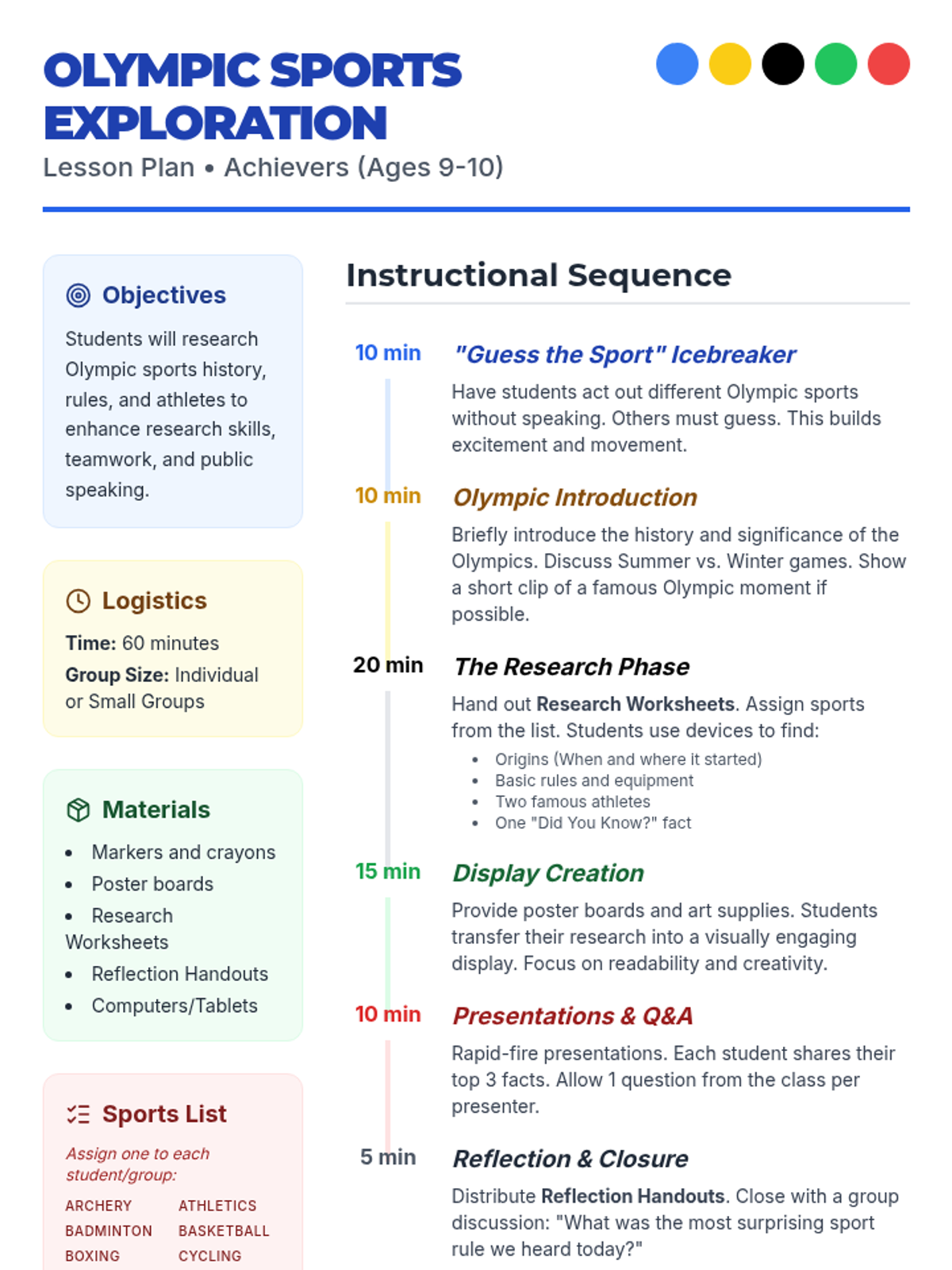
A comprehensive lesson plan for exploring Olympic sports, including an instructional sequence, materials list, and research prompts.
A visual slide deck to guide the Olympic Sports Exploration lesson, featuring an icebreaker, historical background, research instructions, and presentation tips.
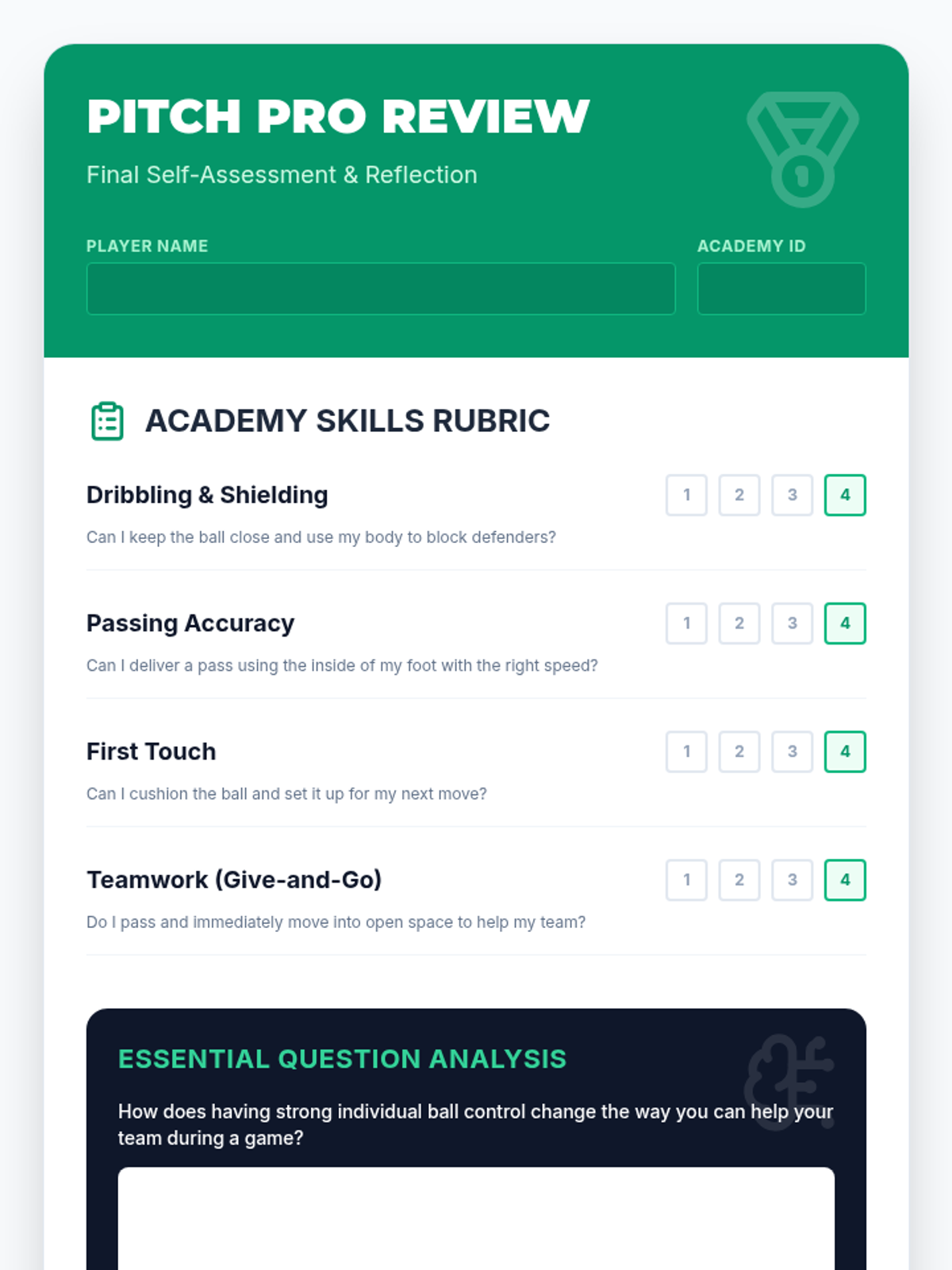
The final assessment worksheet for the sequence, featuring a skills rubric and reflection questions on the essential question of individual versus team contribution.
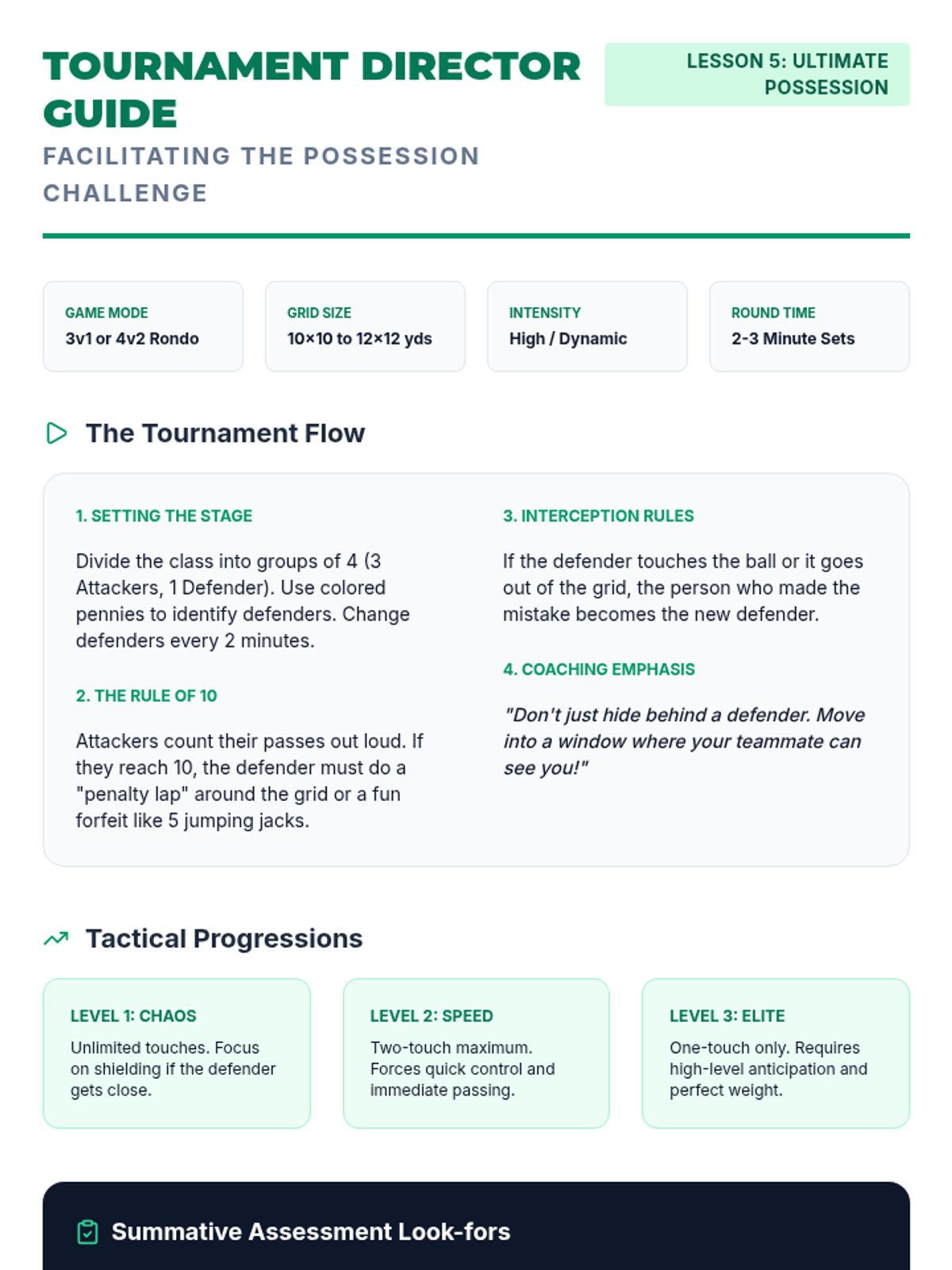
Teacher guide for the final lesson, detailing Rondo gameplay, progressions for different skill levels, and assessment criteria for the sequence.
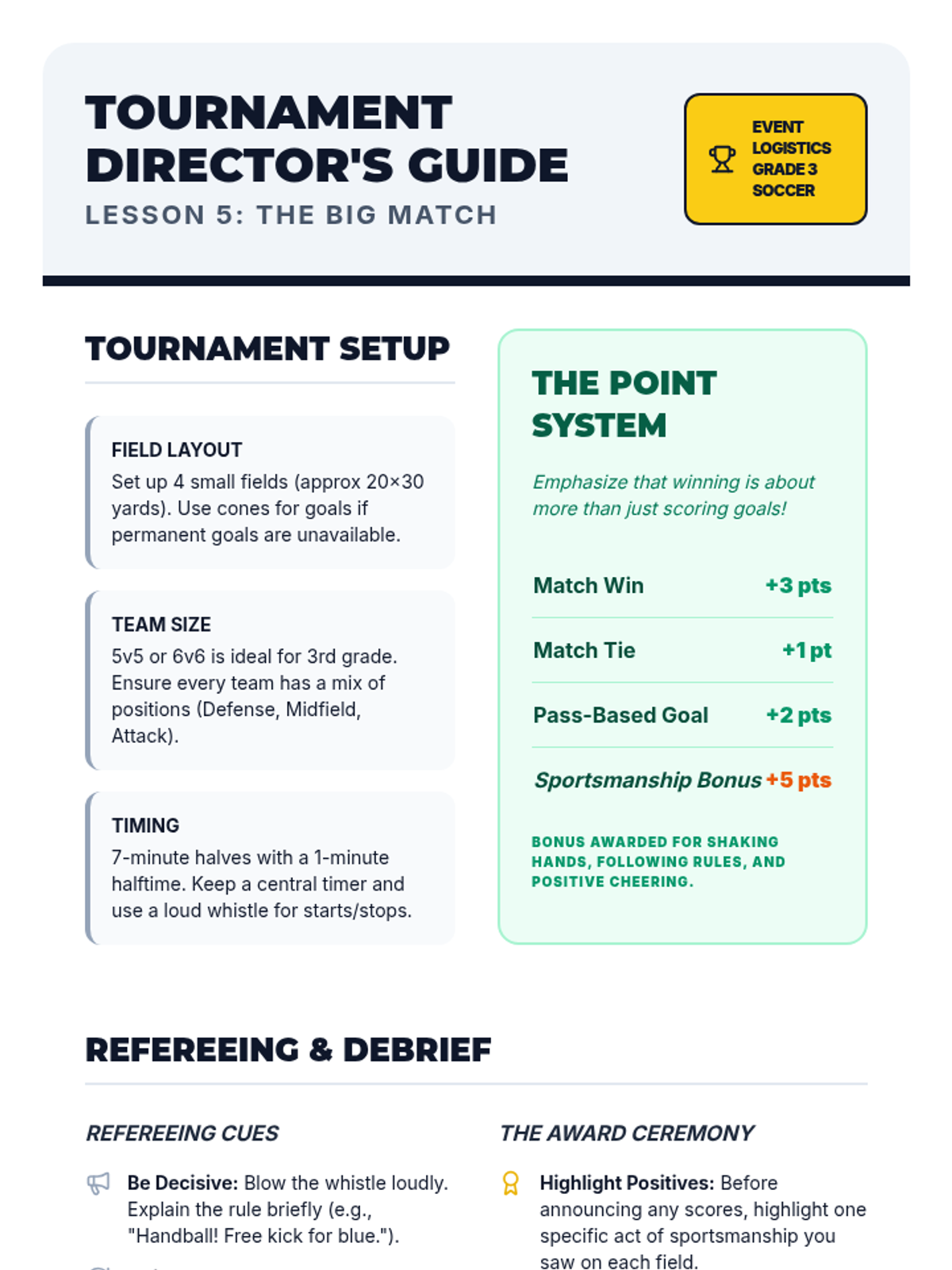
A facilitation guide for teachers to manage the class soccer tournament, including scoring systems, logistics, and award ceremony tips.
Visual presentation for Lesson 5 on the Rondo (possession game). Explains spacing, communication, and the final "10-Pass Challenge".
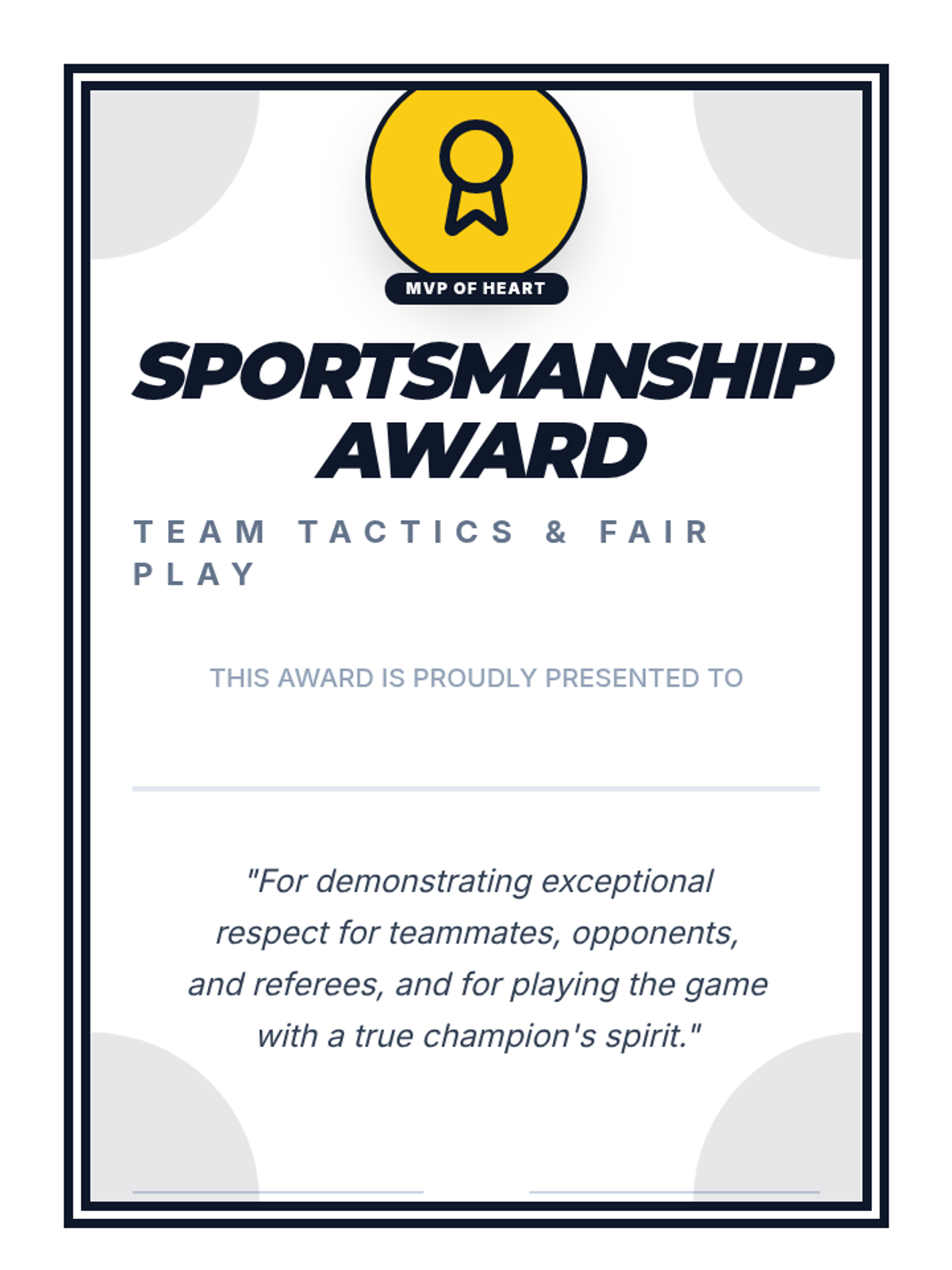
A sportsmanship award certificate for students to receive after the culminating class tournament, celebrating fair play and respect.
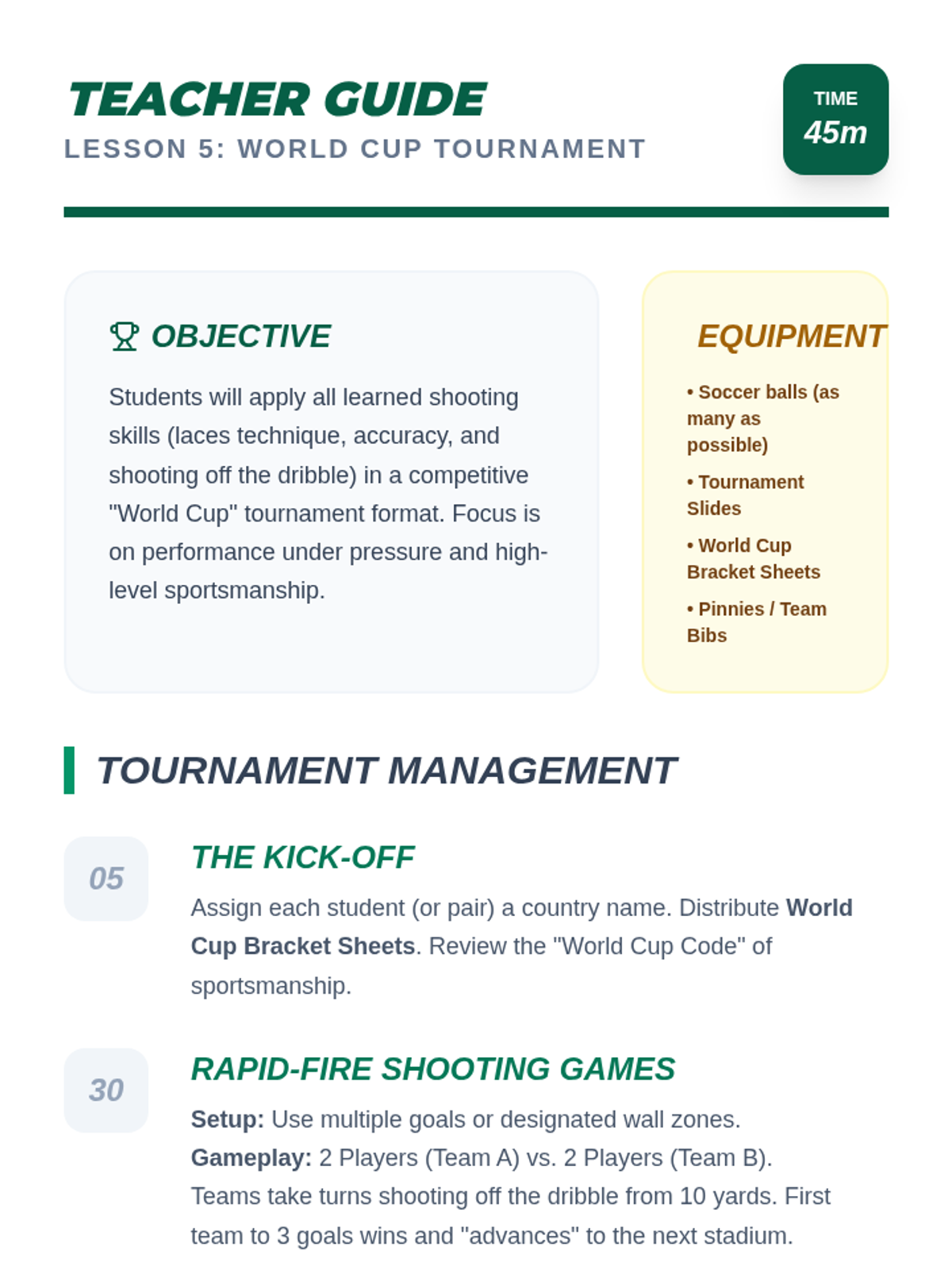
Teacher guide for the final tournament lesson, including bracket management, tie-breaker rules, and sportsmanship focus.
A visual presentation for students introducing the class soccer tournament, focusing on game rules and sportsmanship expectations.
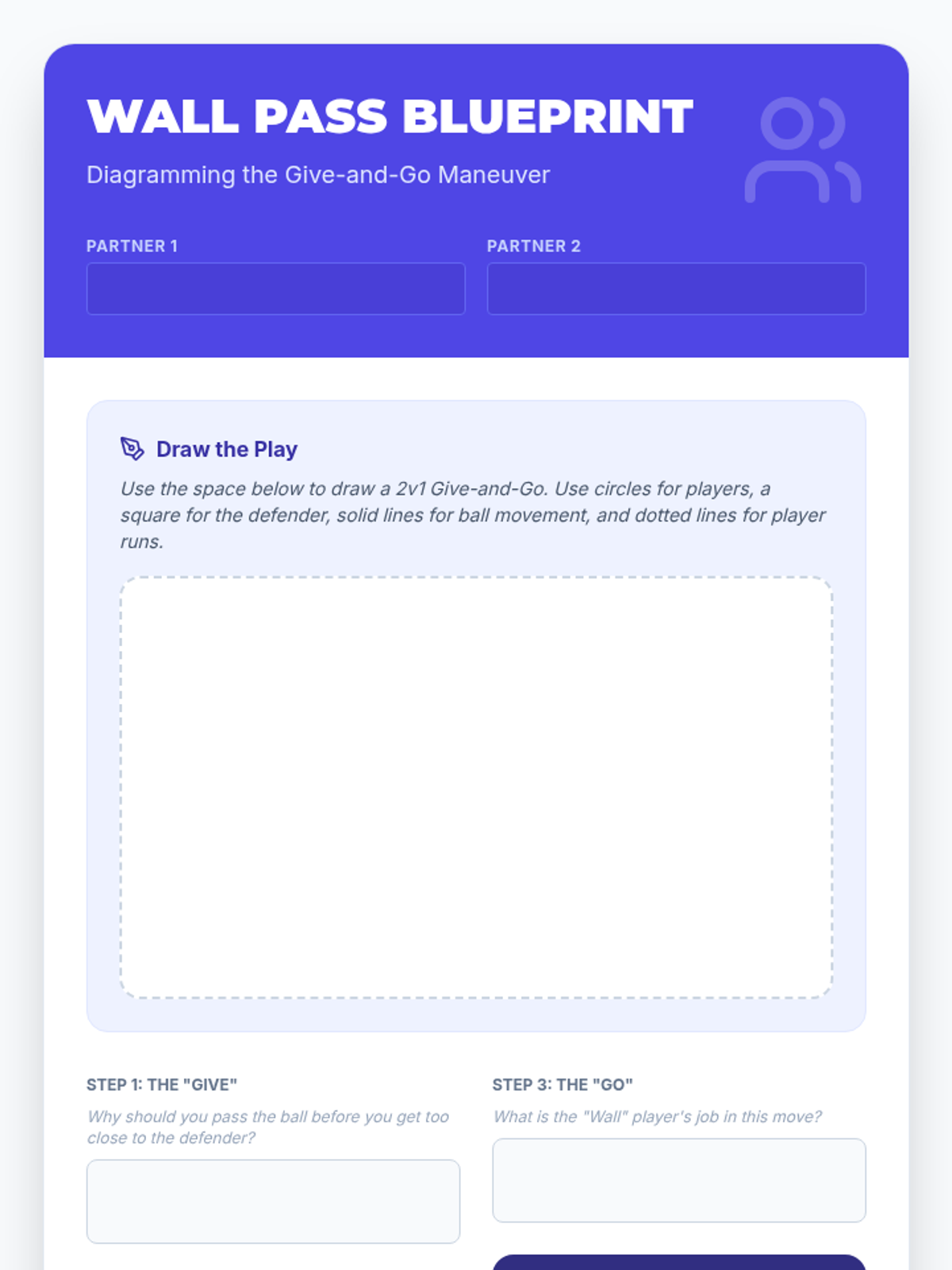
A student worksheet for Lesson 4 that includes a blank diagram area for sketching the Give-and-Go maneuver and reflective questions on tactical timing.
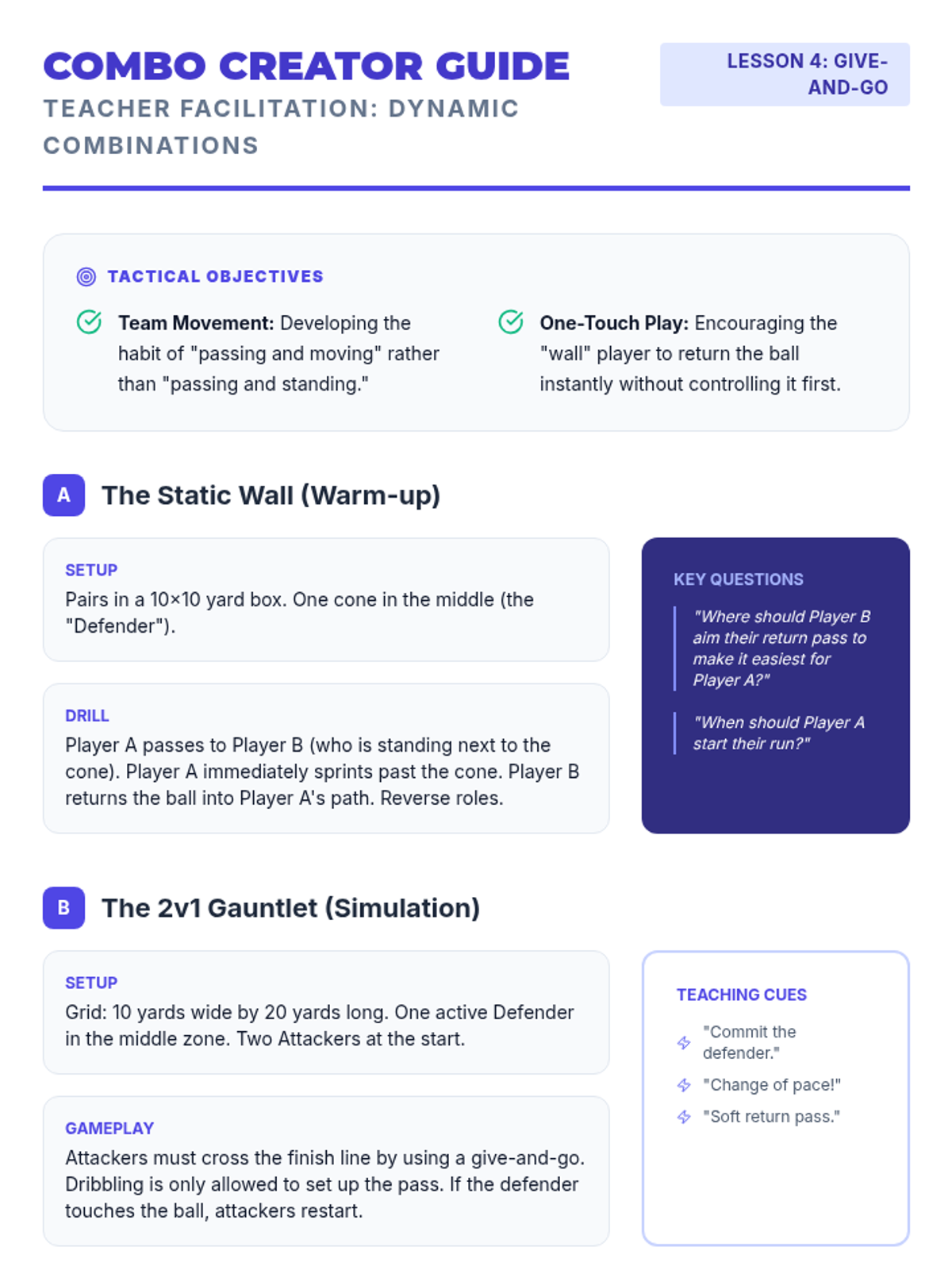
Teacher guide for Lesson 4 detailing the 'Static Wall' and '2v1 Gauntlet' drills. Focuses on the tactical benefits of passing and moving.
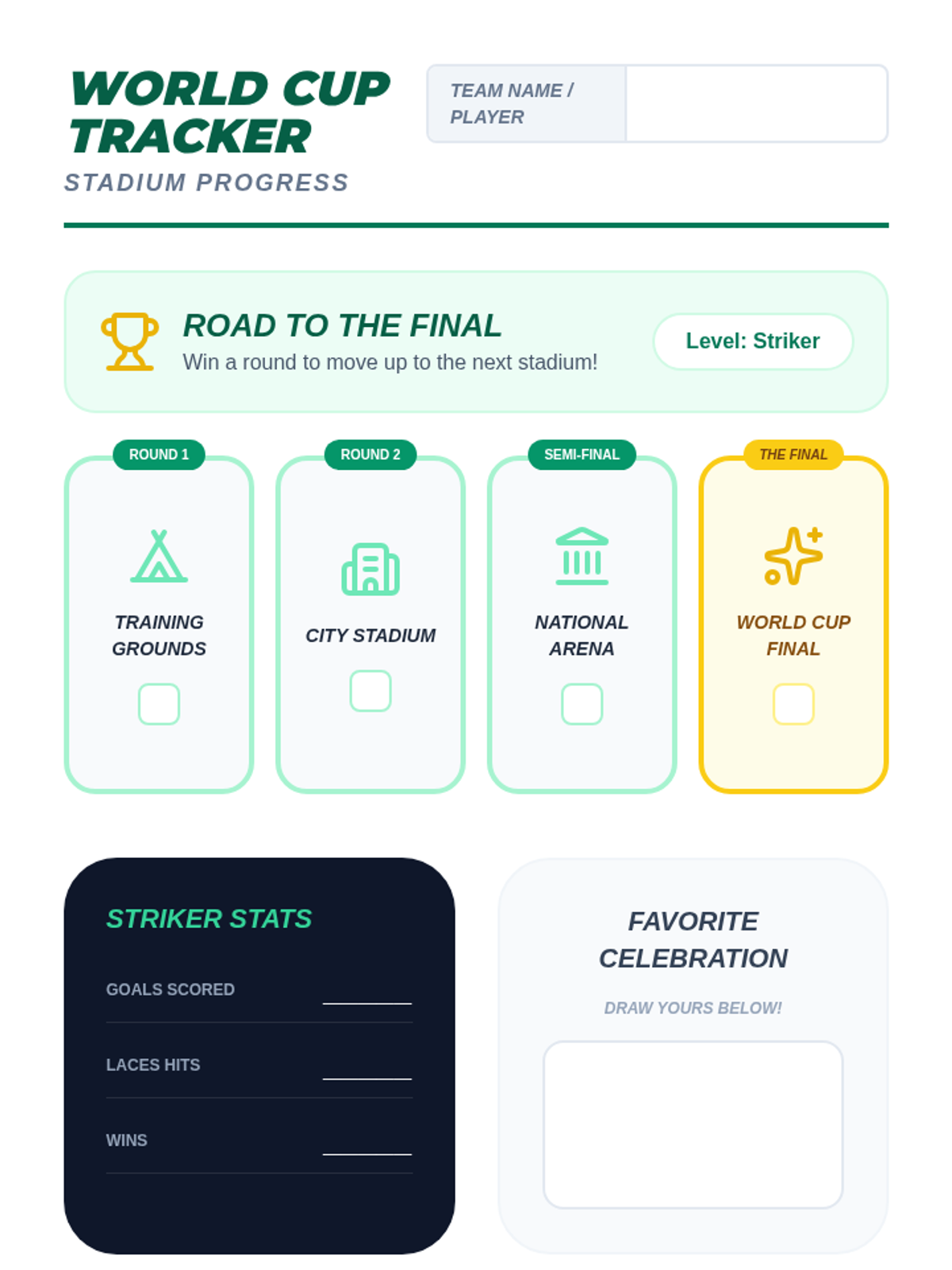
A student tournament tracker for the final World Cup tournament lesson, allowing students to record progress, stats, and reflect on sportsmanship.
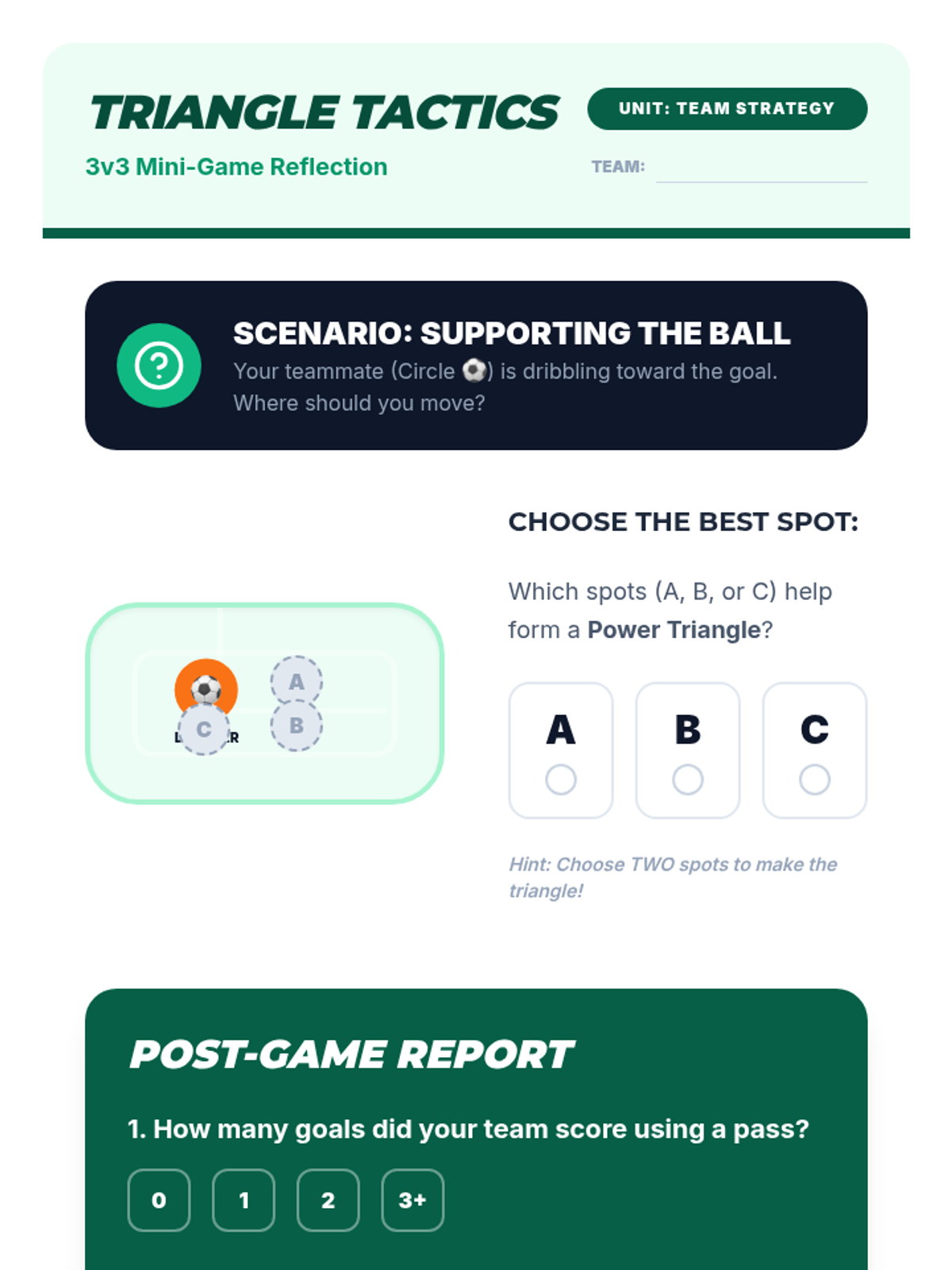
A reflection sheet for students to evaluate their positioning and team cooperation after 3v3 mini-games.
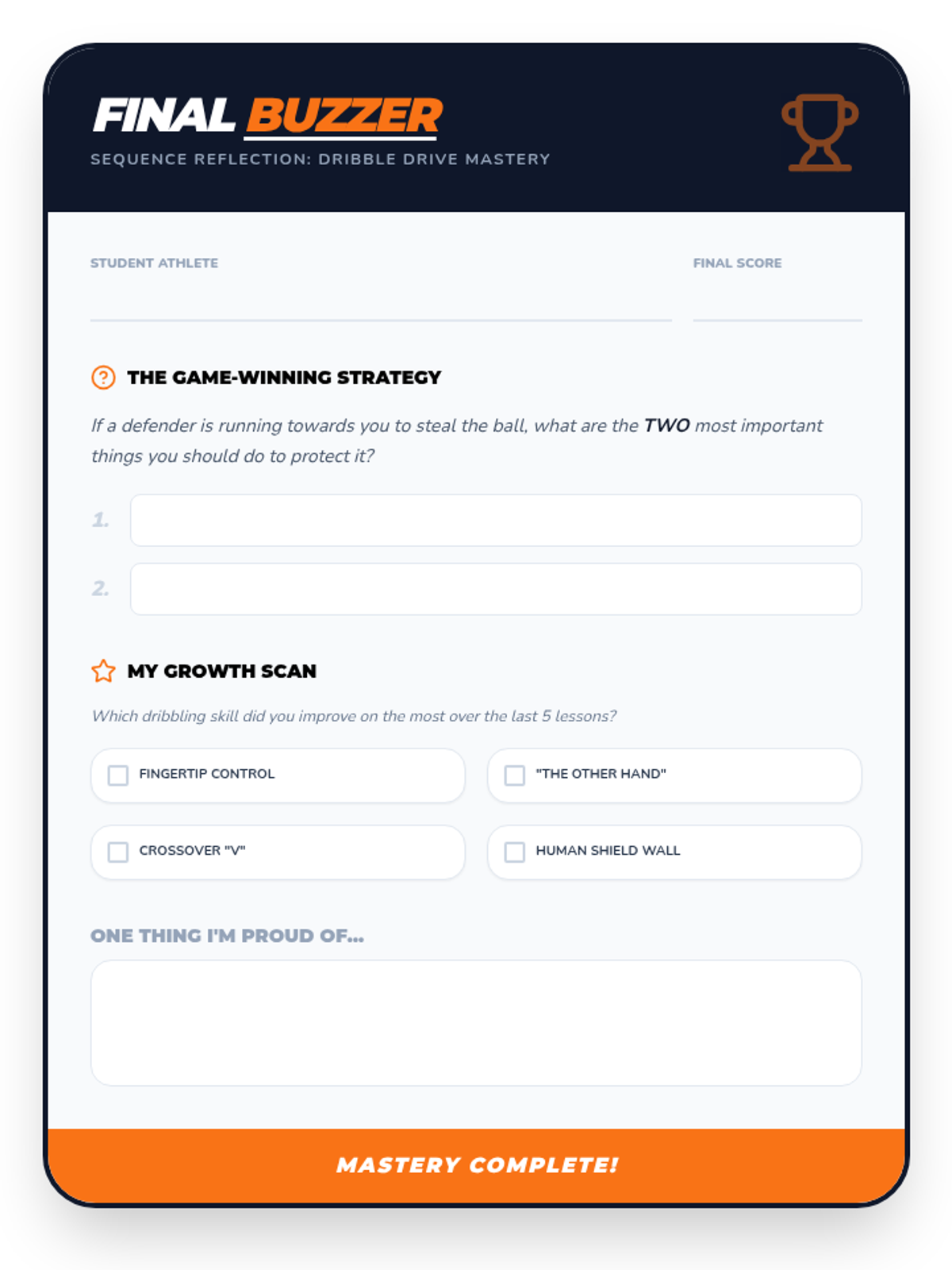
Final student exit ticket for the 5-lesson sequence, focusing on ball protection strategies and self-reflection on skills developed.
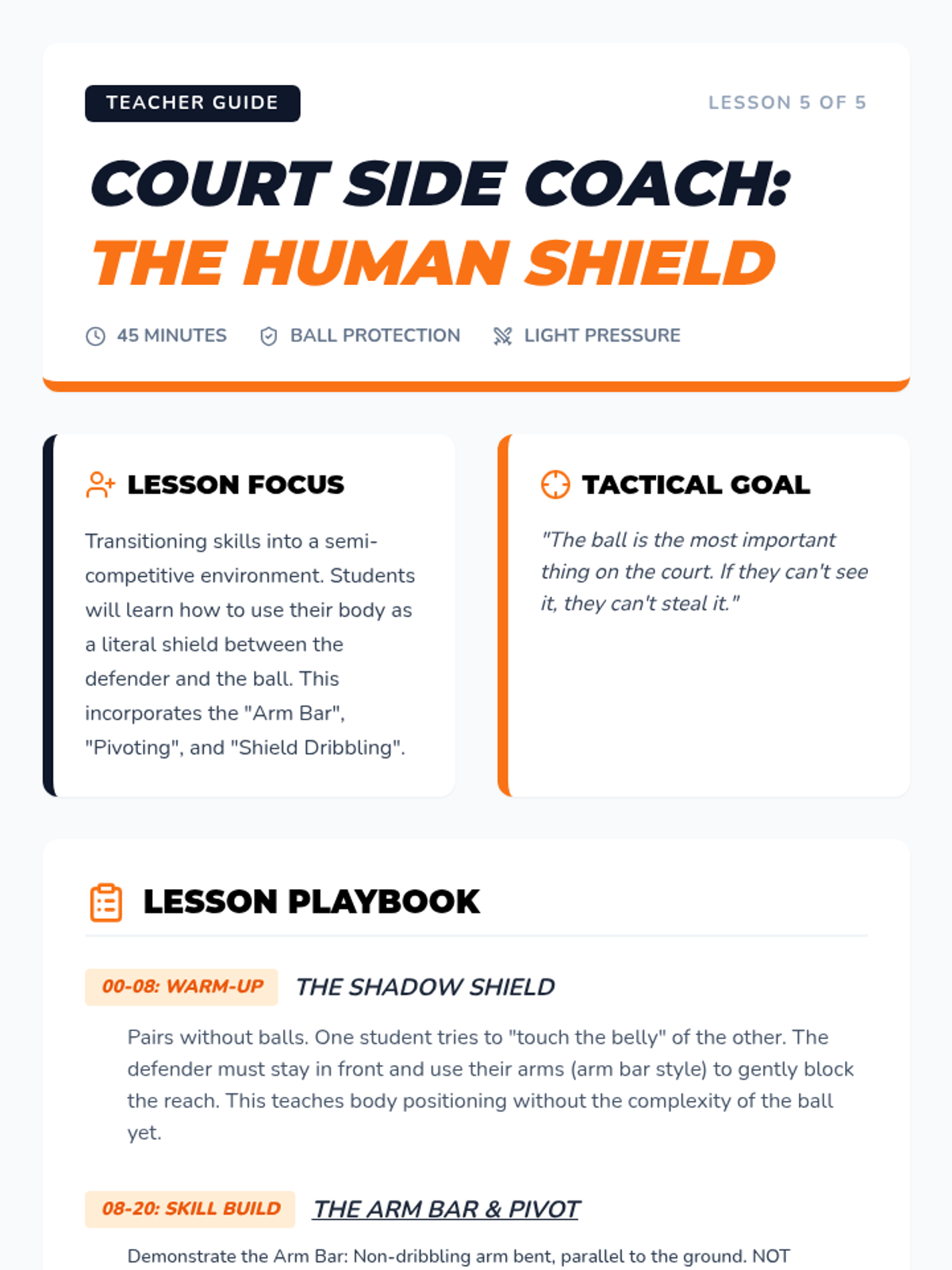
Teacher facilitation guide for Lesson 5, including drill instructions for shielding, pivoting, and the Pirate's Cove game.
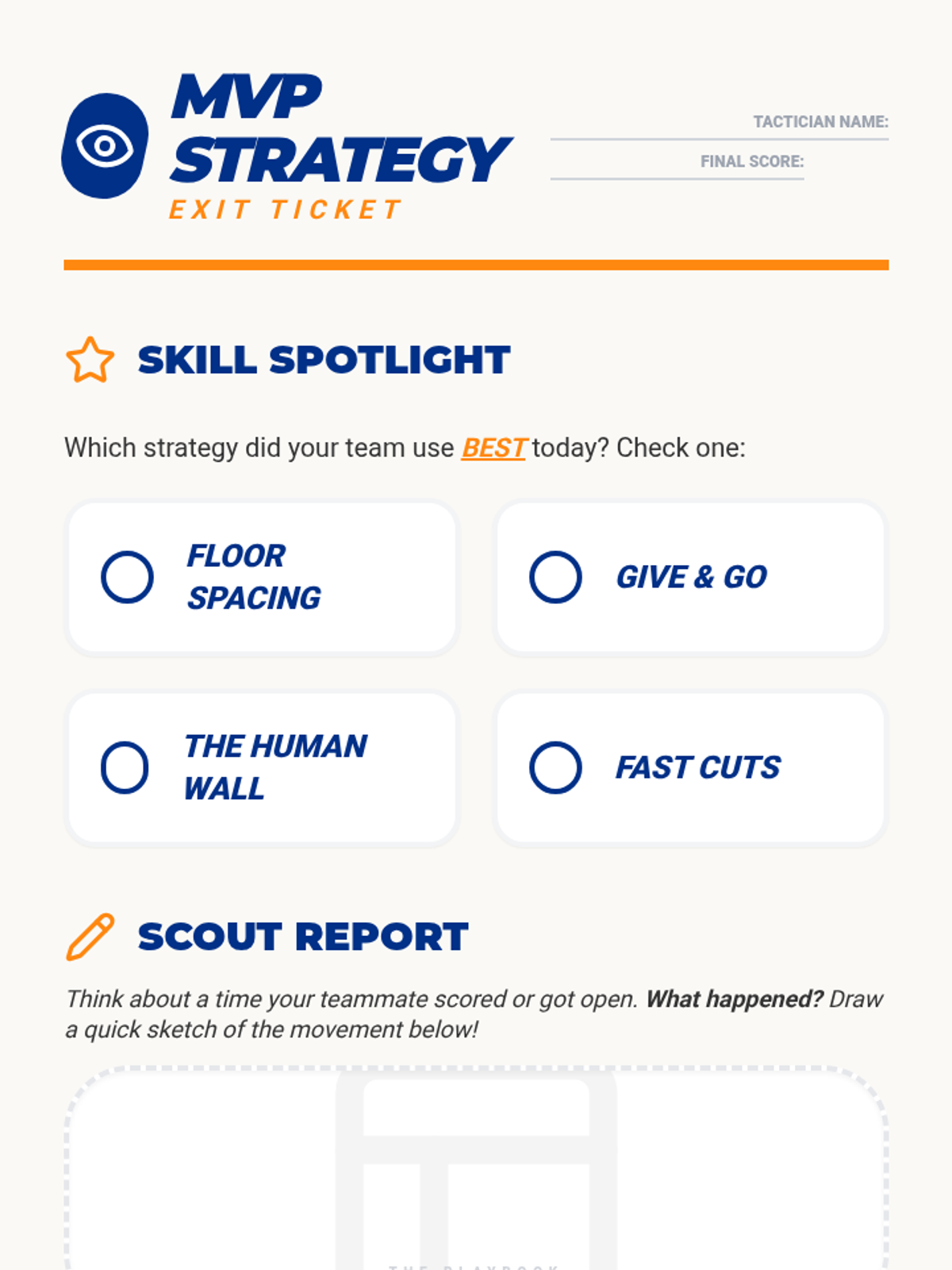
A comprehensive exit ticket for the final lesson in the basketball offensive strategy sequence. It allows 3rd-grade students to reflect on their team's strongest skills, diagram a successful play, and articulate the value of moving without the ball.
Visual presentation for Lesson 5, illustrating the mechanics of shielding the ball using the 'arm bar' and body positioning.
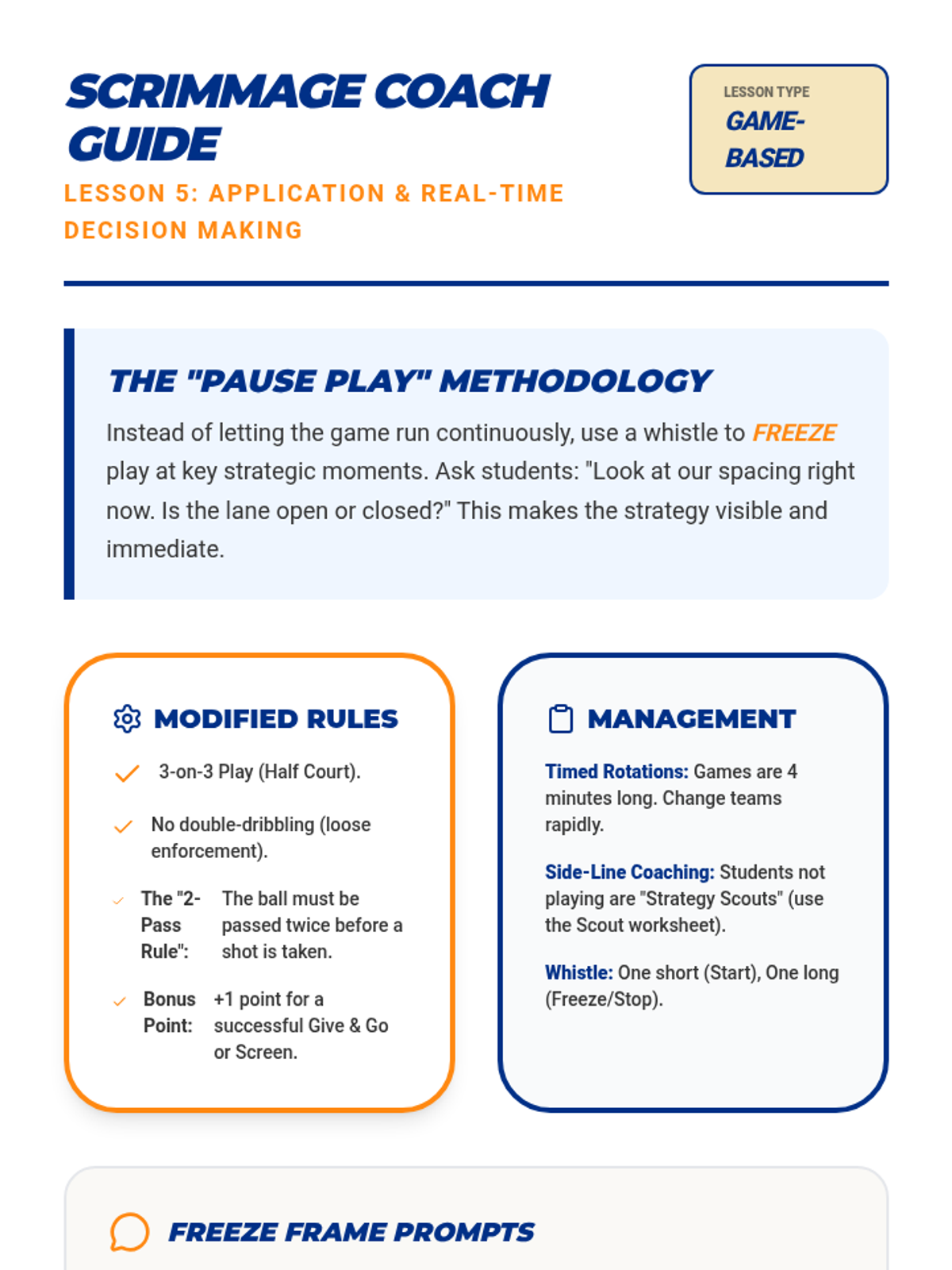
A tactical teacher guide for managing the Lesson 5 scrimmage. It details the 'Pause Play' coaching methodology, modified game rules (like the 2-Pass Rule), and specific discussion prompts to use during real-time gameplay to reinforce offensive strategy.
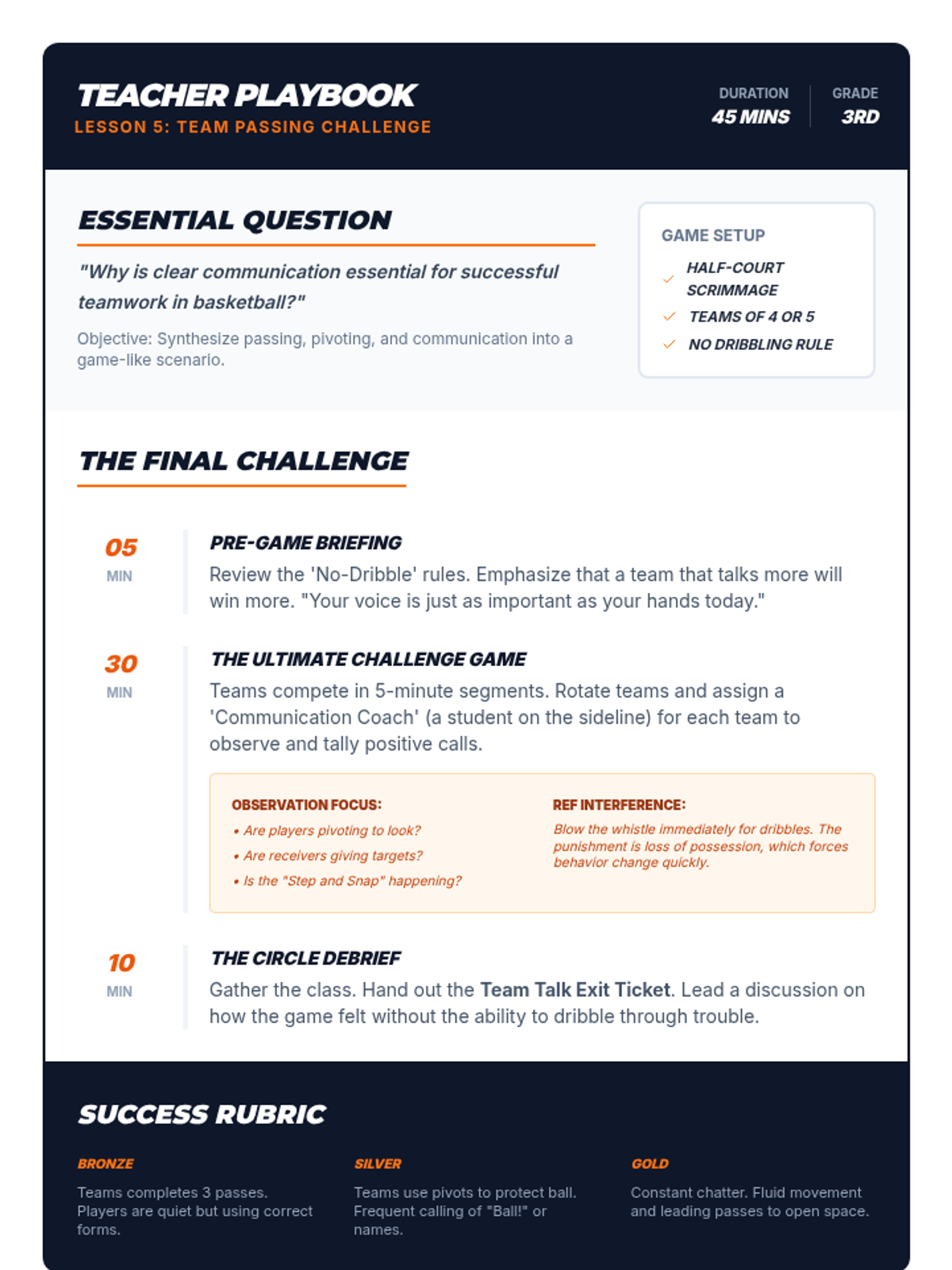
A teacher guide for the final lesson in the basketball sequence, covering 'No-Dribble' game management, observation focuses, and a success rubric.
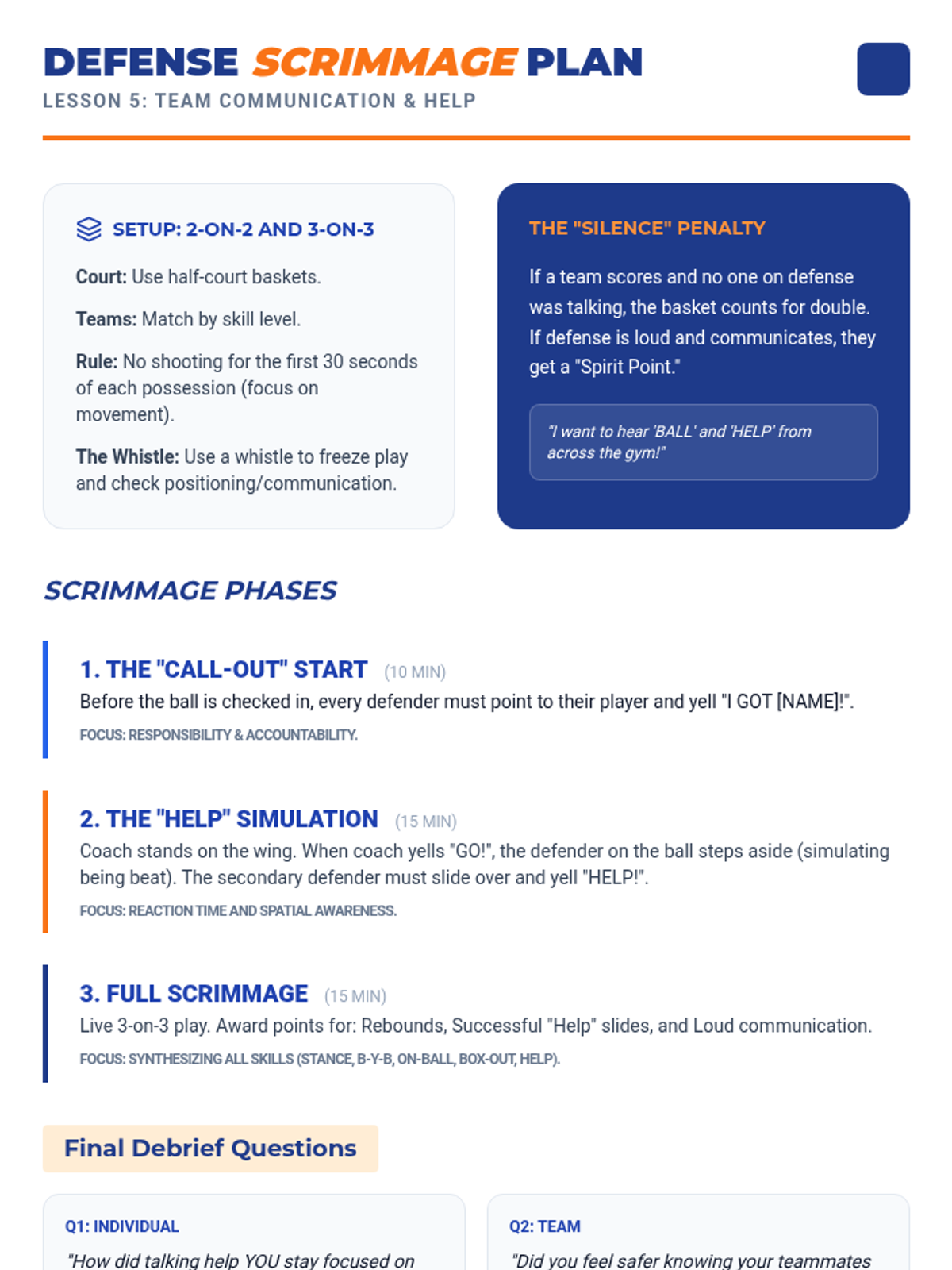
Teacher facilitation guide for the final lesson scrimmage. Includes scrimmage rules, phases of play, and a debrief framework to reinforce communication and help-defense concepts.
Final lesson slides for 3rd-grade basketball strategy, focusing on the 3-on-3 modified scrimmage. Introduces the 'Pause Play' rule for in-game coaching and emphasizes communication and the integration of all previously learned offensive skills.
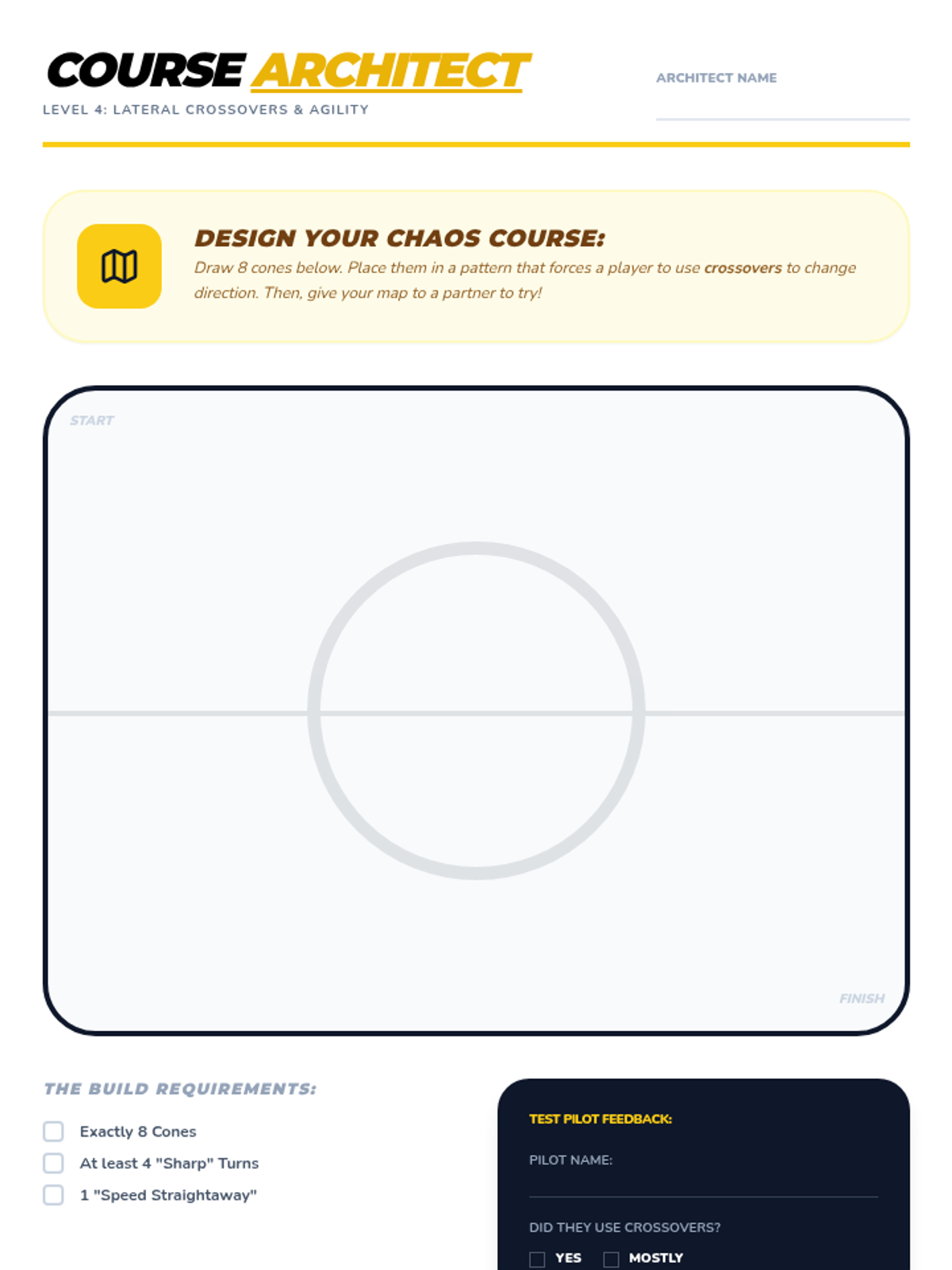
Student activity to design an obstacle course using crossovers, allowing for peer testing and feedback on directional changes.
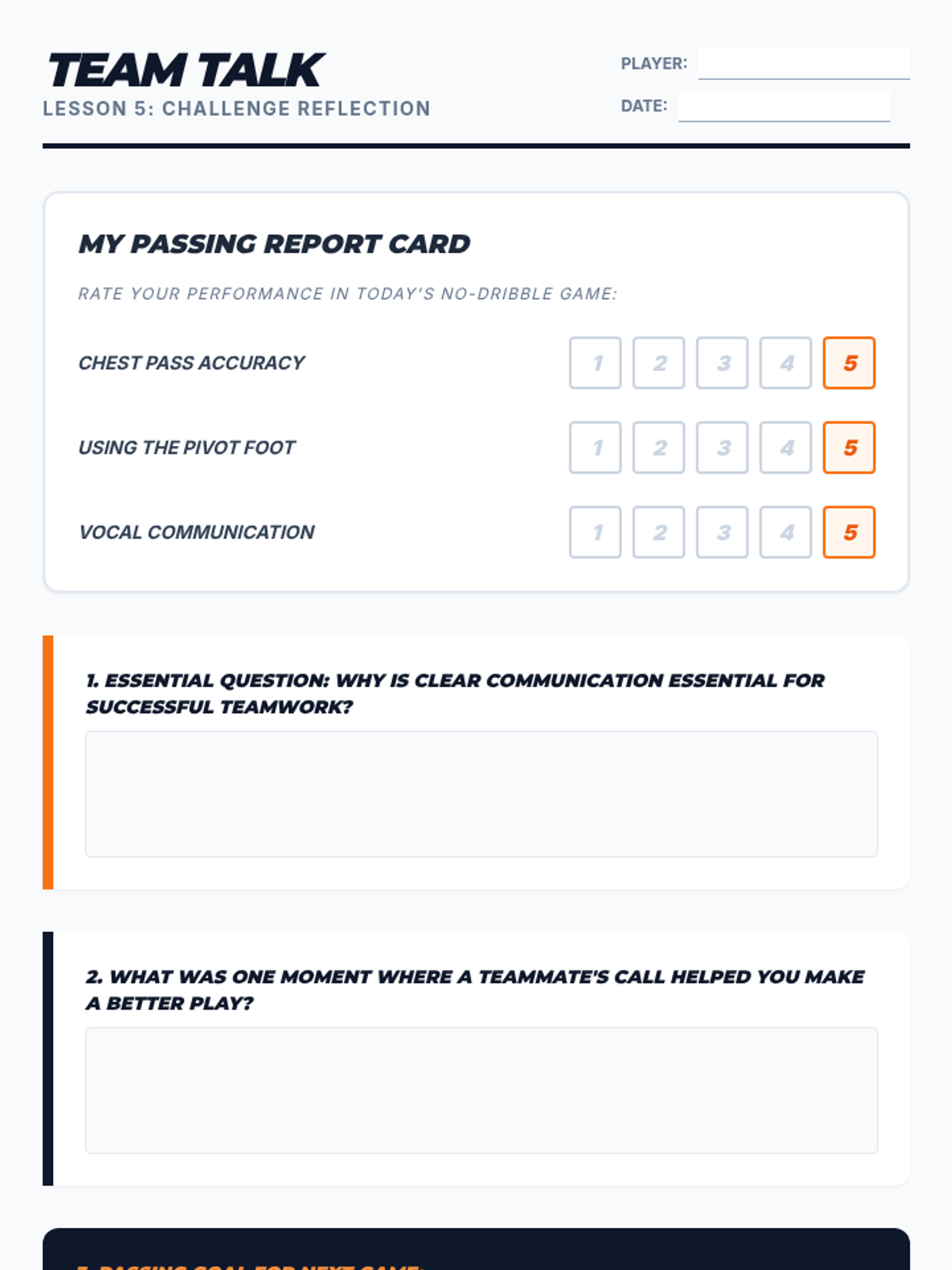
A student exit ticket and reflection sheet for the final lesson, featuring a skill self-assessment and reflection on communication and teamwork.
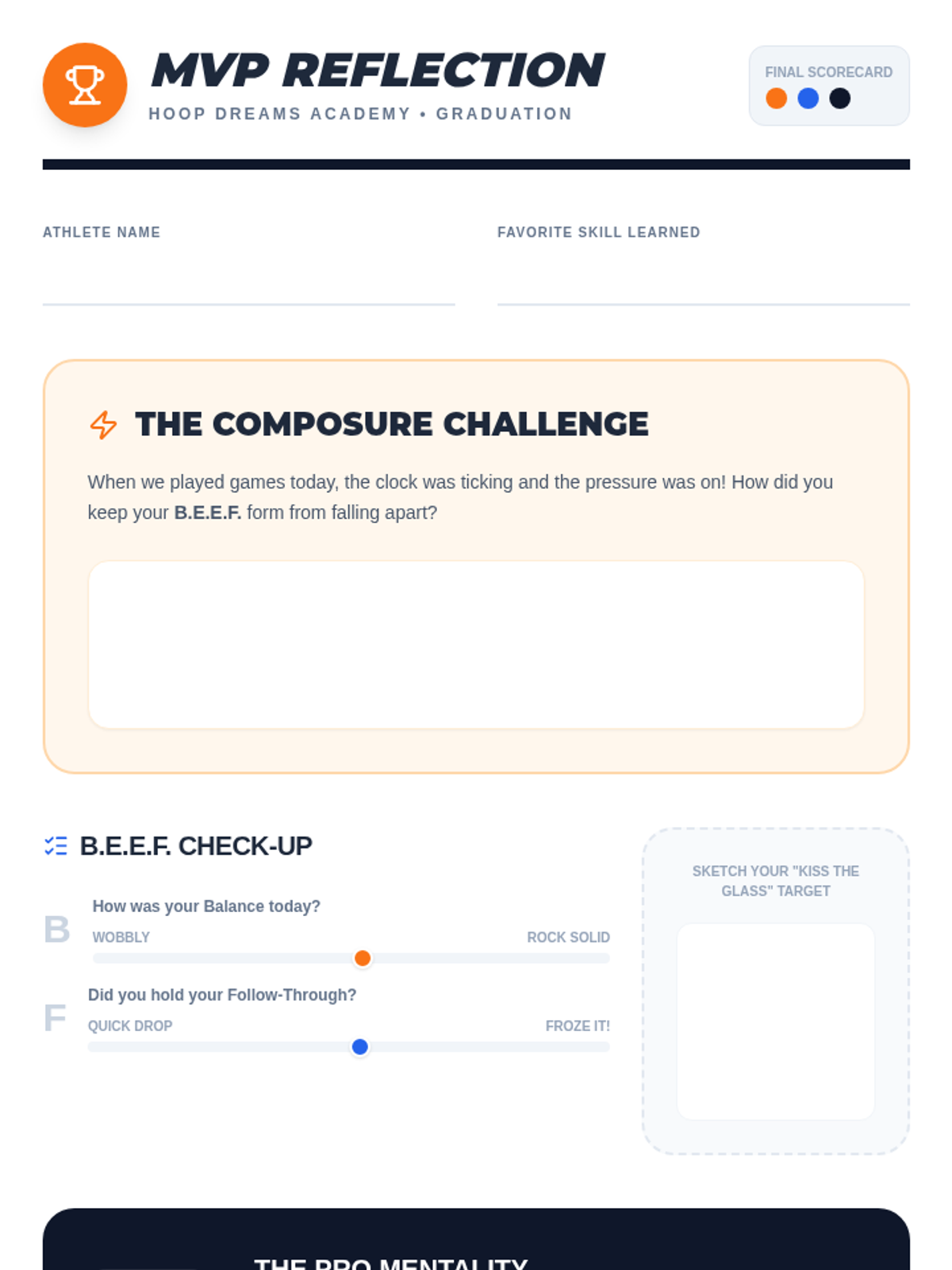
Student reflection worksheet for the final lesson, focusing on maintaining composure under pressure and self-assessing BEEF principles.
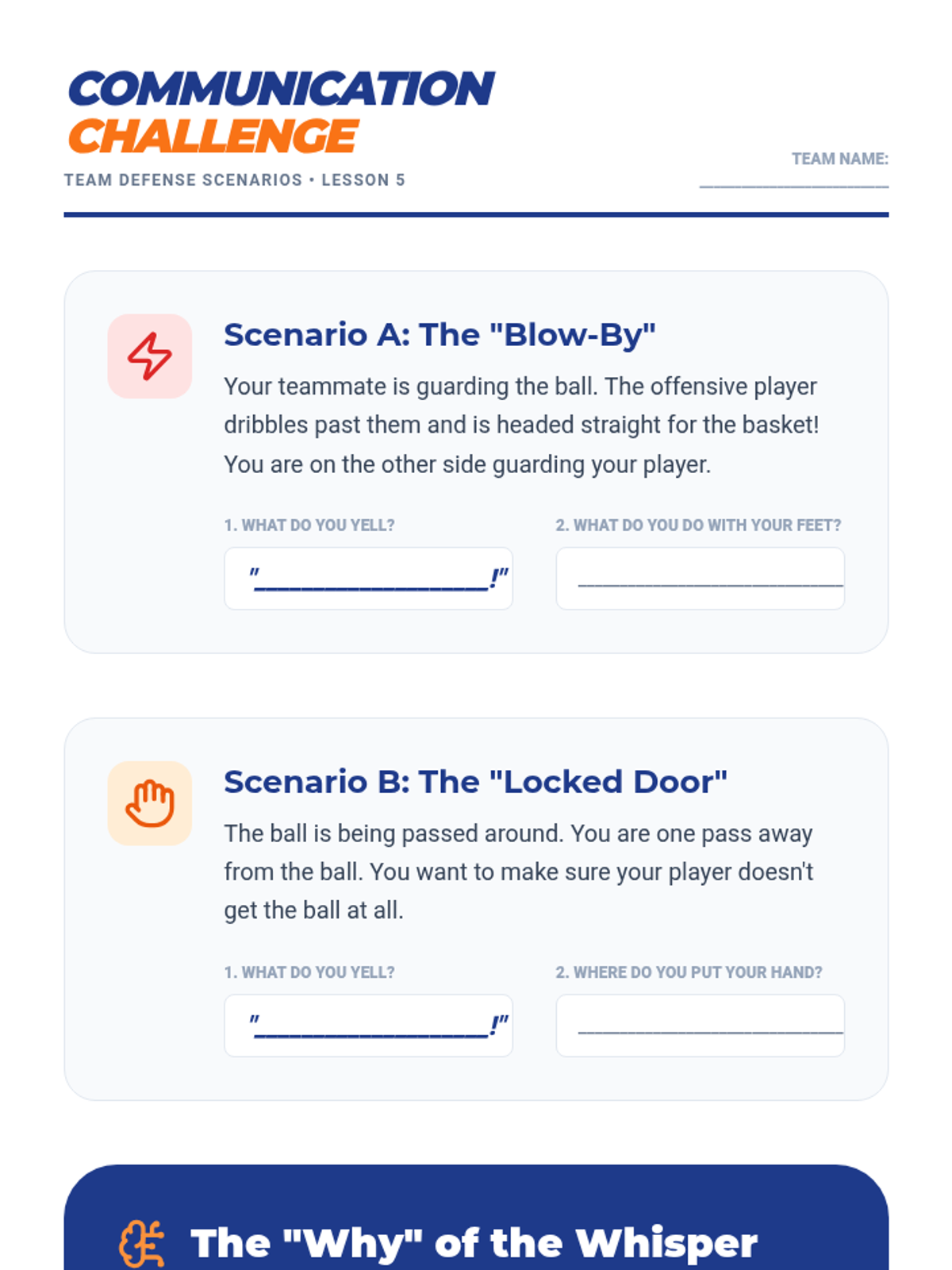
Student worksheet for the final lesson focusing on team communication scenarios. Students identify appropriate vocal calls and physical actions for 'help' and 'deny' situations.
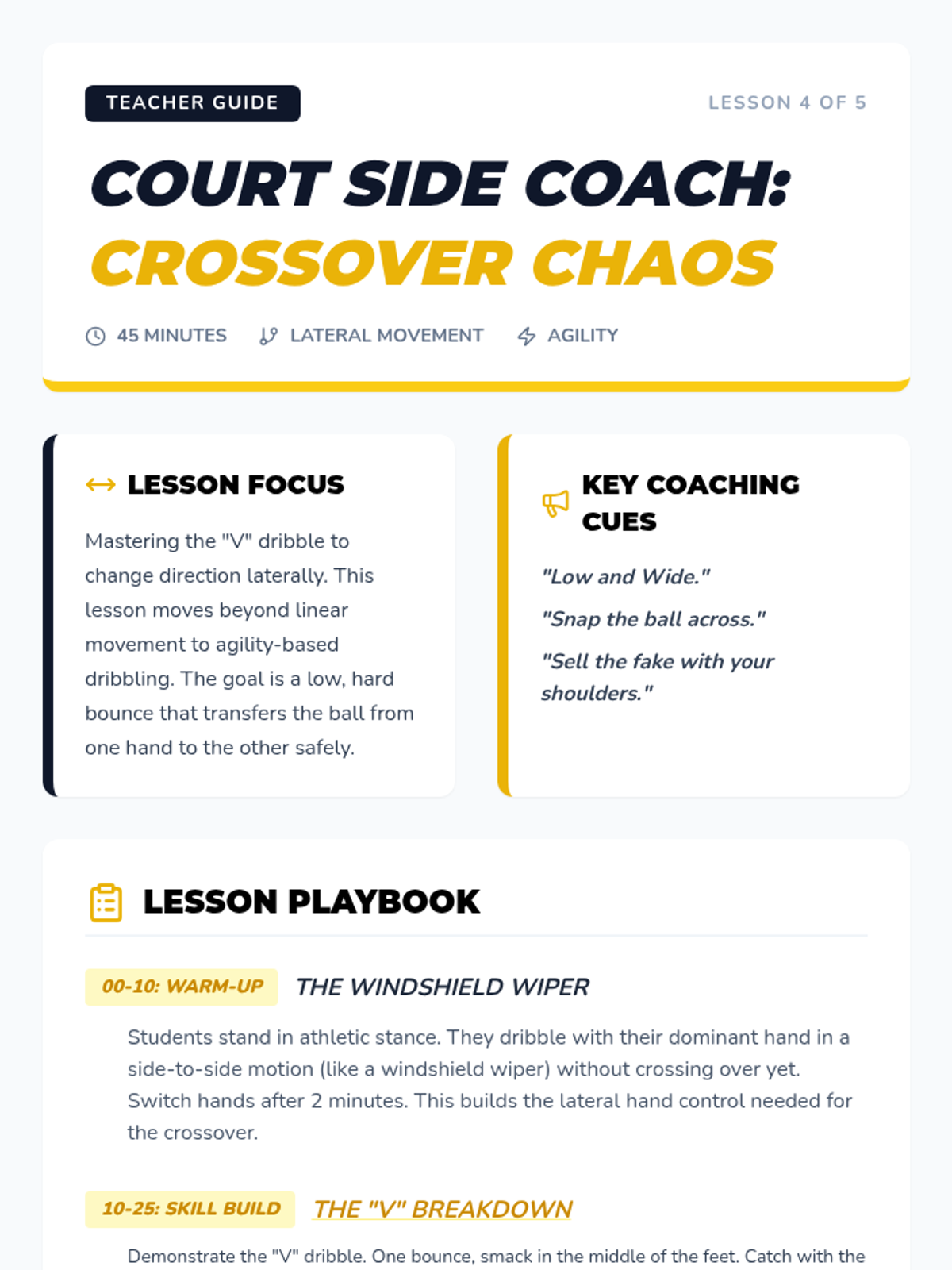
Teacher facilitation guide for Lesson 4, including drill instructions for the 'V' dribble, windshield wiper warm-up, and chaos course layout.
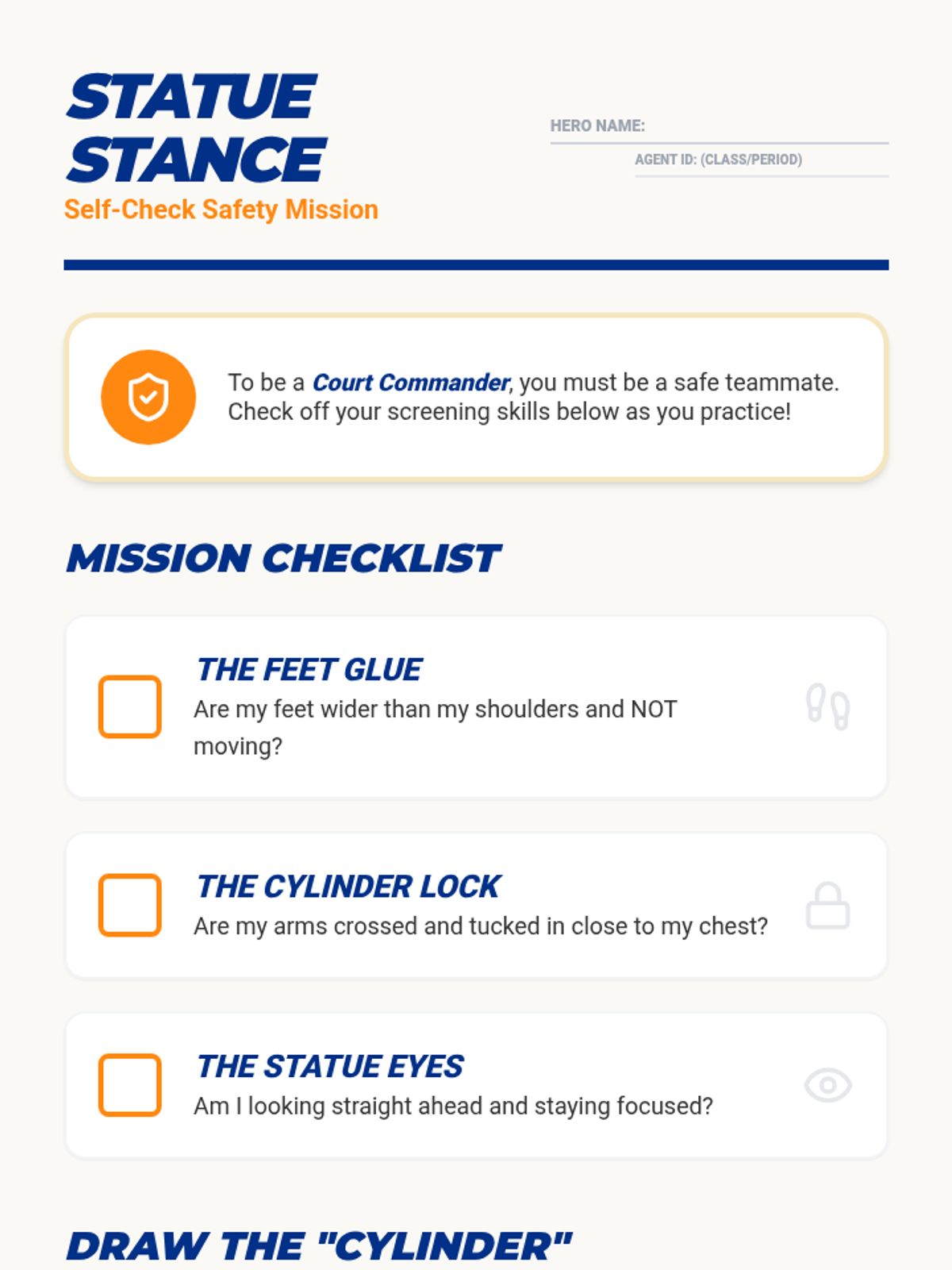
A 'Statue Stance' self-assessment checklist for 3rd-grade students to verify their own screening mechanics and safety. Includes a drawing activity for the Cylinder Principle and a reflection question on basketball rules.
Visual slides for the culminating Lesson 5 'No-Dribble' challenge, outlining game rules, communication strategies, and post-game reflection questions.
Instructional slides for the final lesson on team defense. Introduces communication calls ('Ball', 'Deny', 'Help') and the concept of 'help side' positioning.
Visual presentation for Lesson 5, focusing on applying shooting mechanics under pressure through games and reflection on composure.
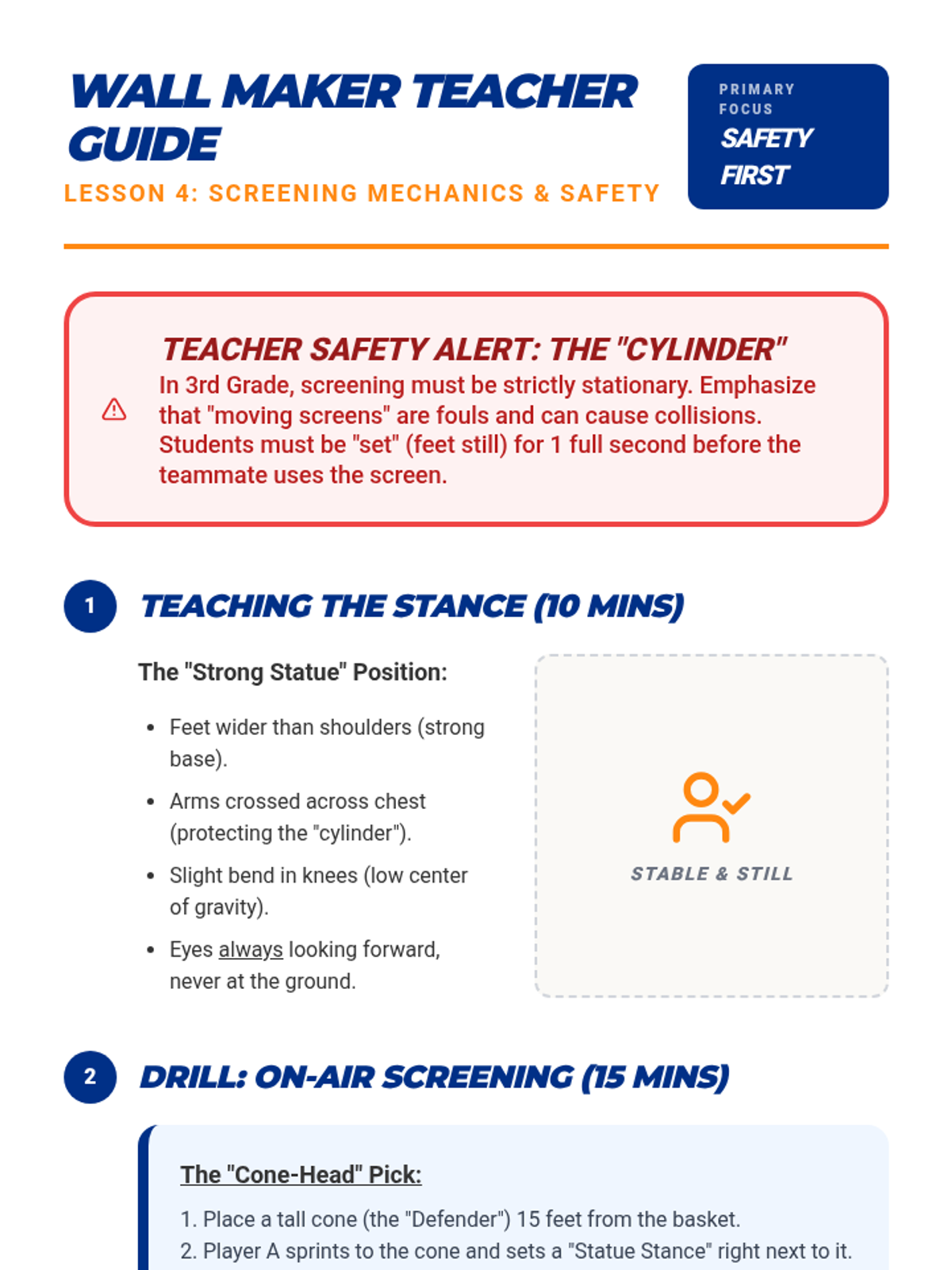
A specialized teacher guide for Lesson 4 (Screening), with a major focus on safety protocols and the 'Cylinder' principle. Includes a 'Cone-Head' pick drill, instructional scripts for correcting student stance, and safety alerts for the teacher.
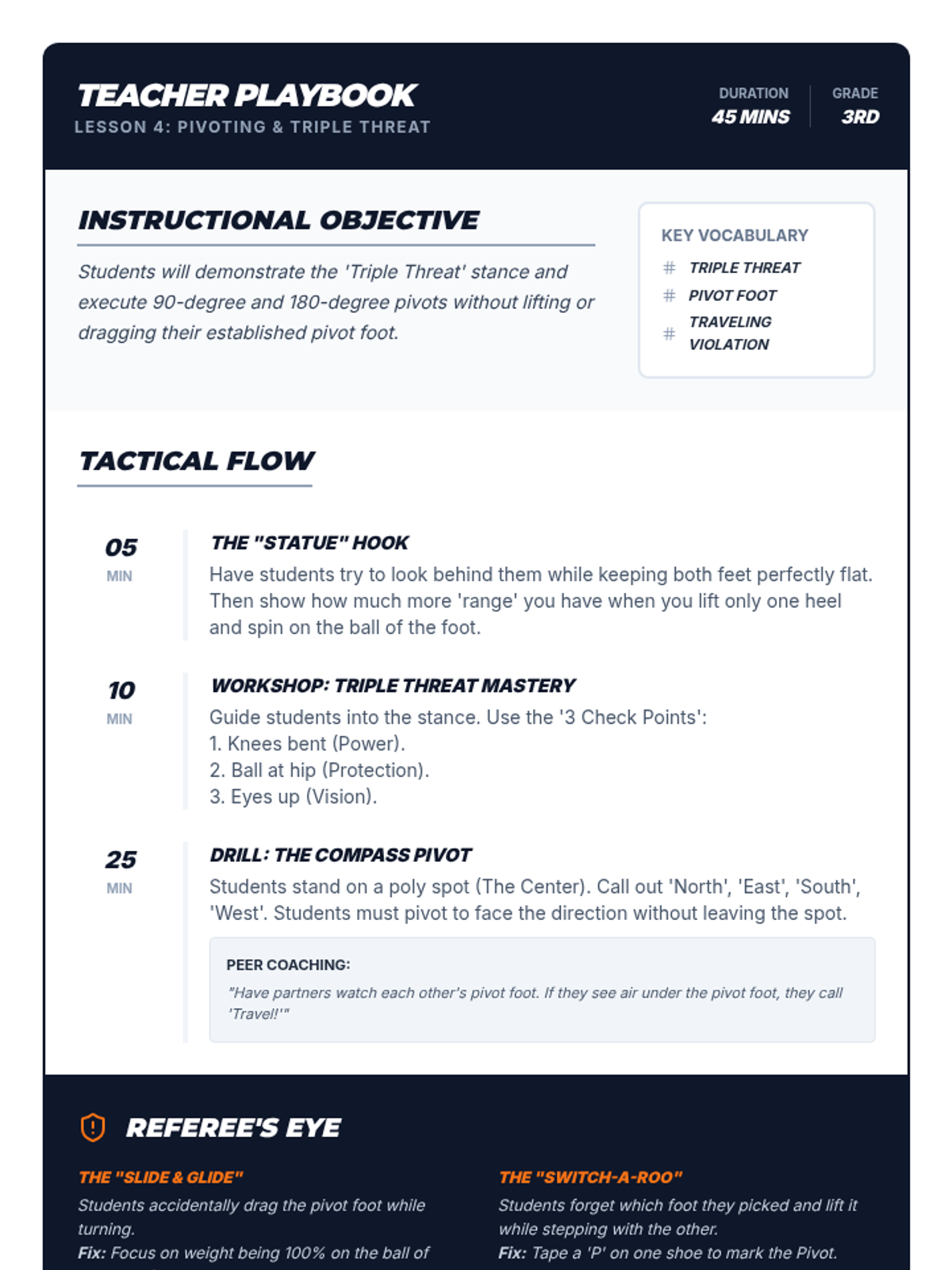
A teacher guide for Lesson 4 on pivoting and Triple Threat stance, including drill setup, peer coaching cues, and common violation corrections.
Visual presentation for Lesson 4, breaking down the mechanics of the crossover 'V' dribble and emphasizing eye positioning.
Engaging visual presentation for students to learn the rules, motor skill objectives, and sportsmanship expectations of the Relay Rumble.
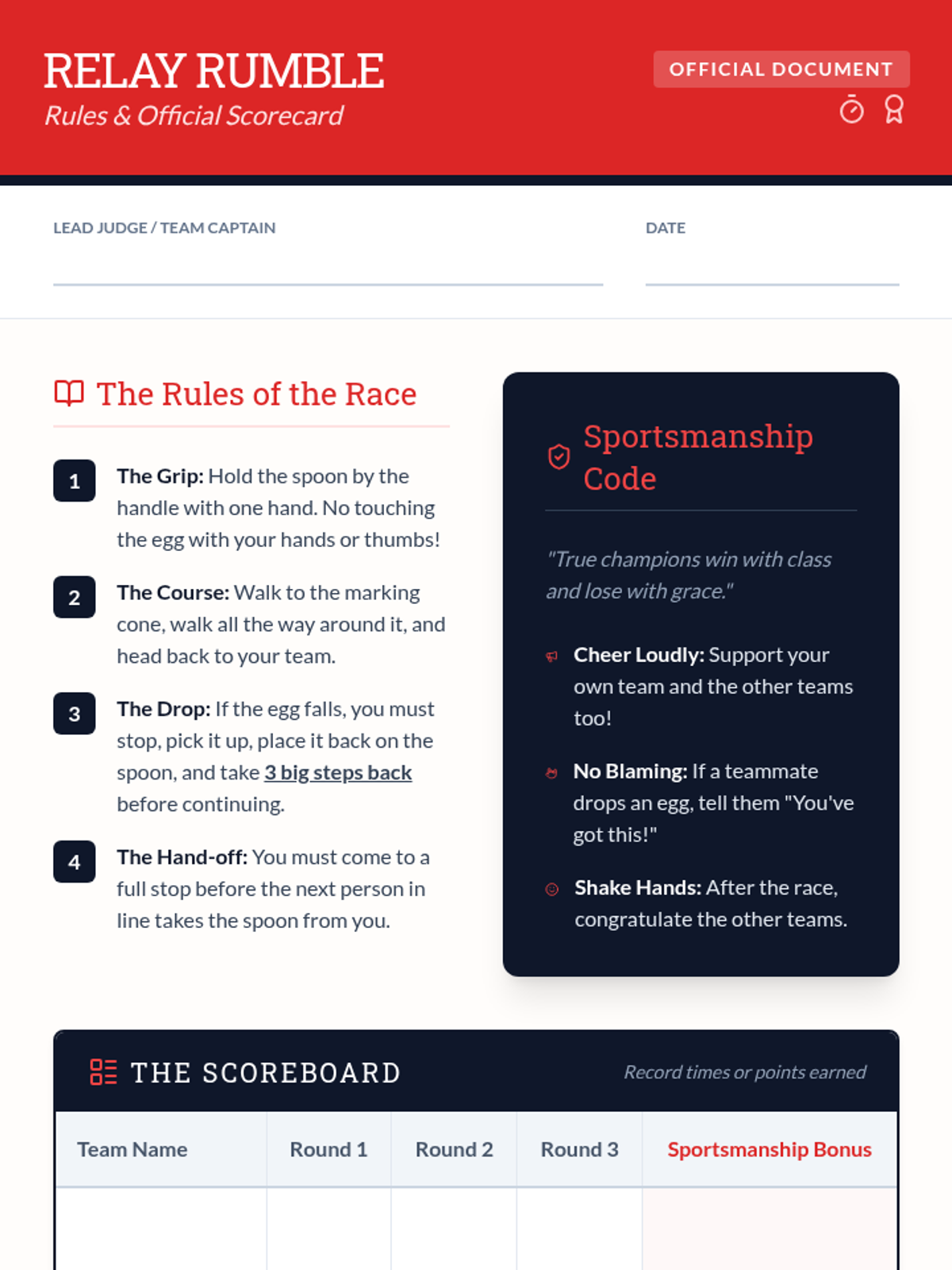
A student-friendly rule sheet and team scorecard for the Relay Rumble, featuring clear instructions and a space to record points for racing and sportsmanship.
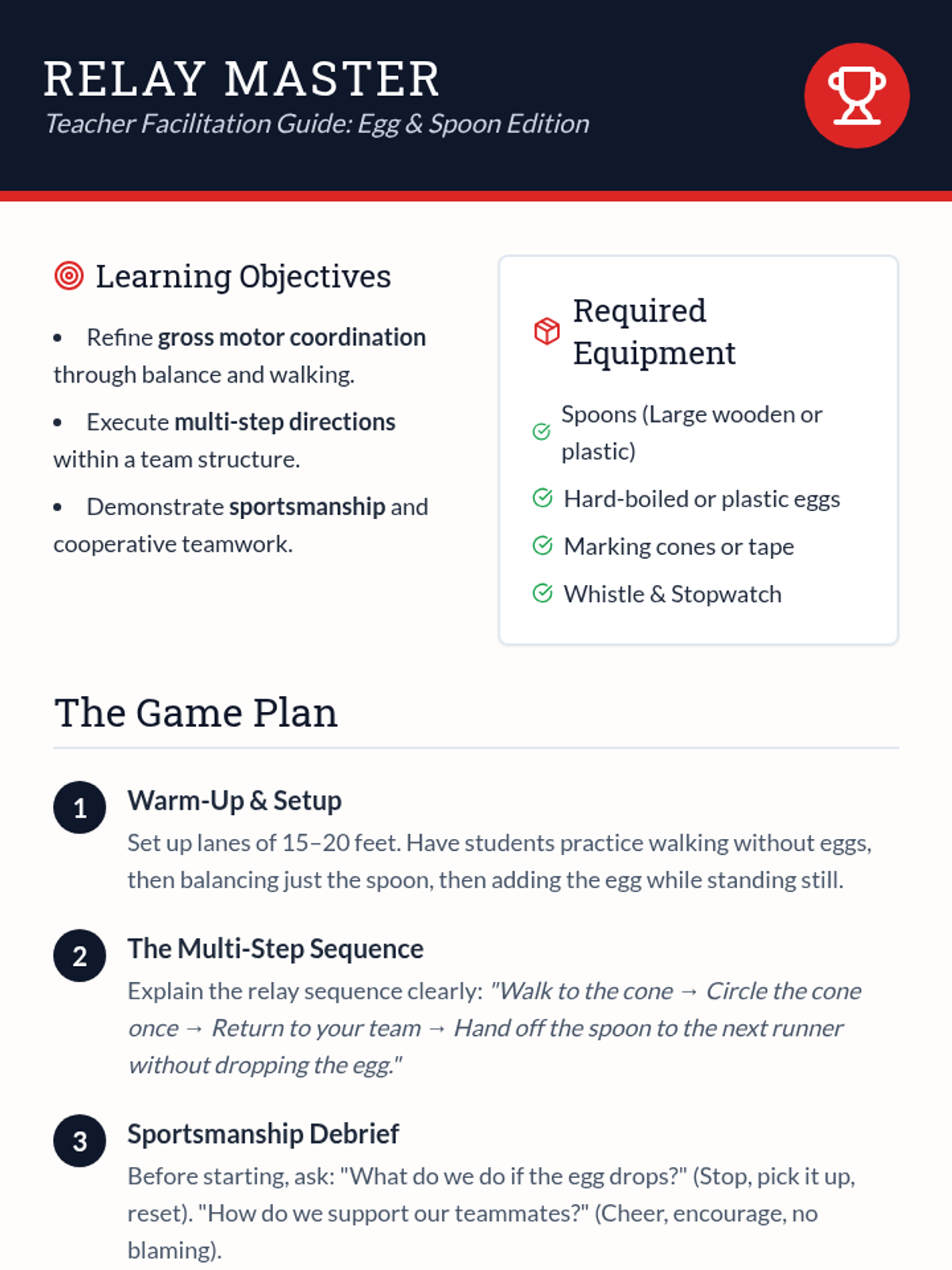
A comprehensive lesson plan for teachers detailing the setup, instructions, and adaptations for an egg and spoon relay race, with a focus on gross motor skills and sportsmanship.
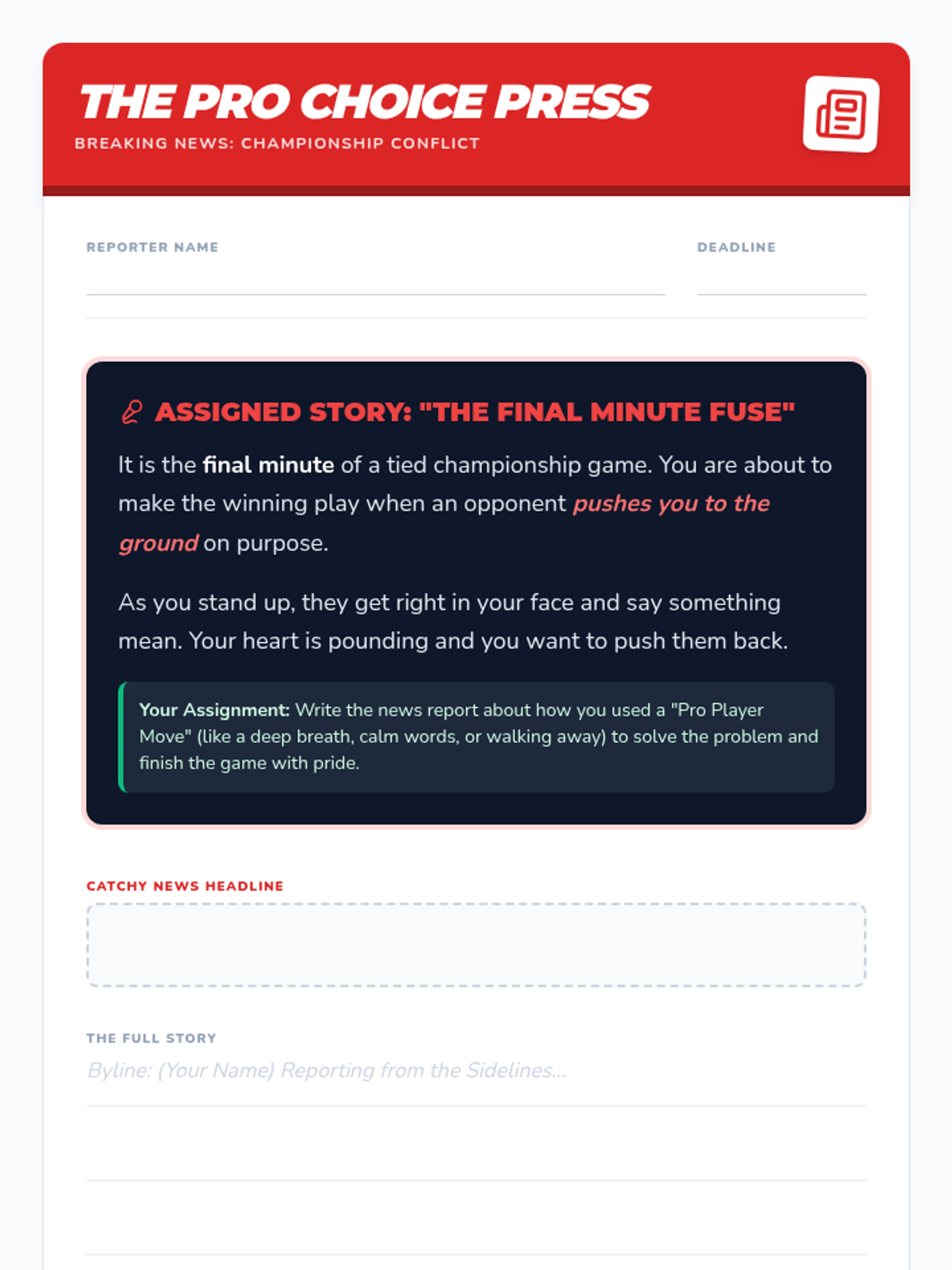
A specific creative writing assignment where 3rd graders act as reporters covering a high-stakes "final minute" conflict and how a player chose a peaceful resolution.
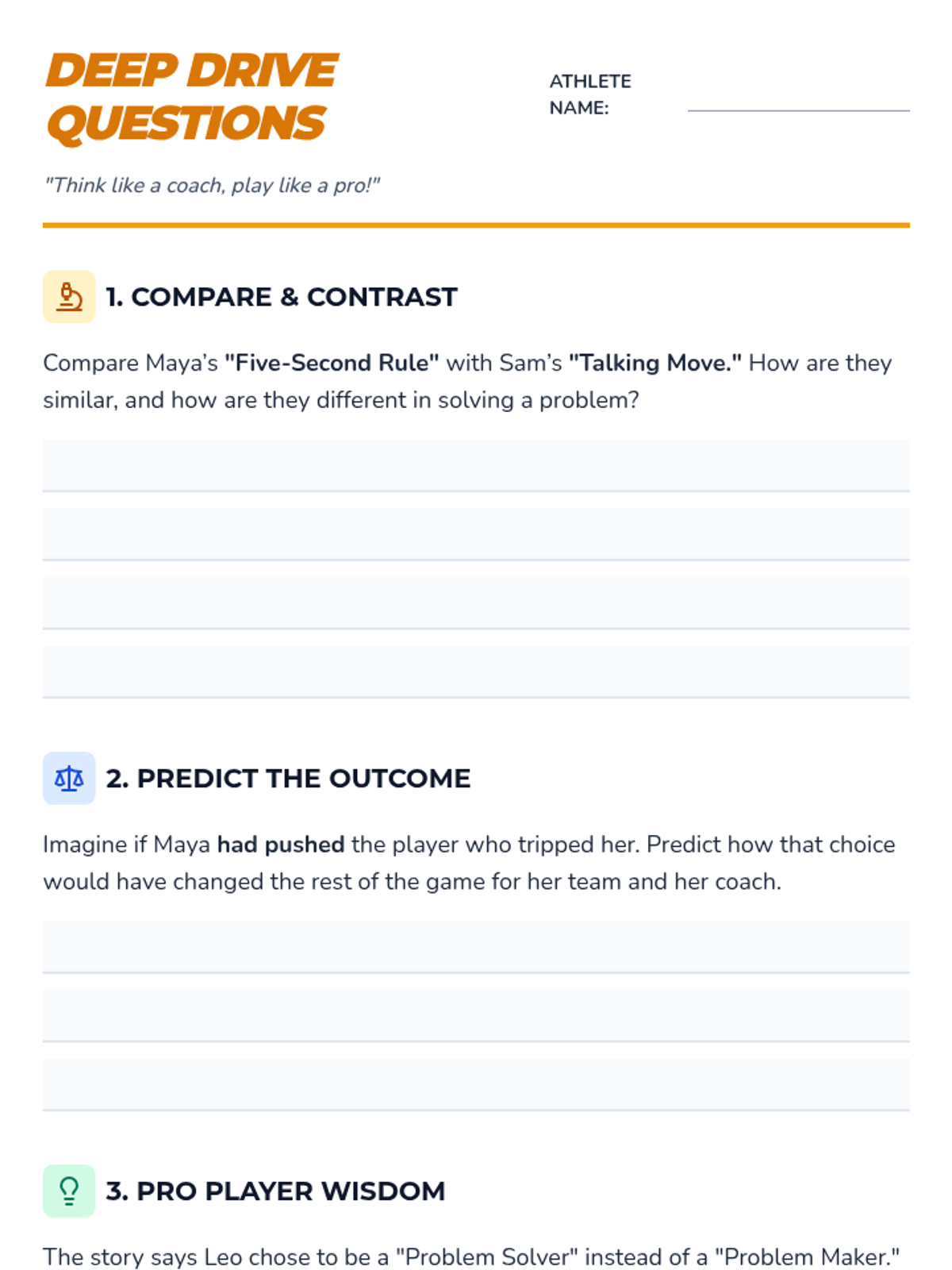
A worksheet featuring higher-order thinking questions (analysis, evaluation, and synthesis) based on the "Championship Choice" reading passage for 3rd graders.
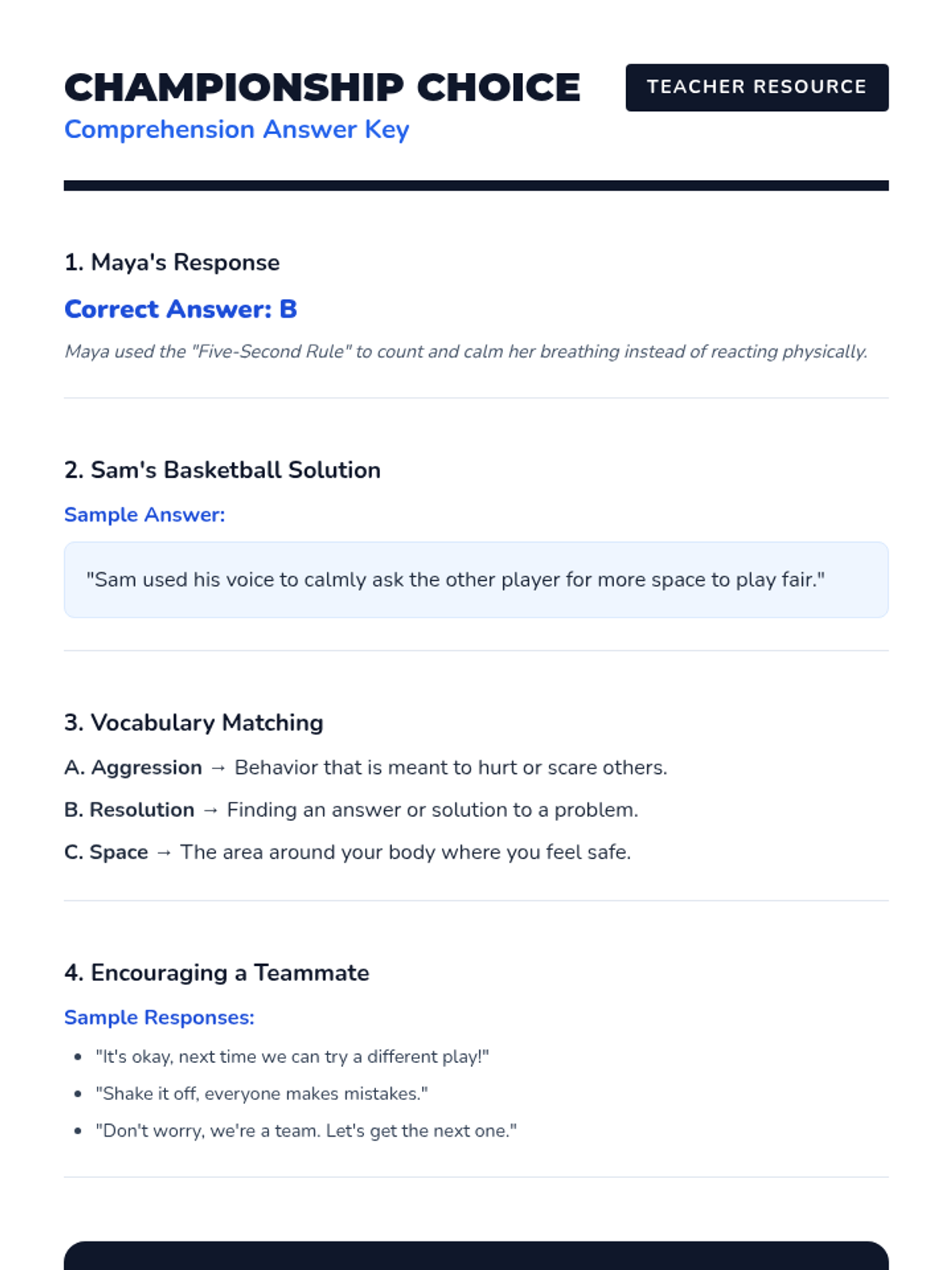
The teacher answer key for the "Championship Choice" comprehension worksheet.
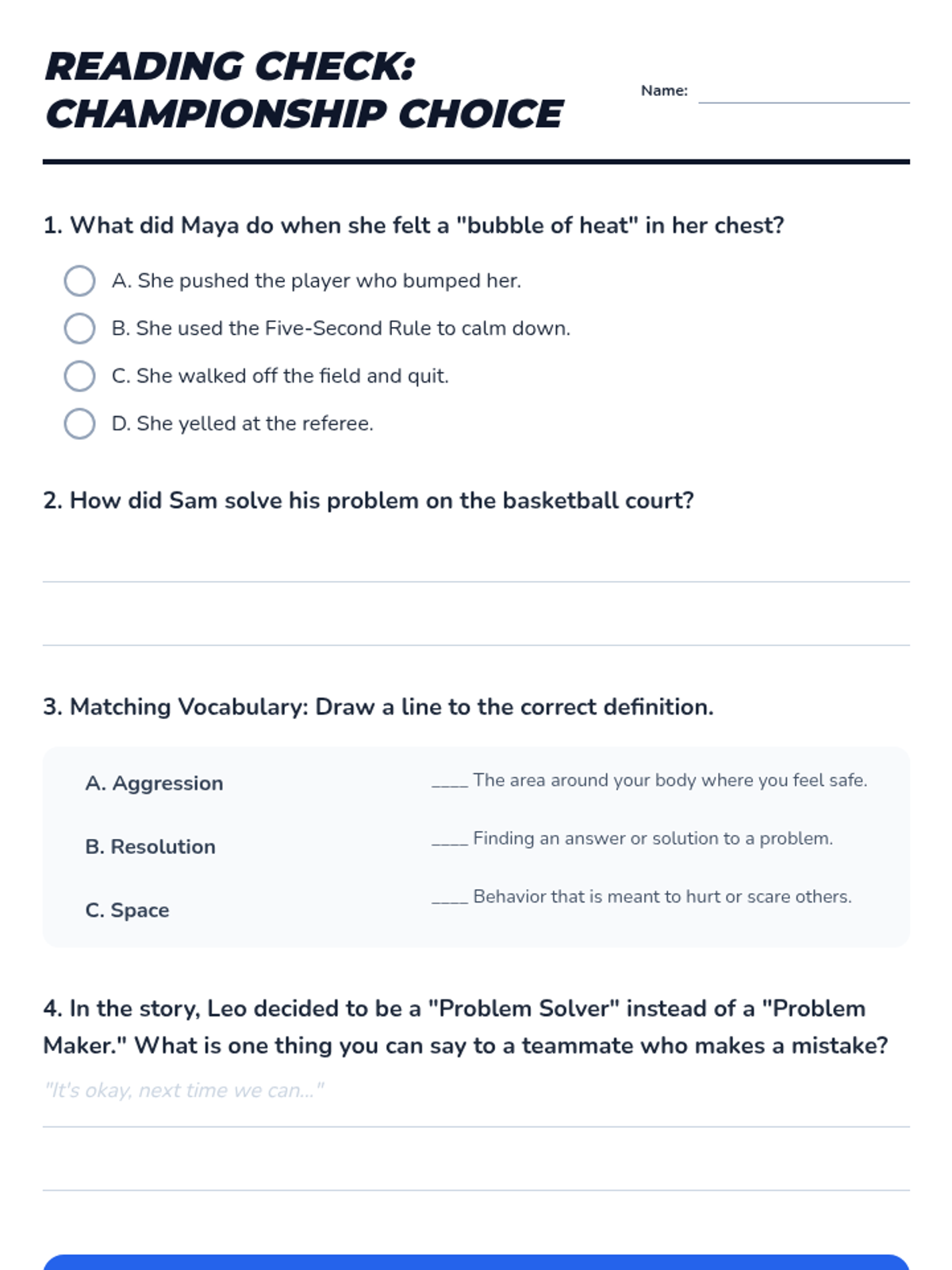
A comprehension worksheet for the "Championship Choice" reading passage, featuring multiple choice, matching, and short answer questions for 3rd graders.
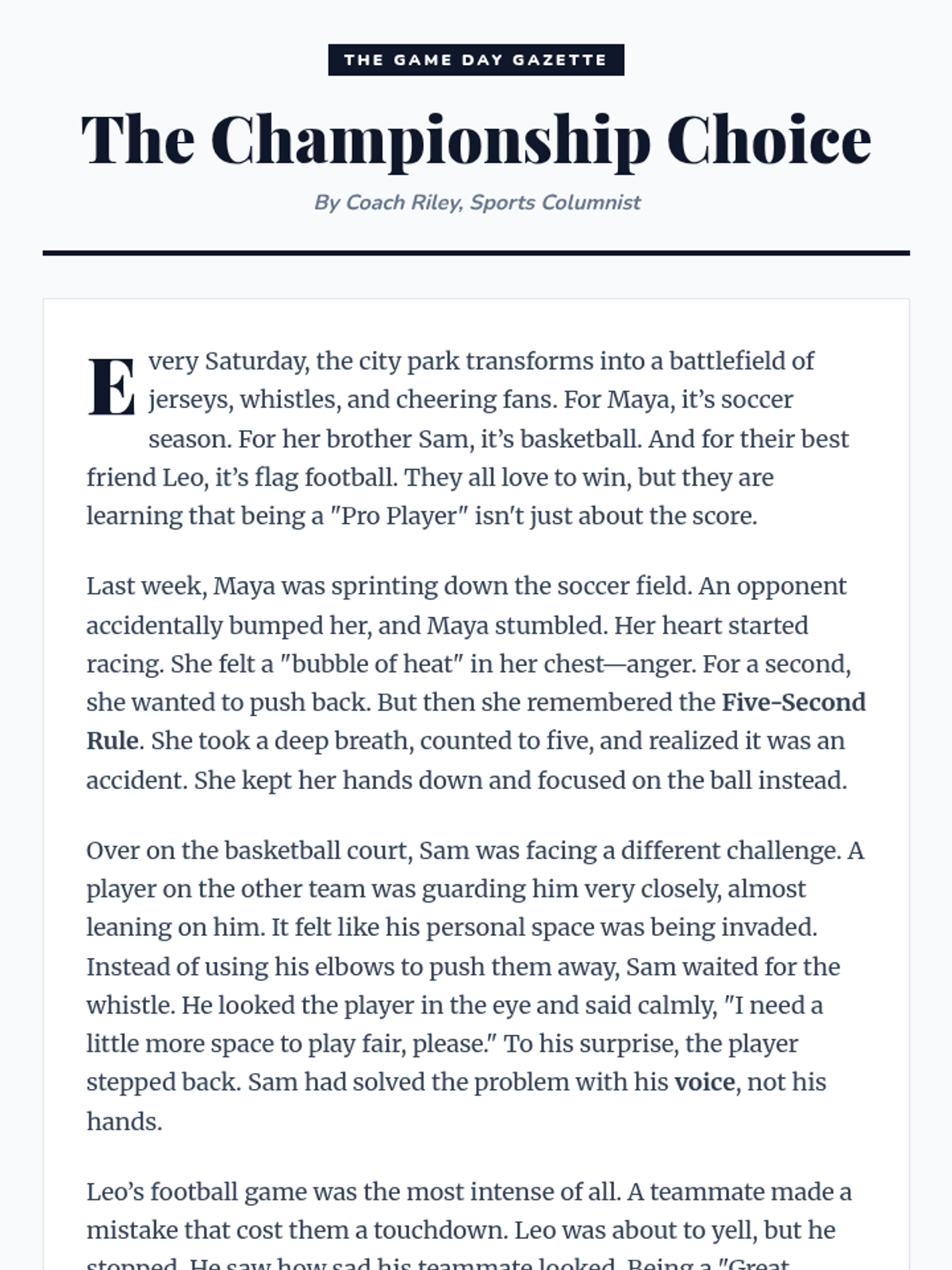
A news-style reading passage for 3rd graders about three friends practicing sportsmanship and problem-solving in soccer, basketball, and football.
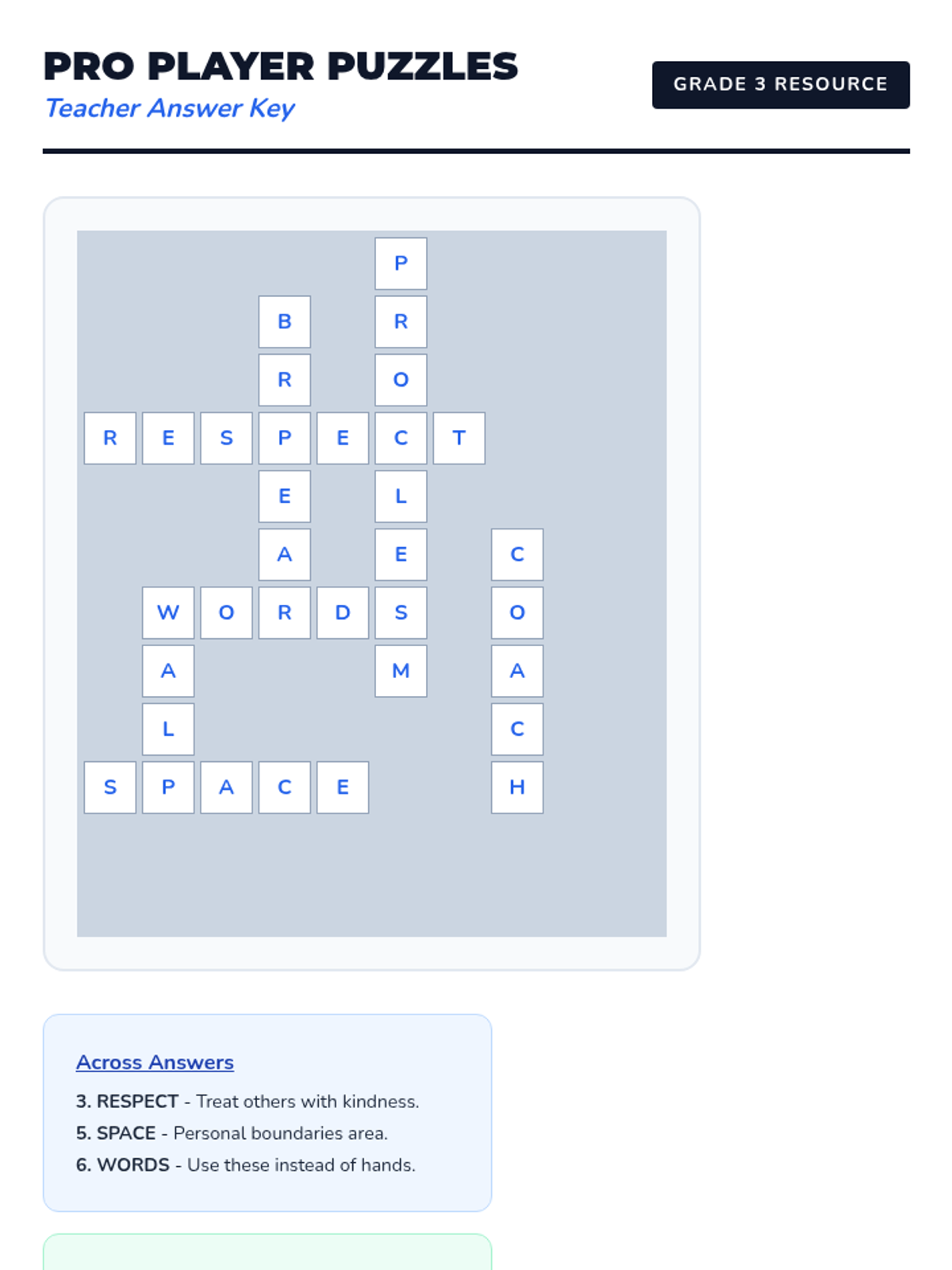
The teacher answer key for the Fair Play Crossword, featuring the completed grid and discussion starters for vocabulary words.
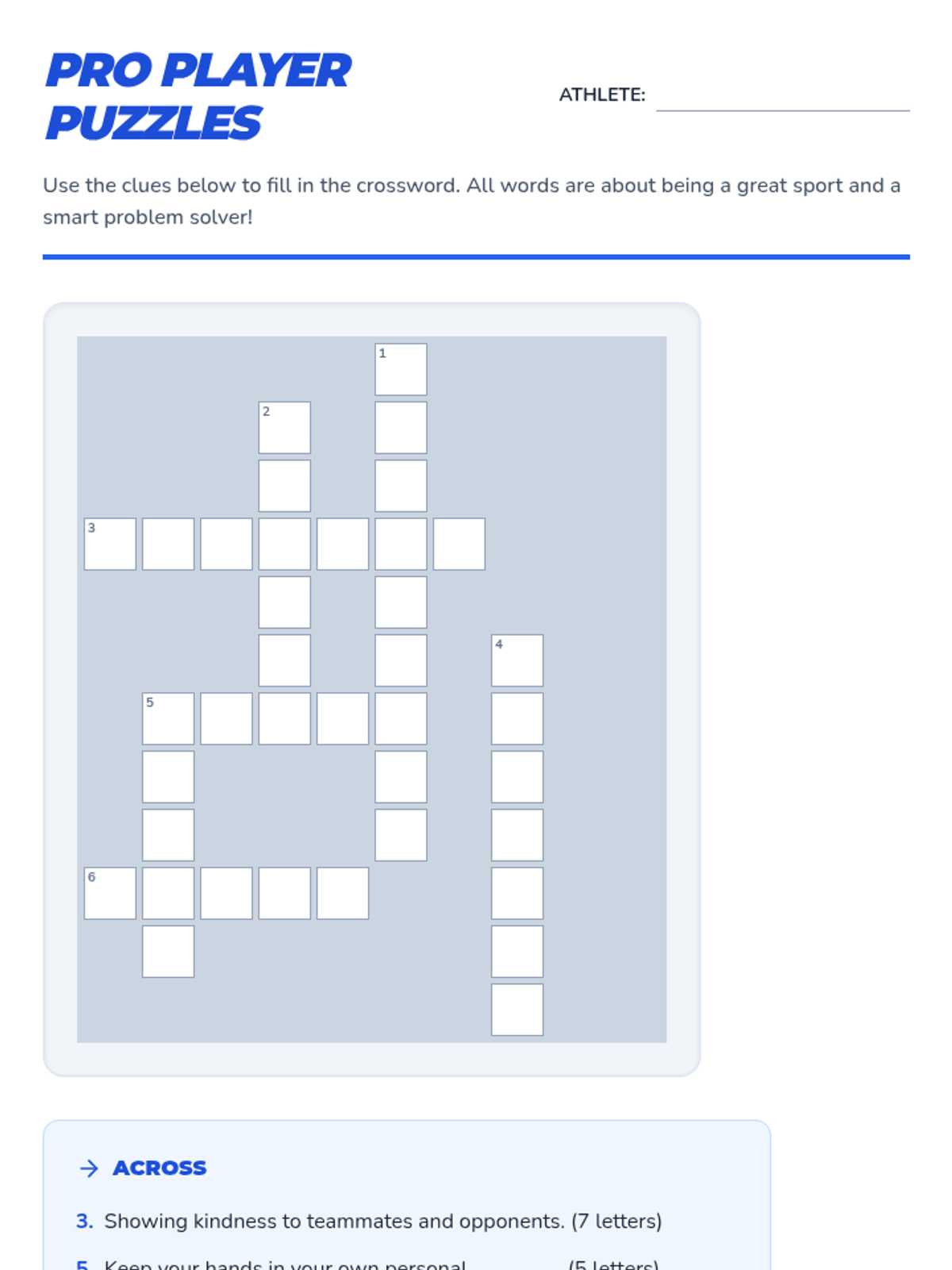
A crossword puzzle for 3rd graders focused on sportsmanship vocabulary, problem-solving, and self-regulation terms.
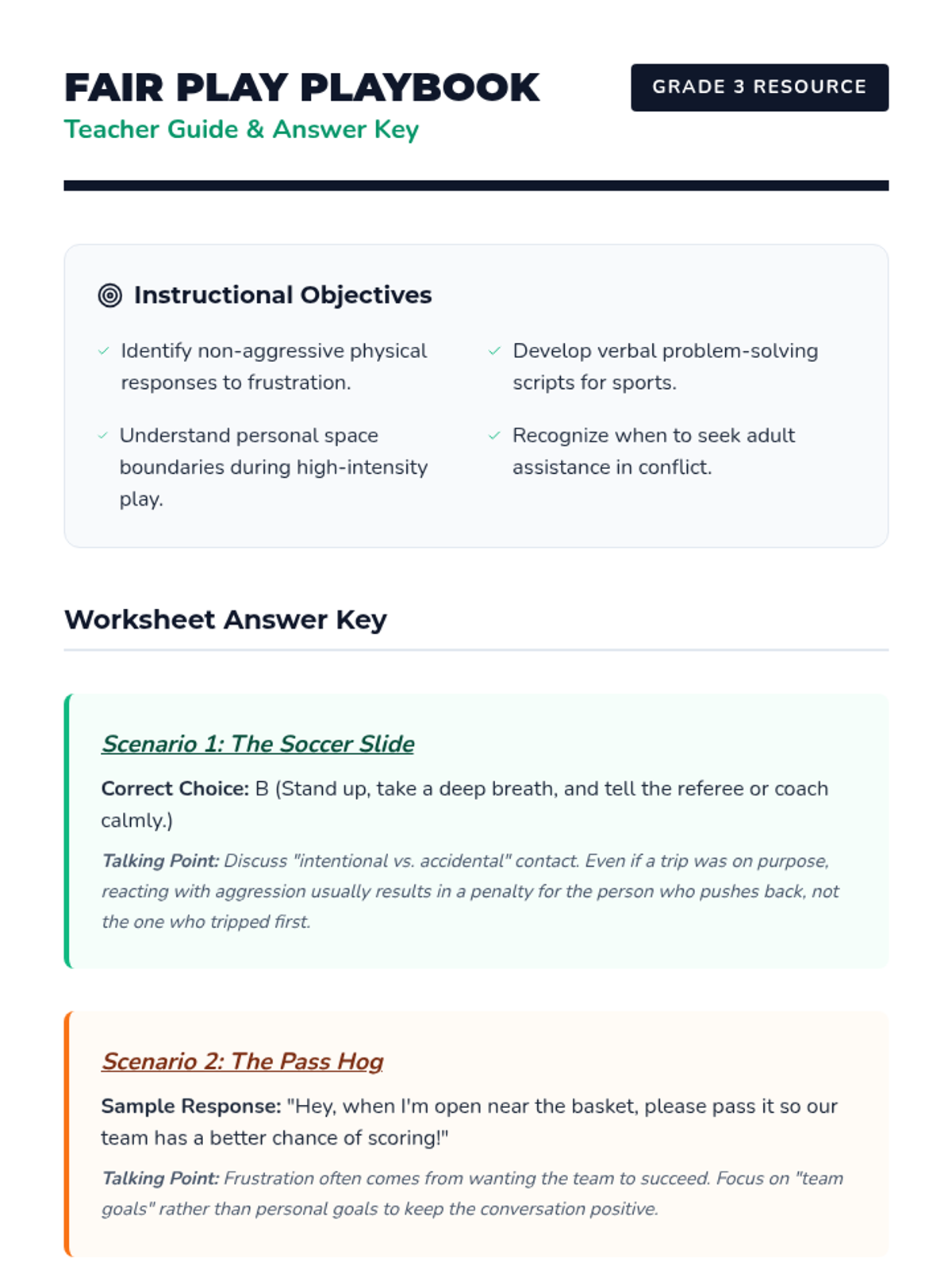
A teacher guide and answer key for the Fair Play Playbook materials, including discussion points, instructional goals, and facilitation tips for 3rd grade sportsmanship.
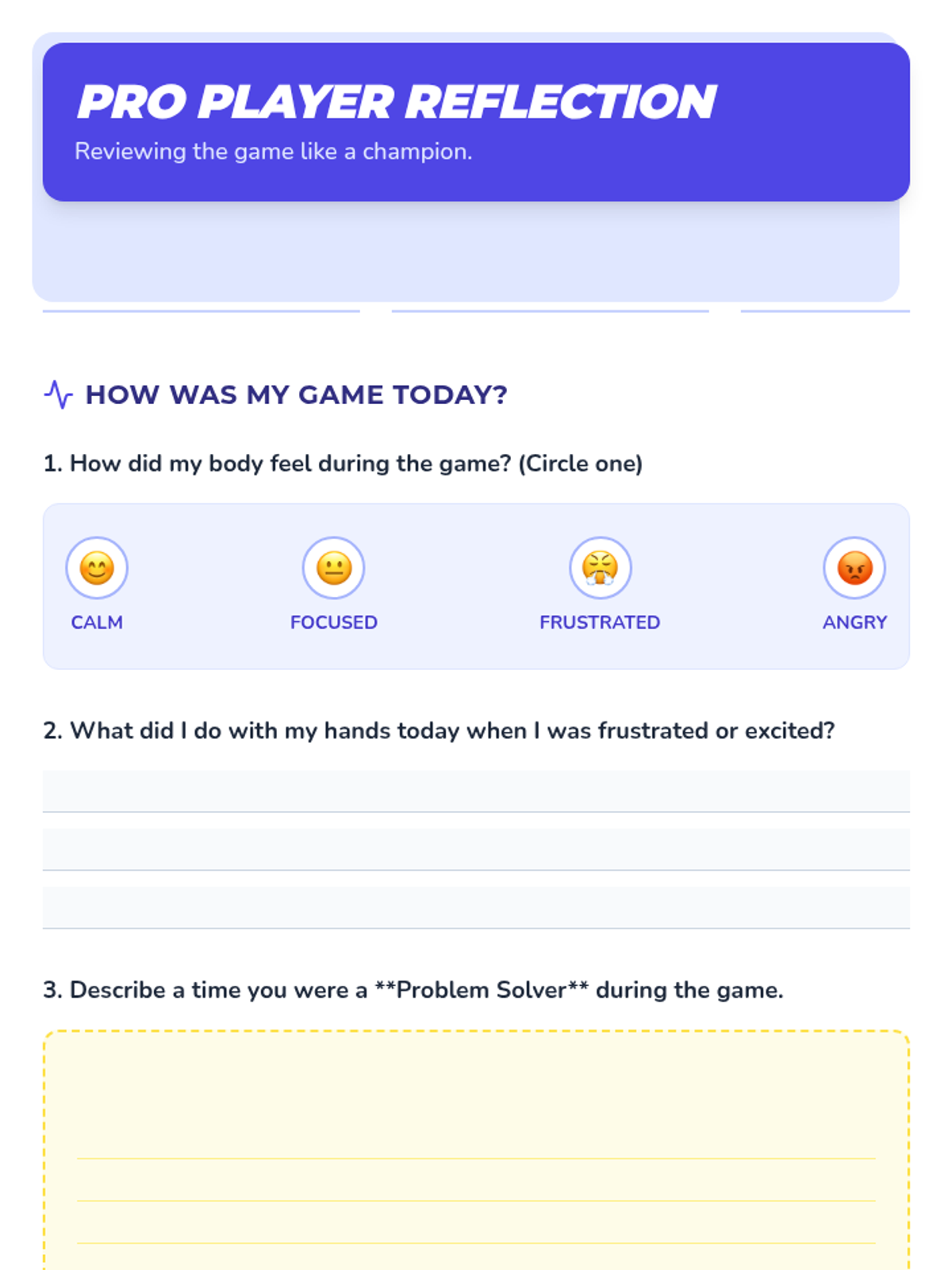
A reflection journal sheet for 3rd graders to self-assess their behavior, physical boundary awareness, and problem-solving skills after participating in sports.
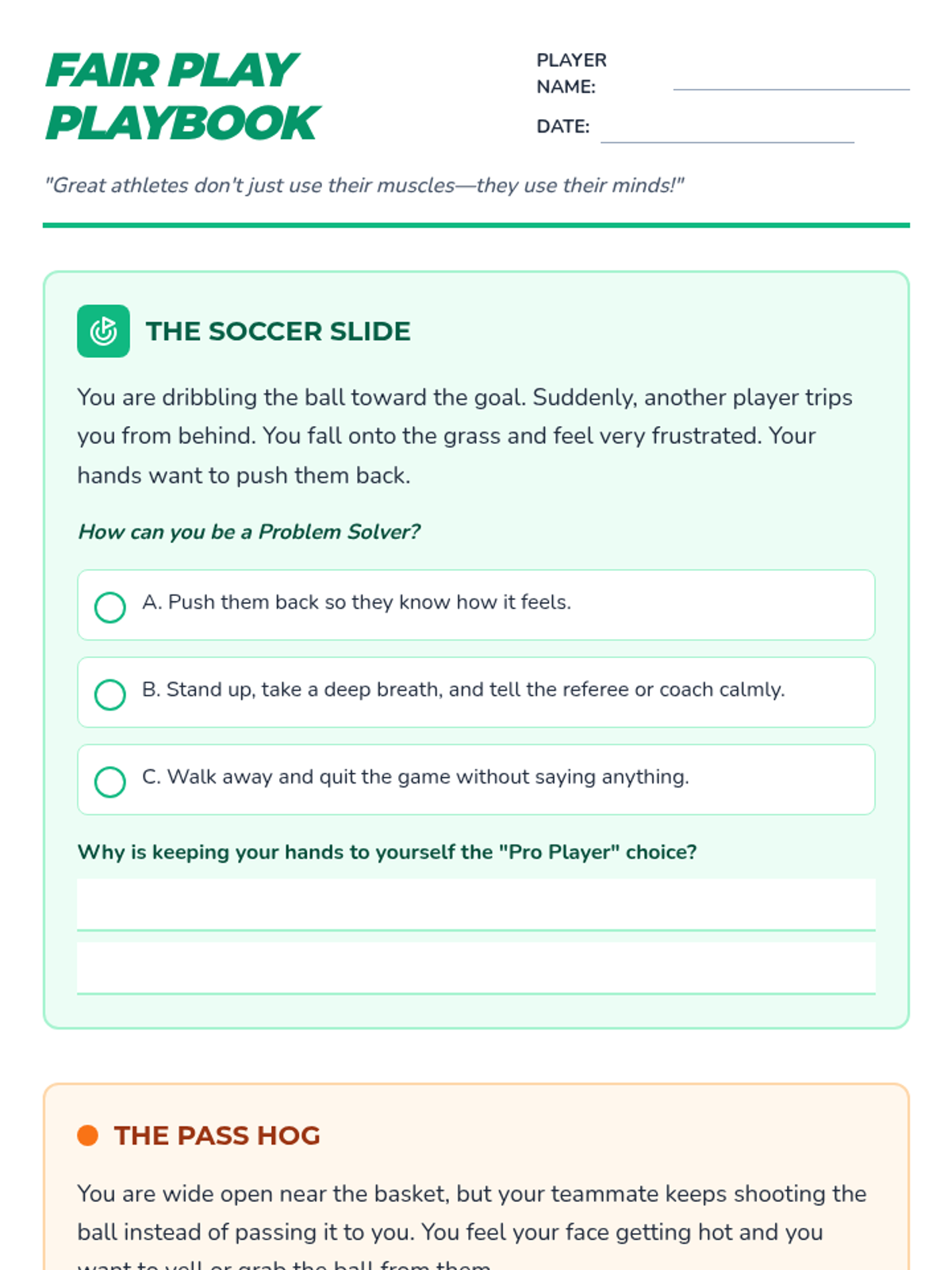
A worksheet for 3rd graders featuring sports scenarios (soccer, basketball, football) that require problem-solving and self-regulation to avoid aggression and physical contact.
Visual presentation for Lesson 4 on the Give-and-Go (Wall Pass). Breaks down the three steps of the movement and highlights the importance of communication and timing.
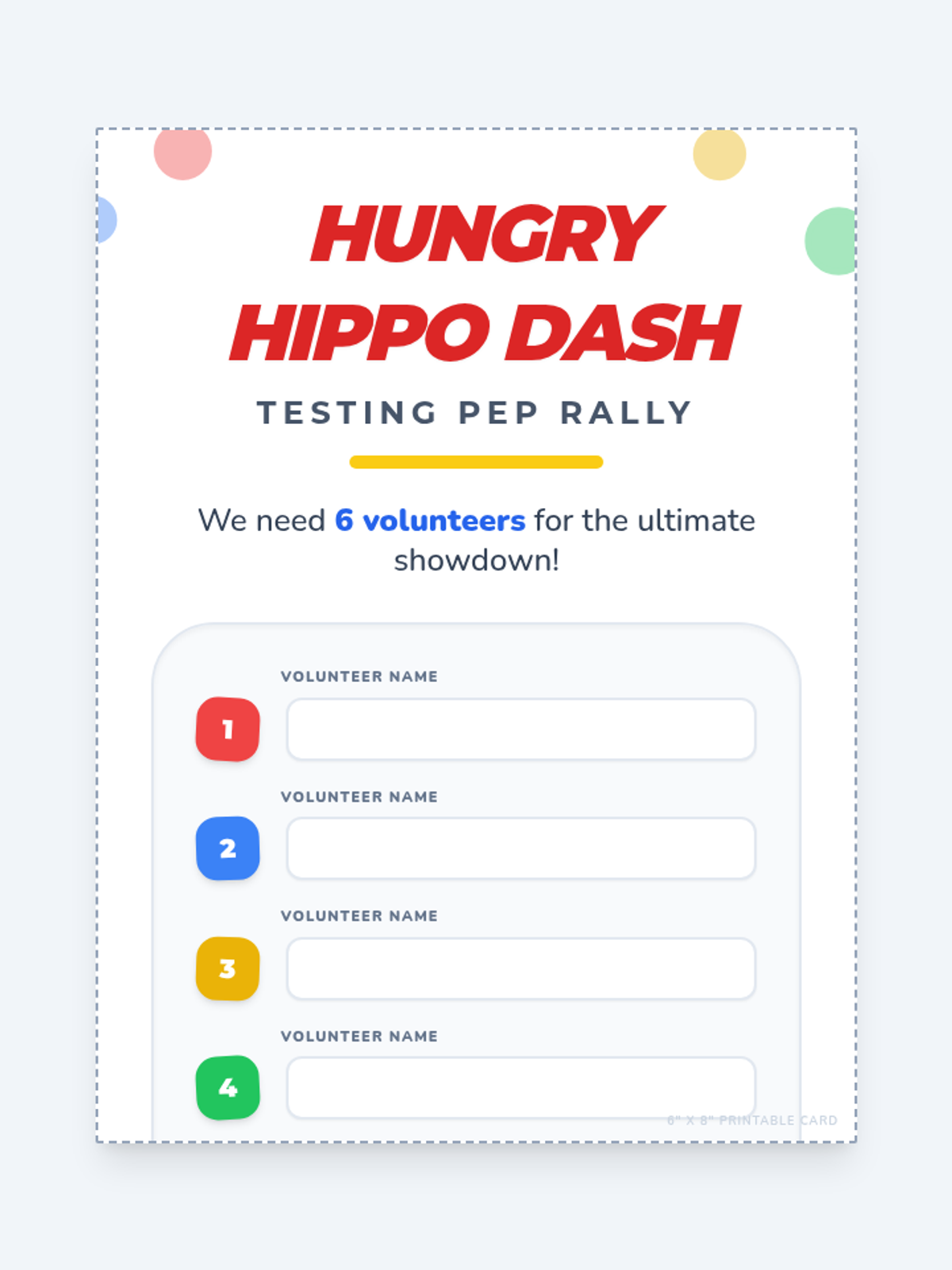
A colorful 6x8 inch volunteer sign-up card for 'Hungry Hippo Dash', designed to be printed and cut, featuring 6 slots for volunteer names.
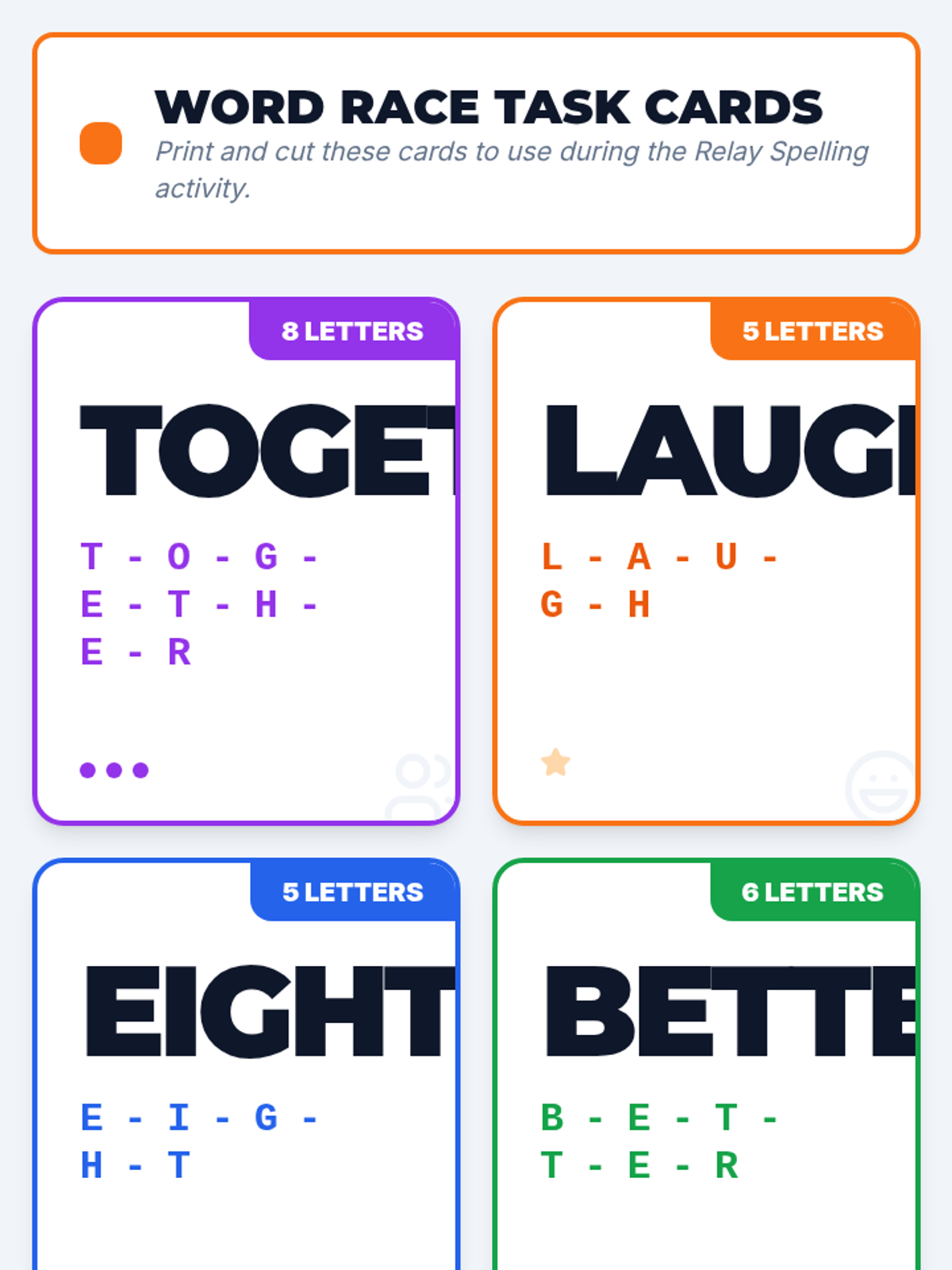
Printable task cards for the teacher to use during the relay race, featuring large sight words, letter counts, and rhythmic spelling breakdowns.
High-energy presentation slides for the Spelling Sprint lesson, featuring animated stretch guides, the embedded sight word song, relay race rules, and a cool-down chorus.
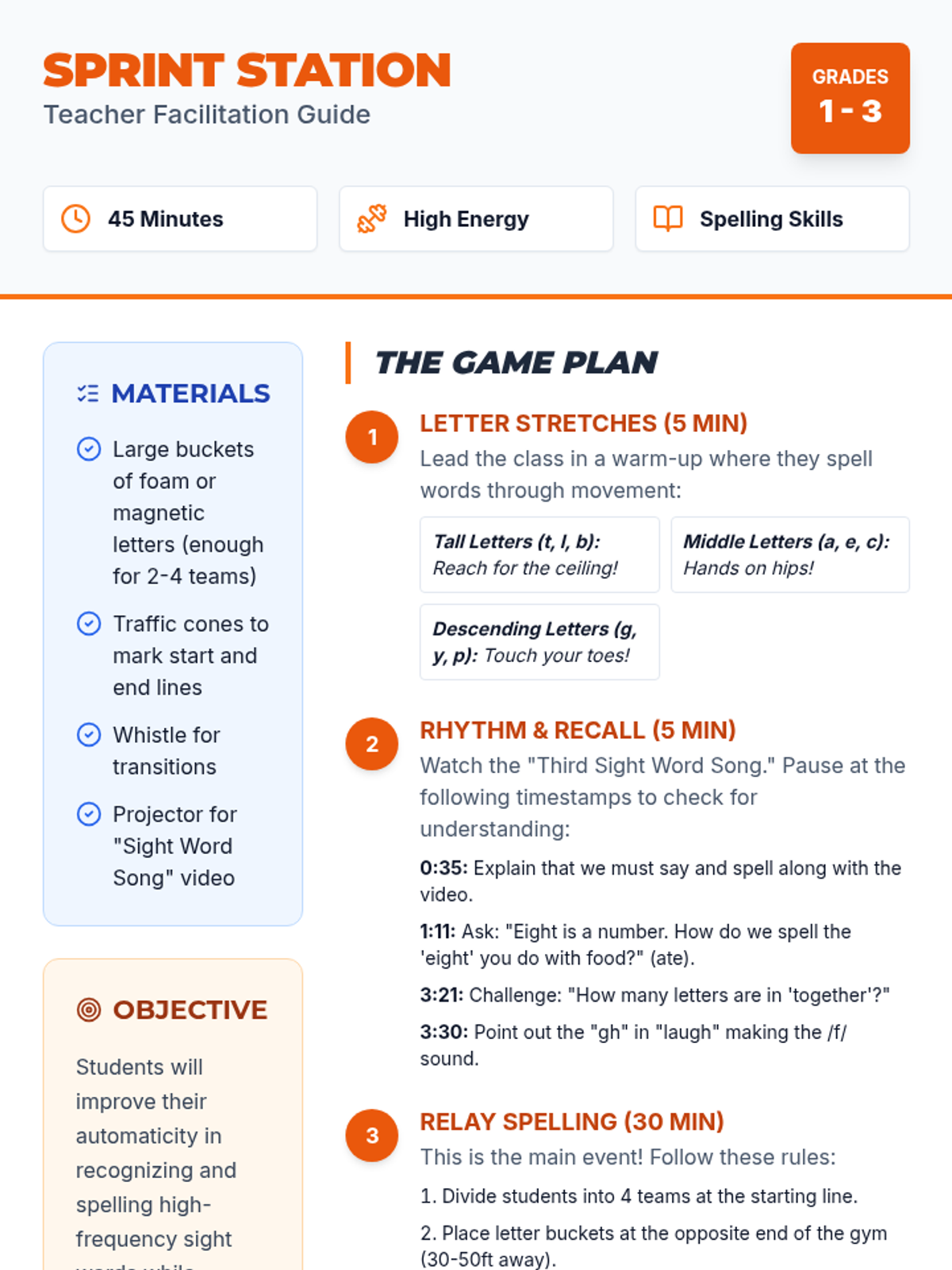
A comprehensive teacher guide for the Spelling Sprint lesson, featuring setup instructions, safety tips, detailed procedures, and a master list of the 41 sight words from the video.
A vibrant, high-energy slide deck for the 'Active Fun!' lesson, featuring icebreaker prompts, benefits of exercise, tournament rules, and reflection questions.
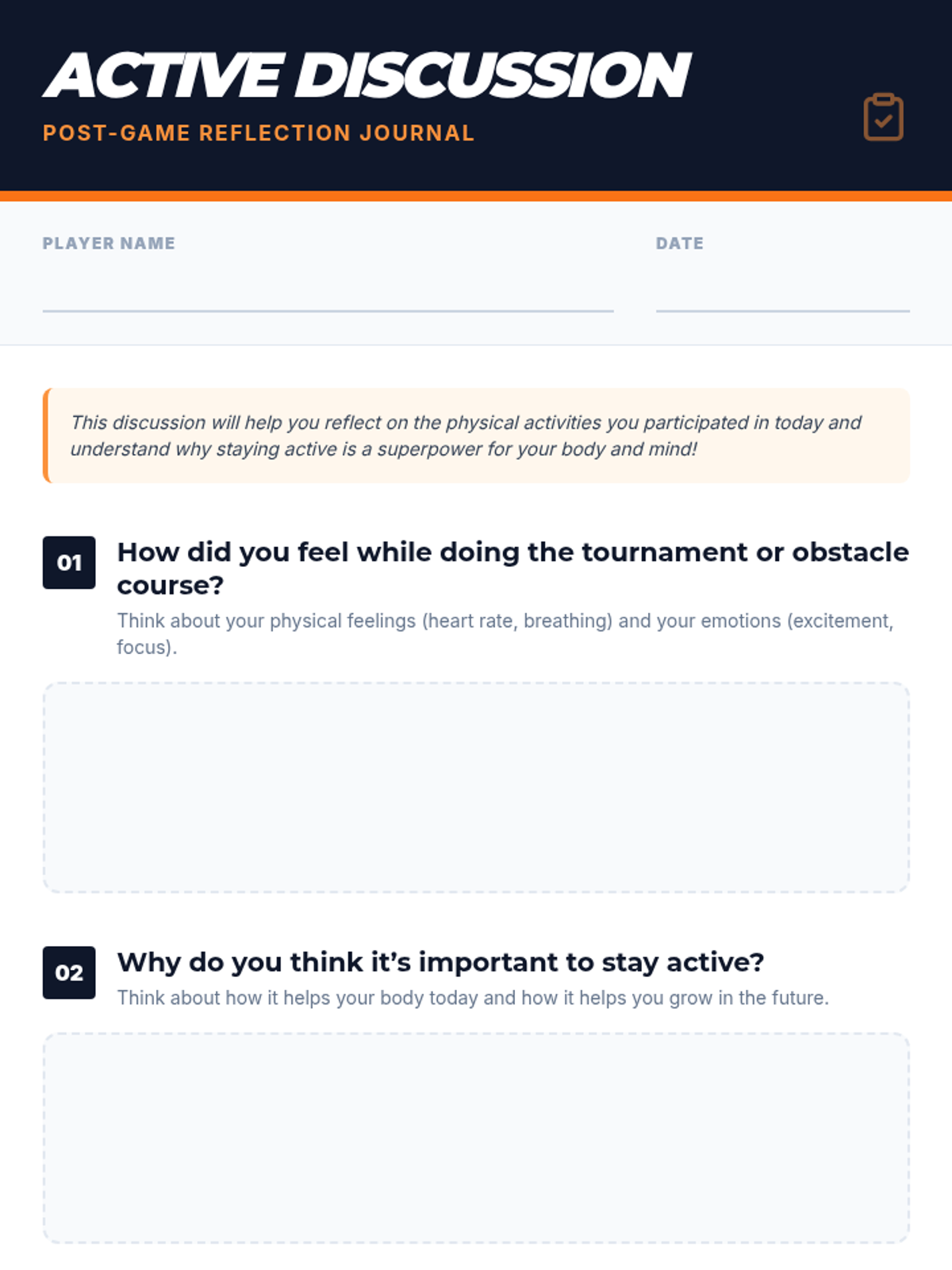
A student reflection worksheet for the 'Active Fun!' lesson, providing space for students to write about their feelings during physical activity and brainstorm ways to stay healthy.
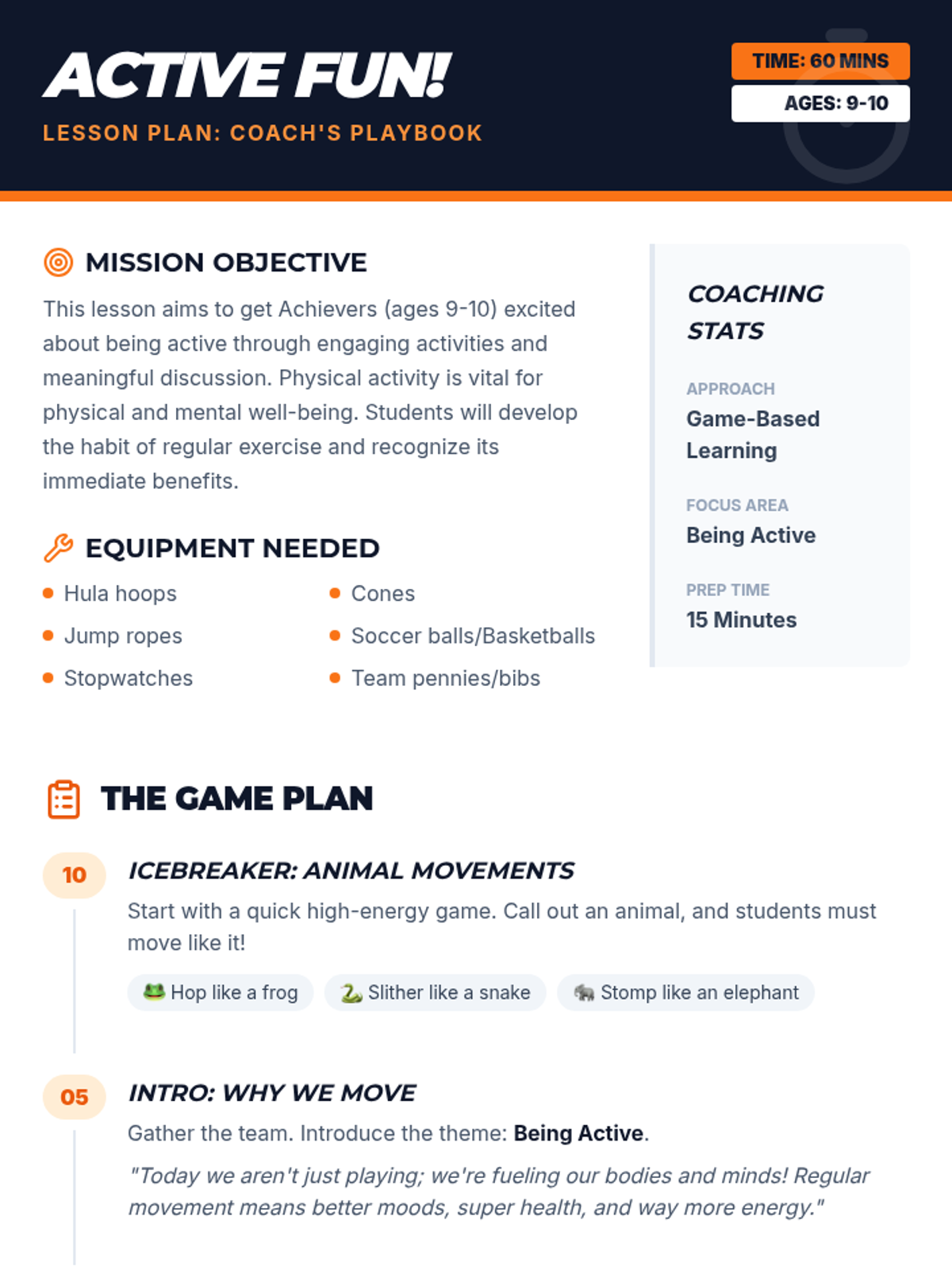
A structured coaching-themed lesson plan for 'Active Fun!', detailing a 1-hour session with icebreakers, a mini-tournament, and reflection periods.
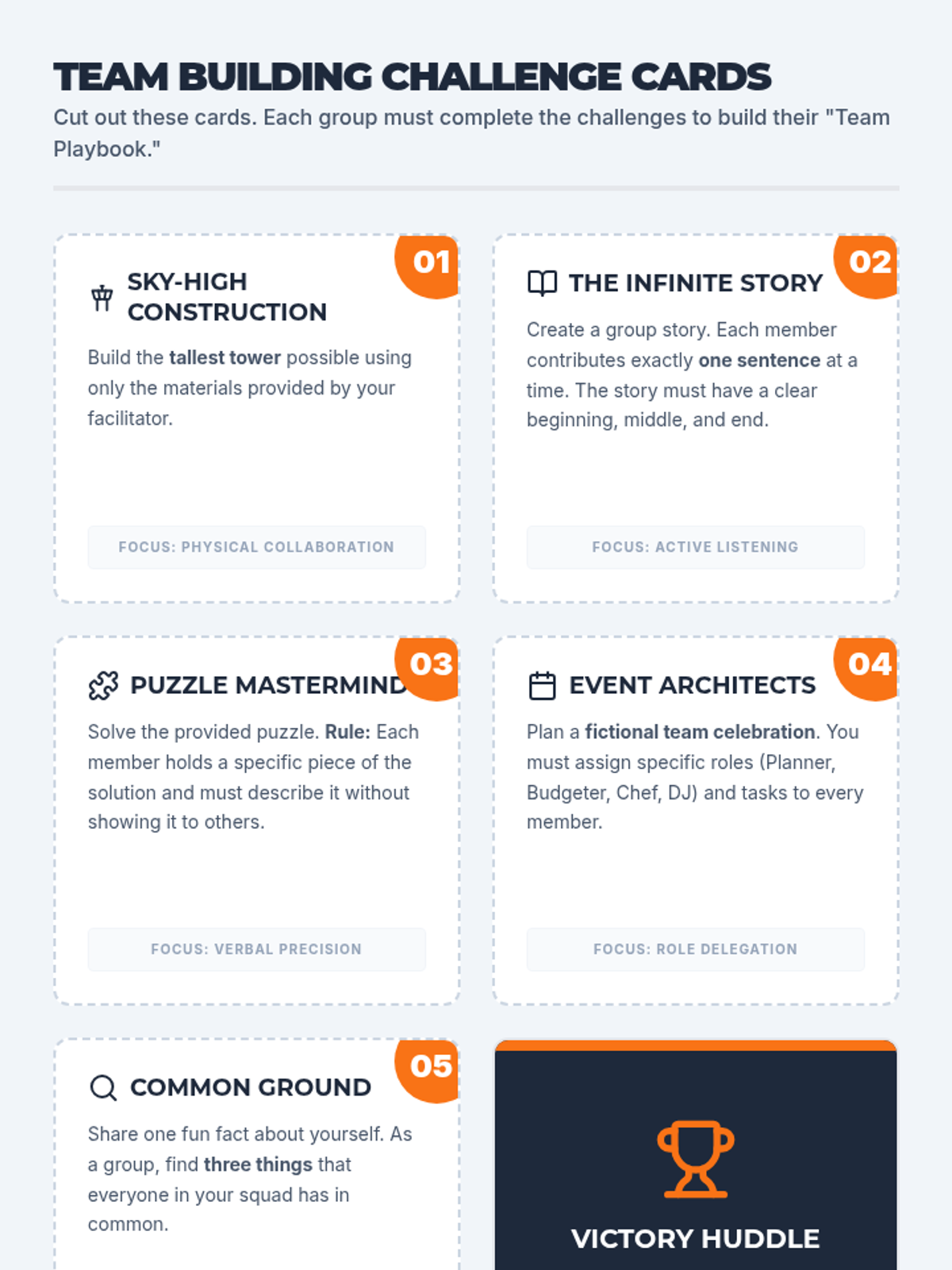
A set of six printable challenge cards for team-building activities, featuring a cohesive sports-strategy aesthetic with specific collaboration prompts.
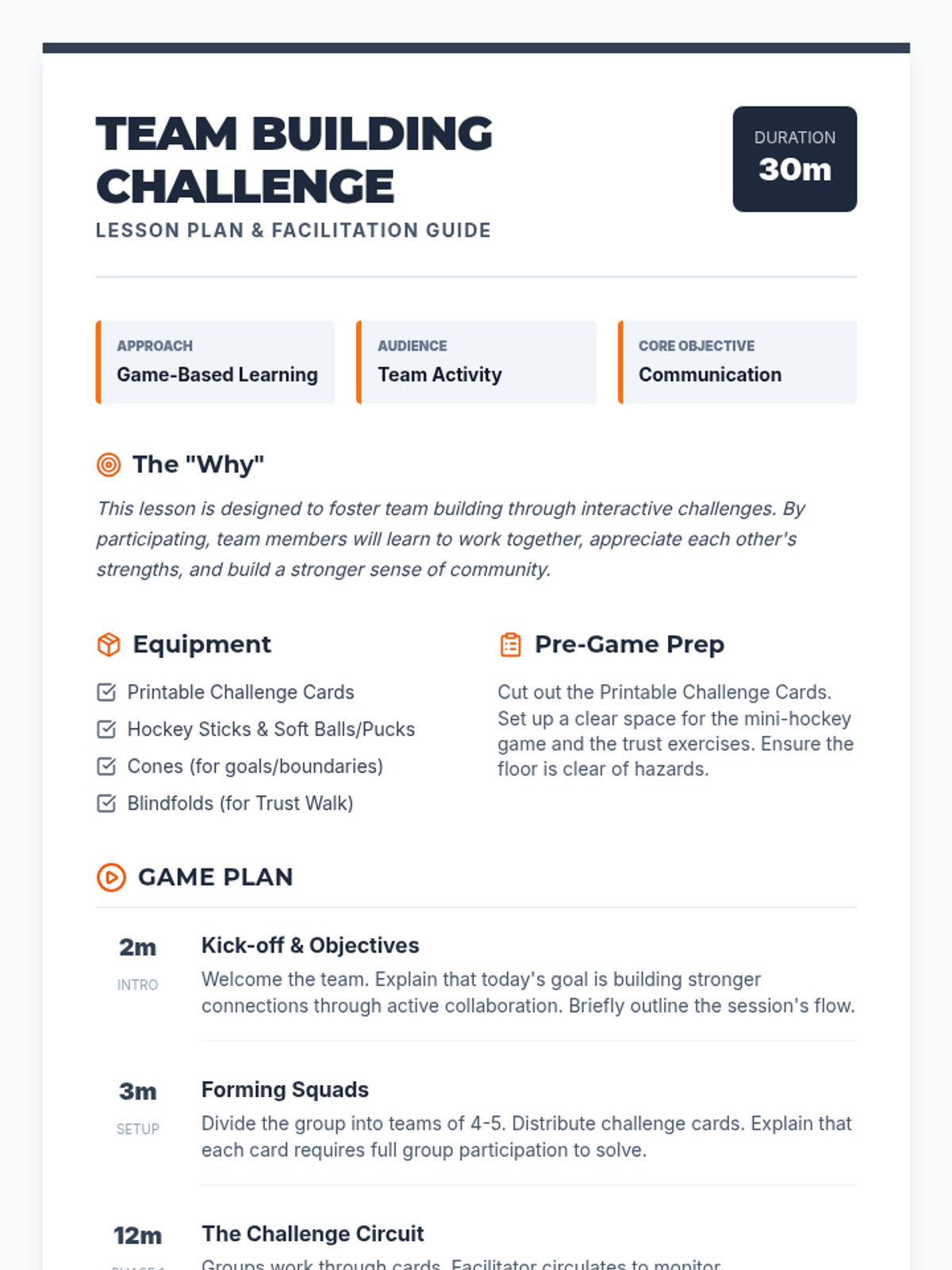
A comprehensive facilitator guide for a 30-minute team building session, including objectives, materials, and a structured instructional sequence with a sports-playbook aesthetic.
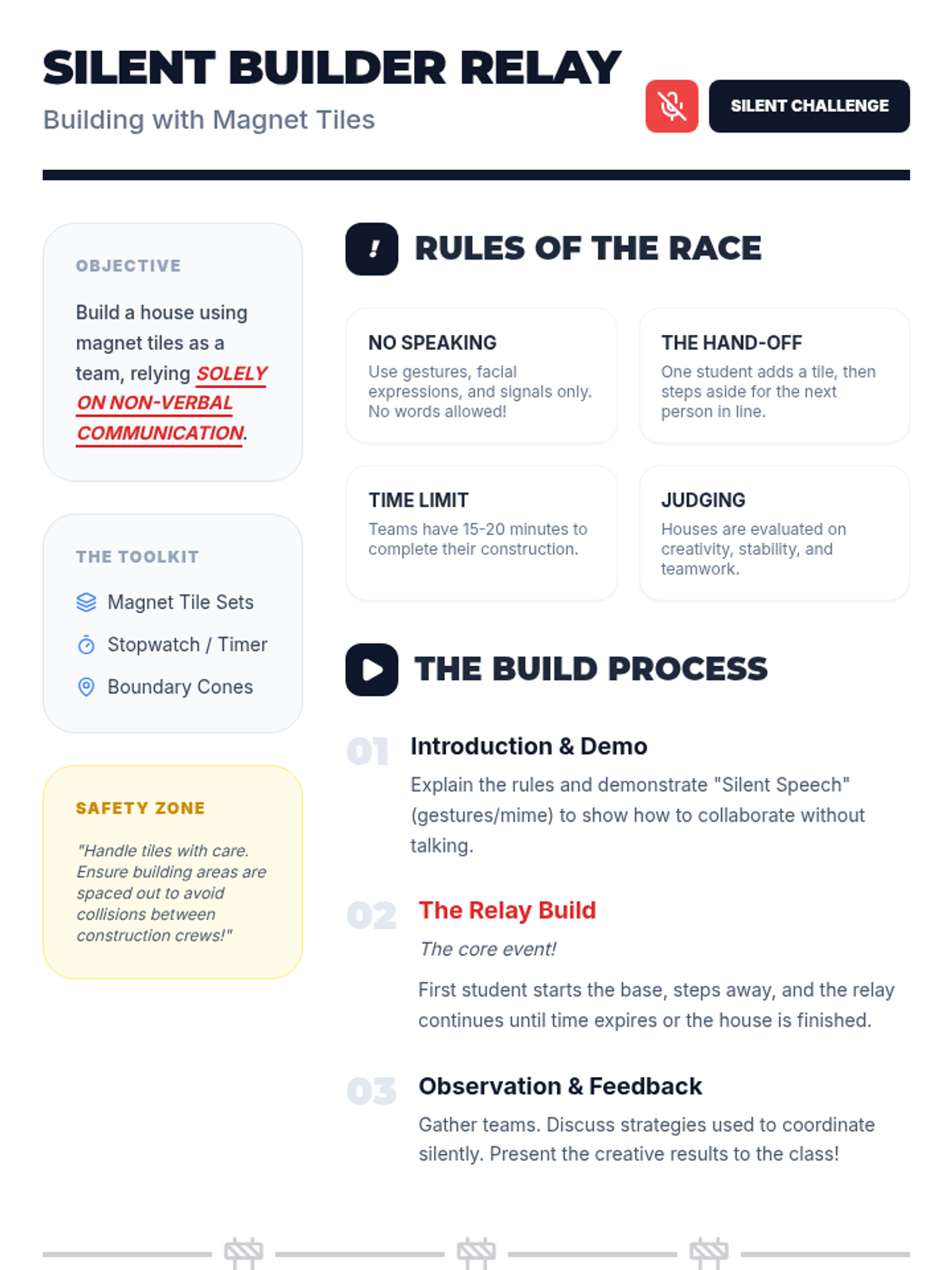
The core activity guide for the Silent Builder Relay, outlining the rules, objective, and the unique non-verbal communication challenge using magnet tiles.
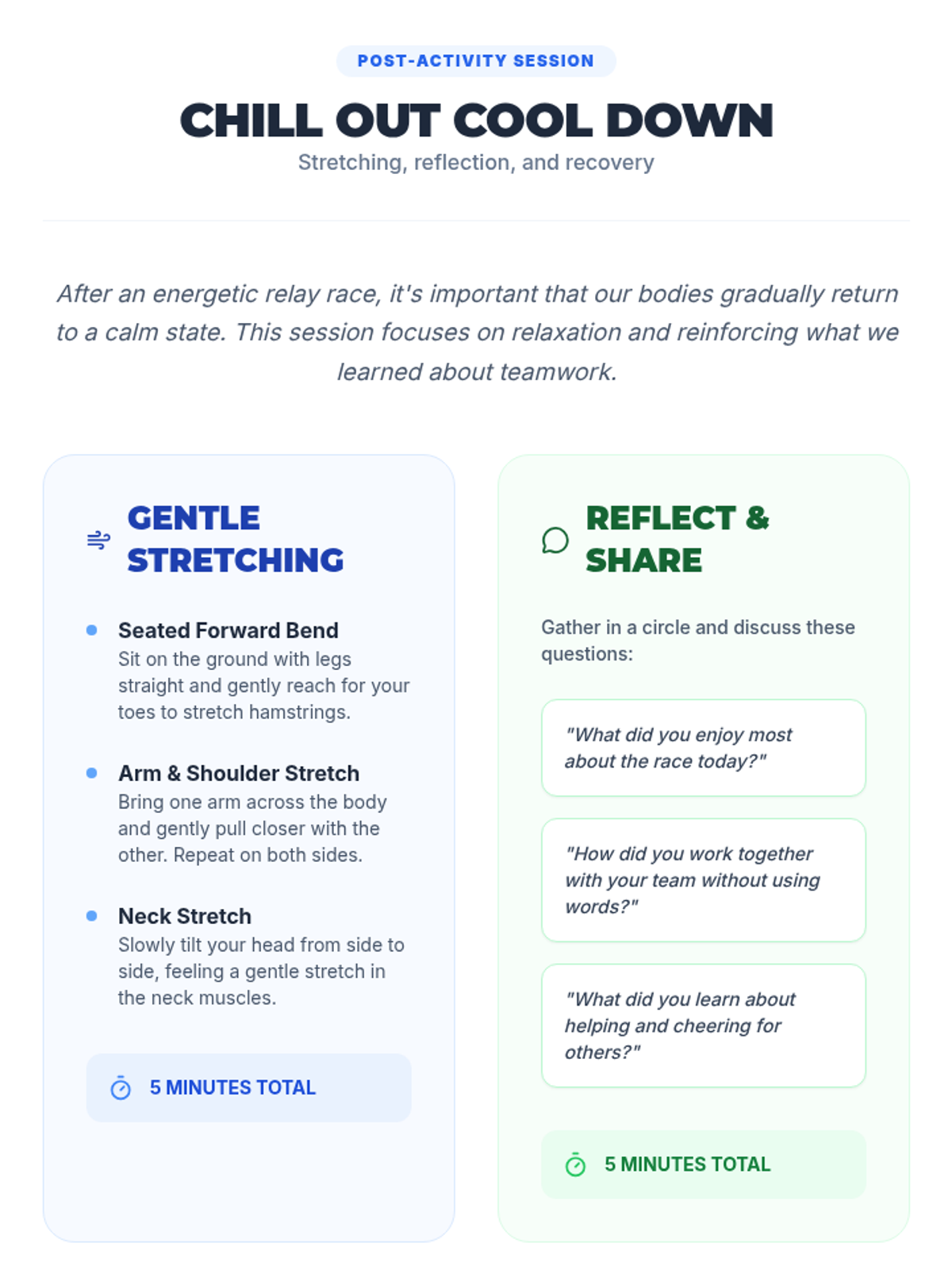
A calm post-activity guide including gentle stretches (Hamstring, Arm, Neck) and a structured reflective discussion on teamwork and non-verbal communication.
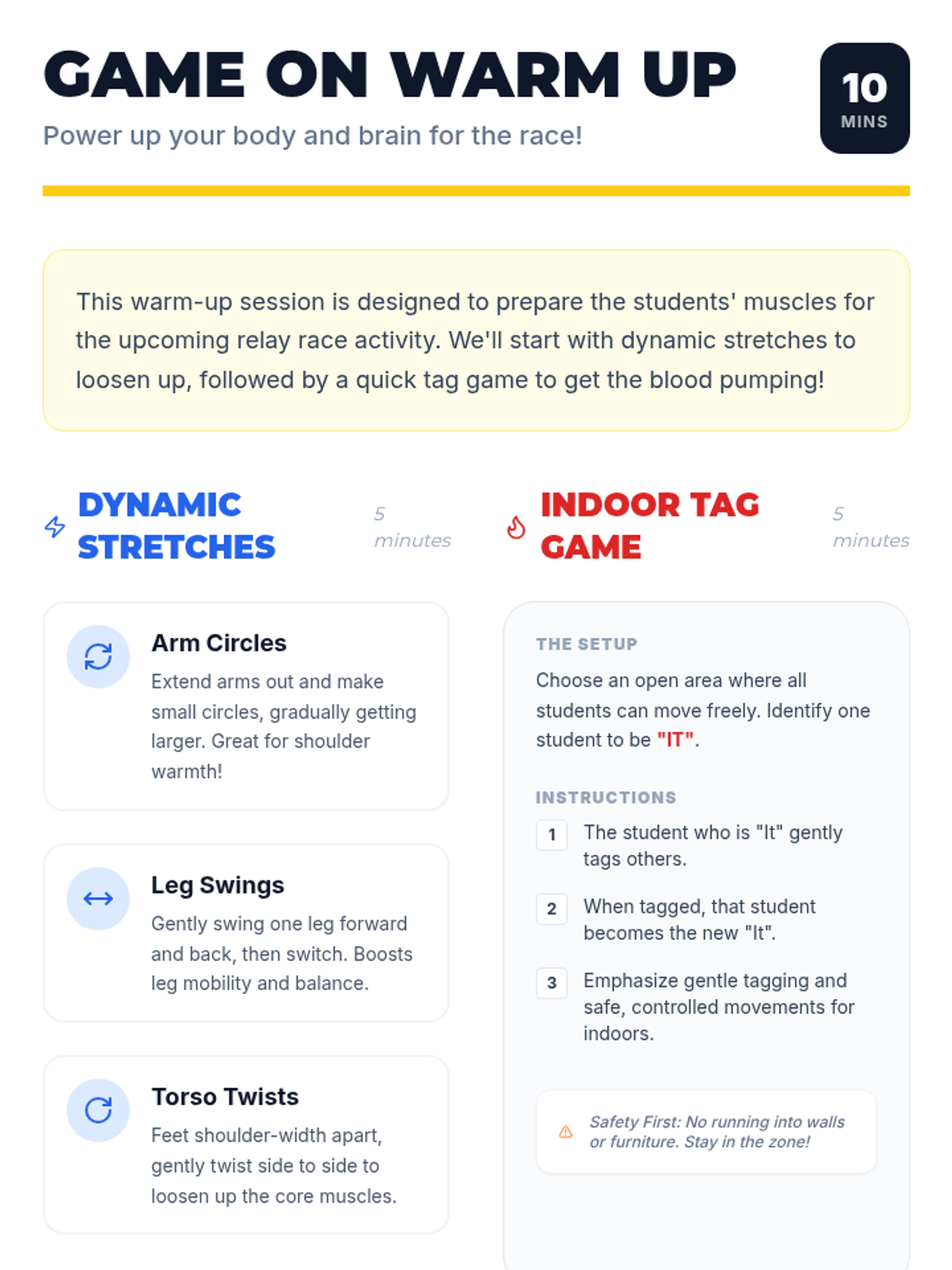
A visual guide for the pre-race warm-up, featuring dynamic stretches (Arm Circles, Leg Swings, Torso Twists) and a safe indoor Tag Game.
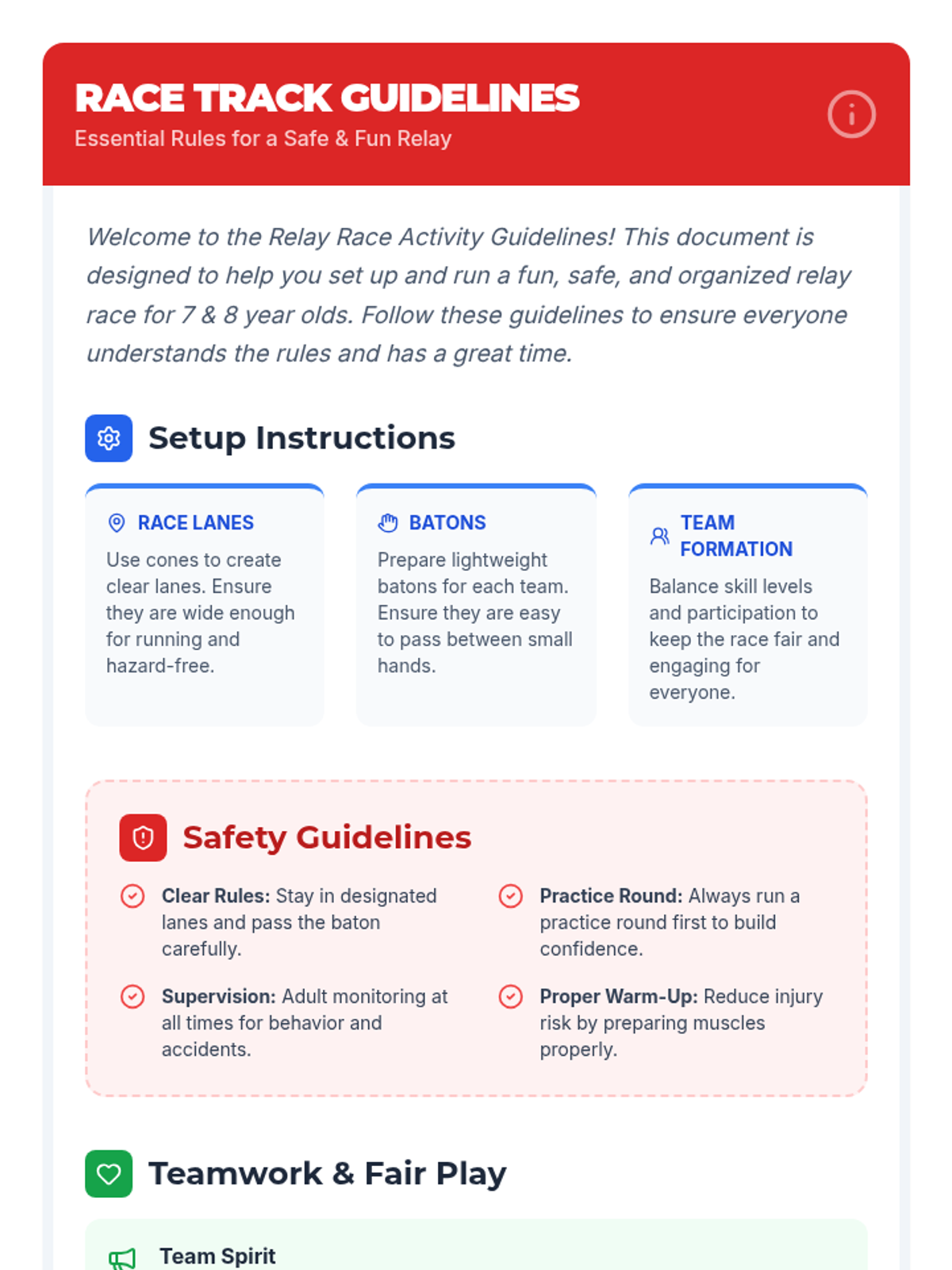
Official guidelines for setting up and supervising the relay race safely, focusing on lane setup, baton passing, and encouraging positive team spirit.
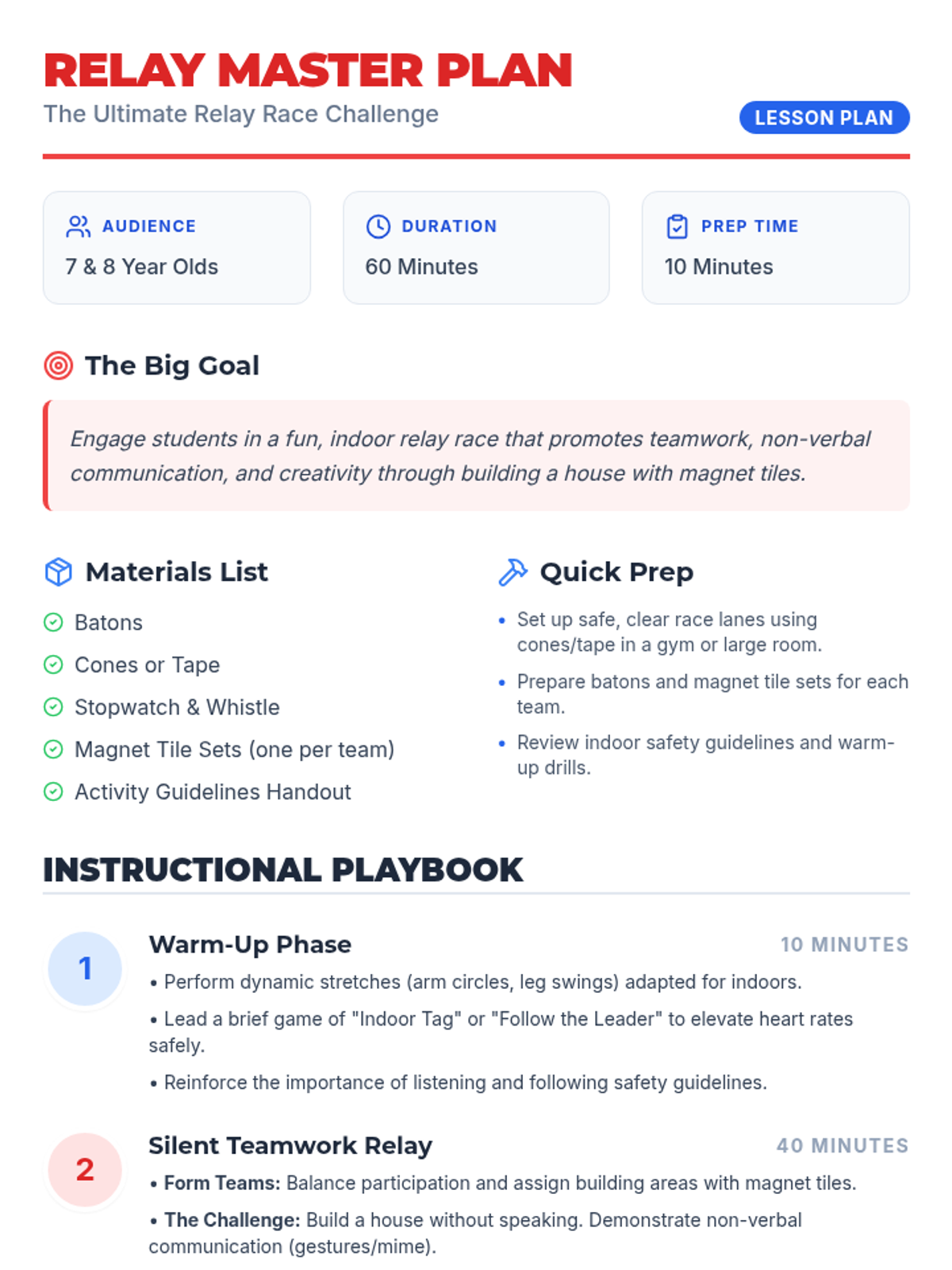
The comprehensive lesson plan for "Relay Master Plan", providing teachers with objectives, materials, and a step-by-step instructional playbook.
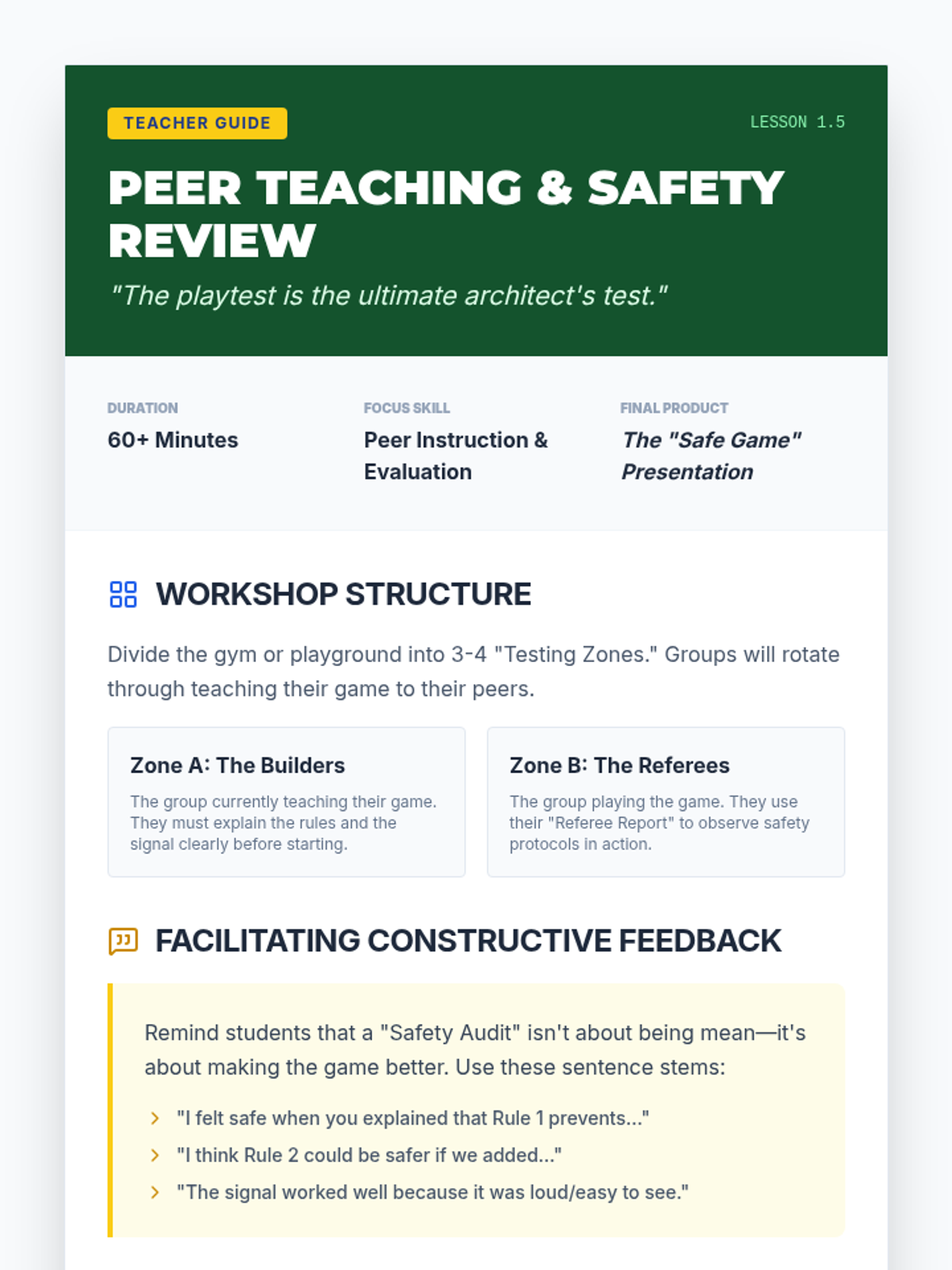
Final teacher guide for Lesson 5, focusing on facilitating peer teaching, constructive feedback, and unit wrap-up.
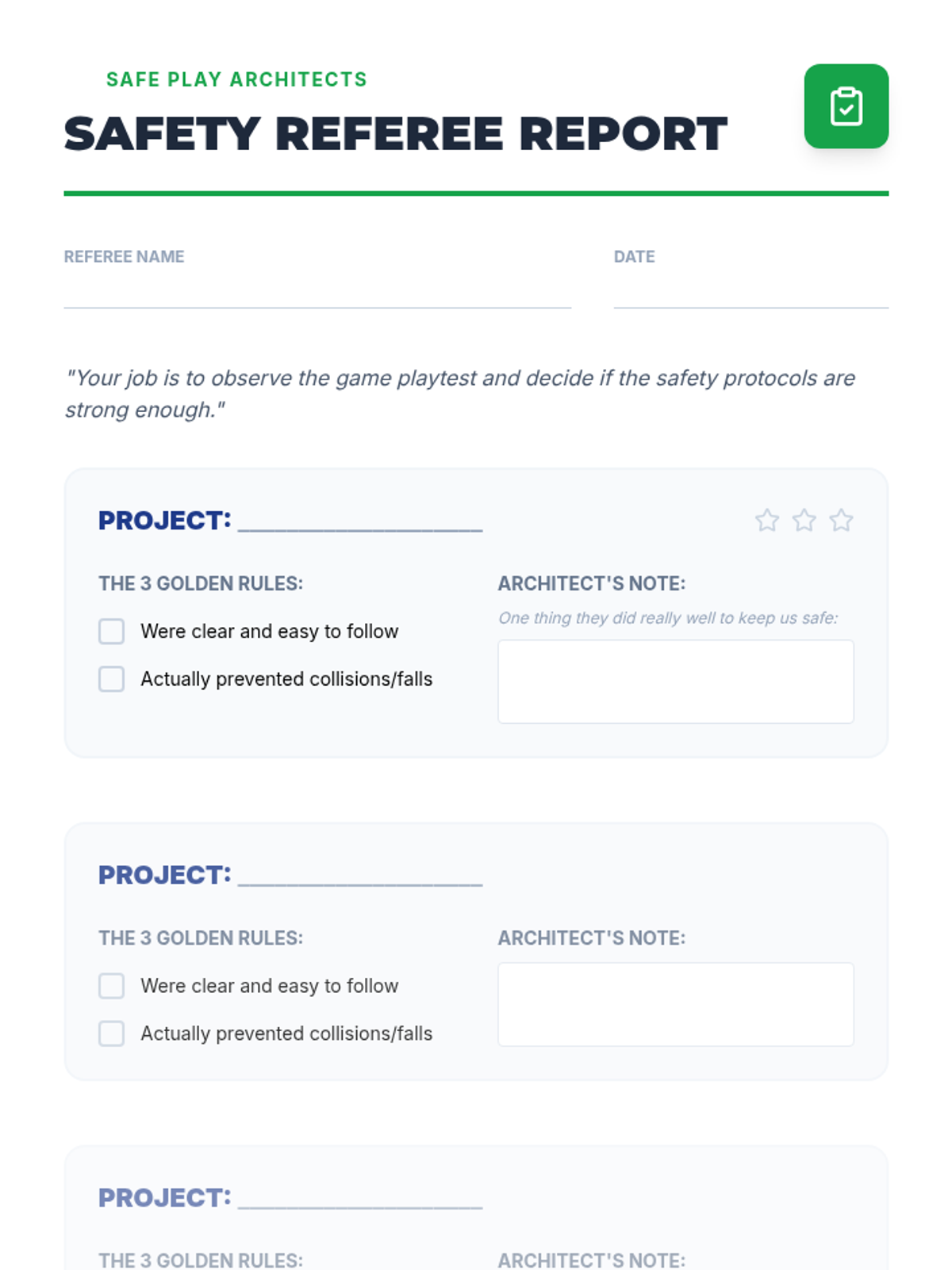
A peer-evaluation worksheet where students act as 'Safety Referees' to provide feedback on their classmates' designed games.
Final slides for the unit focusing on peer teaching and evaluation of the designed games.