Fundamental techniques for drawing, painting, sculpture, and photography alongside modern digital design principles. Analyzes historical artistic movements while building skills in printmaking and graphic media.
A student review and reflection toolkit for the final design critique. Includes a feedback log for peer review, self-reflection prompts, and cut-out awards for acknowledging peer design strengths.
A presentation guiding students through the design critique process. Introduces the 'Sandwich Method' for constructive feedback and sets the stage for a studio-style peer review simulation.
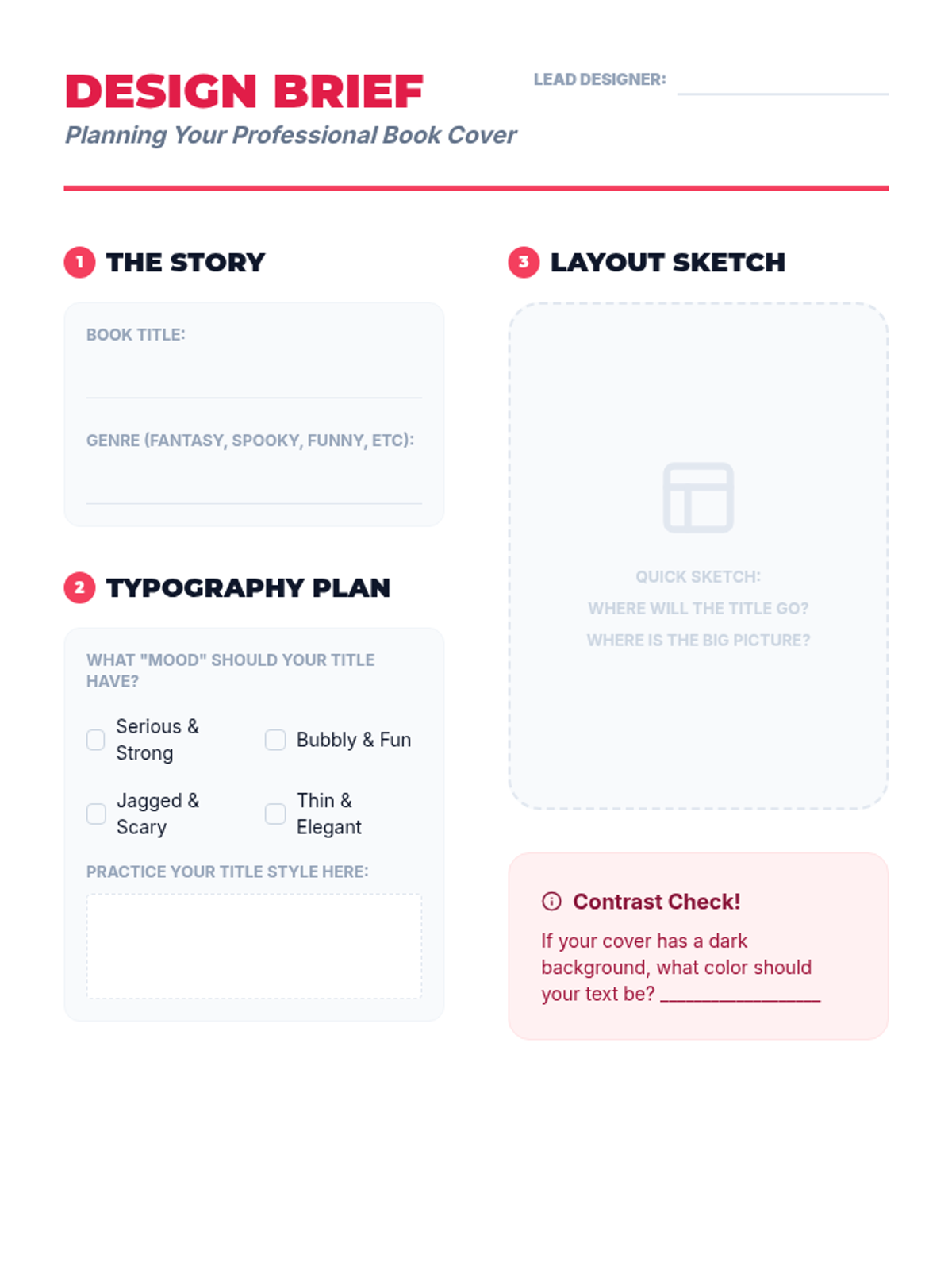
A comprehensive project packet for the final book cover design. Includes a step-by-step design brief for planning the genre, typography mood, and layout, followed by a professional-style front and back cover template.
A presentation for the final project where students design a book cover. Explores genre conventions, essential cover elements (title, author, image), and the professional design thinking process.
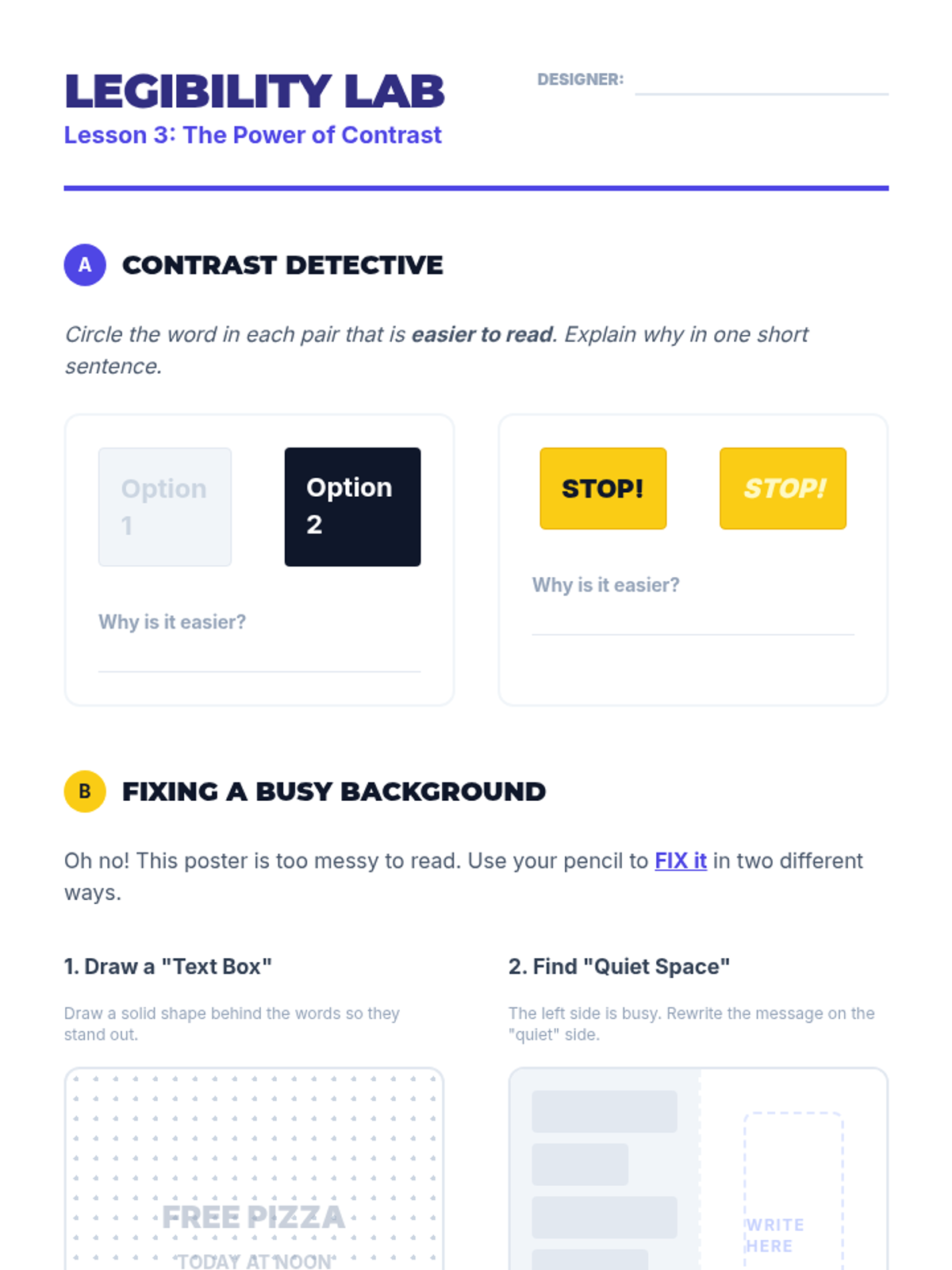
A student worksheet for practicing principles of contrast and legibility. Students identify high-contrast pairs and practice techniques like adding text boxes or finding quiet space to make messages readable.
A presentation on the principles of legibility and contrast. Teaches students how to make text readable when placed over images or busy backgrounds using color, placement, and shapes.
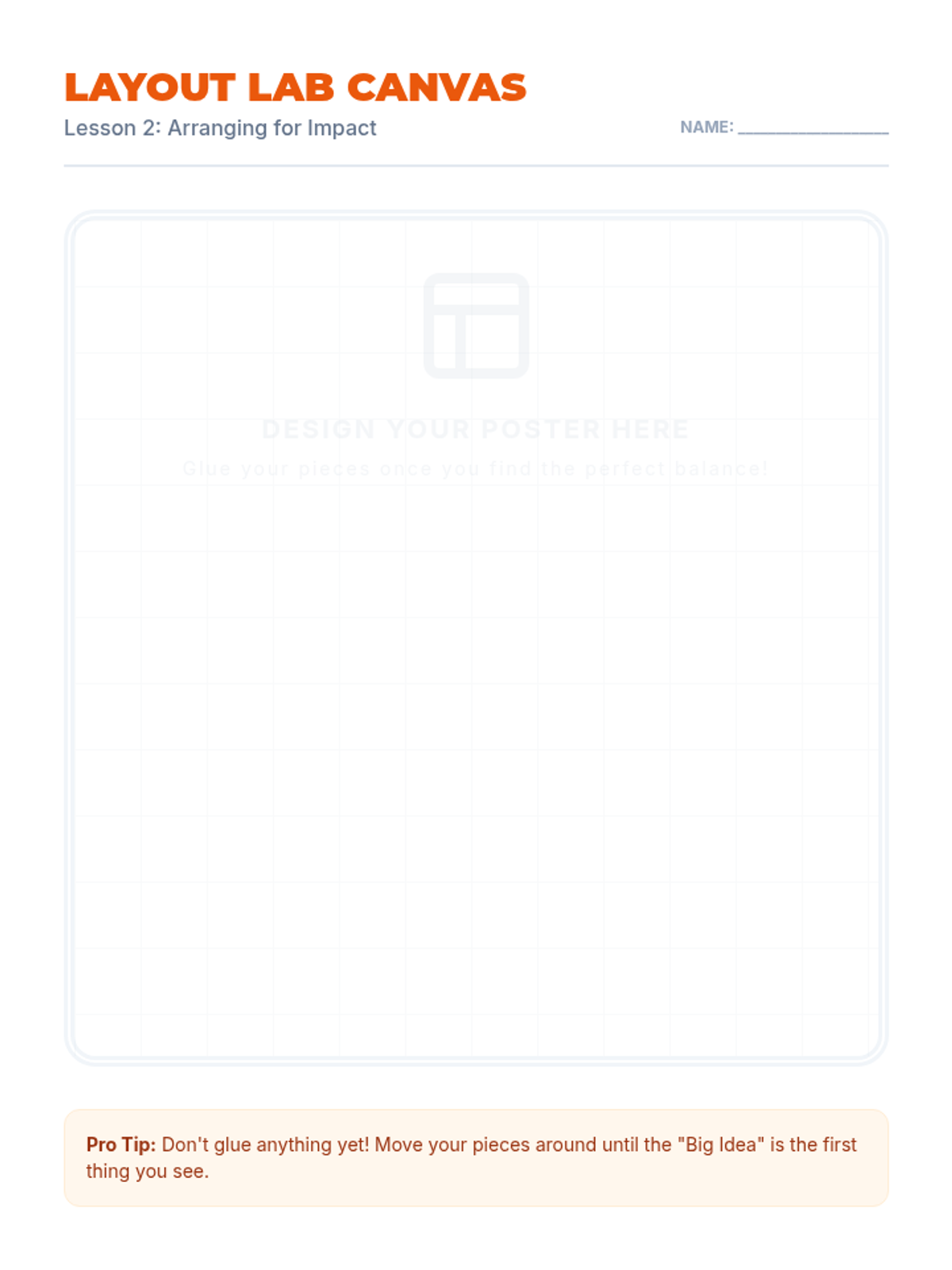
A layout design toolkit for students. Includes a blank 'canvas' for poster construction and a page of themed 'Robo-Dance' text blocks and icons for students to cut and arrange.
A slide deck introducing visual hierarchy and balance. Explores how designers use size, color, and placement to guide the viewer's eye and create organized, effective layouts.
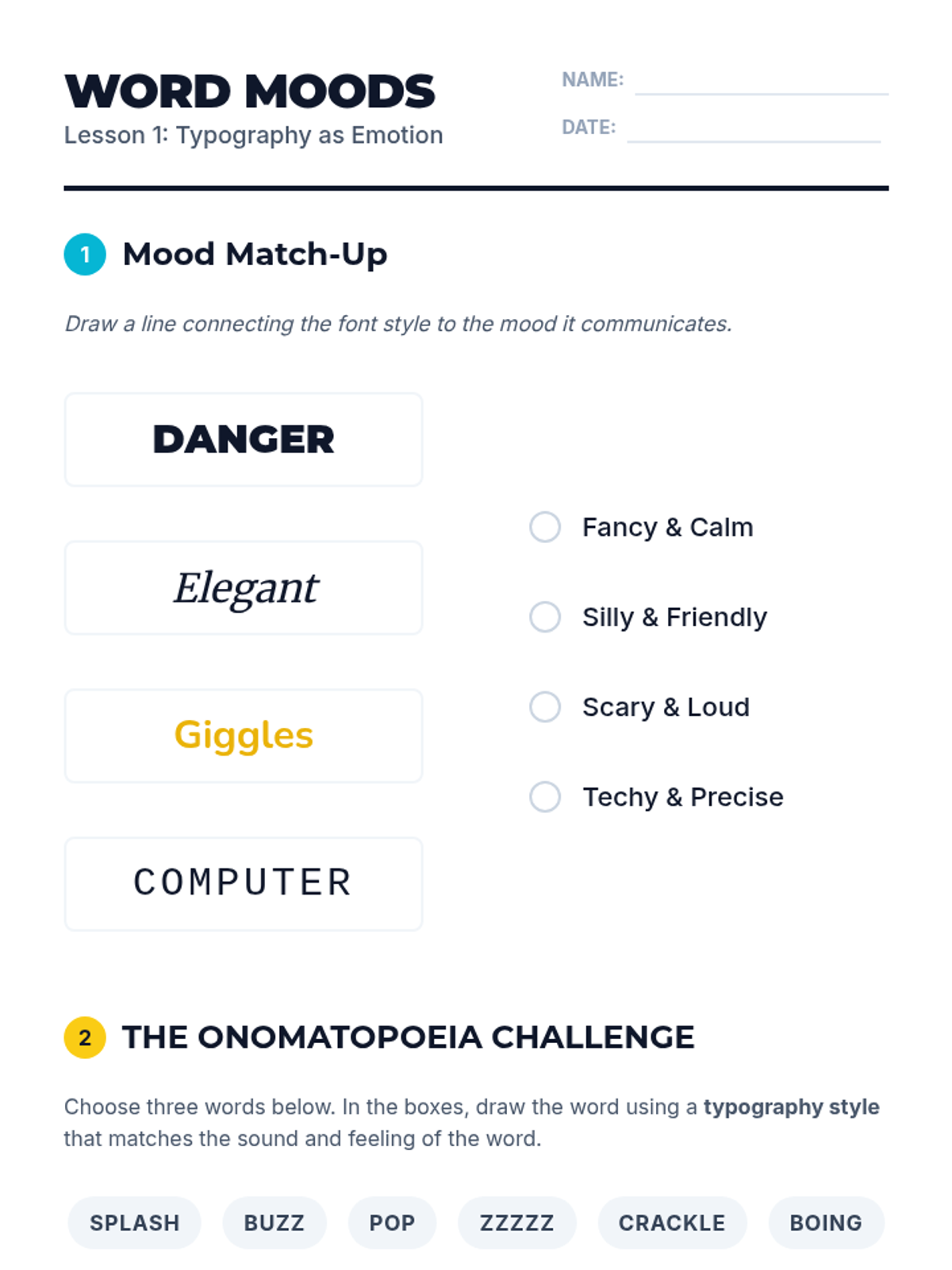
A student worksheet for exploring the emotional impact of fonts. Includes a matching activity and a creative 'Onomatopoeia Challenge' where students draw words to visually represent their sounds and meanings.
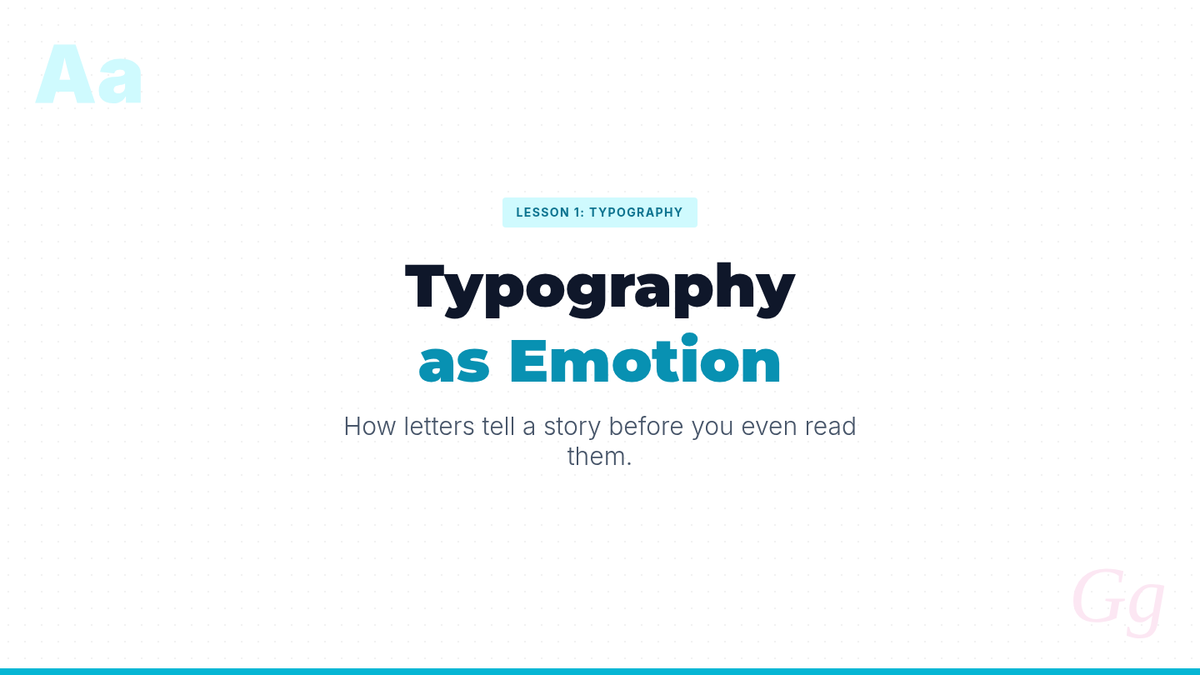
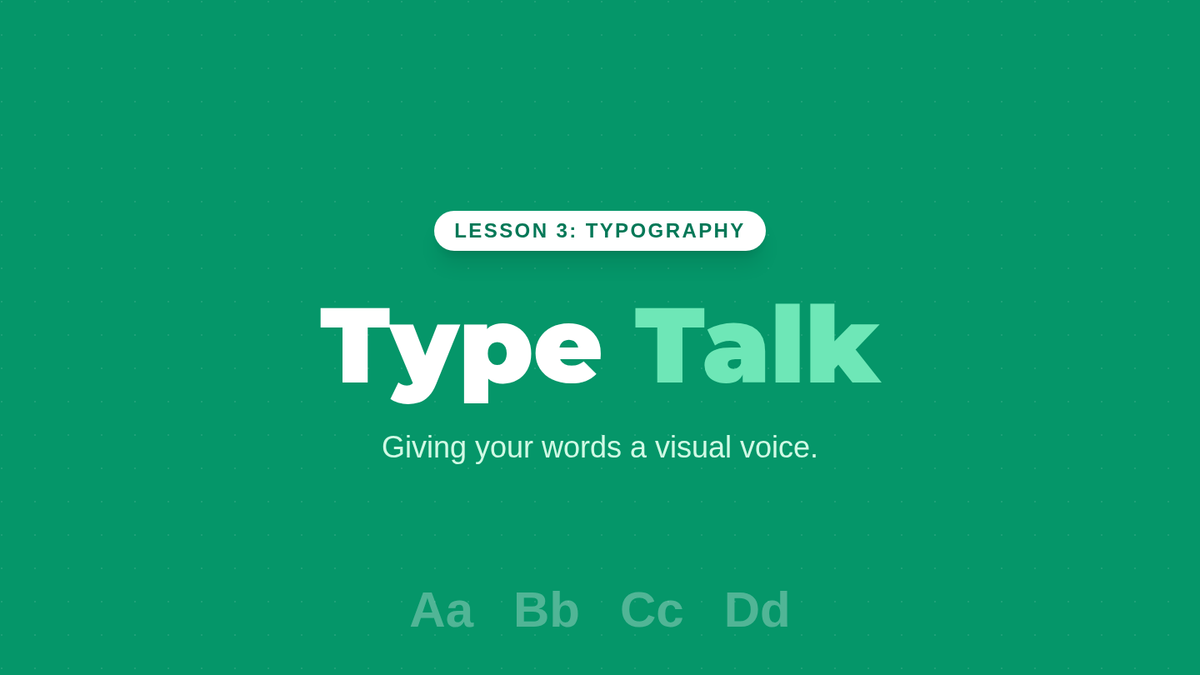
A visual presentation introducing students to the concept of typography, exploring how different font styles communicate specific moods and emotions. Includes a 'spooky' hook and an introduction to onomatopoeia design.
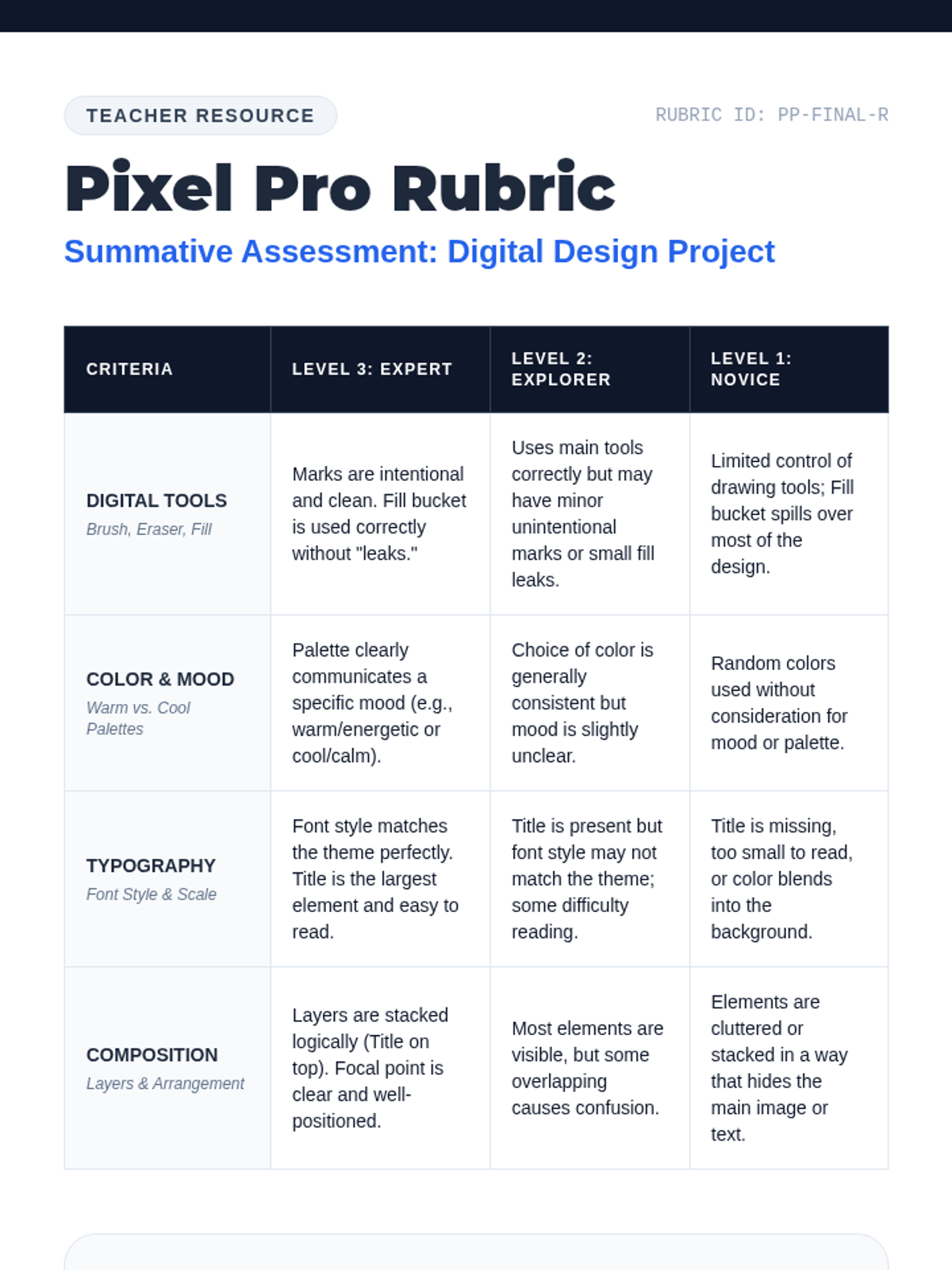
A comprehensive rubric for evaluating students' final digital design projects based on tool usage, color theory, typography, and composition.
A student activity sheet for a gallery walk where students provide peer feedback using the "Glow and Grow" method.
A slide deck for the final lesson, introducing gallery walk etiquette and how to provide constructive "Glows and Grows" feedback.
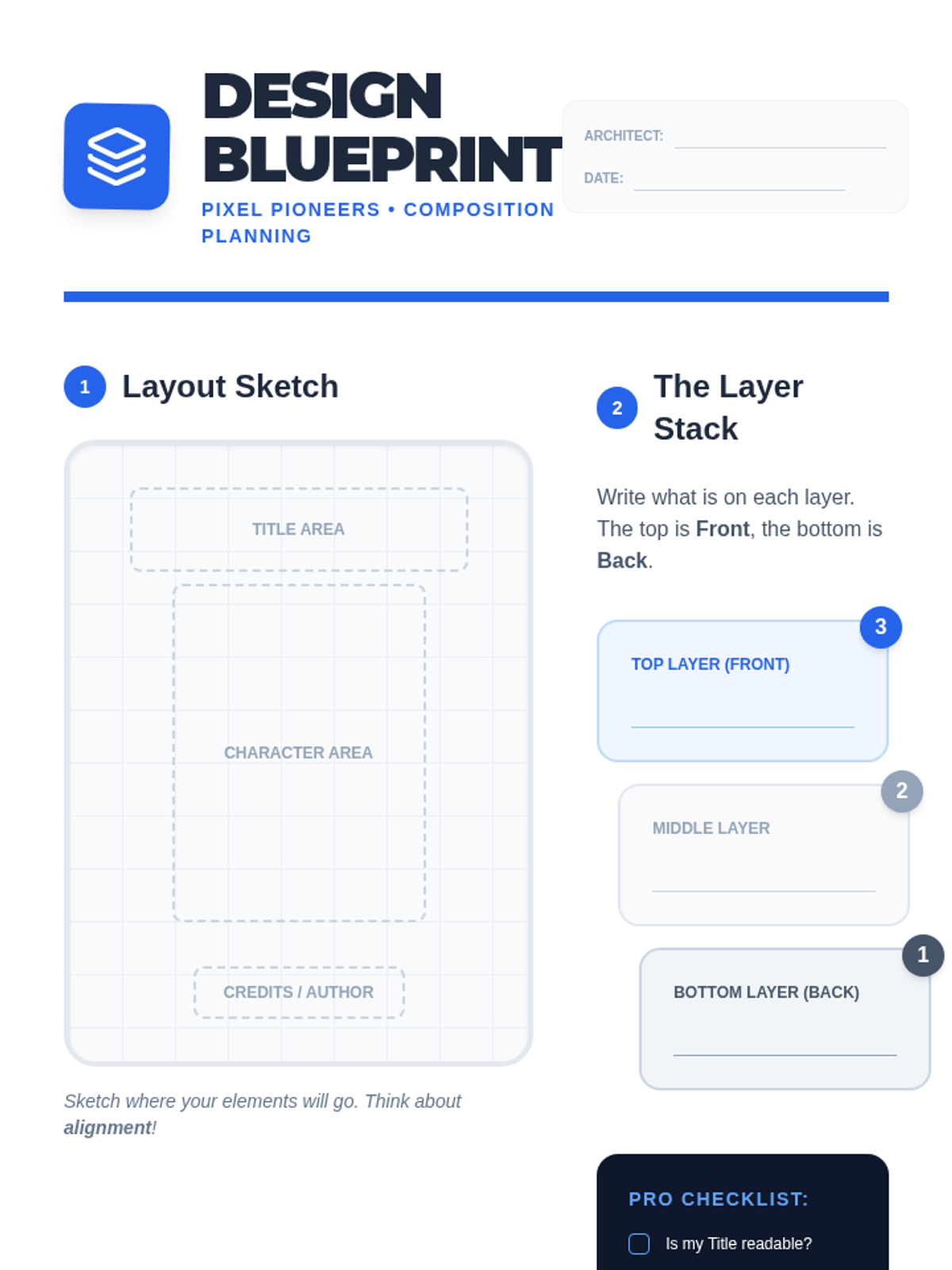
A student planning sheet for mapping out the layering order and spatial composition of their final digital design project.
A slide deck introducing digital layering (stacking order), layout composition principles, and object arrangement for posters.
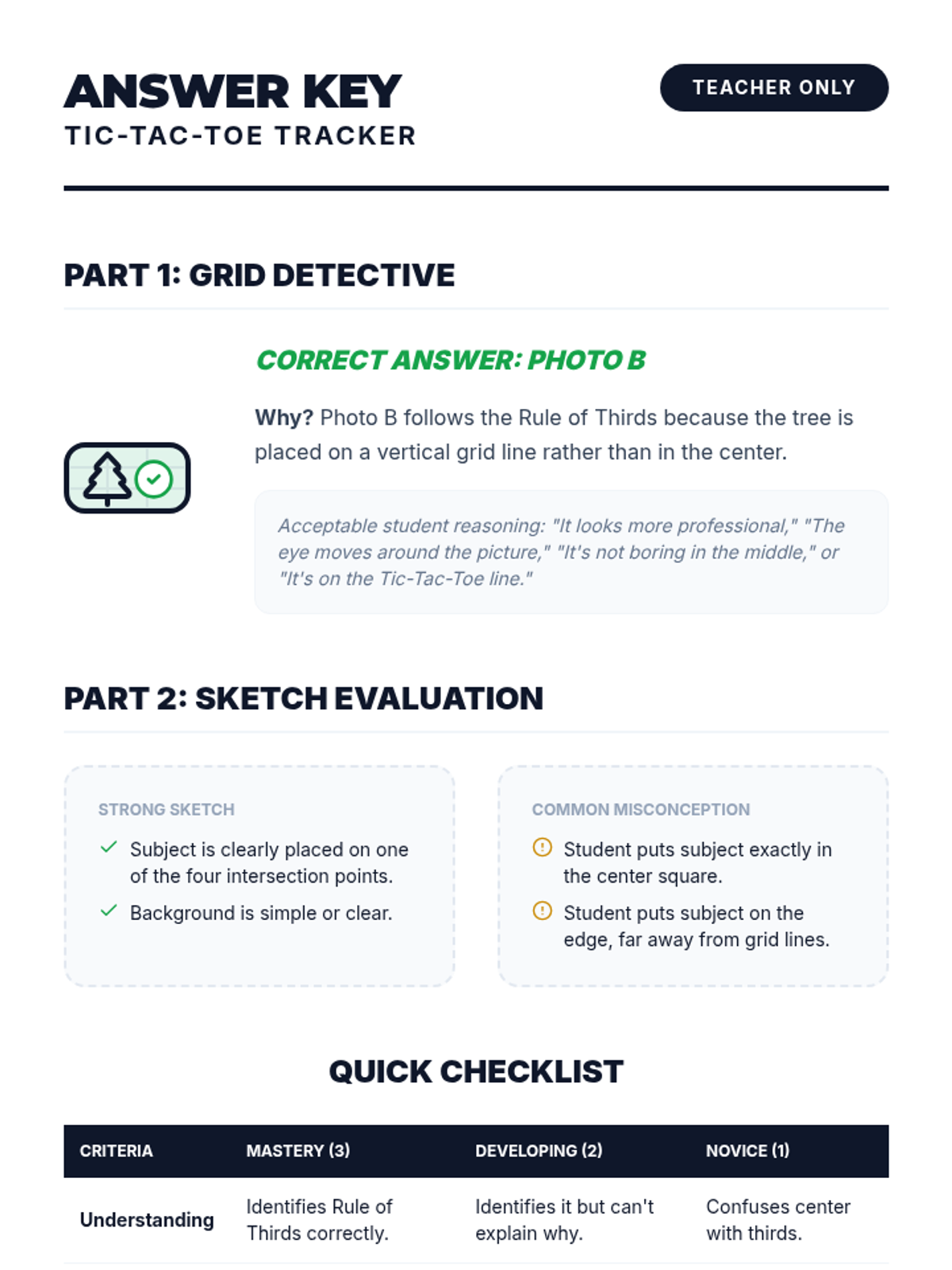
Answer key and evaluation guide for the Tic-Tac-Toe Tracker Worksheet, including a quick grading rubric for the Rule of Thirds.
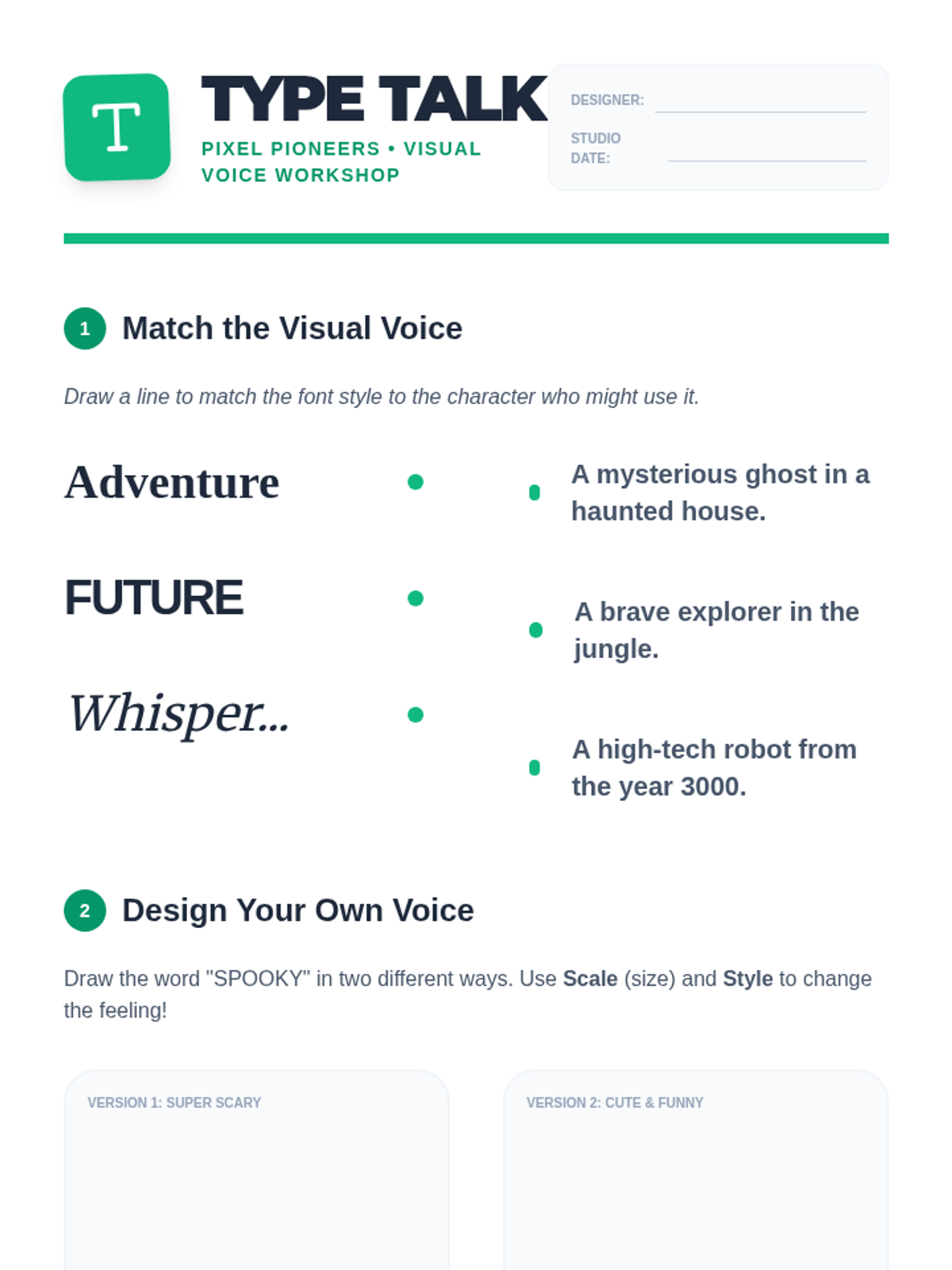
A student activity sheet for matching font styles to moods and designing custom lettering to understand typography.
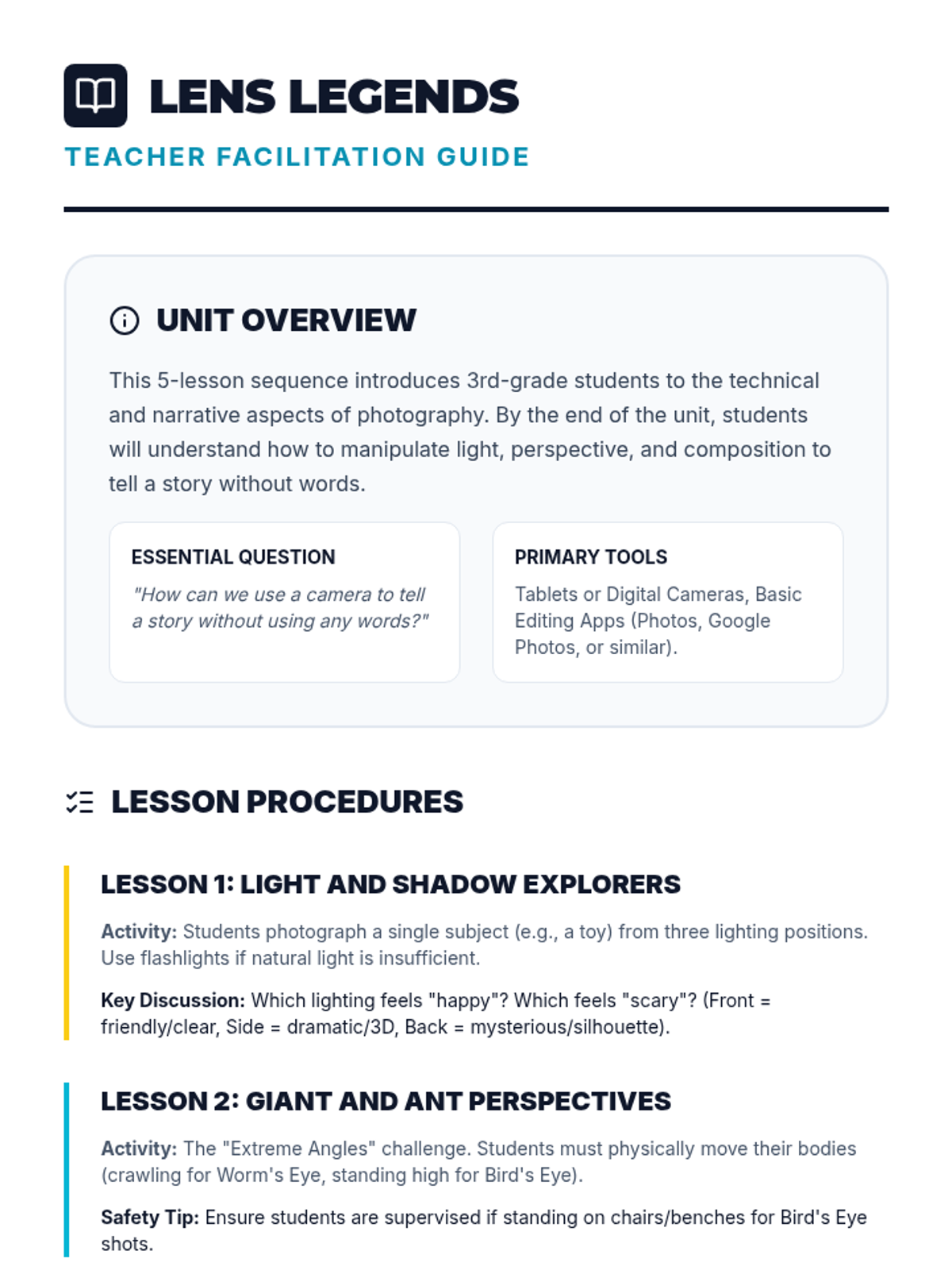
Comprehensive facilitation guide for teachers covering all five lessons, including activity procedures, discussion prompts, differentiation, and assessment tips.
A slide deck introducing font styles (Serif, Sans, Script, Display), scaling, and contrast in digital design.
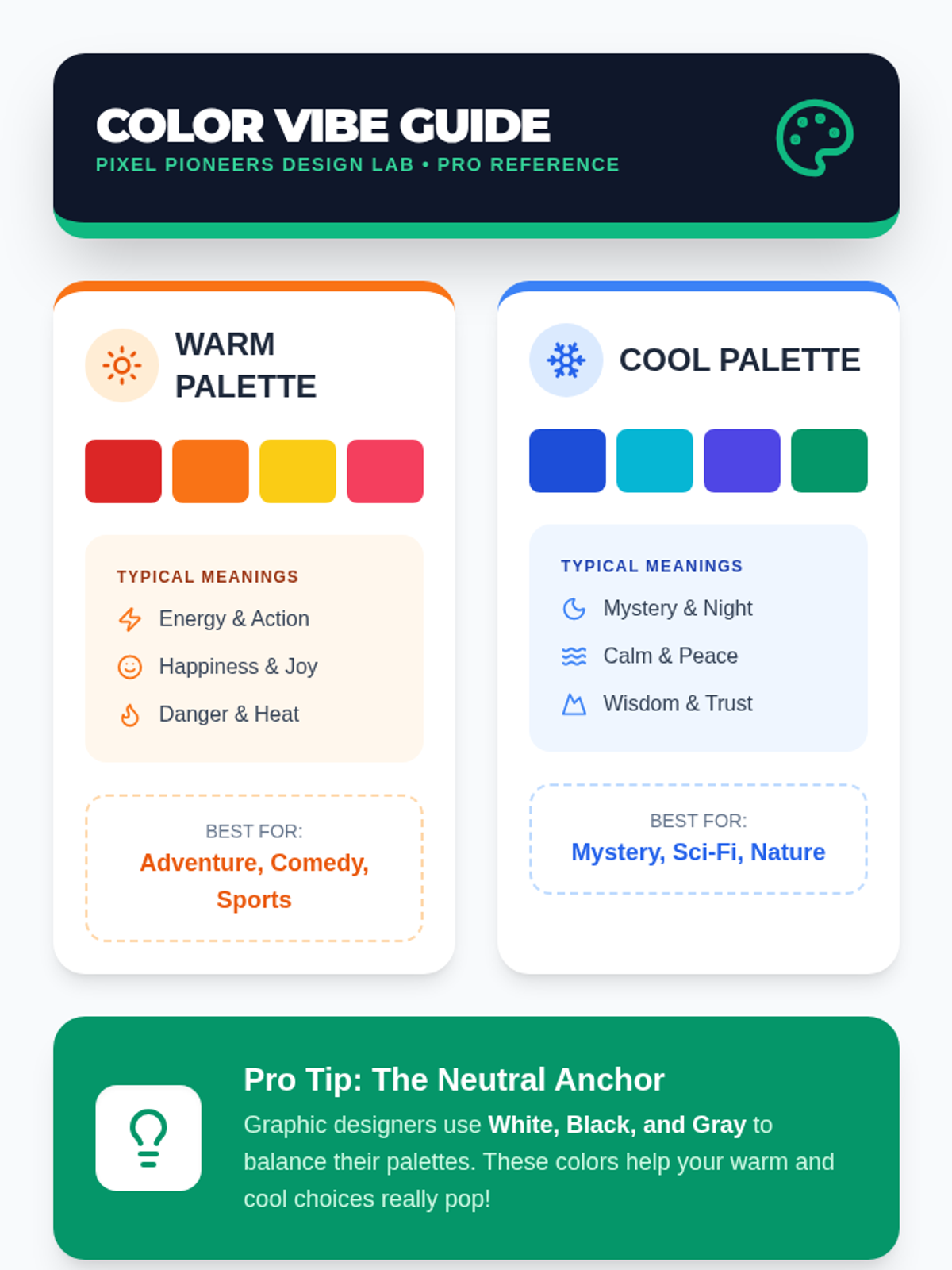
A visual reference sheet for students explaining the psychological impact of warm and cool color palettes in design.
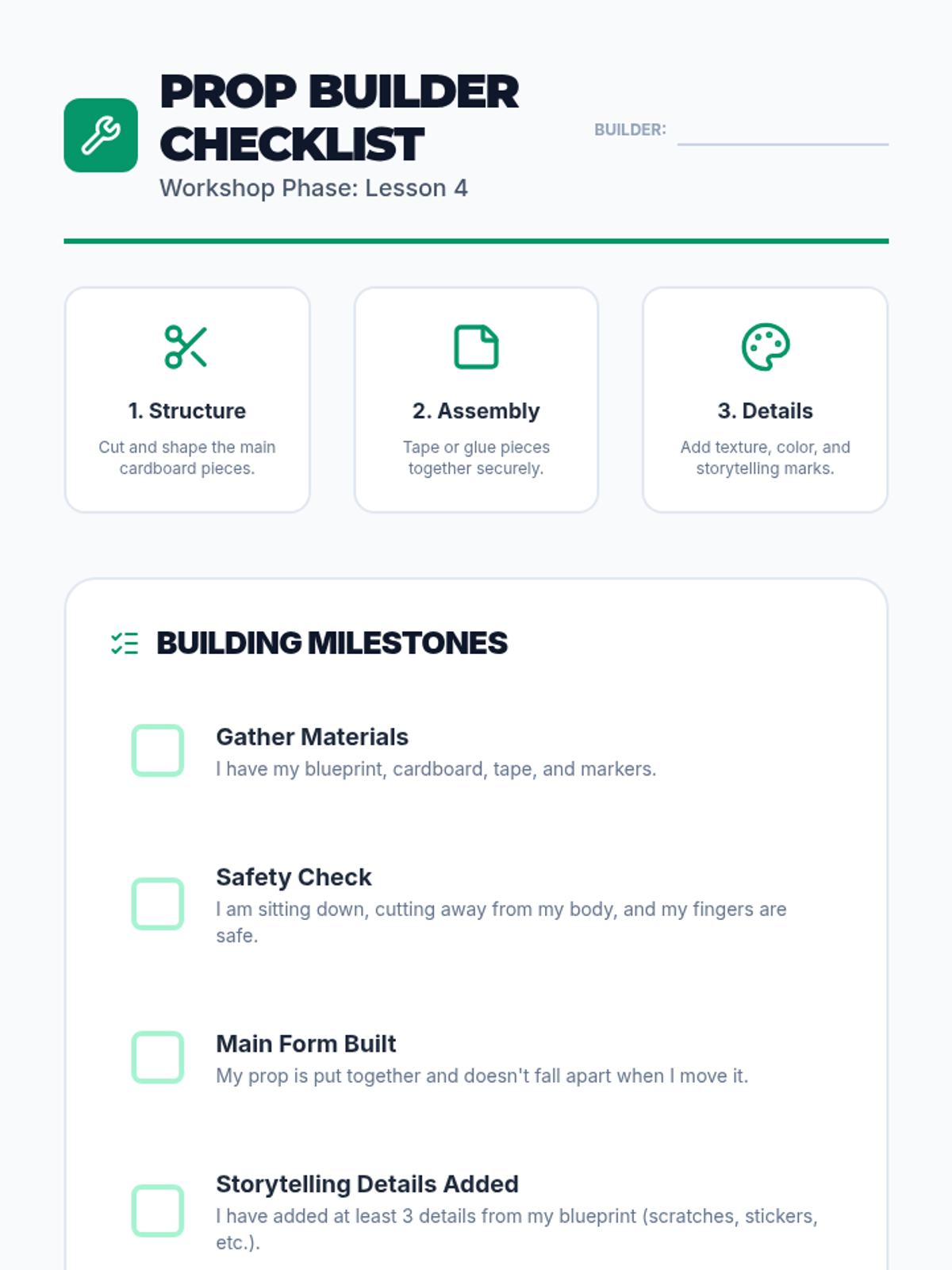
A student-facing construction checklist to guide the building process, emphasize safety, and encourage reflection on problem-solving during fabrication.
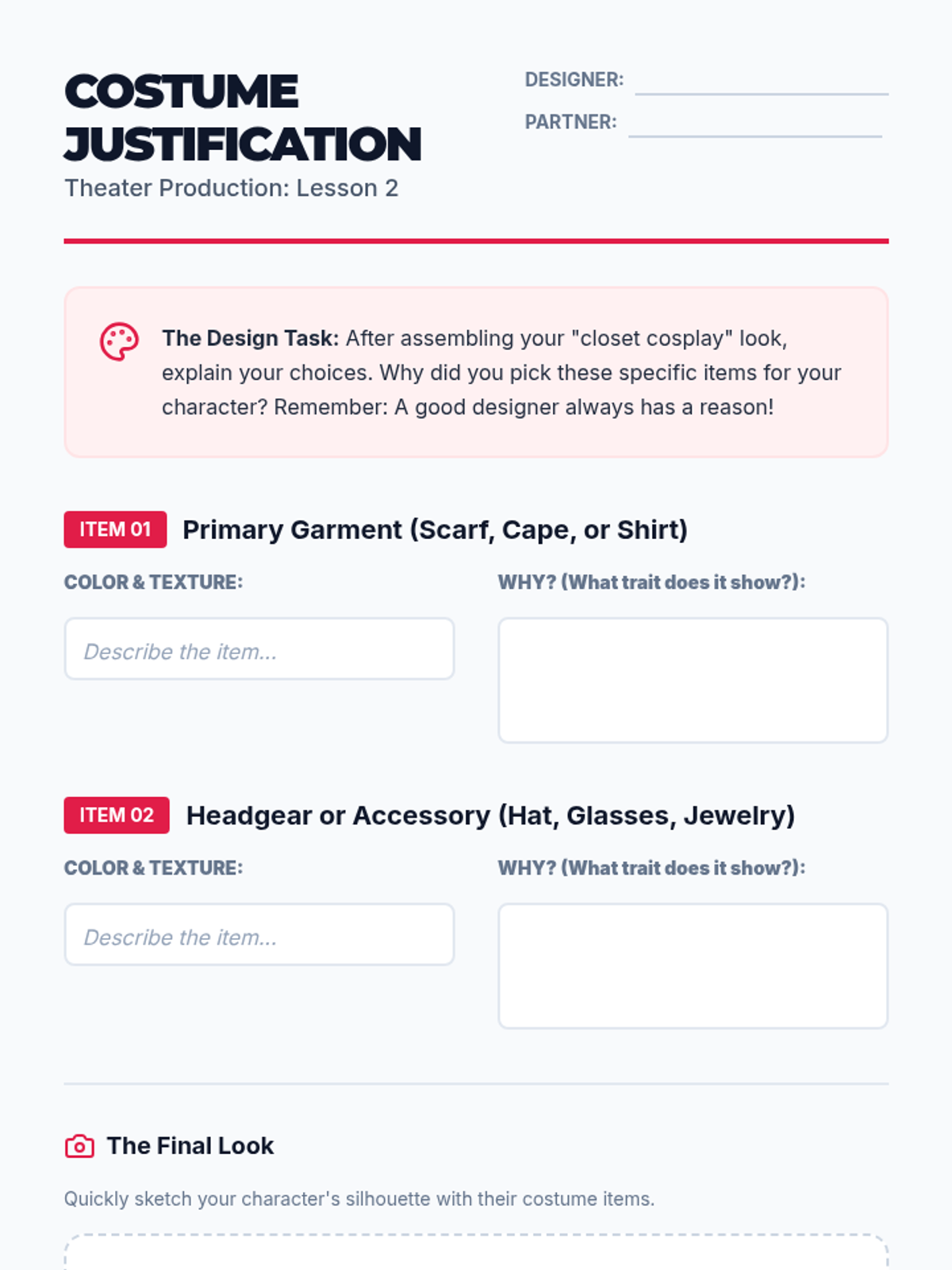
A worksheet where students list their costume selections and justify how each choice communicates a specific character trait.
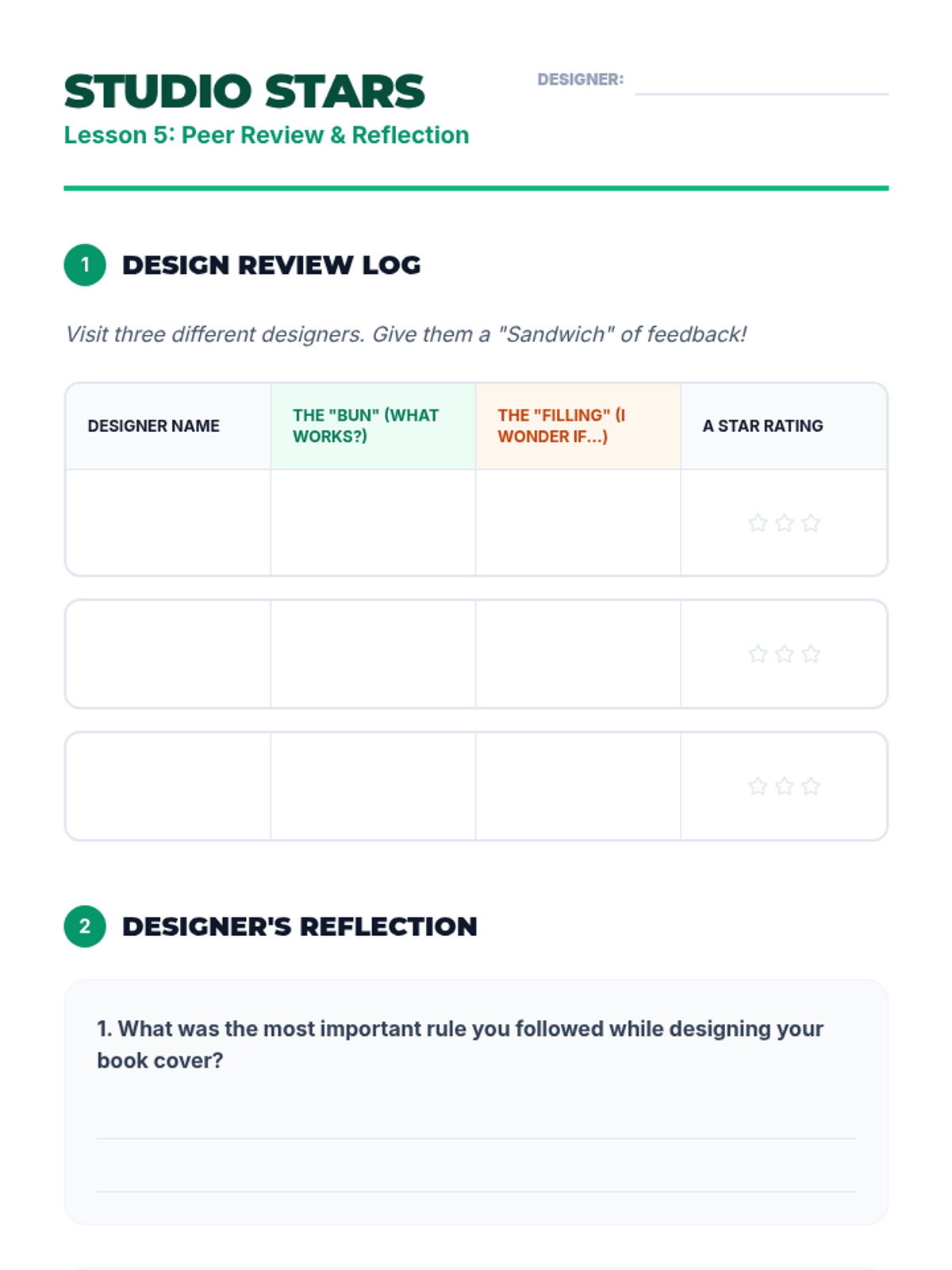
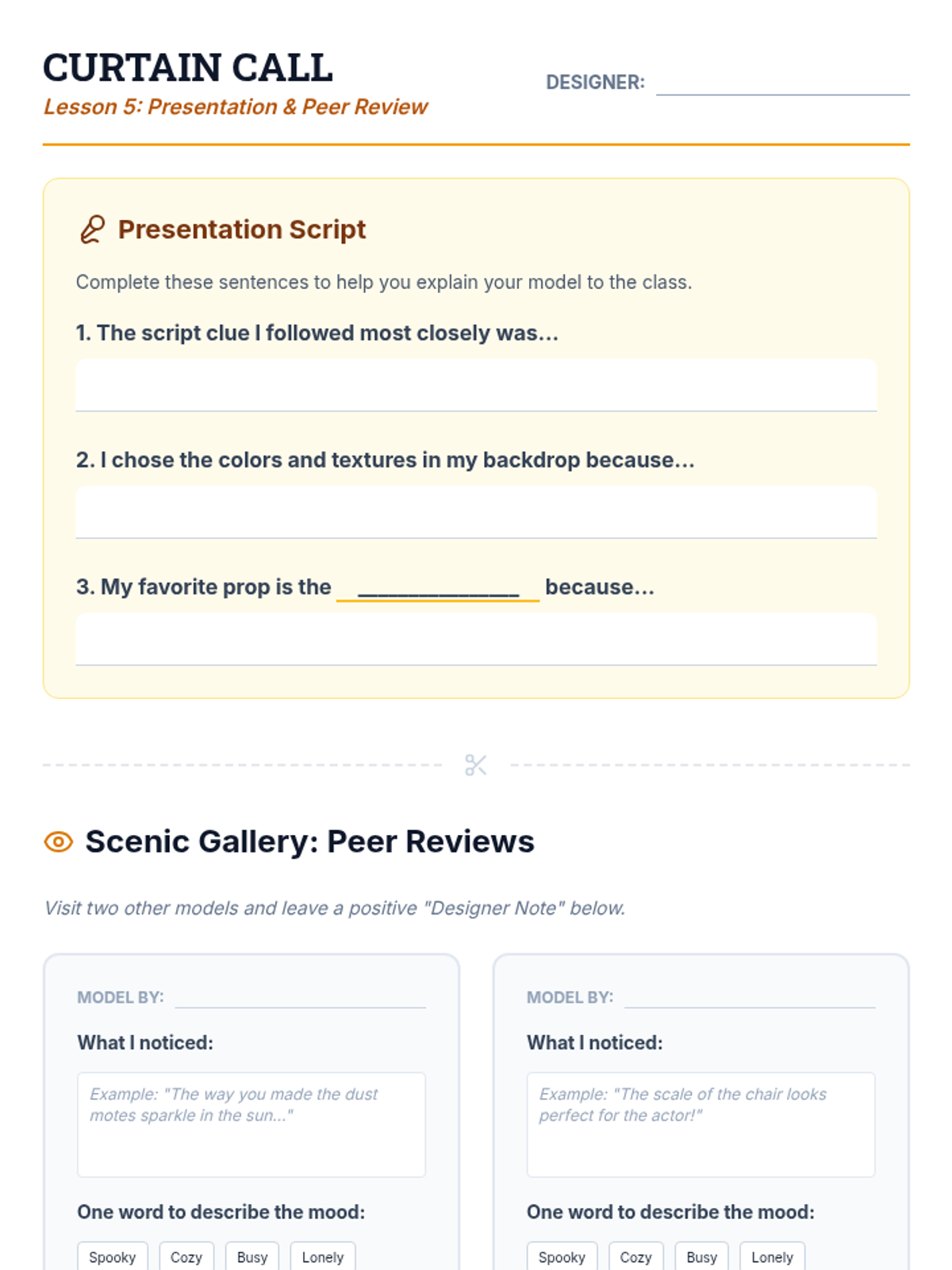
A presentation prep and peer review form for Lesson 5 where students write their design justifications and provide positive feedback to their classmates.
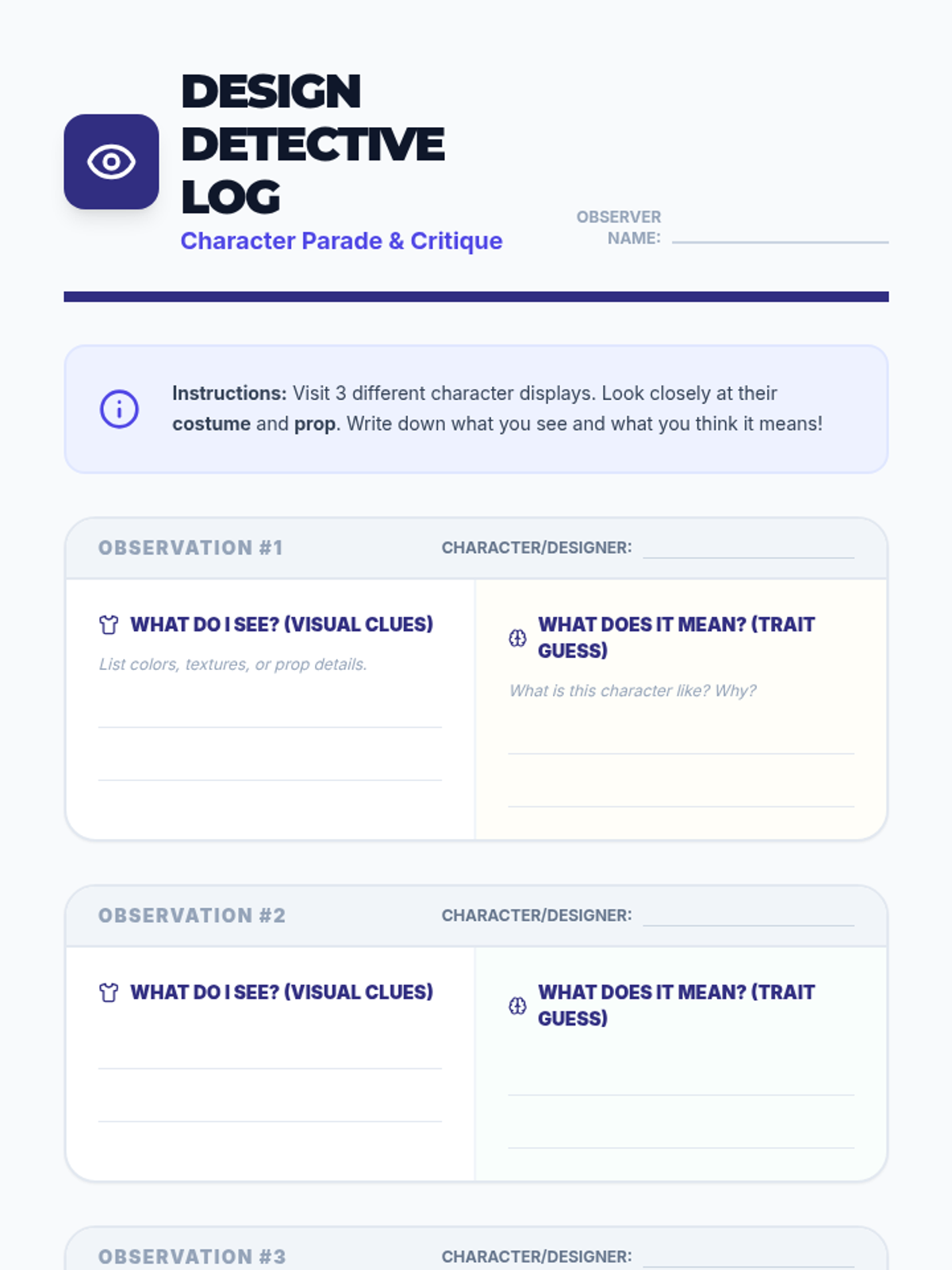
A design feedback worksheet where students record visual clues they observe in their peers' characters and guess the corresponding character traits.
Slides for Lesson 5 that guide the class through the final presentation day, featuring gallery walk etiquette and design justification stems.
Introductory slides for Lesson 5 focusing on the gallery walk, visual observation, and giving constructive feedback on character design.
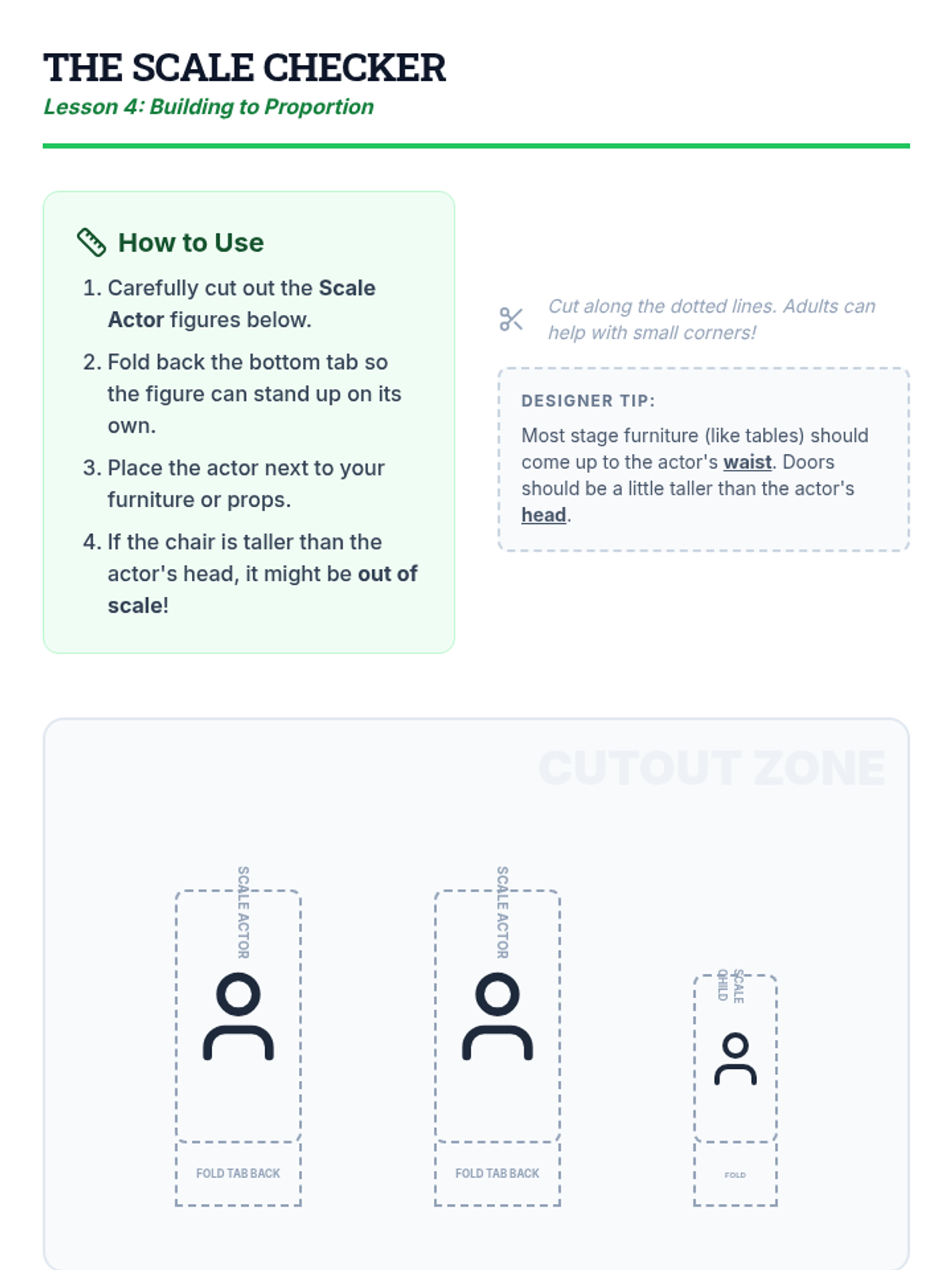
A printable reference tool for Lesson 4 that provides "standard actor" cutout figures and a scale wall to help students ensure their miniature props are appropriately proportioned.
Instructional slides for Lesson 4 on prop construction, focusing on safety, creative reuse of materials, and the assembly process.
Slides for Lesson 4 that explain the concept of scale and proportion in miniature model building, helping students ensure their props are appropriately sized.
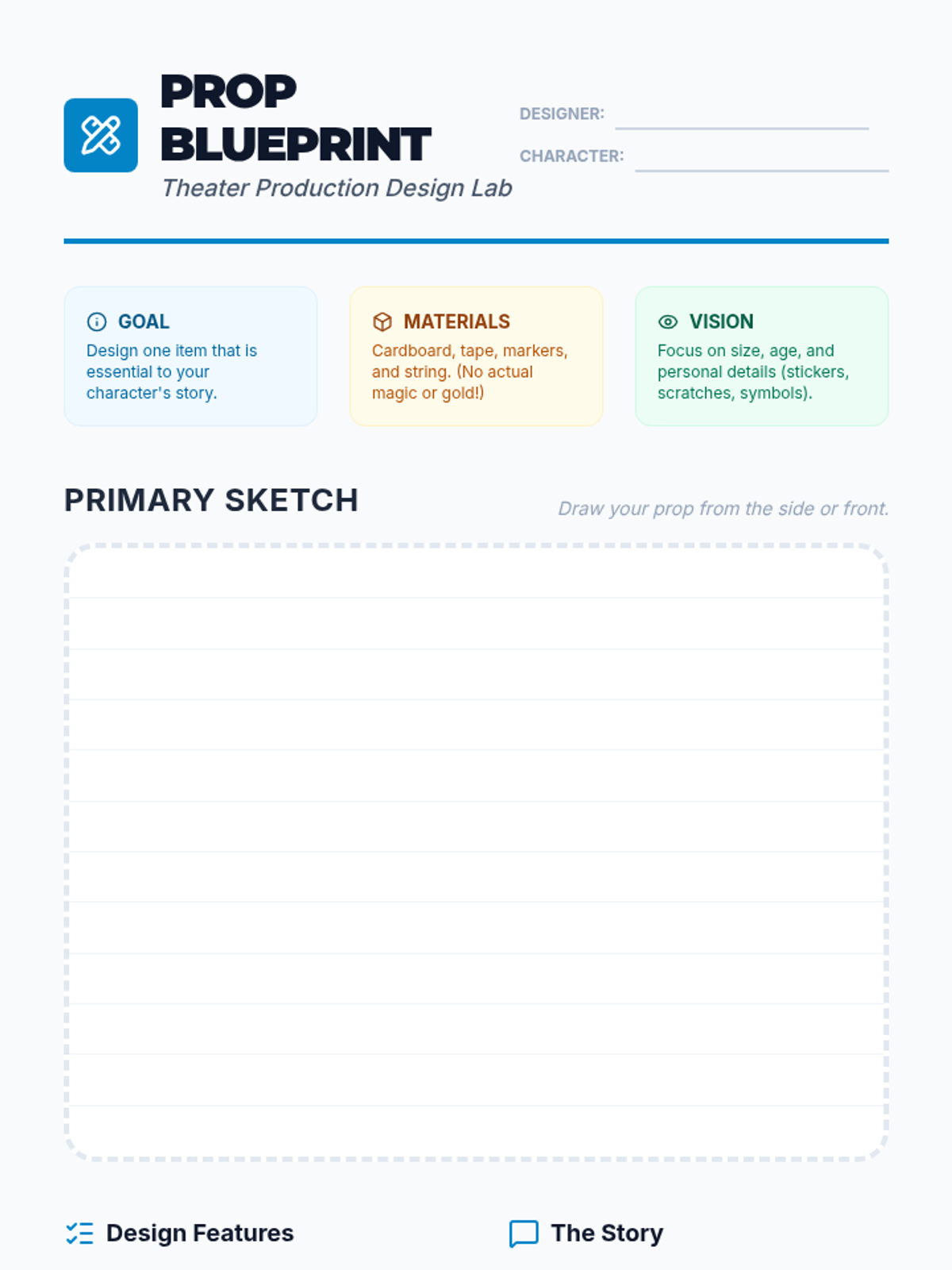
A design blueprint worksheet where students sketch their character's essential prop and list its unique narrative details.
Slides for Lesson 3 that explore color psychology and texture in theatrical design, guiding students to plan their shoebox backdrops.
Instructional slides for Lesson 3 on prop design, focusing on the concept of 'essential props' and adding narrative detail.
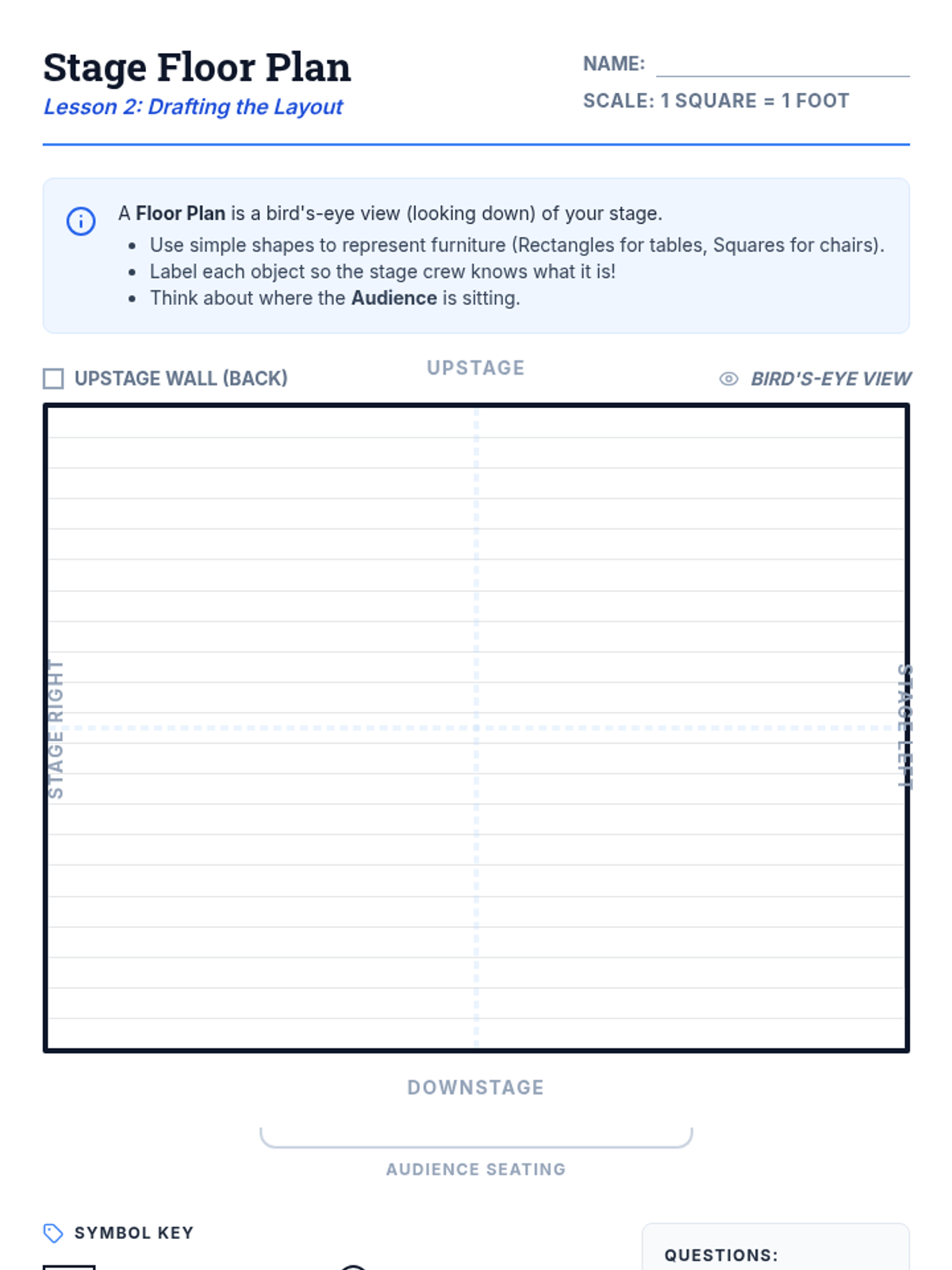
A grid-based floor plan drafting worksheet for Lesson 2, including stage geography labels (upstage, downstage, stage left/right) and a symbol key.
Instructional slides for Lesson 2 focusing on the visual language of color and texture in costume design.
Slides for Lesson 2 that teach basic stage geography (stage left, right, upstage, downstage) and explain how to create a bird's-eye view floor plan.
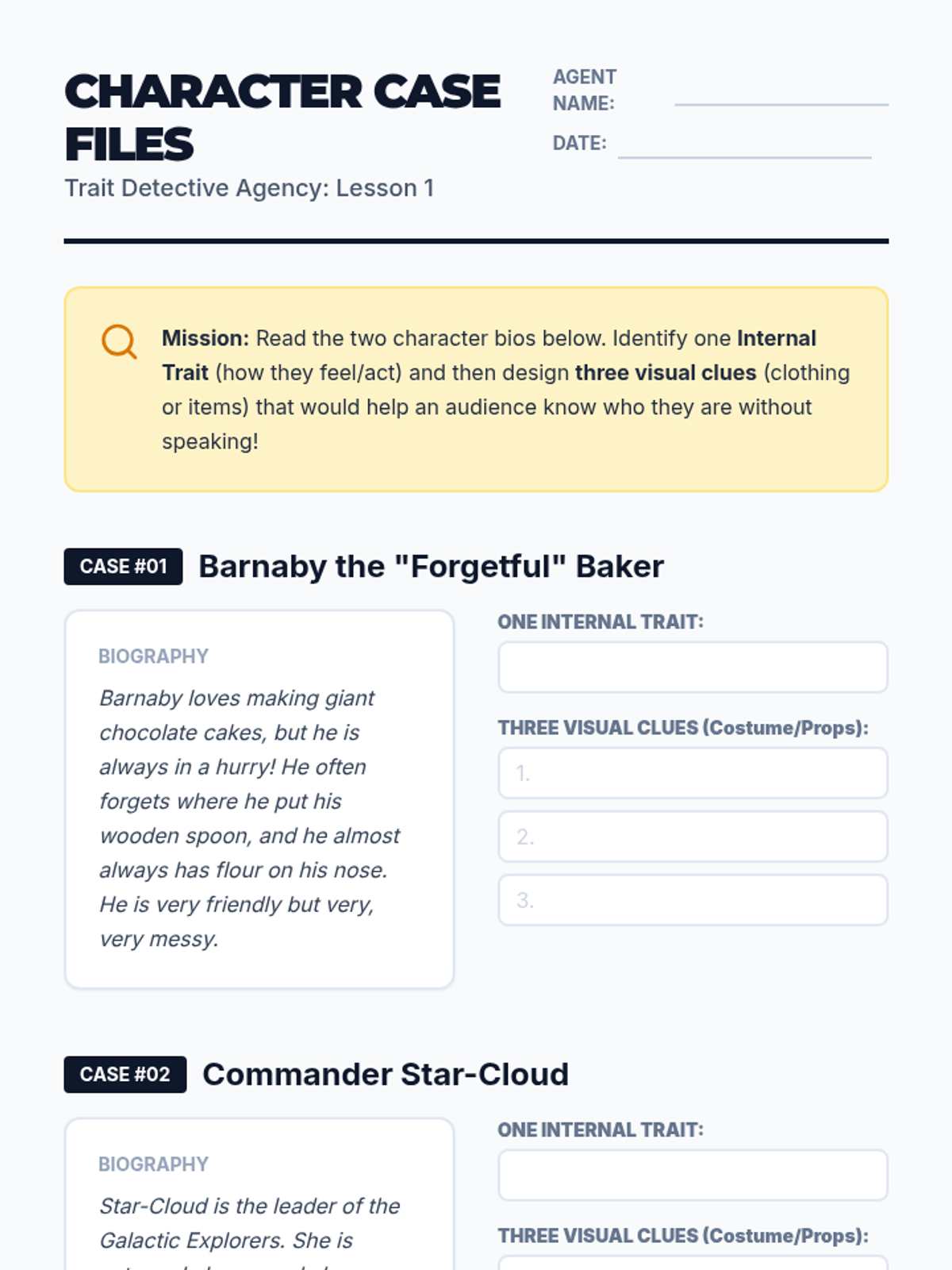
A character analysis worksheet where students identify traits from short bios and brainstorm visual costume and prop clues.
Introductory slides for Lesson 1 that define the role of a set designer and explain how to look for clues in a script.
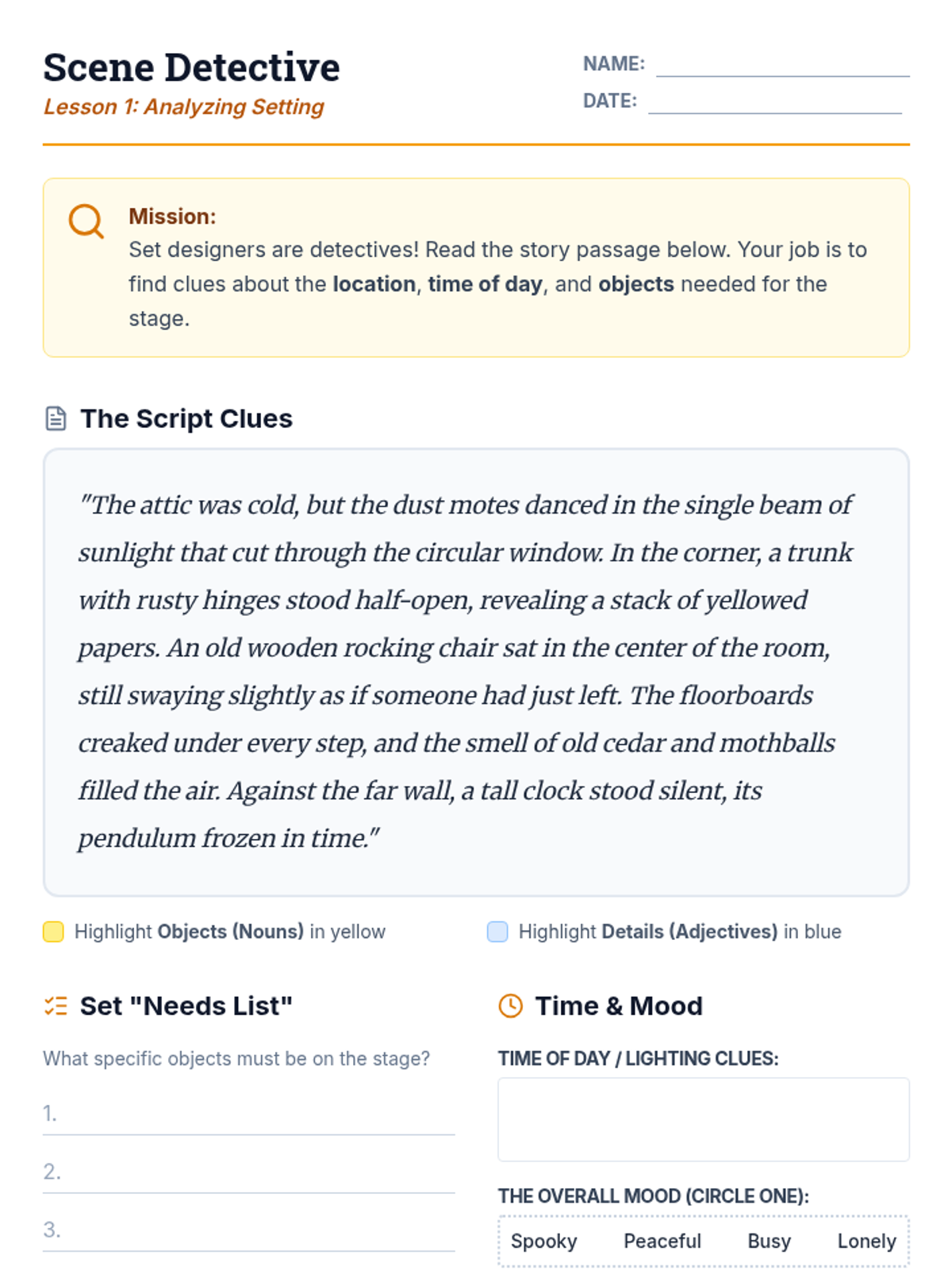
A student worksheet for Lesson 1 that guides students through text analysis of a story passage and a preliminary thumbnail sketch of the setting.
Introductory slides for Lesson 1 on analyzing character traits and their visual representation in theater production.
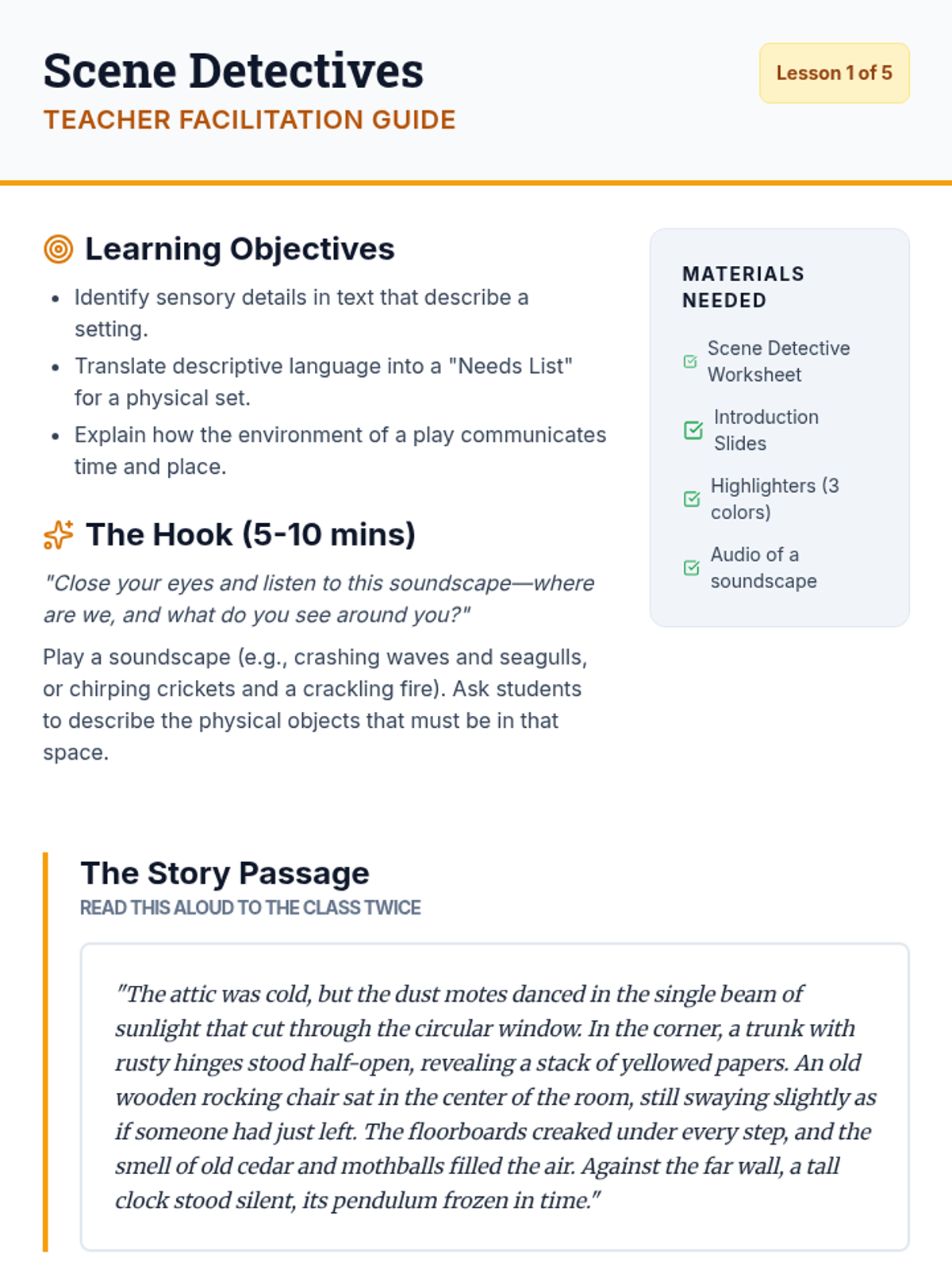
A comprehensive teacher facilitation guide for Lesson 1, featuring the story passage, learning objectives, instructional steps, and discussion prompts.
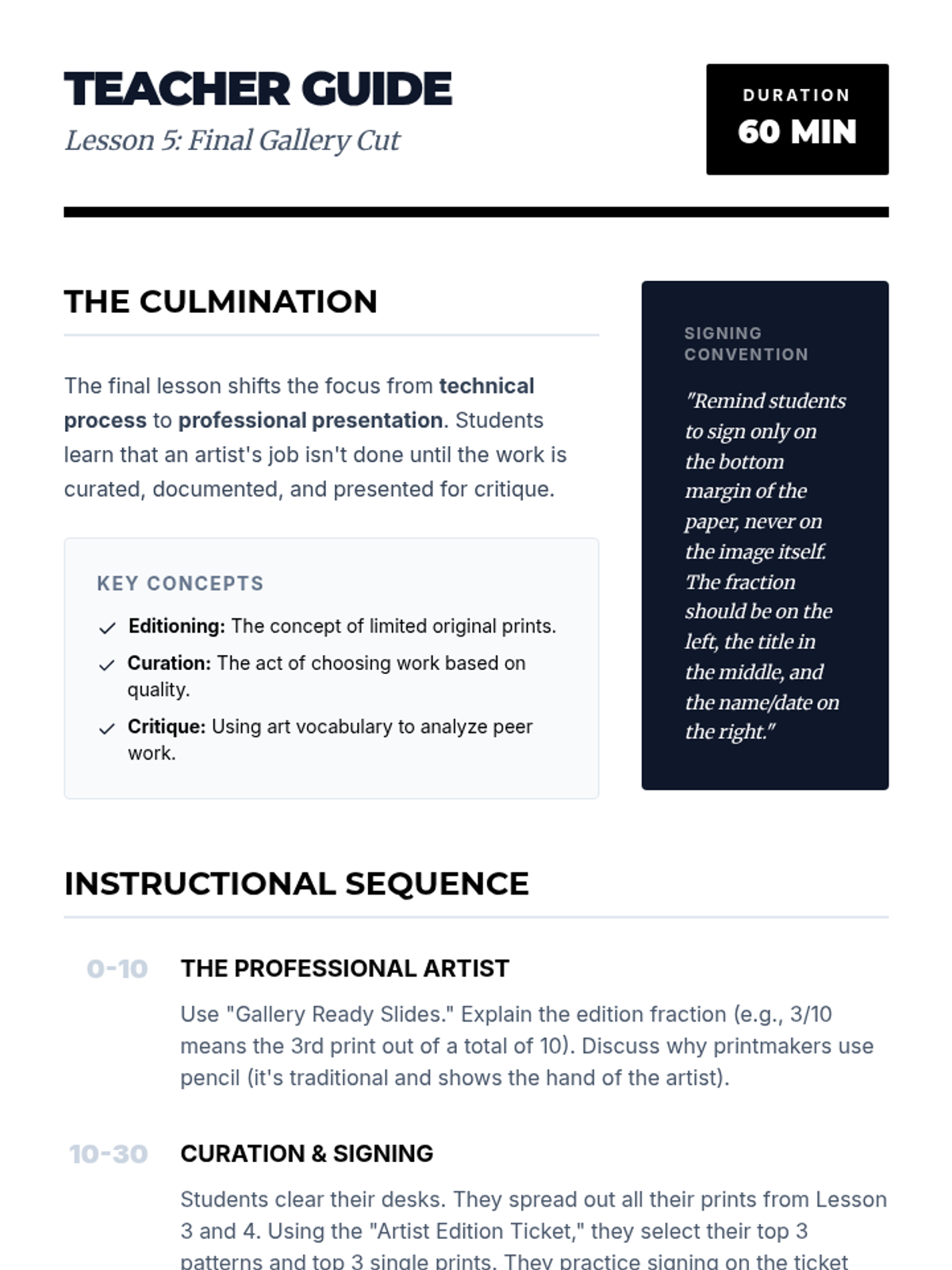
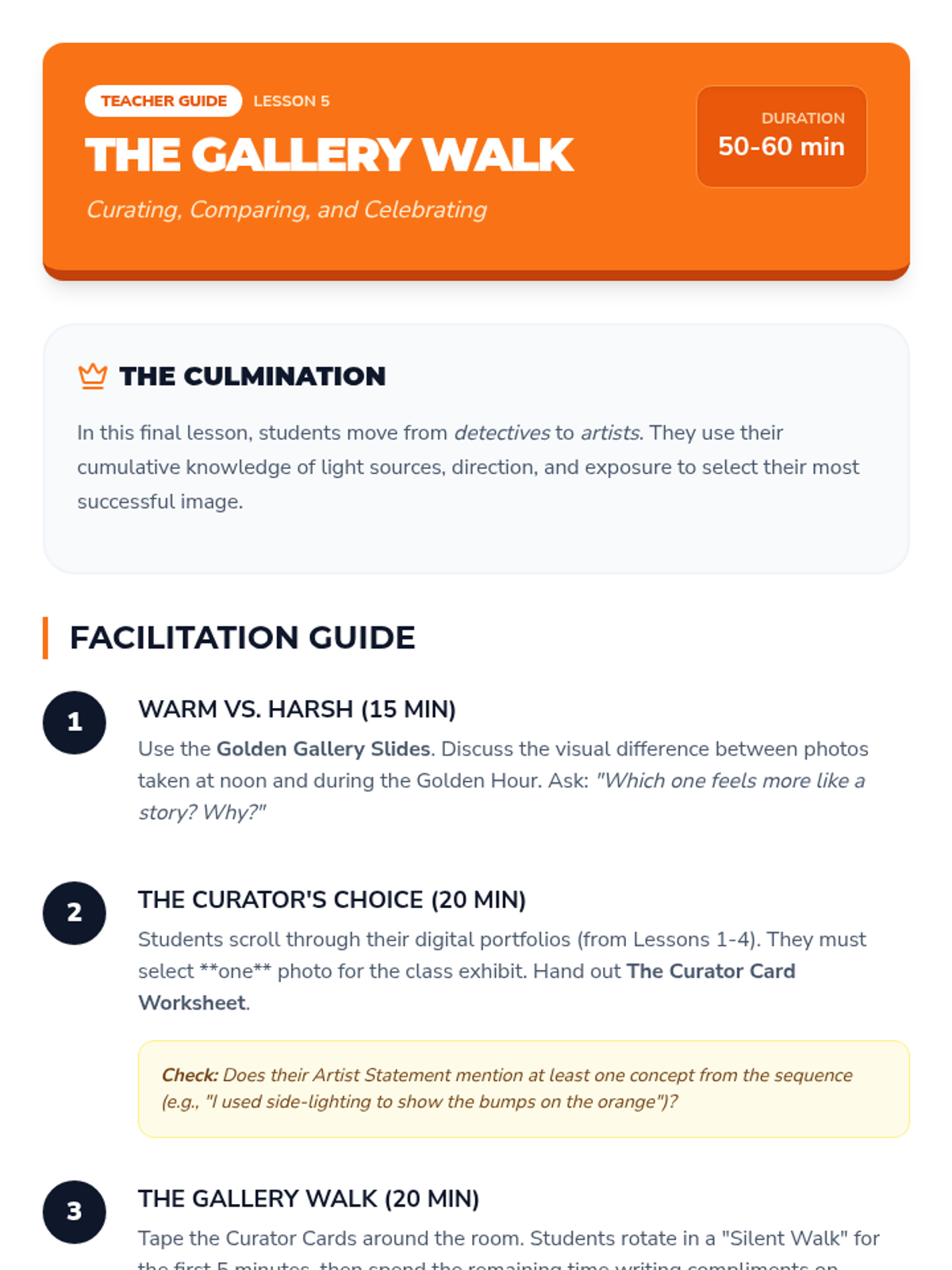
Teacher guide for Lesson 5, providing instructions for the curation process, print signing conventions, and facilitating a peer gallery walk.
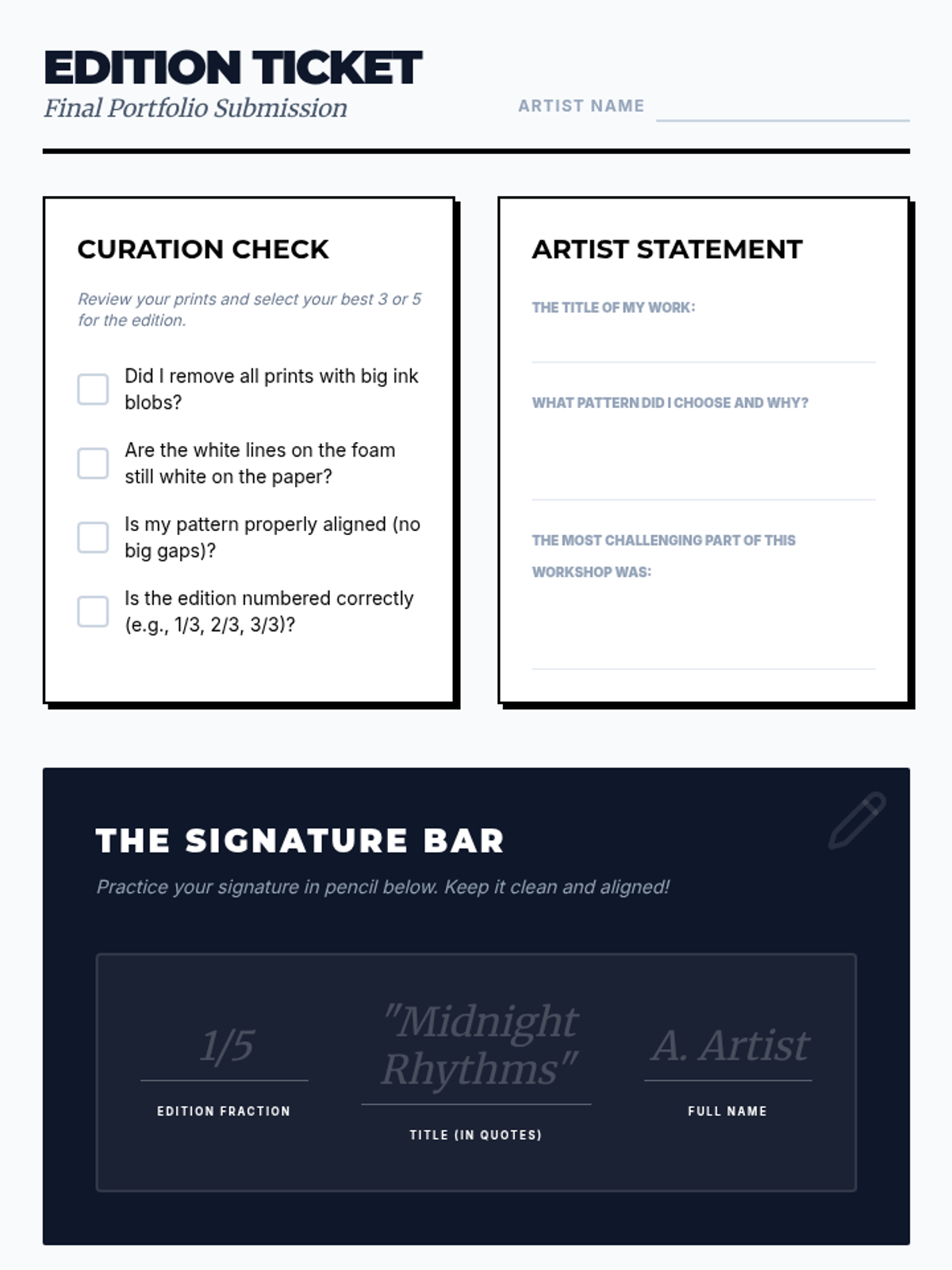
A student reflection and signing guide for the final lesson. Includes a curation checklist, artist statement prompts, and practice signing area.
Slides for Lesson 5 covering signing prints, numbering editions, and conducting a peer critique.
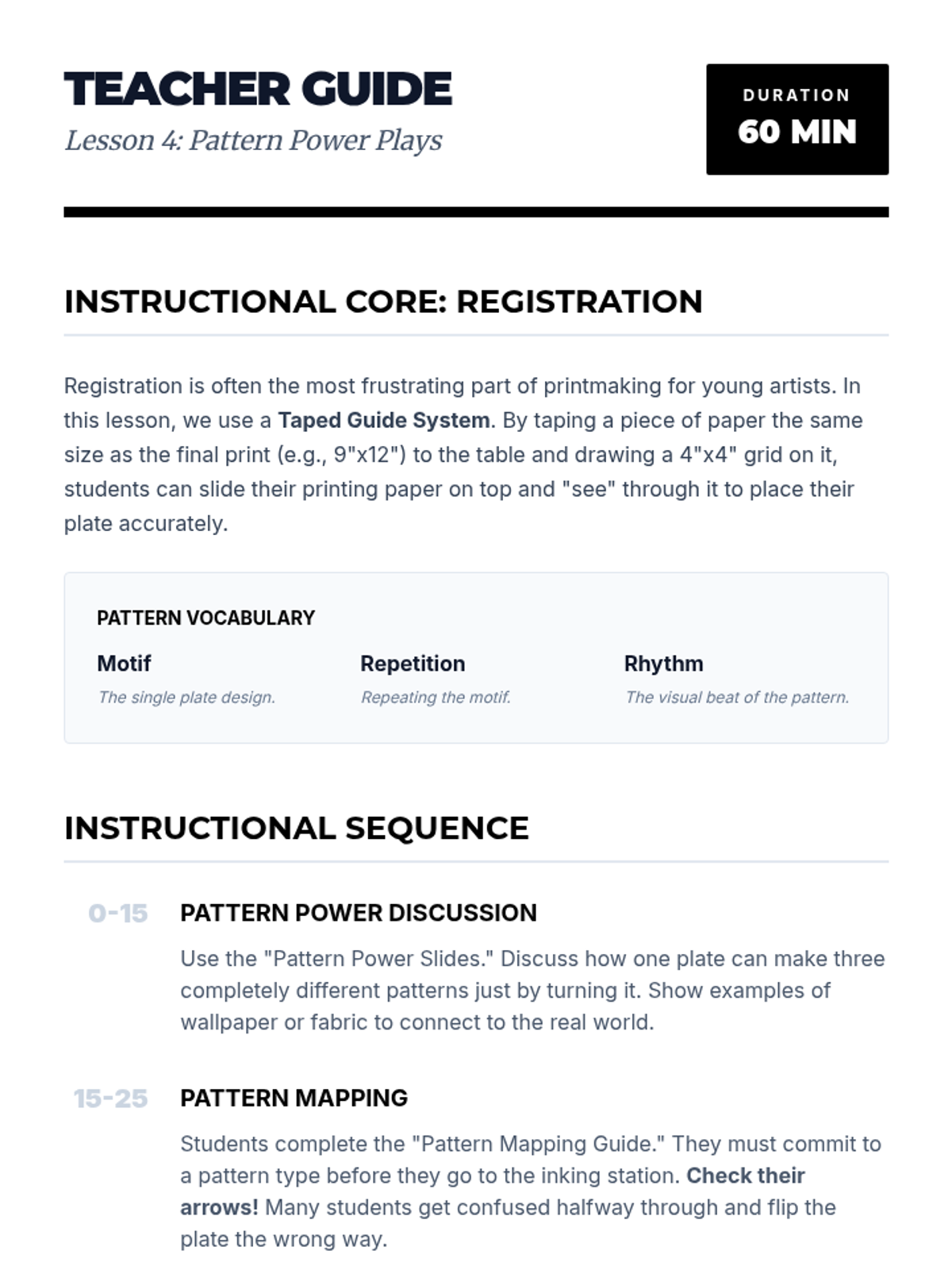
Teacher guide for Lesson 4, providing registration techniques, pattern vocabulary, and instructional pacing.
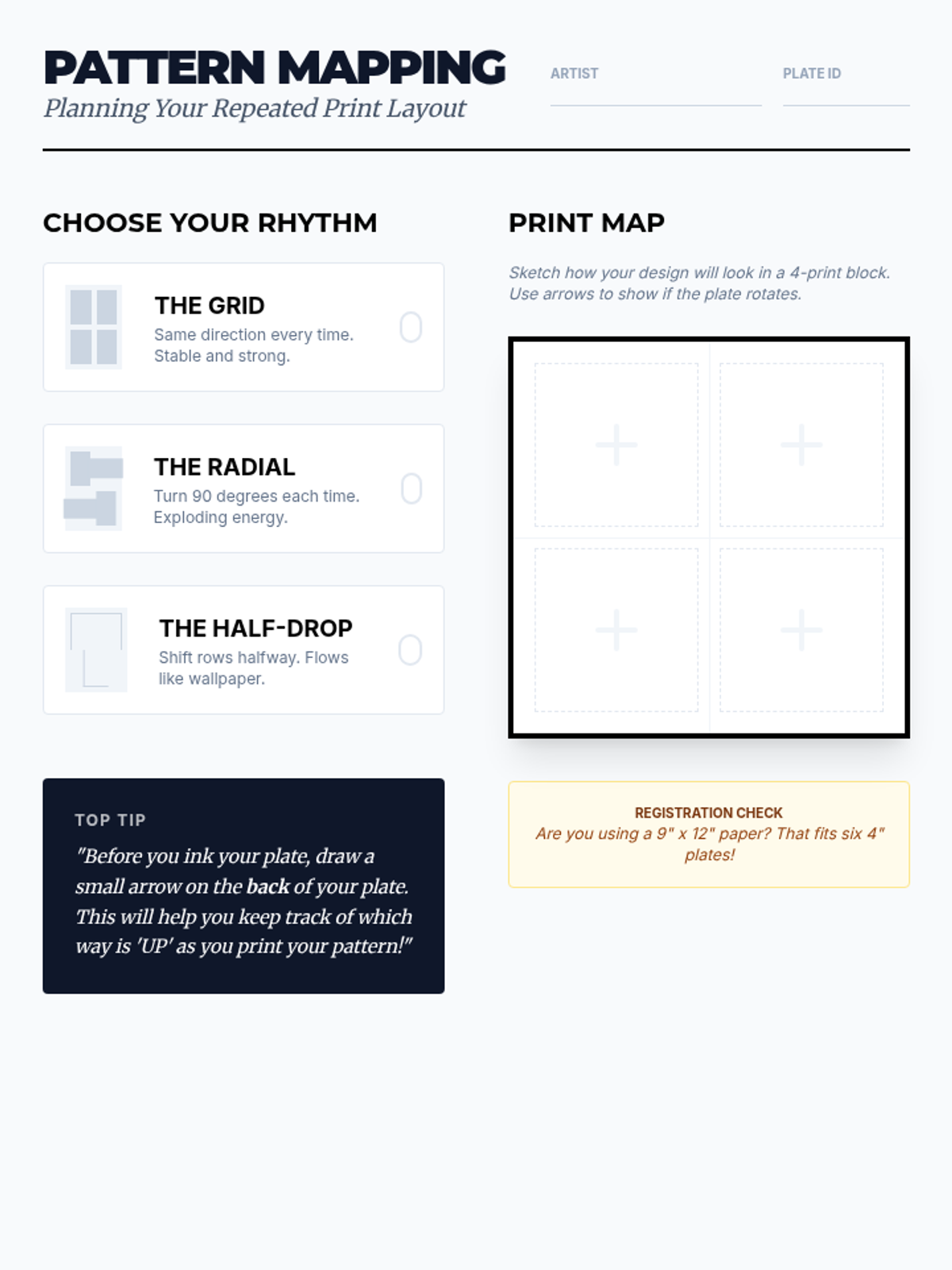
A planning guide for Lesson 4. Students choose a pattern type and sketch their intended layout to manage plate orientation and alignment.
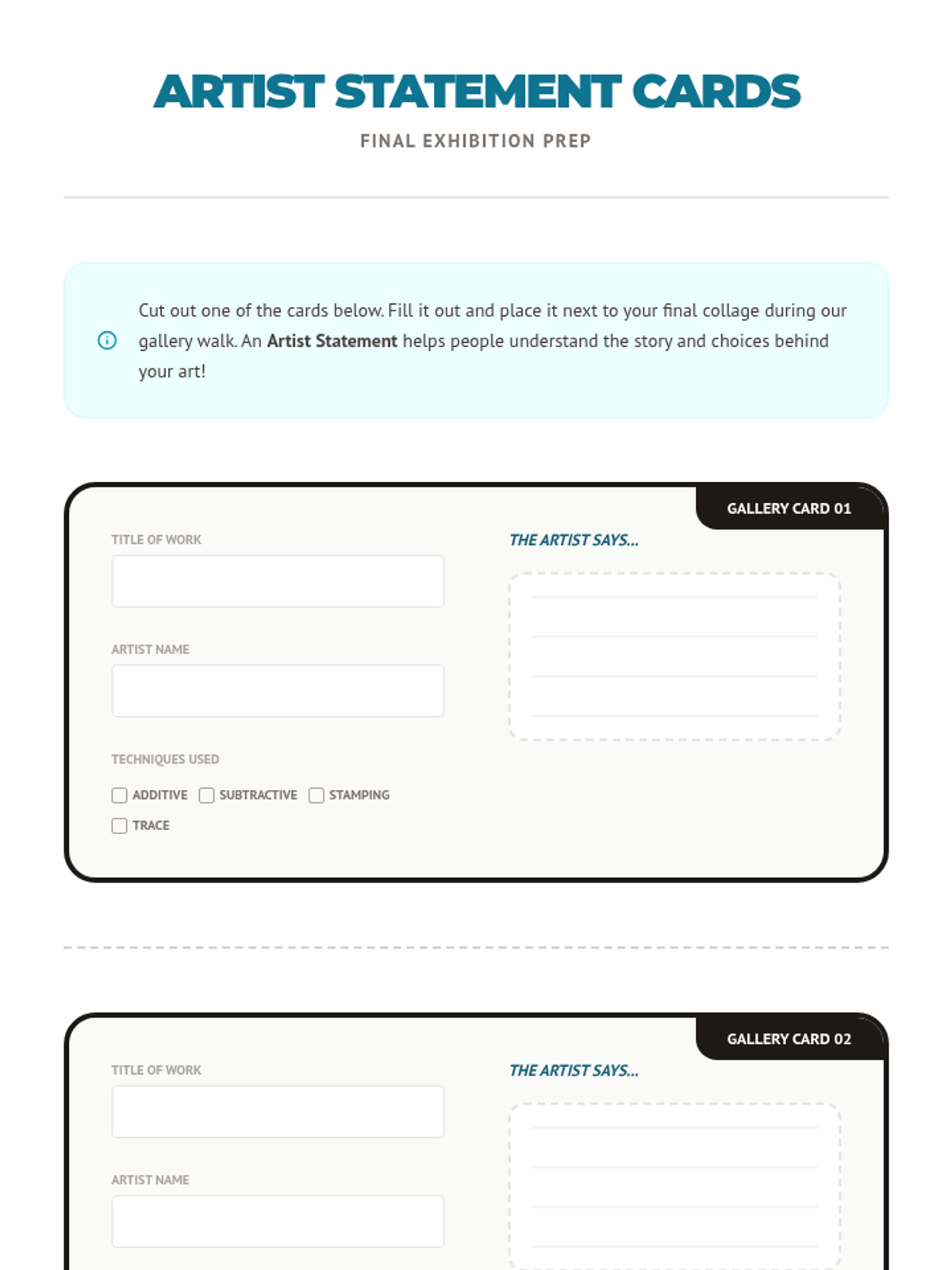
Artist statement cards for students to fill out and display with their final mixed-media print collages during Lesson 5's gallery walk.
Slides for Lesson 4 covering pattern types (grid, radial, half-drop) and registration techniques for aligning repeated prints.
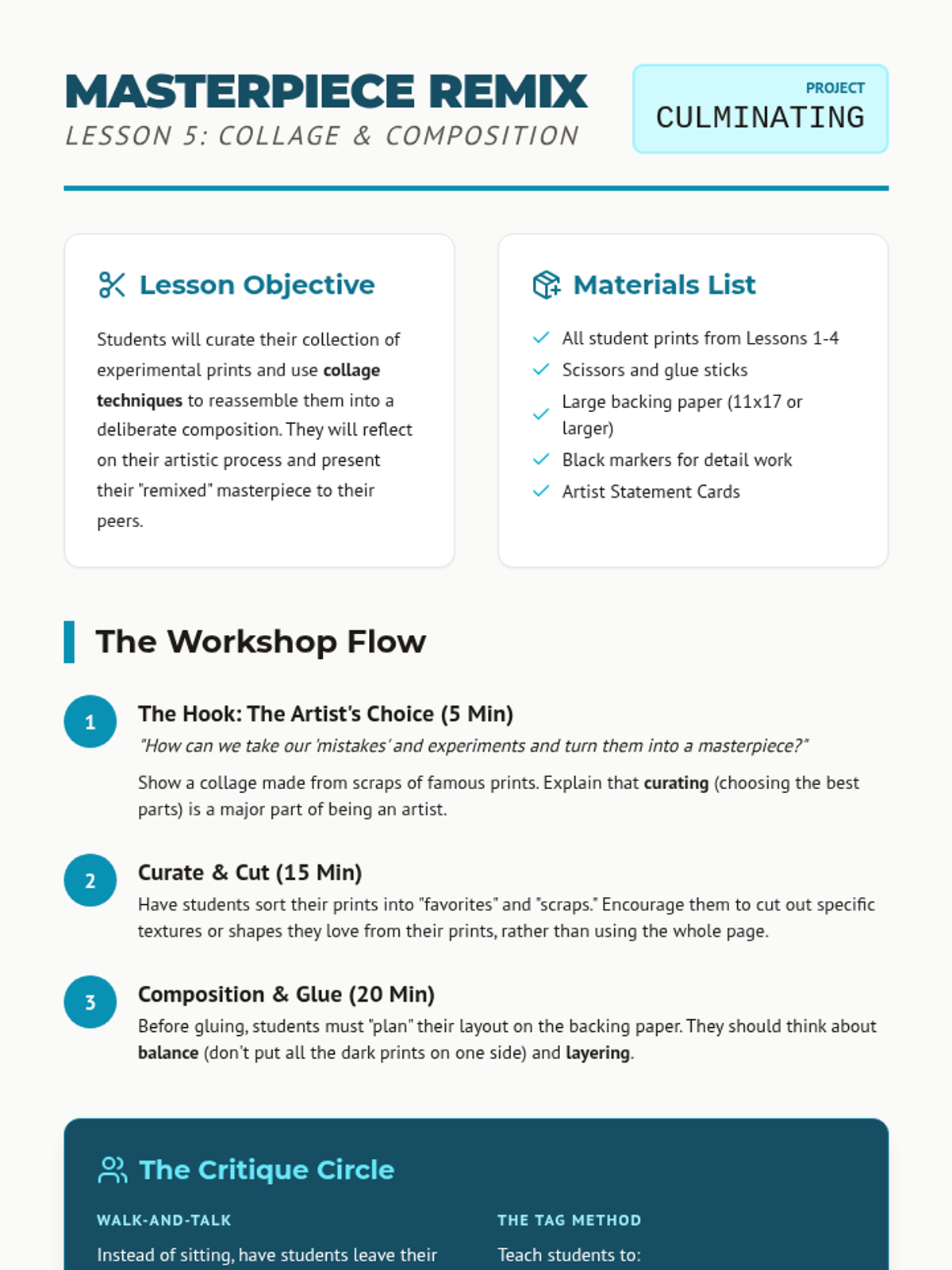
Slide deck for Lesson 5, introducing the final collage project, the concept of remixing artistic experiments, and peer critique guidelines.
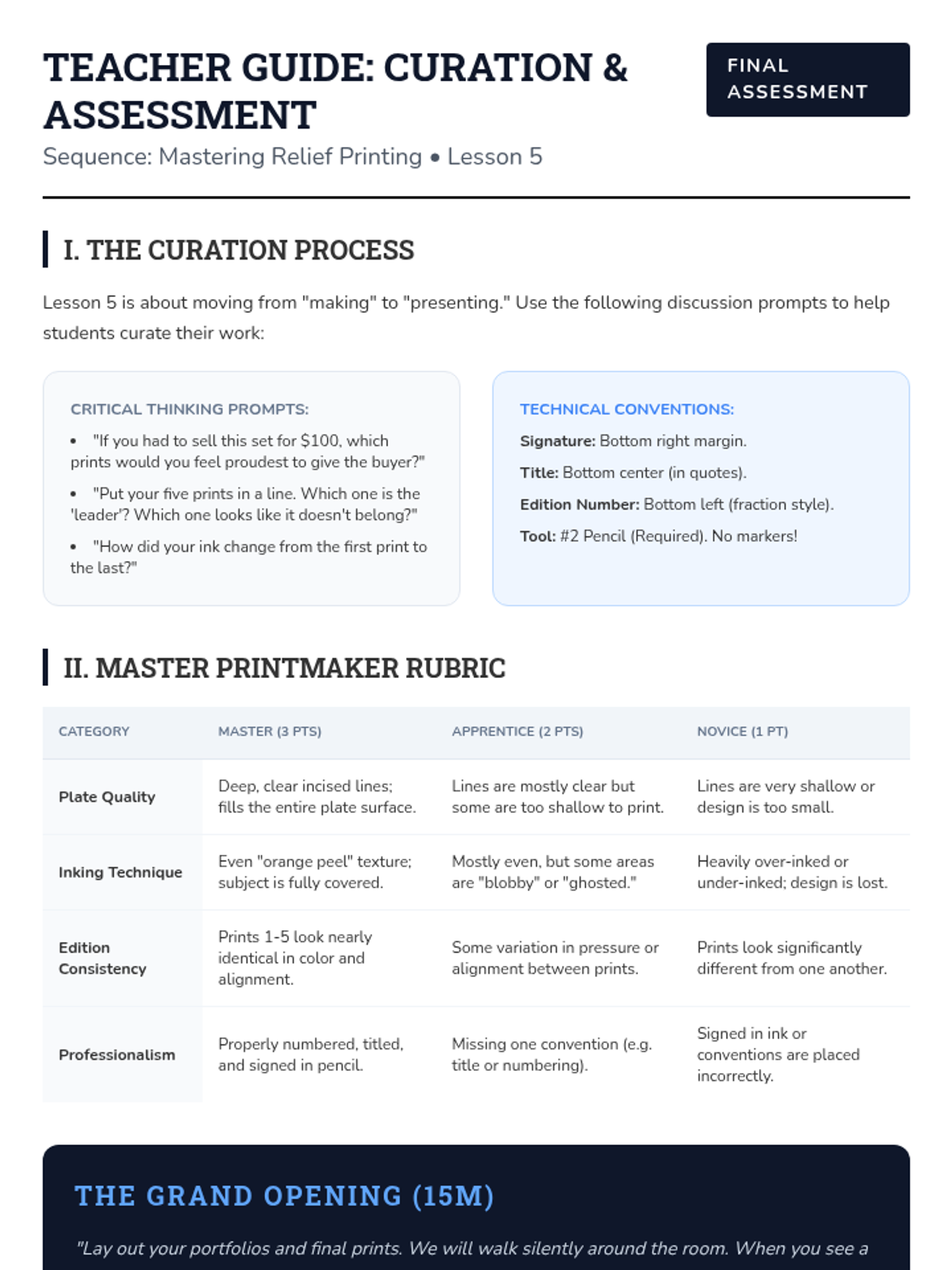
A technical teacher guide for Lesson 5, including a master printmaker rubric and a guide for the final curation and gallery walk.
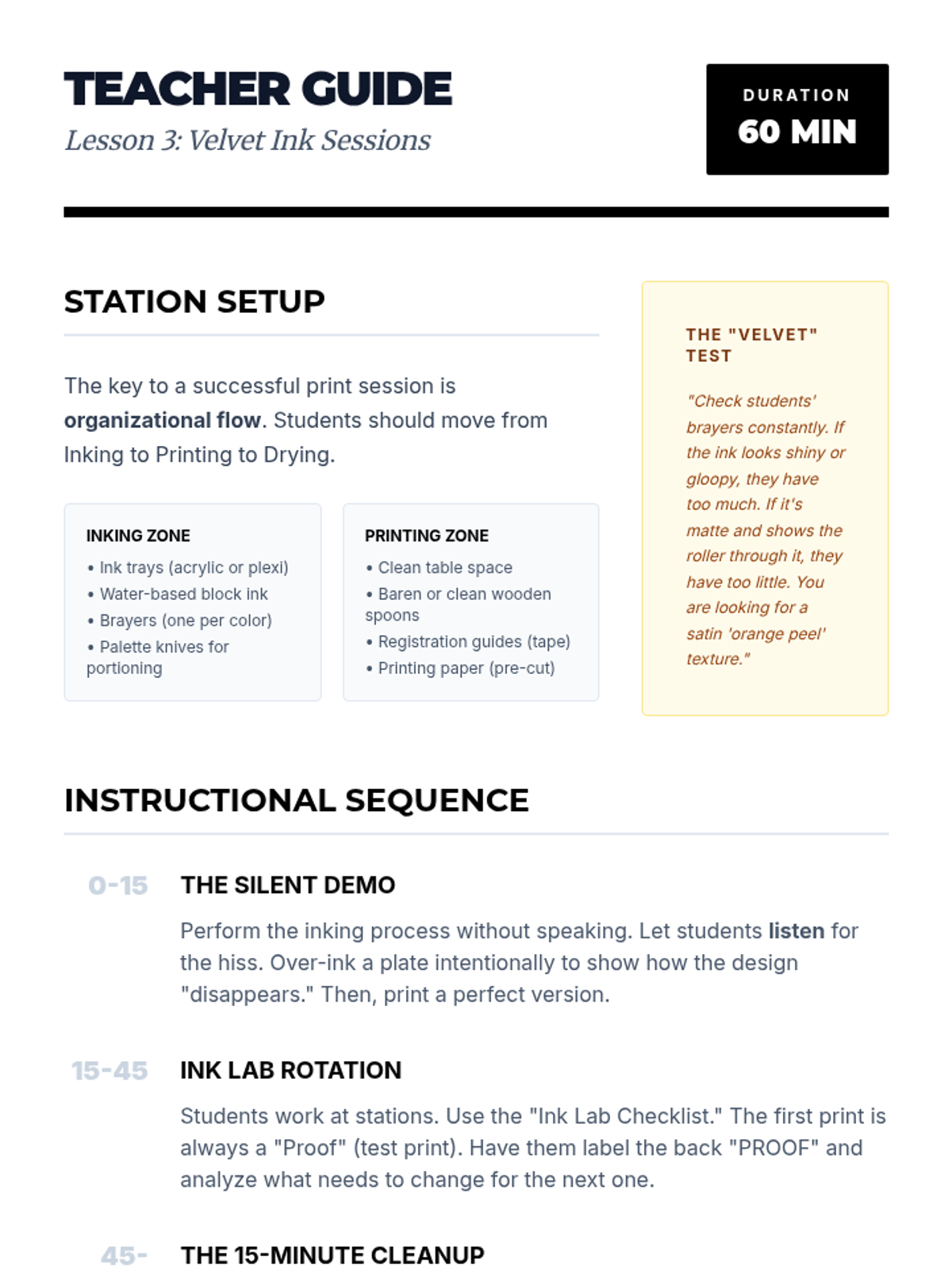
Teacher guide for Lesson 3, providing station setup instructions, the "Silent Demo" strategy, and cleanup procedures.
Teacher guide for Lesson 5 focusing on facilitating the final collage project and organizing a peer critique using the TAG method.
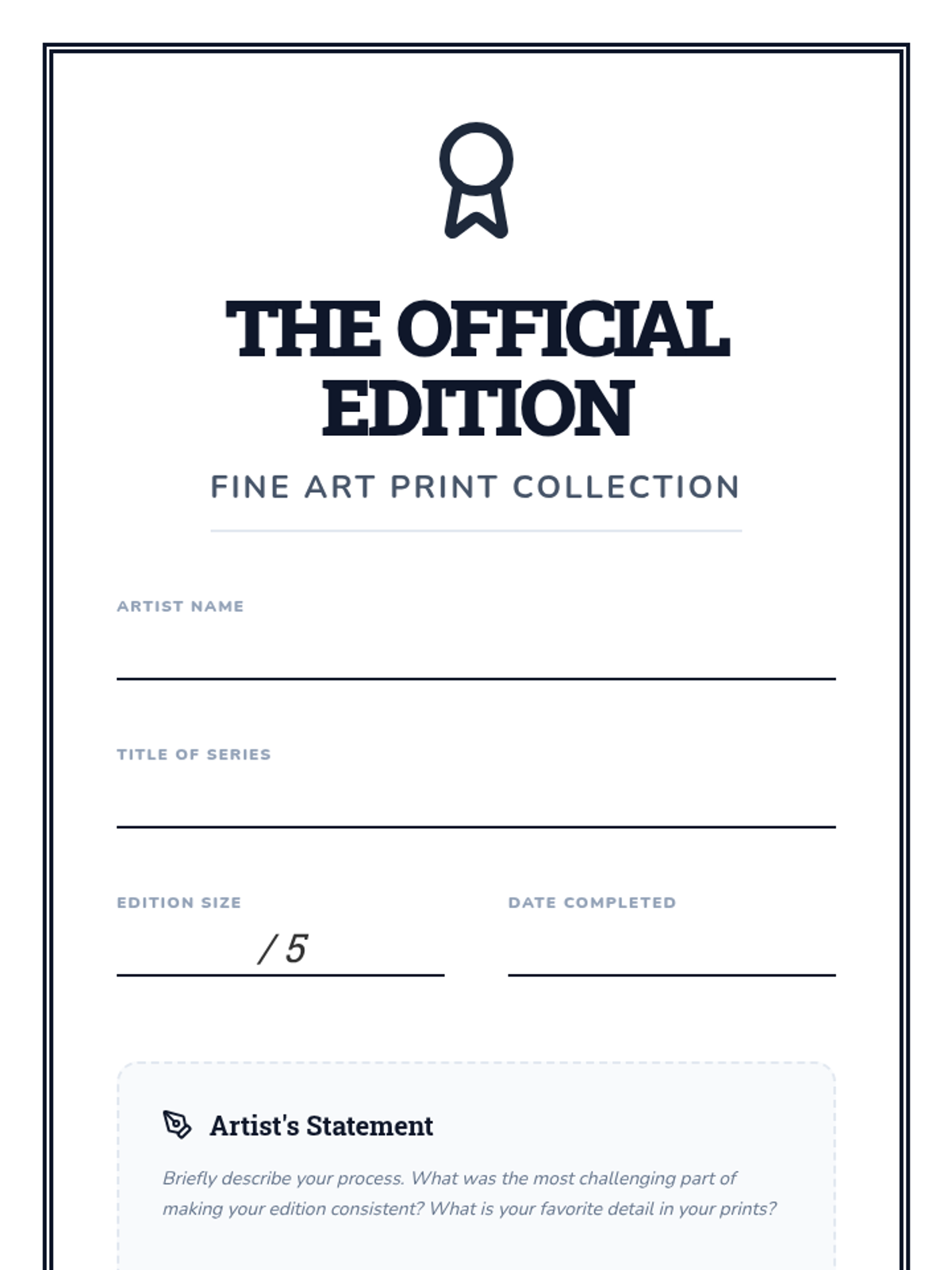
A decorative portfolio cover for students to present their final edition of prints, including space for titles, artist statements, and edition details.
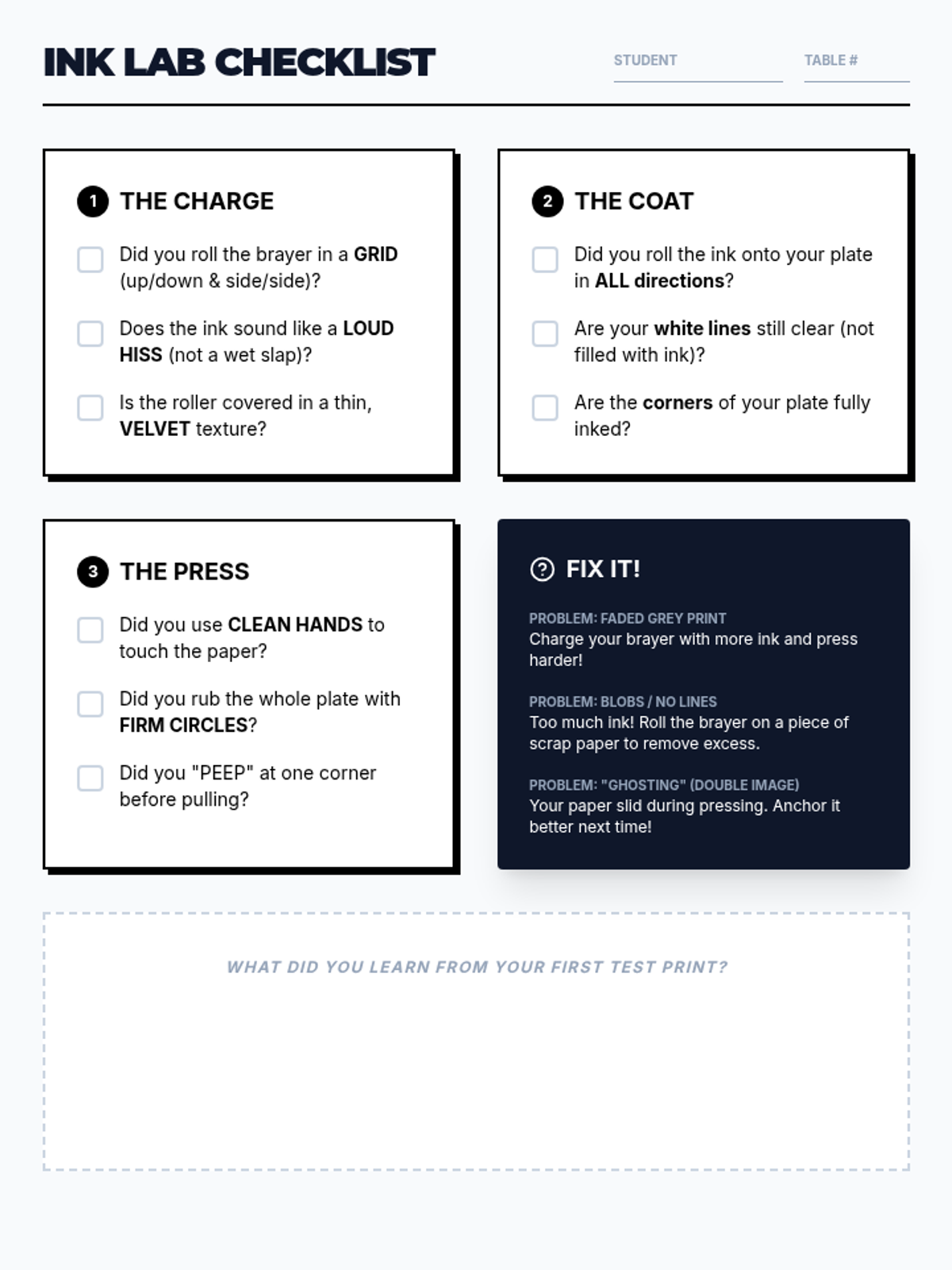
A student self-check list for Lesson 3 to ensure proper inking and pressing techniques.
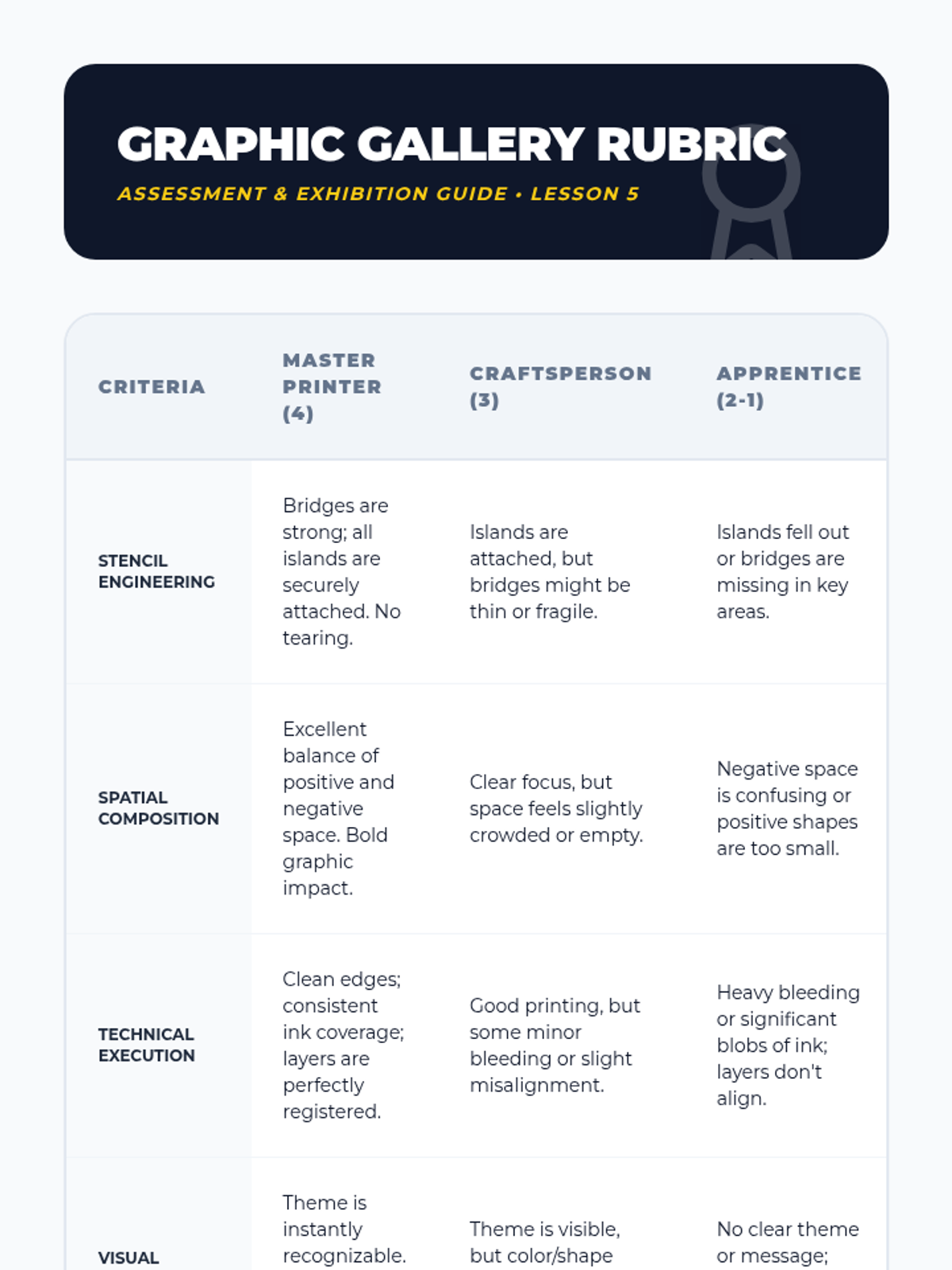
A comprehensive assessment rubric and gallery walk facilitation guide for the final project. Includes criteria for engineering, composition, technical execution, and visual communication.
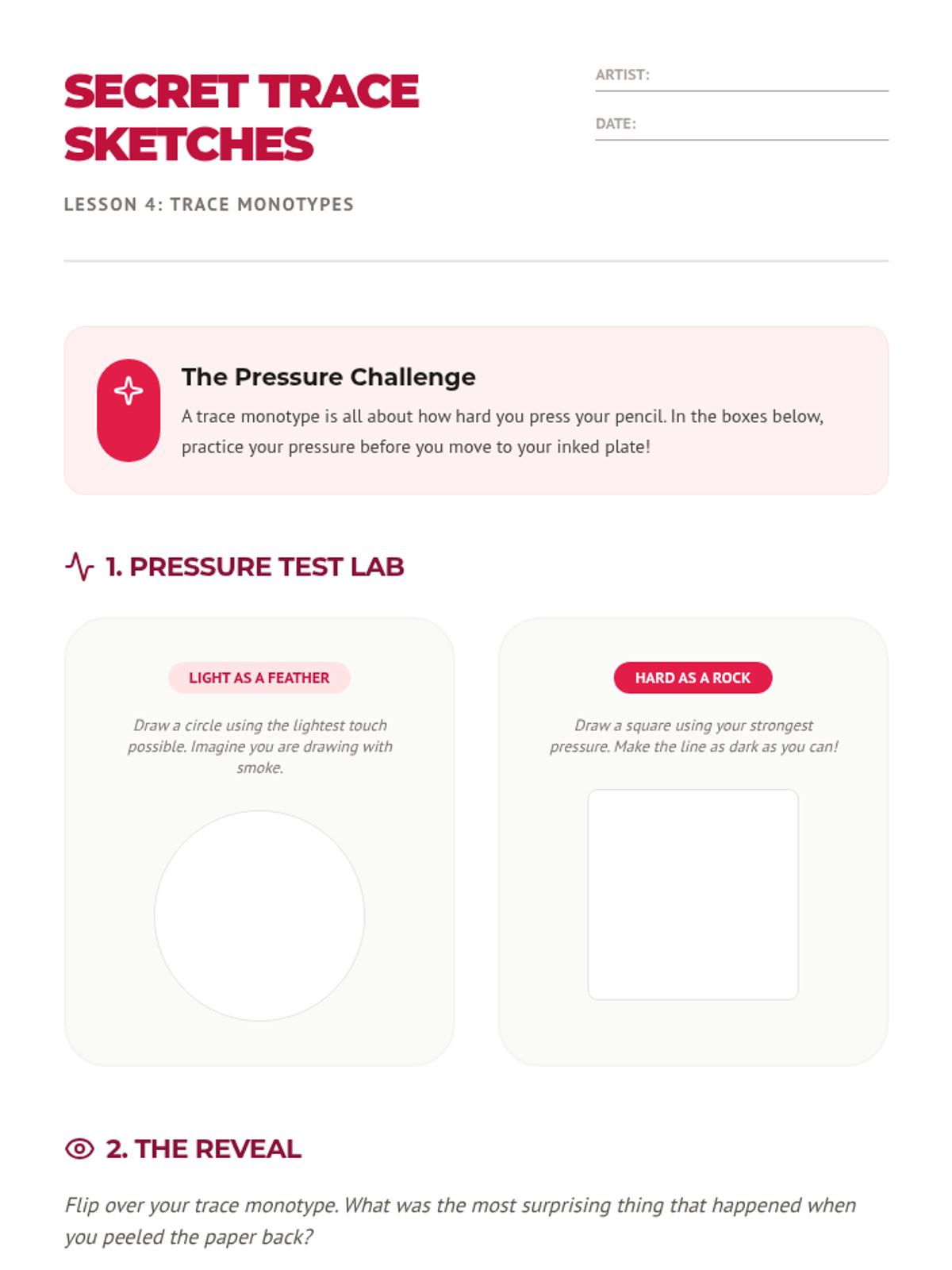
A student worksheet for Lesson 4 that guides 3rd graders through pressure-control exercises and provides space for reflecting on the unique qualities of trace monotypes.
A slide deck for students explaining the conventions of signing, numbering, and curating a professional edition of prints.
Slides for Lesson 3 covering inking techniques, brayer anatomy, charging the roller, and hand-pressing methods.
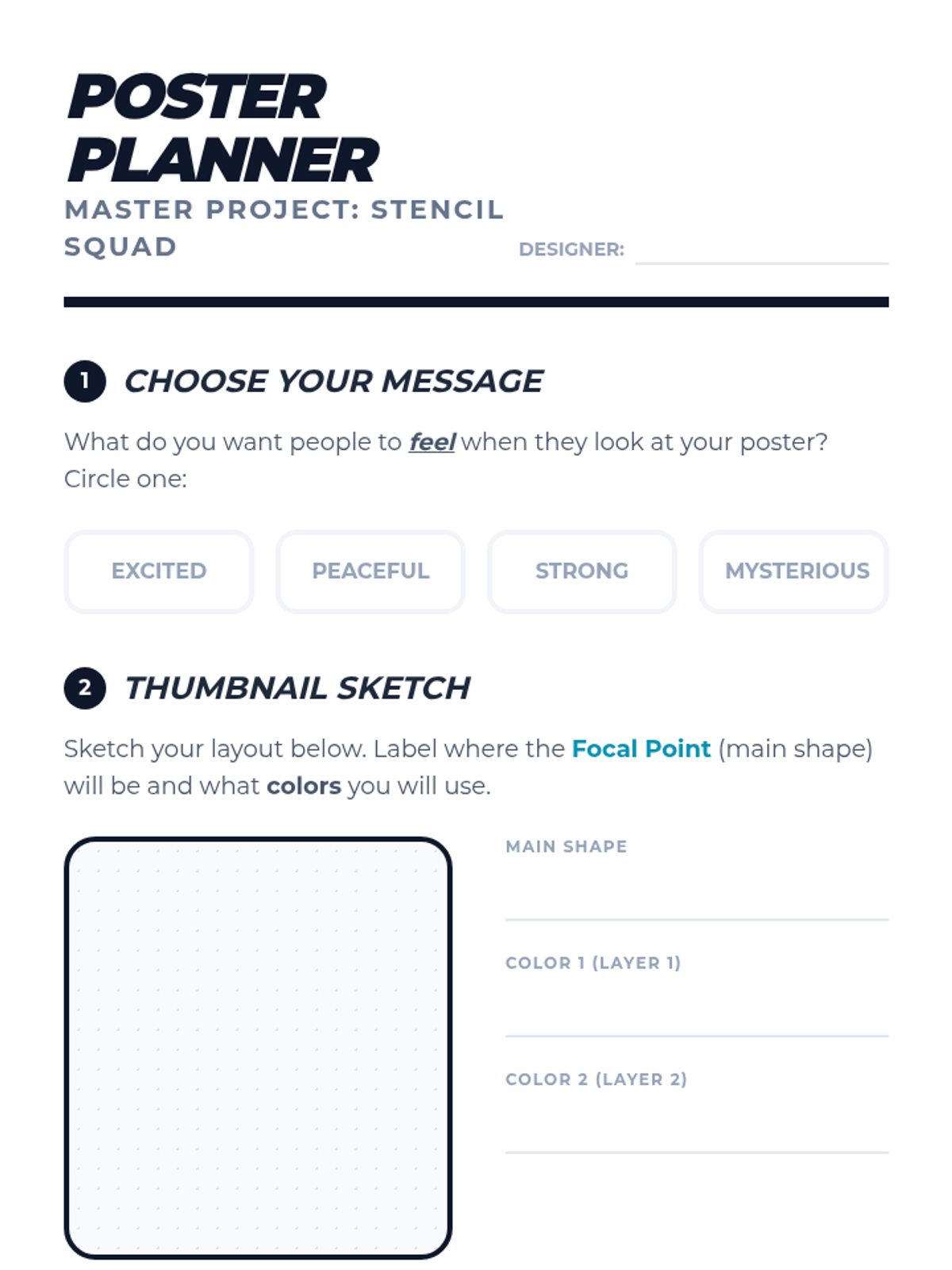
A planning document for students to design their final poster. Includes sections for message selection, layout sketching, and a technical checklist for stencil viability.
Slide deck for Lesson 4, introducing the trace monotype technique, exploring pressure control, and discussing the unique line quality of this method.
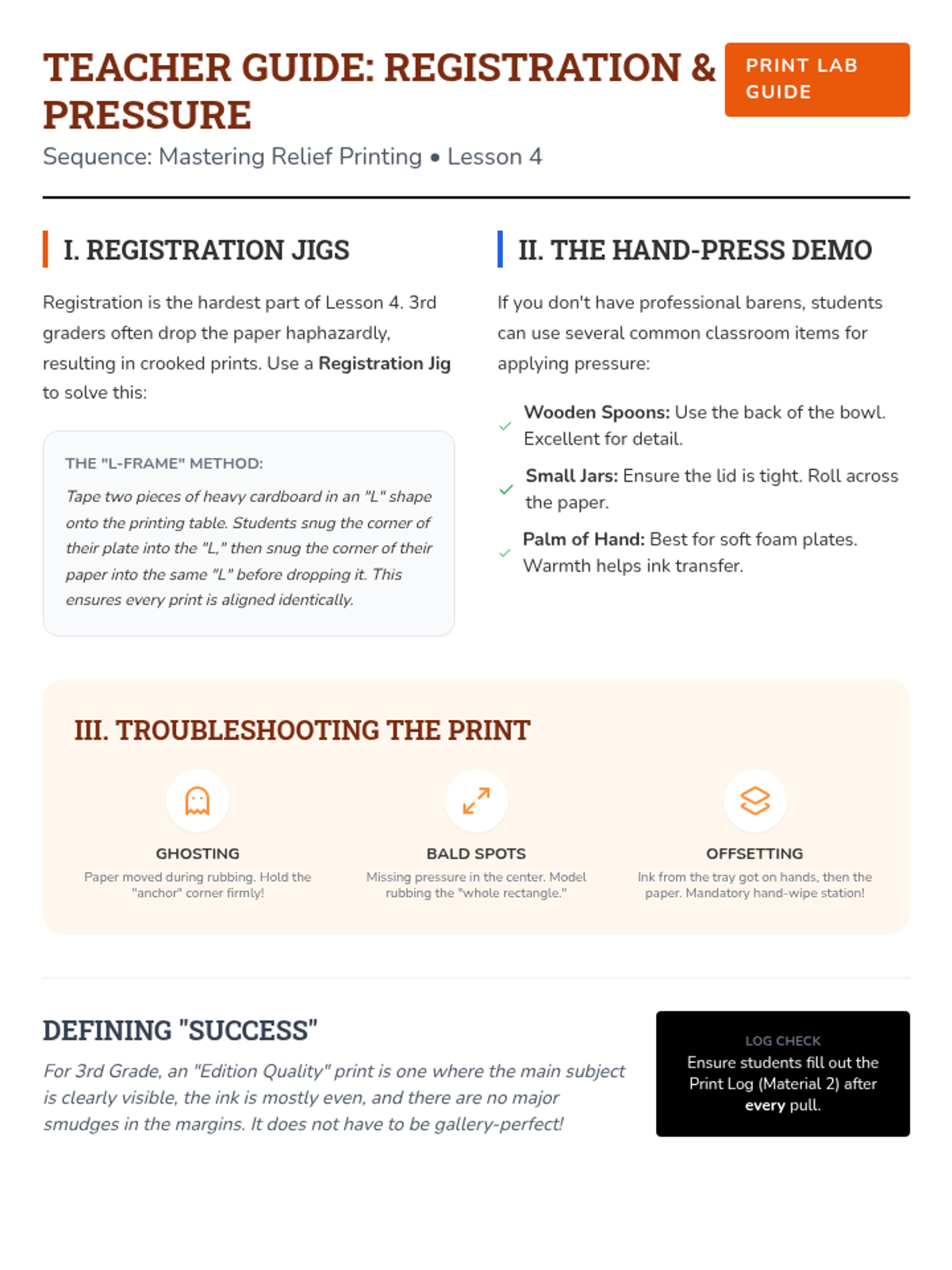
A technical teacher guide for managing the printing process, including registration techniques and troubleshooting common printing errors.
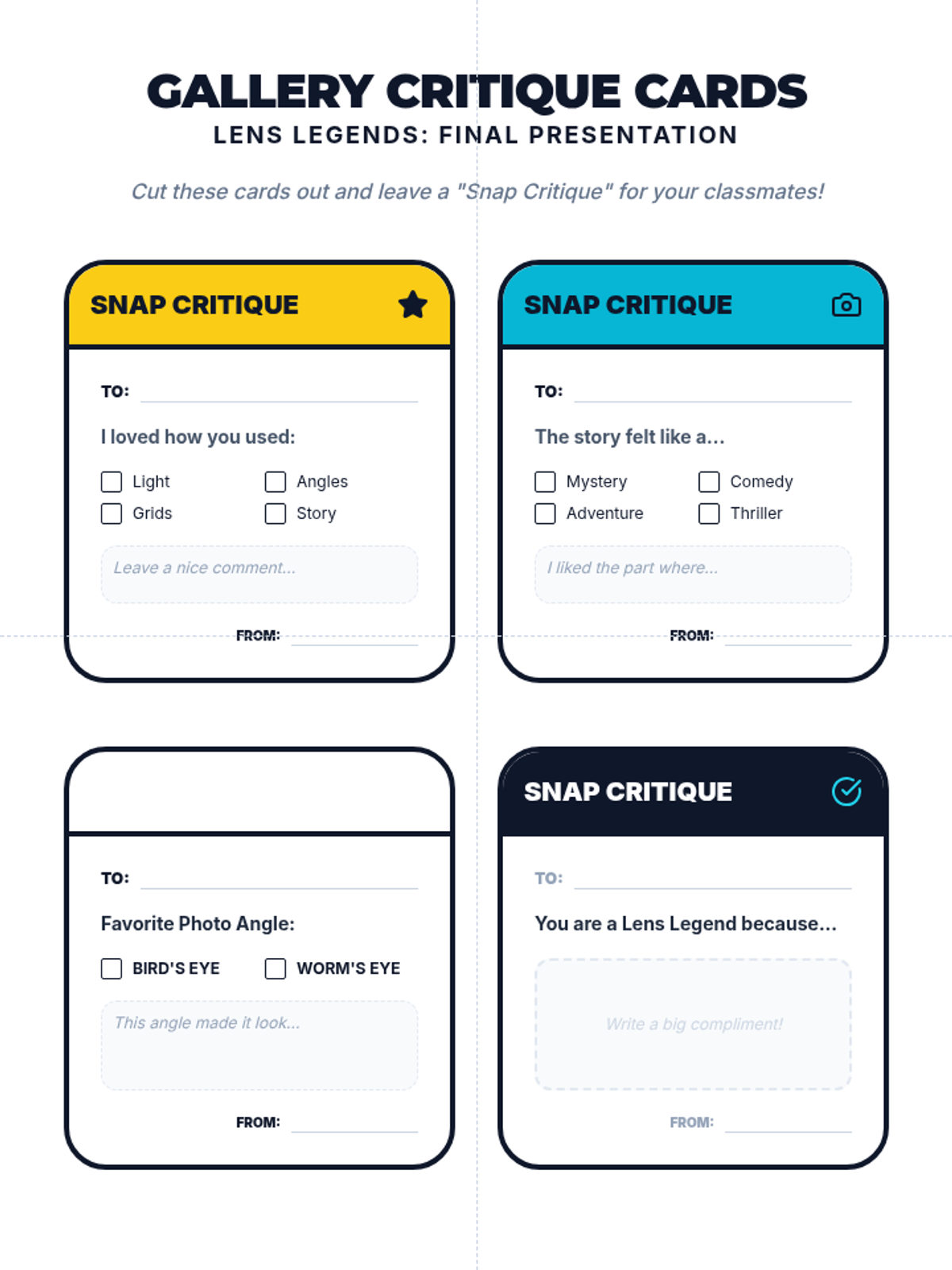
Set of peer feedback cards for students to use during the final gallery walk, encouraging specific praise on photography skills.
Visual slide deck for Lesson 5 explaining basic digital editing (cropping and brightness) and the final curation process for the photo essay.
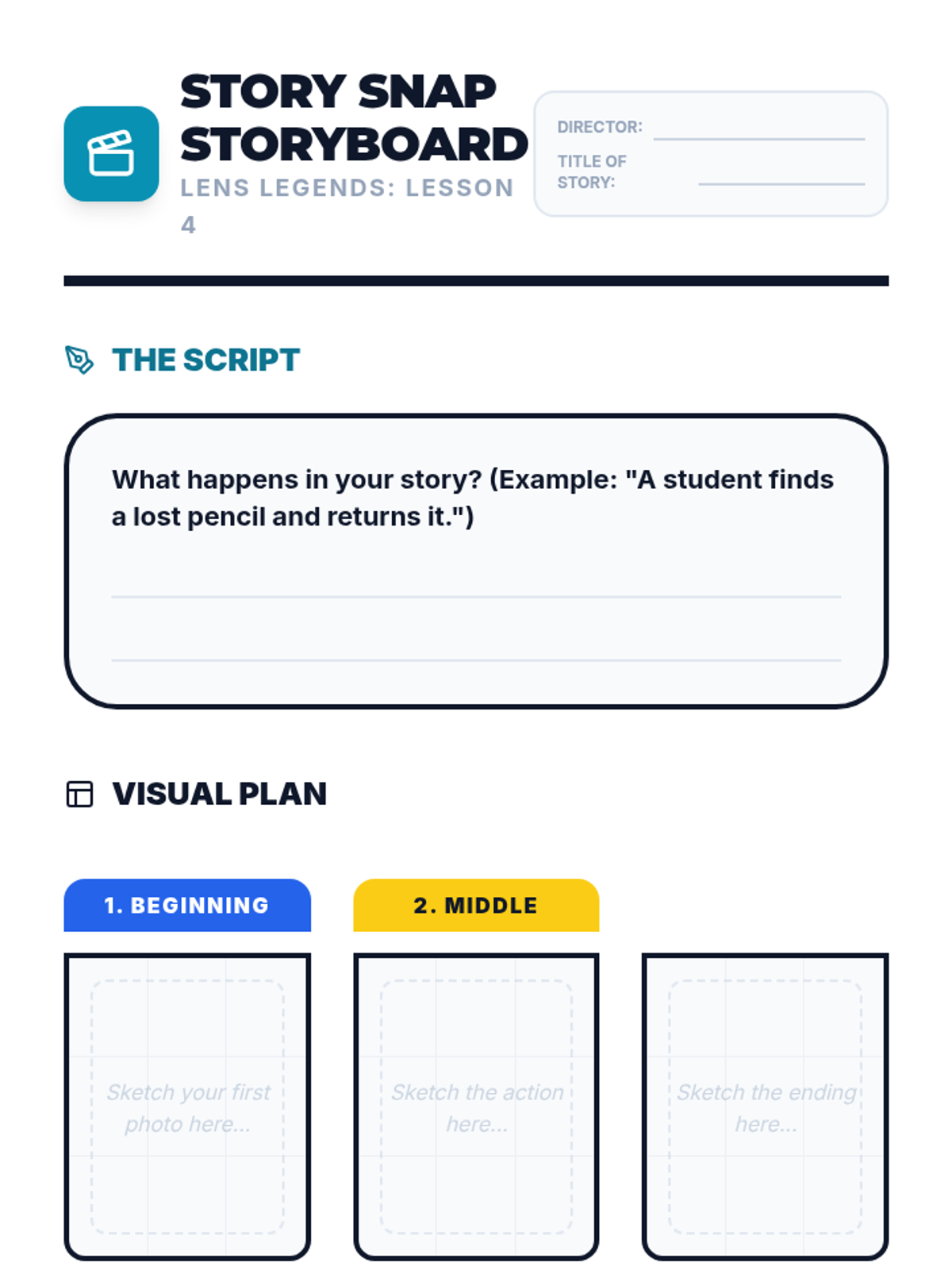
Storyboard planning worksheet for students to sketch and sequence their 3-part photo story before capturing the images.
Visual slide deck for Lesson 4 explaining how to build a 3-part narrative (Beginning, Middle, End) using only images and photographic composition.
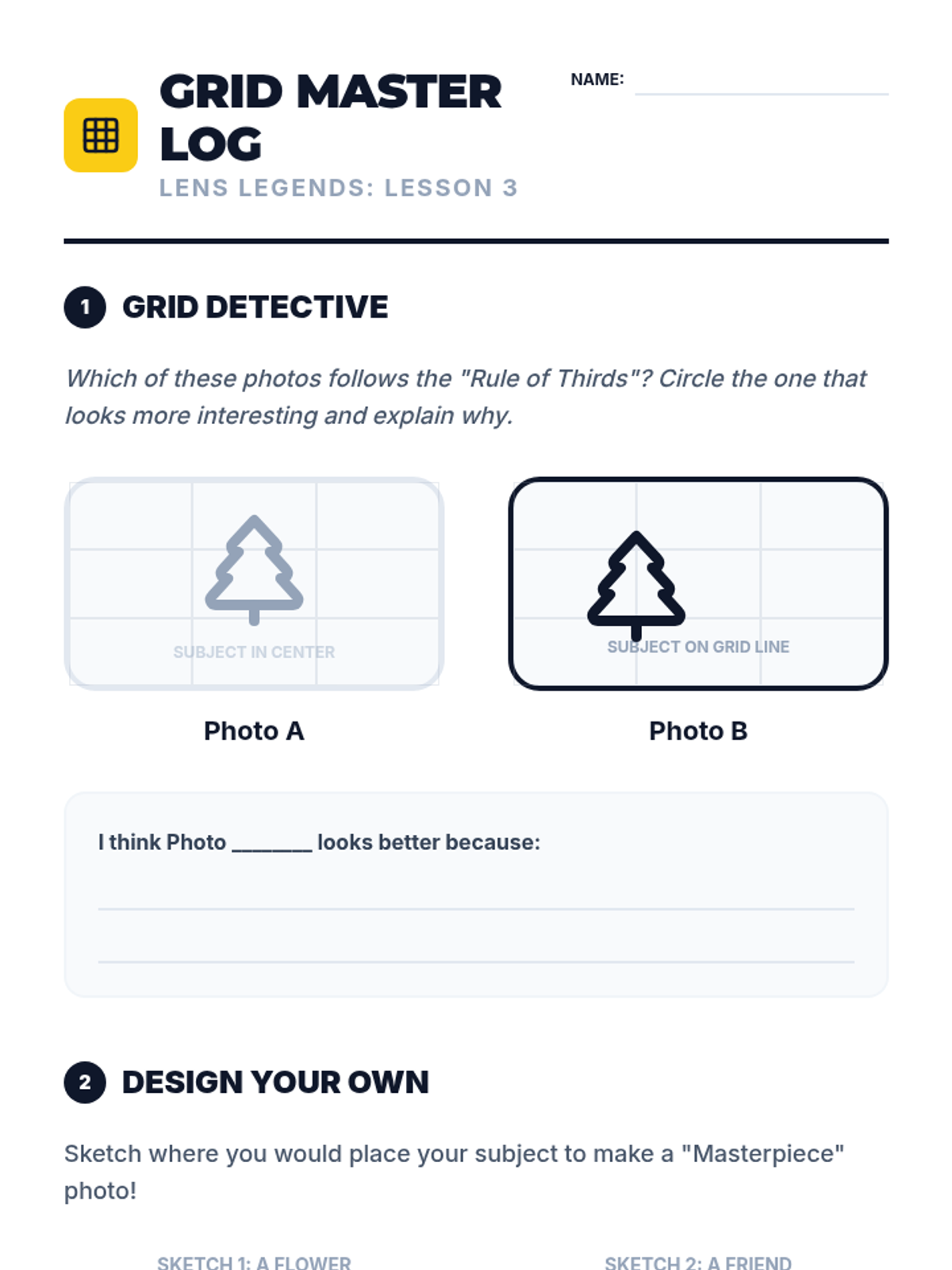
Worksheet for Lesson 3 focusing on the Rule of Thirds, with image analysis and sketching activities on grids.
Visual slide deck for Lesson 3 explaining the 'Rule of Thirds' through the Tic-Tac-Toe grid analogy with clear visual cues and simplified explanations.
Worksheet for Lesson 2 focusing on the differences between Bird's Eye and Worm's Eye perspectives, with space for sketching and written reflection.
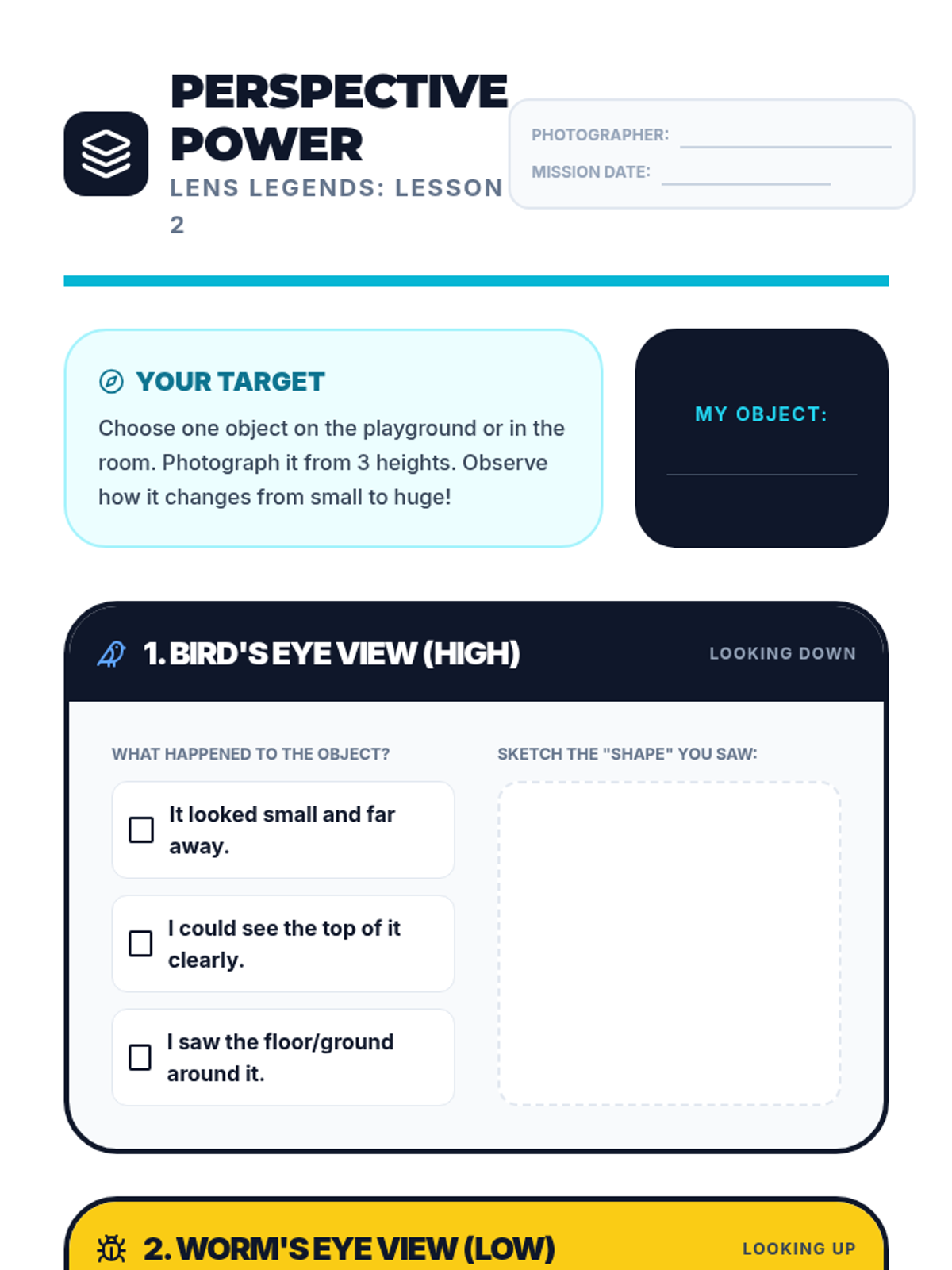
Visual slide deck for Lesson 2 introducing high (Bird's Eye) and low (Worm's Eye) angles to understand perspective and scale in photography.
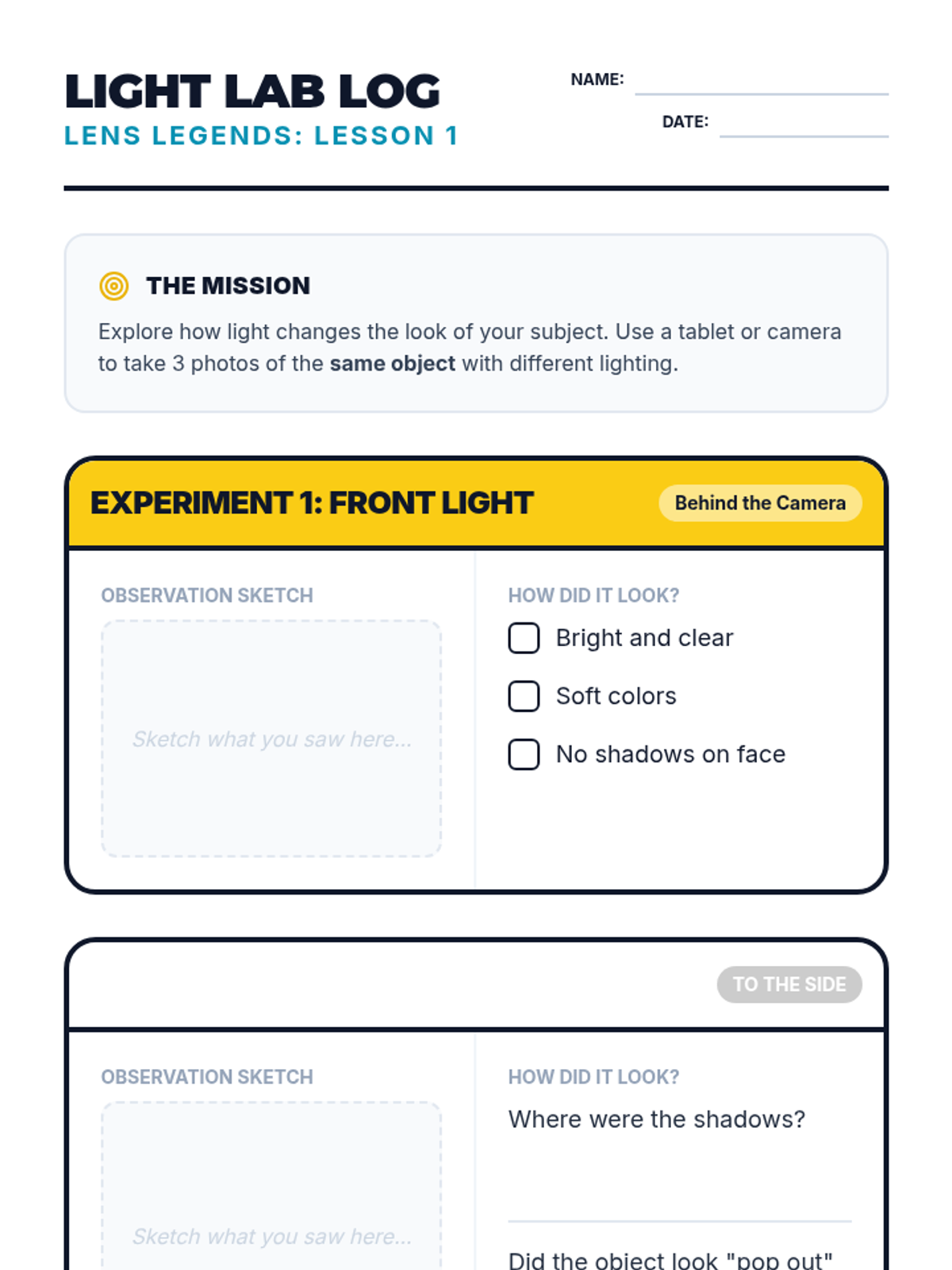
Observation log for students to record results of their lighting experiments, with space for sketches and descriptive check-boxes.
Introductory slide deck for Lesson 1, exploring front, side, and back lighting with high-contrast visuals and simple 3rd-grade appropriate explanations.
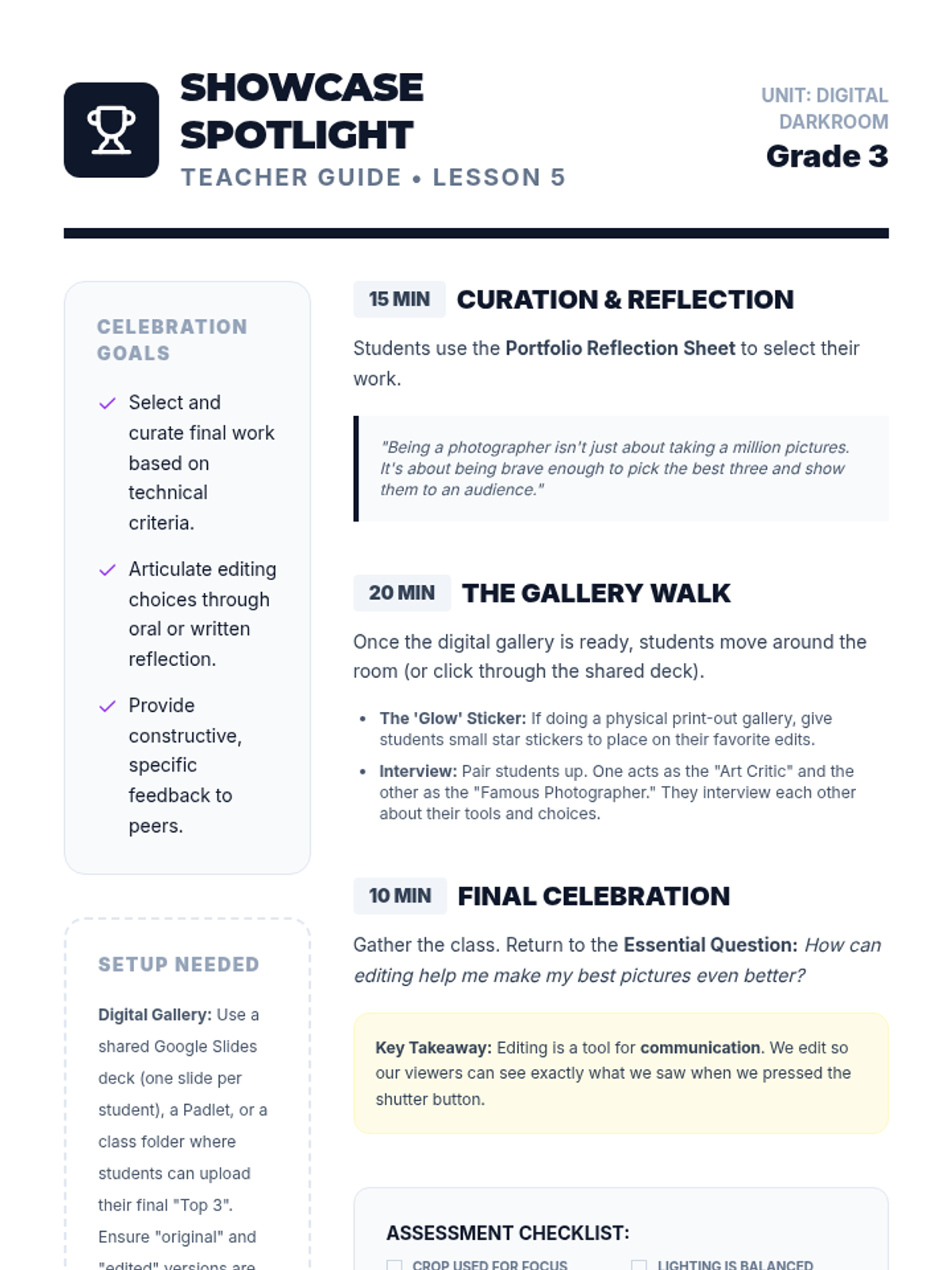
A facilitation guide for teachers to deliver the final lesson of the digital editing unit, including setup instructions, gallery walk prompts, and assessment tips.
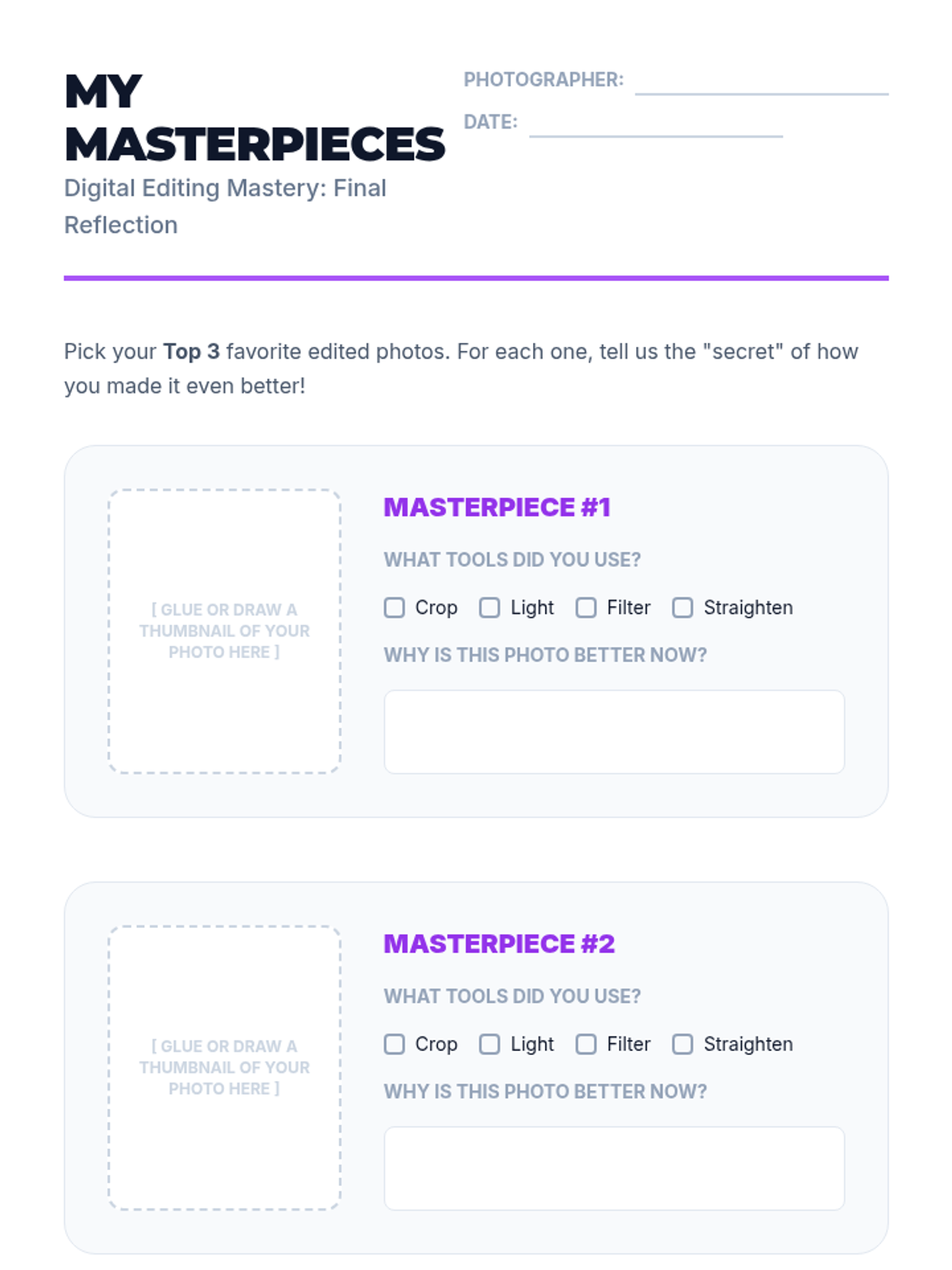
A reflection worksheet for students to select their top 3 edited images and explain the techniques they used to enhance each one.
A presentation for 3rd graders for the final portfolio showcase, covering image selection, reflection, and gallery walk etiquette.
A teacher guide for Lesson 5, including guidance on the gallery walk, photo curation, and sequence reflection.
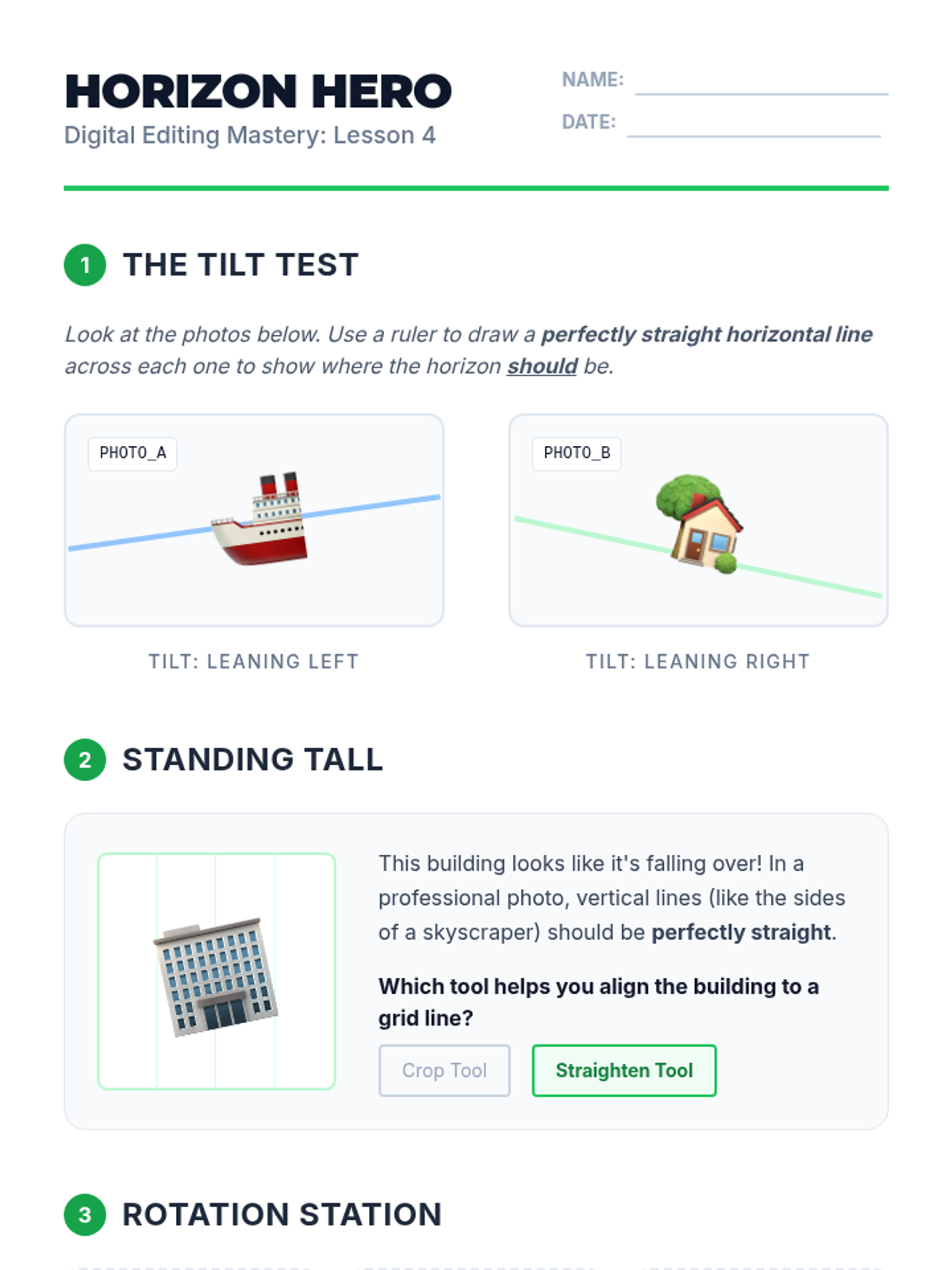
A worksheet for students to practice identifying crooked horizons, aligning vertical structures, and determining necessary rotations.
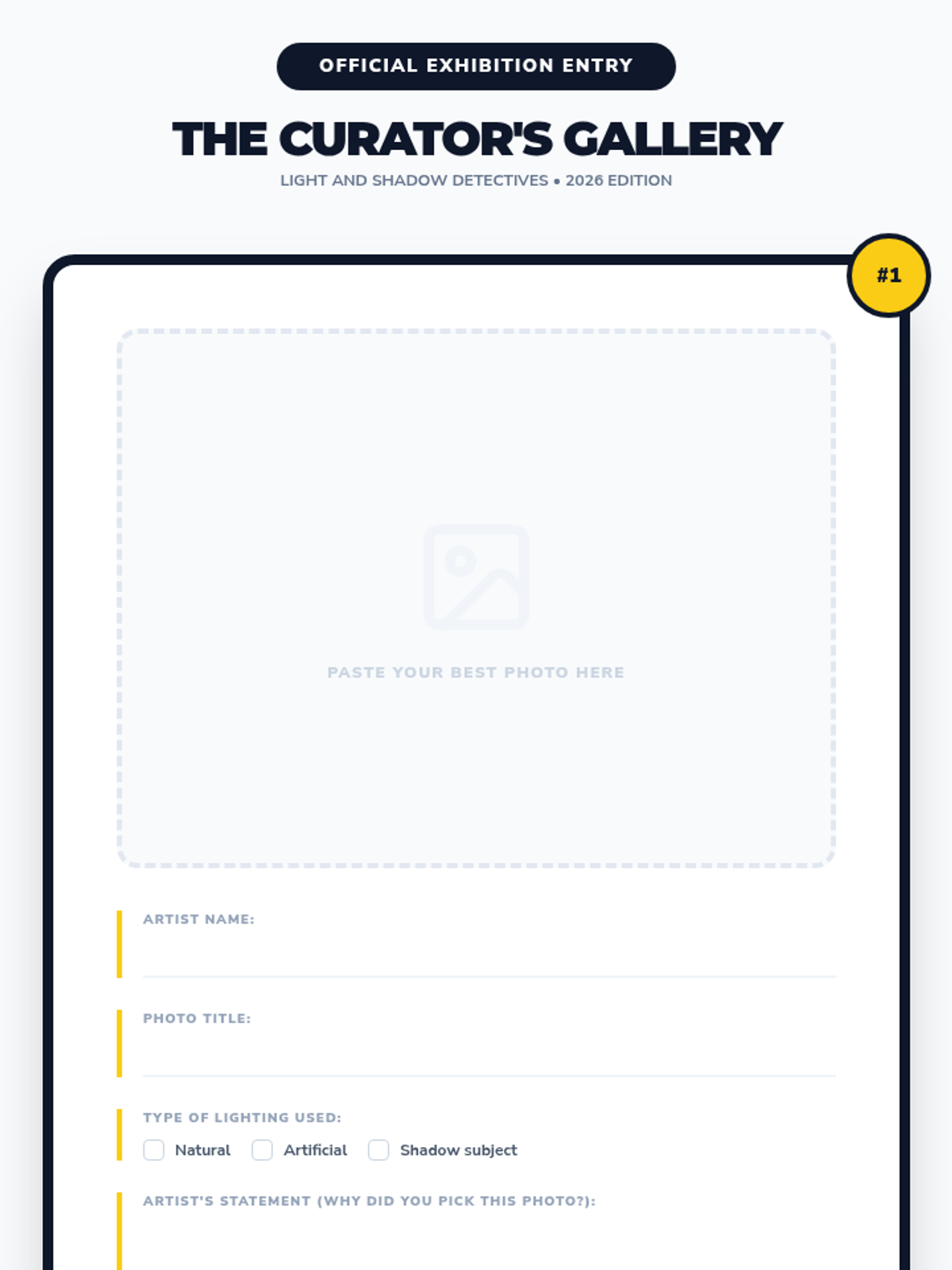
A worksheet for Lesson 5 where students curate their best work and write an artist statement for the 'Light and Shadow' gallery walk.
A slide deck for Lesson 5 comparing Golden Hour and Noon light, and guiding students through the process of curating their work for a gallery walk.
A presentation for 3rd graders explaining how to straighten crooked horizon lines and rotate images for professional alignment.
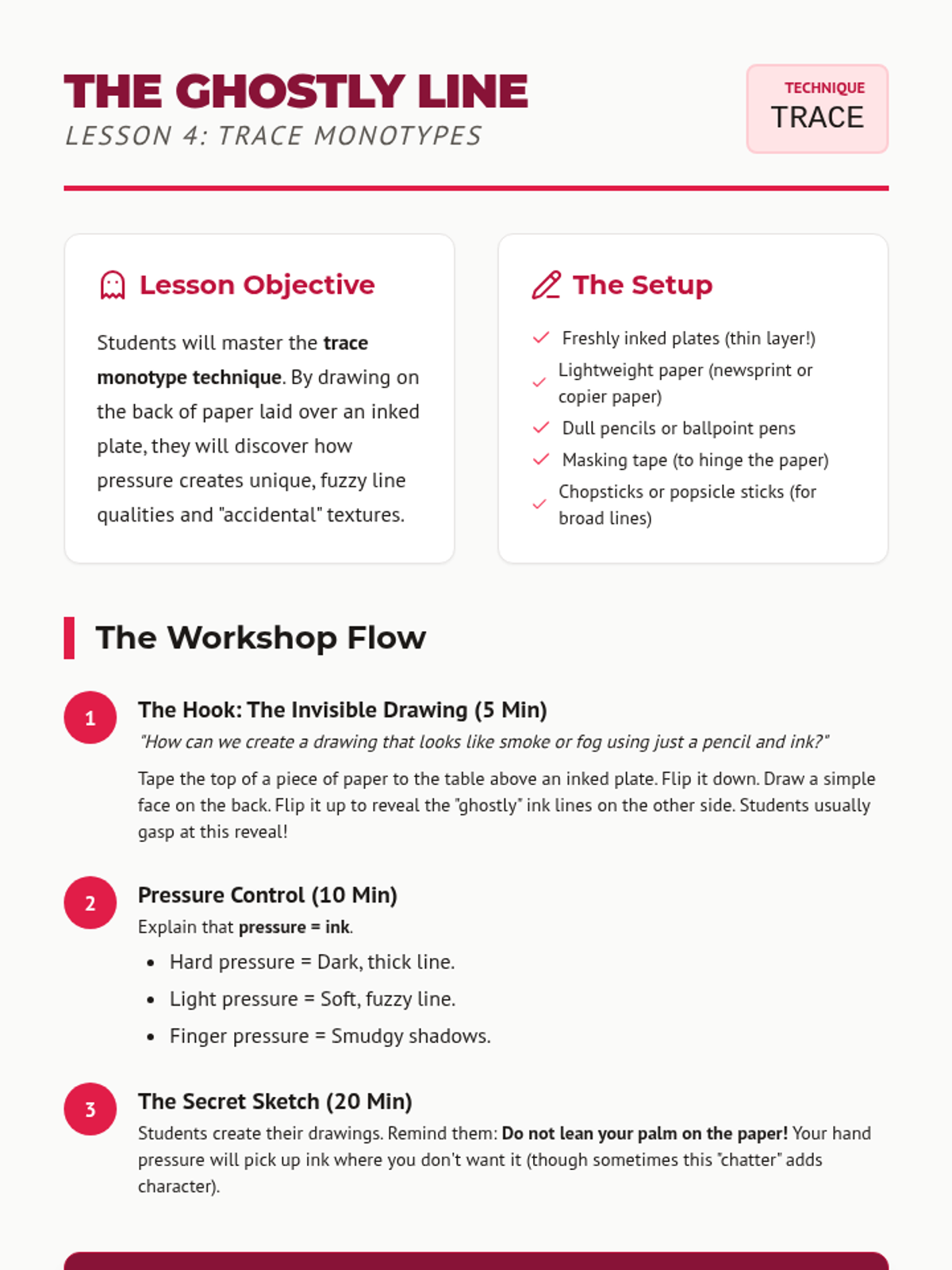
Teacher guide for Lesson 4 on trace monotypes, including pressure control techniques and strategies for managing accidental ink transfer.
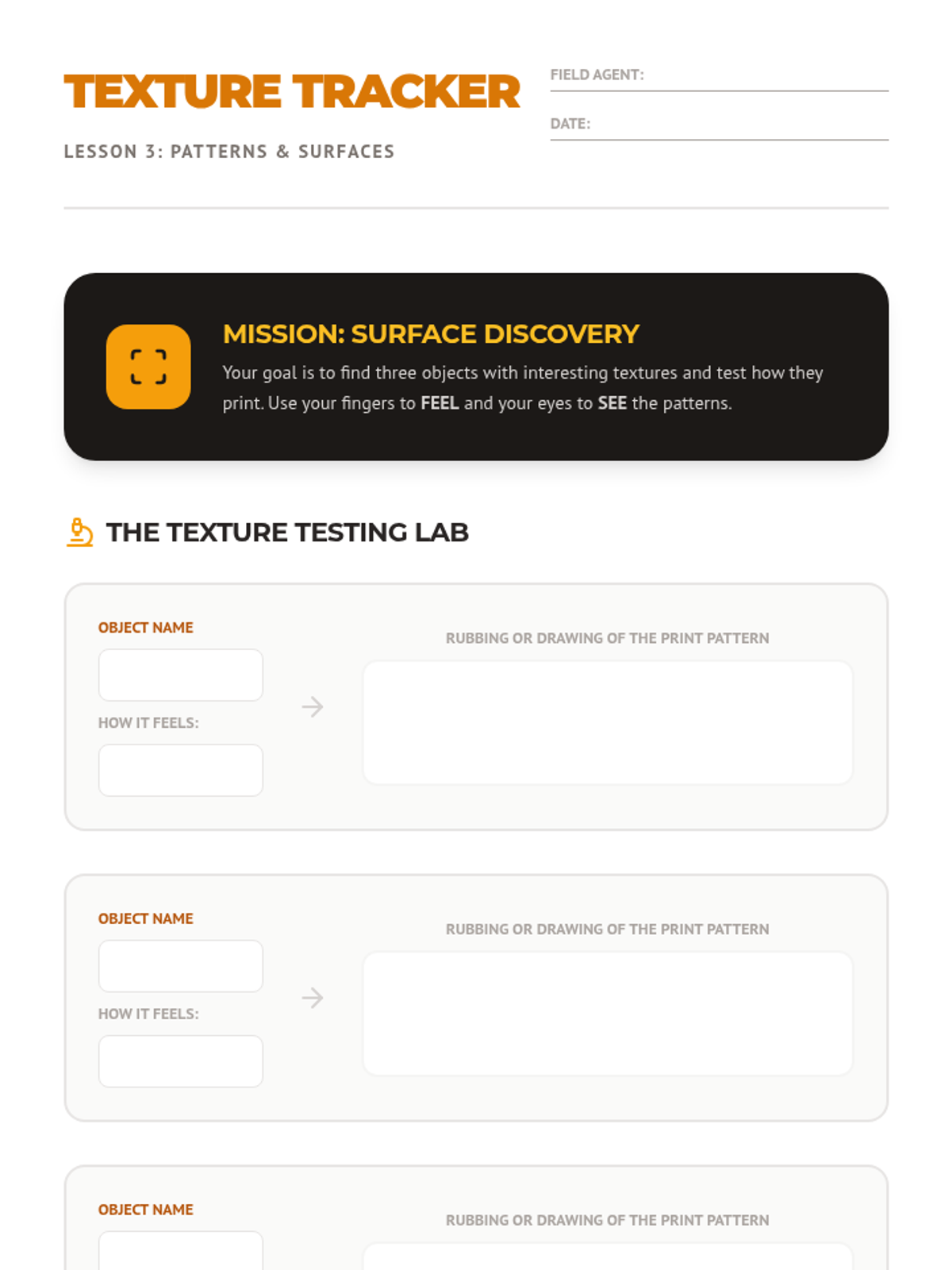
A student worksheet for Lesson 3 that allows 3rd graders to track and analyze the textures they discover and use during their printmaking experiments.
Slide deck for Lesson 3, introducing the concept of environmental patterns, comparing stamping vs lifting techniques, and exploring common textured objects.
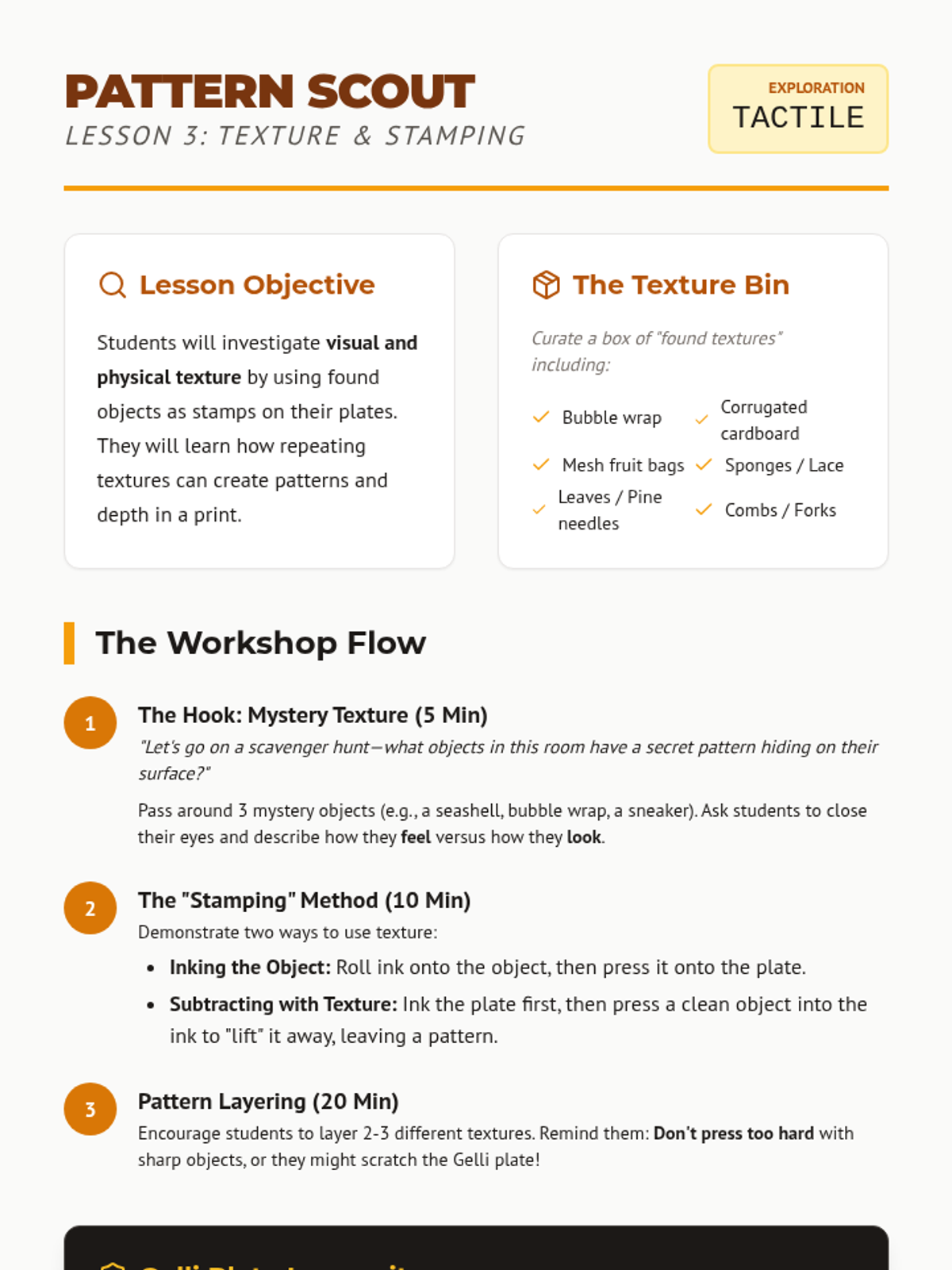
Teacher guide for Lesson 3 focusing on organizing a "Texture Bin" and facilitating the inquiry-based exploration of environmental patterns through stamping and lifting.
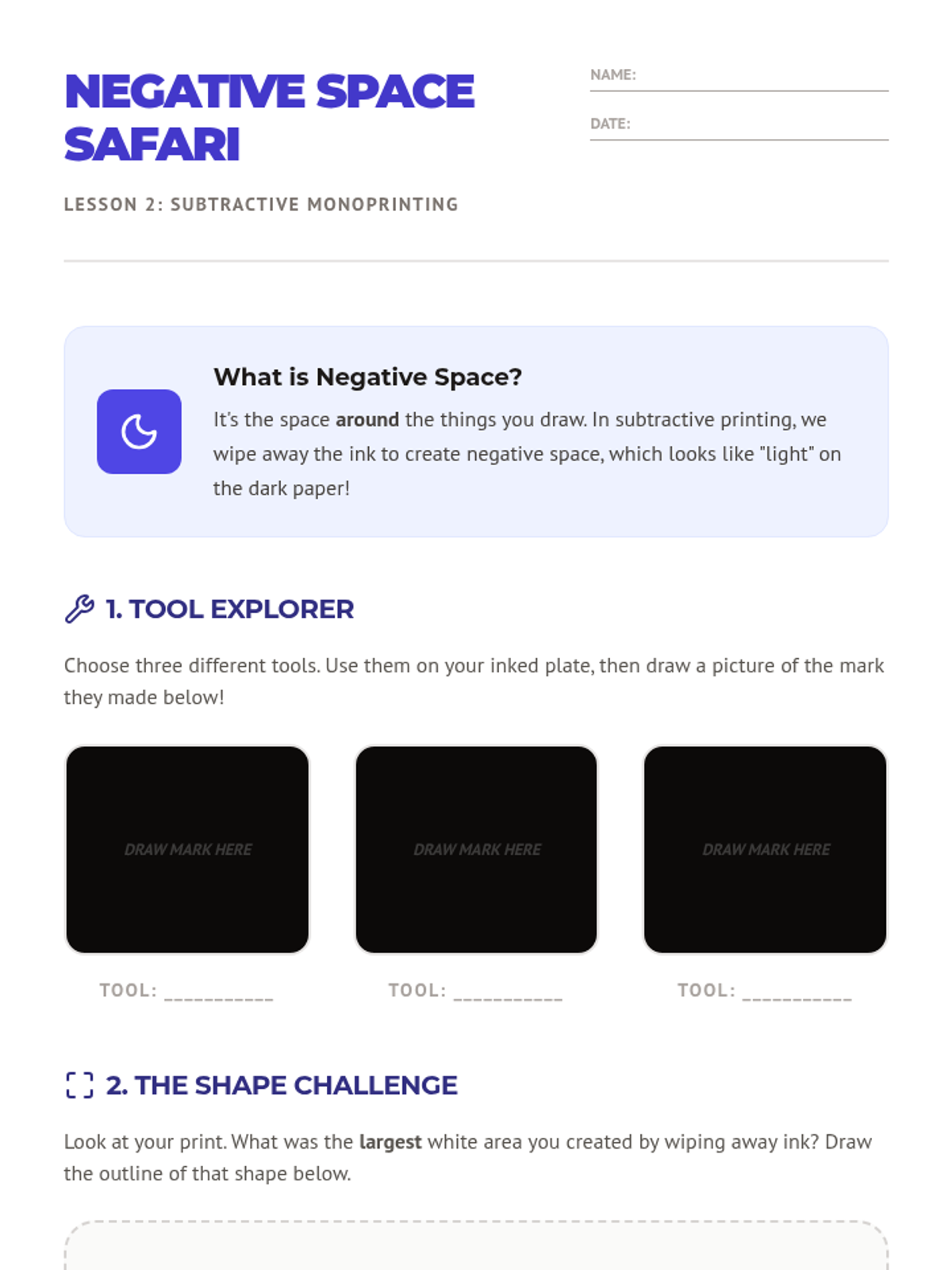
A student worksheet for Lesson 2 that helps 3rd graders explore the concept of negative space through tool experimentation and shape analysis in subtractive monoprinting.
Slide deck for Lesson 2, introducing the concept of subtractive printmaking, comparing it to additive methods, and exploring different mark-making tools for "erasing" ink.
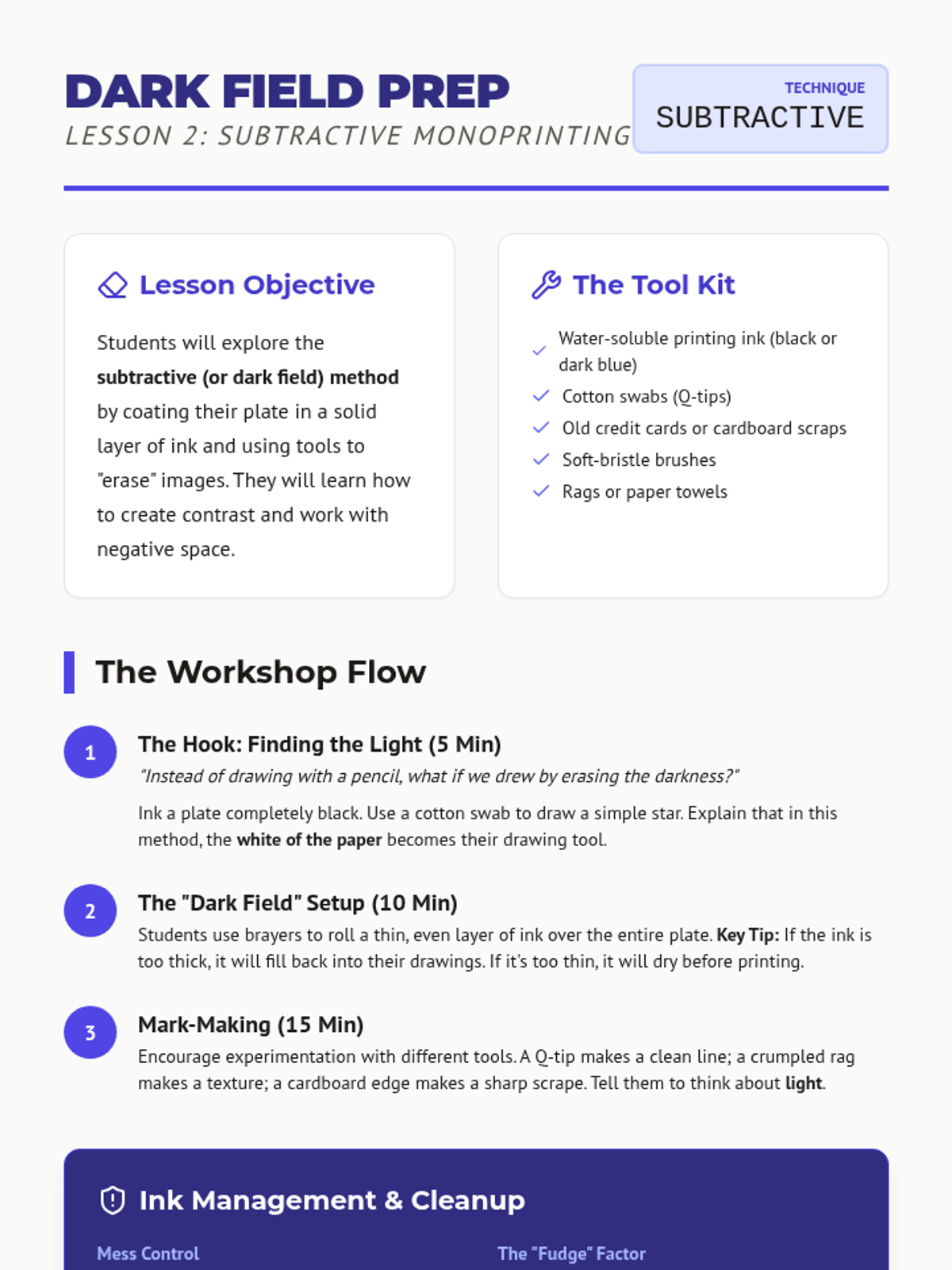
Teacher instructions for the subtractive monoprinting lesson, including ink management strategies and a guide for helping students understand negative space drawing.
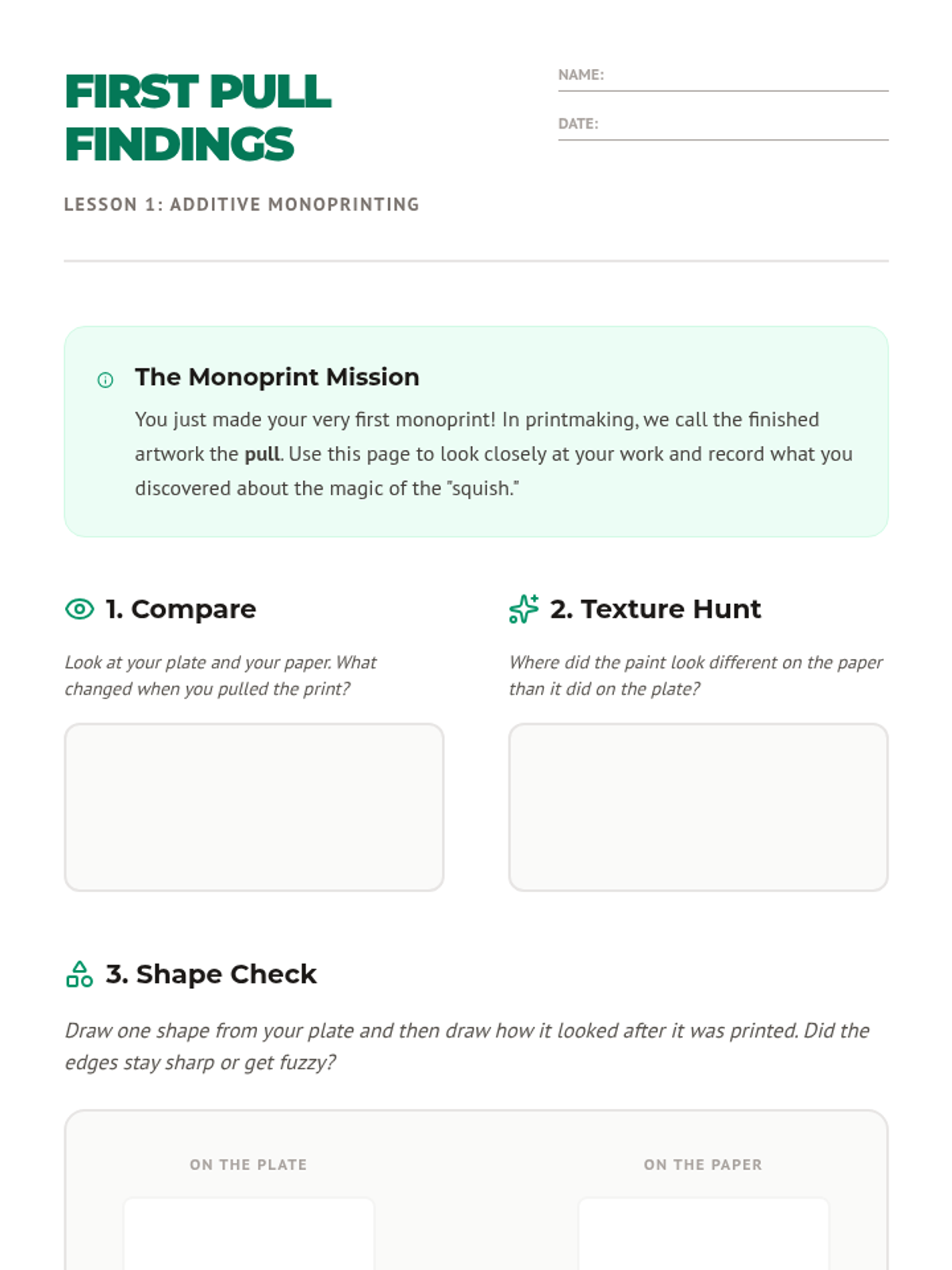
A reflection worksheet for 3rd graders to record their observations after their first additive monoprint pull, focusing on how images transfer and change from plate to paper.
Introductory slide deck for Lesson 1, covering the concept of monoprinting, the "one-of-a-kind" rule, and a step-by-step visual guide for the additive printing process.
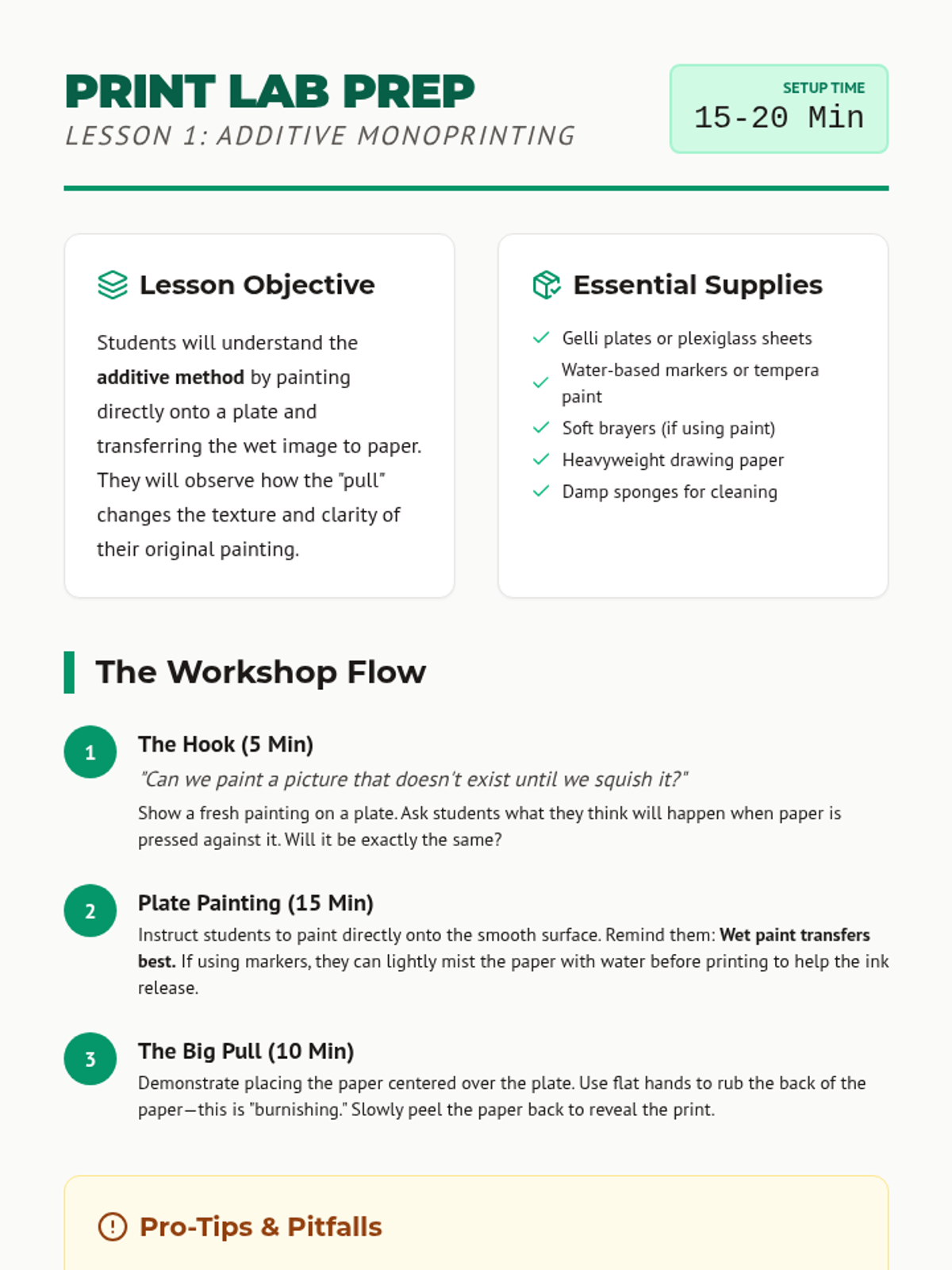
A comprehensive teacher guide for the first lesson on additive monoprinting, including setup instructions, workshop flow, and troubleshooting tips for 3rd-grade art educators.
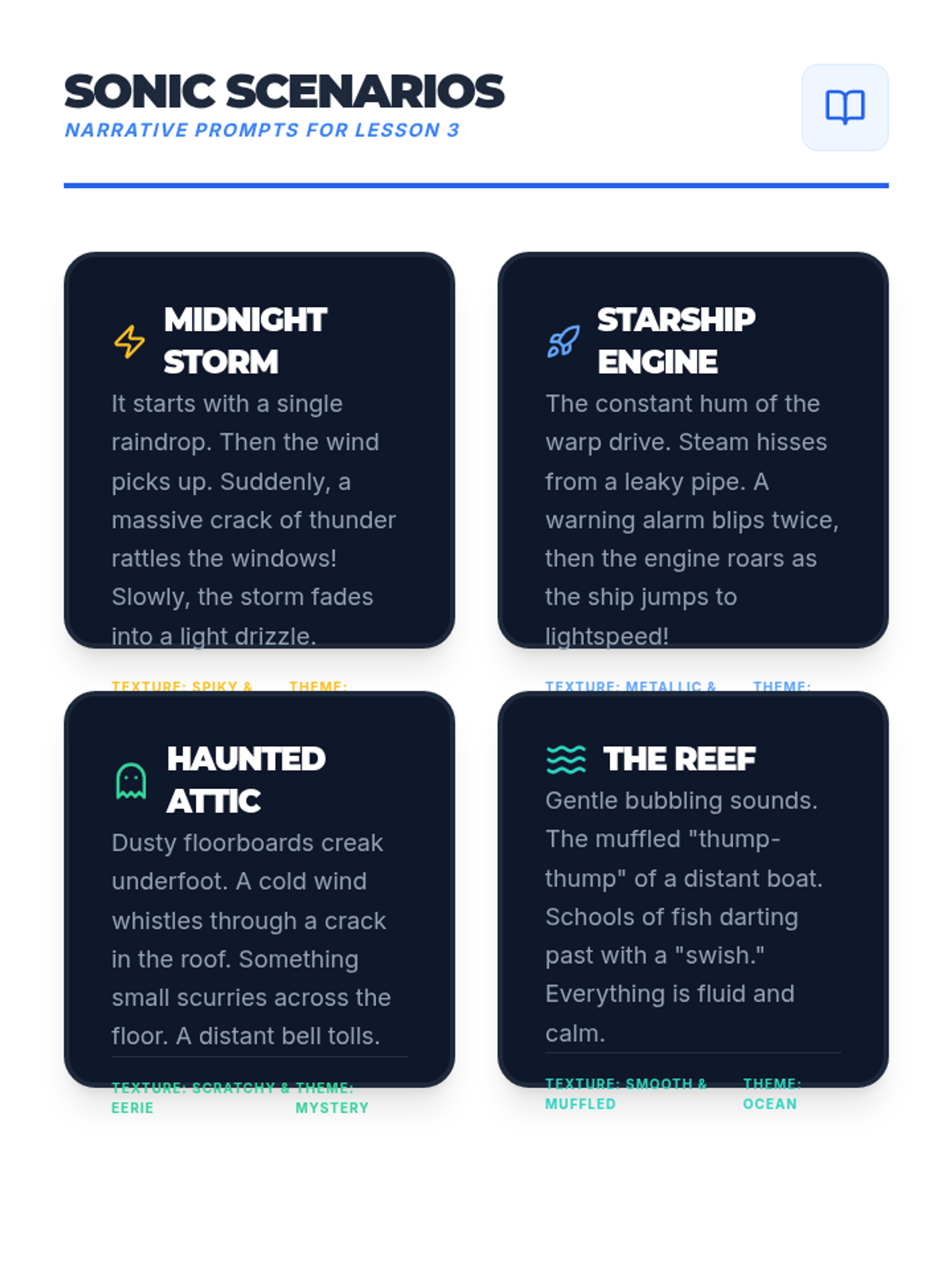
Narrative scenario cards for Lesson 3. Students choose one of these environmental prompts to inspire their graphic score composition.
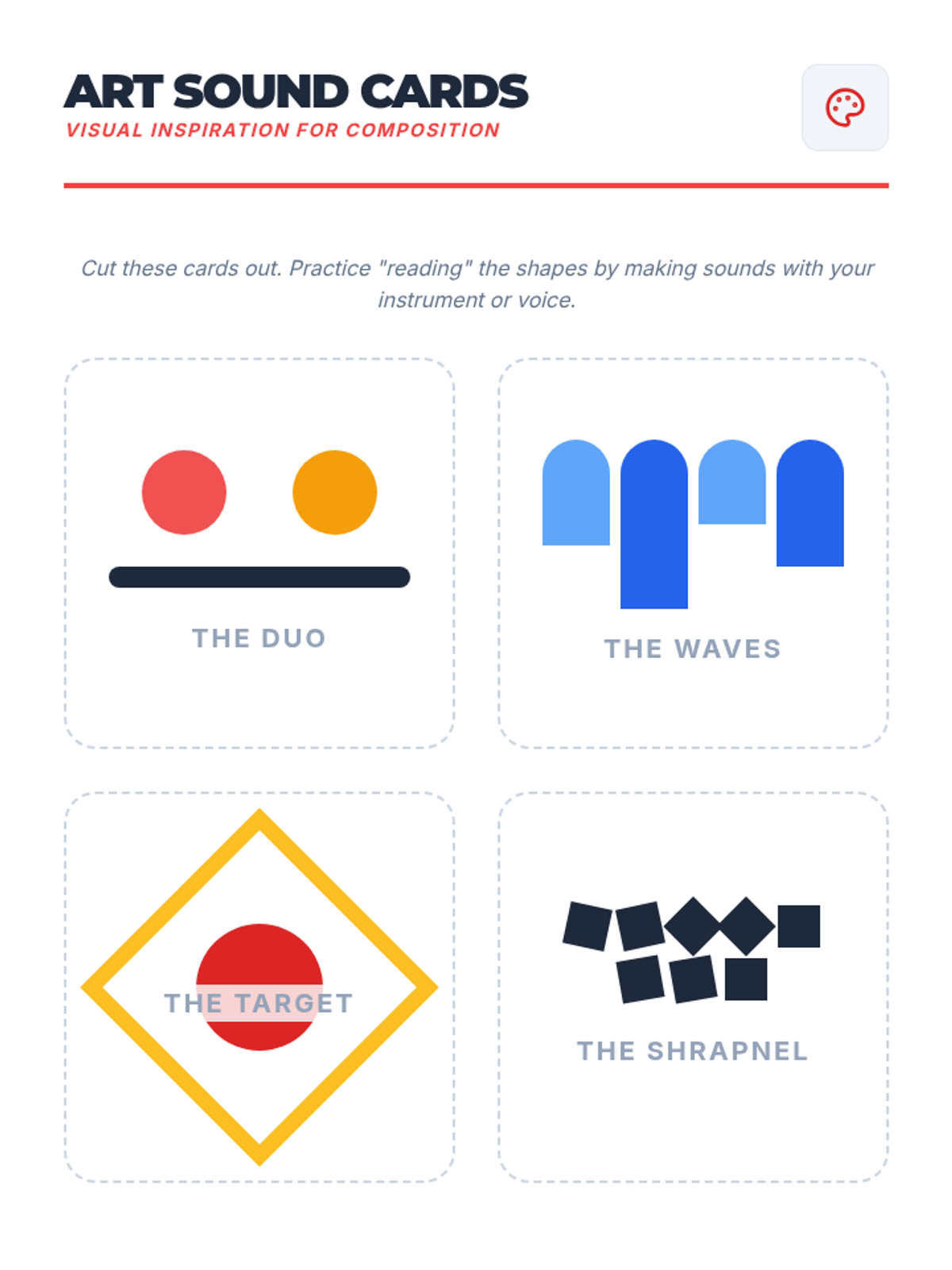
Set of visual inspiration cards for Lesson 2. Students use these to practice translating abstract shapes and patterns into sound before creating their own legend.
Final reflection worksheet for Lesson 5. Students analyze their performance, compare their work to professional Foley artistry, and answer the sequence's essential question.
Slide deck for Lesson 5: Echo Chamber. Covers the final reflection on graphic notation, comparison to professional Foley artistry, and a debrief on the advantages/limitations of this notation style.
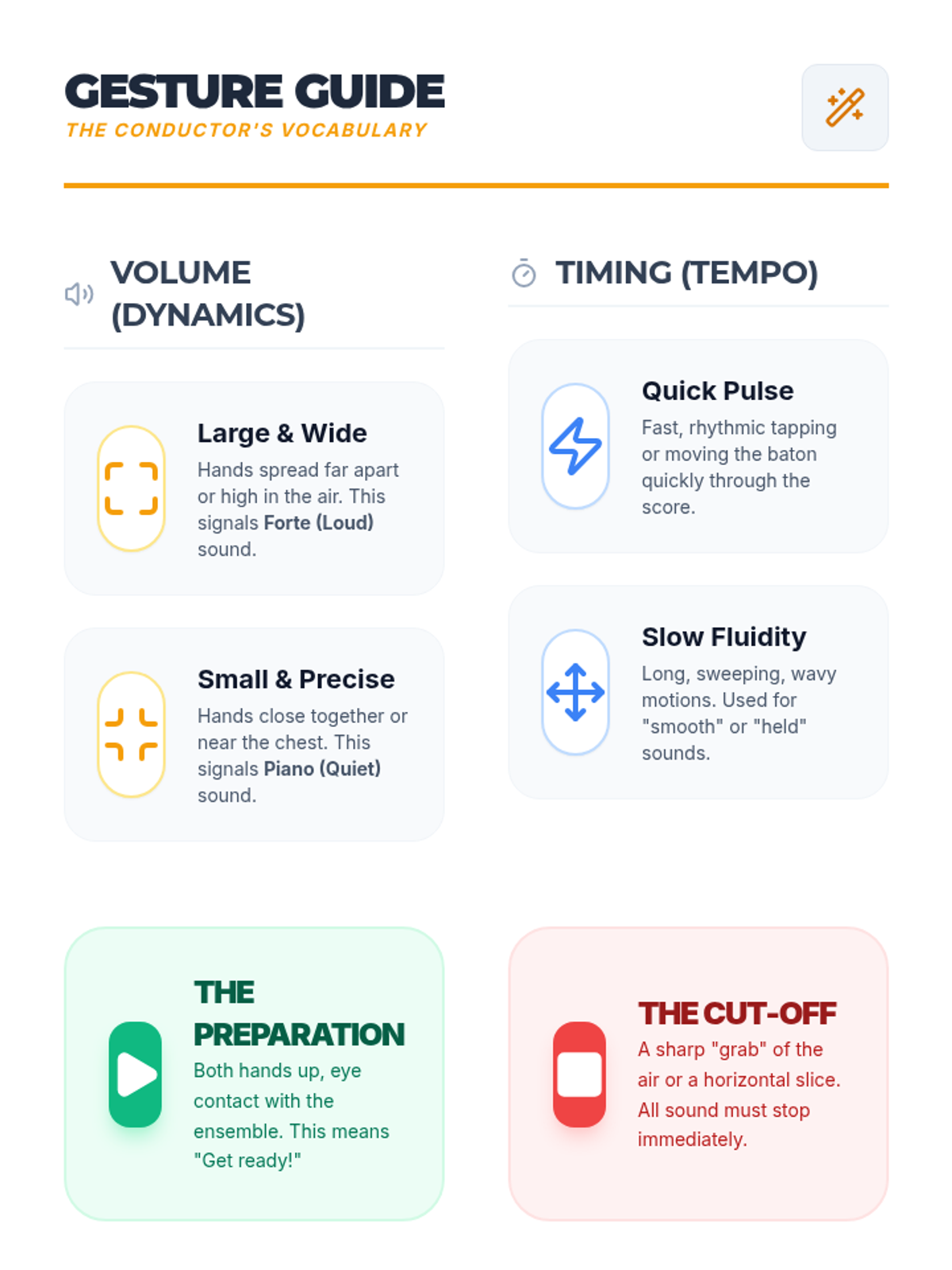
Visual reference guide for students illustrating essential conducting gestures for volume, tempo, and cues. Great for use during Lesson 4 rehearsals.