Phonetic foundations through Pinyin and tones, character recognition, and essential grammar for all proficiency levels. Integrates cultural context with advanced reading, writing, and communicative strategies.
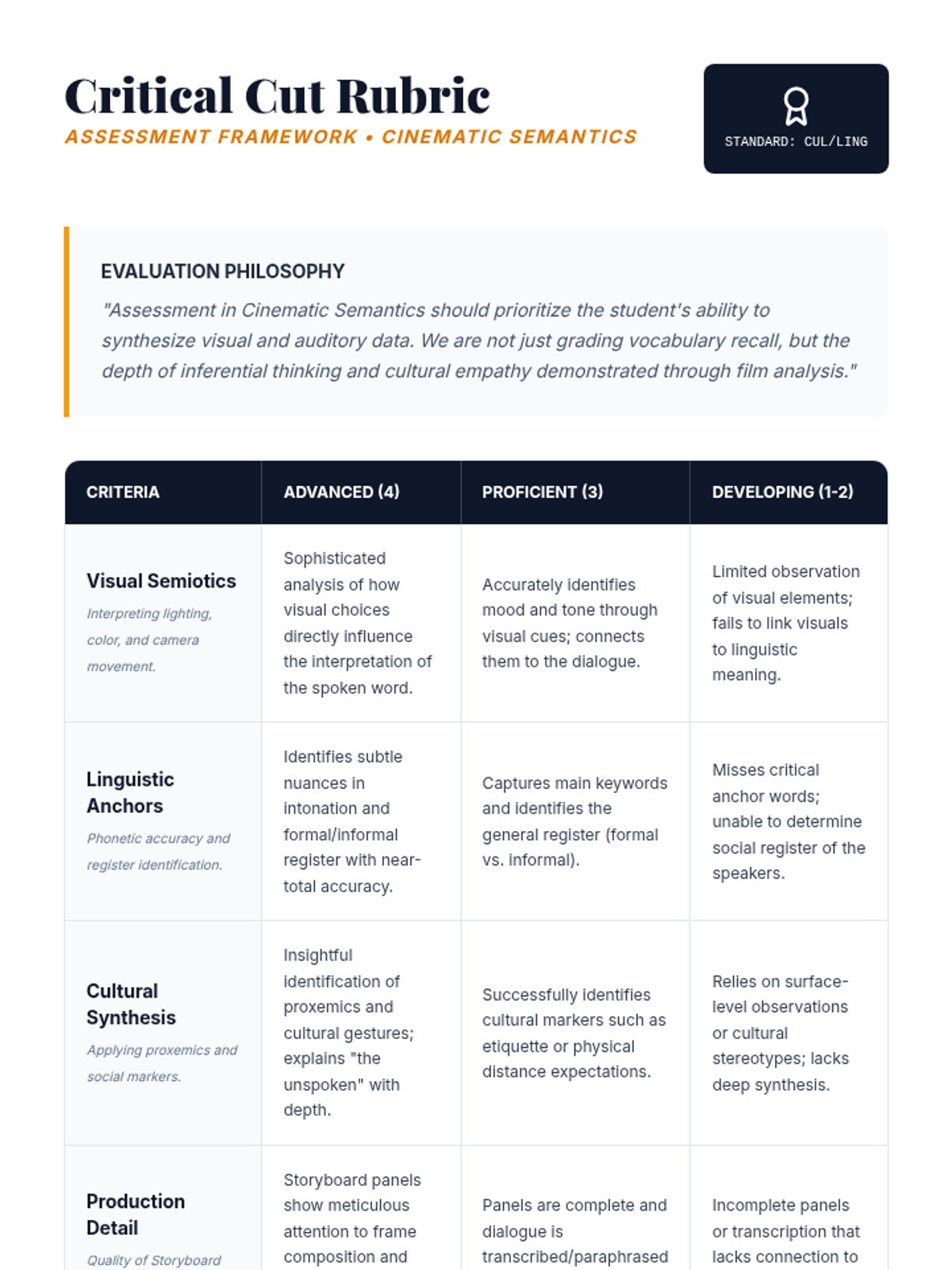
A professional assessment rubric titled 'Critical Cut Rubric' for educators to evaluate student film analysis across visual, linguistic, and cultural dimensions.
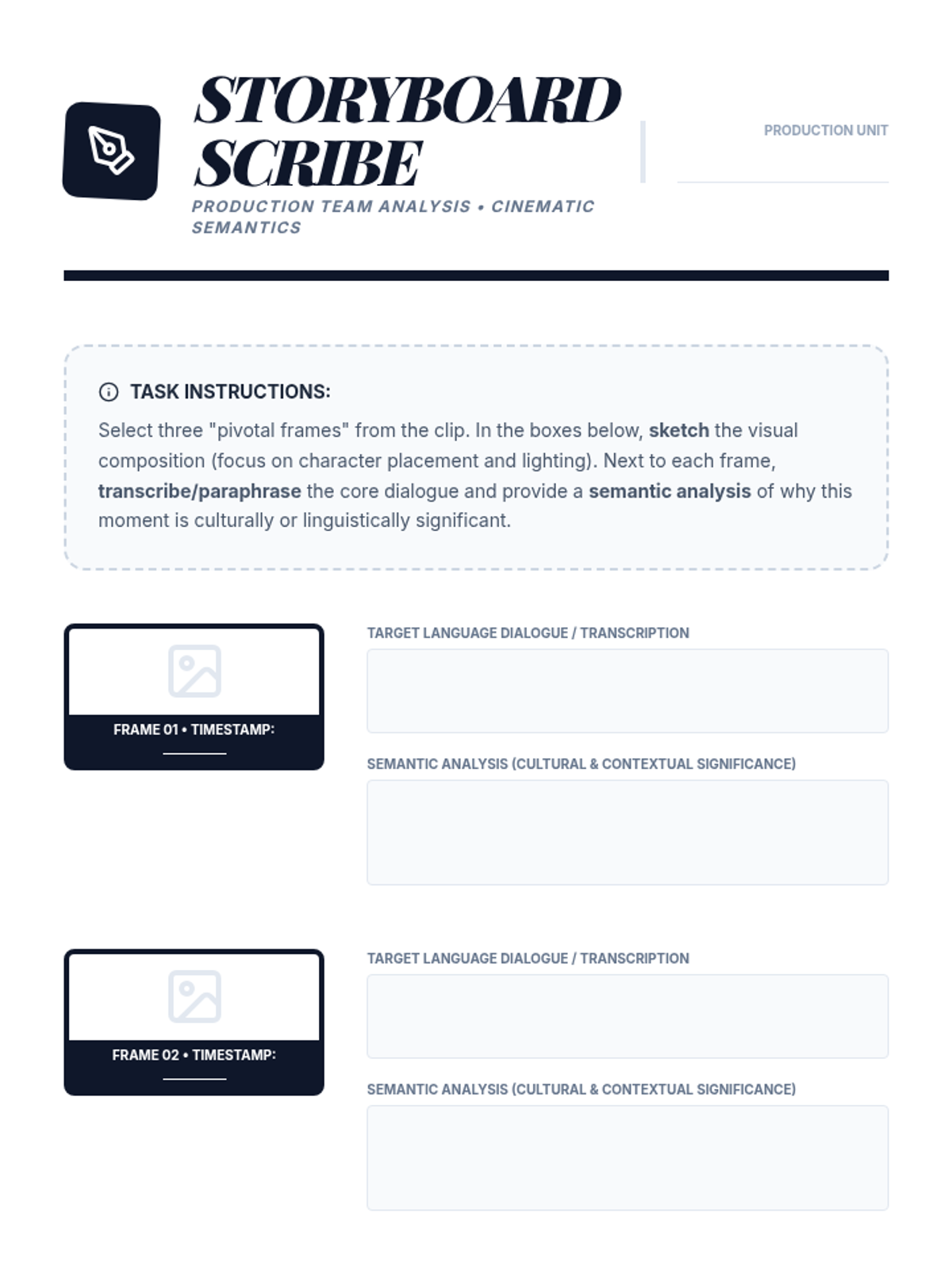
An advanced graphic organizer titled 'Storyboard Scribe' where students map critical film frames, transcribe dialogue, and perform deep semantic analysis.
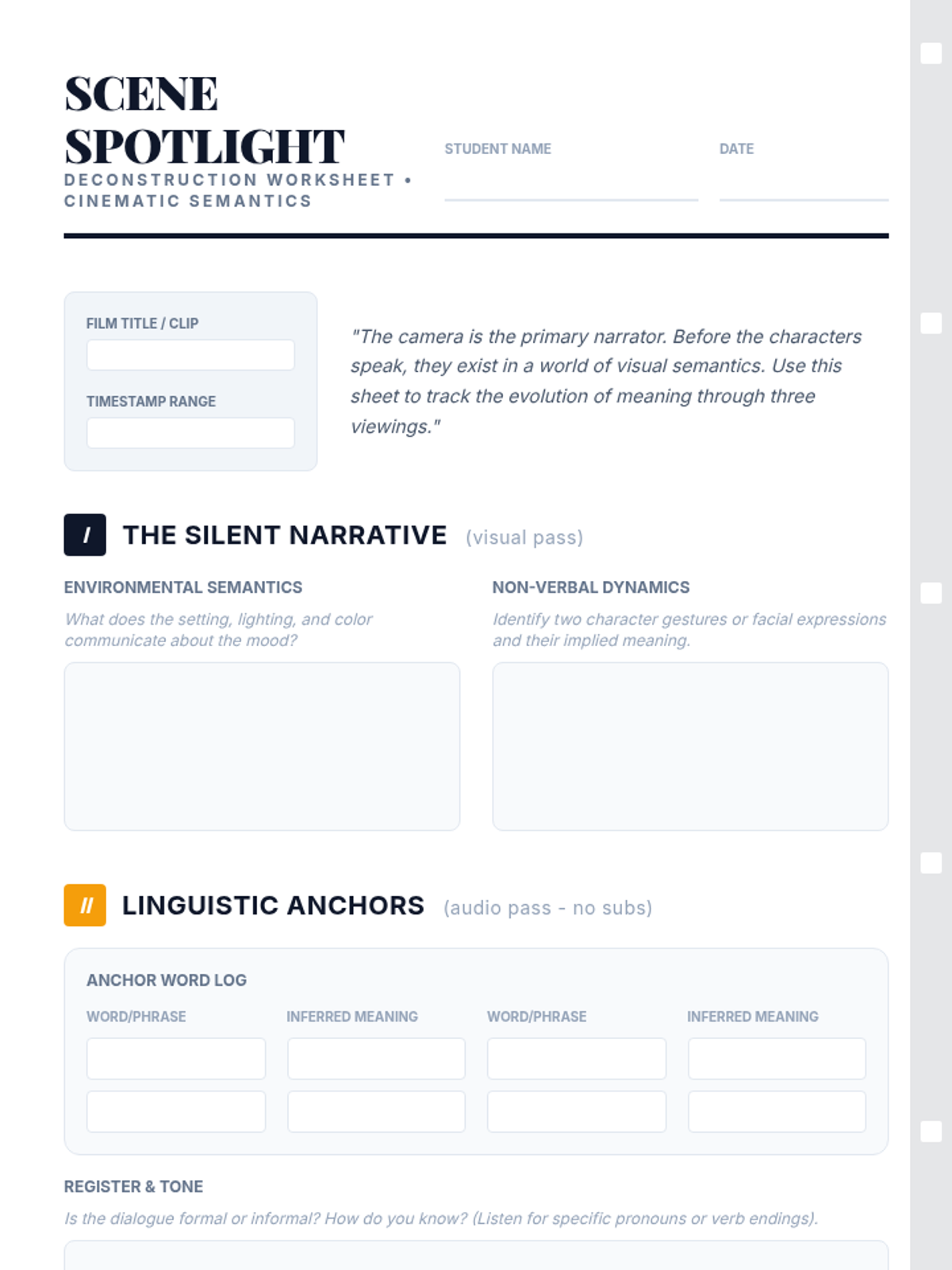
A student-facing worksheet titled 'Scene Spotlight' used for deconstructing film clips in three stages: visual narrative, linguistic anchors, and cultural synthesis.
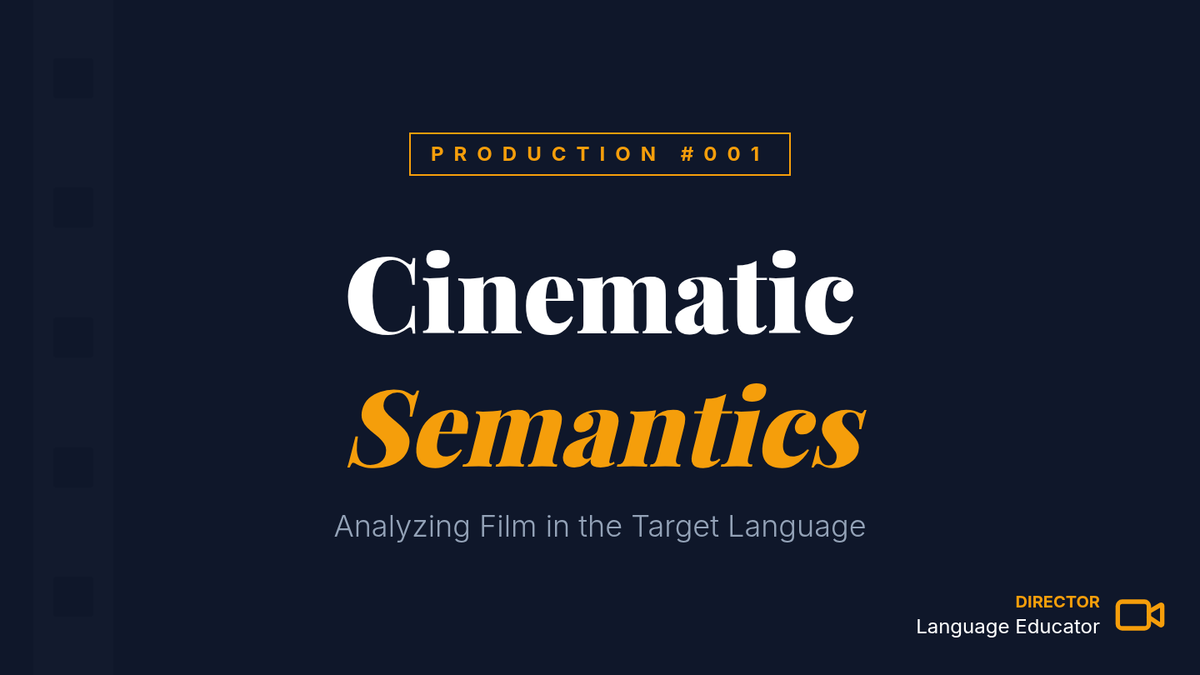
A visually striking slide deck for instruction on 'Cinematic Semantics', guiding students through visual-first analysis, auditory processing, and thin-slicing techniques.
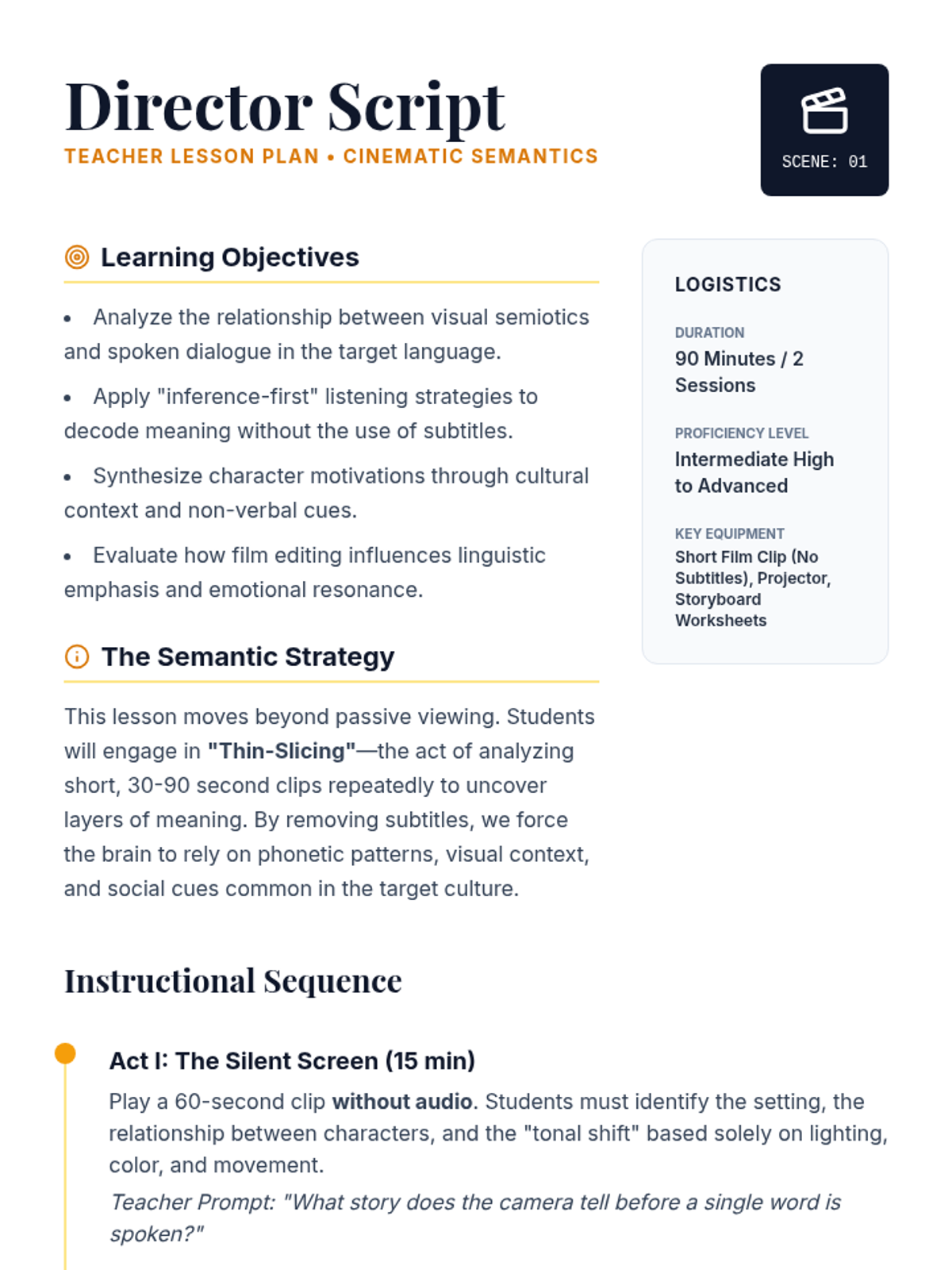
A detailed lesson plan for educators titled 'Director Script' that provides a pedagogical framework for analyzing film in the foreign language classroom through three 'Acts' of deconstruction.
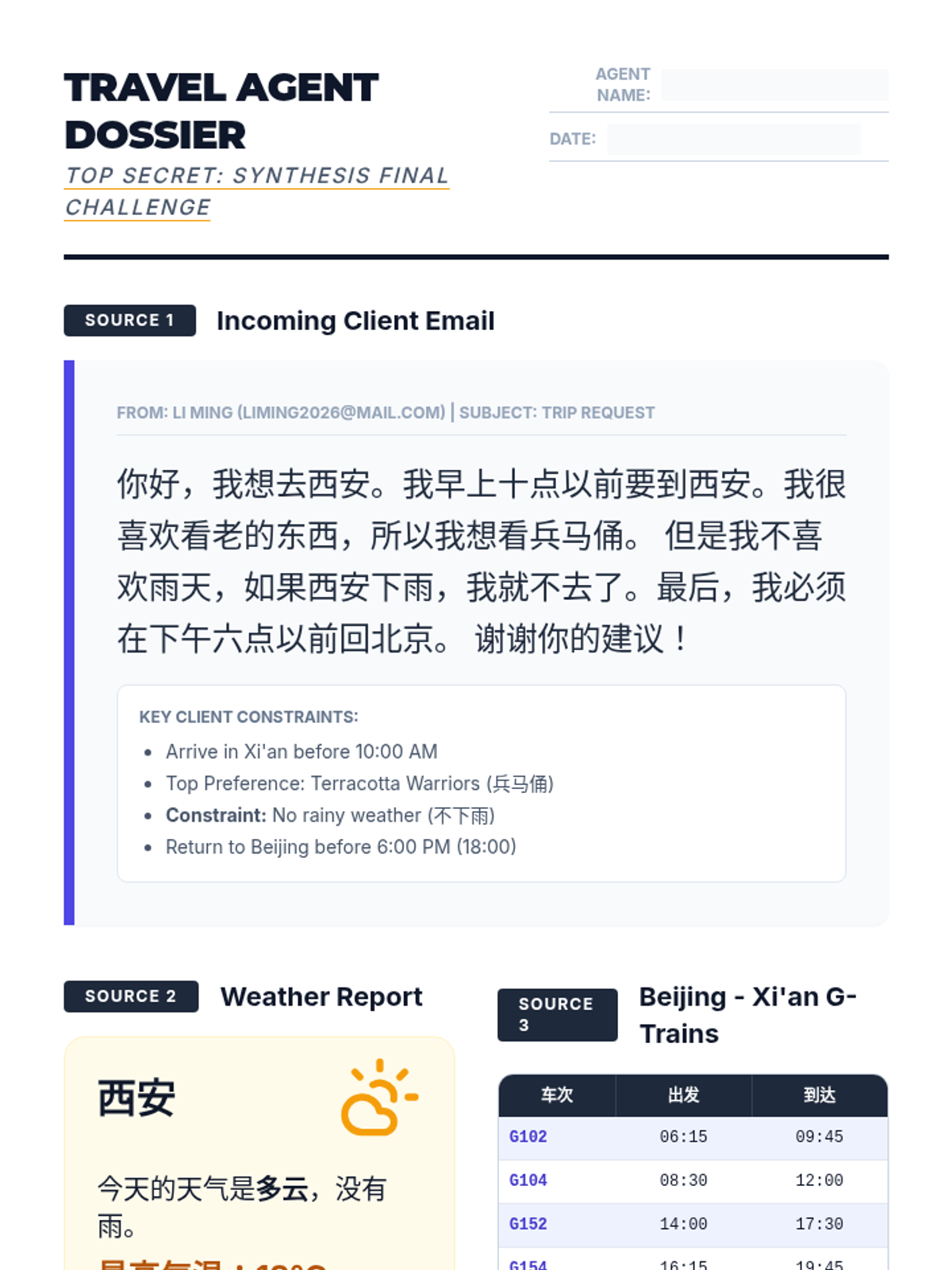
Final synthesis worksheet for Lesson 5, where students plan a 1-day trip for a client using multiple data sources (email, weather, schedules).
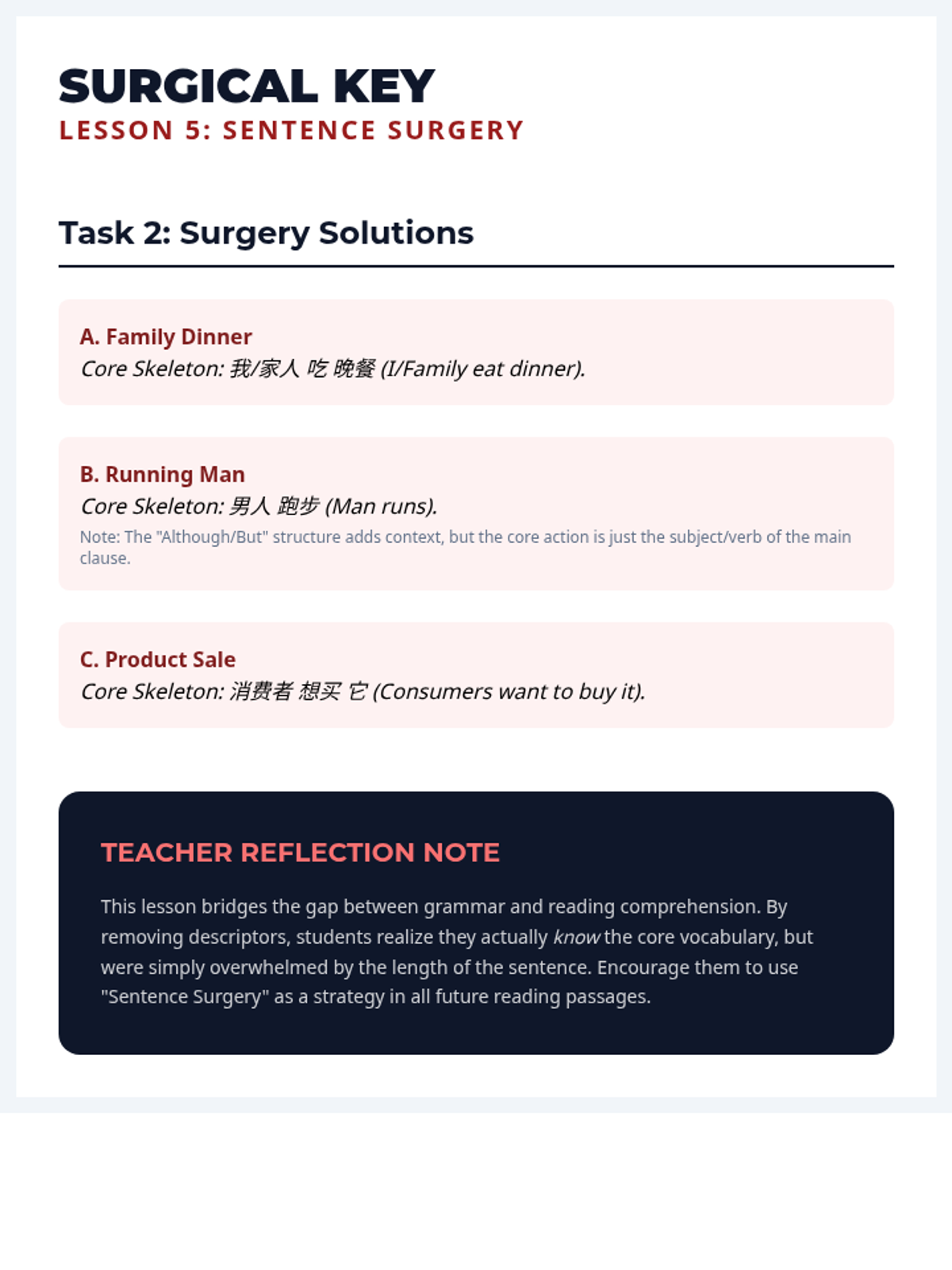
This teacher answer key for Lesson 5 provides the "skeleton" solutions for the deconstructing long sentences activity.
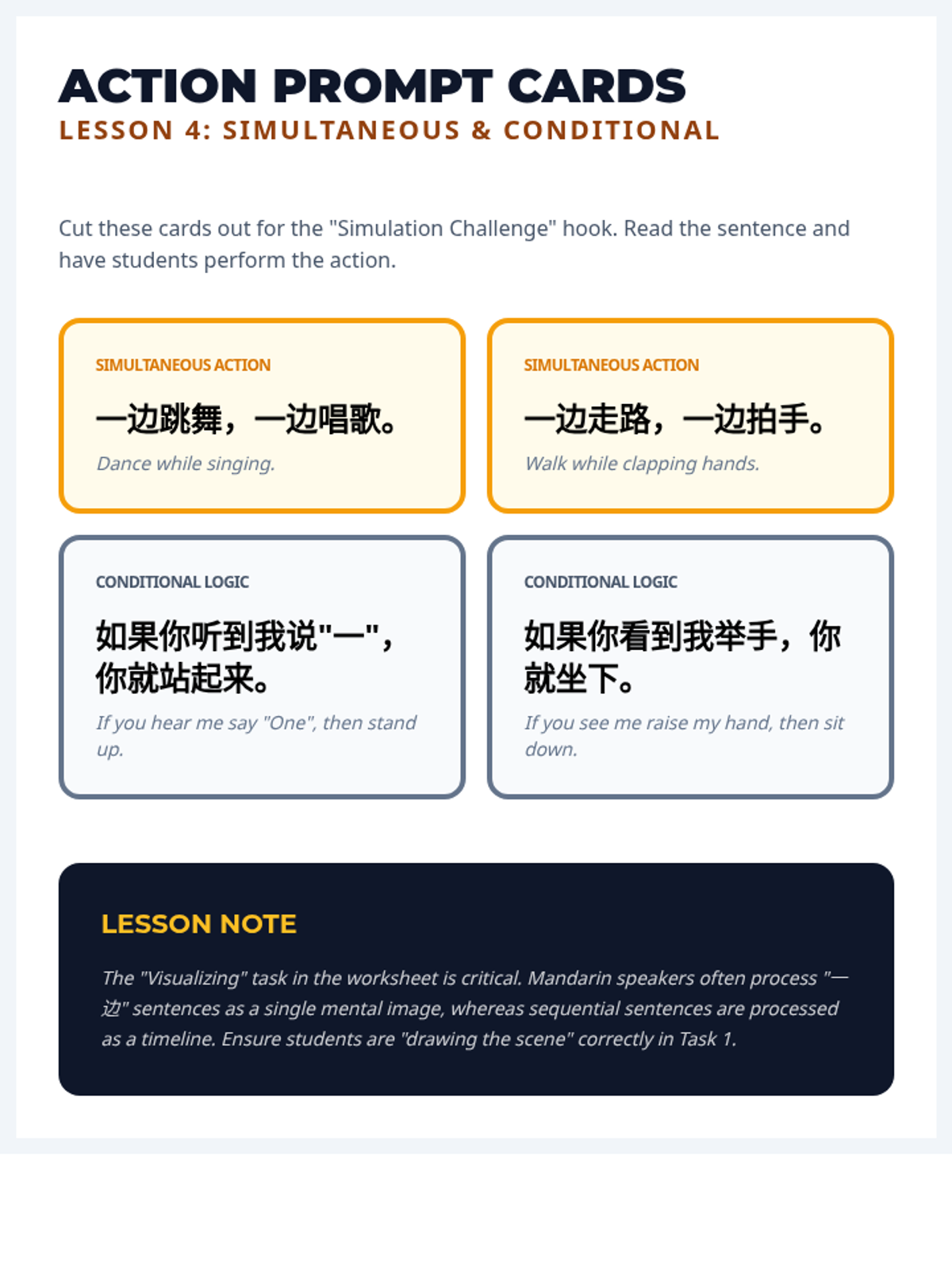
These teacher prompt cards for Lesson 4 are used for a physical "simulation" activity to demonstrate simultaneous and conditional actions.
Introductory slides for Lesson 5, featuring the "Travel Agent Challenge" hook and synthesis modeling for travel planning.
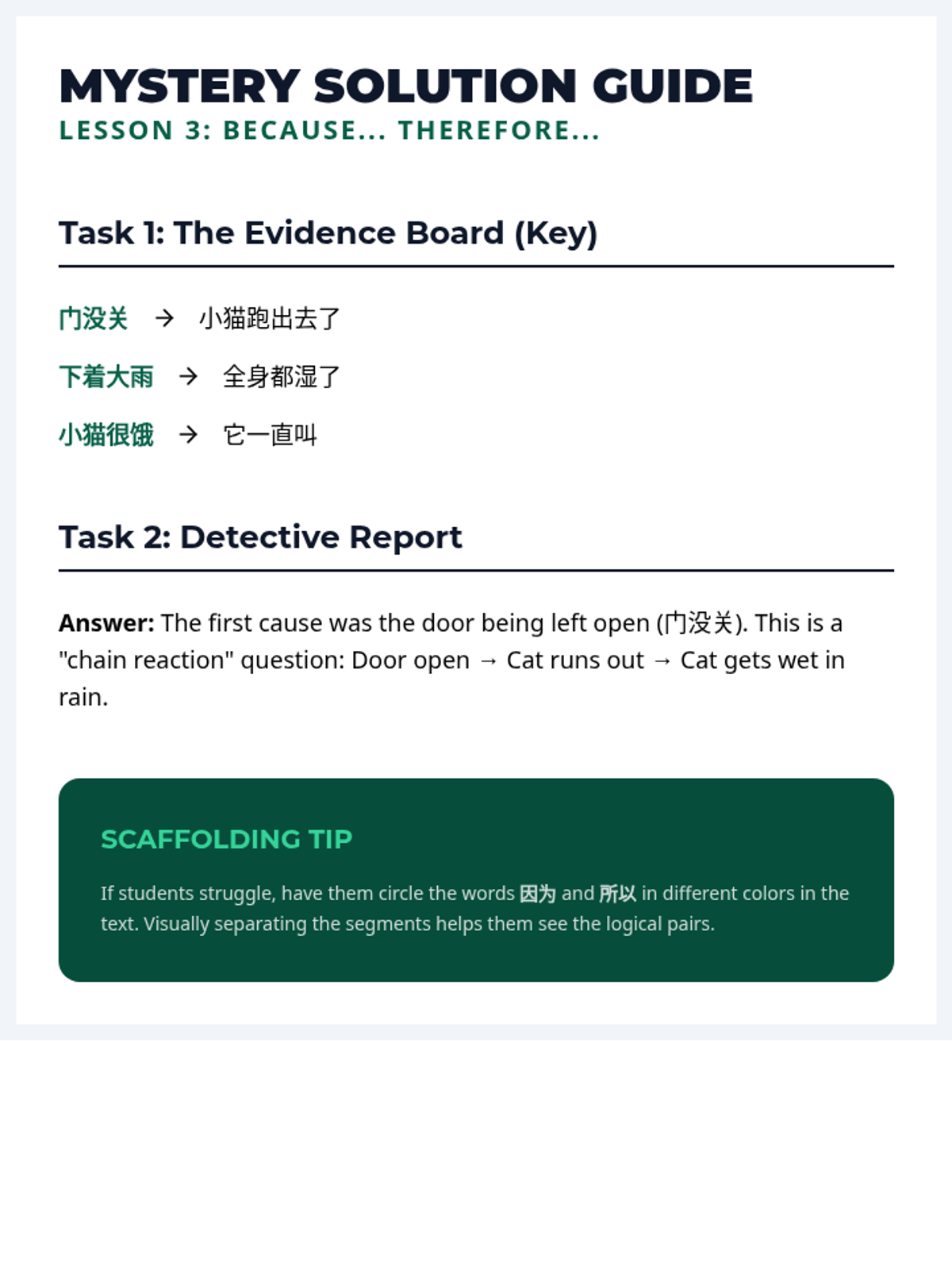
This teacher answer key for Lesson 3 provides the solutions to the "Missing Pet" mystery logic map.
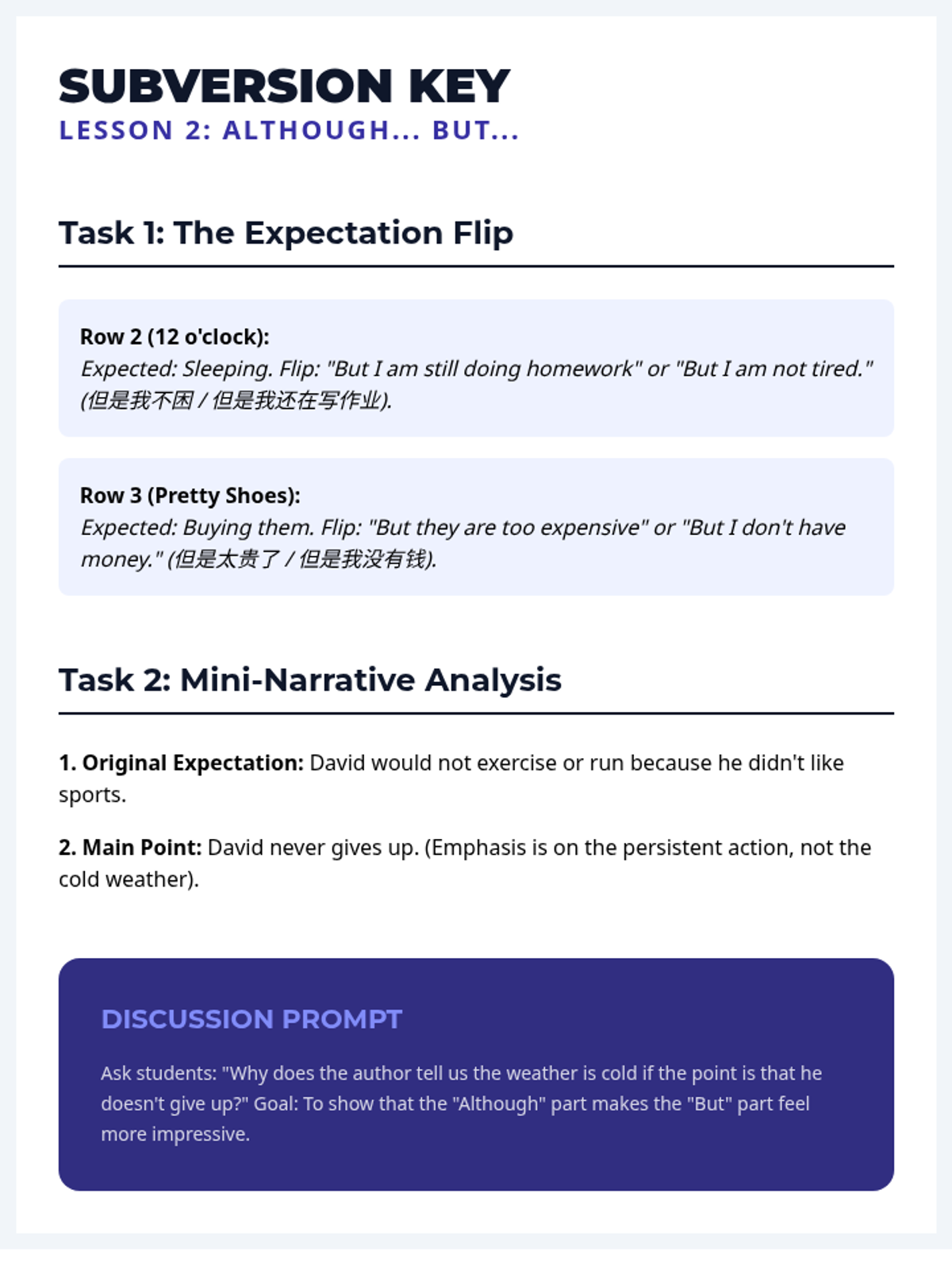
This teacher answer key for Lesson 2 provides solutions and discussion prompts for the "Plot Twist Reader" worksheet.
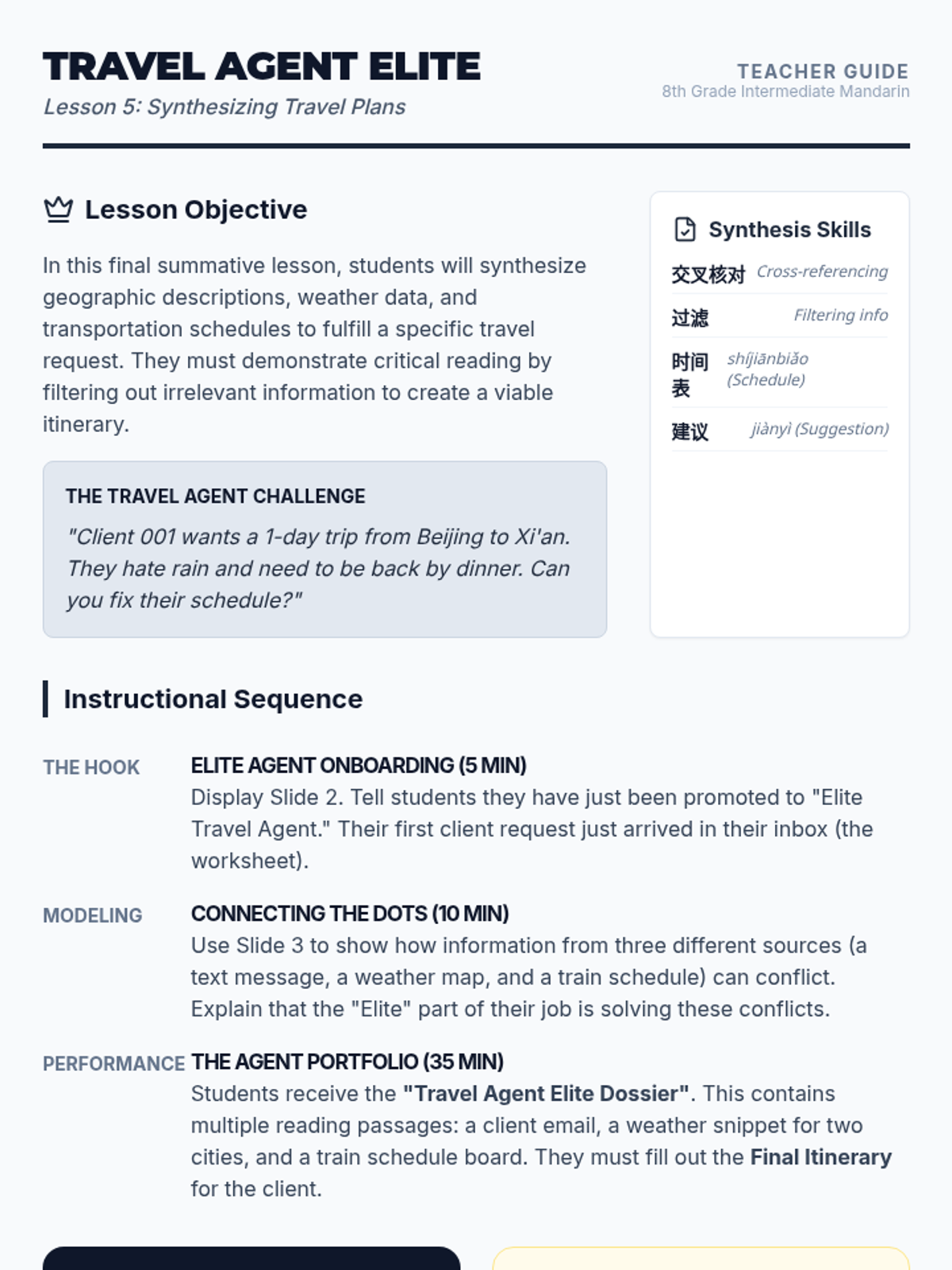
Teacher guide for Lesson 5, outlining the final synthesis project where students act as elite travel agents to plan a trip based on multiple sources of information.
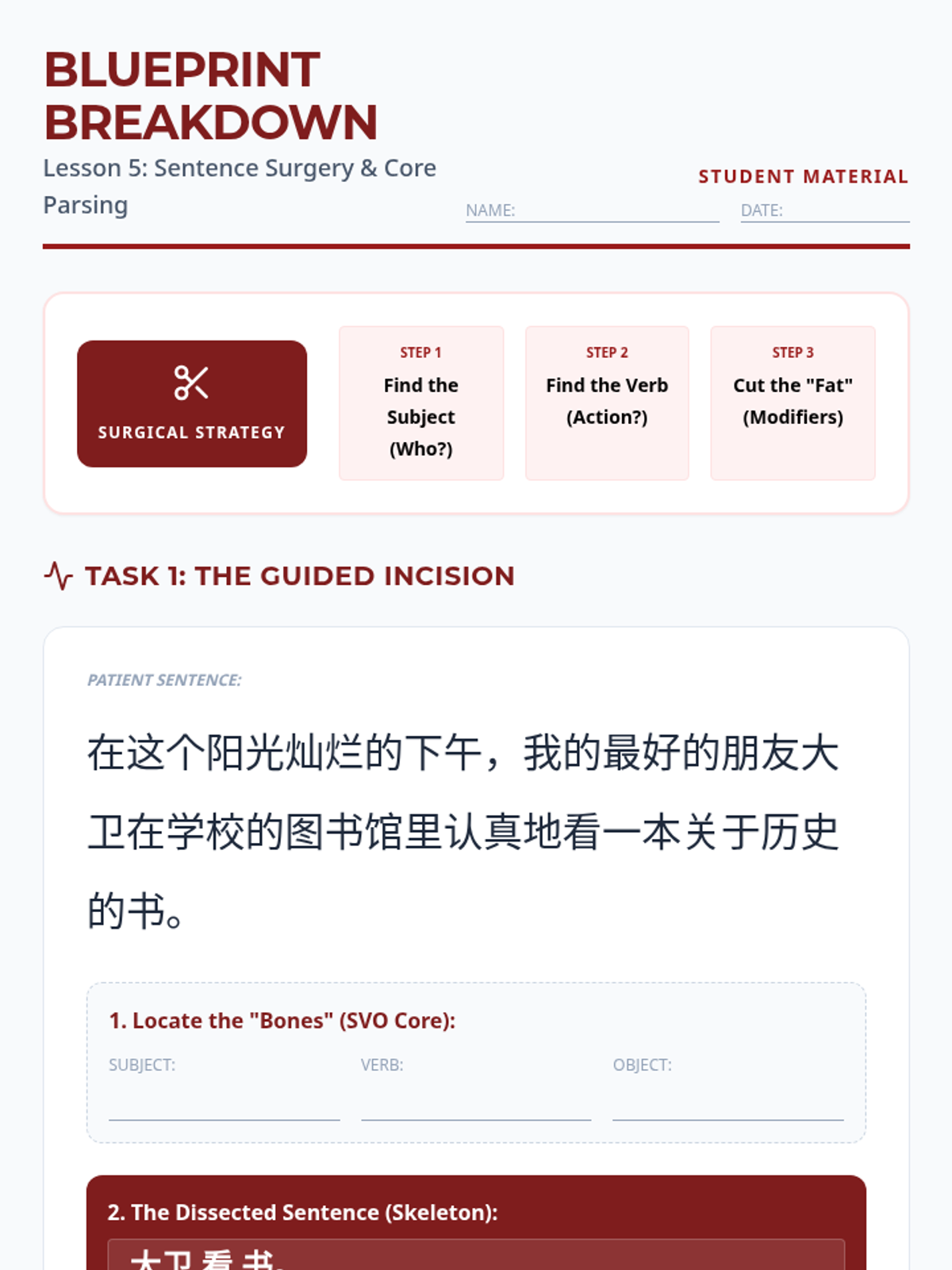
This student worksheet for Lesson 5 involves parsing long, complex news sentences to find their core subject-verb-object structures.
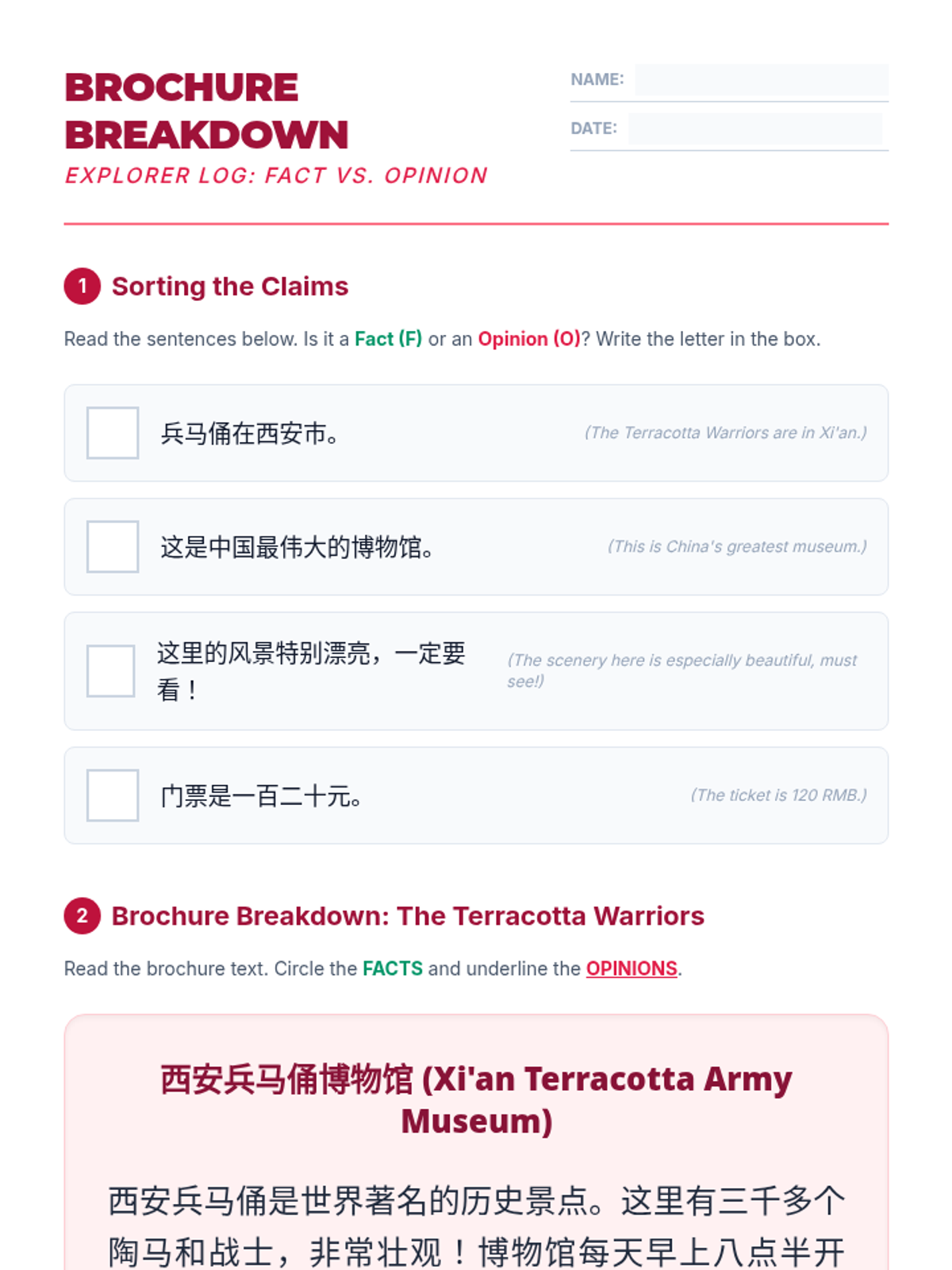
Student worksheet for Lesson 4, featuring a fact/opinion sorting task and a brochure text analysis for the Terracotta Warriors.
These slides for Lesson 5 introduce the core technique of sentence surgery: parsing long sentences to find the subject-verb-object core.
A presentation deck for Lesson 5 facilitating a final synthesis and discussion comparing the Chinese and American education systems.
Introductory slides for Lesson 4, featuring visuals of famous attractions and the distinction between fact and opinion in travel brochures.
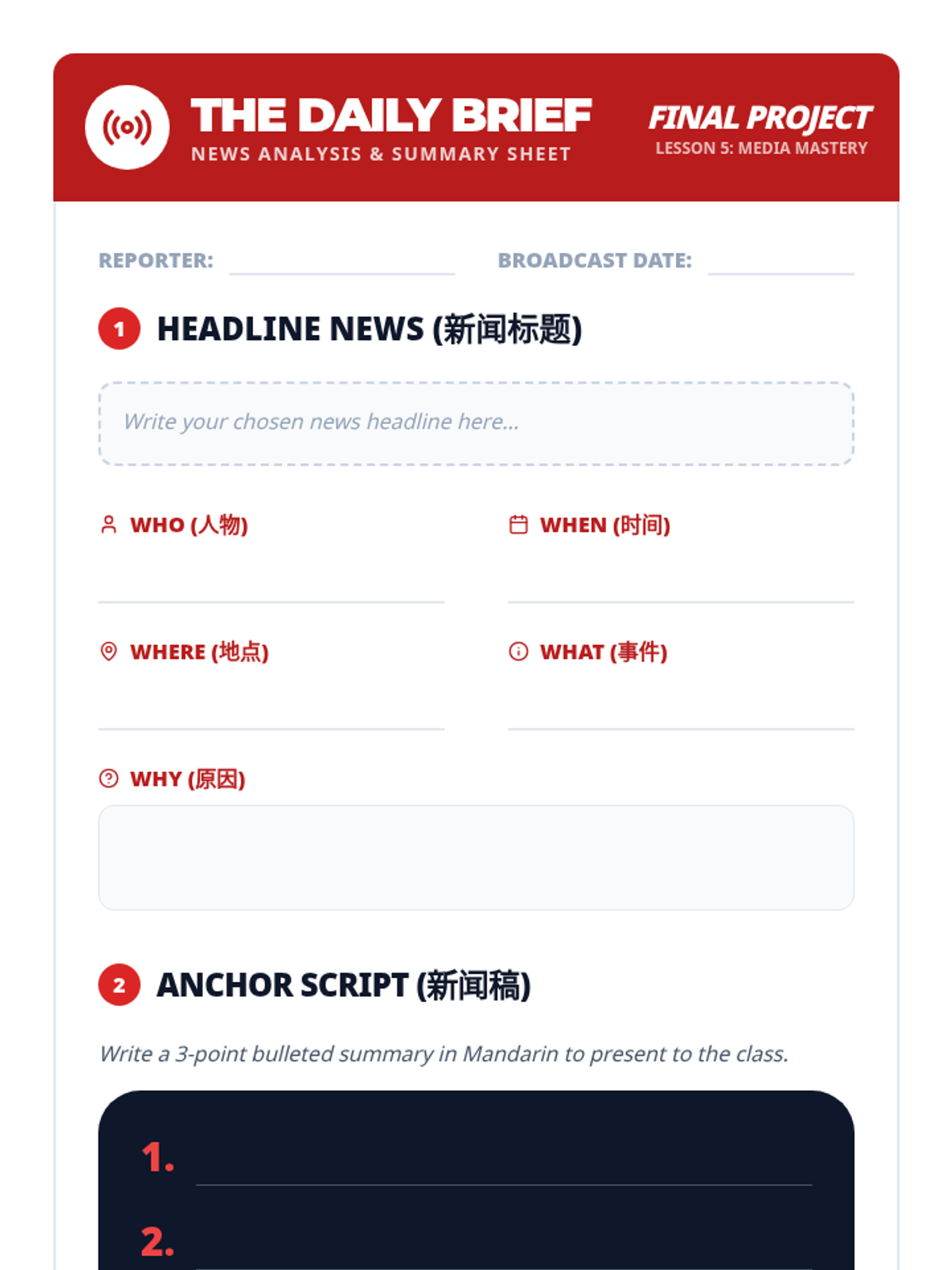
The final assessment sheet for the sequence, where students apply the 5 Ws and summarize a news story for their final news anchor presentation.
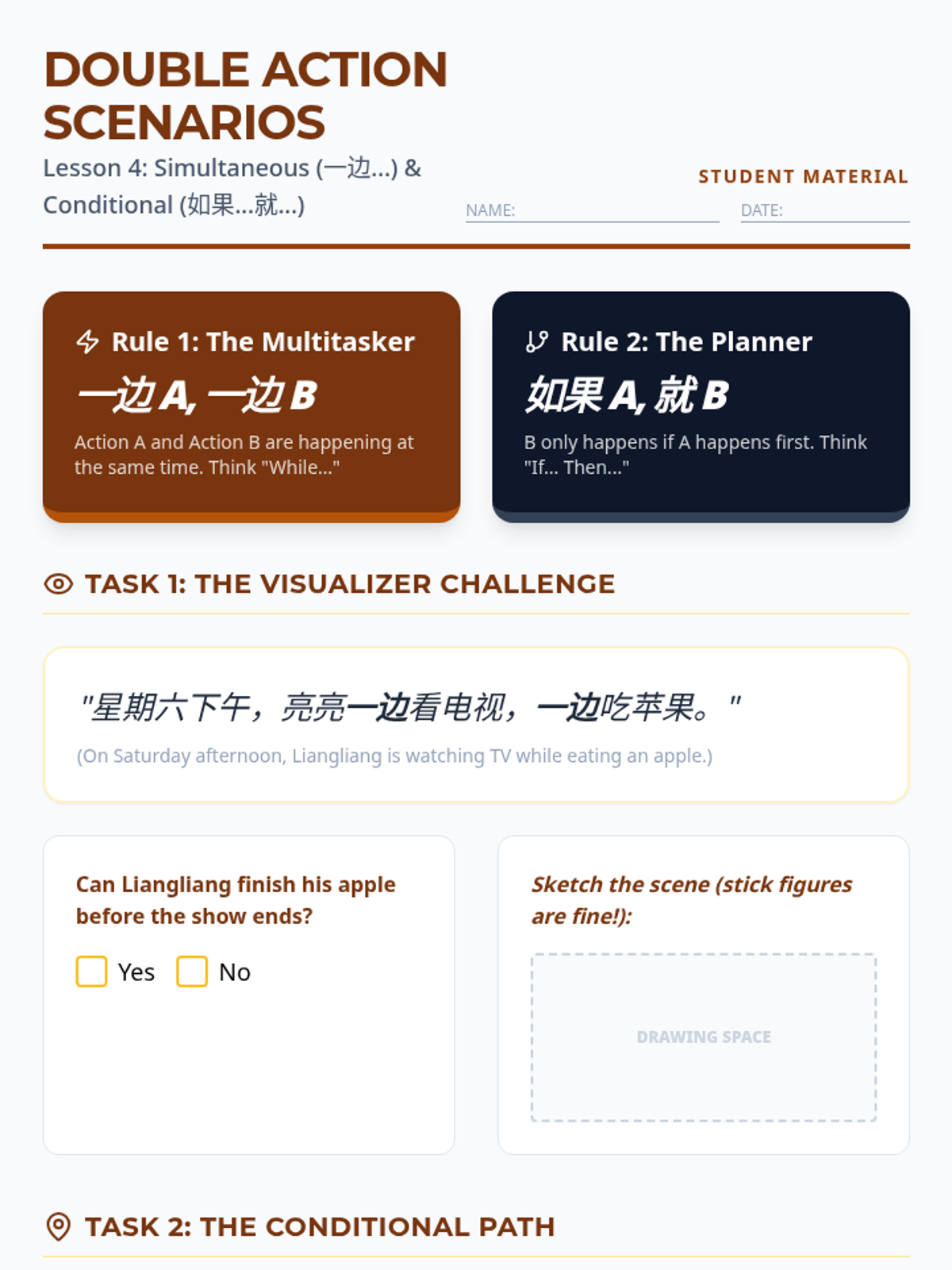
This student worksheet for Lesson 4 provides practice with simultaneous and conditional sentence structures through visualization and scenario analysis.
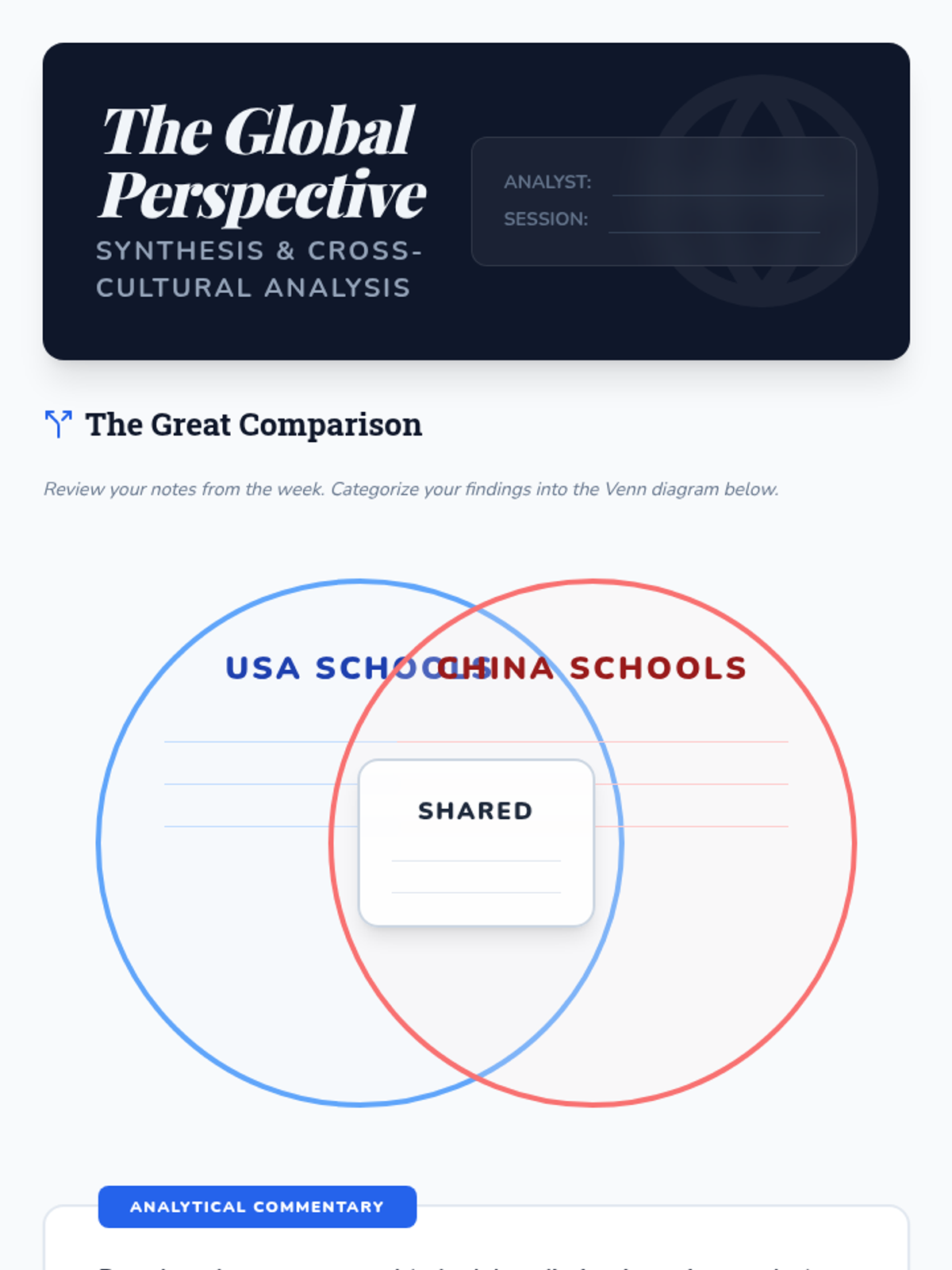
A synthesizing worksheet for Lesson 5 where students use a Venn diagram and short written response to compare Chinese and American education systems based on the week's texts.
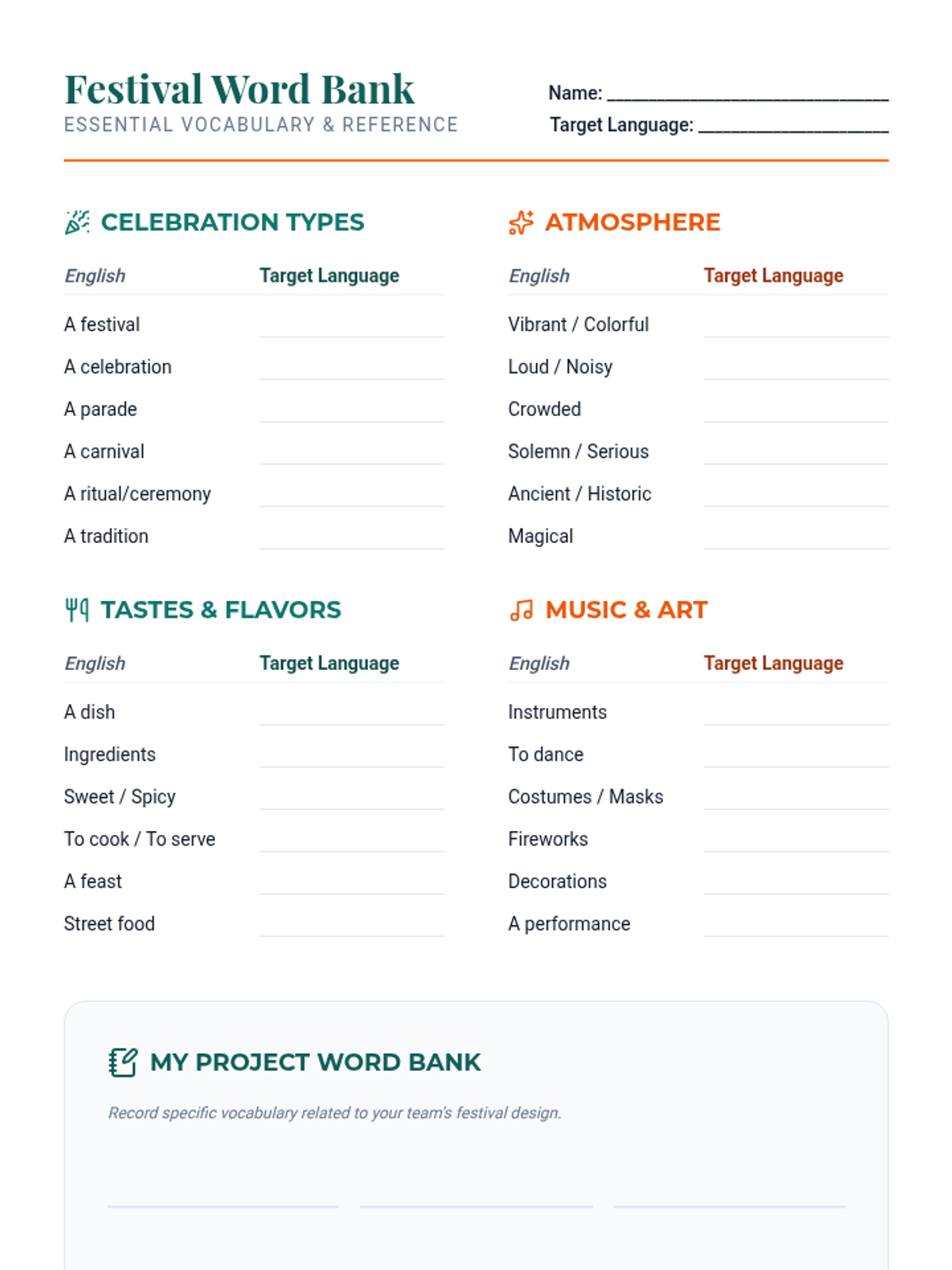
A student reference sheet and word bank for the Cultural Festival Design Challenge, featuring essential terms for celebrations, food, music, and atmosphere with space for target language translations.
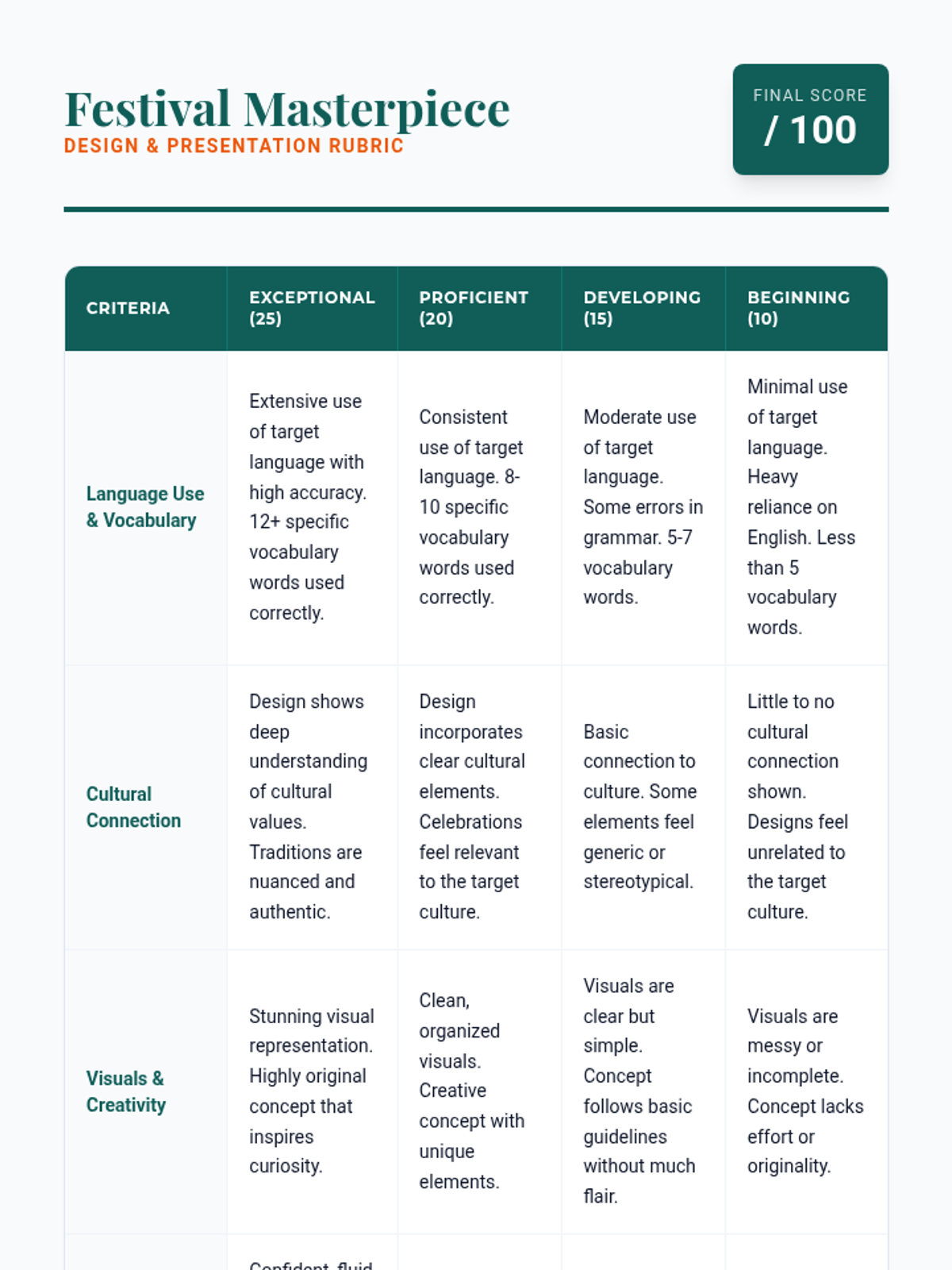
A comprehensive assessment rubric for the Cultural Festival Design Challenge, evaluating students on language use, cultural authenticity, creativity, and oral presentation skills.
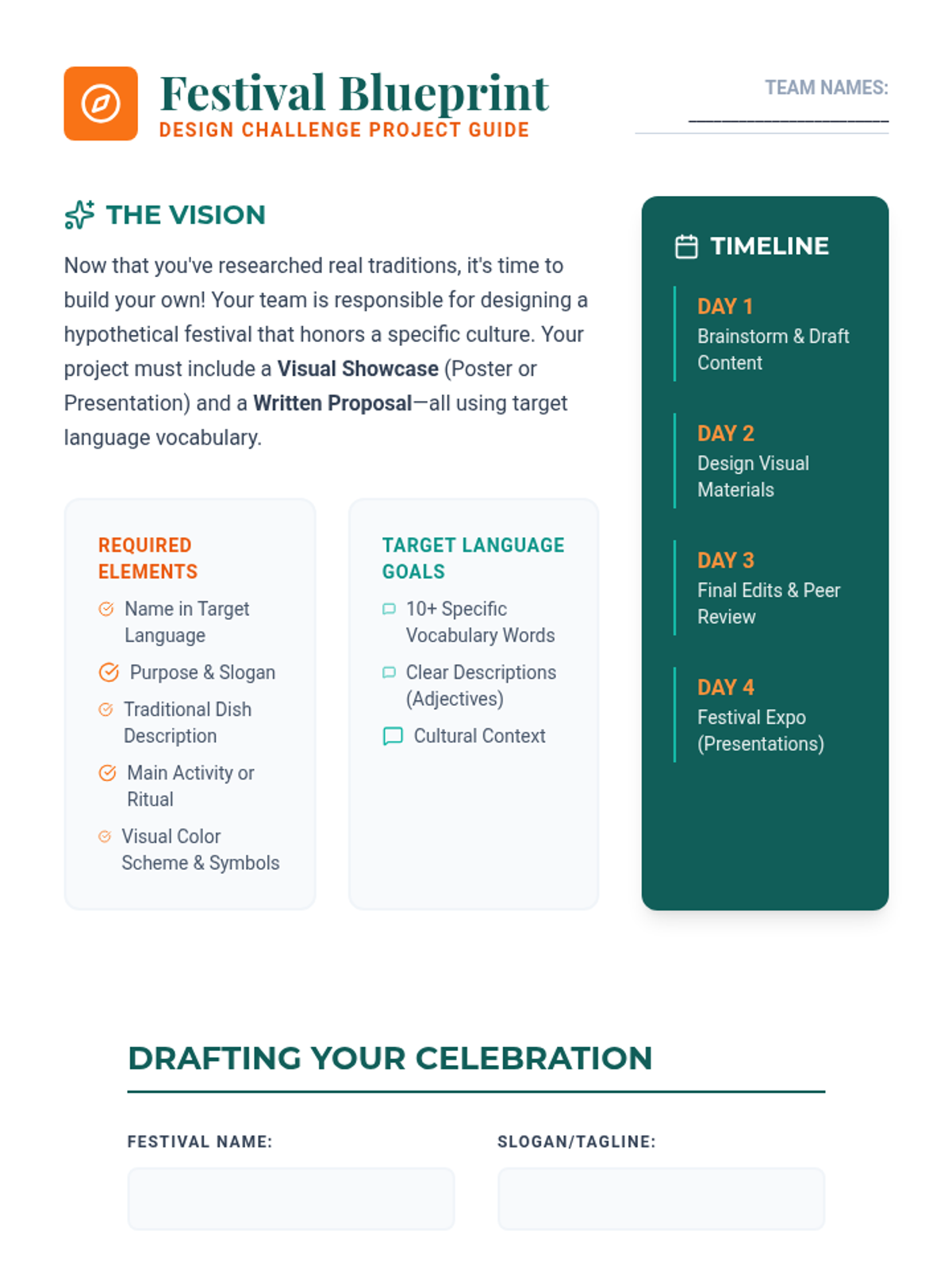
A detailed project guide for students to design their own cultural festival, including a planning timeline, required elements, and drafting space for their festival's name, slogan, culinary identity, and main event.
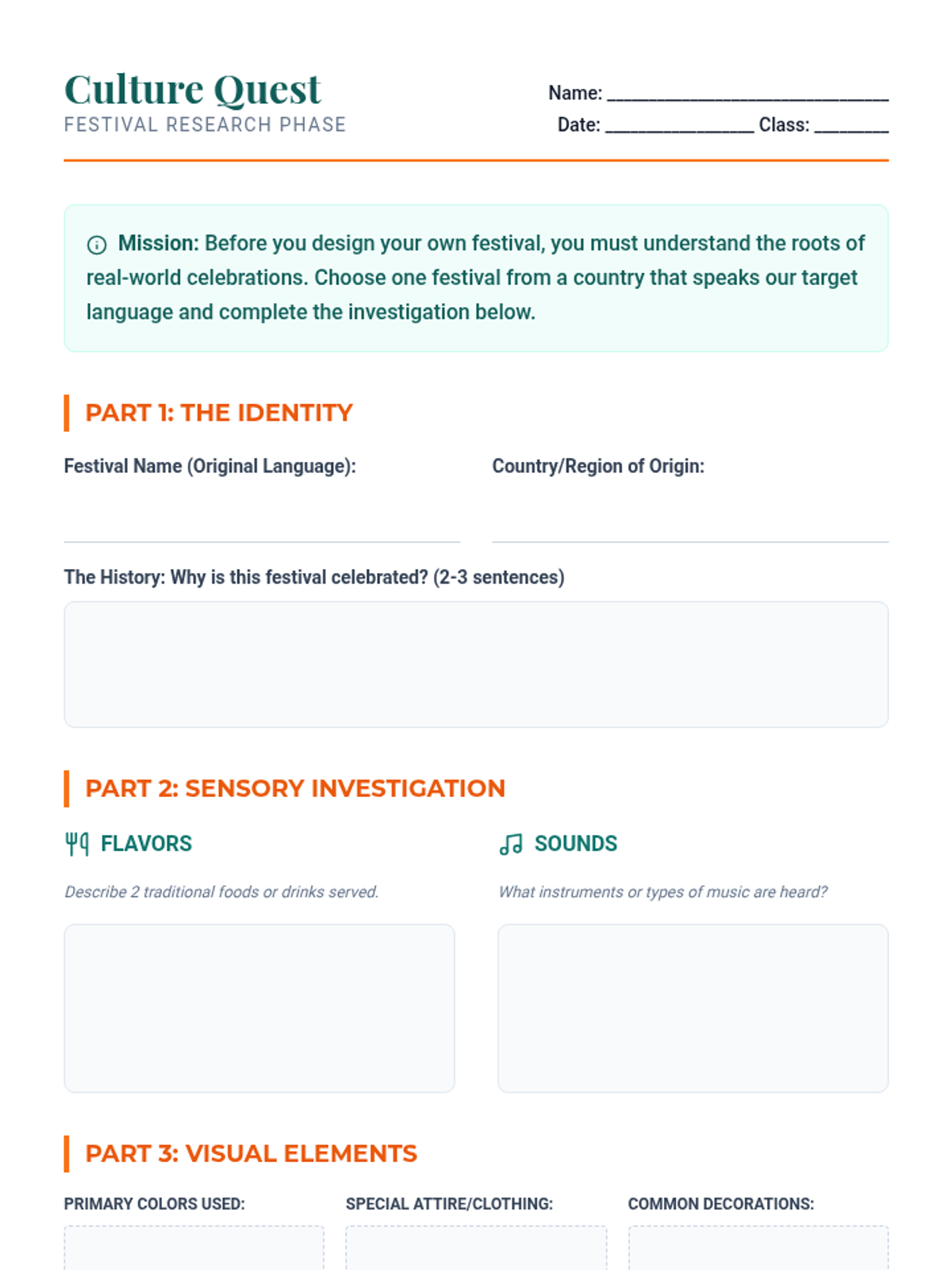
A research worksheet for students to investigate an authentic cultural festival, focusing on heritage, flavors, sounds, and visual elements in preparation for their design project.
A visually engaging slide deck designed to introduce the Cultural Festival Design Challenge, outlining the project's mission, required elements, and creative expectations for students.
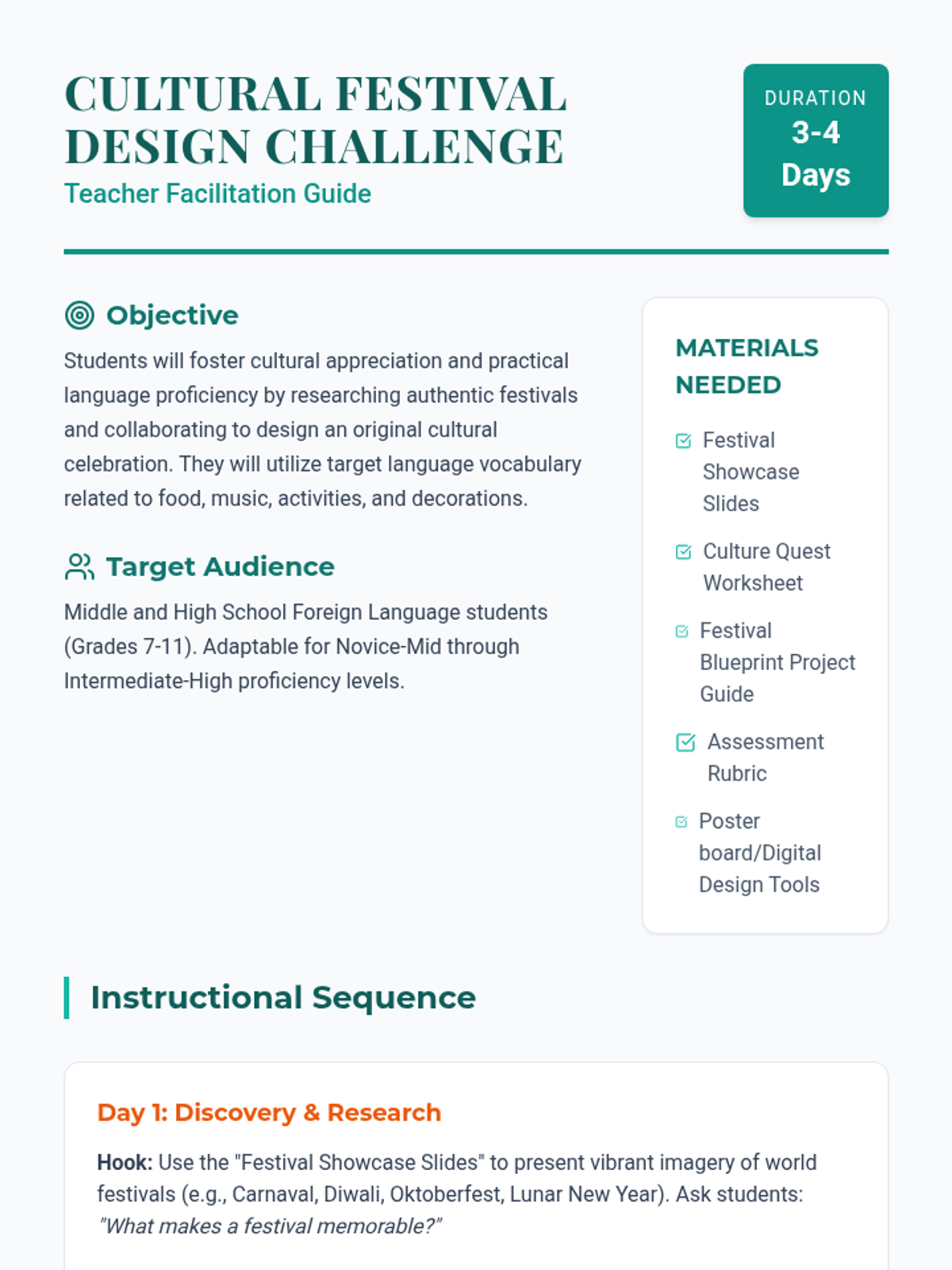
A comprehensive lesson plan for the Cultural Festival Design Challenge, outlining the instructional sequence, learning objectives, and differentiation strategies for middle and high school language learners.
Final slide deck for the sequence, focusing on the 5 Ws of news reporting and preparing students for their News Anchor summary presentation.
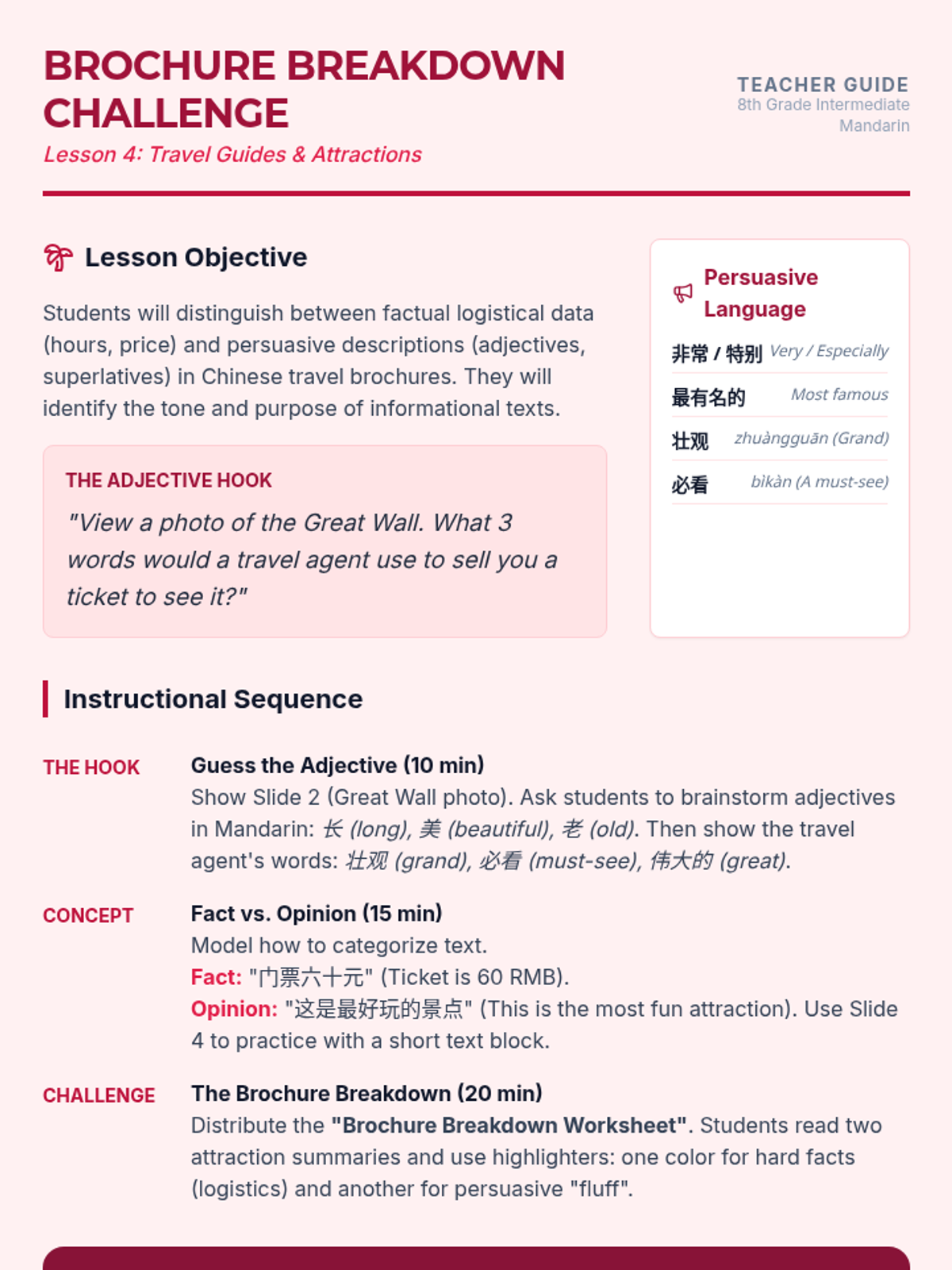
Teacher guide for Lesson 4, outlining the fact vs. opinion distinction, persuasive adjective focus, and brochure analysis activity.
A presentation deck for Lesson 4 introducing modal verbs like "must" and "must not" and discussing the cultural and behavioral expectations of Chinese middle schools.
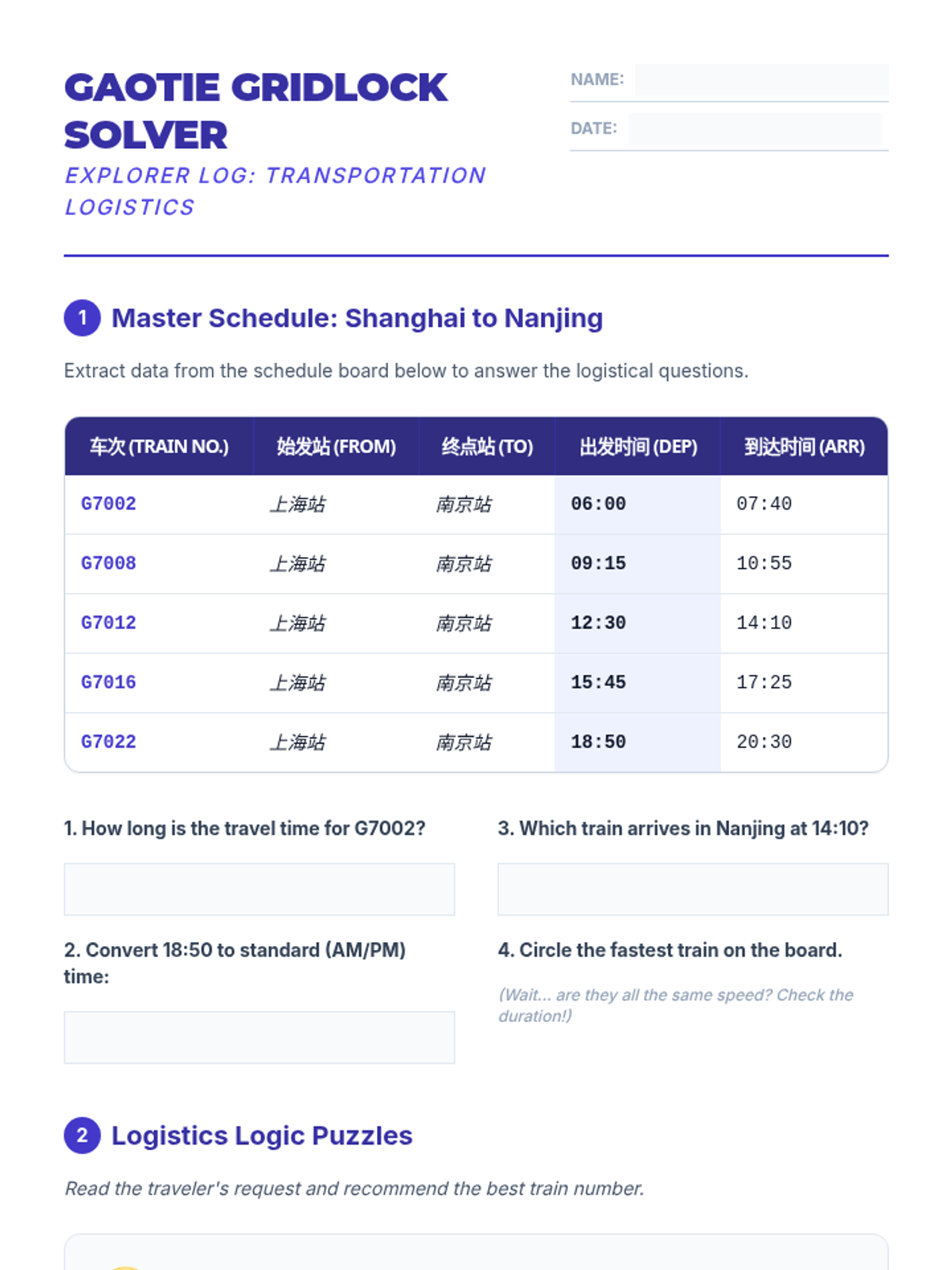
Student worksheet for Lesson 3, featuring schedule scanning, 24-hour clock conversion, and travel logistics logic problems.
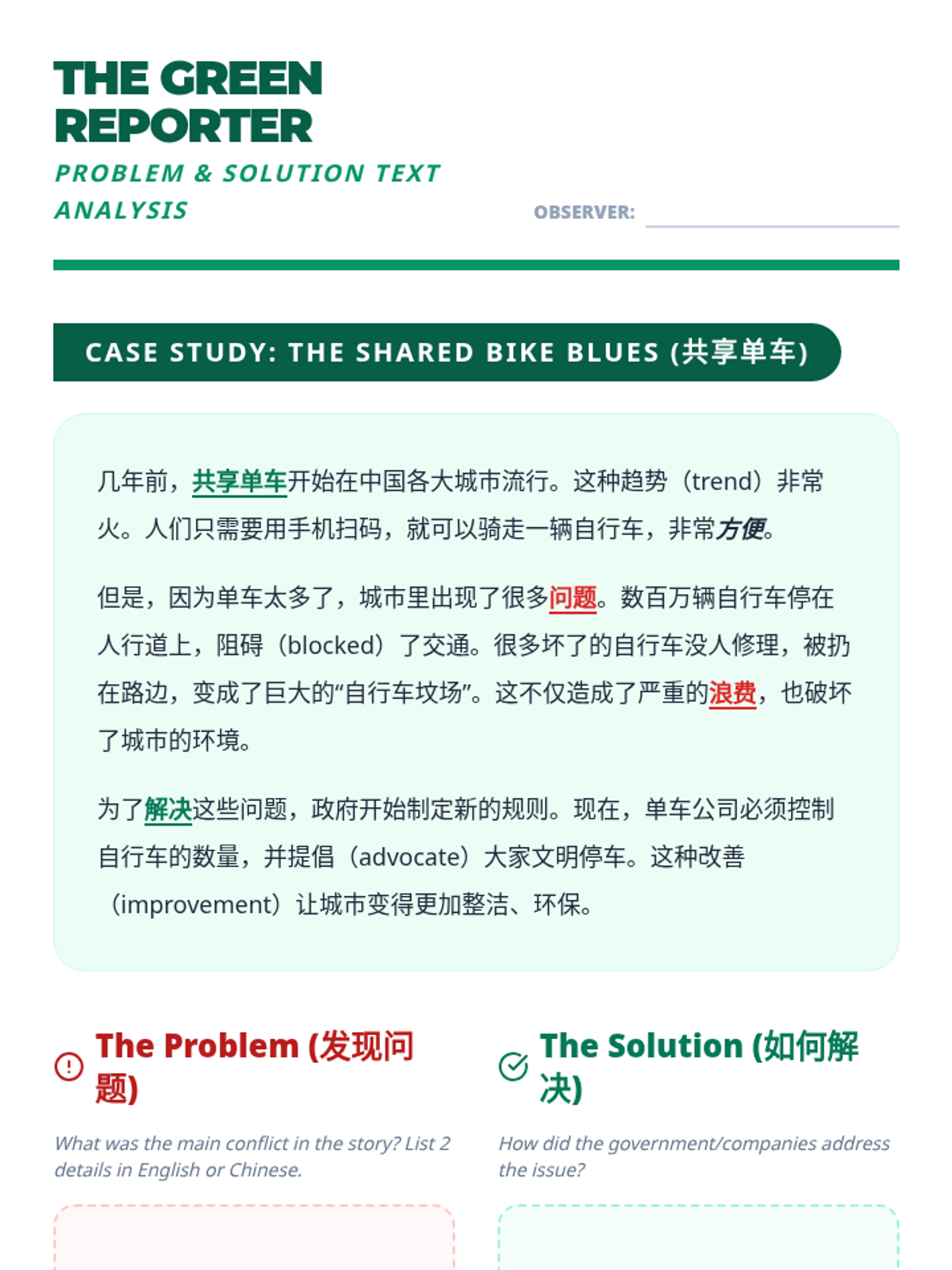
An analysis worksheet where students read about the shared bike trend in China, identify the problem and solution structures, and reflect on global environmental trends.
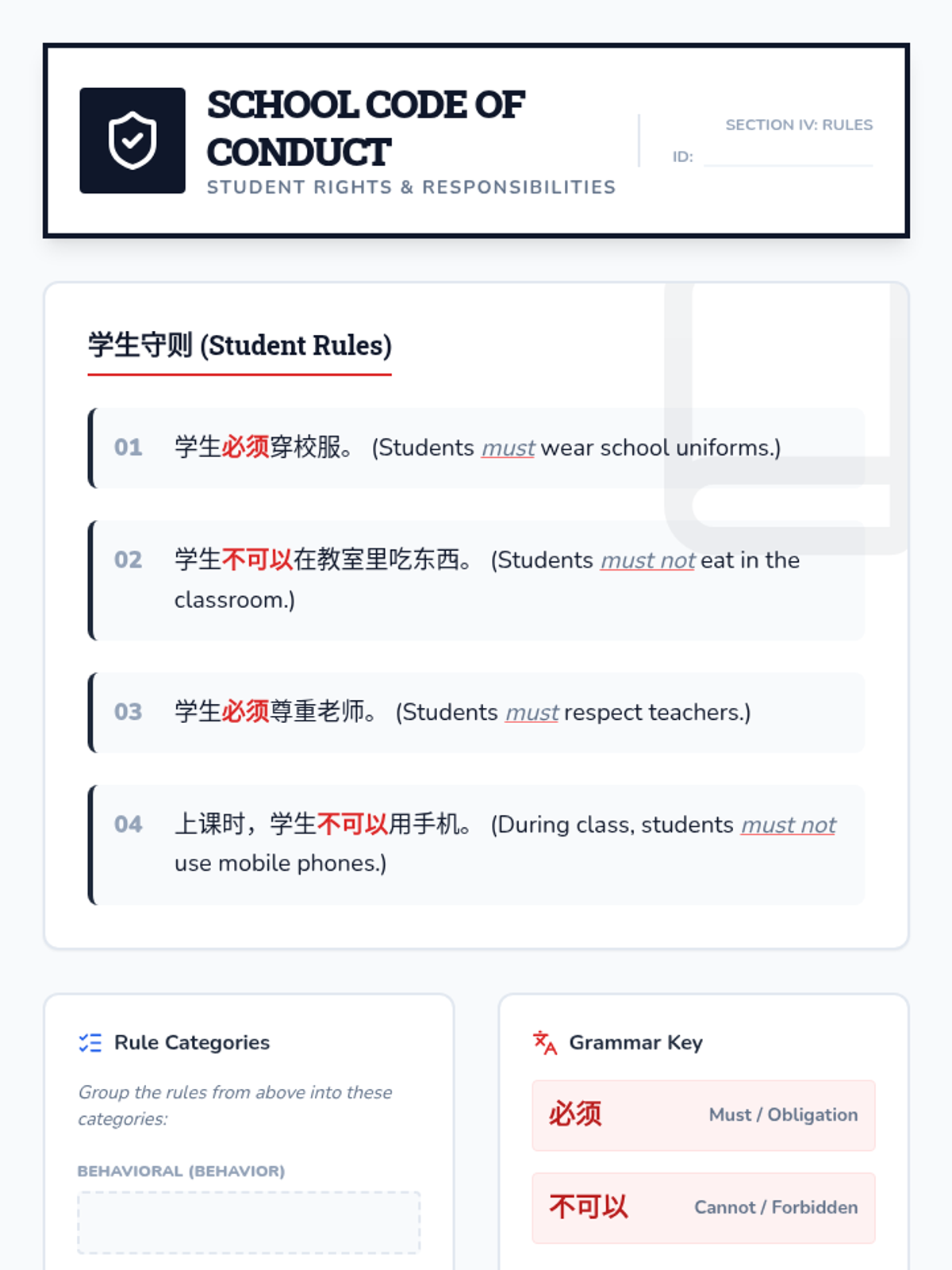
A worksheet for Lesson 4 featuring a school code of conduct, grammar focus on modal verbs, and a 'citation' activity where students identify broken rules.
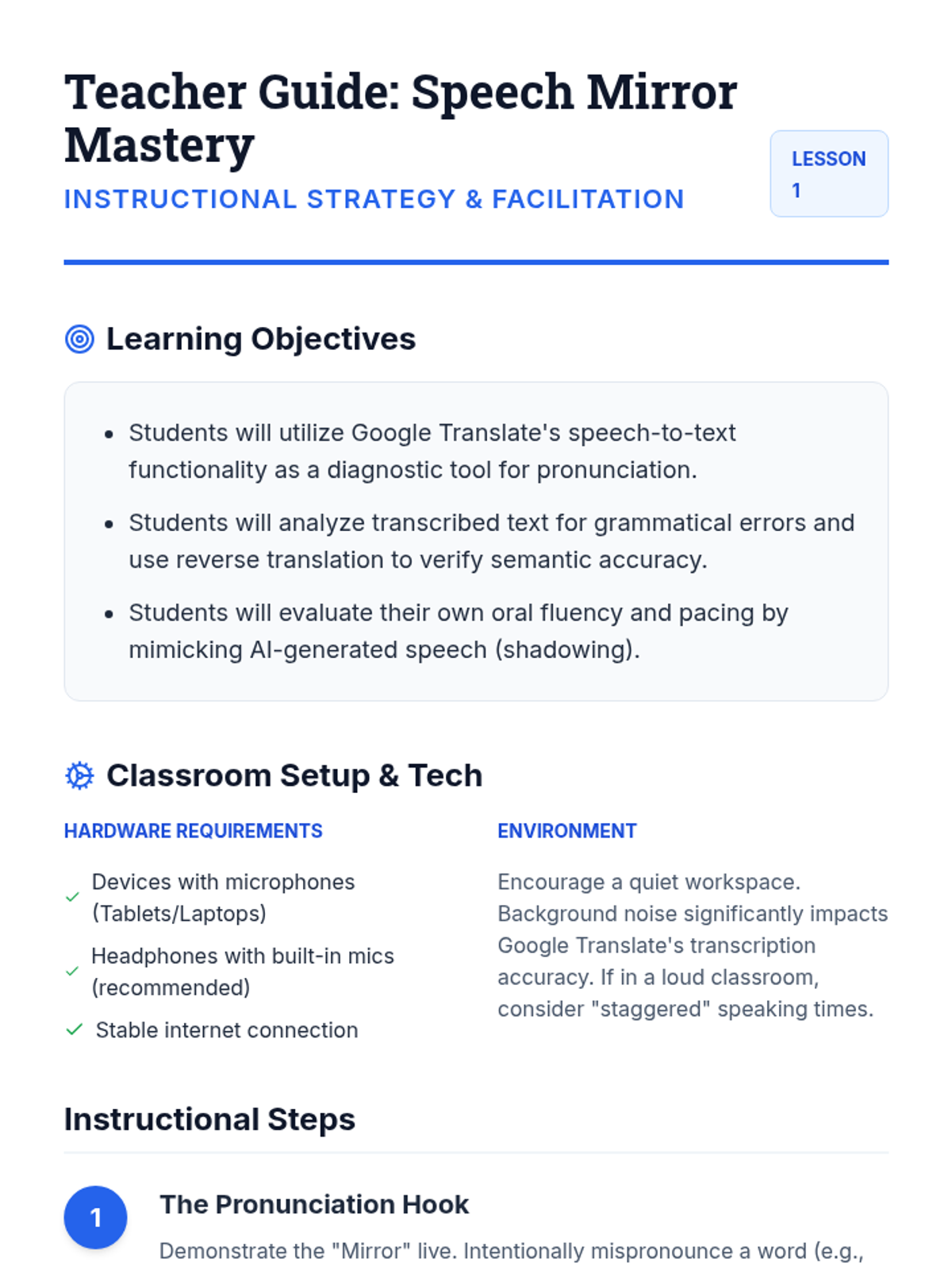
A comprehensive teacher guide for facilitating the 'Speech Mirror' activity. Includes instructional strategies, tech requirements, common pitfalls, and assessment criteria.
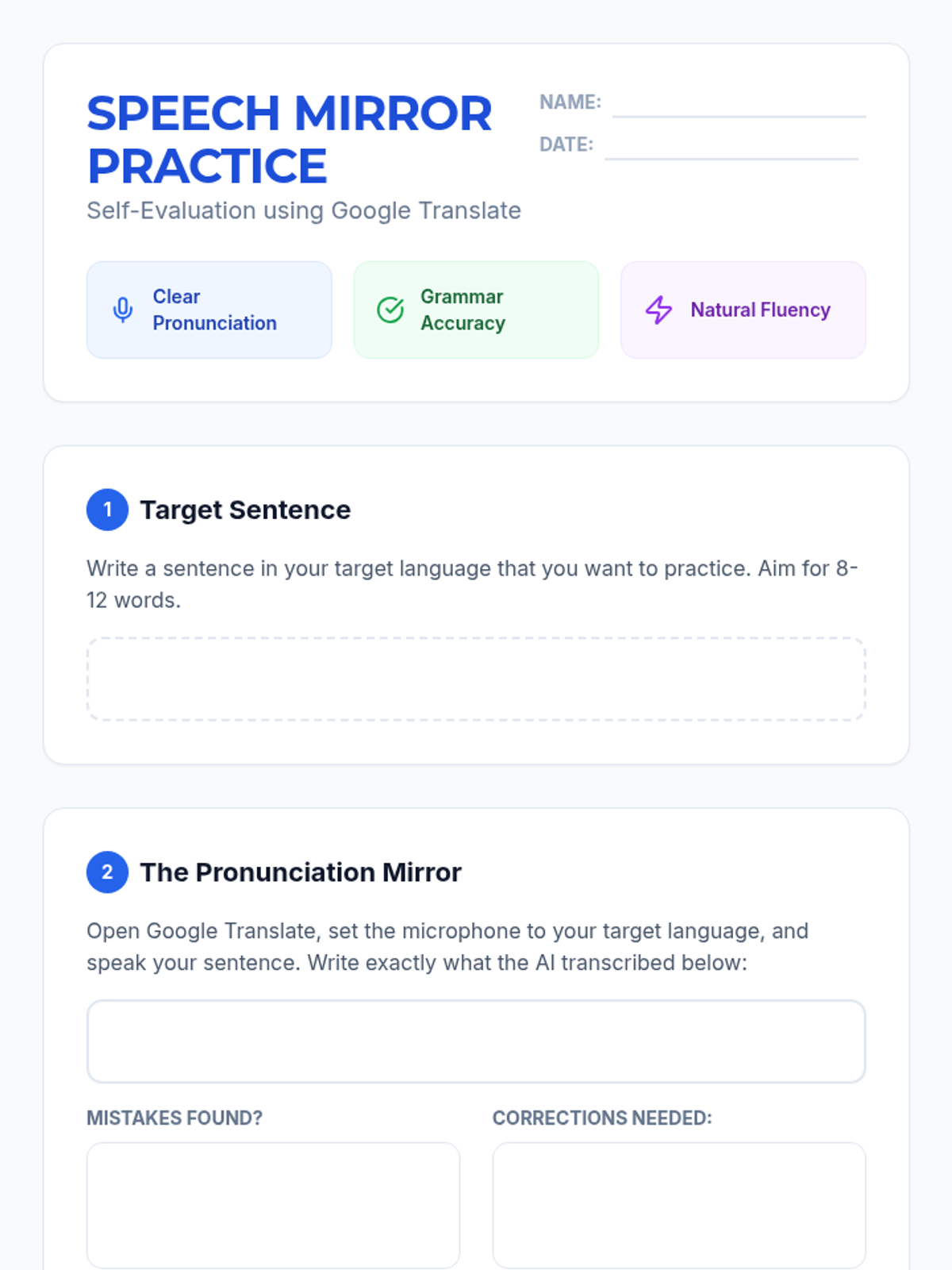
A step-by-step activity sheet for students to practice using Google Translate as a speech mirror. Includes sections for transcription review, grammar check, and fluency challenges. Updated for better handwriting legibility.
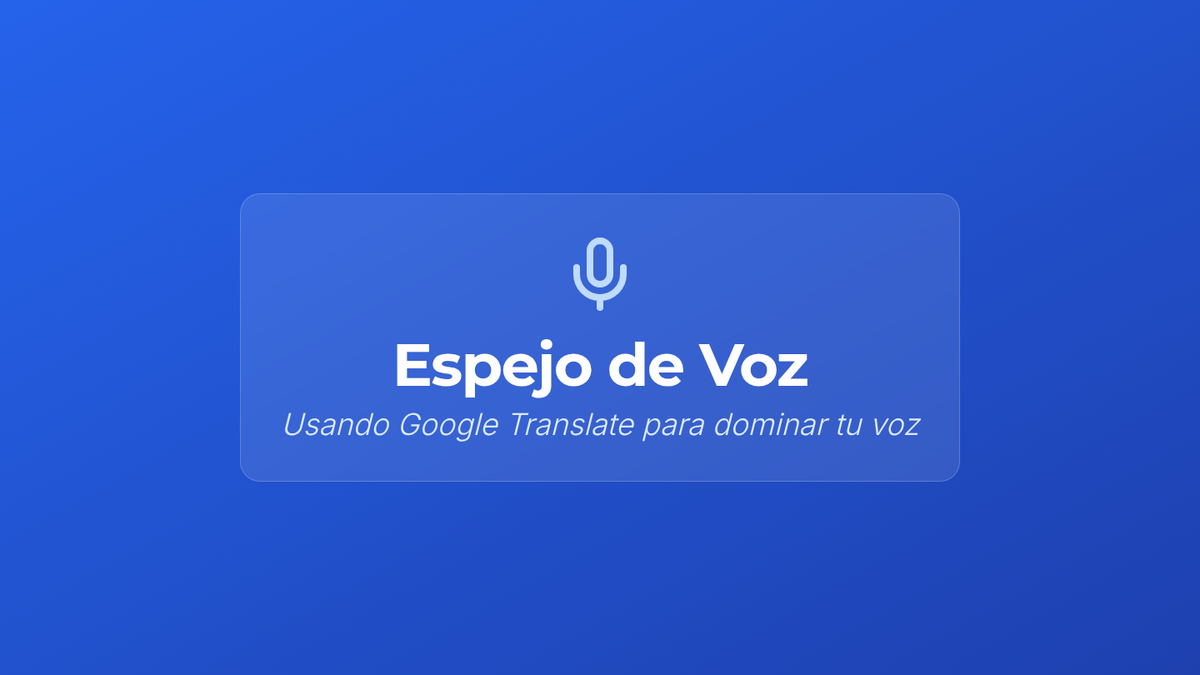
A visual presentation explaining the 'Speech Mirror' technique. It provides a tutorial on using Google Translate's voice features to assess pronunciation, grammar, and fluency. Updated with larger text for accessibility.
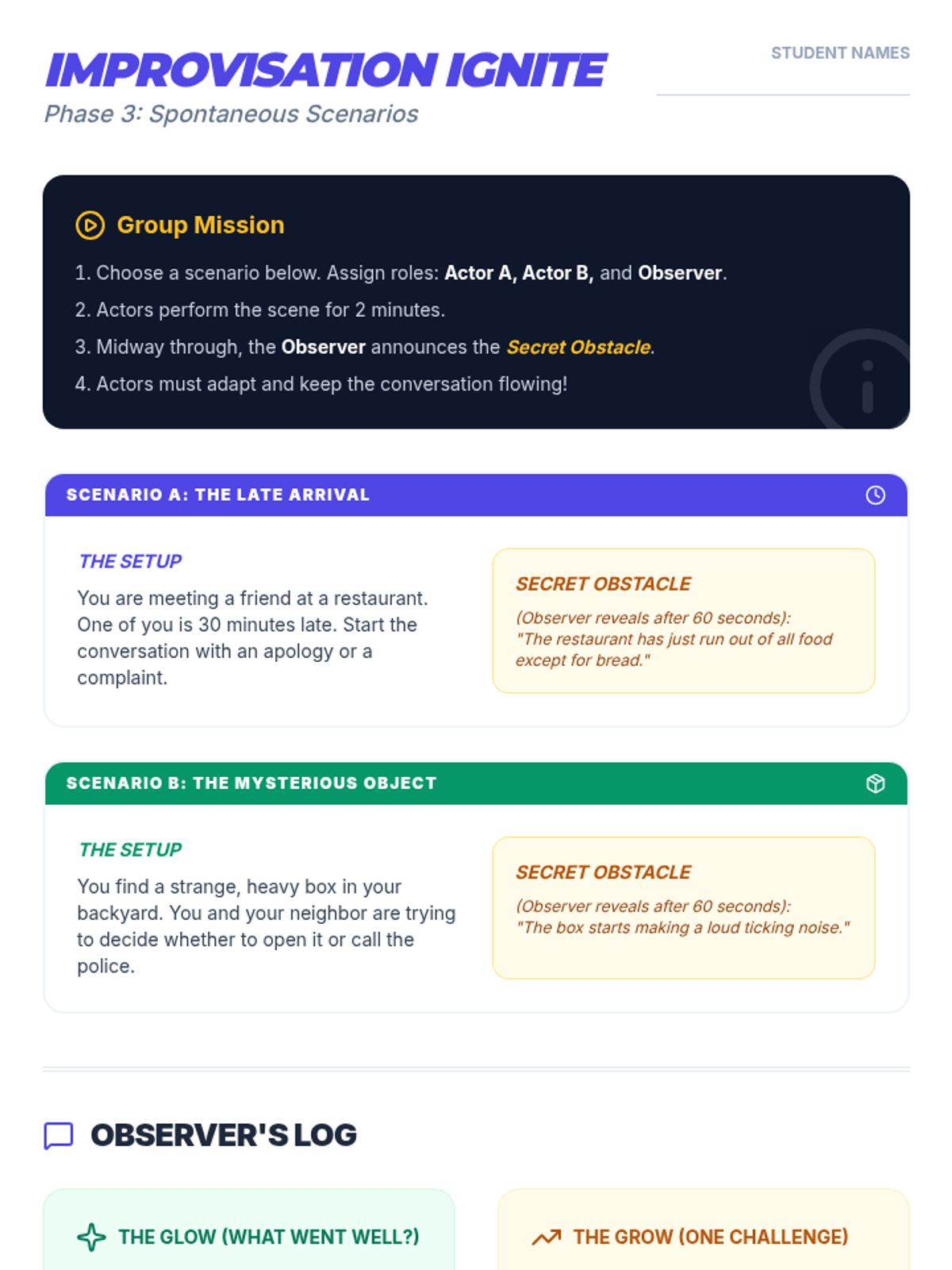
A student-facing small-group activity sheet providing structured scenarios with 'Secret Obstacles' and a peer-feedback framework for oral production.
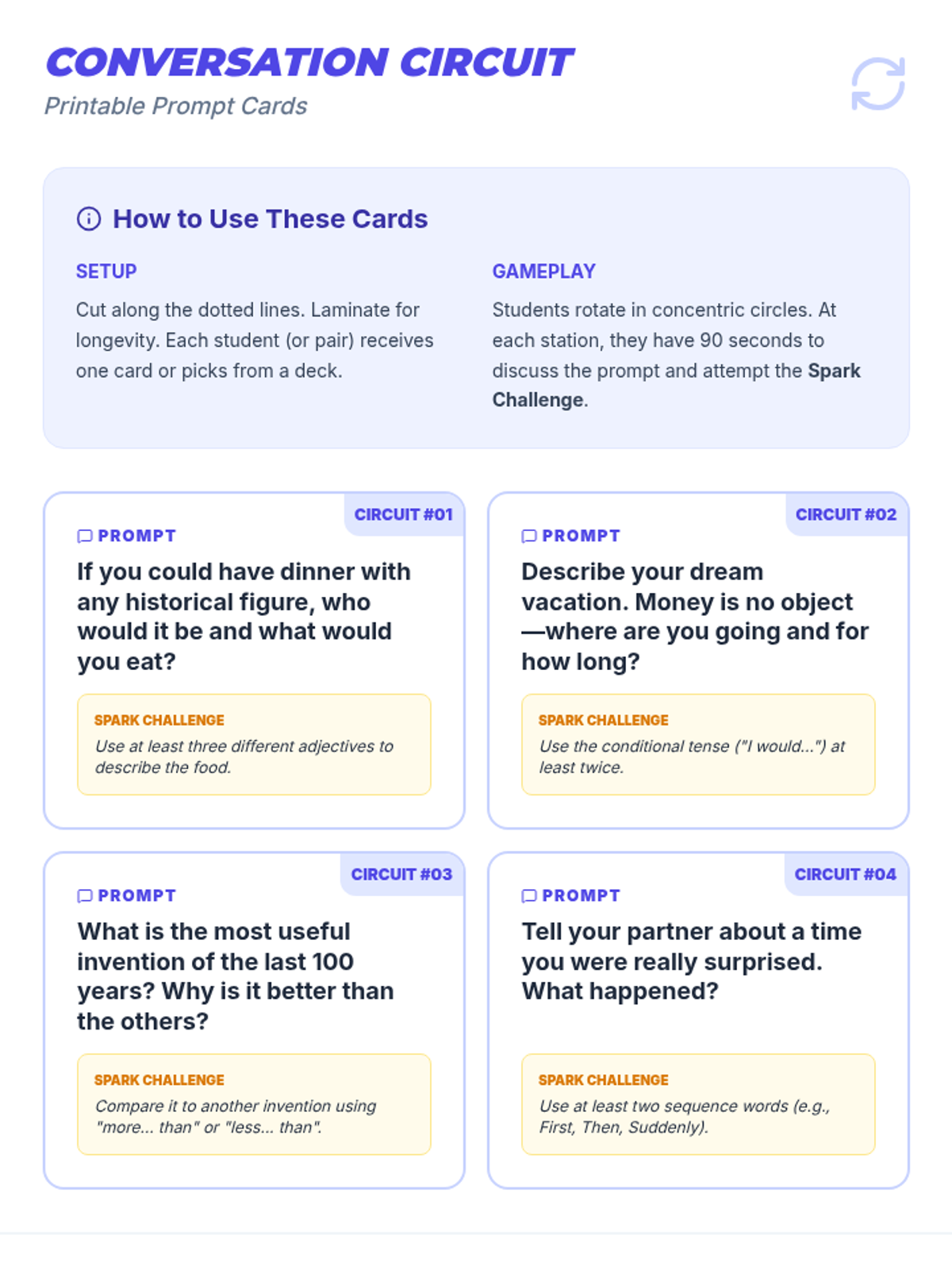
A set of 8 printable conversation prompt cards featuring 'Spark Challenges' to encourage specific linguistic targets during spontaneous speaking.
A visual guide for teachers and students explaining the shift from accuracy to fluency, providing warm-up prompts, and offering "Survival Phrases" to keep conversations moving.
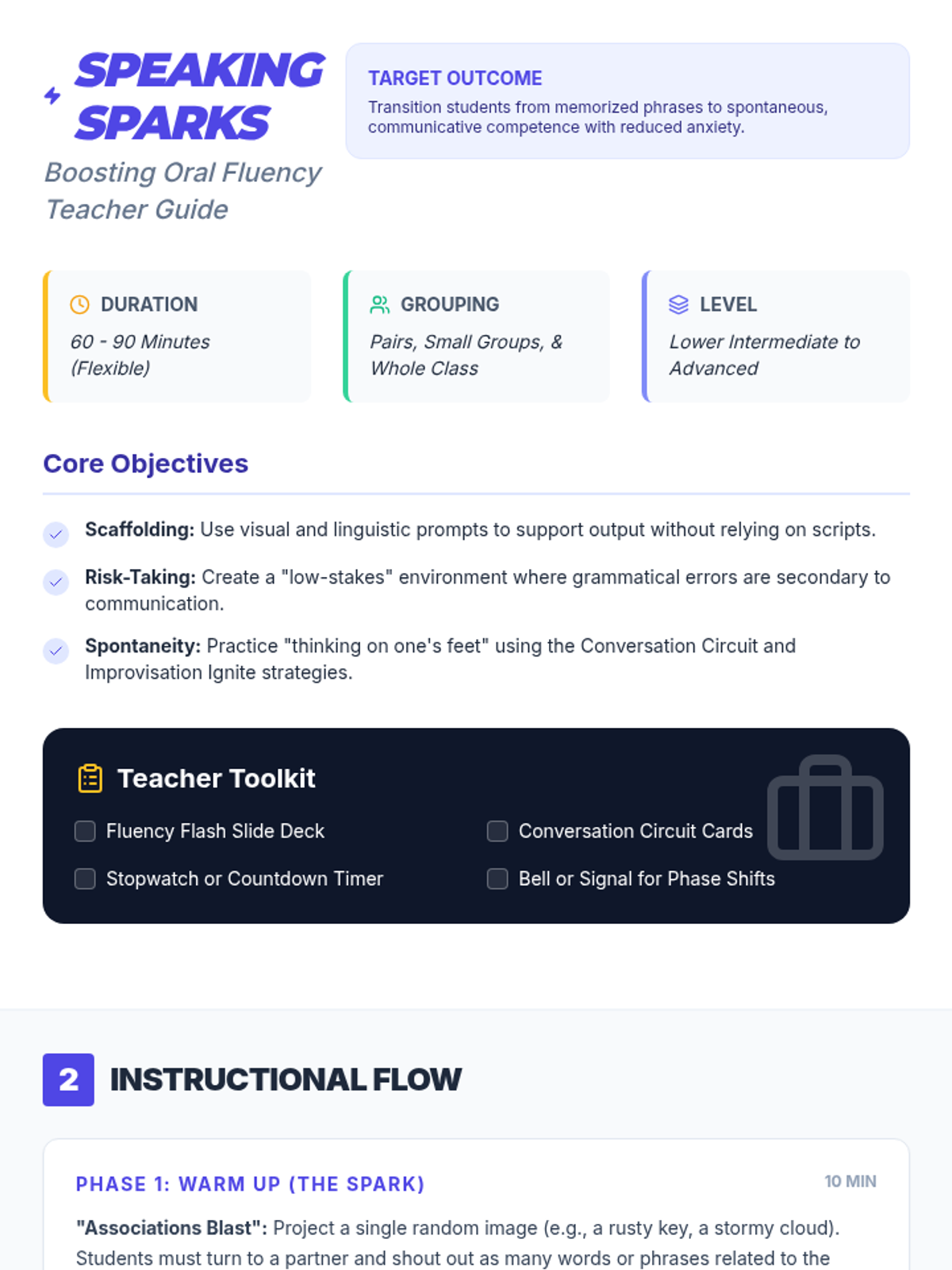
A comprehensive teacher guide for implementing oral fluency strategies, including a 4-phase instructional flow, target outcomes, and specific feedback techniques.
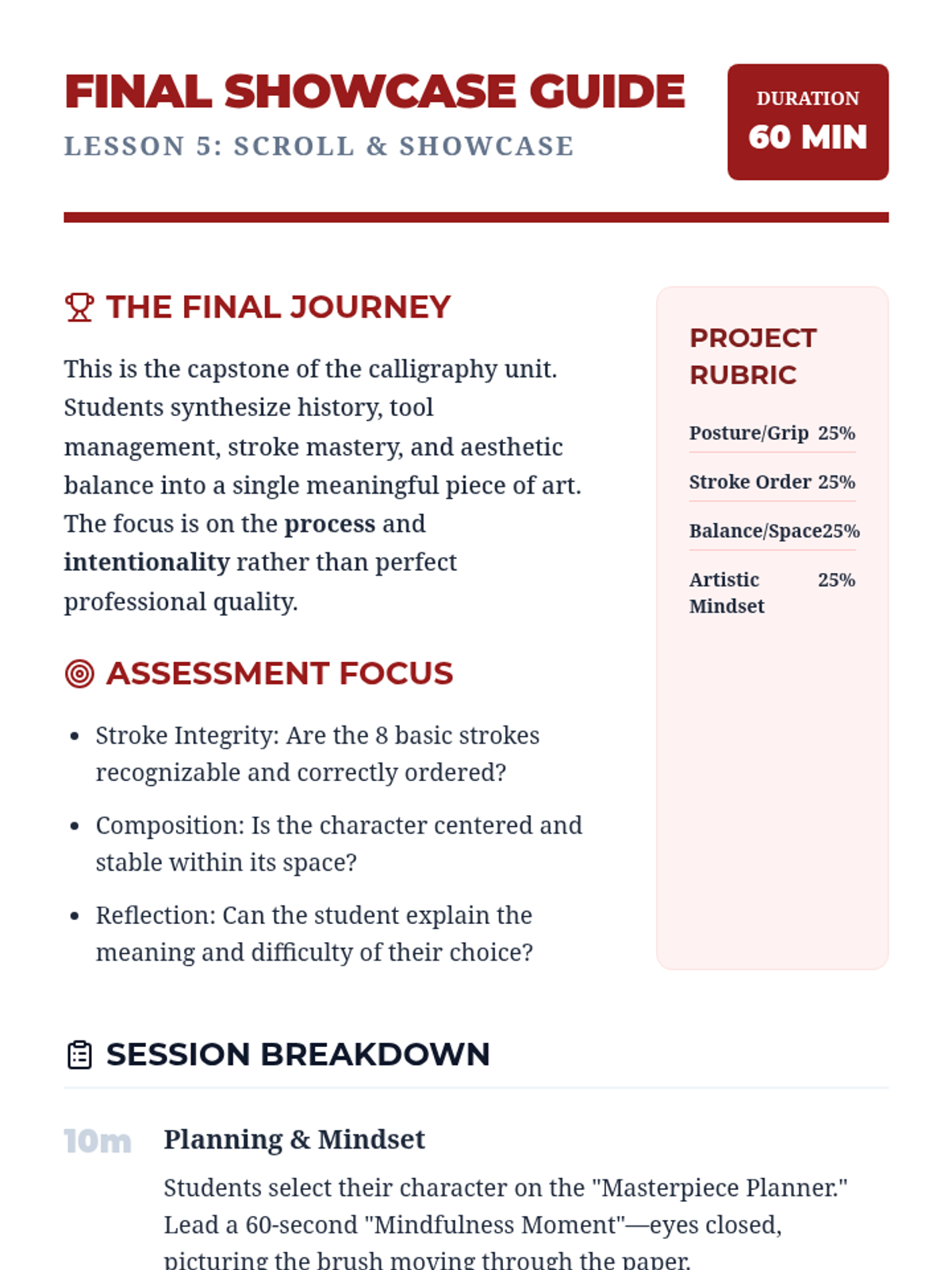
A teacher guide for the final lesson, detailing project assessment, classroom environment setup for painting, and facilitating the gallery showcase.
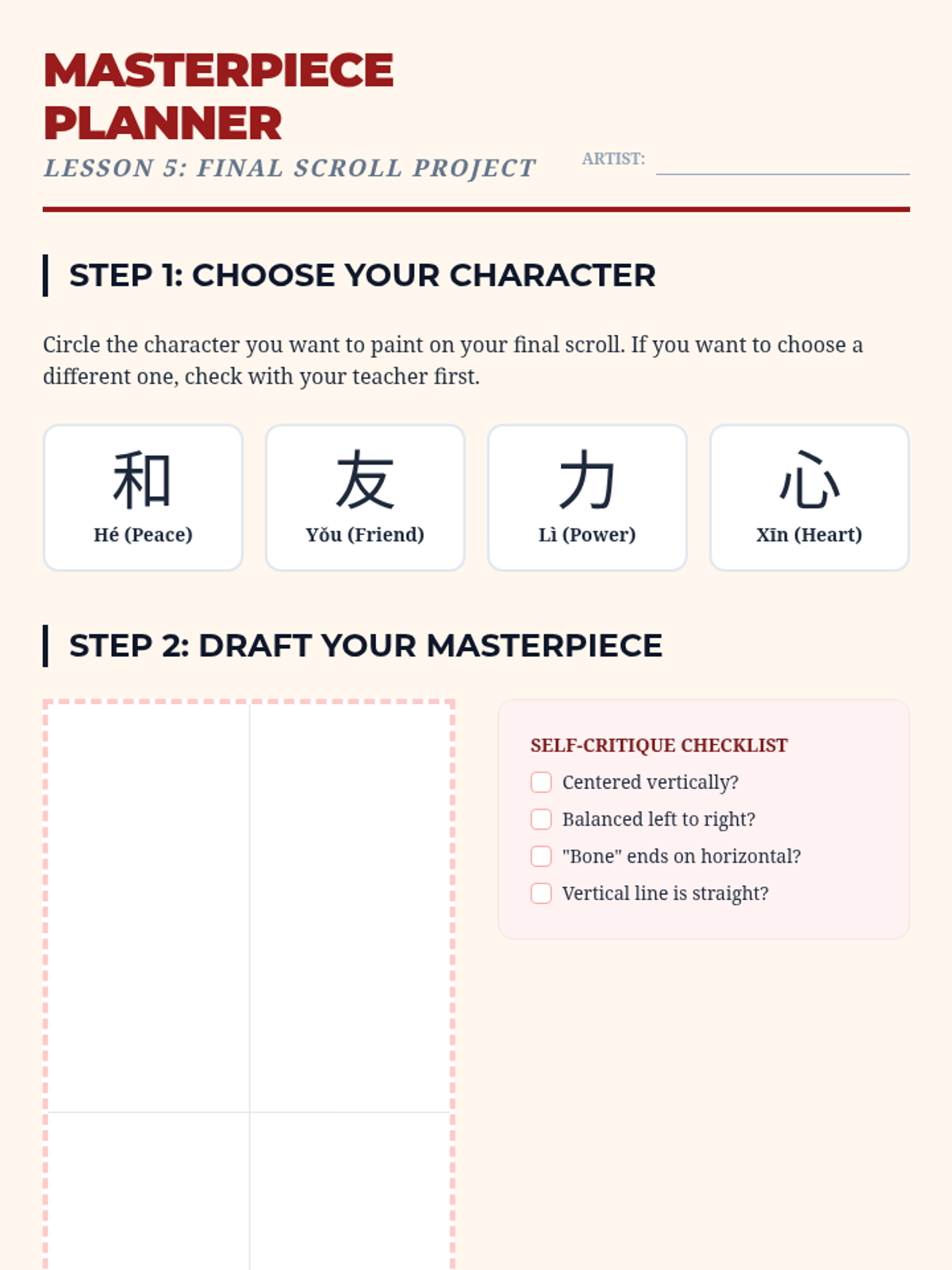
A planning sheet for the final calligraphy scroll, including character choice selection, a drafting space with a self-critique checklist, and a gallery display tag.
A presentation guiding students through the final project: selecting a meaningful character, the scroll-painting process, and gallery walk etiquette.
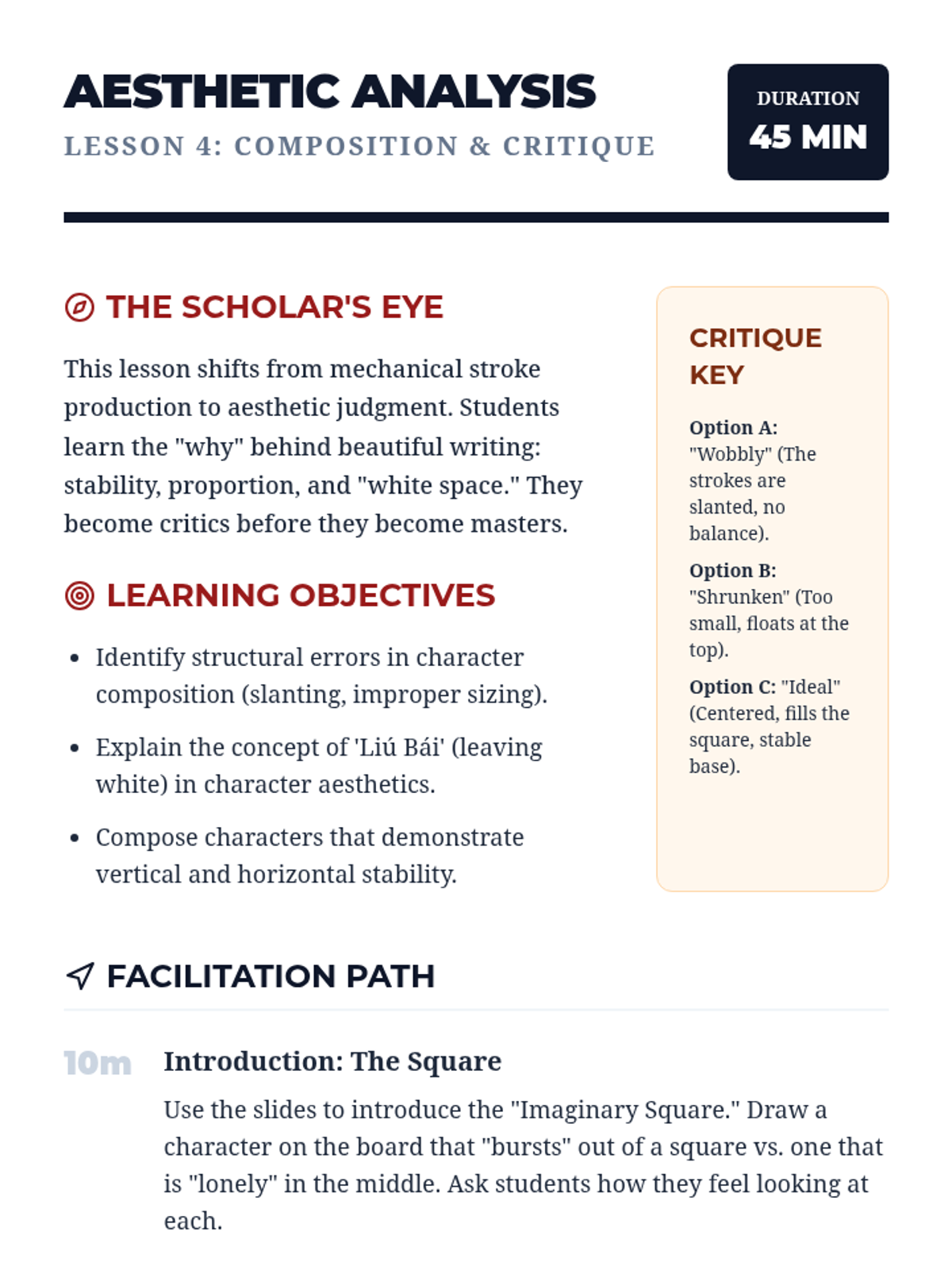
A teacher guide for Lesson 4 focusing on aesthetic critique, structural balance, and facilitating the 'Art Critic's Roundtable' activity.
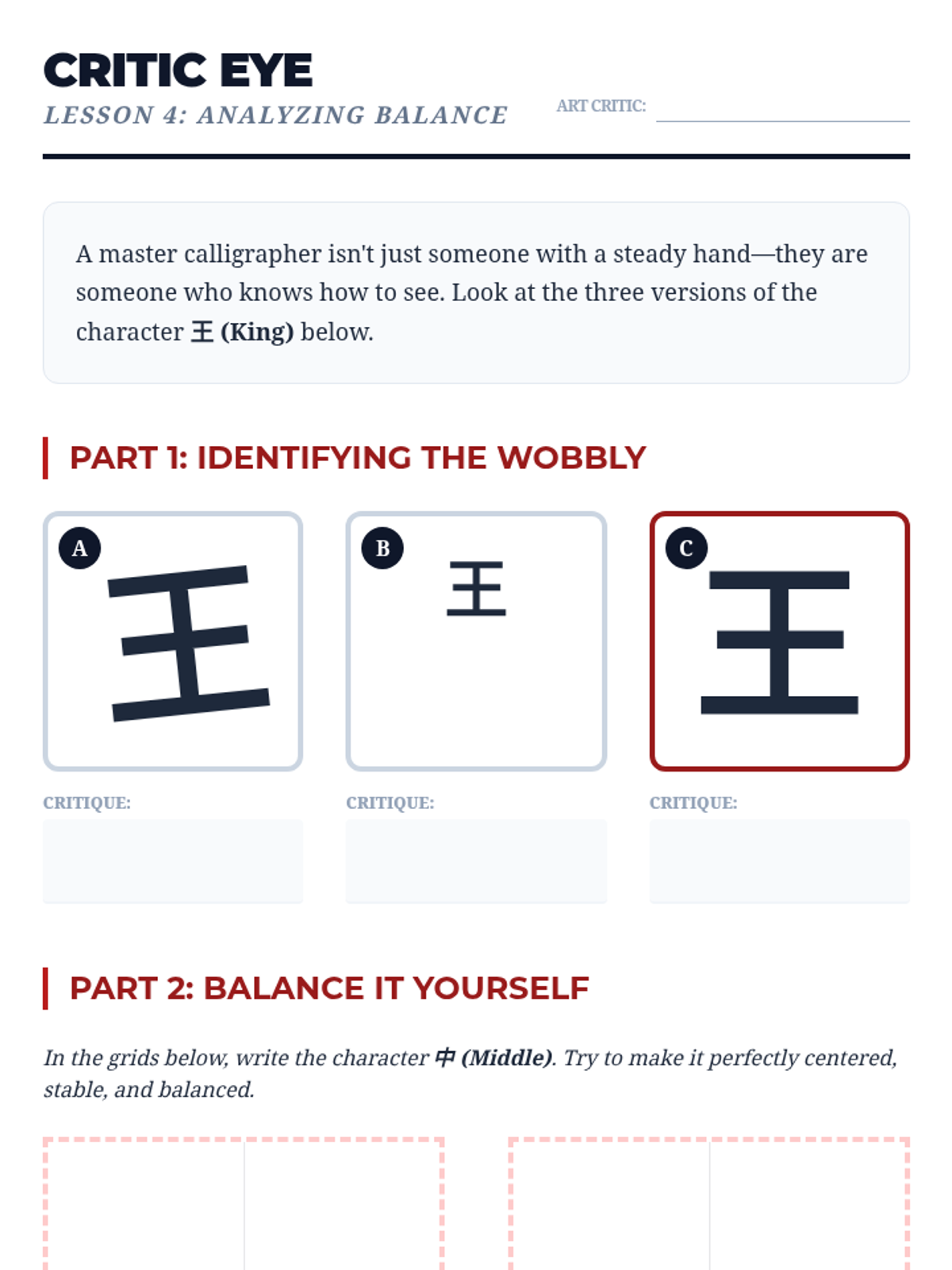
A worksheet for students to practice artistic critique by identifying structural flaws in sample characters and practicing balanced character composition.
A presentation exploring the aesthetic principles of Chinese calligraphy: the imaginary square, structural balance, and the importance of white space.
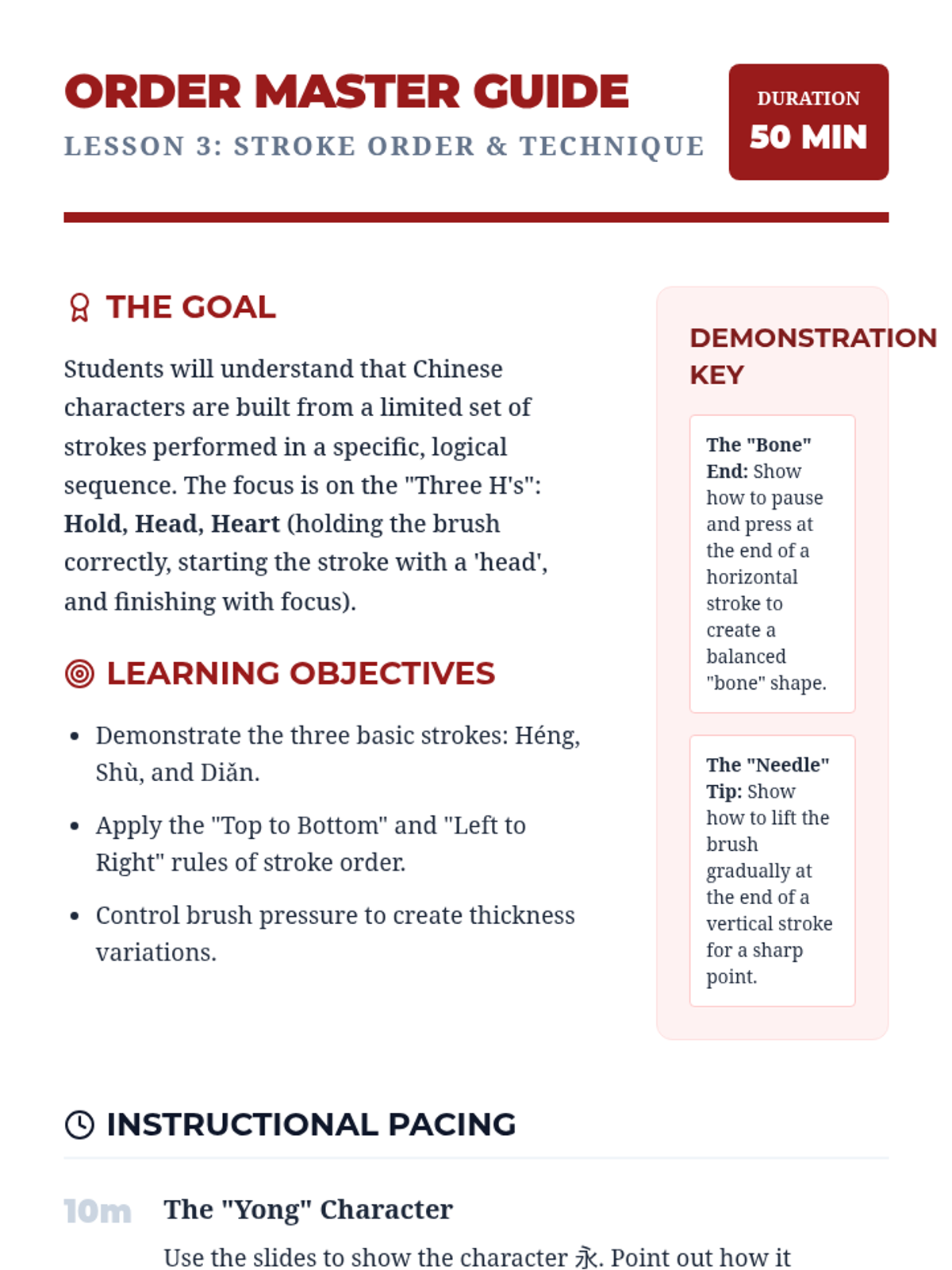
A detailed teacher guide for Lesson 3, including live demonstration scripts, correction strategies, and pacing for fundamental stroke mastery.
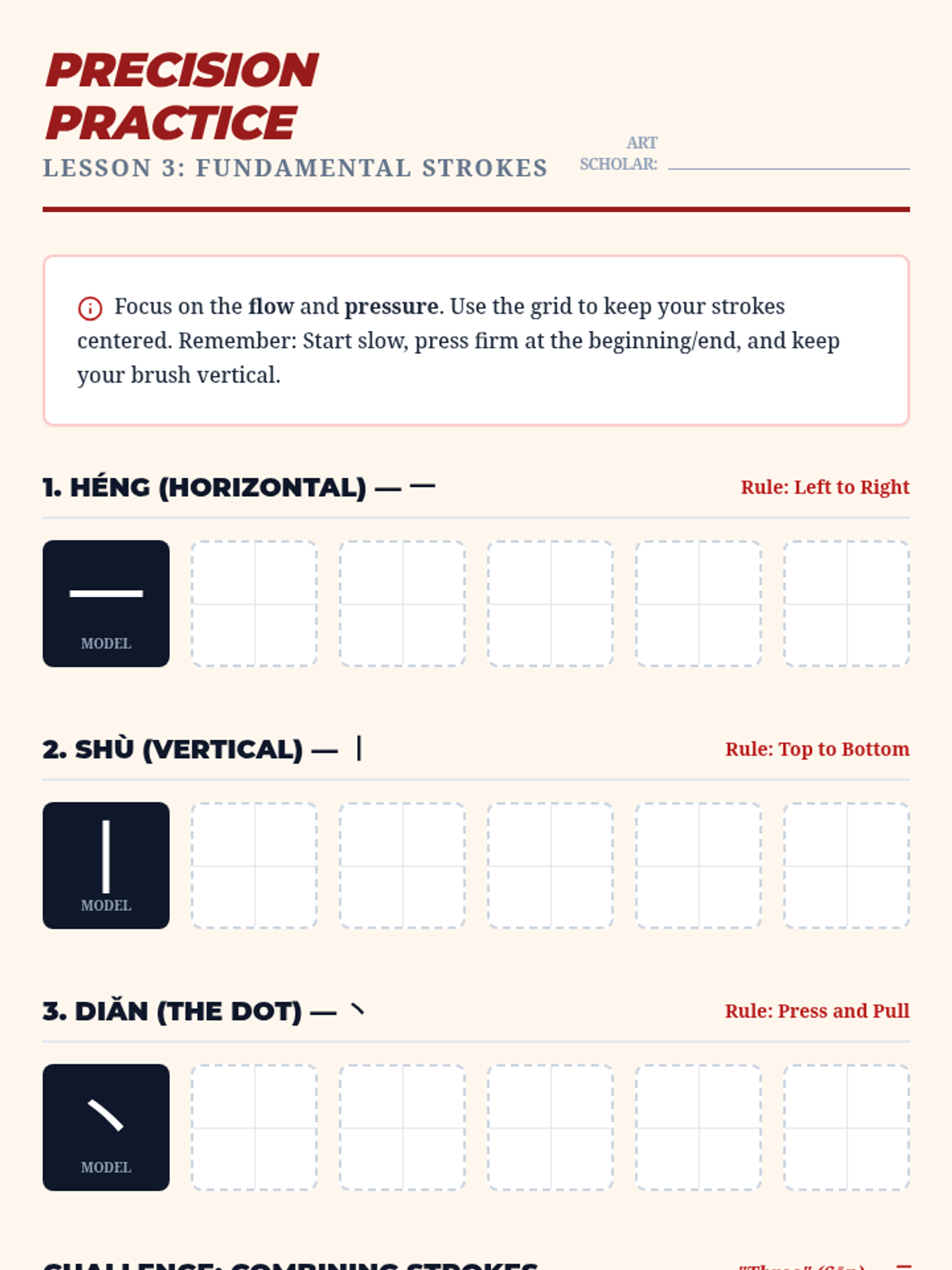
A grid-based practice sheet for students to master the three most essential strokes: Horizontal (Héng), Vertical (Shù), and Dot (Diǎn).
A visual guide to the eight fundamental strokes of Chinese calligraphy, using the 'Yong' character as a model.
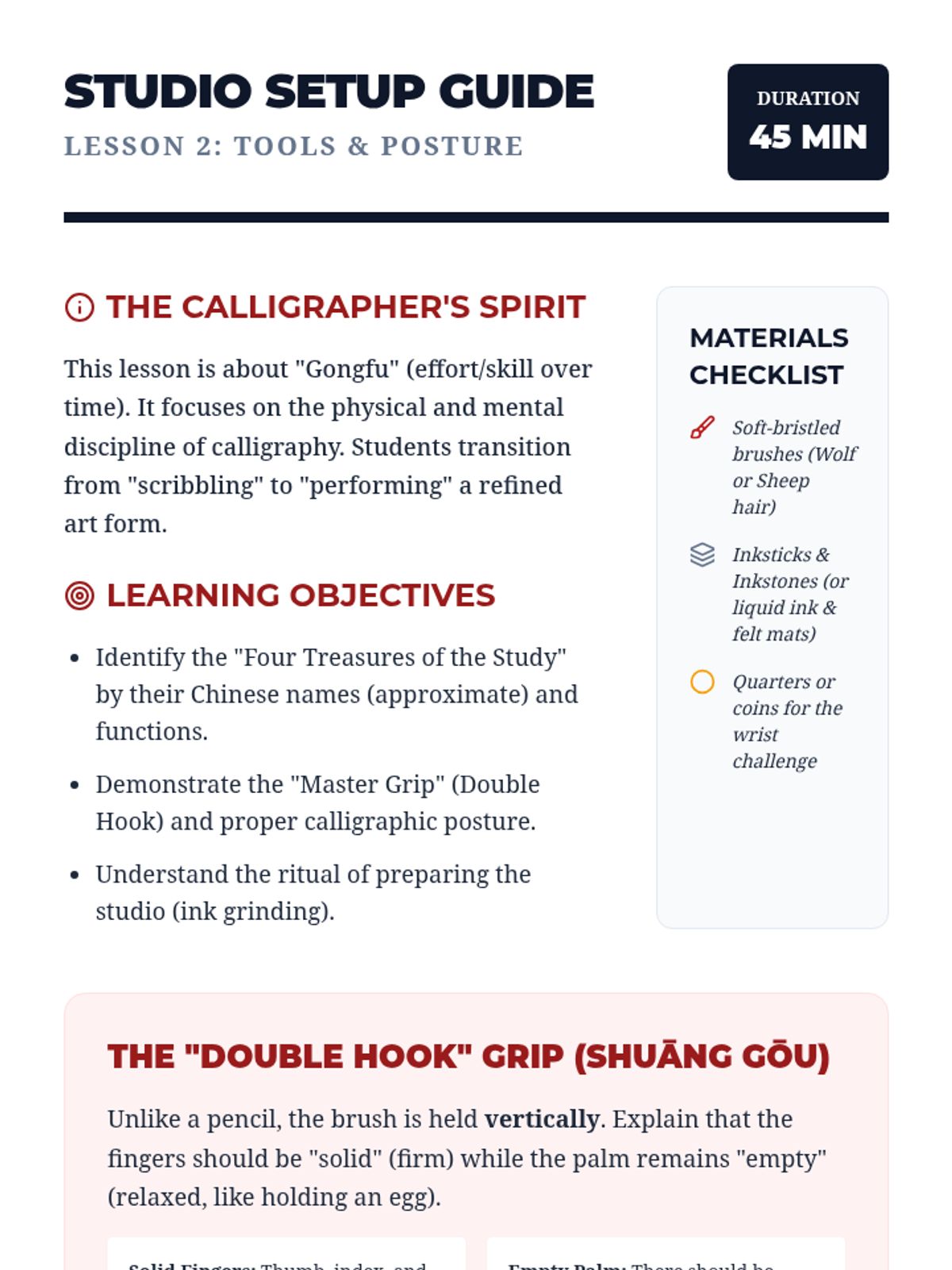
A teacher guide for Lesson 2 focusing on studio rituals, material management, and the 'Double Hook' brush grip.
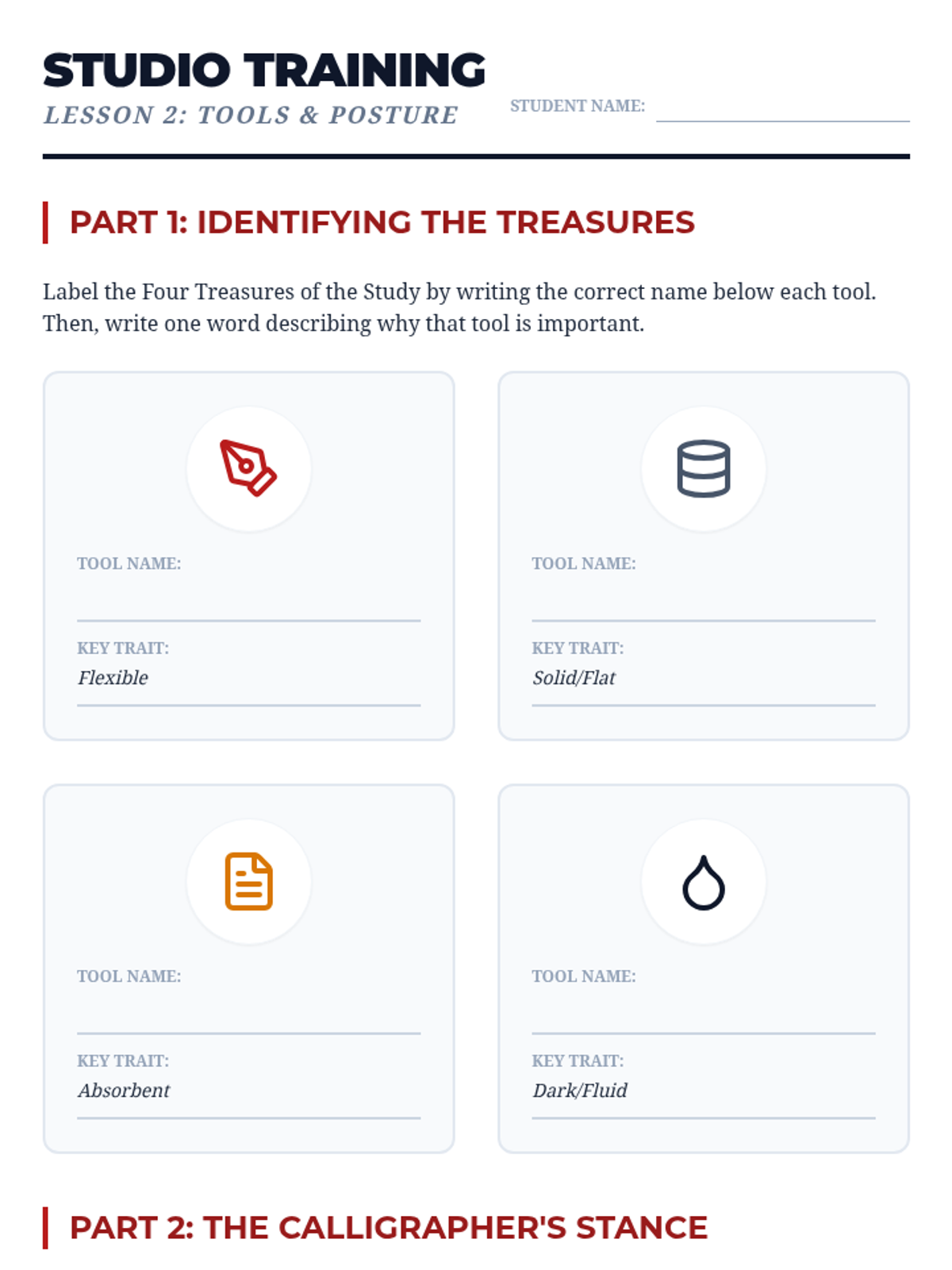
A worksheet for students to identify the Four Treasures of the Study and self-assess their calligraphic posture and readiness.
A presentation introducing the 'Four Treasures of the Study' and the essential postures and mindsets for Chinese calligraphy.
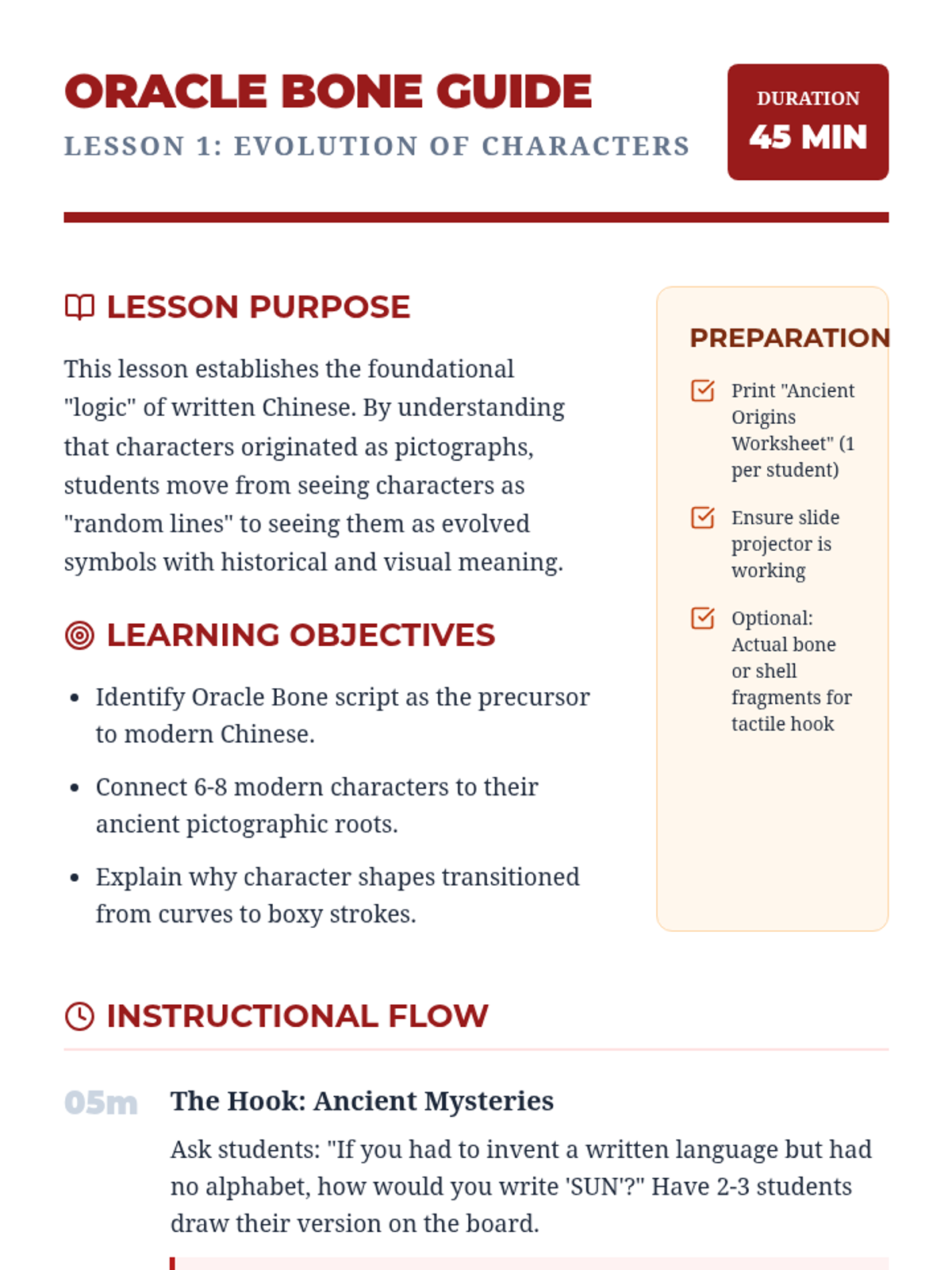
A comprehensive teacher guide for Lesson 1, including pacing, instructional script, activity answer keys, and discussion prompts.
A presentation guiding students through the evolution of Chinese characters from Oracle Bone script to modern forms.
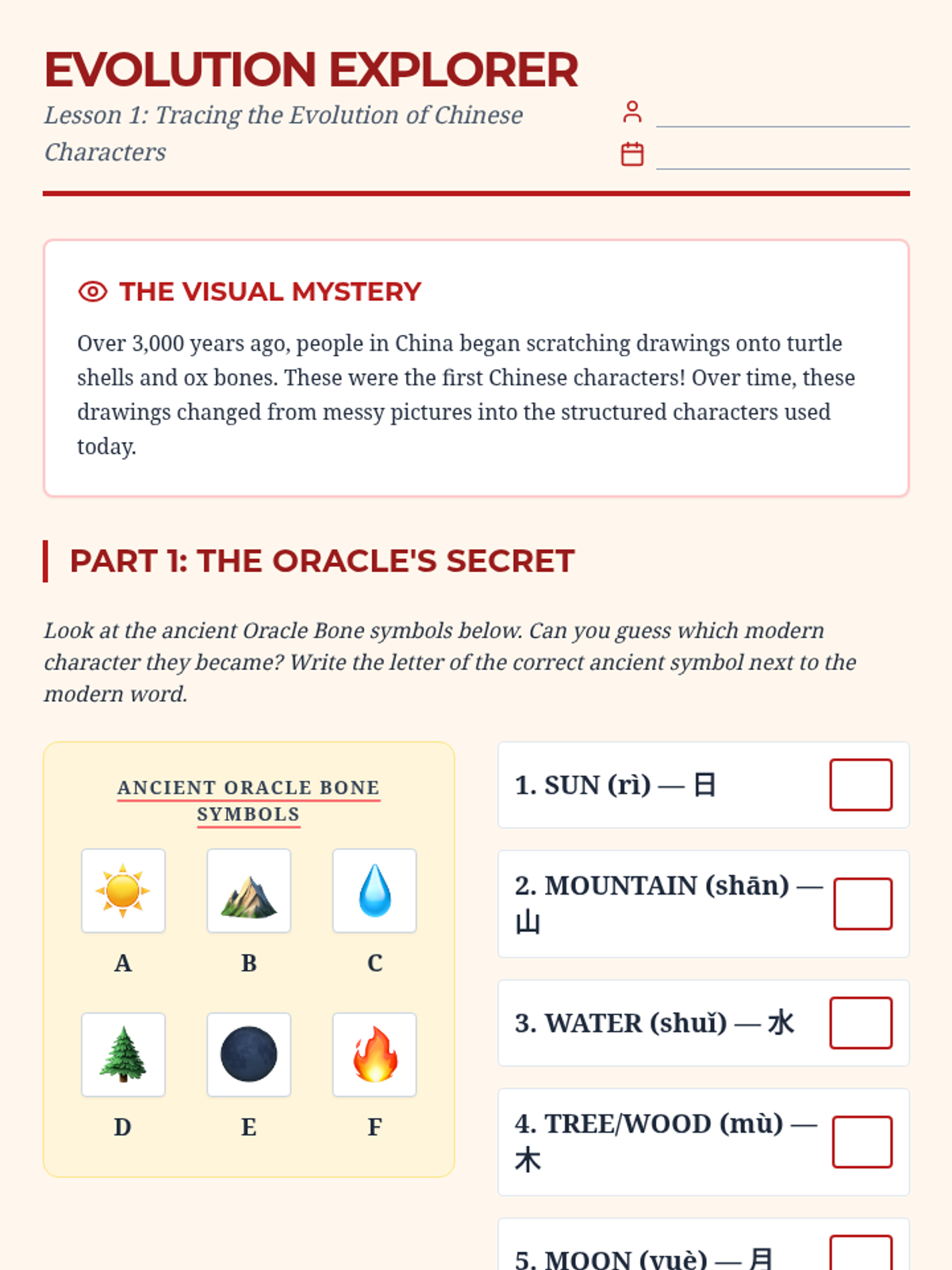
An introductory worksheet for students to match ancient Oracle Bone symbols with modern Chinese characters and explore the visual logic of character combinations.
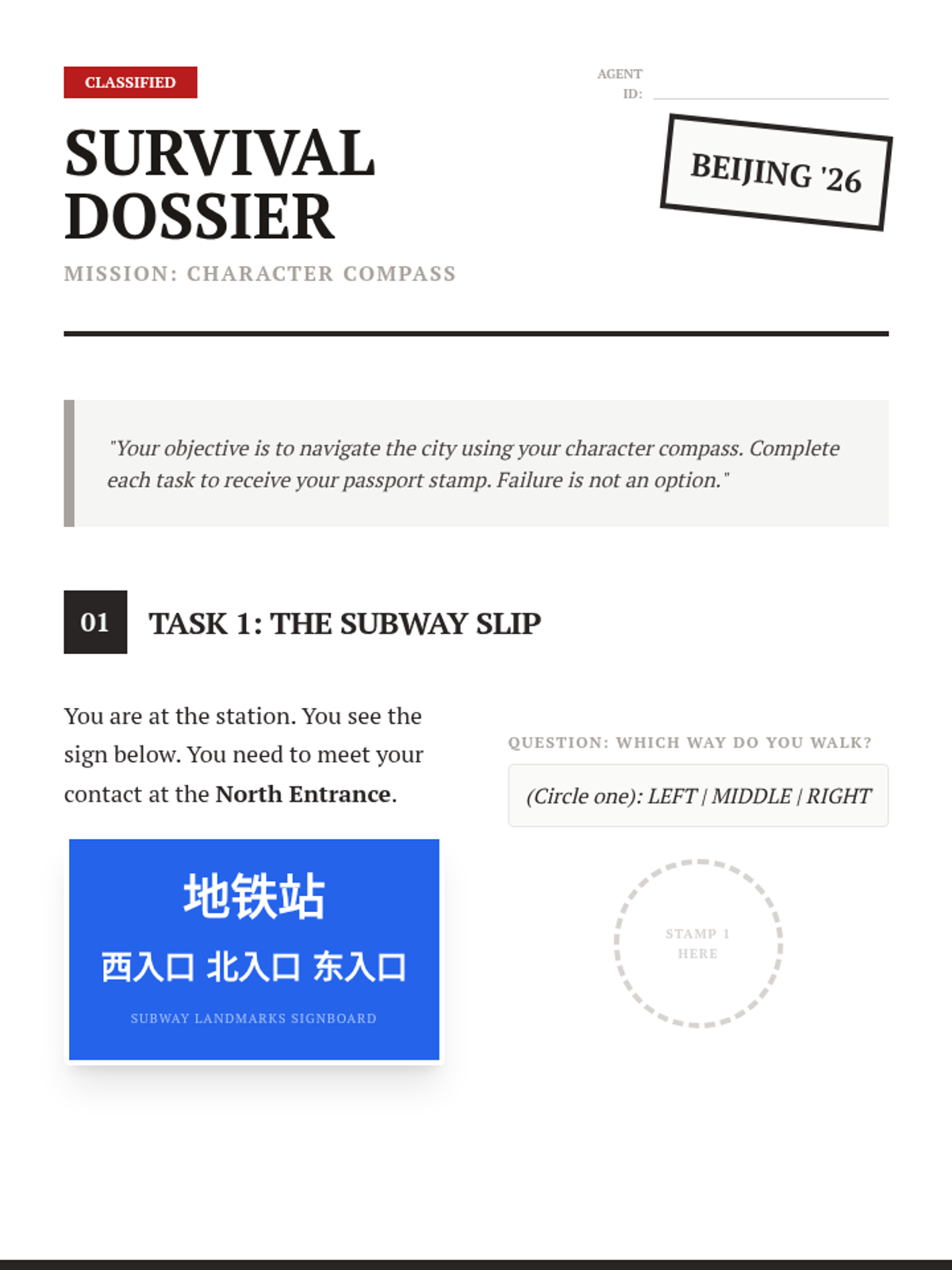
Student activity worksheet for Lesson 5, featuring a mission dossier and passport stamps to integrate all survival Mandarin skills.
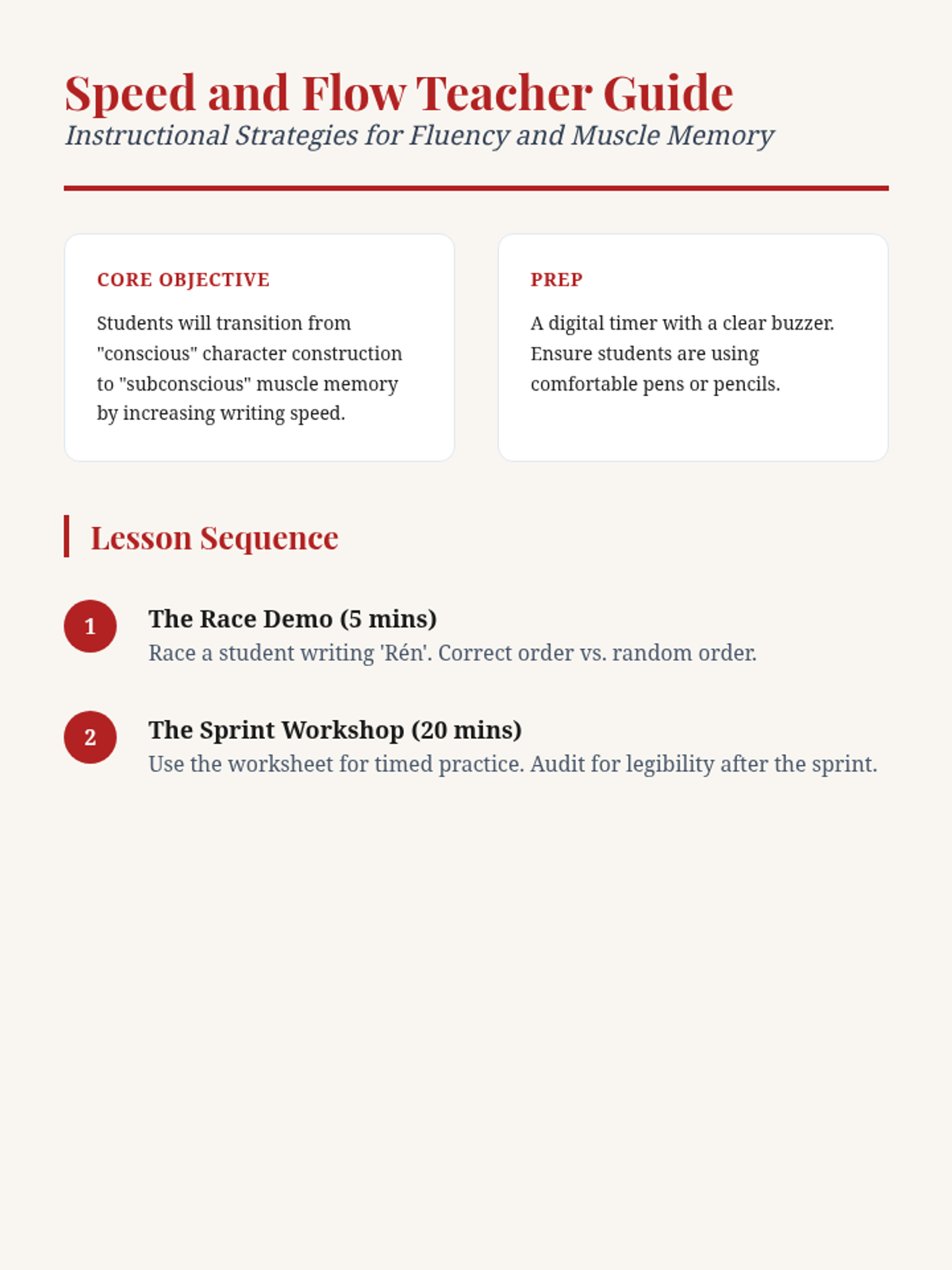
Teacher guide for Lesson 4: Speed and Flow. Provides strategies for teaching 'ghost strokes' and managing the Speed Sprint activity.
Instructional slides for Lesson 5, introducing the culminating survival scavenger hunt with mission parameters and vocabulary review.
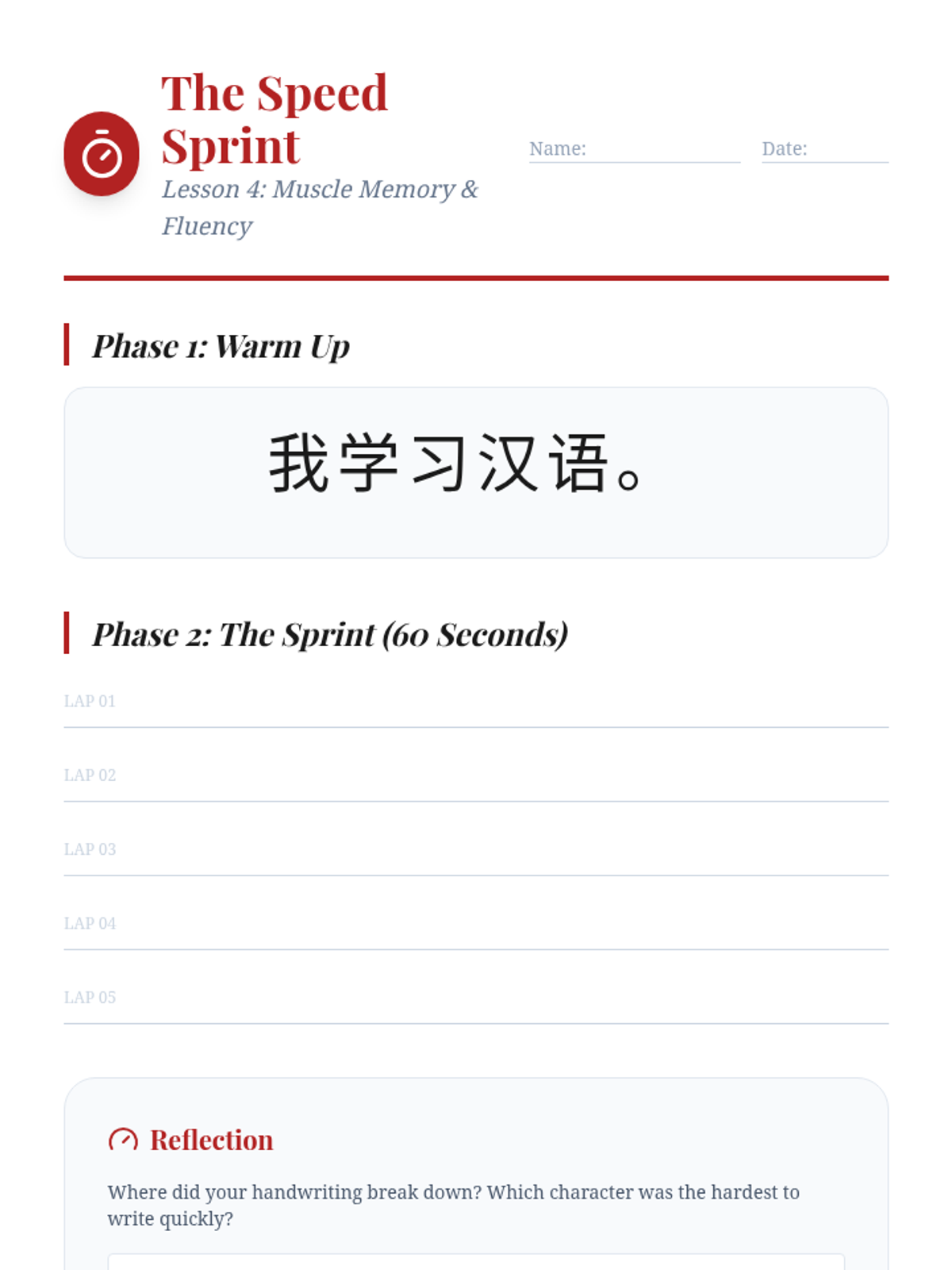
A timed writing activity sheet for practicing speed, fluency, and muscle memory in Mandarin sentence writing. It includes a warm-up phase, a 60-second sprint, and a reflection section.
A slide deck focused on the relationship between stroke order, speed, and muscle memory. It explains how correct mechanics allow for faster, more legible writing.
Slide deck exploring environmental trends in China, focusing on bike-sharing and garbage sorting initiatives using problem-solution text structures.
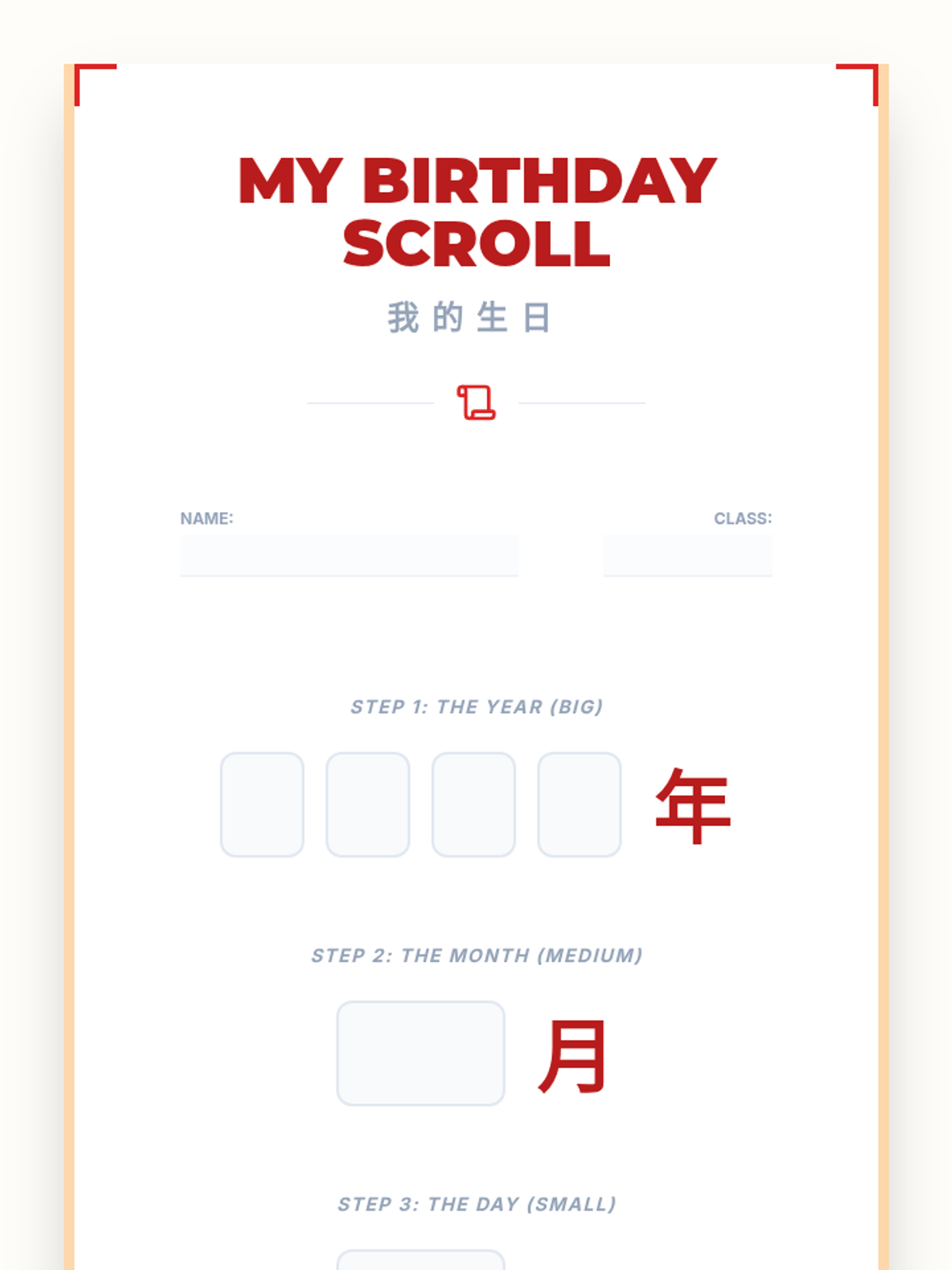
A decorative worksheet for students to practice writing their birthdays in the correct Mandarin Year-Month-Day format.
A slide deck introducing students to the logic of naming months and the Year-Month-Day formatting used in Mandarin Chinese.
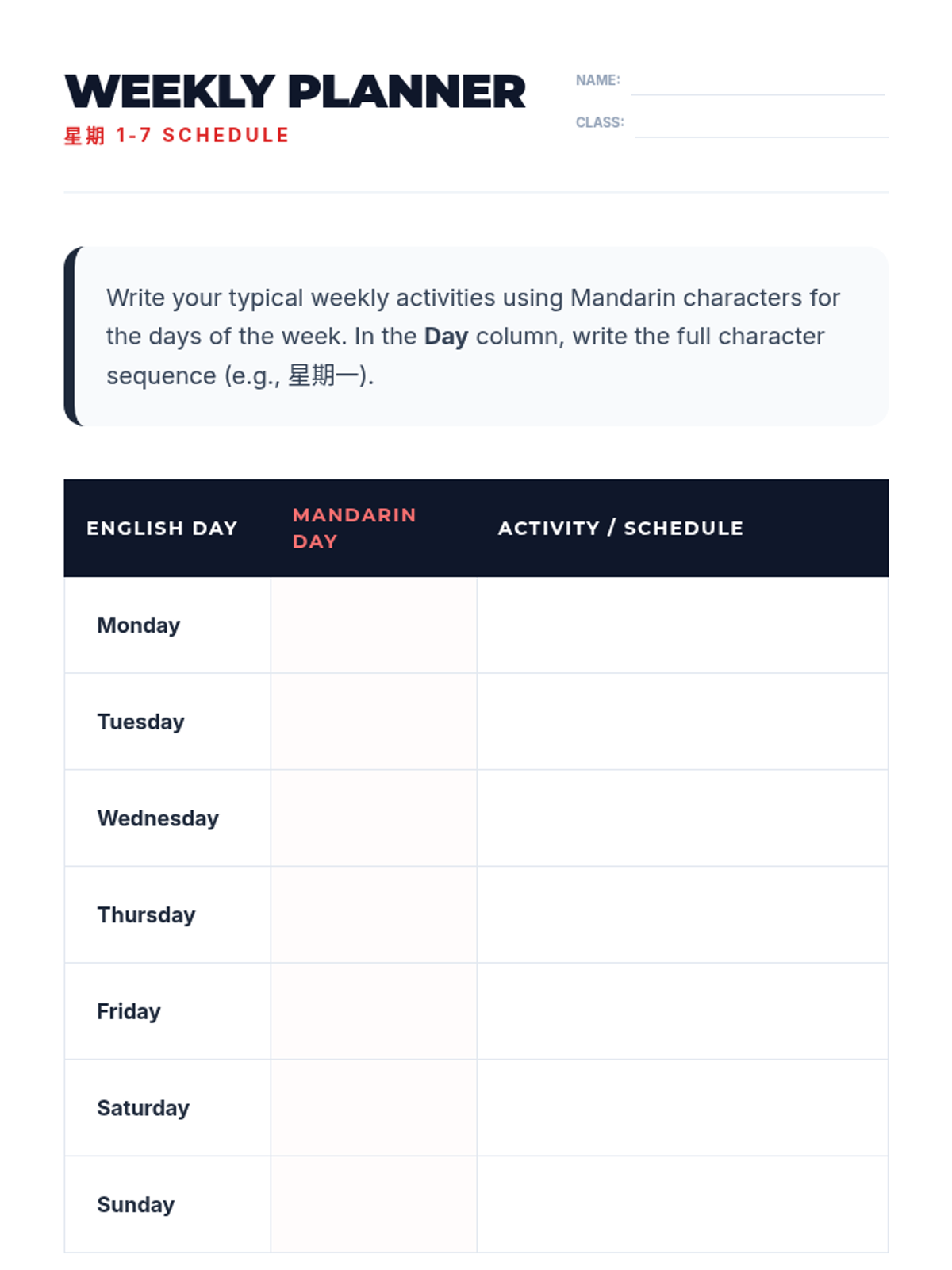
A student organizer for planning a weekly schedule using Mandarin characters for days of the week, reinforcing the numerical logic of the system.
A visual presentation exploring the numerical naming system for days of the week in Mandarin, highlighting the contrast with English mythological names.
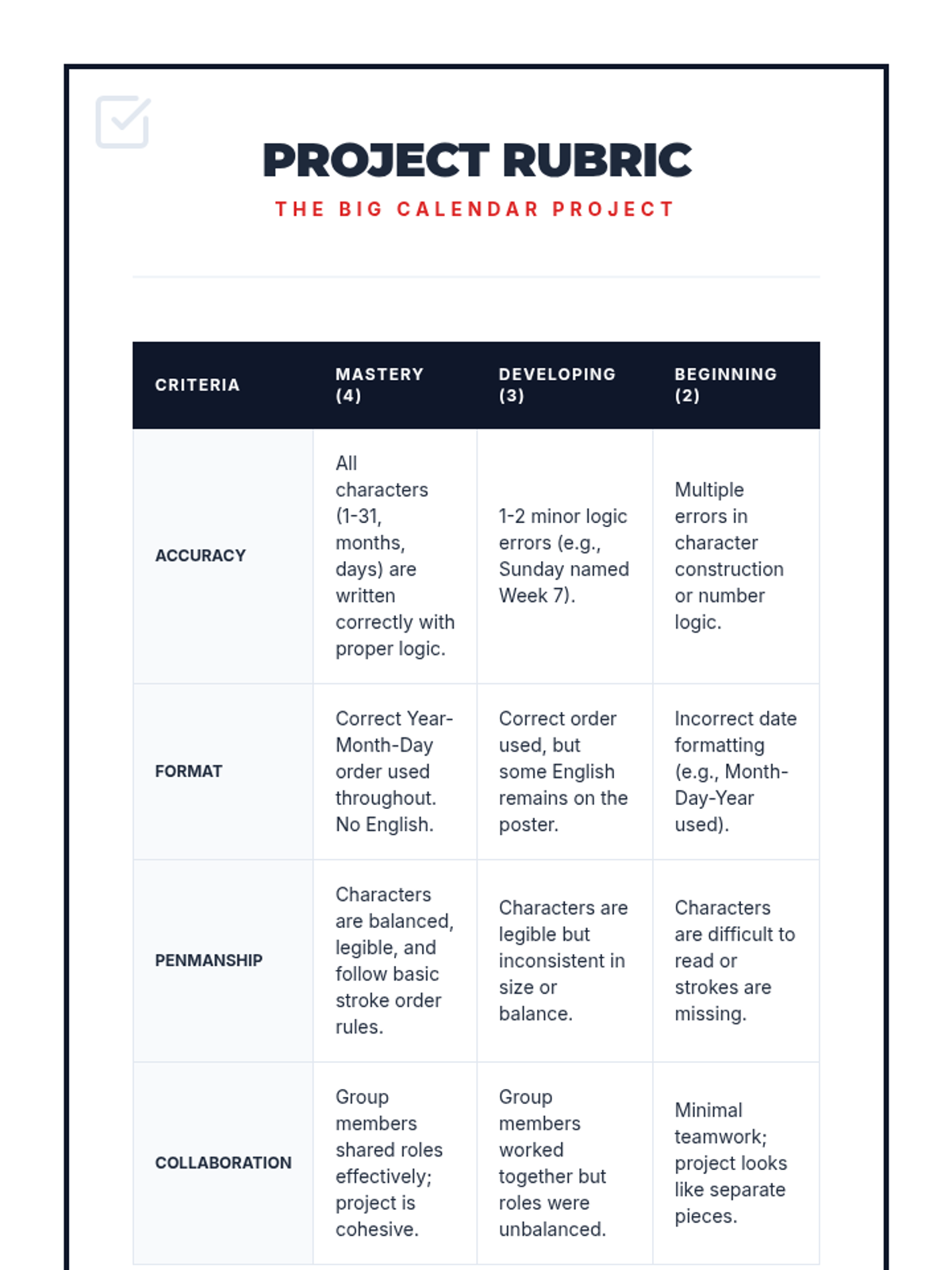
A scoring rubric for the Big Calendar Project, evaluating students on accuracy, formatting, penmanship, and collaboration.
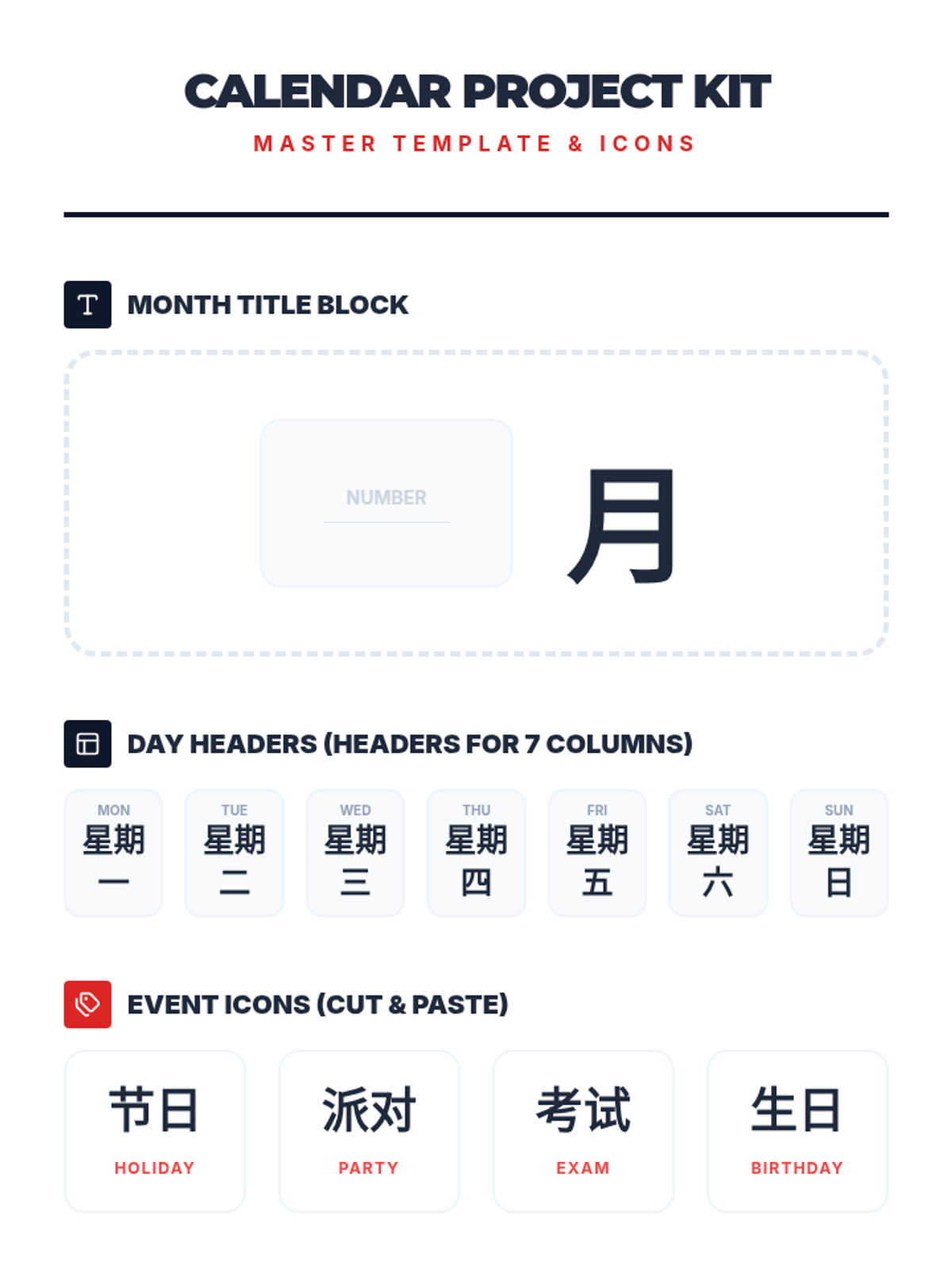
A template kit containing all the necessary components for building a large-scale classroom calendar in Mandarin, including headers and event icons.
A slide deck guiding students through the collaborative classroom calendar project, including group roles and project requirements.
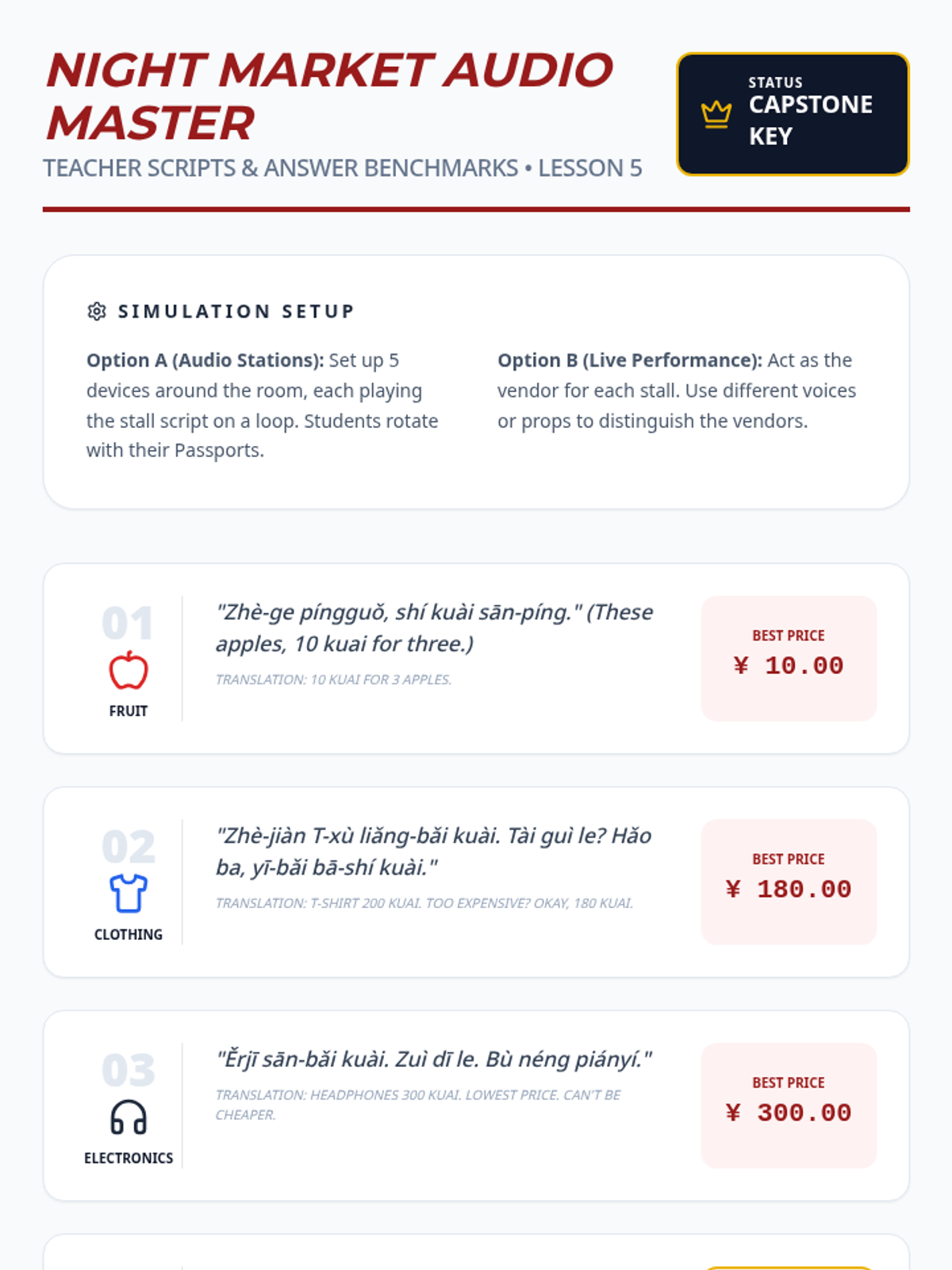
Teacher answer key and script for the capstone Lesson 5 'Night Market Simulation' listening exercise, featuring the 5 stall scripts and the winning criteria.
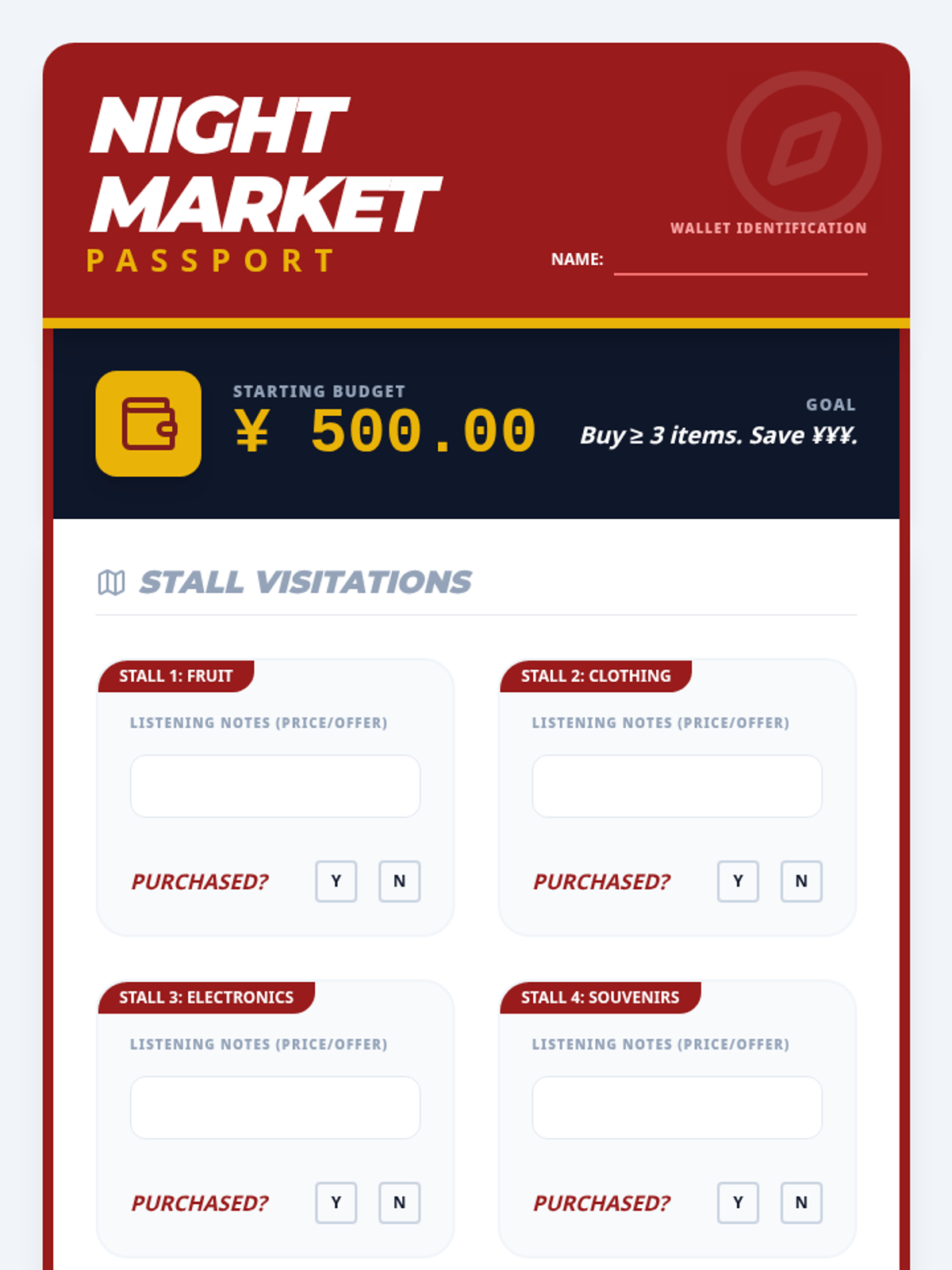
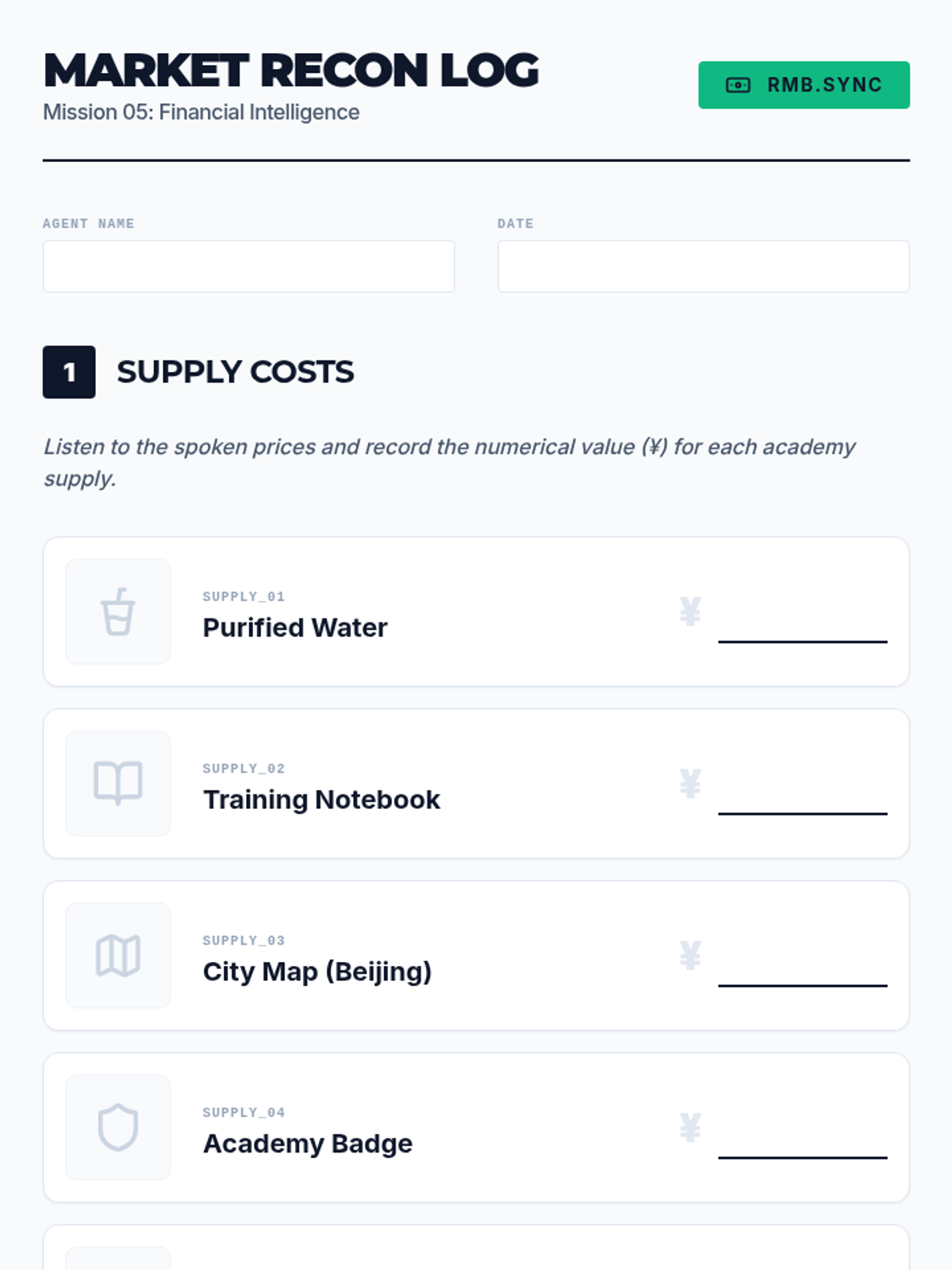
Student activity scorecard for the capstone simulation. Students visit 5 virtual stalls, take listening notes on prices, and manage their 500 RMB budget in a ledger format.
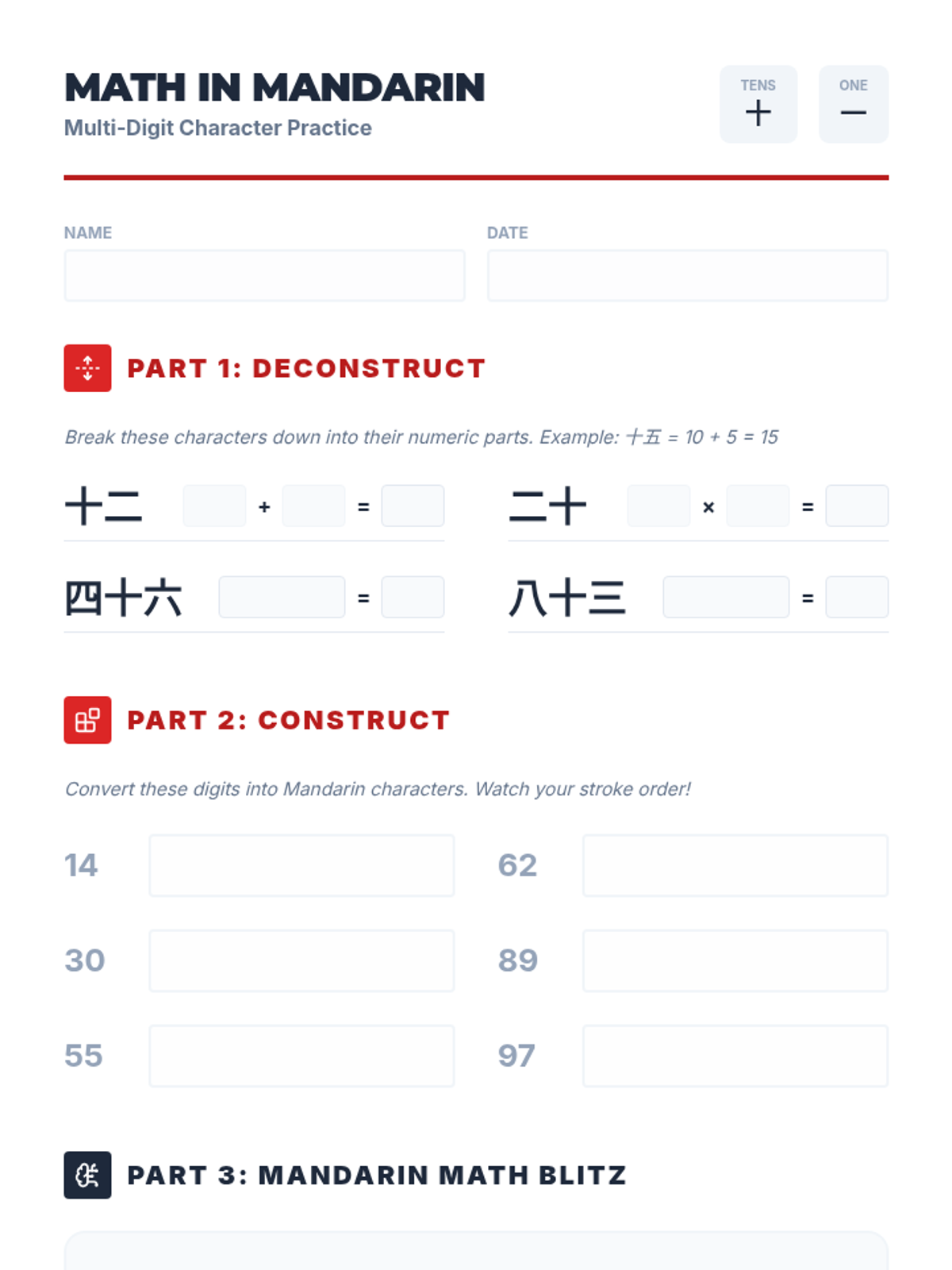
A mathematical worksheet where students practice deconstructing and constructing double-digit numbers in Mandarin, concluding with simple arithmetic problems in characters.
Introductory slides for the capstone Lesson 5, covering the rules of the Night Market simulation, the virtual budget (500 RMB), and the goal of negotiating the best deals.
A slide deck explaining the logical construction of Chinese numbers from 11 to 99, highlighting the addition and multiplication rules.
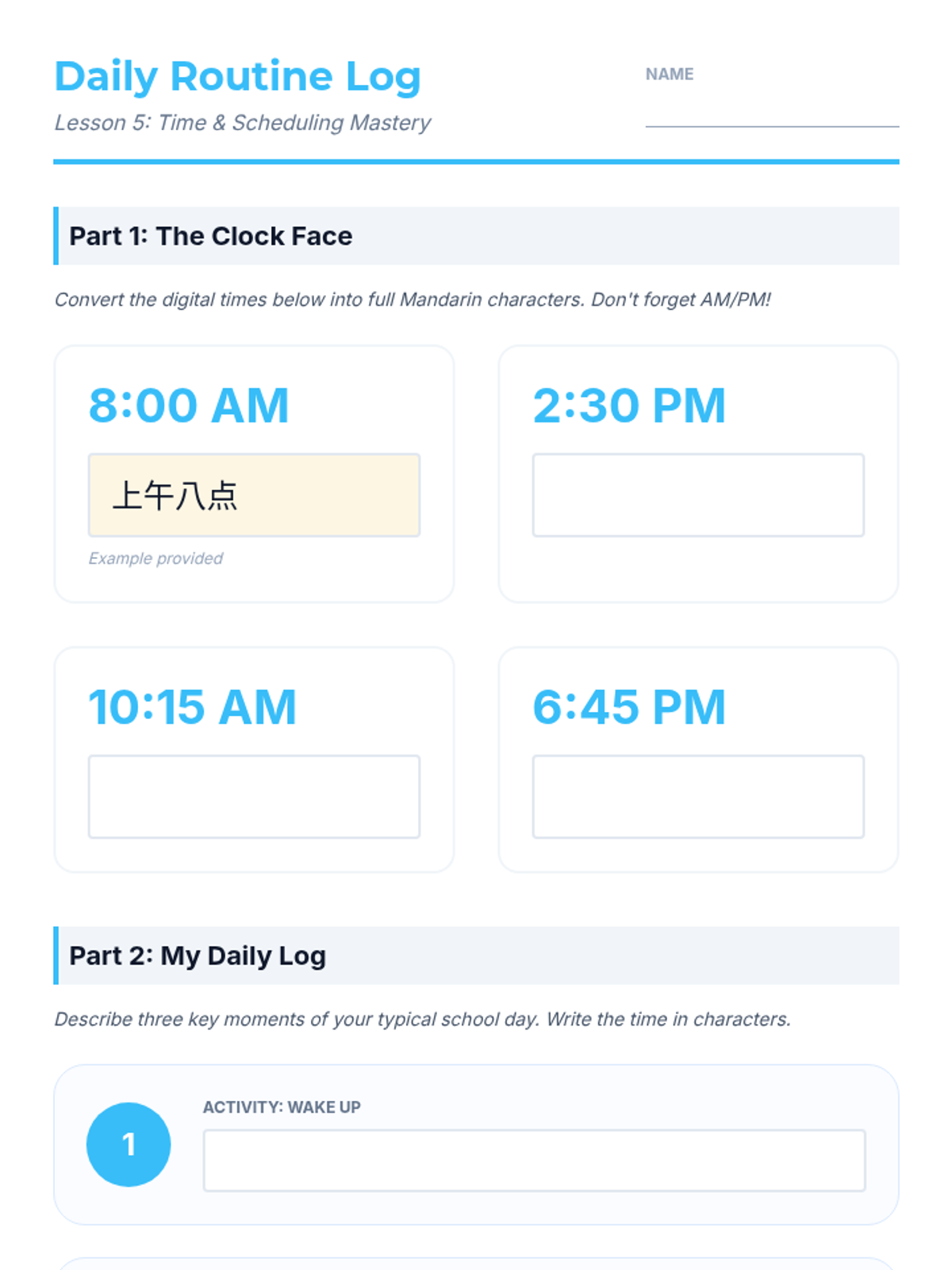
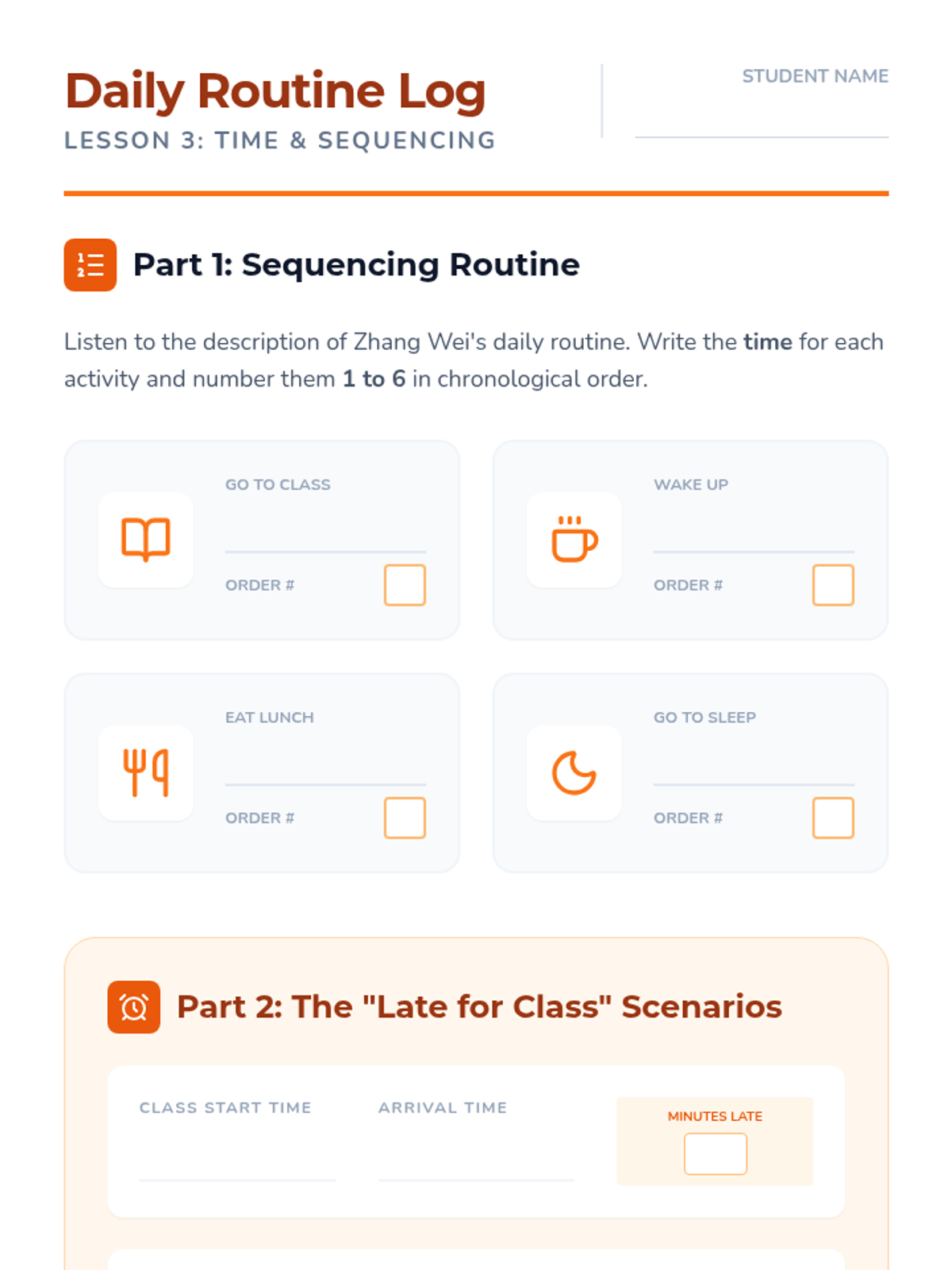
Worksheet for practicing digital-to-character time conversion and creating a personal daily routine schedule.
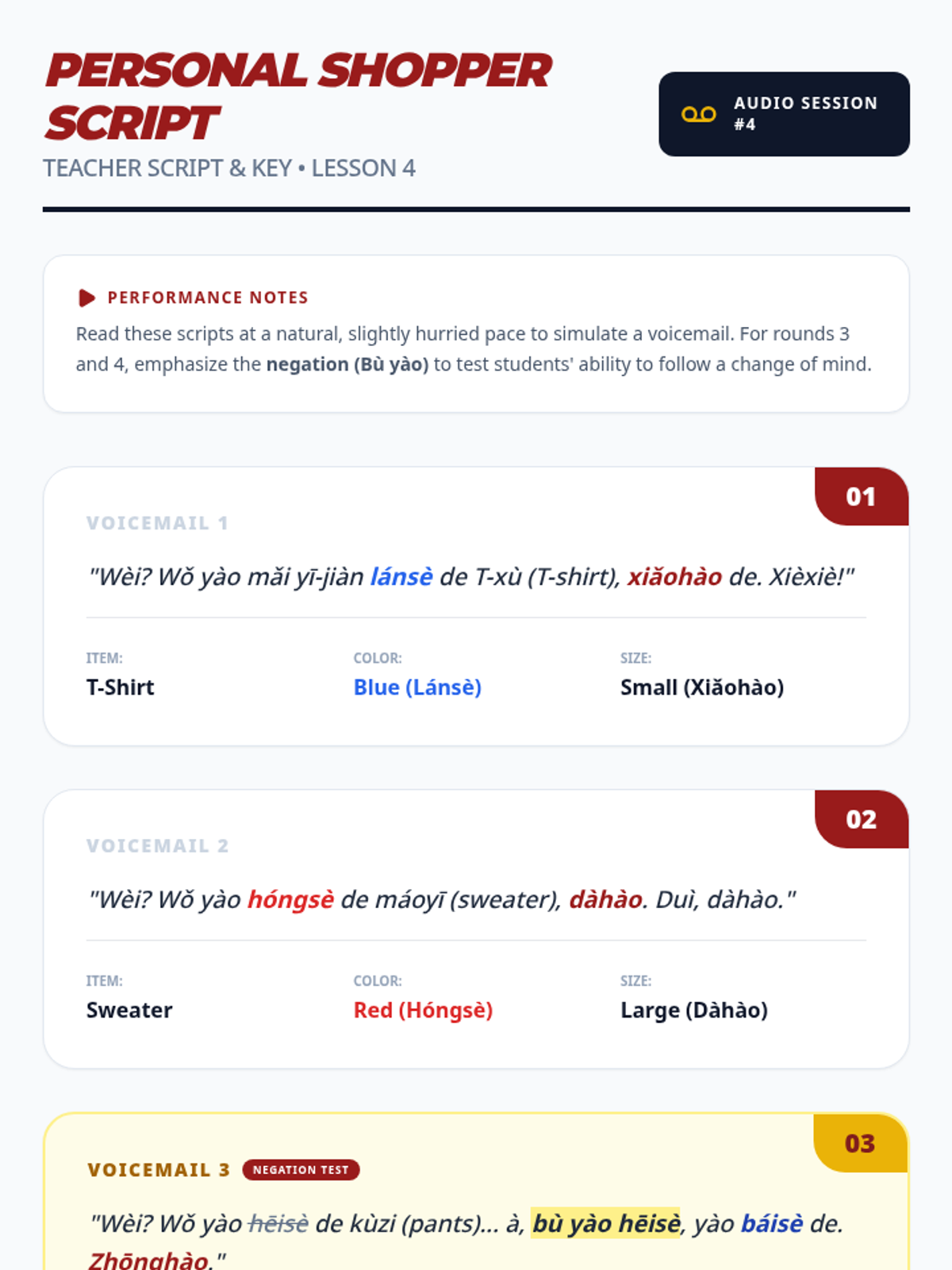
Teacher answer key and script for the Lesson 4 'Personal Shopper' listening exercise, featuring the voicemail scripts with negation tricks and the English translations.
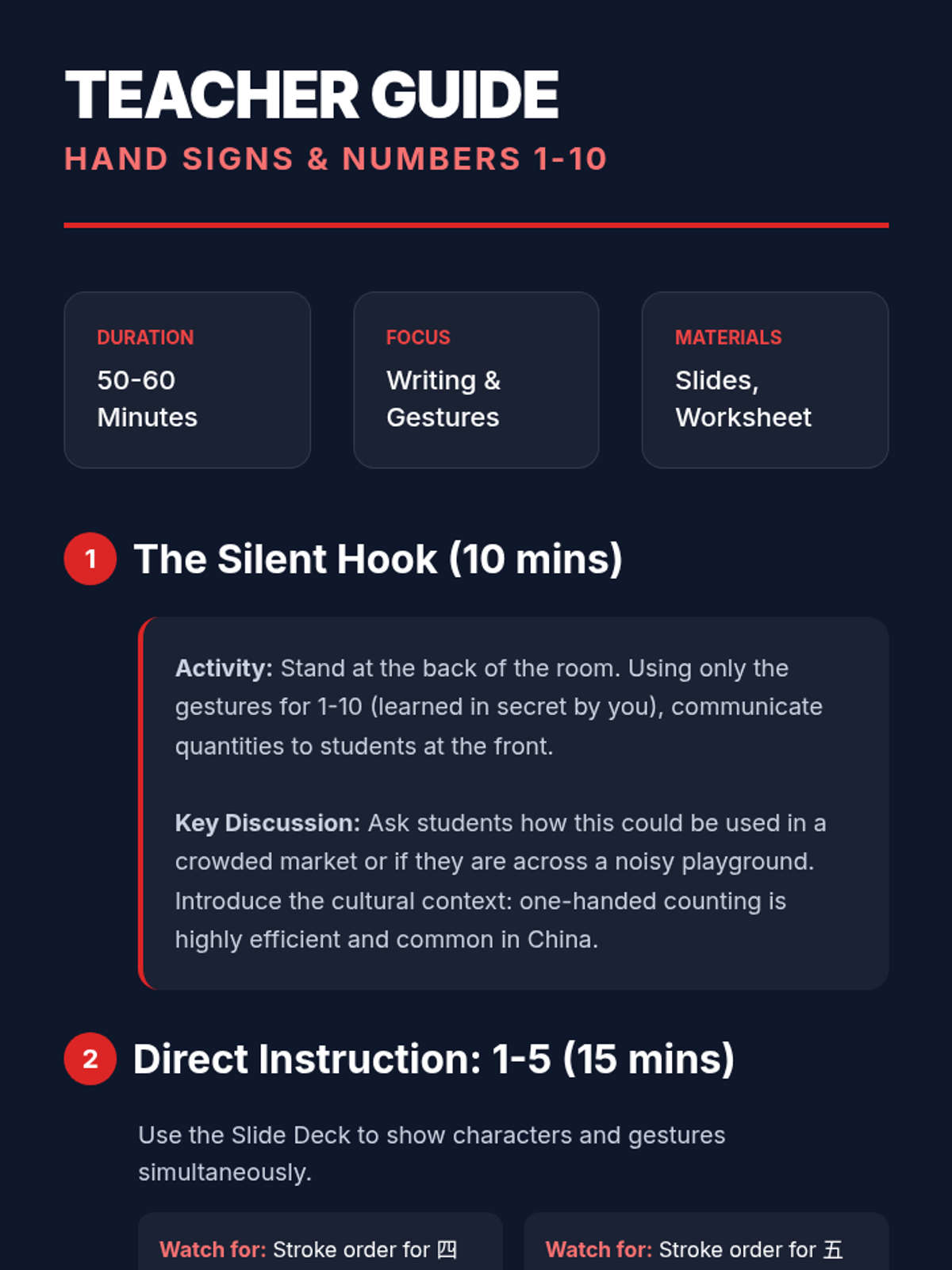
A detailed guide for teachers covering lesson pacing, instructional strategies for hand gestures and character stroke order, and classroom activity ideas.
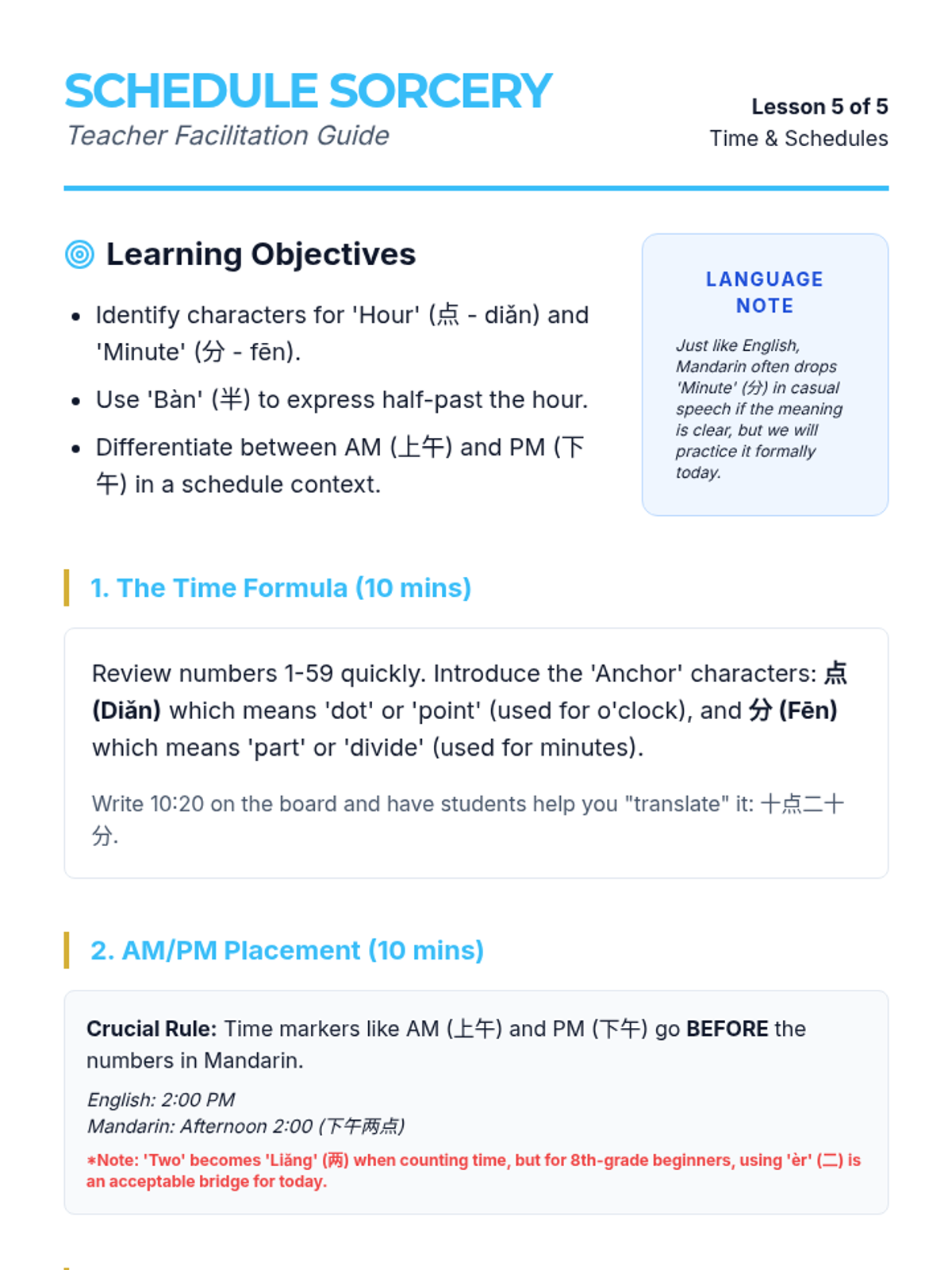
Facilitation guide for teaching time-telling vocabulary, AM/PM placement, and the train station simulation.
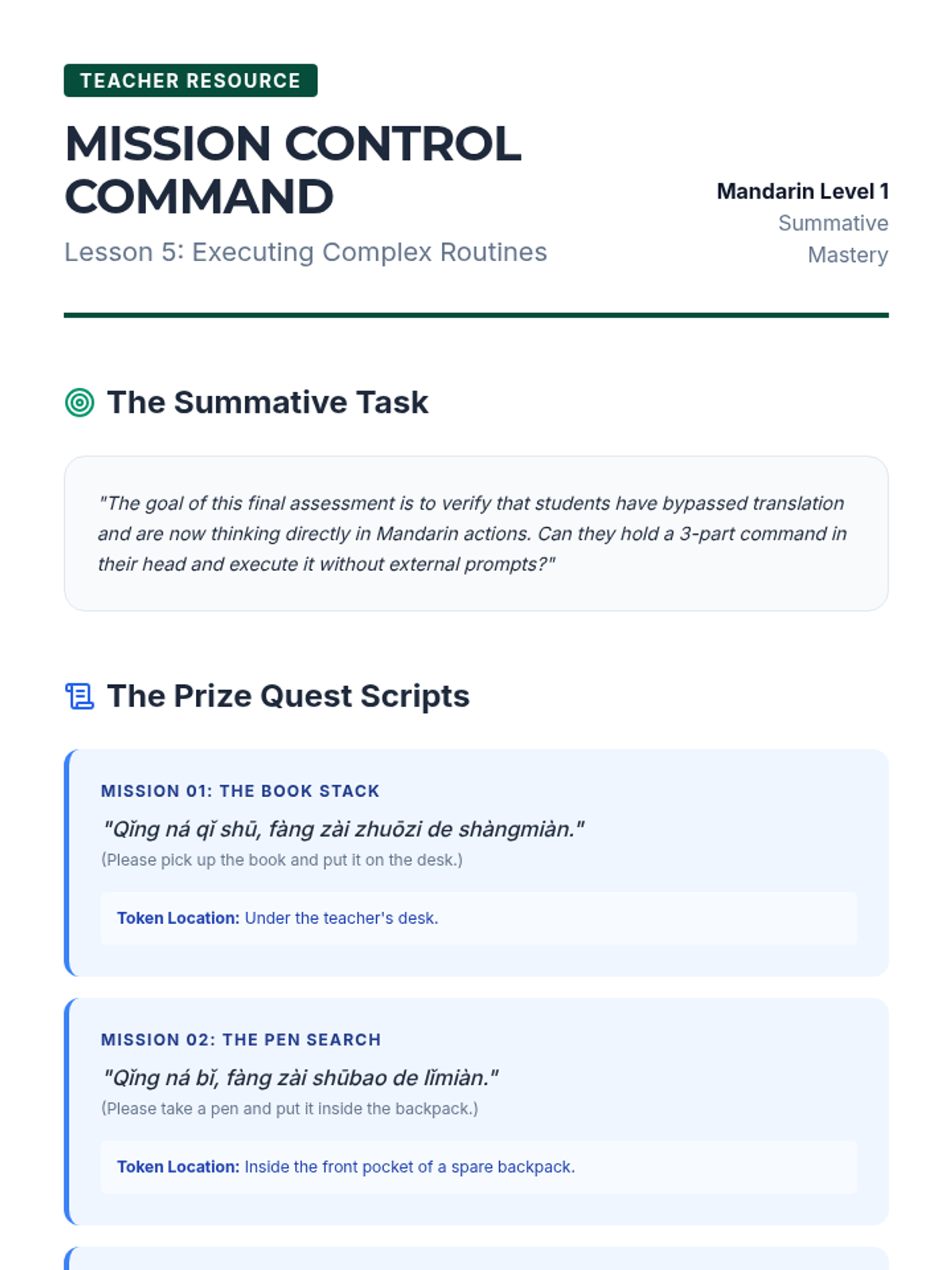
A teacher guide for the final mission control activity, including prize quest scripts and a mastery rubric.
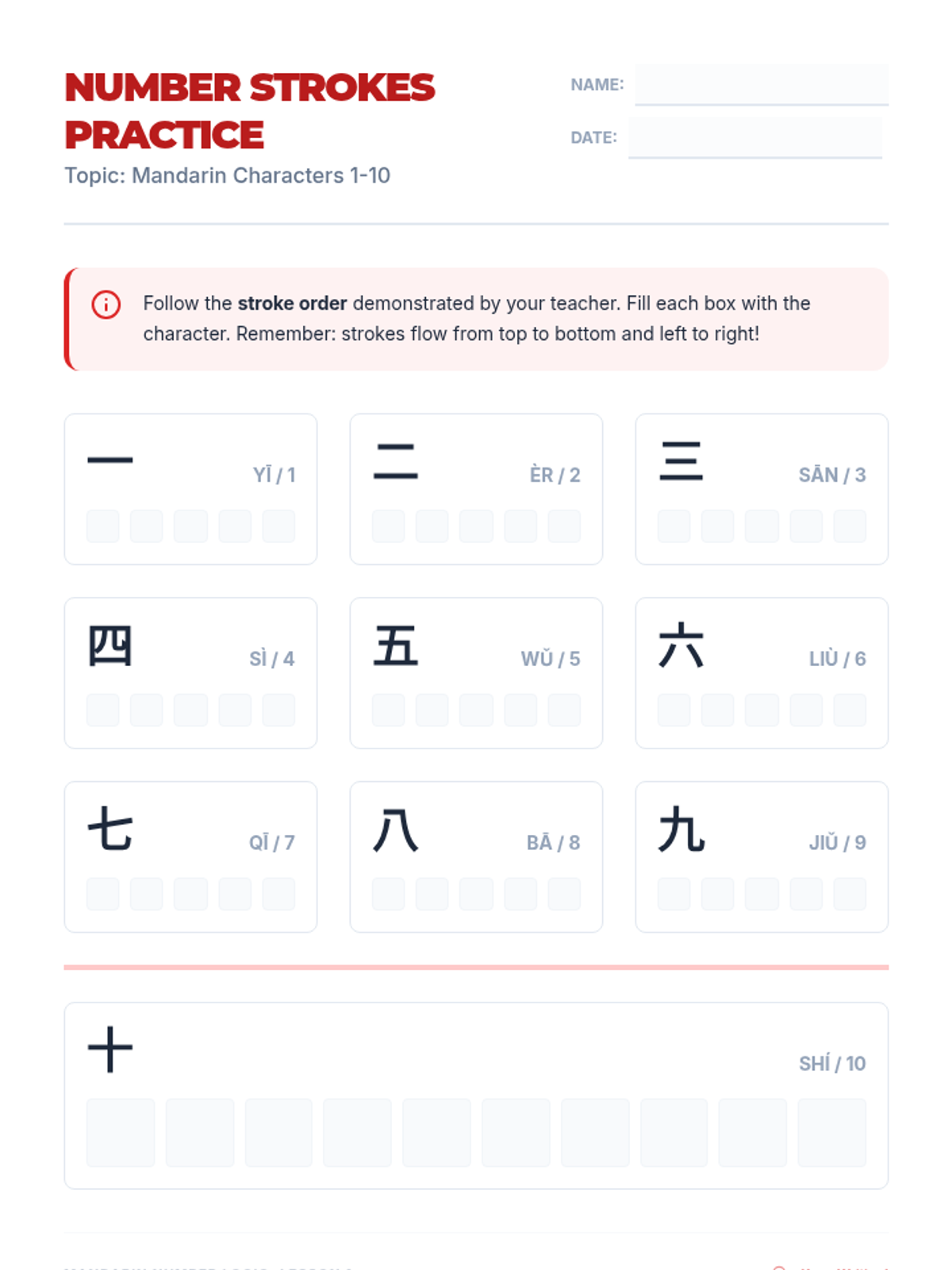
A character writing worksheet for numbers 1-10 with dedicated grid space for student practice, emphasizing stroke order and precision.
Presentation covering time-telling vocabulary (hours, minutes, half-past) and applying it to reading train schedules.
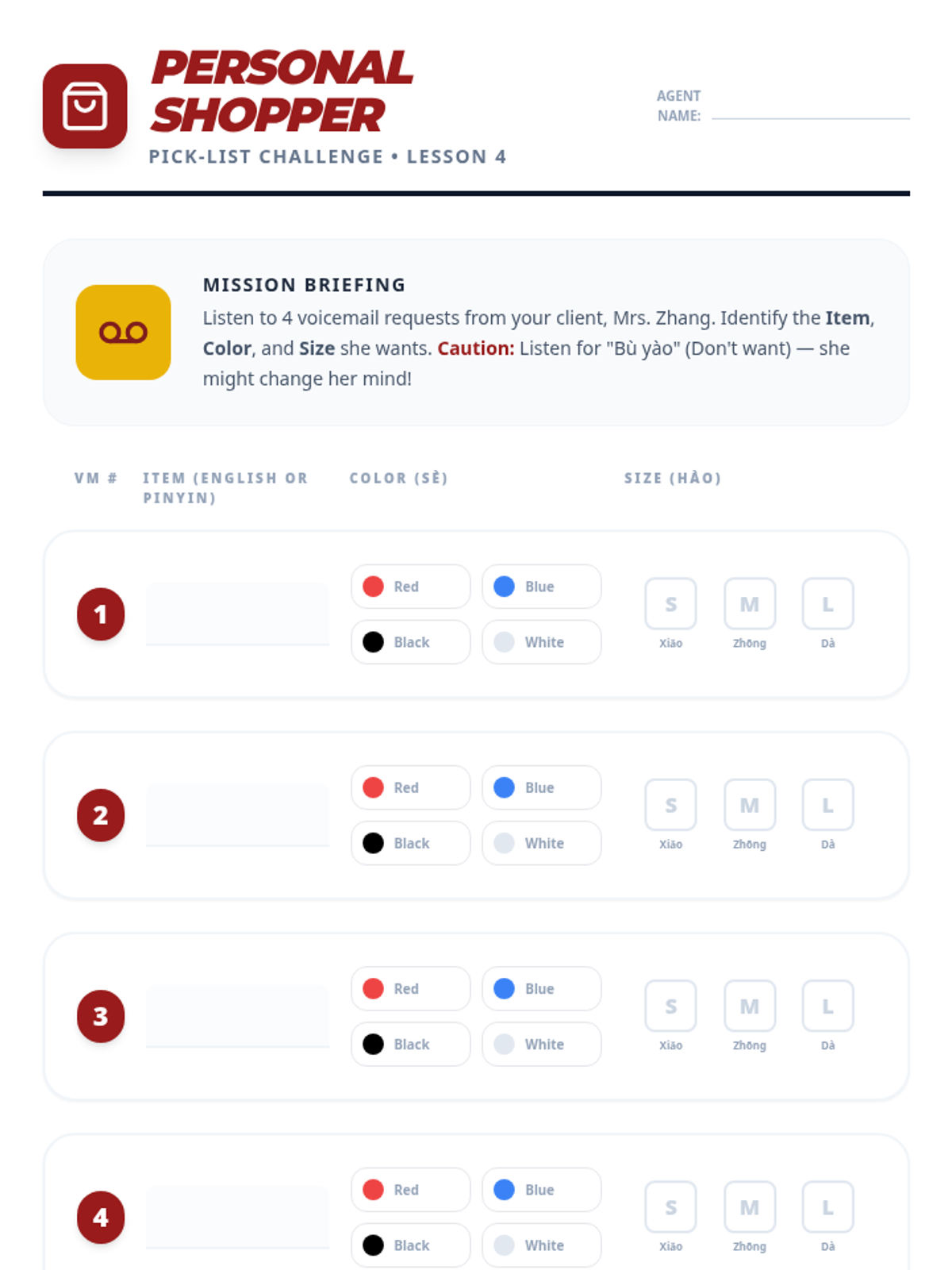
Student activity scorecard for Lesson 4. Students act as personal shoppers who must identify correct clothing items, colors, and sizes based on audio voicemail requests.
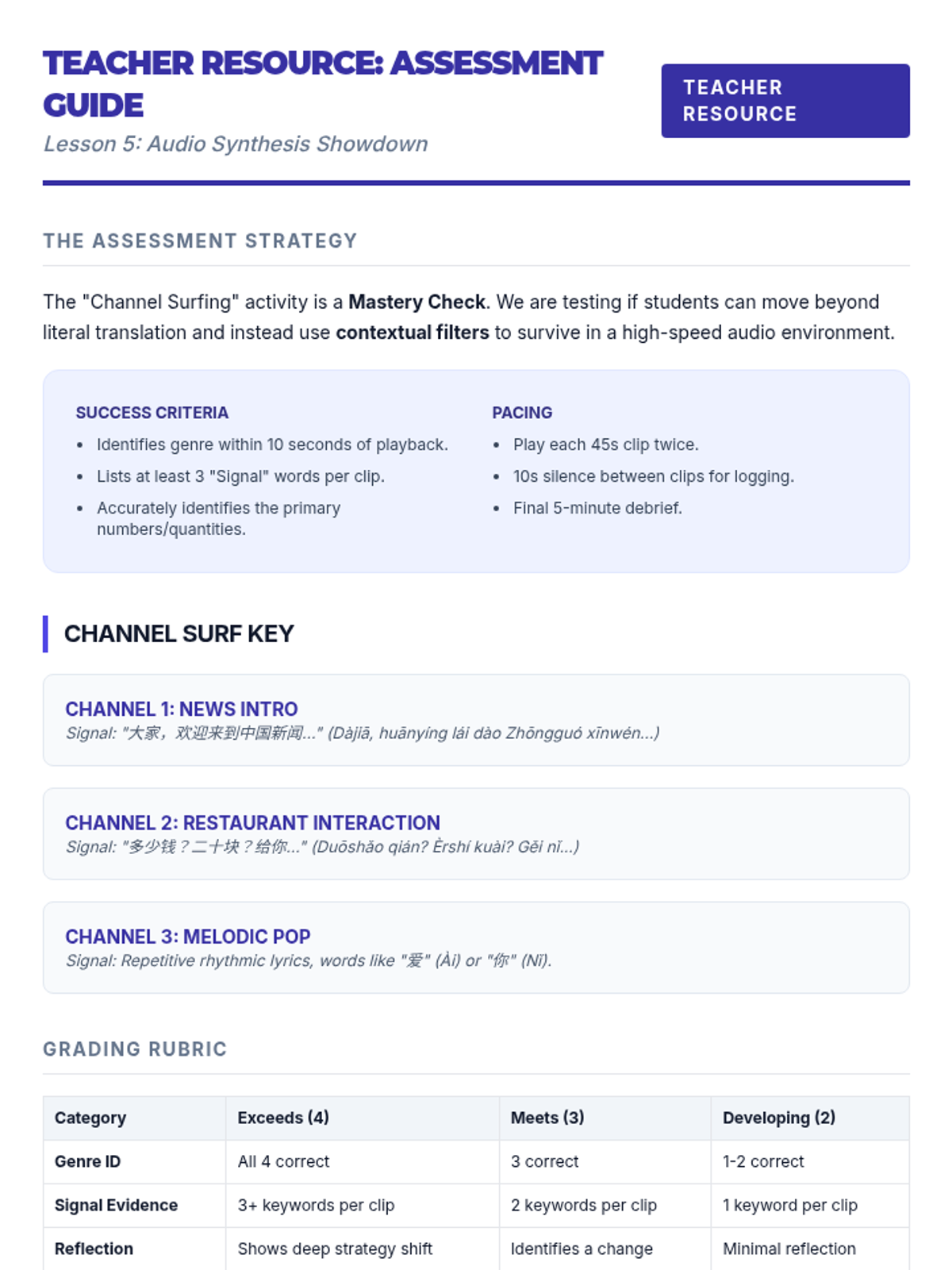
A final assessment guide for teachers, featuring success criteria, channel surfing keys, and a grading rubric for Mandarin listening synthesis.
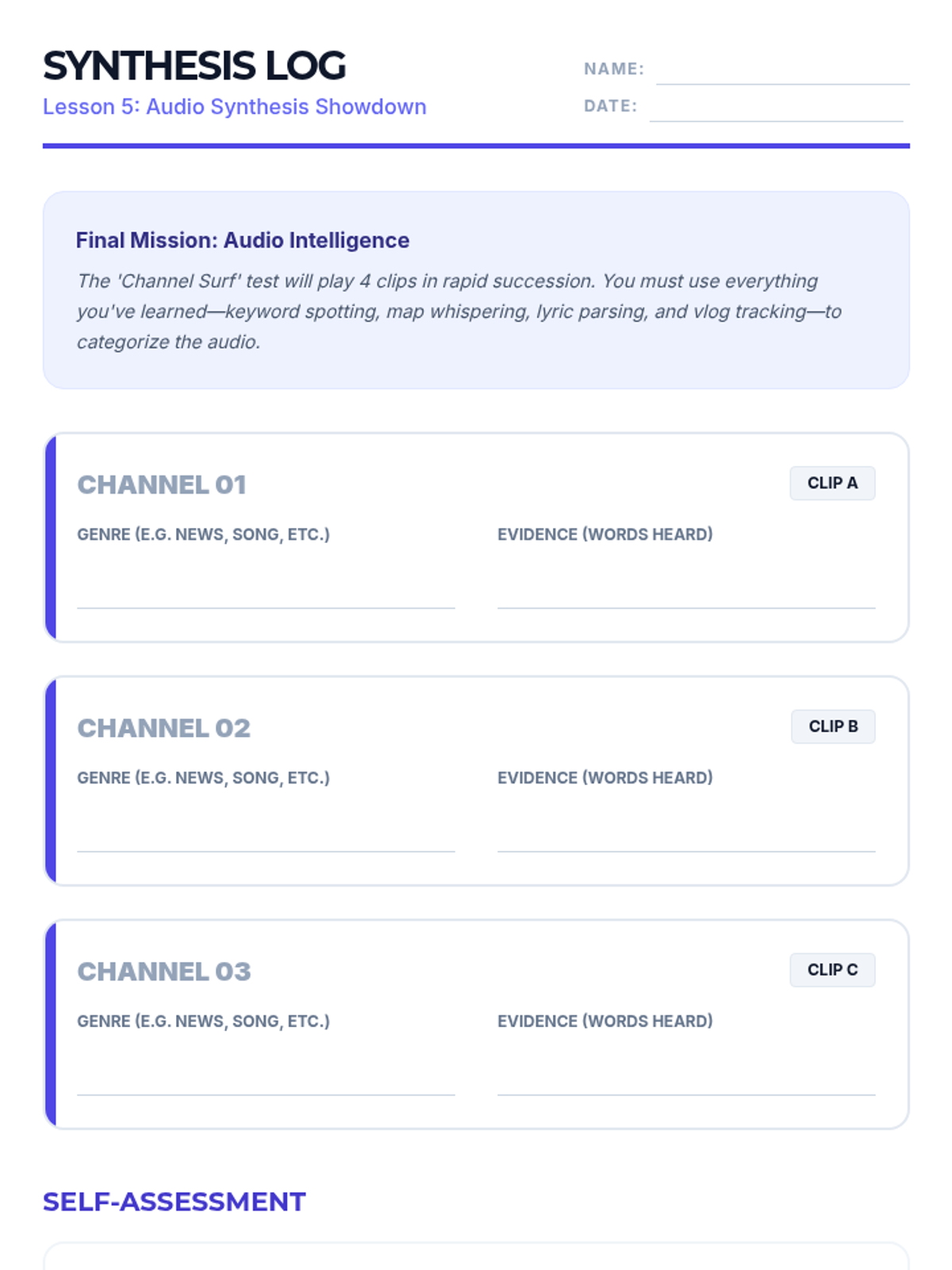
A synthesis log for the final 'Channel Surfing' activity, where students categorize multiple Mandarin audio genres and provide keyword evidence.
A culminating presentation for a Mandarin listening sequence, guiding students through a multi-genre 'channel surfing' synthesis activity.
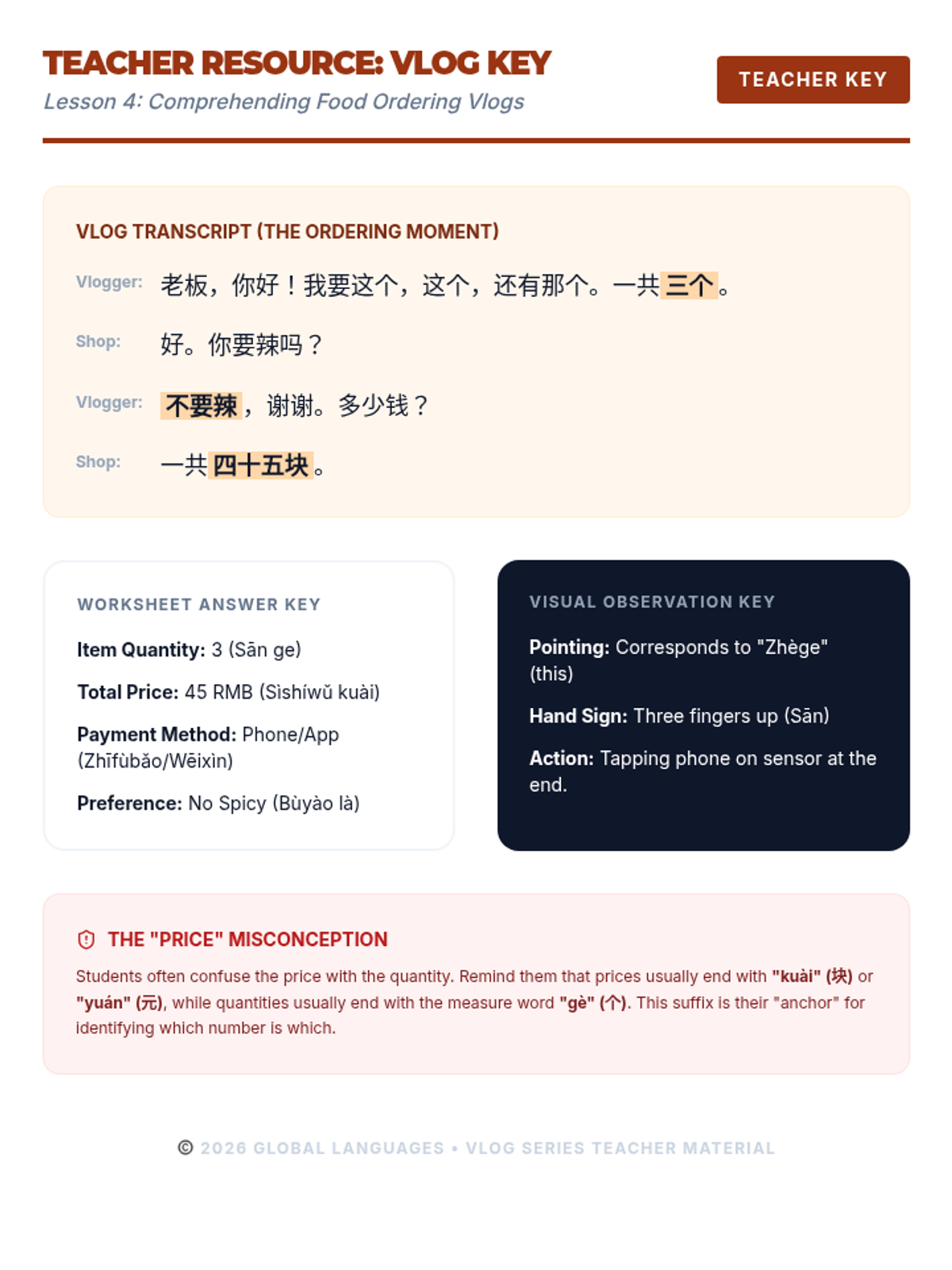
A teacher key for the vlog listening activity, including a transcript and visual observation guide for restaurant transactions.
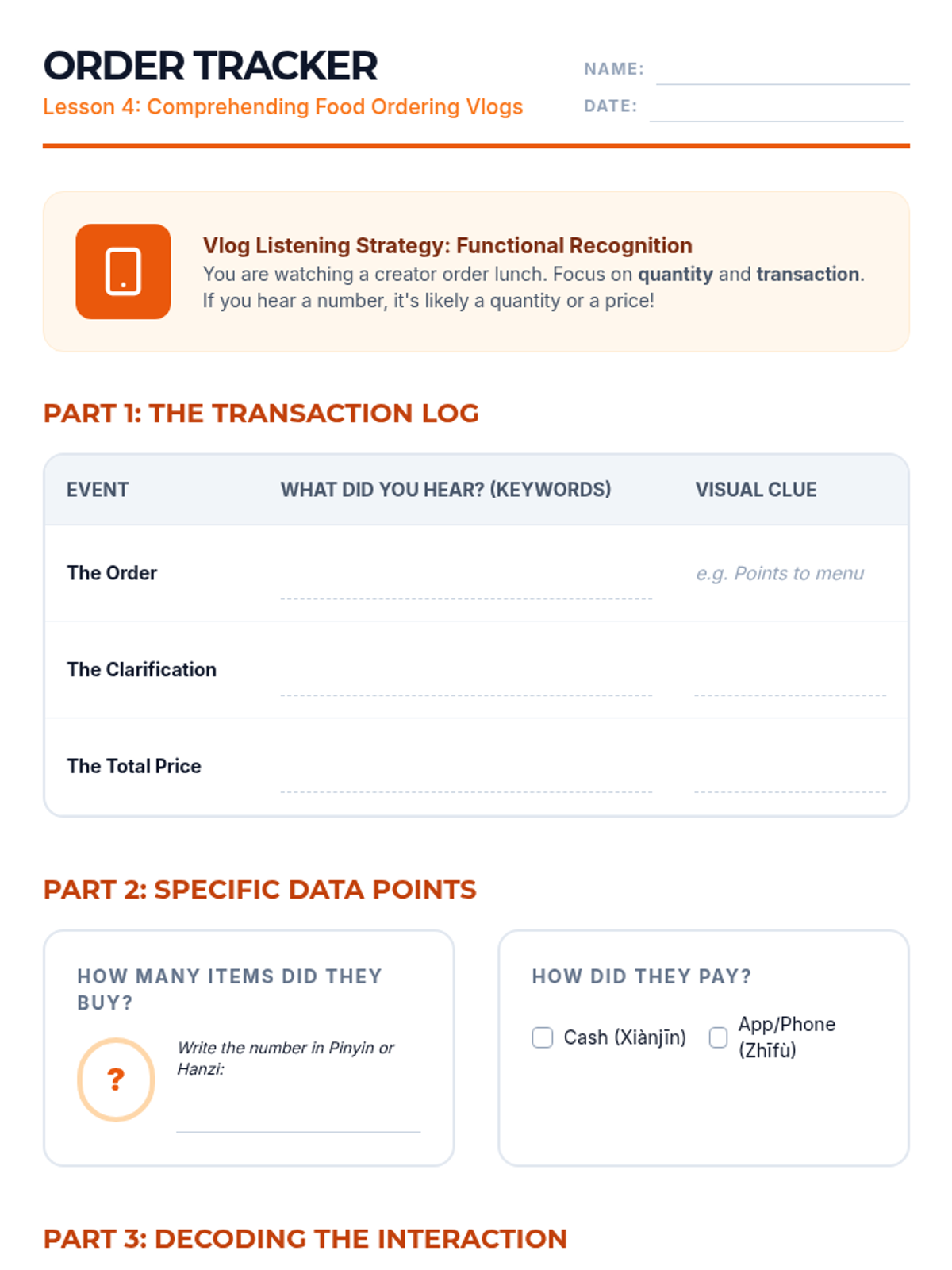
A worksheet for tracking restaurant transactions in food vlogs, focusing on quantity, price, and visual-to-audio context mapping.
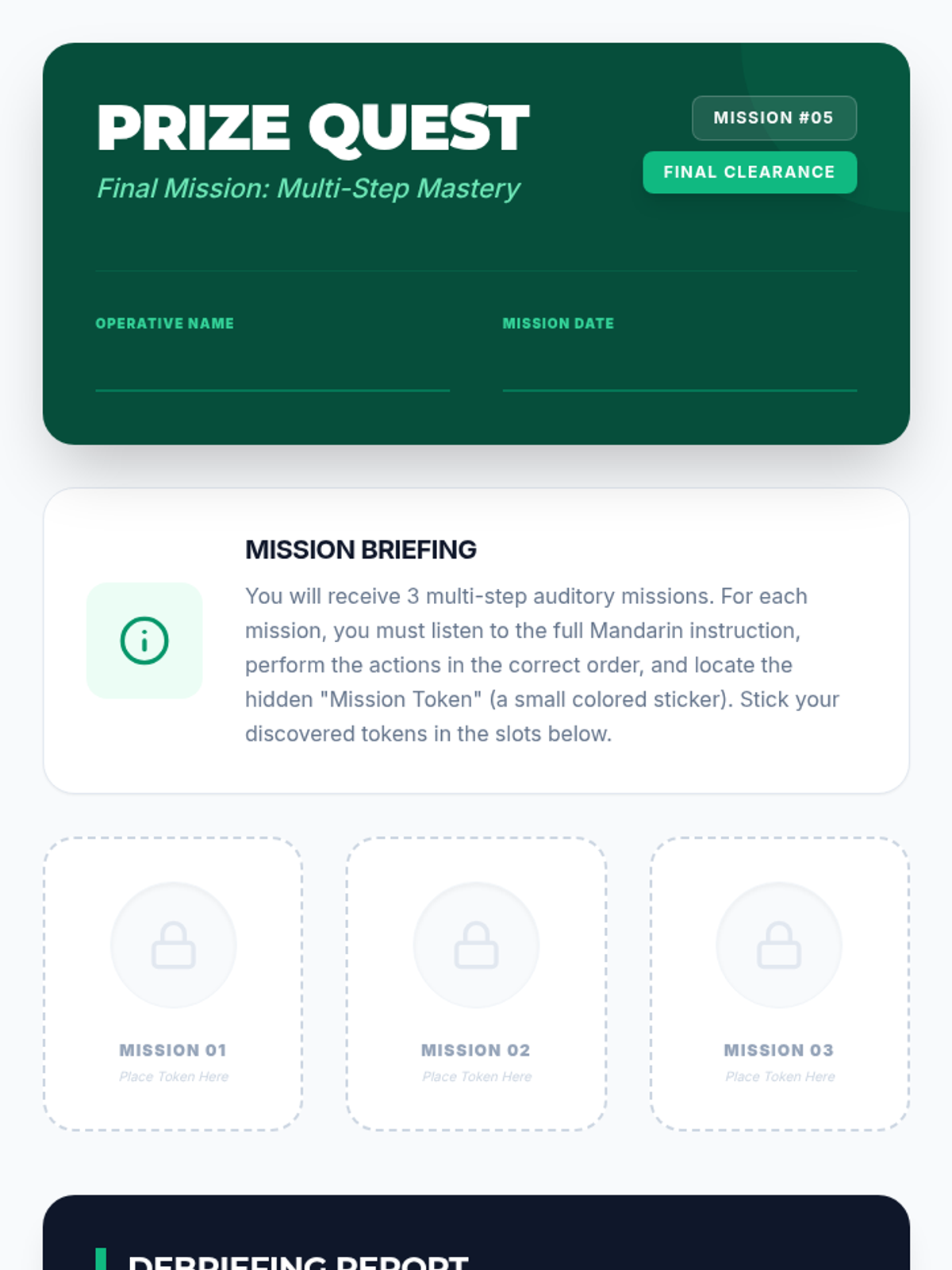
A student final assessment sheet for a multi-step Mandarin listening task, featuring token slots and a debriefing reflection.
A presentation slide deck focusing on the transactional structure of food vlogs and how visual cues aid in Mandarin listening comprehension.
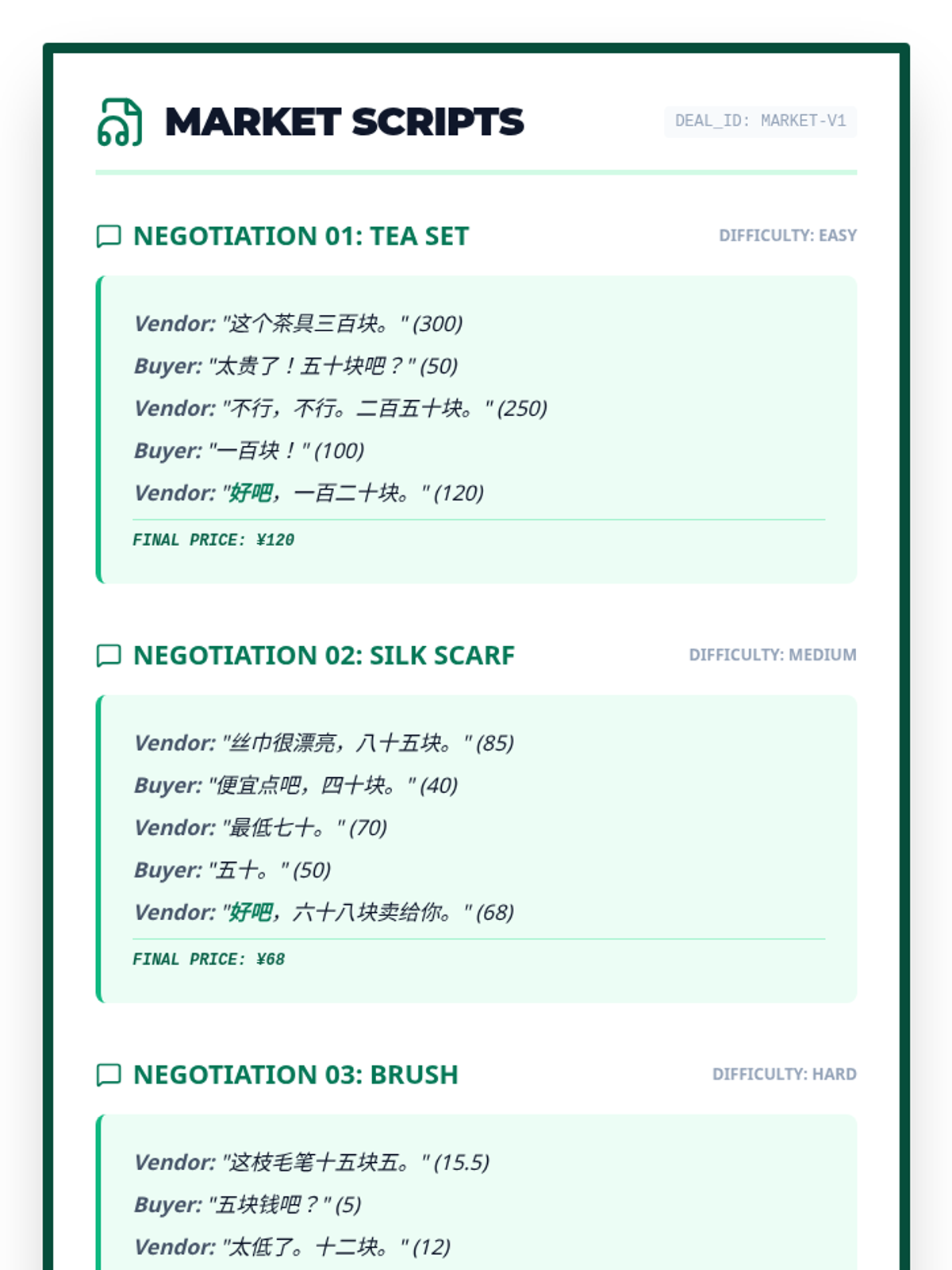
Teacher audio script for Lesson 5 bargaining simulations. Includes four levels of difficulty with full Mandarin dialogue and English price keys.
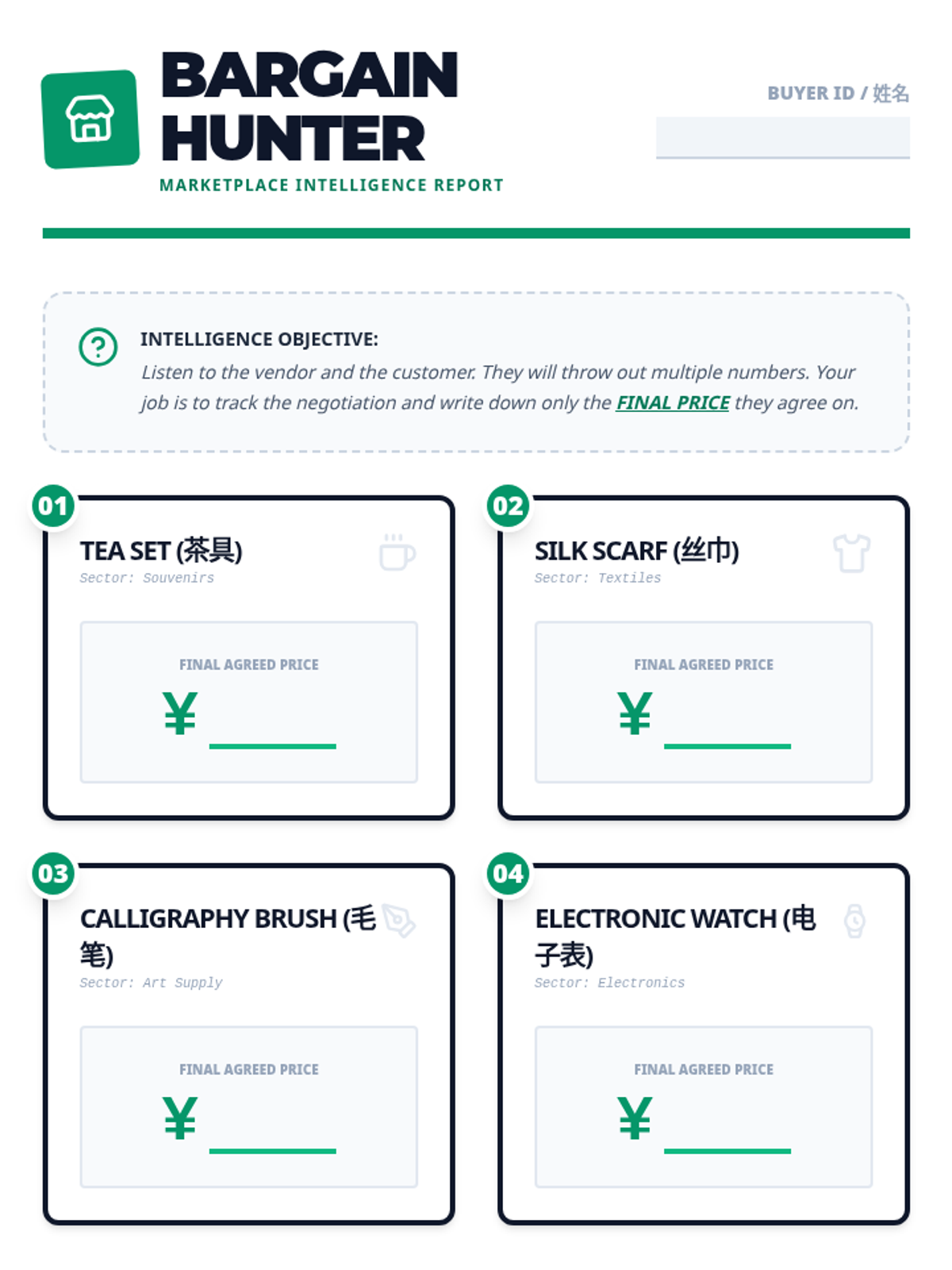
Worksheet for identifying final agreed prices in marketplace negotiations. Features a 'Bargain Hunter' report design with items like tea sets and electronics.
Slides for Lesson 5 on currency and price. Introduces 'kuai', 'mao', and 'fen' units, essential bargaining phrases, and strategies for identifying final agreed prices.
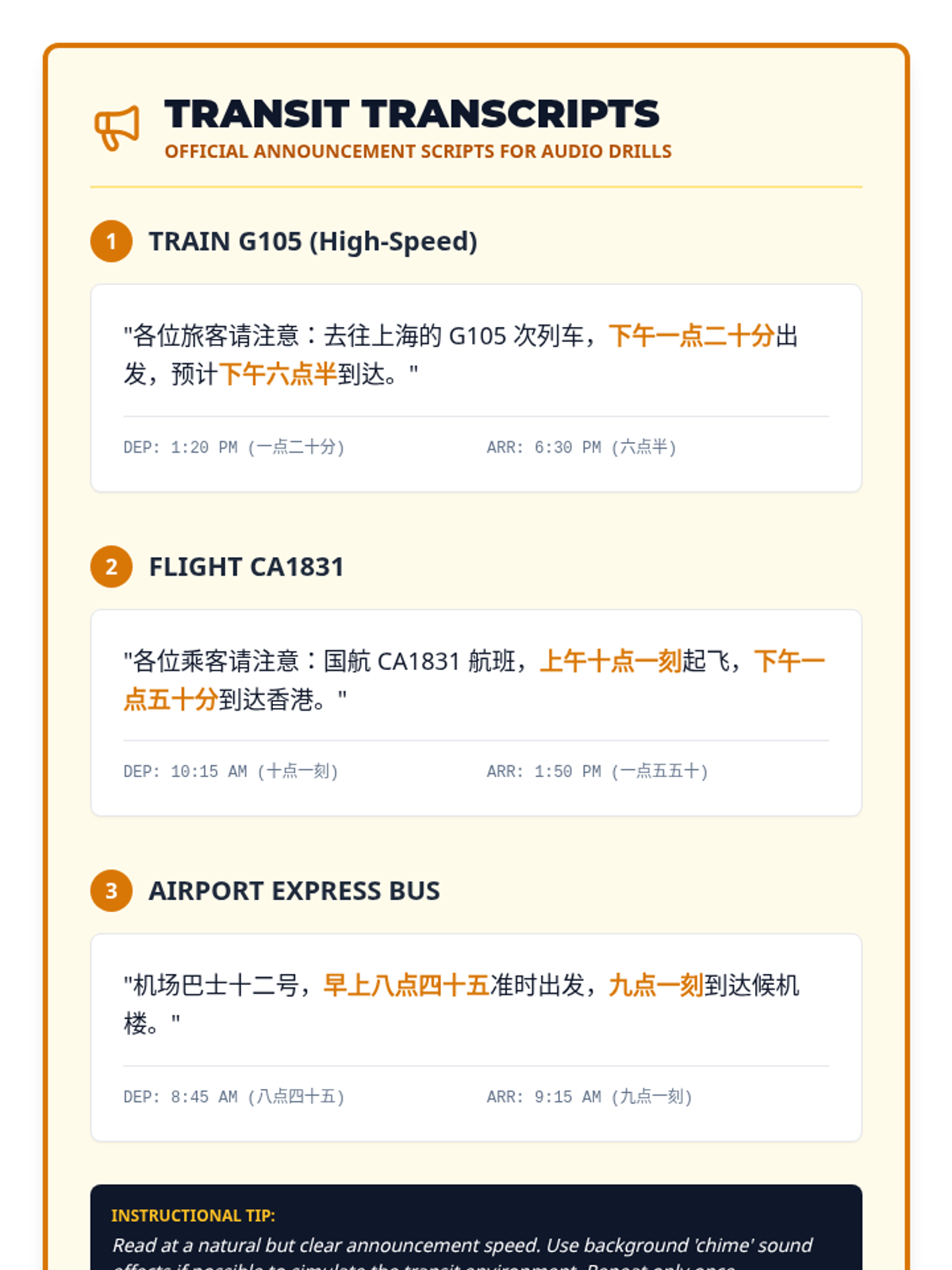
Audio transcripts for Lesson 4 transit announcements. Provides the Mandarin text and English answer keys for teacher-led listening practice.
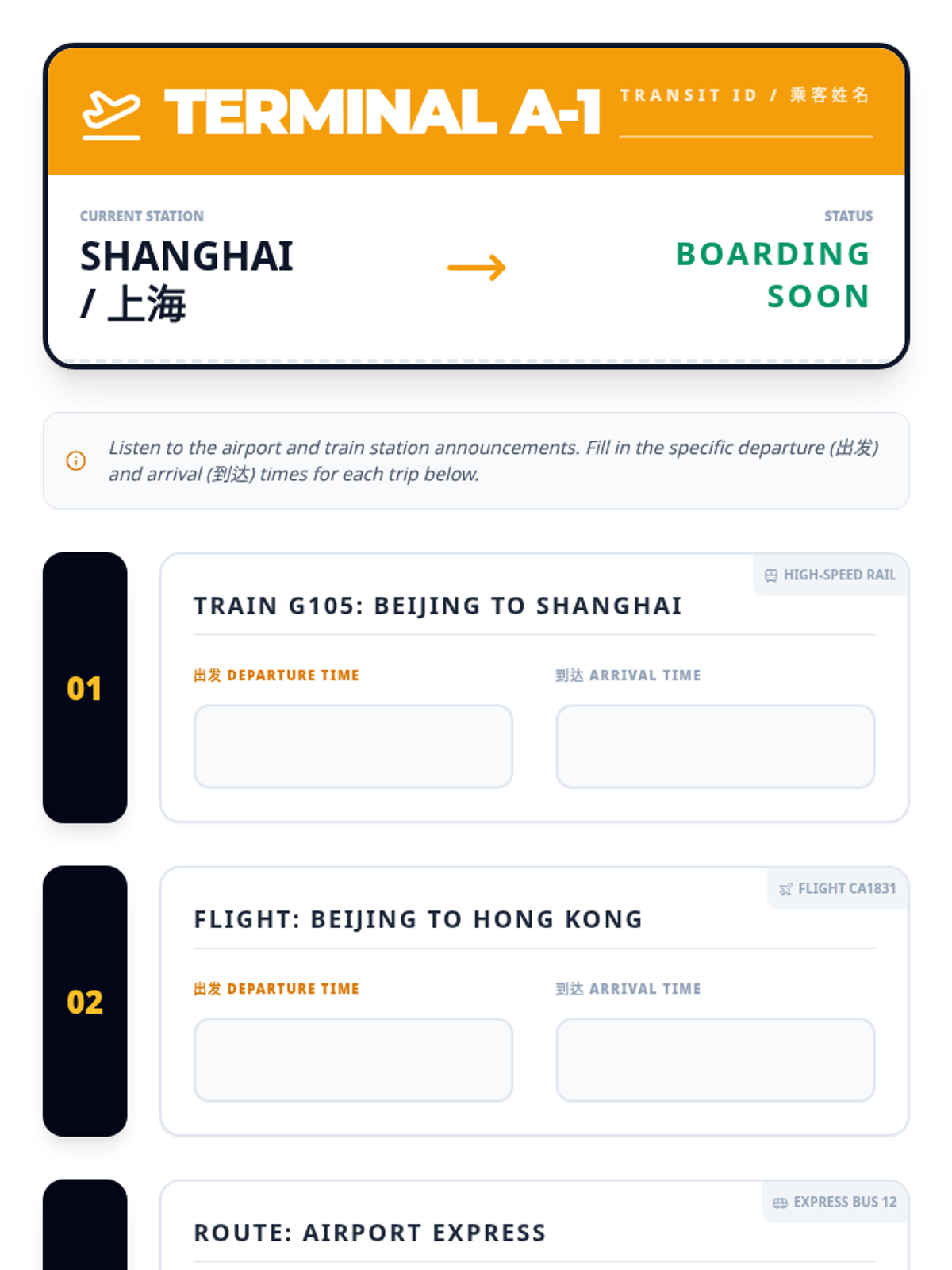
Worksheet for extracting time data from transit announcements. Designed like a boarding pass, students record departure and arrival times for trains, flights, and buses.
Slides for Lesson 4 on time and schedules. Explains 'dian', 'fen', 'ban', and 'ke' components and introduces transit vocabulary (departure/arrival).
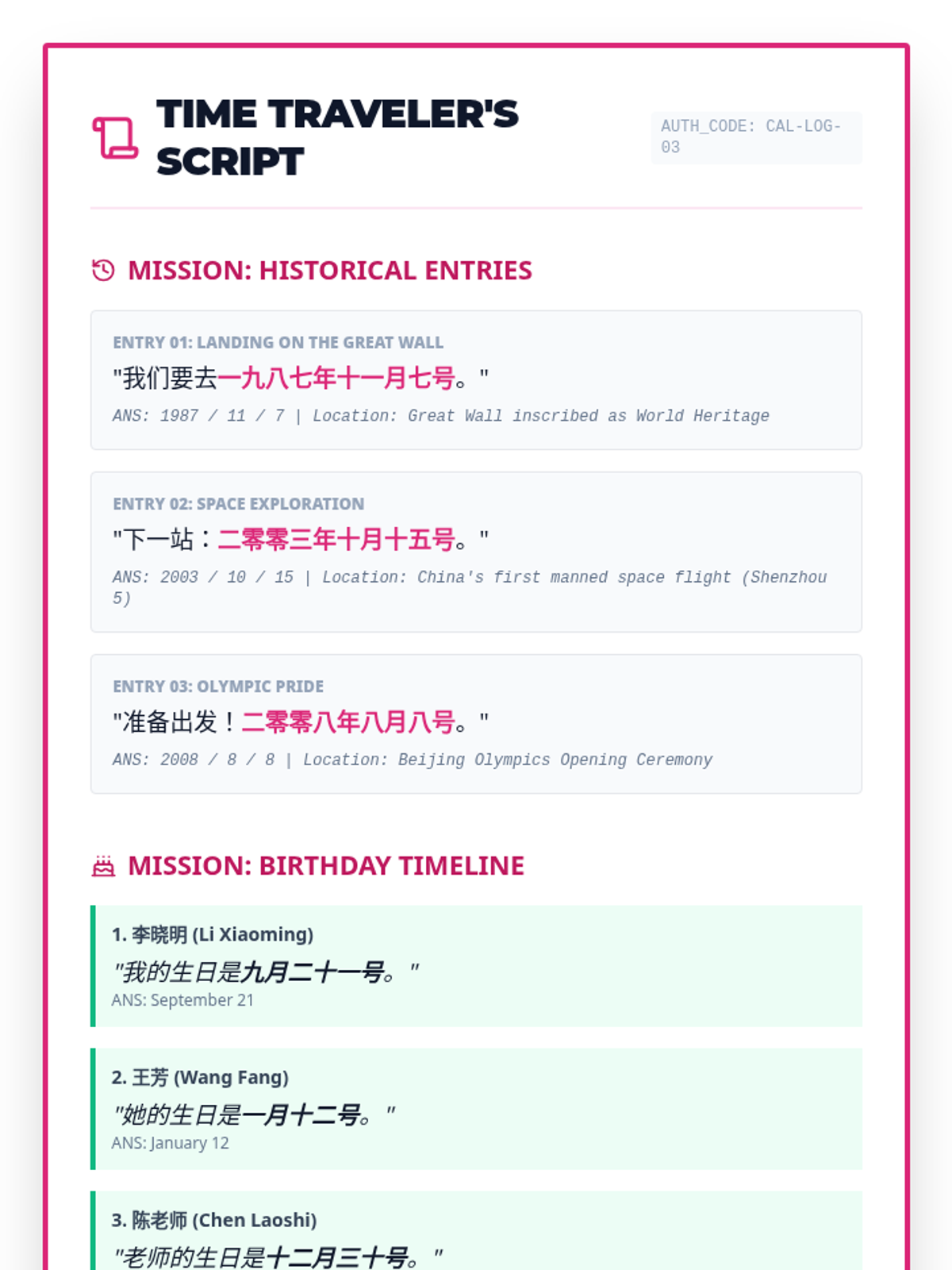
Teacher audio script for Lesson 3, featuring historical dates for the Time Traveler simulation and personal birthday listening exercises.
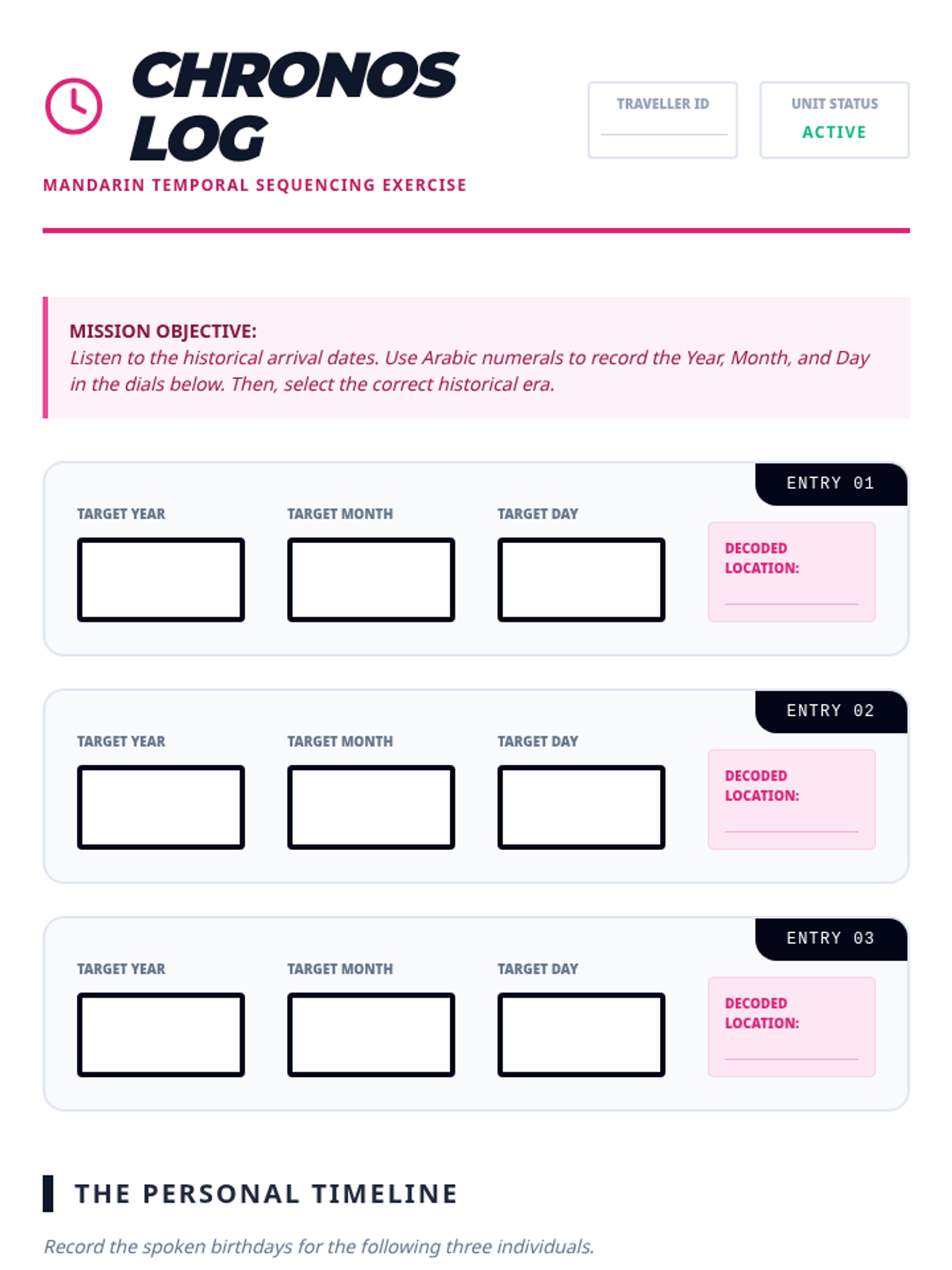
Worksheet for auditory calendar date processing. Features a 'Chronos Log' design for historical dates and personal birthday recording.
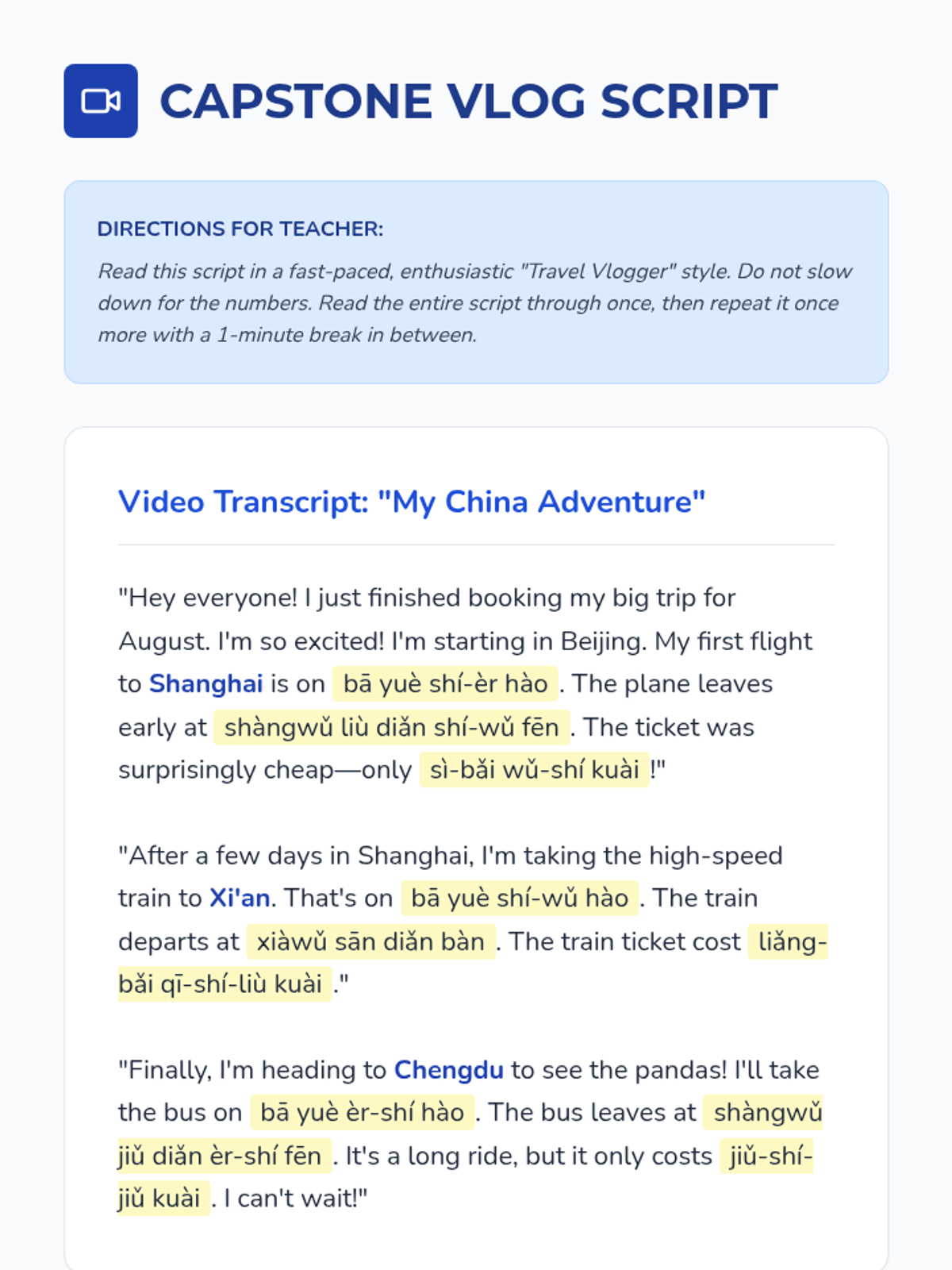
Final capstone listening script for the Travel Vlog activity, including the full monologue and a comprehensive teacher answer key.
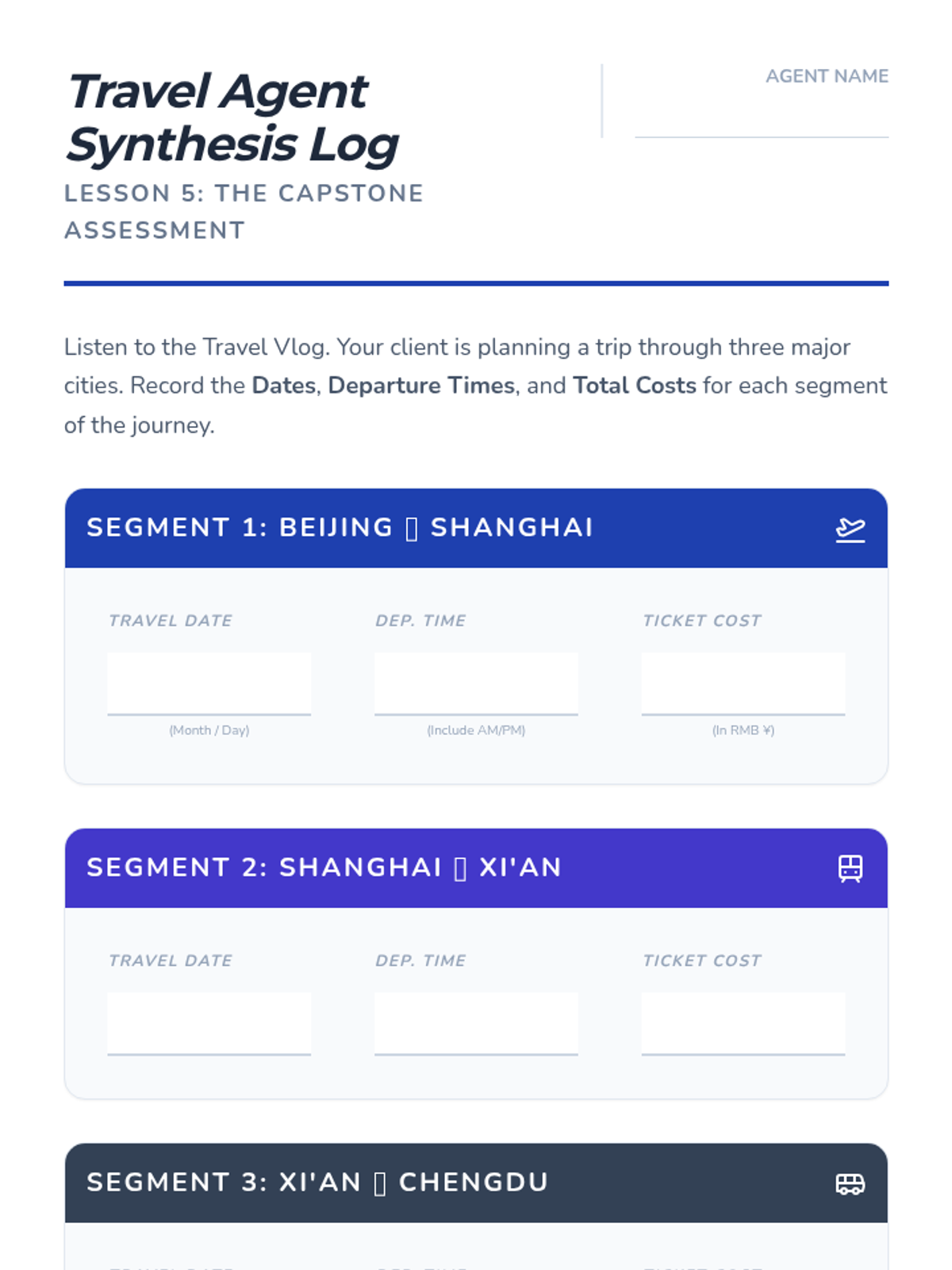
Capstone assessment worksheet for recording complex travel logistical data across three segments of a trip, including dates, times, and costs.
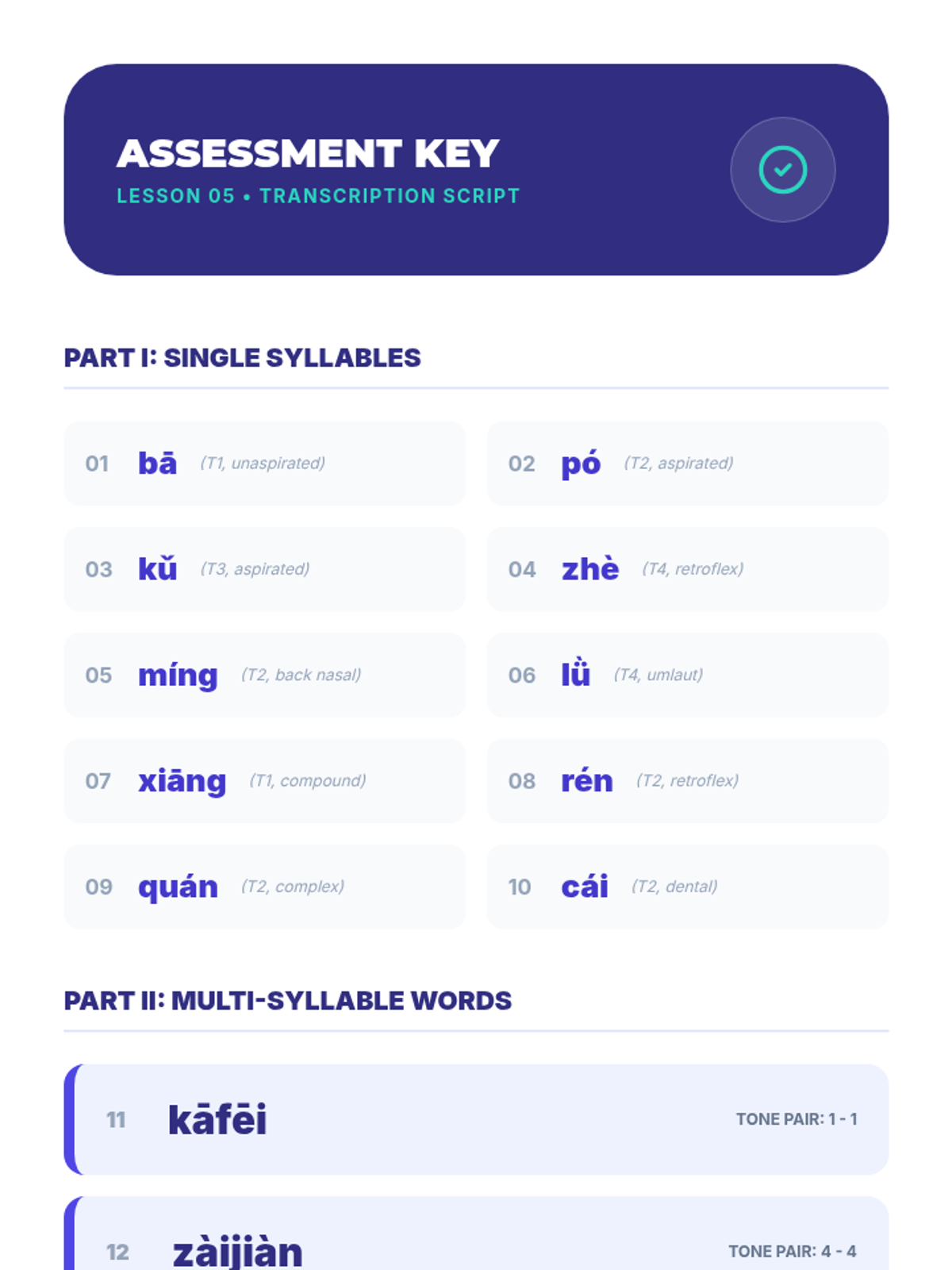
Teacher answer key and script for the Pinyin Final Exam, containing correct Pinyin transcriptions and tone analysis.
Visual aids for Lesson 5, focusing on synthesizing dates, times, and currency, along with rapid note-taking strategies for quantitative listening.
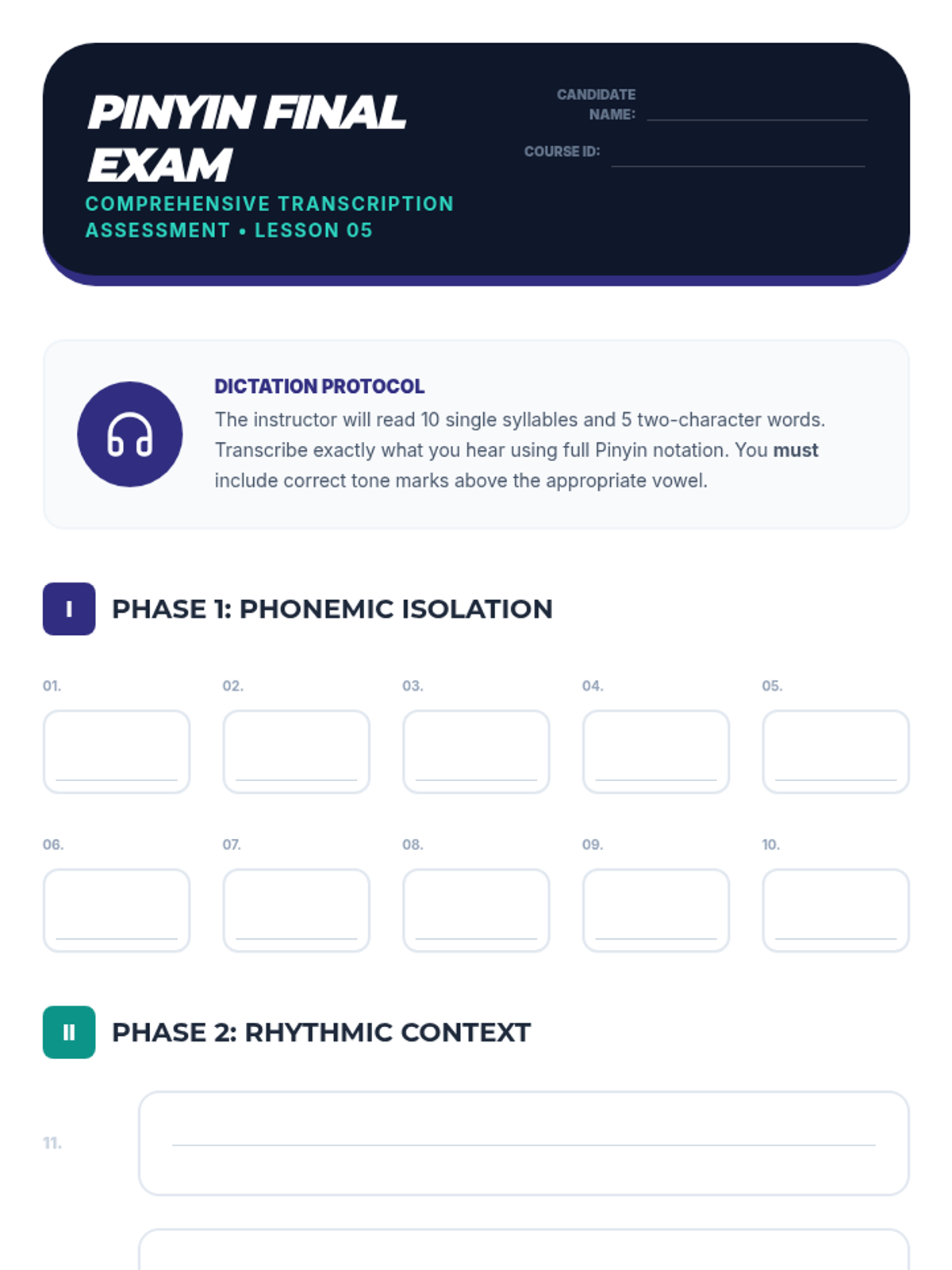
The final assessment sheet for Lesson 5, where students transcribe individual syllables and words into Pinyin with tone marks.
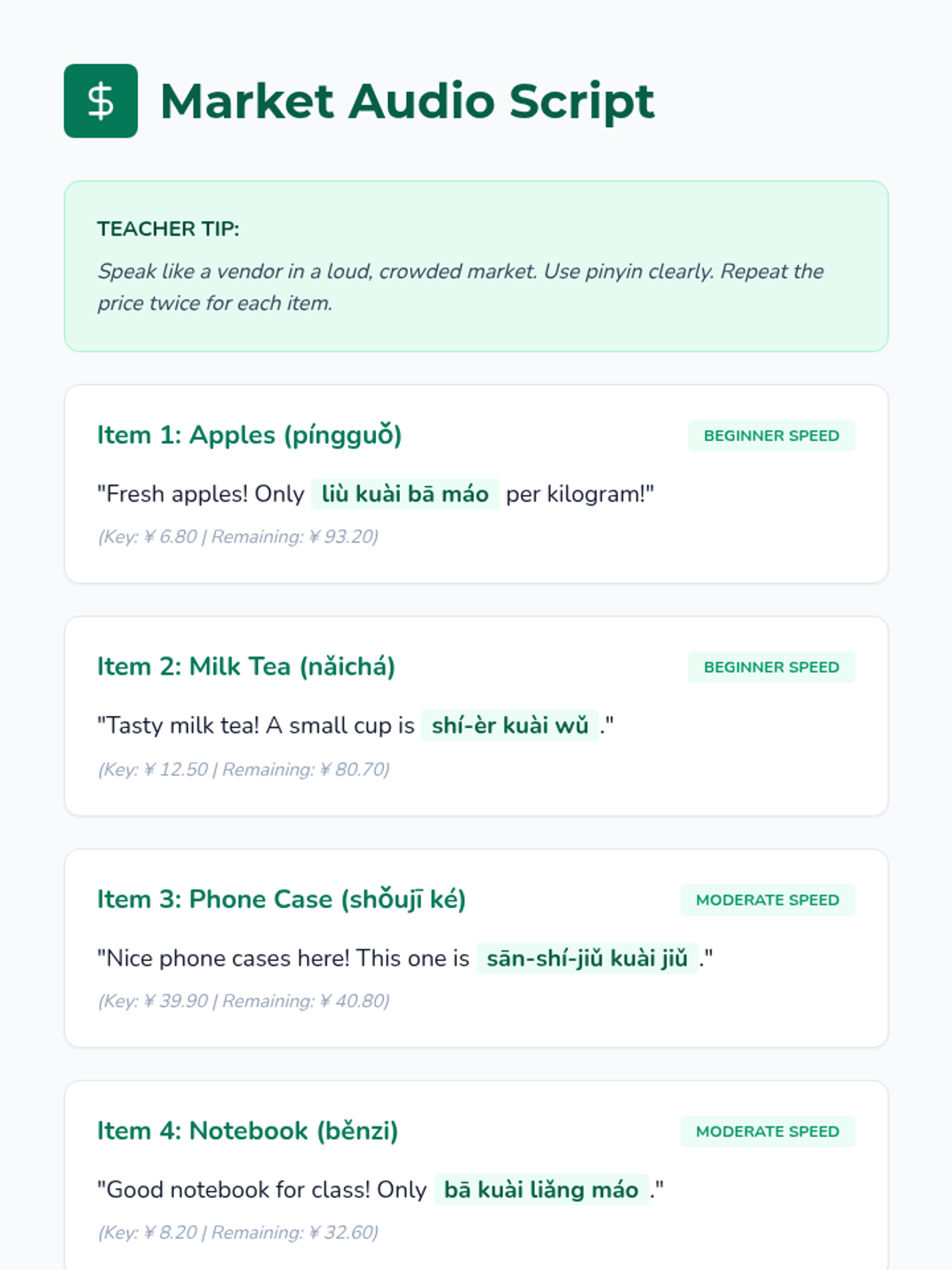
Teacher script for the market simulation, providing prices for five shopping items and the cumulative math for the budget challenge.
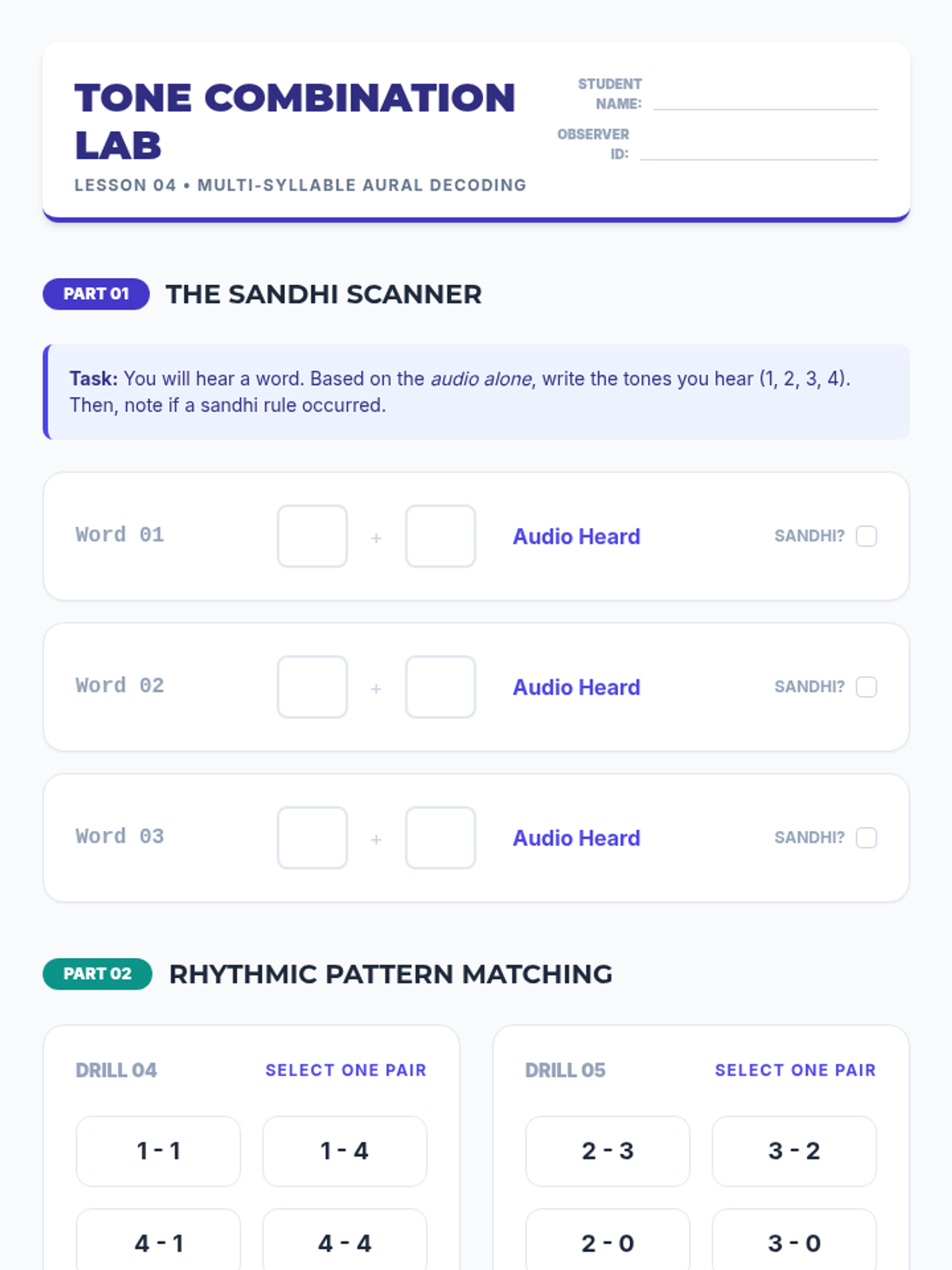
Student worksheet for Lesson 4 for identifying tone sandhi and two-character tone combinations.
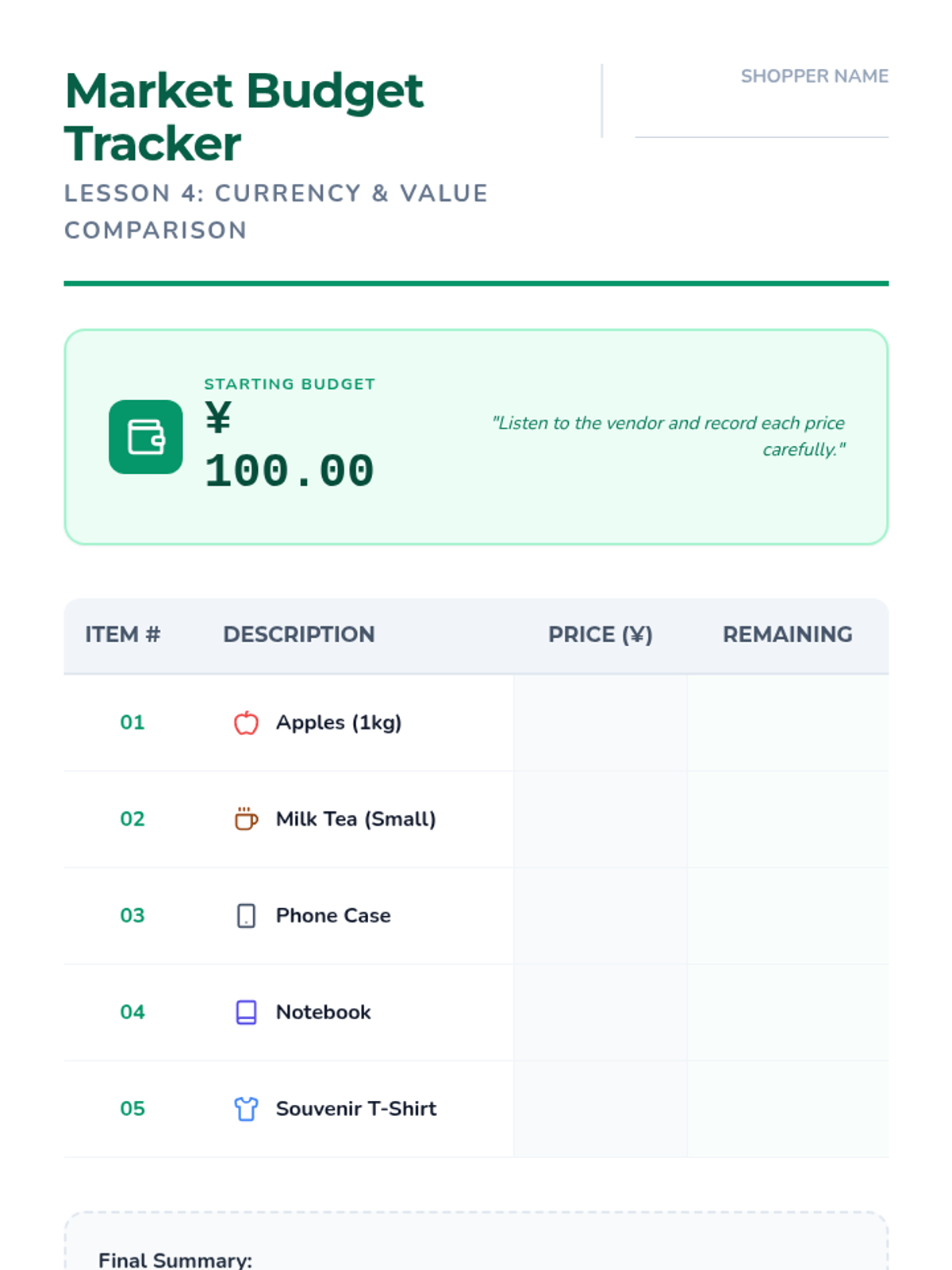
Student worksheet featuring a budget tracker table for recording item prices and calculating remaining funds based on a 100 RMB starting balance.
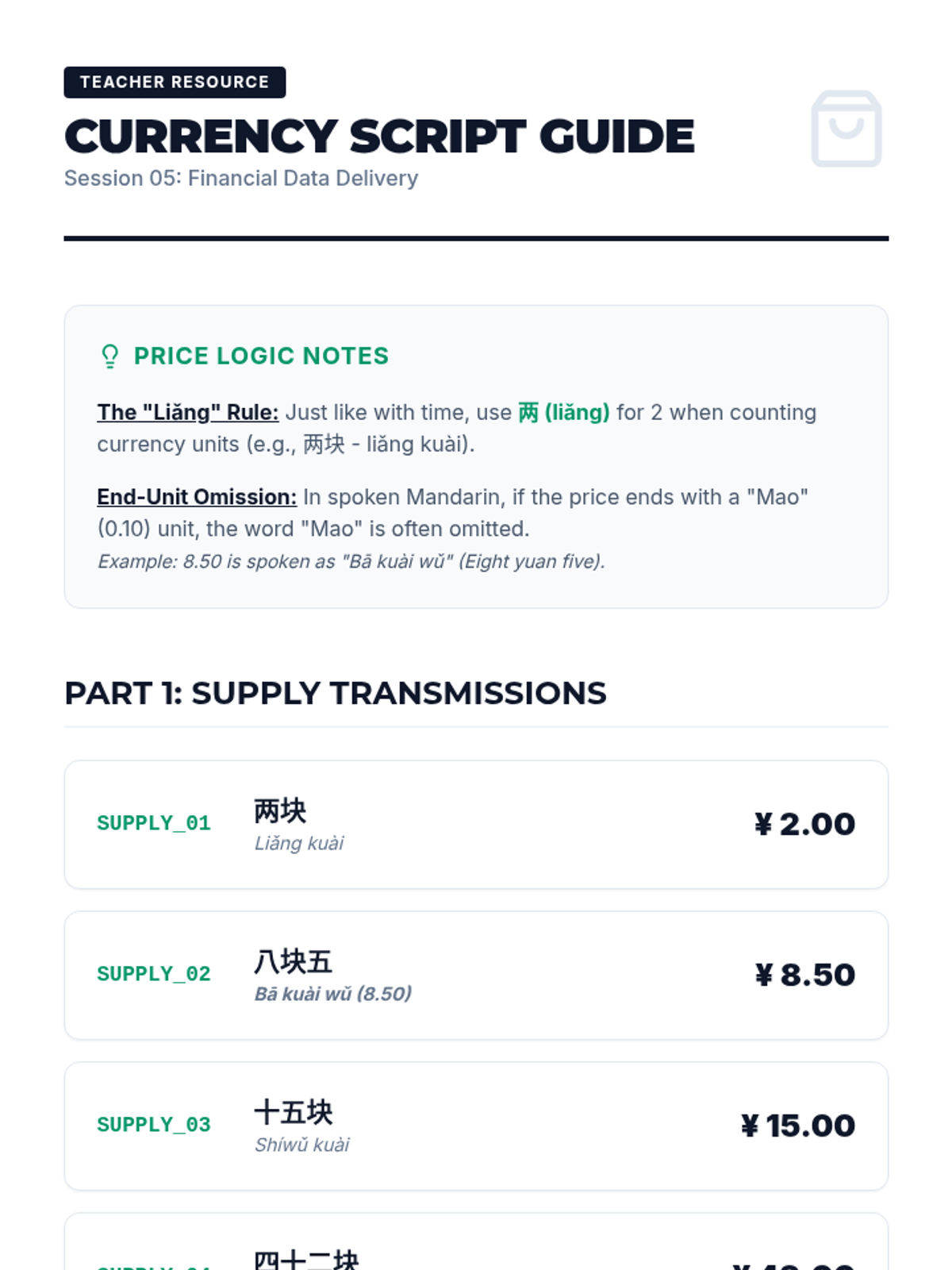
A teacher script for the Lesson 5 currency mission, including price lists, phonetic guides for units, and a total calculation key.
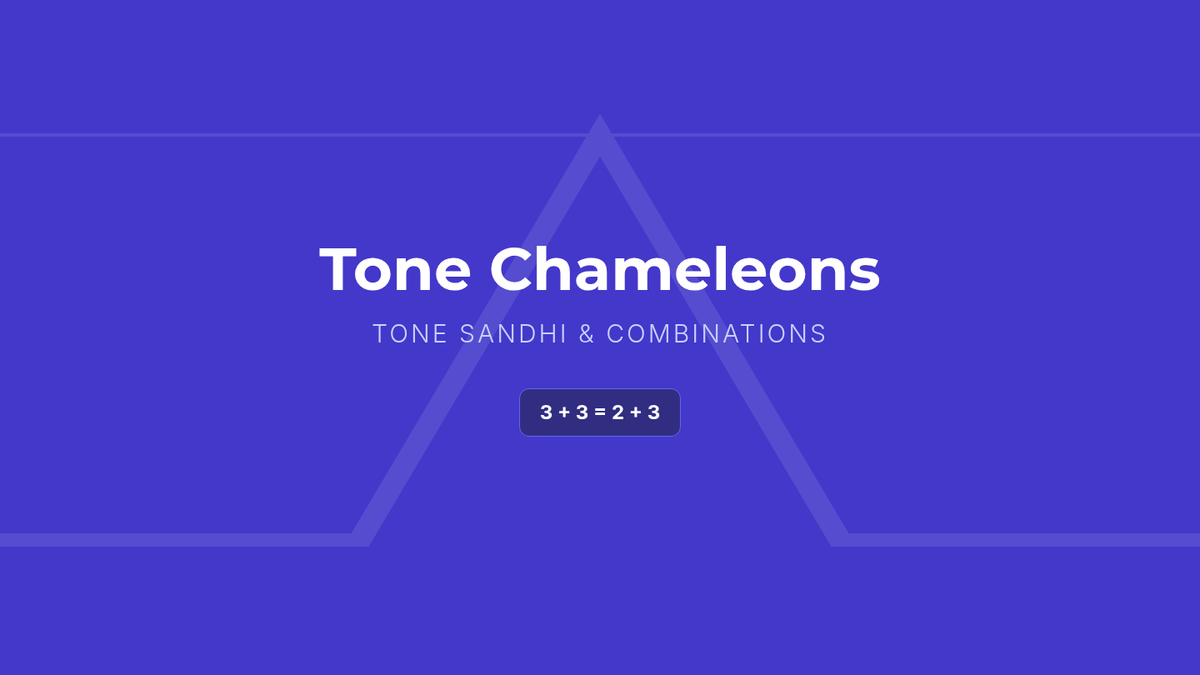
Visual presentation for Lesson 4 explaining tone sandhi rules (specifically the third tone rule) and multi-syllable tone combinations.
Visual aids for learning Mandarin currency units (kuài, máo), the formal/spoken distinction, and rules for reading price tags.
A slide deck introducing multi-step routines in Mandarin, focusing on combining verbs, objects, and locations.
A student worksheet for identifying prices of items and calculating a total based on spoken Mandarin prices.
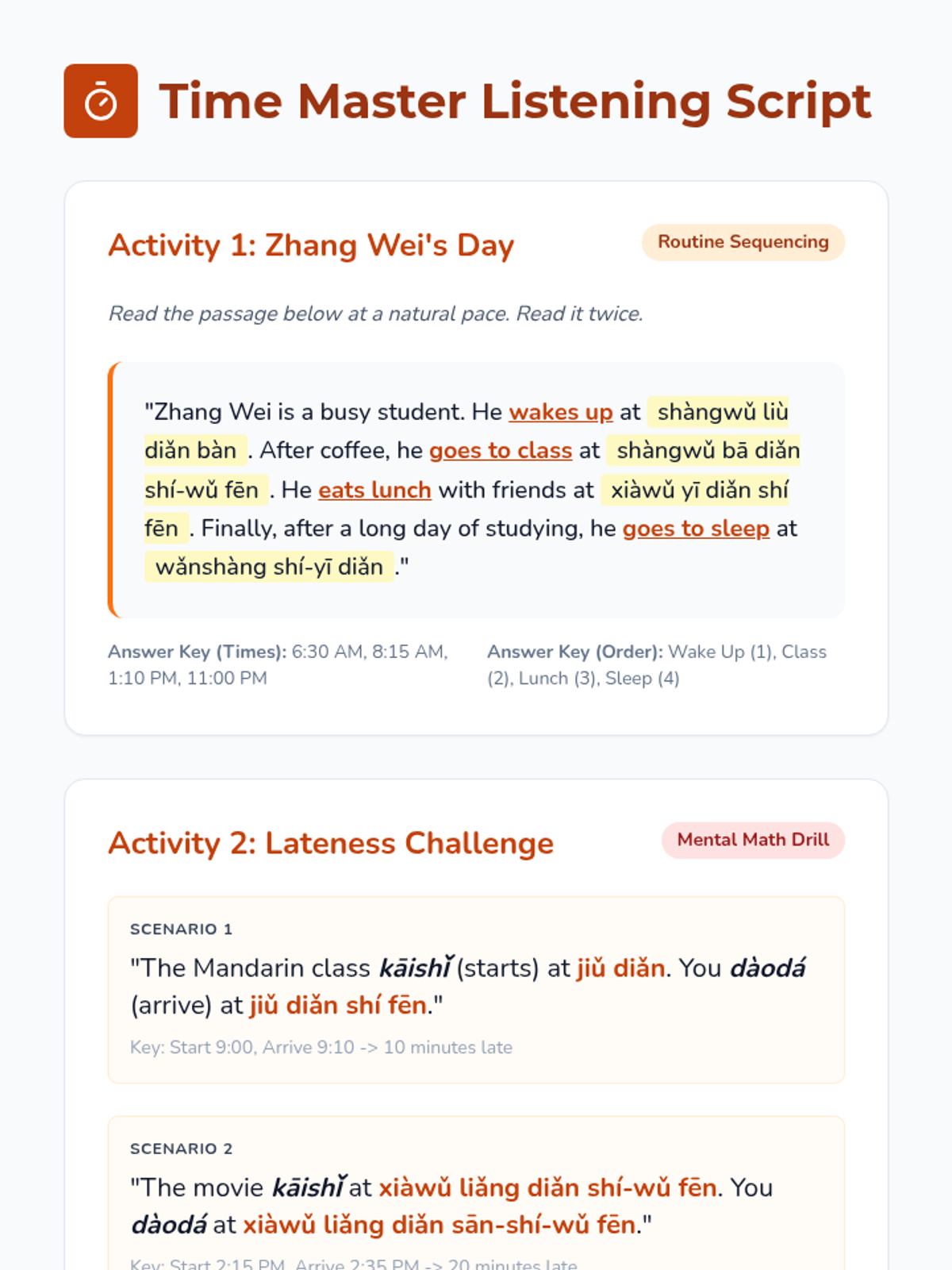
Teacher script for the daily routine and lateness challenge, providing the text for listening activities and an answer key for the teacher's reference.
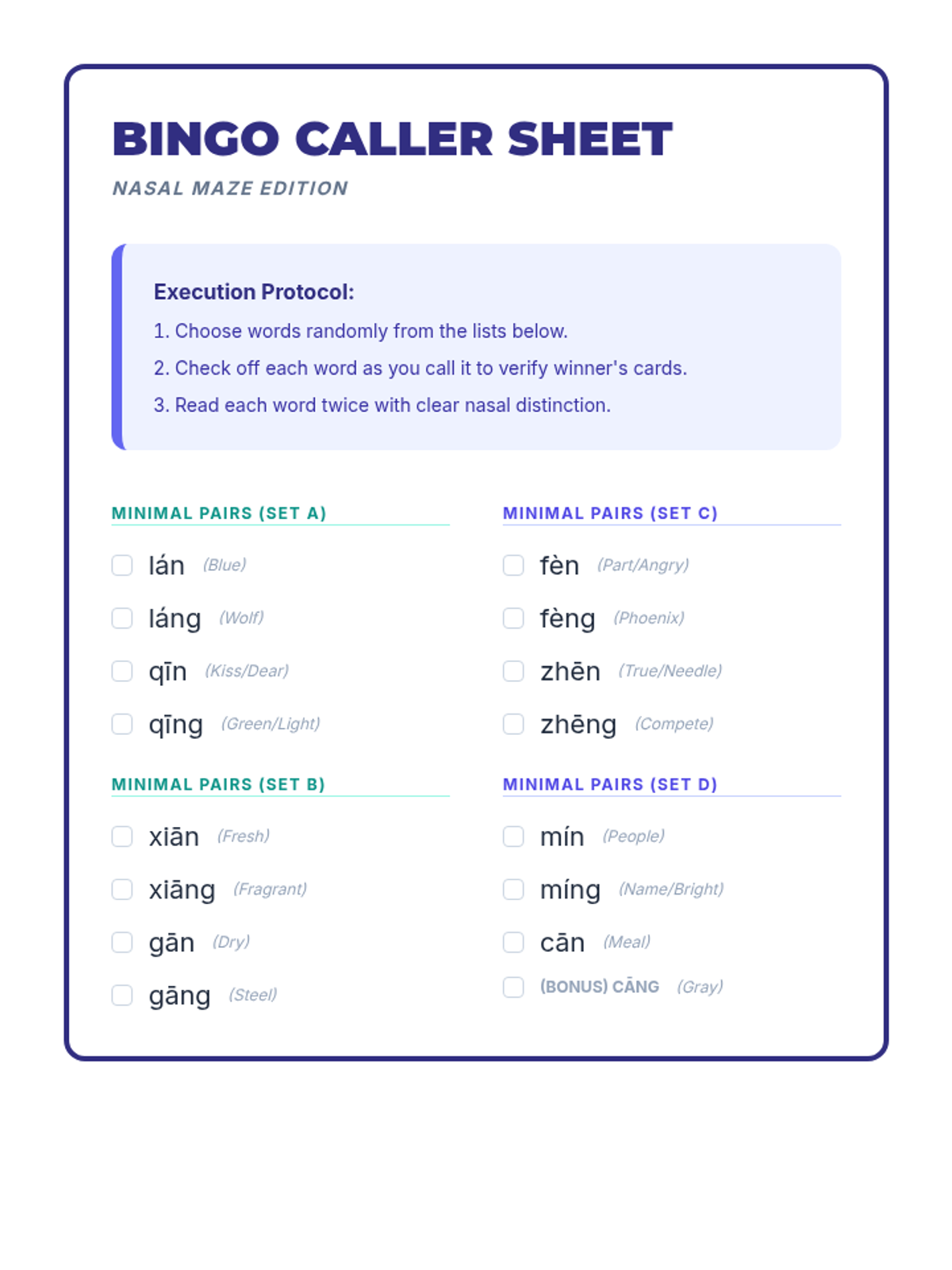
Teacher caller sheet for Pinyin Bingo, including target minimal pairs with front and back nasal endings.
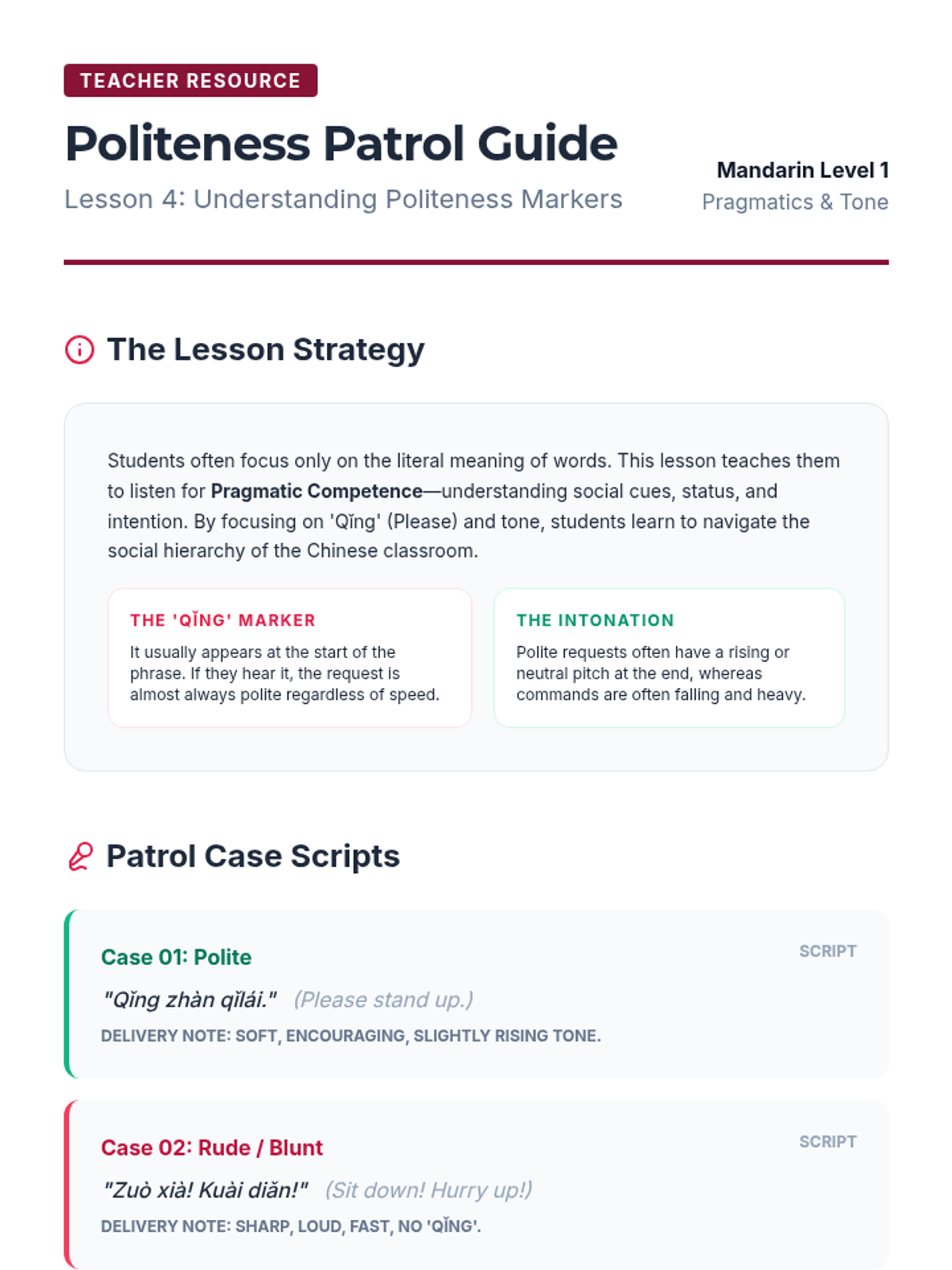
A teacher guide for the politeness markers lesson, including listening scripts for the "Patrol" activity and cultural discussion prompts.
Visual presentation for Lesson 5 covering currency vocabulary, price structures, and marketplace phrases in Mandarin.
Student worksheet for recording times of a daily routine and calculating lateness based on auditory time markers.
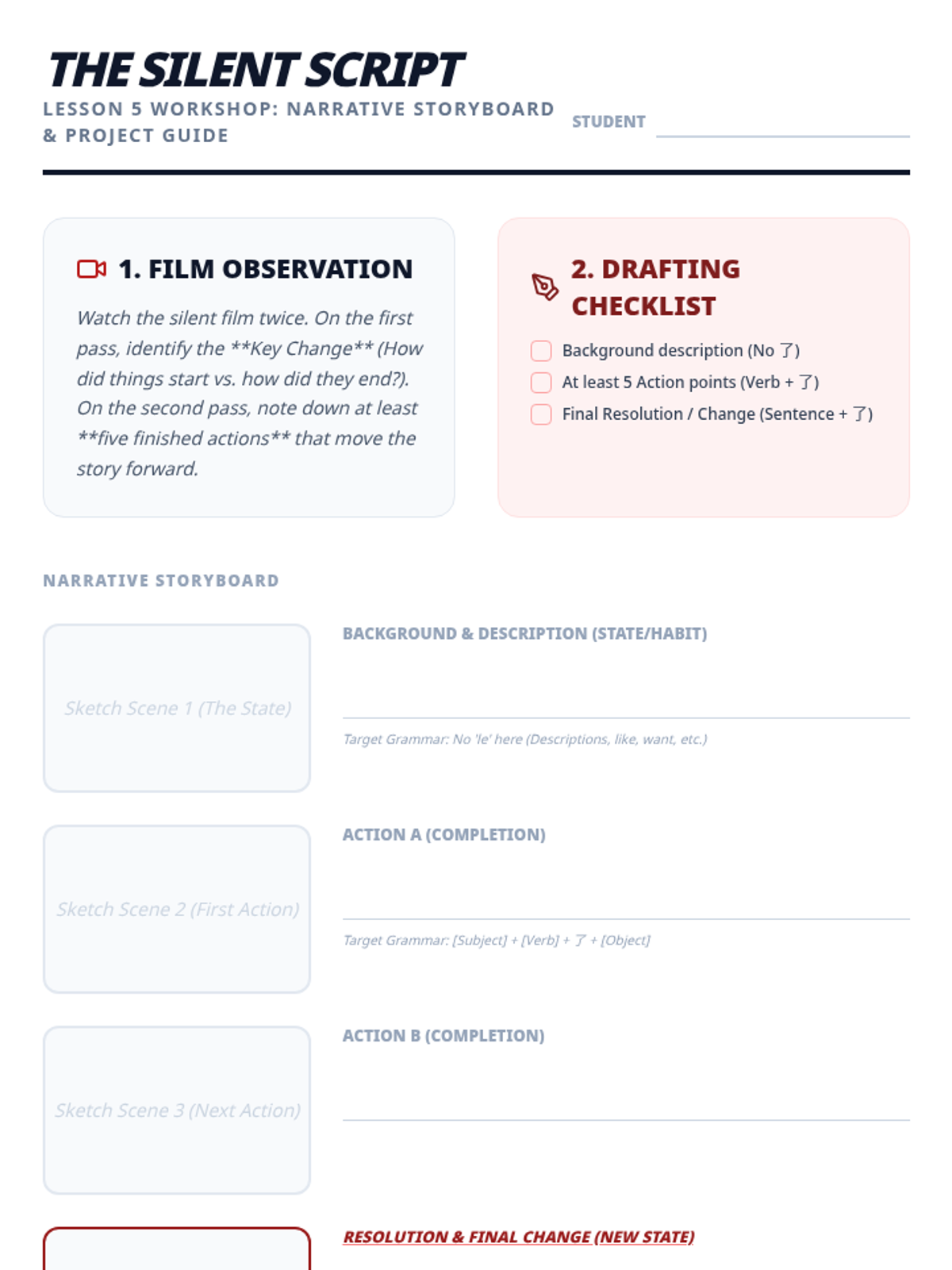
A planning and scripting template for the final narrative retelling project. Includes a storyboard section, drafting checklist, and final script area to help students organize their use of completion and change markers.
Final project slides for a narrative workshop. Students must retell a silent film using the grammar concepts learned throughout the sequence, focusing on narrative flow and avoiding common errors.
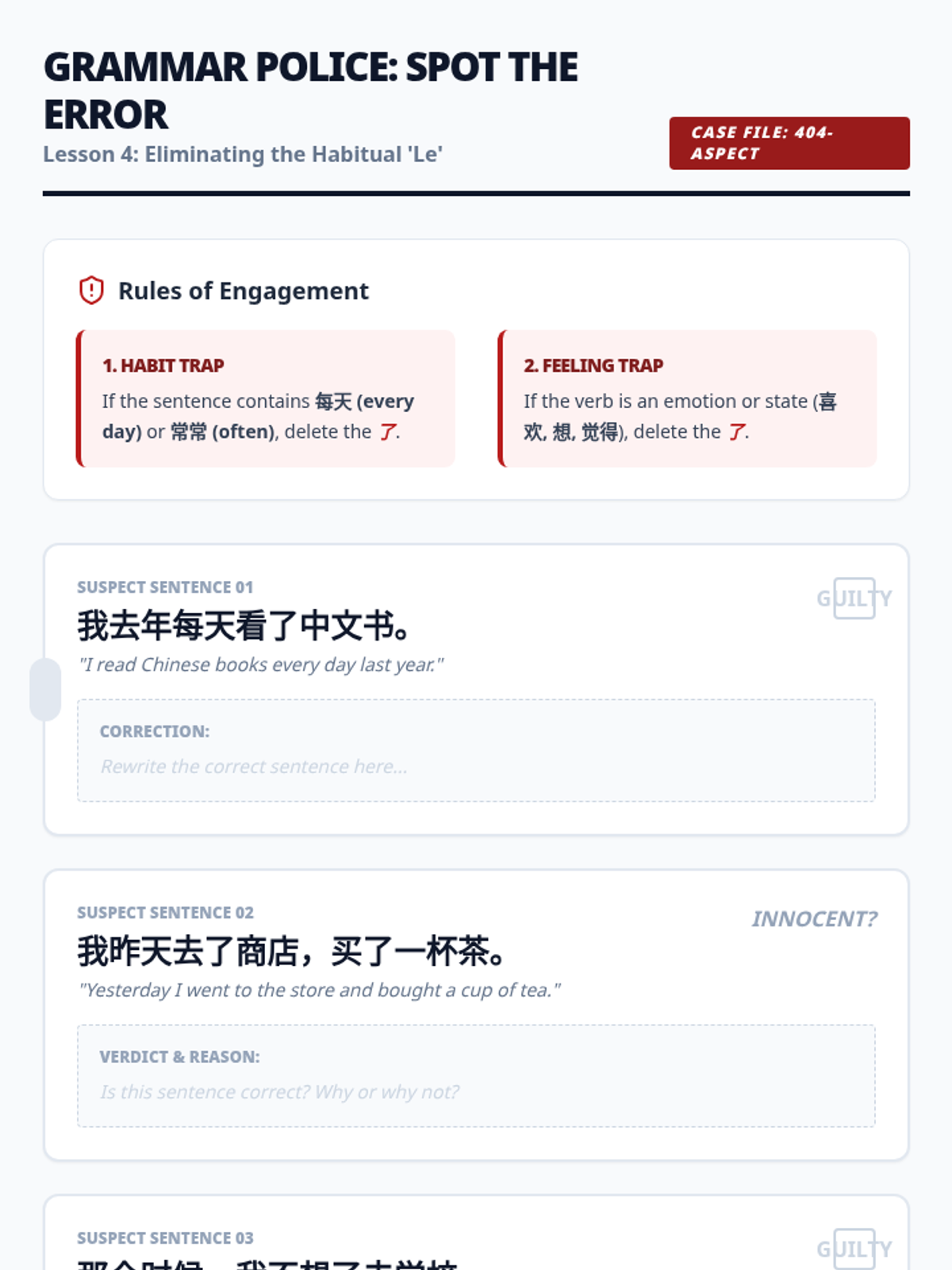
A 'Spot the Error' worksheet designed to challenge students' tendency to over-use 'le'. Students must identify and correct sentences where 'le' is used incorrectly with habits, psychological states, or permanent descriptions.
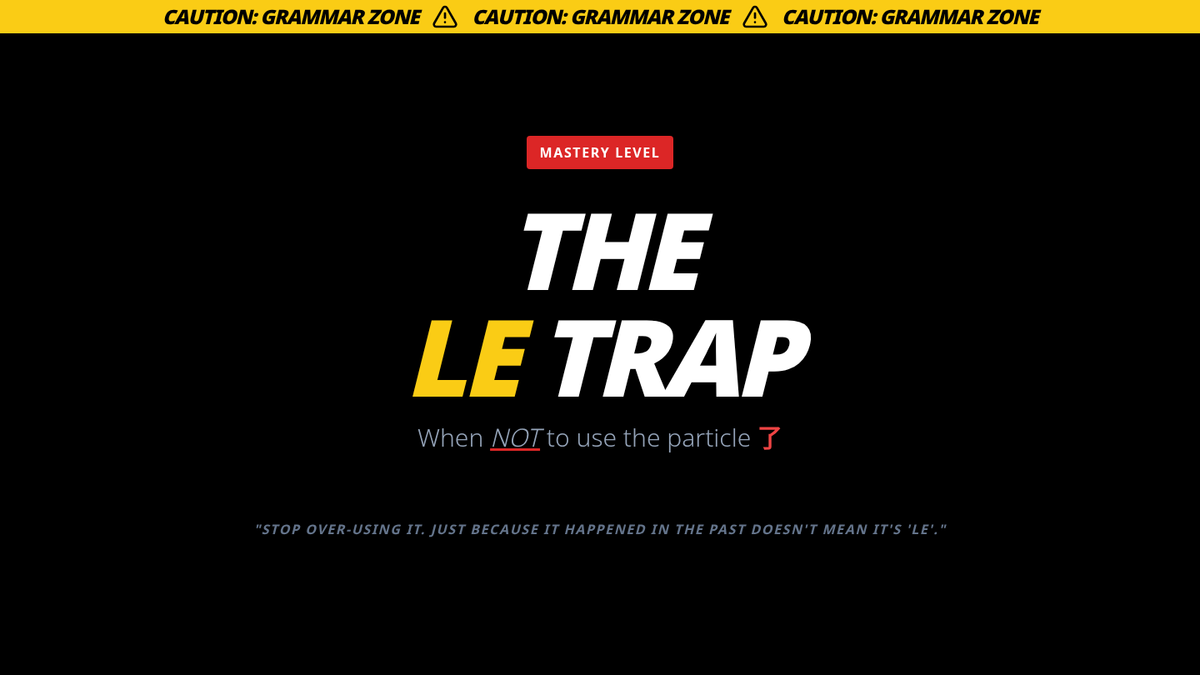
A slide deck focusing on the most common errors in 'le' usage, specifically prohibiting its use with habitual actions, psychological states, and descriptions of the past.
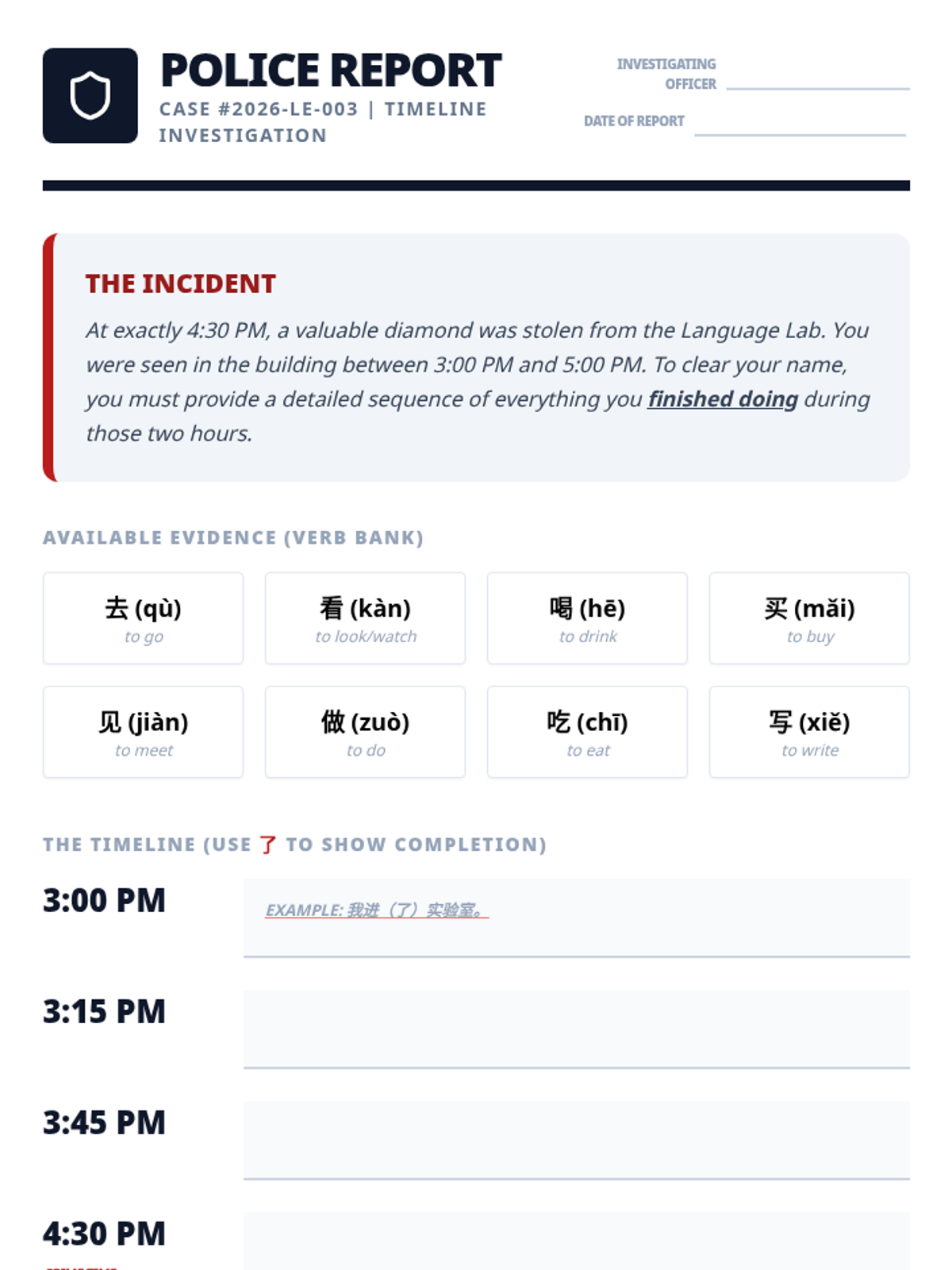
A scenario-based worksheet where students create a timeline of completed events to provide an 'alibi' for a crime. Focuses on sequencing multiple 'V + le' actions in a narrative.
A presentation deck on sequencing completed events in Mandarin, illustrating the 'Chain Reaction' logic of narrative flow and distinguishing between time markers and completion markers.
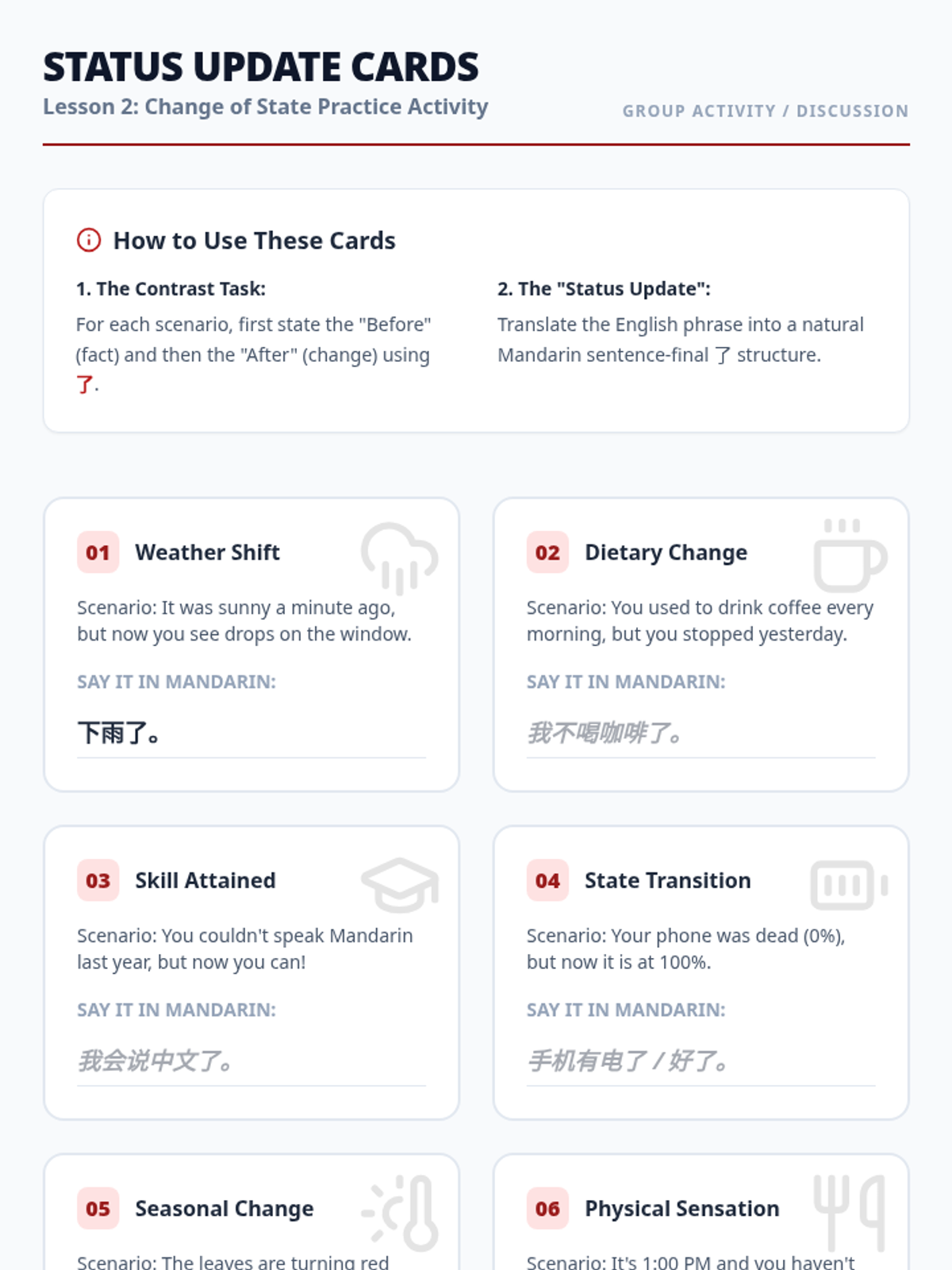
Scenario-based cards for students to practice expressing 'Change of State' in Mandarin. Each card provides a context where a situation has shifted, prompting the use of sentence-final 'le'.
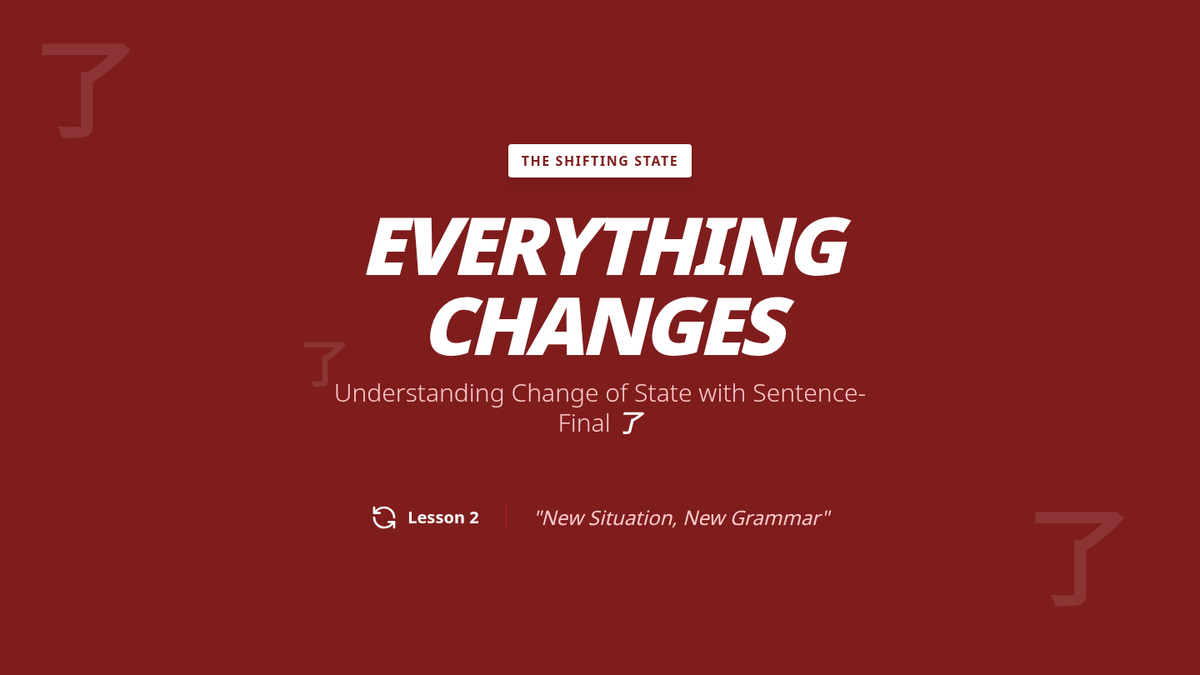
A visual guide to the 'Sentence-Final 了' (Change of State), contrasting it with general facts and describing how it translates to 'now', 'already', or 'not anymore' in English.
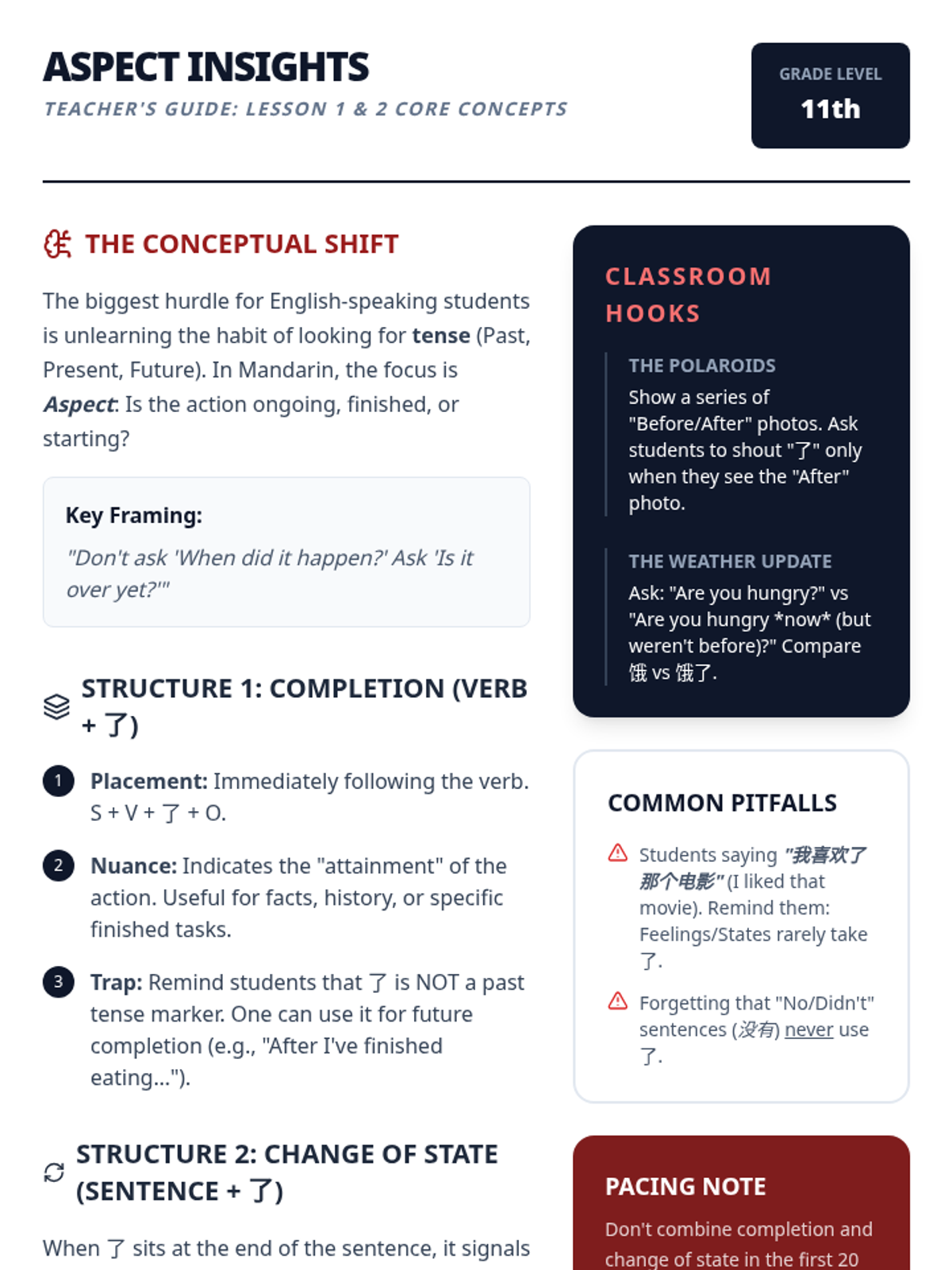
A teacher guide summarizing the pedagogical strategies for teaching 'le', including conceptual framing, structural breakdowns, and common pitfalls to avoid.
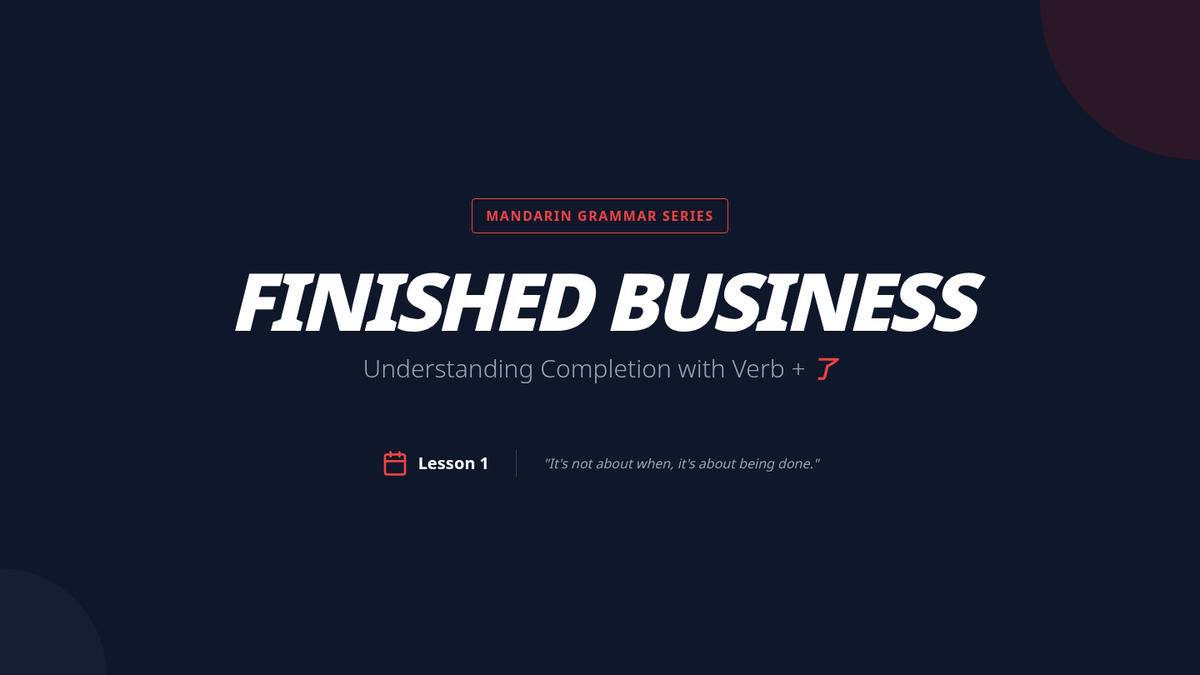
A presentation deck introducing the 'V + le' structure, focusing on the visual comparison between habitual and completed actions and the fundamental concept of aspect markers.
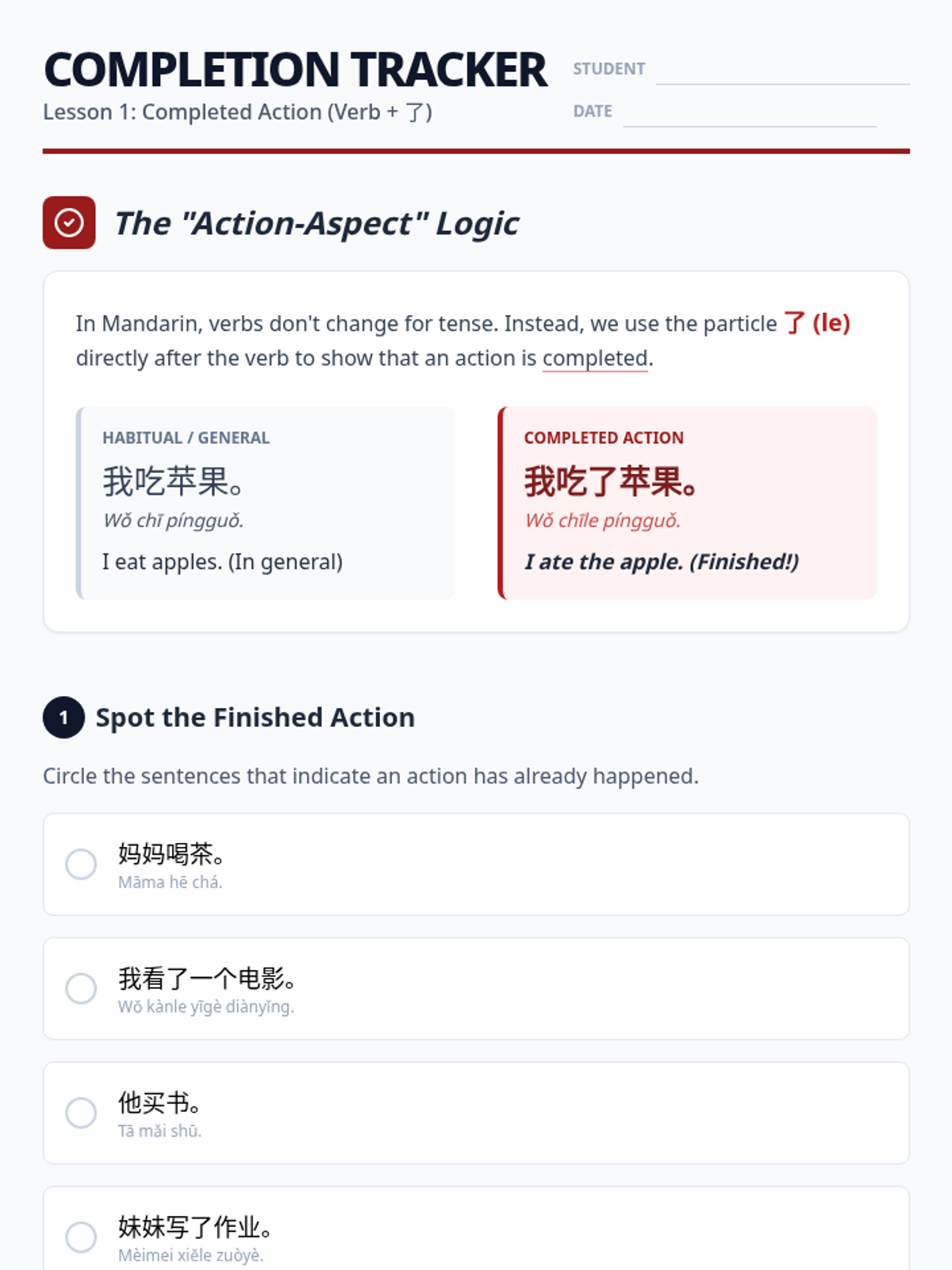
A student worksheet for identifying and constructing sentences using the 'V + le' structure to indicate action completion. Includes conceptual comparisons and transformation exercises.
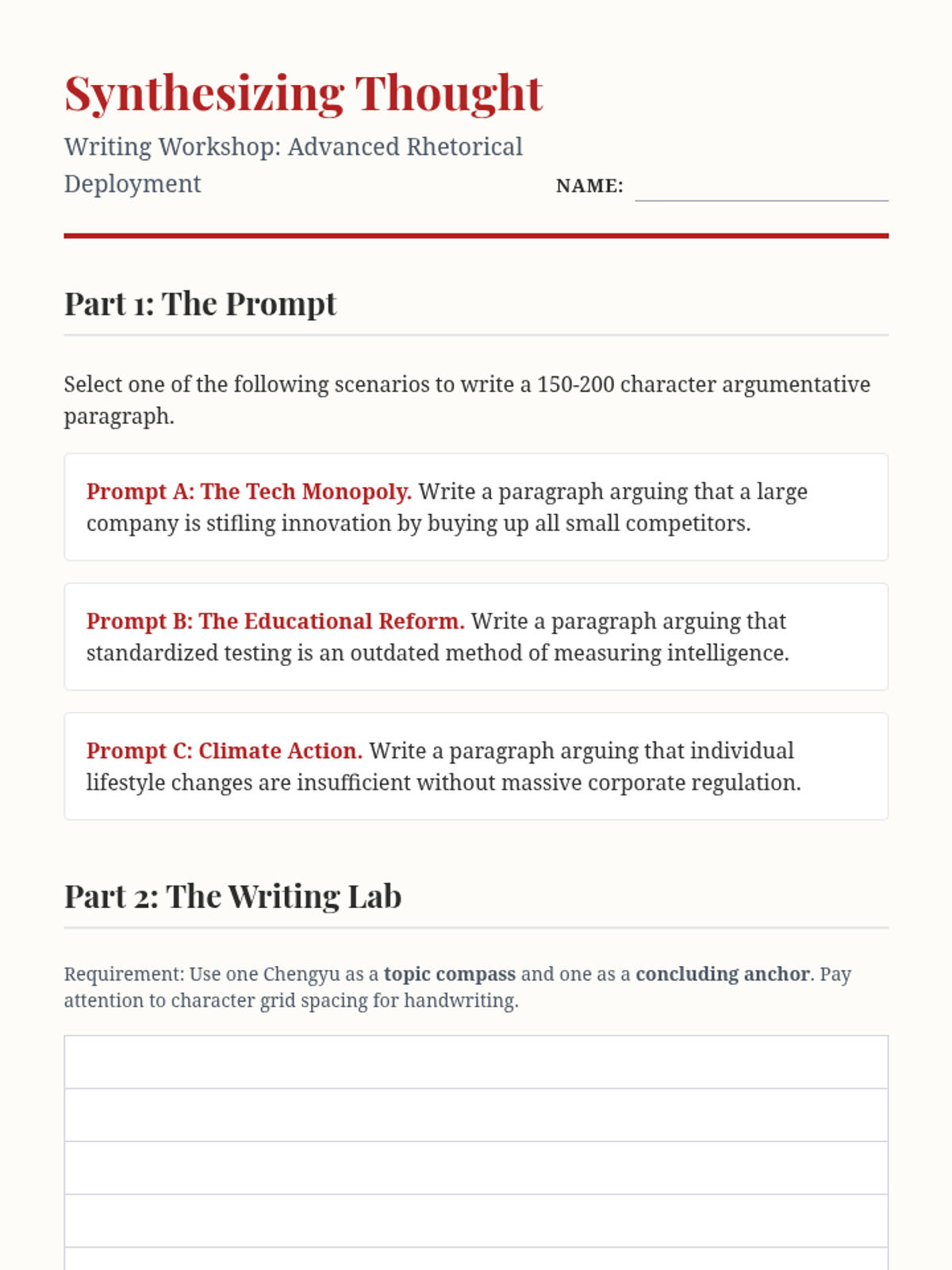
A writing workshop packet for the Synthesis lesson. Includes argumentative prompts, a character grid for composition, and a peer feedback rubric.
Slides for the Synthesizing Thought lesson. Covers the rhetorical strategies of using idioms as 'topic compasses' or 'concluding anchors' in advanced writing.
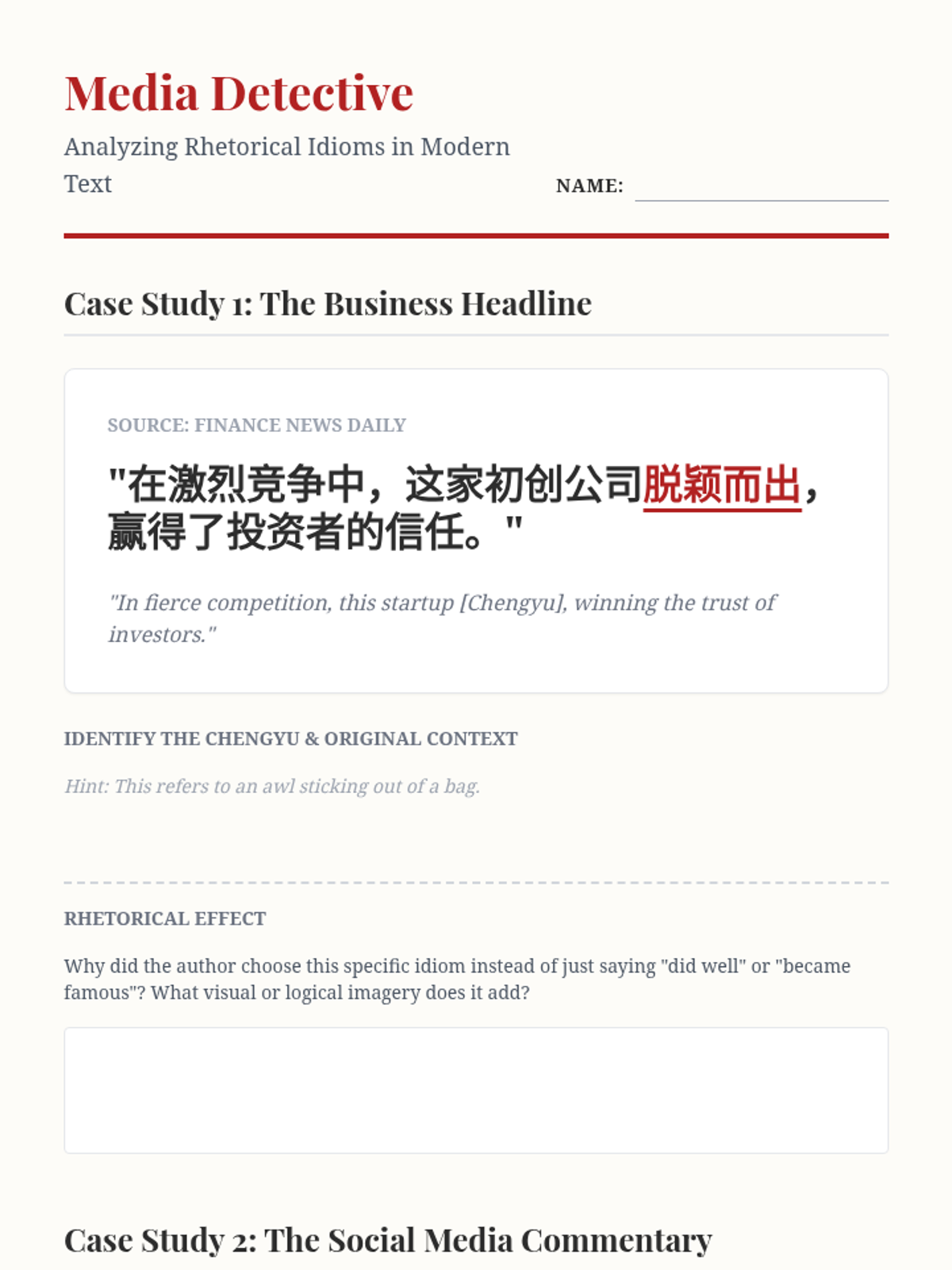
A media analysis worksheet where students identify and analyze the rhetorical effect of Chengyu in modern news headlines and social media posts.
Slides for the Idioms in Modern Media lesson. Covers rhetorical use in headlines and the prevalence of puns in internet subcultures.
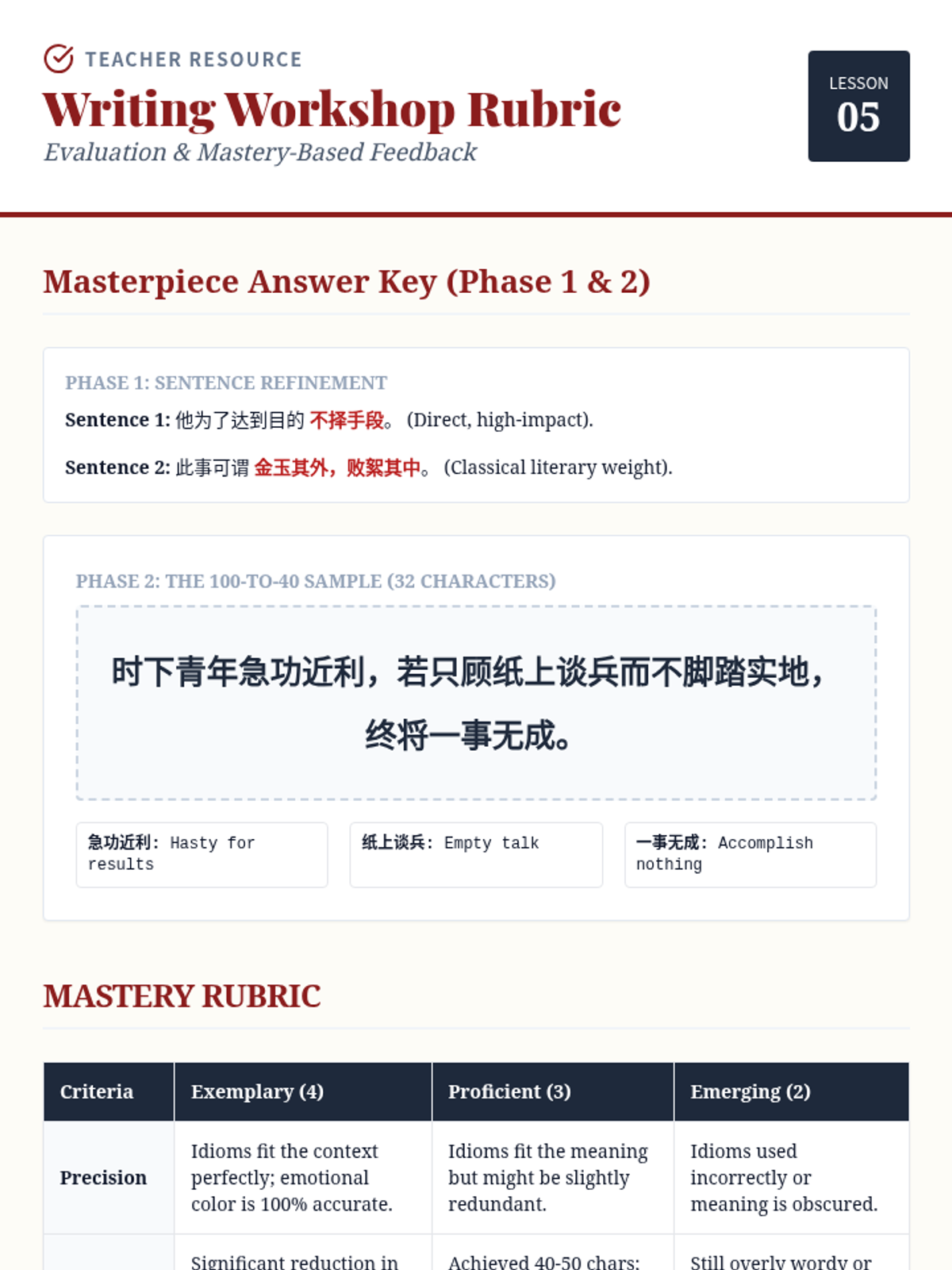
A teacher guide for the final writing workshop, featuring a comprehensive assessment rubric, sample answers for the 100-to-40 character challenge, and specific feedback prompts for guiding advanced Mandarin learners.
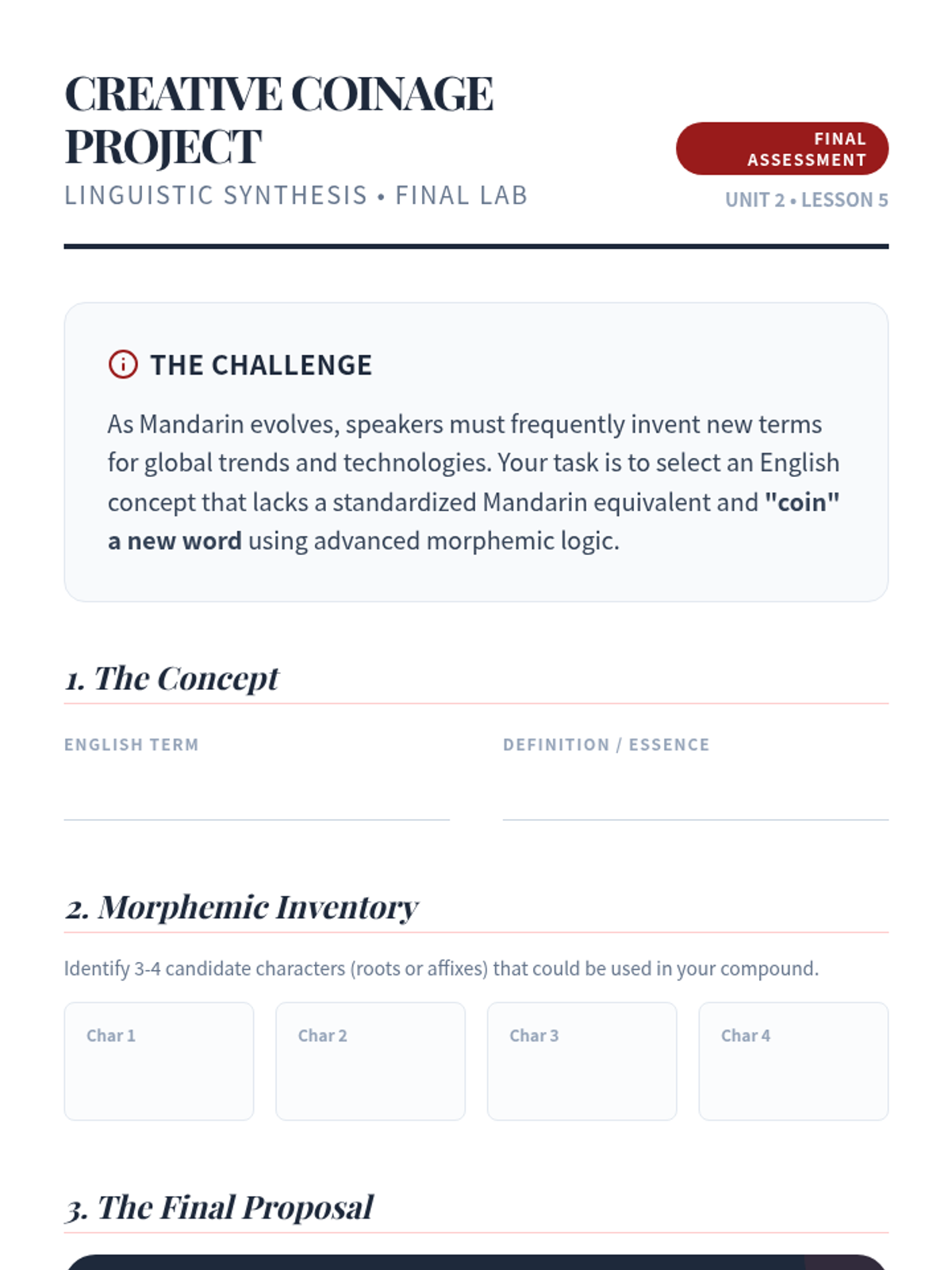
Final project guide for students to create and justify their own Mandarin neologisms for modern English concepts.
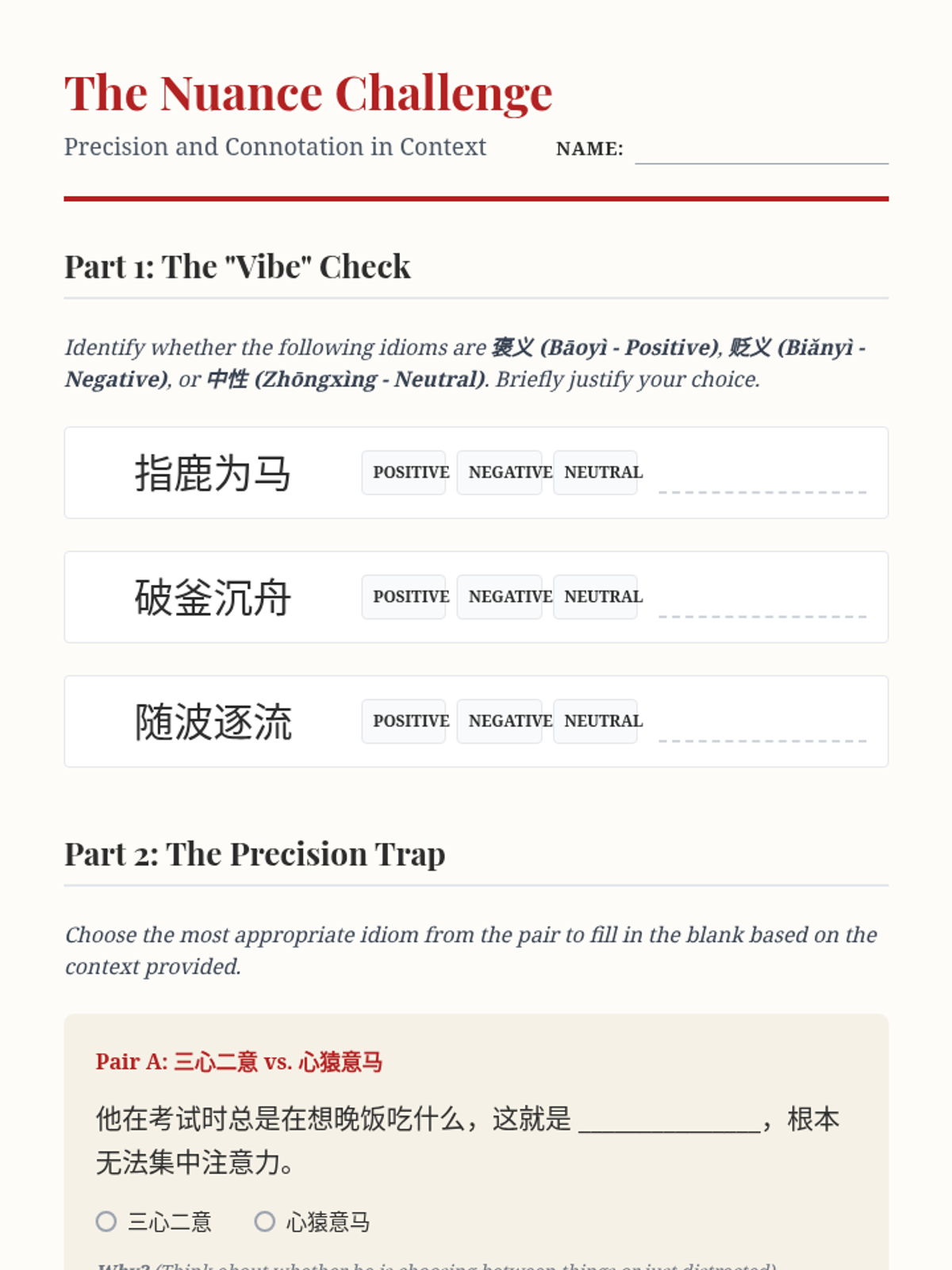
A cloze activity for the Synonymous Idioms lesson. Students choose between similar idioms based on context and connotation, justifying their choices.
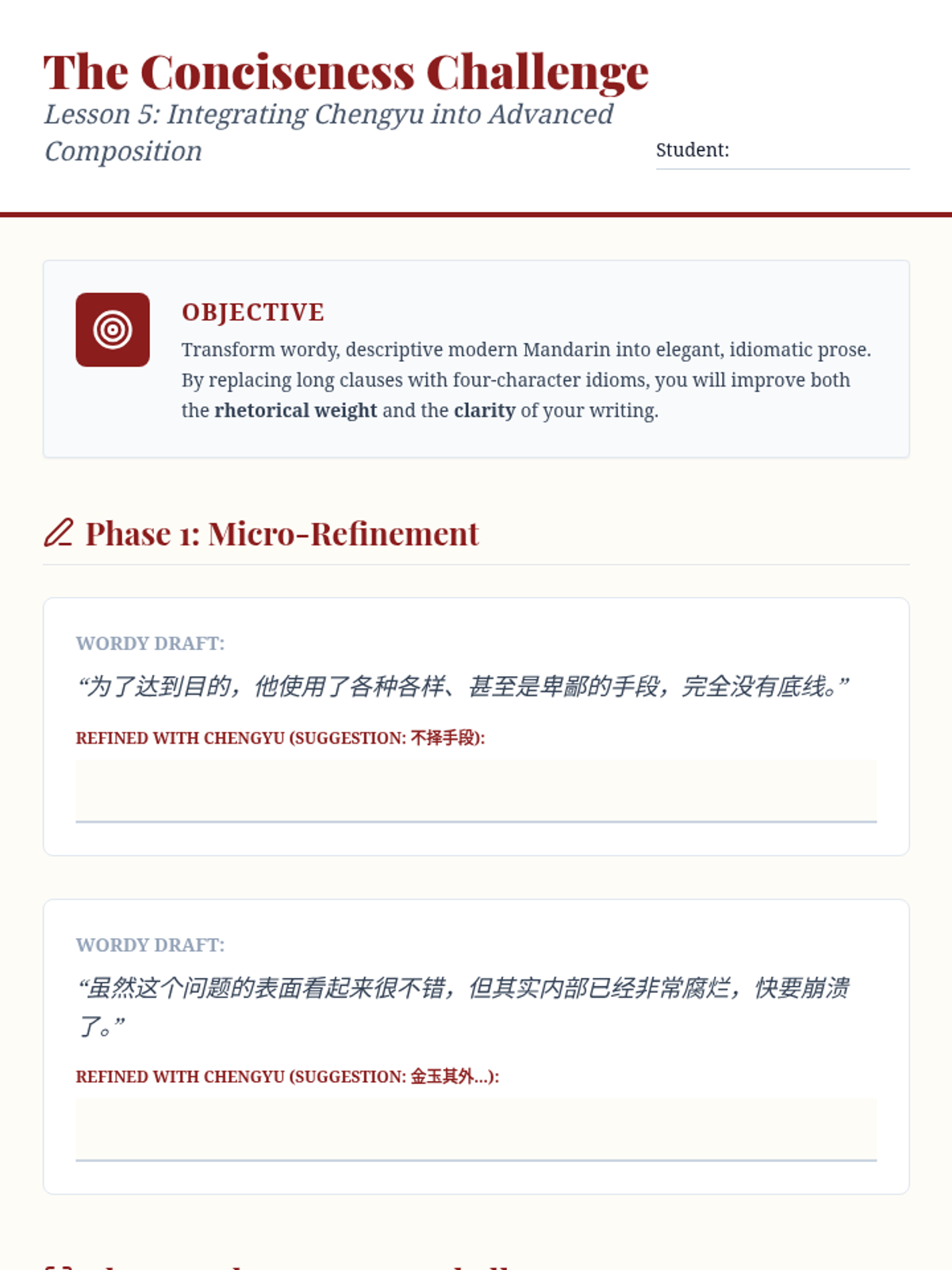
A writing-focused worksheet for the final lesson. It challenges students to refine wordy sentences and rewrite a full 100-character paragraph into a concise 40-character idiomatic argument. Includes a character grid for precision.
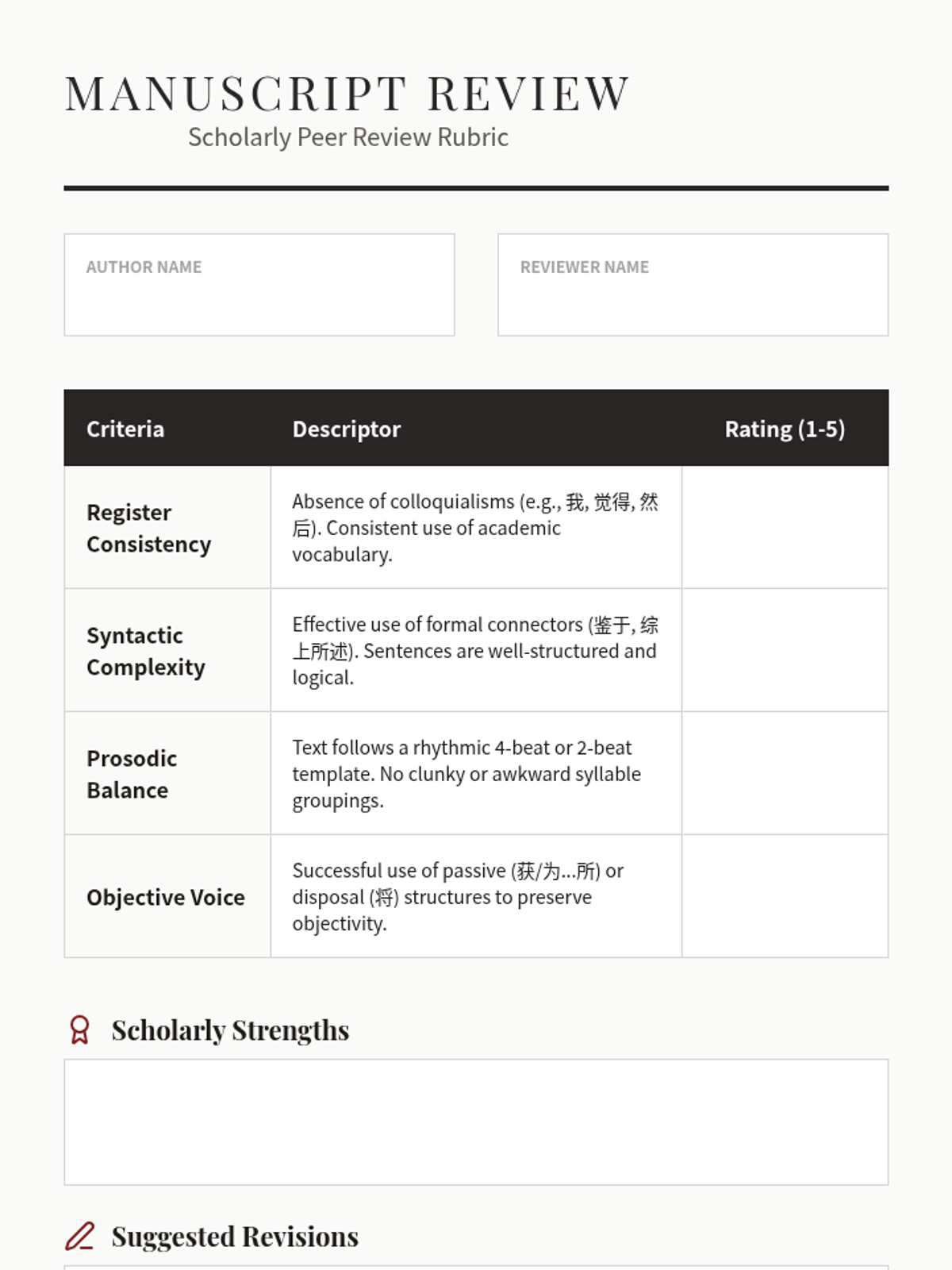
A peer review rubric for assessing academic abstracts, focusing on register consistency, syntax, prosody, and objectivity.
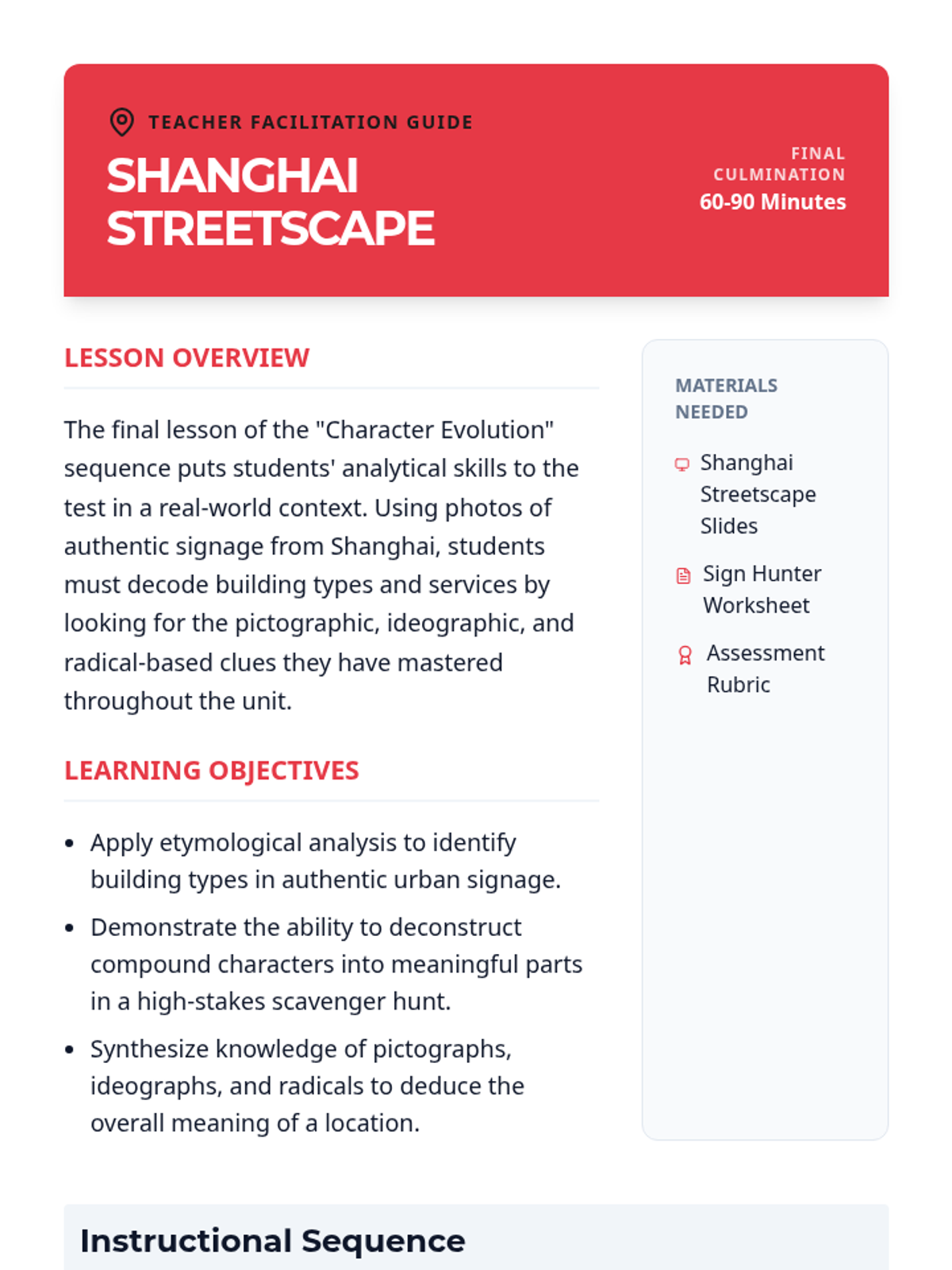
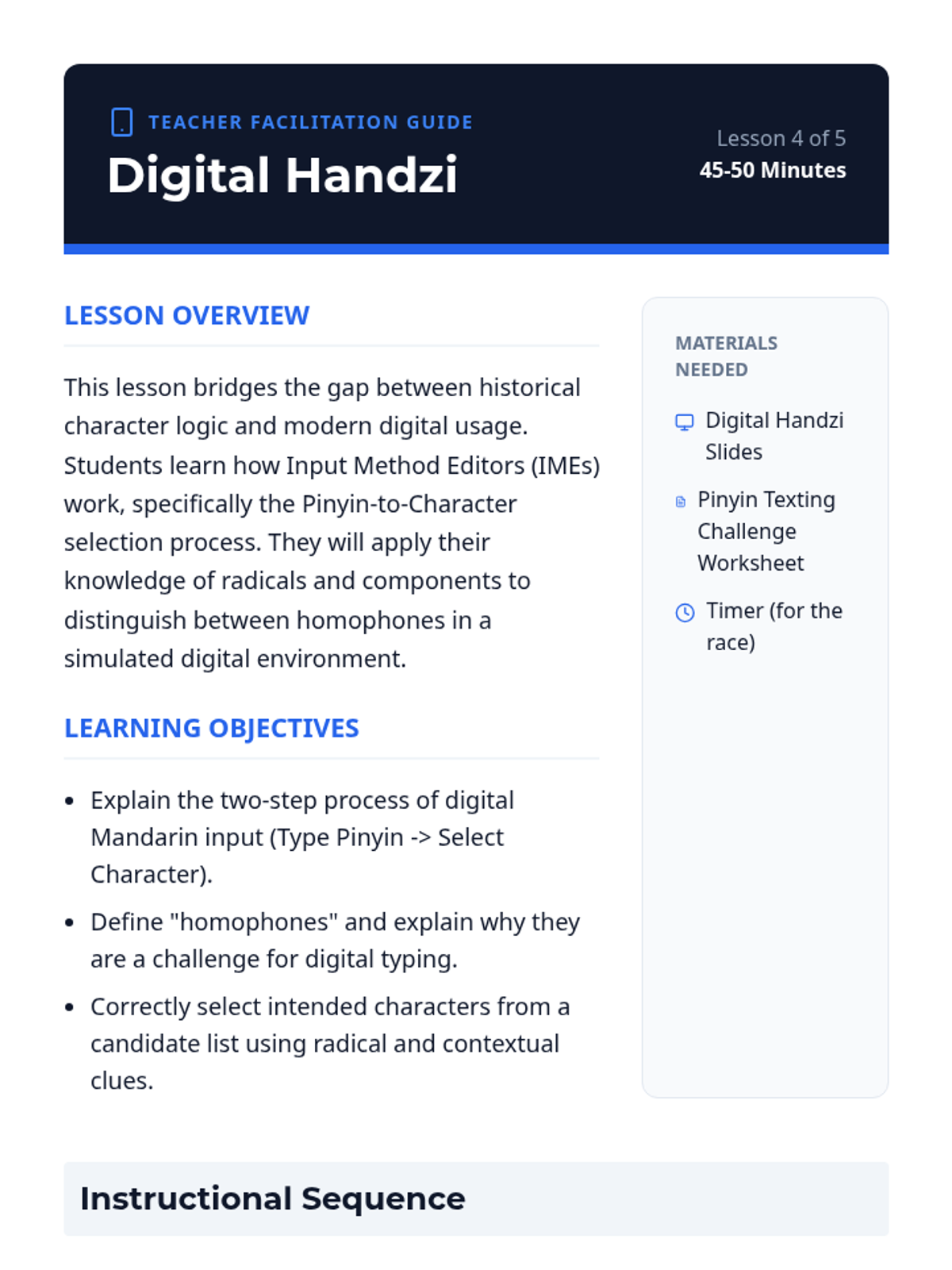
Teacher facilitation guide for Lesson 5, including instructional steps, learning objectives, and digital literacy tips.
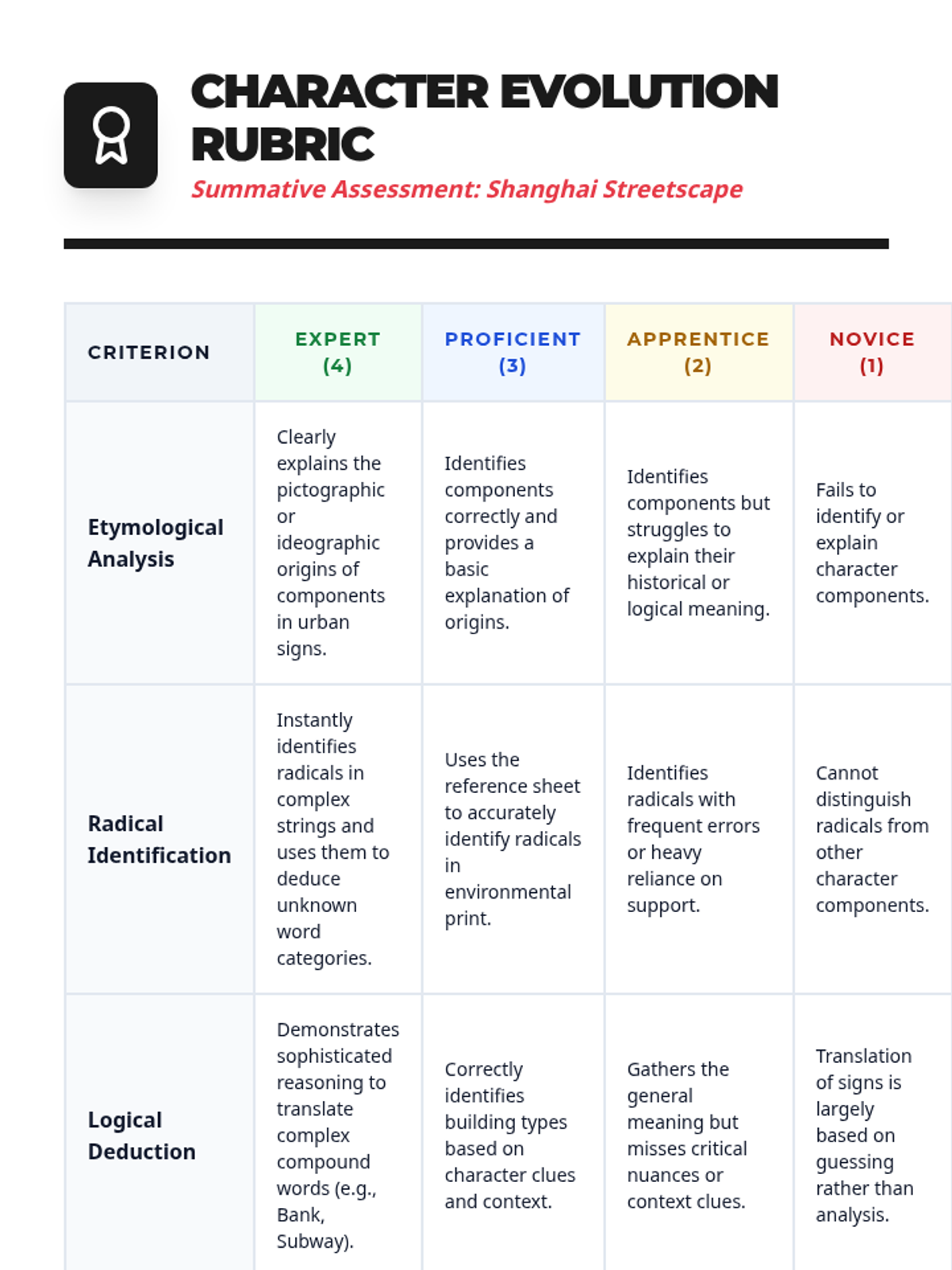
Summative assessment rubric for the Character Evolution sequence, evaluating students on etymological analysis, radical identification, and logical deduction.
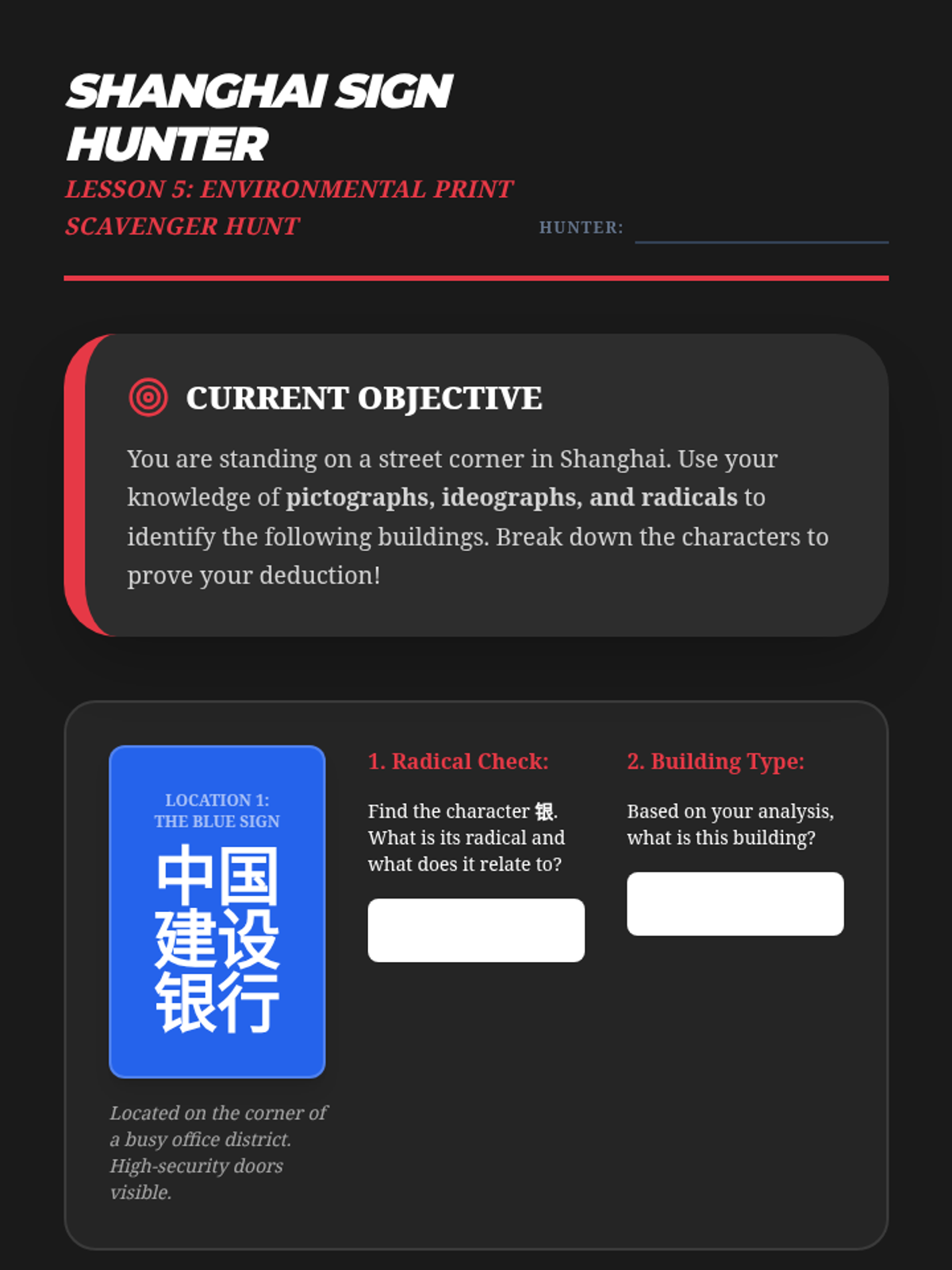
A culmination worksheet where students analyze real-world Chinese street signs. They apply their knowledge of radicals and high-frequency characters to identify keywords and deduce the general meaning of authentic texts.
Instructional slides for Lesson 5, featuring urban signage case studies, restaurant vocabulary analysis, and a mission brief for the final activity.
Teacher facilitation guide for Lesson 4, including instructional steps, learning objectives, and digital literacy tips.
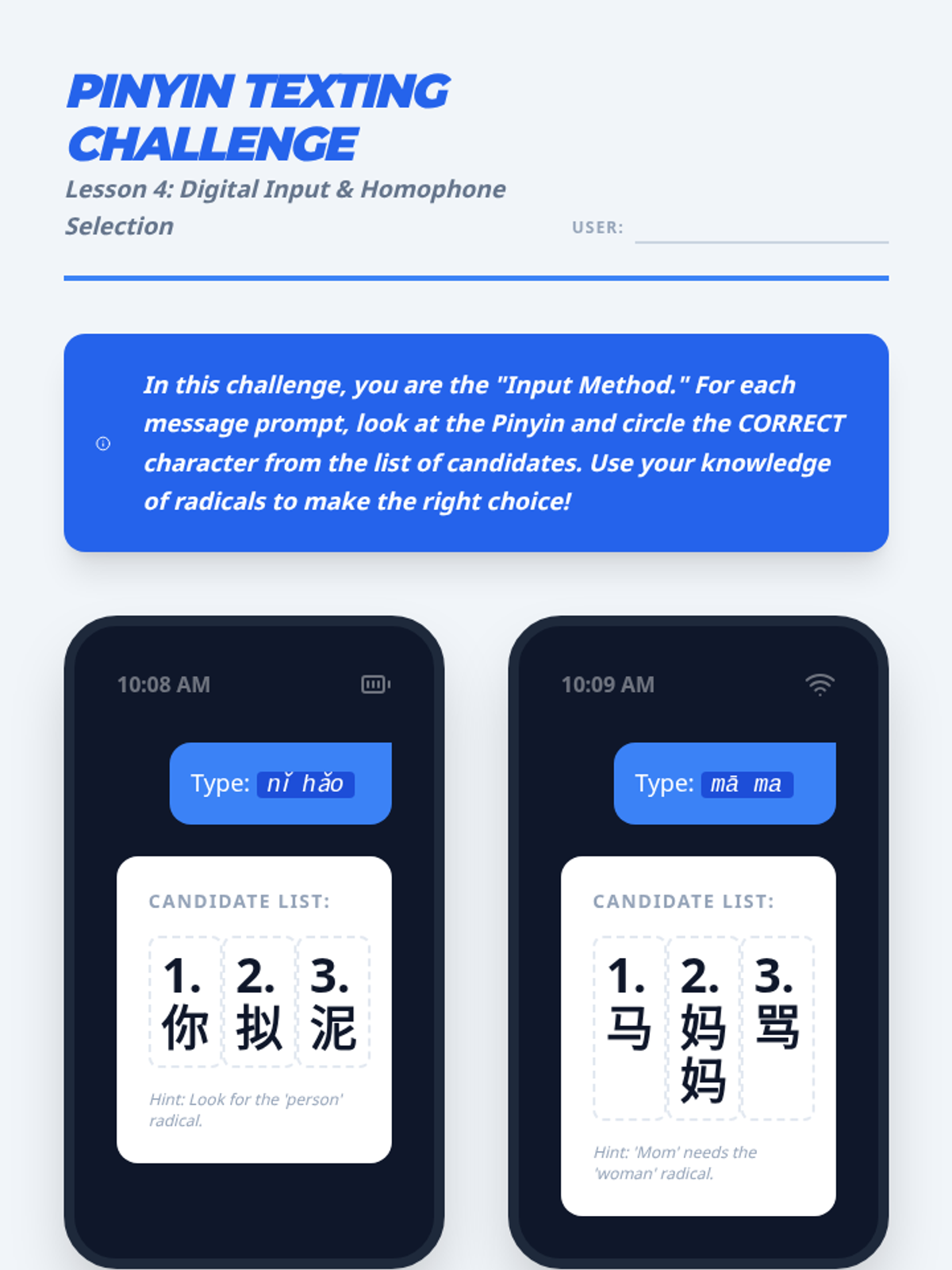
An activity worksheet simulating digital input on a smartphone, challenging students to select the correct characters from a list of homophones based on pinyin prompts.
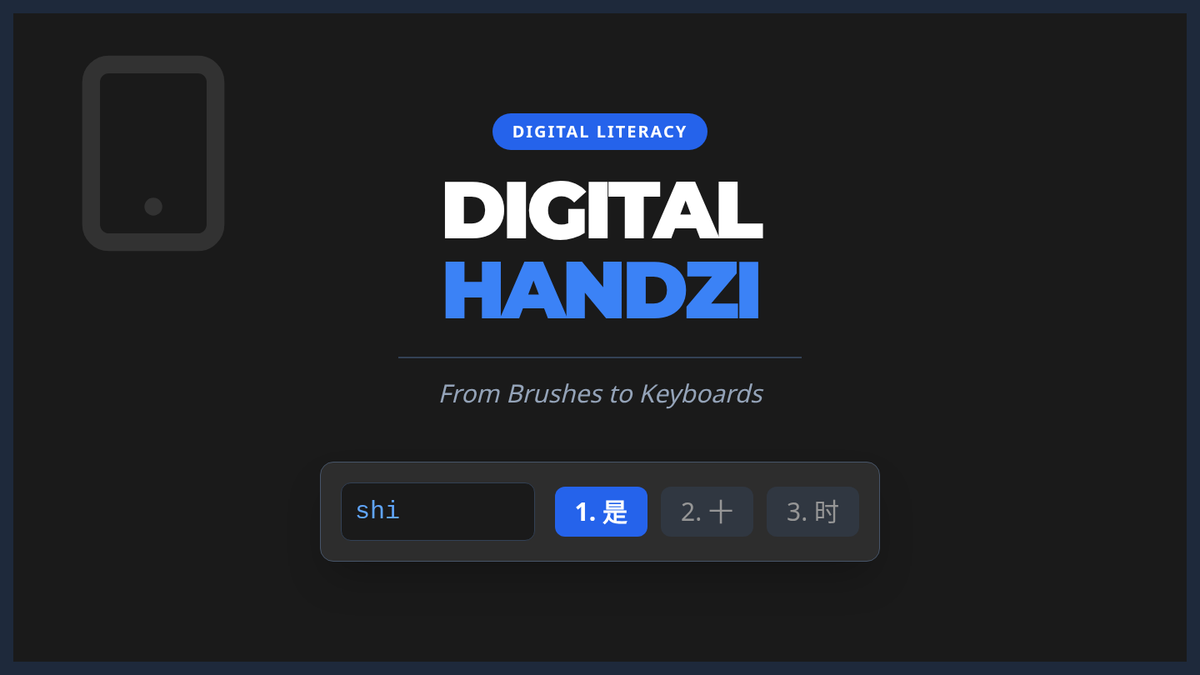
Instructional slides for Lesson 4, covering digital input methods (IME), the pinyin-to-character selection process, and the challenge of homophones.
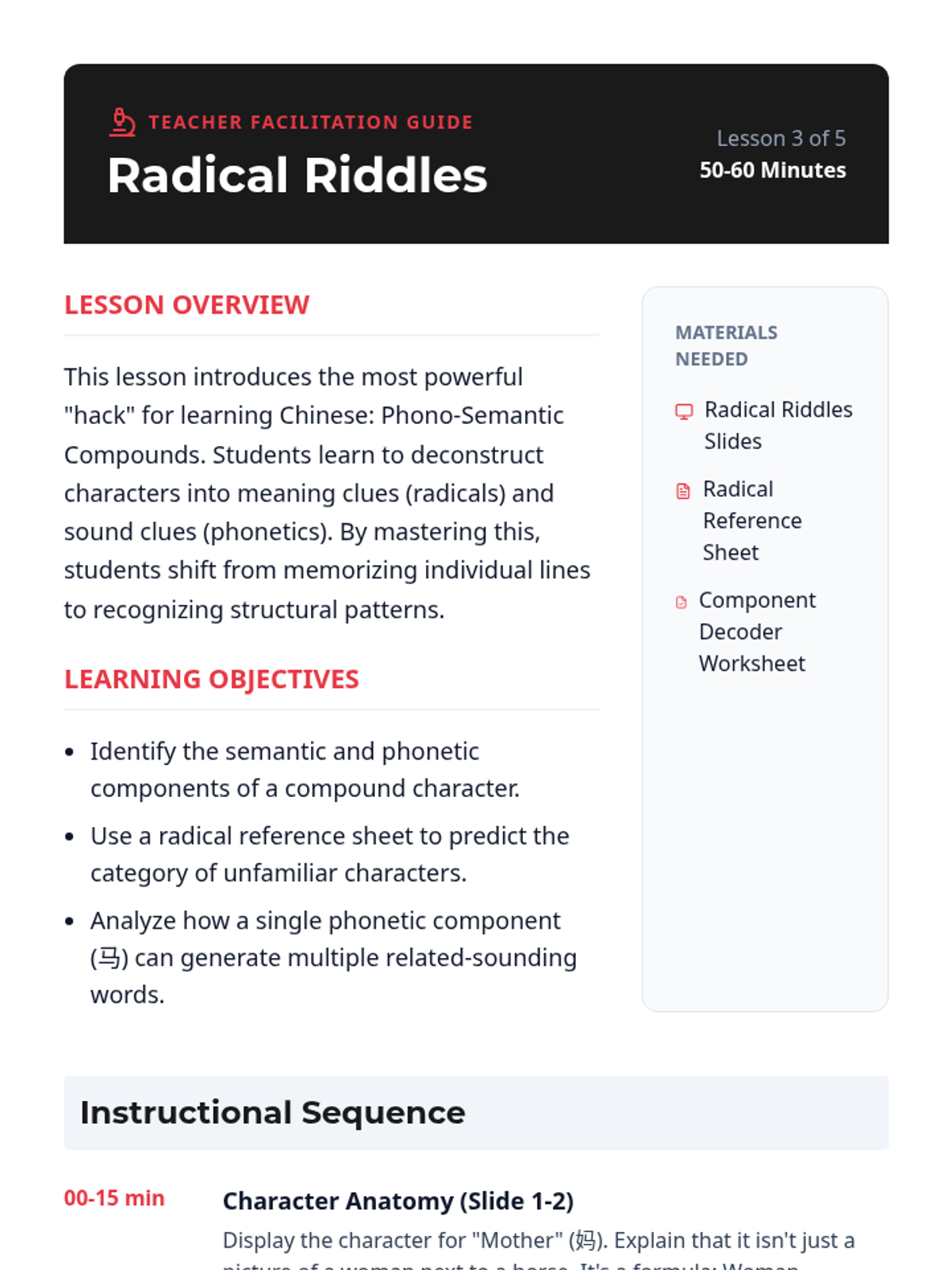
Teacher facilitation guide for Lesson 3, including instructional steps, learning objectives, and differentiation strategies.
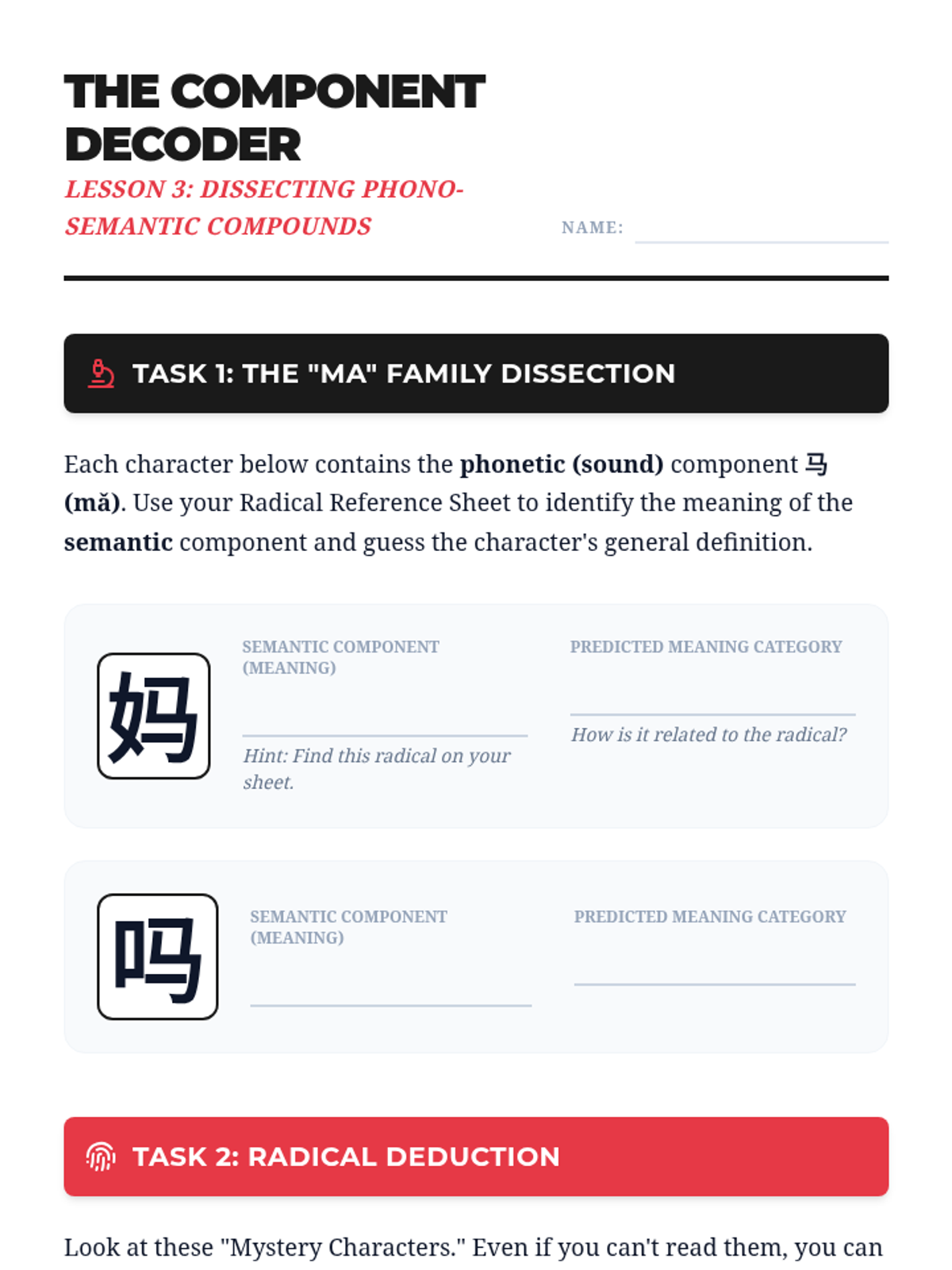
A worksheet for Lesson 3 where students practice identifying components of phono-semantic characters, predicting meanings based on radicals, and designing their own compound character.
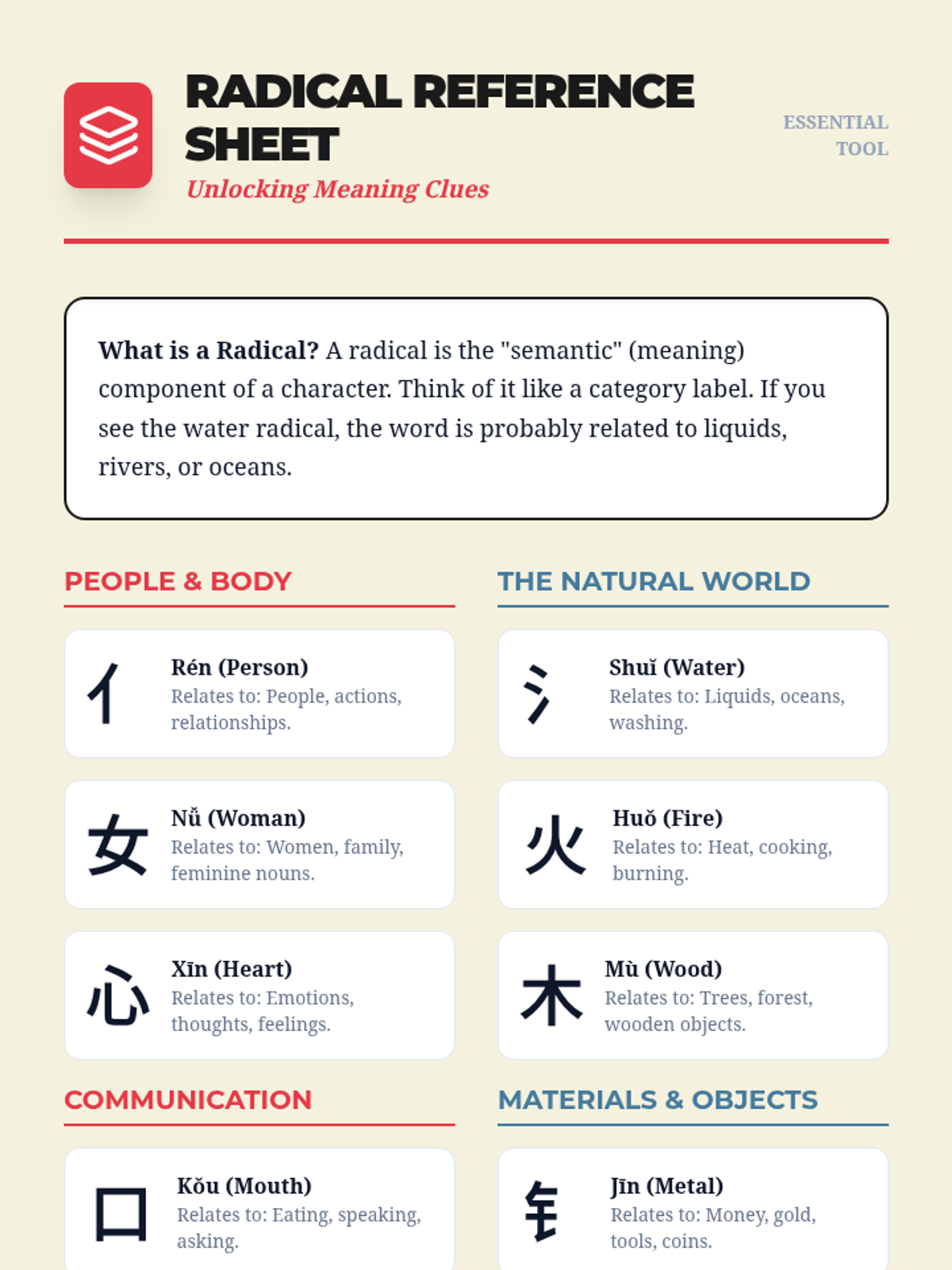
A visual reference sheet for students listing common radicals, their meanings, and typical character associations. Essential for the Lesson 3 decoding activity.
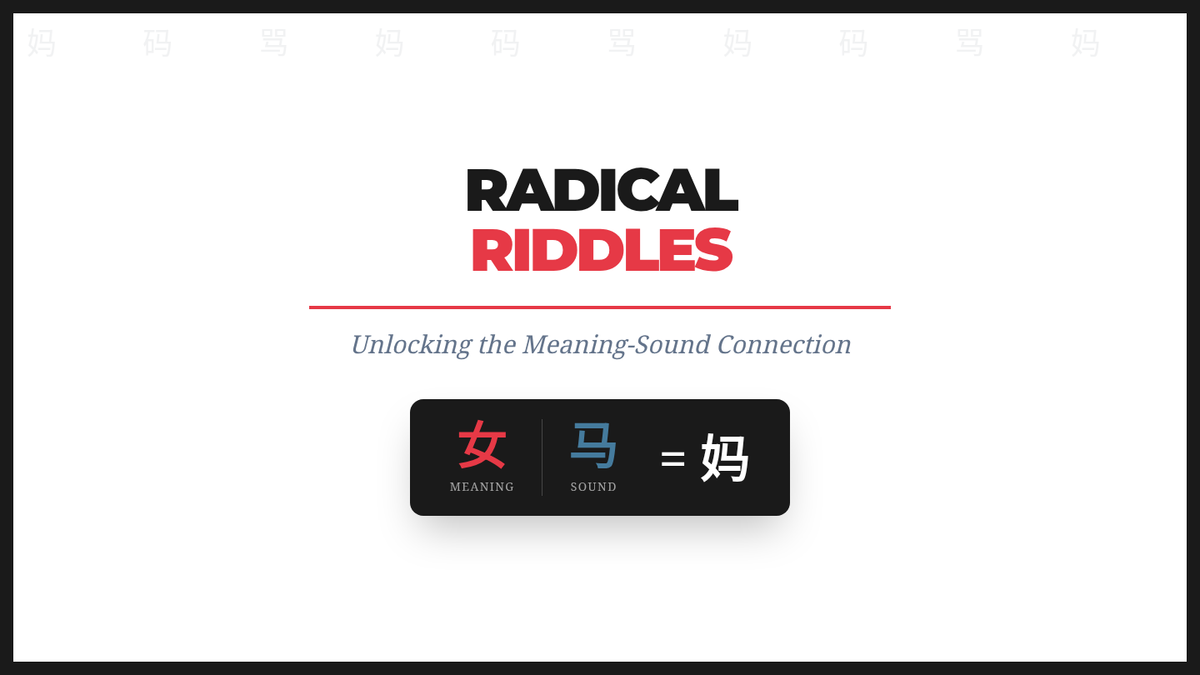
Instructional slides for Lesson 3, introducing phono-semantic compounds (Xíngshēngzì). Explains the meaning-sound split using the 'Ma' family and common radicals.
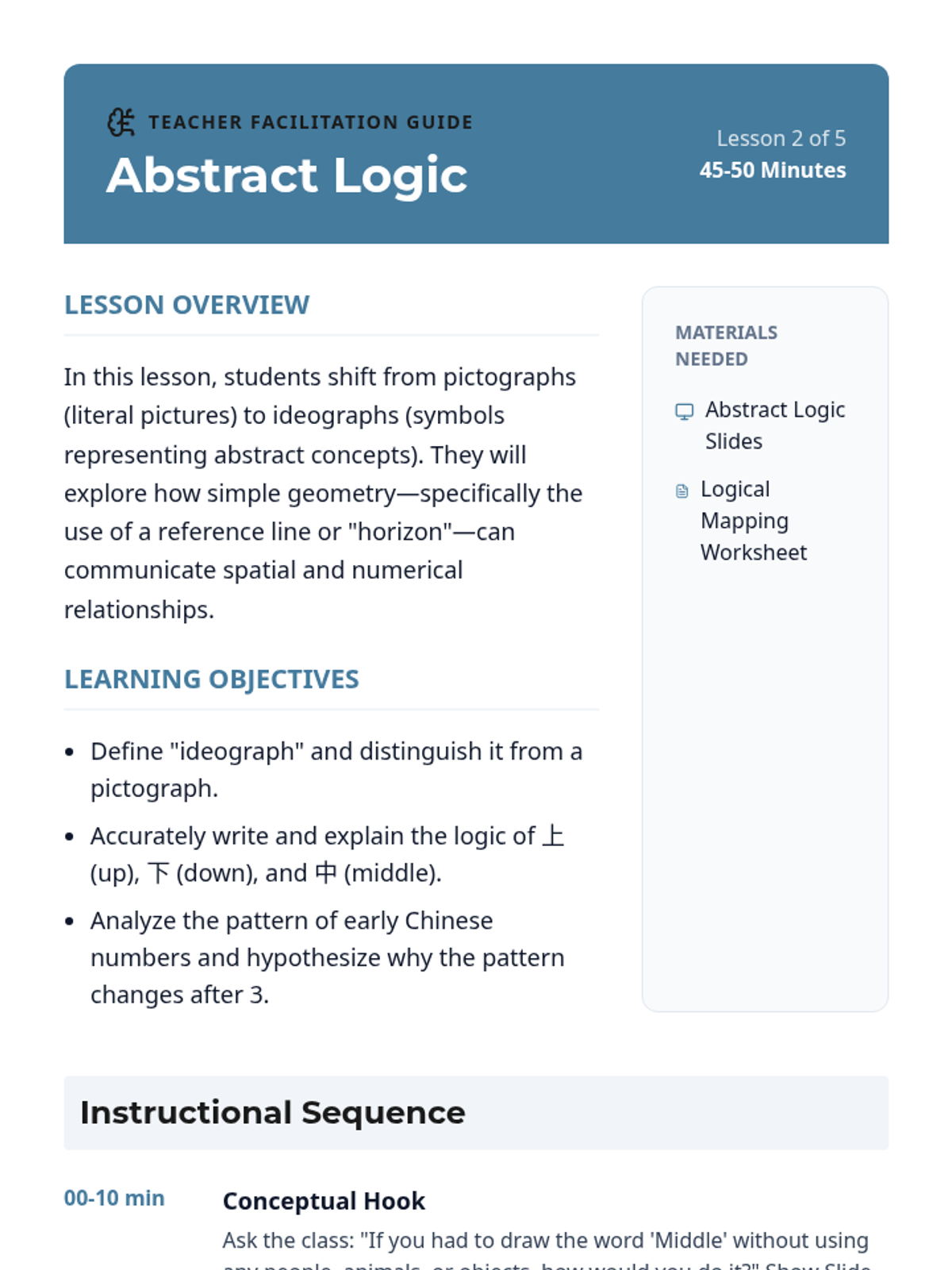
Teacher facilitation guide for Lesson 2, including lesson pacing, discussion prompts, and historical context for ideographs.
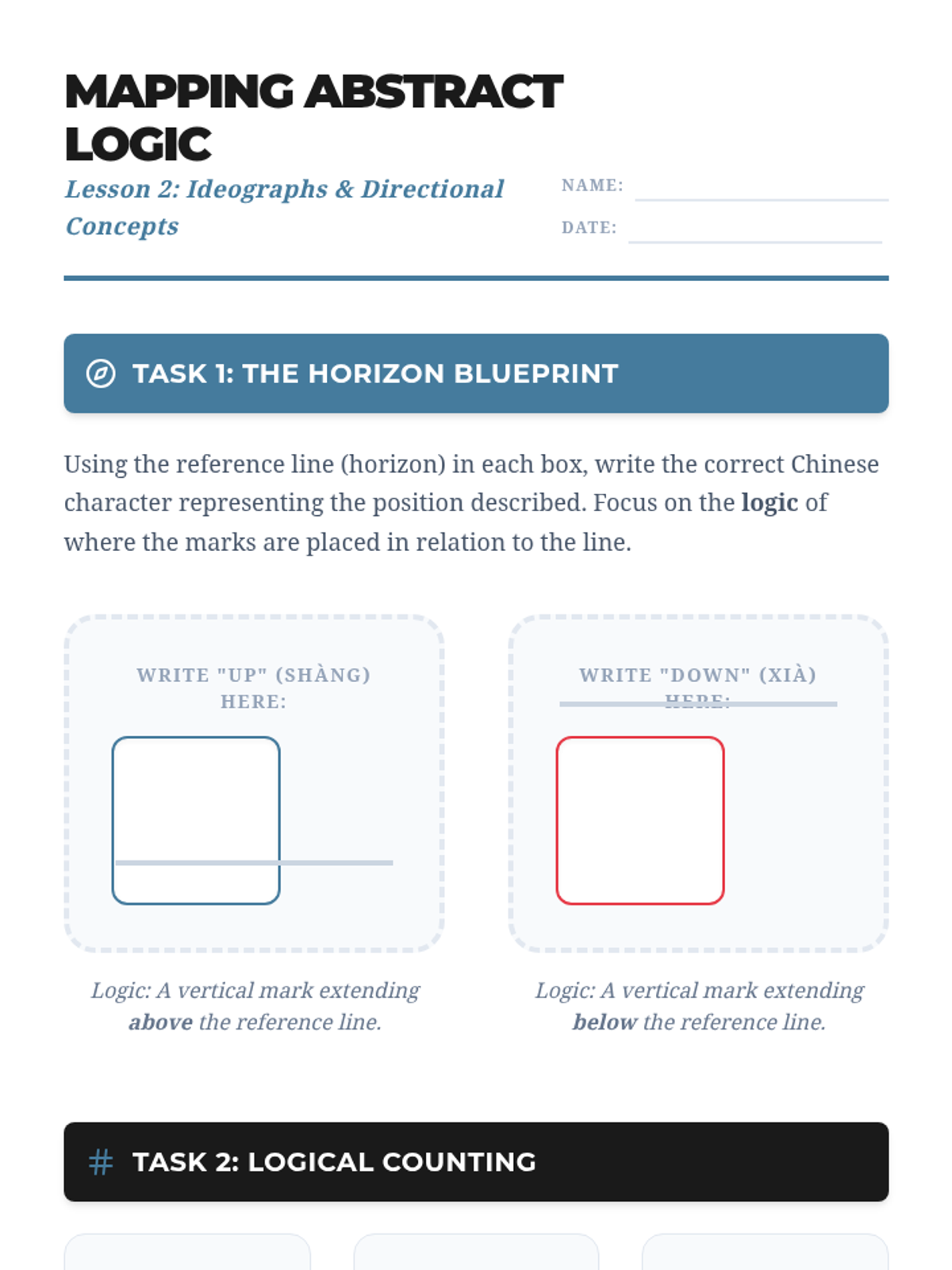
A worksheet for Lesson 2 where students practice writing directional ideographs, analyze numerical patterns, and experiment with conceptual character combinations.
Instructional slides for Lesson 2, covering abstract ideographs (Zhǐshìzì) like directional markers and numbers. Explains the logic of horizon lines and conceptual combinations.
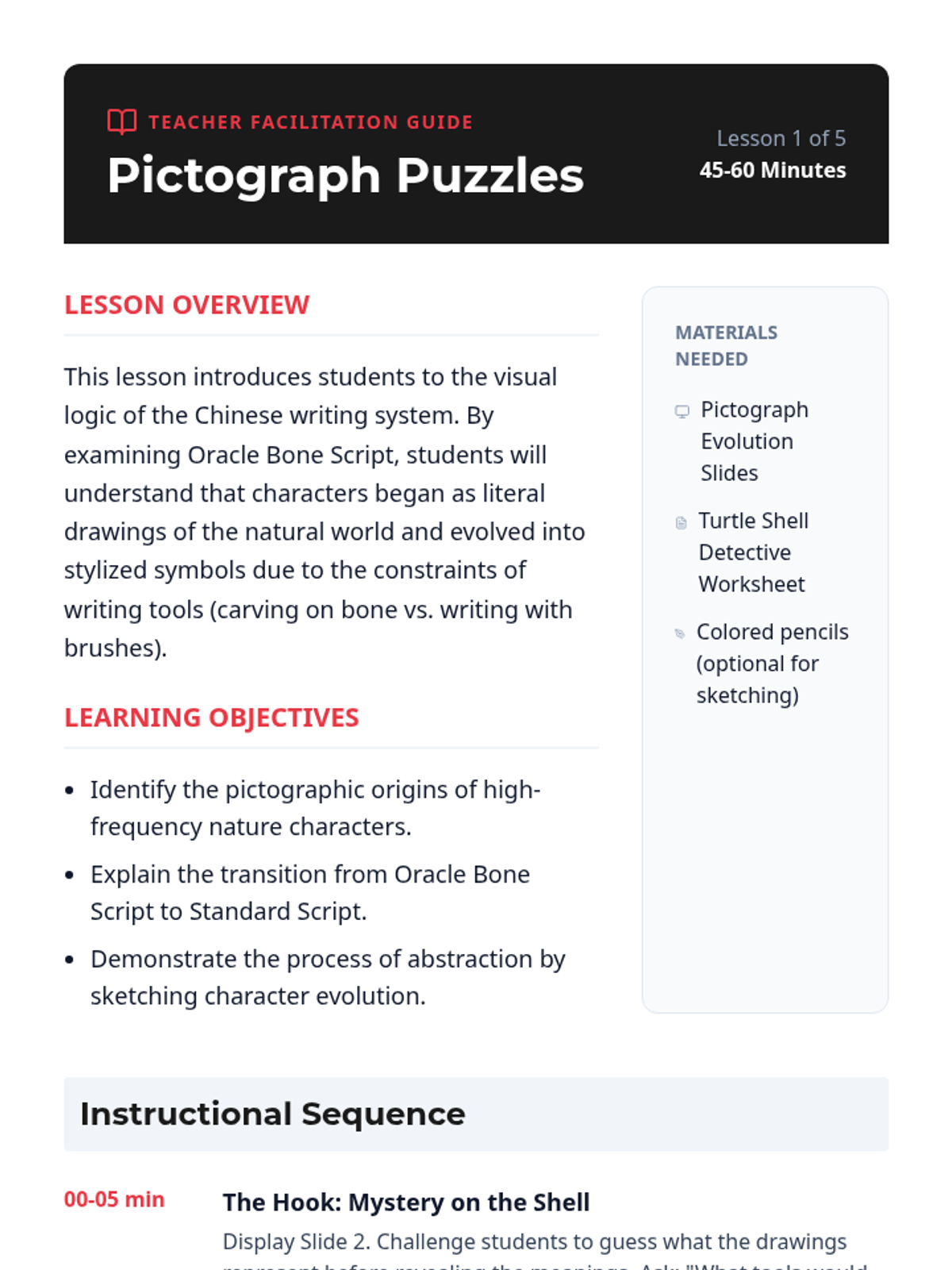
Teacher facilitation guide for Lesson 1, including instructional steps, learning objectives, and differentiation strategies.
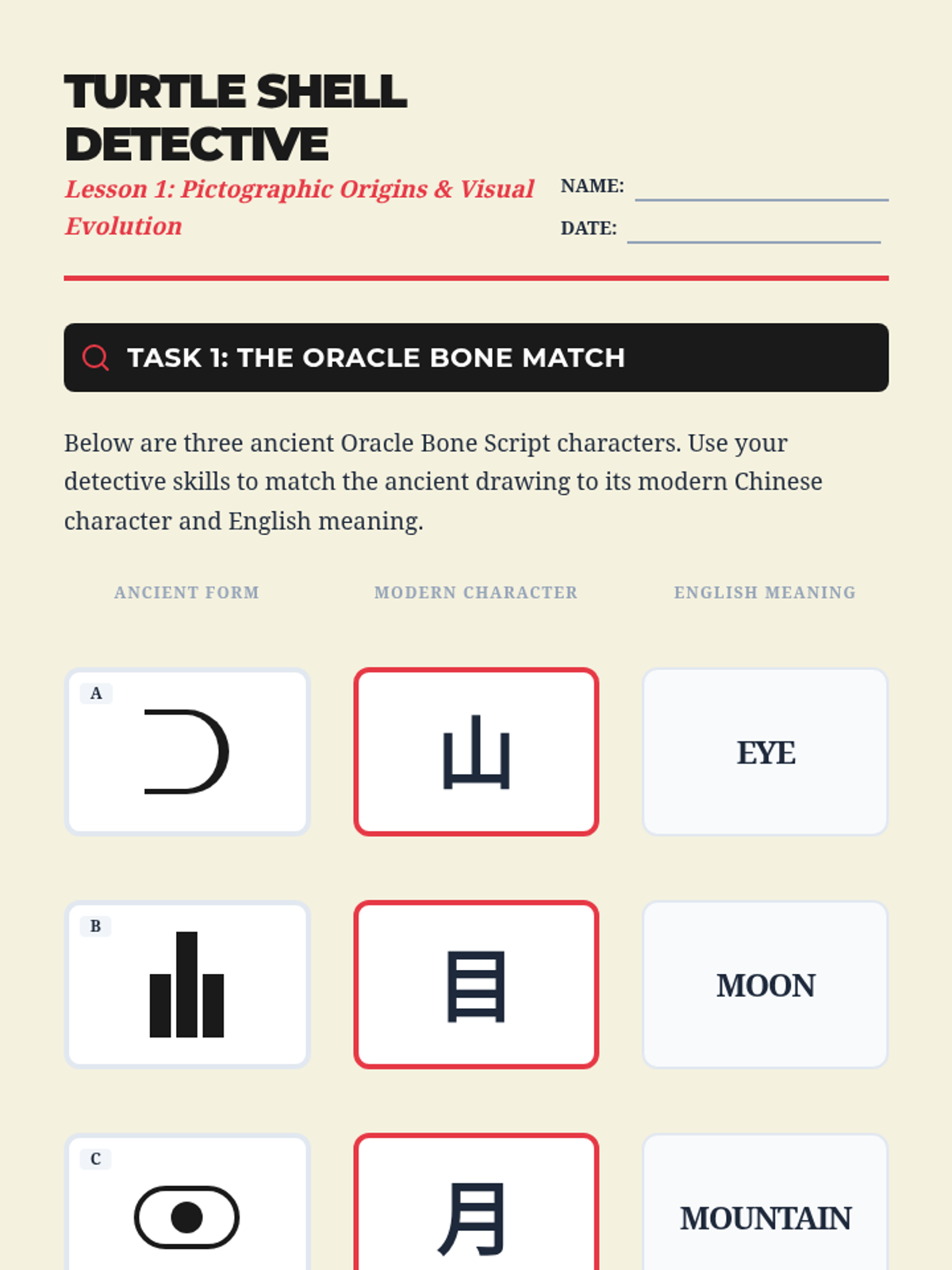
A student worksheet where students match Oracle Bone Script characters to modern forms and practice tracing the visual evolution of a nature-based character.
Visual evolution slides tracing Chinese characters from ancient Oracle Bone Script pictographs to modern stylized forms. Includes case studies of 'Sun' and 'Nature' characters.
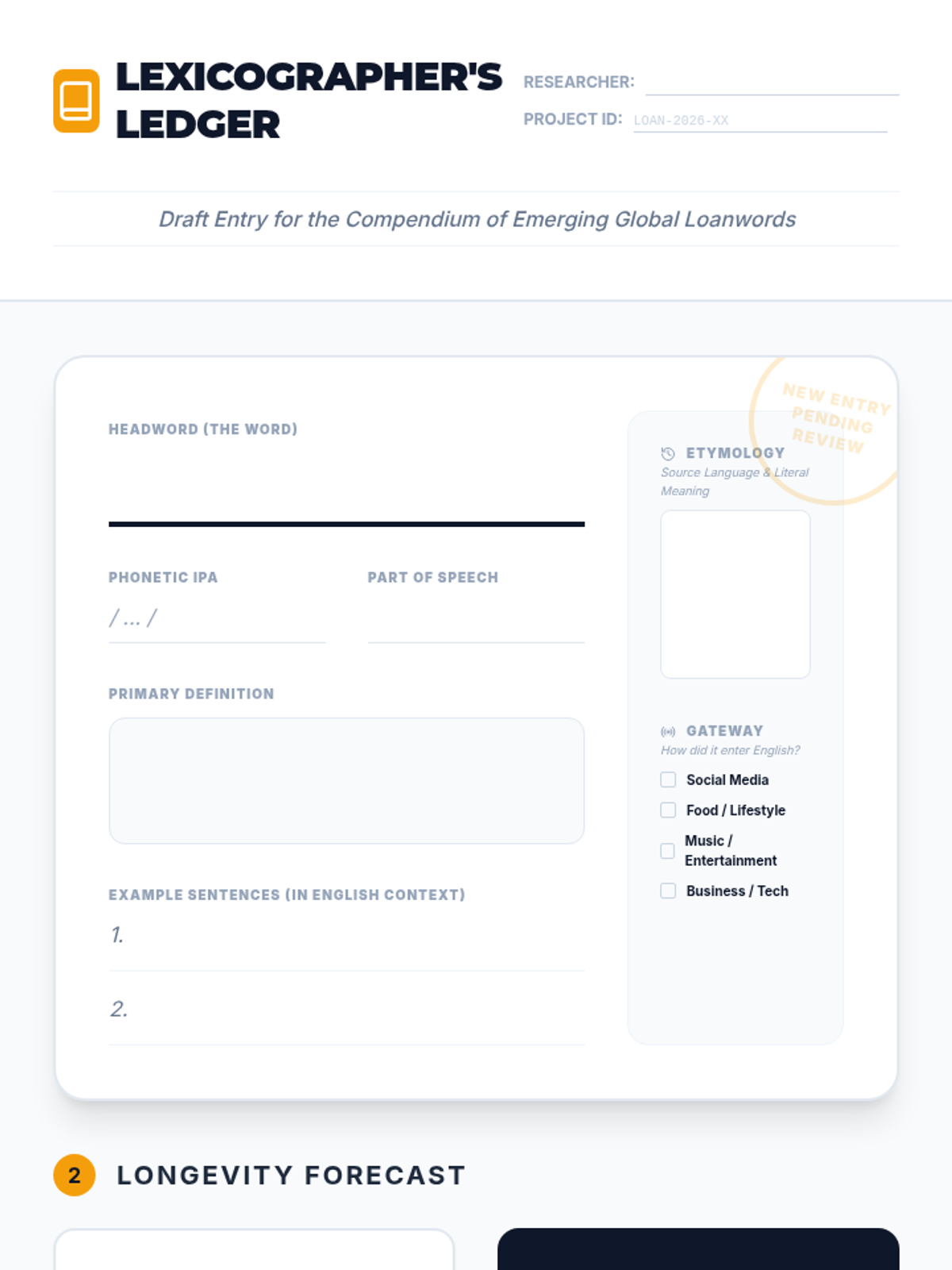
A professional dictionary entry template for students to document an emerging loanword as part of their lexicography project.
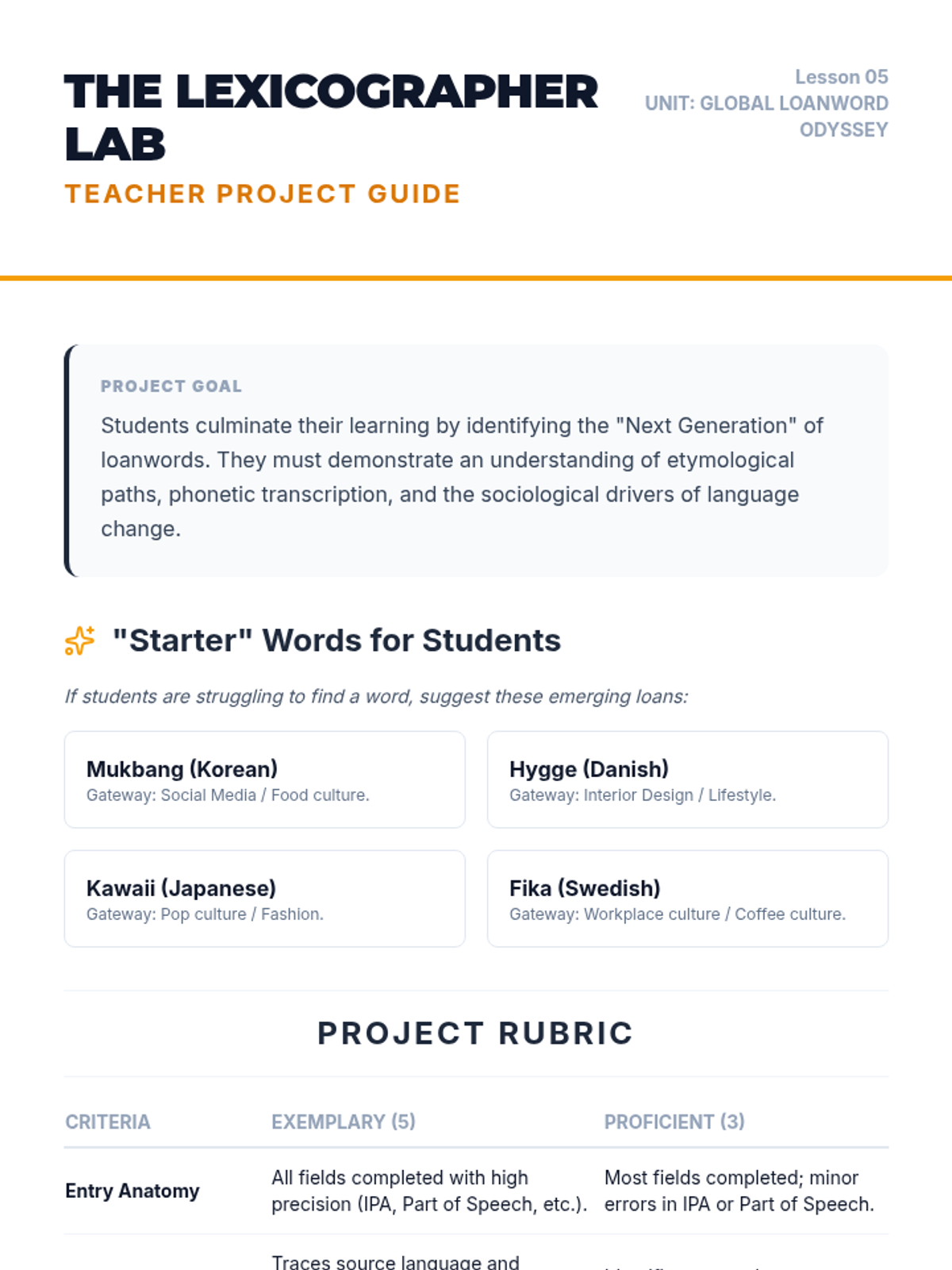
A facilitation guide for teachers leading the Project-Based Lexicography lesson, including suggested words for students and a project rubric.
Introductory slides for the Project-Based Lexicography lesson, focusing on the anatomy of a dictionary entry and project guidelines.
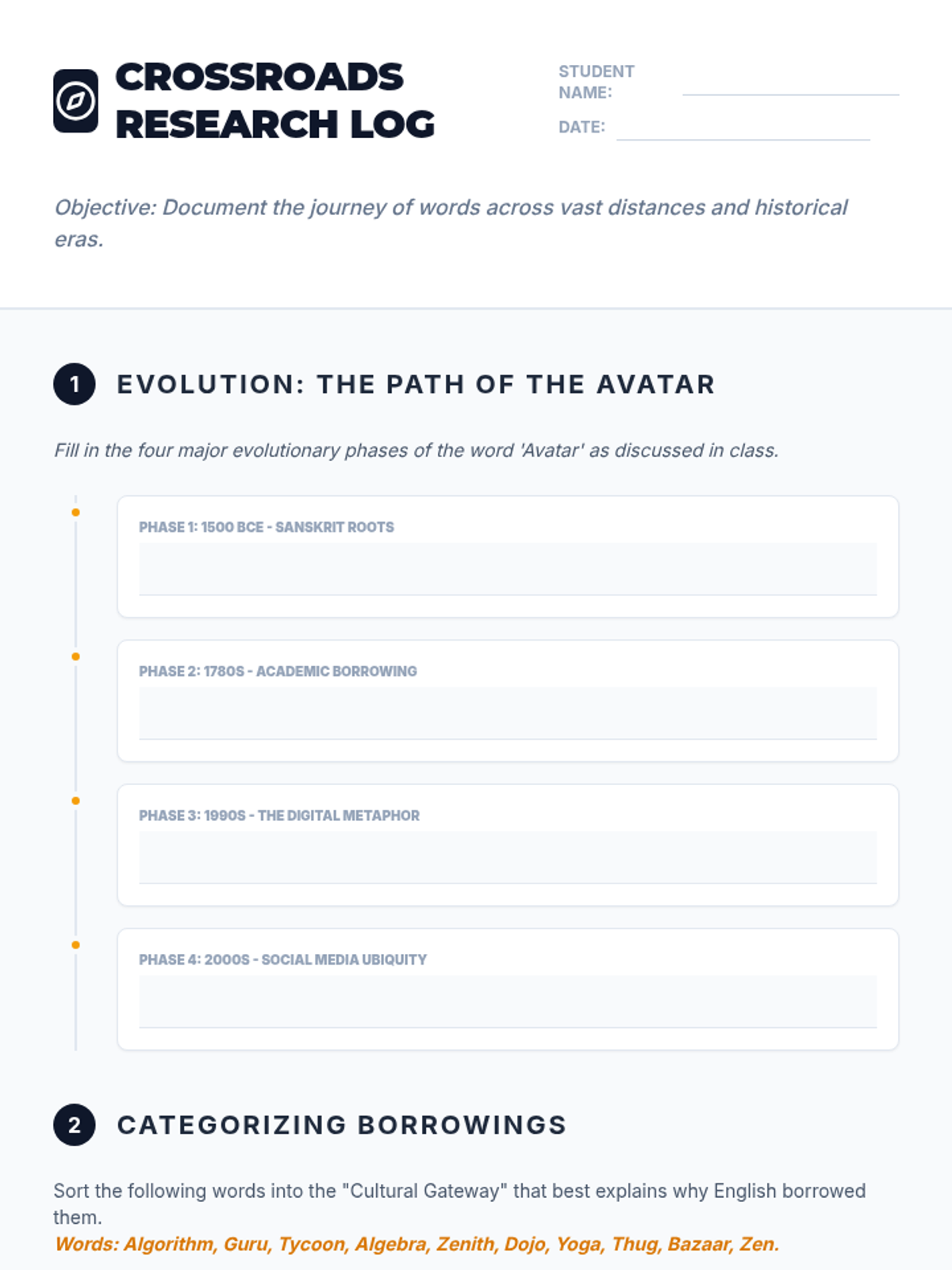
A student research log for the Asia & Middle East lesson, focusing on the etymological path of 'Avatar' and categorizing various loanwords by their cultural influence.
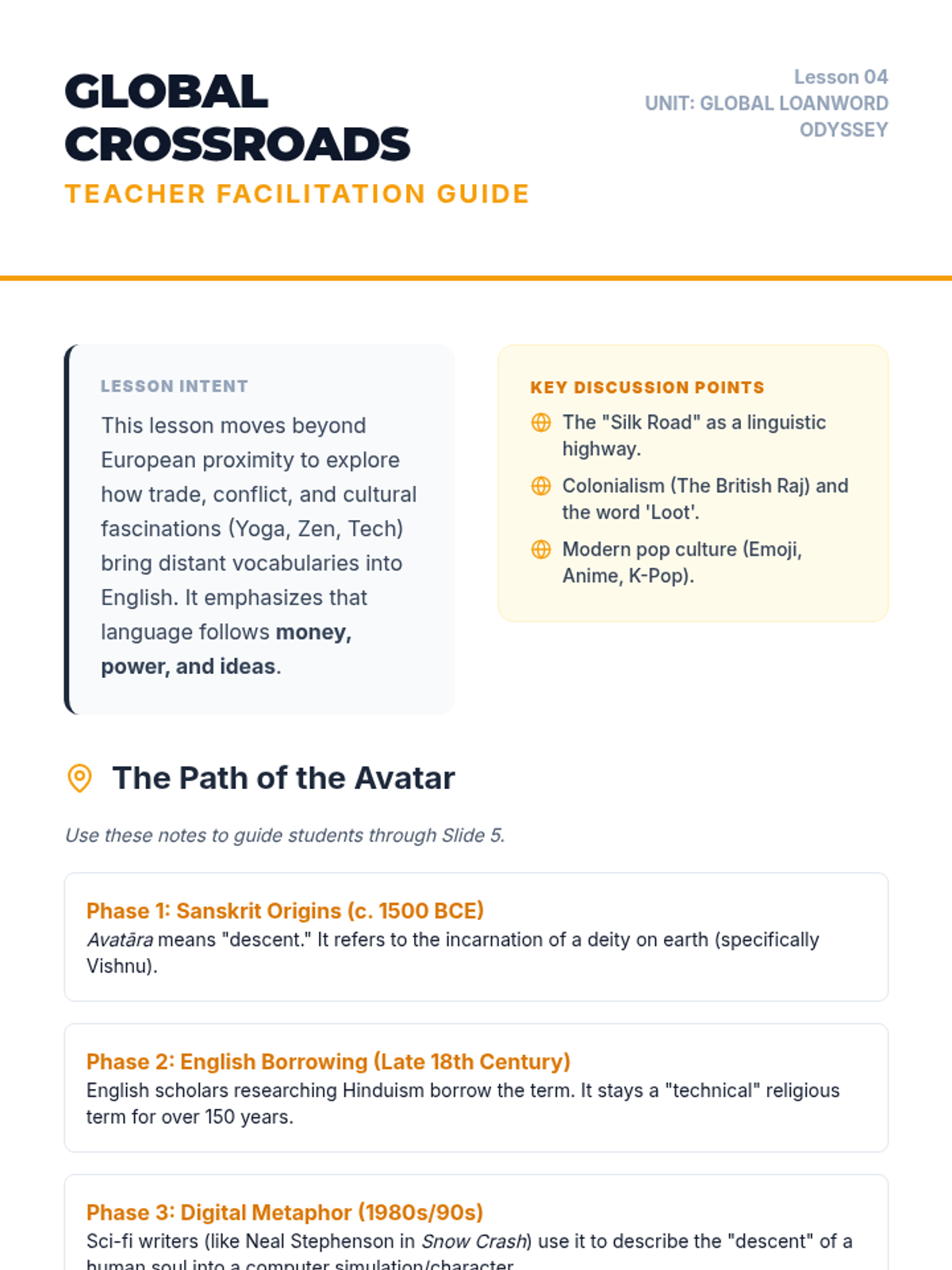
A facilitation guide for teachers leading the Asia & Middle East lesson, focusing on historical context, research guidance, and the 'Avatar' case study.
Introductory slides for the Asia & Middle East lesson, exploring tech, spiritual, and trade influences on English vocabulary.
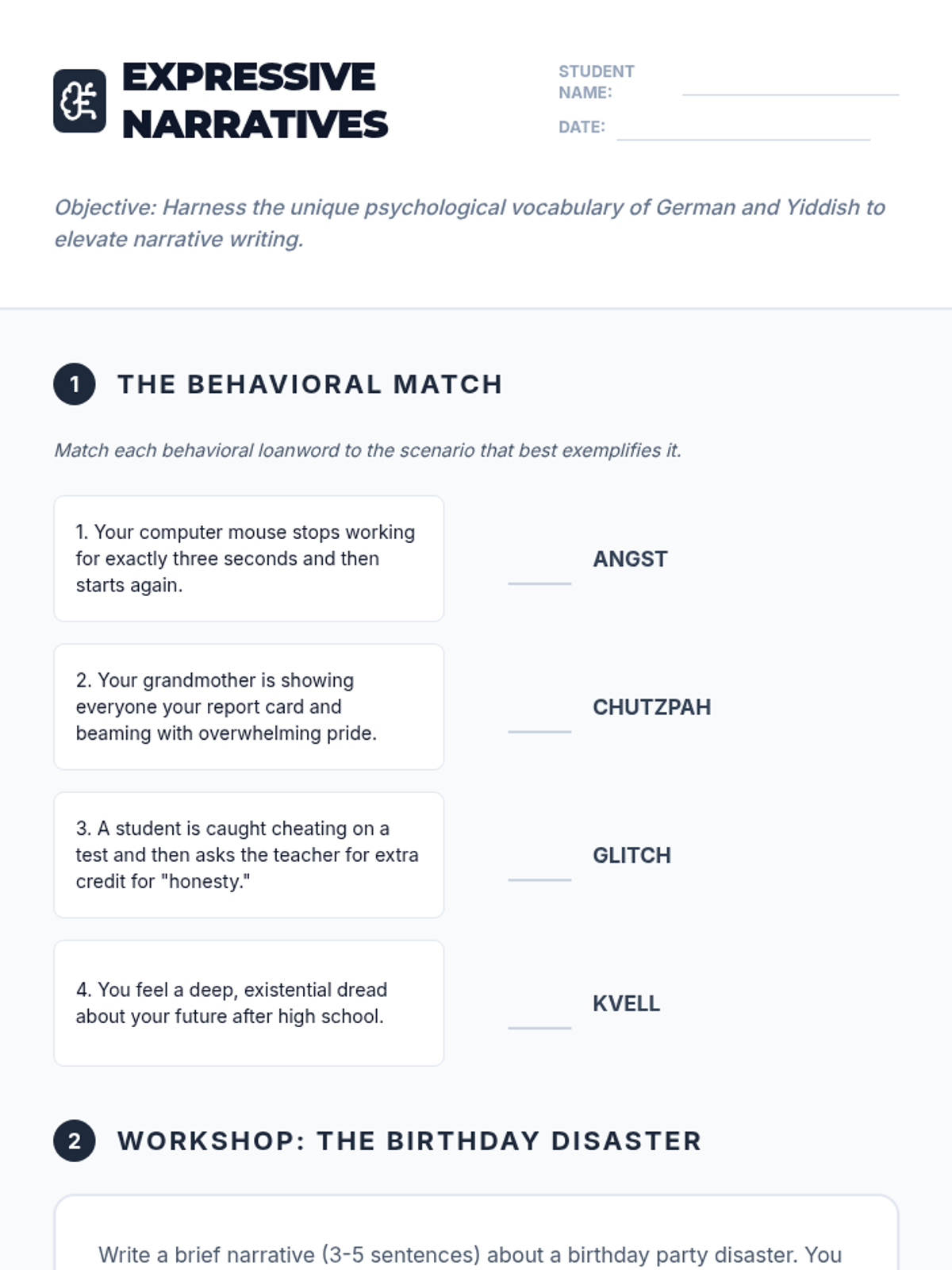
A student worksheet for the German & Yiddish lesson, focusing on behavioral vocabulary, a narrative writing exercise, and identifying lexical gaps.
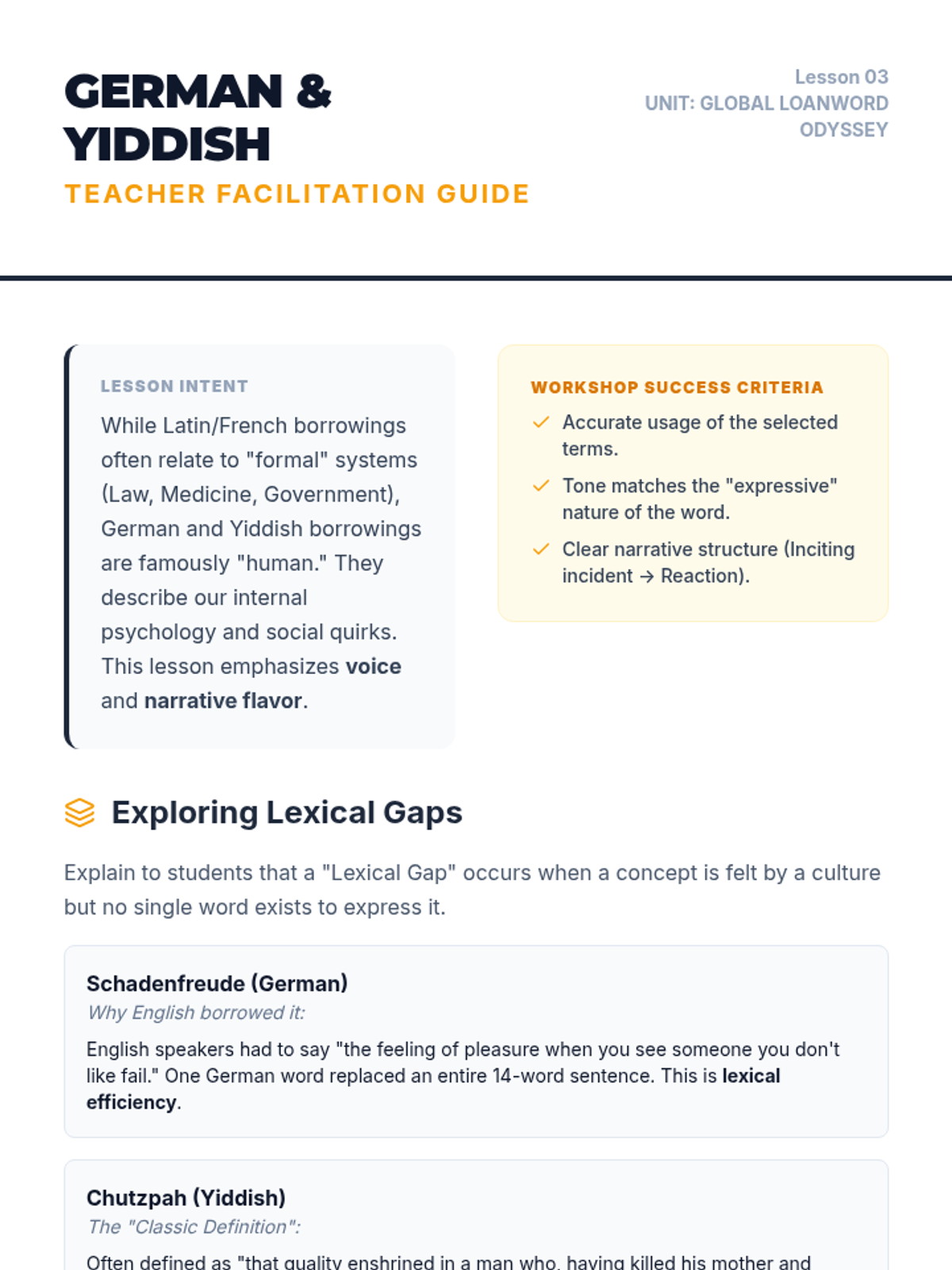
A facilitation guide for teachers leading the German & Yiddish lesson, focusing on expressive vocabulary, lexical gaps, and narrative writing workshops.
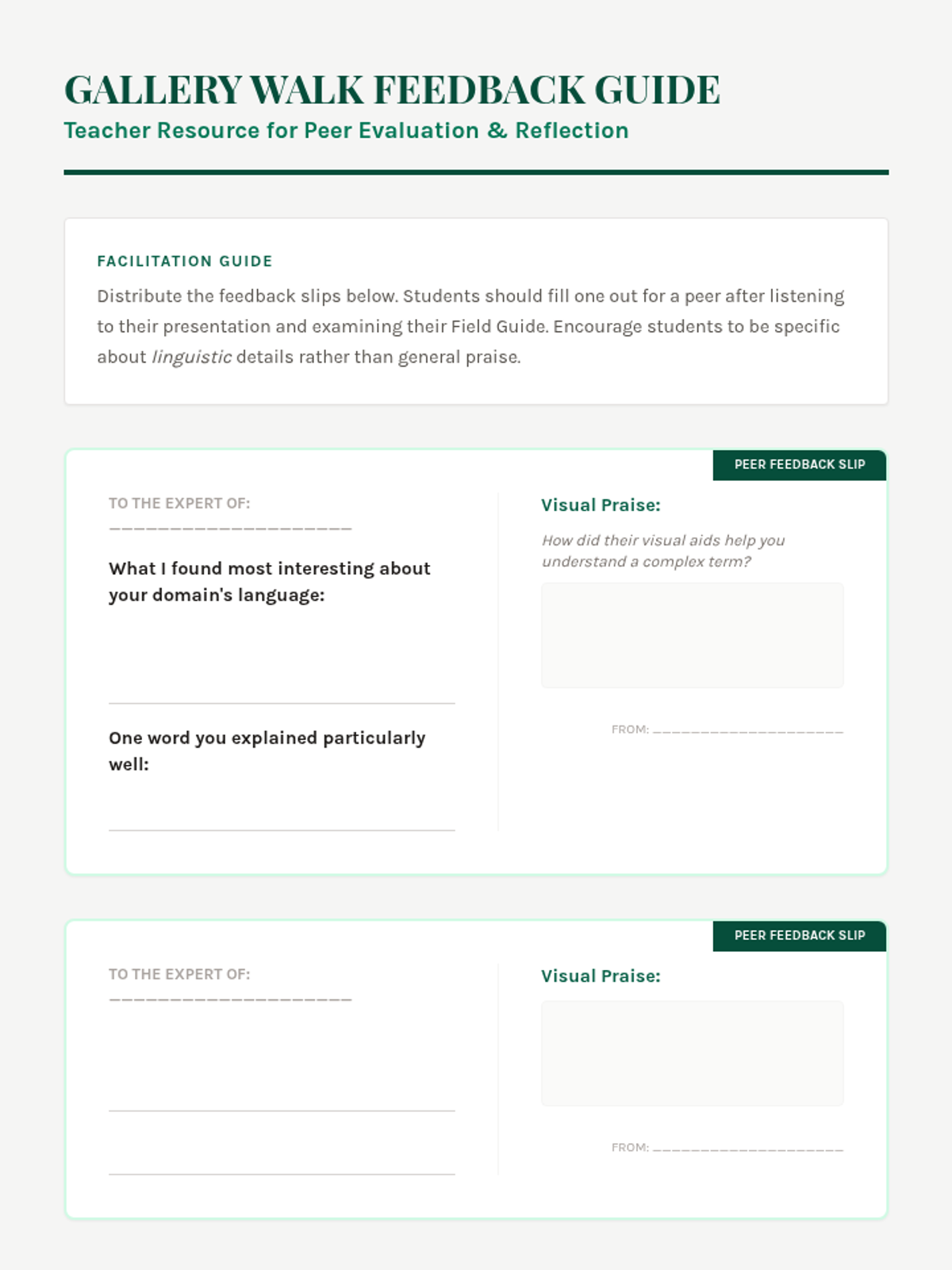
A teacher resource for Lesson 5, providing peer feedback slips and guiding questions for the final class debrief.
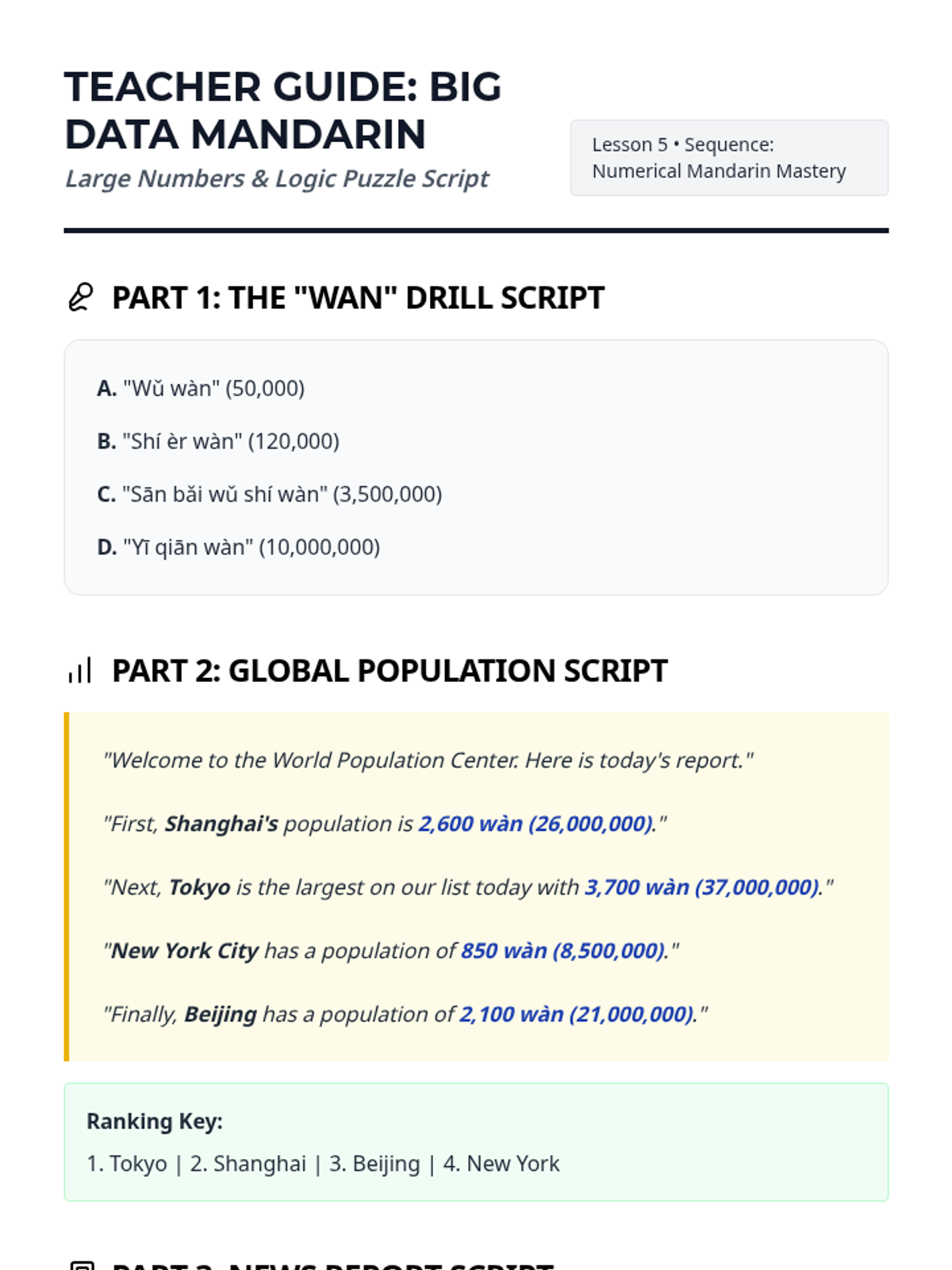
Teacher Guide for Lesson 5, providing auditory scripts for large number drills, global city population statistics, and an economic news report, including the answer key for the logic puzzle.
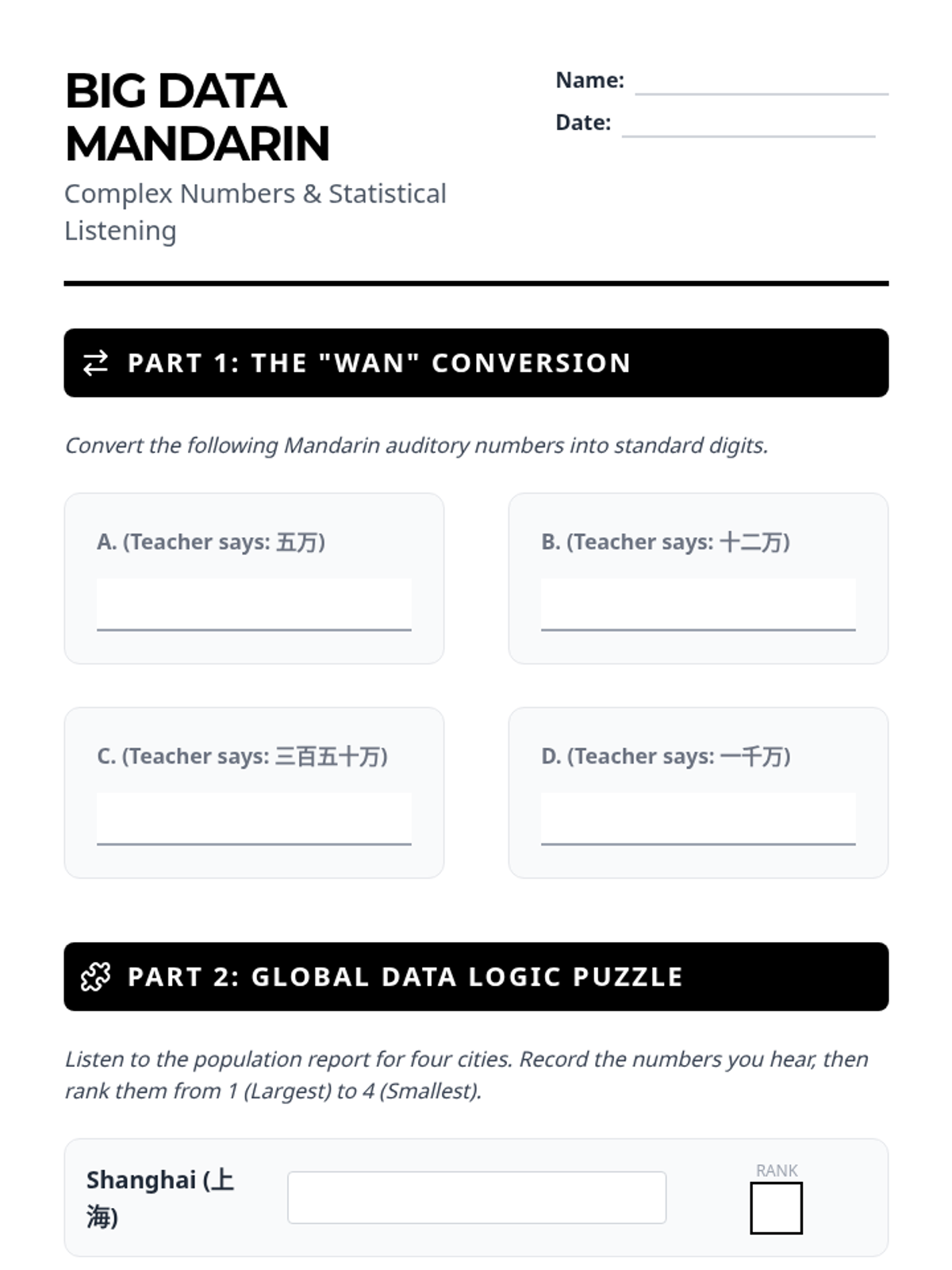
Student worksheet for Lesson 5, featuring large number conversion drills, a global city population ranking logic puzzle, and a fill-in-the-blank news report summary task.
A slide deck for Lesson 5, introducing complex numbers in Mandarin, specifically the 'Wan' (10,000) and 'Yi' (100,000,000) units, and setting up the global population data listening puzzle.
Slides for Lesson 3 on calendar dates in Mandarin. Covers Year-Month-Day order, how to say years digit-by-digit, and introduces the Time Traveler activity.
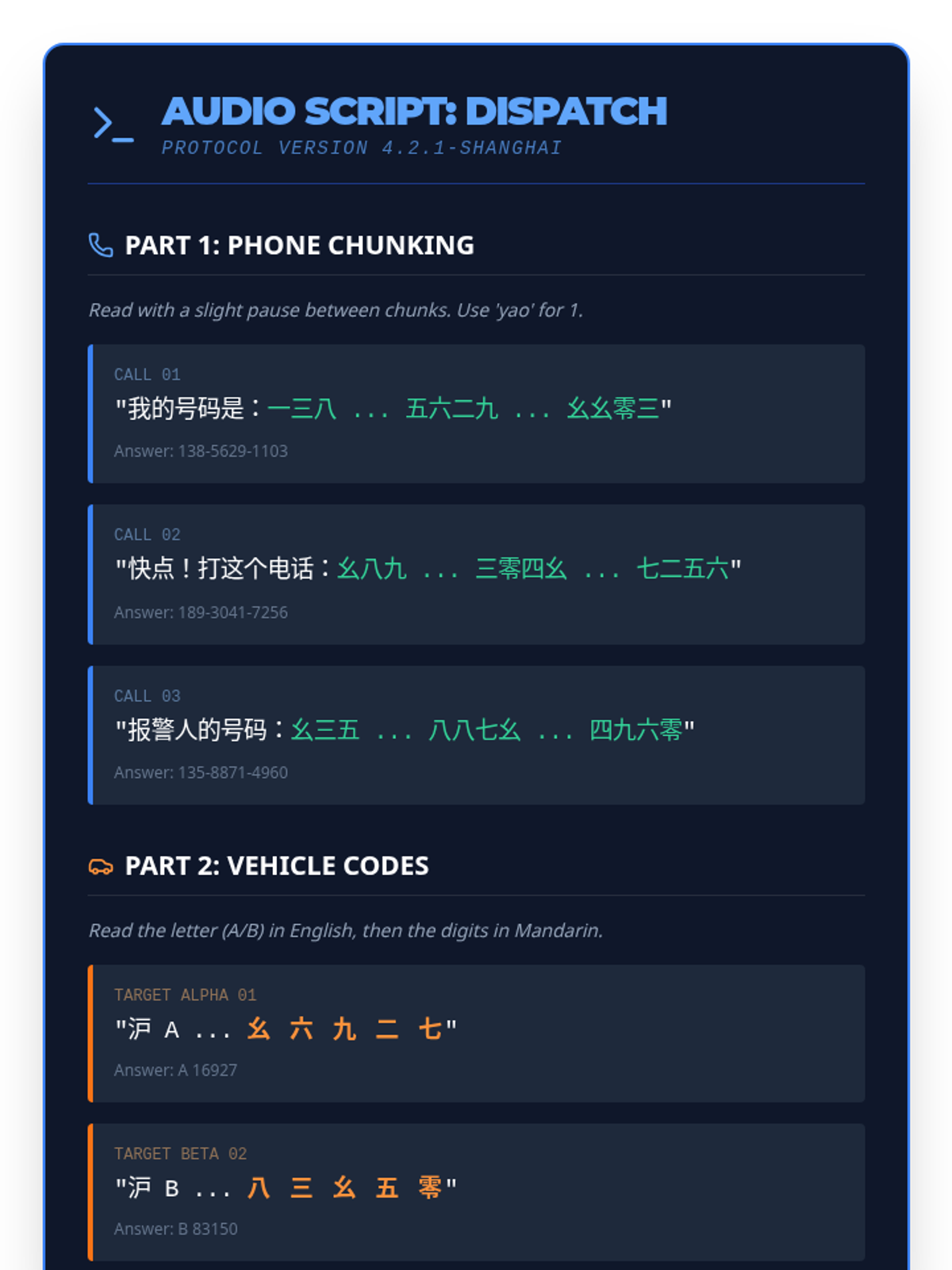
Teacher audio script for Lesson 2 featuring emergency call simulations with phone numbers (using 'yao') and vehicle license plate tracking.
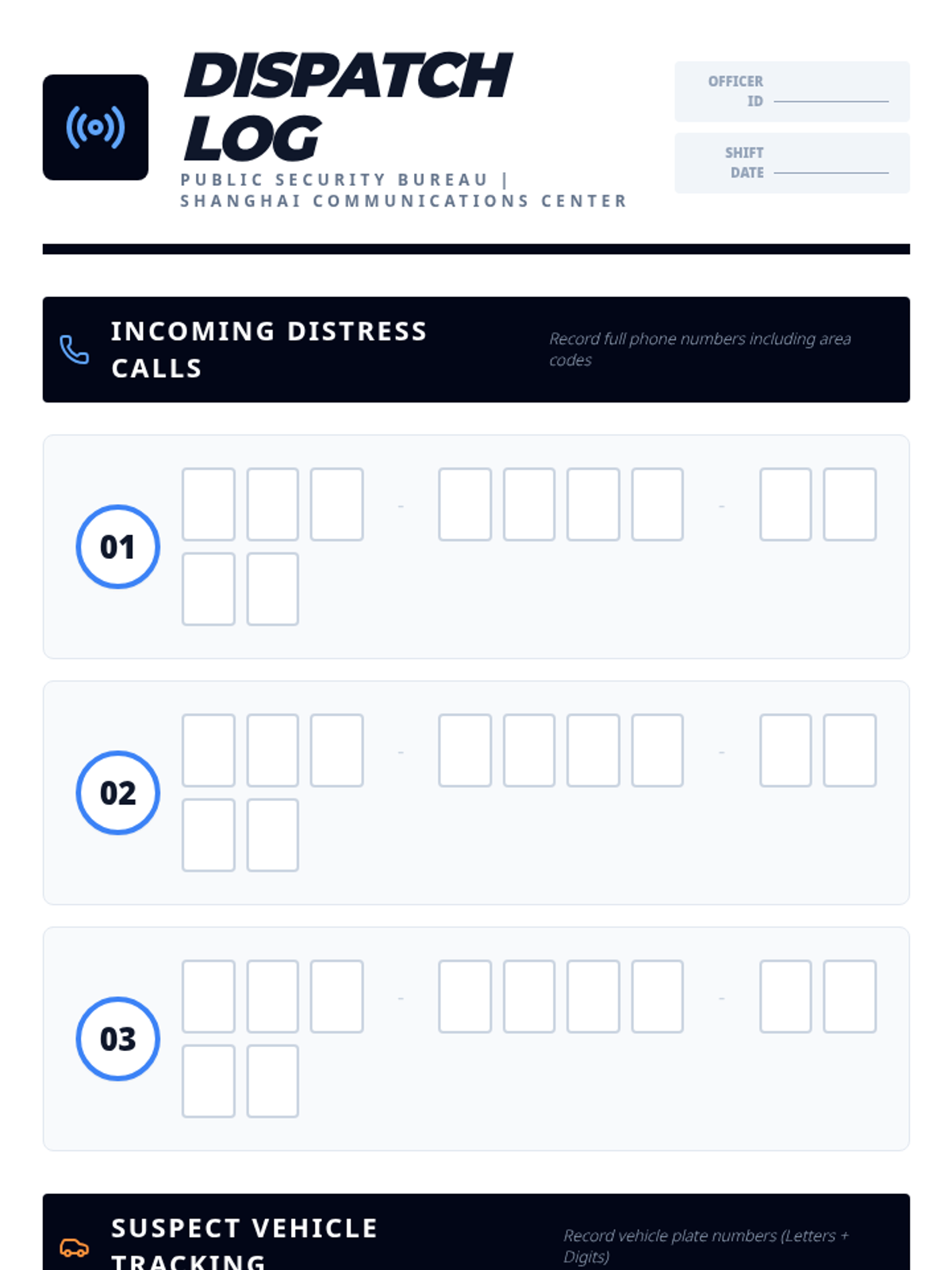
Worksheet for recording phone numbers and vehicle codes in Mandarin. Features high-contrast dispatch log design with boxes for individual digit entry.
Slide deck for Lesson 2 focusing on phone numbers and codes. Introduces the 'yao' rule for the number 1 and strategies for auditory digit span.
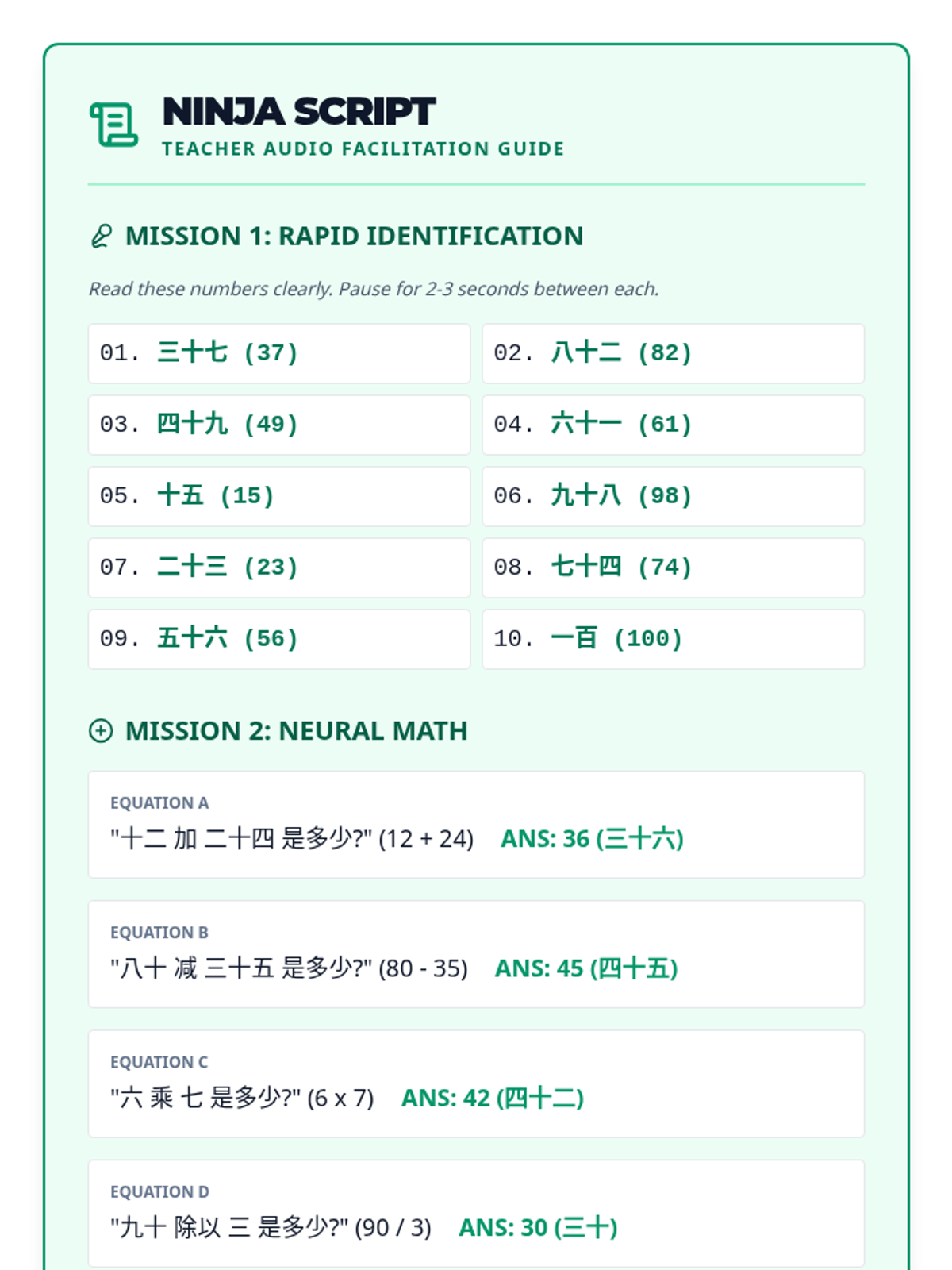
Teacher's script for auditory drills, providing the Mandarin text and answers for the Number Ninja activities.
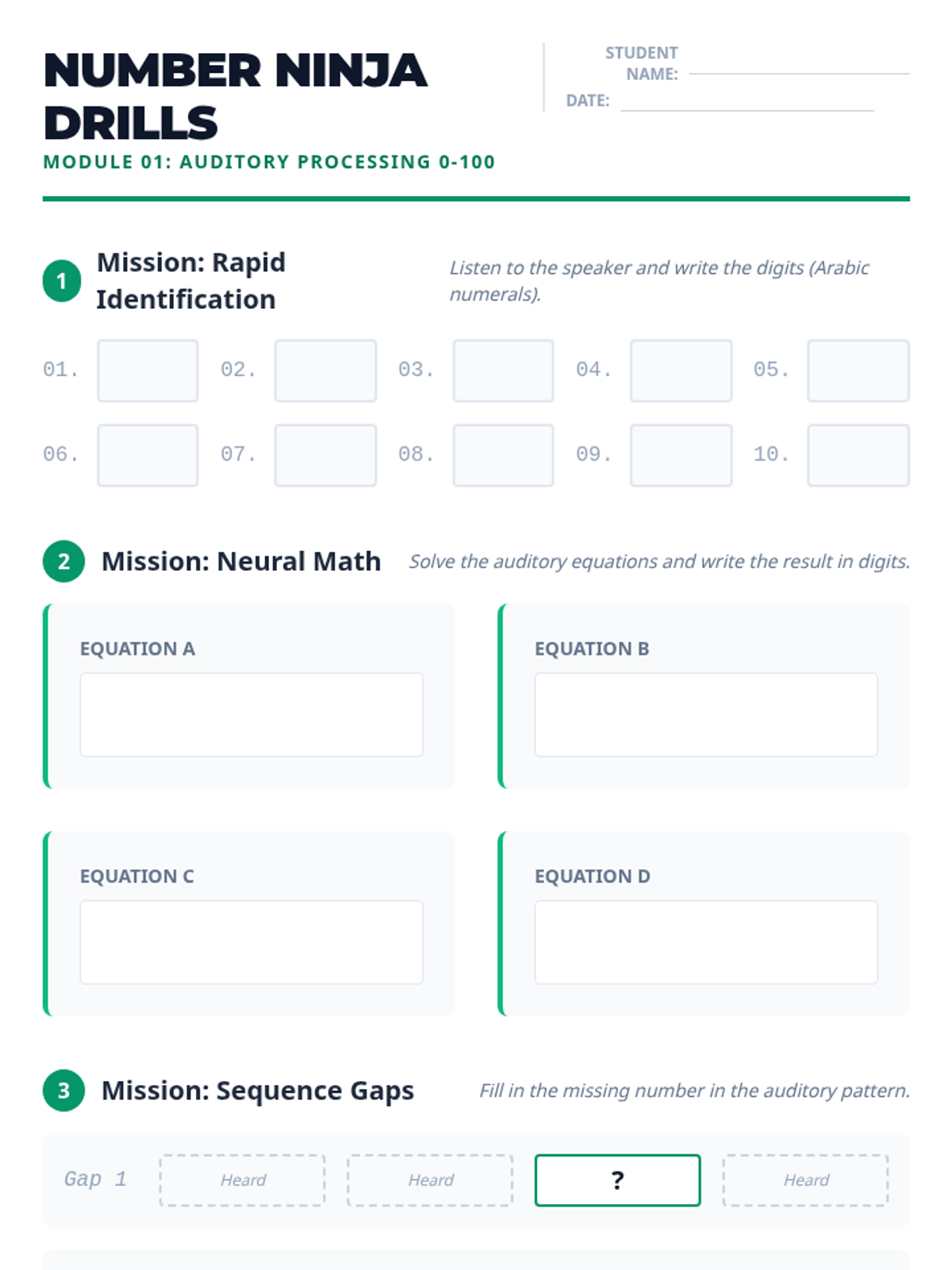
Worksheet for auditory number recognition and mental math drills in Mandarin 0-100. Includes space for digits, equations, and sequence patterns.
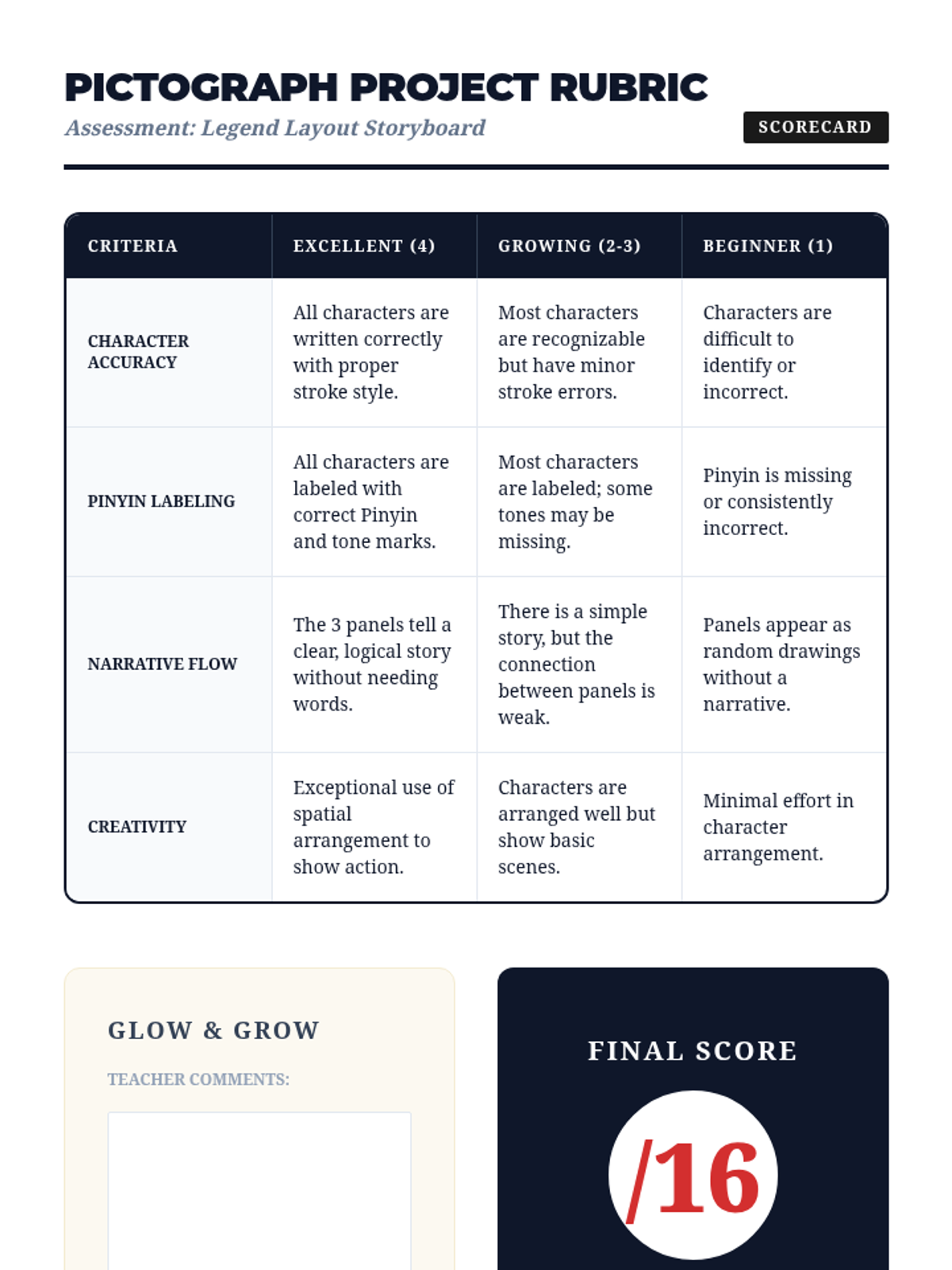
Assessment rubric for the Lesson 5 final project, evaluating character accuracy, pinyin labeling, narrative flow, and creative composition.
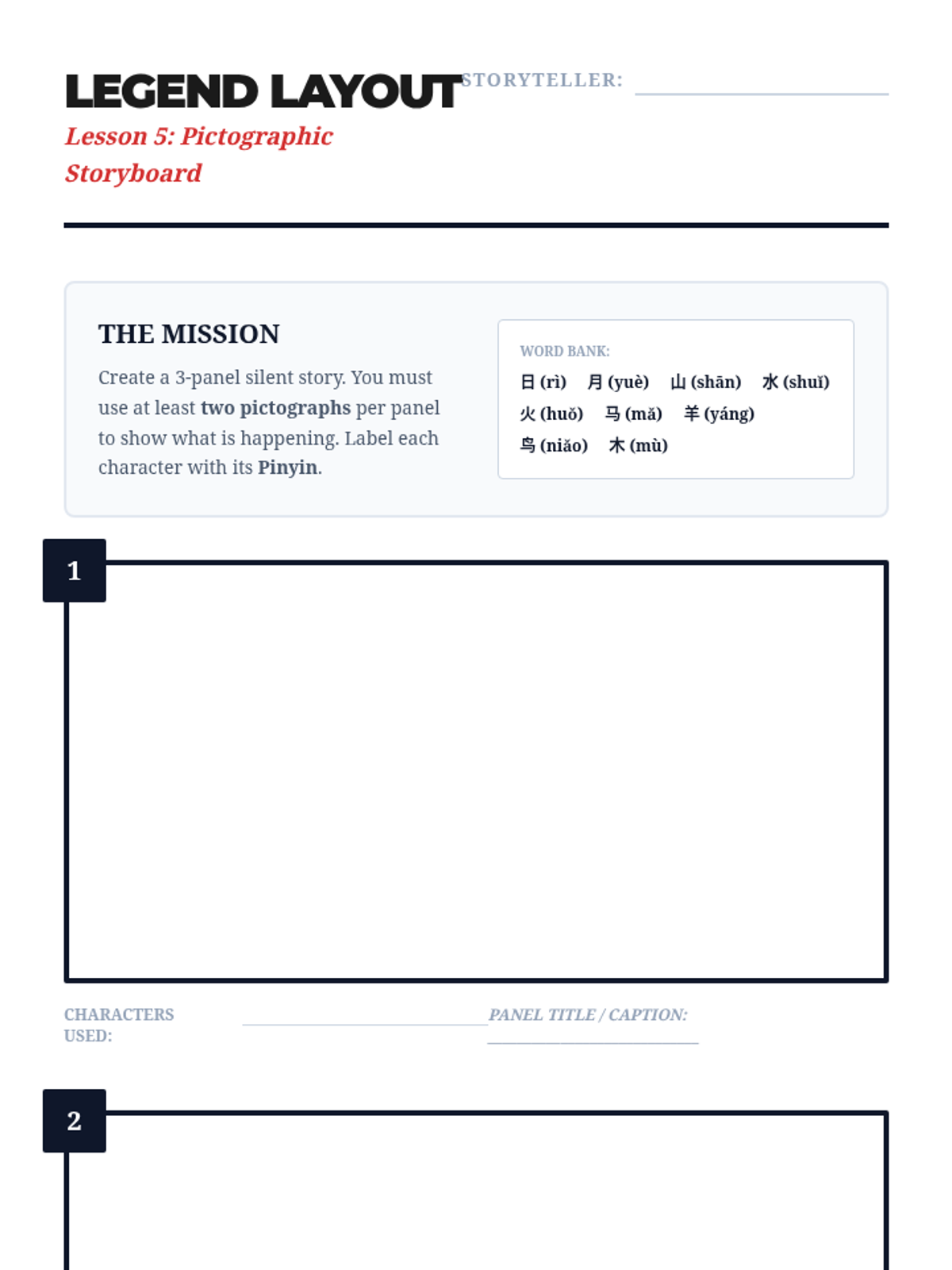
Storyboard template for students to compose a three-panel narrative scene using Mandarin pictographs, including space for Pinyin labels and panel descriptions.
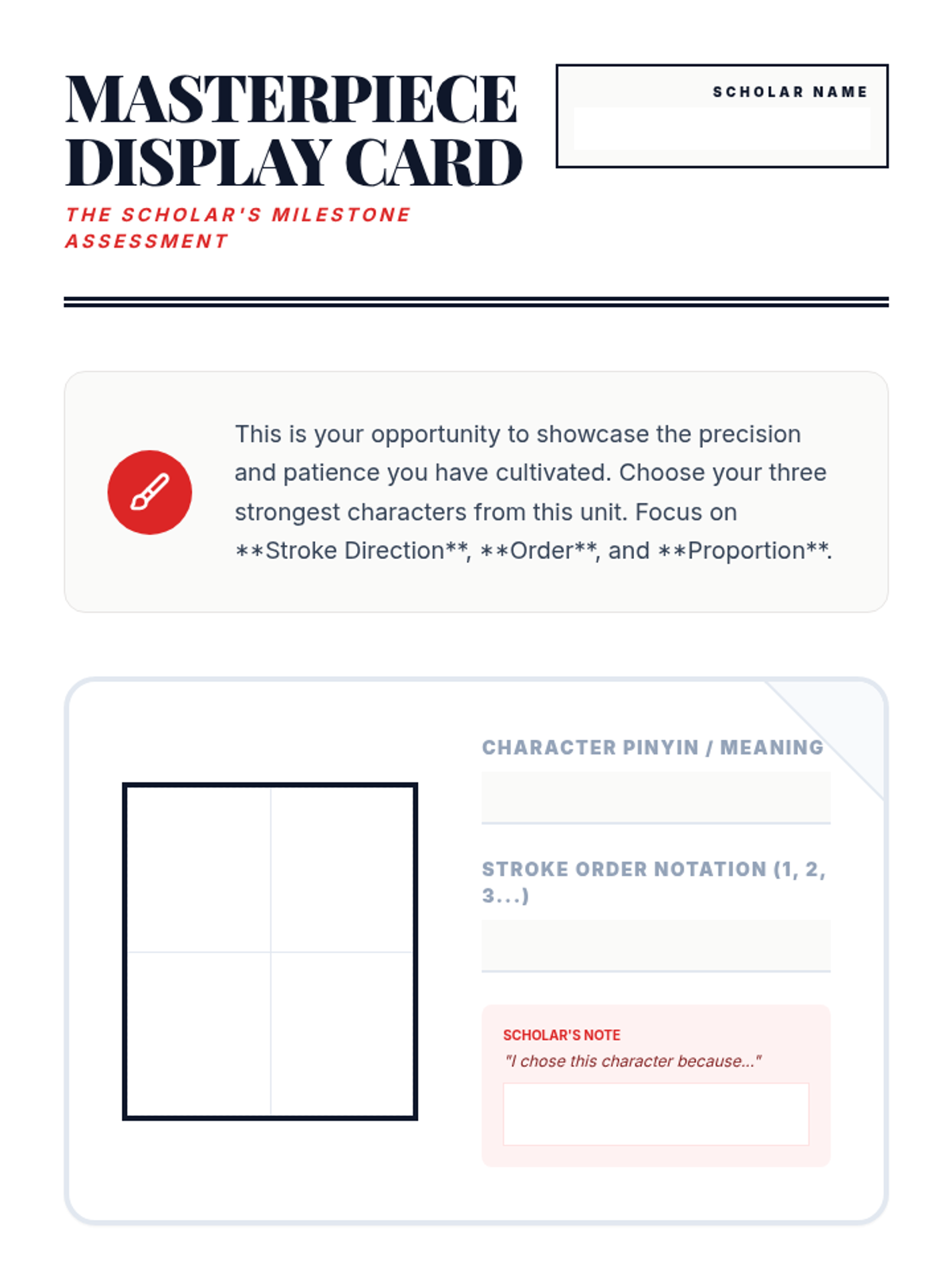
Final display card for the culminating assessment where students showcase three refined characters with stroke order notation and reflect on their progress.
Slides for Lesson 5 introduing composition and storytelling with pictographs. Explains how to arrange characters to form narrative scenes.
Final presentation slides for Lesson 5, guiding students through the calligraphy showcase, review of fundamental strokes, and peer critique protocols.
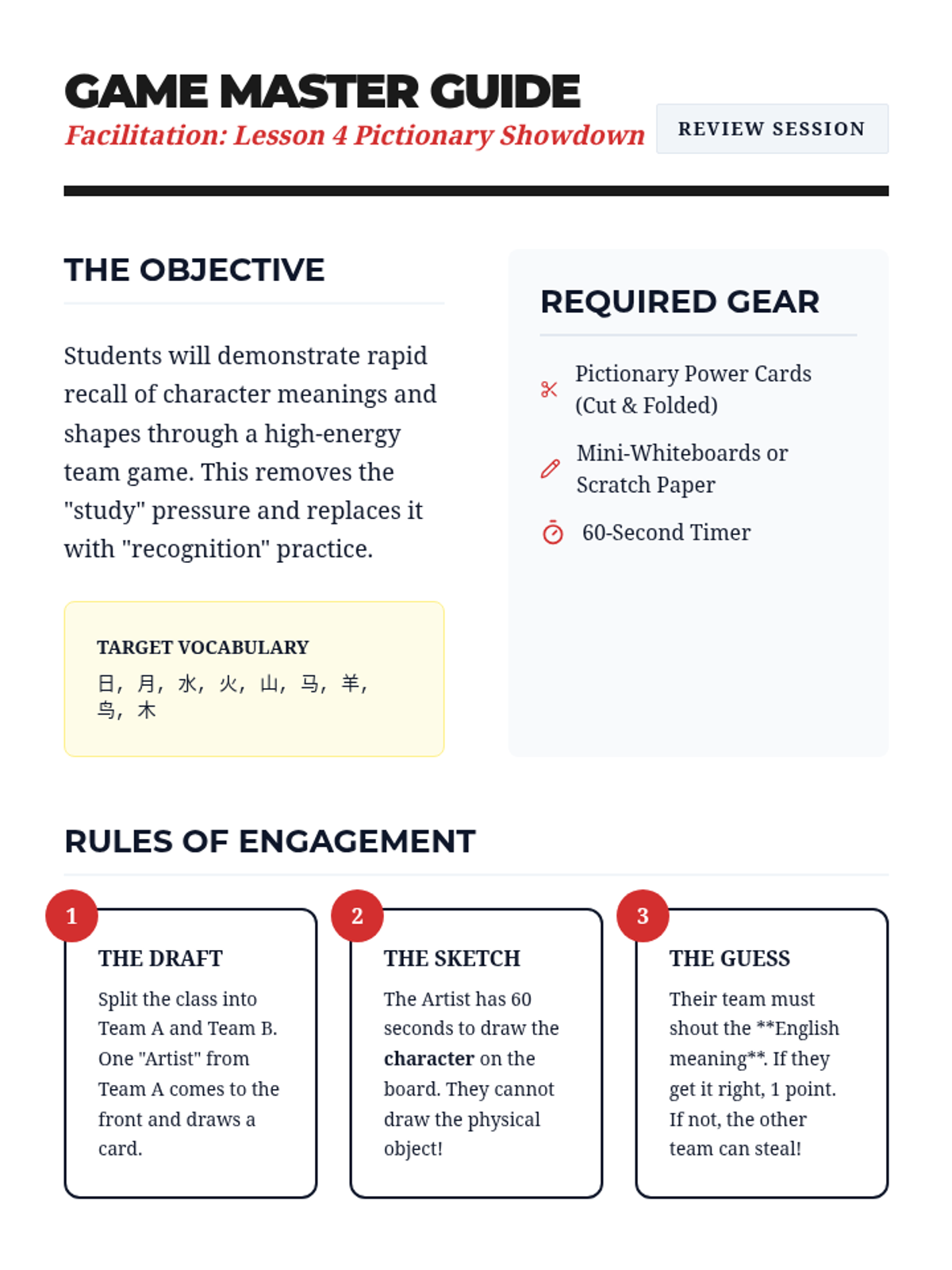
Teacher facilitation guide for Lesson 4, detailing the rules and setup for the Pictionary Showdown game-based review.
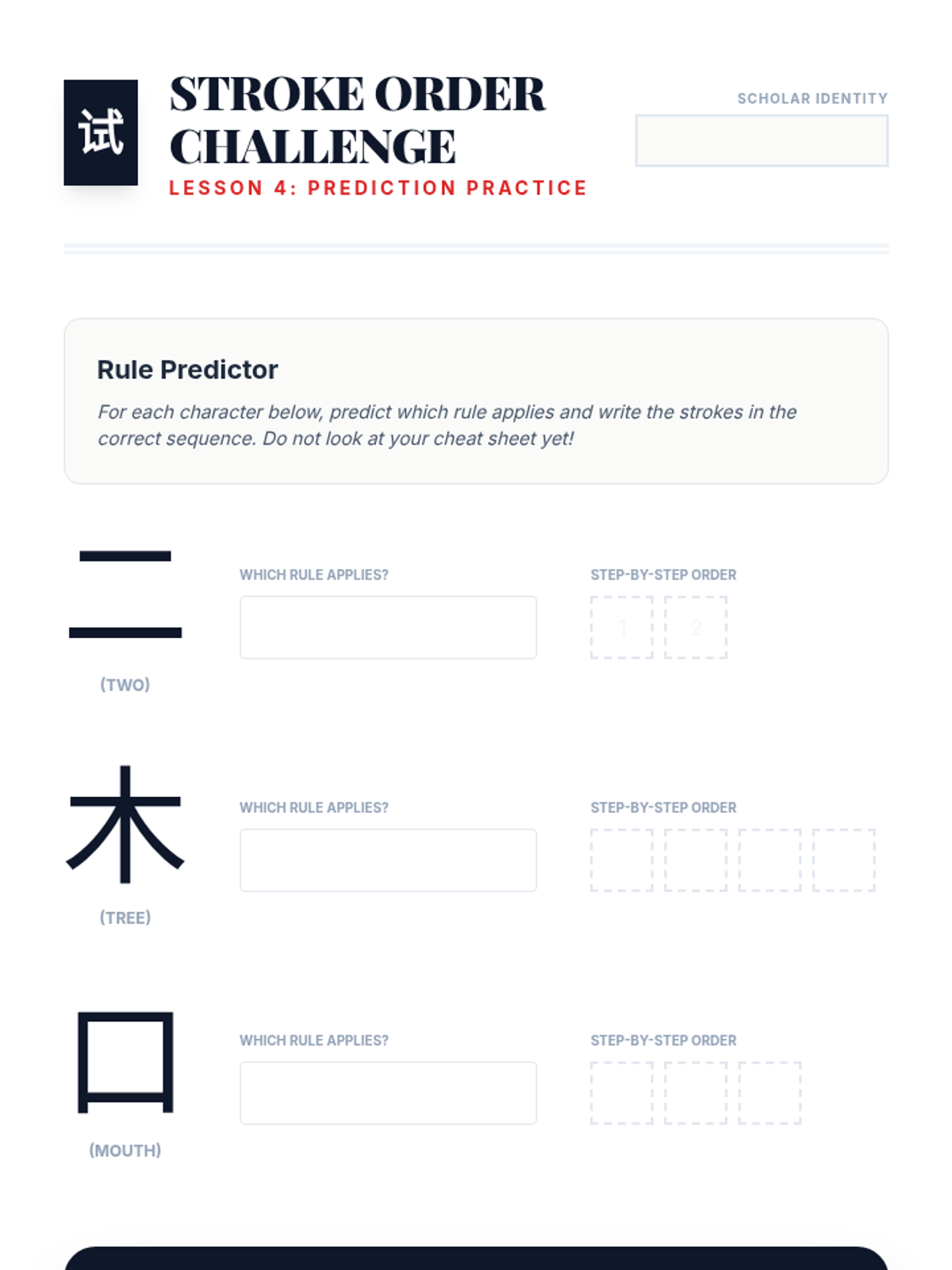
Student worksheet for Lesson 4 including a stroke order prediction game and an error analysis challenge to reinforce the seven rules of character writing.
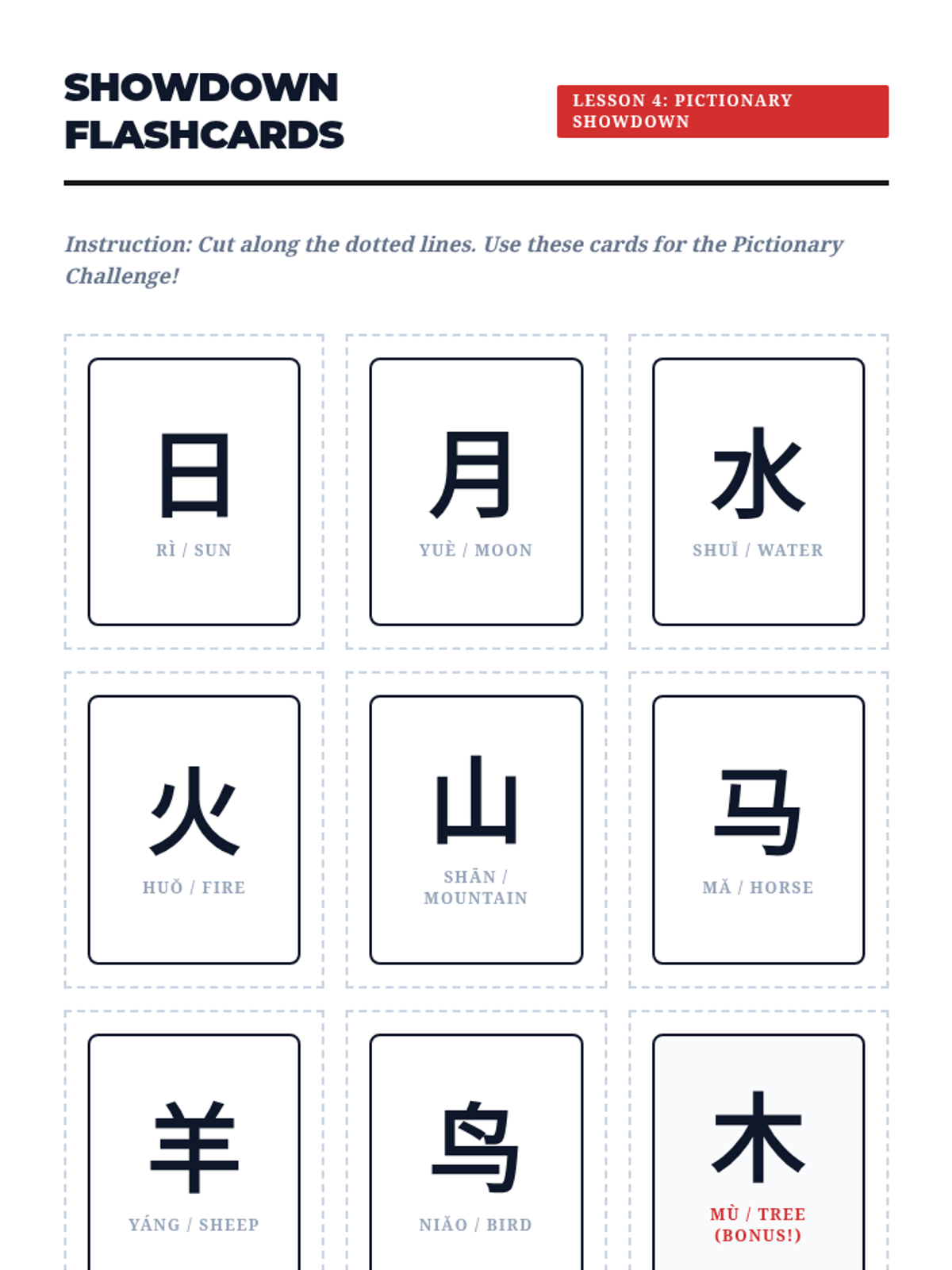
Game cards for Lesson 4 featuring characters, pinyin, and English meanings. Designed to be cut out for use in the Pictionary Showdown challenge.
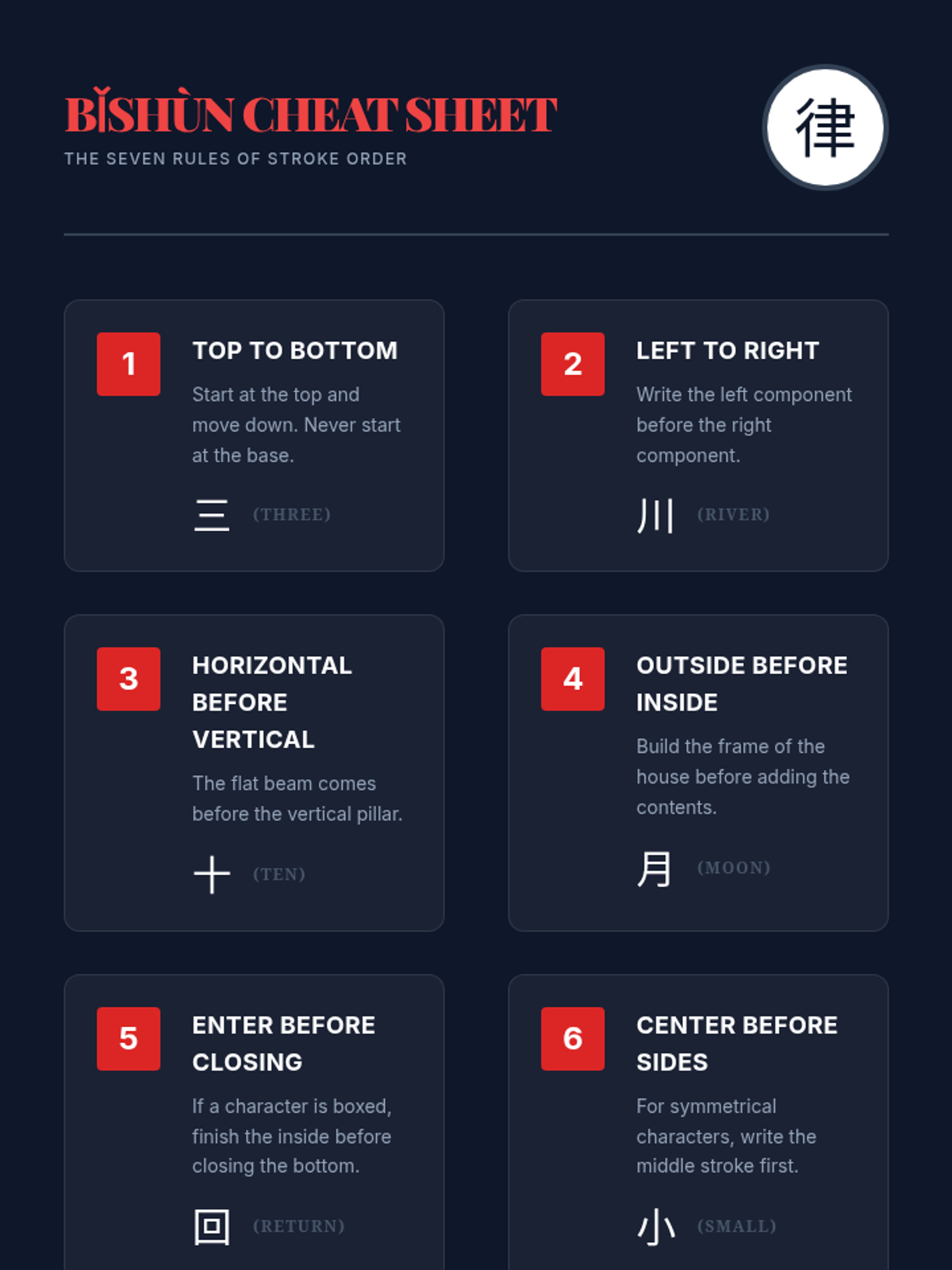
Compact reference cheat sheet for students detailing the seven rules of Mandarin stroke order with visual character examples.
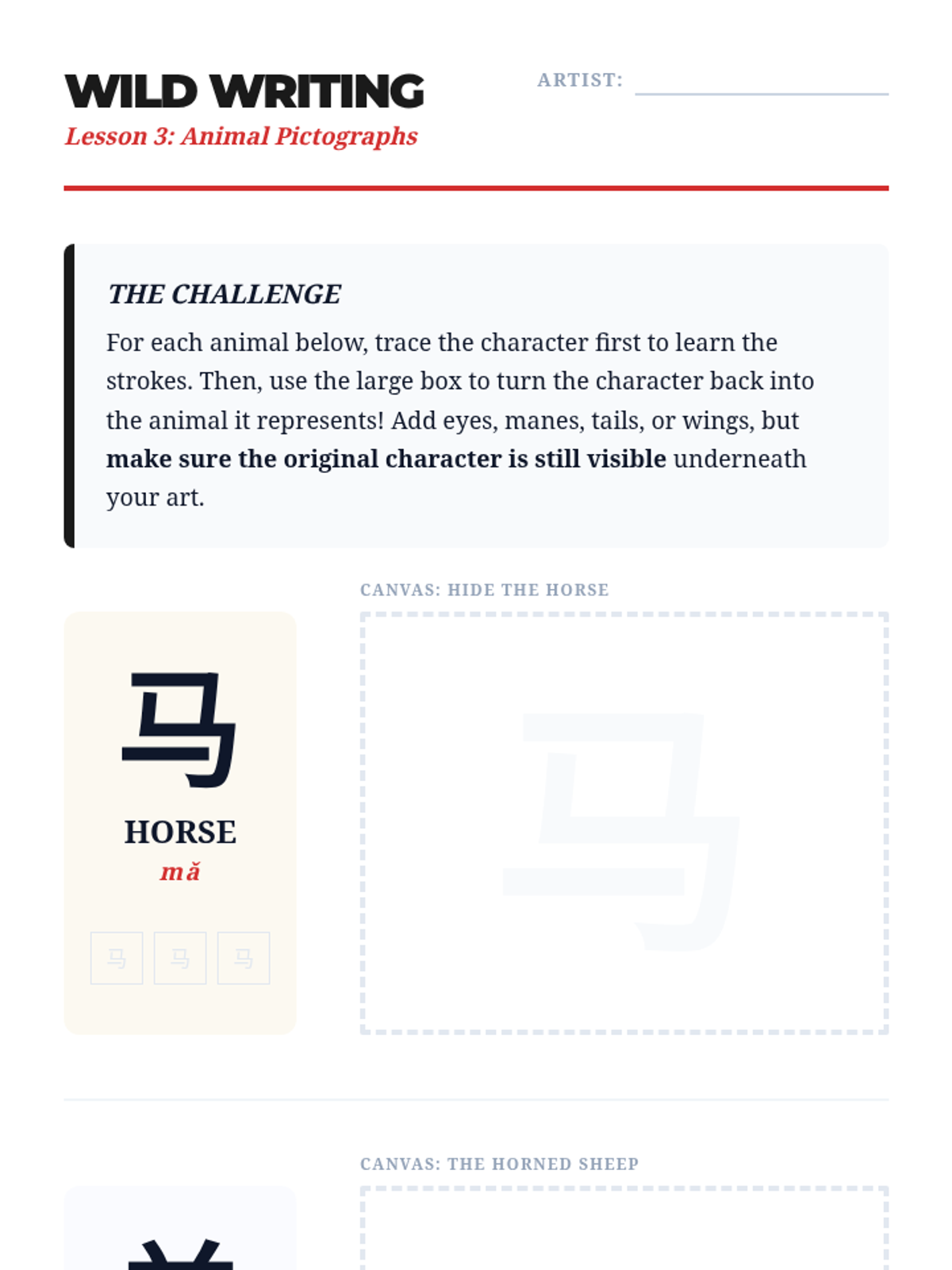
Worksheet for Lesson 3 where students practice animal pictographs (Horse, Sheep, Bird) and create artistic visualizations by drawing the animal over the character strokes.
Detailed presentation slides for Lesson 4, explicitly teaching the seven fundamental rules of Mandarin stroke order with visual examples.
Slides for Lesson 3 introducing animal pictographs (Horse, Sheep, Bird). Explains the visual components of each character and sets up the drawing challenge.
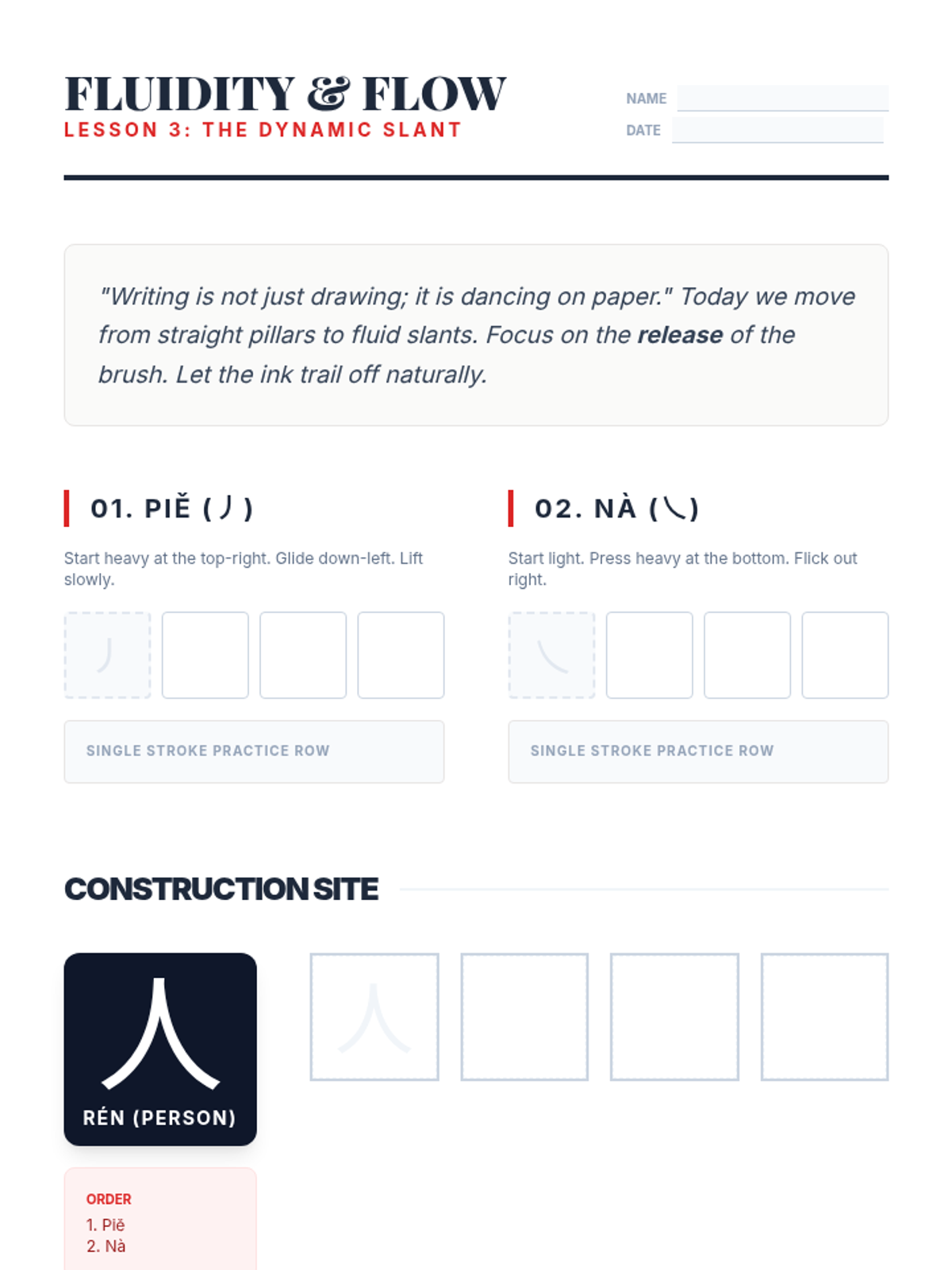
Student worksheet for Lesson 3 focusing on slanting strokes (Pie and Na) and constructing the characters 'Person' (Ren) and 'Big' (Da) with peer feedback prompts.
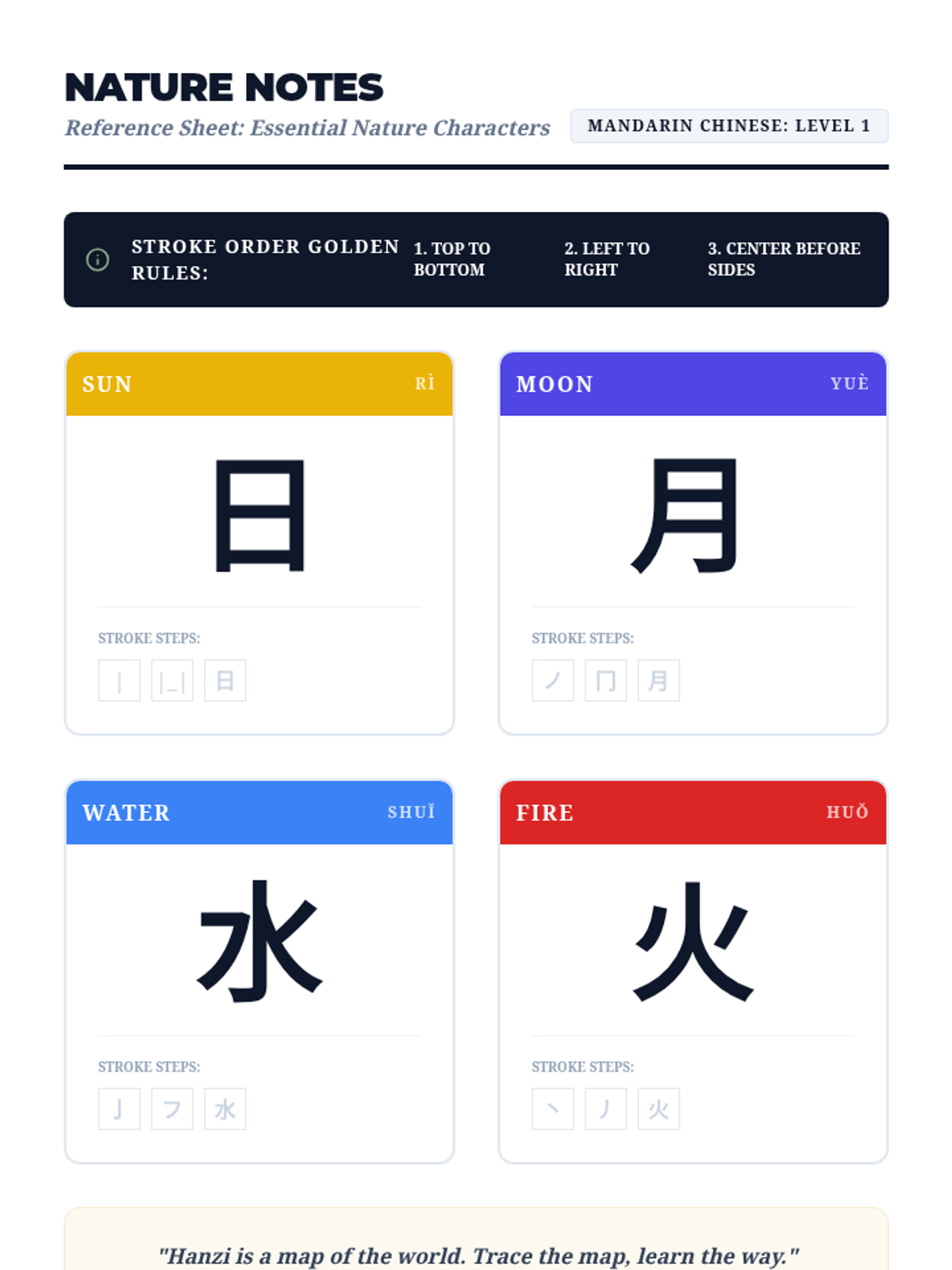
Reference sheet for the four nature elements, providing stroke order steps, pinyin, and English meanings to assist student character mastery.
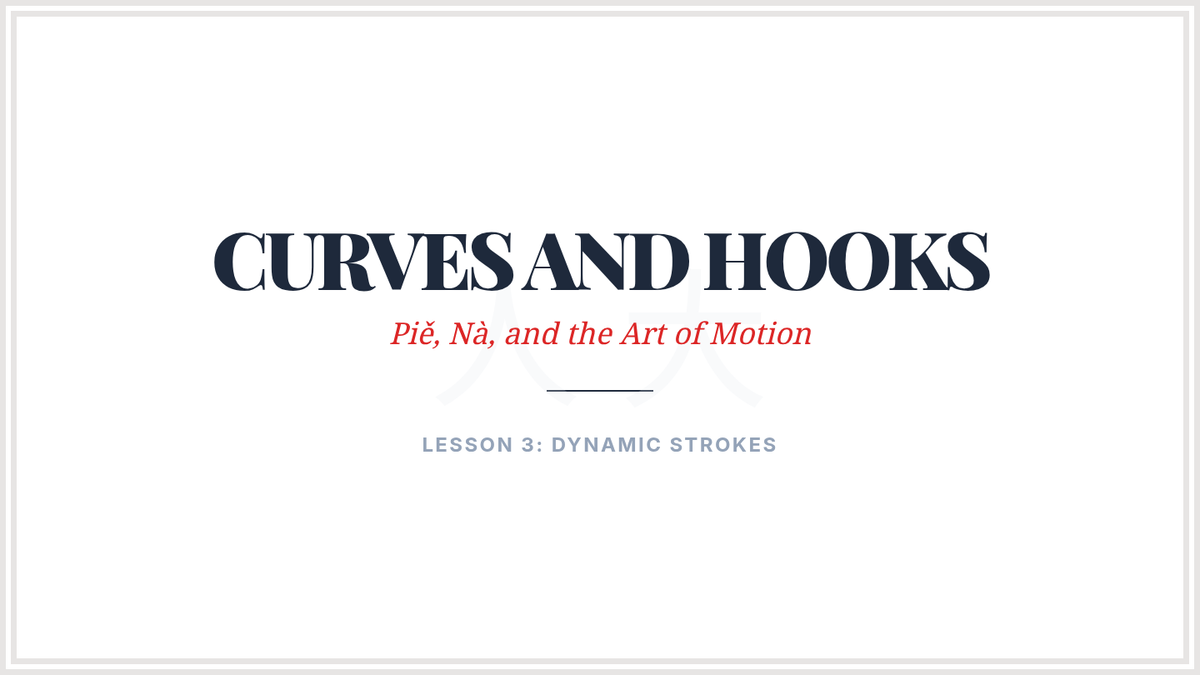
Visual teaching slides for Lesson 3, covering slanting strokes (Pie and Na) and Hooks (Gou), including character construction for 'Person' and 'Big'.
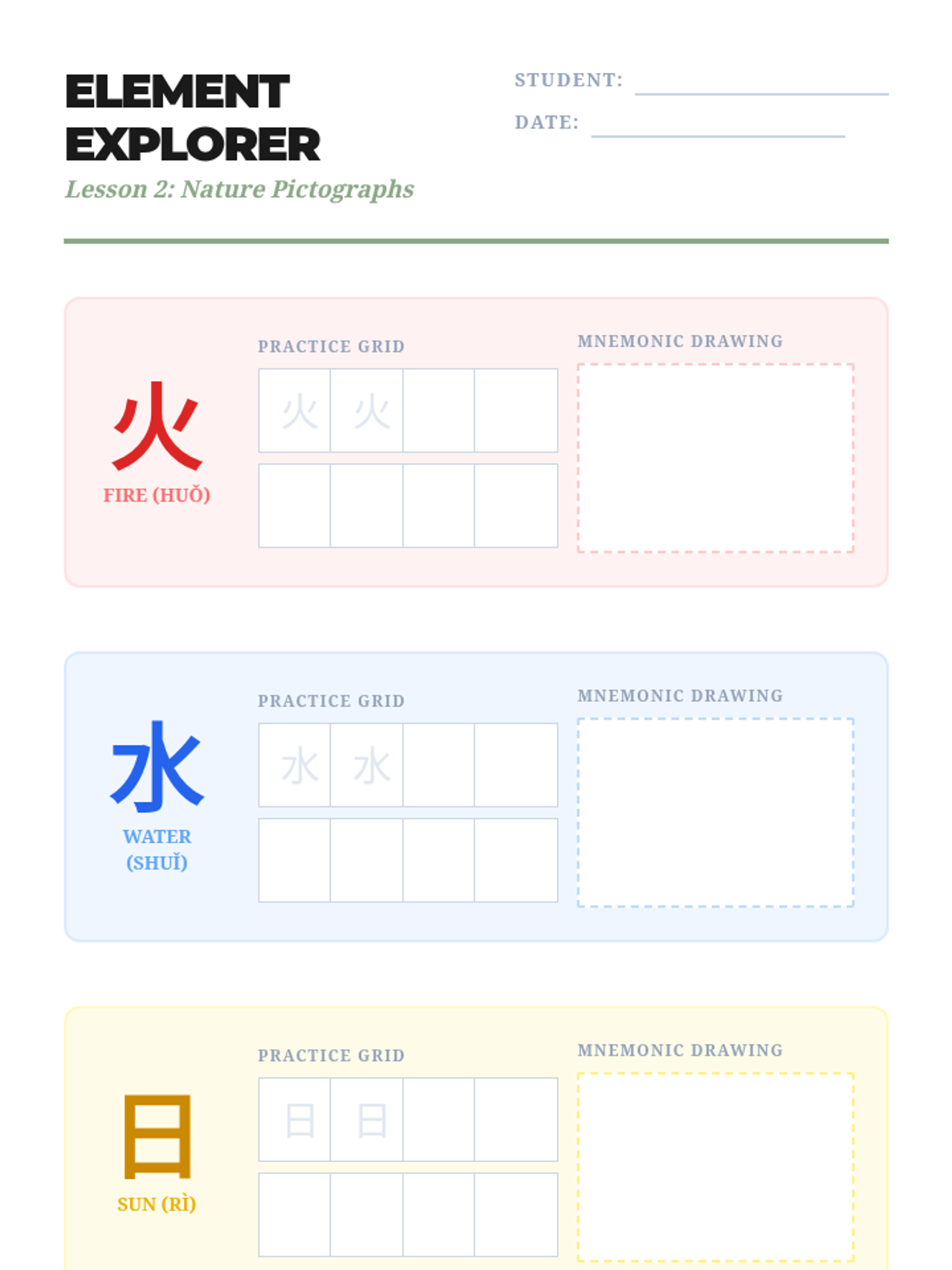
Writing practice worksheet for the four nature elements (Sun, Moon, Water, Fire) featuring stroke order tracing, practice grids, and spaces for creative visual mnemonics.
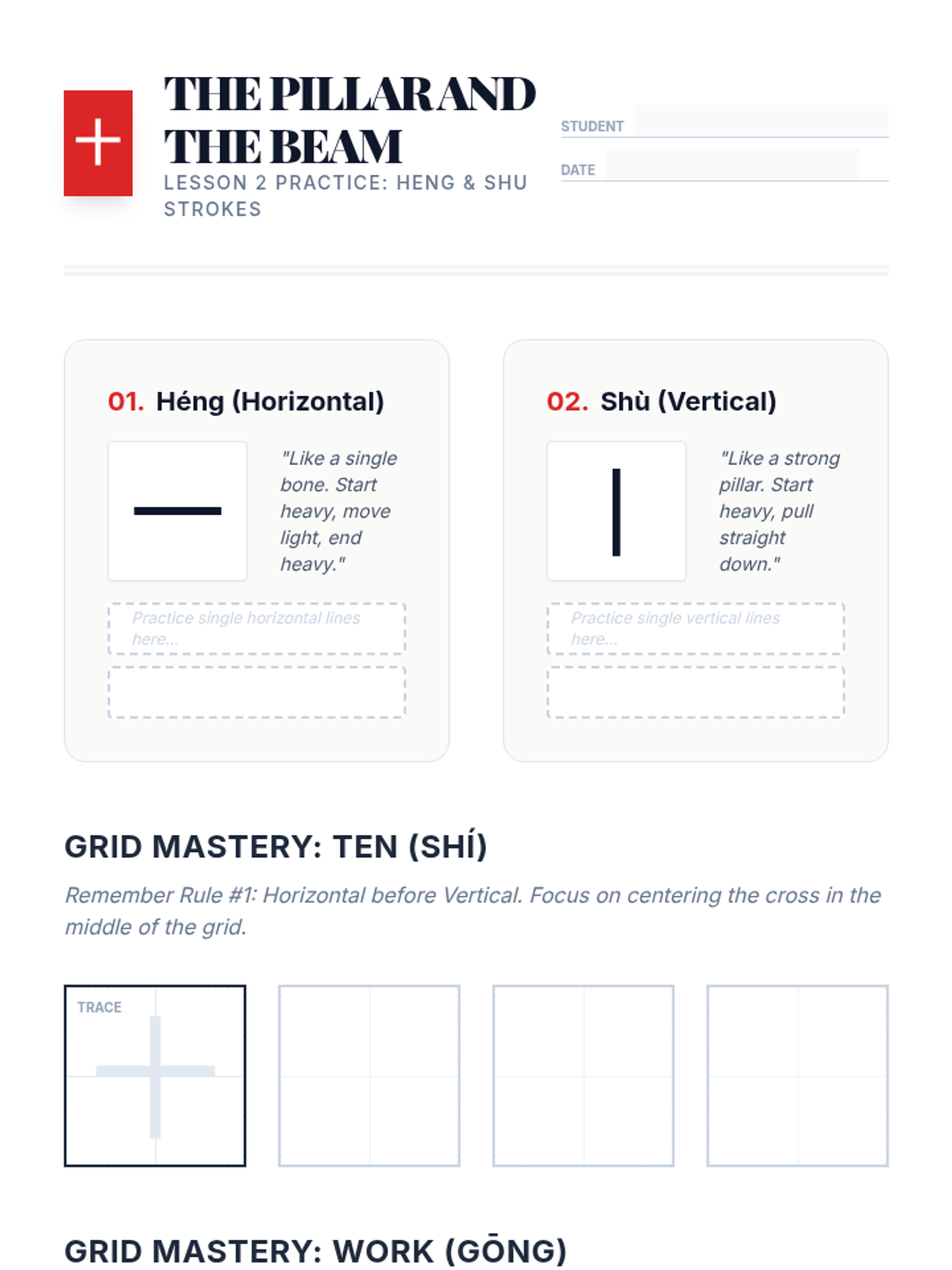
Student practice worksheet for Lesson 2, featuring grid-based writing exercises for the characters 'Ten' and 'Work' with a focus on Heng and Shu strokes.
Slides for Lesson 2 focusing on the four elements (Sun, Moon, Water, Fire). Covers stroke order rules and visual mnemonics for character retention.