Comprehensive French language instruction spanning basic literacy to advanced oral and written communication. Strengthens grammar, vocabulary, and cultural understanding through targeted exercises in listening, reading, and composition.
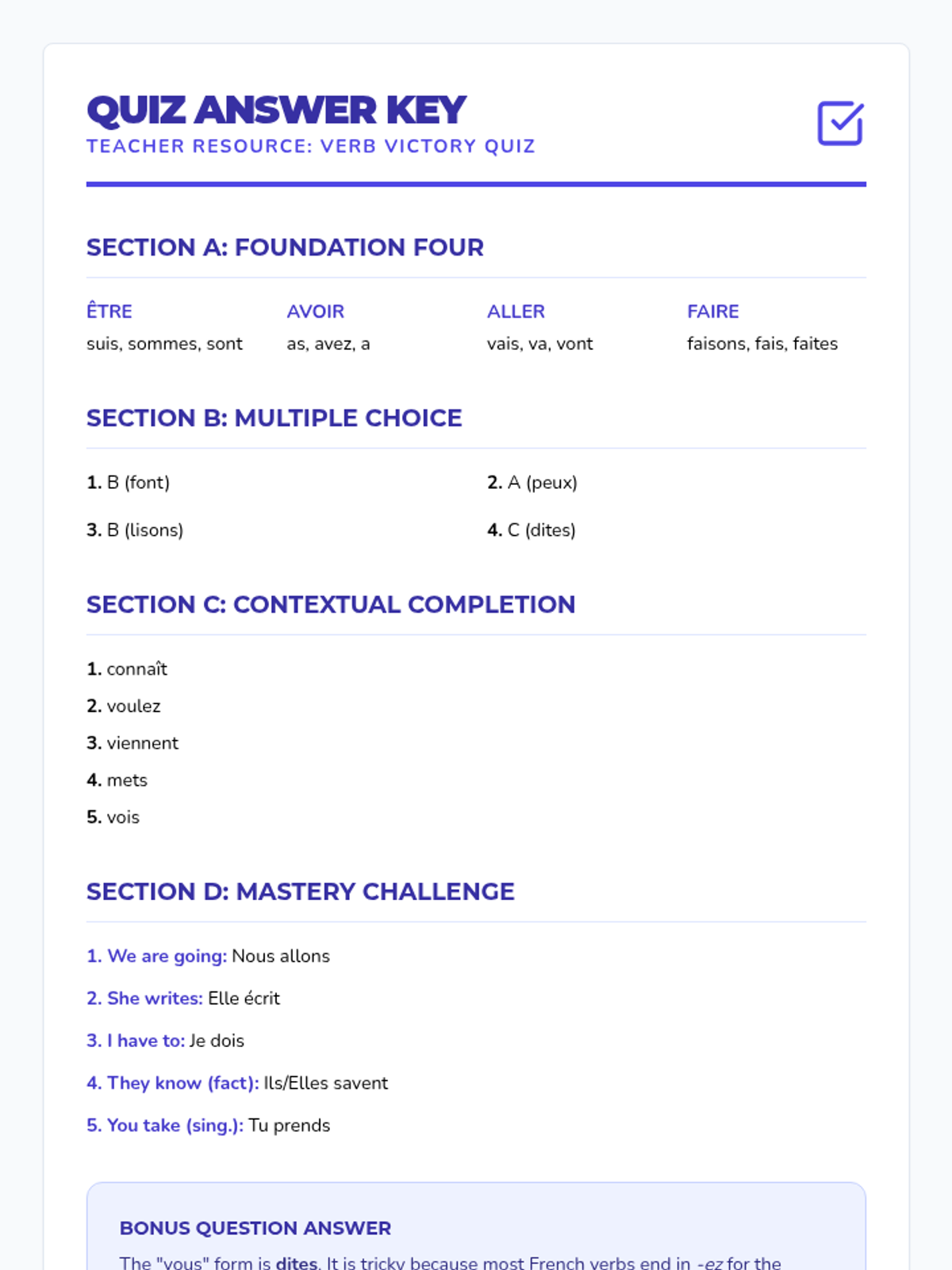
Teacher-facing answer key for the Verb Victory Quiz, providing all correct conjugations and translations for the assessment.
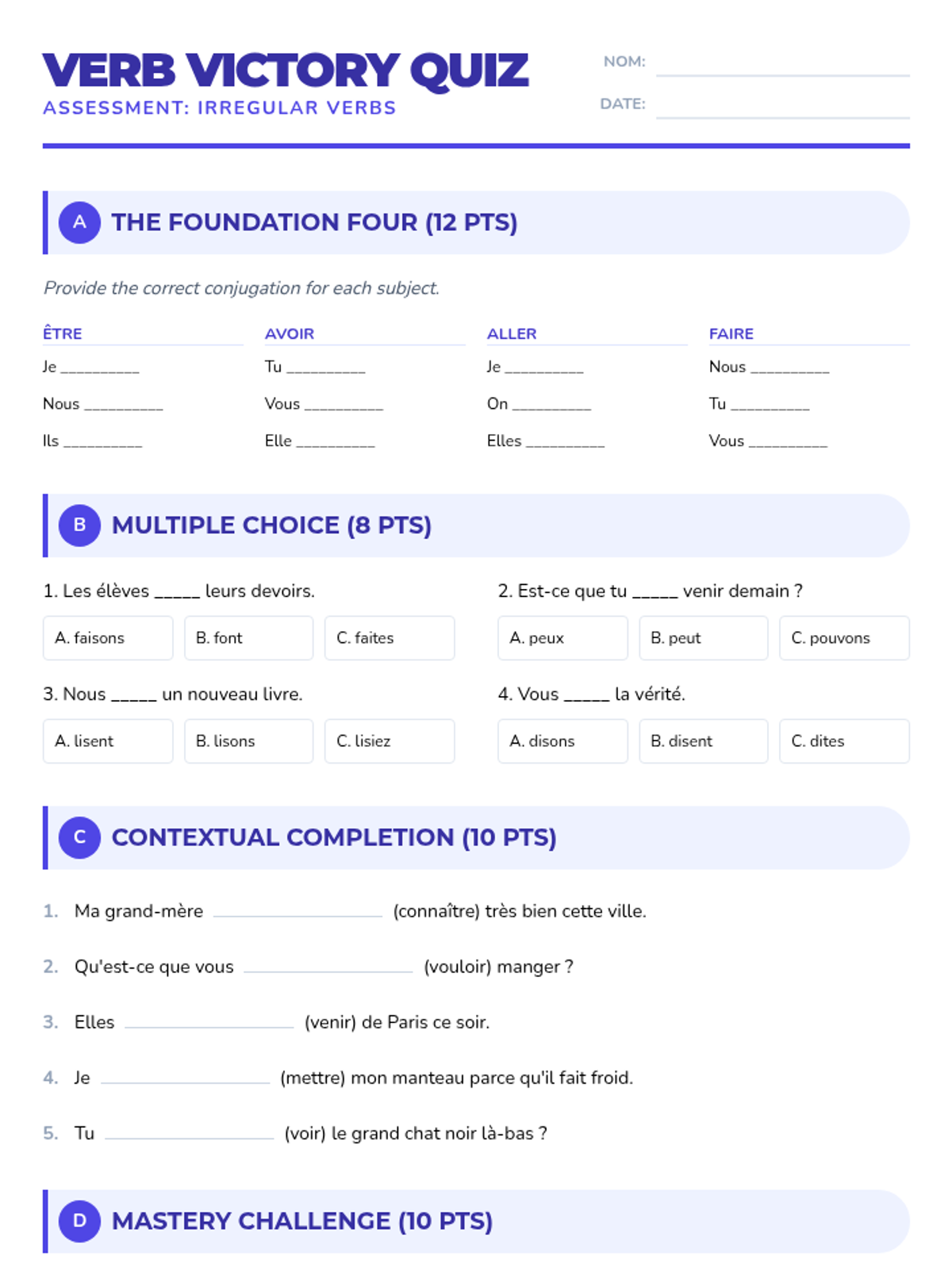
A formal assessment covering all 16 irregular French verbs through conjugation tasks, multiple-choice questions, and translation exercises.
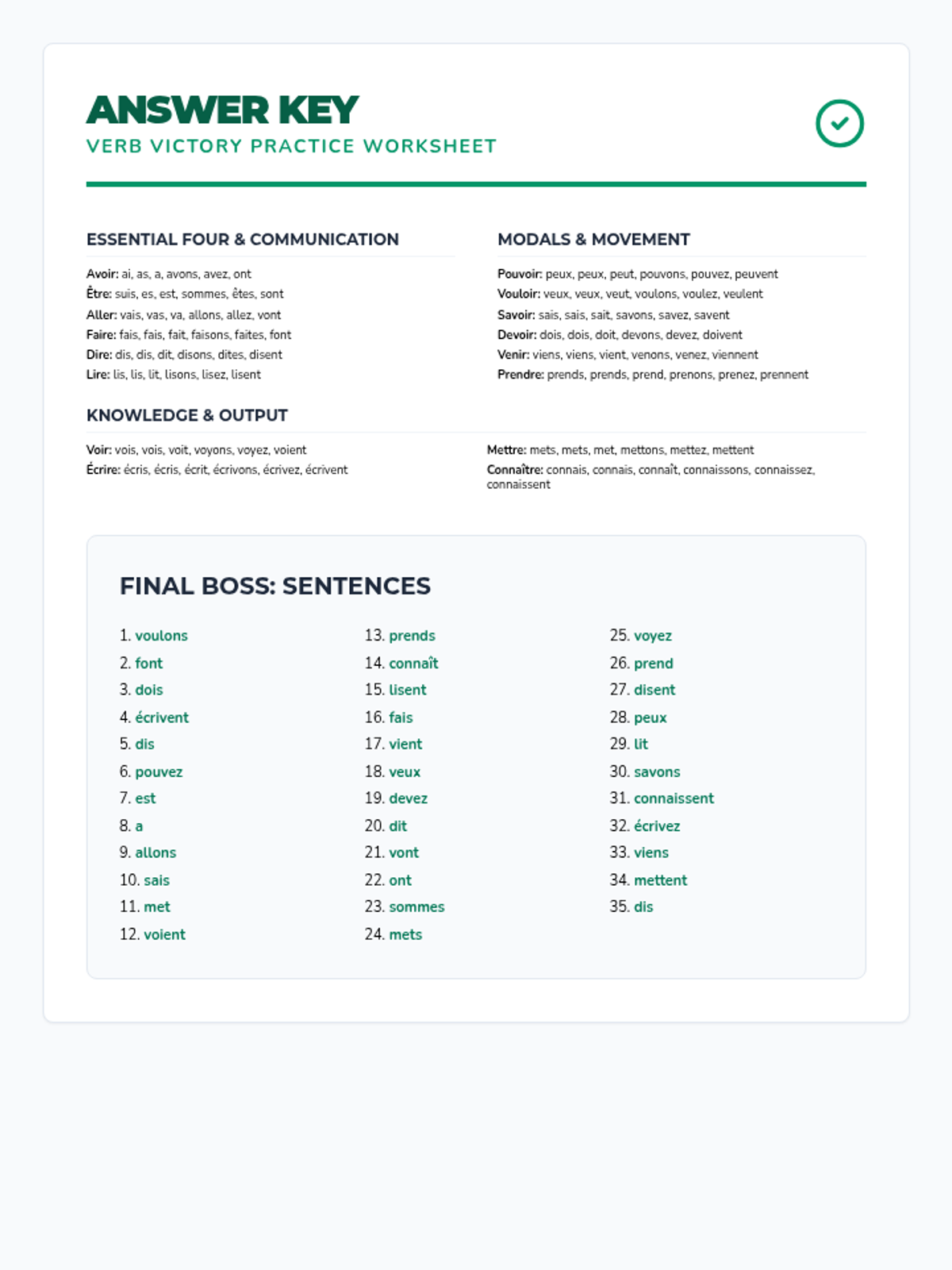
Teacher-facing answer key for the Verb Victory Practice Worksheet, updated to include answers for all 35 sentence challenges.
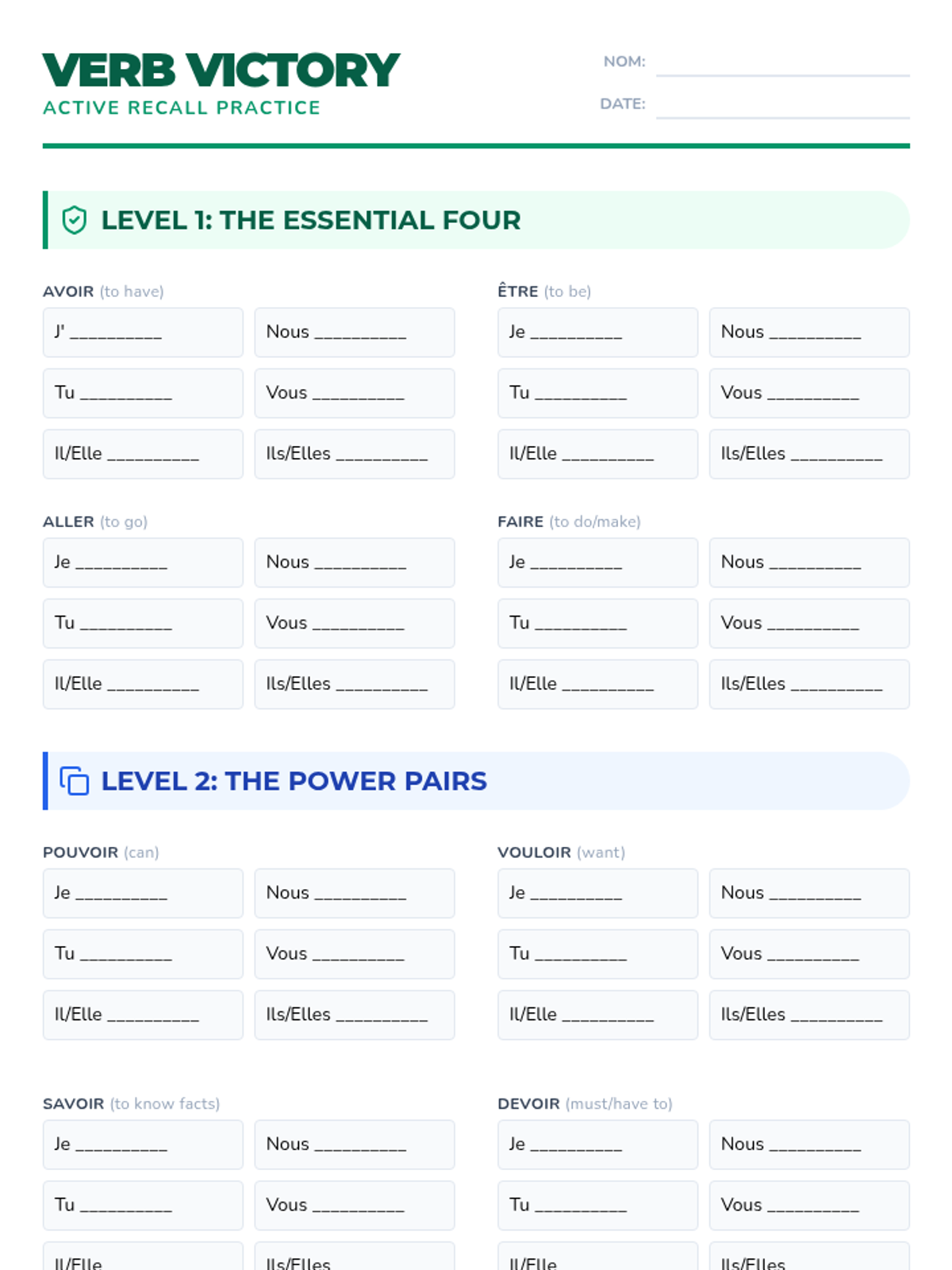
A comprehensive fill-in-the-blank practice worksheet for irregular French verbs, organized into levels of difficulty with a final 35-sentence mixed challenge. Now features all 16 target verbs and spans 4 pages for maximum practice. Revised with expanded handwriting space.
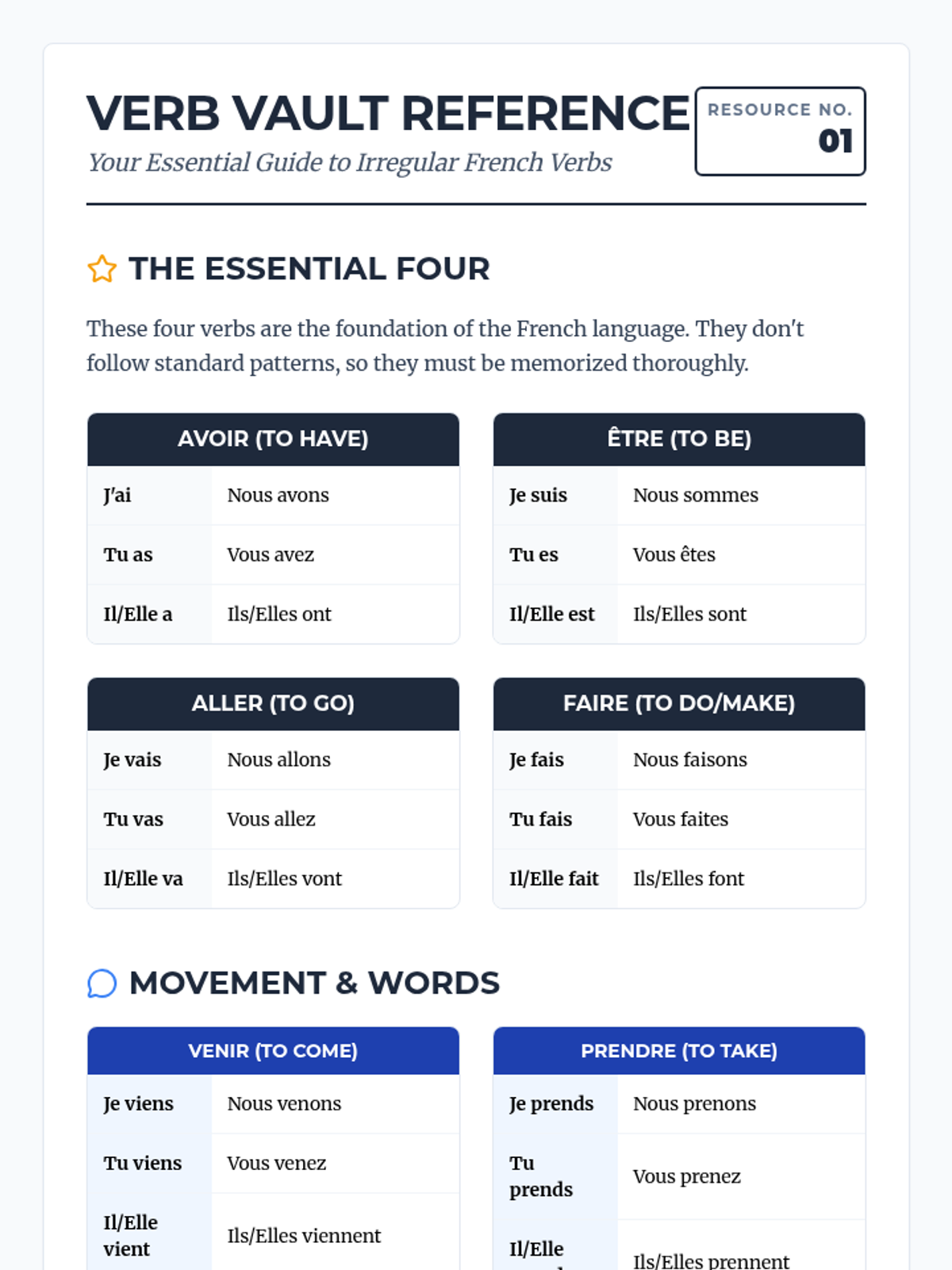
A comprehensive reference guide featuring organized conjugation charts for common irregular French verbs, highlighting patterns and similarities. Updated to include all requested verbs.
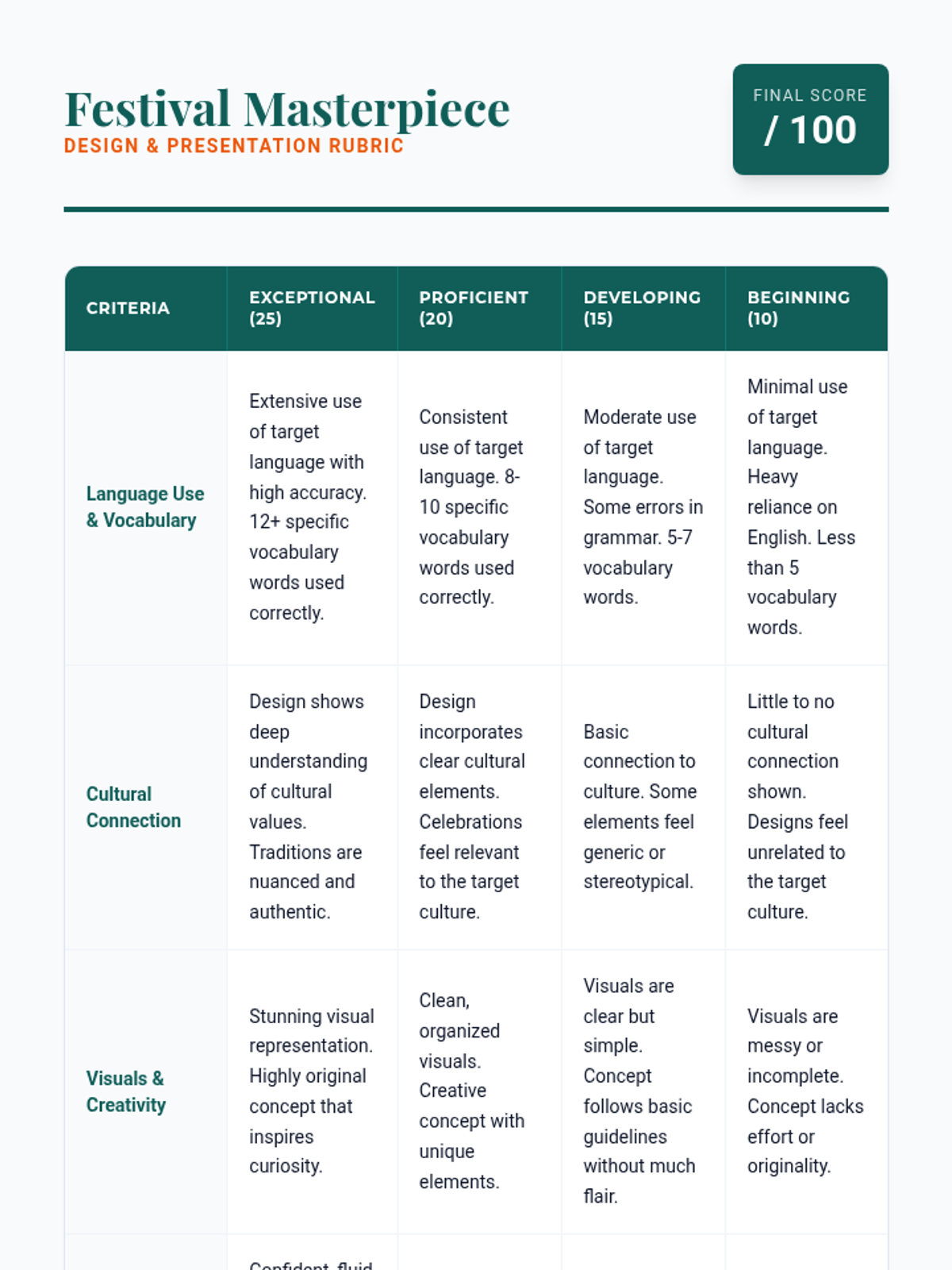
A comprehensive assessment rubric for the Cultural Festival Design Challenge, evaluating students on language use, cultural authenticity, creativity, and oral presentation skills.
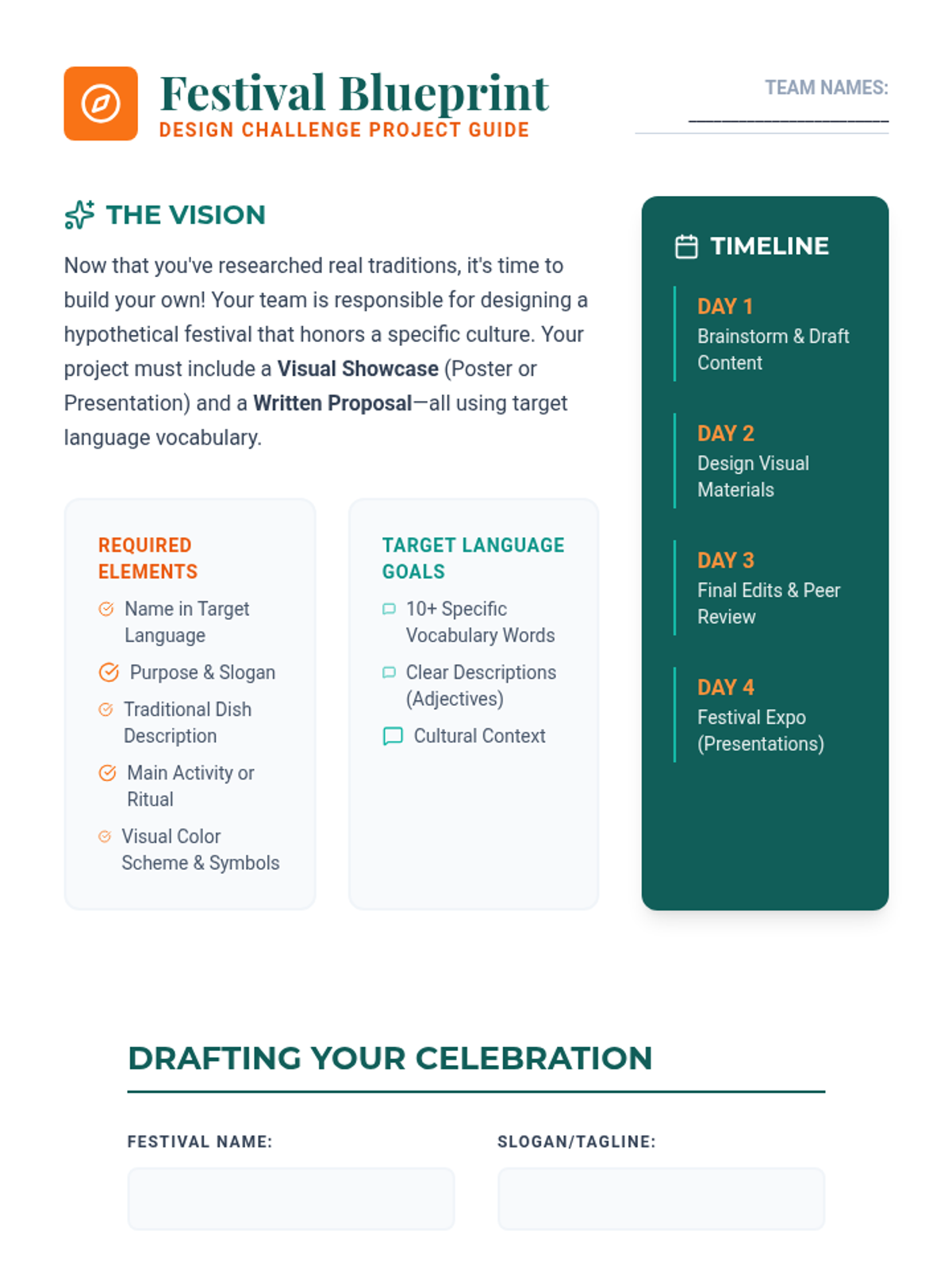
A detailed project guide for students to design their own cultural festival, including a planning timeline, required elements, and drafting space for their festival's name, slogan, culinary identity, and main event.
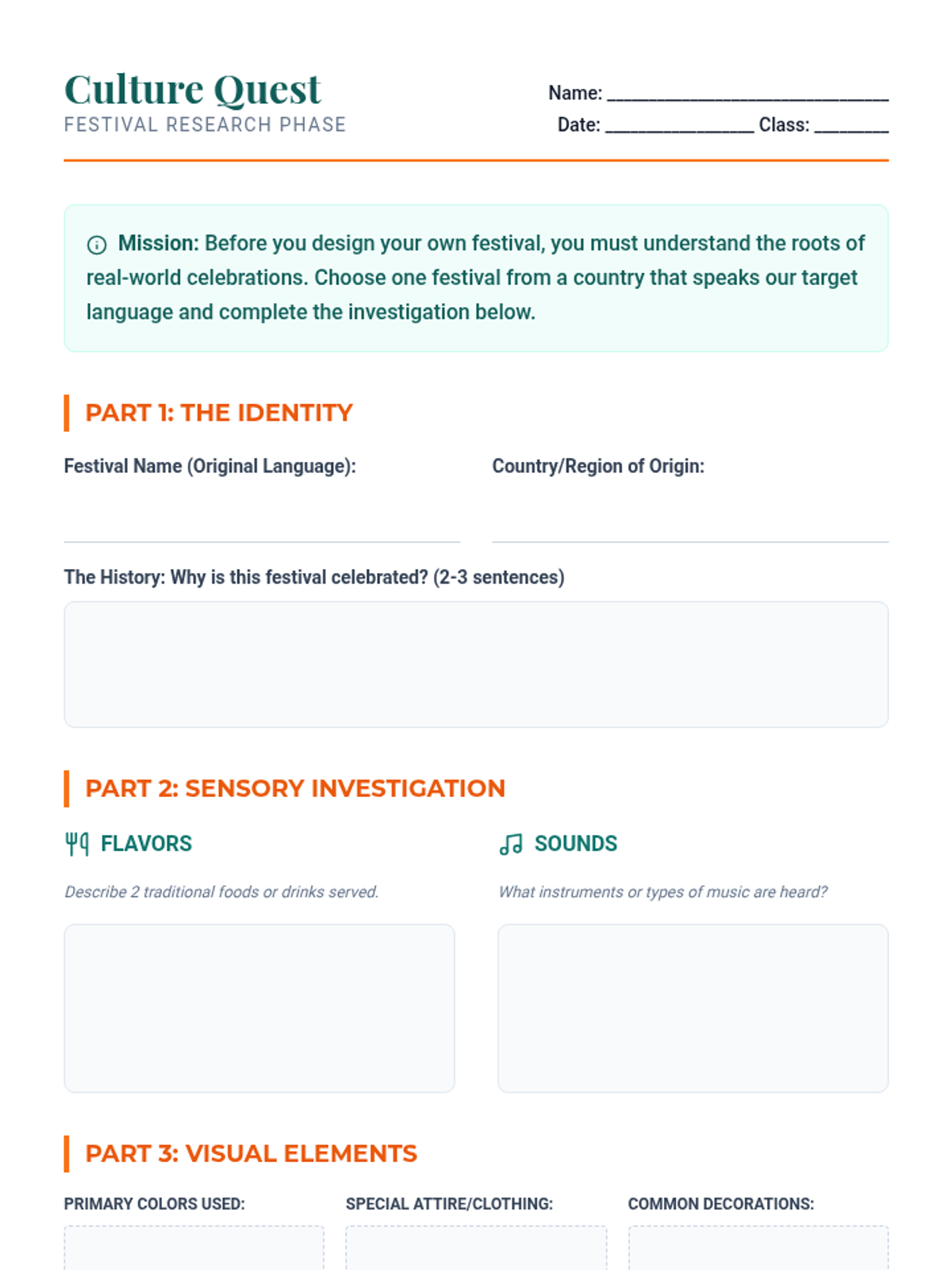
A research worksheet for students to investigate an authentic cultural festival, focusing on heritage, flavors, sounds, and visual elements in preparation for their design project.
A visually engaging slide deck designed to introduce the Cultural Festival Design Challenge, outlining the project's mission, required elements, and creative expectations for students.
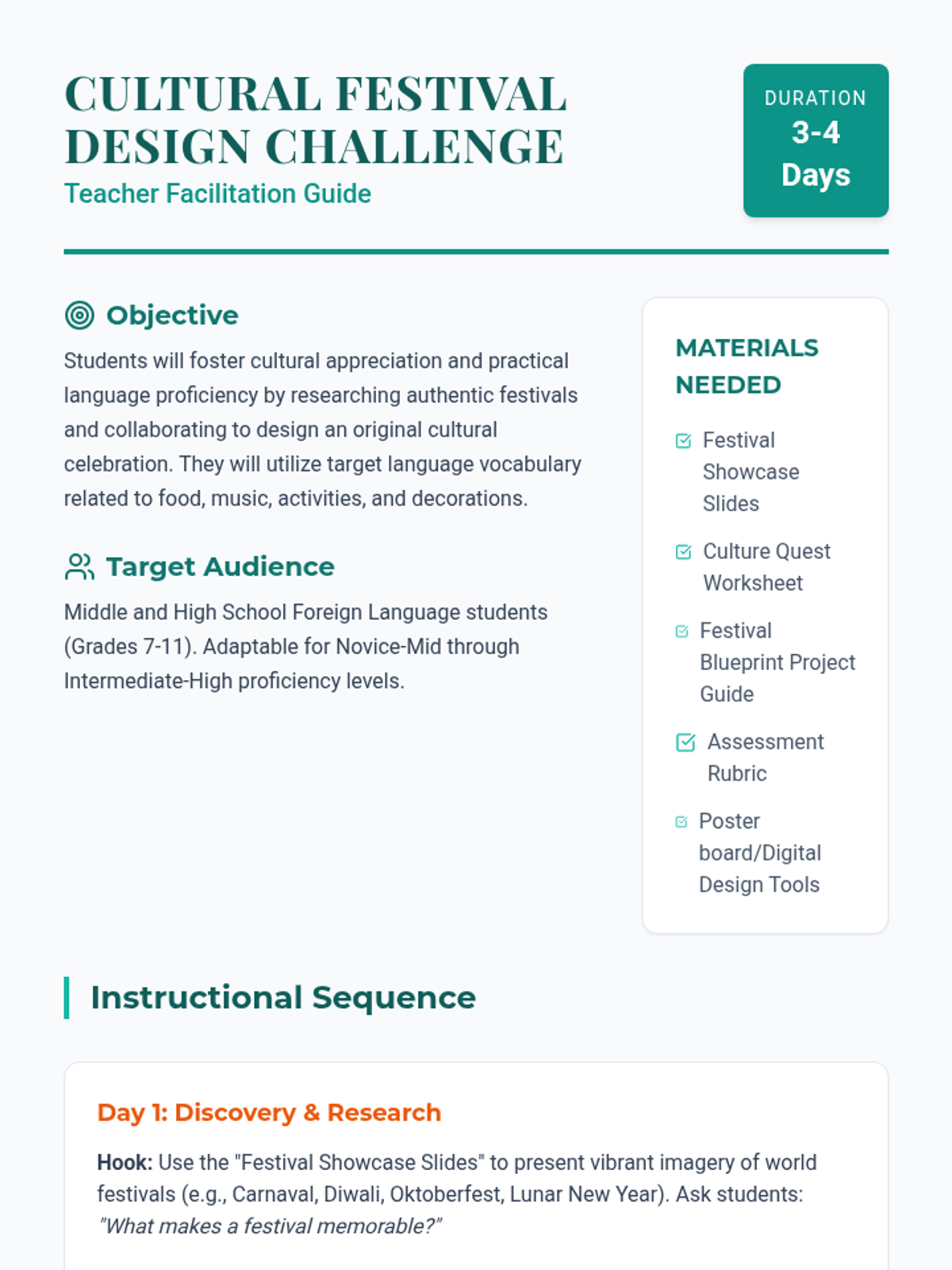
A comprehensive lesson plan for the Cultural Festival Design Challenge, outlining the instructional sequence, learning objectives, and differentiation strategies for middle and high school language learners.
Expanded A1+/A2 action slides for Lesson 2. Introduces more specific vocational verbs like Whisk (with custom wire whisk drawing), Grate, Stir, Pour, Clean, and Carry (with professional Tray drawing). Visual-heavy support for CAP students.
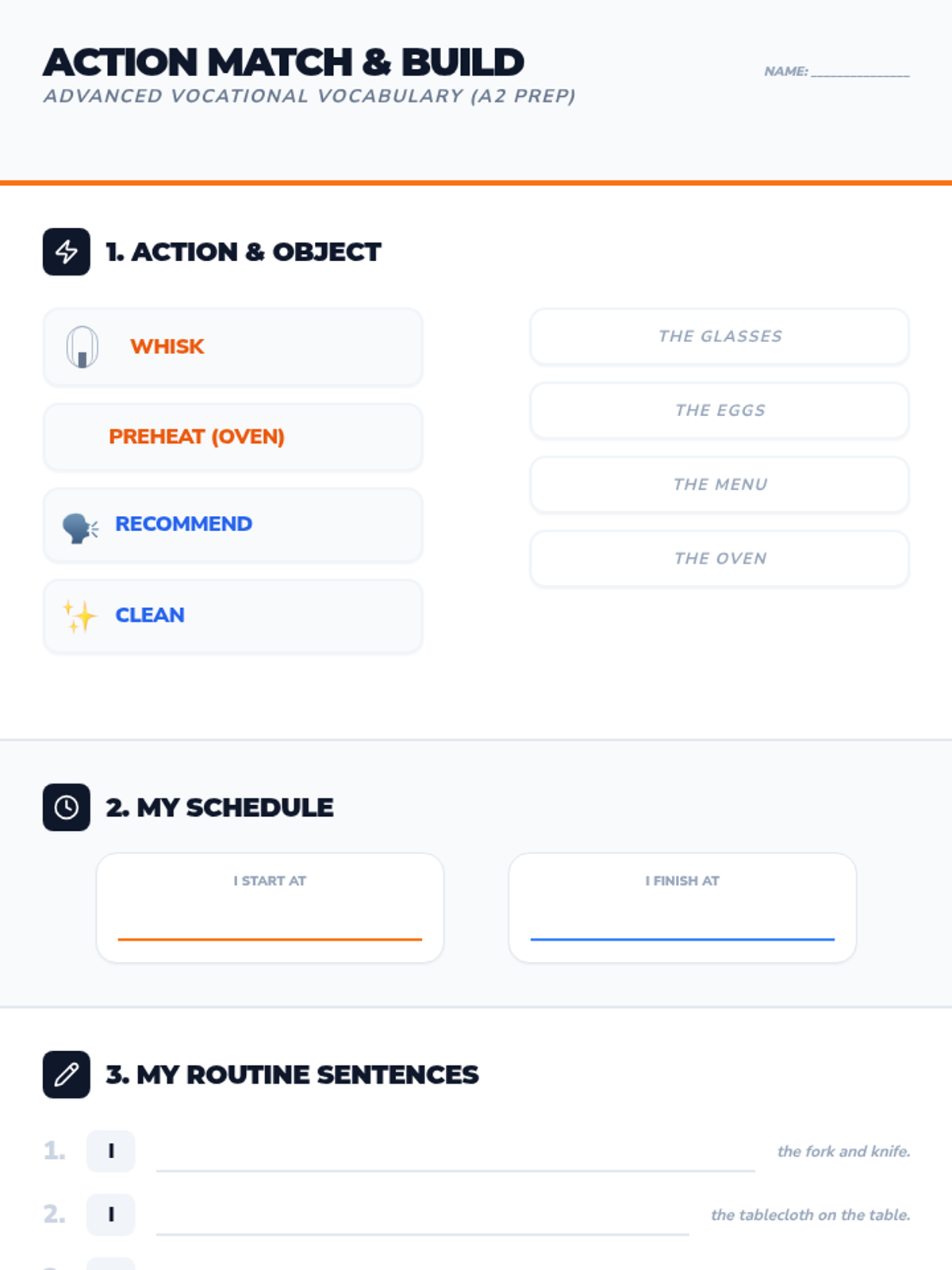
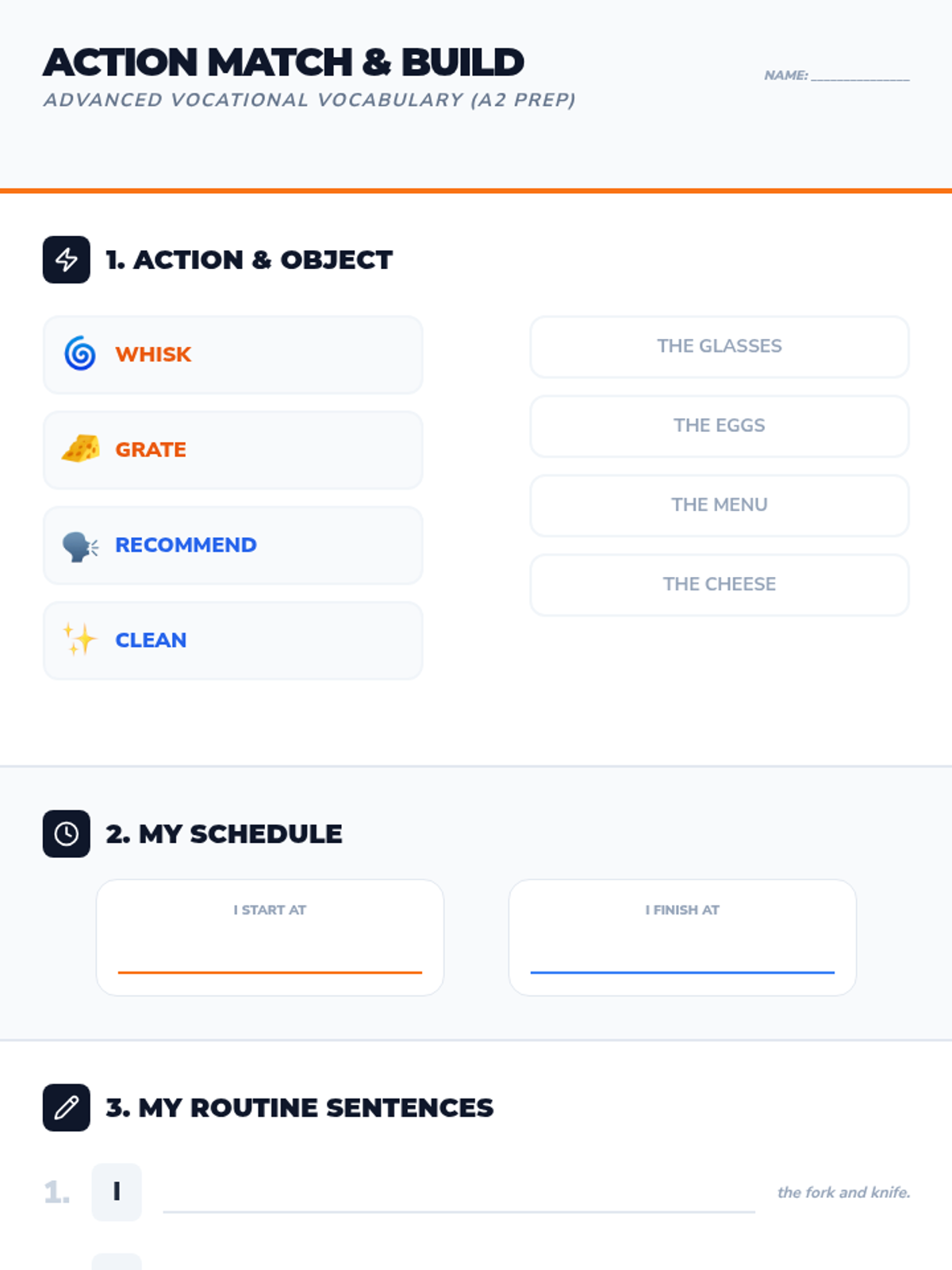
Expanded vocational worksheet for Lesson 2 focusing on more advanced verbs and routine building. Updated visual representation for wire Whisk drawing and professional Tray. High visual support.
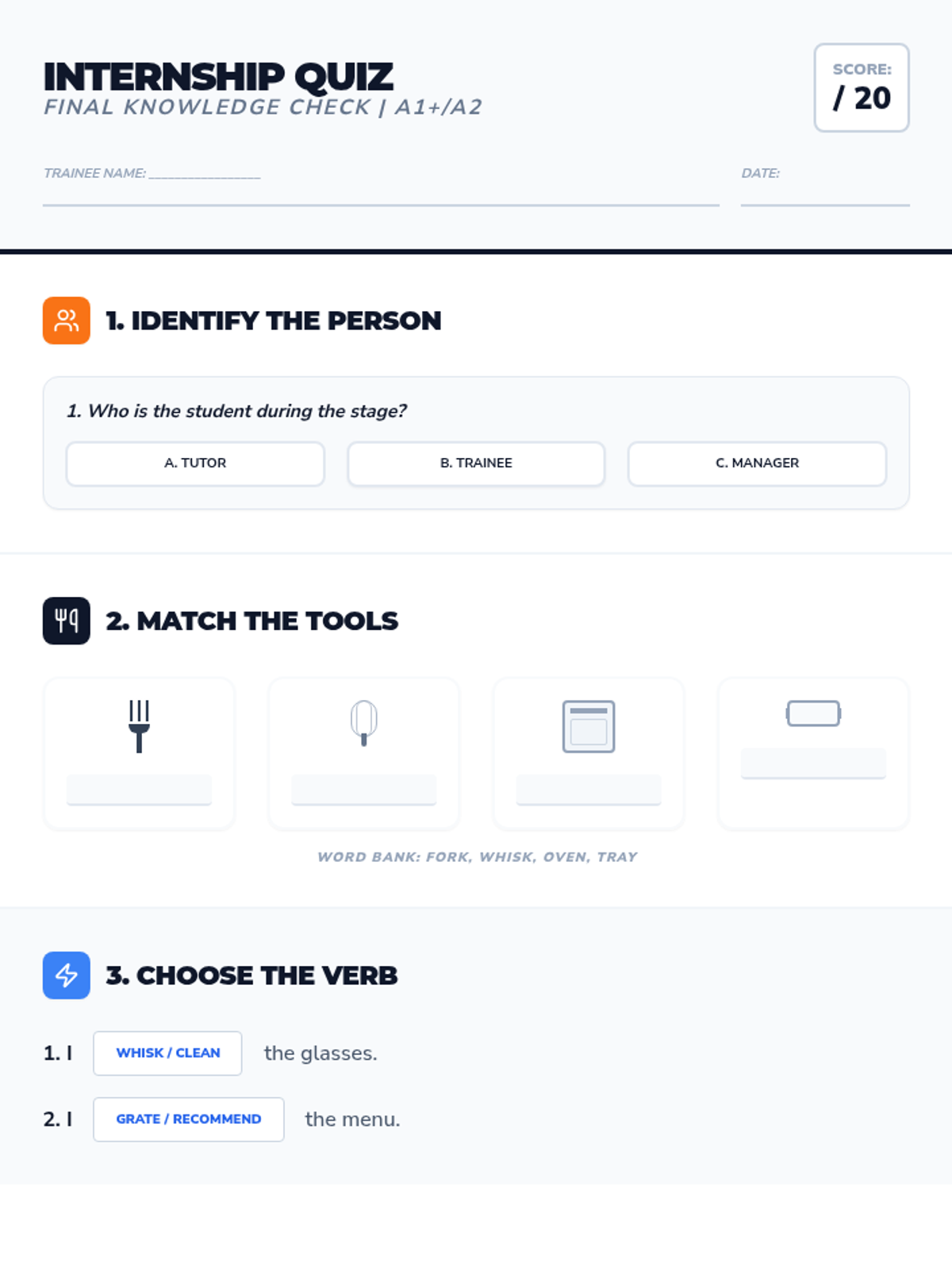
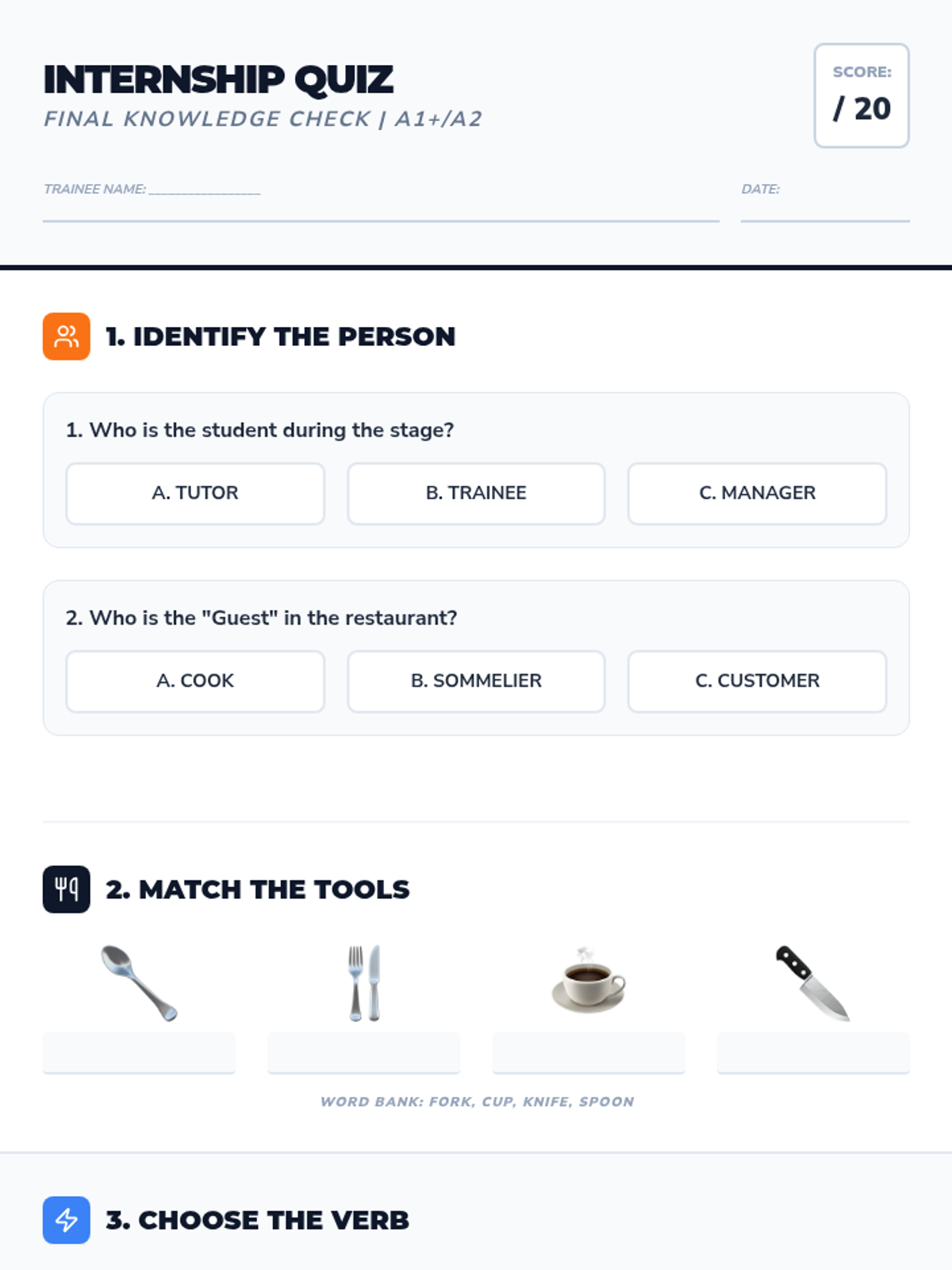
Updated formative assessment quiz for Lesson 3. Covers roles, tools (visual), verb choice, and basic translation. Improved visual representations for single Fork drawing, professional flat Tray, custom wire Whisk, and Oven. Designed for vocational students.
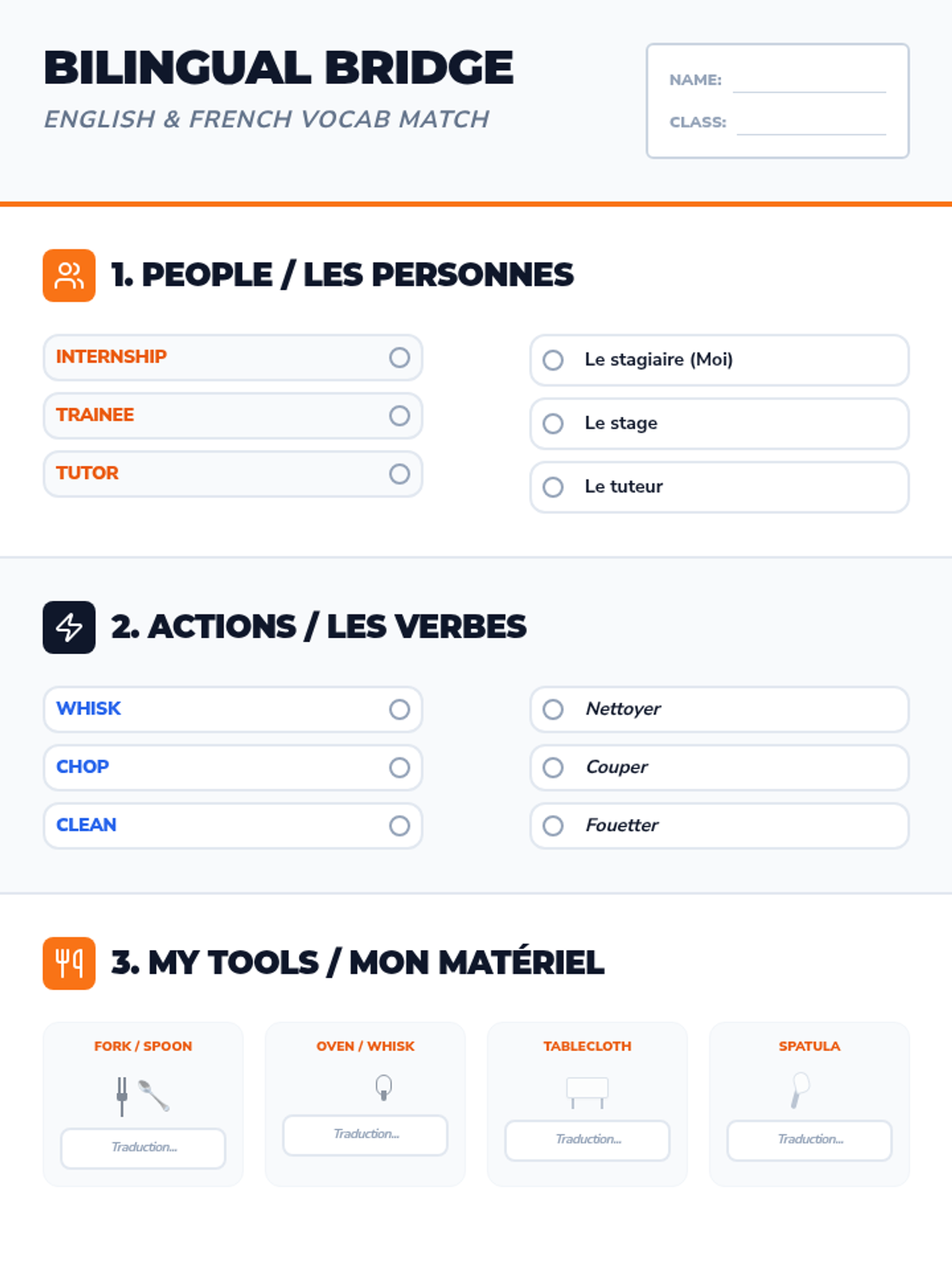
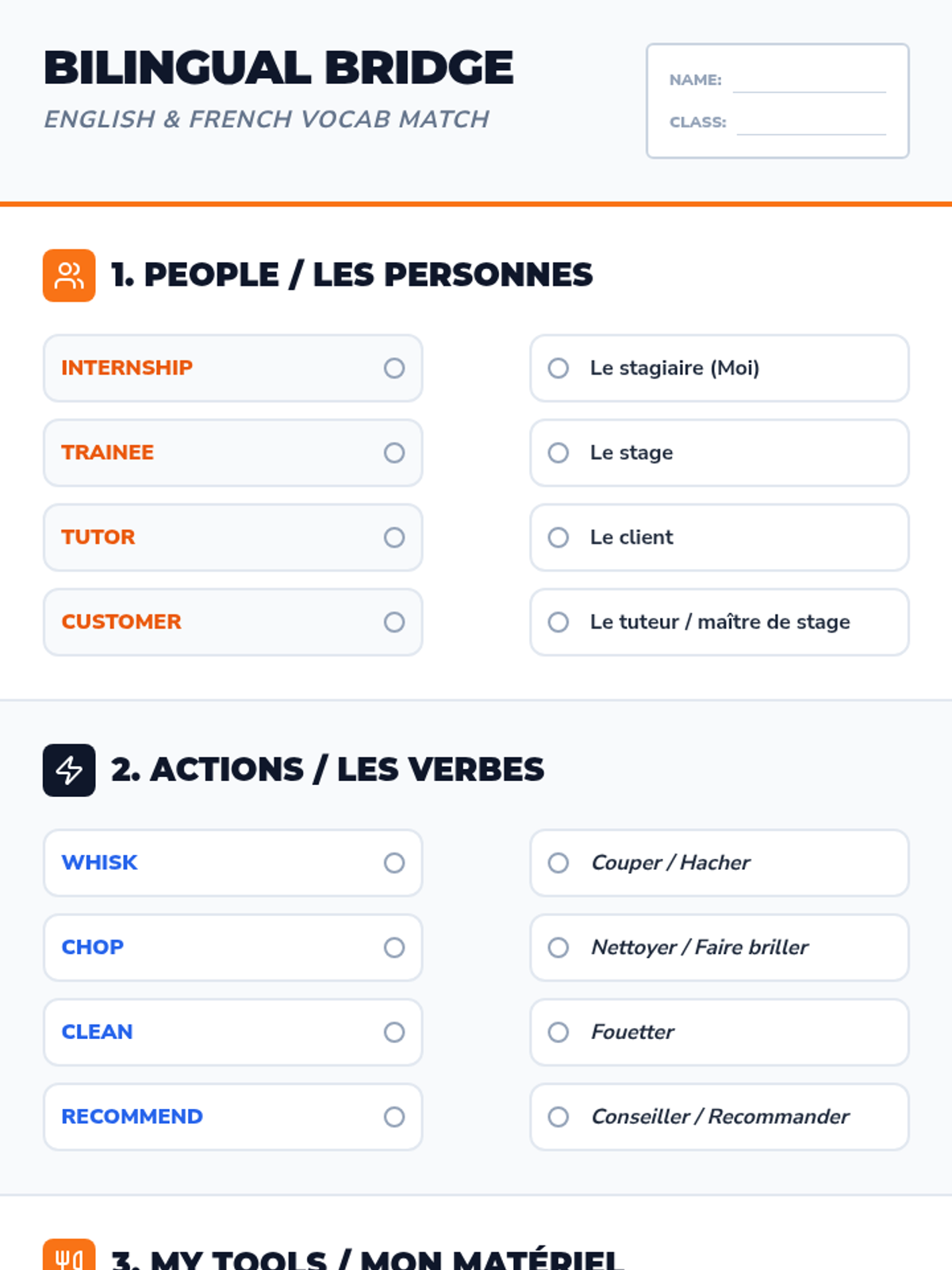
A bilingual matching worksheet designed to bridge English vocational terms with their French translations. Refined visual representations for single Fork, Oven, custom wire Whisk drawing, professional Spatula, and Tablecloth. Ideal for A1+/A2 vocational students.
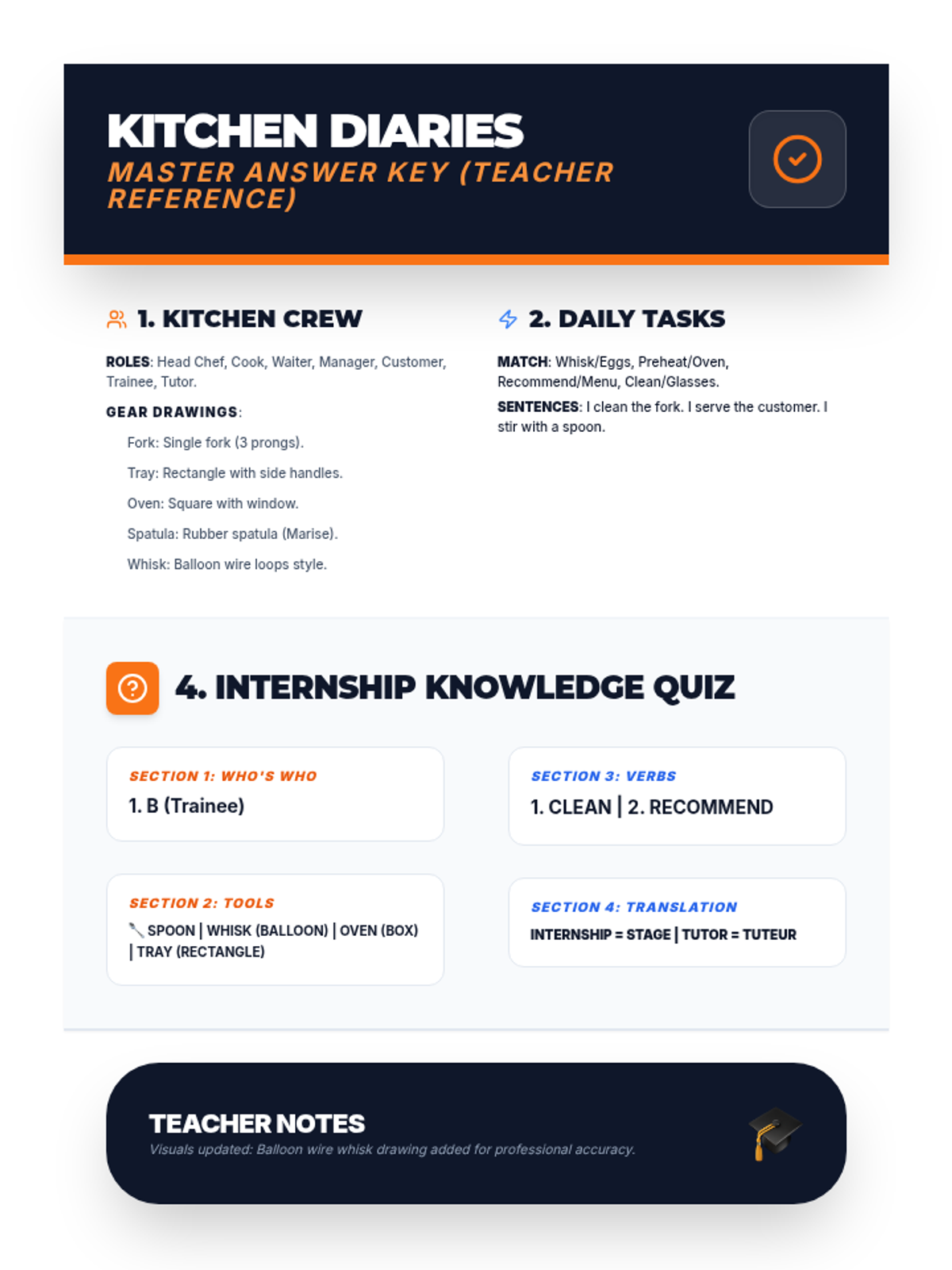
Updated teacher answer key. Refined the gear list visual guide with descriptions for single Fork drawing, professional flat Tray icon, Oven, Marise Spatula, and realistic wire Whisk drawing.
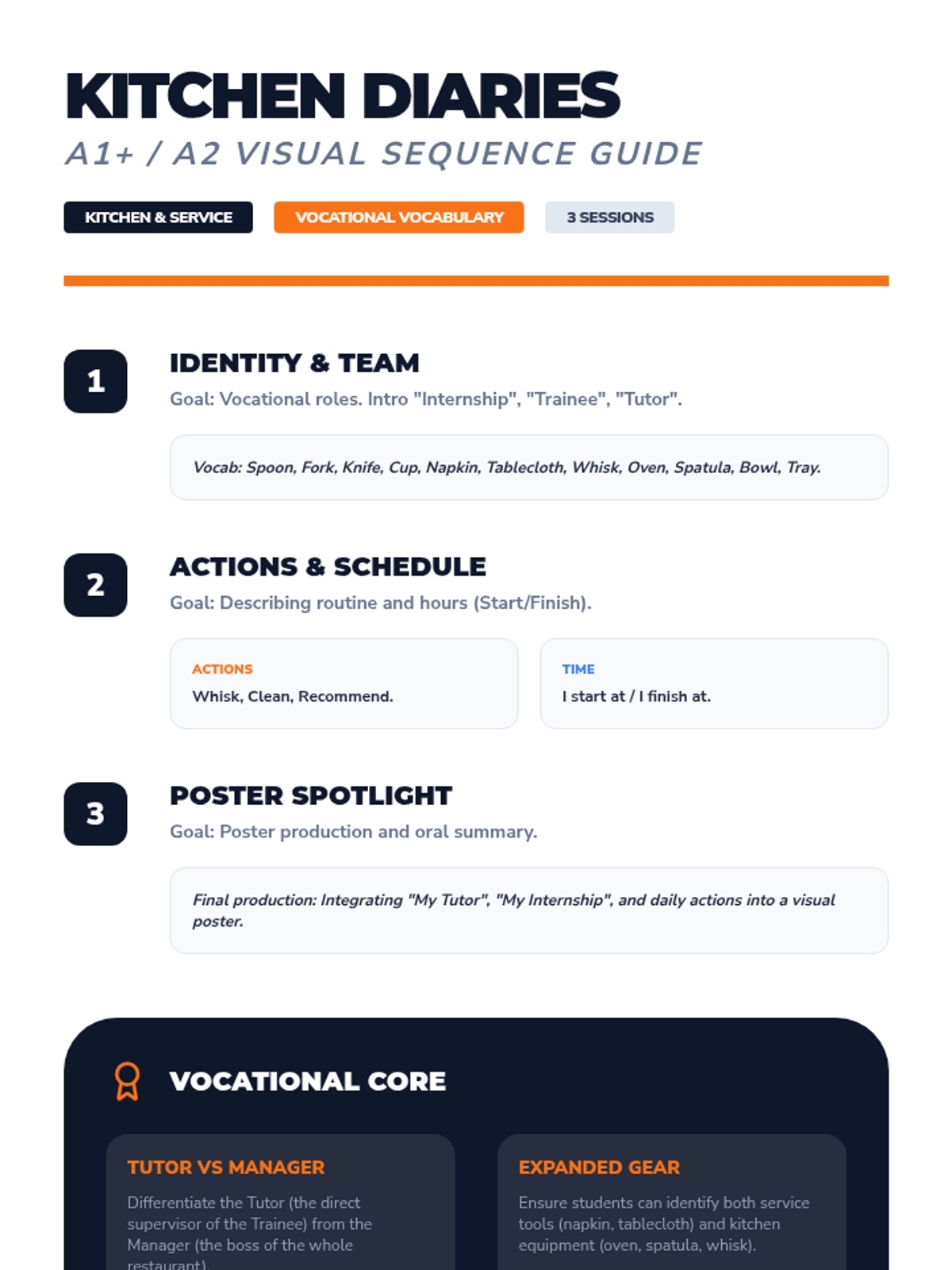
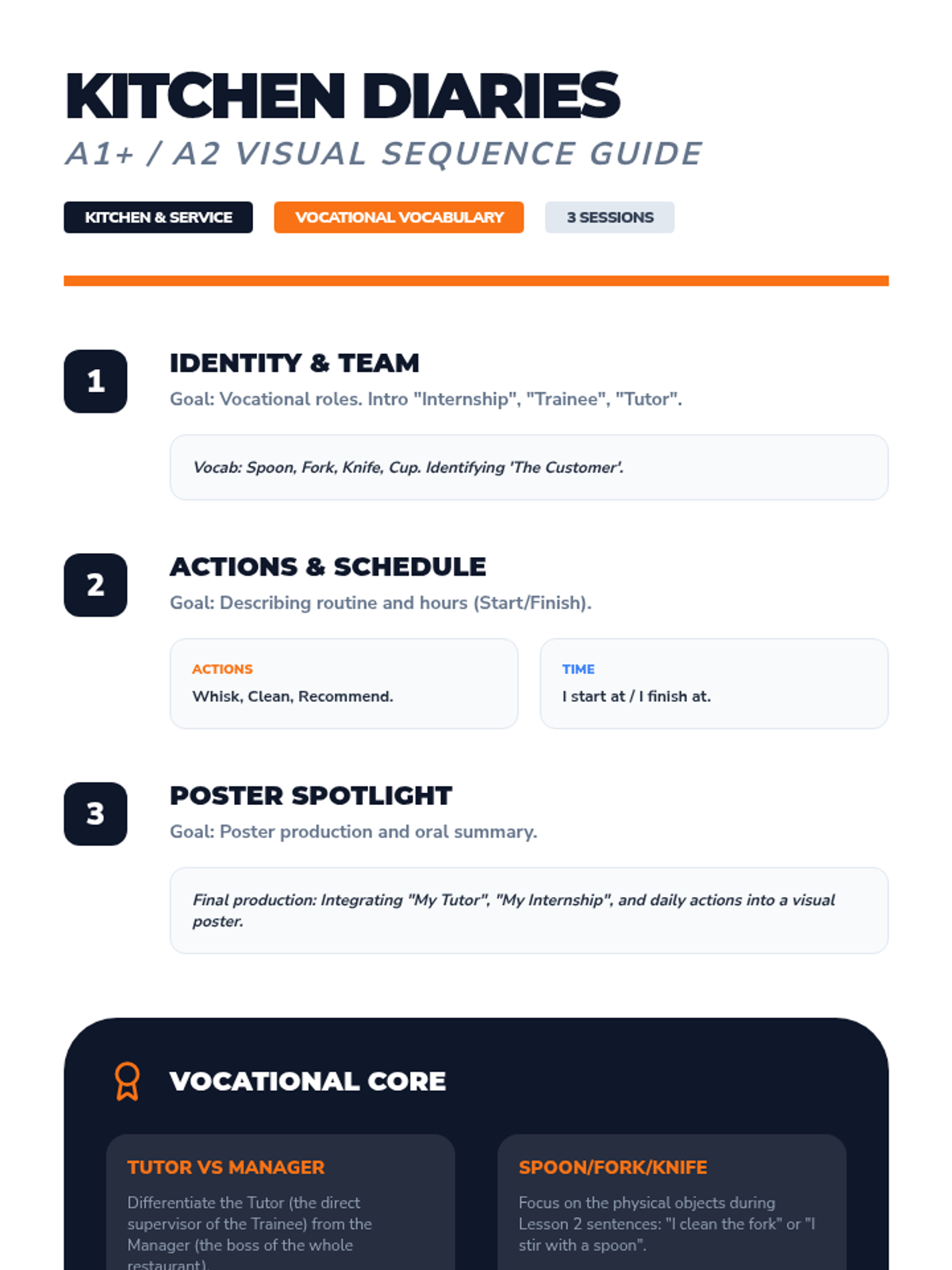
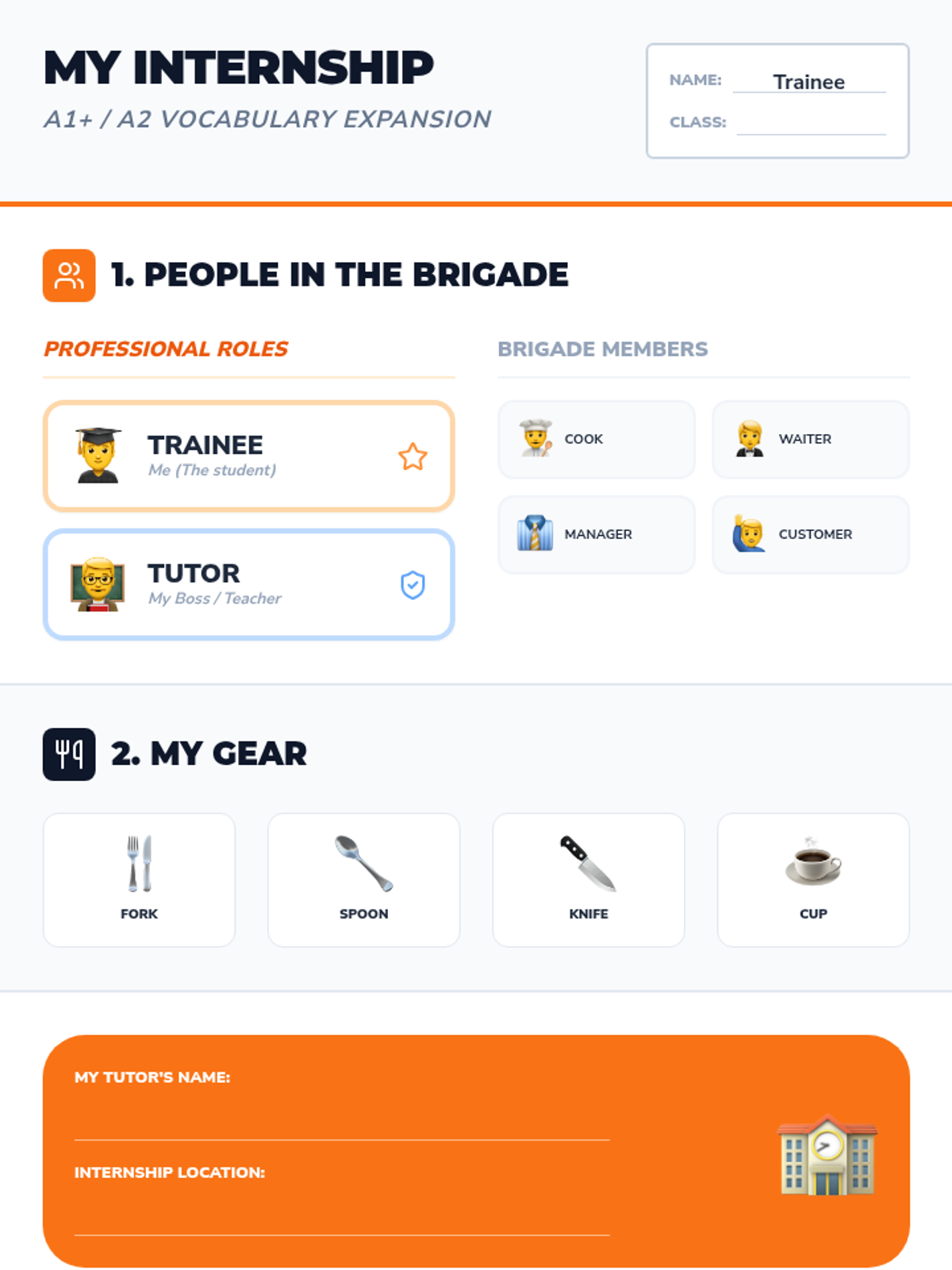
Updated teacher's guide for the Kitchen Diaries sequence. Refined the vocabulary list (Spoon, Fork, Knife, Manager, Customer) and focus on pro verbs for bridging A1 to A2. Includes vocational roles like Tutor and Trainee.
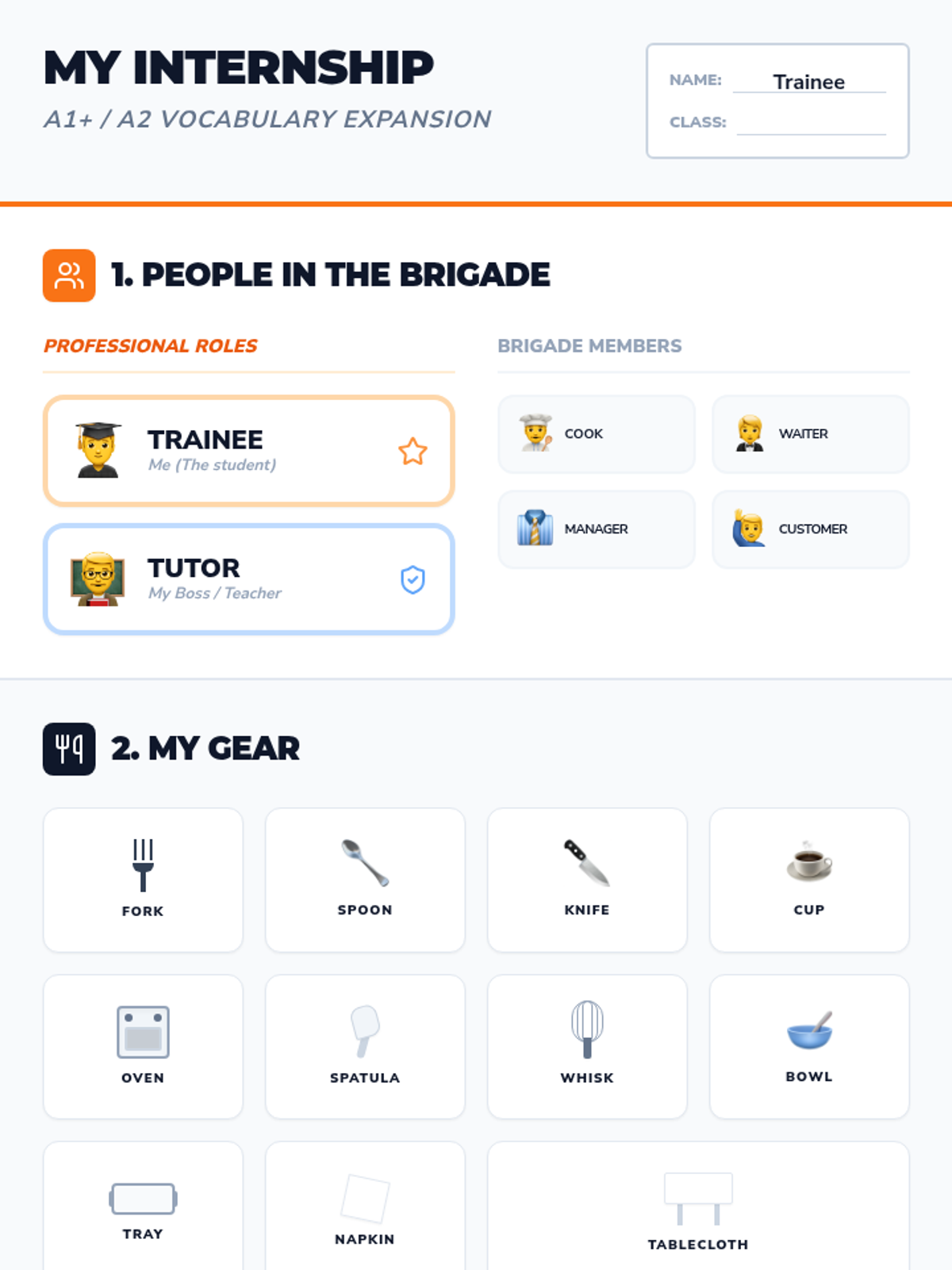
Updated visual slides for Lesson 1. Refined drawings: realistic Wire Whisk bulb, single Fork drawing, professional flat Tray icon, Oven, Marise Spatula, Napkin, and Tablecloth. High visual support.
Updated A1+/A2 worksheet for Lesson 1. Refined visuals: Single fork, flat professional tray, realistic wire balloon whisk drawing, marise spatula, folded square napkin, and table with cloth. Full vocational gear list included.
Updated formative assessment quiz for Lesson 3. Covers roles, tools (visual), verb choice (updated "Polish" to "Clean"), and basic translation. Designed to verify A1+/A2 vocational knowledge before the final project.
A bilingual matching worksheet designed to bridge English vocational terms with their French translations. Covers People (Internship, Trainee, Tutor, Customer), Actions (Whisk, Clean, etc.), and Tools. Updated "Polish" to "Clean". Ideal for A1+/A2 CAP students.
A vibrant presentation for reviewing the irregular French verbs avoir, être, faire, and aller. Features a Parisian Metro theme with bold visuals to help students memorize conjugations before the Bingo game.
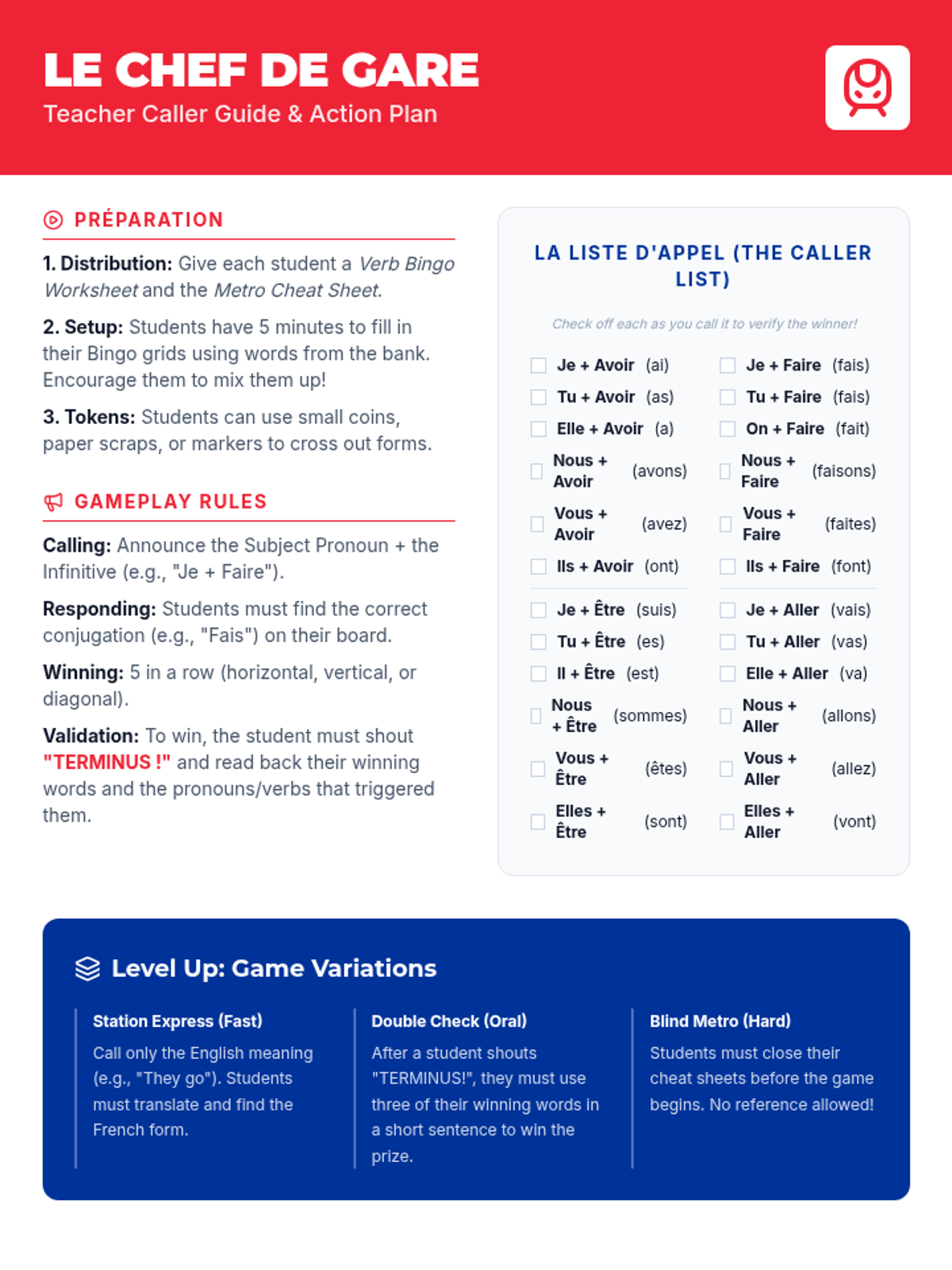
A comprehensive teacher guide for the Verb Bingo game, featuring calling scripts, variation ideas, and a Parisian 'Chef de Gare' theme. Includes a tracking list for caller verification.
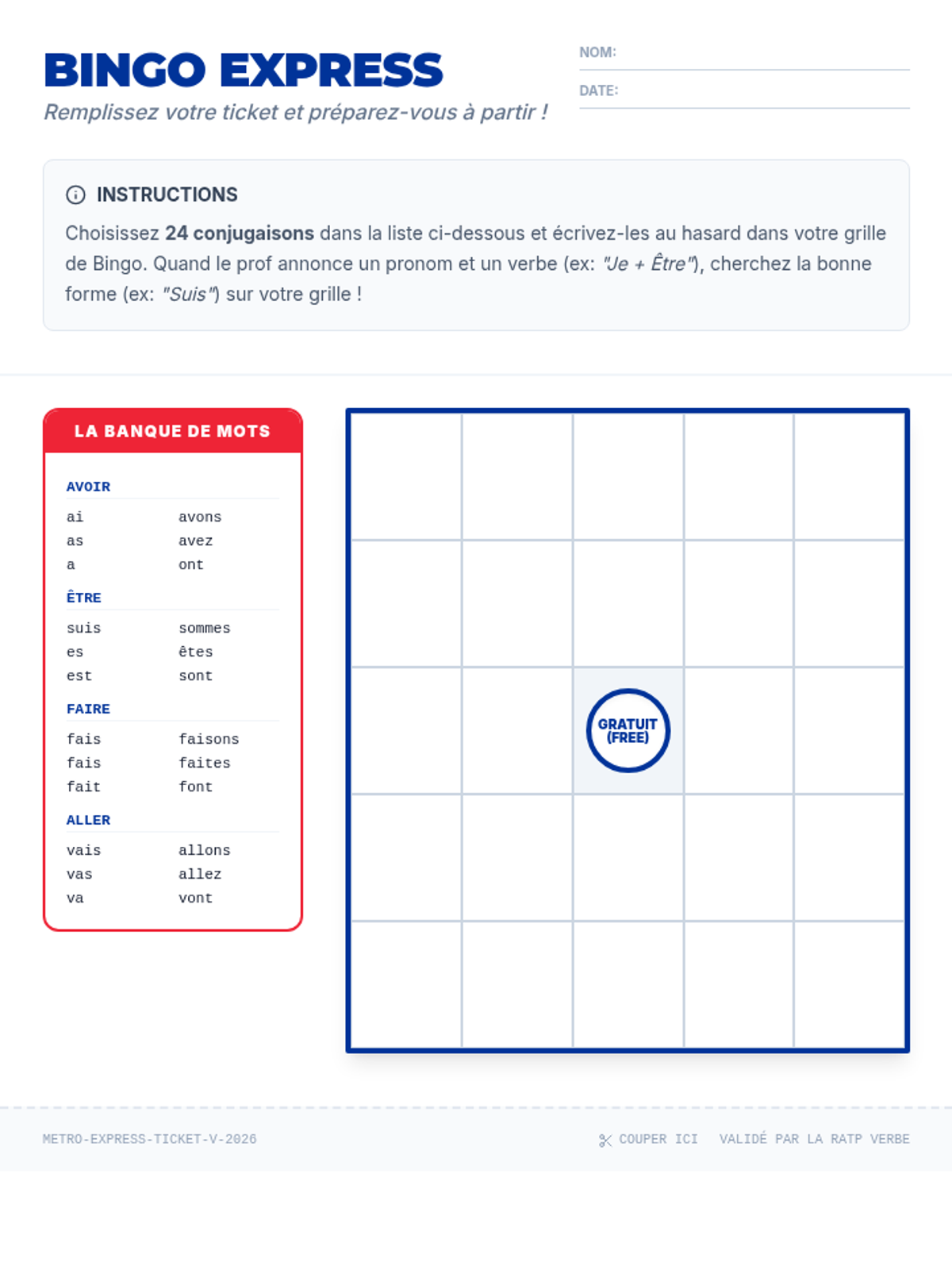
A 'Create Your Own' Bingo board for French students to practice conjugations of avoir, être, faire, and aller. Includes a word bank and a Metro-inspired ticket design.
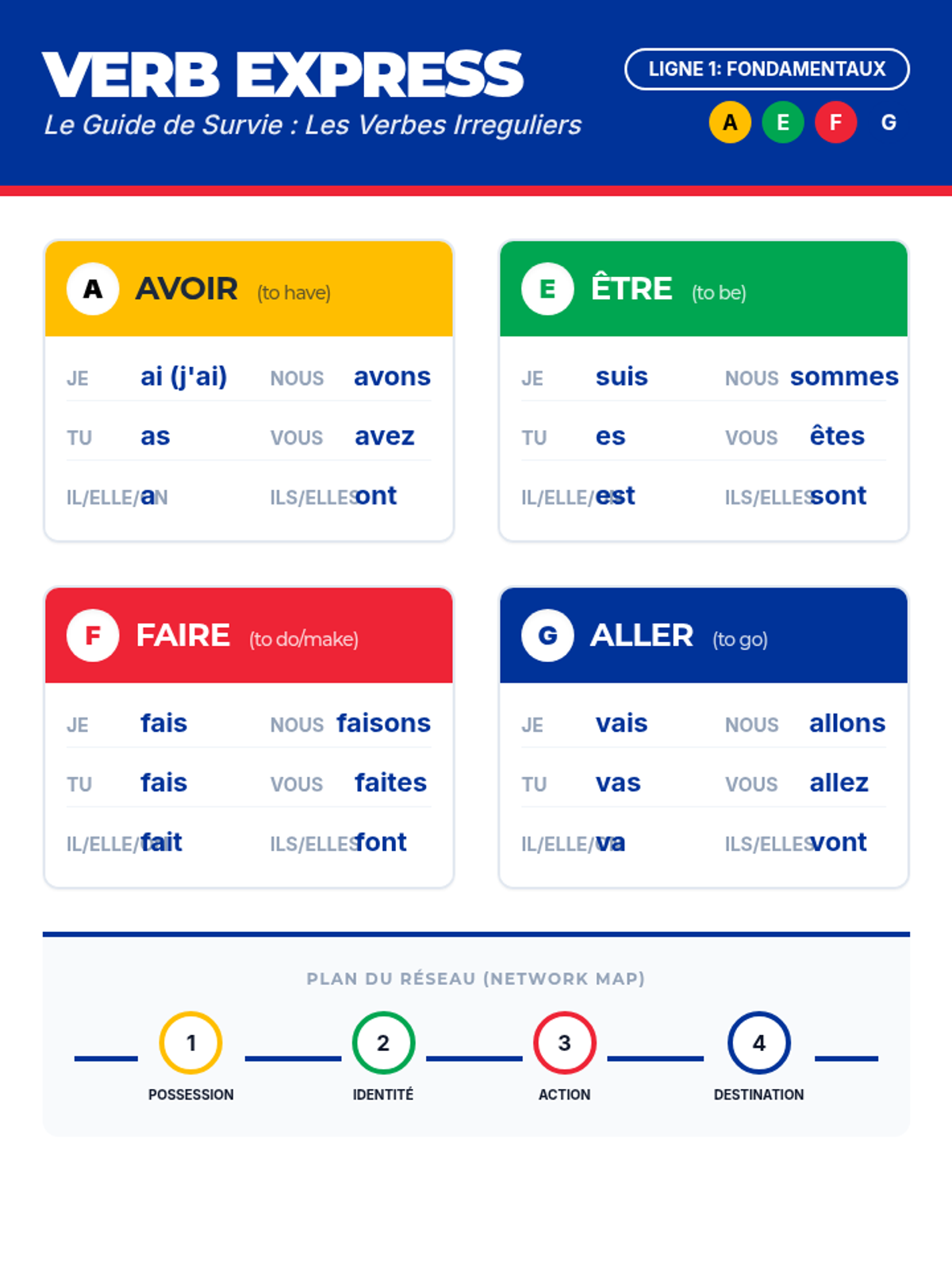
A Metro-themed reference sheet for the four core irregular French verbs: avoir, être, faire, and aller. Designed as a 'survival guide' with clear conjugation tables and a Parisian transit aesthetic.
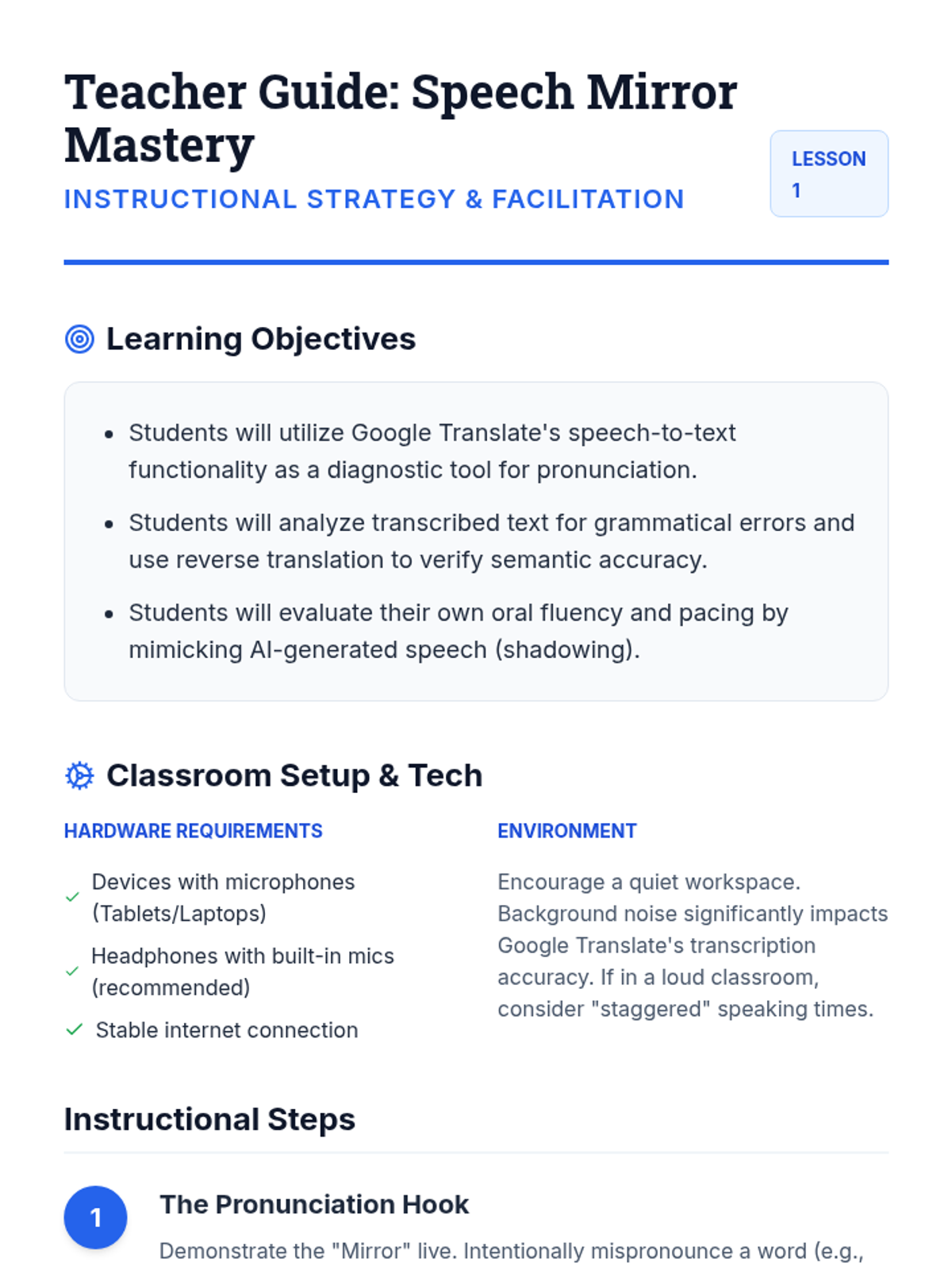
A comprehensive teacher guide for facilitating the 'Speech Mirror' activity. Includes instructional strategies, tech requirements, common pitfalls, and assessment criteria.
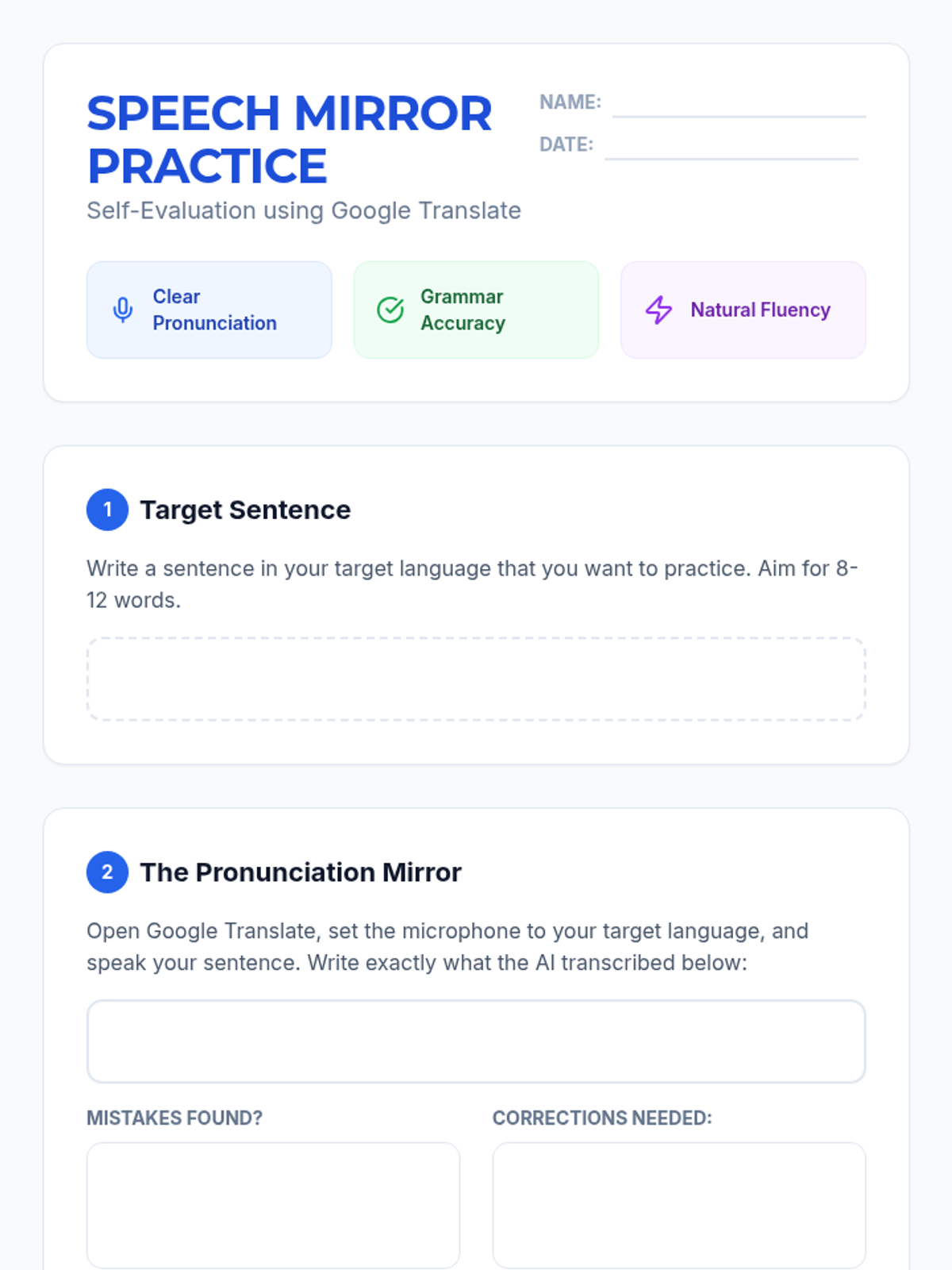
A step-by-step activity sheet for students to practice using Google Translate as a speech mirror. Includes sections for transcription review, grammar check, and fluency challenges. Updated for better handwriting legibility.
A visual presentation explaining the 'Speech Mirror' technique. It provides a tutorial on using Google Translate's voice features to assess pronunciation, grammar, and fluency. Updated with larger text for accessibility.
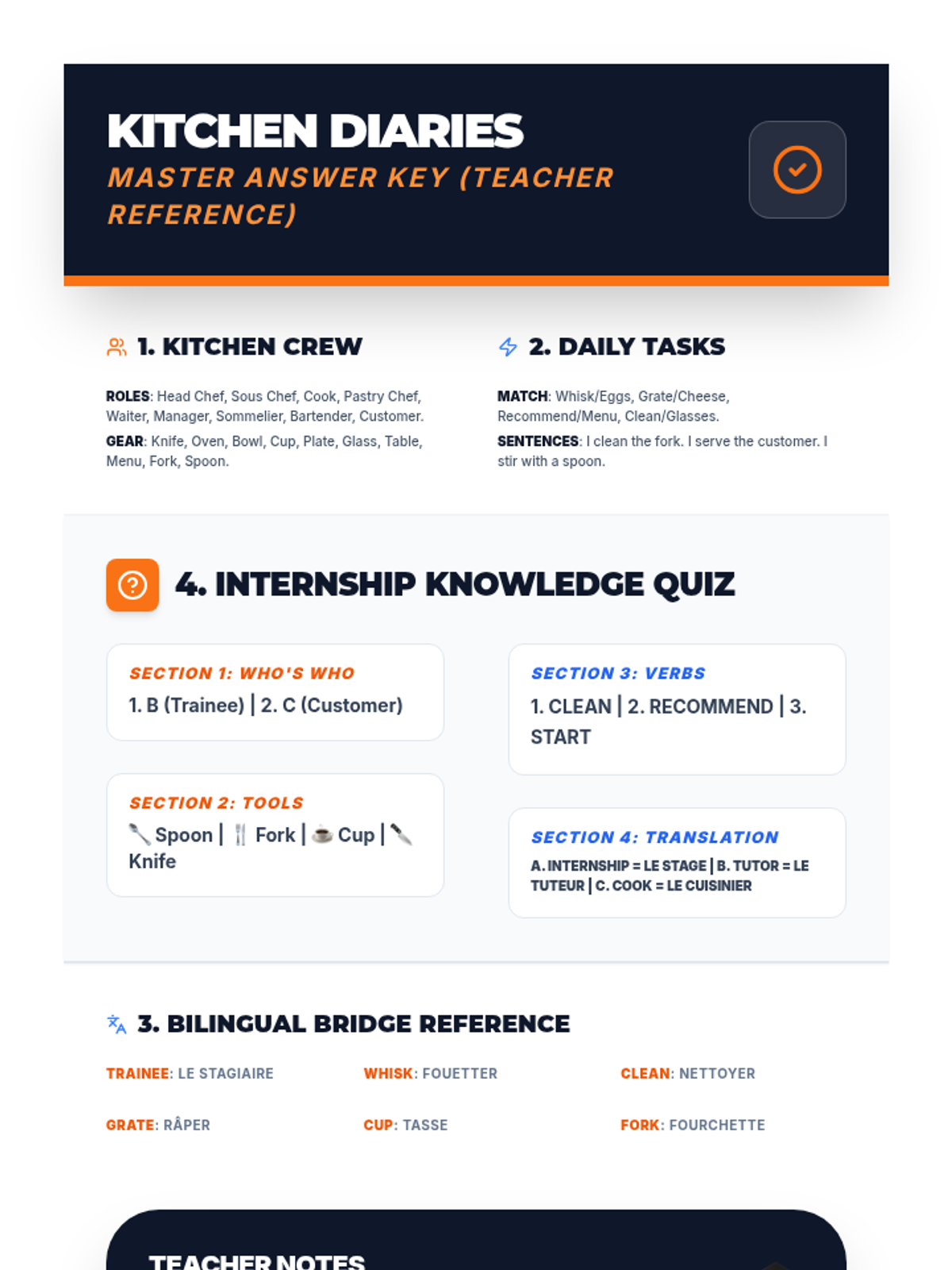
Updated comprehensive teacher-facing answer key. Now includes a dedicated section for the "Internship Knowledge Quiz", alongside solutions for the Kitchen Crew, Daily Tasks, and Vocab Booster worksheets. Updated all references of "Polish" to "Clean".
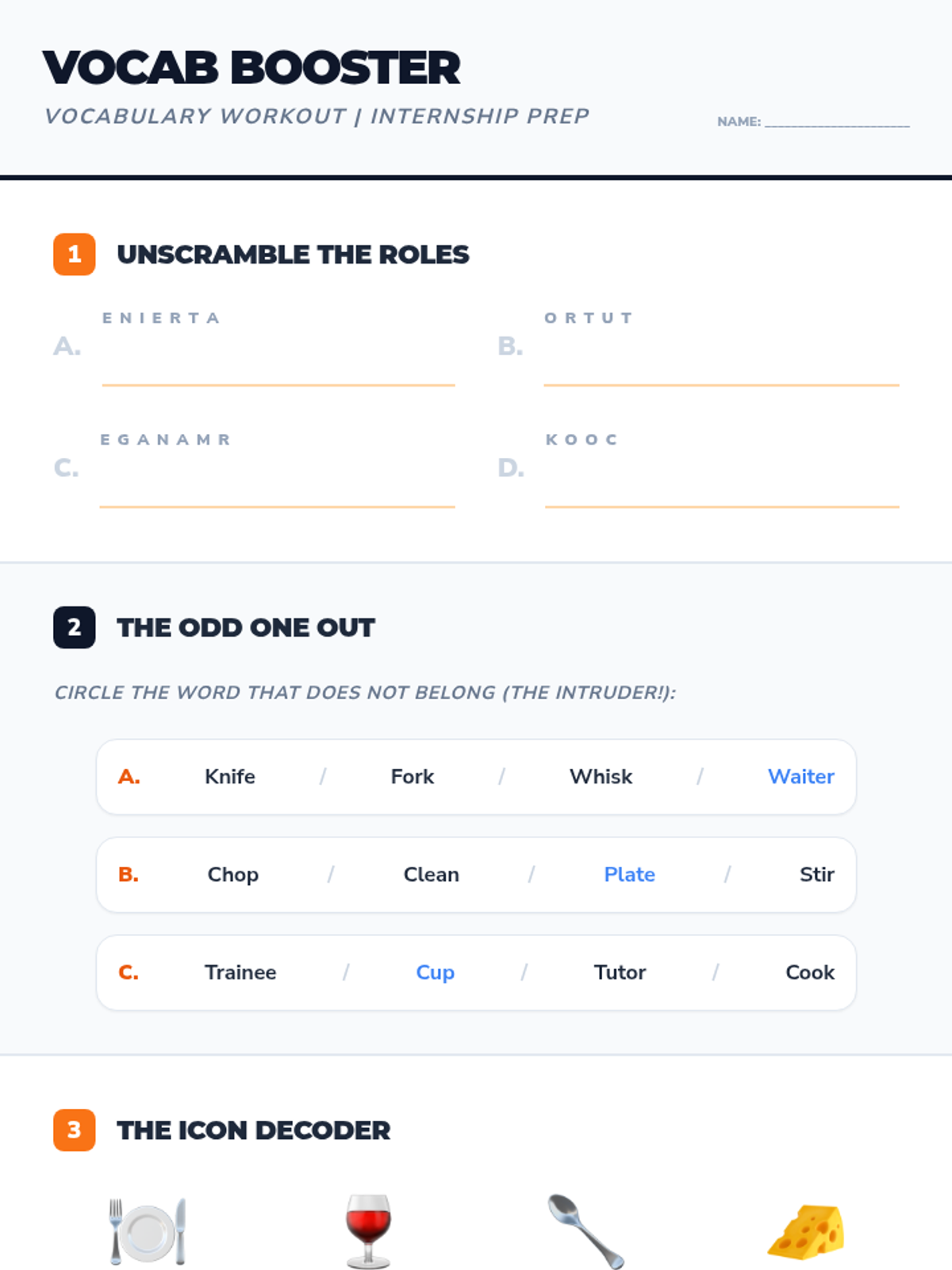
A vocabulary reinforcement worksheet containing three types of exercises: word scrambles for roles, an "odd one out" logic game for categories, and an icon-to-word decoding task. Designed for A1+/A2 vocational levels.
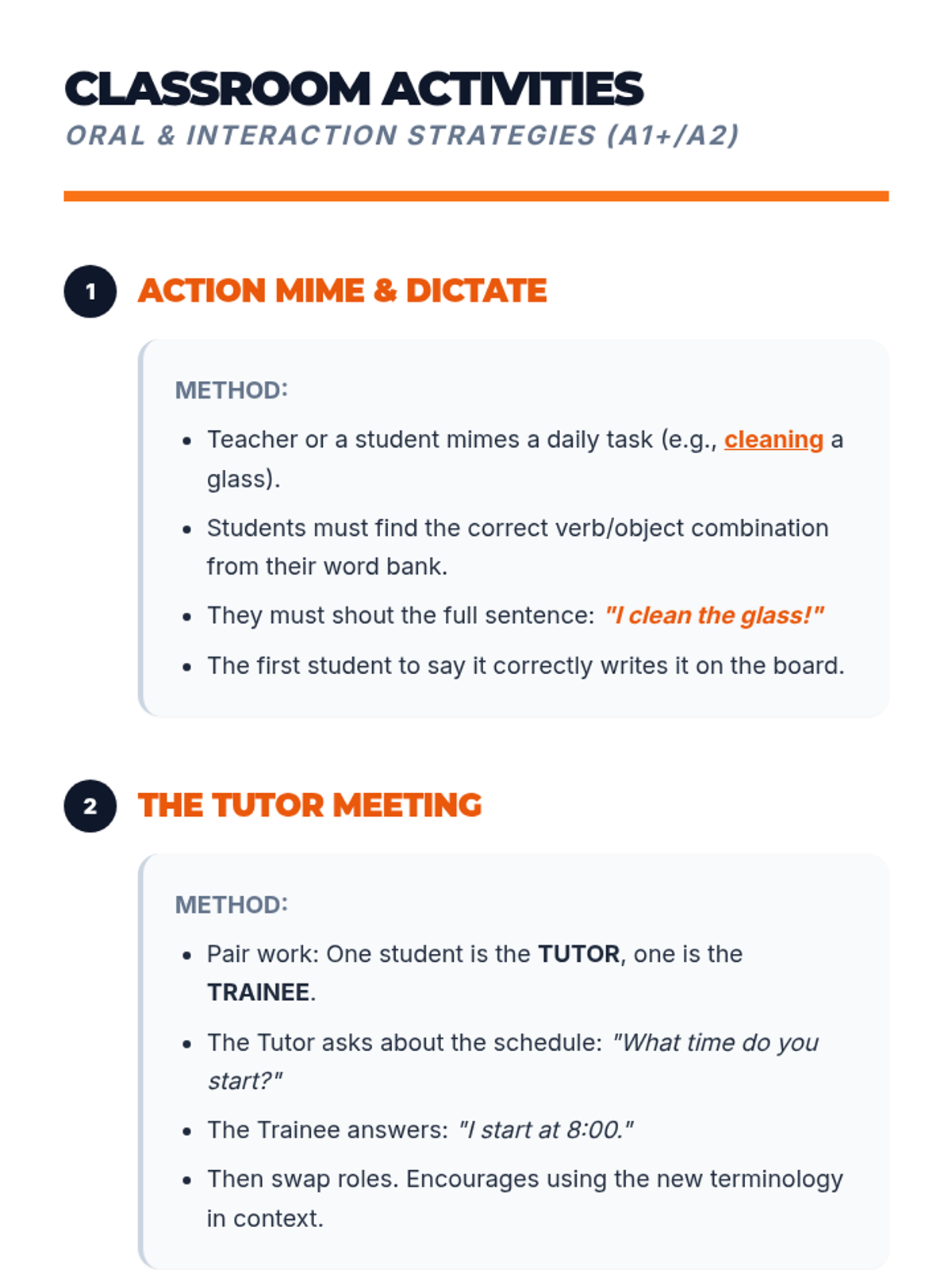
A teacher resource guide providing interactive classroom activities (Mime, Roleplay, Speed Dating) to help students practice internship-related vocabulary and oral structures through movement and peer interaction. Updated "Polish" to "Clean".
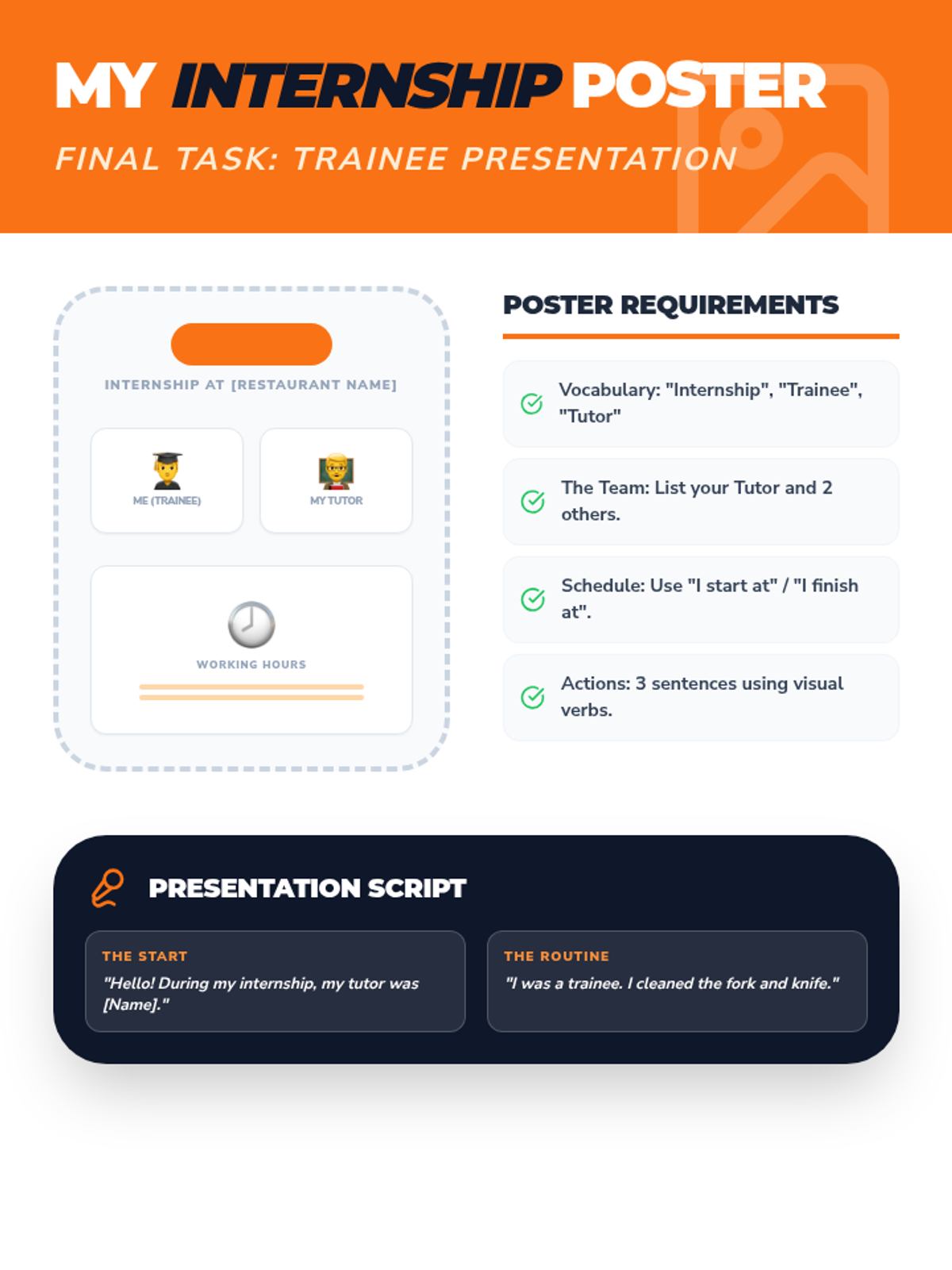
Updated A1+/A2 poster guide for the final project. Includes specific requirements for the terms "Internship", "Trainee", and "Tutor". Updated "Polish" to "Clean" in sentence frames. High visual organization.
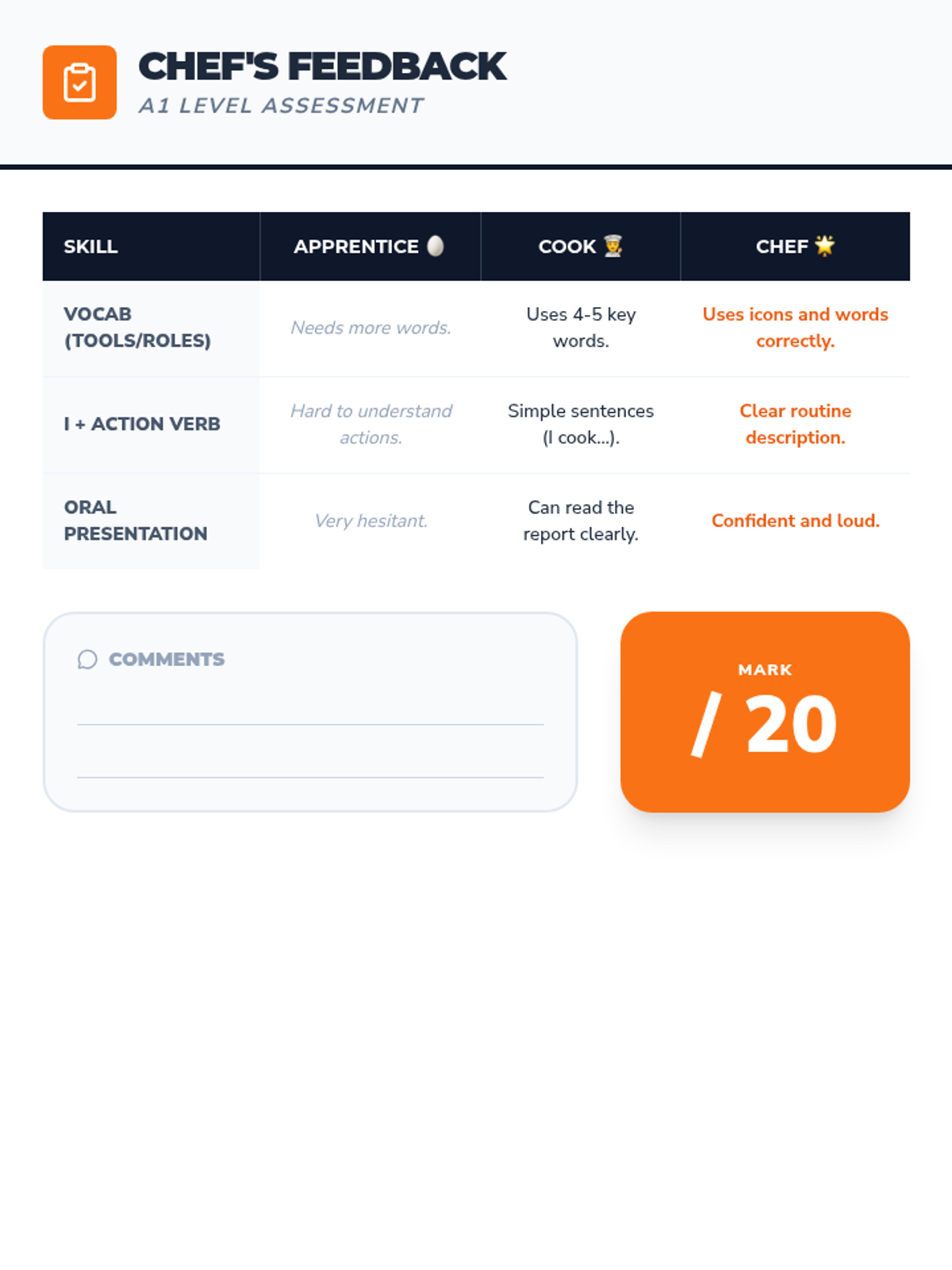
Updated assessment rubric for Lesson 3. Replaced "Commis" with "Cook" in the skill levels. Maintained the kitchen-themed visual icons for feedback.
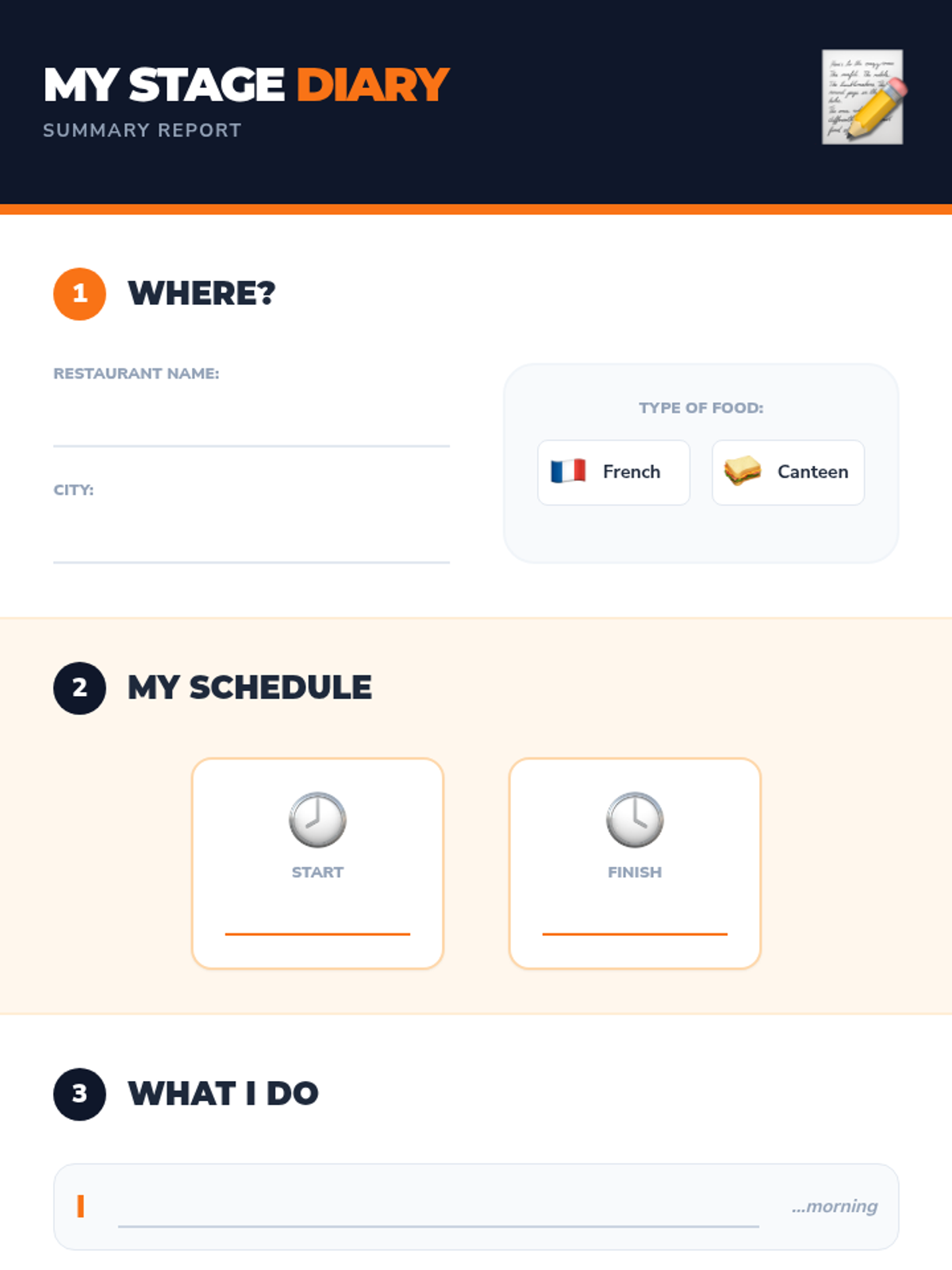
Updated A1 synthesis report for Lesson 3. Now includes a dedicated "My Schedule" section for working hours (Start/Finish), alongside restaurant info, daily routine sentences, and overall feelings. High visual support.
Expanded vocational worksheet for Lesson 2 (A1+/A2) focusing on more advanced verbs and refined objects like Spoon, Fork, Knife, and Customer. Updated "Polish" to "Clean". Includes schedule review and routine building.
Expanded A1+/A2 action slides for Lesson 2. Introduces more specific vocational verbs like Whisk, Grate, Stir, Pour, Clean, and Recommend. Visual-heavy support for CAP students. Updated "Polish" to "Clean".
Updated visual slides for Lesson 1 (A1+/A2). Explicitly introduces the vocational terms "Internship", "Trainee", and "Tutor" with high visual support and clear definitions. Refined gear list included.
Updated A1+/A2 worksheet for Lesson 1. Introduces the terms "Internship", "Trainee", and "Tutor" while maintaining visual-heavy support. Includes refined equipment (Spoon, Fork, Knife, Cup) and roles.
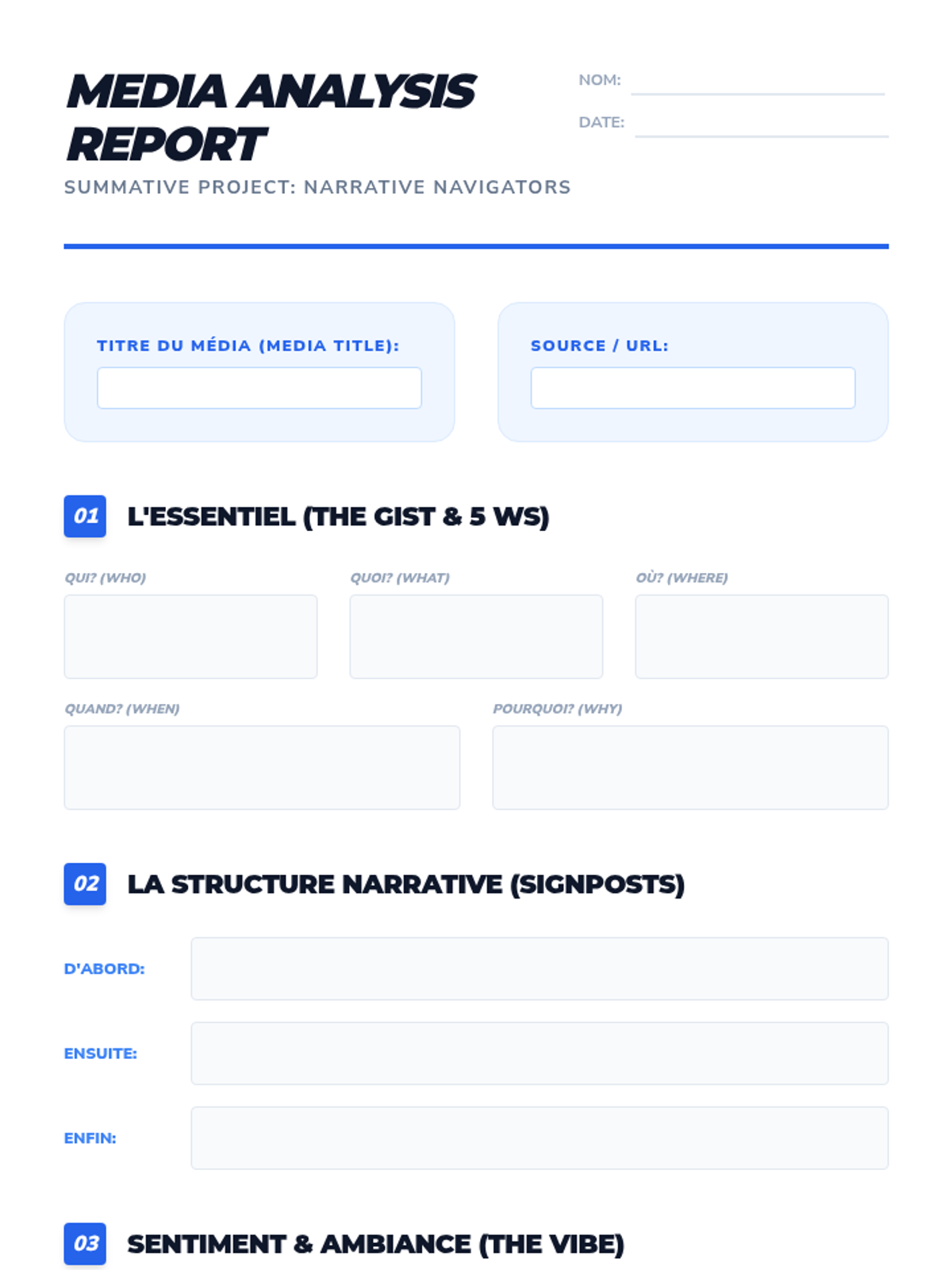
A comprehensive two-page project template for students to conduct a detailed listening analysis of a French audio clip.
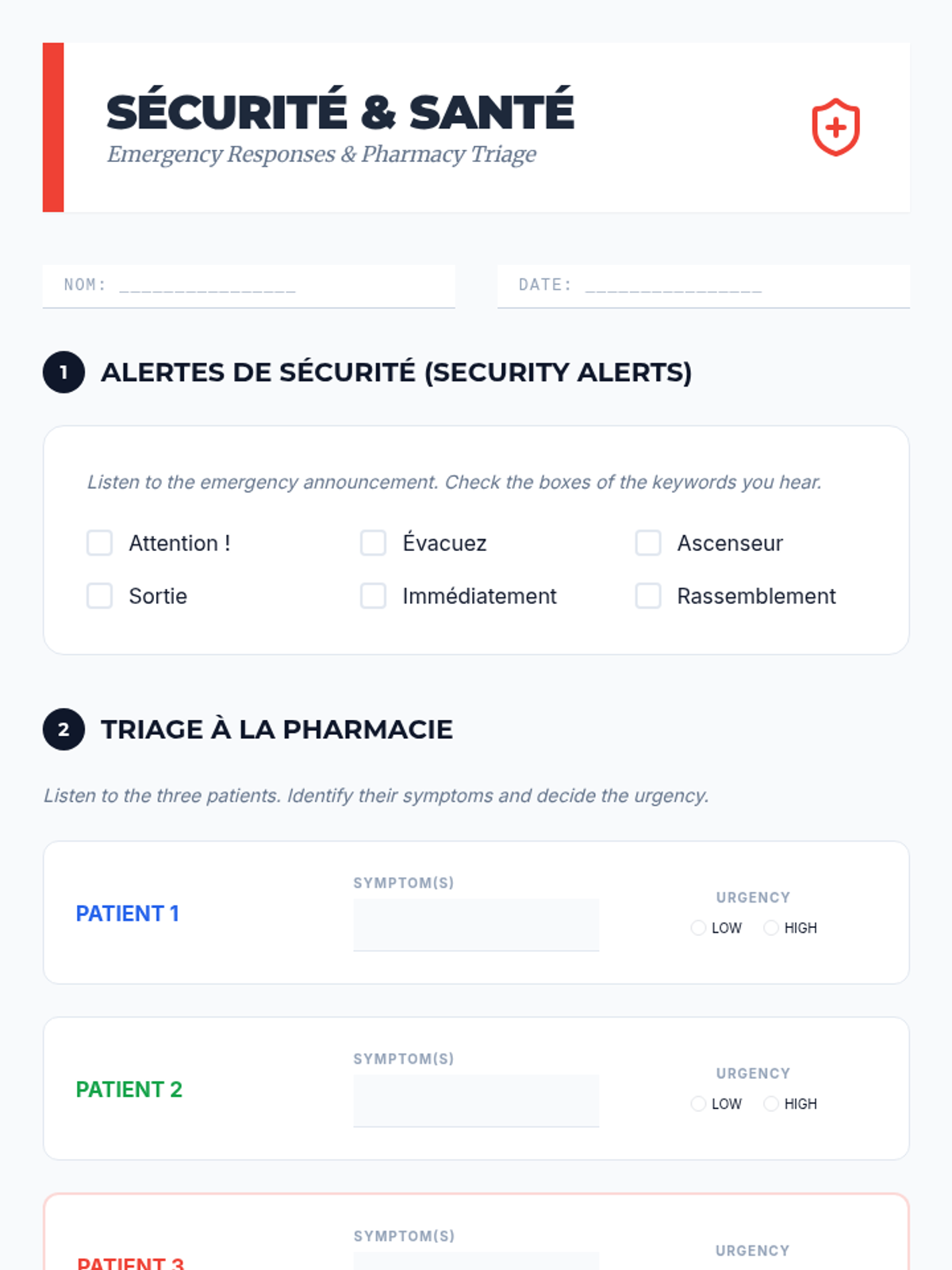
Student worksheet for Lesson 5 featuring keyword identification for emergency announcements and a triage activity for health symptoms.
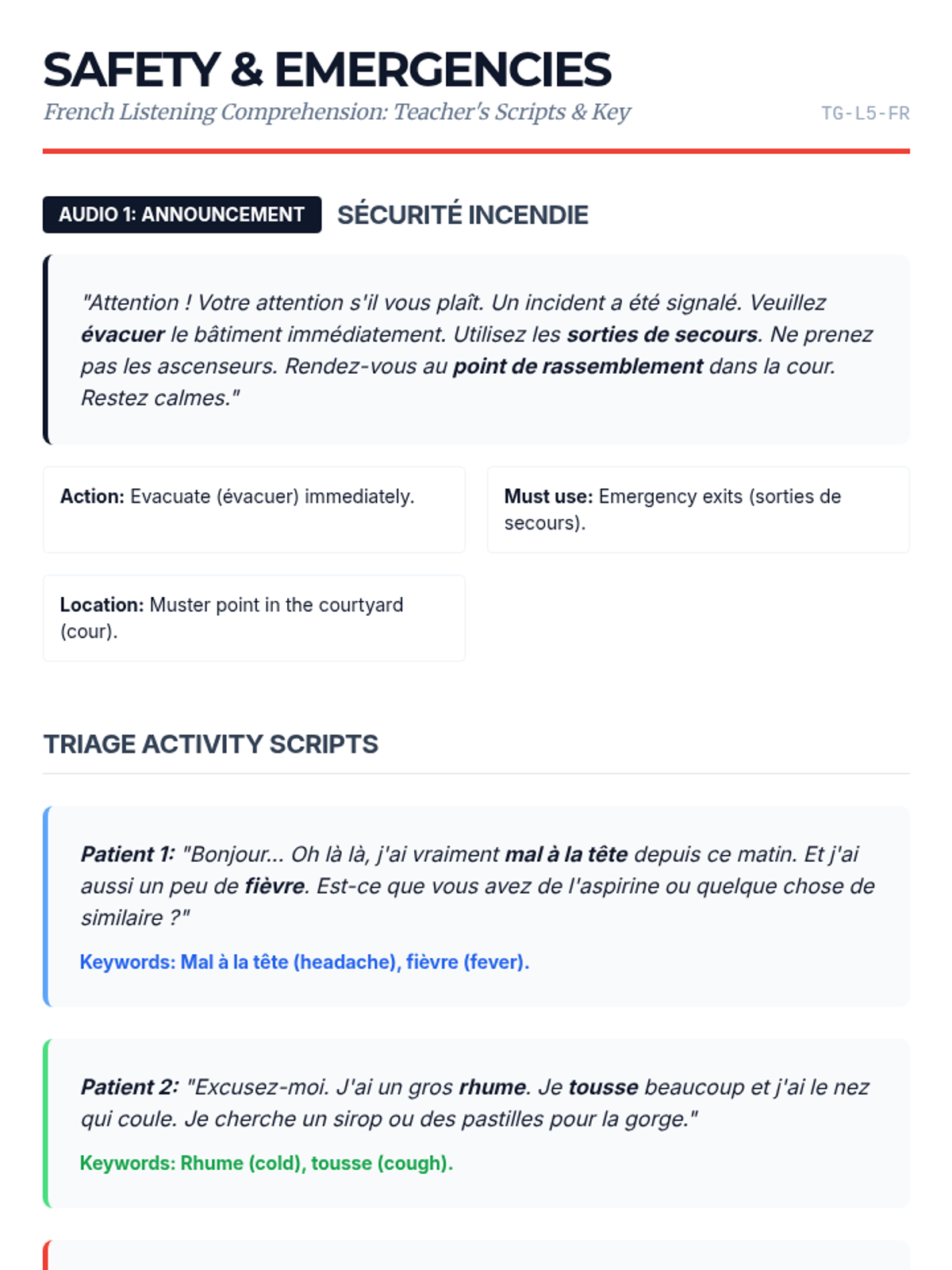
Teacher's guide for Lesson 5 containing scripts for emergency announcements and pharmacy triage dialogues, along with identifying keywords and urgency levels.
Presentation slides for the final synthesis project, introducing the Media Report requirements and suggested resources.
A slide deck for Lesson 5 introducing emergency vocabulary, health-related terms, and the functional context of interacting with a pharmacy in French.
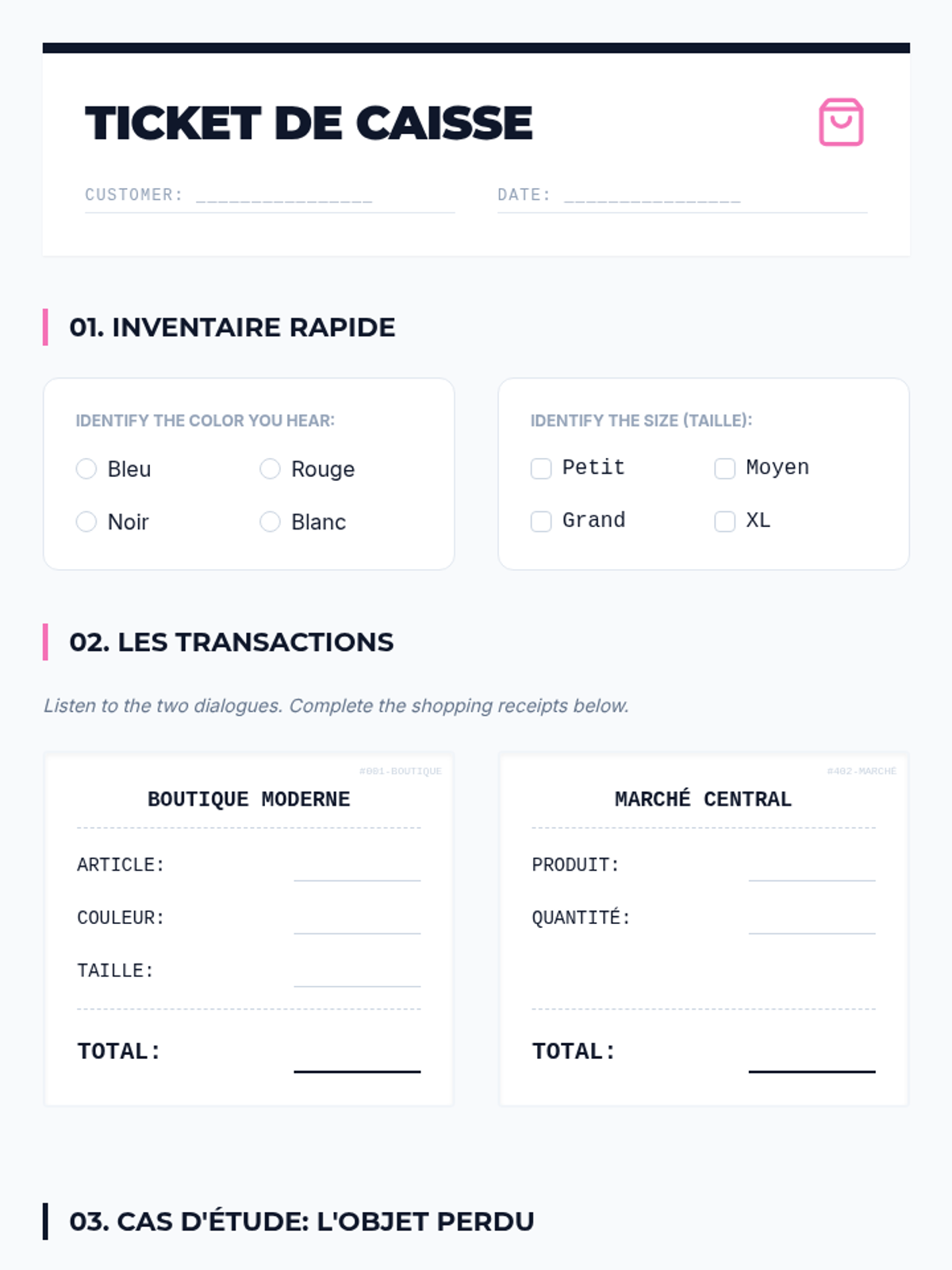
Student worksheet for Lesson 4 featuring a "shopping receipt" activity where students record details and prices from listening dialogues.
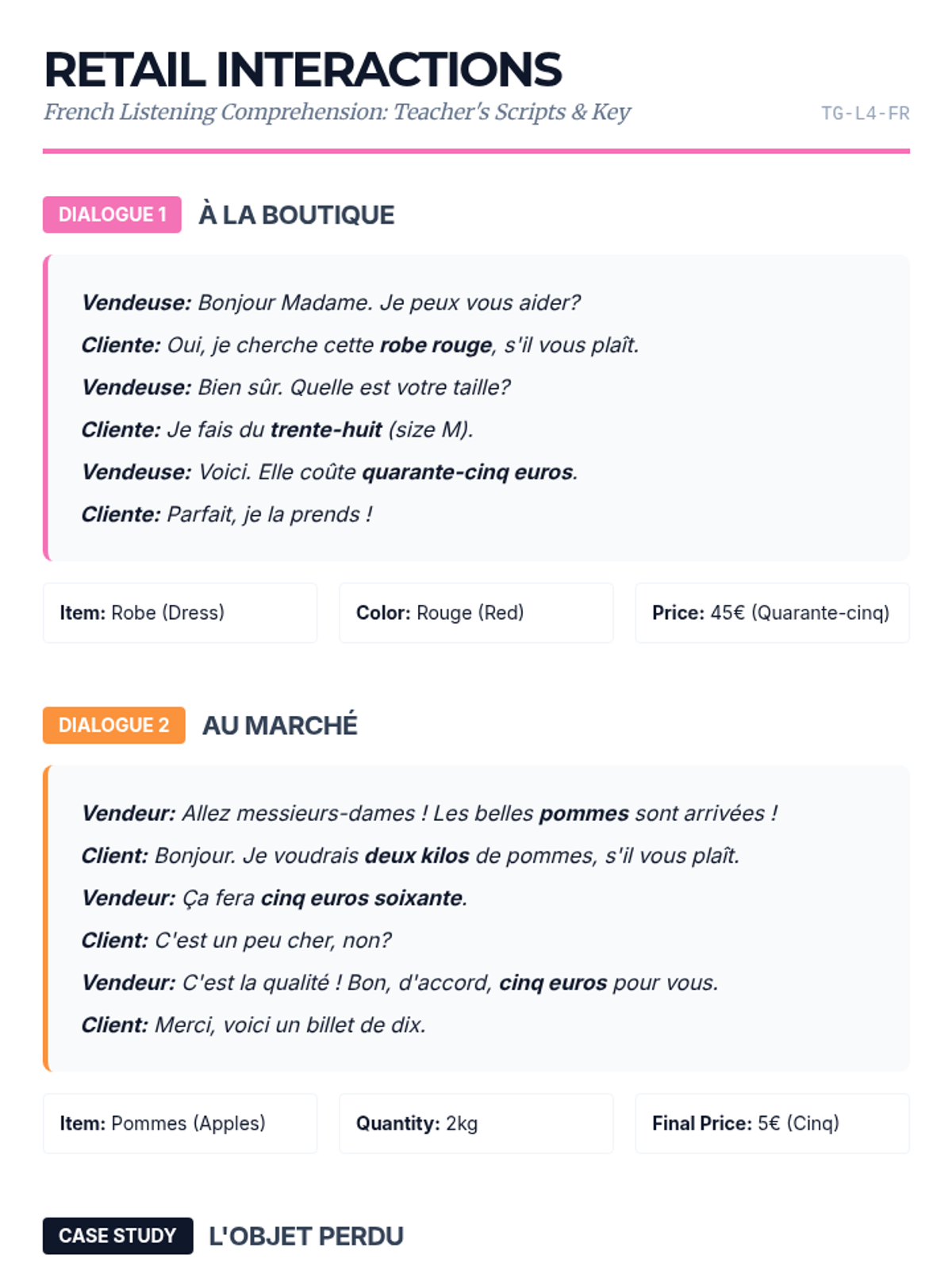
Teacher's guide for Lesson 4 containing scripts for retail dialogues (boutique, market, lost object) and the corresponding answer keys.
A slide deck for Lesson 4 introducing retail vocabulary (colors, sizes, prices) and common transactional phrases in French shopping contexts.
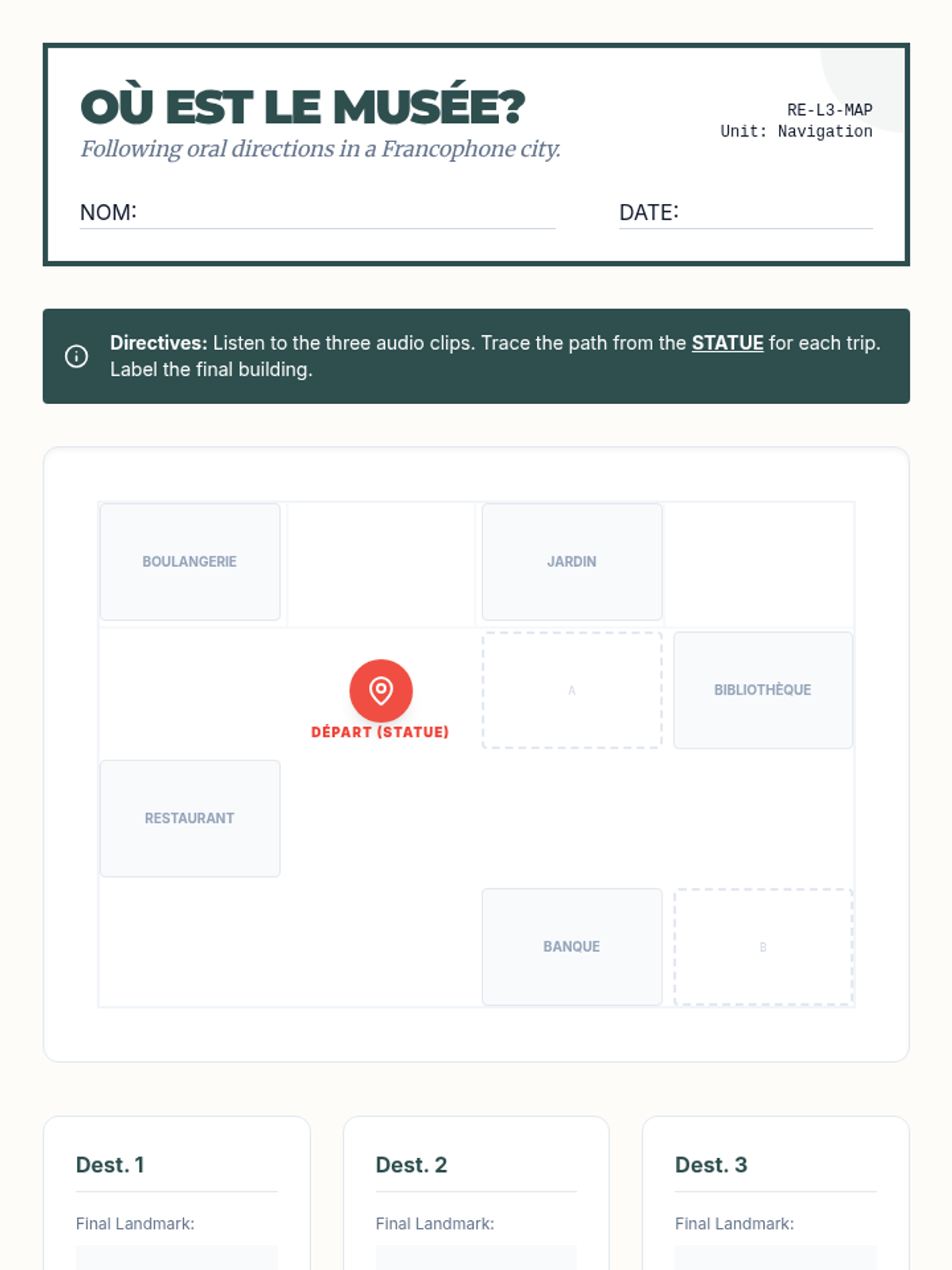
Student worksheet for Lesson 3 featuring a grid-based map for tracing oral directions and identifying landmarks.
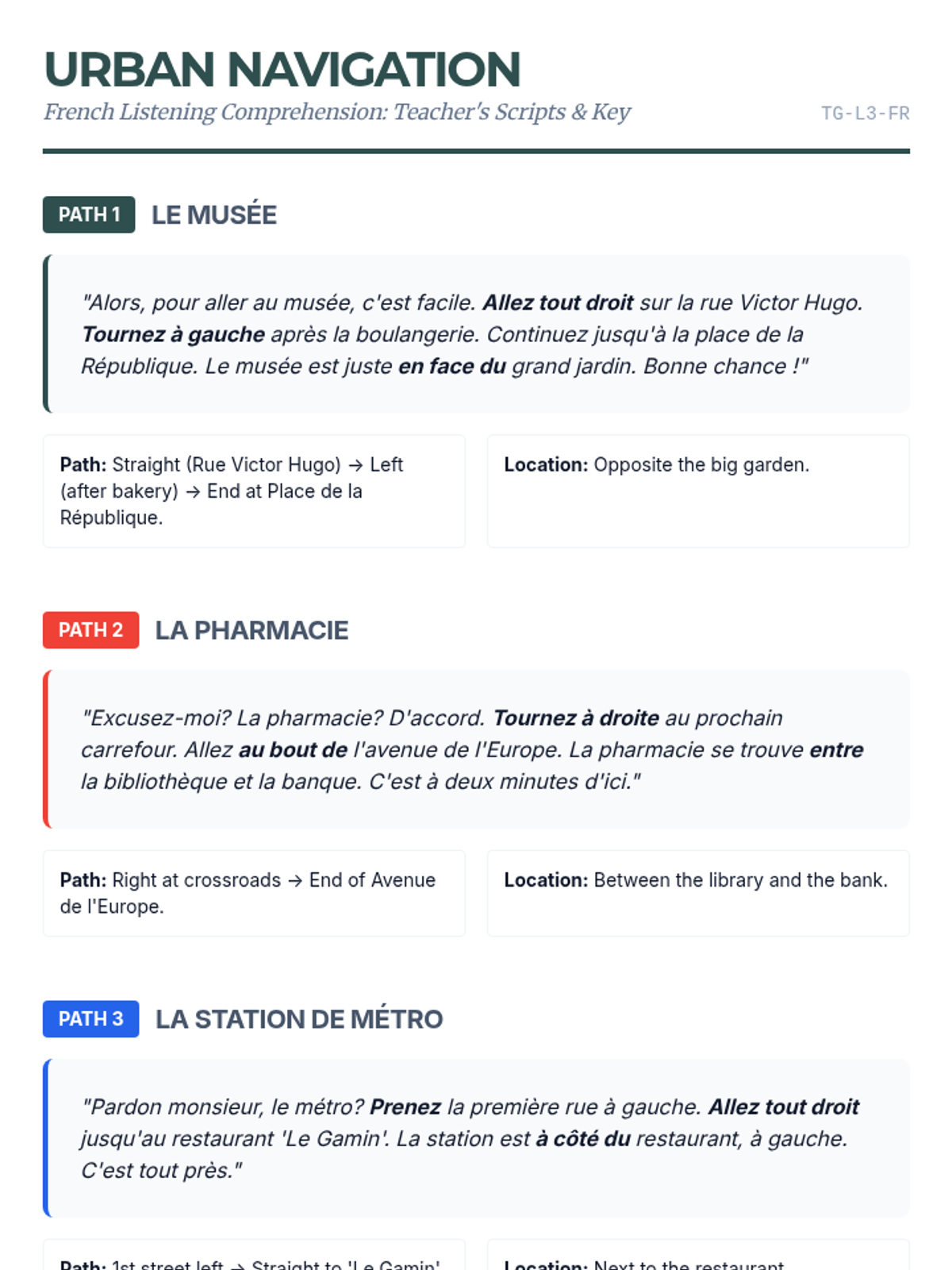
Teacher's guide for Lesson 3 containing scripts for three sets of urban directions and the final location for each path.
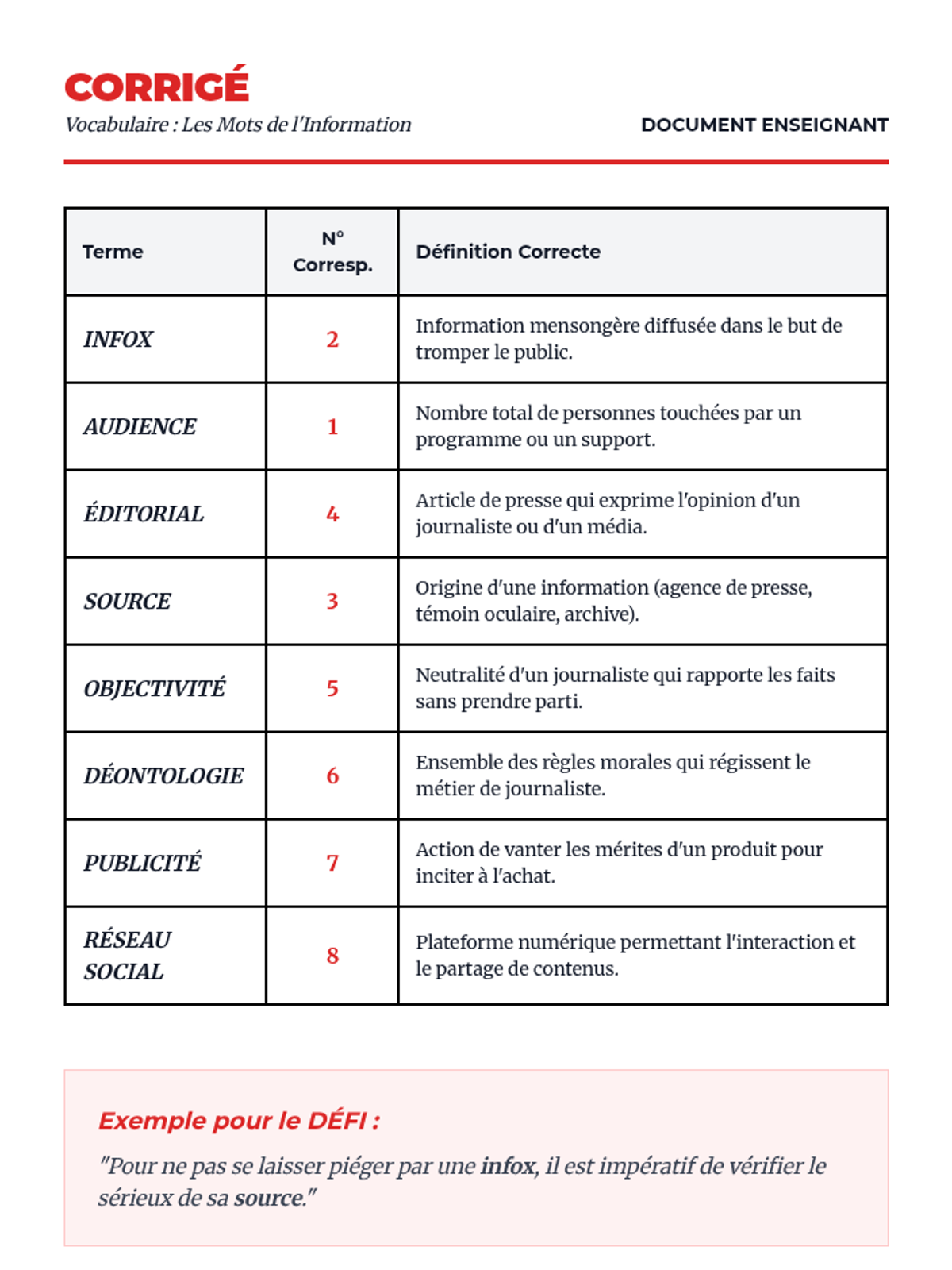
Le corrigé de l'exercice d'appariement du vocabulaire médiatique.
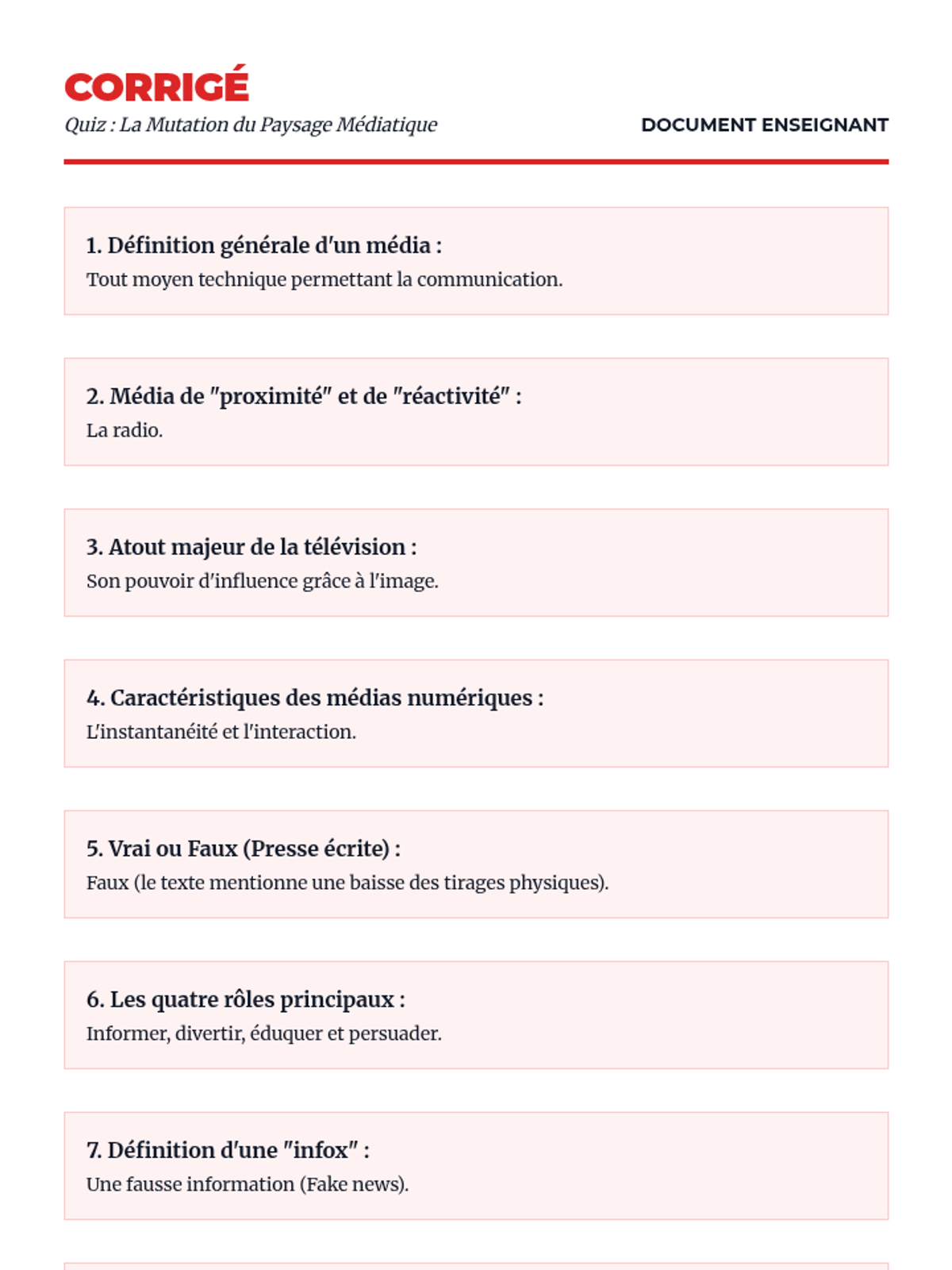
Le corrigé détaillé du quiz de compréhension de lecture sur les médias.
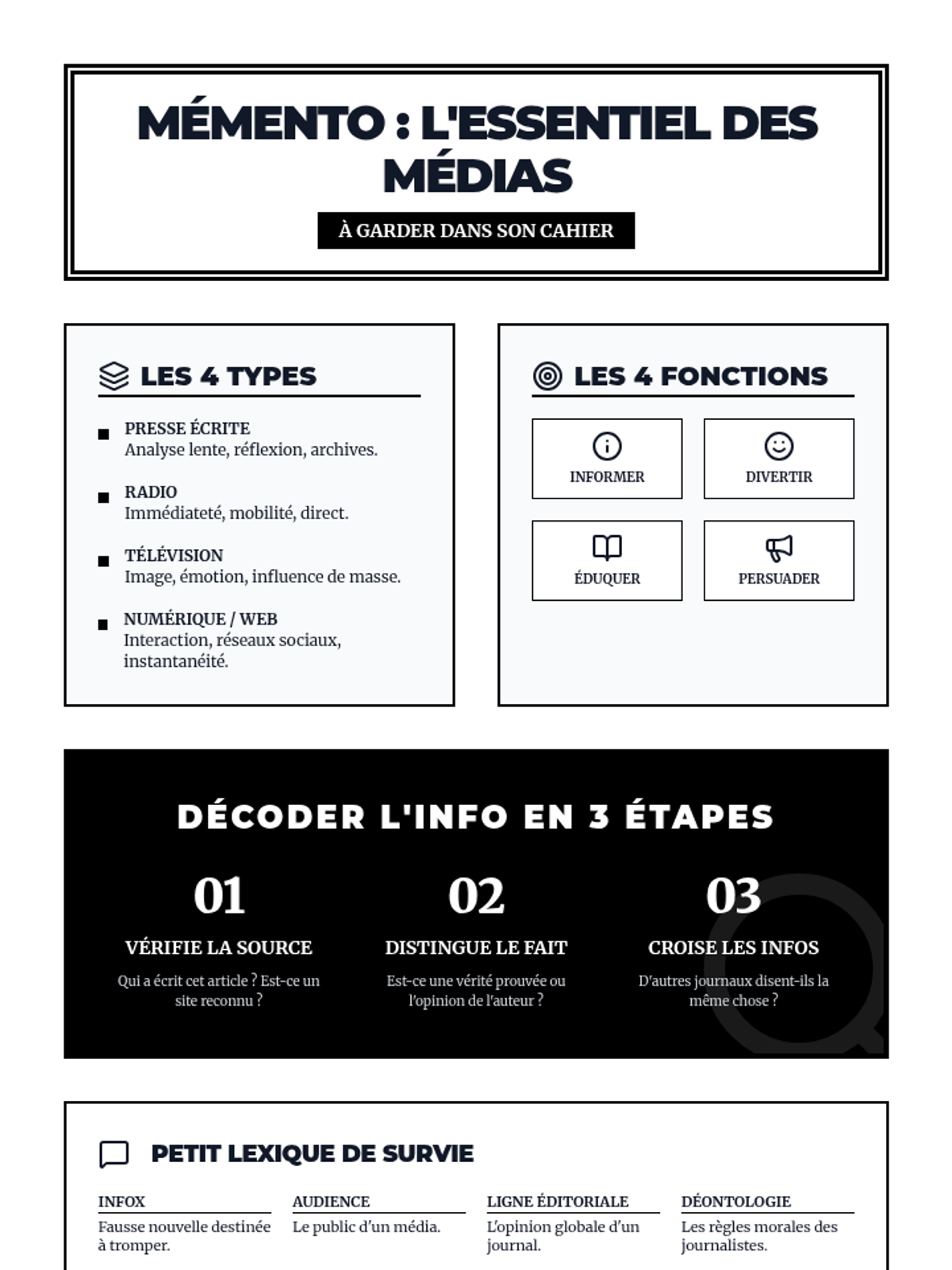
Un aide-mémoire visuel (cheat sheet) regroupant les concepts clés, la méthode de vérification de l'information et le lexique essentiel pour une mémorisation rapide.
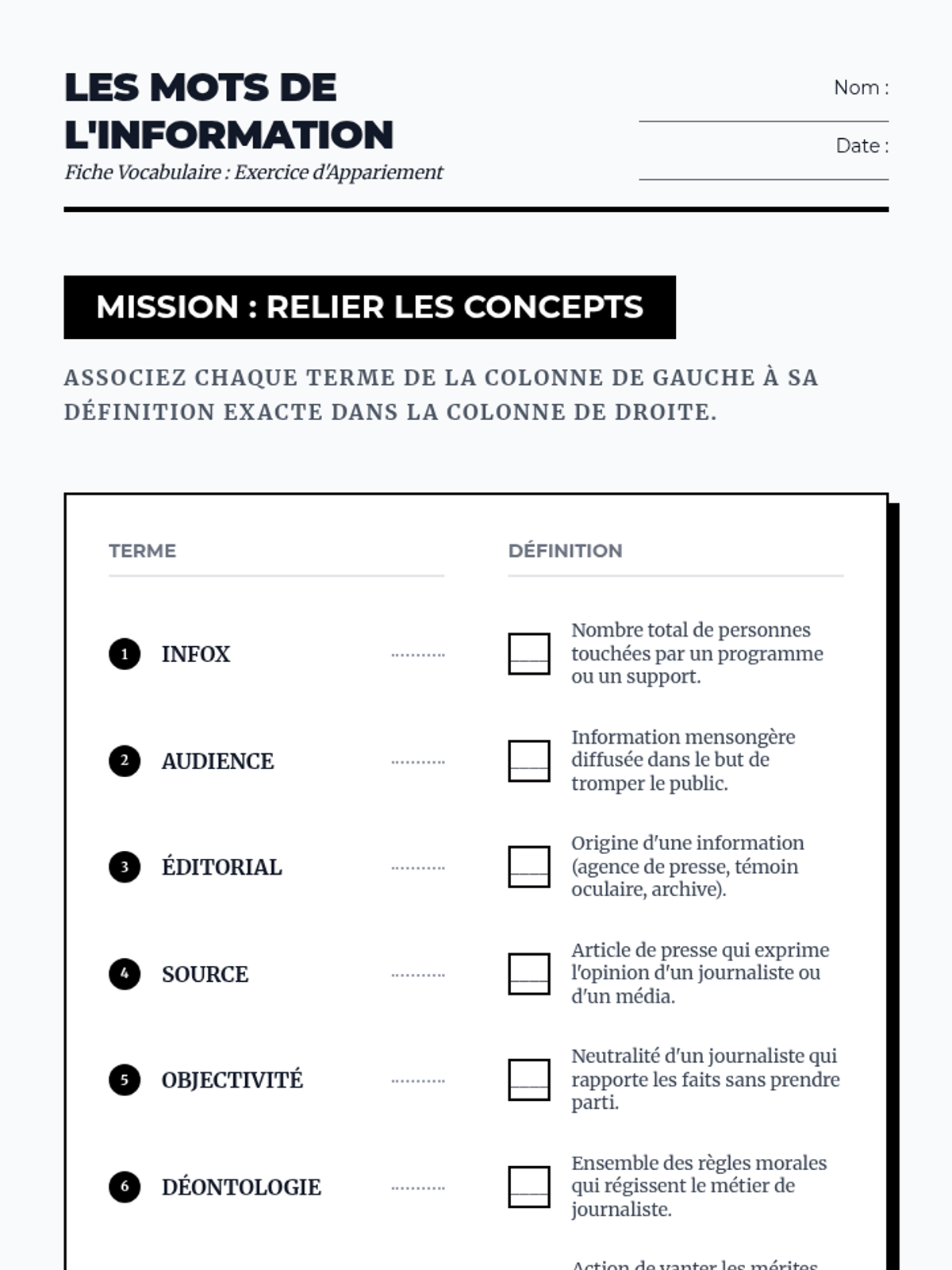
Une fiche d'exercices de vocabulaire où les élèves doivent relier des termes journalistiques clés à leurs définitions précises en français.
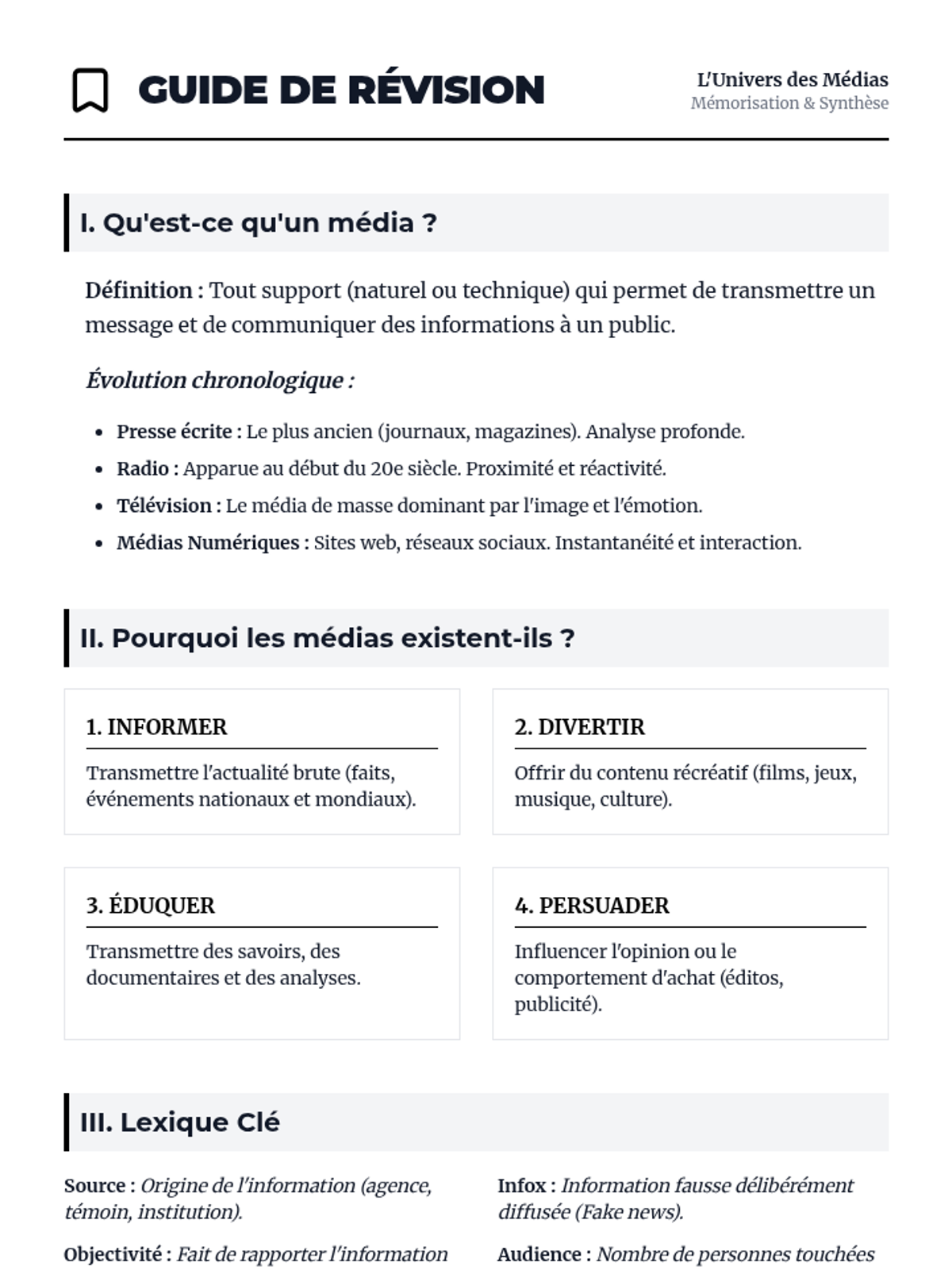
Un guide de révision synthétique regroupant les définitions, l'évolution historique, les rôles des médias et le lexique essentiel.
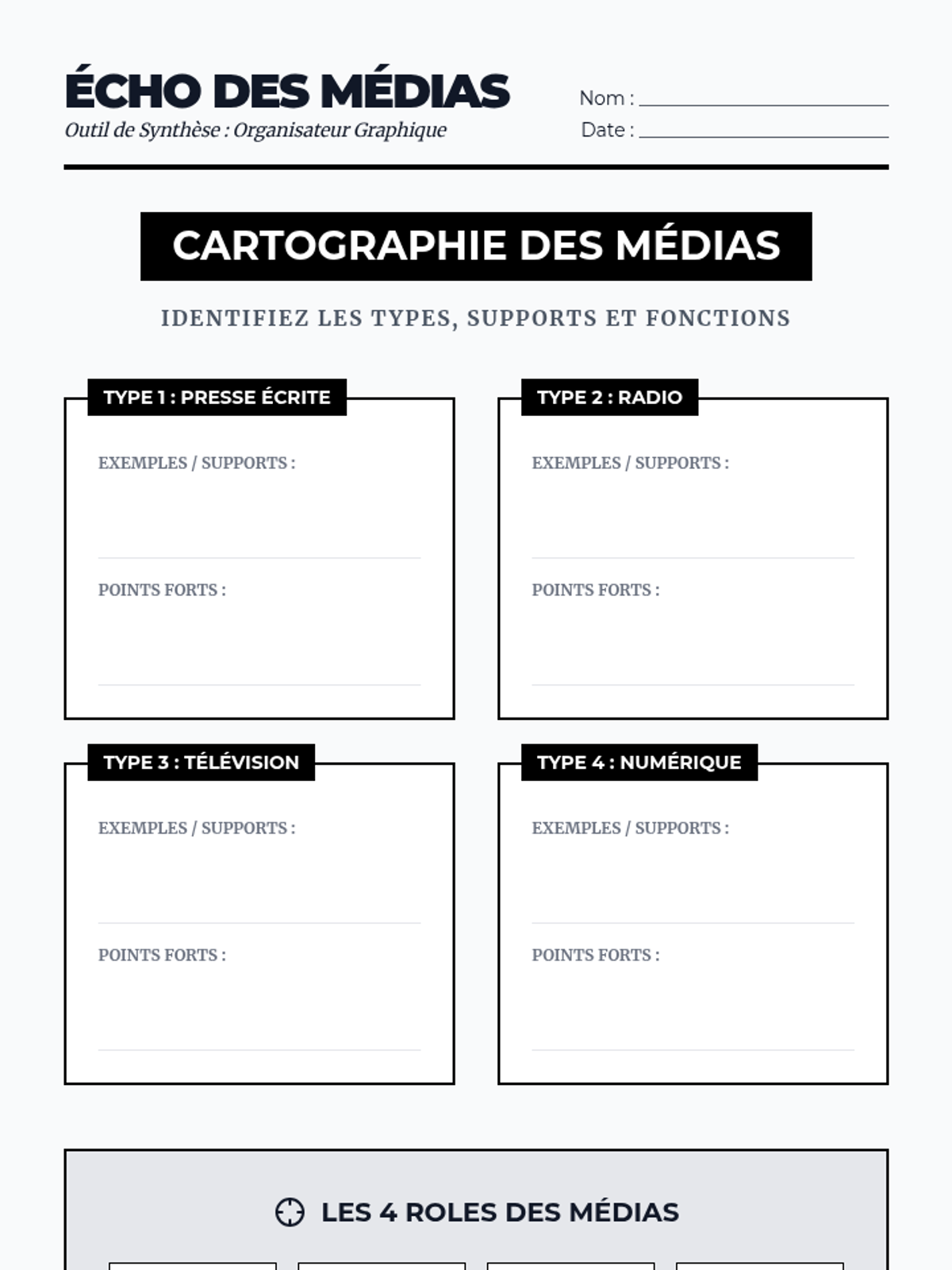
Un organisateur graphique permettant aux élèves de classer les quatre types de médias et de définir leurs fonctions principales.
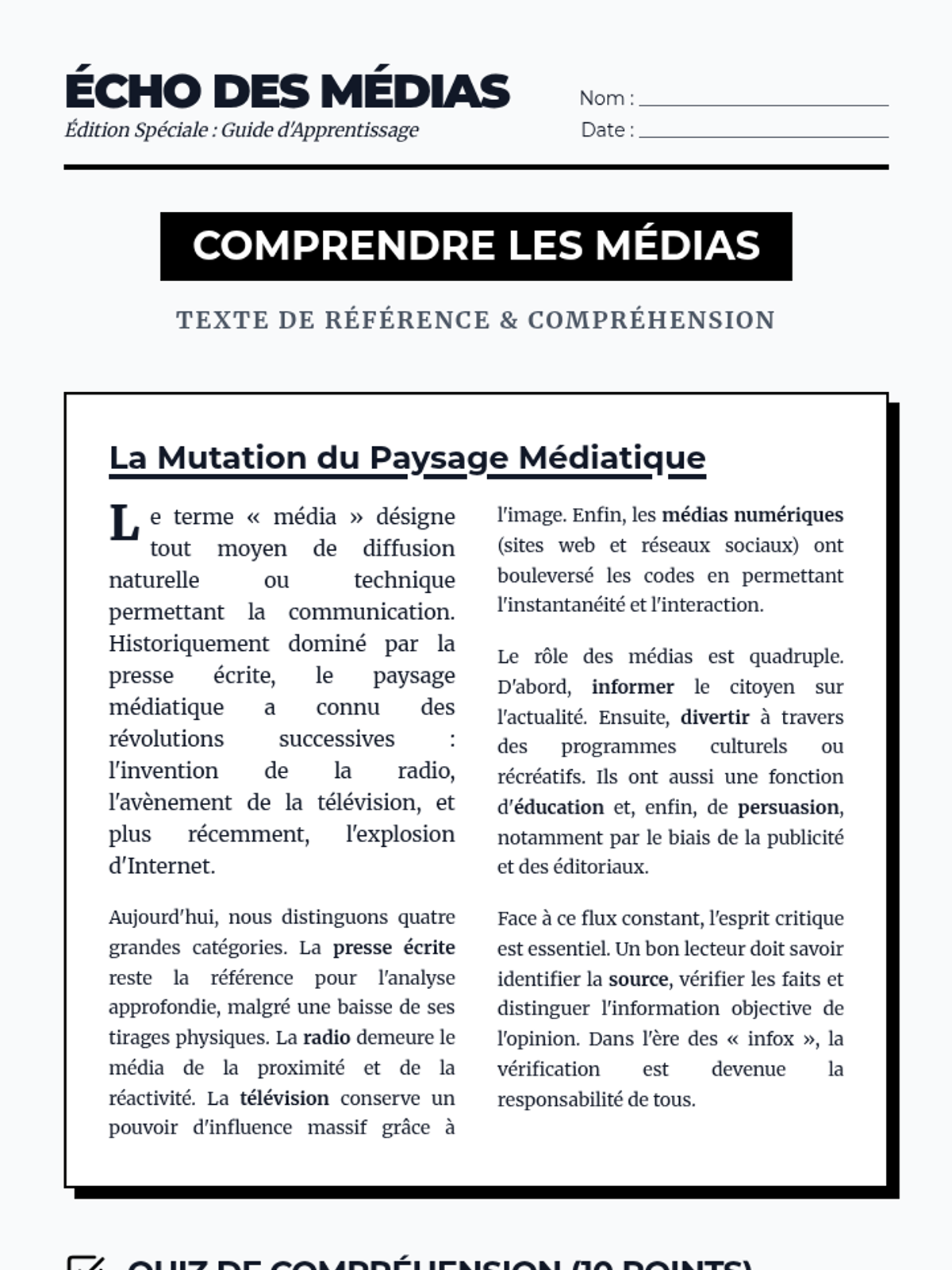
Un quiz de compréhension de lecture en 10 questions basé sur un texte original sur l'évolution des médias et leurs rôles dans la société.
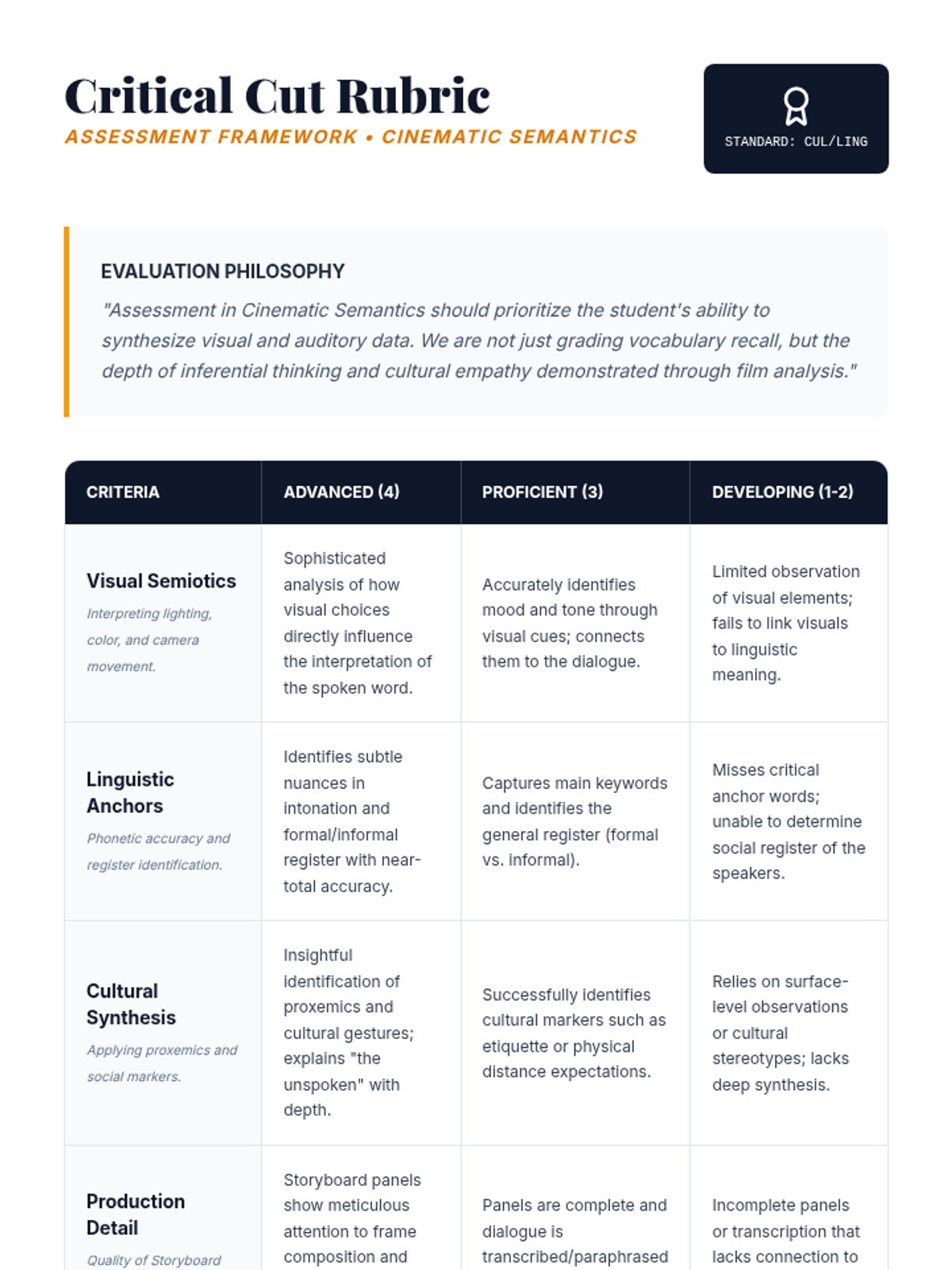
A professional assessment rubric titled 'Critical Cut Rubric' for educators to evaluate student film analysis across visual, linguistic, and cultural dimensions.
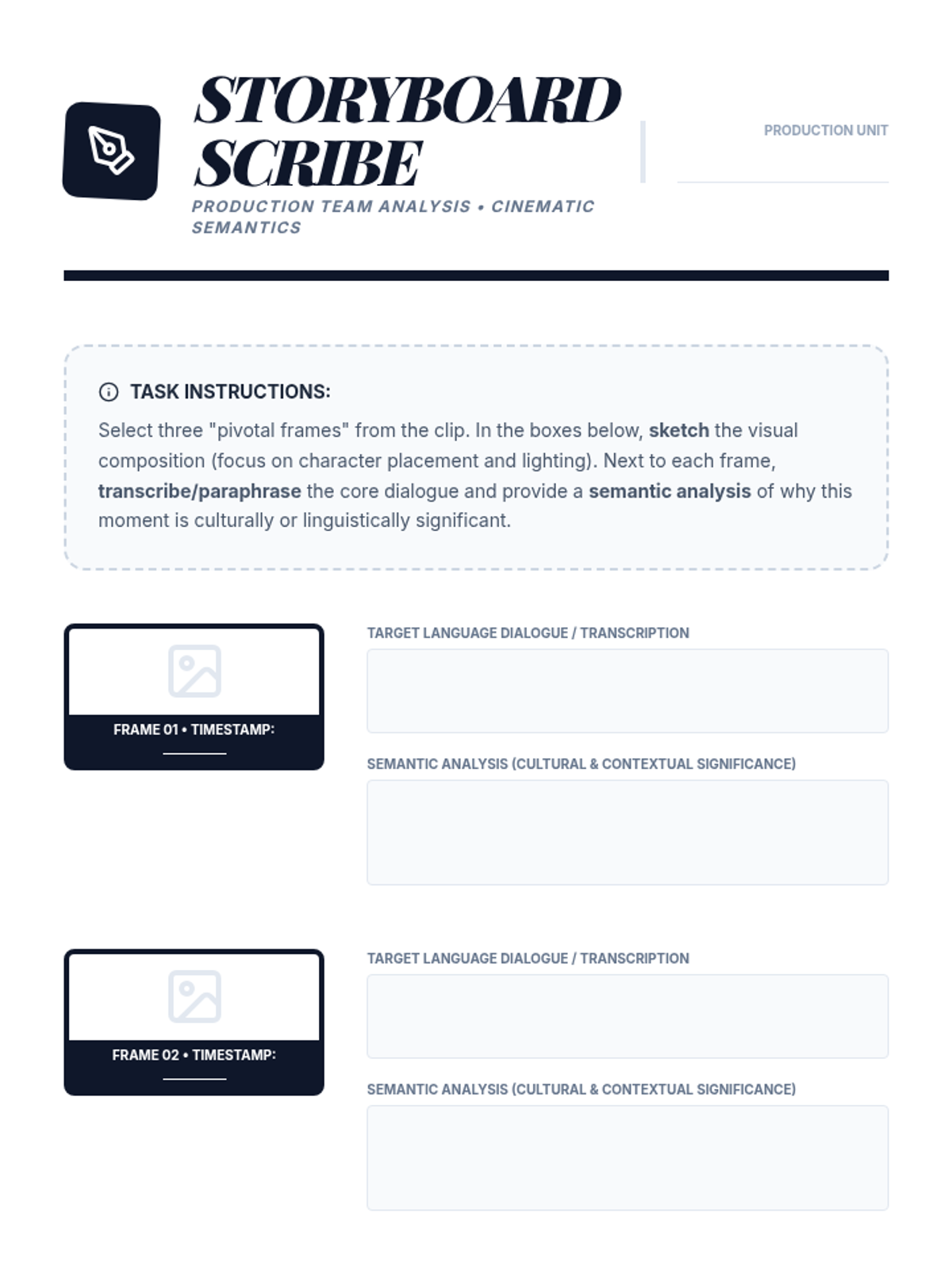
An advanced graphic organizer titled 'Storyboard Scribe' where students map critical film frames, transcribe dialogue, and perform deep semantic analysis.
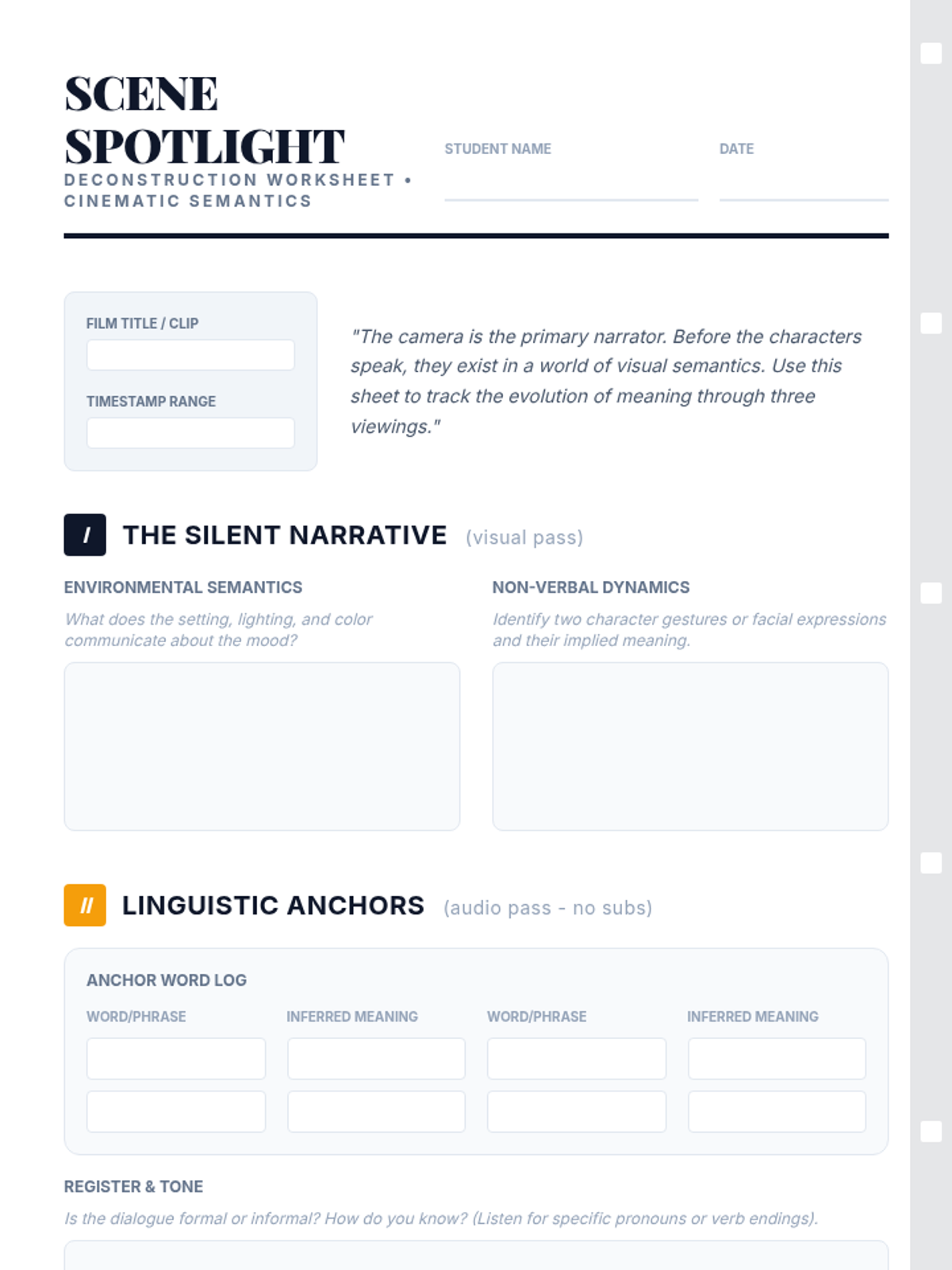
A student-facing worksheet titled 'Scene Spotlight' used for deconstructing film clips in three stages: visual narrative, linguistic anchors, and cultural synthesis.
A visually striking slide deck for instruction on 'Cinematic Semantics', guiding students through visual-first analysis, auditory processing, and thin-slicing techniques.
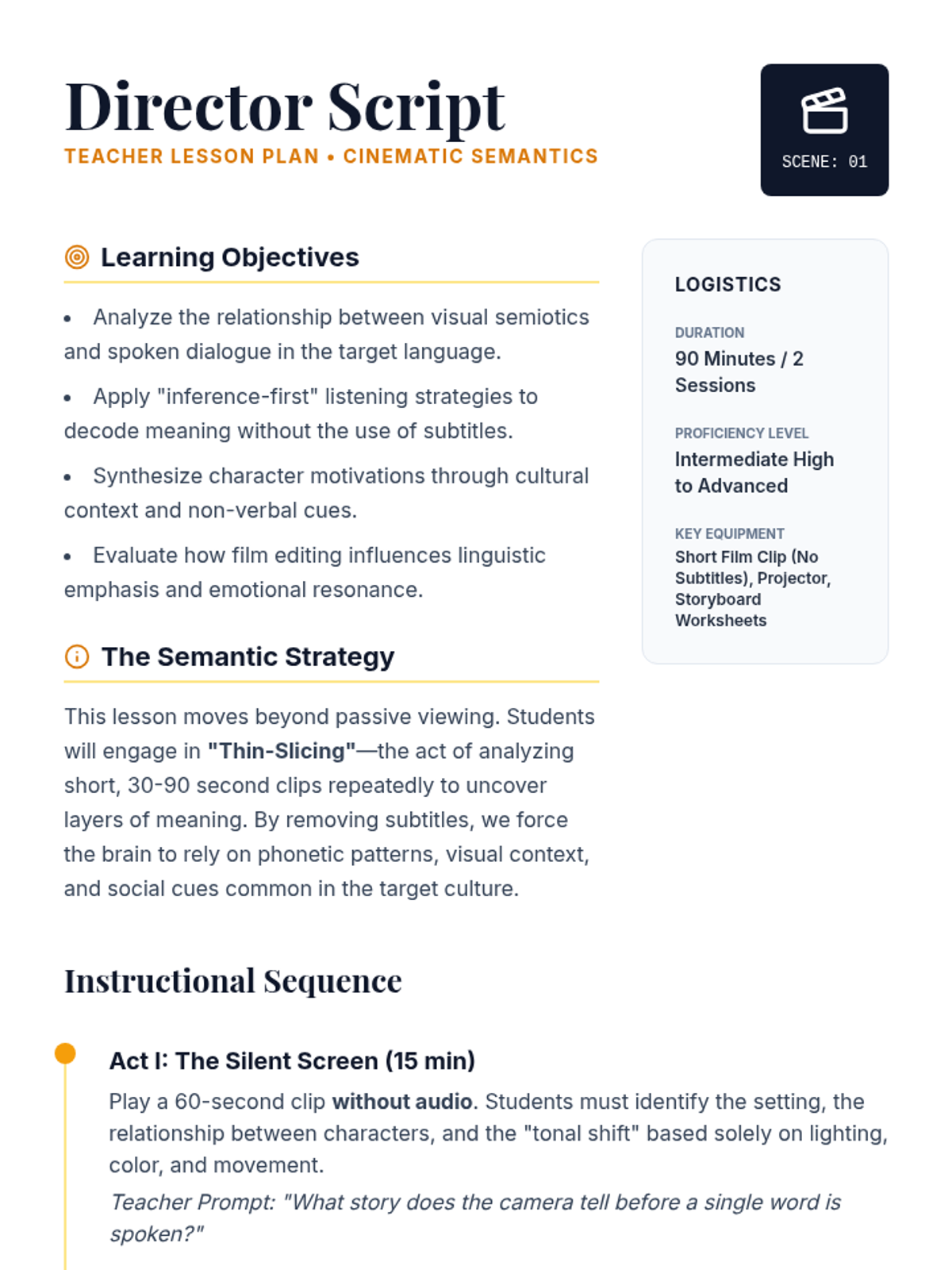
A detailed lesson plan for educators titled 'Director Script' that provides a pedagogical framework for analyzing film in the foreign language classroom through three 'Acts' of deconstruction.
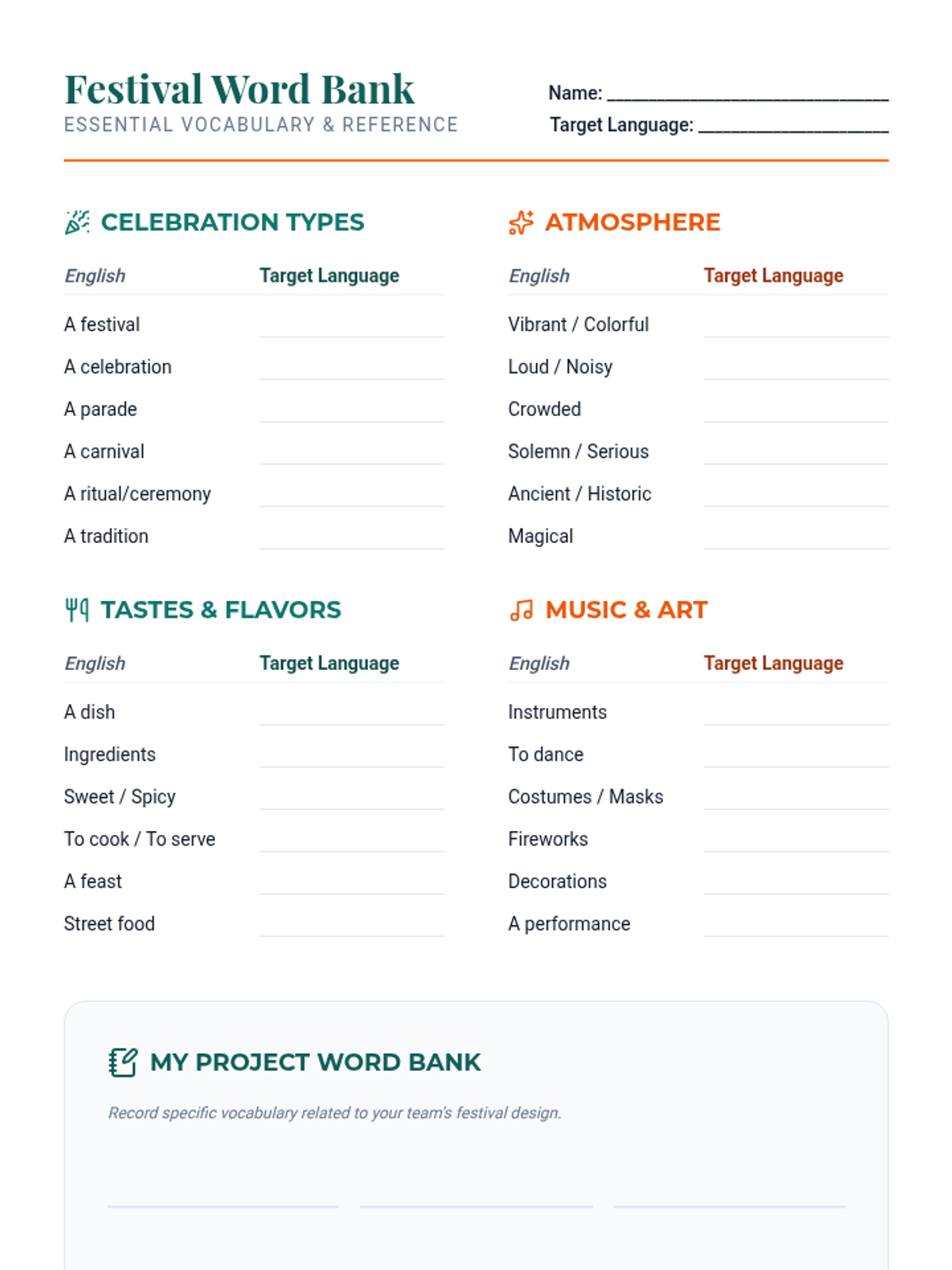
A student reference sheet and word bank for the Cultural Festival Design Challenge, featuring essential terms for celebrations, food, music, and atmosphere with space for target language translations.
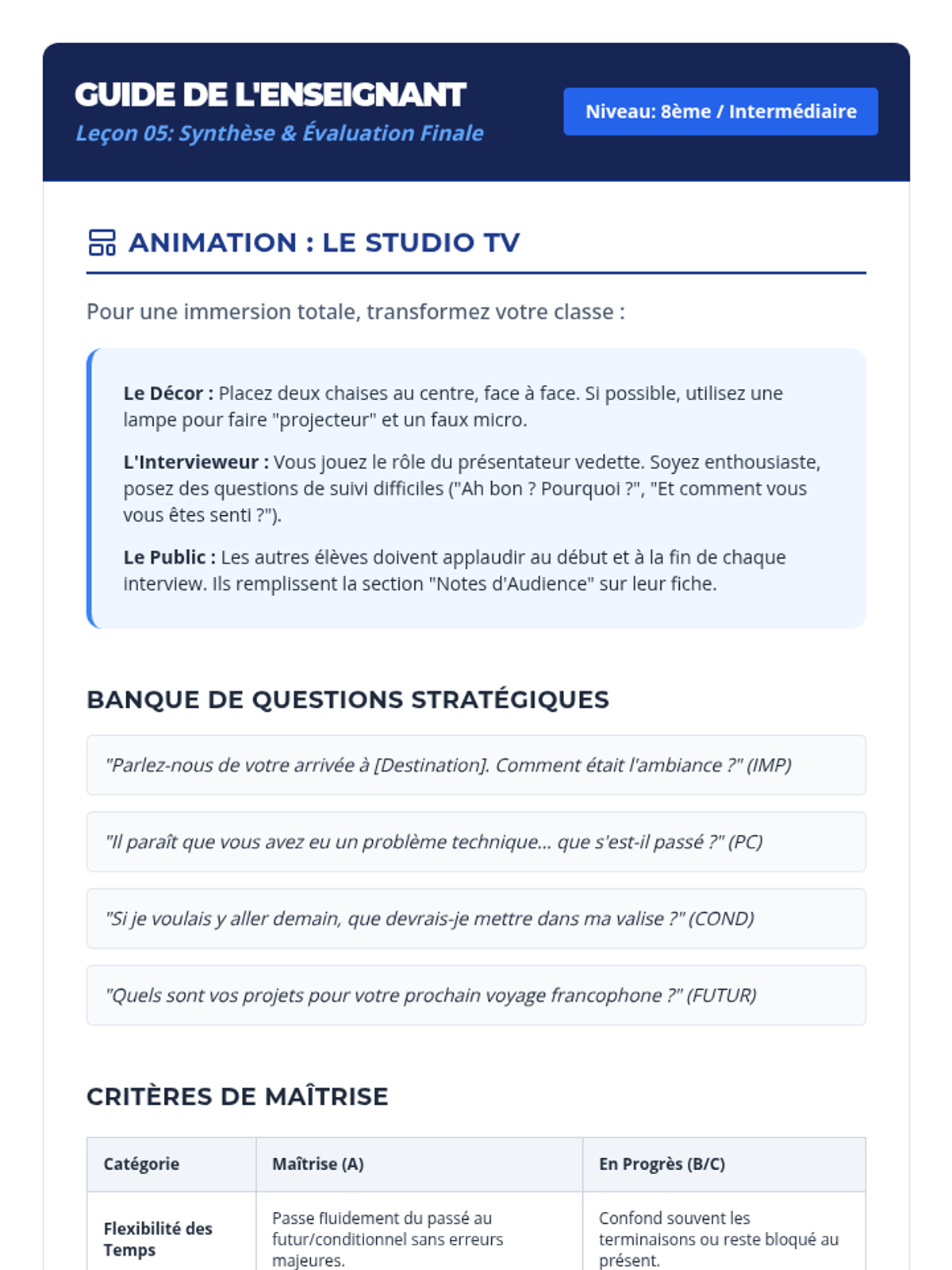
Teacher guide for the final lesson, detailing the TV studio setup, providing a bank of strategic interview questions, and an evaluation rubric for oral mastery.
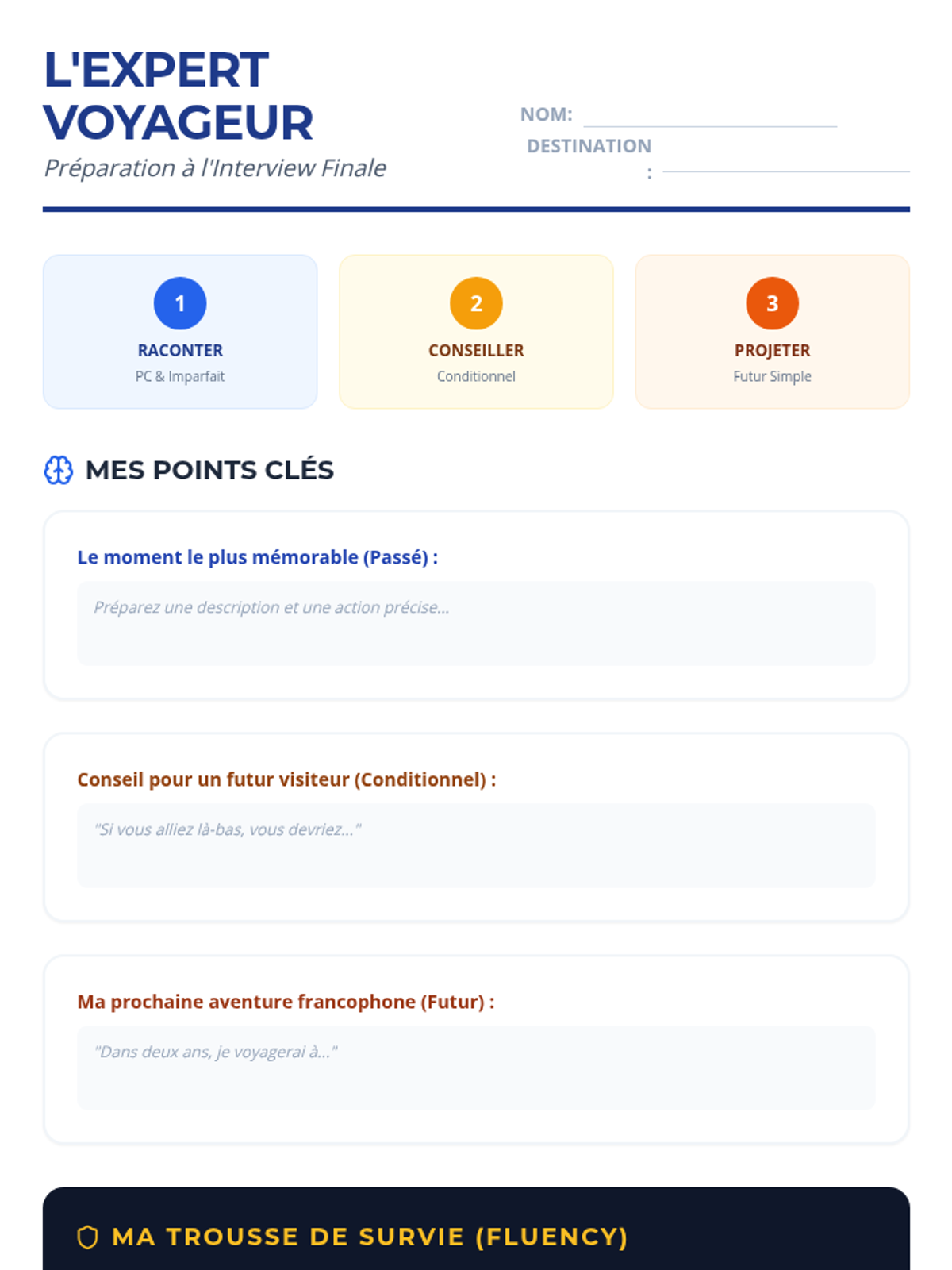
Final synthesis worksheet for Lesson 5, helping students prepare key points for their mock interview and providing a peer feedback section for the studio audience.
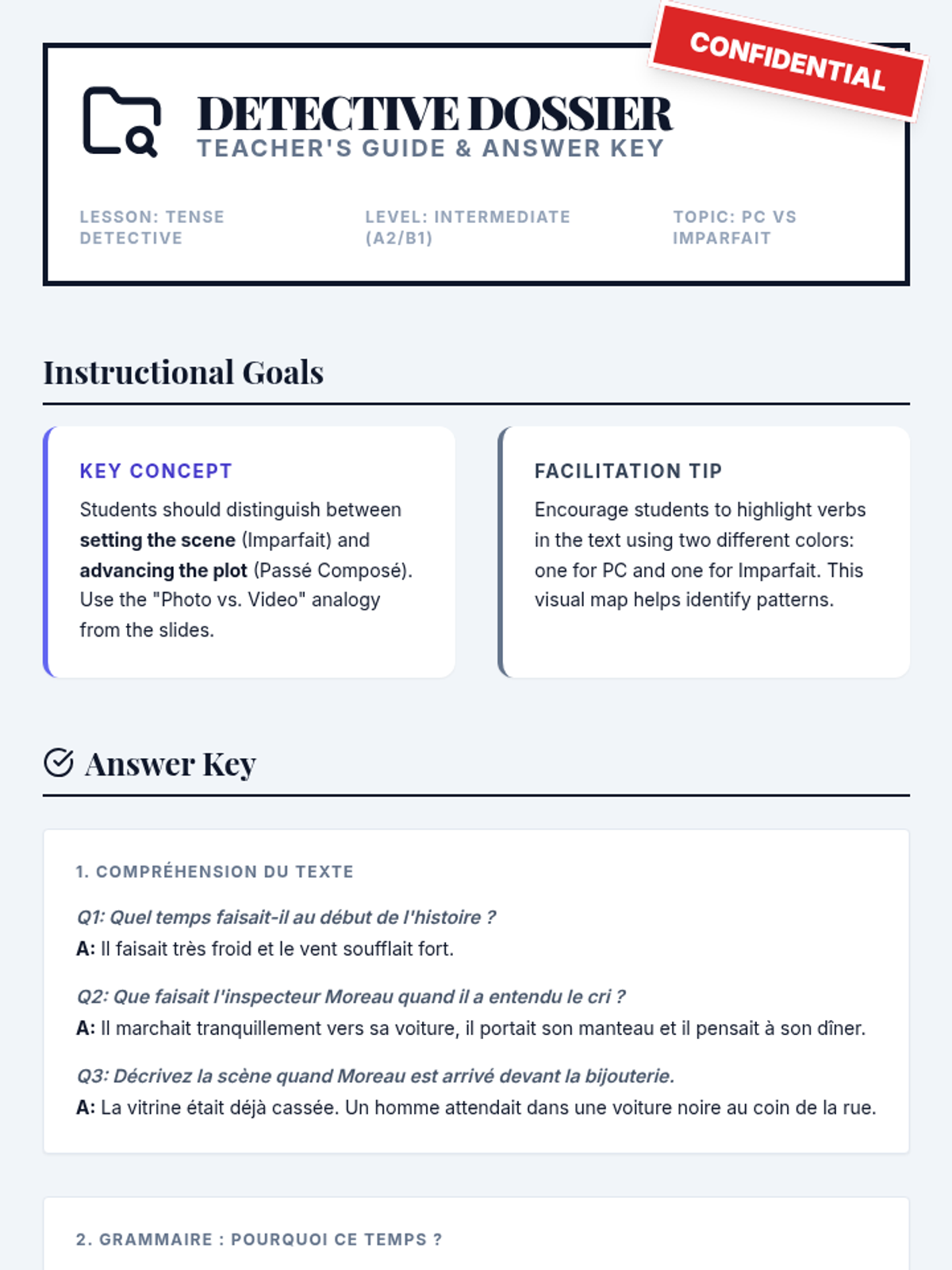
A teacher facilitation guide for the Tense Detective lesson. It includes learning objectives, a complete answer key for the worksheet, differentiation strategies for diverse learners, and a grammatical breakdown of the narrative text.
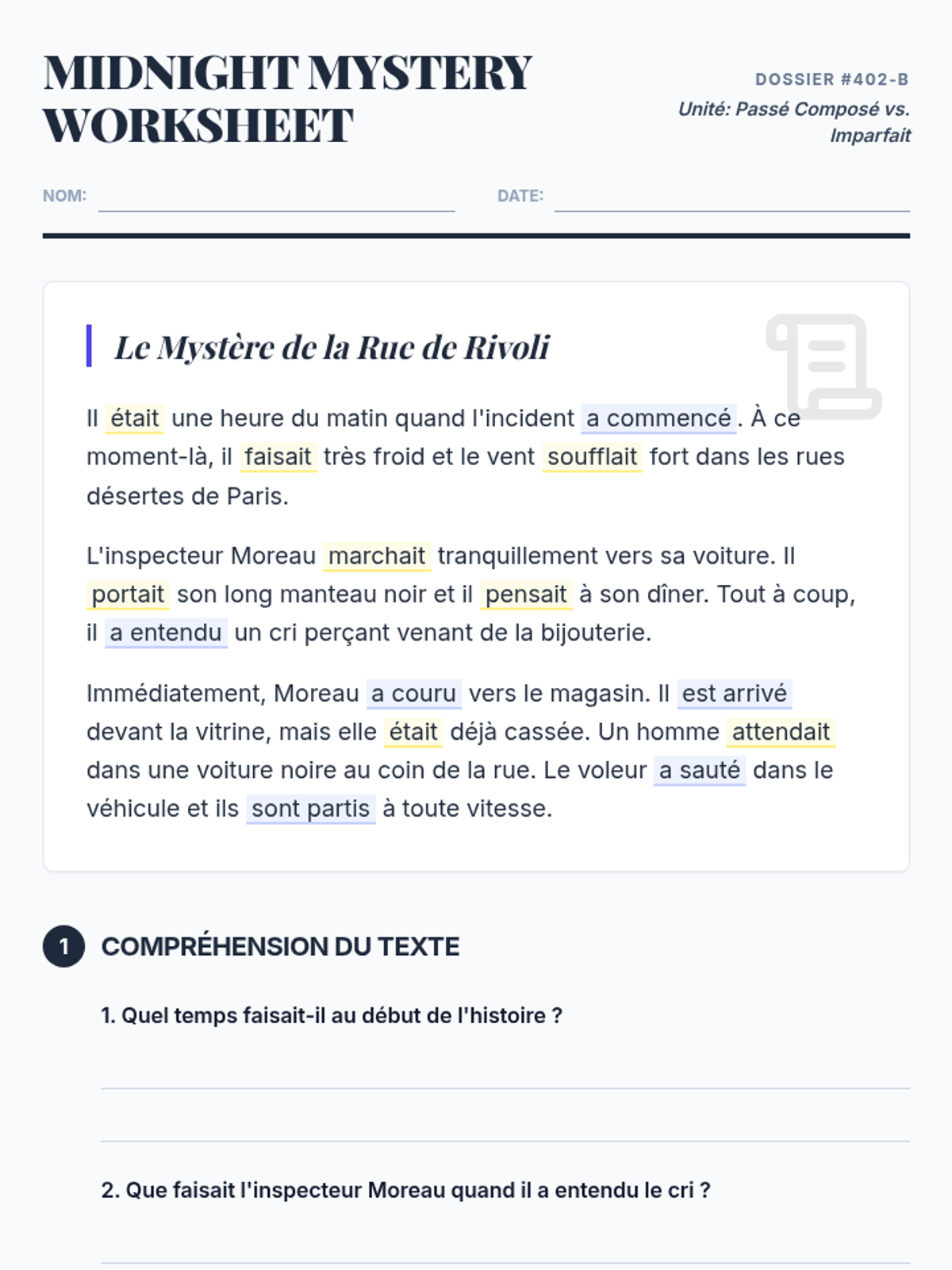
A student worksheet featuring a French reading passage about a jewelry heist. It includes comprehension questions, a grammar analysis section, and a creative writing prompt focusing on Passé Composé vs Imparfait.
A visual slide deck that explains the differences between Passé Composé and Imparfait using a detective/mystery theme. It features key concepts, examples of background setting vs. specific actions, and trigger words.
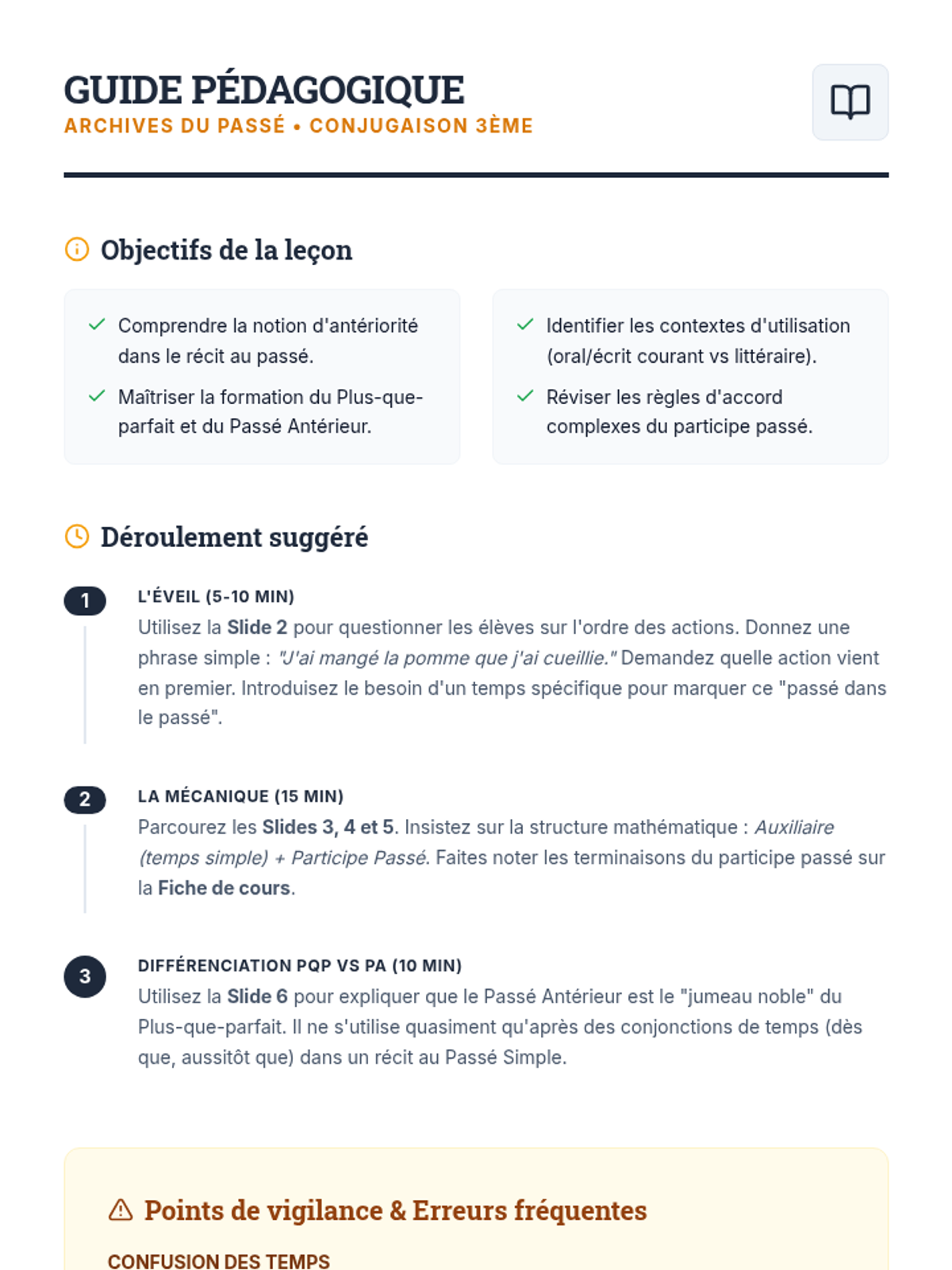
Un guide pour l'enseignant détaillant les objectifs, les points de vigilance et une proposition de déroulement pour la leçon sur les temps composés du passé.
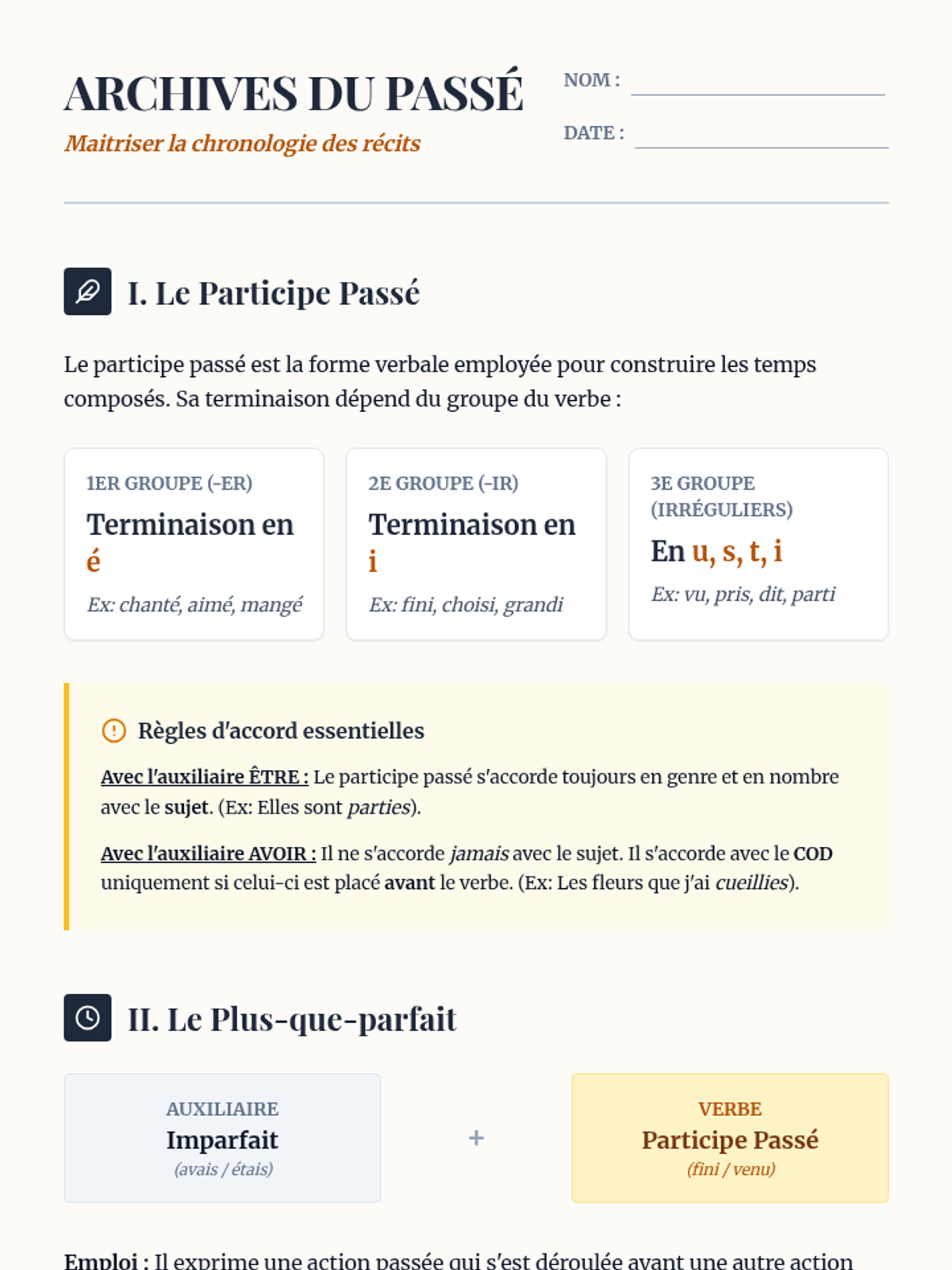
Une fiche de cours synthétique et visuelle résumant les règles de formation et d'emploi du participe passé, du plus-que-parfait et du passé antérieur.
Une présentation visuelle complète pour enseigner la formation et l'emploi du participe passé, du plus-que-parfait et du passé antérieur, adaptée aux élèves de 3ème.
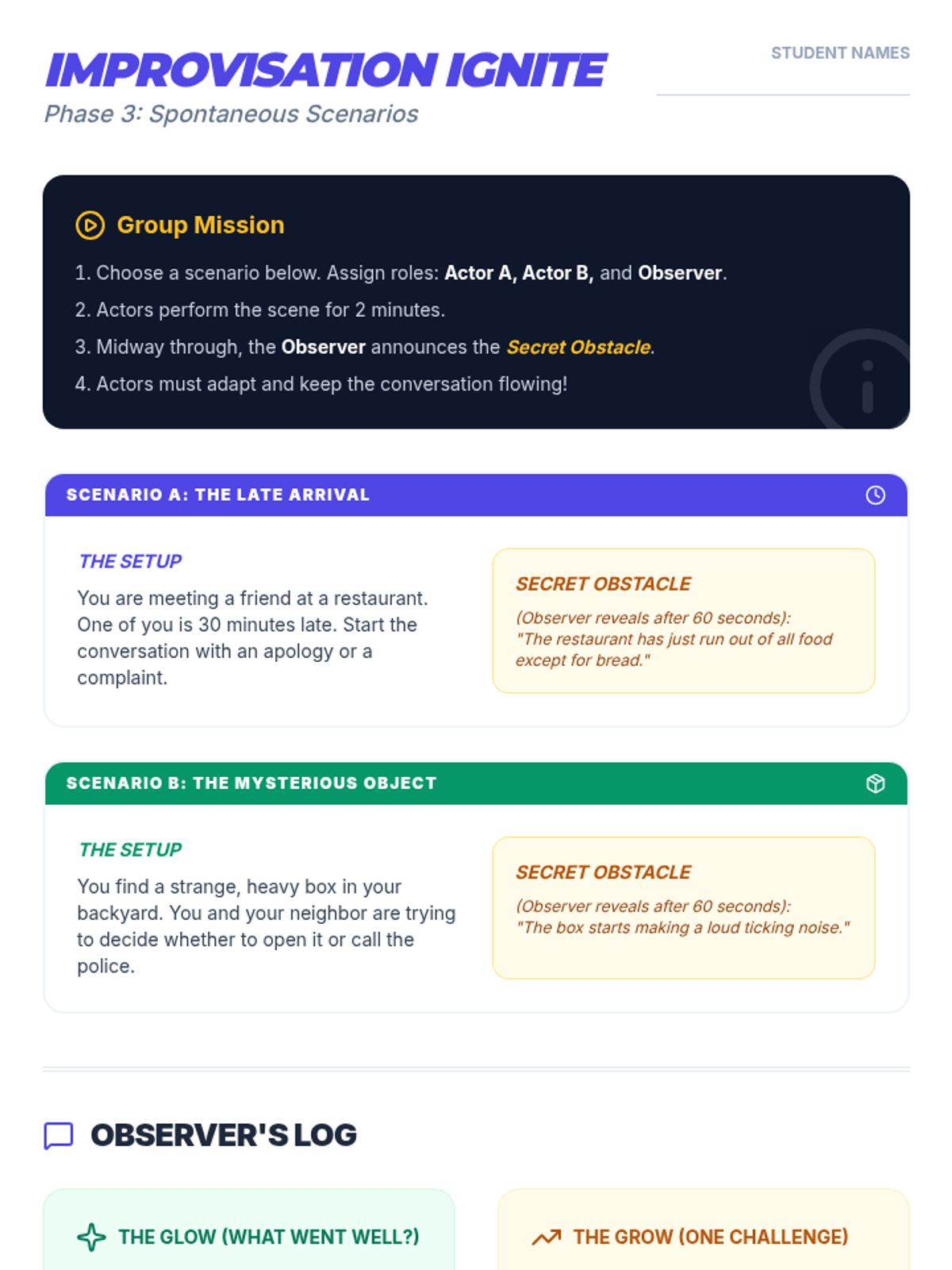
A student-facing small-group activity sheet providing structured scenarios with 'Secret Obstacles' and a peer-feedback framework for oral production.
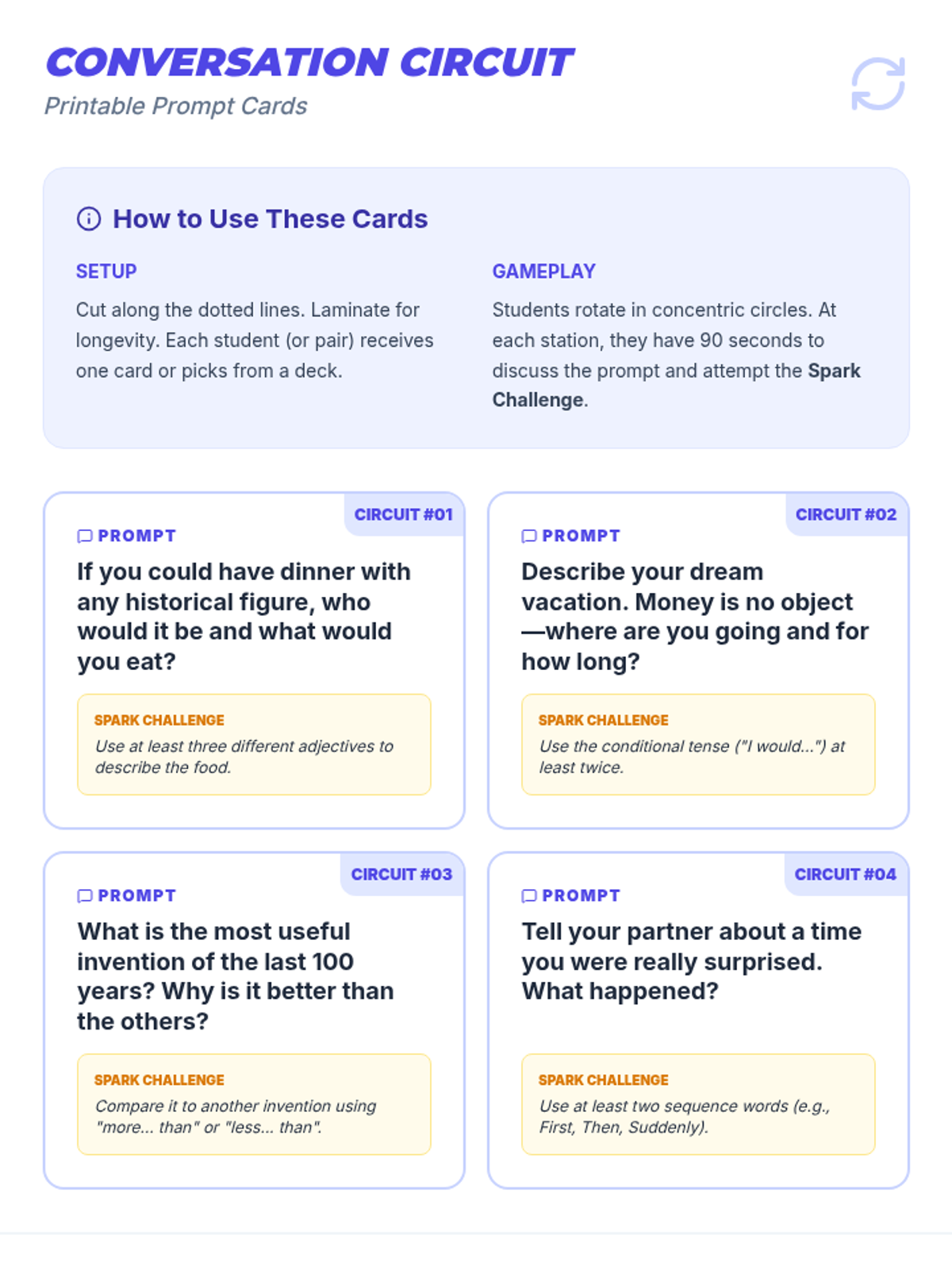
A set of 8 printable conversation prompt cards featuring 'Spark Challenges' to encourage specific linguistic targets during spontaneous speaking.
A visual guide for teachers and students explaining the shift from accuracy to fluency, providing warm-up prompts, and offering "Survival Phrases" to keep conversations moving.
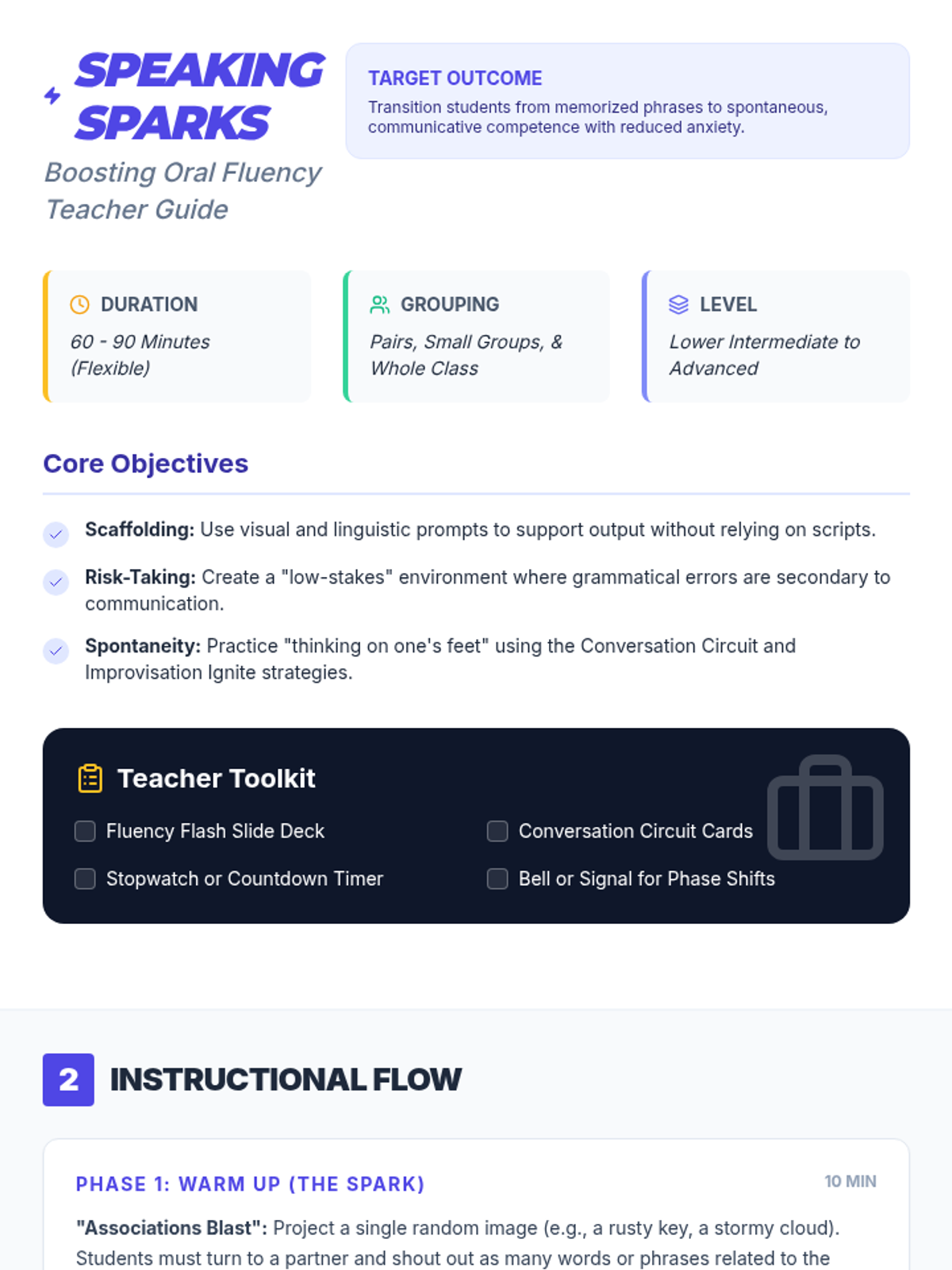
A comprehensive teacher guide for implementing oral fluency strategies, including a 4-phase instructional flow, target outcomes, and specific feedback techniques.
Visual presentation for the final lesson, guiding students through circumlocution strategies and interview preparation for their travel expert role-play.
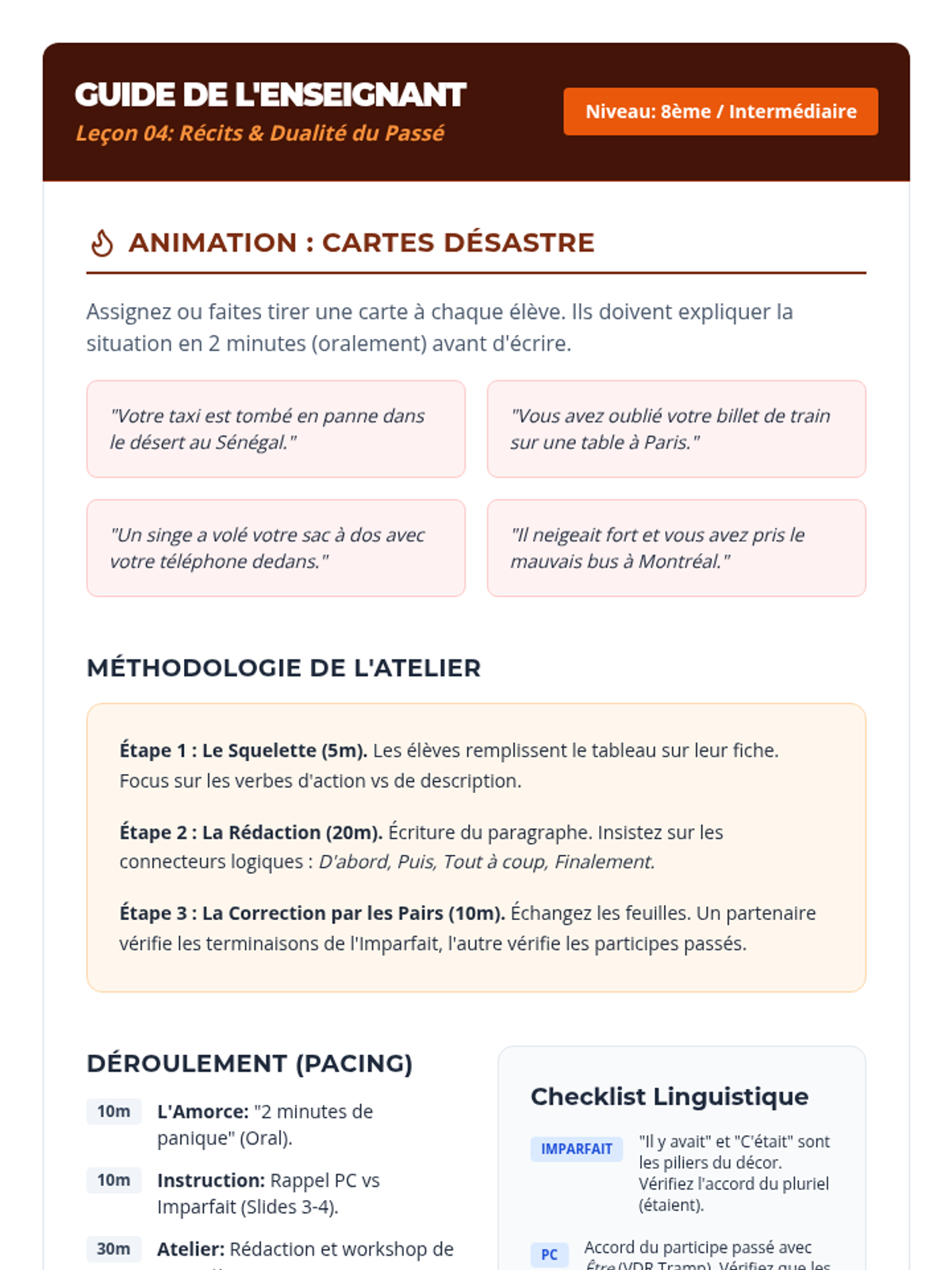
Teacher guide for Lesson 4, including disaster scenario prompts for the hook and a step-by-step workshop guide for correcting past tense usage.
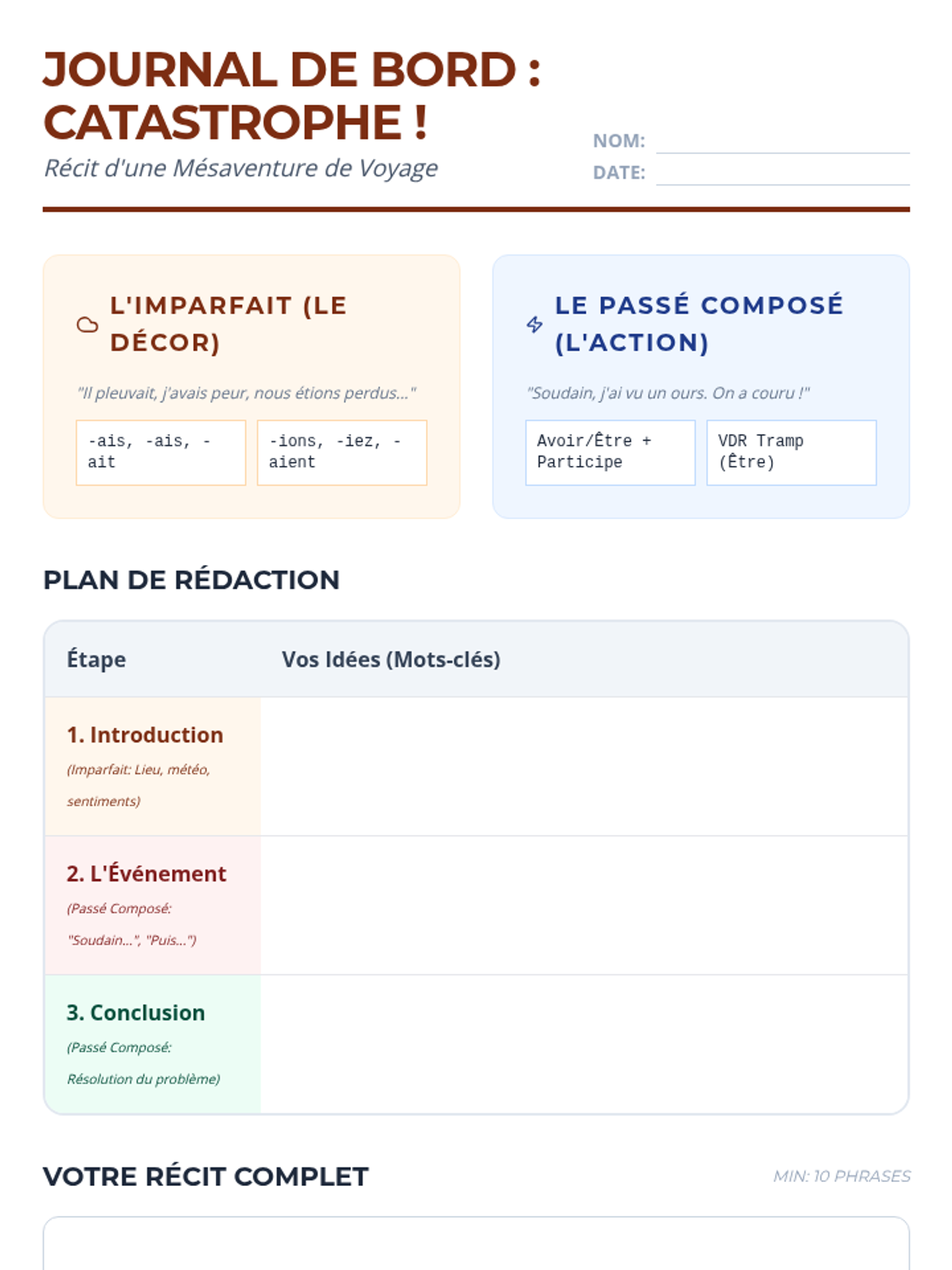
Student writing workshop document for Lesson 4, featuring a grammar toolkit, a narrative planning grid, and space for drafting a travel mishap story.
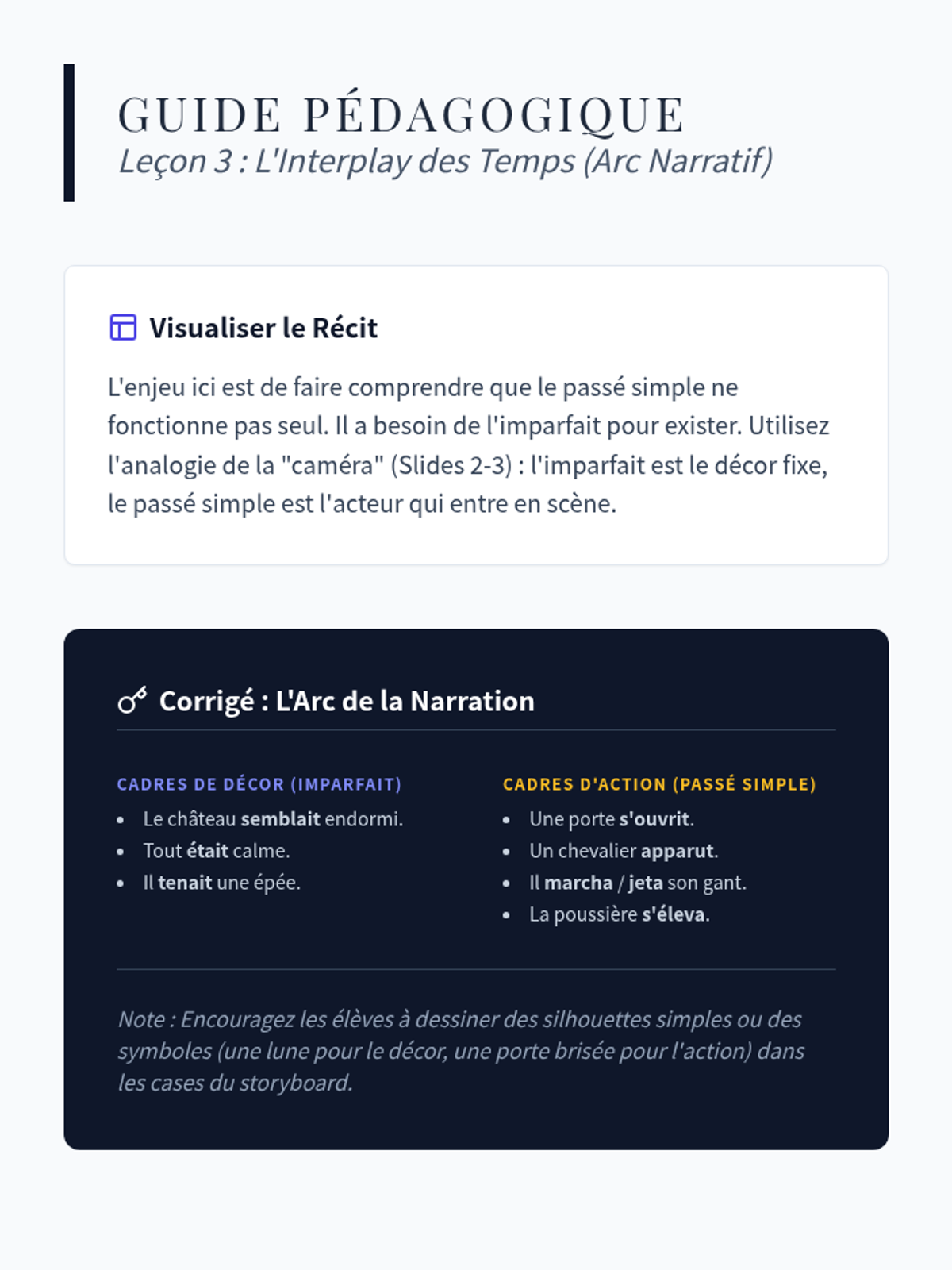
Teacher guide for Lesson 3, focusing on teaching the functional difference between imparfait and passé simple through visual analysis.
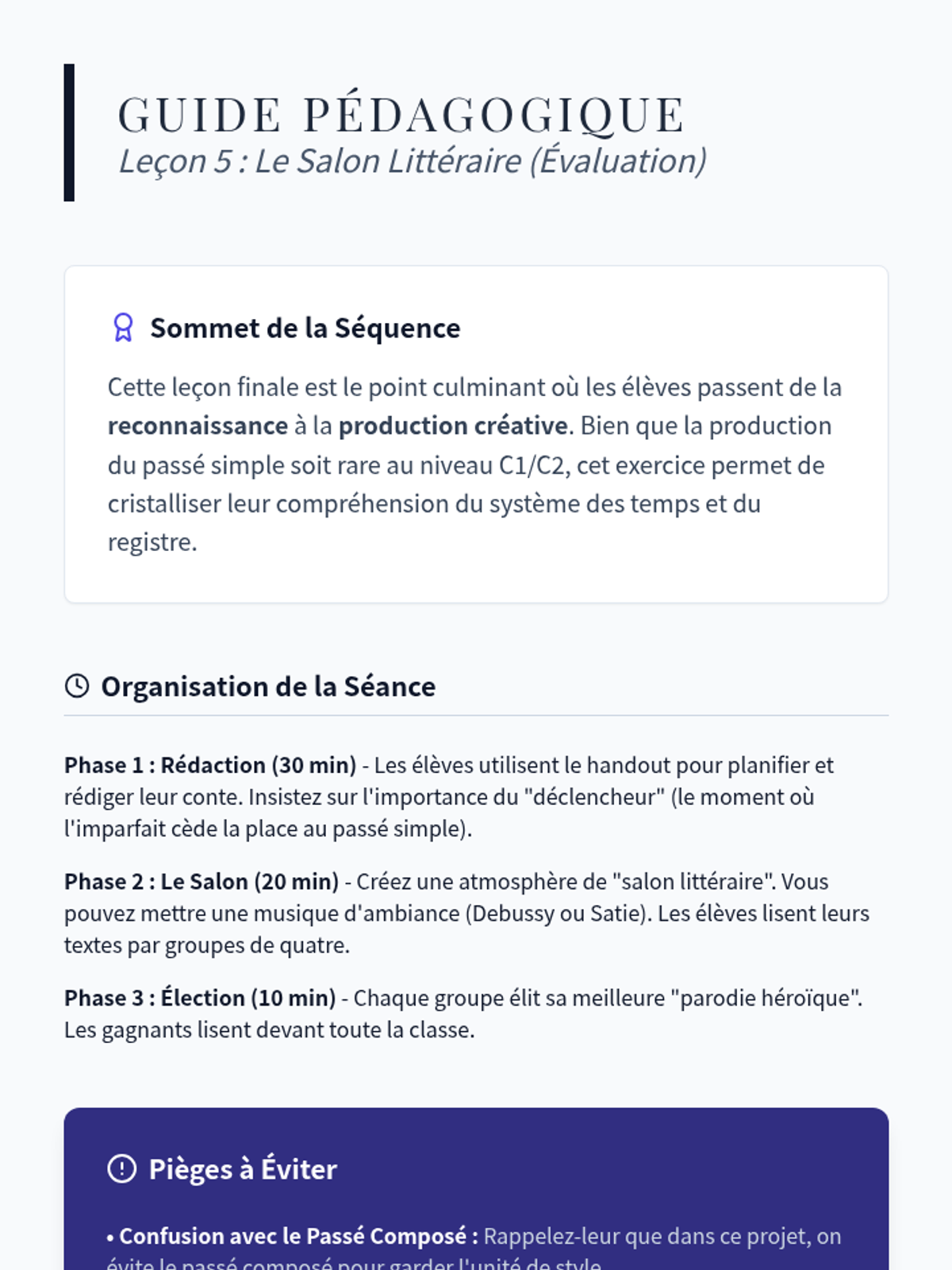
Teacher guide for Lesson 5, focusing on facilitating the final project workshop and organizing the 'Literary Salon' for sharing stories.
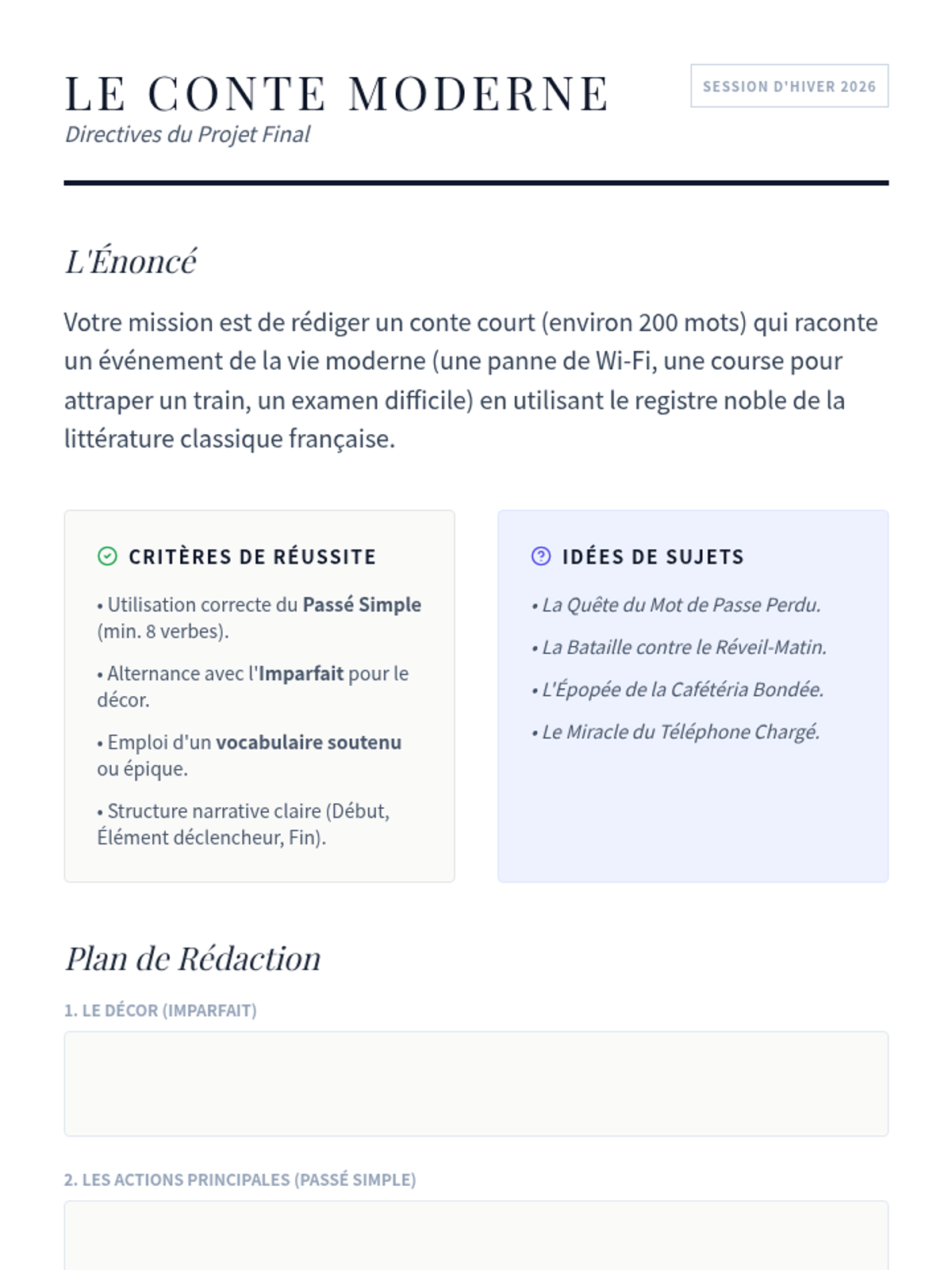
Final project handout for Lesson 5, including requirements, planning space, and a grading rubric for the modern fairy tale project.
Slide deck for Lesson 5 focusing on the final project: writing a modern fairy tale using the passé simple.
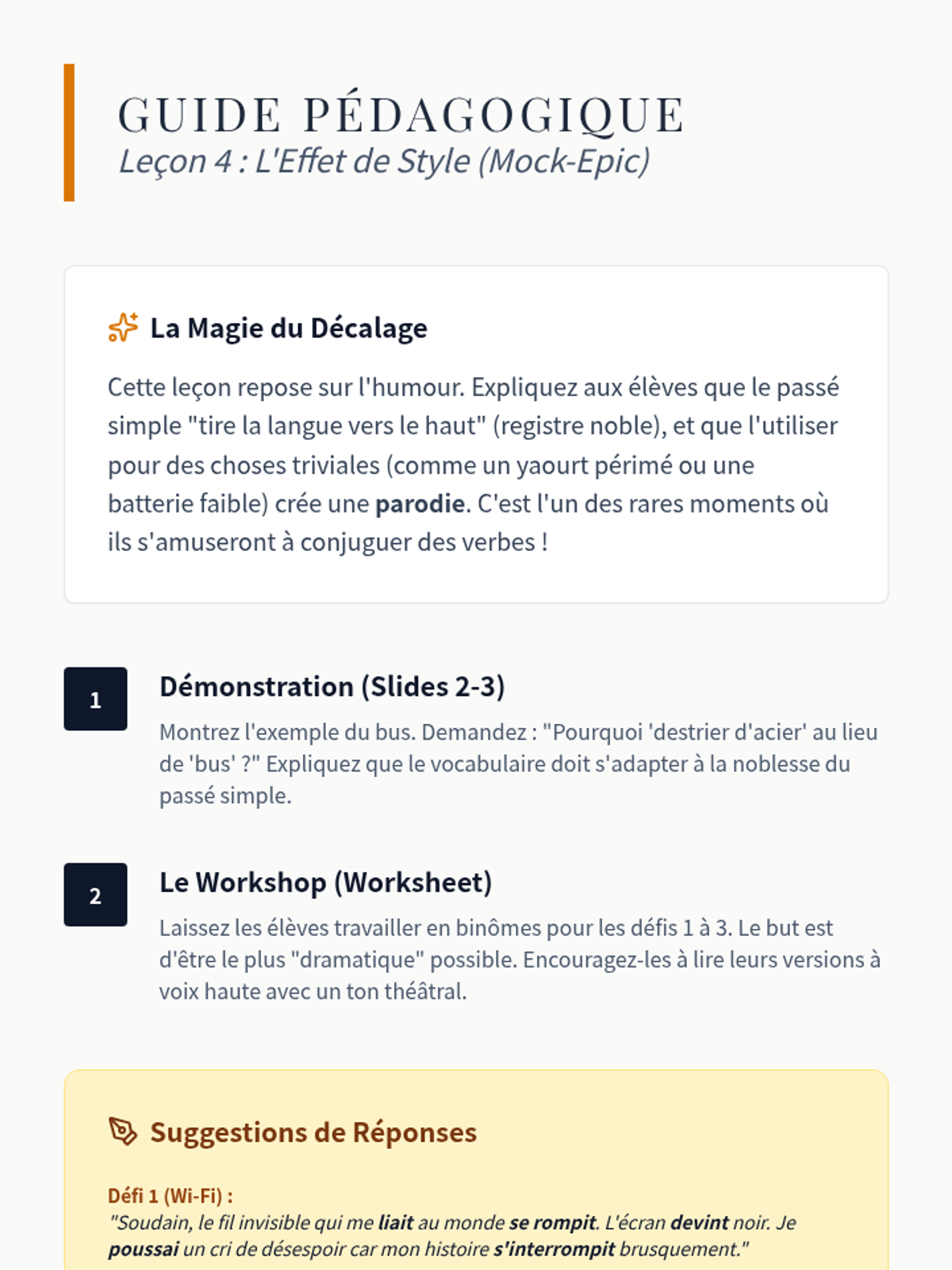
Teacher guide for Lesson 4, focusing on facilitating the mock-epic creative writing workshop and providing sample transformations.
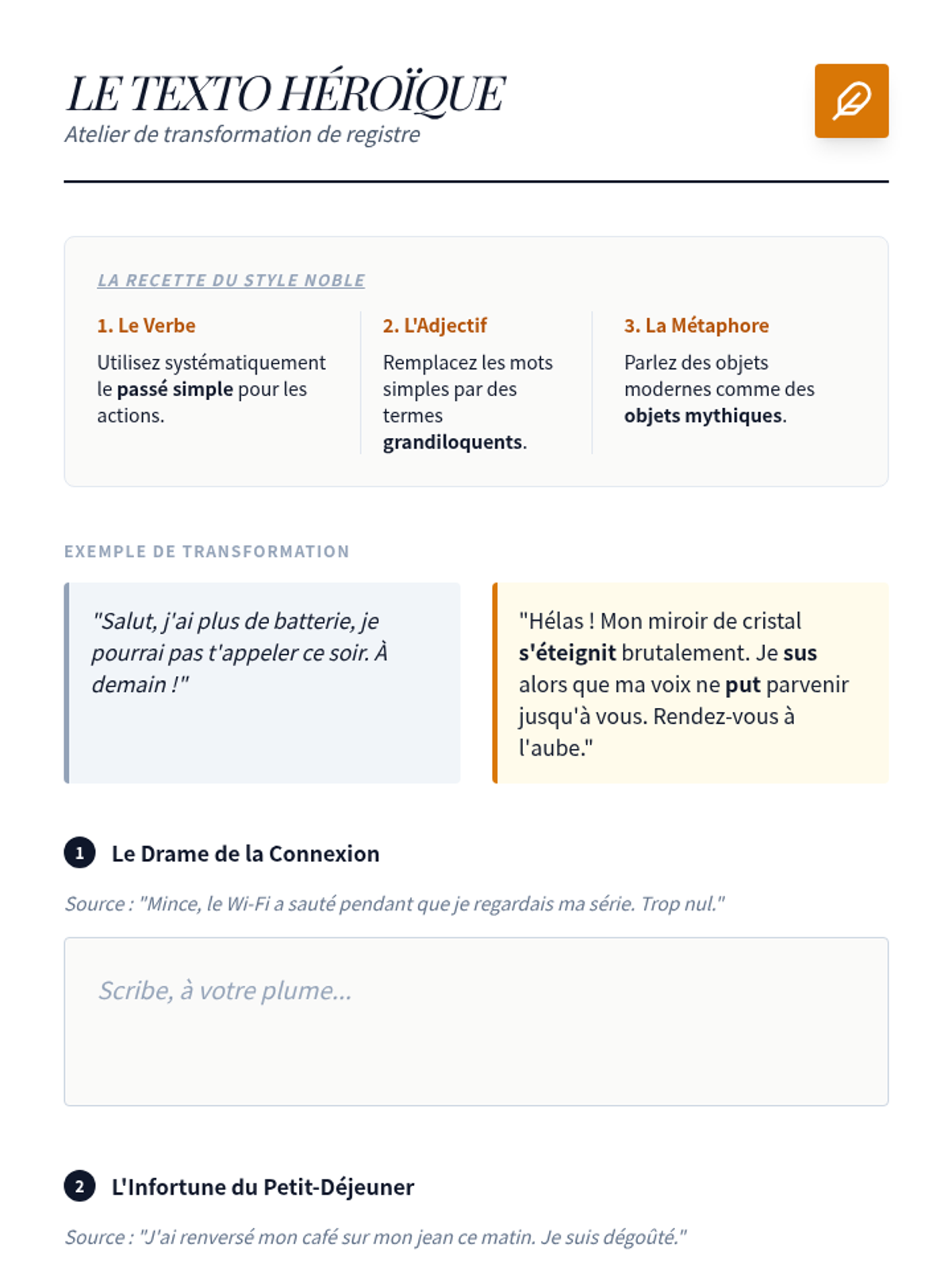
Workshop worksheet for Lesson 4 where students transform modern informal messages into a formal literary style using the passé simple.
Slide deck for Lesson 4 focusing on the stylistic difference between spoken and literary French, and the "mock-epic" effect.
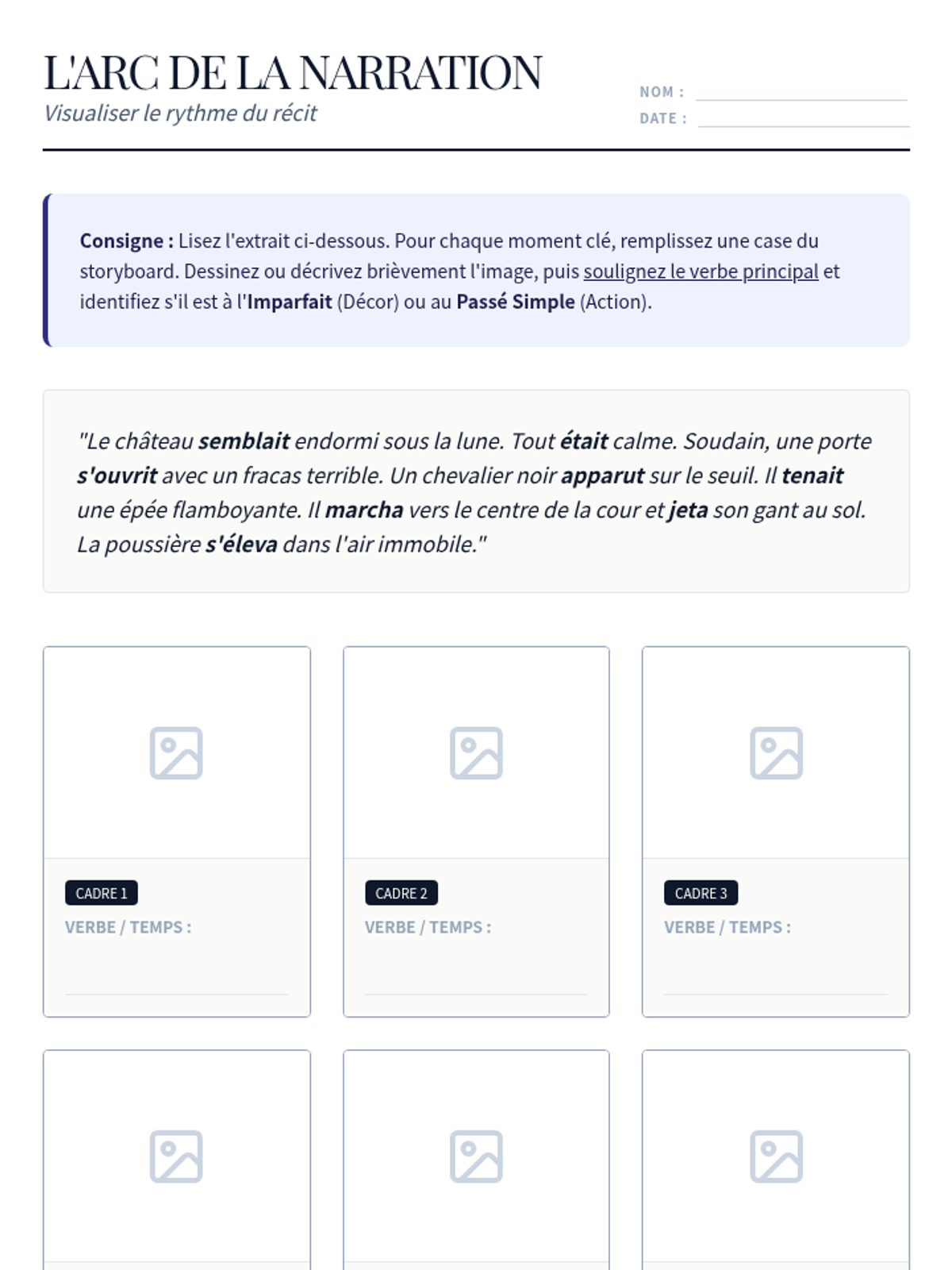
Storyboard activity for Lesson 3 where students map out a narrative excerpt by distinguishing between background descriptions and plot actions.
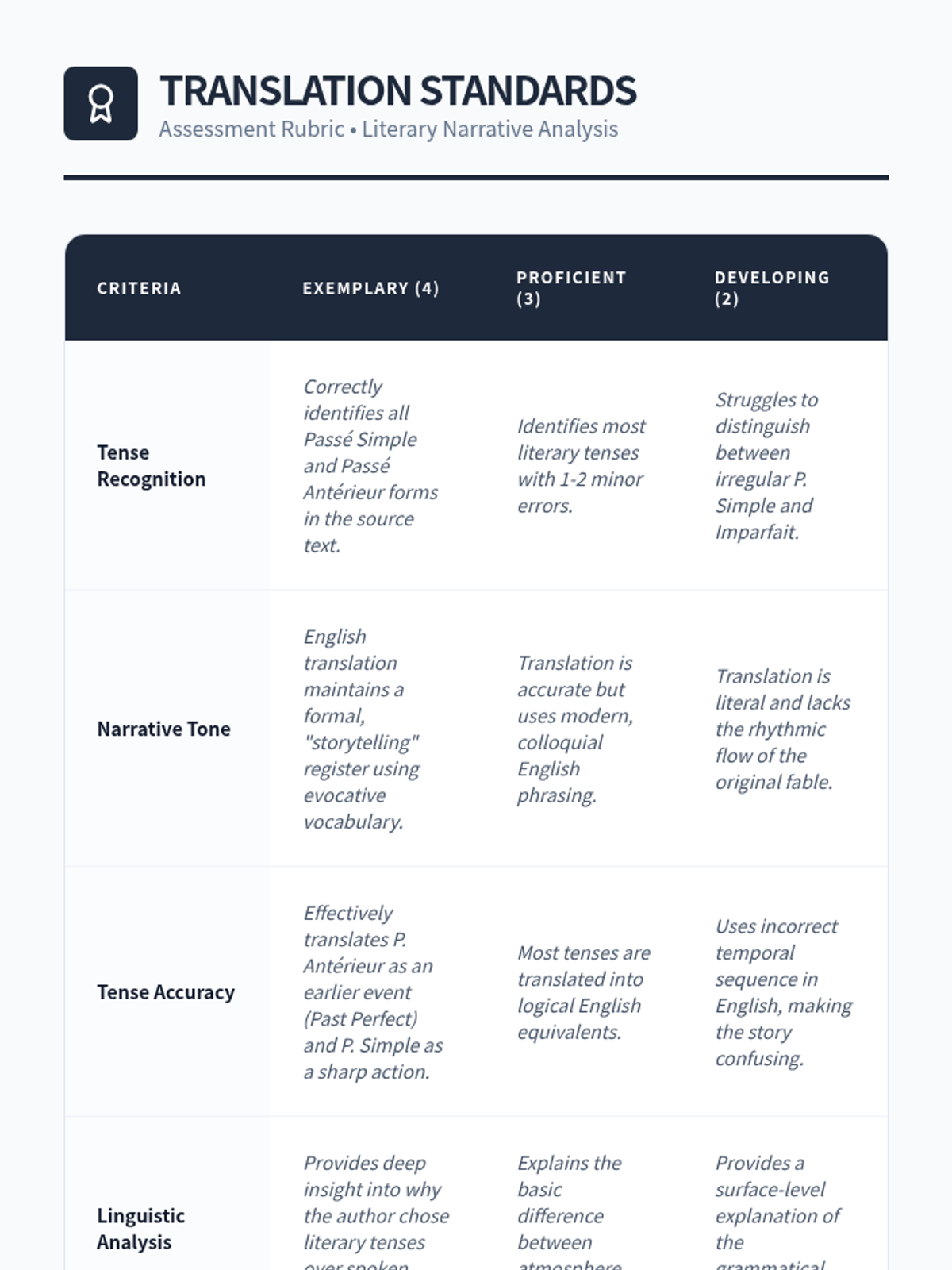
A comprehensive grading rubric for the translation workshop and final assessment, evaluating tense recognition, narrative tone, and linguistic analysis.
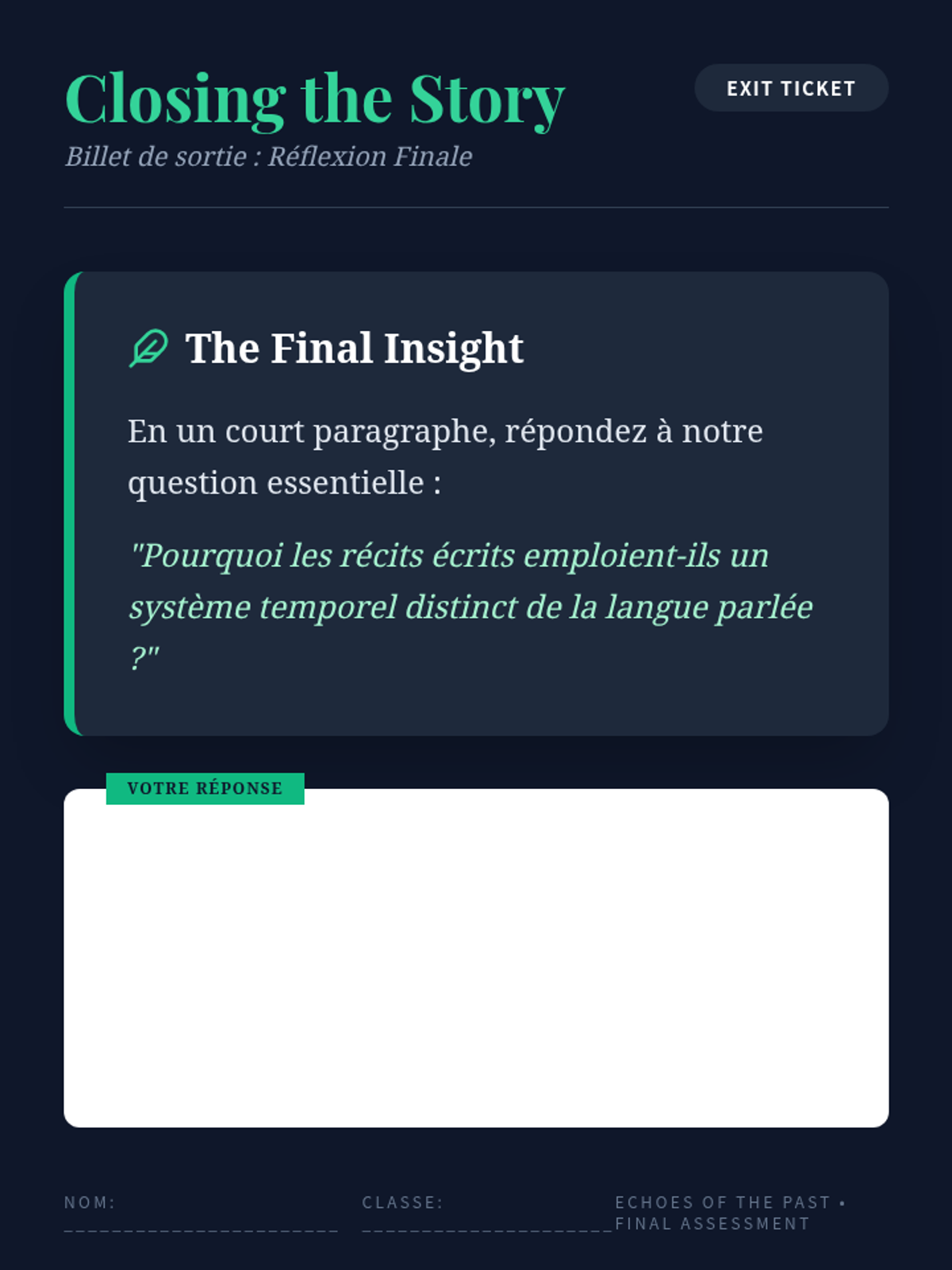
A reflective exit ticket for the final lesson, asking students to synthesize their understanding of why literary tenses exist and their impact on narrative.
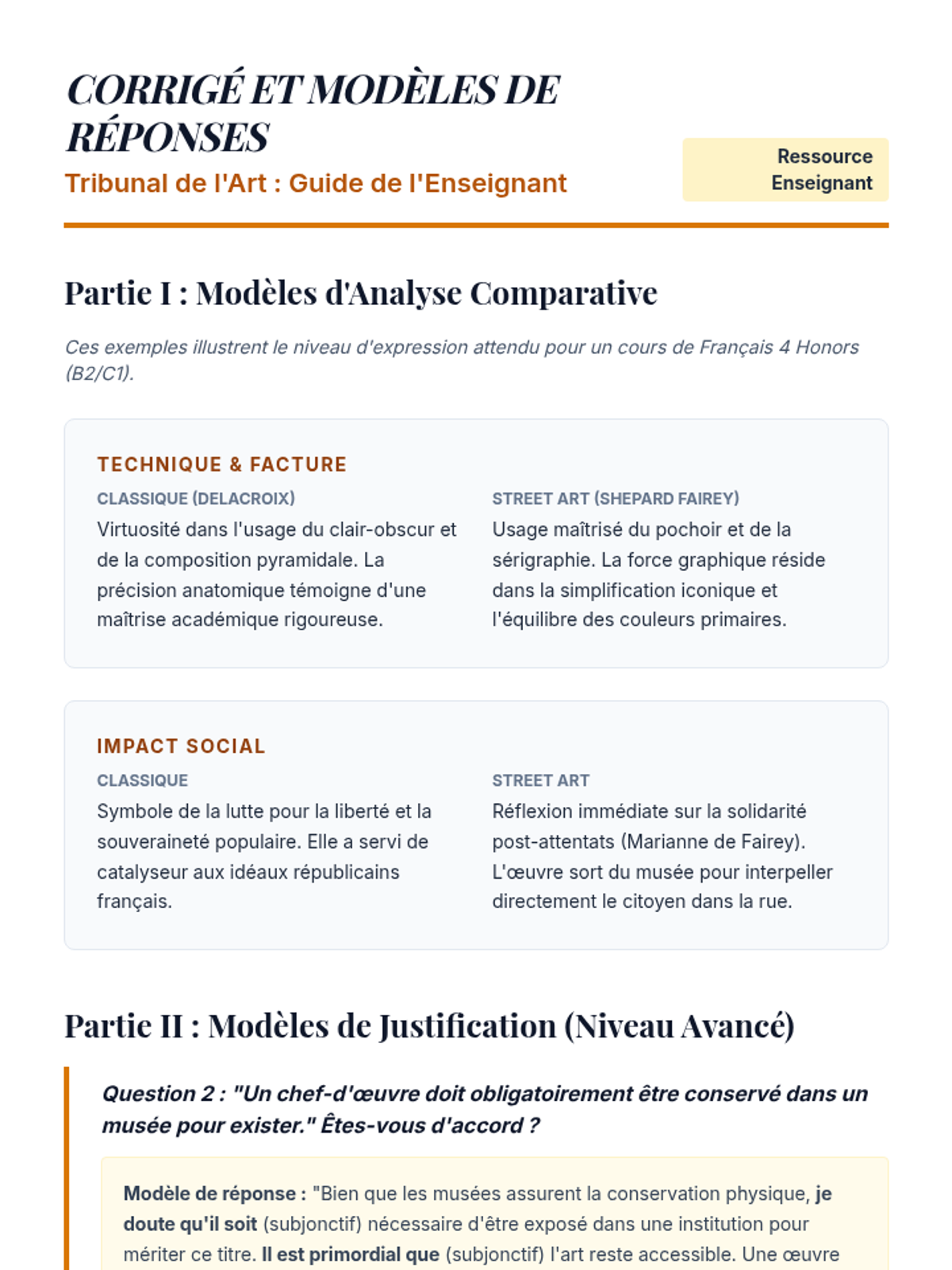
A teacher answer key and model response guide for the Art en Débat lesson, providing advanced-level French sentence structures and evaluation criteria.
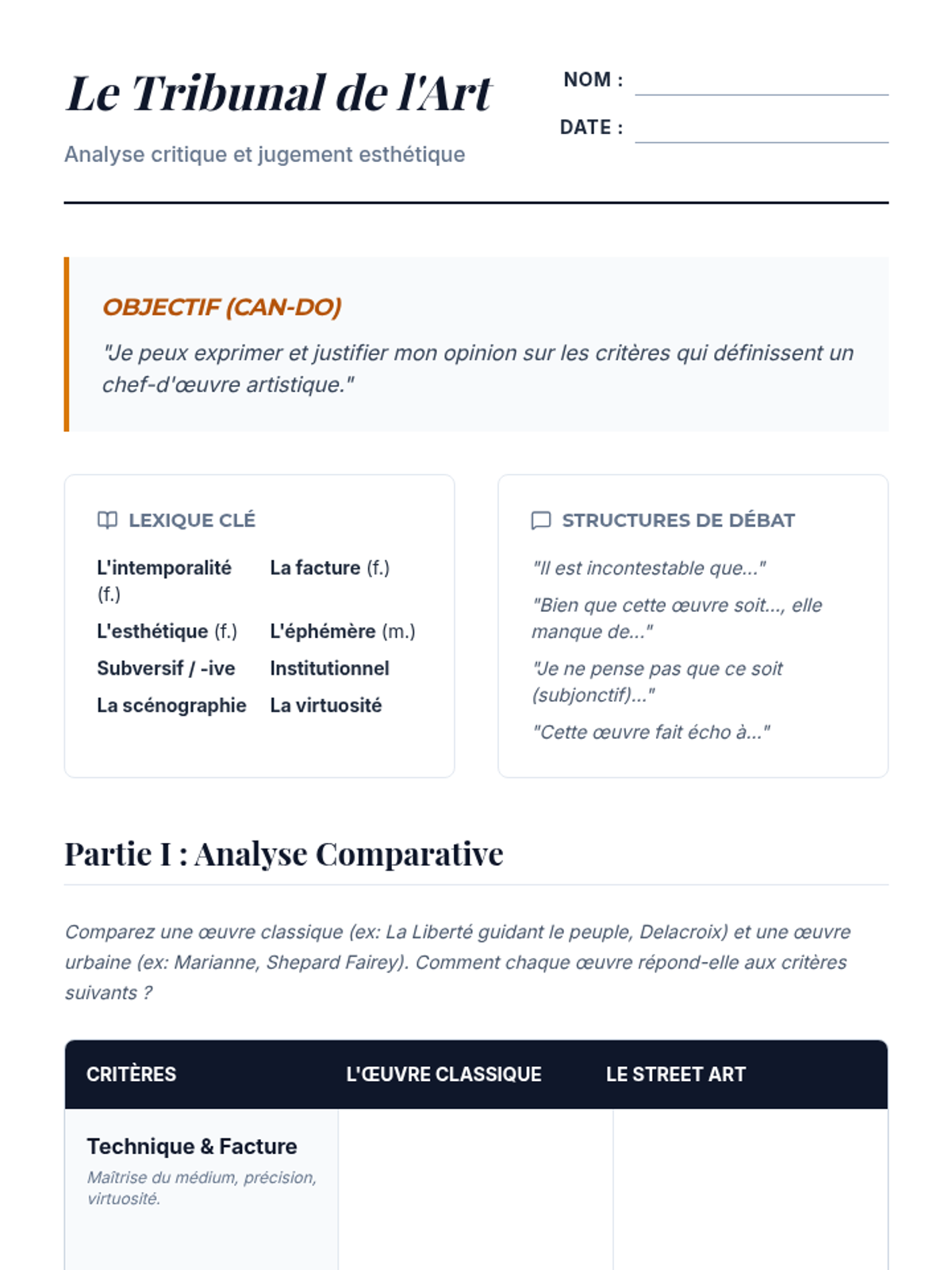
A critical analysis worksheet for students to compare classical and contemporary art forms, requiring justification of opinions and use of advanced French grammar.
A visually engaging presentation comparing classical masterpieces with street art to facilitate classroom discussion on aesthetic criteria.
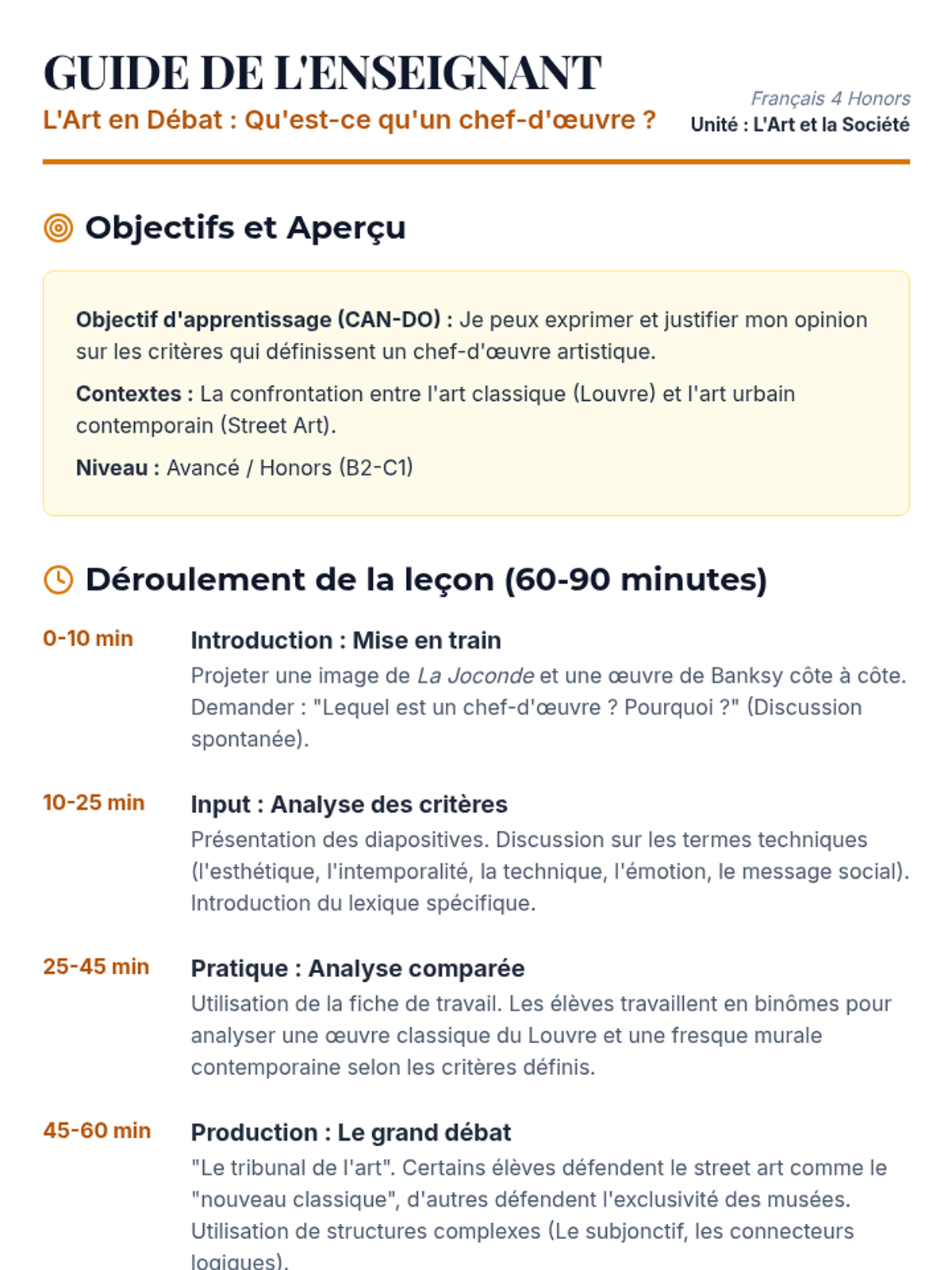
A comprehensive teacher's guide for a French Level 4 Honors lesson on evaluating art masterpieces, featuring pacing, essential questions, and pedagogical tips.
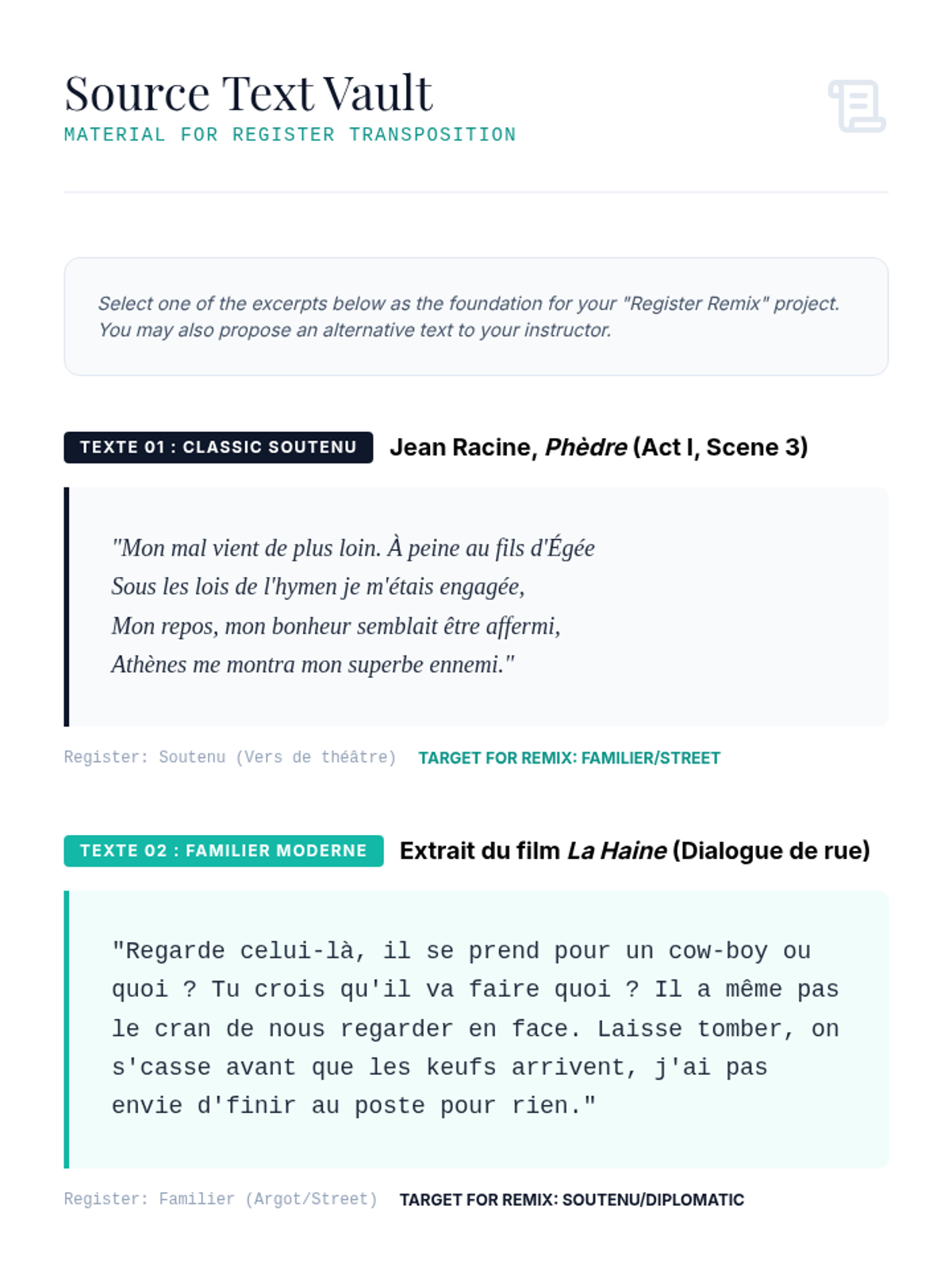
A curated bank of source texts from various French registers (literary, film, political) for students to use in their Register Remix project.
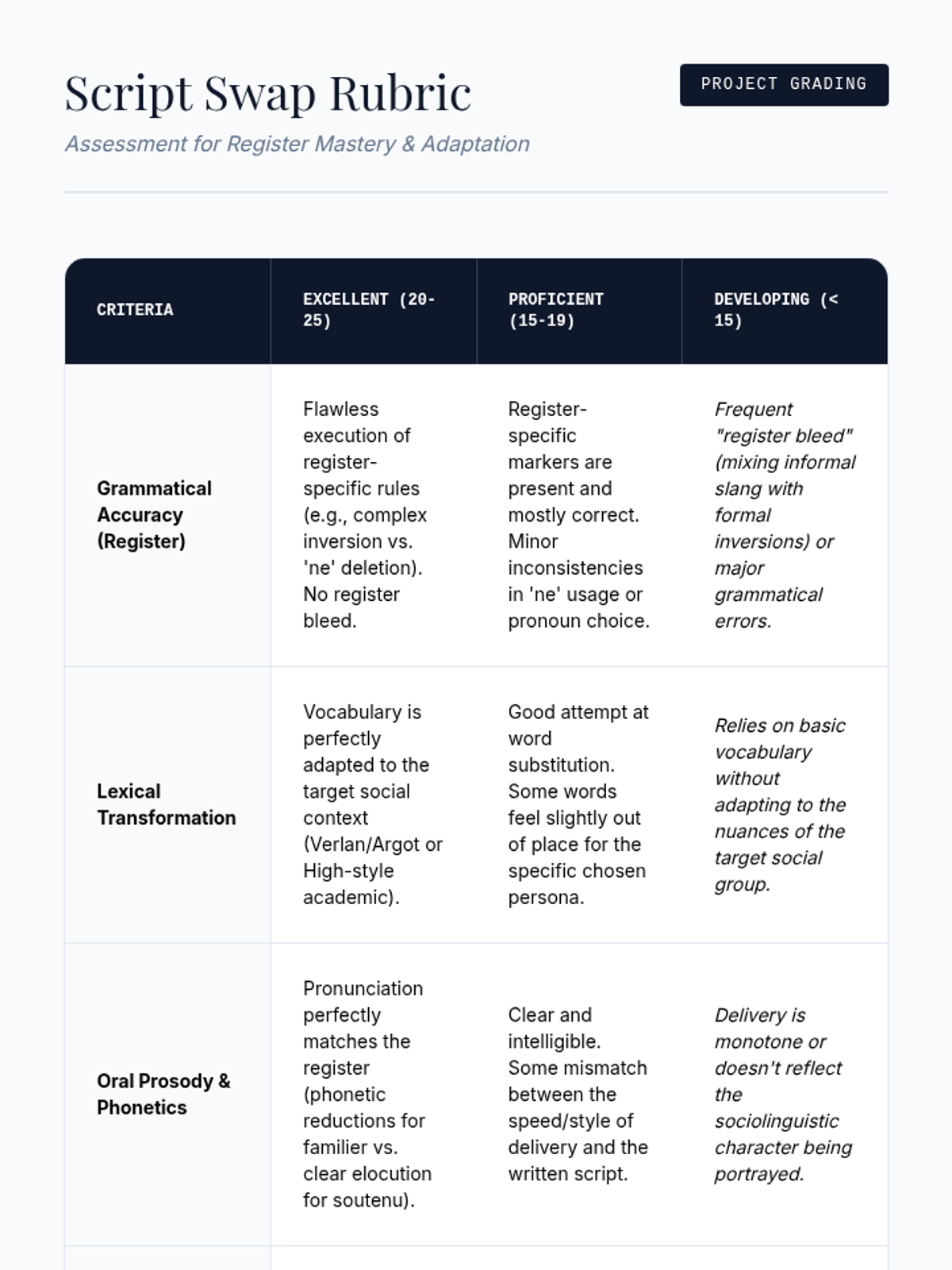
A comprehensive grading rubric for the Register Remix project, evaluating grammatical accuracy, lexical transformation, oral performance, and sociolinguistic rationale.
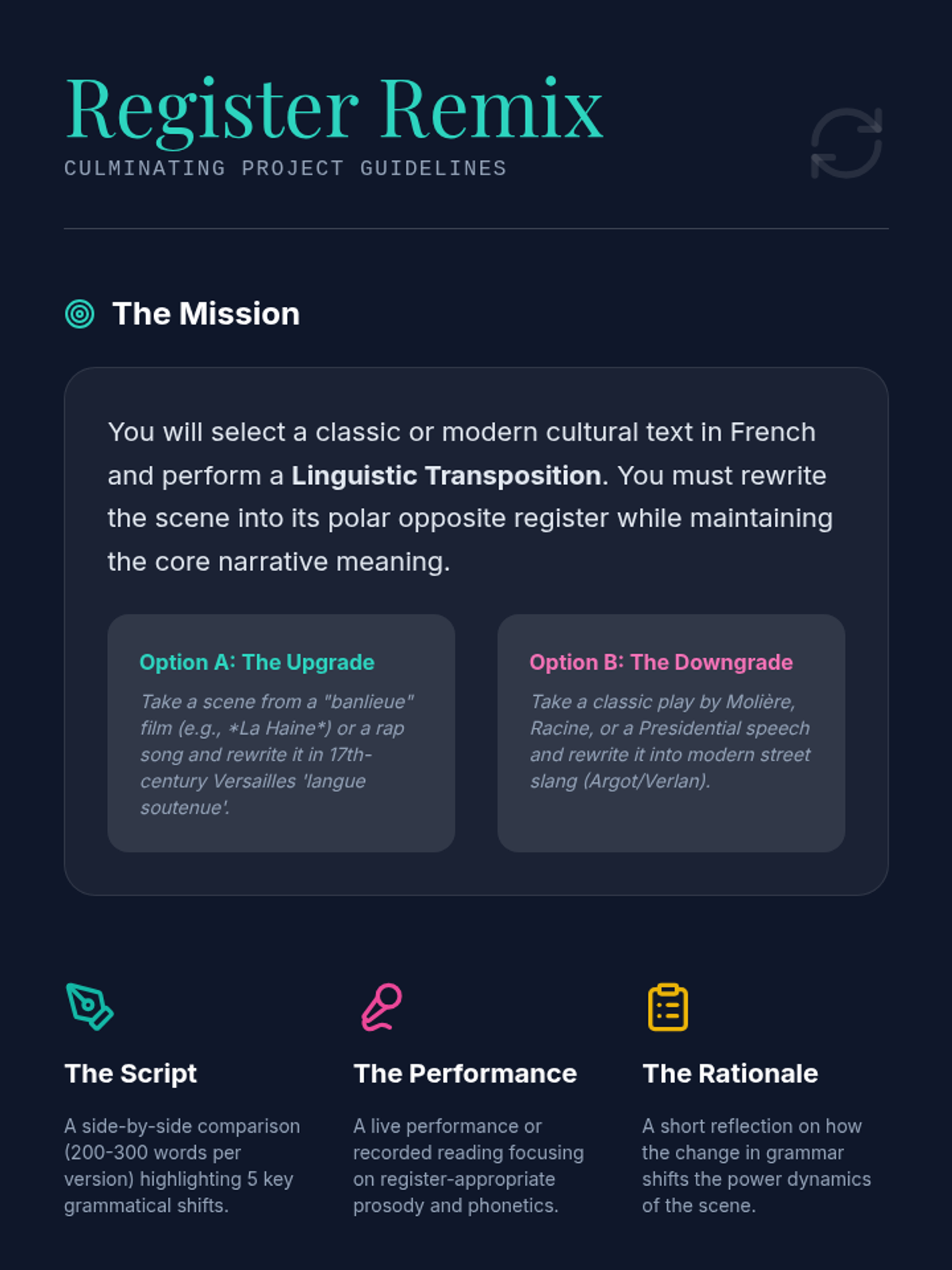
Instructions for the culminating Register Remix project, where students transpose a French scene from one sociolinguistic register to another.
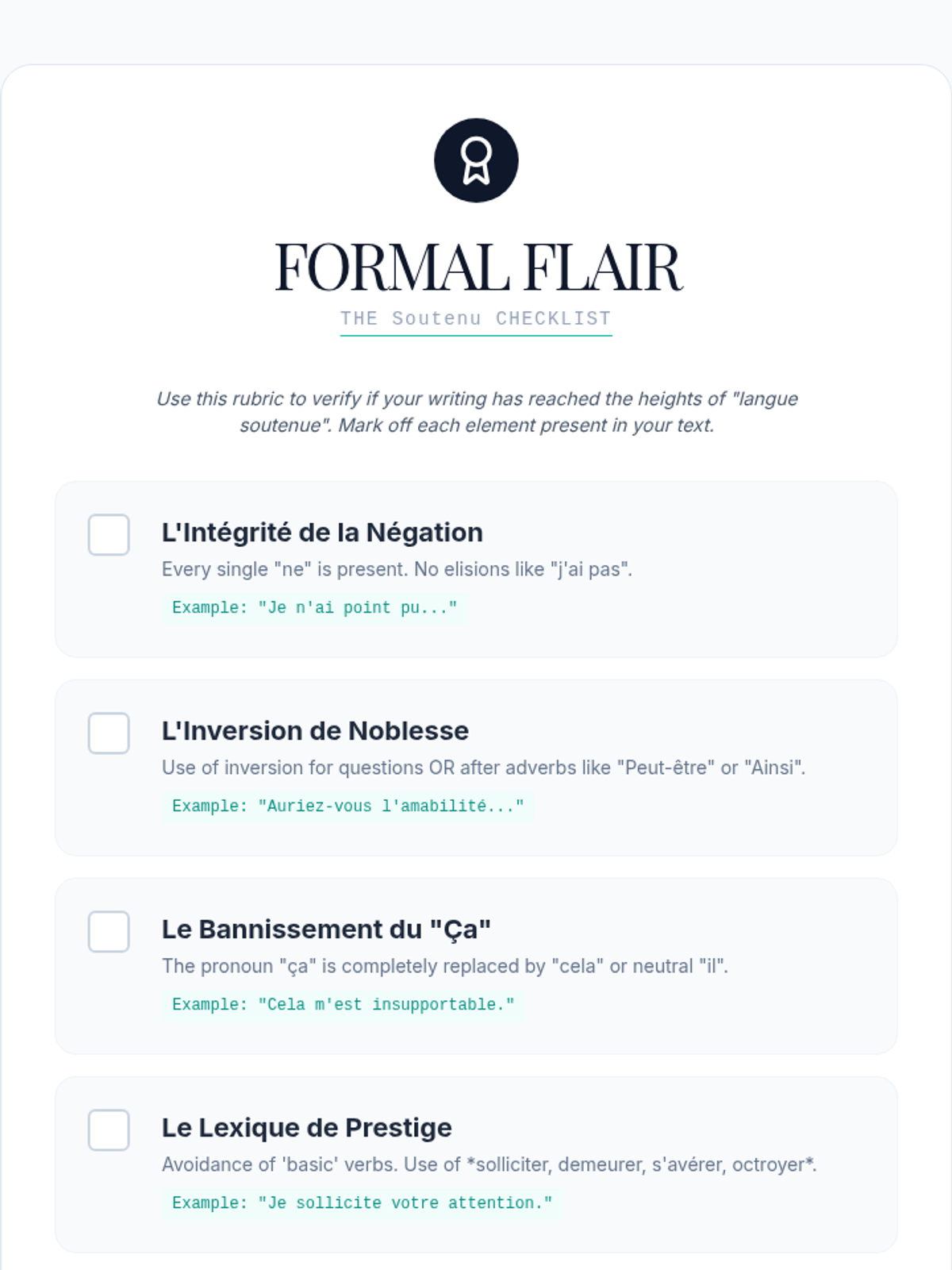
A stylistic checklist for students to self-assess their formal writing, ensuring they have included key markers of 'langue soutenue'.