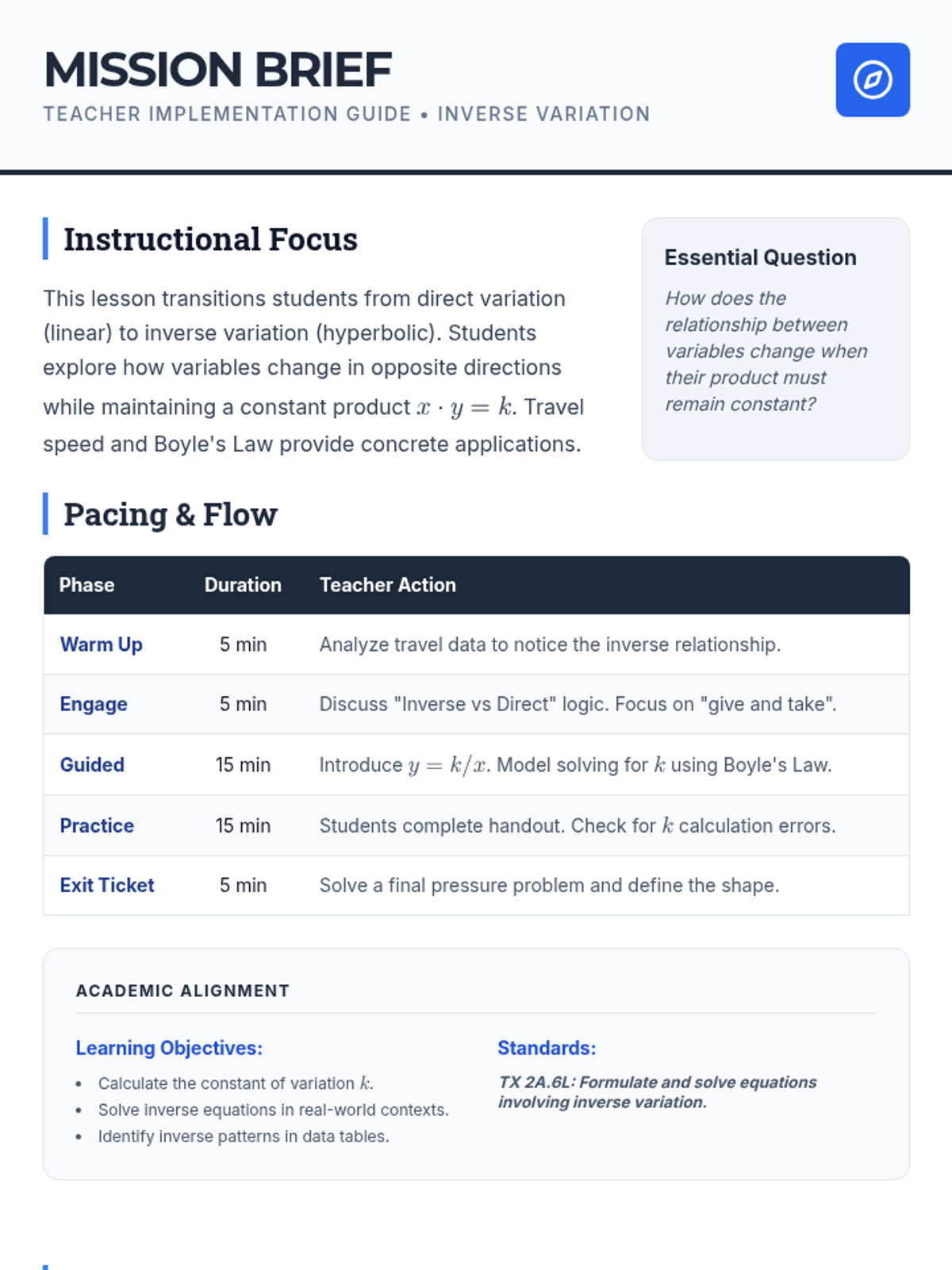
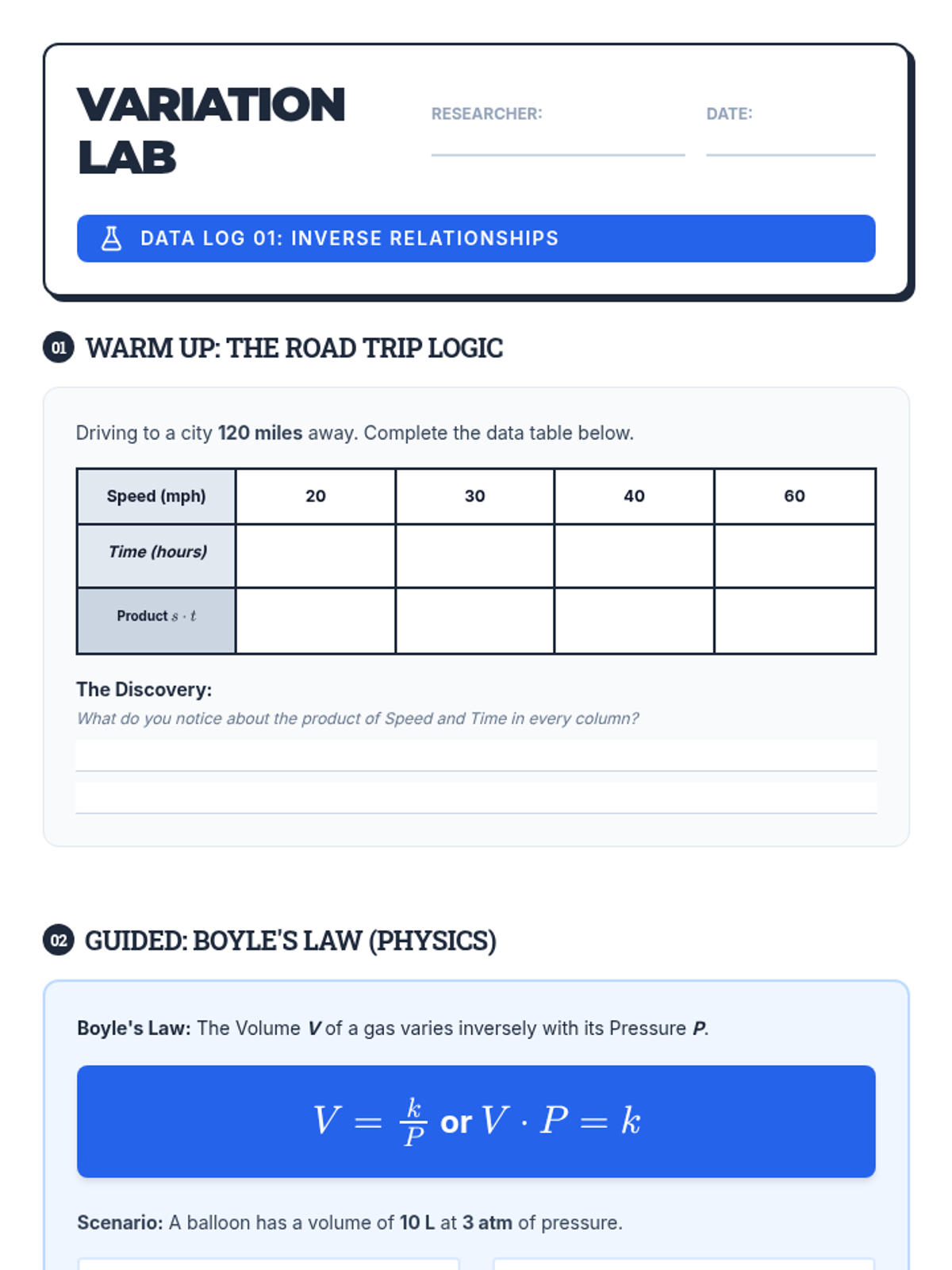
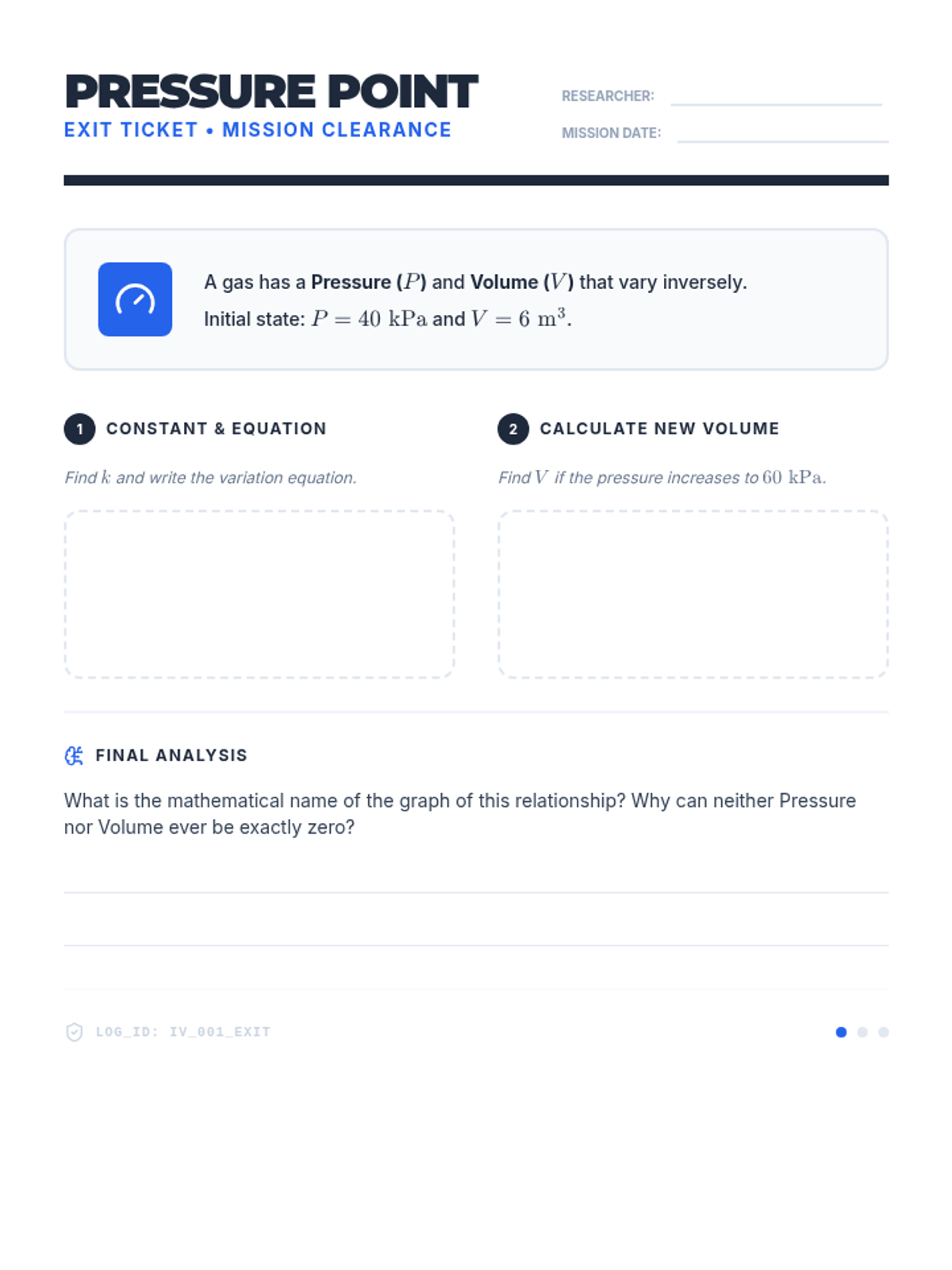
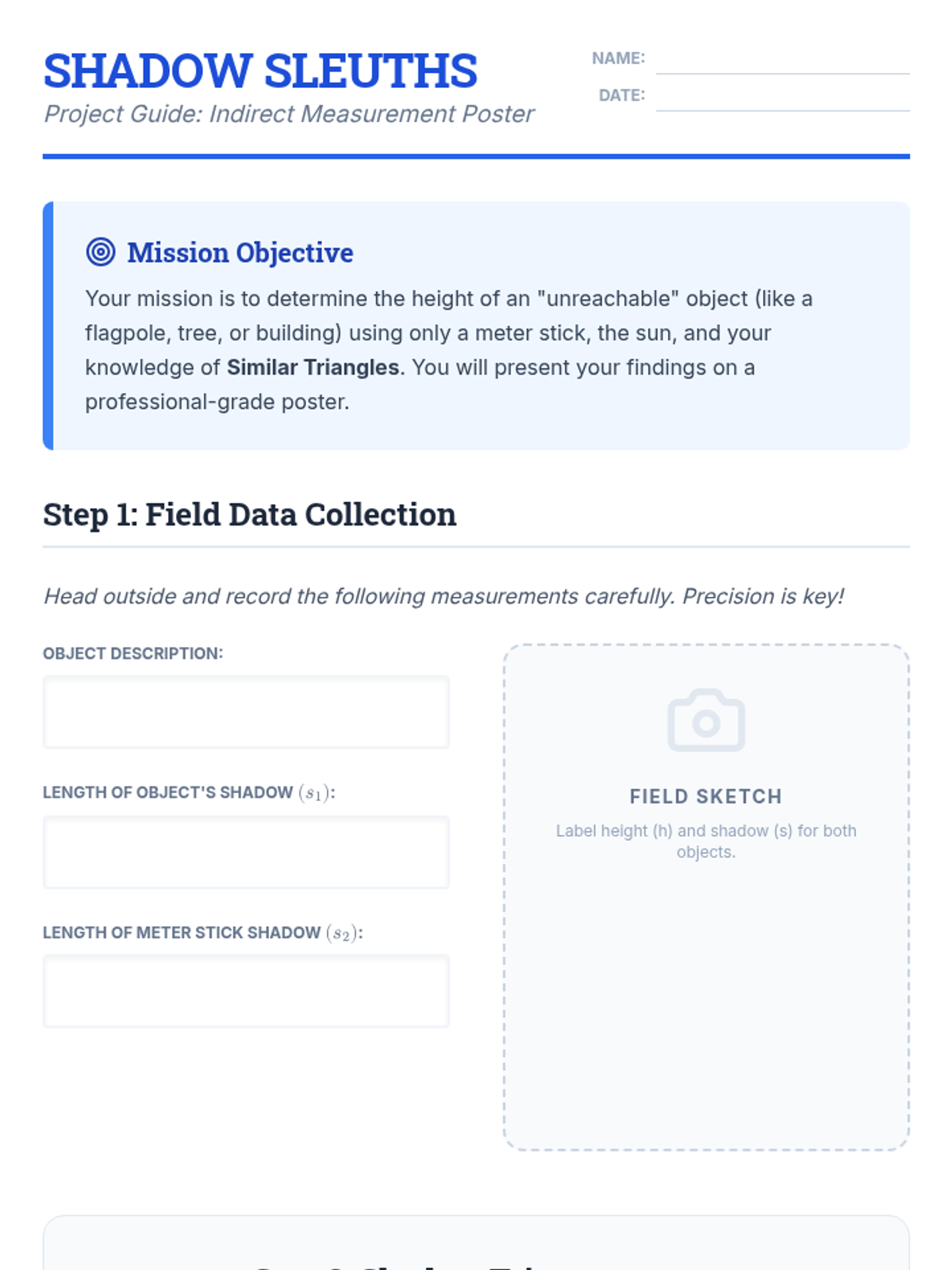
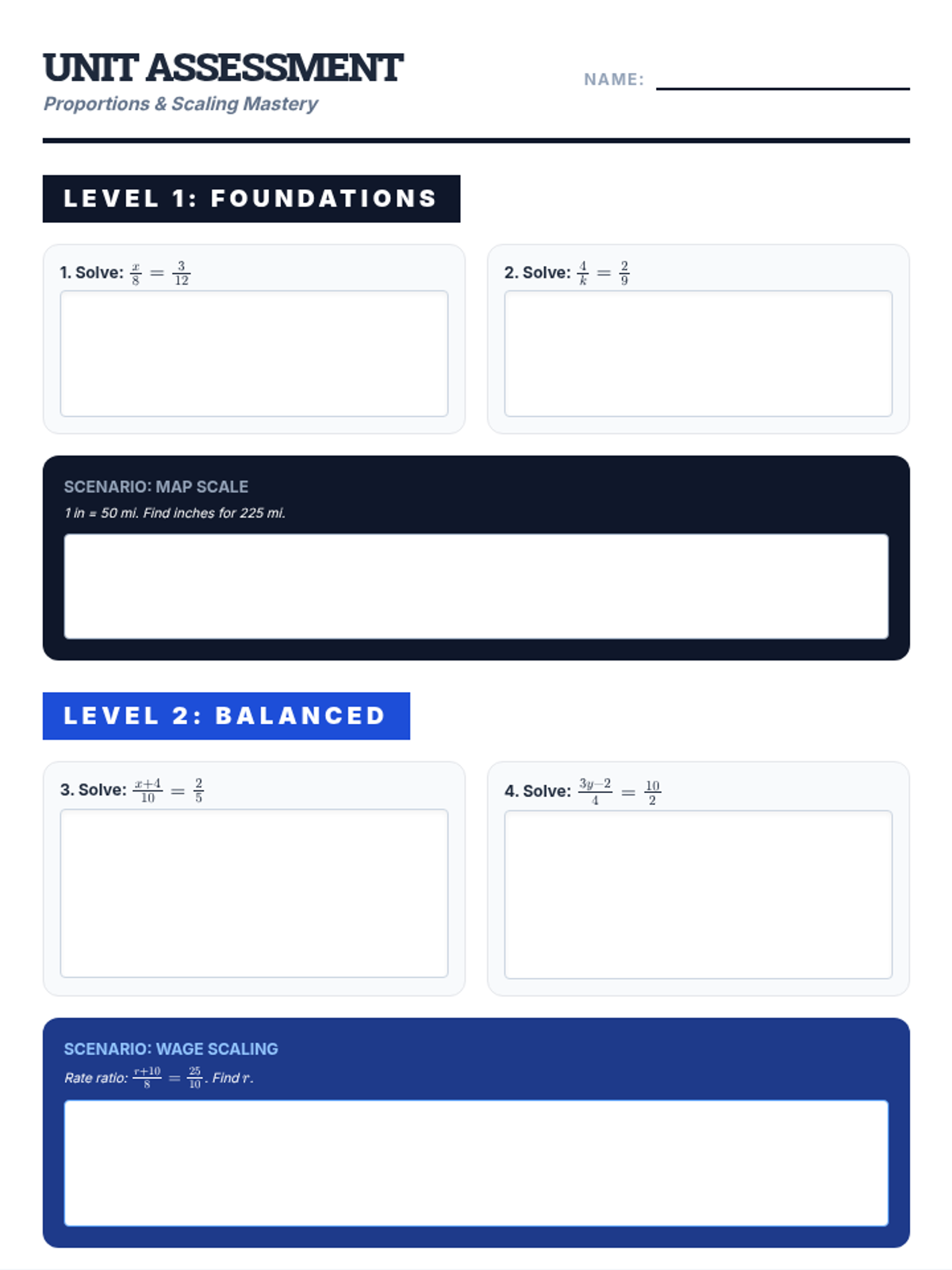
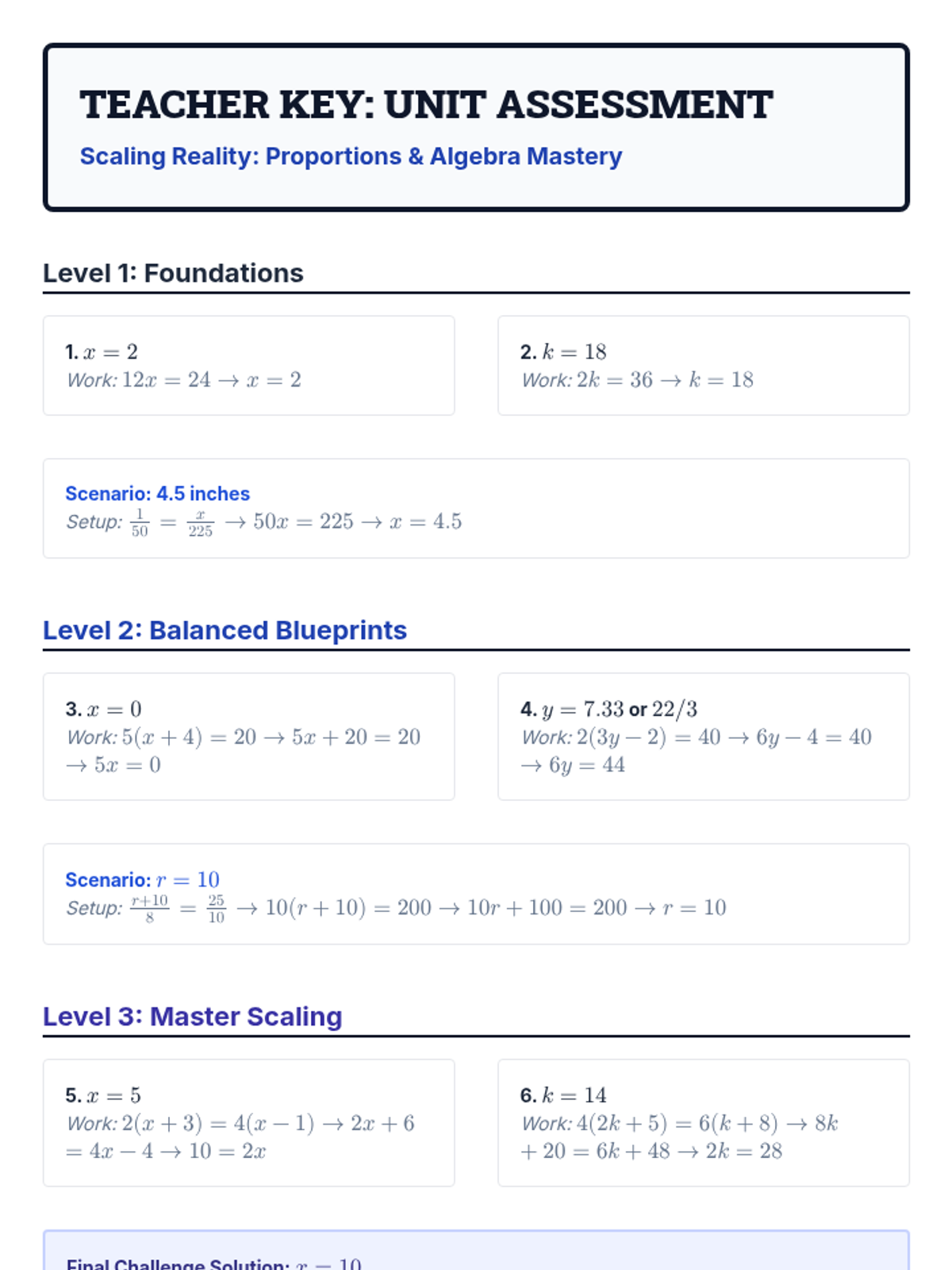
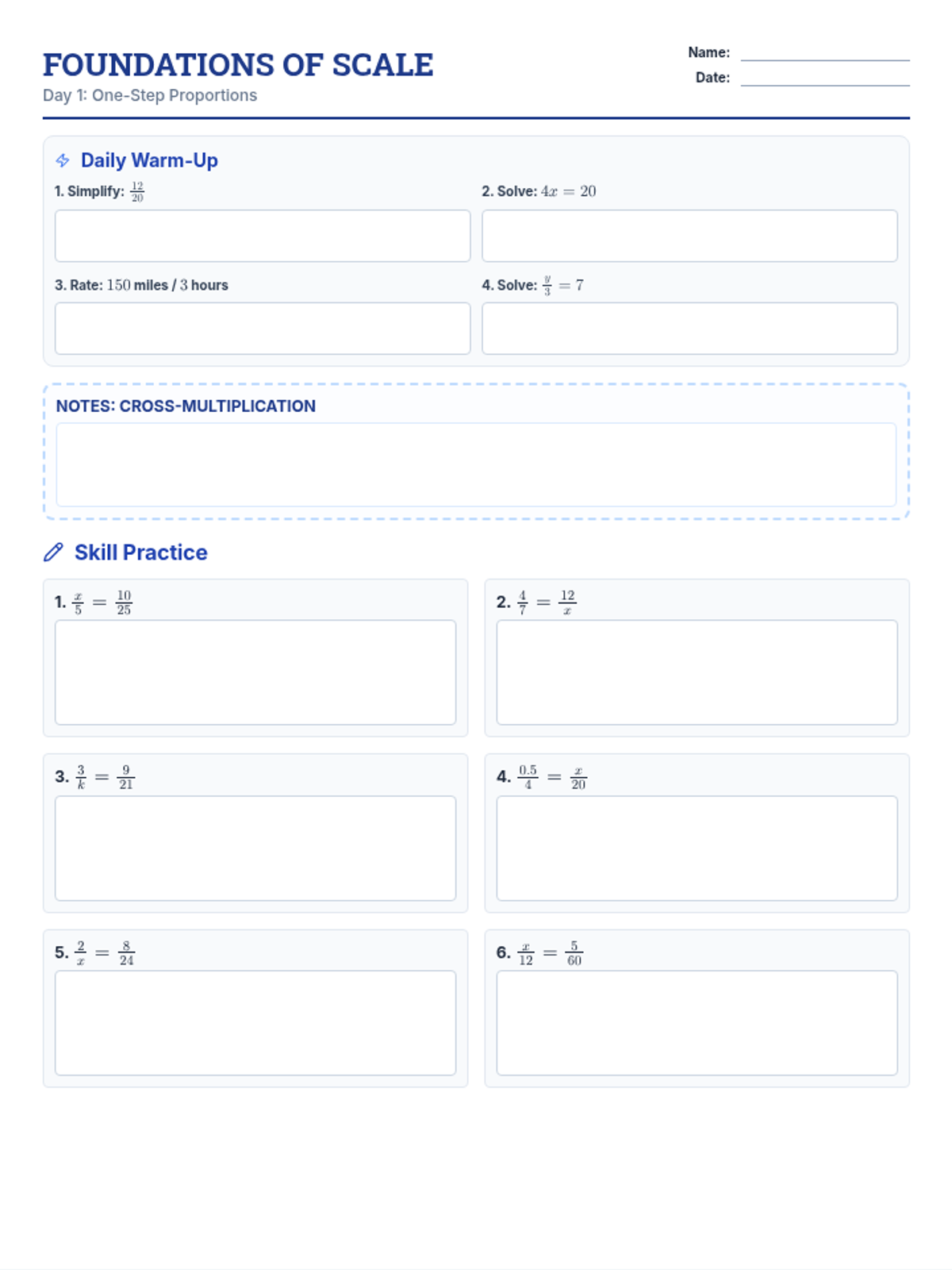
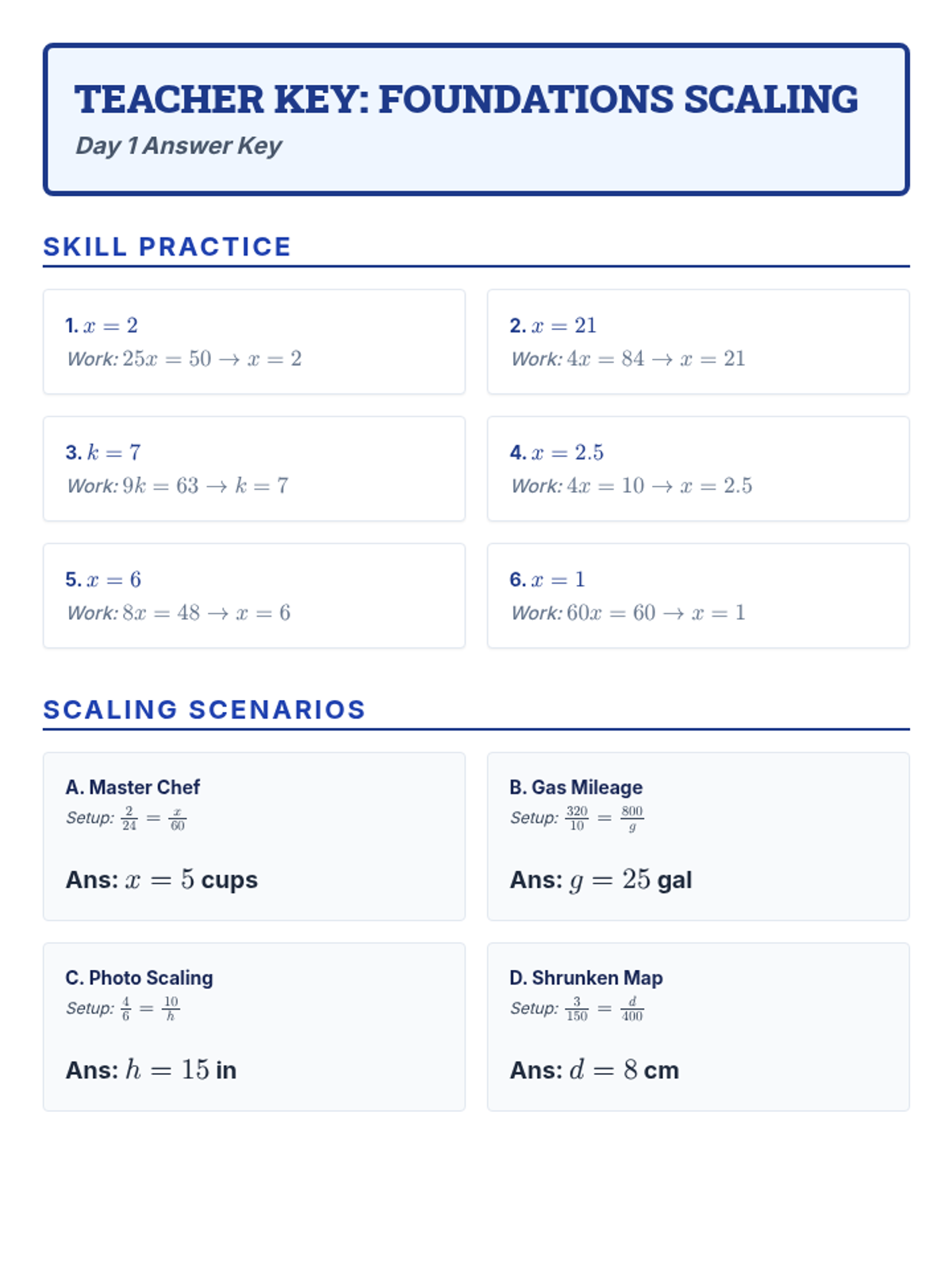
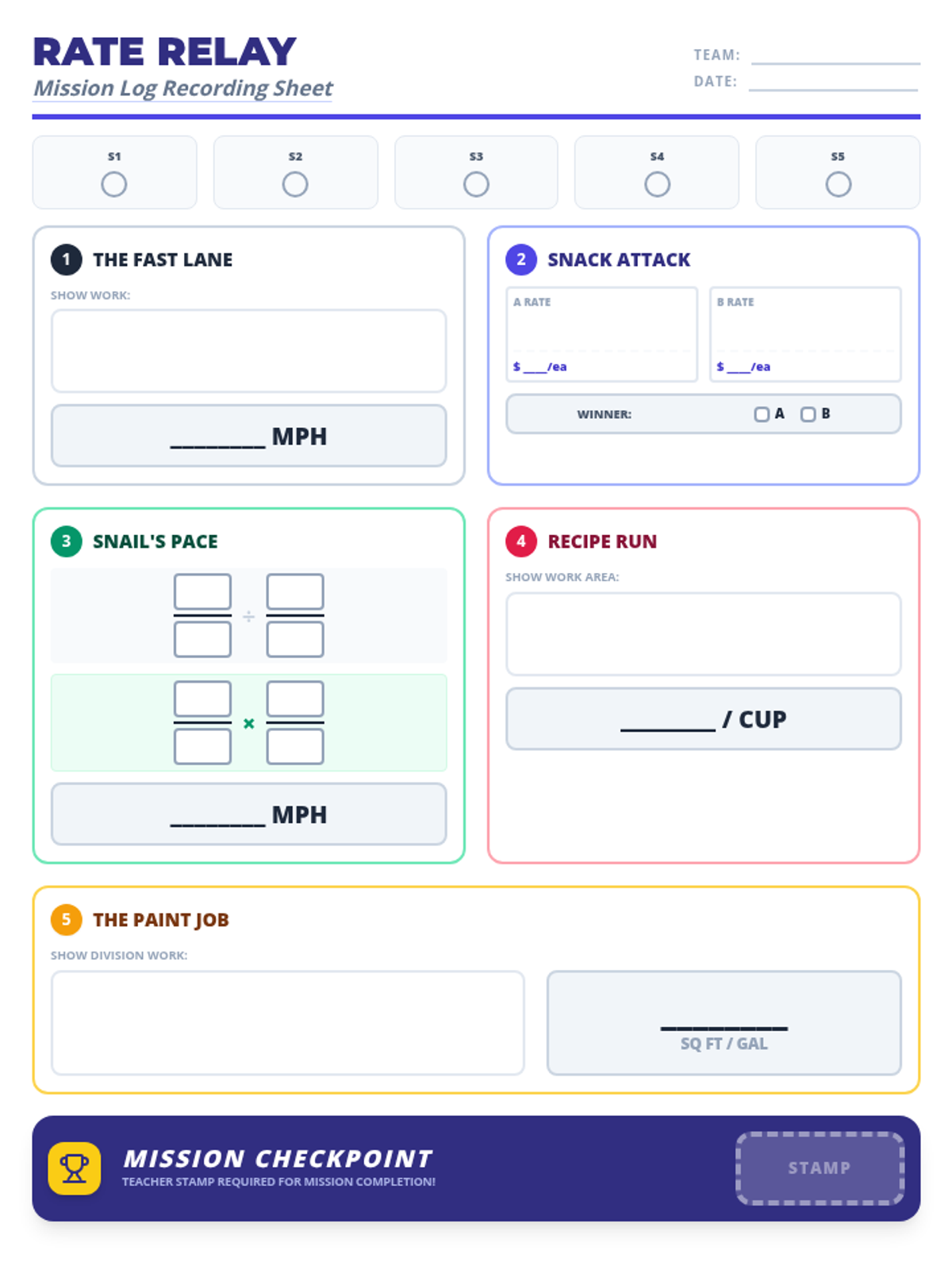
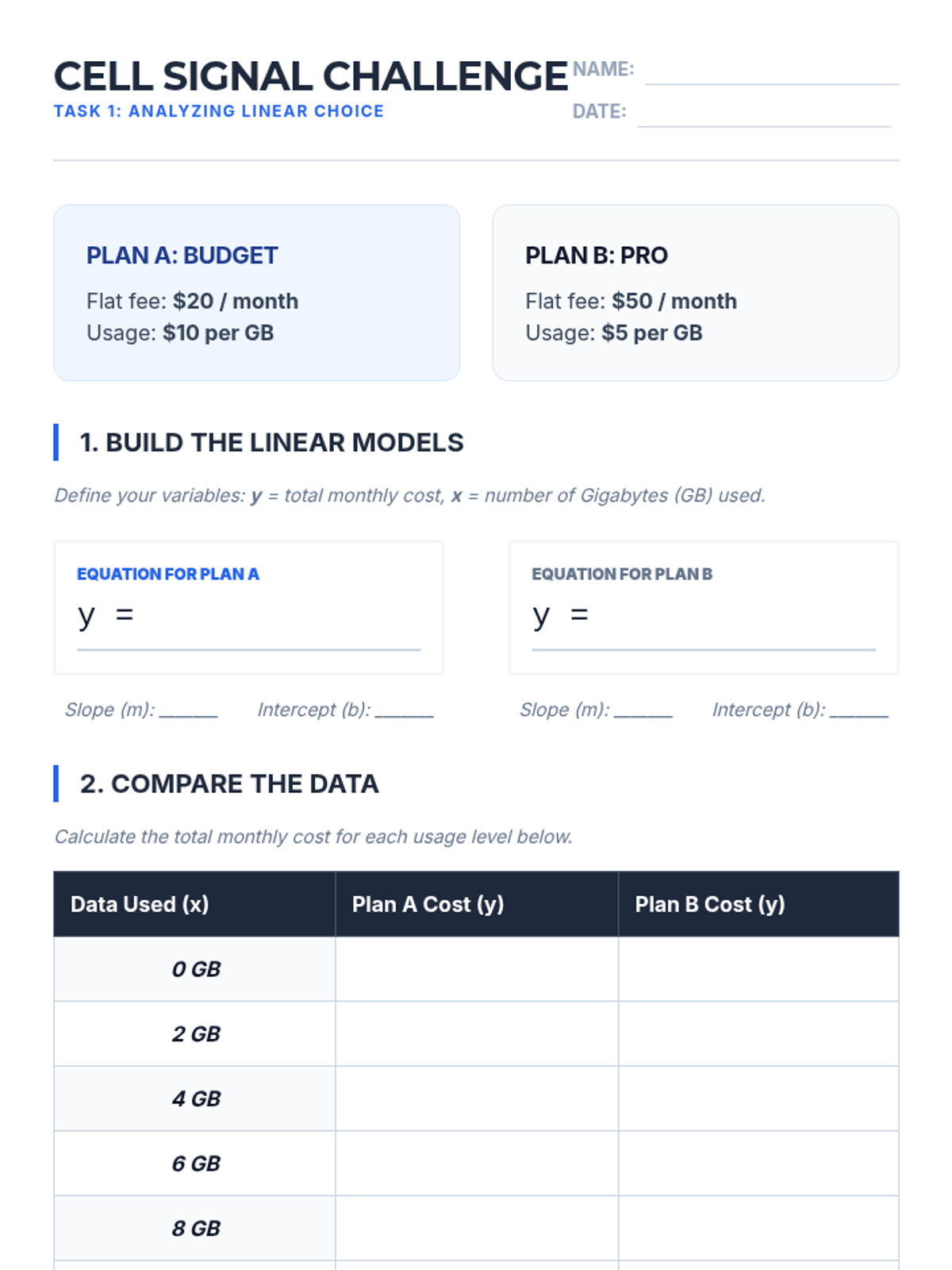
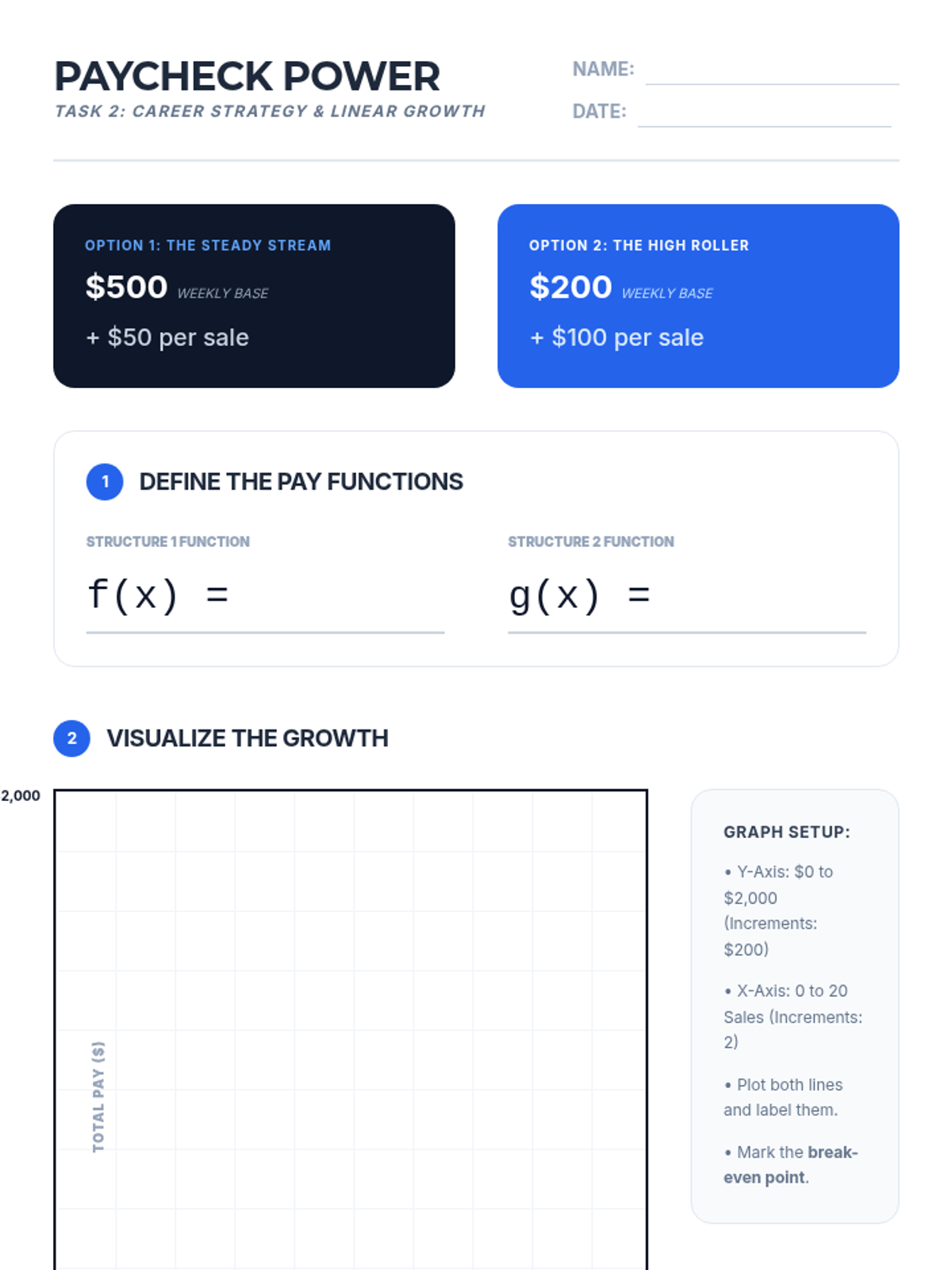
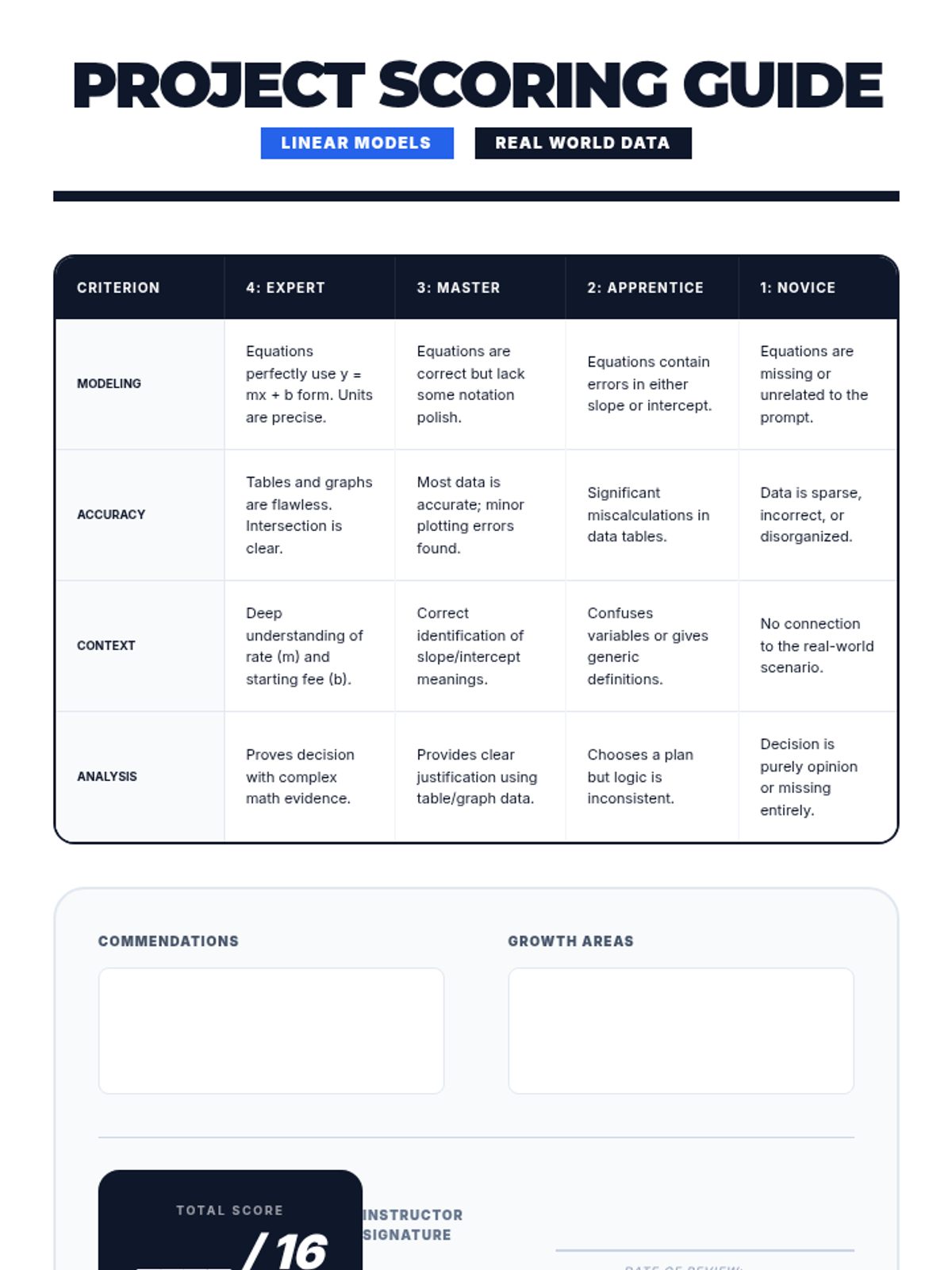
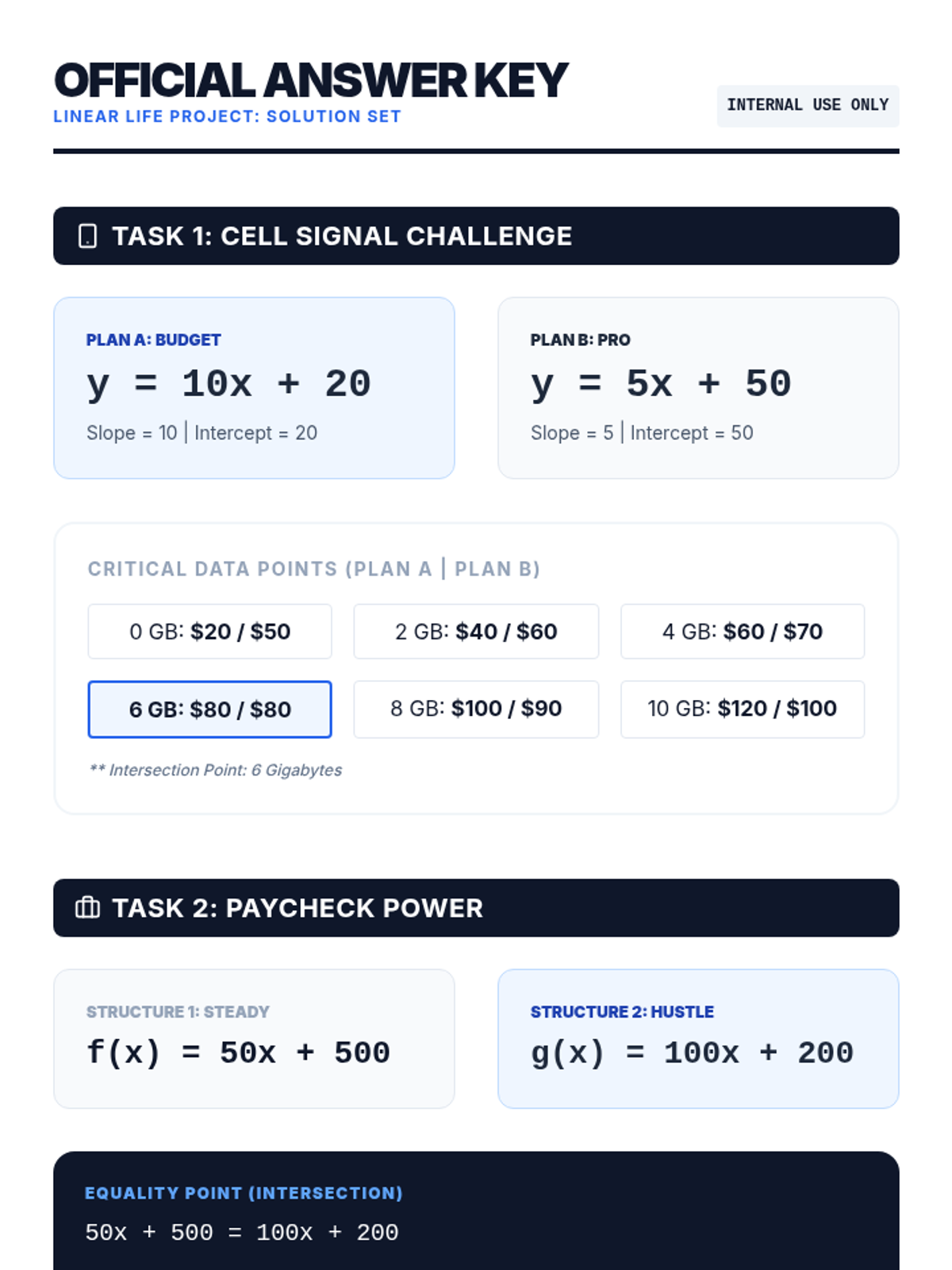
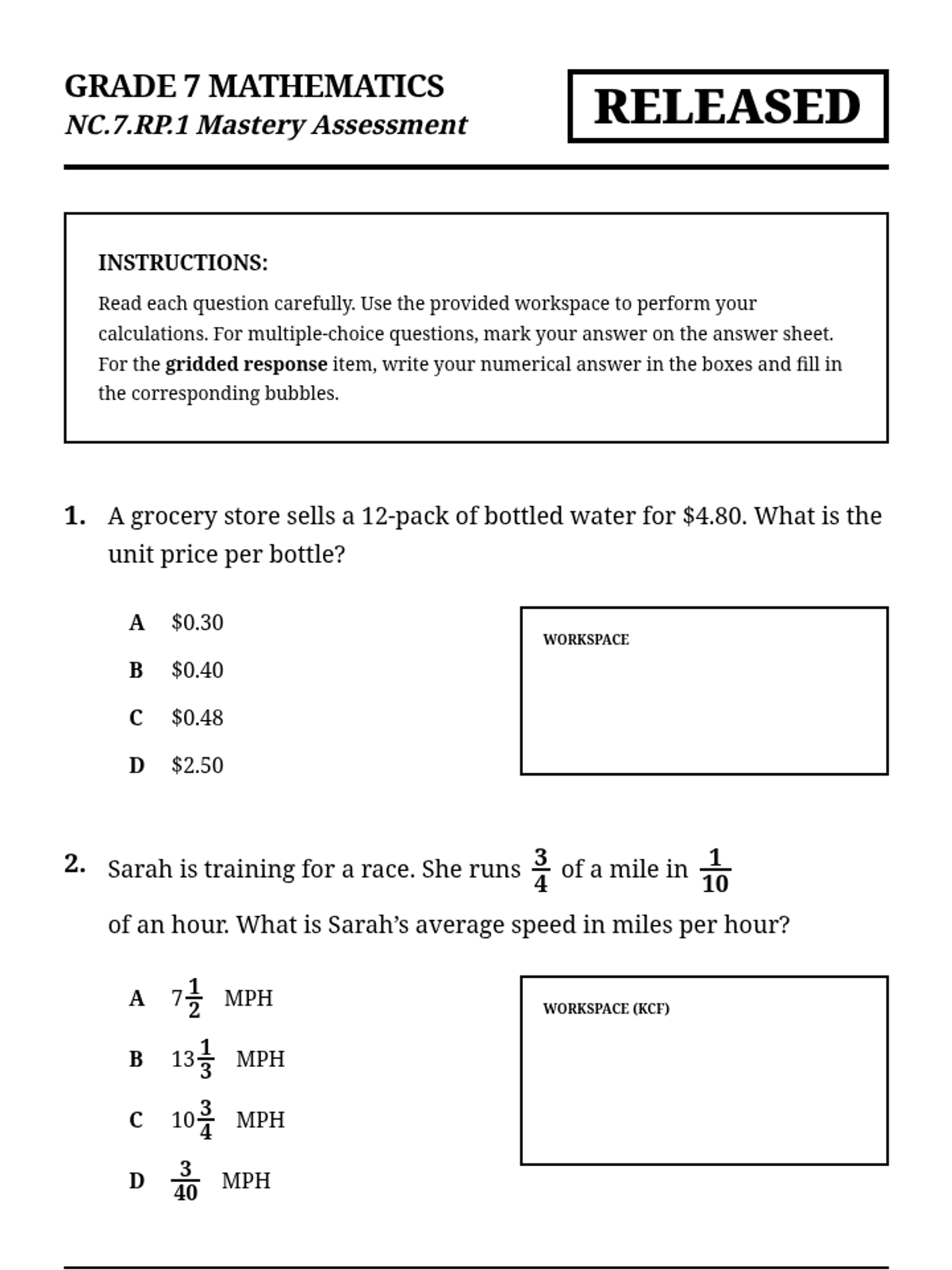
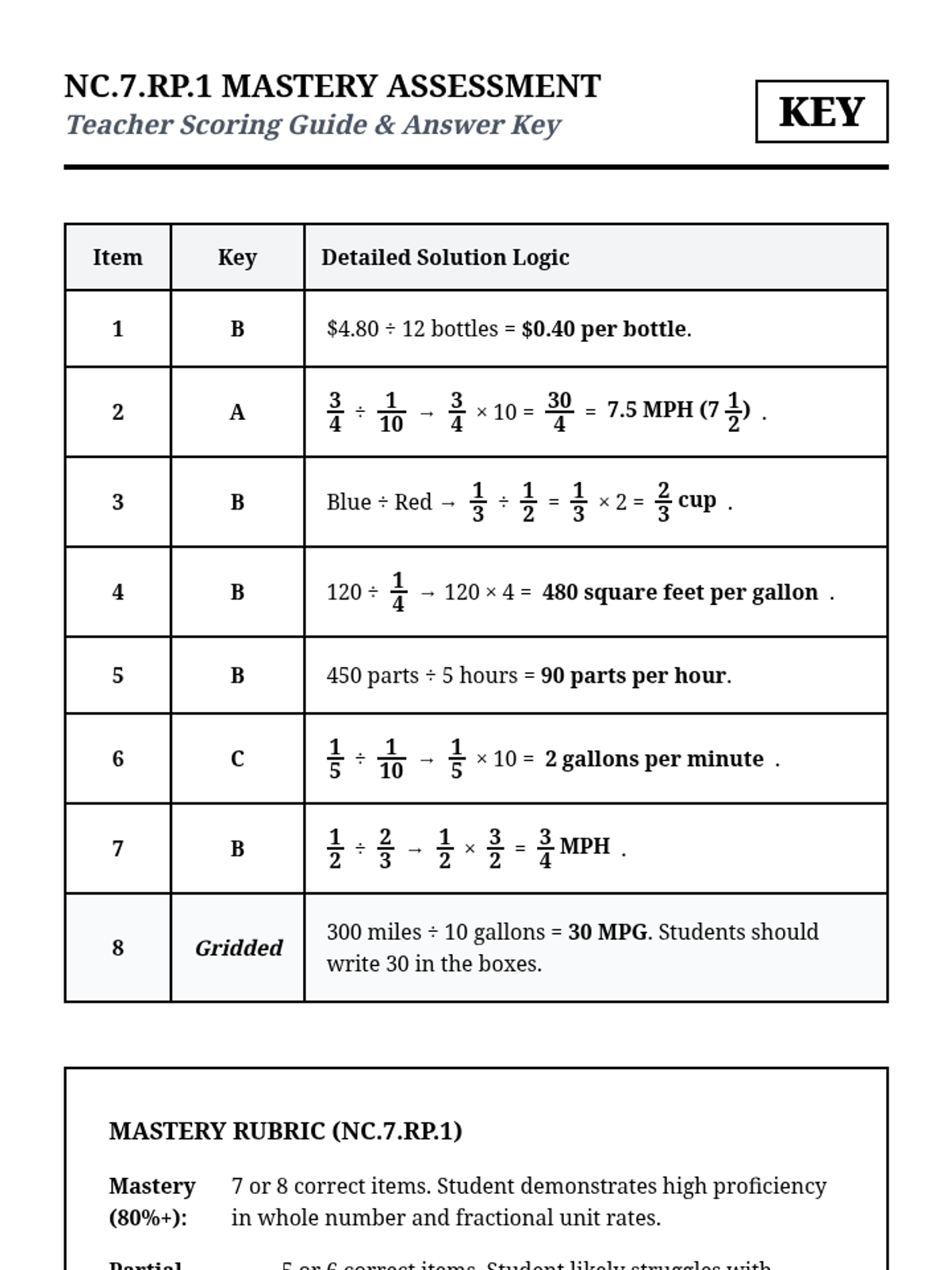
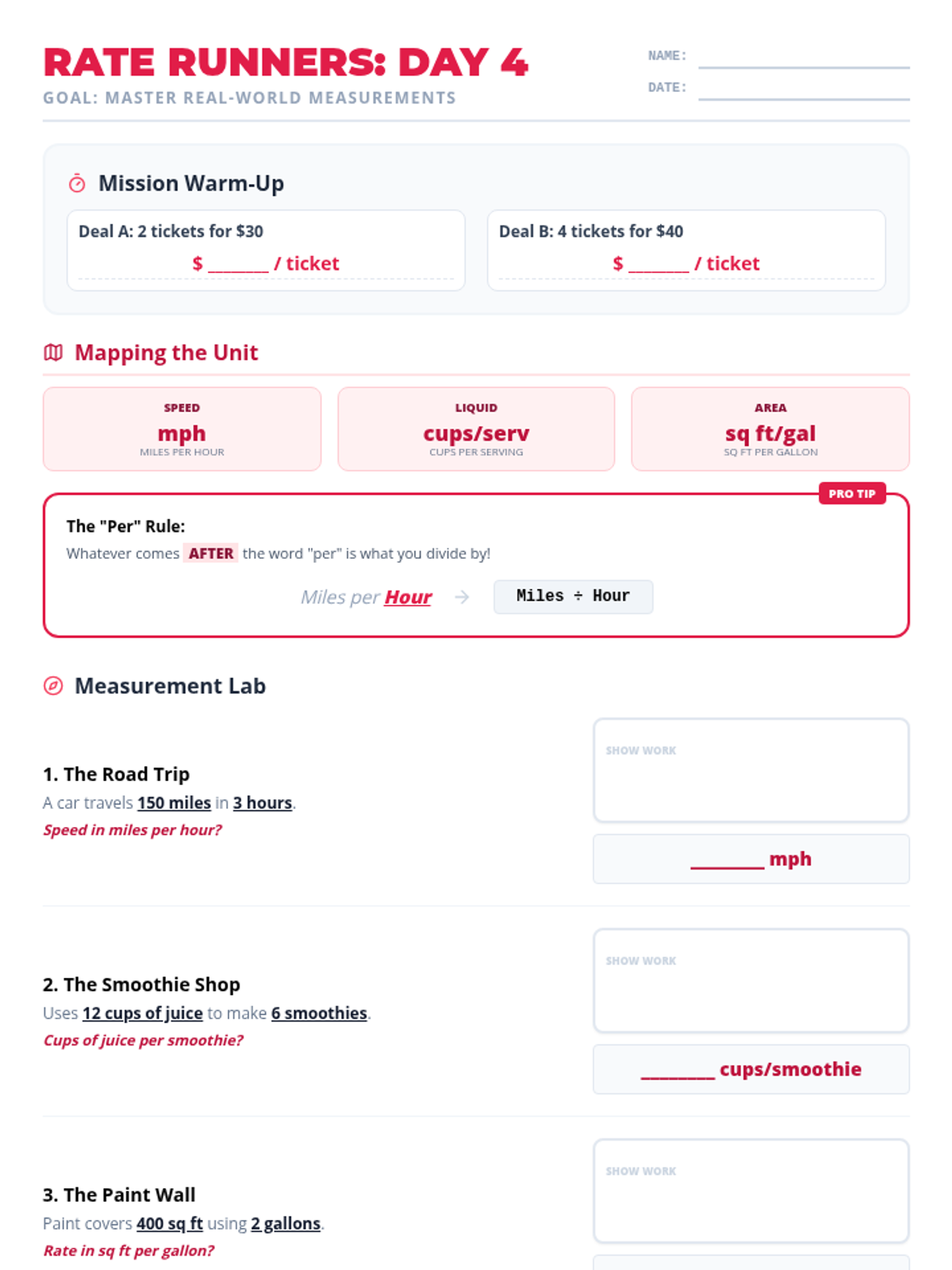
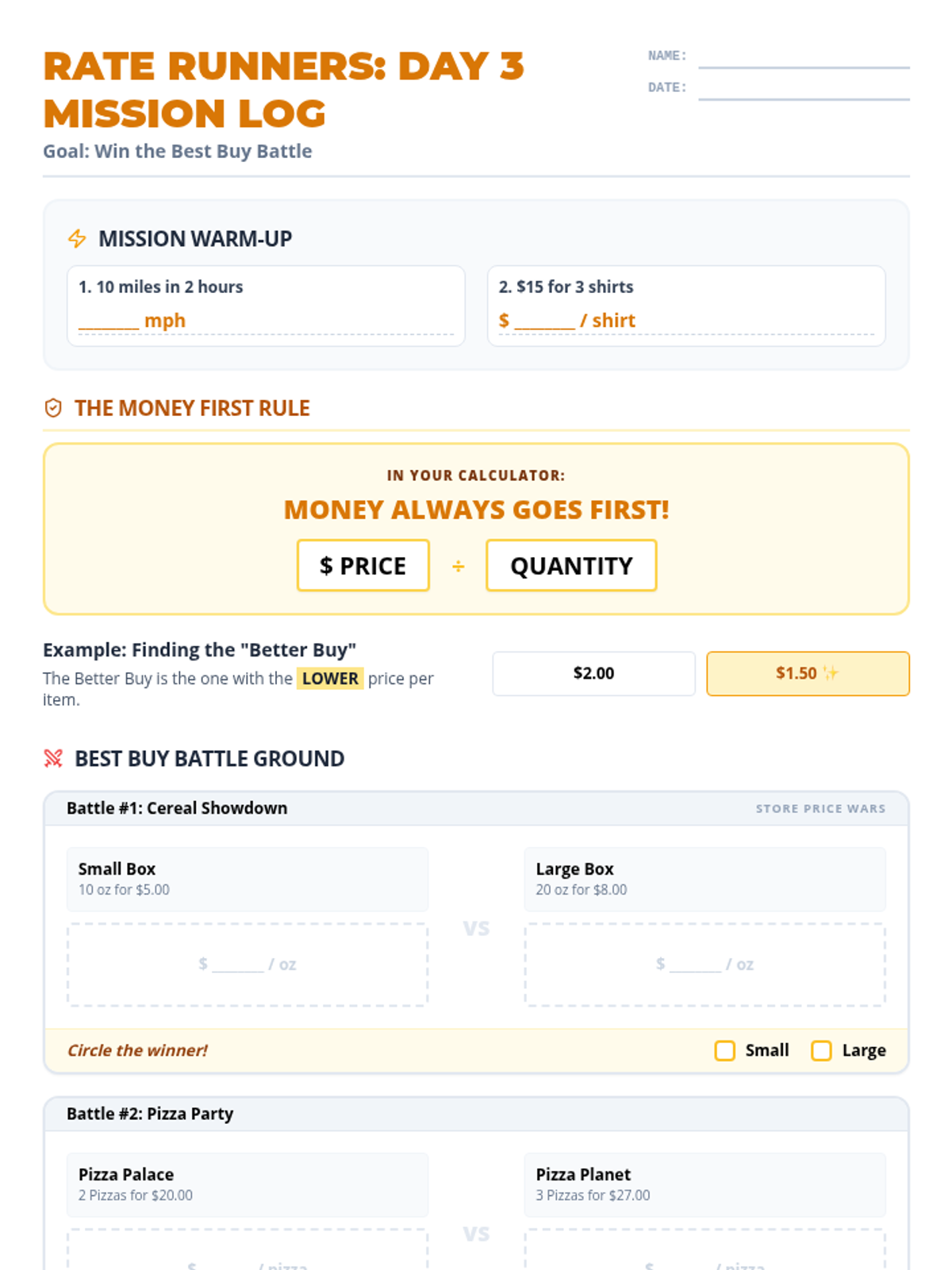
Comparisons of quantities using unit rates and proportional reasoning. Connects tables, graphs, and equations to represent constant rates of change.
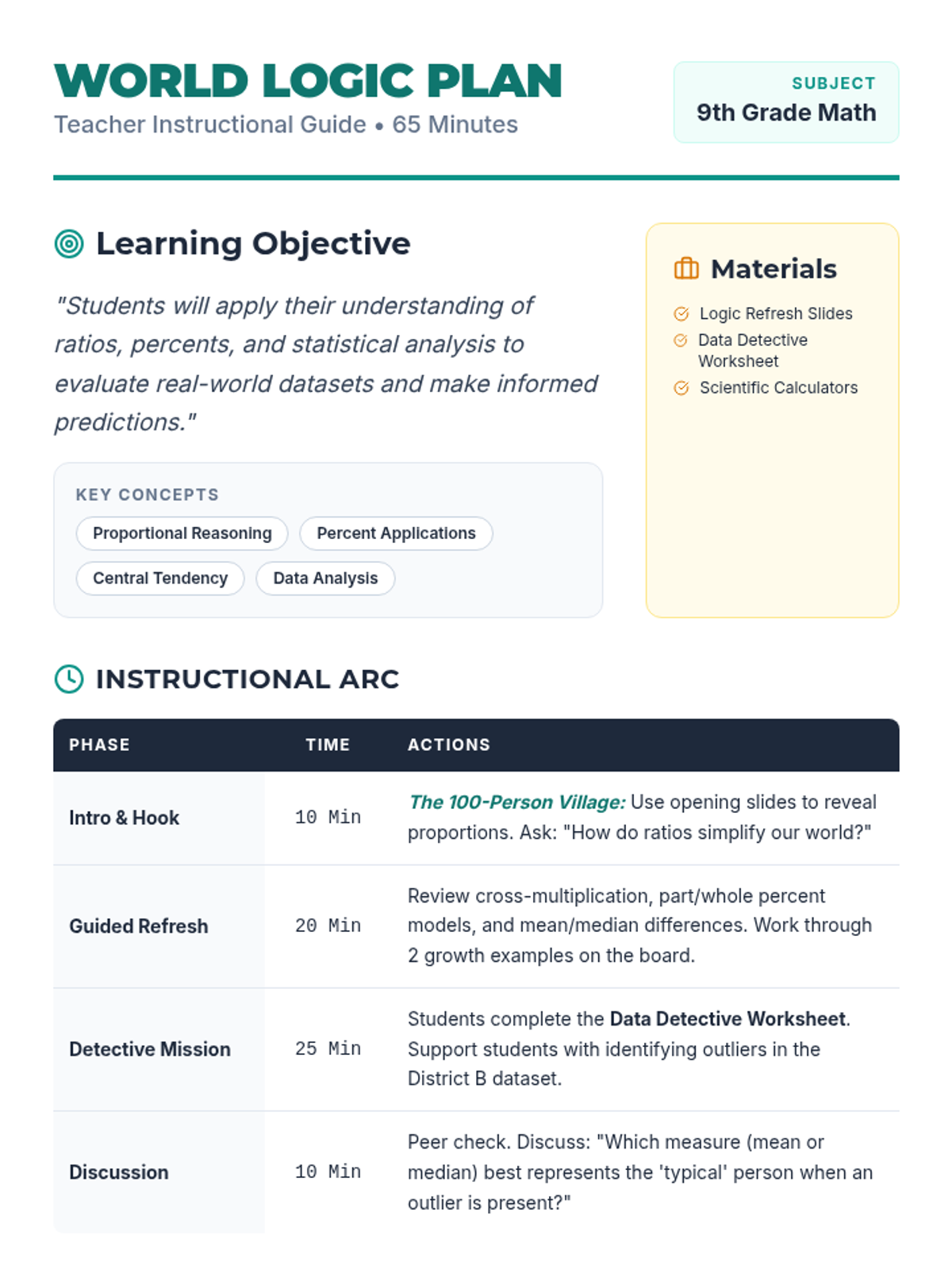
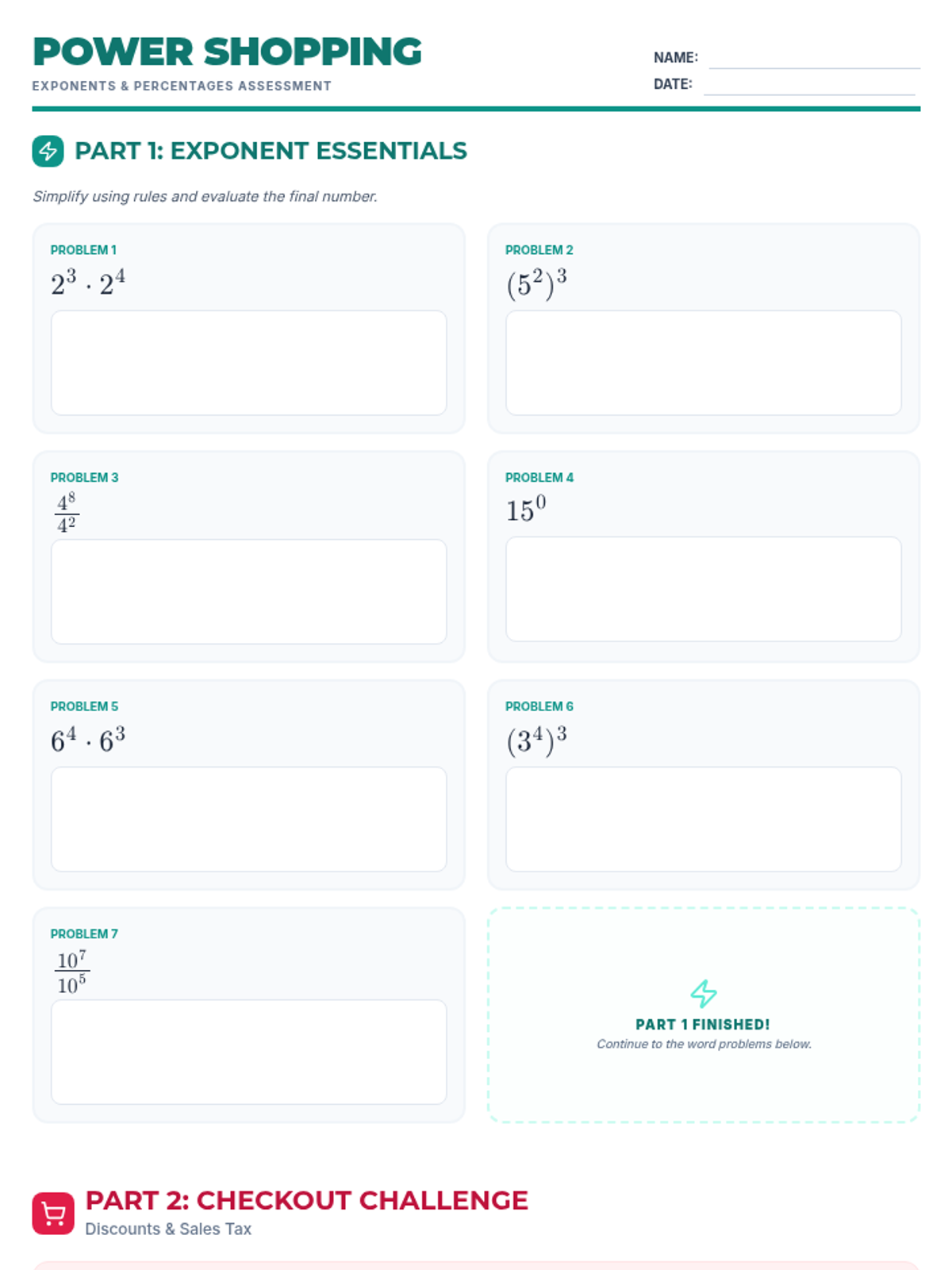
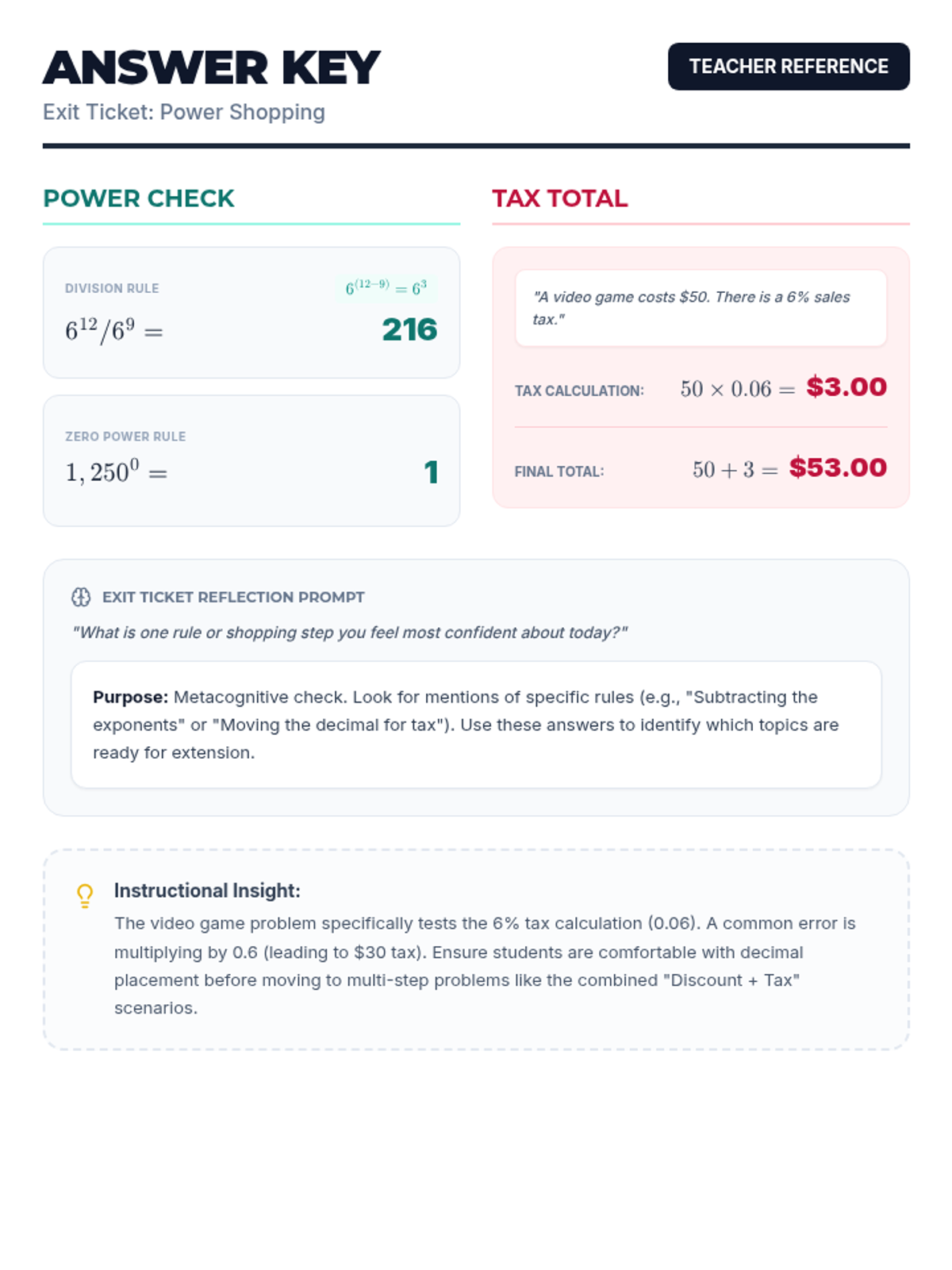
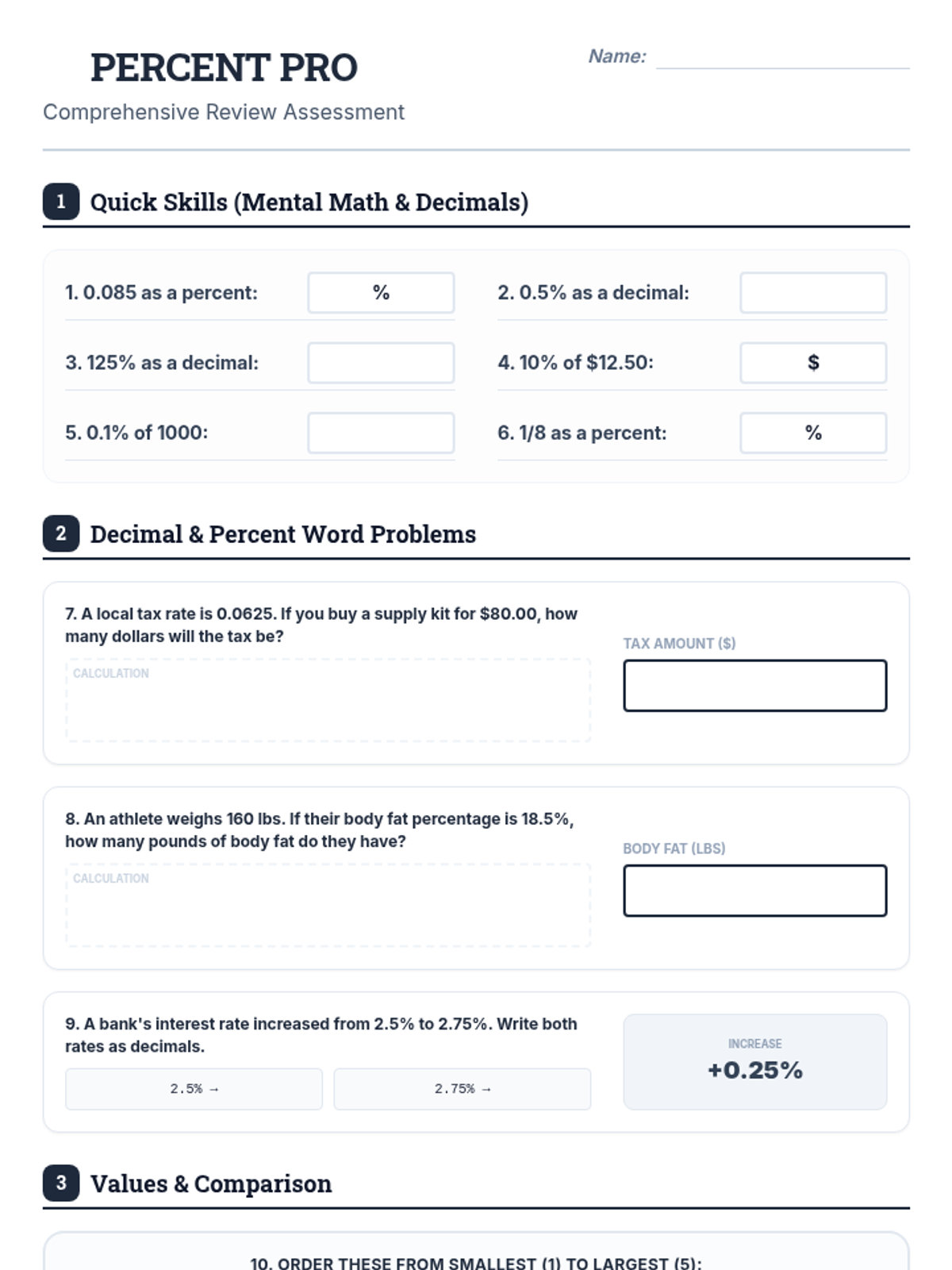
A comprehensive review lesson that synthesizes all the skills learned in the Real World Math series. Students will complete a final assessment covering multi-digit operations, decimals, fractions, and percentages through a variety of workplace and financial scenarios.
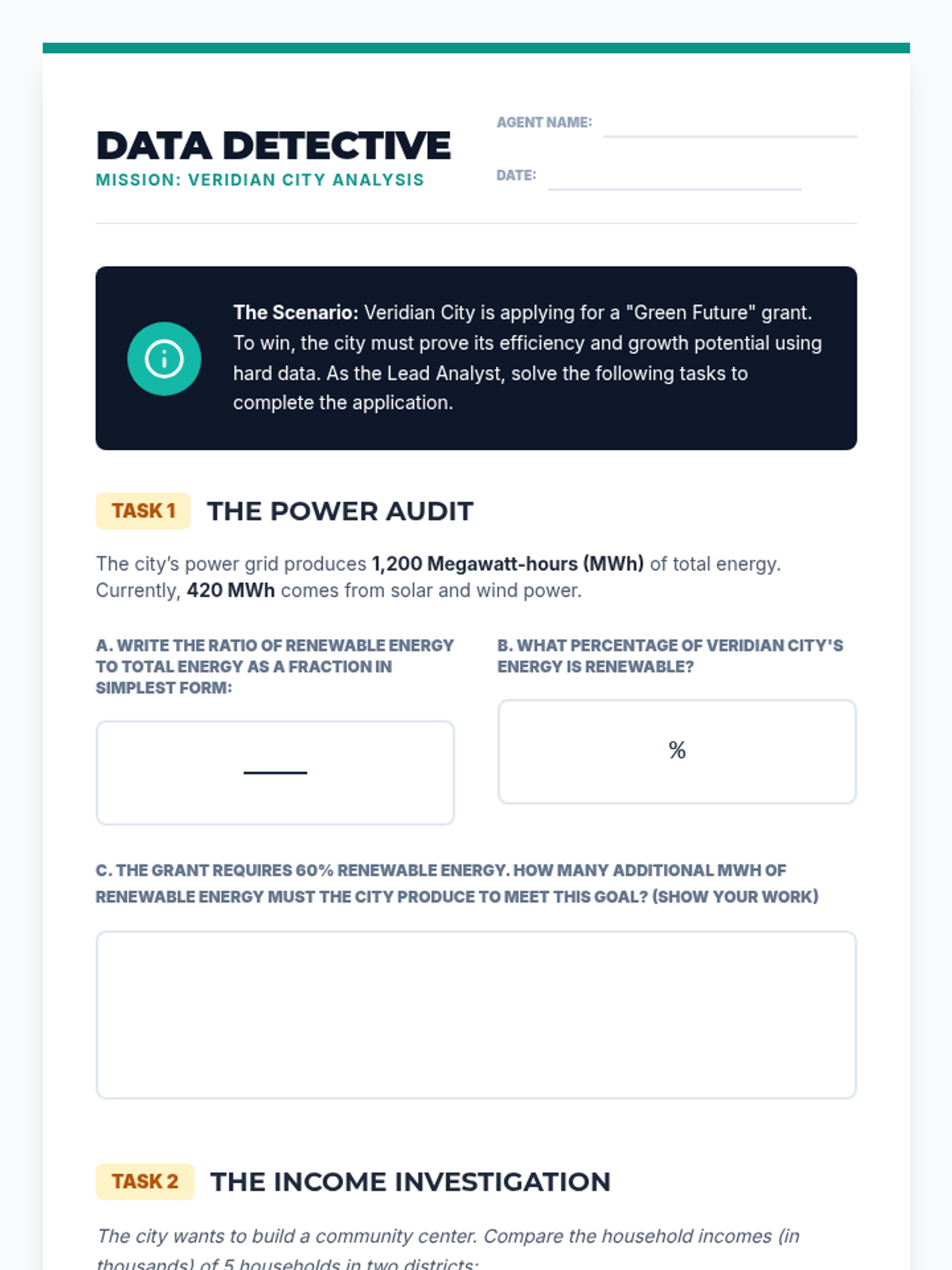
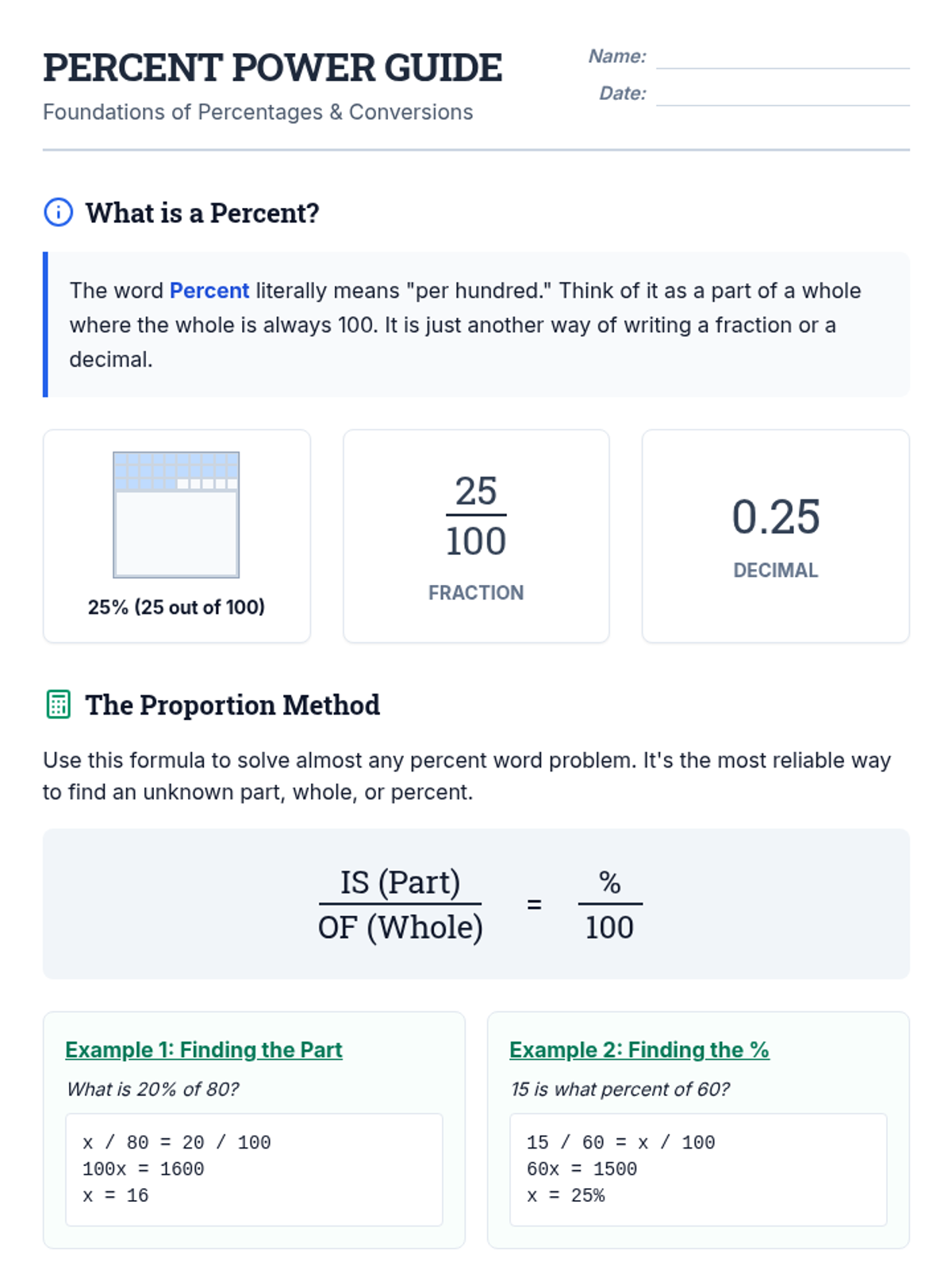
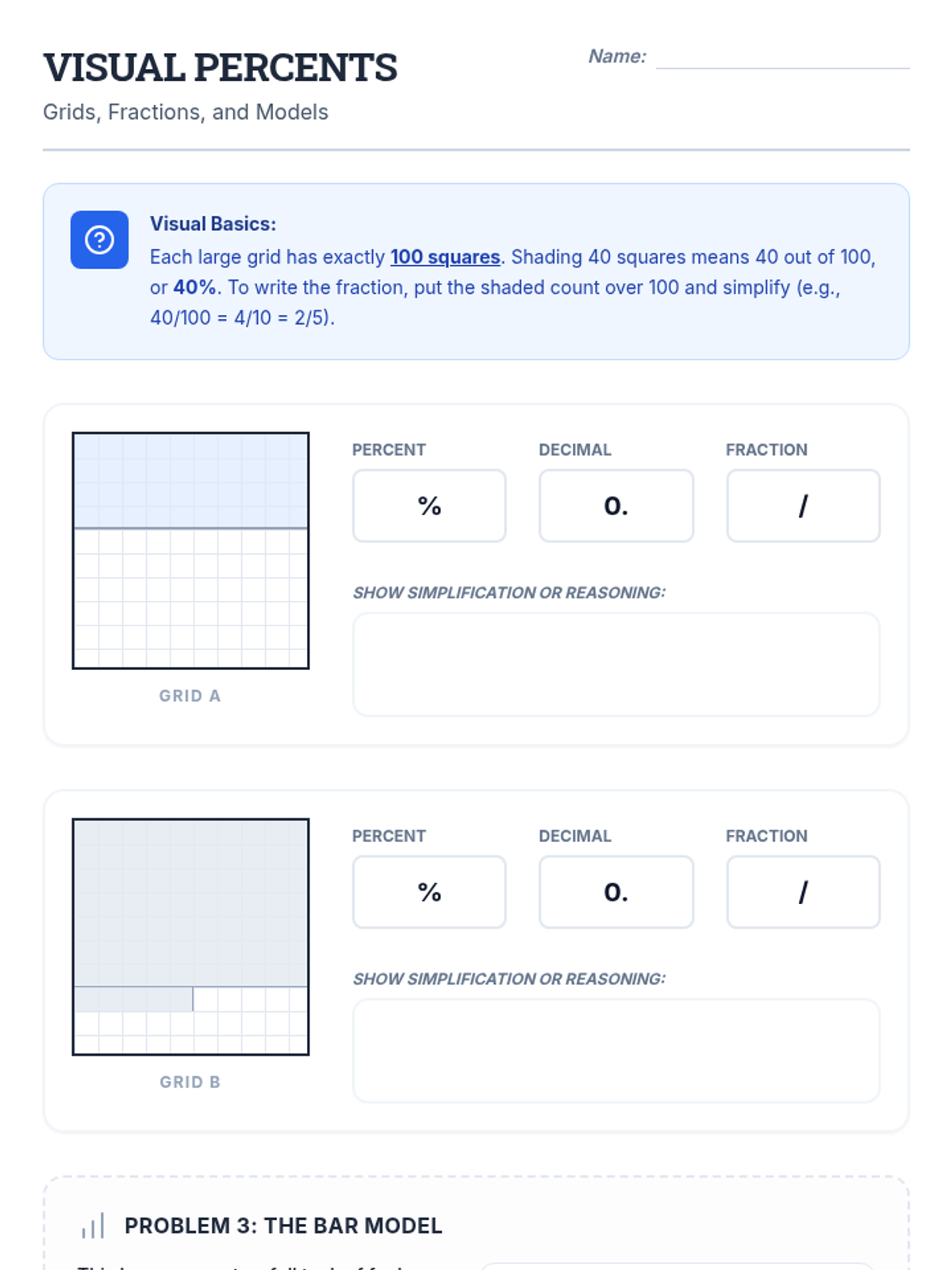
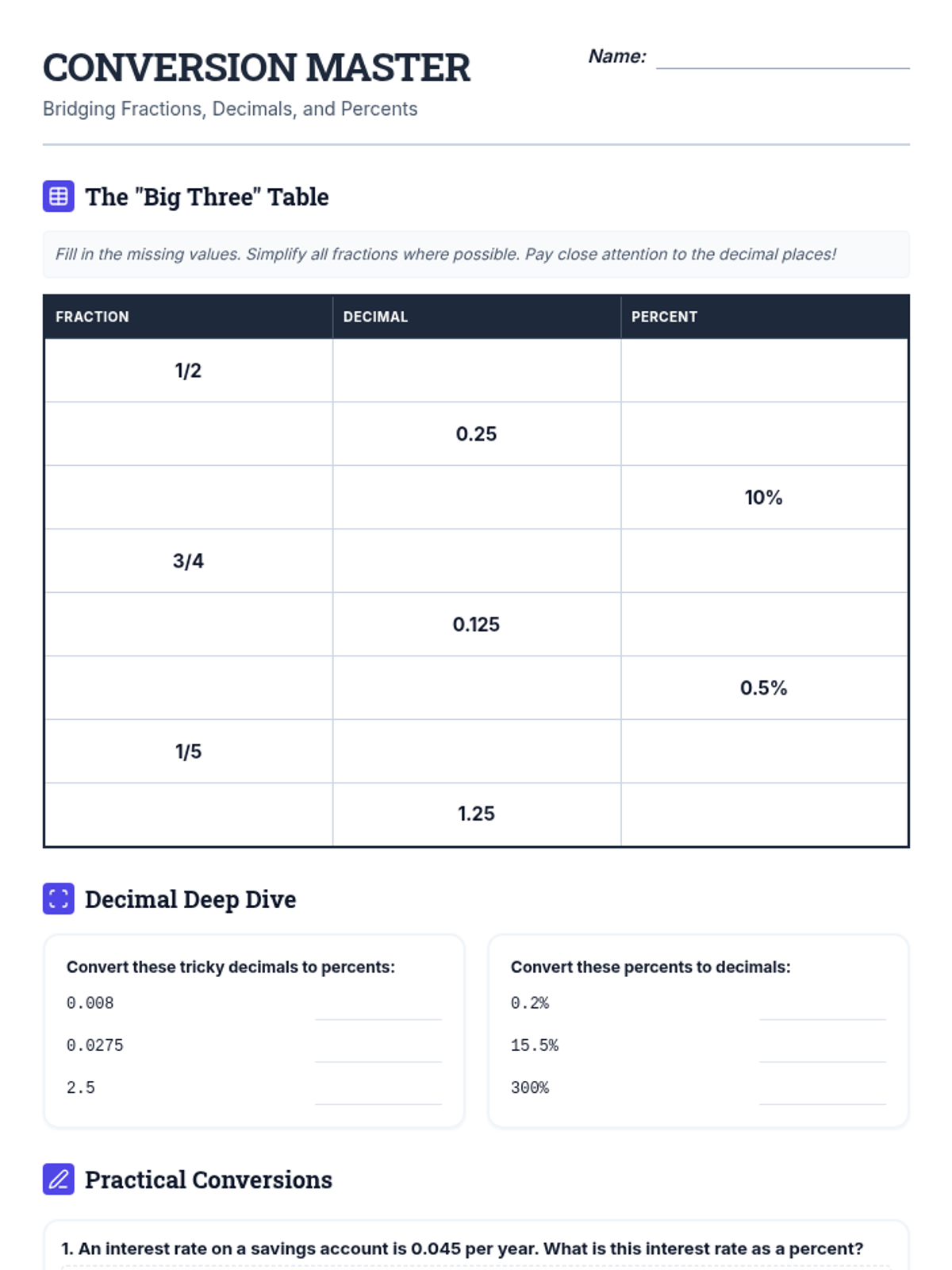
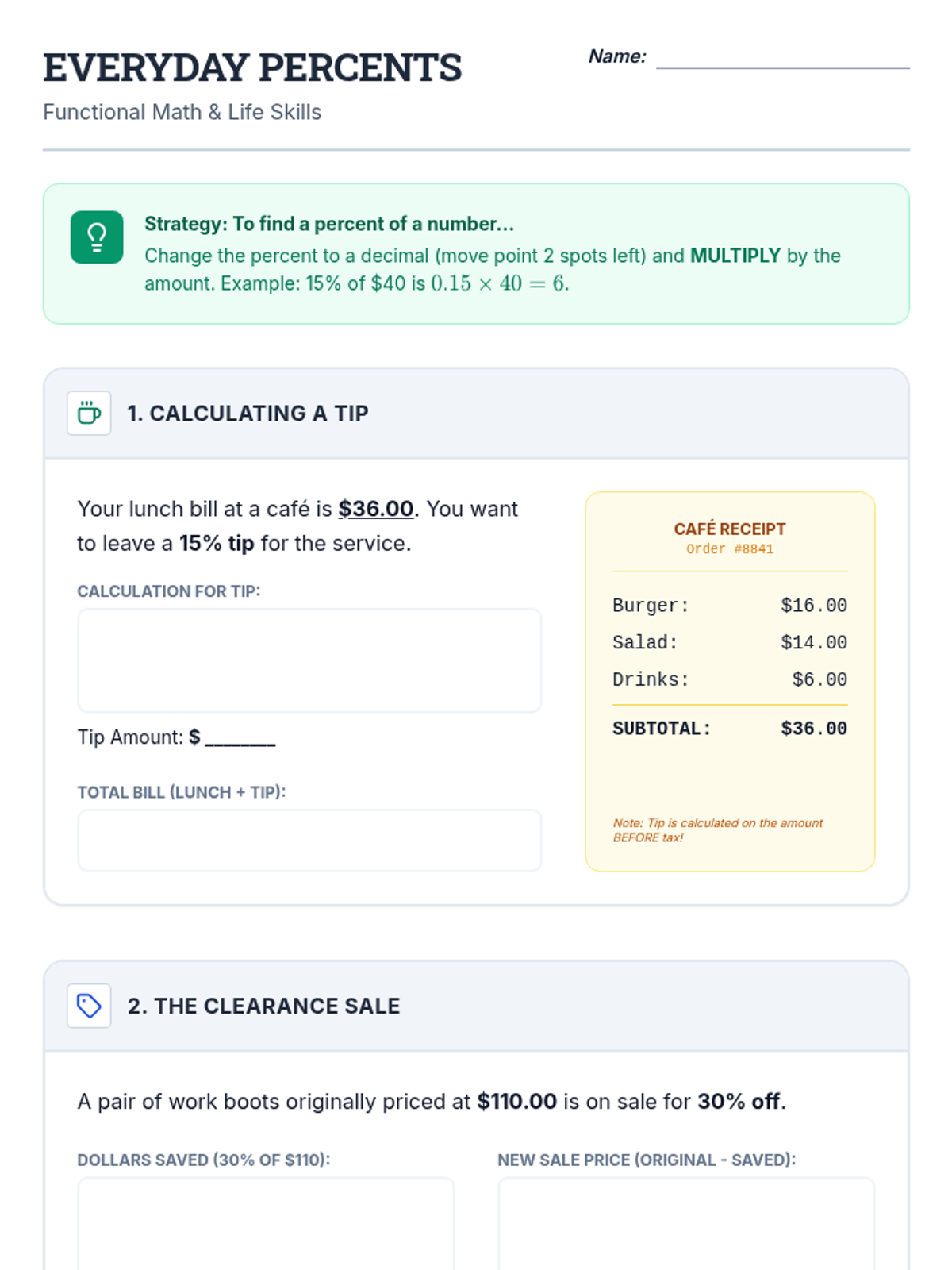
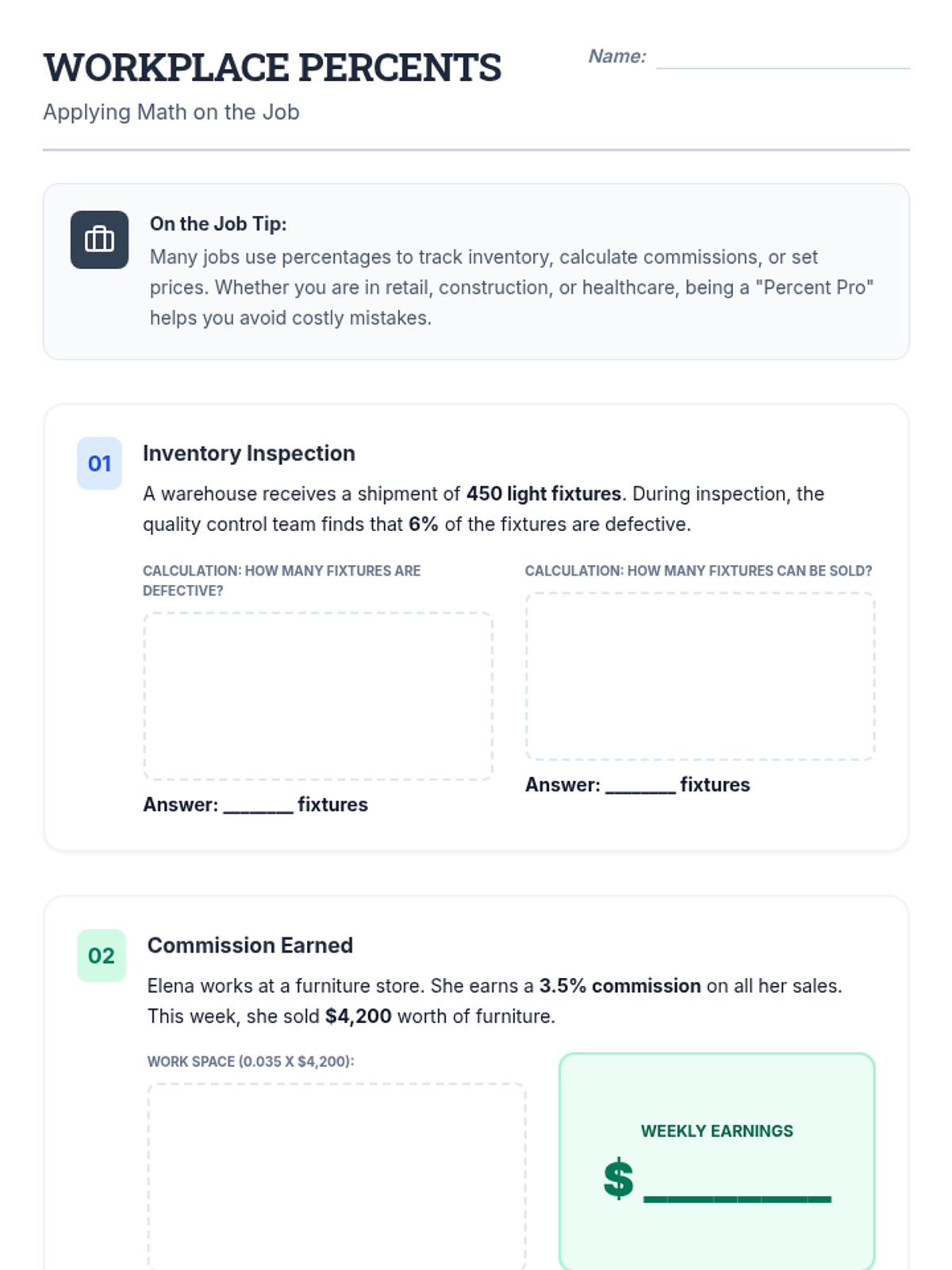
Understanding the power of percentages in finance and data. Students will solve for parts, wholes, and percentages in contexts like sales tax, interest rates, discounts, and performance statistics.
Developing a strong grasp of fractions in practical contexts such as construction, cooking, and time management. This lesson covers simplifying, adding/subtracting with unlike denominators, and multiplying/dividing fractions.
Mastering decimals through the lens of currency and precise measurements. Students learn to add, subtract, multiply, and divide decimals to calculate unit prices, handle cash transactions, and interpret technical specifications.
A foundational lesson on multi-digit multiplication and division focused on workplace budgeting and large-scale inventory management. Students will practice these operations through realistic scenarios like calculating monthly revenue and distributing supplies across departments.
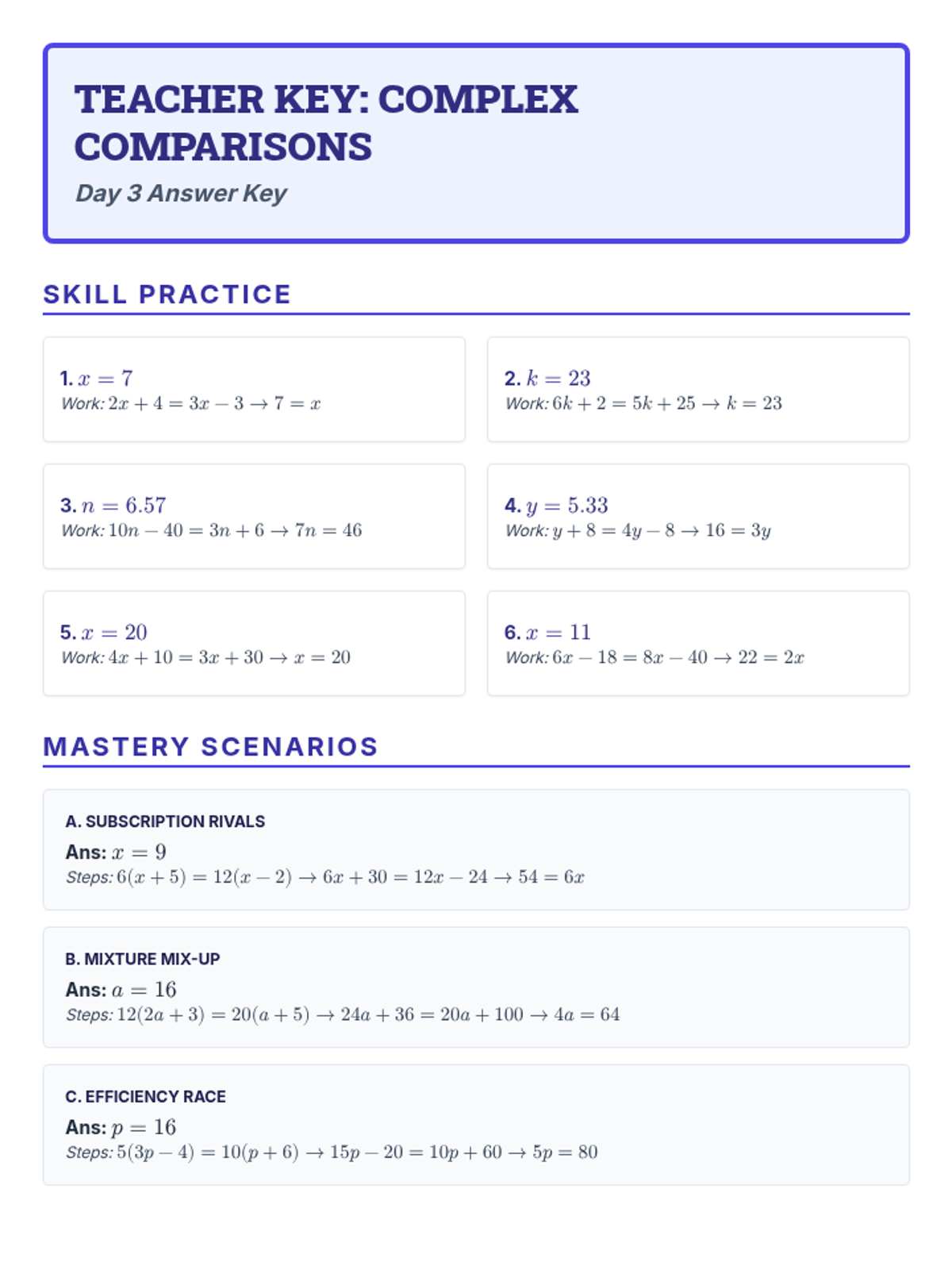
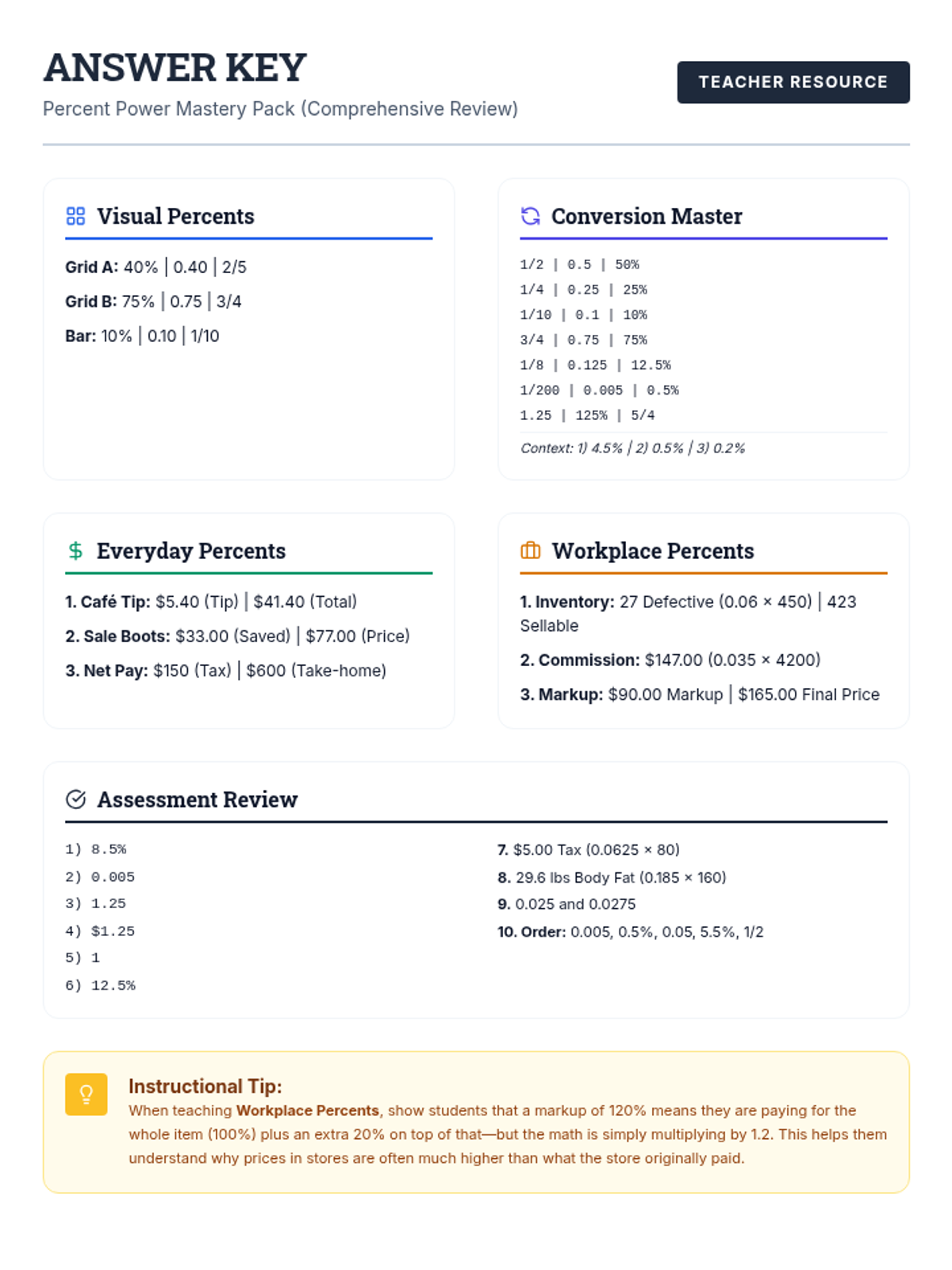
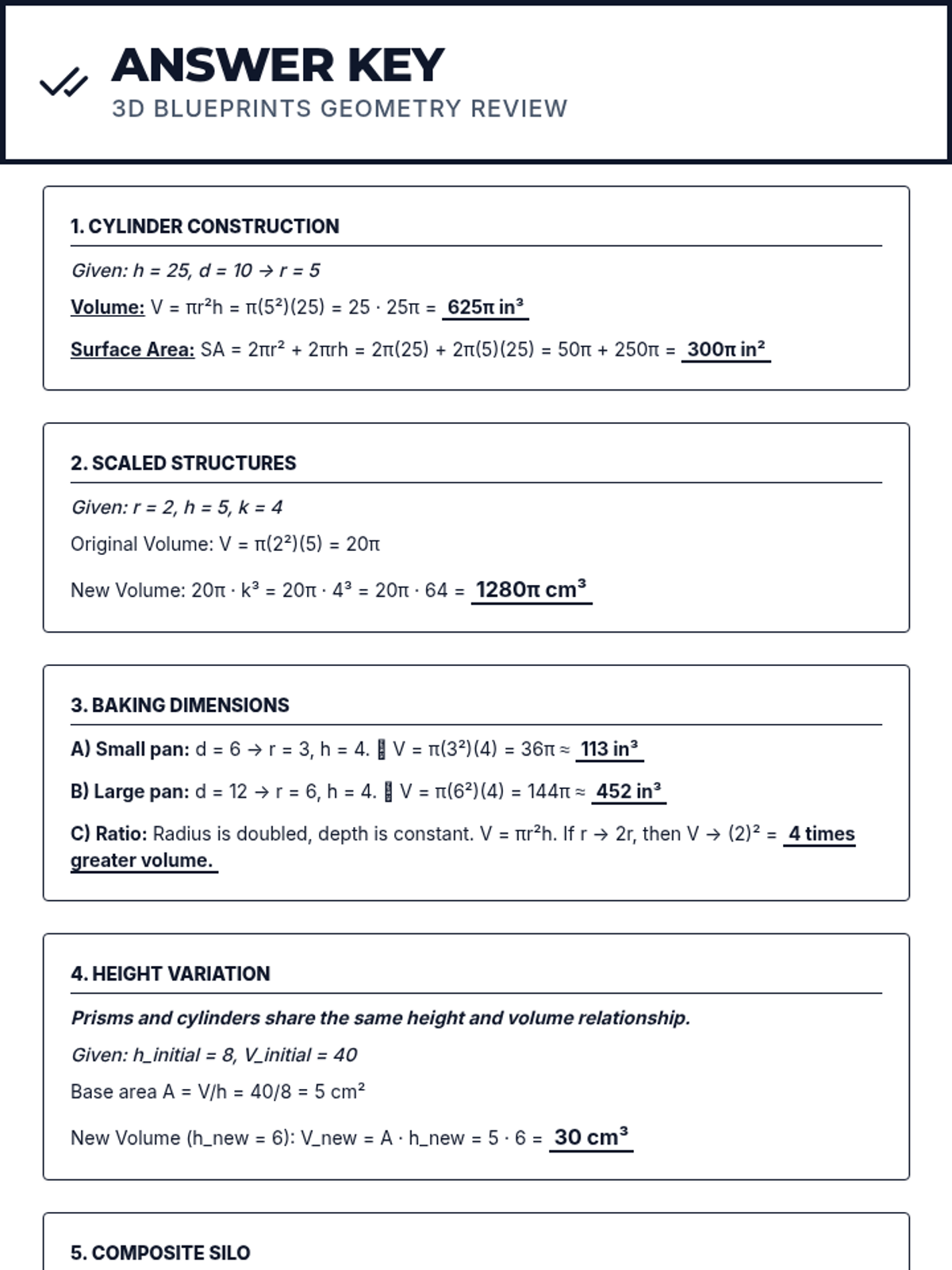
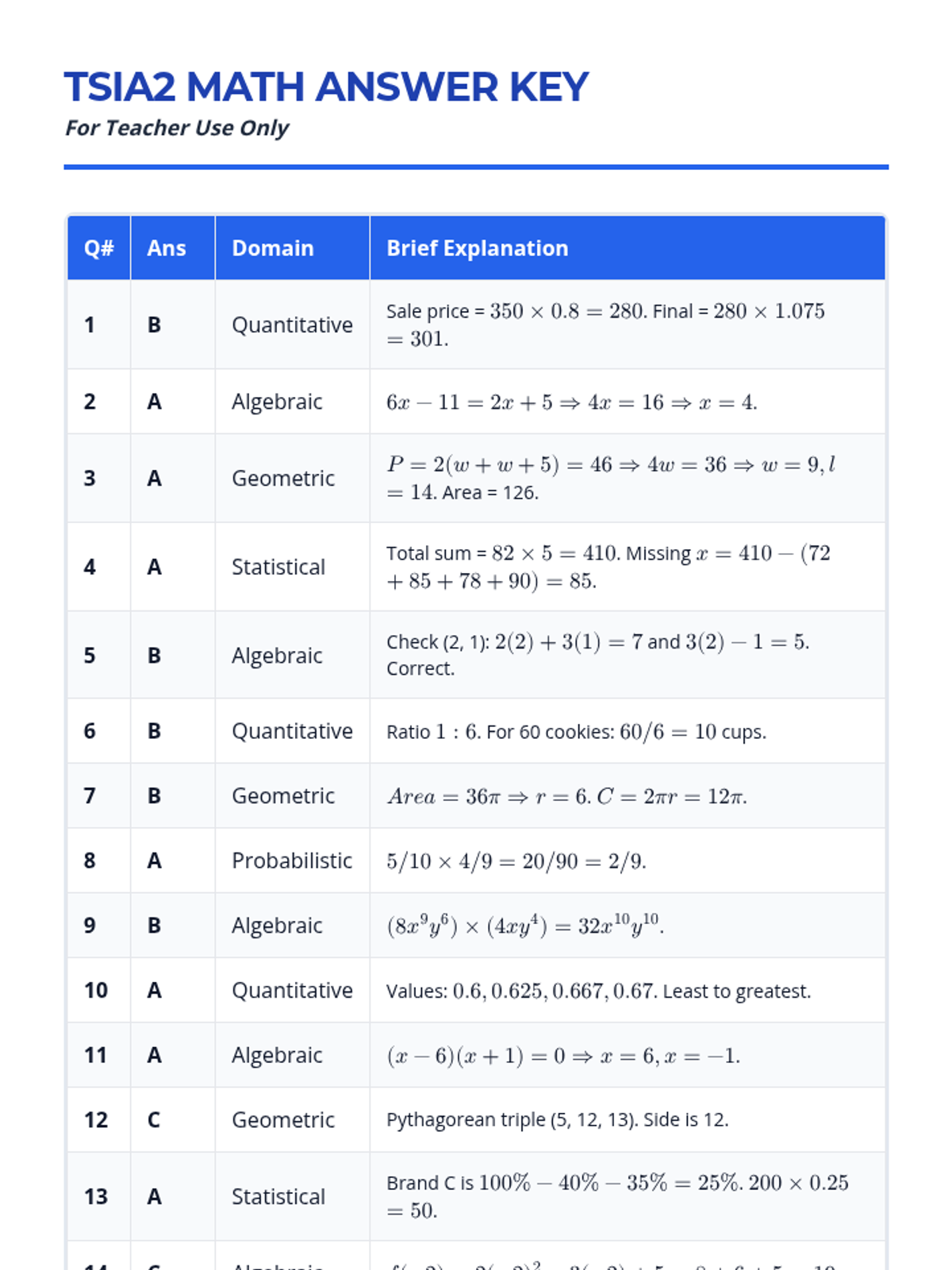
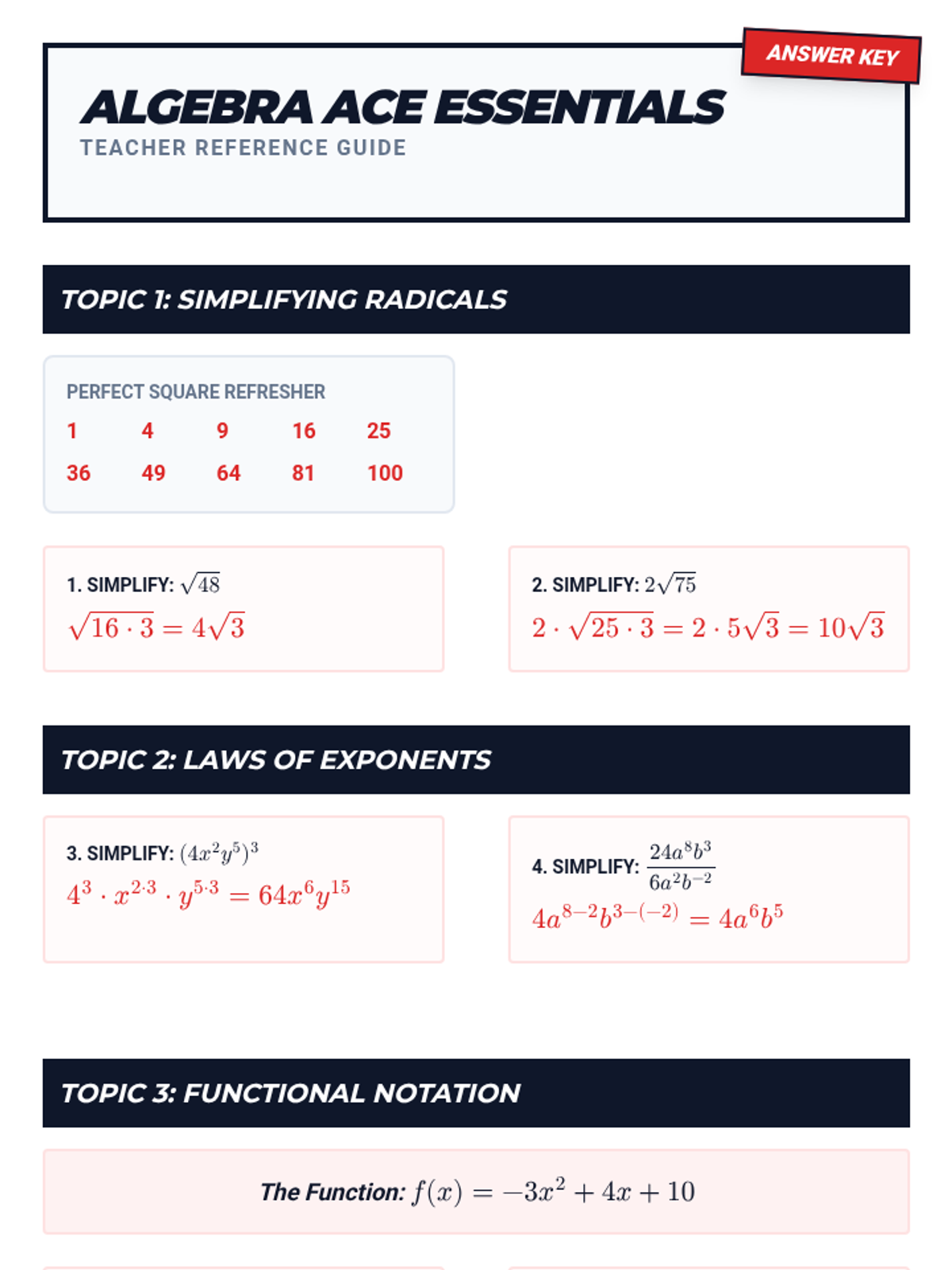
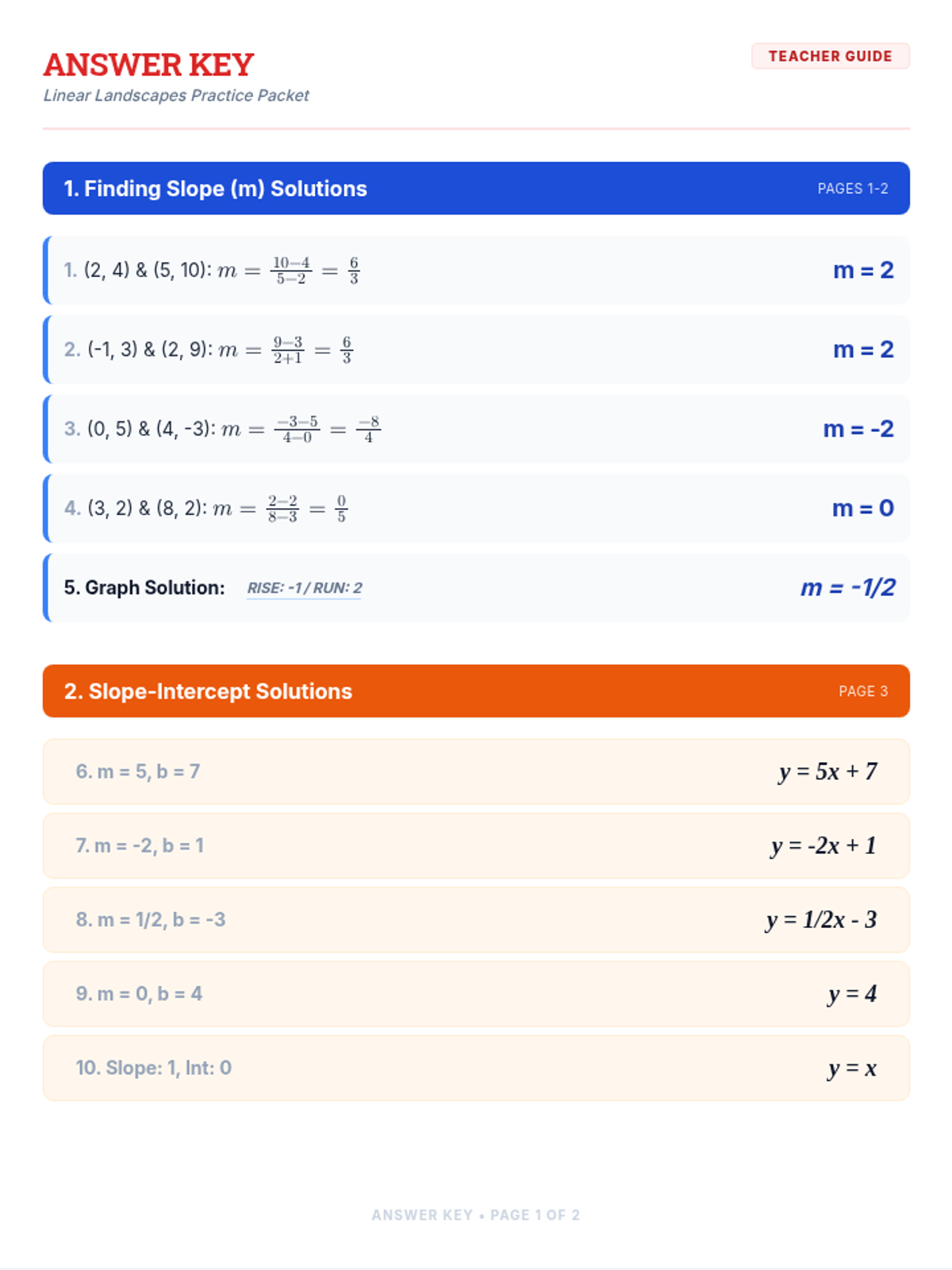
Teacher answer keys for the Real World Math series.
Instructional slides for the Real World Math series.
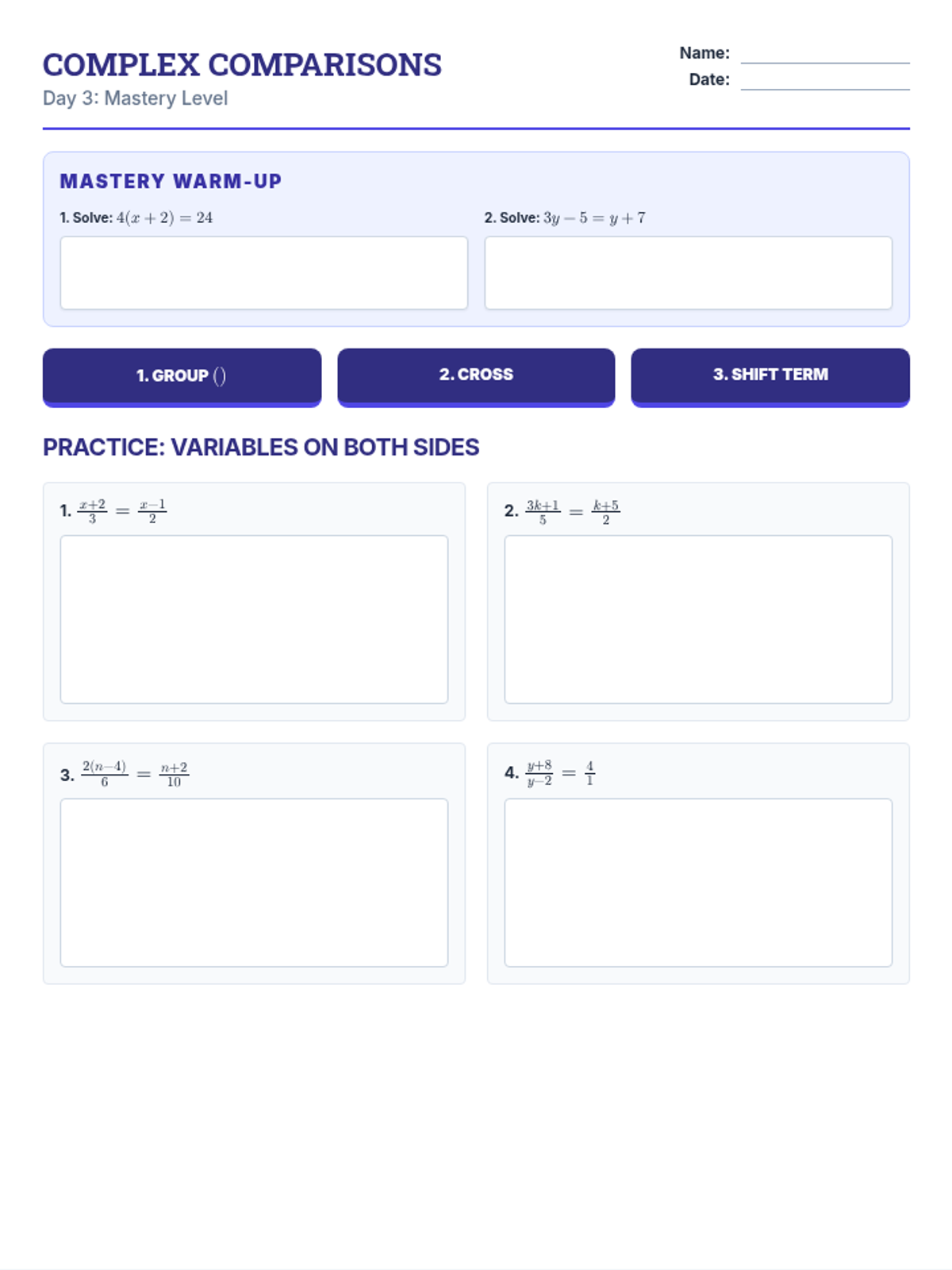
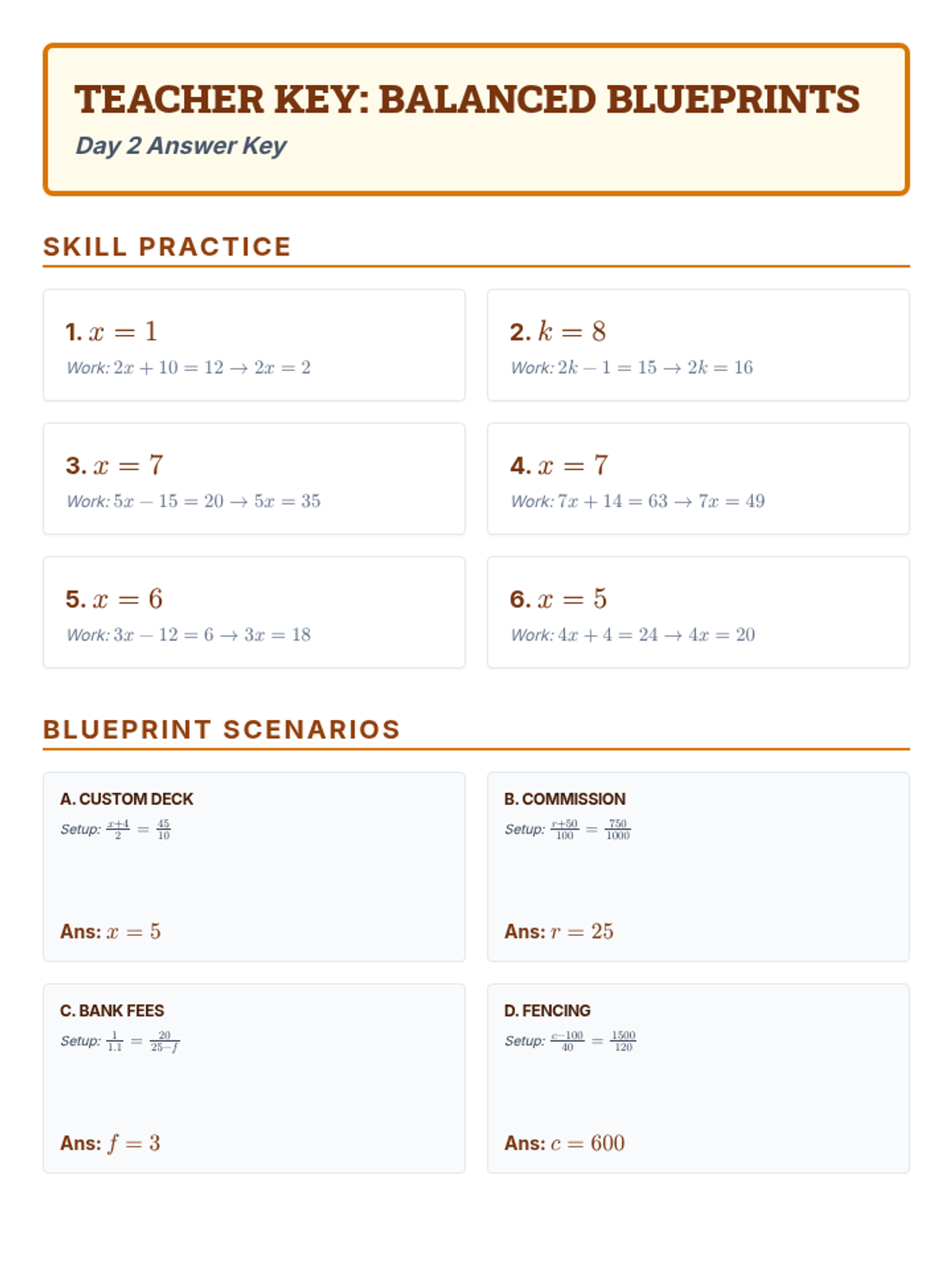
A lesson focused on solving proportions that lead to linear and quadratic equations through cross-multiplication.
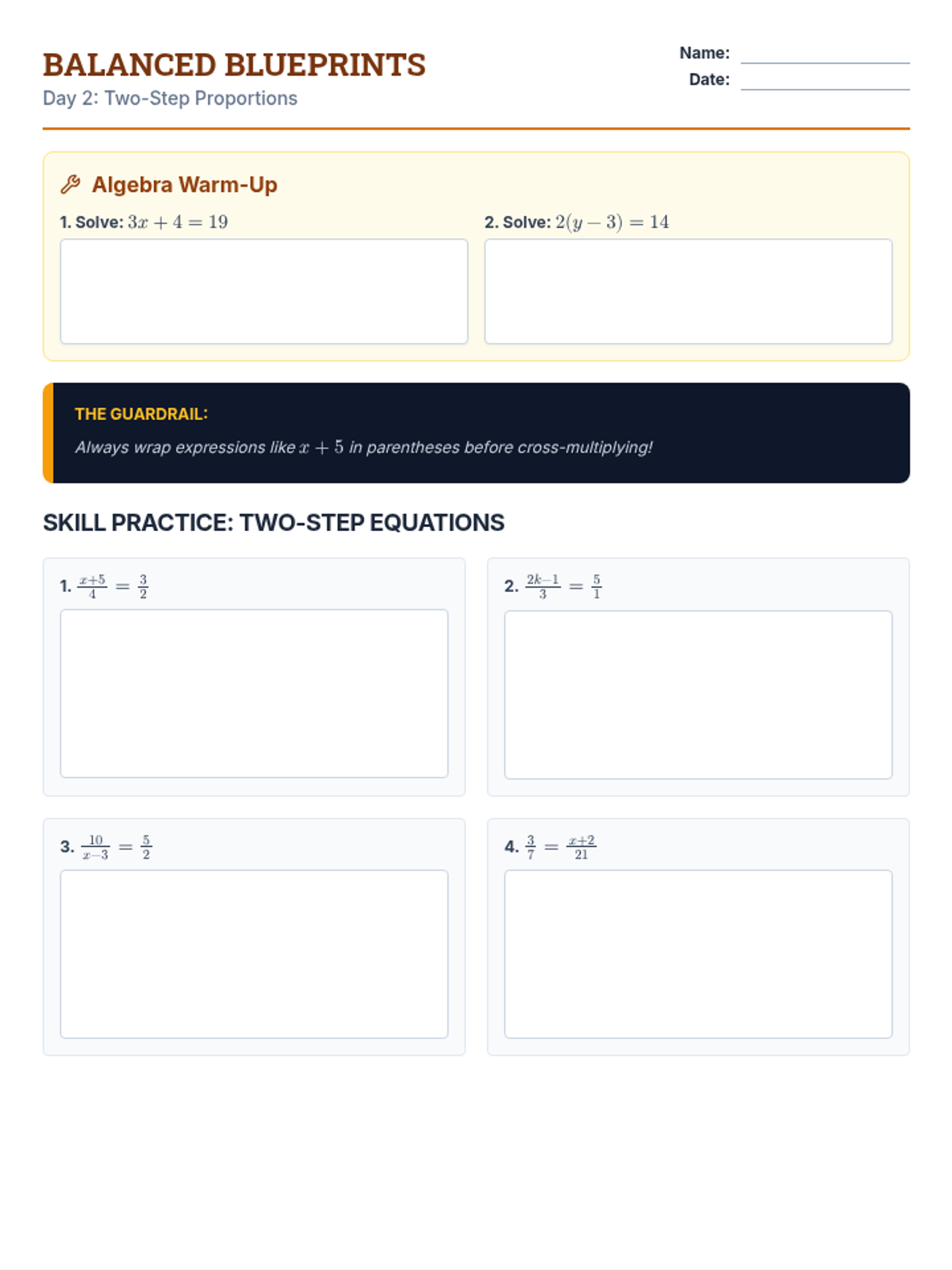
Students practice solving rational equations by applying cross-multiplication to proportions. The lesson focuses on setting up the equation, distributing correctly, and isolating the variable.
A March Madness-themed lesson that provides students with a strategic "Game Plan" for deconstructing and solving math word problems. Students use a basketball-themed graphic organizer to scout for data, draft a playbook, and execute their solution.
A focused lesson on calculating percent increase and decrease through the lens of retail and marketplace scenarios. Includes instructional slides and practice problems.
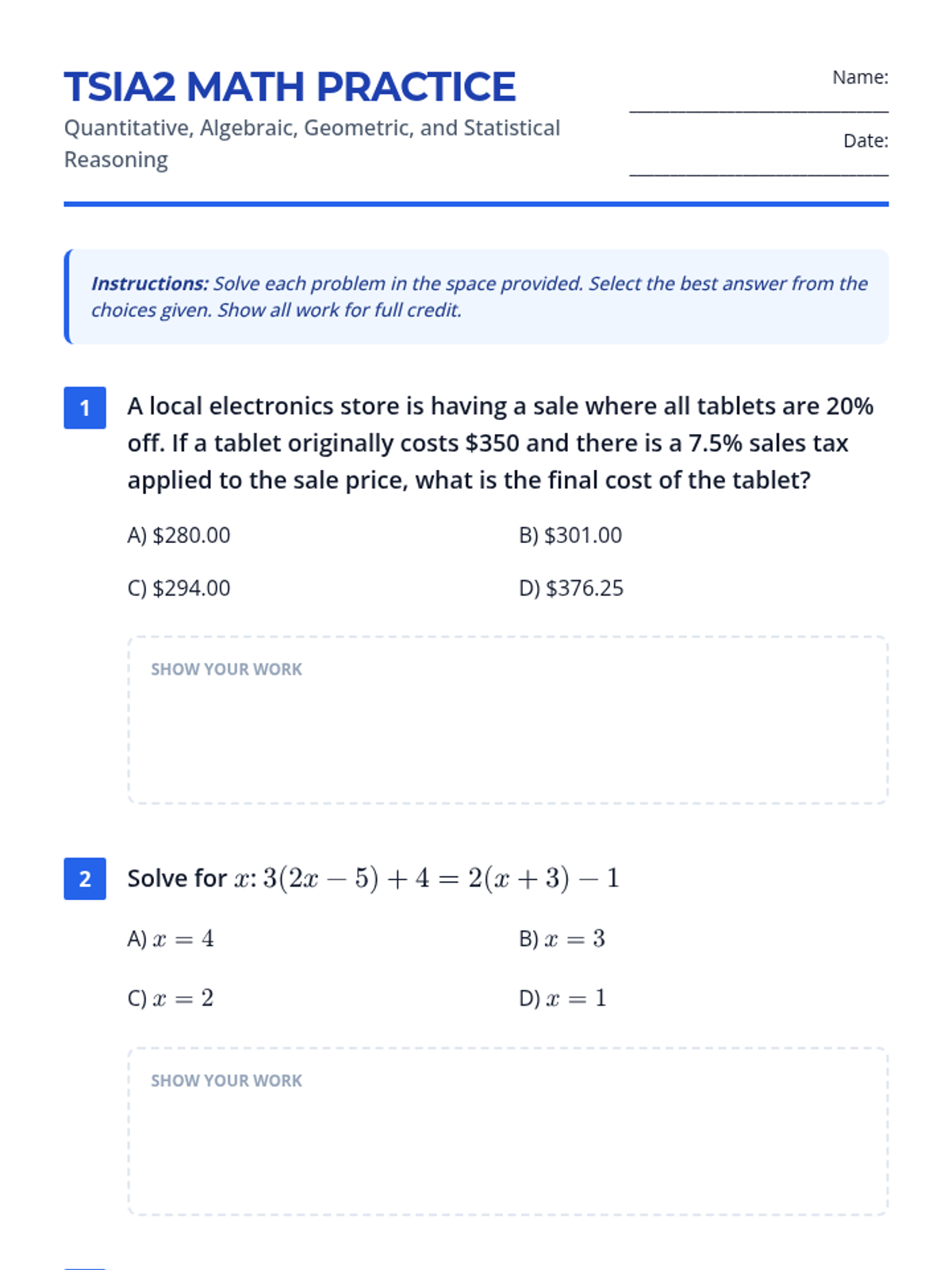
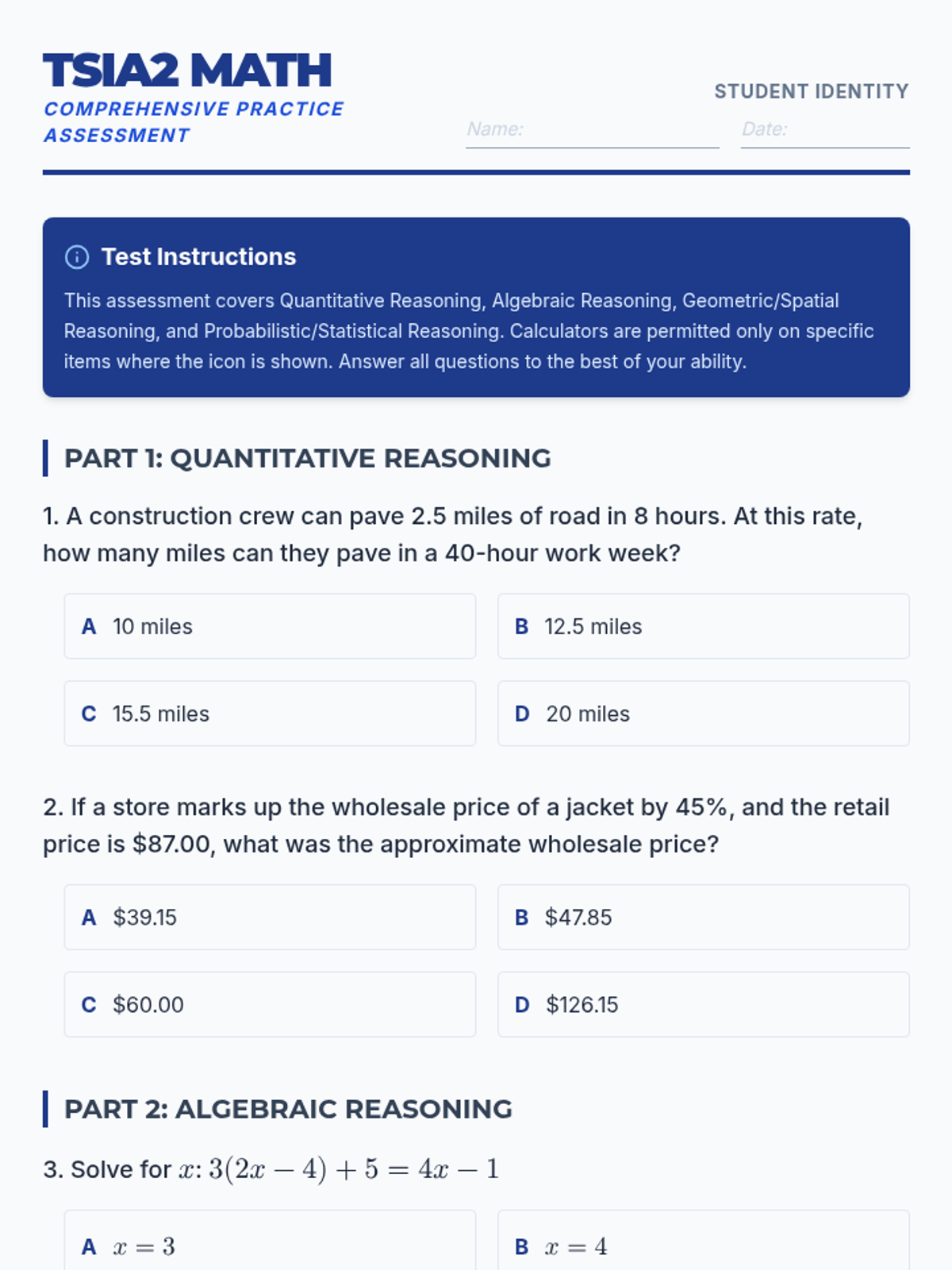
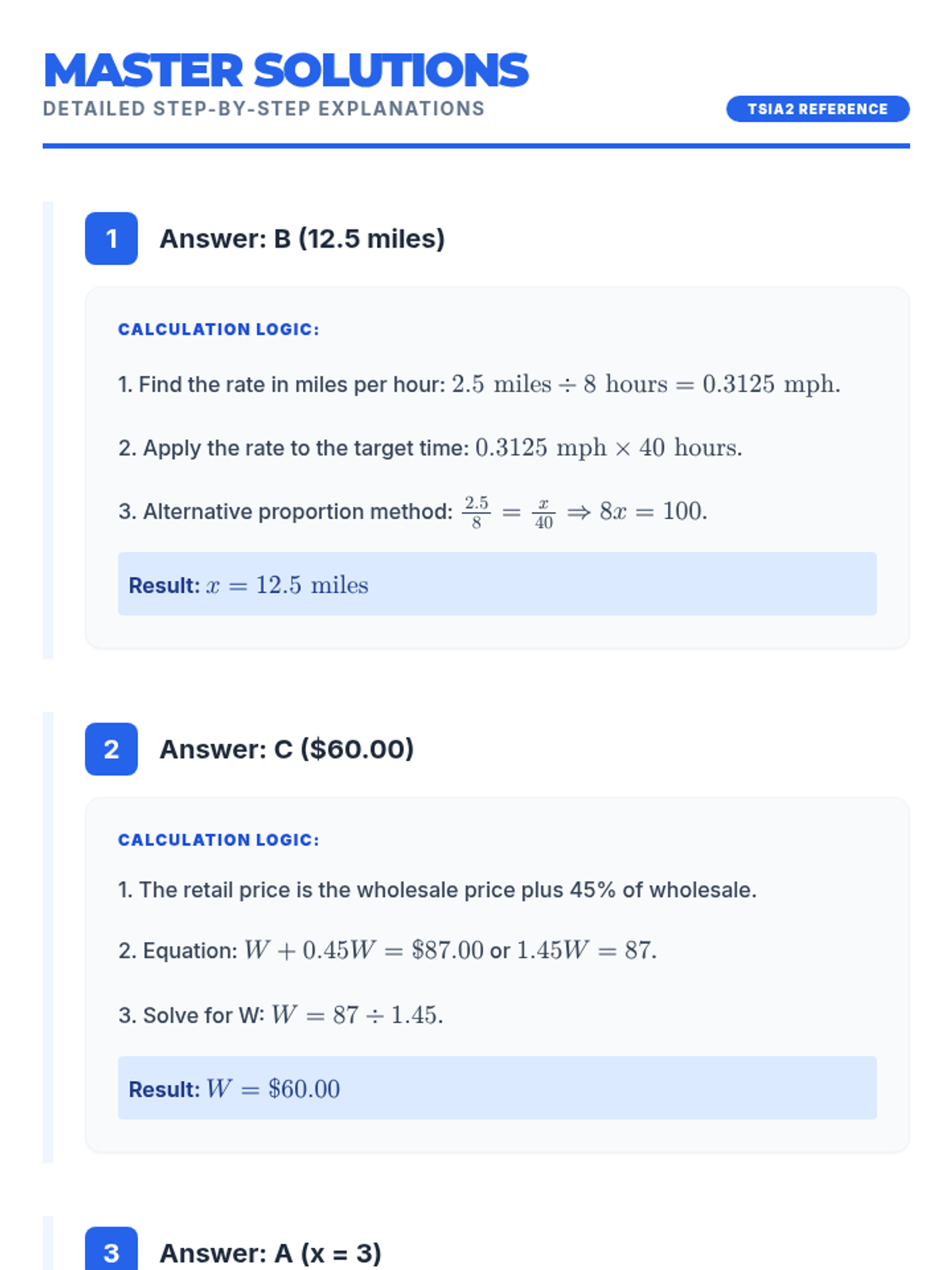
A comprehensive practice session for the TSIA2 Math exam, focusing on quantitative reasoning, algebraic reasoning, geometry, and statistics.
A comprehensive 20-question practice test covering all four TSIA2 Math domains: Quantitative Reasoning, Algebraic Reasoning, Geometry, and Probability and Statistics.
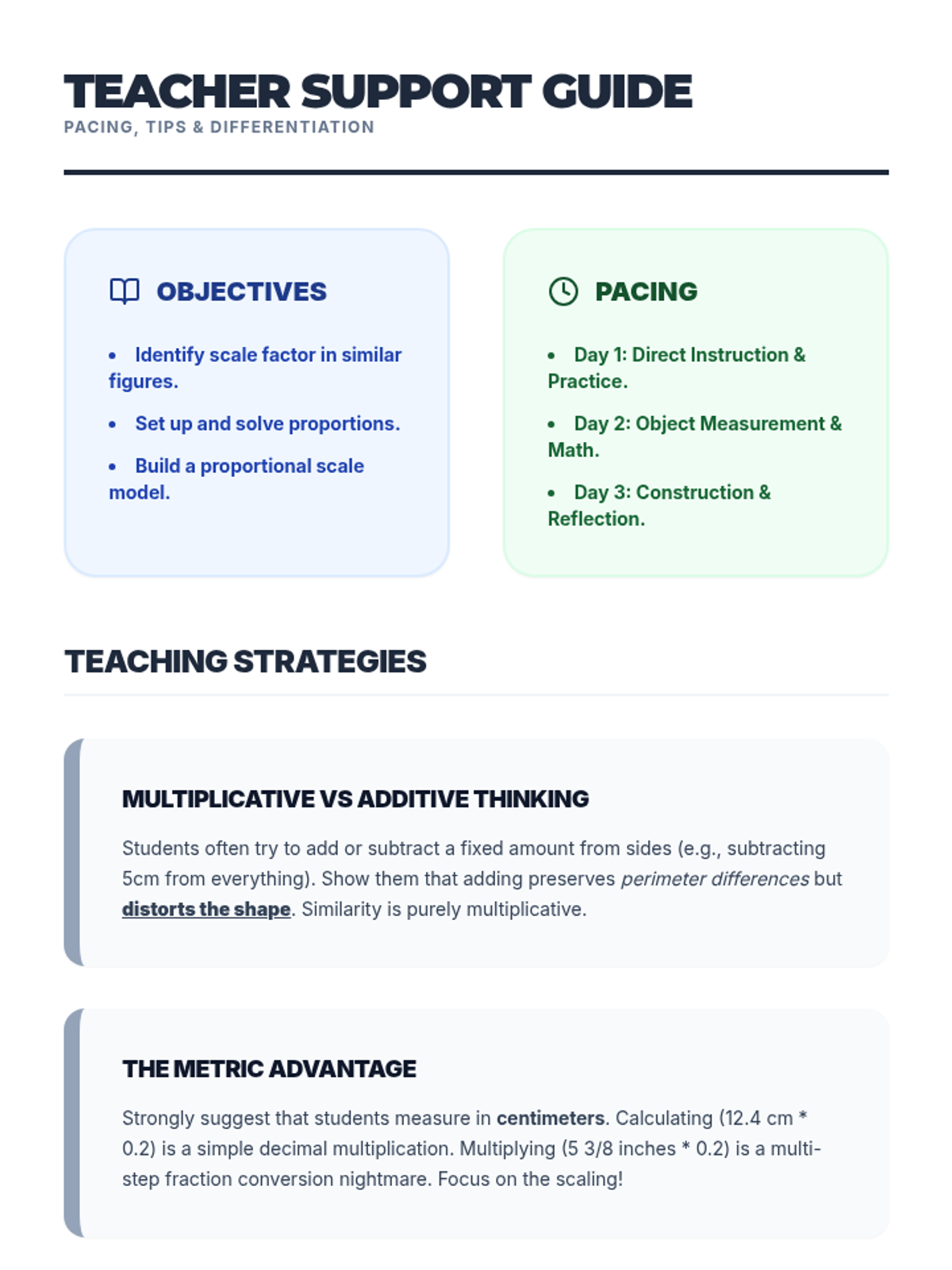
Cette séance de mathématiques appliquées permet aux élèves de SEGPA d'apprendre à agrandir une maquette d'affiche A4 au format Raisin en utilisant la proportionnalité et le produit en croix, dans le cadre réel de leur mini-entreprise scolaire. Elle intègre une gestion de classe flexible (groupes hétérogènes, présence fluctuante) et des micro-tâches orientées métier.
Cette séance de mathématiques appliquées guide les élèves de SEGPA dans l'agrandissement d'une affiche promotionnelle pour leur mini-entreprise, en utilisant la proportionnalité et le produit en croix pour passer du format A4 au format raisin.
Cette leçon guide les élèves dans la conception d'une affiche publicitaire pour leur mini-entreprise, en se concentrant sur le passage du format A4 au format Raisin. Elle intègre des notions de français (titre, légendes) et de mathématiques (proportionnalité) dans un cadre professionnel immersif.
Réaliser la mise à l'échelle complète d'un projet client : 6 photos, encarts de texte et calcul des dimensions finales sur format Raisin.
Calculer la surface de papier utilisée et la surface de "perte" (chutes). Sensibilisation à l'optimisation et au coût écologique du gâchis.
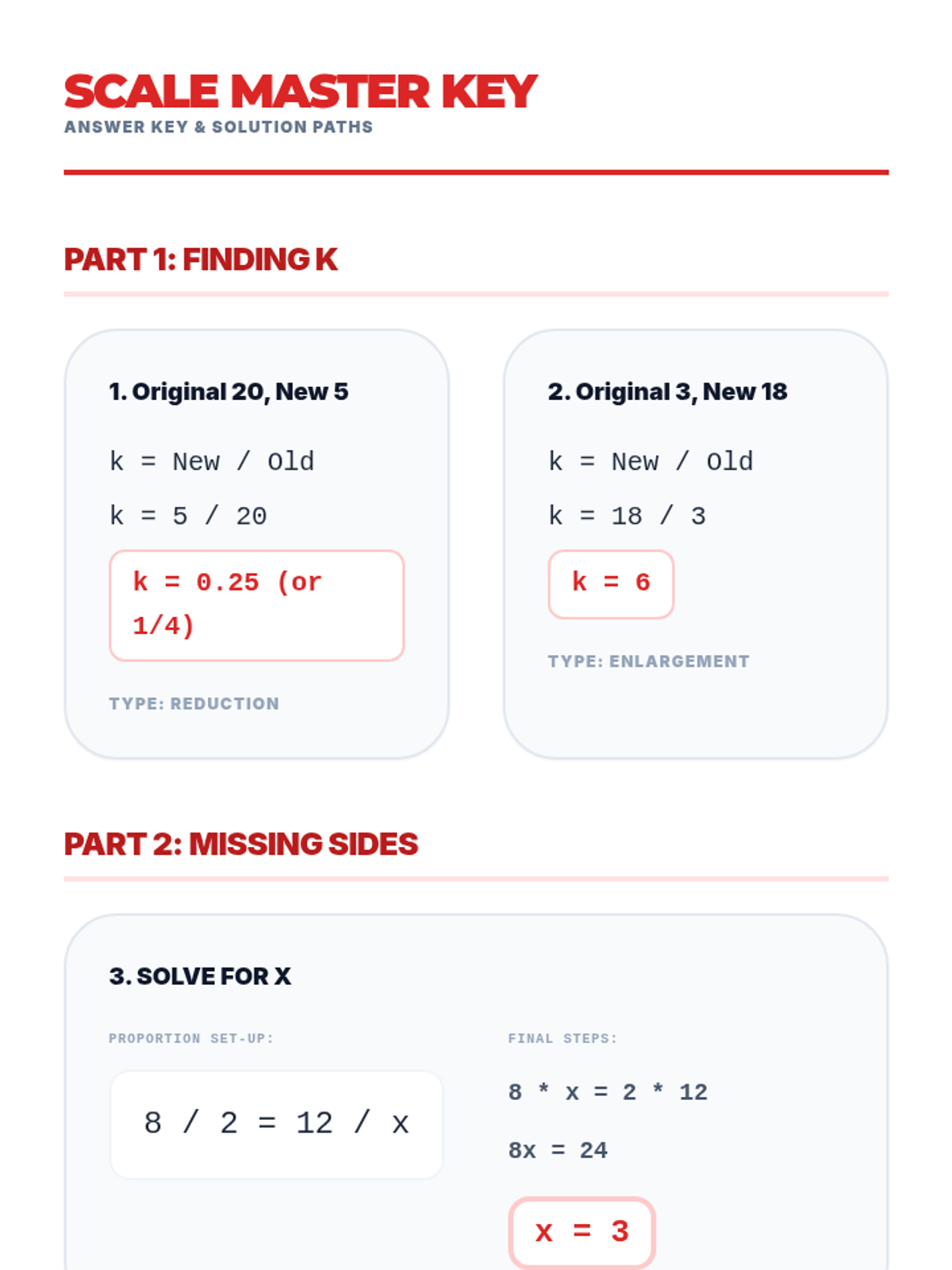
Calculer le facteur d'agrandissement maximal pour passer d'un modèle A4 au format Raisin (50x65 cm) sans dépasser les bords du papier.
Calculer les dimensions et l'espacement pour placer 6 photos sur une page A4. Utilisation de la division et de la multiplication pour une mise en page équilibrée.
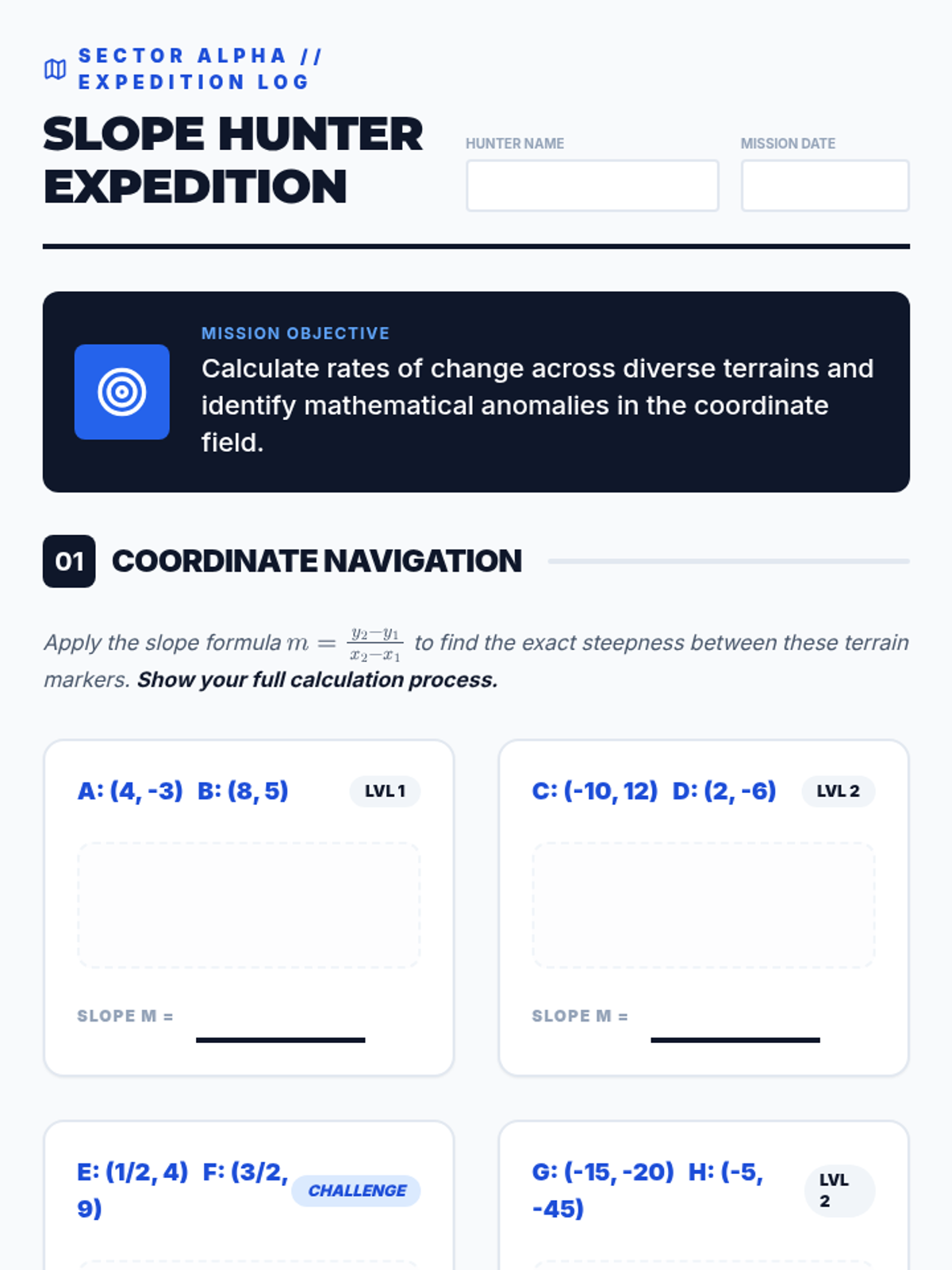
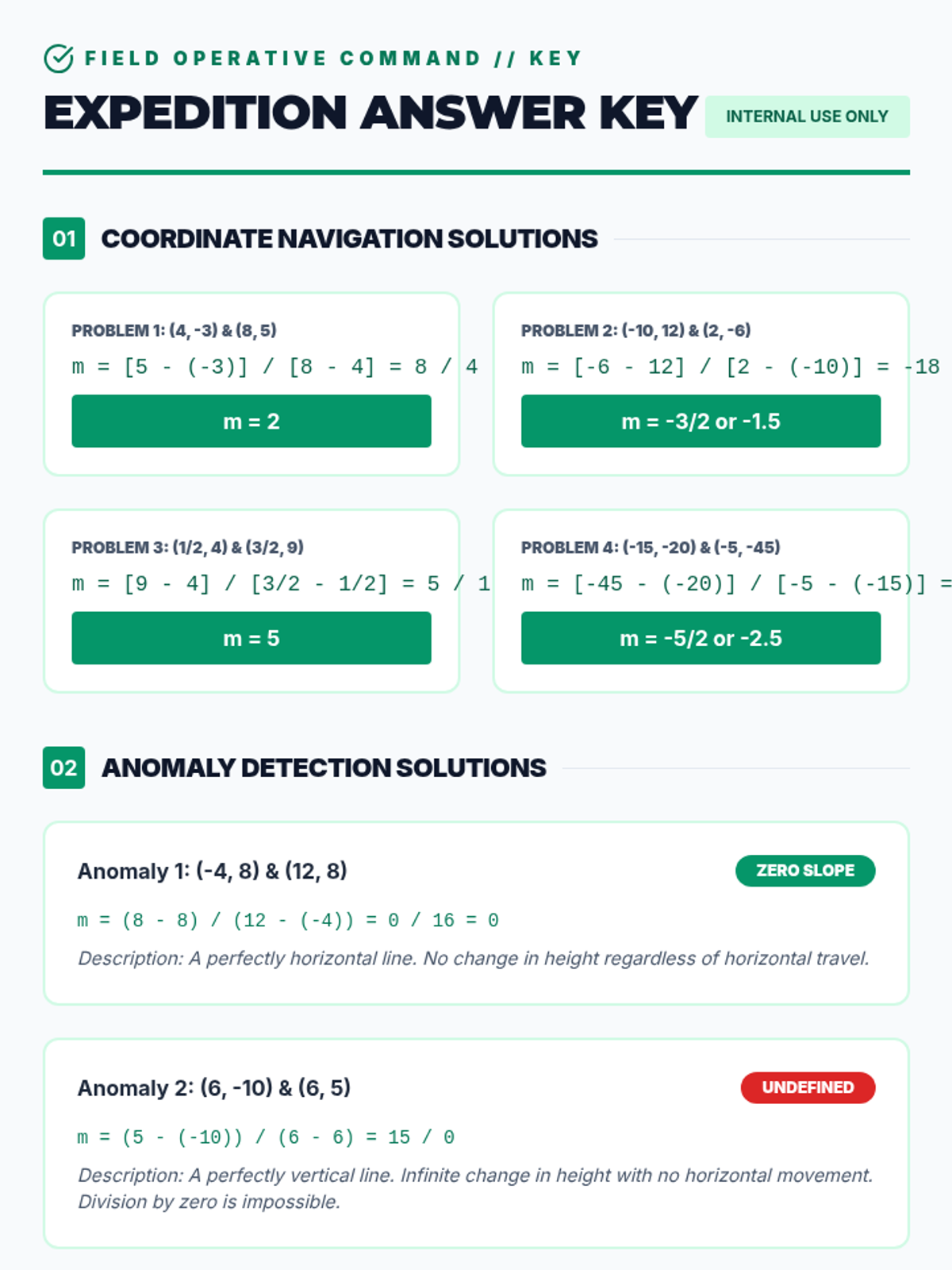
An introductory lesson focusing on the anatomy of Point-Slope Form, comparing it to Slope-Intercept Form, and mastering the 'sign switch' when identifying coordinates.
Comprendre si une photo peut être agrandie sans être recadrée en comparant les ratios largeur/hauteur. Concept de proportionnalité appliqué à l'image.
A Tier 2 intervention lesson for High School Geometry focusing on applying density concepts (population and material) using area and volume measurements, featuring real-world data and scaffolded calculations.
A Tier 2 intervention lesson focused on mastering density concepts using area and volume. Students will use modeling to solve real-world problems like population density and material mass.
A targeted intervention lesson exploring the relationship between central angles, arc lengths, and sector areas through hands-on measurement and proportional reasoning.
A targeted intervention lesson for Tier 2 students to discover trigonometric ratios (Sine, Cosine, Tangent) through hands-on measurement and comparison of similar right triangles. This lesson emphasizes the property that side ratios remain constant for specific angles regardless of triangle size.
A targeted Tier 2 intervention lesson focusing on the derivation of radian measure and sector area through proportional reasoning and hands-on measurement concepts. Students explore why the ratio of arc length to radius is constant for a given angle and apply this to find areas of circular sectors.
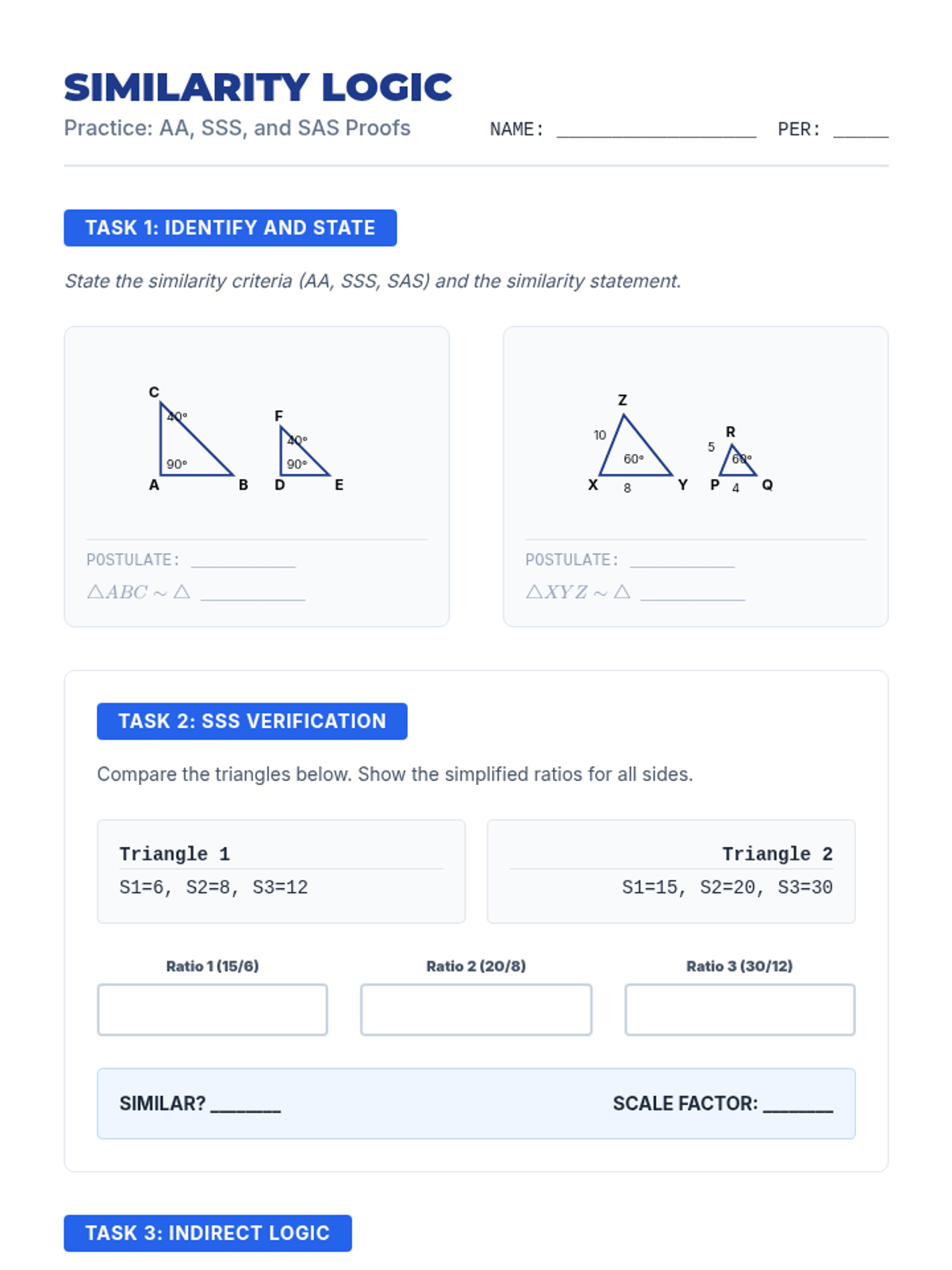
A Tier 2 intervention lesson focused on mastering congruence and similarity criteria through scaffolded proofs and real-world solving. Students will use SSS, SAS, ASA, AAS, HL, and similarity shortcuts to analyze geometric figures.
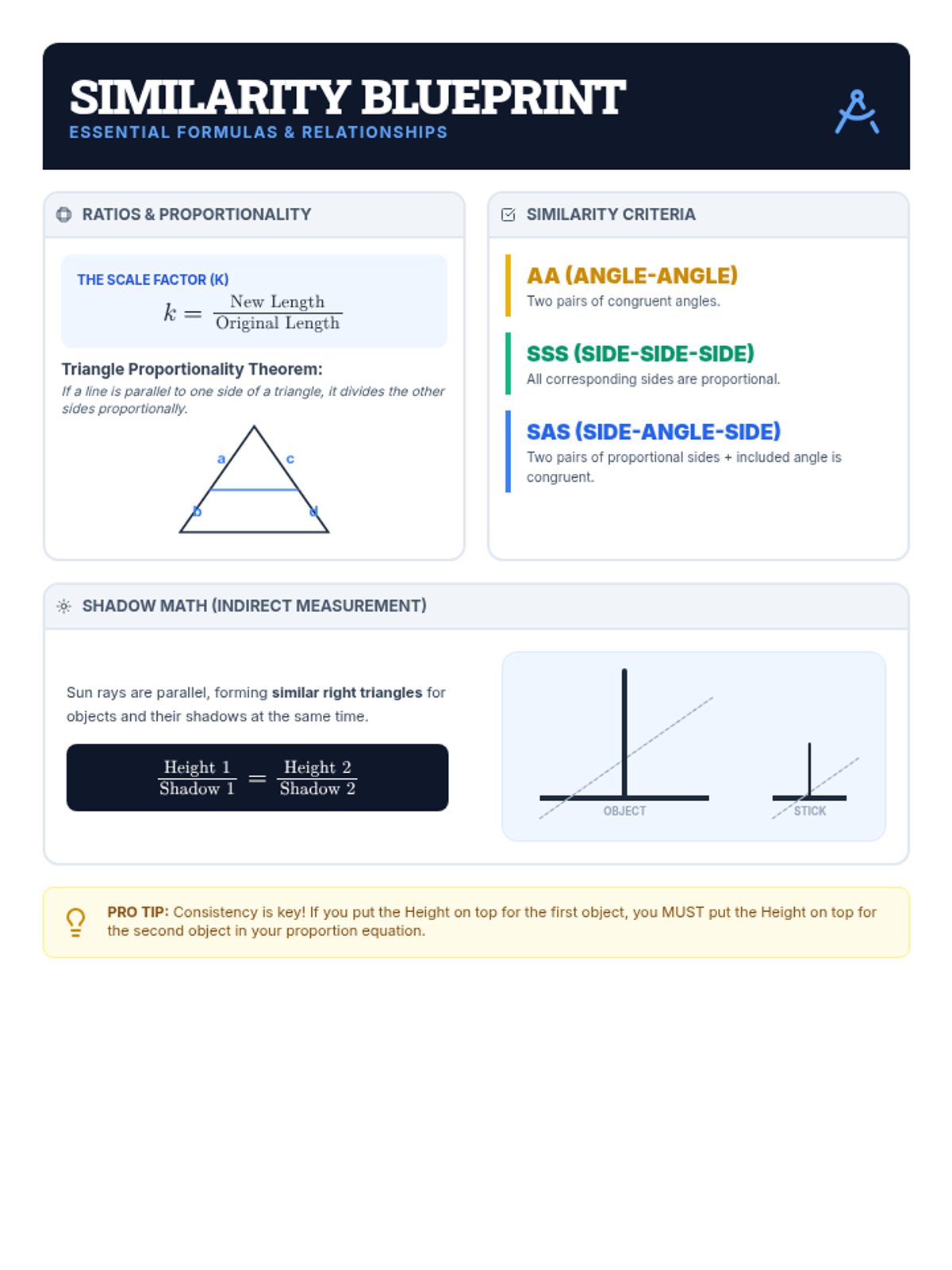
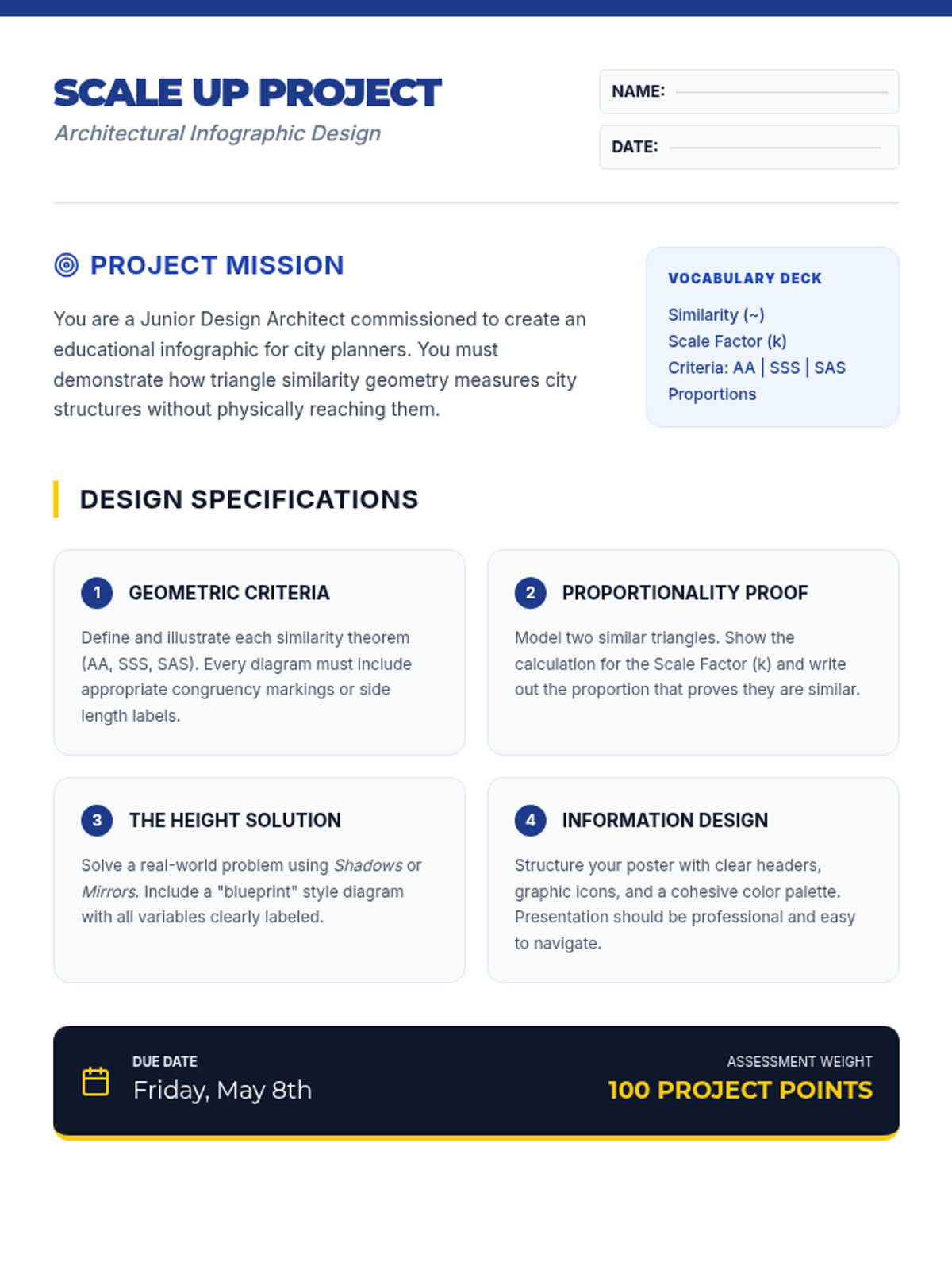
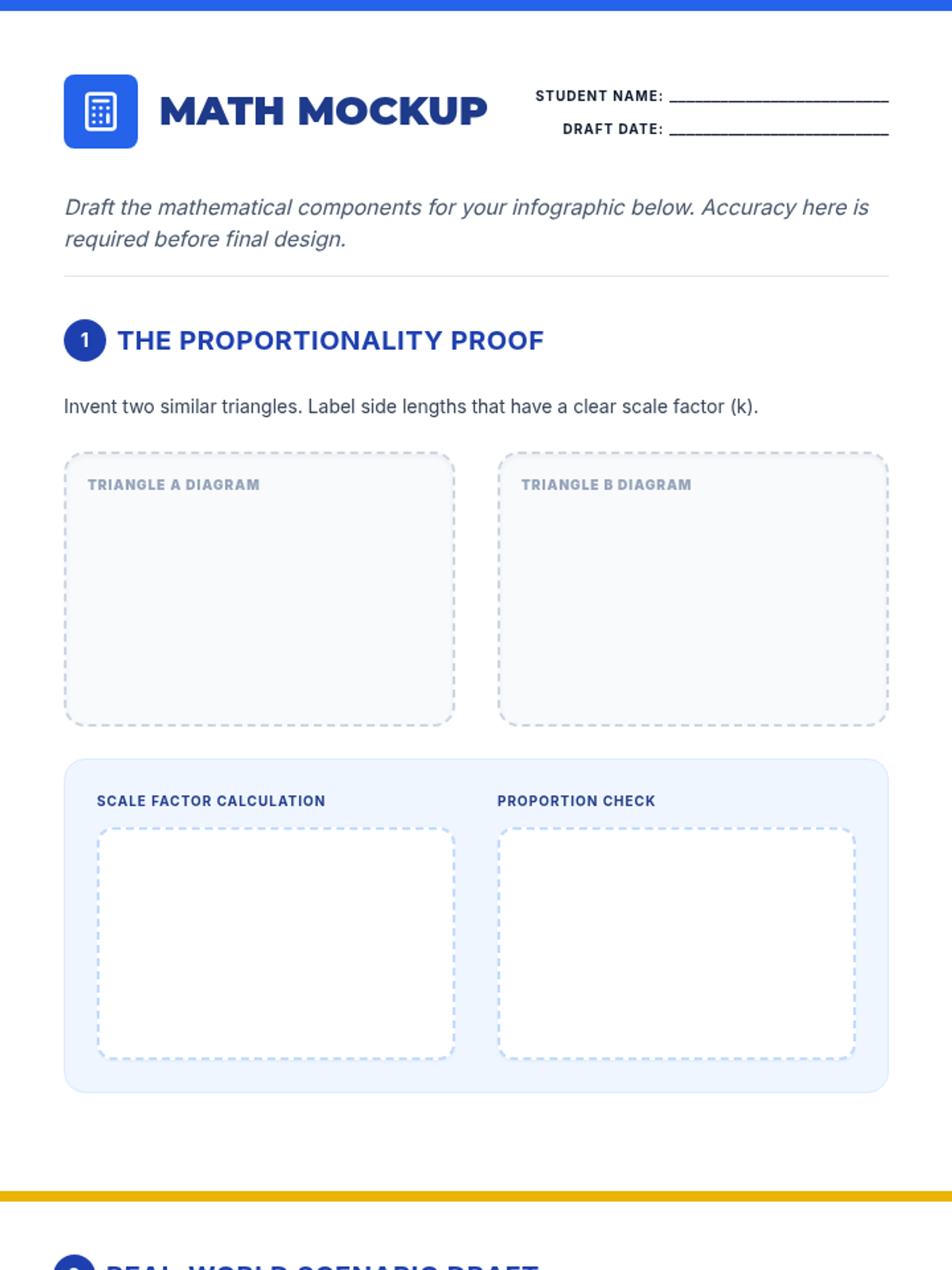
A targeted Tier 2 intervention lesson focusing on similarity through transformations, dilations, and triangle similarity criteria. Includes scaffolded instruction and progress monitoring.
A targeted intervention lesson focusing on the similarity-based origin of trigonometric ratios, helping students understand why side ratios remain constant for specific angles in right triangles.
A targeted Tier 2 intervention lesson focusing on defining similarity through transformations and verifying it through angle and side ratio comparisons. Designed for high school students who need structured support with HS.G-SRT.A.2.
A targeted Tier 2 intervention lesson focusing on visual proofs for the Side-Splitter Theorem and the similarity-based proof of the Pythagorean Theorem, designed for struggling high school learners.
A targeted Tier 2 intervention lesson focusing on triangle similarity through the lens of transformations (dilations, rotations, reflections, and translations). Using a Concrete-Representational-Abstract (CRA) approach, students connect rigid motions and dilations to proportional sides and congruent angles.