Lenny LearningLenny
Create
Explore
Workspace
LoginSign up
MathEnglish Language ArtsScience & EngineeringSocial StudiesGlobal LanguagesHealth & Physical EducationSpecial EducationCounseling & Life SkillsArts & CreativityESL
Lenny LearningLenny
Lenny Learning
About
Training
Pricing
Support
Contact
© 2026 Lenny Learning Inc.
MathNumbers & CountingCounting ObjectsNumber NamesComparing NumbersNumber OperationsCounting SequenceNumbers 0-10Place Value Understanding and SystemAdd and Subtract Within 20Addition and Subtraction ConceptsAddition and Subtraction EquationsAddition and Subtraction ProblemsFoundations for MultiplicationMultiplication and Division PropertiesMultiply and Divide Within 100Multiplication and Division ProblemsFactors and MultiplesProperties of OperationsPatterns and RelationshipsGenerate and Analyze PatternsMulti-Digit ArithmeticPlace Value OperationsMulti-Digit and Decimal OperationsNumerical ExpressionsFour Operations and PatternsFour Operations Problem SolvingMeasurement & DataMeasurable AttributesMeasuring LengthsMeasure and Estimate Lengths in Standard UnitsRelate Addition and Subtraction to LengthClassifying and Counting ObjectsTime and MoneyArea Concepts and MeasurementPerimeter and Area MeasuresAngle Concepts and MeasurementTime, Volume, and MassMeasurement Unit ConversionsGeometryIdentifying ShapesShapes and AttributesShape Attributes and ReasoningShapes and CompositionClassifying 2D FiguresGeometric Figures and RelationshipsLines, Angles, and ShapesAngle, Area, and VolumeGeometric MeasurementVolume of 3D ShapesCoordinate Plane ApplicationsTransformations in the PlaneCongruence and SimilarityUnderstand congruence in terms of rigid motionsSimilarity and TransformationsProve Theorems Involving SimilarityPythagorean TheoremTrigonometry for General TrianglesMake Geometric ConstructionsProve Geometric TheoremsTheorems About CirclesFind Arc Lengths And Areas of Sectors of CirclesVolume FormulasRelationships Between Two-Dimensional and Three-Dimensional ObjectsProve Simple Geometric Theorems AlgebraicallyTranslate Between Geometric Description and Equation for Conic SectionApply Geometric Concepts in Modeling SituationsFractions & DecimalsFractions as NumbersBuilding FractionsFraction Equivalence and OrderingAdding and Subtracting FractionsMultiplying and Dividing FractionsDividing FractionsDecimal FractionsMulti-Digit Computation and FactorsAdd, Subtract, Multiply, and Divide Rational NumbersRational Number SystemIrrational Numbers and ApproximationsRatiosRatios and ProportionsProportional RelationshipsUnit RateAlgebraAlgebraic ExpressionsGenerate Equivalent ExpressionsQuantitative RelationshipsProportional Relationships and Linear EquationsEquations and InequalitiesEquation Solving and ReasoningLinear Equations and SystemsGraph Equations and InequalitiesSystems of EquationsReal-World Algebraic ProblemsQuantitative Reasoning with UnitsExpression StructureEquivalent Expression FormsRadicals and Integer ExponentsRational ExponentsRational and Irrational NumbersPolynomial OperationsPolynomial IdentitiesPolynomial Zeros and FactorsRational ExpressionsComplex Number OperationsComplex Numbers in PolynomialsComplex Numbers on PlaneStatistics & ProbabilityRepresent and Interpret DataData DistributionsStatistical VariabilityProbability ModelsCompound Event ProbabilitiesStatistical SamplingInterpret Categorical and Quantitative DataBivariate Data PatternsInterpret Linear ModelsComparing Two PopulationsRandom Processes in StatisticsIndependence and Conditional ProbabilityExpected ValuesProbability-Based Decision MakingStatistical Inference and ConclusionsFunctionsFunction Concepts and NotationDefine and Compare FunctionsInterpret Functions in ContextAnalyze Function RepresentationsModel Relationships with FunctionsIdentify Linear vs Exponential GrowthDistinguish Between Function TypesCompare Growth RatesInterpret Function ExpressionsBuild Functions from RelationshipsConstruct and Model FunctionsTransform and Combine FunctionsModel Comparison and SelectionSolve Exponential EquationsTrigonometryTrigonometric Ratios Involving Right TrianglesTrigonometric Functions and Unit CircleModel with Trigonometric FunctionsTrigonometric IdentitiesVectors & MatricesIntroduction to Vectors and MatricesVector QuantitiesVector OperationsMatrix OperationsCalculusLimits and ContinuityDerivative Concepts and NotationDerivative Rules and TechniquesApplications of DerivativesOptimization ProblemsRelated RatesCurve Sketching and AnalysisIntegration Concepts and NotationAntiderivatives and Indefinite IntegralsDefinite Integrals and AreaFundamental Theorem of CalculusIntegration TechniquesApplications of IntegrationDifferential EquationsSequences and SeriesParametric and Polar FunctionsVector-Valued Functions

Geometry

SequencesLessonsMaterialsVideos
  1. Math

Geometry

SequencesLessonsMaterialsVideos

Geometric classification, measurement of area and volume, and the study of transformations and rigid motions. Builds toward complex proofs, trigonometry for general triangles, and the algebraic representation of conic sections.

Identifying ShapesVisual recognition and naming of two-dimensional and three-dimensional geometric figures. Builds classification skills based on properties such as sides, vertices, and curves.
Shapes and AttributesProperties of two-dimensional and three-dimensional geometric figures, focusing on sides, angles, and vertices. Strengthens spatial awareness through classification and construction activities.
Shape Attributes and ReasoningIdentification of properties including sides, vertices, and angles in two-dimensional and three-dimensional shapes. Classifies and sorts objects based on shared attributes to build foundational geometric reasoning.
Shapes and CompositionIdentification of 2D and 3D shapes alongside their defining attributes like sides, angles, and vertices. Builds spatial reasoning by composing simple shapes into complex figures and decomposing larger objects into constituent parts.
Video
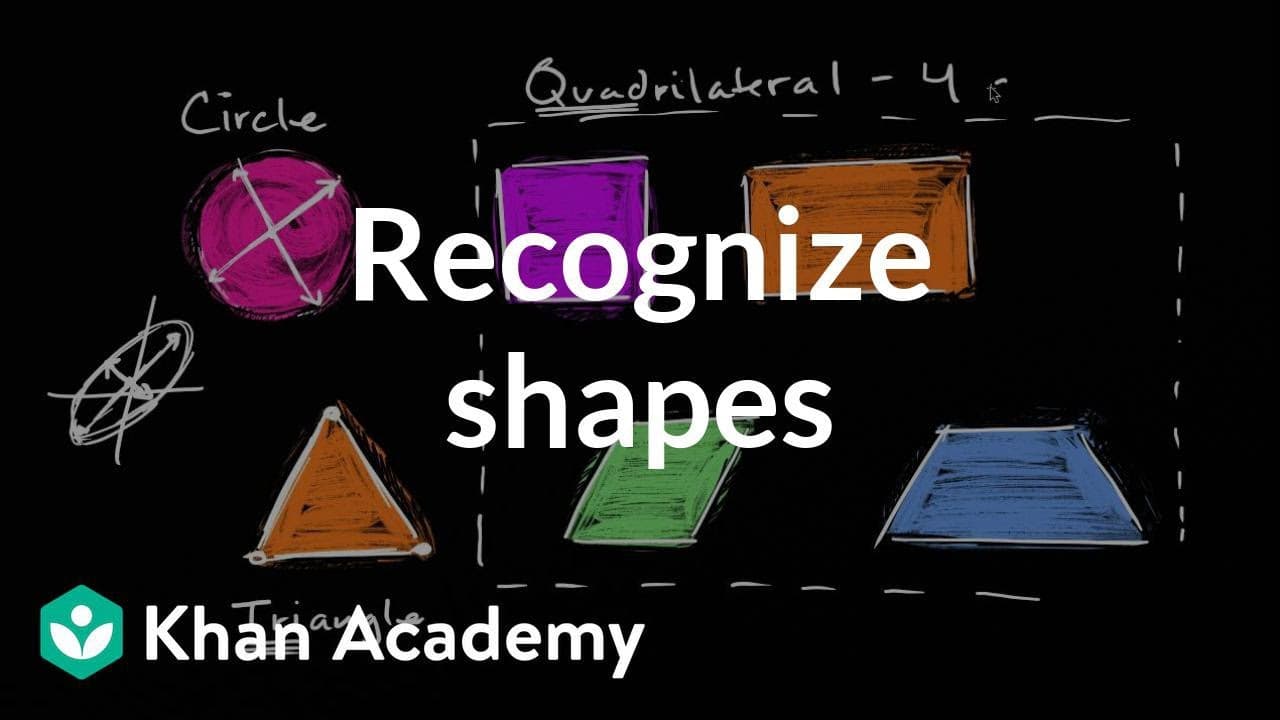
How to Identify Basic 2D Shapes

How to Identify Basic 2D Shapes

This educational video provides a clear and structured introduction to four fundamental two-dimensional shapes: the square, circle, triangle, and rectangle. Through a repetitive and paced narrative, the video guides young learners in identifying each shape by examining its defining attributes—specifically counting the number of corners and sides. The clear audio and simple visual cues help students connect the visual form with the mathematical properties and the shape's name. The content focuses on early geometry concepts, specifically the identification of 2D shapes and the vocabulary of "sides" and "corners" (vertices). For each shape, the video follows a distinct pattern: identifying the attributes, naming the shape, and then displaying a variety of examples in different colors, sizes, and orientations to reinforce that a shape's identity remains constant regardless of these variables. For educators, this video serves as an excellent foundational tool for Pre-K through 1st-grade mathematics. It allows teachers to pause and count along with the narrator, making it an interactive experience. The segment showing various examples of each shape is particularly useful for preventing the common misconception that shapes must always look a certain way (e.g., that a triangle must always have a flat bottom). The video concludes with a summary screen perfect for a quick formative assessment or review.

MatholiaChannelMatholiaChannel

3mins 17s

Video
Prefixes and Polygons: Naming Shapes by Number of Sides

Prefixes and Polygons: Naming Shapes by Number of Sides

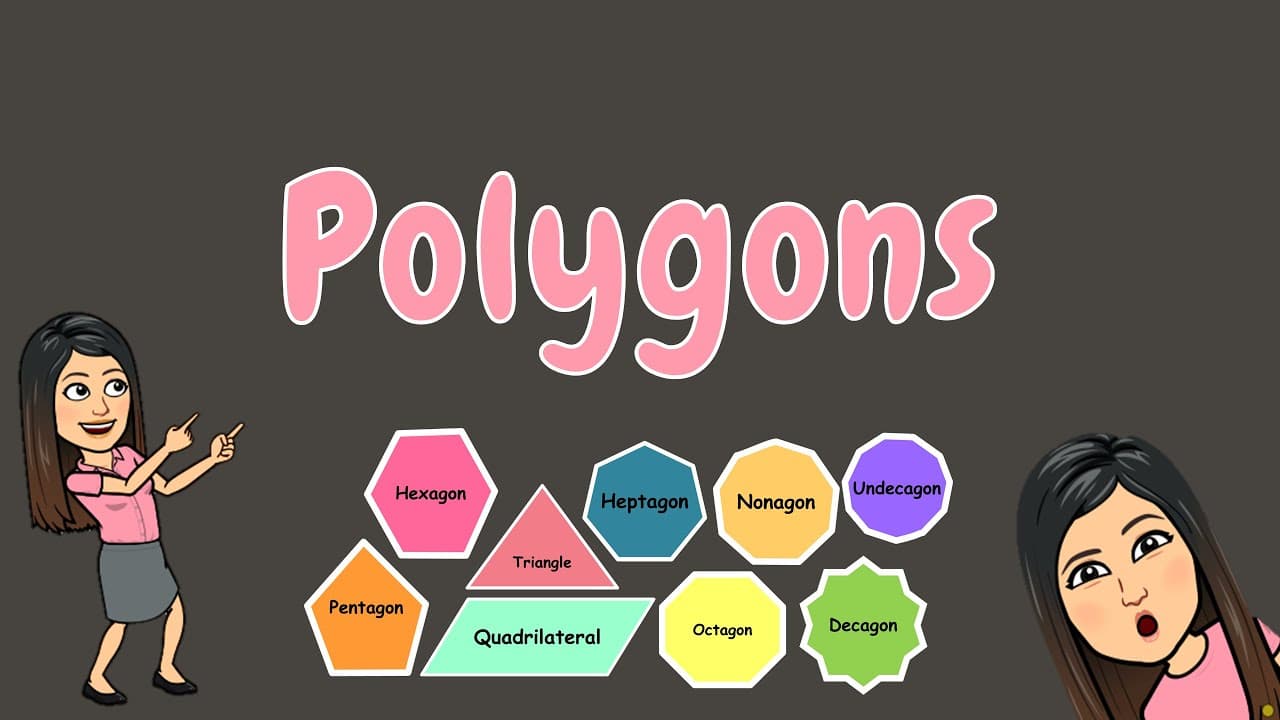
A high-energy, animated musical lesson that teaches students how to identify and name polygons based on their number of sides. The video uses a catchy hip-hop song to introduce Greek prefixes (Tri-, Quad-, Penta-, etc.) and connects each shape to real-world objects, such as a sailboat, a door, and a stop sign. It covers shapes ranging from triangles (3 sides) to decagons (10 sides). The video reinforces the relationship between the prefix and the number of sides, helping students memorize geometric vocabulary through rhyme and repetition. It features a "call and response" quiz section where viewers are asked to identify shapes, as well as a visual counting sequence that highlights the sides of each polygon as they are counted. In addition to naming shapes, the video explicitly defines the rules of what constitutes a polygon: it must be a closed shape and must have straight sides. This resource is excellent for introducing geometry units, reviewing vocabulary, or helping students understand the linguistic roots of mathematical terms.

Math Songs by NUMBEROCKMath Songs by NUMBEROCK

3mins 41s

Video
Identifying Attributes of Circles, Triangles, Squares, and Rectangles

Identifying Attributes of Circles, Triangles, Squares, and Rectangles

In this engaging animated short, Sandy the dingo introduces young learners to four foundational geometric shapes: circles, triangles, squares, and rectangles. The video uses clear narration and dynamic animations to define each shape by its specific attributes, such as the number of sides and corners. Key themes include identifying 2D shapes, counting sides and vertices (corners), and understanding basic geometric properties. The video introduces grade-level appropriate vocabulary like "sides" and "corners" while also touching on more advanced concepts like "equal sides" for squares and "parallel" lines for rectangles. This resource is highly valuable for early childhood and elementary classrooms as a quick, clear introduction or review of shape attributes. Its step-by-step breakdown allows teachers to pause and check for understanding, while the visual counting of sides helps reinforce the connection between numbers and geometry. The friendly character and clear visual cues make abstract geometric definitions concrete and accessible.

Khan Academy KidsKhan Academy Kids

38s

Video
Learning Shapes: What Is a Triangle?

Learning Shapes: What Is a Triangle?

This engaging animated video introduces young learners to the concept of a triangle through a friendly character named Sandy the Dingo. The video provides a clear, visual definition of the shape by identifying its defining properties: having exactly three sides and three corners. Through simple narration and on-screen counting, students are guided to recognize these features on a geometric diagram. The content bridges abstract geometry and the real world by transforming the triangle outline into an illustration of a mountain, specifically referencing Mount Fuji. This helps children understand that geometric shapes exist in their everyday environment and nature. The pacing is deliberate and slow, allowing time for viewers to count along and visually track the highlighted attributes. Ideally suited for early childhood education, this video serves as an excellent hook for lessons on 2D shapes and geometry. Teachers can use it to introduce vocabulary like "sides" and "corners" or as a prompt for shape-hunting activities. Its brevity makes it perfect for quick reinforcement or as a transition activity in Pre-K through 1st-grade classrooms.

Khan Academy KidsKhan Academy Kids

30s

Video
Exploring Properties of 3D Shapes: Faces, Edges, and Vertices

Exploring Properties of 3D Shapes: Faces, Edges, and Vertices

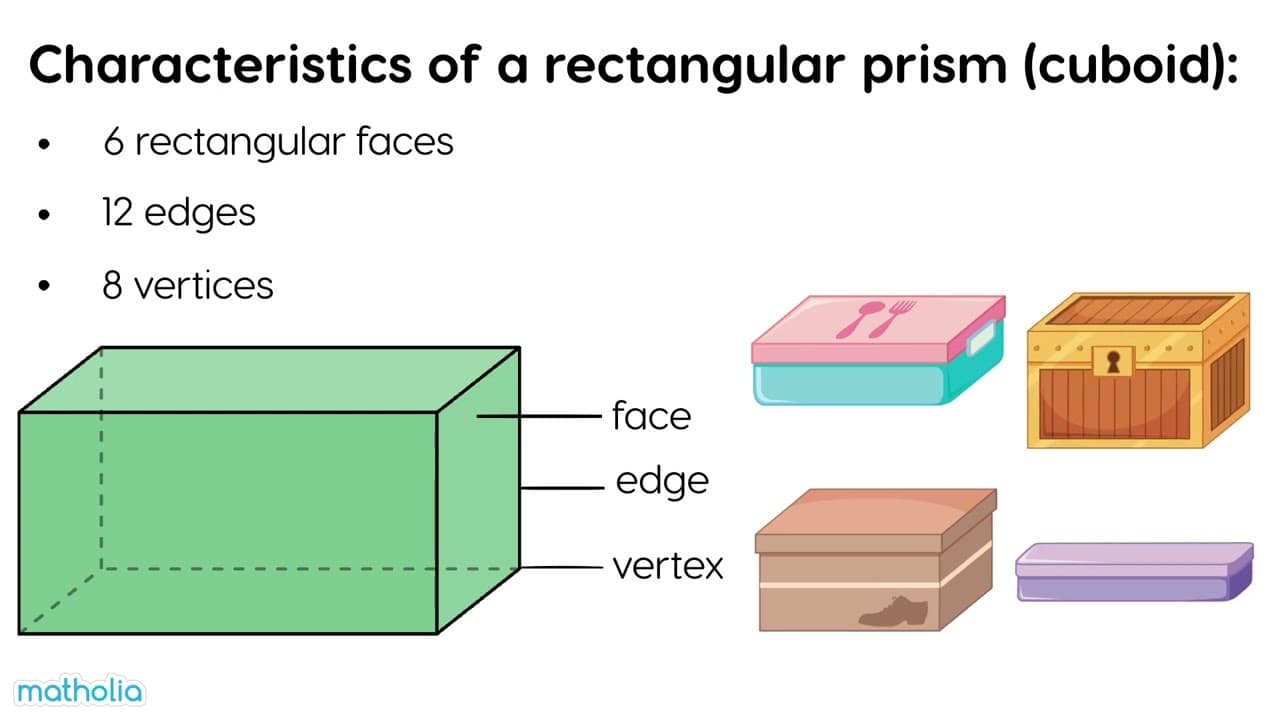
This educational video serves as a clear, step-by-step introduction to the geometric properties of five common 3D shapes: the cube, rectangular prism (cuboid), sphere, cone, and cylinder. For each shape, the narration systematically defines its structure by counting its faces, edges, and vertices. Visual animations highlight these specific parts on the geometric models as they are counted, helping students connect the abstract vocabulary to the physical attributes of the shape.

MatholiaChannelMatholiaChannel

2mins 43s

Video
Classifying Triangles and Finding Missing Angles

Classifying Triangles and Finding Missing Angles

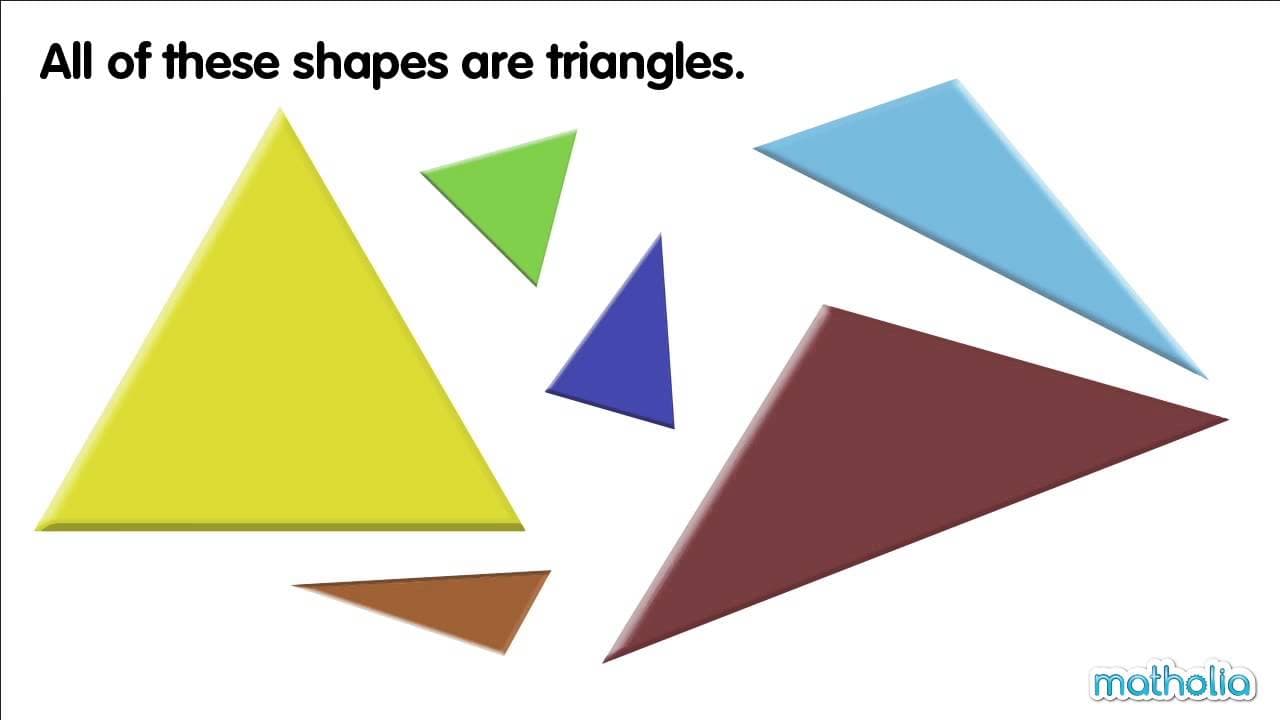
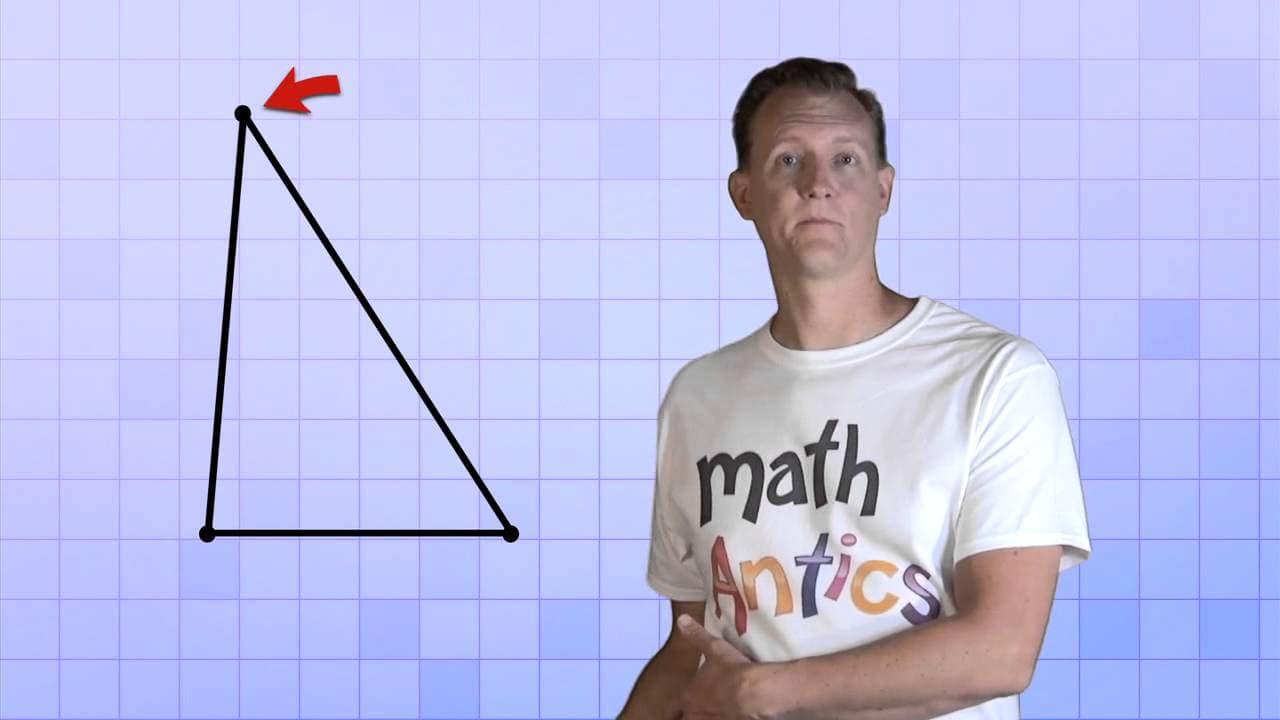
This engaging video provides a comprehensive introduction to triangles, serving as a foundational geometry lesson for elementary and middle school students. The host, Rob from Math Antics, breaks down the definition of a triangle as a three-sided polygon and systematically explains the two primary methods of classification: by side length and by interior angle measurement. The video uses clear, dynamic animations to demonstrate how manipulating vertices changes the triangle's properties, making abstract geometric concepts concrete and visual. The content covers key vocabulary including equilateral, isosceles, and scalene for side-based classification, and right, acute, and obtuse for angle-based classification. A significant portion of the video is dedicated to a matrix that explores how these two classification systems overlap, importantly highlighting which combinations are geometrically impossible (such as a right equilateral triangle). This section promotes critical thinking rather than just rote memorization of definitions. Finally, the video introduces the Angle Sum Theorem, visually proving that the three interior angles of any triangle always add up to 180 degrees. This concept is then applied practically, showing students how to calculate a missing angle when two are known. With its blend of humor, clear visuals, and logical progression, this video is an excellent resource for introducing geometry units, reinforcing vocabulary, or supporting students who struggle to visualize geometric relationships.

mathanticsmathantics

7mins 40s

Video
What Makes a Shape a Rectangle?

What Makes a Shape a Rectangle?

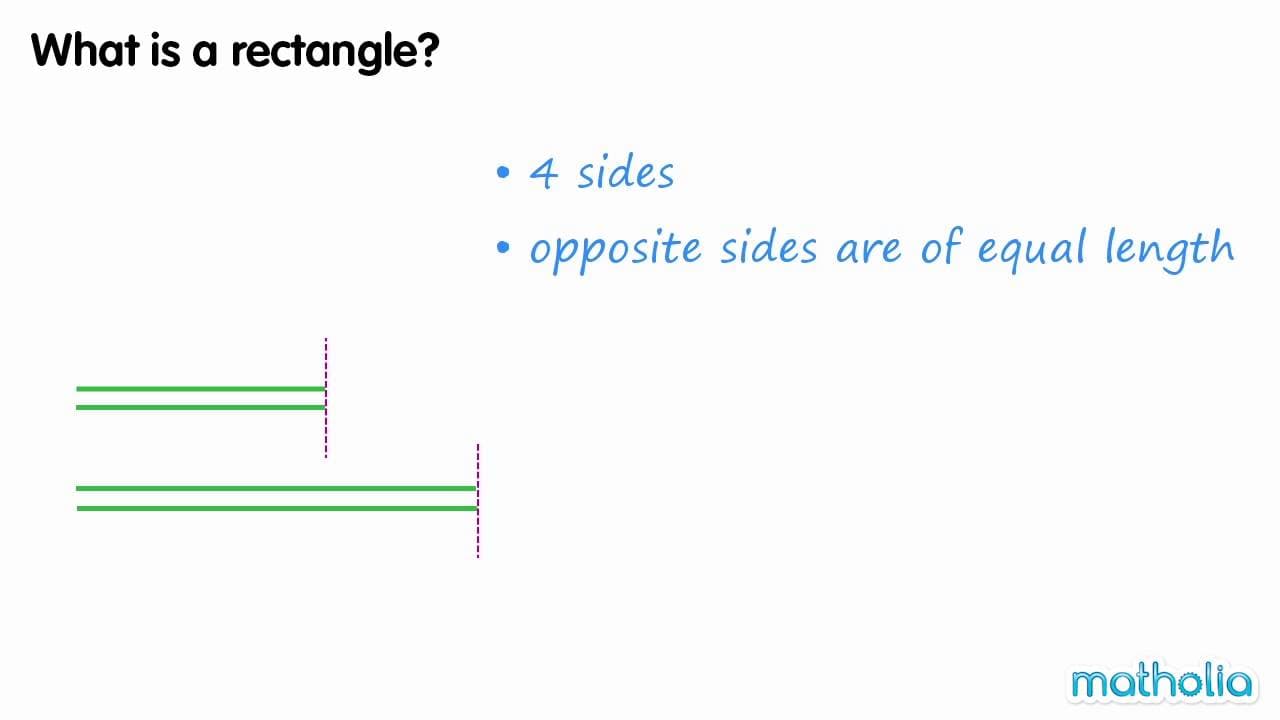
This concise educational video introduces the defining geometric characteristics of a rectangle. Through clear animations and step-by-step narration, viewers learn the four specific rules that make a shape a rectangle: having four sides, opposite sides of equal length, opposite sides being parallel, and the presence of four right angles.

MatholiaChannelMatholiaChannel

53s

Video
Exploring the Fundamentals of 3D Figures

Exploring the Fundamentals of 3D Figures

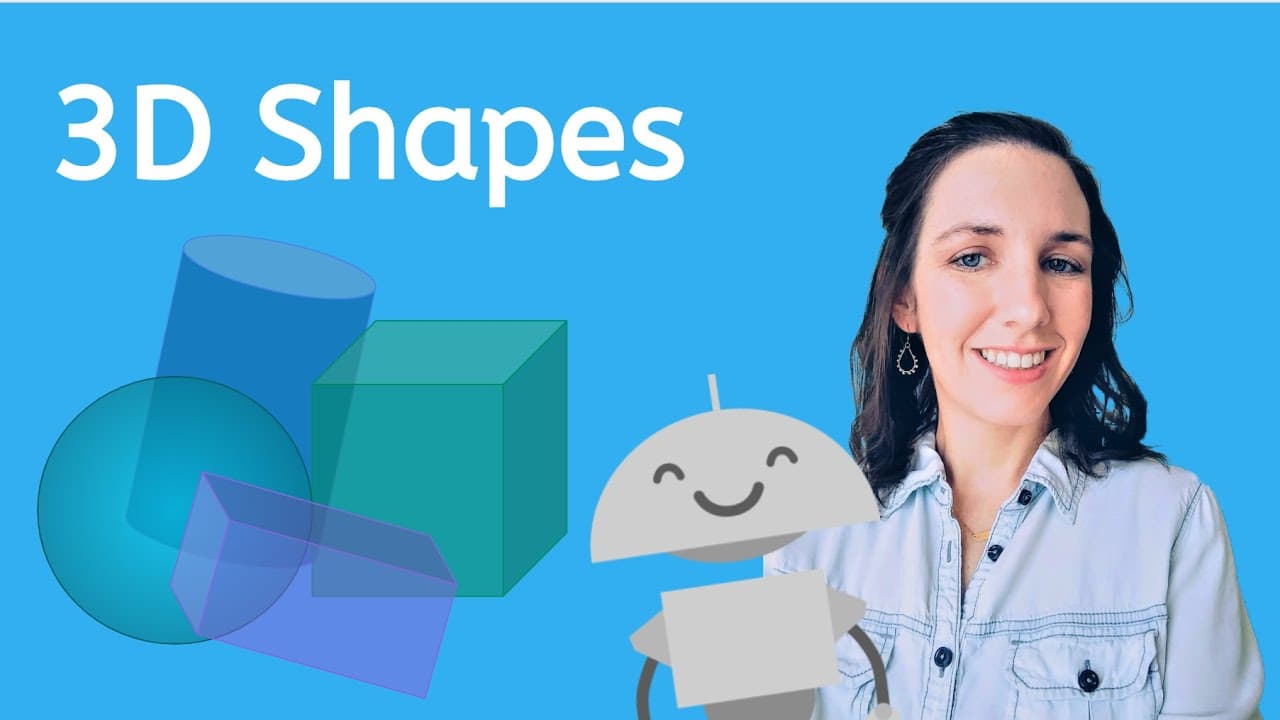
This educational video provides a comprehensive overview of the fundamental properties of three-dimensional figures, specifically focusing on prisms, cylinders, pyramids, cones, and spheres. Hosted by a friendly presenter named Justin, the lesson breaks down complex geometric vocabulary into digestible concepts, teaching students how to identify shapes based on their specific features such as bases, faces, vertices, edges, and curved surfaces. The video emphasizes distinguishing between similar shapes and clarifies specific rules regarding the bases of prisms and cylinders versus pyramids and cones. A significant portion of the video addresses common misconceptions in geometry, particularly the idea that a shape's base must always be on the bottom. Through clear visual examples and rotations of figures like rectangular prisms and triangular pyramids, the content demonstrates that spatial orientation does not define a shape's properties. The video creates a solid foundation for spatial reasoning by explaining exceptions to general rules, such as how any face of a rectangular prism or triangular pyramid can serve as a base. This resource is highly valuable for upper elementary and middle school mathematics classrooms introducing or reviewing geometry concepts. It supports learning by moving beyond simple identification to a deeper understanding of geometric properties, preparing students for more advanced topics like surface area and volume. The clear definitions and visual aids make it an excellent tool for front-loading vocabulary or reinforcing concepts after hands-on exploration with geometric solids.

Miacademy & MiaPrep Learning ChannelMiacademy & MiaPrep Learning Channel

5mins 29s

Video
Exploring Plane and Solid Figures: A Guide to 2D and 3D Geometry

Exploring Plane and Solid Figures: A Guide to 2D and 3D Geometry

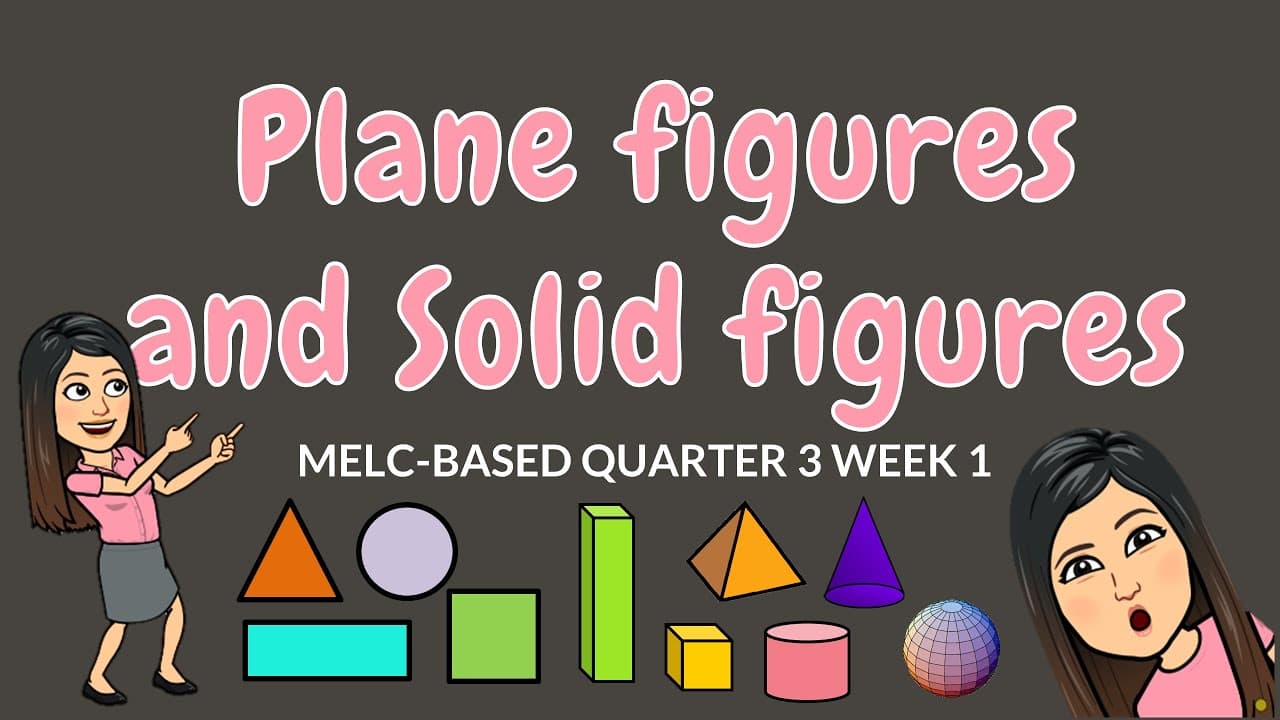
This educational video provides a comprehensive introduction to geometry by distinguishing between plane figures (2D) and solid figures (3D). Through animated examples and real-world objects, the narrator explains the defining characteristics of each category, moving from basic shapes like rectangles and circles to complex solids like prisms and pyramids. The video uses a "treasure hunt" theme to introduce items that represent these mathematical concepts, making abstract definitions concrete for students. The content dives deep into the specific attributes of geometric figures. It covers the anatomy of solid figures—defining and counting edges, vertices, and faces (including lateral faces and bases). It further classifies solid figures into polyhedrons (like cubes and pyramids) and non-polyhedrons (like cylinders, cones, and spheres), explaining the rules for naming pyramids based on their bases. Vocabulary such as "congruent," "parallel," and "dimensions" is integrated throughout. For educators, this video serves as an excellent visual aid for introducing or reinforcing geometry units in upper elementary grades. It is particularly useful for teaching the specific vocabulary required to describe geometric solids and for visualizing the difference between 2D and 3D space. The clear visual breakdown of vertices, edges, and faces allows for pause-and-discuss moments where students can practice counting these attributes along with the video.

Sheena DoriaSheena Doria

11mins 16s

Video
Learning Solid Shapes: Names, Properties, and Real-World Examples

Learning Solid Shapes: Names, Properties, and Real-World Examples

This educational video provides a clear and structured introduction to six common solid (3D) shapes: the cube, cuboid, cylinder, cone, sphere, and pyramid. Following a consistent pattern, the video presents each geometric form, highlights its defining properties such as the number and type of faces (flat or curved), and explicitly names the shape using on-screen text.

MatholiaChannelMatholiaChannel

2mins 3s

Video
What Is a Circle?

What Is a Circle?

A concise and engaging animated introduction to the geometric concept of a circle, featuring Sandy the dingo from Khan Academy Kids. The video provides a clear, age-appropriate definition of a circle as a continuous line with no corners, making abstract geometry accessible for early learners. The content focuses on identifying 2D shapes and connecting mathematical concepts to the real world. By defining a circle by its attributes—specifically the lack of corners and the continuous round nature—it helps build the foundation for geometric reasoning and shape classification. This resource is highly valuable for Pre-K and Kindergarten classrooms as a quick hook or review. Its simple visual demonstration and connection to a familiar object (a tennis ball) allow teachers to easily pivot into activities involving shape hunting, sorting, or drawing. The short duration matches the attention span of the target age group perfectly.

Khan Academy KidsKhan Academy Kids

27s

Video
Spotting Basic Shapes on the Street

Spotting Basic Shapes on the Street

This engaging animated video introduces young learners to basic 2D geometric shapes by identifying them in a bustling street scene. Through a guided observational journey, the narrator points out everyday objects—a flag, a wheel, a sign, a crate, and a phone booth window—and helps viewers identify the specific shapes hidden within them. The video uses bright colors and clear visual overlays to abstract the geometric forms from the real-world illustrations. The core themes focus on early geometry, visual literacy, and observational skills. It covers five fundamental shapes: triangle, circle, oval, square, and rectangle. The video explicitly connects abstract mathematical concepts (shapes) to concrete physical objects students might encounter in their daily lives, reinforcing the idea that math is all around us. For educators, this resource serves as an excellent hook or introduction to a geometry unit for early elementary students. It models the behavior of a "shape detective," encouraging children to look critically at their environment. Teachers can use this video to transition from passive viewing to active learning by asking students to identify other shapes in the video's background or in their own classroom immediately after watching.

MatholiaChannelMatholiaChannel

2mins 27s

Video
Identifying and Naming Polygons in the Real World

Identifying and Naming Polygons in the Real World

This educational video provides a comprehensive introduction to polygons, designed specifically for upper elementary students. The lesson begins by defining a polygon as a closed figure formed by three or more straight line segments, clearly distinguishing them from open figures or shapes with curved lines. It breaks down the anatomical parts of a polygon, including sides, angles, and vertices, using clear visual diagrams and labeling to support understanding.

Sheena DoriaSheena Doria

7mins 35s

Video
Identifying and Describing Basic 2D Shapes

Identifying and Describing Basic 2D Shapes

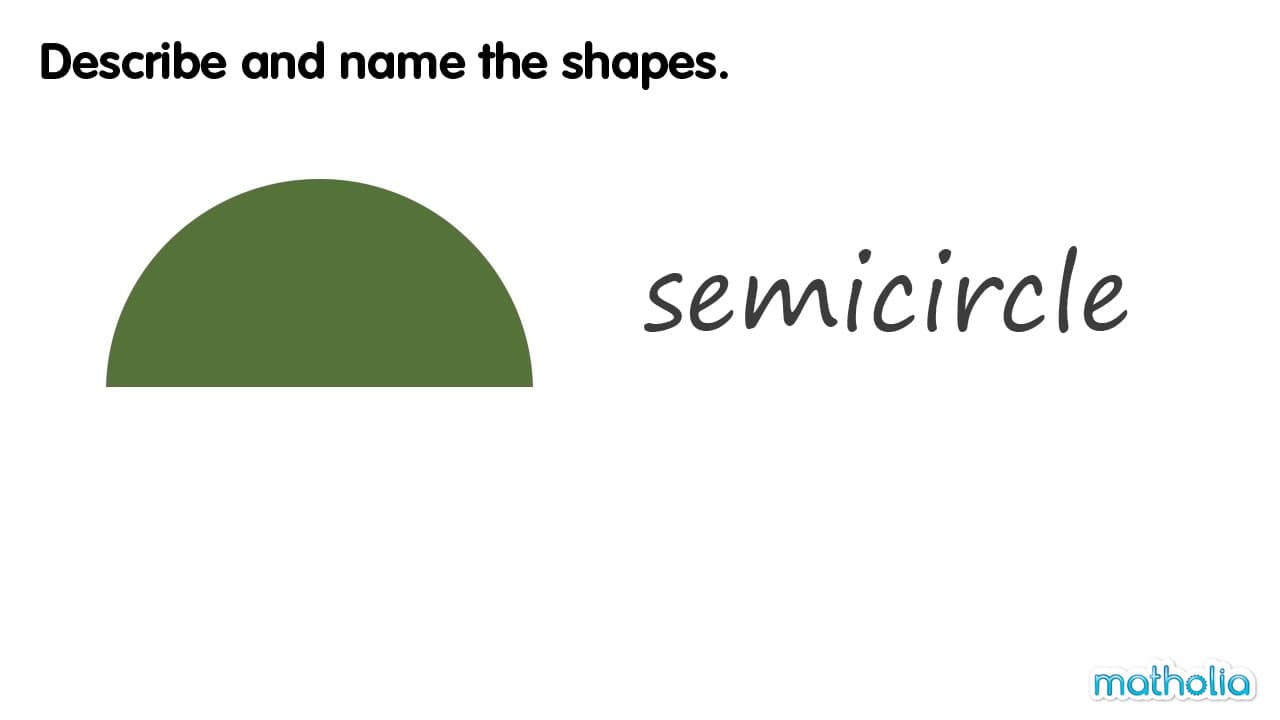
This educational video introduces young learners to the fundamental properties of basic two-dimensional shapes. Through clear narration and simple animations, the video defines a square, rectangle, and triangle by counting their specific attributes—corners and sides. It then explores circular shapes, defining a standard circle before visually demonstrating how dividing a circle creates a semicircle, and dividing that further creates a quarter circle. The content focuses on the geometric language necessary for early math proficiency, specifically the terms "sides," "corners," and the names of the shapes themselves. It highlights the critical distinction between squares and rectangles based on side length equality, a common point of confusion for early learners. The video also subtly introduces fractional thinking by showing the part-whole relationship between circles, semicircles, and quarter circles. Teachers can use this video as a core instructional tool for introducing geometry units in early elementary classrooms. Its step-by-step pacing allows for interactive viewing where students can count along with the narrator. The visual cues—highlighting specific corners and sides—make it an excellent resource for helping students visualize abstract geometric definitions, moving beyond simple recognition to analytical description.

MatholiaChannelMatholiaChannel

1min 59s

Video
Identifying Regular and Irregular Polygons

Identifying Regular and Irregular Polygons

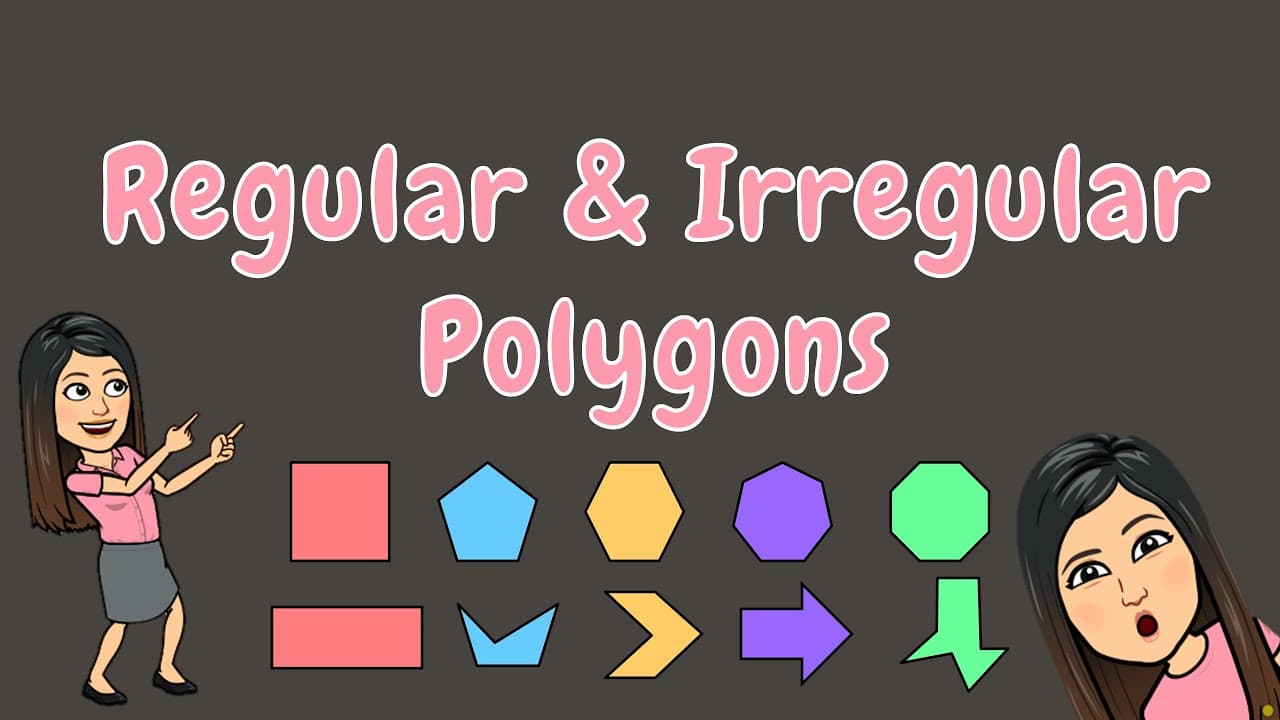
This educational video provides a clear and comprehensive introduction to the properties of regular and irregular polygons. The narrator uses a friendly, animated classroom format to define the specific criteria that make a polygon "regular"—specifically, that it must be both equilateral (having equal sides) and equiangular (having equal angles). Through side-by-side comparisons of familiar shapes like squares, rectangles, triangles, and rhombuses, viewers are taught to identify these properties using visual cues like tick marks and angle measures. The content systematically addresses common misconceptions, such as the belief that having equal sides is enough to be regular (disproven using the rhombus) or that having equal angles is sufficient (disproven using the rectangle). The video moves from basic definitions to analyzing specific polygons like pentagons, hexagons, and octagons, helping students differentiate between "regular" versions and their irregular counterparts. Ideal for upper elementary geometry units, this resource serves as excellent direct instruction or review material. It concludes with a guided quiz section where students must identify polygons based on verbal descriptions, reinforcing vocabulary terms like "congruent," "dodecagon," and "decagon." The clear visual aids, including congruent markers and angle arcs, model exactly how students should annotate shapes in their own mathematical work.

Sheena DoriaSheena Doria

7mins 29s

Video
Identifying and Understanding 3D Geometric Shapes

Identifying and Understanding 3D Geometric Shapes

This educational video provides a clear and accessible introduction to three-dimensional geometric shapes for elementary students. Hosted by a narrator named Ashley, the video distinguishes between flat 2D shapes and space-occupying 3D shapes before systematically exploring eight fundamental solids: the sphere, cube, rectangular prism, triangular prism, cylinder, cone, square pyramid, and triangular pyramid. For each shape, the video utilizes clean, rotating 3D animations to illustrate its properties while the narrator explains key identifying features. The explanations focus on the shape of the bases, the nature of the faces (flat squares, rectangles, triangles, or curved surfaces), and structural elements like points or vertices. Simple real-world analogies, such as comparing a sphere to a basketball or a cone to an ice cream cone, help ground abstract geometric concepts in familiar objects. This resource is highly valuable for early elementary math instruction as it helps students move beyond simple shape recognition to understanding structural properties. Teachers can use it to introduce geometric vocabulary, visualize hidden faces of solids through the rotating animations, and demonstrate the relationship between 2D shapes (like squares and triangles) and the 3D solids they form.

Miacademy & MiaPrep Learning ChannelMiacademy & MiaPrep Learning Channel

5mins 47s

Video
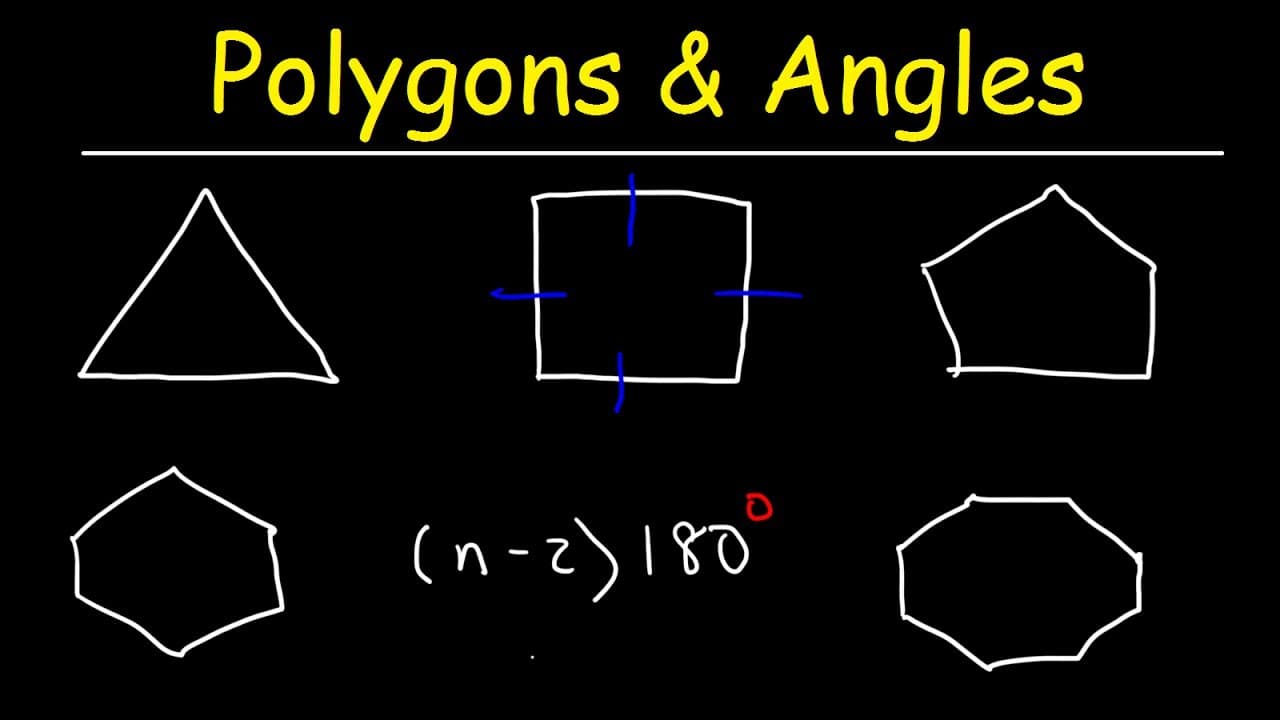
Naming Polygons and Finding Interior Angles

Naming Polygons and Finding Interior Angles

This concise mathematics tutorial introduces students to the naming conventions of polygons based on their side counts and demonstrates how to calculate the sum and individual measures of interior angles in regular polygons. The video utilizes a digital whiteboard format to visually construct shapes ranging from triangles to octagons, explicitly defining what makes a polygon "regular" (congruent sides and angles). It provides a clear, step-by-step application of the interior angle sum formula, (n-2) × 180, solving for both a pentagon and a hexagon. The key themes explored include geometric vocabulary (congruent, regular, interior angles), classification of shapes, and algebraic substitution. The video focuses heavily on procedural fluency, showing students exactly how to substitute the number of sides (n) into the formula to find the total sum of angles, and then dividing by n to find the measure of a single angle in a regular polygon. For educators, this video serves as an excellent direct instruction tool or review resource for a Geometry or Pre-Algebra unit. It effectively bridges the gap between identifying shapes and performing calculations with them. Teachers can use this video to model problem-solving steps before having students practice with other polygons (like heptagons or decagons) or to reinforce the connection between the number of sides and the total degrees within a shape.

The Organic Chemistry TutorThe Organic Chemistry Tutor

3mins 43s

Video
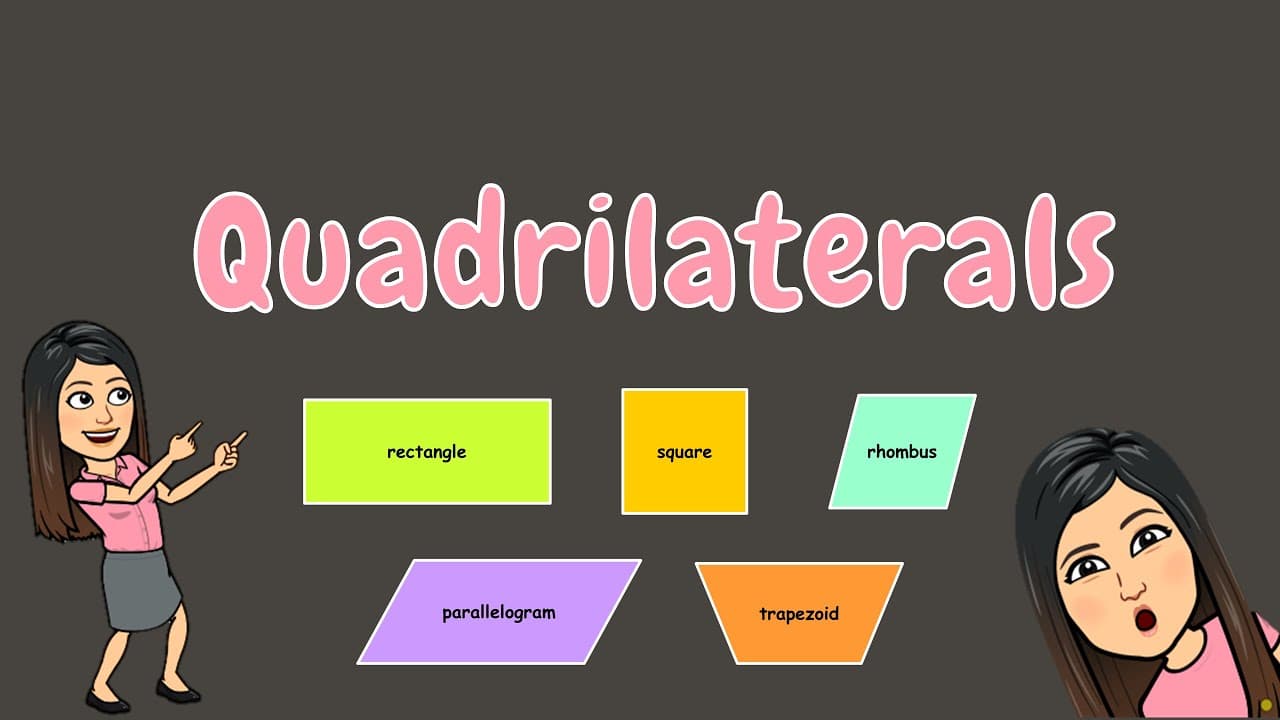
Classifying Quadrilaterals and Their Properties

Classifying Quadrilaterals and Their Properties

This educational video serves as a comprehensive introduction to quadrilaterals, specifically targeted at upper elementary students. It begins with a relatable hook using a treasure chest of everyday objects to establish the common characteristic of having four sides. The narrator breaks down the etymology of the word "quadrilateral" and visually demonstrates how four line segments combine to create a closed polygon with specific angle properties totaling 360 degrees. The core of the video systematically classifies five specific types of quadrilaterals: rectangles, squares, rhombuses, parallelograms, and trapezoids. For each shape, the video uses dynamic animations to transform one shape into another (e.g., squashing a square to make a rhombus), helping students visualize the relationships between them. It clearly lists the defining properties of each, focusing on side lengths, parallel lines, and angle measurements. This resource is highly valuable for mathematics instruction as it moves beyond simple shape recognition to analyzing geometric properties. It visually demonstrates abstract concepts like "parallel lines" and "opposite angles" through clear graphics. Teachers can use this video to introduce a geometry unit, review shape classifications, or clarify the subtle differences between similar shapes, such as a square and a rhombus.

Sheena DoriaSheena Doria

6mins 7s

Video
Drawing, Cutting, and Identifying Shapes

Drawing, Cutting, and Identifying Shapes

This engaging animated music video introduces students to six fundamental 2D shapes: circle, square, triangle, oval, rectangle, and star. Through a catchy, repetitive song performed by a boy and a crocodile, viewers are guided through a consistent learning process for each shape that involves tracing, drawing, cutting, pasting, spelling, and identifying real-world examples. The video seamlessly blends art, literacy, and geometry into a high-energy narrative set against colorful backgrounds and outer space scenes. Key themes include geometric shape recognition, fine motor skills (tracing, cutting, pasting), and spelling. The video emphasizes the concept that shapes are everywhere, moving from the classroom setting to outer space and back to everyday objects like food, nature, and buildings. It explicitly connects abstract geometric concepts to concrete items students recognize, such as pizza slices, coins, and street signs. For educators, this video is a versatile tool for early childhood classrooms. It supports multi-modal learning by combining visual identification with auditory spelling chants and kinesthetic actions like tracing and cutting. It serves as an excellent hook for lessons on geometry, an interactive spelling practice for math vocabulary, or a guide for an arts and crafts activity centered on shape collages.

Math Songs by NUMBEROCKMath Songs by NUMBEROCK

3mins 15s

Video
Predicting and Extending Shape Patterns

Predicting and Extending Shape Patterns

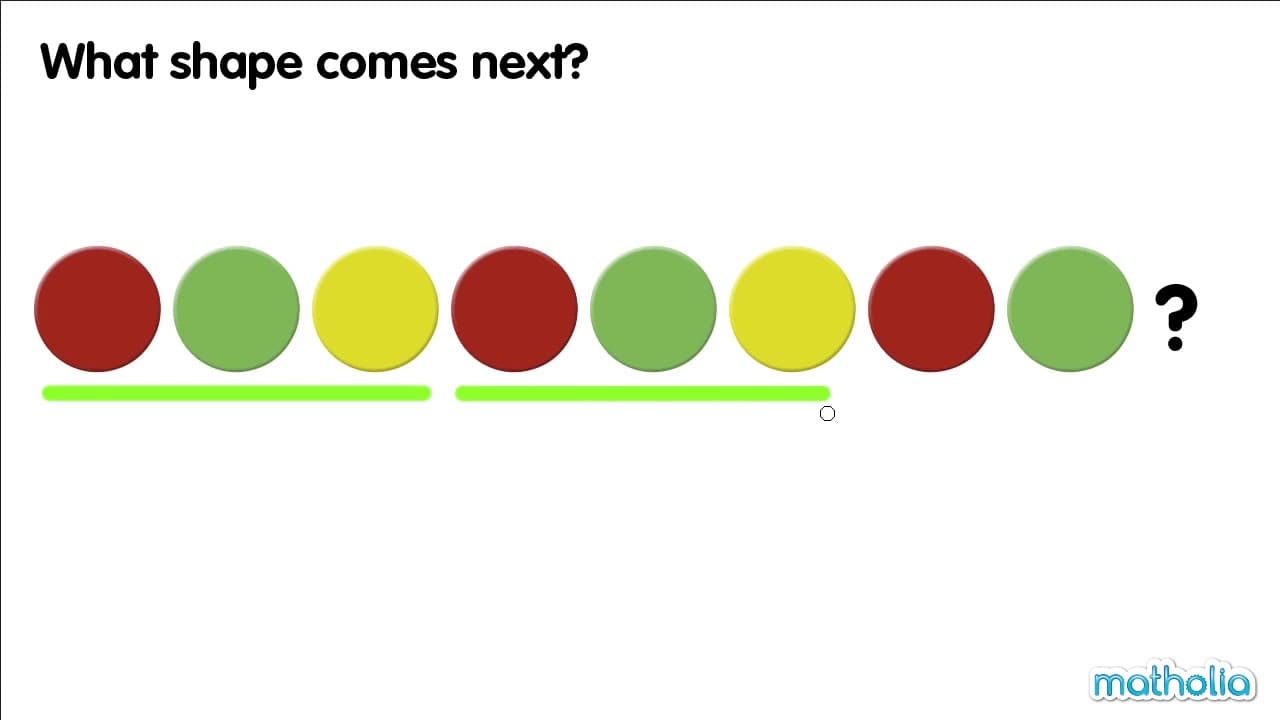
This educational video introduces young learners to the concept of repeating patterns using geometric shapes. It systematically explores different types of patterns based on changing attributes, including size, shape, color, and orientation. Through clear visual examples and narration, the video demonstrates how to identify the "repeating part" (the core unit) of a pattern and use it to predict what comes next. The content covers five distinct pattern types: size variation (big vs. small squares), shape variation (square, triangle, circle), color variation (red, green, yellow circles), orientation variation (upright vs. sideways rectangles), and complex patterns combining multiple attributes (size and color). Each segment follows a structured format: asking what comes next, identifying the rule, highlighting the repeating unit, and revealing the answer. This resource is highly valuable for early elementary mathematics classrooms focusing on algebraic thinking and logic. It helps students develop visual discrimination skills and learn specific vocabulary like "orientation" and "repeating part." Teachers can use this video to introduce pattern rules or as a visual anchor before having students create patterns with manipulatives like blocks or beads.
MatholiaChannelMatholiaChannel

2mins 23s

Video
Learning Positional Words: On, Under, Above, and More

Learning Positional Words: On, Under, Above, and More

This animated video provides a clear and engaging introduction to positional words (prepositions of place) for early learners. Set in a child's bedroom, the video follows a character named Hallie and asks viewers to identify the location of various objects like books, a ukulele, a toy rabbit, and a school bag. By isolating these objects and pairing them with clear text labels, the video visually demonstrates spatial relationships. The content focuses on key vocabulary concepts including "on," "below," "under," "in front of," "behind," and "above." Each term is introduced through a question-and-answer format, where the narrator asks for the location of an object, pauses, and then provides the answer while displaying the specific word on screen. This repetition helps reinforce the connection between the object's physical placement and the vocabulary word used to describe it. For educators, this video serves as an excellent visual aid for teaching spatial awareness in math or prepositions in language arts. The clean animation and isolation of objects make it easy for students to focus on the specific spatial relationship being demonstrated. It is particularly useful for establishing the foundational vocabulary needed for geometry, following directions, and describing scenes.

MatholiaChannelMatholiaChannel

2mins 5s

Video
Exploring the Fundamentals of 3D Figures

Exploring the Fundamentals of 3D Figures

This educational video provides a comprehensive overview of the fundamental properties of three-dimensional figures, specifically focusing on prisms, cylinders, pyramids, cones, and spheres. Hosted by a friendly presenter named Justin, the lesson breaks down complex geometric vocabulary into digestible concepts, teaching students how to identify shapes based on their specific features such as bases, faces, vertices, edges, and curved surfaces. The video emphasizes distinguishing between similar shapes and clarifies specific rules regarding the bases of prisms and cylinders versus pyramids and cones. A significant portion of the video addresses common misconceptions in geometry, particularly the idea that a shape's base must always be on the bottom. Through clear visual examples and rotations of figures like rectangular prisms and triangular pyramids, the content demonstrates that spatial orientation does not define a shape's properties. The video creates a solid foundation for spatial reasoning by explaining exceptions to general rules, such as how any face of a rectangular prism or triangular pyramid can serve as a base. This resource is highly valuable for upper elementary and middle school mathematics classrooms introducing or reviewing geometry concepts. It supports learning by moving beyond simple identification to a deeper understanding of geometric properties, preparing students for more advanced topics like surface area and volume. The clear definitions and visual aids make it an excellent tool for front-loading vocabulary or reinforcing concepts after hands-on exploration with geometric solids.

Miacademy & MiaPrep Learning ChannelMiacademy & MiaPrep Learning Channel

5mins 29s

Video
From Polygons to 3D Shapes: A Visual Guide

From Polygons to 3D Shapes: A Visual Guide

This educational video provides a clear and concise progression from basic two-dimensional polygons to three-dimensional solids. The presenter begins by reviewing quadrilaterals and introducing 5-sided (pentagon) and 6-sided (hexagon) shapes, briefly mentioning polygons with even more sides. The lesson then shifts focus to curved shapes, defining a circle through the concept of equidistant points from a center. Key themes explored include geometric vocabulary (vertices, edges, faces), the etymology of shape names (penta, hexa), and spatial reasoning. A major focus is the conceptual relationship between dimensions; the narrator encourages viewers to visualize "pulling" 2D shapes out of the whiteboard to create 3D forms, such as extending a square into a cube or a circle into a cylinder. For educators, this video serves as an excellent bridge for students moving from simple shape identification to understanding geometric properties and spatial depth. The visual demonstrations on the whiteboard—particularly the comprehensive summary chart visible at the end—offer a valuable reference for classifying lines, angles, triangles, and solids. It helps students understand not just what shapes are called, but how they are constructed and related to one another.

Miacademy & MiaPrep Learning ChannelMiacademy & MiaPrep Learning Channel

2mins 44s

Video
Learning Solid Shapes: Names, Properties, and Real-World Examples

Learning Solid Shapes: Names, Properties, and Real-World Examples

This educational video provides a clear and structured introduction to six common solid (3D) shapes: the cube, cuboid, cylinder, cone, sphere, and pyramid. Following a consistent pattern, the video presents each geometric form, highlights its defining properties such as the number and type of faces (flat or curved), and explicitly names the shape using on-screen text.

MatholiaChannelMatholiaChannel

2mins 3s

Video
What Is a Circle?

What Is a Circle?

A concise and engaging animated introduction to the geometric concept of a circle, featuring Sandy the dingo from Khan Academy Kids. The video provides a clear, age-appropriate definition of a circle as a continuous line with no corners, making abstract geometry accessible for early learners. The content focuses on identifying 2D shapes and connecting mathematical concepts to the real world. By defining a circle by its attributes—specifically the lack of corners and the continuous round nature—it helps build the foundation for geometric reasoning and shape classification. This resource is highly valuable for Pre-K and Kindergarten classrooms as a quick hook or review. Its simple visual demonstration and connection to a familiar object (a tennis ball) allow teachers to easily pivot into activities involving shape hunting, sorting, or drawing. The short duration matches the attention span of the target age group perfectly.

Khan Academy KidsKhan Academy Kids

27s

Video
Virtual Manipulatives for Singapore Mathematics

Virtual Manipulatives for Singapore Mathematics

This video provides an overview of virtual manipulatives designed to support the Singapore Mathematics curriculum, specifically focusing on the Concrete-Pictorial-Abstract (CPA) pedagogical approach. It demonstrates a wide variety of digital tools that replicate physical math manipulatives, such as number bonds, linking cubes, bar models, and place value discs, showing how they can bridge the gap between hands-on learning and abstract conceptual understanding. The content highlights how these digital resources can be integrated into different learning environments, including traditional classroom instruction, flipped classroom models, and autonomous home learning. It emphasizes the versatility of the tools in supporting visual modeling for concepts ranging from basic arithmetic to geometry and measurement, catering to various international currencies and measurement systems. For educators and parents, this video serves as a professional development resource introducing the rationale behind using digital manipulatives. It explains how visual models help students deepen their abstract understanding of concepts like multiplication, fractions, and word problems. The video demonstrates specific software tools that teachers can incorporate into lesson plans to enhance student engagement and conceptual clarity.

MatholiaChannelMatholiaChannel

2mins 3s

Video
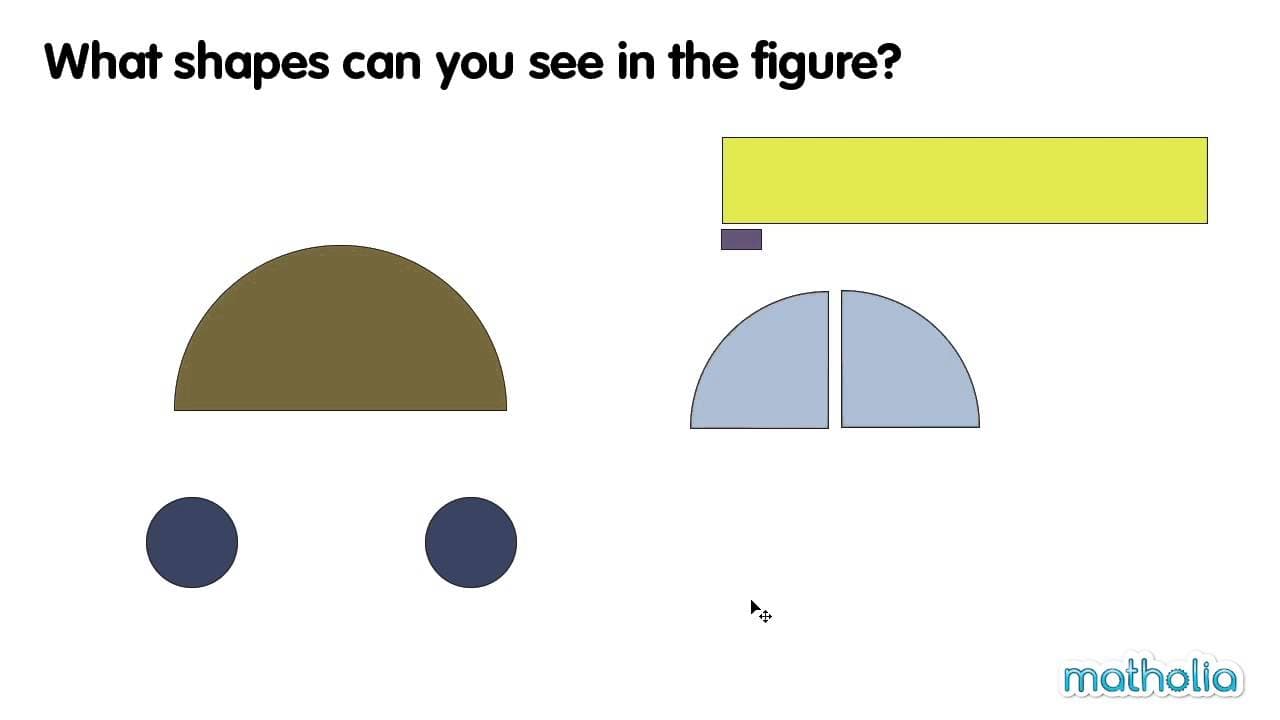
Finding Shapes Within Pictures

Finding Shapes Within Pictures

This educational video introduces young students to the concept of composite shapes—figures made up of smaller, distinct geometric shapes. Through clear, animated examples, it demonstrates how complex images like a car and a castle can be deconstructed into basic components such as rectangles, circles, semi-circles, and triangles. The video uses a slow, deliberate pace that allows students to visually track each shape as it is isolated from the main image and then returned to its place. The content focuses on key geometry topics including shape identification, spatial reasoning, and part-whole relationships. It explicitly names 2D shapes (rectangle, square, triangle, circle) and introduces more specific terms like 'semi-circle' and 'quarter circle,' helping to expand students' mathematical vocabulary beyond the basics. For the classroom, this video serves as an excellent hook for lessons on geometry or art. It encourages students to look at the world with a 'mathematical eye,' identifying geometric structures in everyday objects. Teachers can use this as a model for hands-on activities where students build their own figures using pattern blocks or paper cutouts, bridging the gap between abstract geometric concepts and tangible application.

MatholiaChannelMatholiaChannel

1min 29s

Video
Exploring Properties of 3D Shapes: Faces, Edges, and Vertices

Exploring Properties of 3D Shapes: Faces, Edges, and Vertices

This educational video serves as a clear, step-by-step introduction to the geometric properties of five common 3D shapes: the cube, rectangular prism (cuboid), sphere, cone, and cylinder. For each shape, the narration systematically defines its structure by counting its faces, edges, and vertices. Visual animations highlight these specific parts on the geometric models as they are counted, helping students connect the abstract vocabulary to the physical attributes of the shape.

MatholiaChannelMatholiaChannel

2mins 43s

Video
Prefixes and Polygons: Naming Shapes by Number of Sides

Prefixes and Polygons: Naming Shapes by Number of Sides

A high-energy, animated musical lesson that teaches students how to identify and name polygons based on their number of sides. The video uses a catchy hip-hop song to introduce Greek prefixes (Tri-, Quad-, Penta-, etc.) and connects each shape to real-world objects, such as a sailboat, a door, and a stop sign. It covers shapes ranging from triangles (3 sides) to decagons (10 sides). The video reinforces the relationship between the prefix and the number of sides, helping students memorize geometric vocabulary through rhyme and repetition. It features a "call and response" quiz section where viewers are asked to identify shapes, as well as a visual counting sequence that highlights the sides of each polygon as they are counted. In addition to naming shapes, the video explicitly defines the rules of what constitutes a polygon: it must be a closed shape and must have straight sides. This resource is excellent for introducing geometry units, reviewing vocabulary, or helping students understand the linguistic roots of mathematical terms.

Math Songs by NUMBEROCKMath Songs by NUMBEROCK

3mins 41s

Video
Exploring Triangles and Quadrilaterals: Types and Angles

Exploring Triangles and Quadrilaterals: Types and Angles

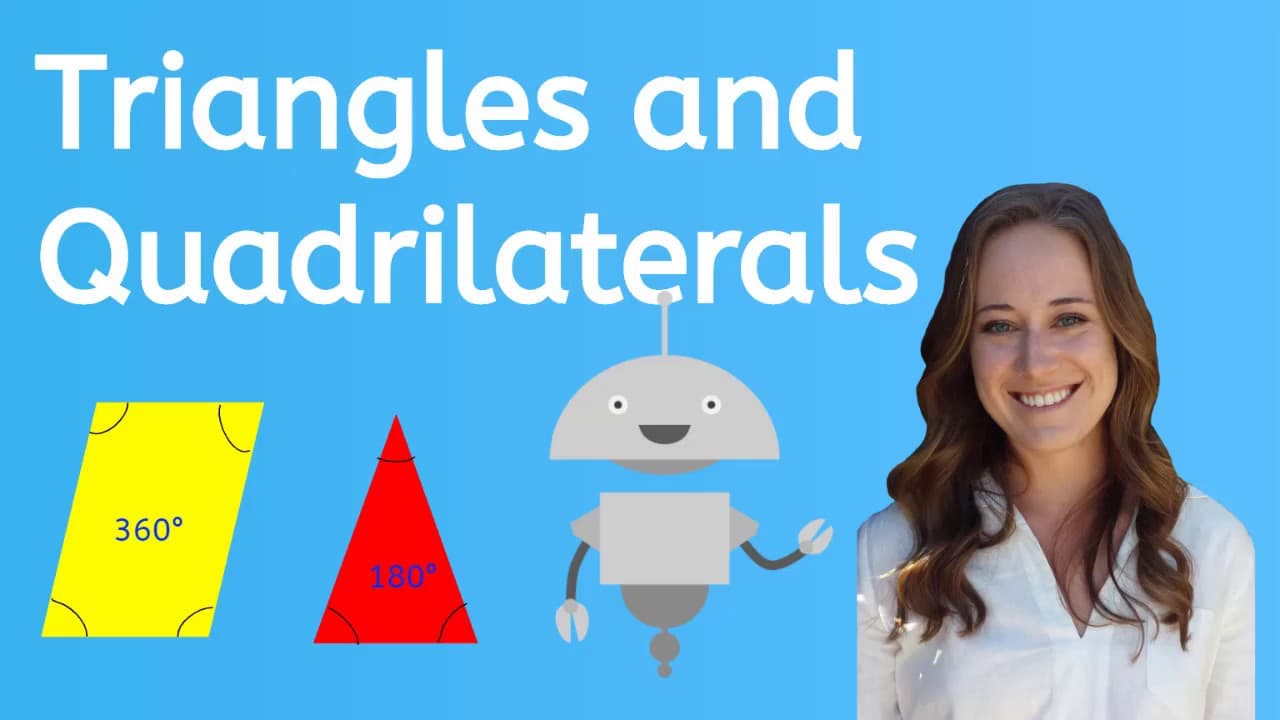
This comprehensive math video serves as a detailed introduction to the fundamental properties, classifications, and angle rules of triangles and quadrilaterals. The lesson begins by defining triangles, demonstrating how to name their components (sides, vertices, angles), and categorizing them by angle type (right, acute, obtuse) and side length (equilateral, isosceles, scalene). It then transitions to quadrilaterals, introducing concepts such as parallel lines and congruence through familiar shapes like squares and parallelograms, while encouraging viewers to identify these properties visually. A central theme of the video is the calculation of interior angles. The narrator explains and visually proves that the sum of interior angles in a triangle is always 180 degrees, while in a quadrilateral it is 360 degrees. This concept is reinforced through a demonstration showing how a quadrilateral can be divided into two triangles. The video moves beyond theory into application by modeling how to set up and solve basic algebraic equations to find missing angles in both types of polygons. For the classroom, this video is an excellent resource for bridging geometry and early algebra. The clear, step-by-step examples of solving for 'x' provide a model for student work, while the visual quizzes on quadrilateral properties offer built-in opportunities for formative assessment. Teachers can use the pause points during calculation segments to allow students to practice independent problem-solving before revealing the answers, making it a highly interactive tool for 4th through 6th-grade math curriculums.

Miacademy & MiaPrep Learning ChannelMiacademy & MiaPrep Learning Channel

8mins 39s

Video
What Makes a Shape a Rectangle?

What Makes a Shape a Rectangle?

This concise educational video introduces the defining geometric characteristics of a rectangle. Through clear animations and step-by-step narration, viewers learn the four specific rules that make a shape a rectangle: having four sides, opposite sides of equal length, opposite sides being parallel, and the presence of four right angles.

MatholiaChannelMatholiaChannel

53s

Video
Classifying Quadrilaterals and Finding Unknown Angles

Classifying Quadrilaterals and Finding Unknown Angles

This comprehensive math video provides a clear and engaging introduction to quadrilaterals, a specific family of polygons with four sides and four angles. Using dynamic animations, the narrator starts with a basic square and systematically modifies its properties—such as side lengths and angle measures—to introduce related shapes like rectangles, rhombuses, and parallelograms. This visual approach helps students understand the hierarchical relationships between these shapes rather than seeing them as isolated definitions.

mathanticsmathantics

9mins 50s

Video
Identifying and Describing Basic 2D Shapes

Identifying and Describing Basic 2D Shapes

This educational video introduces young learners to the fundamental properties of basic two-dimensional shapes. Through clear narration and simple animations, the video defines a square, rectangle, and triangle by counting their specific attributes—corners and sides. It then explores circular shapes, defining a standard circle before visually demonstrating how dividing a circle creates a semicircle, and dividing that further creates a quarter circle. The content focuses on the geometric language necessary for early math proficiency, specifically the terms "sides," "corners," and the names of the shapes themselves. It highlights the critical distinction between squares and rectangles based on side length equality, a common point of confusion for early learners. The video also subtly introduces fractional thinking by showing the part-whole relationship between circles, semicircles, and quarter circles. Teachers can use this video as a core instructional tool for introducing geometry units in early elementary classrooms. Its step-by-step pacing allows for interactive viewing where students can count along with the narrator. The visual cues—highlighting specific corners and sides—make it an excellent resource for helping students visualize abstract geometric definitions, moving beyond simple recognition to analytical description.

MatholiaChannelMatholiaChannel

1min 59s

Video
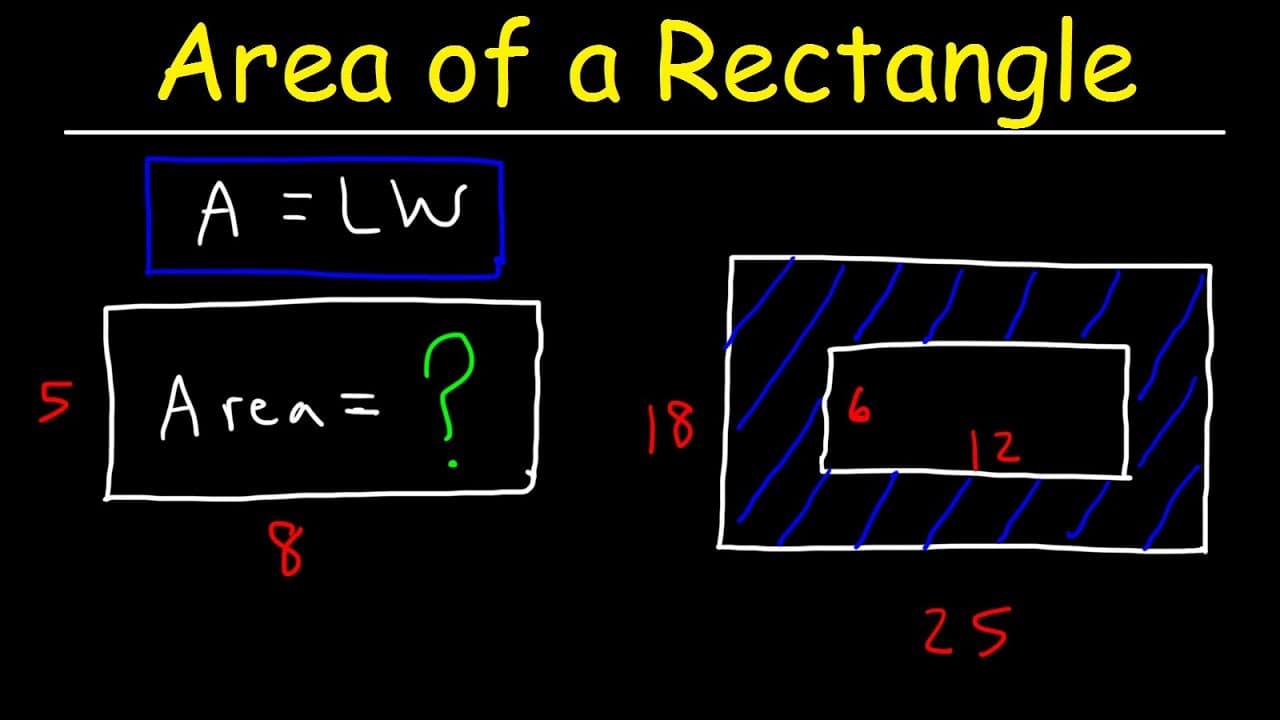
Calculating Volume and Surface Area of 3D Shapes

Calculating Volume and Surface Area of 3D Shapes

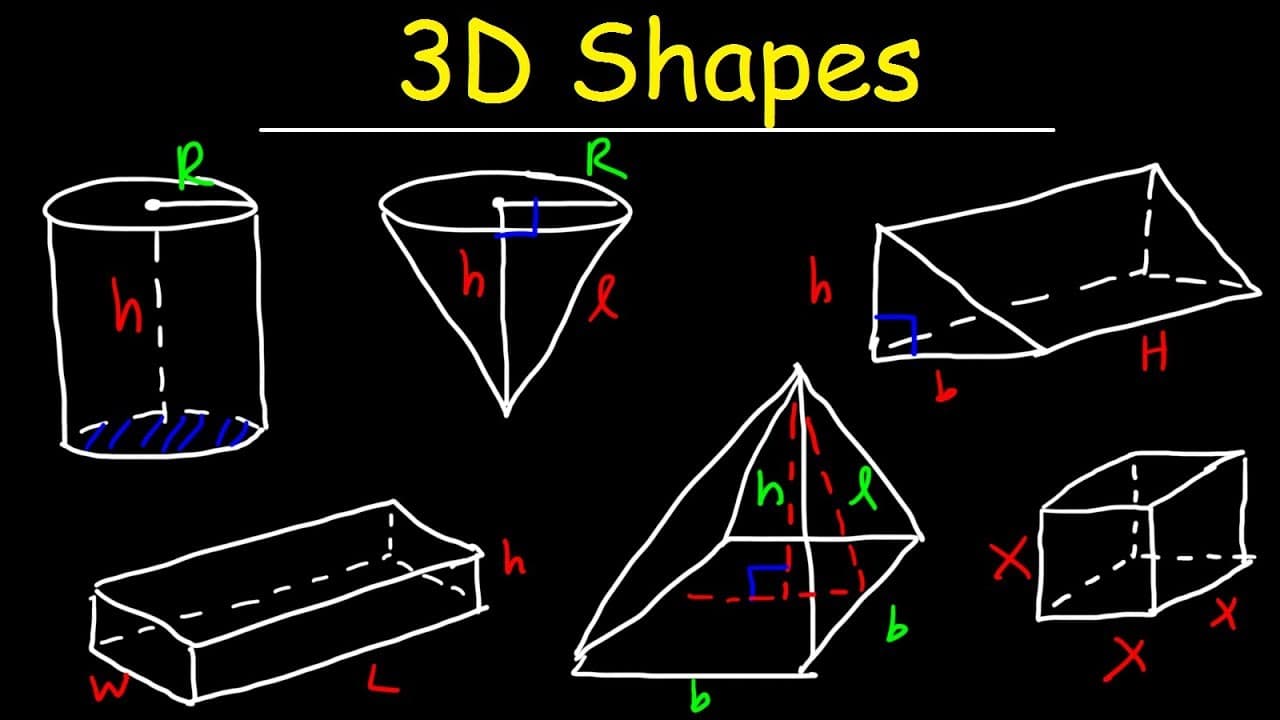
This comprehensive math tutorial provides a detailed overview of essential three-dimensional geometric figures, specifically focusing on how to calculate their volume and surface area. The video systematically covers seven key shapes: spheres, cylinders, cones, rectangular prisms, triangular prisms, square pyramids, and cubes. For each shape, the narrator sketches the figure, identifies its key components (like radius, height, slant height, length, and width), and clearly presents the specific formulas needed for calculations. Special attention is given to distinguishing between lateral area and total surface area, as well as deriving values like slant height using the Pythagorean theorem. The video explores fundamental geometric concepts including the relationship between 2D bases and 3D solids. It demonstrates how complex surface area formulas are built by adding the areas of individual faces, helping students understand the logic behind the equations rather than just memorizing them. The tutorial also introduces Euler's Formula for polyhedra, teaching viewers how to count and verify the relationship between faces, vertices, and edges for shapes like cubes and triangular prisms. This resource is highly valuable for middle and high school geometry classrooms. It serves as an excellent reference guide for students learning to navigate geometric formulas. Teachers can use this video to introduce new shapes, review for assessments, or support students who struggle with visualizing 3D objects. The step-by-step breakdown of how to determine components like the diagonal of a prism or the slant height of a pyramid provides the scaffolding necessary for solving higher-level geometry problems.

The Organic Chemistry TutorThe Organic Chemistry Tutor

30mins 18s

Video
How to Identify Basic 2D Shapes

How to Identify Basic 2D Shapes

This educational video provides a clear and structured introduction to four fundamental two-dimensional shapes: the square, circle, triangle, and rectangle. Through a repetitive and paced narrative, the video guides young learners in identifying each shape by examining its defining attributes—specifically counting the number of corners and sides. The clear audio and simple visual cues help students connect the visual form with the mathematical properties and the shape's name. The content focuses on early geometry concepts, specifically the identification of 2D shapes and the vocabulary of "sides" and "corners" (vertices). For each shape, the video follows a distinct pattern: identifying the attributes, naming the shape, and then displaying a variety of examples in different colors, sizes, and orientations to reinforce that a shape's identity remains constant regardless of these variables. For educators, this video serves as an excellent foundational tool for Pre-K through 1st-grade mathematics. It allows teachers to pause and count along with the narrator, making it an interactive experience. The segment showing various examples of each shape is particularly useful for preventing the common misconception that shapes must always look a certain way (e.g., that a triangle must always have a flat bottom). The video concludes with a summary screen perfect for a quick formative assessment or review.

MatholiaChannelMatholiaChannel

3mins 17s

Video
Exploring Plane and Solid Figures: A Guide to 2D and 3D Geometry

Exploring Plane and Solid Figures: A Guide to 2D and 3D Geometry

This educational video provides a comprehensive introduction to geometry by distinguishing between plane figures (2D) and solid figures (3D). Through animated examples and real-world objects, the narrator explains the defining characteristics of each category, moving from basic shapes like rectangles and circles to complex solids like prisms and pyramids. The video uses a "treasure hunt" theme to introduce items that represent these mathematical concepts, making abstract definitions concrete for students. The content dives deep into the specific attributes of geometric figures. It covers the anatomy of solid figures—defining and counting edges, vertices, and faces (including lateral faces and bases). It further classifies solid figures into polyhedrons (like cubes and pyramids) and non-polyhedrons (like cylinders, cones, and spheres), explaining the rules for naming pyramids based on their bases. Vocabulary such as "congruent," "parallel," and "dimensions" is integrated throughout. For educators, this video serves as an excellent visual aid for introducing or reinforcing geometry units in upper elementary grades. It is particularly useful for teaching the specific vocabulary required to describe geometric solids and for visualizing the difference between 2D and 3D space. The clear visual breakdown of vertices, edges, and faces allows for pause-and-discuss moments where students can practice counting these attributes along with the video.

Sheena DoriaSheena Doria

11mins 16s

Video
How to Classify Triangles by Sides and Angles

How to Classify Triangles by Sides and Angles

A high-energy, musical educational animation that teaches students how to classify triangles based on their sides and angles. Through a catchy rock song, the video introduces key geometry vocabulary including isosceles, scalene, equilateral, acute, obtuse, and right triangles, while also reinforcing the concept that the sum of interior angles in any triangle equals 180 degrees. The content breaks down classification into clear sections: first connecting side lengths to visual metaphors (like mountains and road signs), then examining angle measurements within those same shapes. It visually demonstrates the angle sum theorem by animating the angles of a triangle coming together to form a straight line (semicircle). This video is an excellent resource for 3rd through 5th-grade math classrooms. It serves as an engaging hook to introduce geometry units or a memorable review tool. Teachers can use the song's real-world examples—such as boat sails, skateboard ramps, and billiard racks—to help students recognize geometric shapes in their environment.

Math Songs by NUMBEROCKMath Songs by NUMBEROCK

1min 54s

Video
Learning the Properties of Rectangles

Learning the Properties of Rectangles

In this engaging animated video, Sandy the dingo from Khan Academy Kids introduces young learners to the geometric concept of a rectangle. Through clear visual demonstrations, Sandy breaks down the defining attributes of the shape, including its side counts, corners, and the relationship between opposite sides. The video uses a friendly character-driven approach to make abstract geometry concrete. The content focuses on key geometric vocabulary and properties, specifically identifying that rectangles have four sides and four corners, with opposite sides being parallel. It distinguishes rectangles from other quadrilaterals by noting they usually have two longer sides and two shorter sides. The lesson bridges the gap between geometry and the real world by transforming the abstract shape into a common object—a door. This video is an excellent resource for early childhood and lower elementary classrooms introducing 2D shapes. It provides a concise, visual definition that helps students move beyond simple shape recognition to understanding specific attributes. Teachers can use it to spark 'shape hunts' in the classroom or as a primer for lessons on sides, vertices, and parallel lines.

Khan Academy KidsKhan Academy Kids

37s

Video
Learning Shapes: What Is a Triangle?

Learning Shapes: What Is a Triangle?

This engaging animated video introduces young learners to the concept of a triangle through a friendly character named Sandy the Dingo. The video provides a clear, visual definition of the shape by identifying its defining properties: having exactly three sides and three corners. Through simple narration and on-screen counting, students are guided to recognize these features on a geometric diagram. The content bridges abstract geometry and the real world by transforming the triangle outline into an illustration of a mountain, specifically referencing Mount Fuji. This helps children understand that geometric shapes exist in their everyday environment and nature. The pacing is deliberate and slow, allowing time for viewers to count along and visually track the highlighted attributes. Ideally suited for early childhood education, this video serves as an excellent hook for lessons on 2D shapes and geometry. Teachers can use it to introduce vocabulary like "sides" and "corners" or as a prompt for shape-hunting activities. Its brevity makes it perfect for quick reinforcement or as a transition activity in Pre-K through 1st-grade classrooms.

Khan Academy KidsKhan Academy Kids

30s

Video
Understanding Angles as a Measure of Turn

Understanding Angles as a Measure of Turn

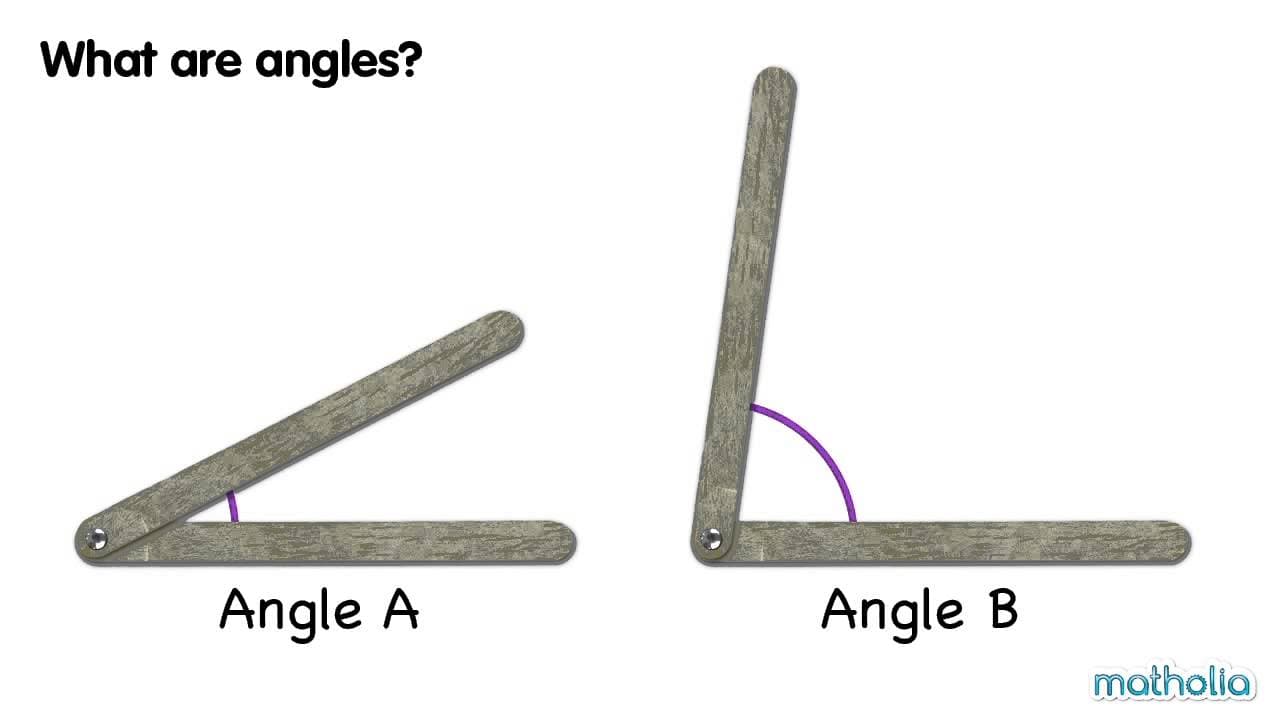
This educational video introduces the geometric concept of angles through a clear, visual demonstration using everyday objects. It defines an angle specifically as a "measure of turn" between two straight lines, moving beyond static shape recognition to help students understand the dynamic nature of how angles are formed. Using animated ice cream sticks joined at a pivot point, the video visually demonstrates how the amount of rotation determines the size of the angle. The content progresses from a basic definition to a comparative analysis. It shows side-by-side comparisons of different angles, labeled as Angle A and Angle B, to teach students how to distinguish between smaller and larger angles based on the degree of the opening. The video explicitly connects the concept of "turning a little" versus "turning a lot" to the resulting angle size, providing concrete language for young learners to describe geometry. The final segment of the video applies this knowledge through an interactive sorting exercise. Viewers are asked to observe three distinct angles with different orientations and arrange them from greatest to smallest. This supports critical thinking and spatial reasoning skills, making the video an excellent tool for introducing geometry units in lower elementary classrooms.

MatholiaChannelMatholiaChannel

1min 35s

Video
Classifying Triangles by Sides and Angles

Classifying Triangles by Sides and Angles

This concise educational video provides a foundational introduction to triangles and their classification within geometry. The presenter begins by defining the basic properties of a triangle as a flat, two-dimensional figure with three sides and three angles. Using a whiteboard with pre-drawn diagrams, the video visually demonstrates how to categorize triangles based on their angle measurements (acute, obtuse, right) and their side lengths (equilateral, isosceles, scalene). The key themes explore geometric vocabulary and visual literacy in mathematics. The video introduces specific terms like "acute," "obtuse," and "right" to describe angles relative to 90 degrees. It then transitions to classifying triangles by side properties, introducing "equilateral," "isosceles," and "scalene." The instructor uses standard geometric notation, such as tick marks to indicate equal side lengths and arcs for angles, helping students learn how to read mathematical diagrams. For the classroom, this video serves as an excellent visual anchor for a geometry unit. The clear, step-by-step drawing and labeling process allows teachers to pause and discuss each type of triangle. Notably, the latter portion of the video relies purely on visual demonstration without voiceover definitions, creating a unique opportunity for inquiry-based learning where students must infer the definitions of isosceles and scalene triangles based on the visual markings shown on the whiteboard.

Miacademy & MiaPrep Learning ChannelMiacademy & MiaPrep Learning Channel

1min 31s

Video
Prefixes and Polygons: Naming Shapes by Number of Sides

Prefixes and Polygons: Naming Shapes by Number of Sides

A high-energy, animated musical lesson that teaches students how to identify and name polygons based on their number of sides. The video uses a catchy hip-hop song to introduce Greek prefixes (Tri-, Quad-, Penta-, etc.) and connects each shape to real-world objects, such as a sailboat, a door, and a stop sign. It covers shapes ranging from triangles (3 sides) to decagons (10 sides). The video reinforces the relationship between the prefix and the number of sides, helping students memorize geometric vocabulary through rhyme and repetition. It features a "call and response" quiz section where viewers are asked to identify shapes, as well as a visual counting sequence that highlights the sides of each polygon as they are counted. In addition to naming shapes, the video explicitly defines the rules of what constitutes a polygon: it must be a closed shape and must have straight sides. This resource is excellent for introducing geometry units, reviewing vocabulary, or helping students understand the linguistic roots of mathematical terms.

Math Songs by NUMBEROCKMath Songs by NUMBEROCK

3mins 41s

Video
Finding Shapes Within Pictures

Finding Shapes Within Pictures

This educational video introduces young students to the concept of composite shapes—figures made up of smaller, distinct geometric shapes. Through clear, animated examples, it demonstrates how complex images like a car and a castle can be deconstructed into basic components such as rectangles, circles, semi-circles, and triangles. The video uses a slow, deliberate pace that allows students to visually track each shape as it is isolated from the main image and then returned to its place. The content focuses on key geometry topics including shape identification, spatial reasoning, and part-whole relationships. It explicitly names 2D shapes (rectangle, square, triangle, circle) and introduces more specific terms like 'semi-circle' and 'quarter circle,' helping to expand students' mathematical vocabulary beyond the basics. For the classroom, this video serves as an excellent hook for lessons on geometry or art. It encourages students to look at the world with a 'mathematical eye,' identifying geometric structures in everyday objects. Teachers can use this as a model for hands-on activities where students build their own figures using pattern blocks or paper cutouts, bridging the gap between abstract geometric concepts and tangible application.

MatholiaChannelMatholiaChannel

1min 29s

Video
How to Identify Basic 2D Shapes

How to Identify Basic 2D Shapes

This educational video provides a clear and structured introduction to four fundamental two-dimensional shapes: the square, circle, triangle, and rectangle. Through a repetitive and paced narrative, the video guides young learners in identifying each shape by examining its defining attributes—specifically counting the number of corners and sides. The clear audio and simple visual cues help students connect the visual form with the mathematical properties and the shape's name. The content focuses on early geometry concepts, specifically the identification of 2D shapes and the vocabulary of "sides" and "corners" (vertices). For each shape, the video follows a distinct pattern: identifying the attributes, naming the shape, and then displaying a variety of examples in different colors, sizes, and orientations to reinforce that a shape's identity remains constant regardless of these variables. For educators, this video serves as an excellent foundational tool for Pre-K through 1st-grade mathematics. It allows teachers to pause and count along with the narrator, making it an interactive experience. The segment showing various examples of each shape is particularly useful for preventing the common misconception that shapes must always look a certain way (e.g., that a triangle must always have a flat bottom). The video concludes with a summary screen perfect for a quick formative assessment or review.

MatholiaChannelMatholiaChannel

3mins 17s

Video
Exploring Properties of 3D Shapes: Faces, Edges, and Vertices

Exploring Properties of 3D Shapes: Faces, Edges, and Vertices

This educational video serves as a clear, step-by-step introduction to the geometric properties of five common 3D shapes: the cube, rectangular prism (cuboid), sphere, cone, and cylinder. For each shape, the narration systematically defines its structure by counting its faces, edges, and vertices. Visual animations highlight these specific parts on the geometric models as they are counted, helping students connect the abstract vocabulary to the physical attributes of the shape.

MatholiaChannelMatholiaChannel

2mins 43s

Video
Exploring Triangles and Quadrilaterals: Types and Angles

Exploring Triangles and Quadrilaterals: Types and Angles

This comprehensive math video serves as a detailed introduction to the fundamental properties, classifications, and angle rules of triangles and quadrilaterals. The lesson begins by defining triangles, demonstrating how to name their components (sides, vertices, angles), and categorizing them by angle type (right, acute, obtuse) and side length (equilateral, isosceles, scalene). It then transitions to quadrilaterals, introducing concepts such as parallel lines and congruence through familiar shapes like squares and parallelograms, while encouraging viewers to identify these properties visually. A central theme of the video is the calculation of interior angles. The narrator explains and visually proves that the sum of interior angles in a triangle is always 180 degrees, while in a quadrilateral it is 360 degrees. This concept is reinforced through a demonstration showing how a quadrilateral can be divided into two triangles. The video moves beyond theory into application by modeling how to set up and solve basic algebraic equations to find missing angles in both types of polygons. For the classroom, this video is an excellent resource for bridging geometry and early algebra. The clear, step-by-step examples of solving for 'x' provide a model for student work, while the visual quizzes on quadrilateral properties offer built-in opportunities for formative assessment. Teachers can use the pause points during calculation segments to allow students to practice independent problem-solving before revealing the answers, making it a highly interactive tool for 4th through 6th-grade math curriculums.

Miacademy & MiaPrep Learning ChannelMiacademy & MiaPrep Learning Channel

8mins 39s

Video
What Makes a Shape a Rectangle?

What Makes a Shape a Rectangle?

This concise educational video introduces the defining geometric characteristics of a rectangle. Through clear animations and step-by-step narration, viewers learn the four specific rules that make a shape a rectangle: having four sides, opposite sides of equal length, opposite sides being parallel, and the presence of four right angles.

MatholiaChannelMatholiaChannel

53s

Video
Exploring the Fundamentals of 3D Figures

Exploring the Fundamentals of 3D Figures

This educational video provides a comprehensive overview of the fundamental properties of three-dimensional figures, specifically focusing on prisms, cylinders, pyramids, cones, and spheres. Hosted by a friendly presenter named Justin, the lesson breaks down complex geometric vocabulary into digestible concepts, teaching students how to identify shapes based on their specific features such as bases, faces, vertices, edges, and curved surfaces. The video emphasizes distinguishing between similar shapes and clarifies specific rules regarding the bases of prisms and cylinders versus pyramids and cones. A significant portion of the video addresses common misconceptions in geometry, particularly the idea that a shape's base must always be on the bottom. Through clear visual examples and rotations of figures like rectangular prisms and triangular pyramids, the content demonstrates that spatial orientation does not define a shape's properties. The video creates a solid foundation for spatial reasoning by explaining exceptions to general rules, such as how any face of a rectangular prism or triangular pyramid can serve as a base. This resource is highly valuable for upper elementary and middle school mathematics classrooms introducing or reviewing geometry concepts. It supports learning by moving beyond simple identification to a deeper understanding of geometric properties, preparing students for more advanced topics like surface area and volume. The clear definitions and visual aids make it an excellent tool for front-loading vocabulary or reinforcing concepts after hands-on exploration with geometric solids.

Miacademy & MiaPrep Learning ChannelMiacademy & MiaPrep Learning Channel

5mins 29s

Video
Learning Solid Shapes: Names, Properties, and Real-World Examples

Learning Solid Shapes: Names, Properties, and Real-World Examples

This educational video provides a clear and structured introduction to six common solid (3D) shapes: the cube, cuboid, cylinder, cone, sphere, and pyramid. Following a consistent pattern, the video presents each geometric form, highlights its defining properties such as the number and type of faces (flat or curved), and explicitly names the shape using on-screen text.

MatholiaChannelMatholiaChannel

2mins 3s

Video
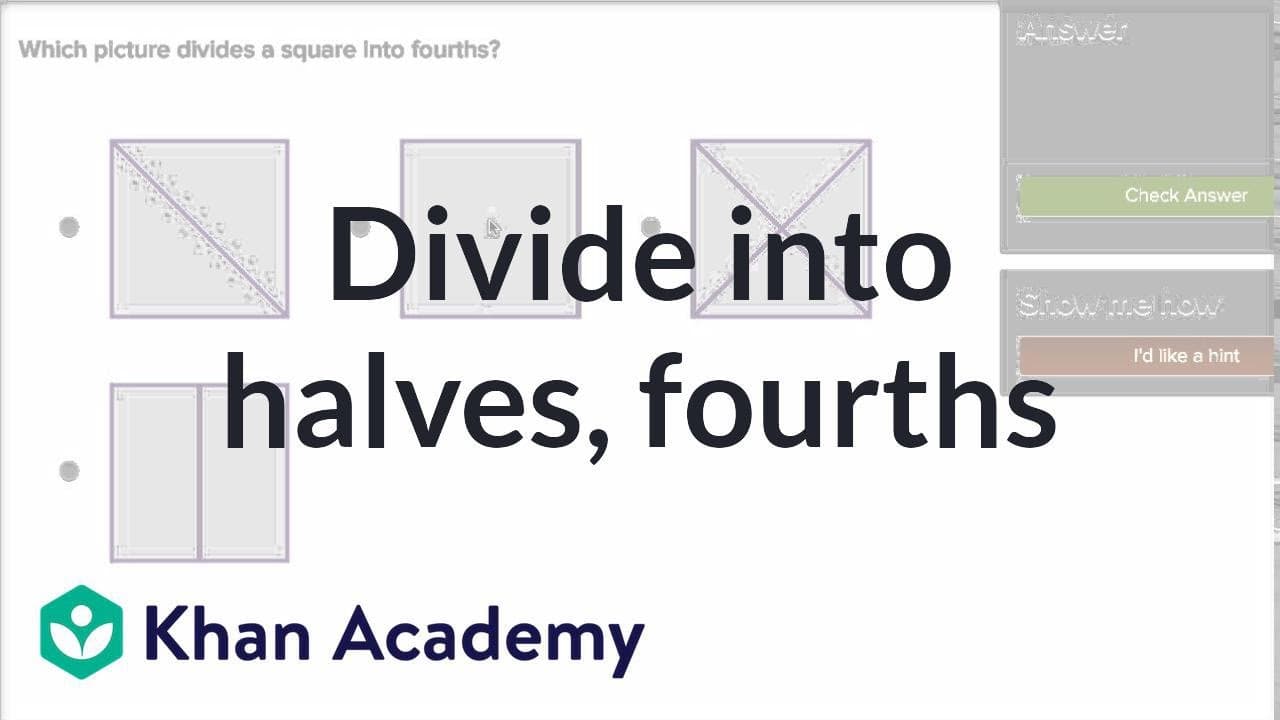
Identifying Equal Parts to Understand Fractions

Identifying Equal Parts to Understand Fractions

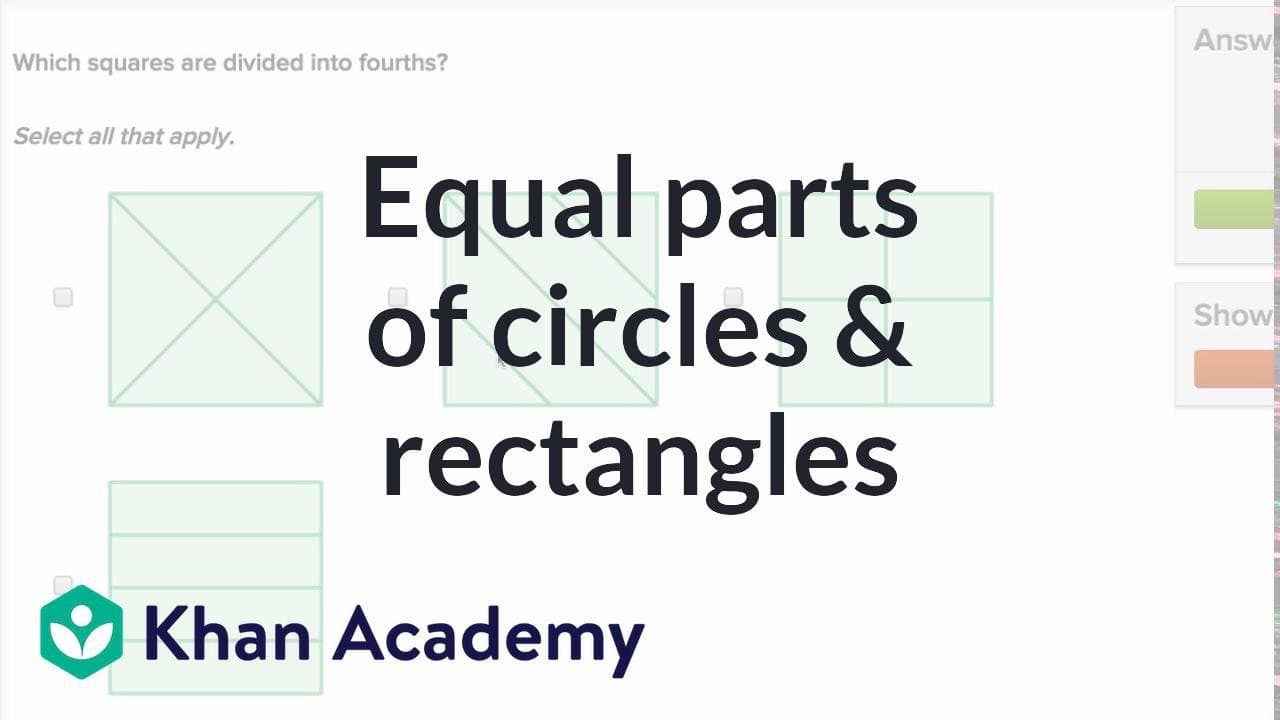
This educational video serves as an interactive walkthrough of foundational geometry and fraction concepts, focusing specifically on identifying "thirds" and "fourths." Using a digital exercise interface, the narrator guides viewers through multiple choice problems where they must select shapes (circles, squares, and rectangles) that are correctly partitioned into specific fractional parts. The video methodically analyzes why certain shapes fit the criteria while others do not. The central theme of the video is the critical distinction between simply dividing a shape into parts versus dividing it into *equal* parts. The narrator repeatedly emphasizes that for a shape to represent fourths or thirds, it must be split into sections of equal area. This addresses a common primary-level misconception where students count the number of parts without verifying their size equality. For educators, this video is an excellent tool for reinforcing the concept of equal shares, a prerequisite for understanding fractions. It provides clear, visual examples of non-examples (unequal parts) alongside correct examples, helping students develop the visual discrimination skills needed for geometry and early fraction arithmetic. It is ideal for introducing partitioning shapes in 1st and 2nd grade math curriculums.

Khan AcademyKhan Academy

3mins 4s

Video
What Is a Circle?

What Is a Circle?

A concise and engaging animated introduction to the geometric concept of a circle, featuring Sandy the dingo from Khan Academy Kids. The video provides a clear, age-appropriate definition of a circle as a continuous line with no corners, making abstract geometry accessible for early learners. The content focuses on identifying 2D shapes and connecting mathematical concepts to the real world. By defining a circle by its attributes—specifically the lack of corners and the continuous round nature—it helps build the foundation for geometric reasoning and shape classification. This resource is highly valuable for Pre-K and Kindergarten classrooms as a quick hook or review. Its simple visual demonstration and connection to a familiar object (a tennis ball) allow teachers to easily pivot into activities involving shape hunting, sorting, or drawing. The short duration matches the attention span of the target age group perfectly.

Khan Academy KidsKhan Academy Kids

27s

Video
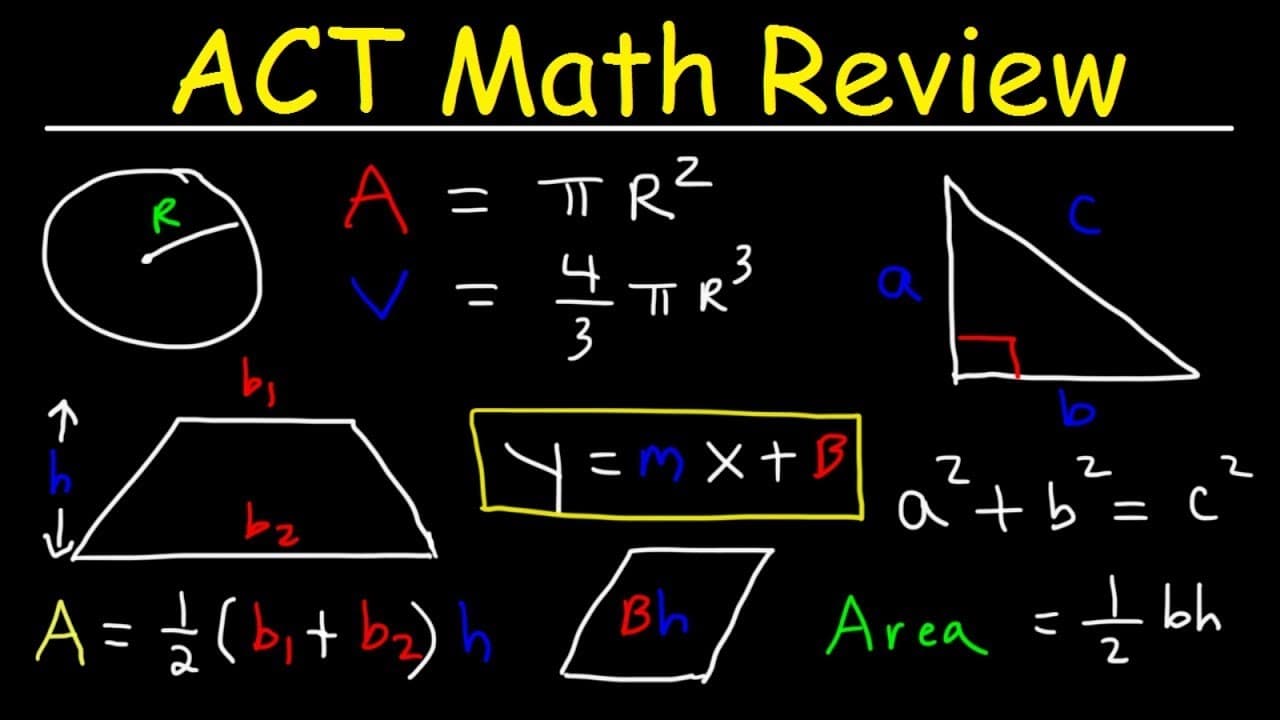
ACT Math Practice Test: Review of Algebra, Geometry, and Trig Concepts

ACT Math Practice Test: Review of Algebra, Geometry, and Trig Concepts

This comprehensive video tutorial serves as an intensive review for the ACT Math section, covering a wide array of topics crucial for high school students preparing for college entrance exams. The content is structured as a series of 31 practice problems that mimic the style and difficulty of actual ACT questions. It progresses through various mathematical domains including pre-algebra, elementary algebra, intermediate algebra, coordinate geometry, plane geometry, and trigonometry. The video adopts a pause-and-practice format, encouraging active participation where viewers attempt each problem before watching the detailed step-by-step solution. Key themes explored in this review include solving linear and quadratic equations, working with functions, understanding geometric properties of polygons and circles, applying trigonometric ratios (SOH CAH TOA) and identities, and analyzing statistical data. The video also places a strong emphasis on real-world application problems involving percentages, sales tax, discounts, and unit conversions. Particular attention is given to algebraic manipulation strategies, such as solving systems of equations and simplifying complex expressions, as well as test-taking tactics like identifying key information in word problems. For educators and students, this video is a valuable resource for standardized test preparation. It allows teachers to identify specific areas of weakness in student understanding by isolating problem types (e.g., if a student struggles with problem 10, they need more support with circle geometry). The step-by-step explanations model clear mathematical reasoning, demonstrating not just *how* to get the right answer, but *why* specific methods work. This makes it an excellent tool for flipped classrooms, homework support, or intensive boot-camp style review sessions prior to test dates.

The Organic Chemistry TutorThe Organic Chemistry Tutor

20mins 33s

Video
How to Use the Triangle Inequality Theorem

How to Use the Triangle Inequality Theorem

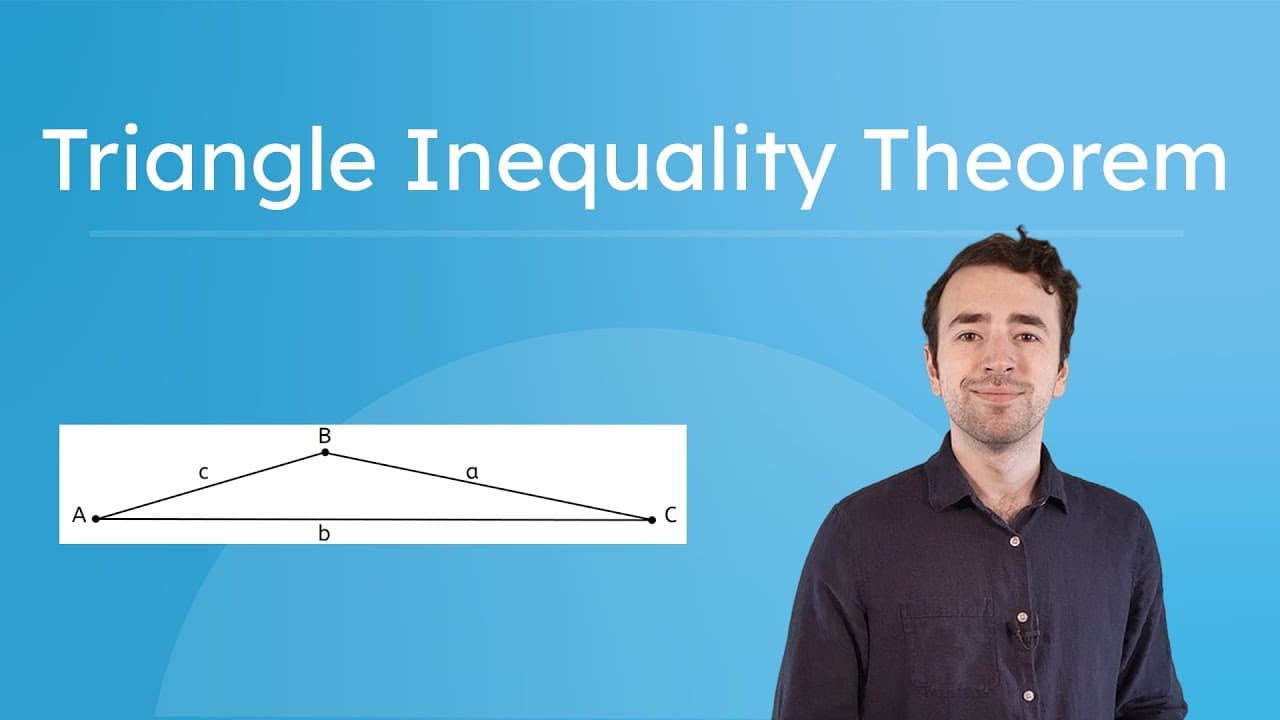
This educational math video provides a comprehensive guide to the Triangle Inequality Theorem, a fundamental concept in geometry. The narrator, Justin, begins by connecting the theorem to the Segment Addition Postulate, visually demonstrating how moving a point off a line segment creates a triangle and changes the relationship between lengths from equality to inequality. The video explains that for any triangle, the sum of any two side lengths must always be greater than the third side length. The content moves into practical application with multiple examples. Students learn how to test sets of three numbers to determine if they can form a valid triangle. The video covers scenarios where the inequality holds true, as well as cases where it fails (including an example where the sum equals the third side, resulting in a flat line rather than a triangle). The step-by-step walkthroughs emphasize checking all three possible combinations of sides to ensure validity. Finally, the lesson advances to finding the possible range for an unknown third side of a triangle given two known sides. The video derives the algebraic inequalities and then introduces a helpful shortcut: the length of the third side must be greater than the difference and less than the sum of the two known sides. This resource is highly valuable for geometry students as it bridges the gap between conceptual understanding and procedural skill, offering clear visuals and note-taking prompts throughout.

Miacademy & MiaPrep Learning ChannelMiacademy & MiaPrep Learning Channel

8mins 7s

Video
Spotting Basic Shapes on the Street

Spotting Basic Shapes on the Street

This engaging animated video introduces young learners to basic 2D geometric shapes by identifying them in a bustling street scene. Through a guided observational journey, the narrator points out everyday objects—a flag, a wheel, a sign, a crate, and a phone booth window—and helps viewers identify the specific shapes hidden within them. The video uses bright colors and clear visual overlays to abstract the geometric forms from the real-world illustrations. The core themes focus on early geometry, visual literacy, and observational skills. It covers five fundamental shapes: triangle, circle, oval, square, and rectangle. The video explicitly connects abstract mathematical concepts (shapes) to concrete physical objects students might encounter in their daily lives, reinforcing the idea that math is all around us. For educators, this resource serves as an excellent hook or introduction to a geometry unit for early elementary students. It models the behavior of a "shape detective," encouraging children to look critically at their environment. Teachers can use this video to transition from passive viewing to active learning by asking students to identify other shapes in the video's background or in their own classroom immediately after watching.

MatholiaChannelMatholiaChannel

2mins 27s

Video
Exploring Quadrilaterals: From Squares to Trapezoids

Exploring Quadrilaterals: From Squares to Trapezoids

This educational video provides a clear and engaging introduction to quadrilaterals, breaking down the specific properties of squares, rectangles, parallelograms, rhombuses, kites, and trapezoids. Using a whiteboard and fun animations, the host explains how these four-sided figures relate to one another, distinguishing them by side length, parallel lines, and interior angles. The content specifically highlights the hierarchical relationships between shapes, such as the classic rule that "all squares are rectangles, but not all rectangles are squares." It uses visual metaphors, like "pushing" a rectangle to create a parallelogram, to help students understand how shapes transform when angles change while side lengths remain constant. This resource is highly valuable for elementary math instruction as it moves beyond simple shape recognition to analyzing geometric attributes. Teachers can use the video's visual demonstrations to explain abstract concepts like parallel lines and congruent sides, making it an excellent tool for introducing geometry units or reinforcing vocabulary.

Miacademy & MiaPrep Learning ChannelMiacademy & MiaPrep Learning Channel

2mins 49s

Video
Defining the Properties of a Rhombus

Defining the Properties of a Rhombus

This concise educational video provides a clear, step-by-step definition of a rhombus and its fundamental geometric properties. Narrated with simple language and supported by distinct visual animations, the video builds a comprehensive definition starting from the basic classification of the shape as a quadrilateral to more specific attributes regarding side lengths and angles. The content focuses on three primary properties: the equality of all four sides, the parallel nature of opposite sides, and the equality of opposite angles. Each property is demonstrated visually using standard geometric markings (tick marks for equal sides, arrows for parallel lines, and arcs for angles) alongside mathematical notation (e.g., AB = BC, AB // DC). This dual approach helps bridge the gap between visual recognition and formal mathematical expression. For educators, this video serves as an excellent introduction or review tool for geometry units focusing on quadrilaterals. It efficiently breaks down abstract definitions into observable characteristics, making it useful for direct instruction, note-taking exercises, or as a reference during problem-solving activities involving shape classification and angle calculations.

MatholiaChannelMatholiaChannel

58s

Video
Exploring Plane and Solid Figures: A Guide to 2D and 3D Geometry

Exploring Plane and Solid Figures: A Guide to 2D and 3D Geometry

This educational video provides a comprehensive introduction to geometry by distinguishing between plane figures (2D) and solid figures (3D). Through animated examples and real-world objects, the narrator explains the defining characteristics of each category, moving from basic shapes like rectangles and circles to complex solids like prisms and pyramids. The video uses a "treasure hunt" theme to introduce items that represent these mathematical concepts, making abstract definitions concrete for students. The content dives deep into the specific attributes of geometric figures. It covers the anatomy of solid figures—defining and counting edges, vertices, and faces (including lateral faces and bases). It further classifies solid figures into polyhedrons (like cubes and pyramids) and non-polyhedrons (like cylinders, cones, and spheres), explaining the rules for naming pyramids based on their bases. Vocabulary such as "congruent," "parallel," and "dimensions" is integrated throughout. For educators, this video serves as an excellent visual aid for introducing or reinforcing geometry units in upper elementary grades. It is particularly useful for teaching the specific vocabulary required to describe geometric solids and for visualizing the difference between 2D and 3D space. The clear visual breakdown of vertices, edges, and faces allows for pause-and-discuss moments where students can practice counting these attributes along with the video.

Sheena DoriaSheena Doria

11mins 16s

Video
Classifying Quadrilaterals and Their Properties

Classifying Quadrilaterals and Their Properties

This educational video serves as a comprehensive introduction to quadrilaterals, specifically targeted at upper elementary students. It begins with a relatable hook using a treasure chest of everyday objects to establish the common characteristic of having four sides. The narrator breaks down the etymology of the word "quadrilateral" and visually demonstrates how four line segments combine to create a closed polygon with specific angle properties totaling 360 degrees. The core of the video systematically classifies five specific types of quadrilaterals: rectangles, squares, rhombuses, parallelograms, and trapezoids. For each shape, the video uses dynamic animations to transform one shape into another (e.g., squashing a square to make a rhombus), helping students visualize the relationships between them. It clearly lists the defining properties of each, focusing on side lengths, parallel lines, and angle measurements. This resource is highly valuable for mathematics instruction as it moves beyond simple shape recognition to analyzing geometric properties. It visually demonstrates abstract concepts like "parallel lines" and "opposite angles" through clear graphics. Teachers can use this video to introduce a geometry unit, review shape classifications, or clarify the subtle differences between similar shapes, such as a square and a rhombus.

Sheena DoriaSheena Doria

6mins 7s

Video
Identifying and Describing Basic 2D Shapes

Identifying and Describing Basic 2D Shapes

This educational video introduces young learners to the fundamental properties of basic two-dimensional shapes. Through clear narration and simple animations, the video defines a square, rectangle, and triangle by counting their specific attributes—corners and sides. It then explores circular shapes, defining a standard circle before visually demonstrating how dividing a circle creates a semicircle, and dividing that further creates a quarter circle. The content focuses on the geometric language necessary for early math proficiency, specifically the terms "sides," "corners," and the names of the shapes themselves. It highlights the critical distinction between squares and rectangles based on side length equality, a common point of confusion for early learners. The video also subtly introduces fractional thinking by showing the part-whole relationship between circles, semicircles, and quarter circles. Teachers can use this video as a core instructional tool for introducing geometry units in early elementary classrooms. Its step-by-step pacing allows for interactive viewing where students can count along with the narrator. The visual cues—highlighting specific corners and sides—make it an excellent resource for helping students visualize abstract geometric definitions, moving beyond simple recognition to analytical description.

MatholiaChannelMatholiaChannel

1min 59s

Video
Exploring Quadrilaterals and Finding Missing Angles

Exploring Quadrilaterals and Finding Missing Angles

This educational video provides a clear and structured introduction to quadrilaterals, exploring their definitions, properties, and the mathematical rules governing their internal angles. The narrator uses digital drawing tools to visually demonstrate the unique characteristics of trapezoids, parallelograms, rectangles, rhombuses, and squares, highlighting parallel lines, congruent sides, and right angles. The video transitions from geometric theory to practical application, guiding viewers through solving for missing angles. The content is divided into two main sections: first, a taxonomy of quadrilaterals where specific properties are identified (e.g., the diagonals of a rhombus bisecting at right angles), and second, problem-solving segments. The first problem demonstrates finding a missing angle using simple arithmetic, while the second introduces algebraic expressions to represent angles, requiring students to set up and solve linear equations to find the angle measures. This bridges the gap between geometry and algebra. Teachers can use this video to introduce or review quadrilateral properties and to demonstrate how algebra is applied in geometric contexts. It is particularly useful for visual learners due to the step-by-step drawing and labeling of figures. The video serves as an excellent resource for scaffolding, moving from basic identification to complex multi-step equation solving involving geometric theorems.

The Organic Chemistry TutorThe Organic Chemistry Tutor

11mins 2s

Video
Identifying and Describing Basic 2D Shapes

Identifying and Describing Basic 2D Shapes

This educational video introduces young learners to the fundamental properties of basic two-dimensional shapes. Through clear narration and simple animations, the video defines a square, rectangle, and triangle by counting their specific attributes—corners and sides. It then explores circular shapes, defining a standard circle before visually demonstrating how dividing a circle creates a semicircle, and dividing that further creates a quarter circle. The content focuses on the geometric language necessary for early math proficiency, specifically the terms "sides," "corners," and the names of the shapes themselves. It highlights the critical distinction between squares and rectangles based on side length equality, a common point of confusion for early learners. The video also subtly introduces fractional thinking by showing the part-whole relationship between circles, semicircles, and quarter circles. Teachers can use this video as a core instructional tool for introducing geometry units in early elementary classrooms. Its step-by-step pacing allows for interactive viewing where students can count along with the narrator. The visual cues—highlighting specific corners and sides—make it an excellent resource for helping students visualize abstract geometric definitions, moving beyond simple recognition to analytical description.

MatholiaChannelMatholiaChannel

1min 59s

Video
What Makes a Shape a Rectangle?

What Makes a Shape a Rectangle?

This concise educational video introduces the defining geometric characteristics of a rectangle. Through clear animations and step-by-step narration, viewers learn the four specific rules that make a shape a rectangle: having four sides, opposite sides of equal length, opposite sides being parallel, and the presence of four right angles.

MatholiaChannelMatholiaChannel

53s

Video
Finding Area of Composite Rectangles and Shapes

Finding Area of Composite Rectangles and Shapes

This educational video provides a comprehensive tutorial on calculating the area of rectangles and more complex composite figures. It begins with the fundamental formula for the area of a rectangle (Length × Width) and progresses to irregular polygon shapes that must be decomposed into simpler rectangles. The video demonstrates step-by-step problem-solving strategies, including how to deduce missing side lengths from given dimensions and how to break down complex shapes into manageable parts. The content covers three distinct types of area problems: (1) additive composite figures where areas are calculated separately and summed, (2) subtractive area problems involving shaded regions (e.g., a frame or border) where an inner area is subtracted from an outer area, and (3) algebraic word problems that require setting up and solving equations to find dimensions based on perimeter and relative side lengths. Each example is worked out in real-time with clear visual diagrams. This resource is highly valuable for mathematics classrooms as it bridges the gap between basic arithmetic geometry and algebraic reasoning. It models critical thinking skills, such as inferring missing information from a diagram and checking for logical consistency. Teachers can use this video to introduce composite figures, reinforce area formulas, or demonstrate how algebra is applied to solve geometric problems.

The Organic Chemistry TutorThe Organic Chemistry Tutor

11mins 38s

Video
Introduction to Basic Fractions: Equal Parts and Fair Shares

Introduction to Basic Fractions: Equal Parts and Fair Shares

This engaging educational video introduces early elementary students to the mathematical concept of fractions through the familiar social concept of "fair sharing." Hosted by Kylie, the video bridges the gap between social-emotional learning and mathematics by defining sharing as dividing something into parts for others. It illustrates various types of sharing—from taking turns with toys to splitting a sandwich—before focusing on the mathematical necessity of "equal parts" to make a share truly "fair." The video systematically explores three key fractional concepts: sharing a set of discrete objects (jellybeans) and sharing a continuous whole (a cake). It visually demonstrates the difference between arbitrary cuts and equal partitions, introducing specific vocabulary including "halves" (1/2), "fourths" or "quarters" (1/4), and "tenths" (1/10). The visual of a "sprinkle cake" being cut incorrectly versus correctly serves as a powerful model for understanding that fractions must be equal in size. For teachers, this video provides an ideal entry point for a fractions unit. It directly addresses the common misconception that any piece of a whole is a fraction, clarifying that pieces must be identical in size to be named mathematically (e.g., halves). It offers clear visual models for partitioning rectangles and sets, making it a versatile tool for lessons on geometry, division basics, and introductory fractions in 1st and 2nd grade classrooms.

Miacademy & MiaPrep Learning ChannelMiacademy & MiaPrep Learning Channel

6mins 9s

Video
From Polygons to 3D Shapes: A Visual Guide

From Polygons to 3D Shapes: A Visual Guide

This educational video provides a clear and concise progression from basic two-dimensional polygons to three-dimensional solids. The presenter begins by reviewing quadrilaterals and introducing 5-sided (pentagon) and 6-sided (hexagon) shapes, briefly mentioning polygons with even more sides. The lesson then shifts focus to curved shapes, defining a circle through the concept of equidistant points from a center. Key themes explored include geometric vocabulary (vertices, edges, faces), the etymology of shape names (penta, hexa), and spatial reasoning. A major focus is the conceptual relationship between dimensions; the narrator encourages viewers to visualize "pulling" 2D shapes out of the whiteboard to create 3D forms, such as extending a square into a cube or a circle into a cylinder. For educators, this video serves as an excellent bridge for students moving from simple shape identification to understanding geometric properties and spatial depth. The visual demonstrations on the whiteboard—particularly the comprehensive summary chart visible at the end—offer a valuable reference for classifying lines, angles, triangles, and solids. It helps students understand not just what shapes are called, but how they are constructed and related to one another.

Miacademy & MiaPrep Learning ChannelMiacademy & MiaPrep Learning Channel

2mins 44s

Video
How to Identify Basic 2D Shapes

How to Identify Basic 2D Shapes

This educational video provides a clear and structured introduction to four fundamental two-dimensional shapes: the square, circle, triangle, and rectangle. Through a repetitive and paced narrative, the video guides young learners in identifying each shape by examining its defining attributes—specifically counting the number of corners and sides. The clear audio and simple visual cues help students connect the visual form with the mathematical properties and the shape's name. The content focuses on early geometry concepts, specifically the identification of 2D shapes and the vocabulary of "sides" and "corners" (vertices). For each shape, the video follows a distinct pattern: identifying the attributes, naming the shape, and then displaying a variety of examples in different colors, sizes, and orientations to reinforce that a shape's identity remains constant regardless of these variables. For educators, this video serves as an excellent foundational tool for Pre-K through 1st-grade mathematics. It allows teachers to pause and count along with the narrator, making it an interactive experience. The segment showing various examples of each shape is particularly useful for preventing the common misconception that shapes must always look a certain way (e.g., that a triangle must always have a flat bottom). The video concludes with a summary screen perfect for a quick formative assessment or review.

MatholiaChannelMatholiaChannel

3mins 17s

Video
Exploring the Fundamentals of 3D Figures

Exploring the Fundamentals of 3D Figures

This educational video provides a comprehensive overview of the fundamental properties of three-dimensional figures, specifically focusing on prisms, cylinders, pyramids, cones, and spheres. Hosted by a friendly presenter named Justin, the lesson breaks down complex geometric vocabulary into digestible concepts, teaching students how to identify shapes based on their specific features such as bases, faces, vertices, edges, and curved surfaces. The video emphasizes distinguishing between similar shapes and clarifies specific rules regarding the bases of prisms and cylinders versus pyramids and cones. A significant portion of the video addresses common misconceptions in geometry, particularly the idea that a shape's base must always be on the bottom. Through clear visual examples and rotations of figures like rectangular prisms and triangular pyramids, the content demonstrates that spatial orientation does not define a shape's properties. The video creates a solid foundation for spatial reasoning by explaining exceptions to general rules, such as how any face of a rectangular prism or triangular pyramid can serve as a base. This resource is highly valuable for upper elementary and middle school mathematics classrooms introducing or reviewing geometry concepts. It supports learning by moving beyond simple identification to a deeper understanding of geometric properties, preparing students for more advanced topics like surface area and volume. The clear definitions and visual aids make it an excellent tool for front-loading vocabulary or reinforcing concepts after hands-on exploration with geometric solids.

Miacademy & MiaPrep Learning ChannelMiacademy & MiaPrep Learning Channel

5mins 29s

Video
Identifying Equal Parts: Halves, Thirds, and Fourths

Identifying Equal Parts: Halves, Thirds, and Fourths

This video serves as an engaging and practical introduction to basic geometry and fractions, specifically focusing on partitioning shapes. Through a series of multiple-choice problems, the narrator guides viewers in identifying which shapes—rectangles, circles, and squares—are correctly divided into halves, thirds, and fourths (quarters). The core concept emphasized throughout is that for a shape to be divided into fractions, the resulting sections must be equal in size or area. The video explores key geometric themes including visual estimation of area, the definition of specific fractional terms (halves, thirds, fourths), and the critical distinction between merely dividing a shape and dividing it into equal shares. By presenting non-examples (shapes divided into unequal parts or the wrong number of parts), the video directly addresses common student misconceptions, such as thinking any two parts constitute a "half." For educators, this resource is an excellent tool for early elementary math instruction, particularly for 1st and 2nd grade. It provides clear visual models that can be used to introduce the concept of equal shares before moving to numerical fractions. Teachers can use this video to model mathematical thinking, asking students to justify why certain options are incorrect before revealing the answer, thus promoting critical thinking and mathematical vocabulary usage.

Khan AcademyKhan Academy

2mins 24s

Video
Identifying Equal Parts to Understand Fractions

Identifying Equal Parts to Understand Fractions

This educational video serves as an interactive walkthrough of foundational geometry and fraction concepts, focusing specifically on identifying "thirds" and "fourths." Using a digital exercise interface, the narrator guides viewers through multiple choice problems where they must select shapes (circles, squares, and rectangles) that are correctly partitioned into specific fractional parts. The video methodically analyzes why certain shapes fit the criteria while others do not. The central theme of the video is the critical distinction between simply dividing a shape into parts versus dividing it into *equal* parts. The narrator repeatedly emphasizes that for a shape to represent fourths or thirds, it must be split into sections of equal area. This addresses a common primary-level misconception where students count the number of parts without verifying their size equality. For educators, this video is an excellent tool for reinforcing the concept of equal shares, a prerequisite for understanding fractions. It provides clear, visual examples of non-examples (unequal parts) alongside correct examples, helping students develop the visual discrimination skills needed for geometry and early fraction arithmetic. It is ideal for introducing partitioning shapes in 1st and 2nd grade math curriculums.

Khan AcademyKhan Academy

3mins 4s

Video
Exploring Properties of 3D Shapes: Faces, Edges, and Vertices

Exploring Properties of 3D Shapes: Faces, Edges, and Vertices

This educational video serves as a clear, step-by-step introduction to the geometric properties of five common 3D shapes: the cube, rectangular prism (cuboid), sphere, cone, and cylinder. For each shape, the narration systematically defines its structure by counting its faces, edges, and vertices. Visual animations highlight these specific parts on the geometric models as they are counted, helping students connect the abstract vocabulary to the physical attributes of the shape.

MatholiaChannelMatholiaChannel

2mins 43s

Video
Learning Solid Shapes: Names, Properties, and Real-World Examples

Learning Solid Shapes: Names, Properties, and Real-World Examples

This educational video provides a clear and structured introduction to six common solid (3D) shapes: the cube, cuboid, cylinder, cone, sphere, and pyramid. Following a consistent pattern, the video presents each geometric form, highlights its defining properties such as the number and type of faces (flat or curved), and explicitly names the shape using on-screen text.

MatholiaChannelMatholiaChannel

2mins 3s

Video
Calculating Area of Curved Figures: Two Methods

Calculating Area of Curved Figures: Two Methods

This video presents a geometry problem asking students to find the area of a complex blue figure inscribed within a 2x2 grid. The figure features curved boundaries derived from circles. The narrator demonstrates two distinct methods for solving the problem: a traditional algebraic approach calculating the area of specific components (squares, quarter circles, and semi-circles), and a visual "shortcut" method that relies on spatial reasoning and rearrangement. The video explores key geometric themes including calculating the area of squares and circles, decomposing composite shapes, algebraic manipulation of terms involving Pi, and spatial transformations. It effectively contrasts a procedural, formula-based strategy with a conceptual, visual strategy, highlighting how different mathematical tools can lead to the same solution. For educators, this resource is an excellent tool to bridge the gap between algebraic geometry and spatial visualization. It serves as a powerful demonstration of efficiency in problem-solving, showing students that a clever visual insight can sometimes save significant calculation effort. It can be used to introduce area of composite figures, practice arithmetic with Pi, or spark discussions about mathematical proof and elegance.

MatholiaChannelMatholiaChannel

2mins 34s

Video
Identifying and Understanding 3D Geometric Shapes

Identifying and Understanding 3D Geometric Shapes

This educational video provides a clear and accessible introduction to three-dimensional geometric shapes for elementary students. Hosted by a narrator named Ashley, the video distinguishes between flat 2D shapes and space-occupying 3D shapes before systematically exploring eight fundamental solids: the sphere, cube, rectangular prism, triangular prism, cylinder, cone, square pyramid, and triangular pyramid. For each shape, the video utilizes clean, rotating 3D animations to illustrate its properties while the narrator explains key identifying features. The explanations focus on the shape of the bases, the nature of the faces (flat squares, rectangles, triangles, or curved surfaces), and structural elements like points or vertices. Simple real-world analogies, such as comparing a sphere to a basketball or a cone to an ice cream cone, help ground abstract geometric concepts in familiar objects. This resource is highly valuable for early elementary math instruction as it helps students move beyond simple shape recognition to understanding structural properties. Teachers can use it to introduce geometric vocabulary, visualize hidden faces of solids through the rotating animations, and demonstrate the relationship between 2D shapes (like squares and triangles) and the 3D solids they form.

Miacademy & MiaPrep Learning ChannelMiacademy & MiaPrep Learning Channel

5mins 47s

Video
Learning the Properties of Rectangles

Learning the Properties of Rectangles

In this engaging animated video, Sandy the dingo from Khan Academy Kids introduces young learners to the geometric concept of a rectangle. Through clear visual demonstrations, Sandy breaks down the defining attributes of the shape, including its side counts, corners, and the relationship between opposite sides. The video uses a friendly character-driven approach to make abstract geometry concrete. The content focuses on key geometric vocabulary and properties, specifically identifying that rectangles have four sides and four corners, with opposite sides being parallel. It distinguishes rectangles from other quadrilaterals by noting they usually have two longer sides and two shorter sides. The lesson bridges the gap between geometry and the real world by transforming the abstract shape into a common object—a door. This video is an excellent resource for early childhood and lower elementary classrooms introducing 2D shapes. It provides a concise, visual definition that helps students move beyond simple shape recognition to understanding specific attributes. Teachers can use it to spark 'shape hunts' in the classroom or as a primer for lessons on sides, vertices, and parallel lines.

Khan Academy KidsKhan Academy Kids

37s

Video
Calculating Area by Decomposing Irregular Shapes

Calculating Area by Decomposing Irregular Shapes

This educational video provides a step-by-step tutorial on how to calculate the area (square footage) of an irregular, composite polygon. The instructor uses a clear, high-contrast digital whiteboard to demonstrate the concept of decomposing a complex shape into simpler, manageable rectangles. The lesson begins with a review of the basic area formula for a rectangle before diving into a complex problem involving missing side lengths and multiple subsections. The core theme is the strategy of decomposition—breaking a difficult problem into smaller, solvable parts. The video covers identifying distinct rectangular sections within an irregular shape, deducing missing side lengths using addition and subtraction of parallel sides, and calculating individual areas. It concludes by summing these partial areas to find the total square footage, reinforcing the additive property of area. This resource is highly valuable for upper elementary and middle school mathematics classrooms. It addresses the common student struggle of finding derived dimensions (missing side lengths) on composite figures. Teachers can use this video to model problem-solving strategies for geometry standards related to area, or as a flipped classroom resource for students to review the mechanics of decomposition and area calculation at their own pace.

The Organic Chemistry TutorThe Organic Chemistry Tutor

6mins 9s

Video
Classifying Shapes: From Circles to Quadrilaterals

Classifying Shapes: From Circles to Quadrilaterals

This educational video provides a clear, step-by-step guide to identifying and classifying common two-dimensional geometric shapes. Starting with basic curves like circles and ovals, the narrator progresses to polygons, specifically triangles and the diverse family of quadrilaterals. The video uses hand-drawn visuals to demonstrate the specific attributes—such as side length, corner angles, and parallel lines—that define each shape. A significant portion of the video is dedicated to the hierarchy and classification of quadrilaterals. It explains complex relationships between shapes, such as why a square qualifies as both a rectangle and a rhombus, and distinguishes between general quadrilaterals, rectangles, rhombuses, and trapezoids. The narrator uses visual proofs, like drawing square corners to test for right angles and extending lines to test for parallel sides, to make abstract definitions concrete. This resource is highly valuable for elementary mathematics classrooms introducing geometry concepts. It moves beyond simple shape recognition to deep conceptual understanding of geometric attributes. Teachers can use this video to introduce vocabulary like "parallel," "right angle," and "quadrilateral," or to clarify common misconceptions about shape classification, such as the idea that a square is a distinct category separate from rectangles.

Khan AcademyKhan Academy

6mins 8s

Video
Exploring Plane and Solid Figures: A Guide to 2D and 3D Geometry

Exploring Plane and Solid Figures: A Guide to 2D and 3D Geometry

This educational video provides a comprehensive introduction to geometry by distinguishing between plane figures (2D) and solid figures (3D). Through animated examples and real-world objects, the narrator explains the defining characteristics of each category, moving from basic shapes like rectangles and circles to complex solids like prisms and pyramids. The video uses a "treasure hunt" theme to introduce items that represent these mathematical concepts, making abstract definitions concrete for students. The content dives deep into the specific attributes of geometric figures. It covers the anatomy of solid figures—defining and counting edges, vertices, and faces (including lateral faces and bases). It further classifies solid figures into polyhedrons (like cubes and pyramids) and non-polyhedrons (like cylinders, cones, and spheres), explaining the rules for naming pyramids based on their bases. Vocabulary such as "congruent," "parallel," and "dimensions" is integrated throughout. For educators, this video serves as an excellent visual aid for introducing or reinforcing geometry units in upper elementary grades. It is particularly useful for teaching the specific vocabulary required to describe geometric solids and for visualizing the difference between 2D and 3D space. The clear visual breakdown of vertices, edges, and faces allows for pause-and-discuss moments where students can practice counting these attributes along with the video.

Sheena DoriaSheena Doria

11mins 16s

Video
Classifying Shapes by Sides, Corners, and Lengths

Classifying Shapes by Sides, Corners, and Lengths

This engaging math video features a dialogue between Sal and his high-pitched relative, Cousin Fal, who needs help organizing a collection of colorful 2D shapes. The narrative guides viewers through the fundamental process of geometric classification by teaching them to observe and count specific attributes, such as the number of sides and corners (vertices) for each shape. Key themes include identifying geometric properties, counting to four, and comparing lengths. The video covers various shapes including quadrilaterals (parallelograms, rhombuses, squares), triangles, and curved shapes (ovals), explicitly demonstrating that not all shapes have straight sides or corners. It advances to a second level of classification by asking students to determine if a shape has sides of equal length. This resource is highly valuable for early elementary classrooms introducing geometry. It models mathematical thinking by asking questions and verifying answers through visual proof—tracing sides and circling corners. It helps students move beyond simply naming shapes (e.g., "that's a square") to defining them by their attributes (e.g., "it has 4 equal sides and 4 corners").

Khan AcademyKhan Academy

4mins 19s

Video
Finding Shapes Within Pictures

Finding Shapes Within Pictures

This educational video introduces young students to the concept of composite shapes—figures made up of smaller, distinct geometric shapes. Through clear, animated examples, it demonstrates how complex images like a car and a castle can be deconstructed into basic components such as rectangles, circles, semi-circles, and triangles. The video uses a slow, deliberate pace that allows students to visually track each shape as it is isolated from the main image and then returned to its place. The content focuses on key geometry topics including shape identification, spatial reasoning, and part-whole relationships. It explicitly names 2D shapes (rectangle, square, triangle, circle) and introduces more specific terms like 'semi-circle' and 'quarter circle,' helping to expand students' mathematical vocabulary beyond the basics. For the classroom, this video serves as an excellent hook for lessons on geometry or art. It encourages students to look at the world with a 'mathematical eye,' identifying geometric structures in everyday objects. Teachers can use this as a model for hands-on activities where students build their own figures using pattern blocks or paper cutouts, bridging the gap between abstract geometric concepts and tangible application.

MatholiaChannelMatholiaChannel

1min 29s

Video
Unlocking the Secrets of the Fibonacci Sequence and Golden Ratio

Unlocking the Secrets of the Fibonacci Sequence and Golden Ratio

This educational video provides a comprehensive introduction to the Fibonacci sequence, moving from its mathematical definition to its fascinating appearance in the natural world. The lesson begins by defining the recursive formula for the sequence, demonstrating how to calculate terms by adding the two previous numbers, and visualizing these numbers through the famous Fibonacci spiral. It then transitions into more advanced mathematical concepts by exploring the ratio of consecutive terms, ultimately deriving the Golden Ratio (Phi) using quadratic equations. The video bridges the gap between abstract algebra and the physical world by showcasing how the Fibonacci spiral and Golden Ratio appear in nature and human history. Viewers see examples ranging from the architecture of the Parthenon to the spiral patterns of nautilus shells, pinecones, and the petal counts of various flowers. This multidisciplinary approach helps students understand that mathematics is not just a set of rules on paper but a fundamental language describing the structure of our universe. For educators, this video serves as an excellent tool to connect Algebra, Geometry, and Biology. It allows for differentiated instruction: younger students can focus on the additive pattern and nature identification, while advanced students can engage with the algebraic derivation of the Golden Ratio. The visual demonstrations of the spiral and the step-by-step application of the quadratic formula make complex concepts accessible and engaging.

Miacademy & MiaPrep Learning ChannelMiacademy & MiaPrep Learning Channel

9mins 34s