Lenny LearningLenny
Create
Explore
Workspace
LoginSign up
MathEnglish Language ArtsScience & EngineeringSocial StudiesGlobal LanguagesHealth & Physical EducationSpecial EducationCounseling & Life SkillsArts & CreativityESL
Lenny LearningLenny
Lenny Learning
About
Training
Pricing
Support
Contact
© 2026 Lenny Learning Inc.

Vocabulary

SequencesLessonsMaterialsVideos
  1. English Language Arts

Vocabulary

SequencesLessonsMaterialsVideos

Builds word mastery through parts of speech, Greek and Latin roots, and morphological analysis of prefixes and suffixes. Develops nuanced comprehension using context clues, shades of meaning, and idiomatic expressions.

English Language ArtsPhonics & Reading FoundationsLetter IdentificationLearn Letters A-ZLowercase and Uppercase LettersConsonants and VowelsLetter-Sound AssociationsLetter-Sound Associations: LowercaseLetter-Sound Associations: UppercaseBeginning and Ending SoundsRhymingBlending And SegmentingShort VowelsShort Vowel SoundsConsonant BlendsConsonant DigraphsBlends, Digraphs, and TrigraphsDigraphs, Blends, and Silent LettersLong Vowel SoundsLong Vowel PatternsShort and Long VowelsShort and Long Vowel PatternsSilent EVowel SoundsVowel TeamsR-Controlled VowelsDiphthongs: Oi, Oy, Ou, OwVariant VowelsVariant, Diphthong, And R Vowel PatternsSoft G And CSight WordsIrregular WordsWord RecognitionSyllablesSyllable TypesTwo-Syllable WordsMultisyllabic WordsPhoneme ManipulationDecodable TextsVocabularyAction WordsQuestion WordsNouns and AdjectivesClassify WordsCompound WordsSynonyms and AntonymsHomophonesHomophones and HomonymsShades of MeaningContext CluesPrefixes and SuffixesGreek and Latin RootsAnalogiesIdioms and AdagesForeign Words and ExpressionsWord Choice and UsageReference SkillsReading ComprehensionRead-Along Literary TextsRead-Along Informational TextsReality vs. FictionStory ElementsCharacterSequenceMain IdeaCause And EffectCompare And ContrastReading StrategiesText StructureAuthor's PurposeAuthor's Purpose And ToneAuthor's PerspectivePoint Of ViewThemeInference And ThemeInference And AnalysisPoetry ElementsLiterary DevicesAnalyzing LiteratureAnalyzing Informational TextsComparing TextsAudience, Purpose, And ToneBusiness DocumentsNovel StudyNonfiction Book StudyGrammar & MechanicsSentencesNounsVerbsAdjectivesPronounsCapitalizationPunctuationContractionsConjunctionsPrepositionsArticlesAdjectives And AdverbsVerb TypesVerb TensePronouns And AntecedentsPronoun TypesSubject-Verb AgreementDirect And Indirect ObjectsSentences, Fragments, And Run-OnsPhrases And ClausesCommasSemicolons, Colons, And CommasDashes, Hyphens, And EllipsesSpellingAbbreviationsFormattingVerb Tense And MoodMisplaced ModifiersWritingDescriptive DetailsCreative WritingOpinion WritingTopic SentencesOrganizing WritingLinking WordsSentence VarietyIntroductions And ConclusionsPersuasive And Opinion WritingExpository WritingPersuasive StrategiesDeveloping And Supporting ArgumentsTopic Sentences And Thesis StatementsSummarizingResearch SkillsEditing And RevisingActive And Passive Voice=Writing Clearly And ConciselyDebate & Public SpeakingPublic Speaking BasicsPersuasive TechniquesClaims and EvidenceTypes of ArgumentsReasoning TypesLogical FallaciesTopic ResearchOrganizing EvidenceDebate Speech OrganizationAttacking and Defending ArgumentsClash and EngagementImpact CalculusQuestioning and Cross-ExaminationCritical ThinkingInformal LogicFormal LogicInductive Reasoning
HomophonesIdentification and usage of words with identical pronunciations but distinct meanings and spellings. Targets common errors like their/there/they're and to/too/two through context-based practice.
Context CluesStrategies for decoding unfamiliar words using surrounding text hints such as synonyms, antonyms, and examples. Strengthens reading comprehension by teaching students to infer meaning through linguistic patterns.
Greek and Latin RootsMorphological patterns and etymology used to decode complex academic vocabulary. Strengthens reading comprehension by identifying common prefixes, suffixes, and root meanings.
AnalogiesWord relationships and logical reasoning patterns including synonyms, antonyms, and part-to-whole connections. Builds vocabulary and critical thinking skills through systematic comparison.
Foreign Words and ExpressionsCommon loanwords and phrases integrated into English from sources like Latin, French, and Spanish. Builds vocabulary through the examination of etymology, pronunciation, and appropriate usage in formal and informal contexts.
Word Choice and UsageRefines communication through precise vocabulary selection and nuanced synonym differentiation. Targets tone and audience appropriateness while addressing common usage errors in academic and creative writing.
Reference SkillsStrengthens the ability to locate, evaluate, and use information from sources like dictionaries, encyclopedias, and digital databases. Equips students with alphabetization, indexing, and citation skills for independent research.
No videos found
There are no videos available for this topic yet.
No videos found
There are no videos available for this topic yet.
Video
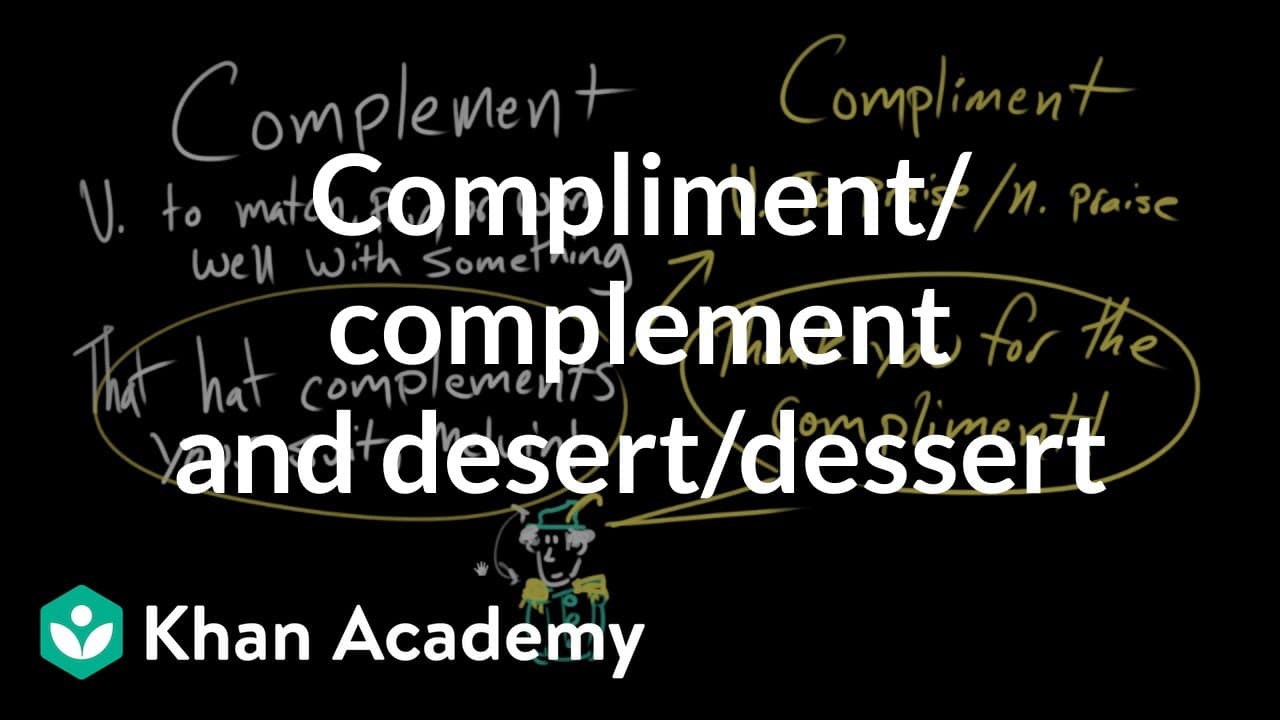
Mastering Confusing Words: Complement vs. Compliment and Desert vs. Dessert

Mastering Confusing Words: Complement vs. Compliment and Desert vs. Dessert

This engaging grammar tutorial clarifies the confusion between two pairs of commonly misused words: "complement" vs. "compliment" and "desert" vs. "dessert." Through whimsical illustrations and clear definitions, the narrator breaks down the spelling, meaning, and pronunciation differences for each pair. The video uses memorable mnemonics—like associating the single 's' in desert with "less water" and the double 's' in dessert with "strawberry and sweet"—to help viewers retain the correct usage. The content focuses on key language arts concepts including homophones, near-homophones, and spelling rules. It explores how a word's spelling often links directly to its meaning and origin. The video specifically highlights how "complement" relates to completing or matching something (like an outfit), while "compliment" relates to praise. Similarly, it distinguishes the dry landscape of a "desert" from the sweet treat of "dessert" through visual associations. For educators, this video serves as an excellent hook or review tool for English Language Arts lessons on vocabulary and mechanics. It provides concrete, visual strategies that students can use to self-correct their writing. The lighthearted tone and simple animations make abstract spelling rules concrete, helping students move past rote memorization to understanding the logic—or at least the memory tricks—behind these tricky words.

Khan AcademyKhan Academy

4mins 15s

Video
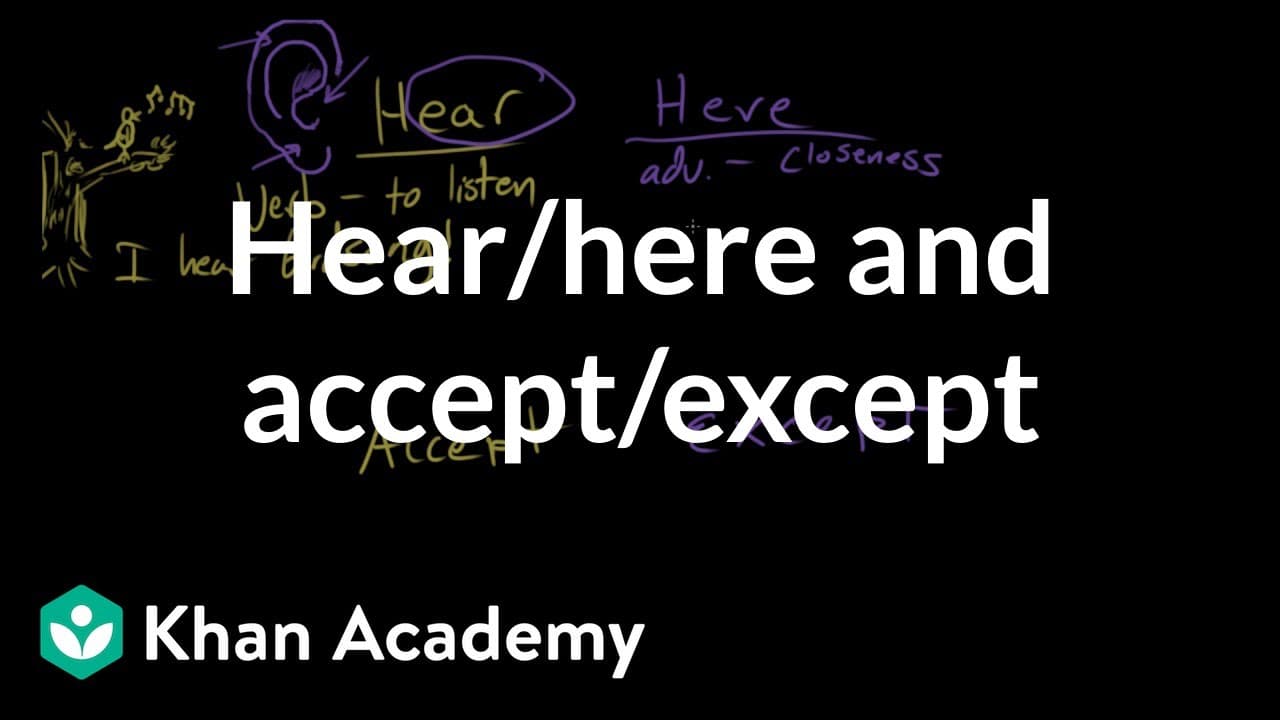
Mastering Confusing Words: Hear vs. Here and Accept vs. Except

Mastering Confusing Words: Hear vs. Here and Accept vs. Except

This educational video provides a clear and engaging guide to mastering two sets of frequently confused words: "hear" vs. "here" and "accept" vs. "except." The narrator, David, breaks down these homophones (or near-homophones) by defining their parts of speech and meanings, ensuring students understand not just how to spell them, but how they function grammatically within a sentence. The video explores key themes of spelling, grammar, and mnemonic strategies. For each word pair, the narrator provides specific memory aids: finding the word "ear" inside "hear," rhyming "here" with "near," linking the "ex" in "except" to "exclude," and connecting the "ac" in "accept" to "access." These cognitive hooks are designed to help learners permanently distinguish between the spellings. For educators, this video is an excellent resource for strengthening vocabulary and writing skills. It directly addresses common pitfalls in student writing and offers practical, visual tools for self-correction. The content is versatile enough to be used as a flipped classroom assignment, a review before a spelling test, or a reference tool for editing workshops, empowering students to proofread their work with greater confidence.

Khan AcademyKhan Academy

3mins 14s

Video
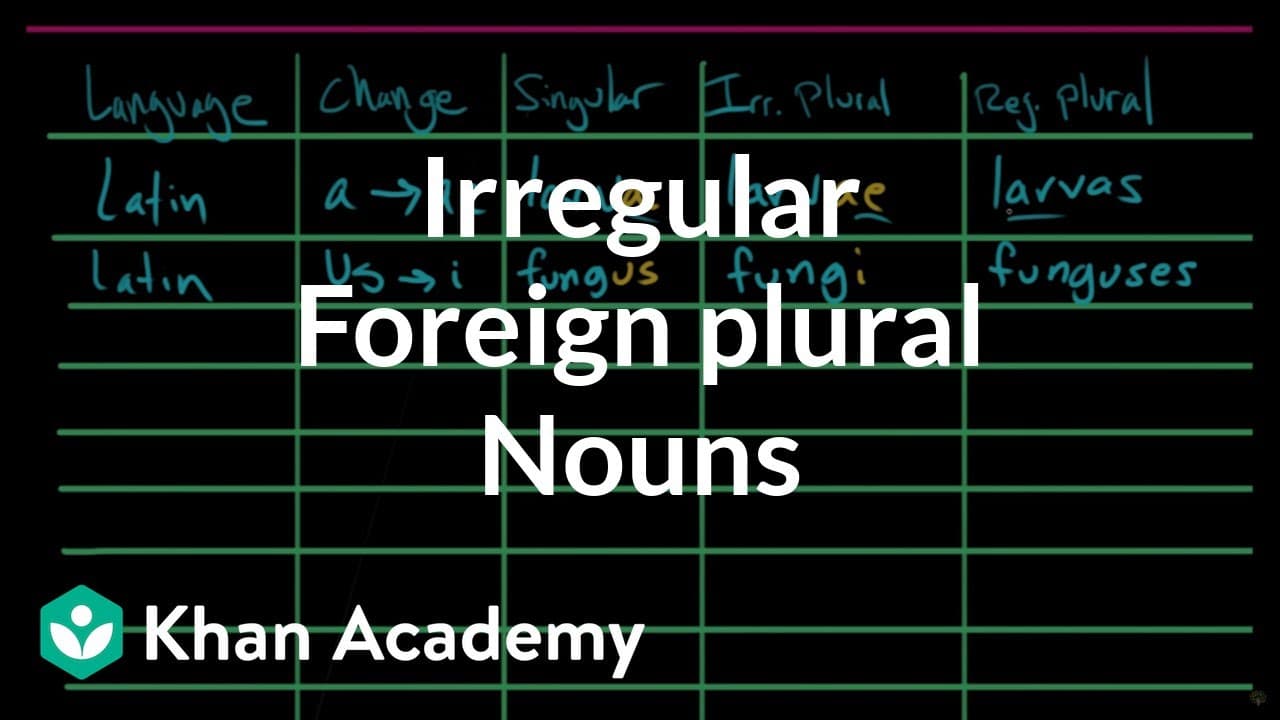
Mastering Irregular Plurals from Latin and Greek

Mastering Irregular Plurals from Latin and Greek

This educational video provides a clear and approachable guide to mastering foreign plural nouns in English, specifically those borrowed from Latin and Greek. The narrator explains that while English often regularizes these words over time (e.g., "funguses" vs. "fungi"), understanding the traditional rules is crucial for formal academic and scientific contexts. Through a hand-drawn chart, the video breaks down six specific patterns for pluralizing loanwords, offering a practical "cheat sheet" for students navigating complex vocabulary. The content explores key grammatical themes including irregular plurals, loanwords, and the evolution of language. It distinguishes between descriptive usage (how people actually speak in casual settings) and prescriptive rules (formal standards), using examples like "cactus/cacti" and "data/datum" to illustrate how English is constantly changing. The video emphasizes that one does not need to speak ancient languages to master English grammar, but rather that recognizing these patterns helps decipher unfamiliar words. For educators, this resource is invaluable for teaching advanced vocabulary, spelling rules, and scientific terminology. It serves as an excellent bridge between English Language Arts and science curricula, where words like "larvae," "fungi," and "hypotheses" appear frequently. The video demystifies intimidating words and empowers students to confidently use formal language in their writing and presentations while reassuring them that making mistakes is part of the learning process.

Khan AcademyKhan Academy

4mins 56s

Video
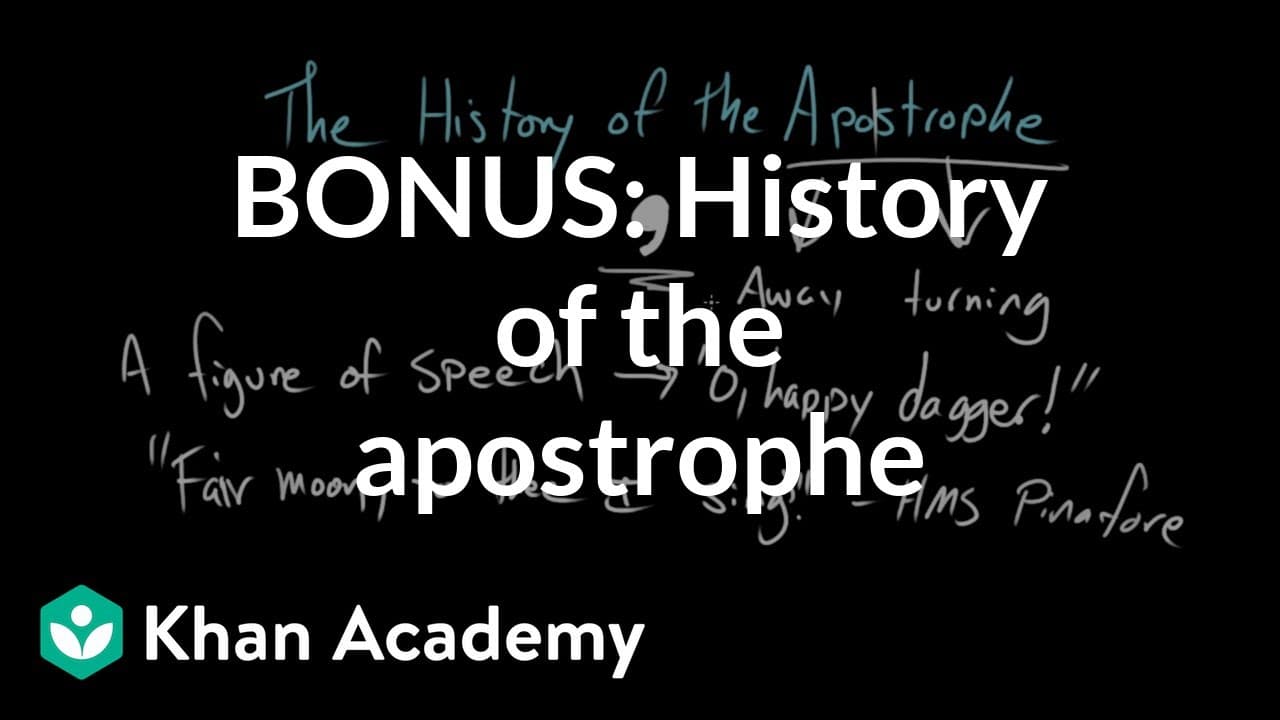
The History and Origin of the Apostrophe

The History and Origin of the Apostrophe

This educational video explores the fascinating history and etymology of the apostrophe, tracing its journey from a Greek rhetorical device to a common English punctuation mark. The narrators explain the word's Greek roots meaning "turning away" and how it originally described a figure of speech where a speaker addresses an absent person or inanimate object. The video then moves into the historical introduction of the symbol itself, credited to the French humanist Geoffroy Tory in the 16th century. It explains how the mark was used to indicate omitted letters (elision) in French before migrating to the English language following centuries of French linguistic influence after the Norman Conquest. Teachers can use this video to deepen student understanding of punctuation by providing historical context, making grammar rules feel less arbitrary. It connects English Language Arts with history and foreign languages, demonstrating how English has evolved through cultural exchange and offering a logical explanation for why apostrophes are used in contractions to replace missing letters.

Khan AcademyKhan Academy

5mins 40s

Video
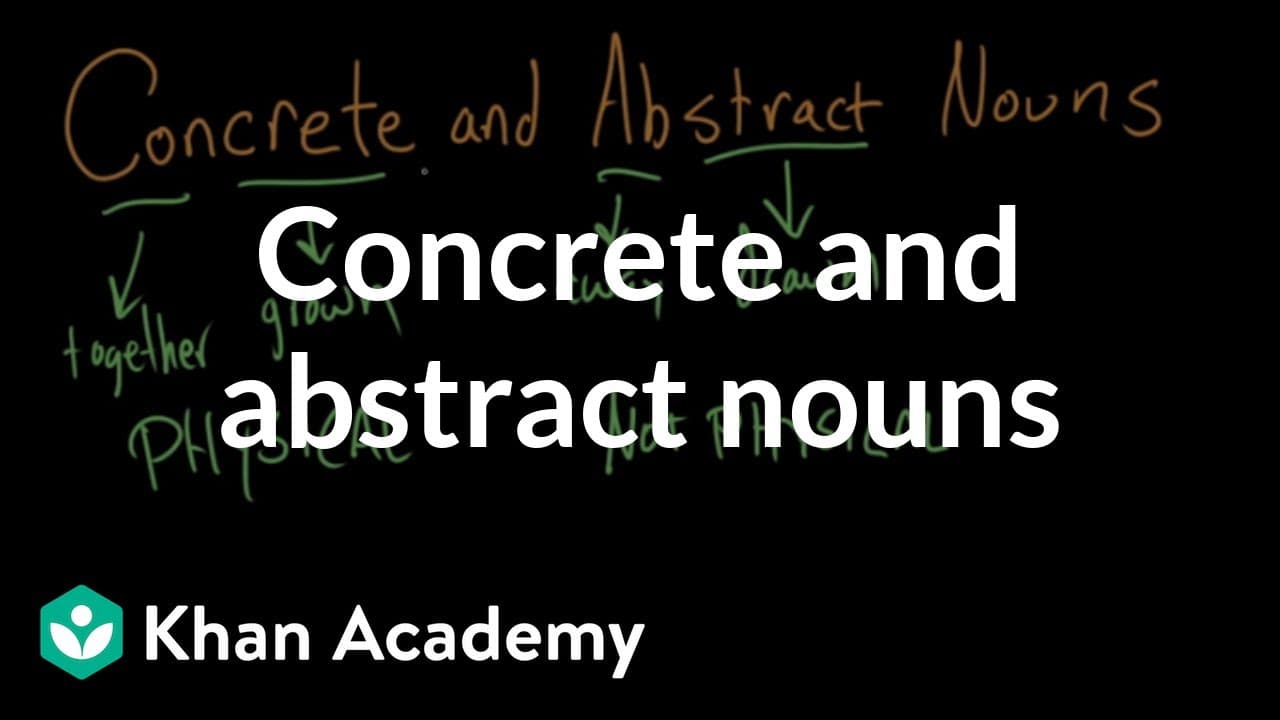
Concrete vs. Abstract Nouns: The Difference Between Objects and Ideas

Concrete vs. Abstract Nouns: The Difference Between Objects and Ideas

This video provides a clear and engaging explanation of the difference between concrete and abstract nouns, utilizing etymology to deepen student understanding. The narrator breaks down the Latin roots of both terms—"concrete" meaning "grown together" or physical, and "abstract" meaning "drawn away" or conceptual—to help students visualize the distinction. Through a digital whiteboard demonstration, the lesson contrasts tangible objects that can be sensed with intangible ideas, emotions, and states of being. The content focuses on key grammatical concepts including the definition of nouns as not just persons, places, and things, but also *ideas*. It explores how abstract nouns like "sadness," "freedom," and "permission" function grammatically (often using suffixes like "-ness") despite lacking physical form. The video specifically addresses the nuance between an abstract concept and its physical manifestations, using the example of "freedom" versus the "ice cream" one is free to eat. For educators, this resource offers a robust foundation for grammar instruction in upper elementary and middle school. It moves beyond simple memorization by providing a logic-based framework (the "physical vs. not physical" test) that students can apply to new vocabulary. The video is particularly useful for introducing abstract nouns, a concept that often challenges students transitioning from basic concrete noun identification, and can serve as a springboard for lessons on sensory imagery and descriptive writing.

Khan AcademyKhan Academy

3mins 43s

Video
Defining and Understanding Admire and Inspire

Defining and Understanding Admire and Inspire

This educational video provides a clear and engaging breakdown of two related vocabulary words: "admire" and "inspire." Using a digital blackboard format, the narrator defines both verbs, explores their etymological roots (including prefixes and Latin origins), and illustrates their meanings through distinct examples. The lesson moves from definitions to word analysis, explaining how "admire" relates to looking and respecting, while "inspire" relates to breathing life and motivation into someone. Key themes include vocabulary acquisition, etymology (word roots), and the concepts of respect and motivation. The video specifically highlights the Latin roots "mirar" (to look) and "spire" (breath), helping students understand how the history of a word informs its current meaning. It also touches on role models through the example of Chef Jacques Pépin and creative invention through a humorous example about Swiss cheese. For educators, this video is an excellent tool for introducing Tier 2 vocabulary and the concept of morphology (prefixes and roots). It bridges simple definitions with deeper linguistic understanding, making it suitable for word study lessons. The video supports social-emotional learning by encouraging students to identify who they admire and what inspires them, while the specific examples provide a template for students to use these words correctly in their own writing and speech.

Khan AcademyKhan Academy

2mins 35s

Video
Decoding Meaning with Prefixes, Roots, and Suffixes

Decoding Meaning with Prefixes, Roots, and Suffixes

This educational video introduces the structural components of English words, specifically focusing on morphology: prefixes, roots, and suffixes. Narrated by David, the video moves beyond the basic concept that words are made of letters to explain how they are constructed from meaningful word parts. It uses clear, handwritten-style visuals and humorous examples to demonstrate how identifying these parts can help readers decode the meaning of unfamiliar vocabulary. The content systematically breaks down the word "reusable" to define the three key word parts. It explains that prefixes attach to the beginning of words to change meaning, roots serve as the core meaning-carriers (often from Latin or Greek), and suffixes attach to the end. The video emphasizes the practical application of this knowledge through an interactive segment where viewers are challenged to define the complex word "unrevivable" by analyzing its components. For educators, this video serves as an excellent hook for lessons on vocabulary acquisition and reading strategies. It provides a distinct framework for morphological analysis that students can immediately apply to their reading. The conversational tone, visual diagrams of word breakdowns, and the interactive "quiz" portion make it a highly engaging resource for introducing or reviewing how to tackle multi-syllabic words.

Khan AcademyKhan Academy

3mins 56s

Video
Learning the Words Simulate, Leisure, and Recreation

Learning the Words Simulate, Leisure, and Recreation

This vocabulary lesson introduces three interconnected words: simulate, leisure, and recreation. Through a combination of clear definitions, historical context, and word origin analysis, the narrator explains how these concepts relate to daily life. The video uses a blackboard-style aesthetic with neon line drawings to visually illustrate definitions and examples, making abstract concepts concrete for learners.

Khan AcademyKhan Academy

3mins 56s

Video
Unlocking Word Meanings with Suffixes

Unlocking Word Meanings with Suffixes

In this engaging vocabulary lesson, the narrator, David, leads viewers on a quest to defeat the "greatest enemy: Not Knowing Stuff" by mastering three specific words: courageous, description, and mythology. Using a digital blackboard style with colorful handwriting and whimsical illustrations, the video breaks down each word's definition, part of speech, and etymology. The lesson places a strong emphasis on morphology, specifically how suffixes like -ous, -tion, and -logy attach to base words to transform their meanings and grammatical functions. The video explores key grammatical concepts including the difference between adjectives, nouns, and verbs. It demonstrates how adding "-ous" changes a noun (courage) into an adjective (courageous), how "-tion" turns a verb (describe) into a noun (description), and how "-logy" denotes a field of study. Humorous illustrated examples—such as a brave girl facing an "Onion Beast" and a disappointed online shopper buying a "magic sword"—reinforce the definitions in memorable contexts. For educators, this video is an excellent tool for introducing or reviewing morphology and word analysis skills. It moves beyond simple rote memorization by teaching students how to deconstruct words to understand their building blocks. The playful tone and clear visual explanations make abstract grammatical concepts accessible for upper elementary students, providing a model for how to figure out unfamiliar vocabulary by looking at word parts and context clues.

Khan AcademyKhan Academy

3mins 46s

Video
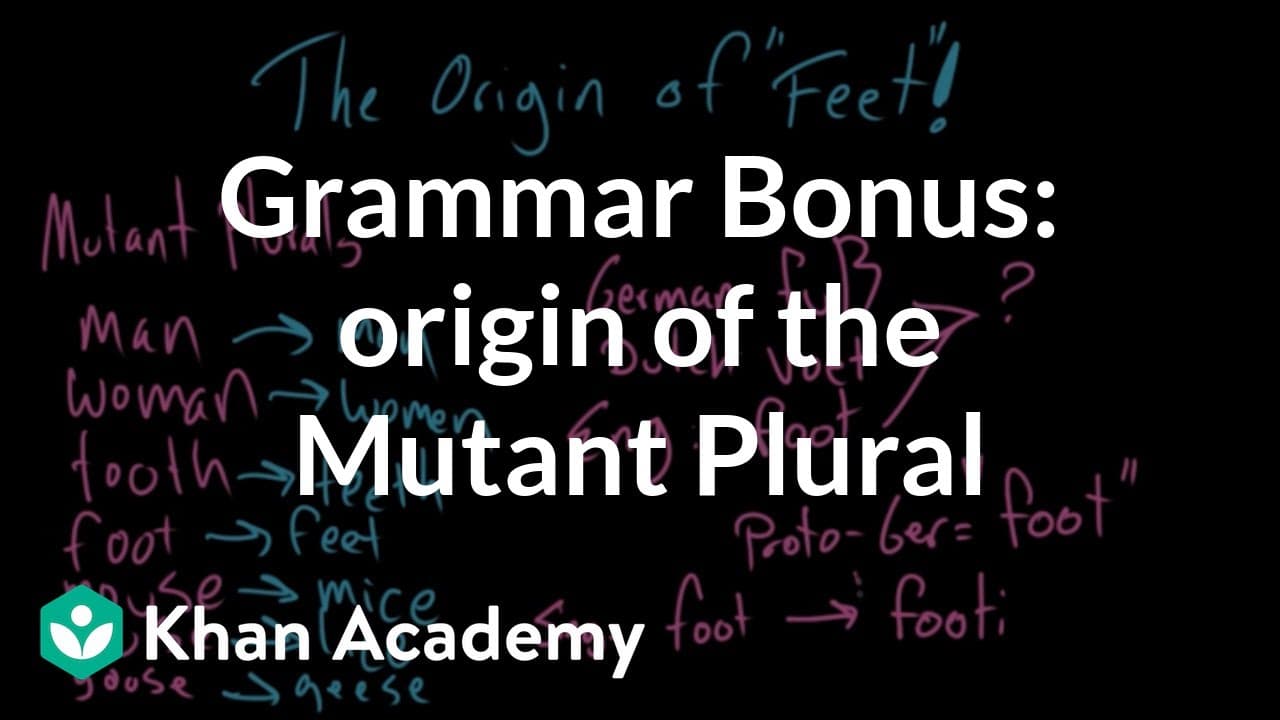
Why We Say 'Feet' Instead of 'Foots'

Why We Say 'Feet' Instead of 'Foots'

This educational video dives deep into the fascinating etymology behind English's "mutant plurals"—the seven specific nouns that change their vowel sound to become plural (like foot/feet and mouse/mice) rather than adding an "s." Hosted by a grammarian and a linguist, the discussion traces these words back to their Proto-Germanic roots to explain the historical mechanics of language change. The video explores complex linguistic concepts including vowel harmony, umlaut mutation (or i-mutation), and the Great Vowel Shift. Through handwritten diagrams and clear examples comparing English to German and Dutch, the hosts demonstrate how ancient plural suffixes eventually influenced the root vowels of words, leaving behind the irregular forms we use today. For educators, this resource is an excellent tool for demystifying English grammar. It moves beyond rote memorization of irregulars to provide the "why" behind the rules. It connects language arts with history and anthropology, showing students that language is a living, evolving system rather than a static set of arbitrary rules.

Khan AcademyKhan Academy

5mins 53s

Video
Mastering Irregular Plurals from Latin and Greek

Mastering Irregular Plurals from Latin and Greek

This educational video provides a clear and approachable guide to mastering foreign plural nouns in English, specifically those borrowed from Latin and Greek. The narrator explains that while English often regularizes these words over time (e.g., "funguses" vs. "fungi"), understanding the traditional rules is crucial for formal academic and scientific contexts. Through a hand-drawn chart, the video breaks down six specific patterns for pluralizing loanwords, offering a practical "cheat sheet" for students navigating complex vocabulary. The content explores key grammatical themes including irregular plurals, loanwords, and the evolution of language. It distinguishes between descriptive usage (how people actually speak in casual settings) and prescriptive rules (formal standards), using examples like "cactus/cacti" and "data/datum" to illustrate how English is constantly changing. The video emphasizes that one does not need to speak ancient languages to master English grammar, but rather that recognizing these patterns helps decipher unfamiliar words. For educators, this resource is invaluable for teaching advanced vocabulary, spelling rules, and scientific terminology. It serves as an excellent bridge between English Language Arts and science curricula, where words like "larvae," "fungi," and "hypotheses" appear frequently. The video demystifies intimidating words and empowers students to confidently use formal language in their writing and presentations while reassuring them that making mistakes is part of the learning process.

Khan AcademyKhan Academy

4mins 56s

Video
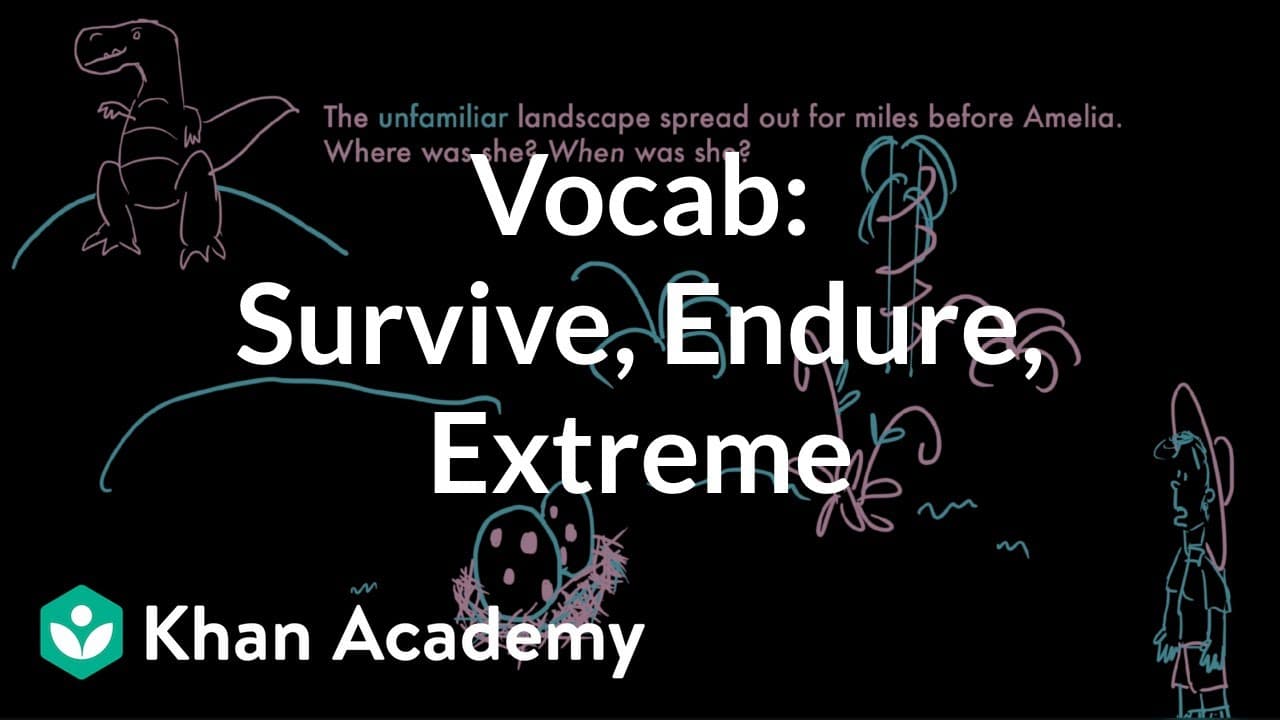
Mastering Vocabulary: Survive, Endure, and Extreme

Mastering Vocabulary: Survive, Endure, and Extreme

This engaging vocabulary lesson explores the definitions, usage, and origins of three interconnected words: "survive," "endure," and "extreme." Through the use of a digital whiteboard style, the narrator breaks down each word's part of speech, provides clear definitions, and illustrates their meanings with humorous and memorable examples. The video also introduces related word forms like "survival," "endurance," and "extremely," helping students build word families. A key highlight of the video is the "Word Origin Corner," which dissects the etymology of "survive." By analyzing the prefix "sur-" (meaning over or beyond) and the root "vive" (meaning to live), students learn how breaking down words can reveal their deeper meanings. Connections are made to other languages like Spanish and French, as well as related English words like "surpass" and "revive." Ideally suited for upper elementary and middle school English Language Arts classrooms, this video supports vocabulary acquisition and morphological awareness. Teachers can use it to introduce a unit on adventure stories, survival literature (like "Hatchet" or "Island of the Blue Dolphins"), or to teach specific strategies for understanding word roots. The humorous examples—such as enduring a boring uncle's lecture or surviving a shipwreck—provide excellent anchors for classroom discussions on the nuances between similar terms.

Khan AcademyKhan Academy

4mins 13s

Video
Unlocking the Power of Greek and Latin Roots

Unlocking the Power of Greek and Latin Roots

This educational video explores the foundational role of Greek and Latin roots, prefixes, and suffixes in the English language. The narrator, David, uses engaging metaphors and visual diagrams to demonstrate how complex vocabulary words are often constructed from smaller, meaningful building blocks. He illustrates how breaking words down into their component parts allows readers to decipher meanings without needing a dictionary.

Khan AcademyKhan Academy

6mins 23s

Video
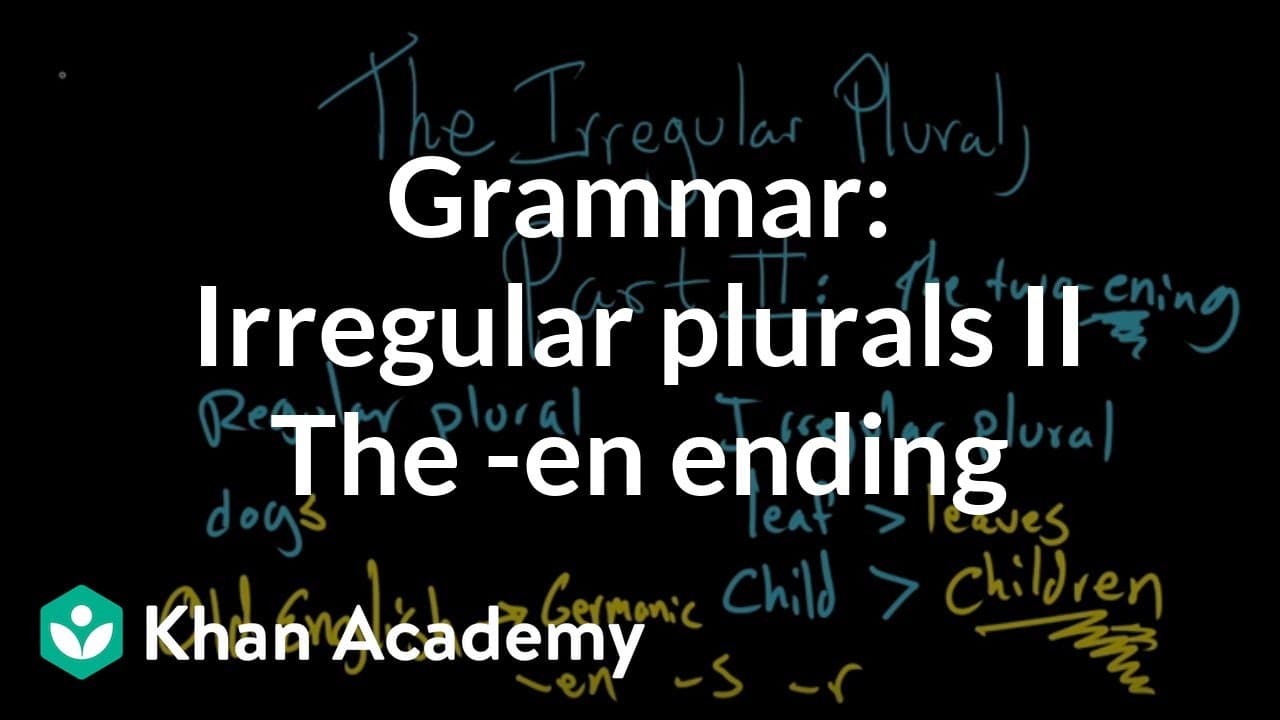
Why the Plural of Ox Is Oxen but Box Is Boxes

Why the Plural of Ox Is Oxen but Box Is Boxes

This educational video explores the fascinating history behind irregular English plurals, specifically focusing on the rare "-en" ending found in words like "children" and "oxen." The narrator, David, breaks down why English grammar often feels unpredictable by explaining its roots as a Germanic language derived from Old English. He uses humor and clear handwriting to illustrate how historical regional variations eventually distilled into the standard English rules we use today. The video delves into etymology to explain common student questions, such as why the plural of "ox" is "oxen" while the plural of "box" is "boxes." By distinguishing between native Old English words and borrowed words from Greek or Latin, the lesson demystifies these apparent inconsistencies. The content encourages students to view English not as a rigid block of rules, but as a "lashed together raft" of history and diverse influences. Included as a bonus segment is a historical anecdote about William Caxton, the first English printer, and a 15th-century confusion between the words "eggs" and "eyren." This story vividly illustrates the concept of dialects and the evolution of language, making it an excellent resource for discussing how communication technologies like the printing press helped standardize the English language.

Khan AcademyKhan Academy

7mins 23s

Video
The History and Origin of the Apostrophe

The History and Origin of the Apostrophe

This educational video explores the fascinating history and etymology of the apostrophe, tracing its journey from a Greek rhetorical device to a common English punctuation mark. The narrators explain the word's Greek roots meaning "turning away" and how it originally described a figure of speech where a speaker addresses an absent person or inanimate object. The video then moves into the historical introduction of the symbol itself, credited to the French humanist Geoffroy Tory in the 16th century. It explains how the mark was used to indicate omitted letters (elision) in French before migrating to the English language following centuries of French linguistic influence after the Norman Conquest. Teachers can use this video to deepen student understanding of punctuation by providing historical context, making grammar rules feel less arbitrary. It connects English Language Arts with history and foreign languages, demonstrating how English has evolved through cultural exchange and offering a logical explanation for why apostrophes are used in contractions to replace missing letters.

Khan AcademyKhan Academy

5mins 40s

Video
Learning to Spell and Use the Sight Word 'Buy'

Learning to Spell and Use the Sight Word 'Buy'

This high-energy music video is designed to teach early learners the sight word "buy." Through a catchy, repetitive song, students are guided to recognize the word by sight, spell it aloud letter-by-letter, and understand its meaning through context sentences. The video utilizes simple, high-contrast visuals with white text against a purple background to focus student attention specifically on the target vocabulary. The content covers three main literacy skills: word recognition, spelling (B-U-Y), and usage in sentences. The song introduces the conditional phrase structure "If I had some money, I would buy..." followed by rhyming or humorous animal examples like a puppy, pony, monkey, and donkey. This helps students associate the word "buy" with the concept of purchasing items using money. For educators, this video serves as an engaging hook or review tool for literacy lessons. It transforms rote memorization into a kinetic and auditory experience, making it particularly effective for auditory learners and students who benefit from musical mnemonics. The predictable pattern of the song allows for immediate student participation, while the sentence frames provide excellent models for writing activities.

Have Fun TeachingHave Fun Teaching

2mins 17s

Video
Learning Unfamiliar and Strategy Through Storytelling

Learning Unfamiliar and Strategy Through Storytelling

This engaging vocabulary lesson introduces two high-utility words, "unfamiliar" and "strategy," framed around a humorous personal narrative where the narrator has locked himself out of his house. Through digital whiteboard-style illustrations and text, the video breaks down the definitions, morphology, and usage of each word while weaving in a storyline about retrieving keys through a window. The narrator explains the prefix "un-" to decode meaning and distinguishes between the noun "strategy" and verb "strategize." Key themes include vocabulary acquisition, word morphology (prefixes and roots), and context clues. The video explores how breaking words into parts (like identifying "family" within "familiar") helps understanding, and it provides memorable, slightly absurd example sentences involving dinosaurs and fishing for tuna in a grocery store to reinforce the concepts in a fun way. For educators, this video serves as an excellent hook for literacy blocks focusing on Tier 2 vocabulary or morphology. It connects abstract definitions to concrete, humorous scenarios that aid retention. Teachers can use the "locked out" scenario to prompt students to brainstorm their own strategies, or use the "un-" segment to launch a lesson on how prefixes change word meanings.

Khan AcademyKhan Academy

2mins 45s

Video
Cracking the Case: Using Context Clues to Solve Mysteries

Cracking the Case: Using Context Clues to Solve Mysteries

This engaging educational video transforms a standard language arts lesson on context clues into a thrilling mystery case file. Viewers join the host and her robot assistant, Mia, at "The Context" resort to solve the theft of a valuable "Ormolu Horologe." Through an interactive narrative, students learn to define challenging, unfamiliar vocabulary words by analyzing the surrounding text for hints, synonyms, antonyms, examples, and inferences. The video explicitly breaks down four primary strategies for using context clues: looking for definitions or examples, identifying synonyms and antonyms, making inferences based on the situation, and using logic to deduce meaning. By embedding these lessons within a detective story, the video demonstrates how these skills apply not just to reading comprehension, but to critical thinking and problem-solving in real-world scenarios. Teachers can use this video as a comprehensive standalone lesson or a hook for a unit on vocabulary acquisition strategies. The "pause-and-solve" format encourages active participation, allowing students to practice the skills immediately. It is particularly valuable for demonstrating how to tackle high-level vocabulary without a dictionary, building student confidence in reading complex texts.

Miacademy & MiaPrep Learning ChannelMiacademy & MiaPrep Learning Channel

10mins 9s

Video
Rhythmic Reading: High-Frequency Sight Words in Context

Rhythmic Reading: High-Frequency Sight Words in Context

This educational music video features a high-energy, rhythmic song designed to teach early readers common sight words (high-frequency words) that often cannot be sounded out phonetically. Through a structured call-and-response format, the video introduces words individually, pronouncing them clearly, and then immediately places them into a simple, relatable sentence to demonstrate proper usage and context. The content covers a vast array of essential sight words found in early literacy curriculums (like Dolch and Fry lists), grouped into color-coded sections (Blue, Pink, Green, and Orange backgrounds) to help with visual categorization. Key themes include reading fluency, vocabulary acquisition, sentence structure, and word recognition. The repetition and catchy beat utilize the 'earworm' effect to aid memorization. For educators, this video serves as a versatile classroom tool. It can be used as a daily warm-up to build reading confidence, a transition activity to settle students, or a direct instructional tool for introducing new vocabulary. The consistent visual pattern—word, then sentence—makes it accessible for non-readers to follow along, bridging the gap between isolated word recognition and fluent reading comprehension.

Have Fun TeachingHave Fun Teaching

18mins 12s

Video
Decoding Confusing Texts Using Context Clues

Decoding Confusing Texts Using Context Clues

This engaging educational video explores the critical role of context in communication, using relatable text message scenarios to demonstrate how easily misunderstandings can occur. The presenter, Justin, walks viewers through two distinct examples of confusion caused by ambiguous language: a conversation about "followers" that conflates track teammates with social media audiences, and a discussion about a "forecast" that could refer to either vacation weather or business sales projections. By breaking down these interactions, the video illustrates how looking at surrounding sentences helps decode intended meaning. Key themes include reading comprehension, context clues, multiple-meaning words (polysemy), and digital literacy. The video highlights how the same word can mean completely different things depending on the situation and how our own mental frameworks influence our interpretation of messages. It emphasizes the importance of analyzing the "whole picture" rather than isolated phrases to achieve clarity. This resource is highly valuable for English Language Arts classrooms as a hook for lessons on context clues, inference, and vocabulary. The modern, digital-native format of analyzing text bubbles makes the abstract concept of "context" concrete and relevant for students. Teachers can use this video to spark discussions about clear communication, have students analyze their own ambiguous messages, or introduce the concept of homonyms and polysemous words in a fun, low-stakes environment.

Miacademy & MiaPrep Learning ChannelMiacademy & MiaPrep Learning Channel

5mins 12s

Video
How to Figure Out New Words Using Context Clues

How to Figure Out New Words Using Context Clues

This educational video introduces students to specific strategies for determining the meaning of unfamiliar words while reading. Narrated by David, the video acknowledges that even adults encounter unknown words and presents "context"—the language surrounding a word—as the primary tool for deciphering meaning without immediately reaching for a dictionary. The core of the video is built around the mnemonic acronym "IDEAS," which stands for Inference, Definition, Example, Antonym, and Synonym. Using a passage about primatologist Jane Goodall and the word "unconventional," the narrator demonstrates how each of these five distinct types of context clues functions. The video modifies the original text to illustrate how authors might provide definitions, examples, opposites, or synonyms directly within the narrative flow. For educators, this resource provides a clear, memorable framework for teaching vocabulary acquisition skills. It encourages students to be active readers who use detective work to solve linguistic puzzles. The video is particularly useful for English Language Arts lessons focusing on reading comprehension, vocabulary development, and independent reading strategies for upper elementary and middle school students.

Khan AcademyKhan Academy

4mins 47s

Video
Using Context Clues to Understand New Words

Using Context Clues to Understand New Words

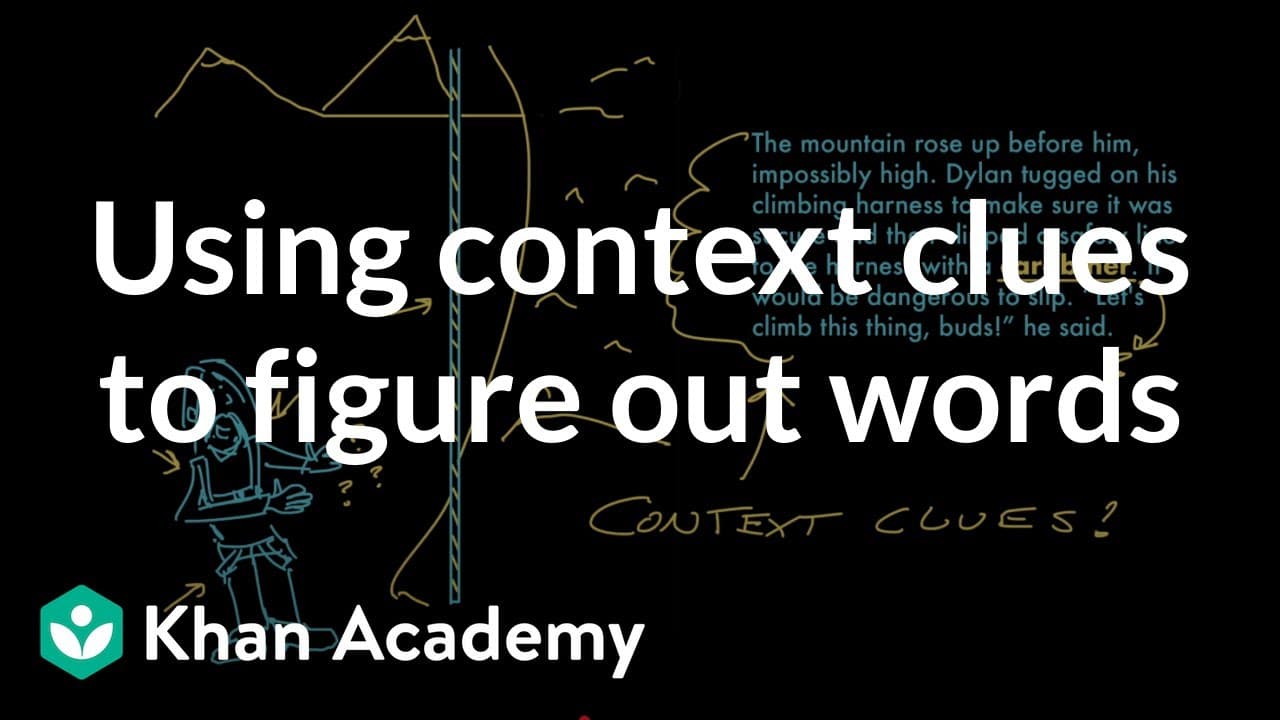
This educational video demonstrates a practical reading strategy for handling unfamiliar vocabulary words using 'Context Clues.' The narrator models a think-aloud process after encountering the difficult word 'carabiner' in a short paragraph about rock climbing. Instead of immediately reaching for a dictionary, he shows viewers how to use the surrounding text to infer the word's meaning. The video explores the concept of 'context' as the neighboring language that surrounds an unknown word. It breaks down specific textual evidence—such as references to safety harnesses, clipping lines, and preventing slips—to construct a working definition of the unknown term. The lesson concludes by comparing this derived definition with a real-world image of the object to verify understanding. For educators, this resource is an excellent modeling tool for English Language Arts instruction. It explicitly teaches students that they don't need to know every single word to comprehend a text. It encourages critical thinking and deductive reasoning, providing a transferable skill that students can apply to independent reading across all subjects.

Khan AcademyKhan Academy

3mins 30s

Video
Sing and Learn: First Grade Sight Words with Sentences

Sing and Learn: First Grade Sight Words with Sentences

This engaging animated music video introduces and reinforces a comprehensive list of First Grade level sight words through rhythm and repetition. Set to an energetic pop beat, the video systematically presents high-frequency words that are essential for early reading fluency. For each word, the video displays the text clearly on a colorful background, pronounces the word, and then immediately applies it in a simple, relatable sentence that is read aloud. This structure helps students bridge the gap between recognizing isolated words and understanding them in context. Key themes focus on early literacy development, specifically reading fluency, vocabulary acquisition, and sentence structure. The video targets 'sight words'—words that often defy standard phonetic rules or appear so frequently that instant recognition is necessary for smooth reading. By pairing the visual word with its auditory pronunciation and a meaningful context sentence, the video supports multiple learning modalities, helping students move from decoding to automatic recognition. For educators, this video serves as an excellent daily warm-up or review tool for first-grade classrooms. It transforms rote memorization into a fun, musical activity that helps students retain information more effectively. The clear, uncluttered visuals allow for focused attention on the text, making it suitable for whole-class projection where students can chant along. It effectively demonstrates usage, helping students understand not just how to say a word, but how it functions grammatically within a sentence.

Have Fun TeachingHave Fun Teaching

4mins 3s

Video
Decoding Meaning with Prefixes, Roots, and Suffixes

Decoding Meaning with Prefixes, Roots, and Suffixes

This educational video introduces the structural components of English words, specifically focusing on morphology: prefixes, roots, and suffixes. Narrated by David, the video moves beyond the basic concept that words are made of letters to explain how they are constructed from meaningful word parts. It uses clear, handwritten-style visuals and humorous examples to demonstrate how identifying these parts can help readers decode the meaning of unfamiliar vocabulary. The content systematically breaks down the word "reusable" to define the three key word parts. It explains that prefixes attach to the beginning of words to change meaning, roots serve as the core meaning-carriers (often from Latin or Greek), and suffixes attach to the end. The video emphasizes the practical application of this knowledge through an interactive segment where viewers are challenged to define the complex word "unrevivable" by analyzing its components. For educators, this video serves as an excellent hook for lessons on vocabulary acquisition and reading strategies. It provides a distinct framework for morphological analysis that students can immediately apply to their reading. The conversational tone, visual diagrams of word breakdowns, and the interactive "quiz" portion make it a highly engaging resource for introducing or reviewing how to tackle multi-syllabic words.

Khan AcademyKhan Academy

3mins 56s

Video
Identifying Cause and Effect in Texts

Identifying Cause and Effect in Texts

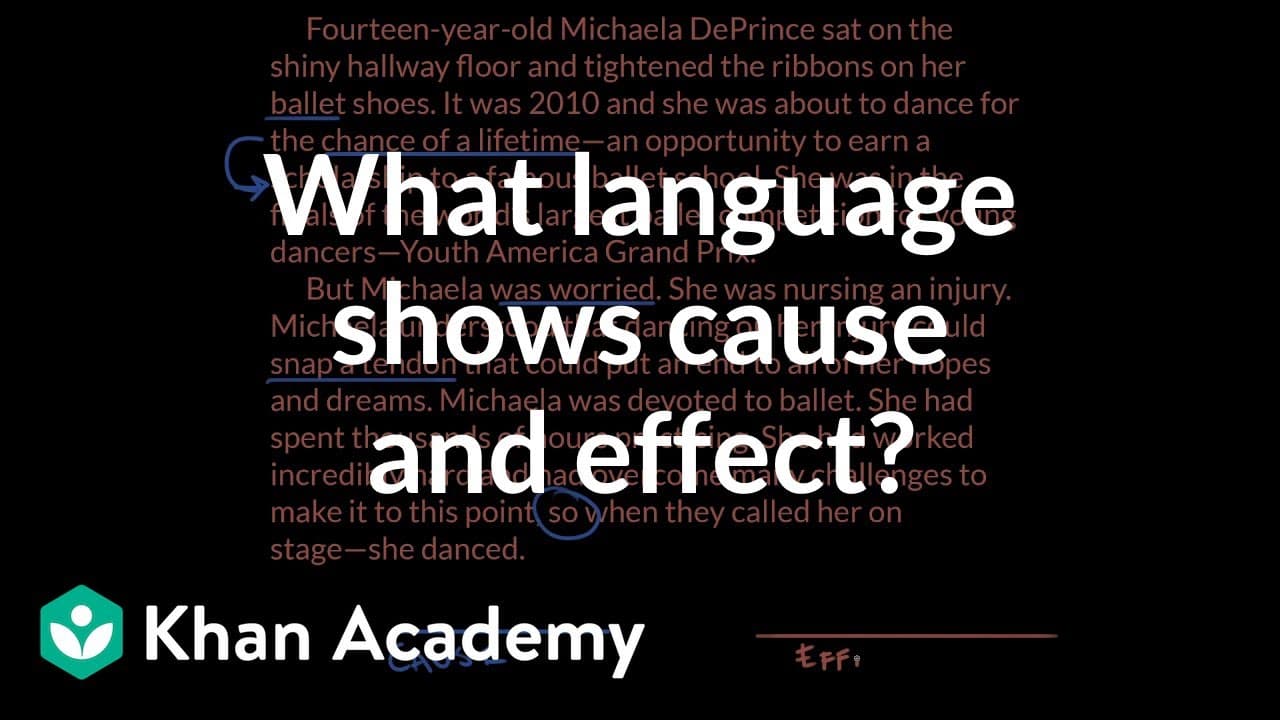
This educational video uses the whimsical machinery of Rube Goldberg to introduce and explain the concept of cause and effect in reading comprehension. The narrator begins by analyzing a complex cartoon machine where one action triggers a chain reaction, providing a concrete visual metaphor for how events are connected. This visual introduction seamlessly transitions into a lesson on identifying these relationships within written text, distinguishing between the 'cause' (why something happens) and the 'effect' (the result). The video covers key themes including logical sequencing, identifying signal words, and critical reading strategies. It explicitly lists common transition words that signal causes (e.g., because, since) and effects (e.g., therefore, consequently). The narrator also addresses the common misconception that cause and effect must follow the order of the sentence, demonstrating how sentence structure can be inverted without changing the logical relationship. For the classroom, this video is an excellent tool for scaffolding reading comprehension skills. It moves from a fun, low-stakes visual example to a rigorous close reading of a nonfiction passage about ballerina Michaela DePrince. By modeling how to annotate a text and ask 'why' questions to uncover hidden motivations and results, the video demonstrates practical strategies students can apply to any complex text to better understand narrative structure and character motivation.

Khan AcademyKhan Academy

7mins 30s

Video
How to Connect Ideas in Scientific Texts

How to Connect Ideas in Scientific Texts

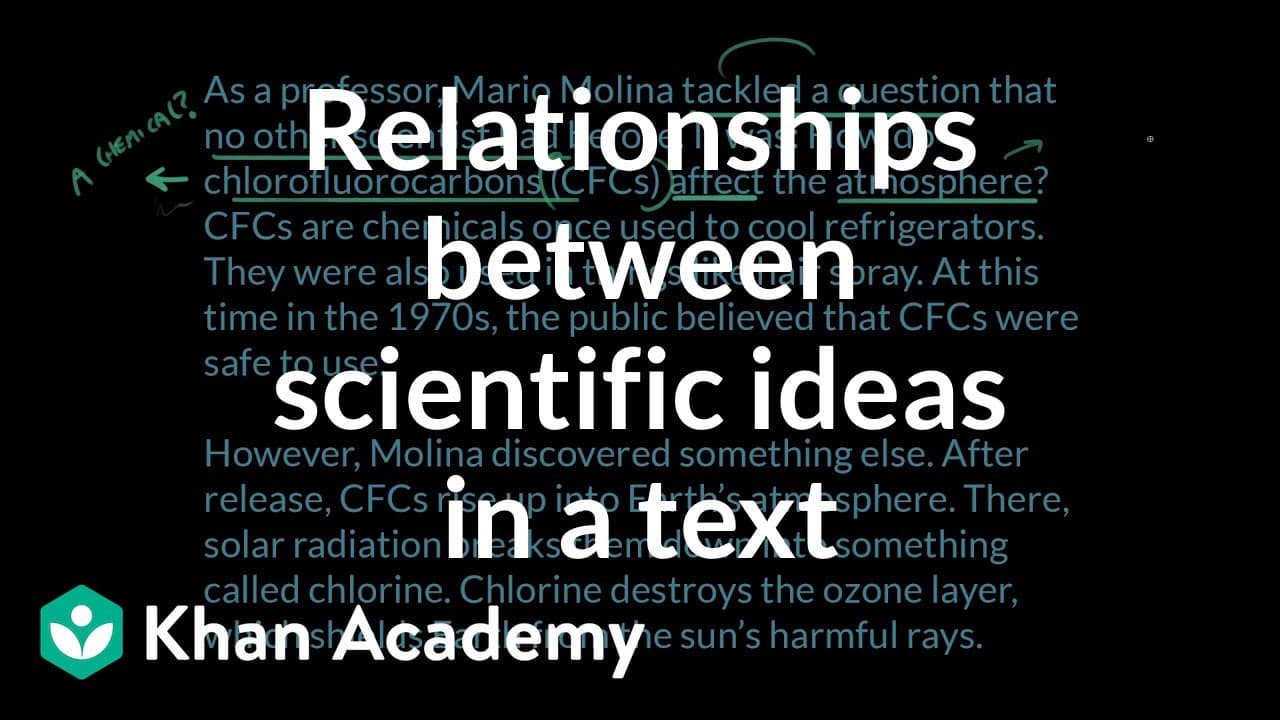
This educational video teaches students how to draw connections within scientific texts, using the real-world example of Nobel Prize winner Dr. Mario Molina's research on the ozone layer. The narrator begins with a simple, relatable analogy involving a bowl of pasta to explain four types of logical connections: why something happened, how it happened, how one event impacts another, and cause-and-effect relationships. This scaffolding helps prepare viewers for the more complex scientific text that follows. The video then transitions to a guided reading of a passage about Dr. Molina's discovery of the link between Chlorofluorocarbons (CFCs) and ozone depletion. The narrator models active reading strategies by highlighting key terms, decoding acronyms like 'CFCs' using context clues (parentheses), and identifying signal words like 'However' that indicate a shift in the argument. The analysis breaks down the complex chemical chain reaction described in the text—from hairspray cans to the stratosphere—demonstrating how to map linear events from a dense paragraph. This resource is highly valuable for both English Language Arts and Science classrooms. It bridges the gap between literacy and scientific understanding, showing students that reading science requires active engagement to construct meaning. Teachers can use this video to introduce annotation strategies, teach text structure, or launch a unit on environmental science. It effectively models how to slow down, ask questions of the text, and visualize processes to comprehend complex informational writing.

Khan AcademyKhan Academy

7mins 41s

Video
Creating and Curating a Poetry Portfolio

Creating and Curating a Poetry Portfolio

In this engaging creative writing lesson, the host Justin introduces students to the concept of becoming a "Penfluencer" by curating a professional poetry portfolio. The video breaks down the complex process of assembling a literary collection into three manageable steps: selection, revision, and reflection. Students learn that a portfolio is not just a random pile of work, but a thoughtful collection that demonstrates both their personal style and their range of skills as poets. The content dives deep into specific strategies for selecting poems, distinguishing between a "diverse" portfolio (variety of styles/topics) and a "coherent" one (unified by theme or mood). It then guides students through the revision process, moving beyond simple proofreading to deep stylistic changes involving connotation and sound devices like alliteration and meter. Finally, the video introduces the concept of an "Author's Statement," teaching students how to articulate their artistic choices and inspiration. This video is an excellent resource for middle and high school English Language Arts classrooms focusing on the writing process. It moves students beyond merely generating content to the higher-order thinking skills of curation and critique. By framing the task within a modern "app" context, it makes the potentially dry topics of revision and metacognitive reflection relevant and accessible. Teachers can use this video to structure a multi-day final project for a poetry unit.

Miacademy & MiaPrep Learning ChannelMiacademy & MiaPrep Learning Channel

8mins 36s

Video
Mastering Confusing Words: Complement vs. Compliment and Desert vs. Dessert

Mastering Confusing Words: Complement vs. Compliment and Desert vs. Dessert

This engaging grammar tutorial clarifies the confusion between two pairs of commonly misused words: "complement" vs. "compliment" and "desert" vs. "dessert." Through whimsical illustrations and clear definitions, the narrator breaks down the spelling, meaning, and pronunciation differences for each pair. The video uses memorable mnemonics—like associating the single 's' in desert with "less water" and the double 's' in dessert with "strawberry and sweet"—to help viewers retain the correct usage. The content focuses on key language arts concepts including homophones, near-homophones, and spelling rules. It explores how a word's spelling often links directly to its meaning and origin. The video specifically highlights how "complement" relates to completing or matching something (like an outfit), while "compliment" relates to praise. Similarly, it distinguishes the dry landscape of a "desert" from the sweet treat of "dessert" through visual associations. For educators, this video serves as an excellent hook or review tool for English Language Arts lessons on vocabulary and mechanics. It provides concrete, visual strategies that students can use to self-correct their writing. The lighthearted tone and simple animations make abstract spelling rules concrete, helping students move past rote memorization to understanding the logic—or at least the memory tricks—behind these tricky words.

Khan AcademyKhan Academy

4mins 15s

Video
Exploring the Vocabulary Words Recently and Voyage

Exploring the Vocabulary Words Recently and Voyage

In this engaging vocabulary lesson, the narrator introduces students to two specific words: "recently" and "voyage." Through a blend of humor, storytelling, and simple illustrations, the video breaks down the definitions, parts of speech, and grammatical rules associated with each word. Specifically, it explains how the suffix "-ly" transforms adjectives into adverbs and how a single word like "voyage" can function as both a noun and a verb. The video explores key grammatical concepts in an accessible way. It defines "recently" as an adverb meaning "happening a short time ago" and demonstrates how adjectives like "happy" and "quick" become adverbs with the addition of "-ly." It then defines "voyage" as a long journey, providing examples of its use as a noun (taking a trip) and a verb (the act of traveling). The narrator uses humorous example sentences involving astronomers and astronauts craving tamales to solidify understanding. For educators, this video is a valuable tool for reinforcing parts of speech and expanding vocabulary. It can be used to introduce the concept of suffixes, specifically how word endings change grammatical function. The clear definitions and contextual examples make it an excellent resource for ELA lessons focused on grammar, reading comprehension, and creative writing, encouraging students to use new vocabulary in their own sentences.

Khan AcademyKhan Academy

2mins 29s

Video
Defining Experiment, Invention, and Discovery

Defining Experiment, Invention, and Discovery

This engaging vocabulary lesson from Khan Academy invites students into the "Vocabulab" to explore three interconnected words: experiment, invention, and discovery. Narrated with humor and energy, the video defines each term as a noun and verb, providing clear distinctions between creating something new (invention), testing an idea (experiment), and finding something that already exists (discovery). The narrator uses whimsical hand-drawn animations to illustrate these concepts, making abstract definitions concrete and memorable for young learners. The video delves deeper than simple definitions by exploring word origins, specifically the prefix "dis-." It breaks down "discovery" into "dis-" (not/opposite) and "cover," explaining that discovering is literally the act of uncovering something hidden. This etymological sidebar helps students understand how prefixes function to change the meaning of base words, reinforcing language mechanics alongside vocabulary acquisition. The narrator provides additional examples like "dislike" and "disapprove" to cement this concept. Educationally, this resource is excellent for both English Language Arts and Science curriculums. It clarifies terms often used interchangeably in scientific contexts, helping students speak more precisely about the scientific method. The inclusion of a "useless invention" (a machine that turns gold into crabs) adds a layer of fun that keeps students engaged, while the narrator's persistence with his failed experiments subtly models a growth mindset. Teachers can use this to introduce scientific units, teach prefixes, or inspire creative writing about imaginary inventions.

Khan AcademyKhan Academy

3mins 28s

Video
Mastering Language Register: Formal vs. Informal Writing

Mastering Language Register: Formal vs. Informal Writing

This engaging video lesson introduces students to the concept of "register" in language arts—the level of formality used in speaking and writing. Through a narrative involving a "Deportment Store" in Media Metropolis, the narrator explains the difference between formal and informal communication using relatable analogies like choosing the right outfit for an occasion. The video defines key terms like deportment and register, helping students understand that language choices depend heavily on the audience and context.

Miacademy & MiaPrep Learning ChannelMiacademy & MiaPrep Learning Channel

10mins 5s

Video
Identifying Cause and Effect in Texts

Identifying Cause and Effect in Texts

This educational video uses the whimsical machinery of Rube Goldberg to introduce and explain the concept of cause and effect in reading comprehension. The narrator begins by analyzing a complex cartoon machine where one action triggers a chain reaction, providing a concrete visual metaphor for how events are connected. This visual introduction seamlessly transitions into a lesson on identifying these relationships within written text, distinguishing between the 'cause' (why something happens) and the 'effect' (the result). The video covers key themes including logical sequencing, identifying signal words, and critical reading strategies. It explicitly lists common transition words that signal causes (e.g., because, since) and effects (e.g., therefore, consequently). The narrator also addresses the common misconception that cause and effect must follow the order of the sentence, demonstrating how sentence structure can be inverted without changing the logical relationship. For the classroom, this video is an excellent tool for scaffolding reading comprehension skills. It moves from a fun, low-stakes visual example to a rigorous close reading of a nonfiction passage about ballerina Michaela DePrince. By modeling how to annotate a text and ask 'why' questions to uncover hidden motivations and results, the video demonstrates practical strategies students can apply to any complex text to better understand narrative structure and character motivation.

Khan AcademyKhan Academy

7mins 30s

Video
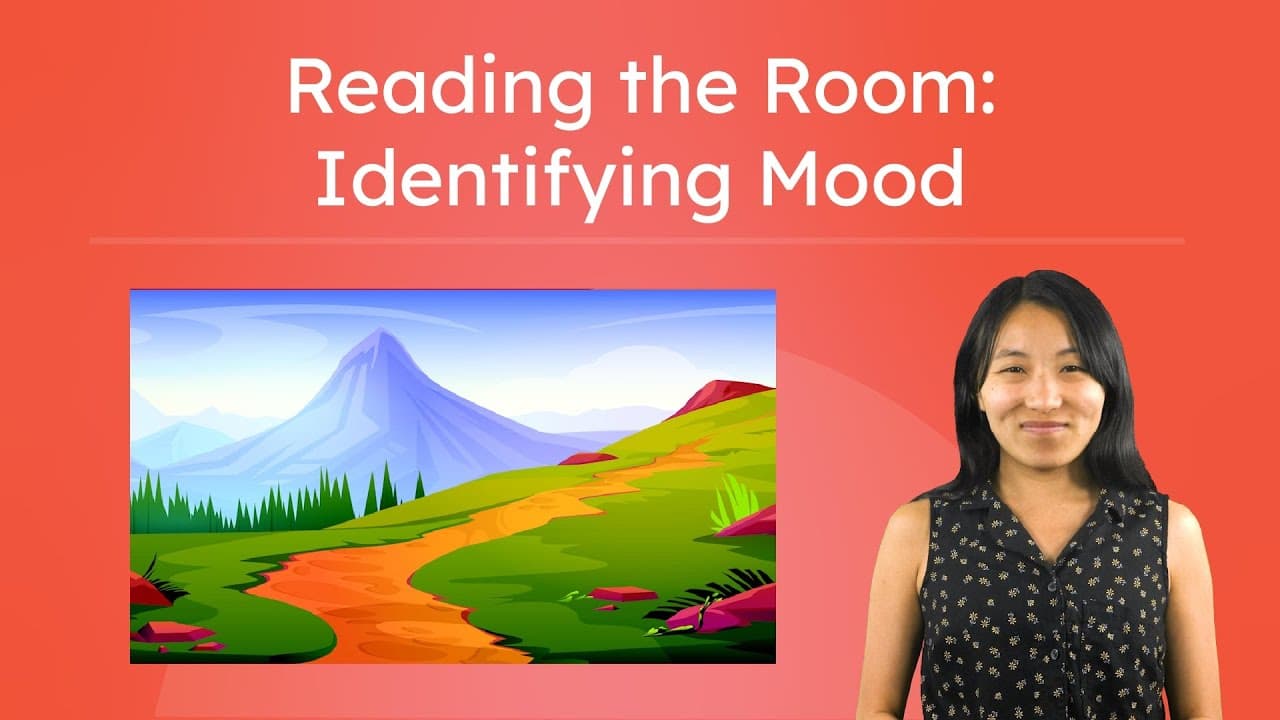
Reading the Room: How to Identify Mood in Stories

Reading the Room: How to Identify Mood in Stories

In this engaging Language Arts adventure, viewers join a narrator and her robot companion, Mia, on a quest through the "Valley of Vibes." To succeed, they must face the "Vibe Master" and pass a series of "vibe checks" by correctly identifying the mood of various narrative passages. The video combines a fantasy storyline with direct instruction to teach students how to analyze literature, moving beyond simple emotional descriptors to more precise literary vocabulary. The video focuses on the concept of "mood" in narrative writing, defining it as the emotional atmosphere an author creates for the reader. It systematically breaks down how writers construct mood using specific tools: characterization, setting, conflict, and word choice. The lesson guides students through three distinct examples, transitioning from guided analysis to independent practice, and introduces sophisticated vocabulary words such as "melancholy," "exuberant," "triumphant," and "foreboding" to replace simpler terms like "sad," "happy," or "scary." This resource is highly valuable for upper elementary and middle school classrooms as it models the thought process behind literary analysis. By explicitly highlighting text evidence—such as "plodded" versus "strode" or "gloomy" versus "emerald grass"—it shows students exactly how to locate and interpret clues within a text. The video includes built-in pause points for student reflection and participation, making it an excellent tool for interactive whole-class instruction or self-paced learning stations focused on reading comprehension and author's craft.

Miacademy & MiaPrep Learning ChannelMiacademy & MiaPrep Learning Channel

10mins 49s

Video
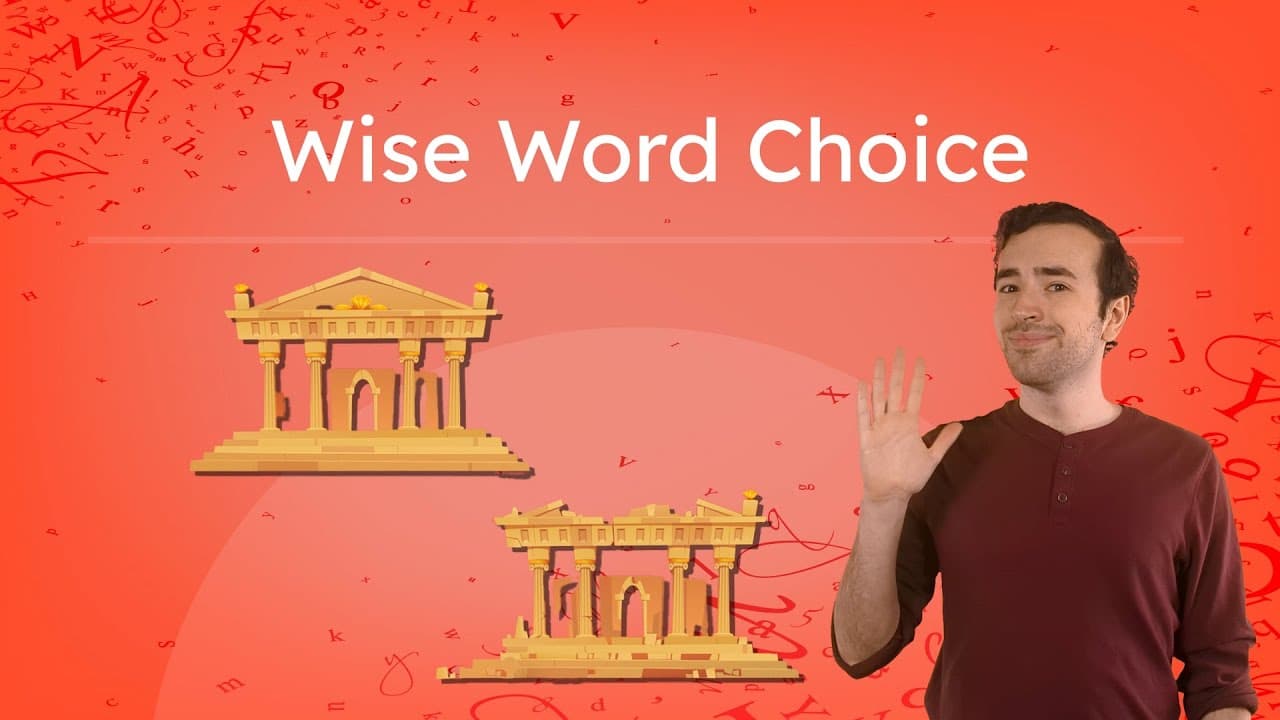
Mastering Intentional Word Choice in Creative Writing

Mastering Intentional Word Choice in Creative Writing

This engaging video lesson explores the power of intentional word choice in creative writing, demonstrating how specific vocabulary transforms flat descriptions into vivid, immersive experiences for readers. Through a "writer's escape room" narrative, the host guides students through the concepts of denotation and connotation, illustrating how words with similar definitions can evoke vastly different emotional responses. The lesson uses practical examples, including excerpts from Kenneth Grahame's *The Wind in the Willows*, to show how authors use language to establish mood, setting, and character traits. The video breaks down three specific strategies for selecting the perfect words: visualizing the scene to brainstorm descriptors, choosing words that emphasize key character or setting traits, and considering the intensity of synonyms to match the intended atmosphere. It provides concrete examples for each strategy, such as shifting from "old" to "dilapidated" to "derelict" to increase intensity, or distinguishing between "childlike" and "childish" to understand positive versus negative connotations. Ideal for English Language Arts classrooms, this resource helps move students beyond basic vocabulary toward more sophisticated writing techniques. It encourages learners to treat writing as an art form where every word matters, providing them with actionable tools to revise their own drafts. The video concludes with a modeling exercise where the narrator applies these strategies to write a scene, allowing students to see the immediate impact of intentional word choice on narrative quality.

Miacademy & MiaPrep Learning ChannelMiacademy & MiaPrep Learning Channel

10mins 32s

Video
Exploring Similes, Metaphors, and Idioms

Exploring Similes, Metaphors, and Idioms

This engaging animated video introduces students to the concept of figurative language, specifically focusing on three primary types: similes, metaphors, and idioms. The narrator explains that figurative language is like "art with words," allowing us to communicate in creative and fun ways rather than just literally. Through a series of clear examples and visual demonstrations, viewers learn how to identify and distinguish between these common literary devices. The video is structured into three distinct sections. First, it covers similes, defining them as comparisons using "like" or "as" (e.g., "quiet as mice"). Next, it introduces metaphors, explaining how they compare two things without using "like" or "as" (e.g., "the snow was a white blanket"). Finally, it explores idioms, describing them as phrases with special meanings different from their literal words (e.g., "raining cats and dogs"), and includes a fun fact about the sheer number of idioms in English. This resource is highly valuable for elementary Language Arts classrooms. It uses repetition, text highlighting, and relatable visuals (like animals and weather) to make abstract linguistic concepts concrete for young learners. Teachers can use this video to introduce a unit on creative writing, to support reading comprehension by helping students decode non-literal text, or as a review tool before a poetry or narrative writing assignment.
Homeschool PopHomeschool Pop

15mins 4s

Video
Sing, Spell, and Read the Sight Word "Call"

Sing, Spell, and Read the Sight Word "Call"

This high-energy music video is designed to help early readers master the specific high-frequency sight word "call." Utilizing a catchy pop beat and repetition, the video employs a multi-sensory approach to literacy instruction. It breaks down the learning process into three distinct phases: word recognition through repeated visual exposure, orthographic mapping through rhythmic spelling (C-A-L-L), and contextual application through simple sentences. The content focuses entirely on the word "call," anchoring it as a core vocabulary term. The video demonstrates the word's usage in everyday contexts, such as calling a school, a zoo, a bank, and a friend. This contextualization helps students move beyond simple memorization to understanding how the word functions within a sentence structure. The consistent visual formatting—white text on a pink background—reduces cognitive load, allowing students to focus solely on the text. For educators, this video serves as an excellent tool for phonics warm-ups, transition times, or literacy centers. Its repetitive nature makes it ideal for "choral reading" and active participation, helping to cement the spelling and pronunciation of the word for auditory and visual learners alike. It can be used to introduce the word, reinforce spelling patterns, or support remediation for students struggling with basic sight word fluency.

Have Fun TeachingHave Fun Teaching

2mins 5s

Video
Cracking the Case: Using Context Clues to Solve Mysteries

Cracking the Case: Using Context Clues to Solve Mysteries

This engaging educational video transforms a standard language arts lesson on context clues into a thrilling mystery case file. Viewers join the host and her robot assistant, Mia, at "The Context" resort to solve the theft of a valuable "Ormolu Horologe." Through an interactive narrative, students learn to define challenging, unfamiliar vocabulary words by analyzing the surrounding text for hints, synonyms, antonyms, examples, and inferences. The video explicitly breaks down four primary strategies for using context clues: looking for definitions or examples, identifying synonyms and antonyms, making inferences based on the situation, and using logic to deduce meaning. By embedding these lessons within a detective story, the video demonstrates how these skills apply not just to reading comprehension, but to critical thinking and problem-solving in real-world scenarios. Teachers can use this video as a comprehensive standalone lesson or a hook for a unit on vocabulary acquisition strategies. The "pause-and-solve" format encourages active participation, allowing students to practice the skills immediately. It is particularly valuable for demonstrating how to tackle high-level vocabulary without a dictionary, building student confidence in reading complex texts.

Miacademy & MiaPrep Learning ChannelMiacademy & MiaPrep Learning Channel

10mins 9s

Video
Learning New Words with an Alien Visitor

Learning New Words with an Alien Visitor

In this engaging vocabulary lesson, narrator David welcomes an extraterrestrial visitor named Grobulux to Earth. Through a humorous interview format, the duo introduces three key academic vocabulary words: 'exploration,' 'identify,' and 'expand.' Grobulux explains that he is not here to conquer Earth, but rather to scout a new location for his planet's famous business, 'Fleebo Donuts,' providing a fun narrative framework for the lesson.

Khan AcademyKhan Academy

3mins 27s

Video
Learning the Words Simulate, Leisure, and Recreation

Learning the Words Simulate, Leisure, and Recreation

This vocabulary lesson introduces three interconnected words: simulate, leisure, and recreation. Through a combination of clear definitions, historical context, and word origin analysis, the narrator explains how these concepts relate to daily life. The video uses a blackboard-style aesthetic with neon line drawings to visually illustrate definitions and examples, making abstract concepts concrete for learners.

Khan AcademyKhan Academy

3mins 56s

Video
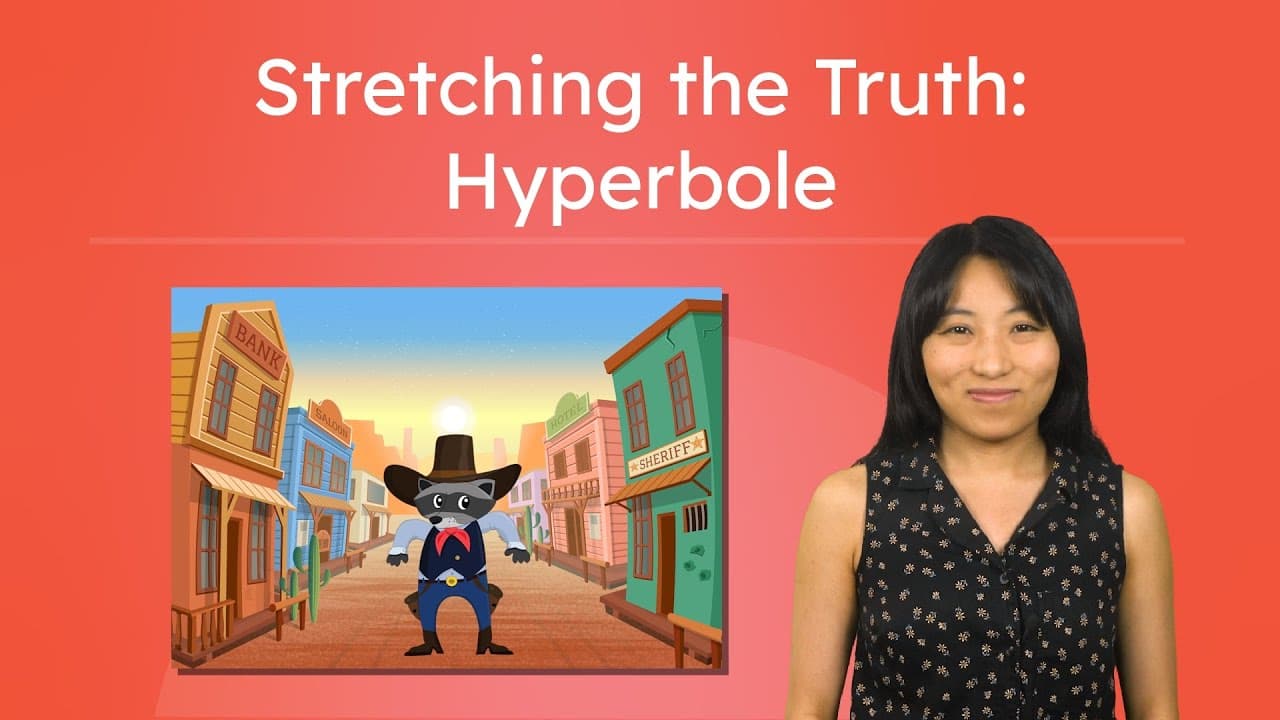
Stretching the Truth: How to Identify and Use Hyperbole

Stretching the Truth: How to Identify and Use Hyperbole

This engaging educational video introduces students to the concept of hyperbole—a figure of speech involving extreme exaggeration. Set against a playful Wild West backdrop, the narrator and a robot companion, Mia, guide viewers through a "ghost town" where they must identify hyperbolic statements to wake the sleeping "Guardian of Hyperbole." The video alternates between clear definitions and practical examples, distinguishing between realistic descriptions and hyperbolic ones found on town signs and in poetry.

Miacademy & MiaPrep Learning ChannelMiacademy & MiaPrep Learning Channel

10mins

Video
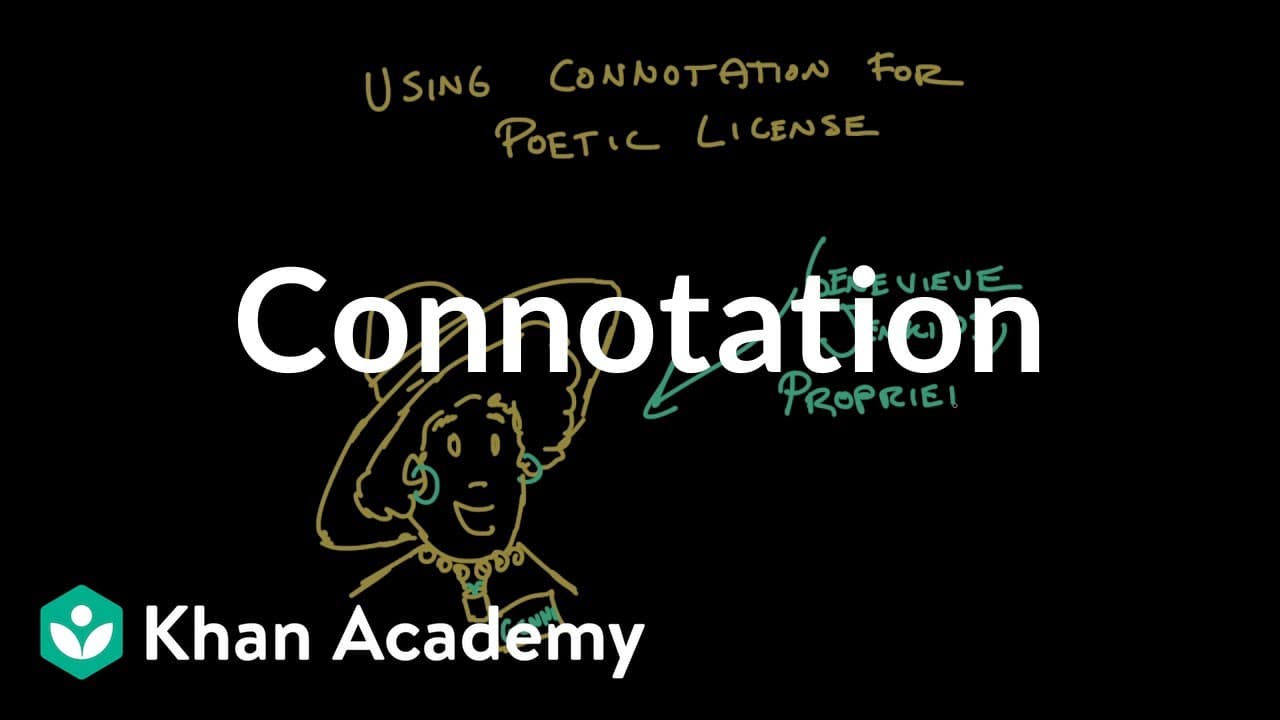
How Word Choice Changes Meaning: Connotation Explained

How Word Choice Changes Meaning: Connotation Explained

This engaging instructional video explores the concept of connotation—the emotional and cultural associations words carry beyond their literal dictionary definitions (denotation). Through clear analogies, such as water flowing around a rock, and relatable examples like "companion" versus "buddy," the narrator illustrates how synonyms can mean the same thing factually while conveying entirely different feelings or levels of formality. The video delves into key literary concepts including tone, author's intent, and the spectrum of positive, negative, and neutral connotations. It uses a detailed example of a fictional character, Genevieve Jenkins, to demonstrate how specific word choices (like "flourished" and "roots") can build a thematic motif. The narrator also distinguishes between cultural connotations shared by many and personal connotations derived from individual experiences, using a humorous personal anecdote about basketball. For educators, this resource is an excellent tool for teaching vocabulary nuances, literary analysis, and creative writing. It helps students move beyond basic comprehension to understanding *why* authors choose specific words. The content directly supports standards related to analyzing the impact of specific word choices on meaning and tone, making it highly applicable for English Language Arts classrooms from upper elementary through high school.

Khan AcademyKhan Academy

5mins 22s

Video
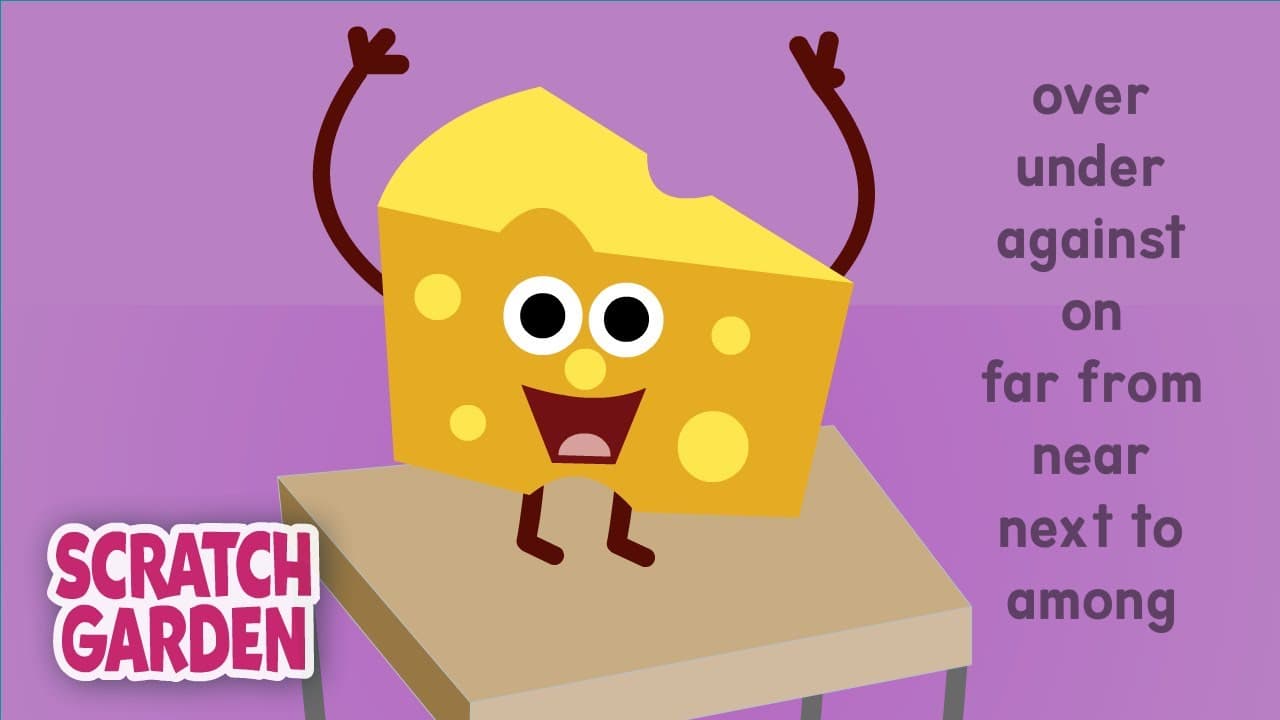
Learning Position Words: The Prepositions Song

Learning Position Words: The Prepositions Song

This engaging animated music video introduces young learners to common prepositions of place through a catchy, repetitive song. Featuring a cast of quirky characters—including an enthusiastic slice of cheese, a frog, a fly, a goose, and a herd of moose—the video visually demonstrates spatial relationships in a way that is easy for children to understand and remember. The simple, colorful animation isolates specific actions to clearly define the meaning of each prepositional phrase. The content covers two main sets of prepositions. The first set focuses on immediate physical contact or position relative to an object: "over," "under," "against," and "on." The second set explores distance and grouping: "far from," "near," "next to," and "among." Each term is reinforced through multiple repetitions, first by a narrator and then by the characters themselves, culminating in a rapid-fire review sequence. For educators, this video serves as an excellent hook or review tool for grammar and vocabulary lessons. The clear pairing of auditory labels with visual demonstrations makes it particularly effective for visual learners and English Language Learners (ELLs). Teachers can use the song to encourage physical movement in the classroom (TPR), have students replicate the positions with manipulatives, or use the catchy melody to help students memorize these essential vocabulary words.

Scratch GardenScratch Garden

2mins 22s

Video
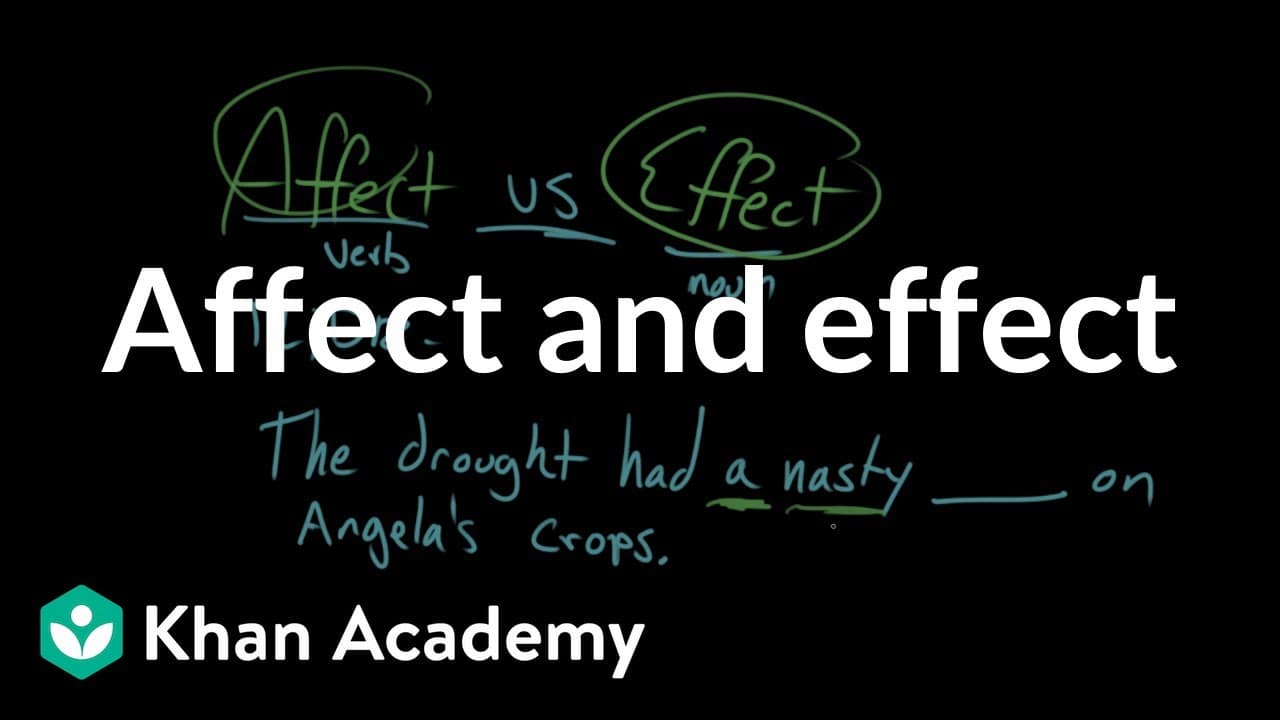
Mastering the Difference Between Affect and Effect

Mastering the Difference Between Affect and Effect

This video provides a clear and practical guide to distinguishing between the commonly confused words "affect" and "effect." Using a digital blackboard style, the narrator breaks down the primary rule that "affect" functions as a verb while "effect" functions as a noun. Through concrete examples involving a drought and crops, the video demonstrates how to identify which word is grammatically correct based on its role in the sentence as either an action or a result. The video delves deeper than simple definitions by addressing rare but grammatically correct exceptions to the general rule. It explains how "effect" can be used as a verb (meaning to bring about or create, as in "effect change") and how "affect" can be used as a noun (a psychology term describing personality or demeanor). The narrator offers stylistic advice on these exceptions, suggesting that while they are correct, they often cause confusion and might be best avoided in general writing. For educators, this resource serves as an excellent tool for grammar instruction and writing workshops. It demystifies a persistent trouble spot for students of all ages, offering a straightforward "TL;DR" rule for quick recall while acknowledging the nuance of advanced English usage. The content is valuable for strengthening proofreading skills, enhancing vocabulary precision, and helping students navigate the complexities of English homophones.

Khan AcademyKhan Academy

4mins 18s

Video
Learning to Spell and Use the Sight Word 'Buy'

Learning to Spell and Use the Sight Word 'Buy'

This high-energy music video is designed to teach early learners the sight word "buy." Through a catchy, repetitive song, students are guided to recognize the word by sight, spell it aloud letter-by-letter, and understand its meaning through context sentences. The video utilizes simple, high-contrast visuals with white text against a purple background to focus student attention specifically on the target vocabulary. The content covers three main literacy skills: word recognition, spelling (B-U-Y), and usage in sentences. The song introduces the conditional phrase structure "If I had some money, I would buy..." followed by rhyming or humorous animal examples like a puppy, pony, monkey, and donkey. This helps students associate the word "buy" with the concept of purchasing items using money. For educators, this video serves as an engaging hook or review tool for literacy lessons. It transforms rote memorization into a kinetic and auditory experience, making it particularly effective for auditory learners and students who benefit from musical mnemonics. The predictable pattern of the song allows for immediate student participation, while the sentence frames provide excellent models for writing activities.

Have Fun TeachingHave Fun Teaching

2mins 17s

Video
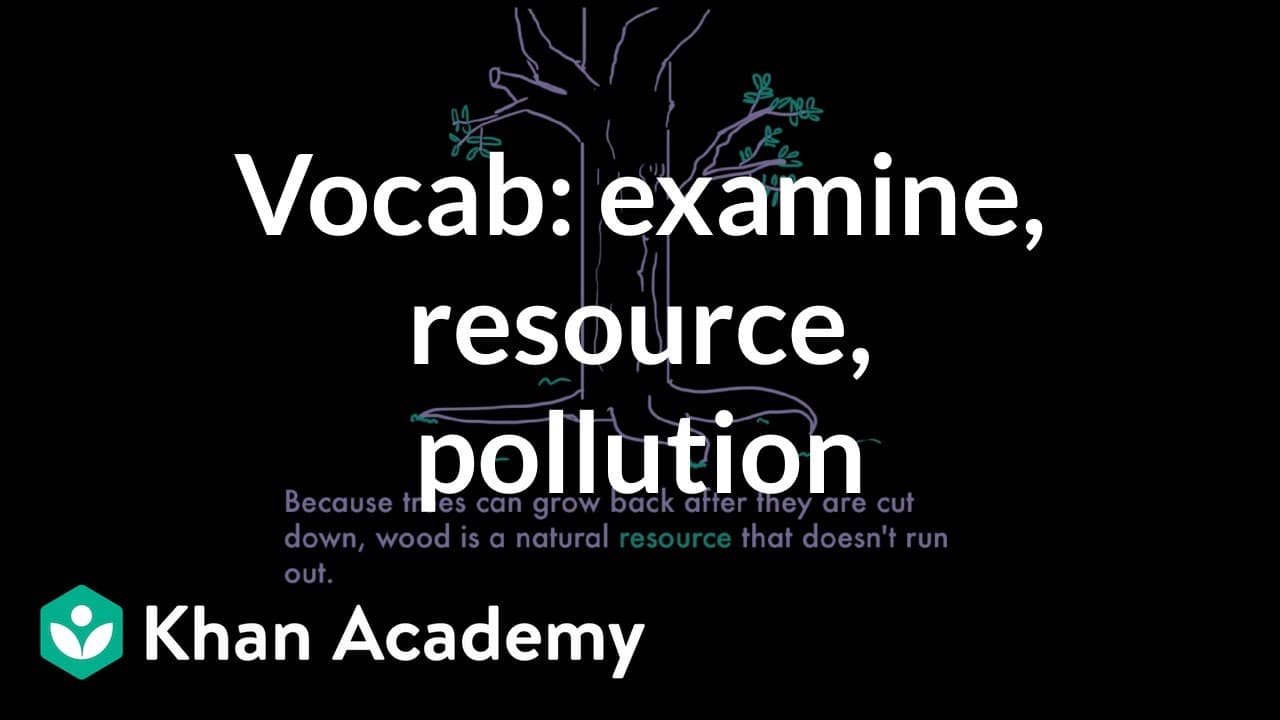
Defining and Using the Words Examine, Resource, and Pollution

Defining and Using the Words Examine, Resource, and Pollution

This educational video introduces and defines three specific vocabulary words: "examine," "resource," and "pollution." Using a "blackboard" style visual approach with colorful handwritten text and simple illustrations, the narrator breaks down each word by identifying its part of speech (verb or noun), providing a clear definition, and explaining its etymology or morphological structure (such as the suffix "-tion"). The video explores the meanings in depth before showing them in context. For example, it connects "examine" to the familiar concept of taking an "exam," expands the definition of "resource" from natural materials to school libraries, and breaks down "pollution" as the act of dirtying the environment. Each segment concludes with an illustrated sentence that demonstrates the word being used correctly in a real-world scenario. Teachers can use this video as a versatile tool for both English Language Arts and Science instruction. It serves as an excellent model for how to learn new vocabulary—by defining, connecting to known words, and using in context. Additionally, the specific words chosen bridge nicely into science units regarding scientific observation (examining), natural resources, and environmental stewardship (pollution).
Khan AcademyKhan Academy

2mins 59s

Video
Defining and Understanding Admire and Inspire

Defining and Understanding Admire and Inspire

This educational video provides a clear and engaging breakdown of two related vocabulary words: "admire" and "inspire." Using a digital blackboard format, the narrator defines both verbs, explores their etymological roots (including prefixes and Latin origins), and illustrates their meanings through distinct examples. The lesson moves from definitions to word analysis, explaining how "admire" relates to looking and respecting, while "inspire" relates to breathing life and motivation into someone. Key themes include vocabulary acquisition, etymology (word roots), and the concepts of respect and motivation. The video specifically highlights the Latin roots "mirar" (to look) and "spire" (breath), helping students understand how the history of a word informs its current meaning. It also touches on role models through the example of Chef Jacques Pépin and creative invention through a humorous example about Swiss cheese. For educators, this video is an excellent tool for introducing Tier 2 vocabulary and the concept of morphology (prefixes and roots). It bridges simple definitions with deeper linguistic understanding, making it suitable for word study lessons. The video supports social-emotional learning by encouraging students to identify who they admire and what inspires them, while the specific examples provide a template for students to use these words correctly in their own writing and speech.

Khan AcademyKhan Academy

2mins 35s