Sentence structure fundamentals, subject-verb agreement, and precise usage of parts of speech including pronouns, conjunctions, and adjectives. Targets technical accuracy through mastery of capitalization, punctuation, spelling, and verb mood.
An introductory presentation for teachers to use in class, explaining the common grammatical patterns of Shakespearean English with bilingual support.
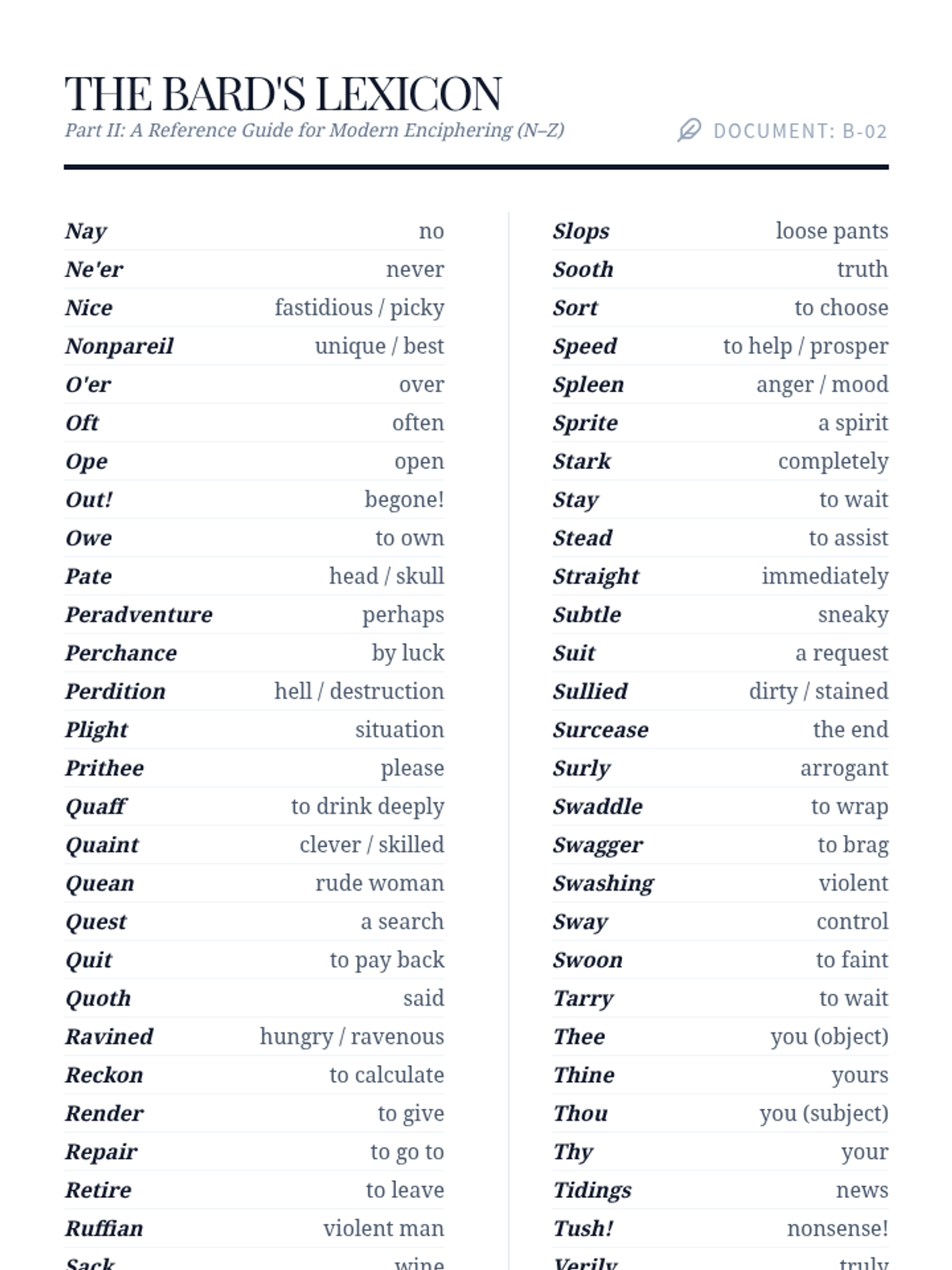
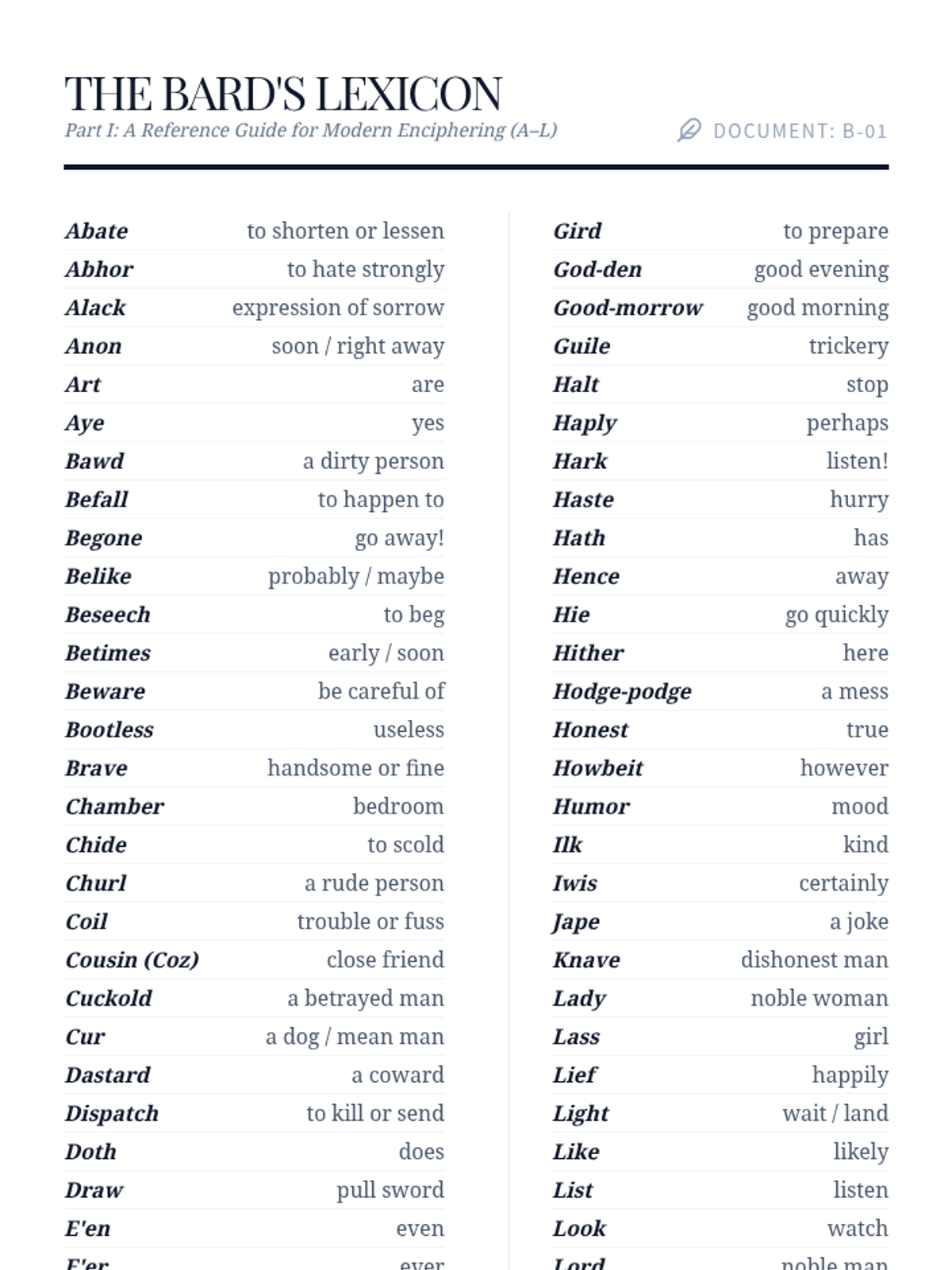
A trilingual dictionary (Shakespearean, Modern English, Spanish) containing nearly 200 archaic terms essential for understanding Macbeth, organized alphabetically for student reference.
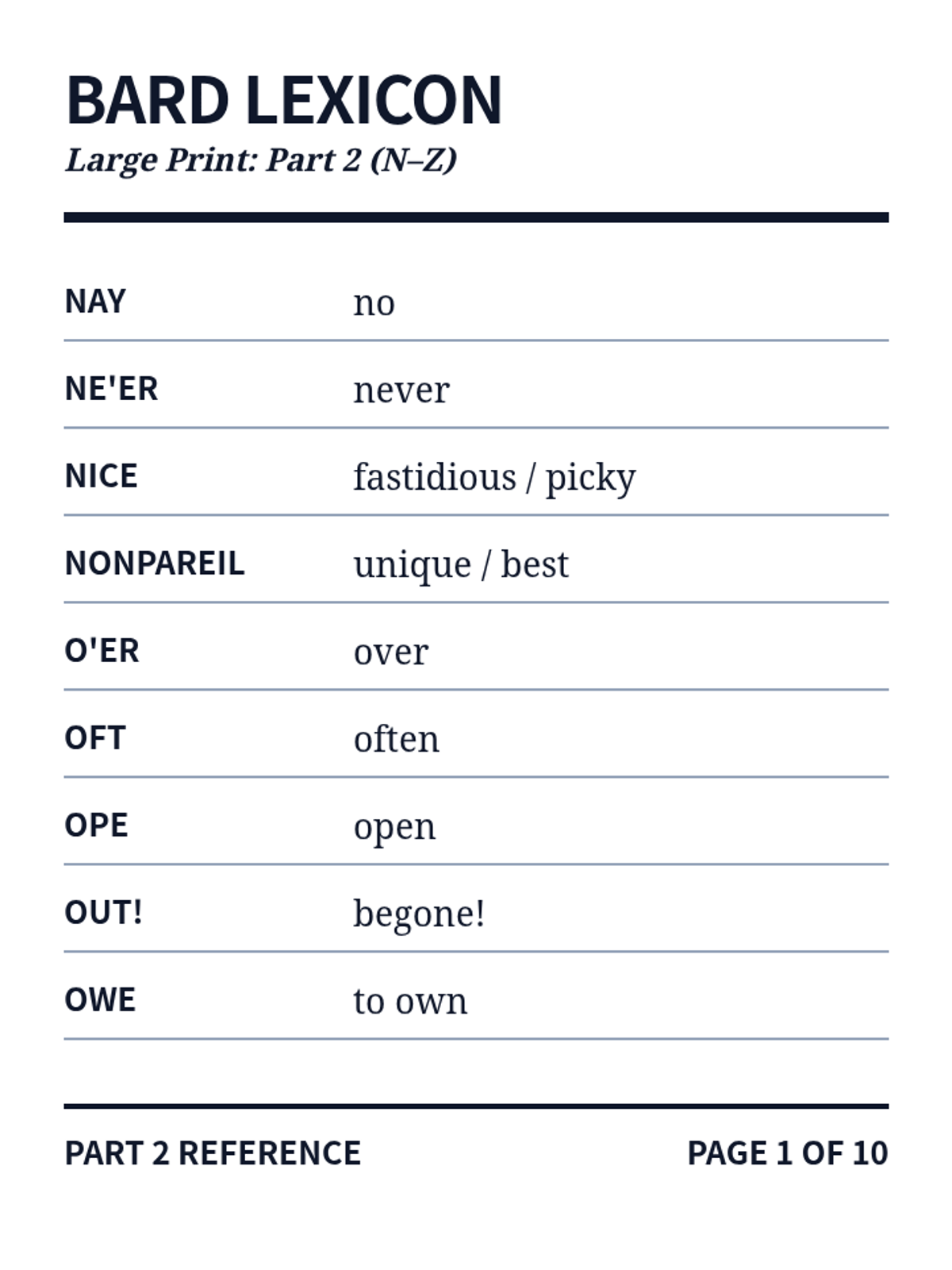
Part 2 (N-Z) of the Bard Lexicon in large print (20pt font) for visually impaired students. Features high-contrast text and a single-column layout for maximum readability.
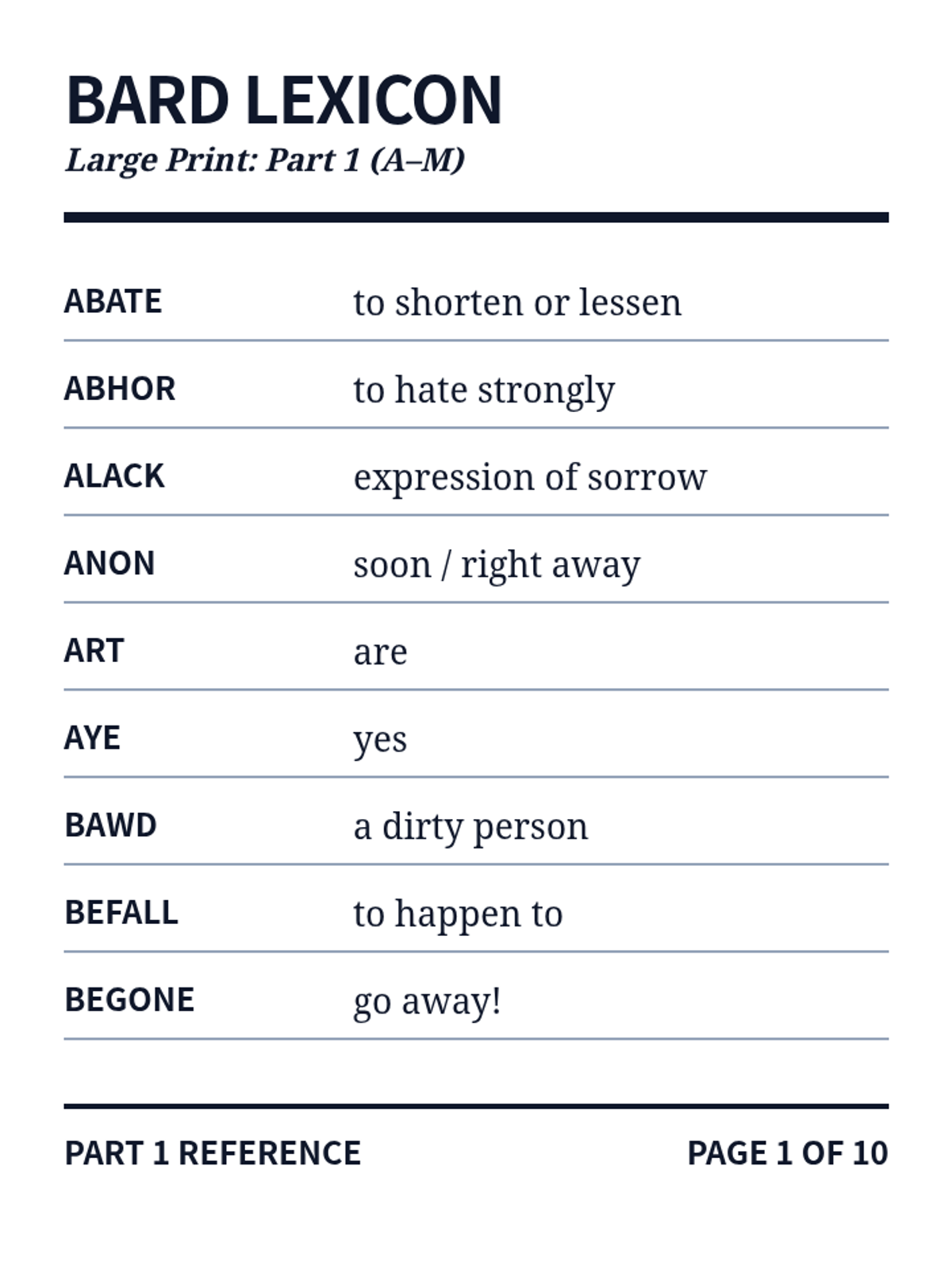
Part 1 (A-M) of the Bard Lexicon in large print (20pt font) for visually impaired students. Features high-contrast text and a single-column layout for maximum readability.
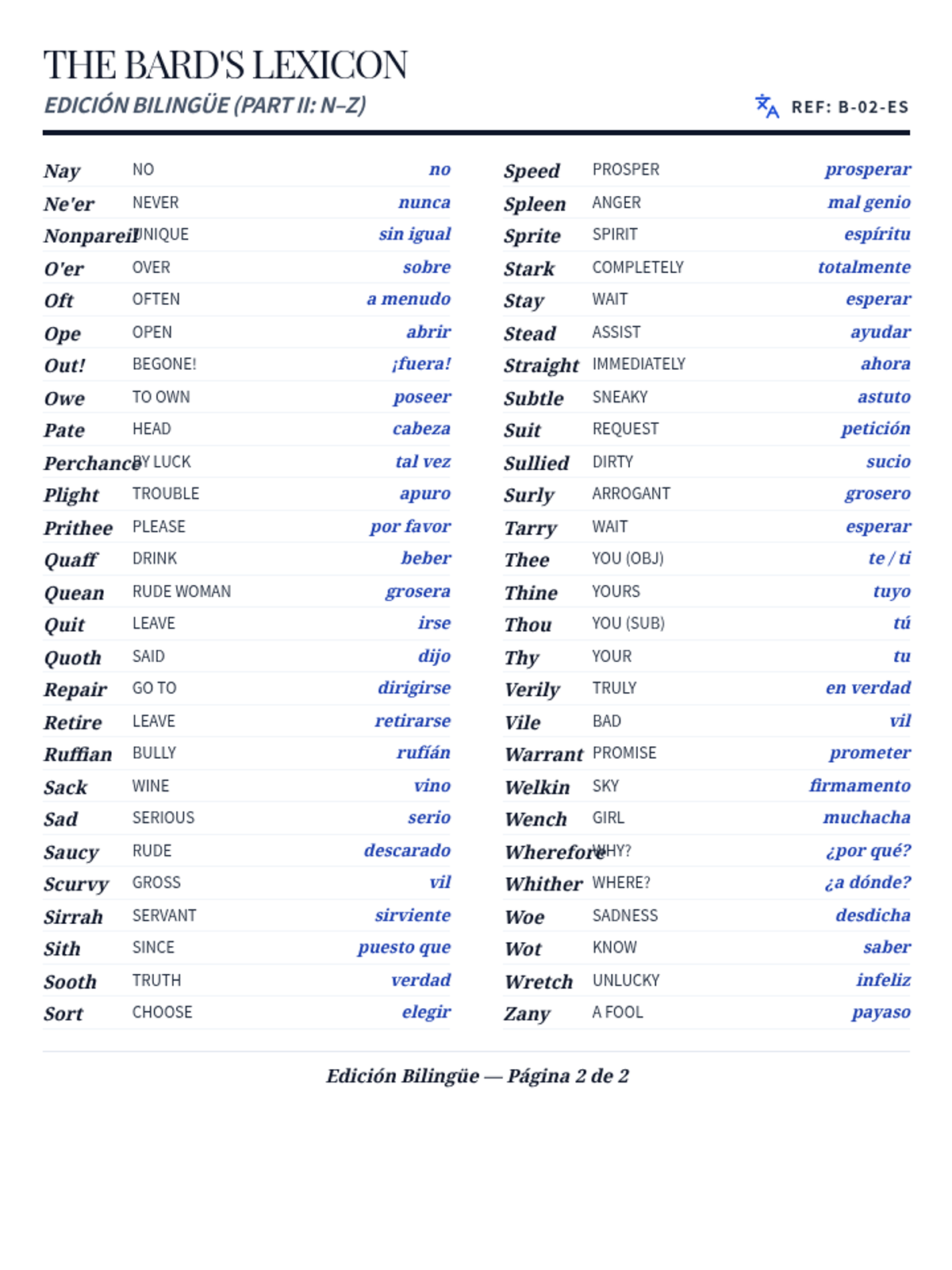
Part 2 of the bilingual (English/Spanish) visual word bank for the Shakespearean encoding activity, completing the alphabet with common Elizabethan words and their modern translations in pt. 10.5 font. Updated for layout and contrast issues.
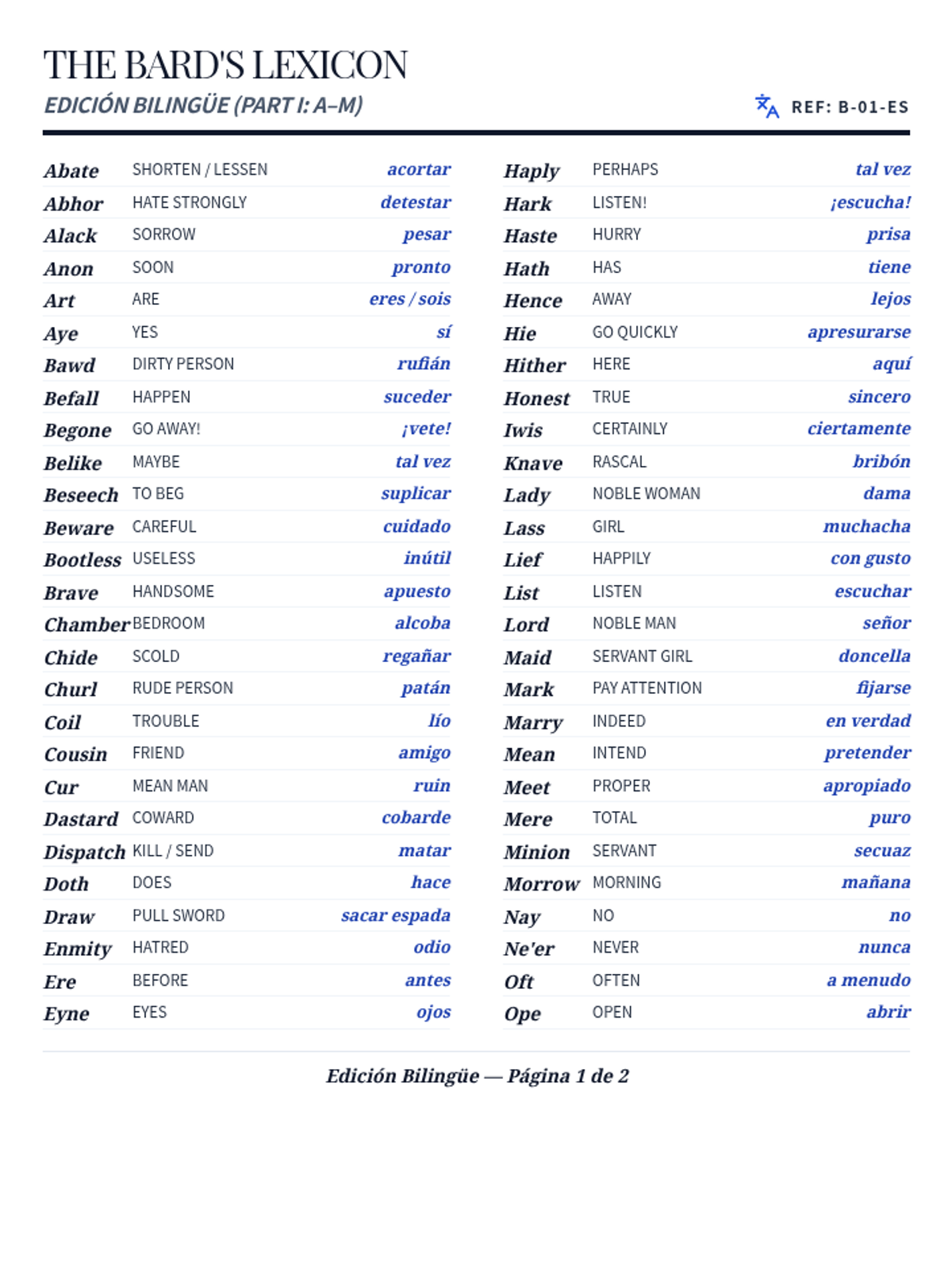
Part 1 of the bilingual (English/Spanish) visual word bank for the Shakespearean encoding activity, featuring common Elizabethan words with both modern English and Spanish translations. Updated for layout and contrast issues.
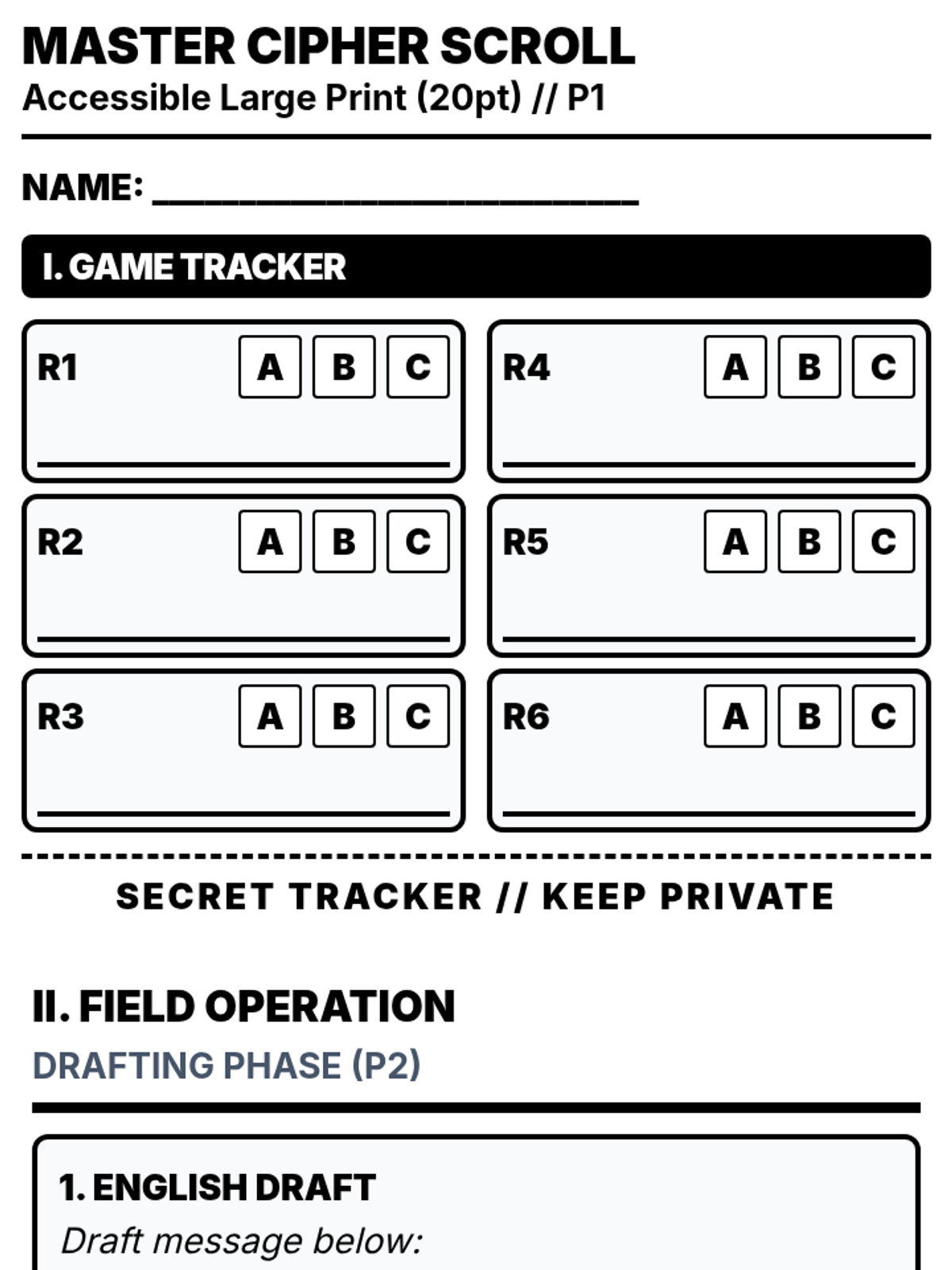
A 3-page, high-contrast, large-print (20pt font) version of the Master Cipher Scroll worksheet. Page 1 contains the 6-round game tracker, Page 2 handles the drafting phases, and Page 3 contains the final encoding and peer decoding areas. Designed for visually impaired high school students. Updated with tighter spacing on page 2.
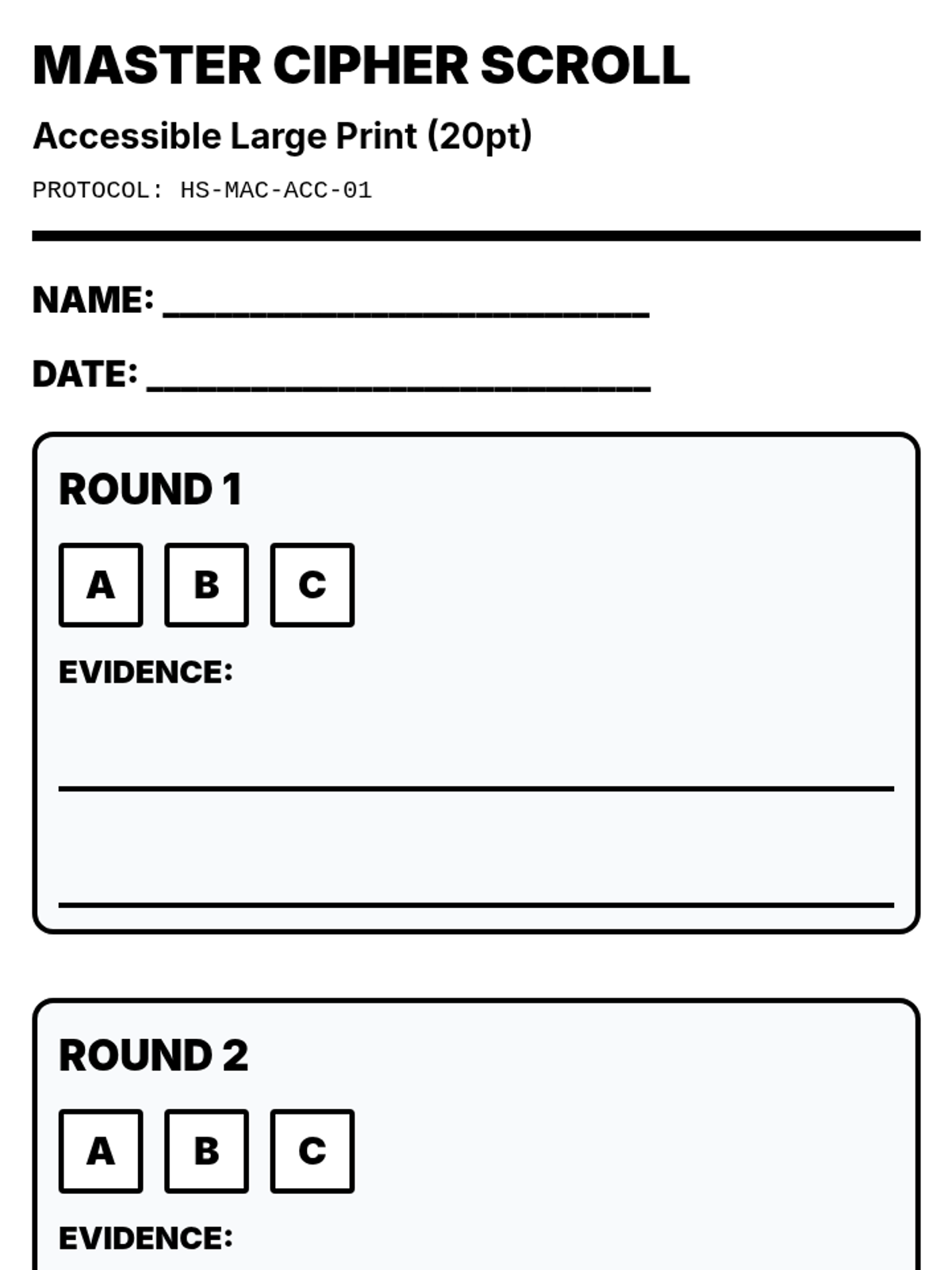
A high-contrast, large-print (20pt font) version of the Master Cipher Scroll worksheet designed for visually impaired students. Spans 8 pages to ensure readability and adequate writing space for all activity phases. Updated for improved page breaks and contrast.
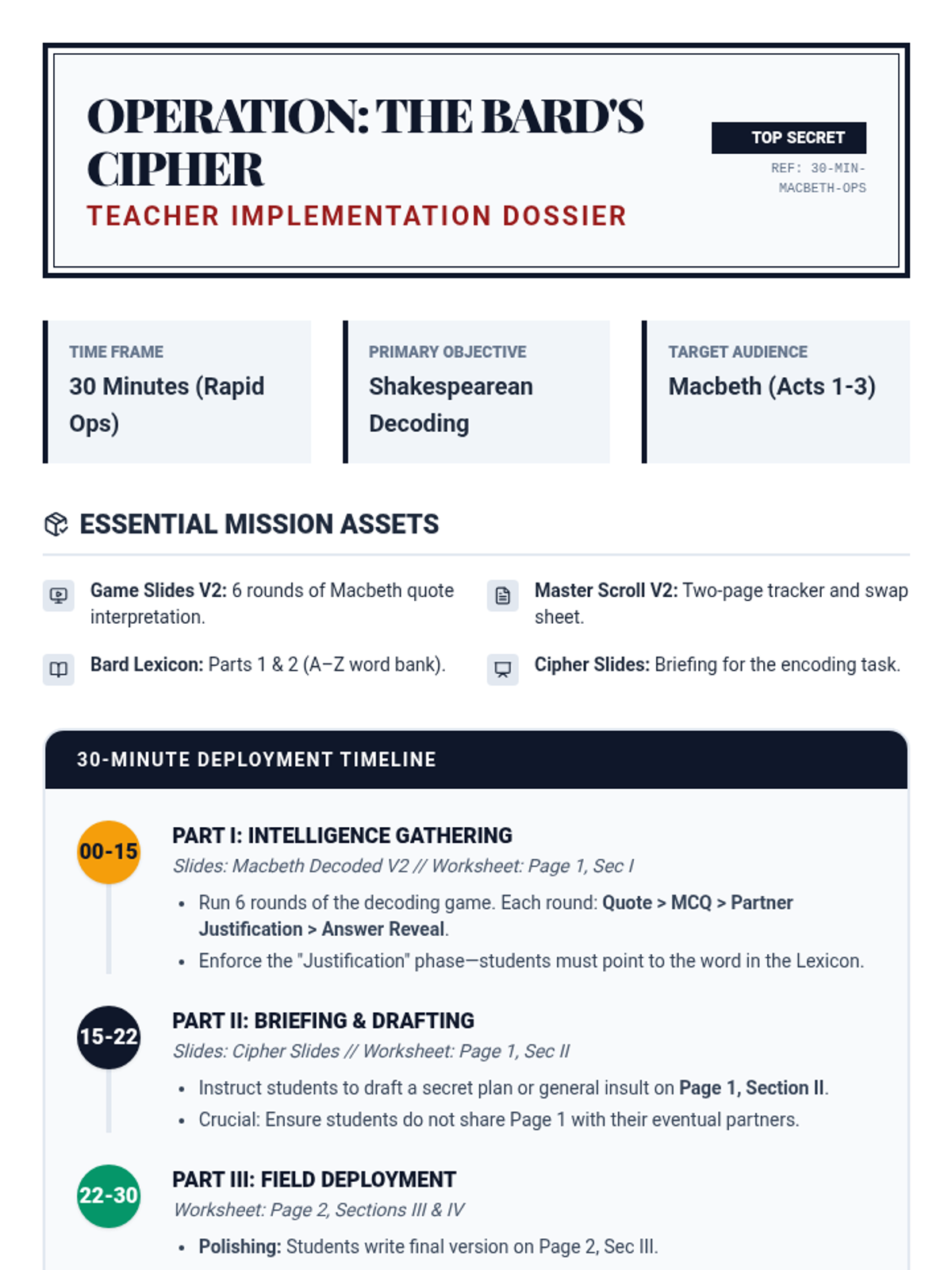
A professional implementation guide for a 30-minute Shakespearean decoding and encoding lesson. Includes a timed pacing guide and facilitation tips for maintaining secrecy during peer swapping. Updated for page break and contrast issues.
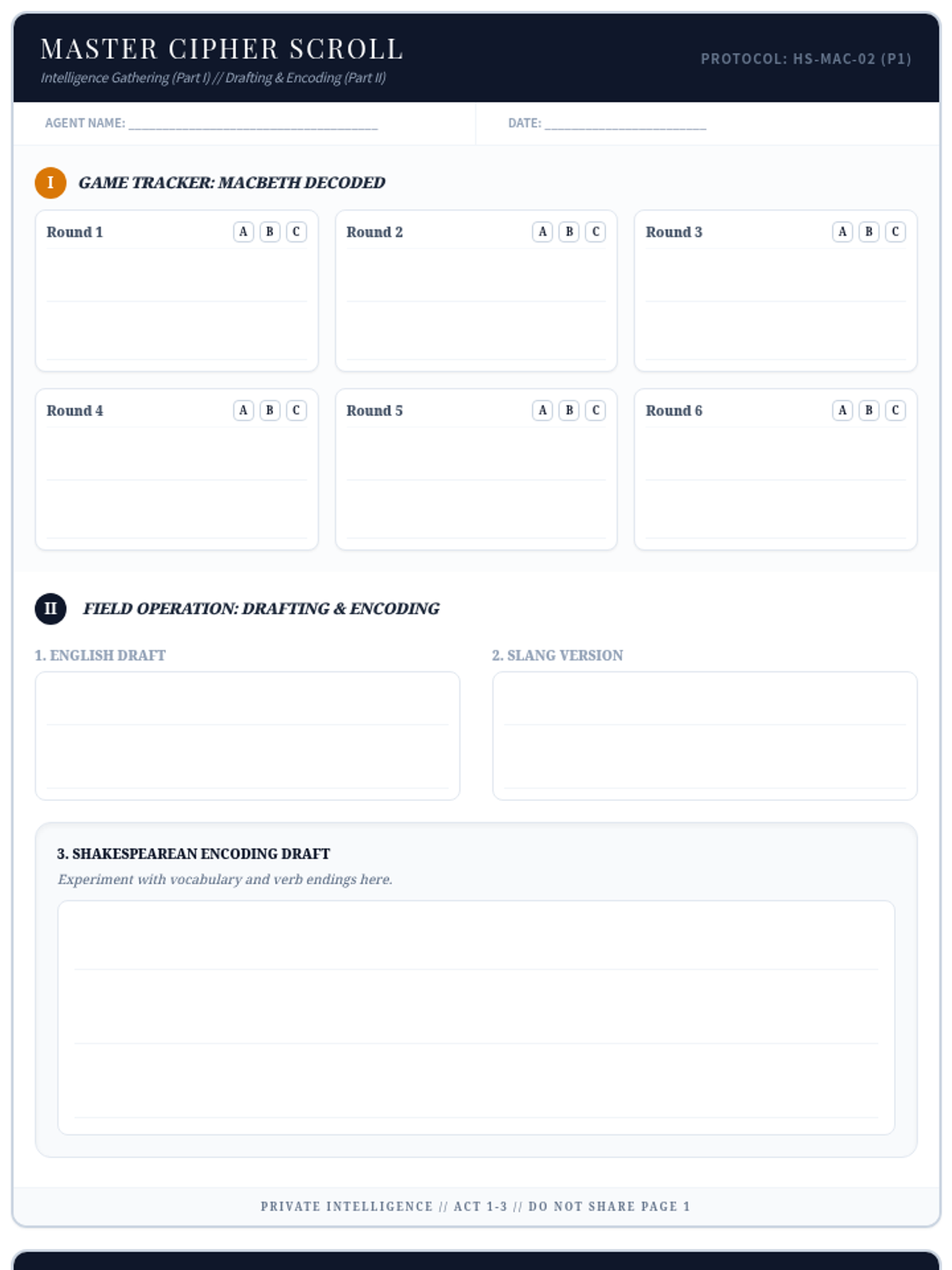
An expanded, two-page version of the game note scroll worksheet. Page 1 contains the game tracker and initial drafts, while Page 2 features the final Shakespearean encoding and space for peer decoding to ensure secrecy. Updated with improved page breaks and writing space.
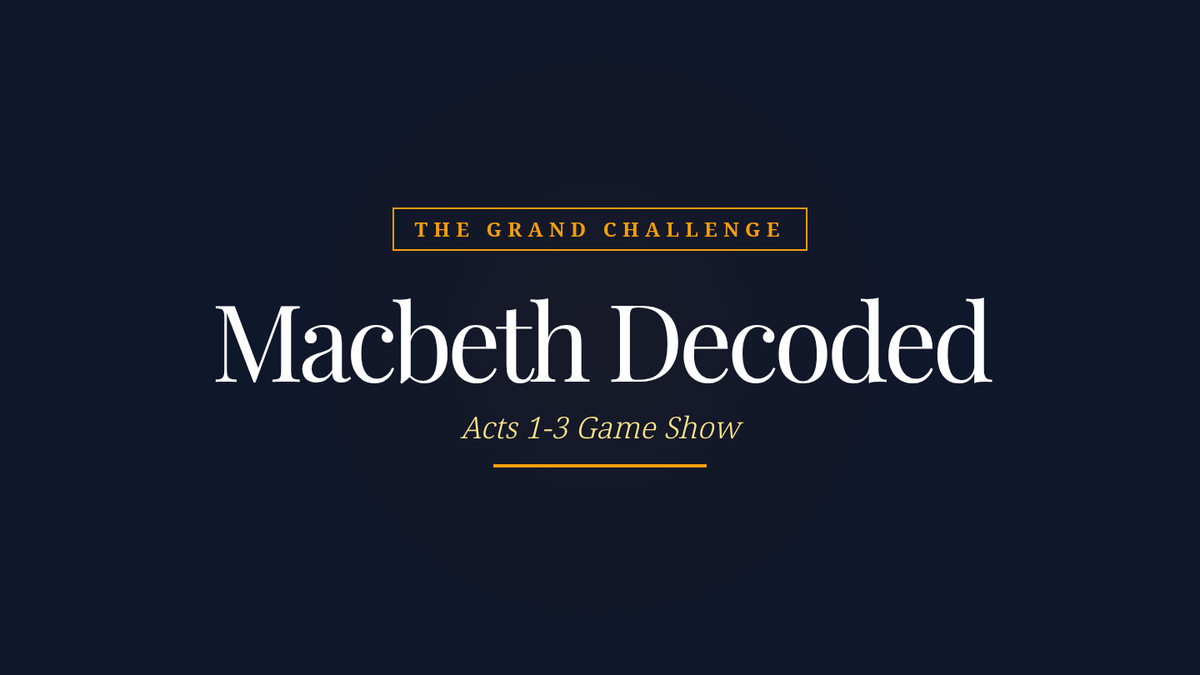
An updated Jeopardy-style game show slide deck for Macbeth Acts 1-3. Features interpretation slides that display both the quote and multiple-choice translations for better clarity. Round 6 choices now reflect full-quote translations.
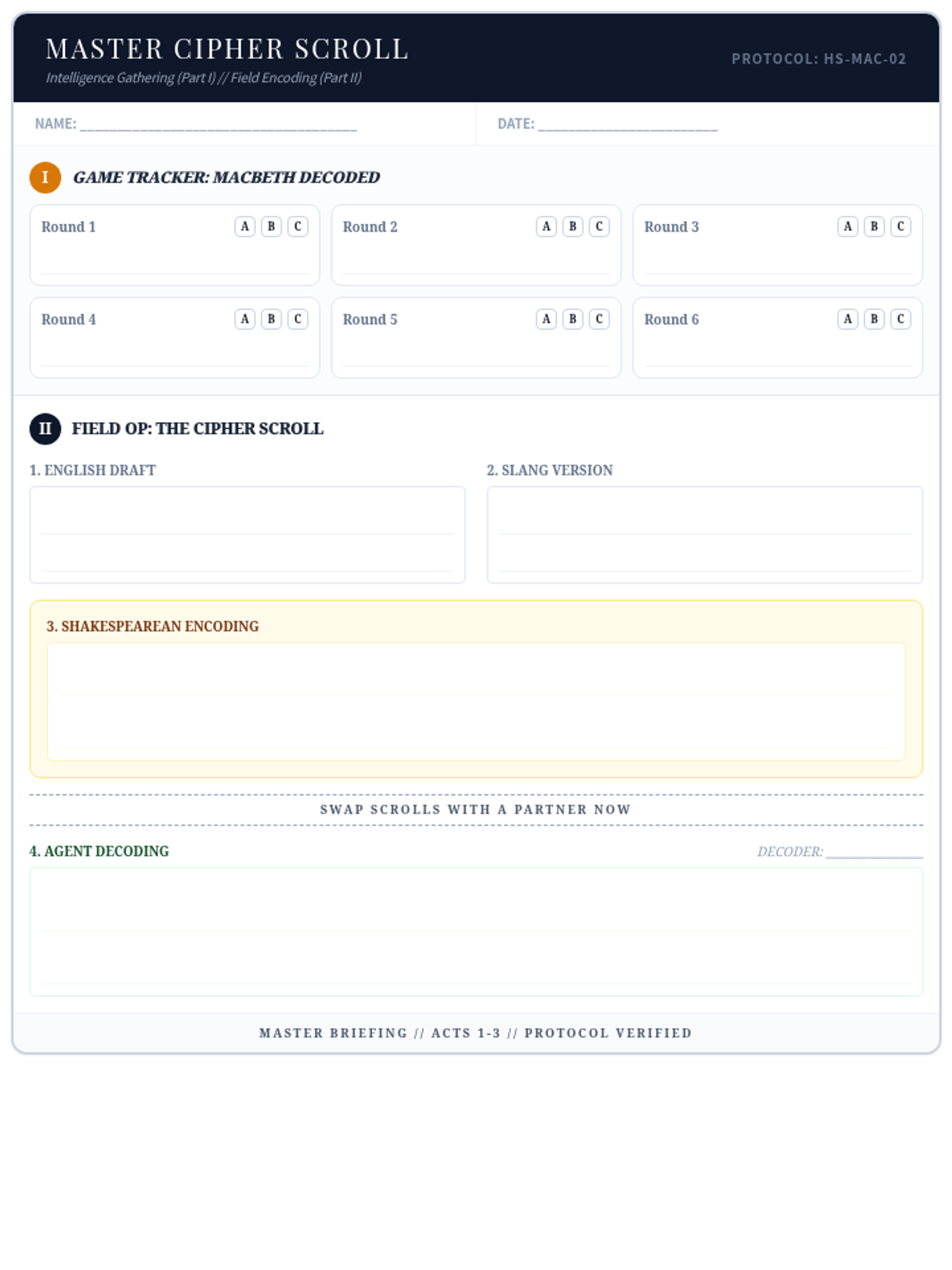
A combined worksheet featuring a top section for tracking 6 rounds of the 'Macbeth Decoded' game show and a bottom section containing the original 'Cipher Scroll' encoding activity. Updated for better handwriting space and to fit on one page.
A Jeopardy-style game show slide deck for Acts 1-3 of Macbeth, requiring students to use their Lexicon to decode phrases and justify their hypotheses. Expanded to 6 rounds.
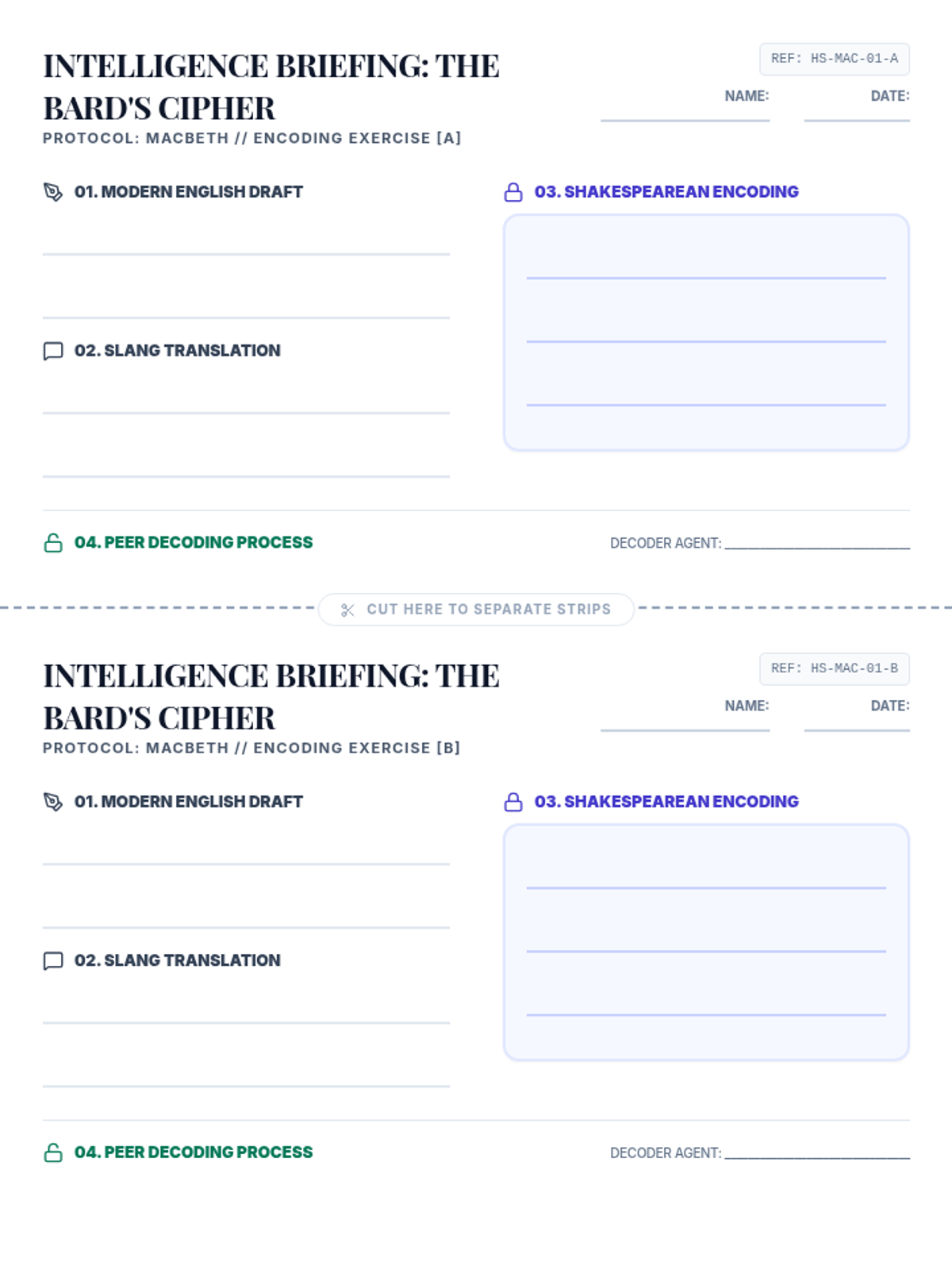
A compact, high-school oriented version of the Cipher Scroll activity, formatted as two strips per page with lines for modern, slang, and Shakespearean translations. Updated for better handwriting space and readability.
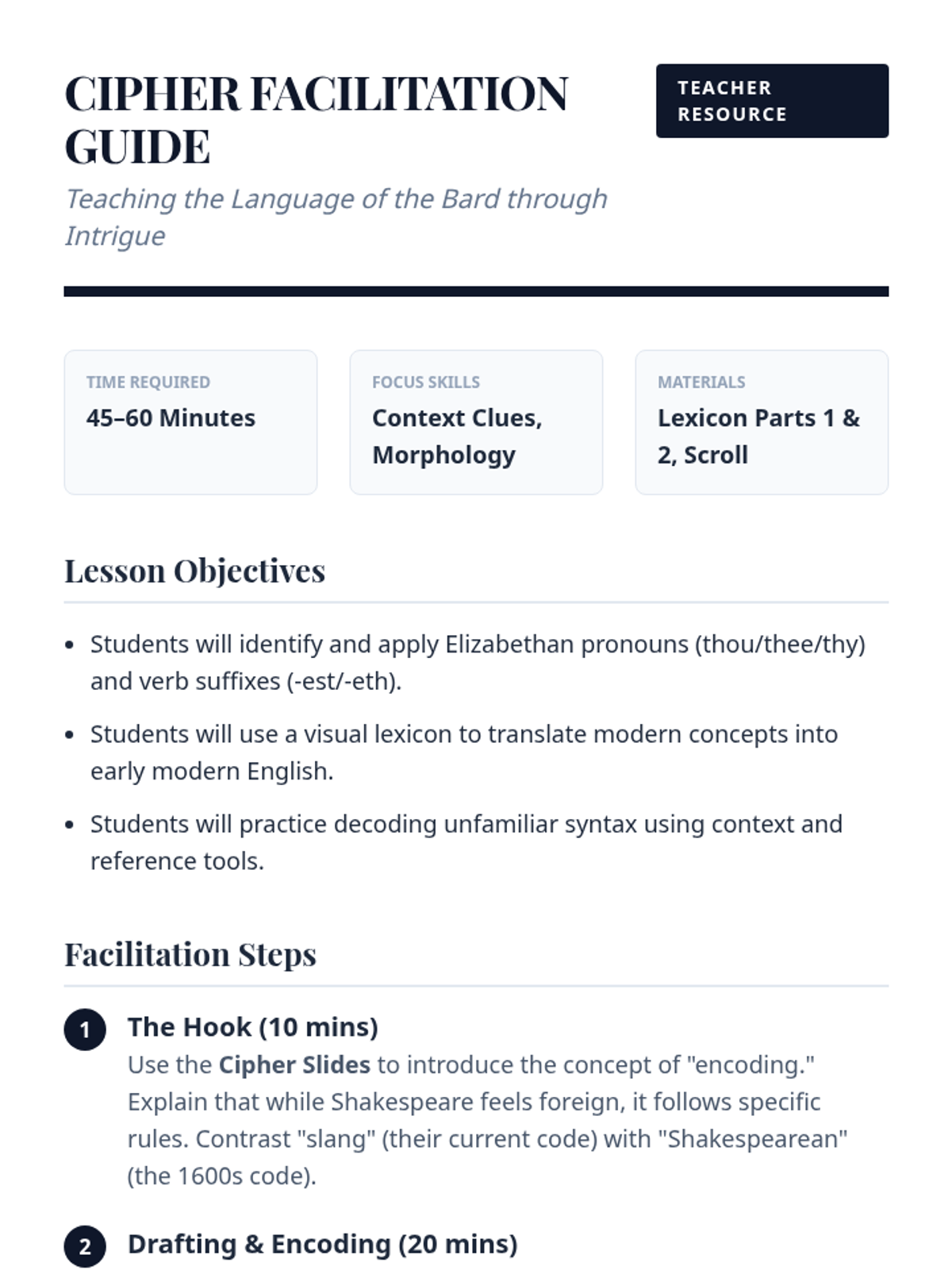
A teacher resource for 'The Bard's Cipher' lesson, providing instructional strategies, common misconceptions, and translation examples to facilitate student success. Updated to fix page breaks and icon rendering.
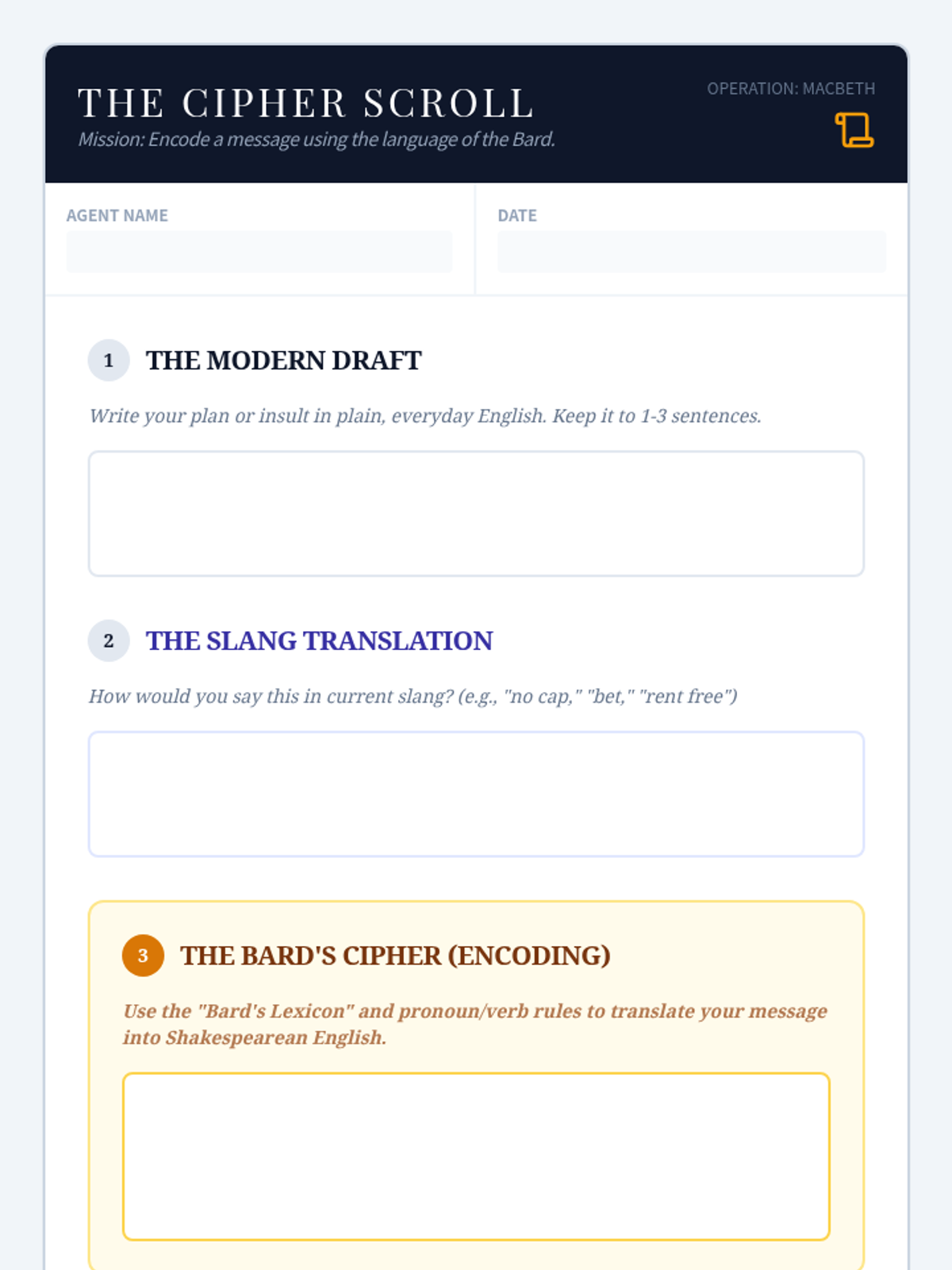
A multi-step activity worksheet where students draft a message in modern English and slang before 'encoding' it into Shakespearean language for a partner to decode. Updated to fix page break issues.
Part 2 of the visual word bank (N-Z) for the Shakespearean encoding activity, completing the alphabet with common Elizabethan words and their modern translations in pt. 12 font. Total word count across two parts exceeds 100.
Part 1 of the visual word bank (A-M) for the Shakespearean encoding activity, featuring common Elizabethan words and their modern translations in pt. 12 font. Total word count across two parts exceeds 100.
An introductory slide deck for 'The Bard's Cipher' activity, covering basic Shakespearean pronouns, verb endings, and activity instructions with a moody Elizabethan aesthetic.
A comprehensive slide deck for the first week of TSIA2 writing preparation, containing daily 3-question drills with detailed answer explanations focusing on punctuation, grammar, and organization.
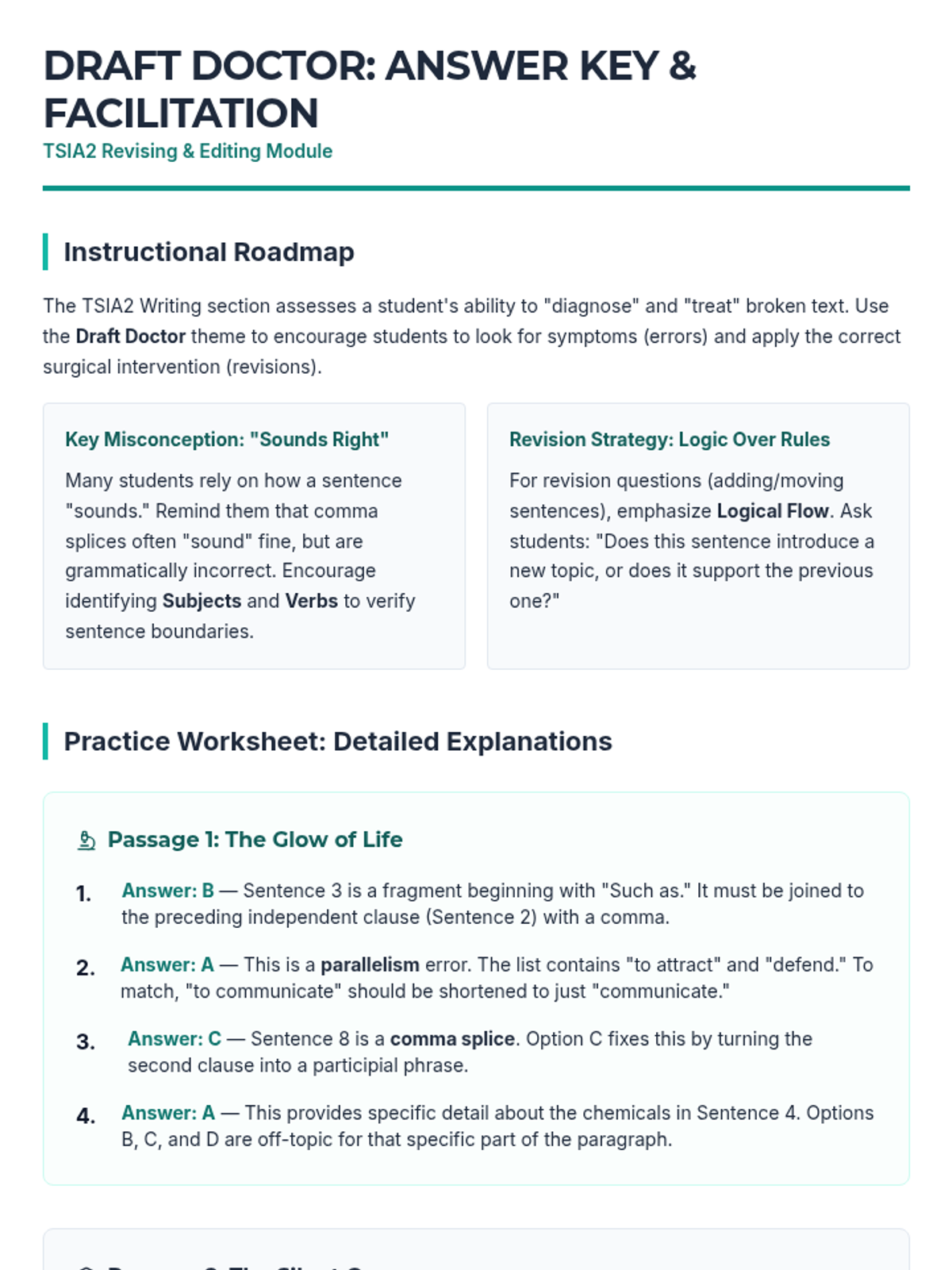
A teacher's answer key and facilitation guide for the TSIA2 Mastery lesson, now updated to include explanations for all 10 practice questions. Final version with improved page breaks and formatting.
A dynamic presentation slide deck covering essential TSIA2 writing skills including sentence boundaries, parallelism, agreement, and revision strategies. NOW UPDATED with interactive Guided Practice slides and improved visual balance.
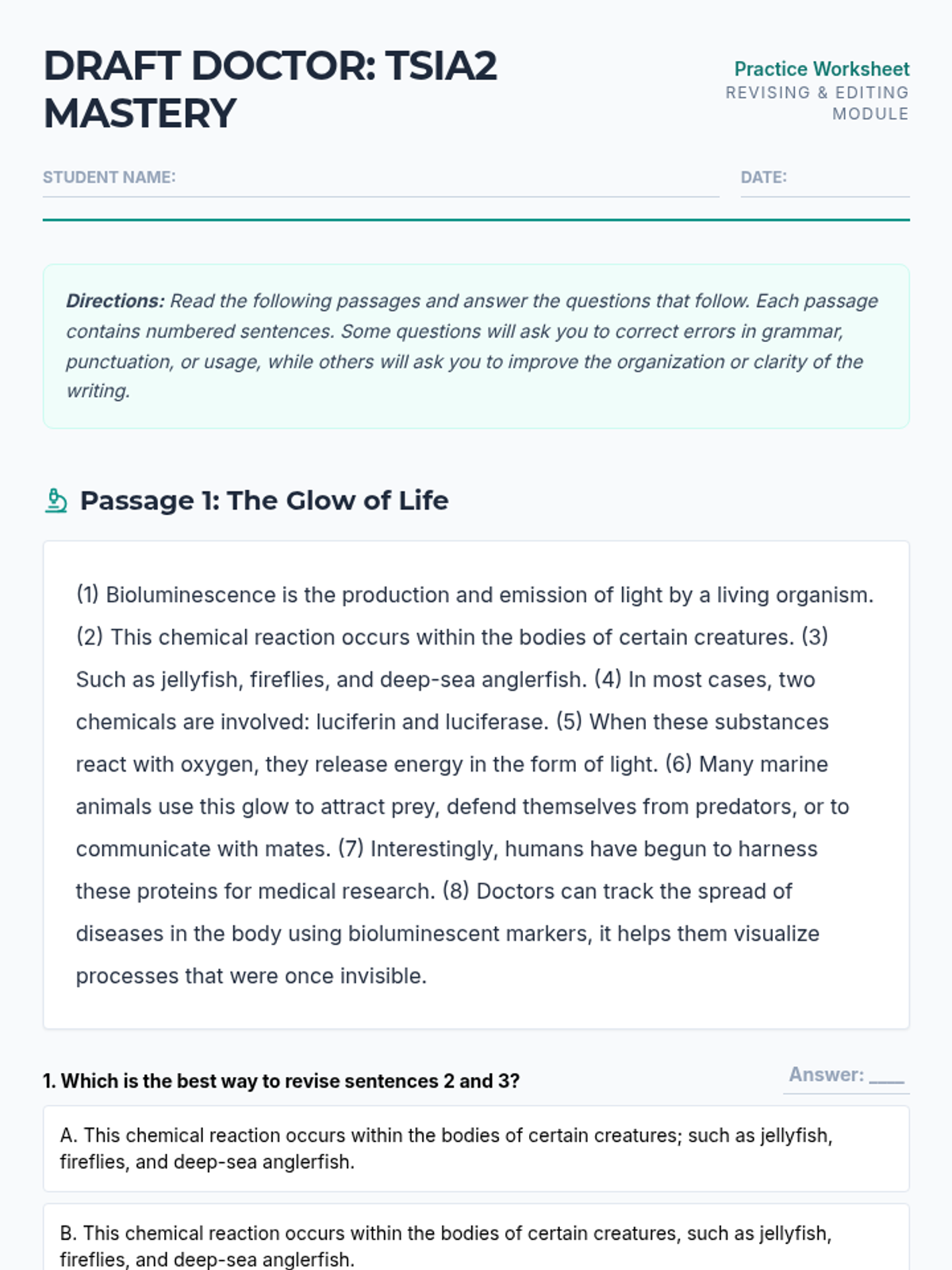
A TSIA2-style practice worksheet featuring three passages (Scientific, Historical, and Literary) with multiple-choice questions focusing on sentence structure, punctuation, and revision. NOW UPDATED with 10 questions total and improved answer tracking. Final revision with fixed page breaks and logical answer choices.
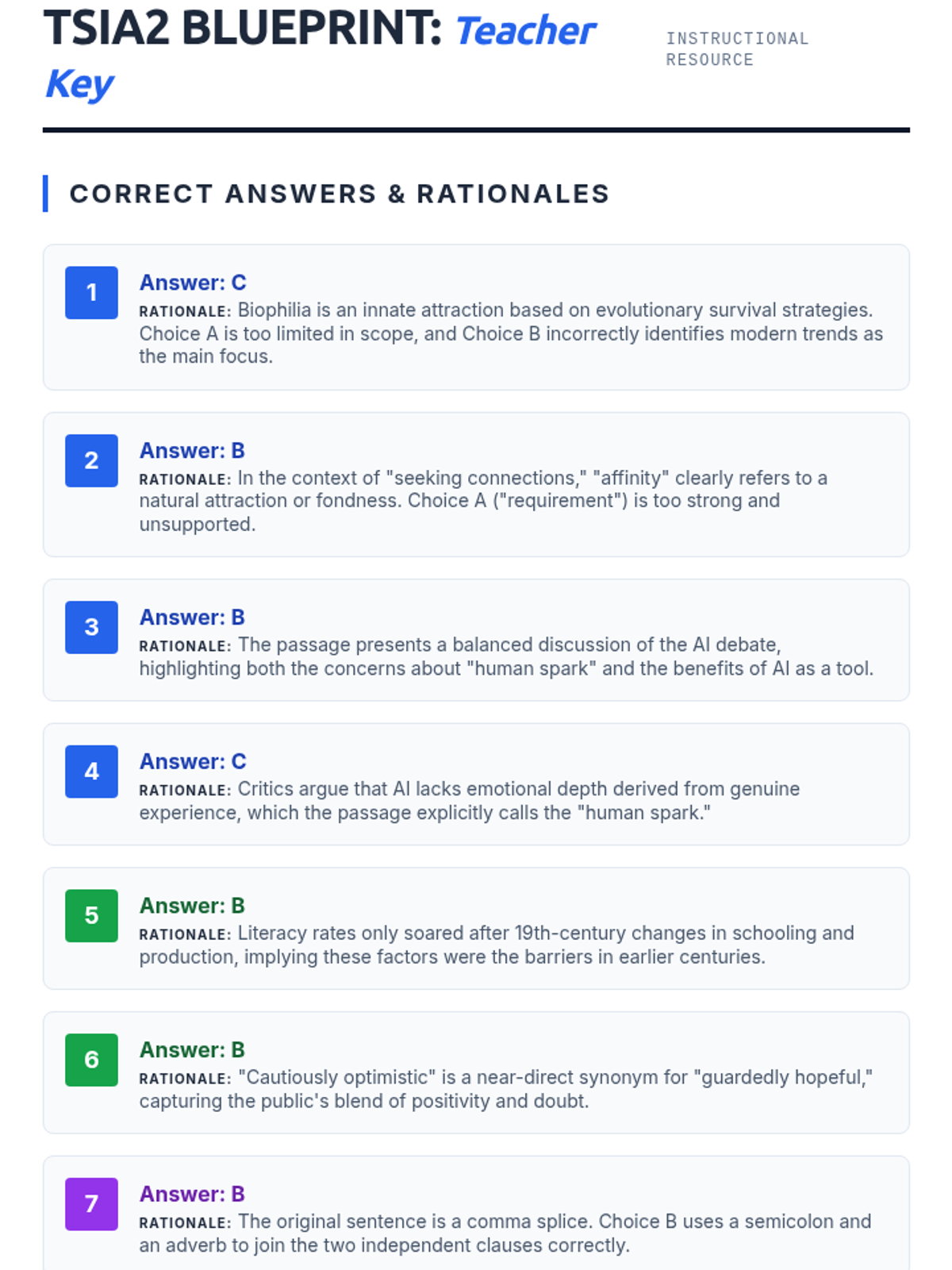
A comprehensive answer key and instructional guide for the expanded TSIA2 Mastery lesson. It provides detailed rationales for all 10 practice questions and a suggested pacing guide for teachers.
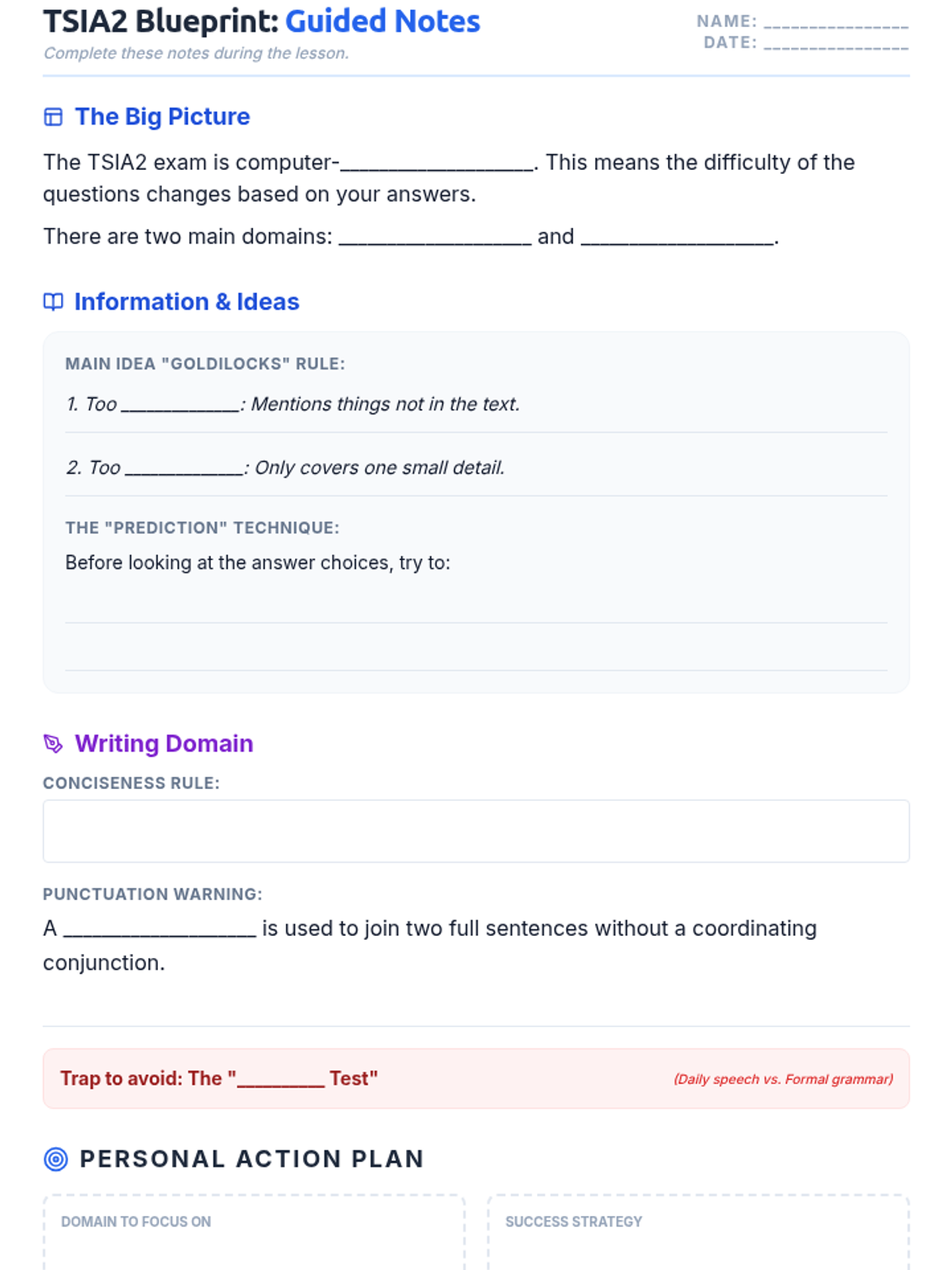
A structured guided notes document for students to use during the TSIA2 Blueprint presentation. It includes fill-in-the-blank sections, strategy reminders, and a personal goal-setting area.
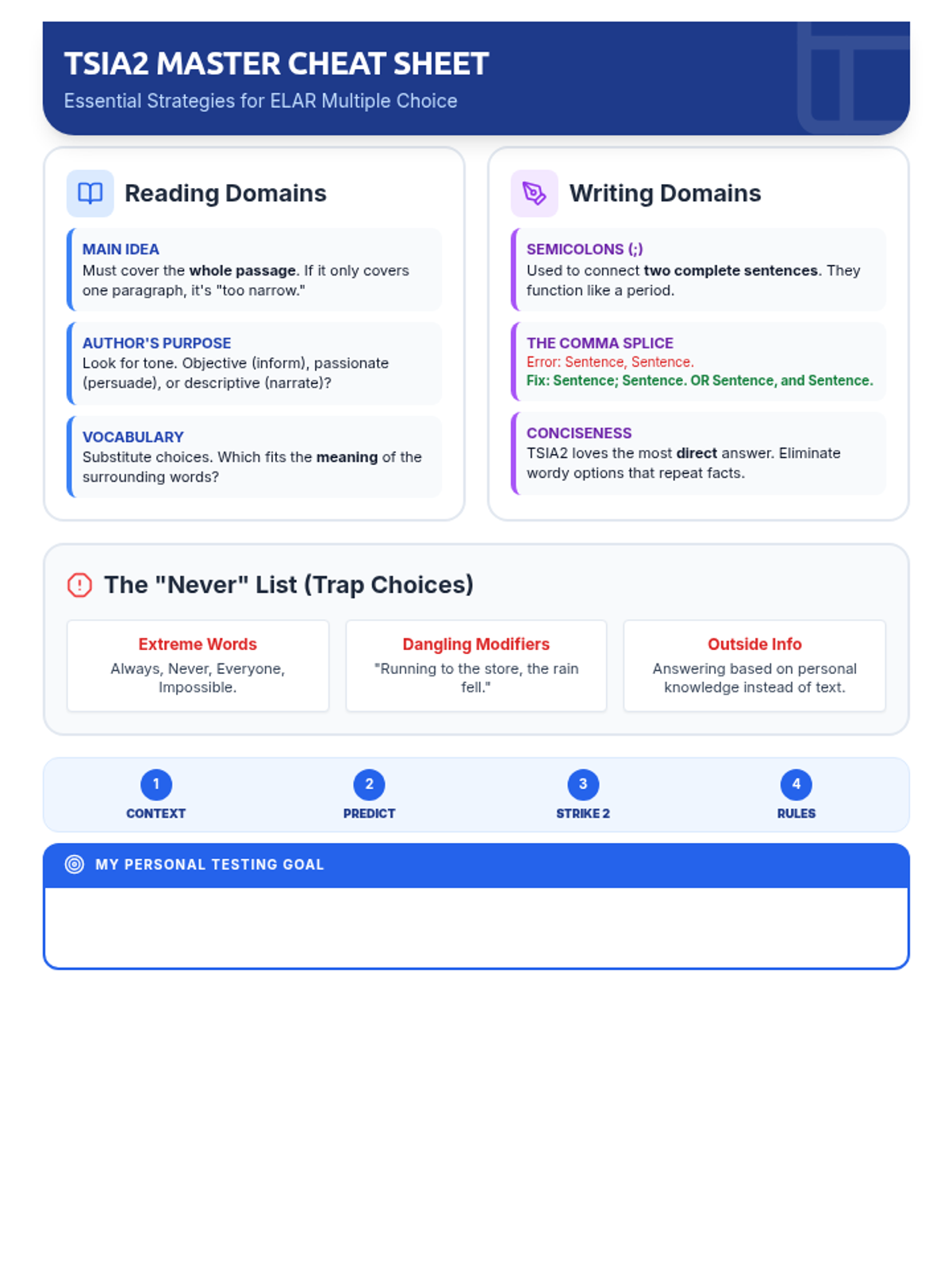
A concise, visual one-page reference guide for TSIA2 ELAR test-taking strategies. It features a technical blueprint design and includes essential grammar rules, reading tips, and common trap choices for quick review.
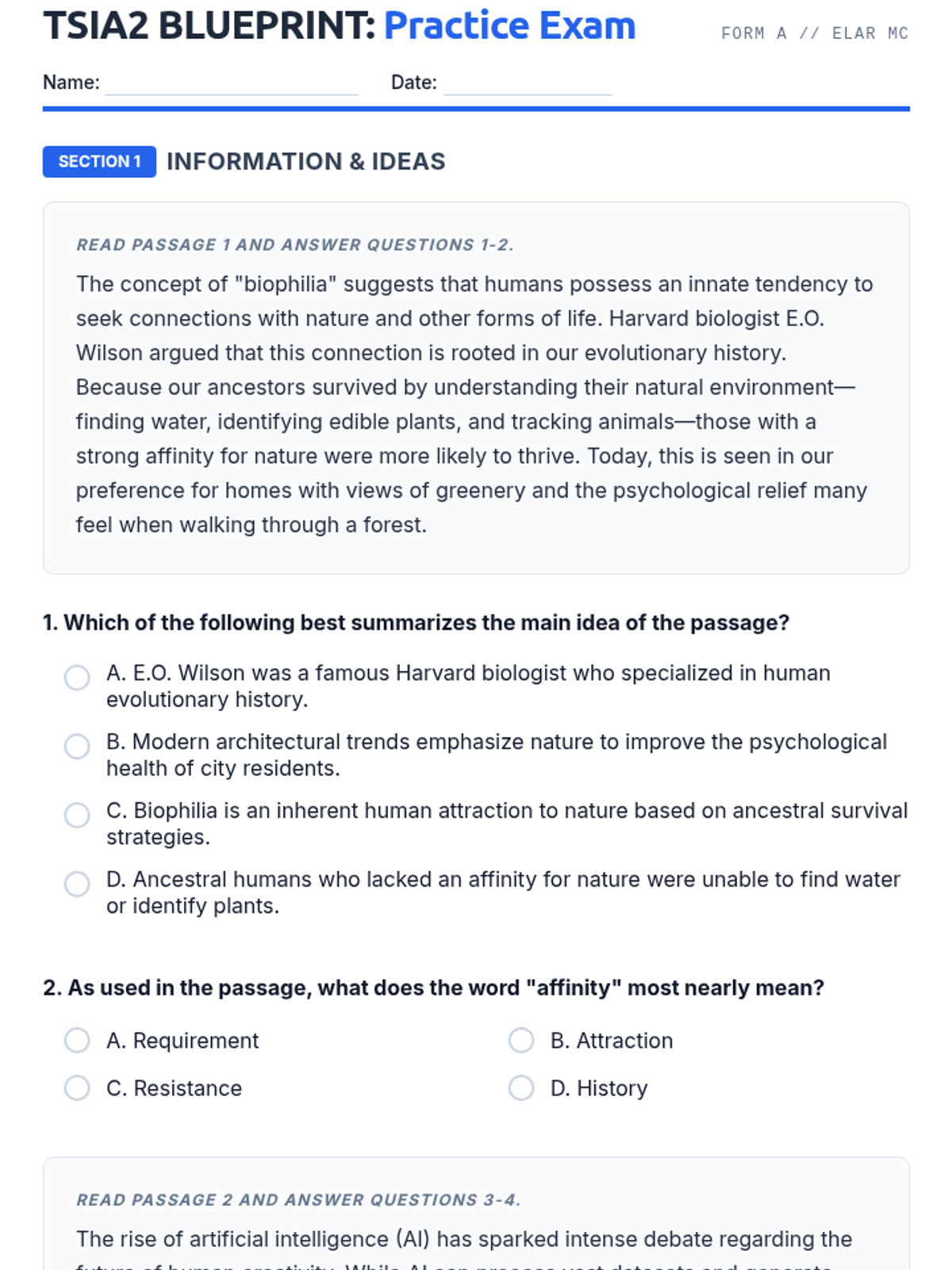
An expanded practice exam for the TSIA2 ELAR test. It now includes 10 questions covering information and ideas, reading comprehension, and sentence revision/editing, with integrated reading passages and clear work areas.
A high-impact slide deck for TSIA2 ELAR preparation, featuring a professional blueprint theme. It covers the four key exam domains and core testing strategies with clear, high-contrast visuals.
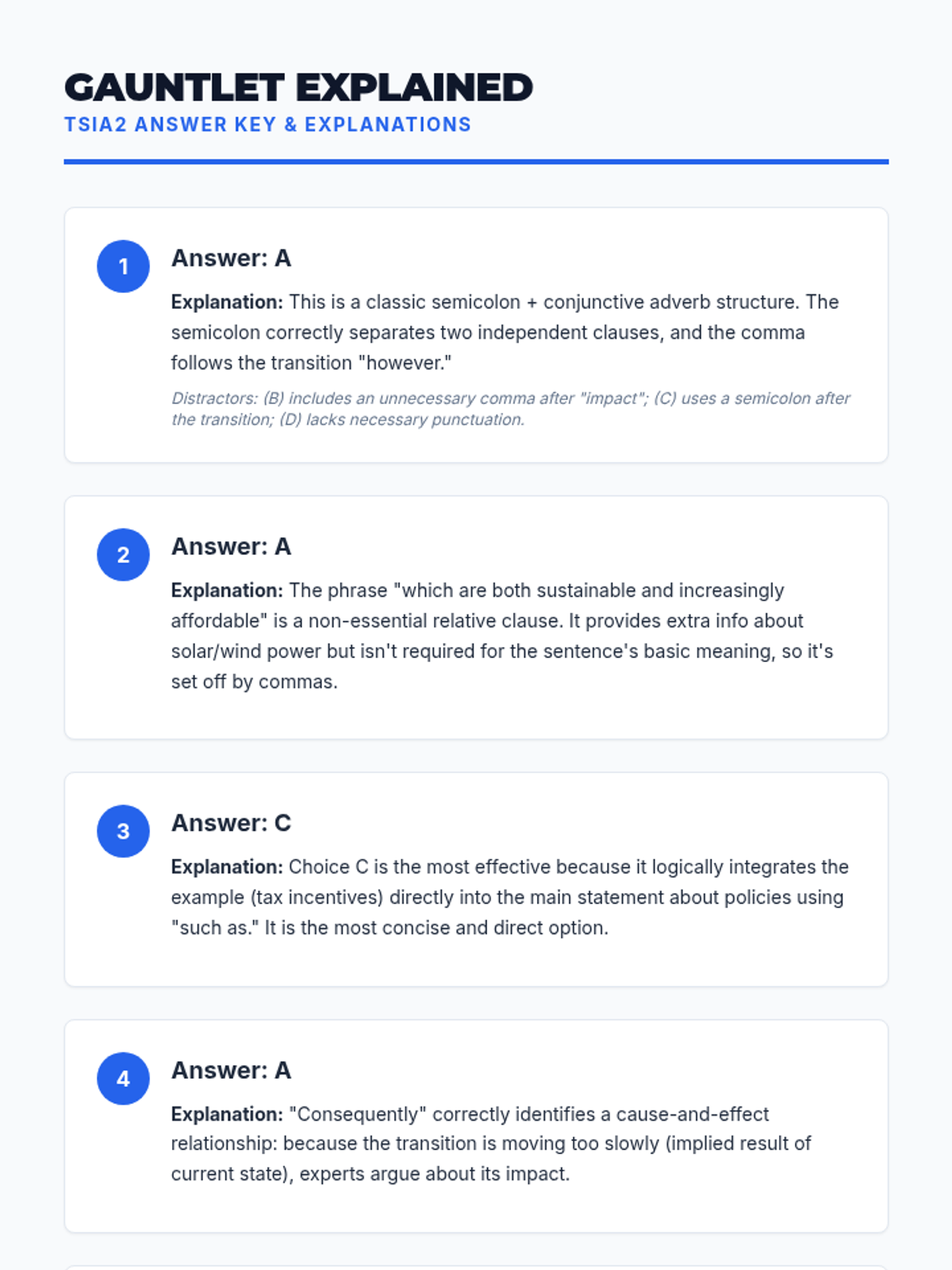
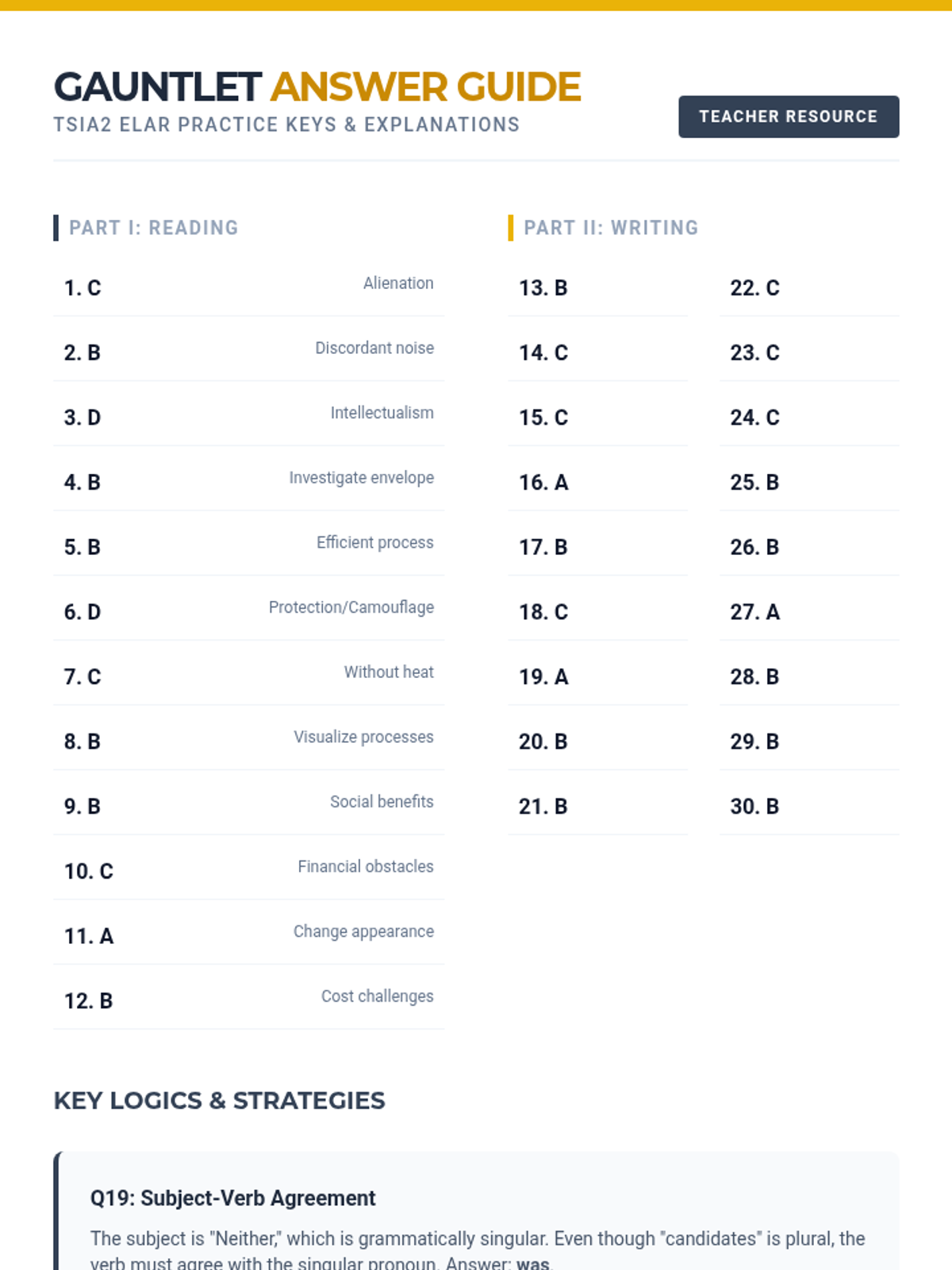
A detailed answer key for the Grammar Gauntlet Assessment, providing the correct answers and instructional explanations for each question.
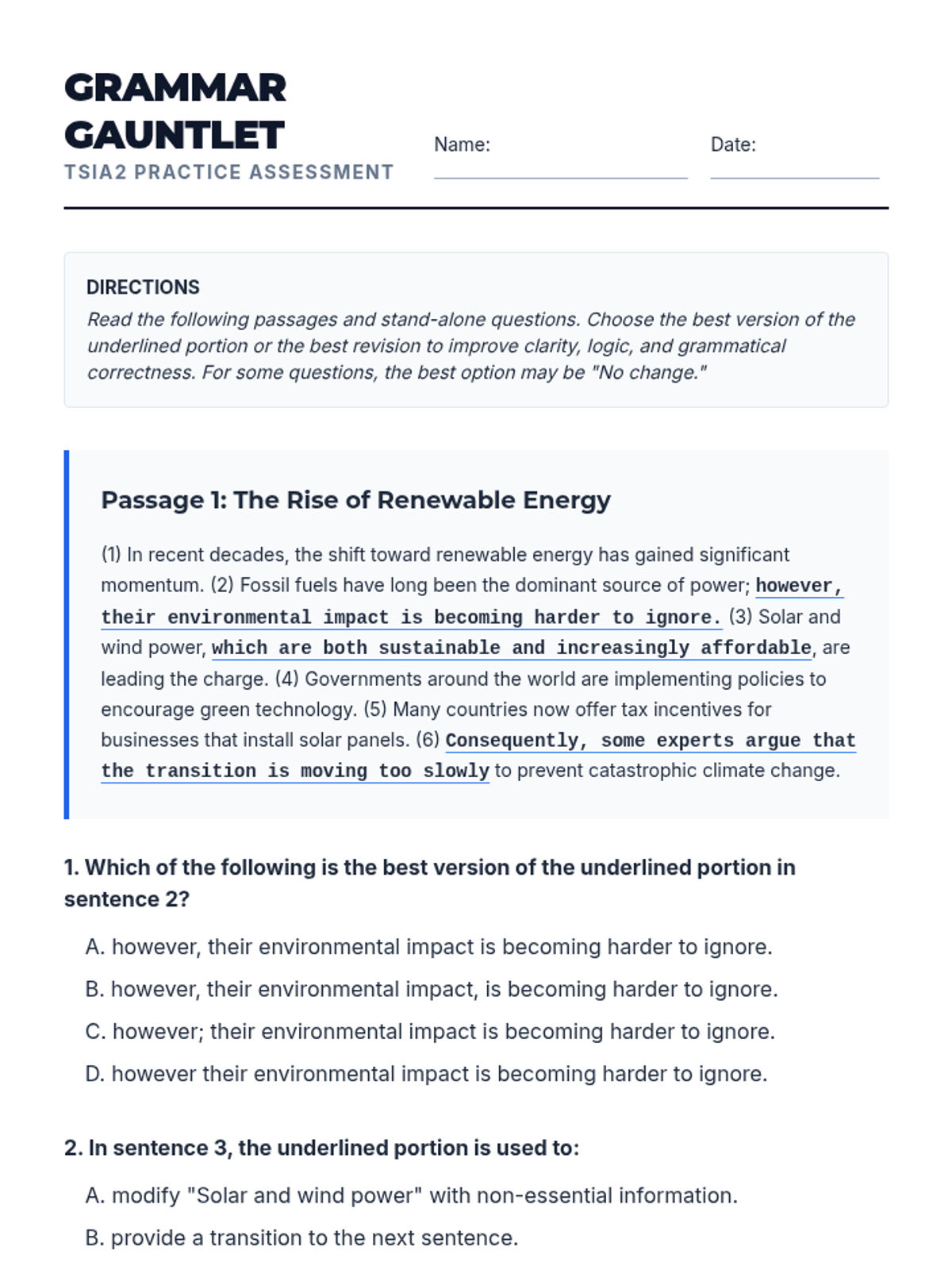
A 20-question multiple-choice practice assessment mirroring the TSIA2 revising and editing standards, including passage-based and stand-alone questions.
Instructional slide deck for the TSIA2 Grammar Gauntlet lesson, covering the four key focus areas of the exam with visual examples and strategy tips. All text updated to 24px minimum for visibility.
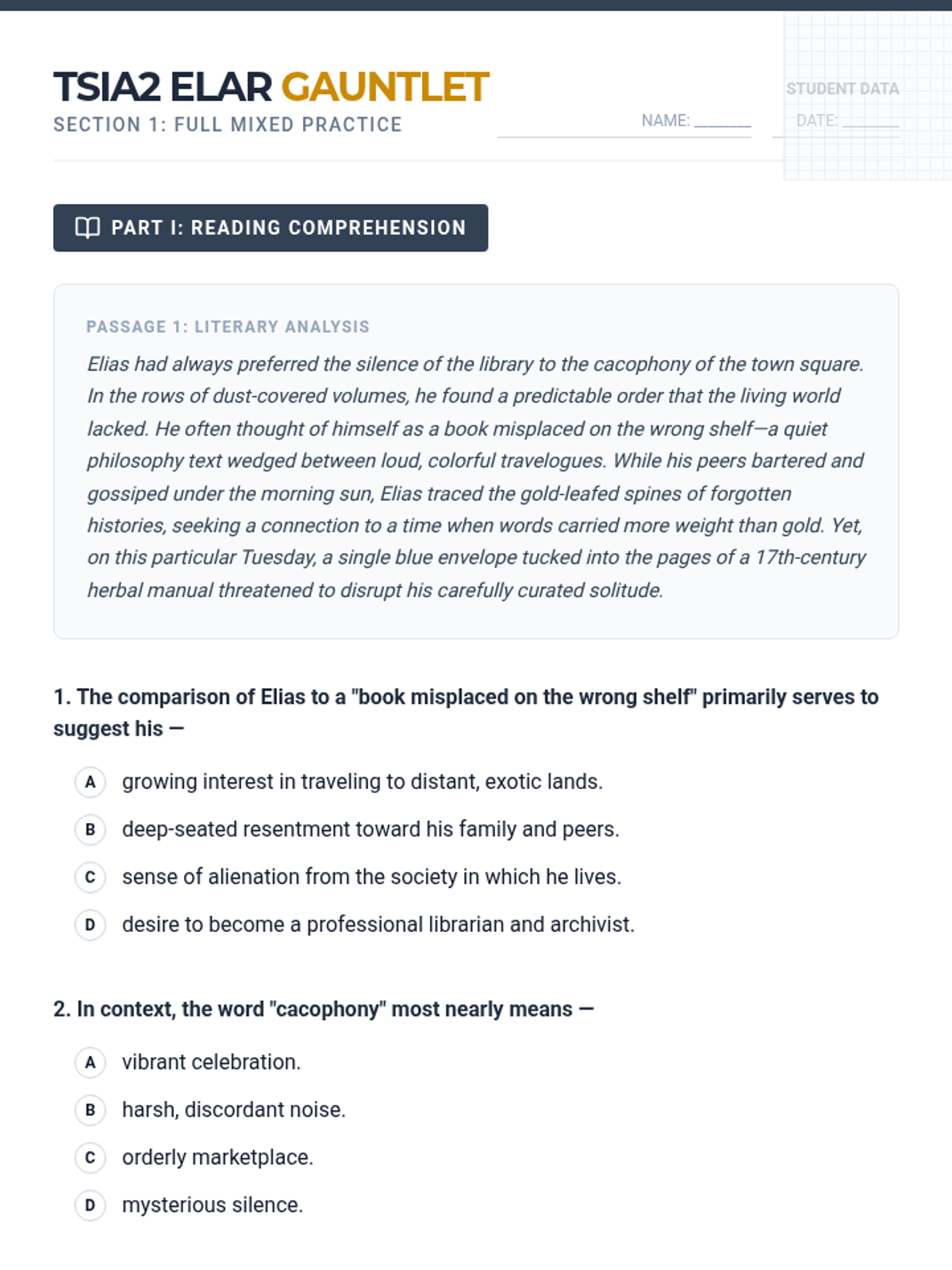
A comprehensive slide deck for the final week of TSIA2 writing preparation, providing high-rigor mixed practice to simulate the full range of the TSIA2 Writing section.
A slide deck for the third week of TSIA2 writing preparation, covering days 11 through 15 with daily 3-question drills focusing on modifier placement, pronoun agreement, and structural polish.
A comprehensive slide deck for the second week of TSIA2 writing preparation, containing daily 3-question drills with detailed answer explanations focusing on pronoun case, punctuation, and organizational flow.
An answer key and explanation guide for the 30-question TSIA2 English Gauntlet Practice test. Provides correct answers, brief logic explanations for challenging grammar rules, and a scoring benchmark.
A comprehensive 30-question practice test for the TSIA2 ELAR section. Includes Reading Comprehension (Literary, Informational, and Paired passages) and Writing (Revising and Editing) sections. Expanded to 8 pages for maximum readability and handwriting space.
A 15-slide review presentation covering key TSIA2 ELAR concepts. Optimized for high-quality printing with light backgrounds and high-contrast text while maintaining the professional 'blueprint' aesthetic.
Instructional slide deck for Lesson 5, focusing on the final Chief Editor certification simulation and synthesis of modifier mastery across multiple professional contexts.
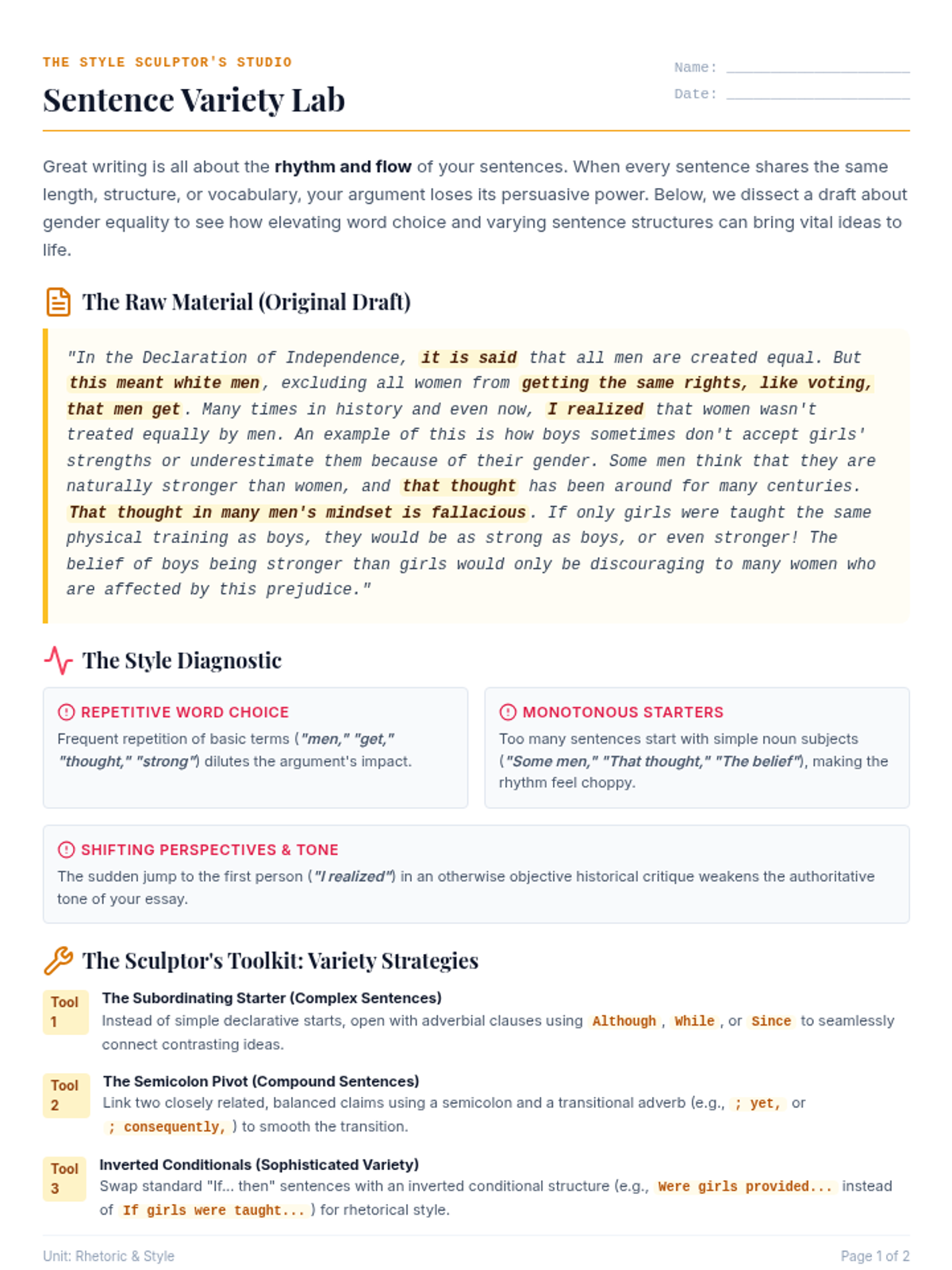
A beautifully formatted, printable 2-page student worksheet designed to teach sentence variety and vocabulary elevation. It breaks down the user's draft as a diagnostic case study, provides stylistic tools (such as inverted conditionals and subordinating openers), shows a fully polished version of the user's paragraph, and concludes with a clean practice workspace.
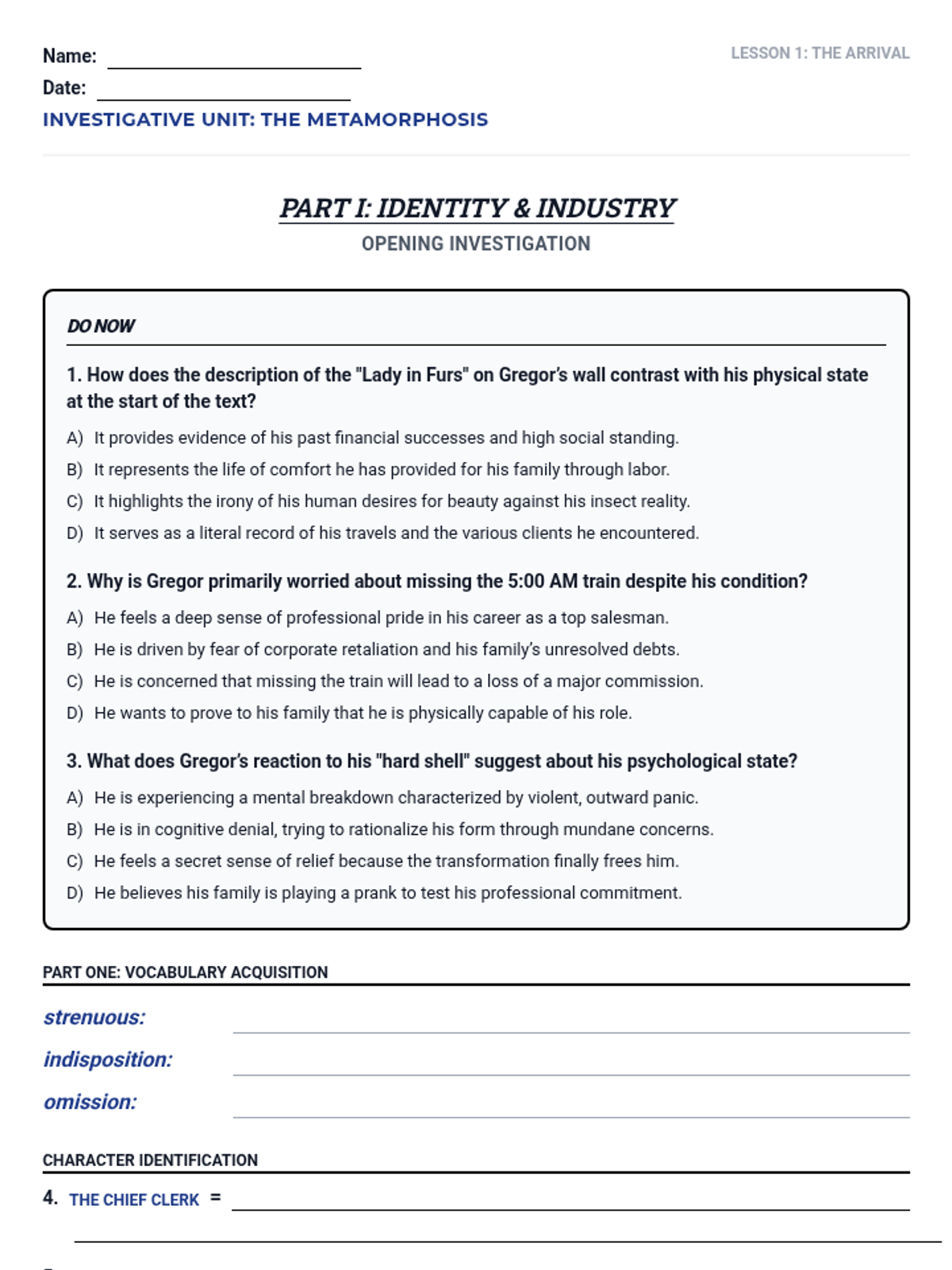
Middle-grade student worksheet for Lesson 1 updated with Bernofsky-specific terminology (General Manager, monstrous insect, carapace). Vocabulary section updated to include monstrous, melancholy, and indisposition. Removed references to "Chief Clerk" and "vermin" to ensure strict alignment with the provided text edition.
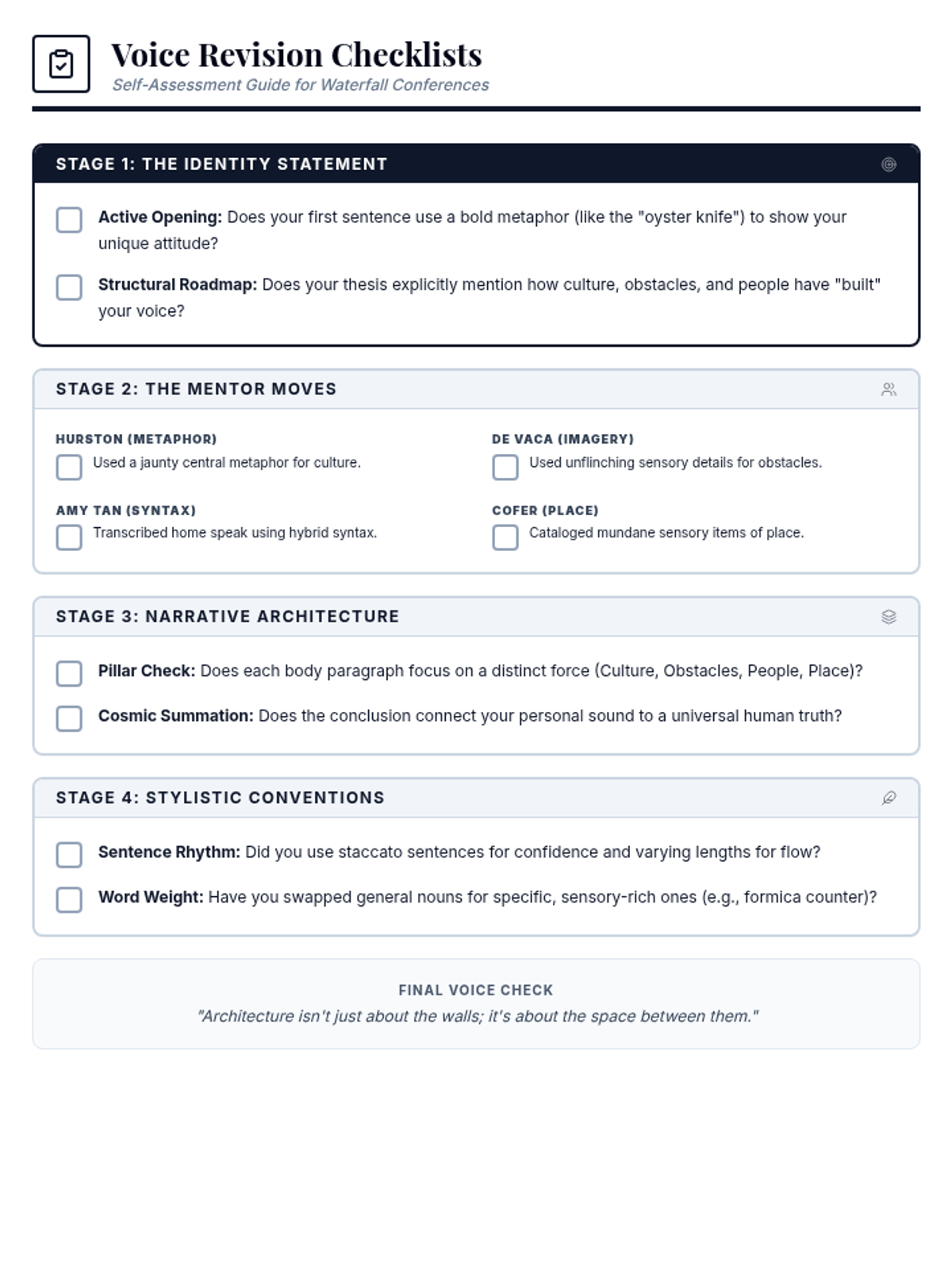
Detailed revision checklists aligned with the four stages of the waterfall conference log (Thesis, Mentor Skills, Organization, and Conventions). Provides students with actionable checkpoints to self-assess the architectural development of their personal voice.
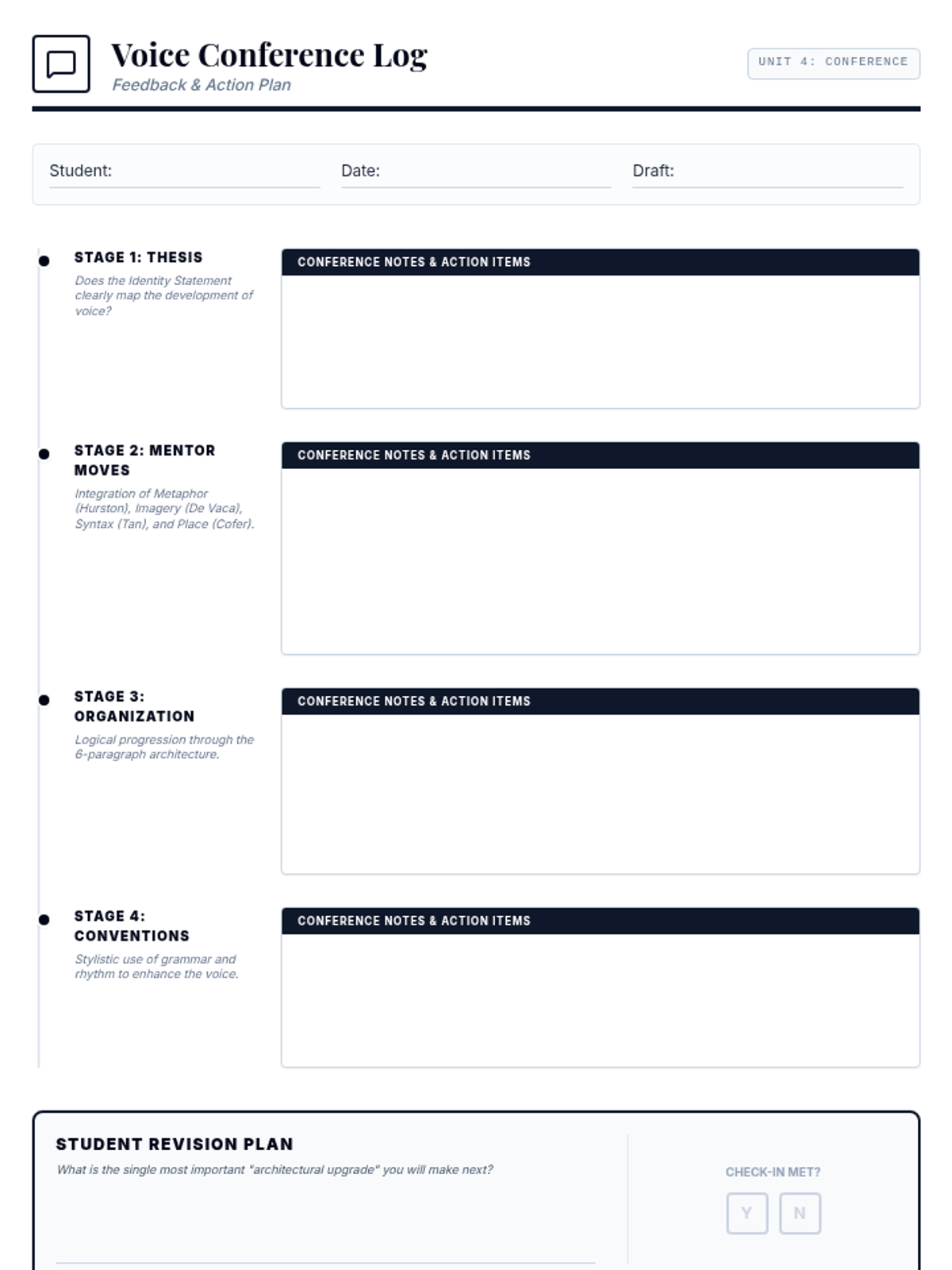
A vertical 'waterfall' style writing conference form for the Architecture of Voice unit. It cascades through four instructional stages (Thesis, Mentor Skills, Organization, and Conventions) with dedicated space for teacher notes and student action items. Grayscale optimized for single-page printing.
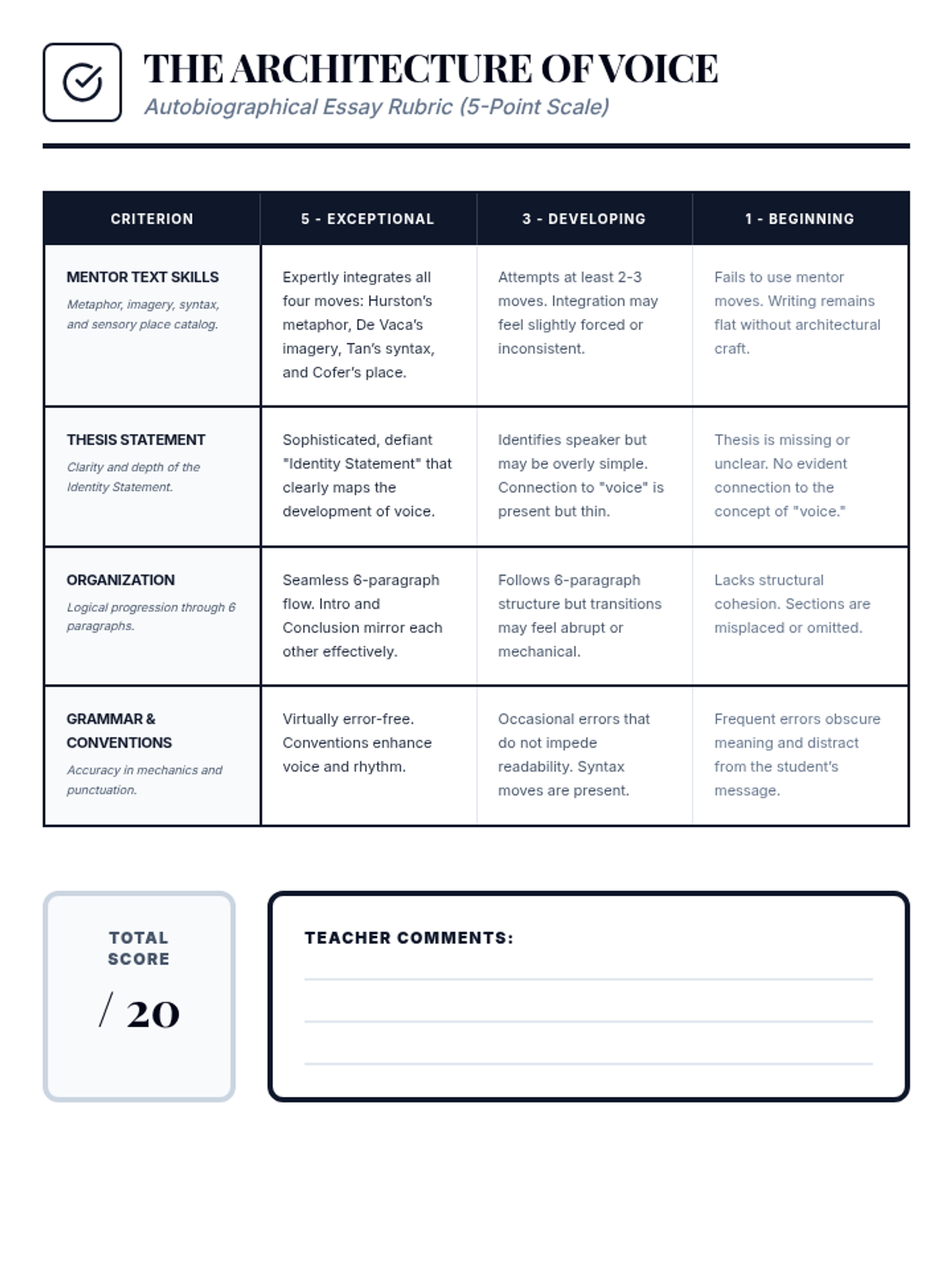
A comprehensive 5-point rubric for the final Architecture of Voice autobiographical essay, evaluating mentor text skills, thesis clarity, organization, and conventions. Optimized for grayscale printing.
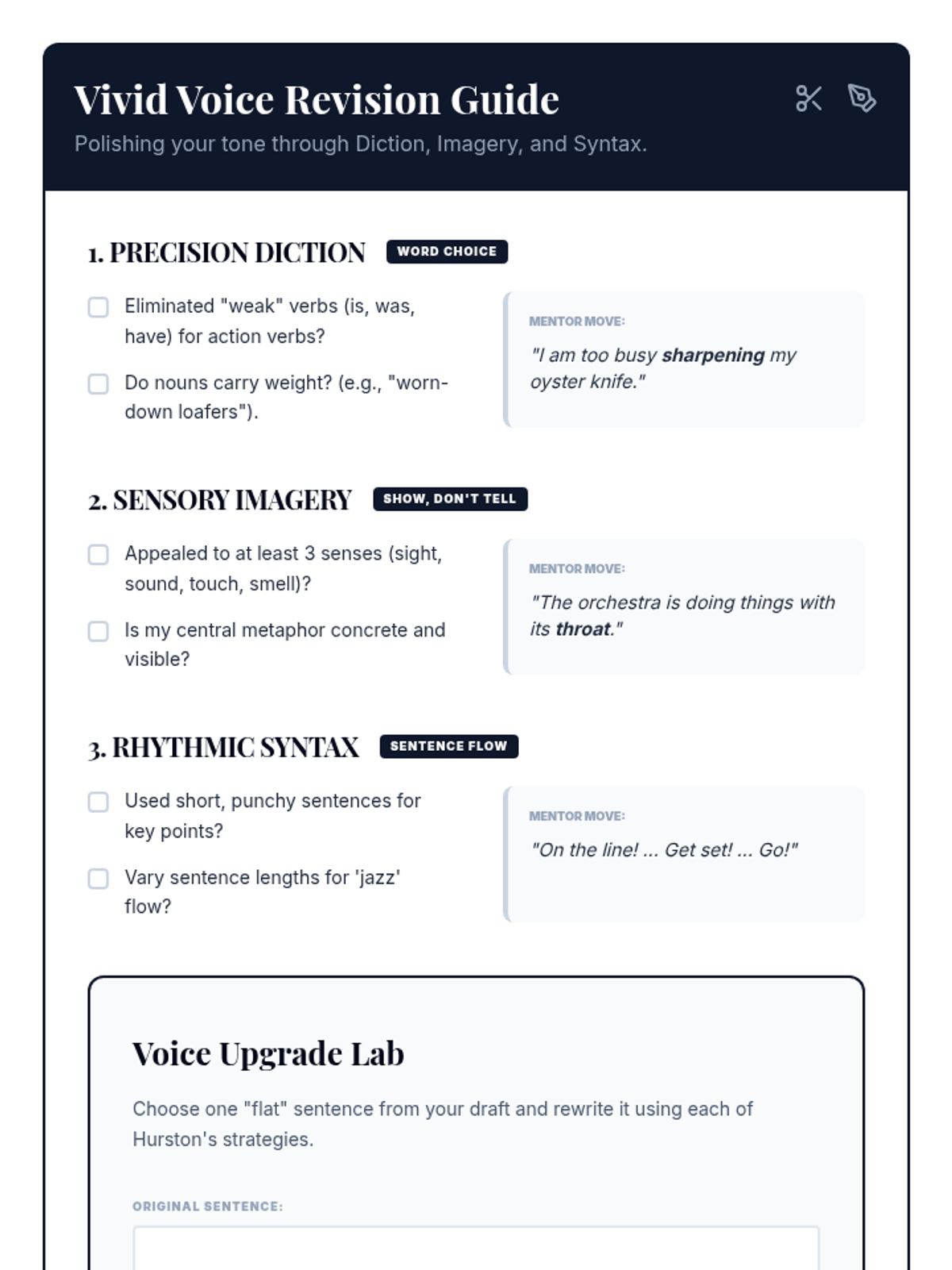
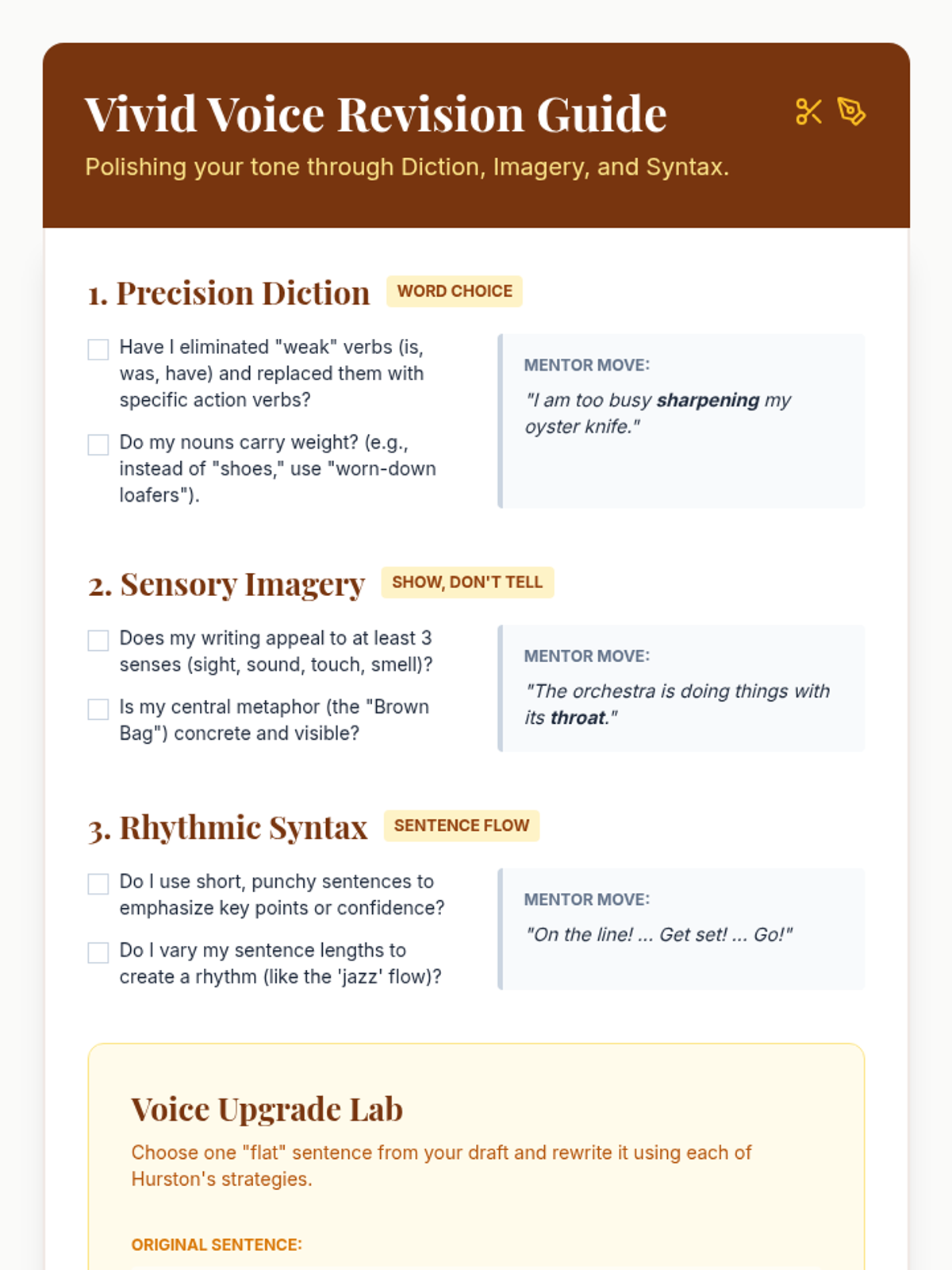
A tone-focused revision guide for students to refine their autobiographical essays using Hurston's mentor moves in diction, imagery, and syntax. Includes checklists and a 'voice upgrade' practice area.
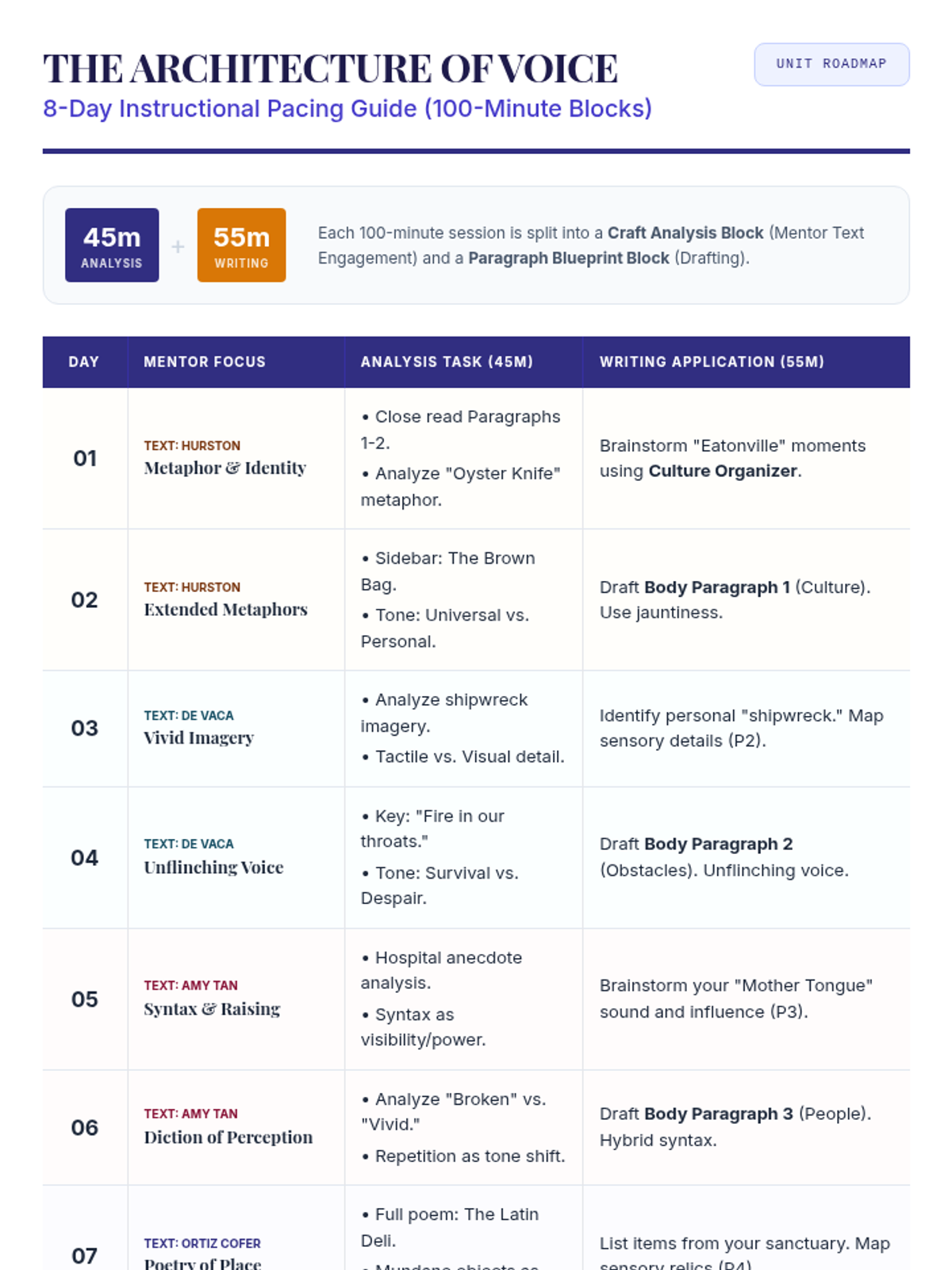
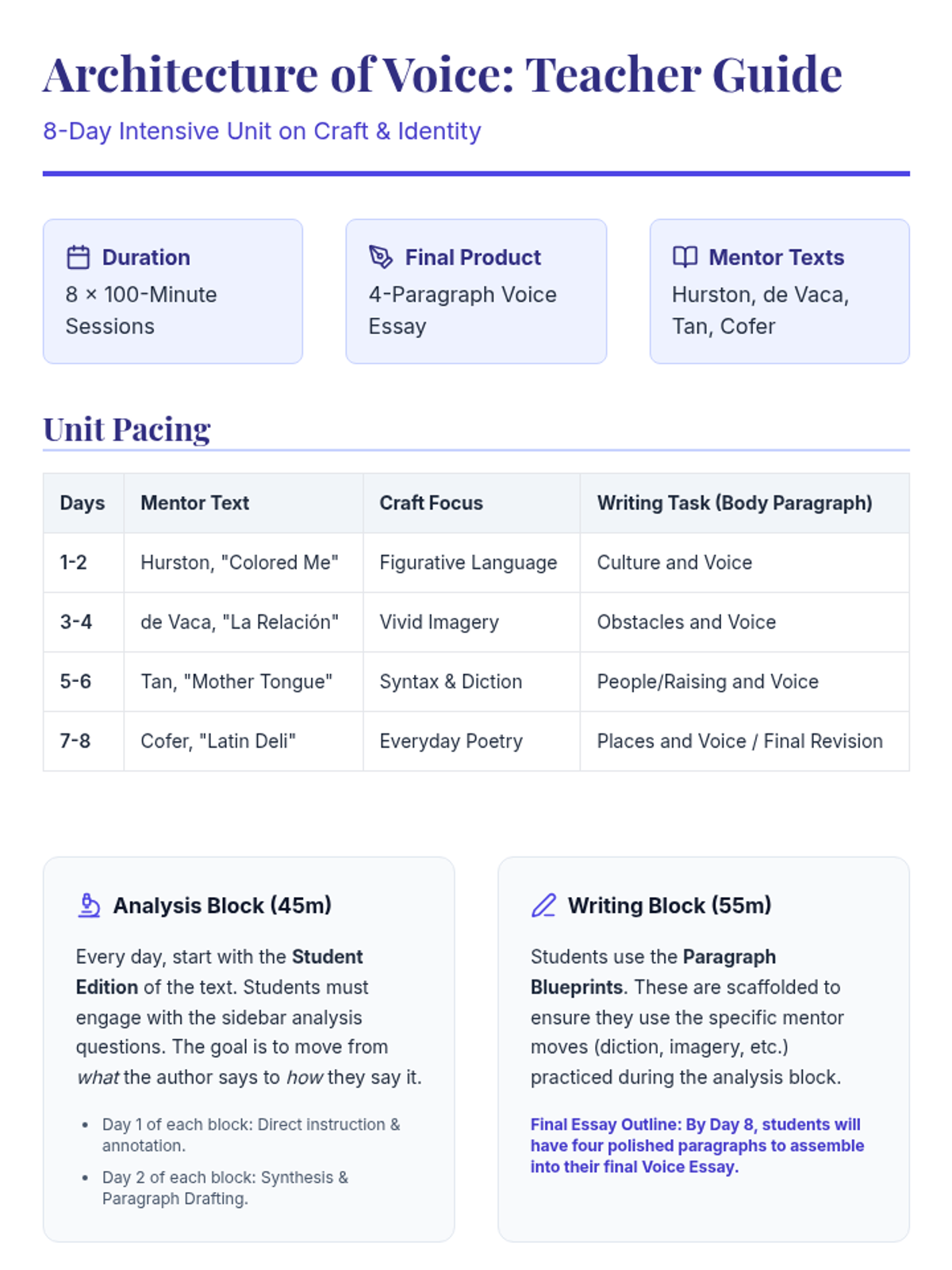
Grayscale-optimized instructional pacing guide for 'The Architecture of Voice' unit, updated to include English III 2017 TEKS for each instructional day. Details the 8-day progression from introduction to final submission with specific standards alignment. Revised for exact footer alignment and TEKS descriptions.
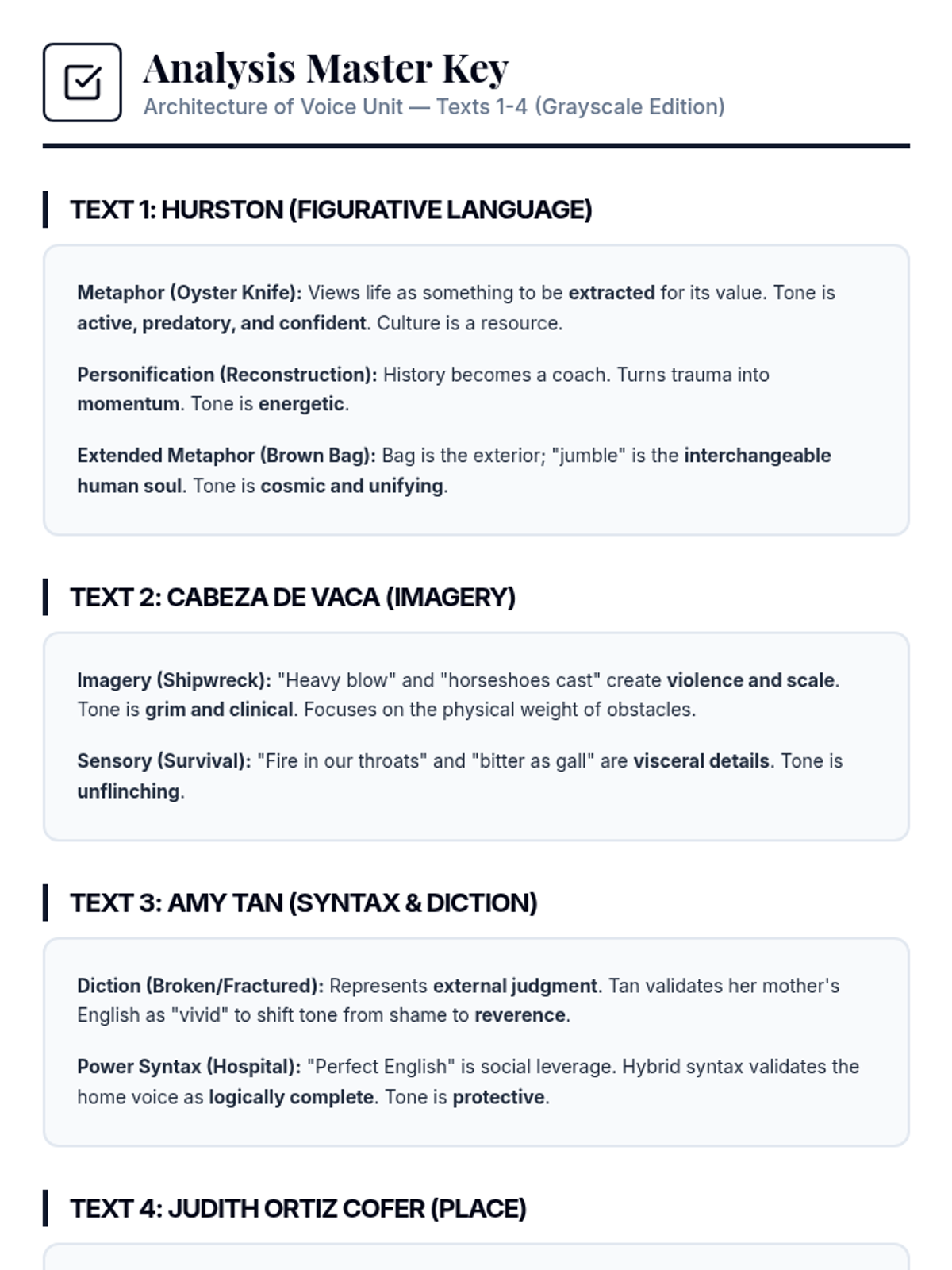
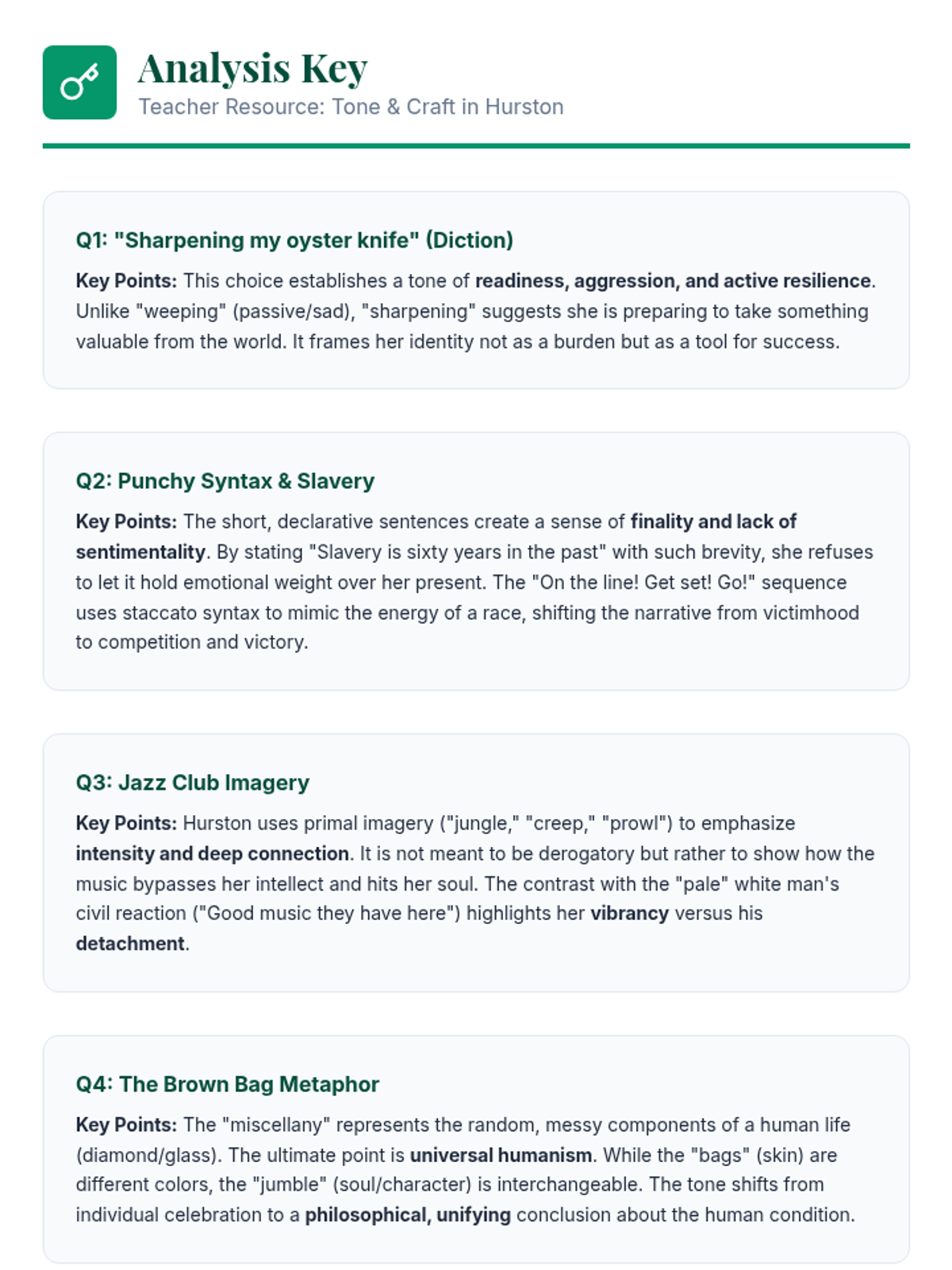
Teacher's master answer key for the analysis of all four mentor texts (Hurston, de Vaca, Tan, Cofer) in the 'Architecture of Voice' unit. Aligns with sidebar questions and synthesis tasks. Optimized for single or double-page printing.
A comprehensive slide deck for the 'Architecture of Voice' unit, updated to the 6-paragraph master essay model. Provides visual anchors for hook/thesis, the four mentor-based pillars, and the cosmic conclusion. Integrated with the waterfall conference and revision tools.
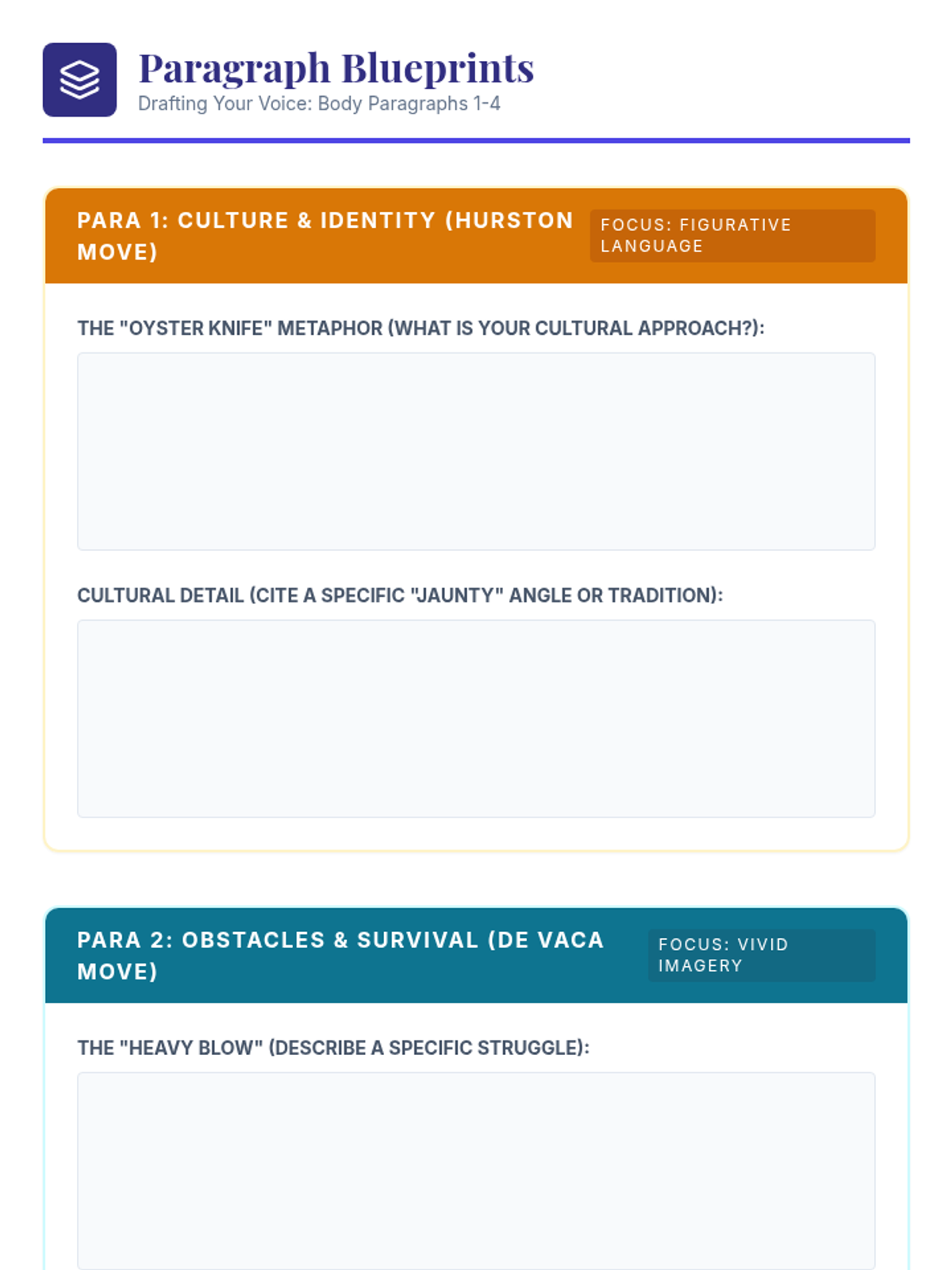
Structured paragraph outlines for all four sections of the Voice Essay, aligned with the craft moves of Hurston, de Vaca, Tan, and Cofer. Optimized for grayscale printing.
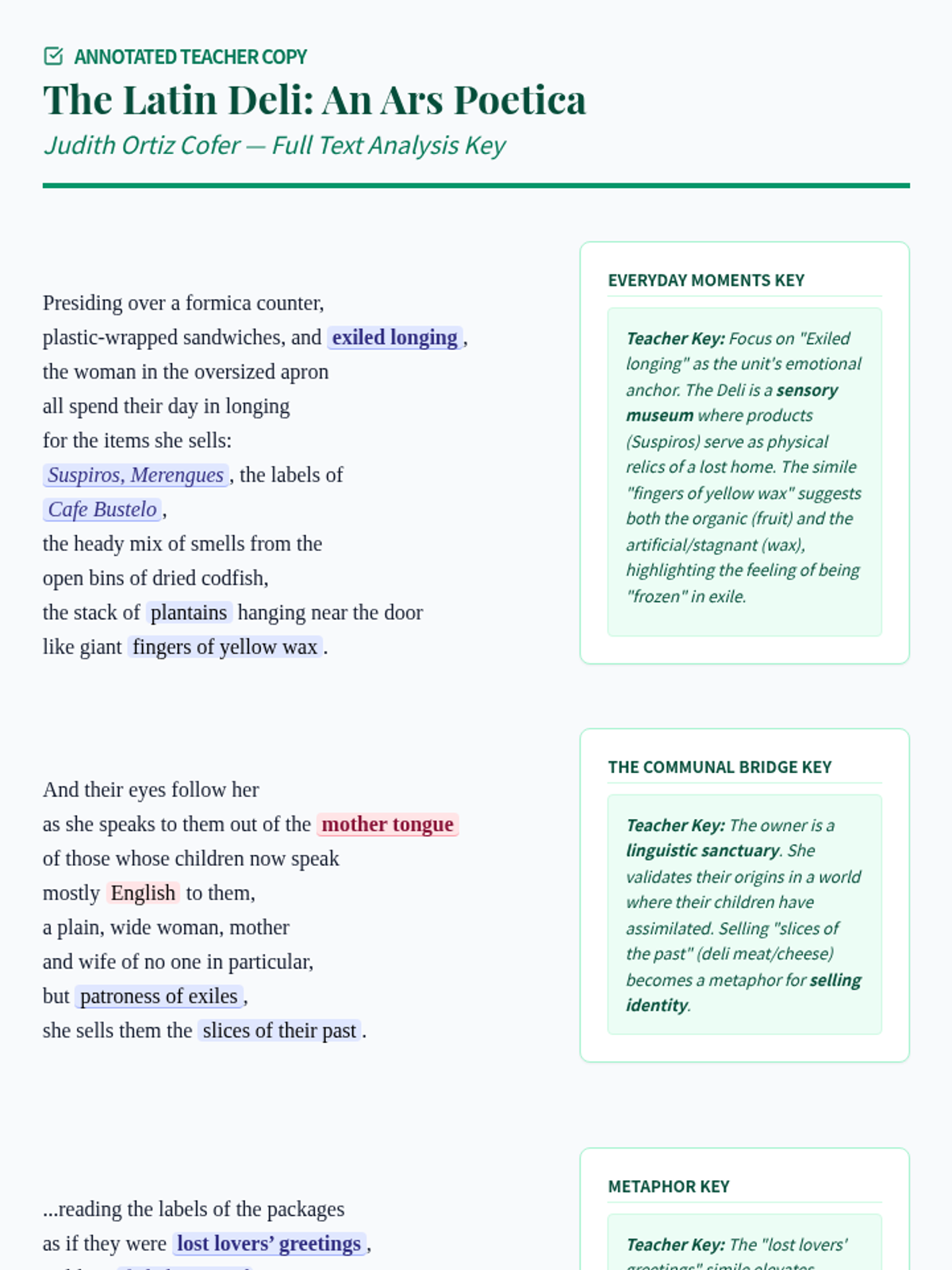
Grayscale-optimized annotated teacher copy for Cofer's 'The Latin Deli,' using a slate and white palette for high contrast and toner-saving. Includes highlighted text evidence and analysis keys.
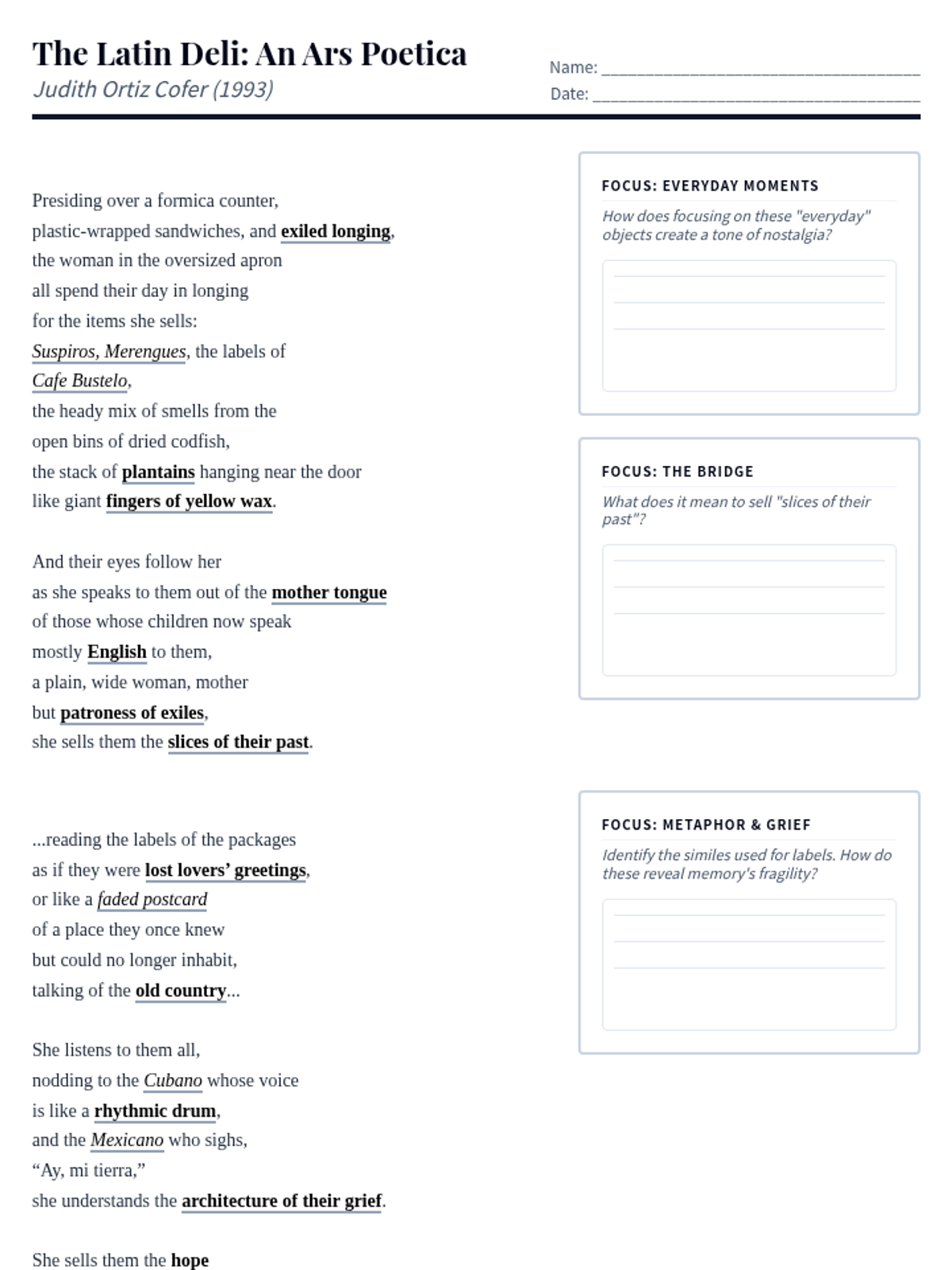
Grayscale-optimized student analysis guide for Cofer's 'The Latin Deli,' using a slate and white palette for high contrast and toner-saving. Includes the full poem and sidebar analysis questions. Optimized to fit on a single page.
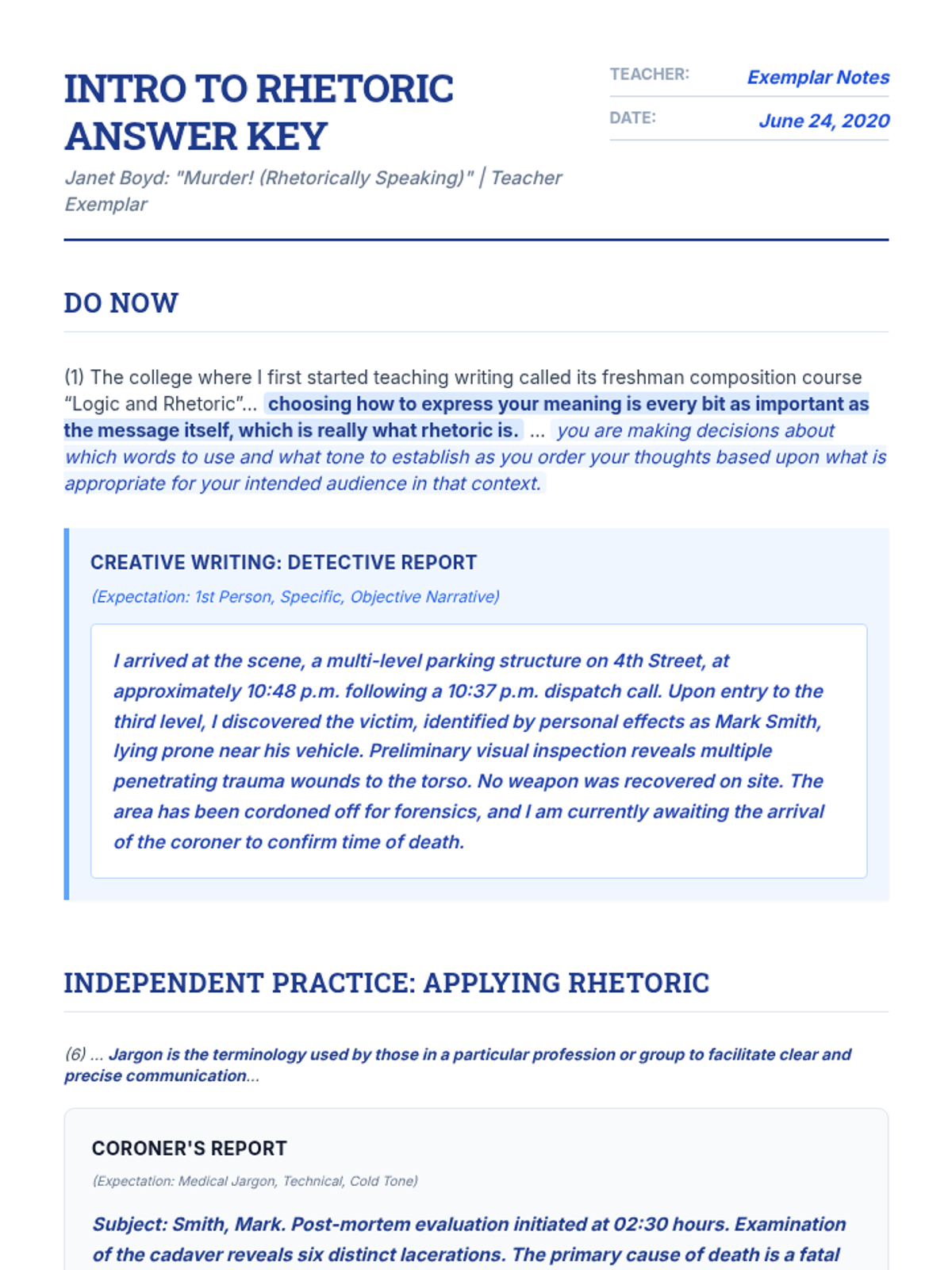
A complete teacher answer key for the 'Intro to Rhetoric' student handout based on Janet Boyd's "Murder! (Rhetorically Speaking)". It features annotated text segments, exemplar creative writing responses for the detective, coroner, and eulogy tasks, and comprehensive answers for the Entry Prompt and Exit Ticket.
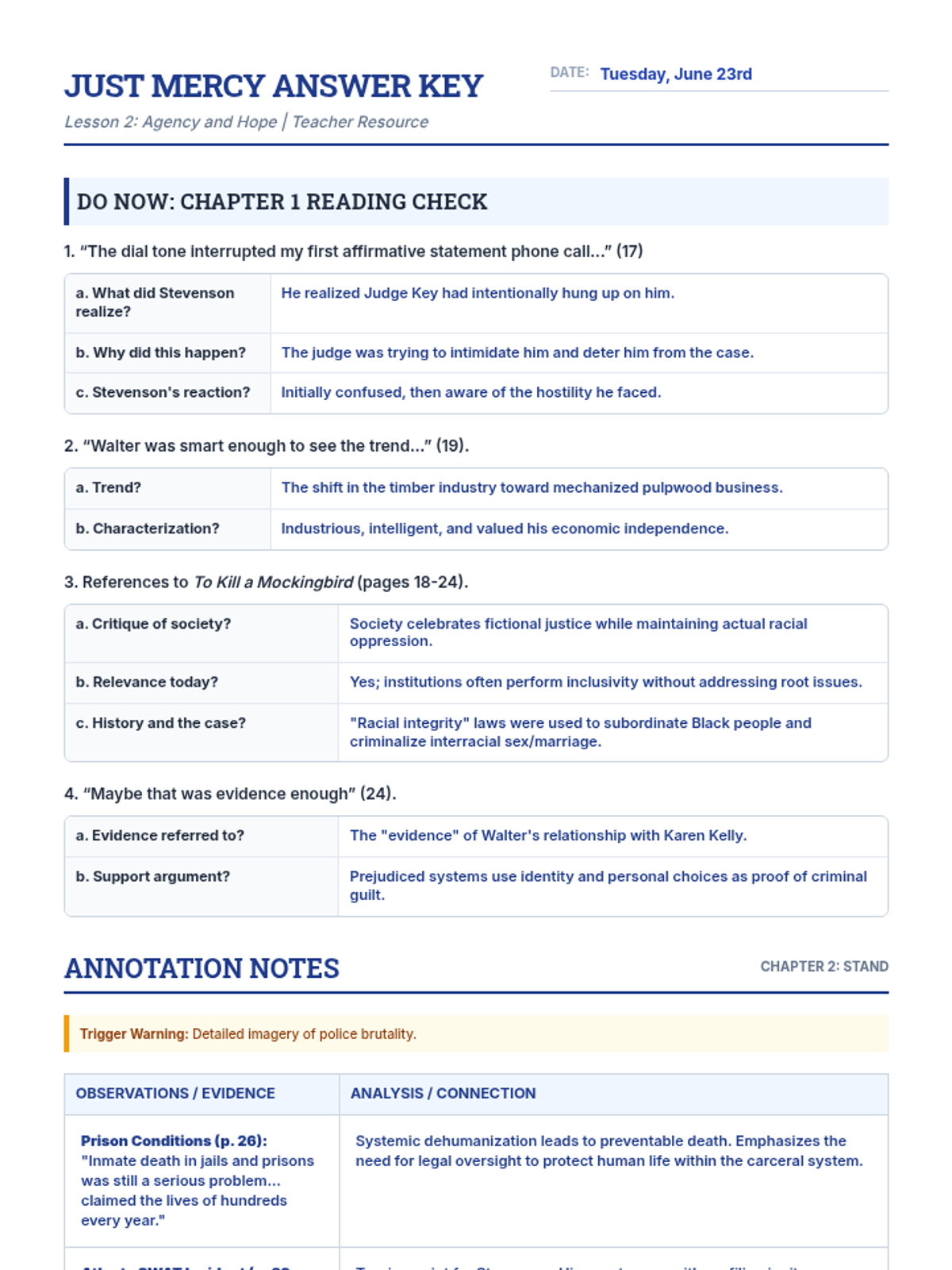
A complete teacher answer key for the Just Mercy Lesson 2 student packet. It includes exemplar responses for the Chapter 1 Reading Check, detailed annotation notes for Chapter 2 ('Stand'), and a full exemplar paragraph for the Exit Ticket prompt focused on individual agency and hope.
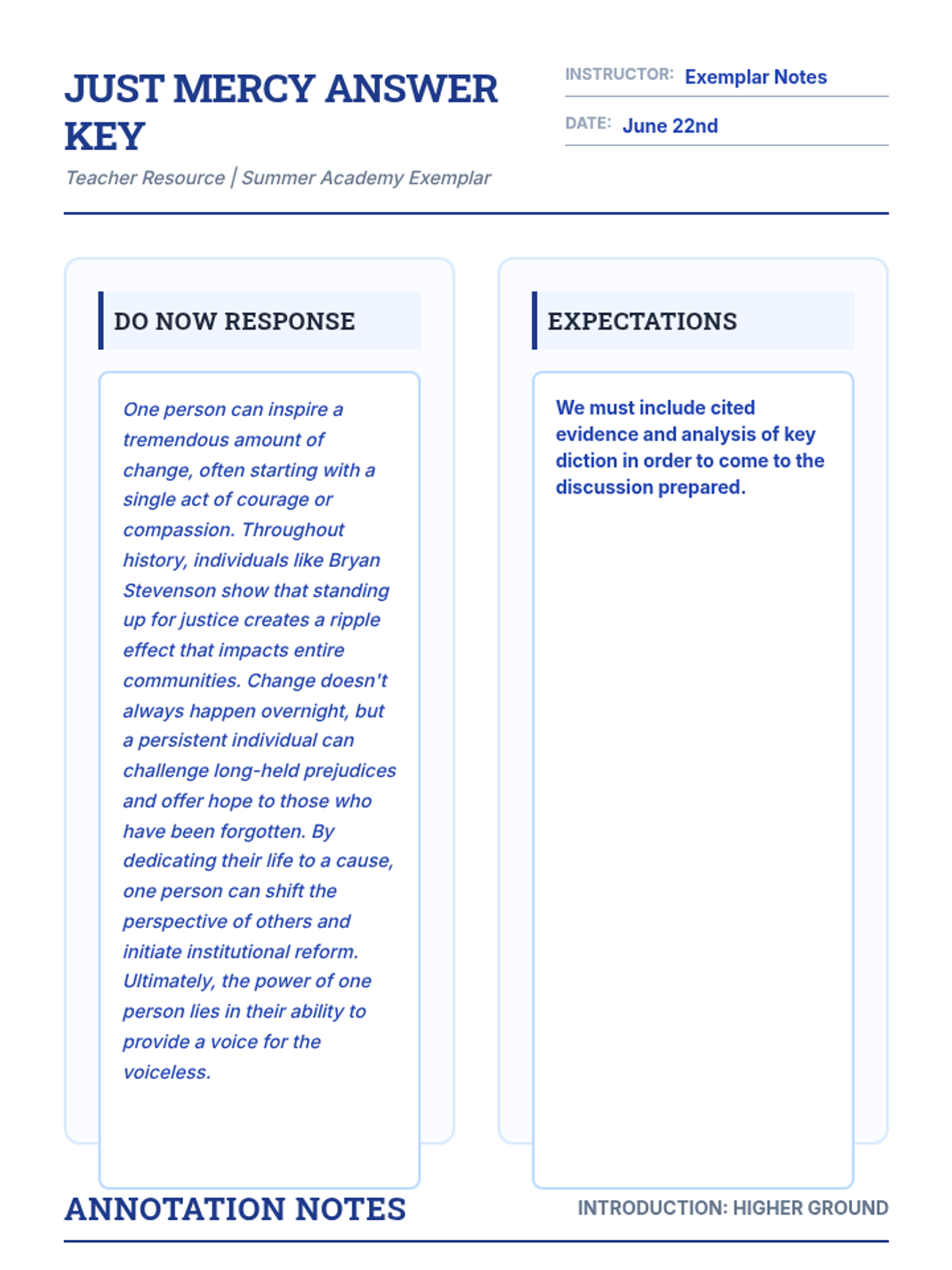
A comprehensive answer key for the Just Mercy student packet, containing exemplar responses for the Do Now, annotation notes (Introduction and Chapter 1), reflection stamps, and exit ticket. Responses are highlighted in blue to differentiate from the student prompt text.
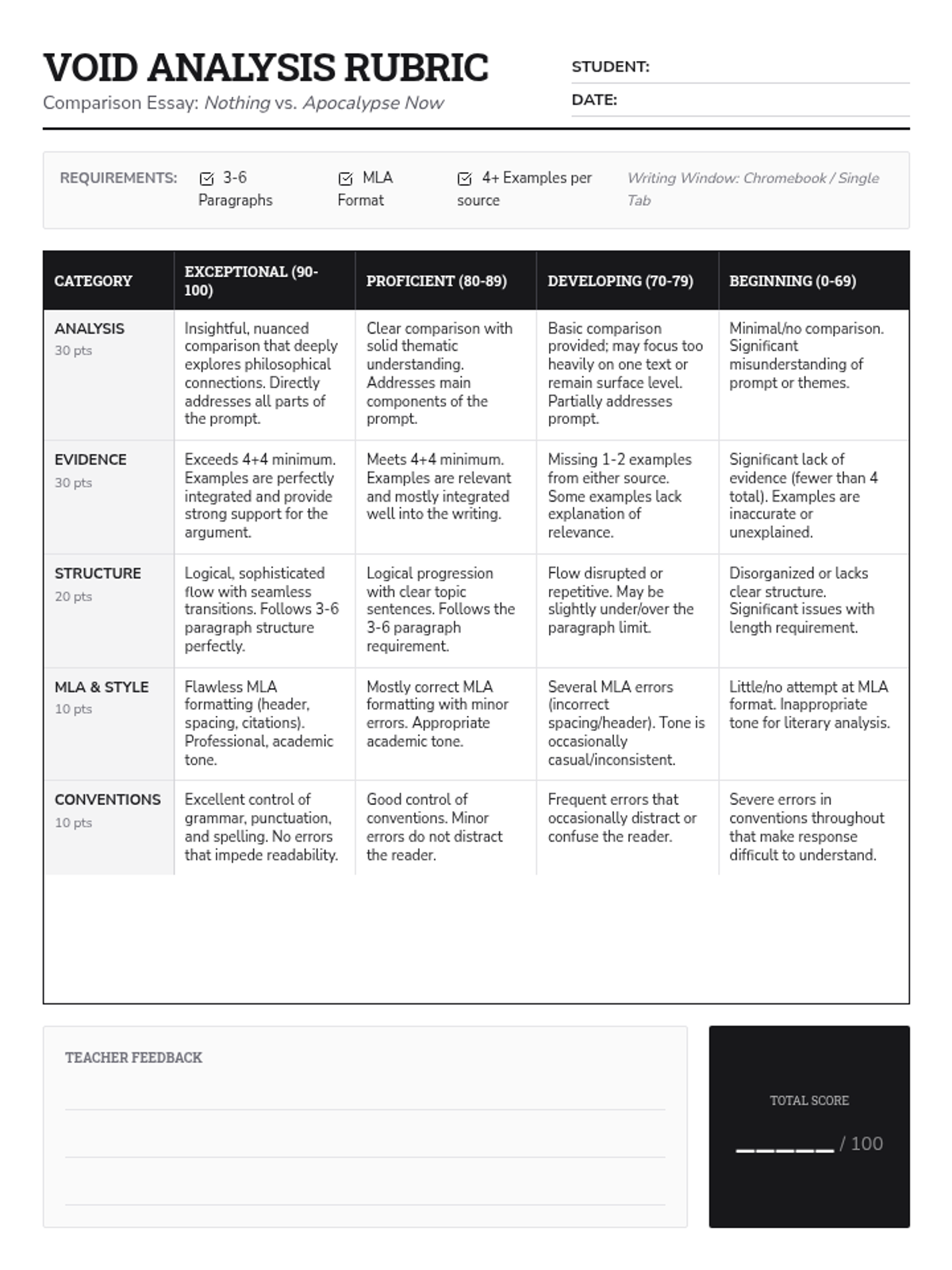
A revised 2-page rubric and prompt sheet for a comparative analysis of 'Nothing' and 'Apocalypse Now'. Page 1 features a detailed 100-point rubric with sections for teacher feedback and final scoring; Page 2 provides the five thematic writing prompts for student reference.
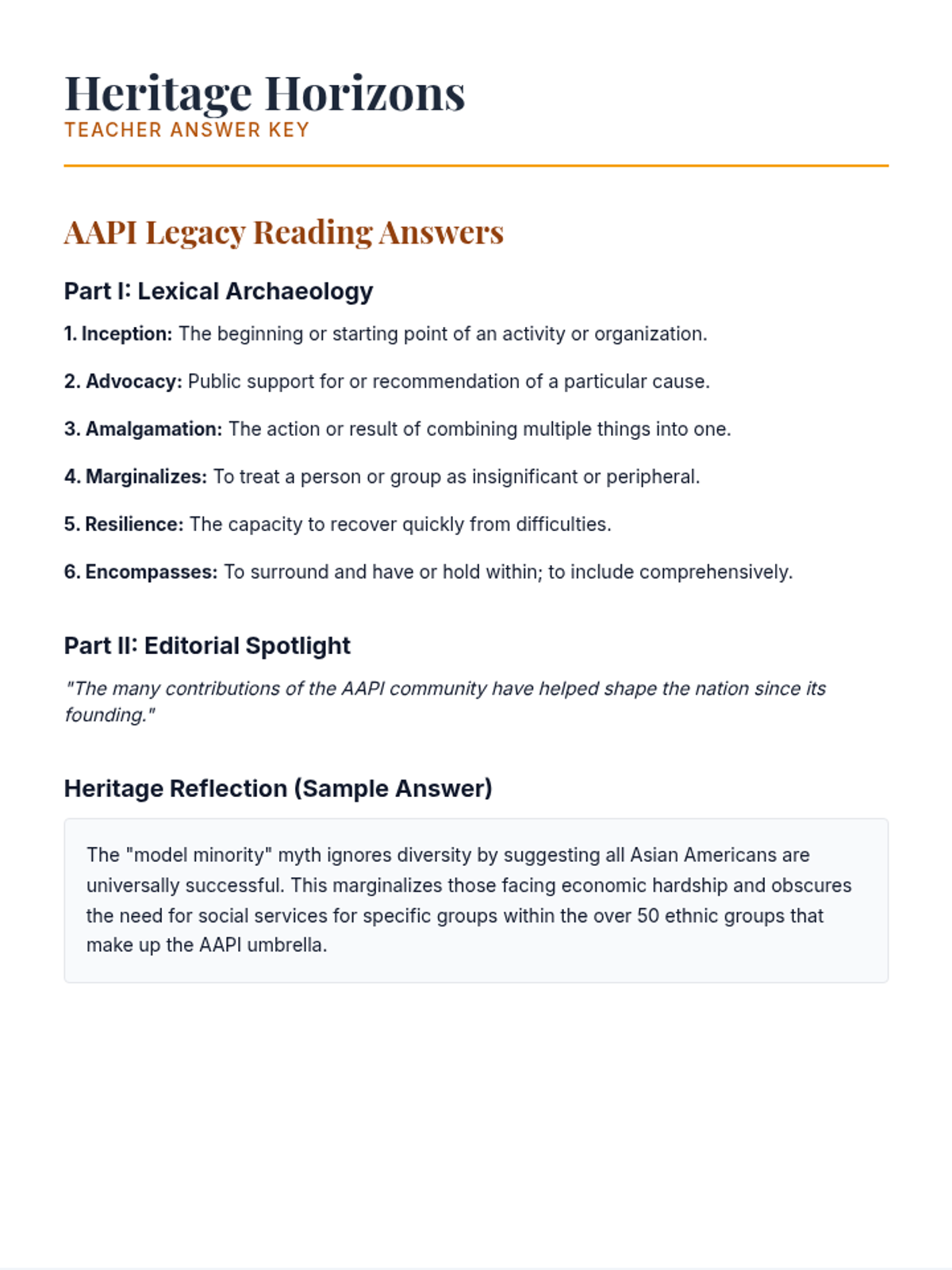
Teacher answer key for the AAPI Legacy Reading and Legacy Proofreaders worksheets.
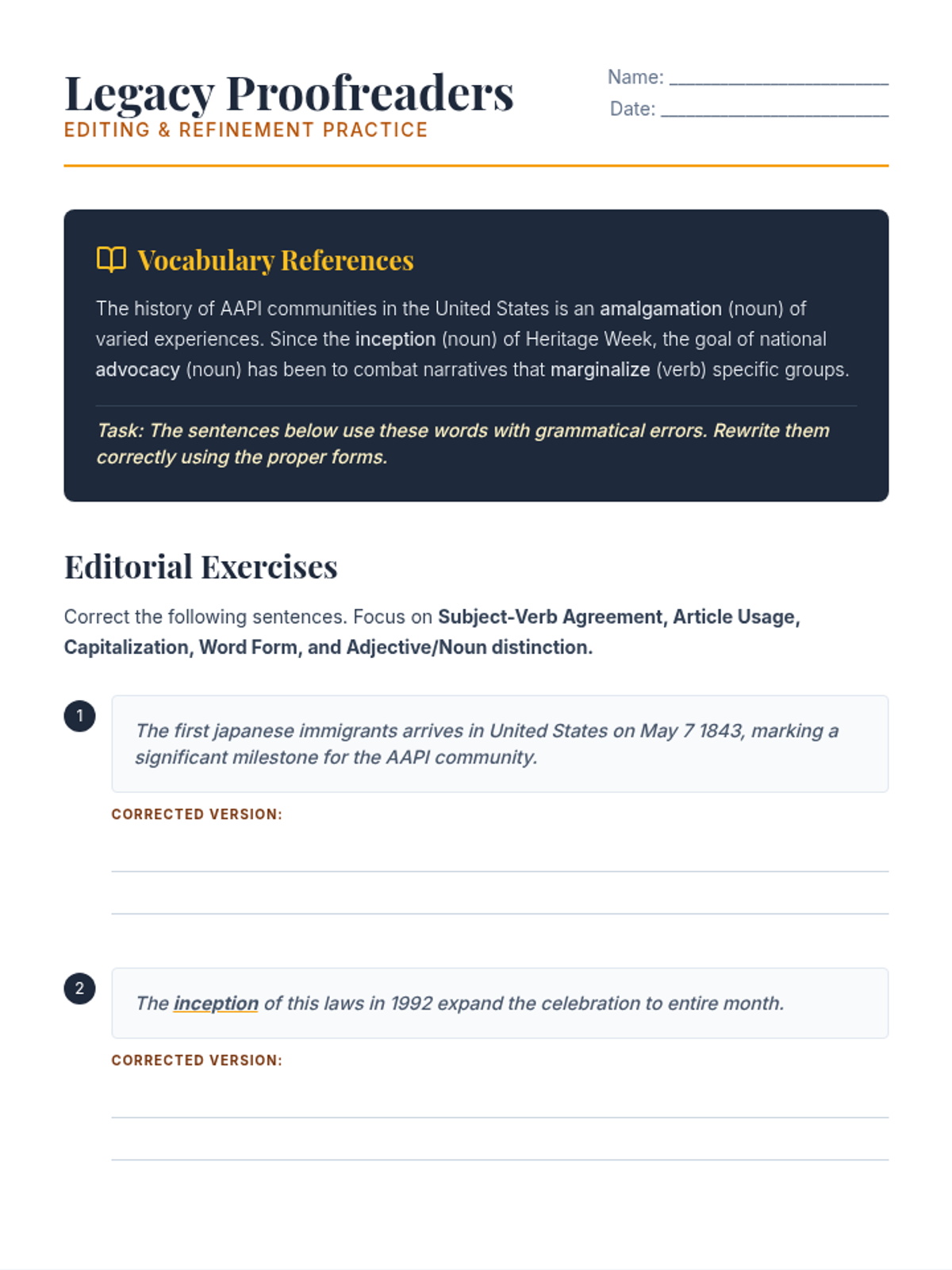
A proofreading worksheet where students identify and correct grammatical, mechanical, and structural errors in sentences related to AAPI history.
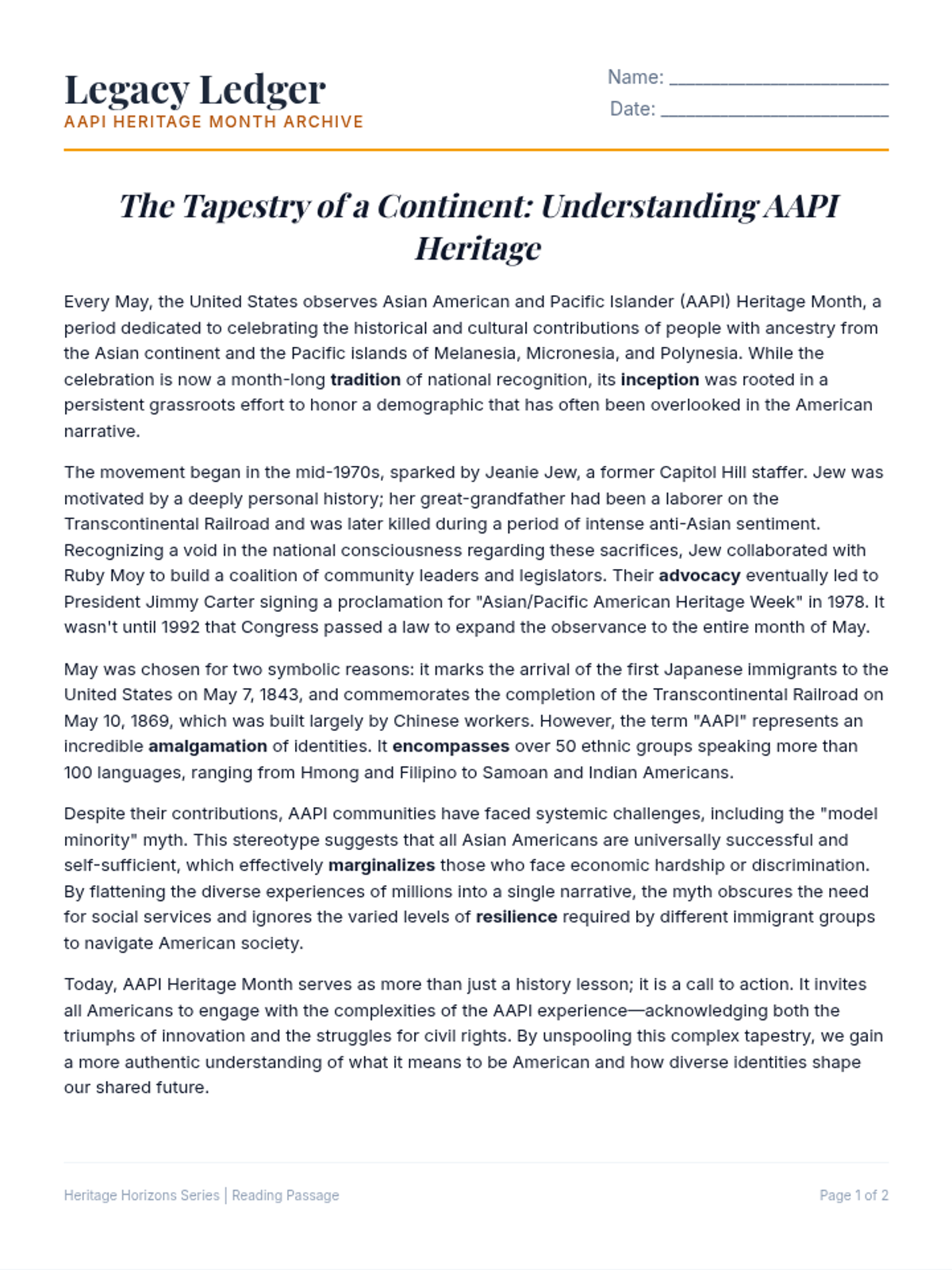
An advanced reading passage document about AAPI Heritage Month featuring a vocabulary development section focused on context clues and critical thinking.
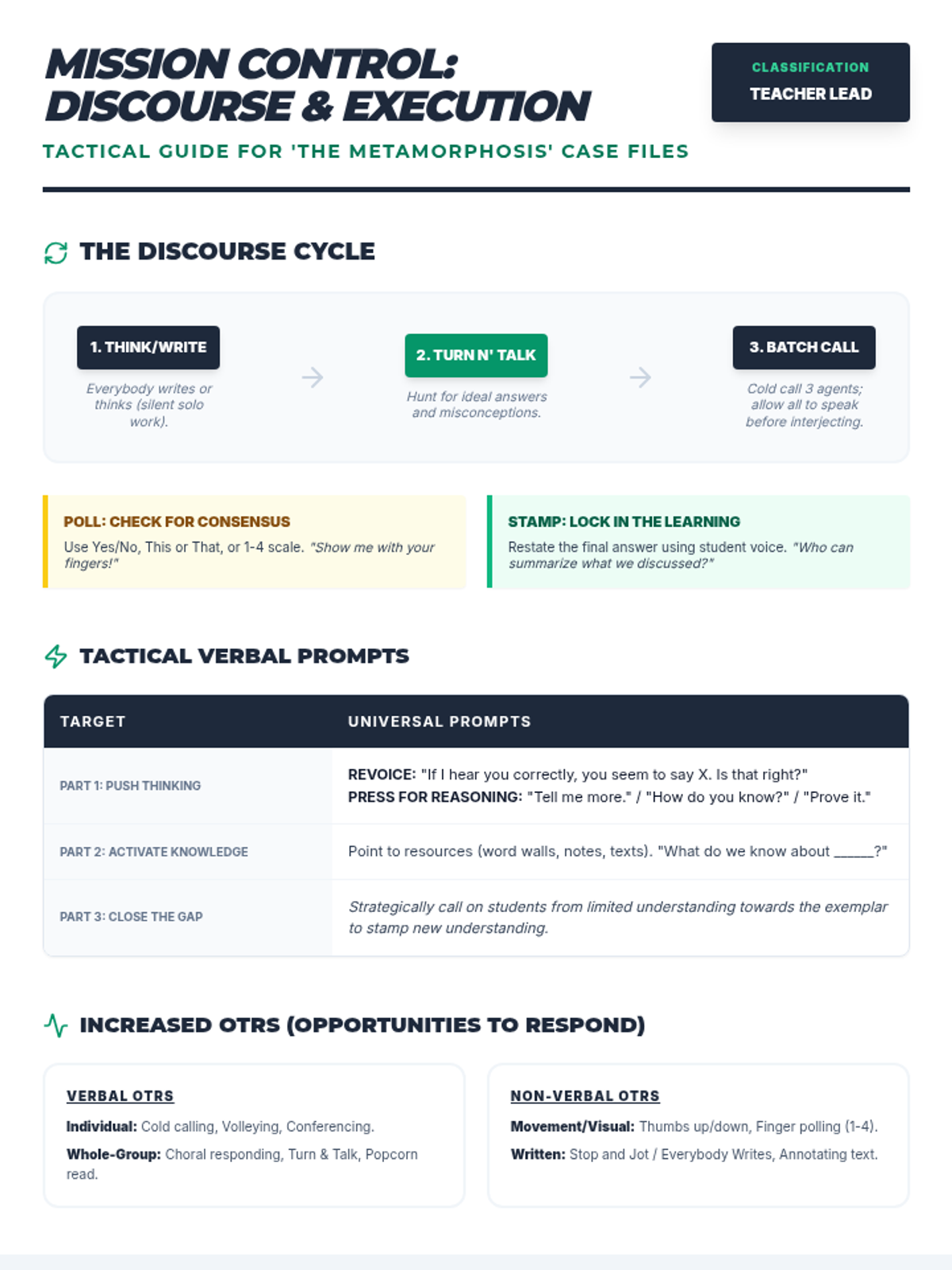
A condensed, single-page professional teacher guide providing a high-density visual reference for the Discourse Cycle, tactical verbal prompts, increased OTR strategies, the Vocabulary Protocol, student modifications, and the Backwards Planning checklist. Revised for perfect legibility, spacing, and contrast on a single page, removing the HIRED writing verb section as requested.
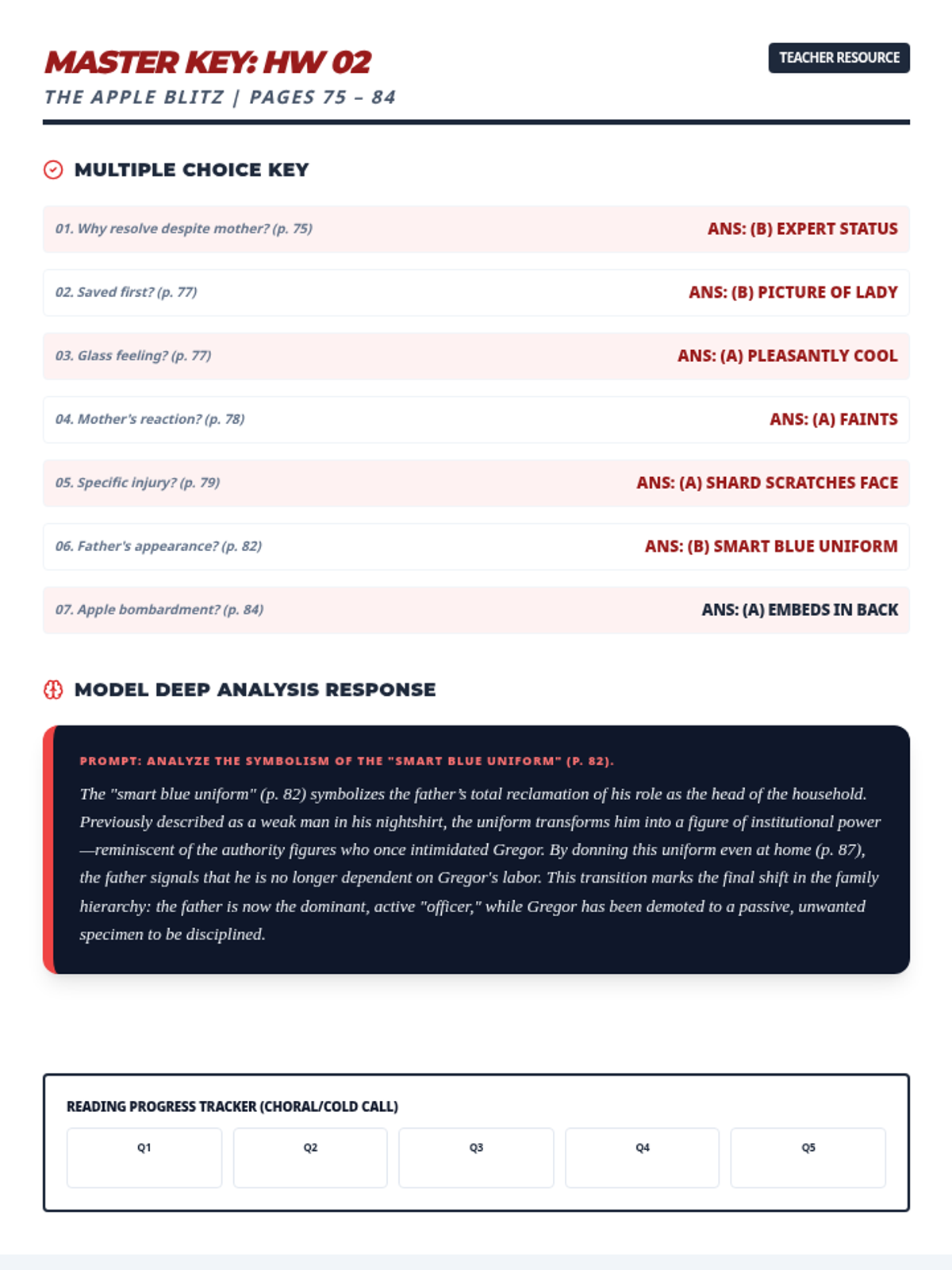
A teacher's answer key for the 'Apple Blitz' homework (HW 02), covering pages 75-84. Revised to remove all dark backgrounds for a printer-friendly white aesthetic while maintaining visual hierarchy with borders.
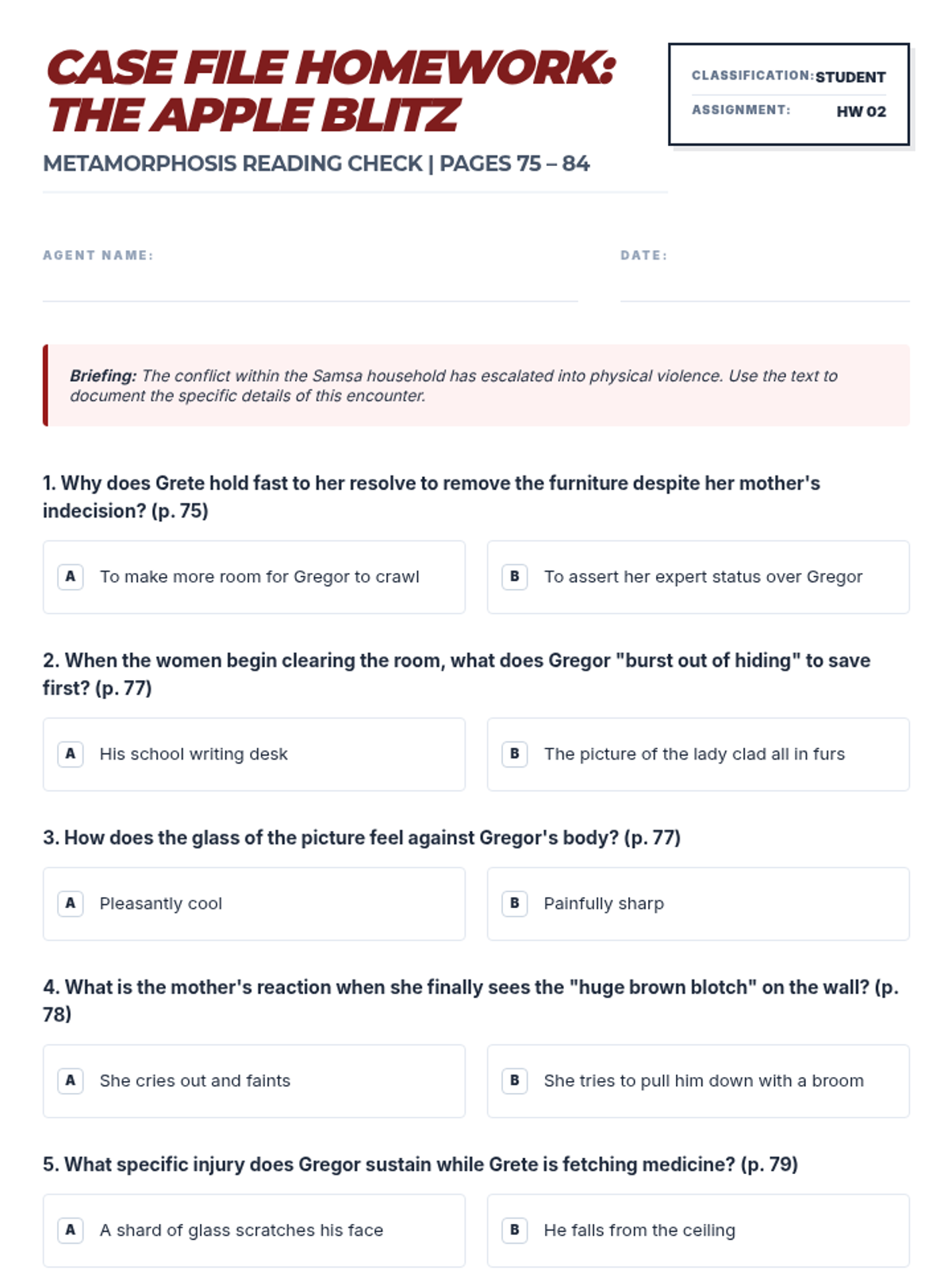
A reading check homework assignment for pages 75-84 of 'The Metamorphosis'. Revised to move the entire Deep Analysis section to a new page to prevent cutoff, providing 6 writing lines and the expanded HIRED acronym.
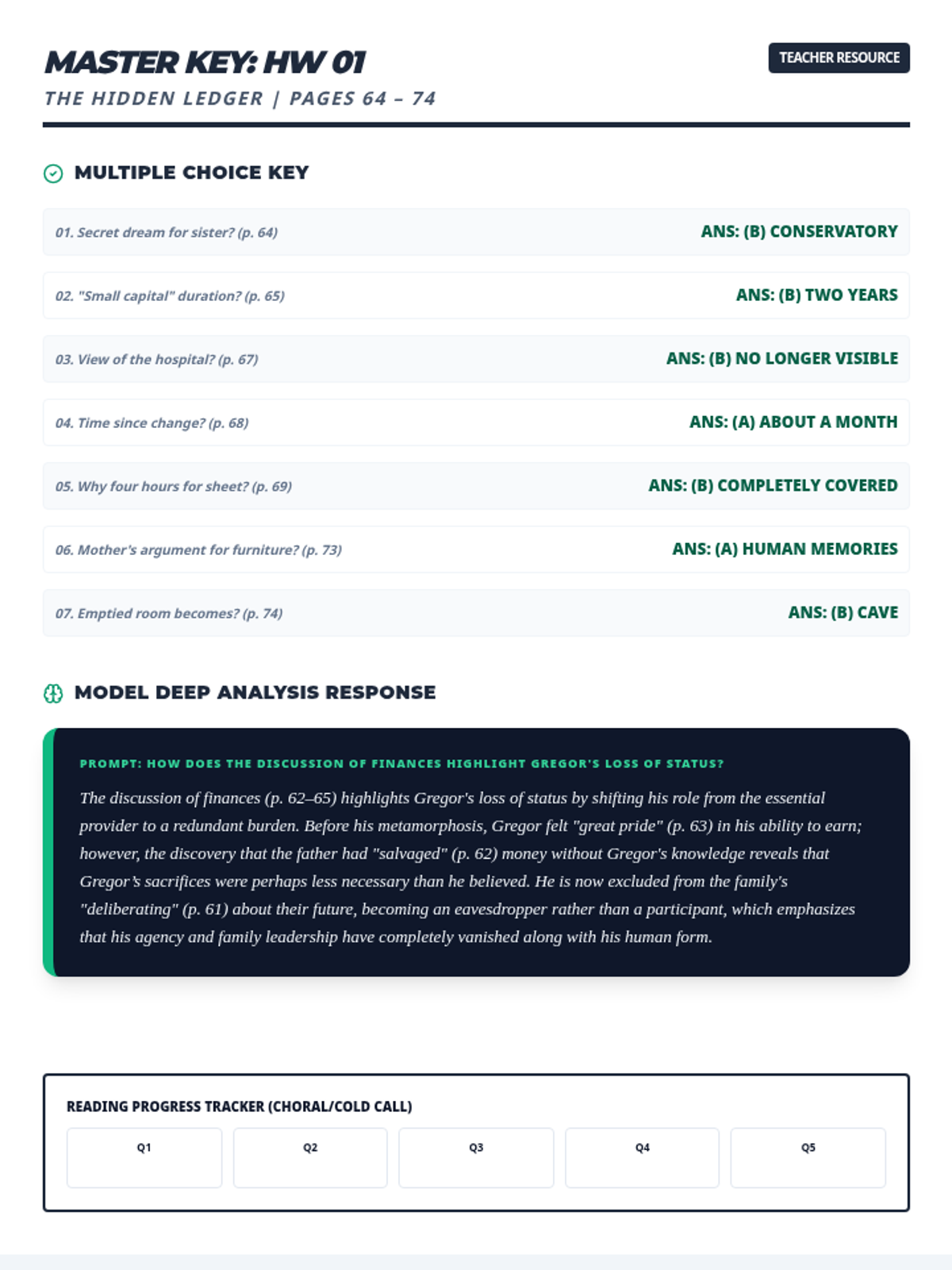
A teacher's answer key for the 'Hidden Ledger' homework (HW 01), covering pages 64-74. Revised to remove all dark backgrounds for a printer-friendly white aesthetic while maintaining visual definition.
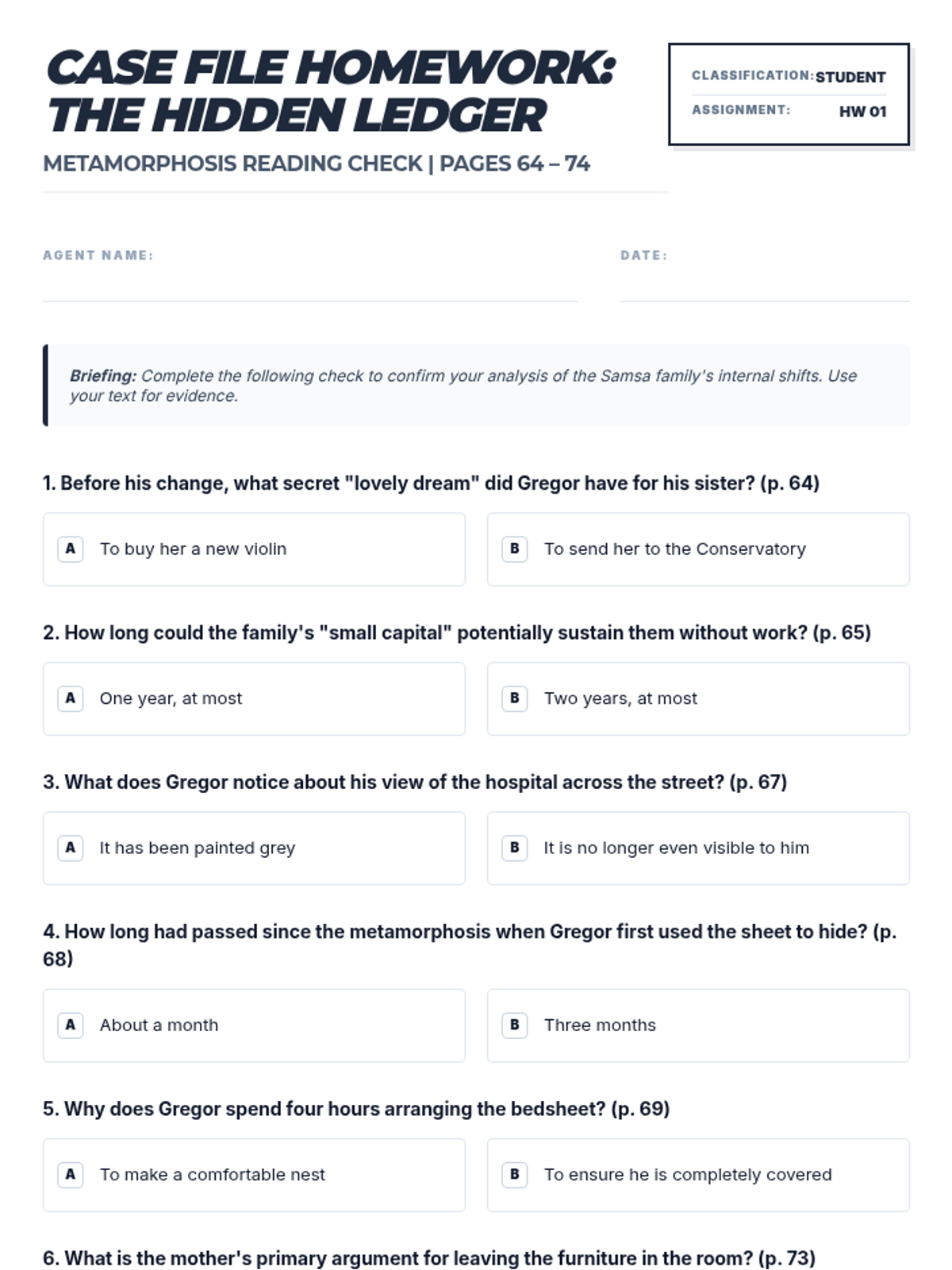
A reading check homework assignment for pages 64-74 of 'The Metamorphosis'. Revised for maximum print legibility: dark backgrounds removed, writing lines darkened, and consistent spacing between Do Now and Deep Analysis sections.
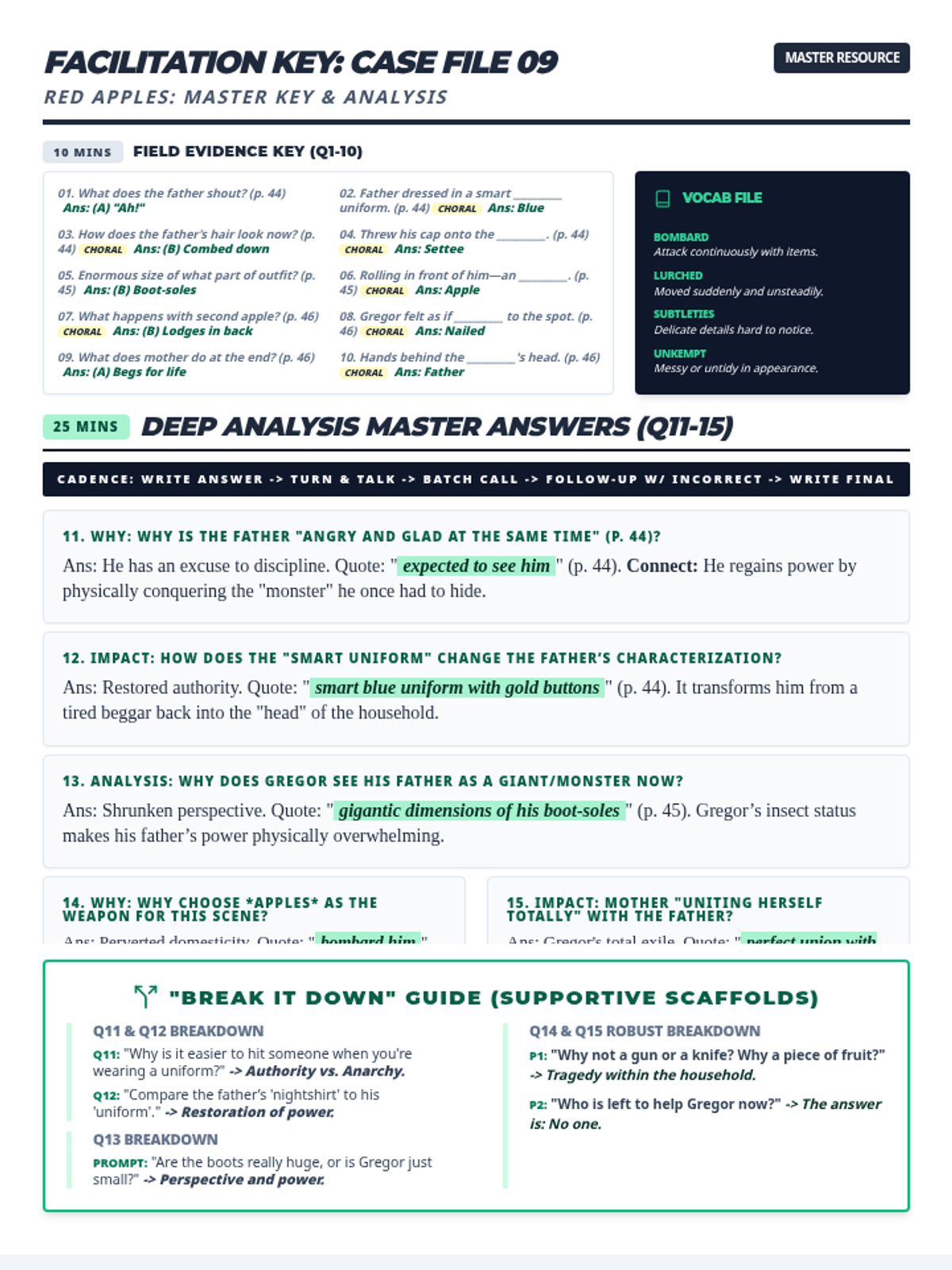
A professional teacher facilitation key for Lesson 9 (Red Apples). Revised to remove dark blue backgrounds for a printer-friendly white aesthetic while maintaining visual hierarchy with borders. Aligned with the student worksheet exactly.
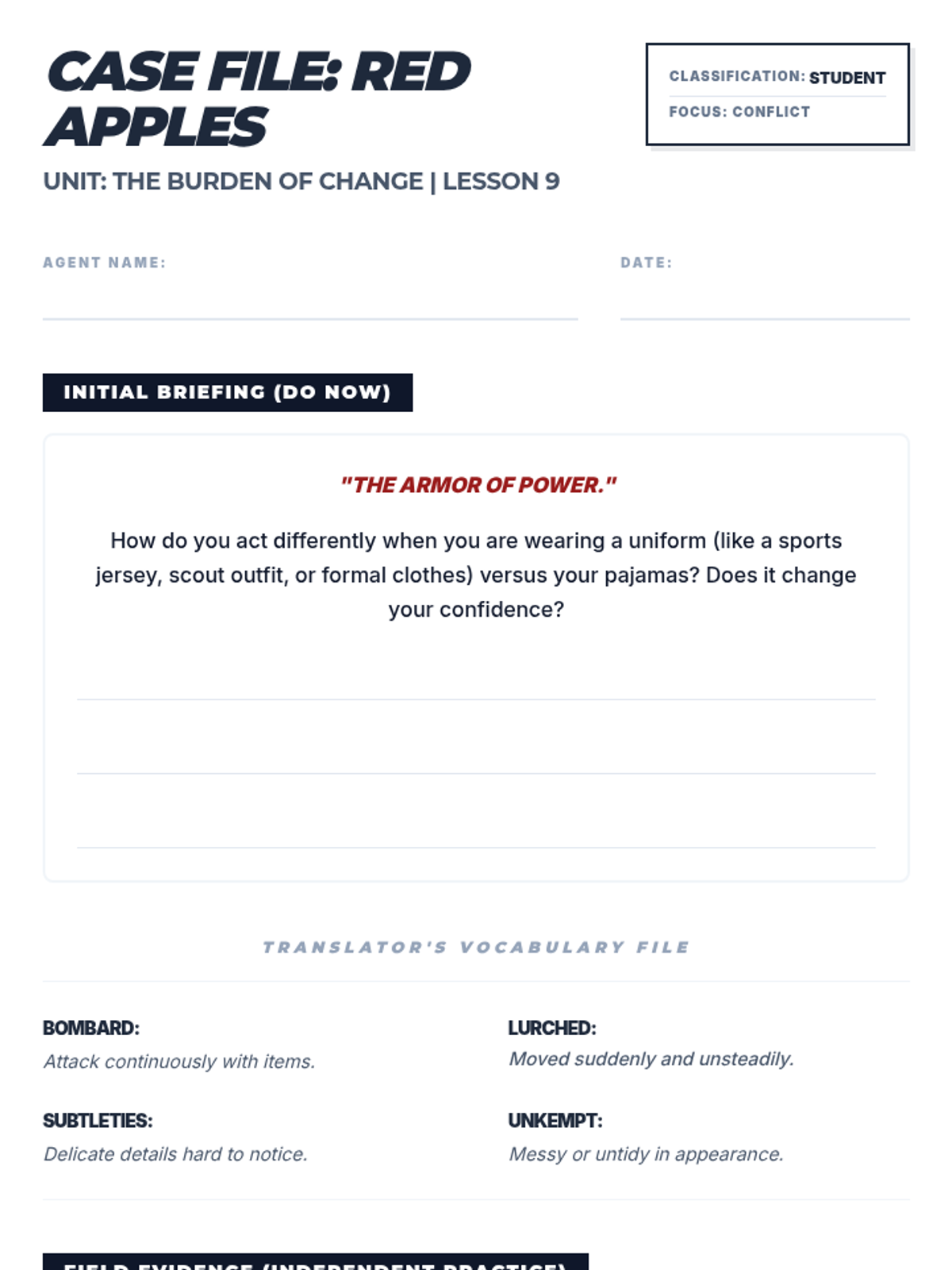
A comprehensive student worksheet for Lesson 9. Revised to move the entire Exit Ticket to a new page to prevent cutoff, providing 6 writing lines with spacing consistent to the Do Now and the expanded HIRED acronym. Revised for maximum print legibility.
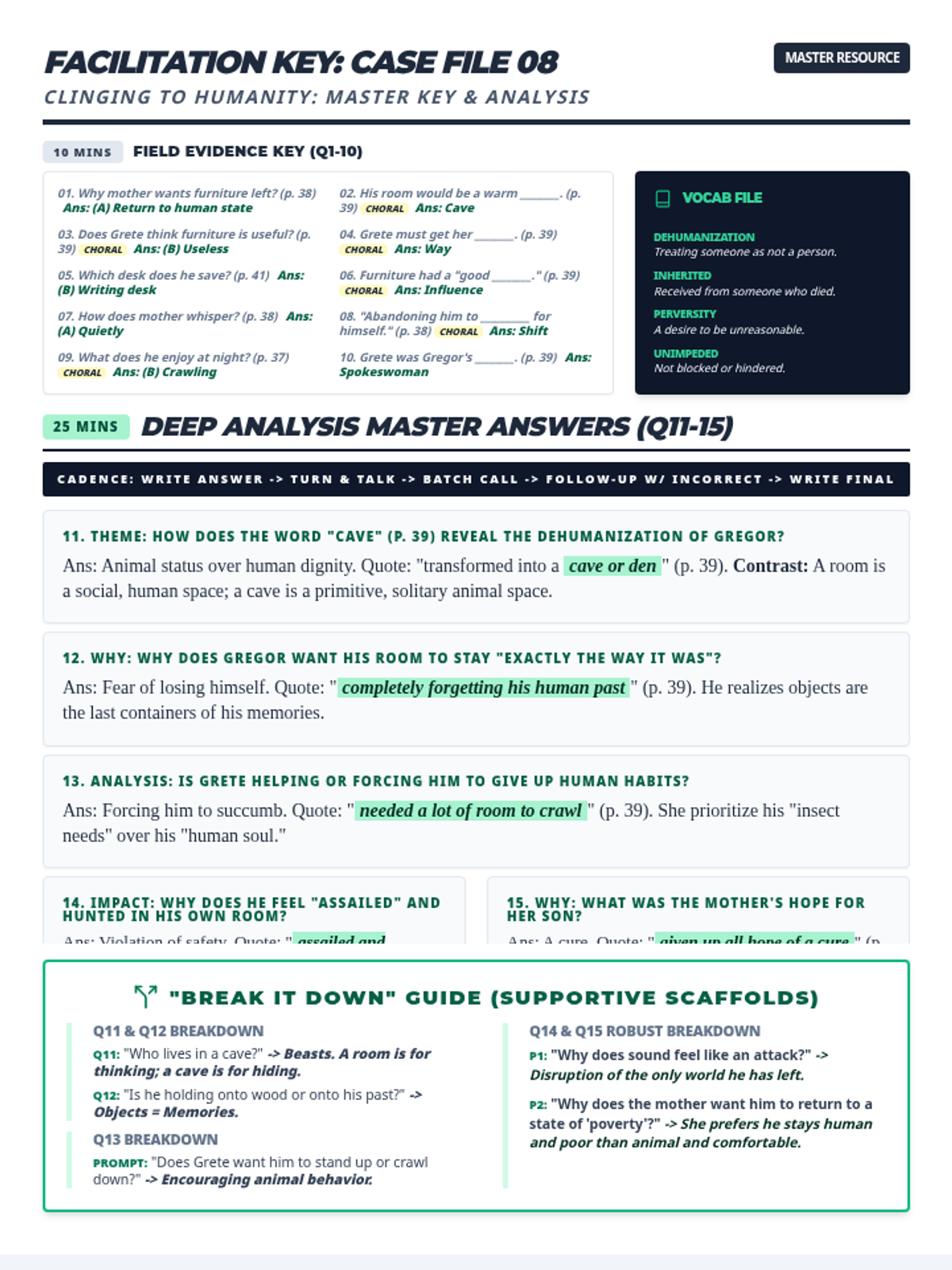
A professional teacher facilitation key for Lesson 8 (Clinging to Humanity). Revised to remove dark blue backgrounds for a printer-friendly white aesthetic while maintaining visual hierarchy with borders. Aligned with the student worksheet exactly.
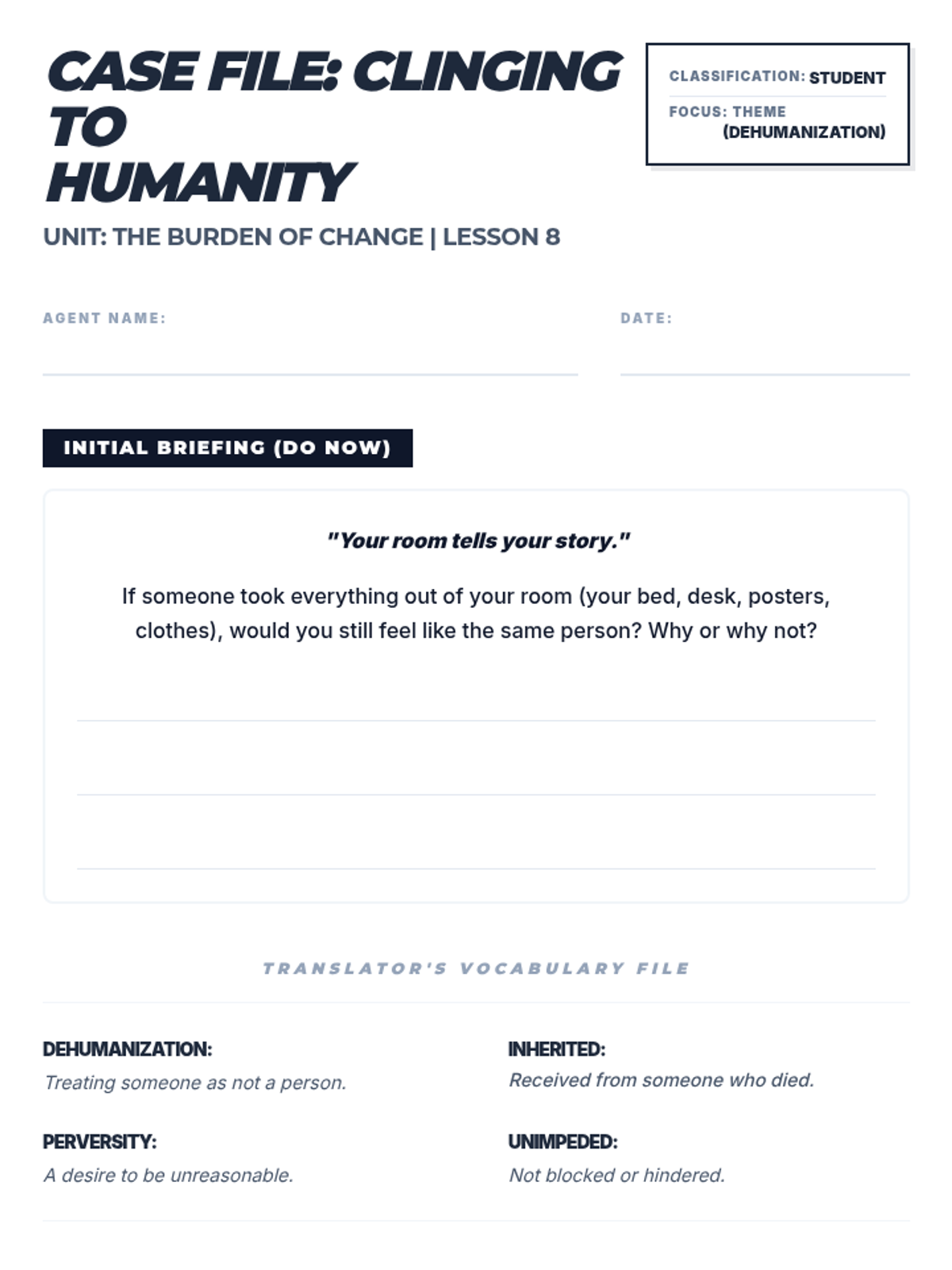
A condensed, single-page student worksheet for Lesson 8 (Clinging to Humanity). Revised to ensure consistent line spacing across Do Now and Exit Ticket sections for a professional, print-ready layout. Expanded HIRED acronym included.
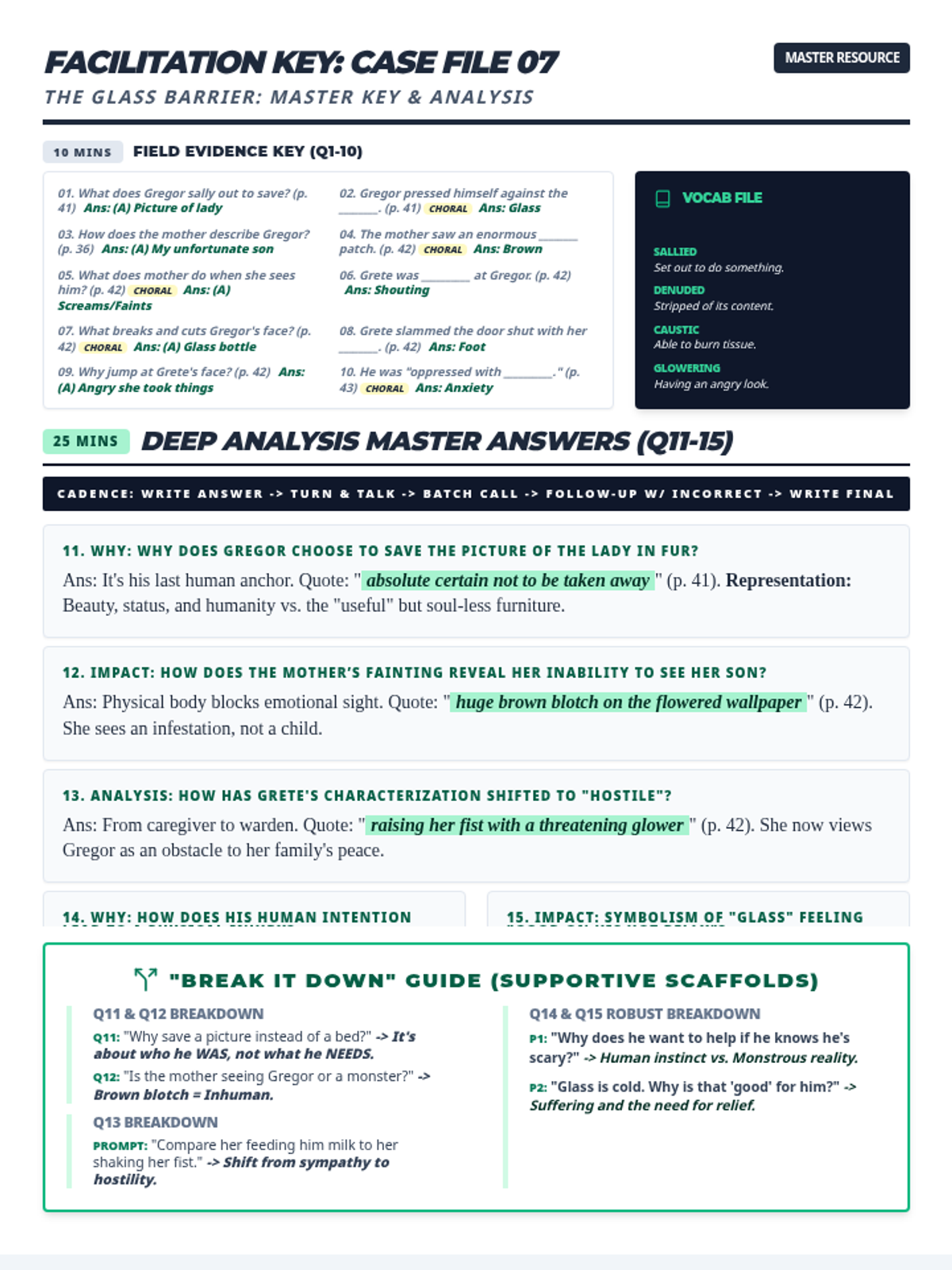
A professional teacher facilitation key for Lesson 7 (The Glass Barrier). Revised to remove dark blue backgrounds for a printer-friendly white aesthetic while maintaining visual definition. Aligned with the student worksheet exactly.
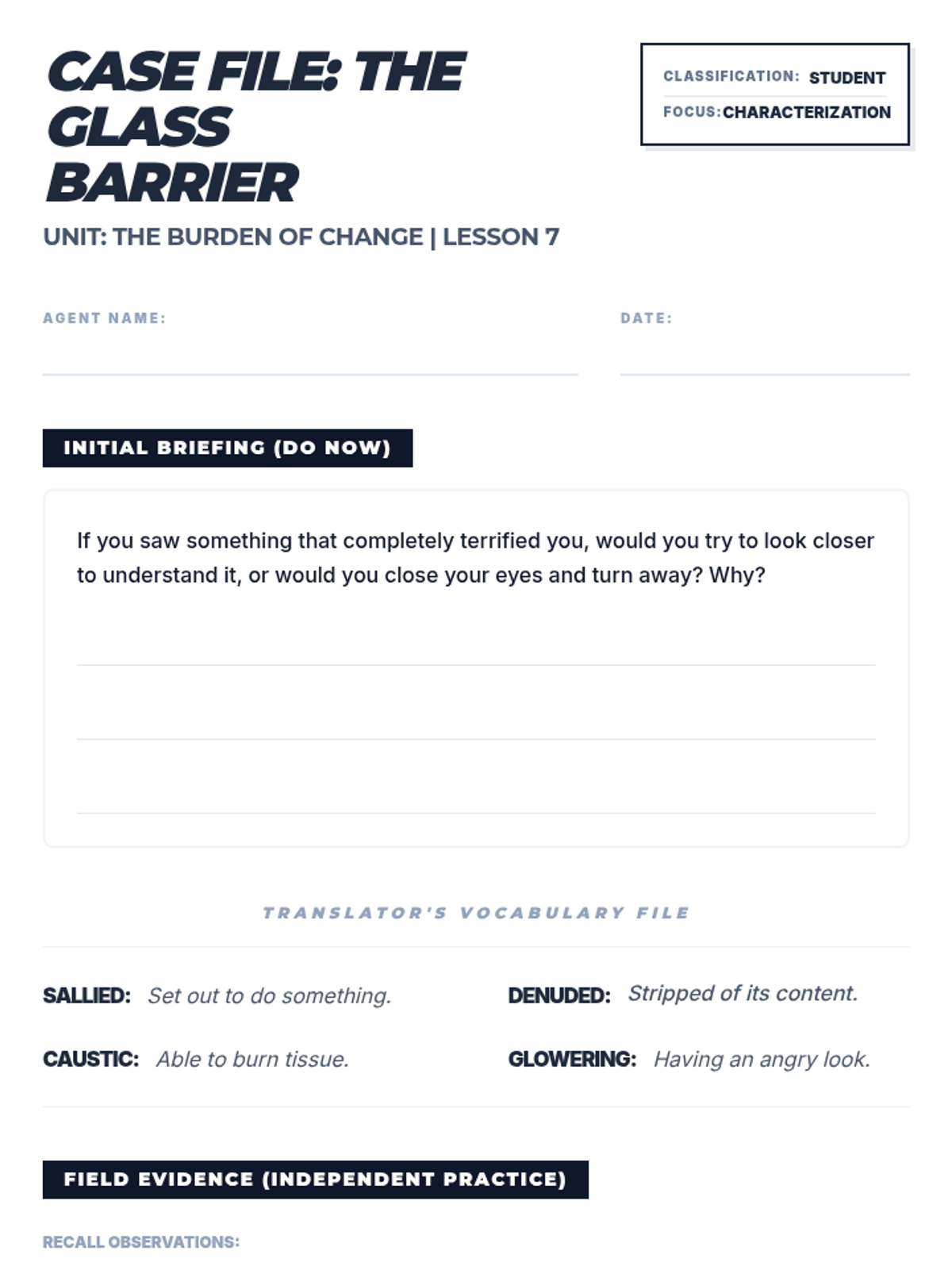
A condensed student worksheet for Lesson 7 (The Glass Barrier). Revised to remove all dark backgrounds for a white, printer-friendly aesthetic while maintaining visual hierarchy with borders. Expanded HIRED acronym and 6-line Exit Ticket on a new page with spacing consistent to the Do Now.
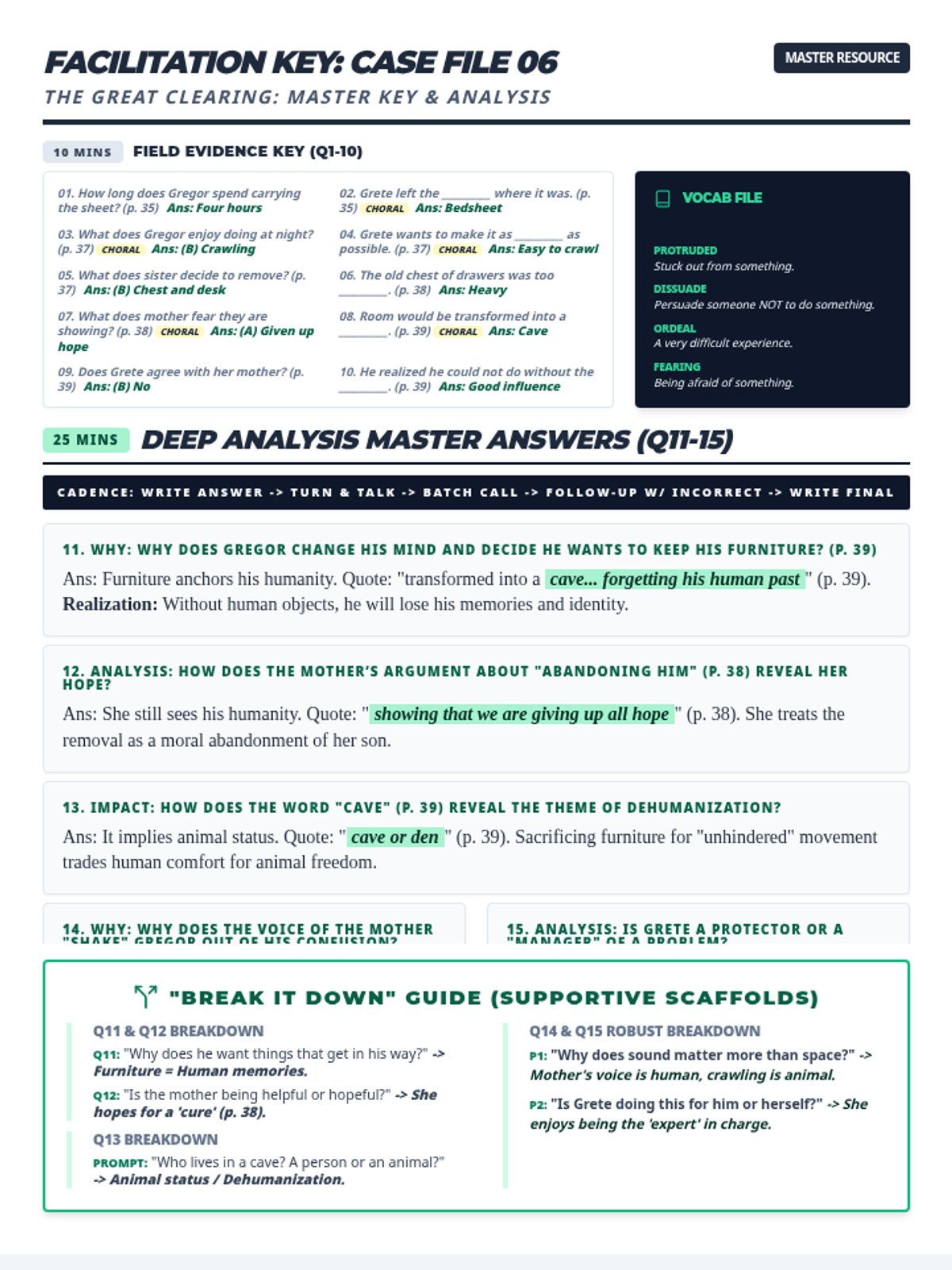
A professional teacher facilitation key for Lesson 6 (The Great Clearing). Revised to remove dark blue backgrounds for a printer-friendly white aesthetic while maintaining visual hierarchy with borders. Aligned exactly with the student worksheet questions.
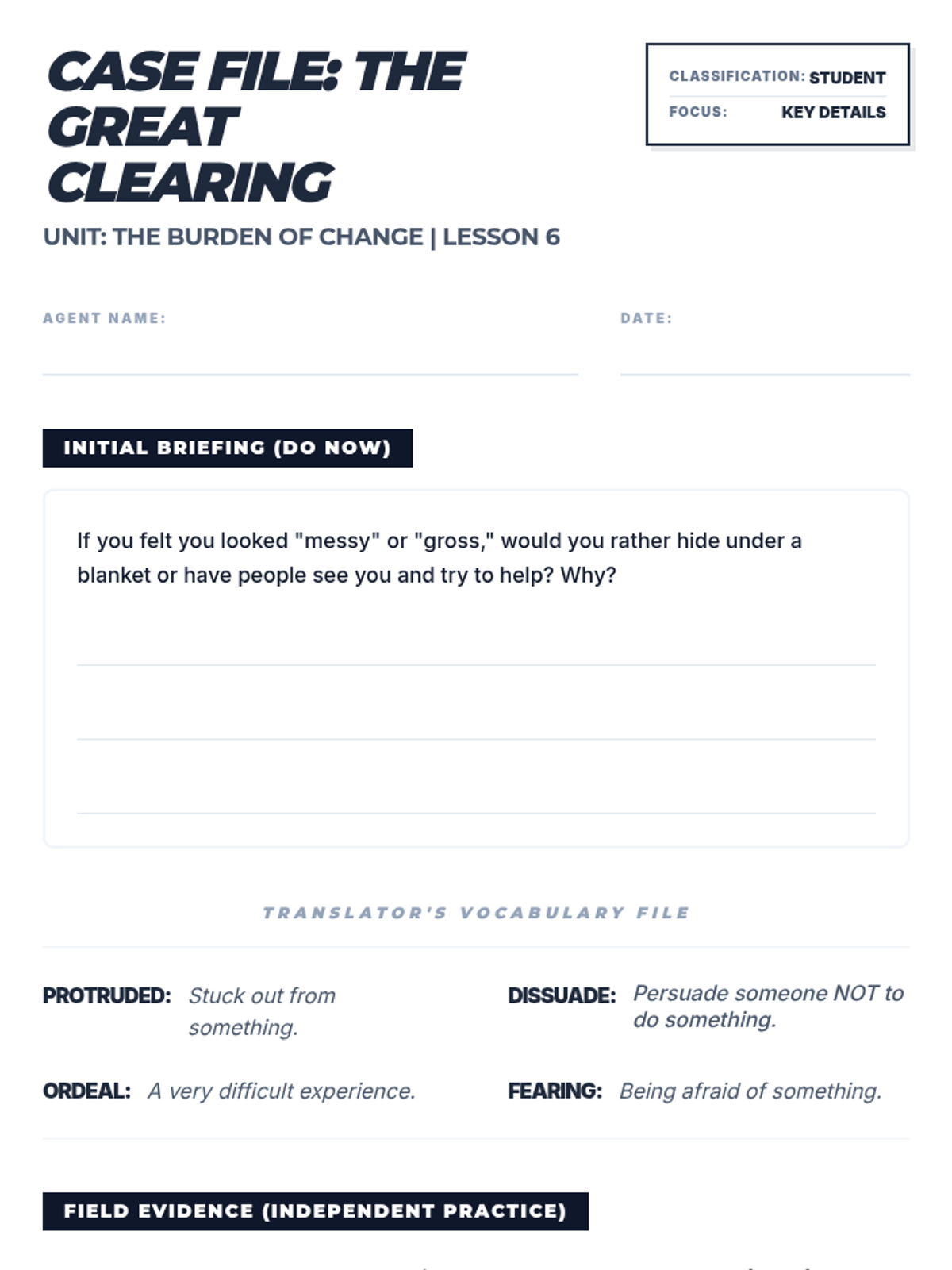
A condensed, single-page student worksheet for Lesson 6. Revised to move the entire Exit Ticket to a new page, provide 6 lines with spacing consistent to the Do Now, and expand the HIRED acronym. Revised for maximum print legibility.
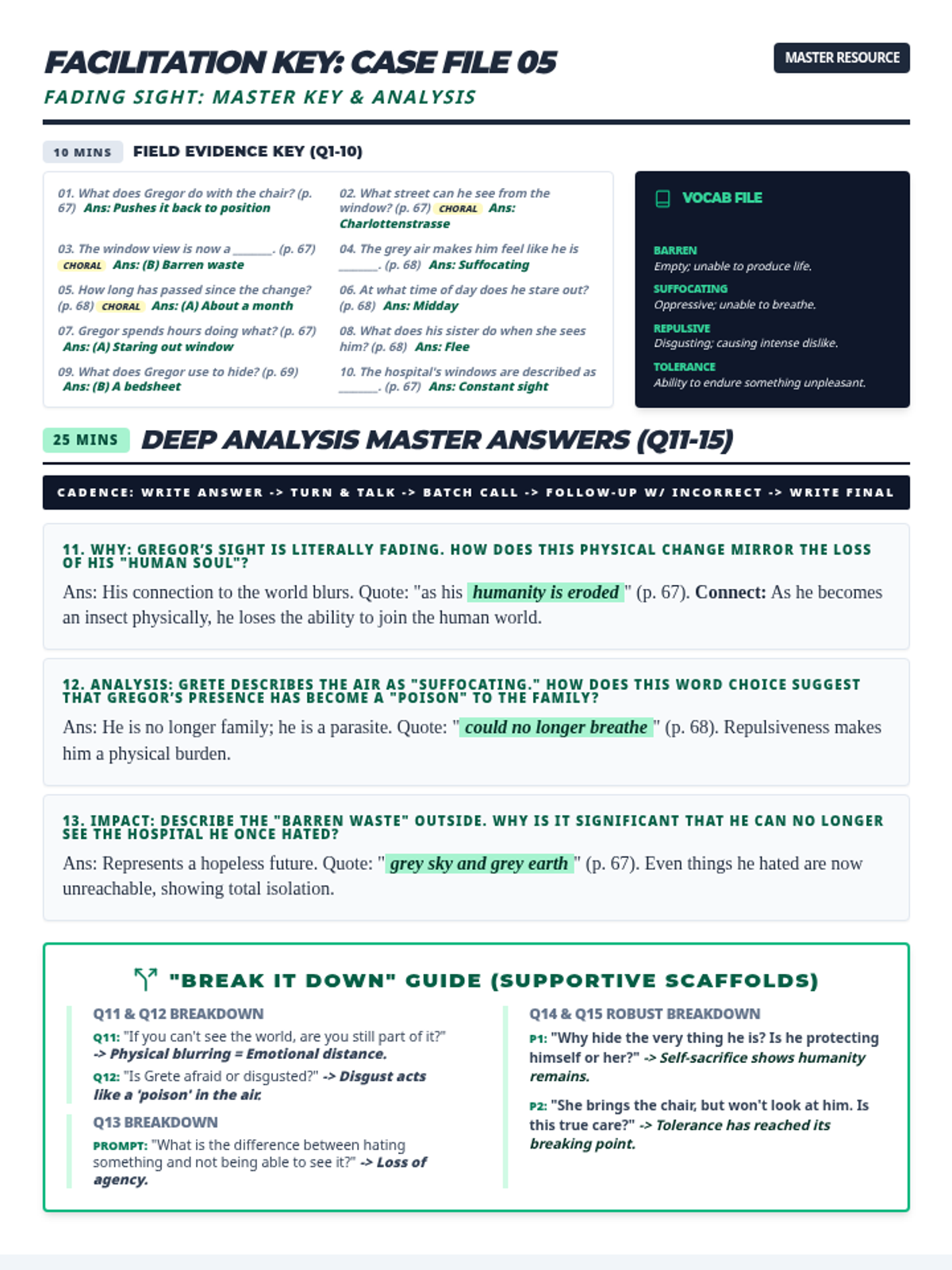
A professional 2-page teacher facilitation key for Lesson 5 (Fading Sight), aligned with the specific page numbers of the provided edition of 'The Metamorphosis'. Revised to remove dark blue backgrounds for a printer-friendly white aesthetic while maintaining visual definition.
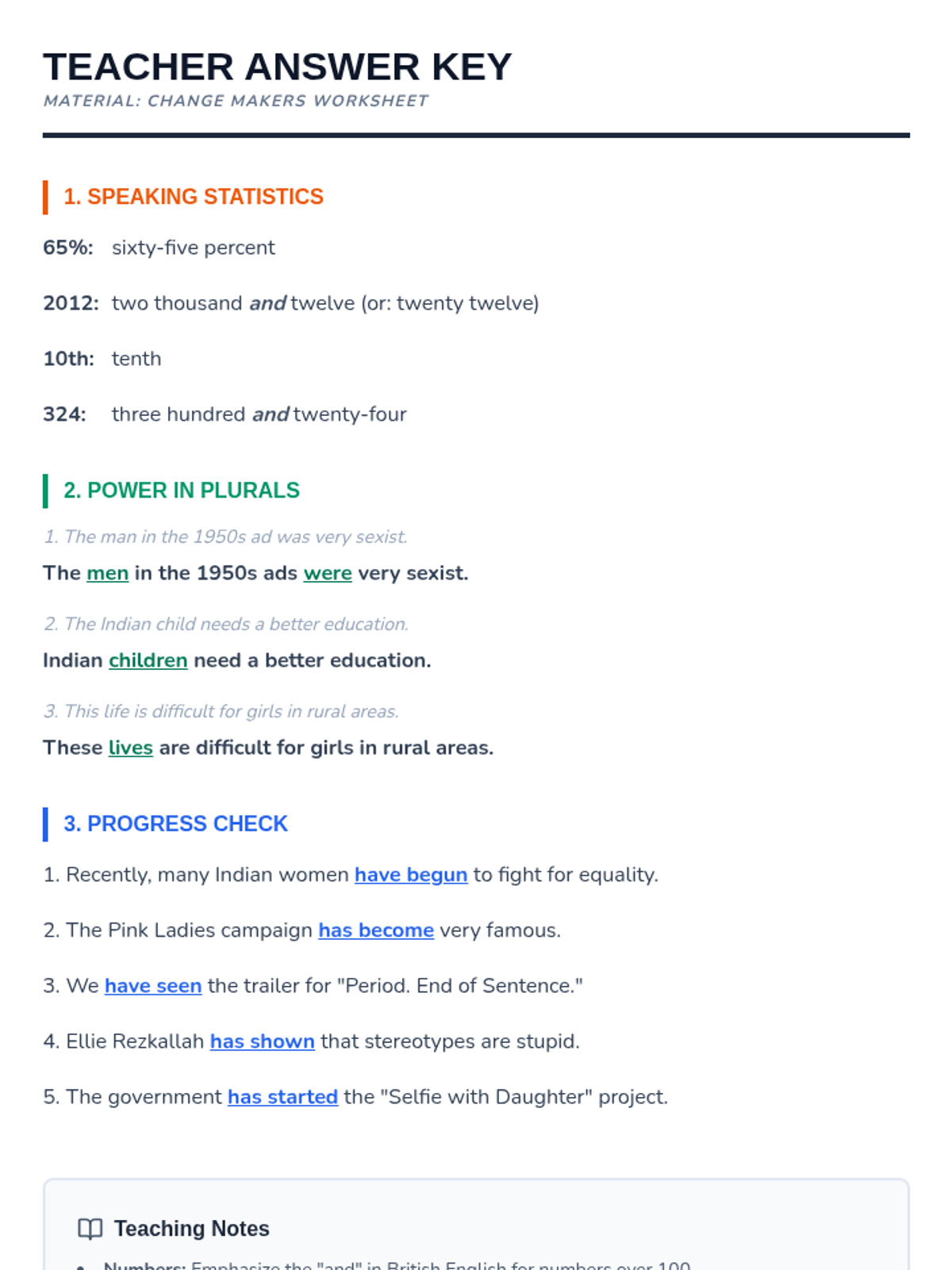
Teacher's answer key for the Change Makers Worksheet with additional pedagogical notes and extension ideas.
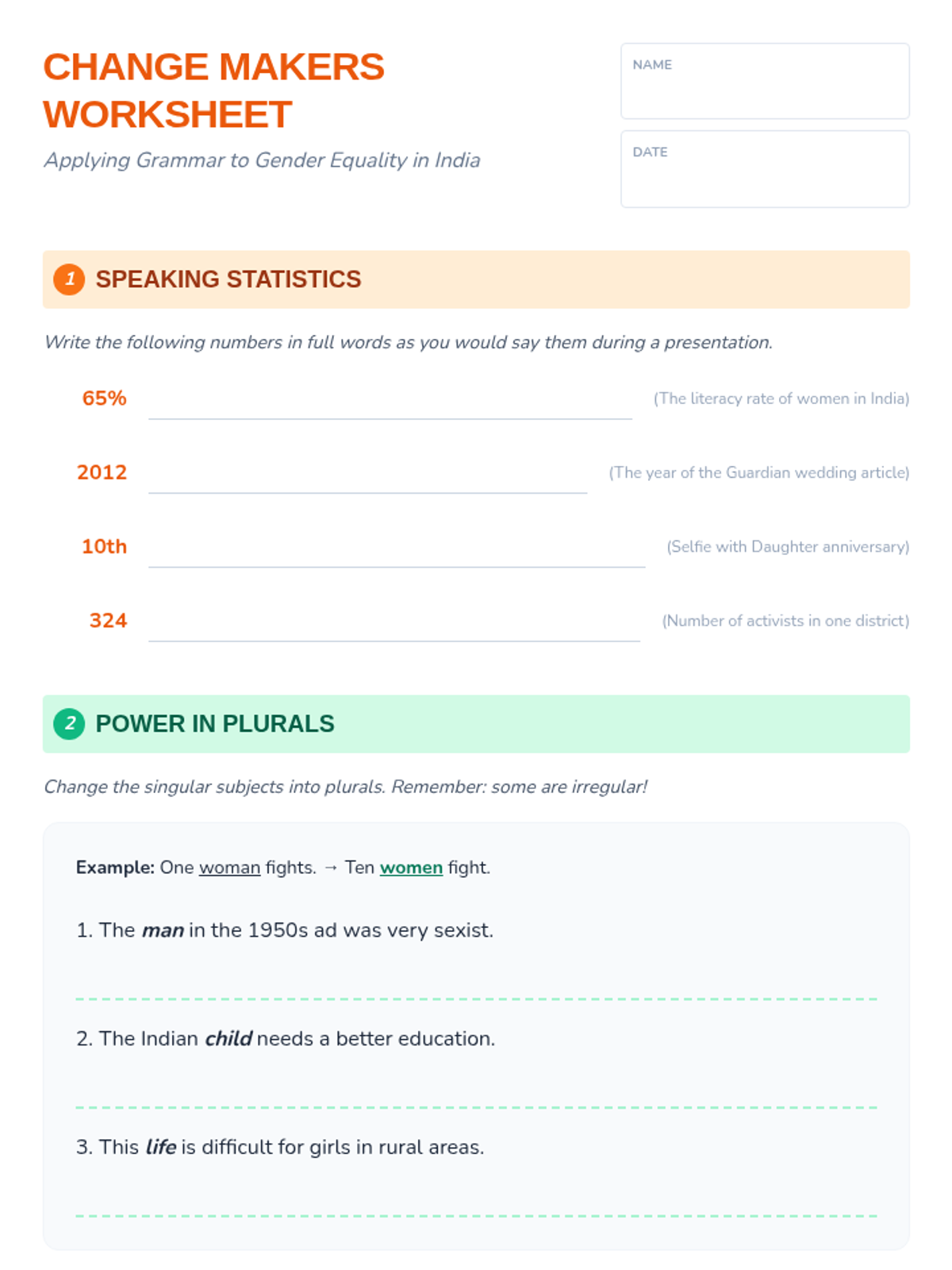
A comprehensive practice worksheet for A2 students applying numbers, irregular plurals, and the present perfect to topics like the Pink Ladies, Beti Bachao, and Ellie Rezkallah's work.
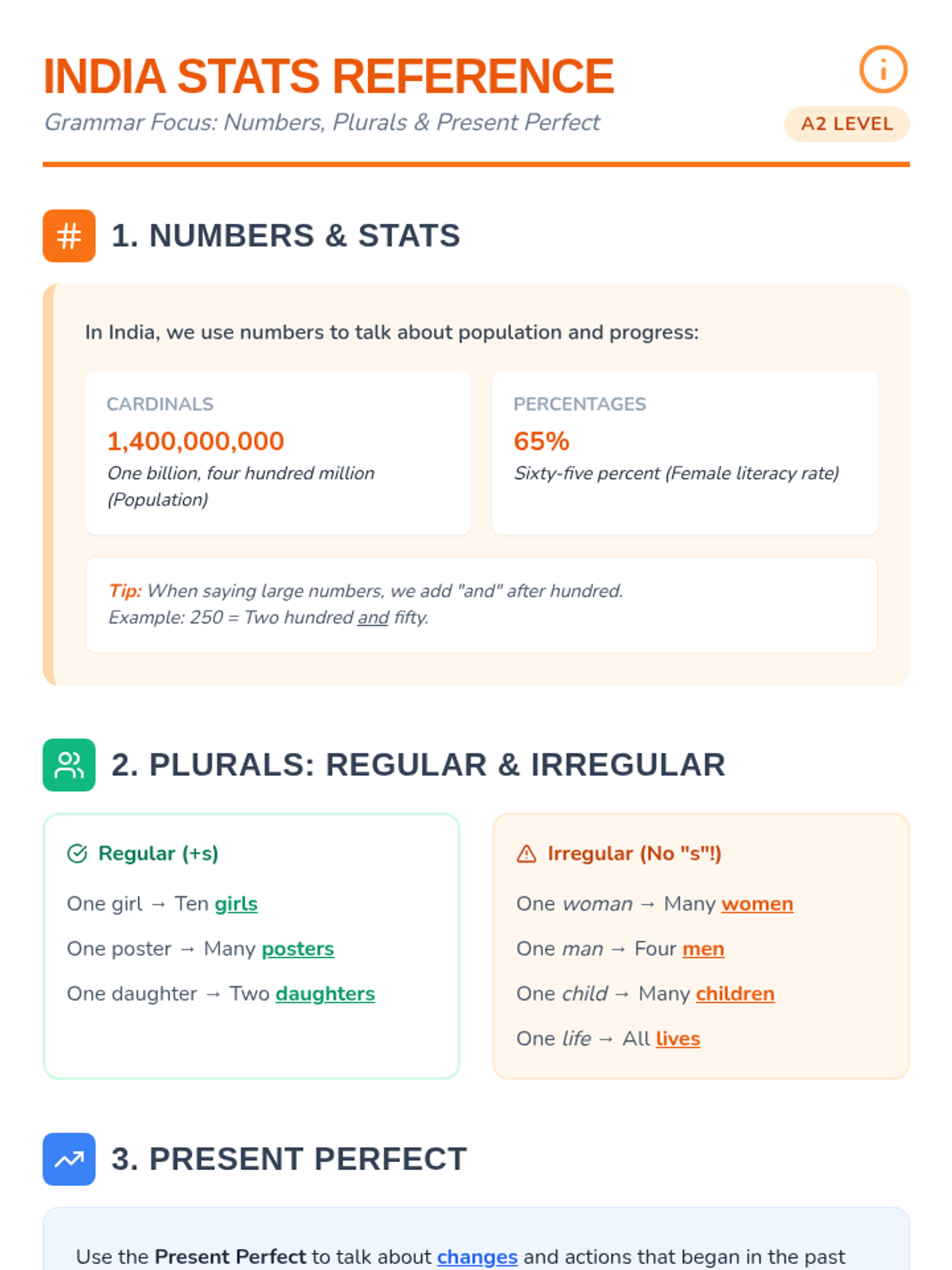
A visual grammar reference sheet for A2 students covering numbers, regular/irregular plurals (focusing on woman/women), and the present perfect for discussing social changes in India.
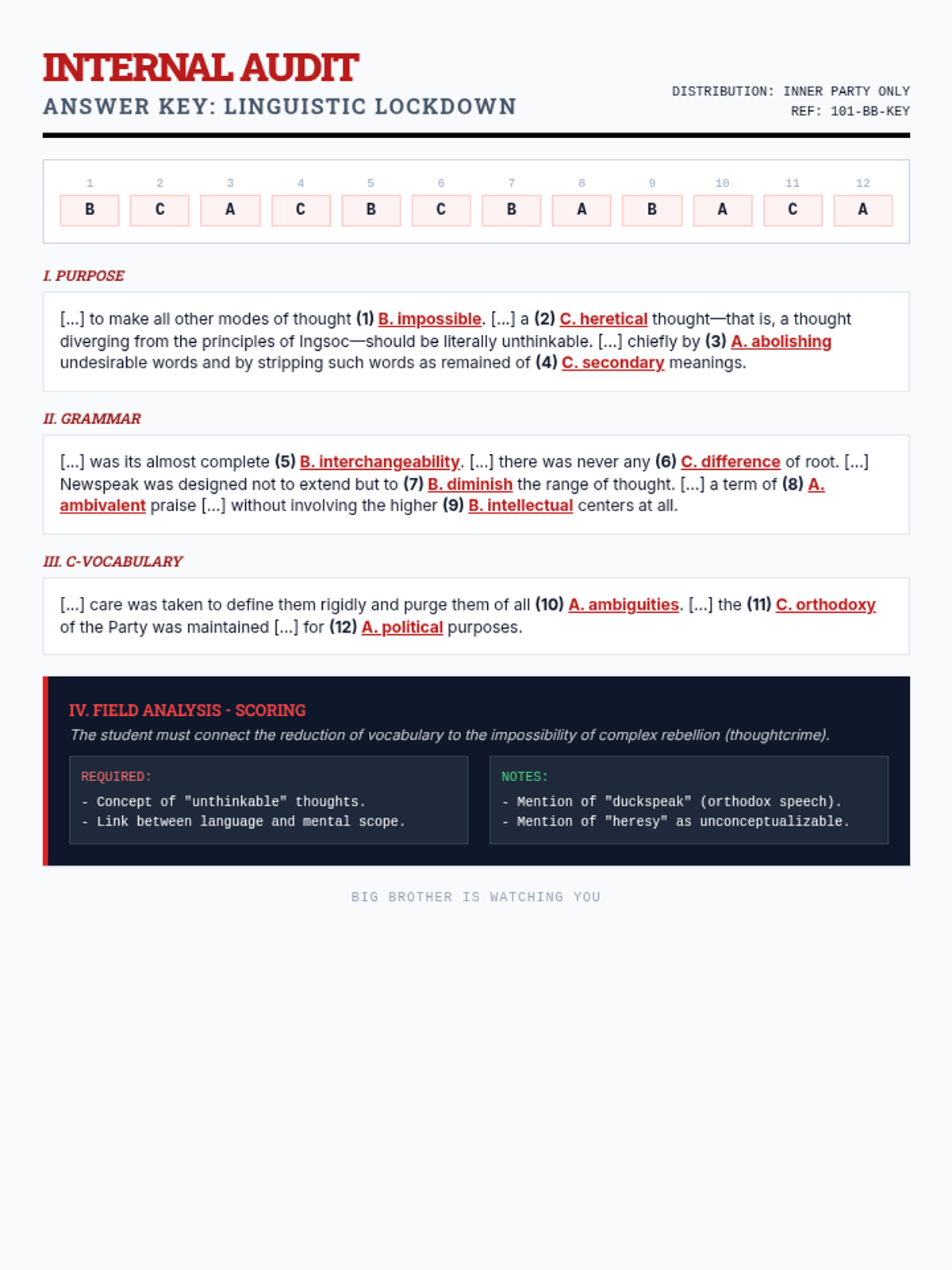
The comprehensive teacher-facing answer key for the 'Linguistic Lockdown Worksheet', providing full context passages, a quick-grade summary, and scoring criteria for the reflection prompt.
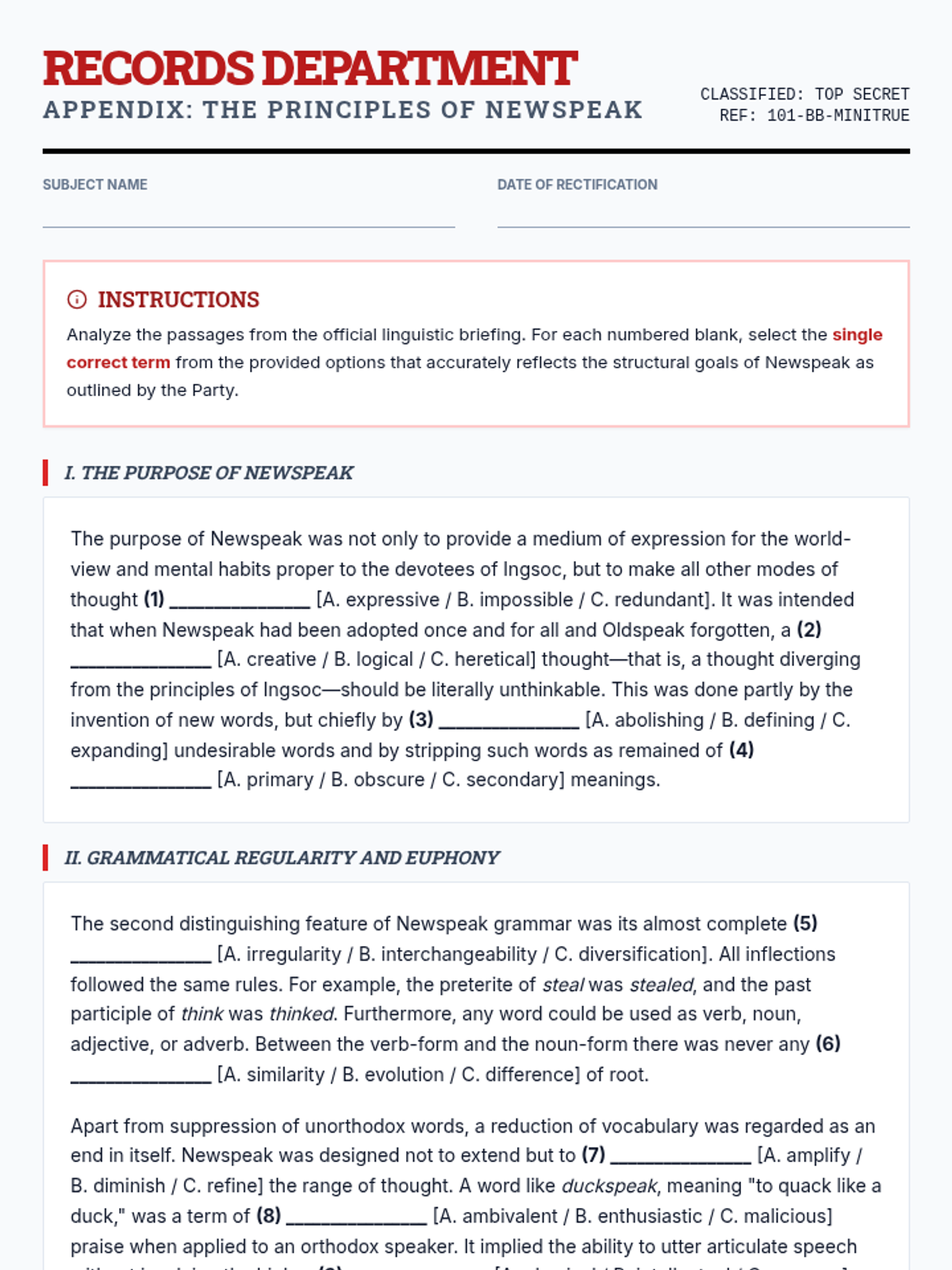
A multiple-choice cloze activity based on the 'Principles of Newspeak' appendix from George Orwell's 1984. It provides three randomized options for each blank to challenge student understanding of linguistic control.
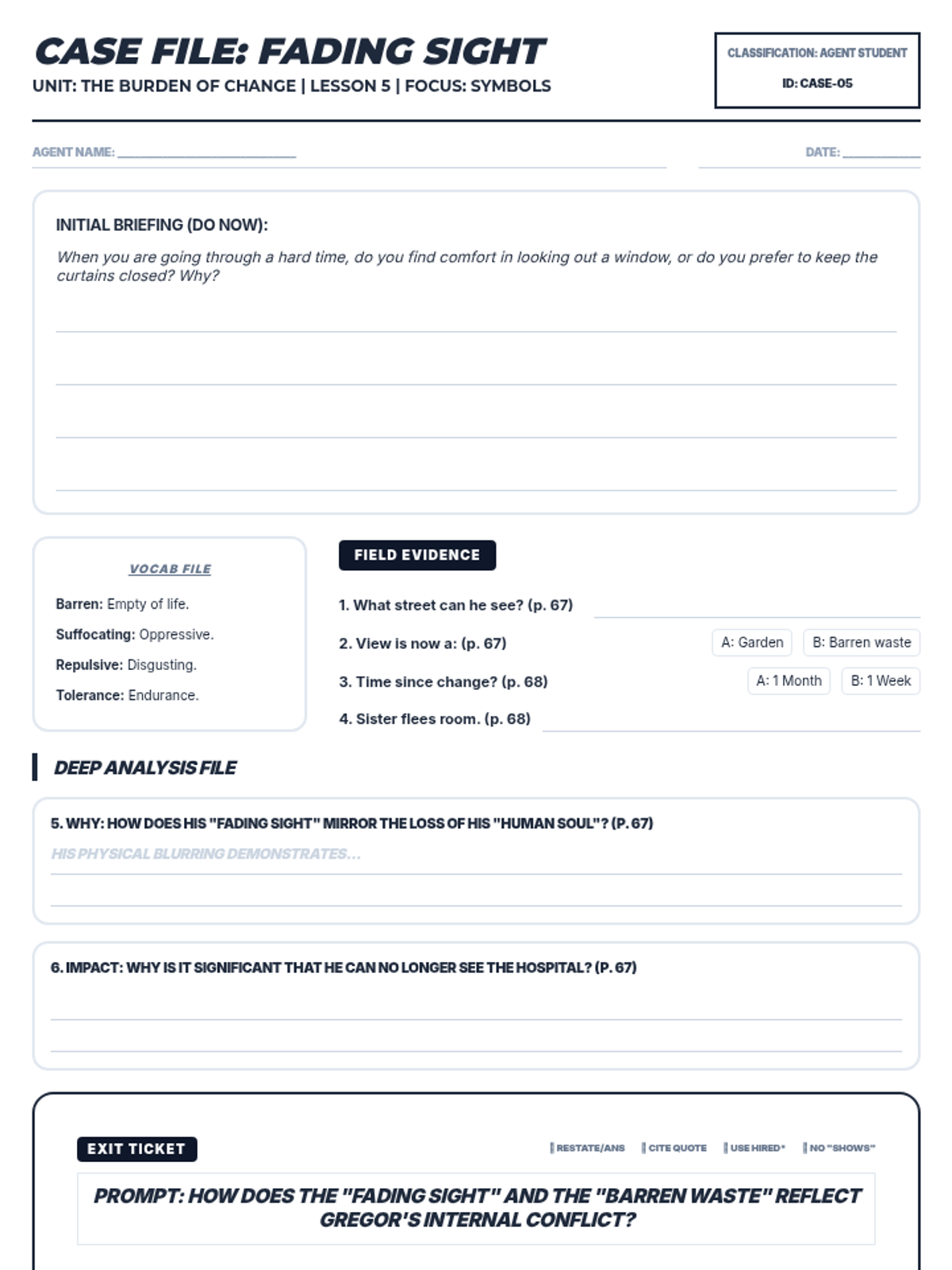
A condensed student worksheet for Lesson 5 (Fading Sight). Features a 4-line Do Now, full-width Deep Analysis questions, and a 6-line Exit Ticket moved to a new page. Spacing for writing lines has been adjusted to be consistent across the document.
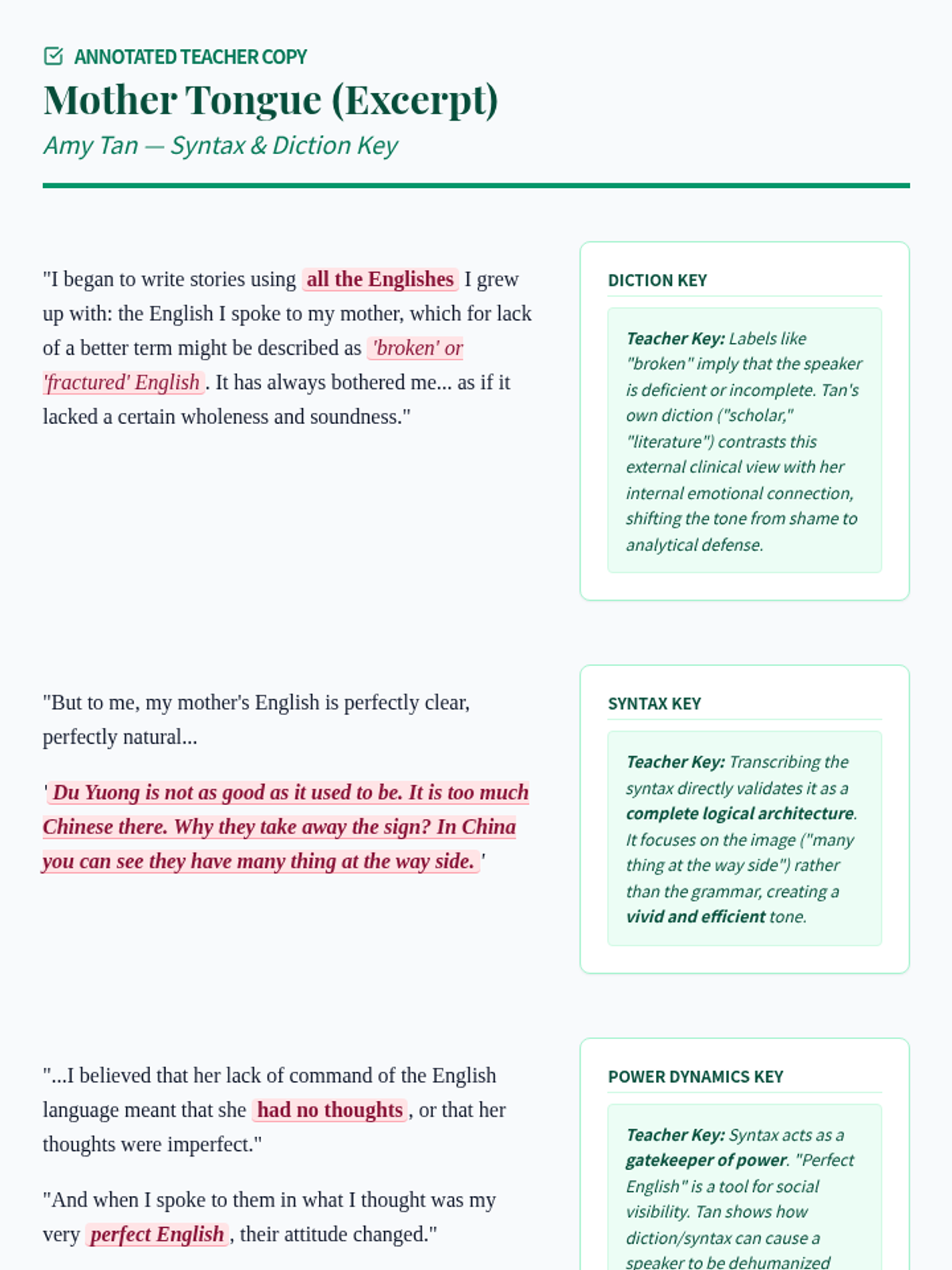
Grayscale-optimized annotated teacher copy for Tan's 'Mother Tongue,' using a slate and white palette for high contrast and toner-saving. Includes the hospital anecdote and sidebar analysis keys.
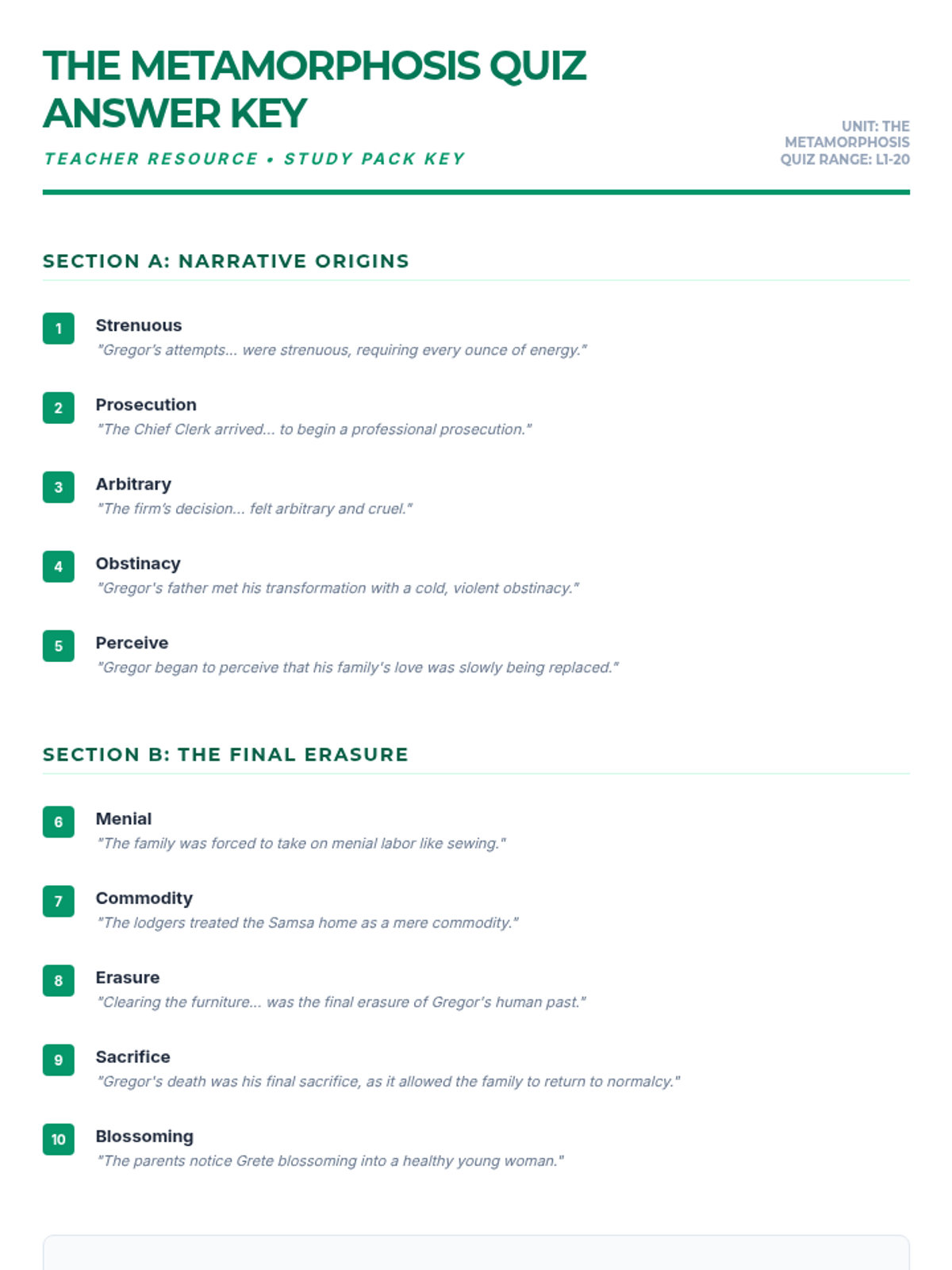
Teacher answer key for the unit-wide Vocabulary Mastery Quiz. Provides correct answers, full context sentences, and a suggested grading scale for the 10-item assessment included in the study pack. Strictly aligned with the Susan Bernofsky translation and the 60-word Lexical Ledger.
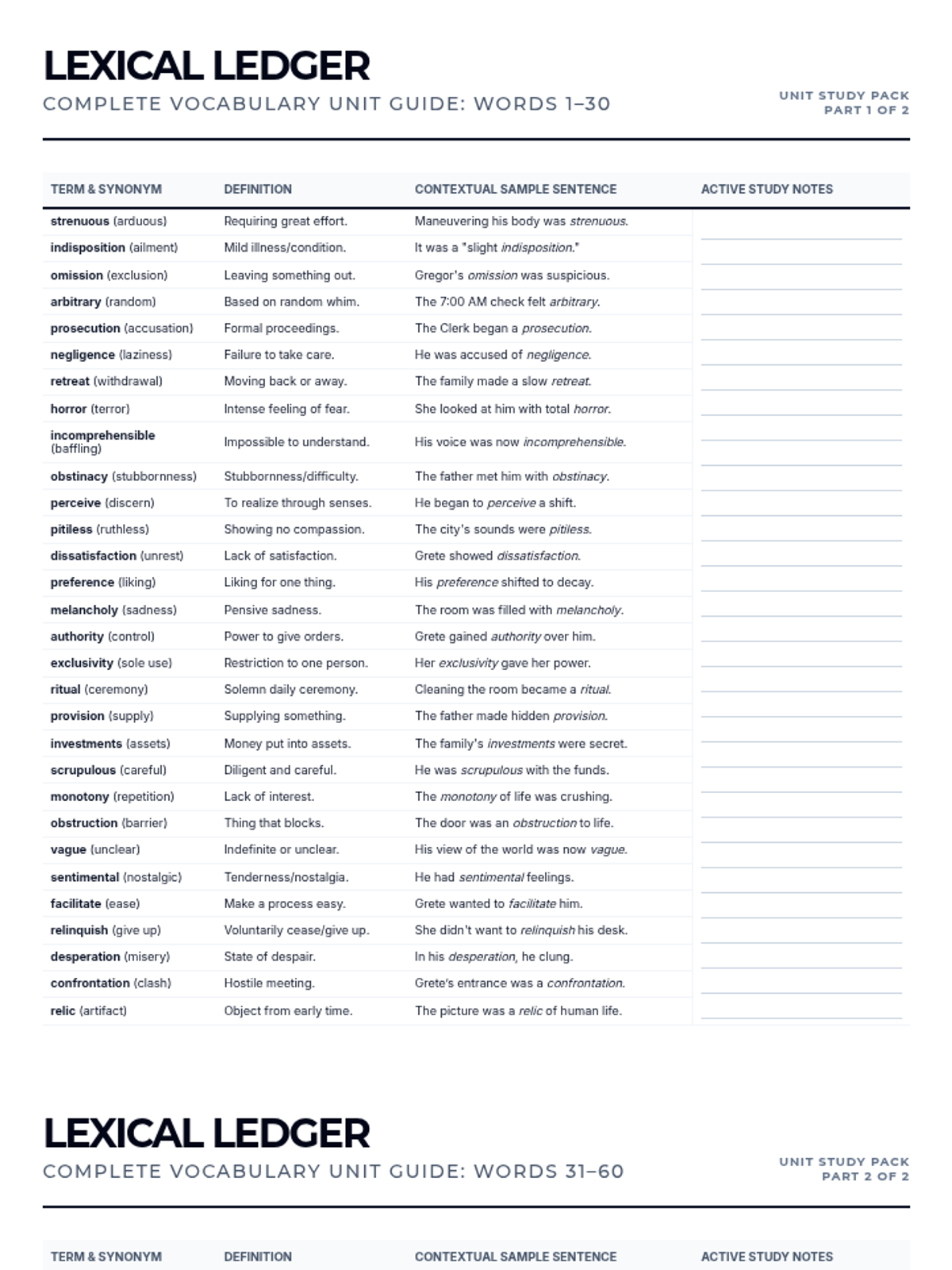
A comprehensive vocabulary study pack and cumulative quiz for The Metamorphosis, strictly aligned with the Susan Bernofsky translation. Features a 60-word Lexical Ledger with definitions, direct textual context, and page numbers, followed by a 10-question assessment. Optimized for print and student reference.
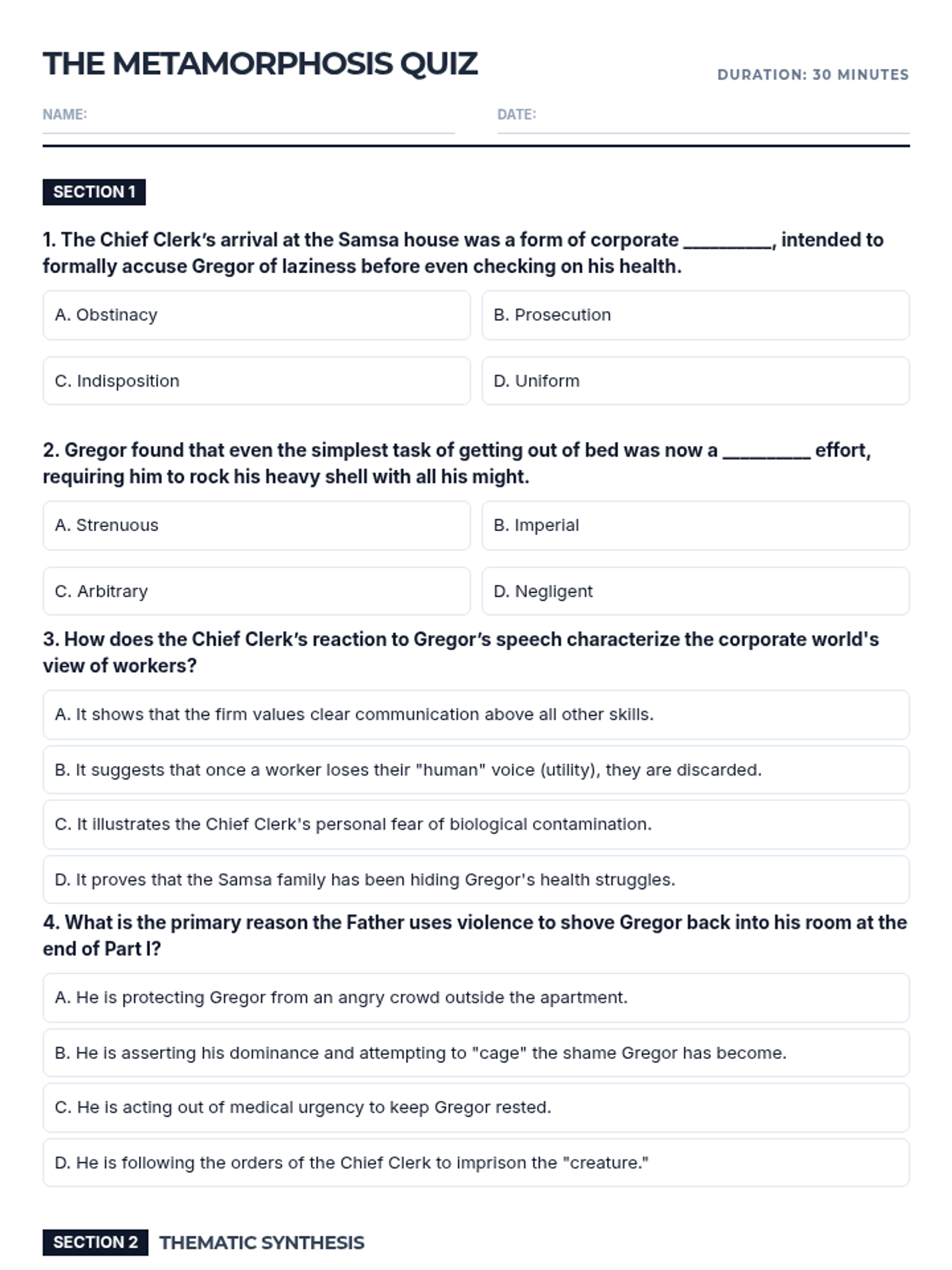
A summative student assessment for the first third of The Metamorphosis. Features vocabulary matching, multiple choice analytical questions, a short answer on the theme of 'The Firm', and a RACE response based on an excerpt from Gregor's reveal. Optimized for print with 'break-inside: avoid' on all questions. Fixed layout and spacing.
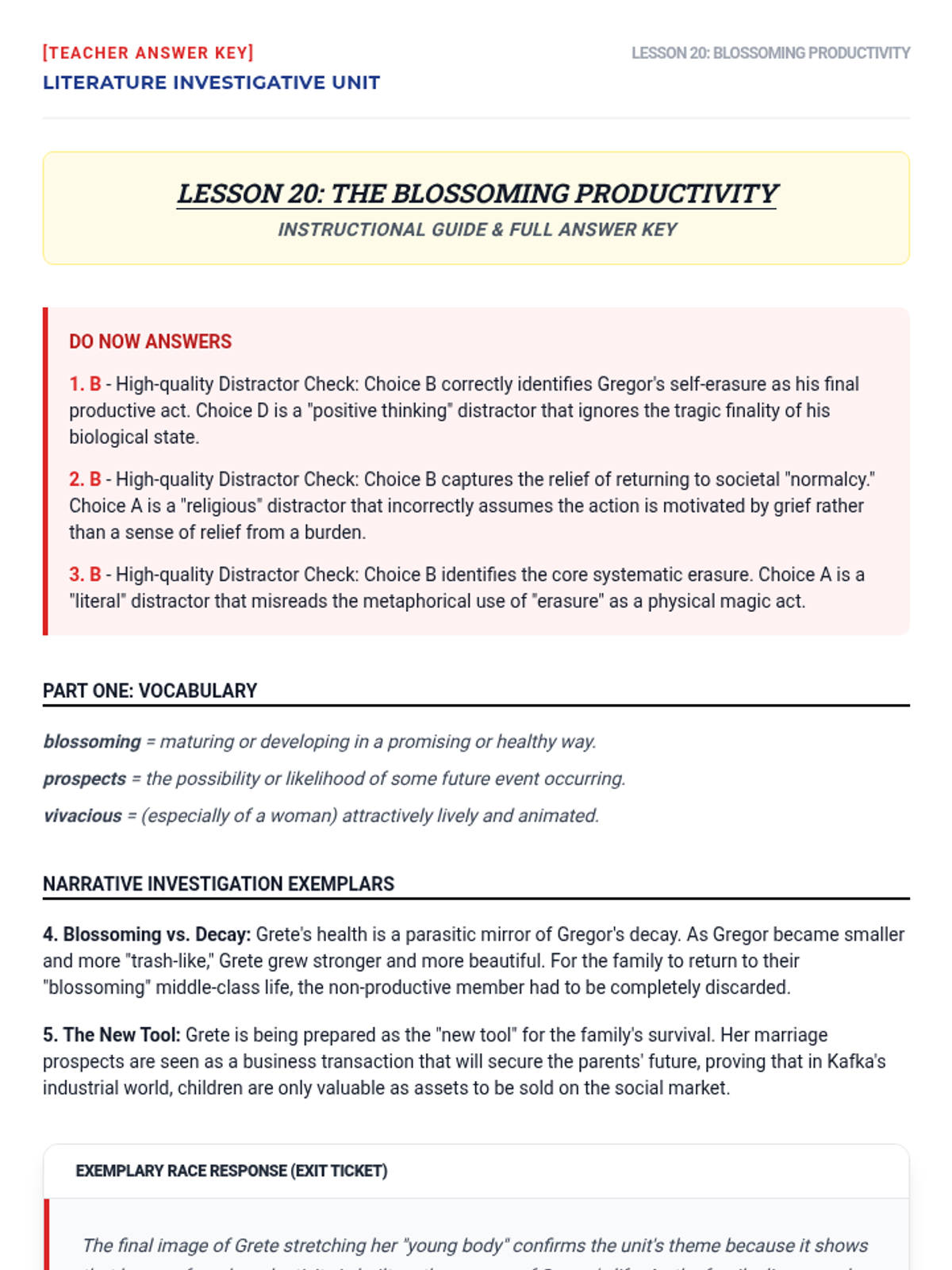
A comprehensive teacher answer key for Lesson 20. Synthesizes the themes of the unit and provides final push questions for middle grade students. Updated with specific Bernofsky page references (p. 64, 65). Removed branding.
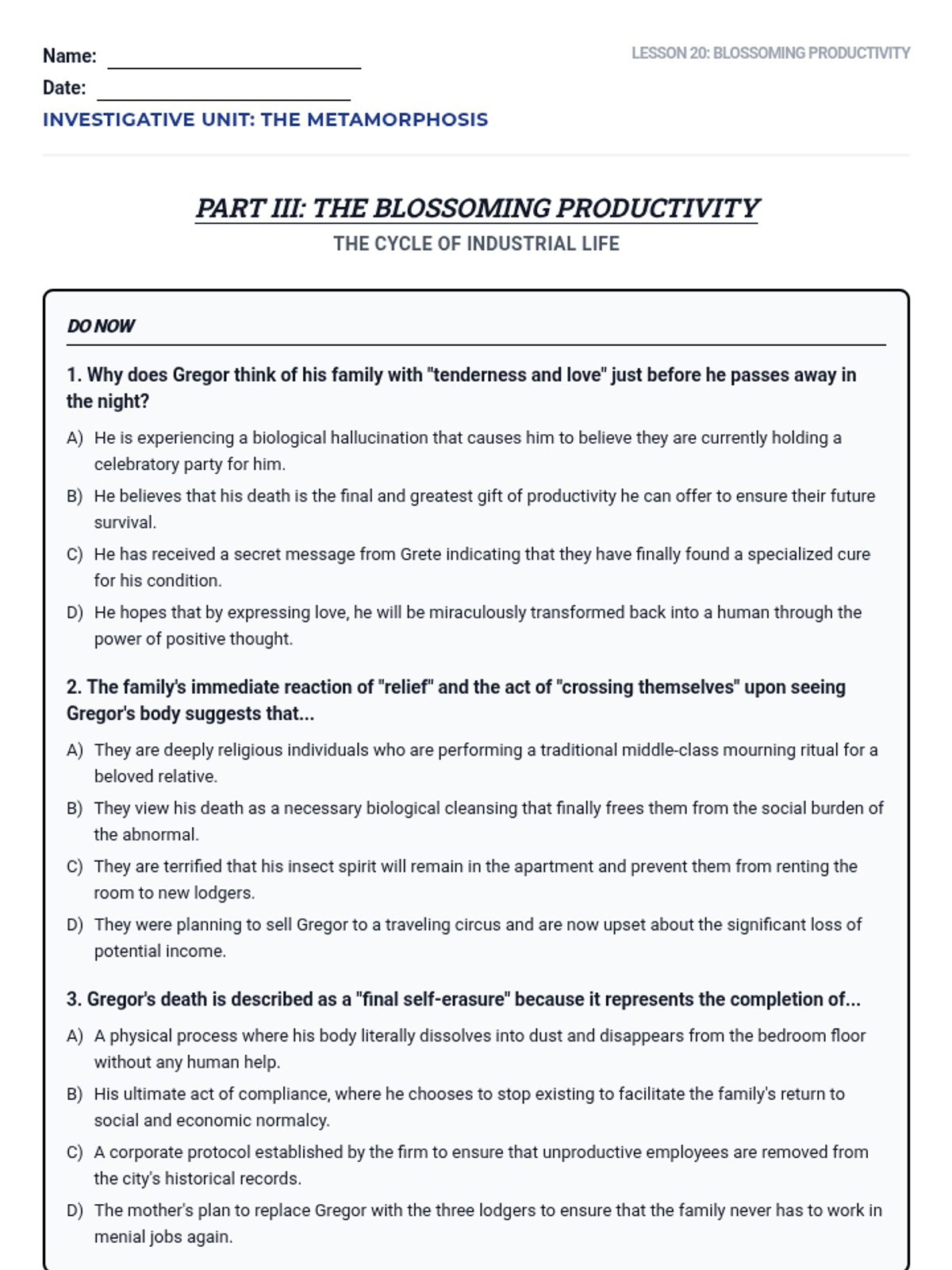
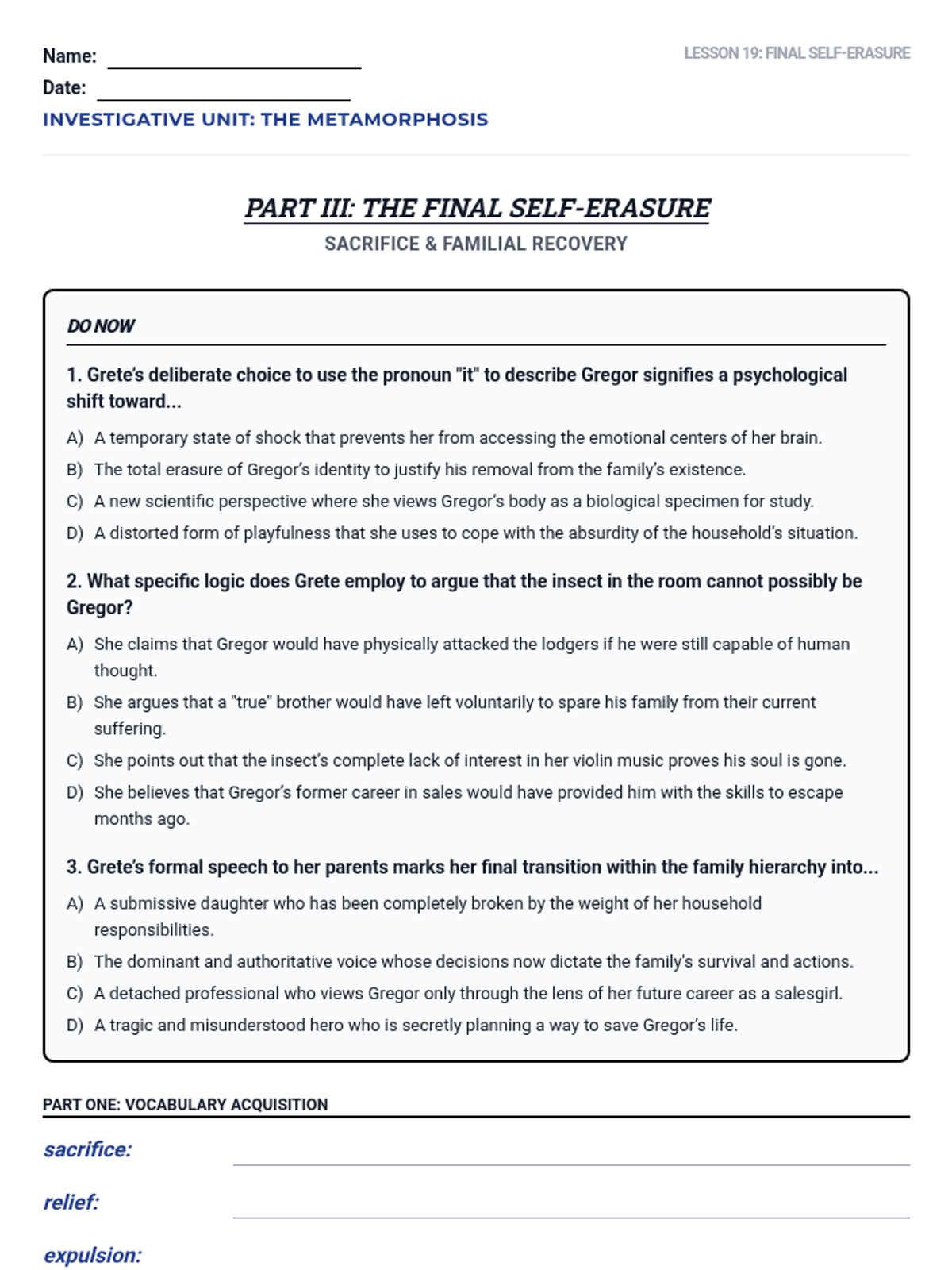
A final middle-grade worksheet for Lesson 20. Synthesizes the themes of the unit, focusing on Grete's transformation. Updated with definition lines in Part 1 and a comprehensive RACE checklist with 10 lines for the Exit Ticket. Time markers removed. Includes high-quality analytical distractors for the Do Now. Fixed checklist formatting and layout. Removed duplicate choice B.
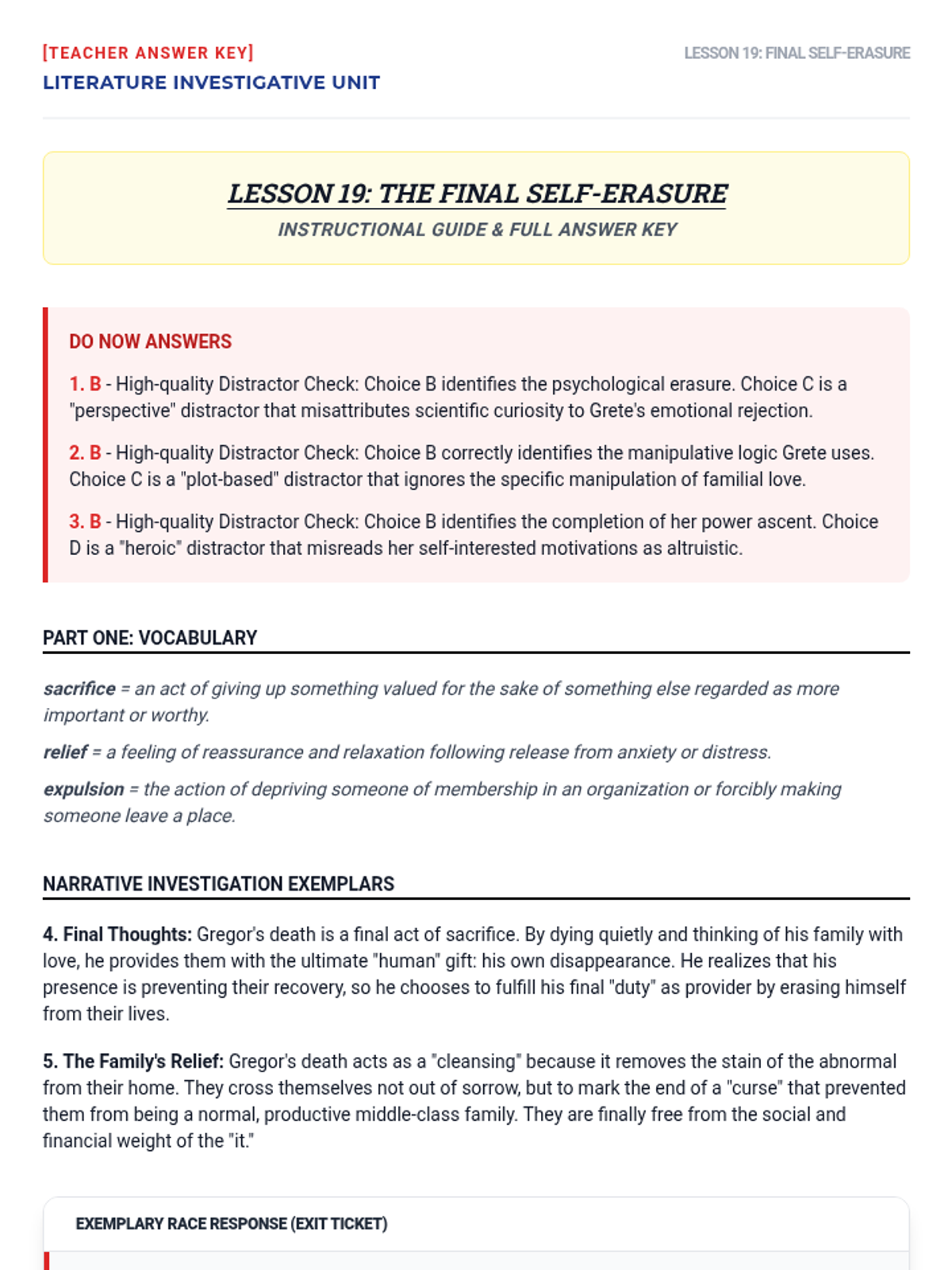
A comprehensive teacher answer key for Lesson 19. Includes exemplar responses, thematic synthesis (STAMP), and instructional push questions for middle grade students. Removed branding.
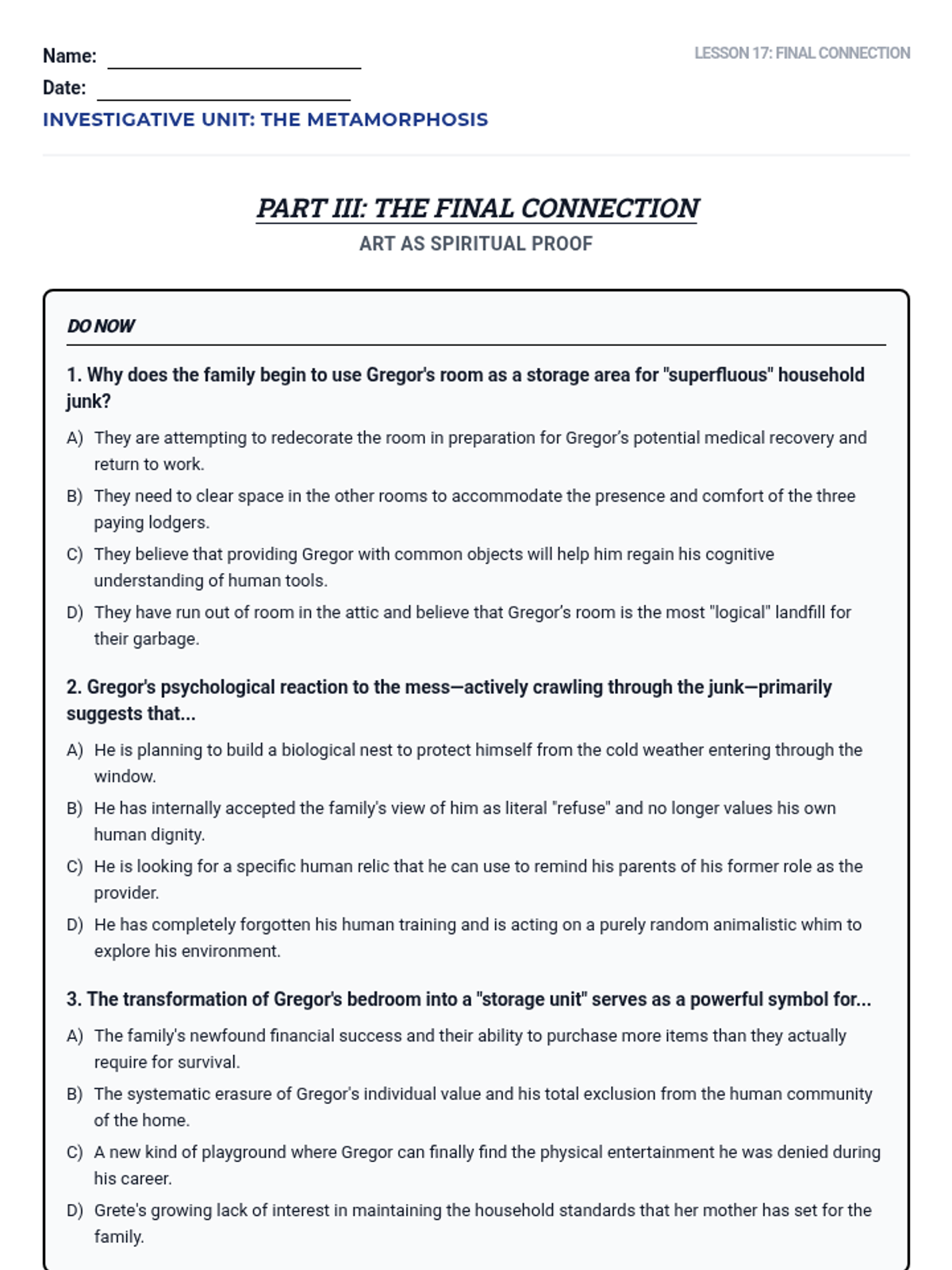
A middle-grade worksheet for Lesson 19 focusing on Gregor's death. Updated with definition lines in Part 1 and a comprehensive RACE checklist with 10 lines for the Exit Ticket. Time markers removed. Fixed checklist formatting and layout. Includes high-quality analytical distractors for the Do Now.
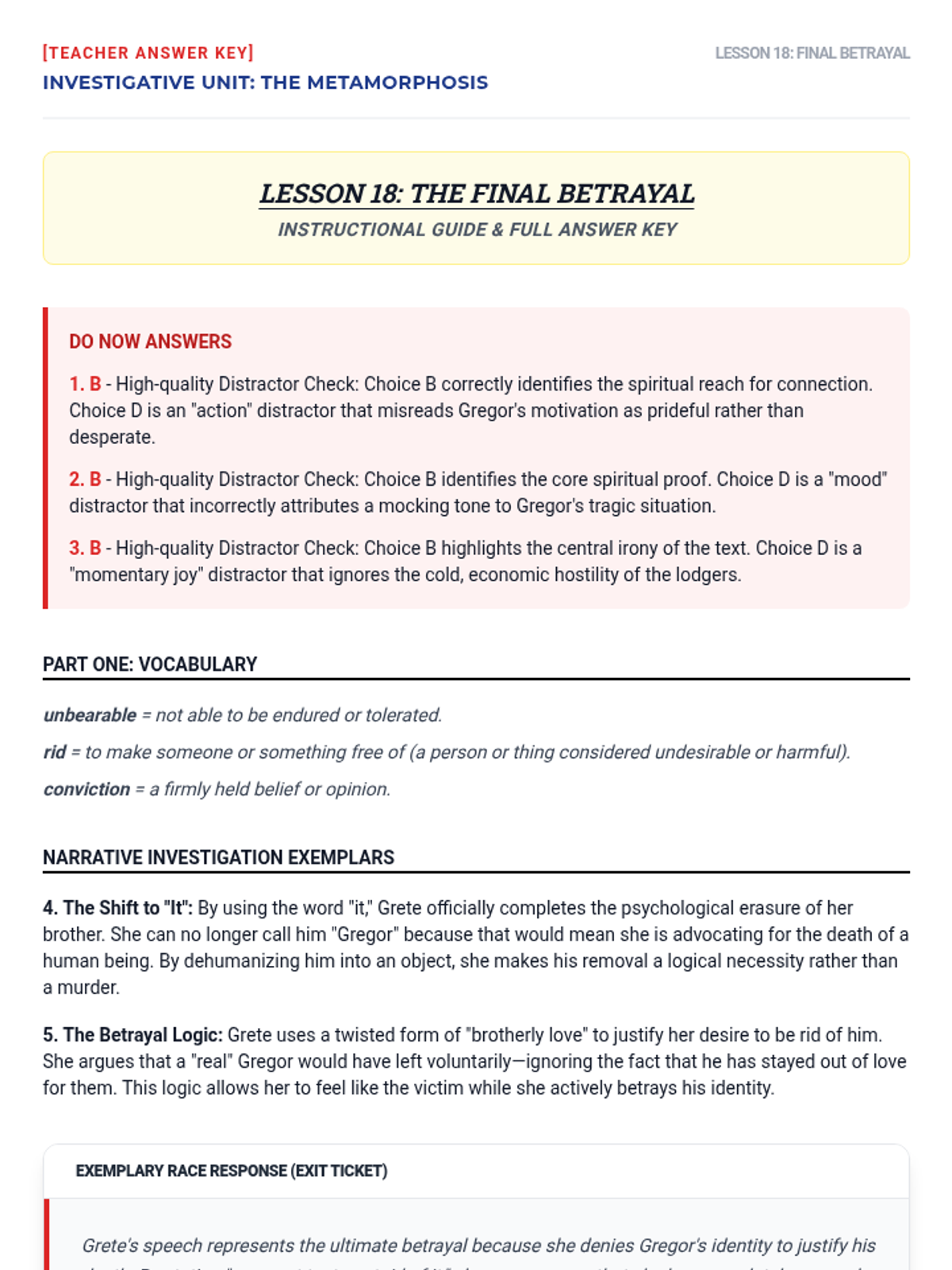
A comprehensive teacher answer key for Lesson 18. Includes exemplar responses, thematic synthesis (STAMP), and instructional push questions for middle grade students. Updated with specific Bernofsky page references. Removed branding.
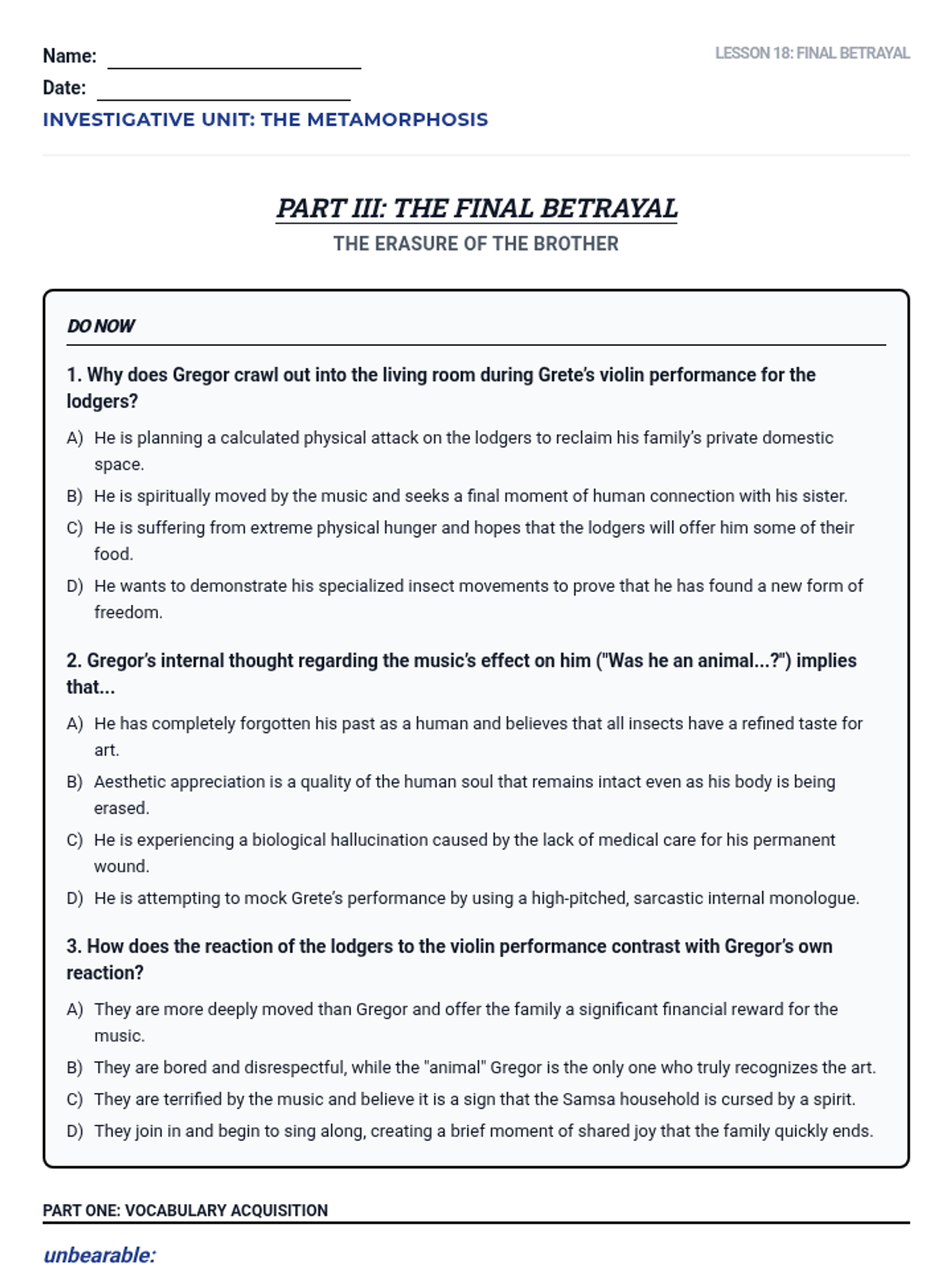
A middle-grade worksheet for Lesson 18 focusing on Grete's formal rejection of Gregor. Updated with definition lines in Part 1 and a comprehensive RACE checklist with 10 lines for the Exit Ticket. Time markers removed. Fixed checklist formatting and layout. Includes high-quality analytical distractors for the Do Now.
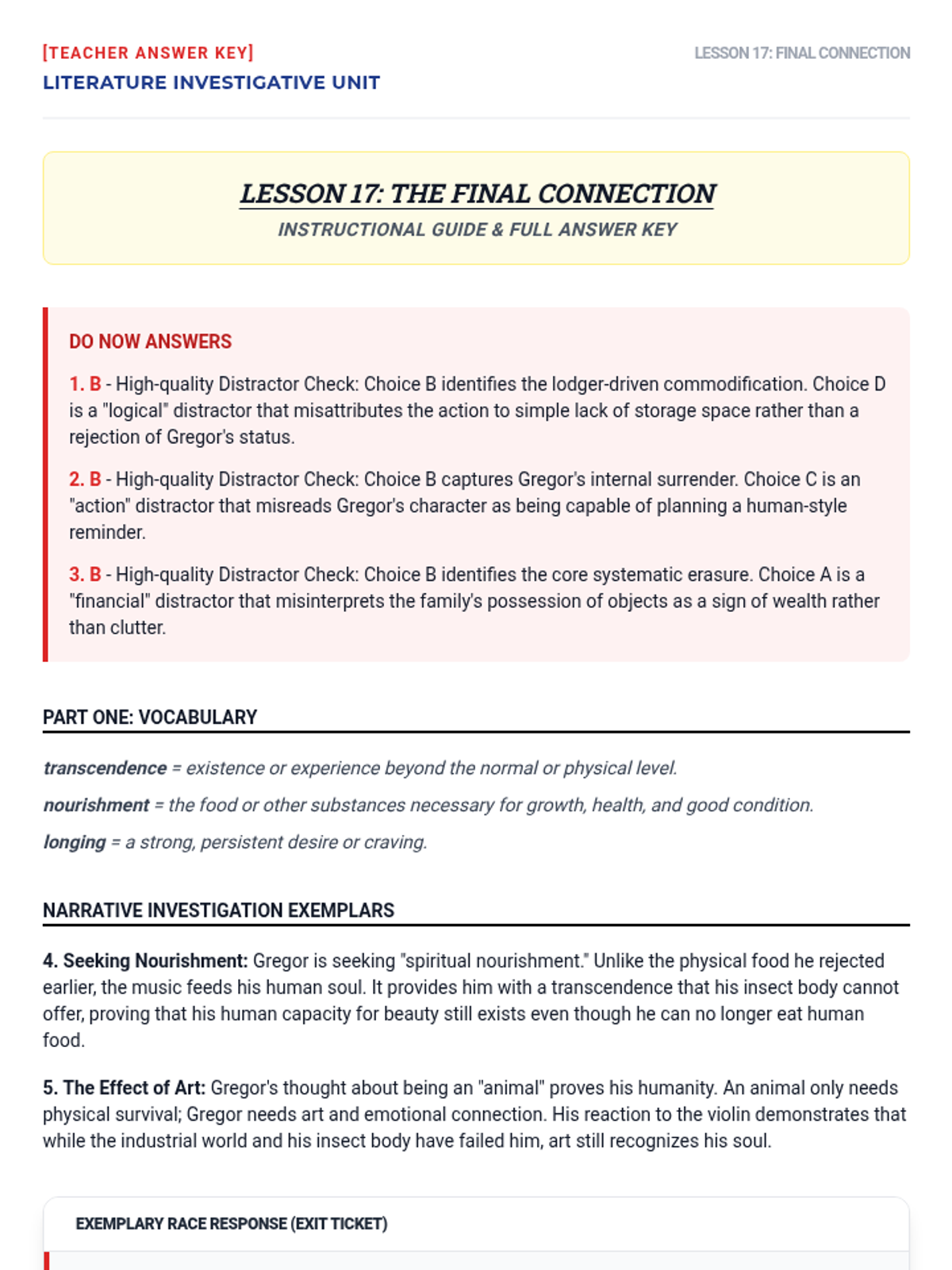
A comprehensive teacher answer key for Lesson 17. Includes exemplar responses, thematic synthesis (STAMP), and instructional push questions for middle grade students. Removed branding. Updated with specific Bernofsky page references.
A middle-grade worksheet for Lesson 17 focusing on Grete's violin performance. Updated with definition lines in Part 1 and a comprehensive RACE checklist with 10 lines for the Exit Ticket. Time markers removed. Fixed checklist formatting and layout. Includes homogenous, high-quality analytical MC distractors.
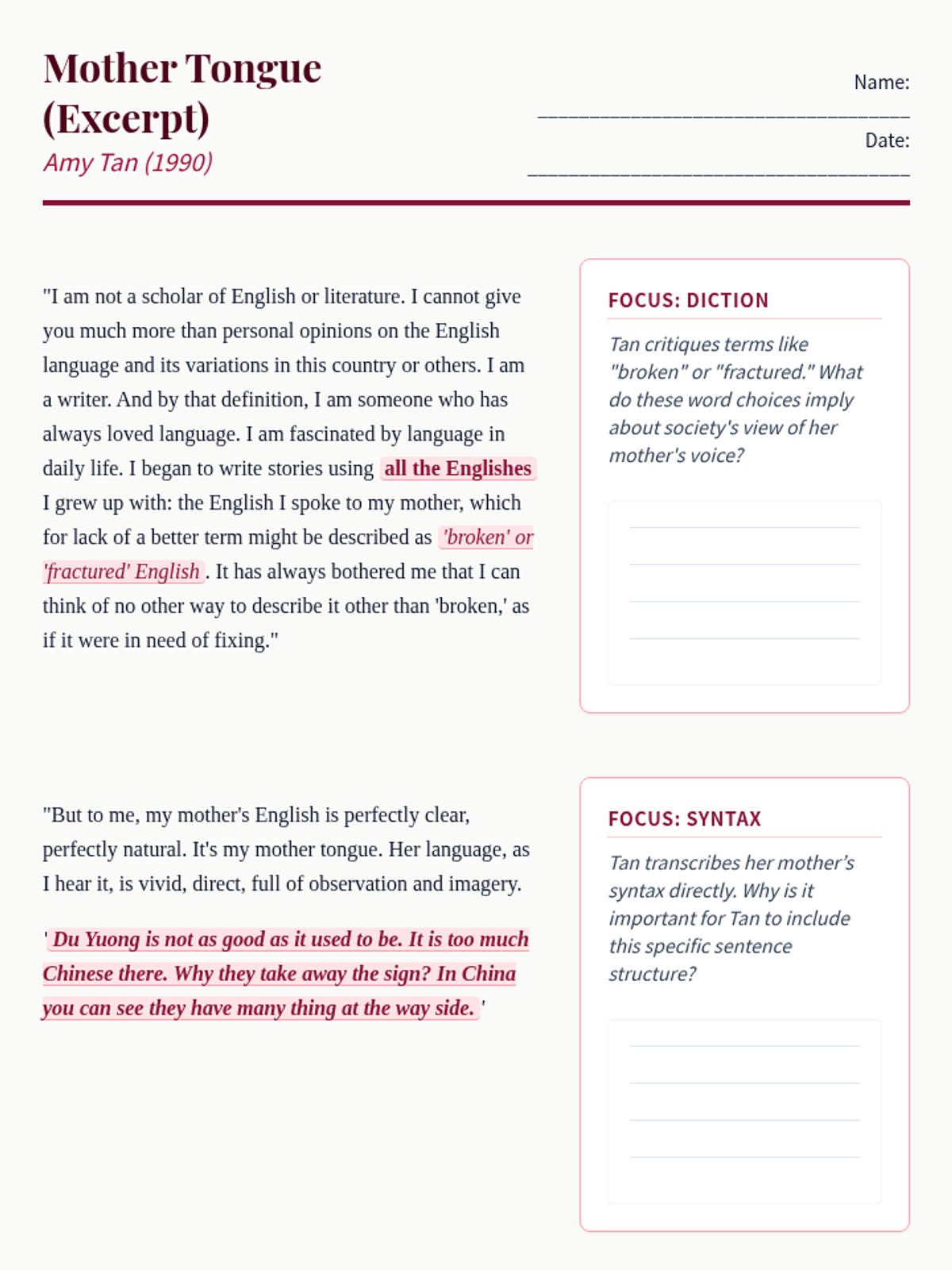
Grayscale-optimized student analysis guide for Tan's 'Mother Tongue,' using a slate and white palette for high contrast and toner-saving. Includes the hospital anecdote and sidebar analysis questions. Optimized to fit on a single page.
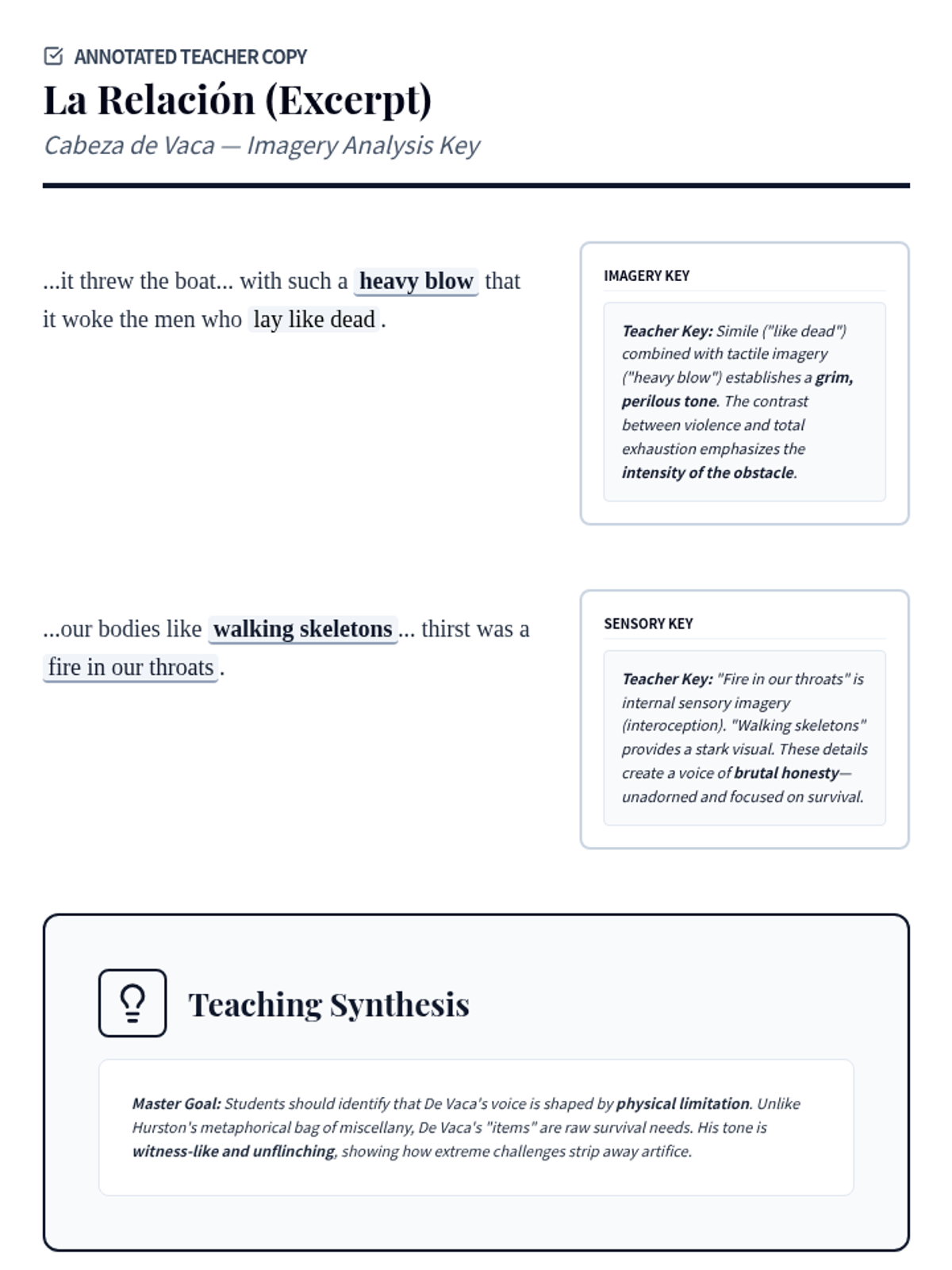
Grayscale-optimized annotated teacher copy for de Vaca's 'La Relación,' using a slate and white palette for high contrast and toner-saving. Includes specific analysis keys for imagery and survival tone.
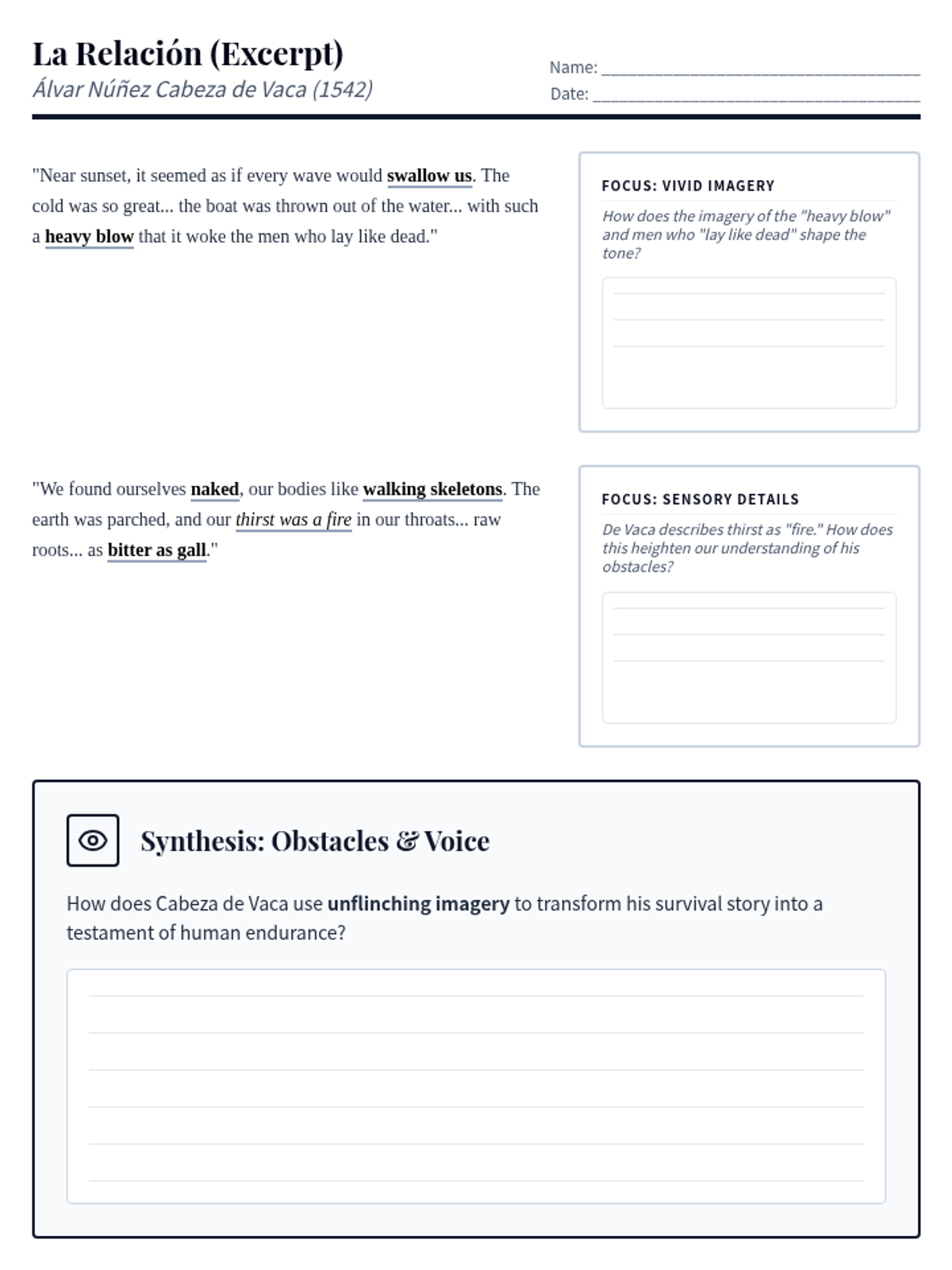
Grayscale-optimized student analysis guide for Cabeza de Vaca's 'La Relación,' using a slate and white palette for high contrast and toner-saving. Focuses on vivid and unflinching imagery. Optimized to fit on a single page.
Grayscale-optimized teacher guide for 'The Architecture of Voice' unit, updated with English III 2017 TEKS alignment. Details daily pacing, mentor text focuses, and the cumulative writing process with specific standards mapped to each phase. Revised for page break stability and exact TEKS alignment.
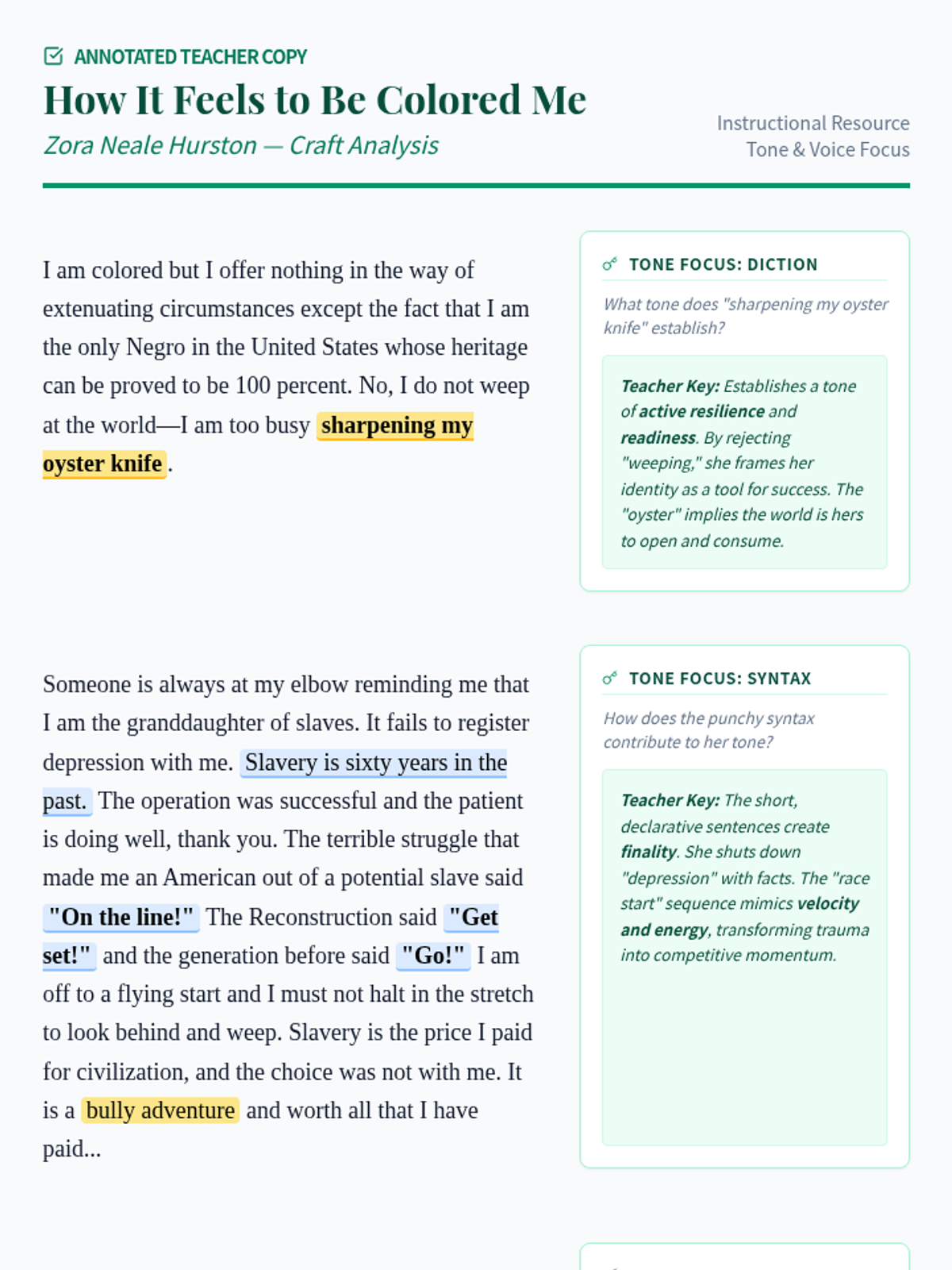
Annotated teacher copy of Hurston's text, providing specific craft-based answers for the figurative language analysis. Grayscale optimized for high contrast printing.
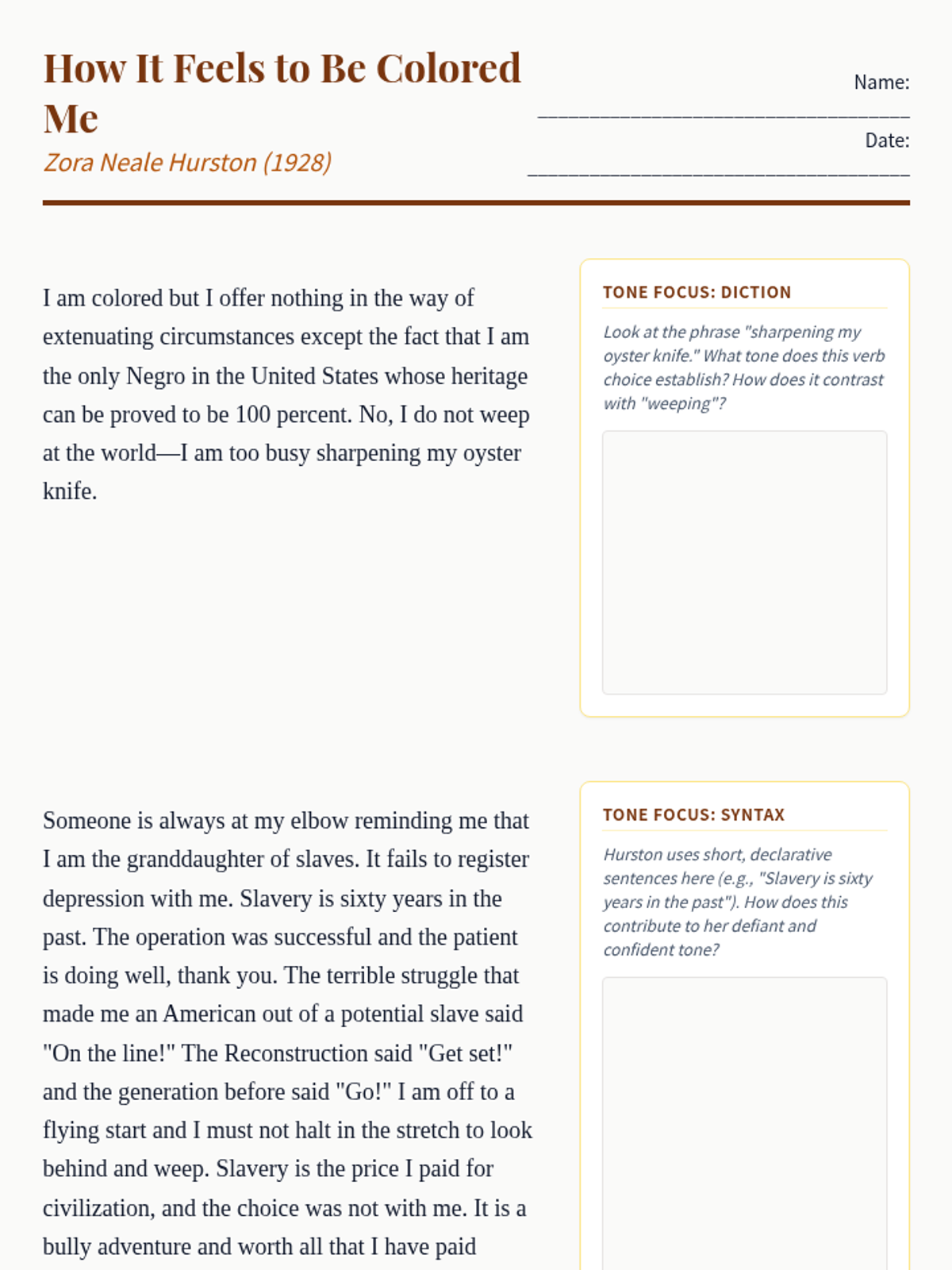
A comprehensive teacher's answer key for the tone analysis questions in Zora Neale Hurston's 'How It Feels to Be Colored Me,' providing deep-dive craft explanations for instruction.
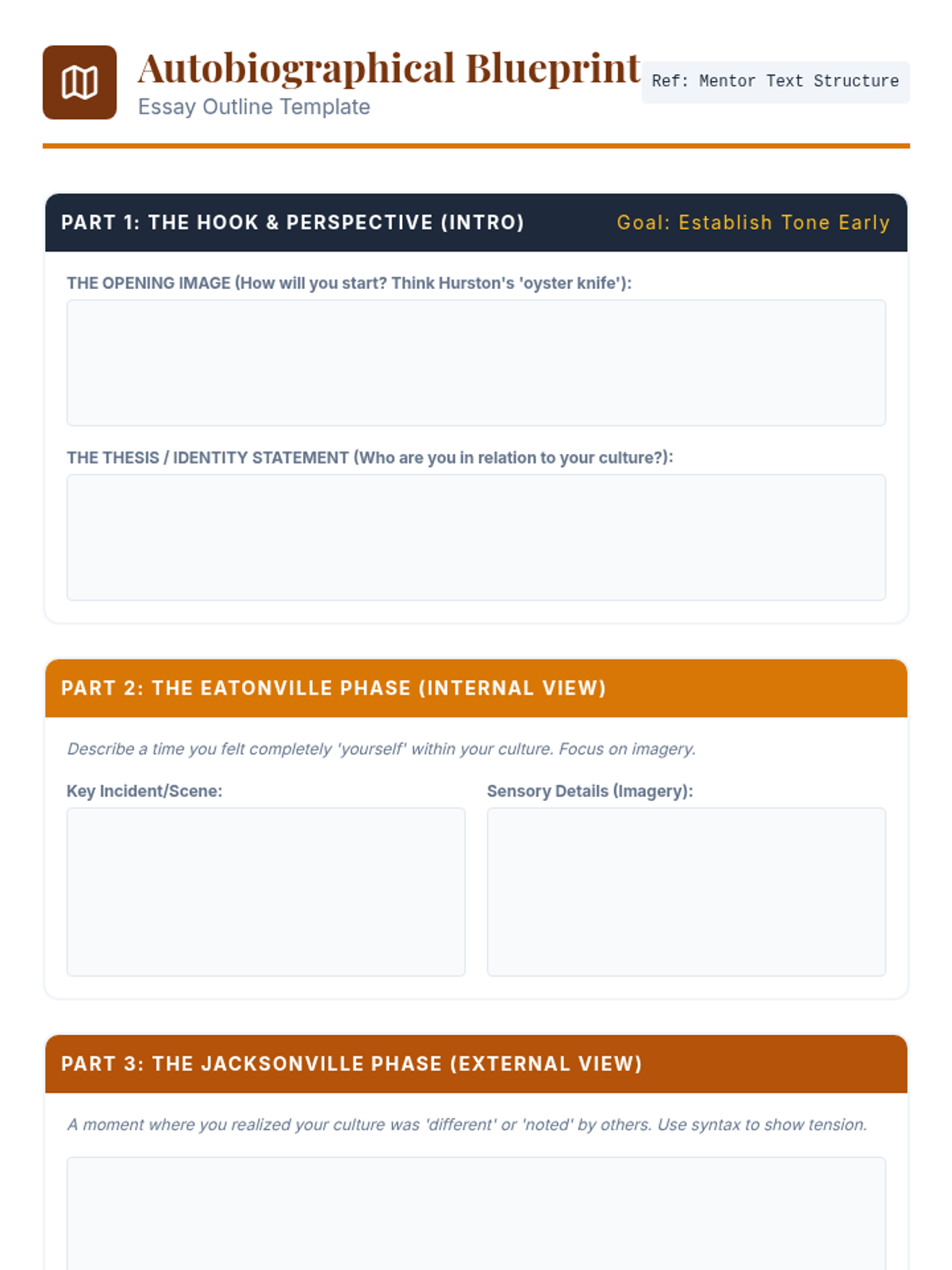
Expanded 6-paragraph essay blueprint that scaffolds students through an introductory hook, four mentor-text-aligned body paragraphs, and a cosmic conclusion. Includes a built-in 5-point rubric evaluating mentor skills, thesis, organization, and conventions. Optimized for grayscale printing.
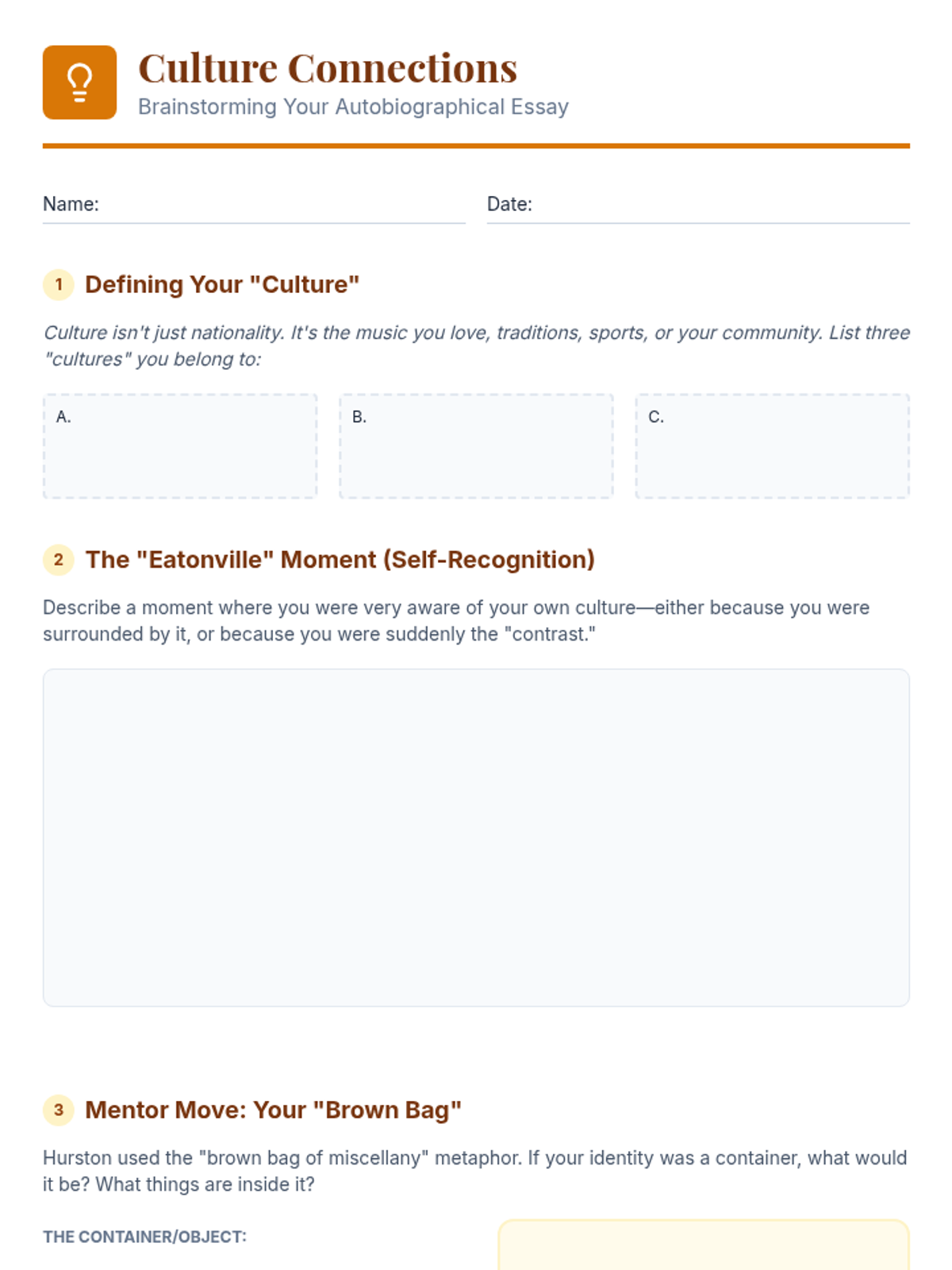
A brainstorming graphic organizer that helps students identify their own cultural identity moments and develop a central metaphor for their autobiographical essay, modeled after Hurston's 'brown bag' imagery.
Grayscale-optimized student analysis guide for Hurston's essay, specifically focusing on figurative language (metaphors and personification) to analyze how she constructs her defiant tone. Optimized to fit on a single page.