Complex syntax, nuanced vocabulary, and academic discourse. Strengthens professional communication through advanced writing, analytical reading, and mastery of high-level auditory and oral fluency.
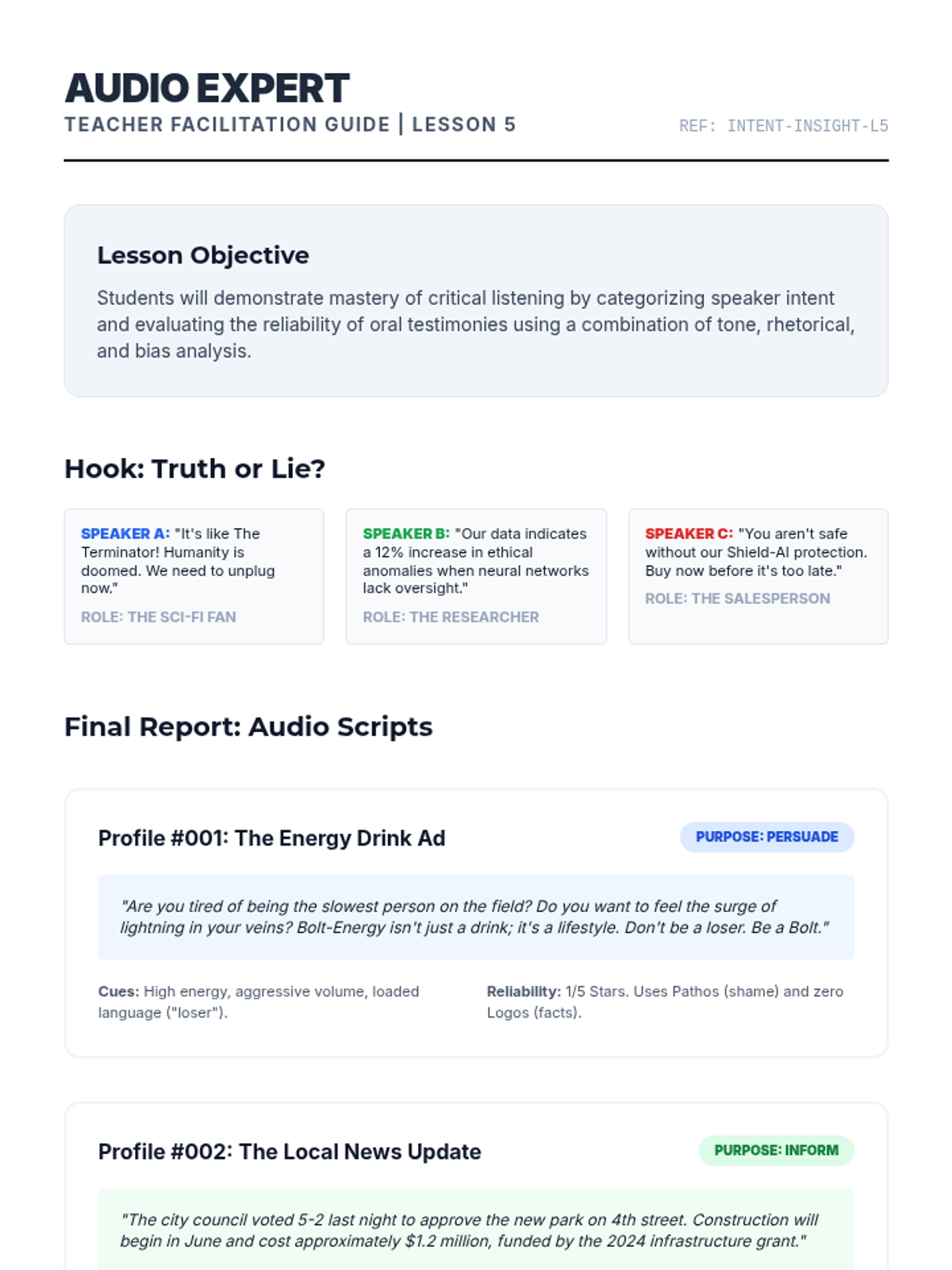
A teacher resource for Lesson 5, providing scripts for the final assessment profiles, a grading rubric, and guidance for wrapping up the sequence.
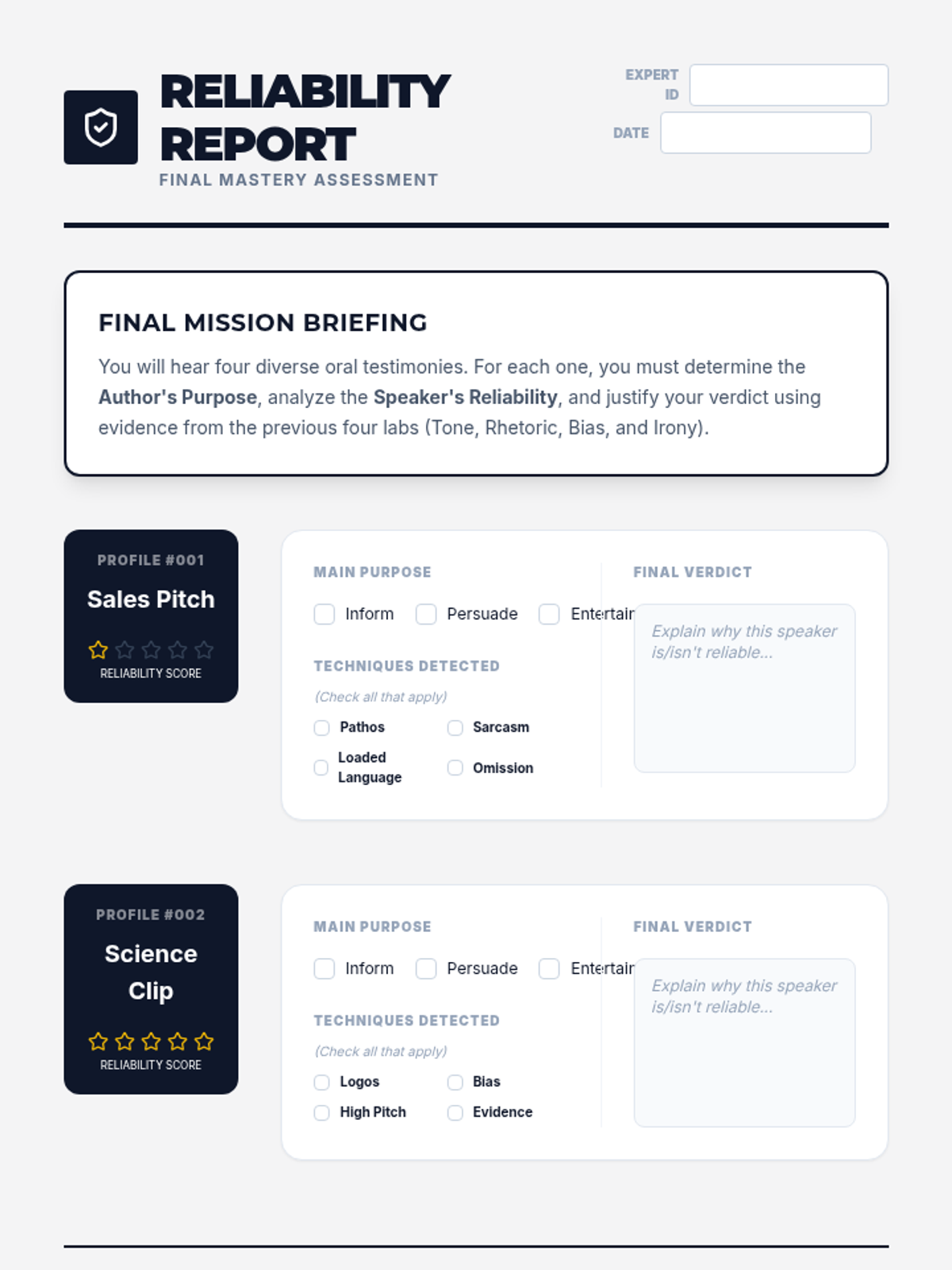
A final assessment worksheet where students categorize author's purpose and evaluate the reliability of four different audio profiles using evidence from previous lessons.
A visual presentation for Lesson 5, introducing author's purpose (Inform, Persuade, Entertain) and providing a checklist for evaluating speaker reliability.
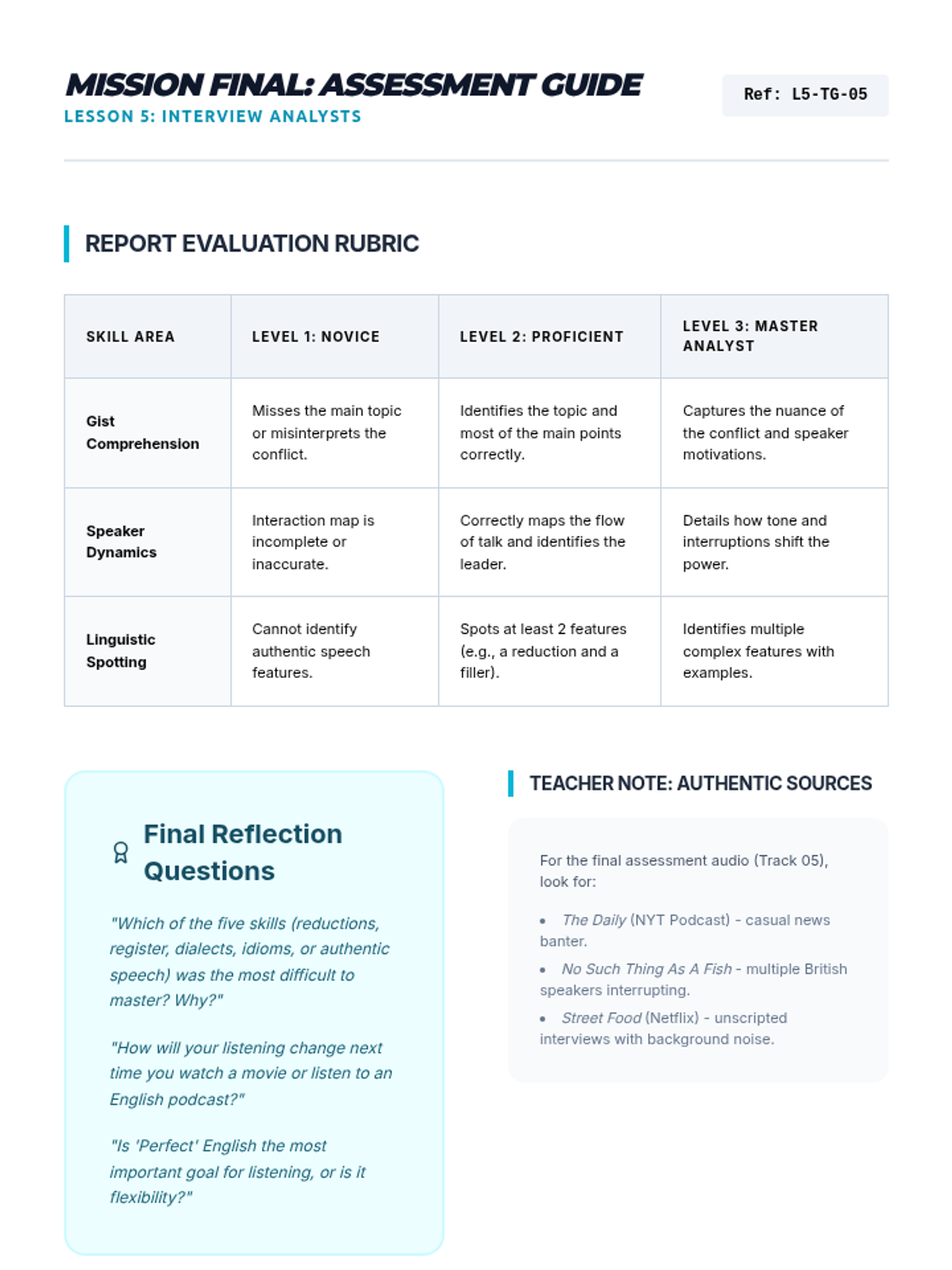
Teacher grading rubric and final assessment guide for the Sonic Investigators sequence, including evaluation criteria and reflection prompts.
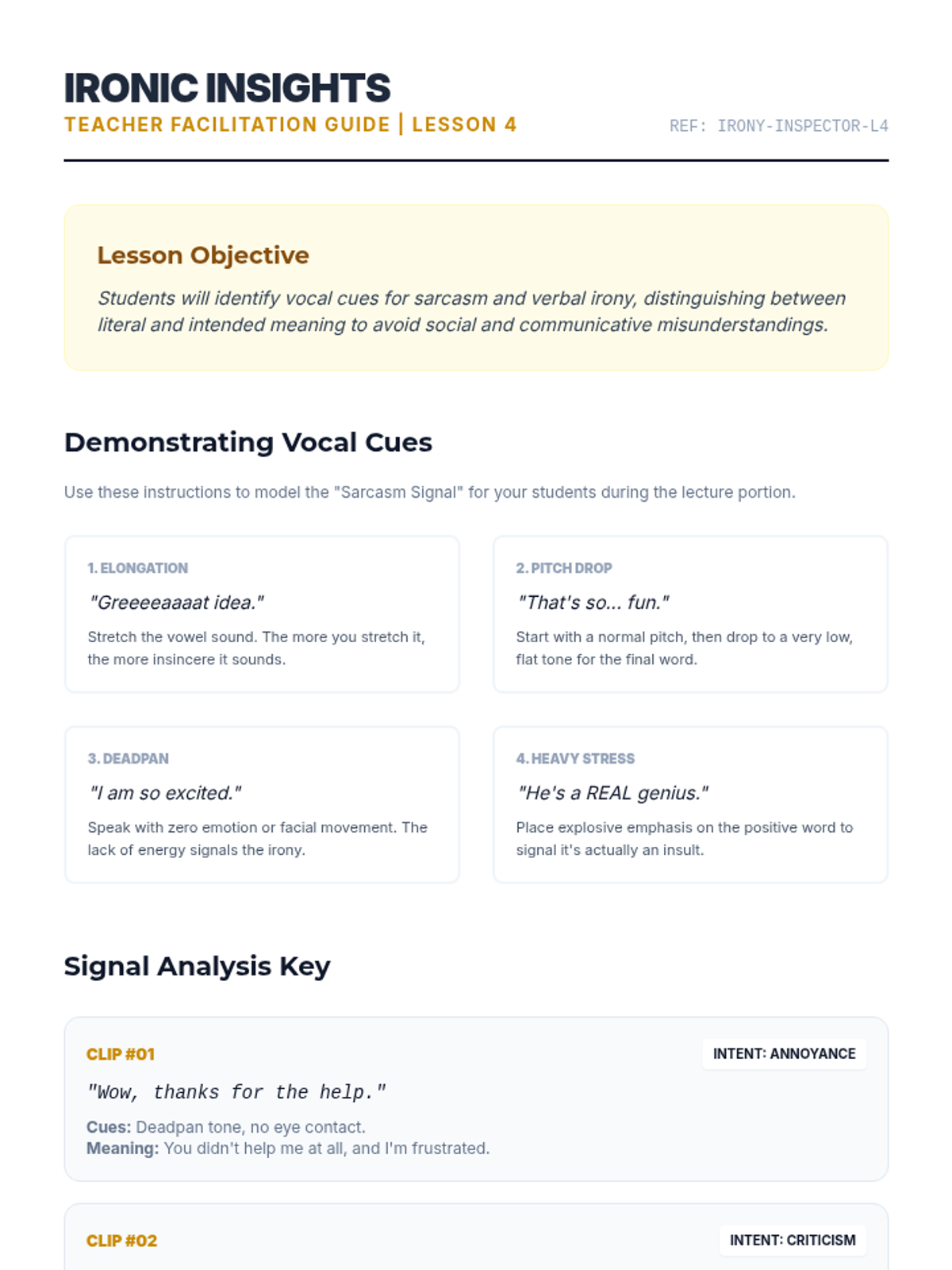
A teacher resource for Lesson 4, providing the script for the hook activity and vocal cue training, along with an answer key for the student worksheet.
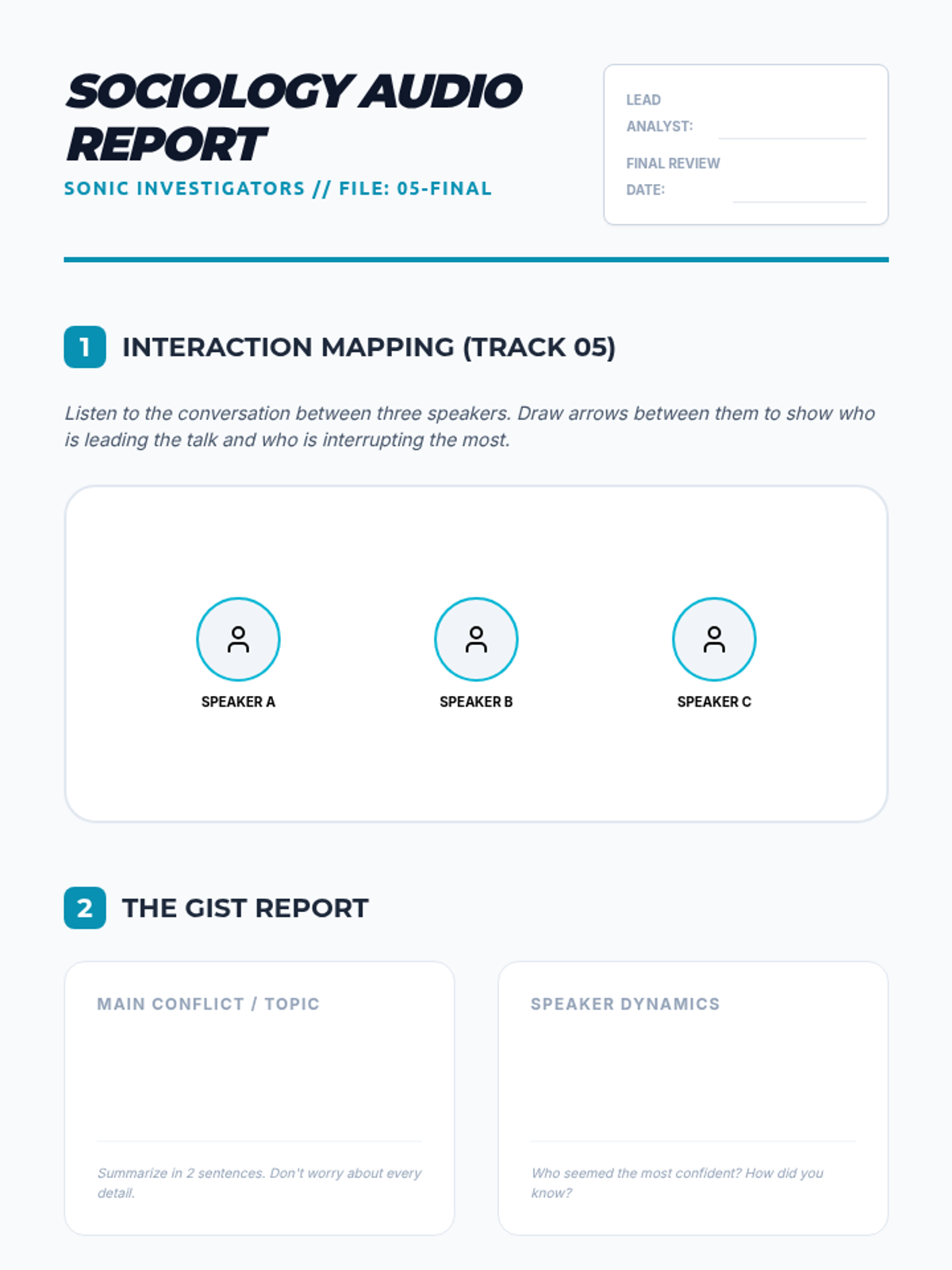
Final project worksheet where students analyze a complex, multi-speaker authentic audio segment for dynamics, gist, and linguistic features.
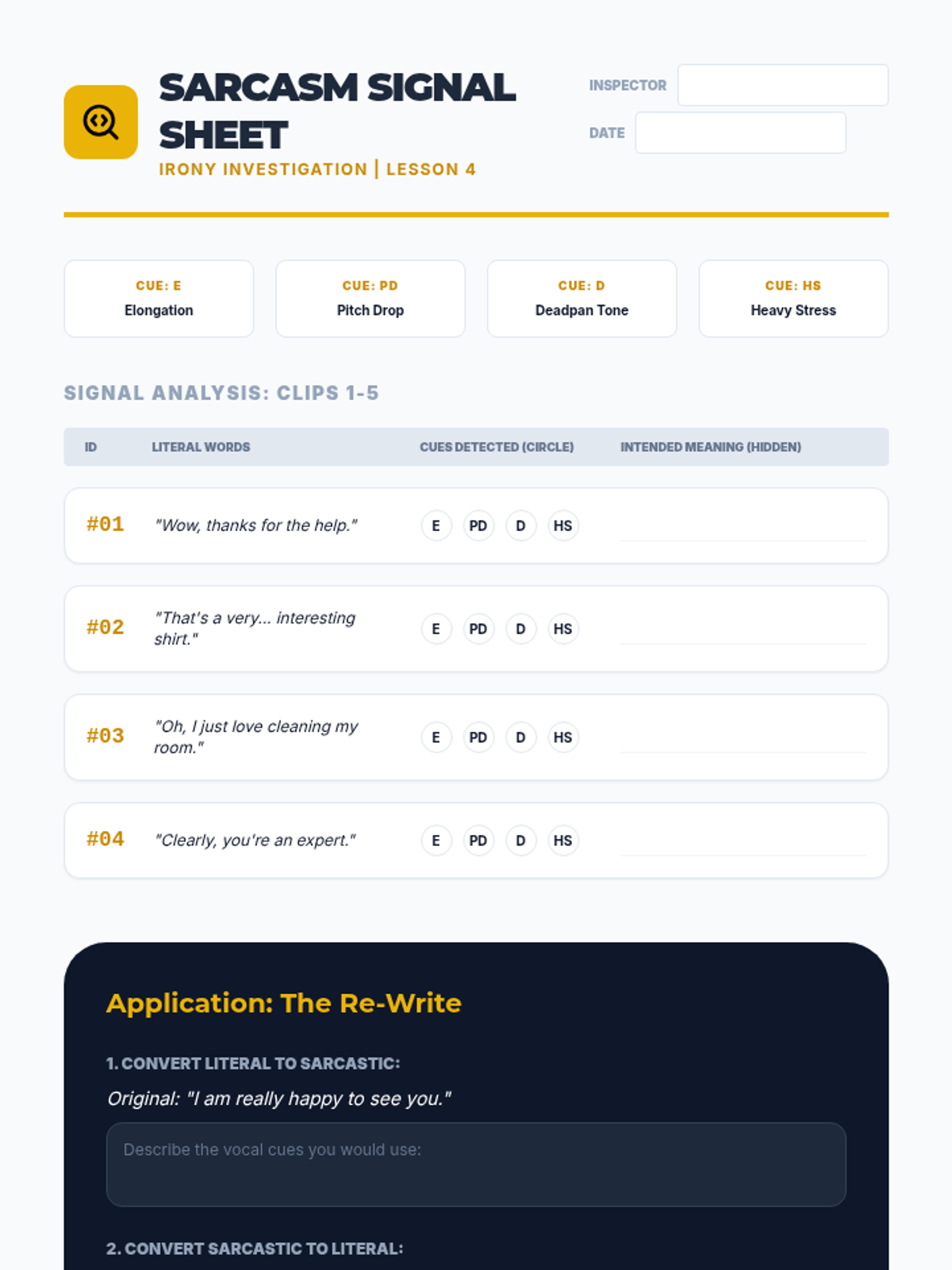
A worksheet for students to identify vocal cues for sarcasm (elongation, pitch drop) and record the intended meaning of various ironic statements.
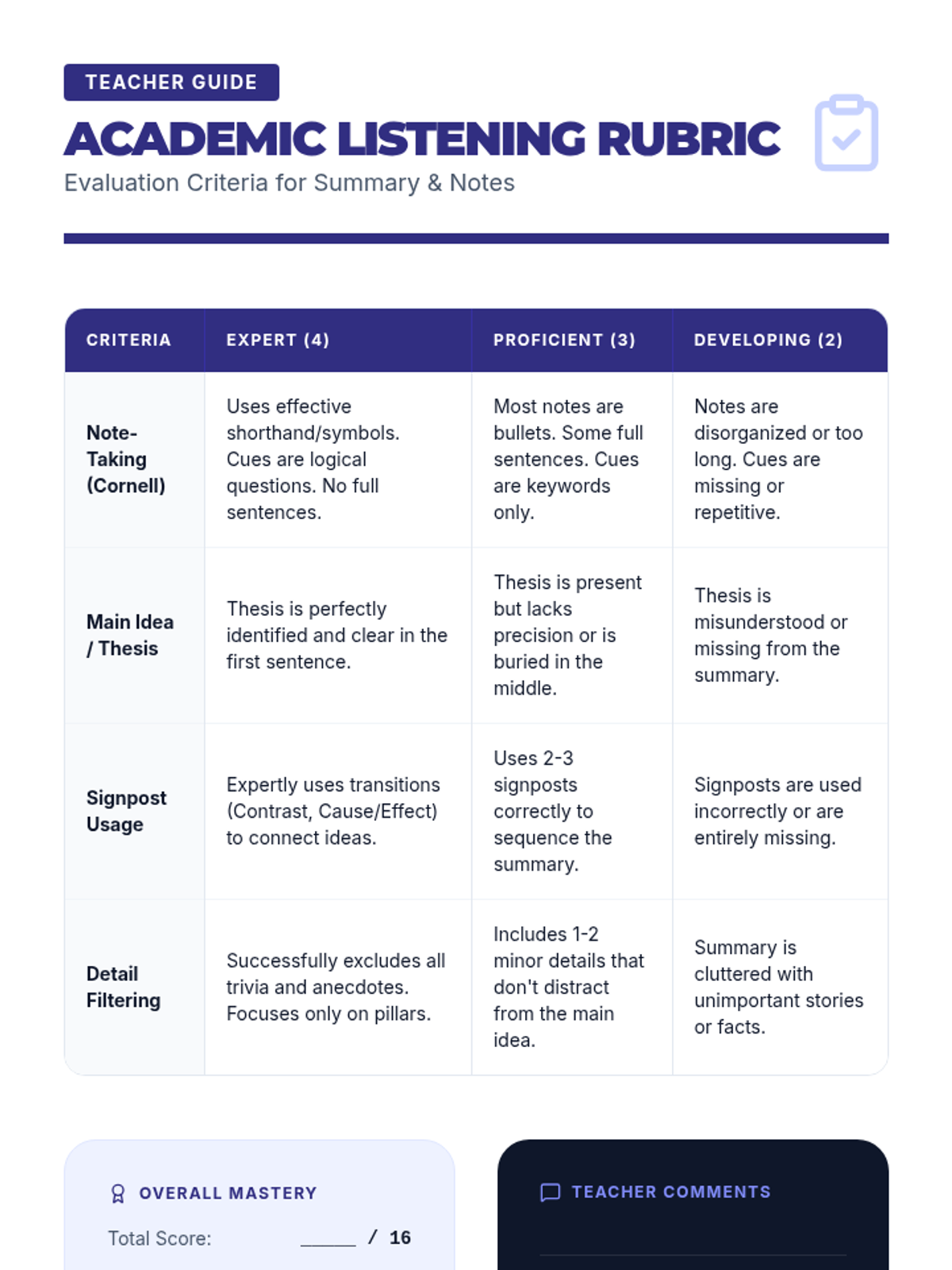
A comprehensive grading rubric for teacher use, evaluating note-taking quality, thesis identification, signpost usage, and detail filtering for Lesson 5.
Final slide deck for Lesson 5, focusing on strategies for listening to authentic, messy speech in street interviews and podcasts.
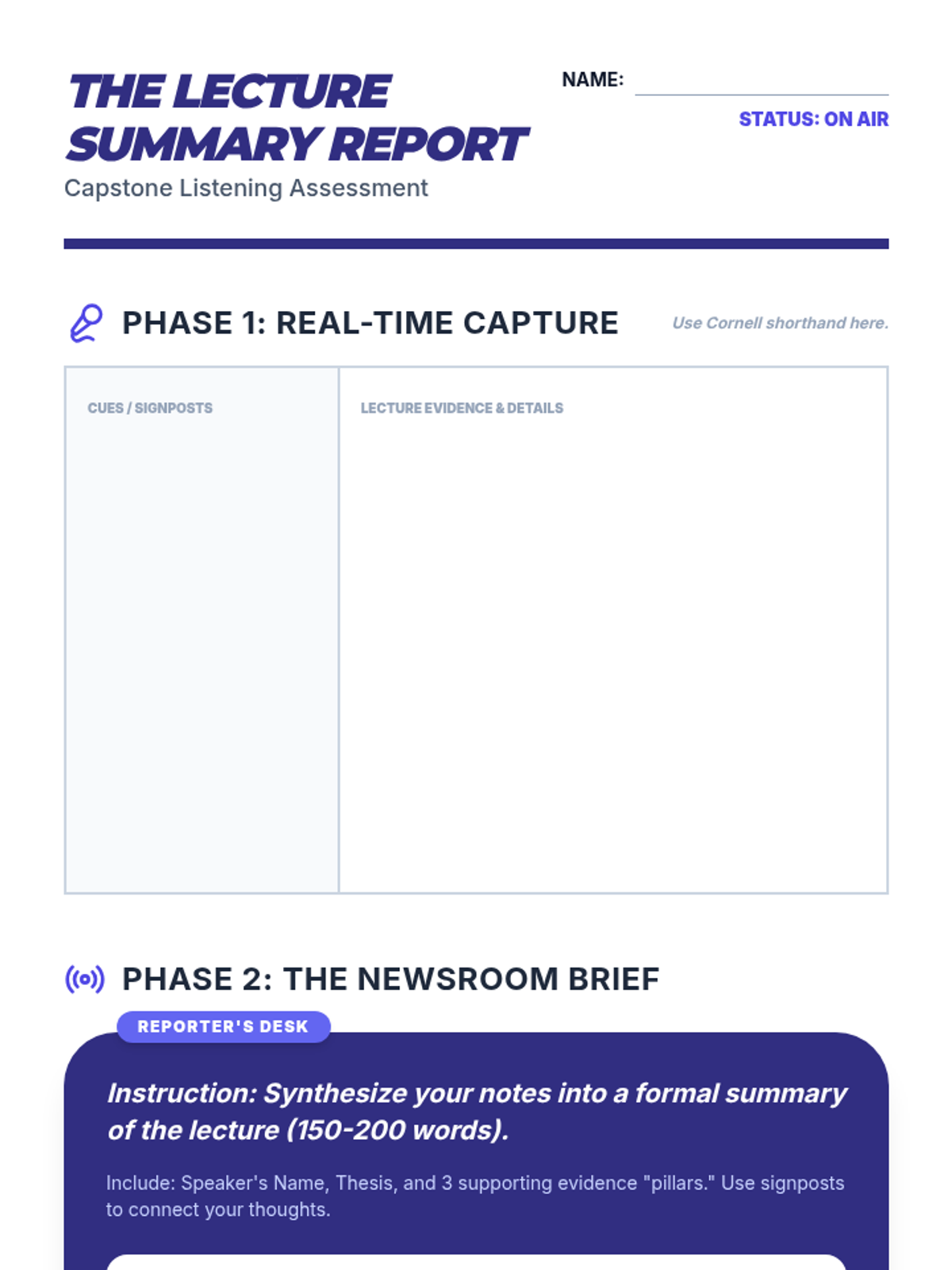
The final assessment worksheet for Lesson 5, where students take notes on a capstone lecture and produce a formal written summary.
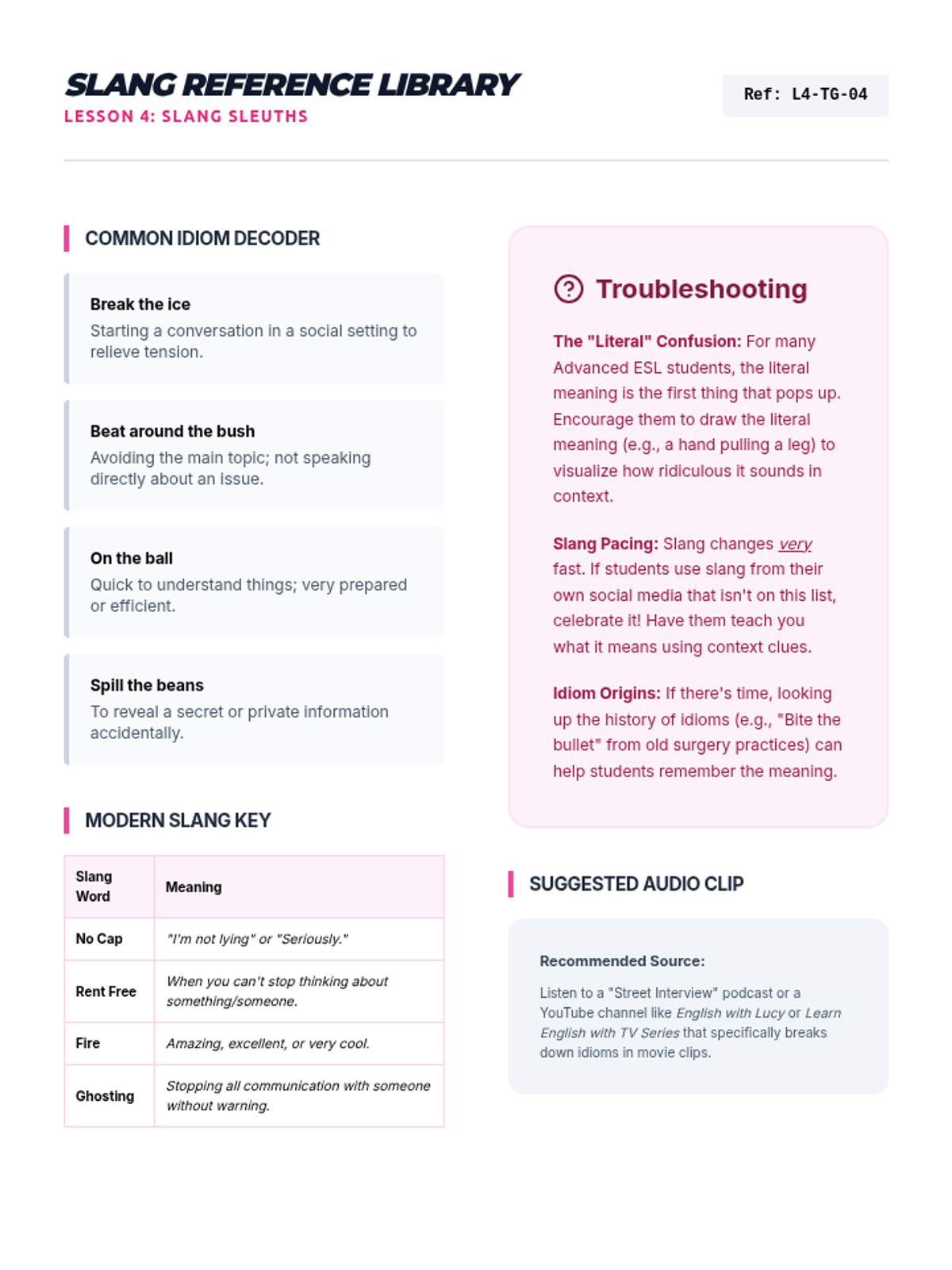
Teacher reference guide for Lesson 4, containing a library of common idioms, modern slang meanings, and instructional troubleshooting tips.
A visual presentation for Lesson 4, introducing vocal cues for sarcasm and irony (elongation, pitch drop). Explains the difference between sarcasm and general verbal irony.
The final instructional slide deck for Lesson 5, focusing on summarizing techniques and framing the student as a 'News Reporter' delivering a brief.
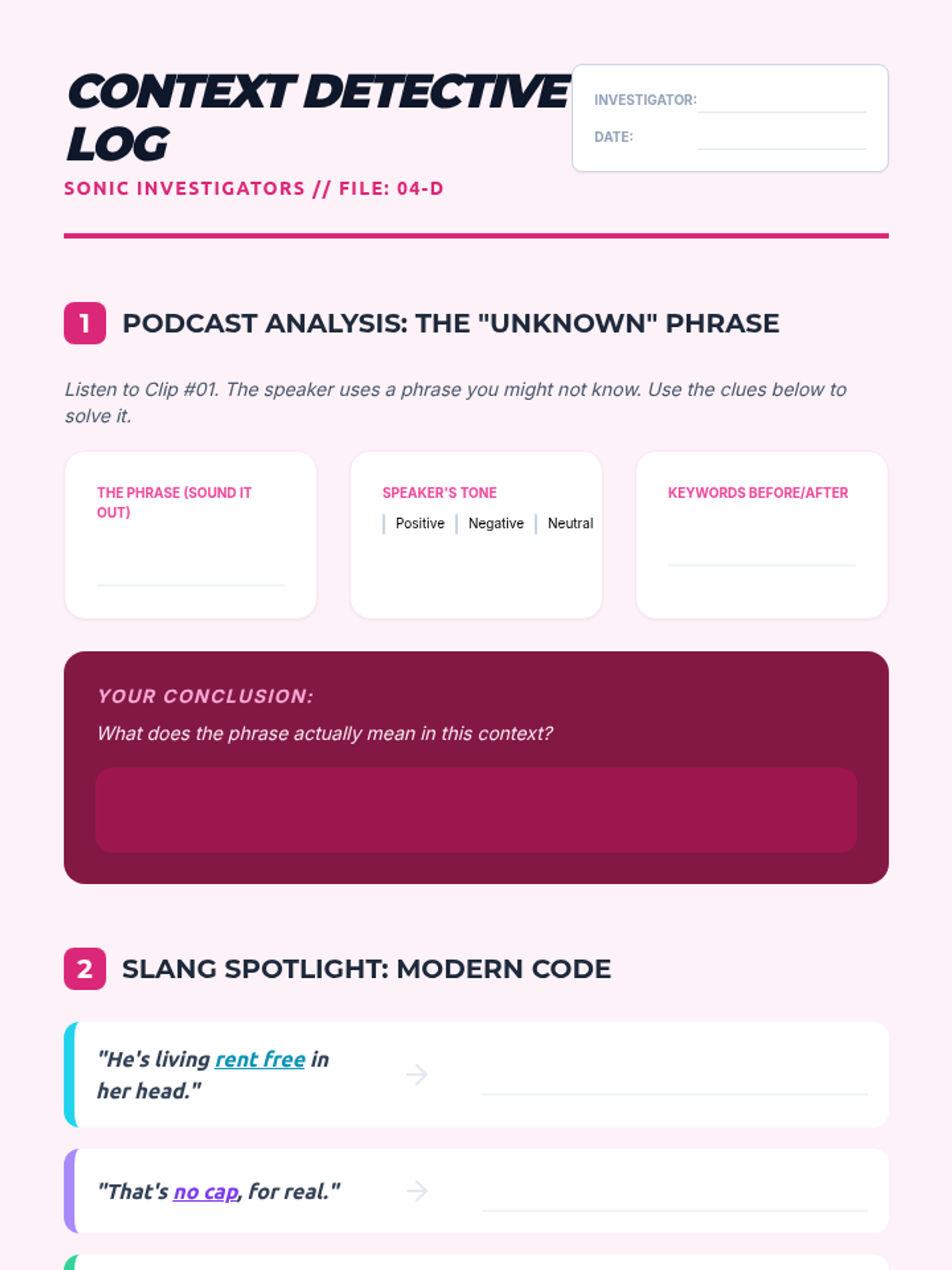
Worksheet for students to practice inferring the meaning of idioms and slang phrases from context clues and analyzing literal vs. figurative interpretations.
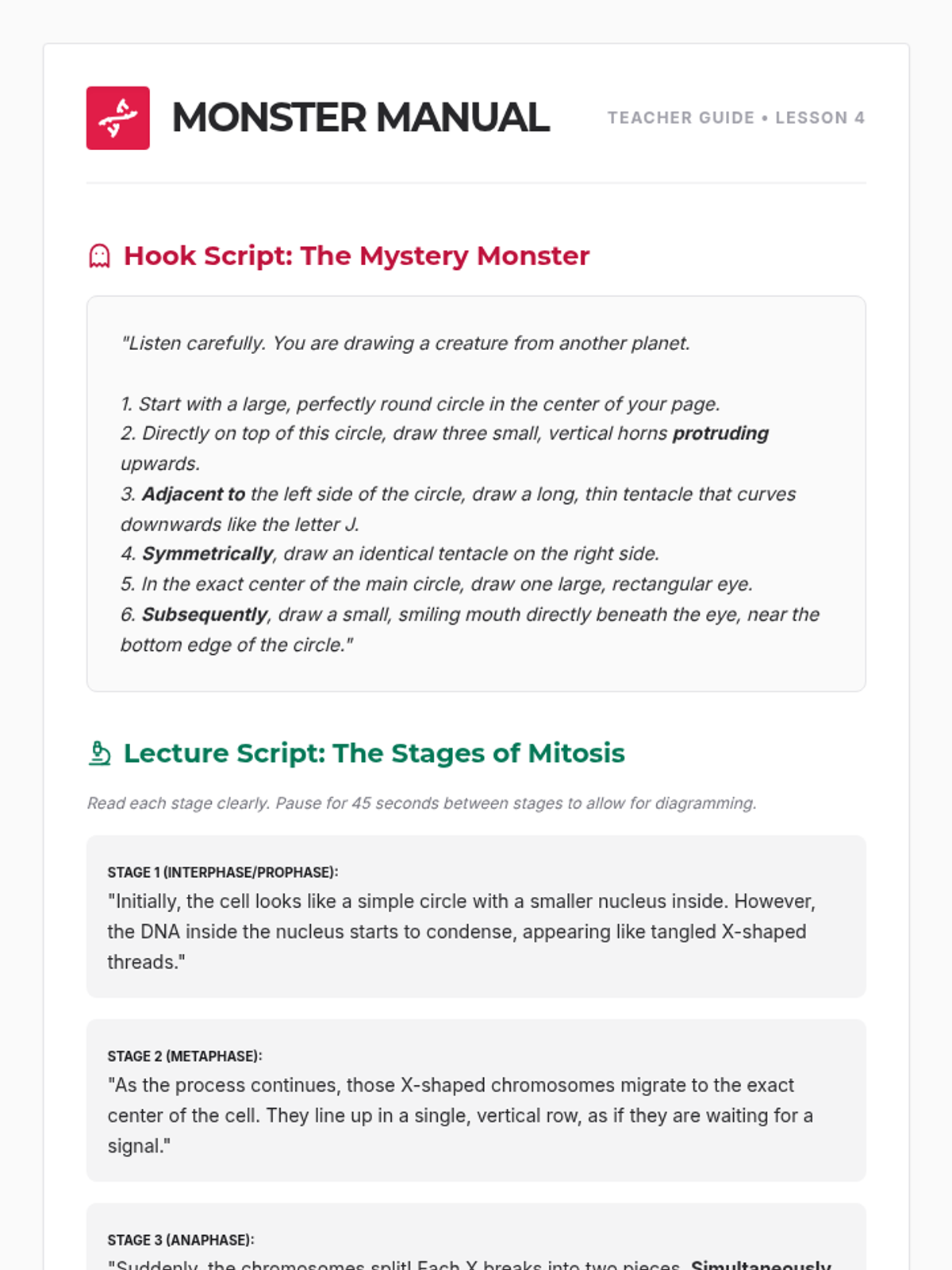
A teacher guide for Lesson 4 featuring the 'Mystery Monster' drawing script and a four-stage biological description of Mitosis. Includes vocabulary definitions and tips for teaching spatial comprehension.
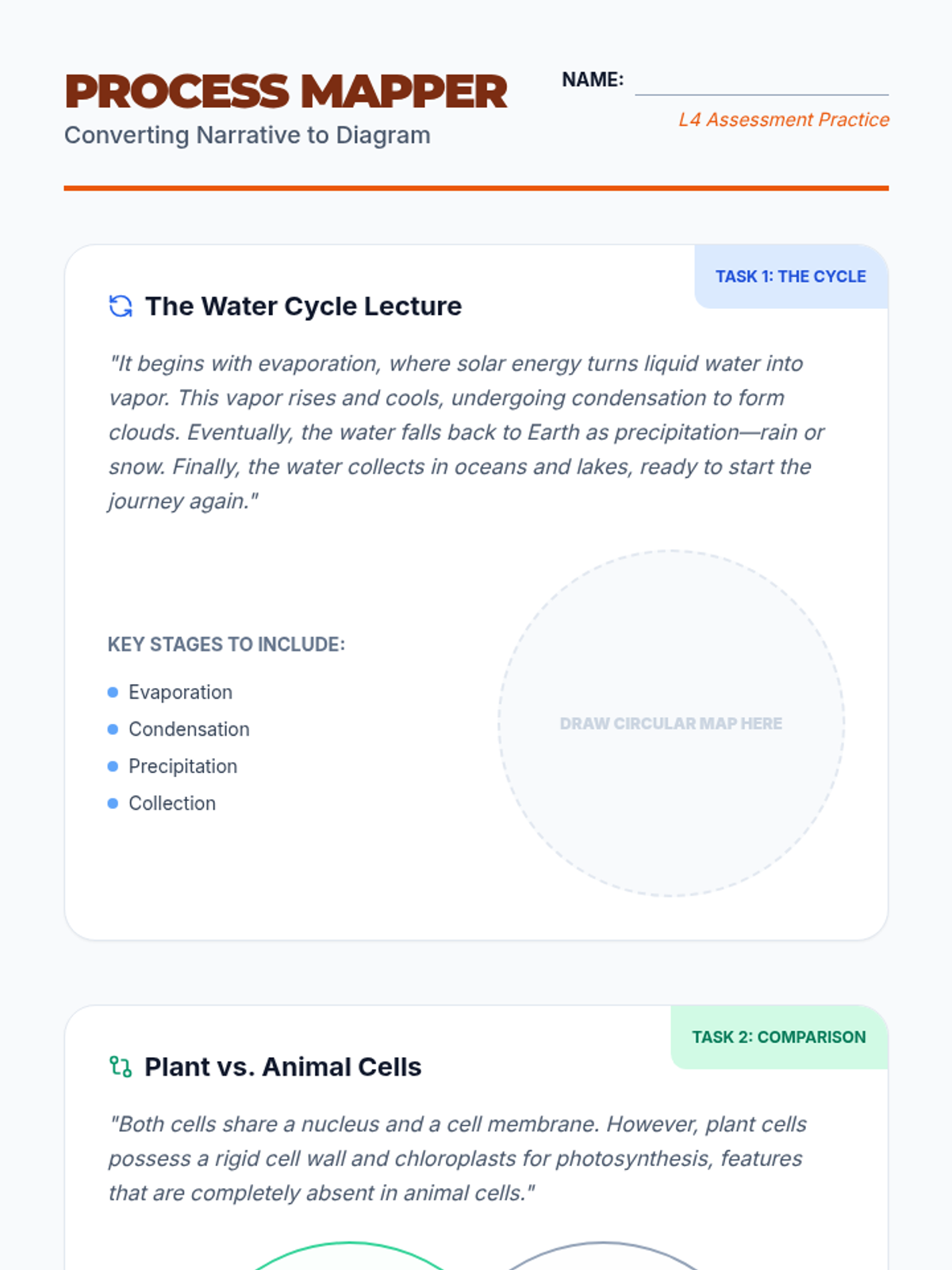
A worksheet for Lesson 4 where students convert short auditory narratives (Water Cycle and Cell Comparison) into appropriate graphic organizers.
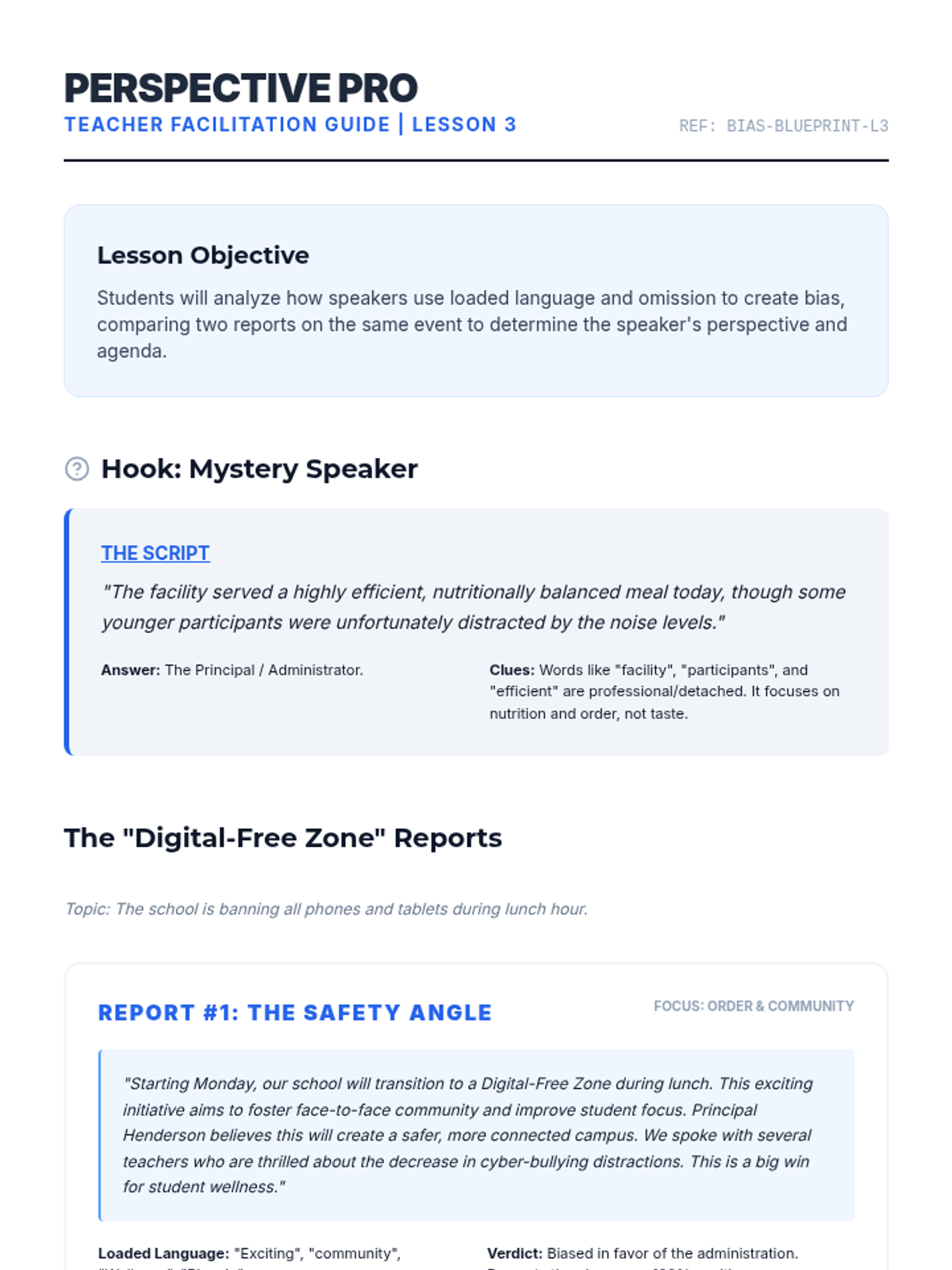
A teacher resource for Lesson 3, providing the script for the hook activity and two contrasting news reports, along with a guide for analyzing bias and loaded language.
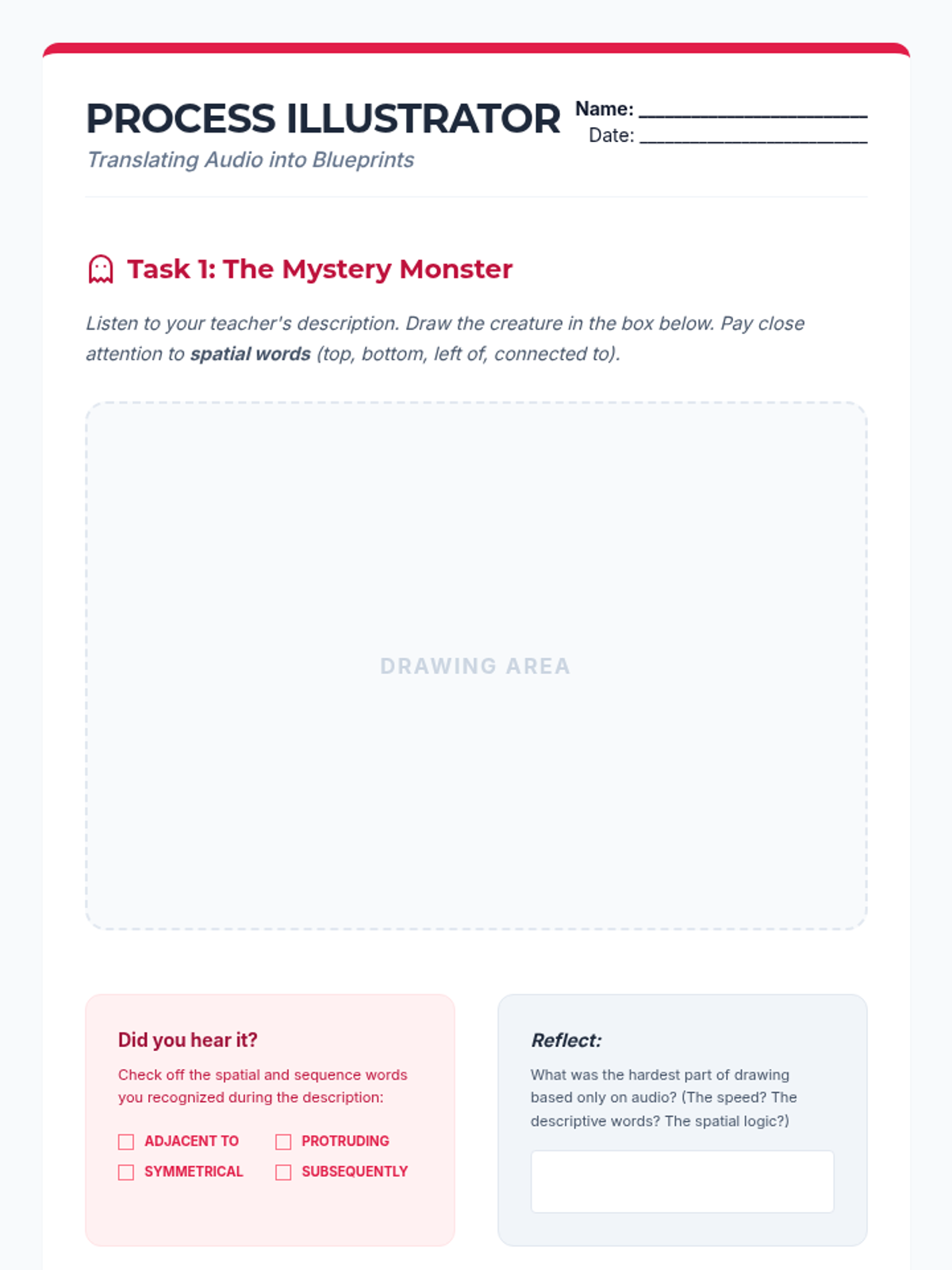
A worksheet for Lesson 4 including a large drawing area for the 'Mystery Monster' hook and a four-stage diagramming template for tracking a biological process (Mitosis) from audio.
Slide deck for Lesson 4, teaching students how to use context clues to decode idioms and modern slang in natural conversation.
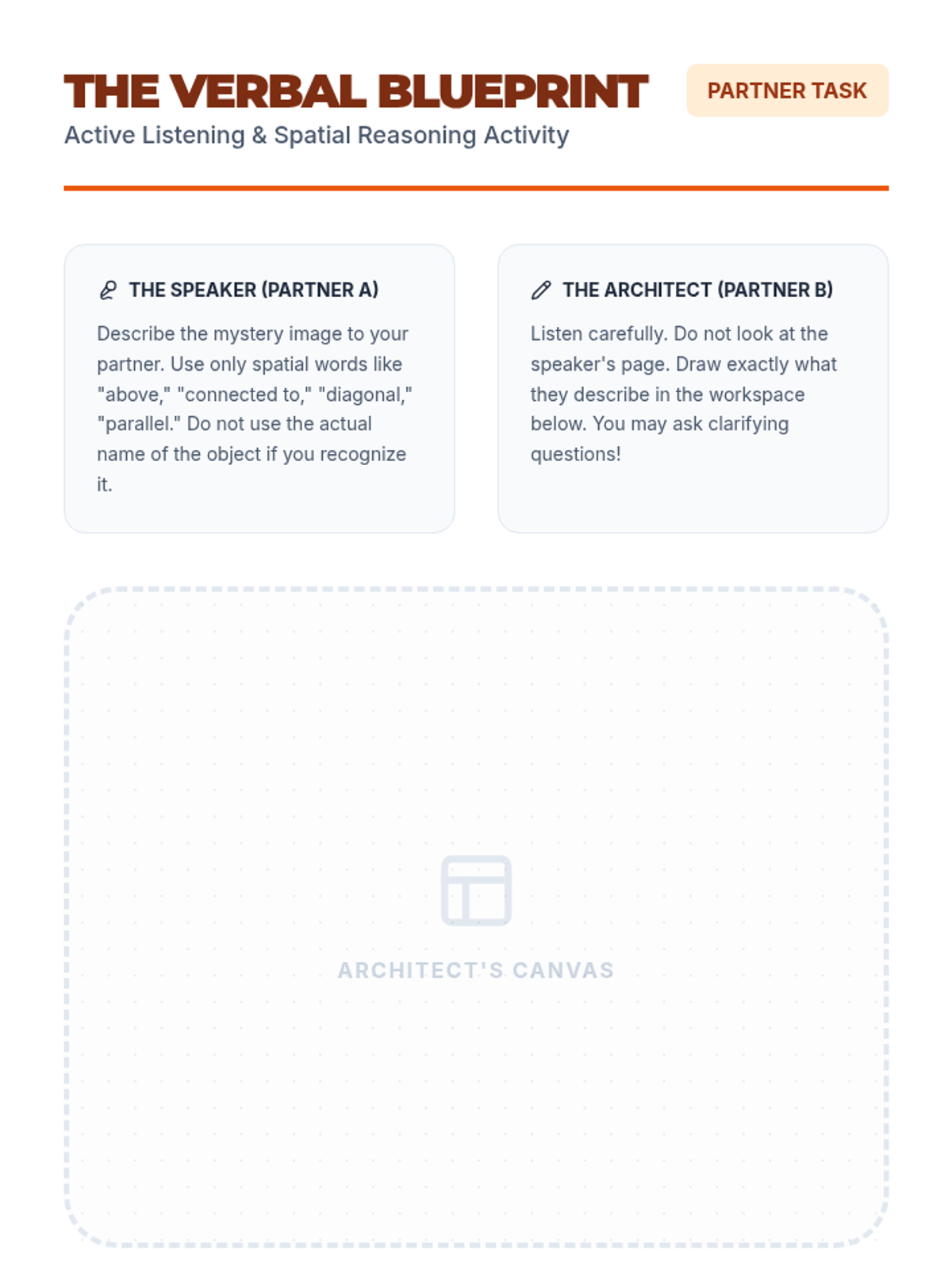
A partner-based activity worksheet for Lesson 4 where students practice describing and drawing complex geometric shapes through purely verbal instructions.
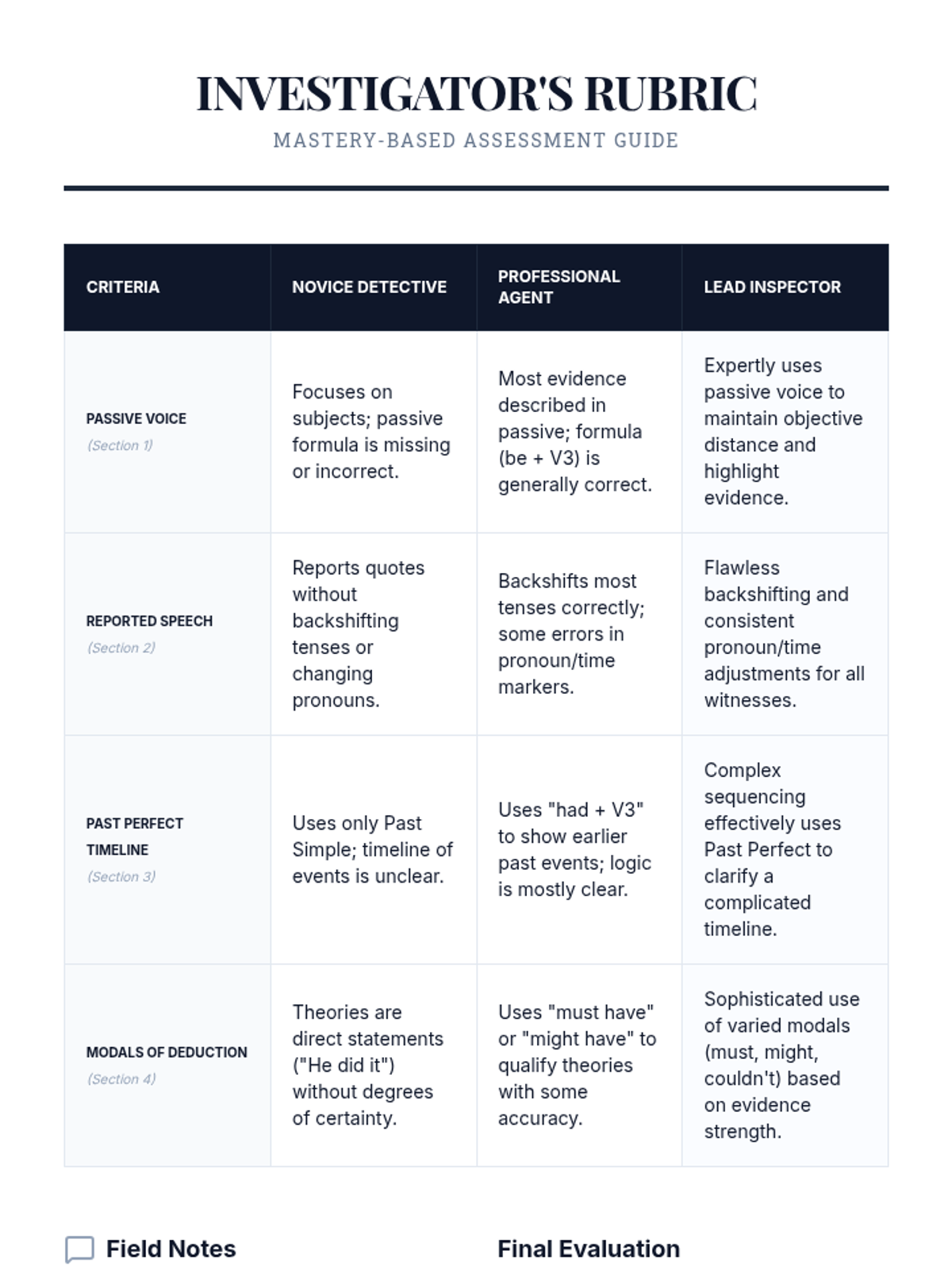
A comprehensive rubric for evaluating the final case report, focusing on passive voice, reported speech, past perfect, and modals of deduction.
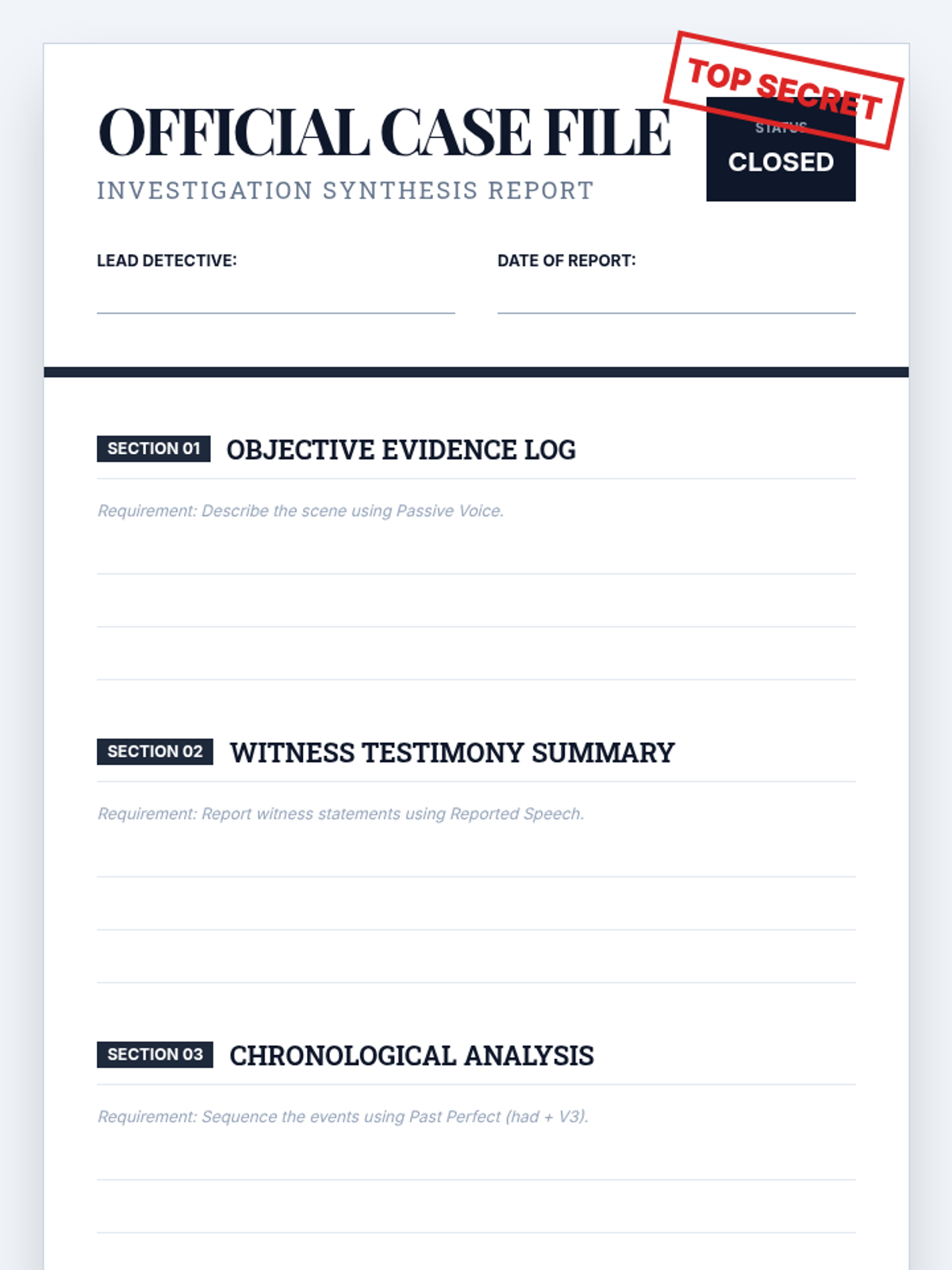
The final case report template for Lesson 5. Students use this to synthesize all grammar skills (passive voice, reported speech, past perfect, modals) into a formal investigative document.
Final briefing slides for Lesson 5, outlining the project requirements and expectations for the official case report synthesis.
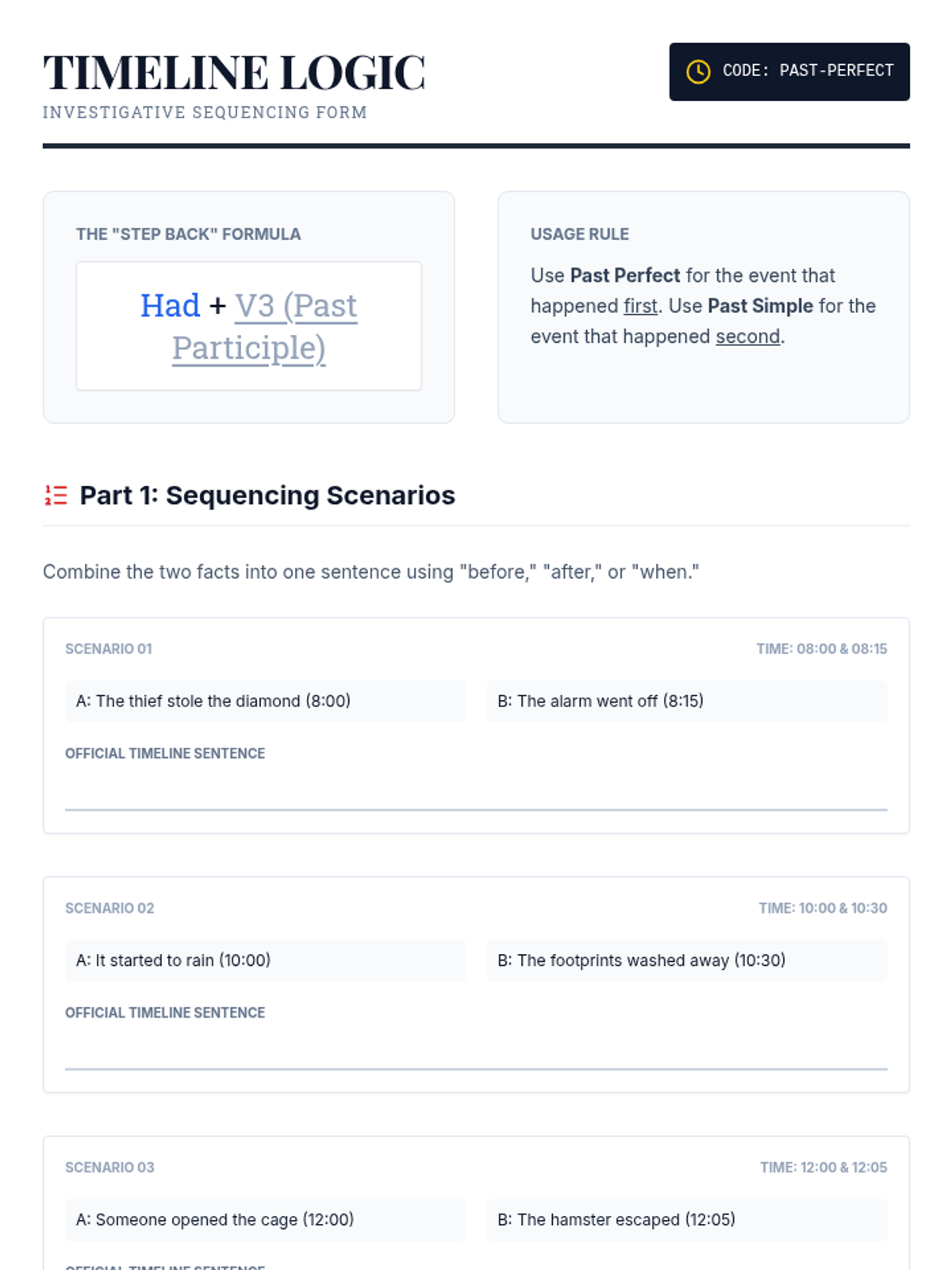
Worksheet for Lesson 4 where students practice combining events using past perfect and past simple to create a logical timeline of a crime.
Instructional slides for Lesson 4 on the past perfect tense, explaining its use for sequencing events and distinguishing between two past actions.
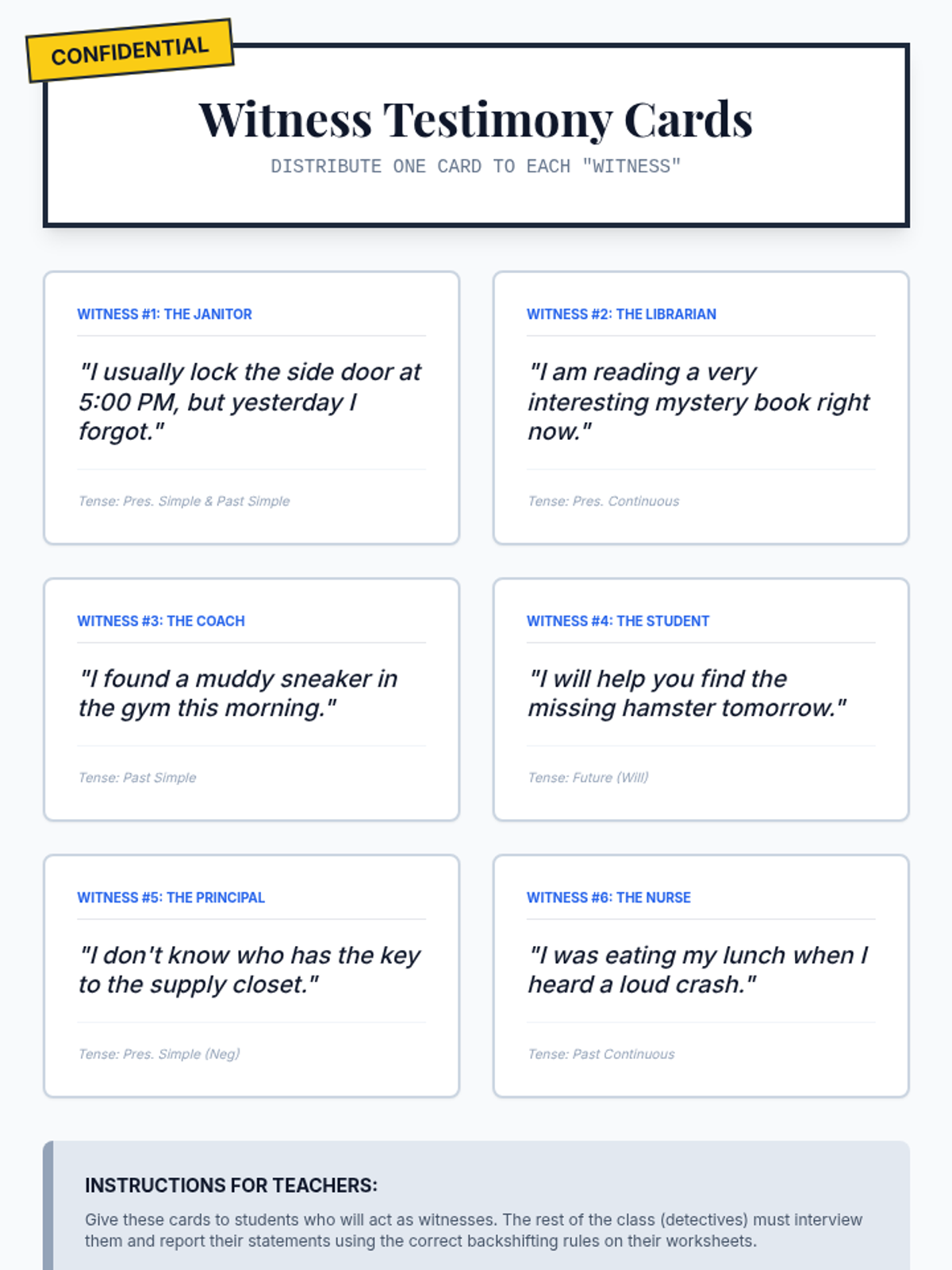
Witness statement cards for the role-play activity in Lesson 3. Each card provides a direct quote for students to report.
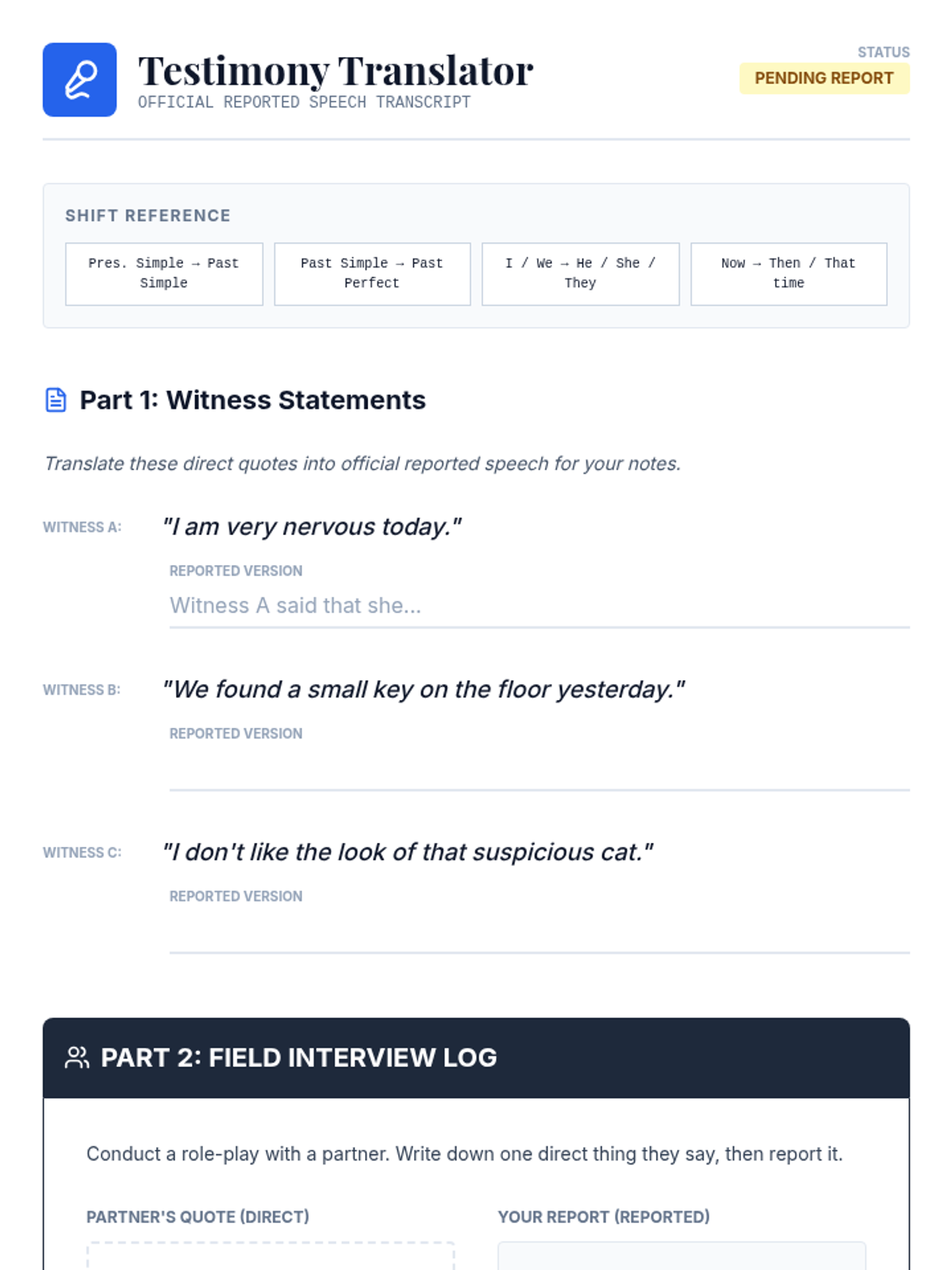
Worksheet for Lesson 3 where students practice converting direct speech quotes into reported speech and record field interviews.
Instructional slides for Lesson 3 on reported speech, explaining the backshifting of tenses and changes in pronouns, time, and place.
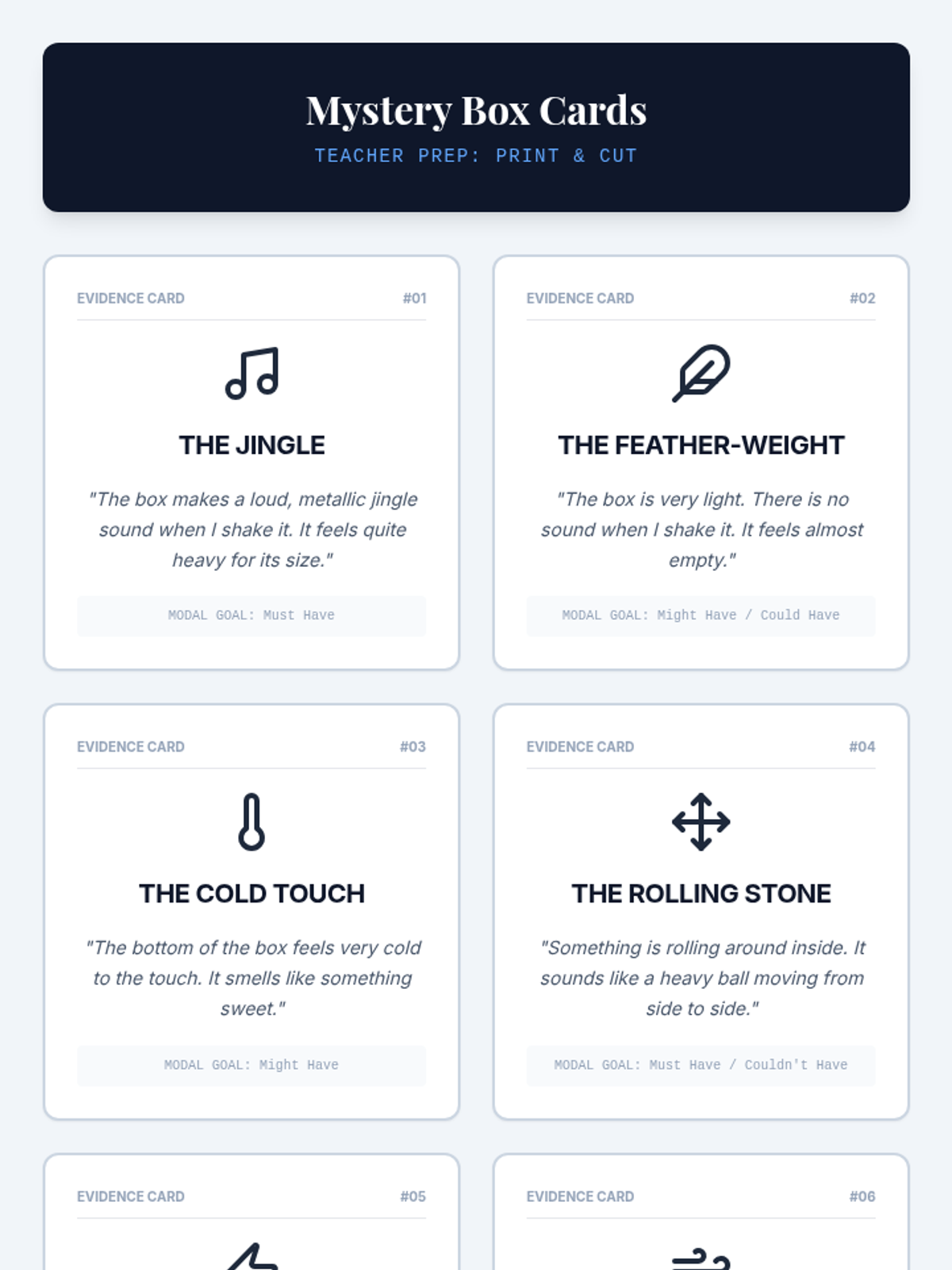
Activity cards for the "Mystery Box" game in Lesson 2. Each card provides a sensory clue for students to practice modals of deduction.
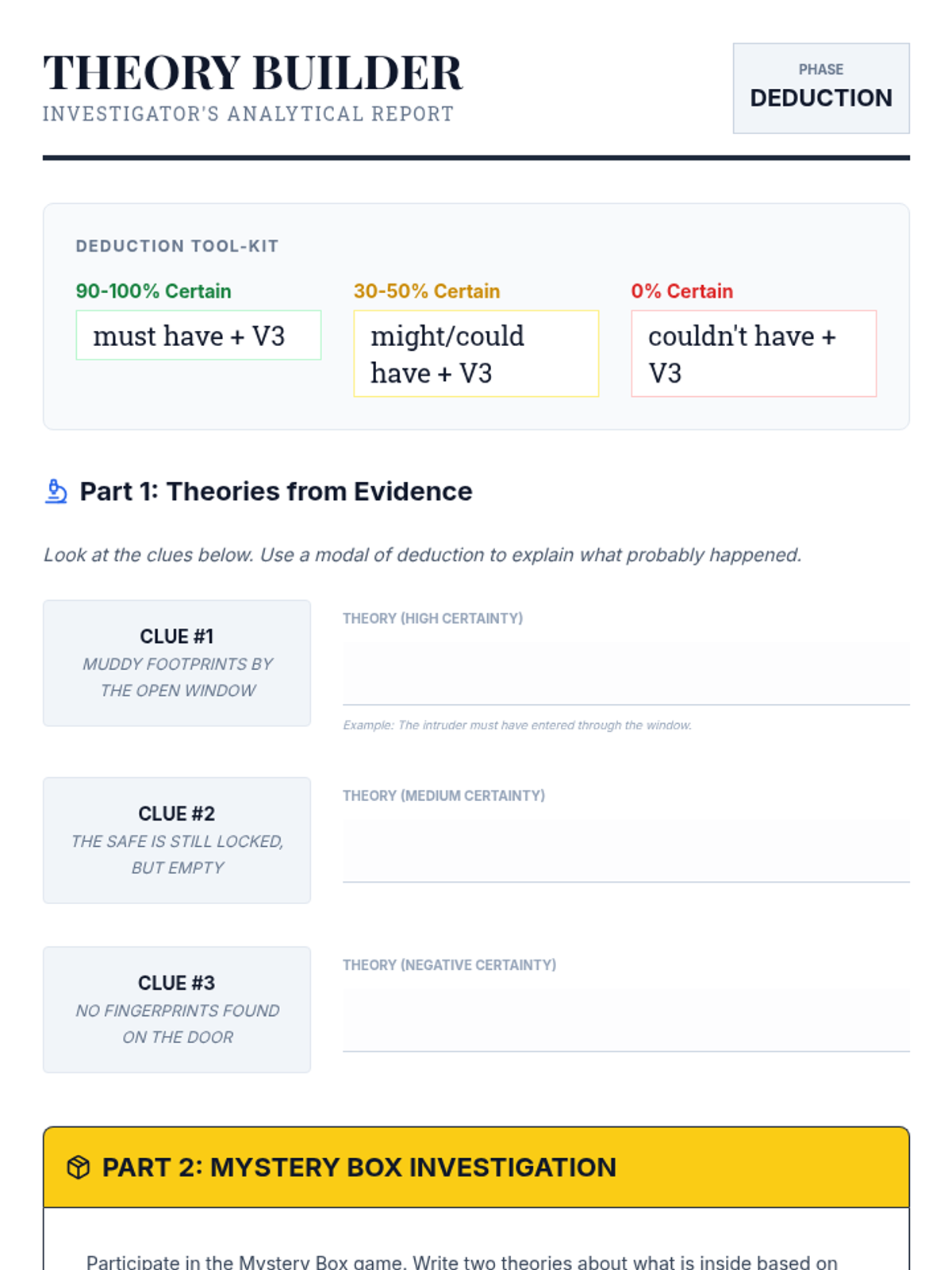
Worksheet for Lesson 2 where students use modals of deduction to analyze clues and write theories about the mystery box.
Instructional slides for Lesson 2, covering modals of deduction (must have, might have, couldn't have) and degrees of certainty in reporting.
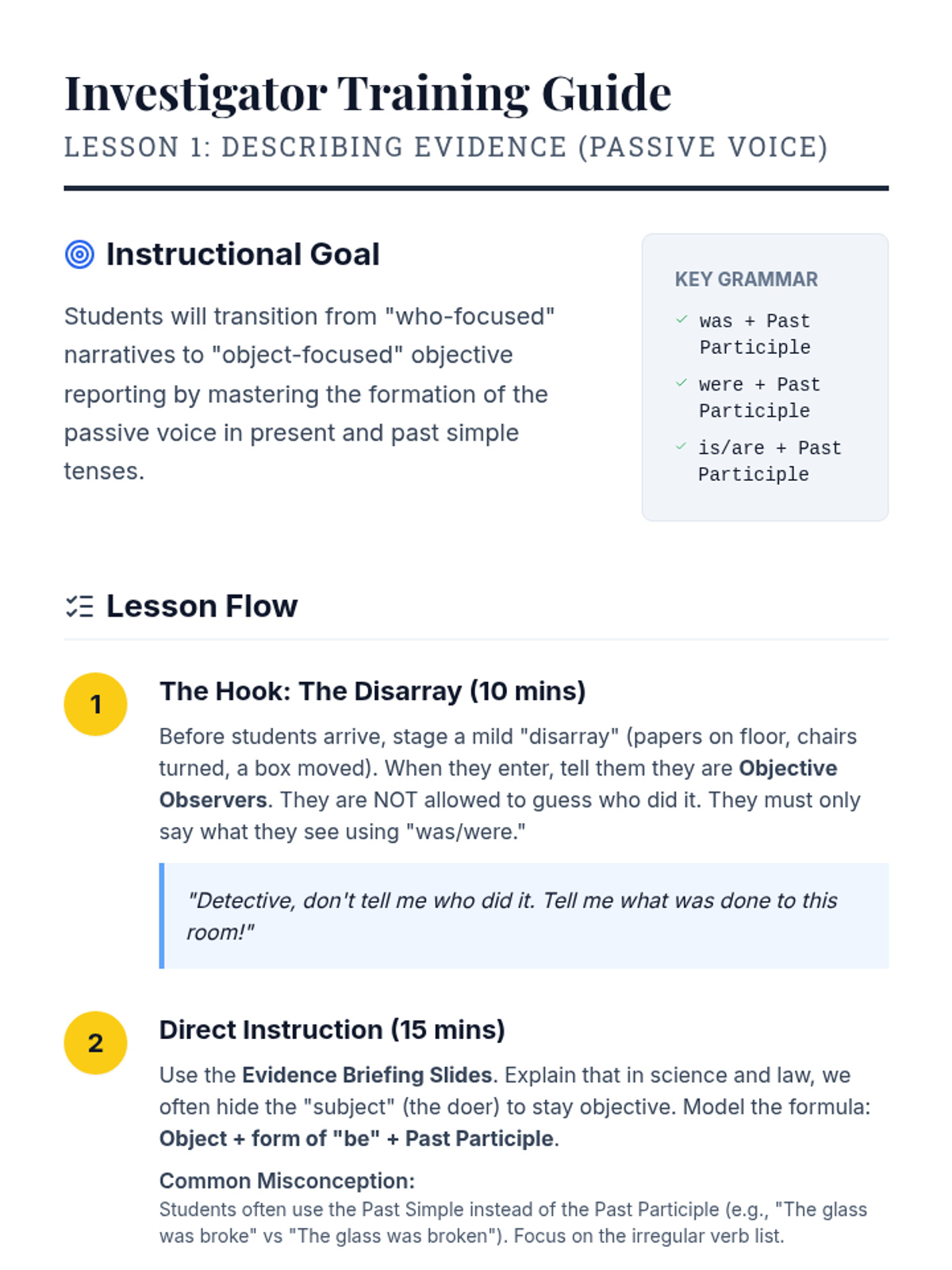
A teacher guide for Lesson 1 providing instructional flow, differentiation strategies, and tips for staging the classroom "crime scene."
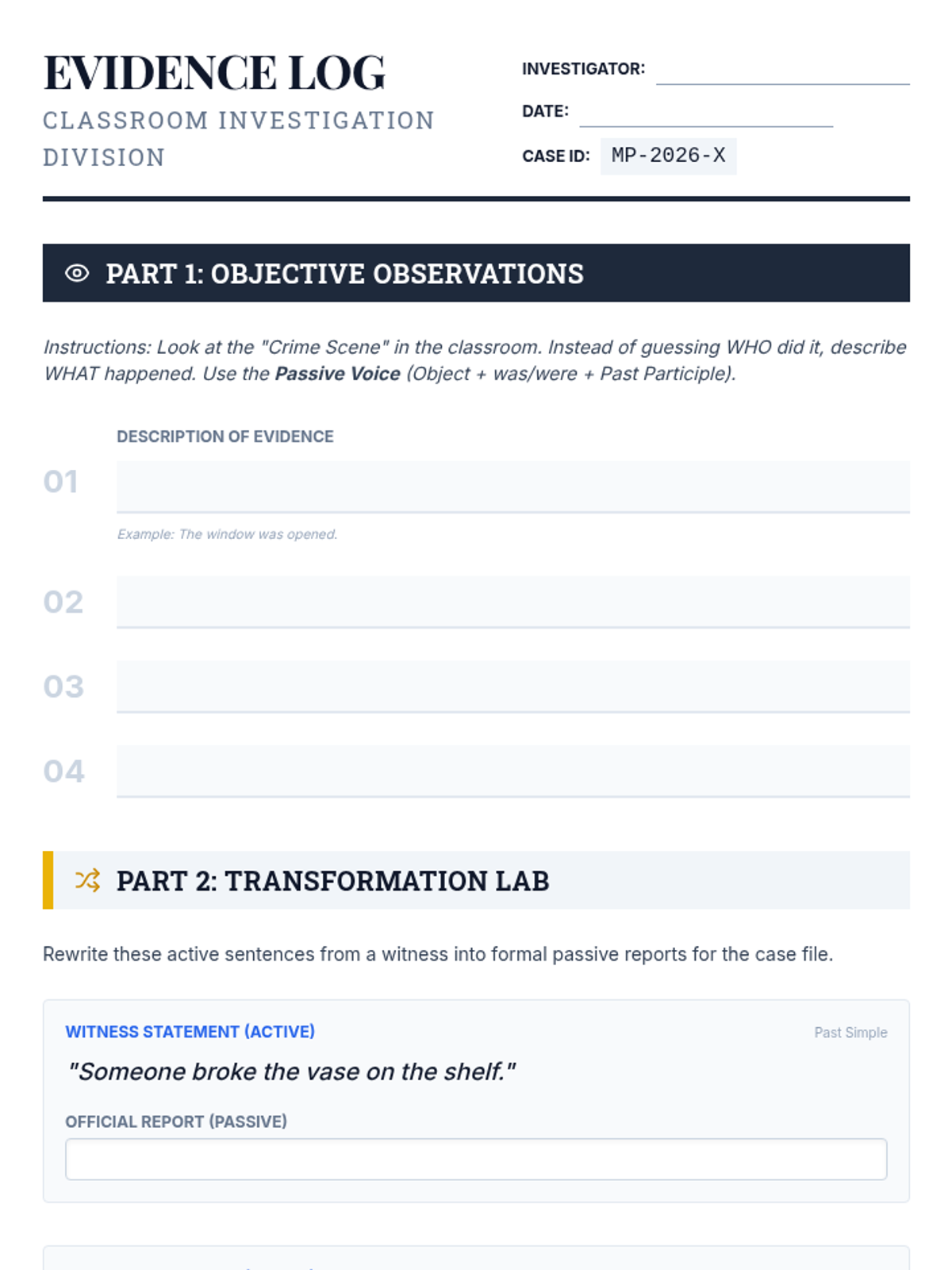
A student worksheet for Lesson 1 where they record observations of a "crime scene" using passive voice and practice transforming active sentences.
Introductory slides for Lesson 1, introducing passive voice through the lens of a classroom mystery. Includes active vs. passive comparisons and the basic formula.
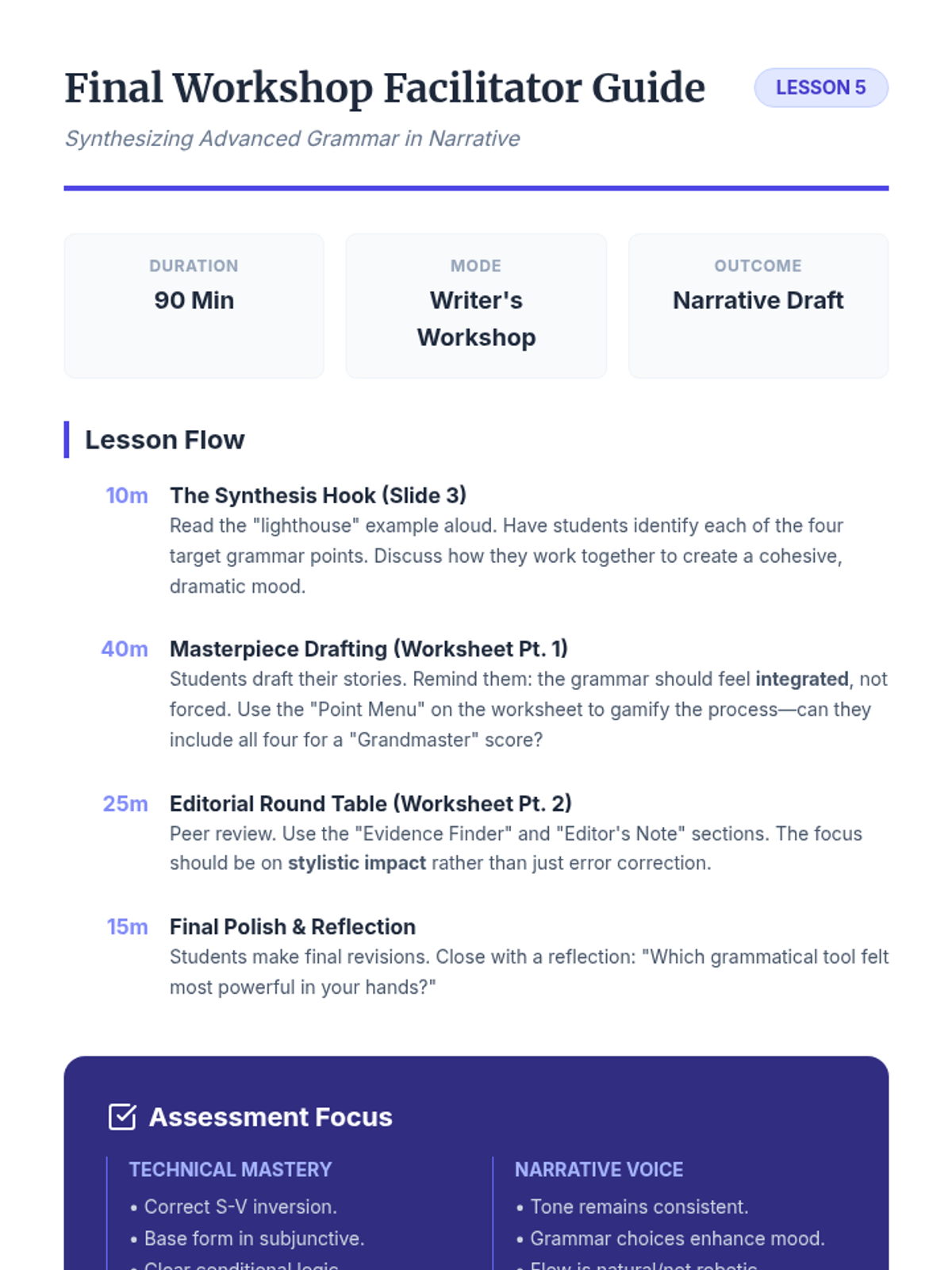
A teacher-facing guide for Lesson 5, featuring a lesson flow, assessment criteria, and guidance for conducting the final peer-review workshop.
A visual presentation for the final synthesis workshop. Includes an integrated example, peer review instructions, and the "Editor's Challenge" prompt.
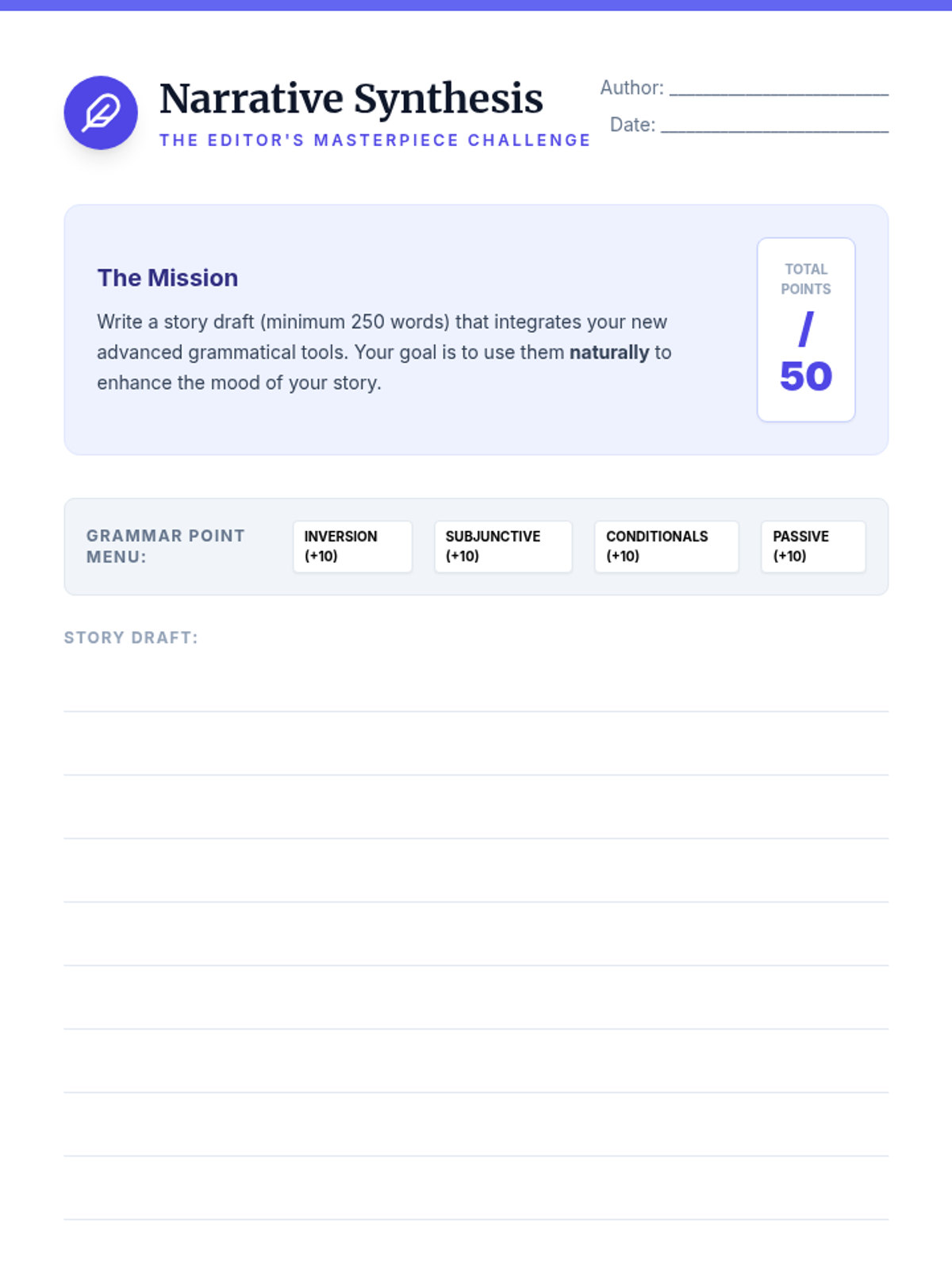
A 2-page student worksheet for the final narrative synthesis. Includes drafting space with a point-based checklist and a structured peer review guide.
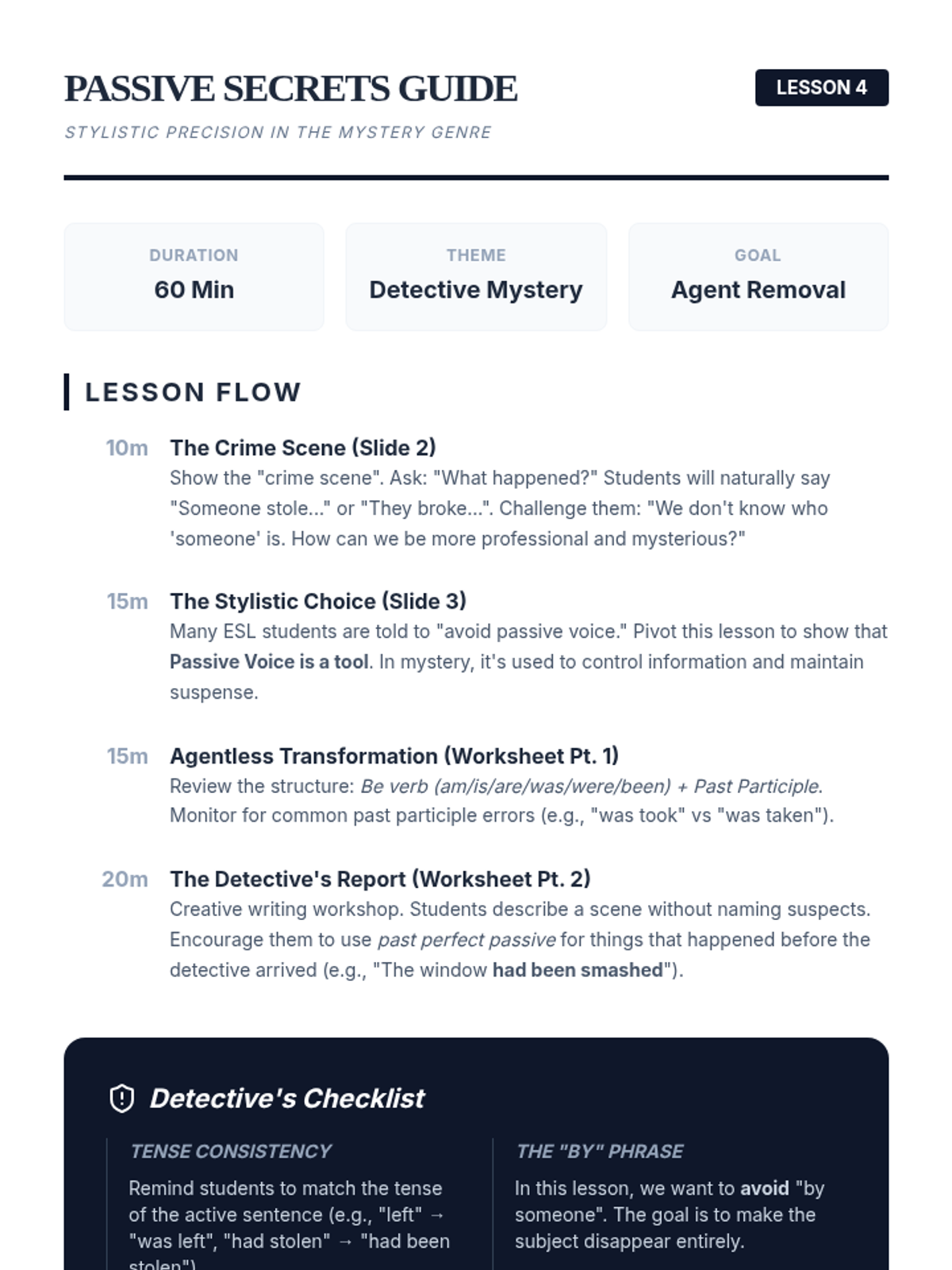
A teacher-facing guide for Lesson 4, featuring a lesson flow, instructional tips, and an answer key for the mystery report worksheet.
A visual presentation for Lesson 4 on the passive voice. Includes hooks, structural formulas, literary examples, and workshop instructions.
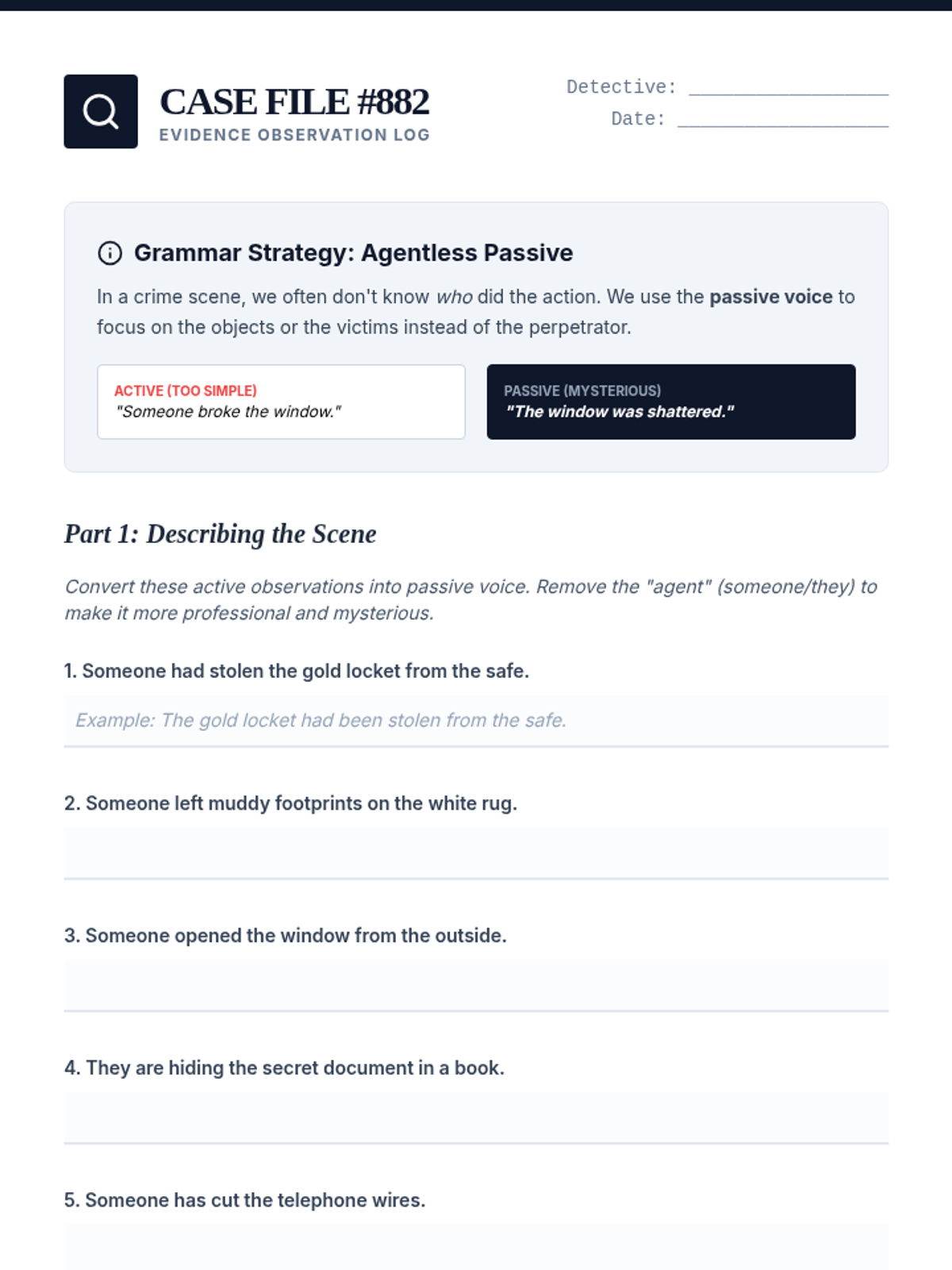
A student worksheet for the passive voice set in a detective mystery context. It includes sentence transformation and a report-writing activity focused on agentless passives.
A slide deck for Lesson 4 on visualizing auditory information, featuring the 'Verbal Blueprint' challenge and an introduction to graphic organizers.
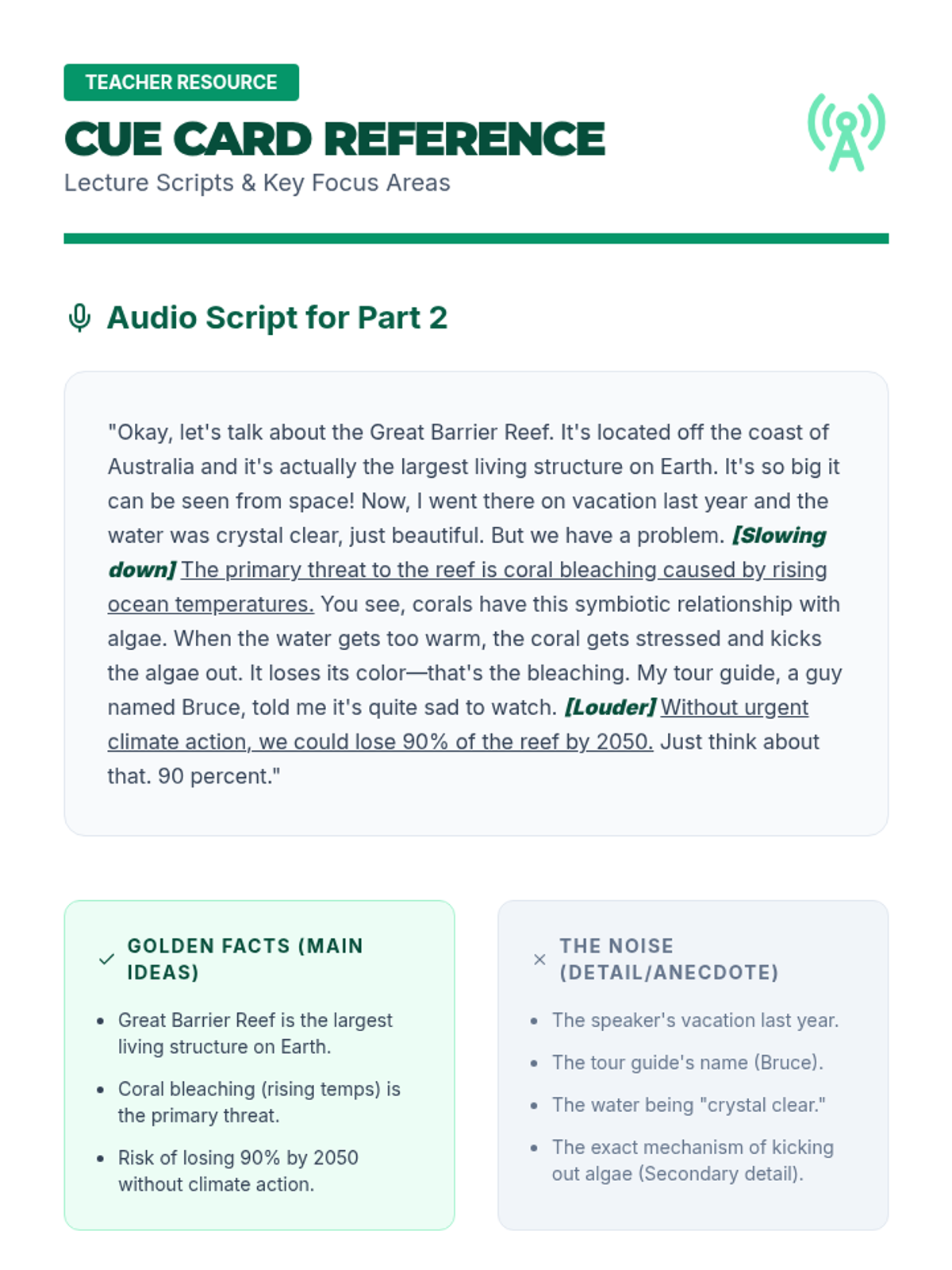
A teacher reference material for Lesson 3, containing the audio script and a breakdown of main ideas versus details for the Great Barrier Reef lecture.
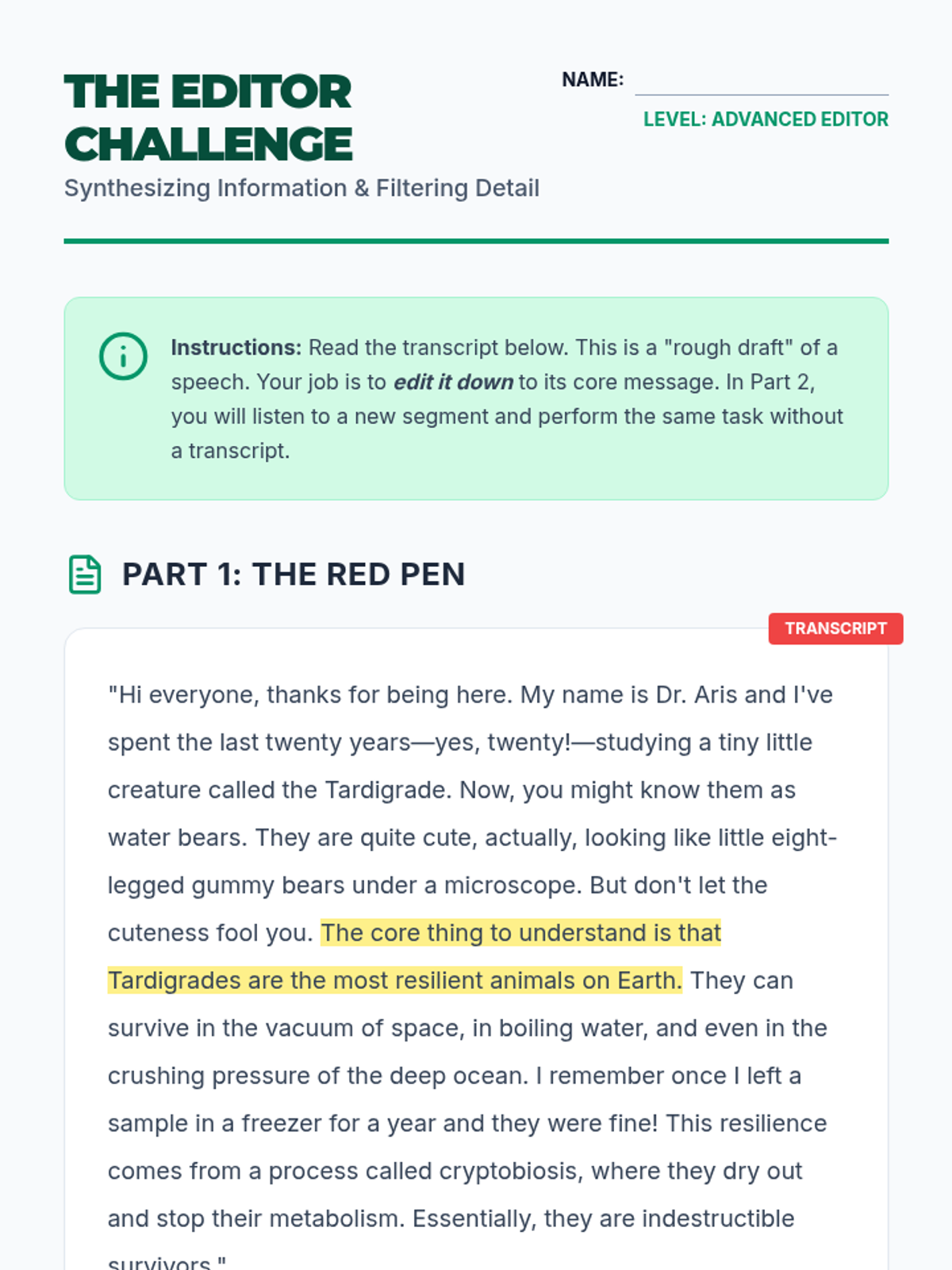
A student worksheet for distinguishing main ideas from details, featuring a transcript editing task and an audio-only synthesis challenge.
A slide deck focusing on strategies for distinguishing main ideas from supporting details, introducing 'The Editor' challenge and auditory highlighting techniques.
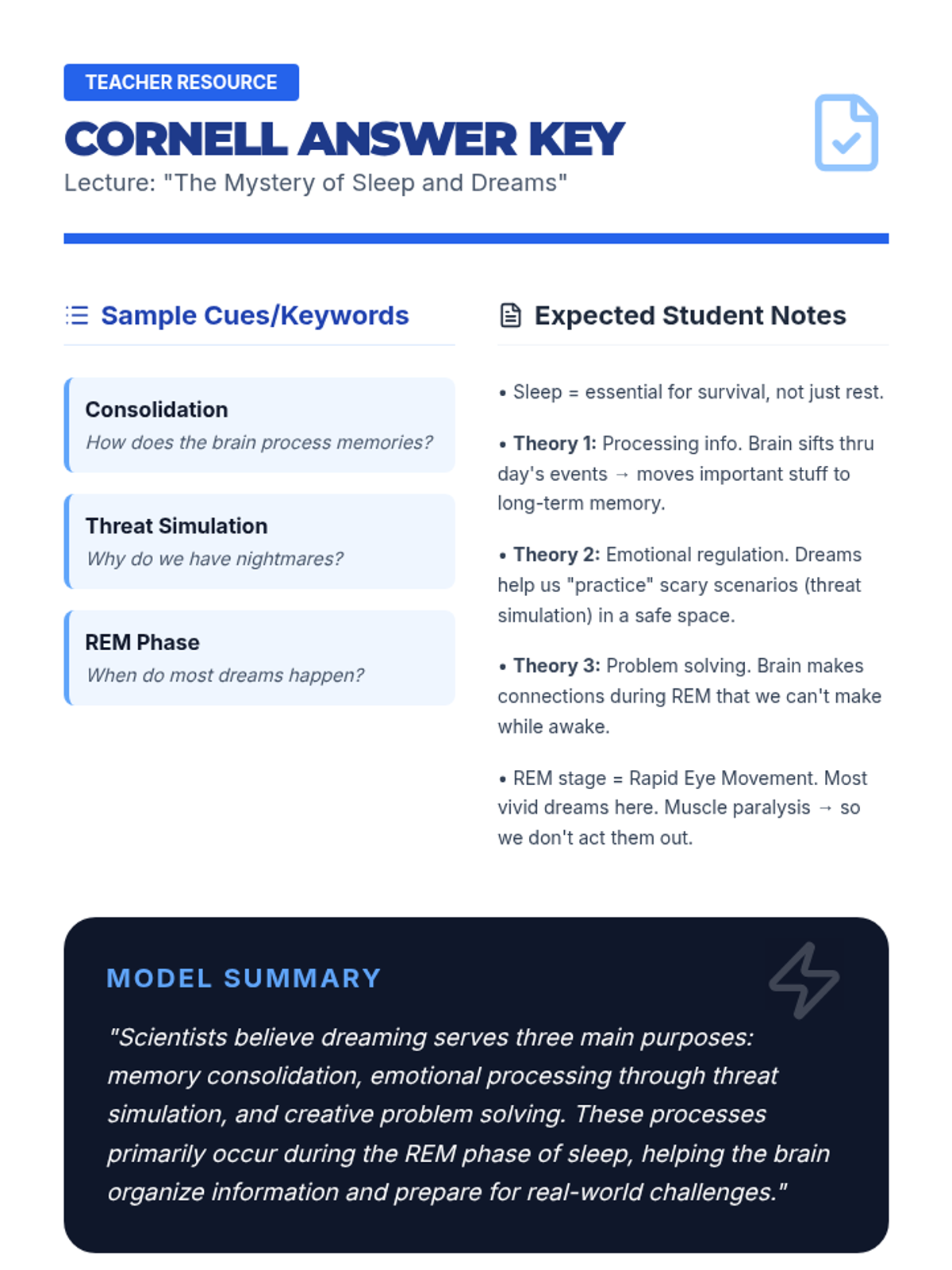
An answer key and teacher resource for the Cornell note-taking practice, providing sample notes and a summary based on the 'Why Do We Dream?' lecture.
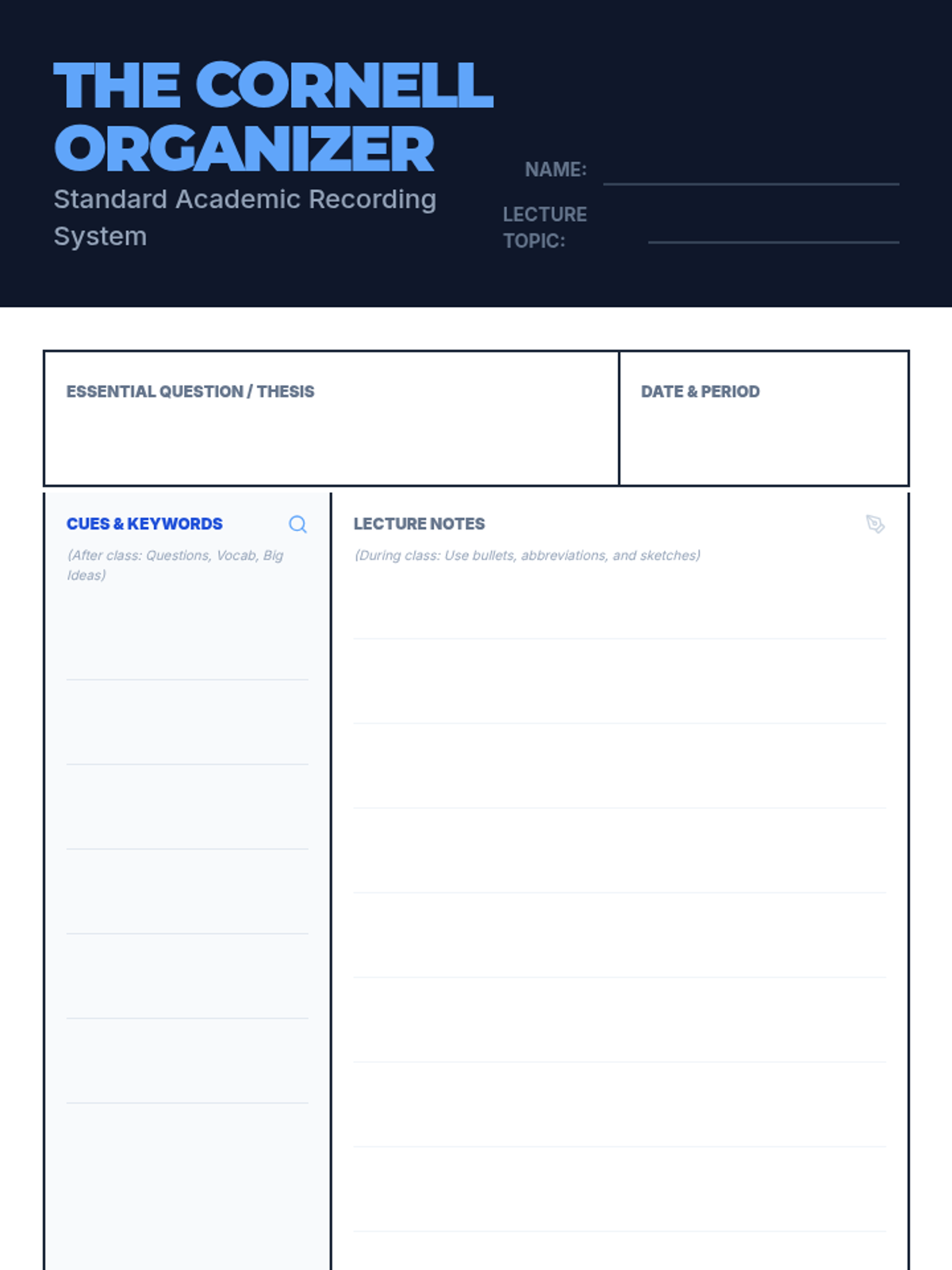
A professional Cornell Note-taking template designed for student use, featuring clearly labeled sections for cues, notes, and summaries.
An instructional slide deck for Lesson 2 introducing the Cornell Note-taking method, featuring a memory challenge and a visual breakdown of the system.
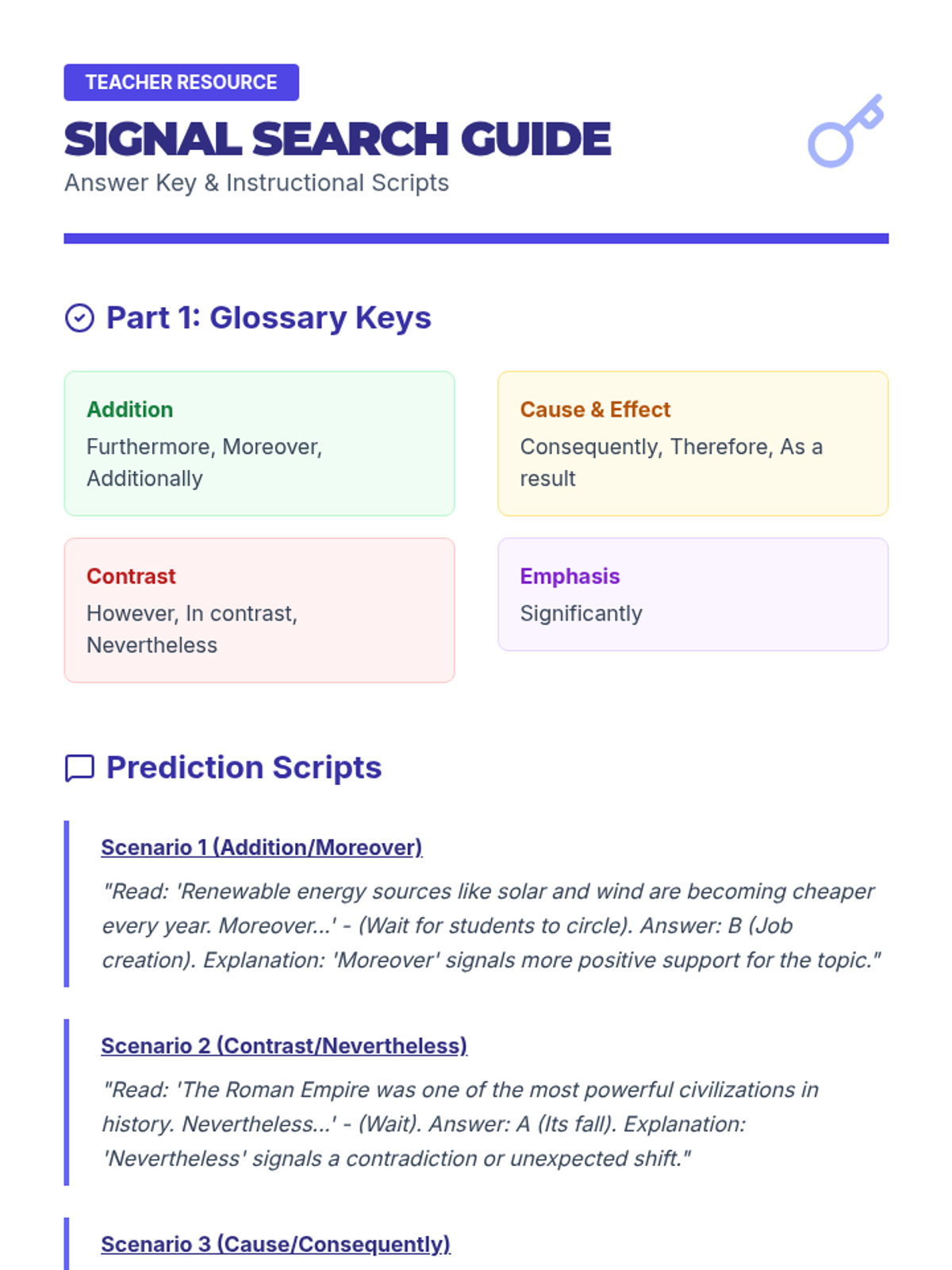
A teacher guide and answer key for the Signal Search lesson, including instructional scripts for the listening practice.
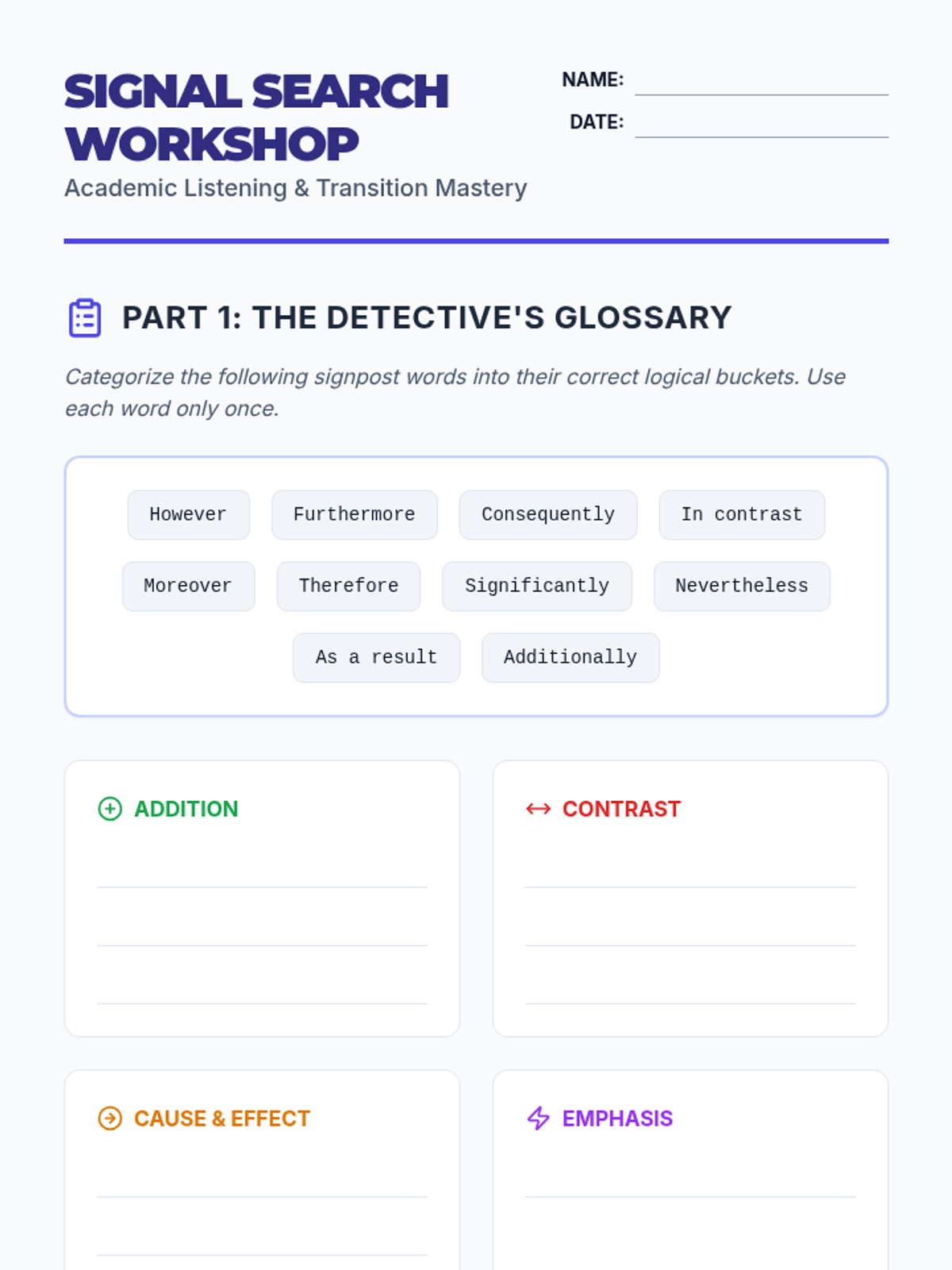
A student worksheet for identifying and categorizing verbal signposts, including a logical prediction section based on spoken cues.
A visual presentation introducing the concept of verbal signposts in academic lectures, featuring the 'Missing Map' hook and categorized transition words.