Phonetic foundations through Pinyin and tones, character recognition, and essential grammar for all proficiency levels. Integrates cultural context with advanced reading, writing, and communicative strategies.
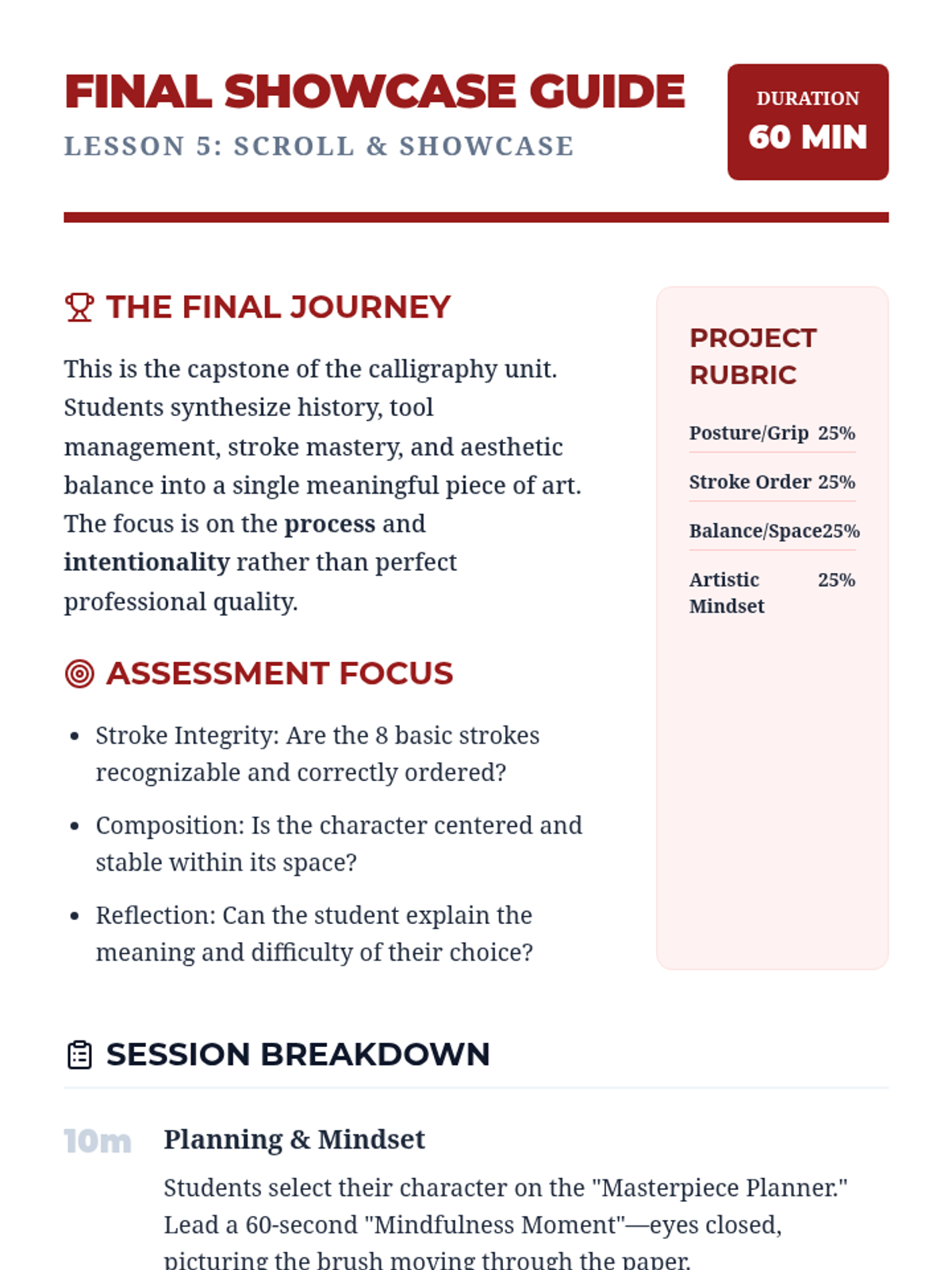
A teacher guide for the final lesson, detailing project assessment, classroom environment setup for painting, and facilitating the gallery showcase.
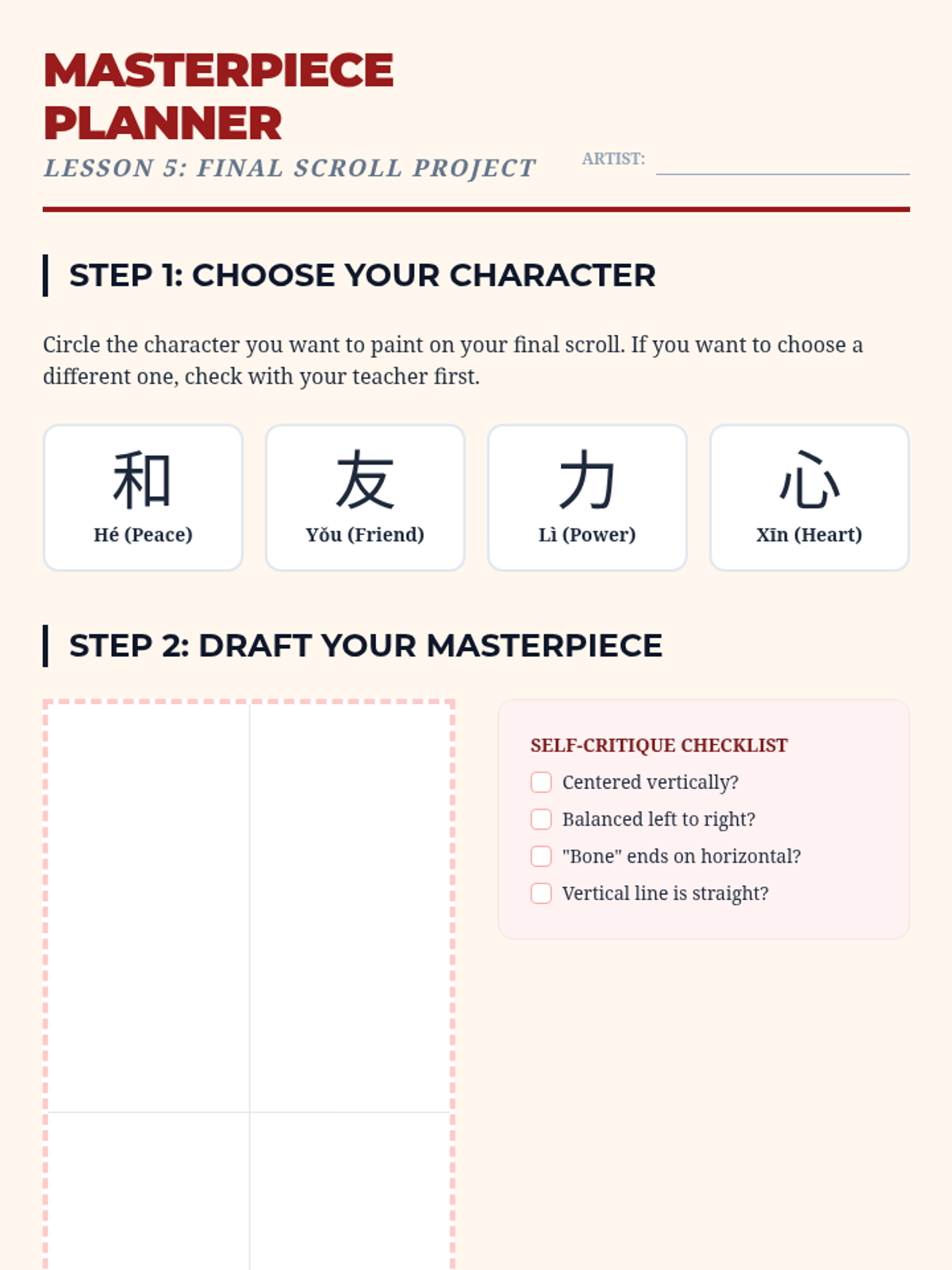
A planning sheet for the final calligraphy scroll, including character choice selection, a drafting space with a self-critique checklist, and a gallery display tag.
A presentation guiding students through the final project: selecting a meaningful character, the scroll-painting process, and gallery walk etiquette.
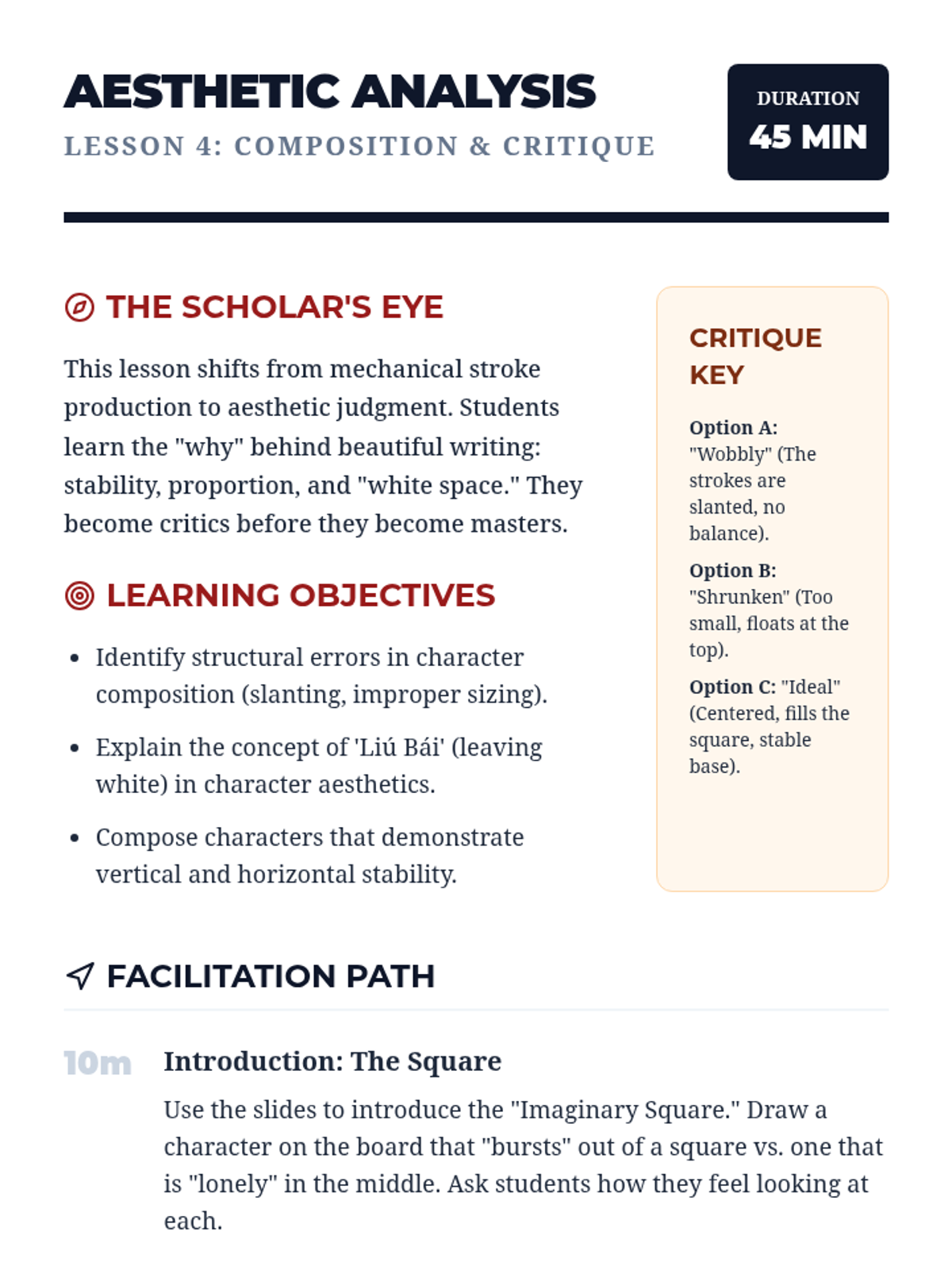
A teacher guide for Lesson 4 focusing on aesthetic critique, structural balance, and facilitating the 'Art Critic's Roundtable' activity.
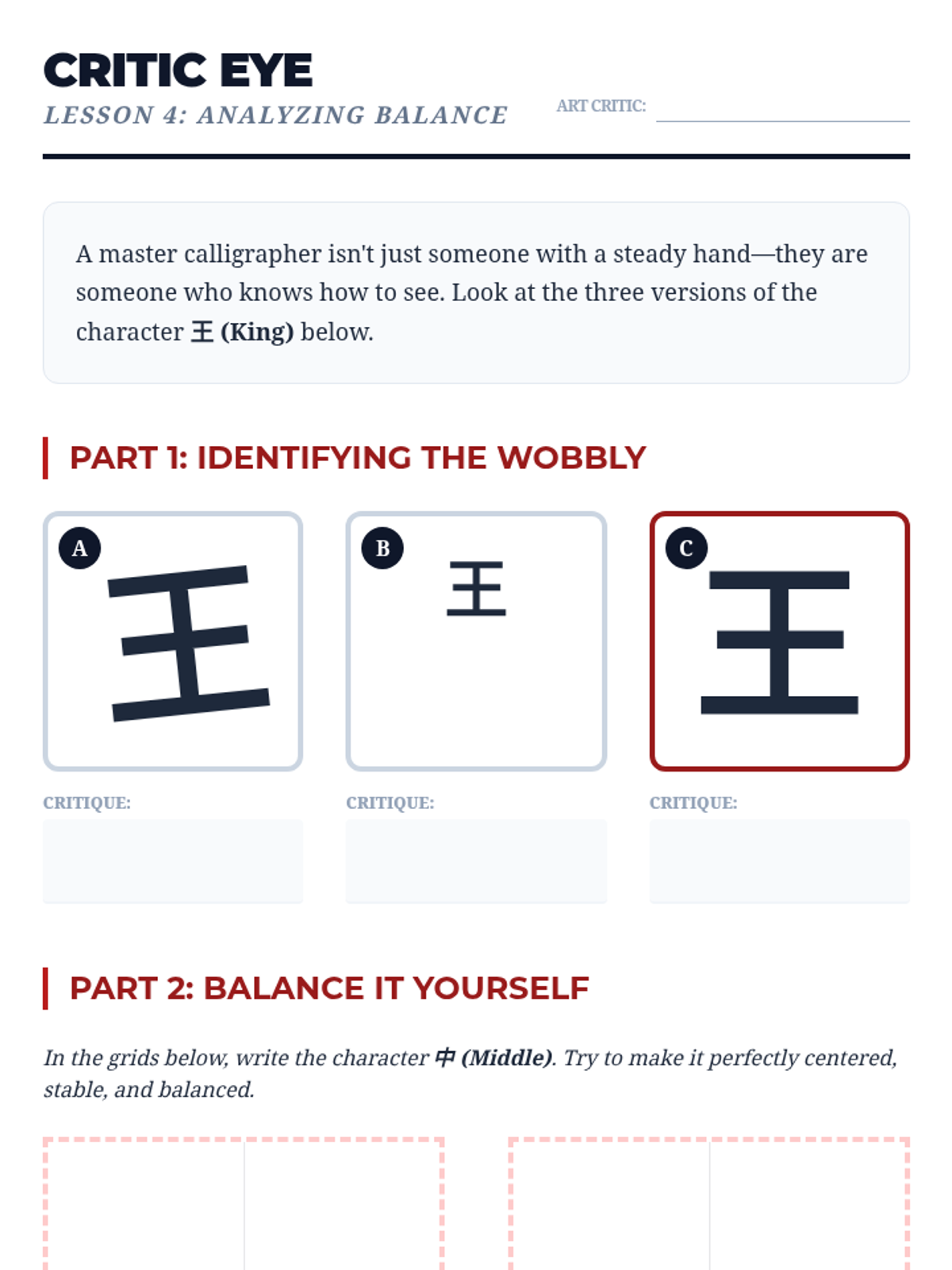
A worksheet for students to practice artistic critique by identifying structural flaws in sample characters and practicing balanced character composition.
A presentation exploring the aesthetic principles of Chinese calligraphy: the imaginary square, structural balance, and the importance of white space.
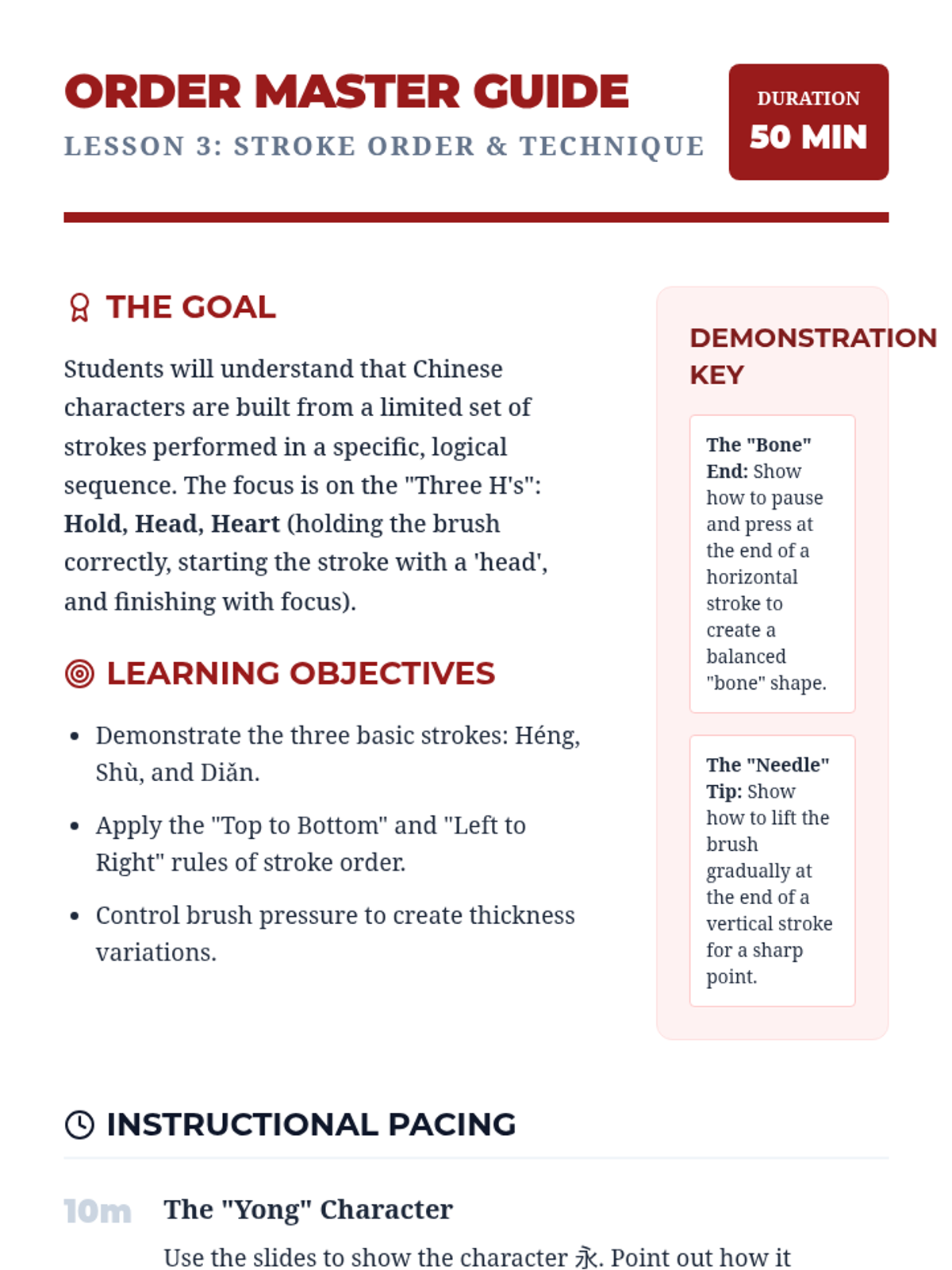
A detailed teacher guide for Lesson 3, including live demonstration scripts, correction strategies, and pacing for fundamental stroke mastery.
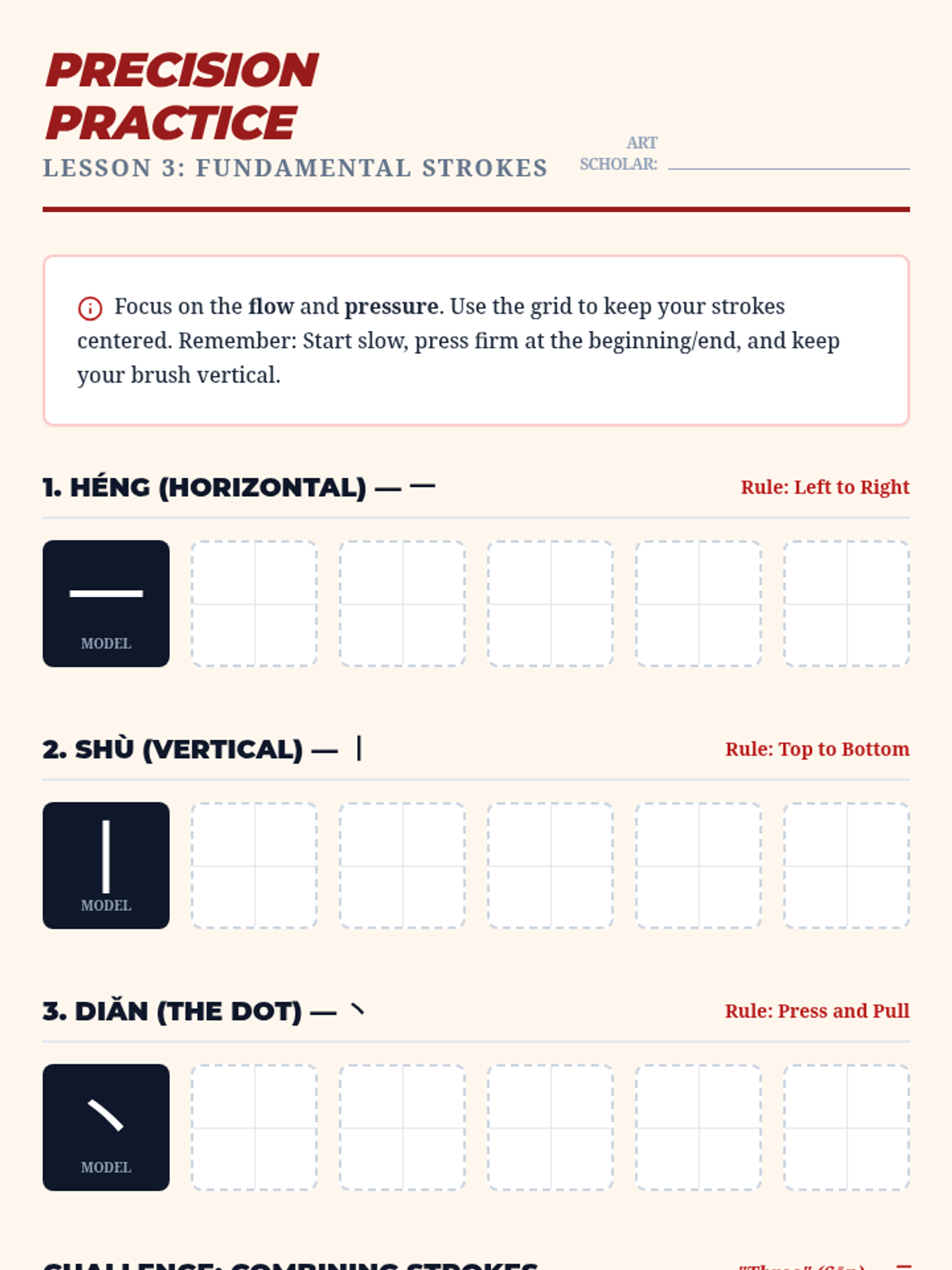
A grid-based practice sheet for students to master the three most essential strokes: Horizontal (Héng), Vertical (Shù), and Dot (Diǎn).
A visual guide to the eight fundamental strokes of Chinese calligraphy, using the 'Yong' character as a model.
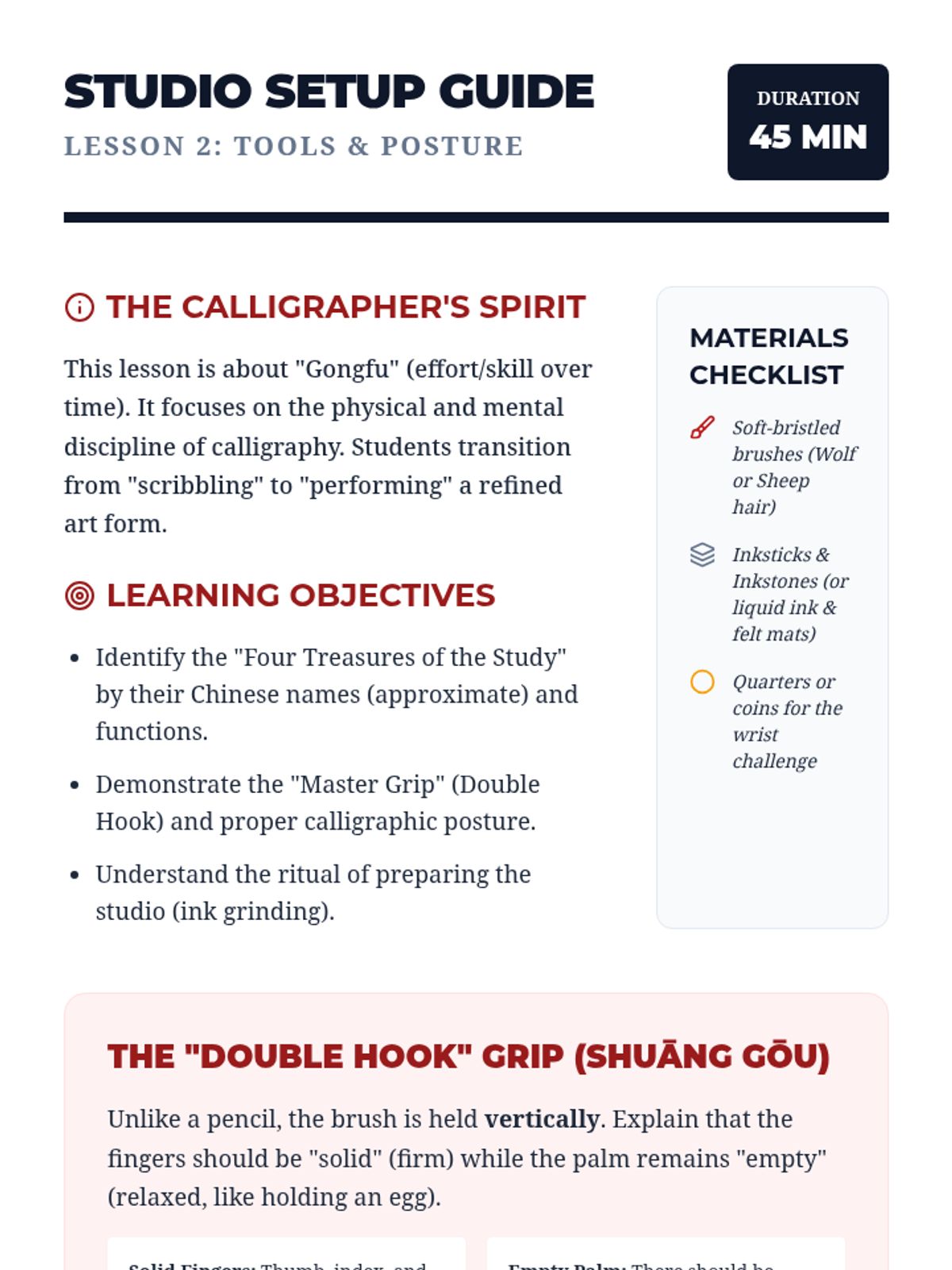
A teacher guide for Lesson 2 focusing on studio rituals, material management, and the 'Double Hook' brush grip.
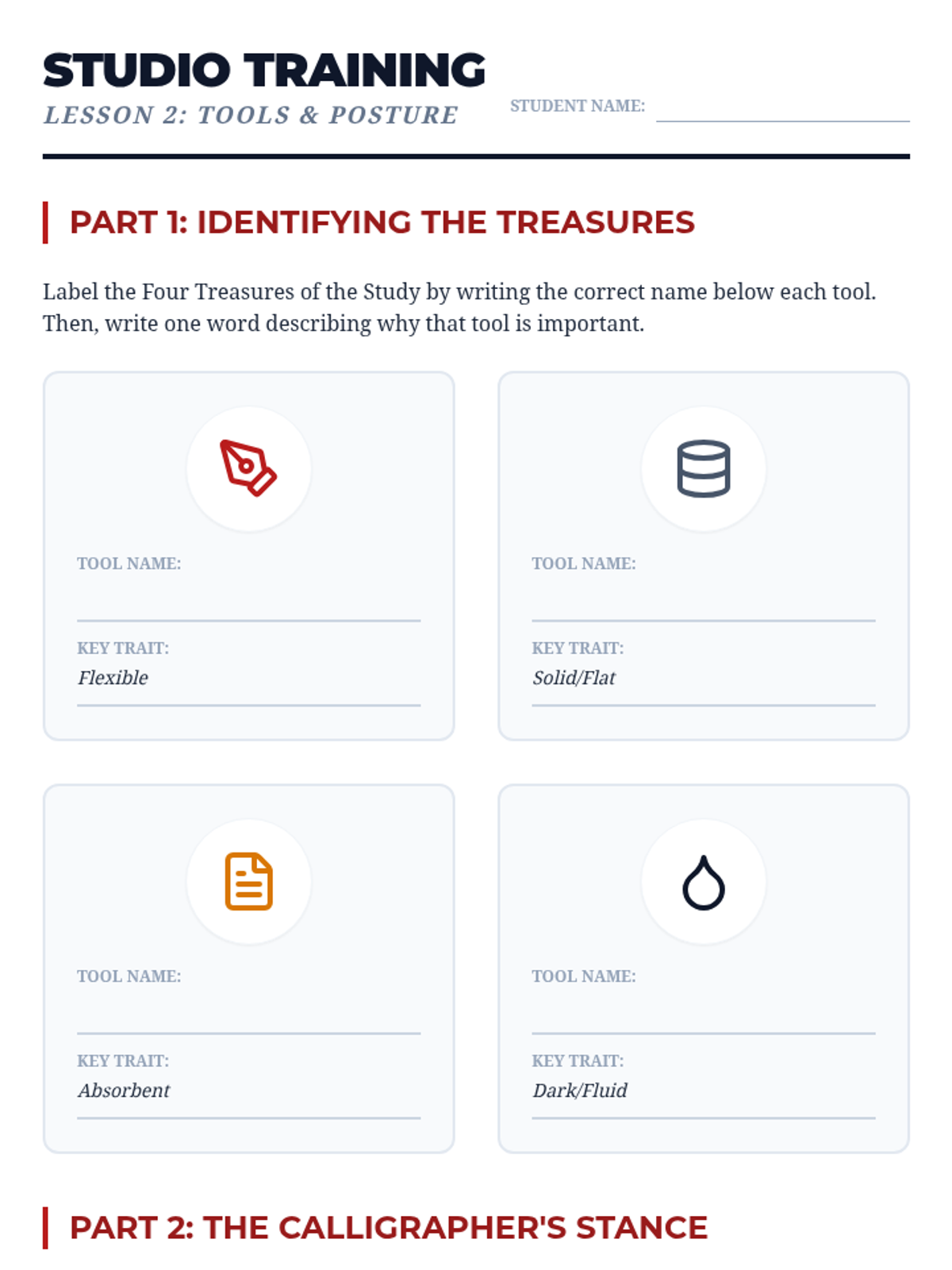
A worksheet for students to identify the Four Treasures of the Study and self-assess their calligraphic posture and readiness.
A presentation introducing the 'Four Treasures of the Study' and the essential postures and mindsets for Chinese calligraphy.
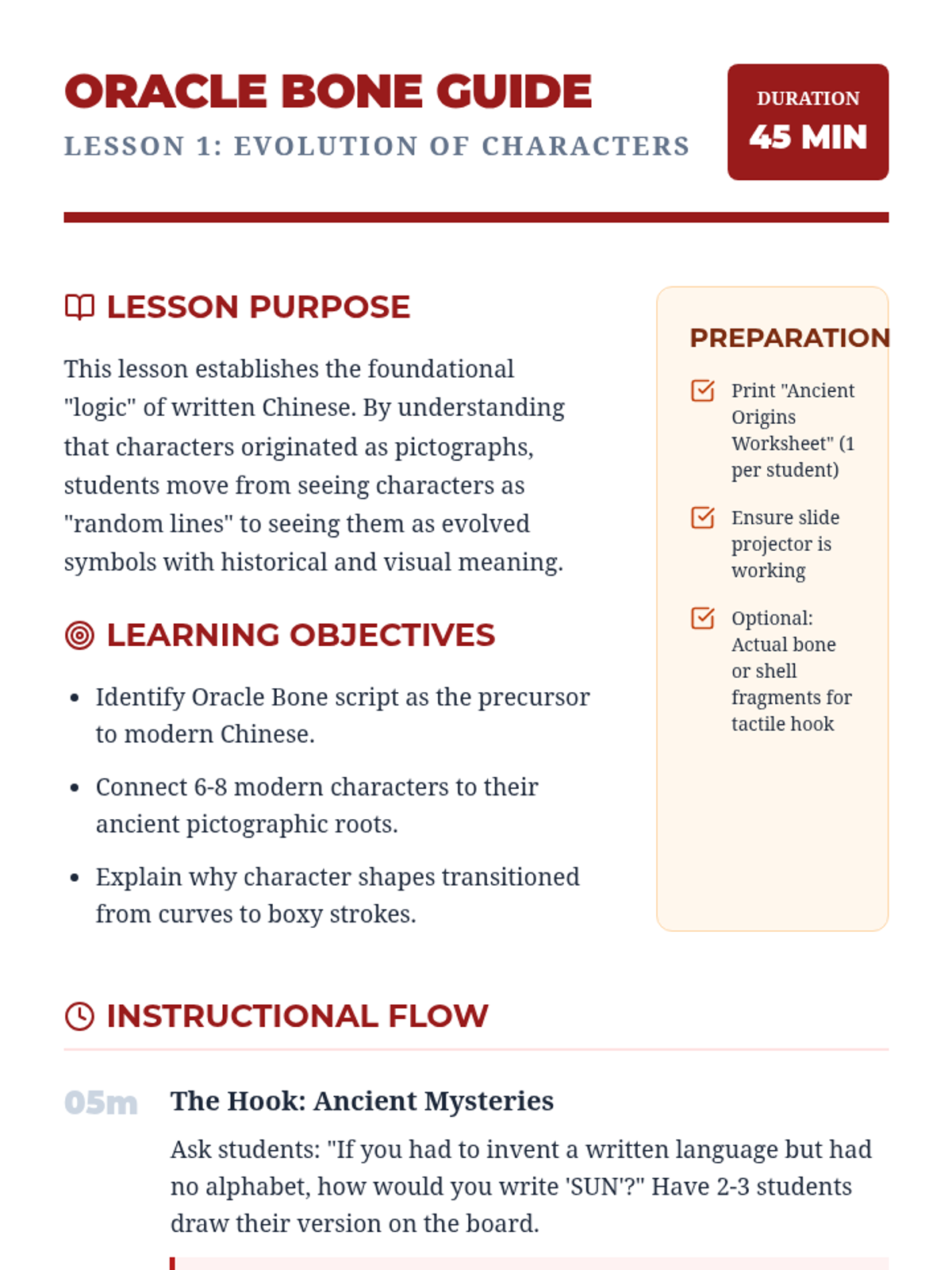
A comprehensive teacher guide for Lesson 1, including pacing, instructional script, activity answer keys, and discussion prompts.
A presentation guiding students through the evolution of Chinese characters from Oracle Bone script to modern forms.
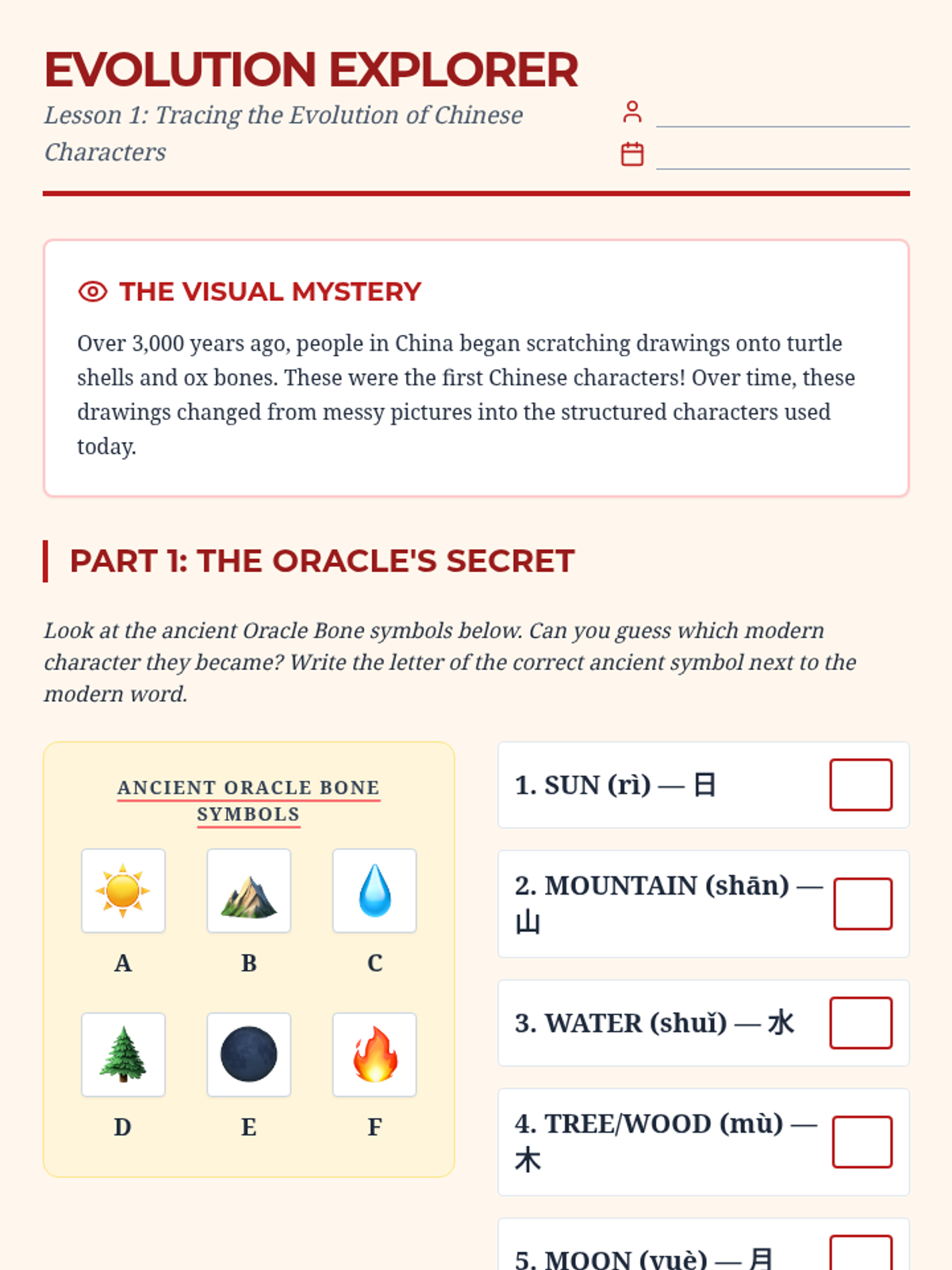
An introductory worksheet for students to match ancient Oracle Bone symbols with modern Chinese characters and explore the visual logic of character combinations.
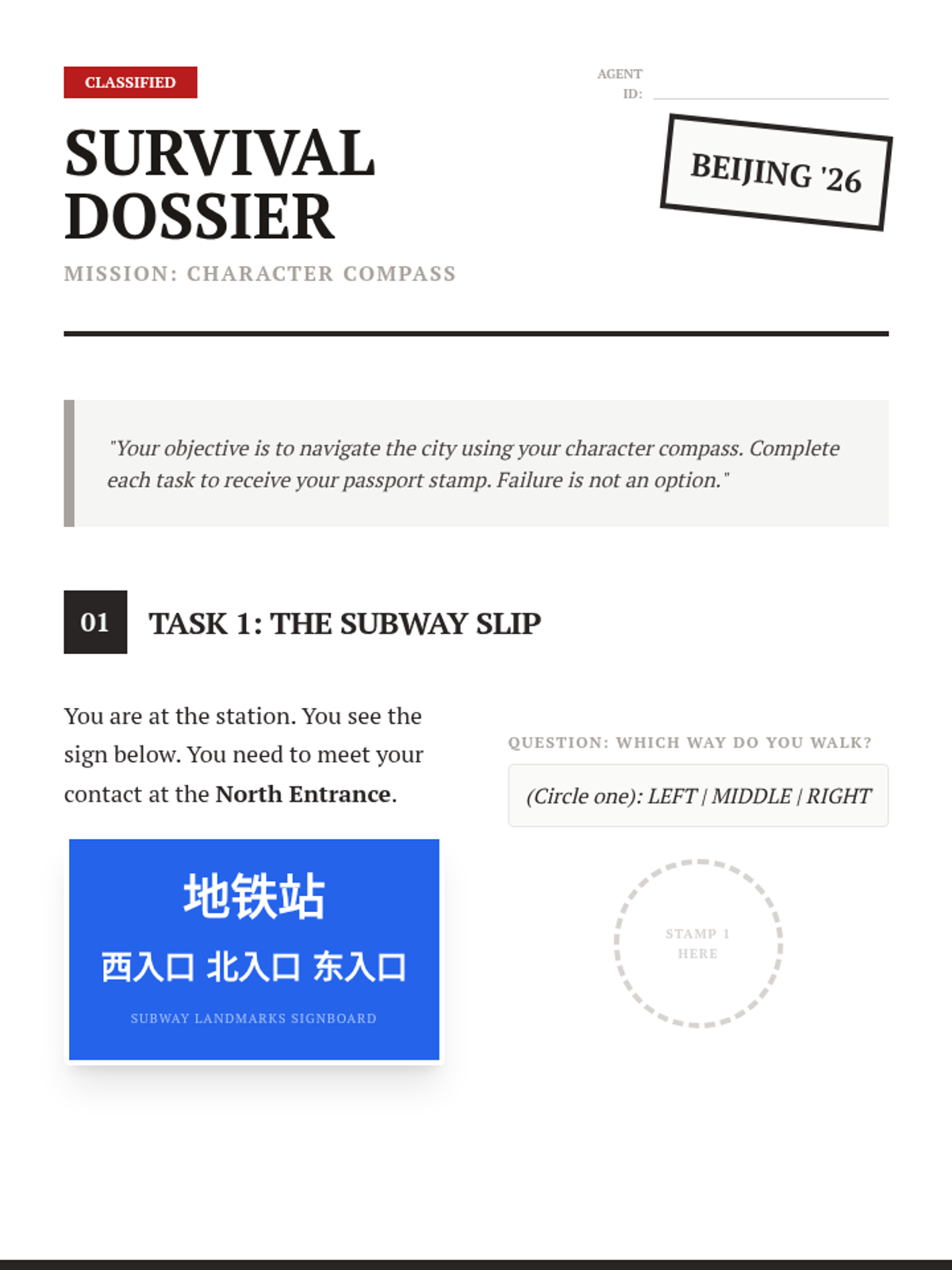
Student activity worksheet for Lesson 5, featuring a mission dossier and passport stamps to integrate all survival Mandarin skills.
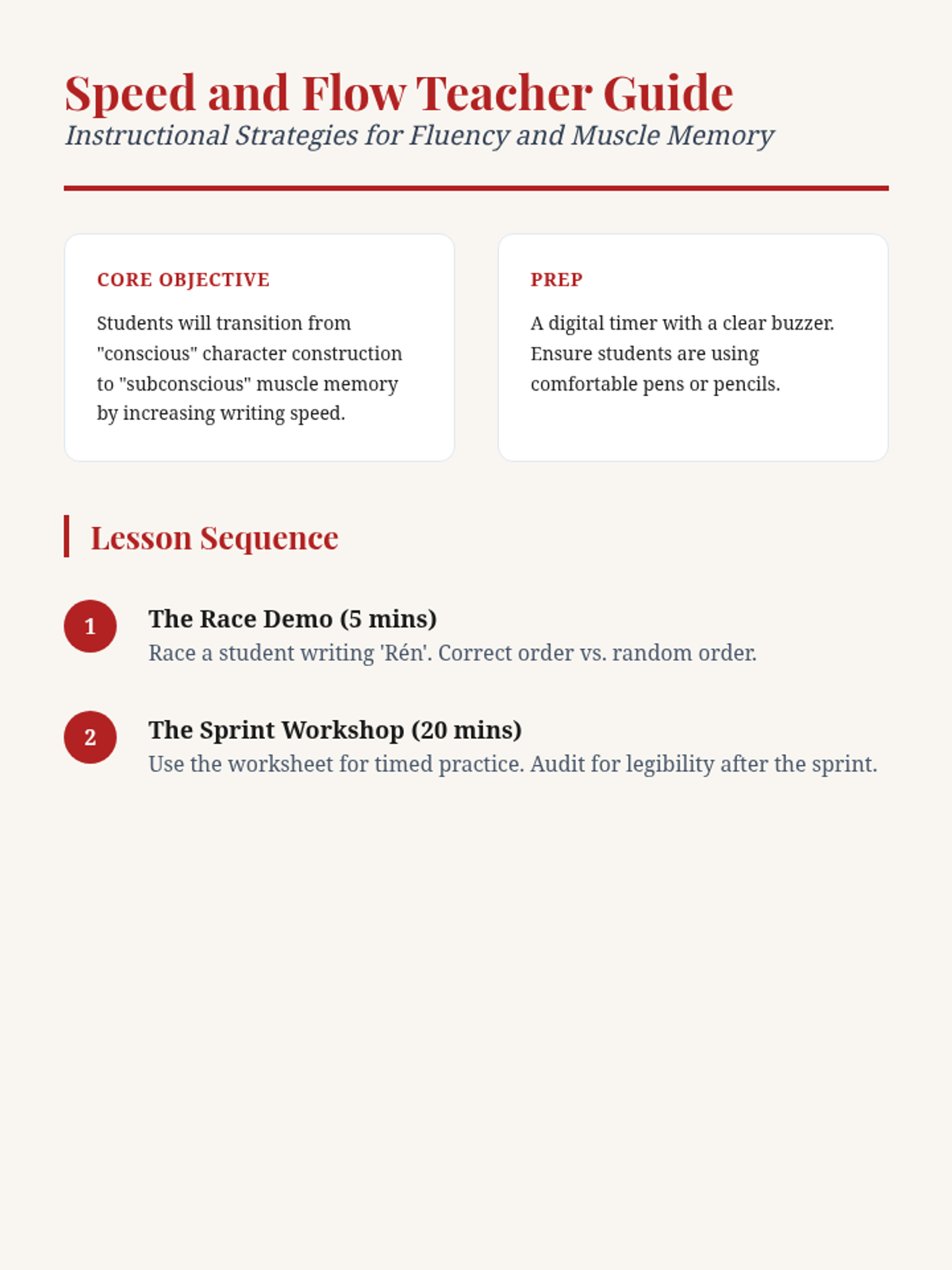
Teacher guide for Lesson 4: Speed and Flow. Provides strategies for teaching 'ghost strokes' and managing the Speed Sprint activity.
Instructional slides for Lesson 5, introducing the culminating survival scavenger hunt with mission parameters and vocabulary review.
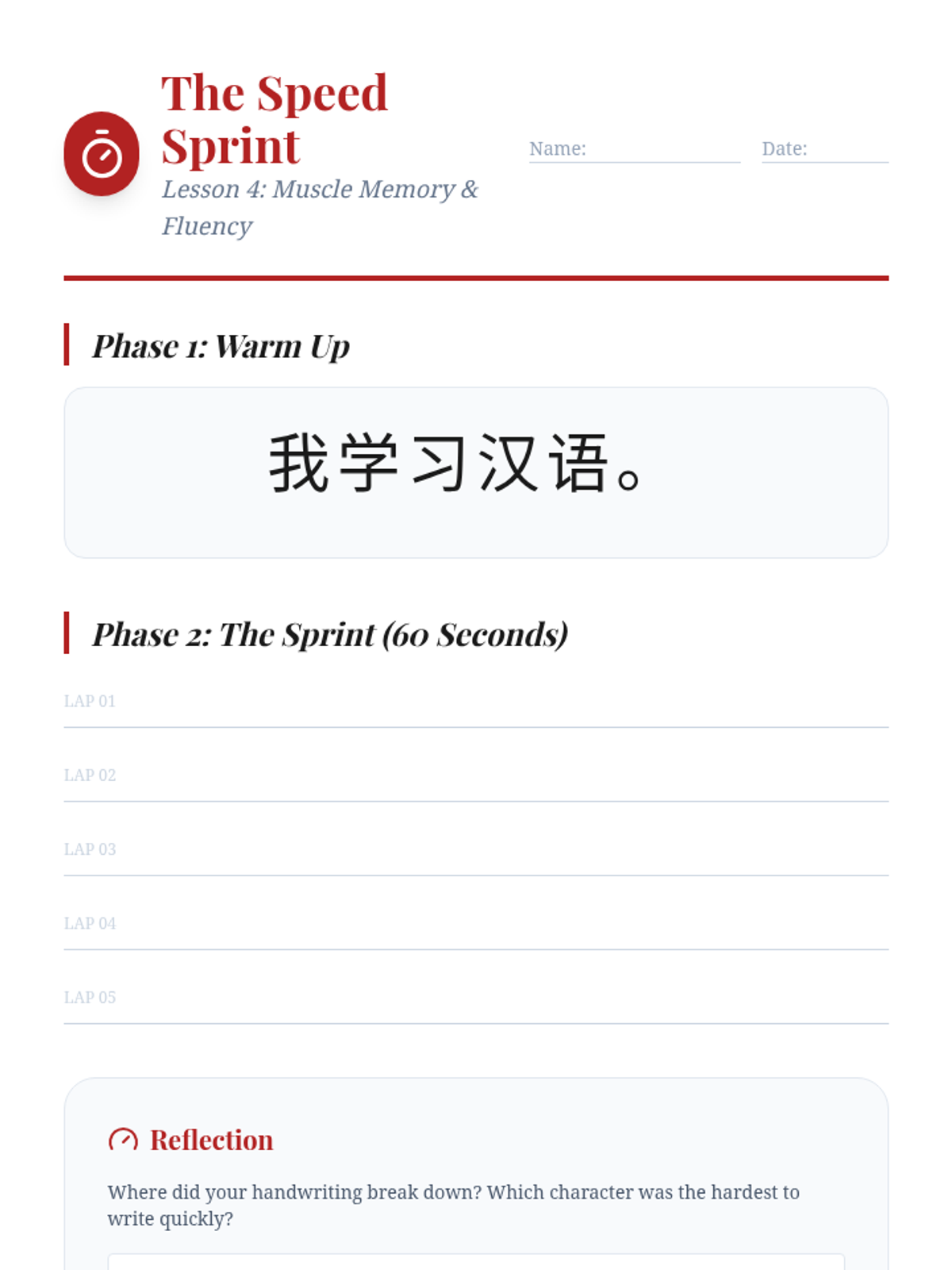
A timed writing activity sheet for practicing speed, fluency, and muscle memory in Mandarin sentence writing. It includes a warm-up phase, a 60-second sprint, and a reflection section.
A slide deck focused on the relationship between stroke order, speed, and muscle memory. It explains how correct mechanics allow for faster, more legible writing.
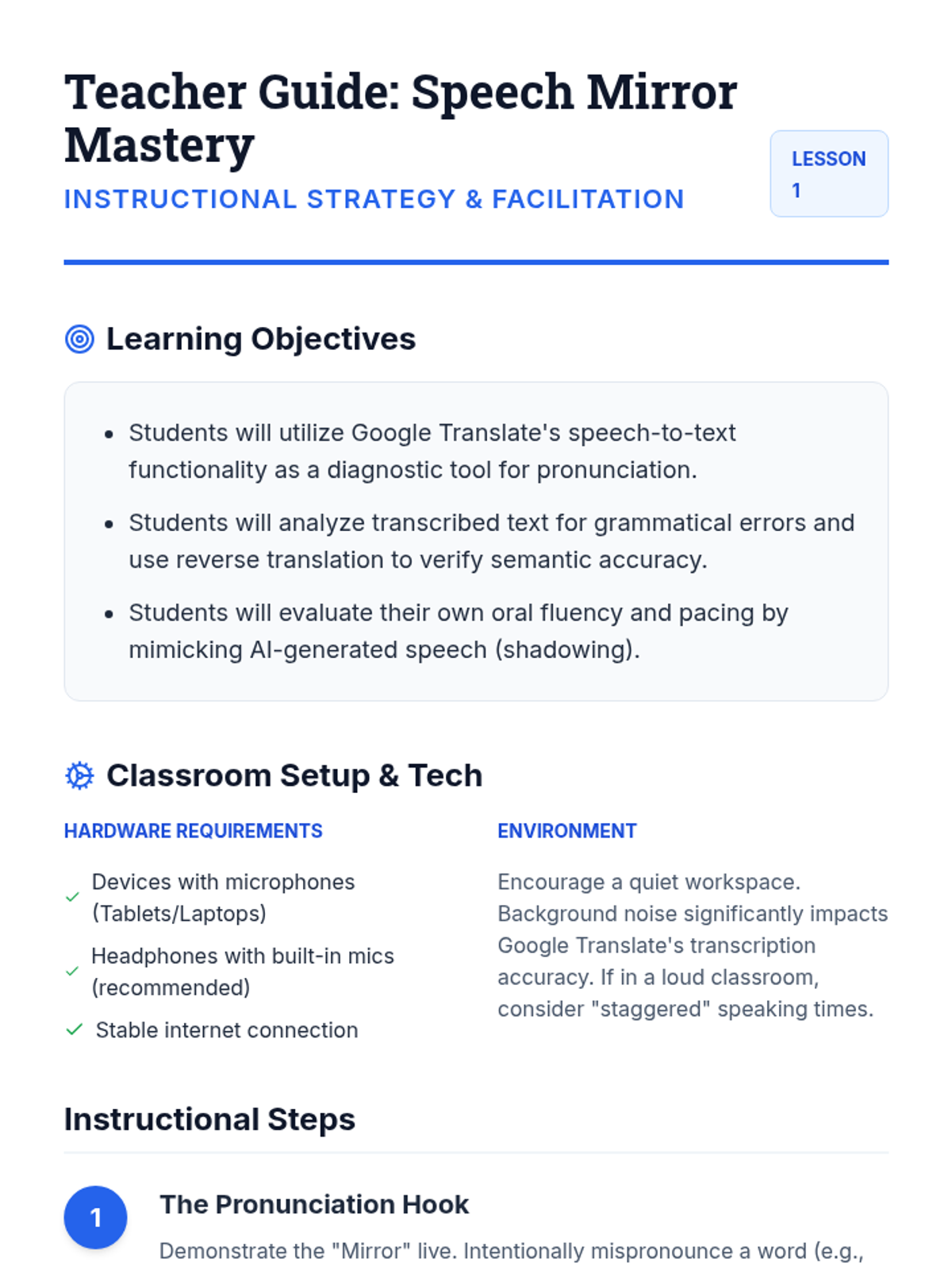
A comprehensive teacher guide for facilitating the 'Speech Mirror' activity. Includes instructional strategies, tech requirements, common pitfalls, and assessment criteria.
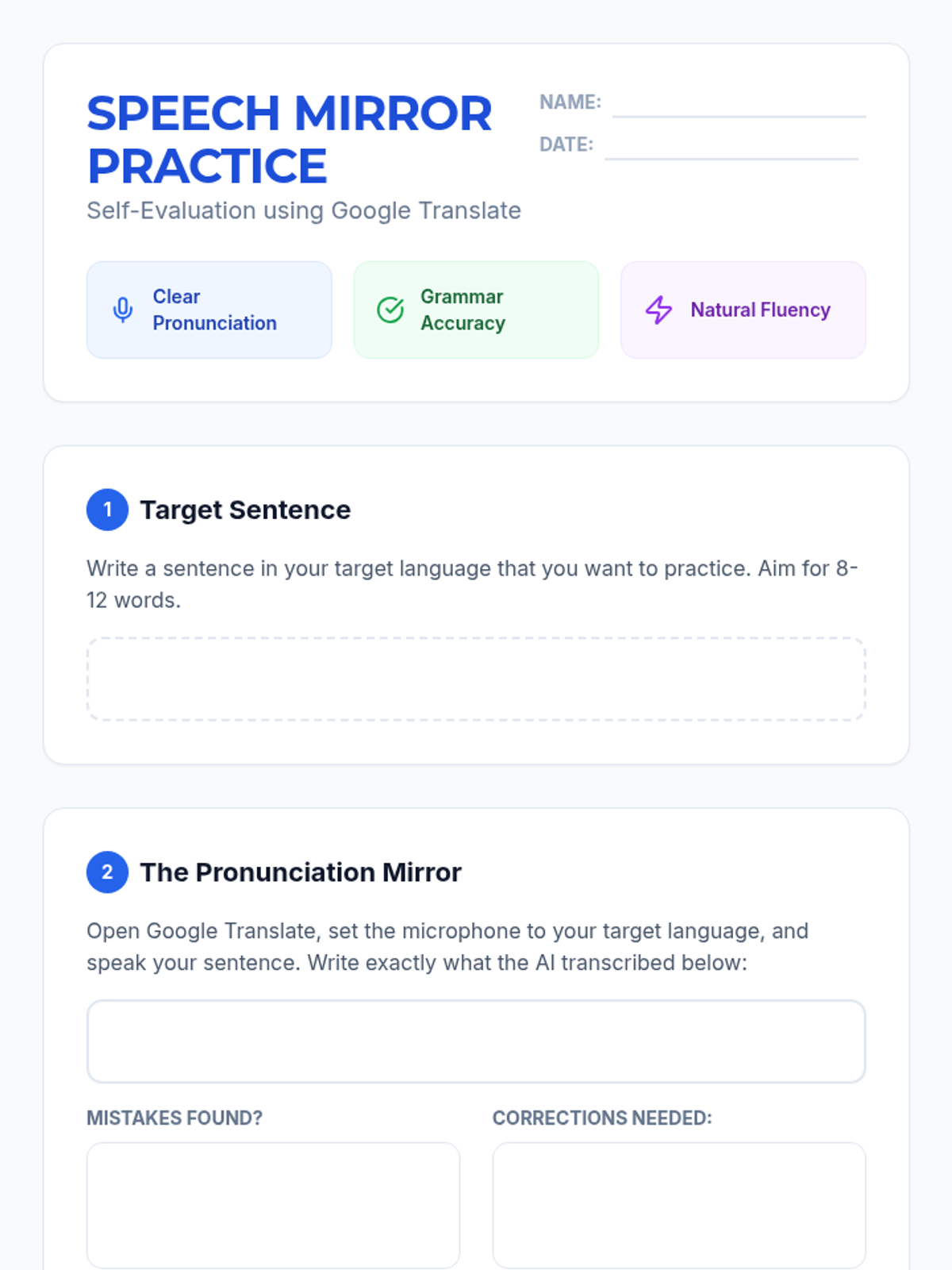
A step-by-step activity sheet for students to practice using Google Translate as a speech mirror. Includes sections for transcription review, grammar check, and fluency challenges. Updated for better handwriting legibility.
A visual presentation explaining the 'Speech Mirror' technique. It provides a tutorial on using Google Translate's voice features to assess pronunciation, grammar, and fluency. Updated with larger text for accessibility.
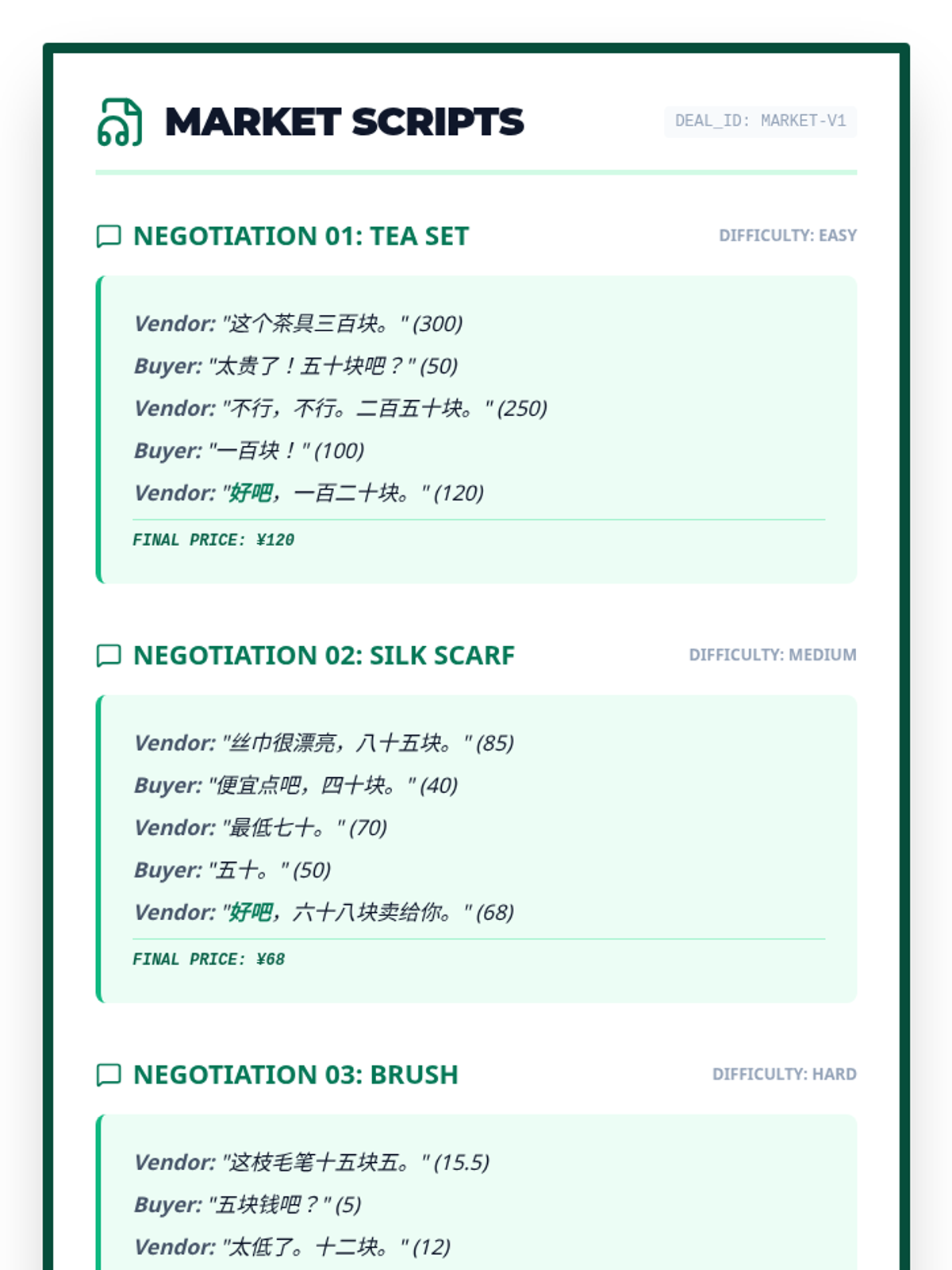
Teacher audio script for Lesson 5 bargaining simulations. Includes four levels of difficulty with full Mandarin dialogue and English price keys.
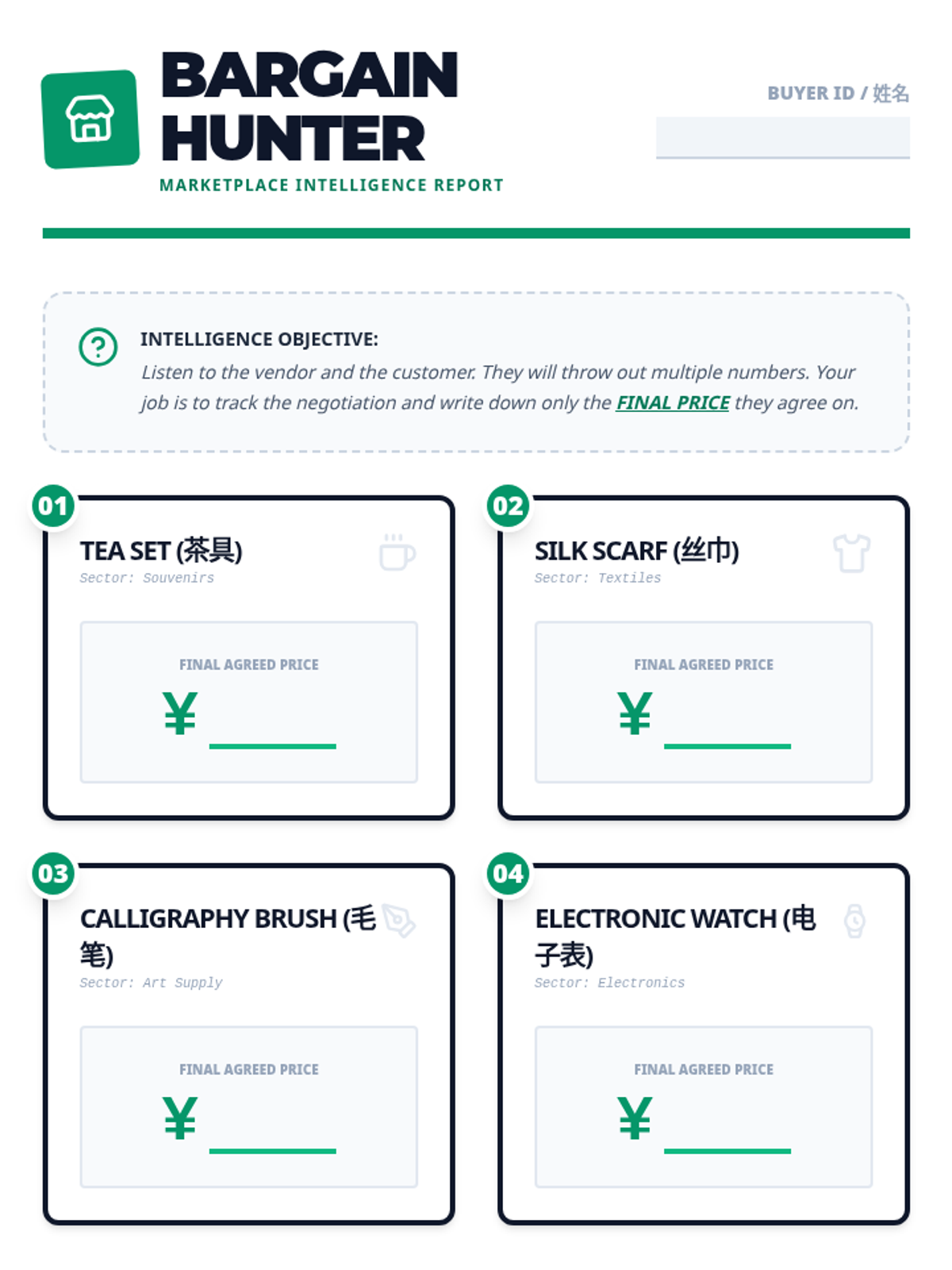
Worksheet for identifying final agreed prices in marketplace negotiations. Features a 'Bargain Hunter' report design with items like tea sets and electronics.
Slides for Lesson 5 on currency and price. Introduces 'kuai', 'mao', and 'fen' units, essential bargaining phrases, and strategies for identifying final agreed prices.
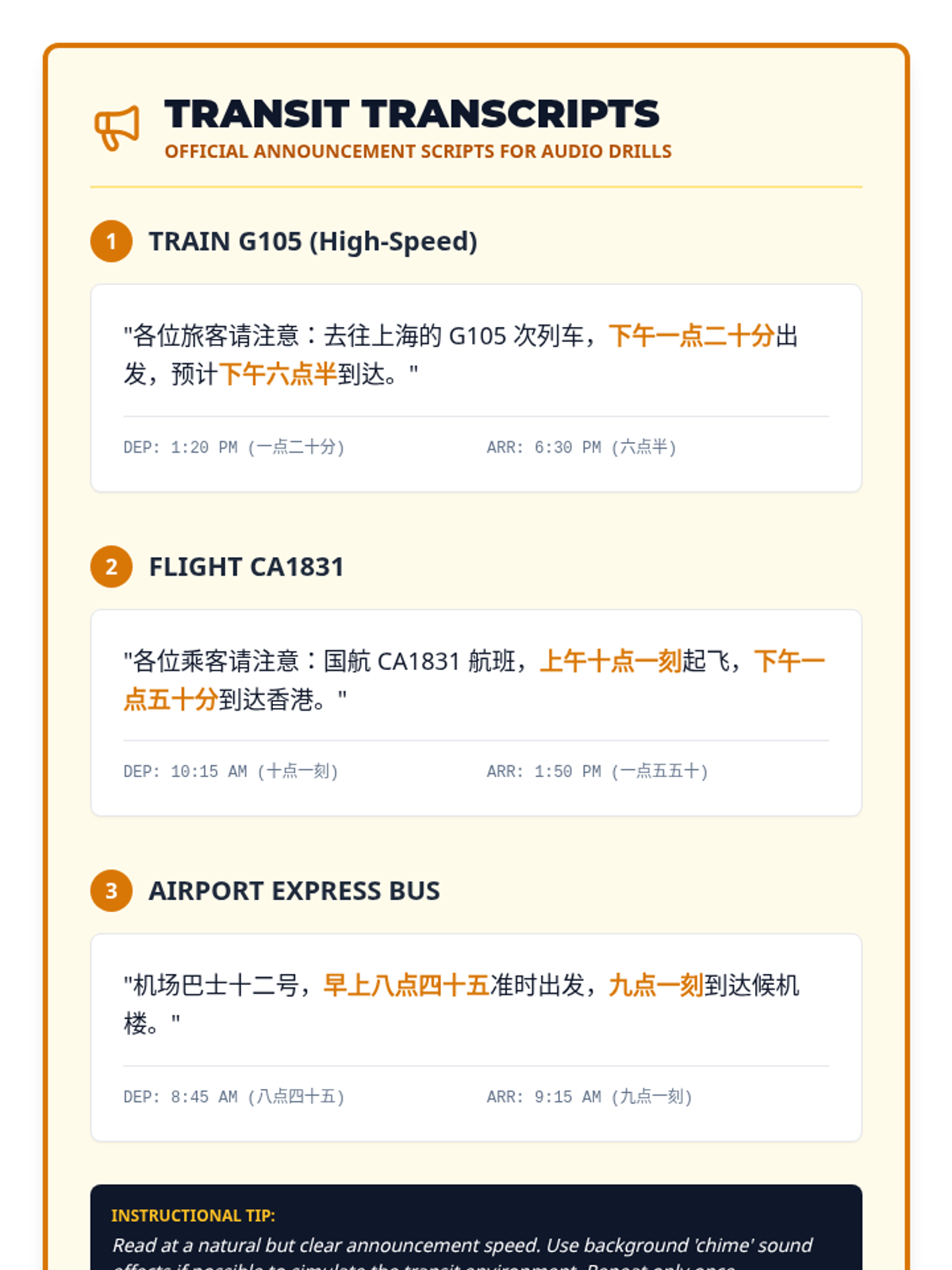
Audio transcripts for Lesson 4 transit announcements. Provides the Mandarin text and English answer keys for teacher-led listening practice.
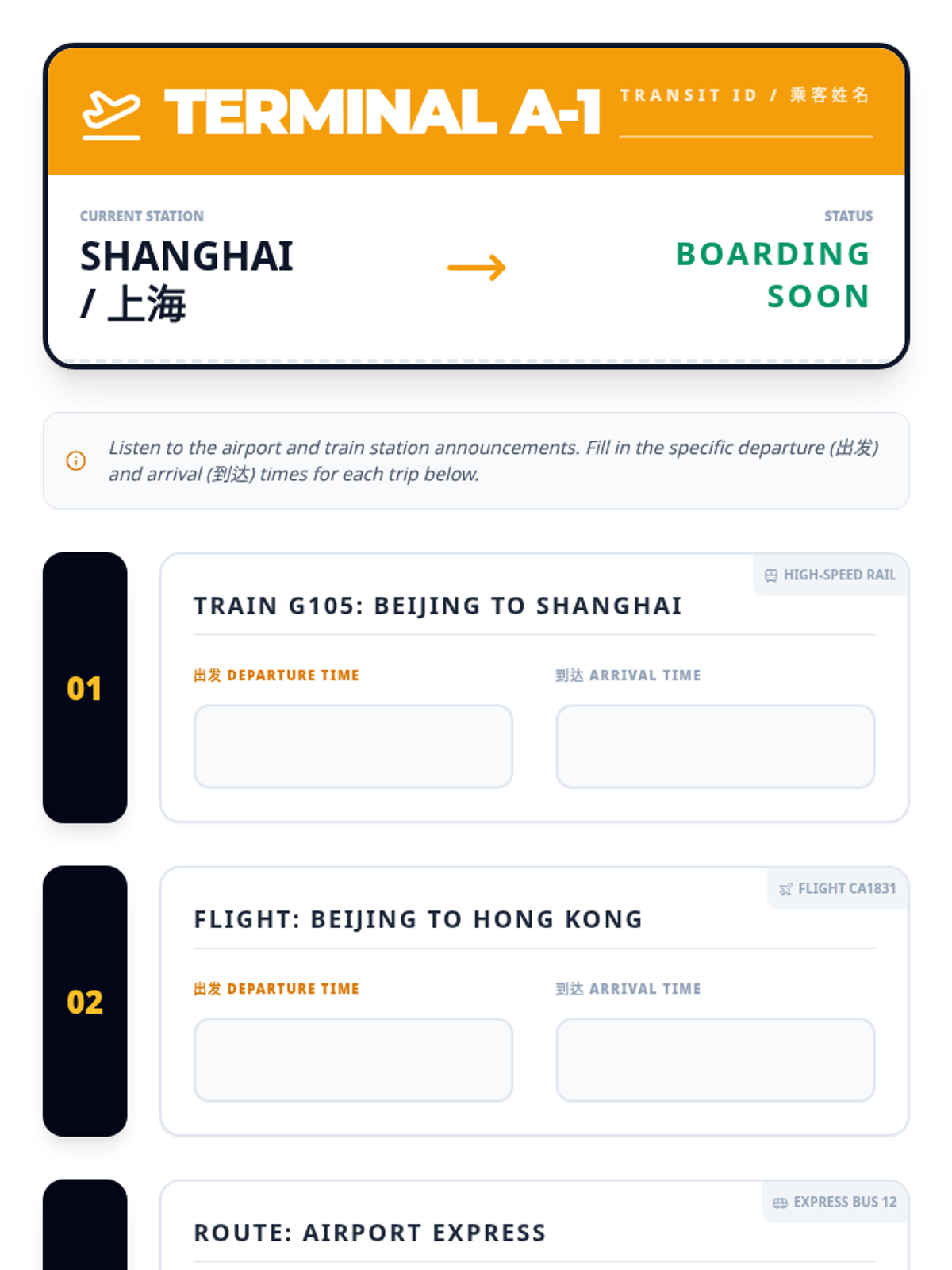
Worksheet for extracting time data from transit announcements. Designed like a boarding pass, students record departure and arrival times for trains, flights, and buses.
Slides for Lesson 4 on time and schedules. Explains 'dian', 'fen', 'ban', and 'ke' components and introduces transit vocabulary (departure/arrival).
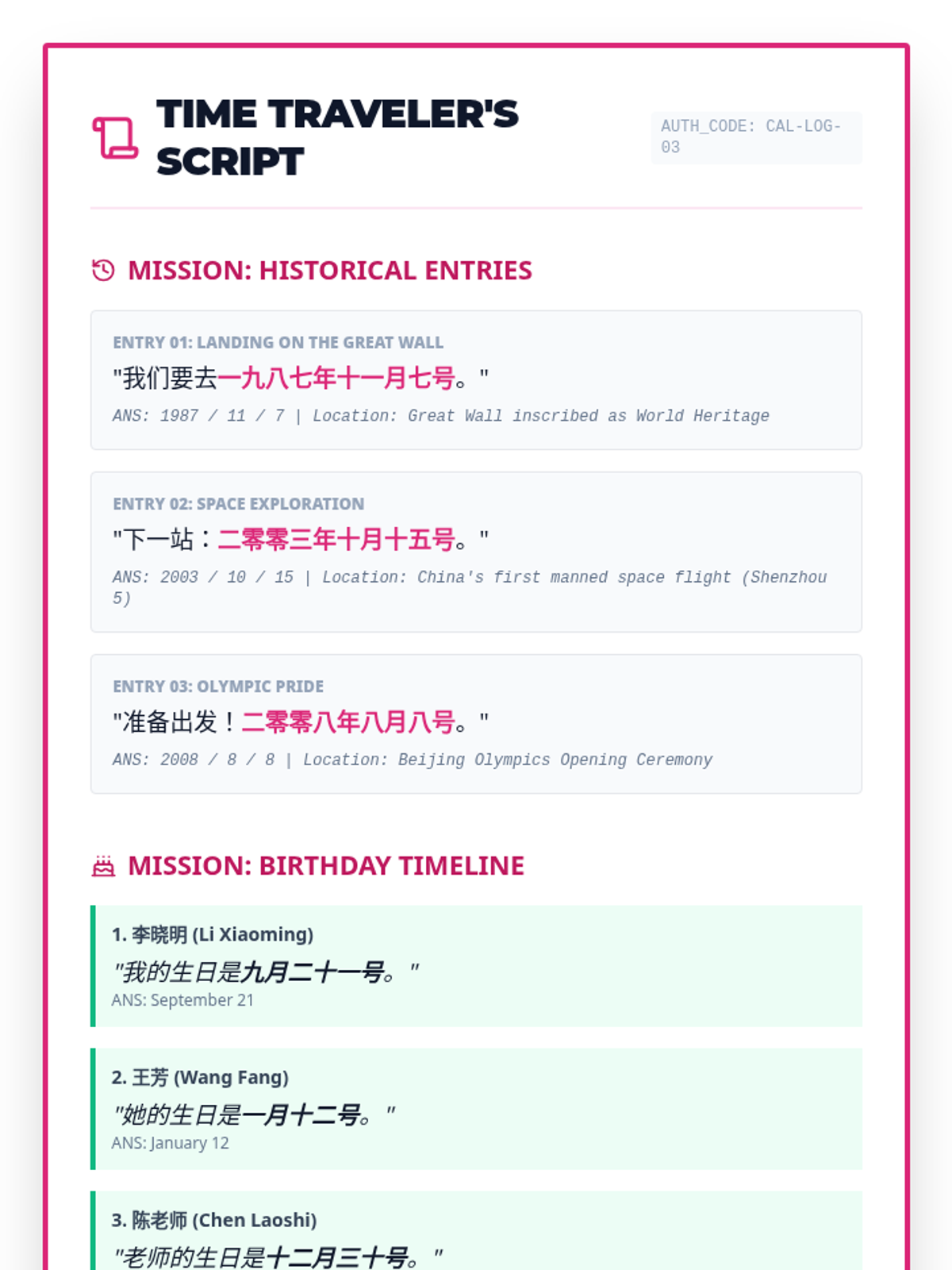
Teacher audio script for Lesson 3, featuring historical dates for the Time Traveler simulation and personal birthday listening exercises.
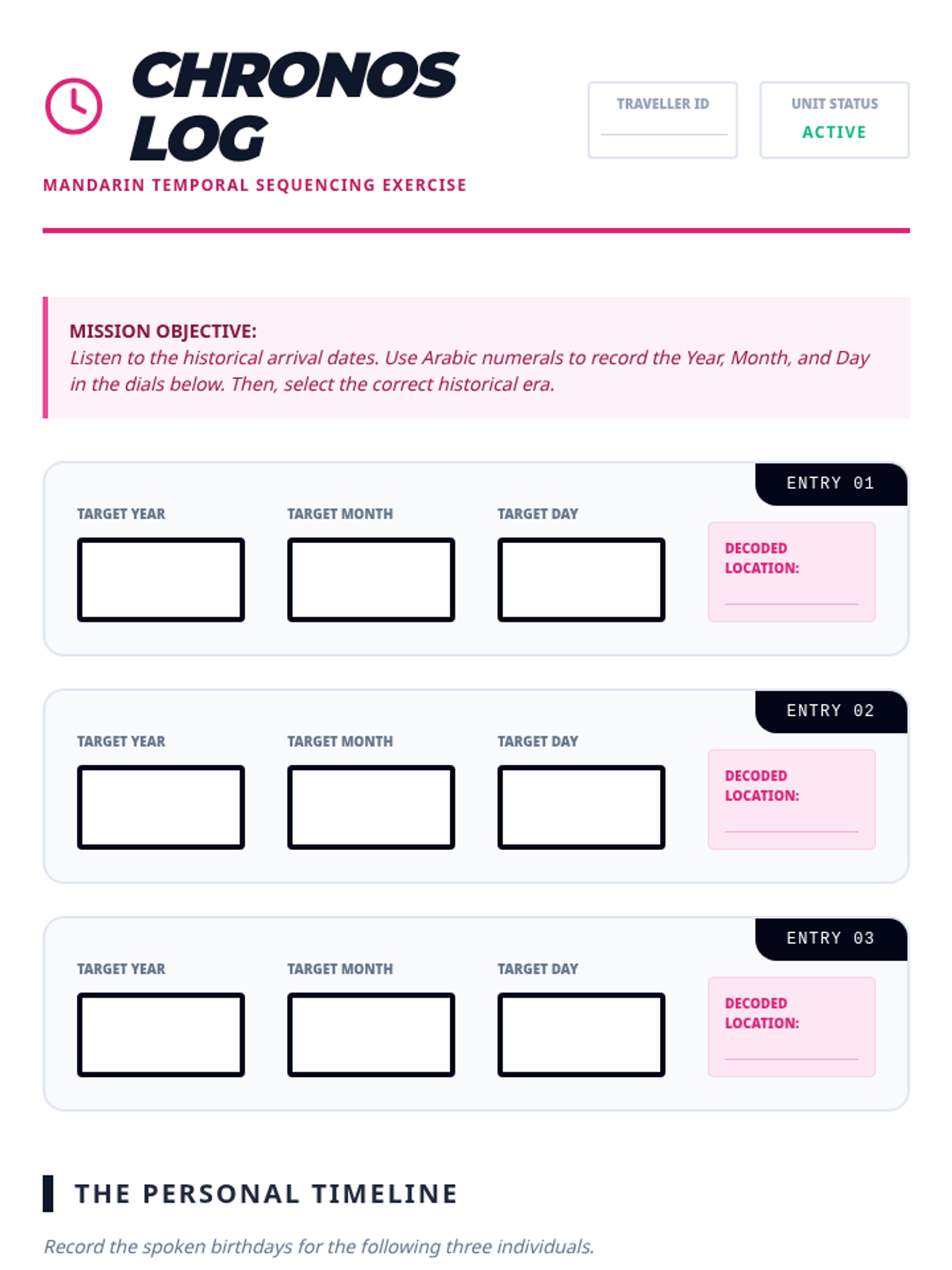
Worksheet for auditory calendar date processing. Features a 'Chronos Log' design for historical dates and personal birthday recording.
Slides for Lesson 3 on calendar dates in Mandarin. Covers Year-Month-Day order, how to say years digit-by-digit, and introduces the Time Traveler activity.
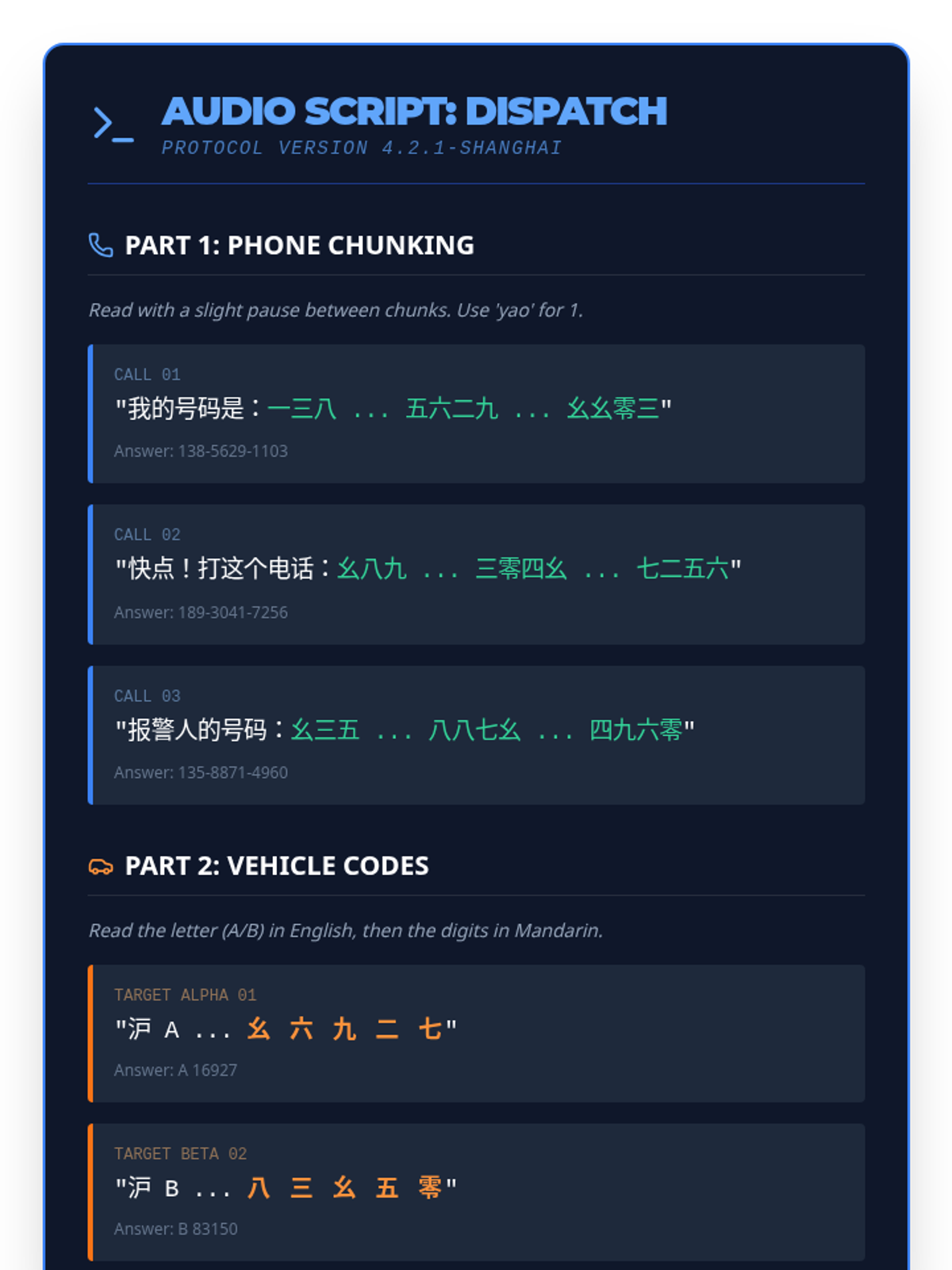
Teacher audio script for Lesson 2 featuring emergency call simulations with phone numbers (using 'yao') and vehicle license plate tracking.
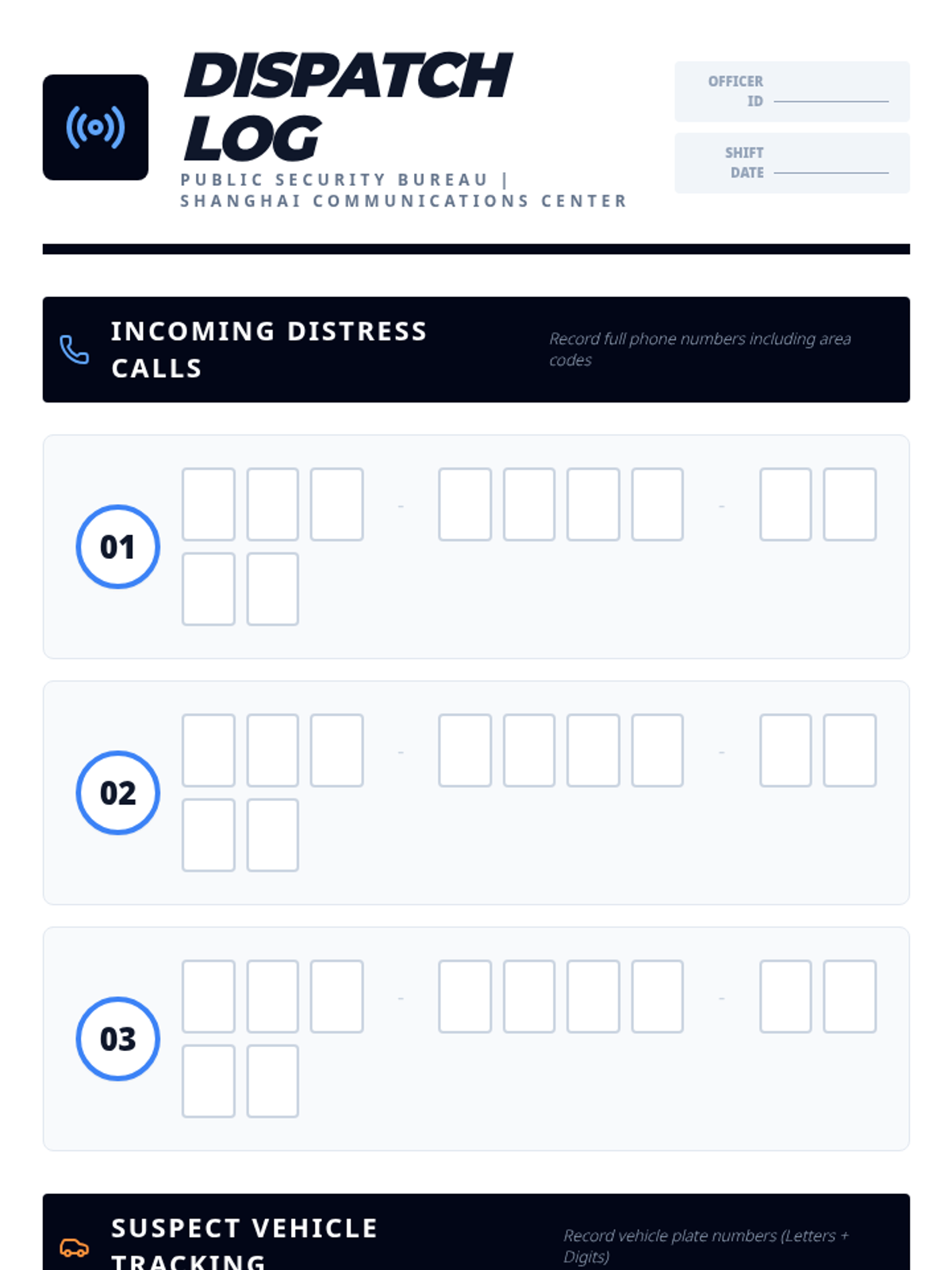
Worksheet for recording phone numbers and vehicle codes in Mandarin. Features high-contrast dispatch log design with boxes for individual digit entry.
Slide deck for Lesson 2 focusing on phone numbers and codes. Introduces the 'yao' rule for the number 1 and strategies for auditory digit span.
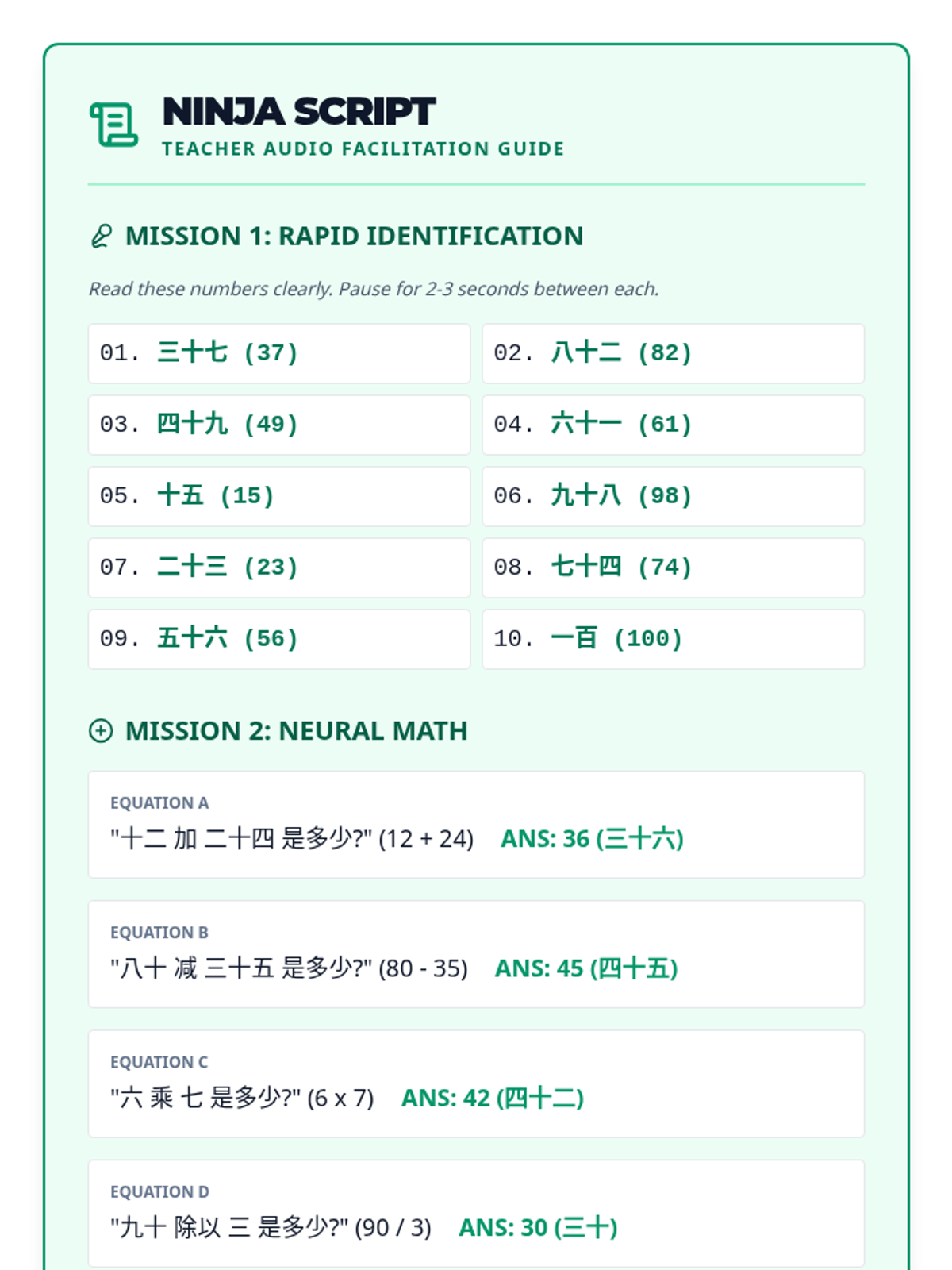
Teacher's script for auditory drills, providing the Mandarin text and answers for the Number Ninja activities.
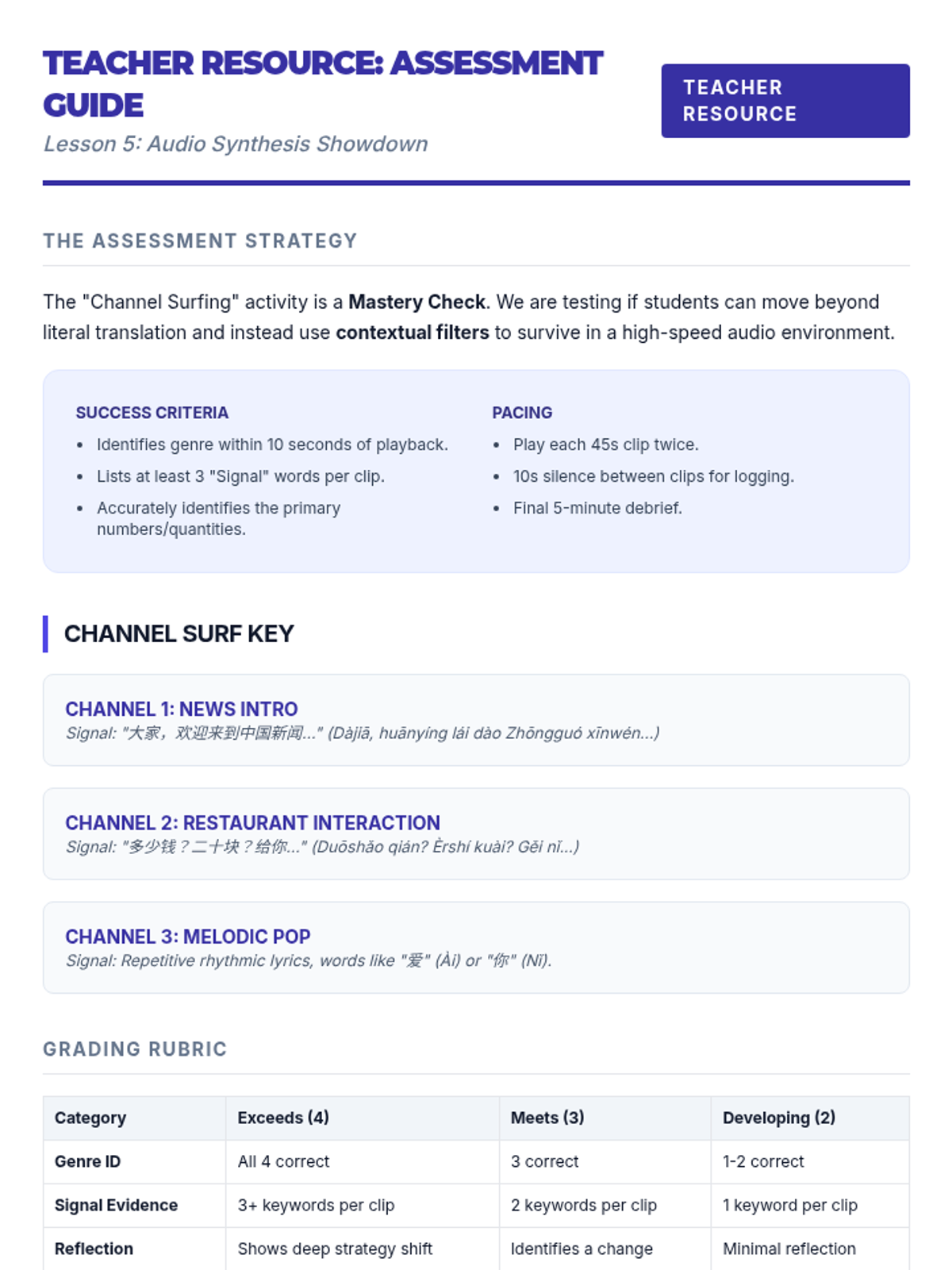
A final assessment guide for teachers, featuring success criteria, channel surfing keys, and a grading rubric for Mandarin listening synthesis.
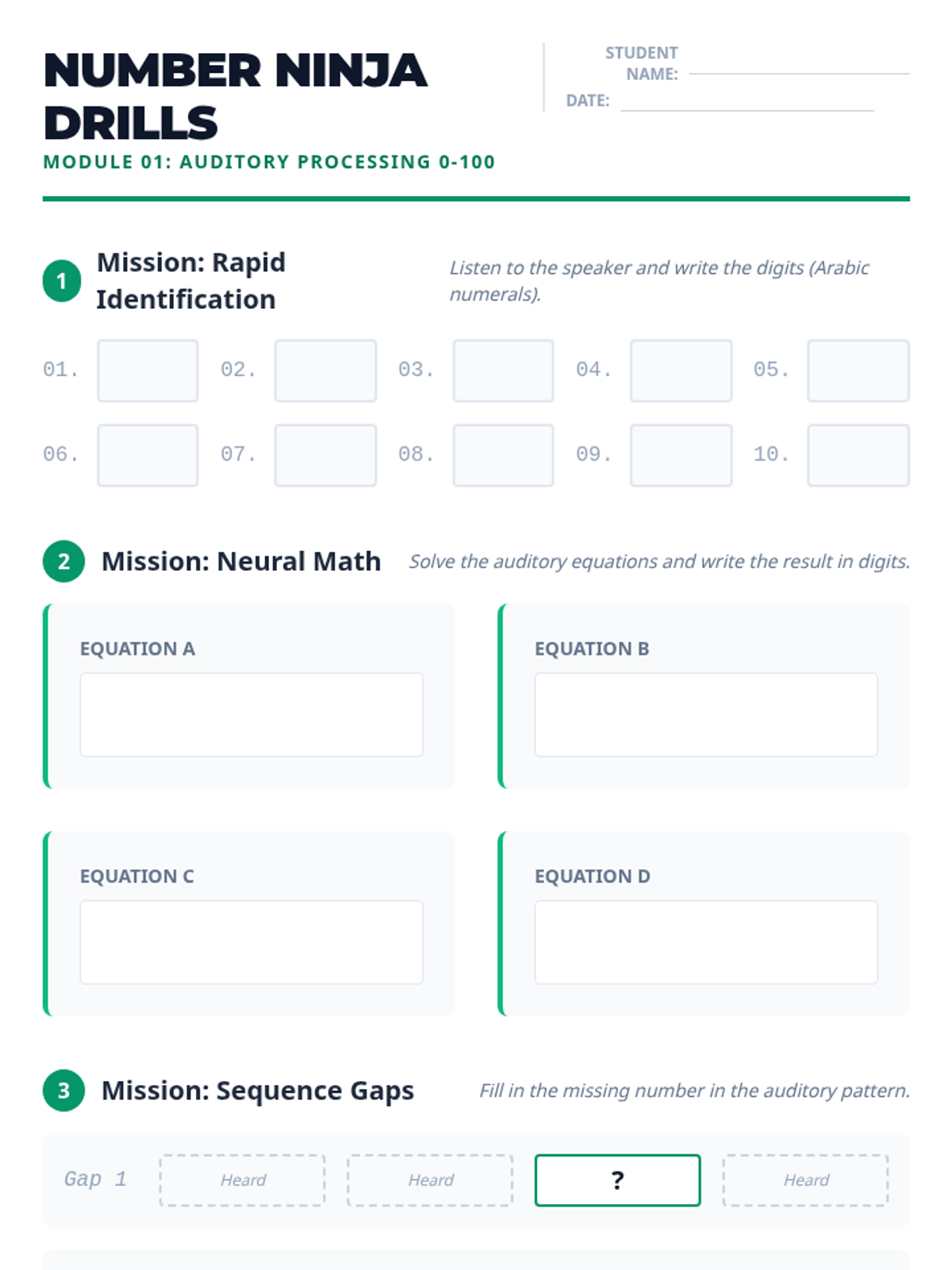
Worksheet for auditory number recognition and mental math drills in Mandarin 0-100. Includes space for digits, equations, and sequence patterns.
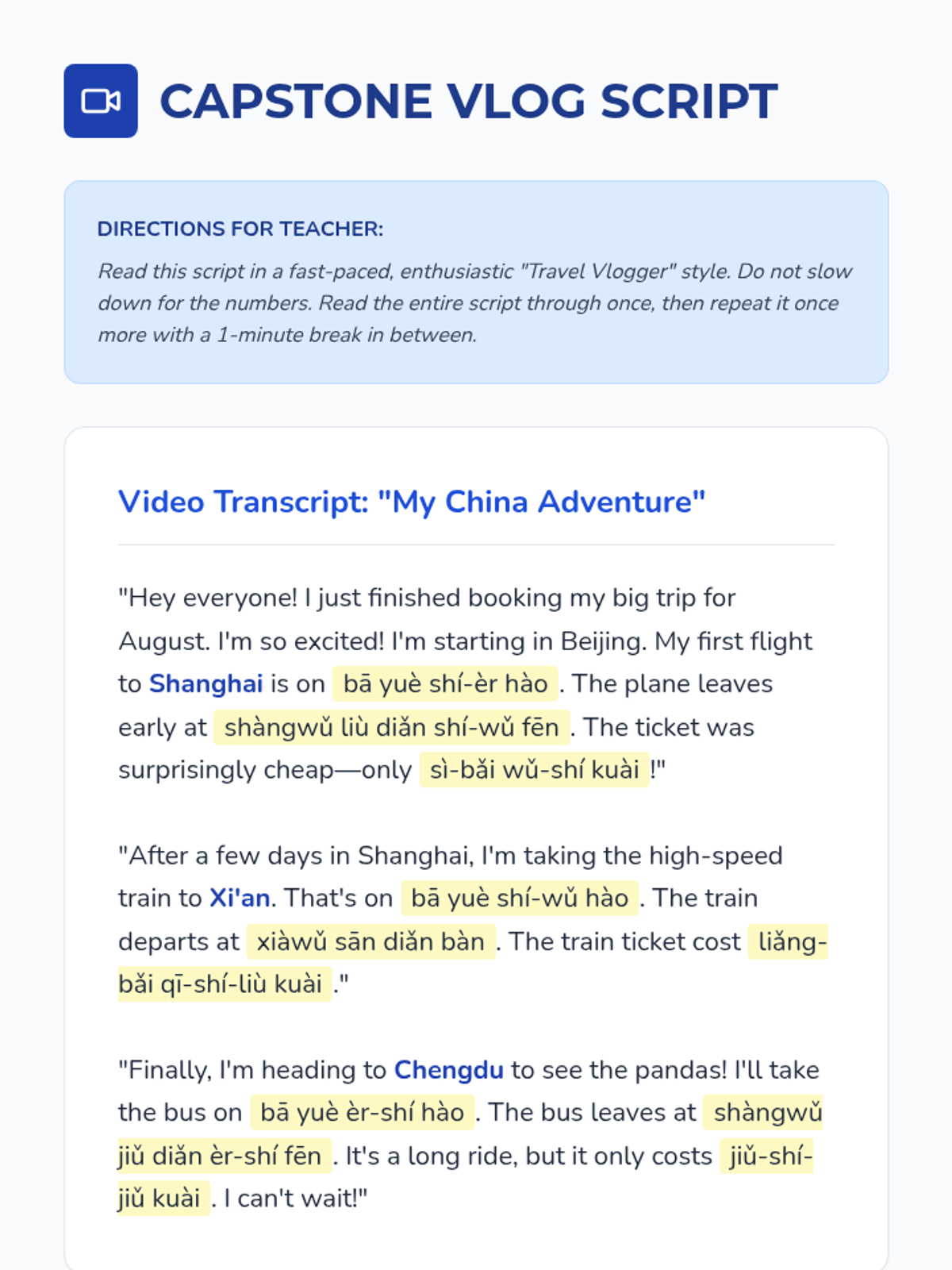
Final capstone listening script for the Travel Vlog activity, including the full monologue and a comprehensive teacher answer key.
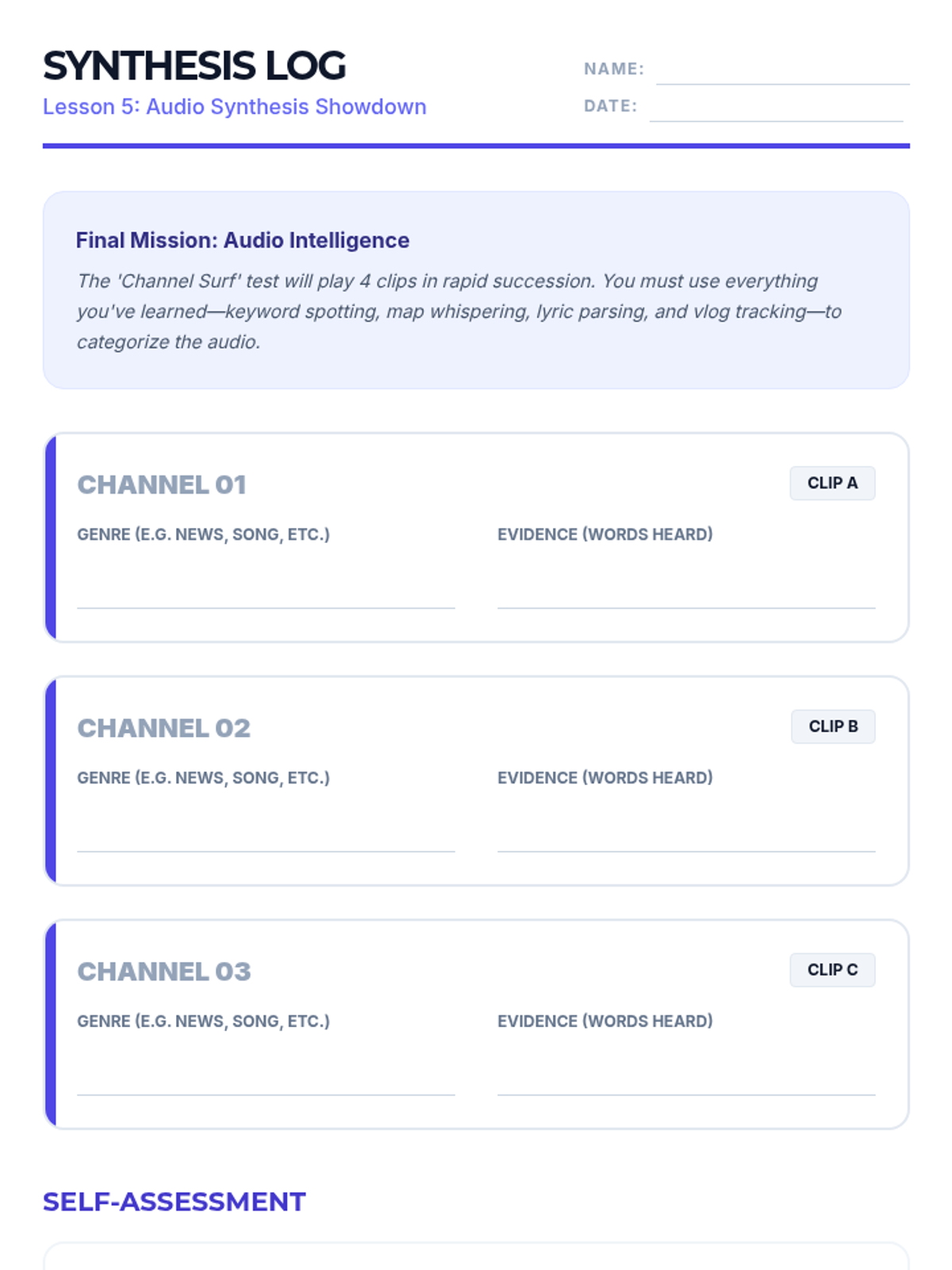
A synthesis log for the final 'Channel Surfing' activity, where students categorize multiple Mandarin audio genres and provide keyword evidence.
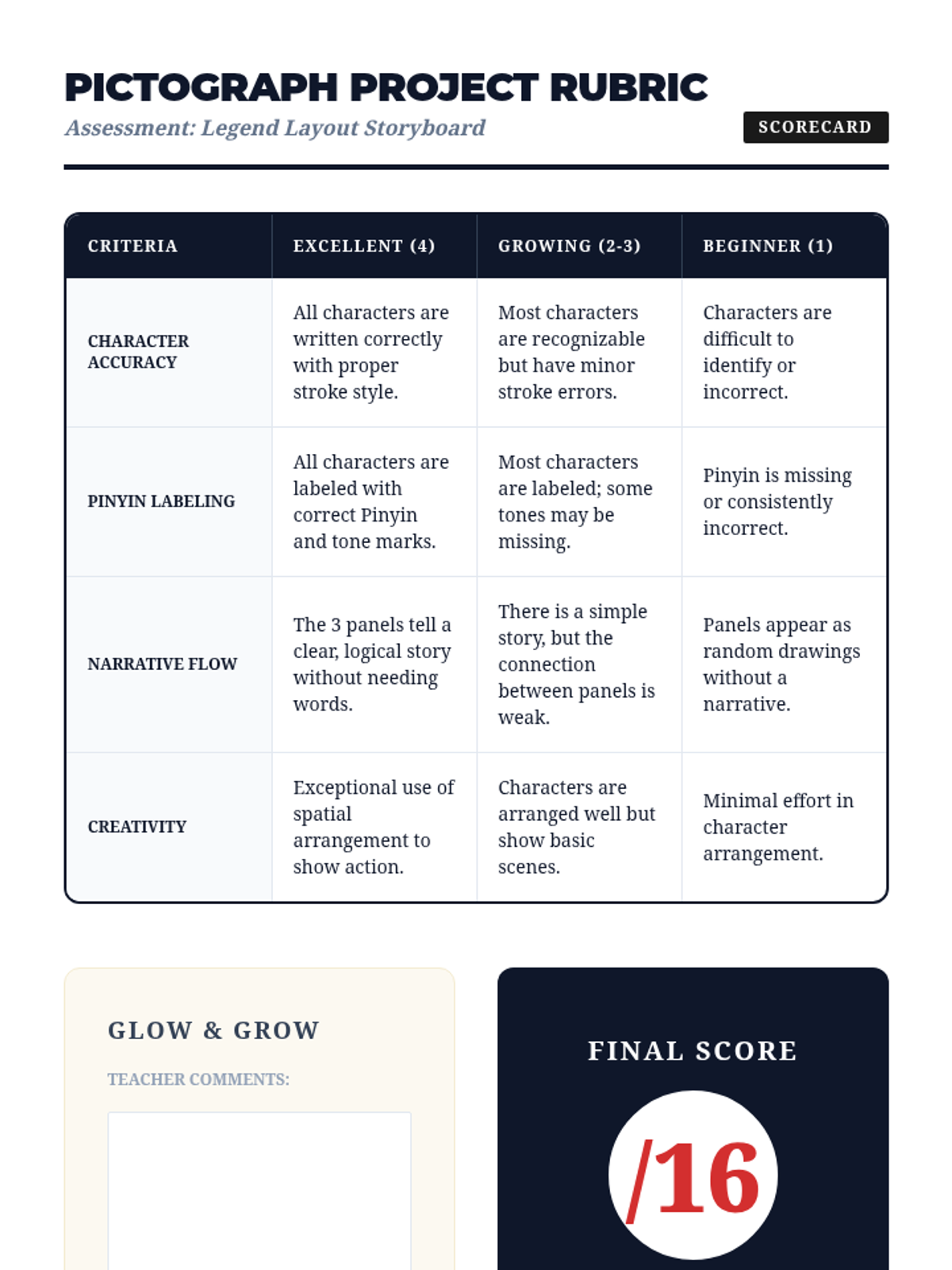
Assessment rubric for the Lesson 5 final project, evaluating character accuracy, pinyin labeling, narrative flow, and creative composition.
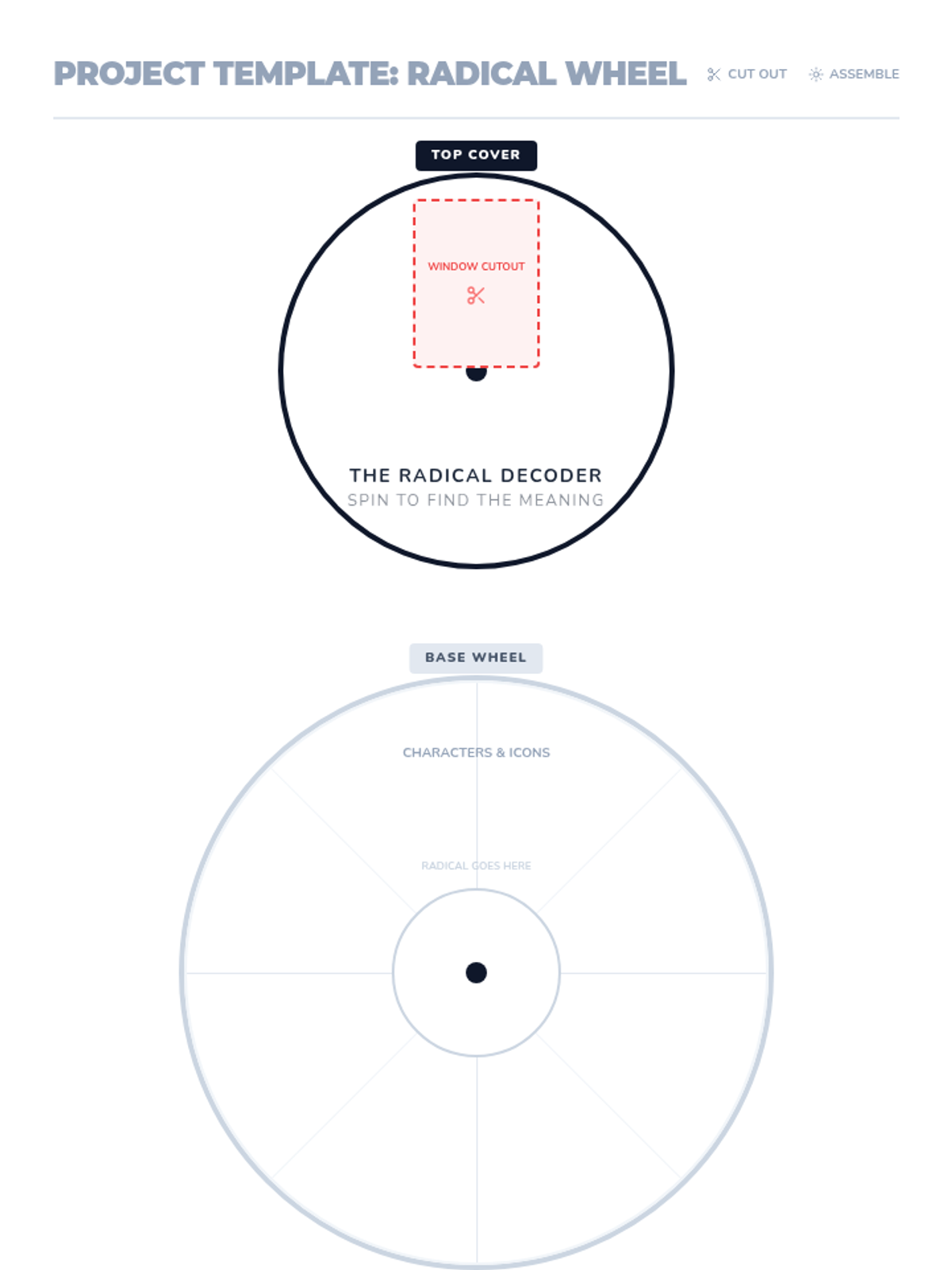
Printable template for the Radical Wheel summative project, including a top cover with cutout window and a base wheel for character organization.
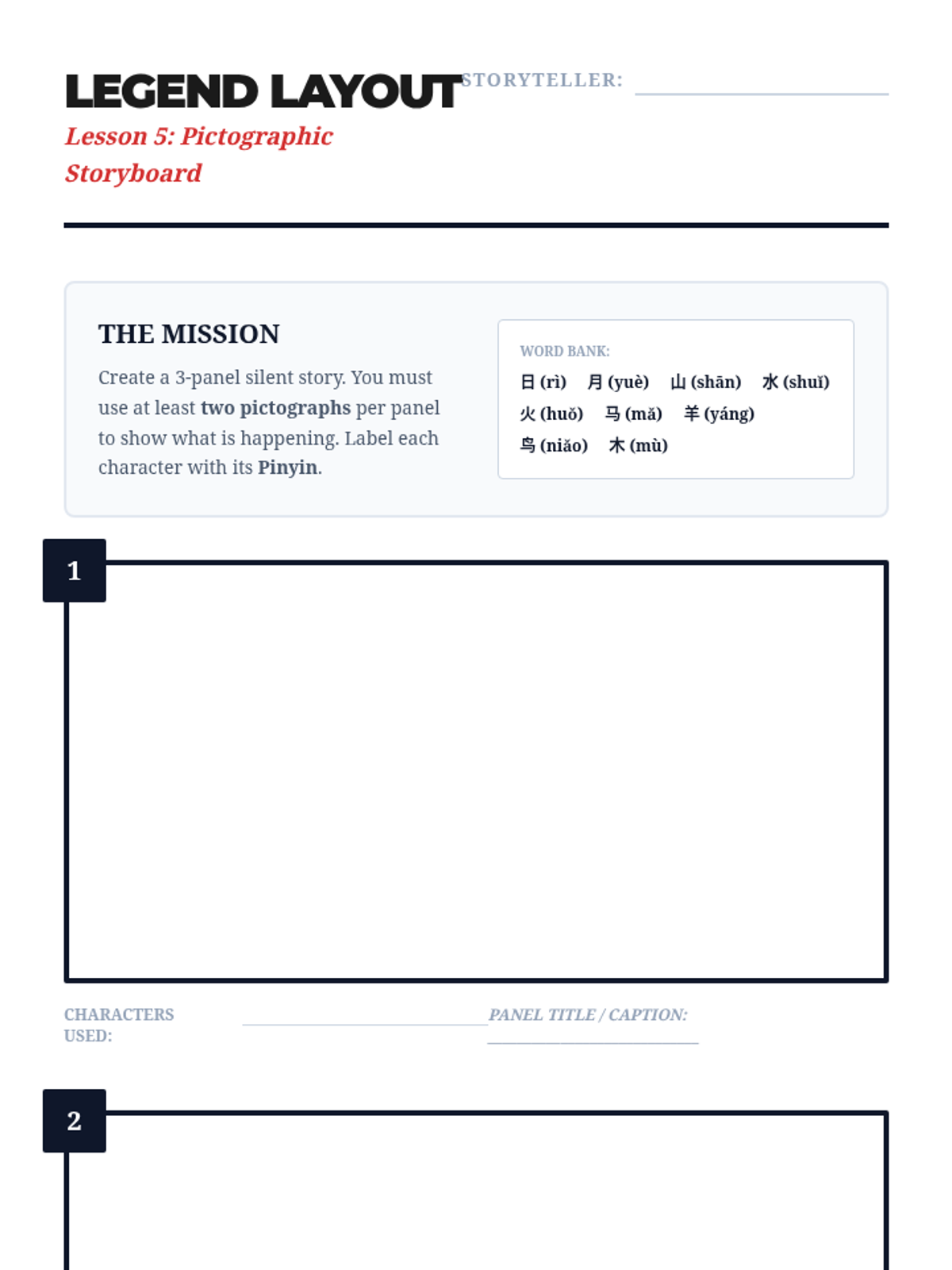
Storyboard template for students to compose a three-panel narrative scene using Mandarin pictographs, including space for Pinyin labels and panel descriptions.
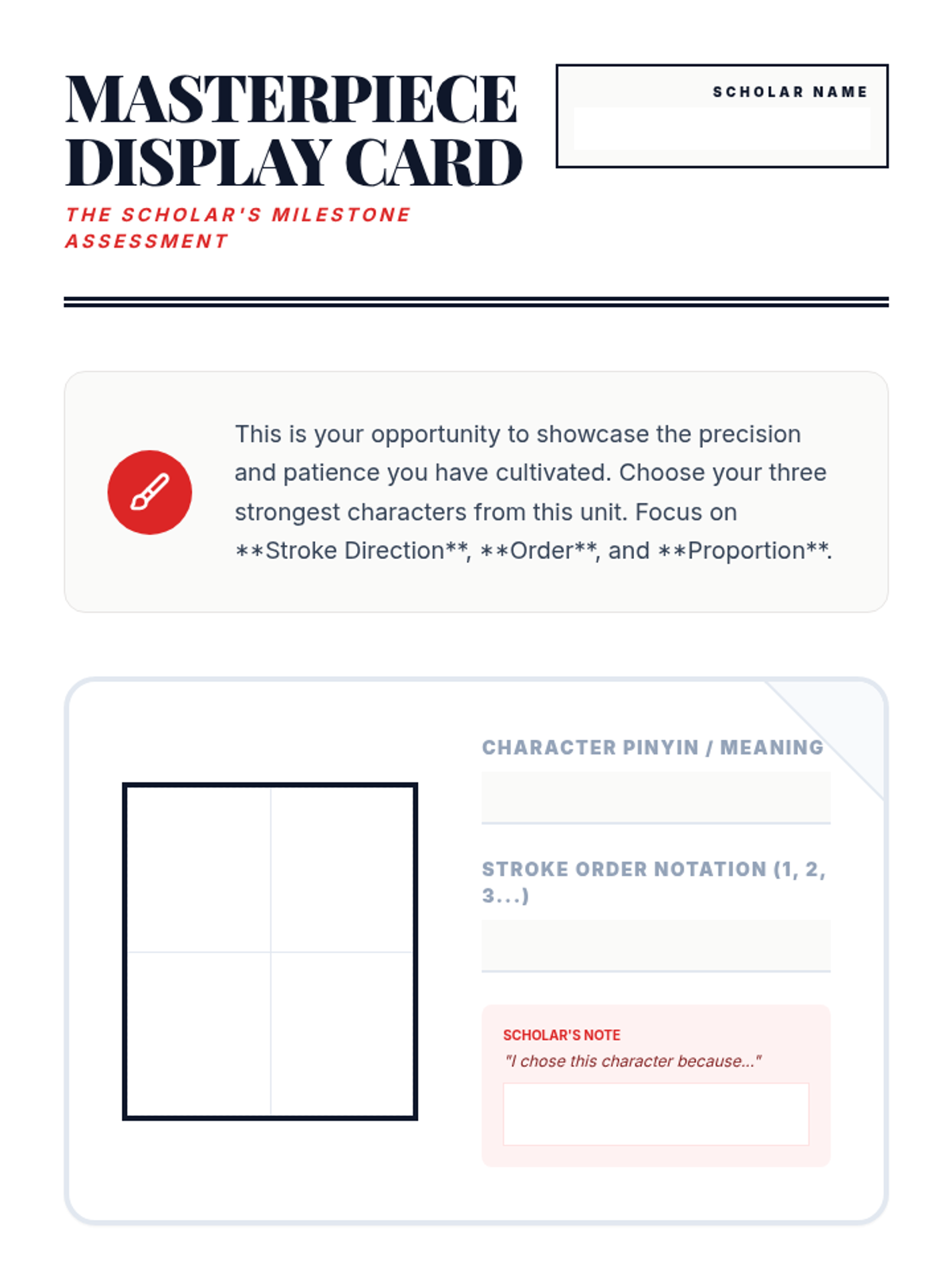
Final display card for the culminating assessment where students showcase three refined characters with stroke order notation and reflect on their progress.
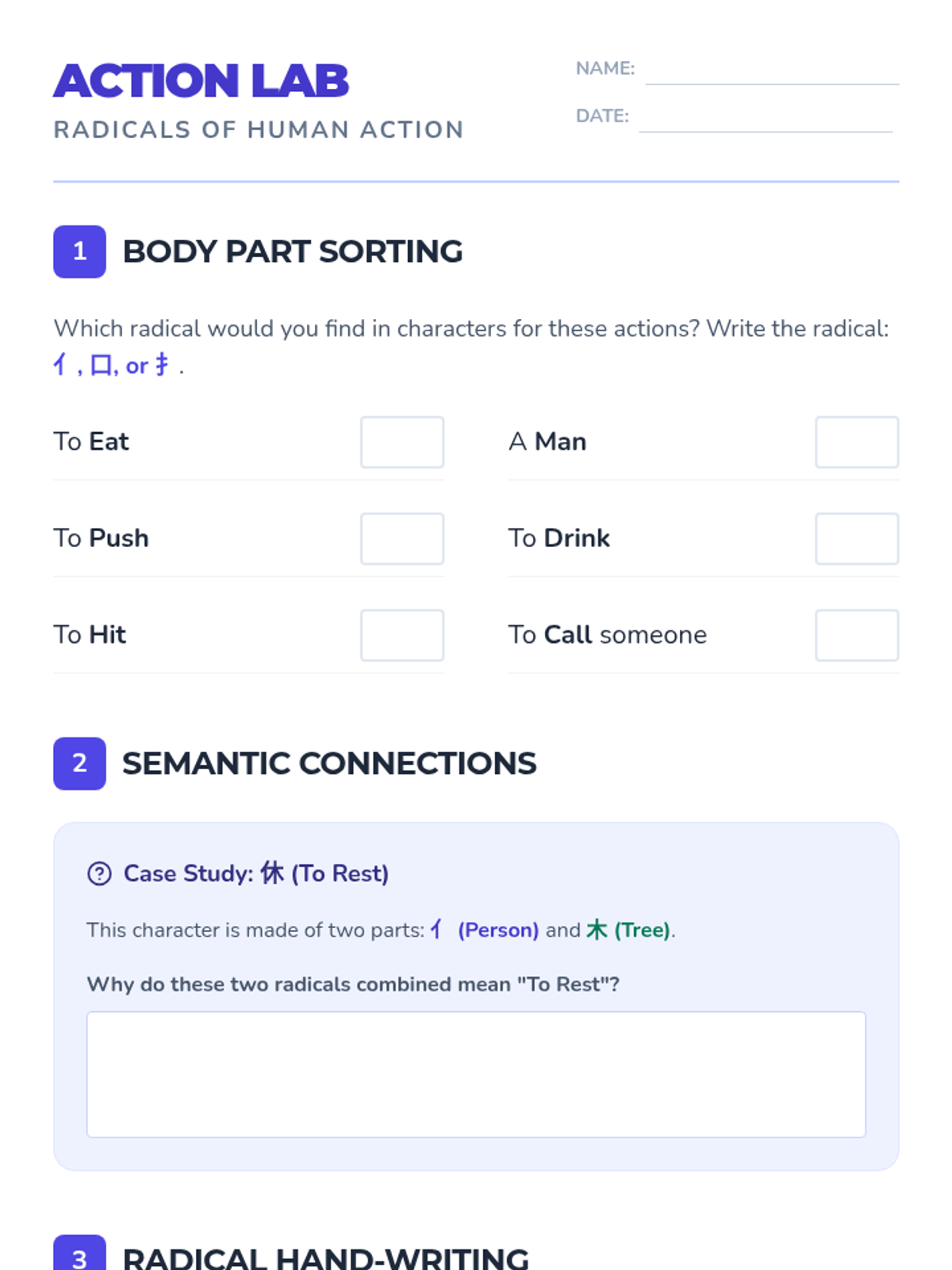
Worksheet for Lesson 3 reinforcing the radicals for Person, Mouth, and Hand through categorization and semantic analysis.
Slides for Lesson 5 introduing composition and storytelling with pictographs. Explains how to arrange characters to form narrative scenes.
Final presentation slides for Lesson 5, guiding students through the calligraphy showcase, review of fundamental strokes, and peer critique protocols.
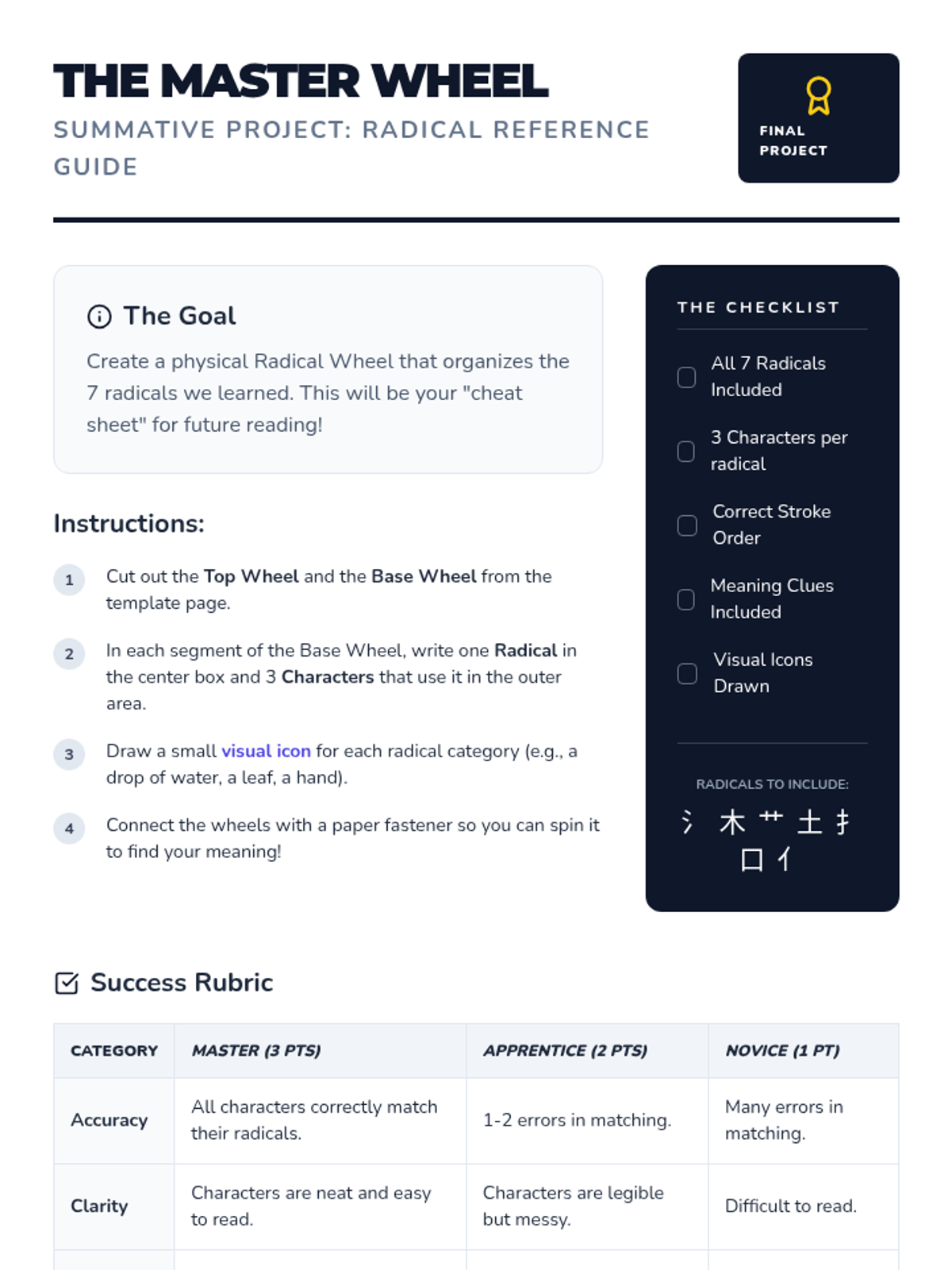
Project guide for the summative "Radical Wheel" project, including step-by-step instructions and a grading rubric.
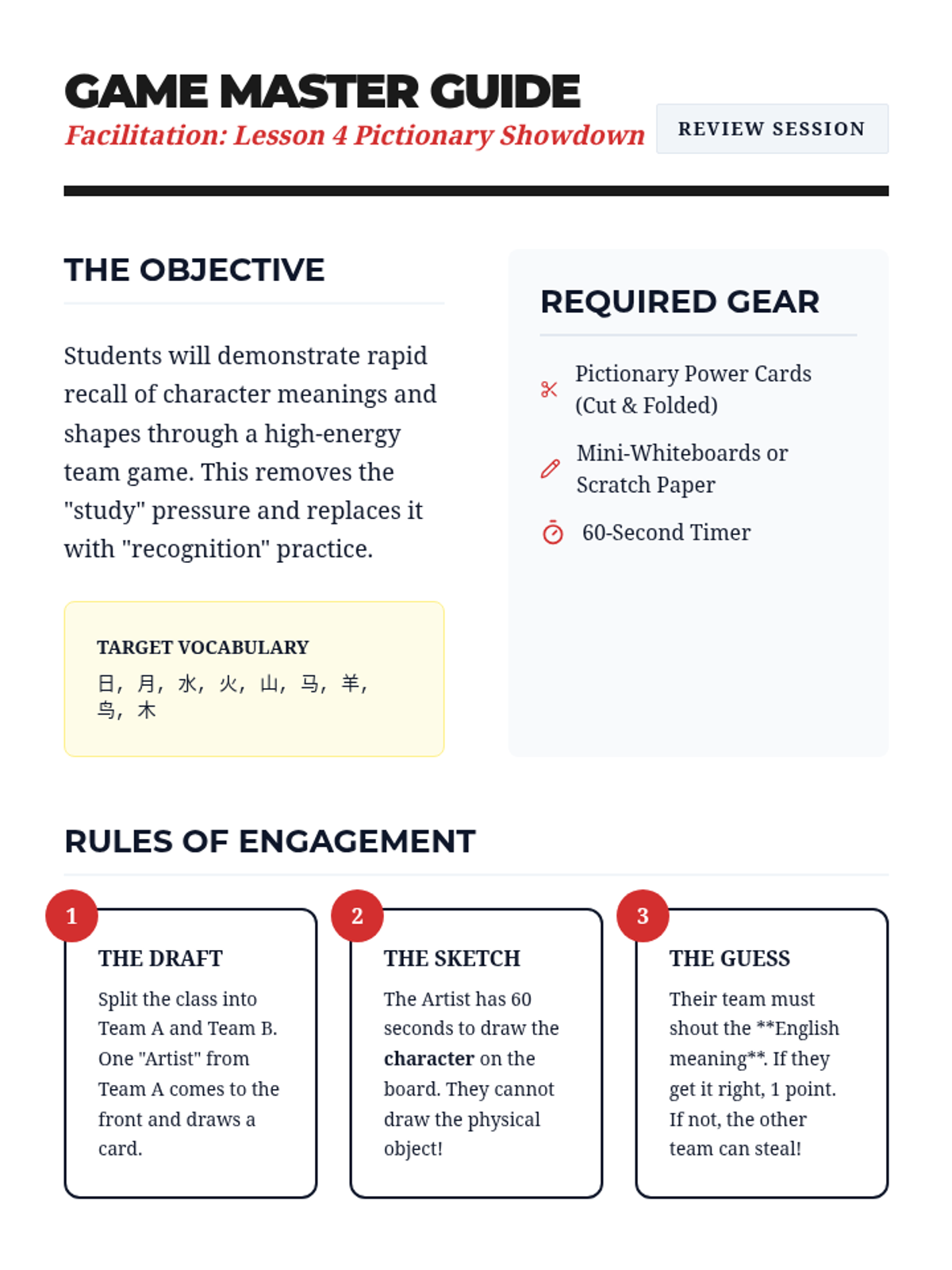
Teacher facilitation guide for Lesson 4, detailing the rules and setup for the Pictionary Showdown game-based review.
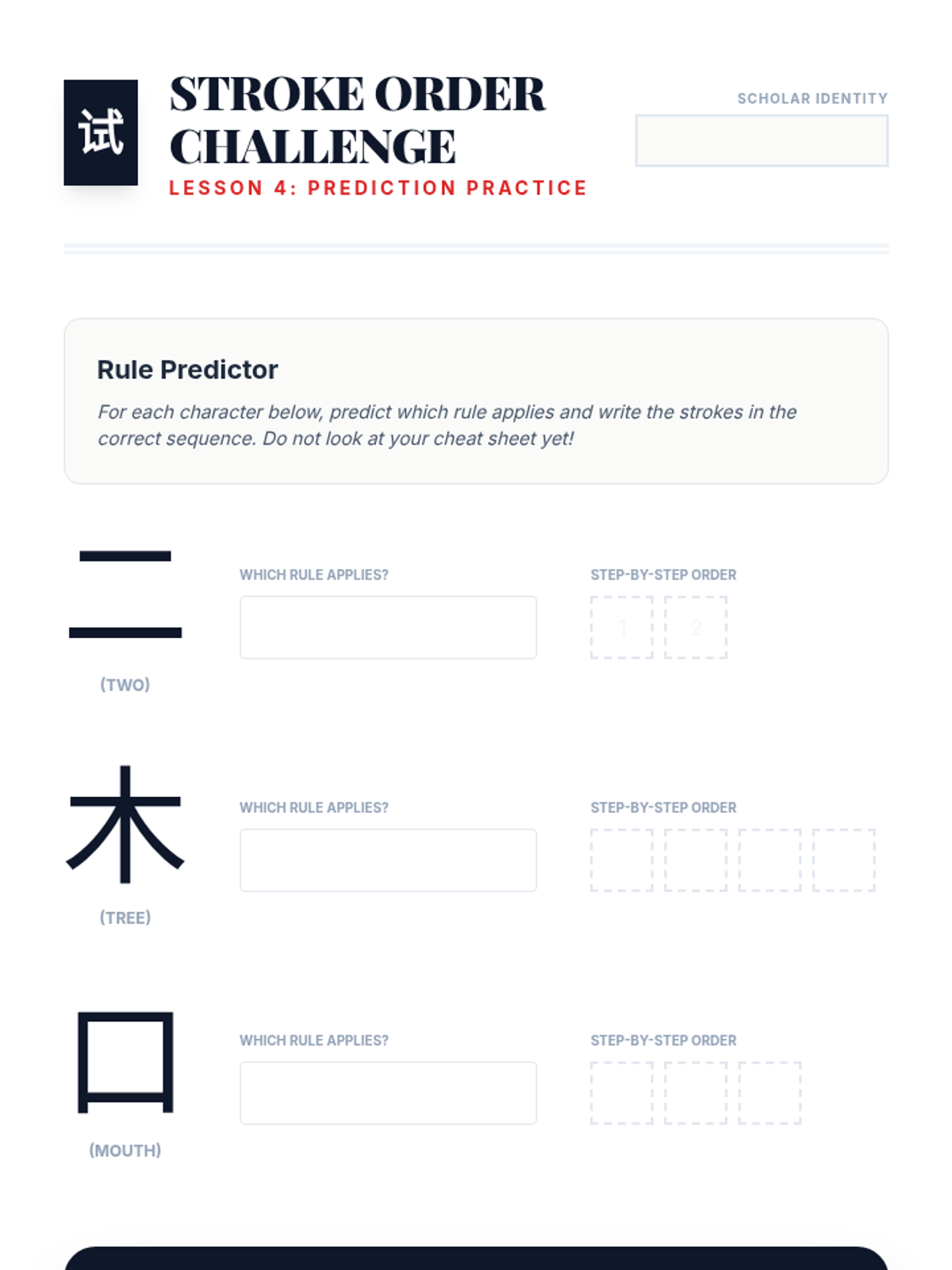
Student worksheet for Lesson 4 including a stroke order prediction game and an error analysis challenge to reinforce the seven rules of character writing.
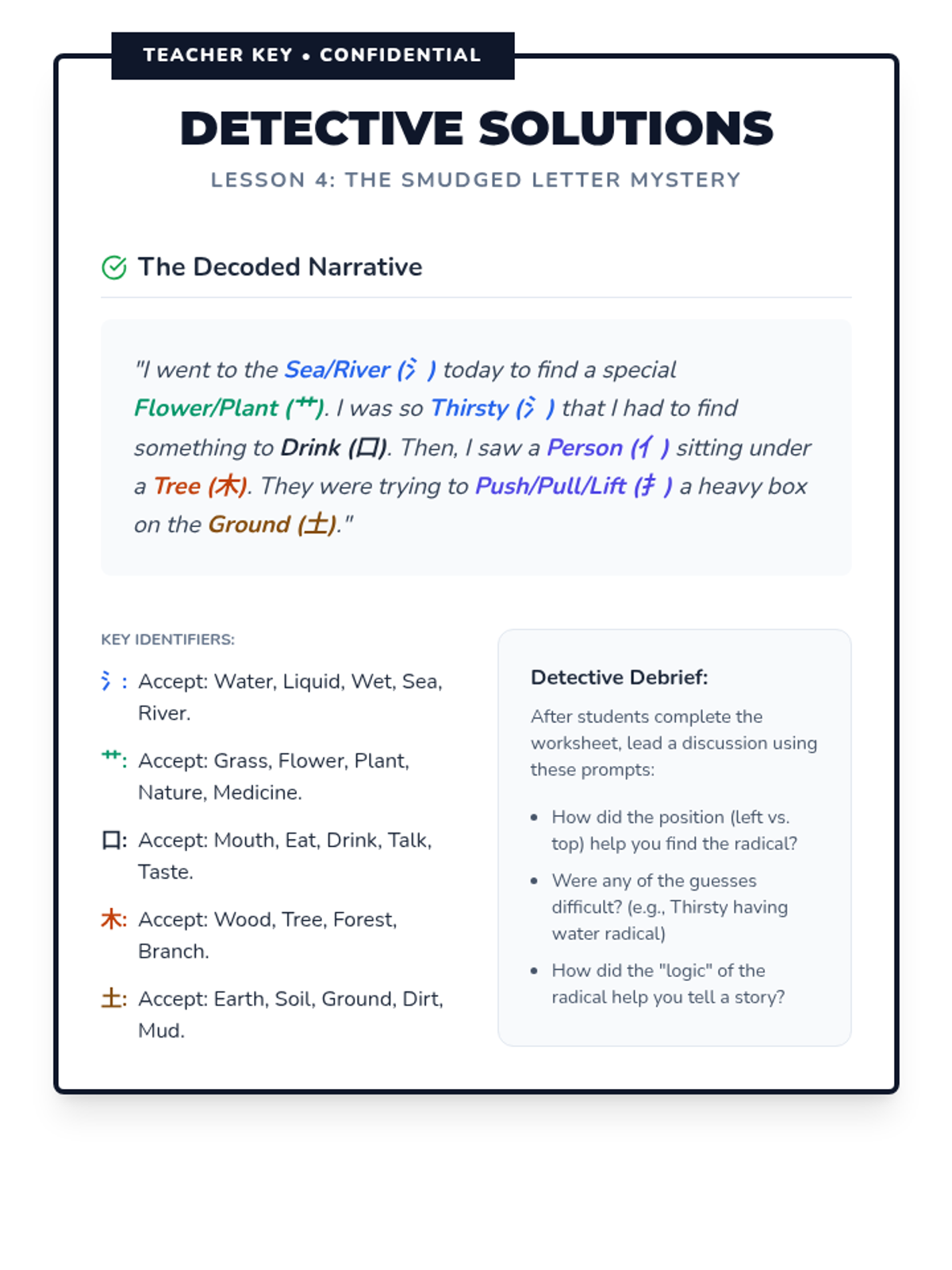
Teacher answer key and discussion guide for the "Smudged Letter Mystery" activity in Lesson 4.
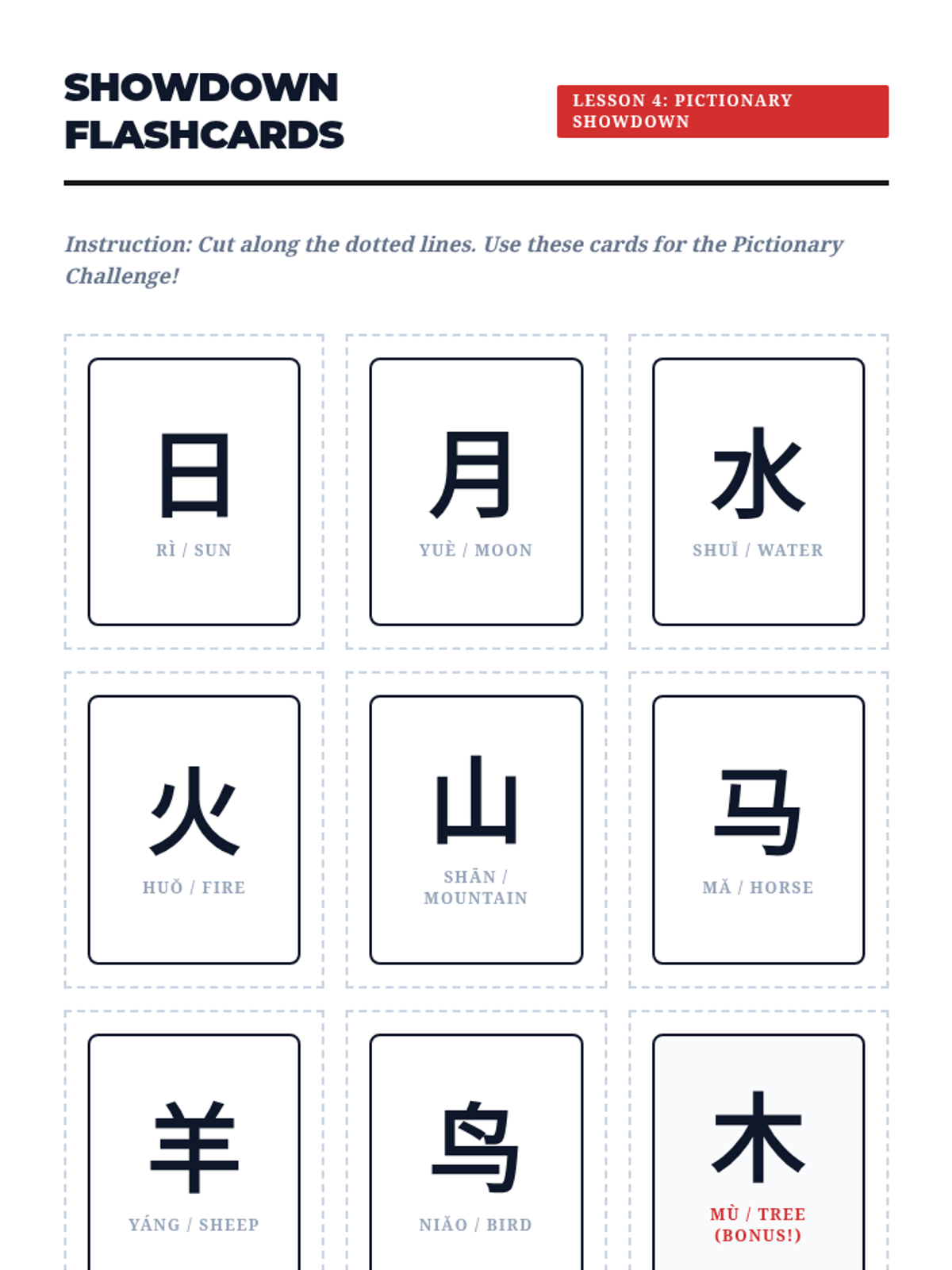
Game cards for Lesson 4 featuring characters, pinyin, and English meanings. Designed to be cut out for use in the Pictionary Showdown challenge.
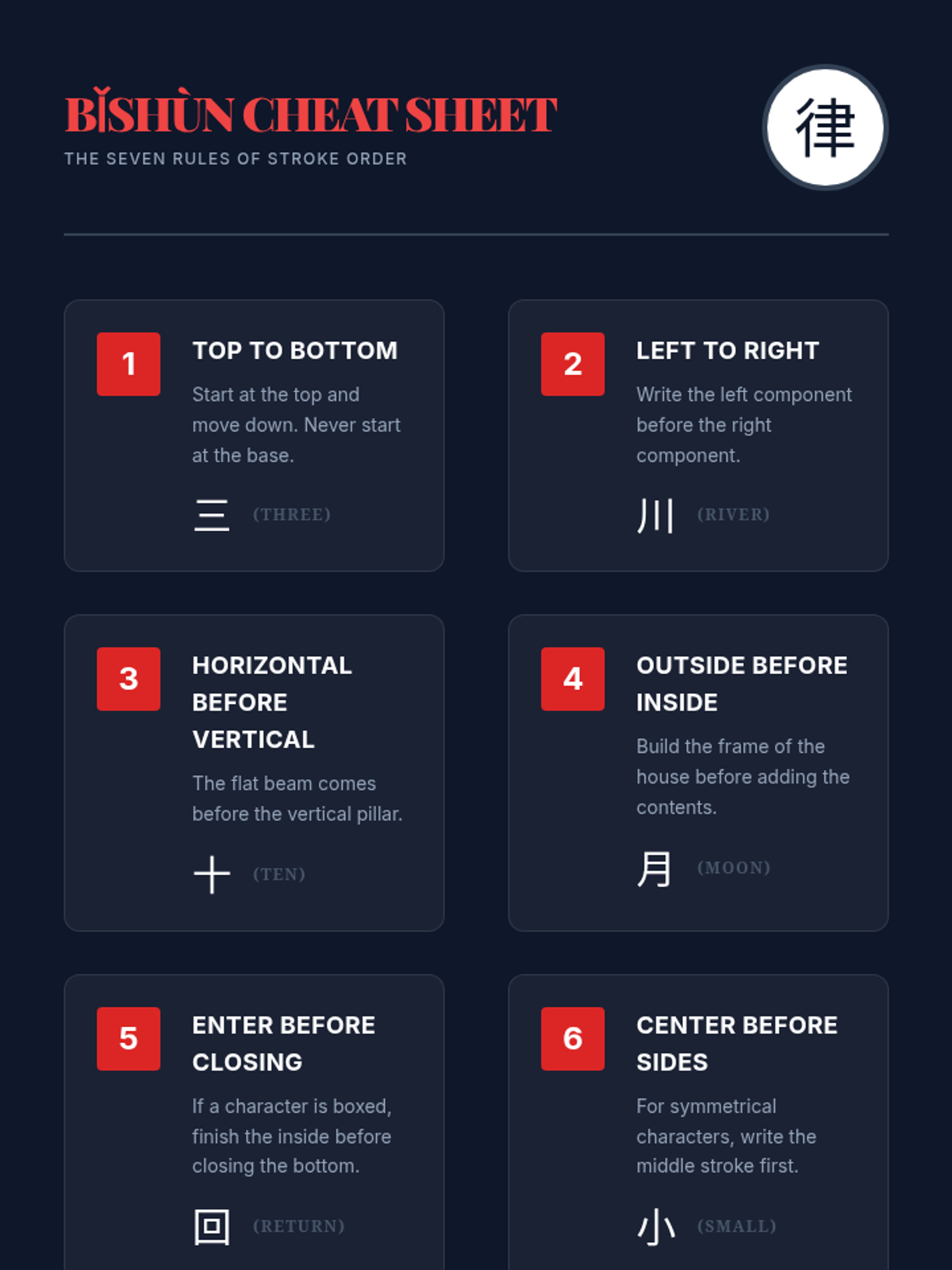
Compact reference cheat sheet for students detailing the seven rules of Mandarin stroke order with visual character examples.
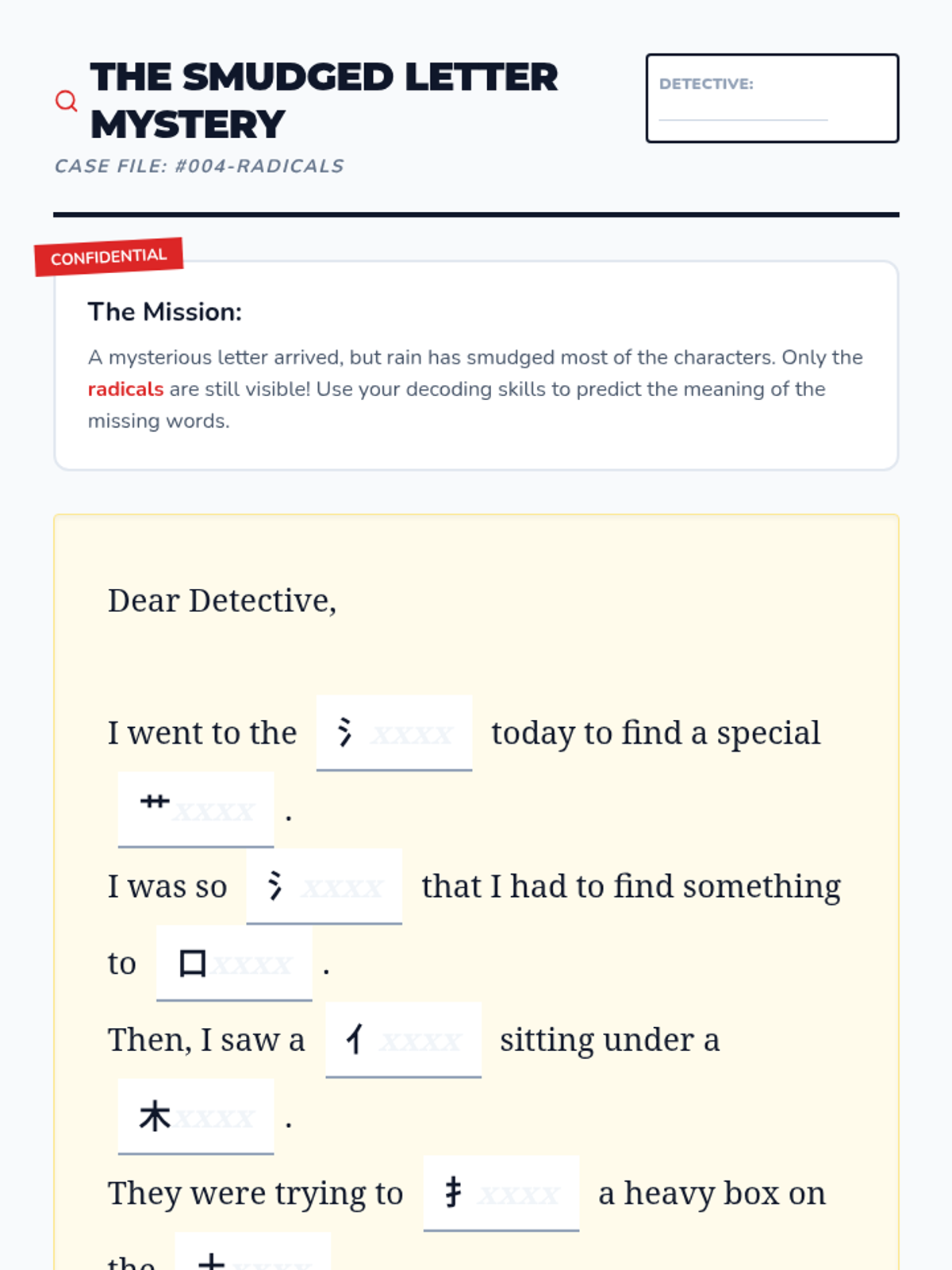
A worksheet featuring a "mystery letter" where students must use visible radicals to predict the general meanings of smudged characters.
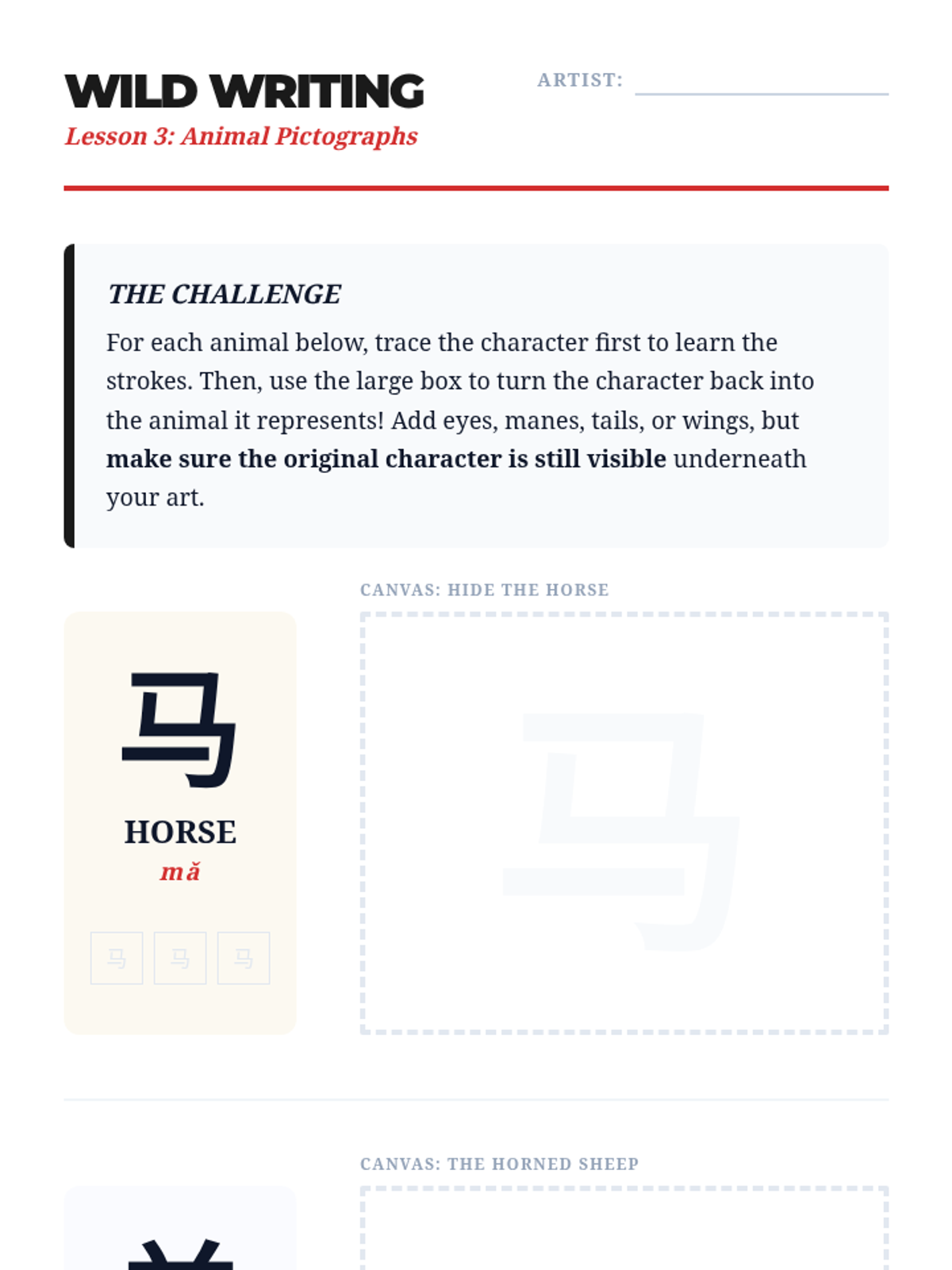
Worksheet for Lesson 3 where students practice animal pictographs (Horse, Sheep, Bird) and create artistic visualizations by drawing the animal over the character strokes.
Detailed presentation slides for Lesson 4, explicitly teaching the seven fundamental rules of Mandarin stroke order with visual examples.
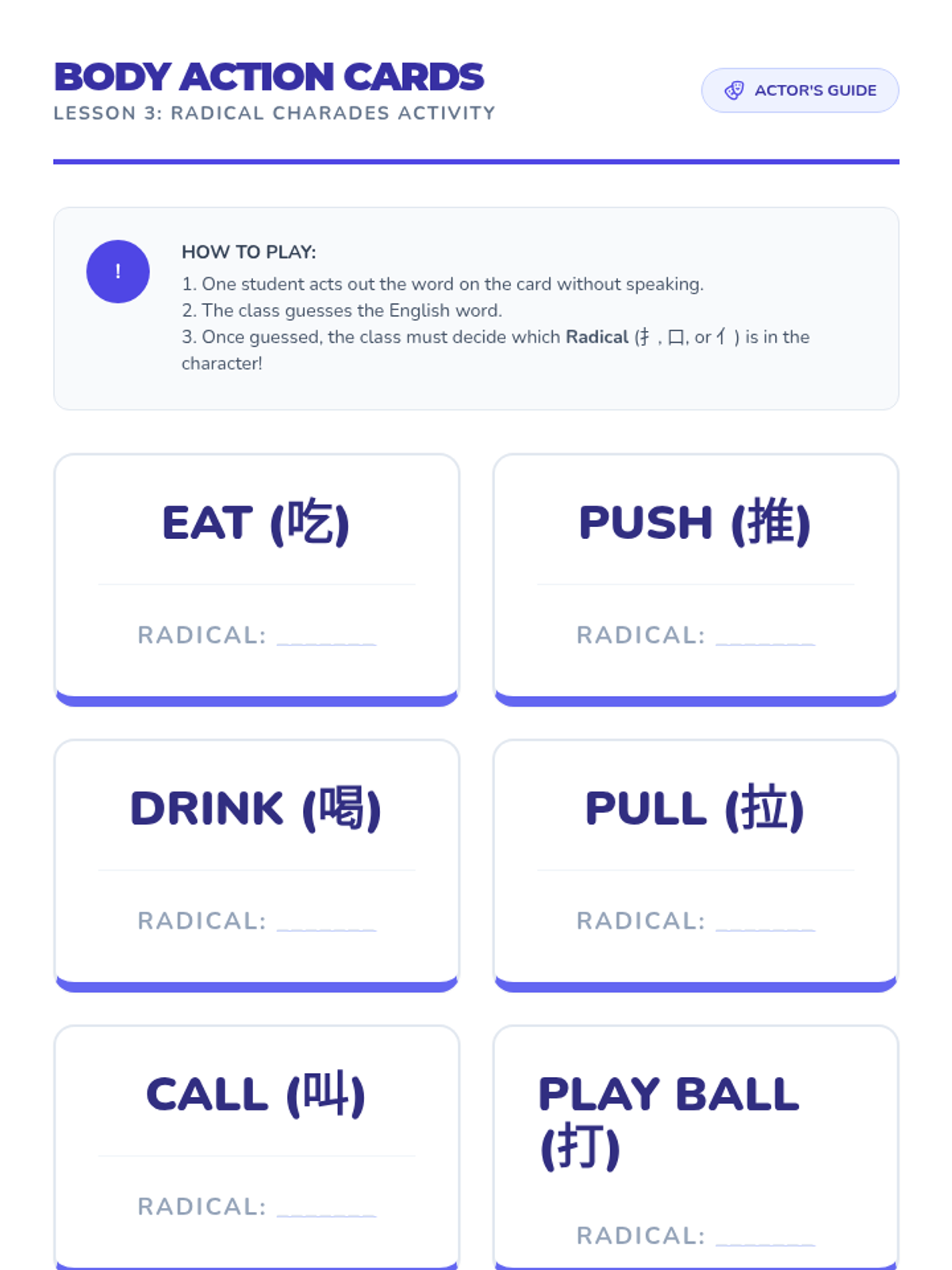
Charade activity cards for Lesson 3 to help students identify the radical associated with common verbs.
Slides for Lesson 3 introducing animal pictographs (Horse, Sheep, Bird). Explains the visual components of each character and sets up the drawing challenge.
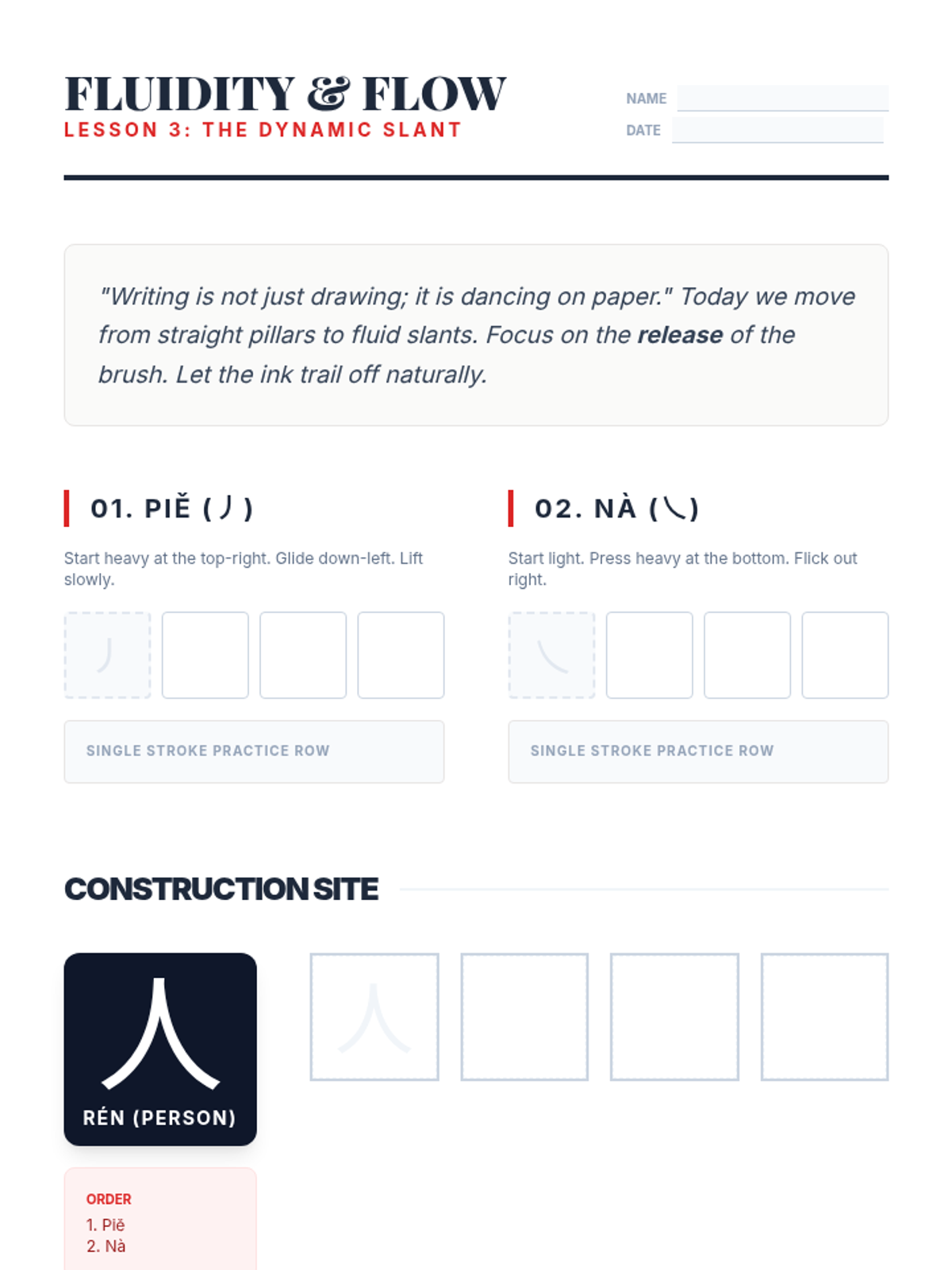
Student worksheet for Lesson 3 focusing on slanting strokes (Pie and Na) and constructing the characters 'Person' (Ren) and 'Big' (Da) with peer feedback prompts.
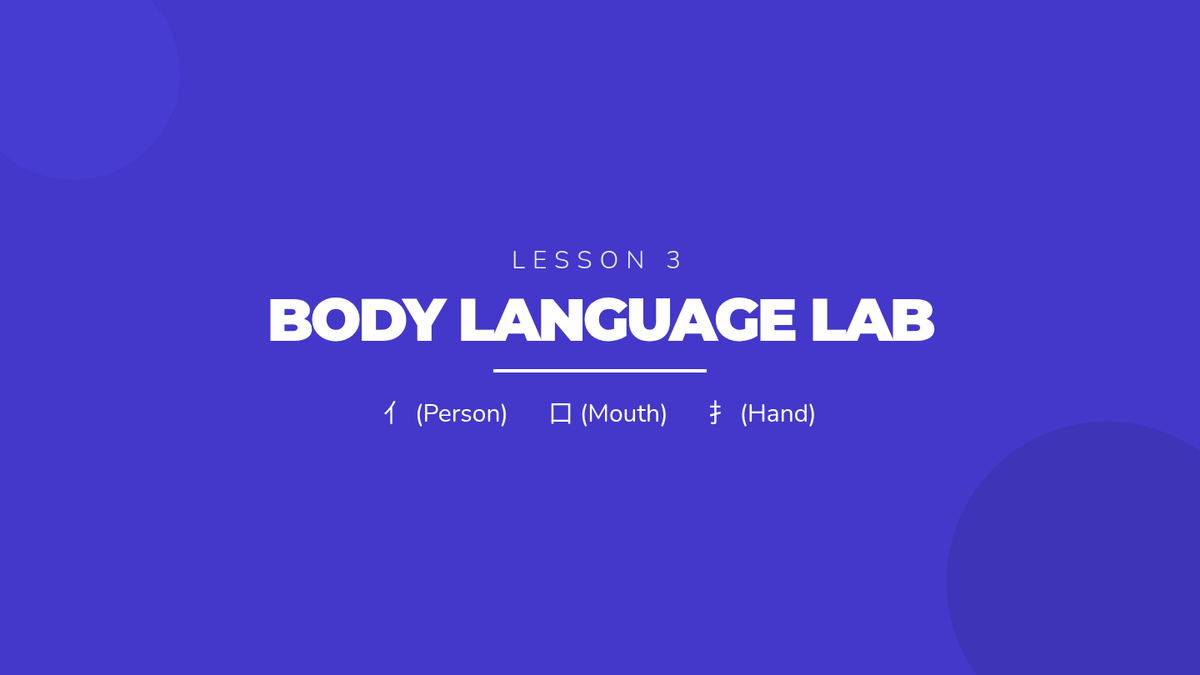
Slide deck for Lesson 3, focusing on human interaction radicals: Person (亻), Mouth (口), and Hand (扌), with verb examples and semantic explanations.
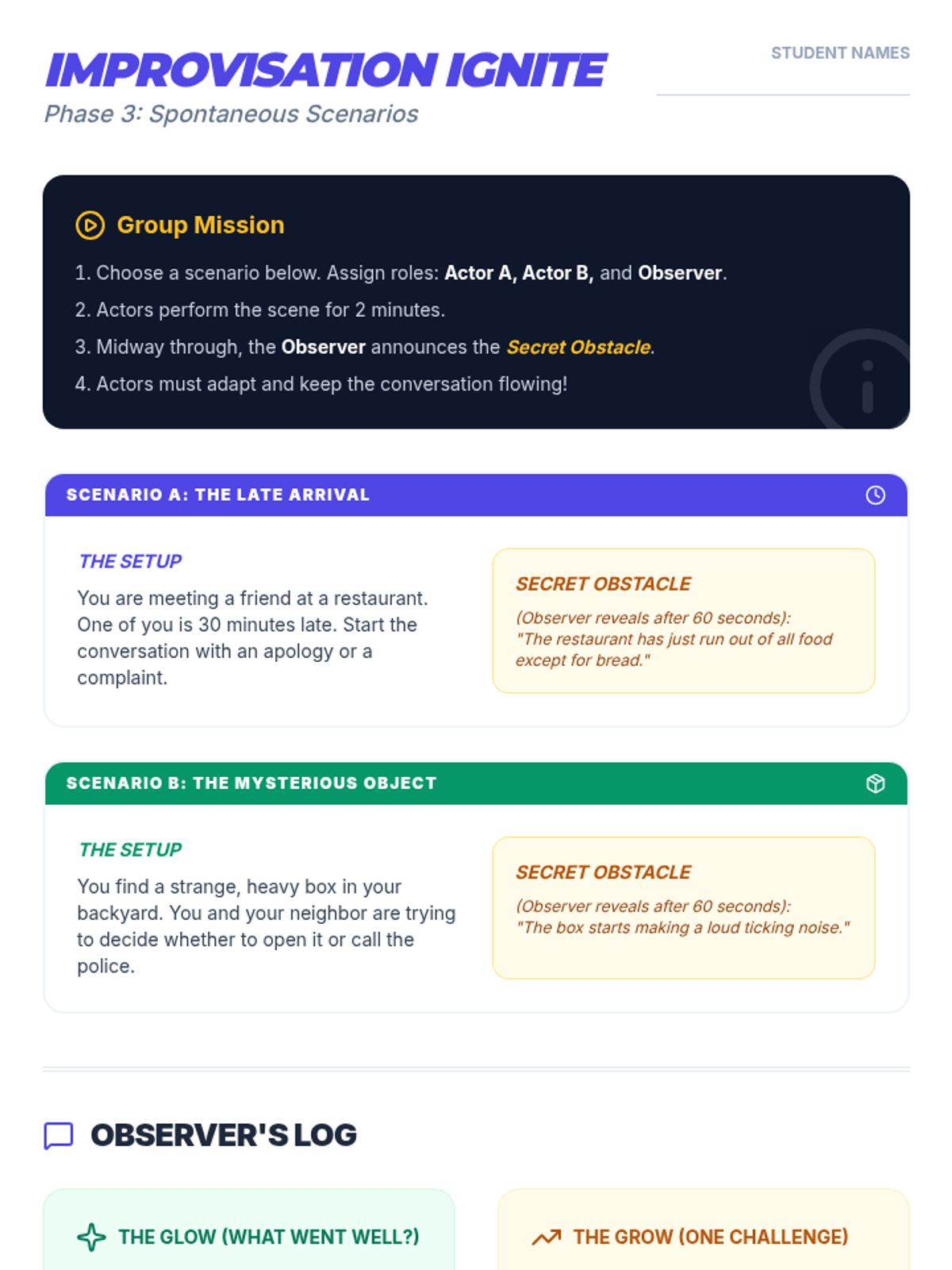
A student-facing small-group activity sheet providing structured scenarios with 'Secret Obstacles' and a peer-feedback framework for oral production.
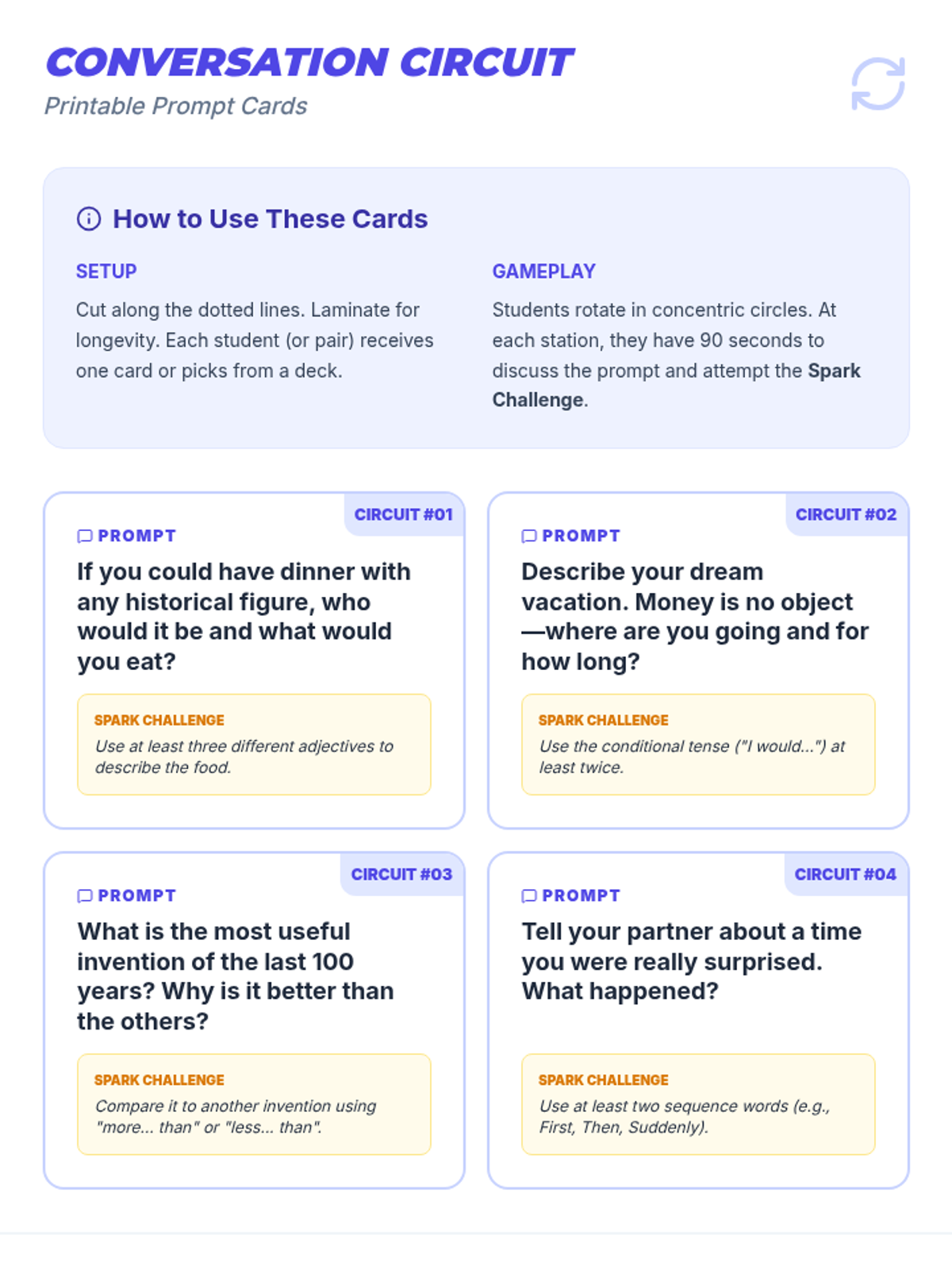
A set of 8 printable conversation prompt cards featuring 'Spark Challenges' to encourage specific linguistic targets during spontaneous speaking.
A visual guide for teachers and students explaining the shift from accuracy to fluency, providing warm-up prompts, and offering "Survival Phrases" to keep conversations moving.
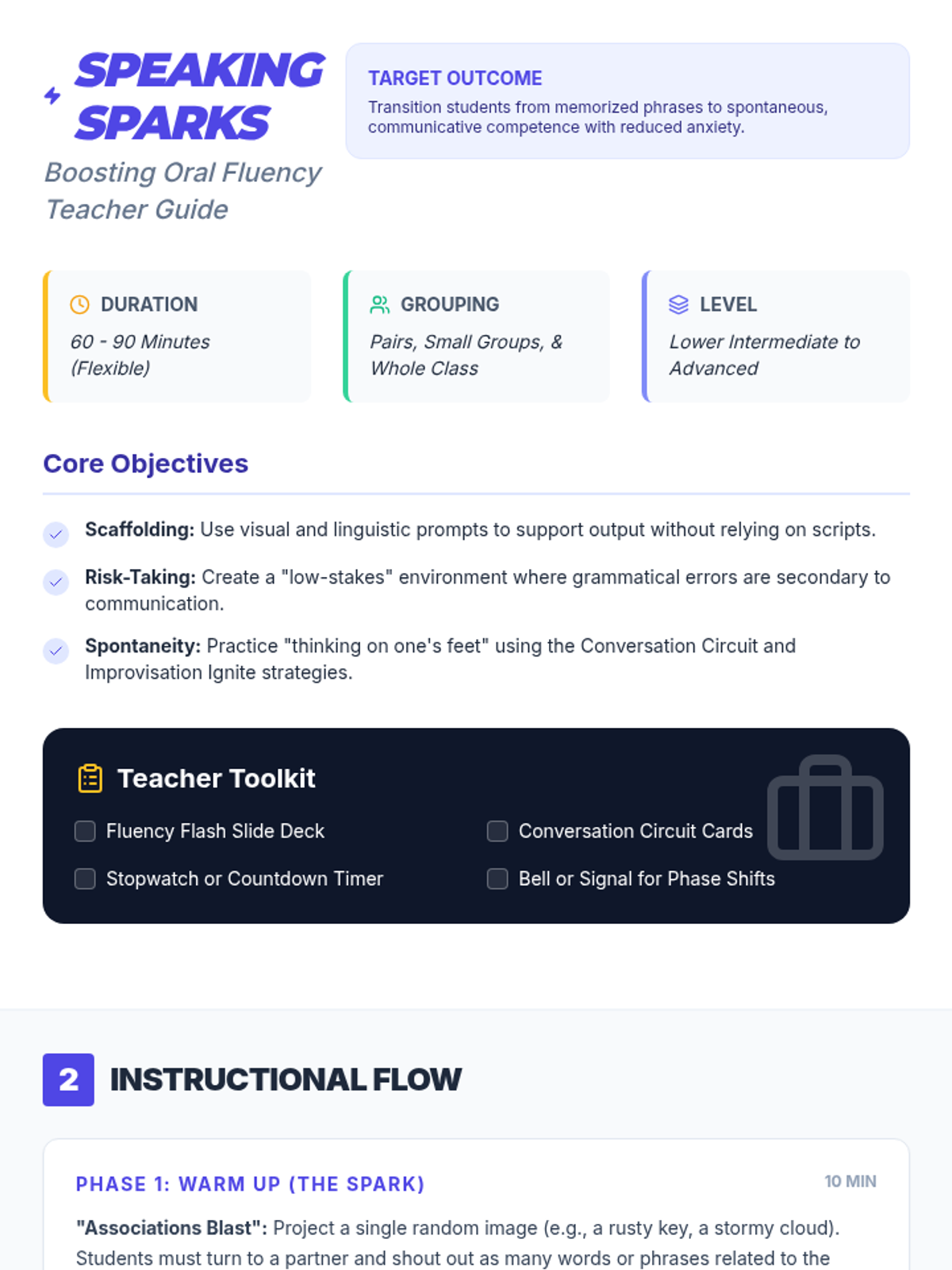
A comprehensive teacher guide for implementing oral fluency strategies, including a 4-phase instructional flow, target outcomes, and specific feedback techniques.
A culminating presentation for a Mandarin listening sequence, guiding students through a multi-genre 'channel surfing' synthesis activity.
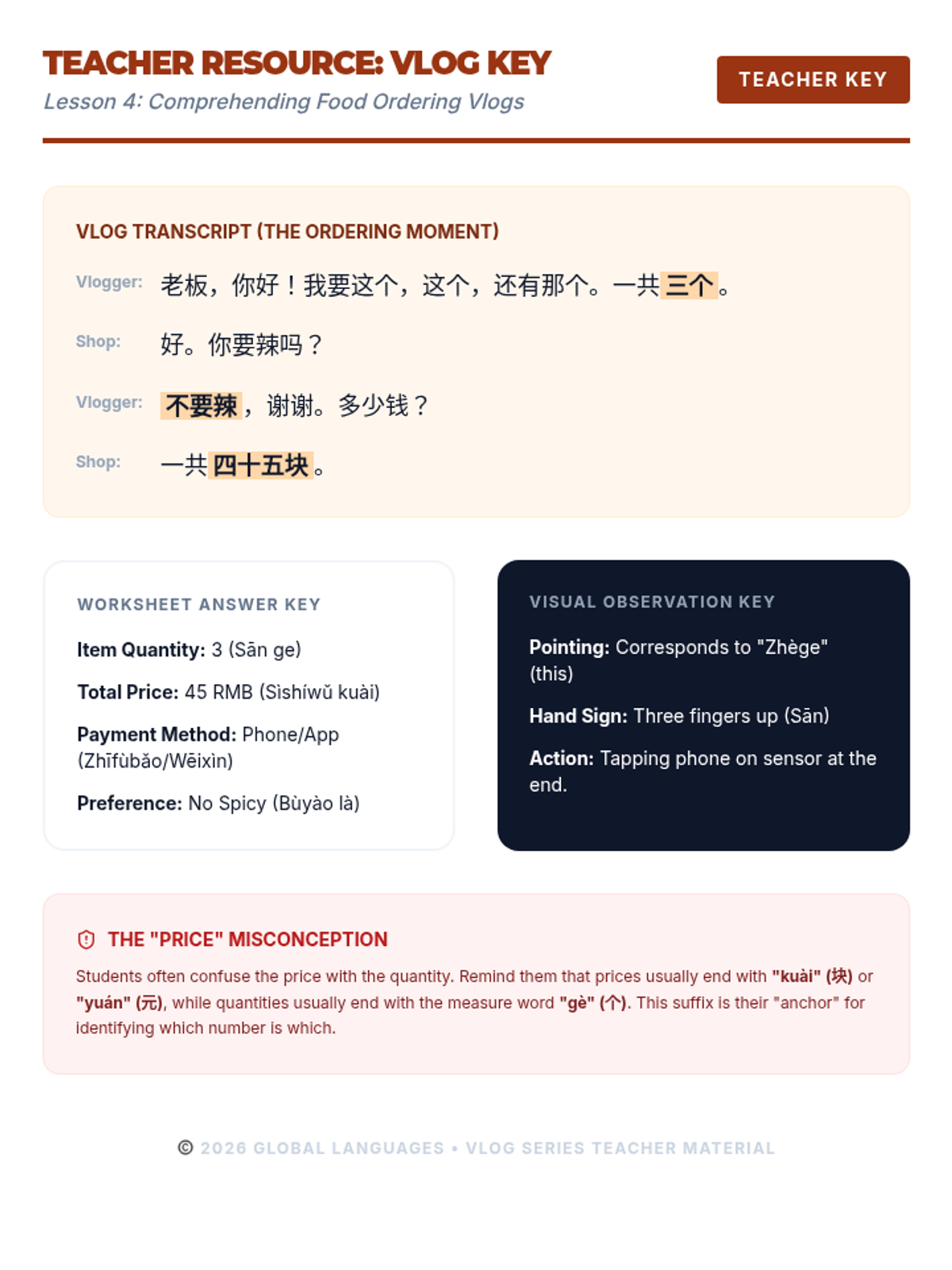
A teacher key for the vlog listening activity, including a transcript and visual observation guide for restaurant transactions.
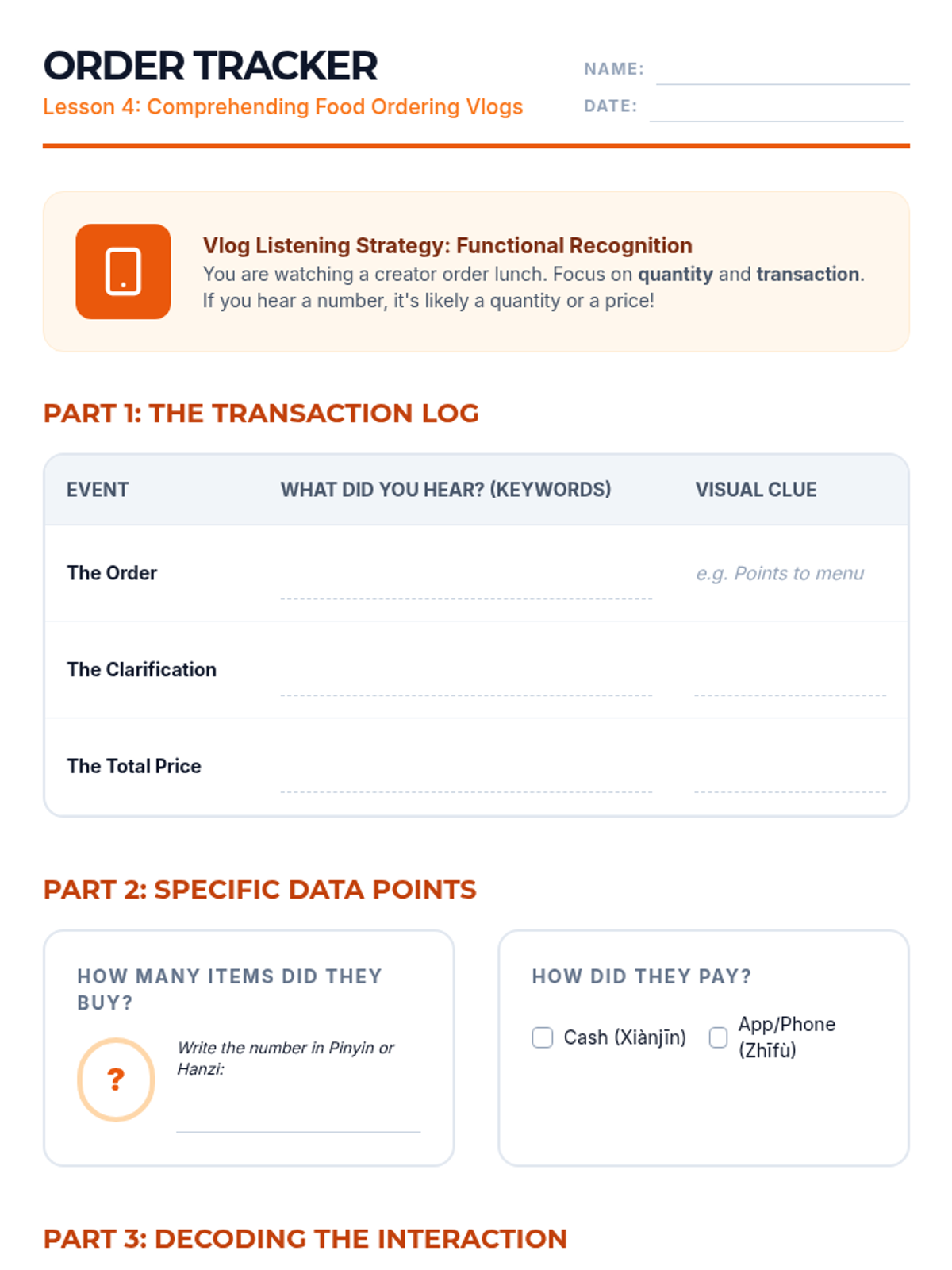
A worksheet for tracking restaurant transactions in food vlogs, focusing on quantity, price, and visual-to-audio context mapping.
A presentation slide deck focusing on the transactional structure of food vlogs and how visual cues aid in Mandarin listening comprehension.
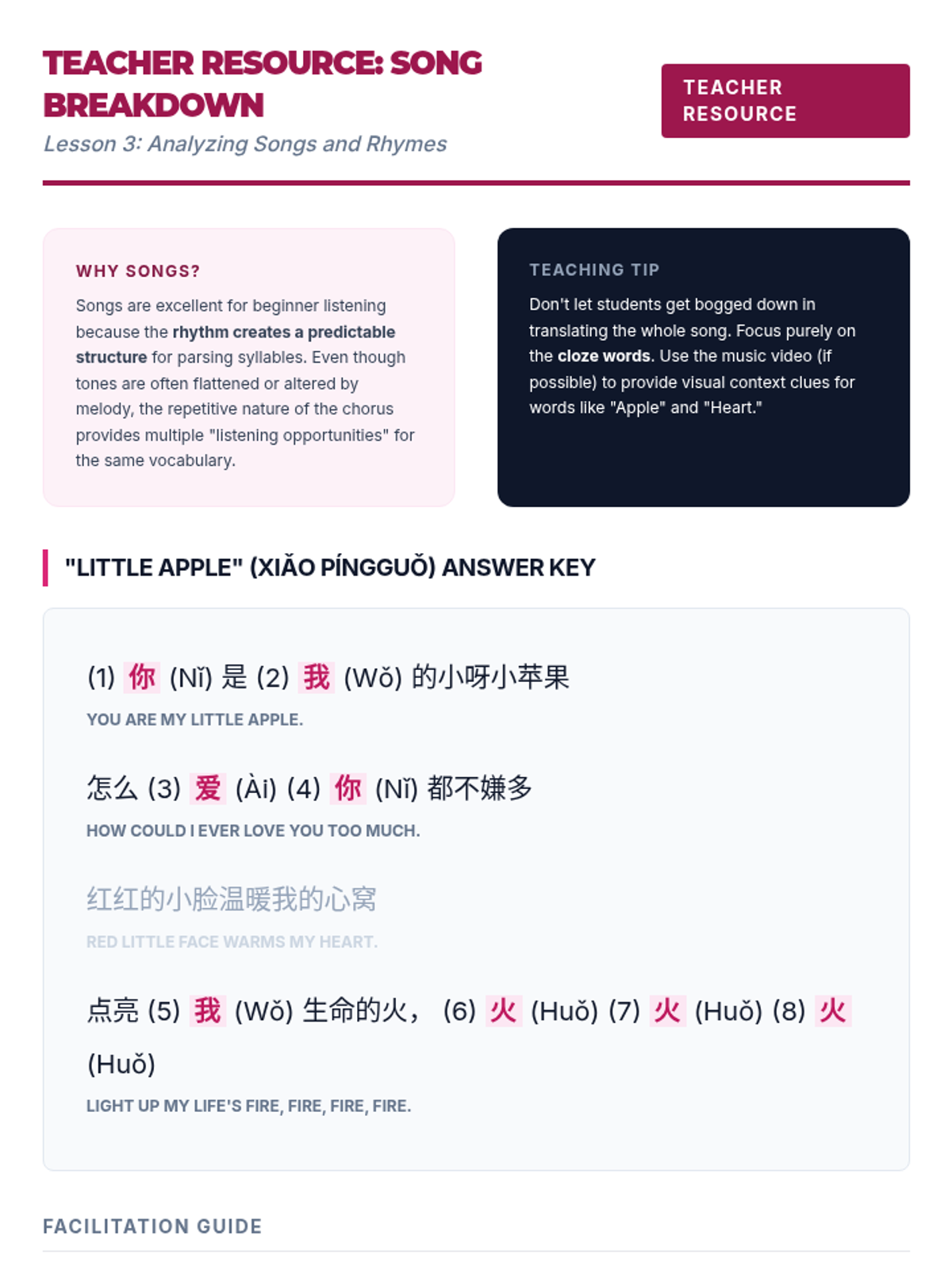
A teacher guide for the song analysis lesson, including a complete lyric key for 'Little Apple' and pedagogical strategies for music-based listening.
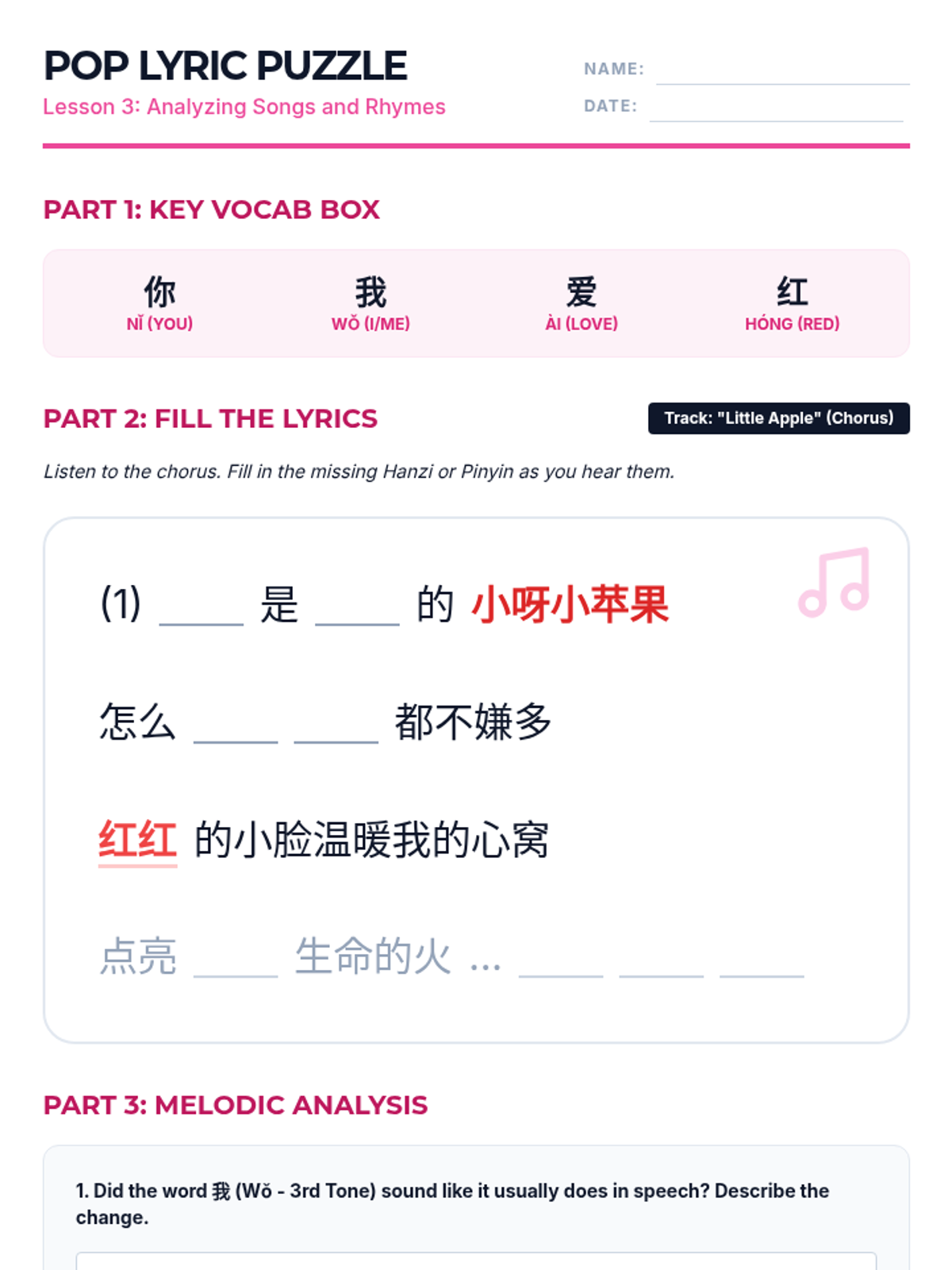
A lyric cloze worksheet for the song 'Little Apple', focusing on pronouns, nouns, and the impact of melody on Mandarin tones.
A presentation on the relationship between tones and melody in Chinese music, using the song 'Little Apple' as a case study for listening practice.
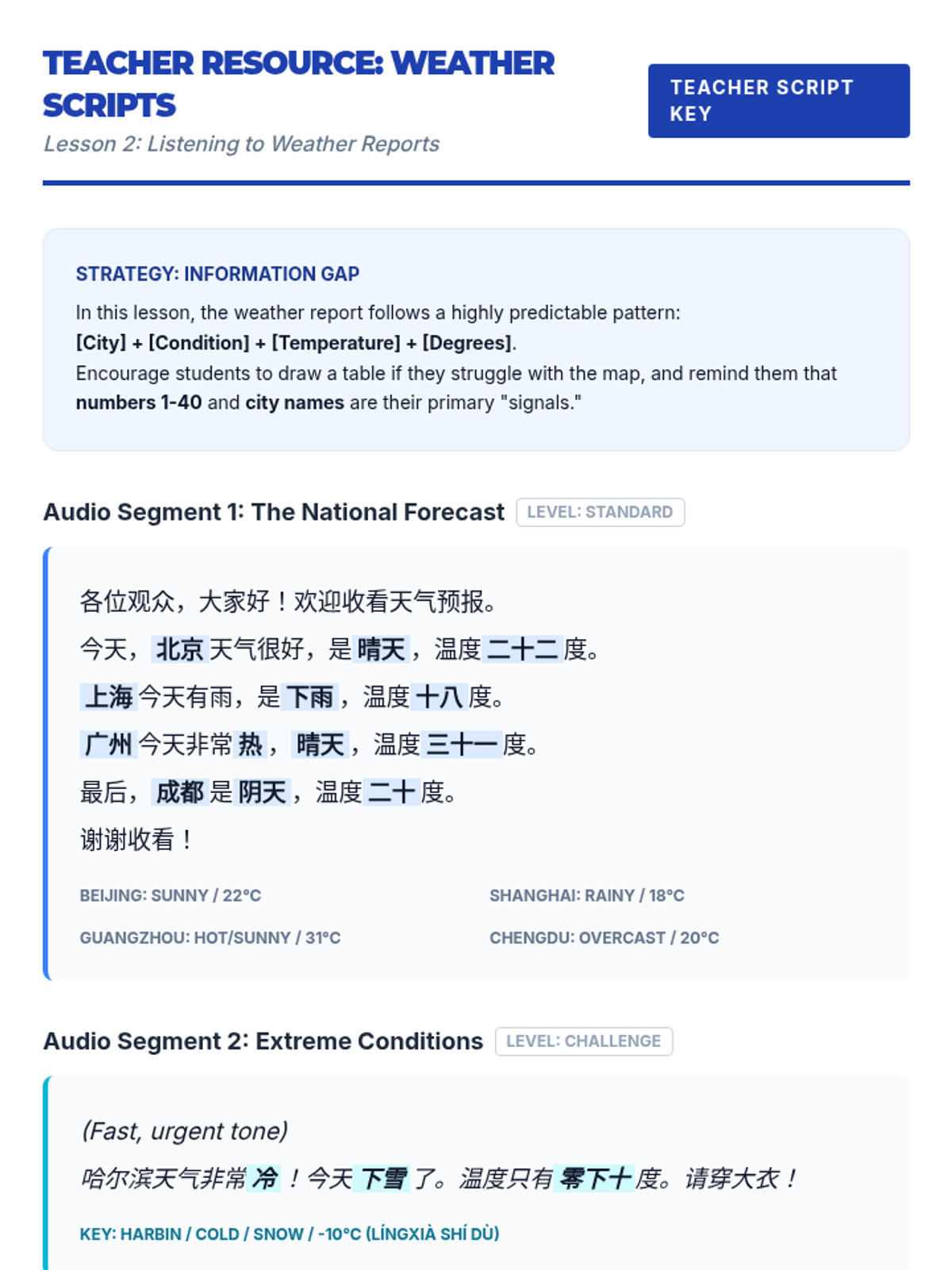
A teacher resource providing the Mandarin scripts for weather forecasts, an answer key for the map worksheet, and differentiation strategies.
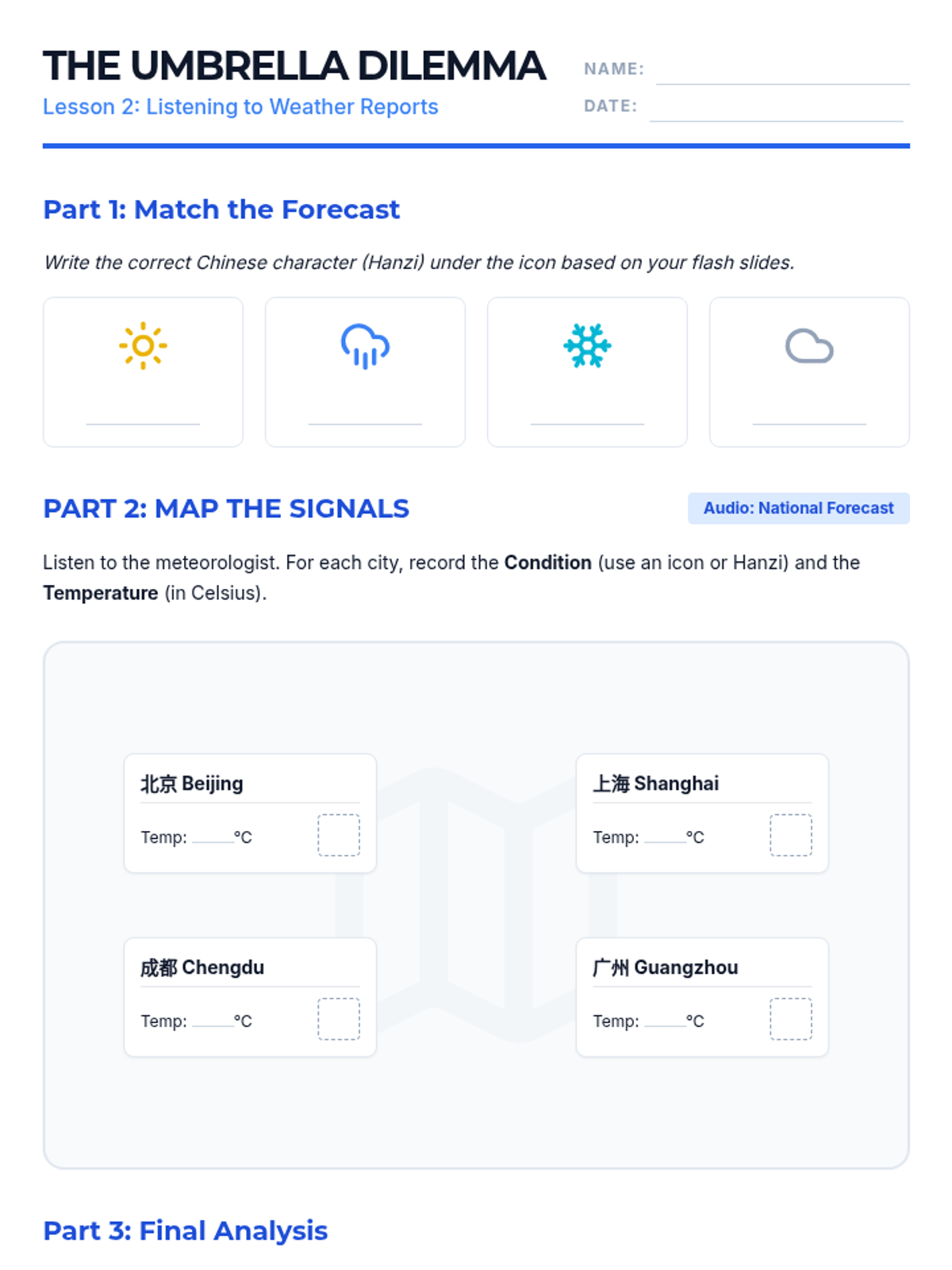
A weather map simulation worksheet where students extract city names, temperatures, and conditions from a Mandarin forecast audio.
A presentation teaching weather-related vocabulary, city names, and the structure of Mandarin weather reports for information extraction.
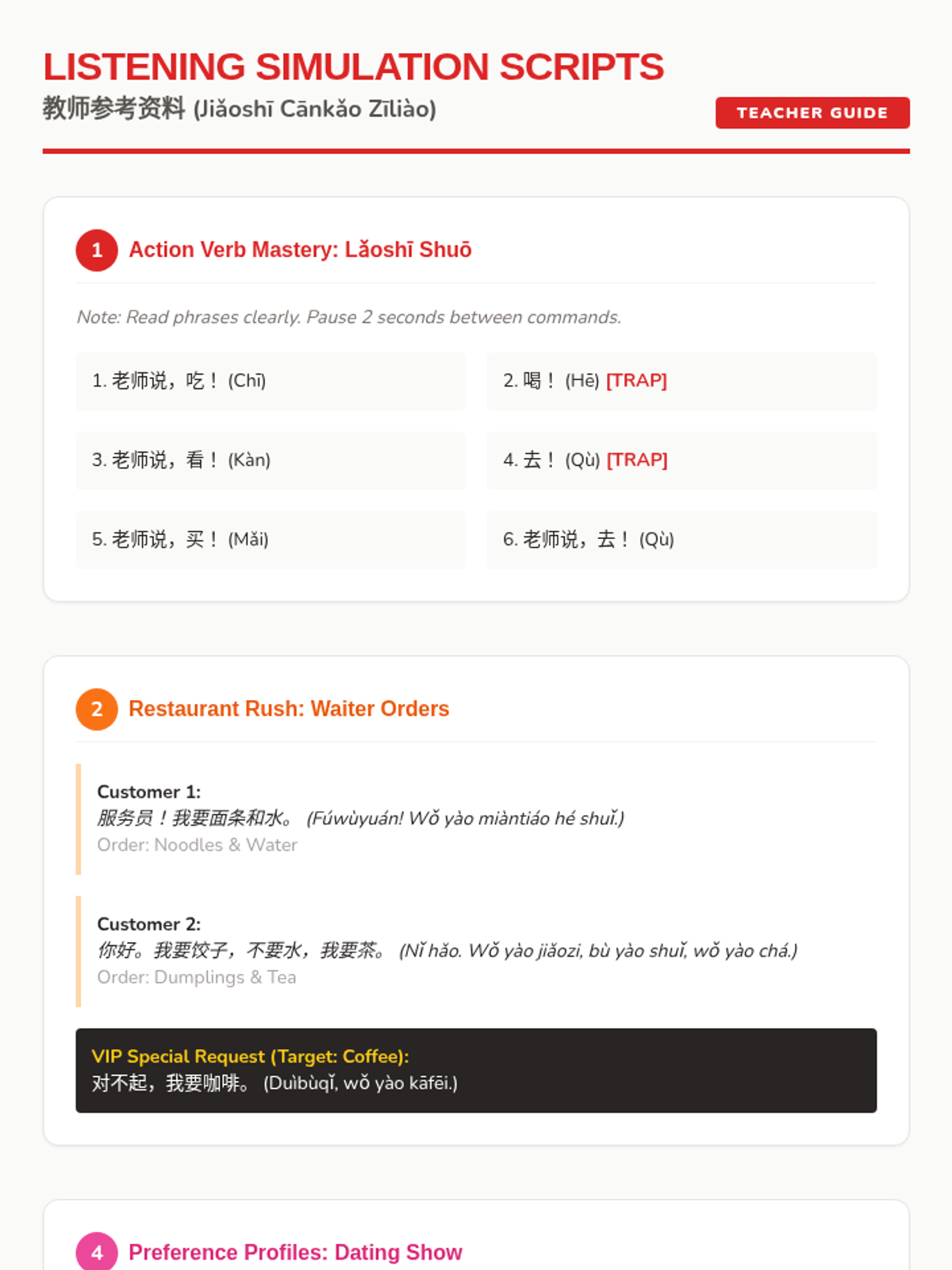
A comprehensive teacher reference guide containing scripts for all listening simulations and answer keys for student activities.
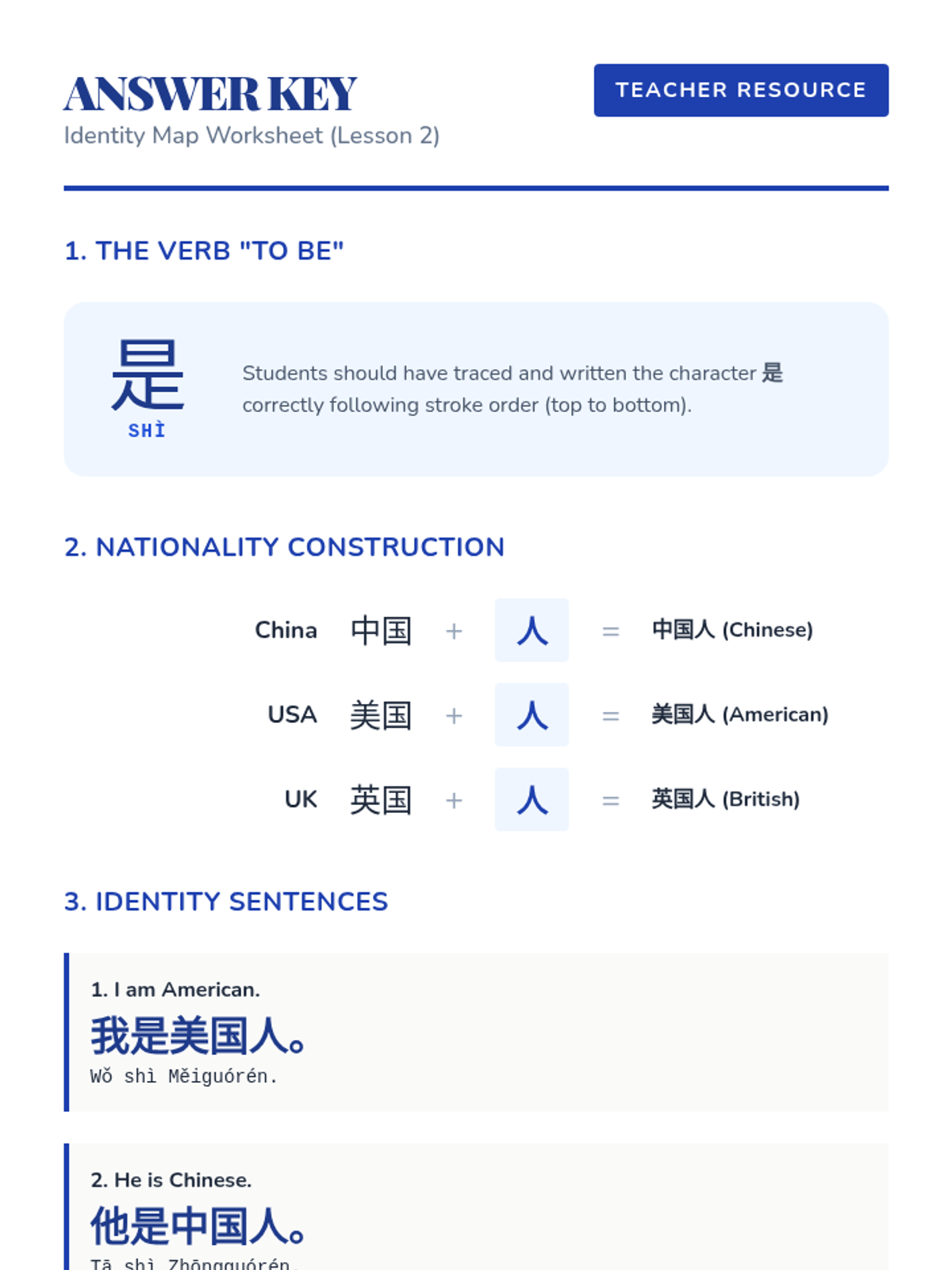
An answer key for the Identity Map Worksheet, providing correct character translations for nationalities and identity sentences using 'shì'.
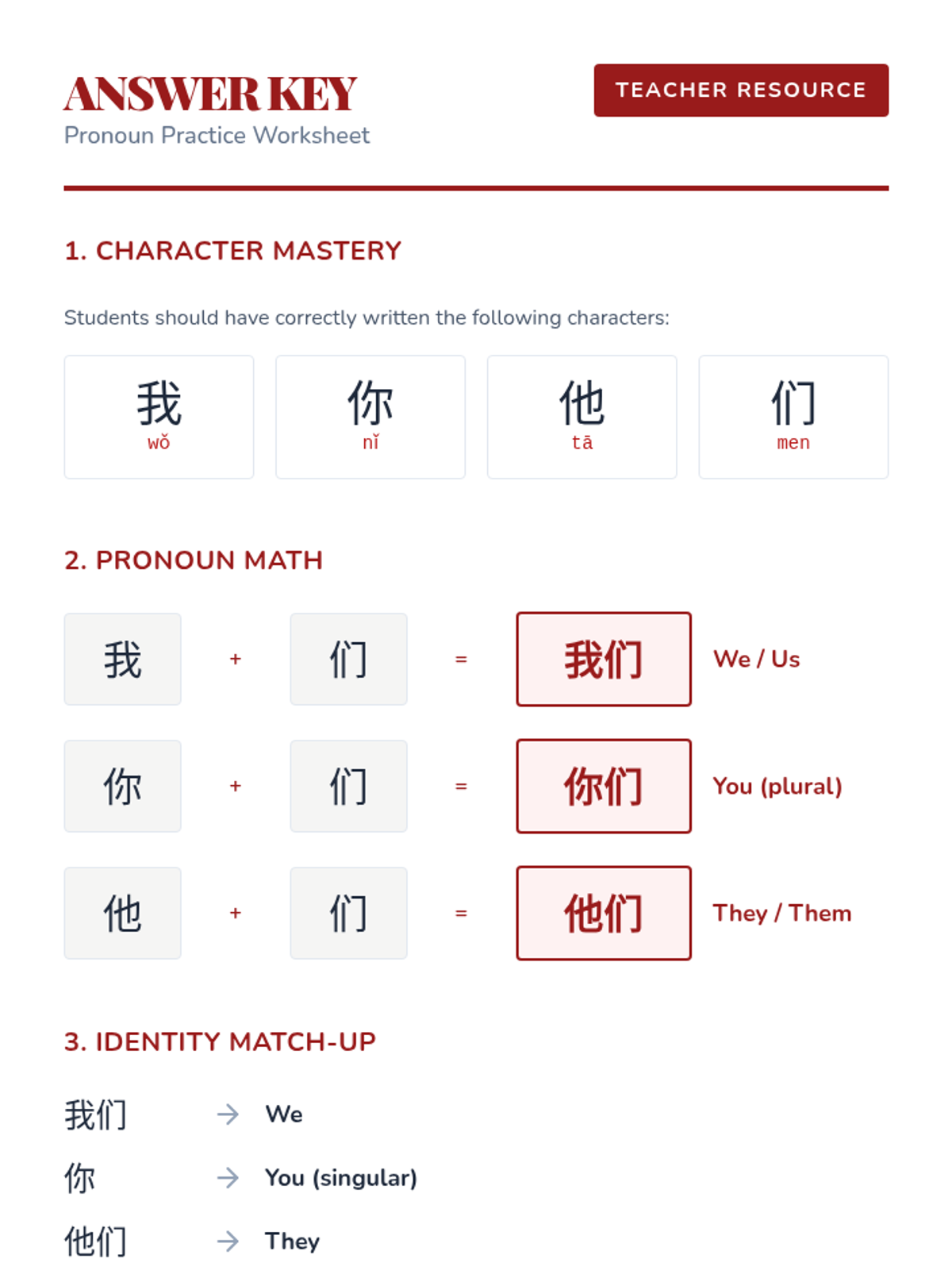
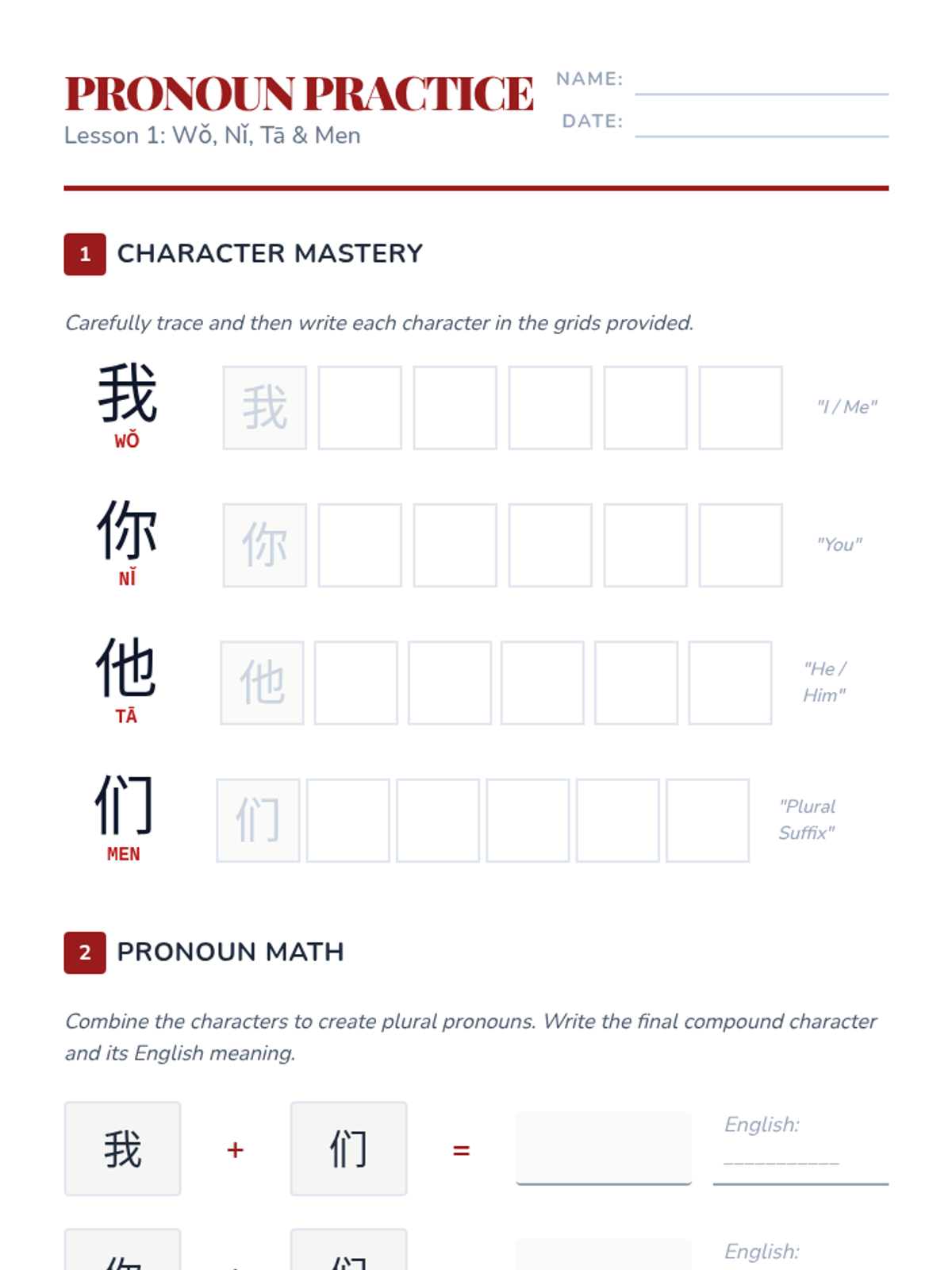
An answer key for the Pronoun Practice Worksheet, providing correct character writing examples, compound math answers, and matching solutions.
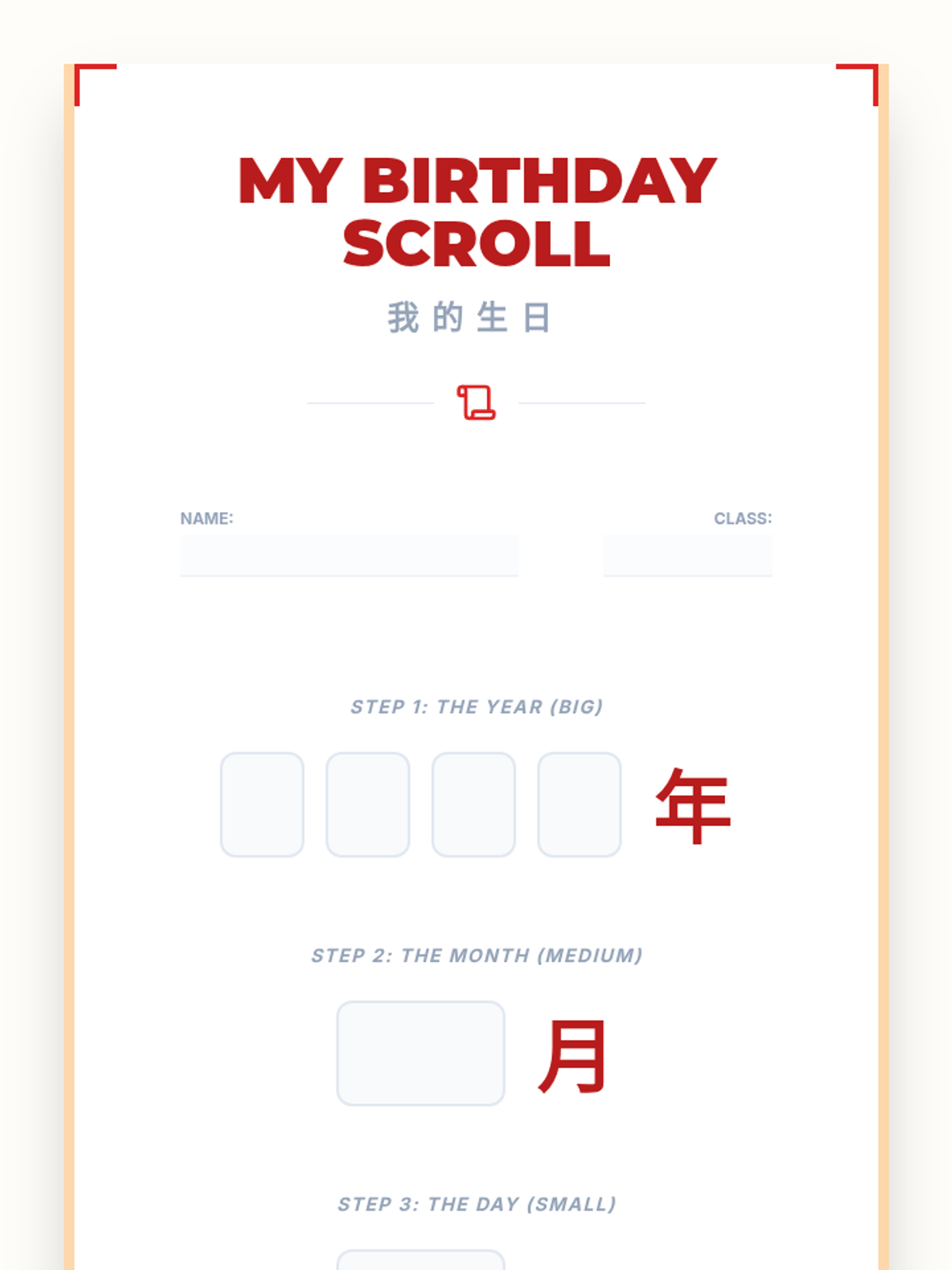
A decorative worksheet for students to practice writing their birthdays in the correct Mandarin Year-Month-Day format.
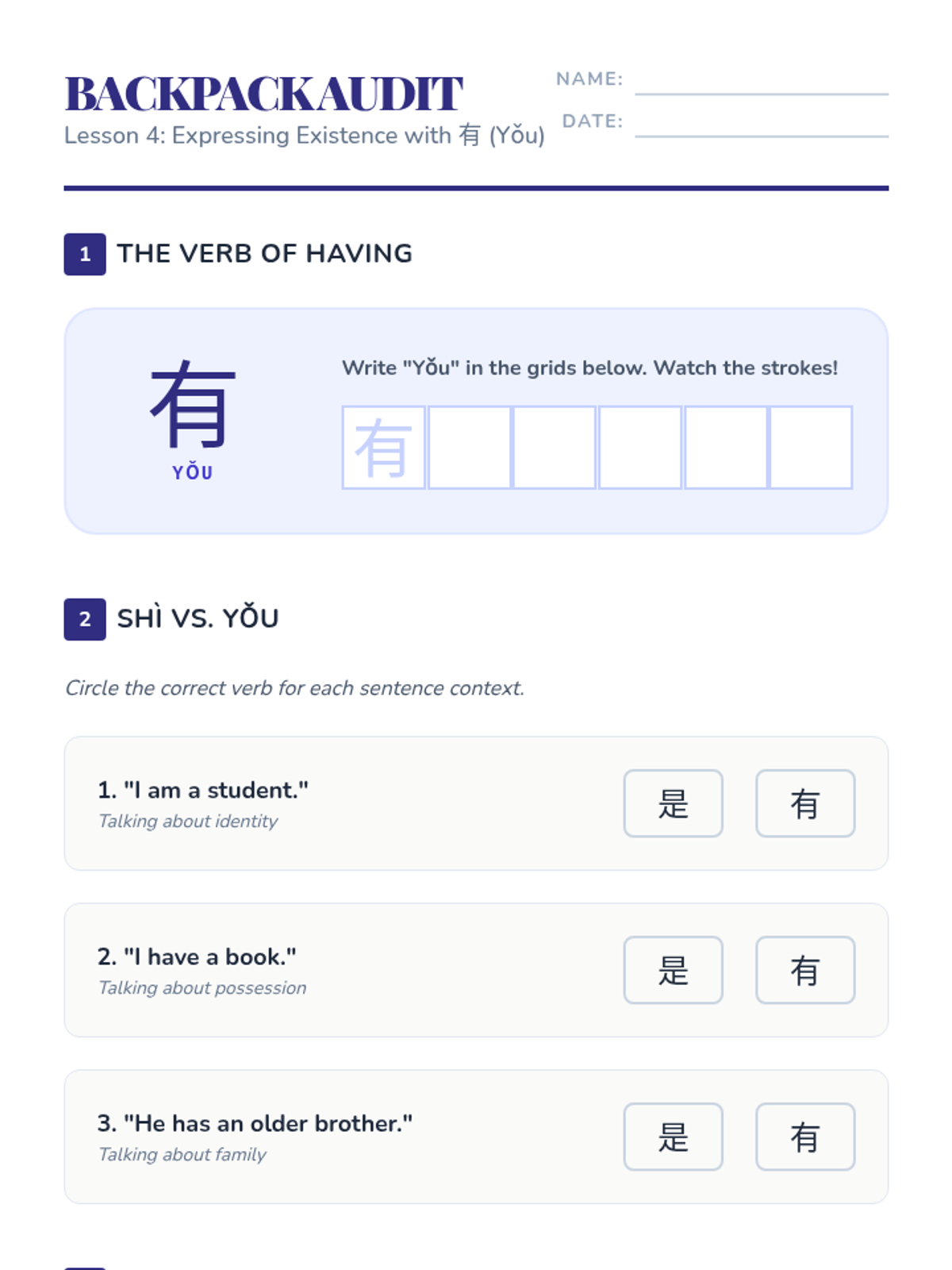
A student practice worksheet for Lesson 4 focusing on the verb 'yǒu' (to have) and creating full sentences about possessions and family.
A slide deck introducing students to the logic of naming months and the Year-Month-Day formatting used in Mandarin Chinese.
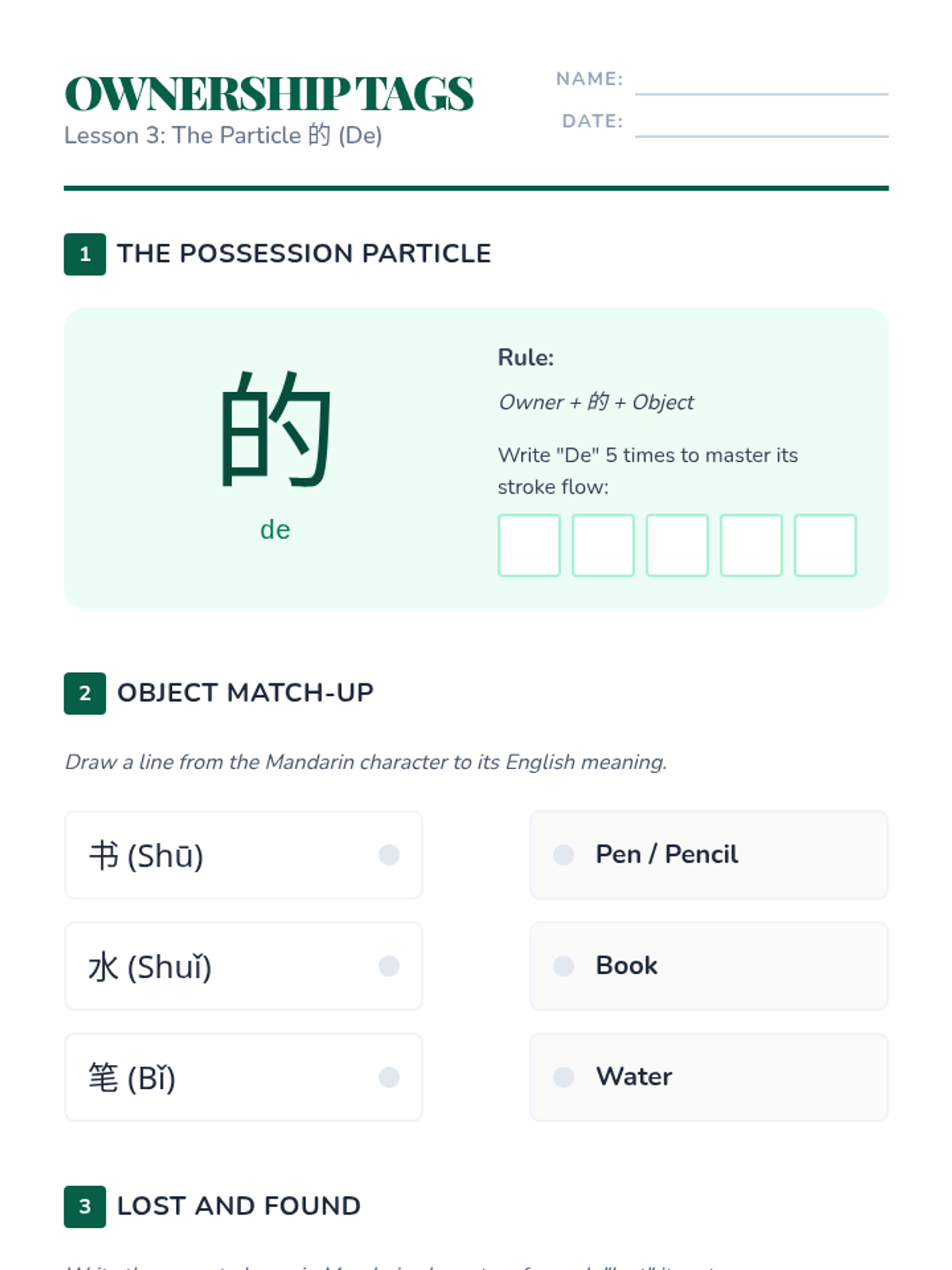
A student practice worksheet for Lesson 3 focusing on the possessive particle 'de' (的) and creating possessive phrases with common objects.
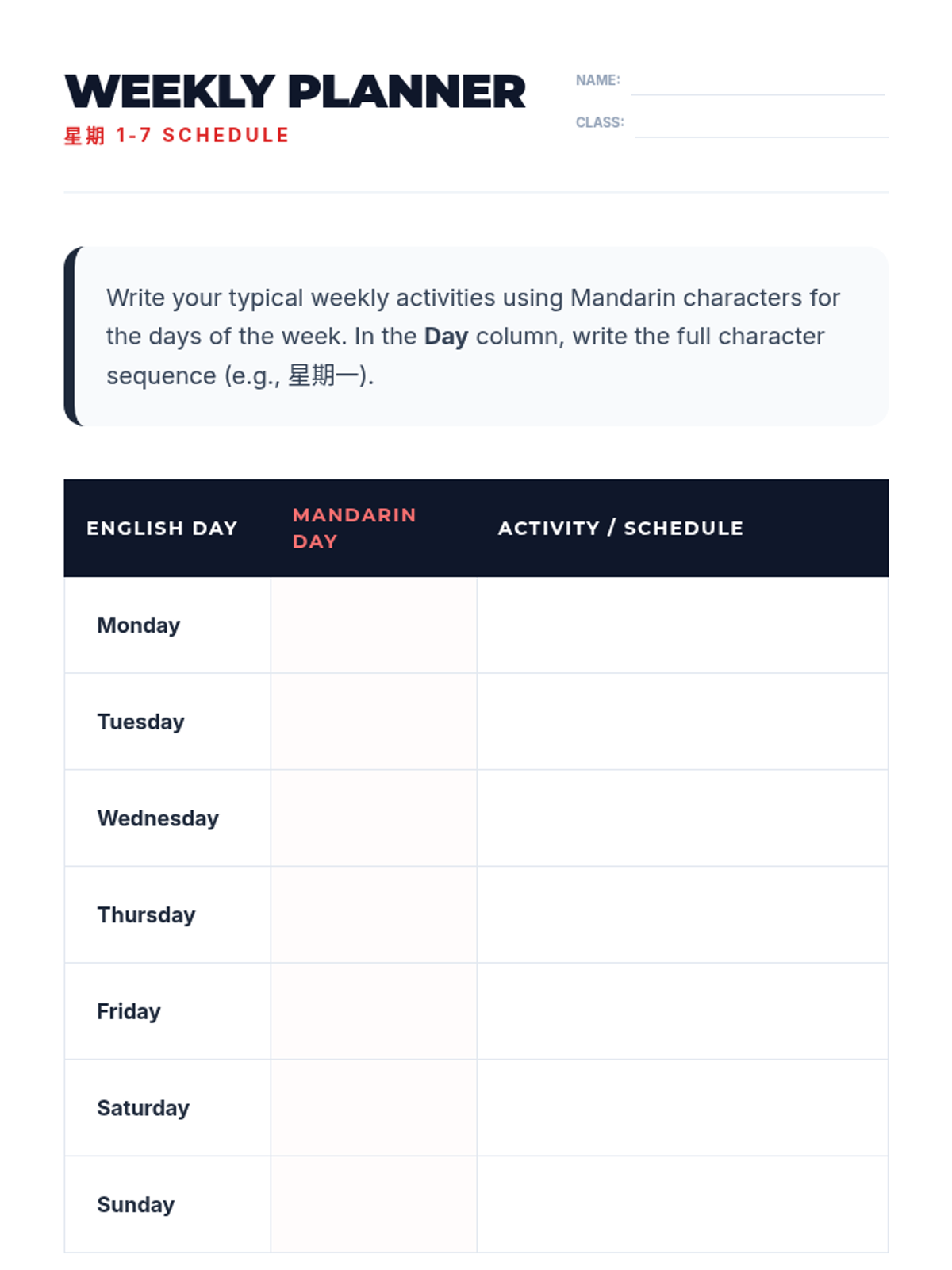
A student organizer for planning a weekly schedule using Mandarin characters for days of the week, reinforcing the numerical logic of the system.
A visual presentation exploring the numerical naming system for days of the week in Mandarin, highlighting the contrast with English mythological names.
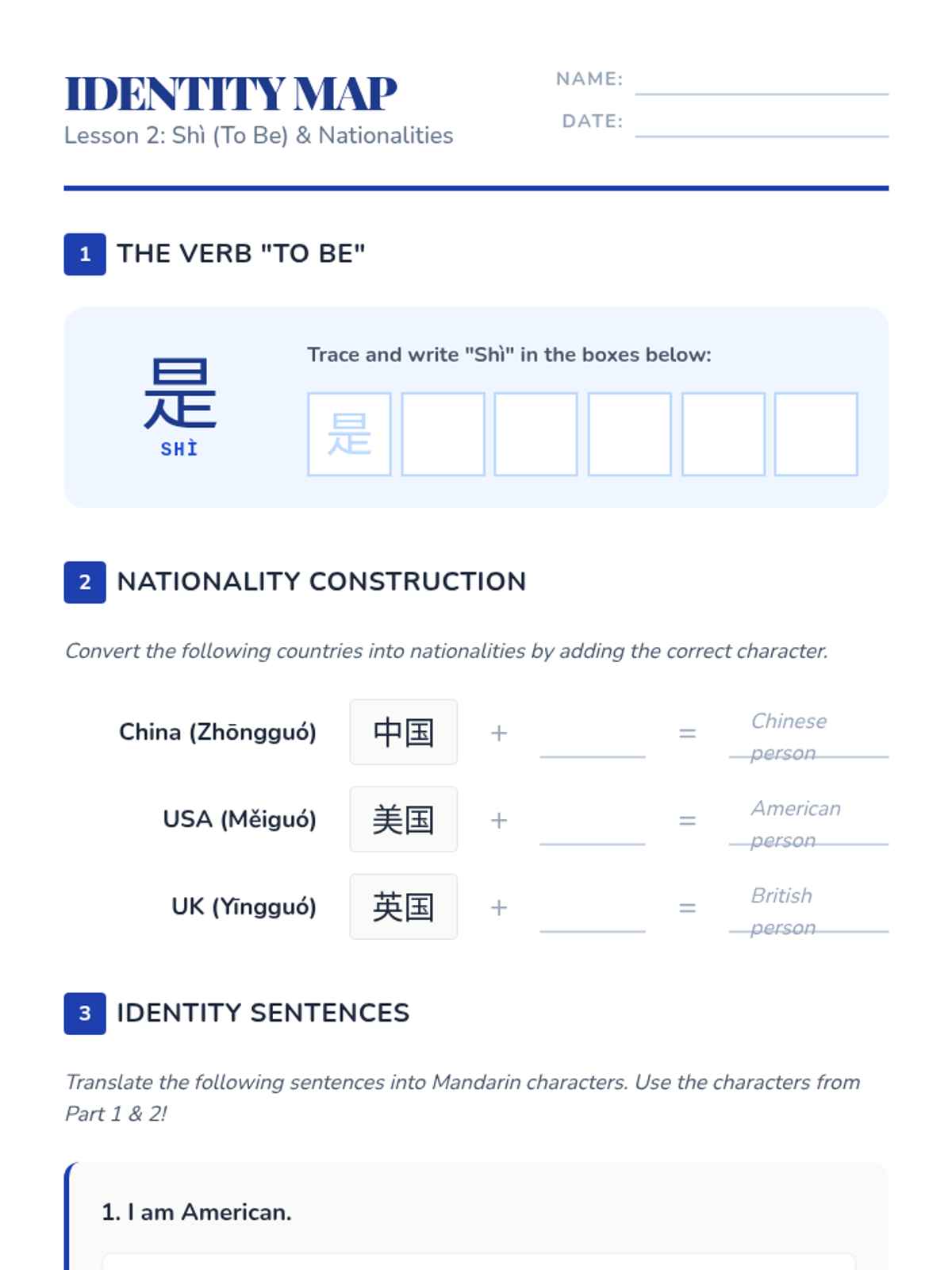
A student practice worksheet for Lesson 2 focusing on the verb 'shì' (to be) and constructing nationality sentences with 'rén'.
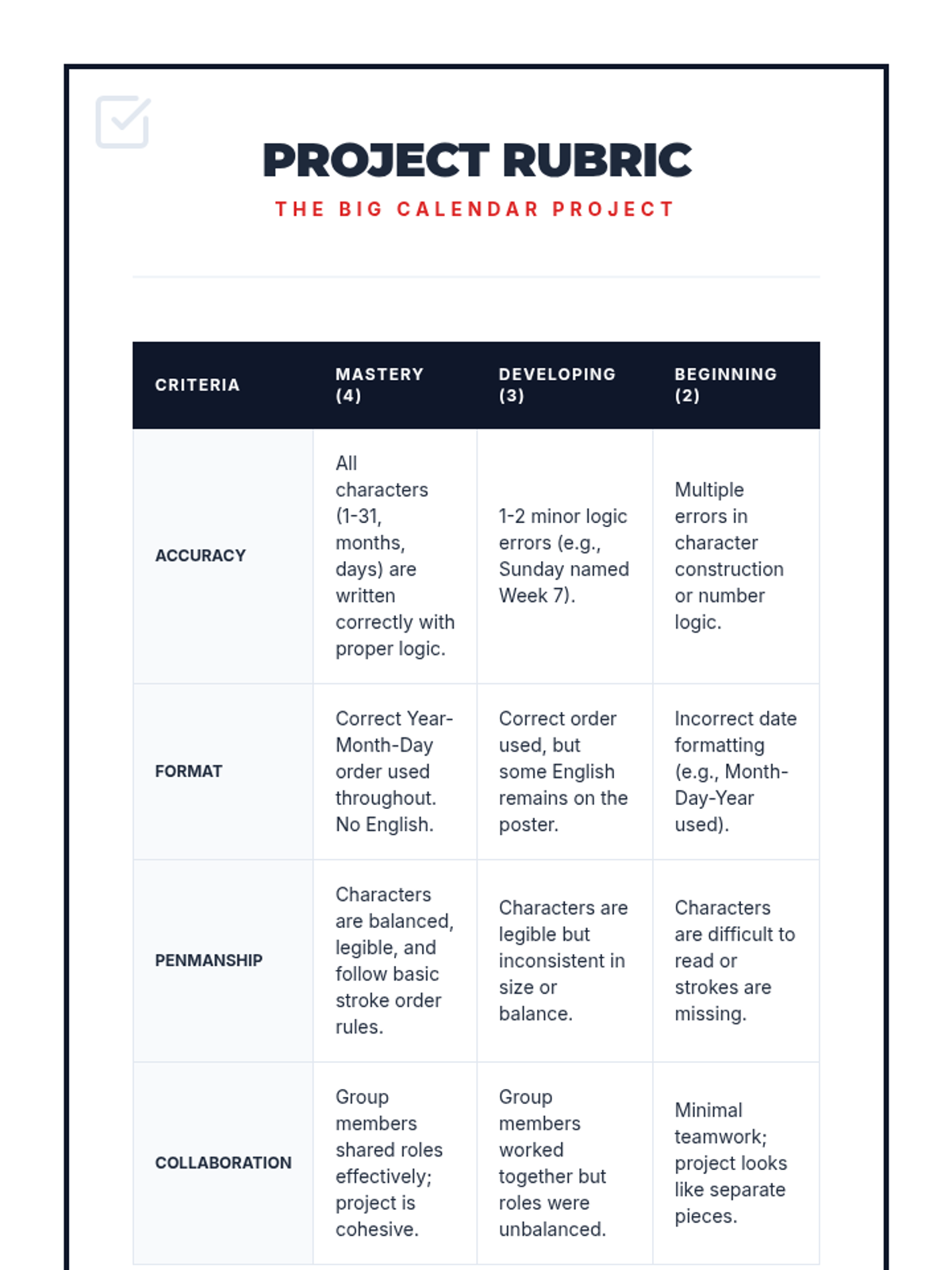
A scoring rubric for the Big Calendar Project, evaluating students on accuracy, formatting, penmanship, and collaboration.
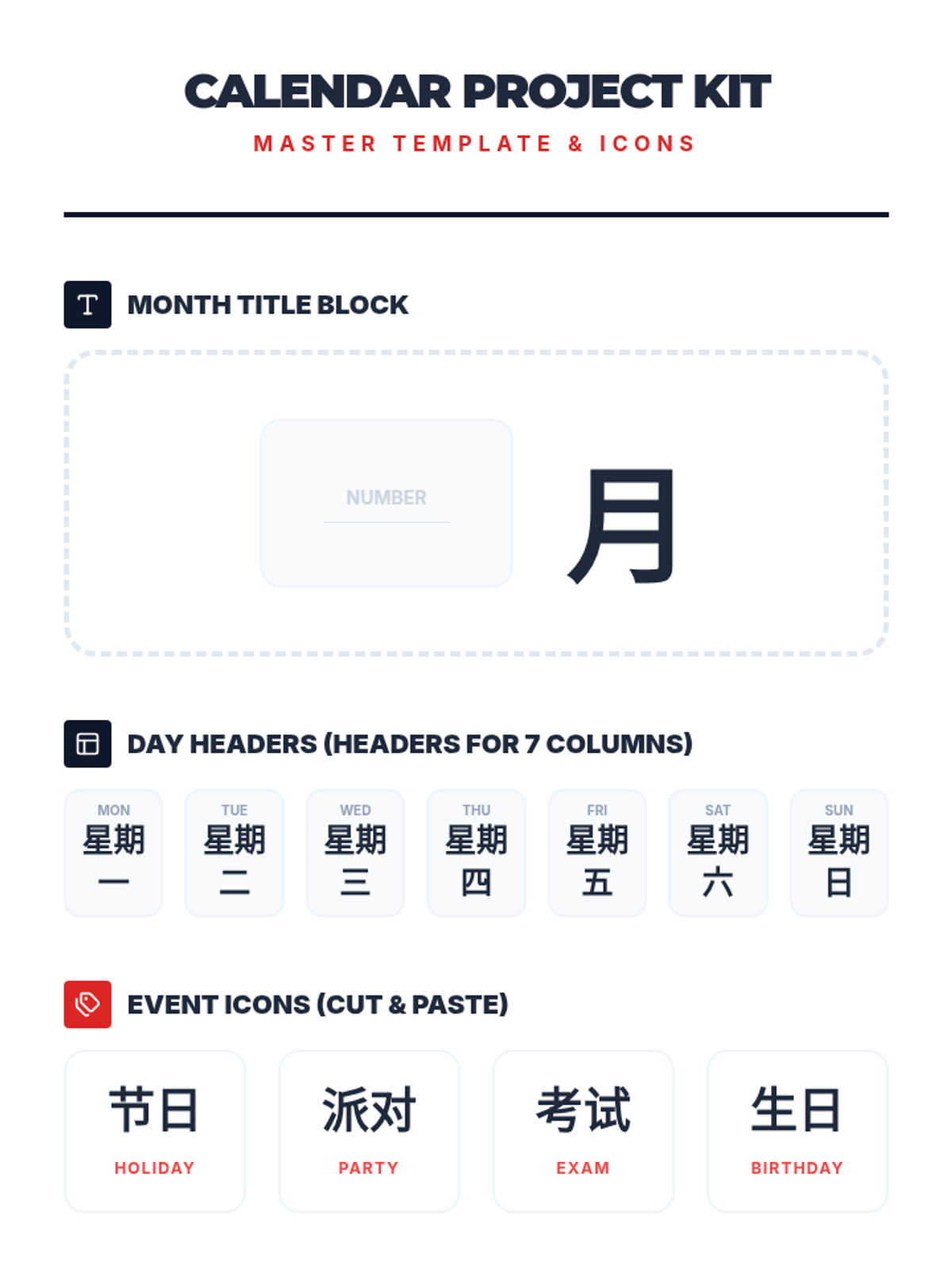
A template kit containing all the necessary components for building a large-scale classroom calendar in Mandarin, including headers and event icons.
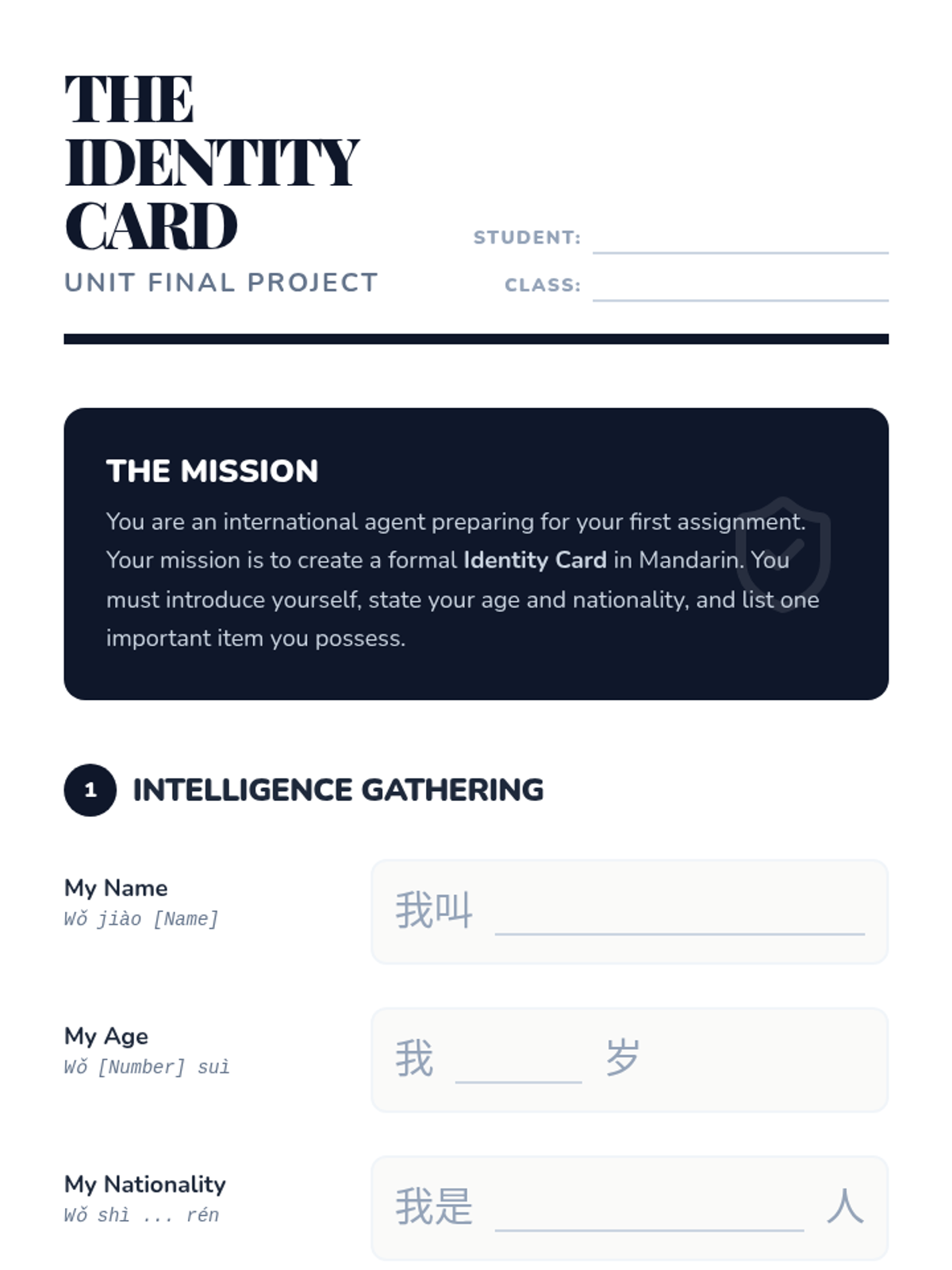
A final project document where students synthesize their learning by creating an identity card with their name, age, nationality, and a possession in Mandarin.
A slide deck guiding students through the collaborative classroom calendar project, including group roles and project requirements.
Slides for teaching the verb 'yǒu' (to have/exist), its character breakdown, and the conceptual difference between 'shì' and 'yǒu'.
Slides introducing the possessive particle 'de' (的) and how to combine it with pronouns and common nouns like book, water, and pen.
Slides focusing on the verb 'shì' (to be) and basic nationality sentence construction. Includes visual breakdowns of 'shì', country names, and the 'rén' suffix.
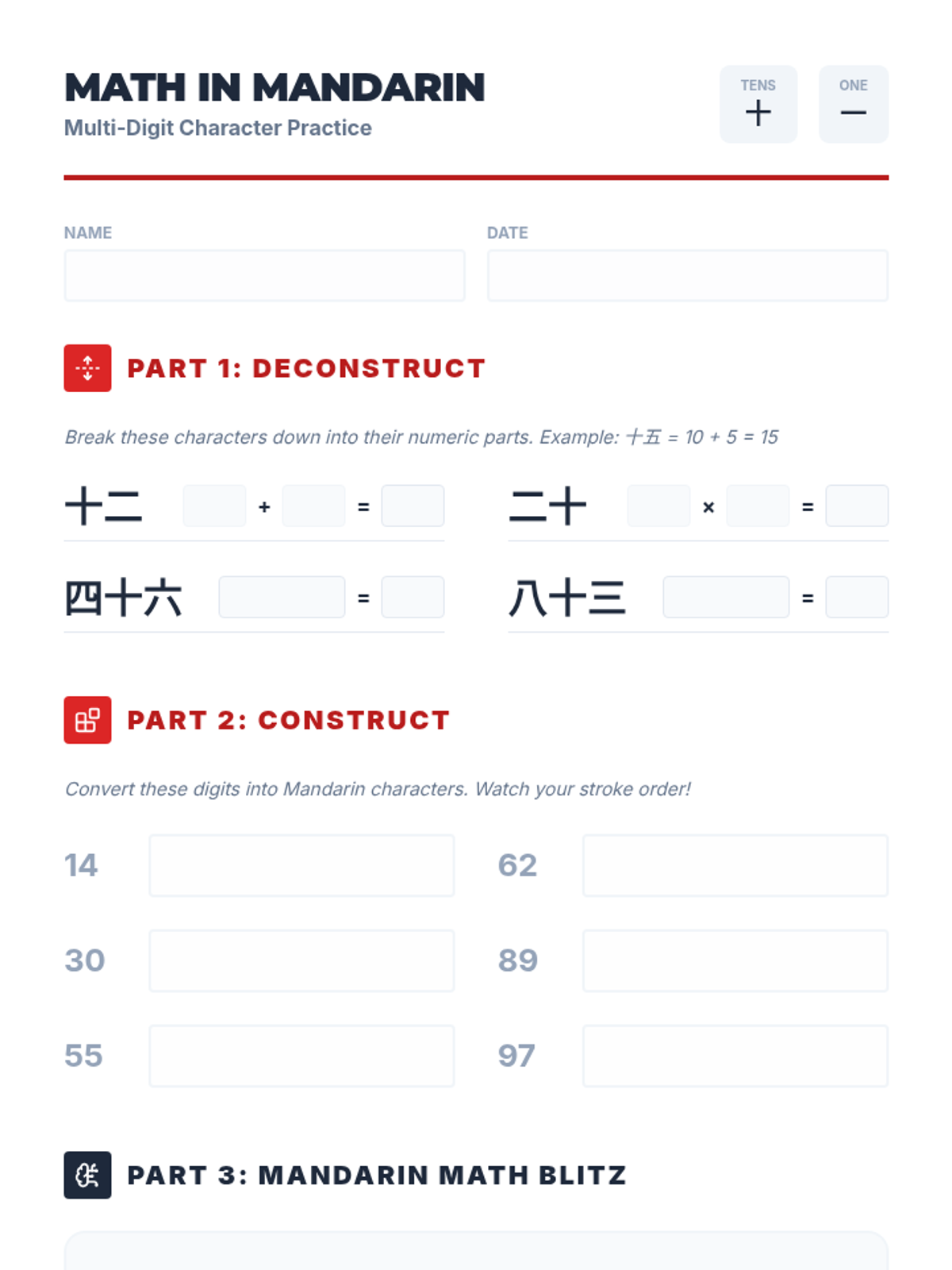
A mathematical worksheet where students practice deconstructing and constructing double-digit numbers in Mandarin, concluding with simple arithmetic problems in characters.
A slide deck explaining the logical construction of Chinese numbers from 11 to 99, highlighting the addition and multiplication rules.
A student practice worksheet for Mandarin pronouns including character writing grids, compound construction (pronoun math), matching, and context questions.
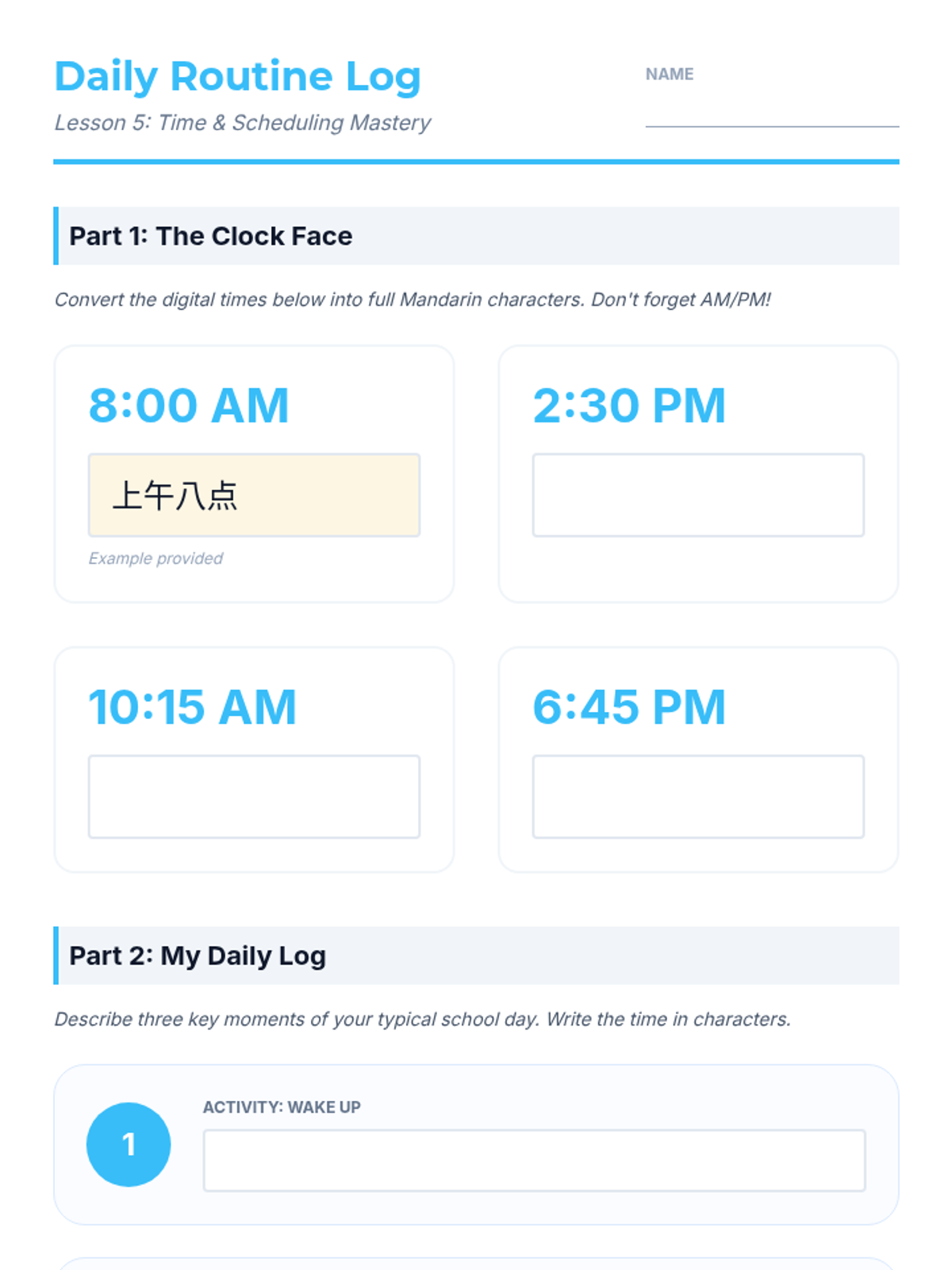
Worksheet for practicing digital-to-character time conversion and creating a personal daily routine schedule.
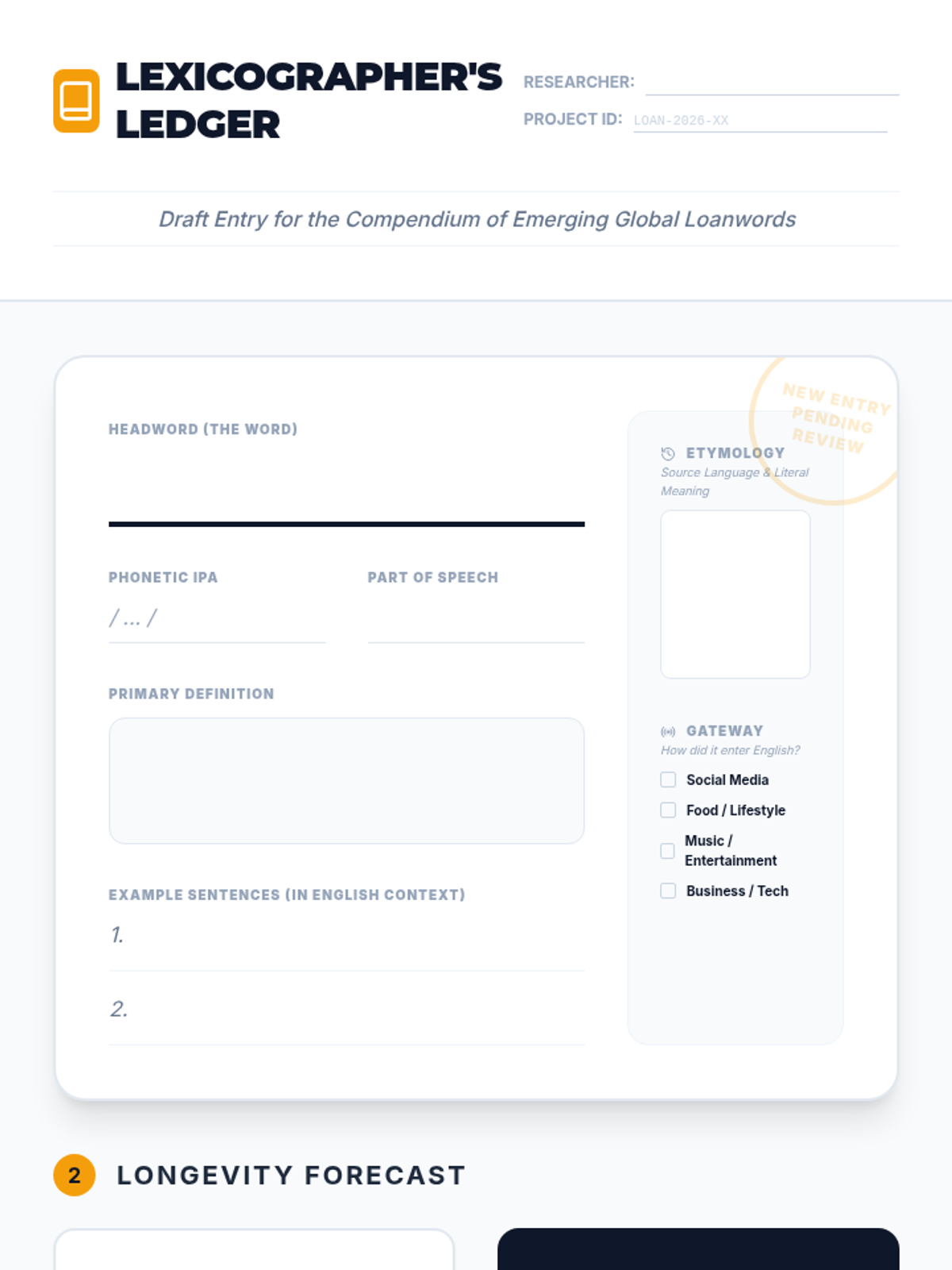
A professional dictionary entry template for students to document an emerging loanword as part of their lexicography project.
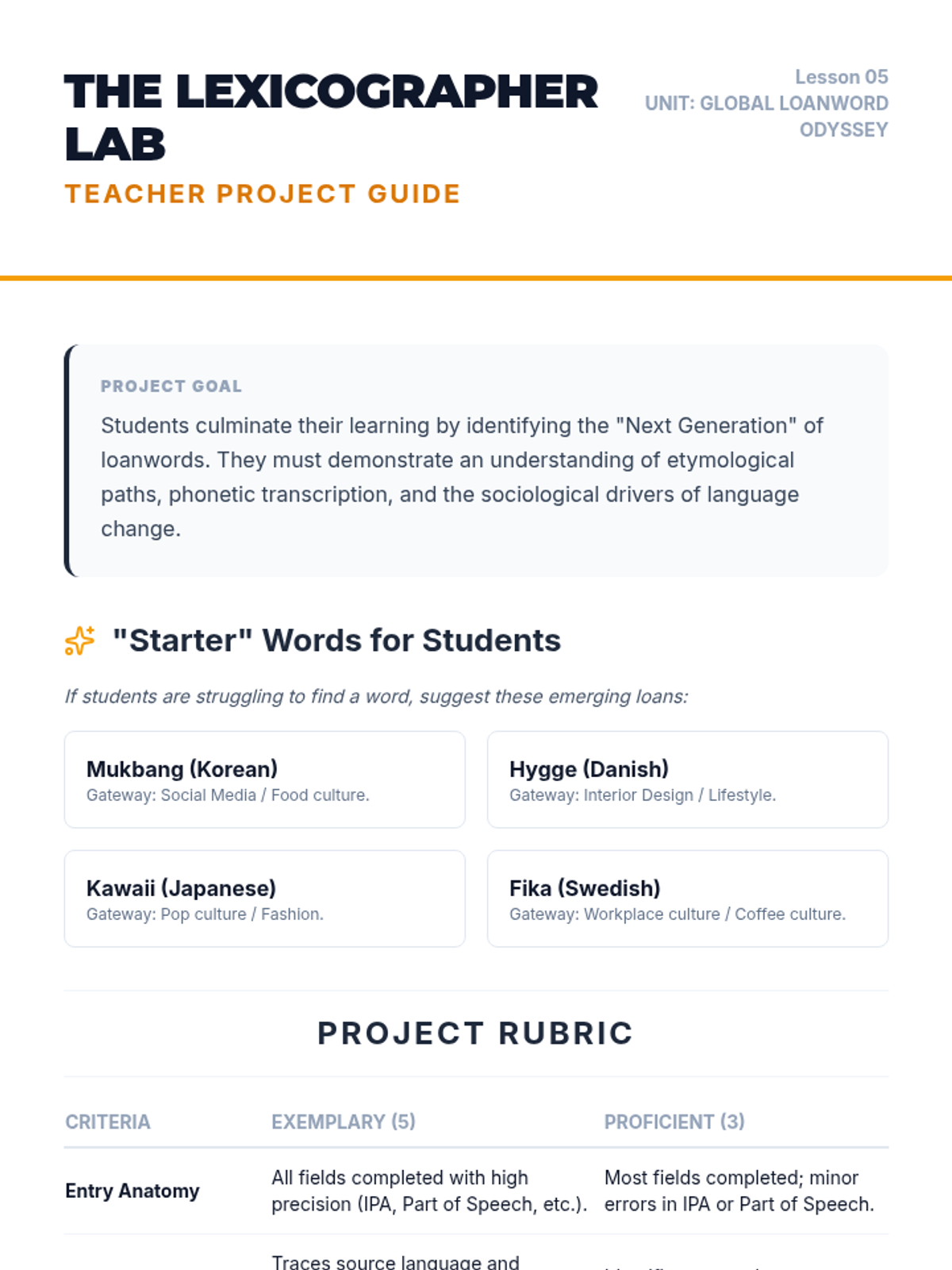
A facilitation guide for teachers leading the Project-Based Lexicography lesson, including suggested words for students and a project rubric.
Introductory slides for the Project-Based Lexicography lesson, focusing on the anatomy of a dictionary entry and project guidelines.
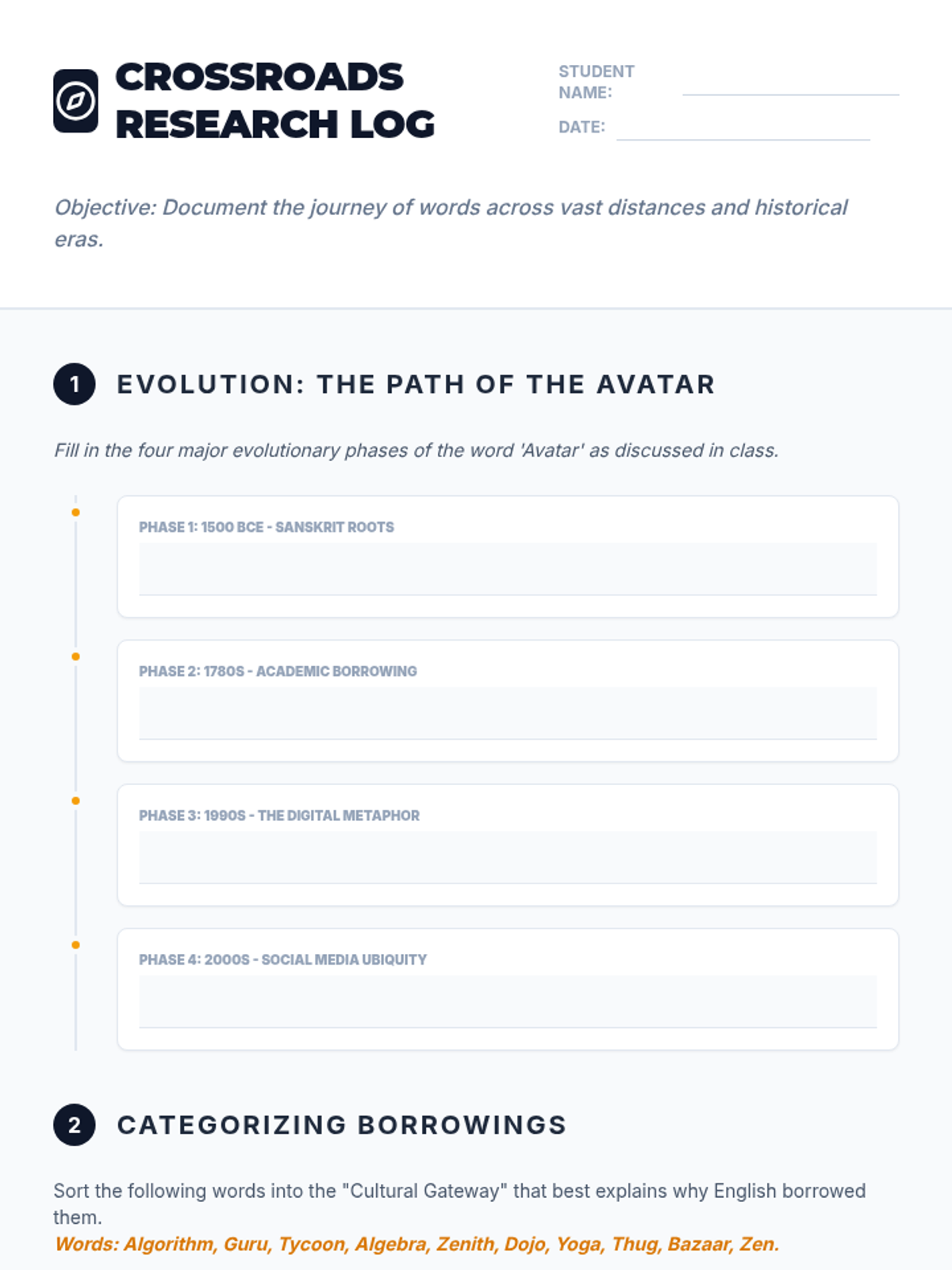
A student research log for the Asia & Middle East lesson, focusing on the etymological path of 'Avatar' and categorizing various loanwords by their cultural influence.
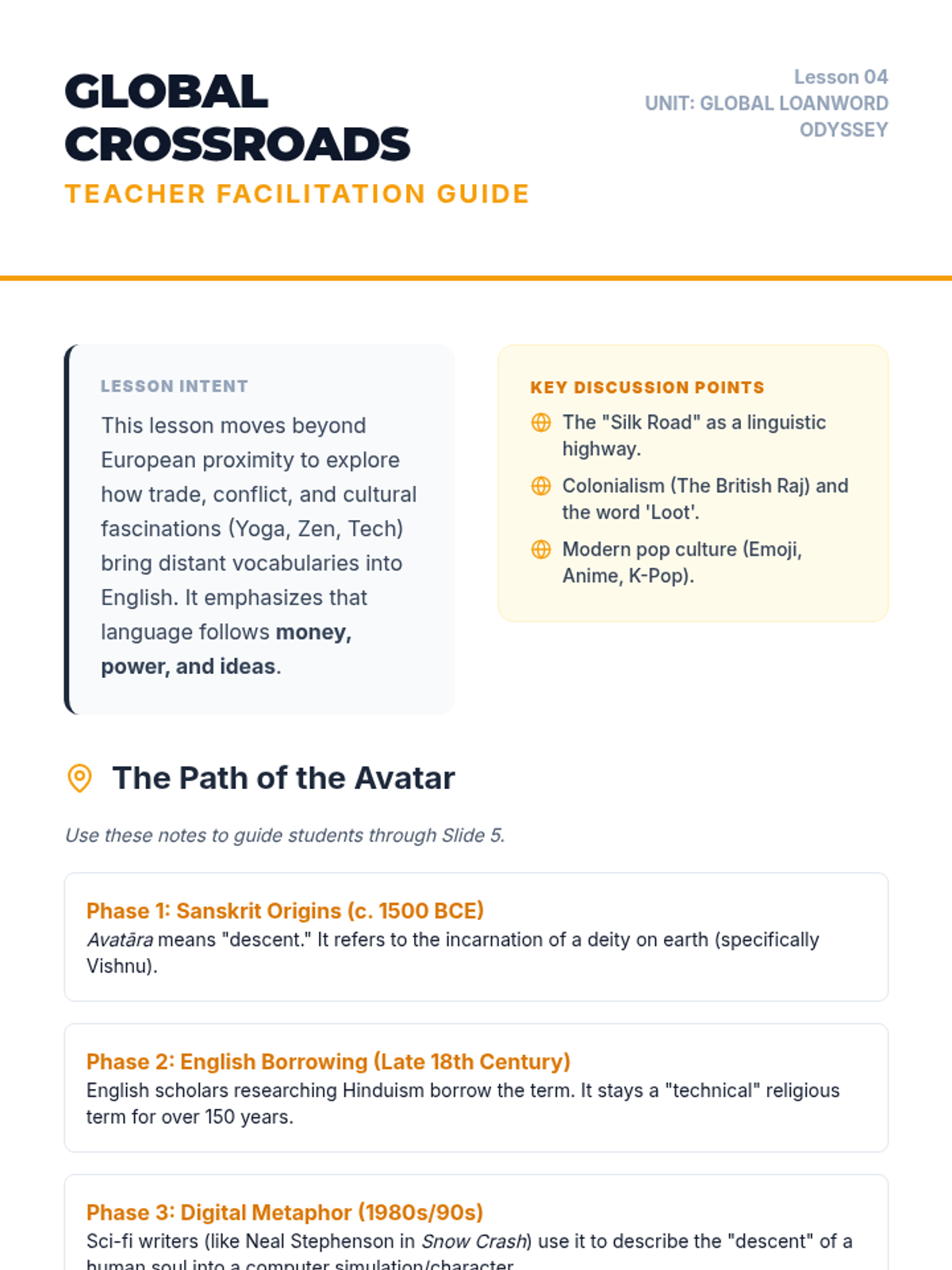
A facilitation guide for teachers leading the Asia & Middle East lesson, focusing on historical context, research guidance, and the 'Avatar' case study.
Introductory slides for the Asia & Middle East lesson, exploring tech, spiritual, and trade influences on English vocabulary.
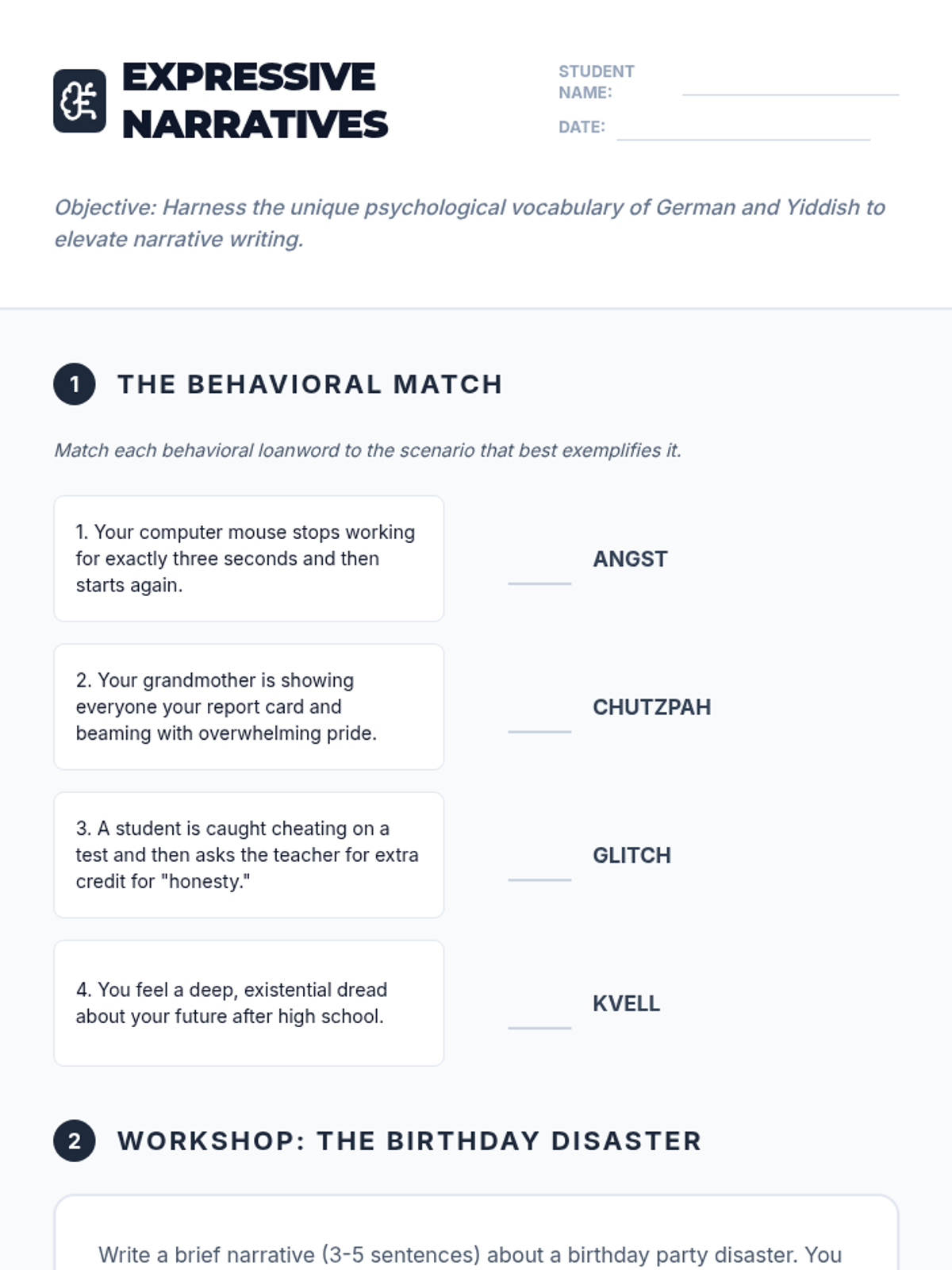
A student worksheet for the German & Yiddish lesson, focusing on behavioral vocabulary, a narrative writing exercise, and identifying lexical gaps.
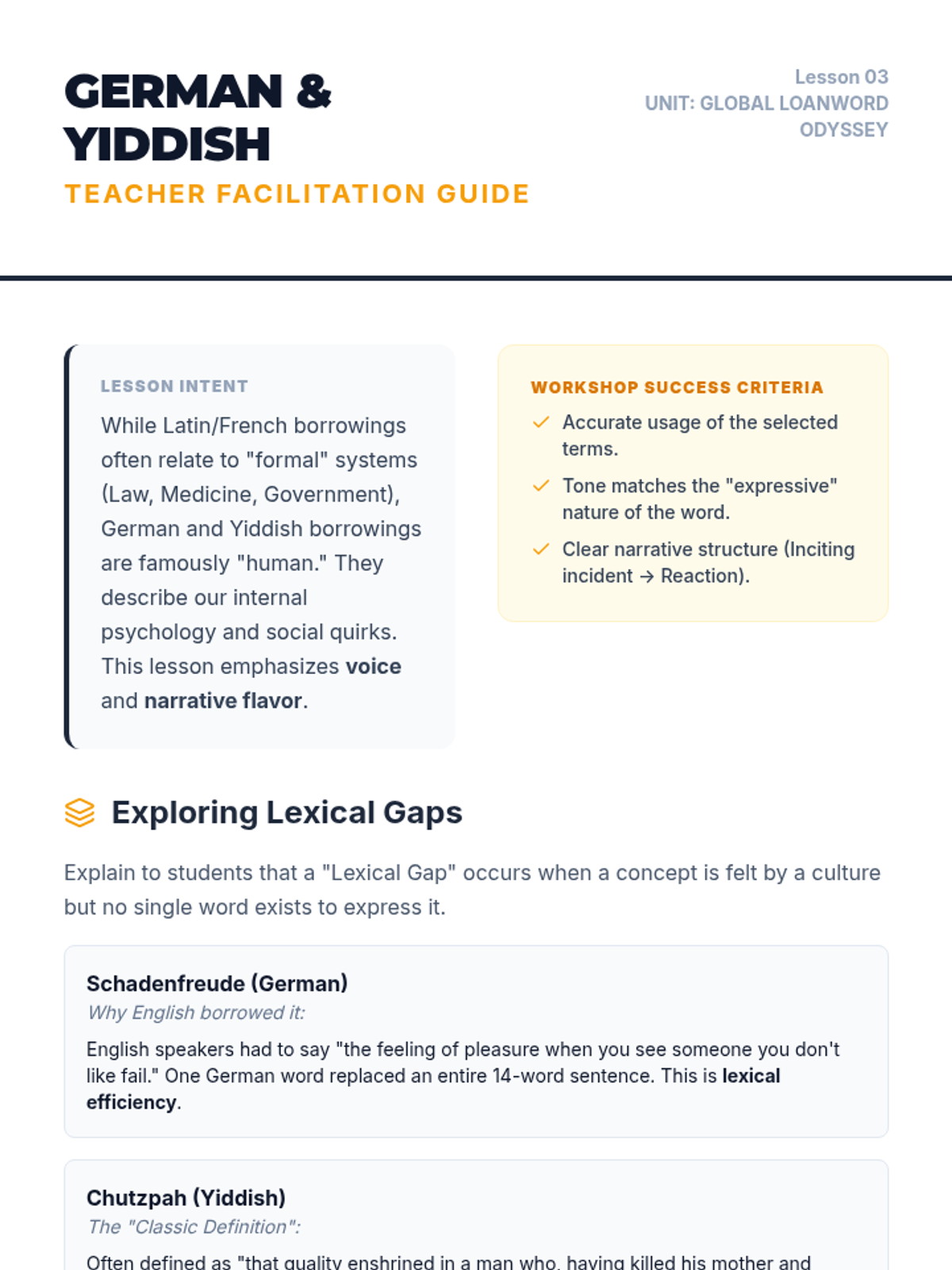
A facilitation guide for teachers leading the German & Yiddish lesson, focusing on expressive vocabulary, lexical gaps, and narrative writing workshops.
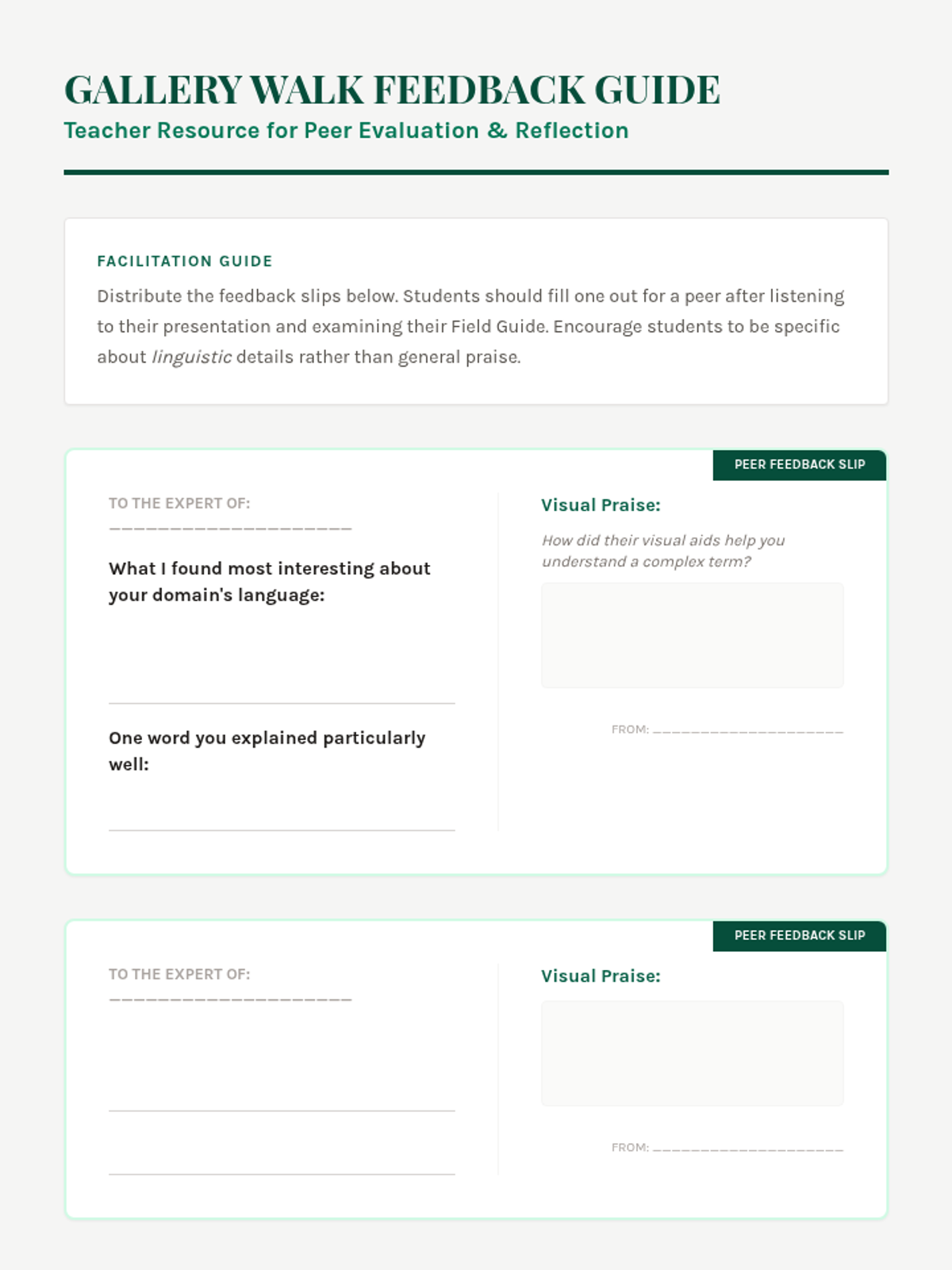
A teacher resource for Lesson 5, providing peer feedback slips and guiding questions for the final class debrief.
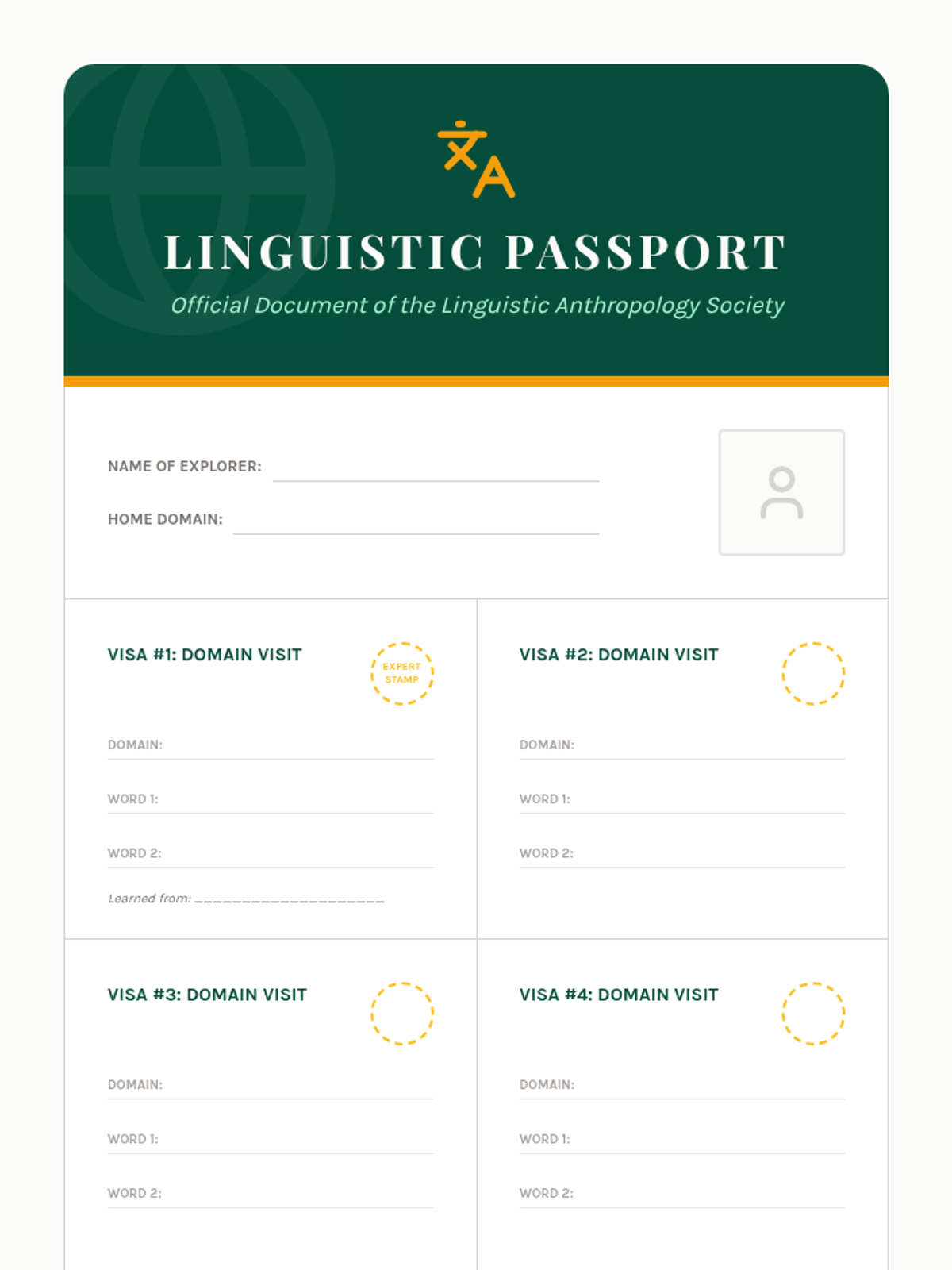
Student handout for the final exhibition, functioning as a "passport" to collect new vocabulary and stamps from peers' presentations.
Introductory slides for the German & Yiddish lesson, exploring expressive terms like 'schadenfreude' and 'chutzpah' and their role in filling lexical gaps.
Introductory slide deck for Lesson 5, outlining the instructions and norms for the final gallery walk exhibition.
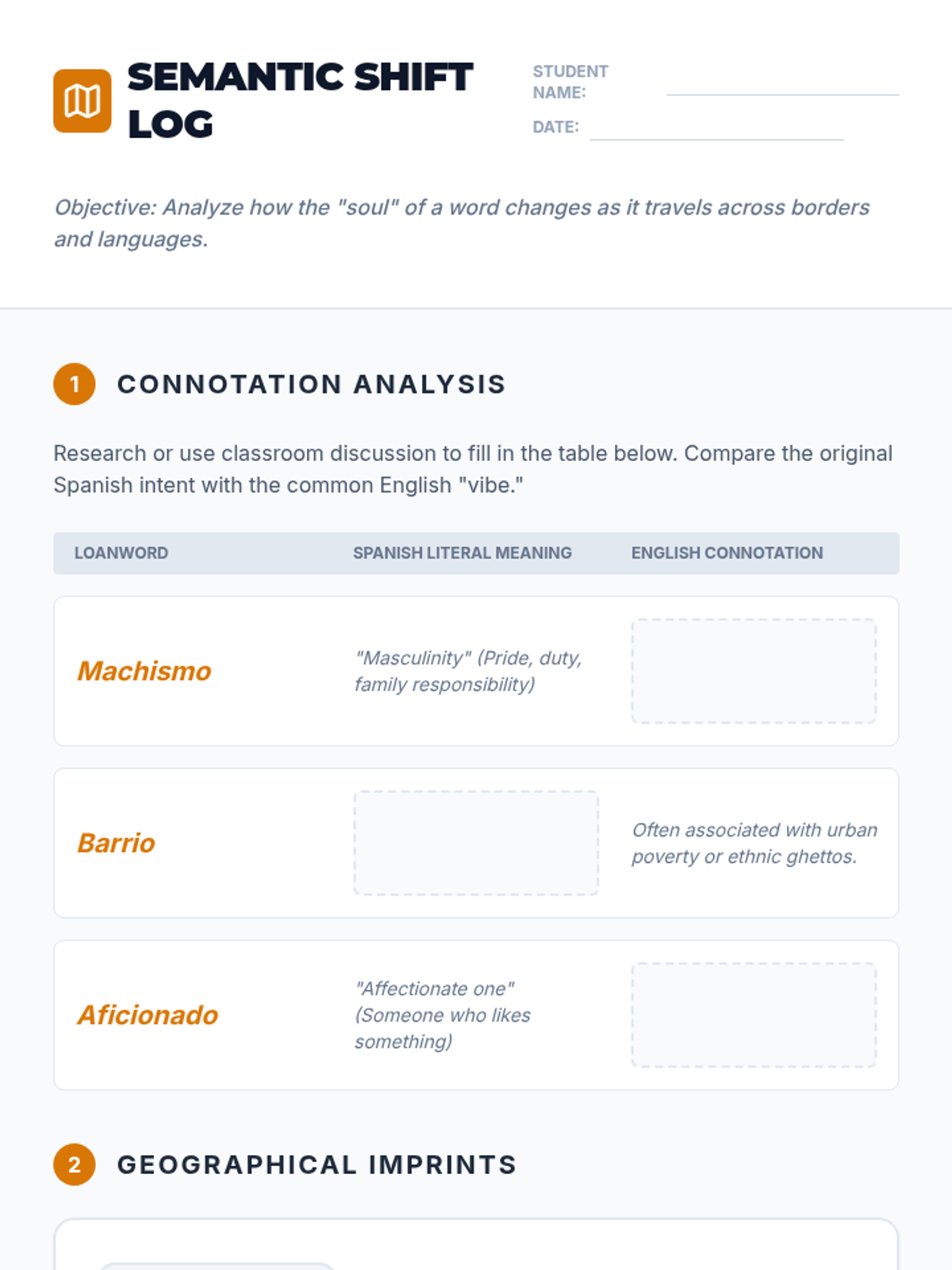
A student worksheet for the Spanish Roots lesson, focusing on meaning vs. connotation and identifying Spanish-derived topographical terms in the US.
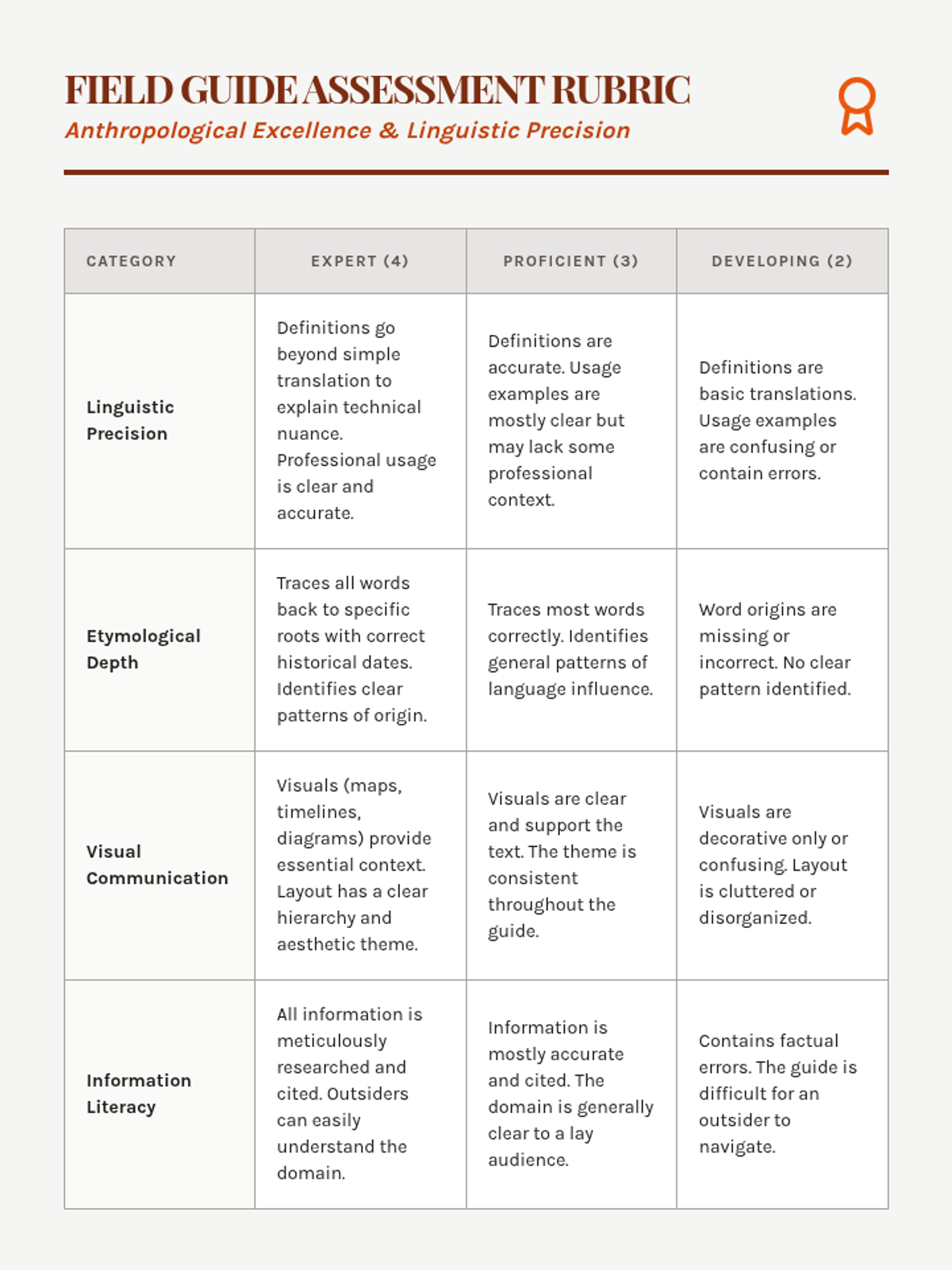
A comprehensive rubric for assessing the linguistic precision, etymological depth, and visual communication of the final field guide.
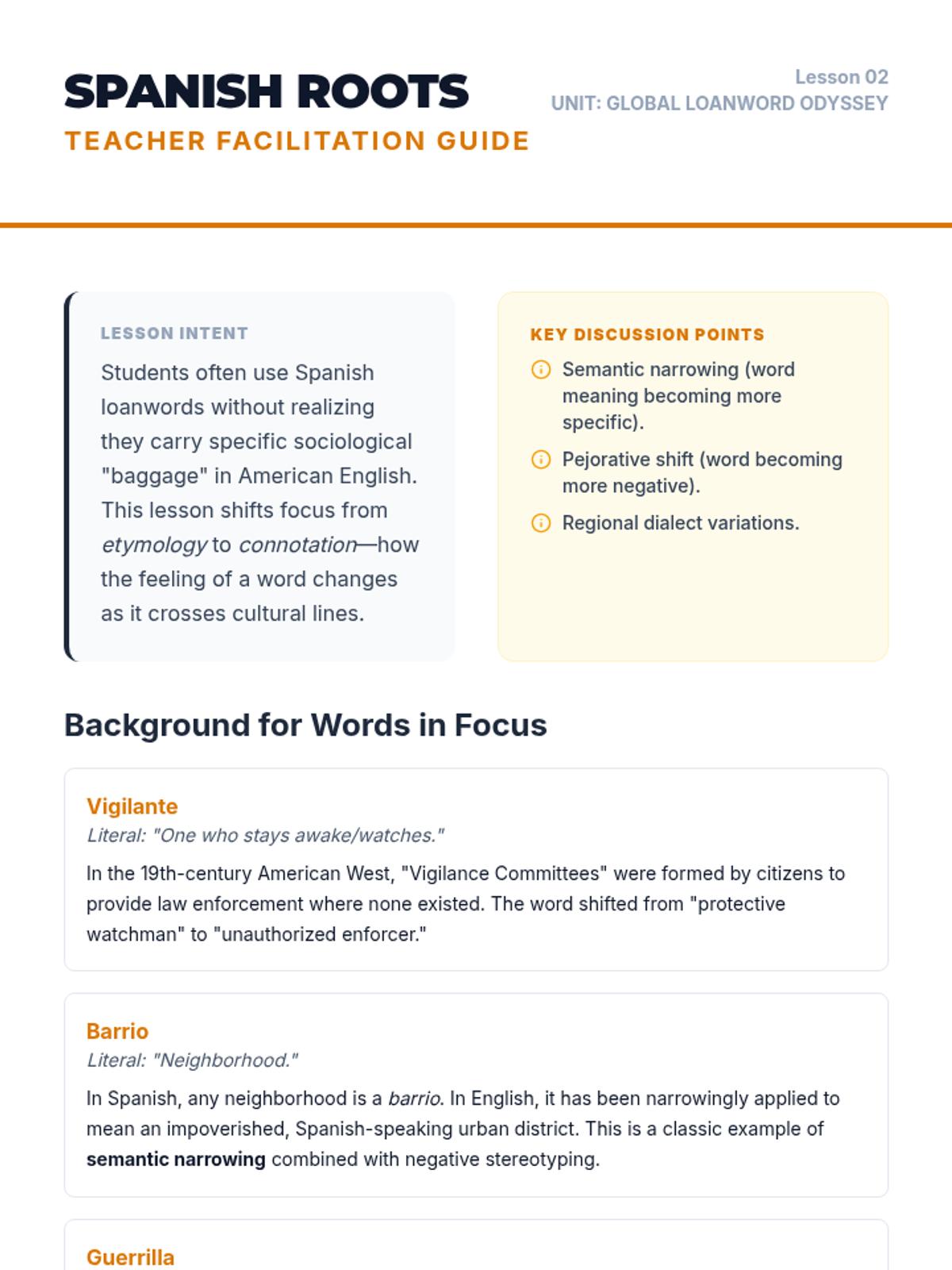
A facilitation guide for teachers leading the Spanish Roots lesson, focusing on semantic shifts, connotation changes, and facilitating discussion on cultural appropriation.
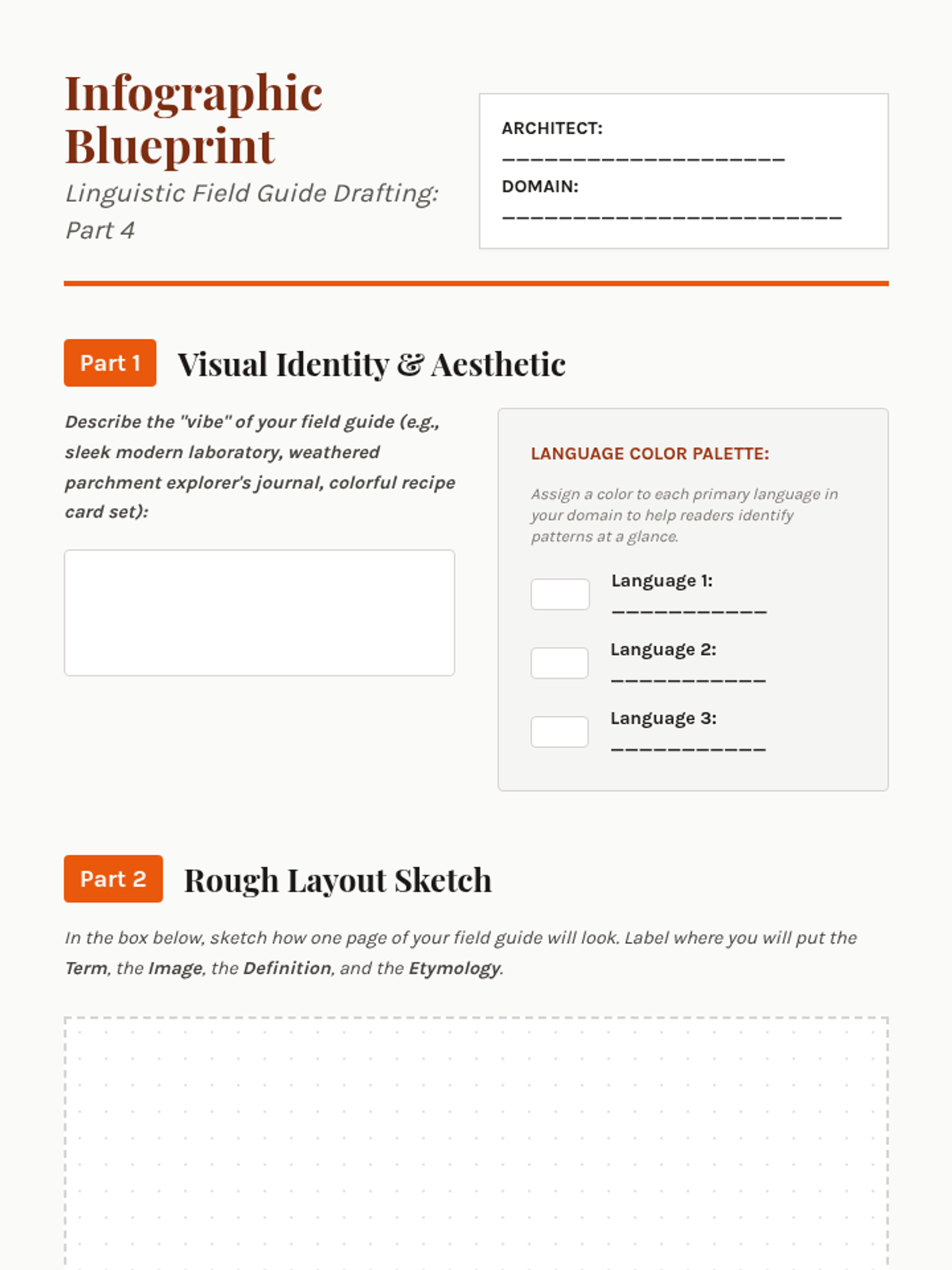
Student worksheet for Lesson 4 to plan the visual identity, layout, and infographic elements of their field guide.
Slide deck for Lesson 4, introducing strategies for visualizing language and designing the field guide layout.
Introductory slides for the Spanish Roots lesson, exploring common Spanish loanwords in English and their shifts in connotation.
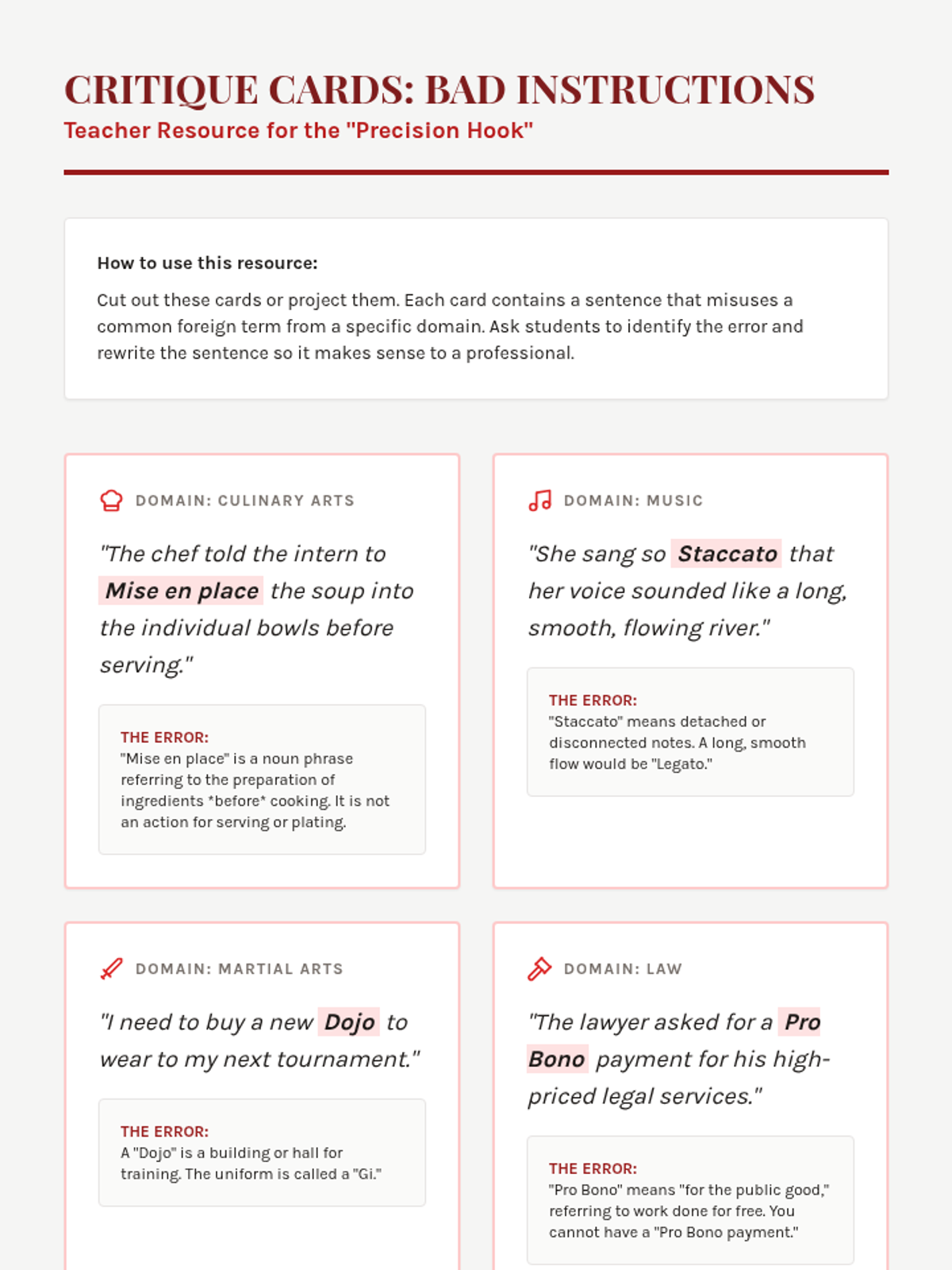
A teacher resource providing examples of misused technical terms for students to critique and correct as a hook for Lesson 3.
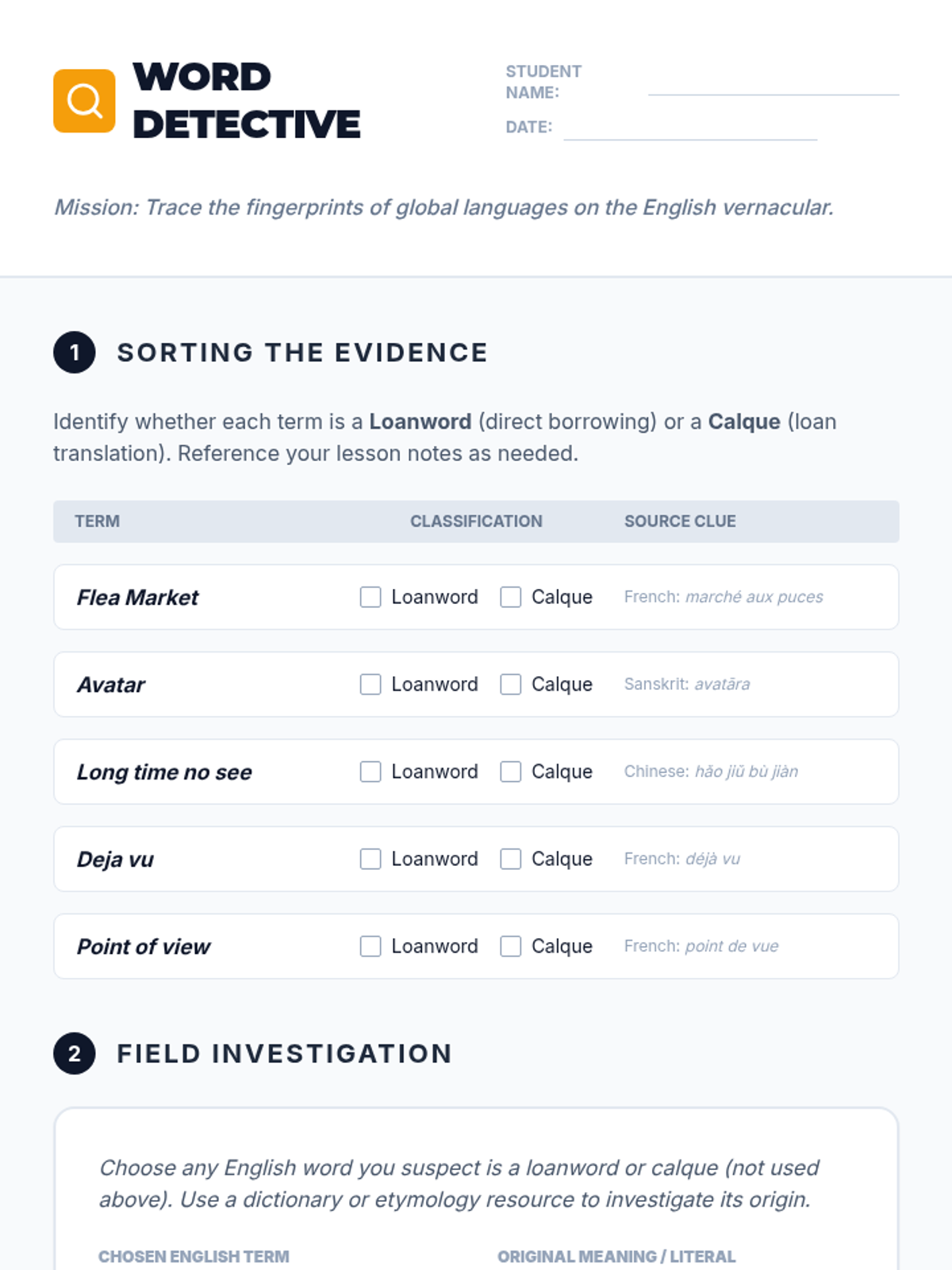
A student activity sheet for the Borrowing Mechanics lesson, featuring word classification exercises and an etymological research task.
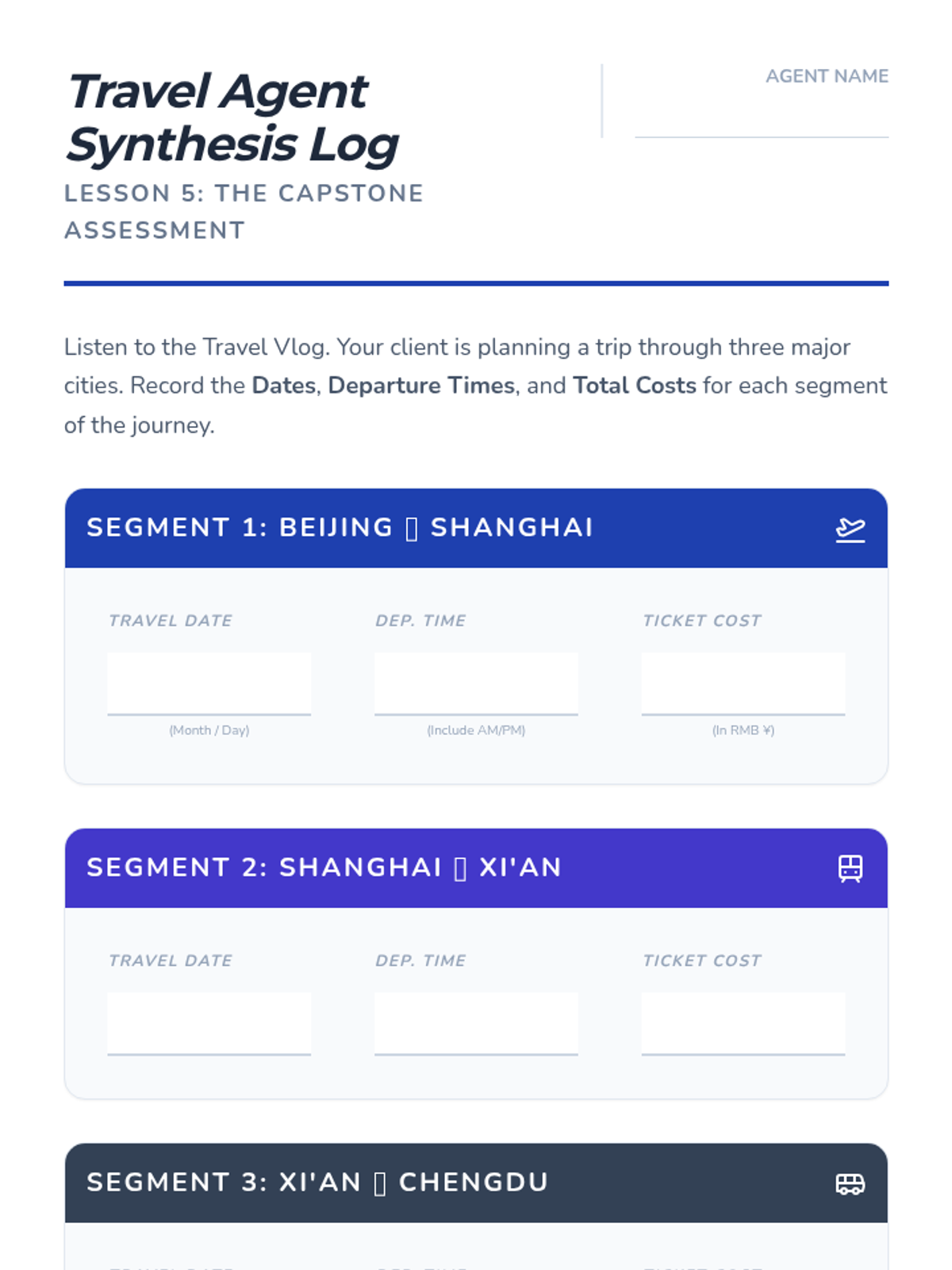
Capstone assessment worksheet for recording complex travel logistical data across three segments of a trip, including dates, times, and costs.
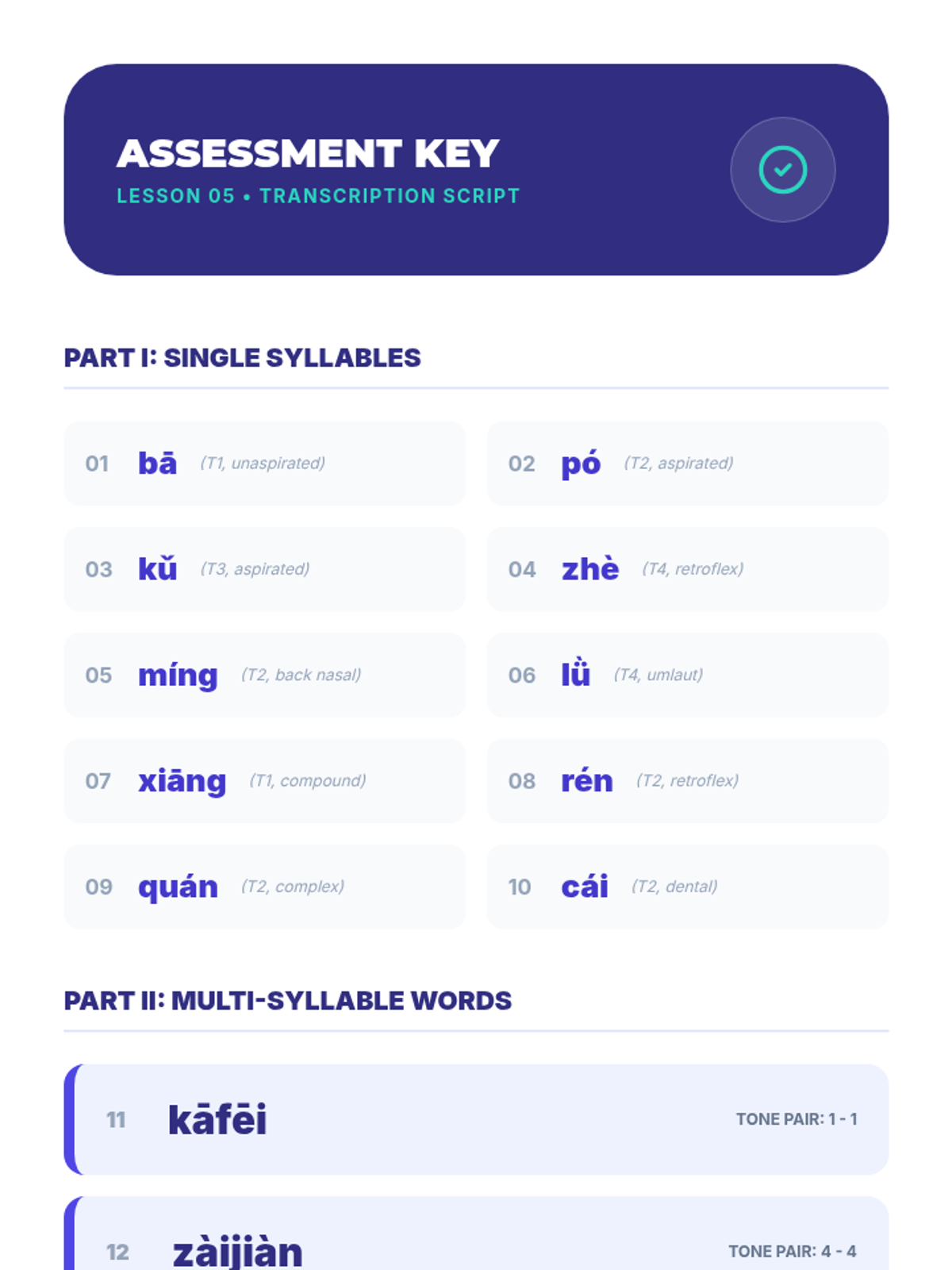
Teacher answer key and script for the Pinyin Final Exam, containing correct Pinyin transcriptions and tone analysis.
Visual aids for Lesson 5, focusing on synthesizing dates, times, and currency, along with rapid note-taking strategies for quantitative listening.
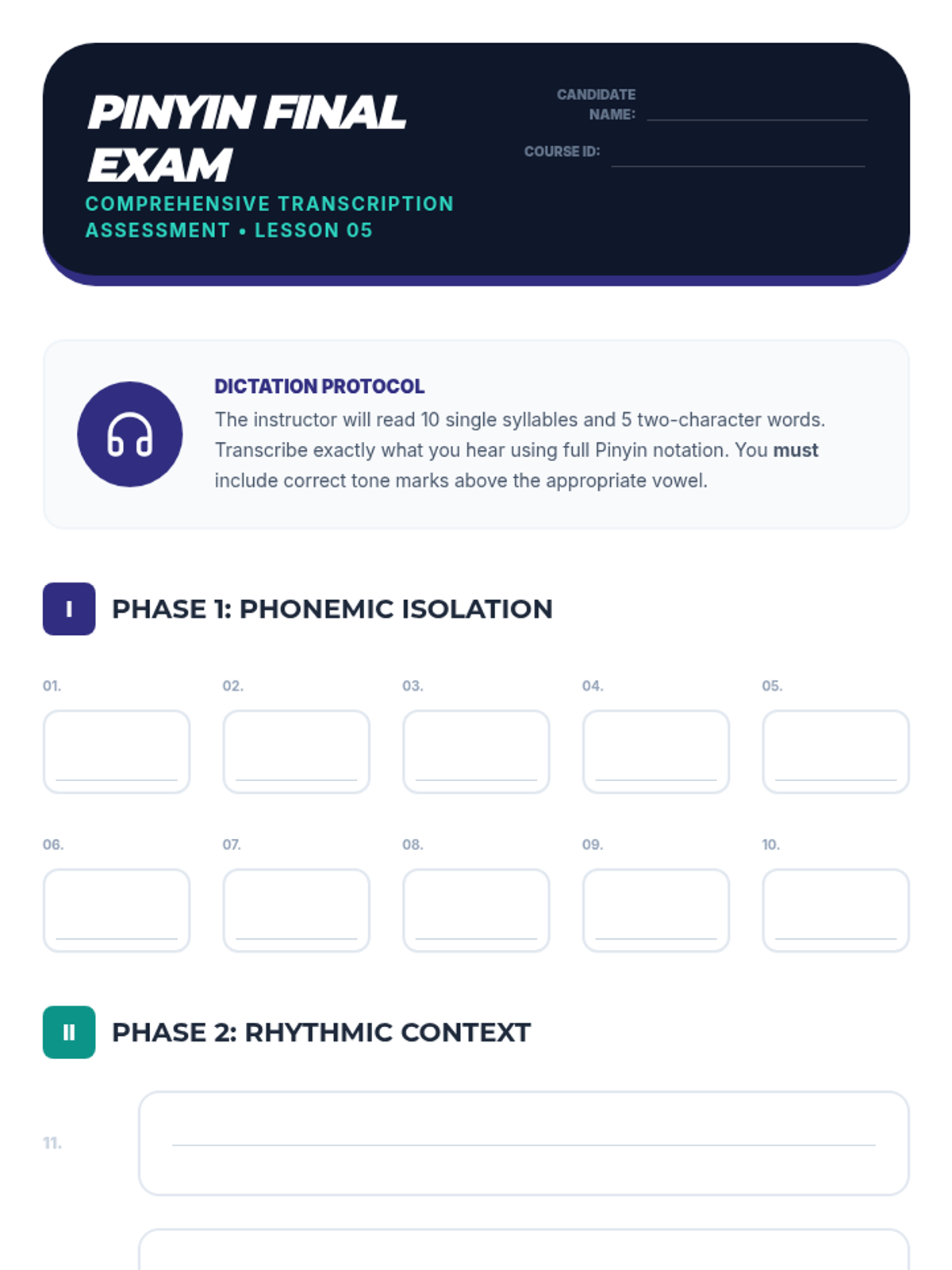
The final assessment sheet for Lesson 5, where students transcribe individual syllables and words into Pinyin with tone marks.
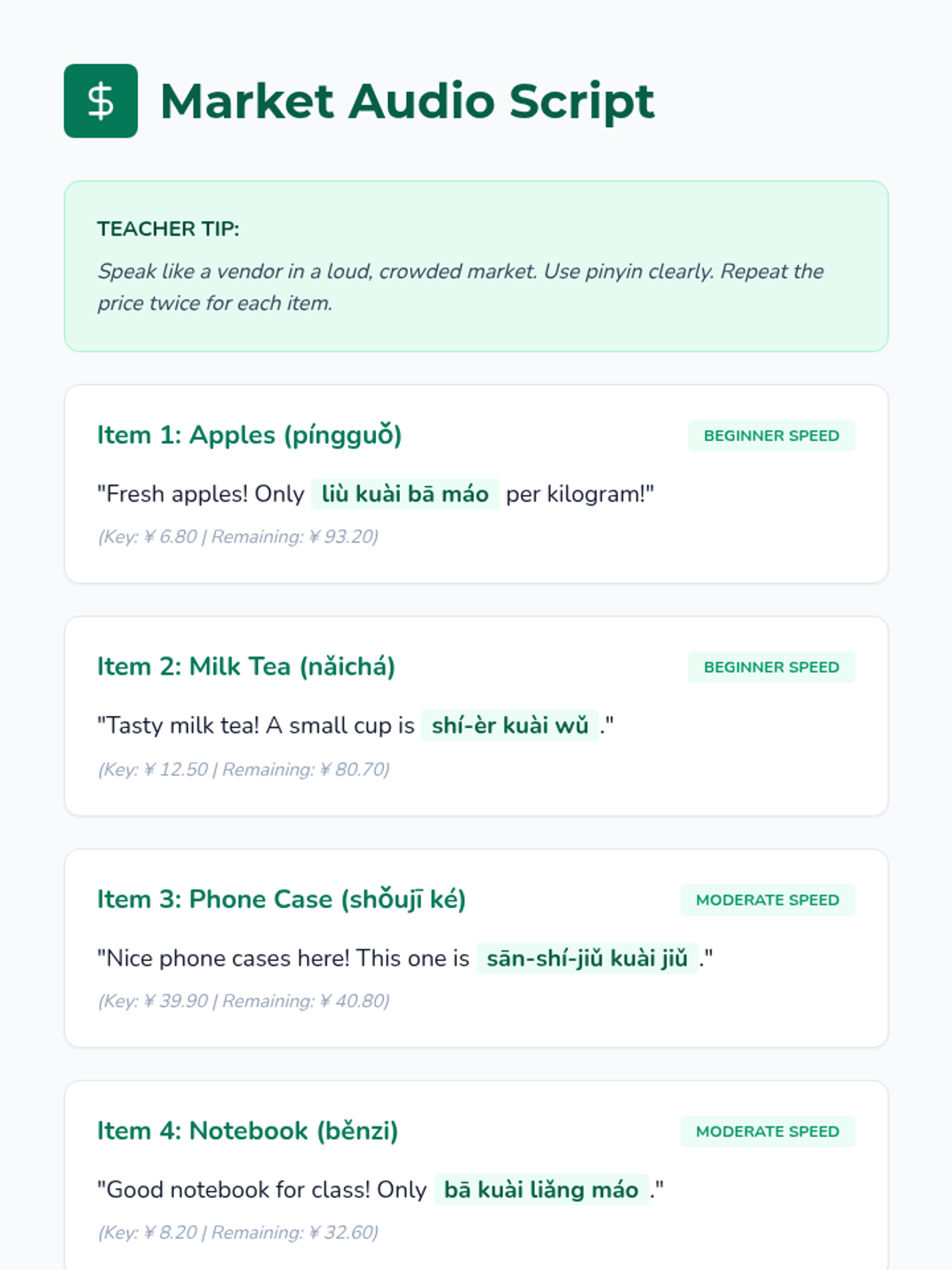
Teacher script for the market simulation, providing prices for five shopping items and the cumulative math for the budget challenge.
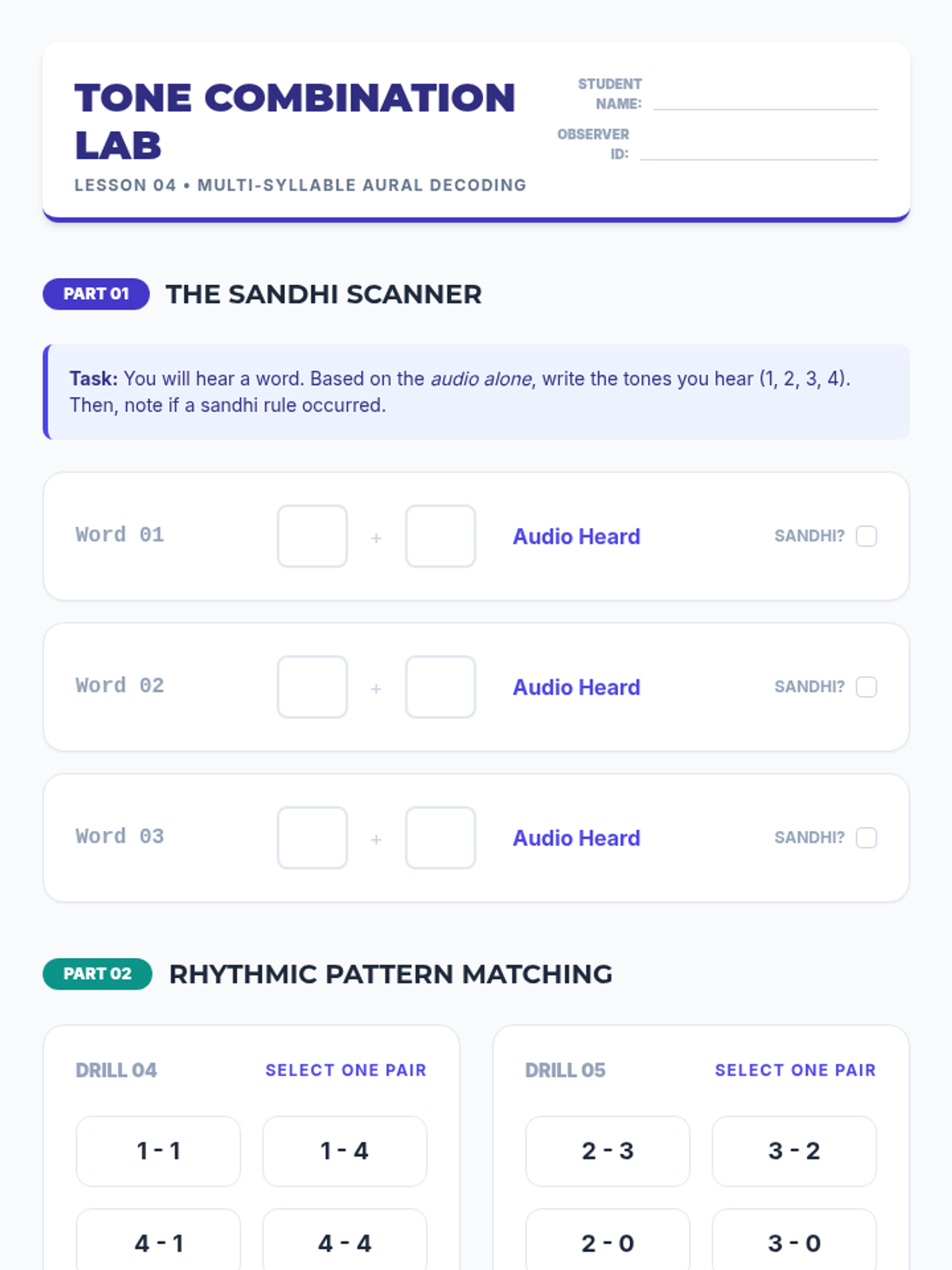
Student worksheet for Lesson 4 for identifying tone sandhi and two-character tone combinations.
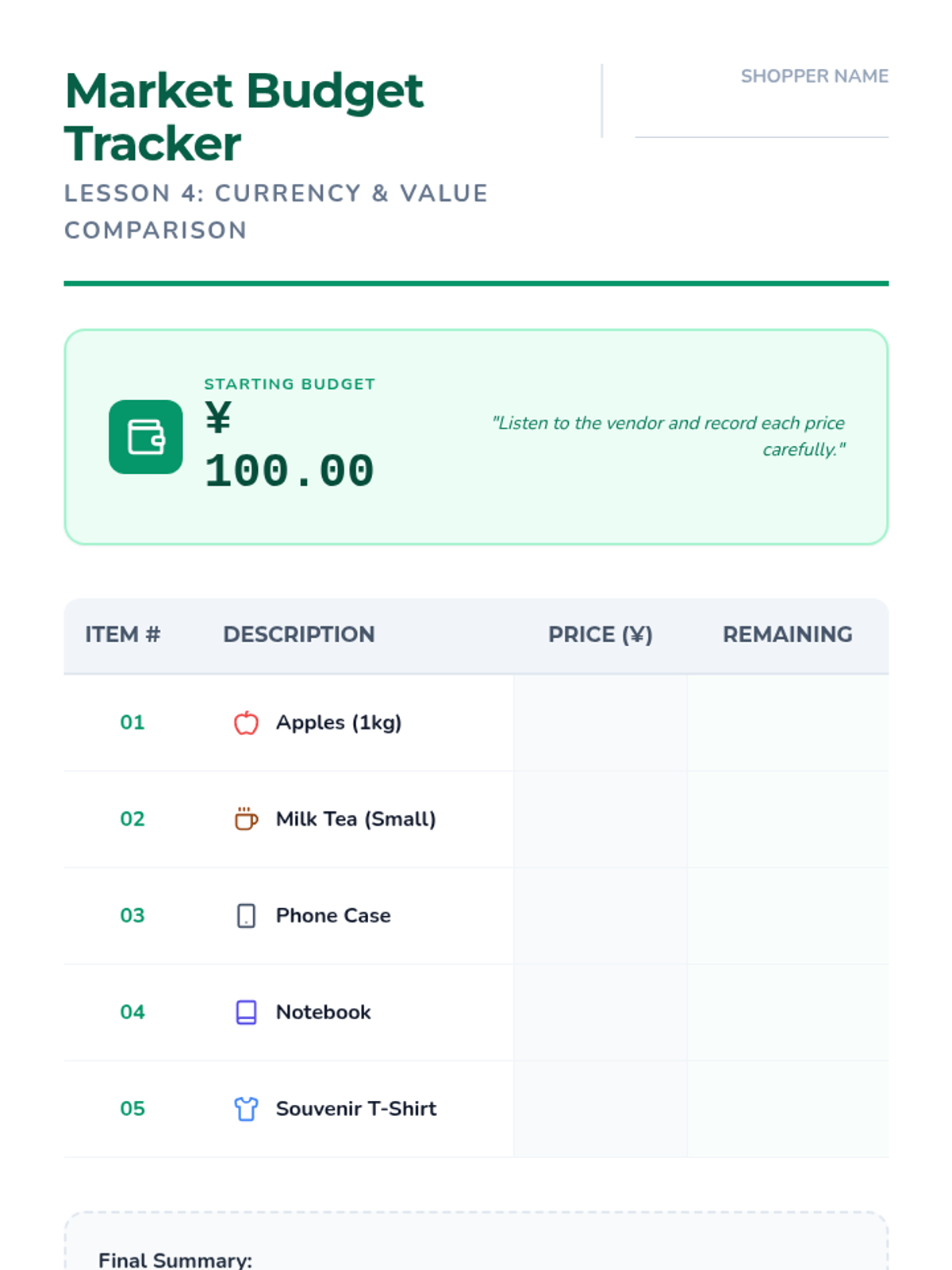
Student worksheet featuring a budget tracker table for recording item prices and calculating remaining funds based on a 100 RMB starting balance.
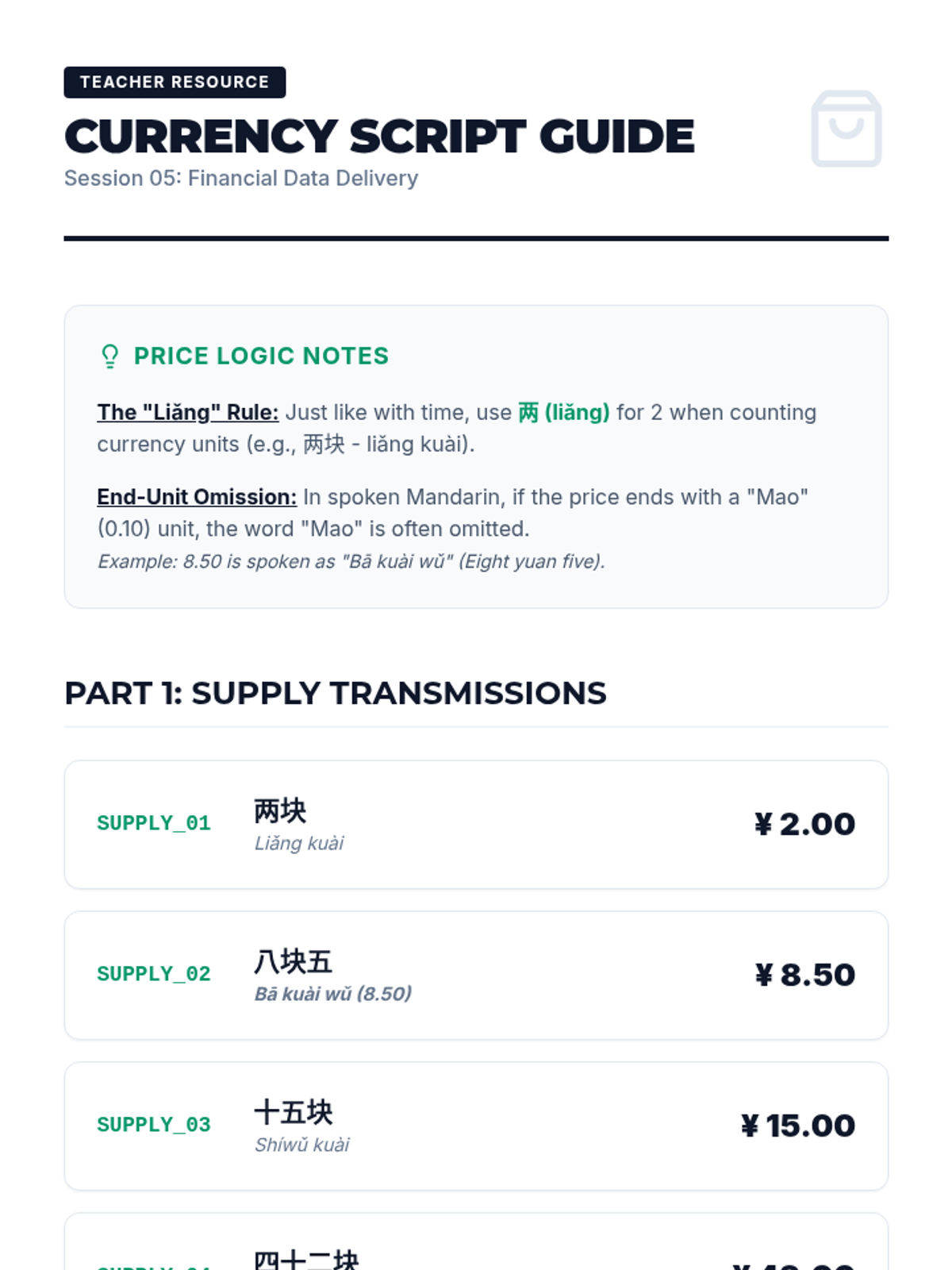
A teacher script for the Lesson 5 currency mission, including price lists, phonetic guides for units, and a total calculation key.
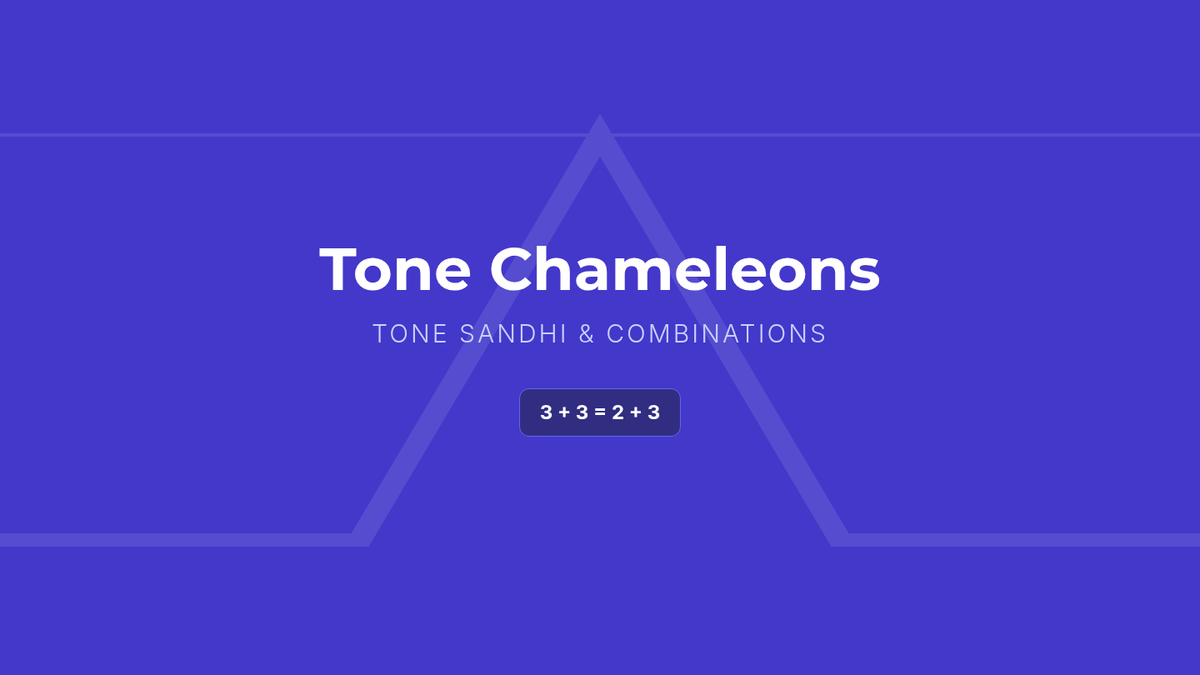
Visual presentation for Lesson 4 explaining tone sandhi rules (specifically the third tone rule) and multi-syllable tone combinations.
Visual aids for learning Mandarin currency units (kuài, máo), the formal/spoken distinction, and rules for reading price tags.
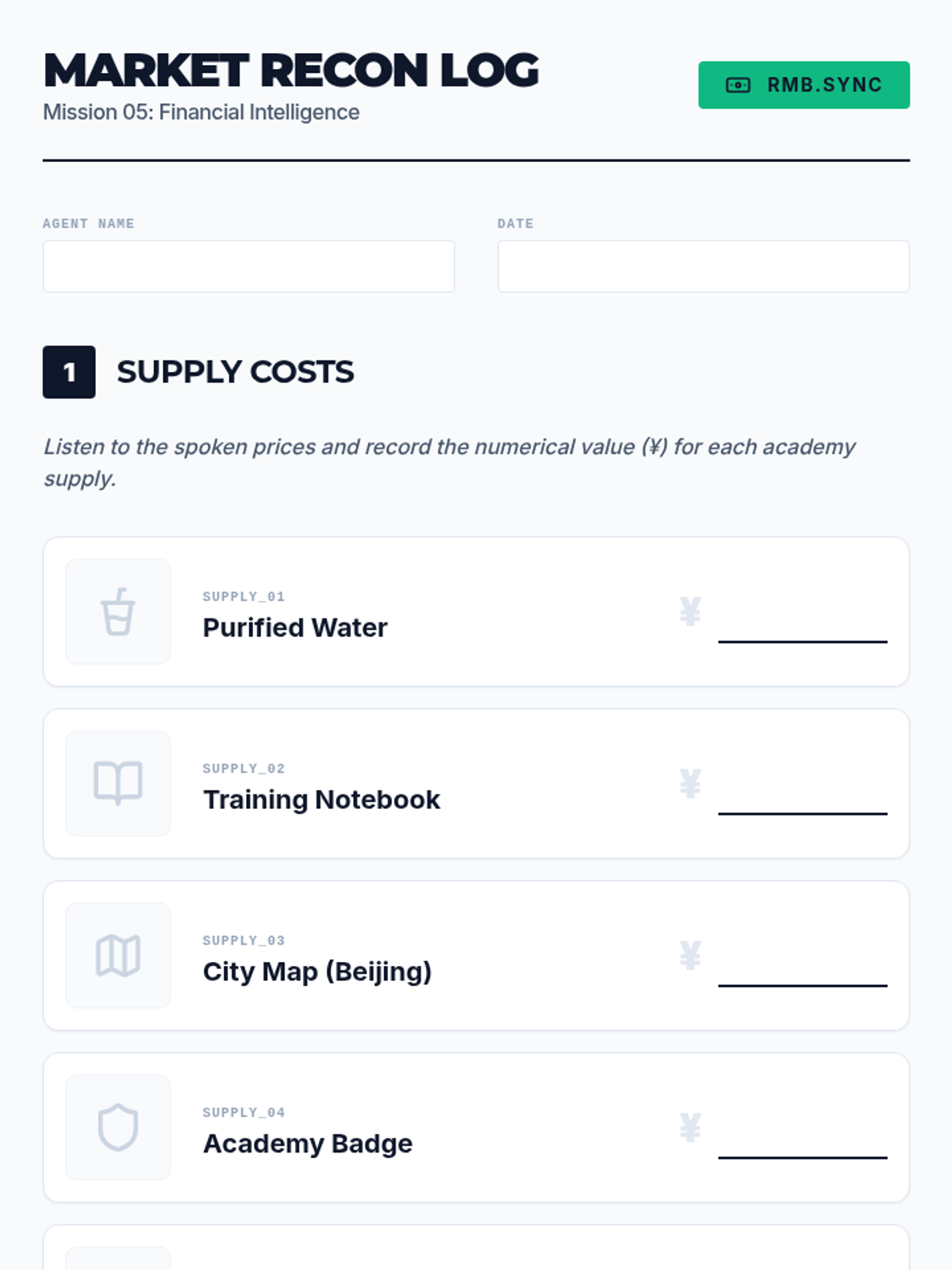
A student worksheet for identifying prices of items and calculating a total based on spoken Mandarin prices.
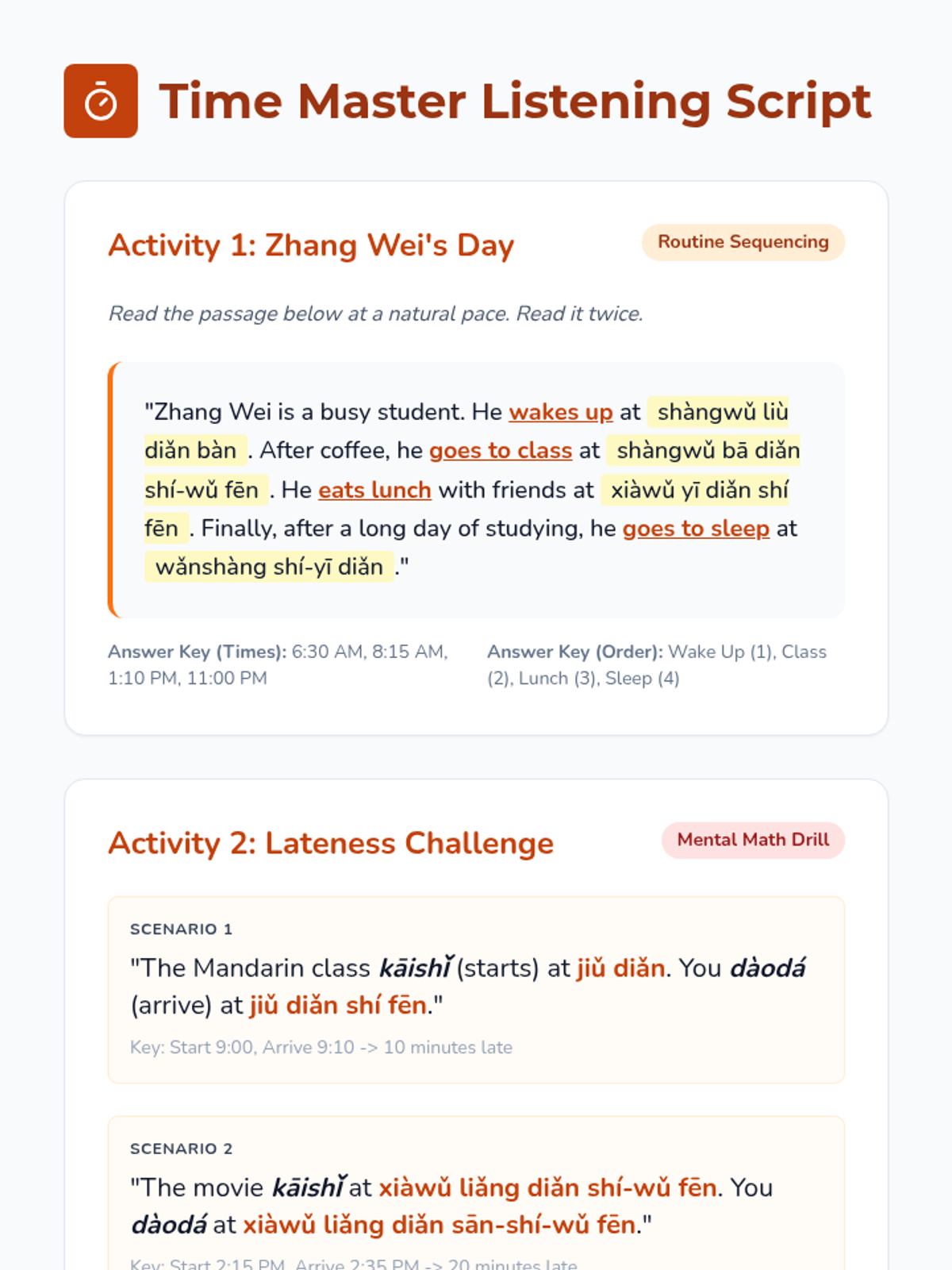
Teacher script for the daily routine and lateness challenge, providing the text for listening activities and an answer key for the teacher's reference.
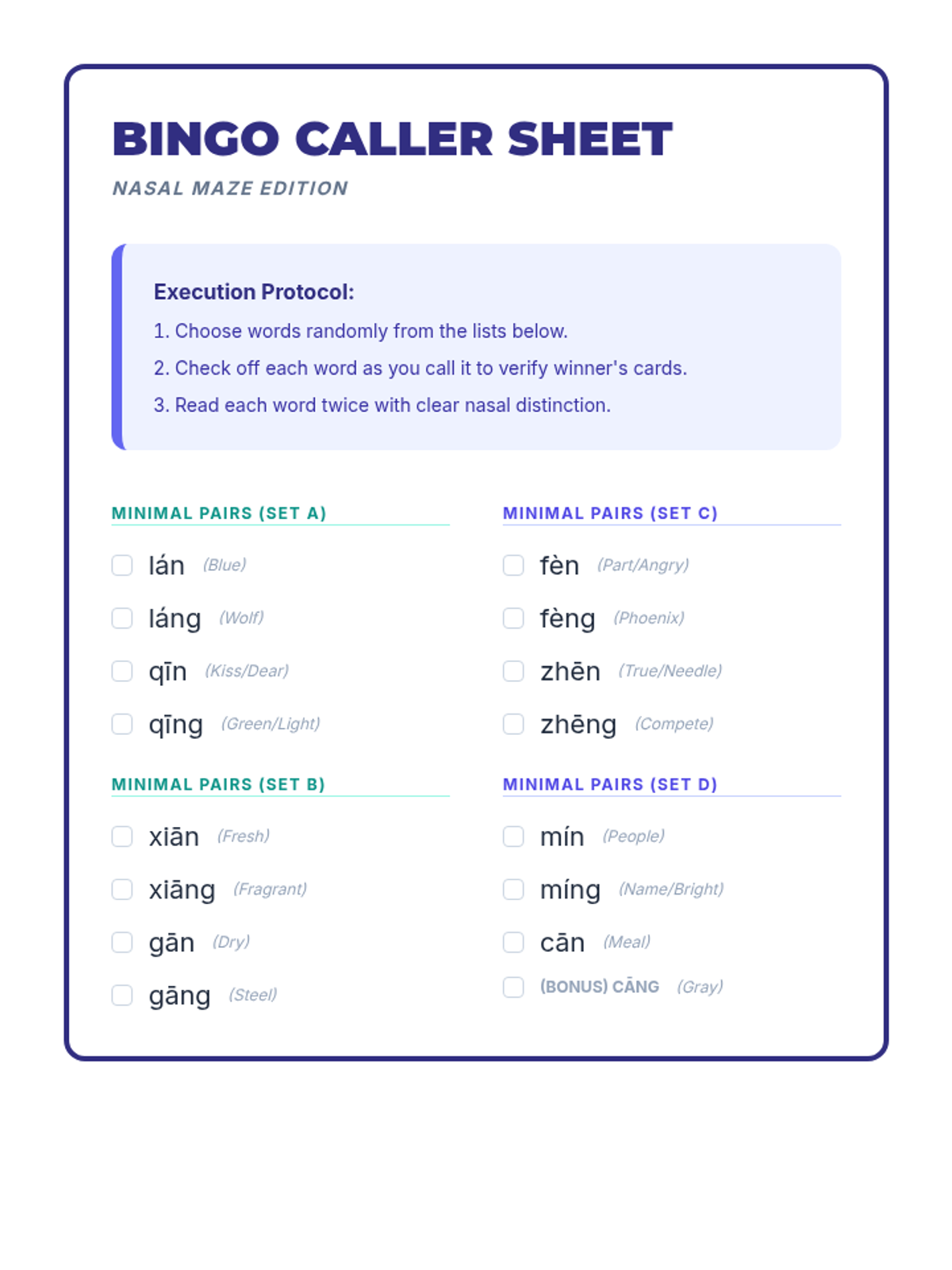
Teacher caller sheet for Pinyin Bingo, including target minimal pairs with front and back nasal endings.
Visual presentation for Lesson 5 covering currency vocabulary, price structures, and marketplace phrases in Mandarin.
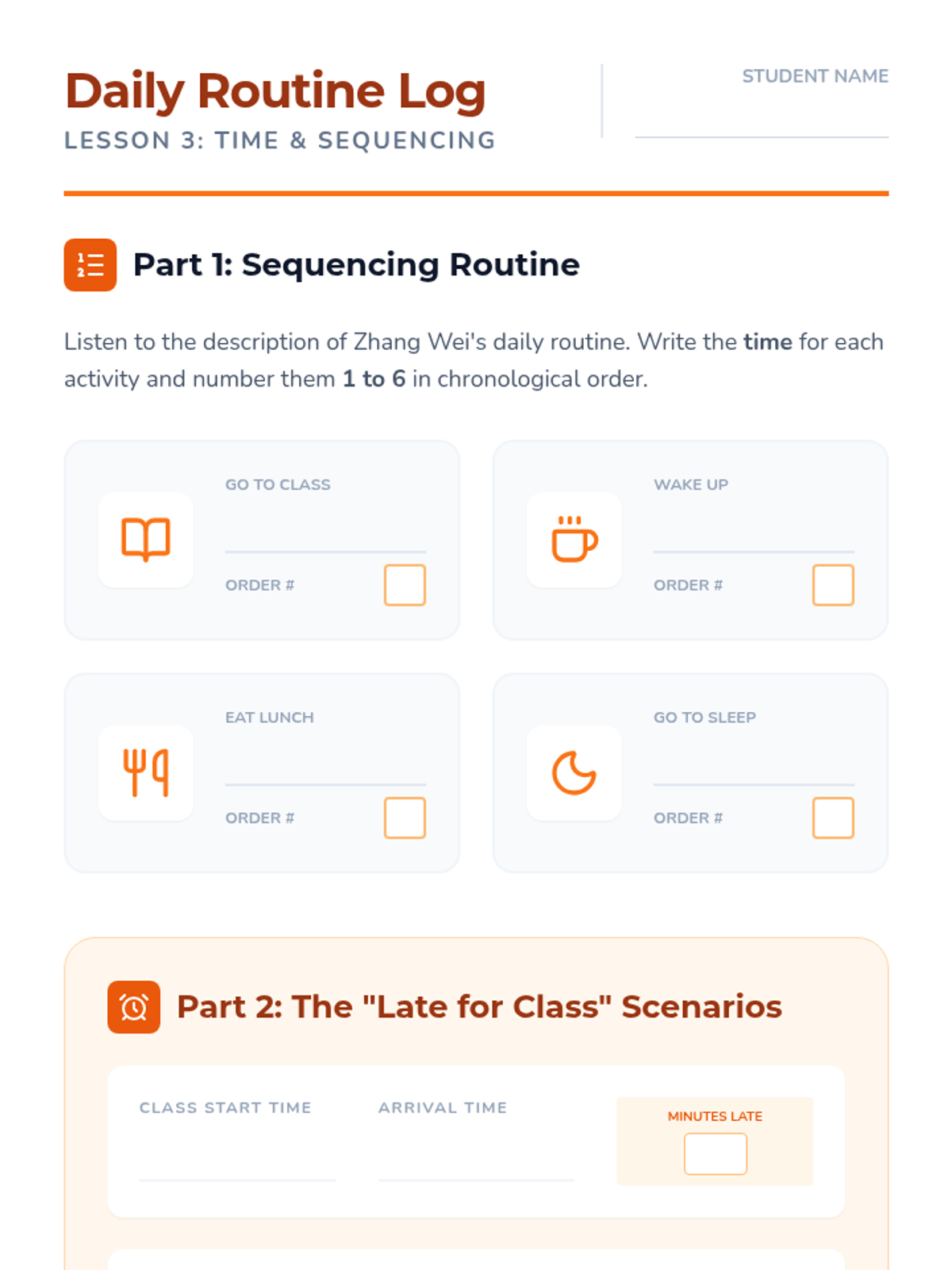
Student worksheet for recording times of a daily routine and calculating lateness based on auditory time markers.
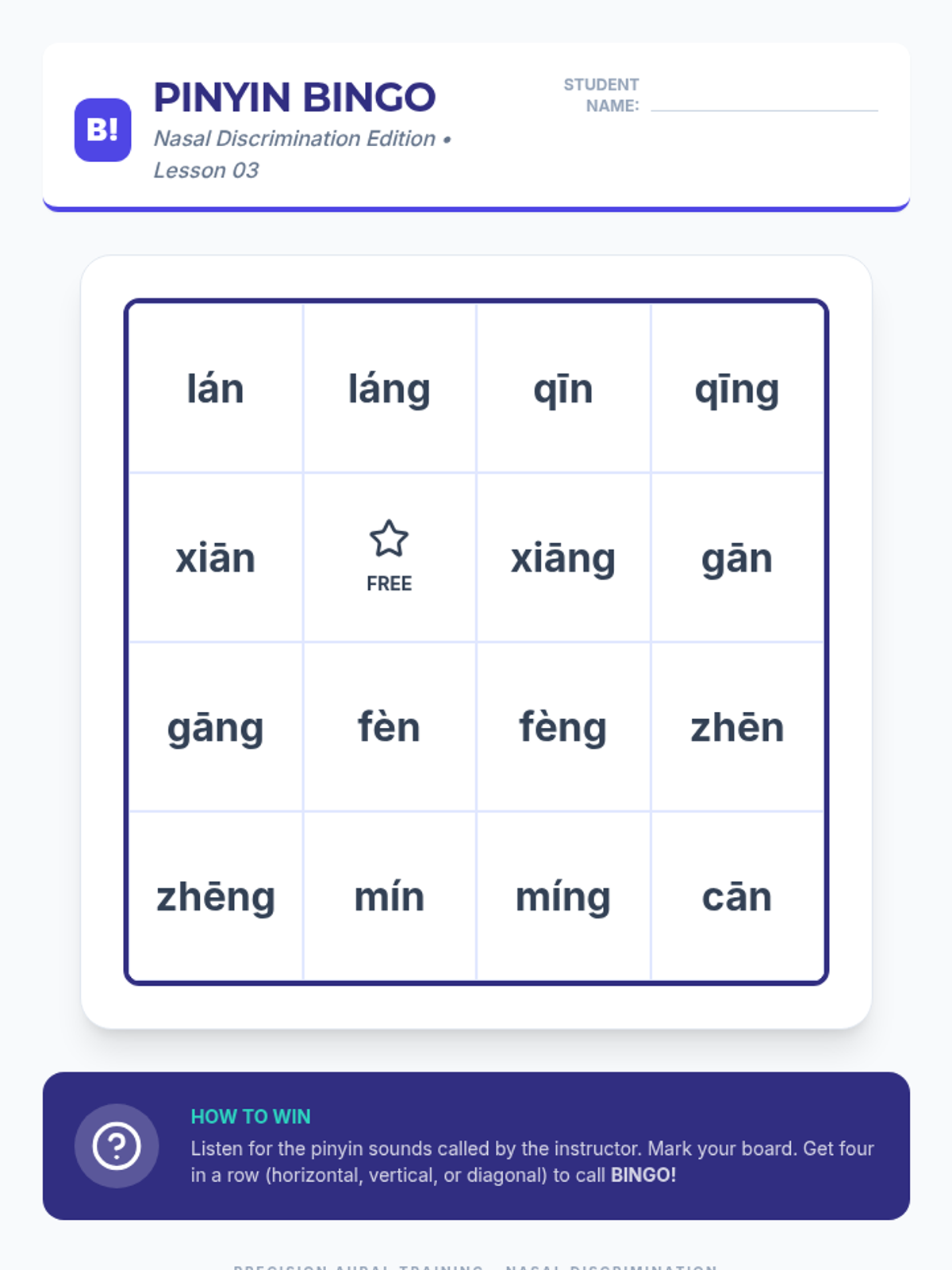
Bingo card for Lesson 3 focusing on distinguishing between front (-n) and back (-ng) nasal endings in Pinyin.
Visual aids for learning Mandarin time particles (diǎn, fēn), the 'bàn' shortcut, and the placement of AM/PM markers (shàngwǔ, xiàwǔ).
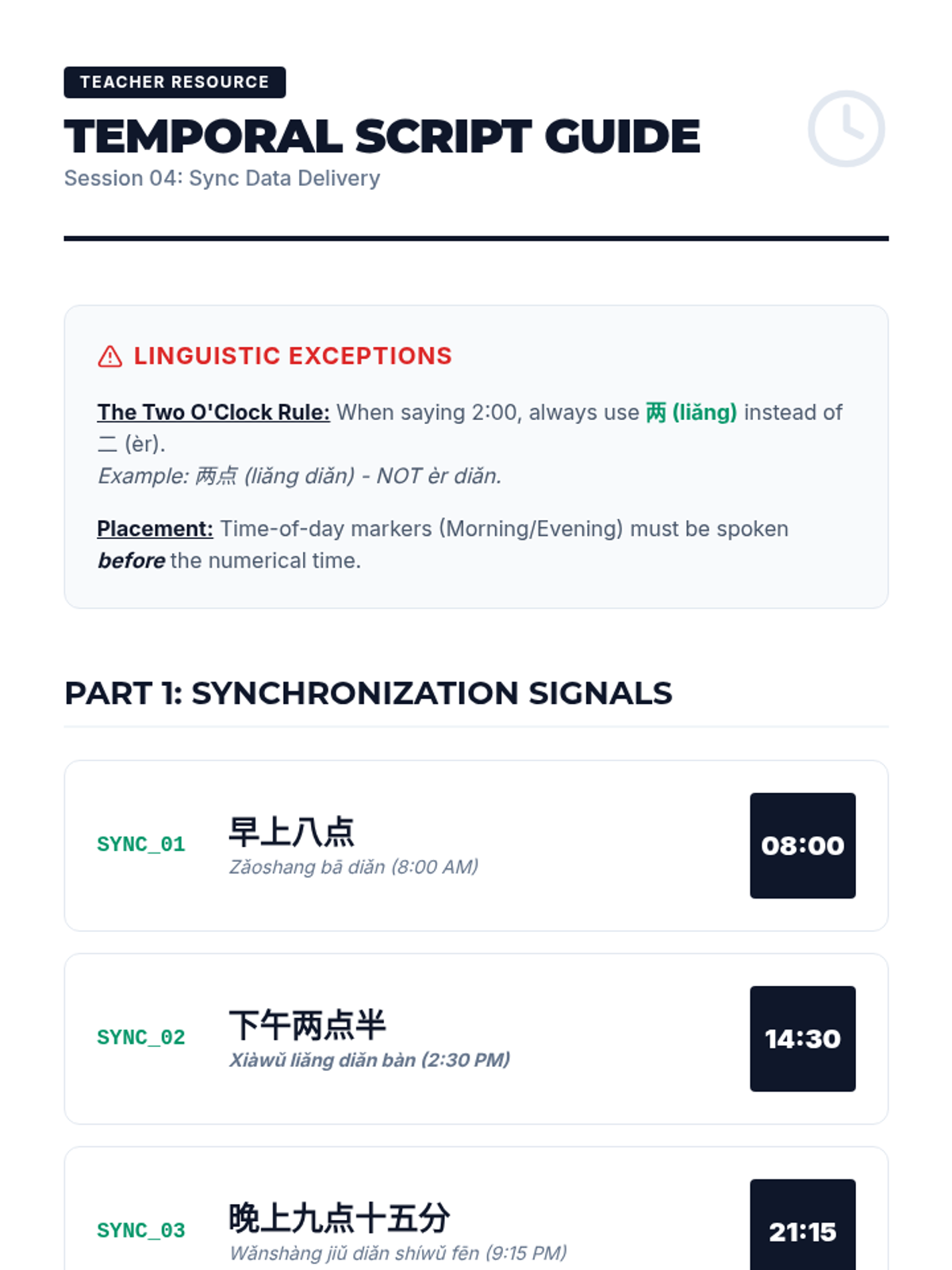
A teacher script for the Lesson 4 time-telling mission, including specific times and linguistic notes on exceptions like 'liǎng'.
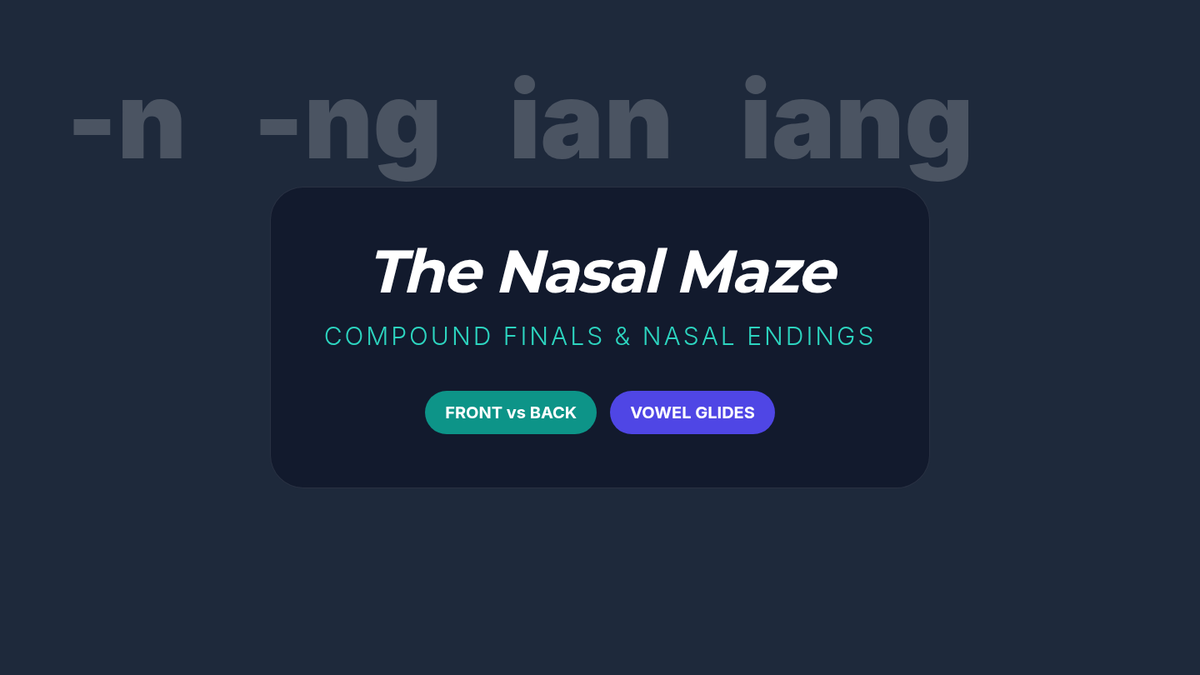
Visual presentation for Lesson 3 explaining front and back nasal endings and complex vowel glides.