Essential grammar structures, high-frequency vocabulary, and foundational literacy skills. Equips learners with basic speaking and listening abilities for everyday interactions and introductory text comprehension.
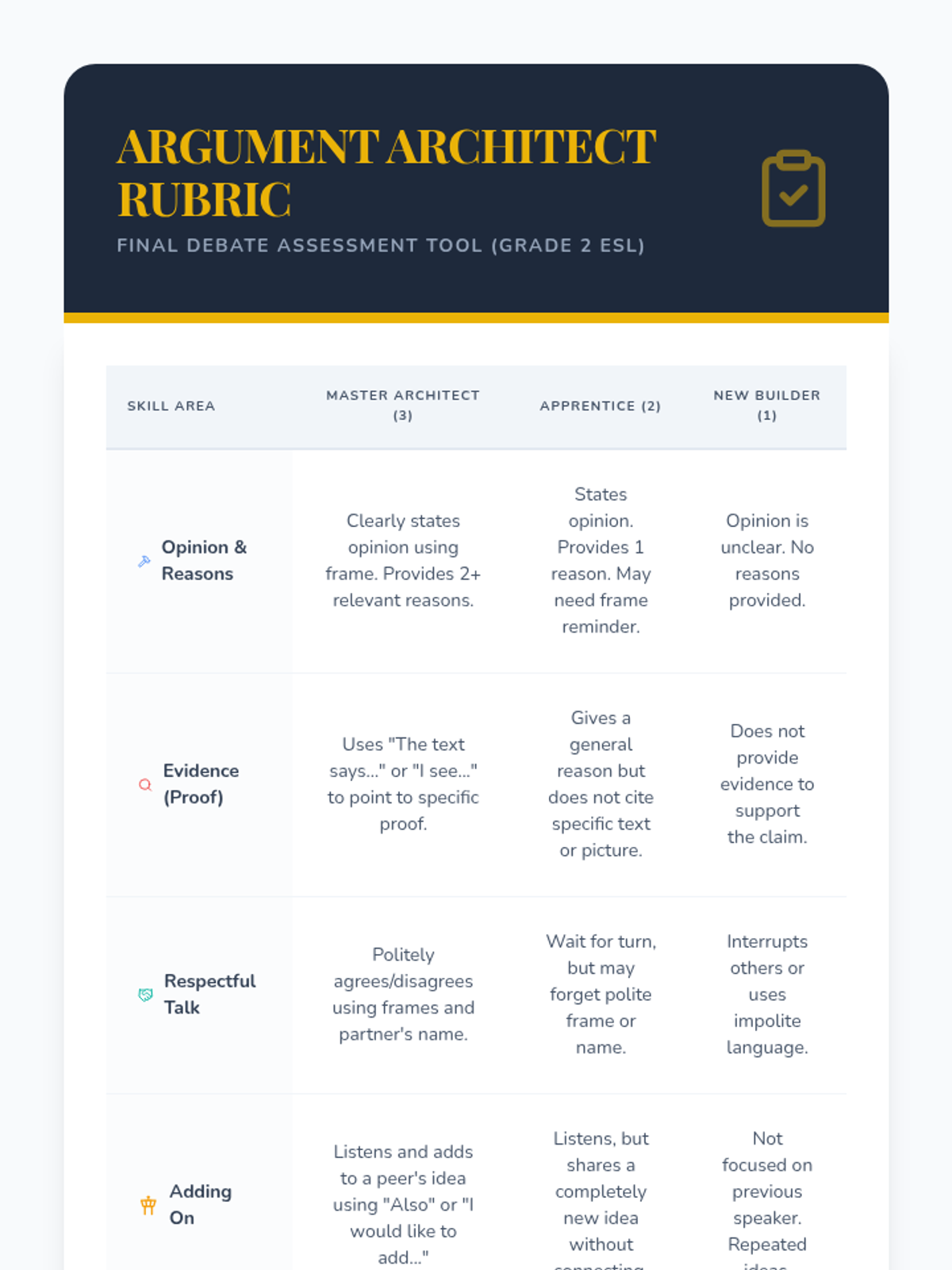
A teacher assessment rubric to track student progress in stating opinions, citing evidence, and participating in respectful academic discourse.
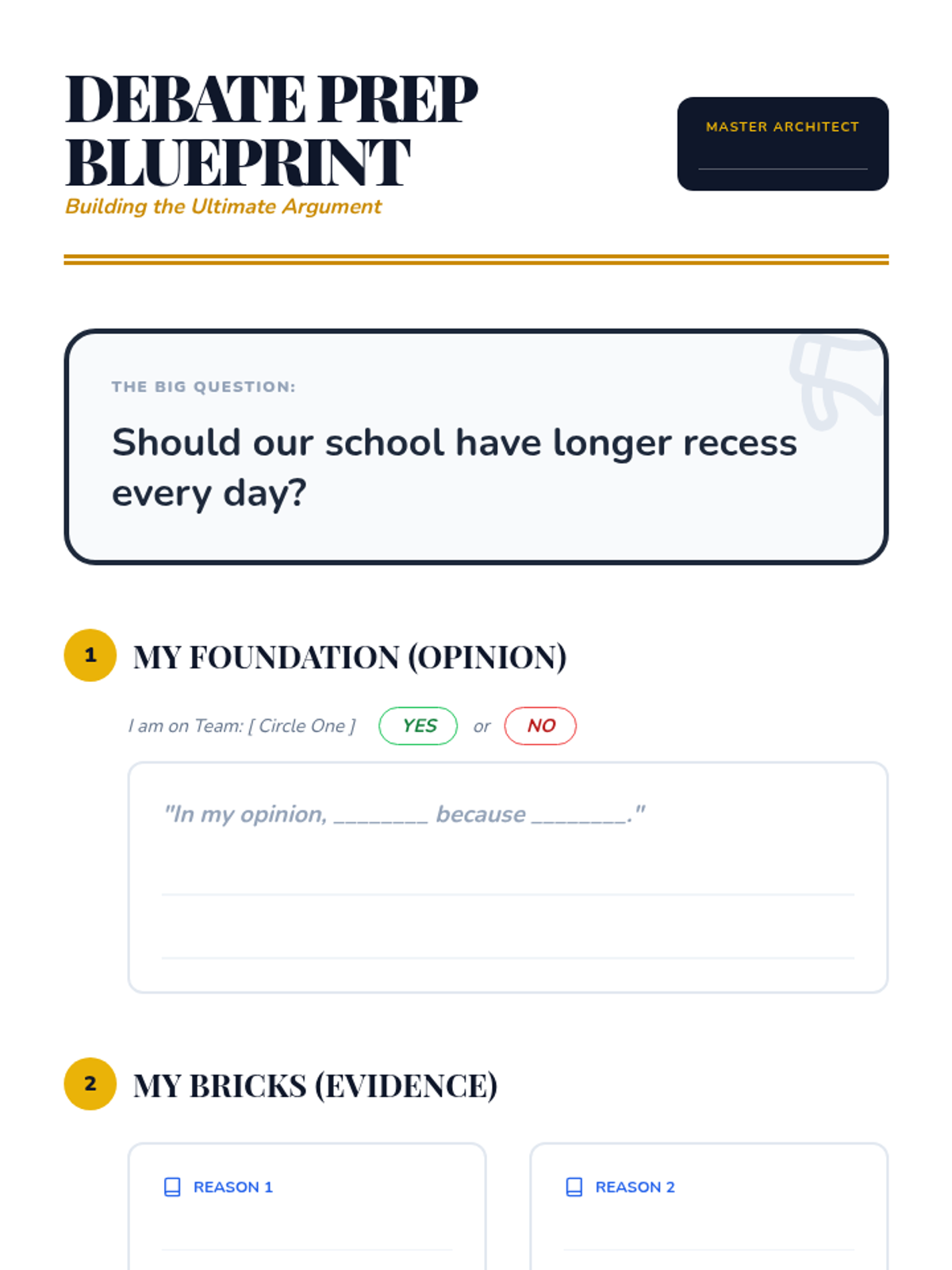
A student planning worksheet to help them prepare their arguments and evidence for the final debate.
A visual presentation for 2nd-grade ESL students to guide them through their final structured debate, including rules and sentence frame reminders.
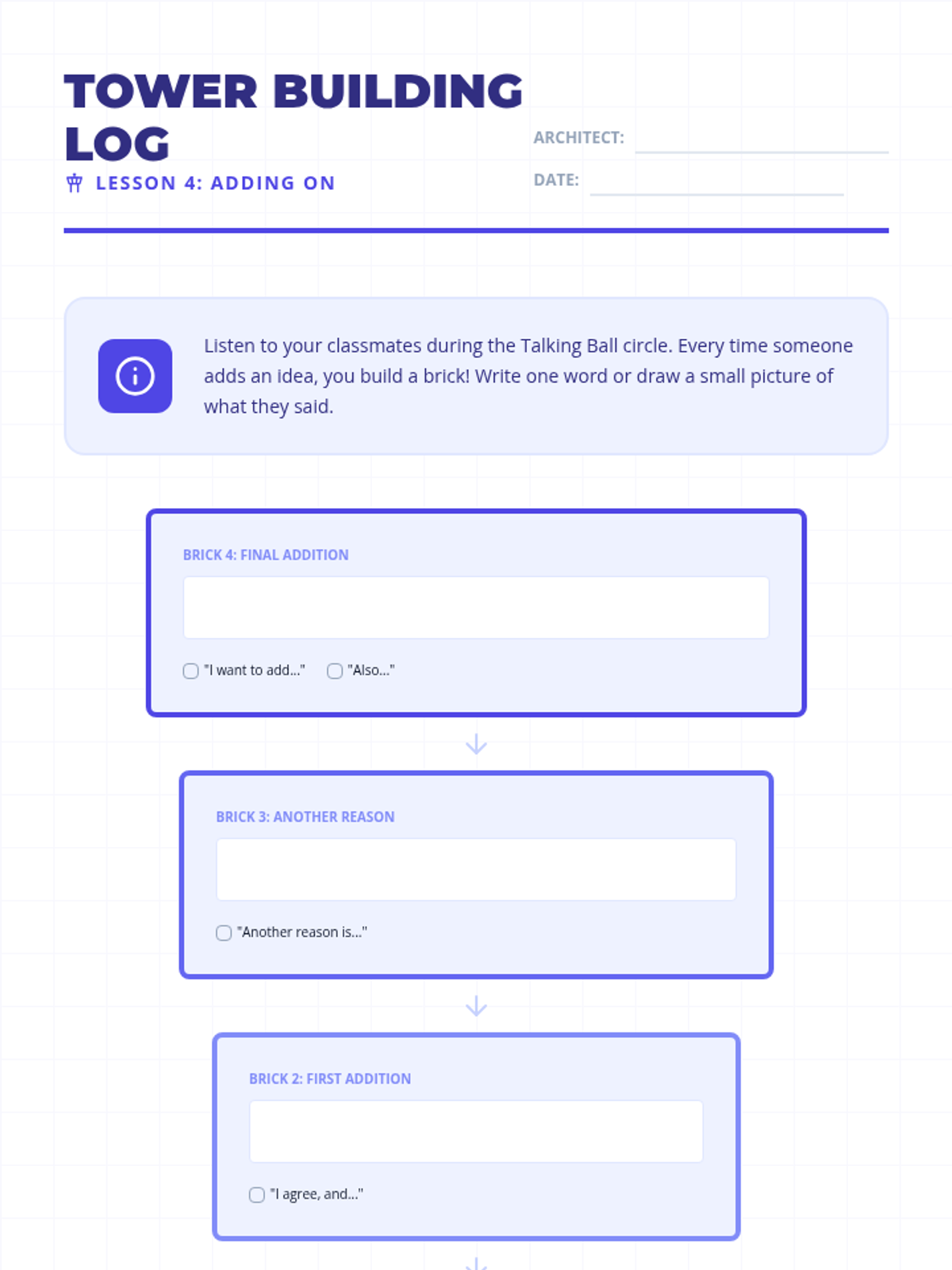
A student recording sheet for the 'Talking Ball' circle activity where they track and build upon peer ideas.
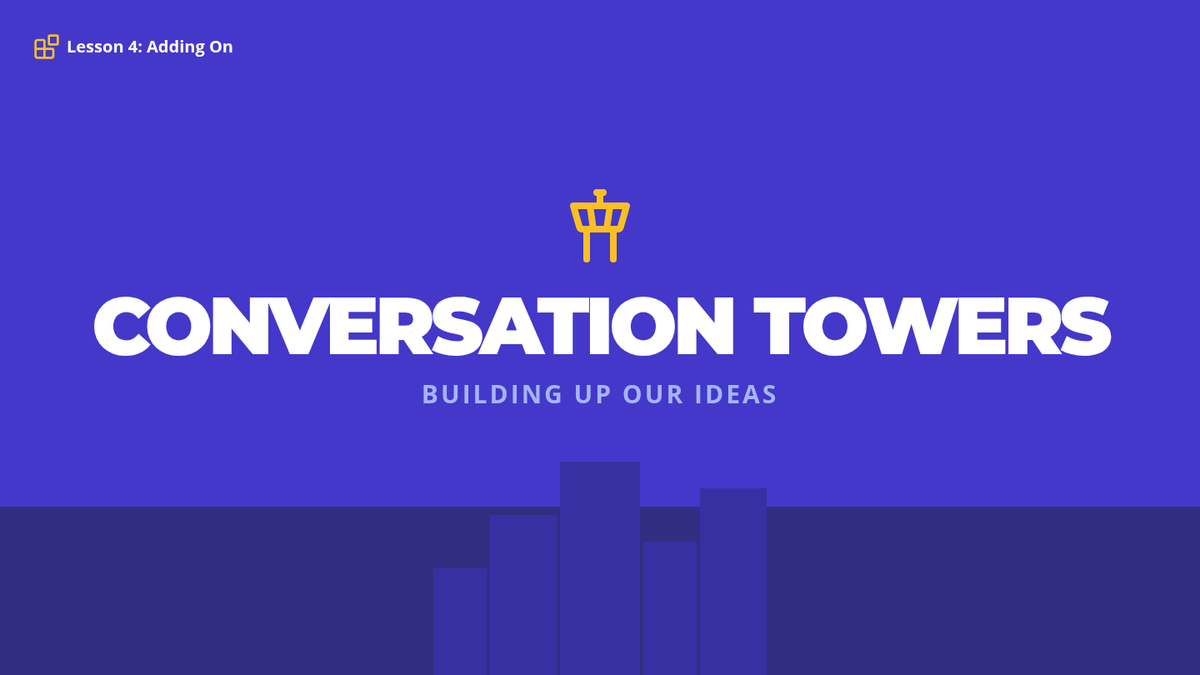
A visual presentation for 2nd-grade ESL students to learn how to extend conversations by adding to what classmates have said using connectors.
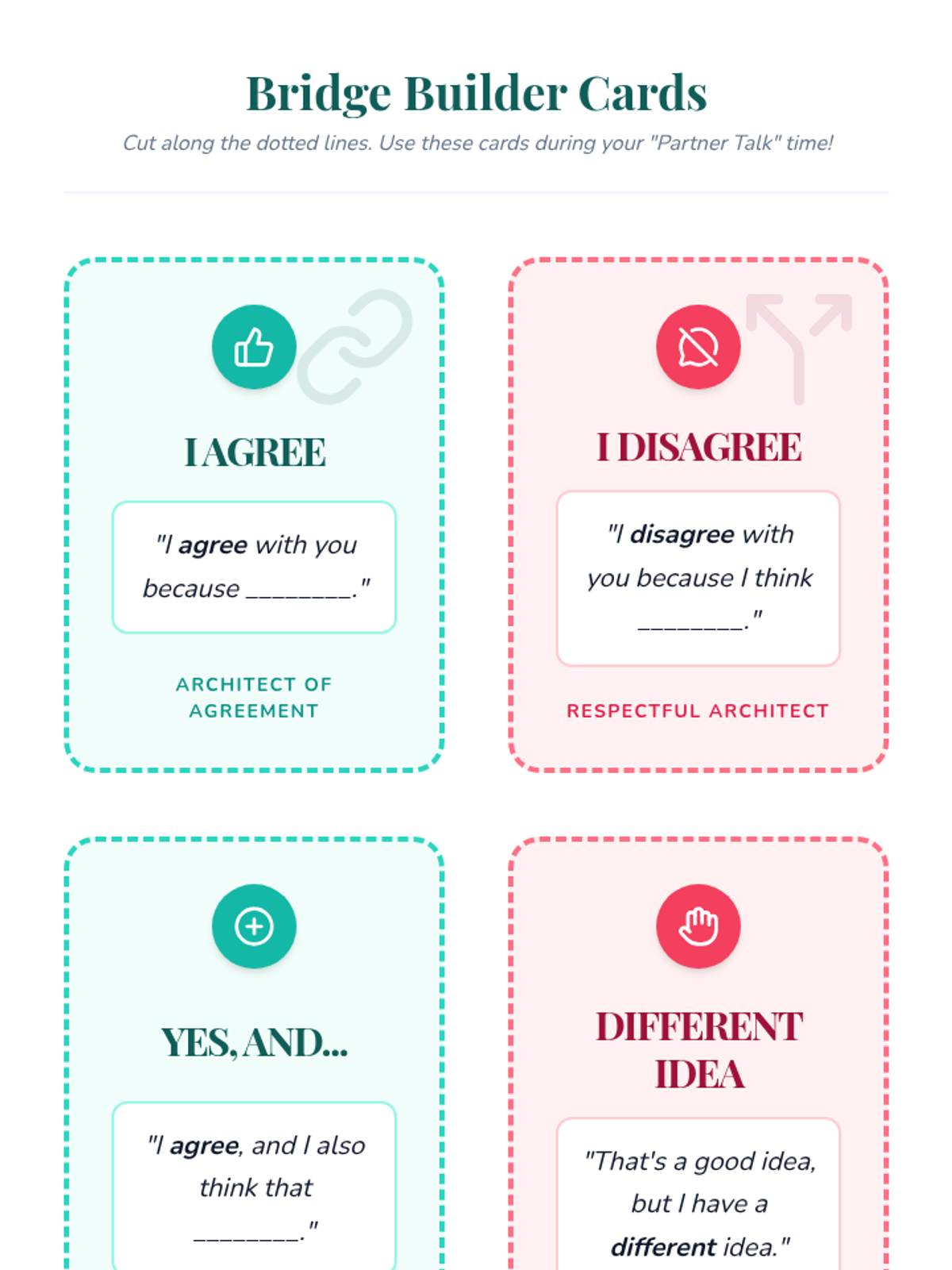
Student conversation cards with sentence frames for agreeing and disagreeing respectfully during academic discussions.
A visual presentation for 2nd-grade ESL students to learn polite disagreement and agreement frames to maintain respectful academic conversations.
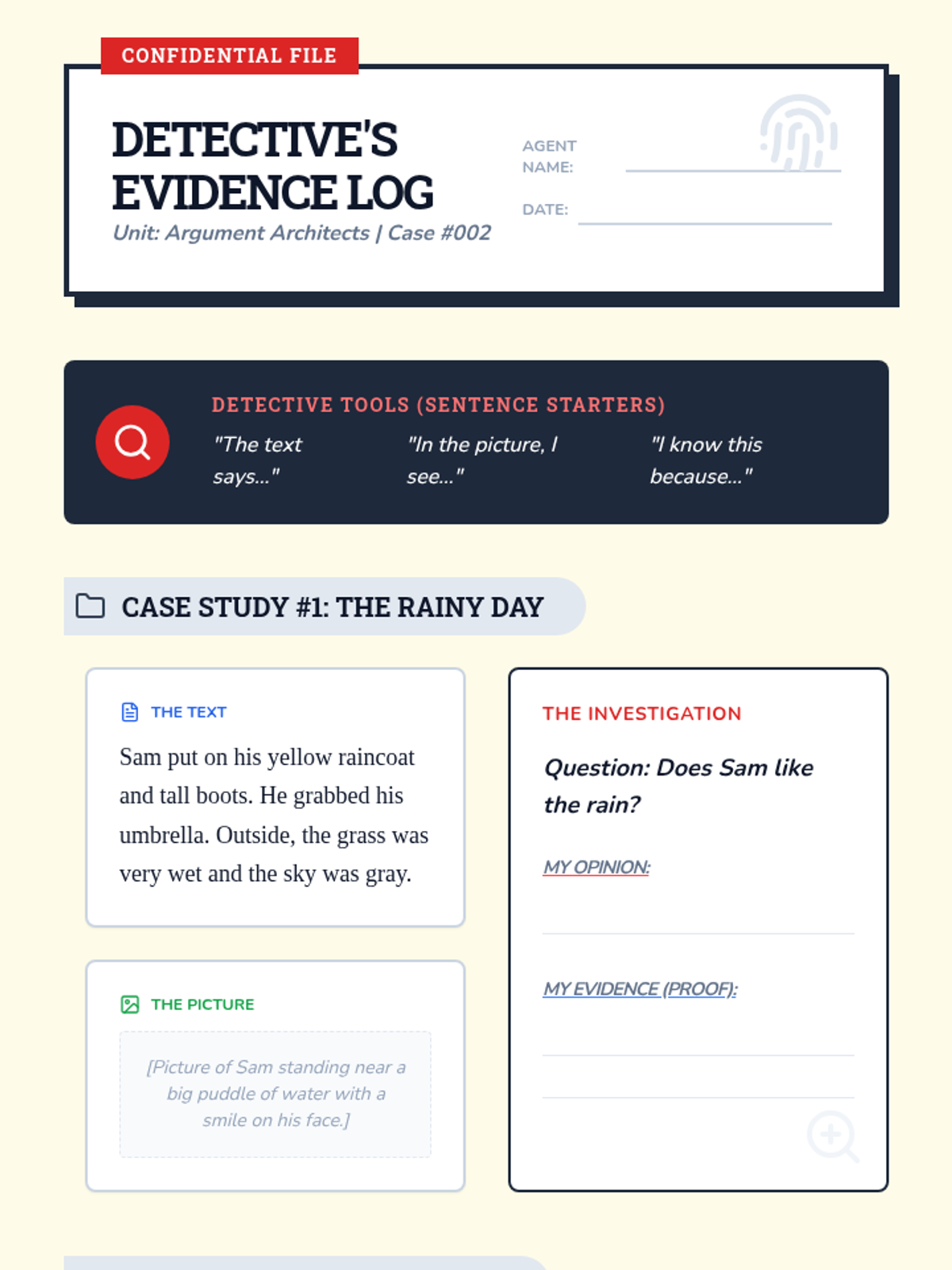
A student activity sheet where they read short 'case studies' and find evidence from text and picture descriptions to support their opinions.
A visual presentation for 2nd-grade ESL students to learn how to cite evidence from text and pictures to support their opinions.
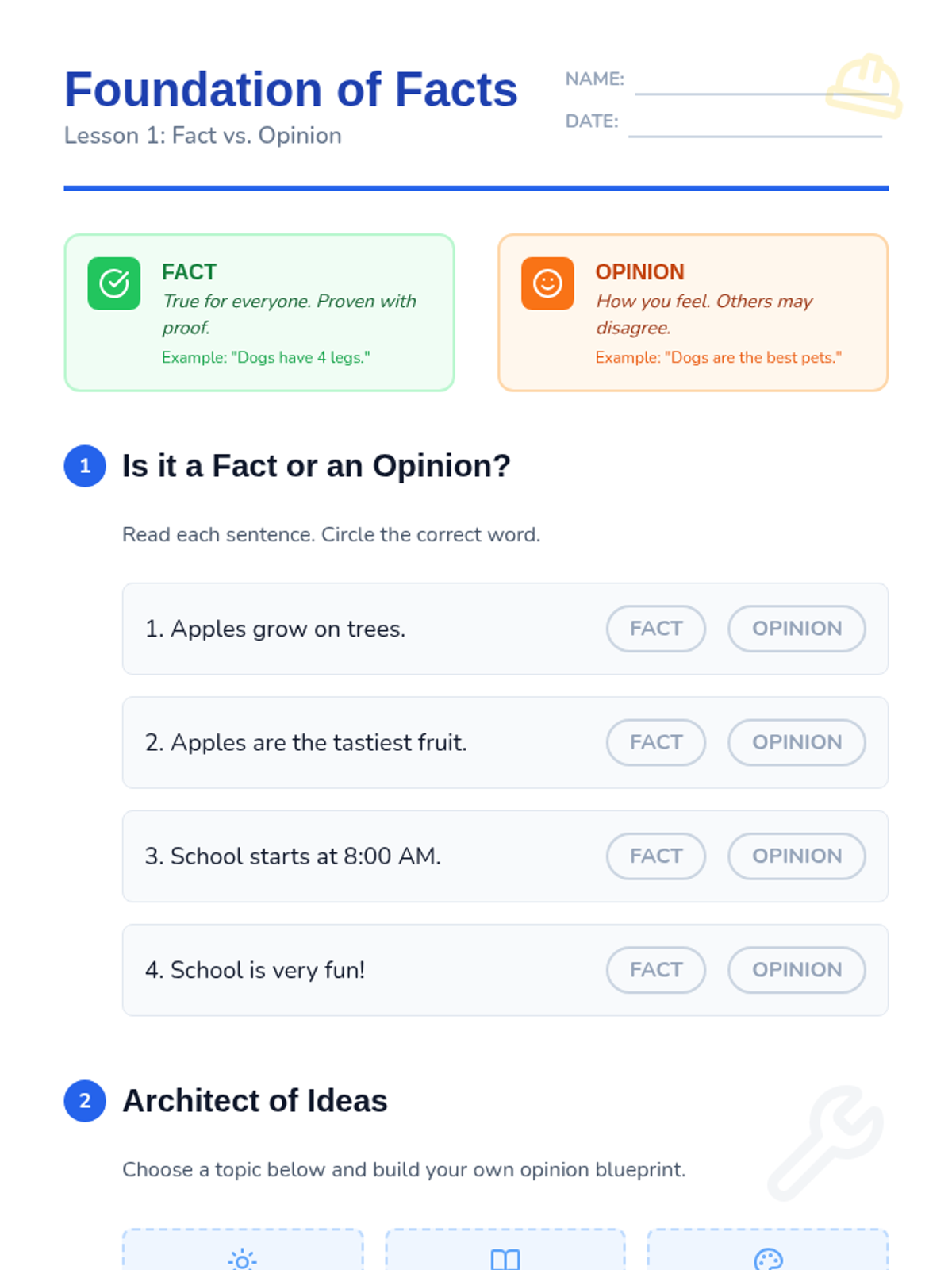
A student worksheet for practicing the distinction between fact and opinion and using the 'In my opinion... because...' sentence frame.
A visual presentation for 2nd-grade ESL students to learn the difference between fact and opinion and practice using sentence frames to express their views.
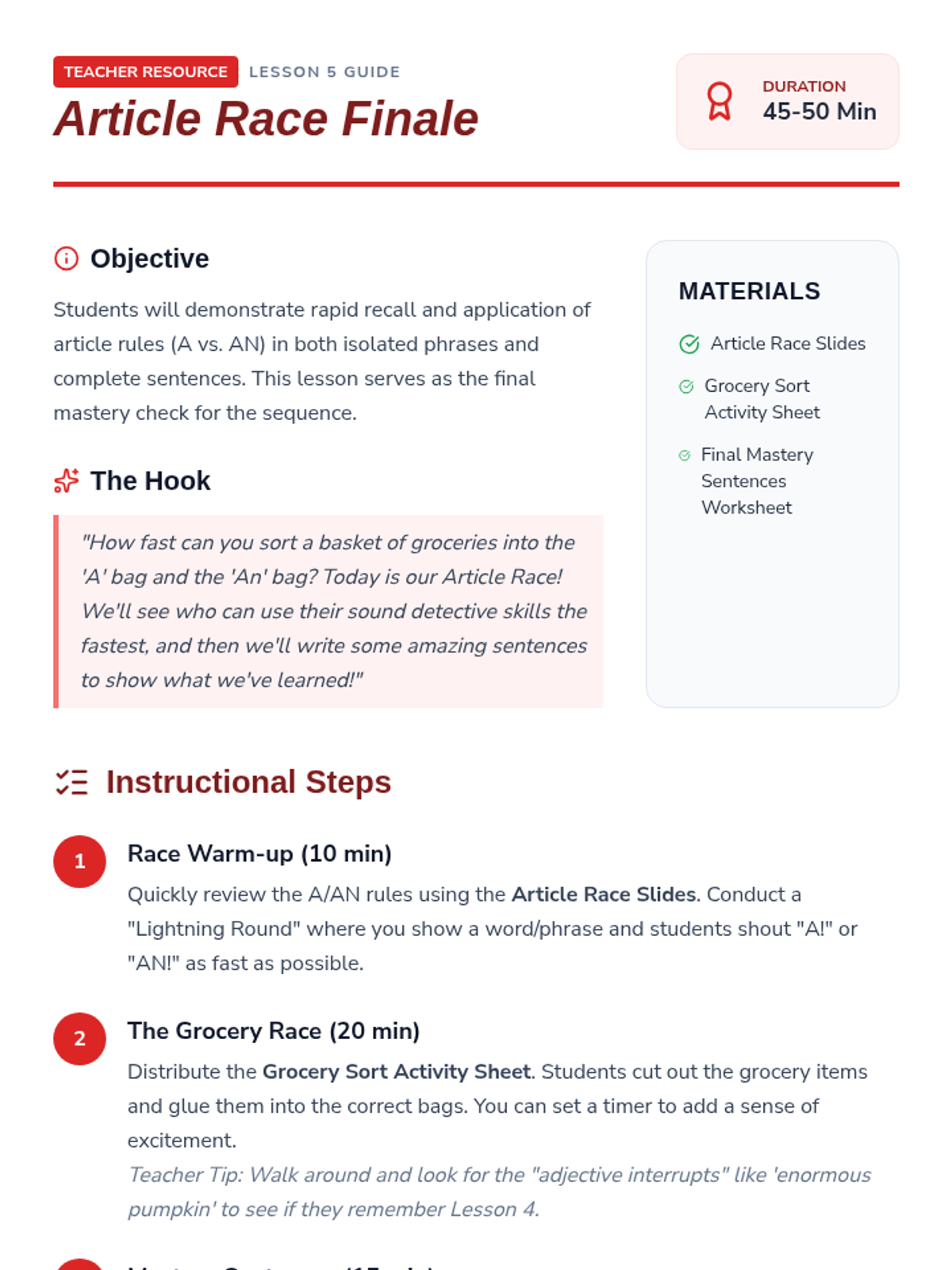
A teacher guide for Lesson 5, including instructions for the grocery race activity and criteria for assessing student mastery.
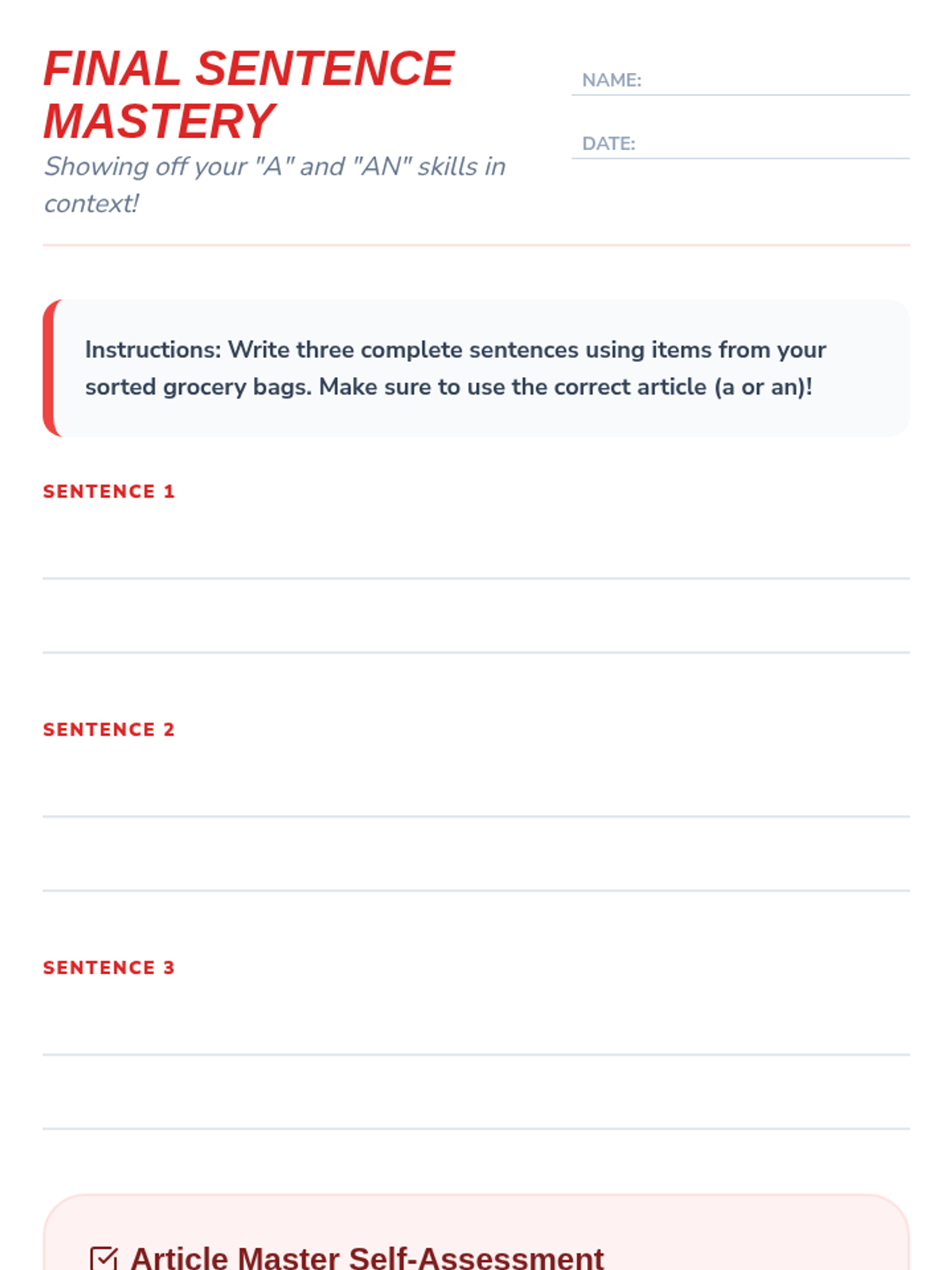
A final assessment worksheet where students write sentences using articles 'a' and 'an' and perform a self-assessment on their learning.
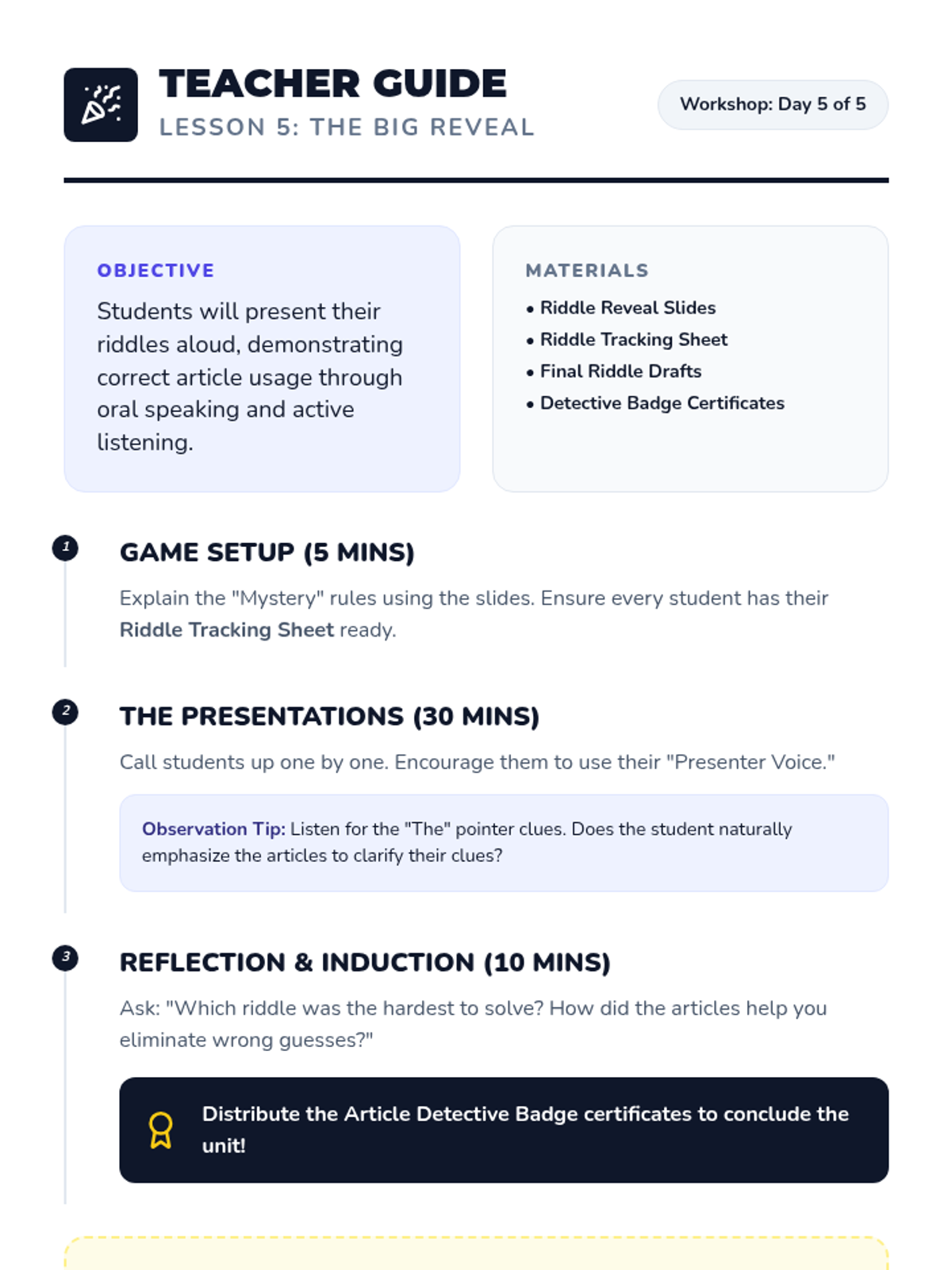
Facilitation guide for Lesson 5, providing structure and celebratory tips for the final Riddle Reveal presentation day.
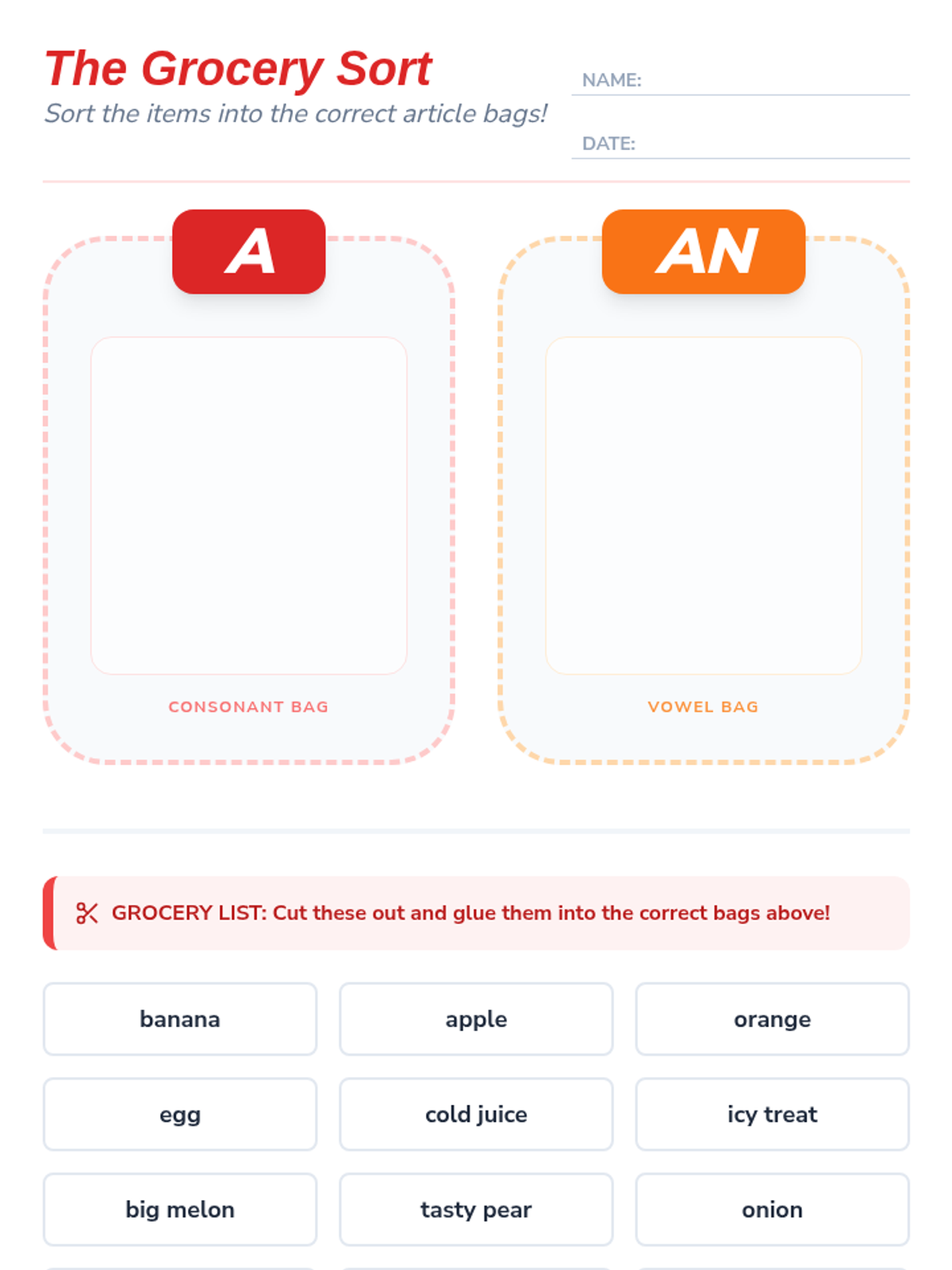
A hands-on grocery sorting activity where students categorize words and descriptive phrases into the 'A' and 'An' bags based on their initial sounds.
A fun completion certificate for students who have successfully finished the 'Article Investigators' riddle sequence.
A culminating slide deck for Lesson 5 featuring the 'Article Race' game and final sentence writing challenge.
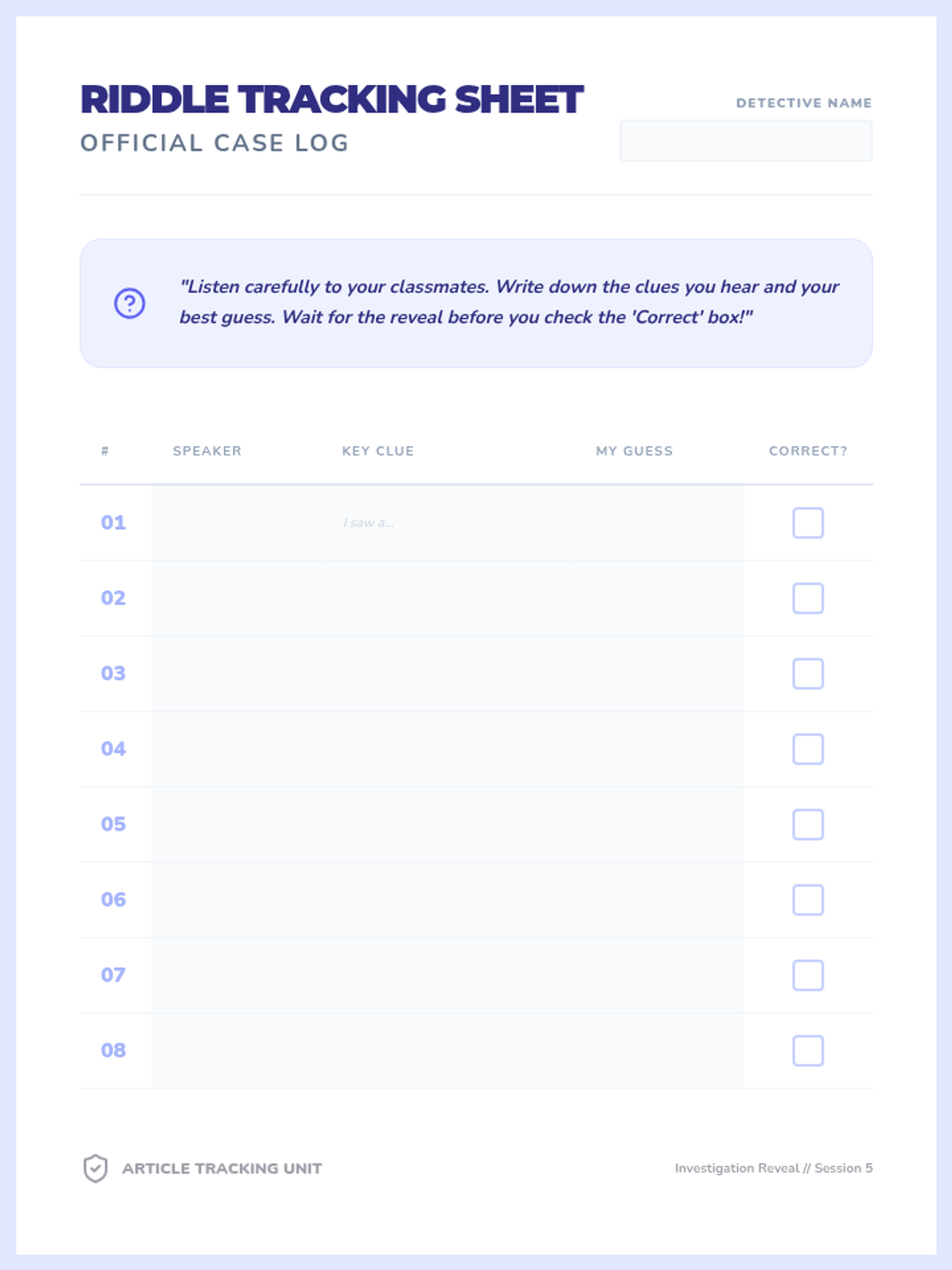
A structured tracking sheet for students to record clues and guesses during the Riddle Reveal presentations.
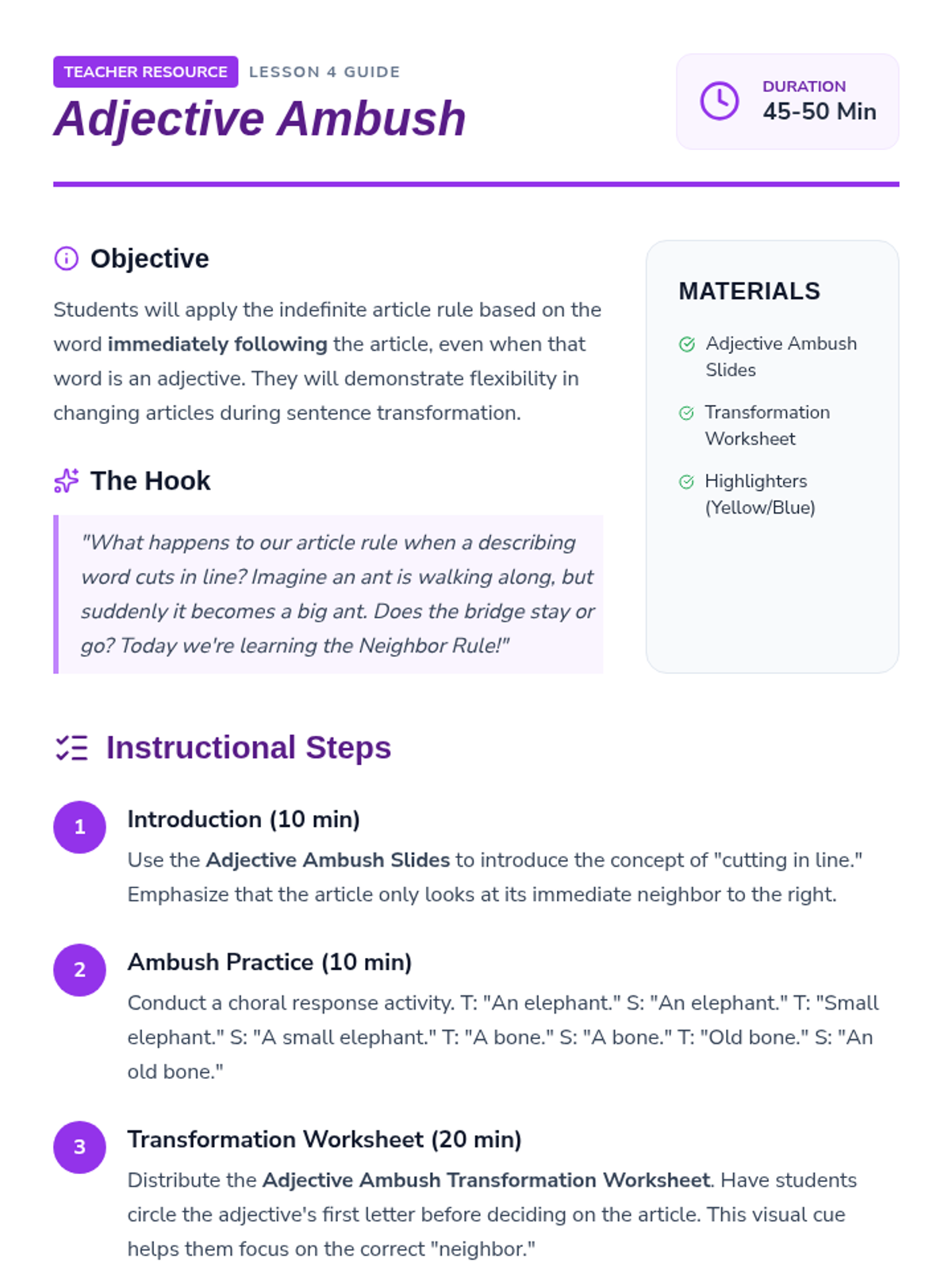
A lesson guide for teachers on Lesson 4, focusing on the immediate neighbor rule and adjective transformations.
Lesson 5 slide deck explaining presentation etiquette and the rules for the Riddle Reveal guessing game.
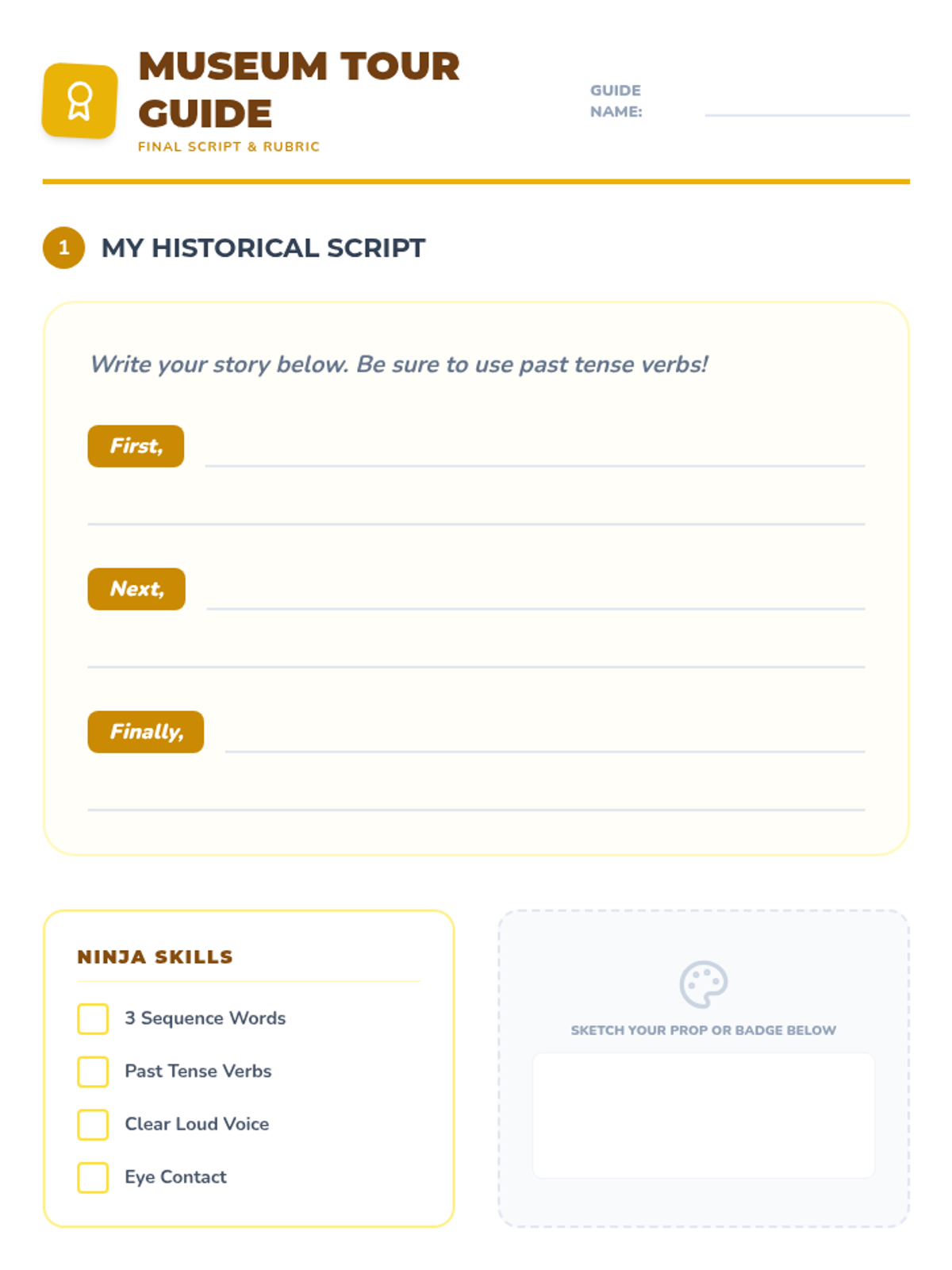
A guide for students to draft their historical narrative script and a checklist for their oral presentation performance.
A slide deck reviewing sequence words and past-tense verbs to prepare students for their final oral historical narrative presentation.
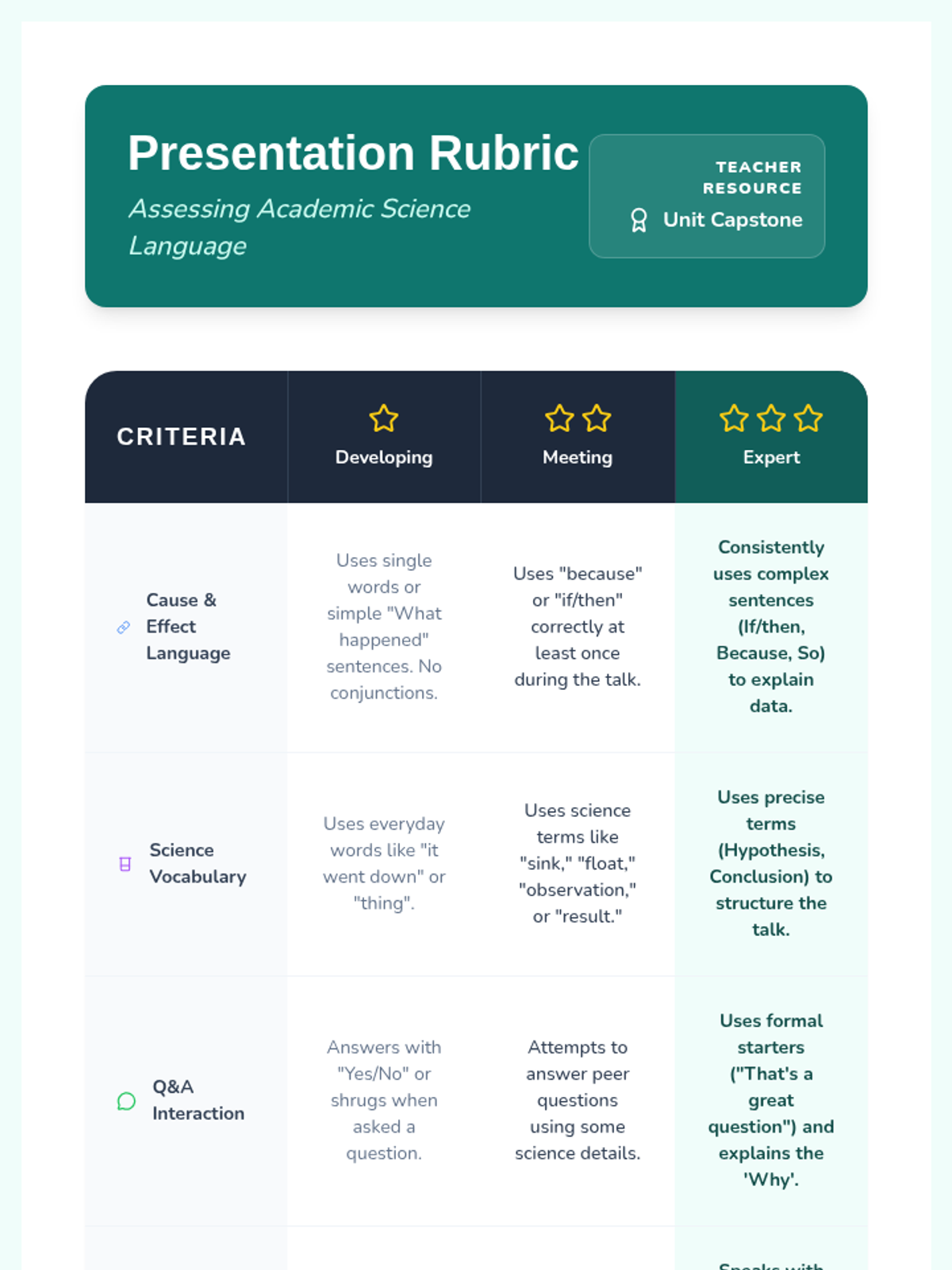
A simplified 3-point rubric for teachers to assess students' oral presentations, focusing on academic language, vocabulary, and presentation skills.
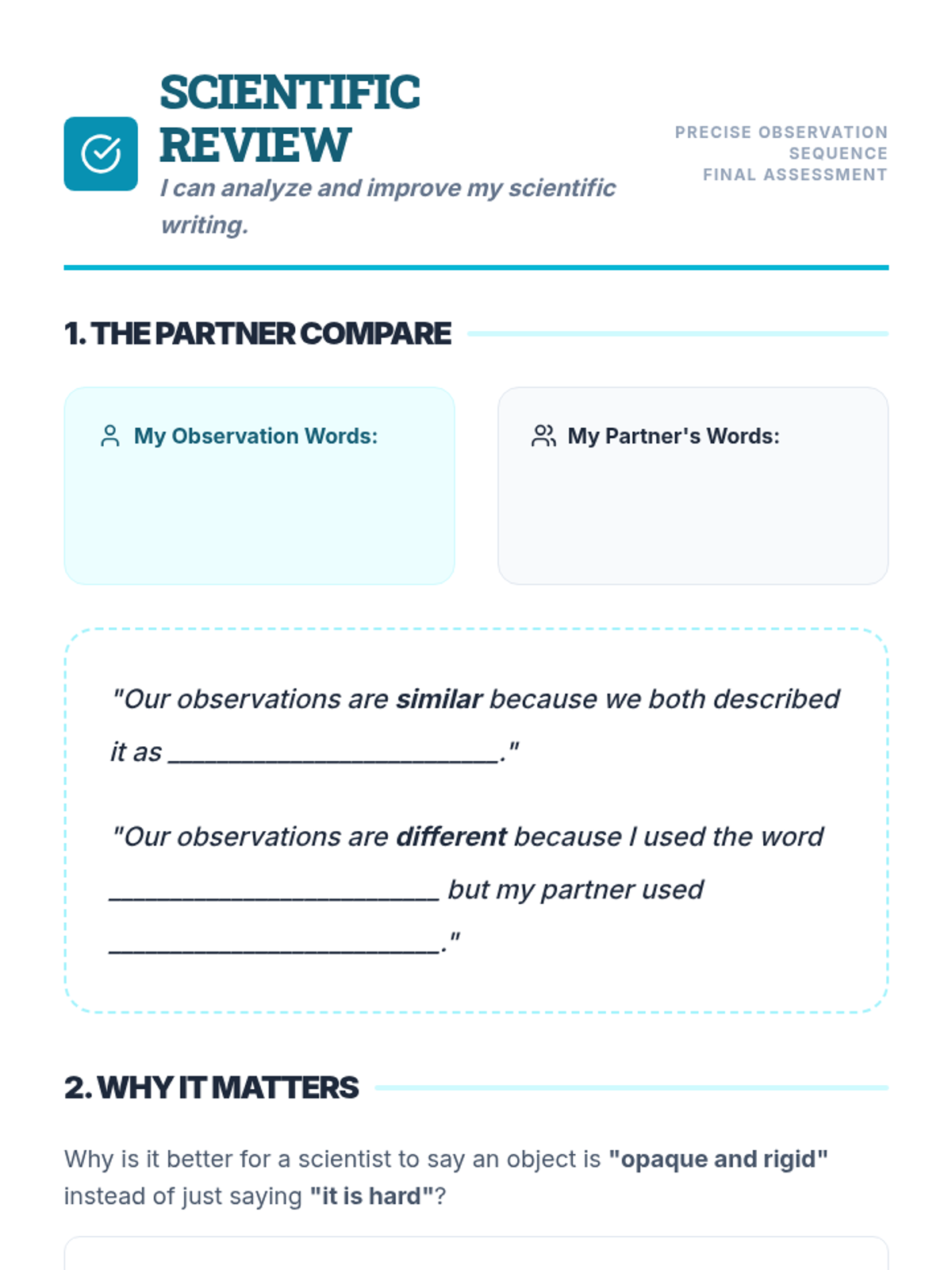
Final review and reflection worksheet for Lesson 5, including partner comparison frames, a justification reflection, and a student self-assessment checklist.
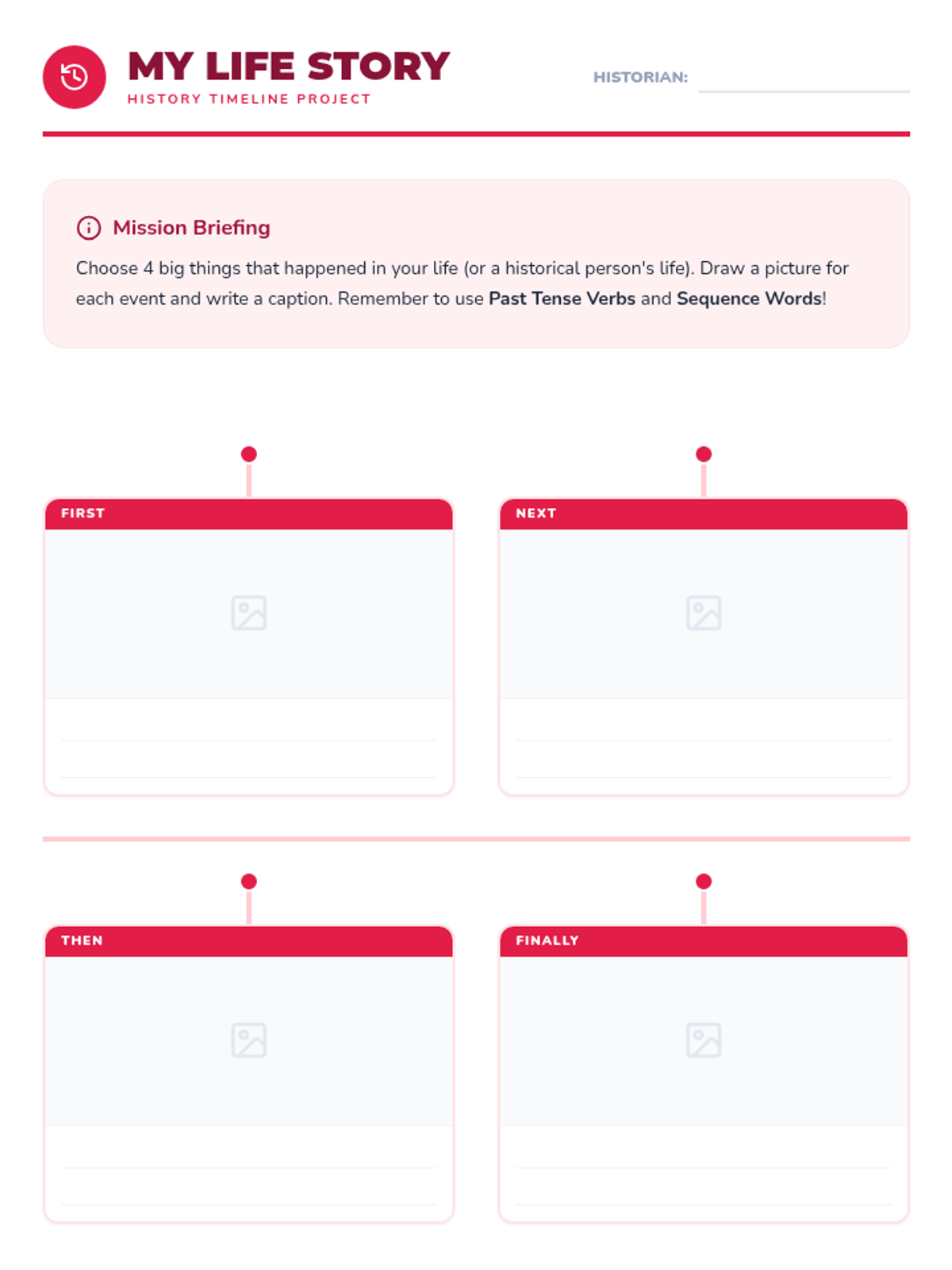
A graphic organizer/project sheet where students create a timeline of their life or a historical figure using drawings and captions.
Lesson 5 slide deck guiding students through the 'Science Symposium' oral presentation, including sentence starters and Q&A etiquette.
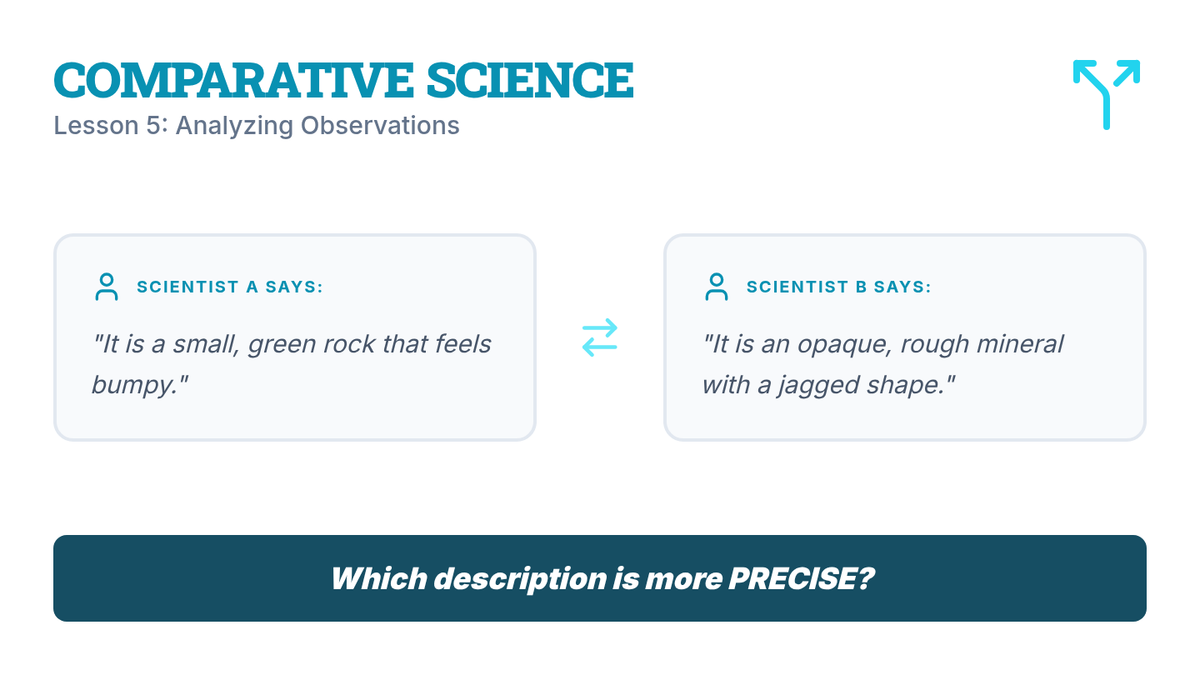
Slide deck for Lesson 5 introducing the importance of standardized scientific vocabulary and sentence frames for comparative analysis.
A visual presentation for 2nd-grade students on what a timeline is, how to read it, and how to use chronological order and sequence words to describe historical events.
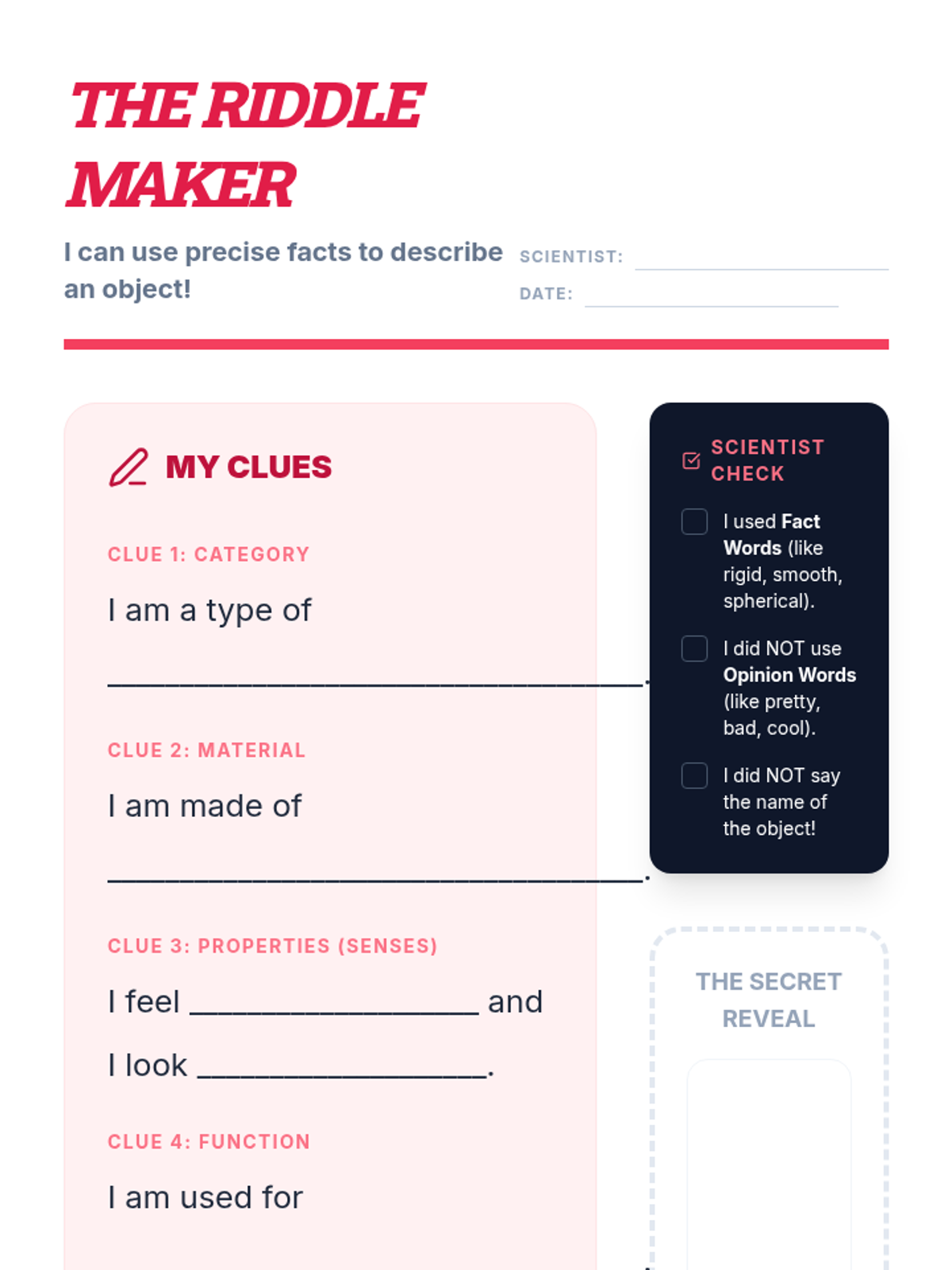
Scaffolded riddle writing template for Lesson 4, guiding students to use category, material, property, and function clues while adhering to scientific fact-based writing.
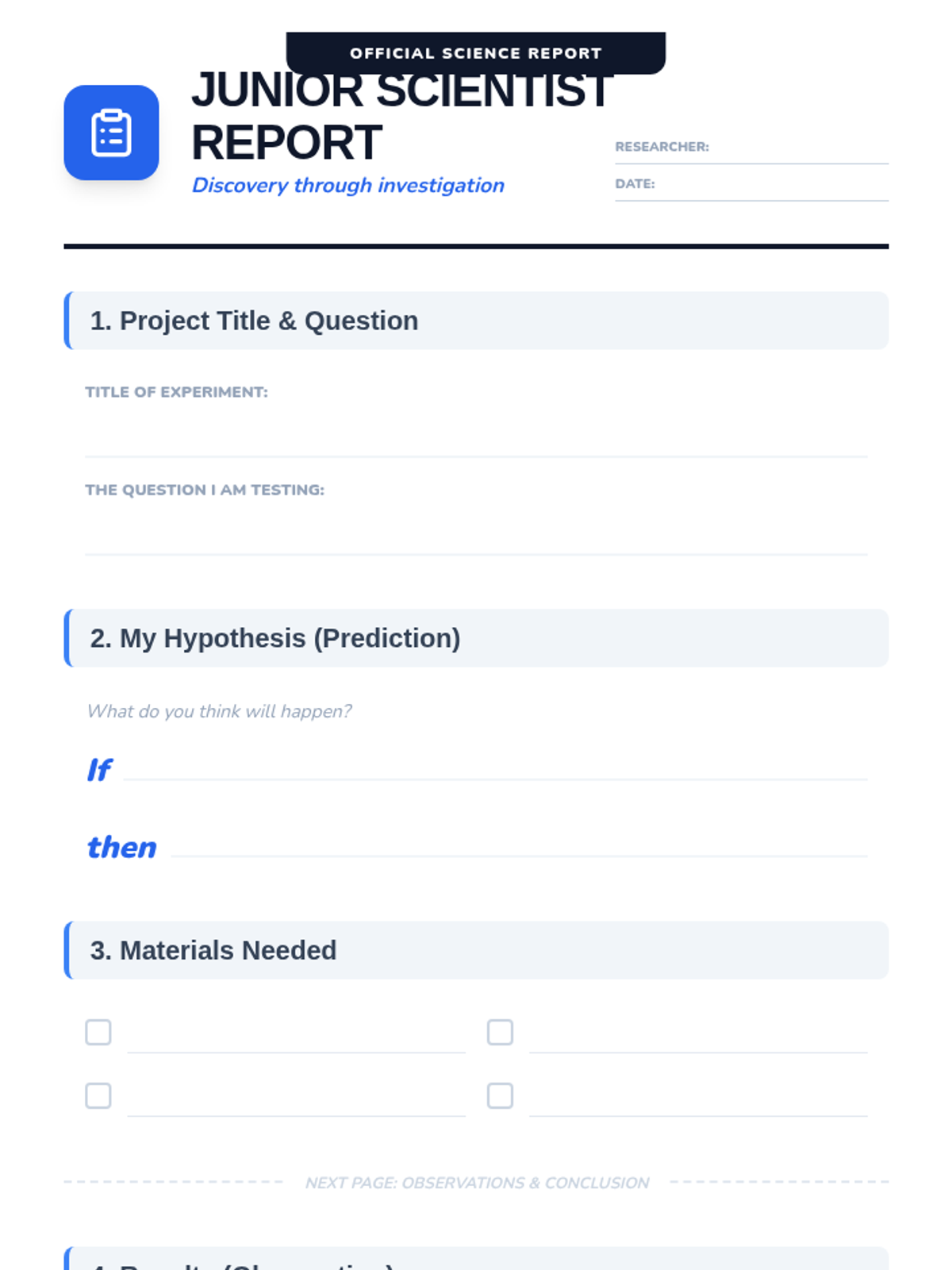
A scaffolded lab report template for junior scientists, including sections for hypothesis, materials, results, and a cause-and-effect conclusion.
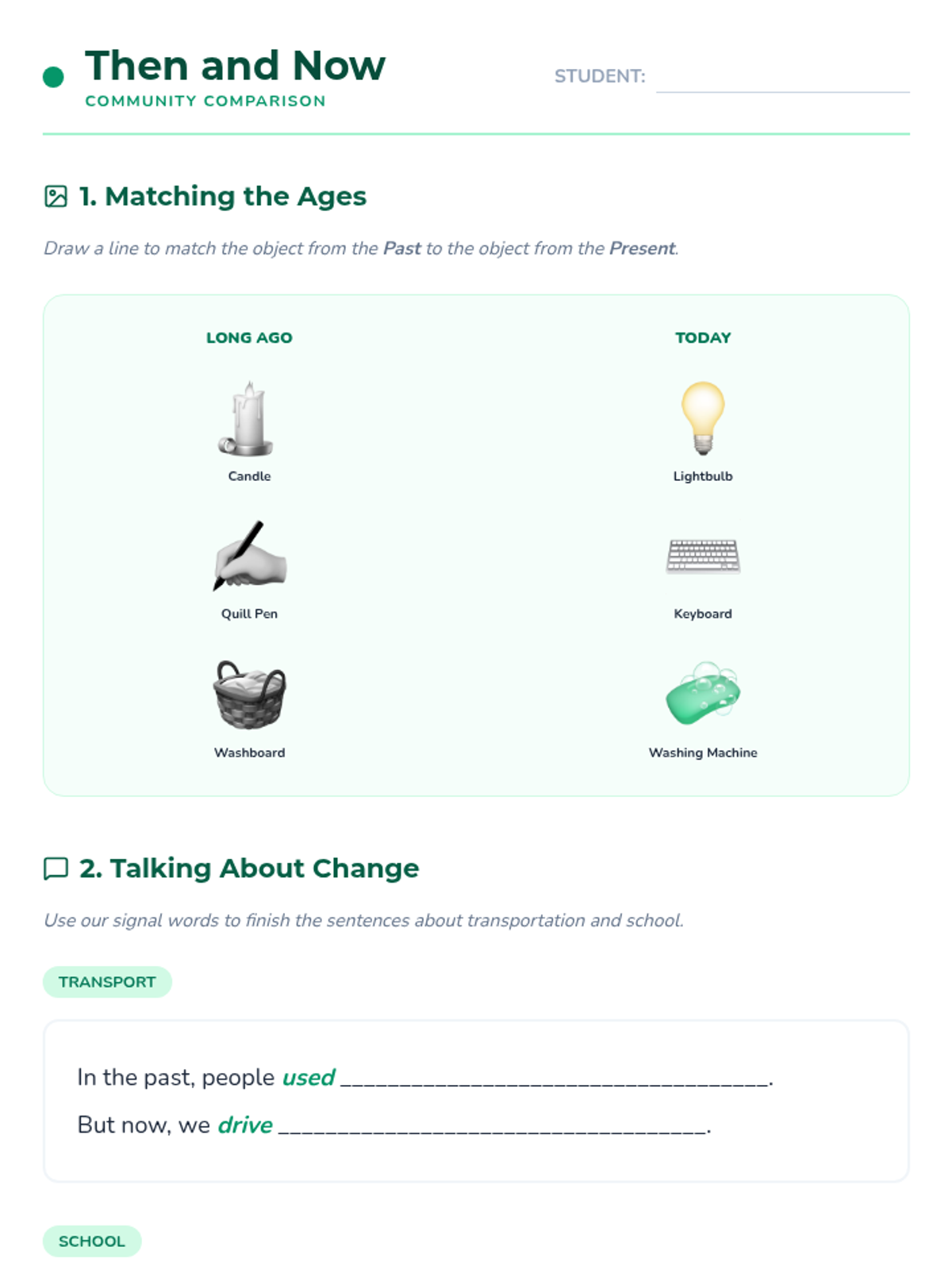
A comparison worksheet for 2nd-grade students to identify and describe differences between community life in the past and present using sentence frames.
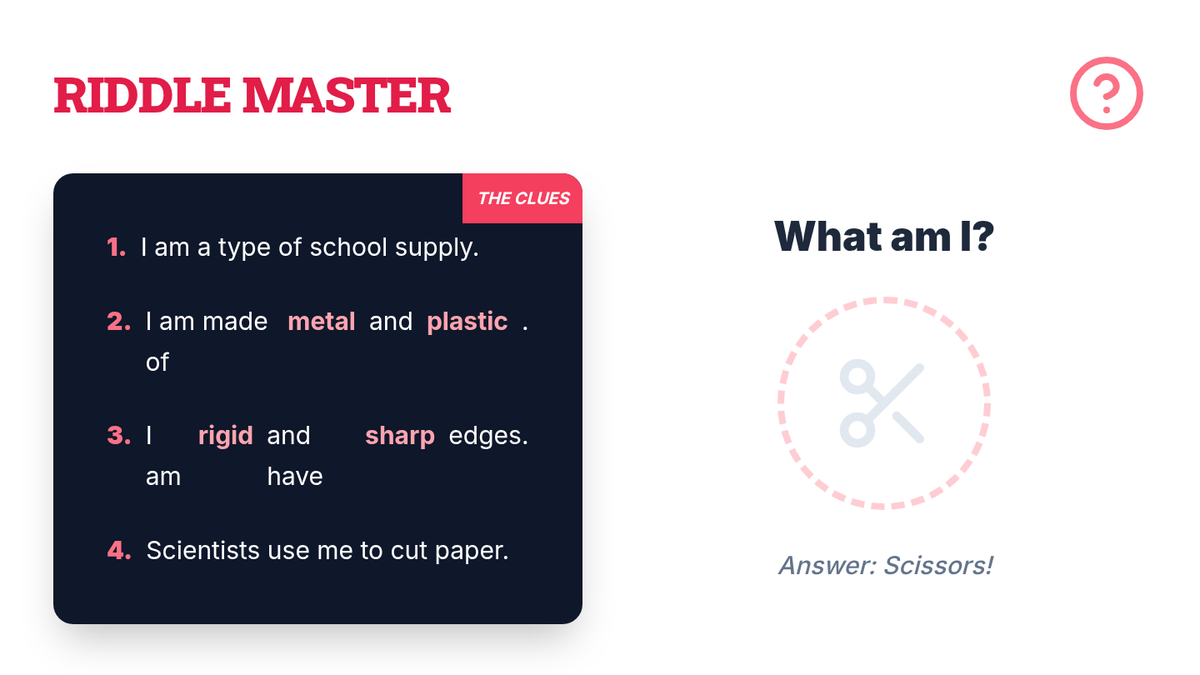
Slide deck for Lesson 4 introducing scientific riddle writing, focusing on facts versus opinions and the four-step structure for precise descriptions.
Lesson 4 slide deck introducing the structure of a scientific lab report and focusing on the conclusion section.
A visual presentation for 2nd-grade students comparing community life in the past versus today, featuring transportation, schools, and sentence frames for comparison.
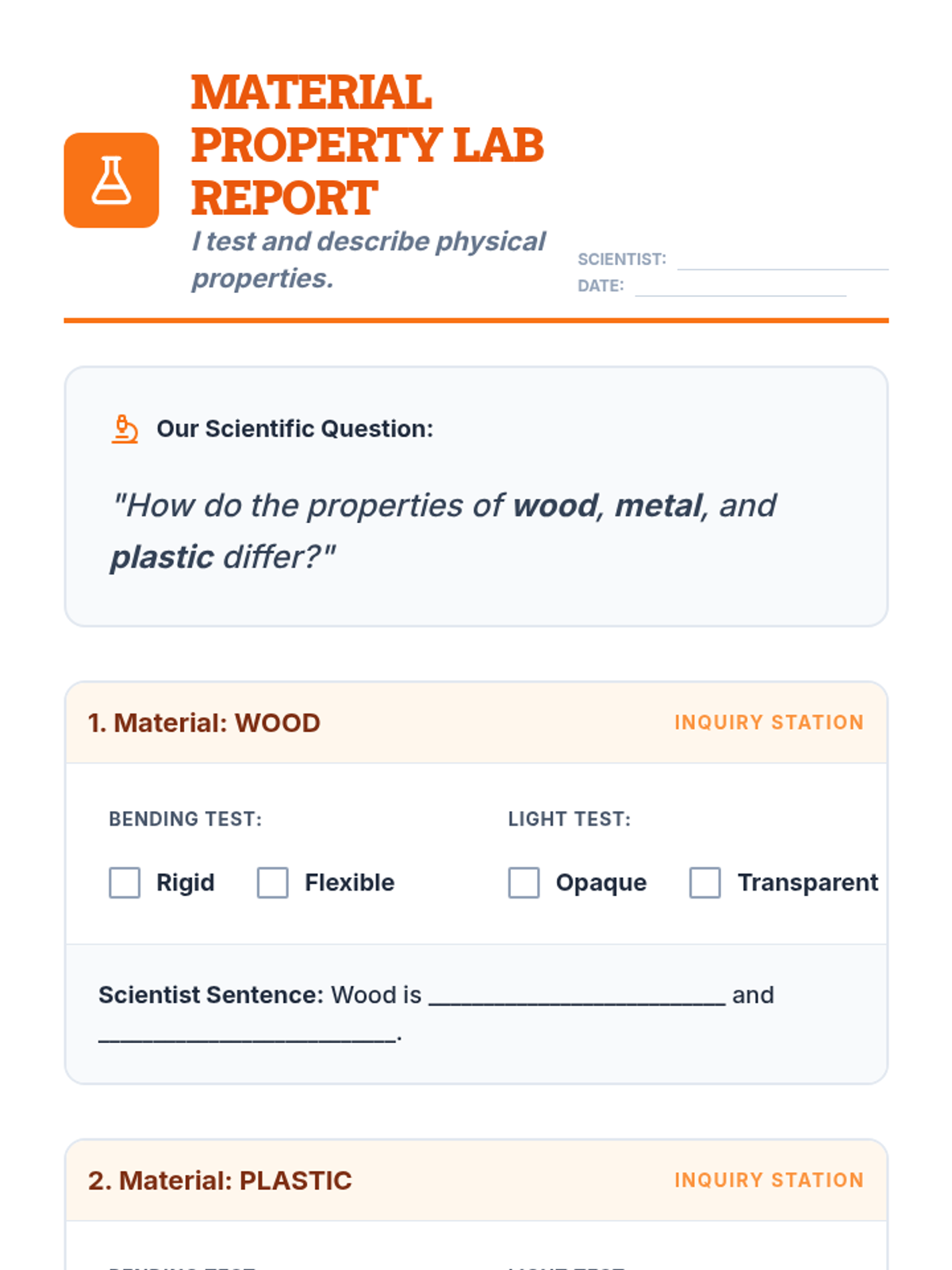
Investigation report for Lesson 3 where students test wood, plastic, and metal for rigidity and transparency, recording their findings with checkboxes and sentences.
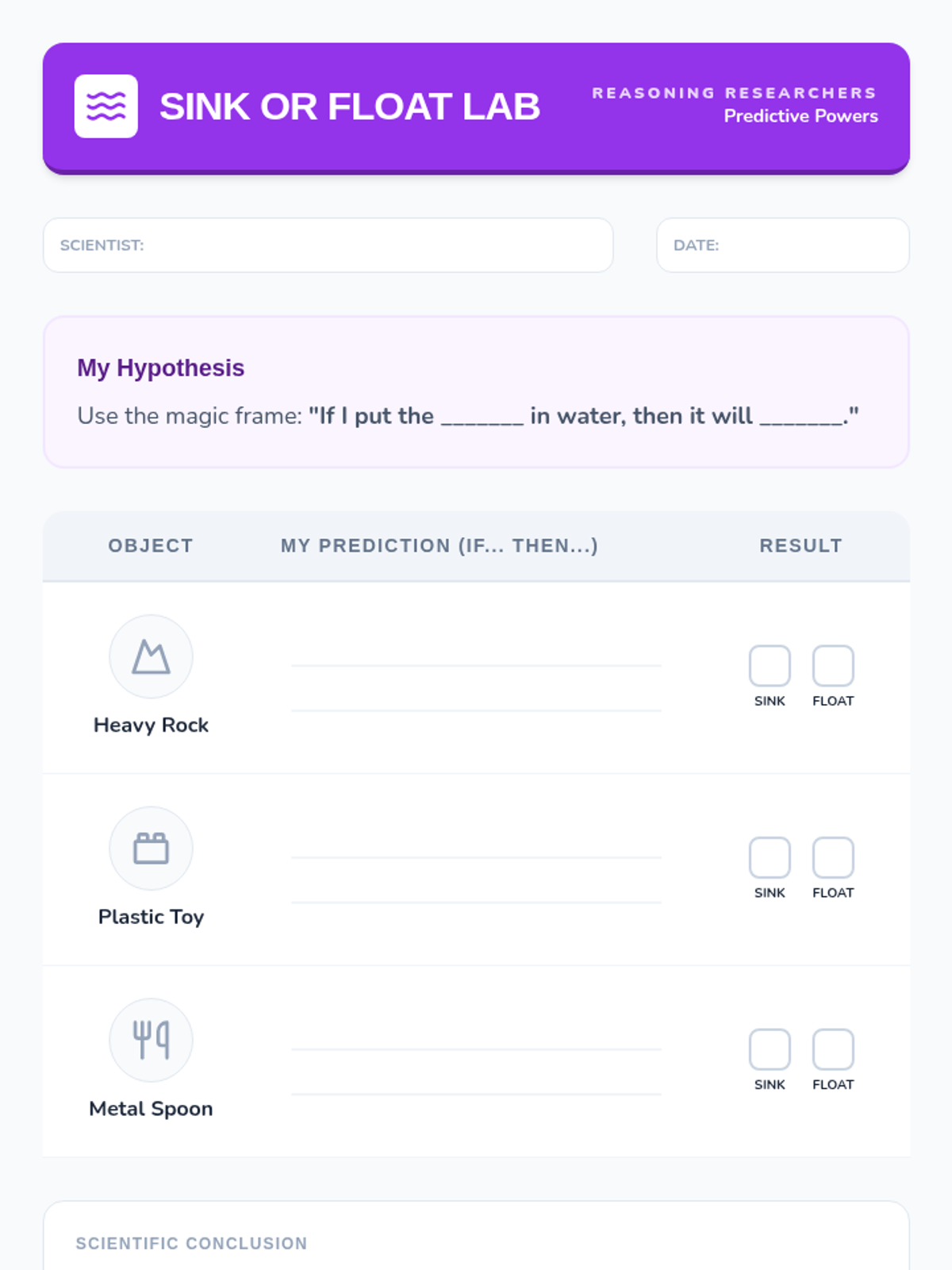
An experiment recording sheet for sinking and floating, with spaces for students to write 'If... then...' hypotheses and record results.
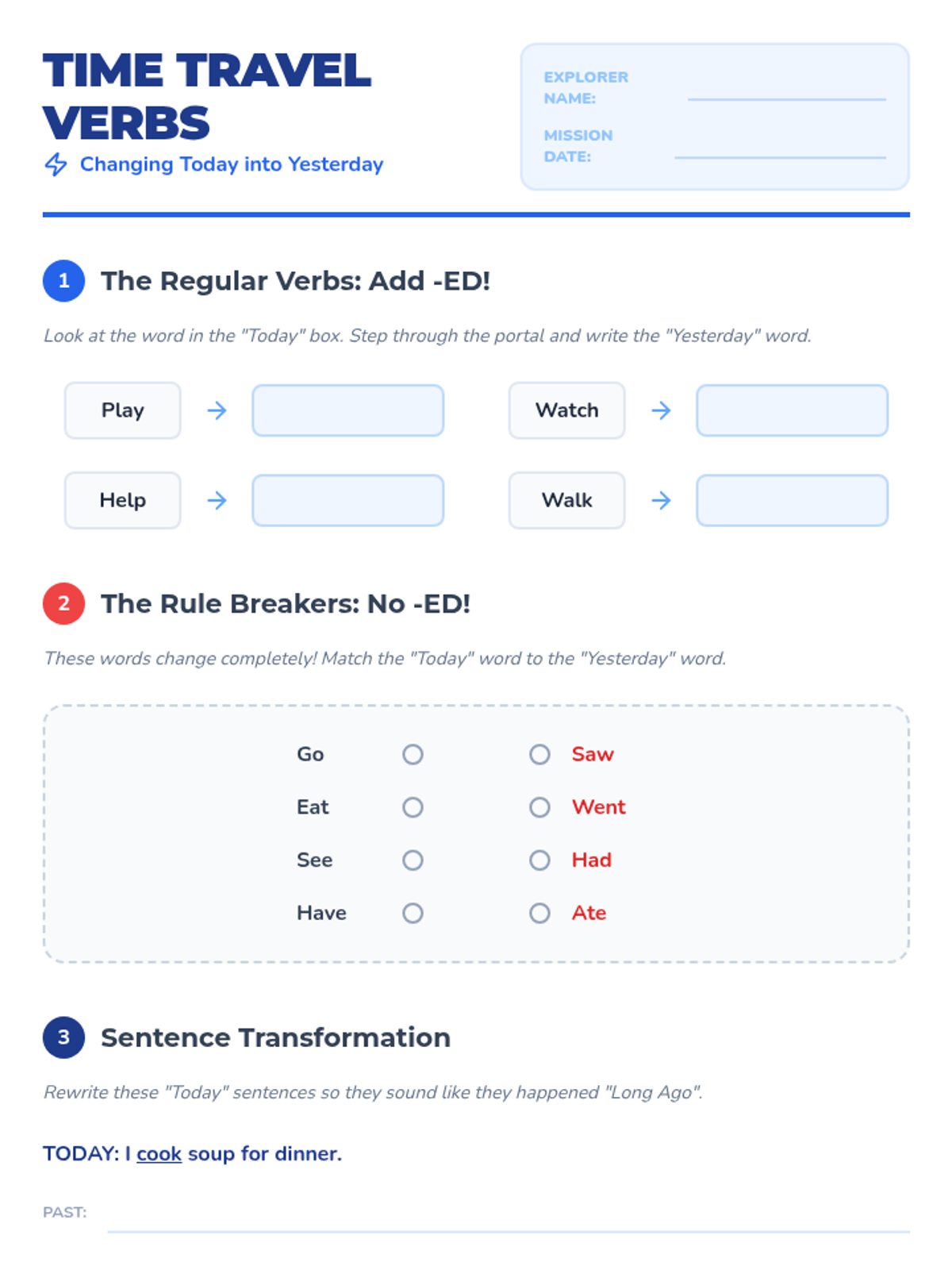
A worksheet for students to practice converting present tense verbs to past tense, including both regular (+ed) and irregular forms.
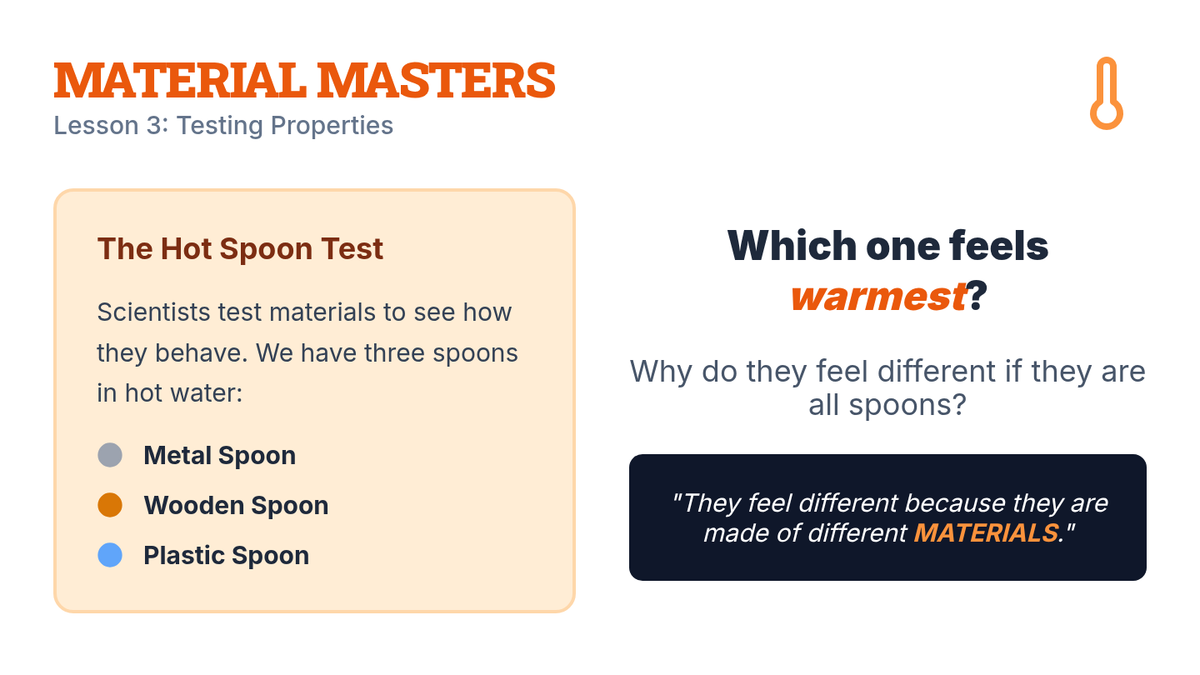
Slide deck for Lesson 3 introducing properties of materials (rigid, flexible, opaque, transparent) with an experimental hook and scientific sentence frames.
Lesson 3 slide deck focusing on using the 'If... then...' structure to formulate scientific hypotheses.
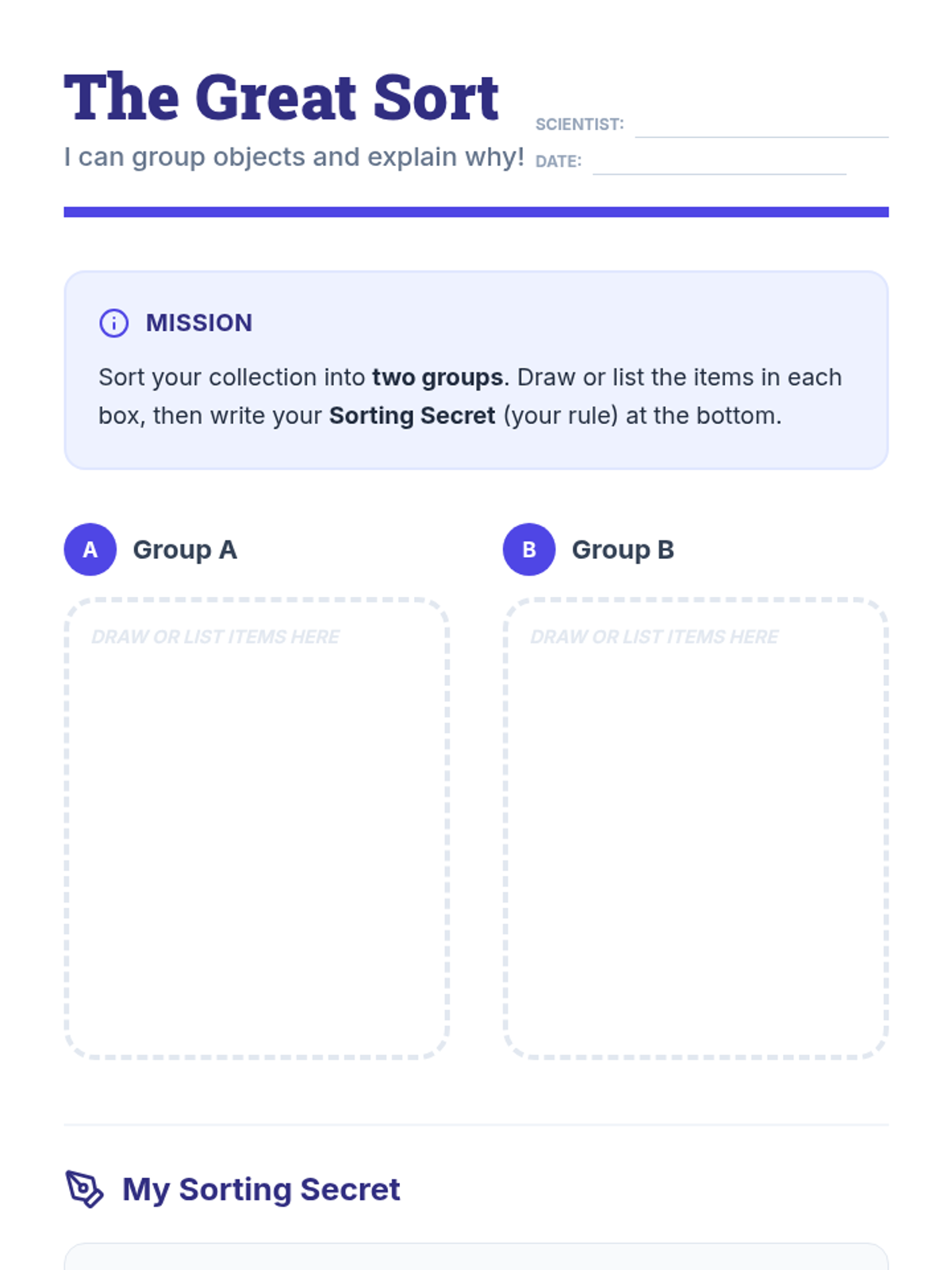
Student activity worksheet for Lesson 2 where students sort objects into groups and record their classification rules using scientific sentence frames.
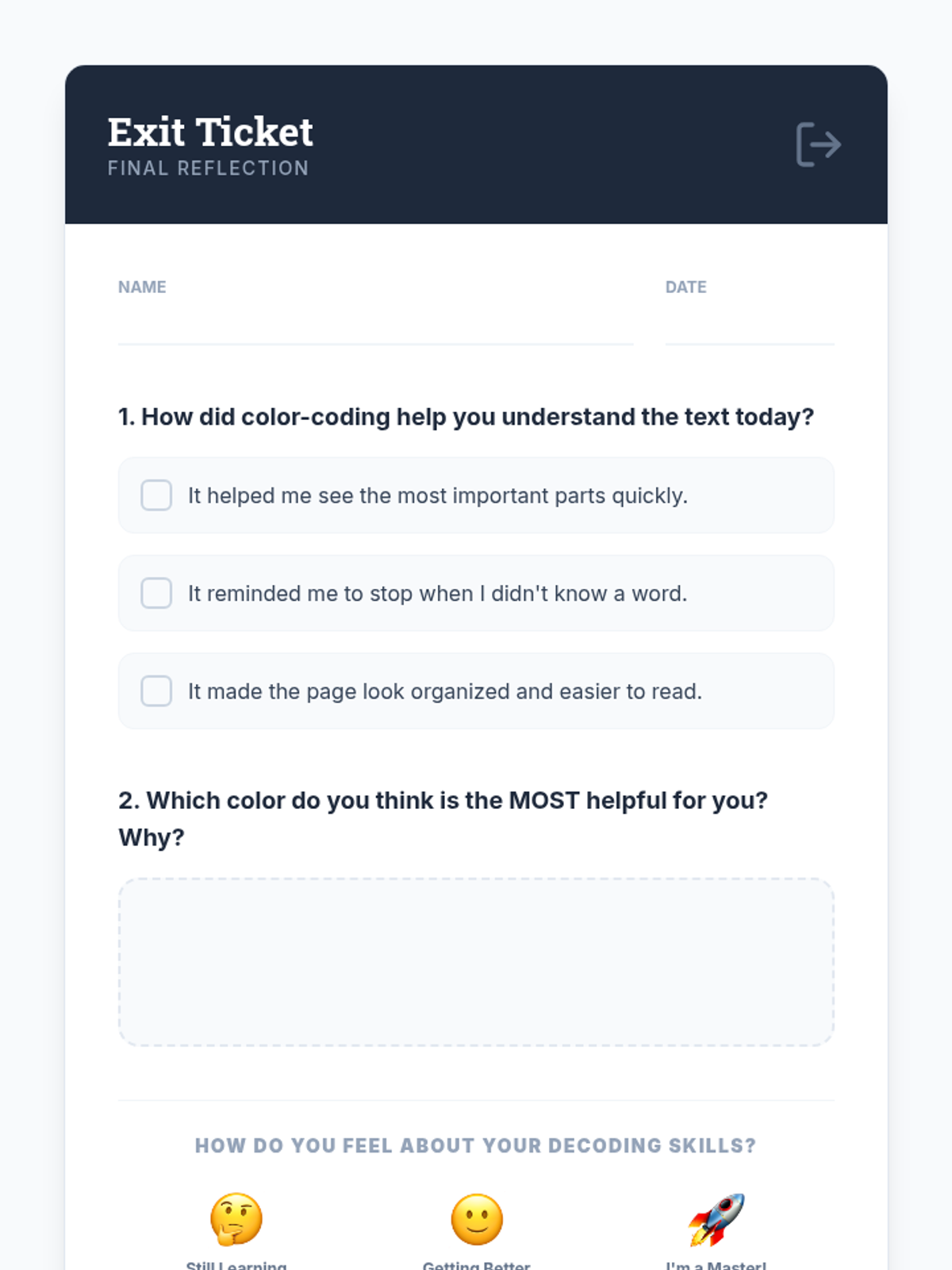
Exit ticket for the final lesson of the sequence, allowing students to reflect on the utility of the color-coding system and self-assess their mastery of the strategy.
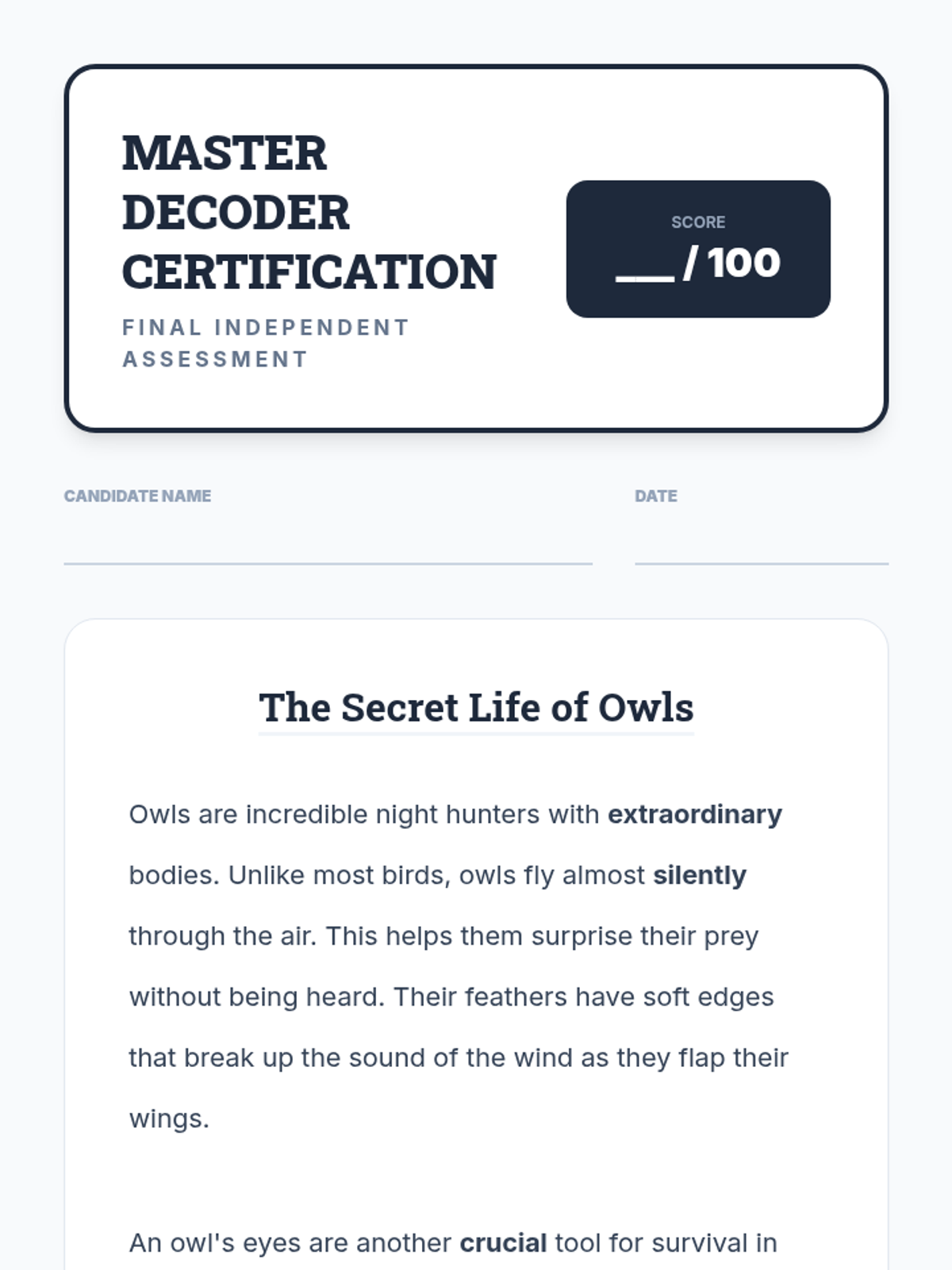
Final summative assessment for the sequence. Students independently annotate a text about owl adaptations and answer reflective questions to demonstrate mastery of the tri-color system.
Final lesson presentation for the Master Decoder challenge. It outlines the independent mission, peer review steps, and provides sentence stems for students to justify their annotation choices.
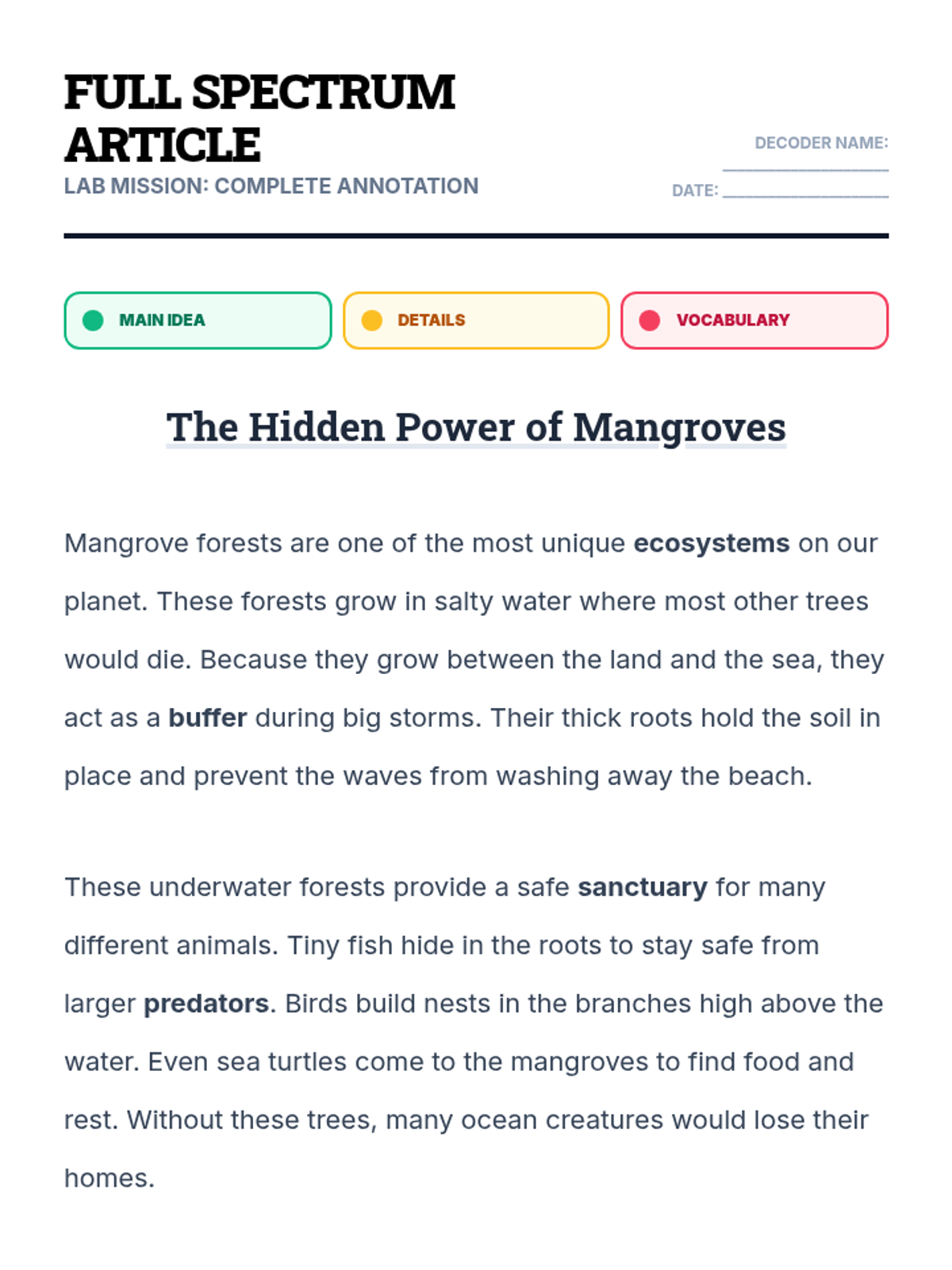
Full-length informational article about Mangrove forests for students to practice the tri-color system. Includes a reflection section for vocabulary and summary practice.
Lesson 4 presentation focusing on the integration of all three colors. It features a comparison between plain and coded text to demonstrate the cognitive benefits of the tri-color system.
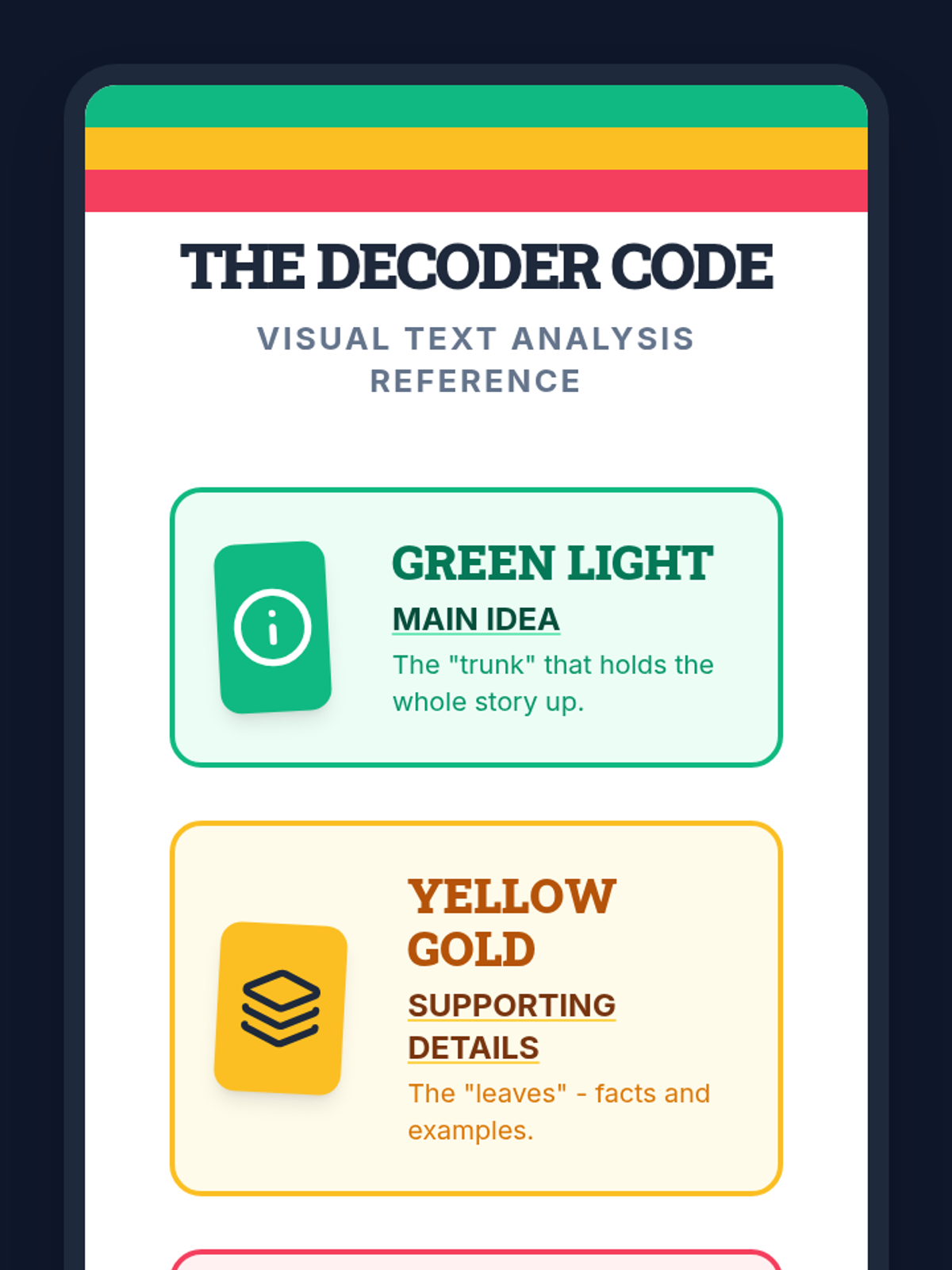
A visual anchor chart or poster summarizing the tri-color system. It defines Green (Main Idea), Yellow (Supporting Details), and Red (Vocabulary) for easy student reference.
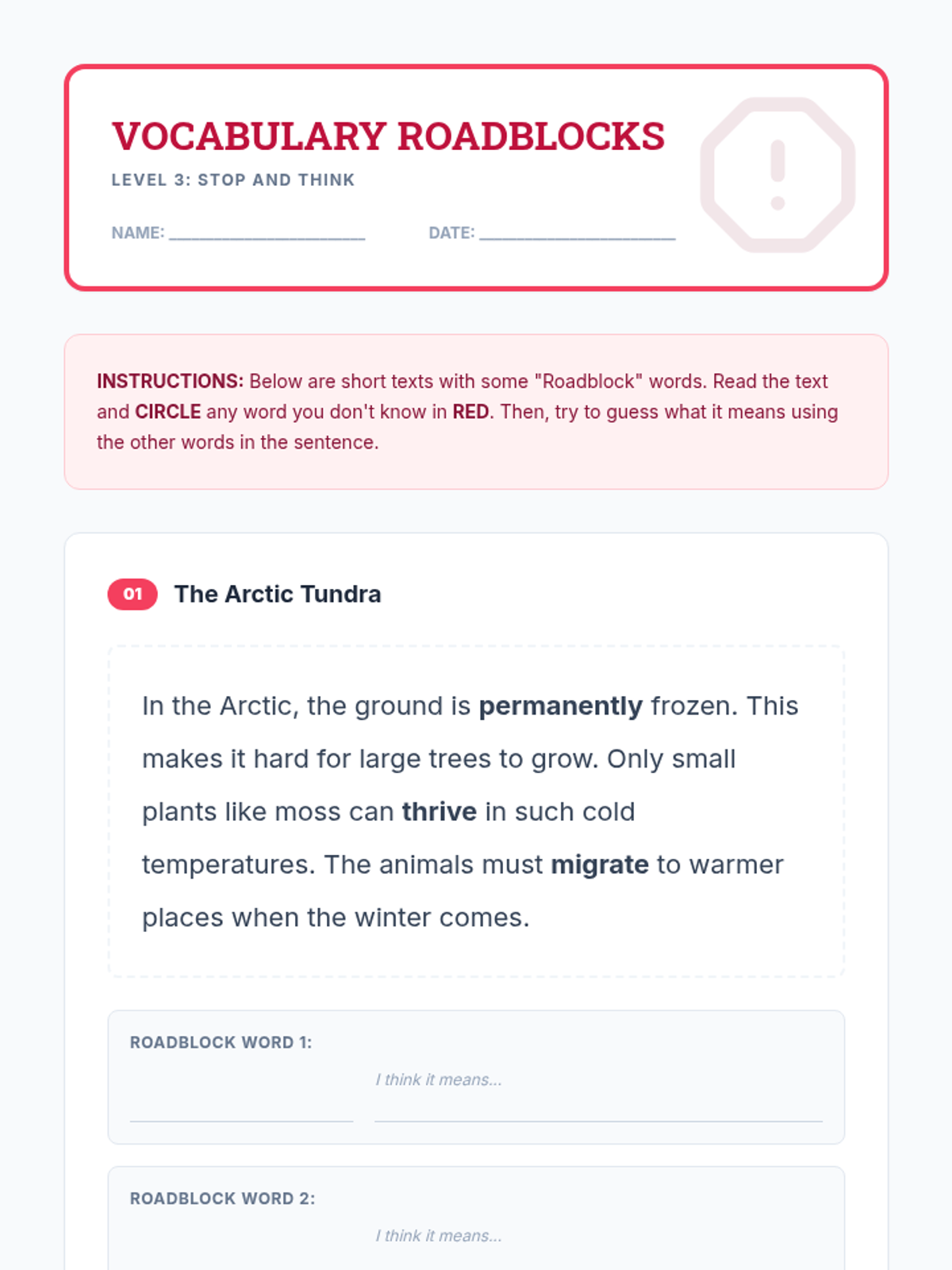
Worksheet for Lesson 3 focusing on identifying and circling vocabulary 'roadblocks' in red. Students are also prompted to guess the meaning of words based on context clues.
Lesson 3 presentation introducing 'Red' for vocabulary. It uses a "stop sign" and "speed bump" analogy to help students recognize when they encounter unfamiliar words that hinder comprehension.
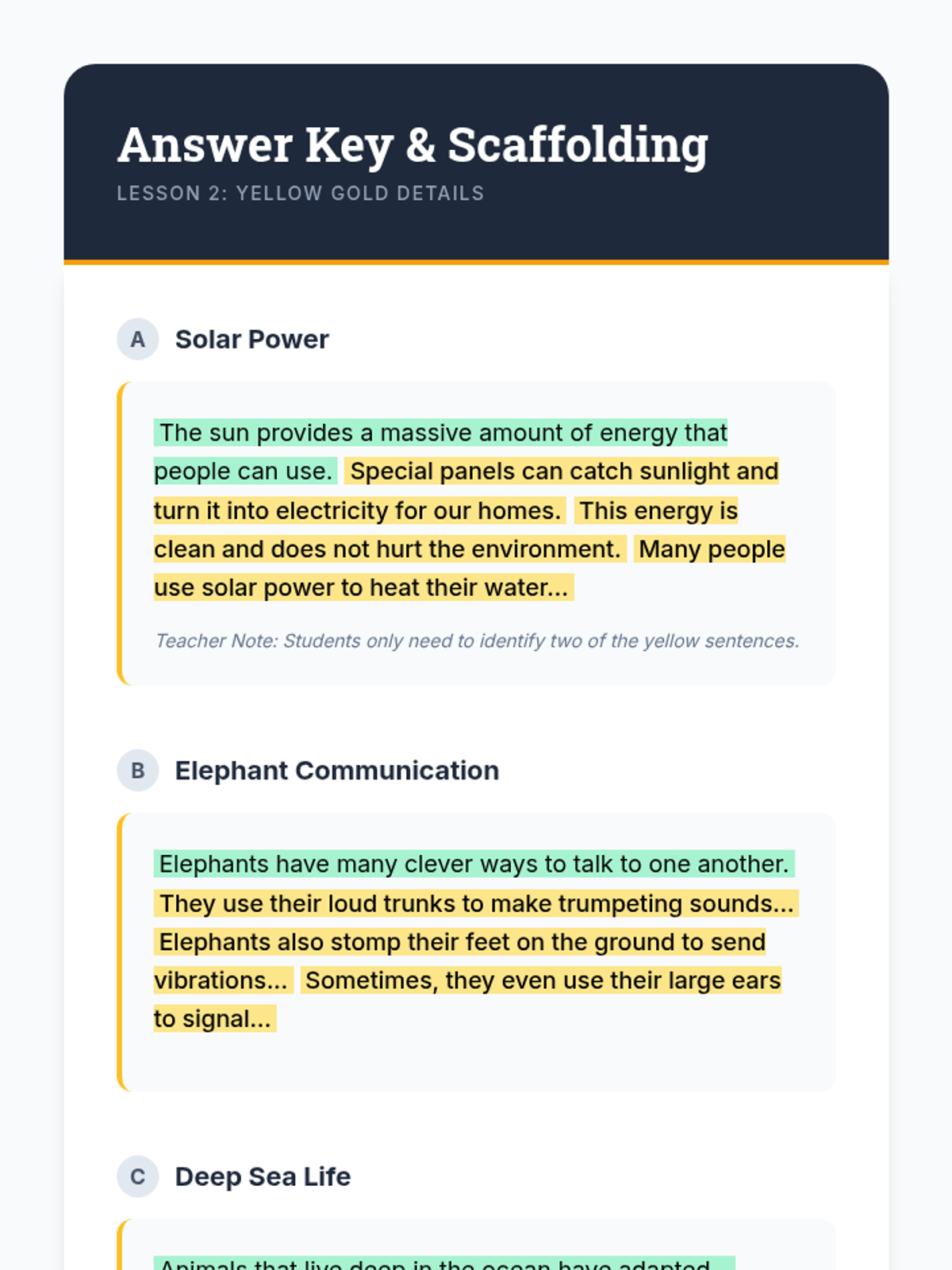
Teacher answer key for the Lesson 2 worksheet, including visual highlighting examples and tips for addressing common student misconceptions regarding over-highlighting.
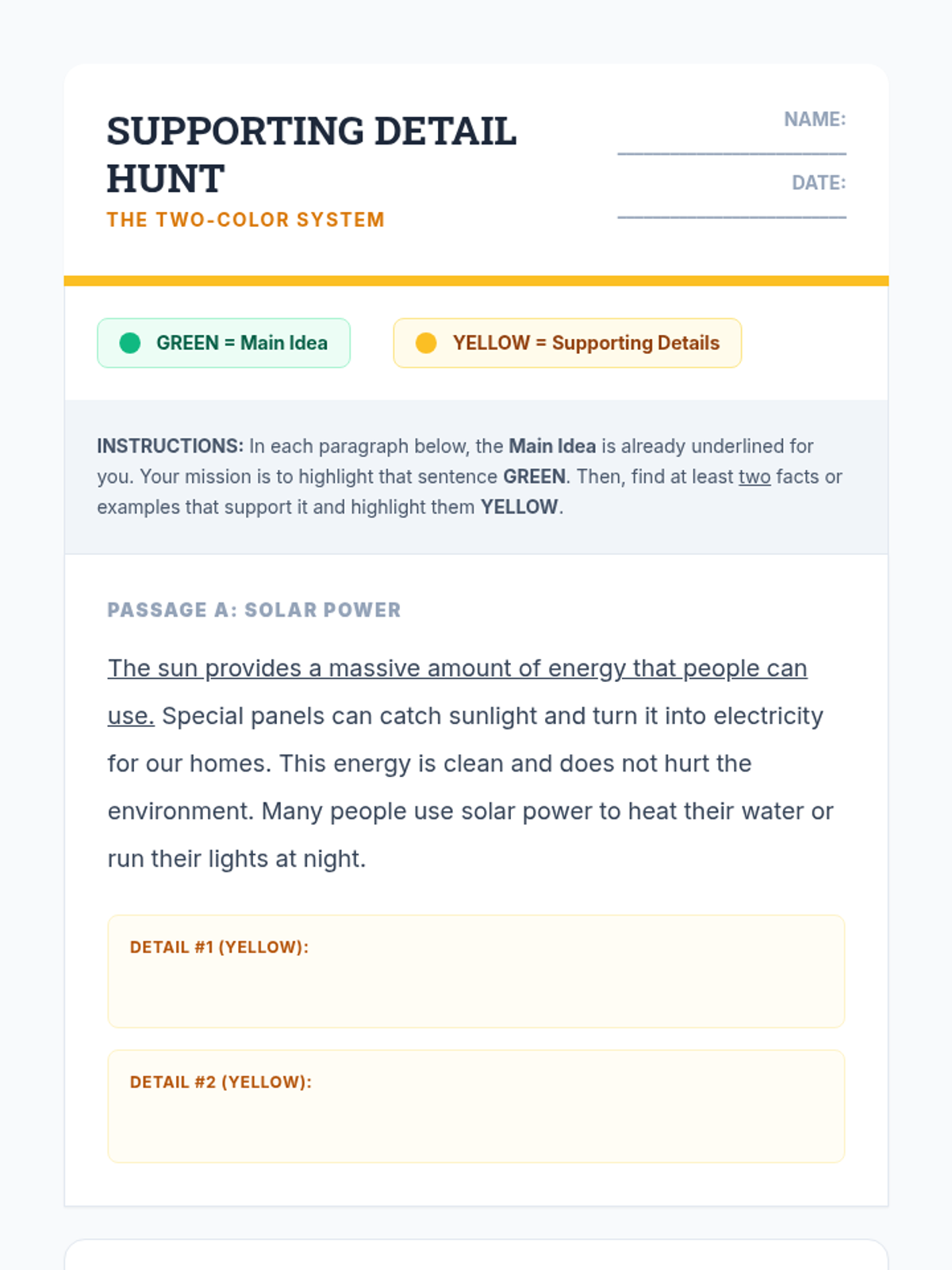
Worksheet for Lesson 2 where students use both green (main idea) and yellow (supporting details) highlighters. The main idea is pre-underlined to scaffold the transition to identifying details.
Presentation for Lesson 2, introducing 'Yellow' for supporting details. Includes a review of Lesson 1 (Green) and a collaborative exercise to identify supporting facts for a given claim.
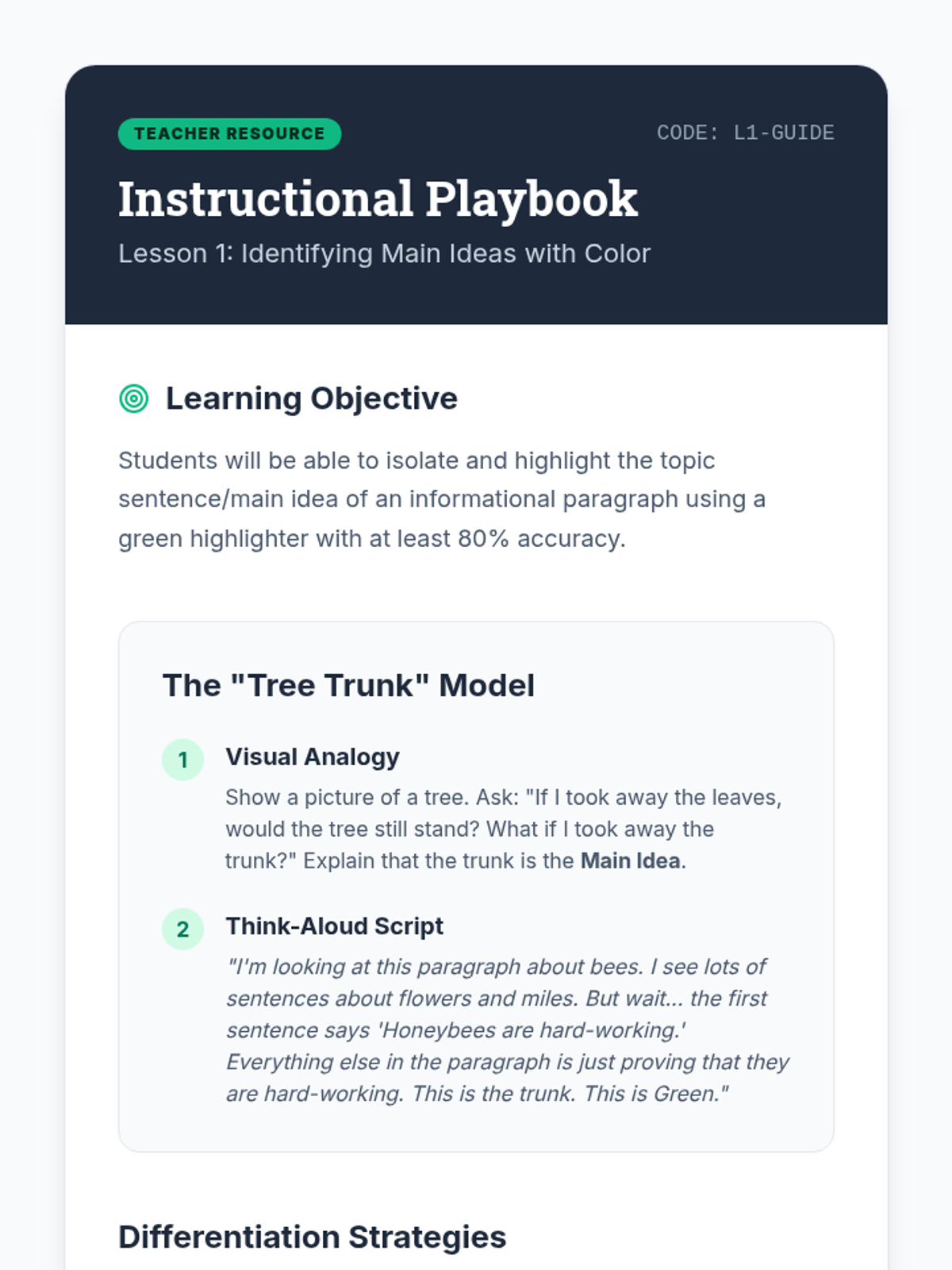
Facilitation guide for Lesson 1, including instructional scripts, the tree trunk visual analogy, and specific differentiation strategies for students with academic support needs.
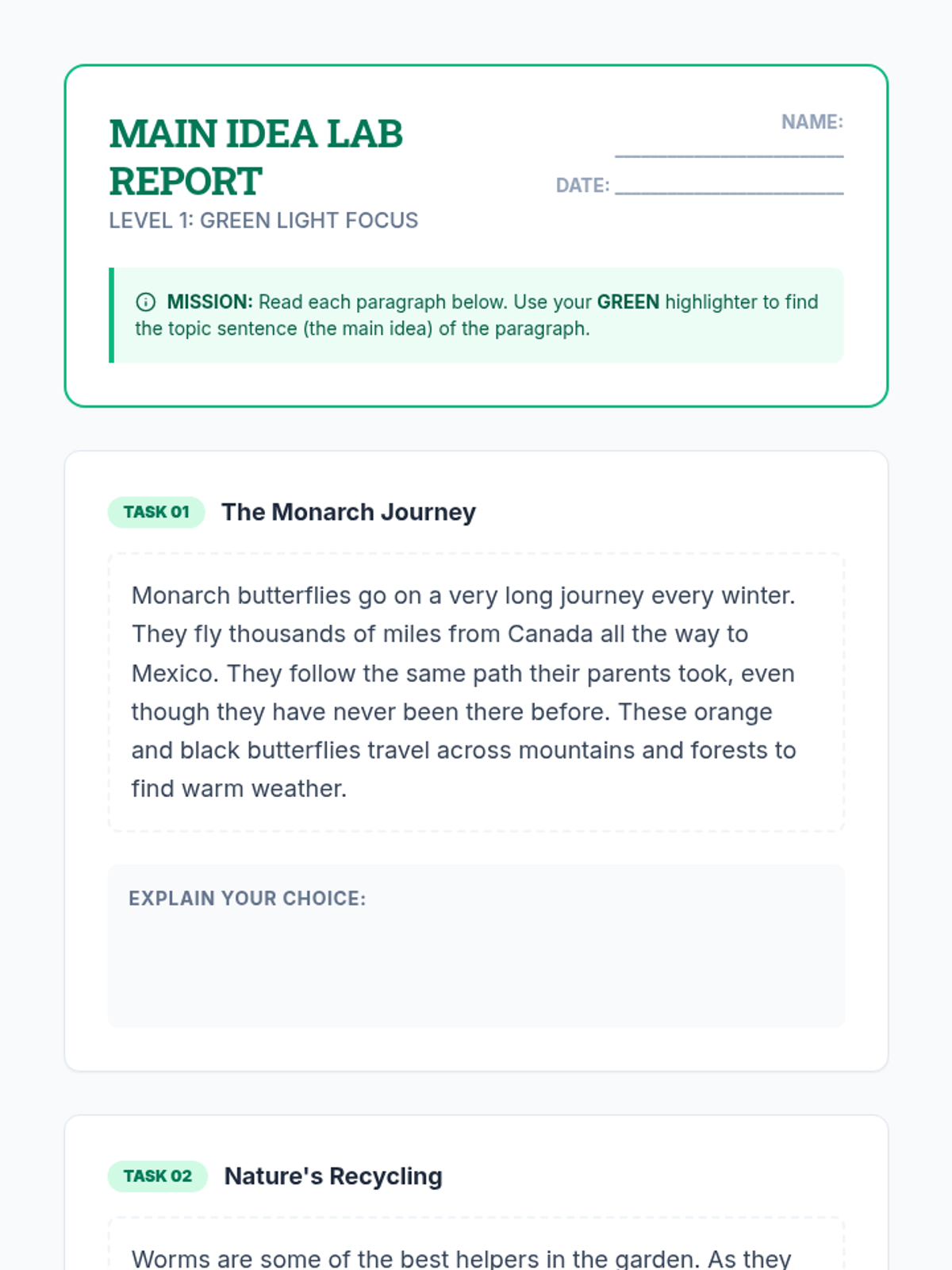
Practice worksheet for Lesson 1 where students use green highlighters to identify the main idea in three different informational paragraphs. Includes a challenge where the main idea is at the end of the paragraph.
Introductory presentation for Lesson 1, using a "Lab" theme to teach students the color-coding system with a focus on 'Green' for Main Ideas. Includes a tree analogy to simplify the concept of text structure.
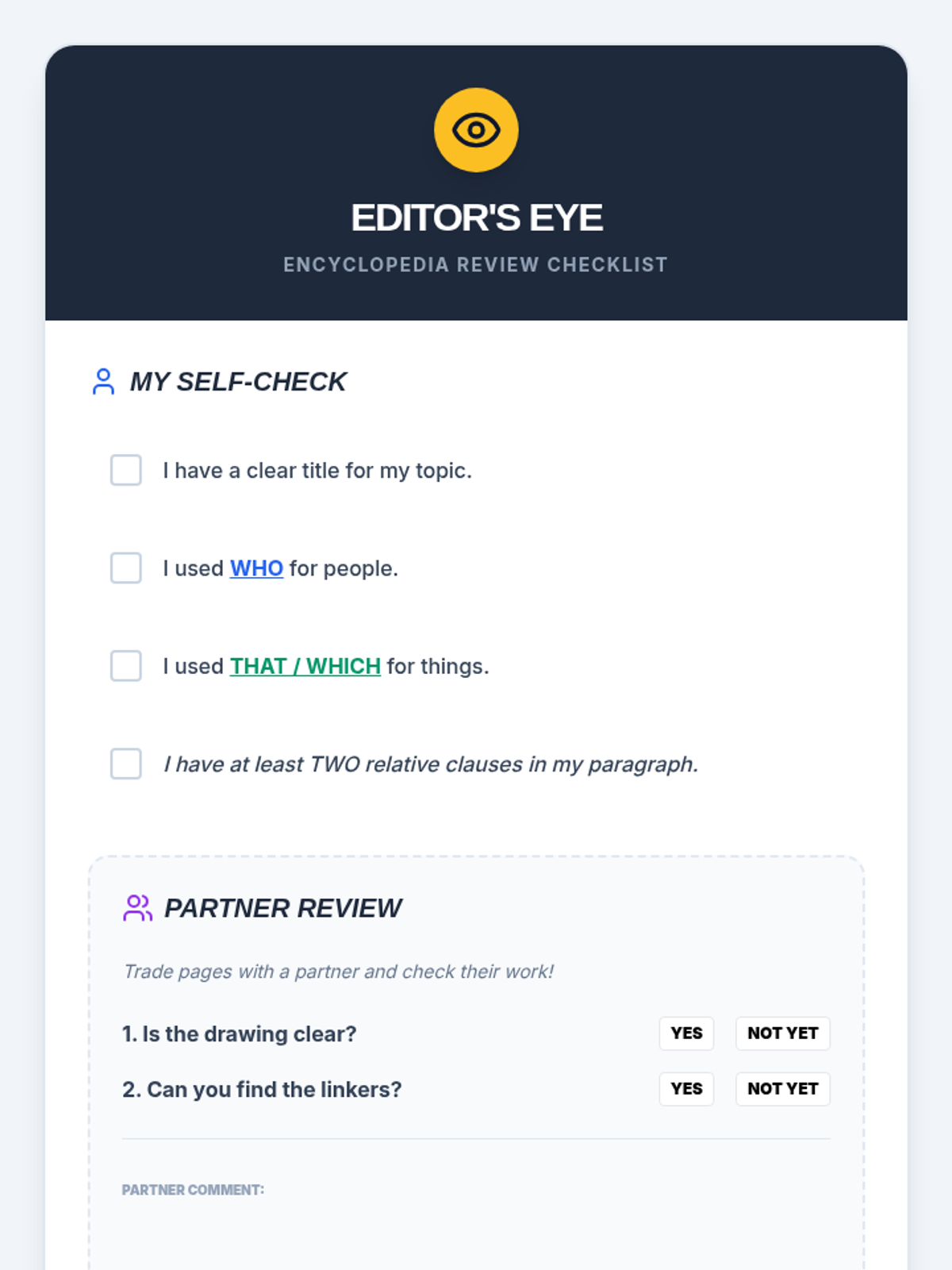
A peer review and self-assessment checklist for students to use during the final Encyclopedia Project.
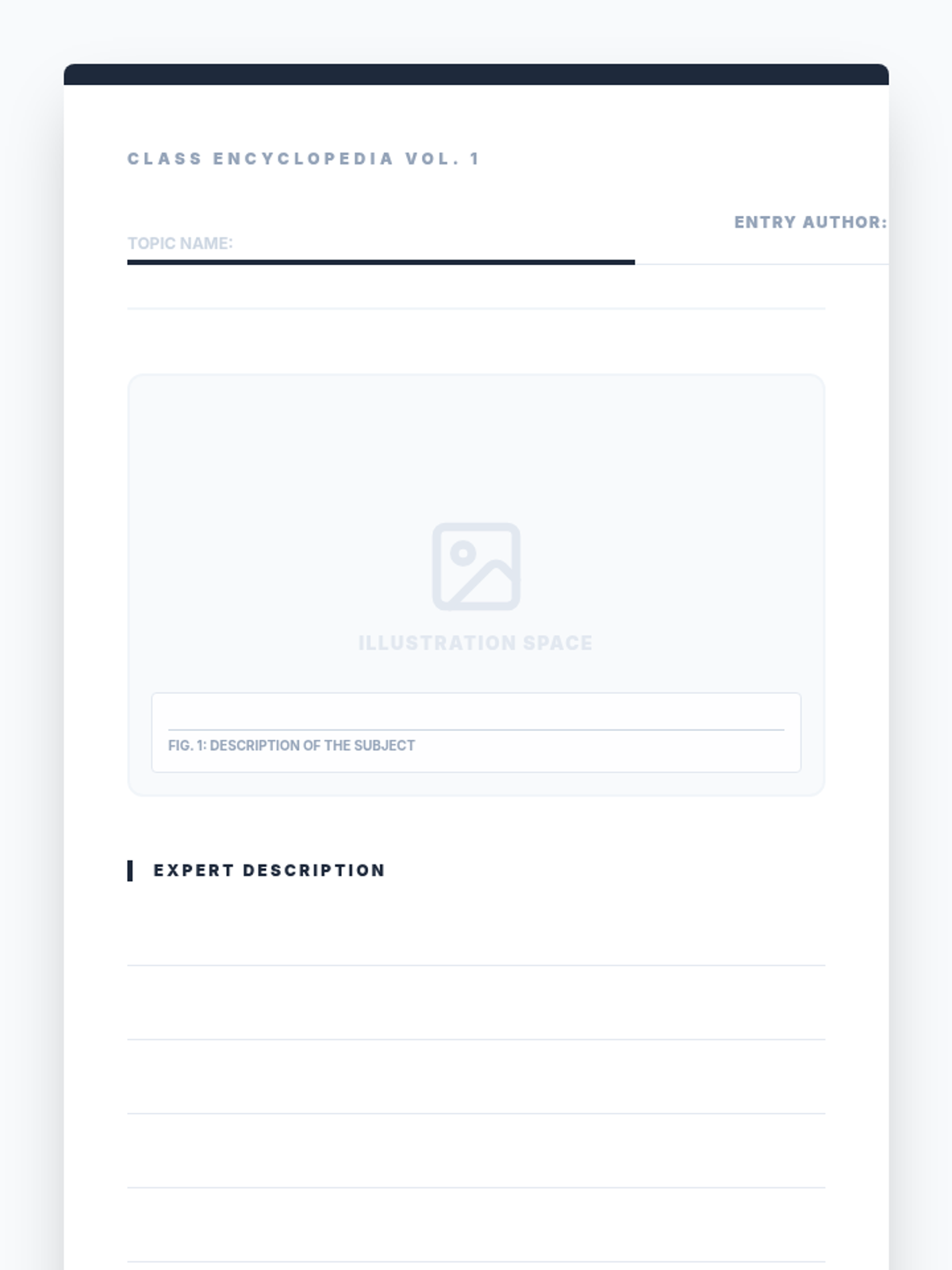
A formal writing template for the Encyclopedia Project where students write detailed entries using relative clauses.
A slide deck for the Lesson 5 project, showing encyclopedia examples and project instructions for creating a class book.
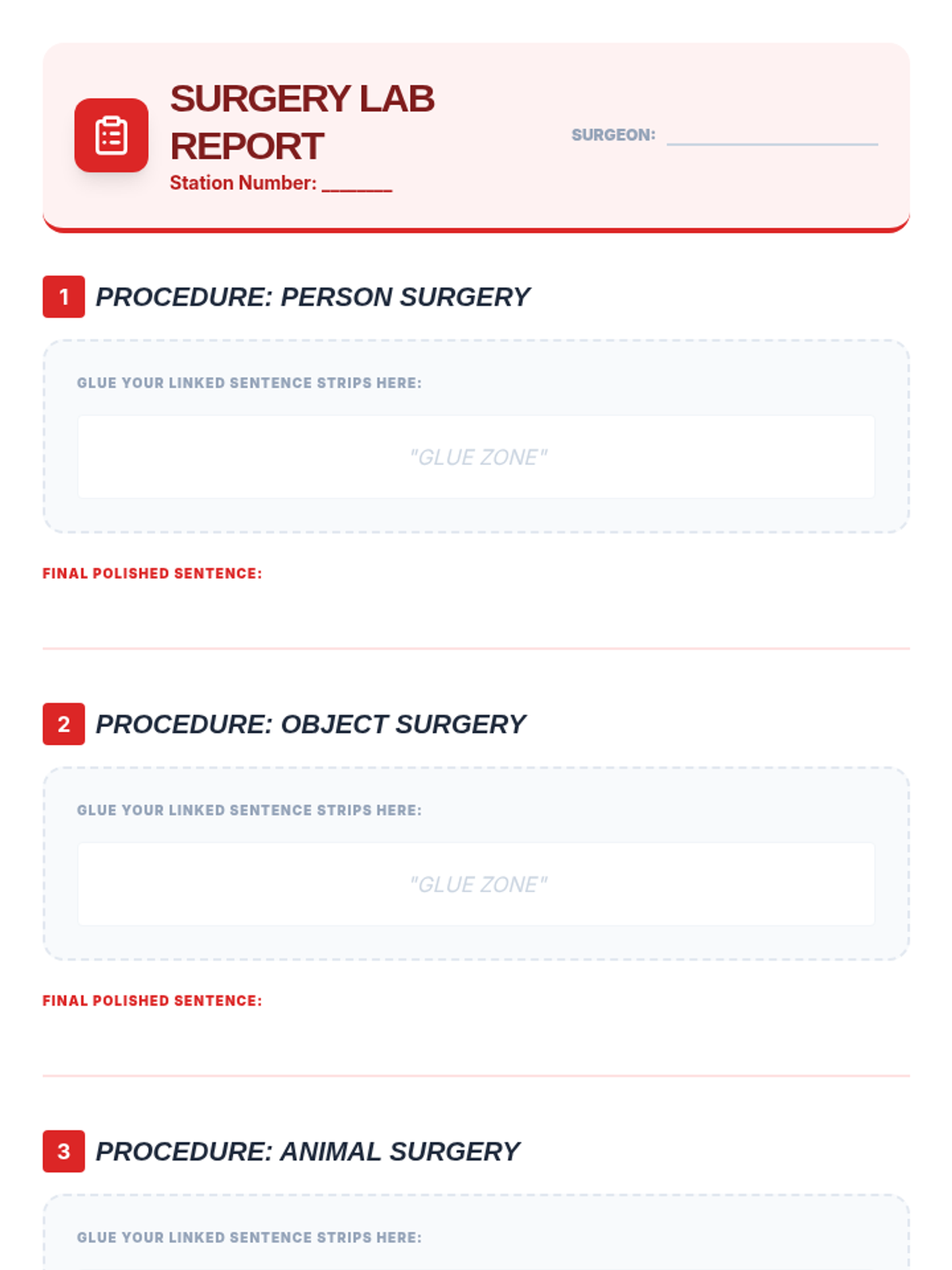
A lab report worksheet for students to record and glue their reconstructed sentences during the Sentence Surgery workshop.
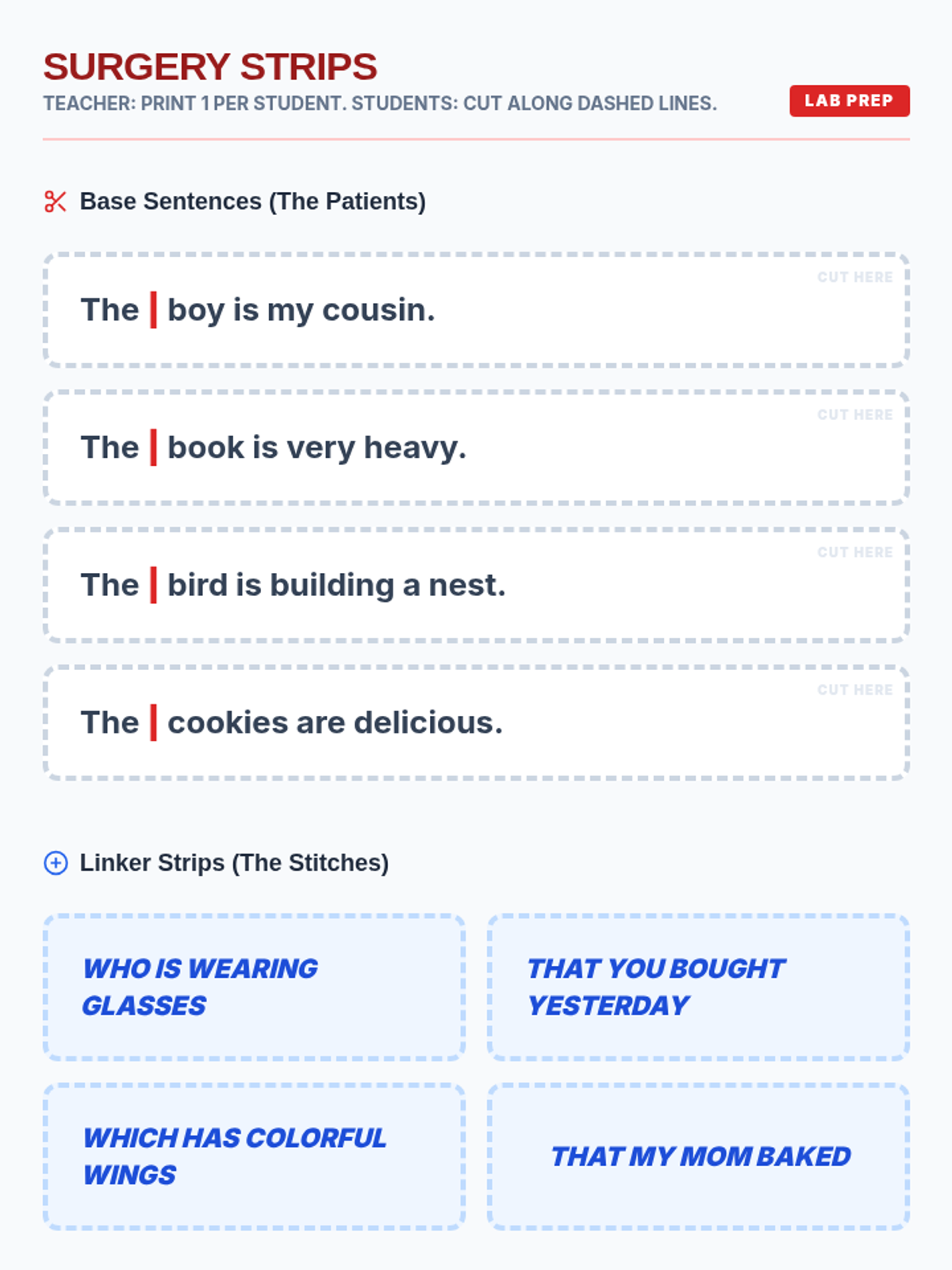
Printable sentence strips for the Sentence Surgery workshop, featuring base sentences and relative clause inserts for physical manipulation.
A slide deck for Lesson 4 introducing the 'Sentence Surgery' concept, showing how to split sentences and insert relative clauses.