Sentence structure fundamentals, subject-verb agreement, and precise usage of parts of speech including pronouns, conjunctions, and adjectives. Targets technical accuracy through mastery of capitalization, punctuation, spelling, and verb mood.
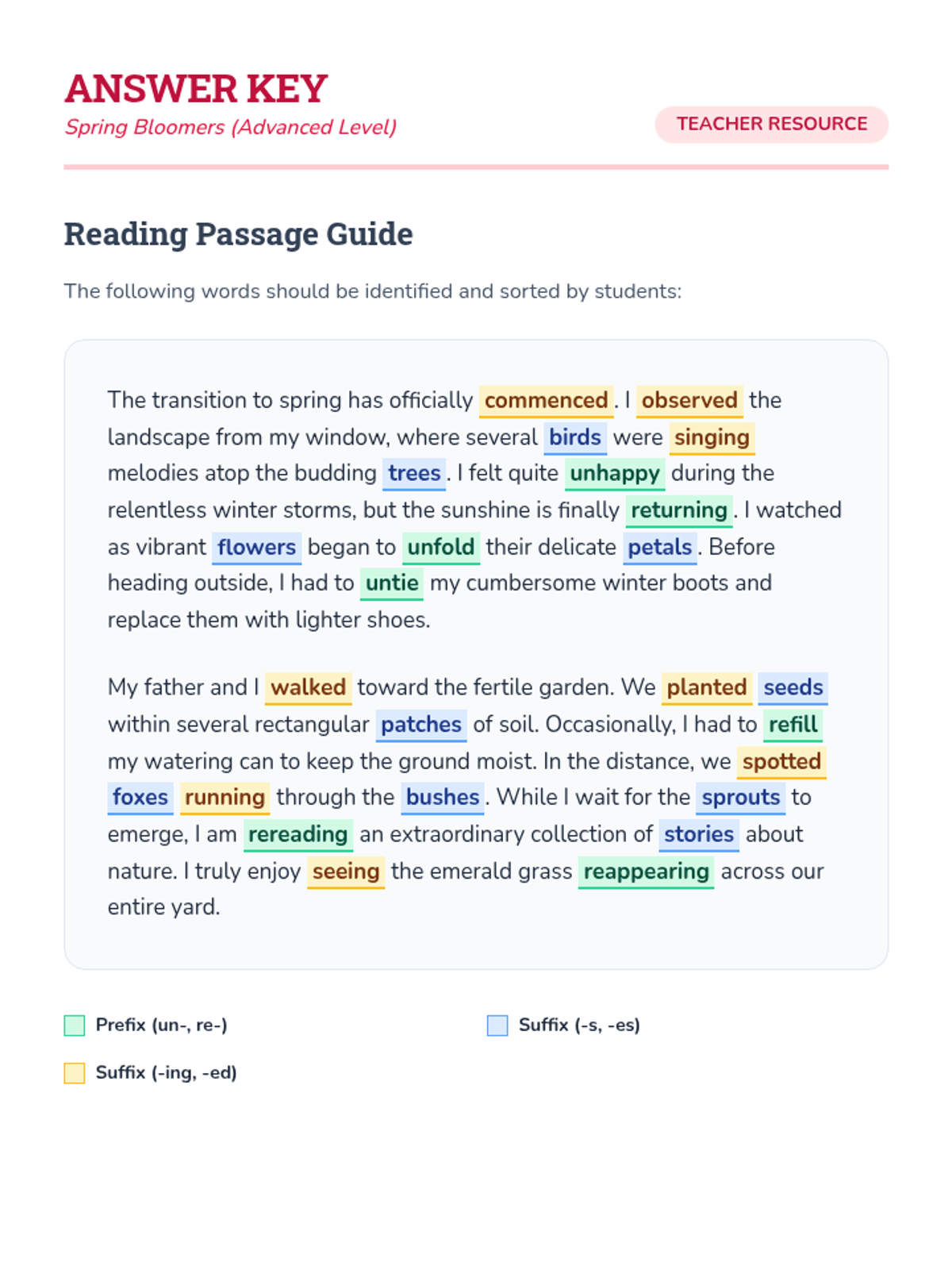
An updated answer key reflecting the more advanced reading passage and multi-syllabic vocabulary words for the sorting activity.
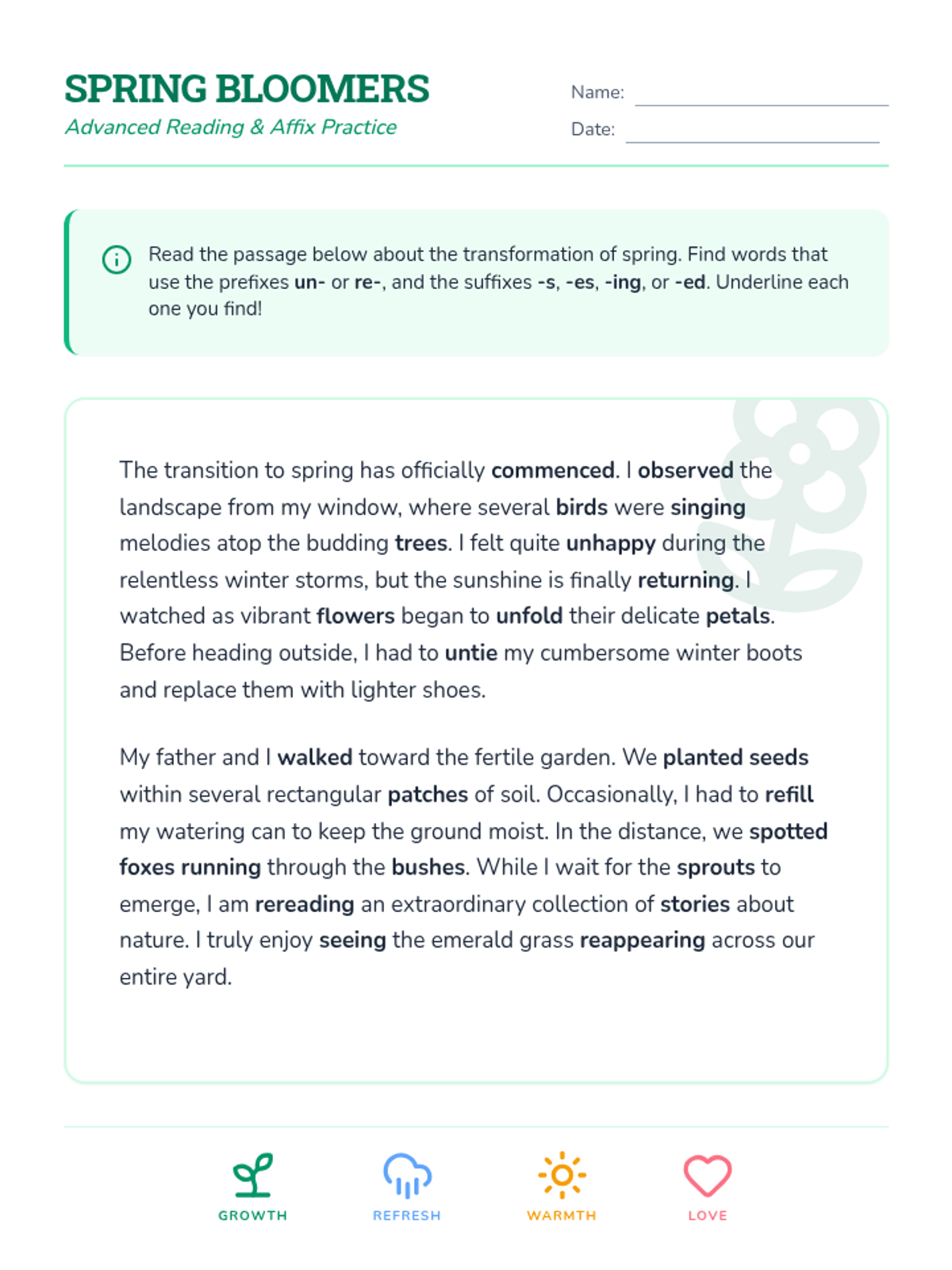
An updated two-page worksheet with a more challenging reading passage using multi-syllabic vocabulary, while still targeting specific spring-themed affixes.
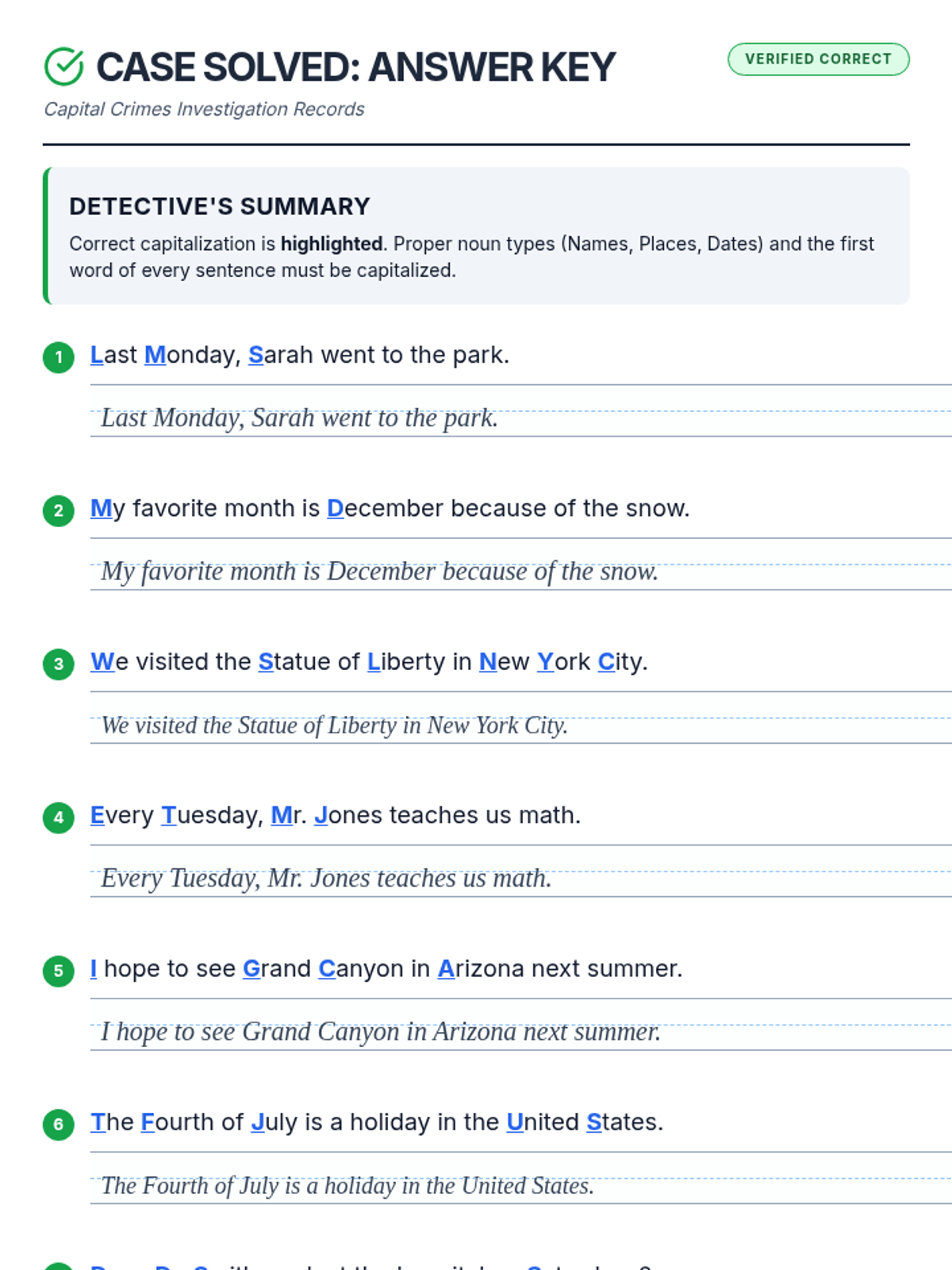
A teacher's answer key for the Capital Crimes Worksheet, highlighting corrected proper nouns and showing the correctly written sentences on primary-style triple lines. Includes updated sentences 6 and 9.
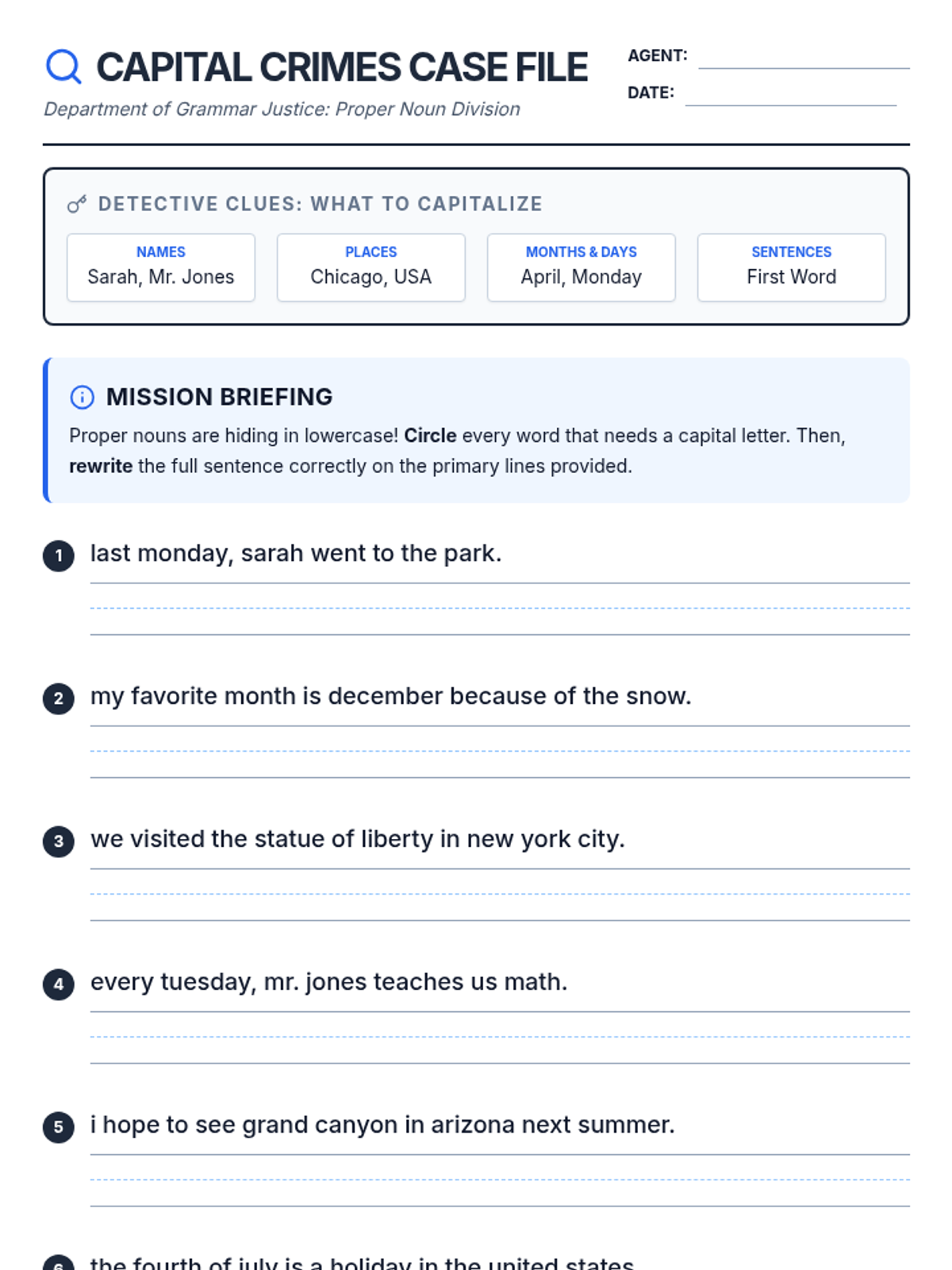
A student worksheet featuring 10 lowercase sentences where students must identify proper nouns needing capitalization and rewrite them on primary-style triple lines with a centered dotted line. Includes a reference key for capitalization rules.
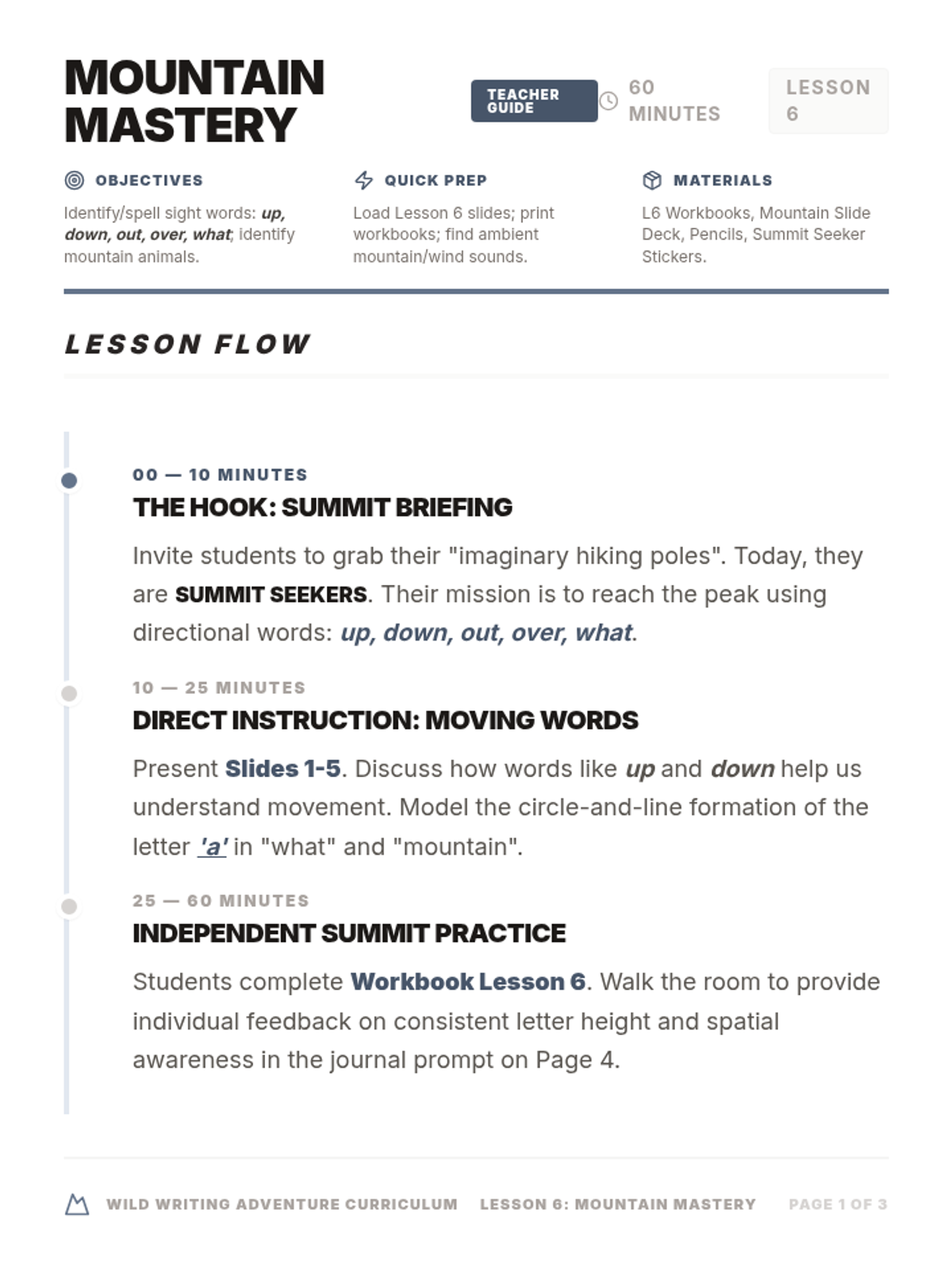
A 3-page teacher's guide for Lesson 6 (Mountain Mastery), featuring a spacious Lesson Flow on Page 1, Toolkit on Page 2, and a refined, standalone Observation Checklist on Page 3. Reformatted to prevent content cutoff.
A vibrant instructional slide deck for Lesson 6 (Mountain Mastery), focusing on directional sight words (up, down, out, over, what) and reading fluency for grades 1-3. Minimum text size 24px.
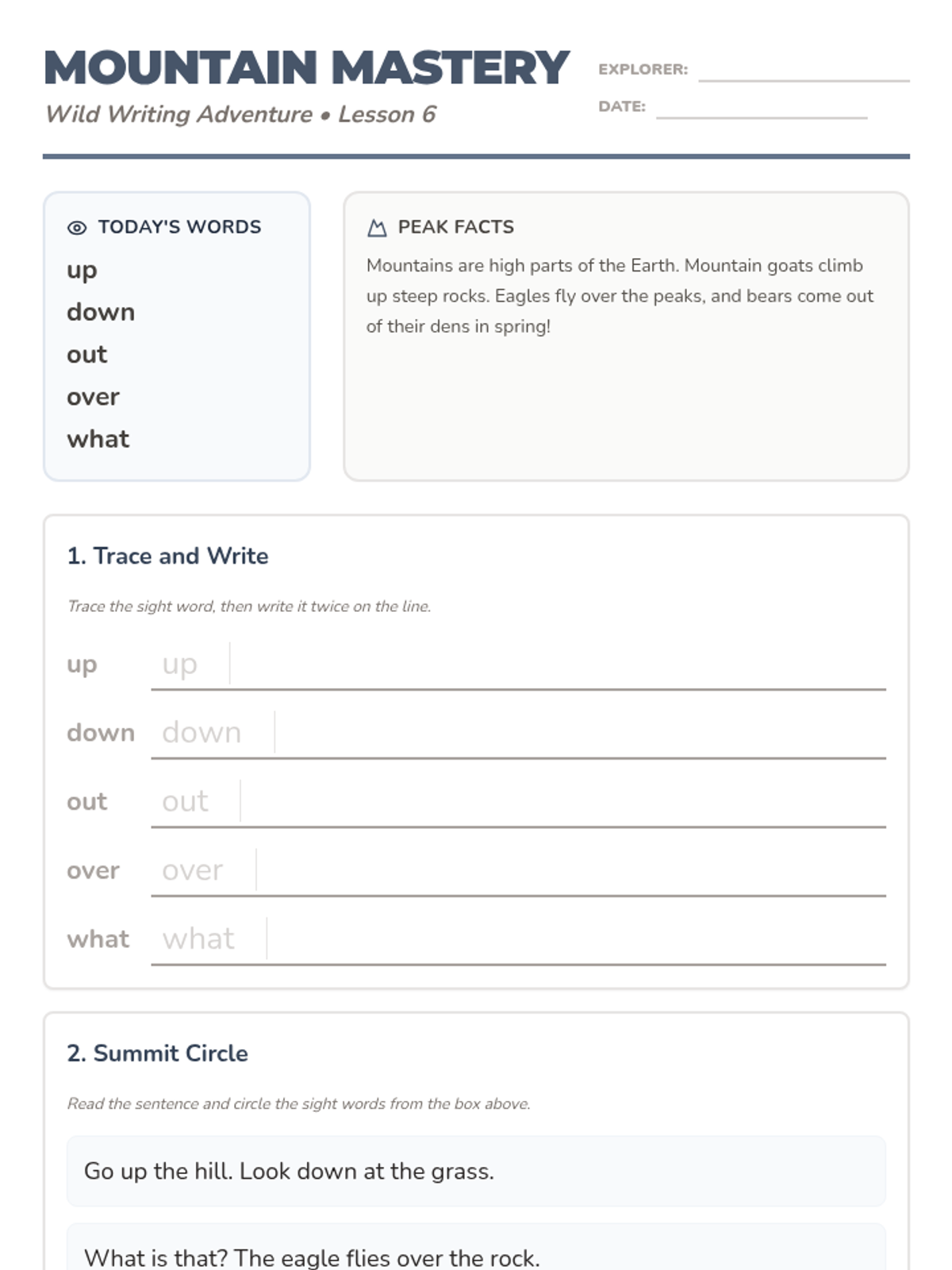
A 4-page student workbook for Lesson 6 (Mountain Mastery), featuring directional sight word practice (up, down, out, over, what), high-visibility writing lines, and high-altitude literacy activities.
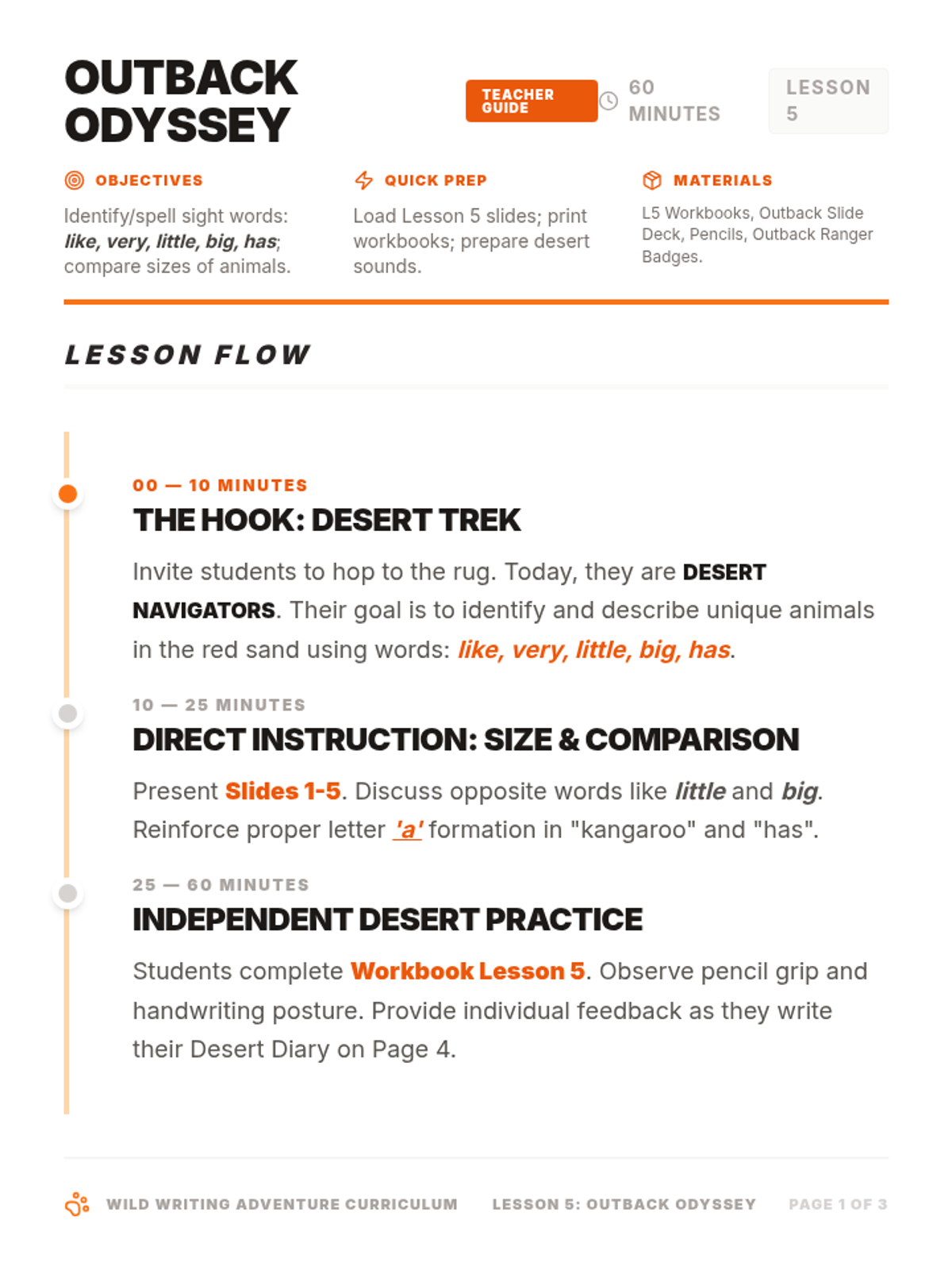
A 3-page teacher's guide for Lesson 5 (Outback Odyssey), featuring a spacious Lesson Flow on Page 1, Toolkit on Page 2, and a refined, standalone Observation Checklist on Page 3. Reformatted to prevent content cutoff.
A vibrant instructional slide deck for Lesson 5 (Outback Odyssey), focusing on Australian-themed sight words (like, very, little, big, has) and reading fluency for grades 1-3. Minimum text size 24px.
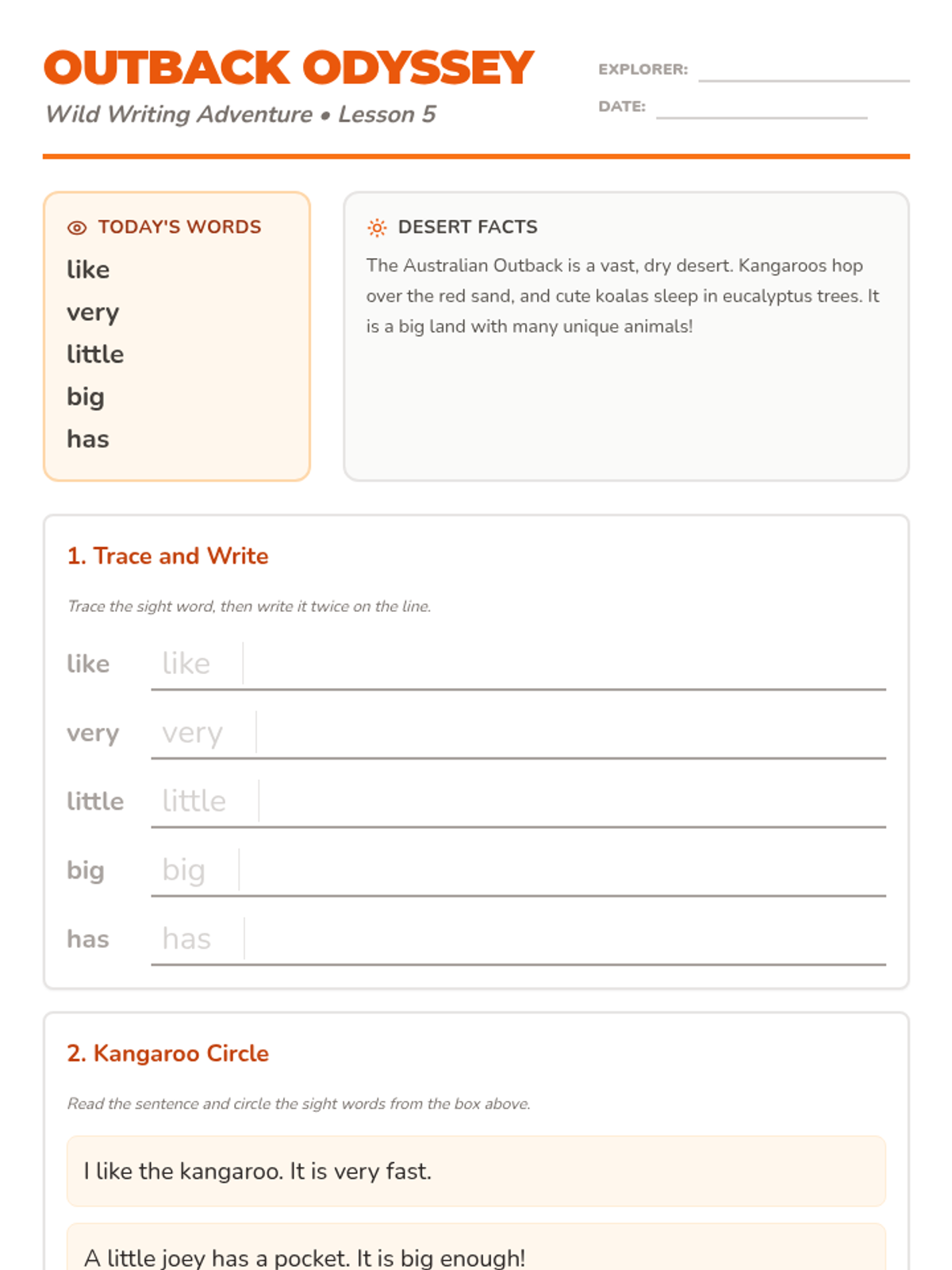
A 4-page student workbook for Lesson 5 (Outback Odyssey), featuring Australian-themed literacy activities, high-visibility writing lines, and child-friendly Nunito font. Designed with strict page formatting.
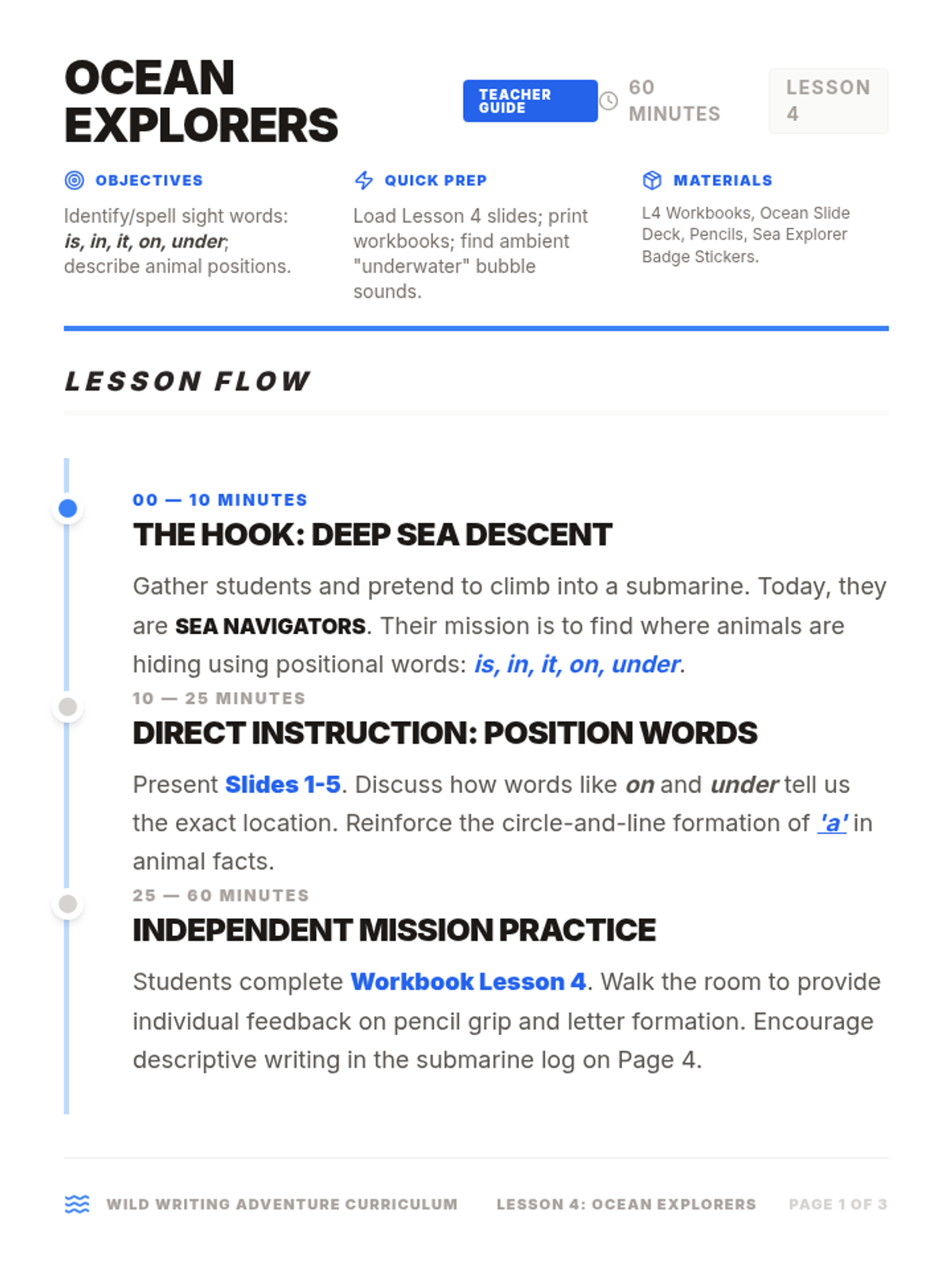
A 3-page teacher's guide for Lesson 4 (Ocean Explorers), featuring a spacious Lesson Flow on Page 1, Toolkit on Page 2, and a refined, standalone Observation Checklist on Page 3. Reformatted to prevent content cutoff.
A vibrant instructional slide deck for Lesson 4 (Ocean Explorers), focusing on positional sight words, marine animals, and reading fluency for grades 1-3. Minimum text size 24px.
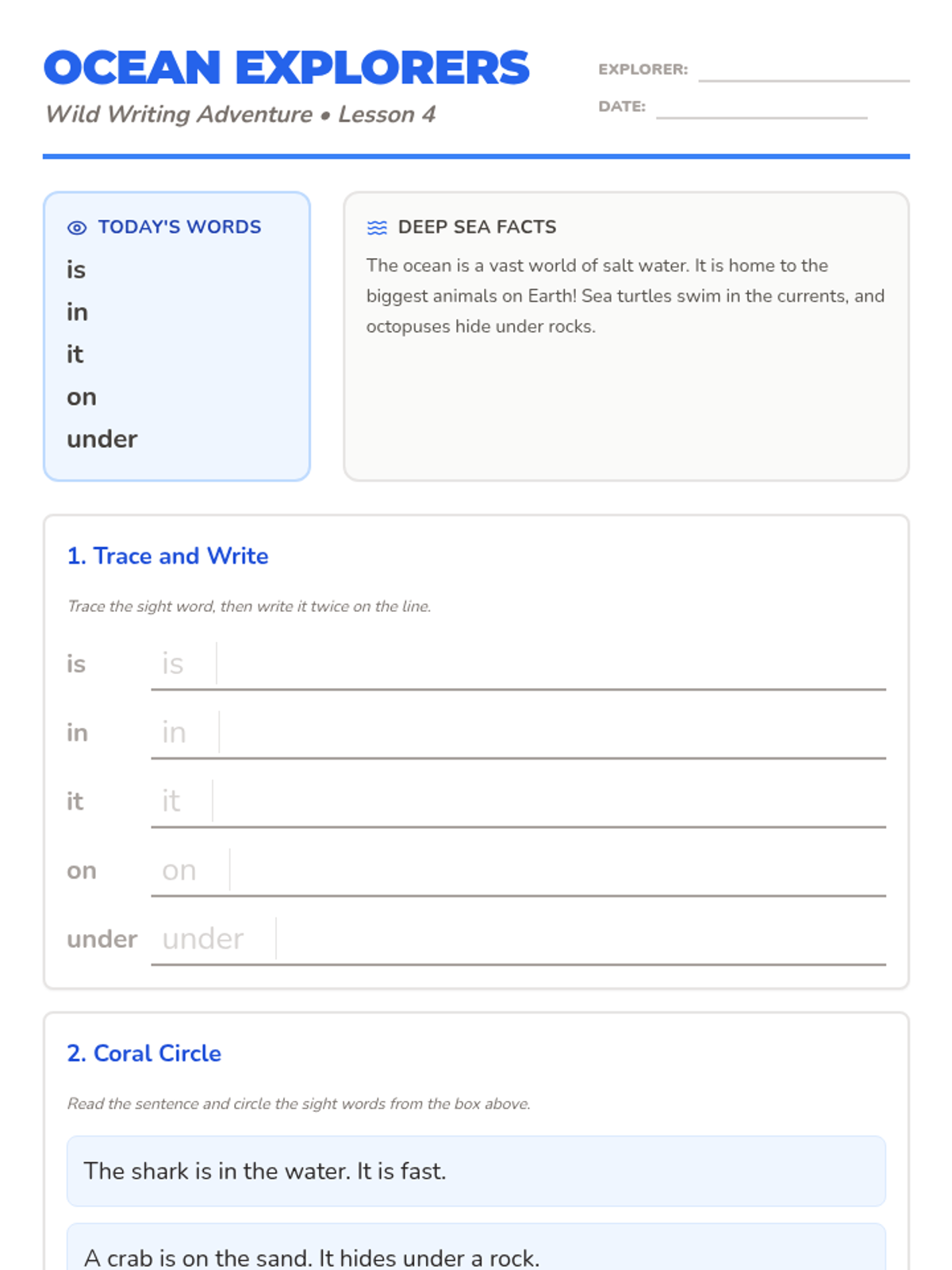
A 4-page student workbook for Lesson 4 (Ocean Explorers), featuring positional sight word practice (is, in, it, on, under), high-visibility writing lines, and aquatic-themed literacy activities.
A vibrant instructional slide deck for Lesson 3 (Rainforest Reading), updated with minimum 24px text size for optimal visibility. Focuses on rainforest animals, sight words, and reading fluency.
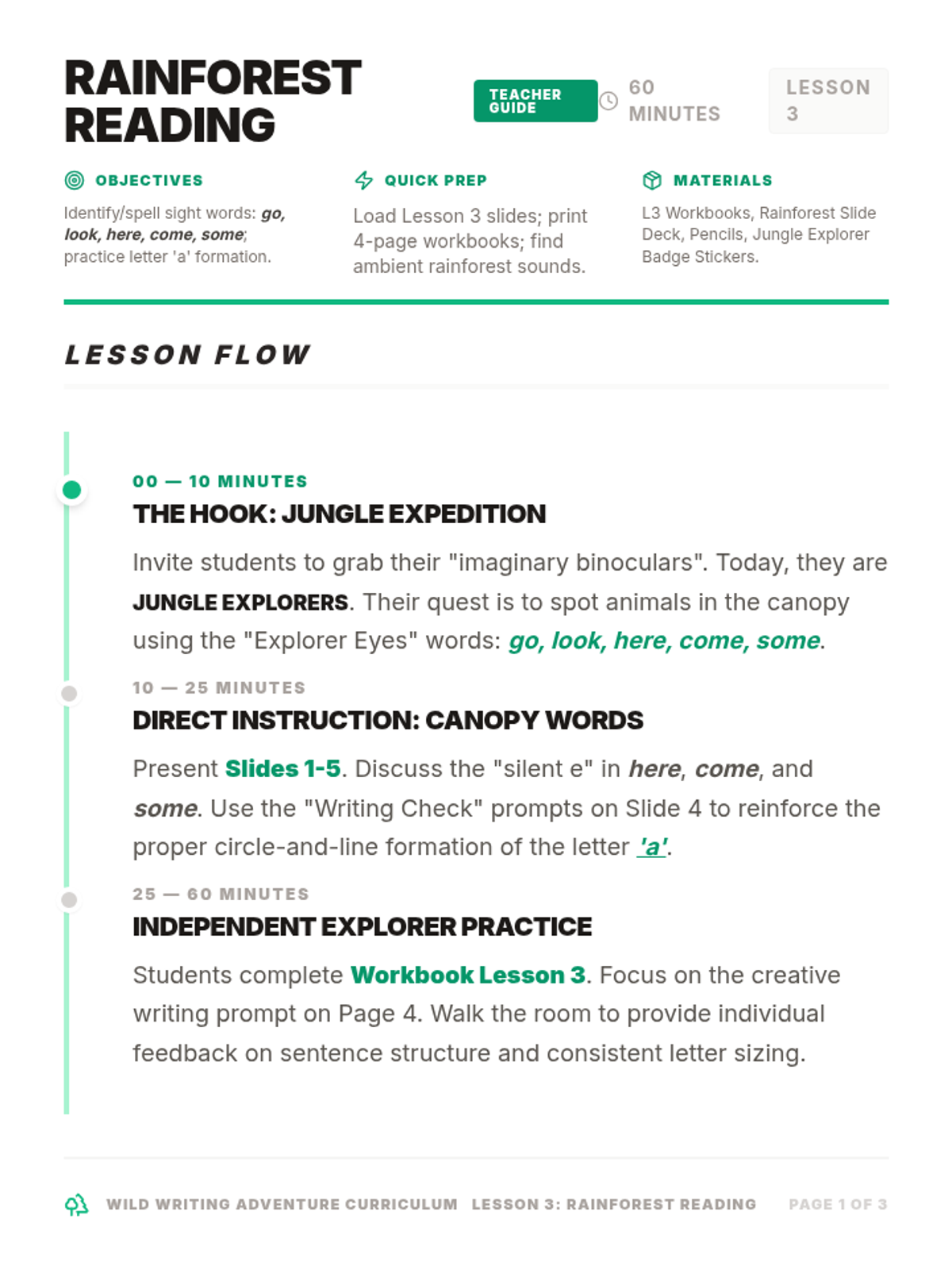
A 3-page teacher's guide for Lesson 3 (Rainforest Reading), featuring a spacious Lesson Flow on Page 1, Toolkit on Page 2, and a refined, standalone Observation Checklist on Page 3. Reformatted to prevent content cutoff.
A vibrant instructional slide deck for Lesson 3 (Rainforest Reading), focusing on rainforest animals, sight words (go, look, here, come, some), and reading fluency for grades 1-3. Minimum text size 24px.
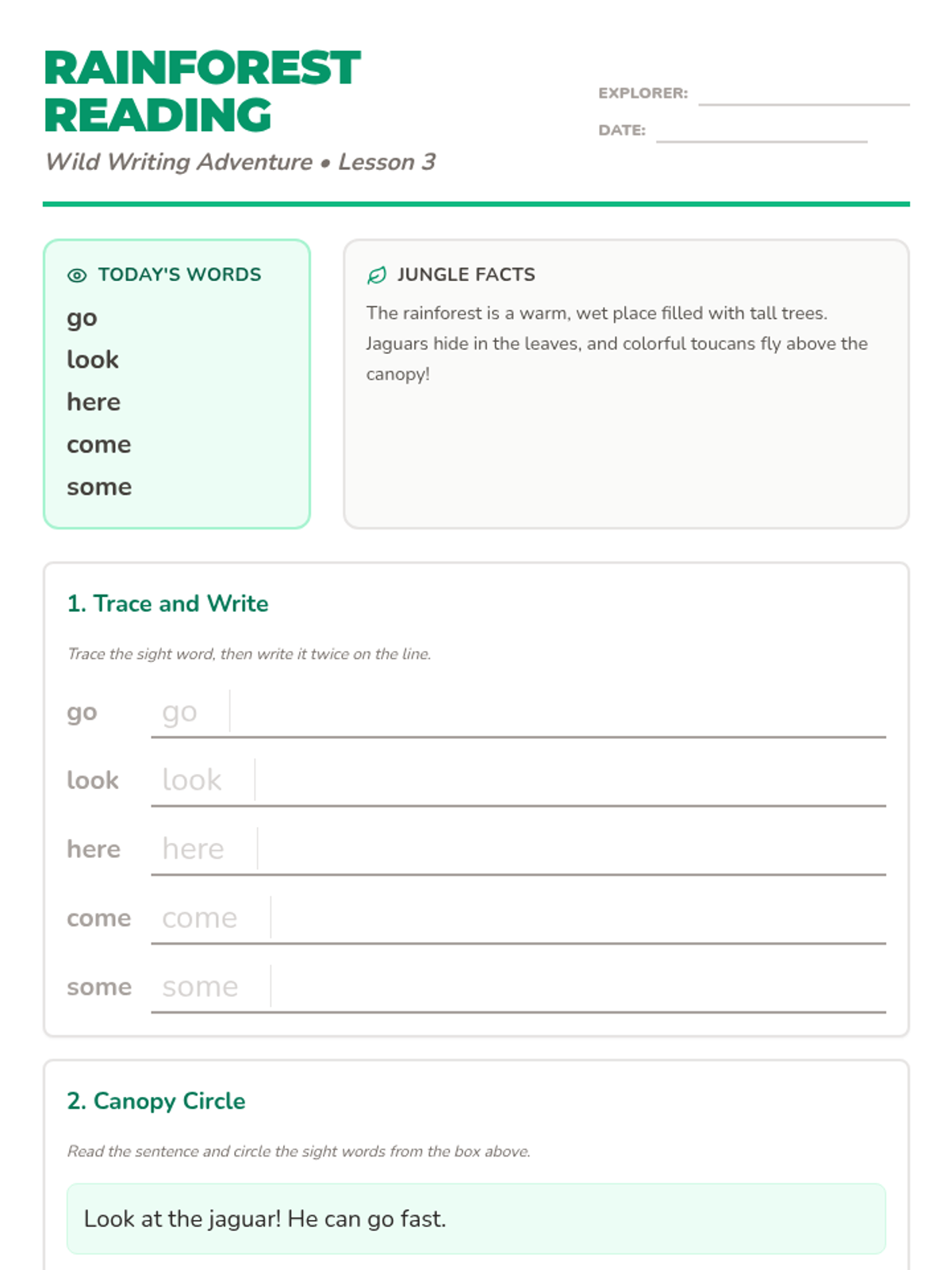
A 4-page student workbook for Lesson 3 (Rainforest Reading), featuring emerald-themed literacy activities, visible writing lines, and a child-friendly Nunito font. Includes sight word practice for: go, look, here, come, some.
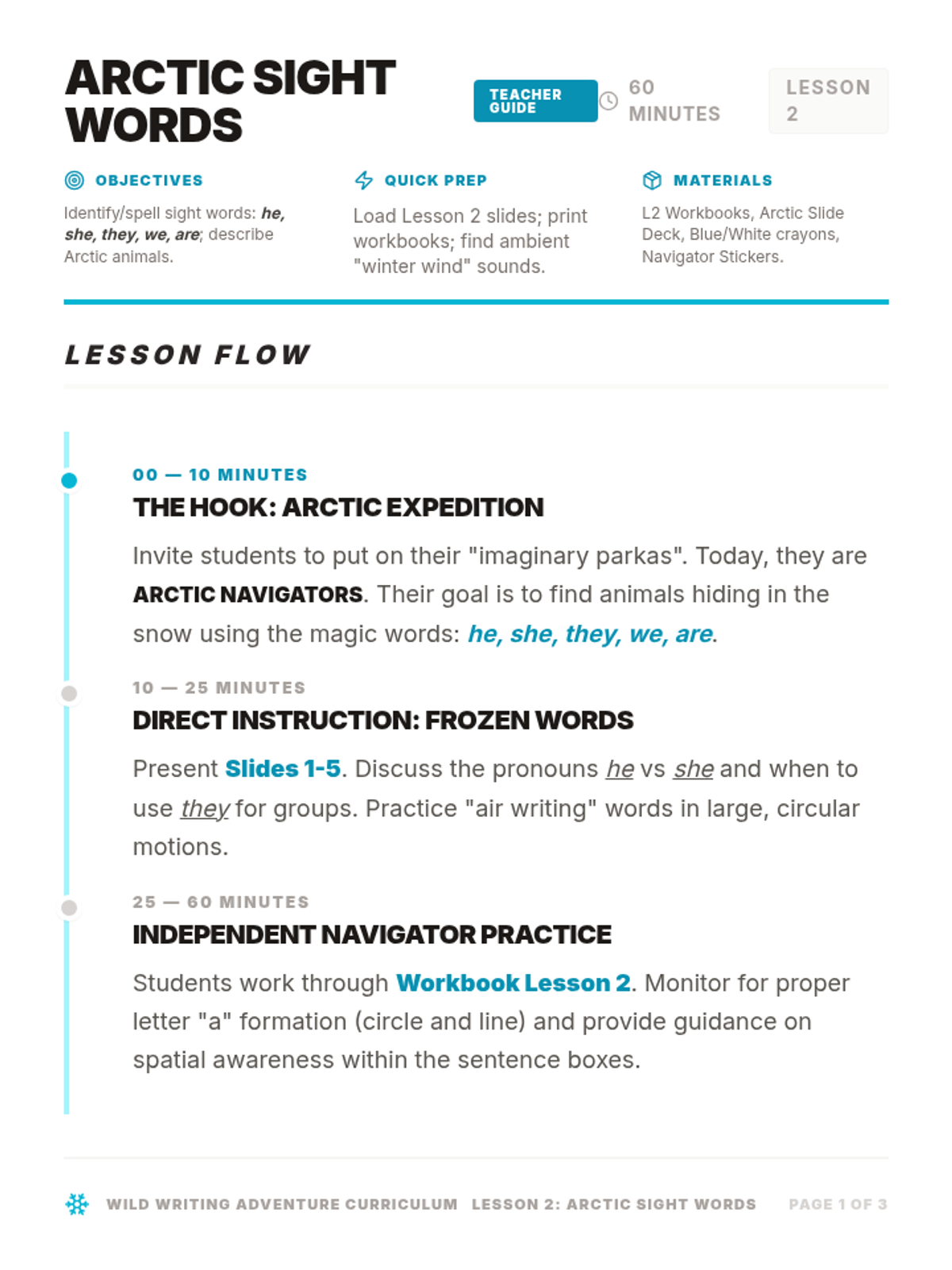
A 3-page teacher's guide for Lesson 2 (Arctic Sight Words), featuring a spacious Lesson Flow on Page 1, Toolkit on Page 2, and a refined, standalone Observation Checklist on Page 3. Reformatted to prevent content cutoff.
A vibrant instructional slide deck for Lesson 2 (Arctic Sight Words), focusing on animal facts, word recognition (he, she, they, we, are), and fluency drills for grades 1-3. Minimum text size 24px.
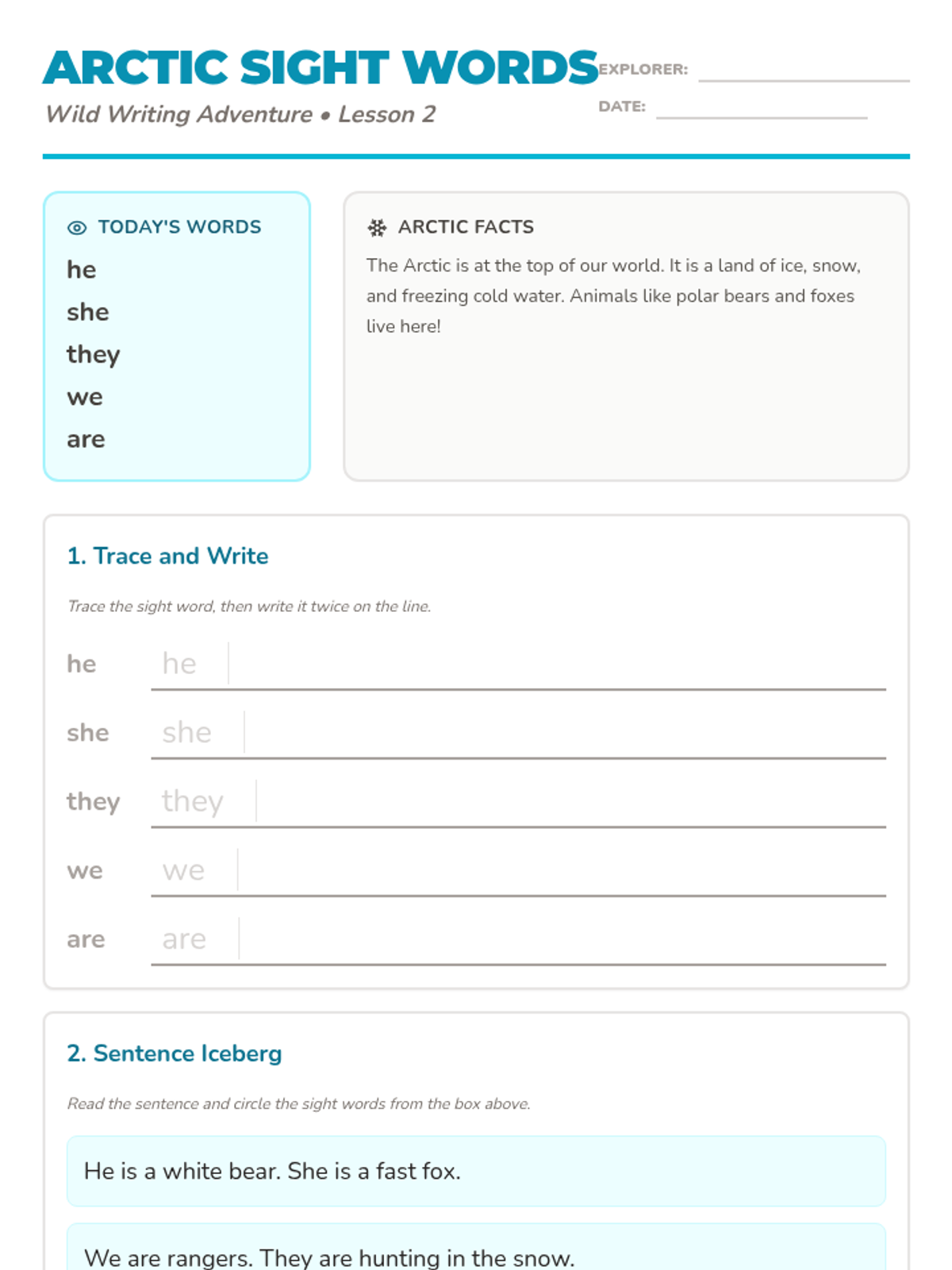
A 4-page student workbook for Lesson 2 (Arctic Sight Words), featuring high-visibility writing lines, child-friendly Nunito font, and Arctic-themed literacy activities. Designed with strict page formatting and solid lines for fill-in-the-blanks.
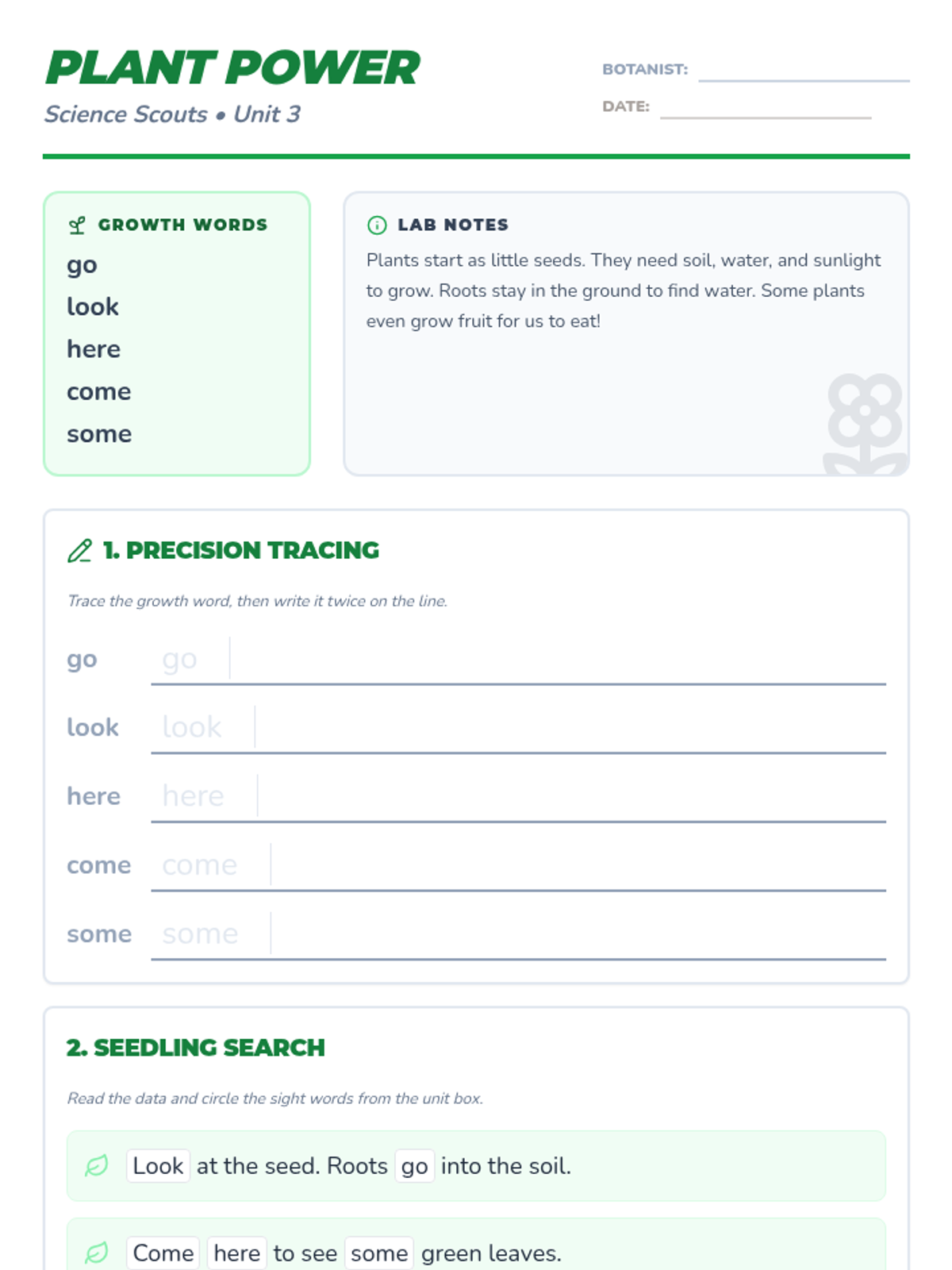
A 4-page student lab notebook for Lesson 3 (Plant Power), focusing on botanical growth and sight word practice (go, look, here, come, some). Features child-friendly Nunito font, green-themed writing areas, and high-visibility solid lines.
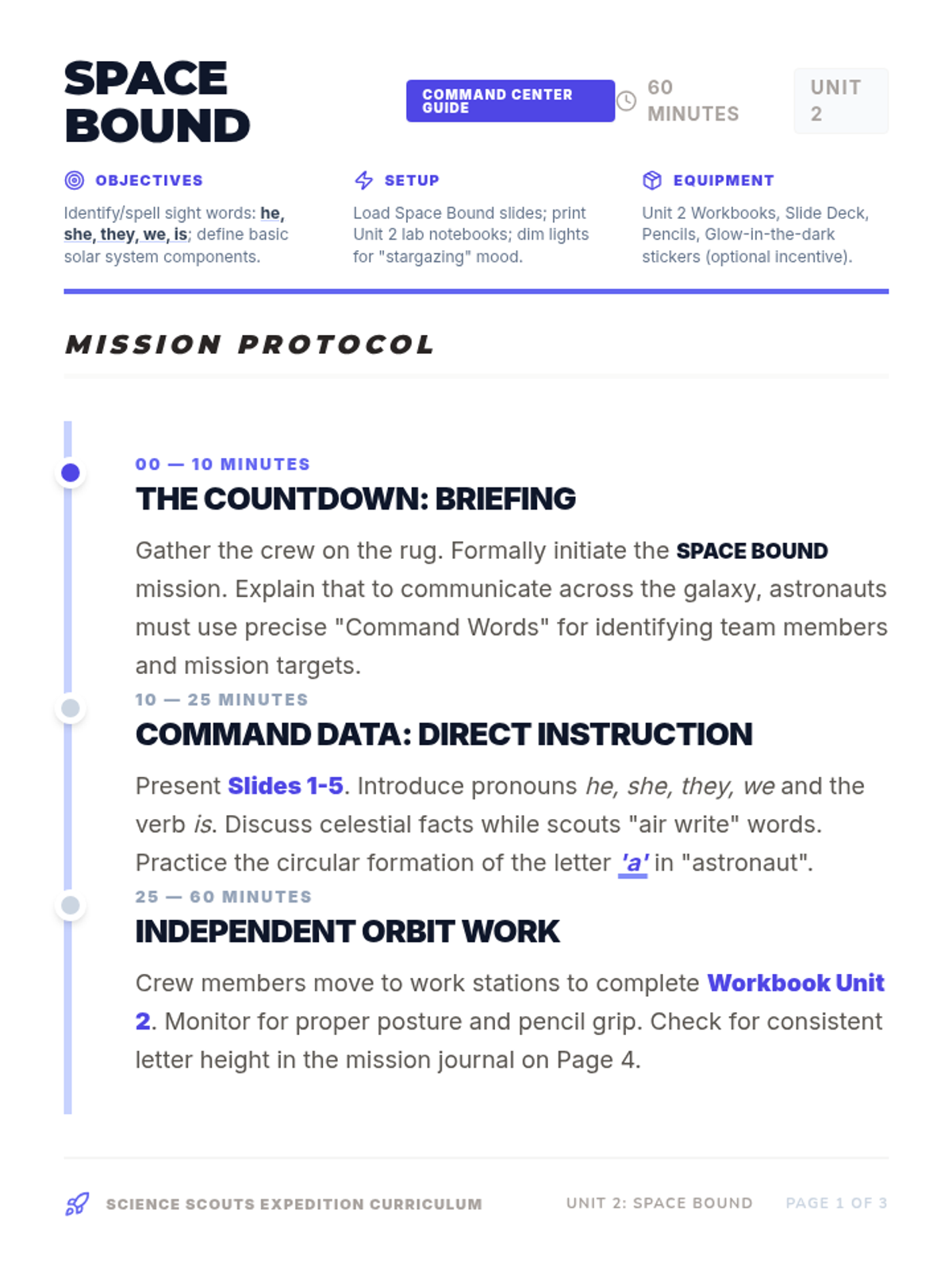
A high-definition, 3-page teacher's guide for Unit 2 (Space Bound), featuring a spacious Lesson Flow on Page 1 and a refined, standalone Observation Checklist on Page 3. The table features visible but non-intrusive borders and adjusted column widths to ensure no text is cut off.
A vibrant instructional slide deck for Lesson 2 (Space Bound), focusing on planets, astronauts, and sight word recognition (he, she, they, we, is). Minimum text size 24px.
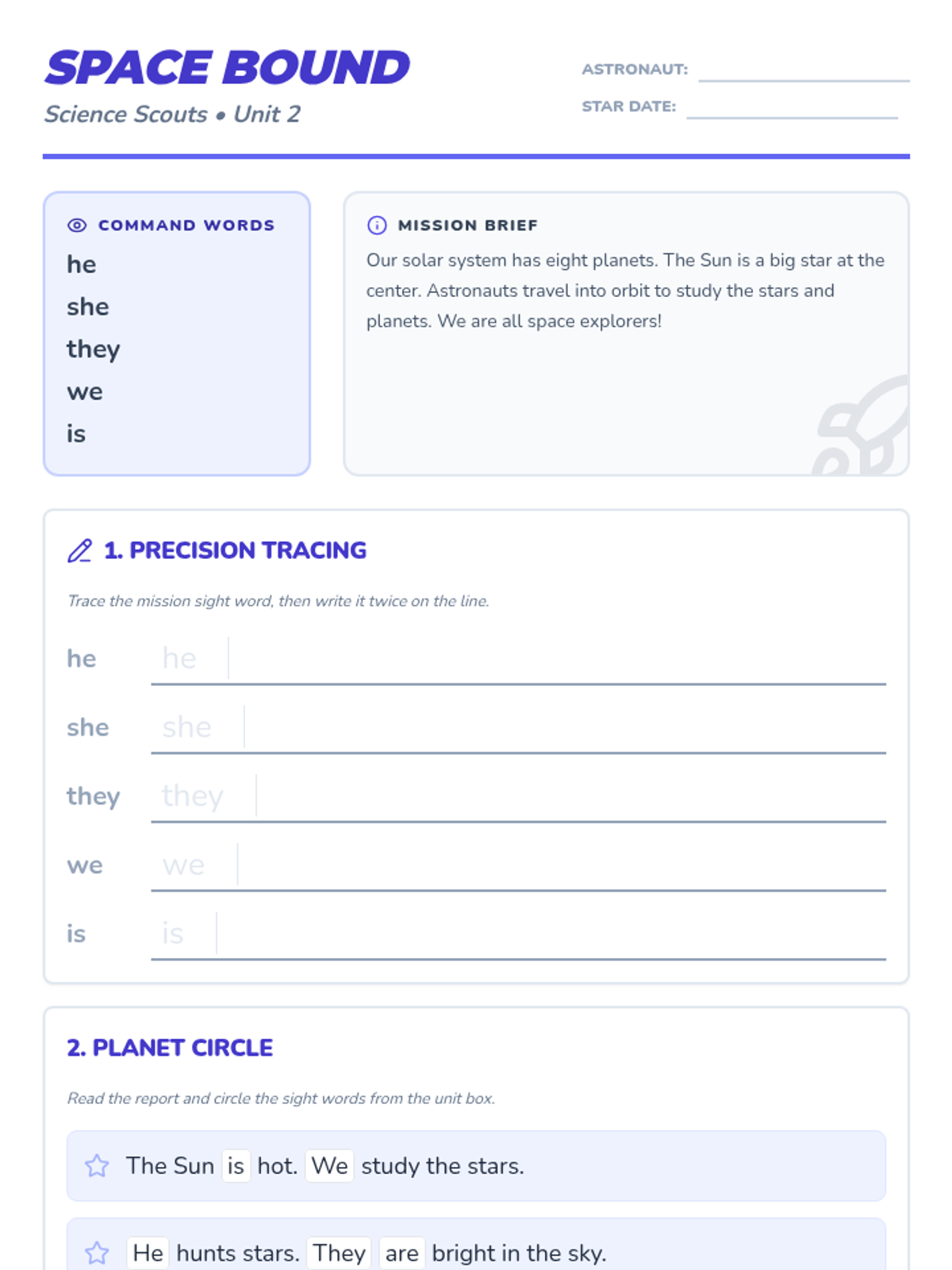
A 4-page student lab notebook for Lesson 2 (Space Bound), focusing on planets and stars. Features child-friendly Nunito font, blueprint-inspired writing areas, and high-visibility solid lines for handwriting practice.
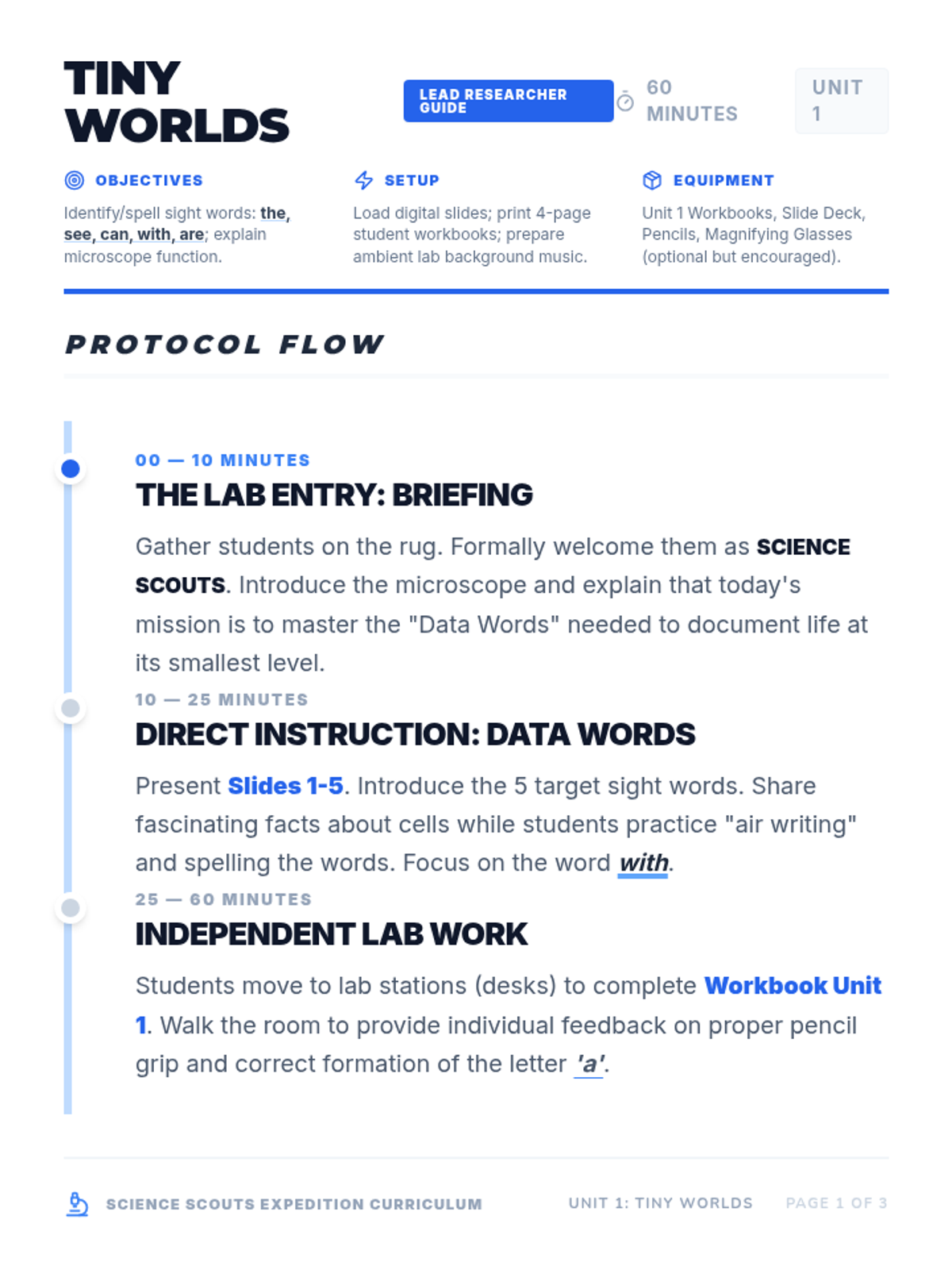
A high-definition, 3-page teacher's guide with a spacious Lesson Flow on Page 1 and a refined, standalone Observation Checklist on Page 3. The table features visible but non-intrusive borders and adjusted column widths to ensure no text is cut off.
A vibrant instructional slide deck for Lesson 1 (Tiny Worlds), focusing on microscope discovery, cell biology facts, and sight word recognition (the, see, can, with, are). Minimum text size 24px.
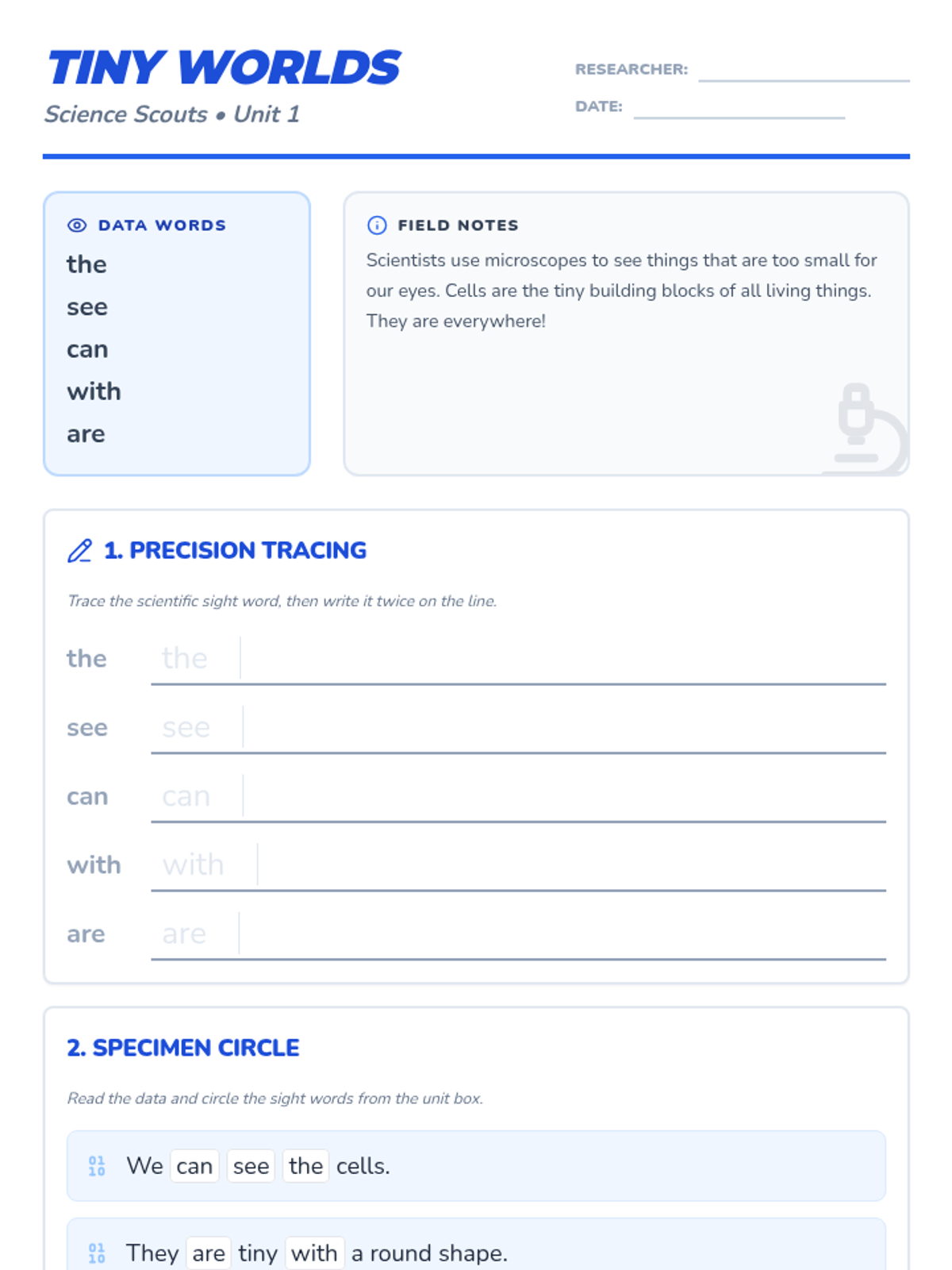
A 4-page student lab notebook for Lesson 1 (Tiny Worlds), focusing on cell biology and microscope terminology. Features child-friendly Nunito font, blueprint-inspired writing areas, and high-visibility solid lines for handwriting practice.
A visually striking 3-page overview for the Science Scouts Expedition curriculum. Features a laboratory-themed cover, a teacher implementation guide, and a complete 10-unit roadmap with target sight words for grades 1-3.
A visually striking curriculum cover page and a comprehensive teacher explanation page for the 10-lesson Wild Writing Adventure sequence. Includes curriculum philosophy, key feature highlights, and a full lesson roadmap with target sight words.
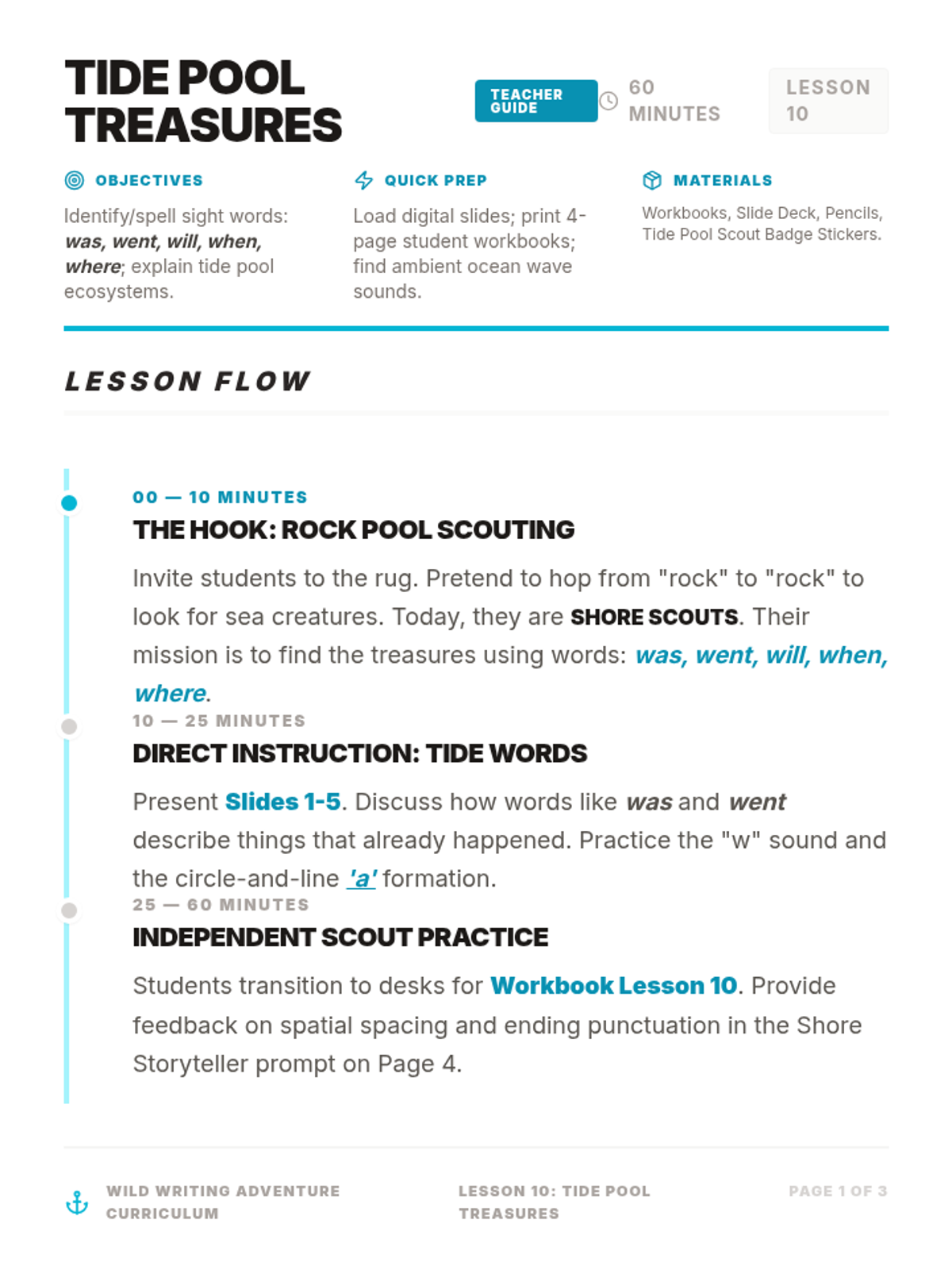
A 3-page teacher's guide for Lesson 10 (Tide Pool Treasures), featuring a spacious Lesson Flow on Page 1, Toolkit on Page 2, and a refined, standalone Observation Checklist on Page 3. Reformatted to prevent content cutoff.
A vibrant instructional slide deck for Lesson 10 (Tide Pool Treasures), focusing on sight words (was, went, will, when, where) and reading fluency for grades 1-3. Minimum text size 24px.
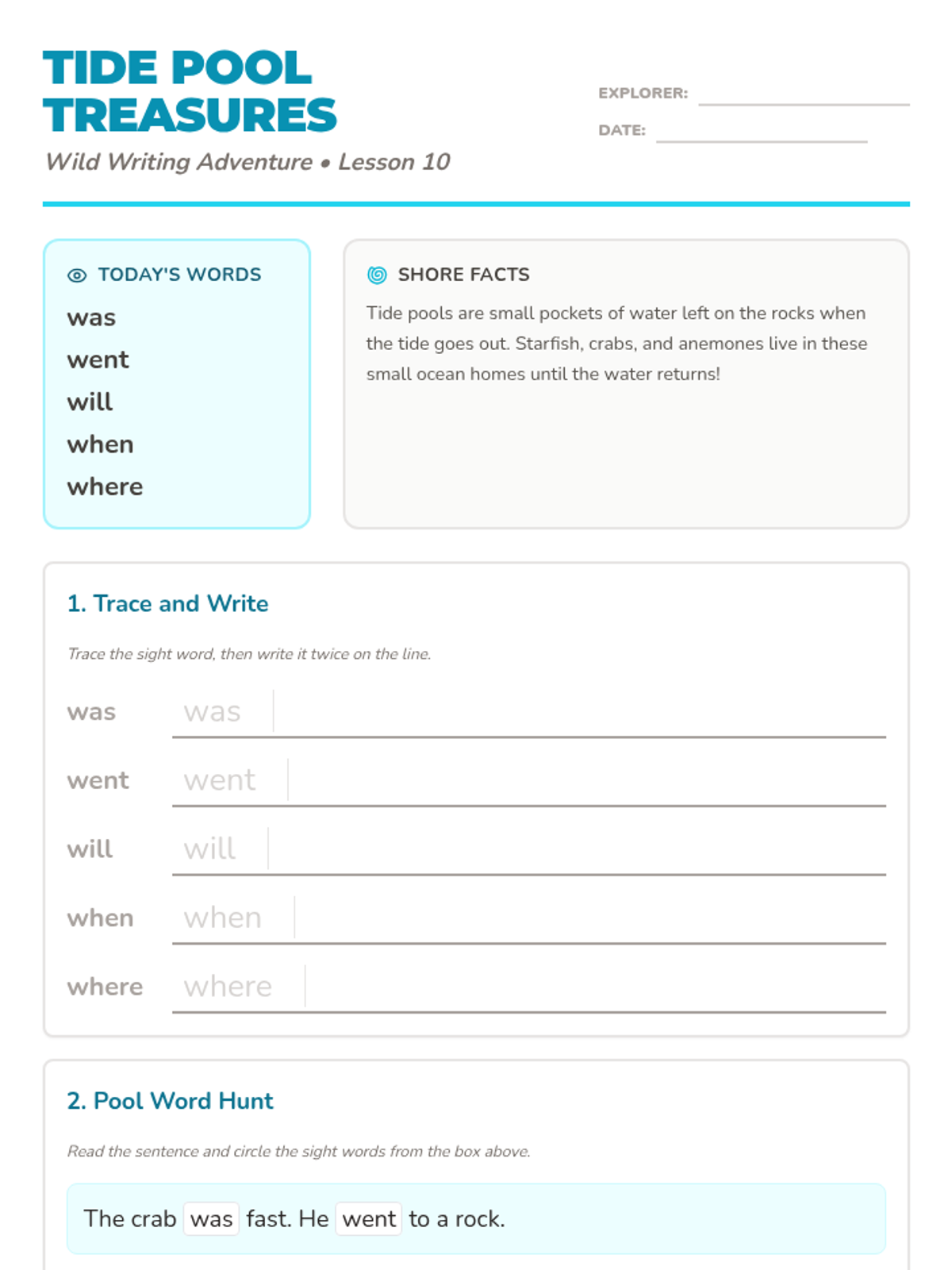
A 4-page student workbook for Lesson 10 (Tide Pool Treasures), featuring shore-themed literacy activities, high-visibility writing lines, and child-friendly Nunito font. Designed with strict page formatting and solid lines for fill-in-the-blanks.
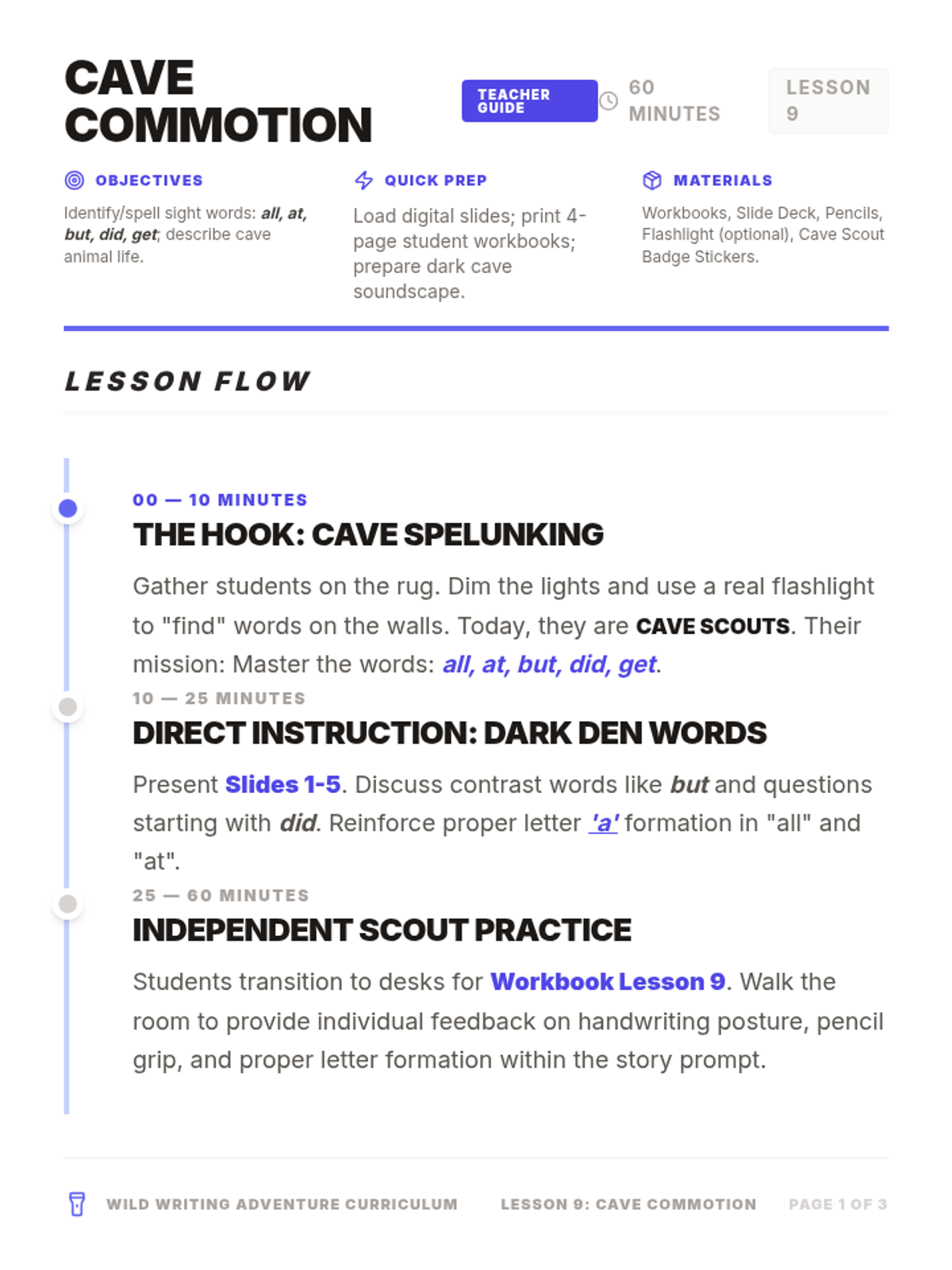
A 3-page teacher's guide for Lesson 9 (Cave Commotion), featuring a spacious Lesson Flow on Page 1, Toolkit on Page 2, and a refined, standalone Observation Checklist on Page 3. Reformatted to prevent content cutoff.
A vibrant instructional slide deck for Lesson 9 (Cave Commotion), focusing on sight words (all, at, but, did, get) and reading fluency for grades 1-3. Minimum text size 24px.
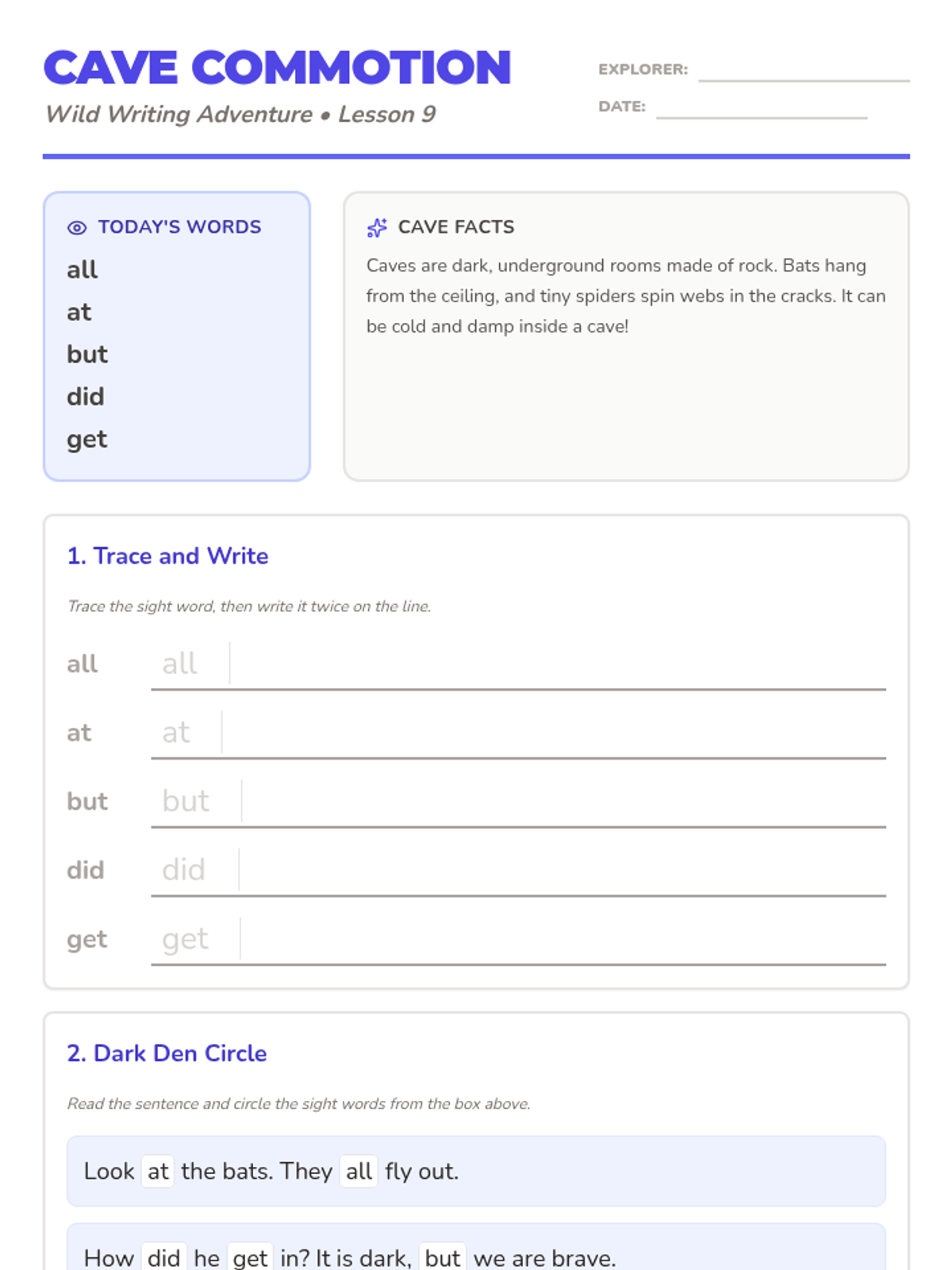
A 4-page student workbook for Lesson 9 (Cave Commotion), featuring mysterious cave-themed activities, child-friendly Nunito font, and high-visibility writing lines. Sight words: all, at, but, did, get.
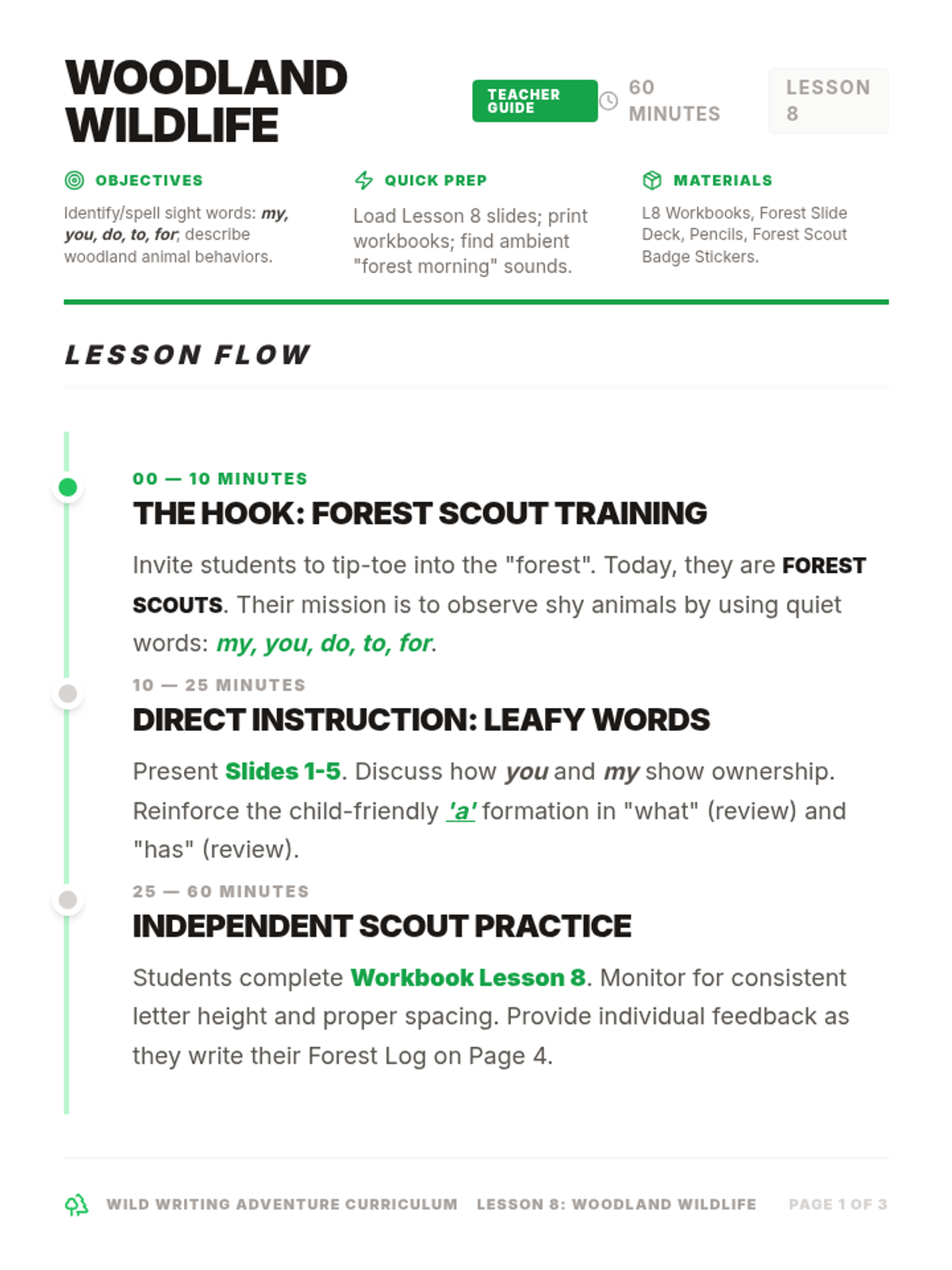
A 3-page teacher's guide for Lesson 8 (Woodland Wildlife), featuring a spacious Lesson Flow on Page 1, Toolkit on Page 2, and a refined, standalone Observation Checklist on Page 3. Reformatted to prevent content cutoff.
A vibrant instructional slide deck for Lesson 8 (Woodland Wildlife), focusing on essential sight words (my, you, do, to, for) and reading fluency for grades 1-3. Minimum text size 24px.
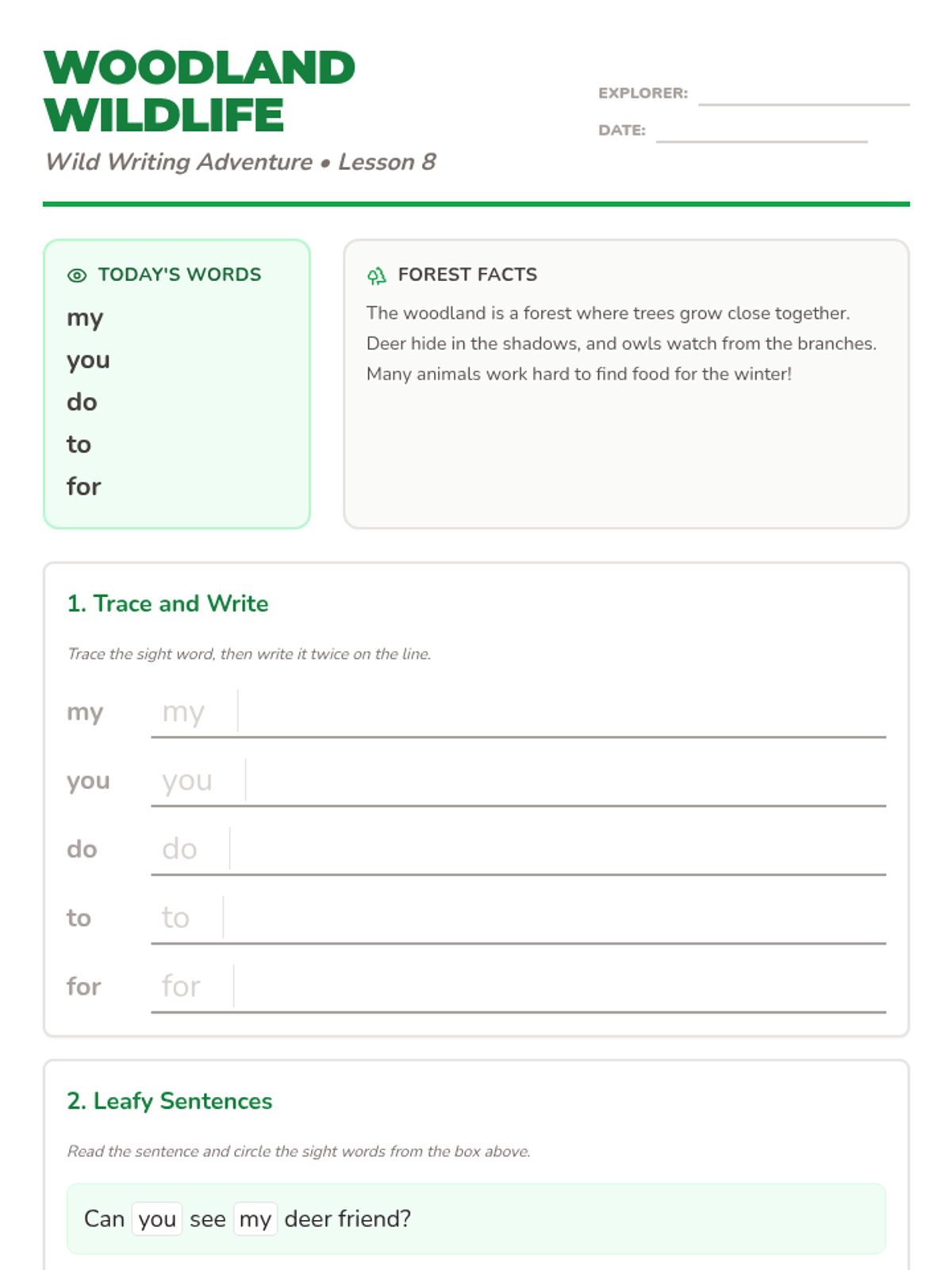
A 4-page student workbook for Lesson 8 (Woodland Wildlife), featuring forest-themed literacy activities, high-visibility writing lines, and child-friendly Nunito font. Designed with strict page formatting and solid lines for fill-in-the-blanks.
A vibrant instructional slide deck for Lesson 7 (Wetland Wonderland), updated with correct theme colors and content (scaly skin for alligators). Focuses on sight words (play, your, said, help, friend) and reading fluency for grades 1-3.
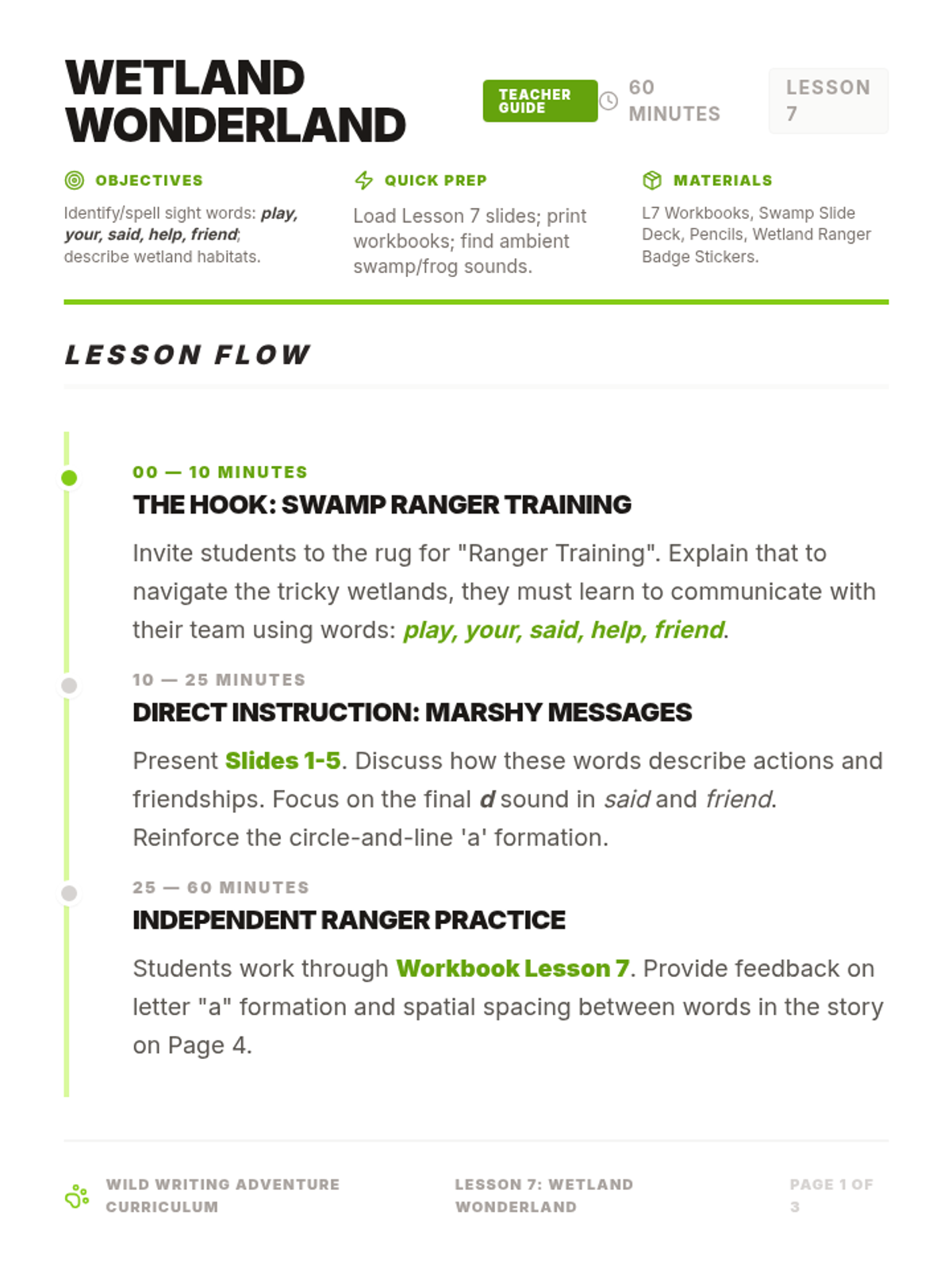
A 3-page teacher's guide for Lesson 7 (Wetland Wonderland), featuring a spacious Lesson Flow on Page 1, Toolkit on Page 2, and a refined, standalone Observation Checklist on Page 3. Reformatted to prevent content cutoff.
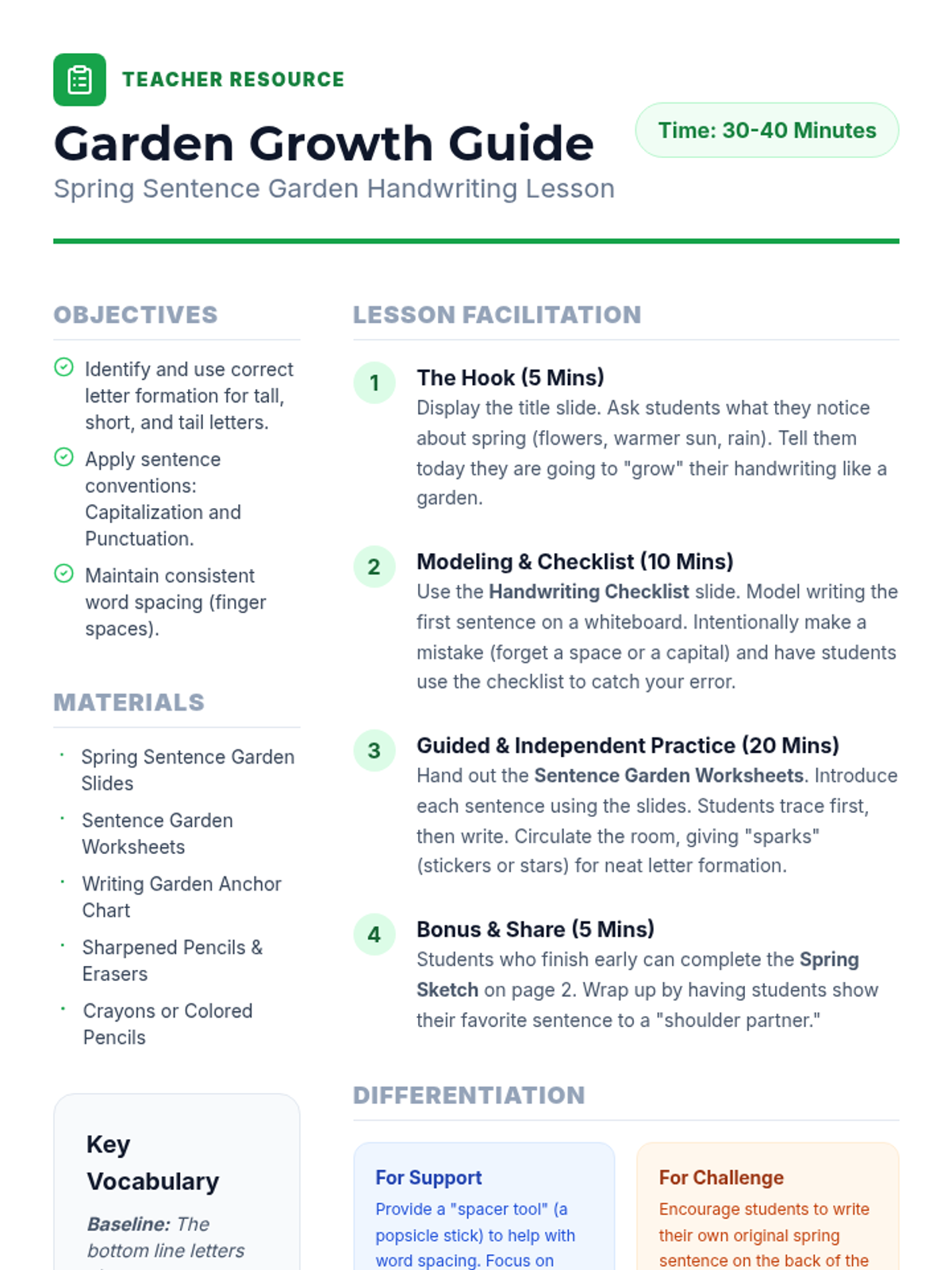
A comprehensive teacher's guide for the Spring Sentence Garden lesson, including objectives, materials, a step-by-step facilitation plan, and differentiation strategies.
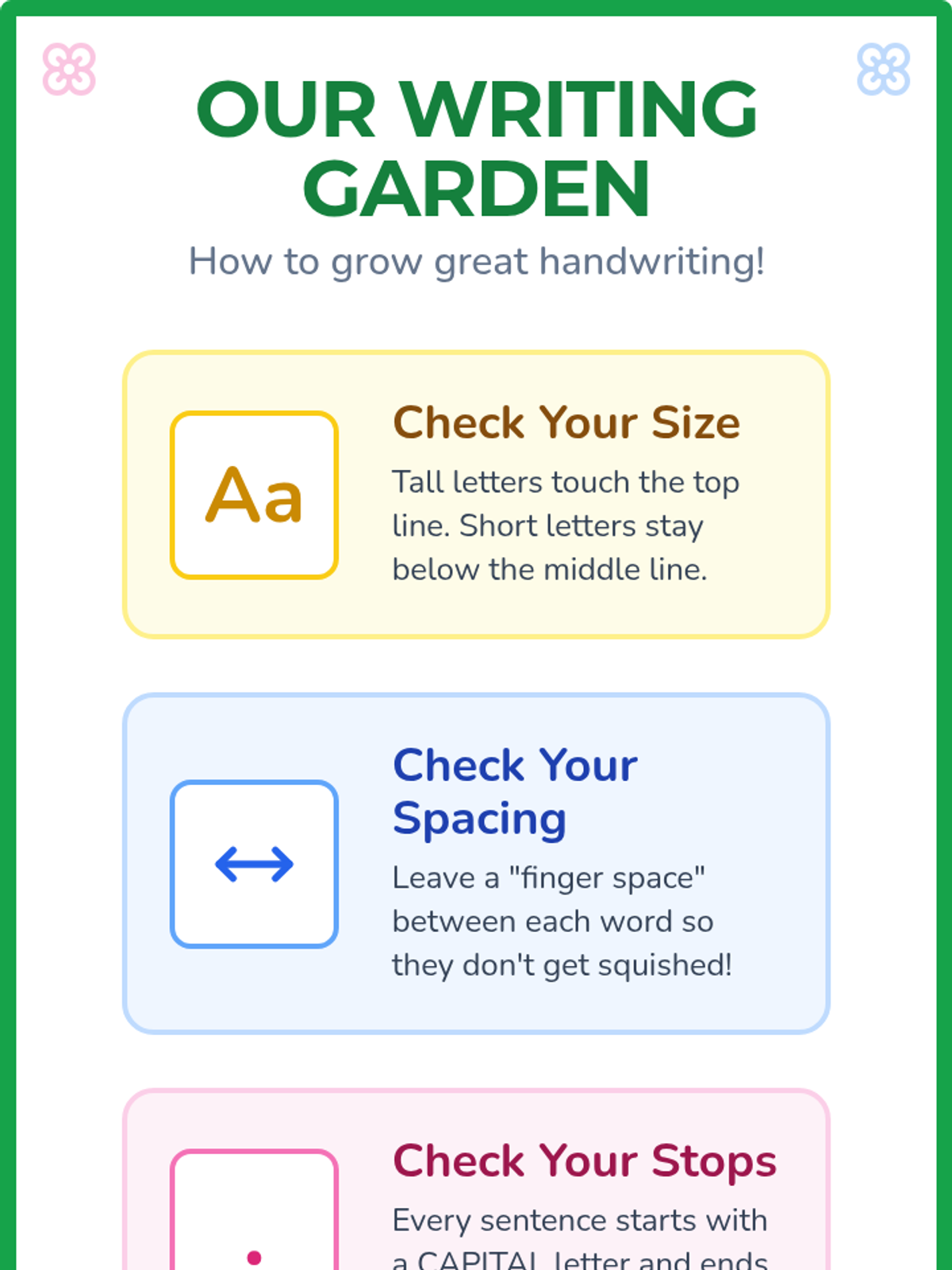
A colorful classroom anchor chart providing visual reminders for handwriting success, including letter size, word spacing, punctuation, and line placement.
A 10-slide presentation to introduce the Spring Sentence Garden handwriting lesson, featuring a checklist for neat writing and visual introductions for each seasonal sentence.
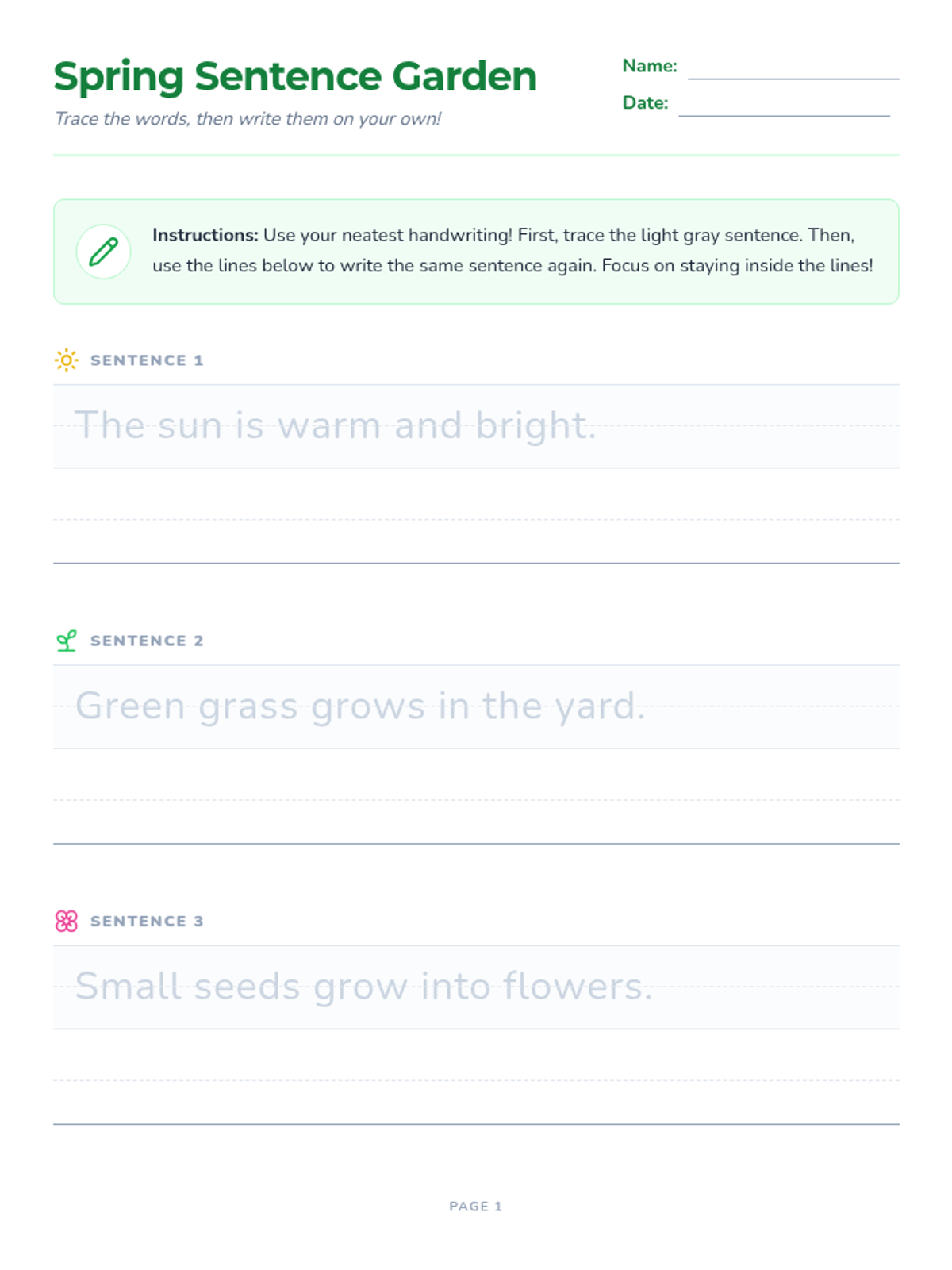
A spring-themed handwriting practice worksheet for 1st and 2nd graders, featuring five seasonal sentences with tracing and independent practice lines, plus a bonus drawing activity. Updated with lightened tracing text and refined spacing across two pages.
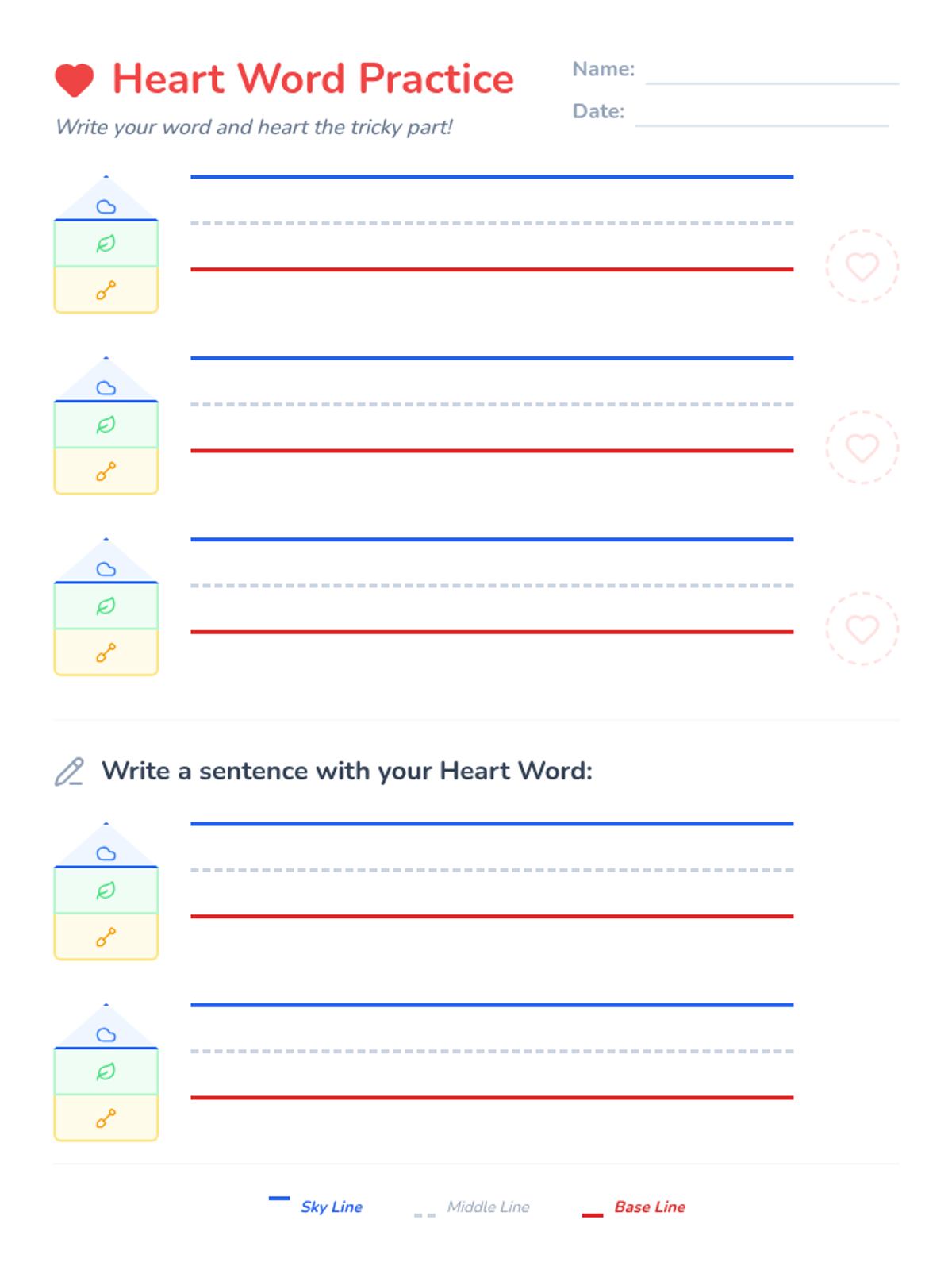
A 2-page Heart Word practice document. Page 1 is a blank template, and Page 2 features the word 'your' positioned on the first practice row to serve as a tracing guide. Both pages follow the 8.5x11 format with house visual aids and standard primary handwriting lines.
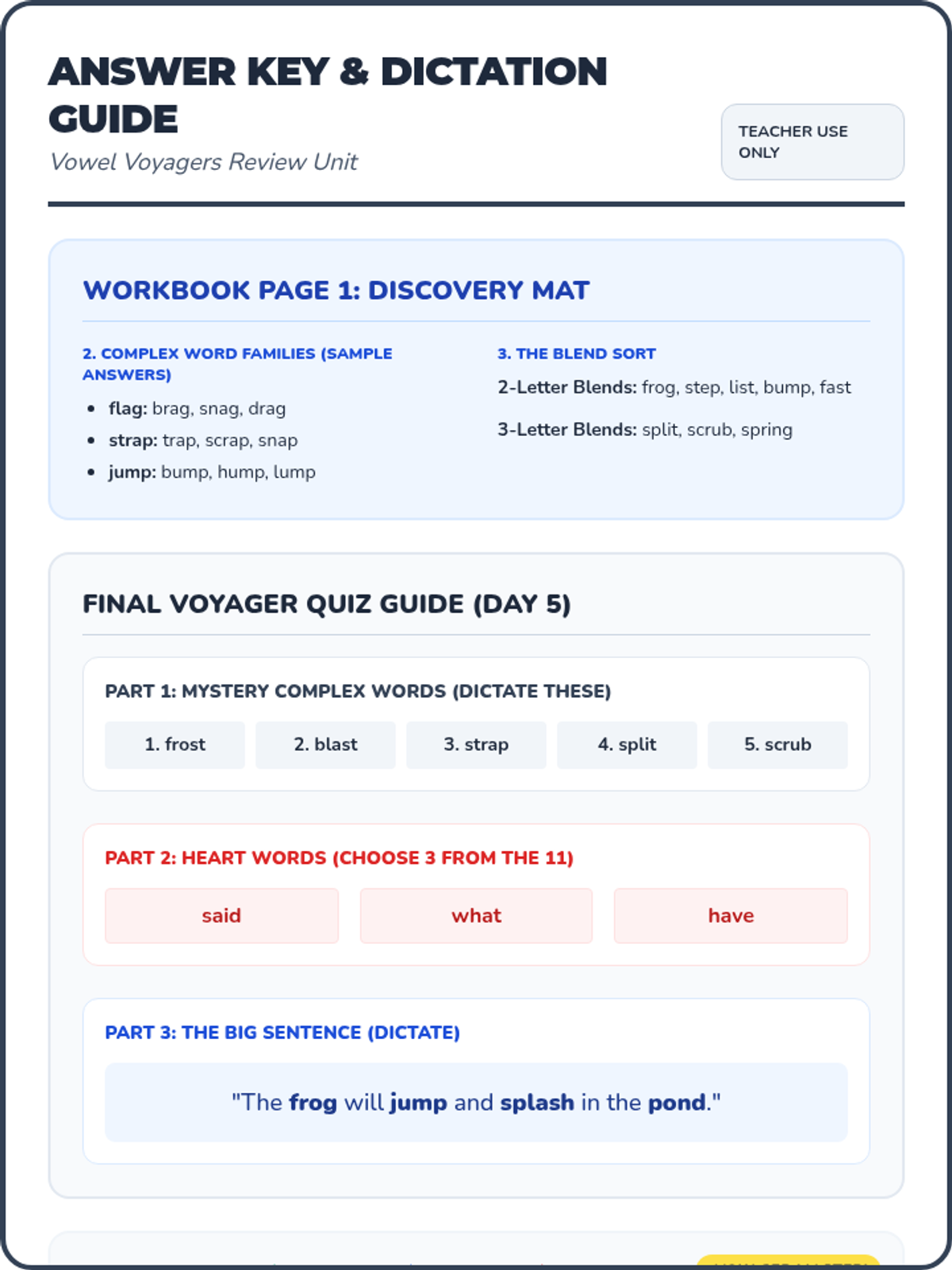
A comprehensive teacher answer key and dictation guide for the Vowel Voyagers unit, sized for 8.5x11 printing. Includes sample word family answers and the specific words/sentence for the Day 5 assessment.
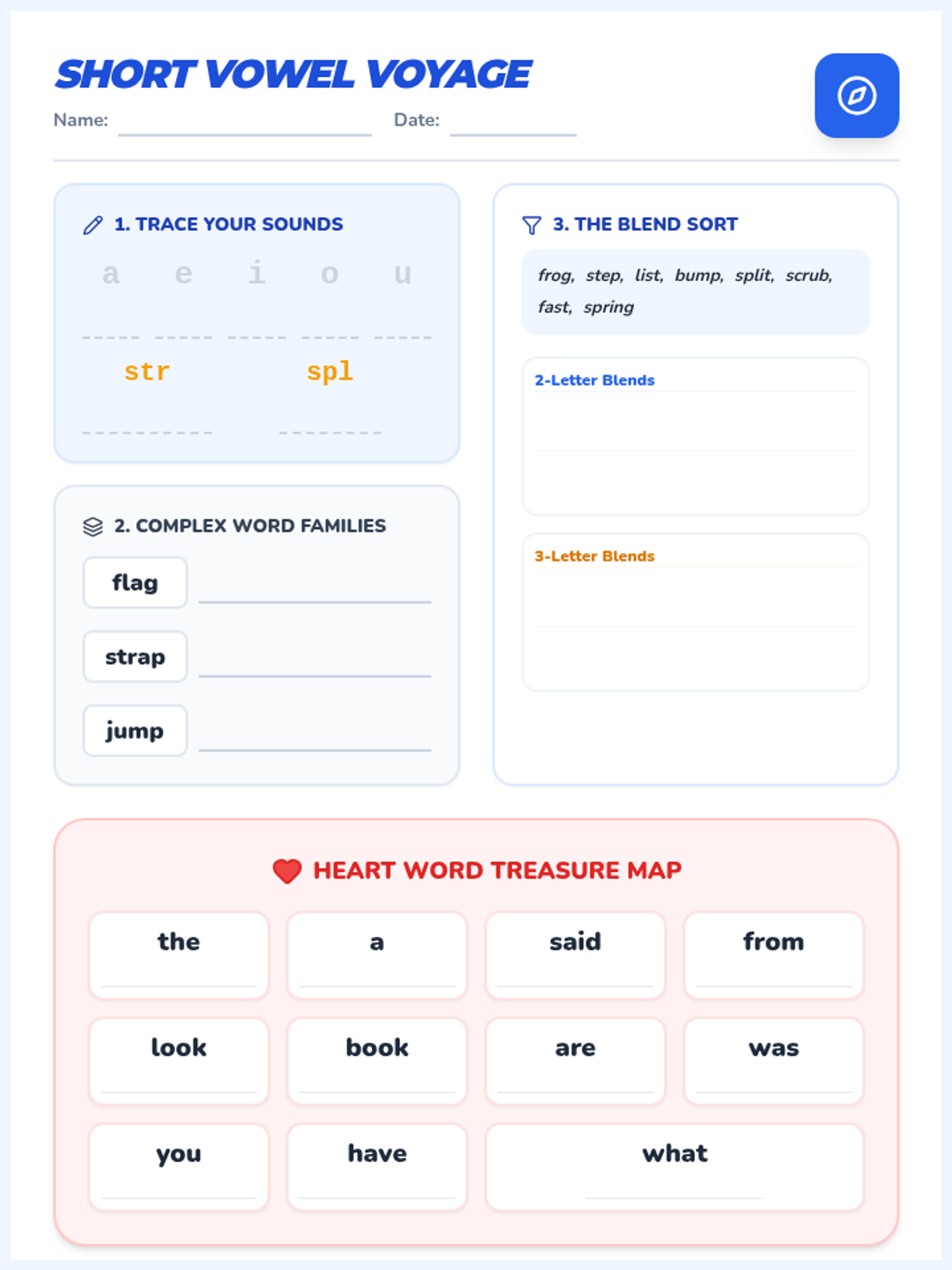
A condensed 2-page student explorer workbook for the 5-day vowel review, updated to focus on 2 and 3-letter consonant blends while removing trigraphs. designed to be printed front-and-back on a single 8.5x11 sheet.
A visually engaging 10-slide deck for the Vowel Voyagers review, updated to include 2 and 3-letter consonant blends while removing trigraphs.
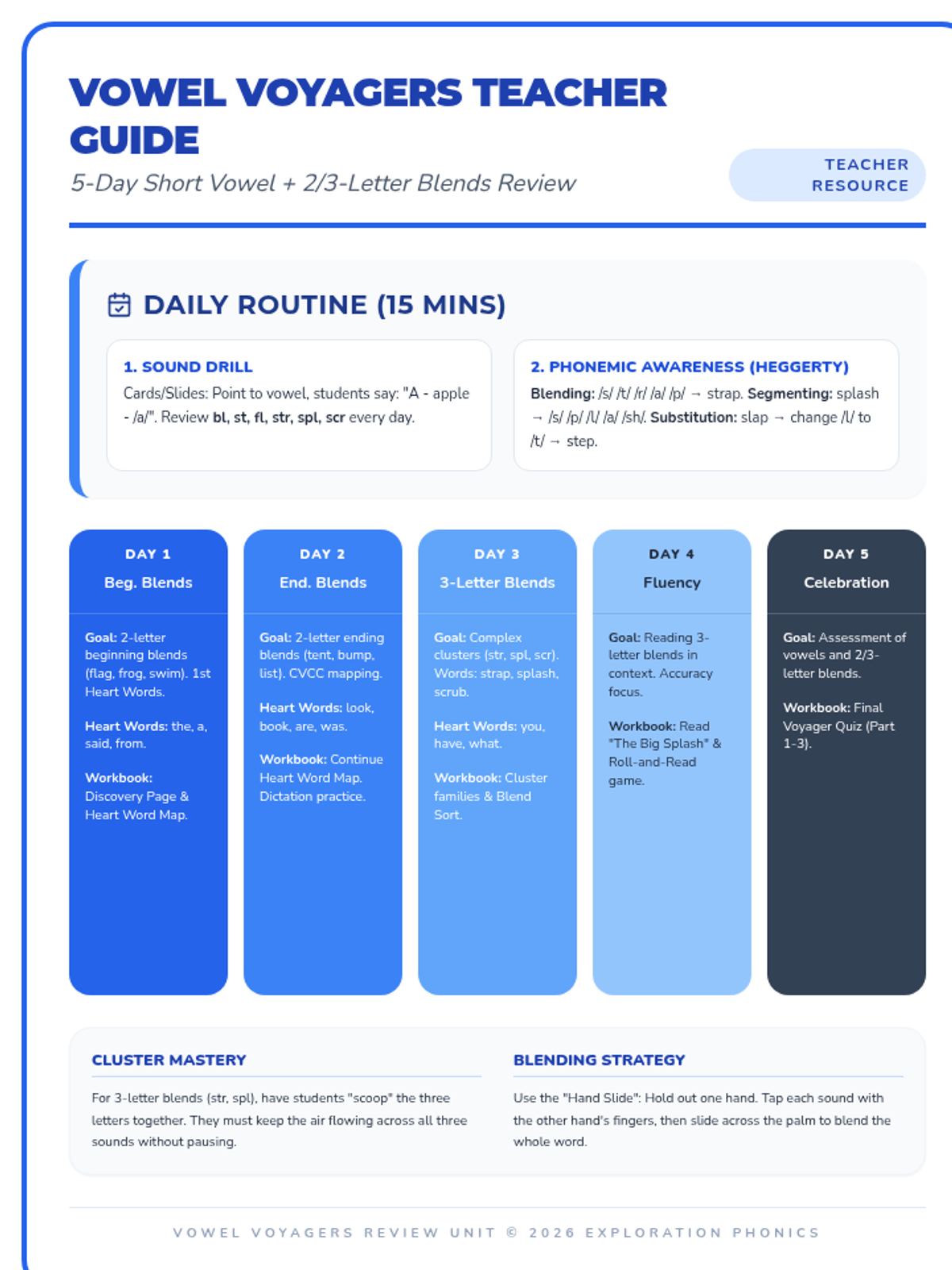
A detailed teacher guide for the 5-day short vowel review, focusing on 2-letter and 3-letter consonant blends while removing trigraphs.
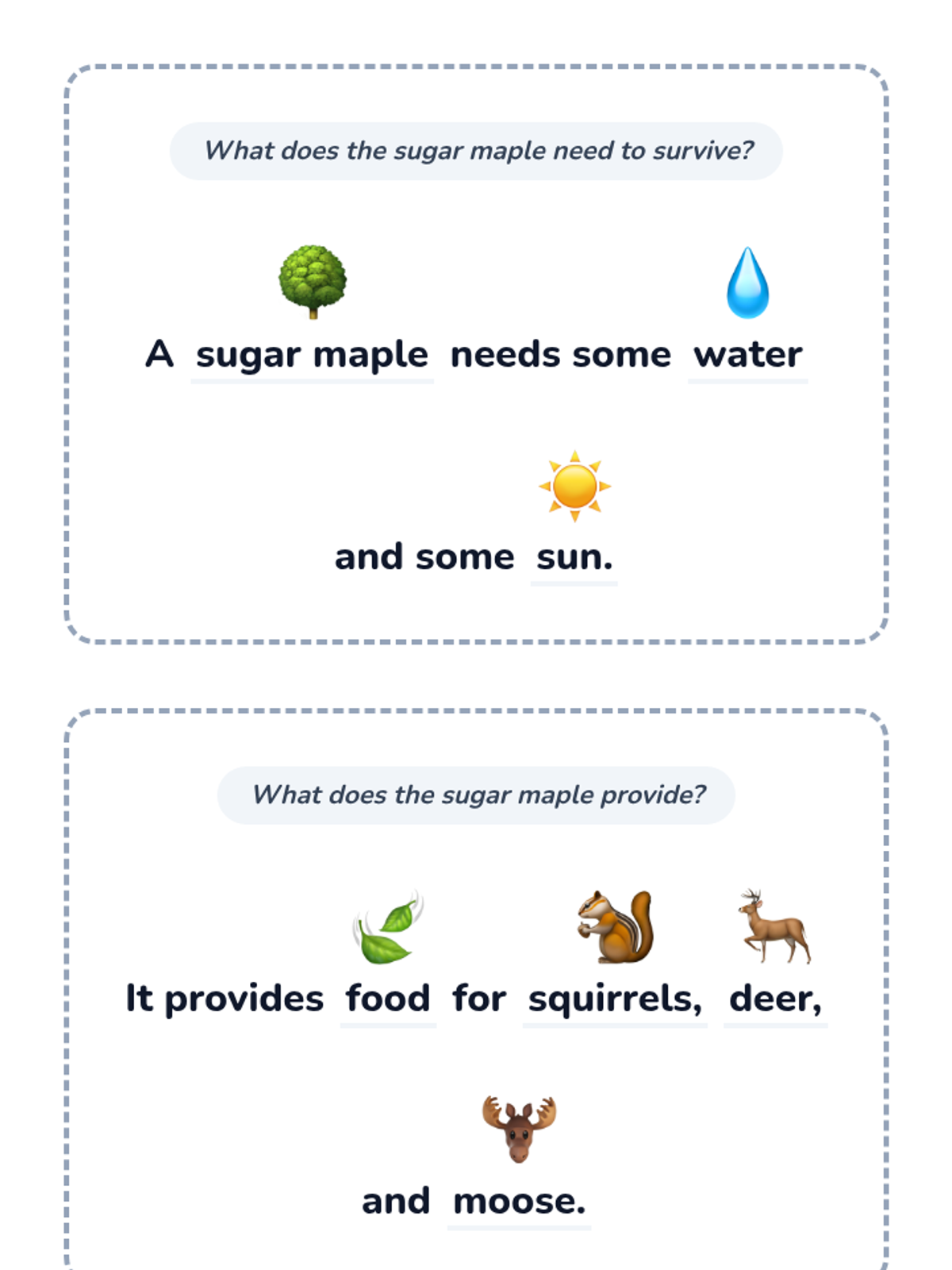
A set of 2 black and white printable prompt cards for kindergarteners about sugar maples. Features sentence frames for 'What does the sugar maple need to survive?' and 'What does the sugar maple provide?' with helpful icons above key words to support emerging readers.
A black and white version of the Notice Talk Cards, ideal for high-contrast printing or as a resource that students can color. This set features the same visual supports for emerging readers.
A set of 4 printable prompt cards for kindergarteners with the sentence frame 'In my picture, I notice...' featuring helpful icons above key words to support emerging readers. Each card has a unique color accent and a dashed border for easy cutting.
A black and white version of the Picture Talk Cards, ideal for high-contrast printing or as a resource that students can color. This set features the same visual supports for emerging readers.
A set of 4 printable prompt cards for kindergarteners with the sentence frame 'In my picture, I see.....' featuring helpful icons above key words to support emerging readers. Each card has a unique color accent and a dashed border for easy cutting.
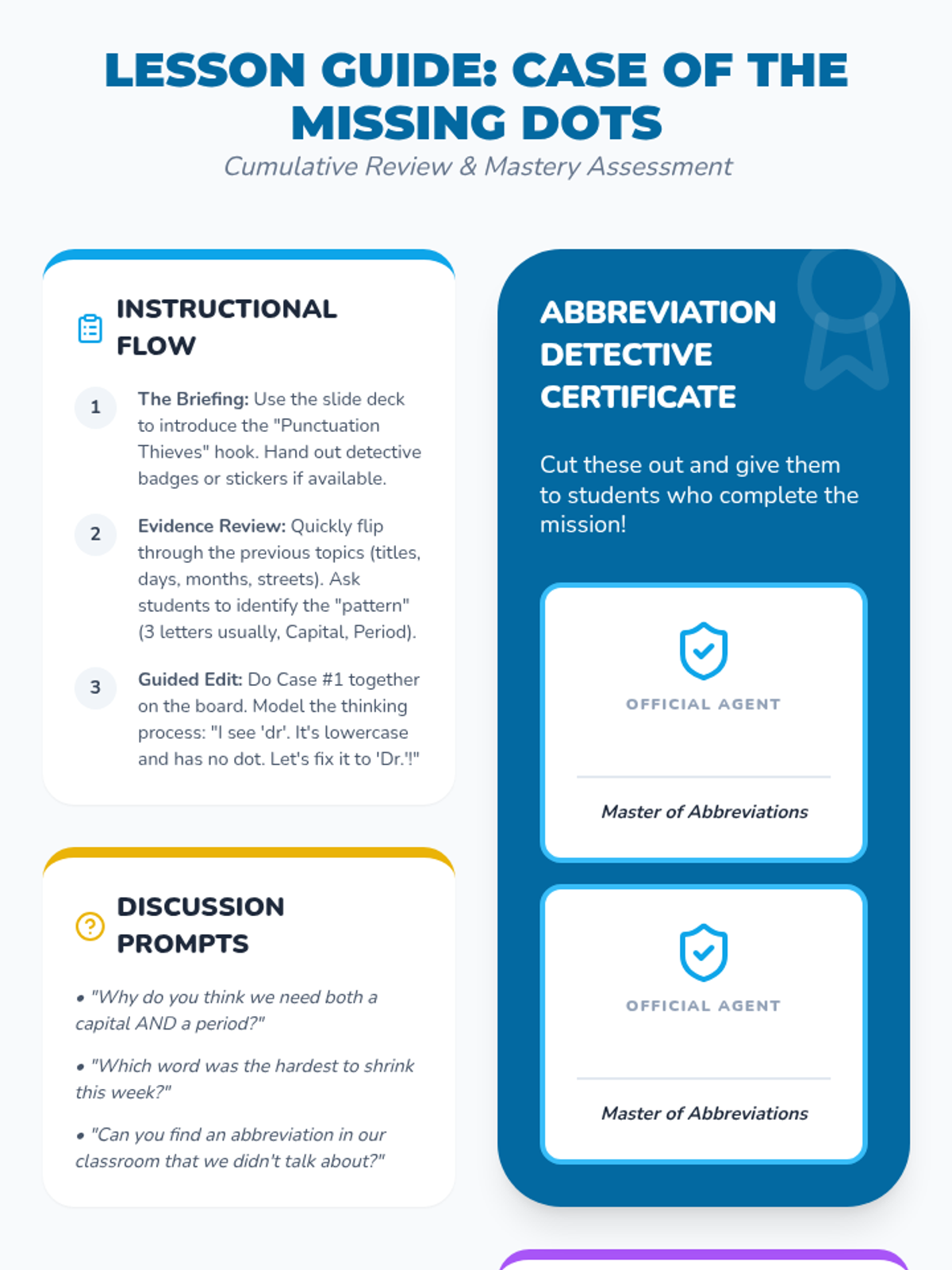
A teacher-facing lesson plan and resource sheet for the final review, including instructional steps, discussion prompts, and printable detective badges.
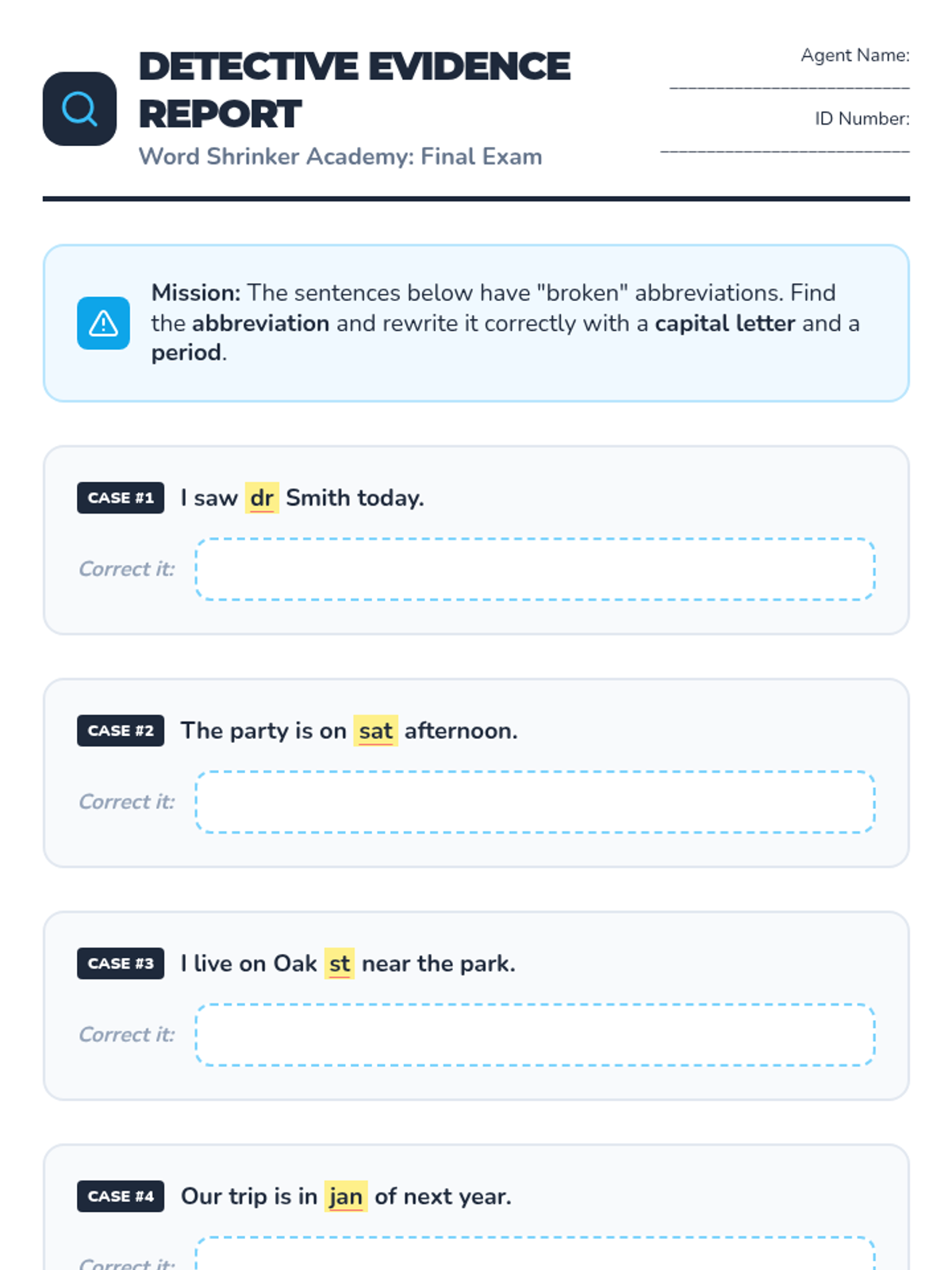
A cumulative review worksheet where students find and correct errors in abbreviations, focusing on capitalization and punctuation.
Cumulative review slides for the end of the sequence, featuring the 'Abbreviation Detective' theme and interactive sentence editing.
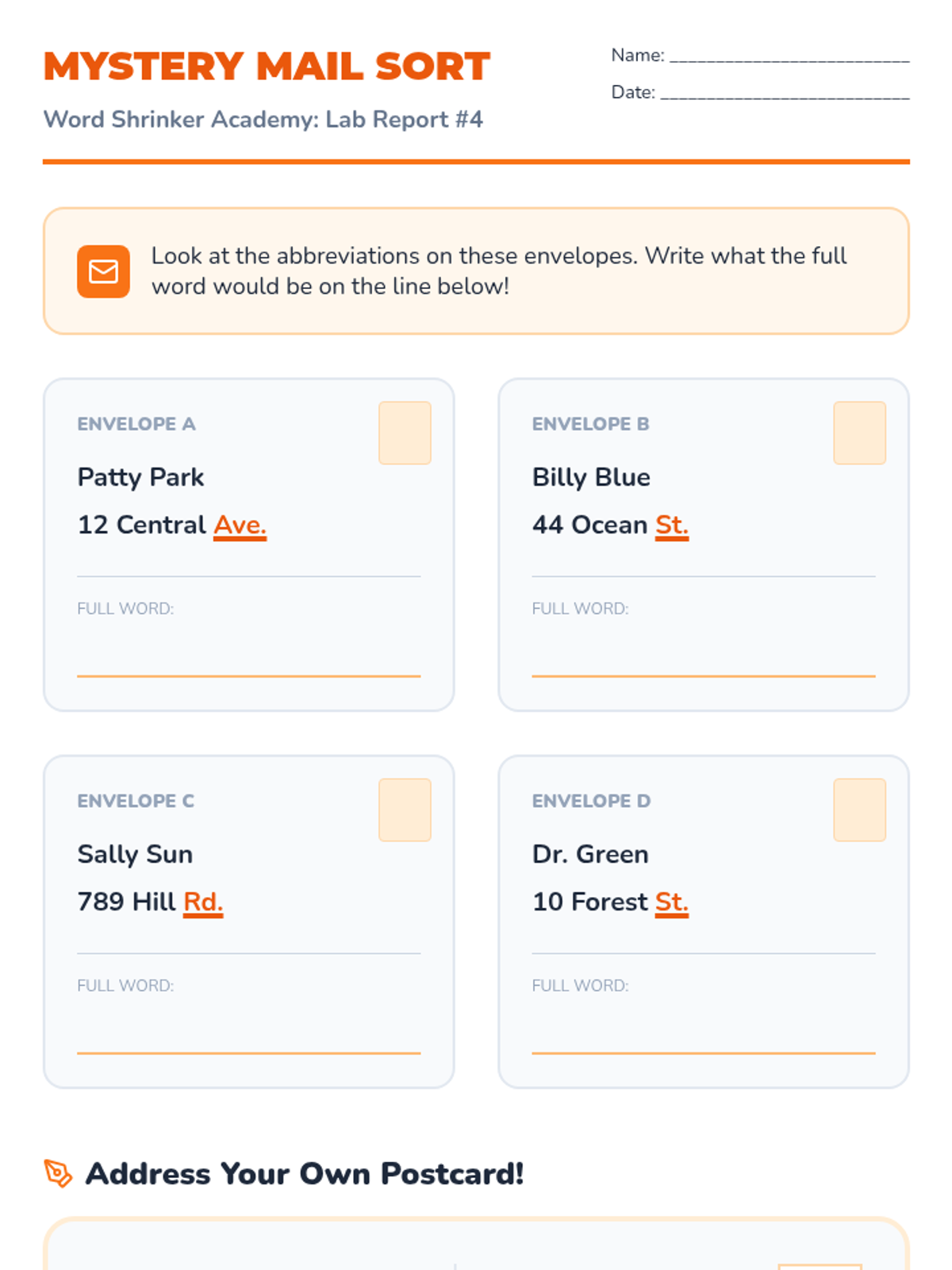
A student worksheet for identifying and practicing street name abbreviations (St., Rd., Ave.) in the context of addressing envelopes and postcards.
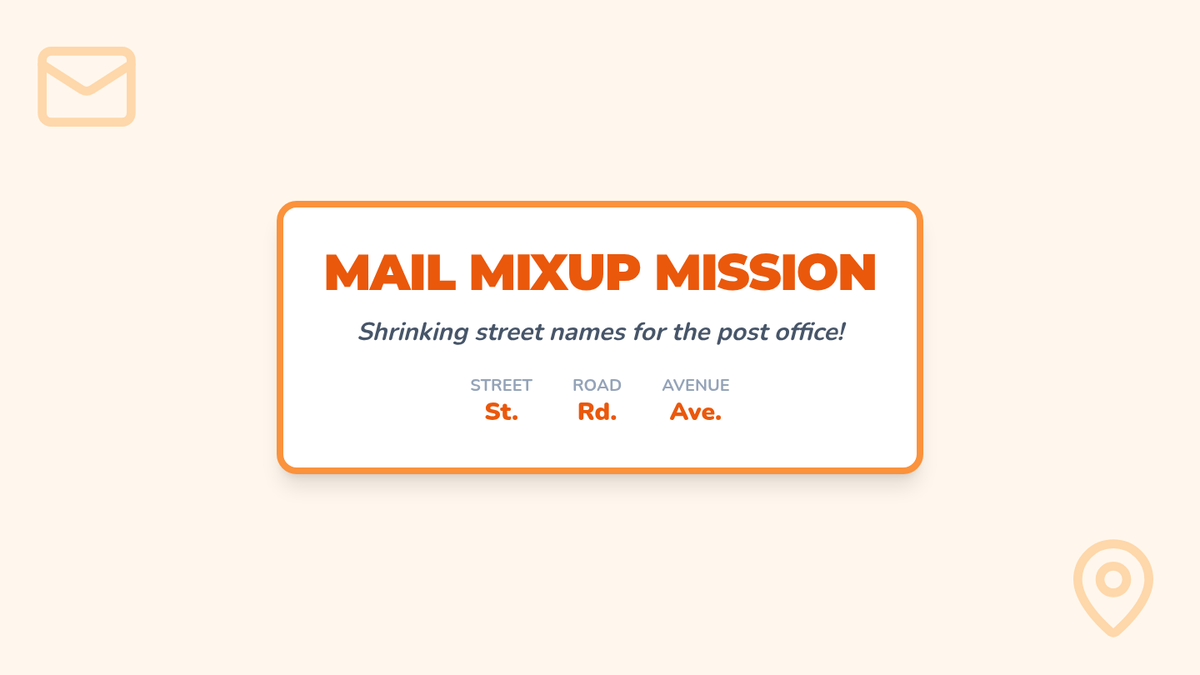
Visual slide deck for Lesson 4, teaching abbreviations for street names (St., Rd., Ave.) and showing how they are used in real-world addresses.
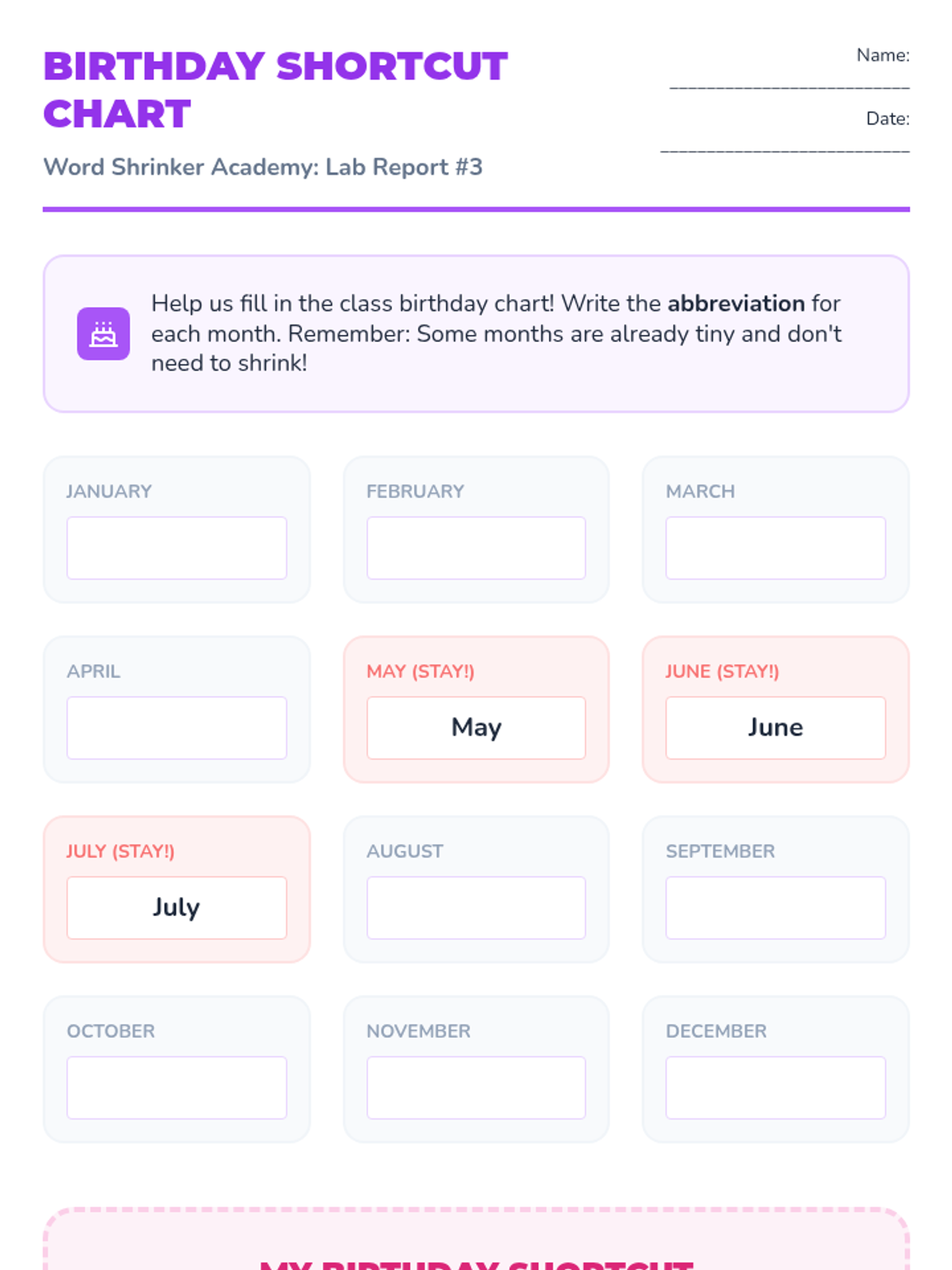
A worksheet for practicing the abbreviations of the months of the year, including a specific focus on which months do not use abbreviations.
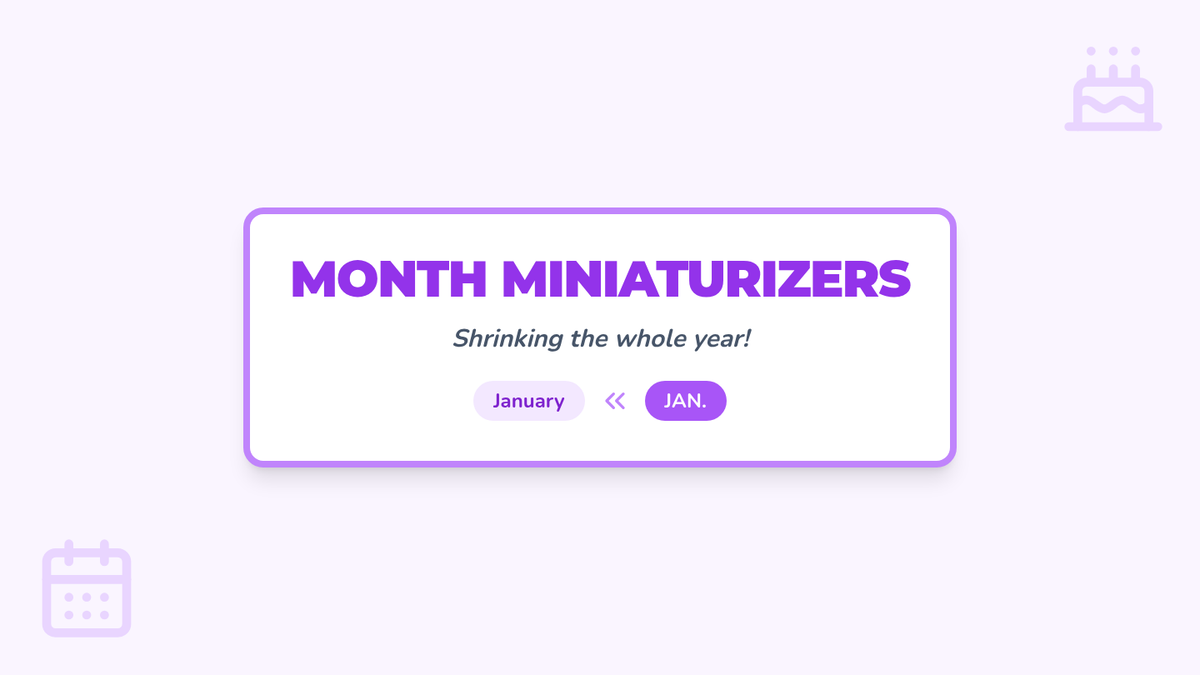
Visual slide deck for Lesson 3, introducing abbreviations for months of the year, including the special rules for short months and September.
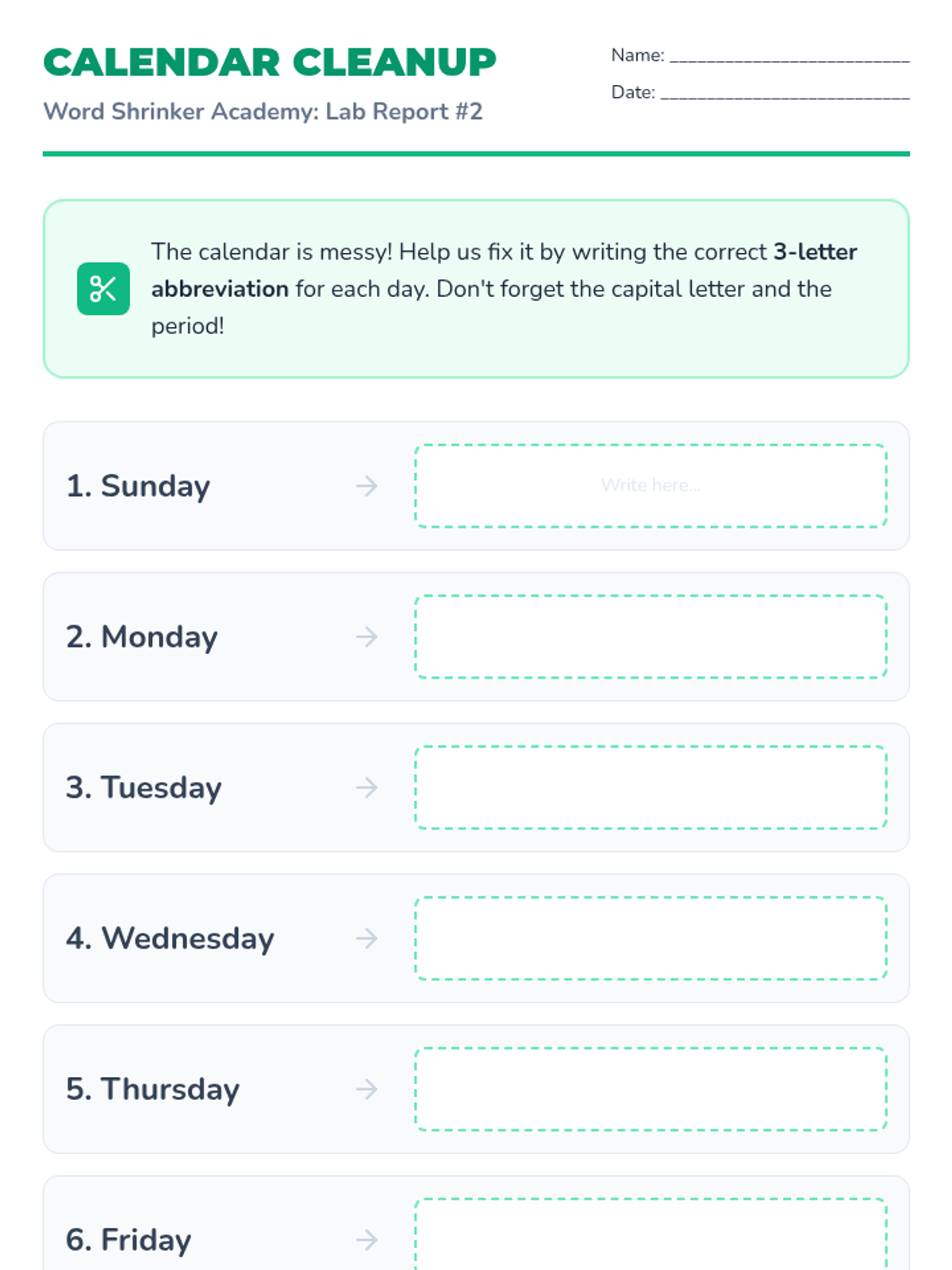
A student worksheet for identifying the days of the week and practicing writing their 3-letter abbreviations correctly.
Visual slide deck introducing abbreviations for days of the week, focusing on the 3-letter rule and the importance of capitalization and punctuation.
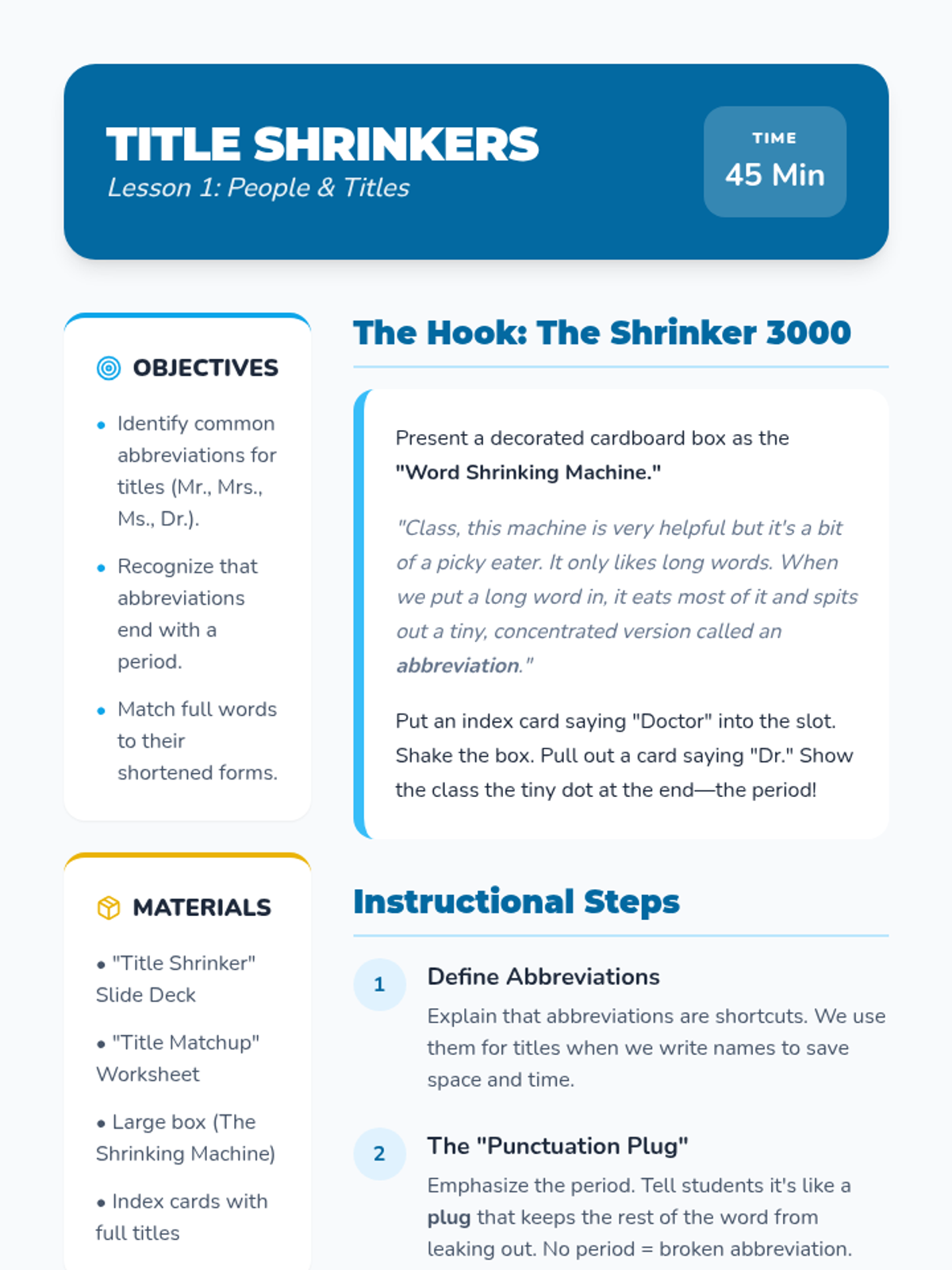
A comprehensive teacher guide for Lesson 1, including the Shrinker Machine hook, instructional steps, and differentiation strategies.
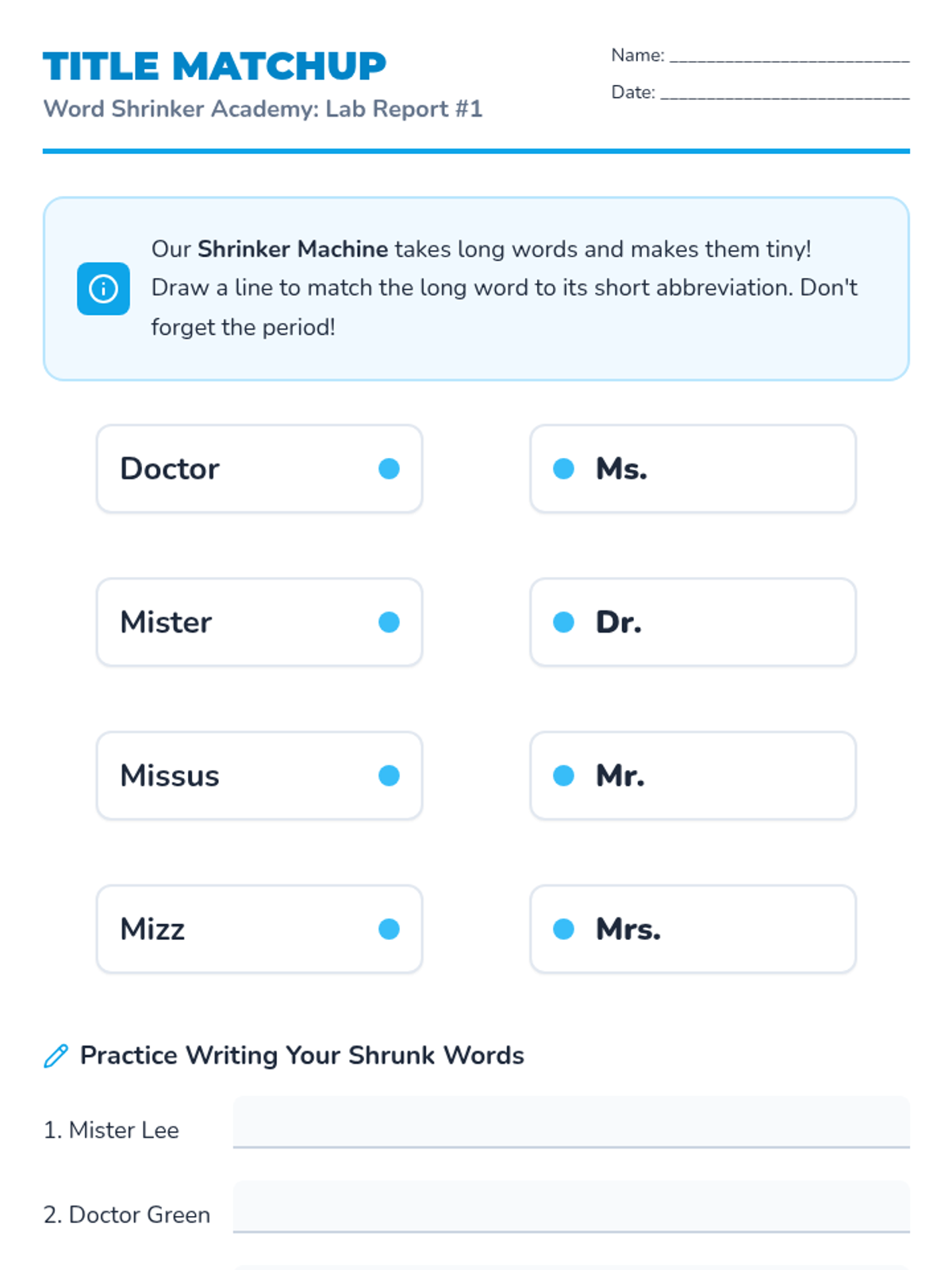
A student worksheet for matching long title words to their abbreviations and practicing writing them correctly with periods.
Visual slide deck introducing abbreviations for titles of people, featuring the 'Shrinker 3000' theme and interactive practice.
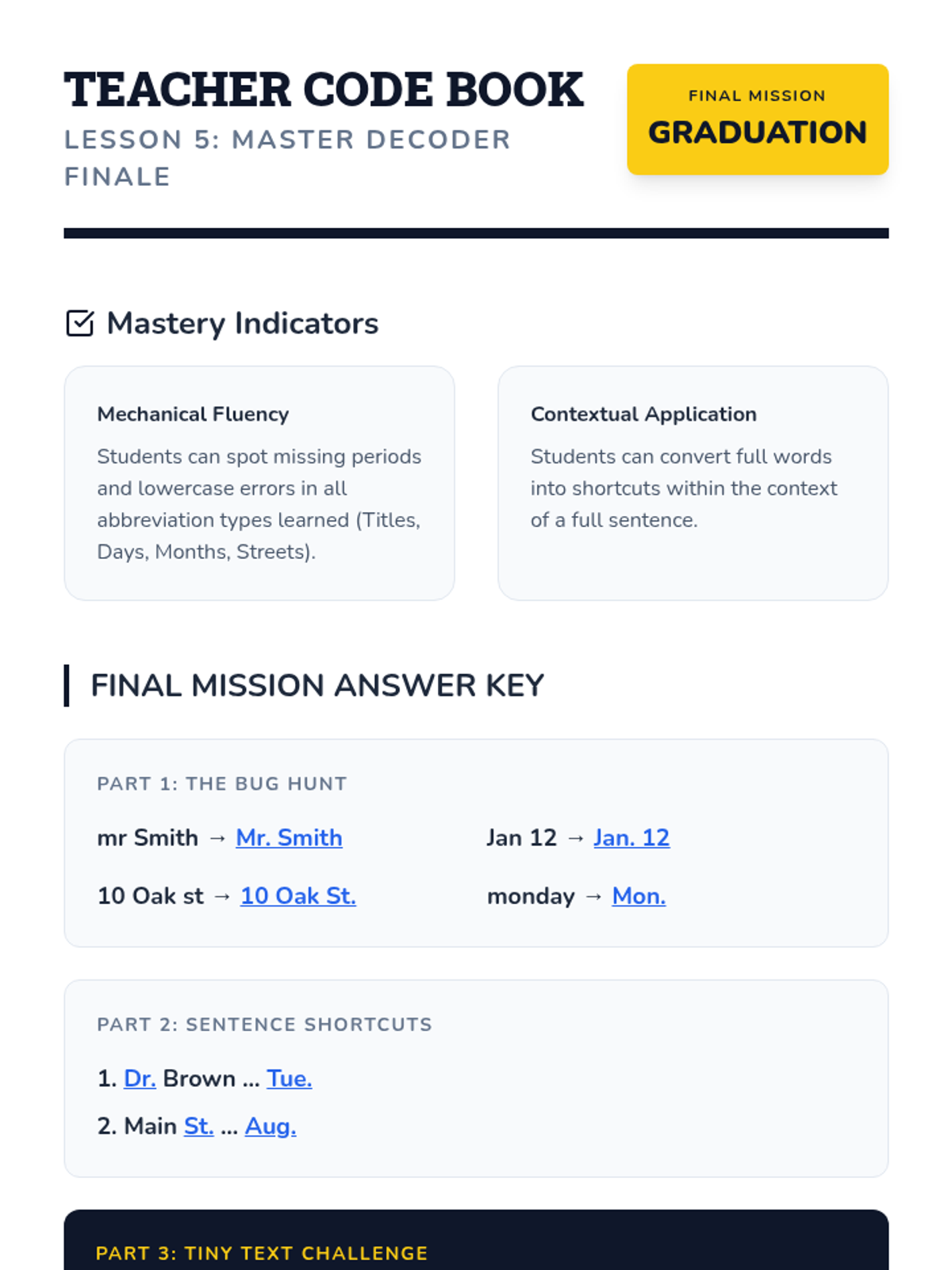
A teacher guide for Lesson 5: Master Decoder Finale. Includes a review of mastery indicators, a comprehensive answer key for the final assessment, and a fun idea for a classroom graduation ceremony.
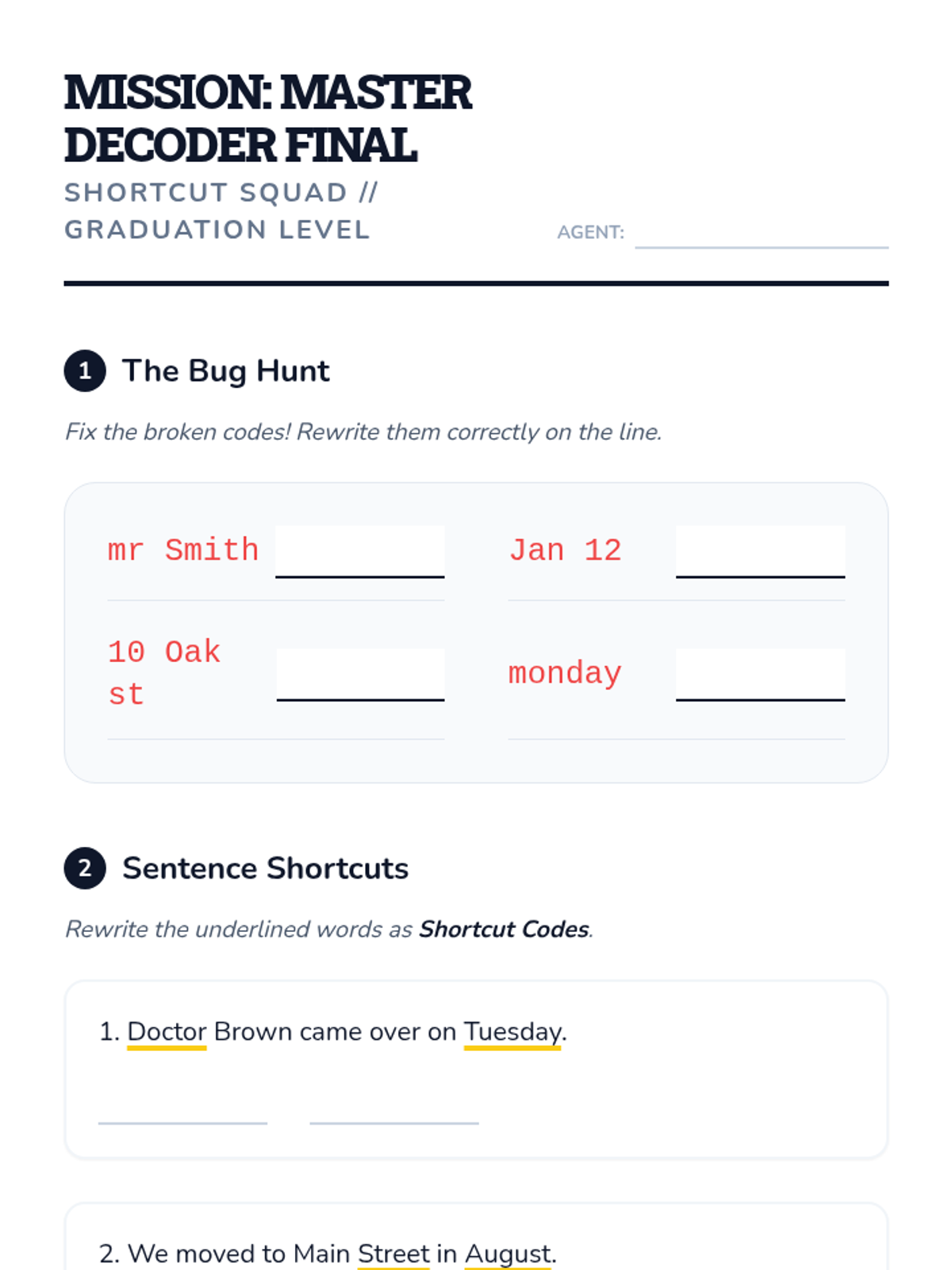
A cumulative review worksheet where students edit sentences, fix incorrect abbreviations, and complete the "Tiny Text Challenge" by shortening a full sentence using all learned abbreviation types.
Introductory slides for the cumulative review of all abbreviation types. Features a "Bug Hunt" for correcting errors and introduces the "Tiny Text Challenge" for applying mastery.
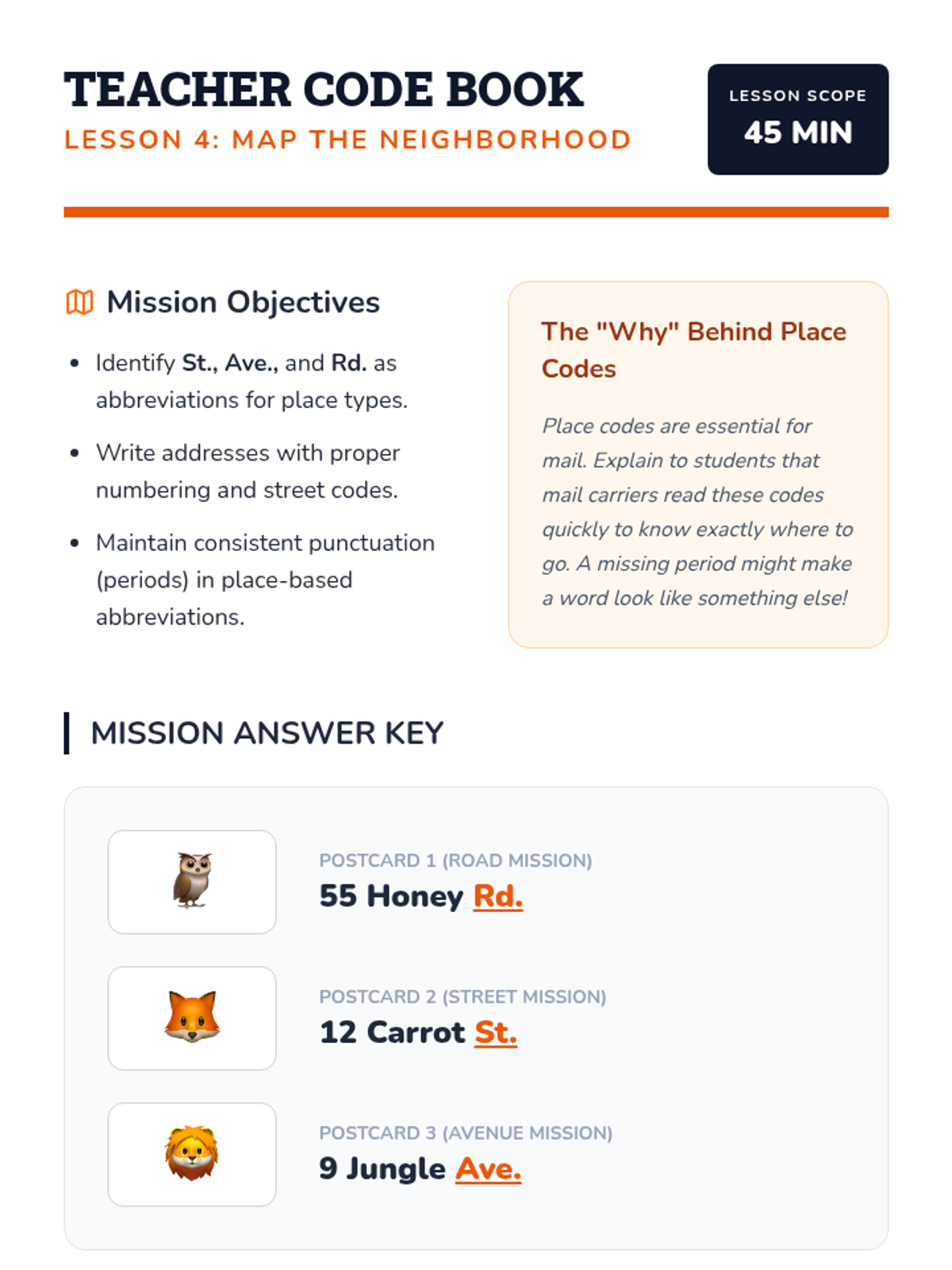
A teacher guide for Lesson 4: Map the Neighborhood. Includes address structure overview, an answer key for the postcard activity, and extension ideas.
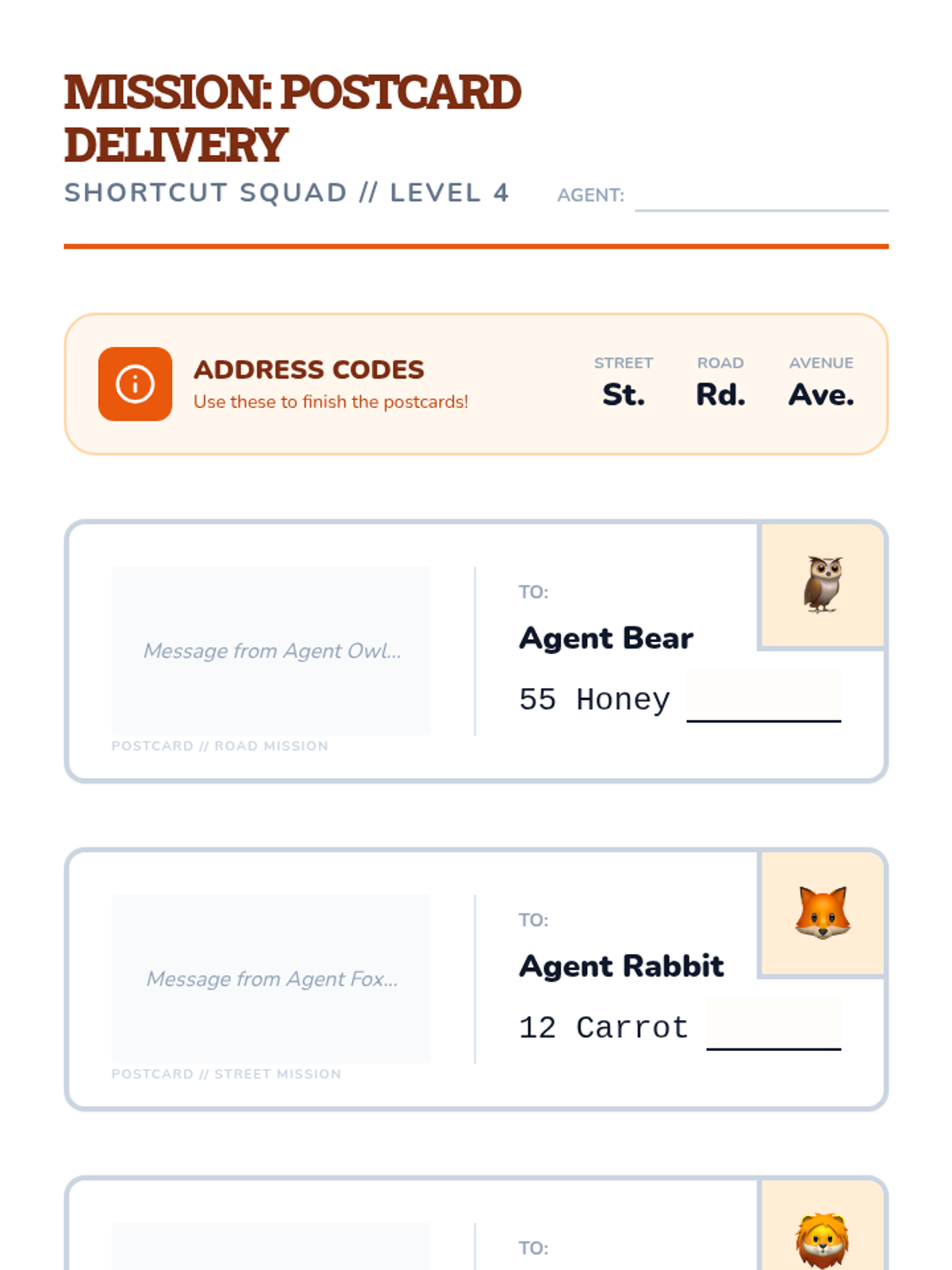
A student activity for practicing street abbreviations (St., Ave., Rd.). Students complete addresses on fictional postcards using the correct abbreviation codes.
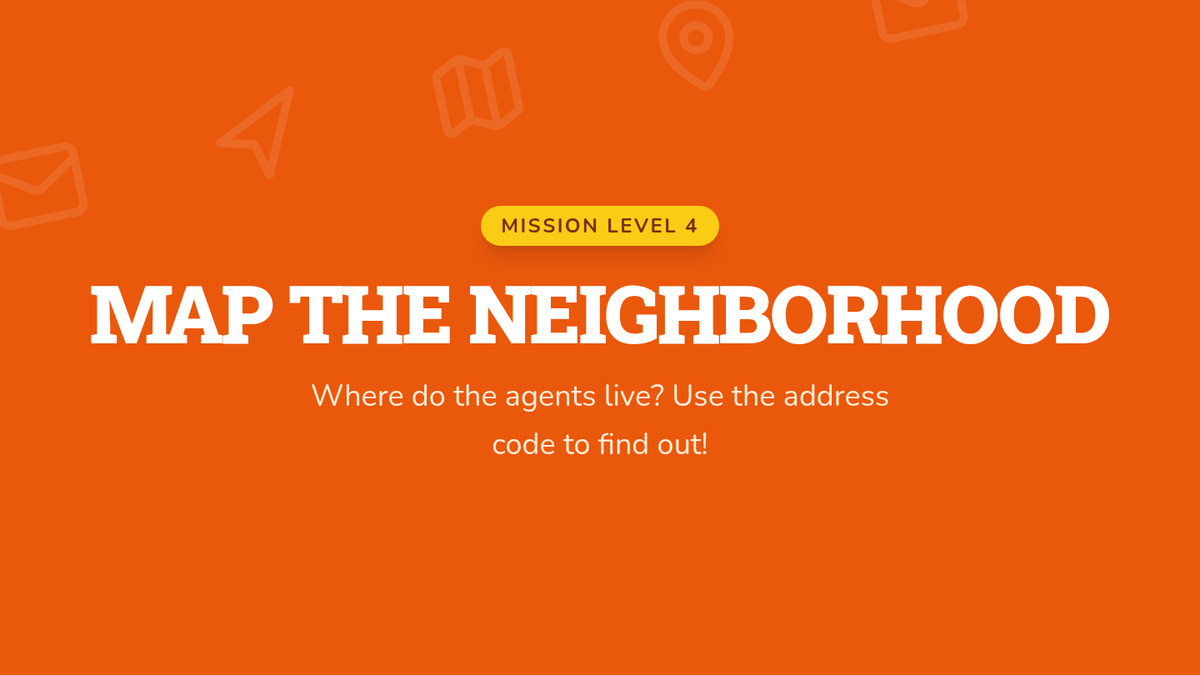
Introductory slides for street abbreviations (St., Ave., Rd.). Highlights common address suffixes and demonstrates how to use them when writing a house address.
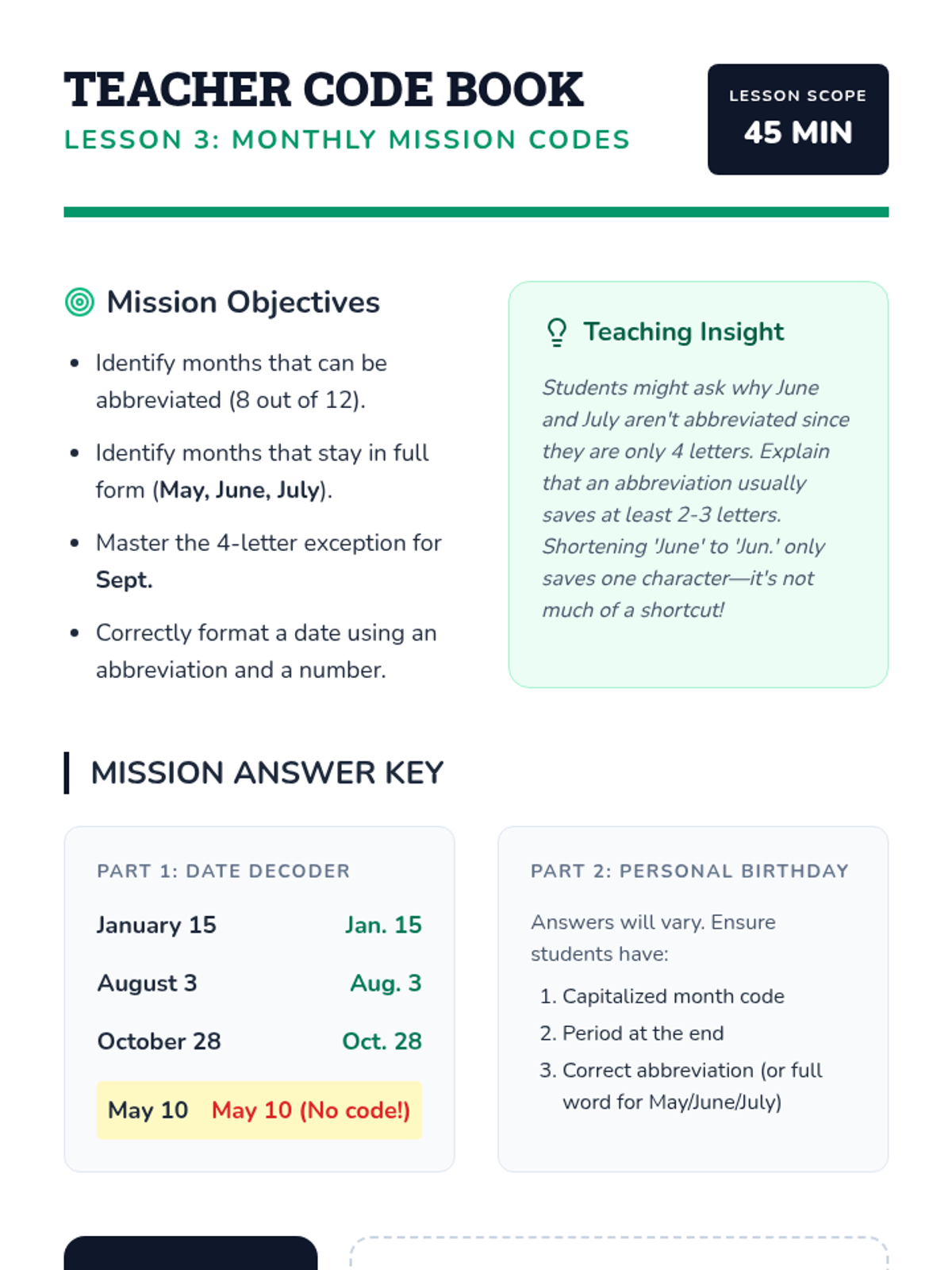
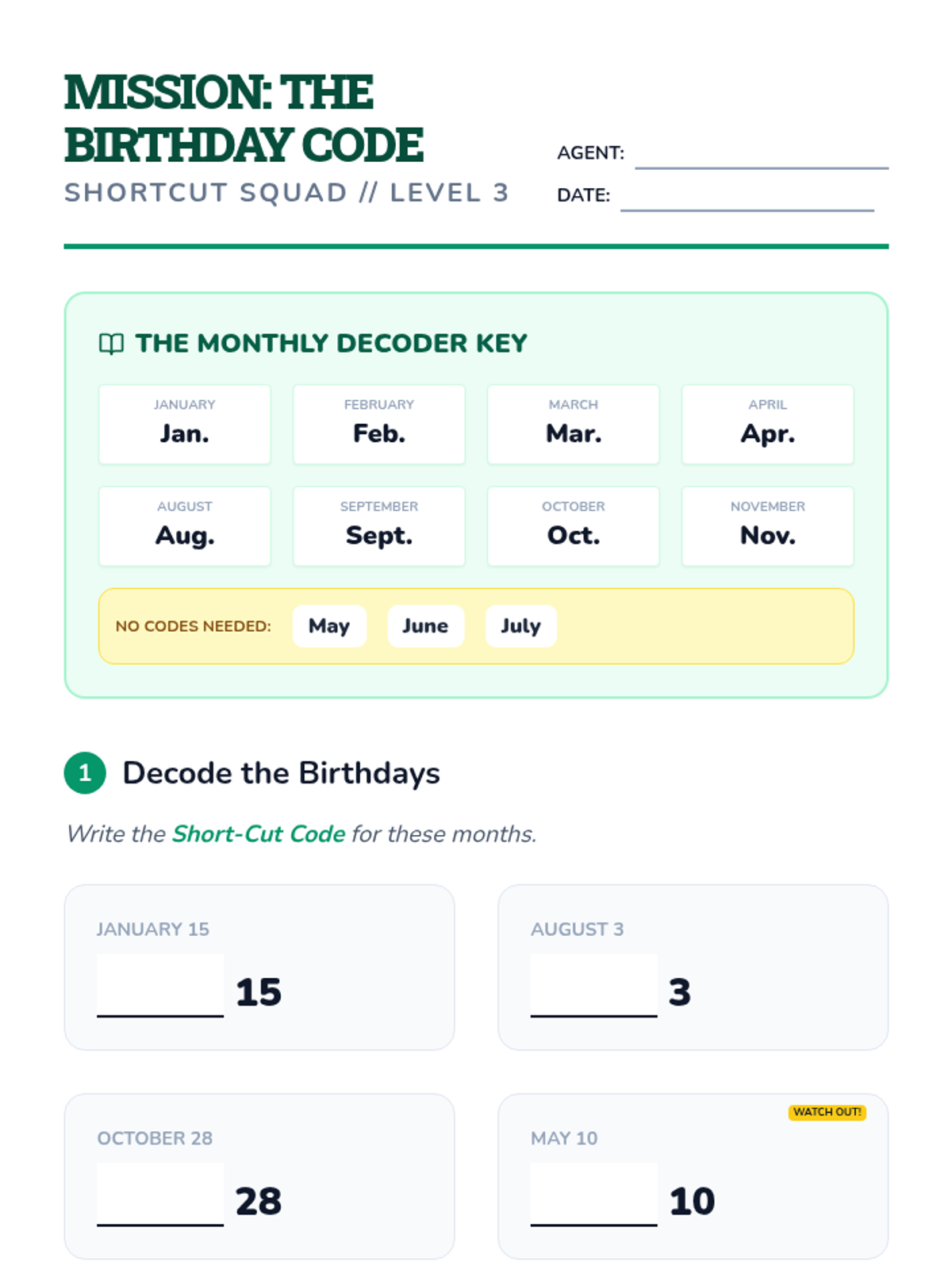
A teacher guide for Lesson 3: Monthly Mission Codes. Includes lesson objectives, a date decoder answer key, and teaching tips regarding non-abbreviated months and the September exception.
A student worksheet for practicing month abbreviations. Features a decoder key, a practice section for writing abbreviated dates, and a space for students to write their own birthdate using the learned codes.
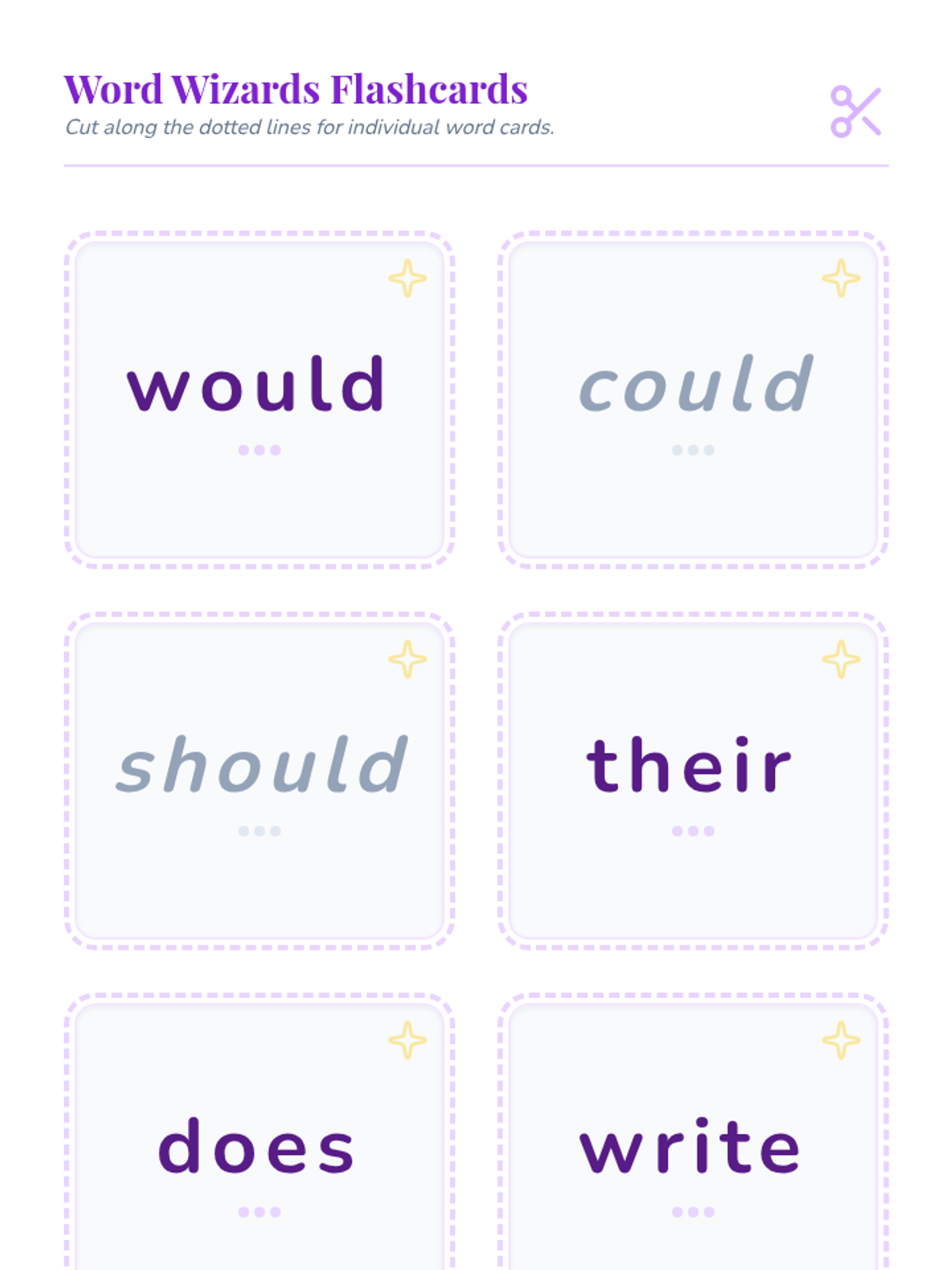
Set of printable flashcards for the 5 target sight words plus pattern-related words (could, should). Designed with a wizardly aesthetic for classroom drills.
Engaging slide presentation for the Word Wizards lesson. Includes lesson objectives, a warm-up drill, the embedded sight word video, and clear instructions for the Bingo activity and closure.
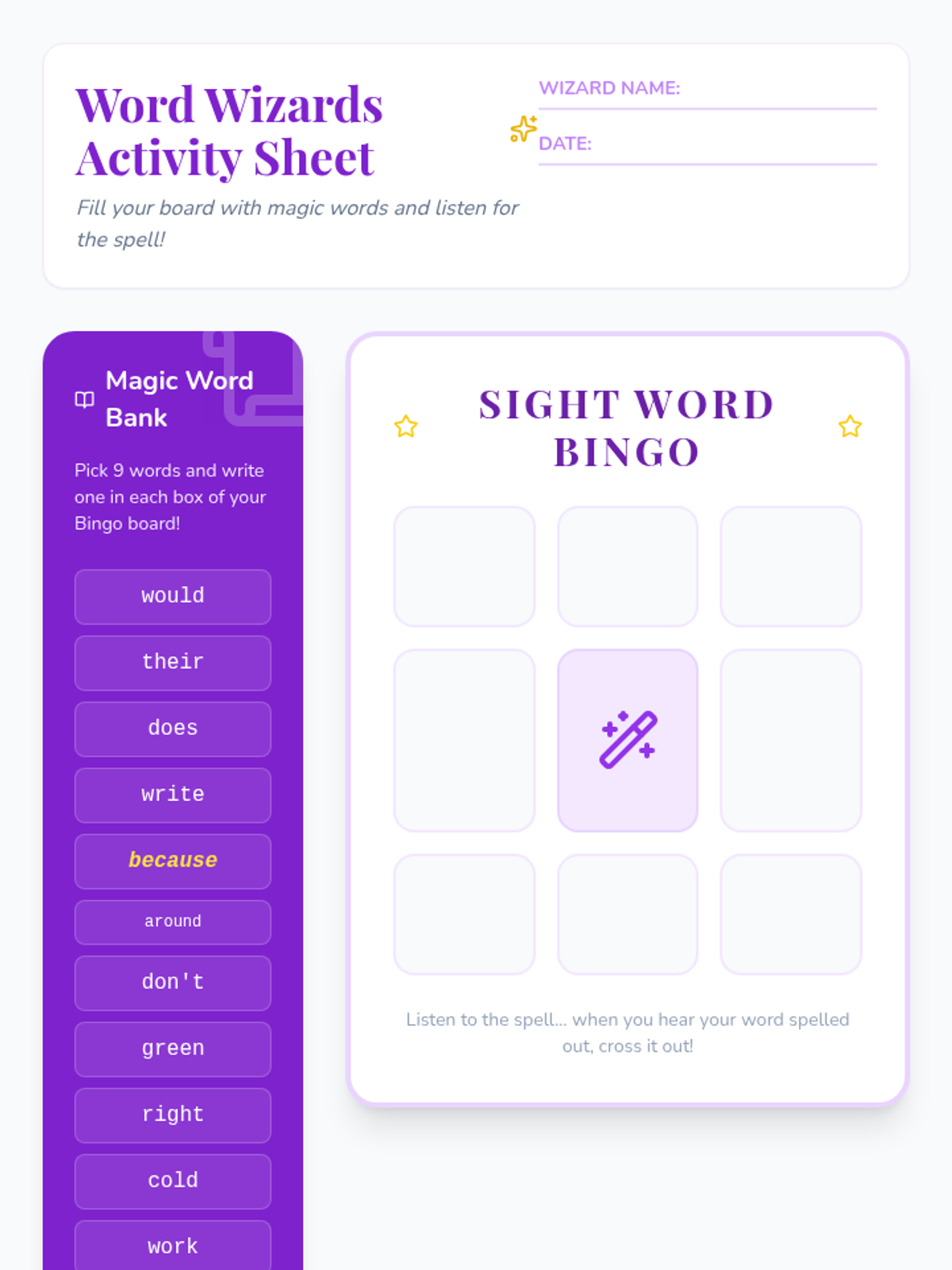
Student activity sheet featuring a 3x3 Bingo grid with a word bank from the video, and a designated section for handwriting practice. Designed with a wizard theme to engage 1st/2nd grade students.
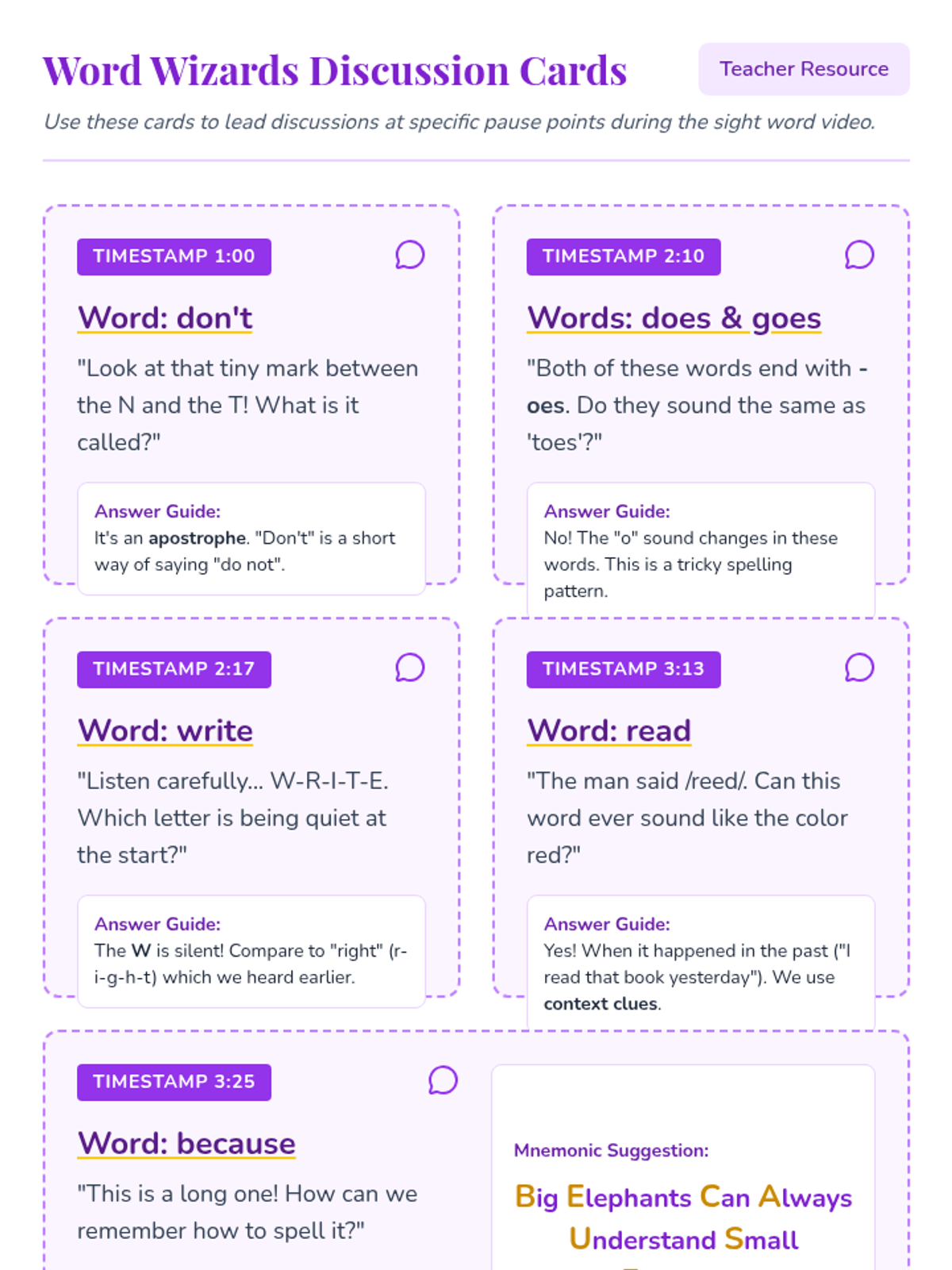
Teacher discussion cards with specific pause points and questions for the sight word video. Includes guided answers and a mnemonic for the word 'because'.
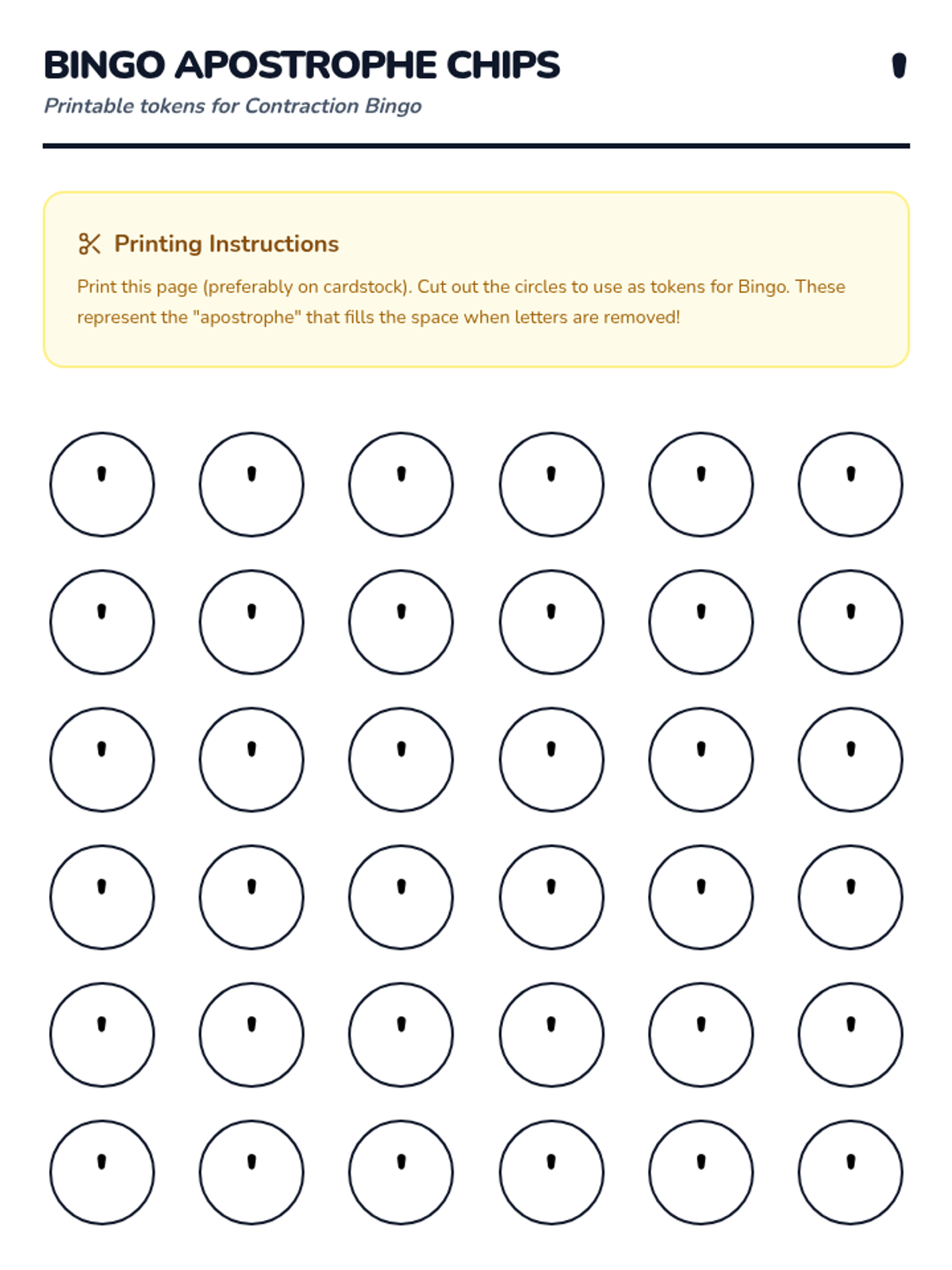
A set of printable apostrophe-themed tokens to be used as bingo chips for the Contraction Bingo activity.
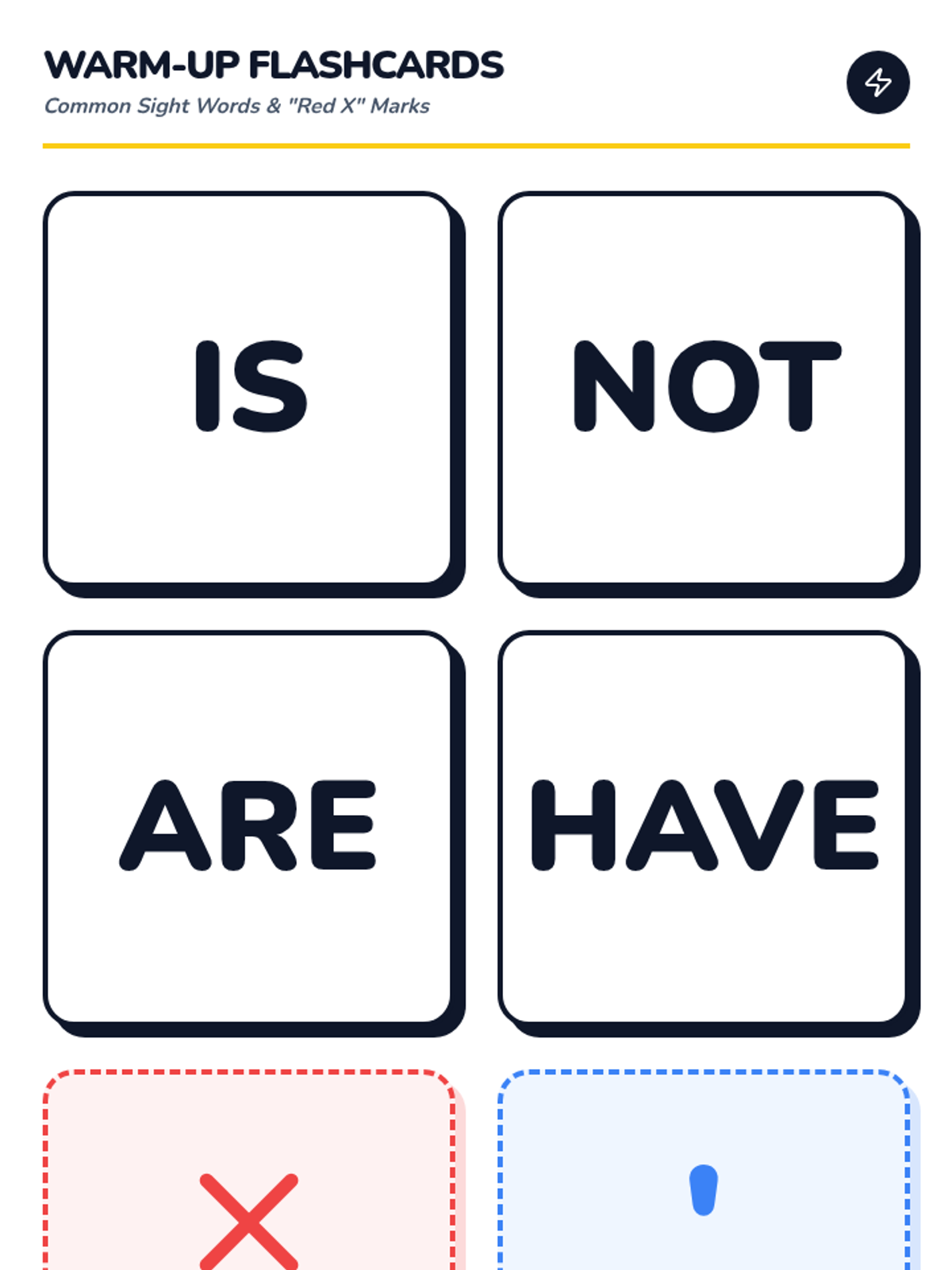
Warm-up flashcards featuring common sight words (is, not, are, have) and visual aids for the "Red X" and apostrophe concepts.
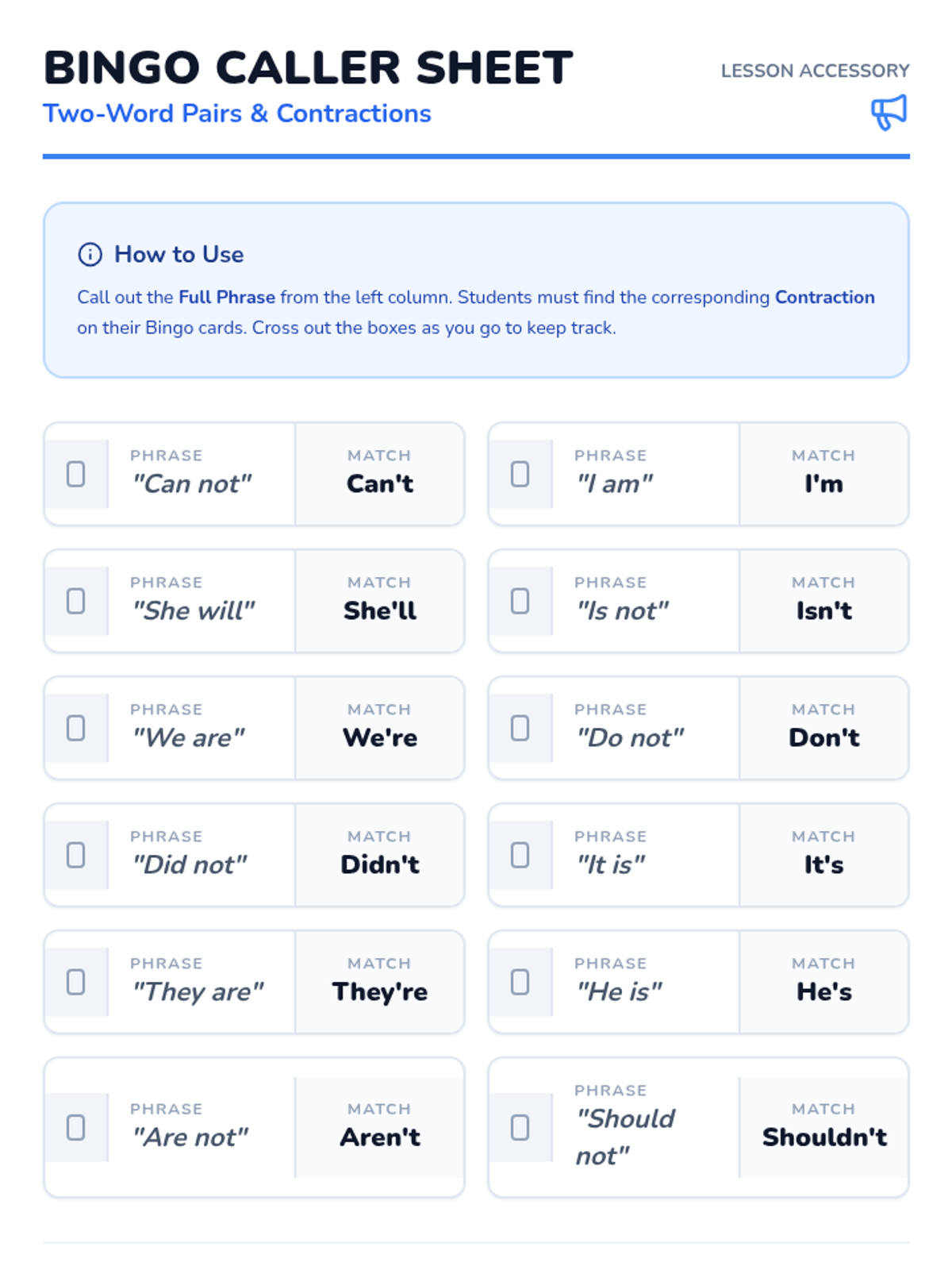
A teacher caller sheet for Contraction Bingo, listing two-word phrases and their corresponding contractions.
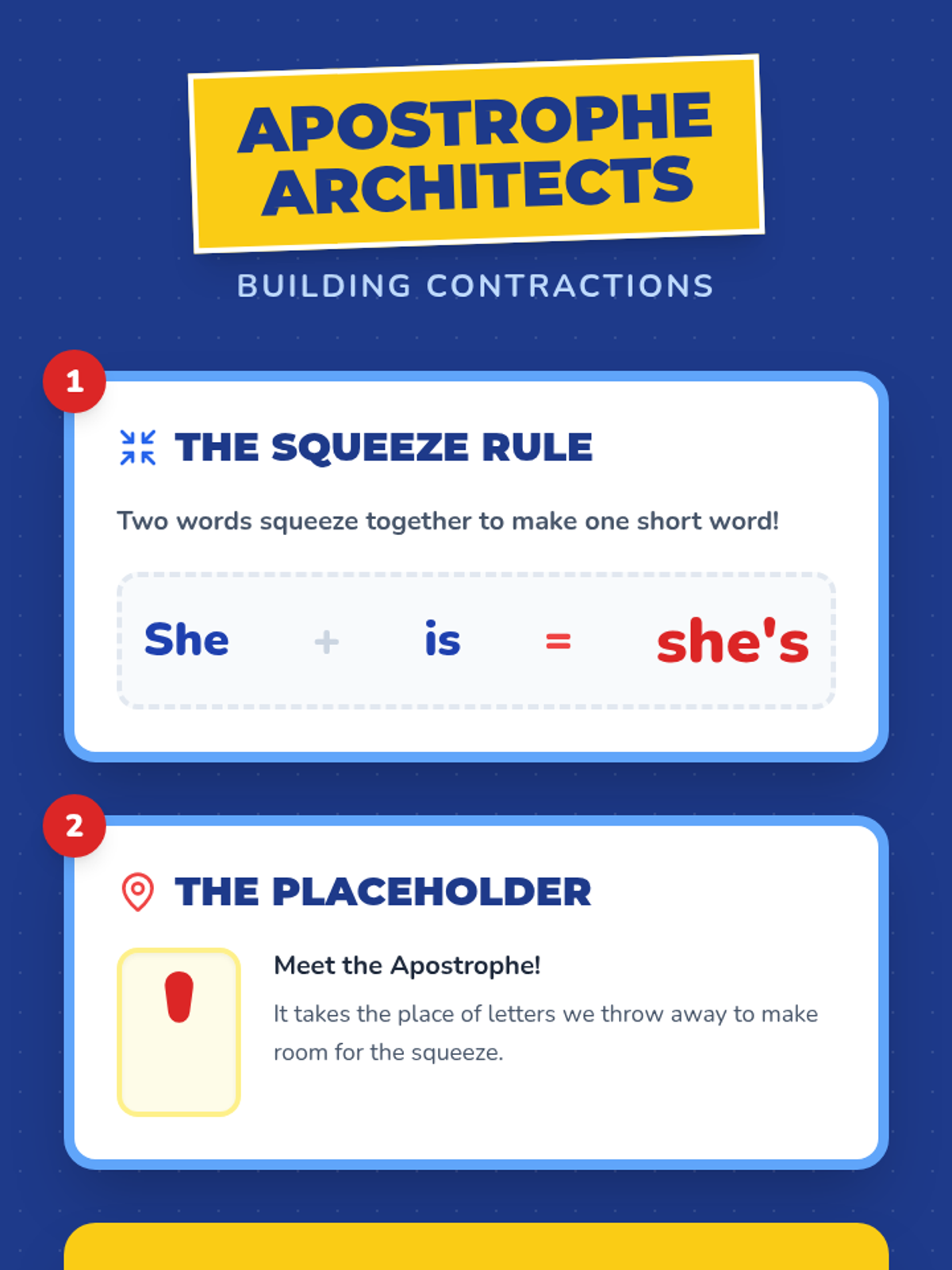
A visual reference poster (Anchor Chart) for classroom display, outlining the two main rules of contractions and providing common 'blueprint' examples in the Apostrophe Architects theme.
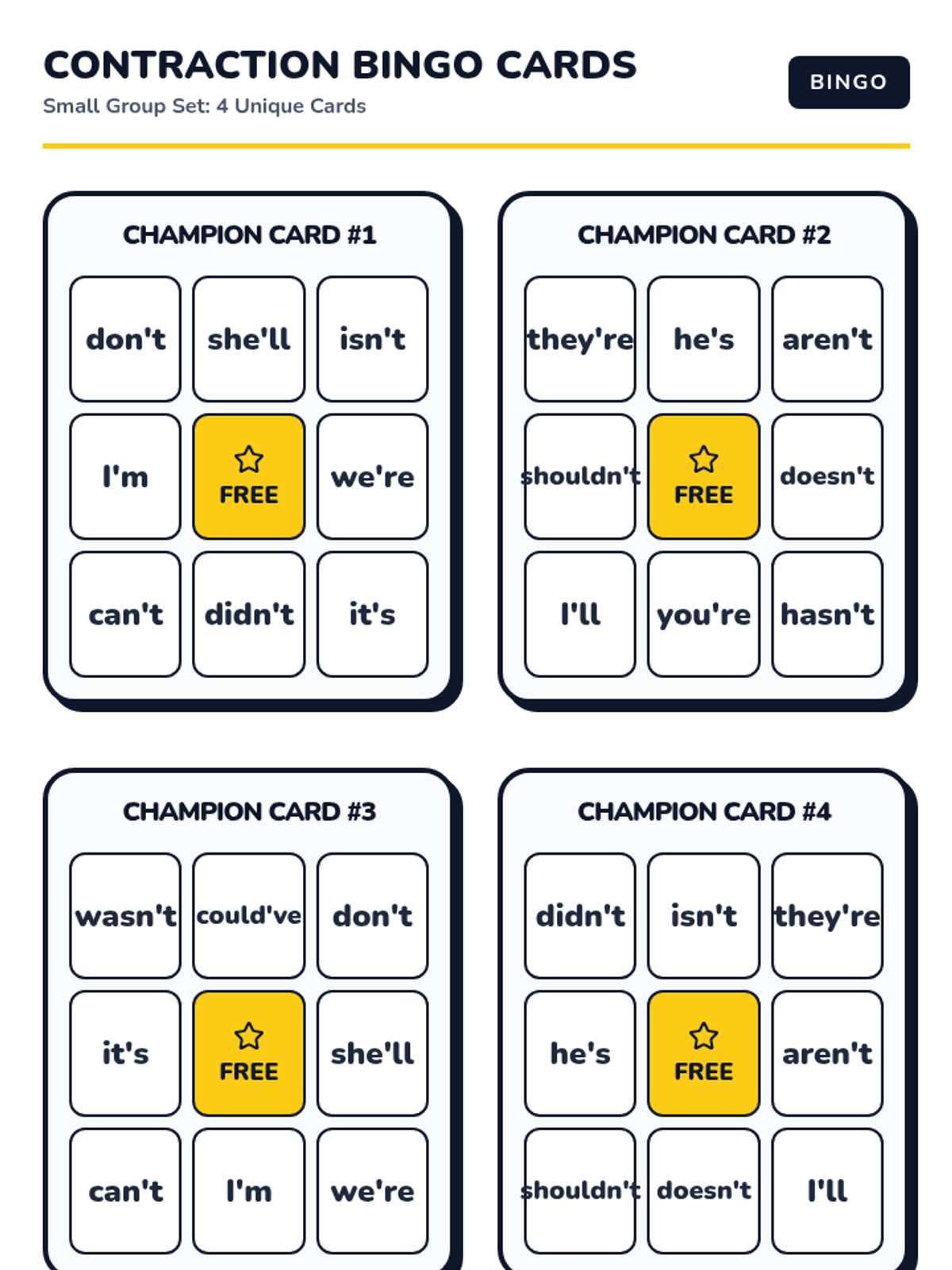
A set of 4 unique, printable contraction bingo cards for small group intervention.
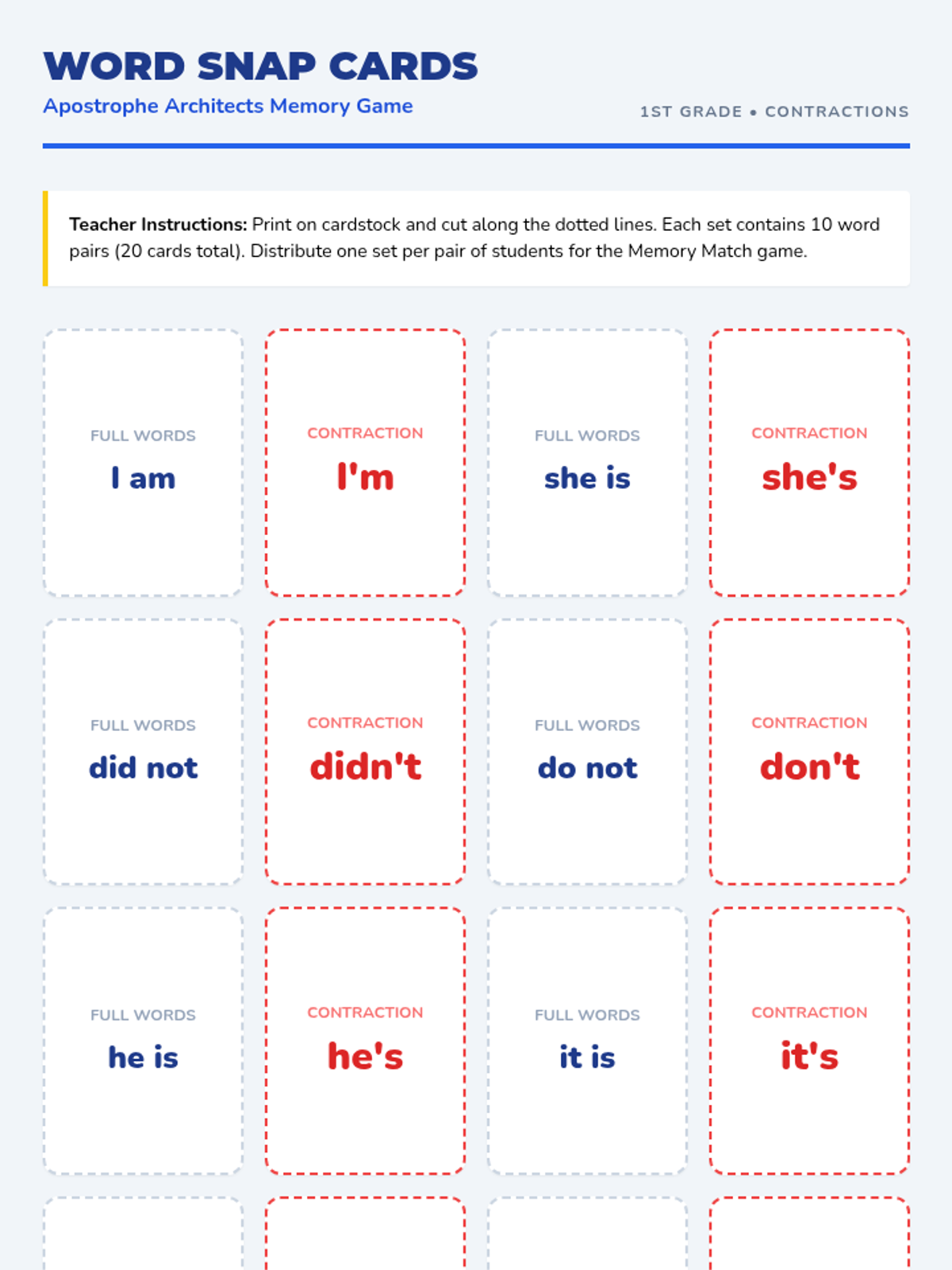
A set of 20 matching cards (10 pairs) featuring common contractions and their original two-word forms, designed for a memory match activity. Includes teacher instructions and clear visual distinctions between card types.
Engaging classroom presentation for teaching contractions, featuring the thematic 'Apostrophe Architects' visual style, the instructional YouTube video, and step-by-step breakdowns of common contractions.
A presentation slide deck for the Contraction Champions lesson, featuring definitions, the lesson video, and game instructions.
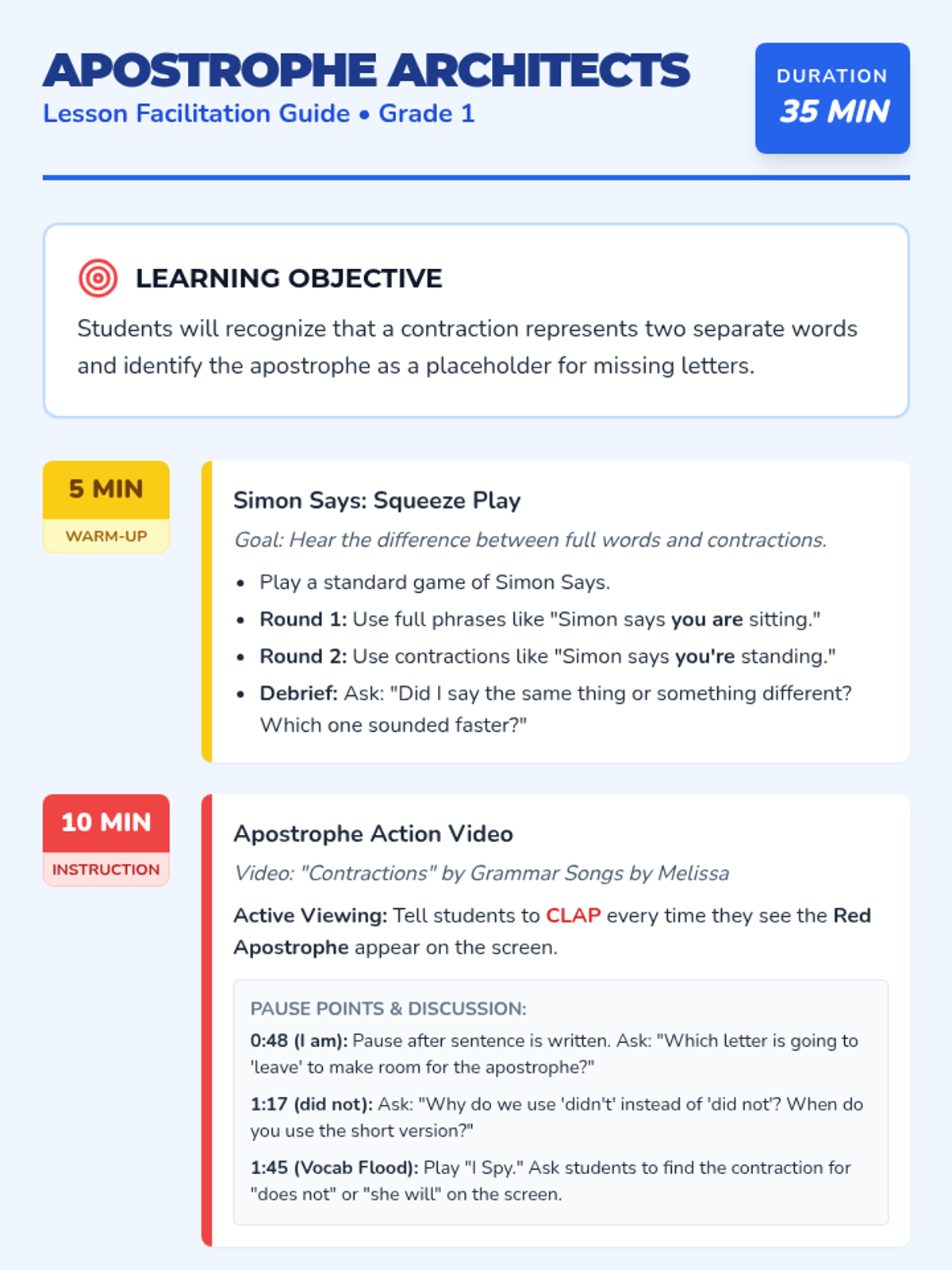
A comprehensive facilitation guide for the Apostrophe Architects lesson, featuring a 35-minute pacing plan, specific video pause points, and instructions for the memory match activity.
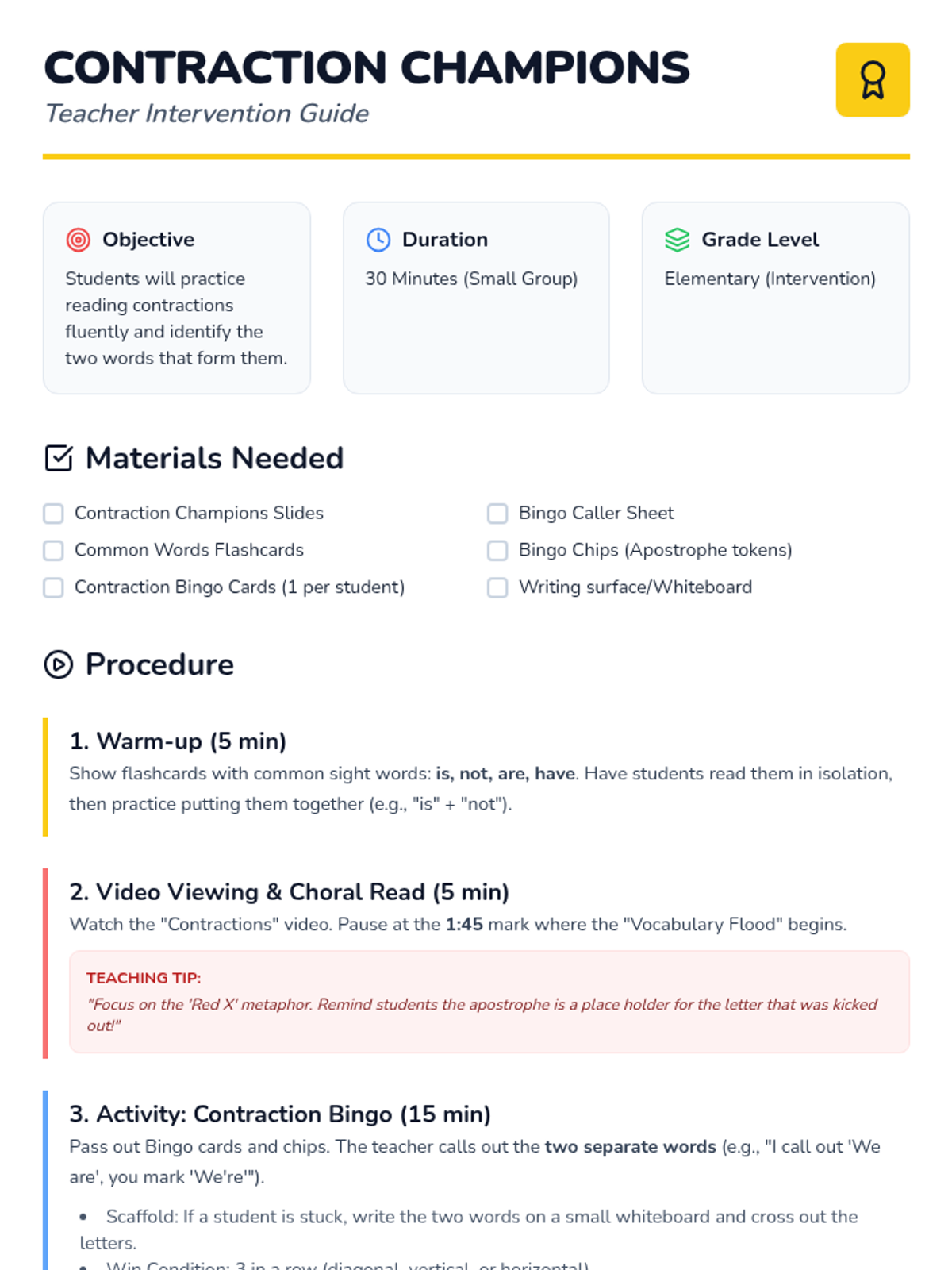
A teacher guide for the Contraction Champions intervention lesson, including materials checklist, procedure, and discussion anchors.
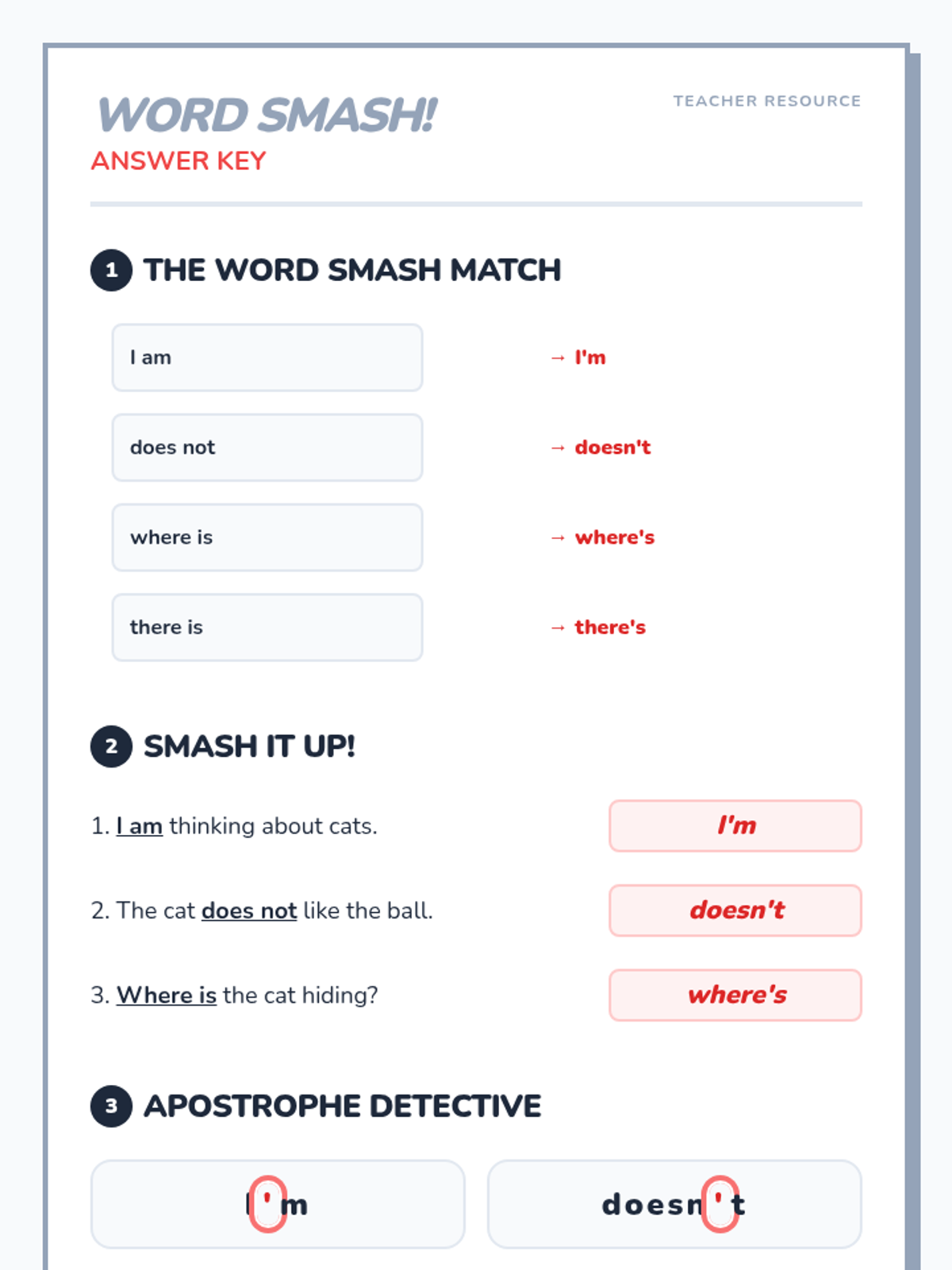
Teacher answer key for the 'Word Smash' contractions worksheet, providing the correct matching pairs, written contractions, and identifying the correct placement of the apostrophe.
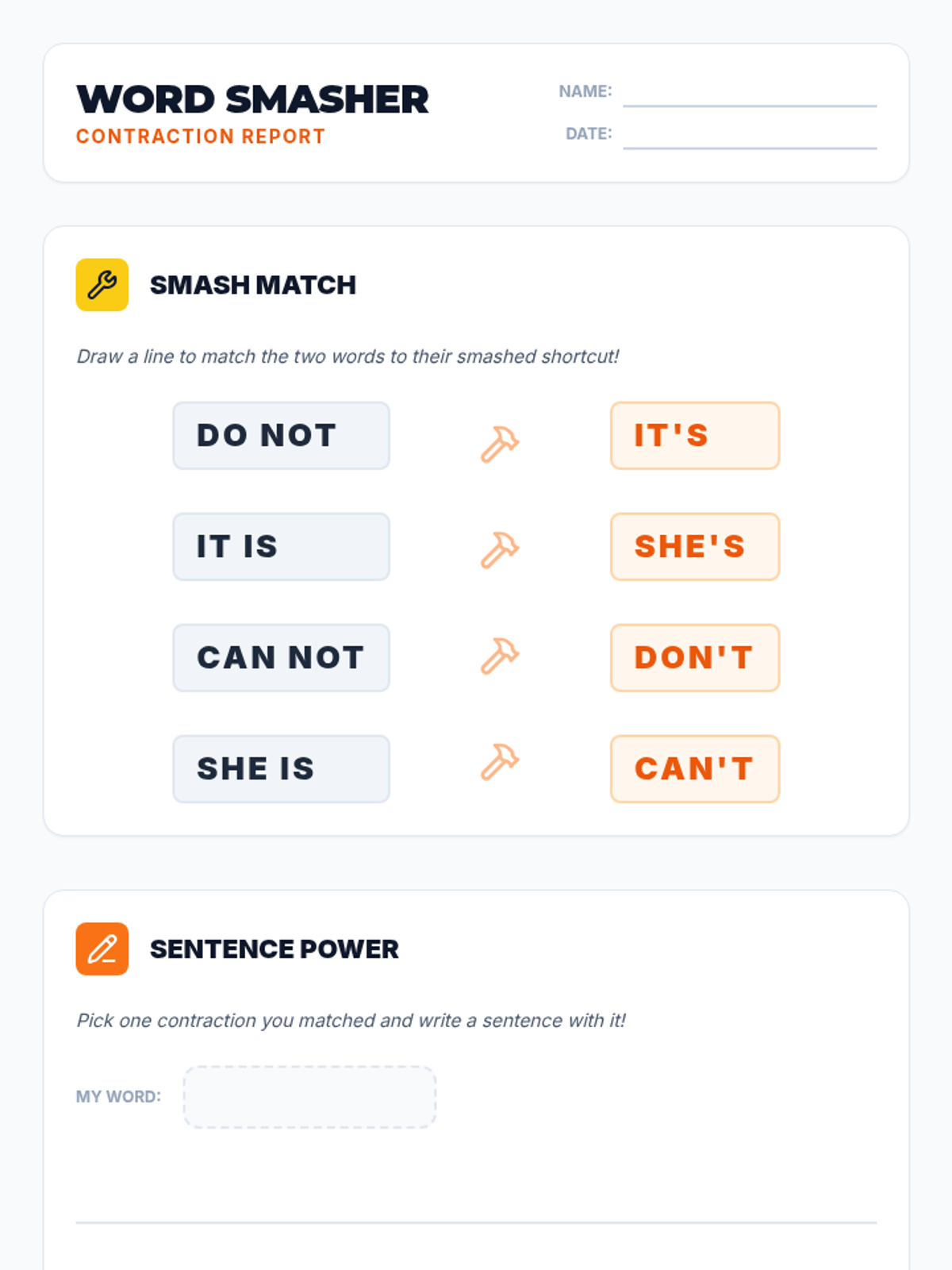
A student worksheet for the Smash Words lesson featuring a matching activity and a space for constructing a sentence using a contraction.
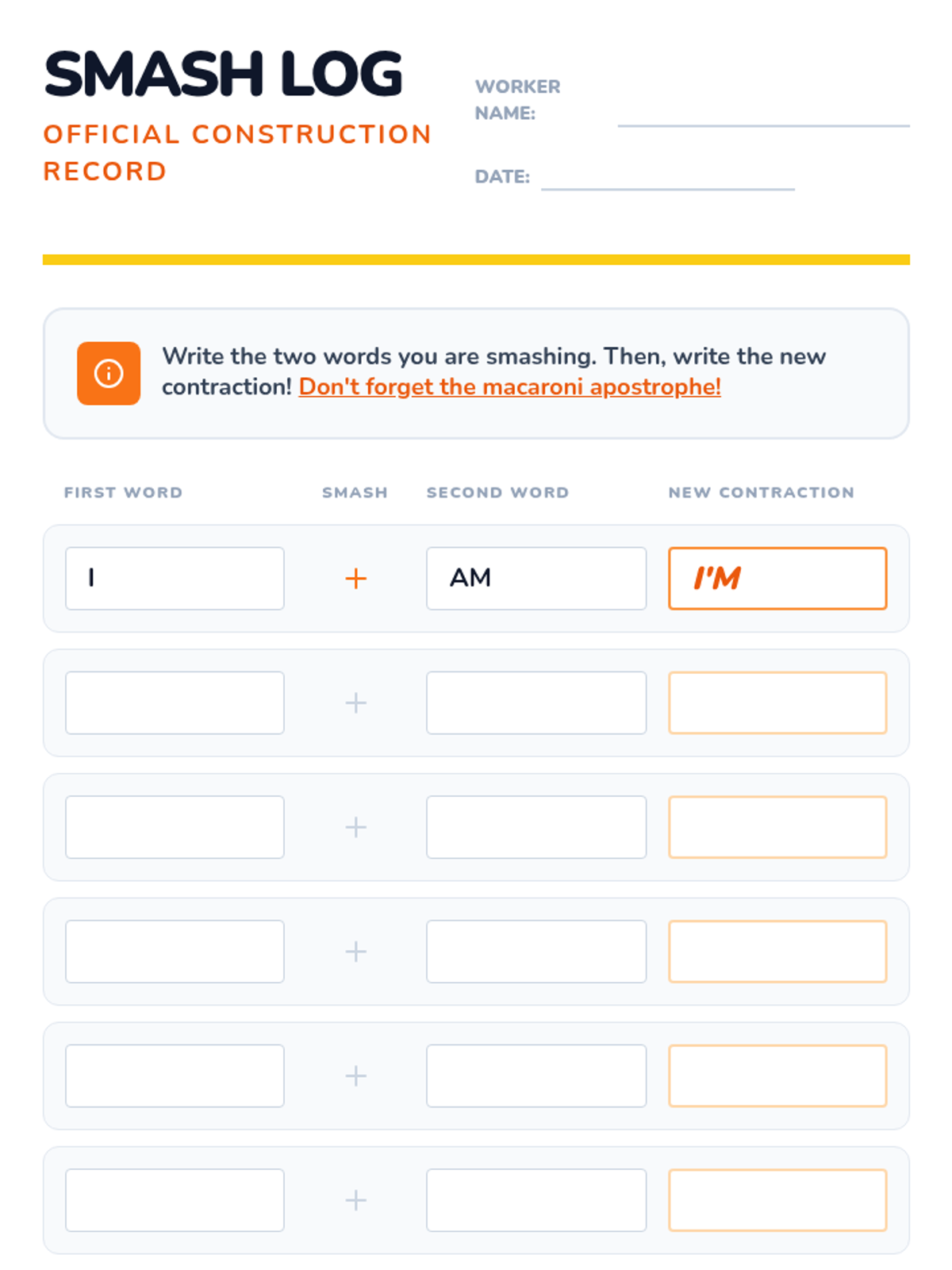
A student worksheet for recording word pairs and their corresponding contractions during the playdough smash activity.
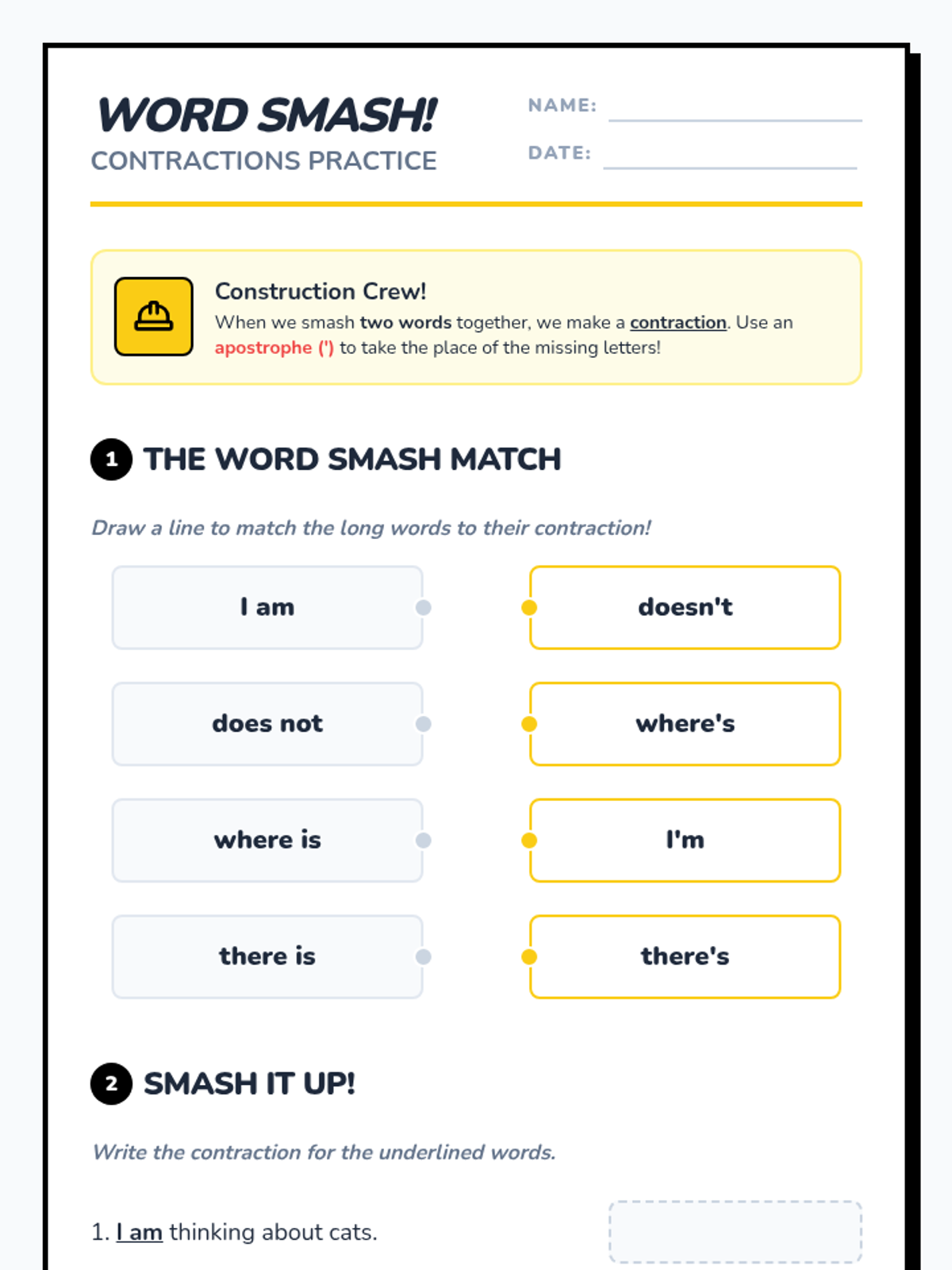
A construction-themed worksheet for 1st-grade students to practice contractions. Includes matching full words to contractions, writing contractions for underlined words in sentences, and identifying the apostrophe.
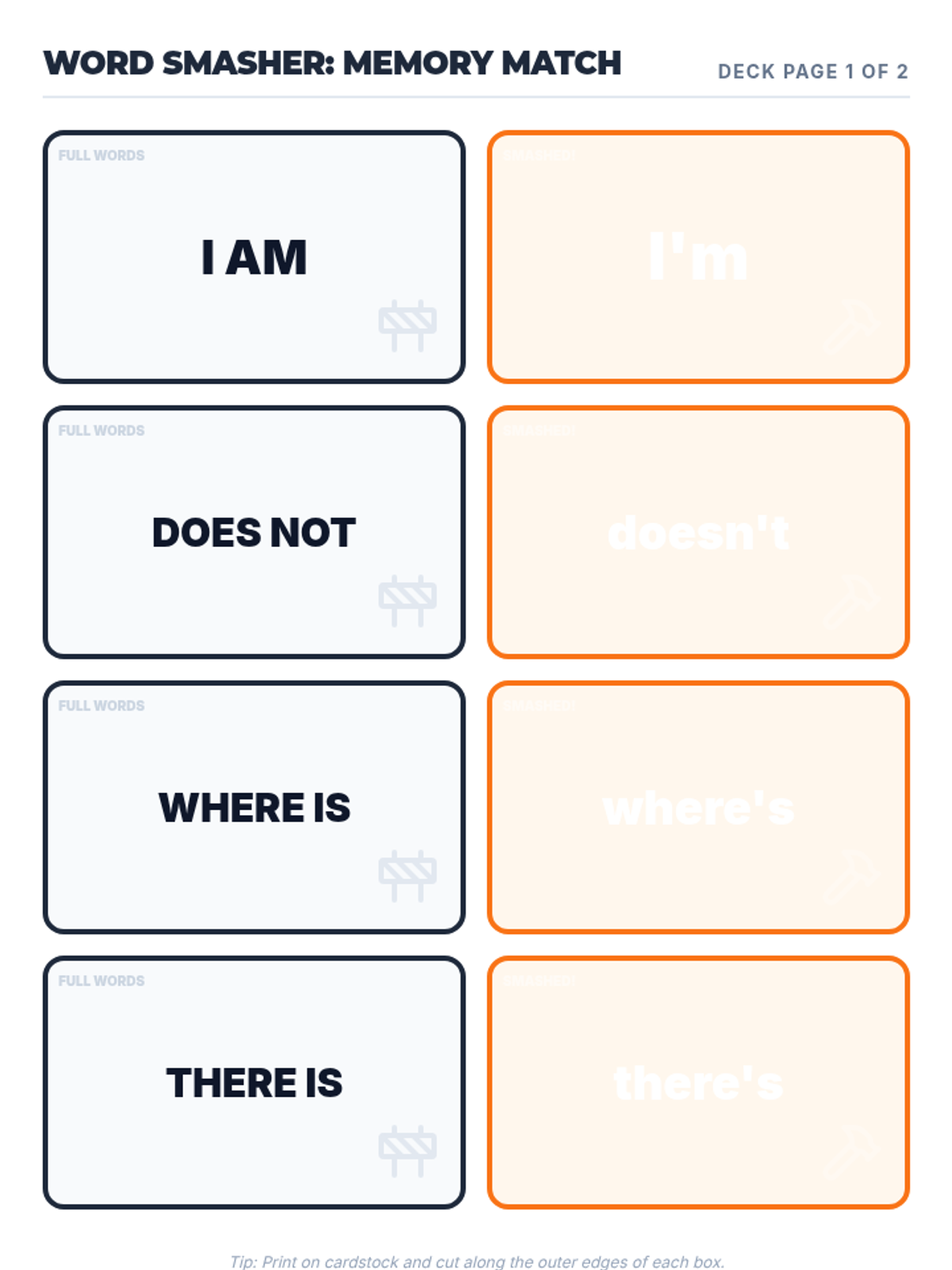
Printable memory match cards for the Smash Words lesson. Includes 8 pairs of contractions and their full words with distinct visual styles for 'Full Words' and 'Smashed' versions.
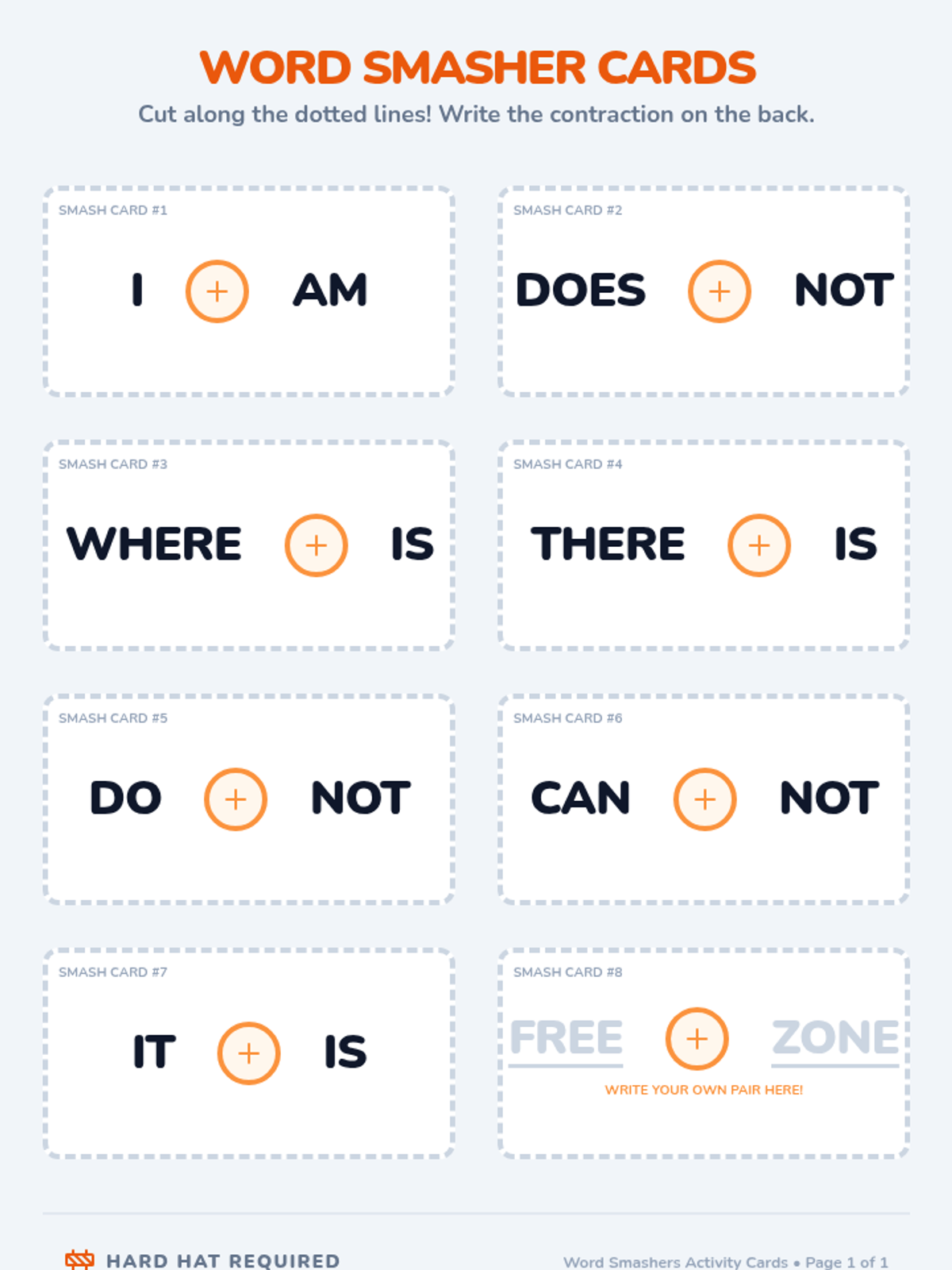
Printable word cards for students to cut out and use during the Contraction Smash playdough activity, featuring pairs from the video and common extras.
A vibrant instructional slide deck for Lesson 7 (Wetland Wonderland), focusing on sight words (play, your, said, help, friend) and reading fluency for grades 1-3. Minimum text size 24px.
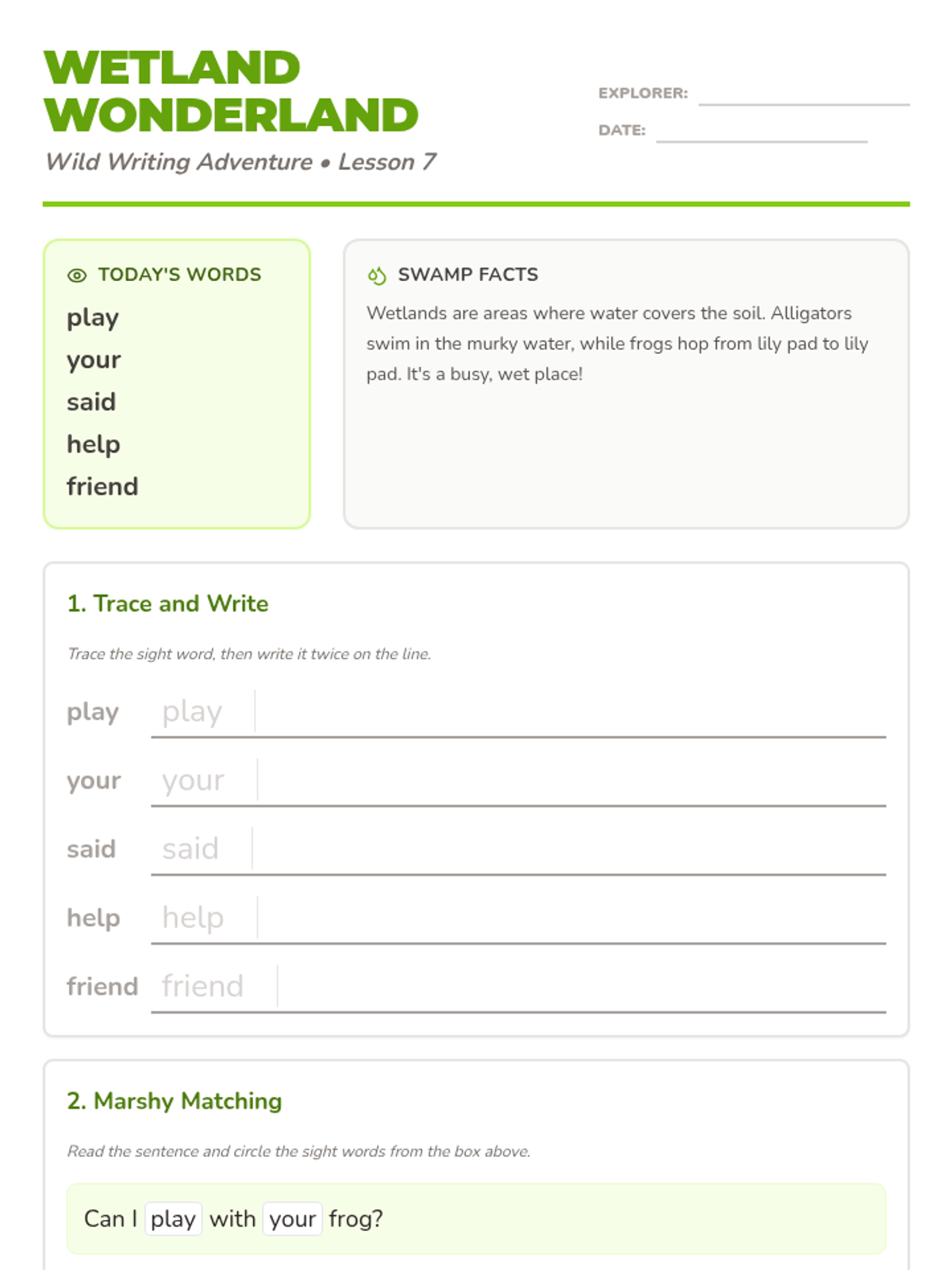
A 4-page student workbook for Lesson 7 (Wetland Wonderland), featuring swamp-themed literacy activities, high-visibility writing lines, and child-friendly Nunito font. Designed with strict page formatting.
A strictly black and white, high-contrast graphic organizer for instructional writing using sequence words. Features large writing areas and zero gray tones for maximum printer-friendliness on 8.5x11 paper.
An instructional slide deck teaching students how to write sequence-based instructional paragraphs. NOW PRINTER FRIENDLY!
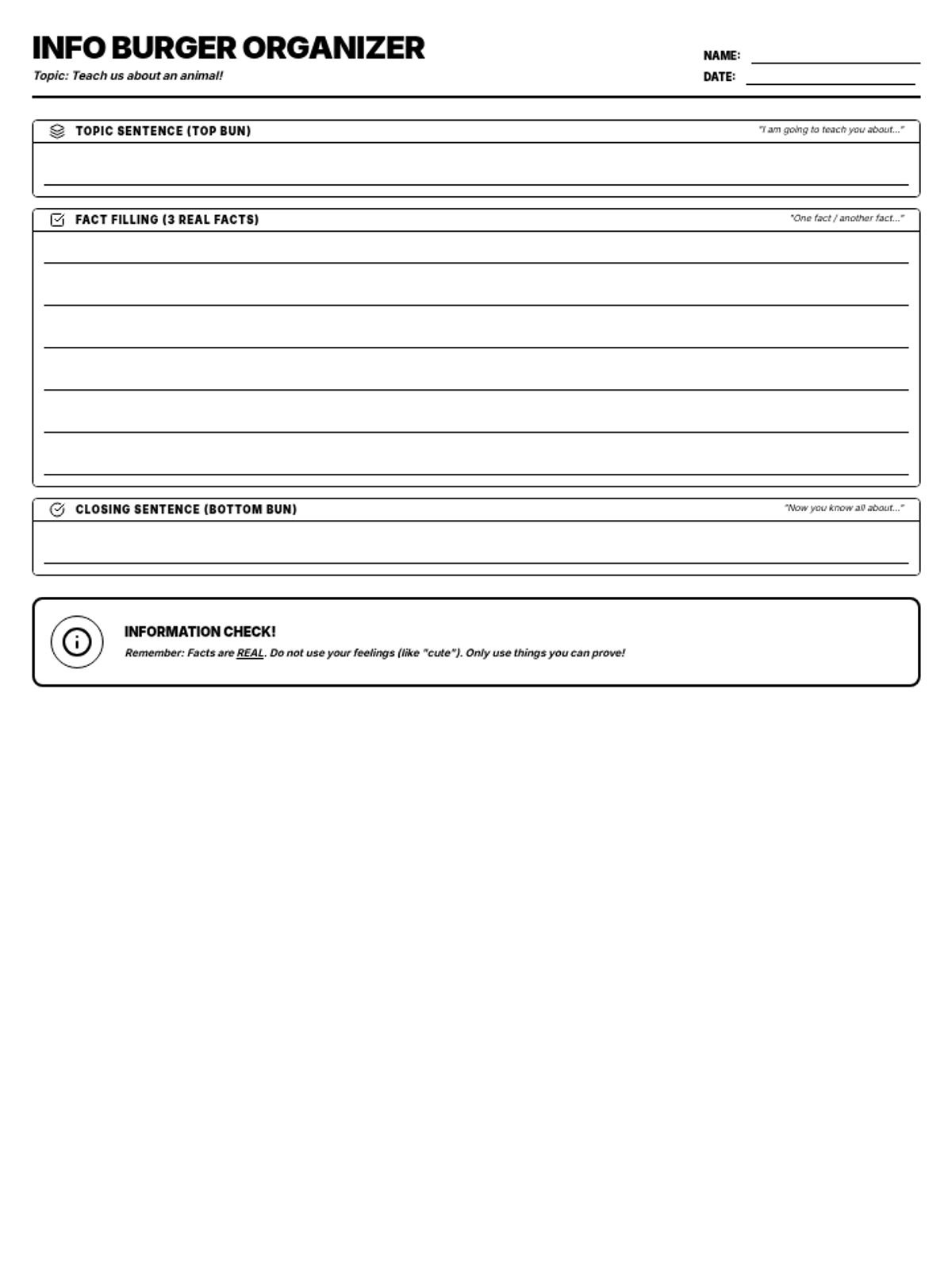
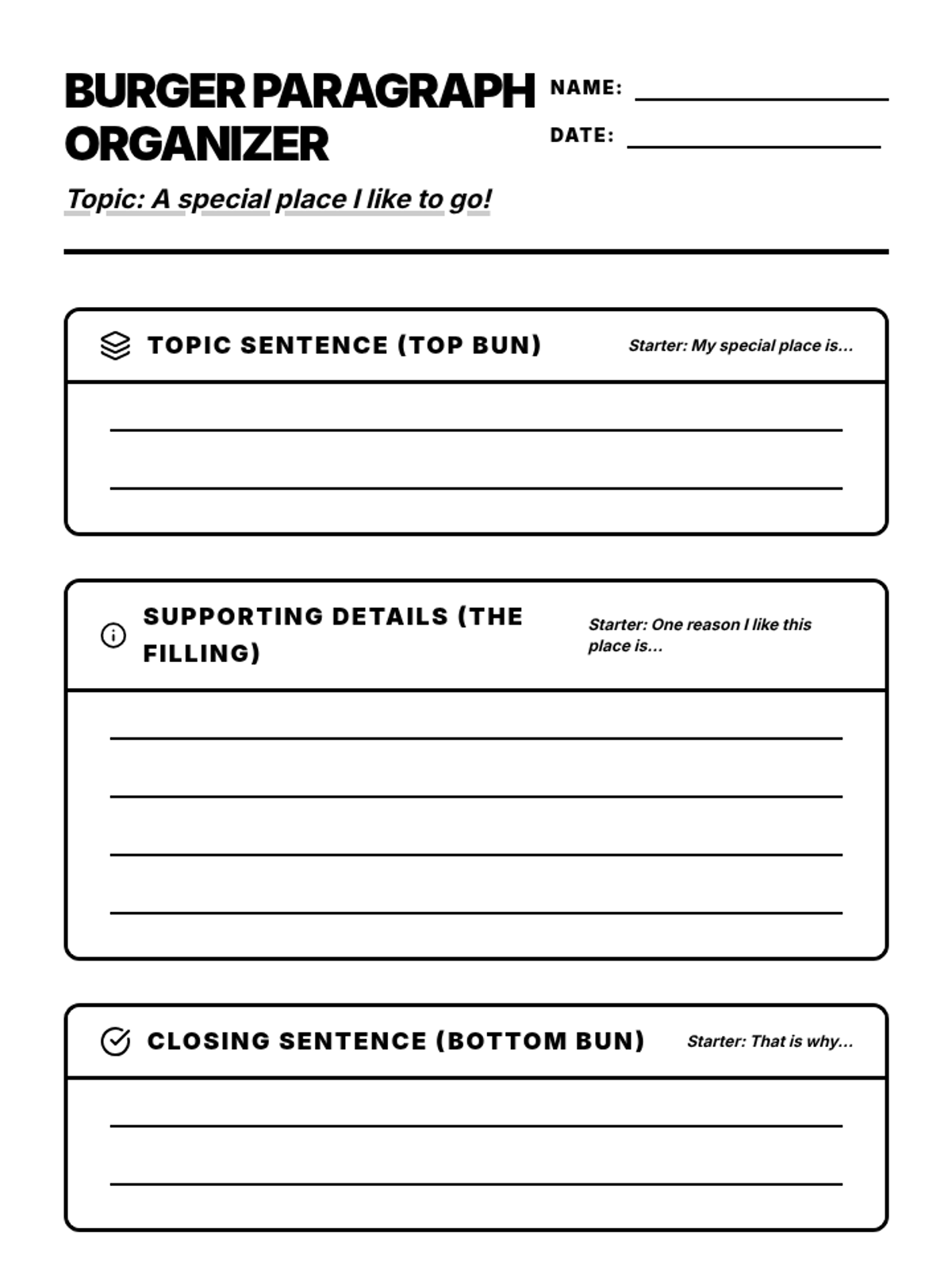
A strictly black and white, high-contrast graphic organizer for informational paragraph writing using the Burger analogy. Features completely blank writing areas and zero gray tones for maximum printer-friendliness on 8.5x11 paper.
A presentation teaching students how to apply the burger paragraph structure to informational writing using facts. NOW PRINTER FRIENDLY!
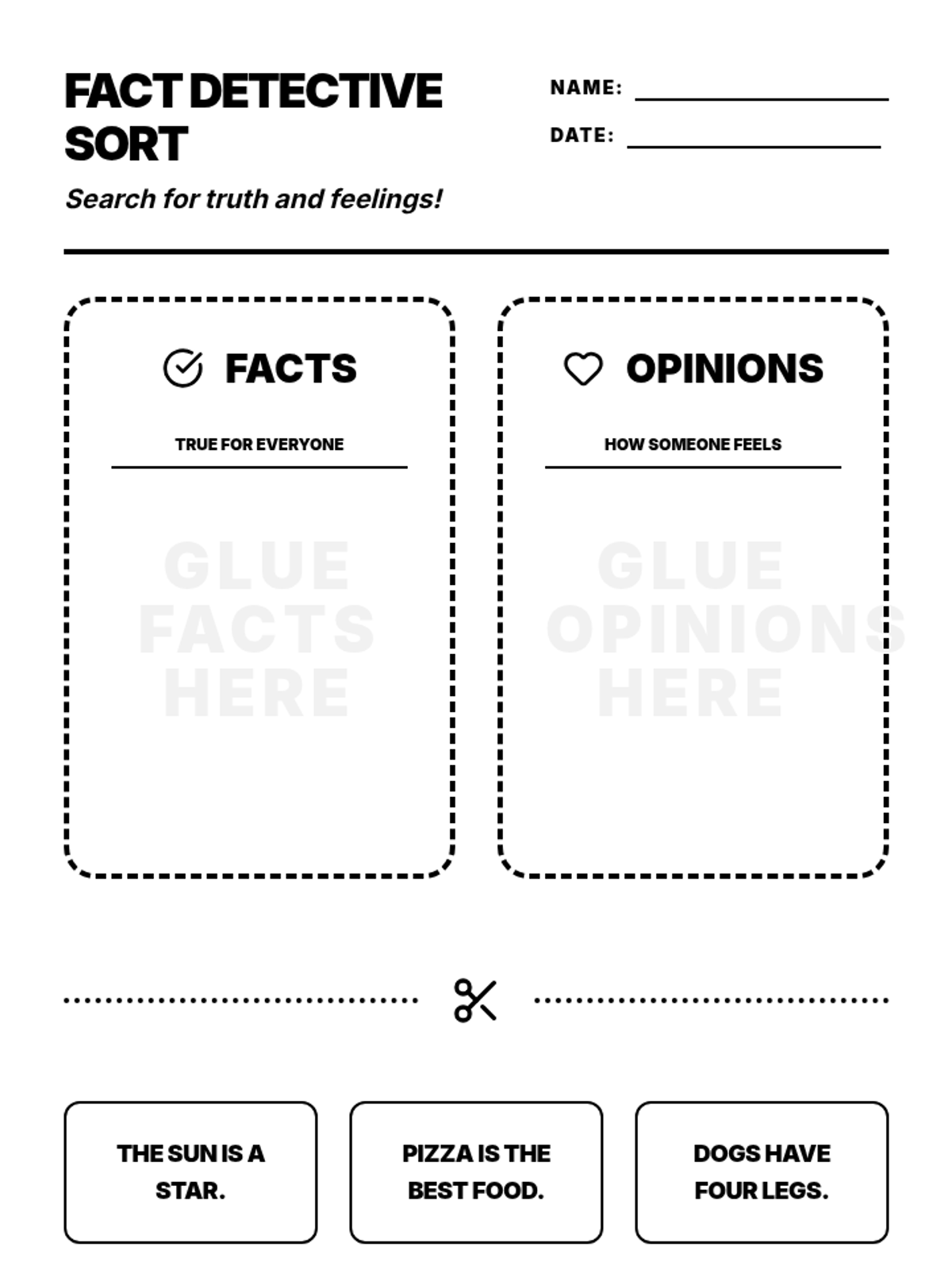
A printer-friendly cut-and-paste sorting activity where students categorize statements as facts or opinions. Strictly black and white with no gray tones for maximum 8.5x11 printer-friendliness.
A slide deck introducing the difference between facts and opinions to help students identify informational text elements. NOW PRINTER FRIENDLY!
A visually engaging, cute presentation introducing the Burger Paragraph method to help SpEd students understand the structure of a paragraph. NOW PRINTER FRIENDLY!
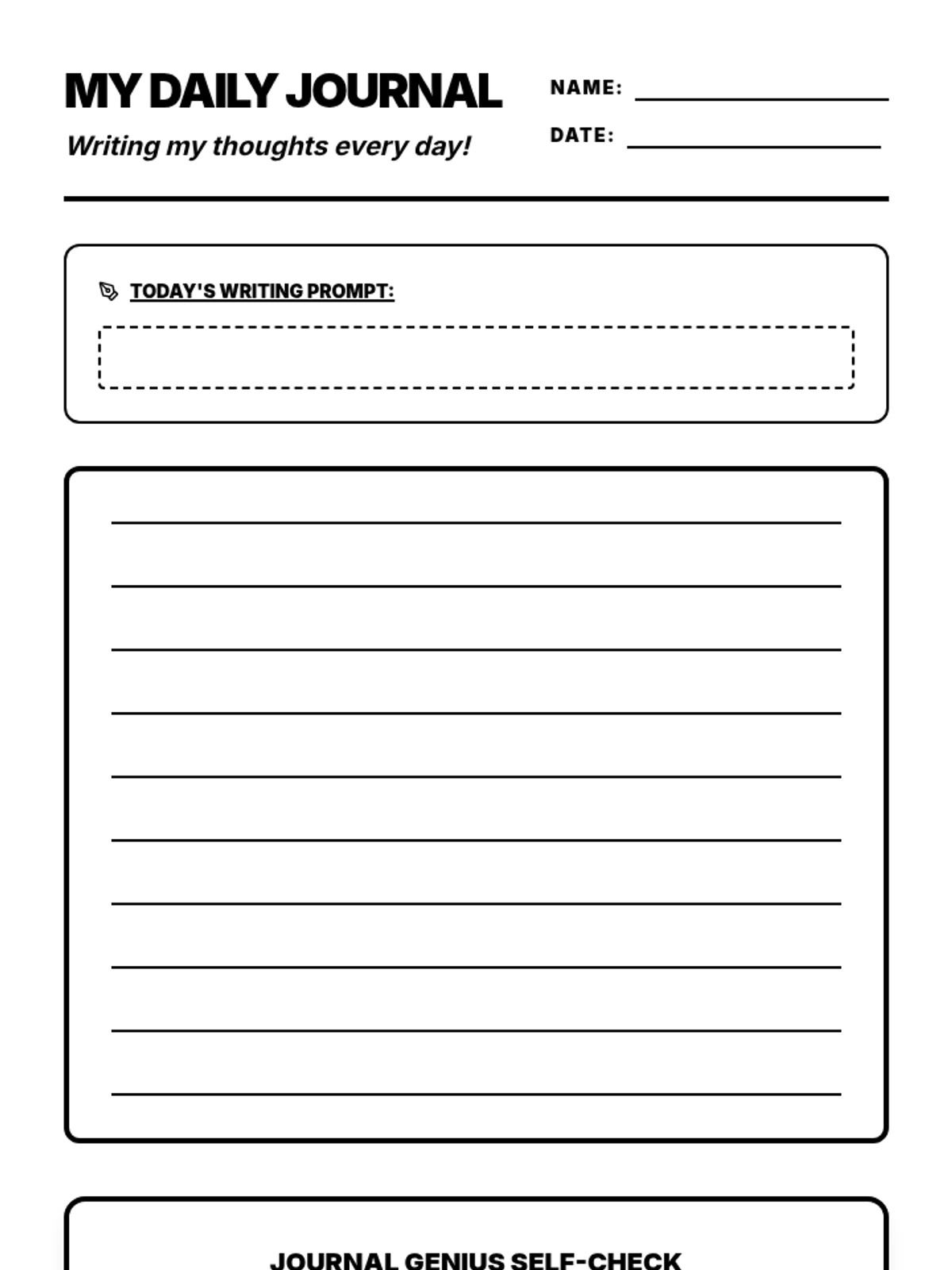
A printer-friendly daily journal template for independent writing with a built-in visual self-check rubric for paragraph structure and mechanics. Strictly black and white with no gray tones for maximum 8.5x11 printer-friendliness.
A presentation teaching students how to write in a journal using a prompt and a self-check list. NOW PRINTER FRIENDLY!
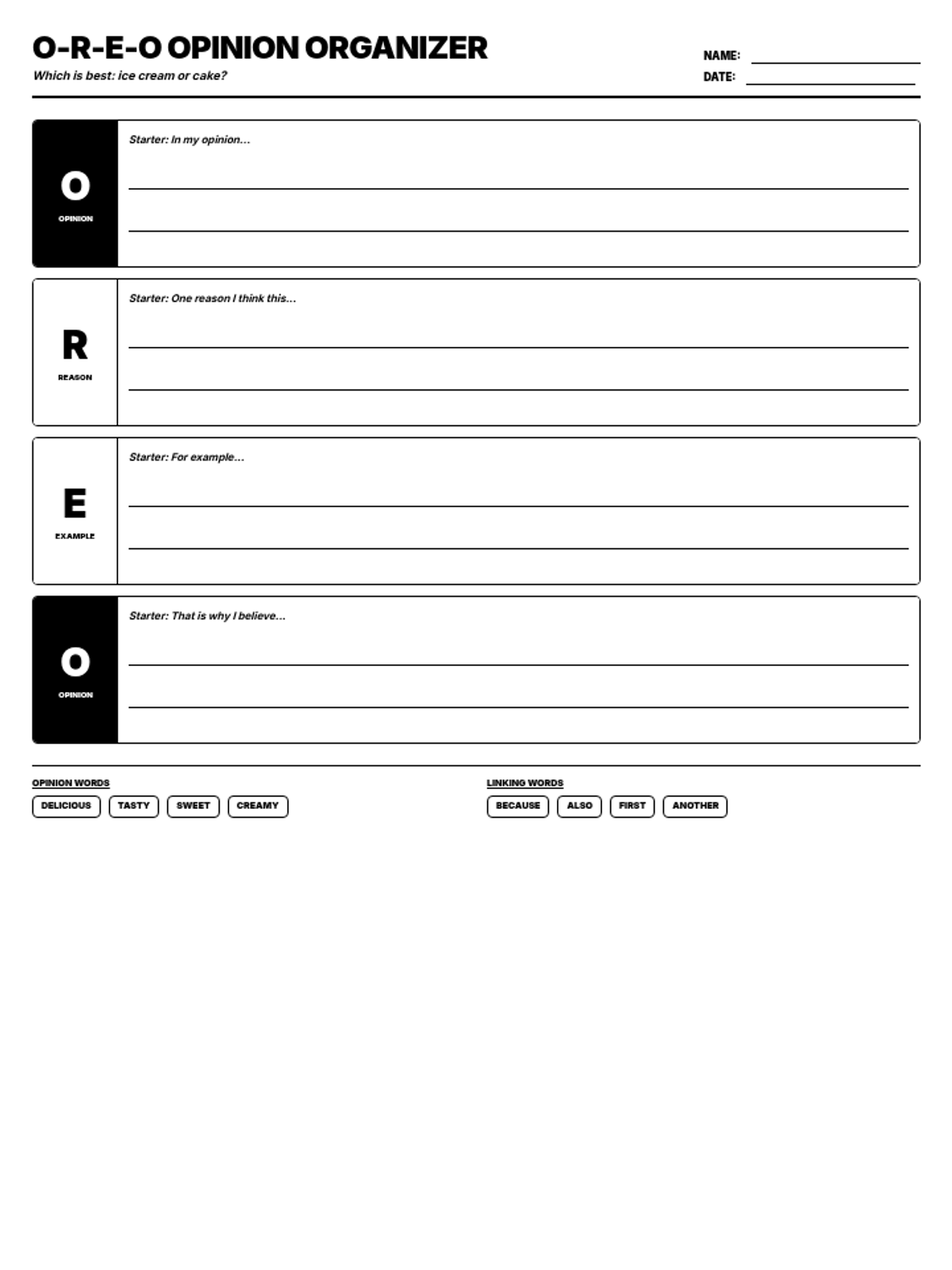
An OREO graphic organizer to help students structure an opinion paragraph about desserts. Strictly black and white with zero gray tones for maximum printer-friendliness on 8.5x11 paper.
A presentation teaching students how to express opinions and support them using the OREO method. NOW PRINTER FRIENDLY!
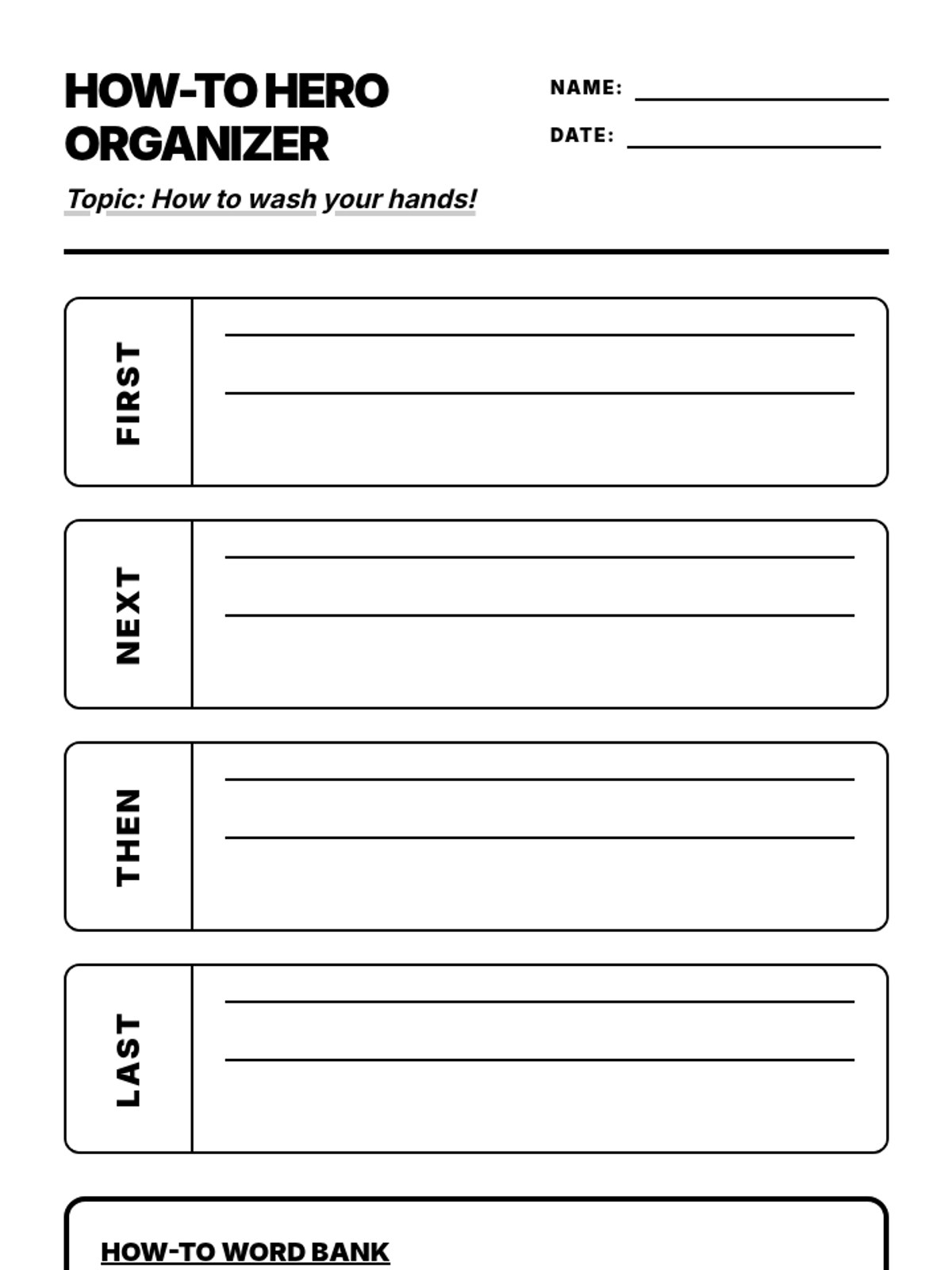
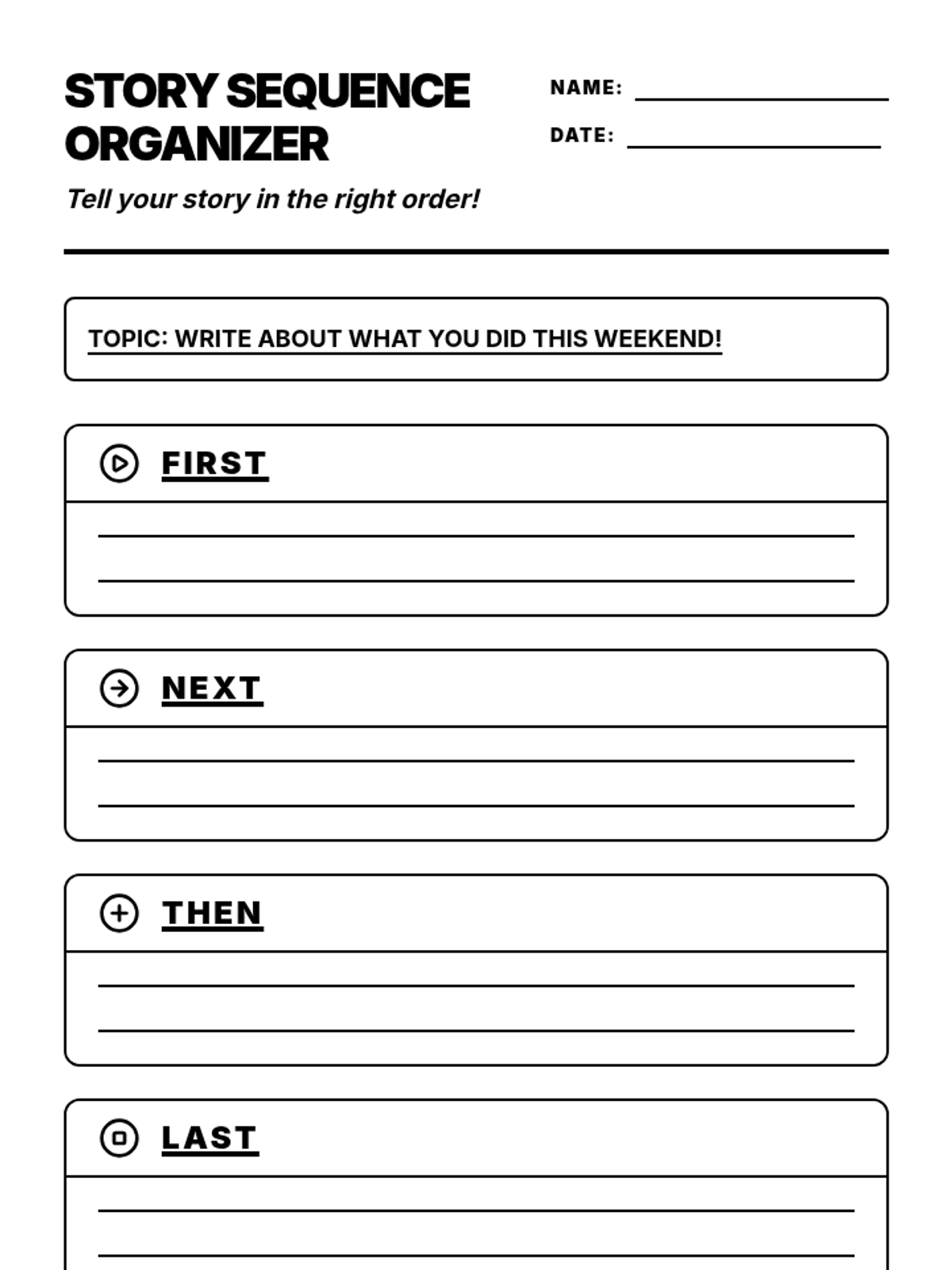
A strictly black and white, high-contrast, professional-grade graphic organizer for narrative sequencing. Features large, clear sections for First, Next, Then, and Last with generous writing lines and a word bank. Optimized for 8.5x11 printing.
An instructional presentation teaching students how to use transition words to sequence a story. NOW PRINTER FRIENDLY!
A strictly black and white, high-contrast graphic organizer for paragraph writing using the Burger analogy. Features completely blank writing areas and zero gray tones for maximum printer-friendliness on 8.5x11 paper.
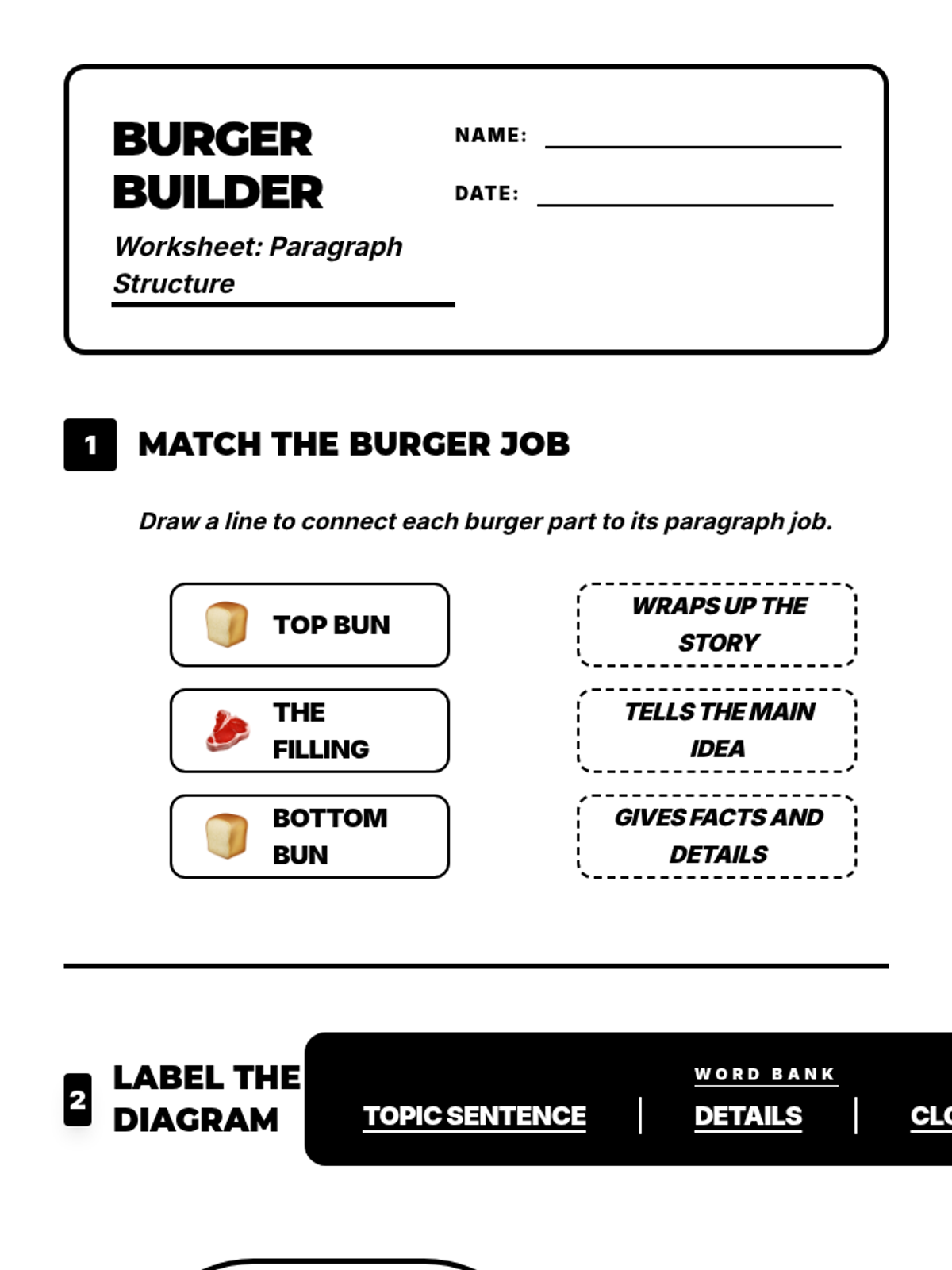
A strictly black and white, high-contrast, professional-grade worksheet for matching burger parts to paragraph jobs. Features a numbered diagram with completely blank writing areas for assessment. Optimized for 8.5x11 printing.
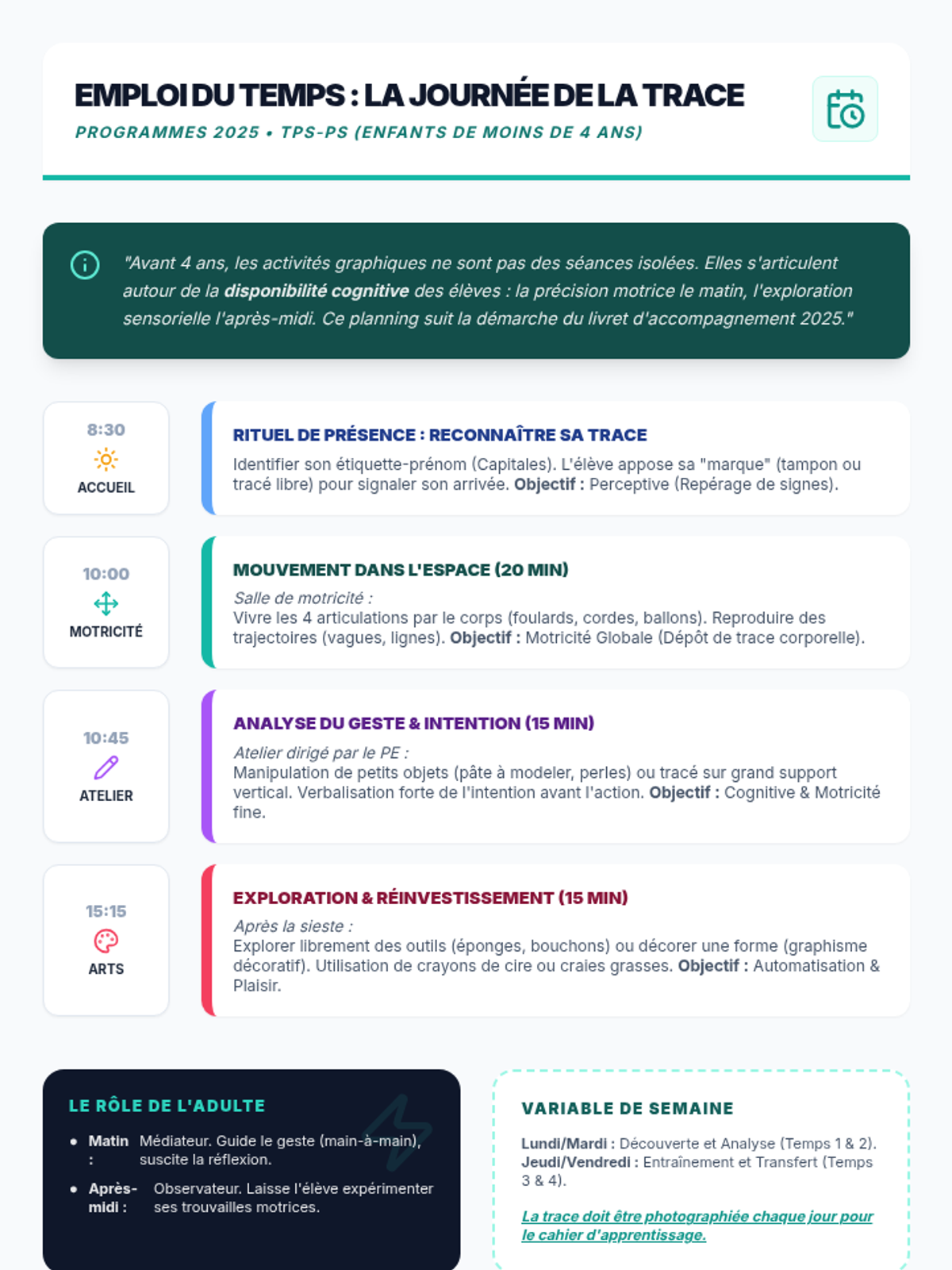
Emploi du temps type pour une journée en TPS-PS centrée sur les activités graphiques. Répartit les séances de motricité globale, de motricité fine et d'exploration sensorielle selon les préconisations du livret d'accompagnement 2025.
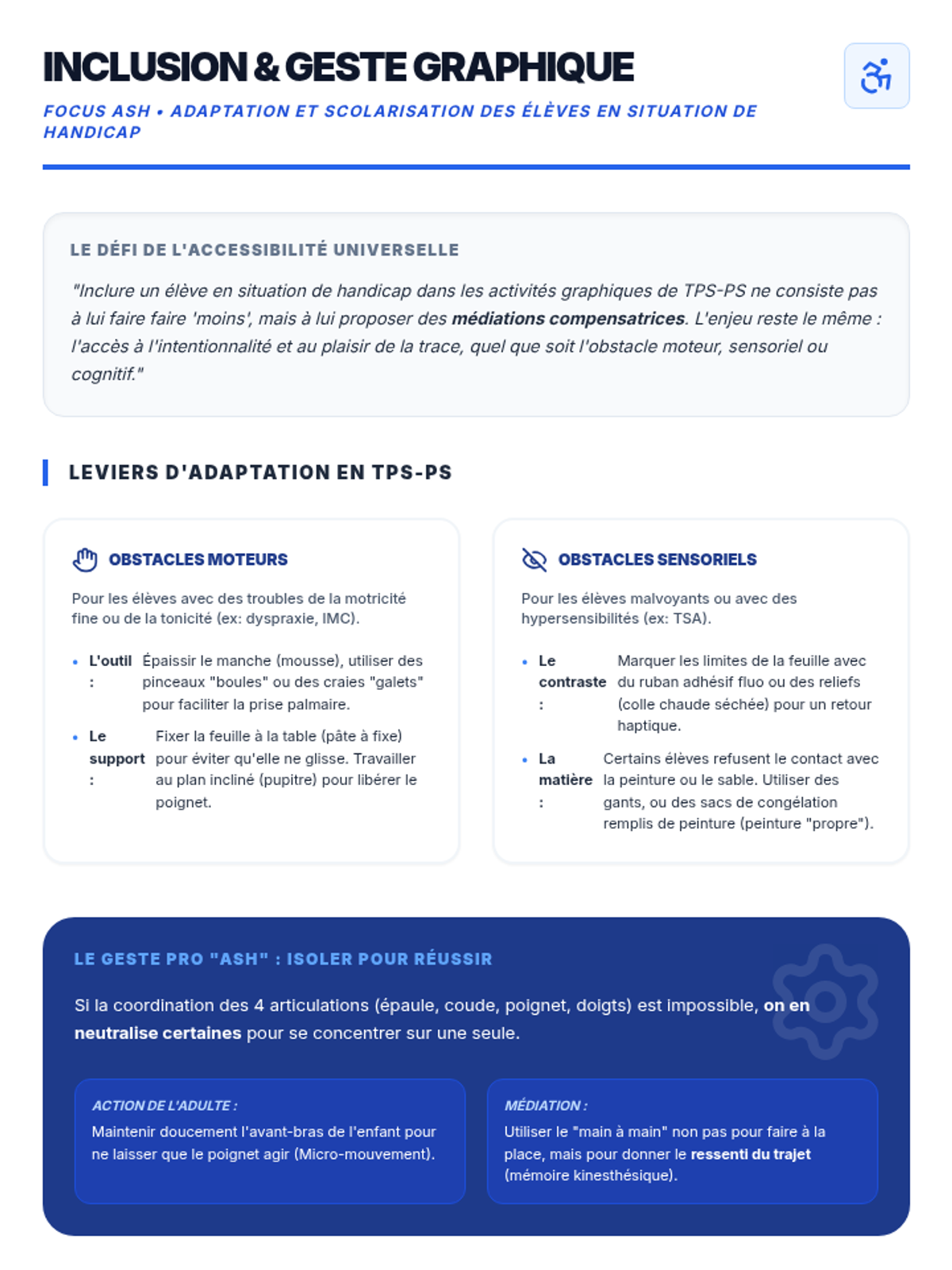
Ressource d'expertise sur l'adaptation des activités graphiques pour les élèves en situation de handicap (ASH) en maternelle. Propose des compensations motrices, sensorielles et cognitives pour garantir l'inclusion dans la construction du geste.
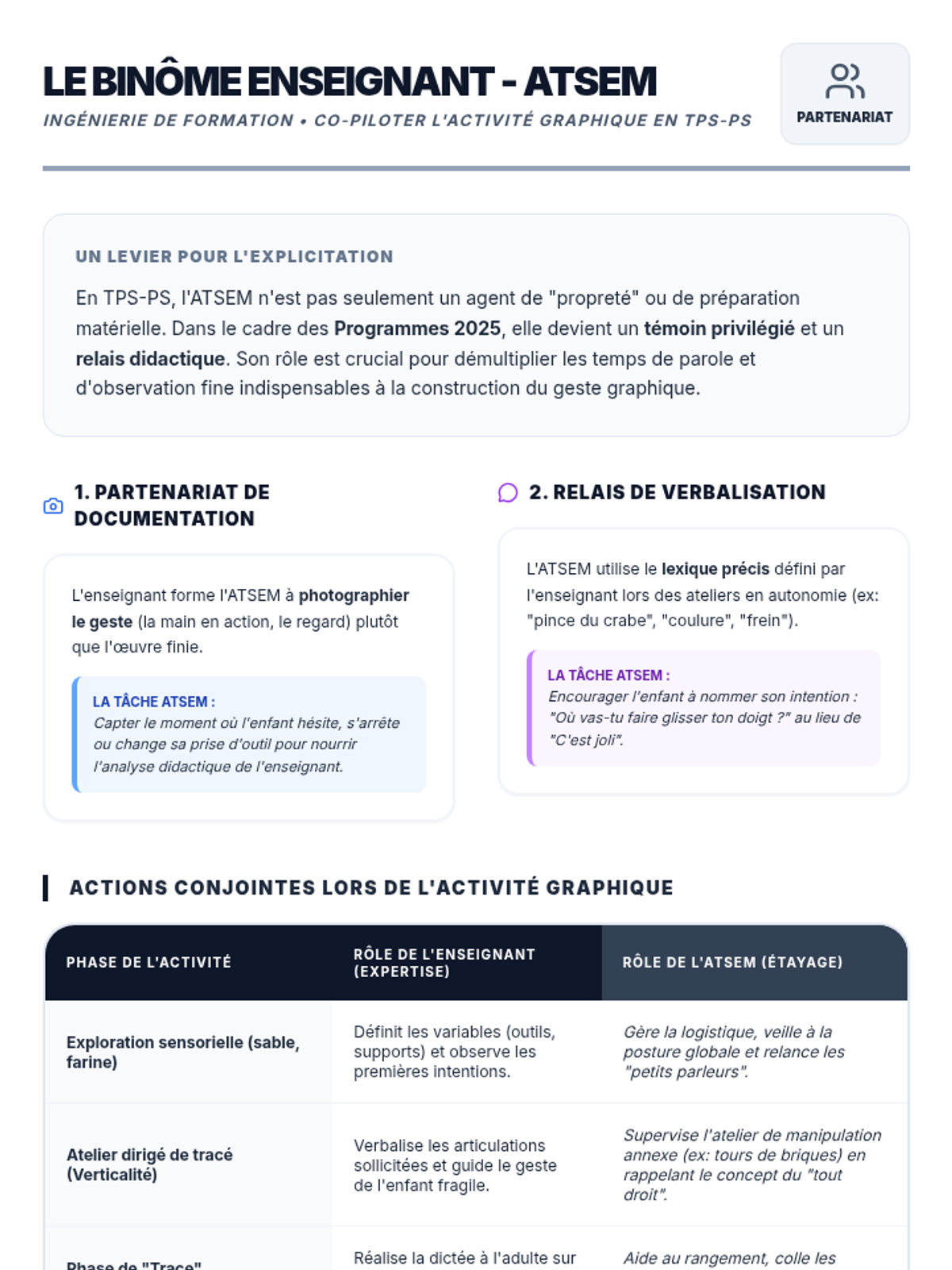
Guide méthodologique sur la collaboration entre l'enseignant et l'ATSEM en maternelle (TPS-PS) lors des activités graphiques. Définit les rôles respectifs pour l'observation, la verbalisation et la gestion de la trace selon les nouveaux programmes.
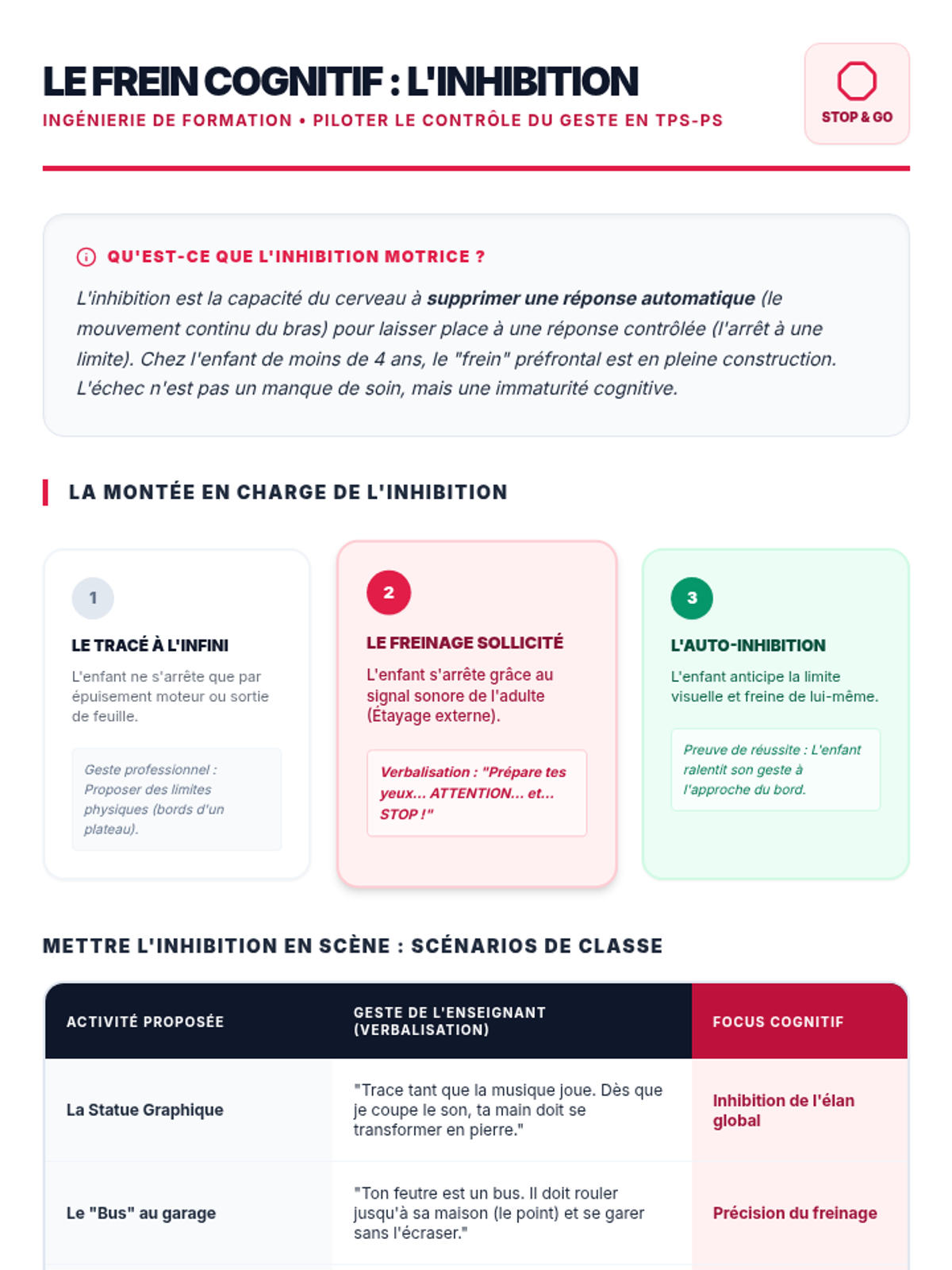
Note d'expertise ciblée sur la fonction d'inhibition dans le geste graphique chez les élèves de maternelle (TPS-PS). Analyse les stades de développement du freinage moteur et propose des scénarios pédagogiques pour le renforcer.
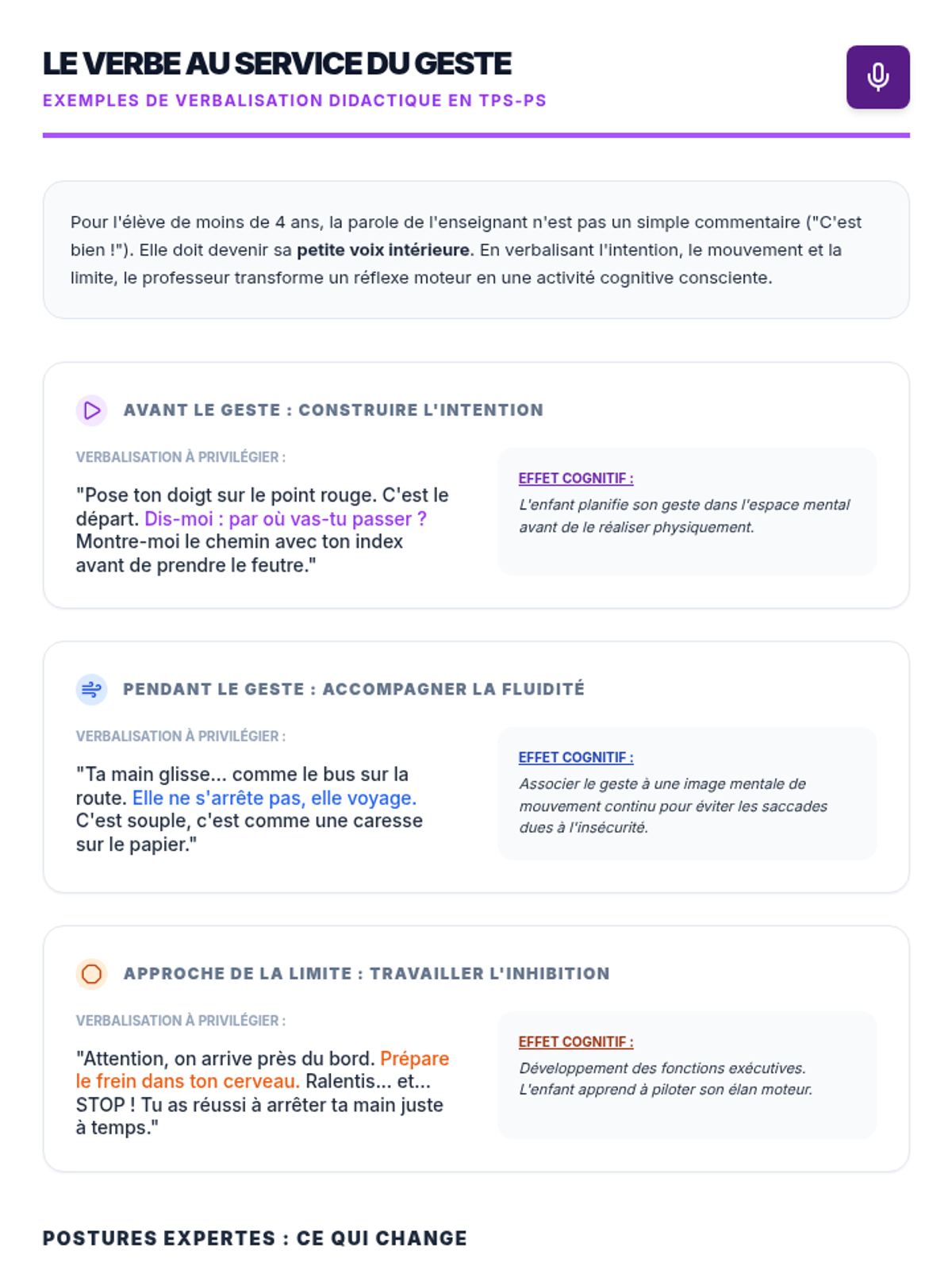
Guide de verbalisation didactique pour les enseignants de TPS-PS. Propose des scénarios concrets de prise de parole pour accompagner les étapes cognitives du geste graphique (intentionnalité, fluidité, inhibition).
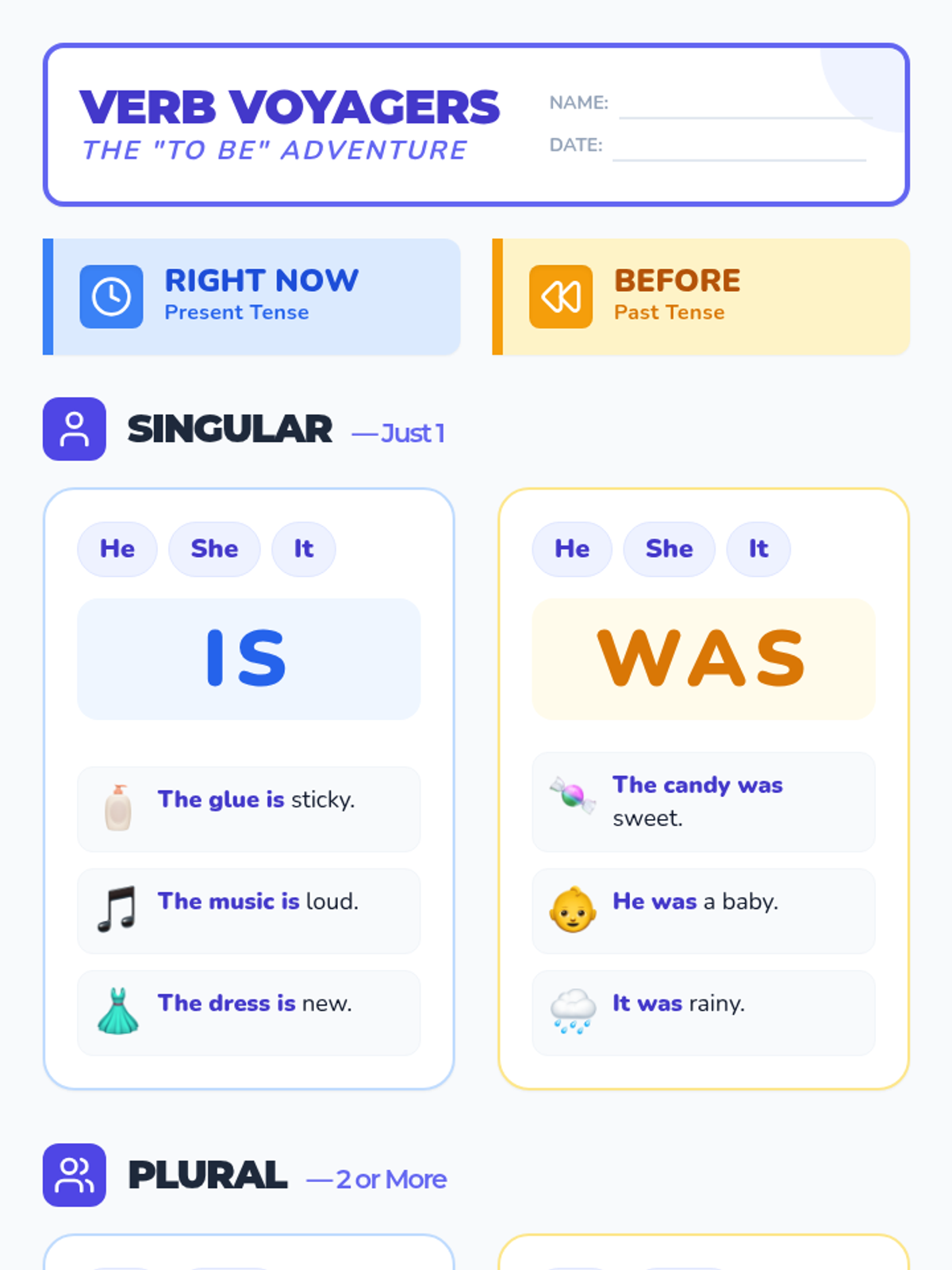
A condensed version of the Verb Voyagers anchor chart, removing student information sections and adjusting spacing and font sizes to ensure it fits perfectly on a single printable page.
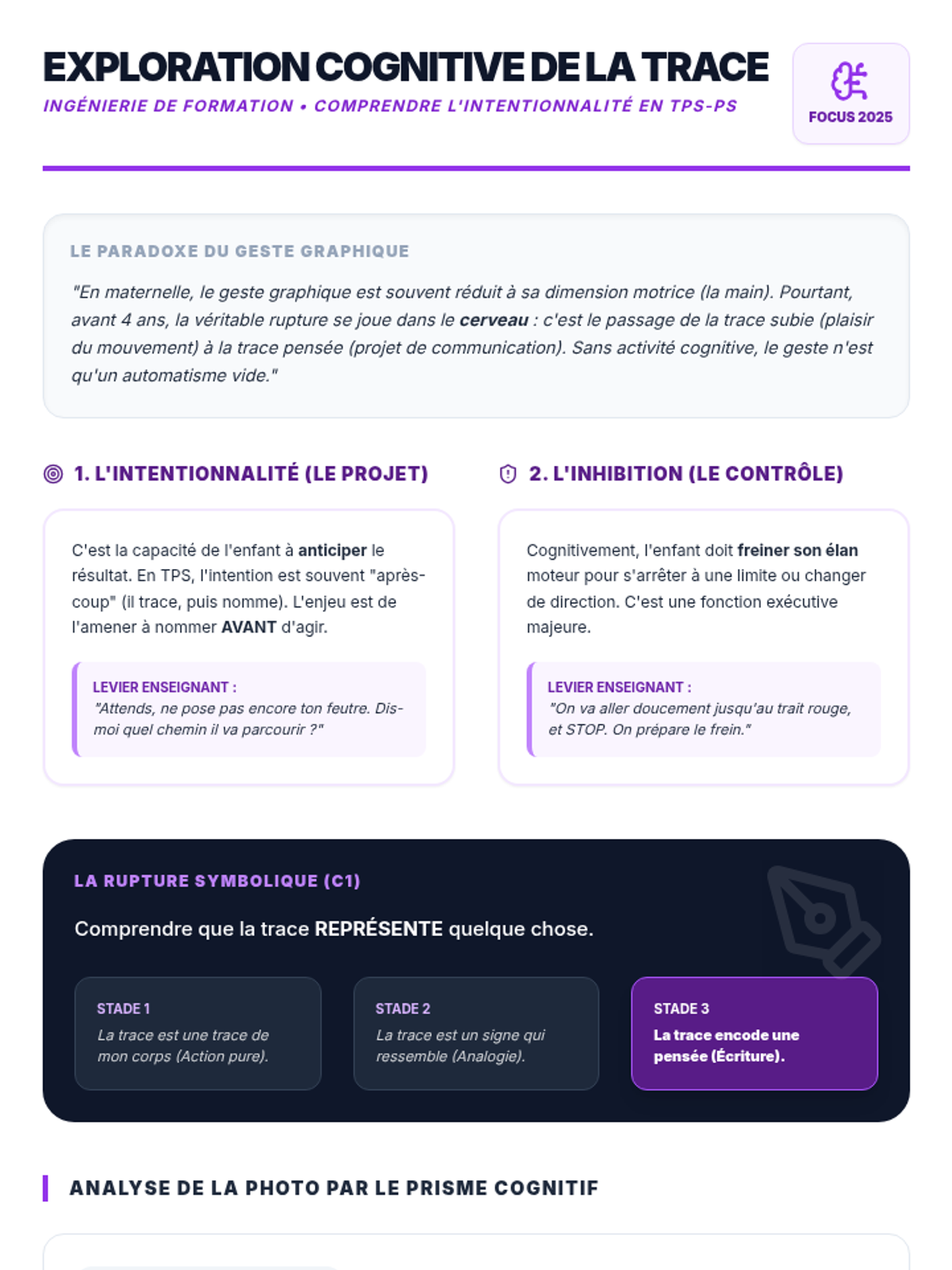
Ressource d'expertise approfondie sur les processus cognitifs engagés dans le geste graphique chez les enfants de moins de 4 ans (TPS-PS). Détaille l'intentionnalité, l'inhibition et la rupture symbolique pour guider l'observation des enseignants.
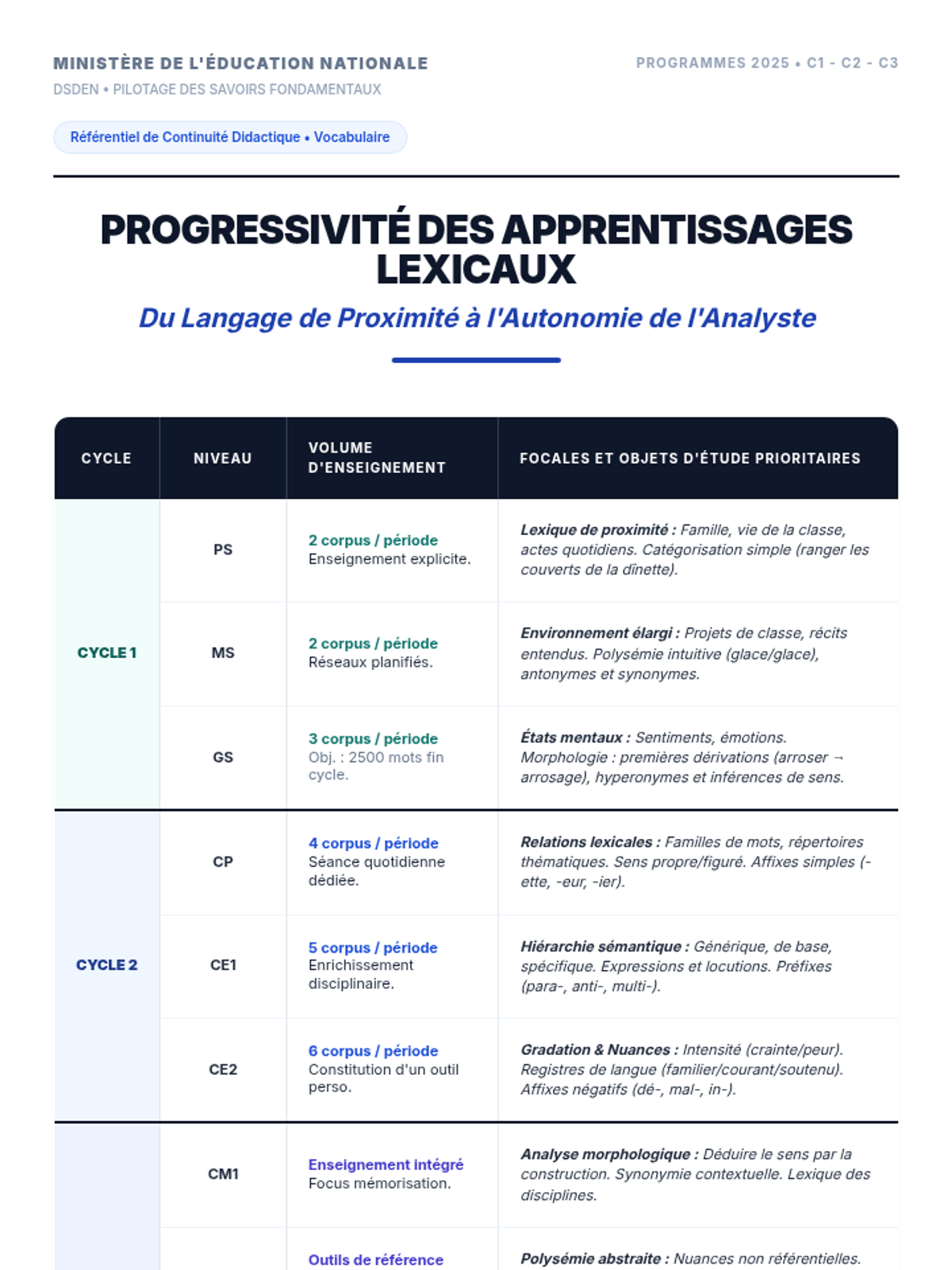
Note de synthèse comparative détaillant la progressivité de l'enseignement du vocabulaire du CP à la 6ème selon les programmes 2025. Elle structure la montée en charge des corpus de mots et le passage d'une découverte intuitive à une analyse morphologique et sémantique experte.
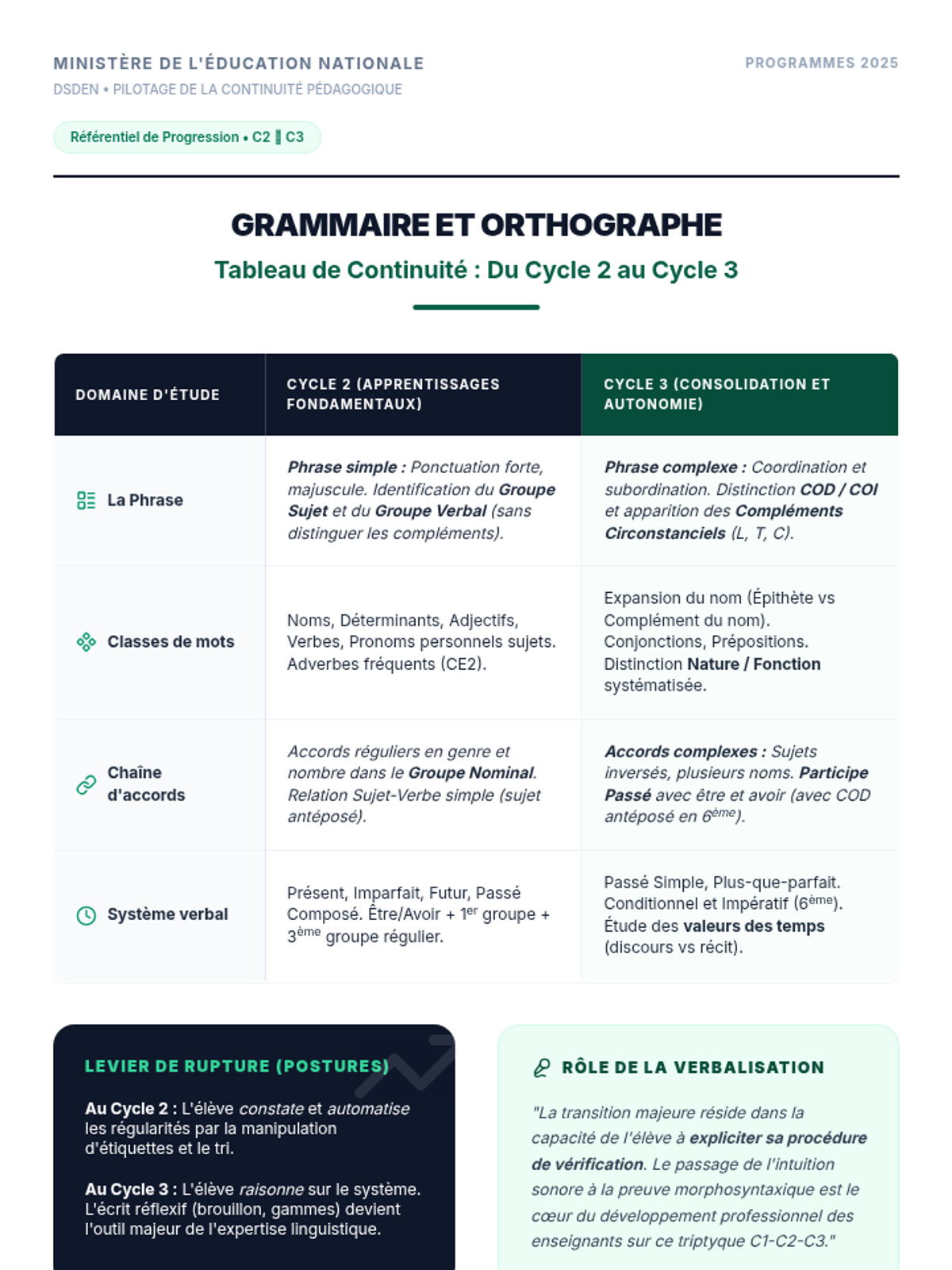
Note de synthèse comparative détaillant la progression des notions de grammaire et d'orthographe du Cycle 2 au Cycle 3 selon les programmes 2025. Elle met en évidence le passage de l'automatisation (C2) au raisonnement systémique (C3).
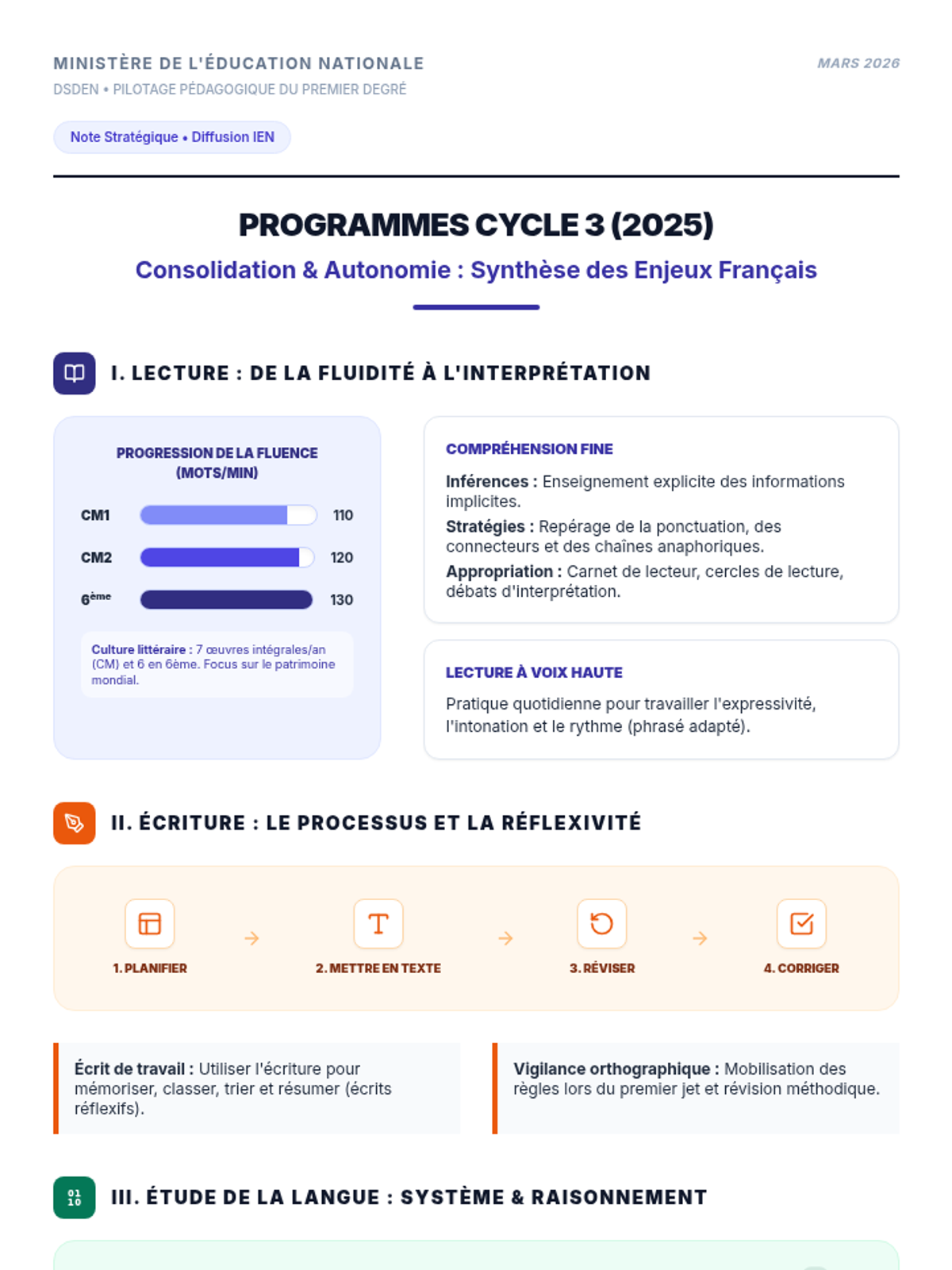
Note de synthèse institutionnelle récapitulant les orientations majeures des programmes Cycle 3 (2025) pour les IEN. Elle met en évidence la progression de la fluence, le processus d'écriture (planification/révision) et l'analyse systémique de la langue (phrase complexe, système verbal).
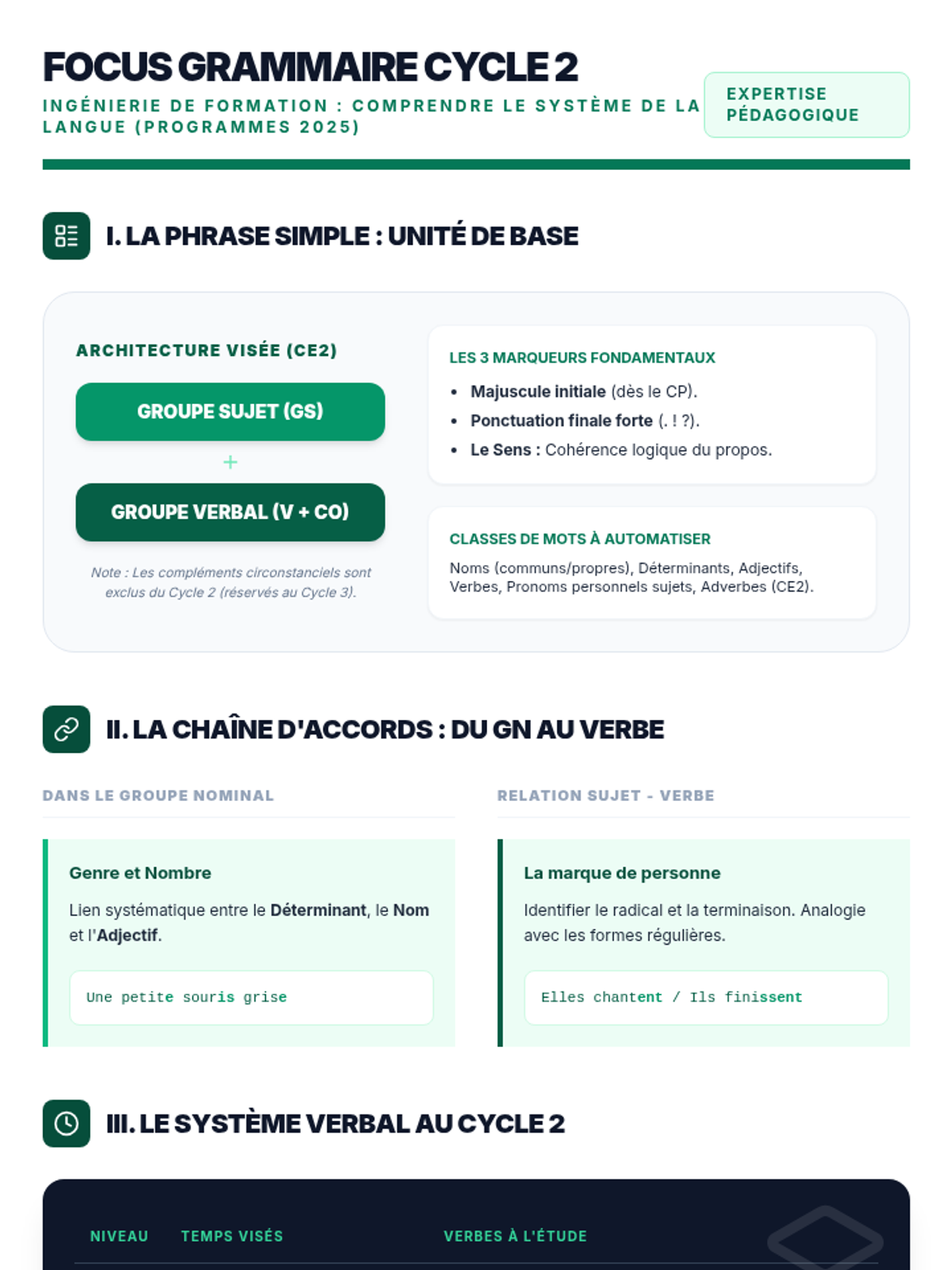
Guide d'expertise sur l'enseignement de la grammaire au Cycle 2 selon les programmes 2025. Détaille la structure de la phrase simple, les chaînes d'accords et la progression du système verbal du CP au CE2.
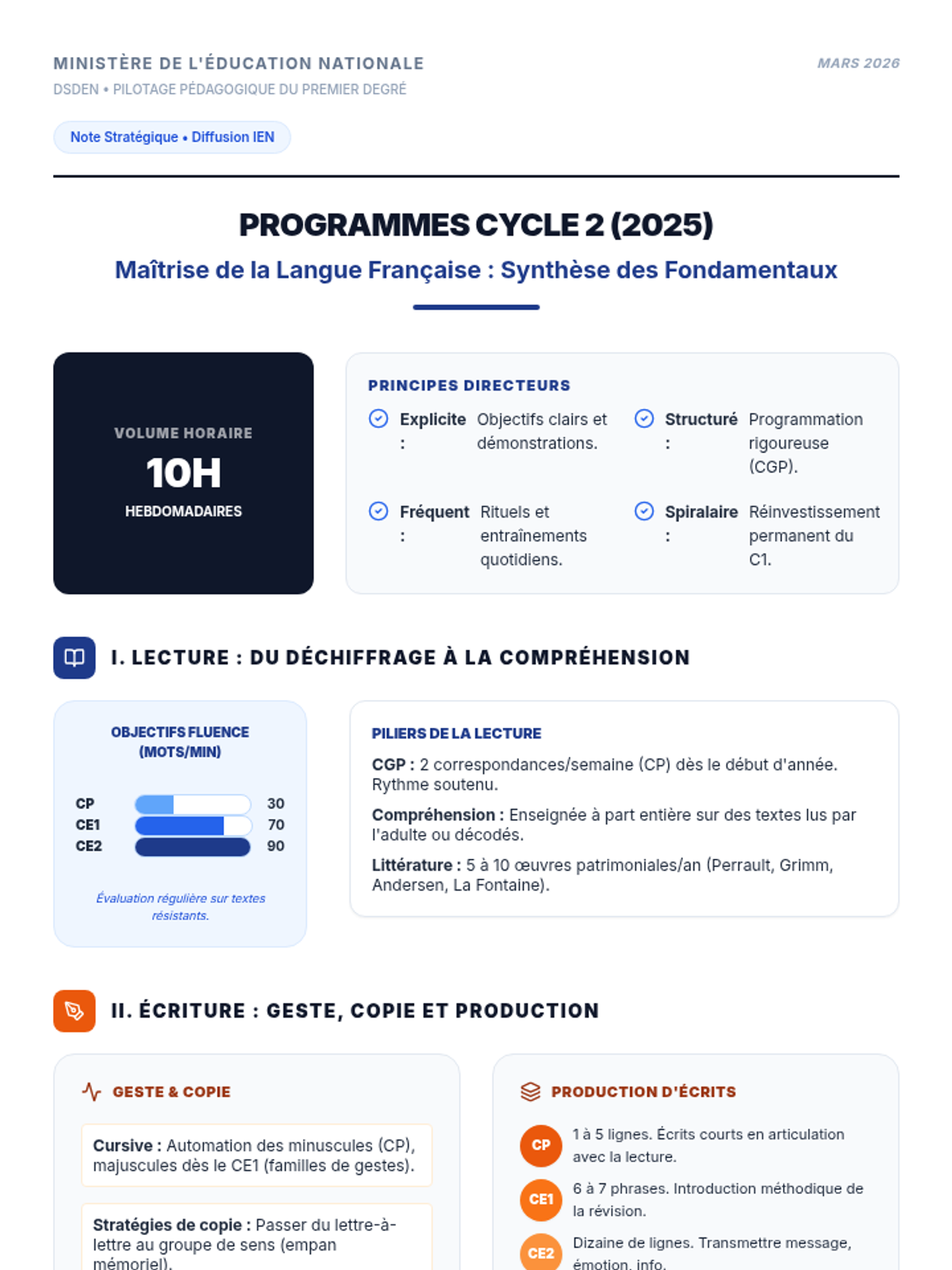
Note de synthèse institutionnelle pour les IEN récapitulant les programmes Cycle 2 de 2025. Structure les priorités (CGP, Fluence, Copie, Vocabulaire) et inclut des visualisations sur la progression de la fluence et du lexique.
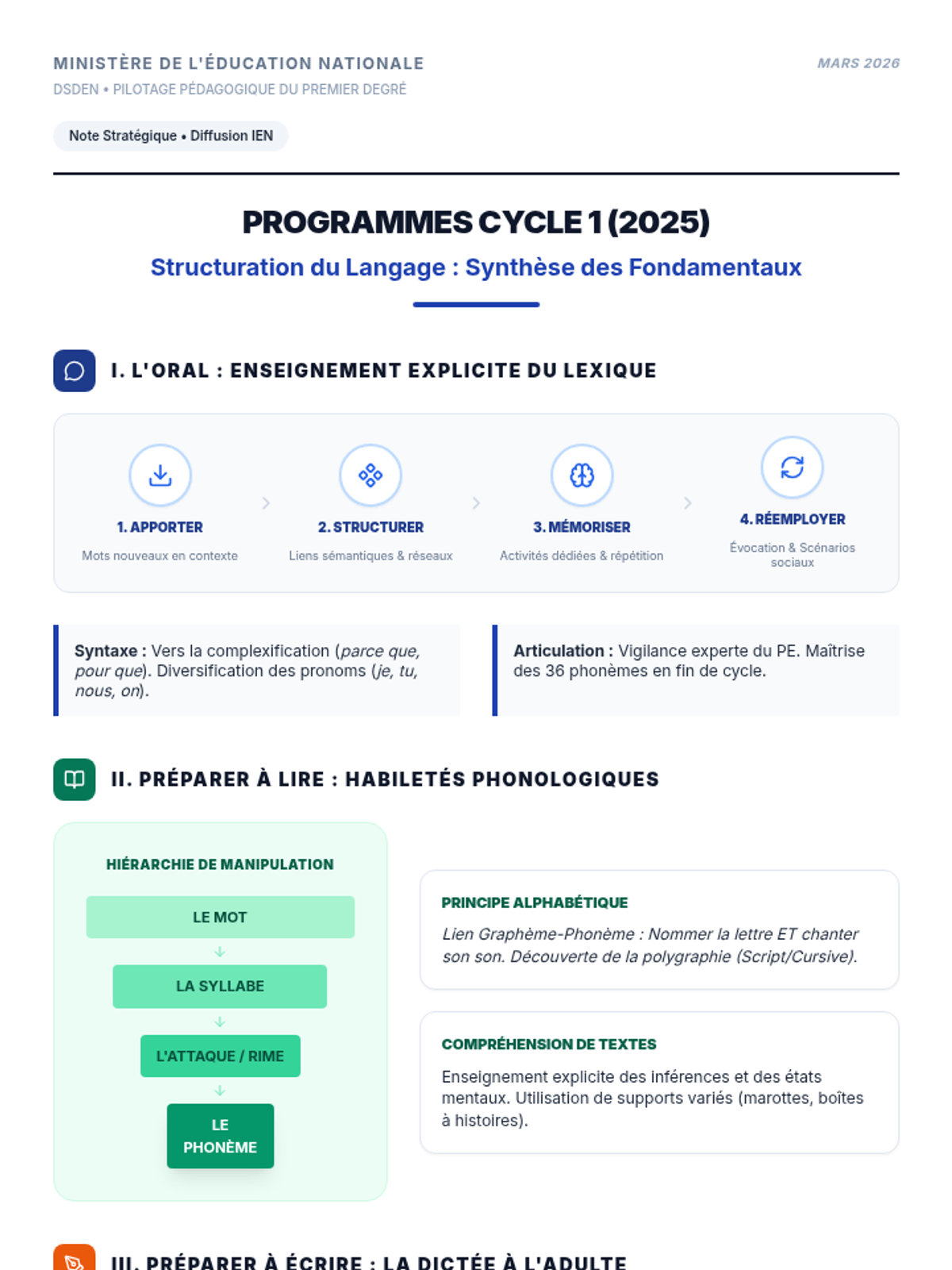
Note de synthèse visuelle pour les IEN récapitulant les programmes maternelle 2025. Inclut des schémas sur le processus lexical, la hiérarchie phonologique et le cycle de production d'écrit (dictée à l'adulte).
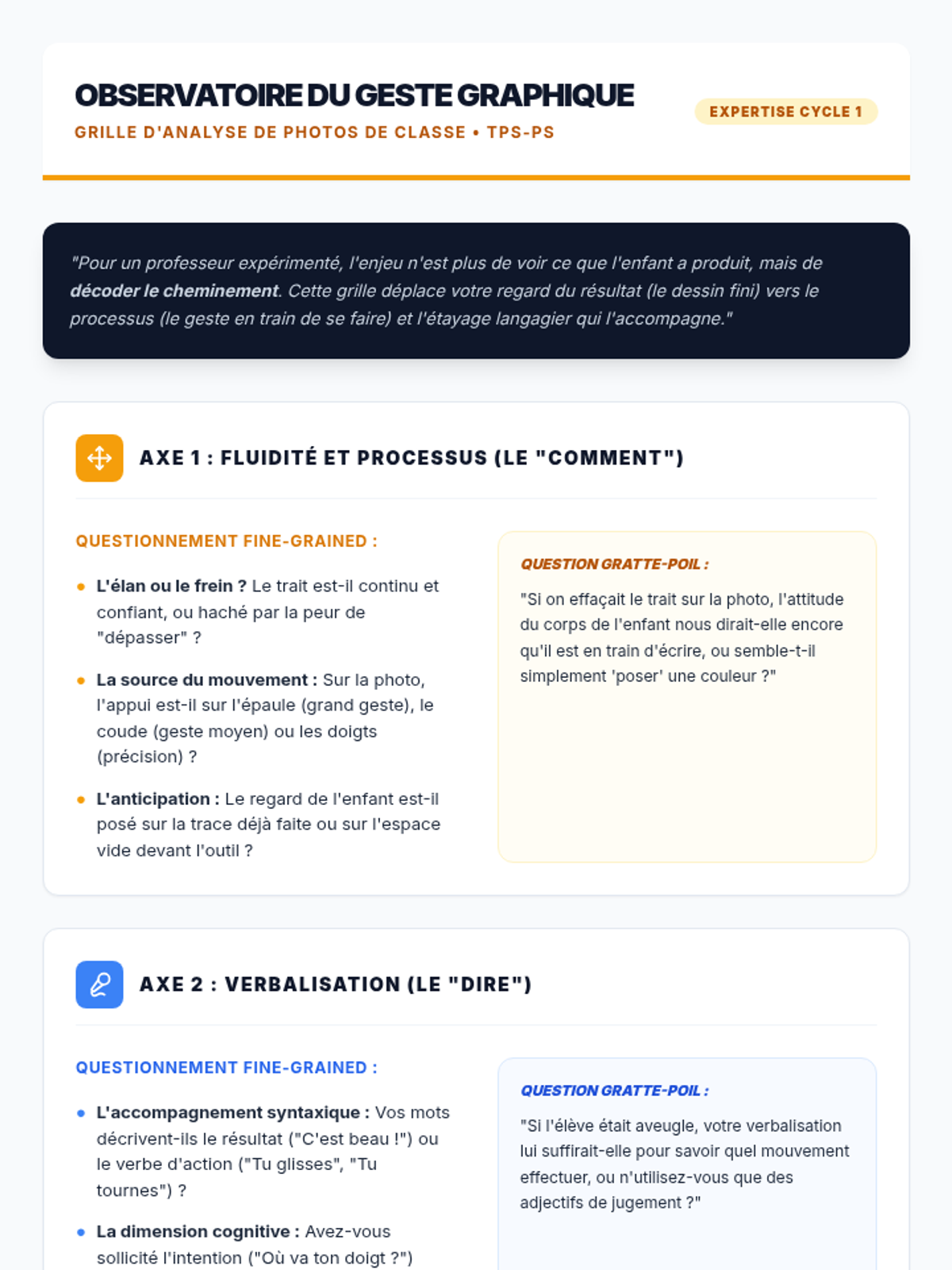
Guide de questionnement analytique pour professeurs expérimentés de maternelle (TPS-PS). Focalise sur la fluidité du geste, la verbalisation didactique et la distinction entre trace souvenir et trace d'apprentissage.
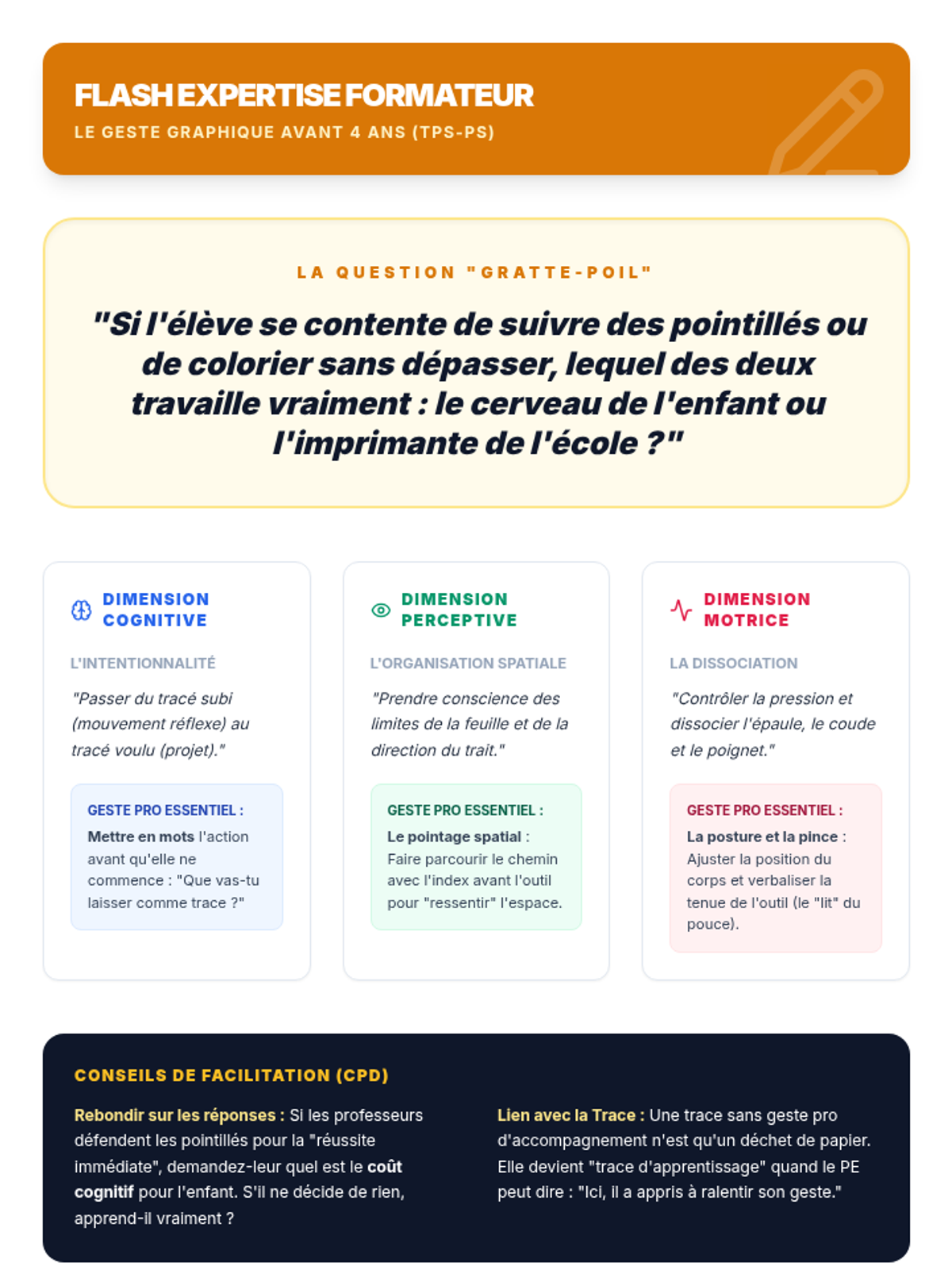
Ressource d'expertise pour le formateur contenant un questionnement "gratte-poil" sur le geste graphique en TPS-PS. Analyse les dimensions cognitive, perceptive et motrice pour faire émerger les gestes professionnels.
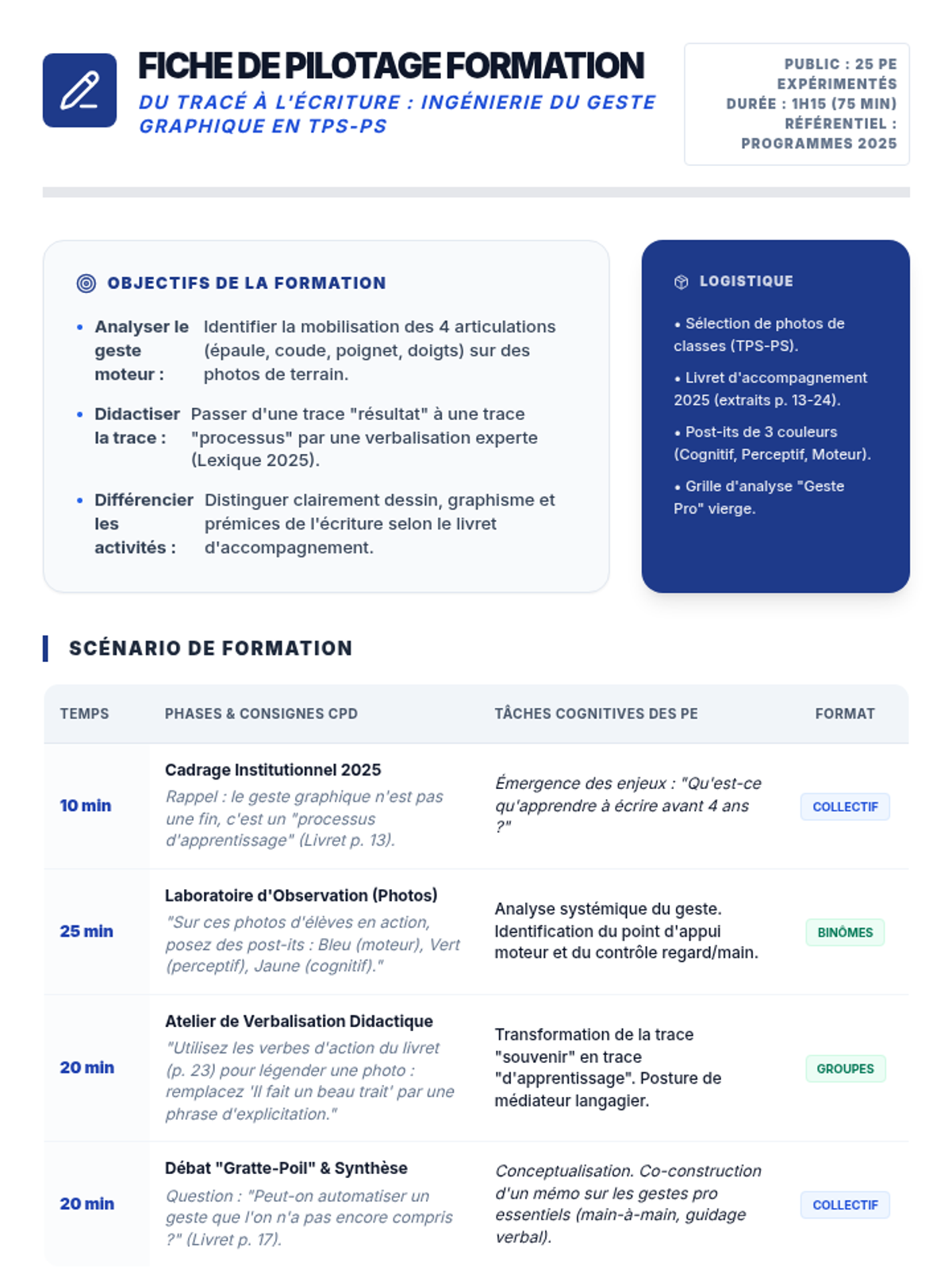
Fiche de préparation détaillée pour une formation de professeurs des écoles de TPS-PS (maternelle) sur la trace graphique. Intègre les orientations des programmes 2025 et du livret d'accompagnement "Avant 4 ans", avec une méthodologie d'analyse par la photo.
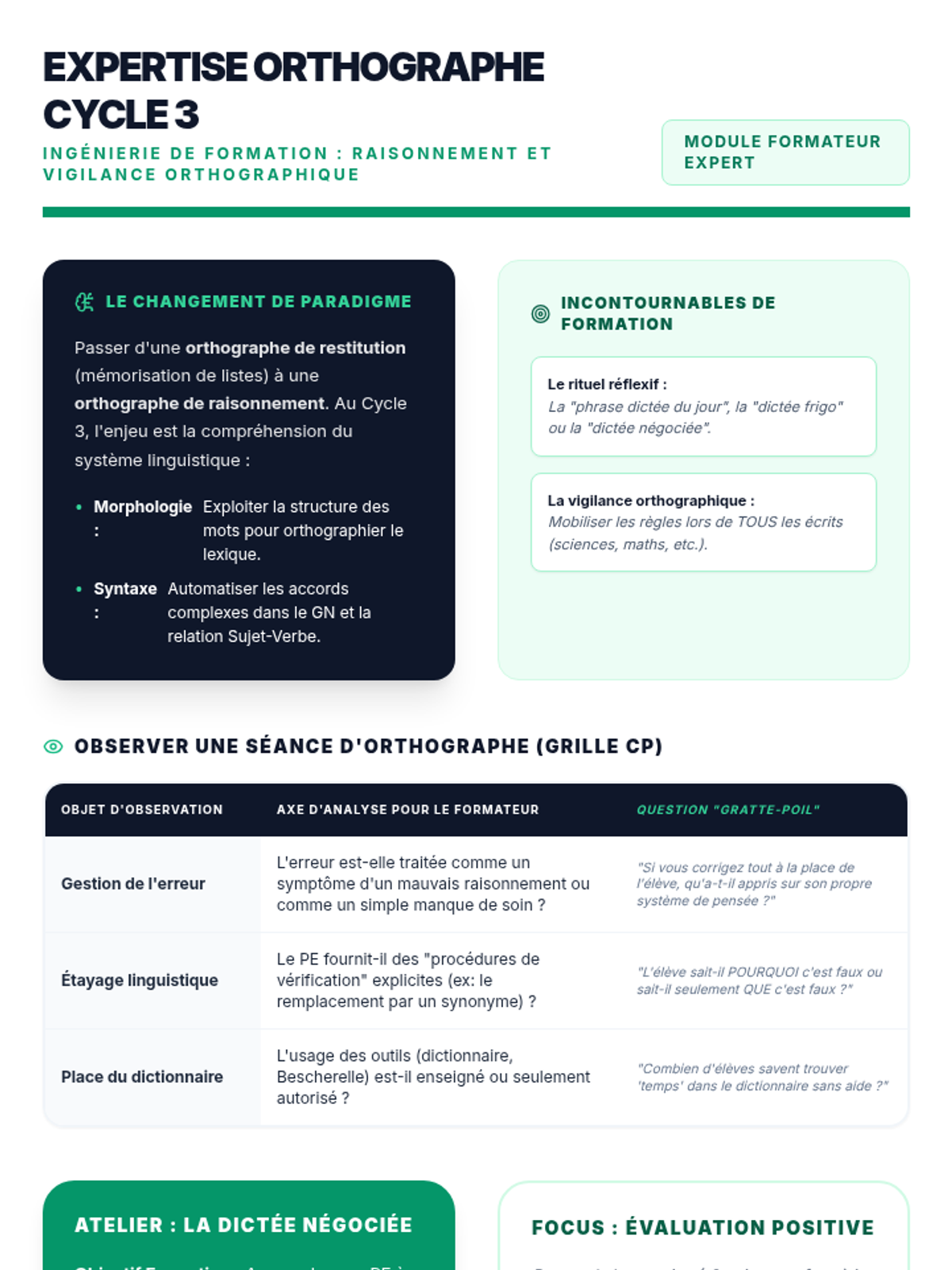
Guide d'expertise pour les conseillers pédagogiques sur l'ingénierie de formation spécifique à l'enseignement de l'orthographe au Cycle 3. Met l'accent sur le raisonnement linguistique, la gestion de l'erreur et l'évaluation positive.
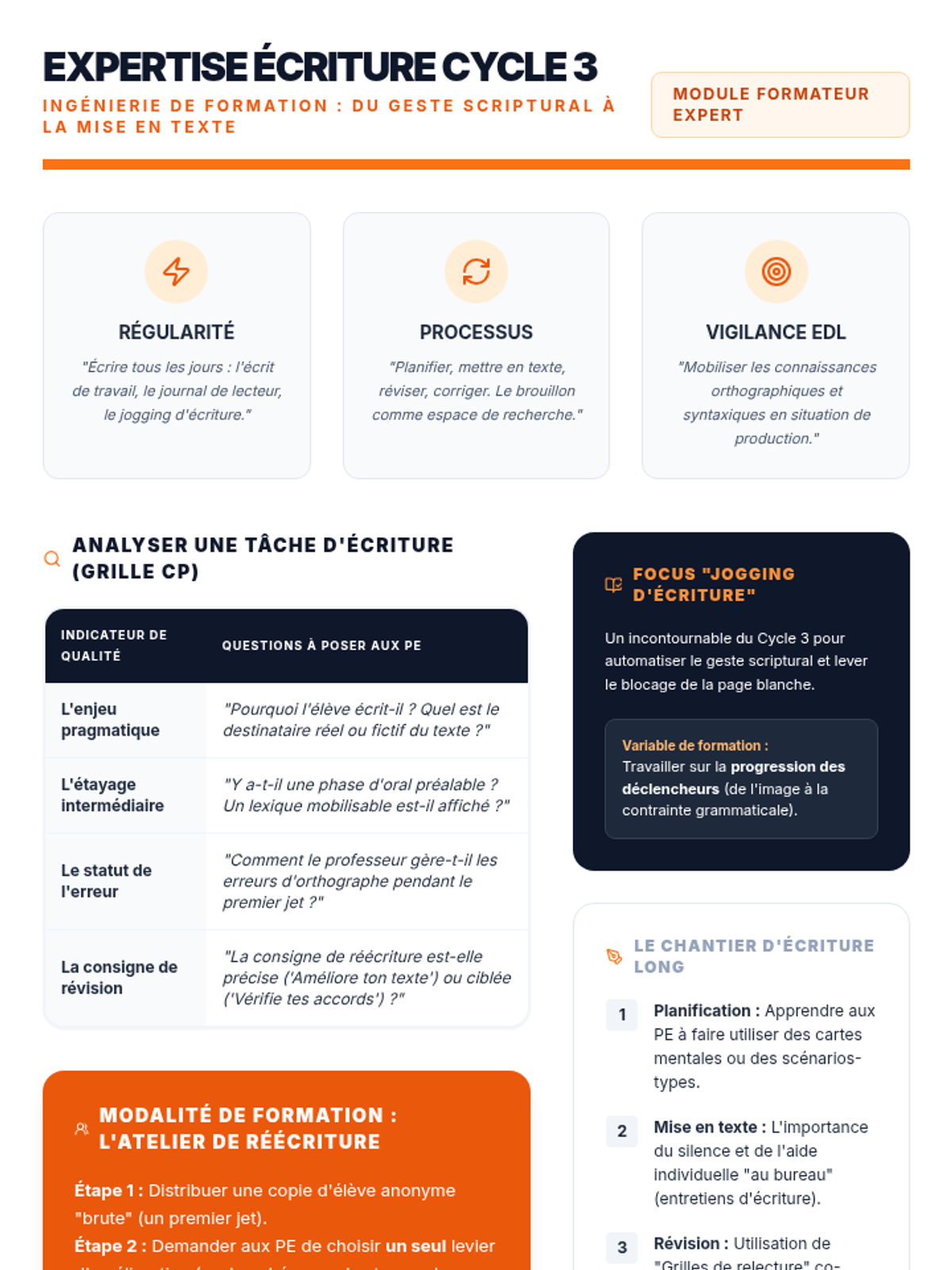
Guide d'expertise pour les conseillers pédagogiques sur l'ingénierie de formation spécifique à l'enseignement de l'écriture au Cycle 3. Aborde le processus d'écriture, la réécriture et l'évaluation positive.
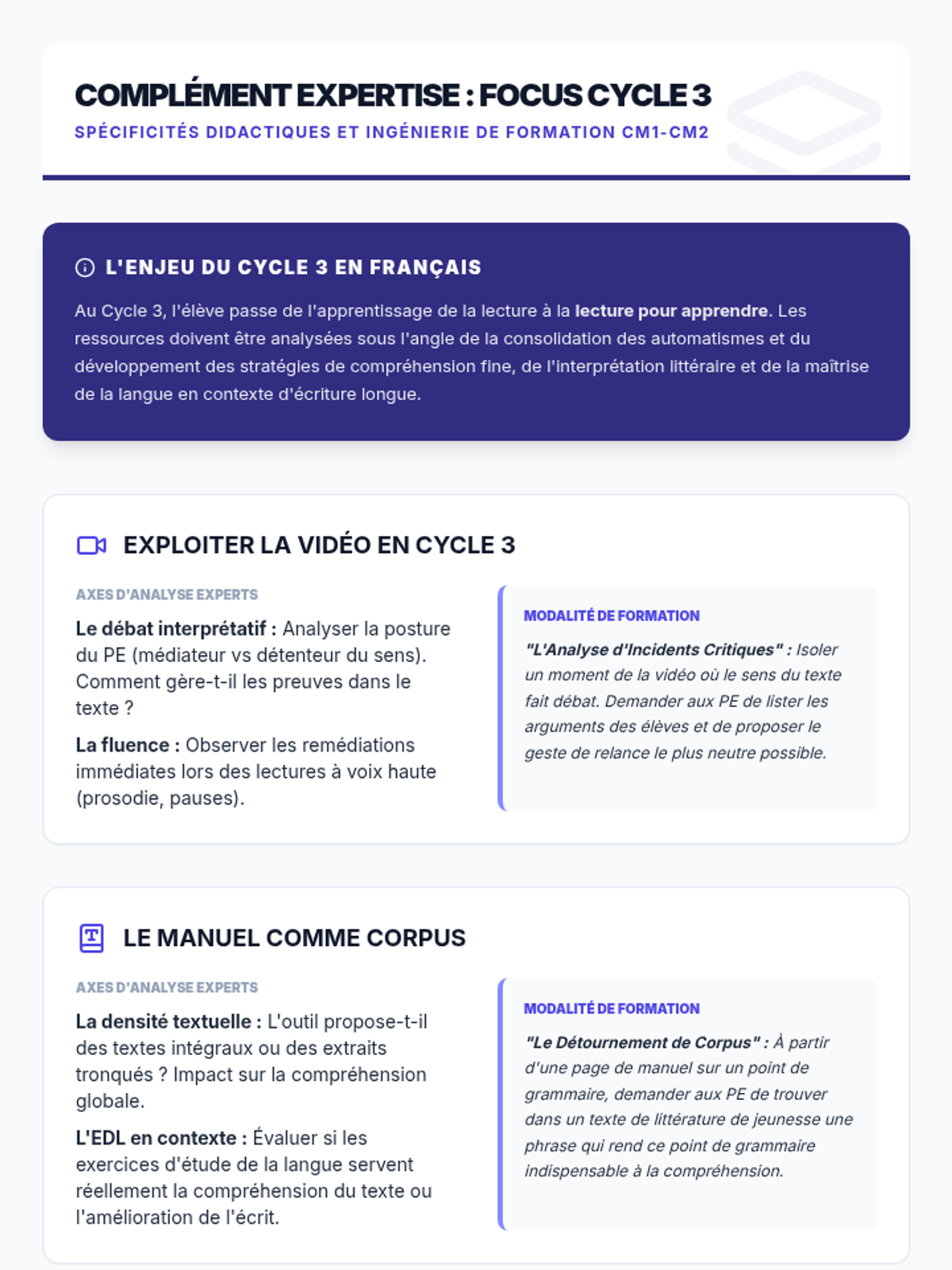
Fiche d'expertise complémentaire pour les conseillers pédagogiques, focalisée sur les spécificités didactiques du Cycle 3 (CM1-CM2) pour l'exploitation des ressources en formation continue (lecture, écriture, EDL).
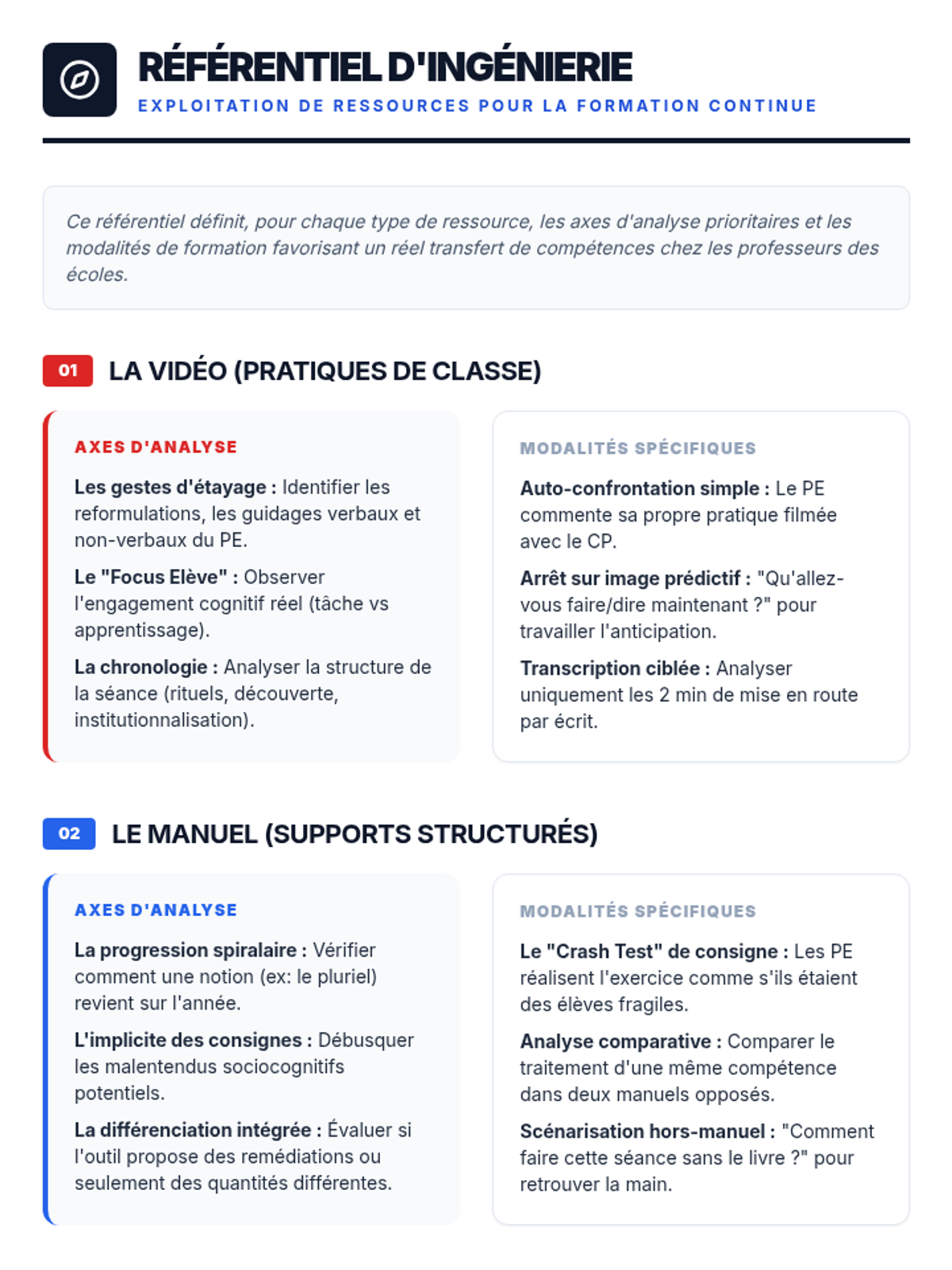
Référentiel méthodologique pour les conseillers pédagogiques détaillant les axes d'analyse et les modalités de formation spécifiques pour exploiter quatre types de ressources : vidéos, manuels, jeux et guides institutionnels.
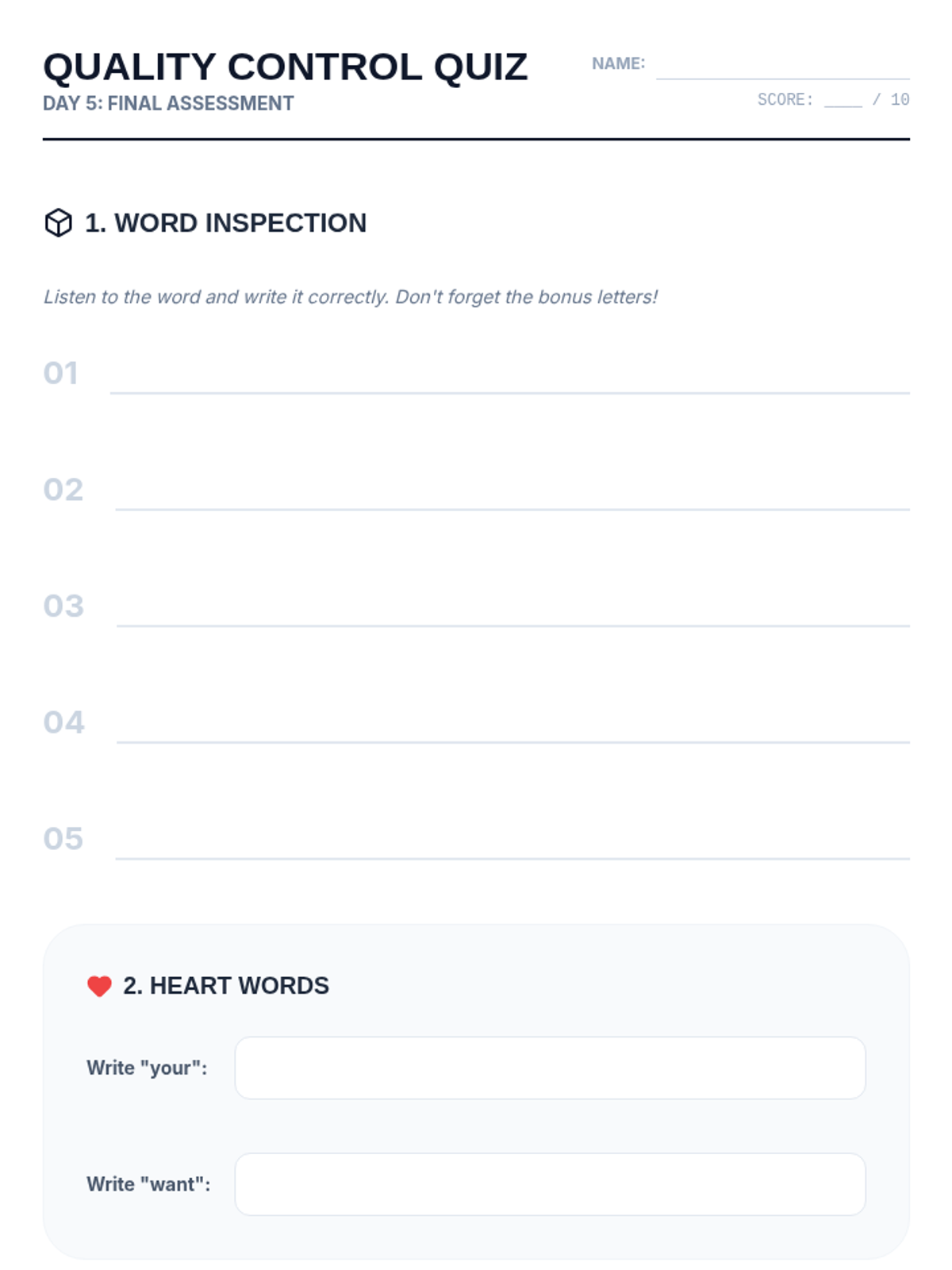
A Day 5 final assessment for the Floss unit, featuring word dictation (ff, ll, ss, zz), heart word checks for 'your' and 'want', and a sentence assembly dictation.
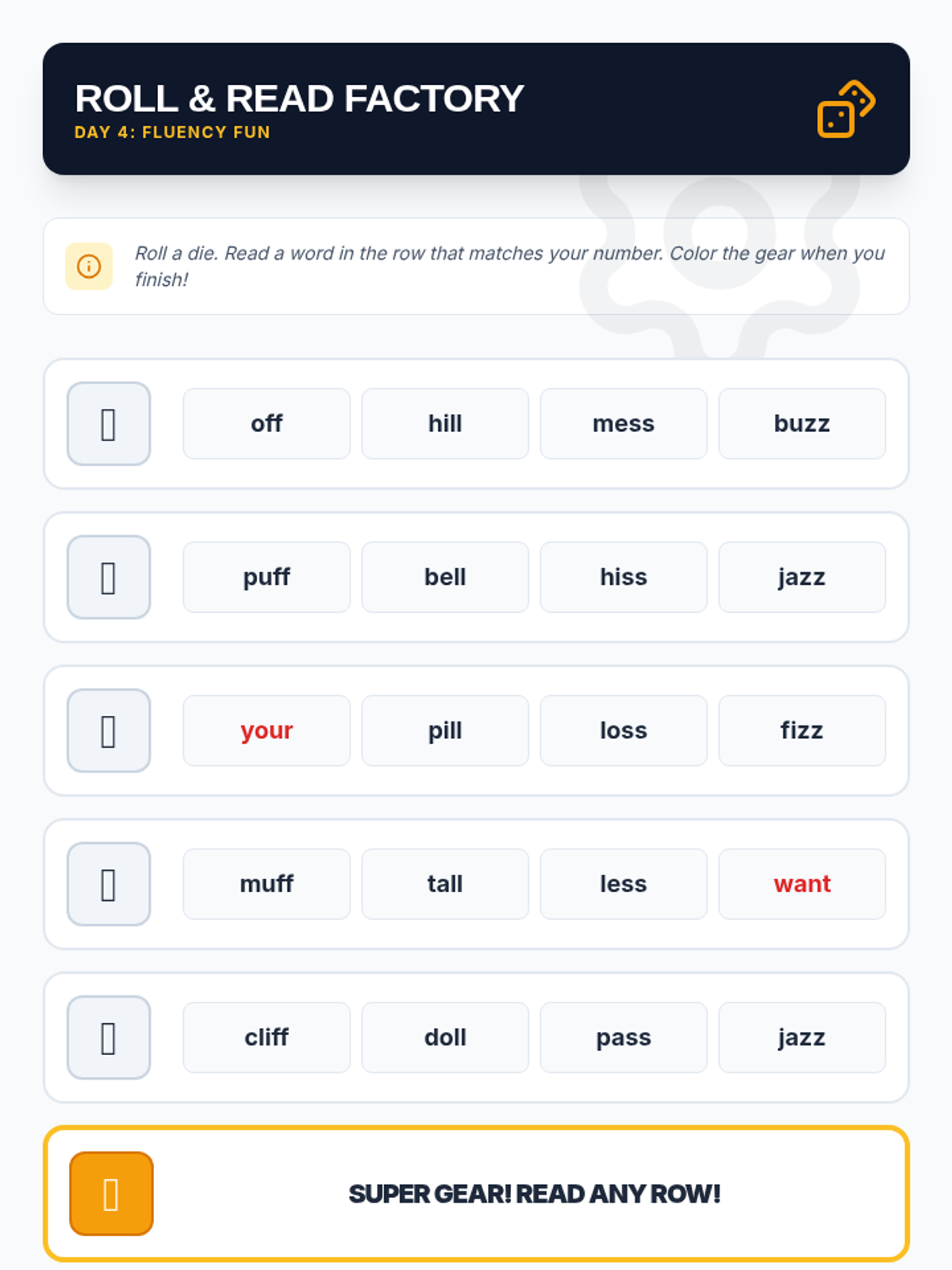
A Day 4 fluency game 'Roll & Read Factory' where students practice reading bonus letter words and heart words based on dice rolls to build speed and accuracy.
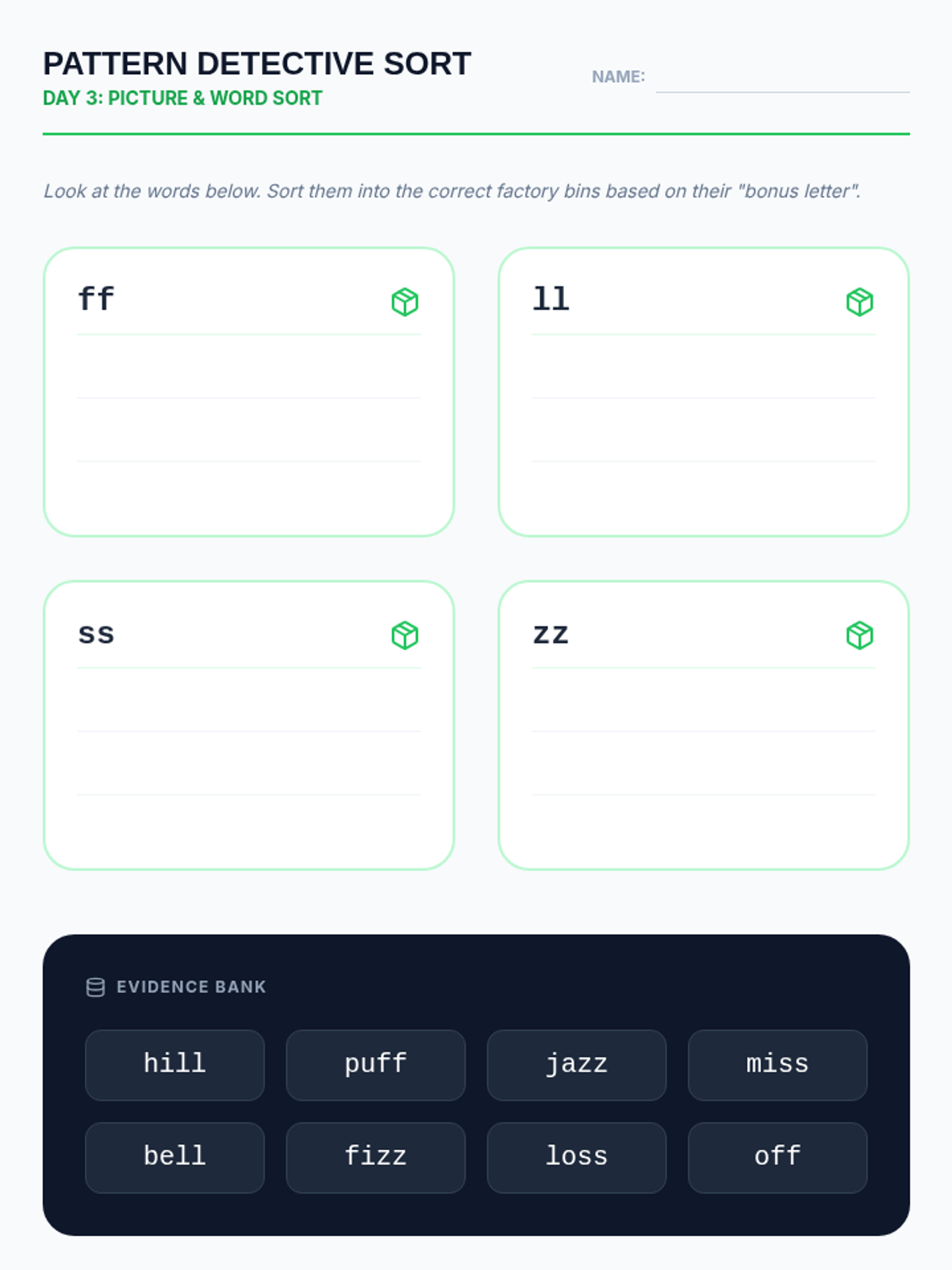
A Day 3 pattern-detective sorting activity where students categorize bonus letter words into factory bins (ff, ll, ss, zz) to identify phonics patterns.
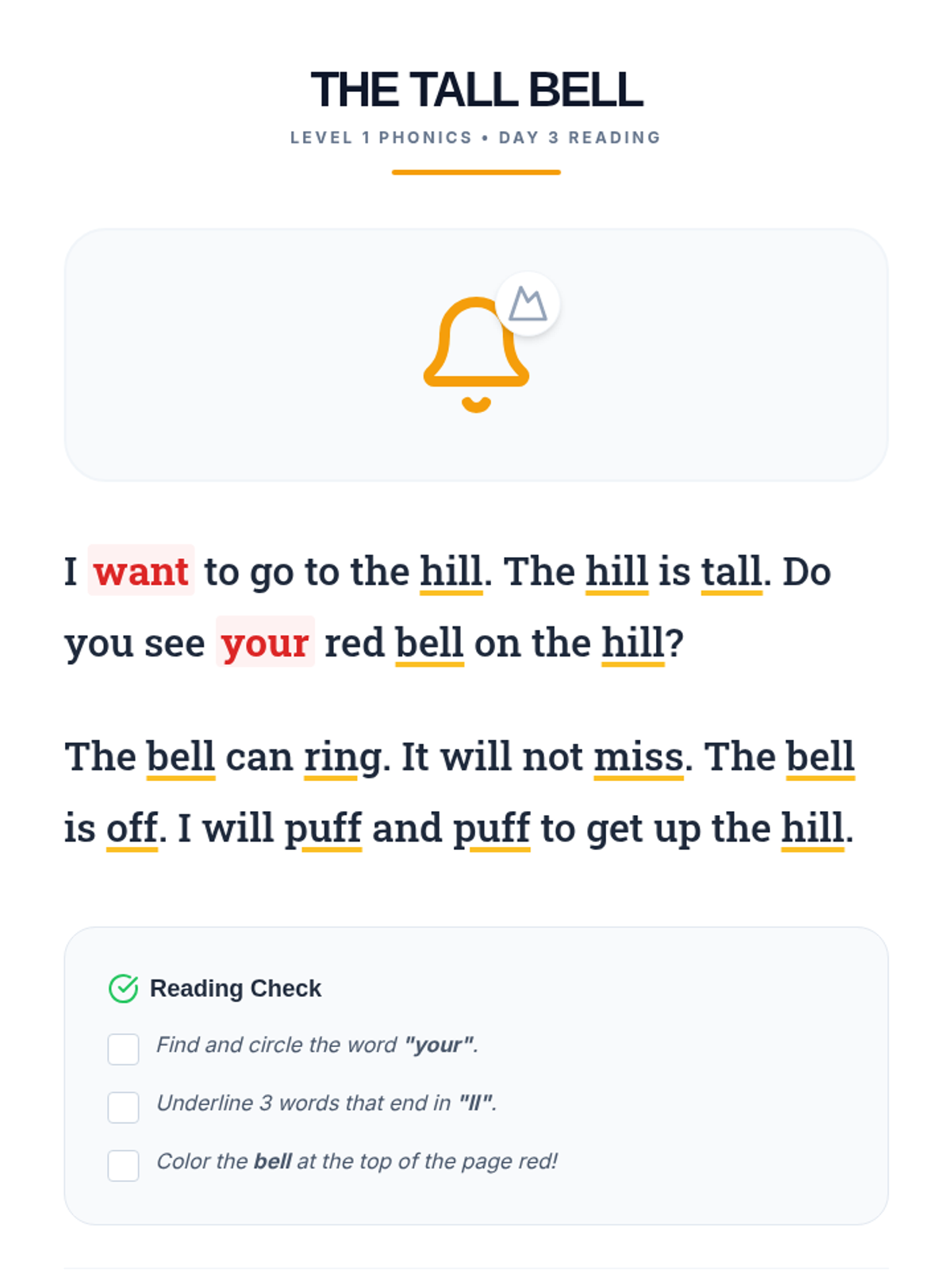
A Day 3 decodable passage titled 'The Tall Bell', designed for students to practice reading bonus letter words and heart words in context with integrated fluency tracking.
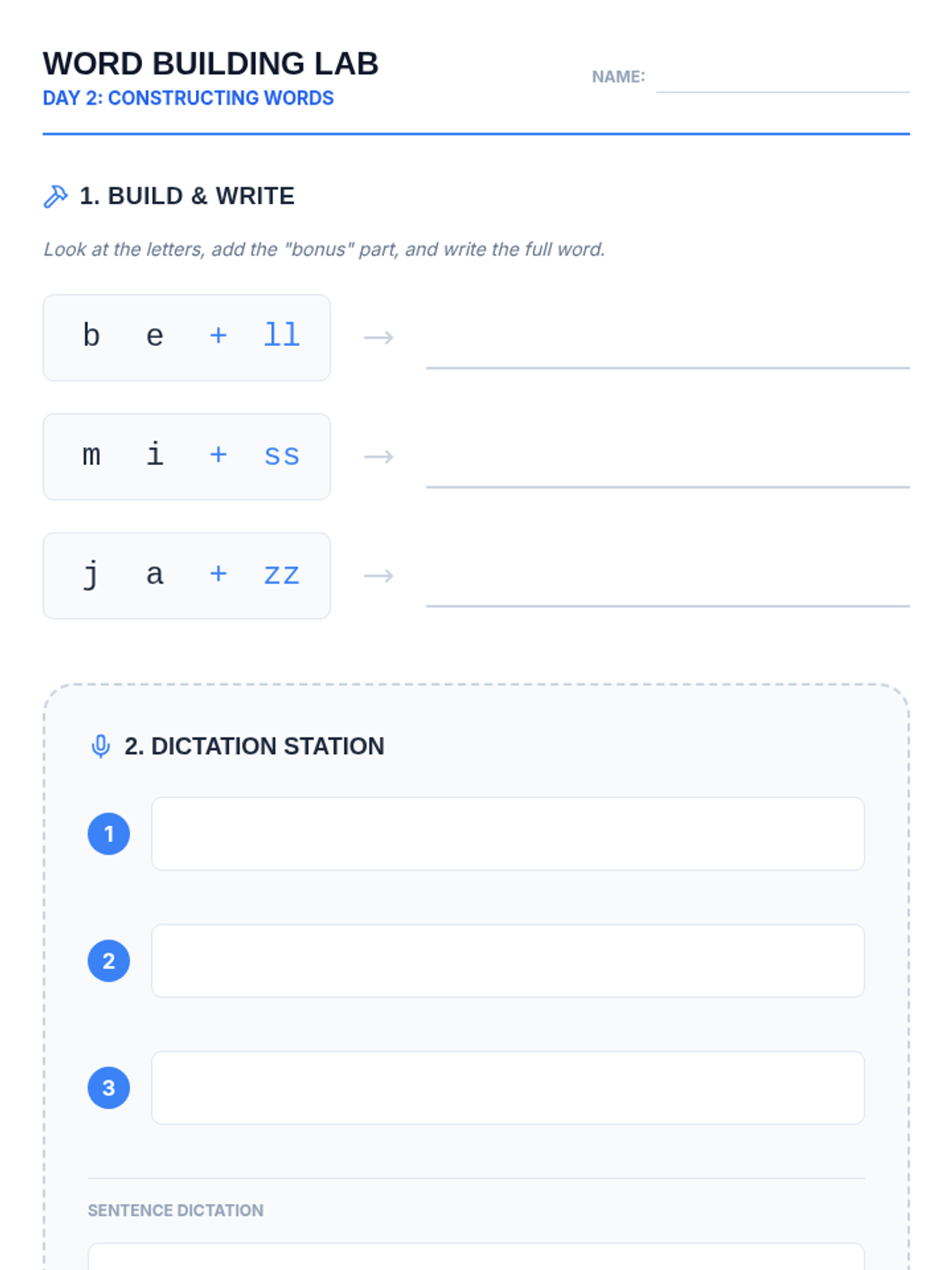
A Day 2 student worksheet for word building and dictation, featuring construction-themed exercises for adding bonus letters and a dedicated dictation area.
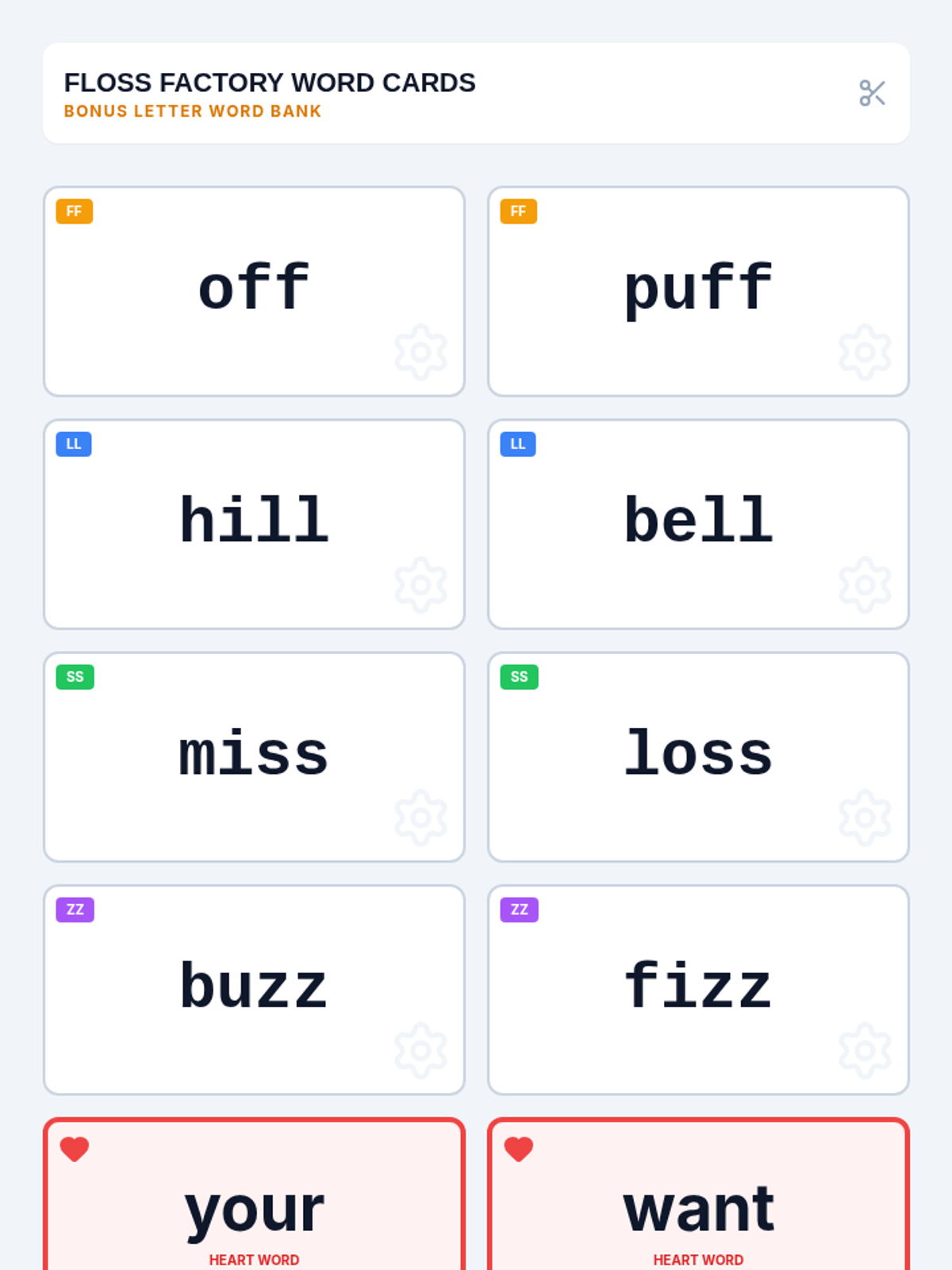
A collection of printable word cards featuring bonus letter words (ff, ll, ss, zz) and heart words 'your' and 'want' for sorting and word-building activities.
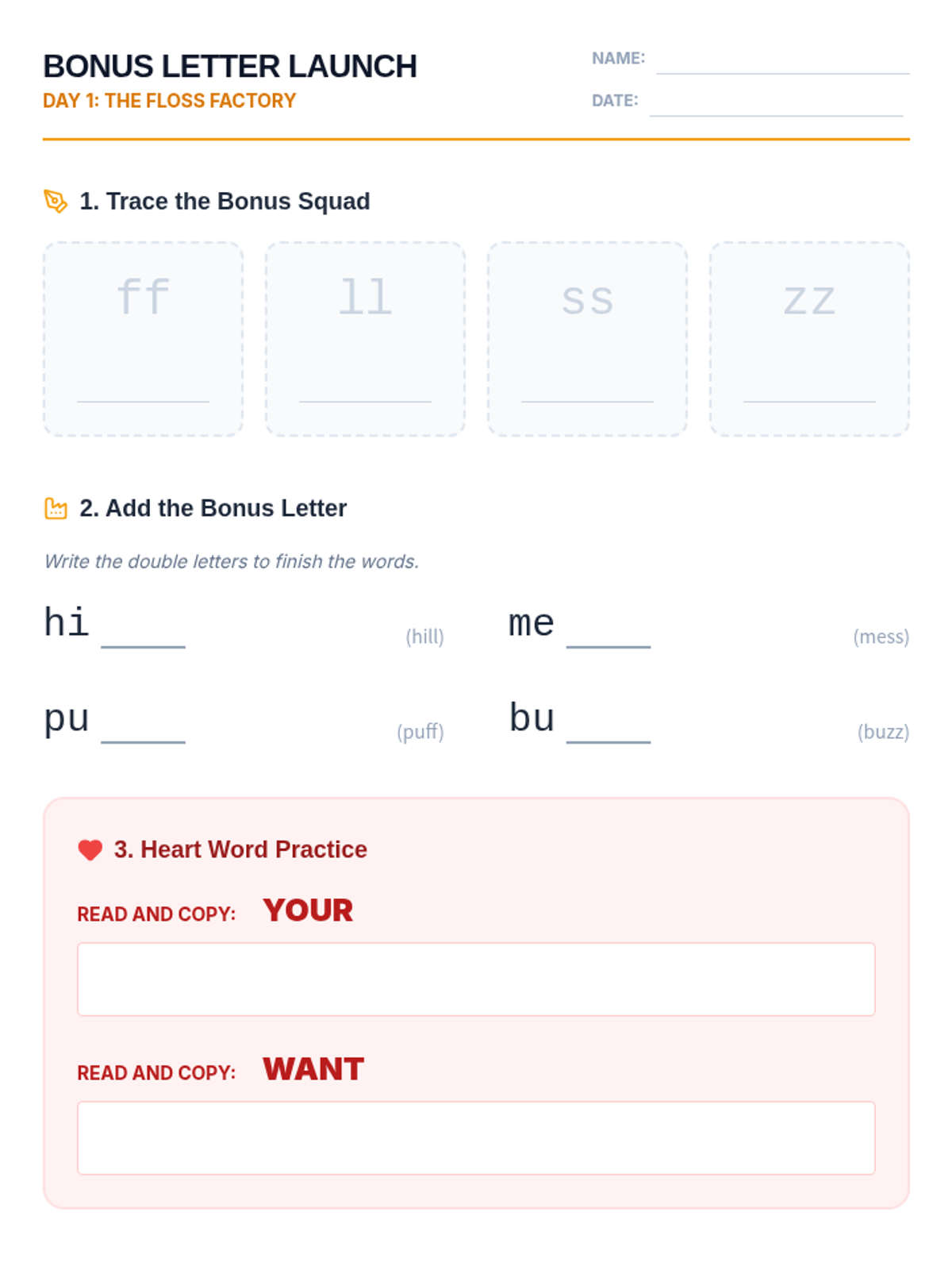
A Day 1 student worksheet for practicing the Floss rule (bonus letters f, l, s, z) through tracing, word completion, and heart word handwriting.
An engaging slide deck for introducing the Floss rule (bonus letters f, l, s, z) and heart words 'your' and 'want'. Includes phonemic awareness drills, blending practice, and explicit rule instruction.
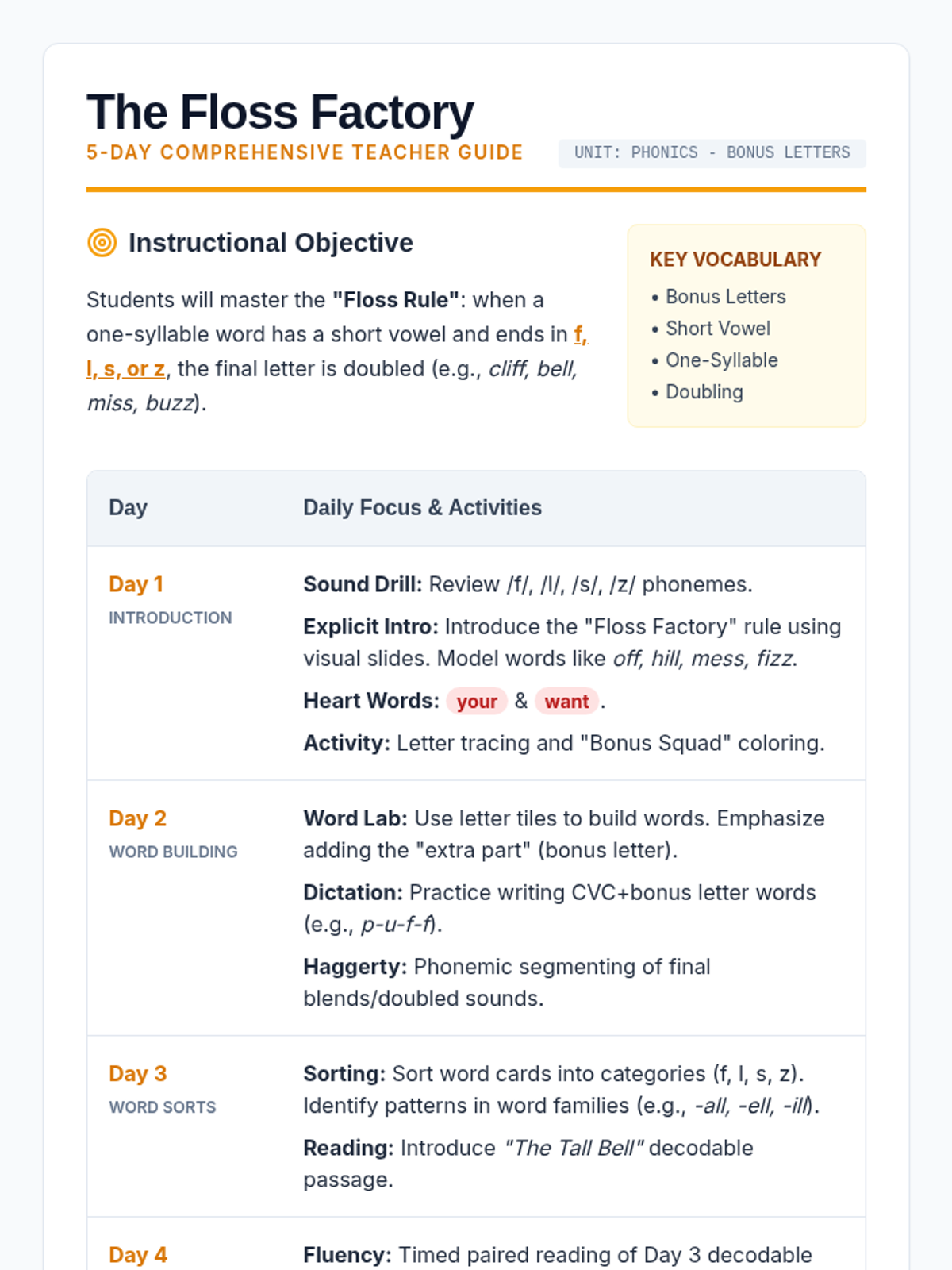
A detailed 5-day teacher guide for the "Floss Factory" phonics unit, outlining daily routines, instructional objectives, heart word strategies, and differentiation tips.