Develops technical proficiency and creative movement skills across various styles. Examines choreographic principles alongside the historical and cultural origins of diverse global dance forms.
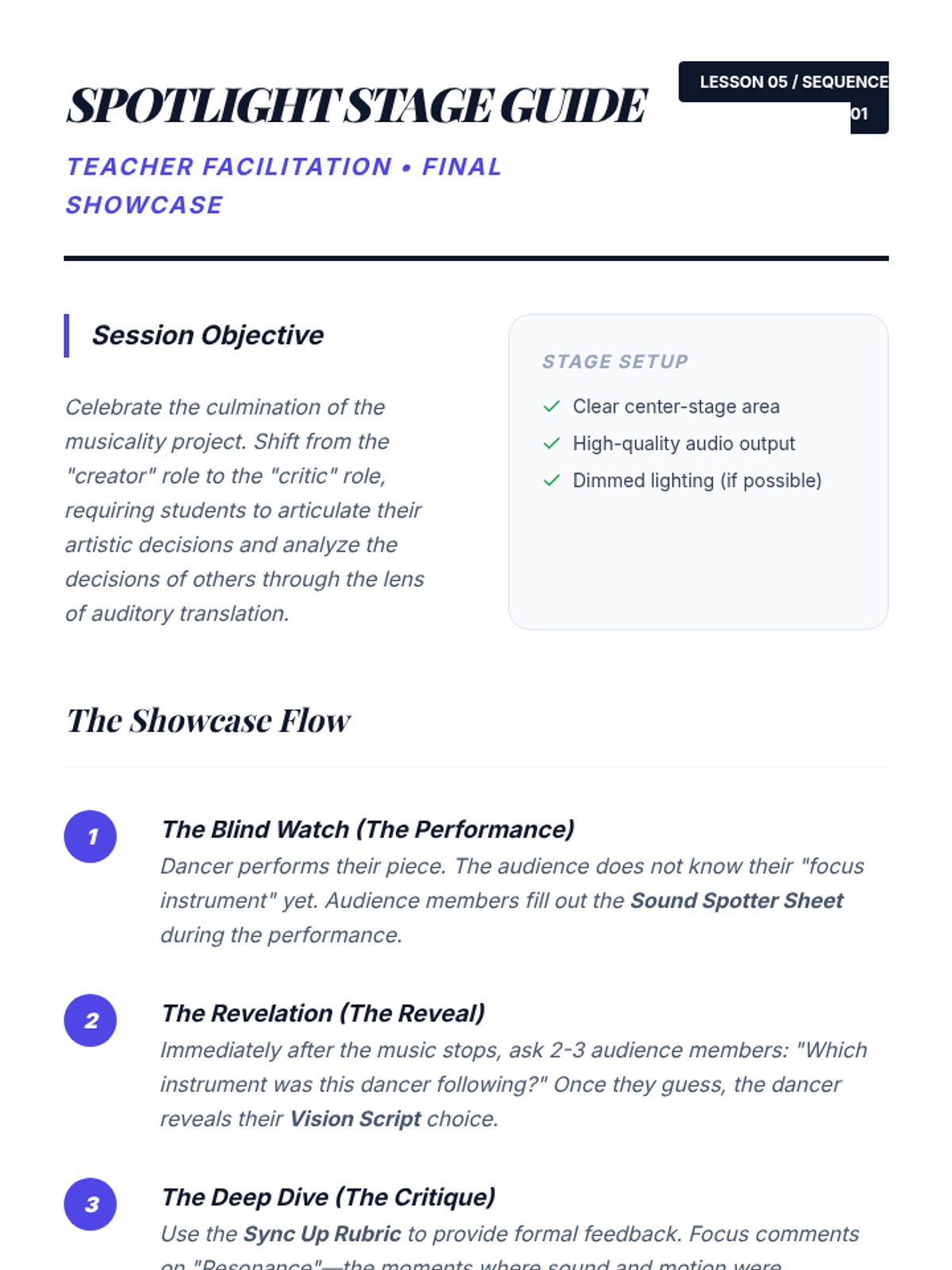
Teacher facilitation guide for Lesson 5, managing the final showcase, audience revelation game, and reflective debrief.
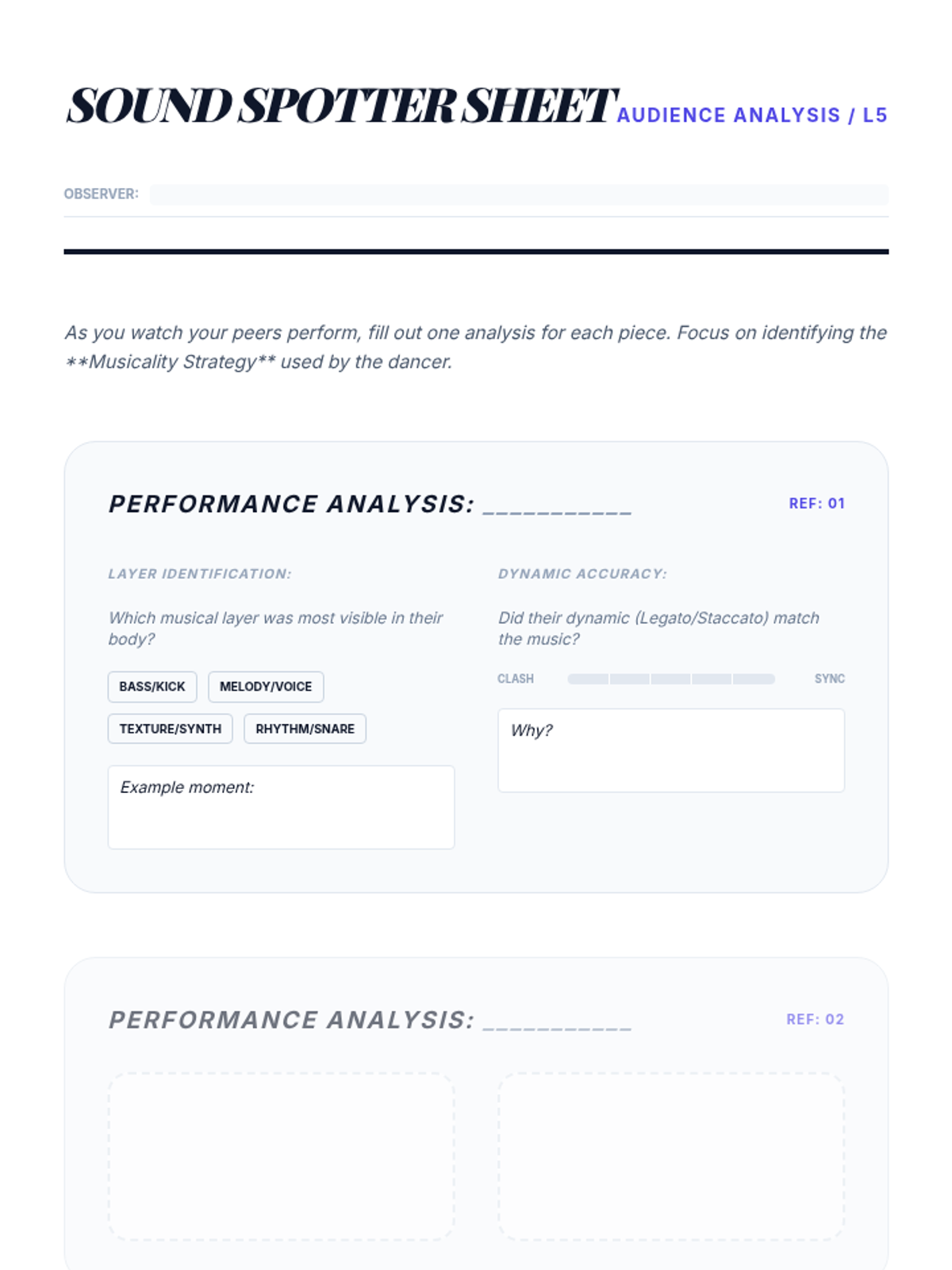
Audience critique form where students identify musical layers and dynamic qualities in their peers' final performances.
Introductory presentation for Lesson 5, exploring performance protocols, audience critique strategies, and reflective discussion on musicality.
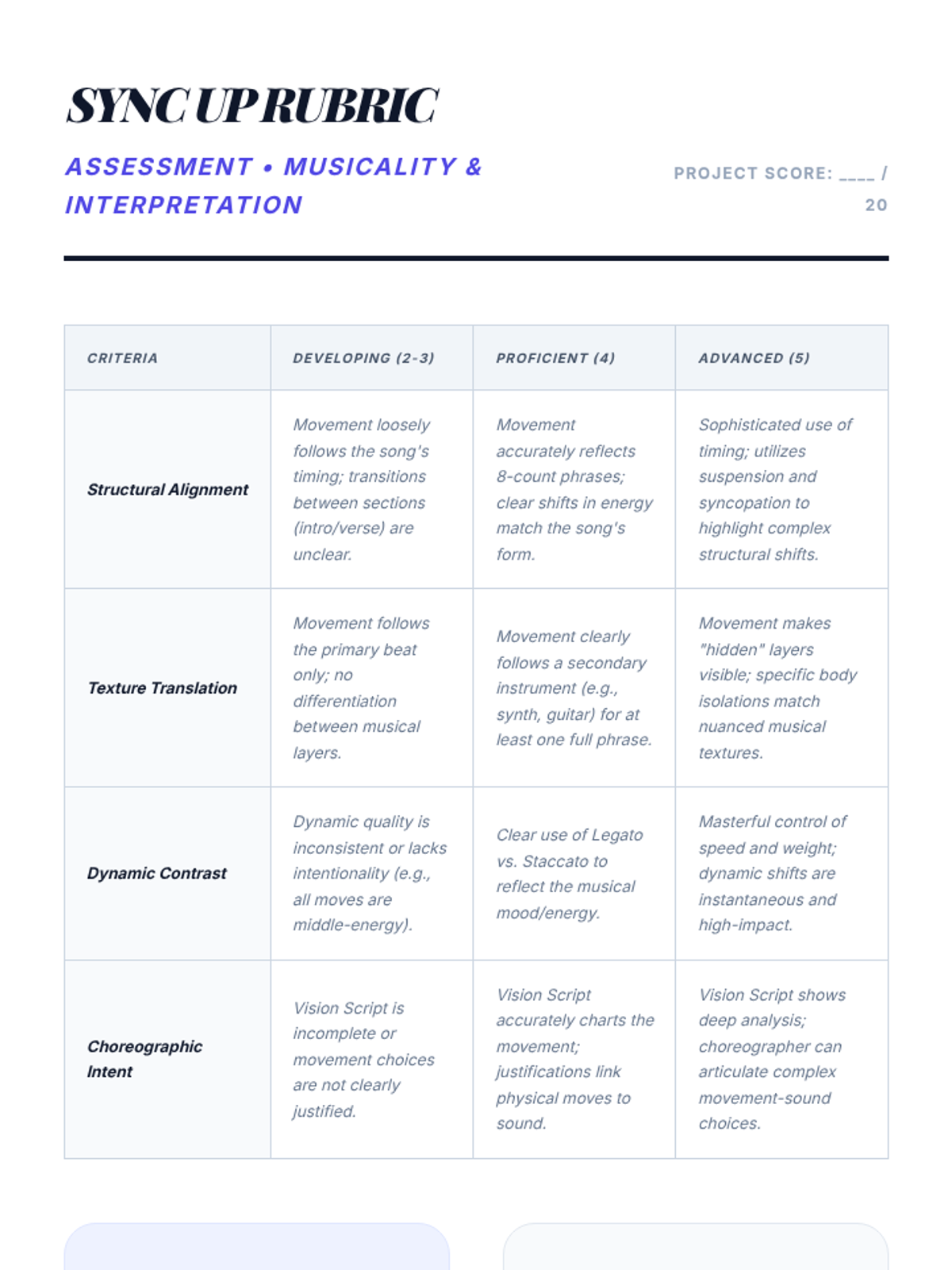
Evaluation criteria for the choreographic project, focused specifically on musicality, structural alignment, and texture translation.
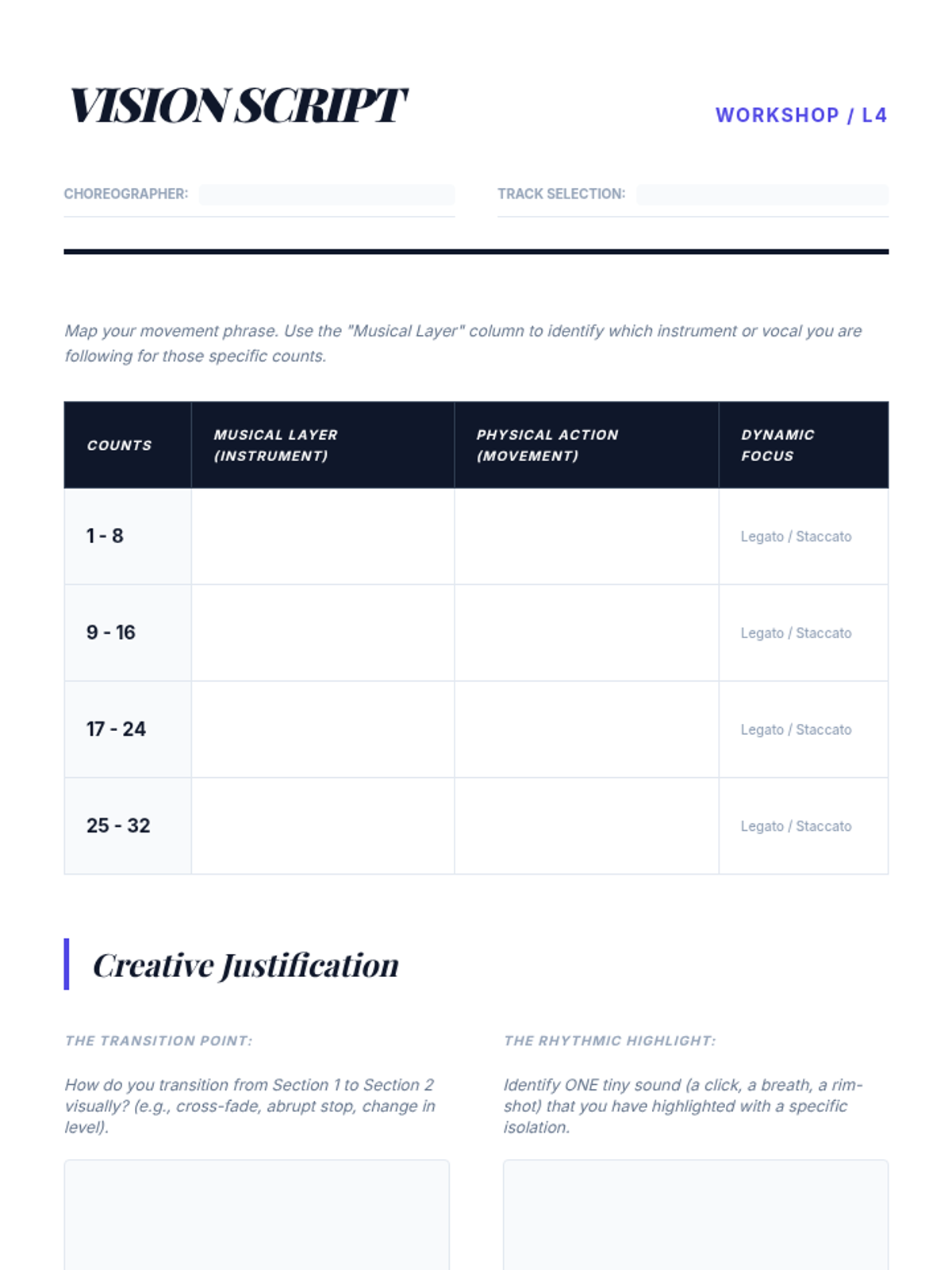
A detailed choreographic planner where students line up counts with musical layers and specific physical moves.
Introductory presentation for Lesson 4, exploring workshop protocols, peer feedback criteria, and the concept of choreographic dissonance.
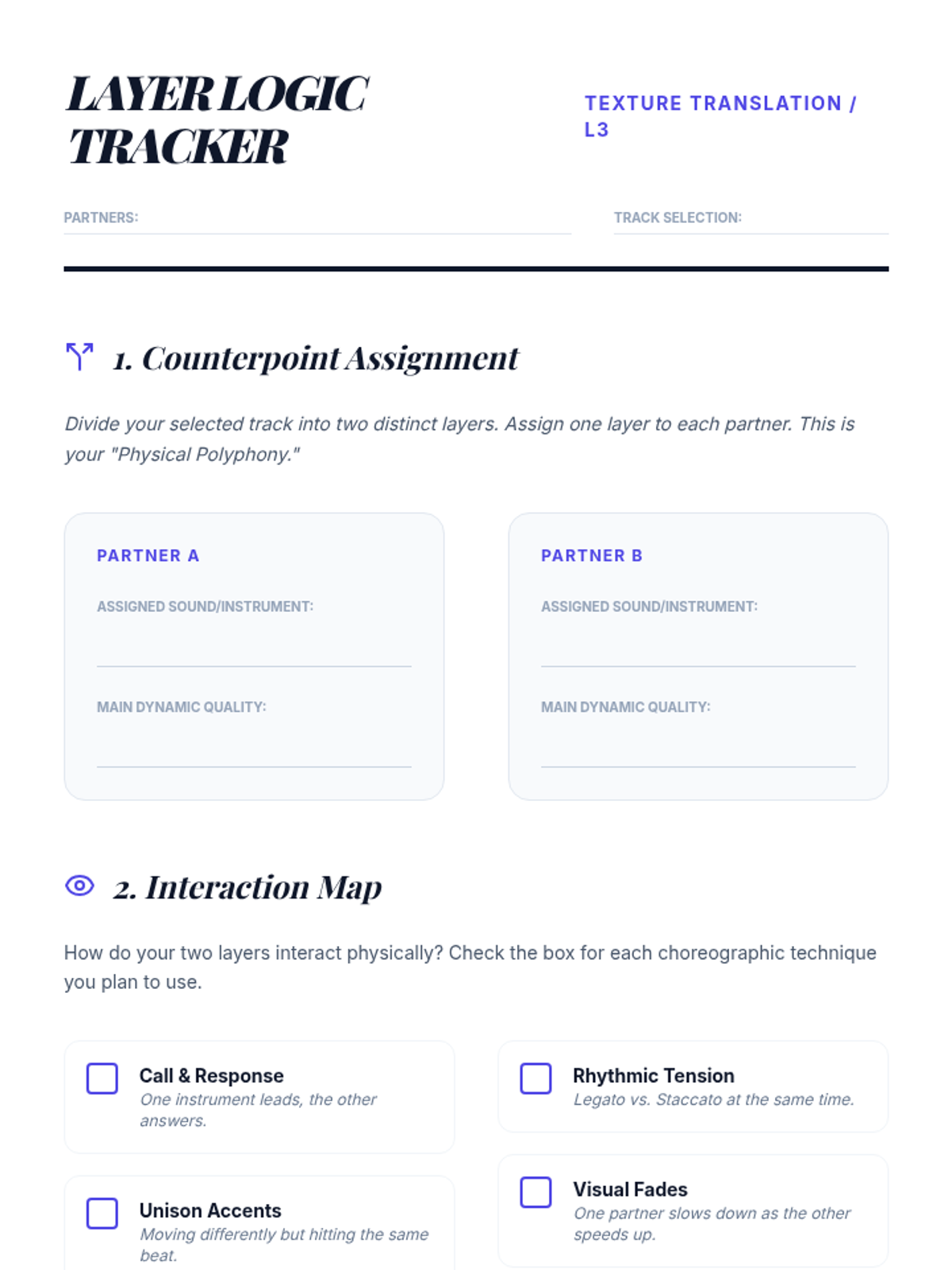
A partner worksheet for students to track instrument assignments and plan physical interactions (counterpoint) in their choreography.
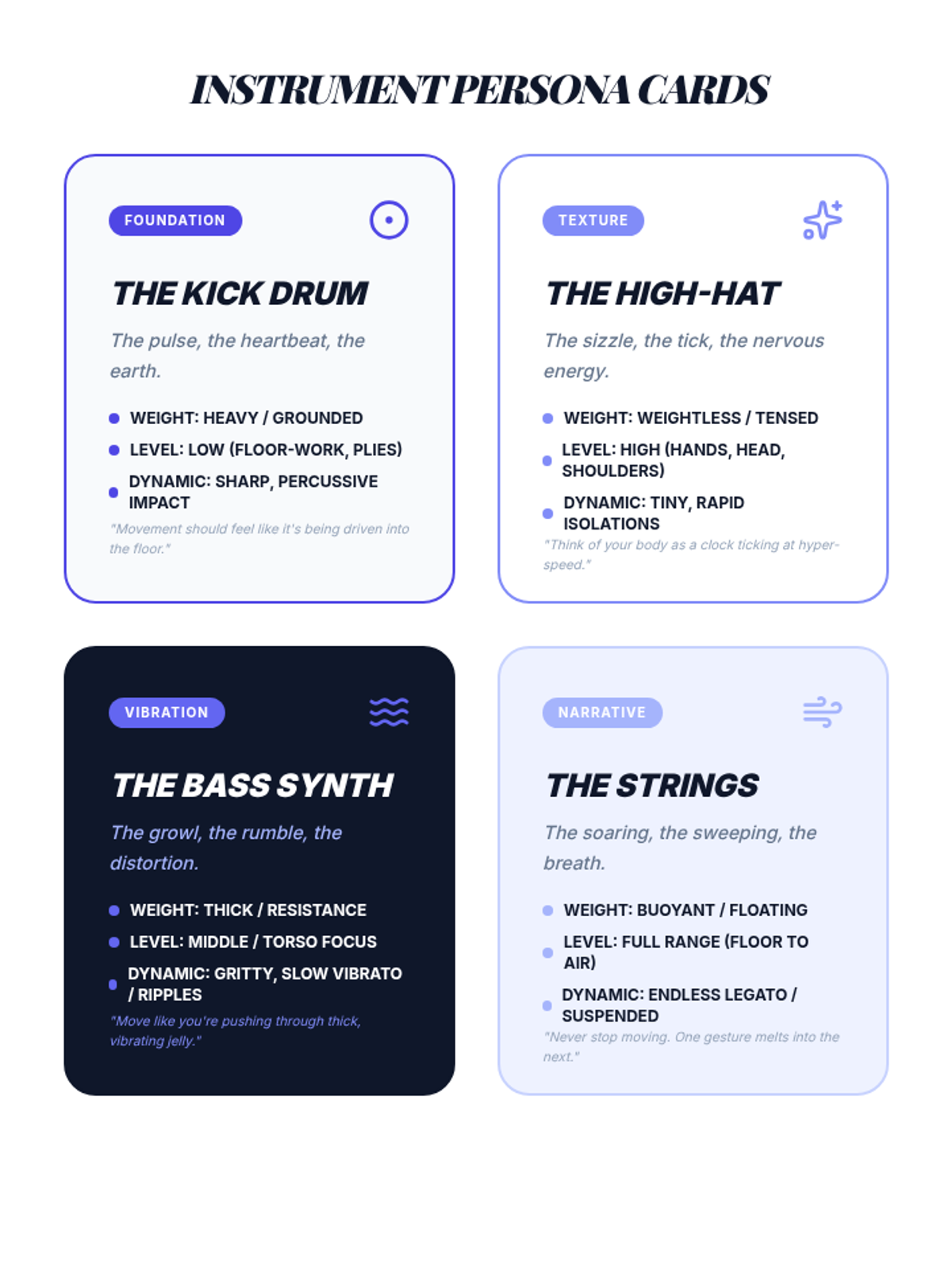
A set of four task cards for students to practice moving like specific musical instruments, focusing on weight, level, and dynamic qualities.
Introductory presentation for Lesson 3, exploring musical texture, counterpoint in dance, and the 'Human Mixer' facilitation activity.
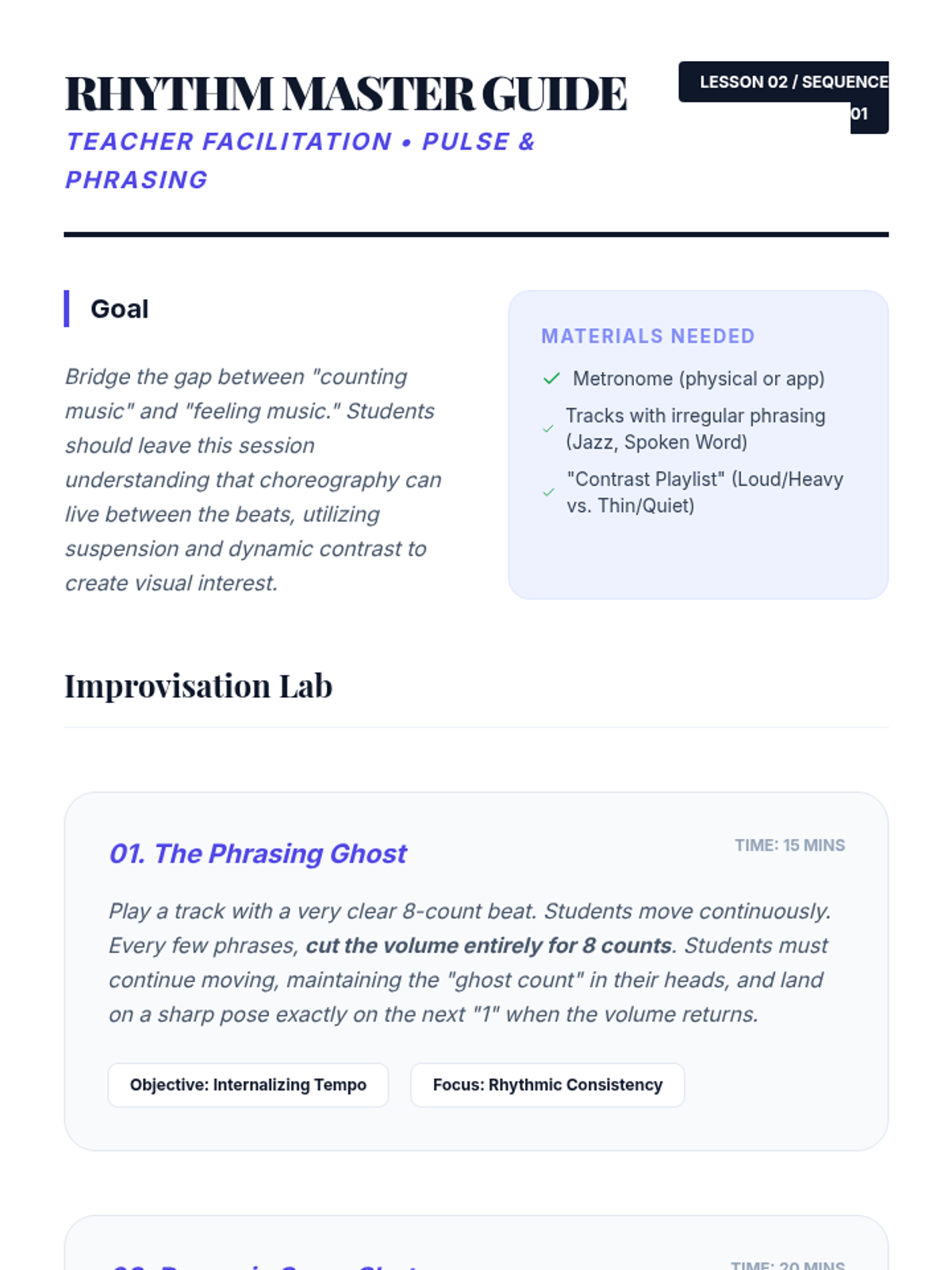
Teacher facilitation guide for Lesson 2, focusing on phrasing exercises, 'ghost count' activities, and dynamic contrast simulations.
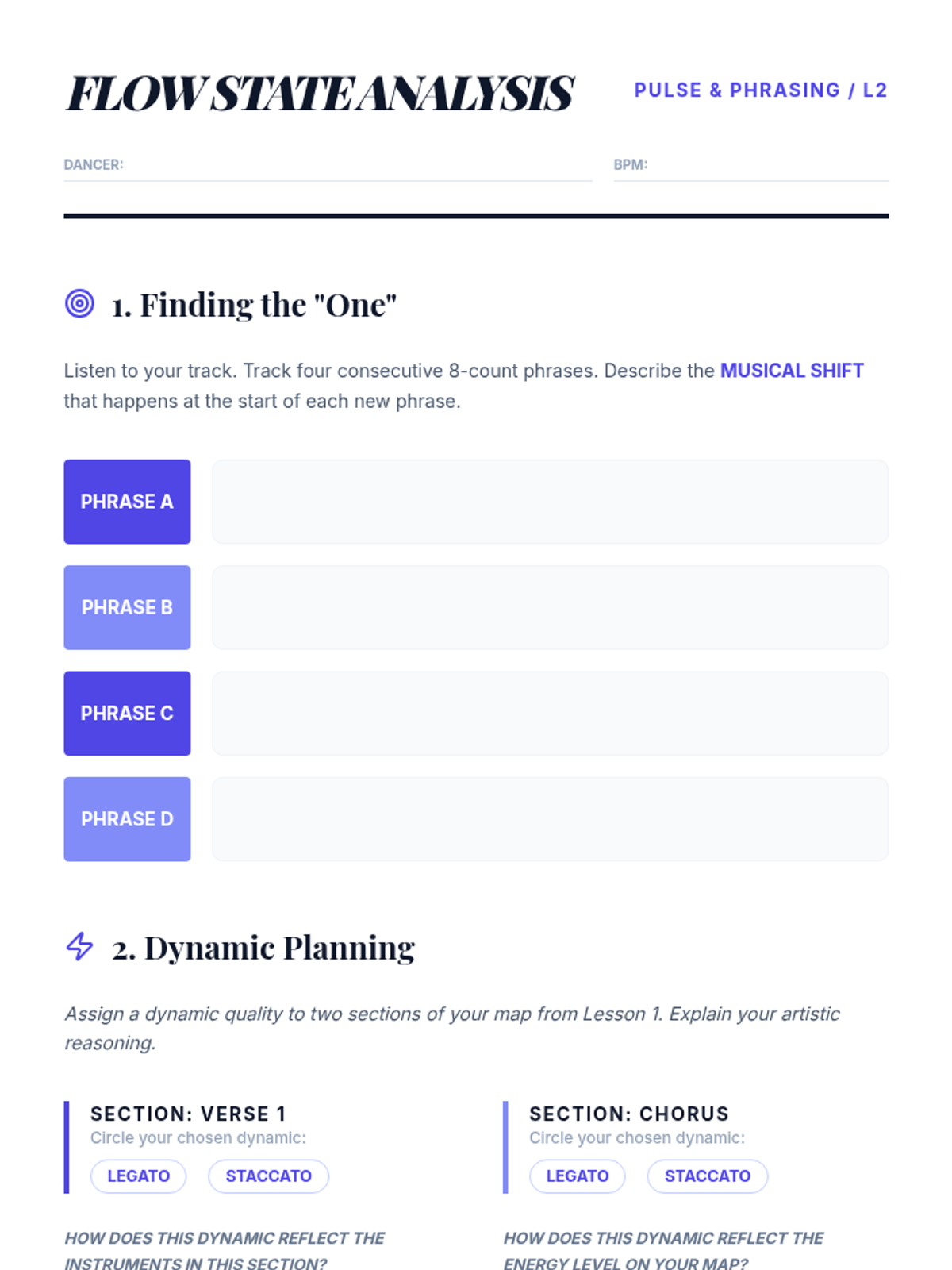
A worksheet for students to identify 8-count phrases and plan dynamic shifts (legato/staccato) for their choreography.
Introductory presentation for Lesson 2, exploring 8-count phrases, legato vs. staccato dynamics, and the concept of 'moving through' the beat.
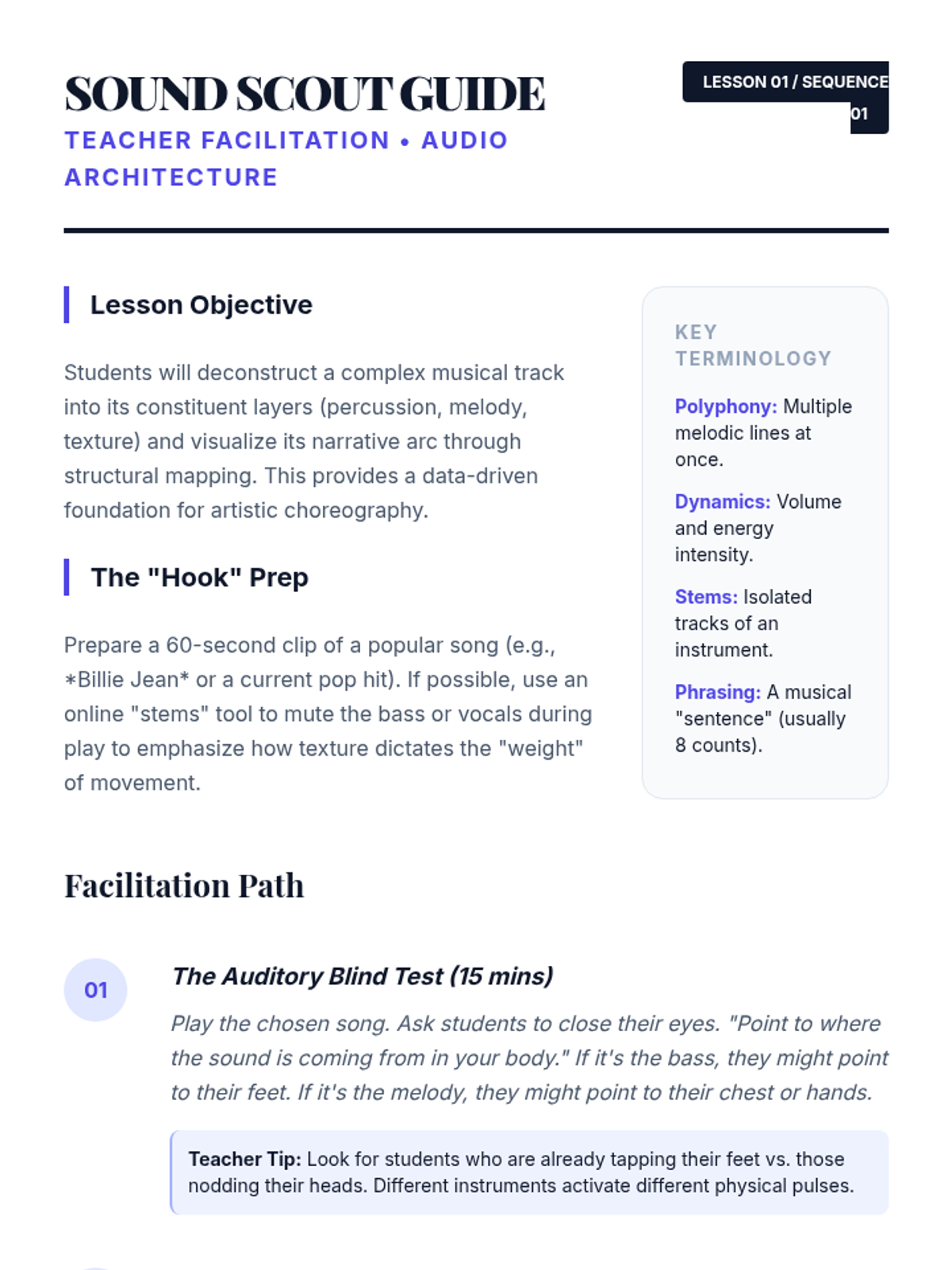
Teacher facilitation guide for Lesson 1, including hook instructions, terminology, and differentiation strategies for musical mapping.
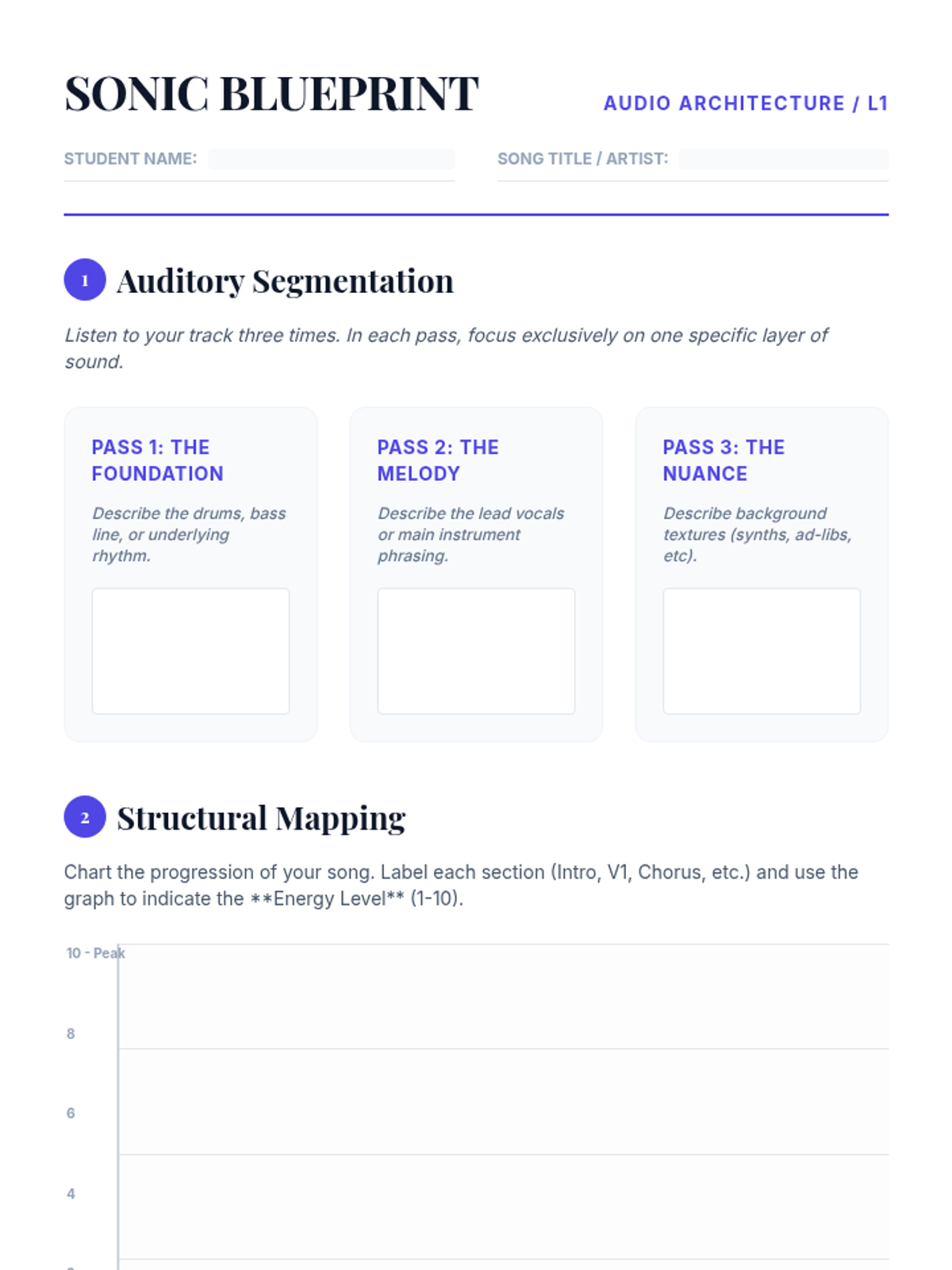
A worksheet for students to visually map a song's layers and energy structure as a blueprint for choreography.
Introductory presentation for Lesson 1, introducing the concepts of musical layering, structure, and visual mapping for choreographic use.
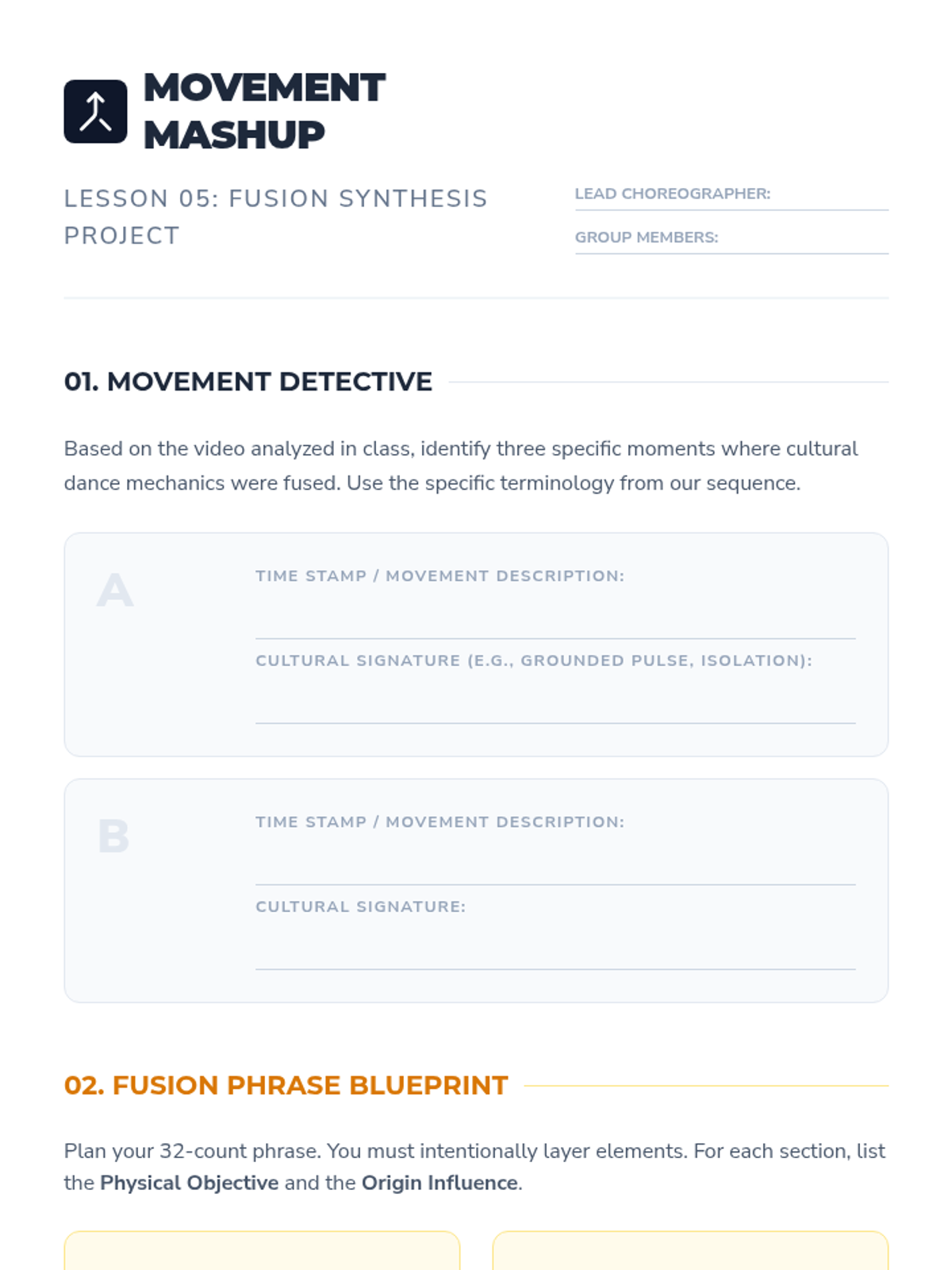
A student worksheet for Lesson 5 focused on analyzing fusion in media, planning a creative synthesis project, and reflecting on the ethics of movement appropriation.
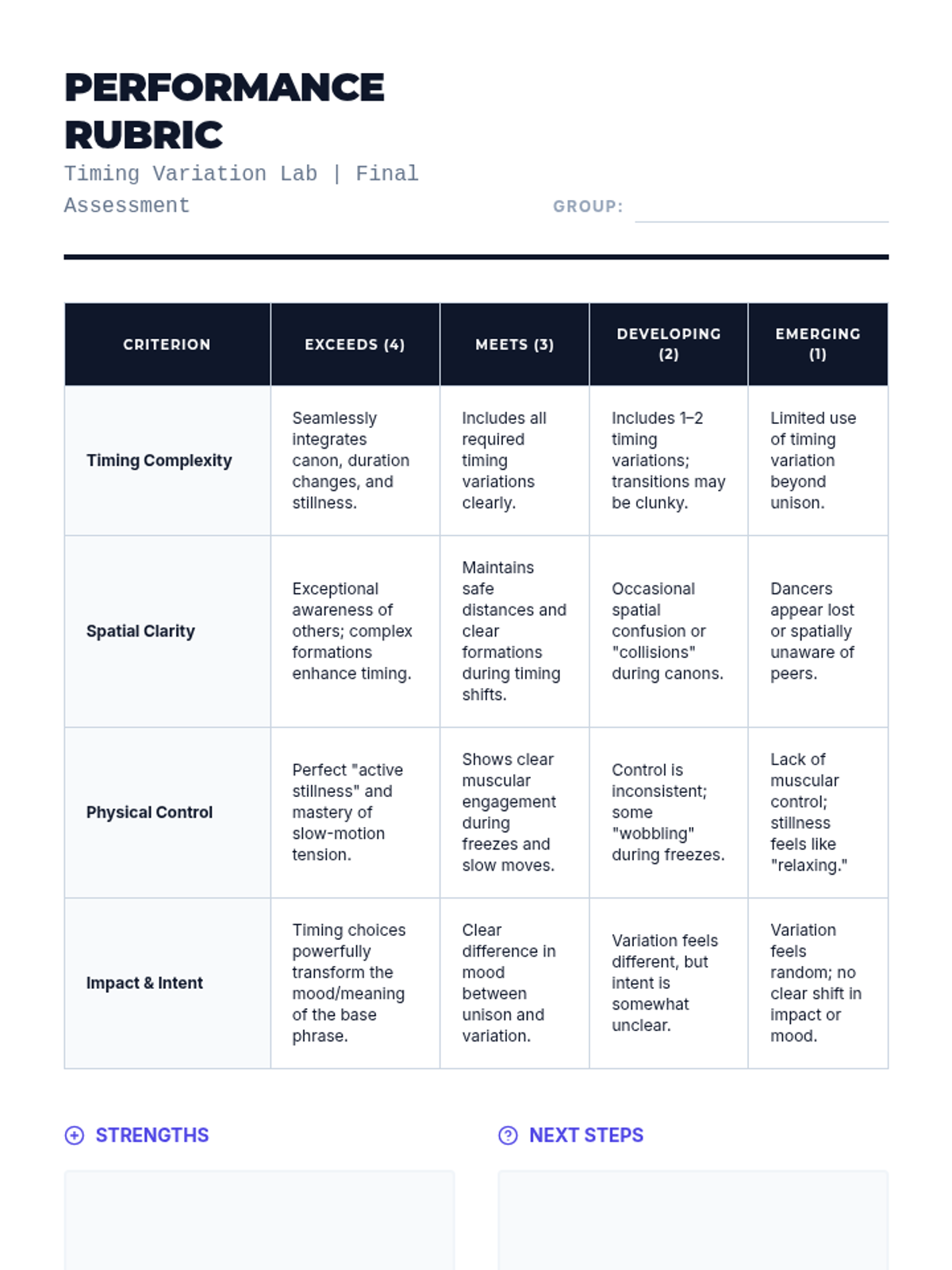
A grading rubric for the final project in Lesson 5. It evaluates groups on timing complexity, spatial clarity, physical control, and the emotional impact of their choreographic variations.
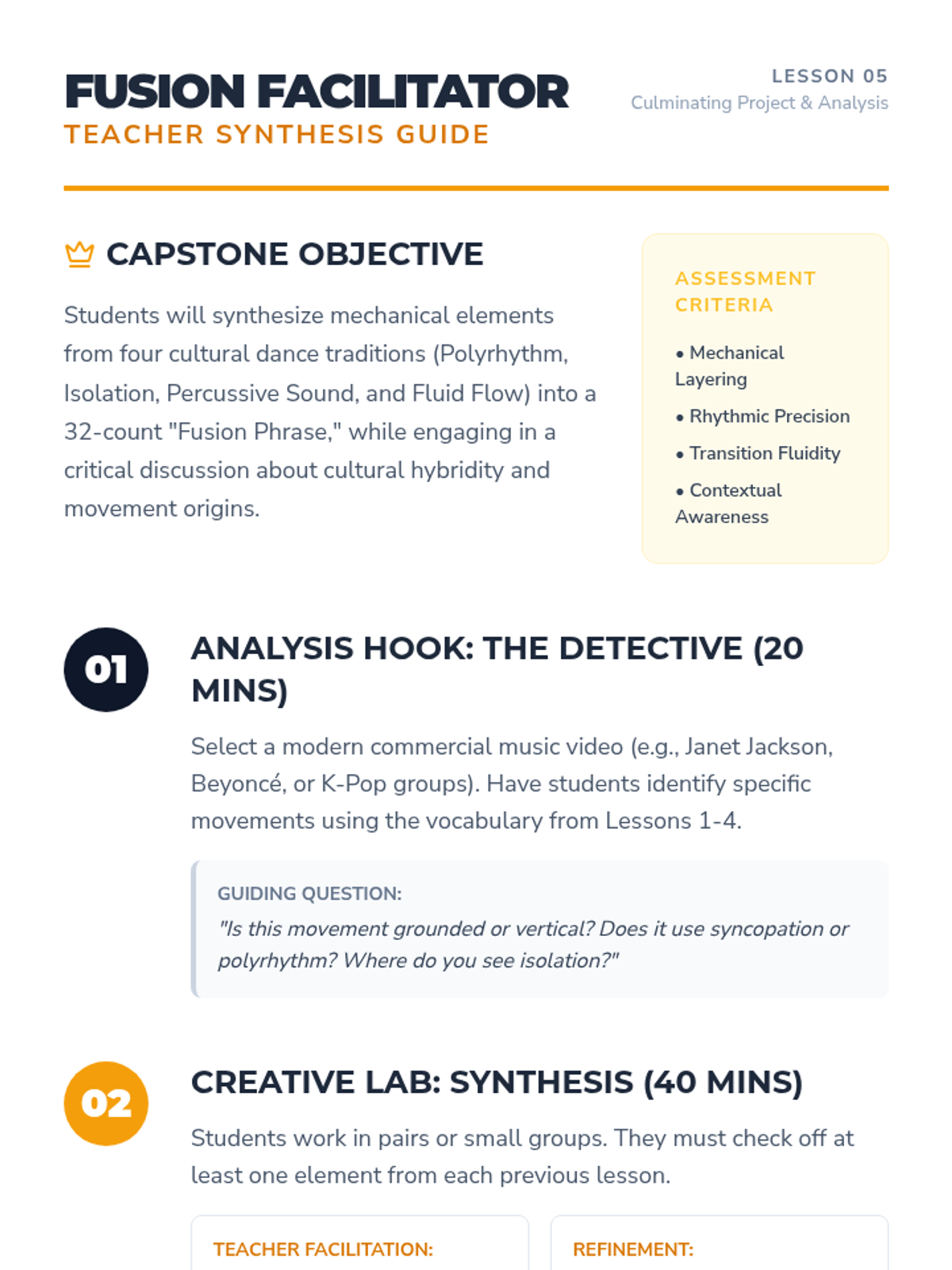
A detailed facilitation guide for teachers leading Lesson 5, focusing on guiding students through the synthesis project and facilitating critical discussions on cultural fusion and appropriation.
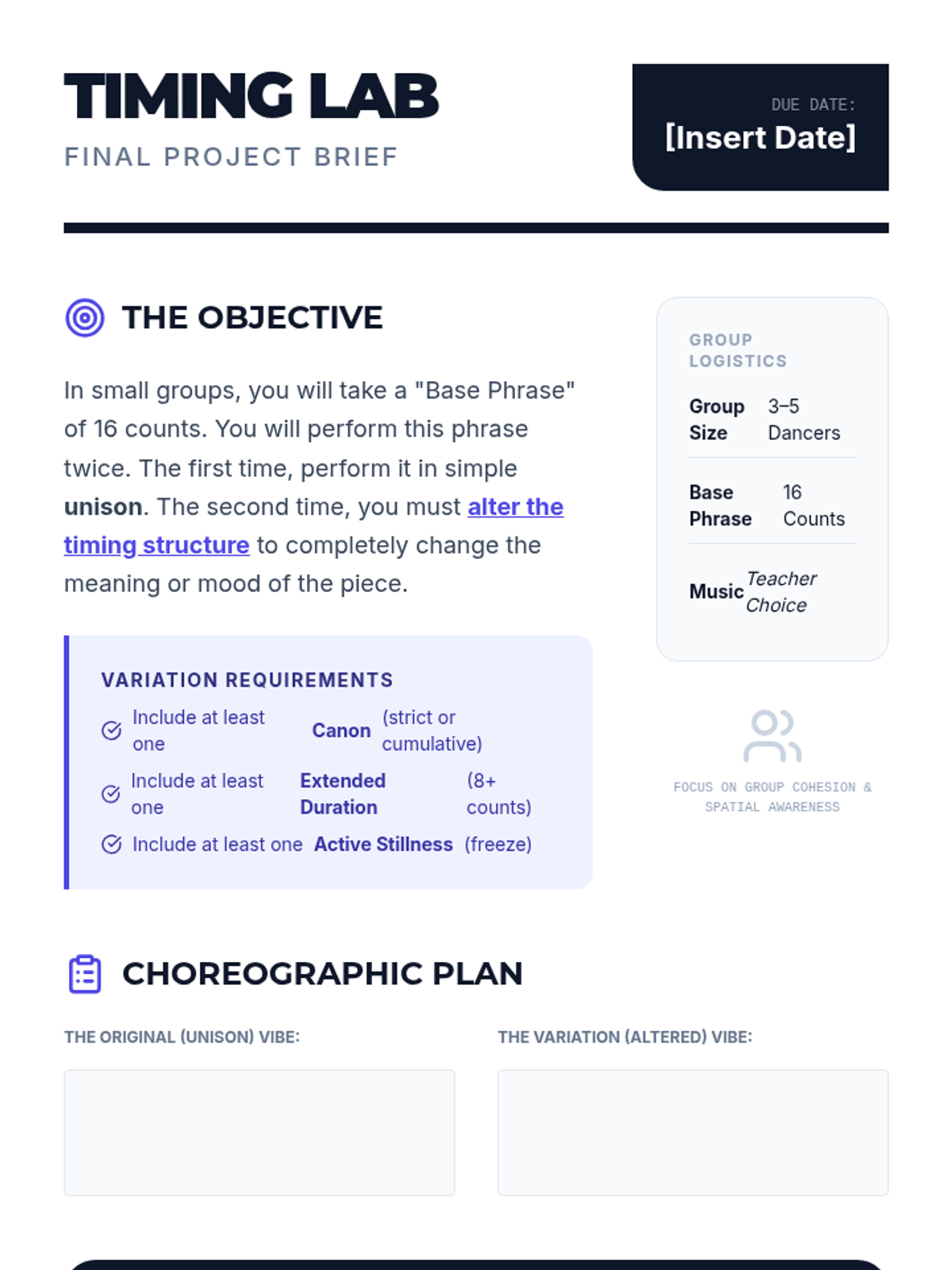
A project guide and planning document for the final lesson. It outlines the requirements for taking a unison phrase and creating a variation using timing manipulation (canon, duration, stillness).
A visual presentation for Lesson 5, culminating the sequence by analyzing movement fusion in modern media and guiding students through a creative synthesis project. Includes a final "Fusion Phrase" task description.
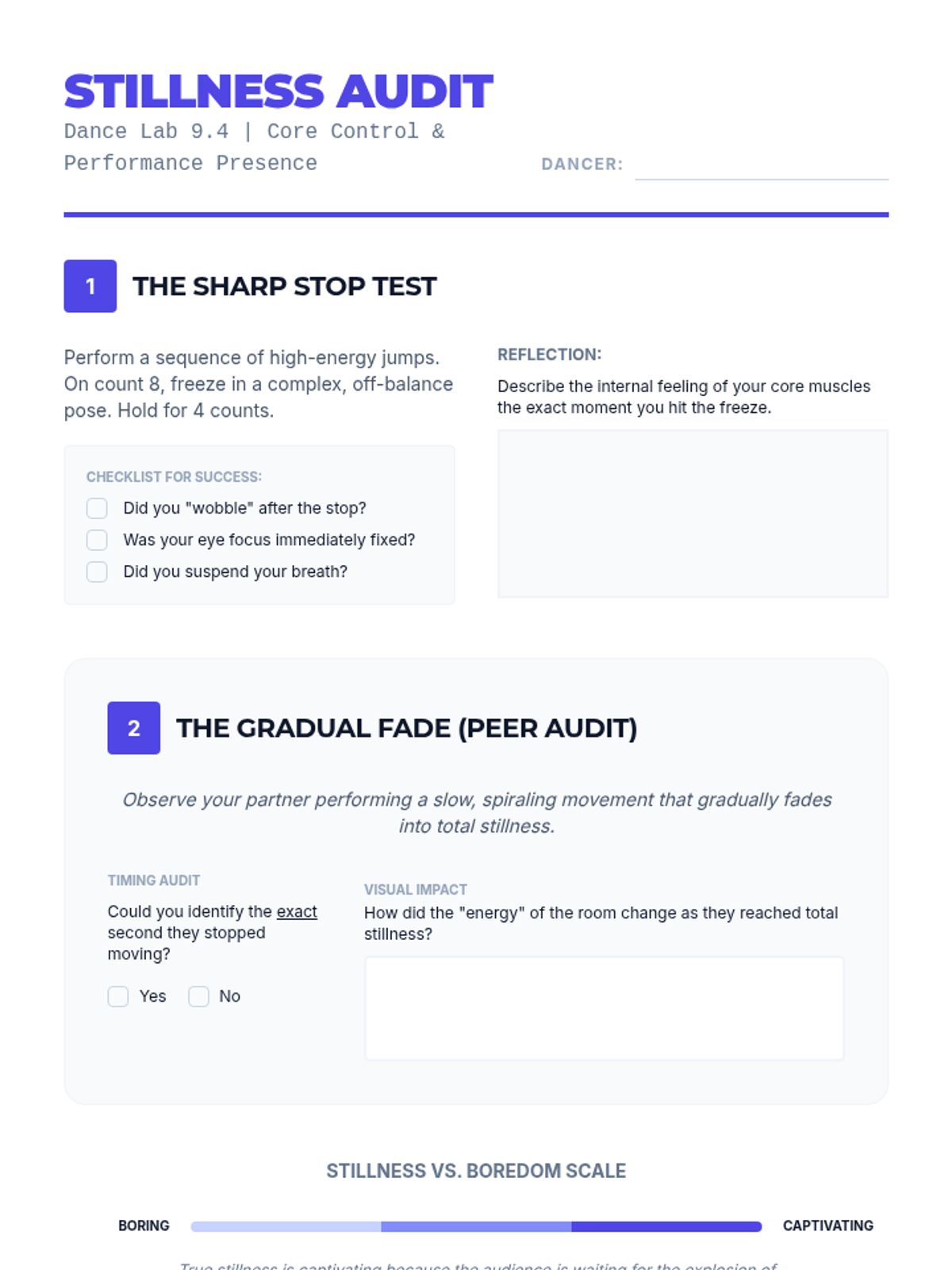
A student worksheet for Lesson 4 to evaluate their own and peers' control during freezes. Includes a checklist for technical success and a reflection on the dramatic impact of stillness.
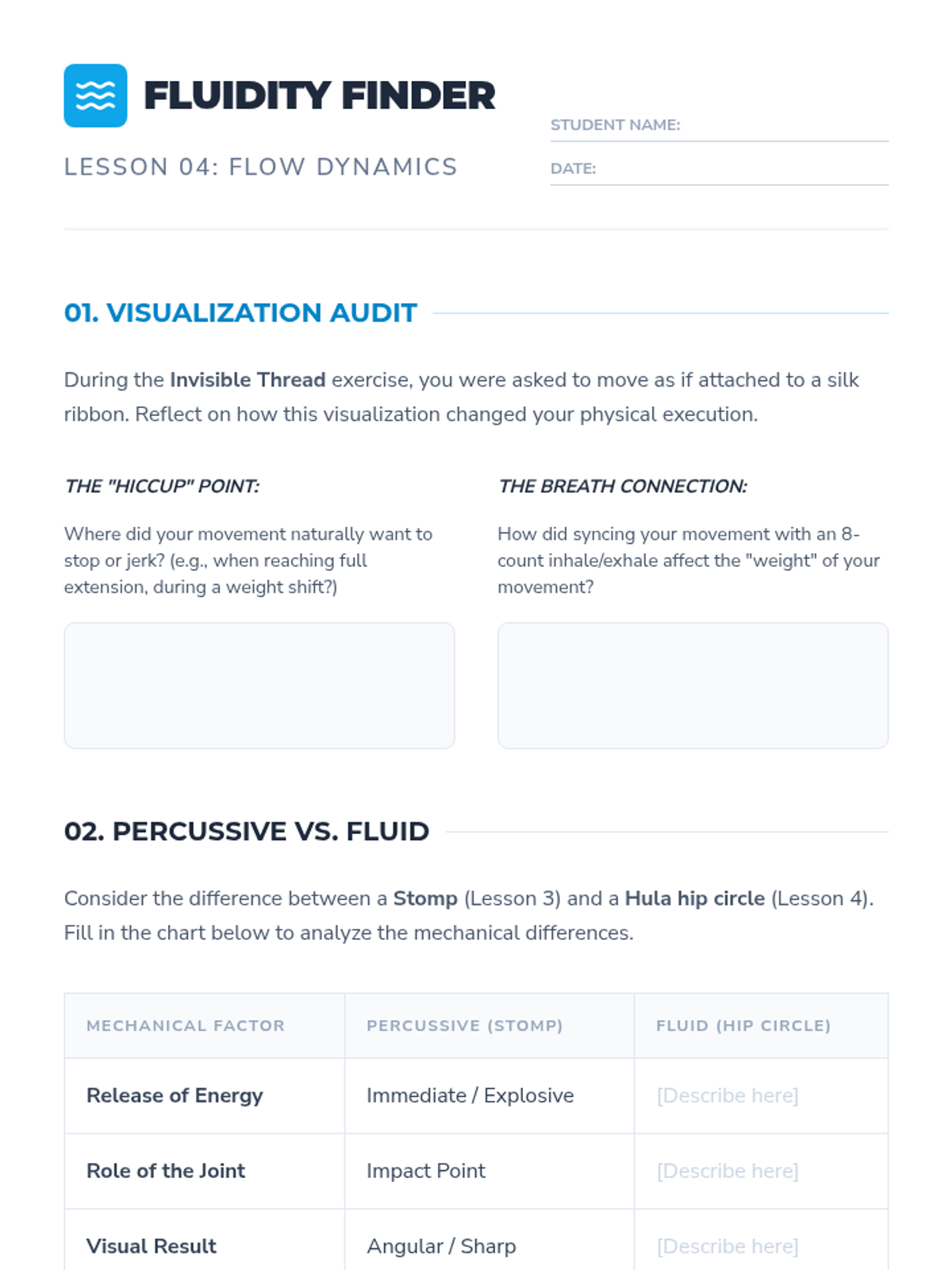
A student worksheet for Lesson 4 focused on analyzing flow dynamics, comparing percussive and fluid mechanics, and reflecting on the cultural storytelling of Hula.
A slide deck for Lesson 4 exploring the power of stillness and silence in dance. It covers the difference between sharp stops and gradual deceleration, as well as the technical importance of breath control and core engagement.
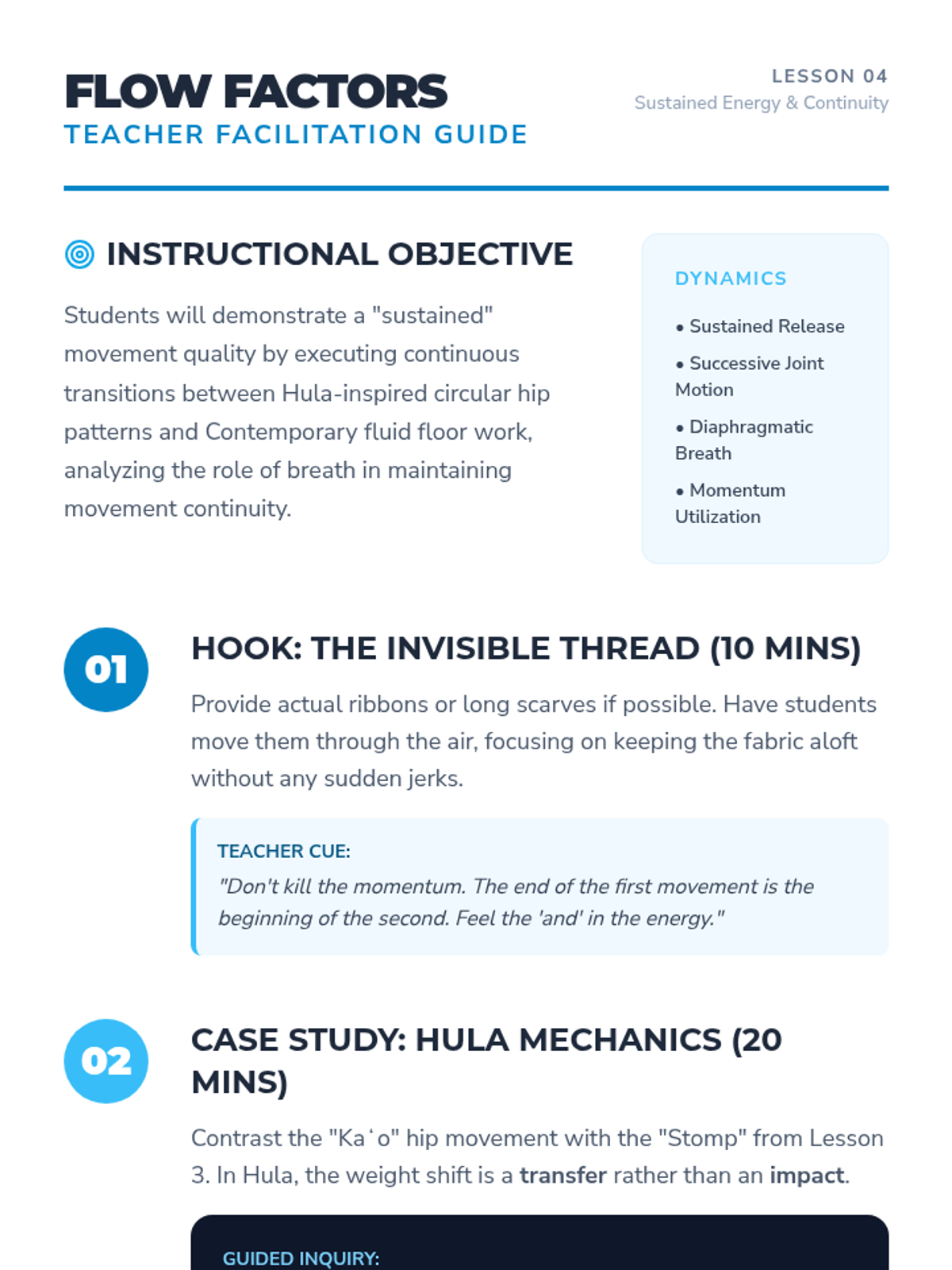
A detailed facilitation guide for teachers leading Lesson 4, focusing on the concepts of flow, continuity, and sustained energy in Hula and Contemporary dance forms. Includes instructional cues and classroom management strategies.
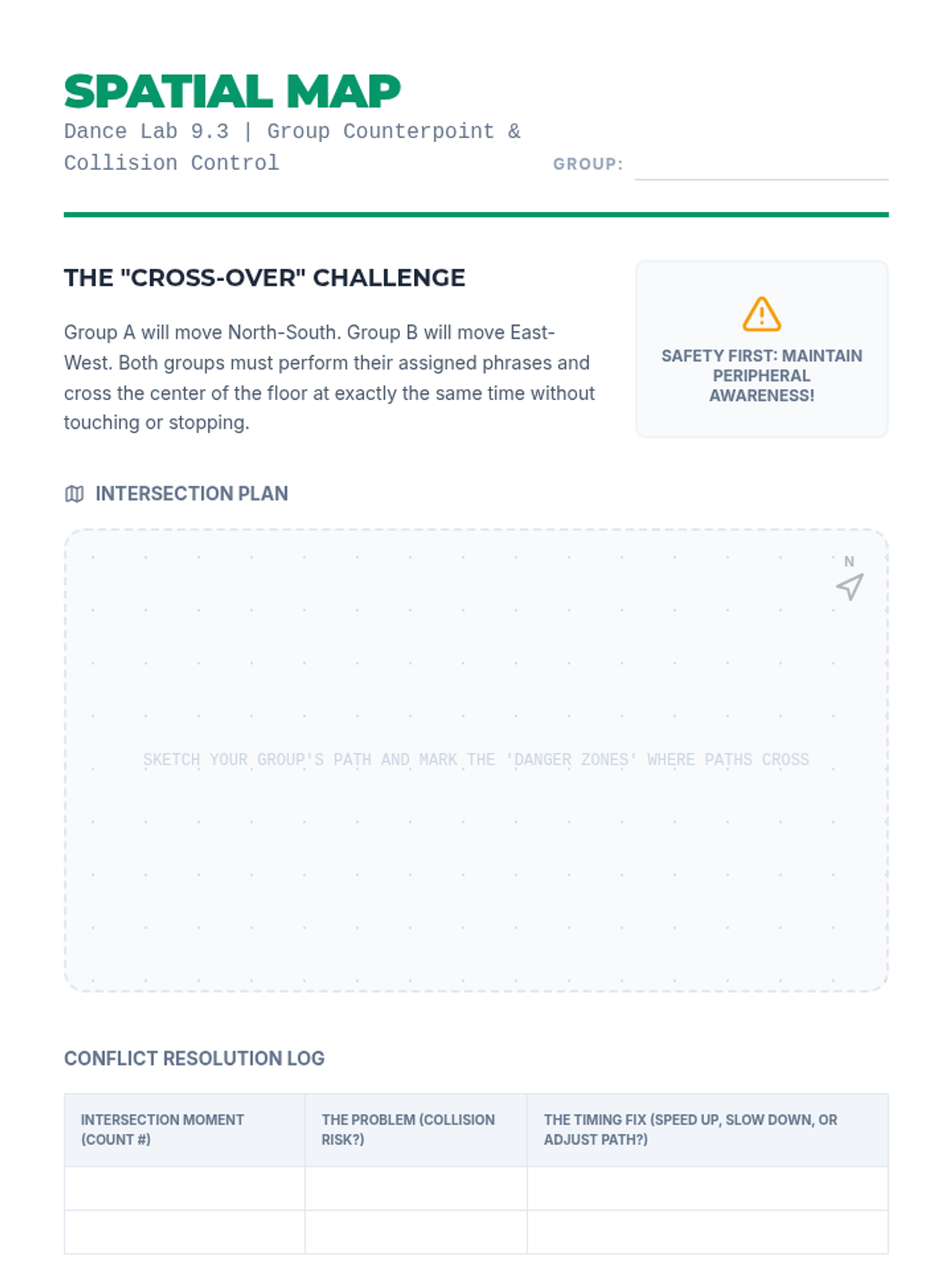
An activity guide for Lesson 3 to plan and analyze spatial counterpoint. Students map out their intersection paths and record how they adjusted their timing to avoid collisions while maintaining their choreographic phrases.
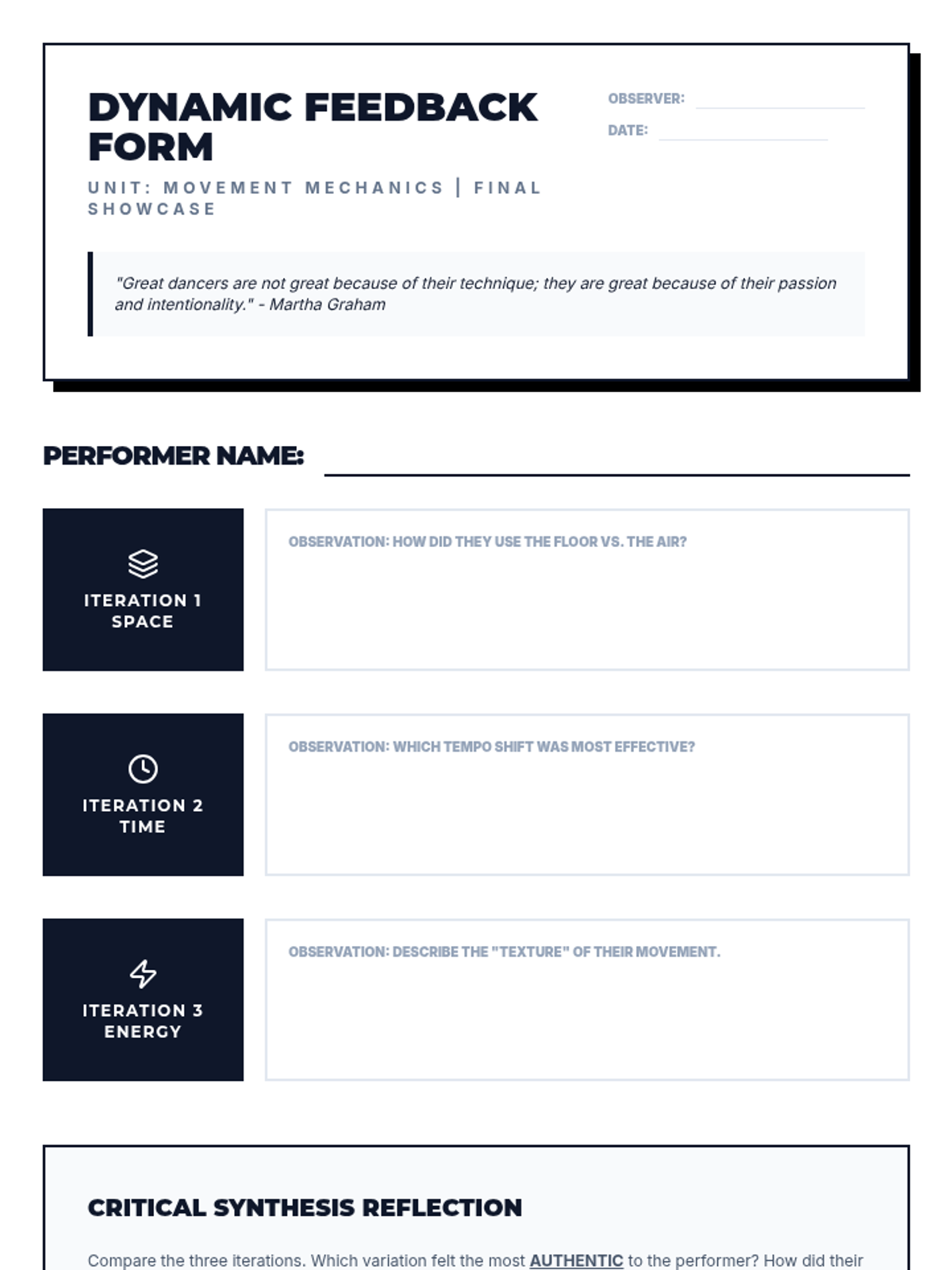
A peer feedback form for Lesson 5, designed for students to observe and analyze variations in space, time, and energy during a classmate's performance.
A visual presentation for Lesson 4, focusing on the concepts of flow, continuity, and sustained energy in Hula and Contemporary dance forms. Includes visualization exercises and a liquid transition lab.
A visual presentation deck for the final performance showcase in Lesson 5, detailing the "Chameleon Challenge" and performance criteria for peer feedback.
A slide deck for Lesson 3 introducing counterpoint in movement. It compares musical counterpoint to dance, explores spatial-temporal reasoning, and uses a traffic intersection analogy to explain anticipation and safety.
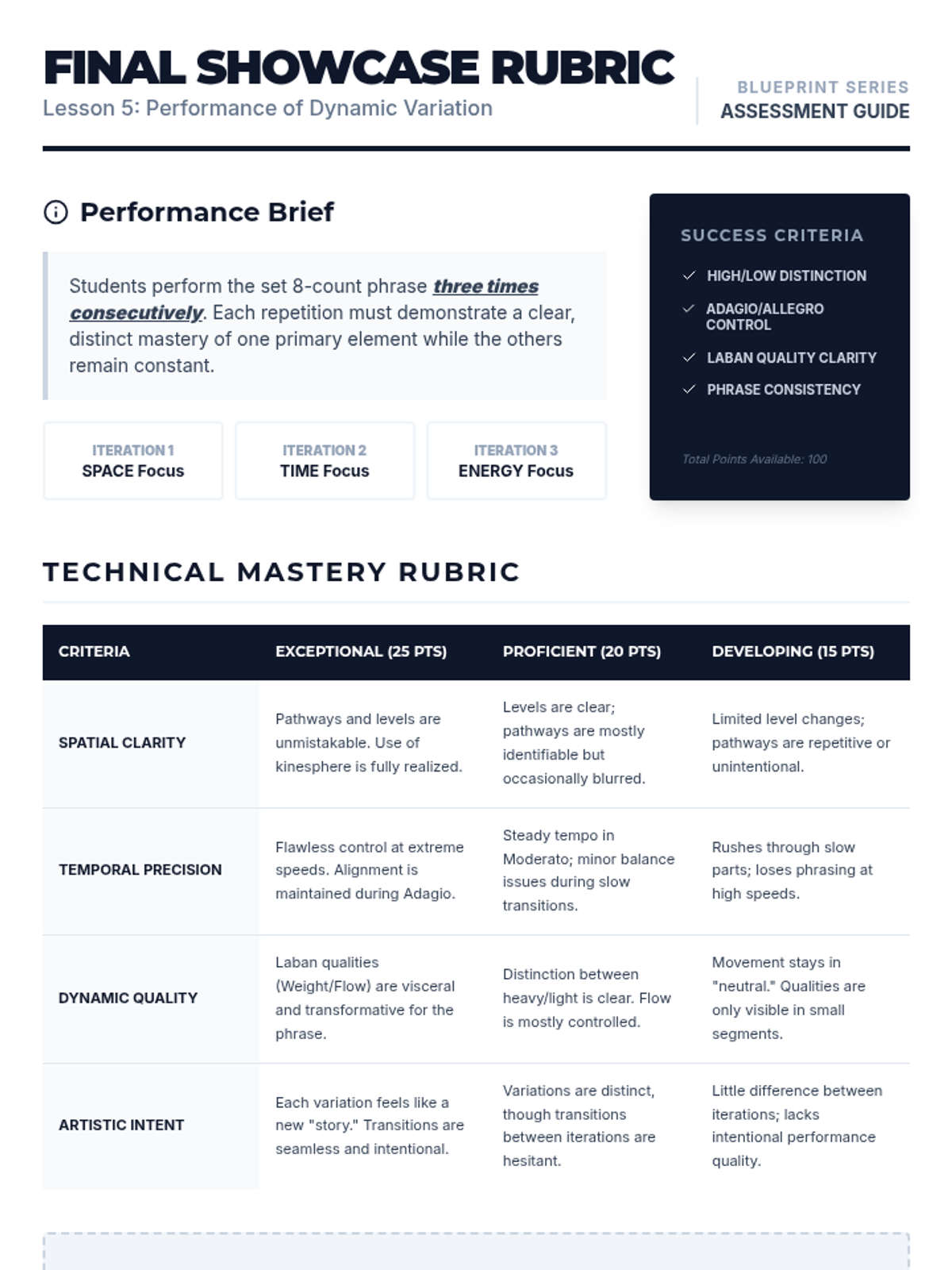
A formal assessment rubric for Lesson 5, focusing on spatial clarity, temporal precision, dynamic quality, and artistic intent in a performance showcase.
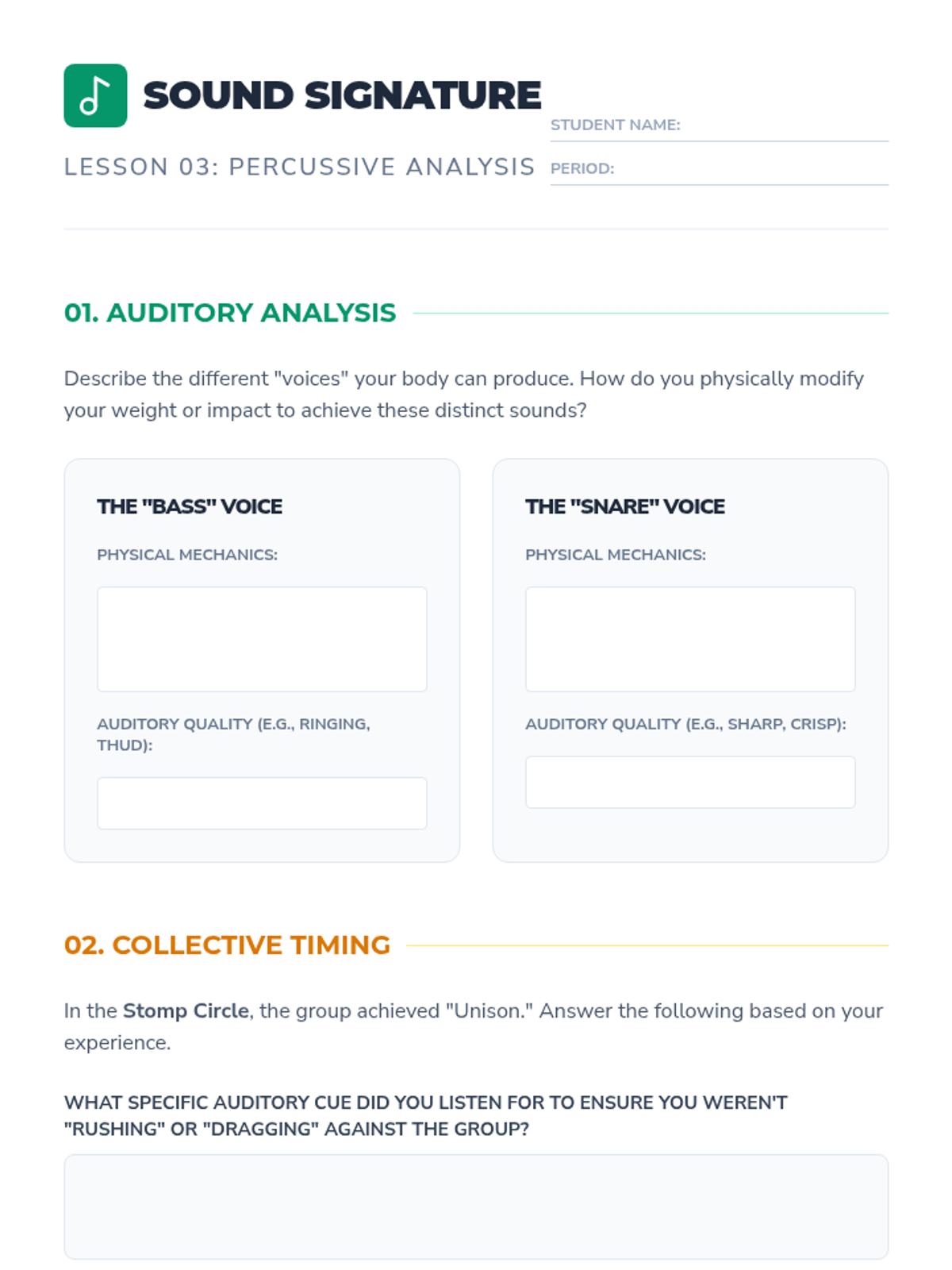
A student worksheet for Lesson 3 focused on auditory discrimination of body sounds, reflection on group unison timing, and comparative analysis of percussive dance goals.
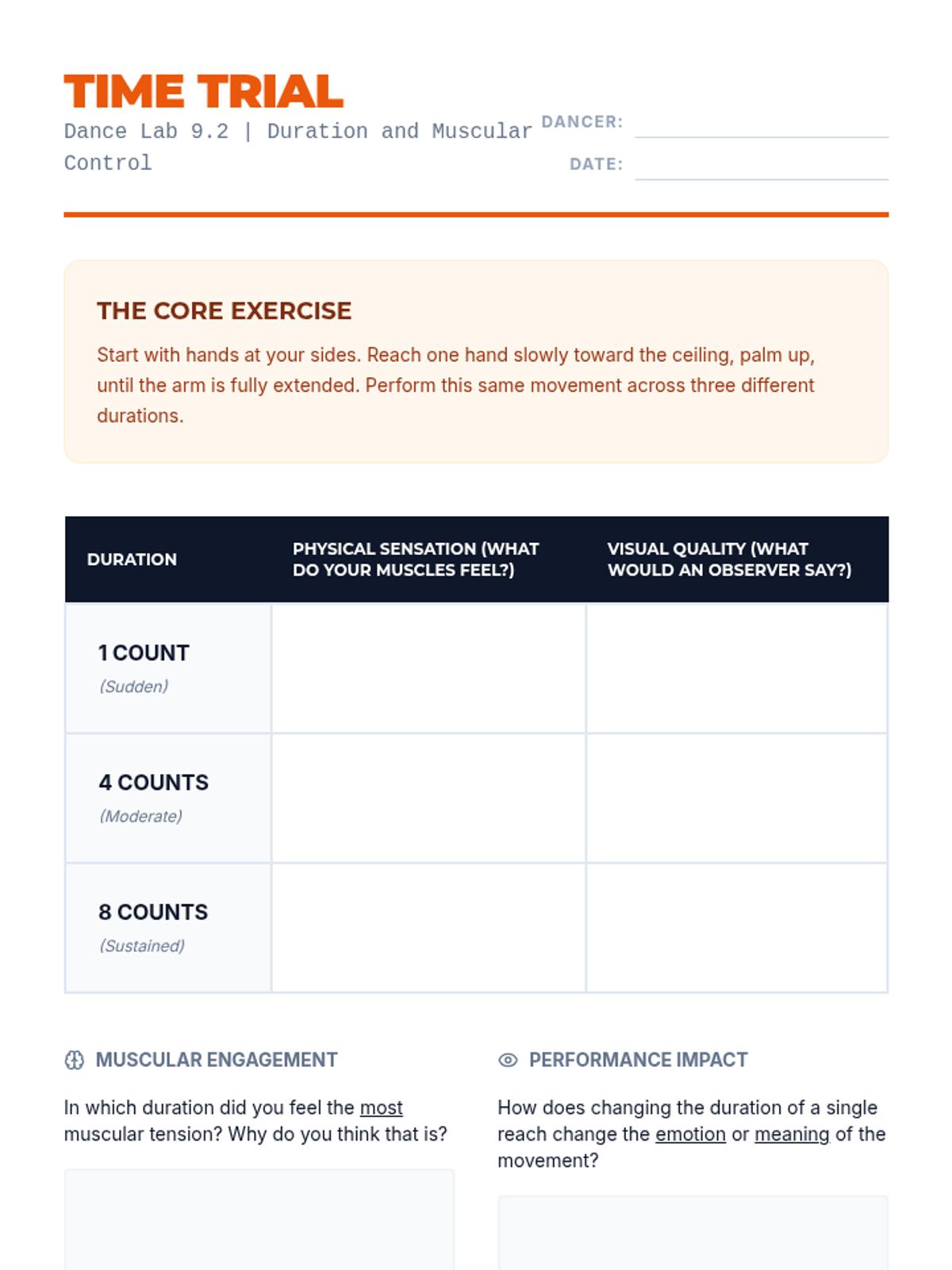
A student lab sheet for Lesson 2 to record physical sensations and visual observations when performing the same movement over 1, 4, and 8 counts. Focuses on muscular control and movement quality.
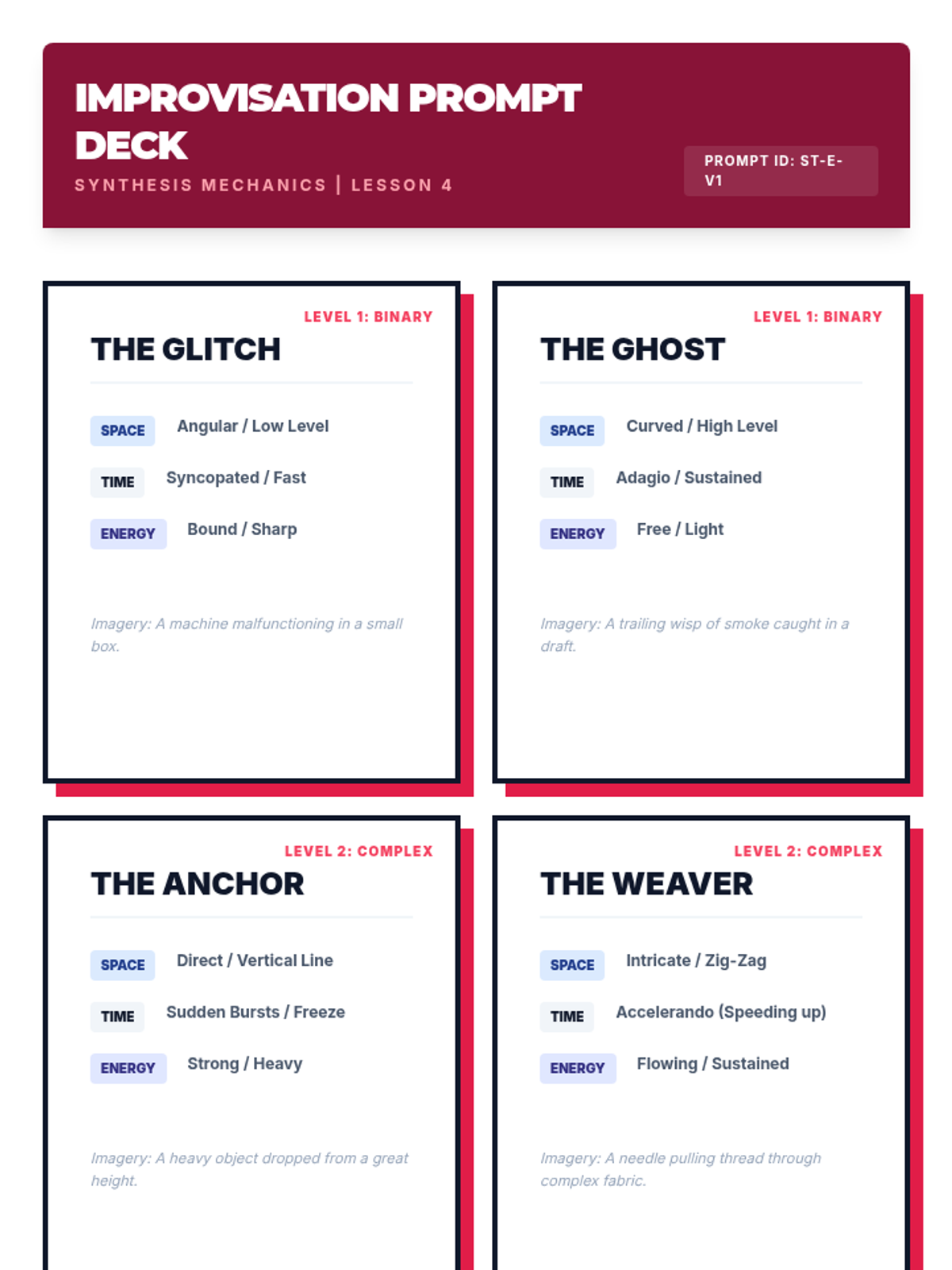
A set of improvisation prompt cards for Lesson 4, providing specific Space, Time, and Energy constraints (The Glitch, The Ghost, The Anchor, The Weaver).
A slide deck for Lesson 2 exploring how movement duration (1, 4, and 8 counts) impacts muscular tension and the perceived quality of dance. Introduces concepts of 'sudden' versus 'sustained' time.
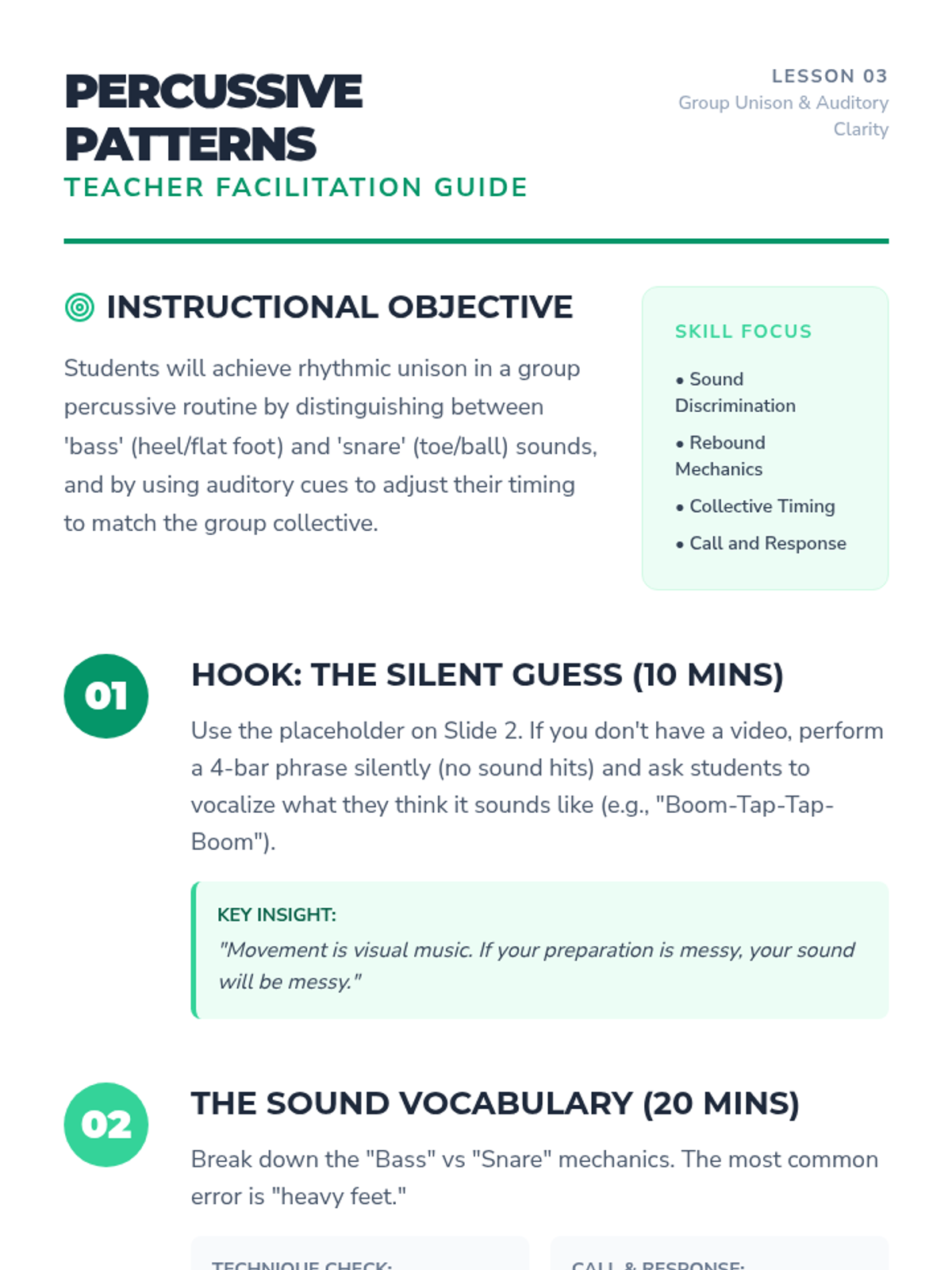
A detailed facilitation guide for teachers leading Lesson 3, focusing on the mechanics of percussive dance forms like Step, Tap, and Flamenco. Includes auditory discrimination exercises and group unison strategies.
A visual presentation for Lesson 3, exploring the mechanics of percussive dance forms like Step, Tap, and Flamenco. Includes auditory-visual connection exercises and sound-based movement vocabulary.
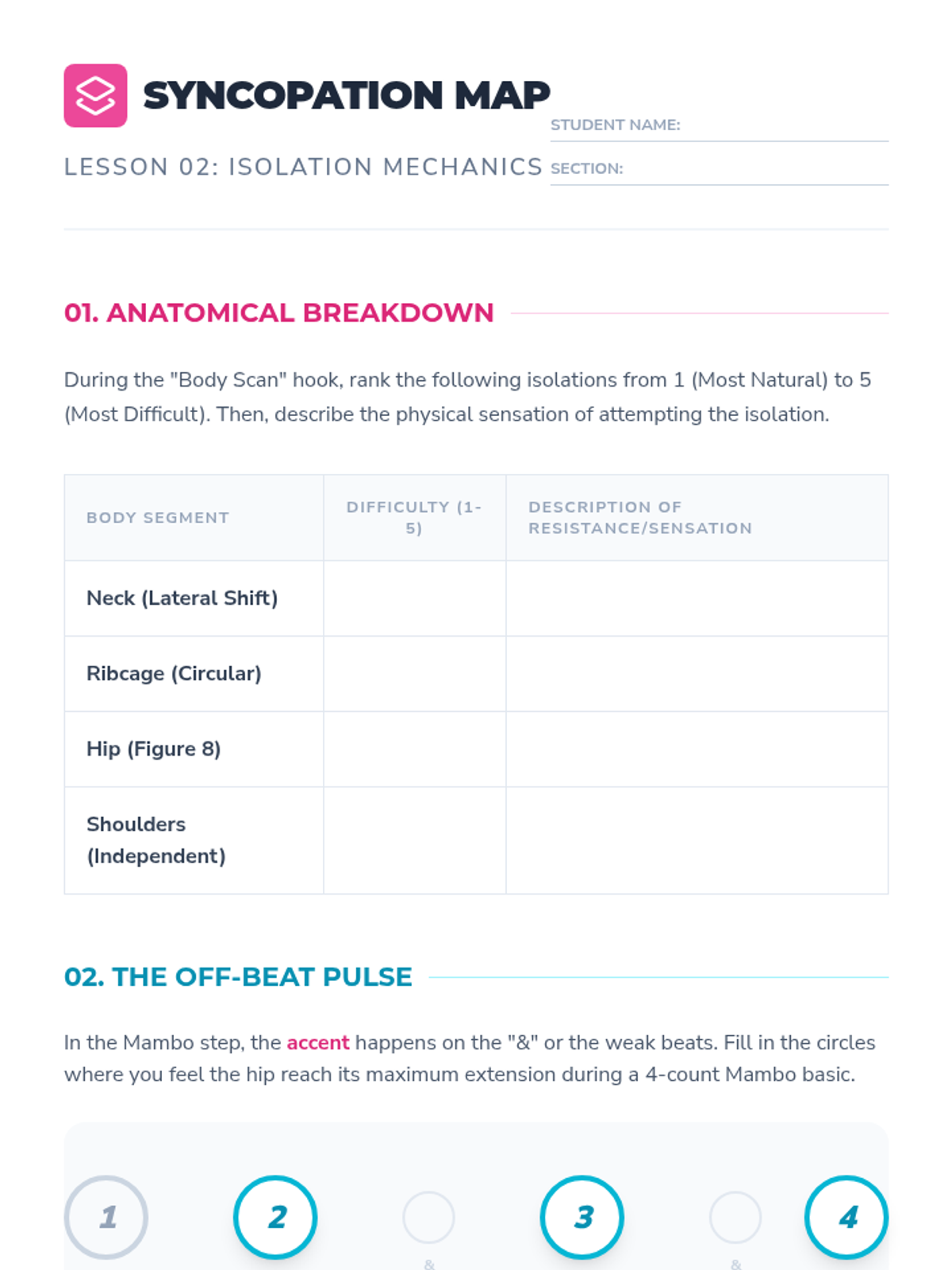
A student worksheet for Lesson 2 focused on self-assessing isolation skills, mapping syncopated rhythms in the Mambo step, and reflecting on the visual texture of off-beat movements.
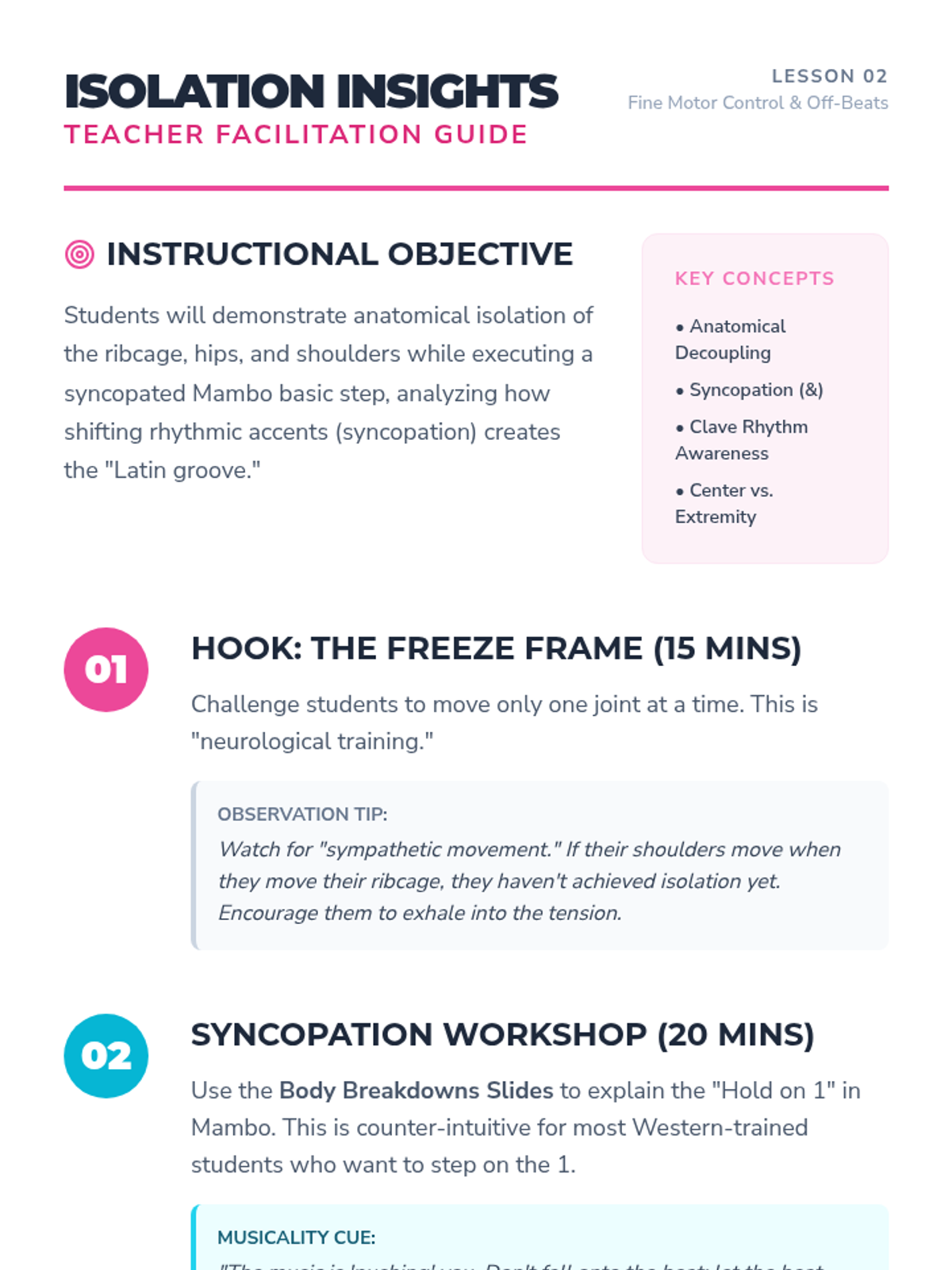
A detailed facilitation guide for teachers leading Lesson 2, focusing on the mechanics of body isolations and the concept of syncopation in Jazz and Latin dance.
A visual presentation for Lesson 2, focusing on the mechanics of body isolations and the rhythmic concept of syncopation within Jazz and Latin dance forms. Includes a freeze-frame hook and Mambo step guide.
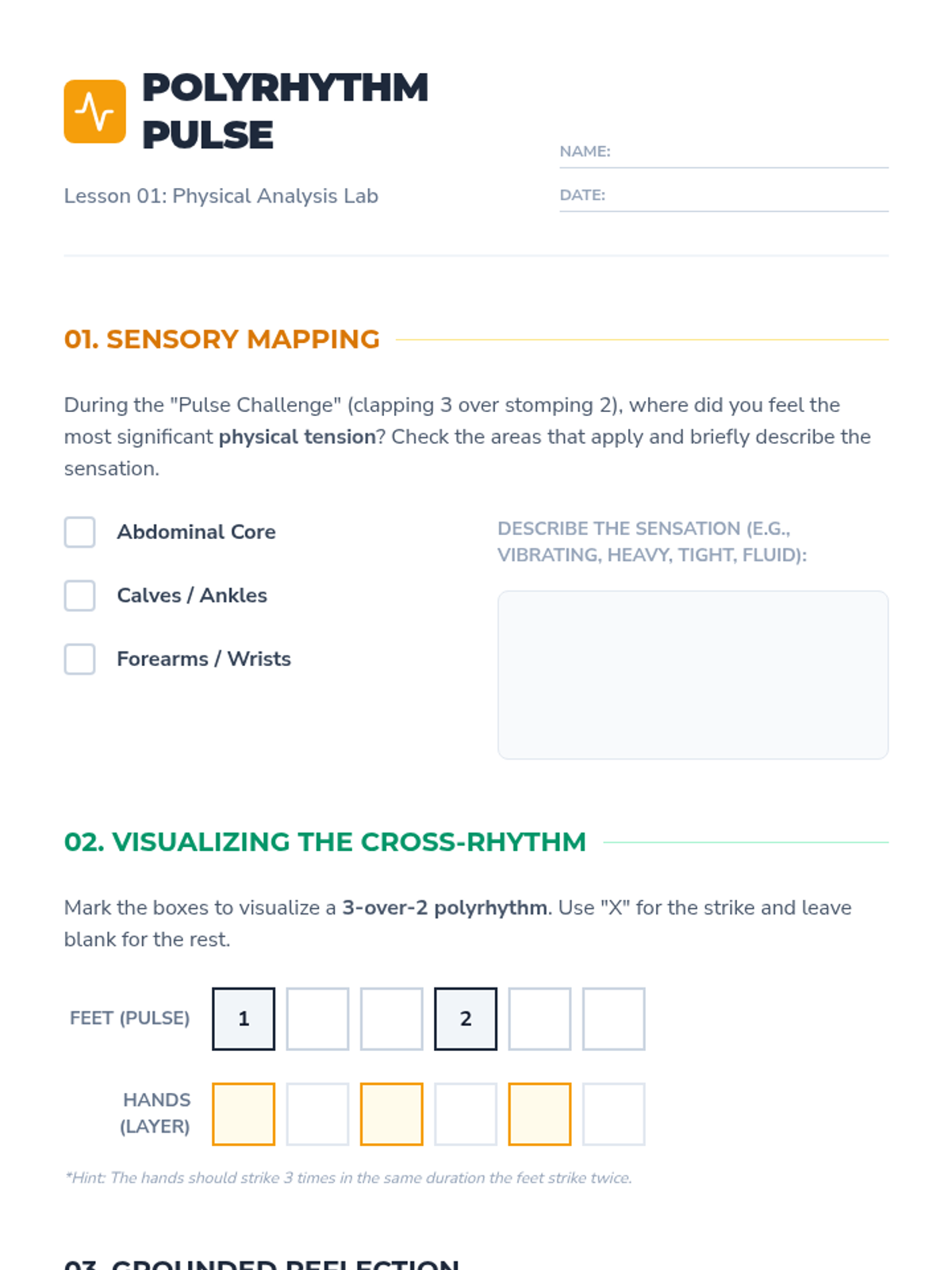
A student worksheet for Lesson 1 focused on analyzing the physical sensation of polyrhythm, visualizing rhythmic structures, and reflecting on the cultural concept of grounded movement.
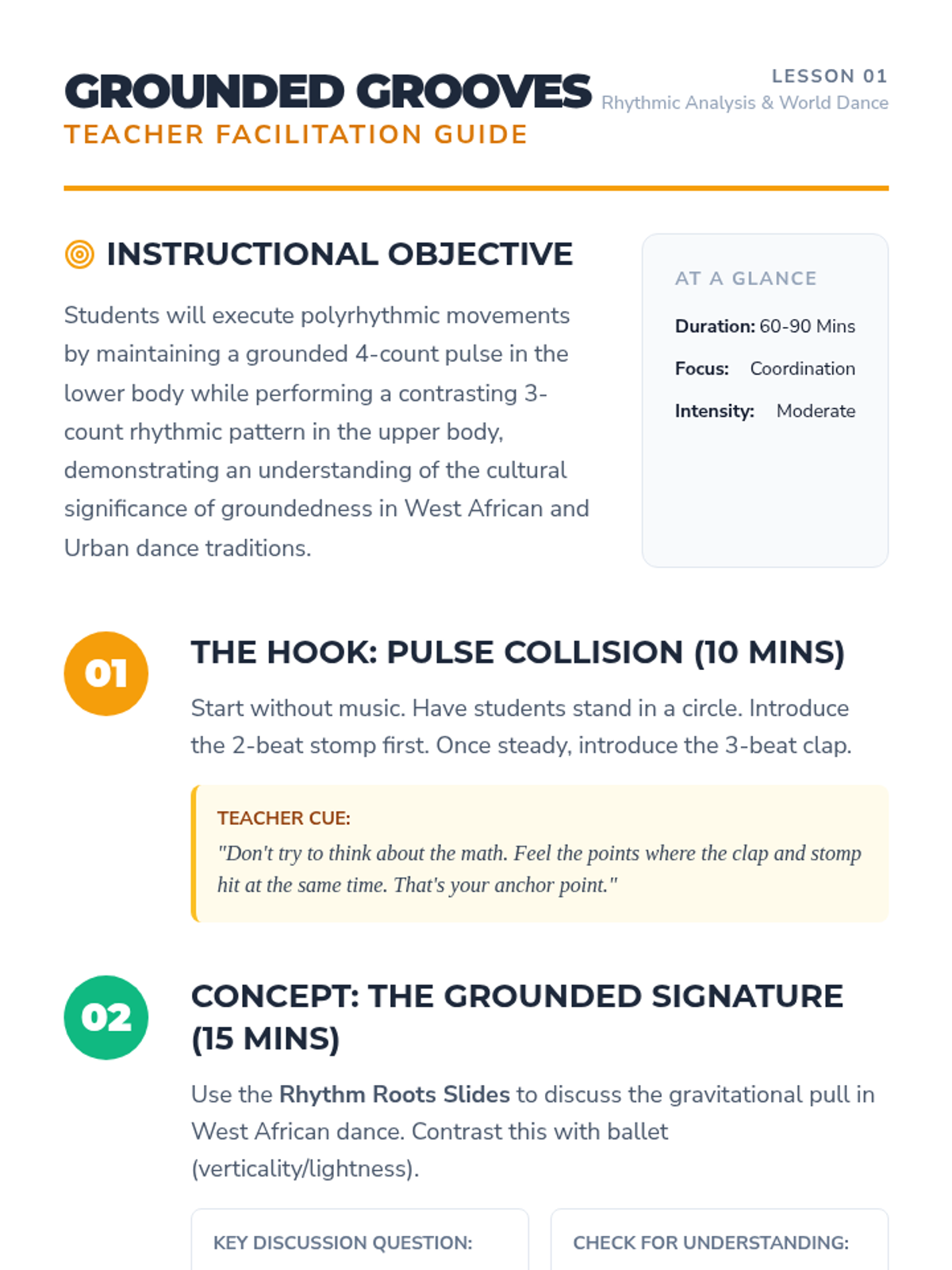
A detailed facilitation guide for teachers leading Lesson 1, including instructional cues, common student misconceptions, and differentiation strategies for teaching polyrhythm.
A visual presentation for Lesson 1, introducing the concepts of polyrhythm and grounded movement through the lens of West African and Diaspora dance traditions. Includes a physical hook and step-by-step lab instructions.
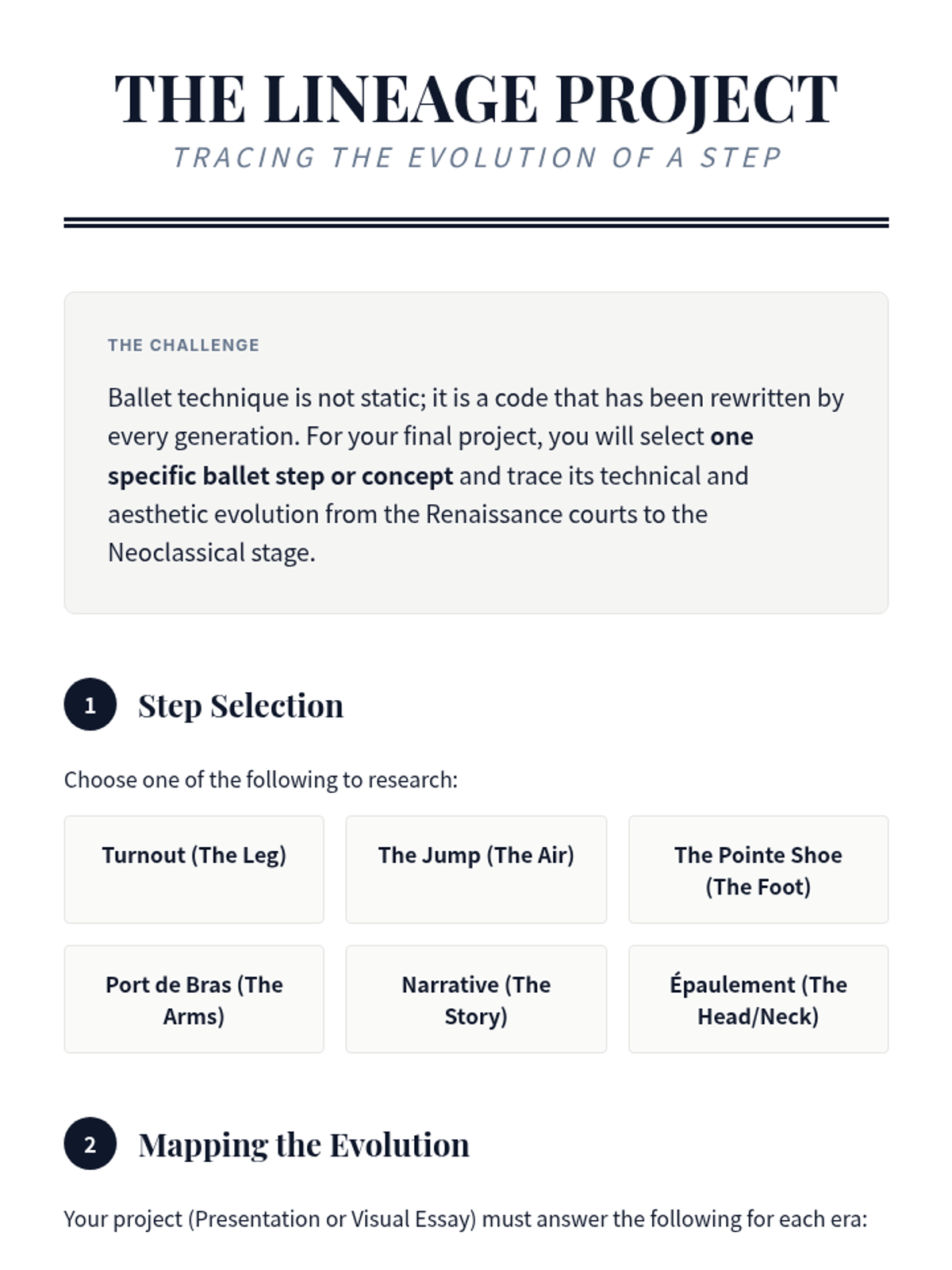
The final assessment project for the unit, where students trace a specific ballet step or concept through all five historical eras studied in the sequence.
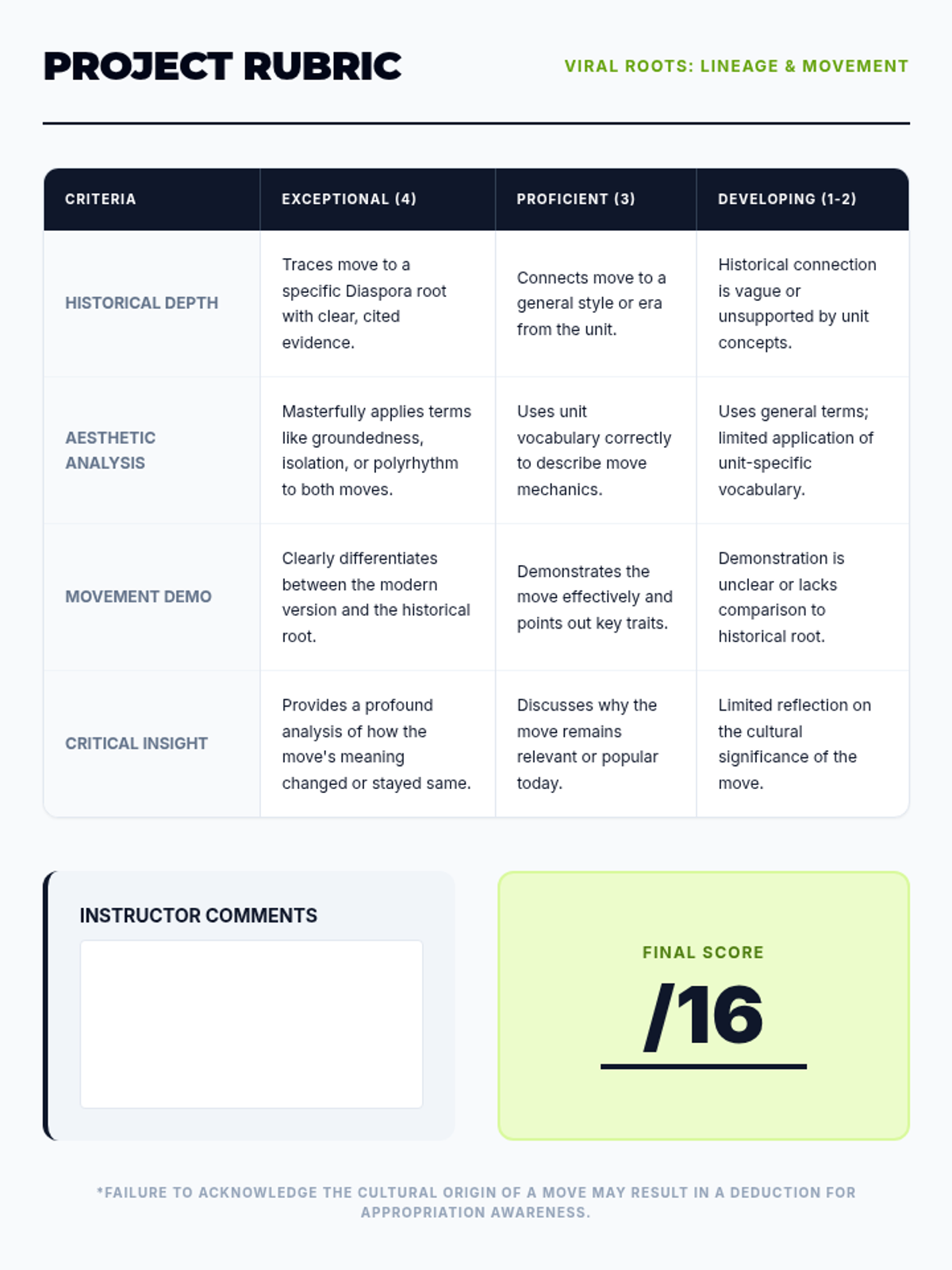
Grading rubric for the final unit assessment, evaluating historical research, movement analysis, and critical insight into the cultural lineage of modern dance moves.
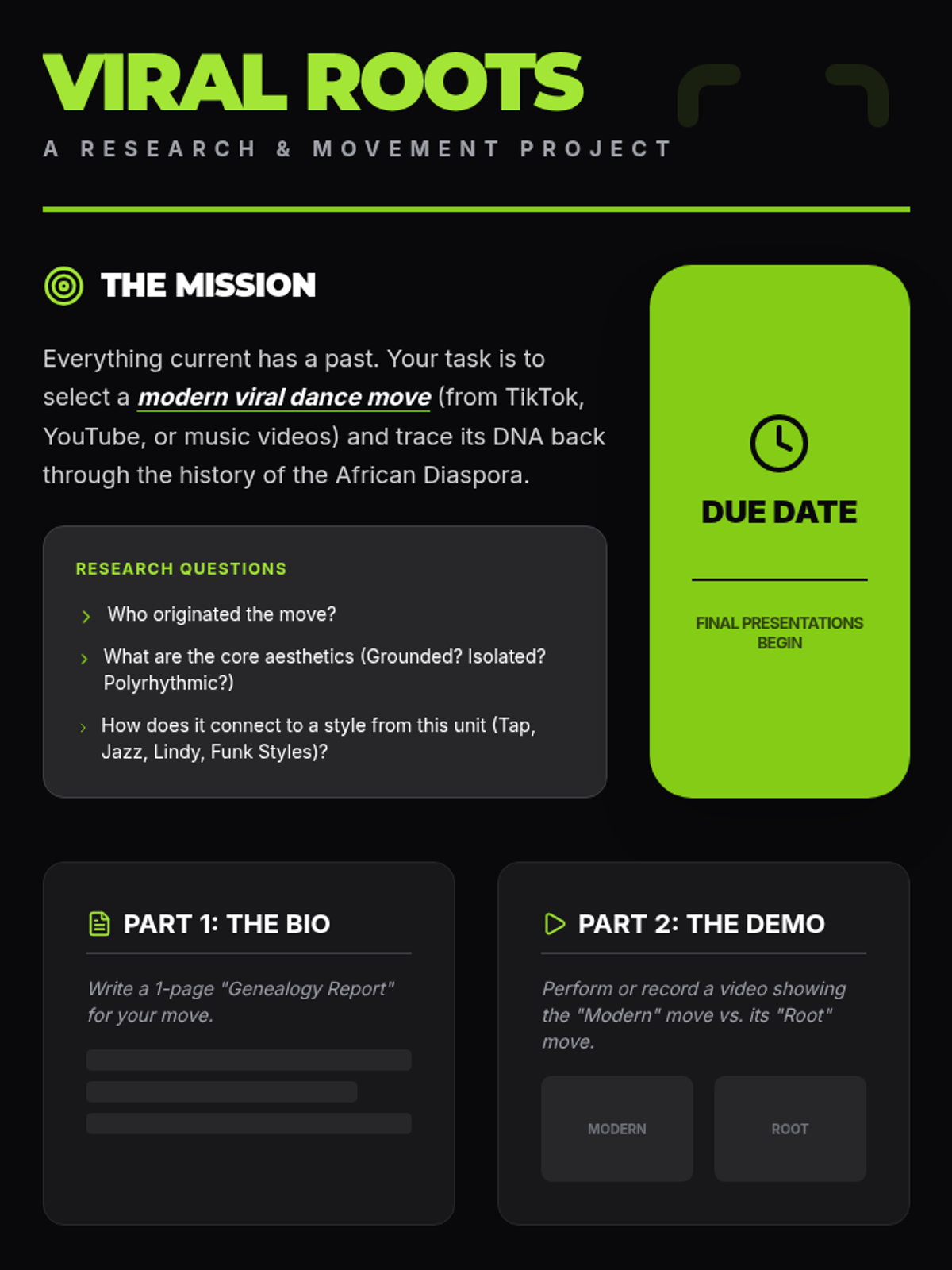
Student project guide for the final unit assessment, requiring students to trace the cultural and technical lineage of a modern dance move back to its historical roots in the African Diaspora.
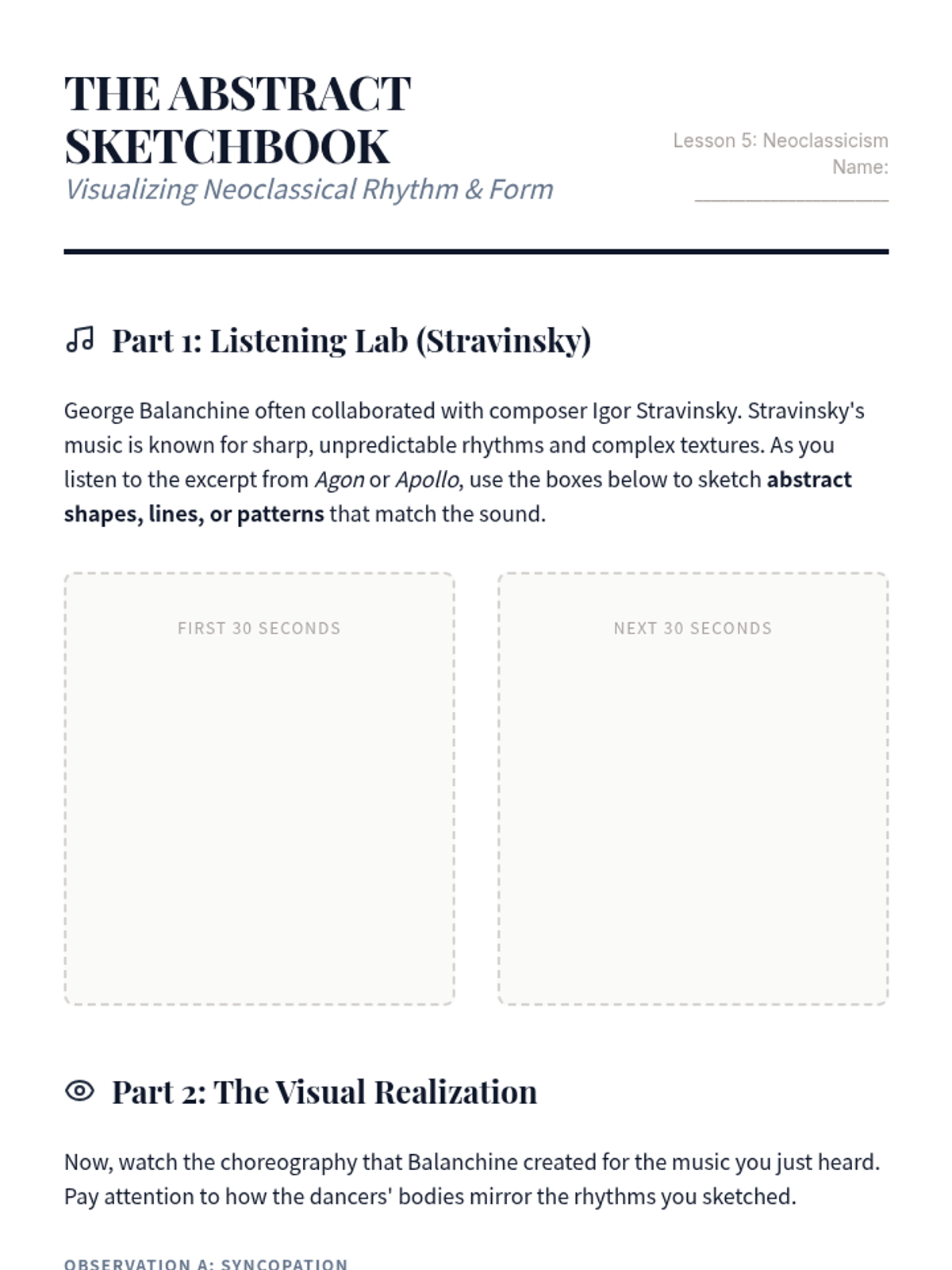
A student activity worksheet for Lesson 5, focusing on the visual relationship between neoclassical choreography and abstract musical structures.
Presentation slides exploring the birth of Hip Hop in the Bronx, the four pillars, and the three foundational styles (Breaking, Locking, Popping).