Essential grammar structures, high-frequency vocabulary, and foundational literacy skills. Equips learners with basic speaking and listening abilities for everyday interactions and introductory text comprehension.
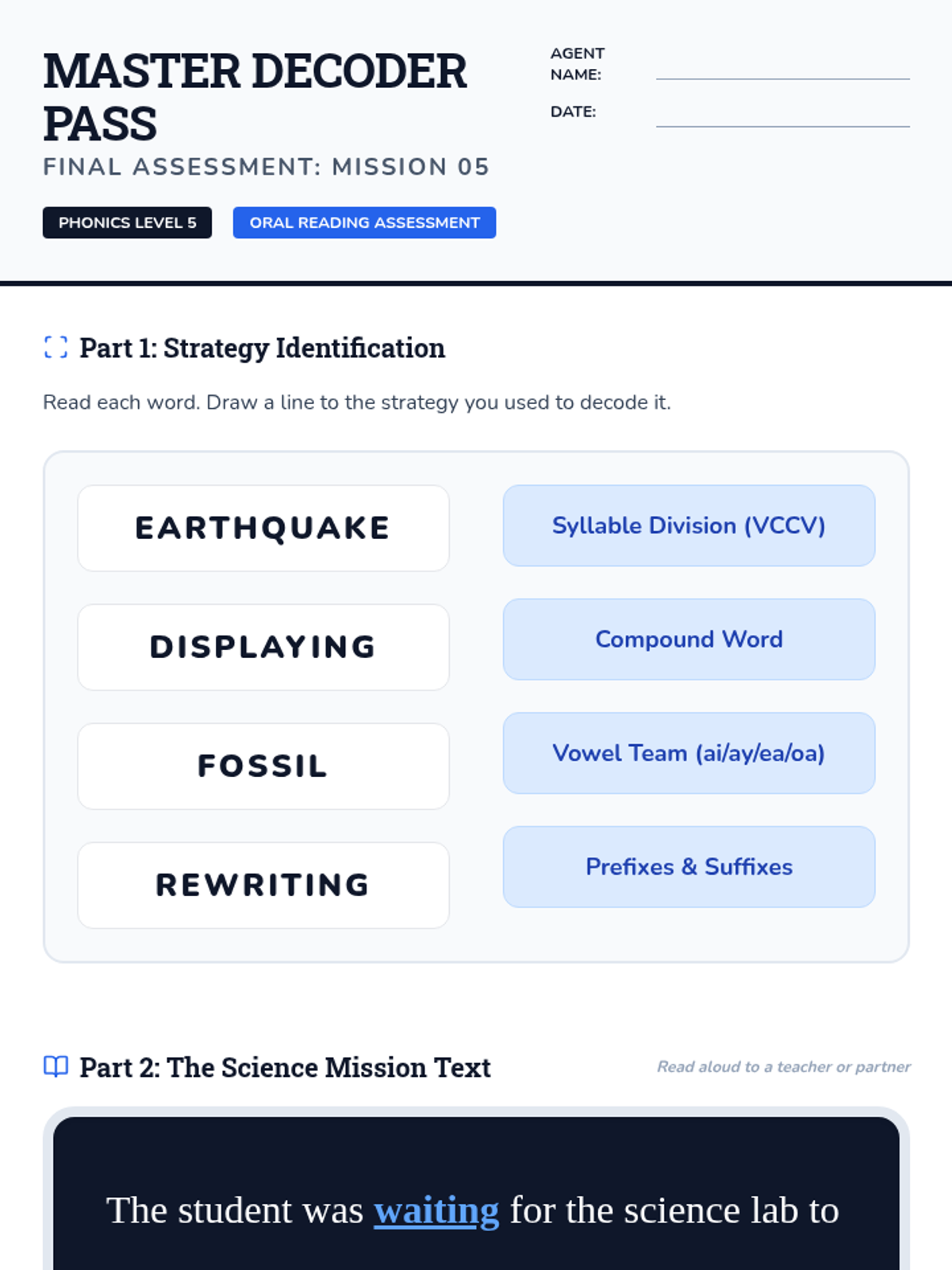
A cumulative reading assessment featuring a science-themed paragraph and a decoding strategy matching activity.
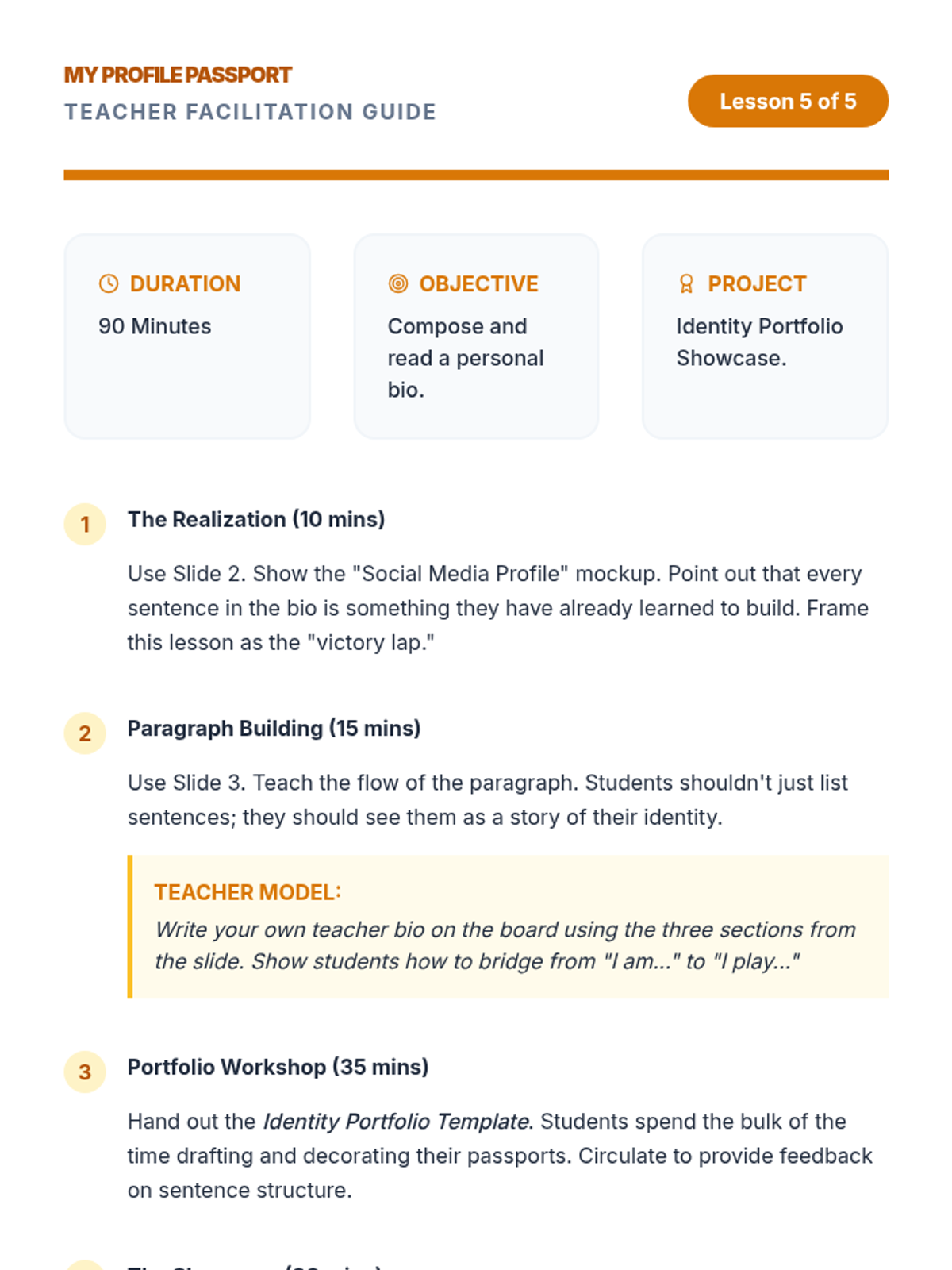
Teacher guide for Lesson 5, focusing on final project pacing, assessment through a rubric, and facilitation of the peer showcase.
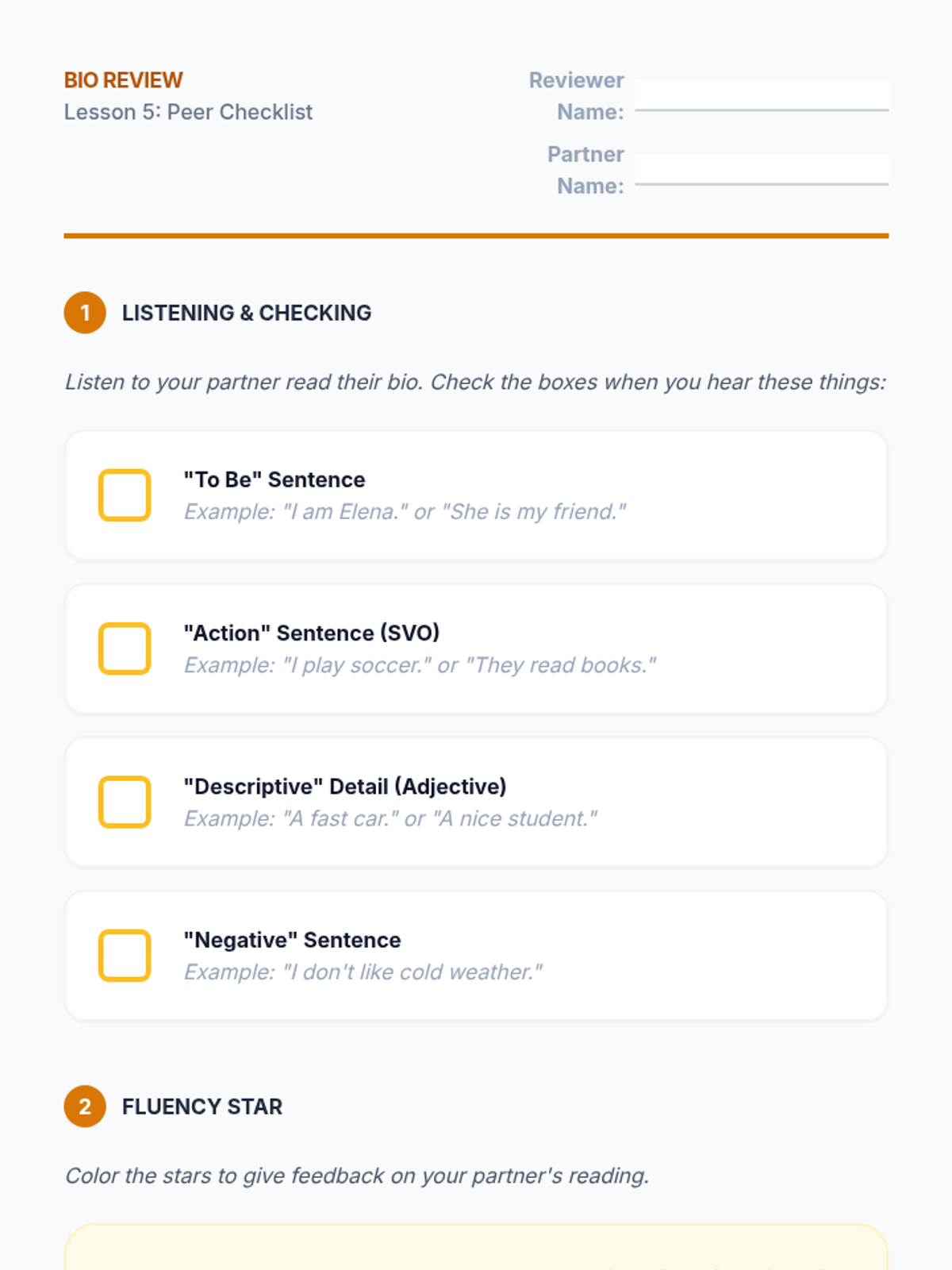
Peer-review checklist for Lesson 5. Students use this to listen to their partner's biography and provide feedback on sentence types and oral fluency.
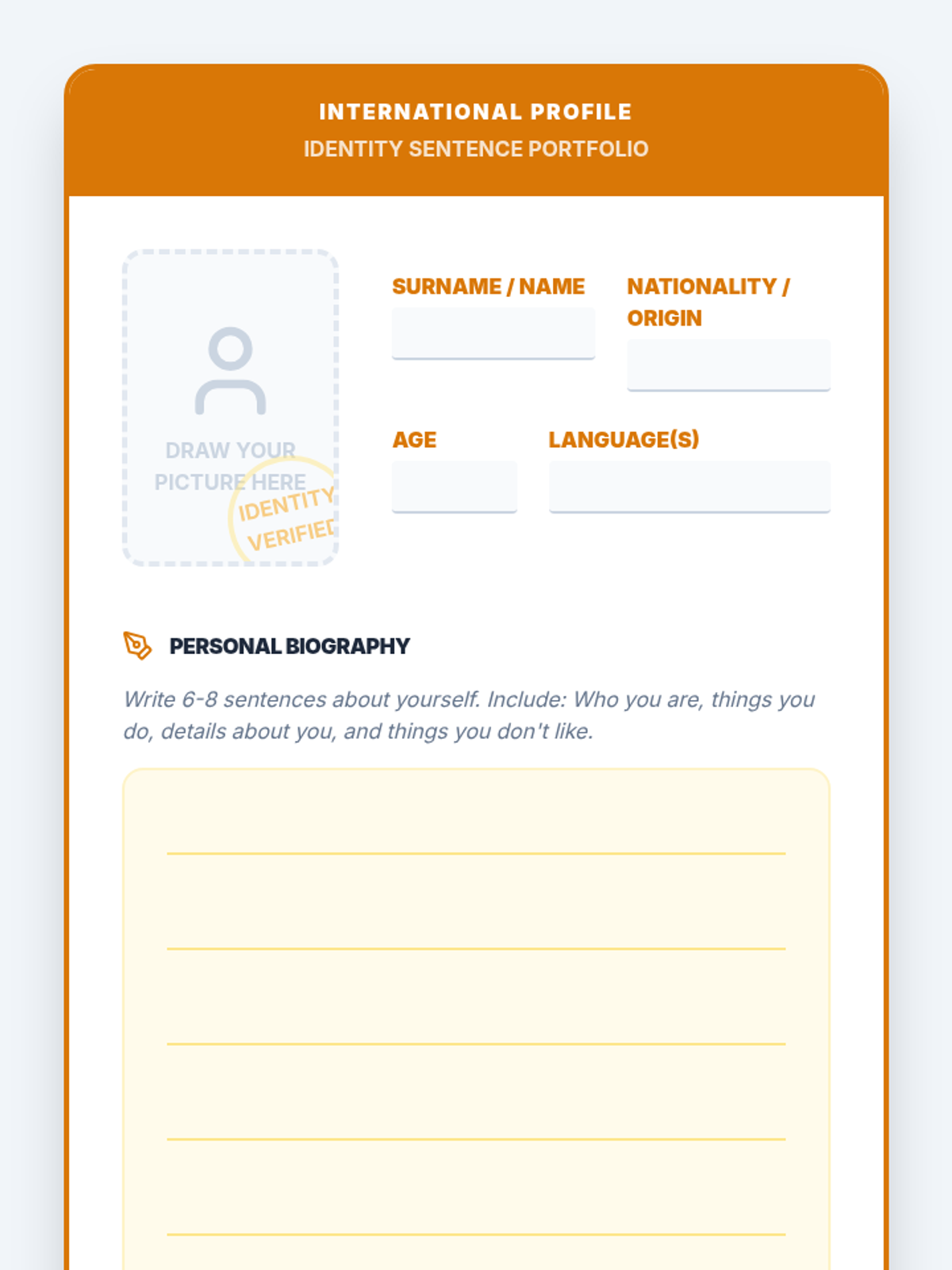
Final project template for Lesson 5. Students use this 'Passport' document to compile their personal biography using all sentence types learned in the sequence.
Introductory slides for Lesson 5, covering paragraph structure, reading fluency tips, and the final project showcase.
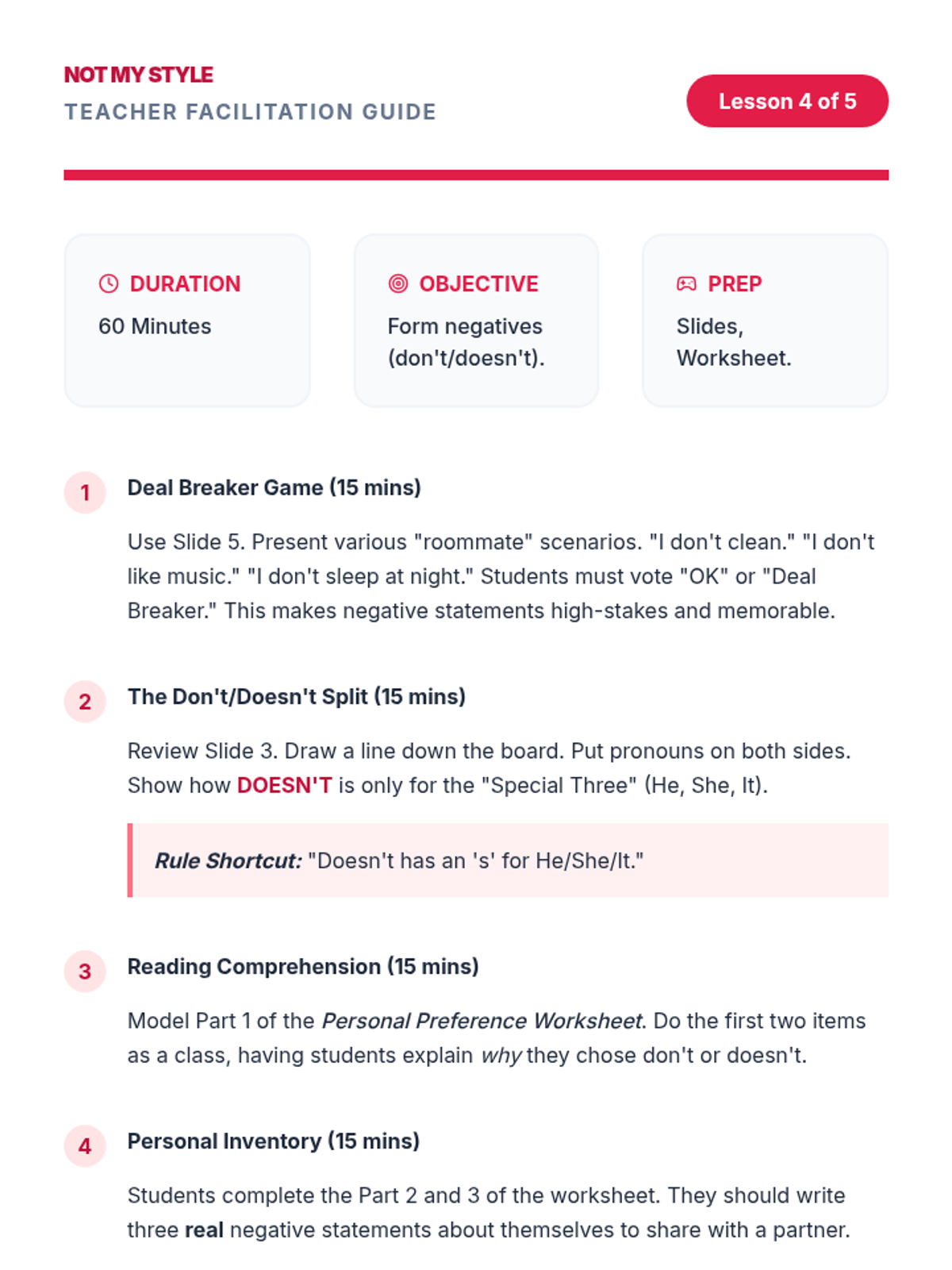
Teacher guide for Lesson 4, focusing on negative sentence formation and the "Deal Breaker" engagement game.
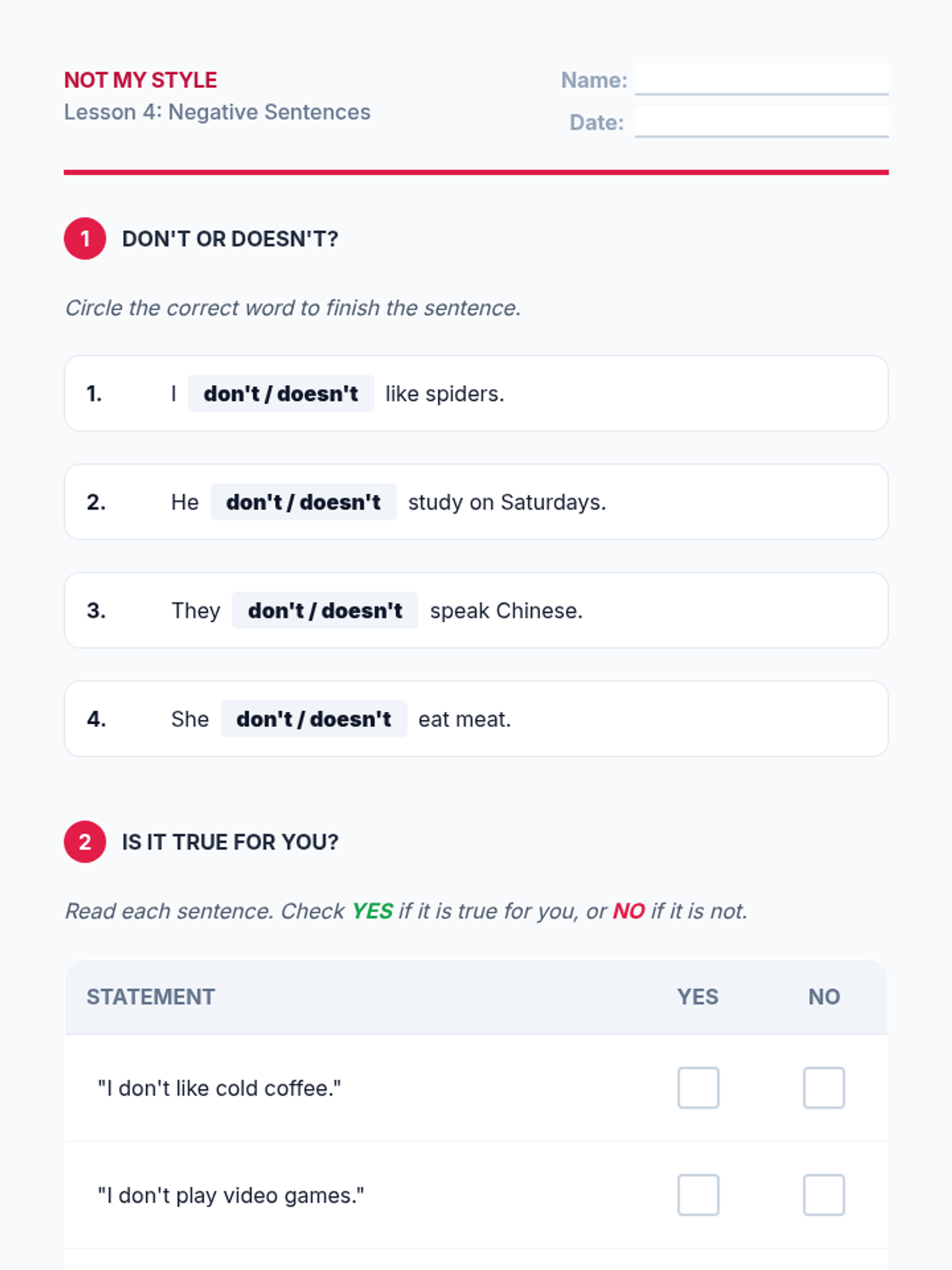
Worksheet for Lesson 4 where students practice using 'don't' and 'doesn't' correctly and reflect on their personal preferences.
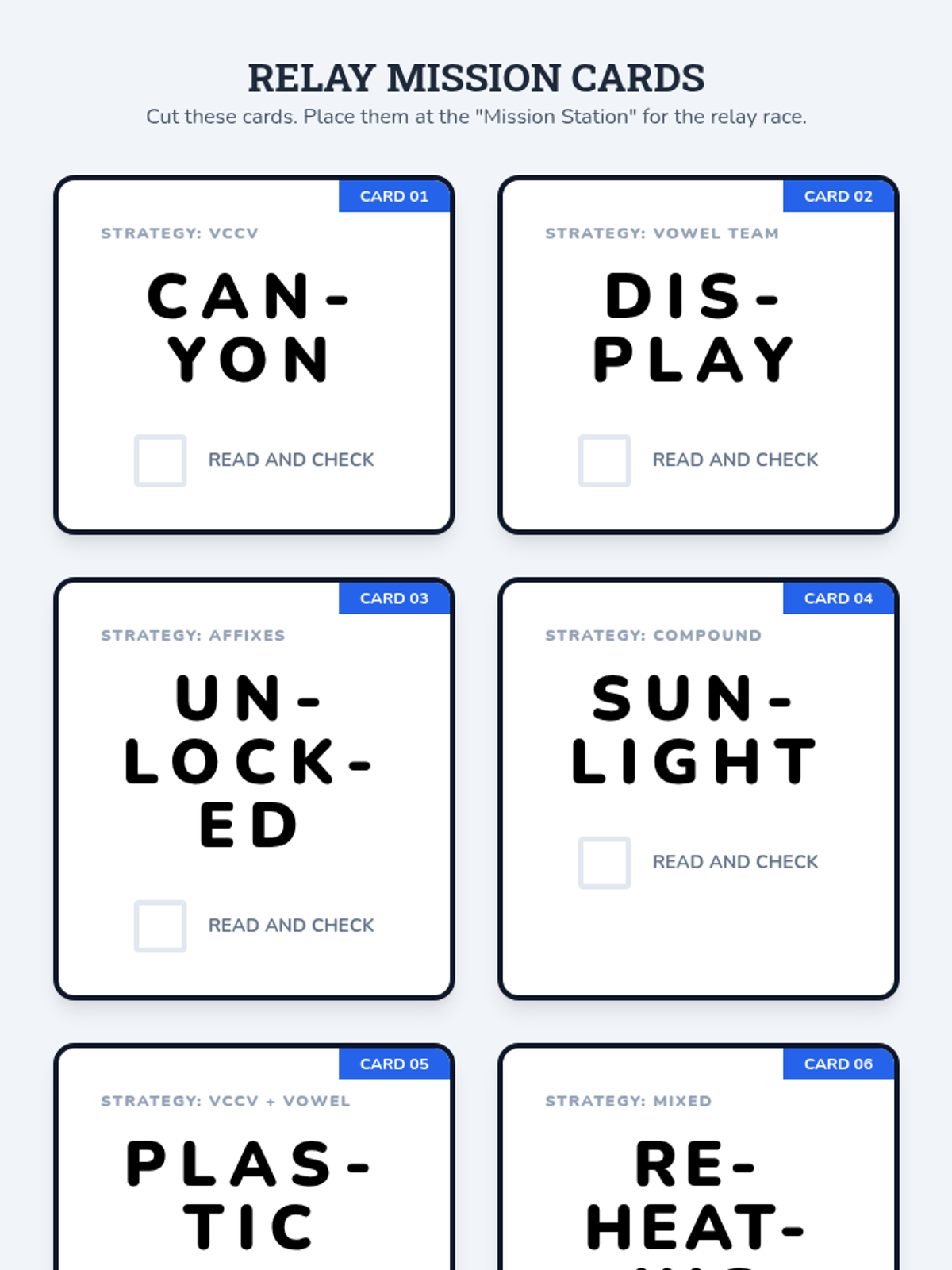
Mission cards for a decoding relay race or scavenger hunt, featuring multisyllabic words using various phonics strategies.
Introductory slides for Lesson 4, covering negative sentence construction using 'do not/don't' and 'does not/doesn't' with visual practice.
The final mission briefing slides for a cumulative decoding relay, reviewing all strategies (vowel teams, syllable division, affixes, compound words).
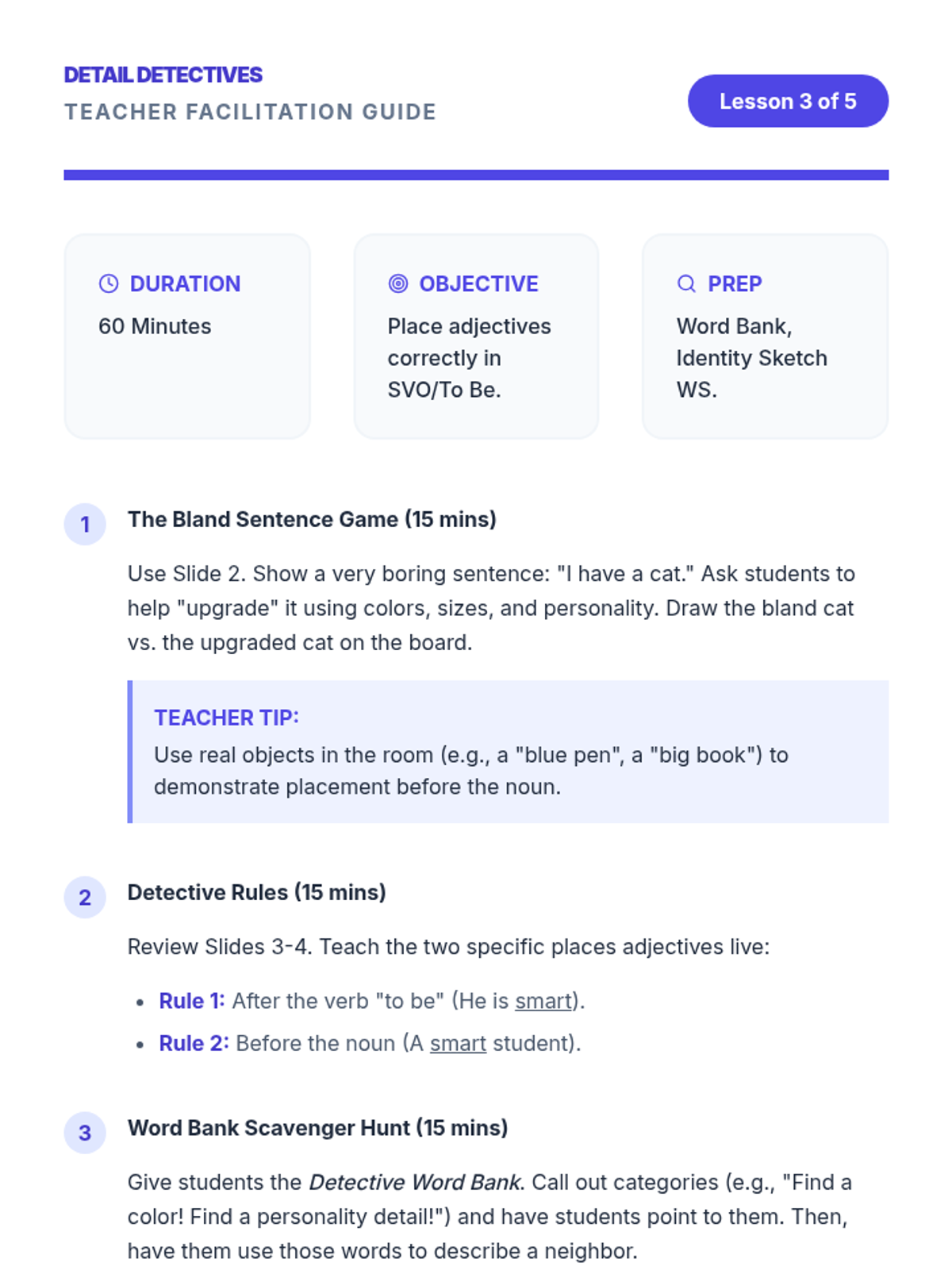
Teacher guide for Lesson 3, including pacing, instructional steps, and differentiation strategies for teaching adjective placement.
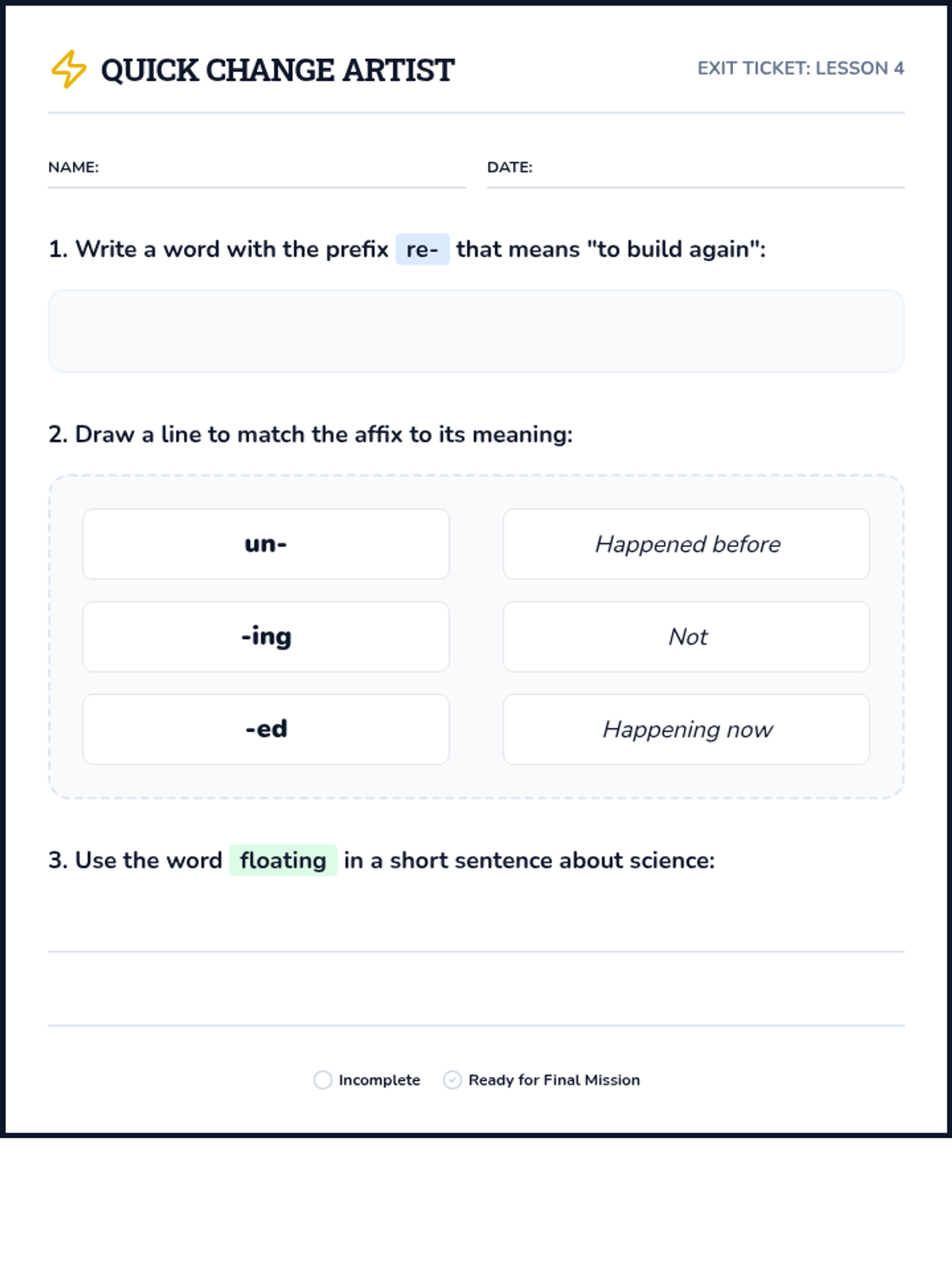
A quick exit ticket to assess understanding of prefixes and suffixes before the final challenge lesson.
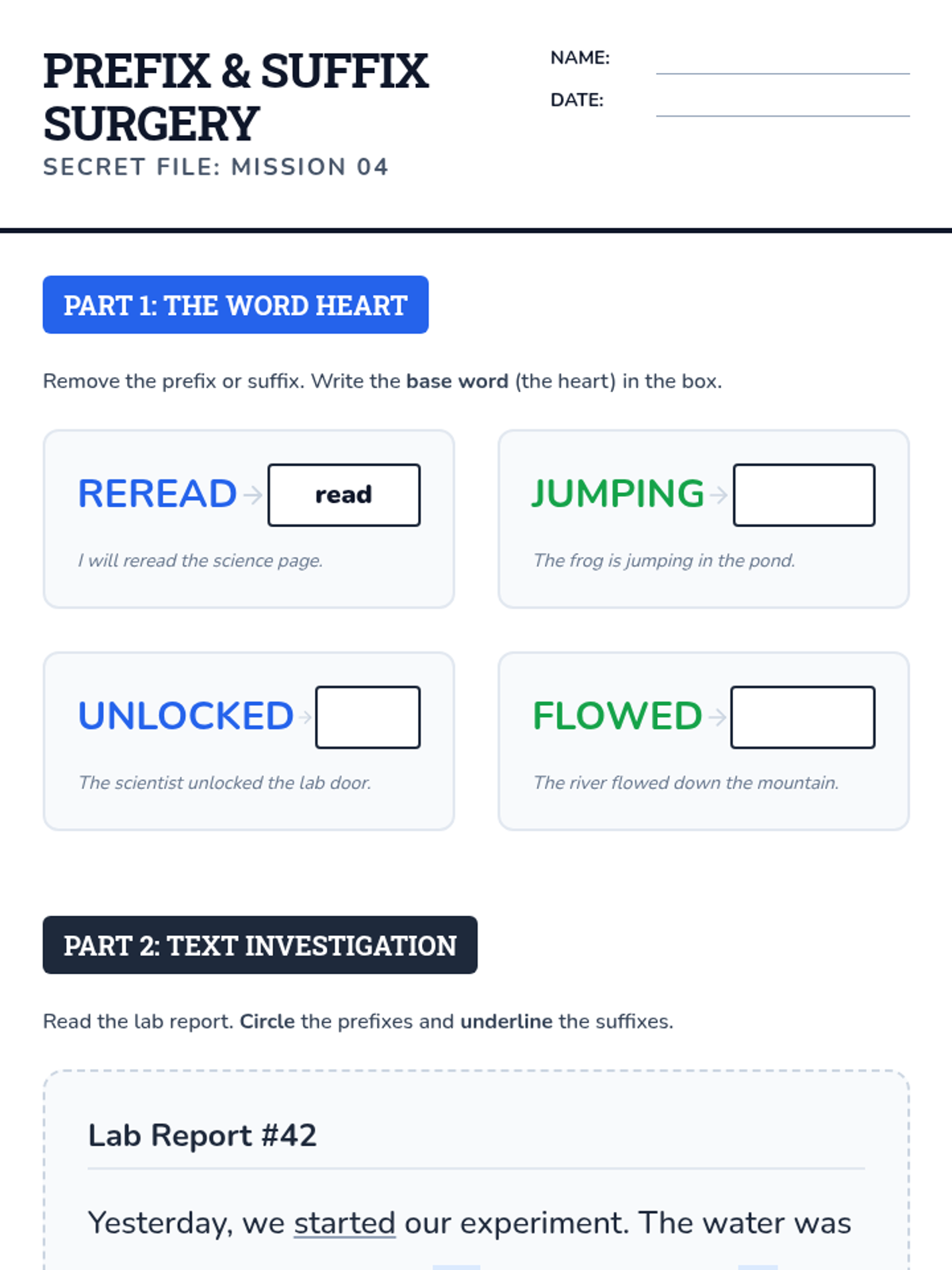
A surgery-themed worksheet for identifying base words, affixes, and practicing word modification.
A presentation teaching common prefixes (un-, re-) and suffixes (-ing, -ed) with academic lab vocabulary examples.
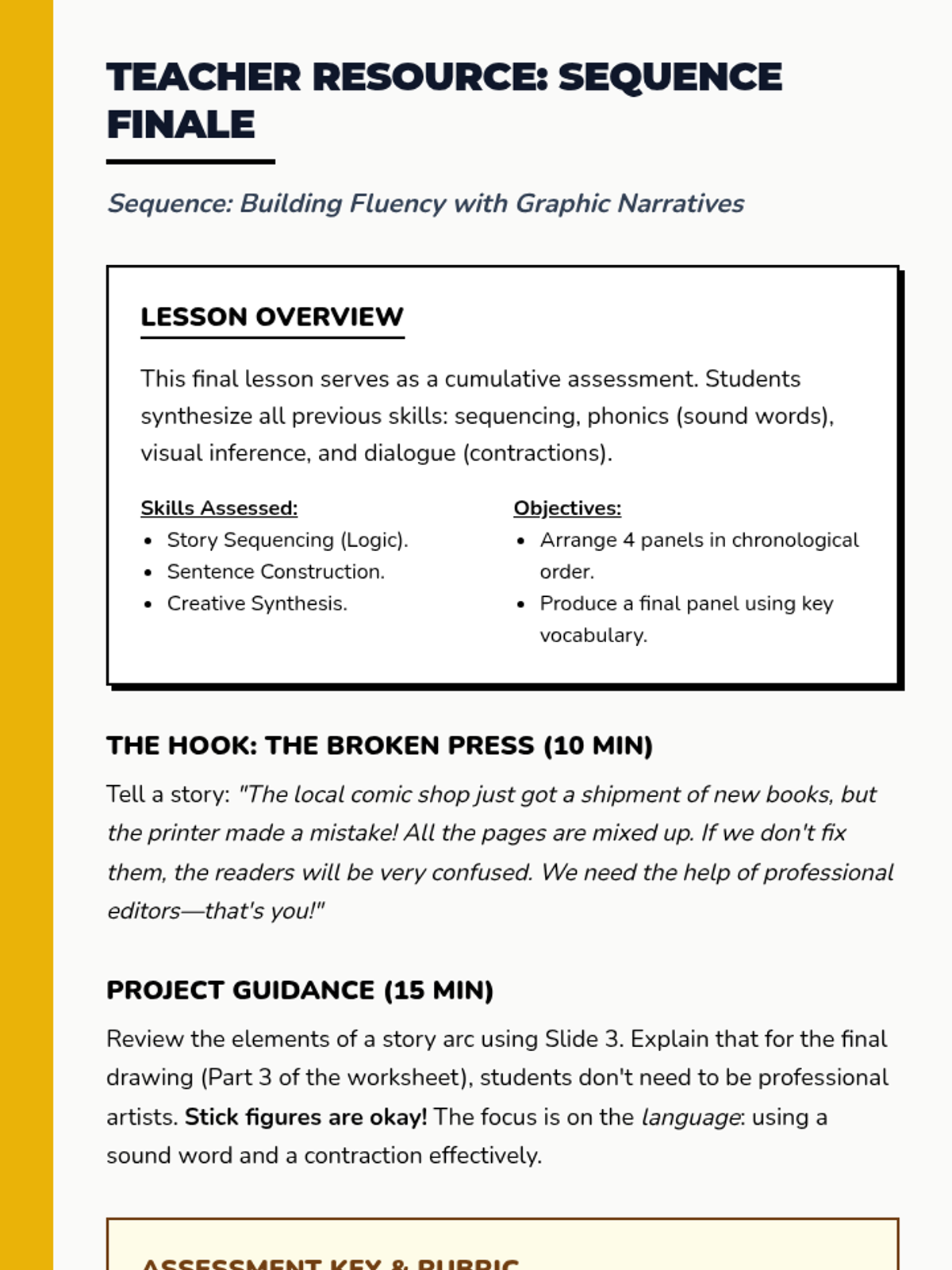
Final teacher resource for Lesson 5, including a story arc guide and project rubric.
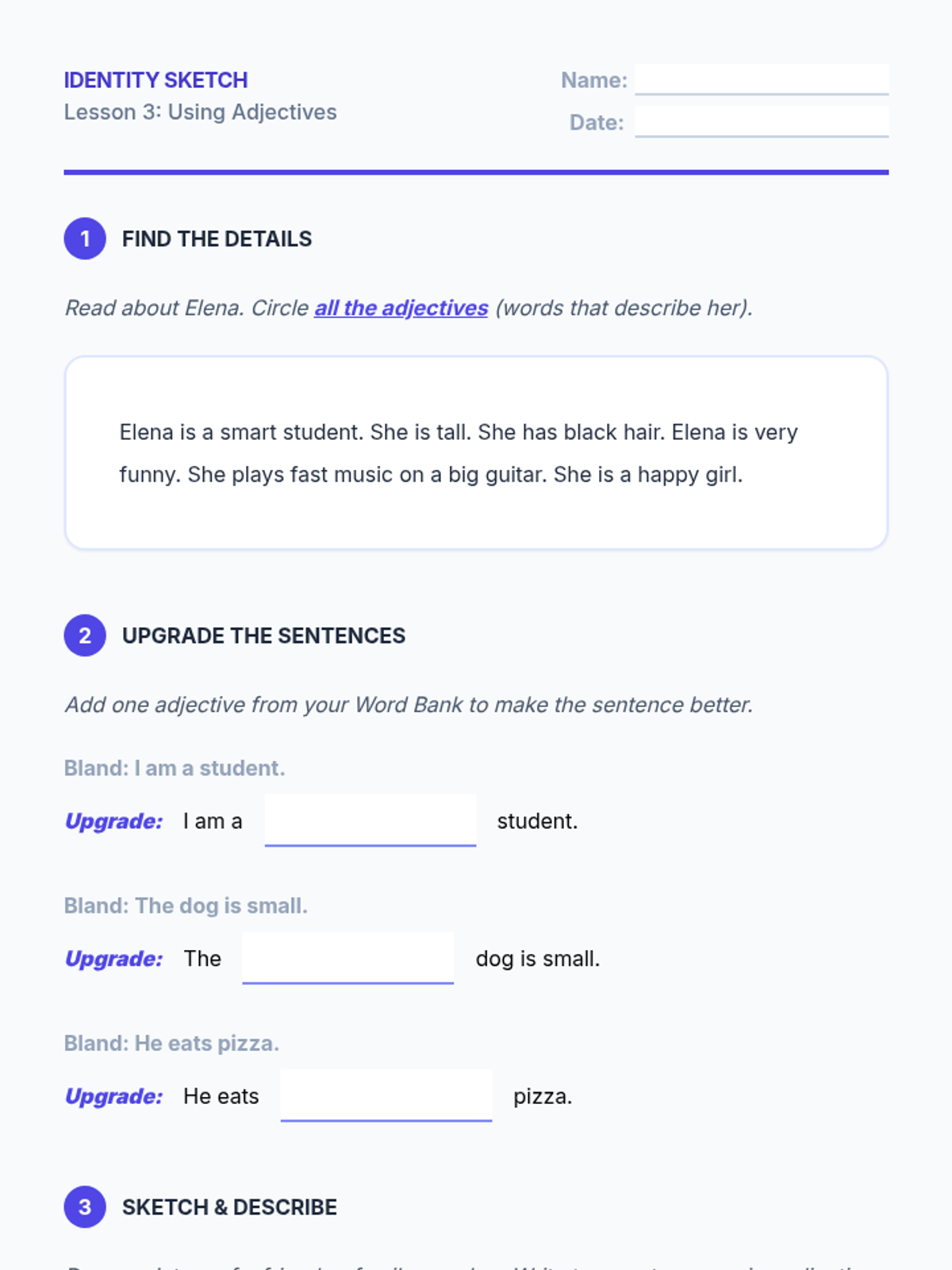
Worksheet for Lesson 3 focusing on adjective identification in a reading passage and practicing adjective placement in personal descriptions.
Final lesson slides, providing a summary of the sequence and instructions for the culminating project.
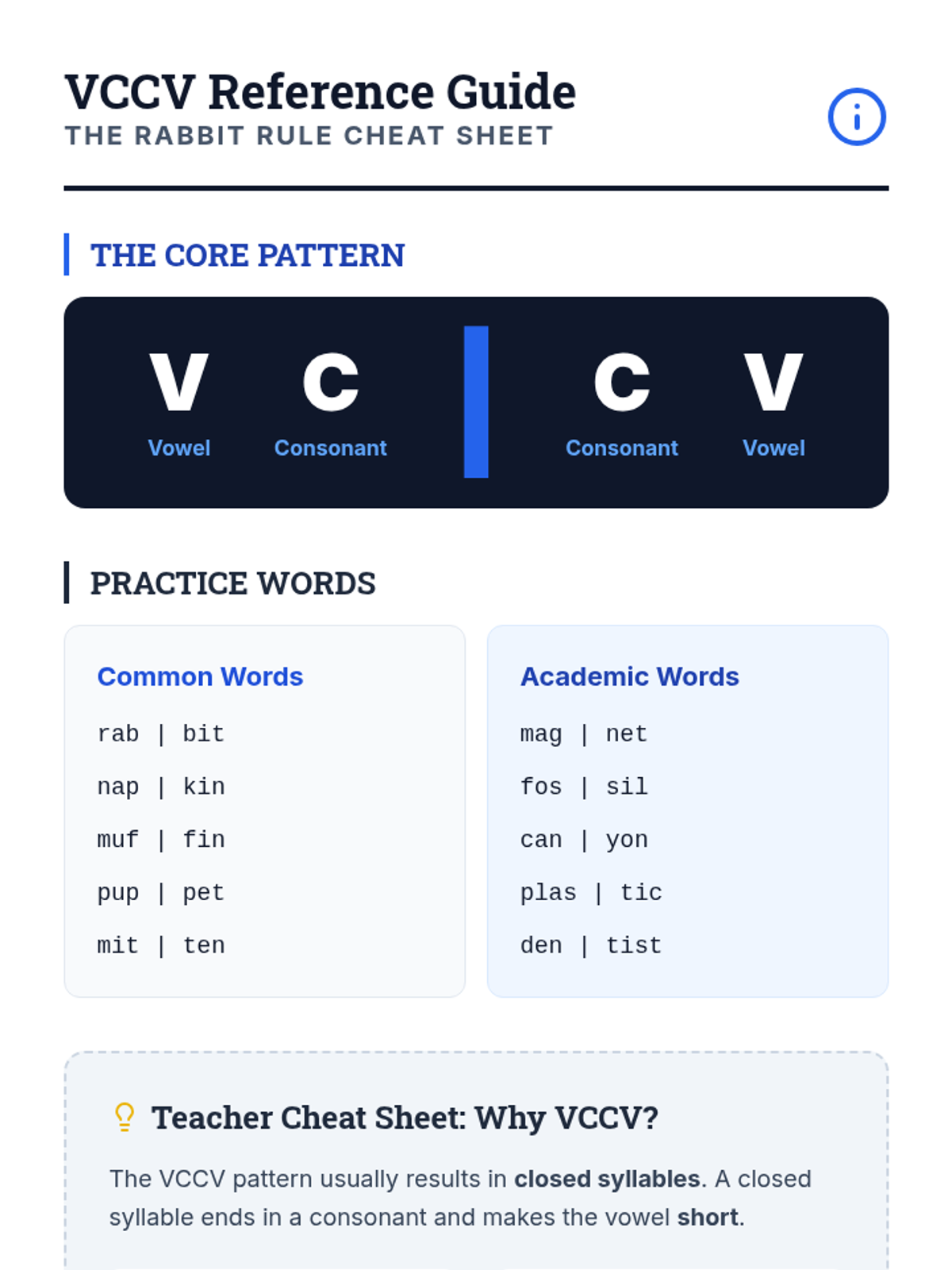
A teacher and student reference sheet for the VCCV (Rabbit Rule) syllable division pattern, explaining closed syllables and short vowel sounds.
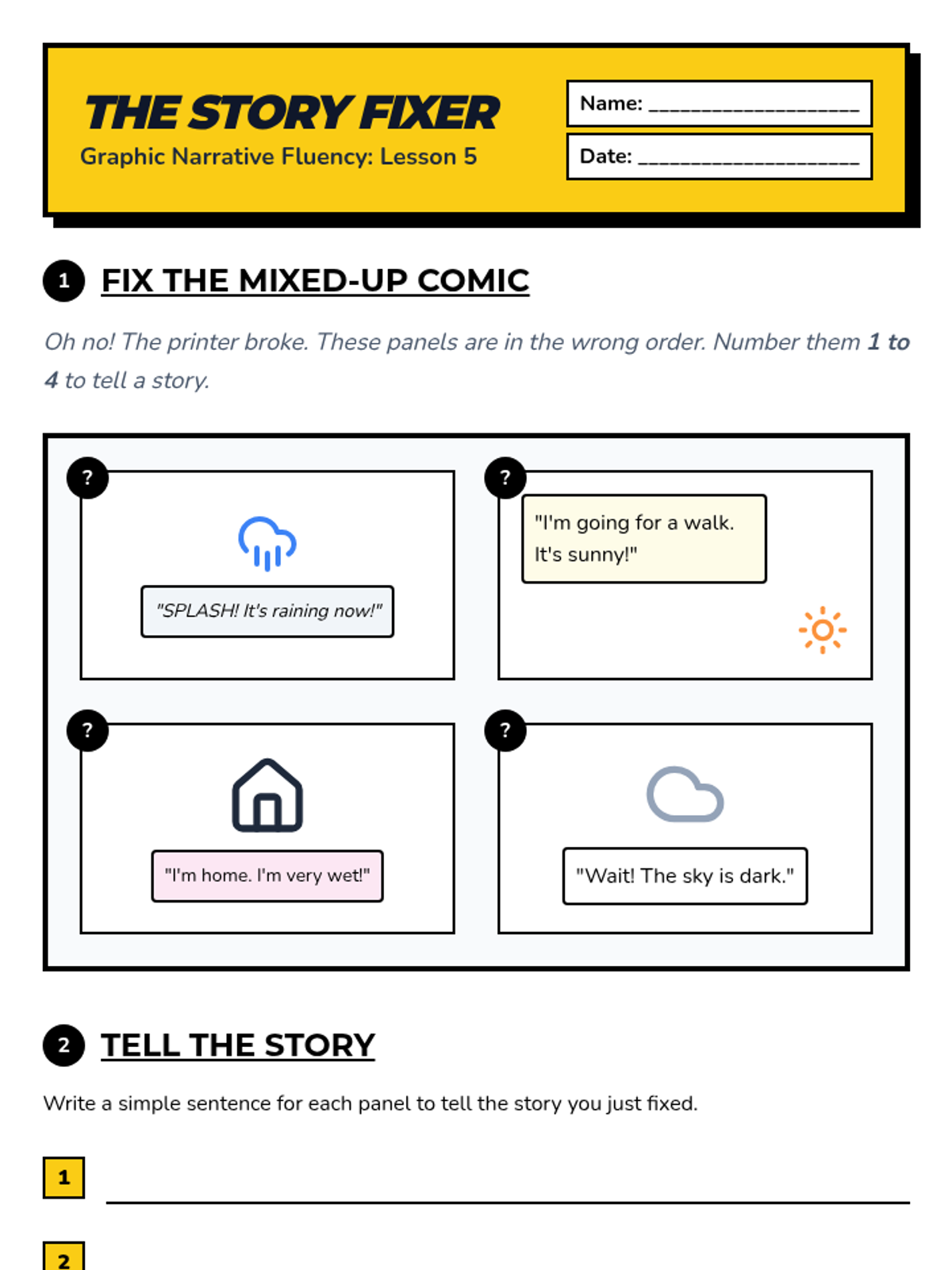
Final assessment worksheet for the sequence, requiring students to sequence panels, write narrative sentences, and create a concluding scene.
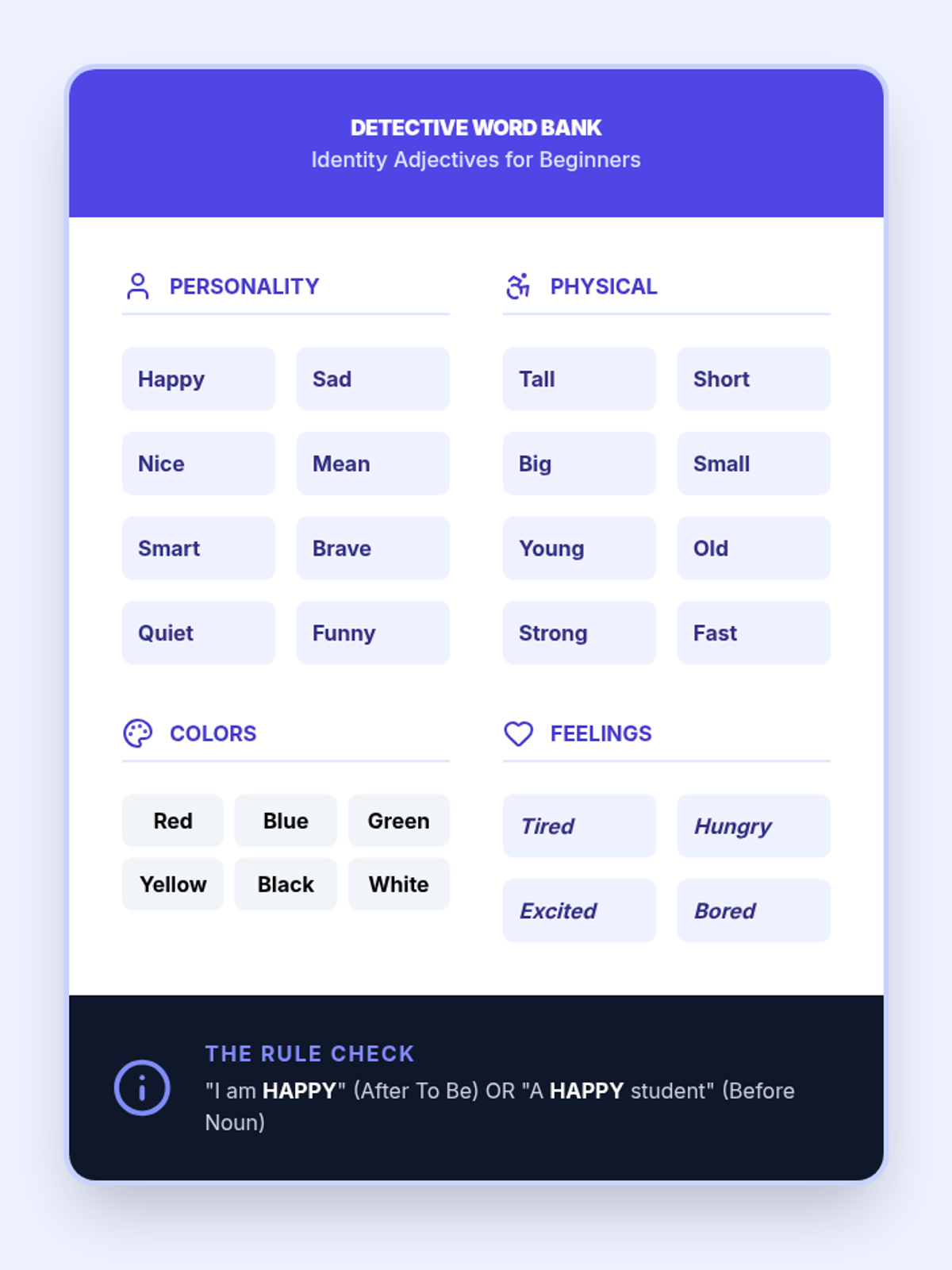
Reference sheet for Lesson 3 with common identity adjectives categorized by personality, physical traits, colors, and feelings.
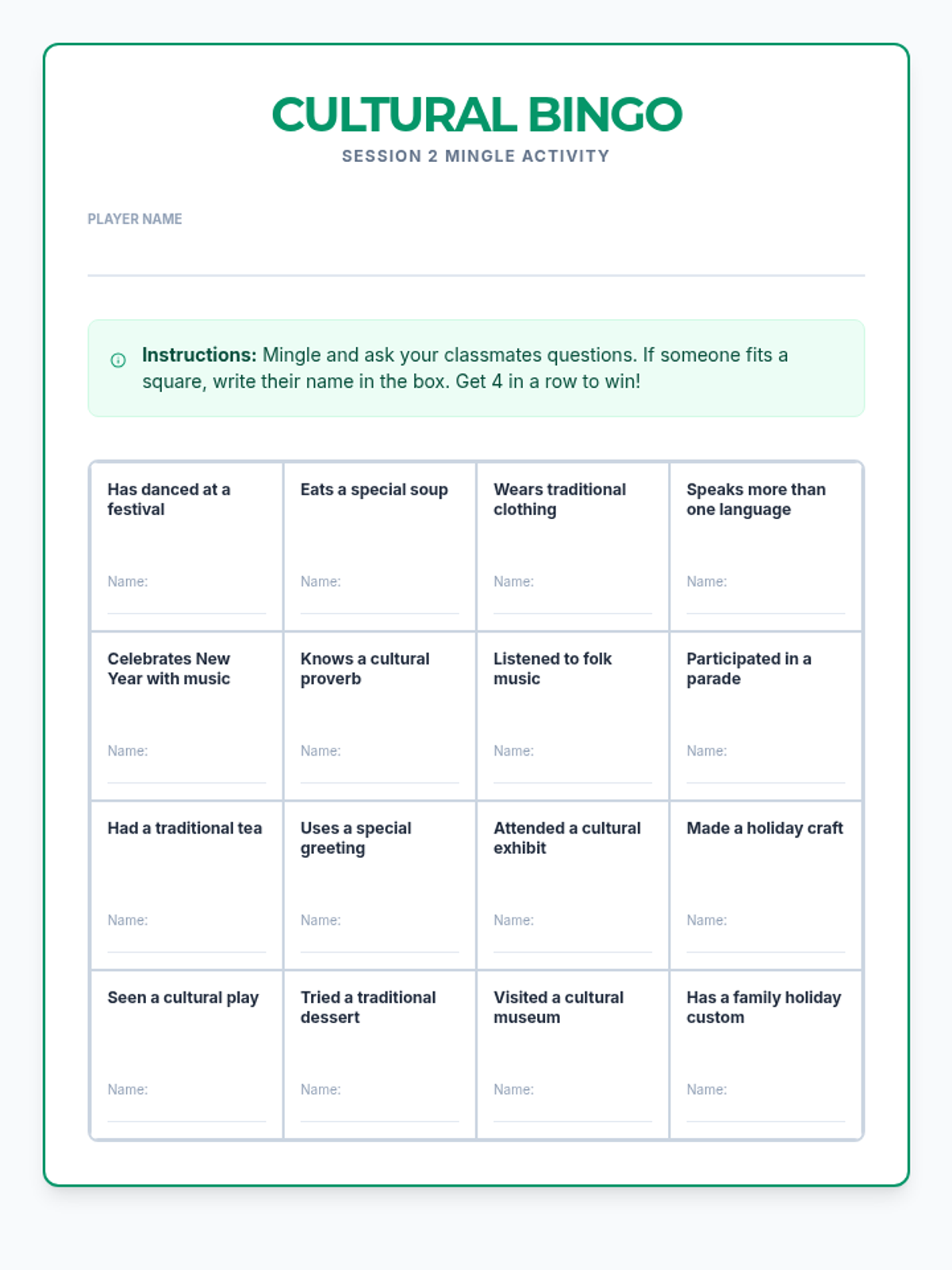
An interactive bingo game card for students to find classmates with diverse cultural experiences.
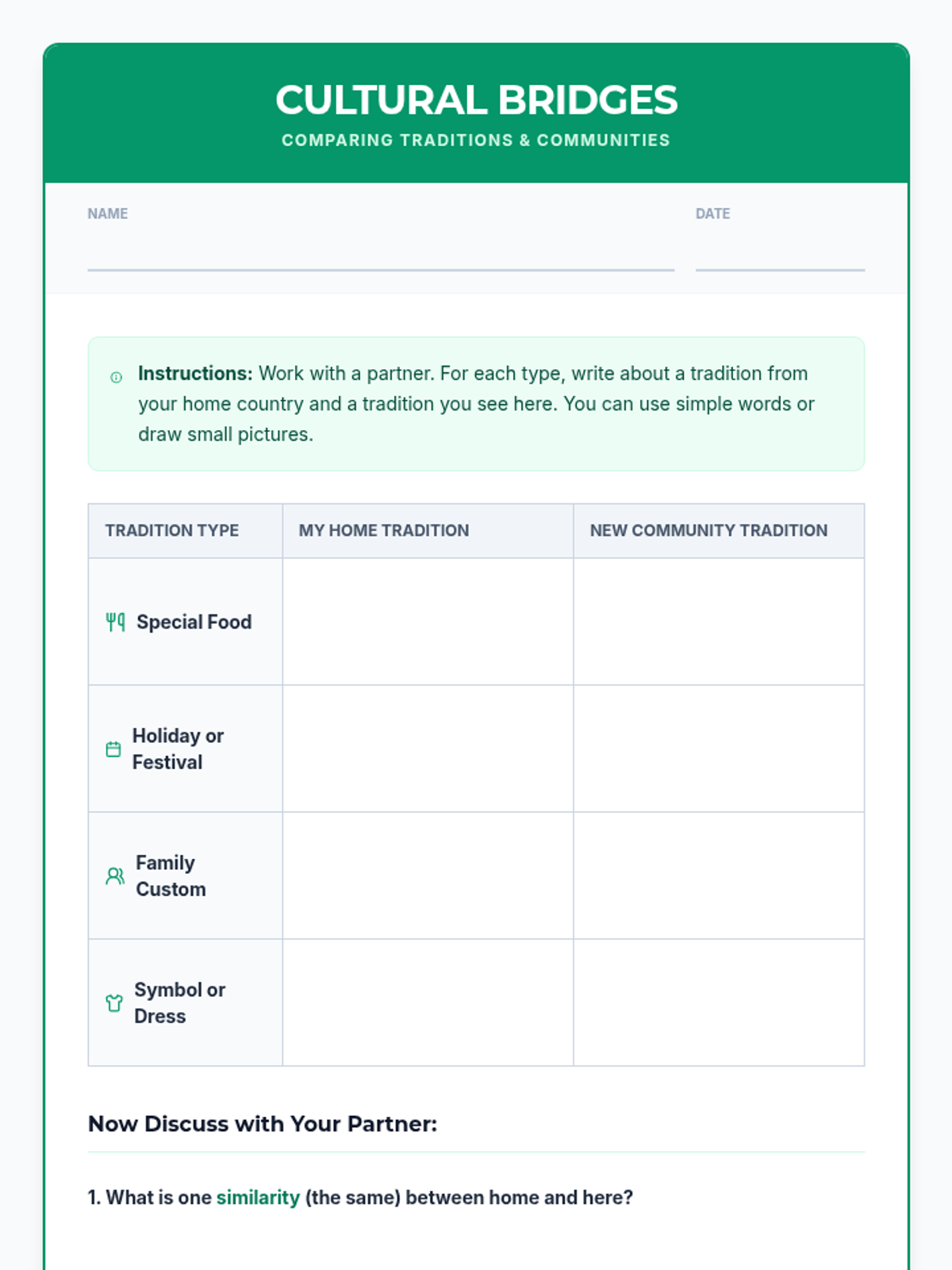
A student worksheet for comparing home traditions with new community traditions, featuring a structured table and reflection prompts.
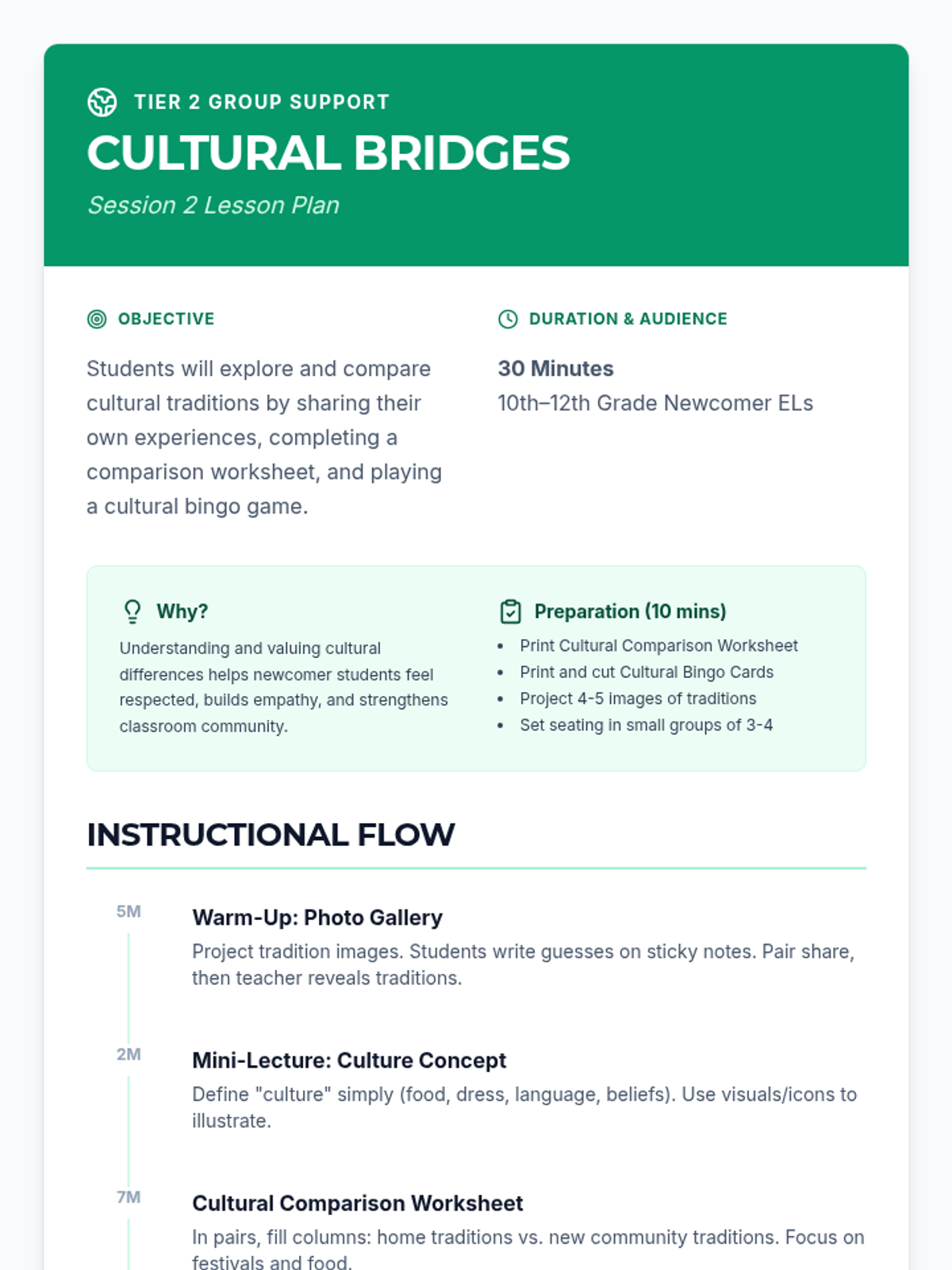
The instructional guide for Session 2, focusing on cultural exchange, comparative activities, and building empathy through shared traditions.
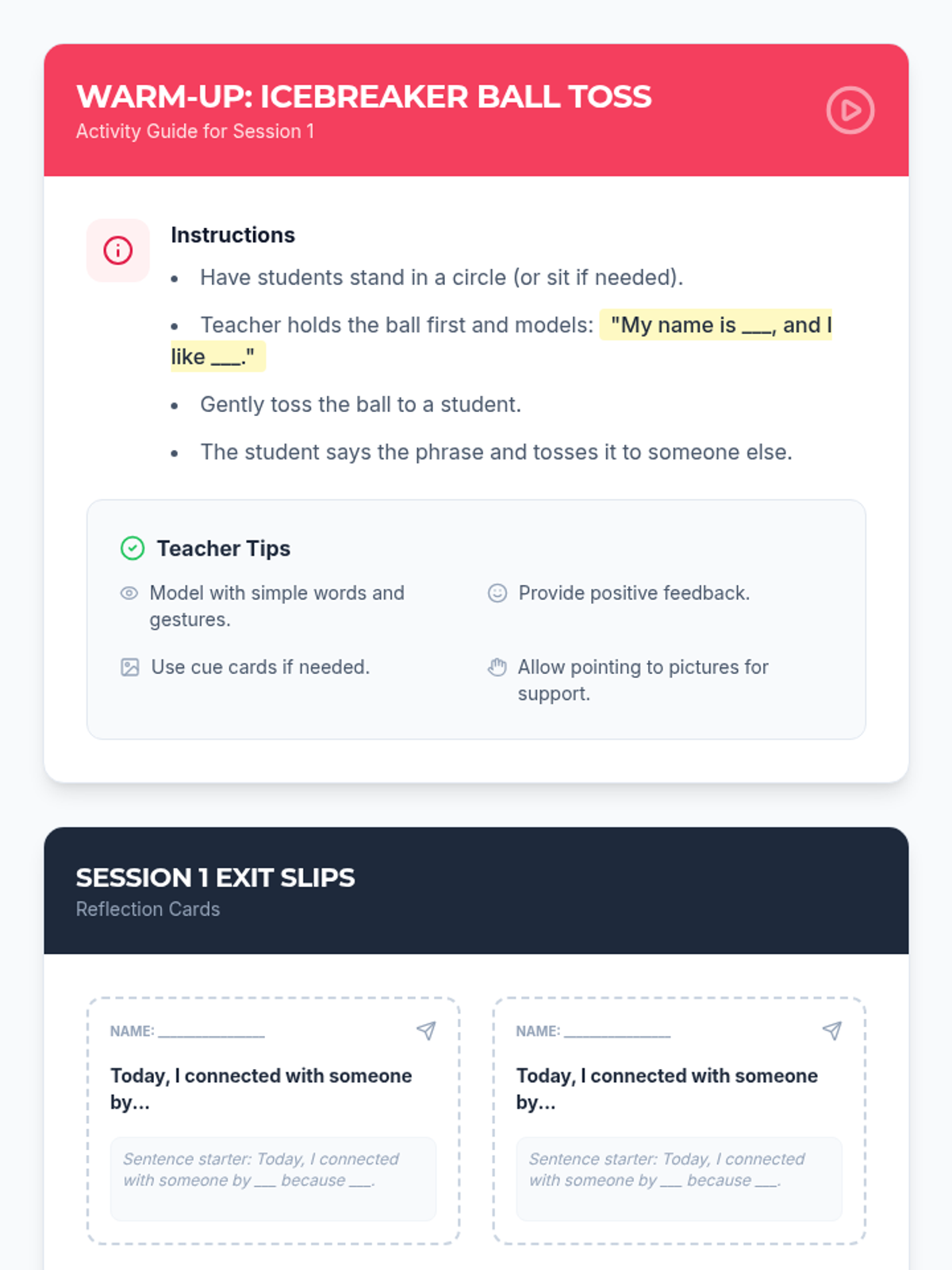
A combined resource containing the Session 1 warm-up instructions and printable exit slips for student reflection.
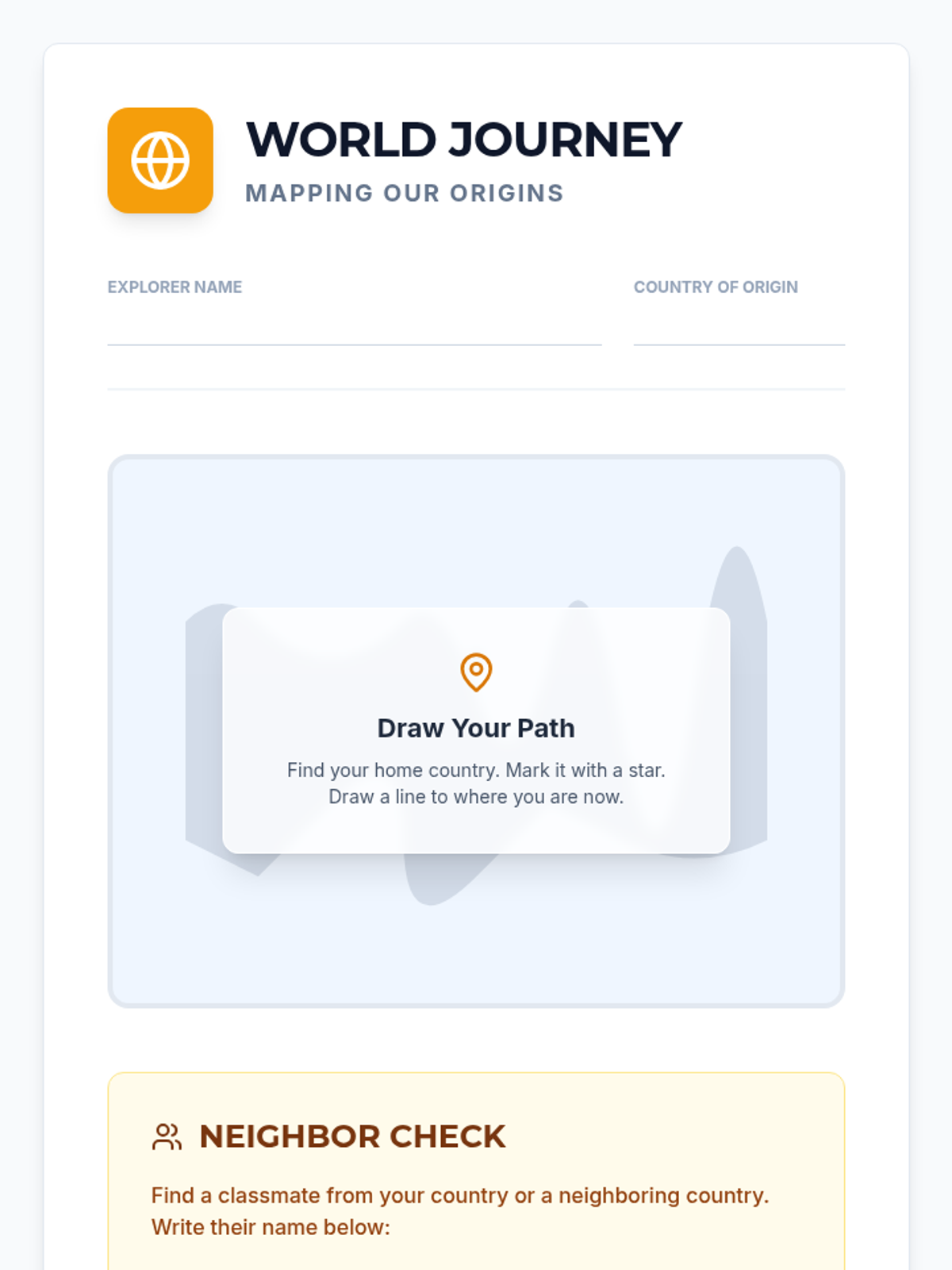
A visual world map activity where students mark their countries of origin and identify classmates from nearby regions.
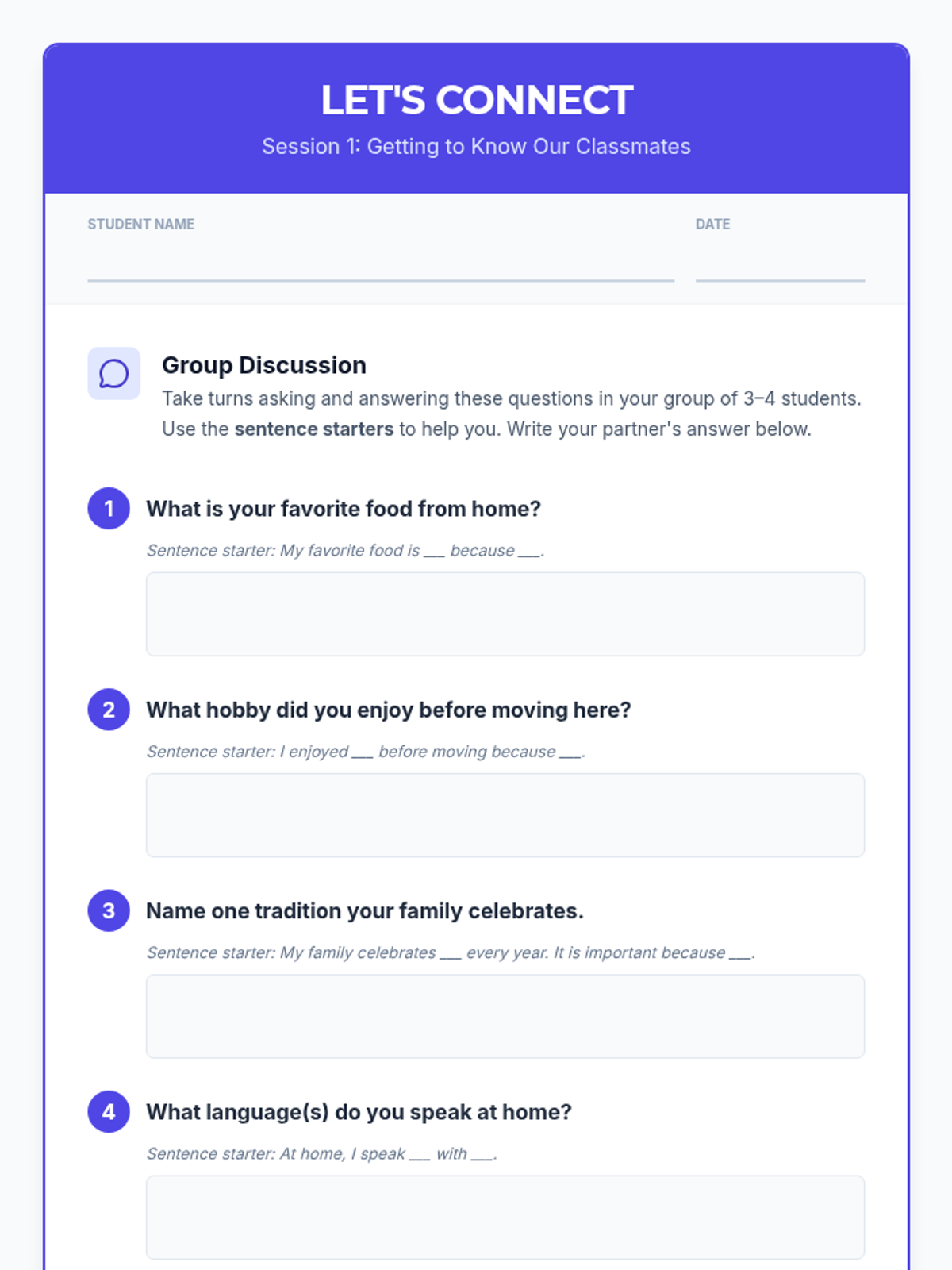
A student worksheet with conversation prompts and sentence starters to help newcomer ELs share their backgrounds and interests.
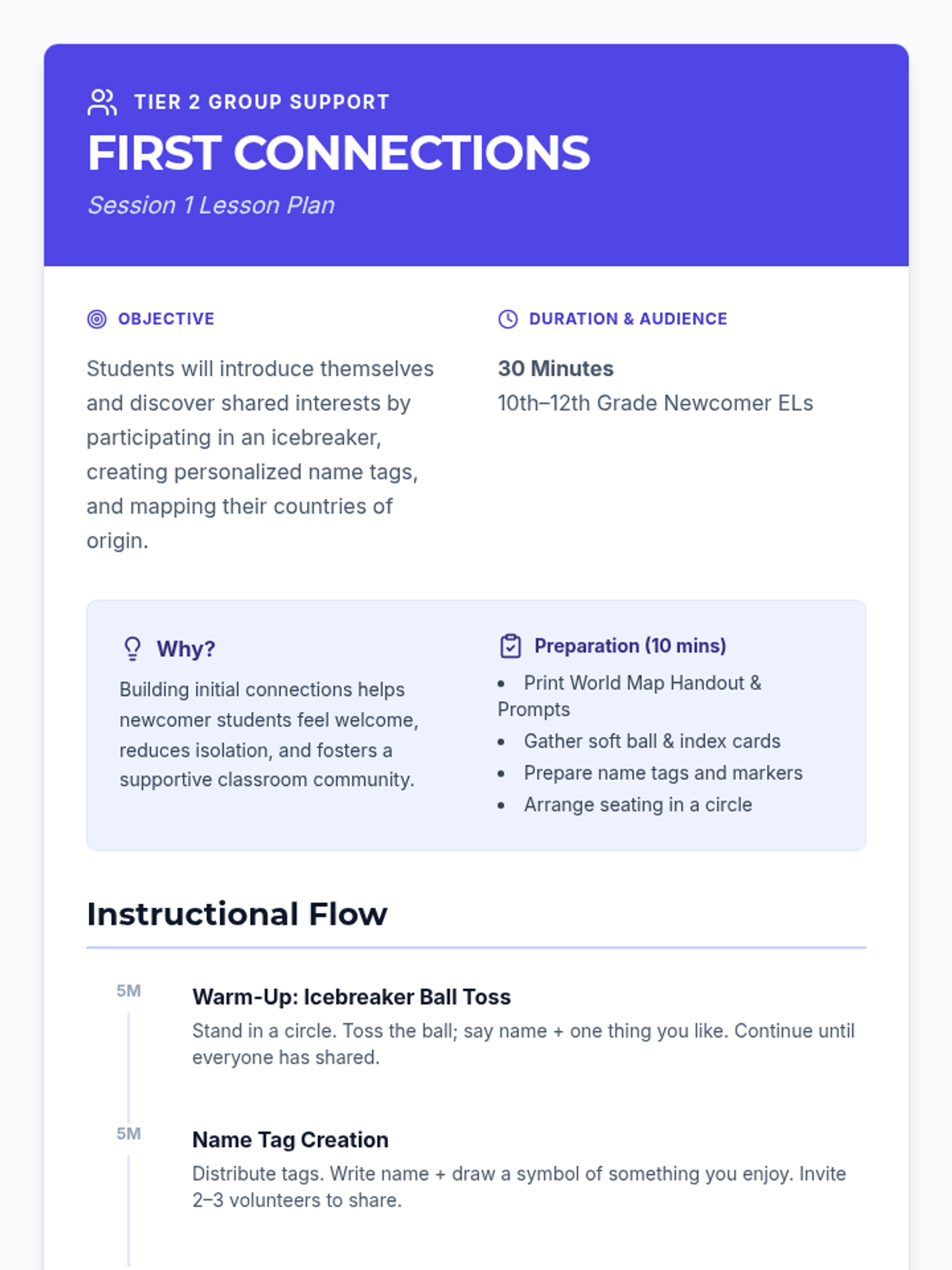
The instructional guide for Session 1, including objectives, materials, and a timed step-by-step flow for the 'First Connections' lesson.
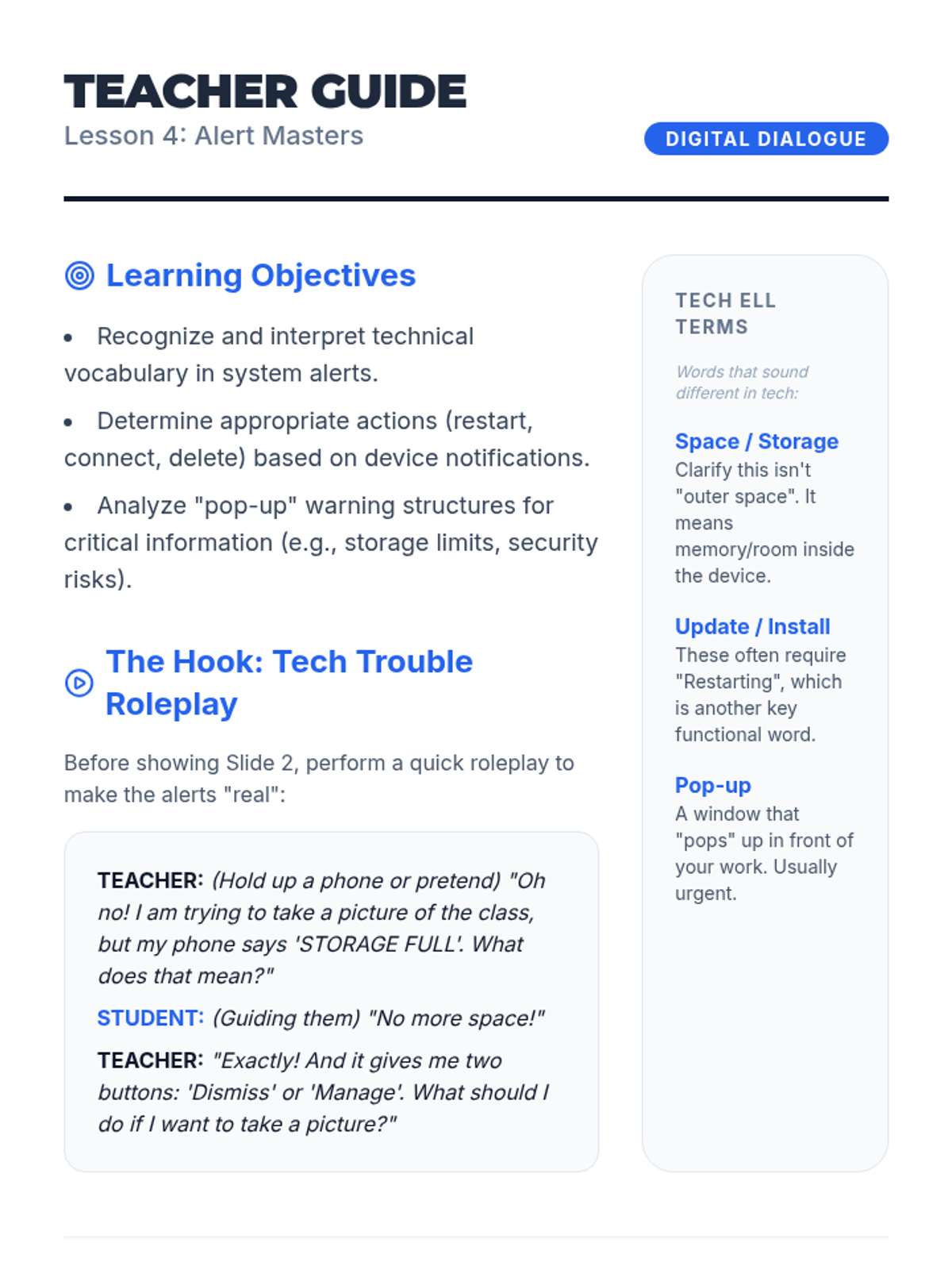
A teacher guide for Lesson 4, including roleplay prompts, technical vocabulary for ELLs, and an answer key for the alert matching activity.
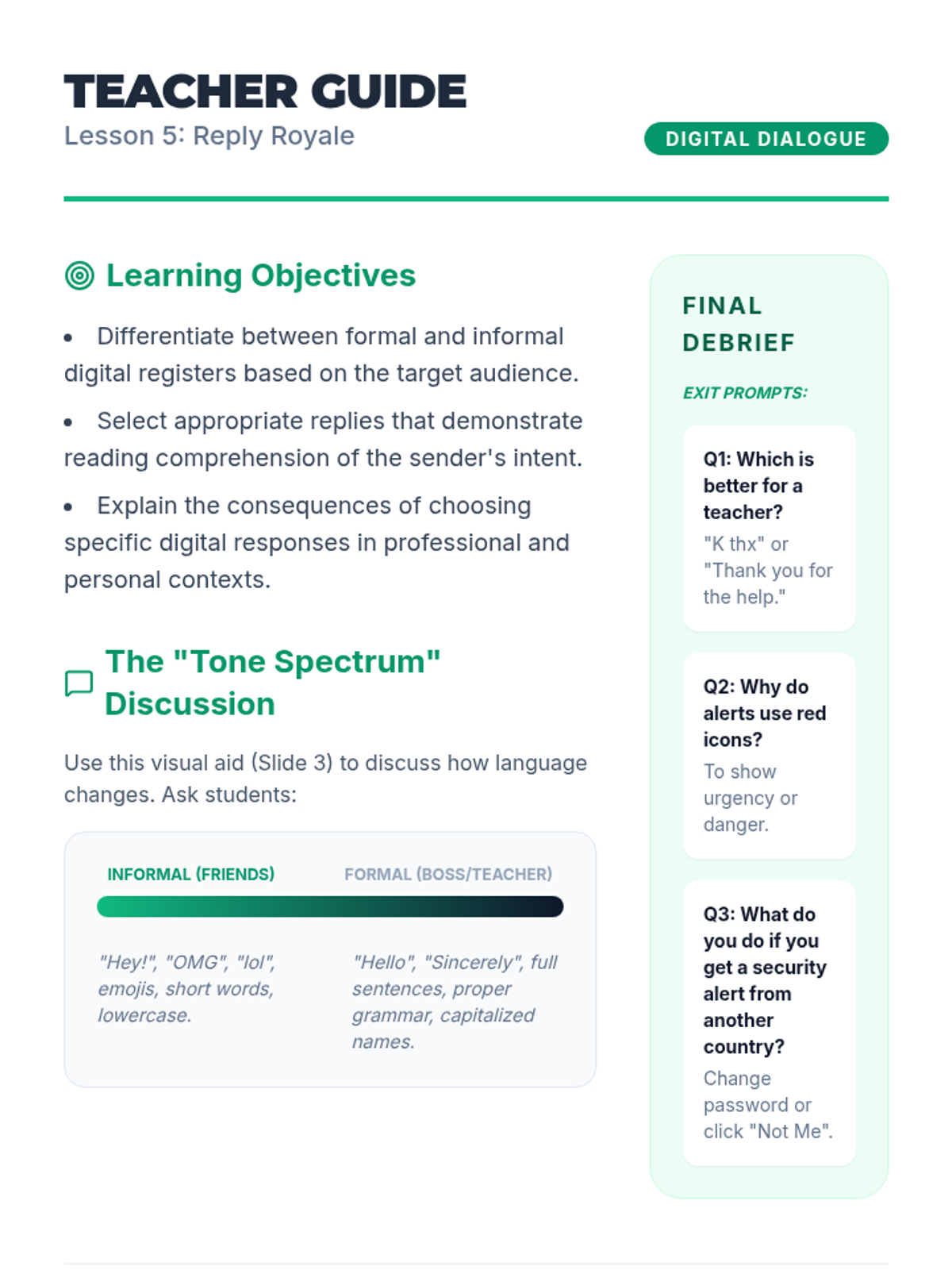
A teacher guide for Lesson 5, featuring the tone spectrum, debrief prompts, and a full answer key for the reply simulation.
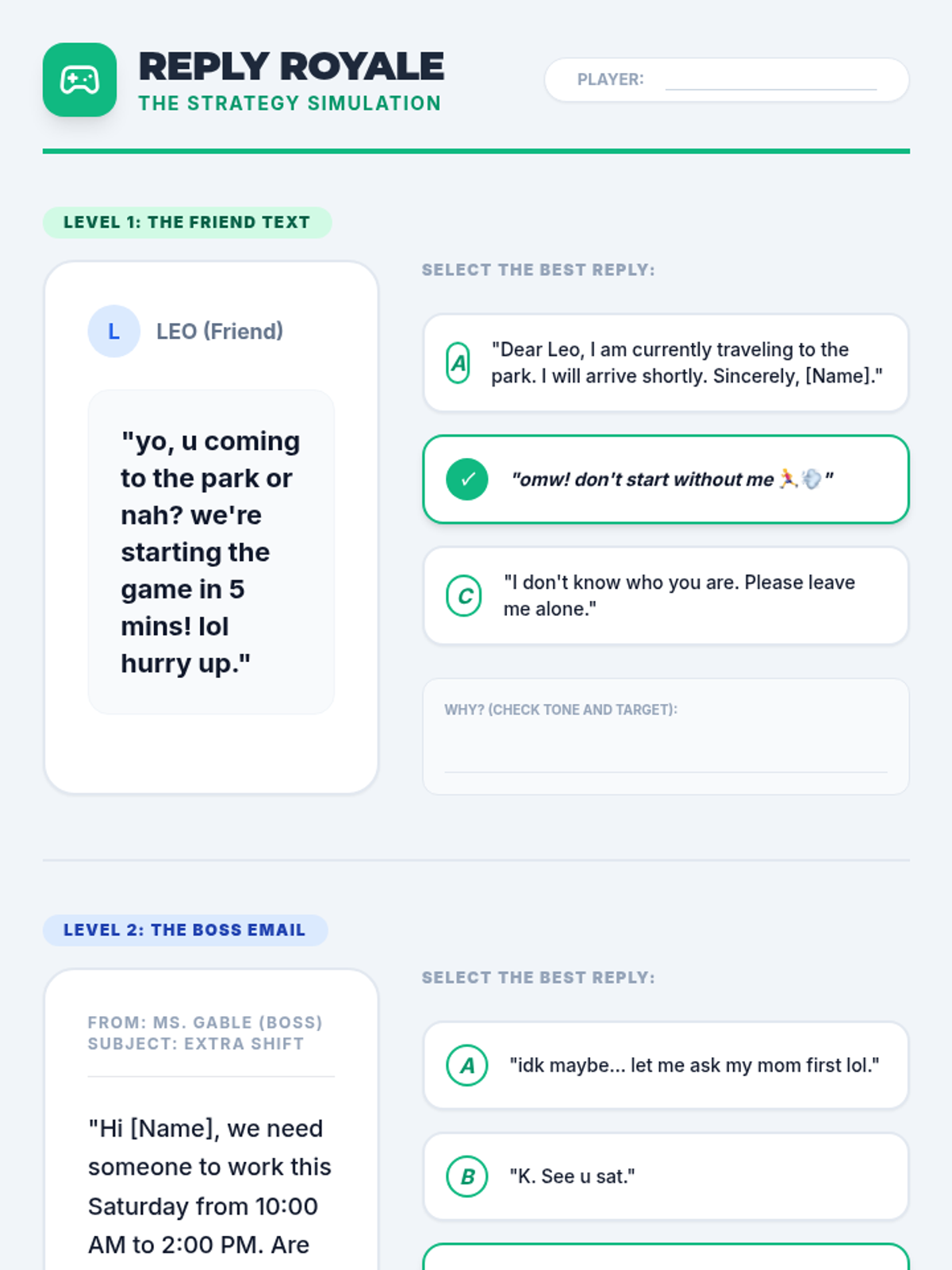
A student simulation worksheet where students choose the appropriate reply for various digital communication scenarios (texts, emails, and alerts) and explain their reasoning.
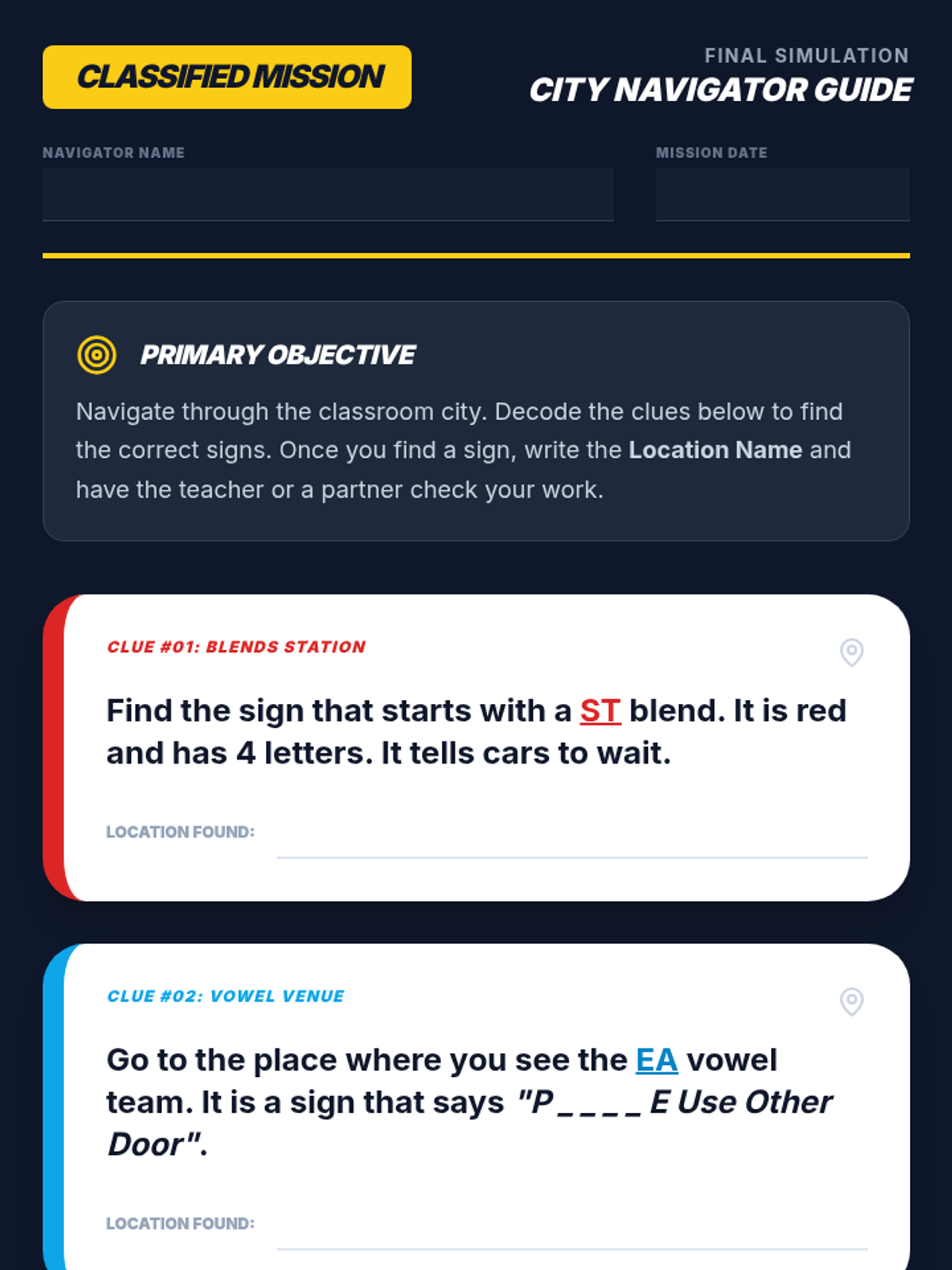
Culminating scavenger hunt activity guide for Lesson 5. Students use their knowledge of blends, digraphs, vowel teams, and syllables to solve clues in a classroom city simulation.
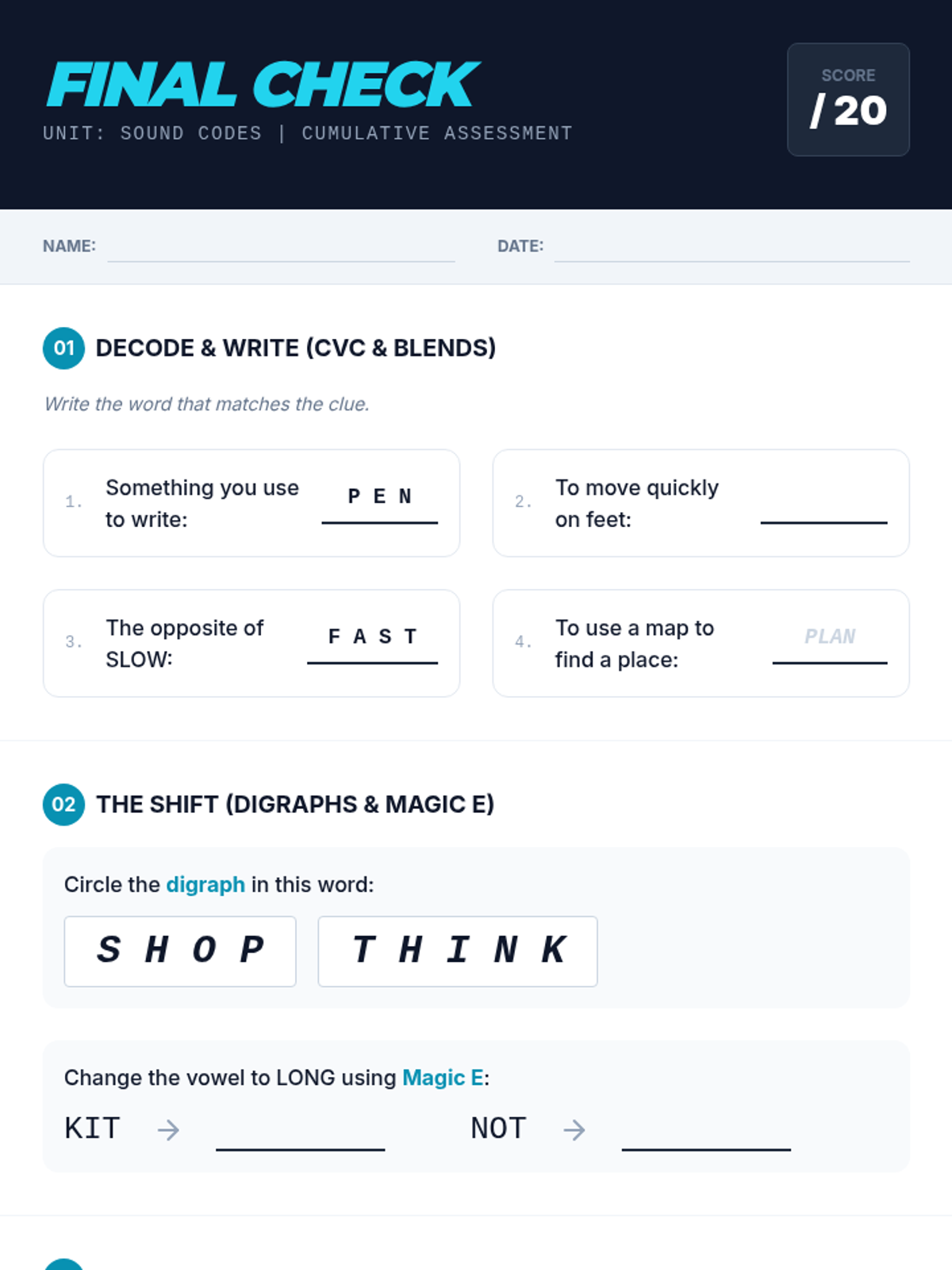
Final assessment for the Sound Codes sequence, testing CVC words, blends, digraphs, magic e, and syllabication.
A visual slide deck for teaching digital etiquette, formal vs. informal registers, and appropriate reply selection. Includes a "funny misunderstanding" hook.
Introductory slides for Lesson 3, covering adjective placement (before nouns and after 'to be' verbs) with visual examples.
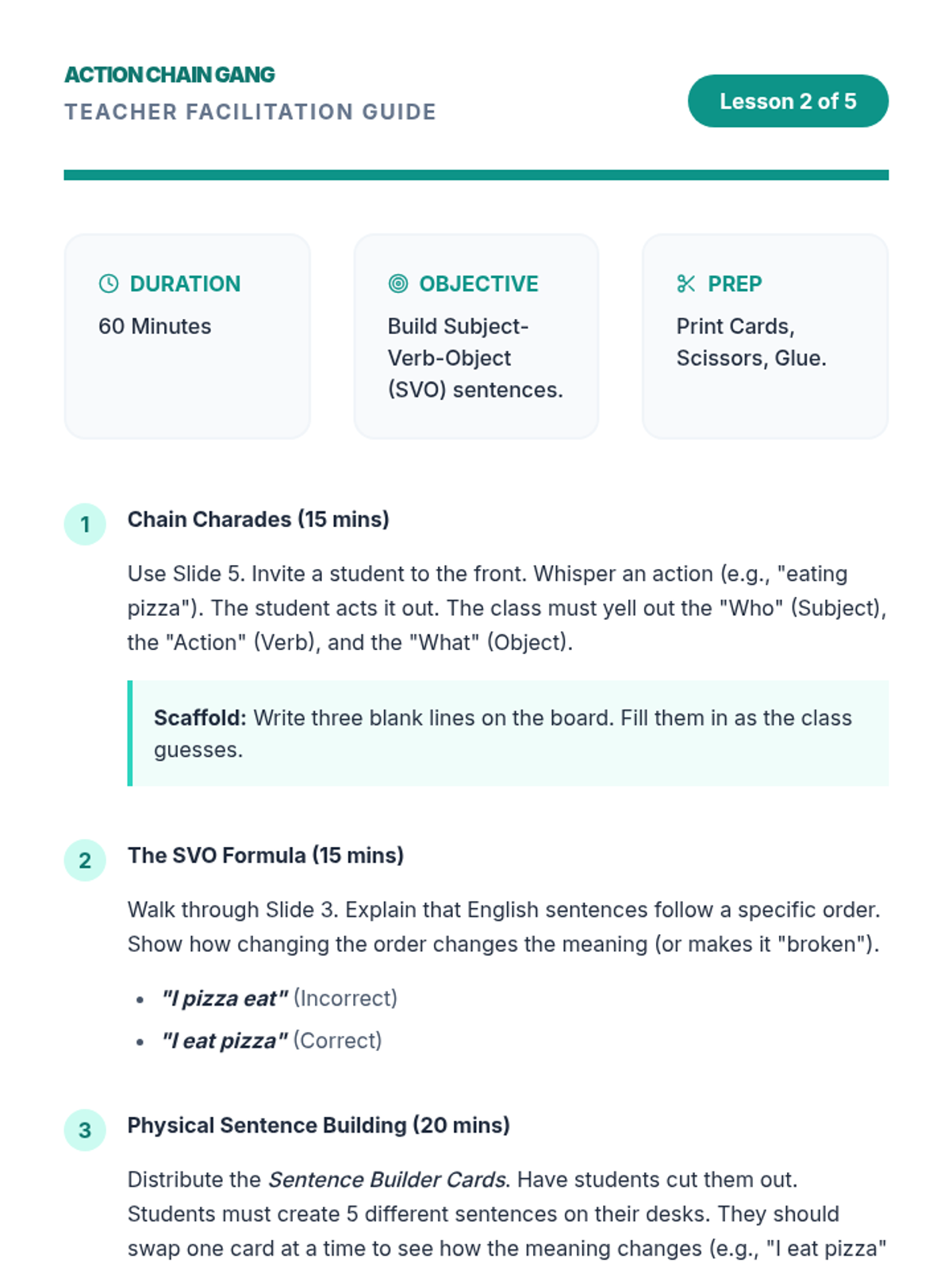
Teacher guide for Lesson 2, providing instructions for the 'Chain Charades' hook and the physical sentence building workshop.
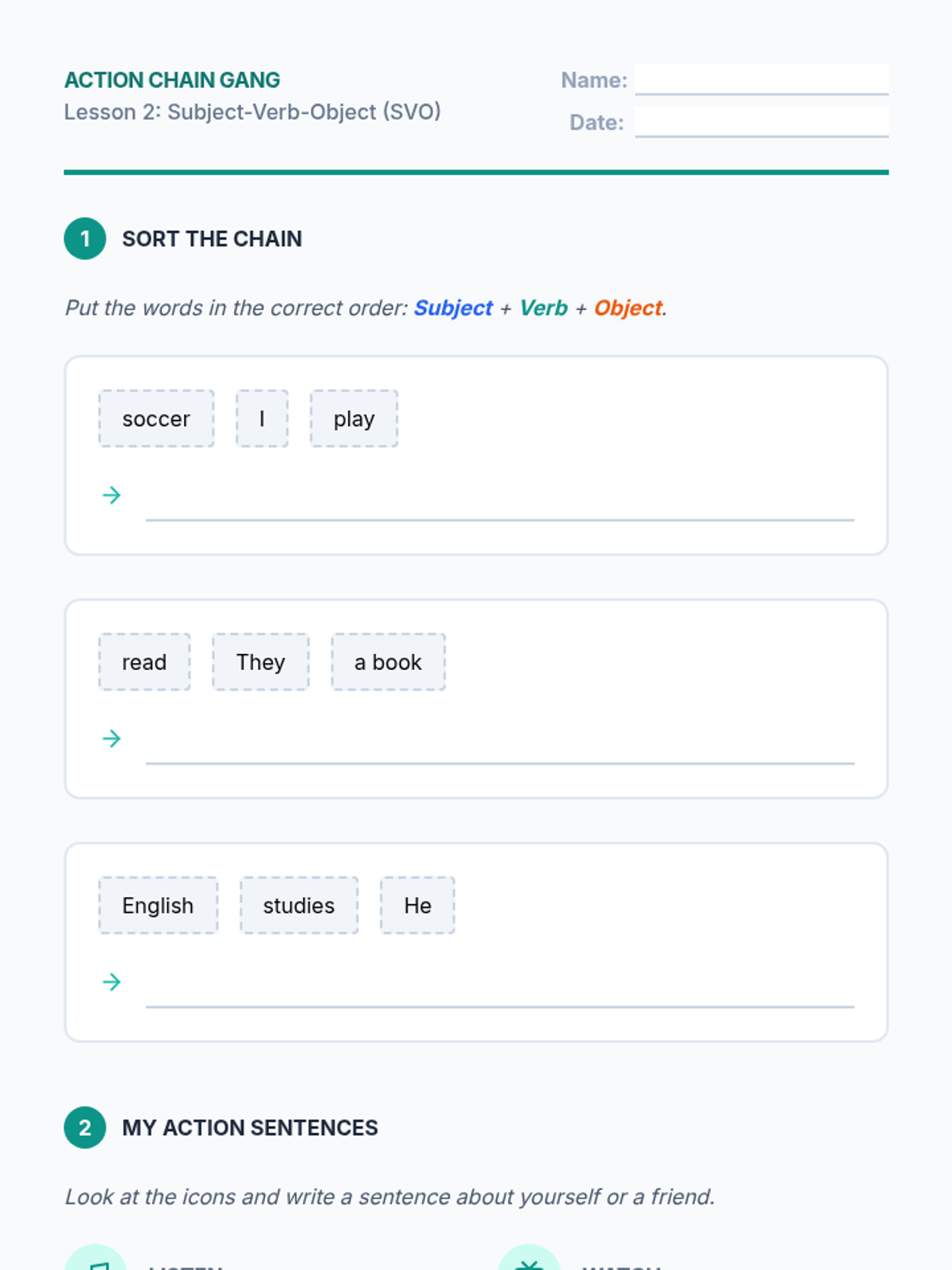
Worksheet for Lesson 2 focusing on Subject-Verb-Object (SVO) order and using action verbs to describe personal activities.
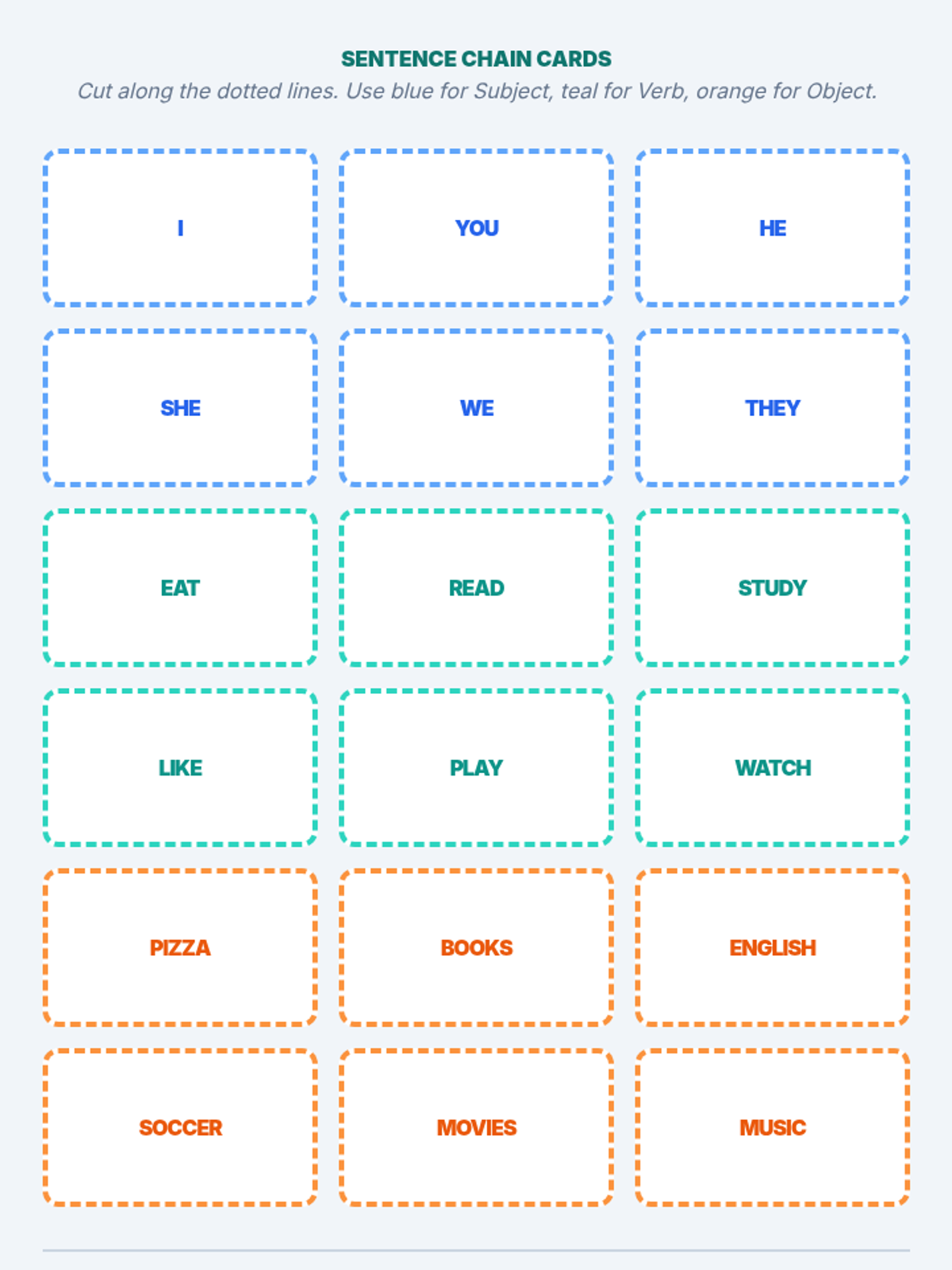
Printable sentence building cards for Lesson 2. Students cut these out to physically build Subject-Verb-Object sentence chains.
Introductory slides for Lesson 2, covering SVO (Subject-Verb-Object) structure with action verbs and a charades activity.
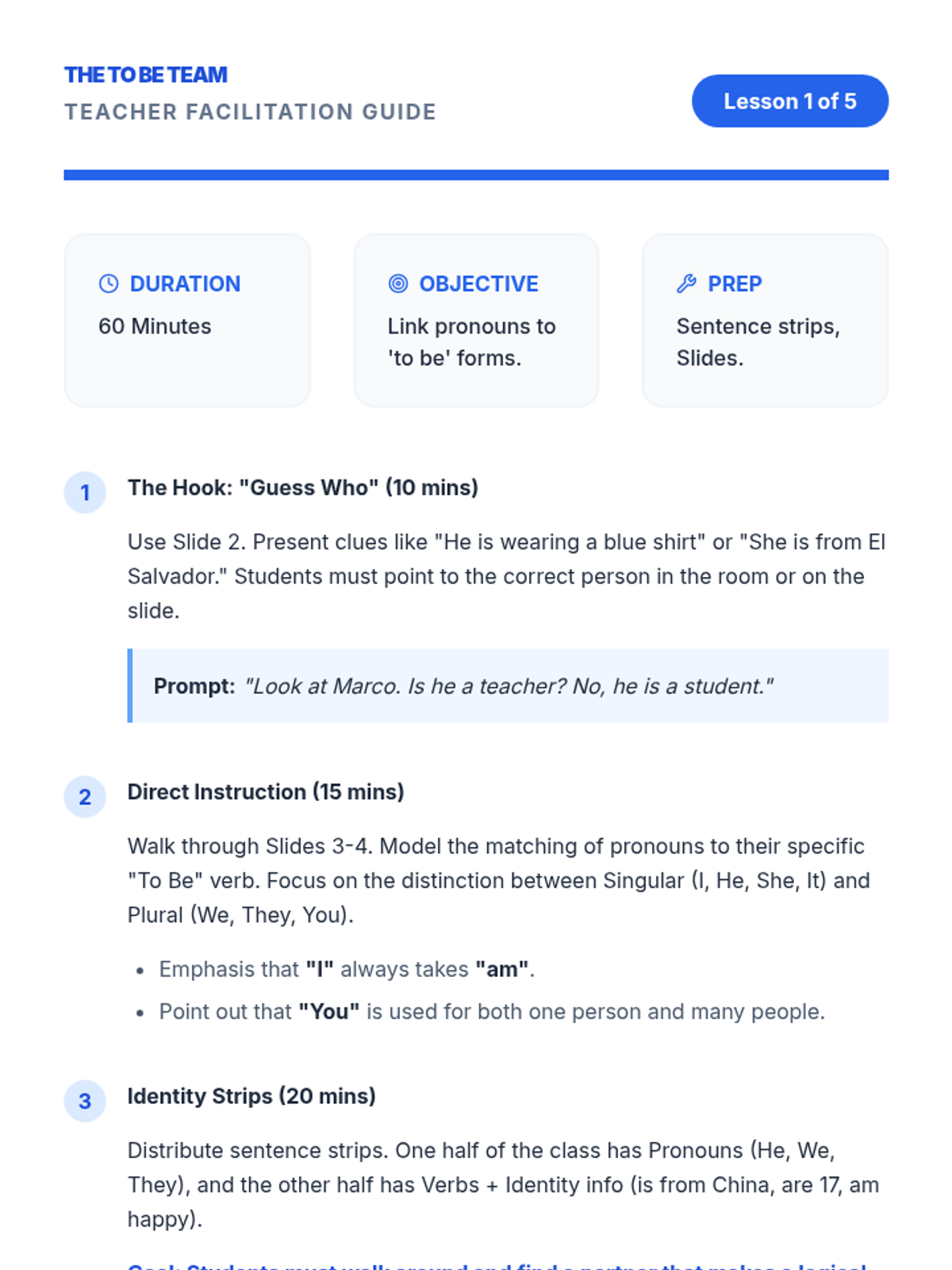
Teacher guide for Lesson 1, including pacing, instructional steps, and differentiation strategies for teaching pronouns and the verb 'to be'.
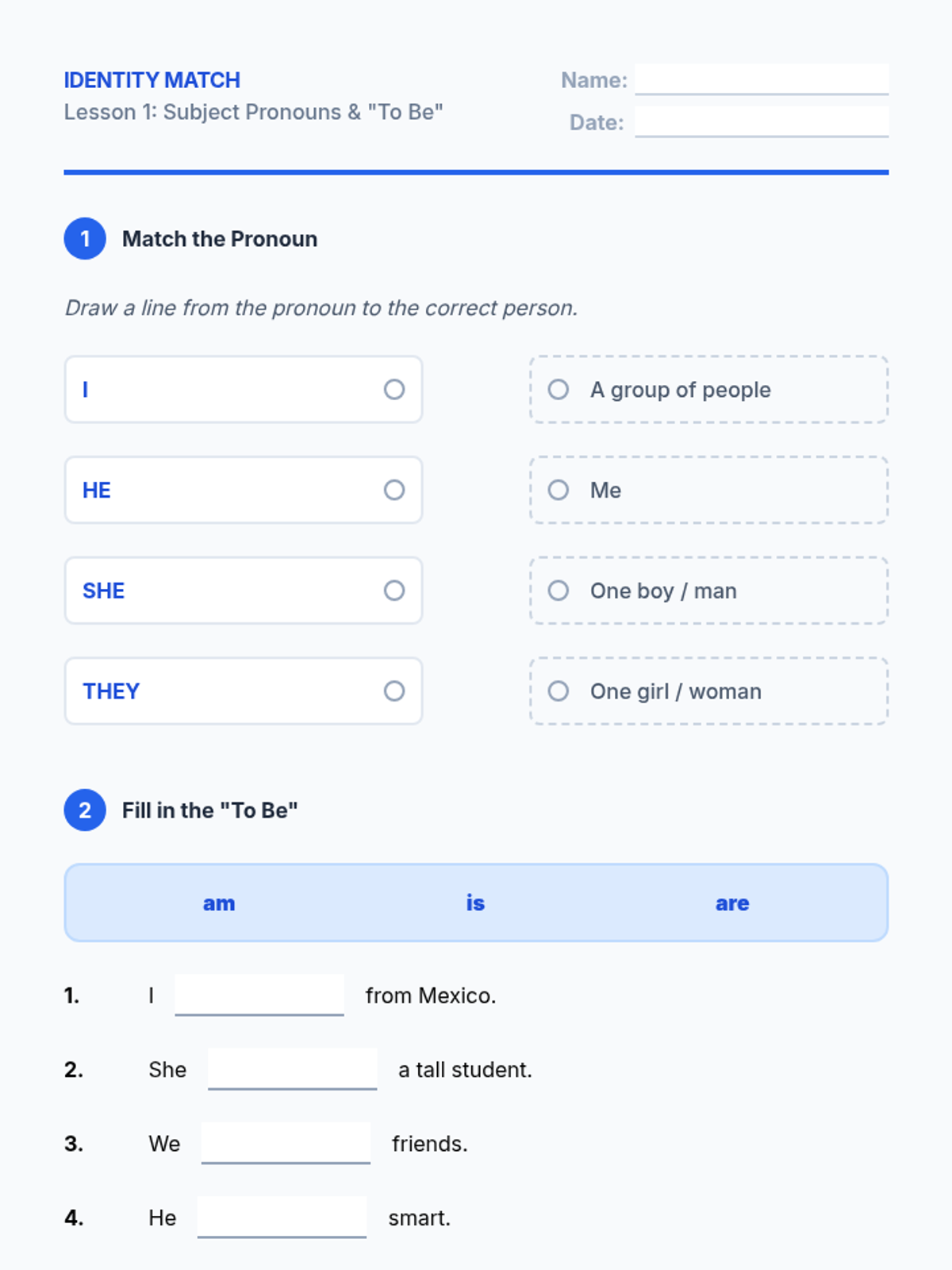
Worksheet for Lesson 1 where students match subject pronouns to descriptions and practice using 'am', 'is', and 'are' in sentences about identity.
Introductory slides for Lesson 1, covering subject pronouns and the verb 'to be' with visual aids and practice sentences.
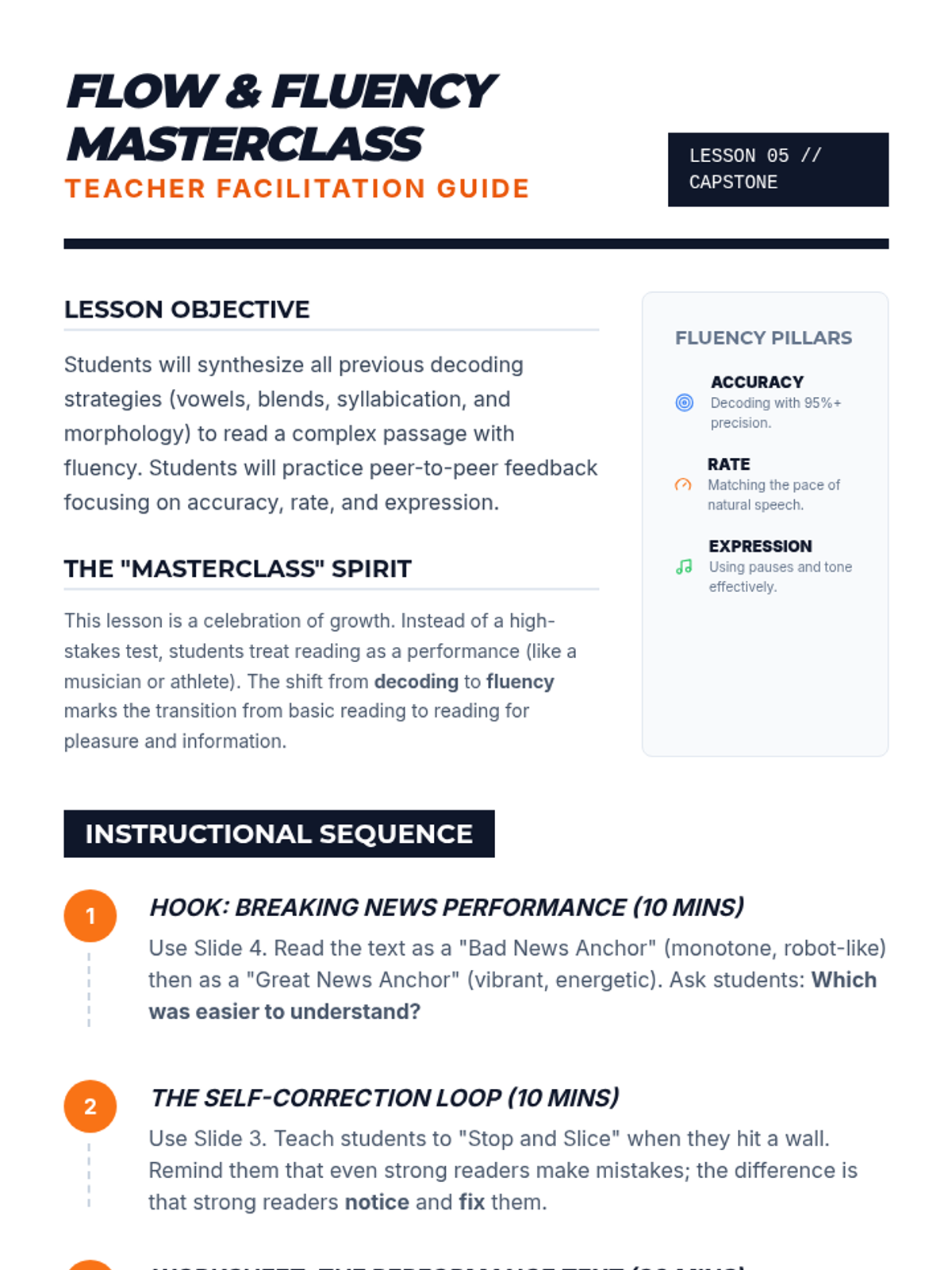
A teacher guide for Lesson 5 focusing on integration of decoding skills, peer feedback, and fluency assessment.
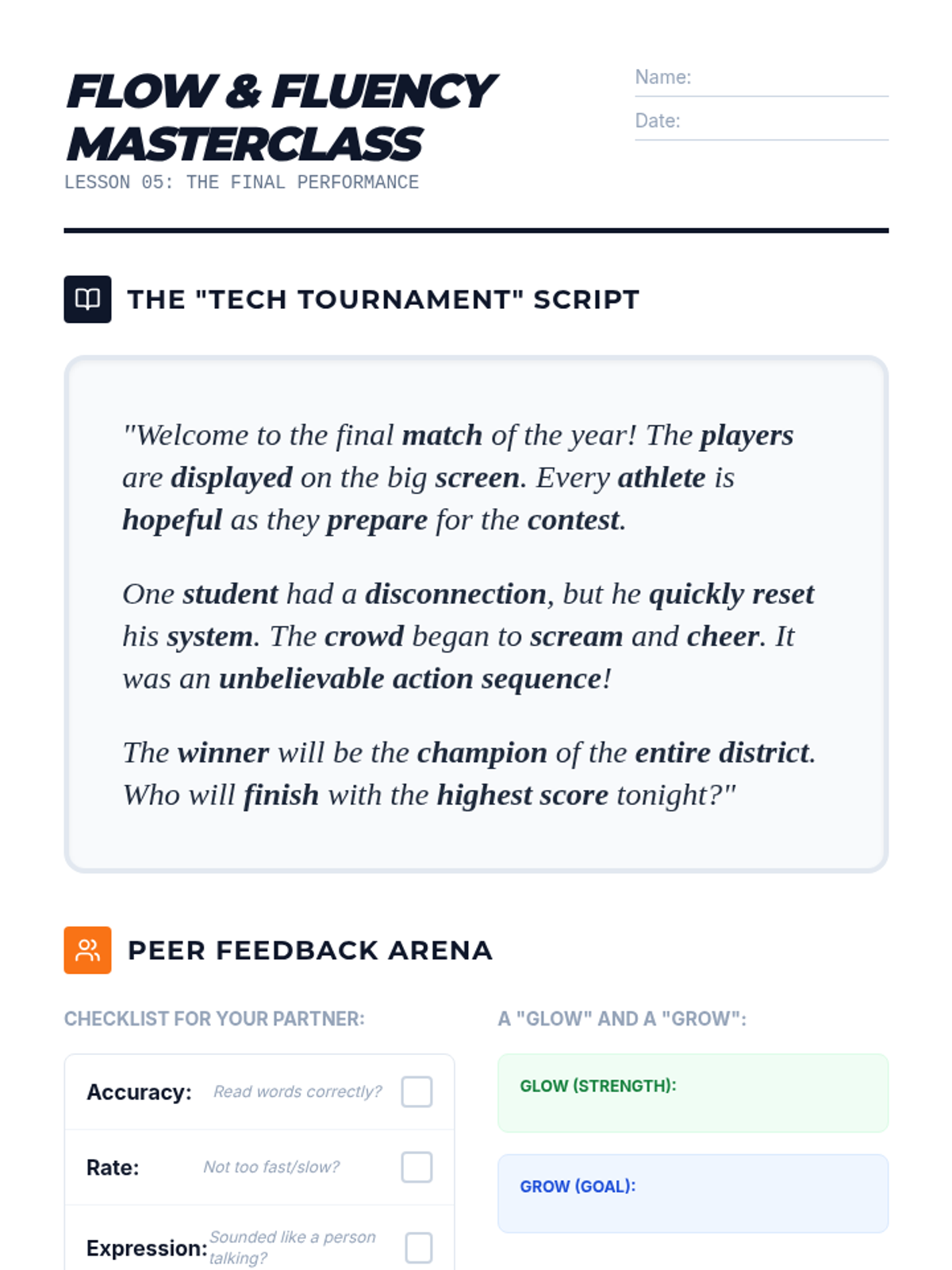
A student worksheet for practicing reading fluency with high-interest text and a peer feedback checklist.
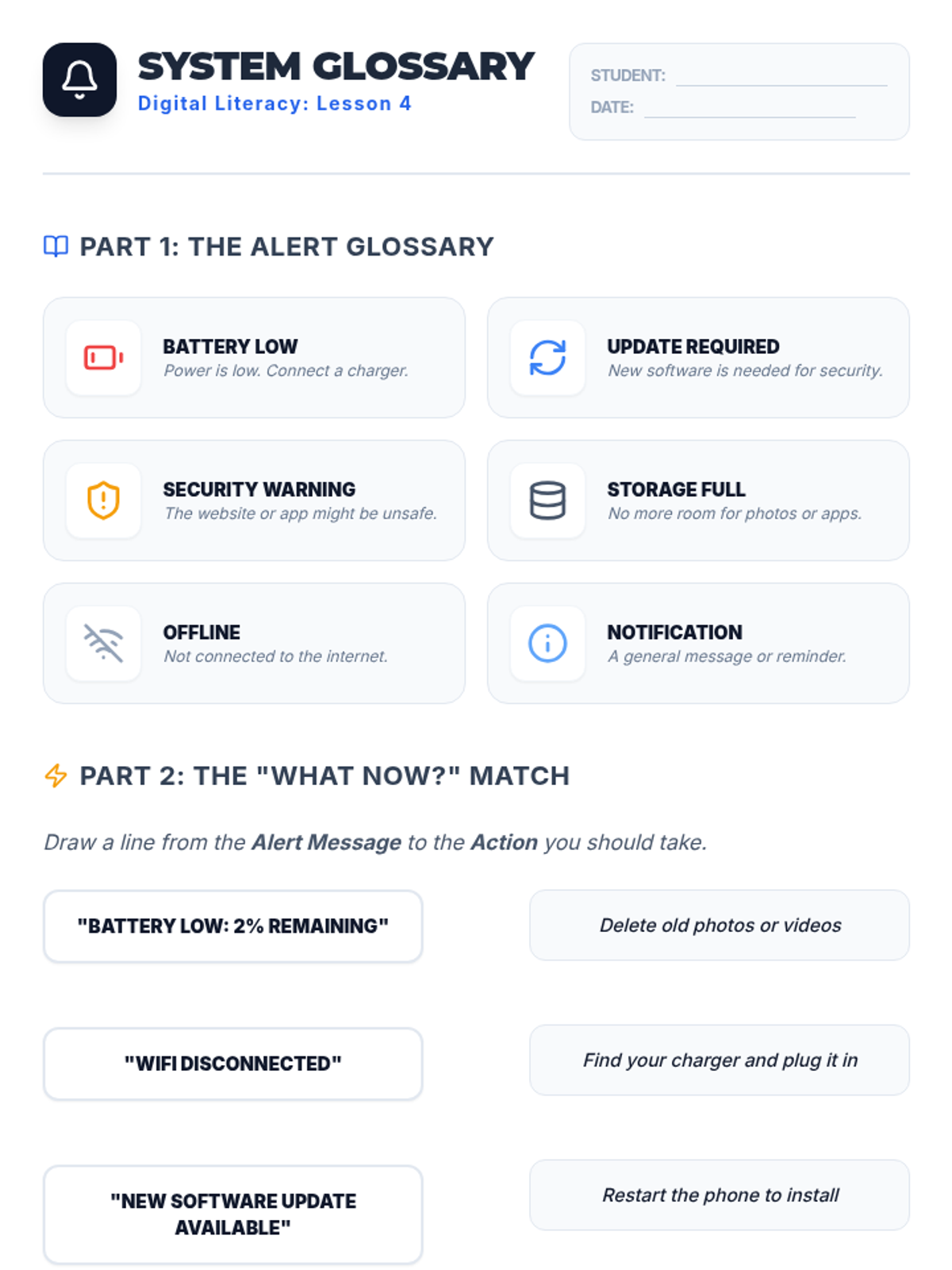
A student reference sheet and worksheet for Lesson 4. Includes a visual glossary of common system alerts and a matching activity for alert actions.