Sentence structure fundamentals, subject-verb agreement, and precise usage of parts of speech including pronouns, conjunctions, and adjectives. Targets technical accuracy through mastery of capitalization, punctuation, spelling, and verb mood.
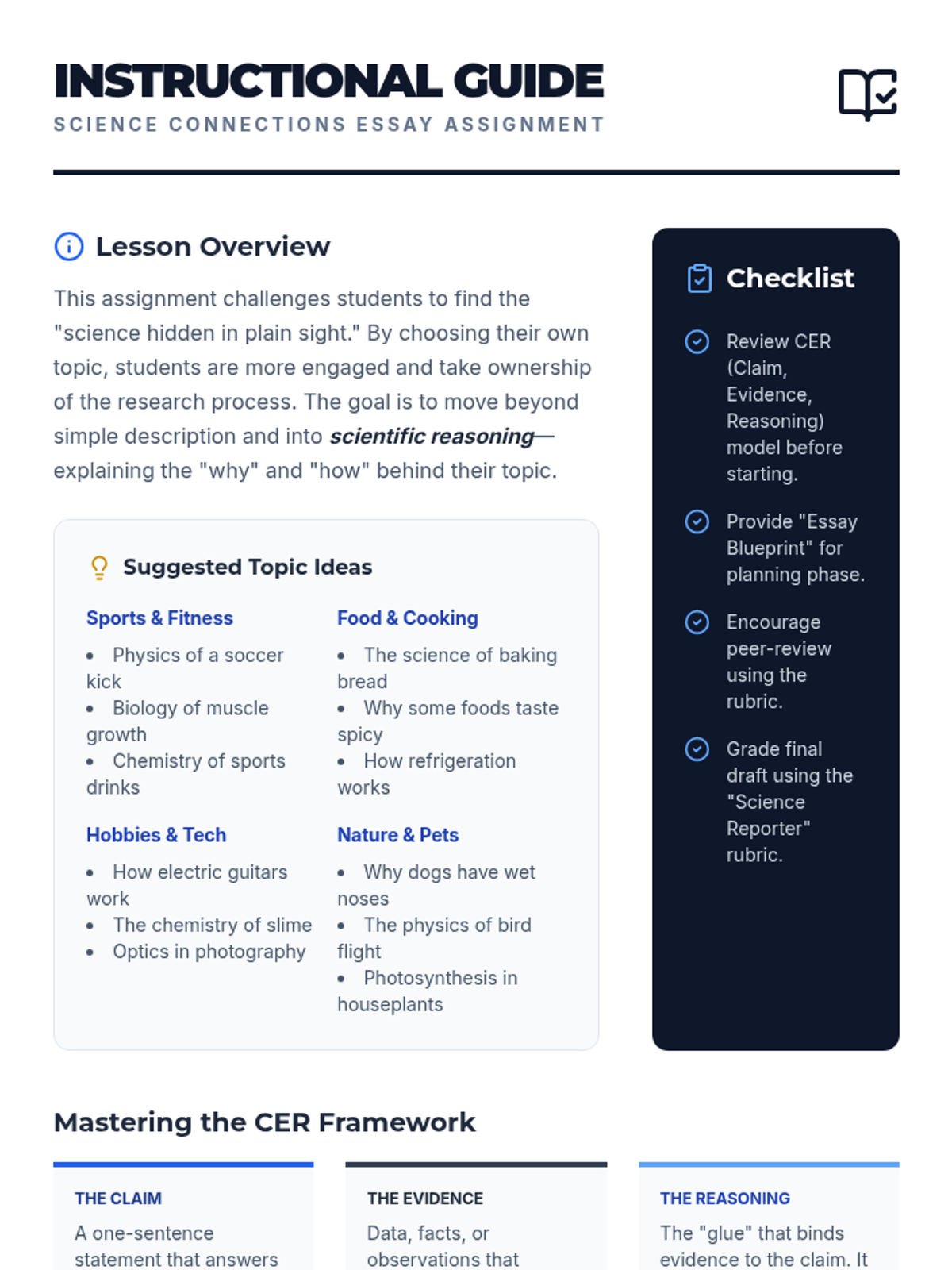
An instructional guide for teachers providing tips on lesson implementation, topic suggestions, and a breakdown of the CER (Claim, Evidence, Reasoning) framework for students.
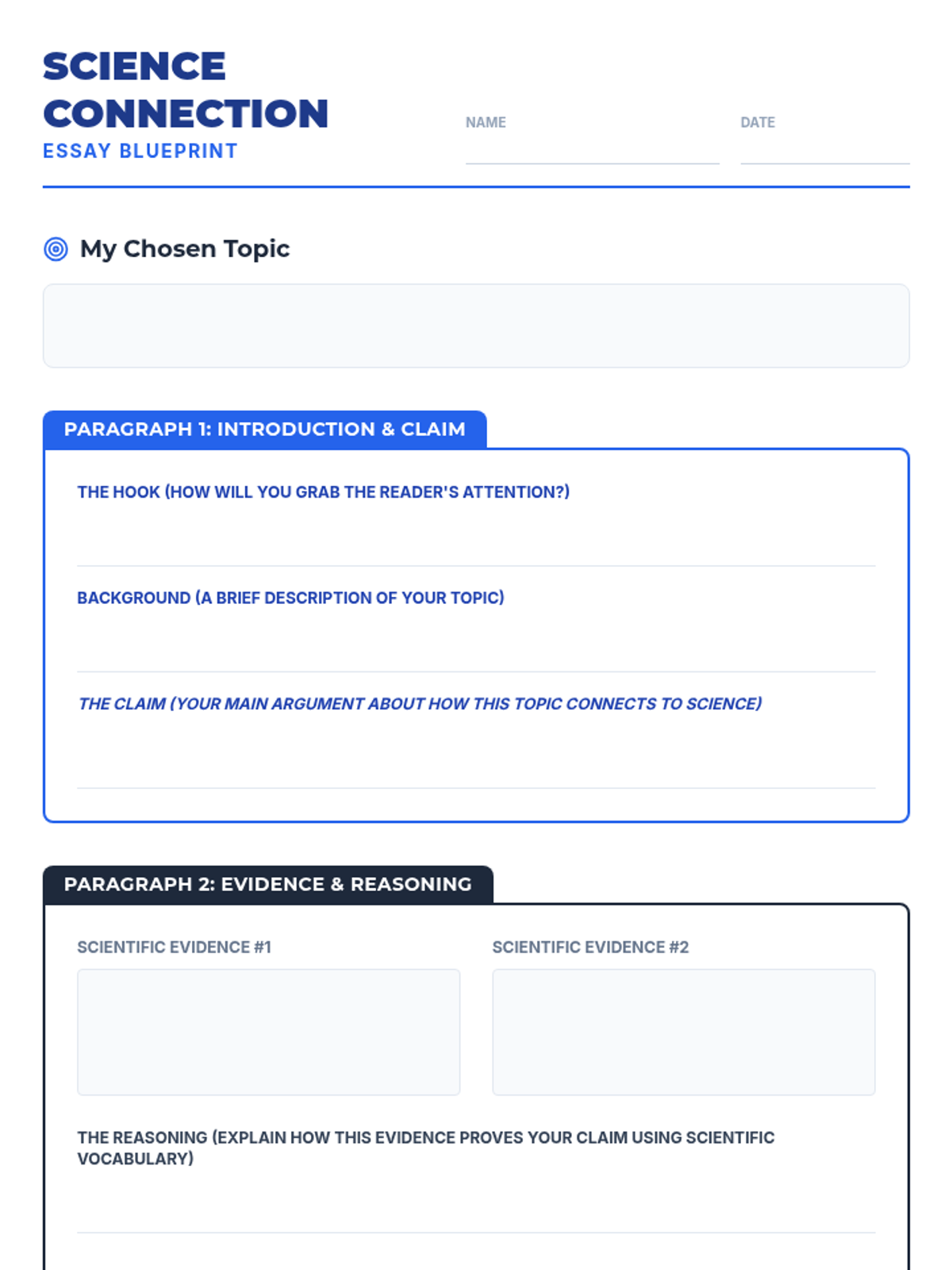
A structured essay planning worksheet designed to guide students through a three-paragraph science connection essay using the CER (Claims, Evidence, Reasoning) framework.
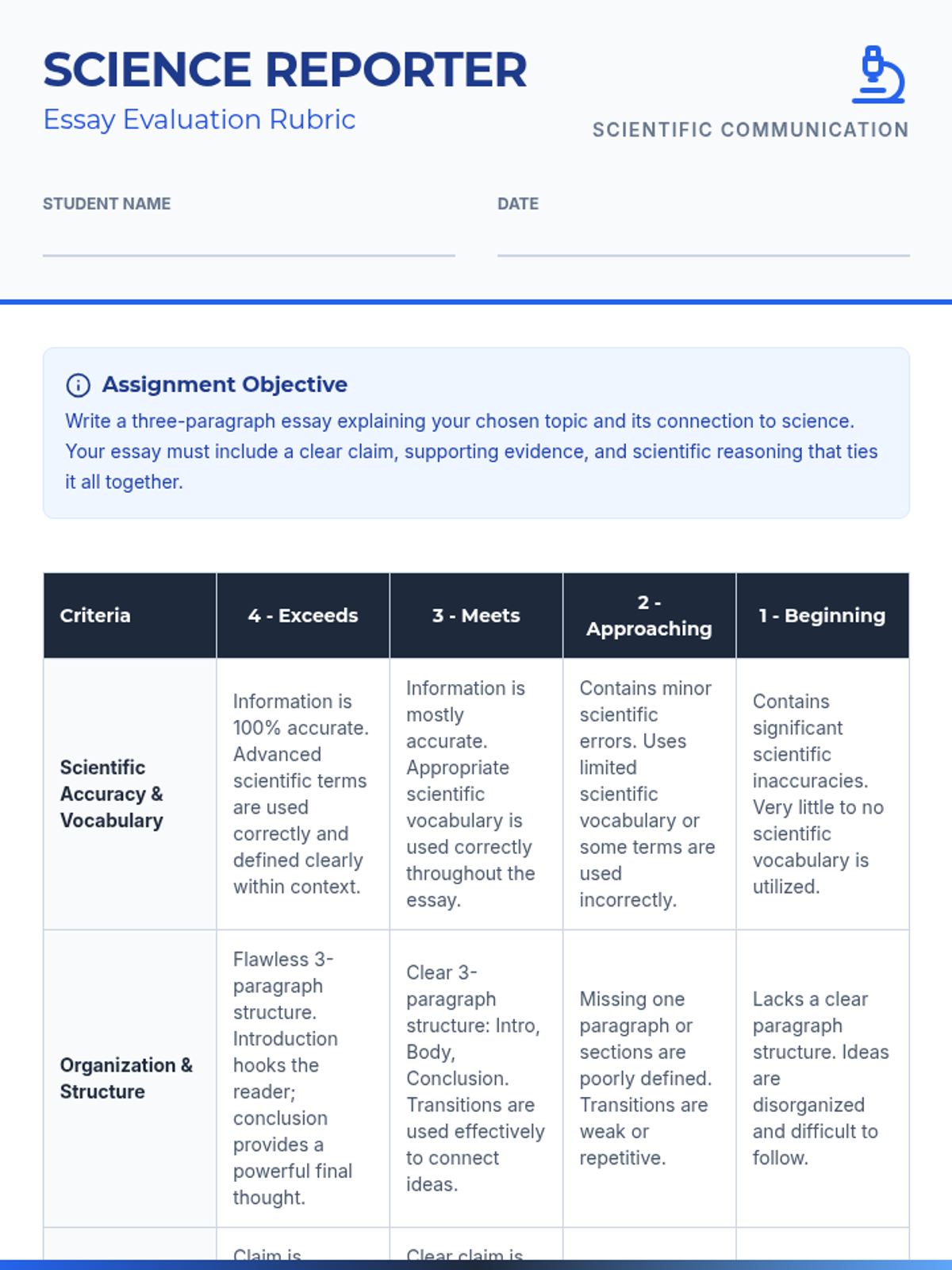
A comprehensive rubric for evaluating a three-paragraph science essay. It includes specific criteria for scientific accuracy, organization, CER (Claims, Evidence, Reasoning), and writing mechanics, featuring a clean 'Science Reporter' aesthetic.
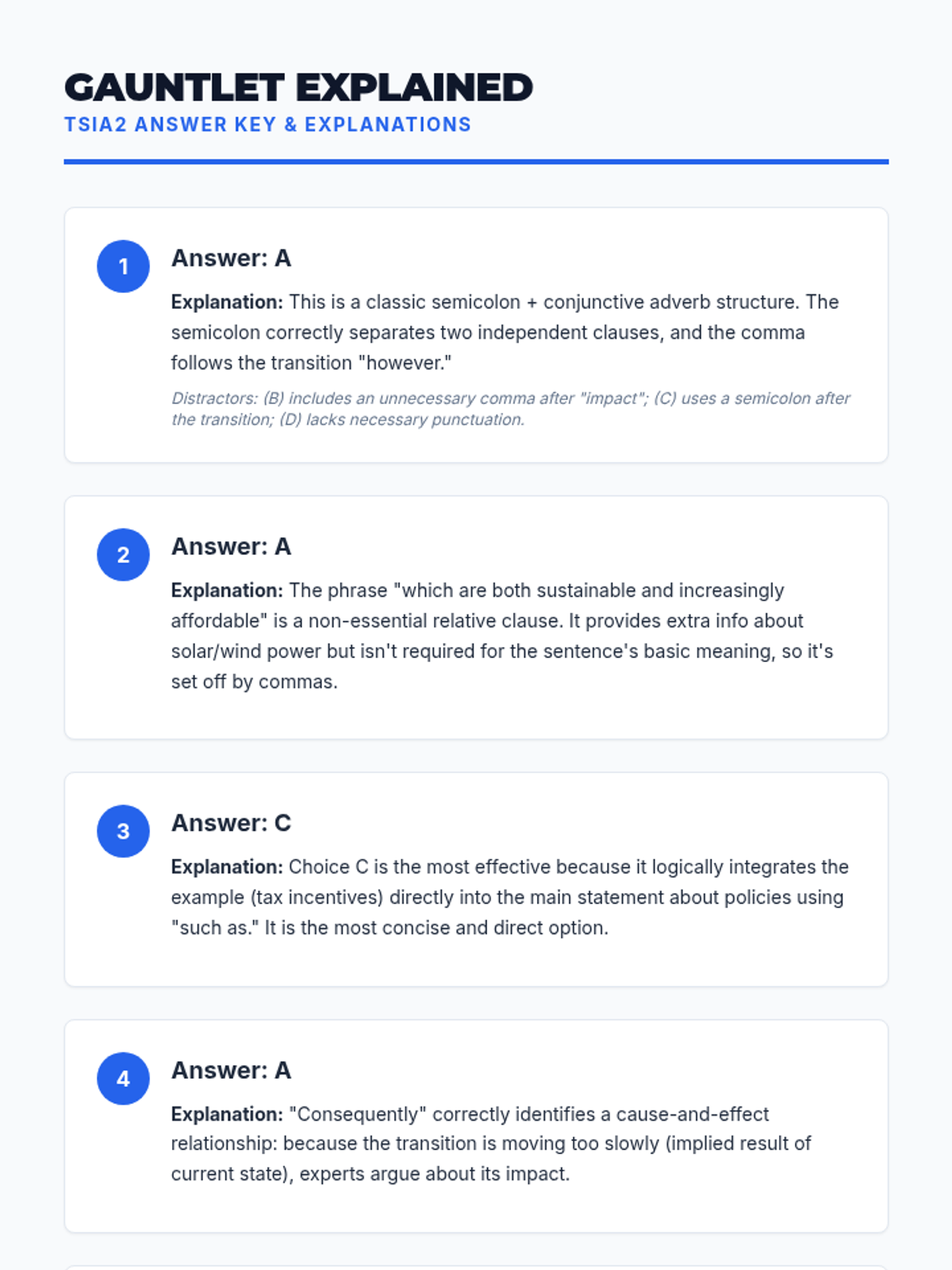
A detailed answer key for the Grammar Gauntlet Assessment, providing the correct answers and instructional explanations for each question.
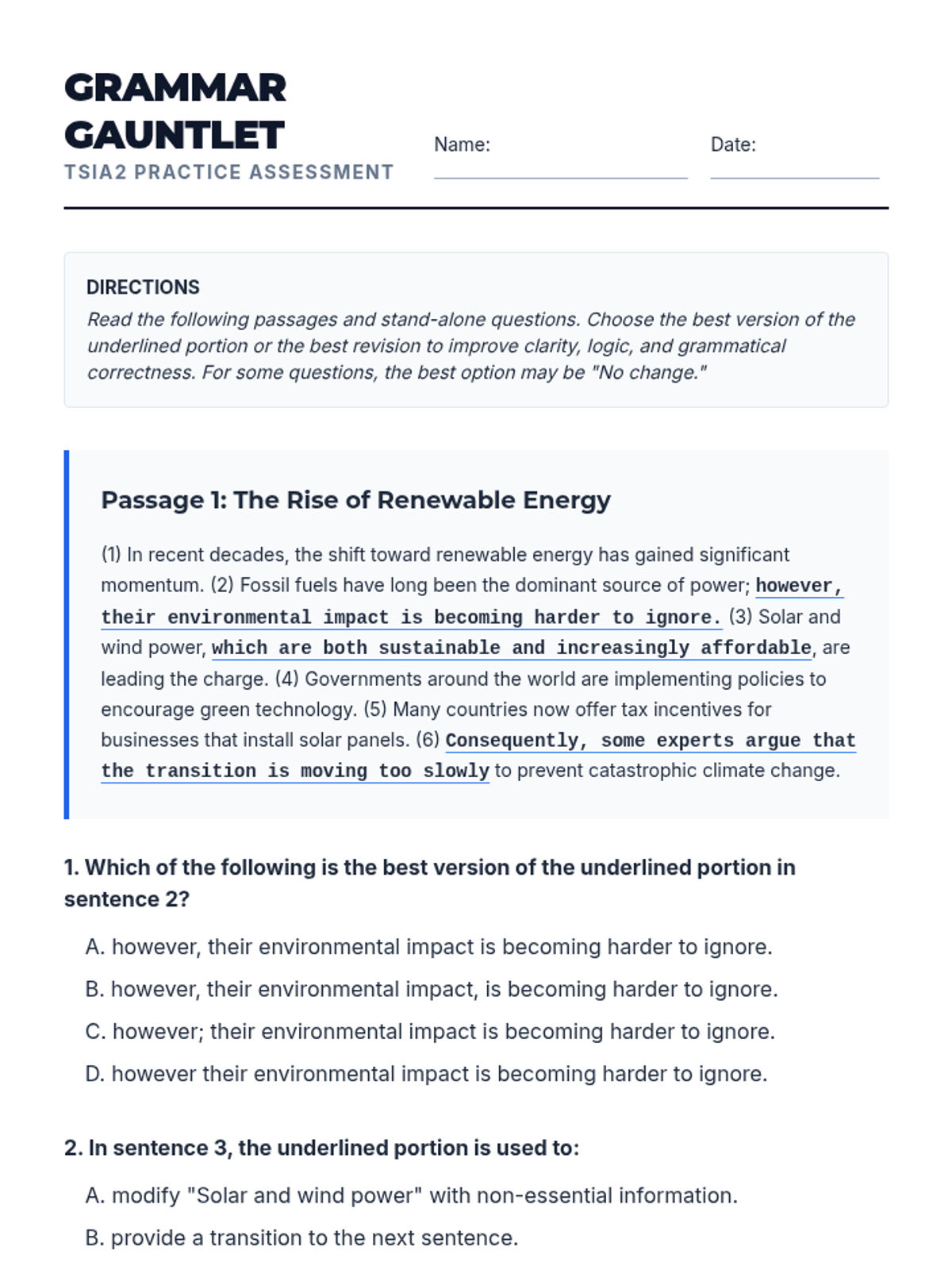
A 20-question multiple-choice practice assessment mirroring the TSIA2 revising and editing standards, including passage-based and stand-alone questions.
Instructional slide deck for the TSIA2 Grammar Gauntlet lesson, covering the four key focus areas of the exam with visual examples and strategy tips. All text updated to 24px minimum for visibility.
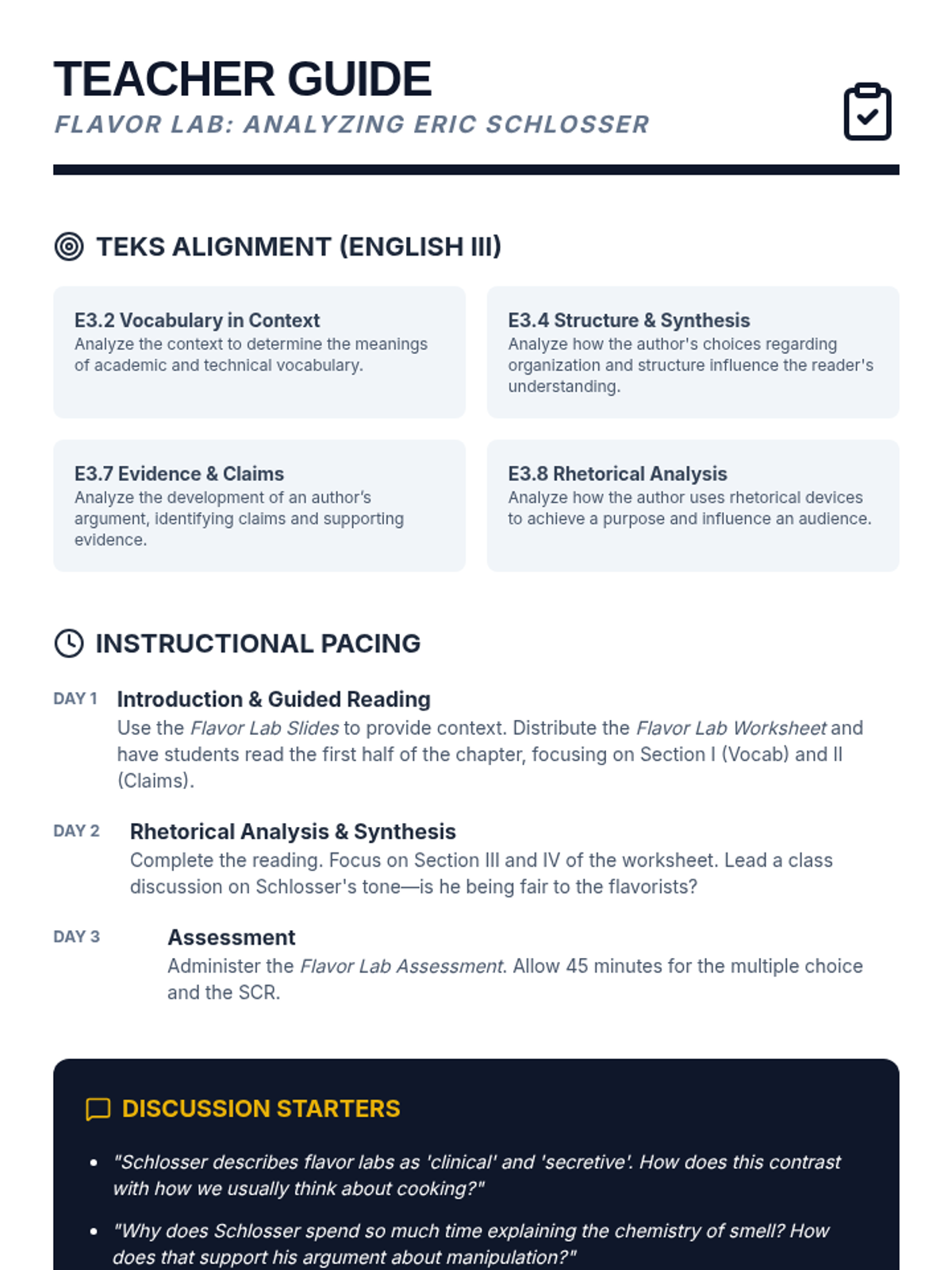
A comprehensive teacher guide for the 'Flavor Lab' lesson, including TEKS alignment, answer keys, a pacing guide, and a STAAR-style SCR rubric.
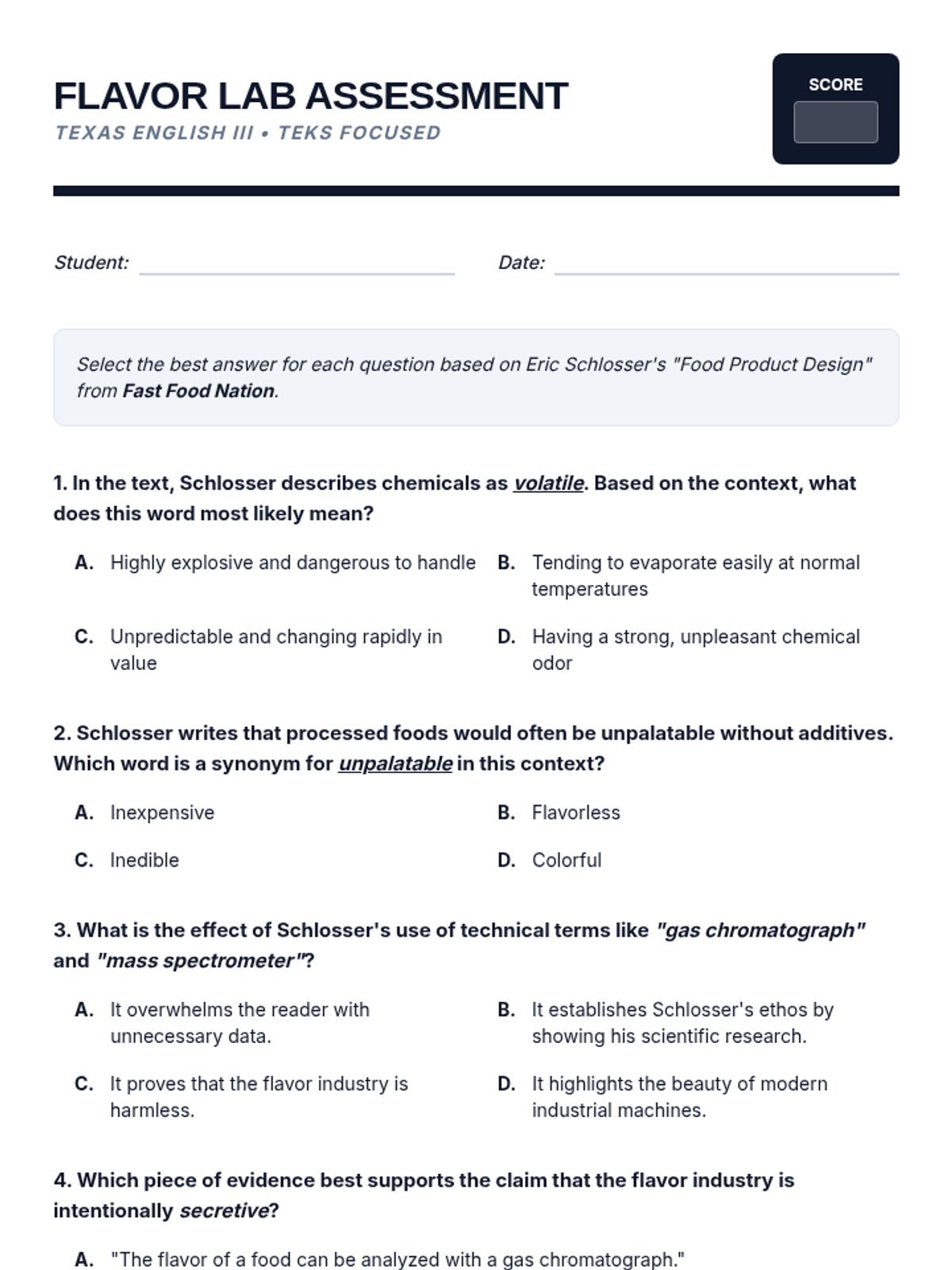
A 15-question multiple-choice assessment and a STAAR-style short constructed response for analyzing Eric Schlosser's 'Food Product Design'.
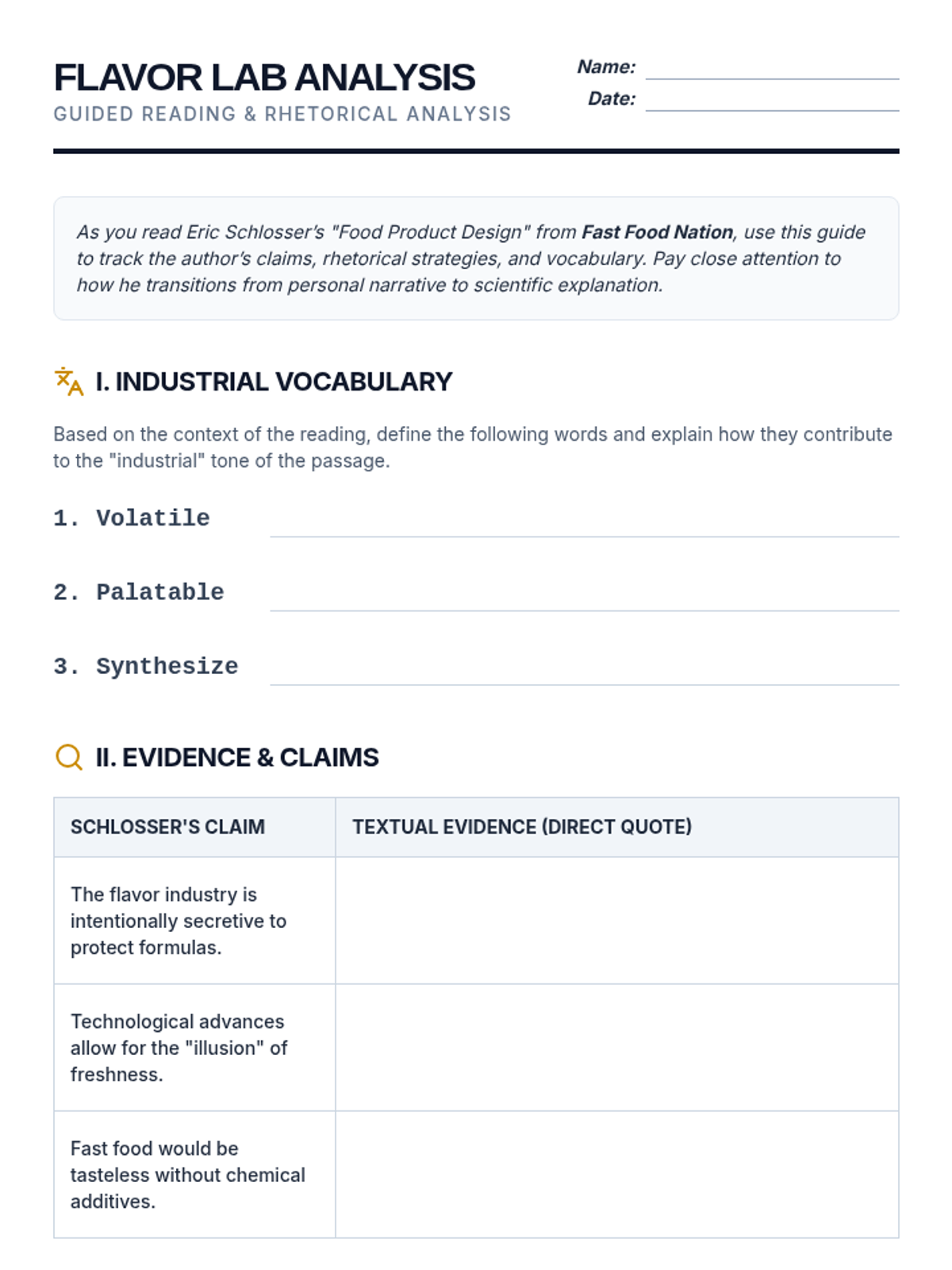
A guided reading and rhetorical analysis worksheet for Eric Schlosser's 'Food Product Design', designed to help students track claims, evidence, and vocabulary.
A set of instructional slides for analyzing Eric Schlosser's 'Food Product Design', covering rhetorical devices, industrial vocabulary, and STAAR-style assessment strategies.
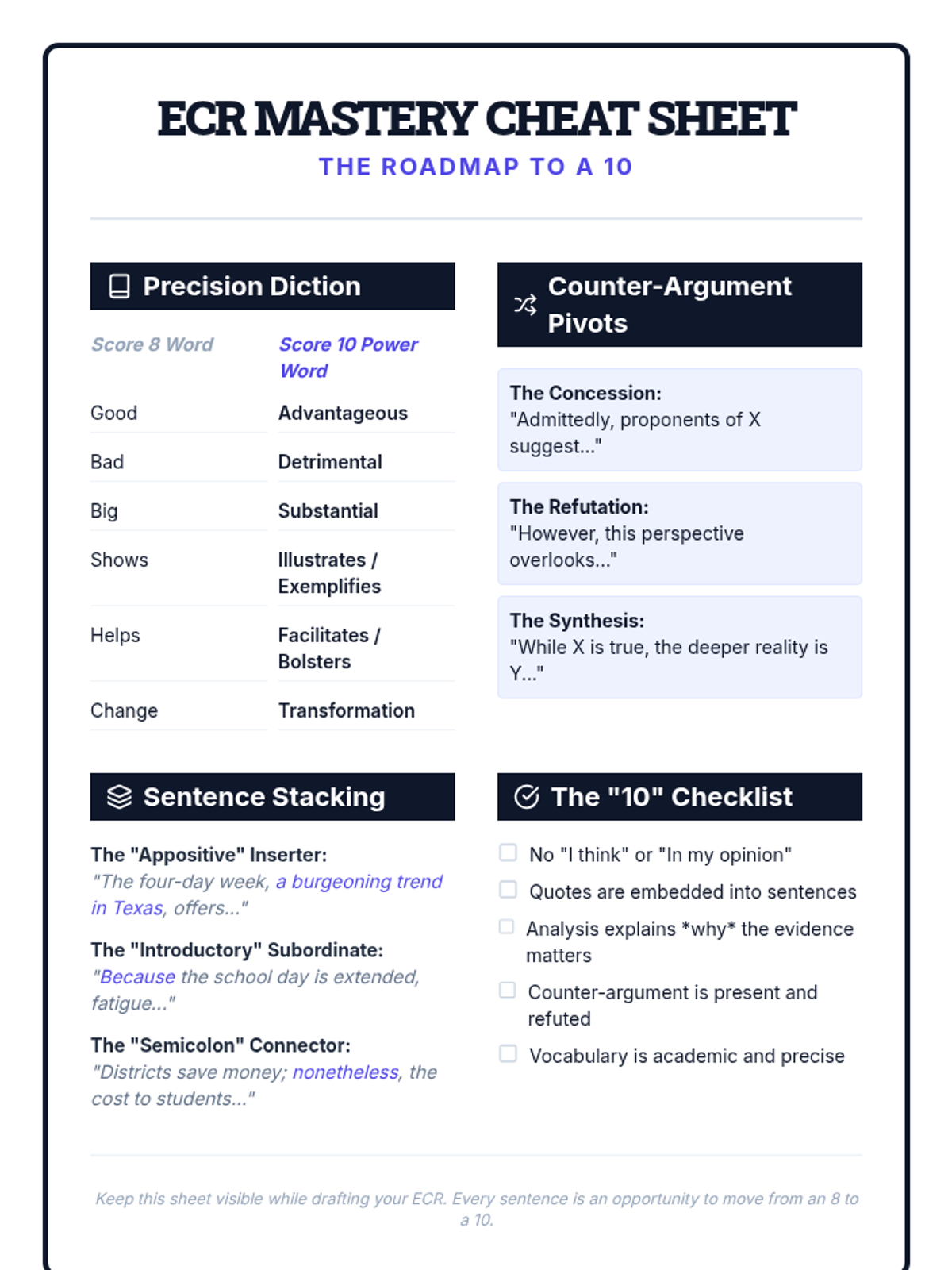
A one-page student reference sheet for ECR drafting, featuring power words, transition stems, syntax structures, and a final quality checklist.
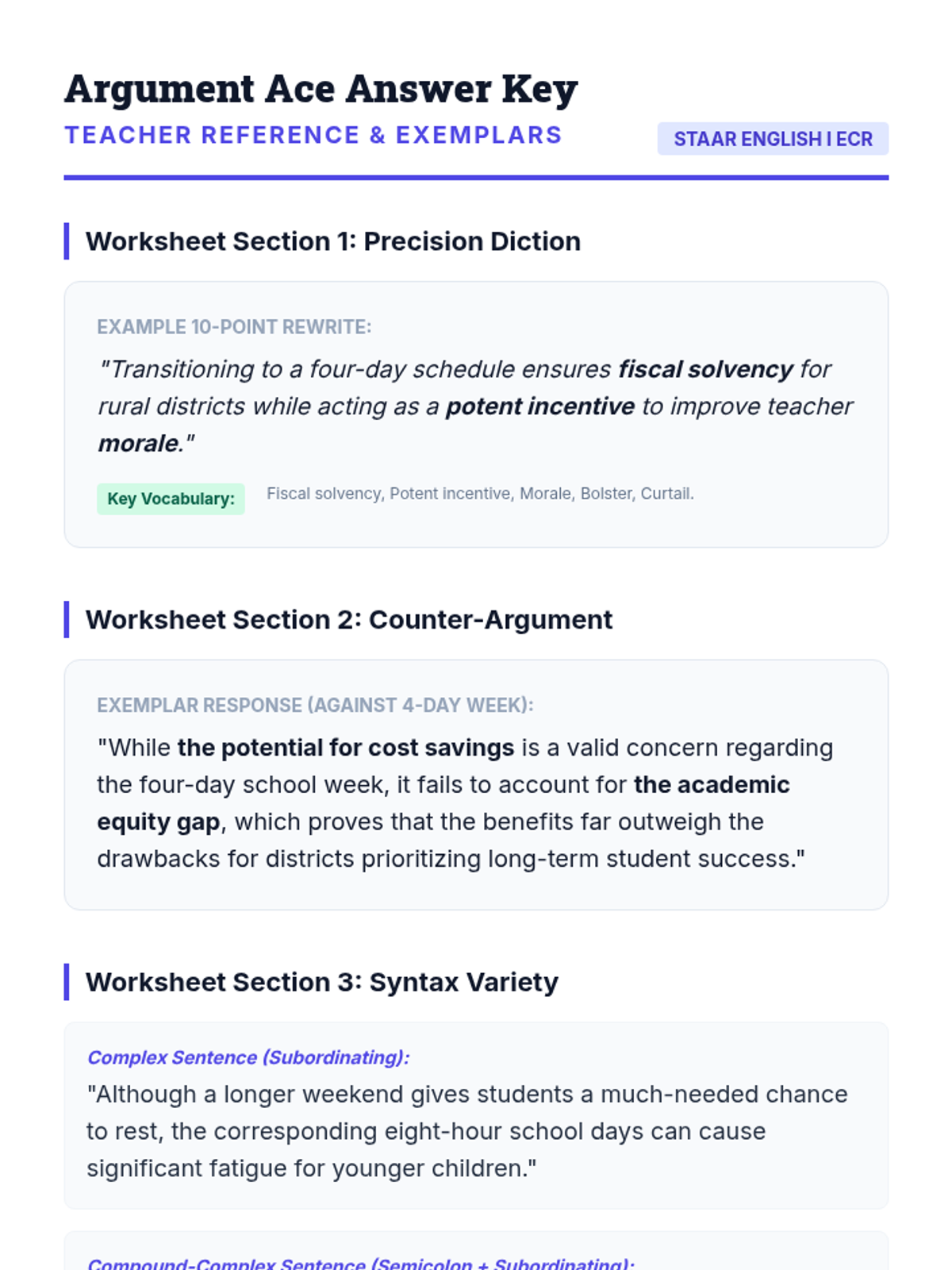
A detailed answer key and model response guide for teachers, providing exemplars for diction, syntax, counter-arguments, and a full 10-point paragraph based on the 4-day school week passage.
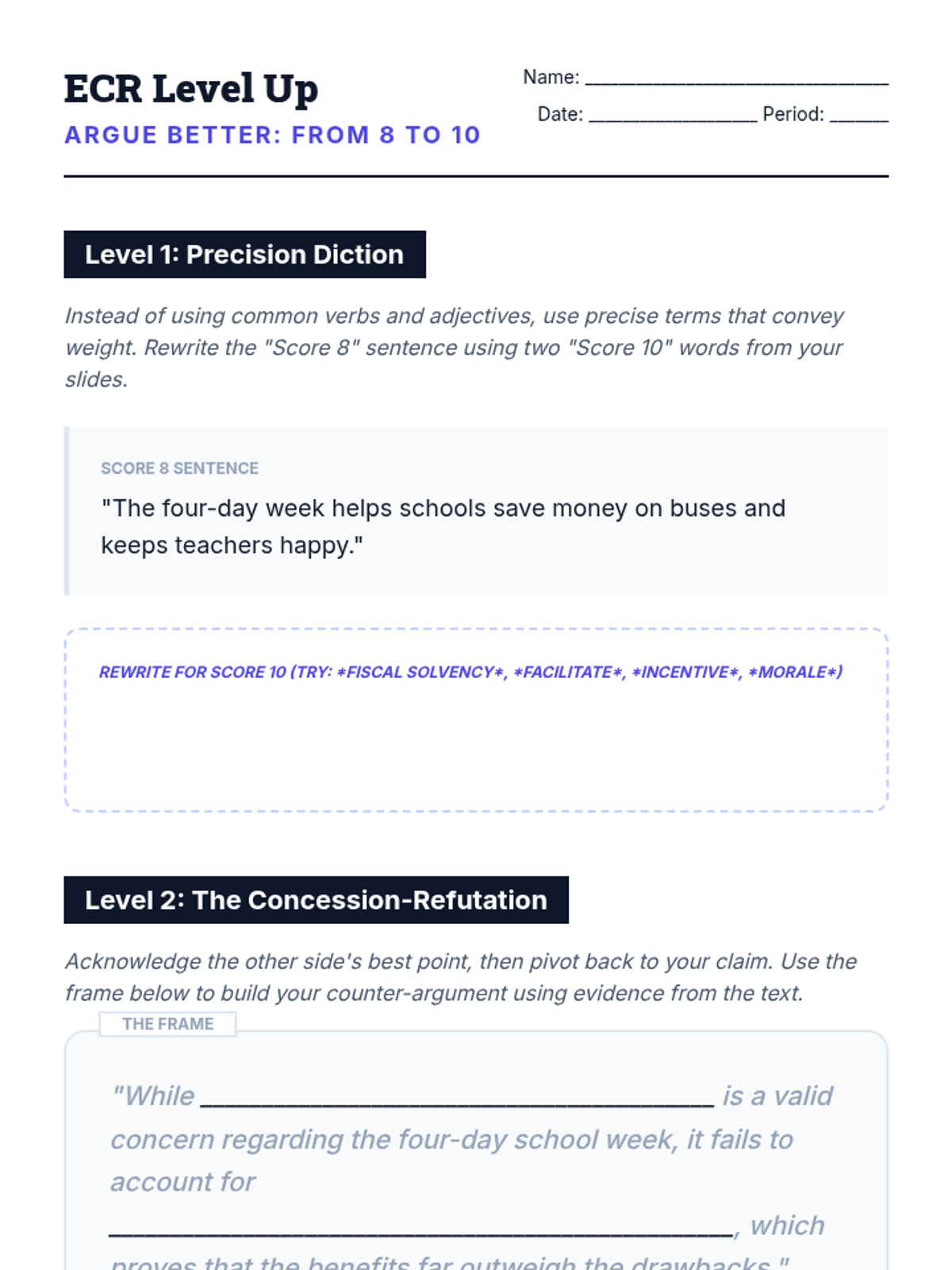
A student worksheet for the Argument Ace lesson, including exercises for precision diction, counter-argument framing, and syntax variety, ending with a drafting space for a sophisticated ECR paragraph.
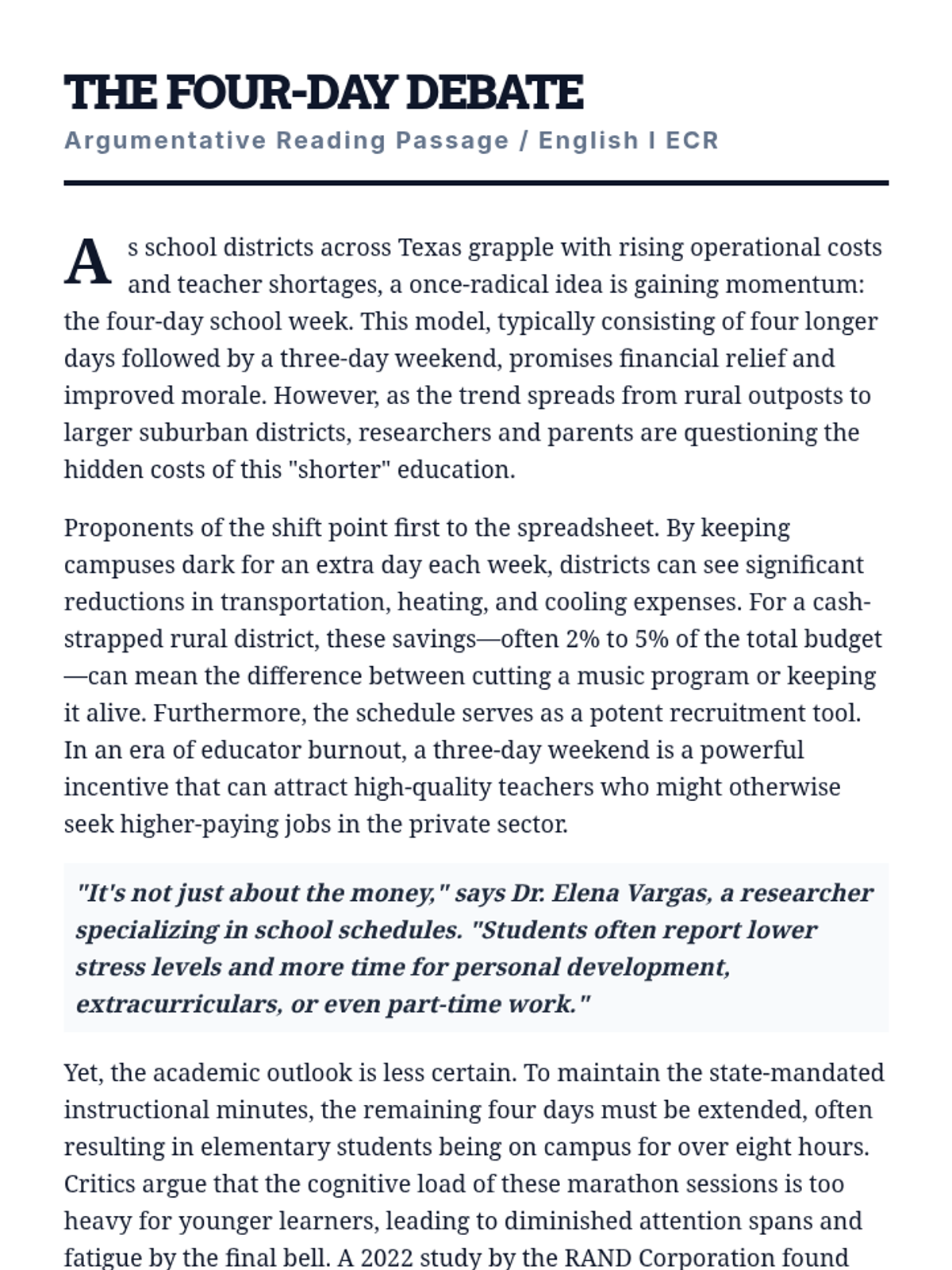
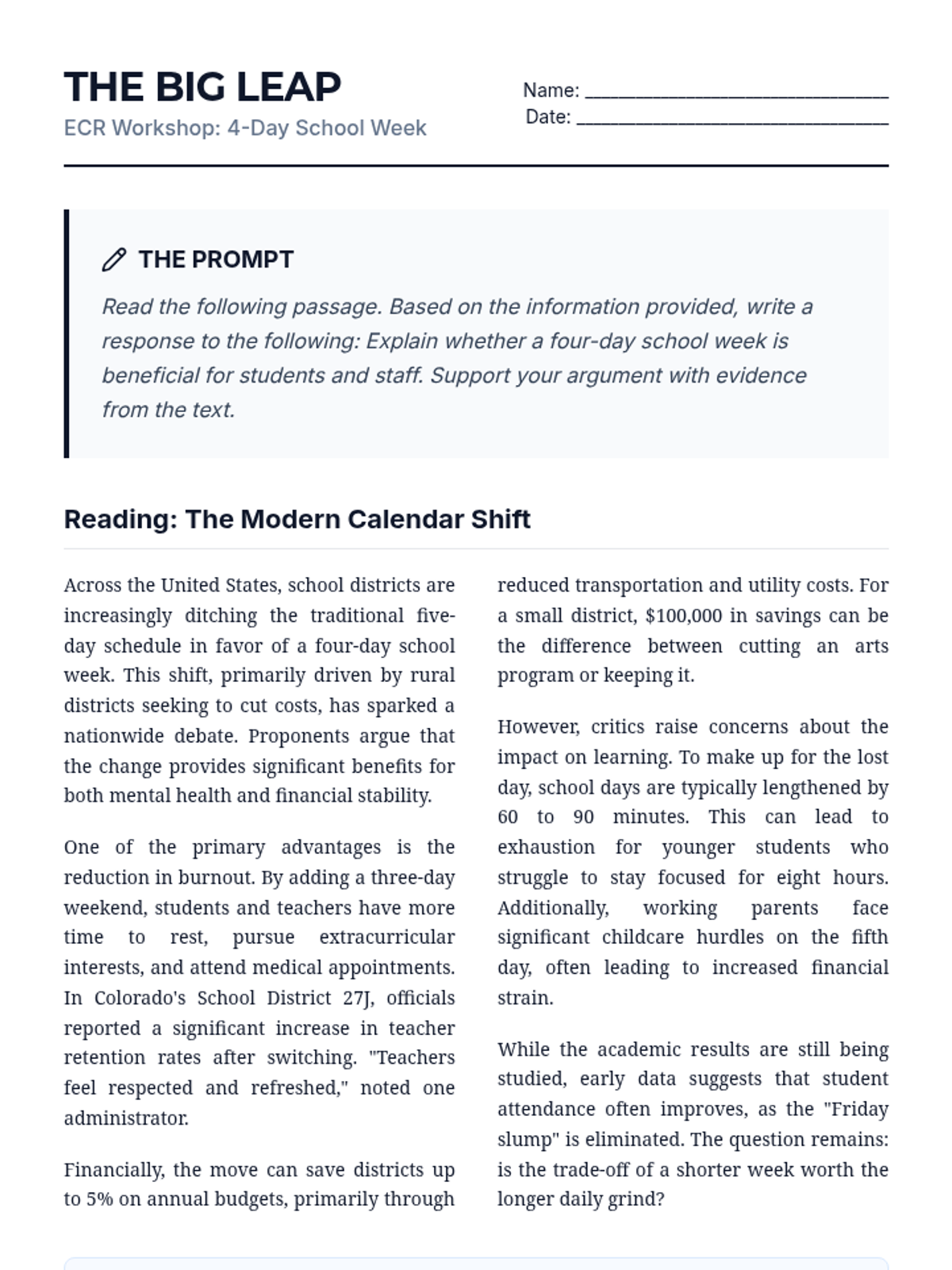
A high-quality, balanced reading passage about the 4-day school week debate, featuring specific evidence for both sides to be used in ECR evidence integration practice.
A printer-friendly presentation designed to guide students through the ECR mastery process, focusing on the 8-to-10 point gap, word choice, counter-arguments, and syntax variety.
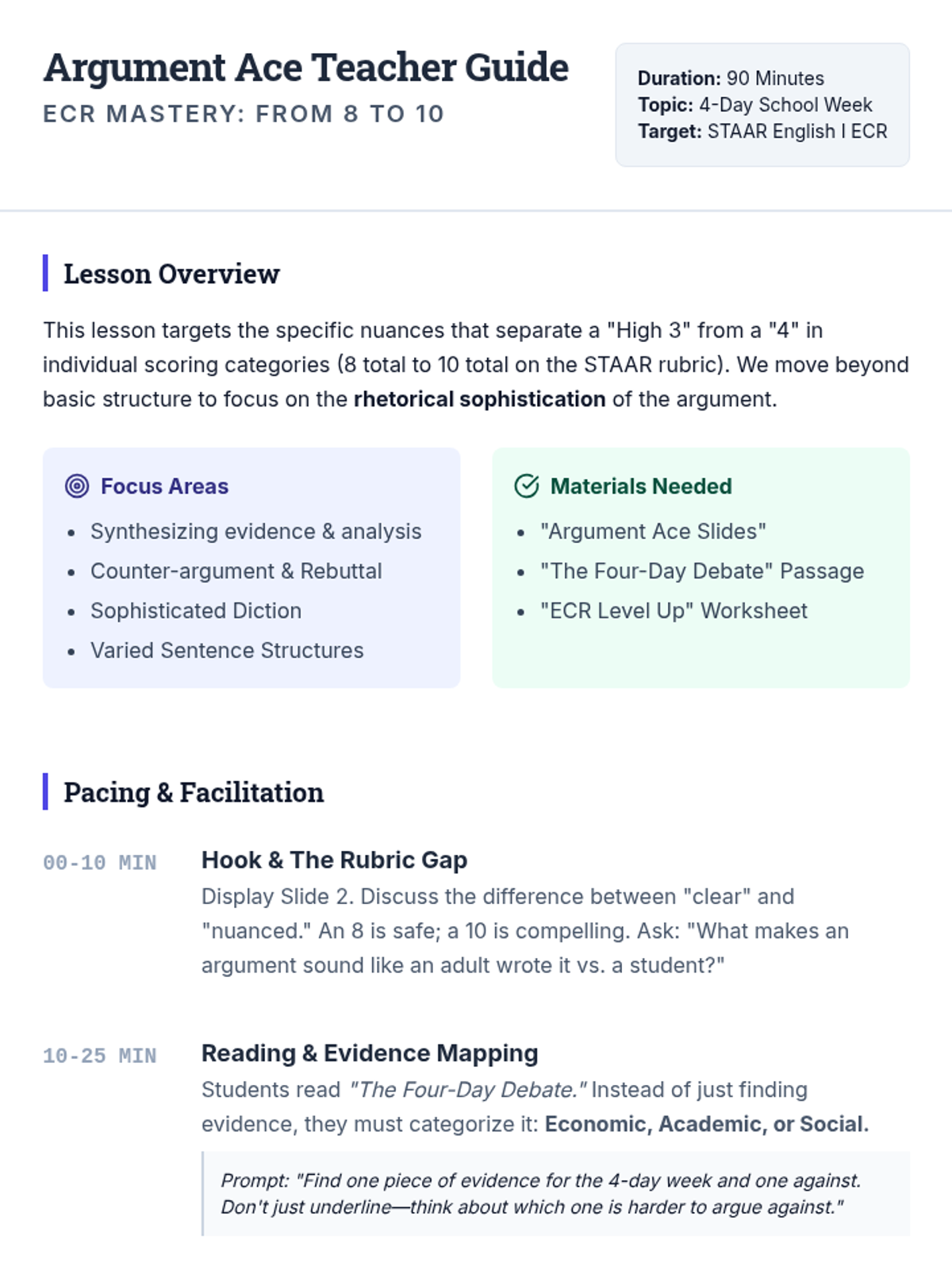
A comprehensive teacher guide for a 90-minute ECR mastery lesson, featuring a detailed pacing guide, instructional strategies for 8-to-10 score improvement, and differentiation tips.
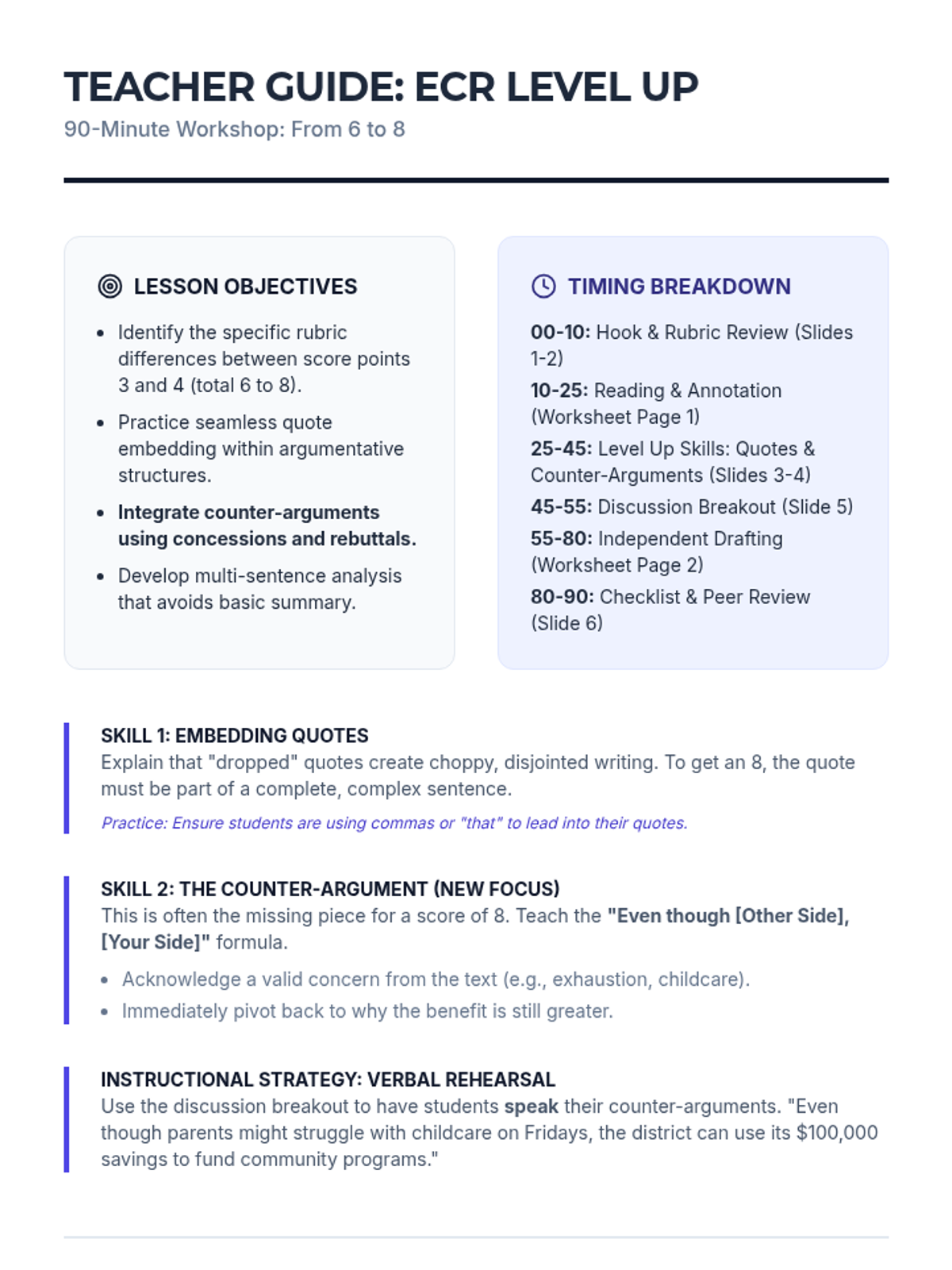
A facilitator guide for the ECR workshop, updated to include strategies for teaching counter-argument integration and a revised exemplar response.
A 6-slide presentation designed to be printer-friendly with high-contrast elements. It guides students through the differences between scores of 6 and 8, focusing on counter-arguments and quote embedding.
A 2-page student worksheet featuring a reading passage about the 4-day school week, annotation space, and skills drills for quote integration, analysis, and counter-argument rebuttals.
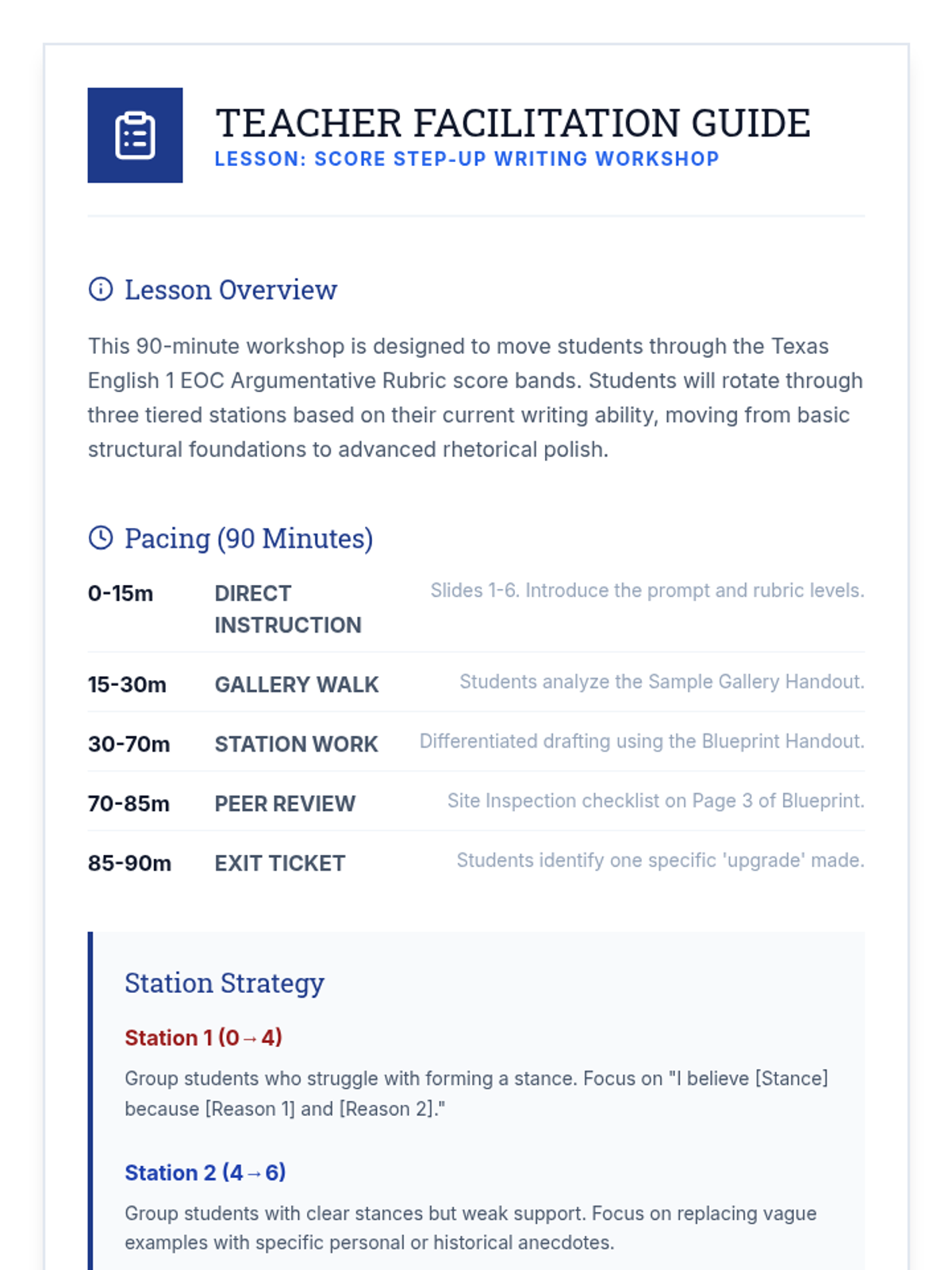
A comprehensive guide for teachers to facilitate the Score Step-Up workshop, including pacing, station strategy, and instructional tips for moving students through the EOC rubric levels.
A comprehensive slide deck for the first week of TSIA2 writing preparation, containing daily 3-question drills with detailed answer explanations focusing on punctuation, grammar, and organization.
A comprehensive slide deck for the final week of TSIA2 writing preparation, providing high-rigor mixed practice to simulate the full range of the TSIA2 Writing section.
A slide deck for the third week of TSIA2 writing preparation, covering days 11 through 15 with daily 3-question drills focusing on modifier placement, pronoun agreement, and structural polish.
A comprehensive slide deck for the second week of TSIA2 writing preparation, containing daily 3-question drills with detailed answer explanations focusing on pronoun case, punctuation, and organizational flow.
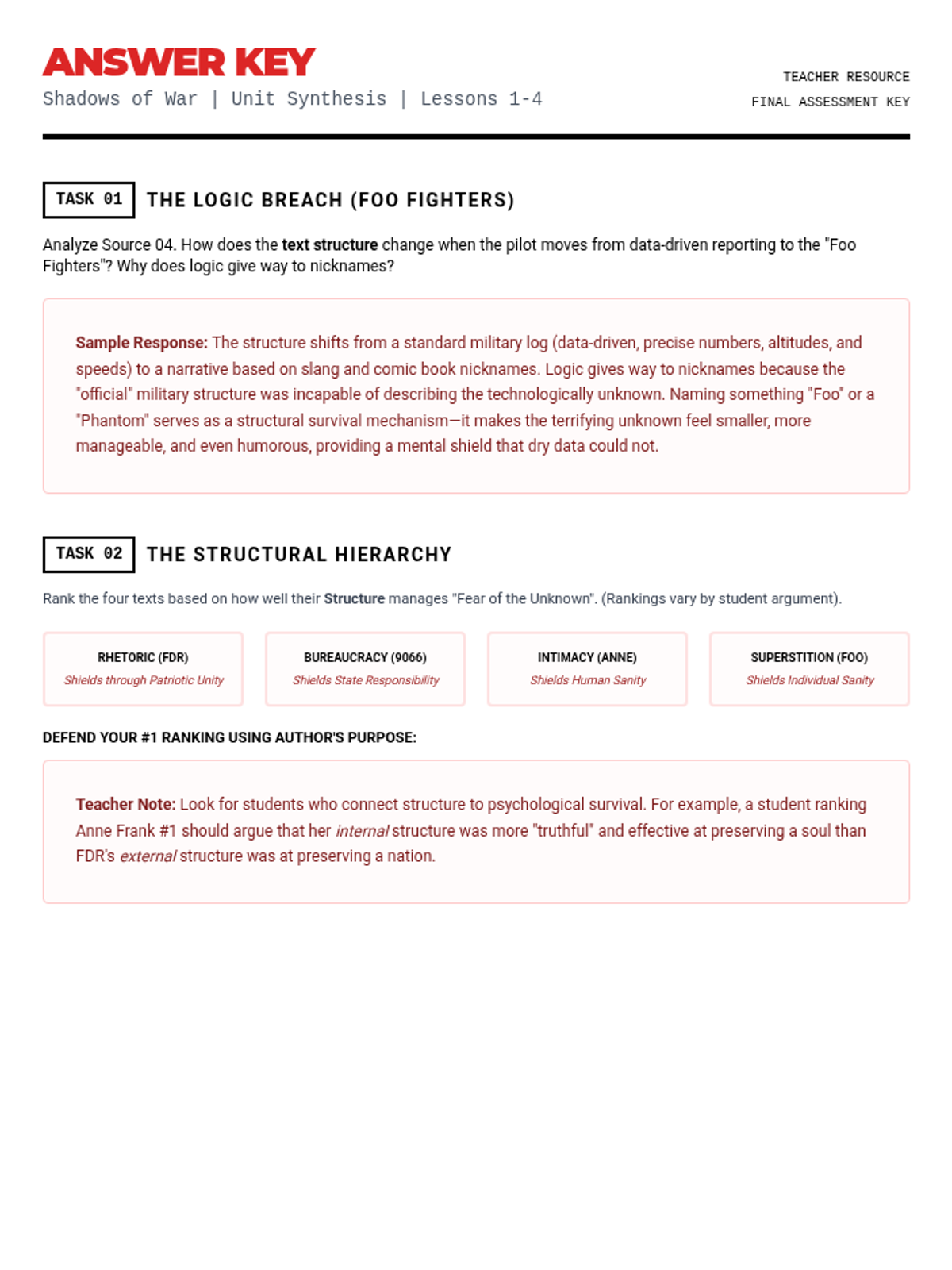
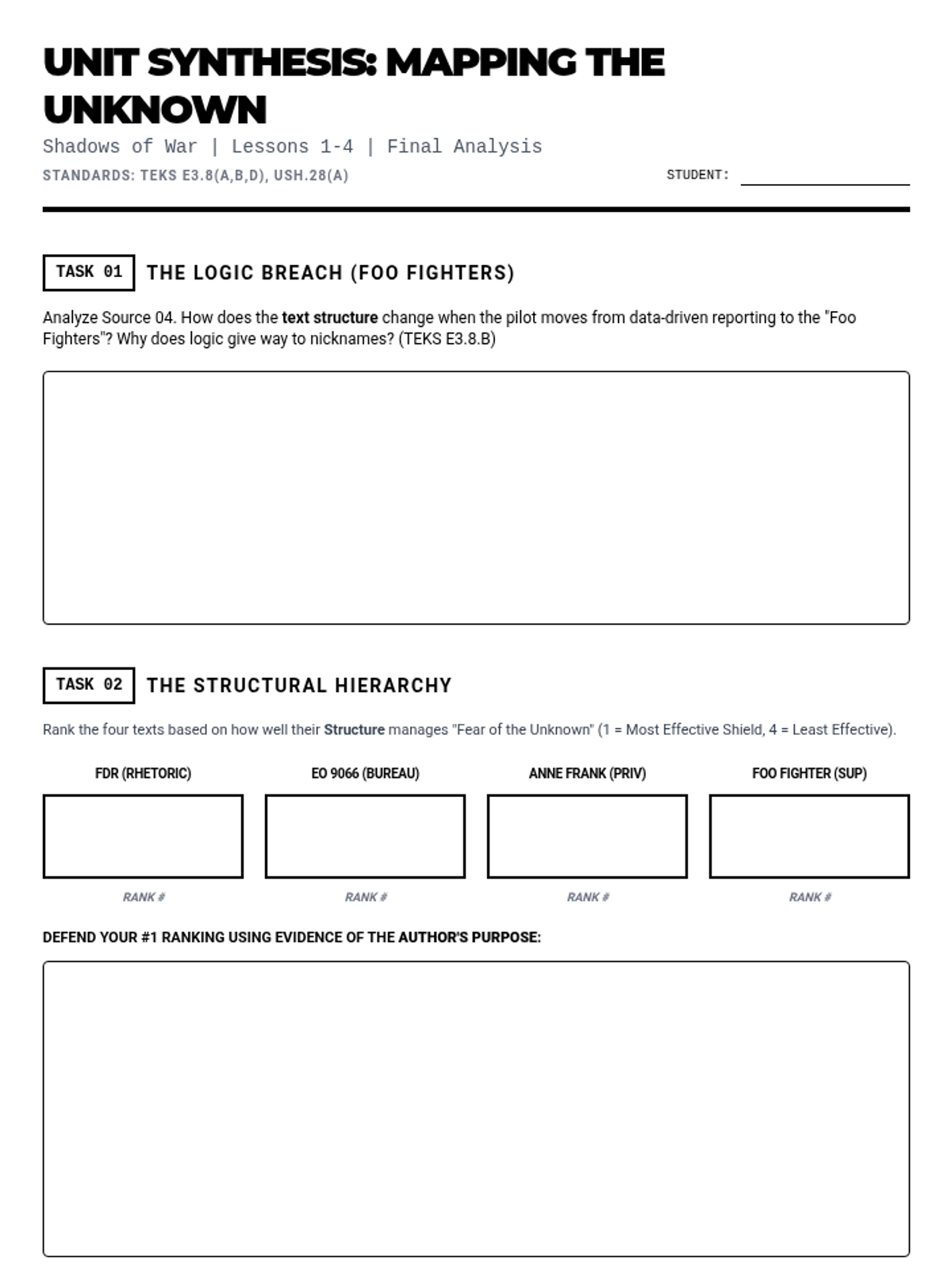
Teacher answer key for the final unit synthesis worksheet. Provides sample responses comparing the structural survival strategies of FDR, the US Government, Anne Frank, and WWII pilots.
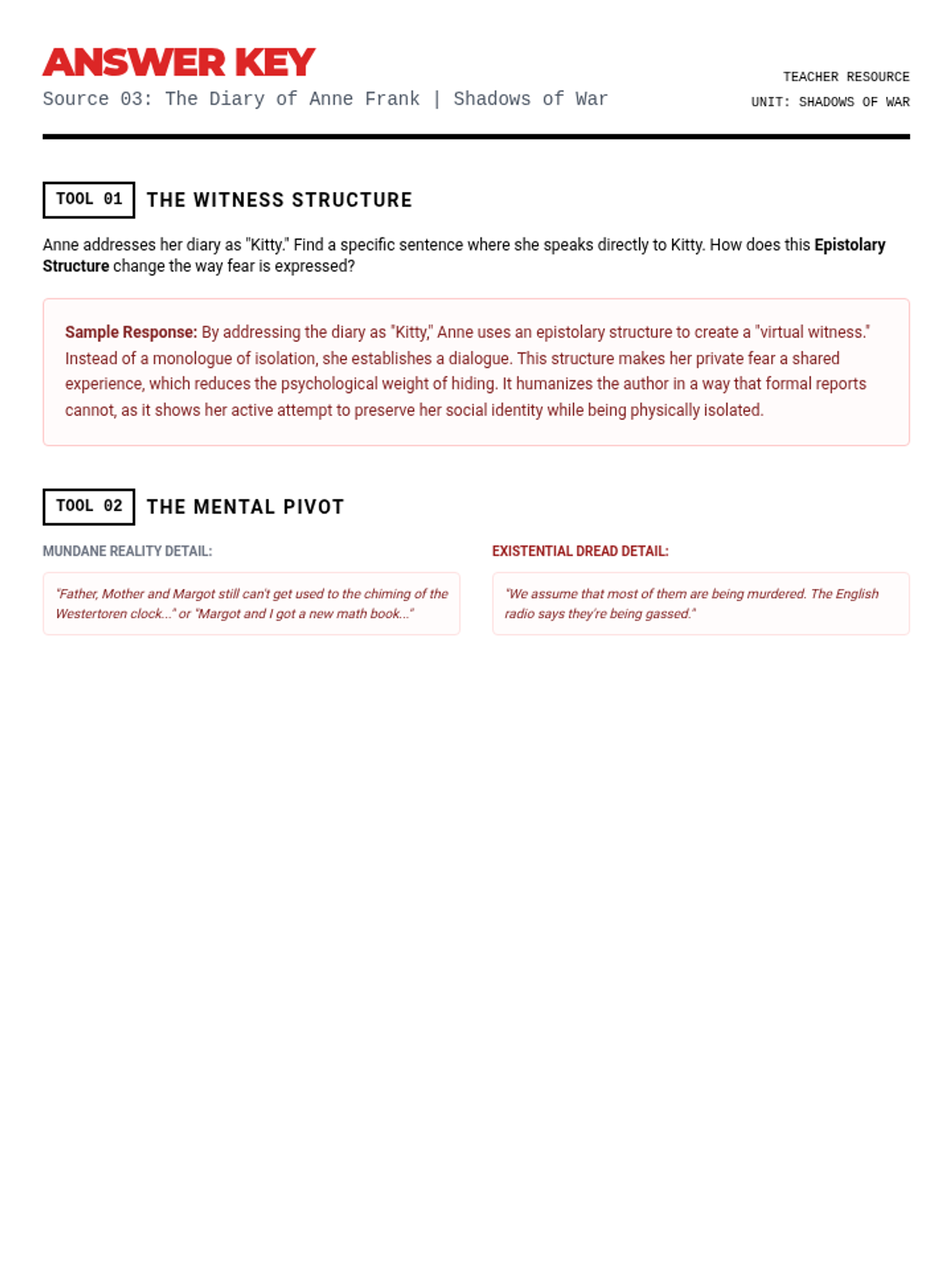
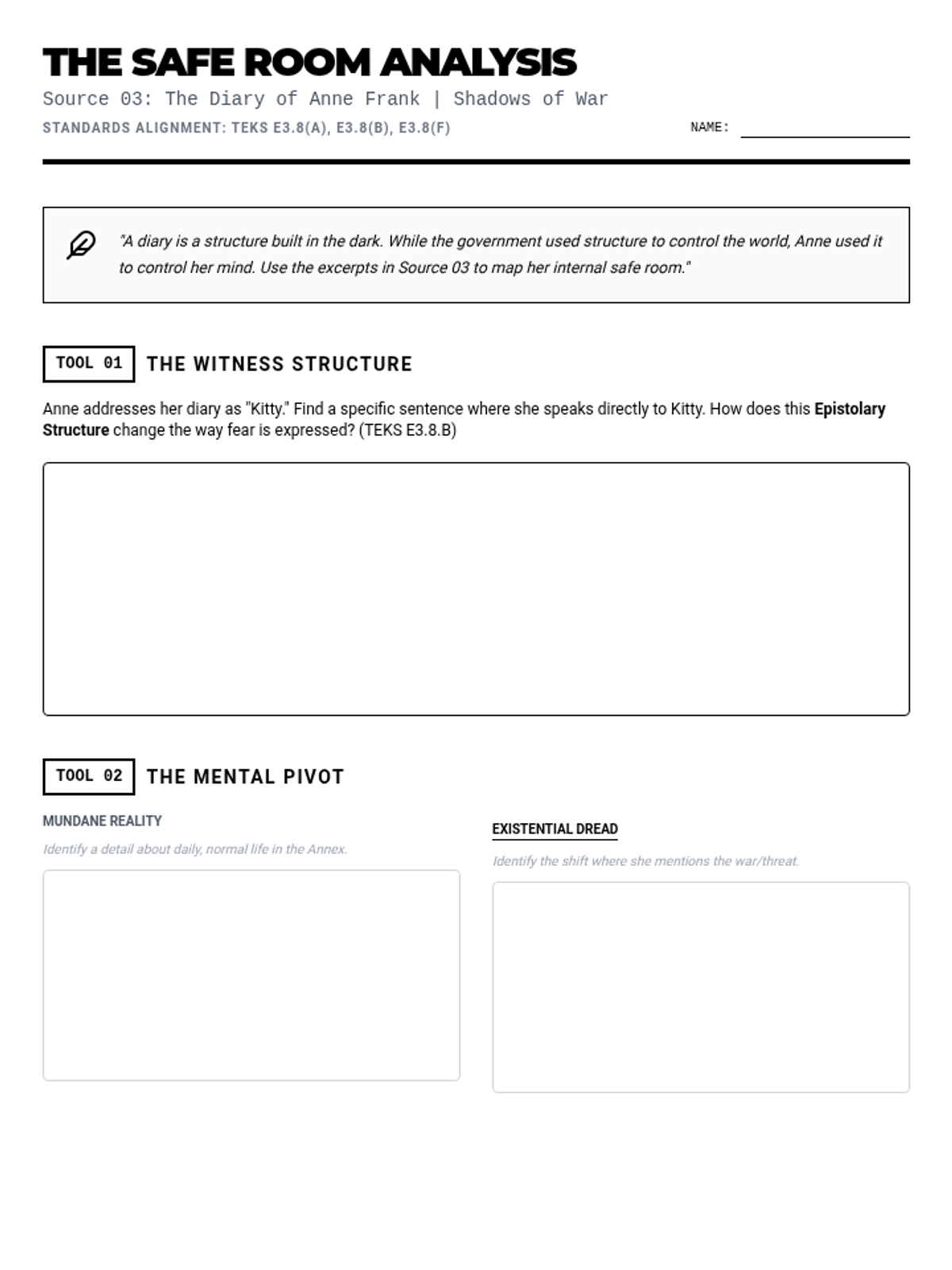
Teacher answer key for the Lesson 3 'Safe Room' worksheet. Analyzes Anne Frank's epistolary structure and the juxtaposition of mundane and horrific details to show personal resilience.
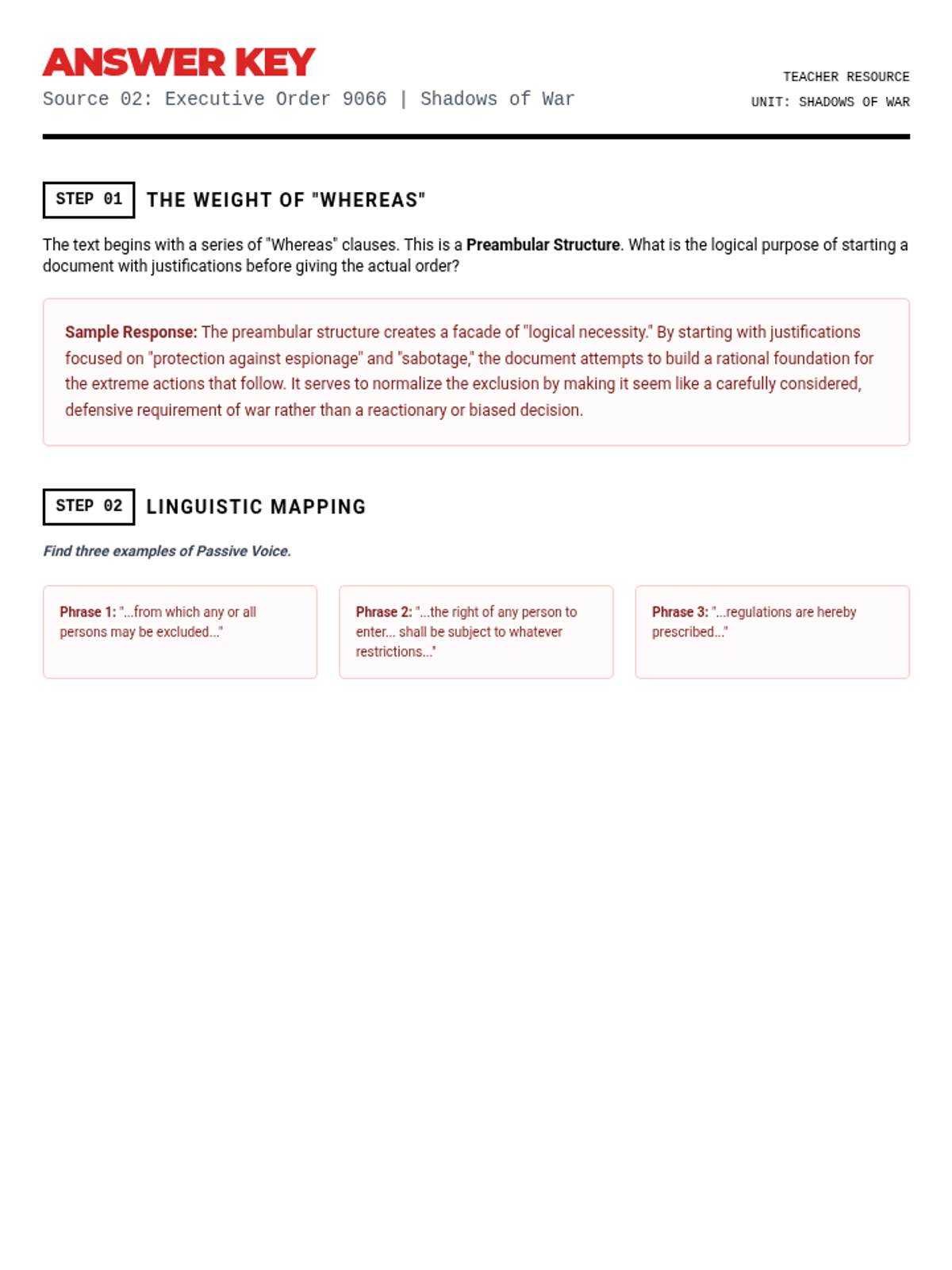
Teacher answer key for the Lesson 2 'Faceless Authority' worksheet. Analyzes the bureaucratic structure of EO 9066, focusing on the use of preambular 'Whereas' clauses, passive voice, and abstract nouns to mask human rights violations.
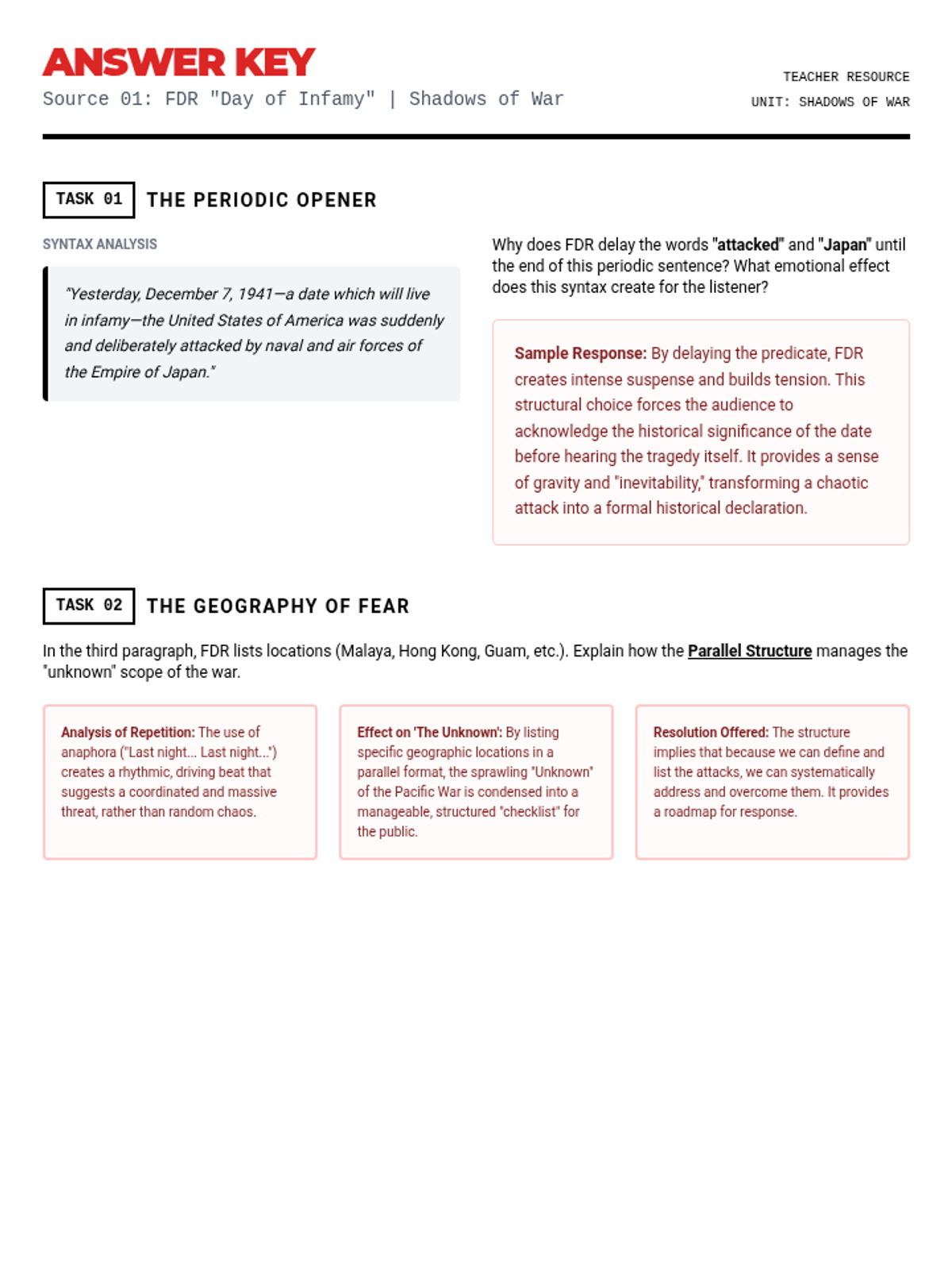
Teacher answer key for the Lesson 1 'Labyrinth Mapping' worksheet. Provides sample responses analyzing FDR's use of periodic sentences, anaphora, and structural shifts to manage national fear.
Final unit synthesis worksheet. Formatted for grayscale printing with a 0.3in top margin. Content grouped to prevent answer box splitting. All work areas are white for maximum legibility. Grayscale styling used throughout.
Slides for Lesson 4 focusing on the transition from logic to superstition and a final unit synthesis. Fixed font sizes for slide legibility.
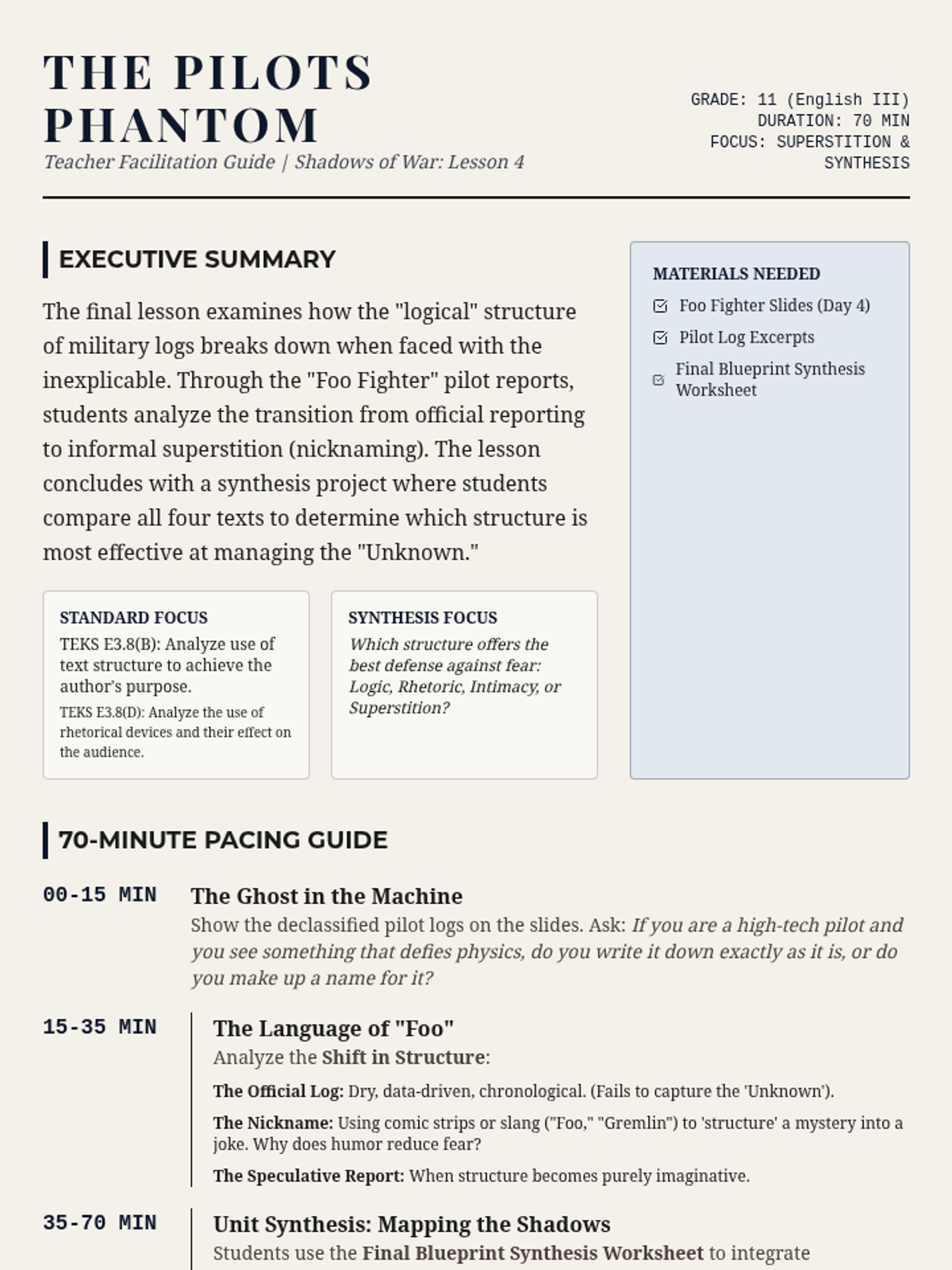
Teacher guide for Lesson 4 updated to align with Texas Essential Knowledge and Skills (TEKS) for English III. Focuses on wartime superstition and a final synthesis of all 4 structural archetypes.
Worksheet for Lesson 3. Formatted for grayscale printing with a 0.3in top margin. Tasks are intelligently grouped to keep related content and student work areas on the same page. Grayscale styling with no black response boxes.
Slides for Lesson 3 focusing on the epistolary structure and emotional juxtaposition in Anne Frank's diary. Updated with minimum 24px font size for all text.
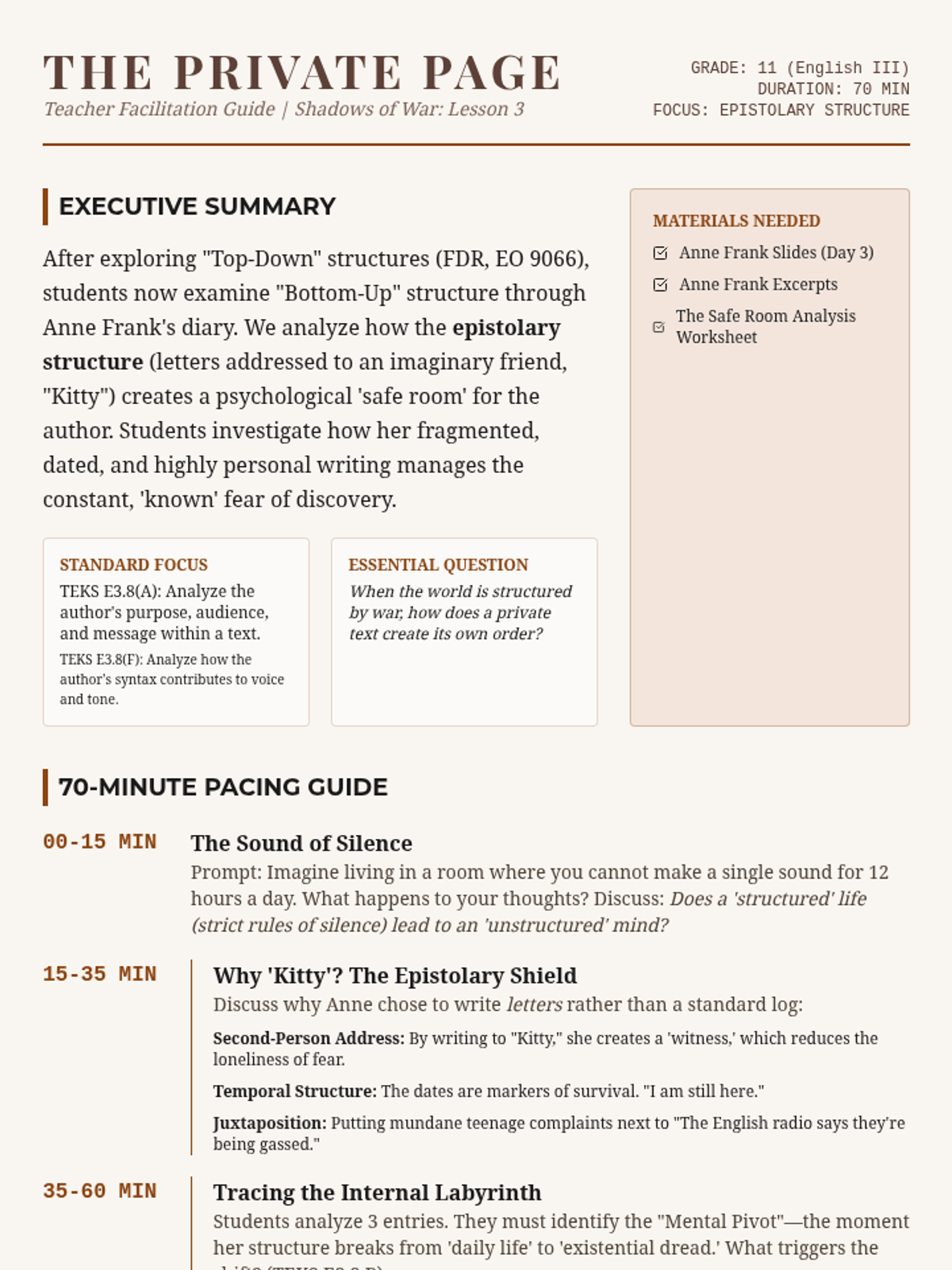
Teacher guide for Lesson 3 updated to align with Texas Essential Knowledge and Skills (TEKS) for English III. Focuses on Anne Frank's epistolary structure and personal resilience.
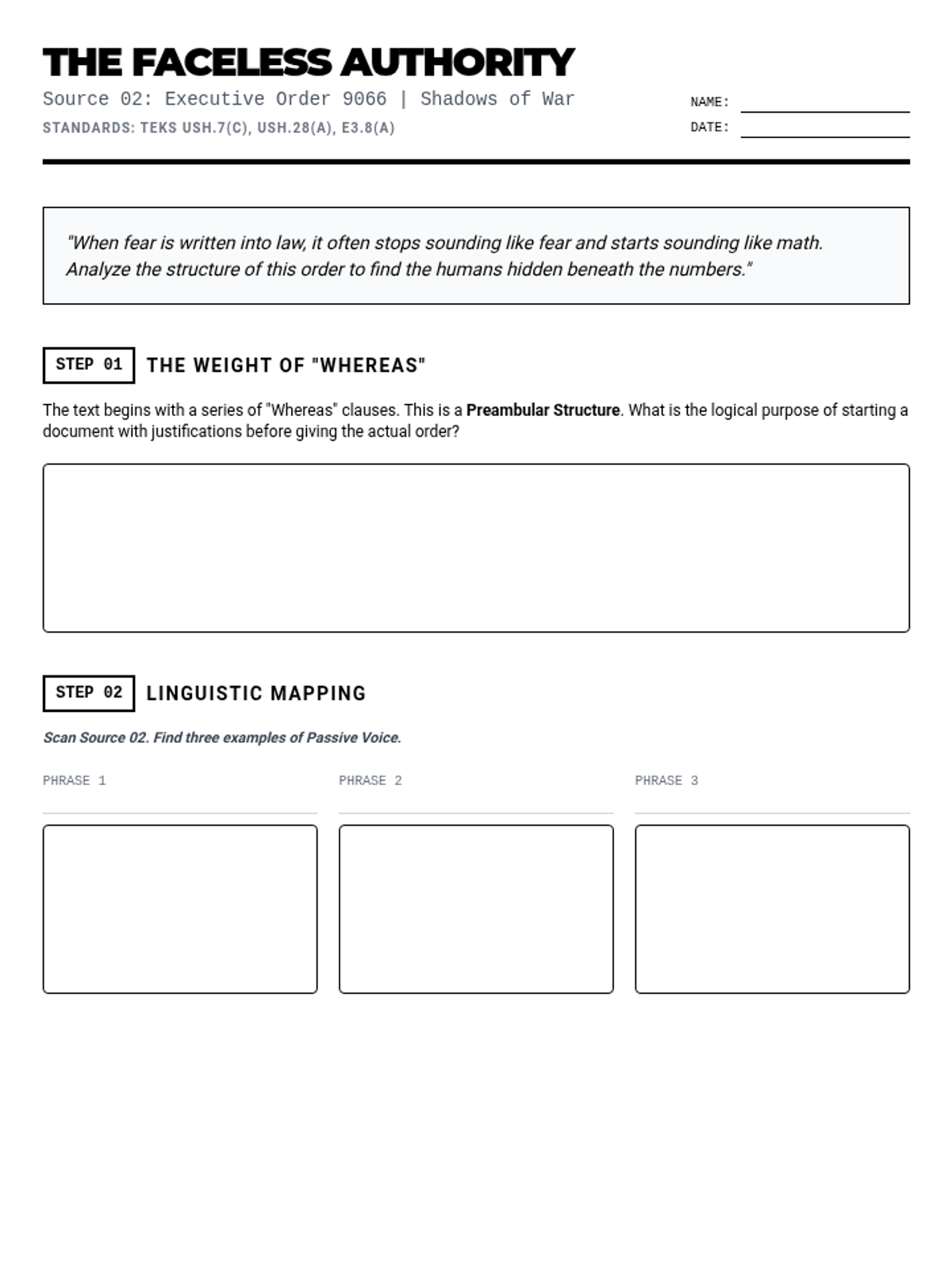
Worksheet for Lesson 2. Formatted for grayscale printing with a 0.3in top margin. Content grouped to prevent answer boxes from splitting across pages. Student response areas are white for maximum legibility.
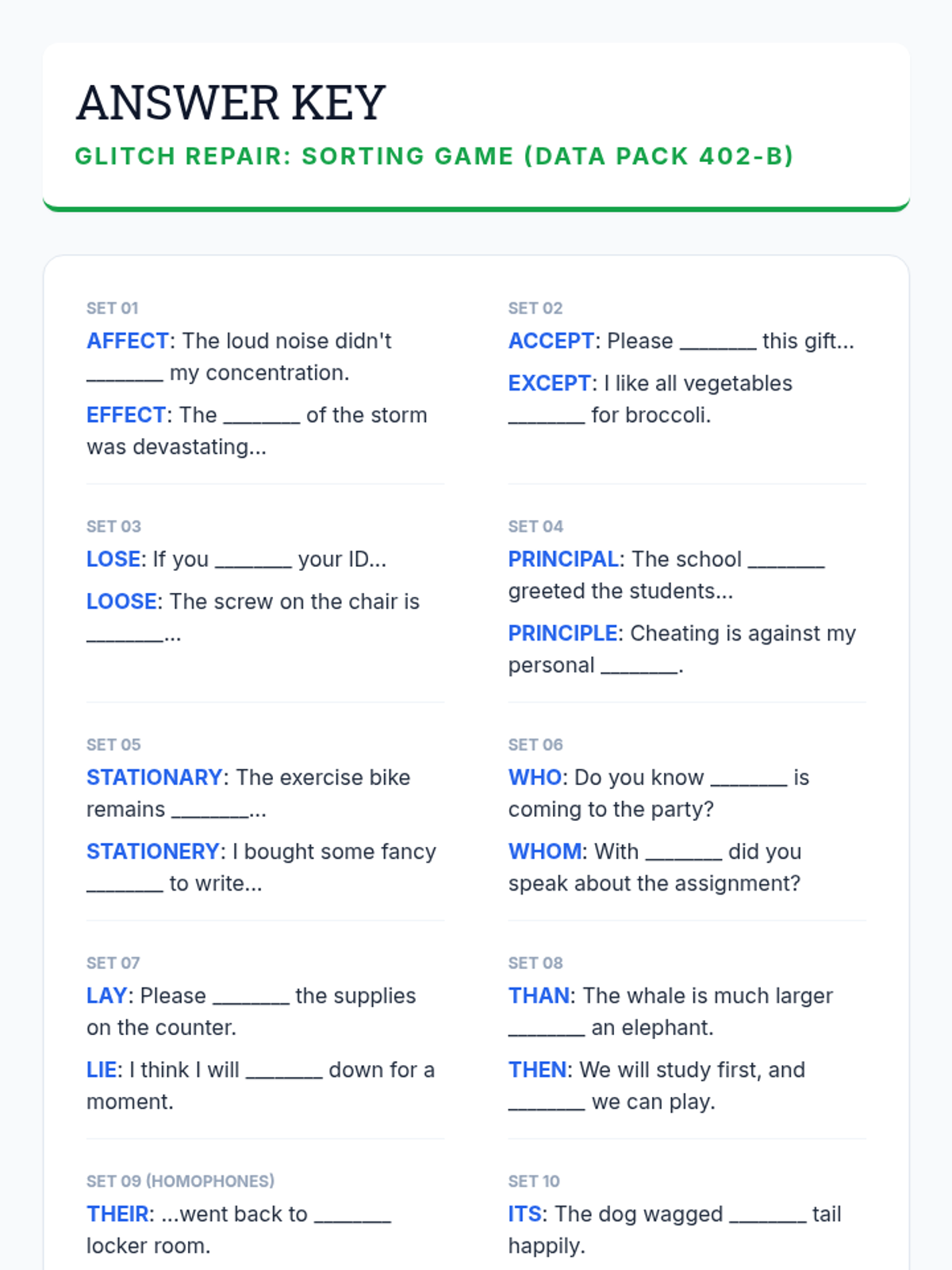
A teacher's answer key for the Glitch Repair sorting game, providing the correct matches for all word and sentence cards to facilitate quick grading and feedback.
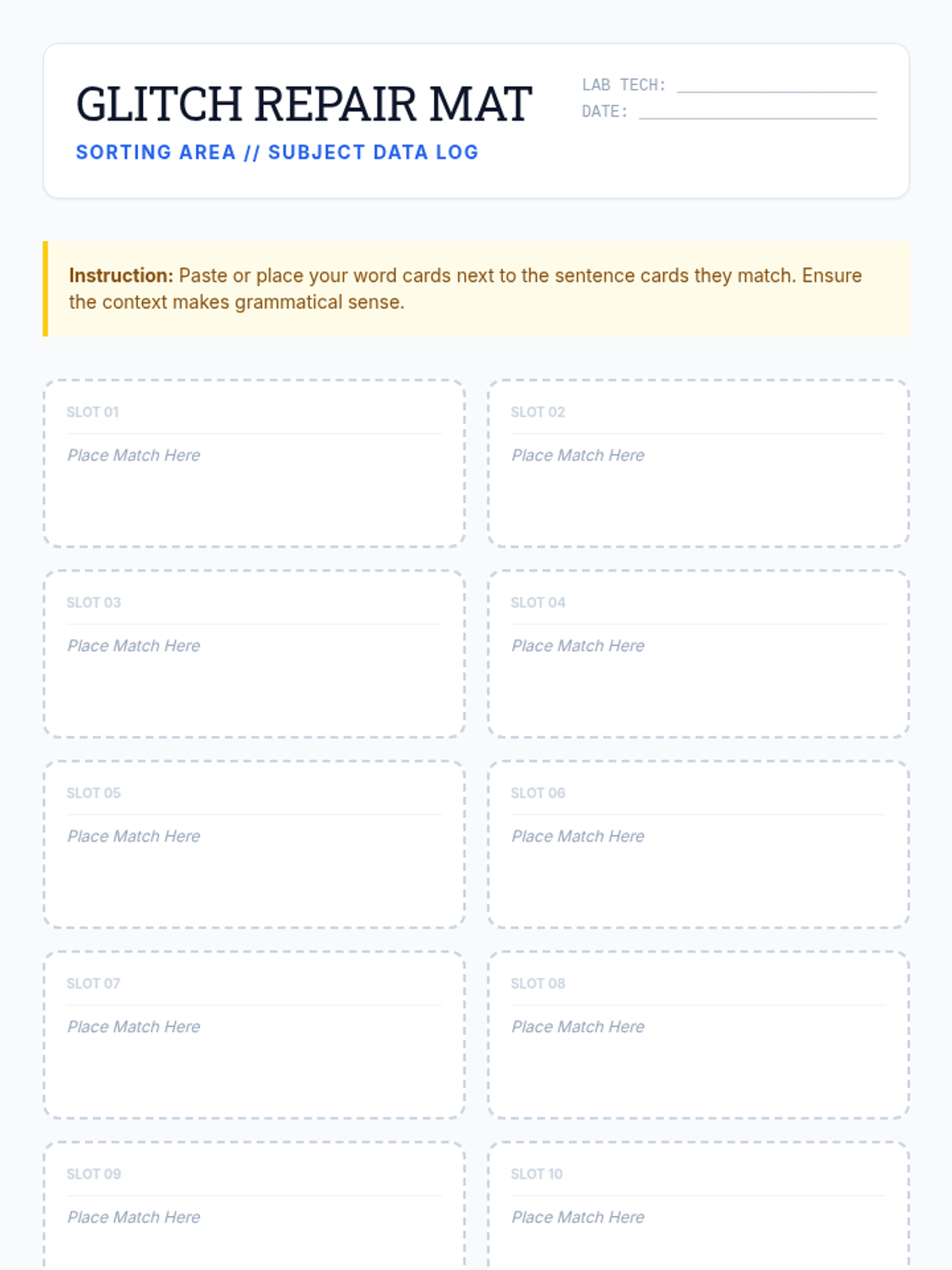
A printable sorting mat for the Glitch Repair game, providing students with a structured workspace to organize and match word and sentence cards.
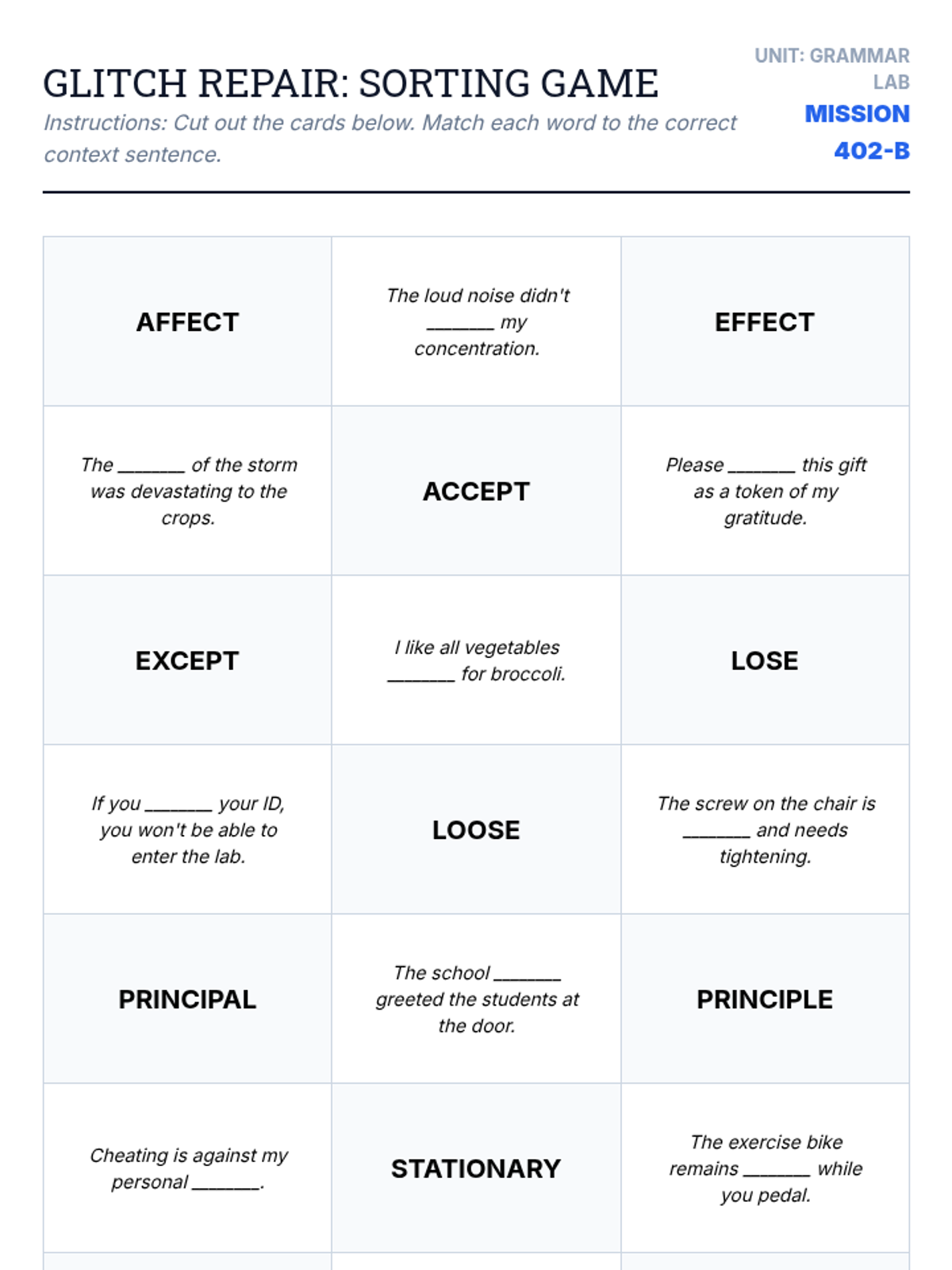
A set of 24 printable cards featuring words and context sentences for a sorting game. Students must match the correct commonly confused word with the sentence that fits its definition.
A visually striking slideshow designed for direct instruction on 12 pairs of commonly confused words. Includes memory triggers, definitions, visual hints, and interactive practice sentences for each word group.
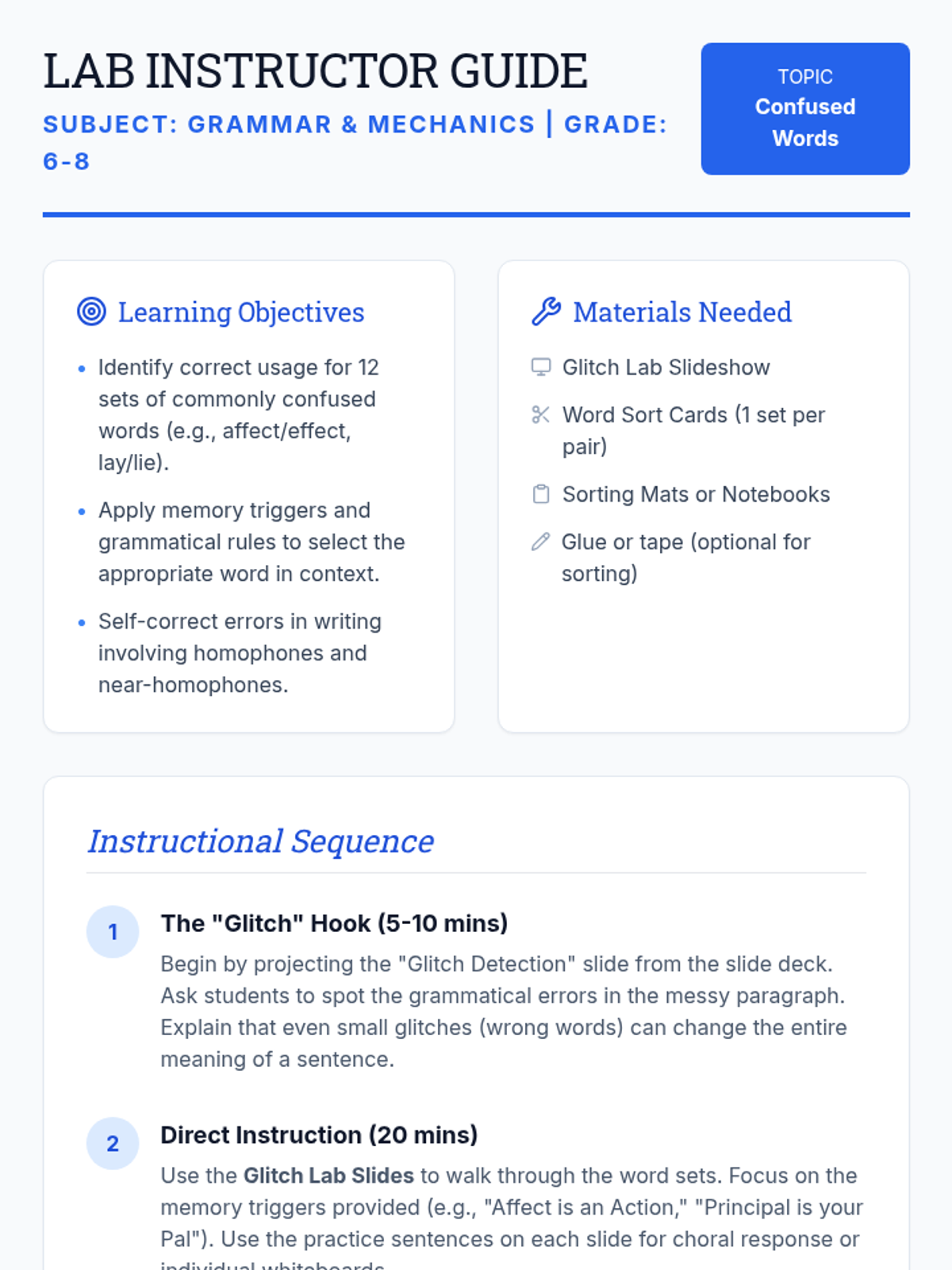
A detailed teacher's guide for the Grammar Lab lesson, including learning objectives, a list of required materials, a step-by-step instructional sequence, and practical teaching tips for middle school classrooms.
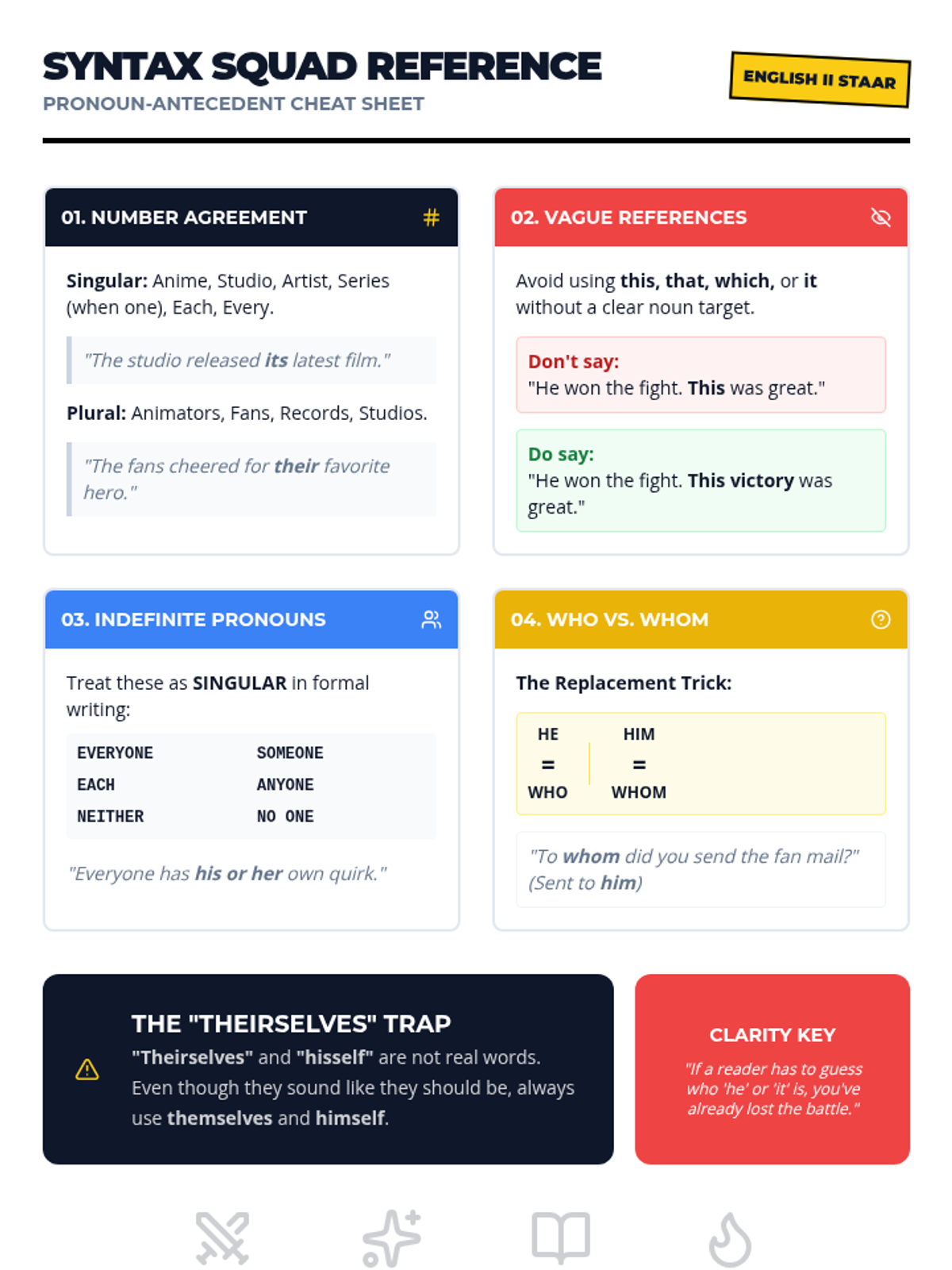
A concise one-page reference sheet or "cheat sheet" for students, summarizing the four major pronoun rules and providing the "He/Him" trick for Who/Whom. Designed for easy reference during the Anime Pronoun Play worksheet.
A vibrant, anime-themed slide deck for English II STAAR preparation, focusing on pronoun-antecedent agreement and clarity. Includes clear rules, "STAAR traps," and interactive checks for singular/plural agreement, ambiguous references, and who vs. whom.
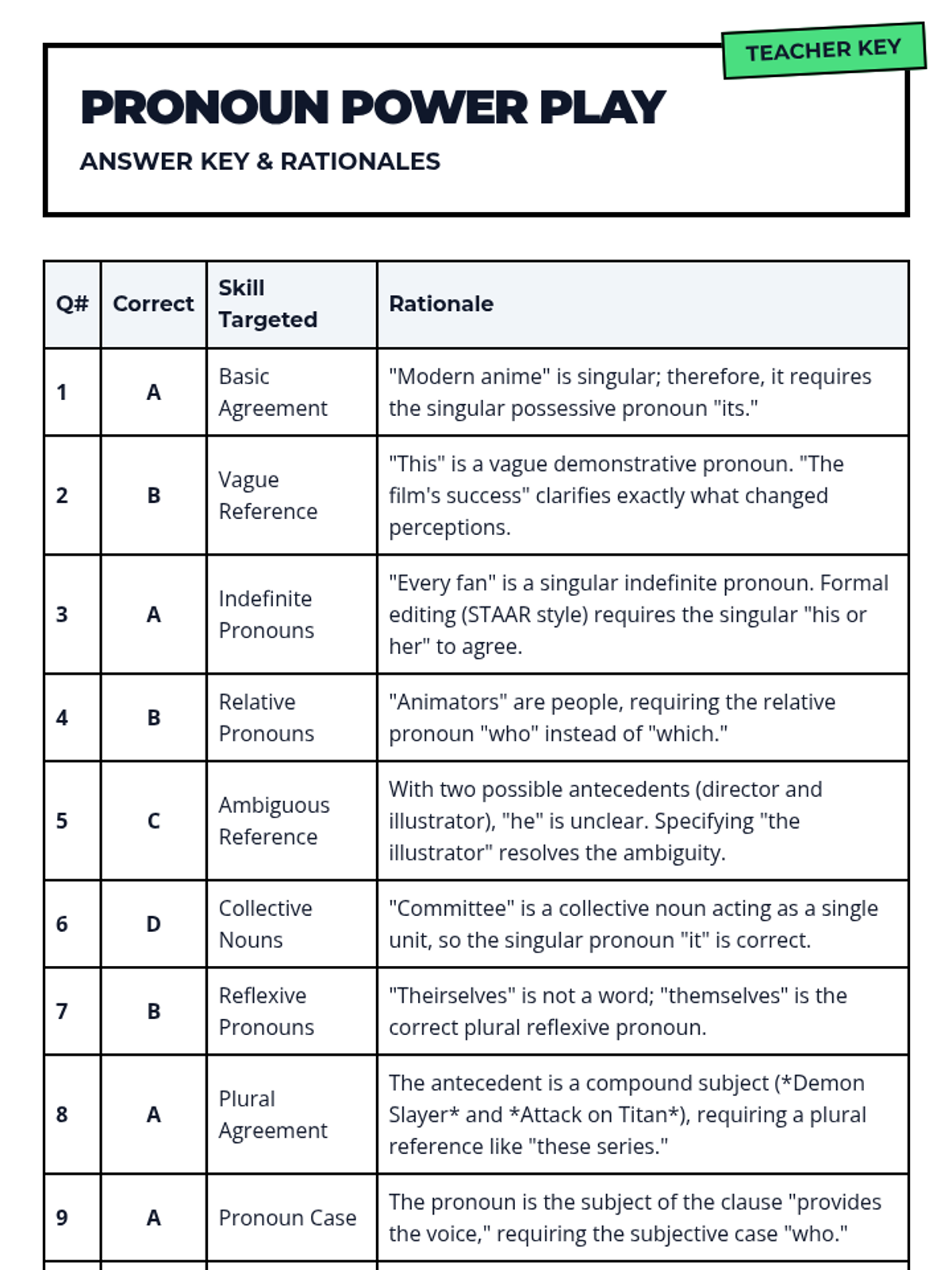
The answer key and teaching guide for the Anime Pronoun Power worksheet, providing correct answers, rationales, and targeted skills for each of the 10 STAAR-style questions.
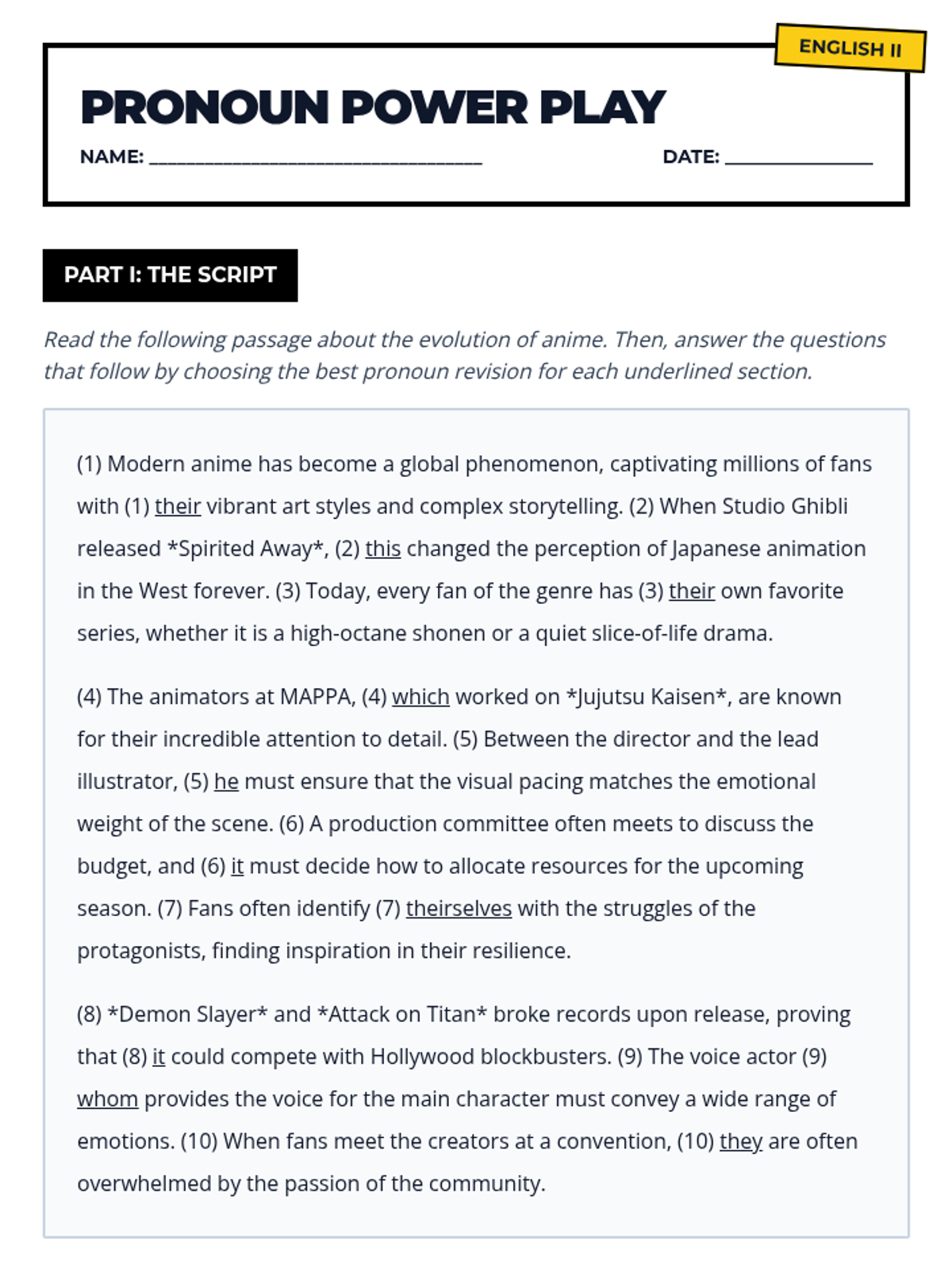
A STAAR-style editing worksheet focused on pronoun-antecedent agreement and clarity, featuring a high-interest passage about the history and production of anime. Restored to the original two-page layout.
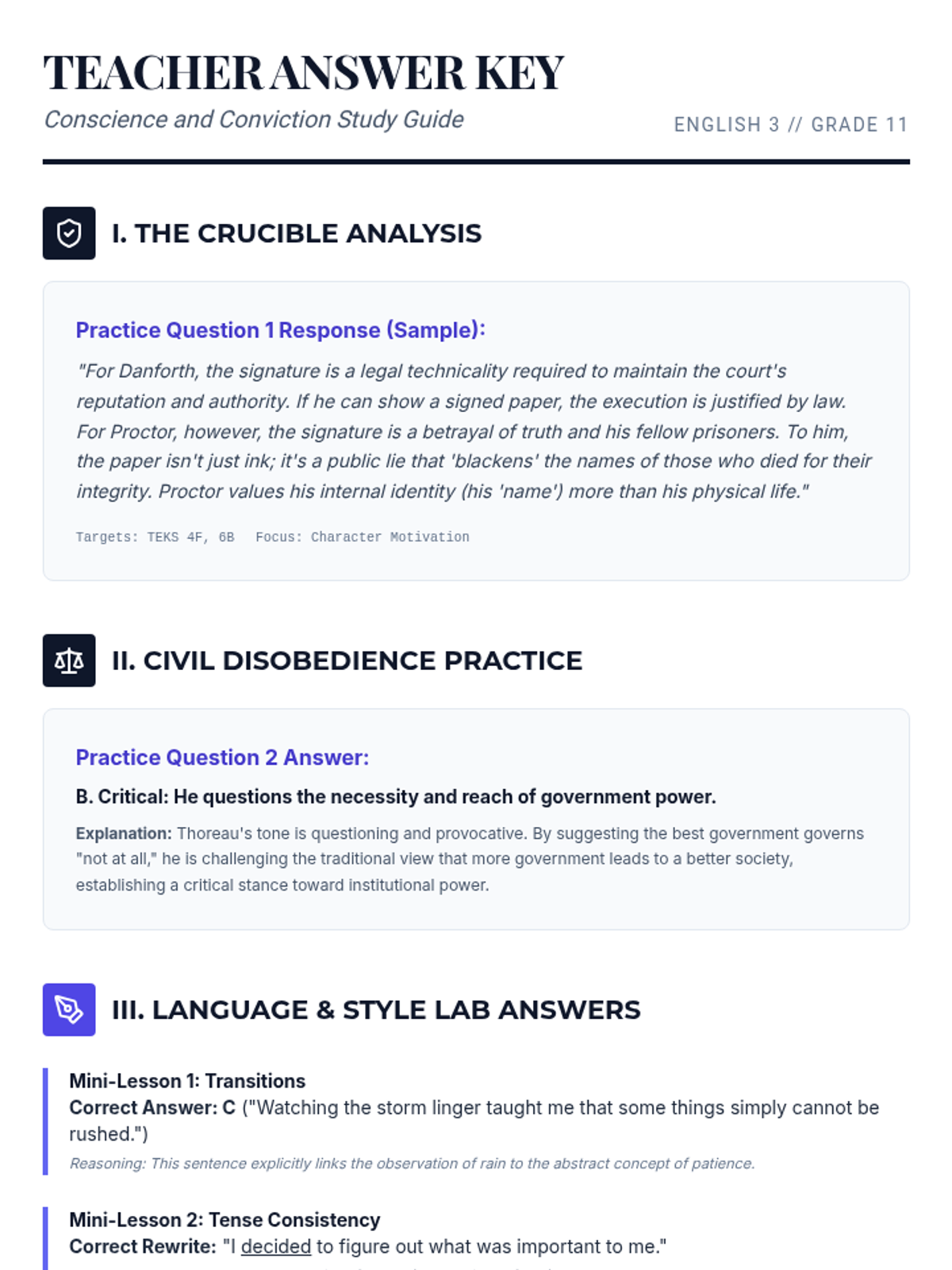
Teacher answer key for the Unit 5 study guide, including sample responses for literary analysis and correct answers for language and style exercises.
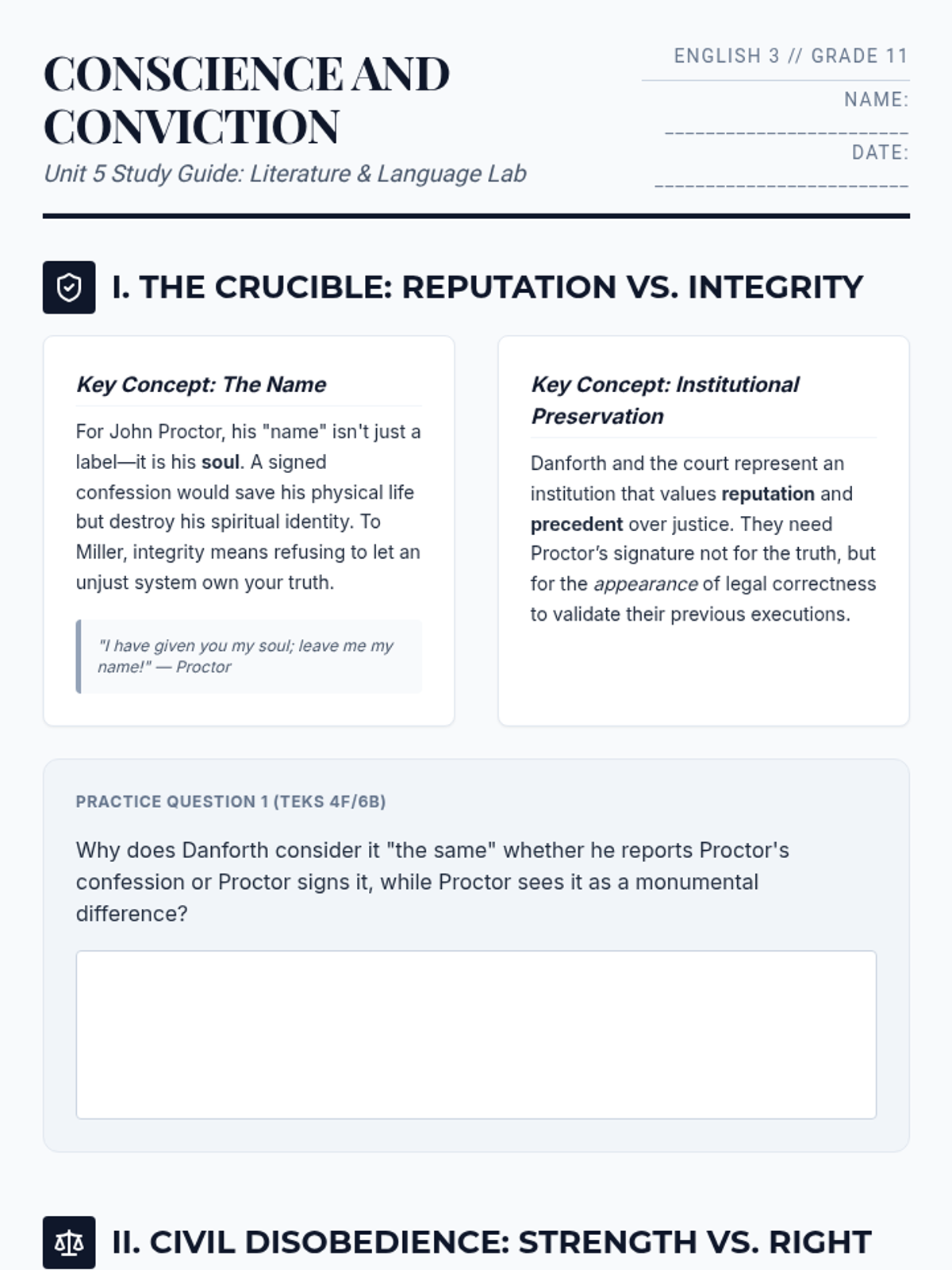
A student study guide featuring literary analysis of 'The Crucible' and 'Civil Disobedience' paired with language and style mini-lessons and practice questions.
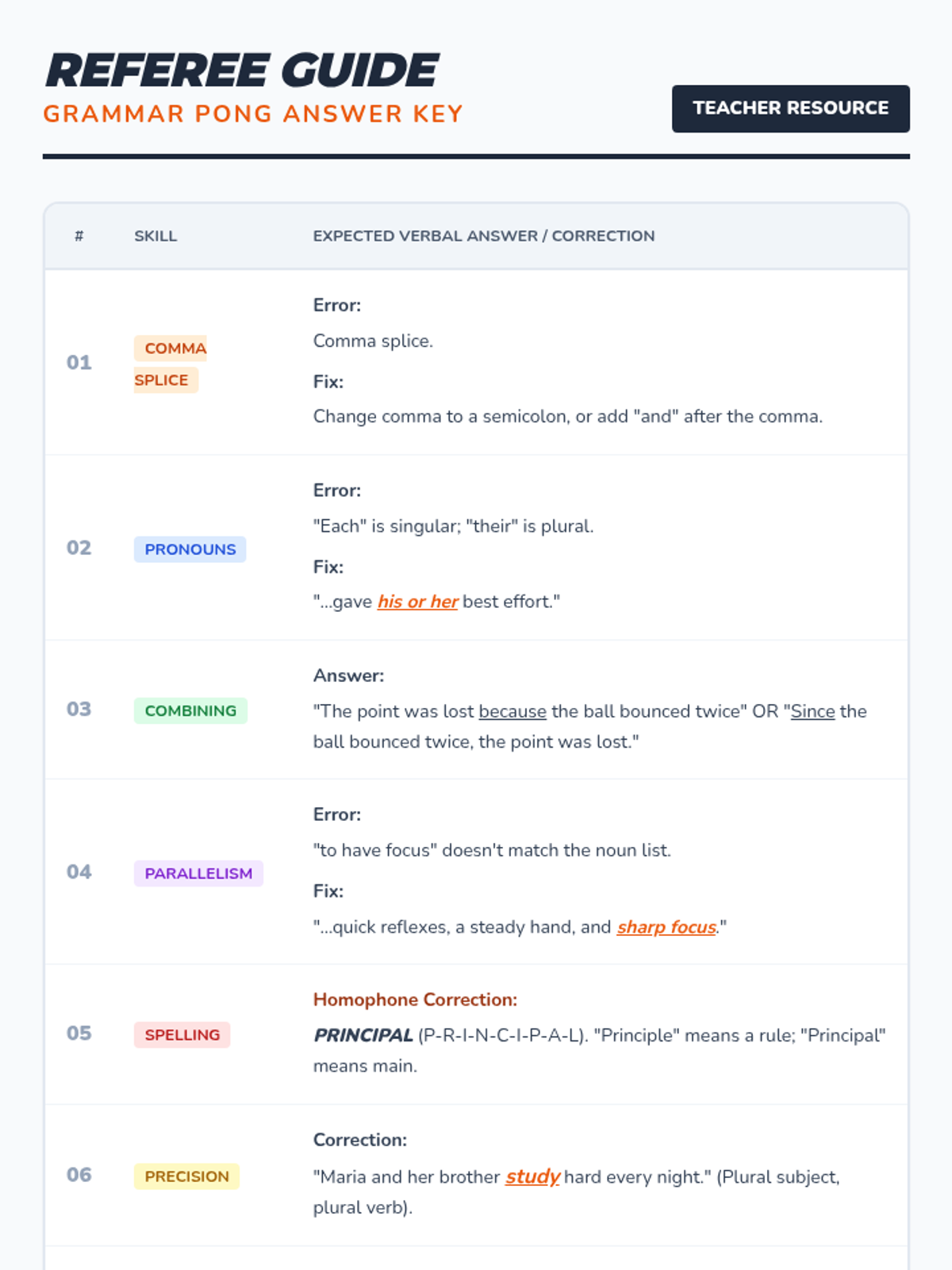
A teacher-facing answer key and quick-reference guide for the Grammar Pong game, ensuring fast and accurate judging during the verbal challenge.
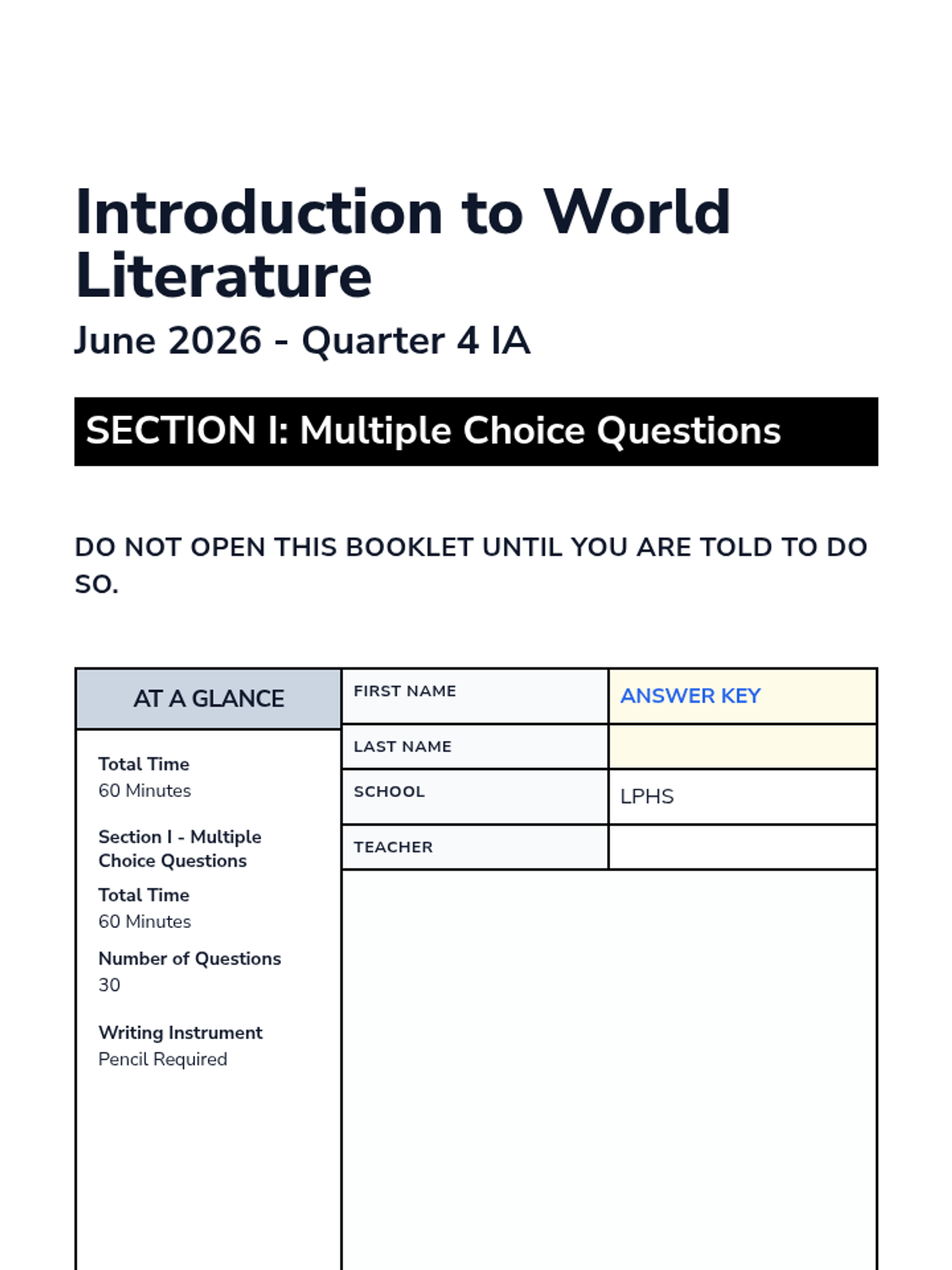
A faithful mirrored answer key of the World Literature June 2026 IA assessment, featuring correct answers highlighted in yellow and a model RACE response. All instructional text and directions have been removed throughout the assignment.
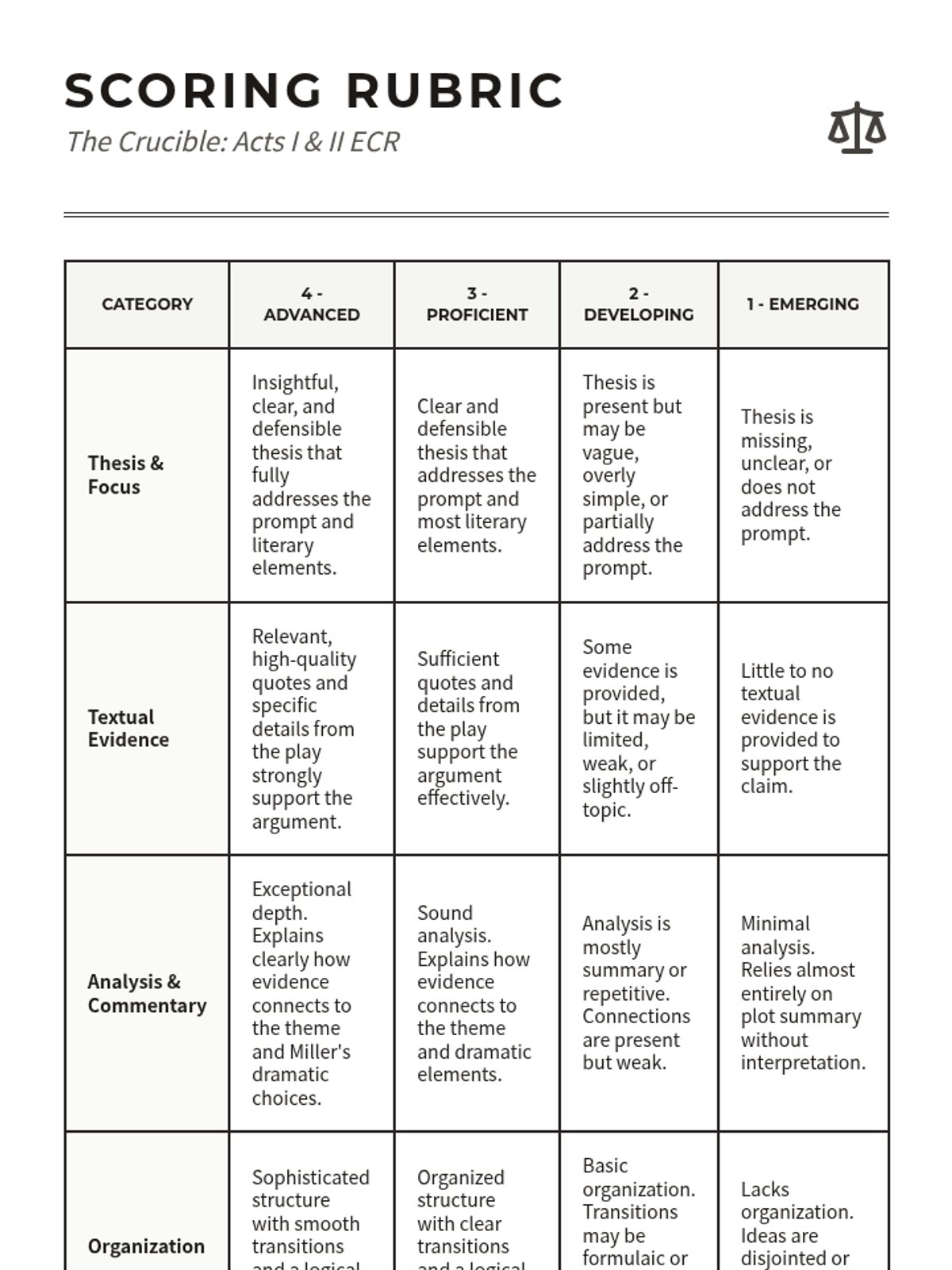
A 4-point analytical scoring rubric for an ECR essay on The Crucible, covering thesis, evidence, analysis, organization, and mechanics with a historically-inspired design.
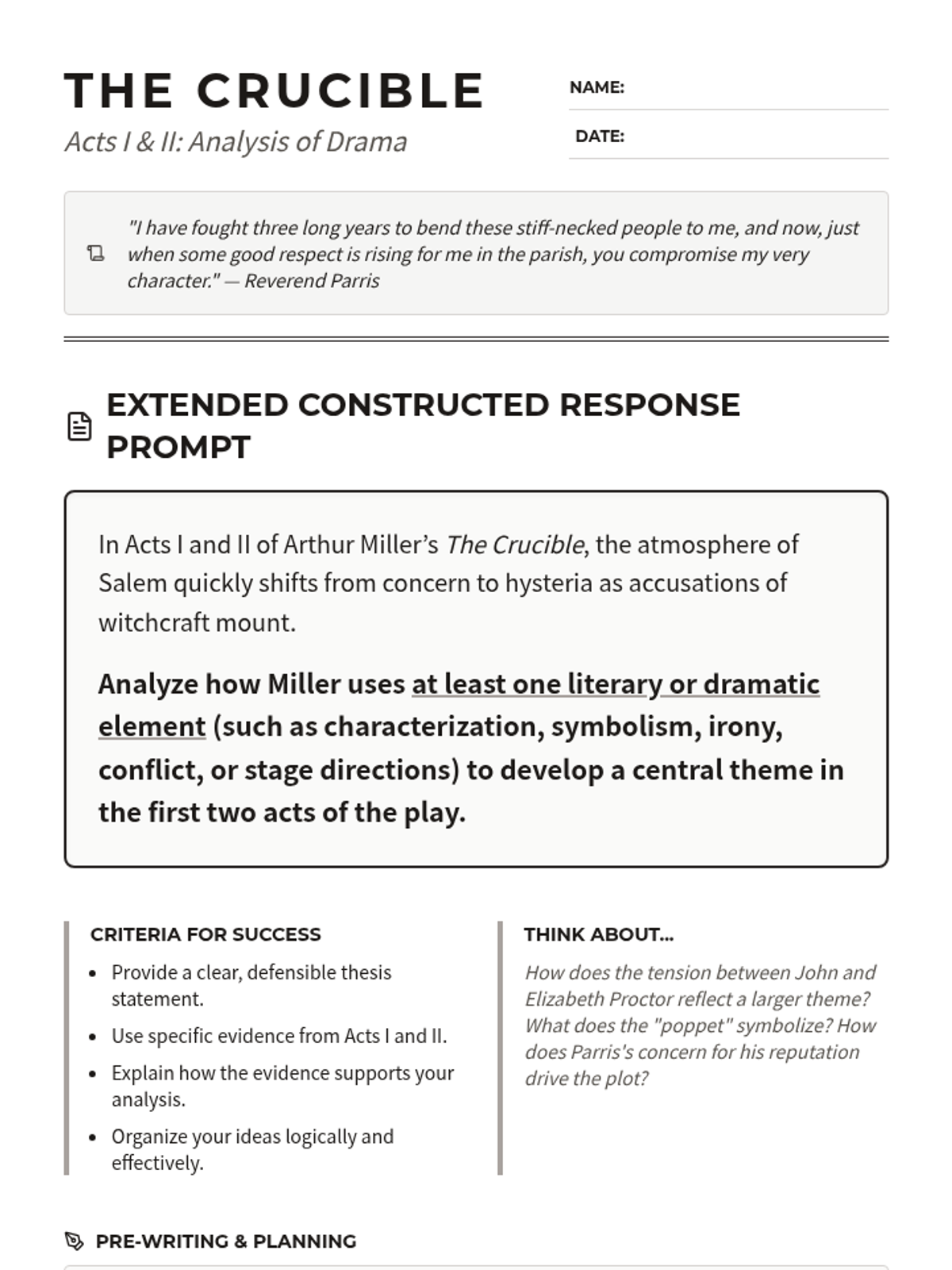
An Extended Constructed Response (ECR) essay prompt for Acts I and II of The Crucible, featuring a historically-themed layout, a clear prompt, planning space, and lined areas for student writing.
Slides for Lesson 2 focusing on the structural and linguistic choices in Executive Order 9066. Updated with minimum 24px font size for all text.
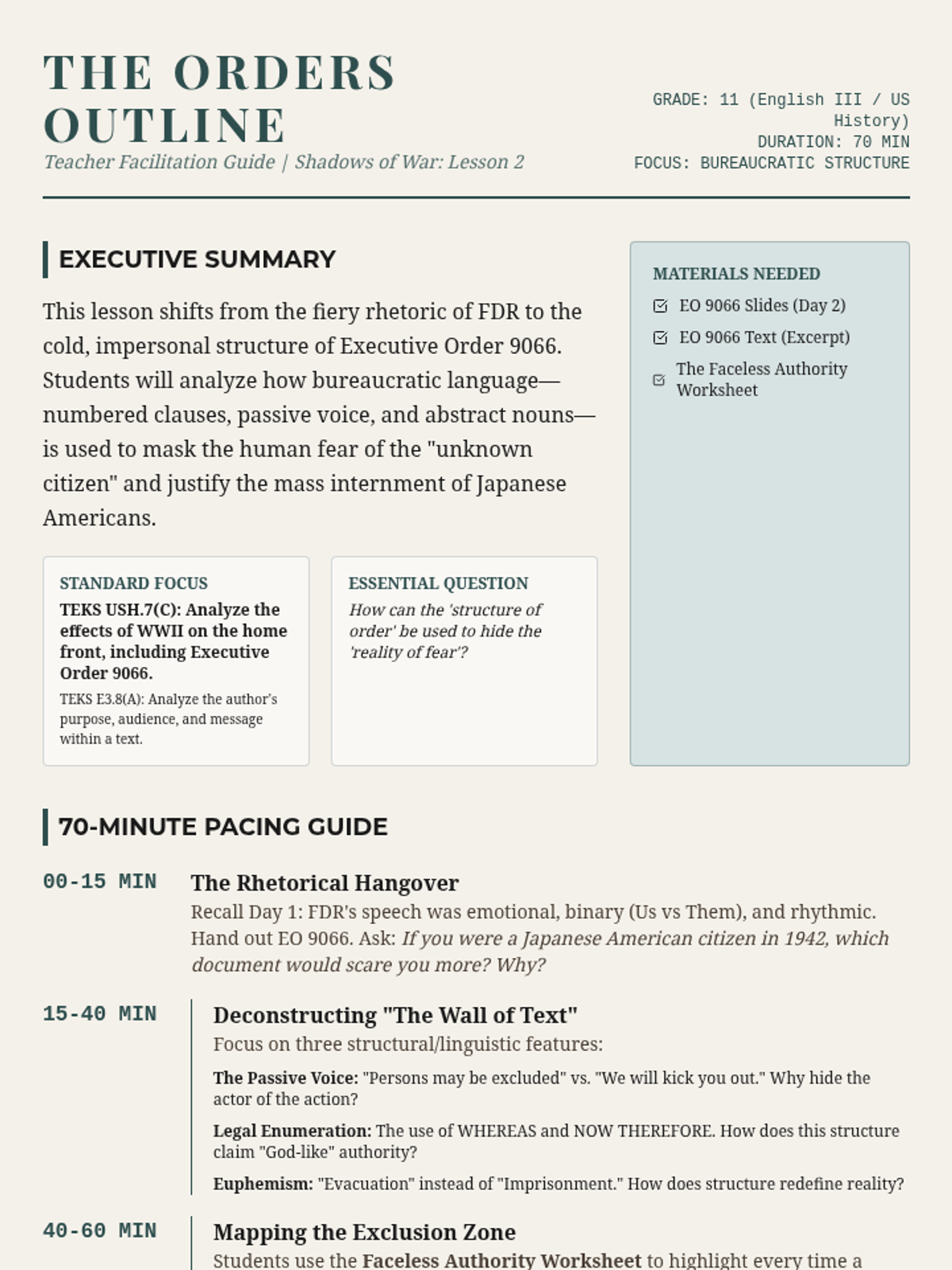
Teacher guide for Lesson 2 updated to align with Texas Essential Knowledge and Skills (TEKS) for English III and US History. Focuses on Executive Order 9066 and the bureaucratic management of fear.
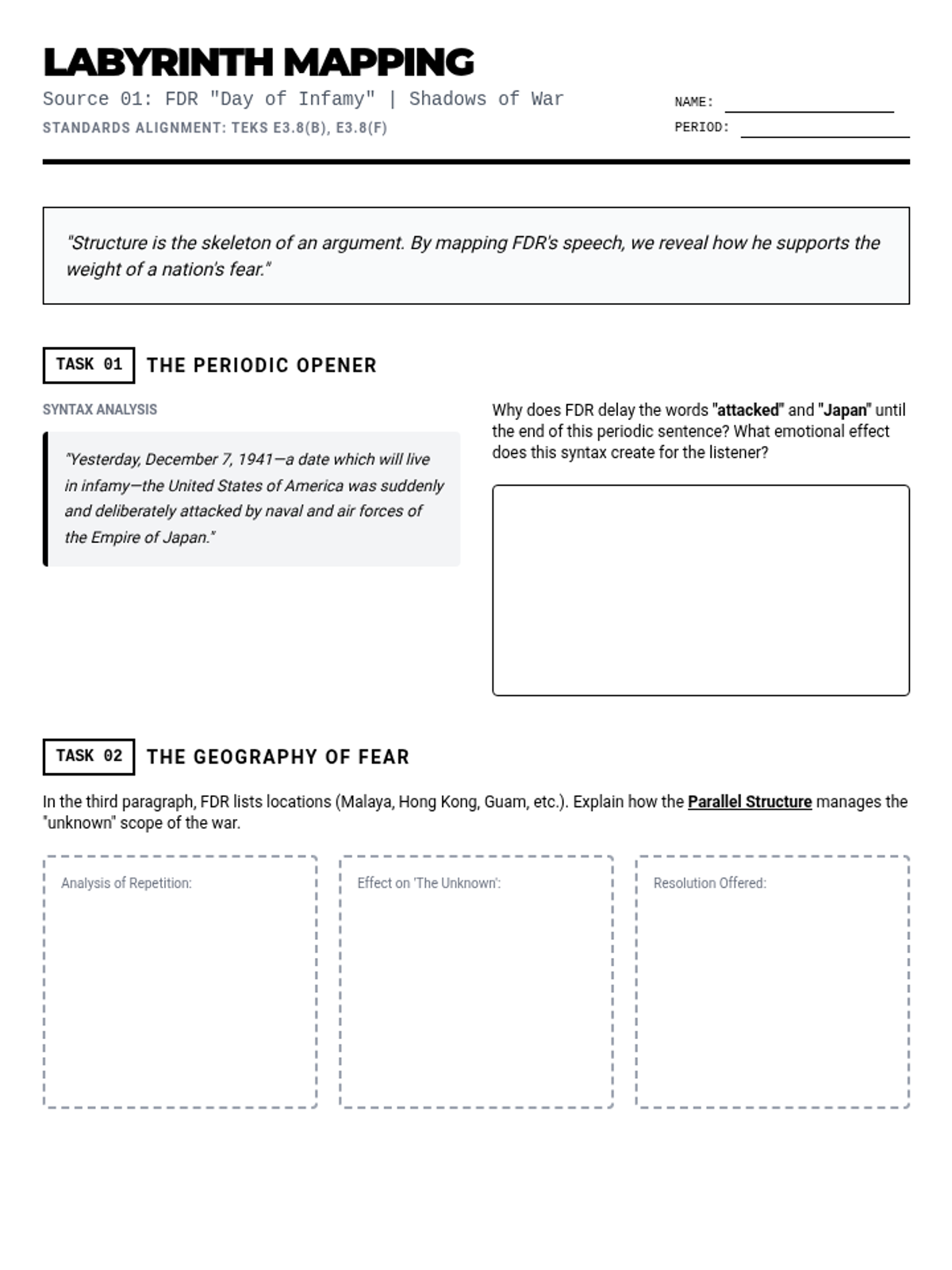
Analysis worksheet for Lesson 1. Formatted for grayscale printing with a 0.3in top margin. Content grouped to prevent answer boxes from splitting across pages. All student work areas have clear backgrounds.
Slides for Lesson 1 focusing on FDR's structural choices in the 'Day of Infamy' speech. Updated with minimum 24px font size for all text.
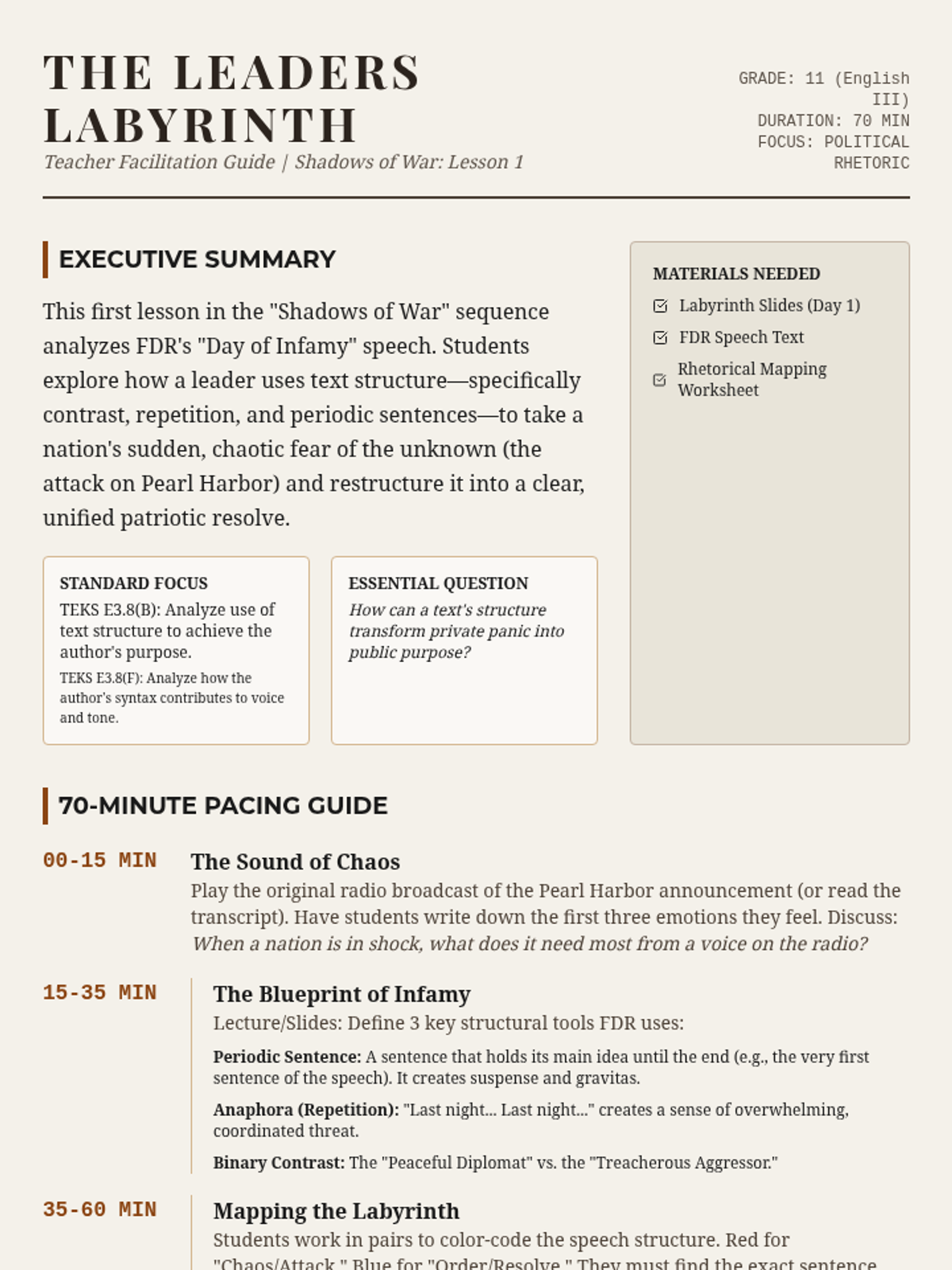
Teacher guide for Lesson 1 of the 'Shadows of War' sequence, updated to align with Texas Essential Knowledge and Skills (TEKS) for English III. Focuses on FDR's Infamy speech and the transformation of fear into national resolve.
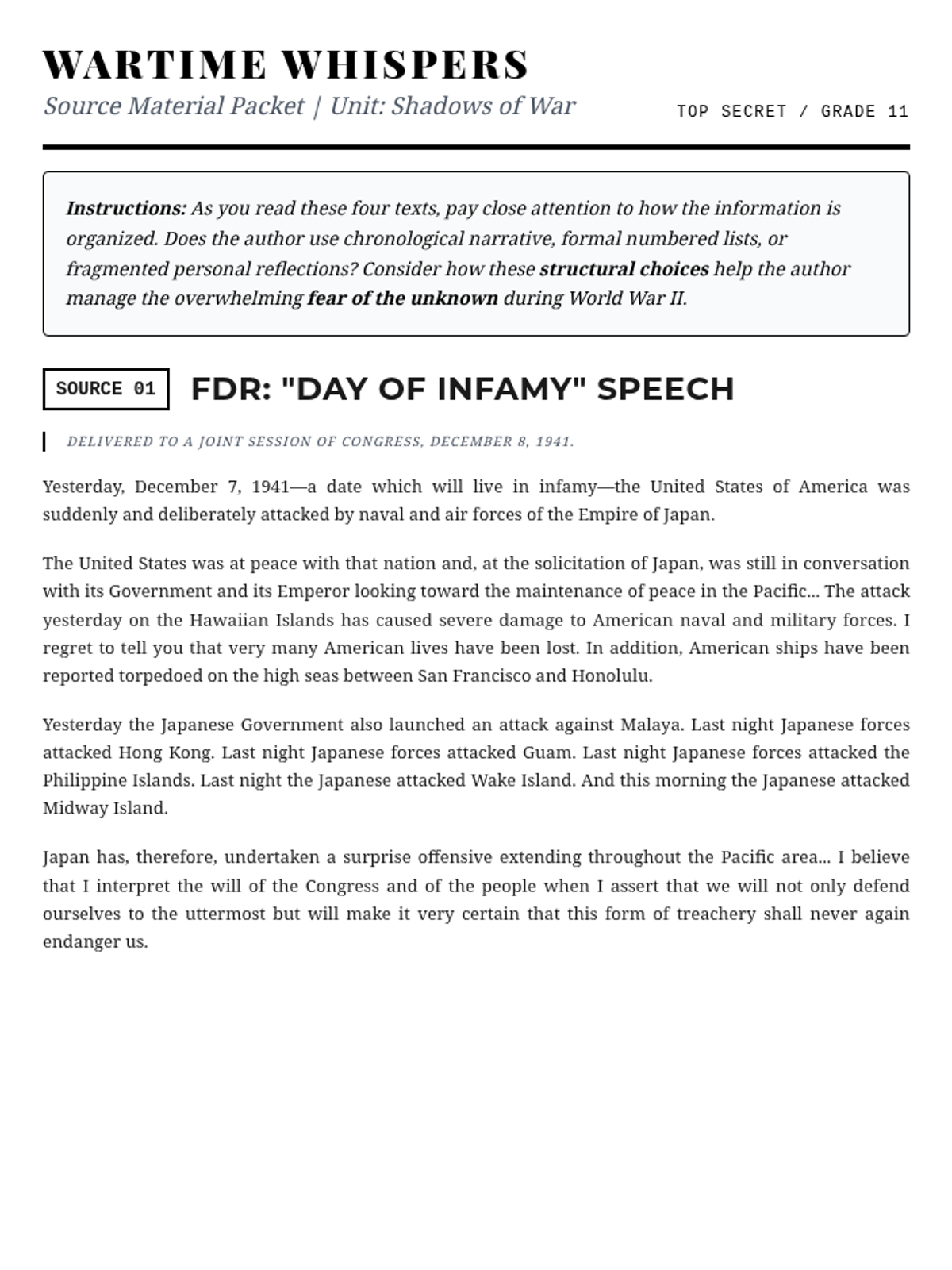
A compilation of primary source excerpts from WWII (FDR, EO 9066, Anne Frank, and 'Foo Fighter' reports). Perfectly formatted for grayscale printing with 0.3in top margins and source isolation per page. Color tints removed for maximum high-contrast clarity.
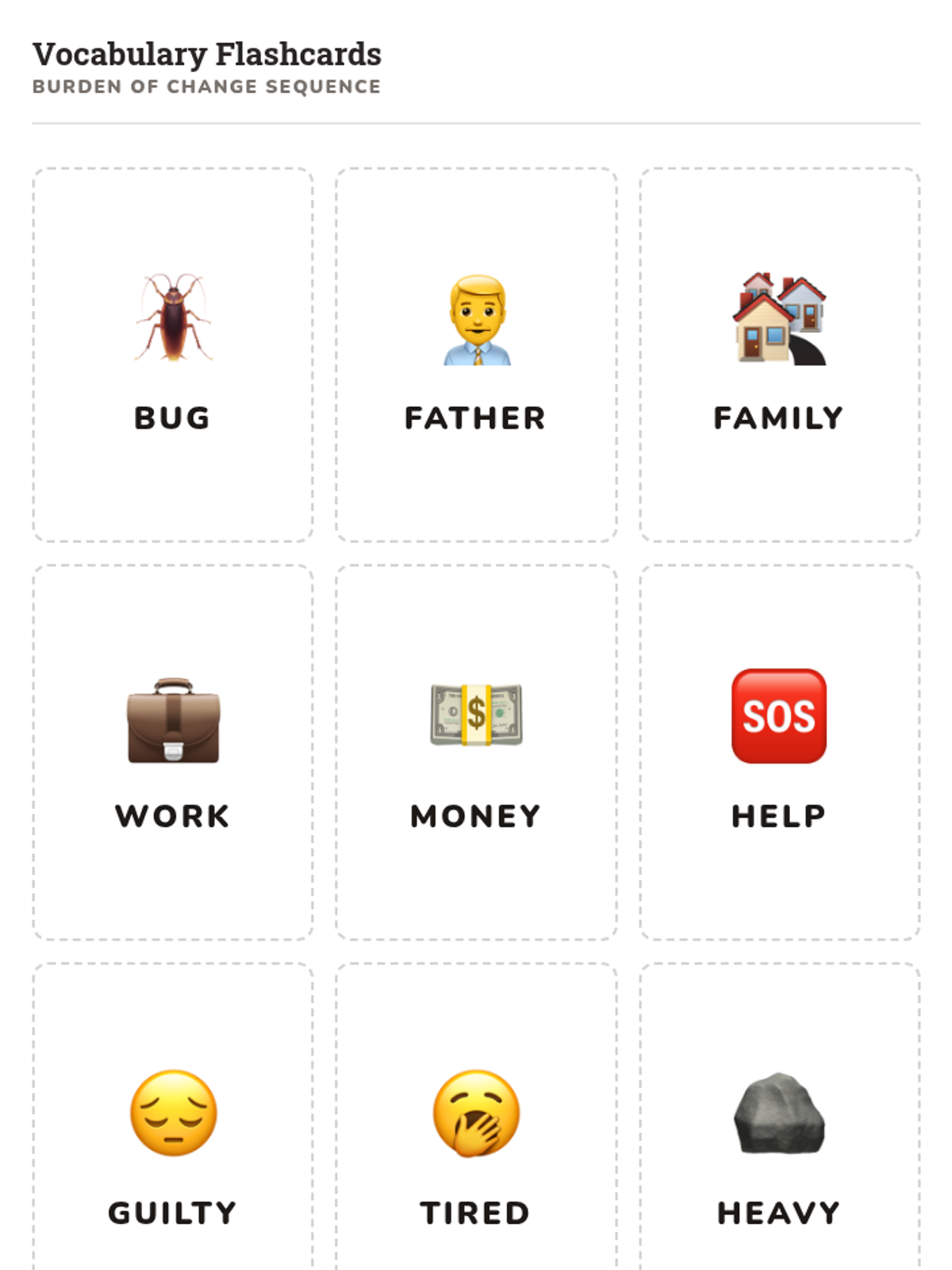
A set of 12 visual vocabulary flashcards featuring key terms from the sequence with associated icons, including differentiated Level 2 terms.
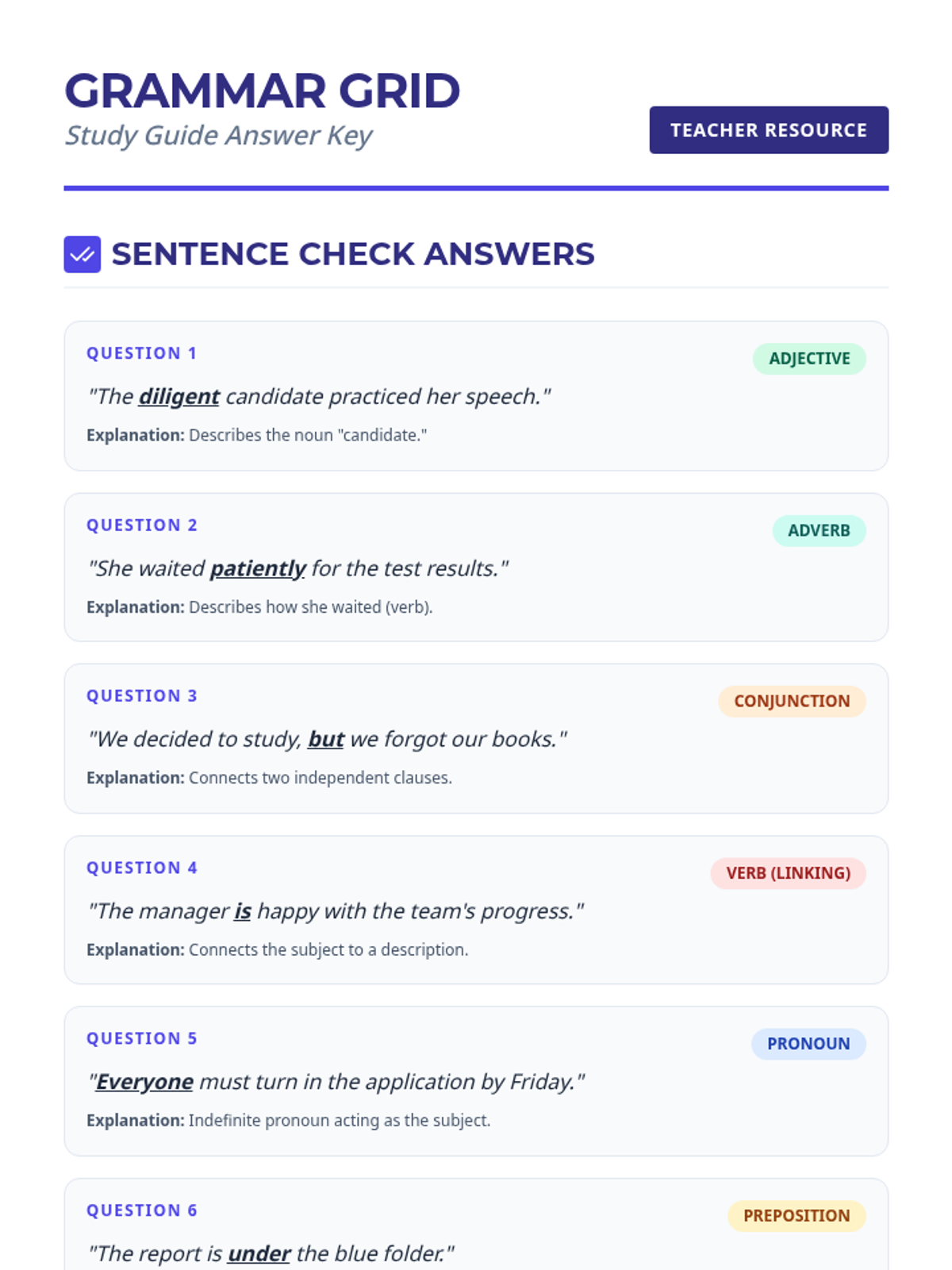
A detailed answer key for the Grammar Grid Study Guide, providing the correct parts of speech and pedagogical explanations for each practice question.
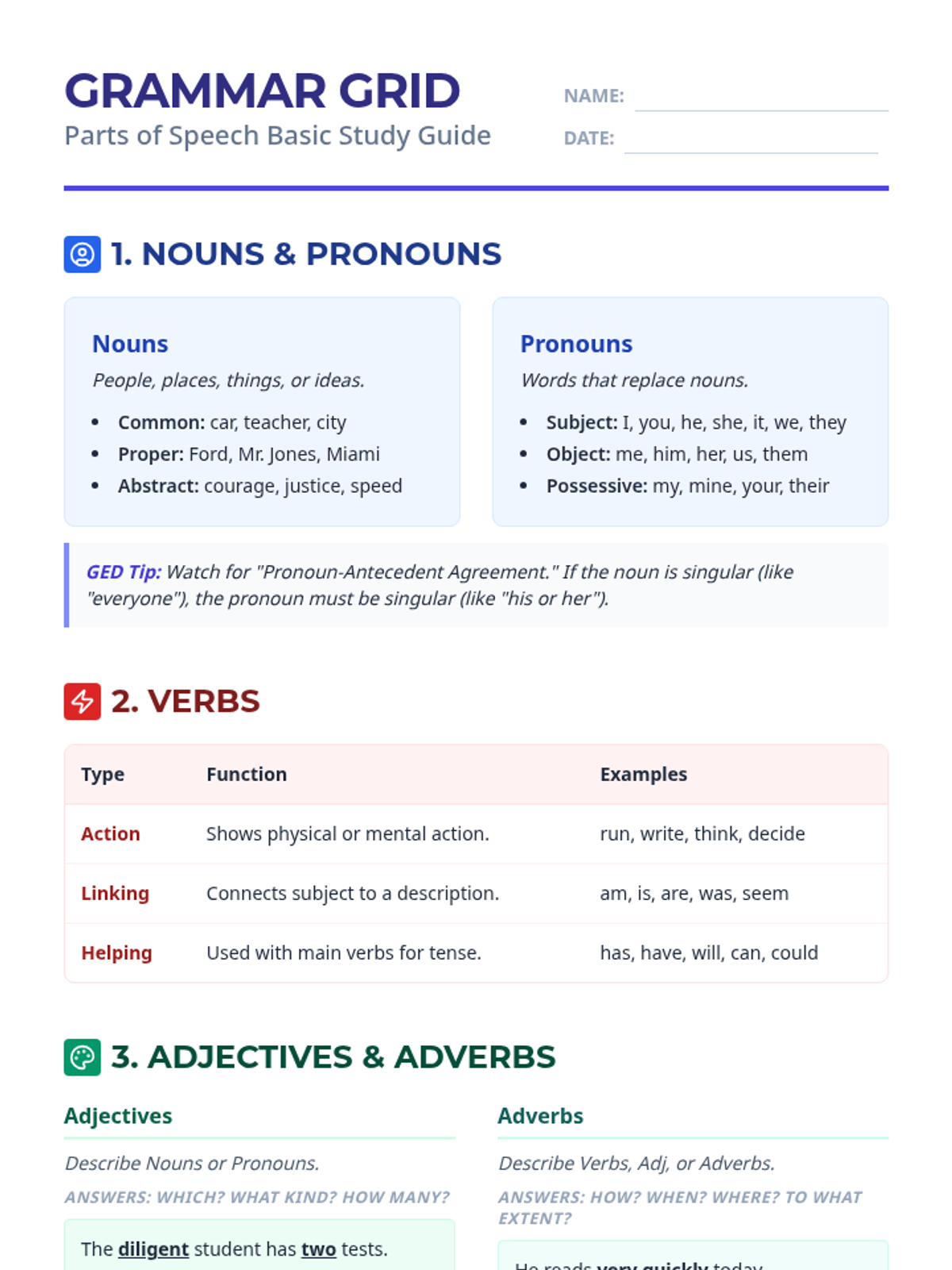
A comprehensive printable study guide covering the eight parts of speech with definitions, examples, and GED-specific grammar tips. Includes a practice section for identifying parts of speech in context.
A visual presentation introducing the eight parts of speech with specific focus on how they apply to the GED Reasoning Through Language Arts exam. Includes definitions, examples, and contextual usage tips.
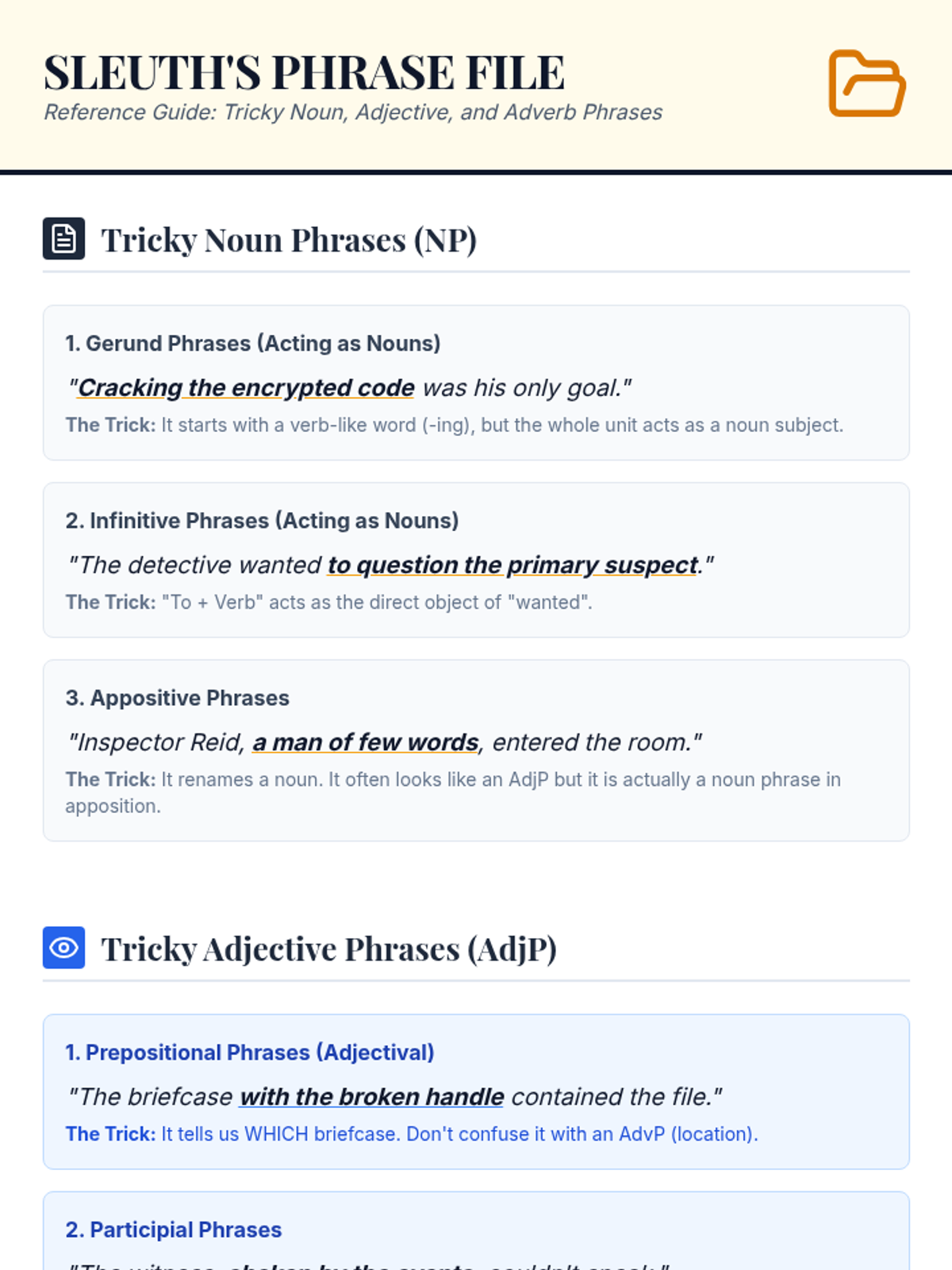
A comprehensive reference guide for teachers and students featuring categorized "tricky" phrase examples and explanations.
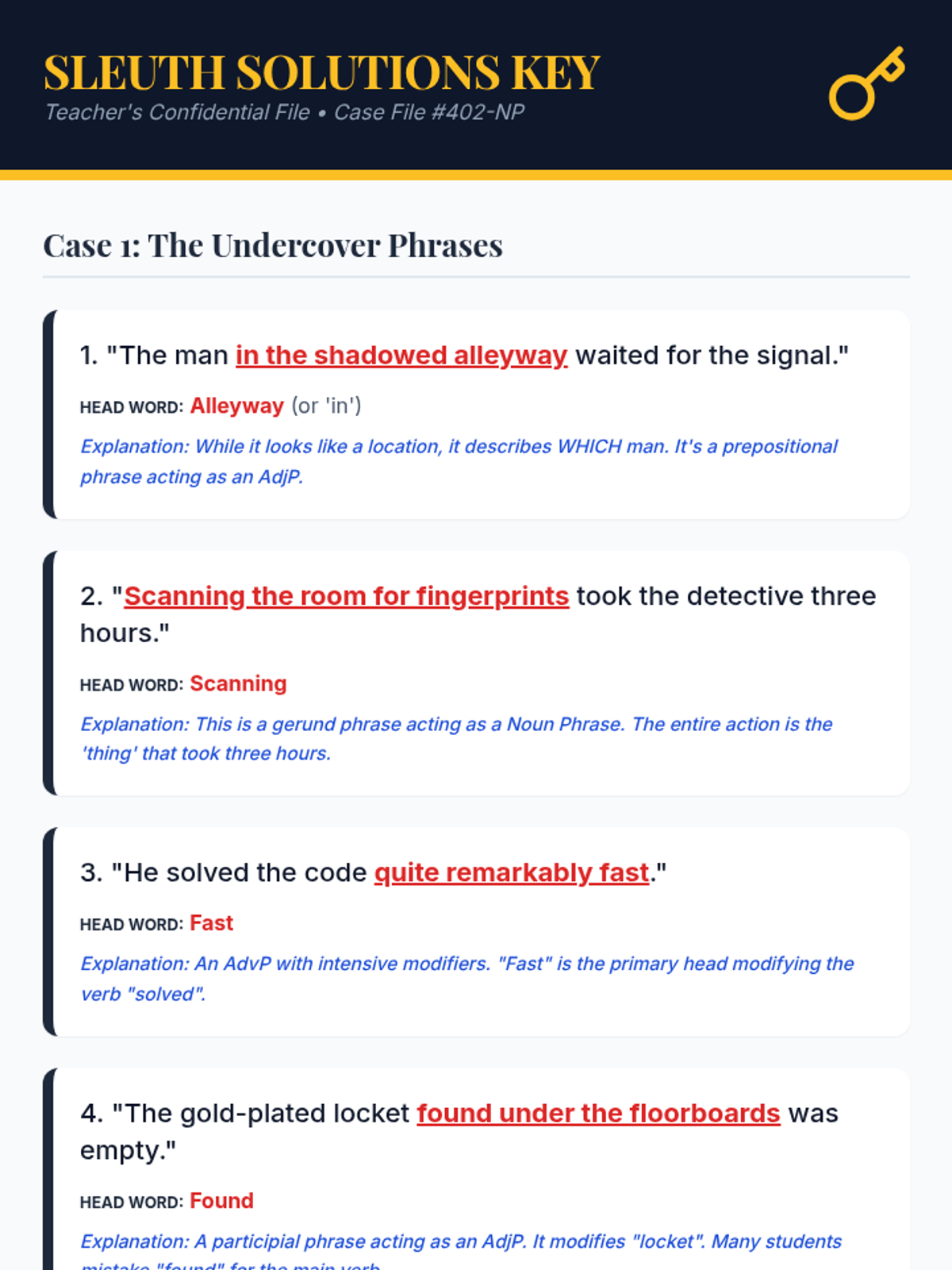
Answer key for the Syntax Sabotage Worksheet with detailed explanations of why specific questions were 'tricky'.
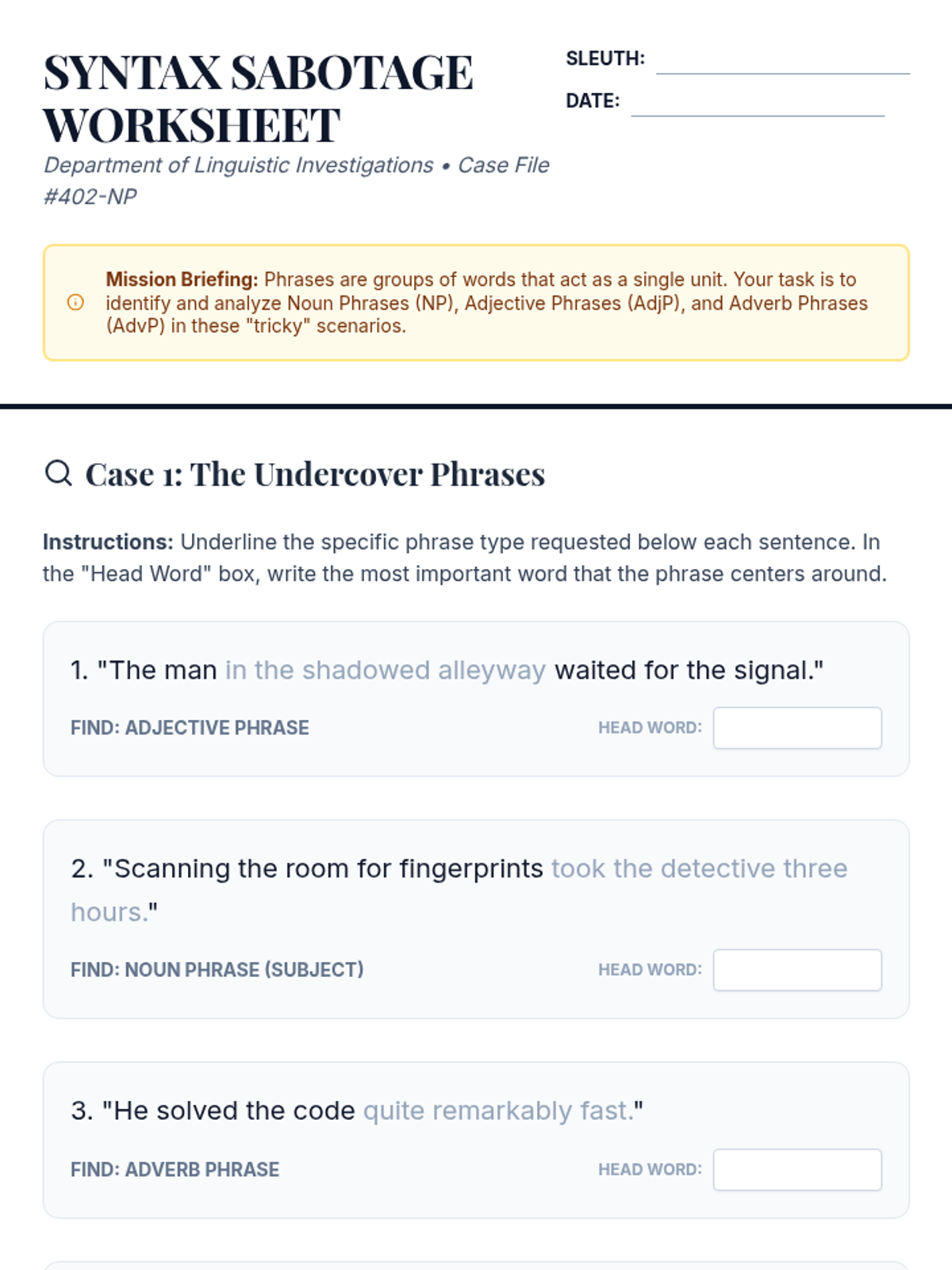
A detective-themed worksheet with "tricky" phrase identification, ambiguity analysis, and sentence construction tasks.
A 6-slide presentation introducing noun, adjective, and adverb phrases with a detective theme. Includes 'tricky' examples and a linguistic ambiguity challenge.
A visual presentation deck for teaching noun, adjective, and adverb phrases. It includes clear definitions, contrasting examples, and a demonstration of sentence expansion using various phrase types.
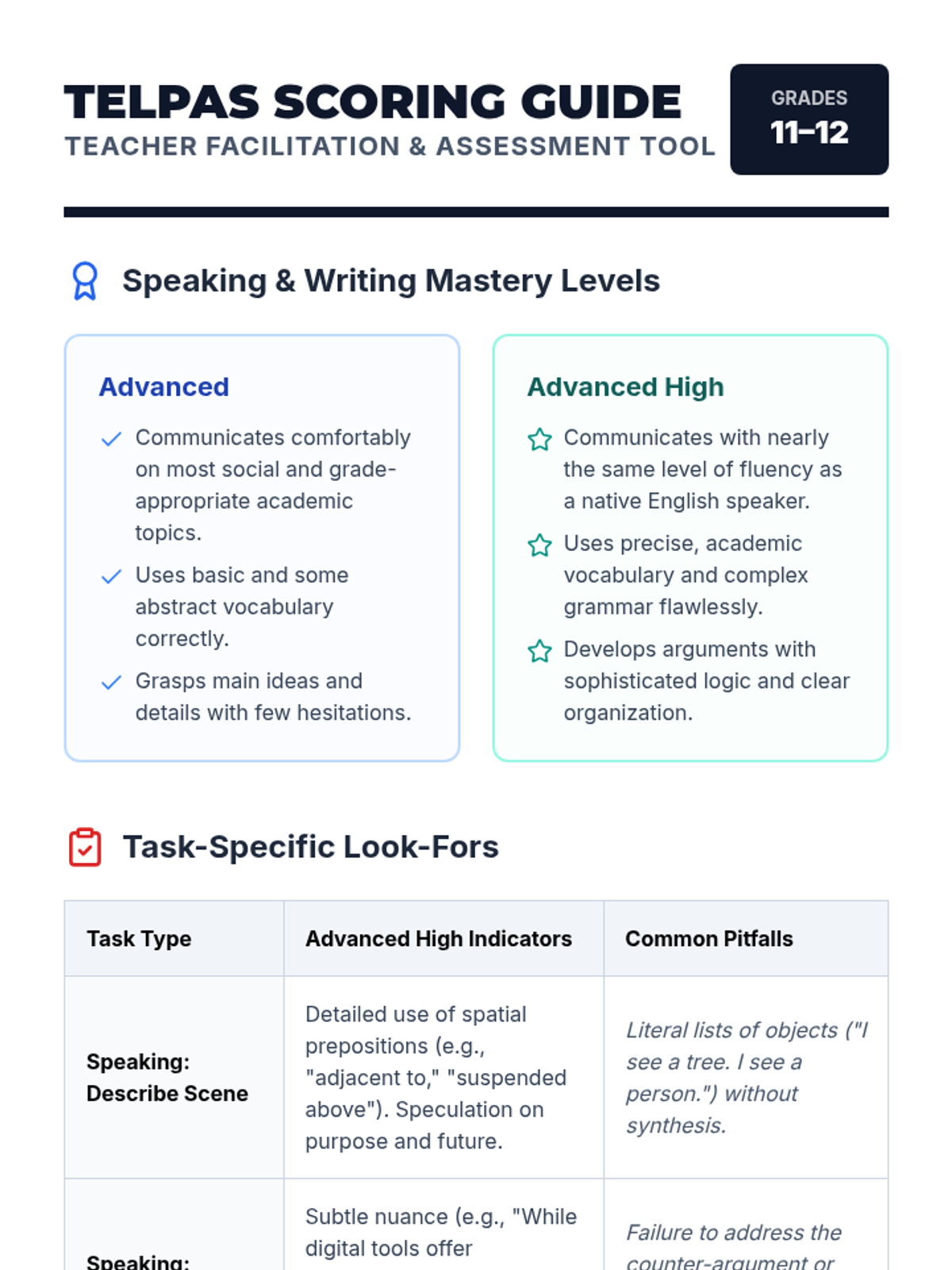
A teacher scoring guide and facilitation resource for 11th-12th grade TELPAS practice, providing proficiency level descriptors and task-specific feedback indicators.
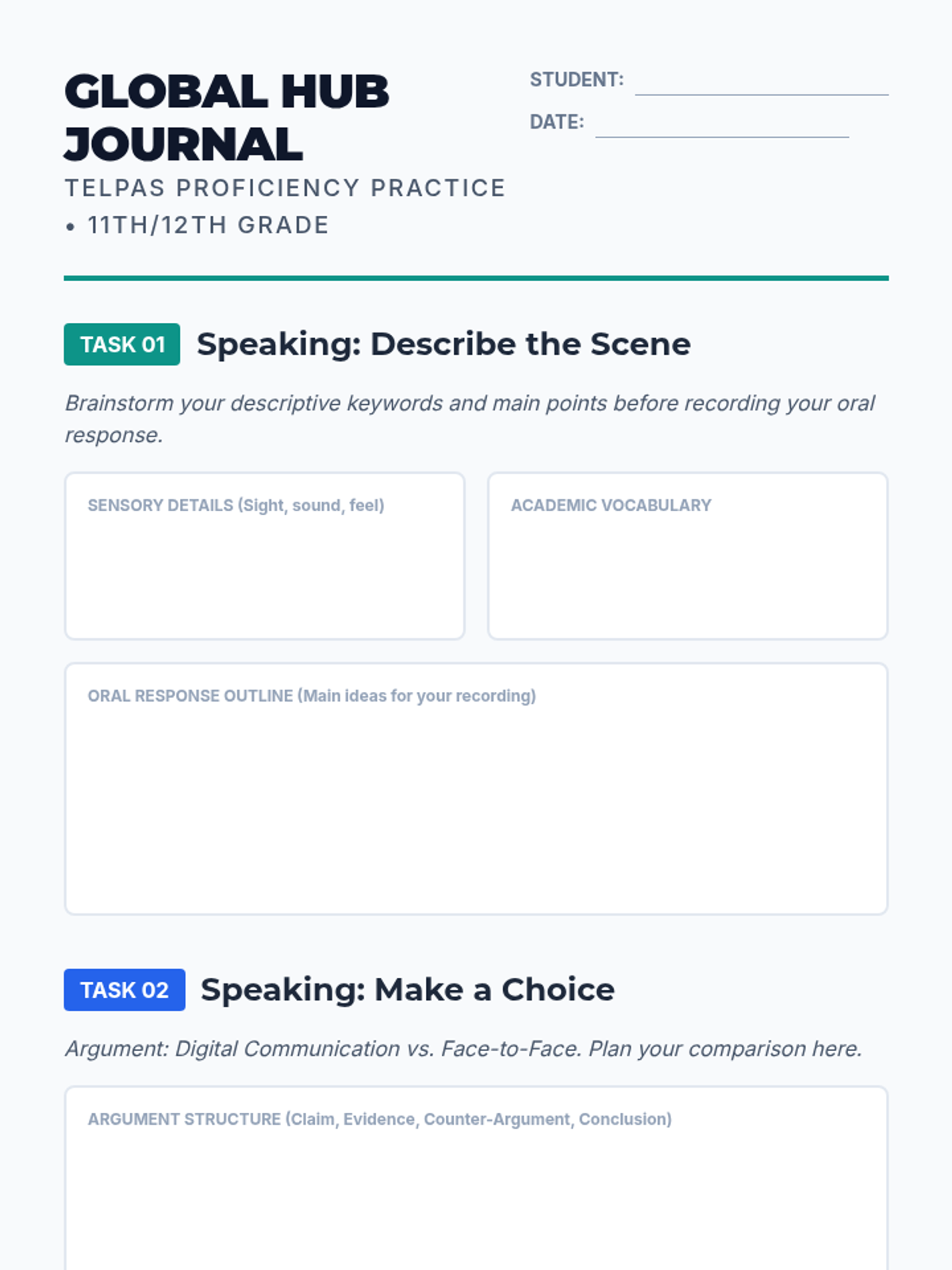
A student response journal for TELPAS practice tasks, featuring brainstorming boxes for speaking prep and lined work areas for extended writing responses.
A 6-slide presentation guiding high school students through 4 specific TELPAS-style practice tasks (2 speaking, 2 writing) with timers and expert tips.
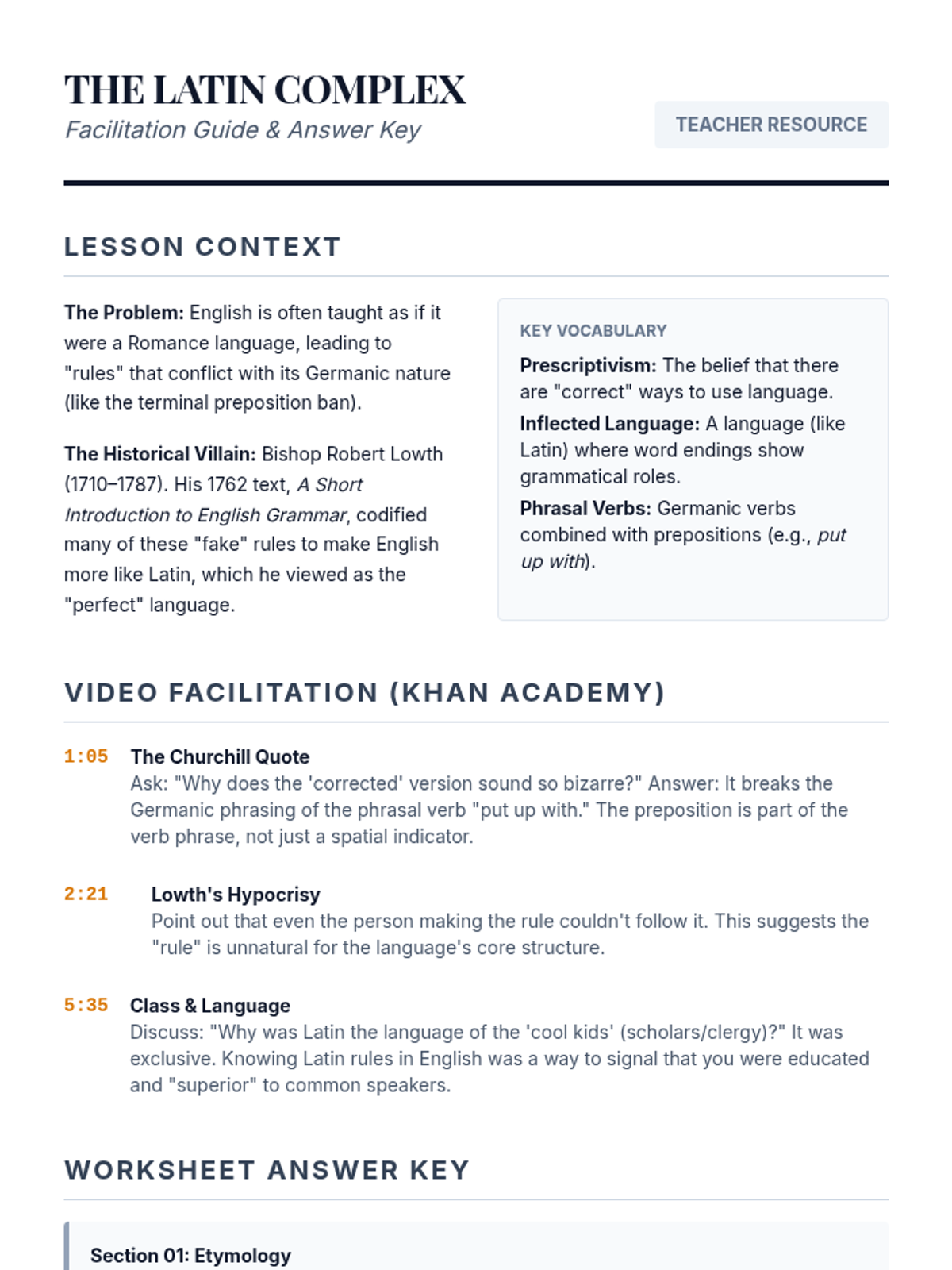
A comprehensive teacher resource containing answer keys for the student worksheet, facilitation notes for the video pauses, and historical background on the 18th-century prescriptivist movement.
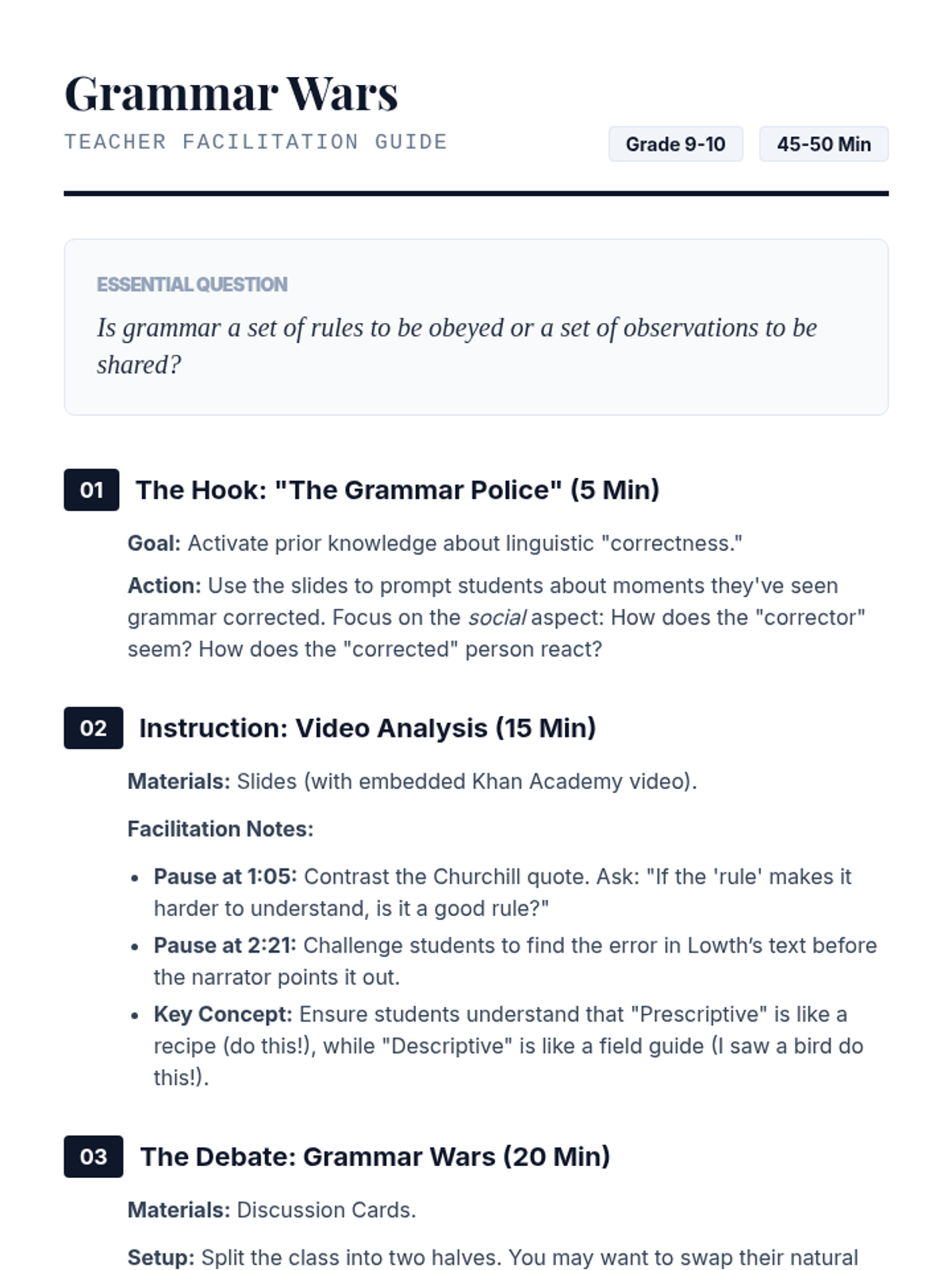
A comprehensive teacher facilitation guide for the Grammar Wars lesson, outlining pacing, discussion prompts, and differentiation strategies.
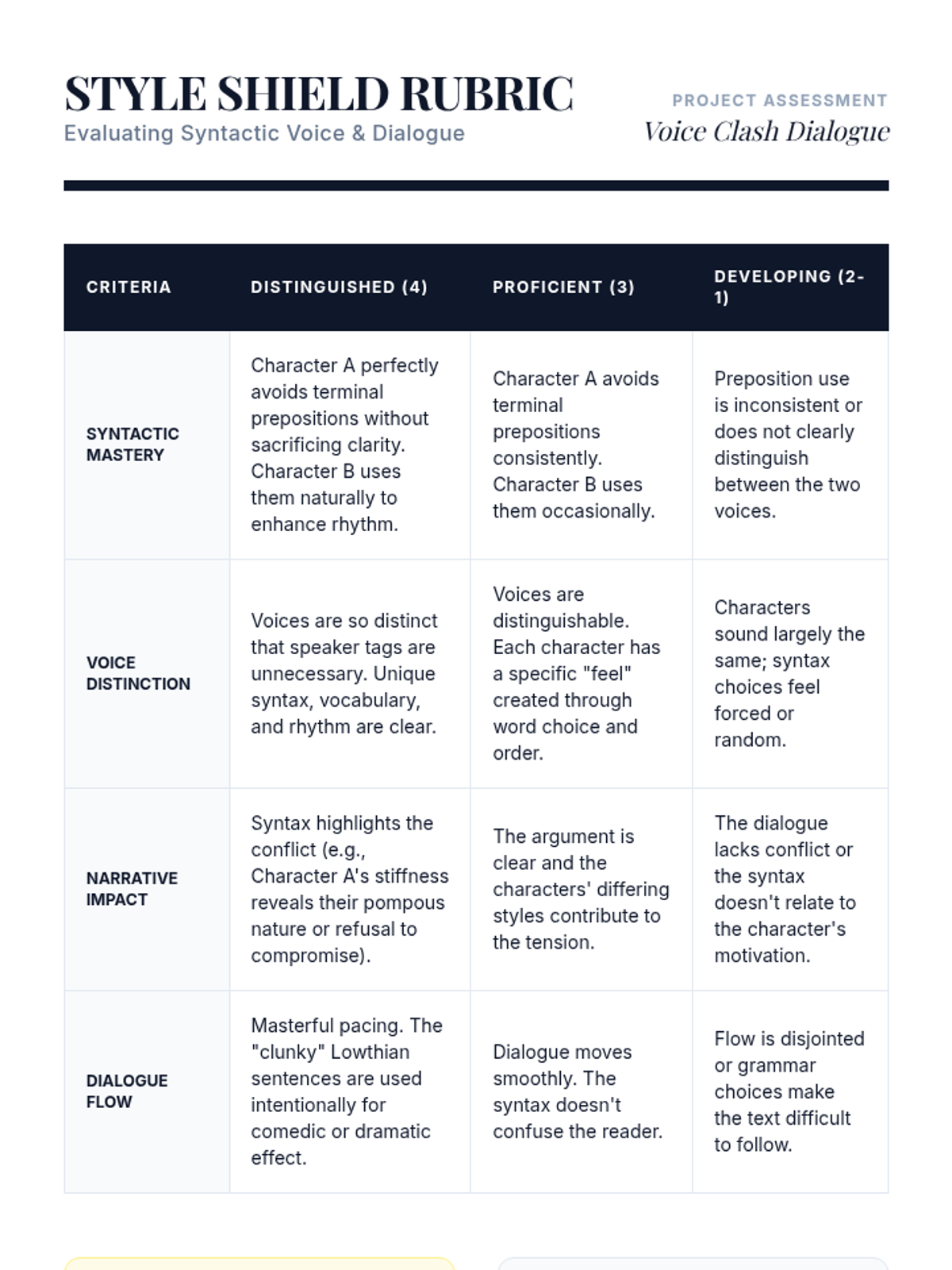
A specialized rubric for assessing character voice through syntactic choices, focusing on terminal prepositions and formal vs. casual speech.
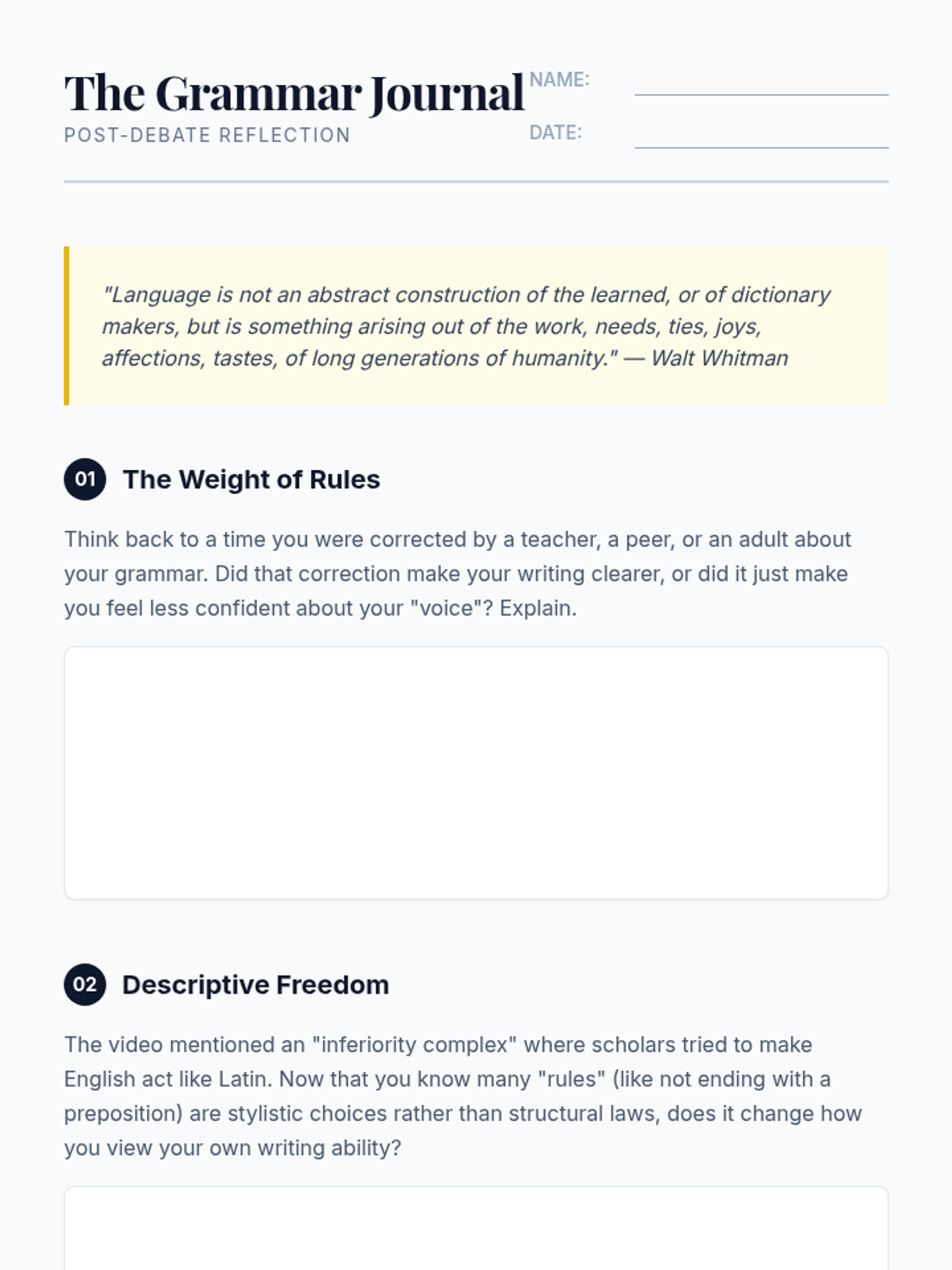
Reflection journal prompts for students to consider their personal relationship with grammar rules and how they affect writing confidence.
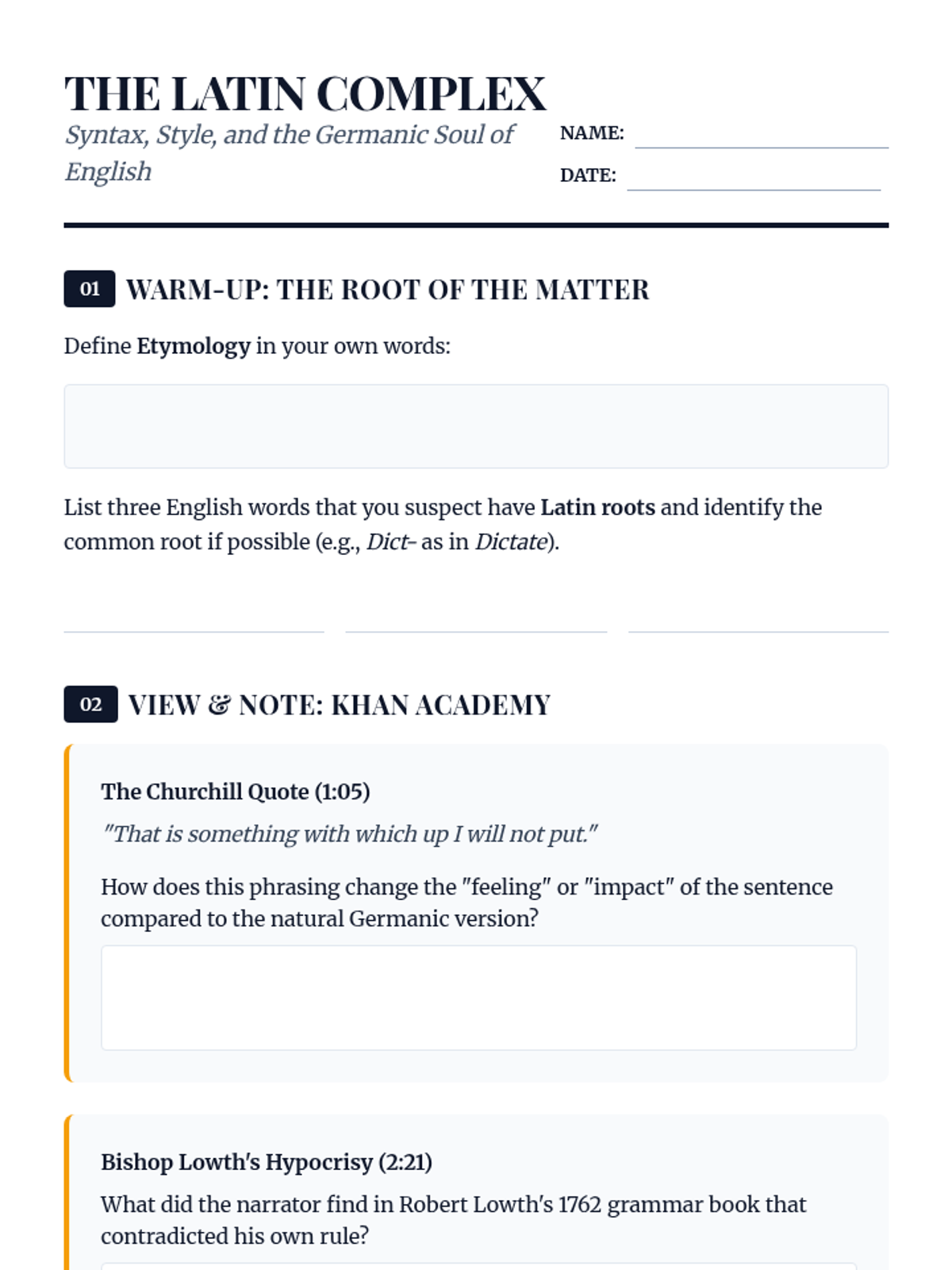
A comprehensive worksheet for students to record notes on the Latinate influence on English, including video reflection points, a language family deep dive, and a translation activity.
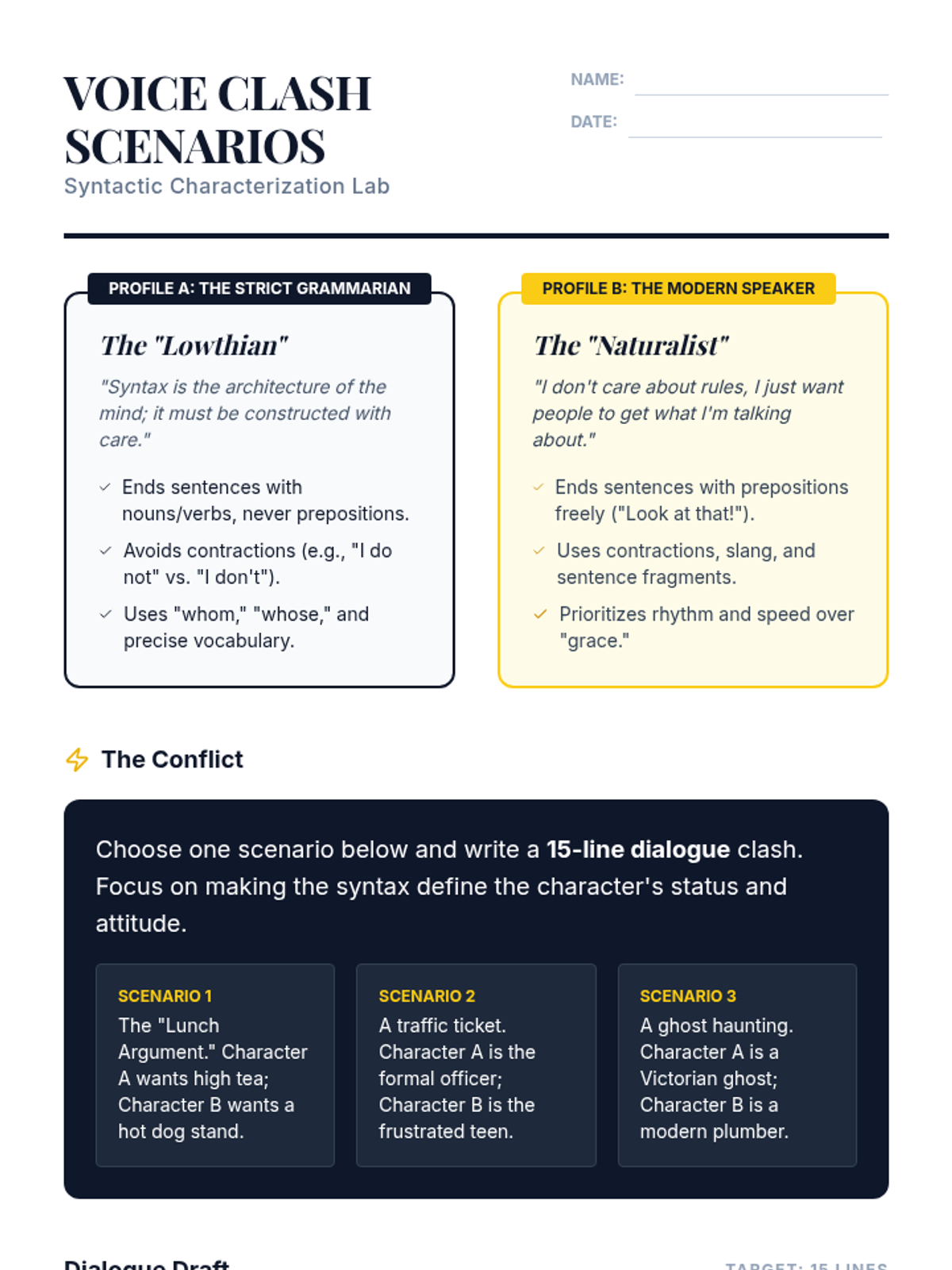
Student activity sheet featuring character profiles and dialogue prompts for practicing syntactic characterization.
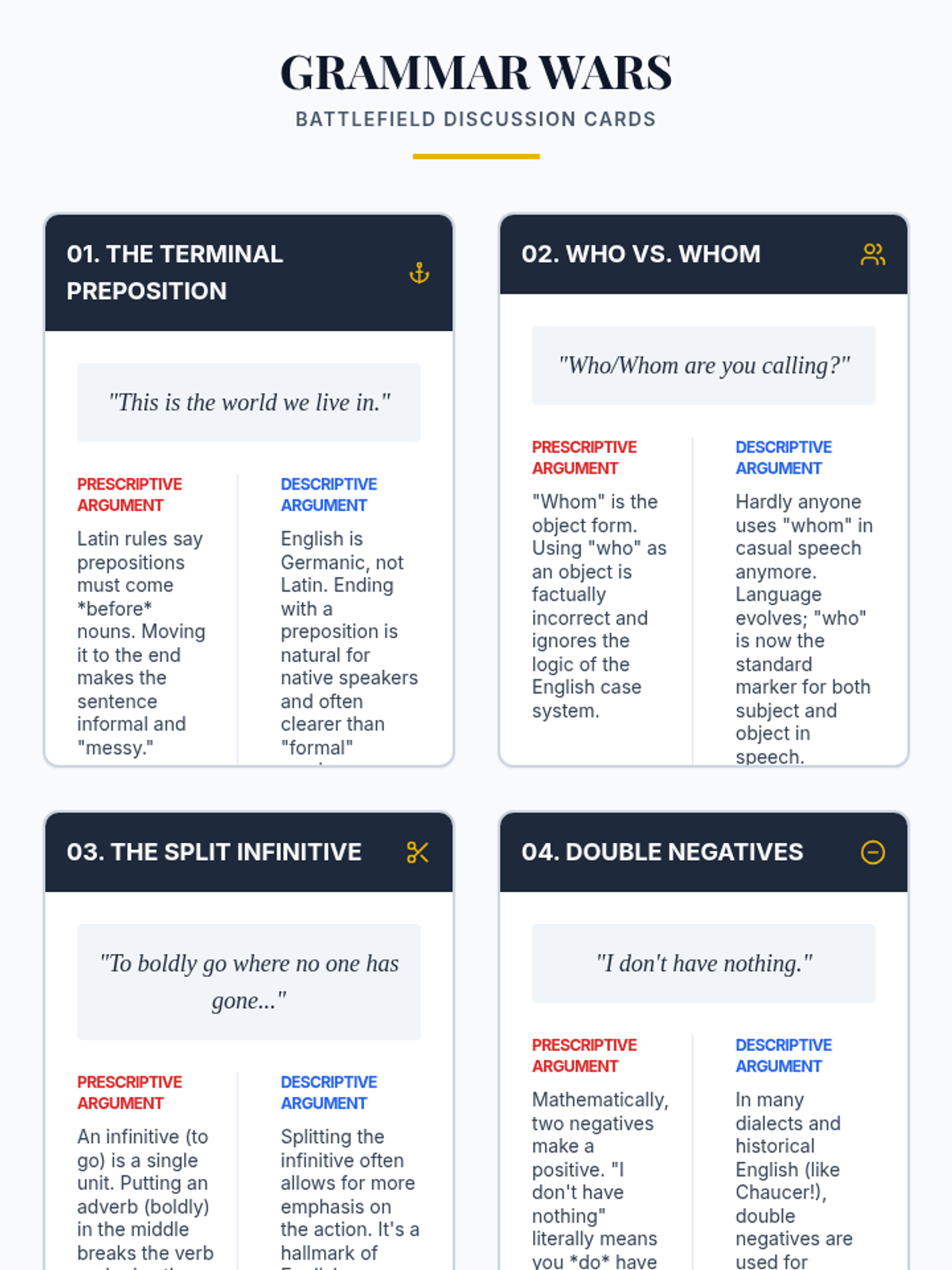
Discussion cards for a debate on prescriptive vs. descriptive grammar, featuring four controversial usage cases with arguments for both sides.
A 10-slide presentation exploring the historical influence of Latin on English syntax, featuring the Khan Academy video, the Bishop Lowth hypocrisy, and the Germanic vs. Romance root comparison.
Visual presentation for the 'Syntax and Voice' lesson, featuring the Winston Churchill hook, embedded Khan Academy video, and the 'Lunch Argument' writing prompt.
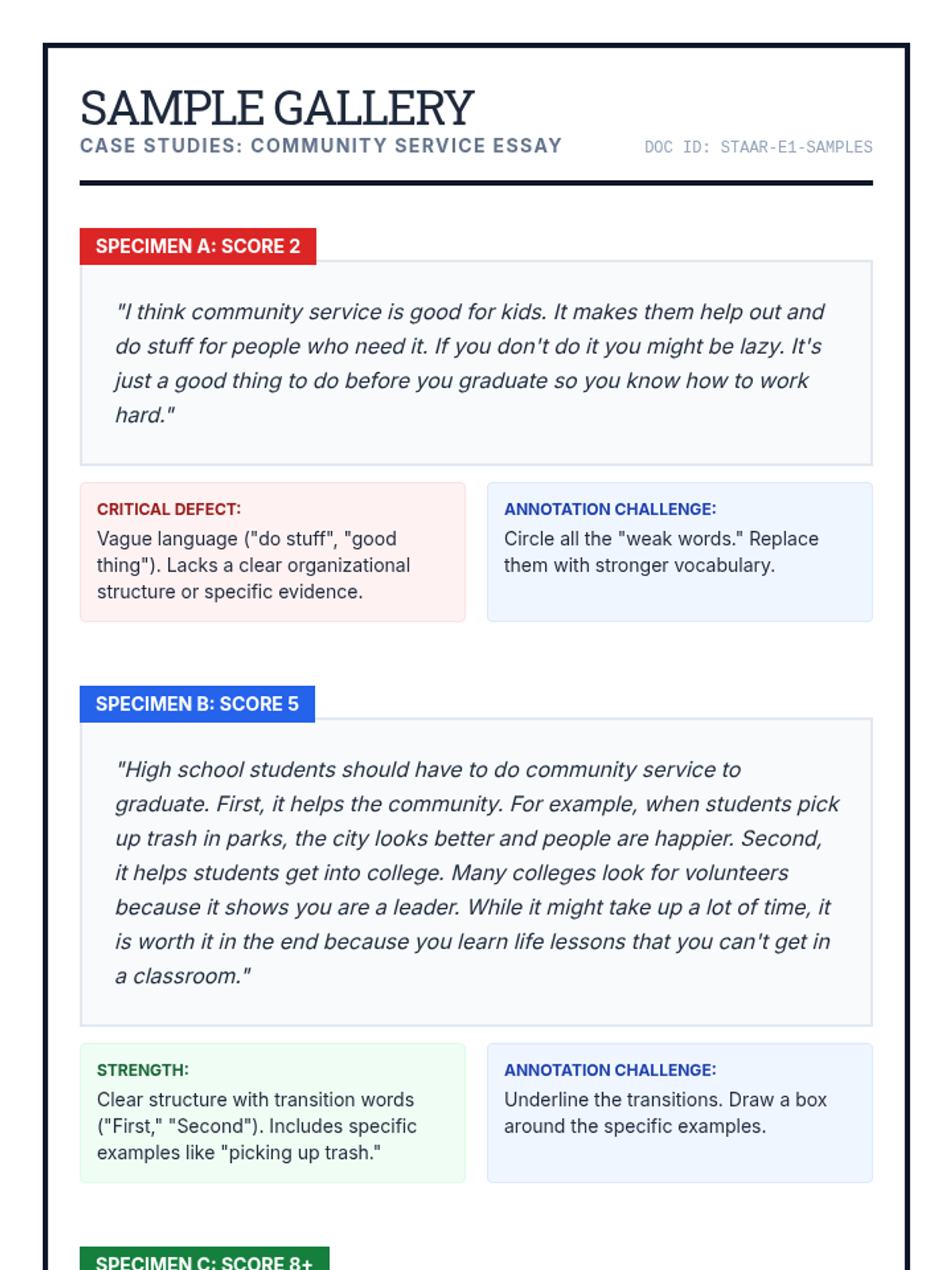
A collection of three annotated sample essay excerpts reflecting low, medium, and high score points on the EOC rubric, designed for student analysis and comparison.
A visually engaging slide deck that breaks down the Texas English 1 EOC writing rubric into achievable 'steps,' featuring score-point comparisons, strategy tips, and direct instructions for the station rotation.
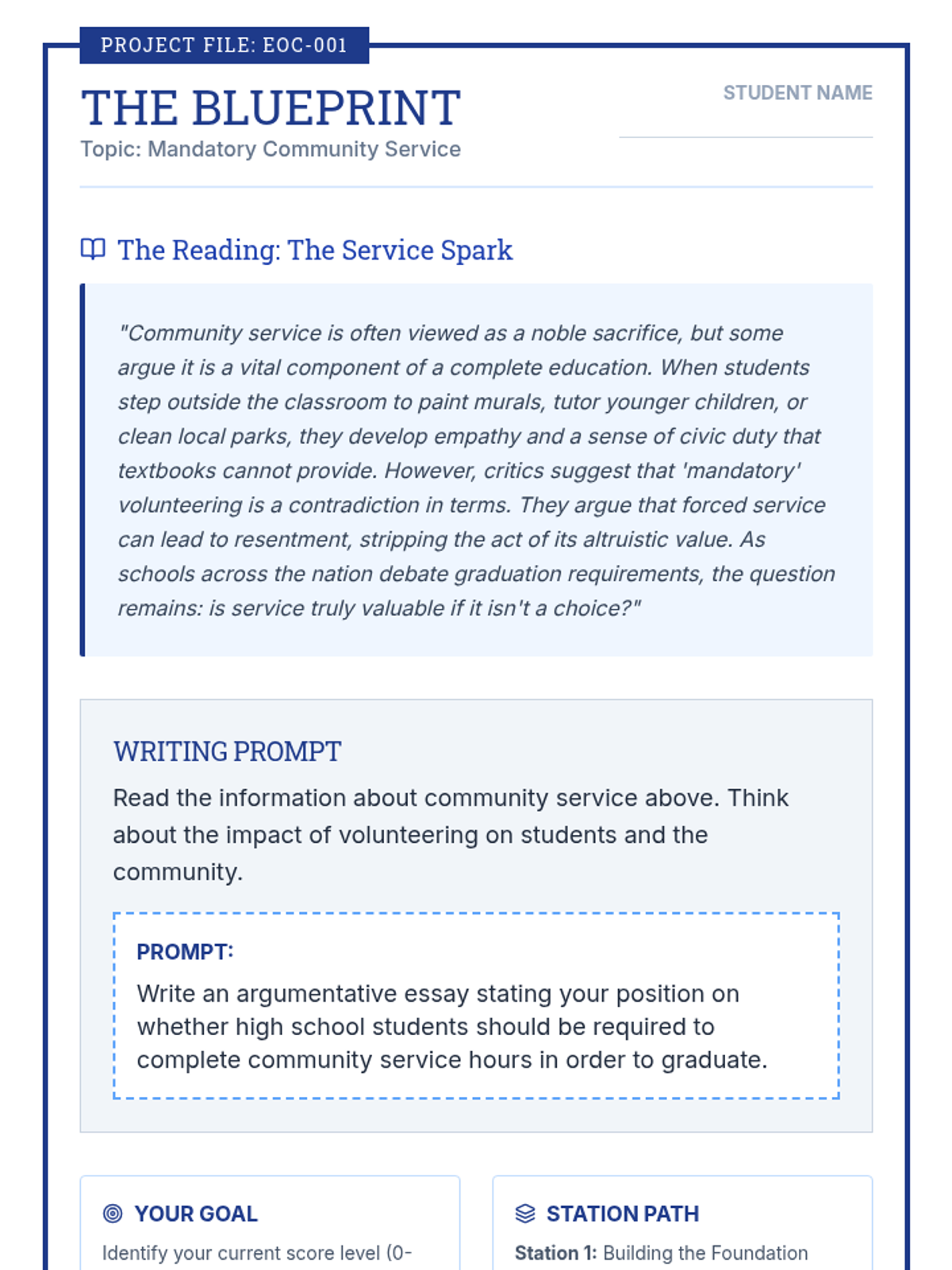
A comprehensive student workbook featuring tiered graphic organizers, sentence stems, and a peer-review checklist designed to guide students from foundational writing to advanced argumentation on the topic of community service.
A visual presentation guiding students through key revising strategies for the Texas English I EOC, focusing on sentence combining, redundancy, and clarity.
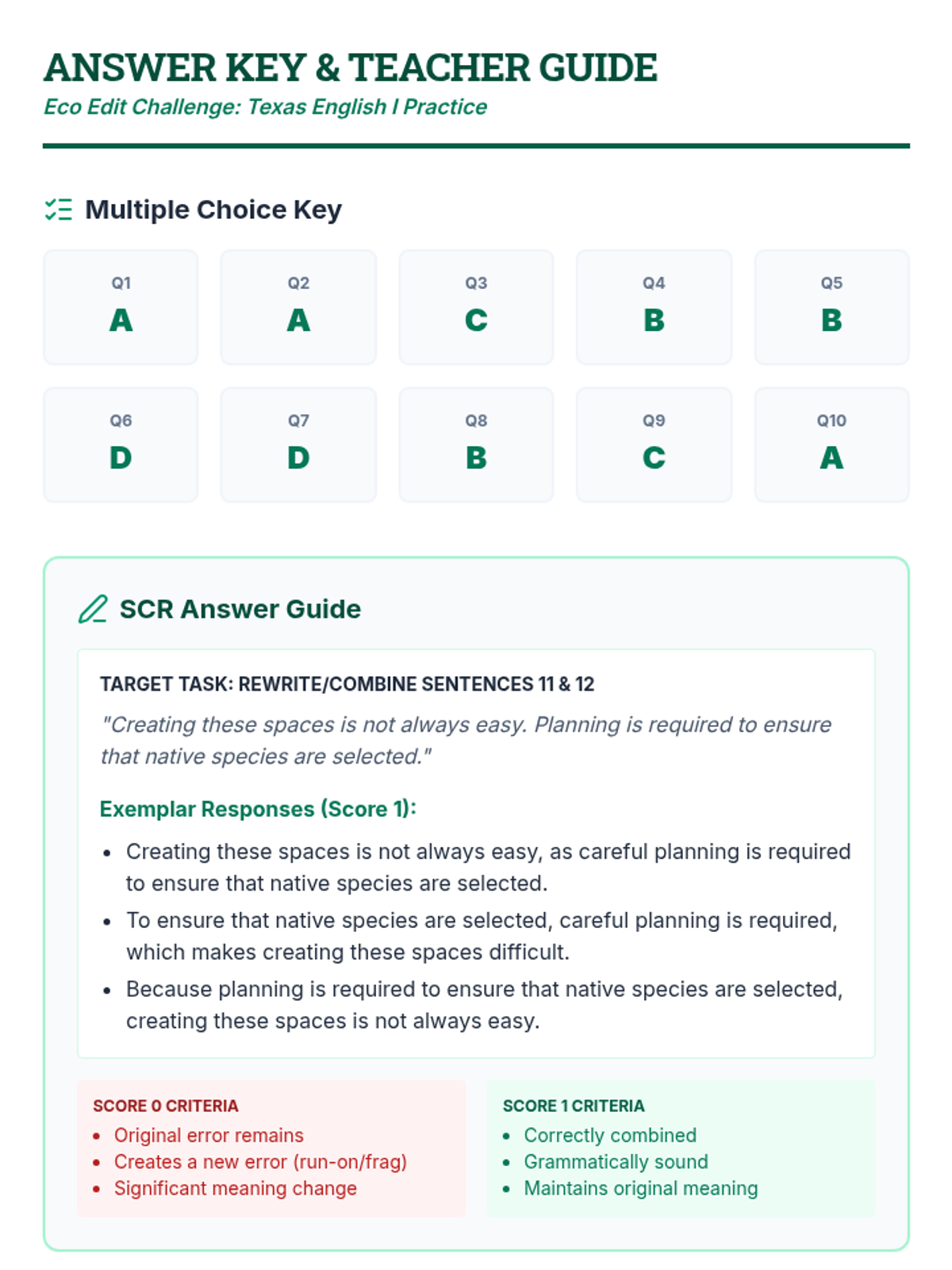
An updated answer key and teacher guide that includes a scoring rubric and exemplar responses for the short constructed response (SCR) revision task.
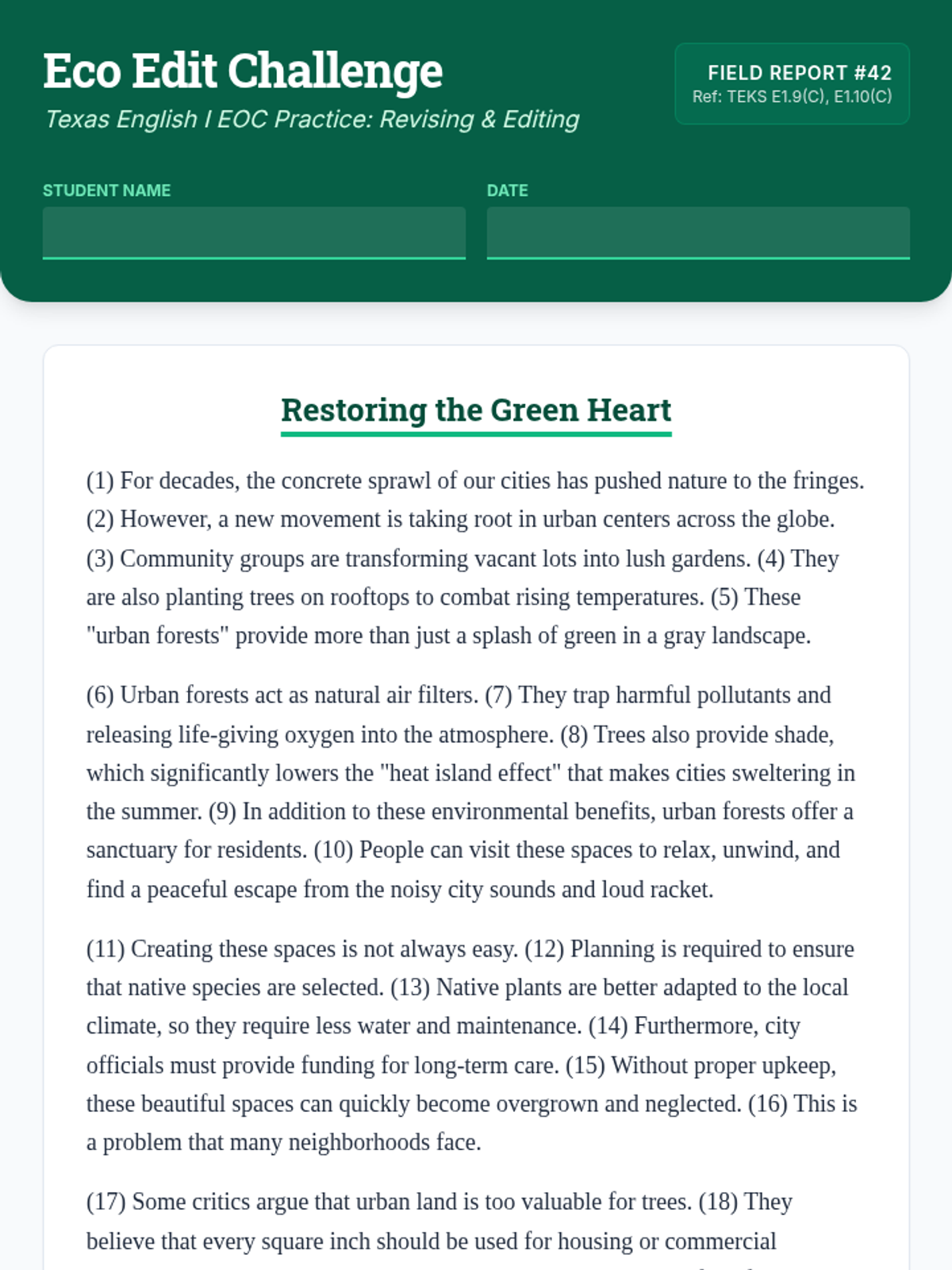
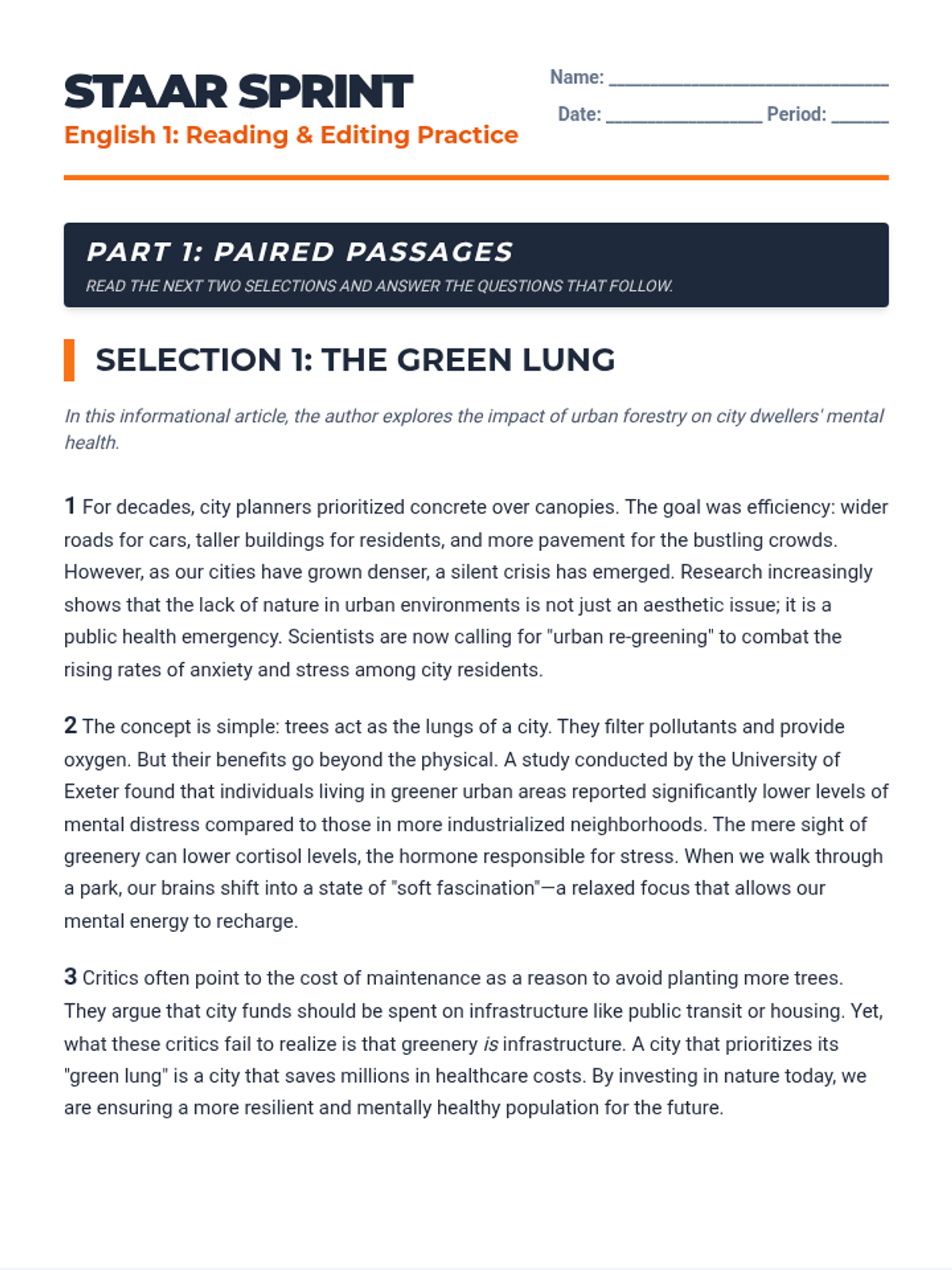
A STAAR-aligned practice test for Texas English I, featuring a passage on urban forestry with 10 multiple-choice questions focusing on sentence combining, word choice, transitions, and grammatical corrections.
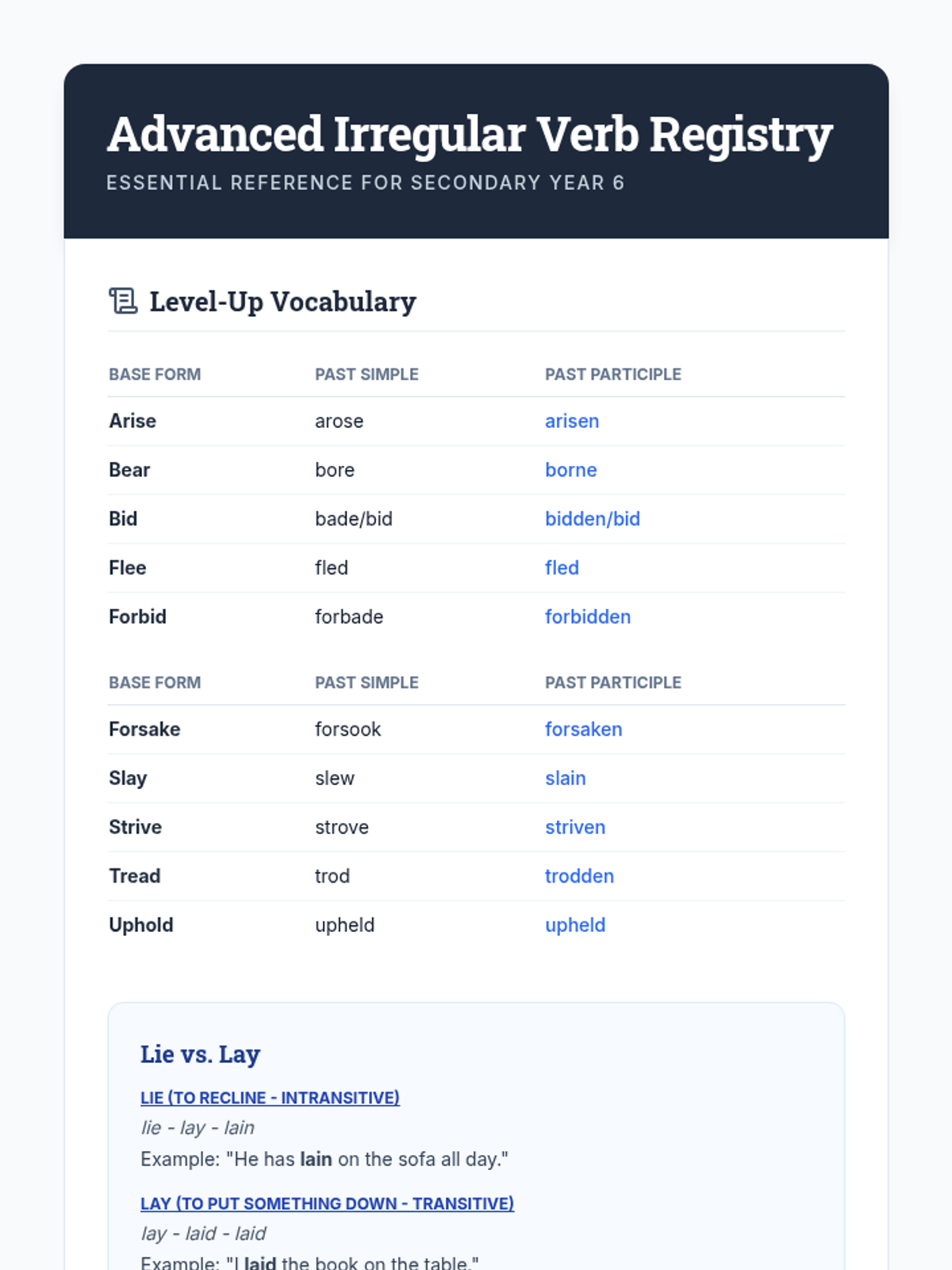
An advanced reference sheet for 12th-grade students focusing on sophisticated irregular verbs, tricky verb pairs, and formal/academic usage notes.
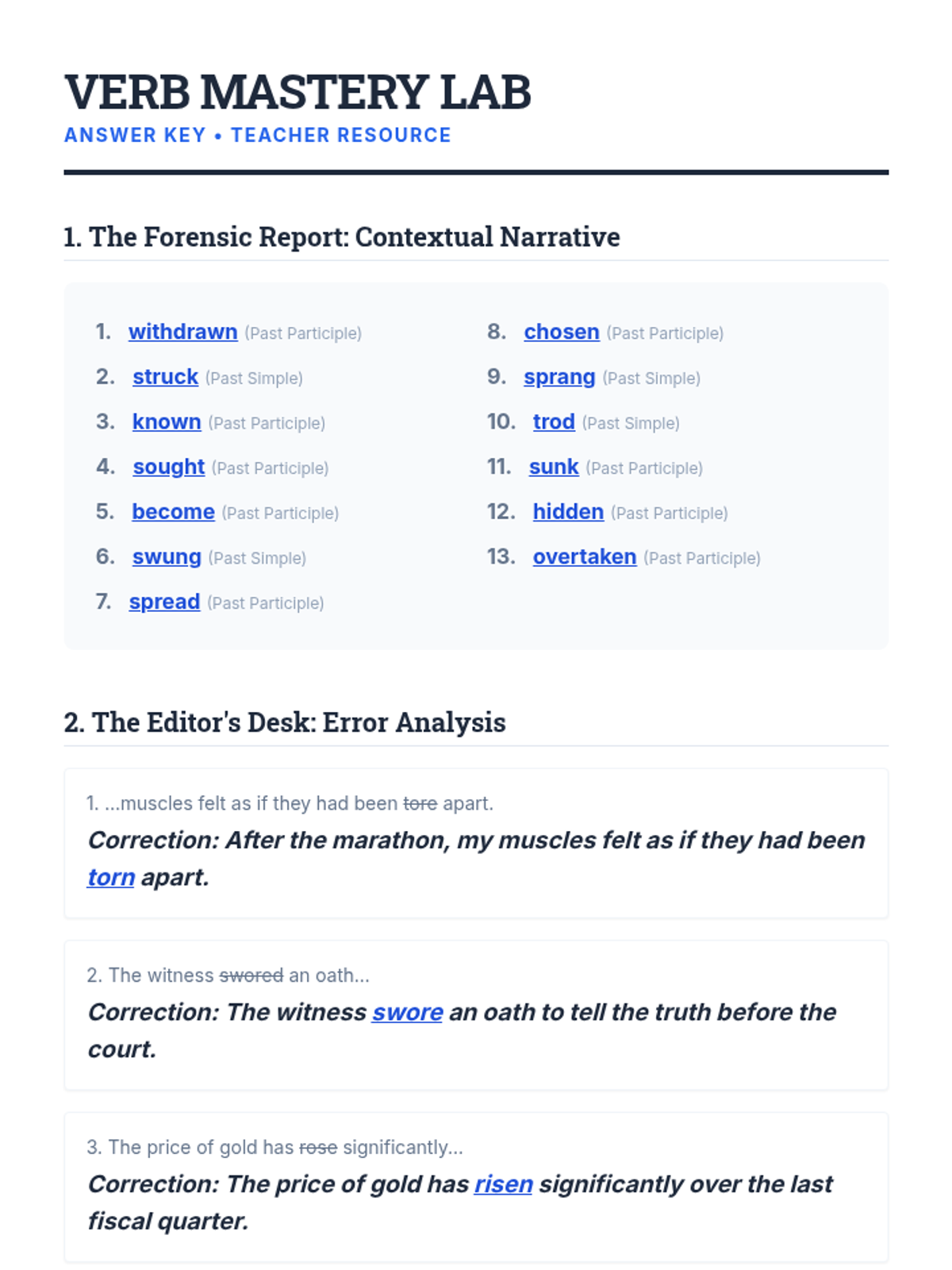
The complete answer key for the Verb Mastery Lab worksheet, including explanations for the trickiest grammar points.
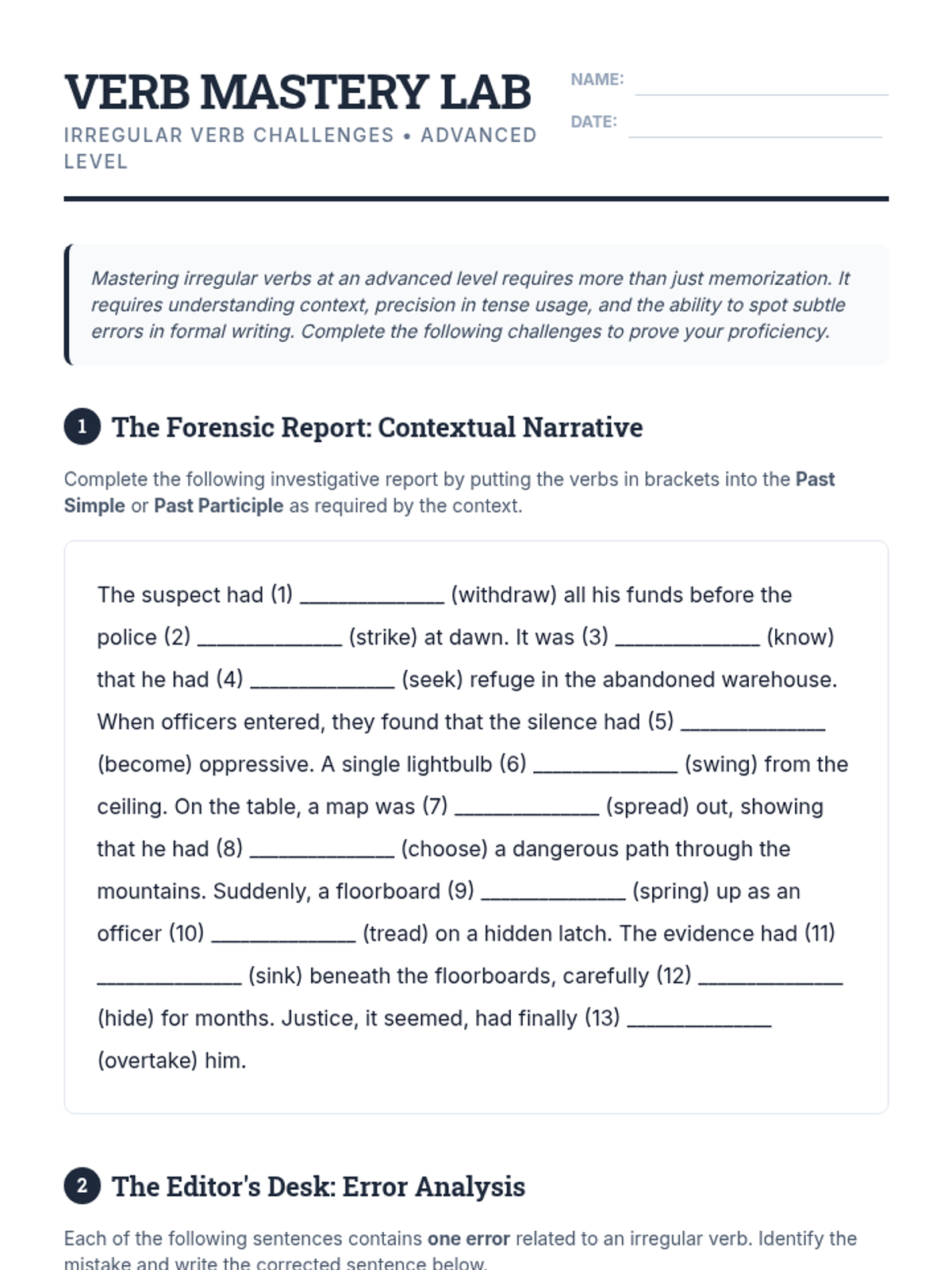
An advanced irregular verb worksheet for high school seniors, featuring narrative gap fills, error correction, sentence transformations, and practice with tricky verb pairs like lie/lay and hung/hanged.
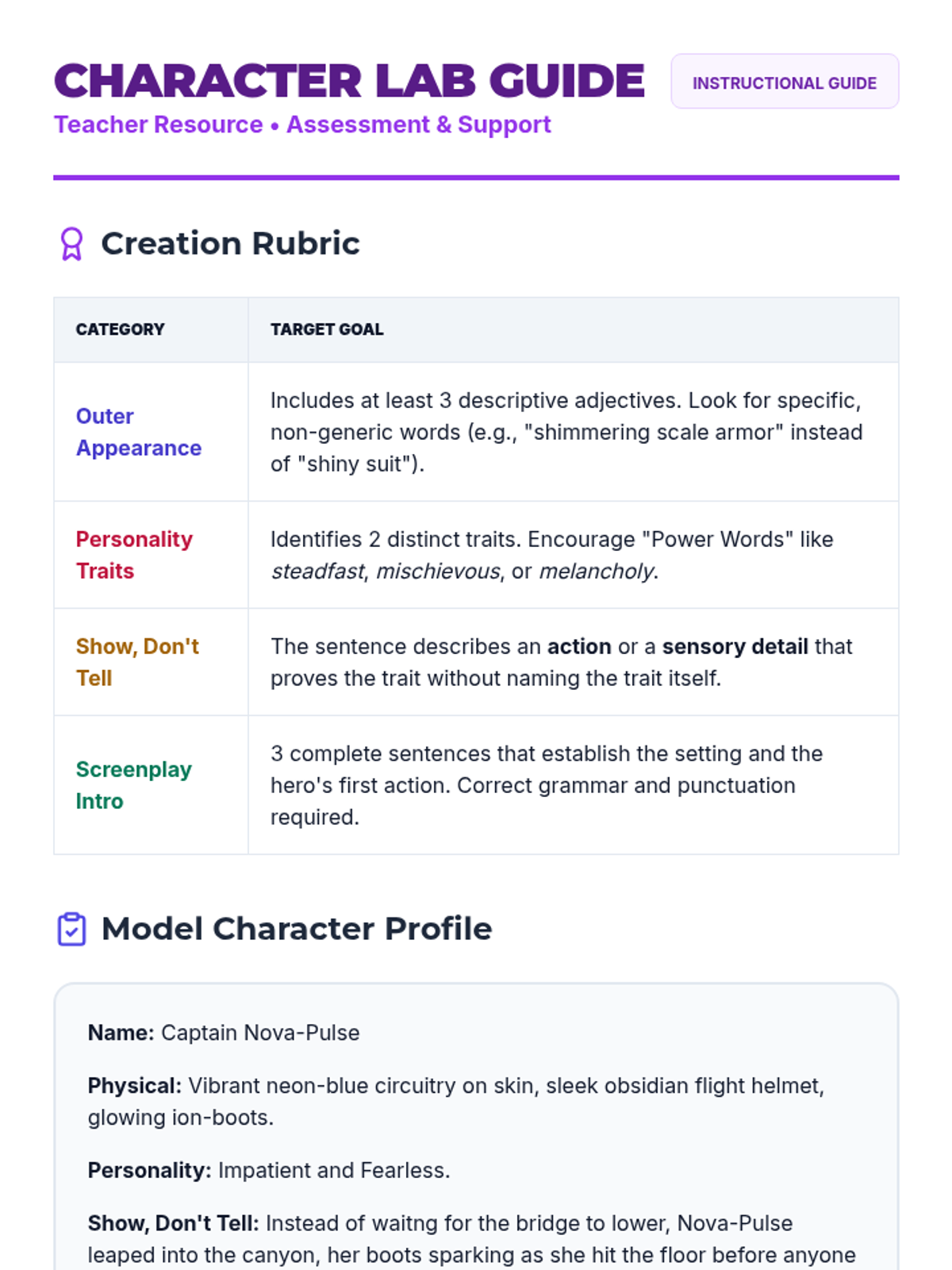
A teacher's facilitation guide and assessment rubric for the Character Profile worksheet. It includes model responses and specific pedagogical strategies for supporting high school students with autism.
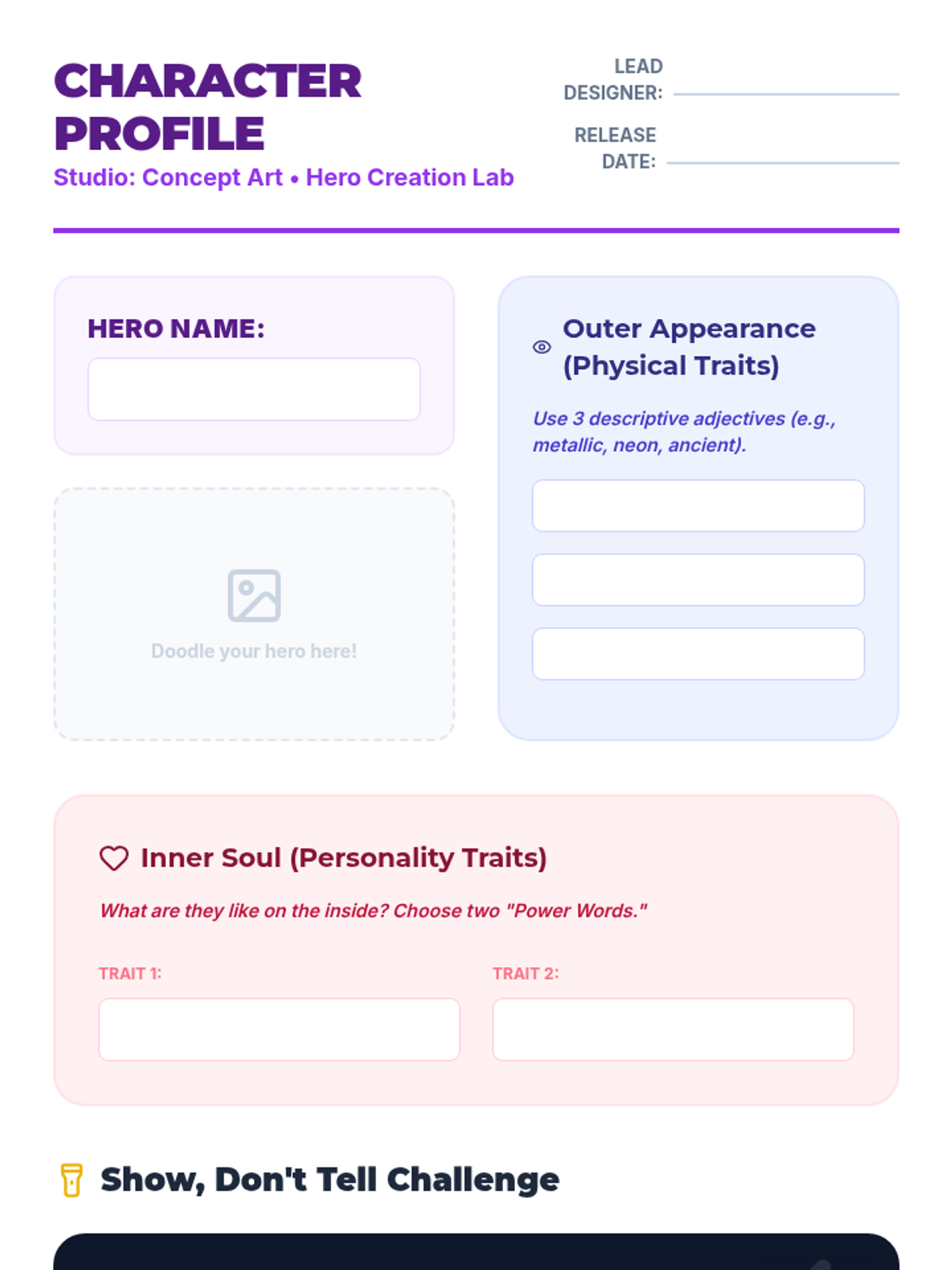
A character development worksheet that guides students through creating a hero. It includes sections for physical traits, personality, a 'Show, Don't Tell' challenge, and a short creative writing prompt.
A slide deck for character development, teaching inner vs. outer traits, "Show, Don't Tell" techniques, and high-impact vocabulary with a concept-art studio aesthetic.
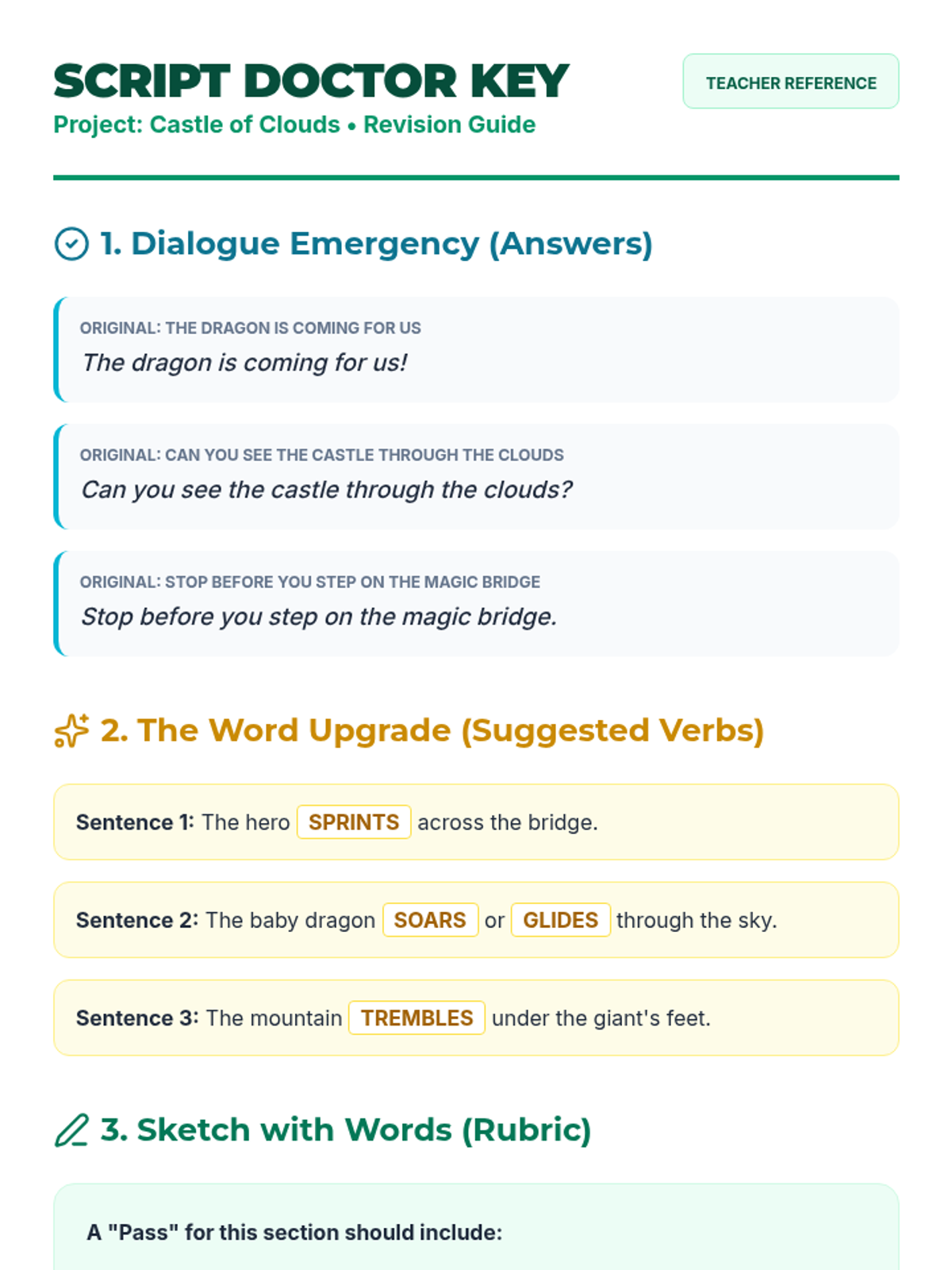
A comprehensive teacher's guide and answer key for the Script Repair worksheet. Includes model answers, a mini-rubric for descriptive writing, and specific instructional strategies for students with autism.
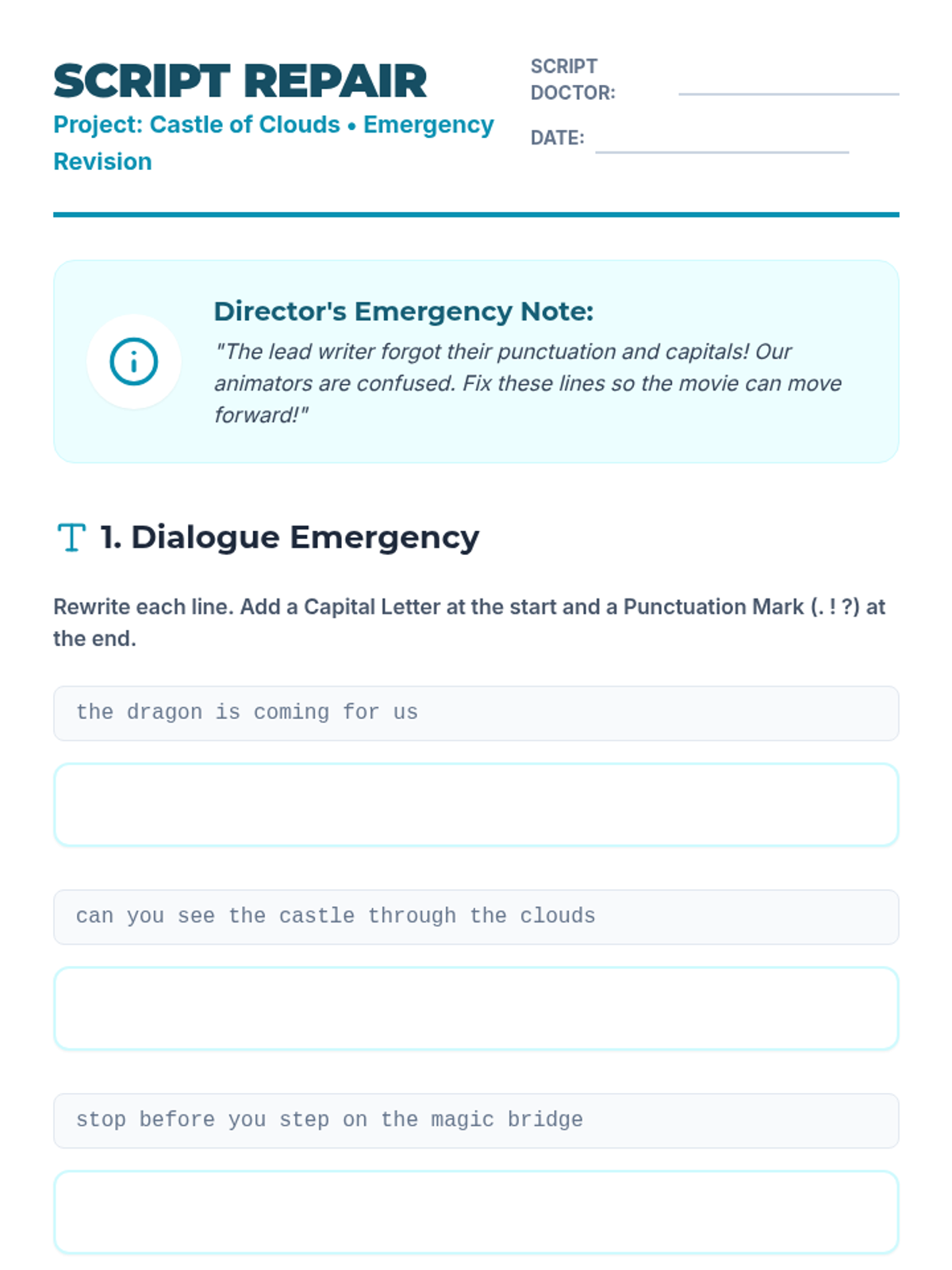
A grammar-focused worksheet themed around an animation script for 'Castle of Clouds'. Students practice capitalization, punctuation, using vivid verbs, and descriptive sentence writing with clear visual scaffolds.
A slide deck introducing the "Script Doctor" role, focusing on capitalization, punctuation, and vivid vocabulary within a movie studio context. Features high-contrast designs and clear formatting for high school students.
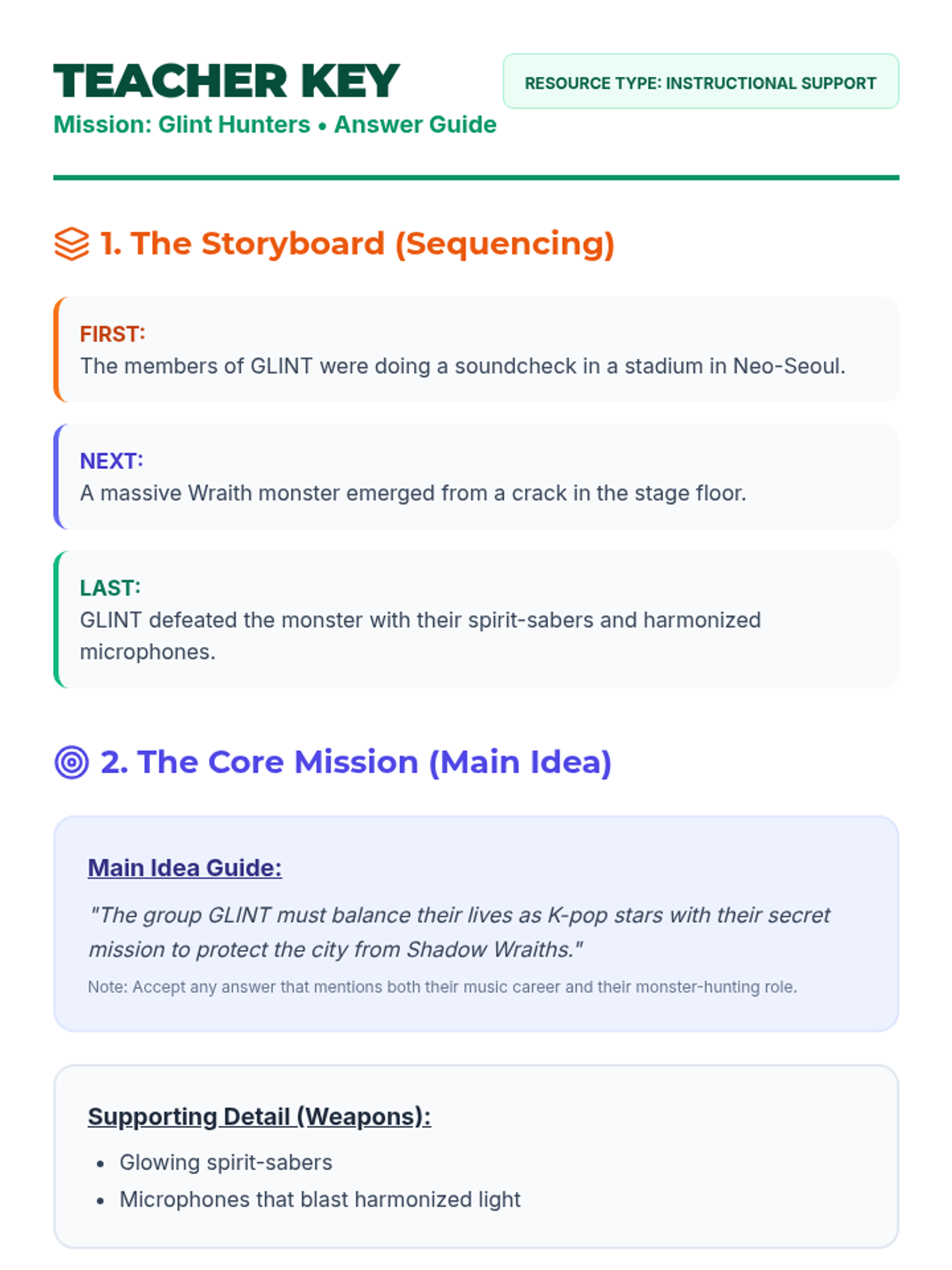
A comprehensive answer key and instructional guide for teachers. Includes suggested responses for sequencing, main ideas, and inferences, along with specific teaching tips tailored for supporting high school students with autism.
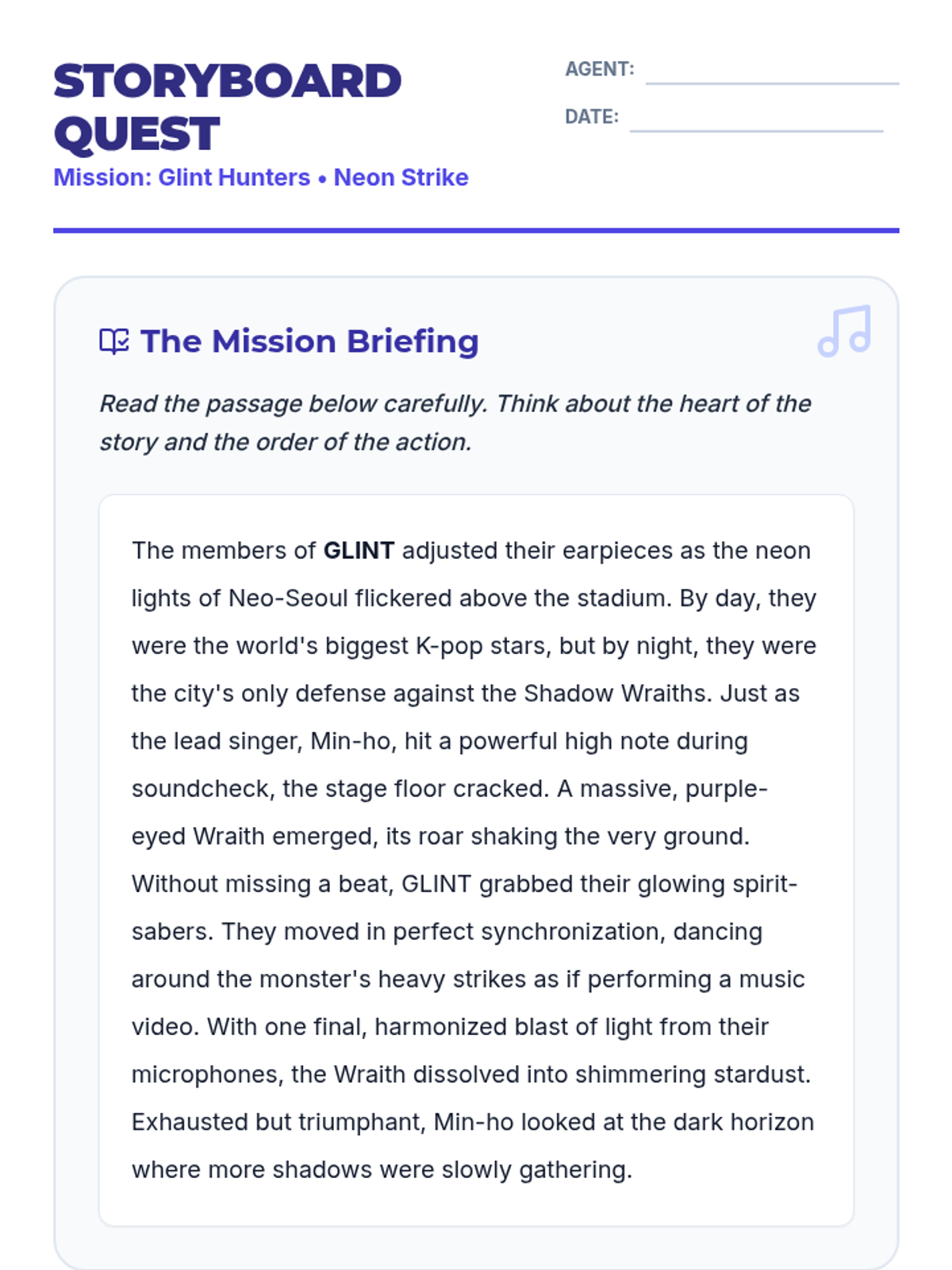
A high-engagement comprehension worksheet featuring a K-pop demon hunter story. Students practice sequencing, identifying the main idea, and making inferences with clear visual cues and structured response areas.
A visually engaging slide deck that teaches the fundamentals of main ideas, sequencing, and inference using an animation studio theme. Features bold colors, Lucide icons, and clear, high-contrast layouts suitable for students with autism.
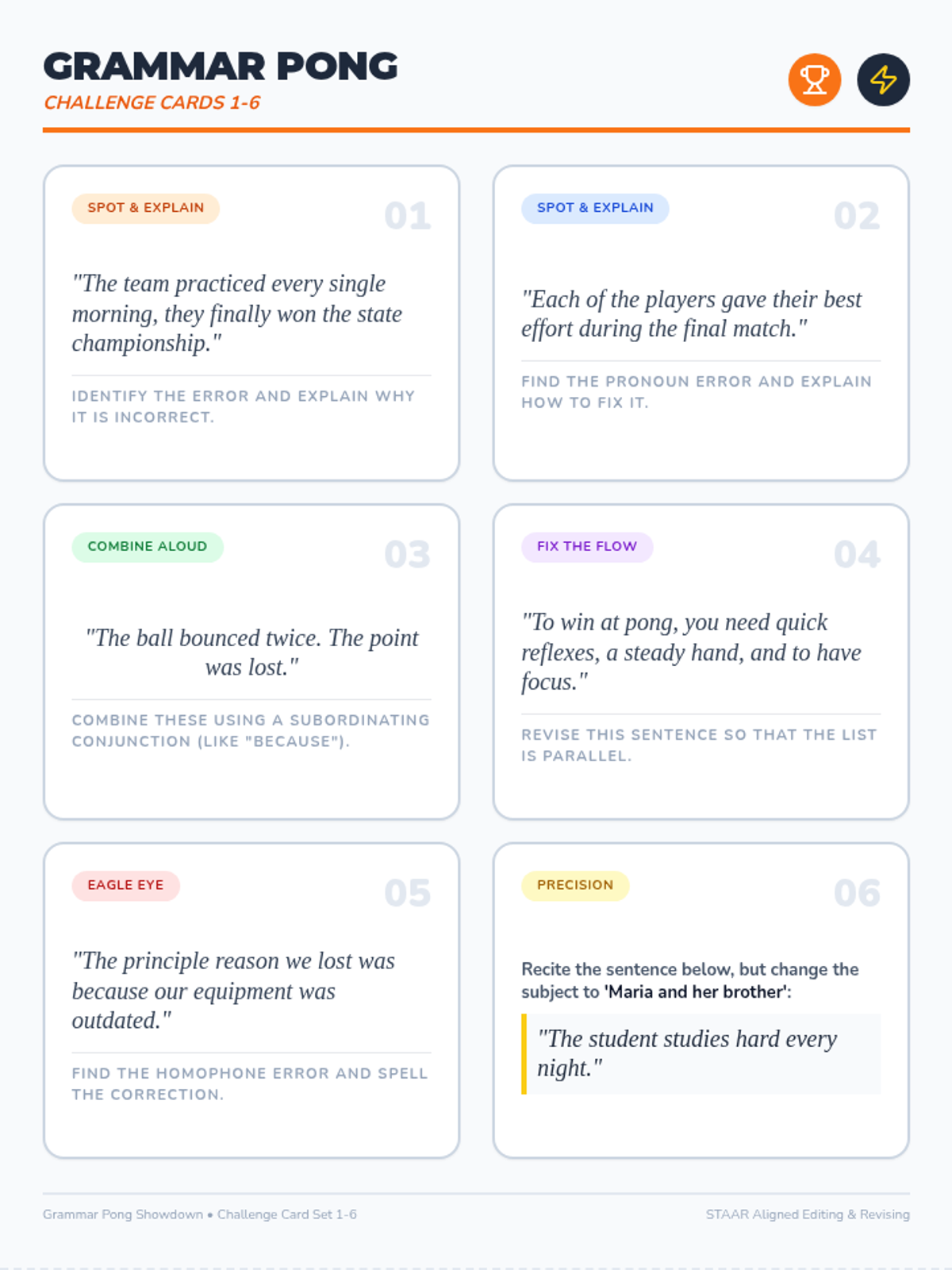
A set of 12 vibrant challenge cards for a classroom grammar game. Each card features an open-ended editing or revising question targeting specific skills like comma splices, parallelism, and pronoun agreement. Card sizing and text layout have been adjusted for optimal readability.
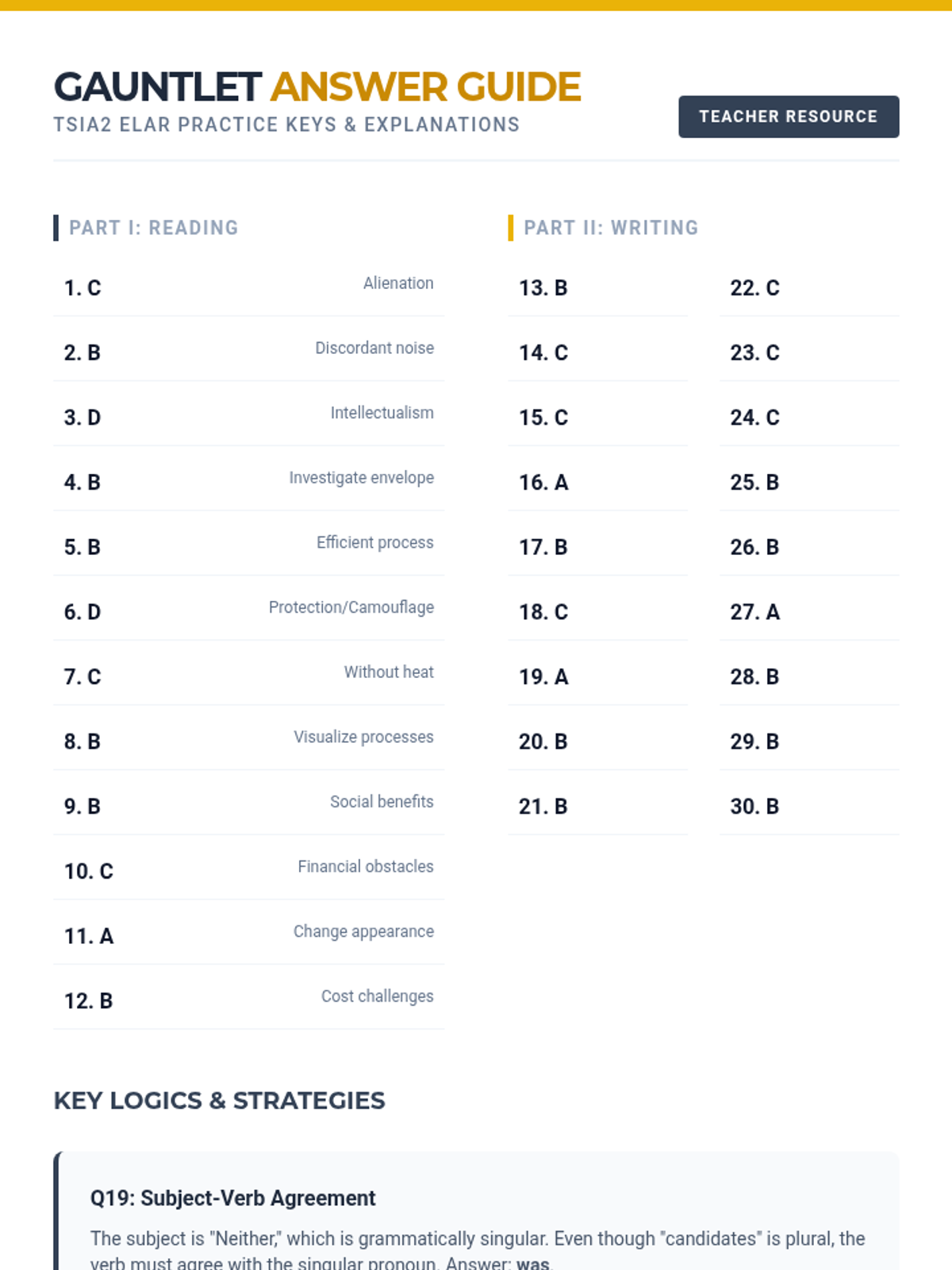
An answer key and explanation guide for the 30-question TSIA2 English Gauntlet Practice test. Provides correct answers, brief logic explanations for challenging grammar rules, and a scoring benchmark.
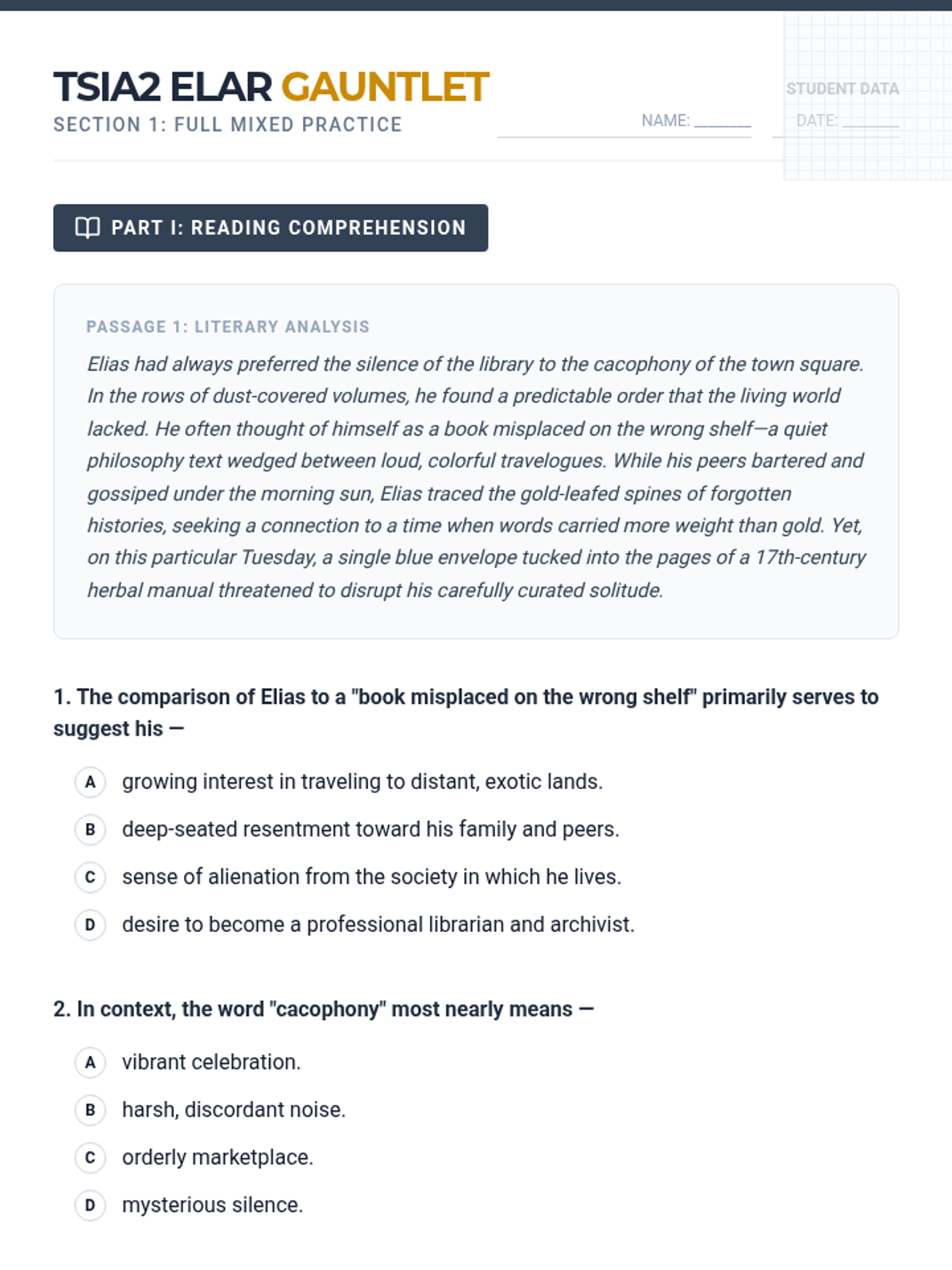
A comprehensive 30-question practice test for the TSIA2 ELAR section. Includes Reading Comprehension (Literary, Informational, and Paired passages) and Writing (Revising and Editing) sections. Expanded to 8 pages for maximum readability and handwriting space.
A 15-slide review presentation covering key TSIA2 ELAR concepts. Optimized for high-quality printing with light backgrounds and high-contrast text while maintaining the professional 'blueprint' aesthetic.
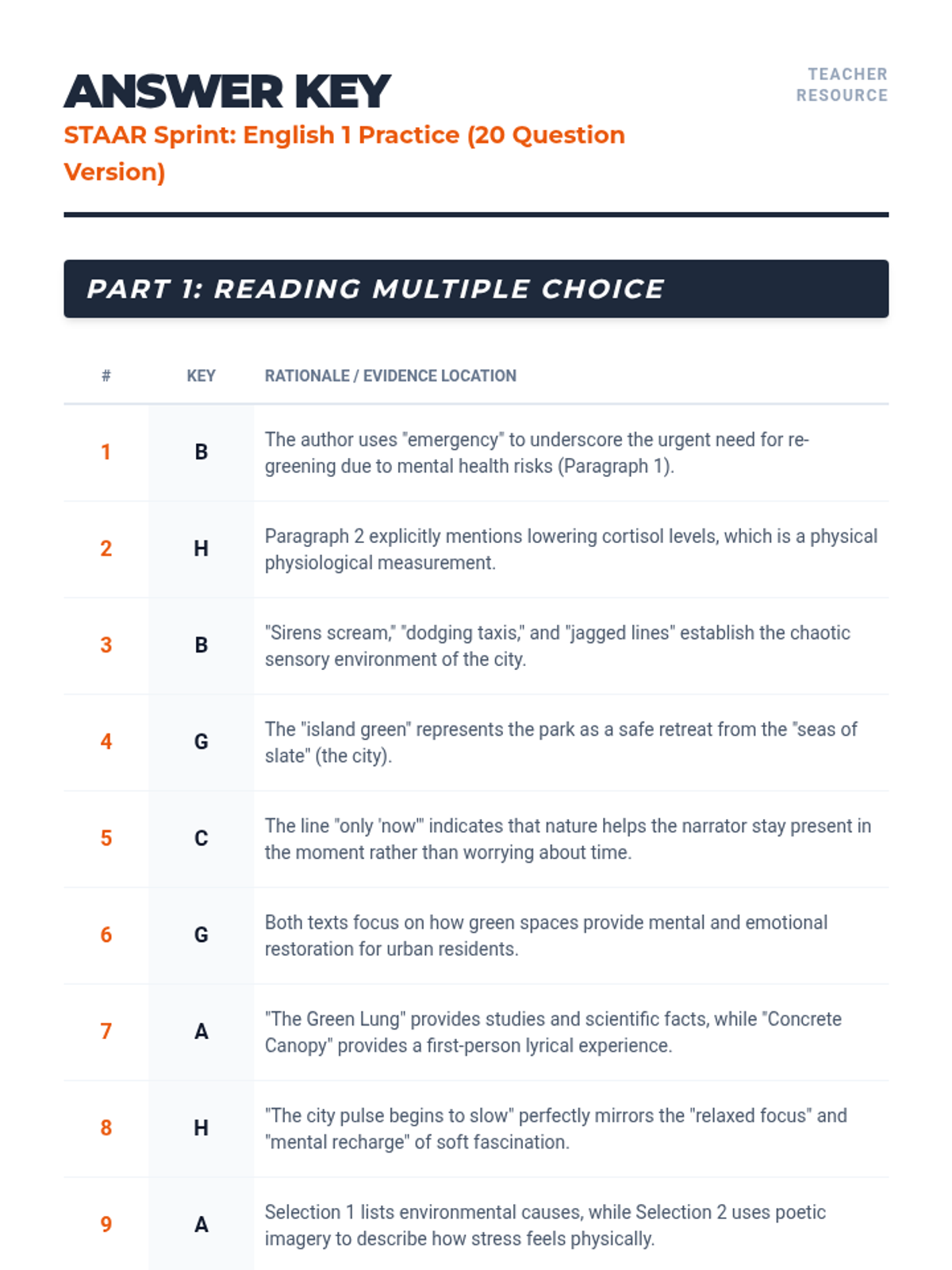
Updated teacher answer key for the 20-question STAAR Sprint Quiz. Includes correct answers and rationales for 10 reading questions, 3 short responses, and 7 editing questions.
A targeted practice quiz mirroring the English 1 STAAR exam, now adjusted to an even 20 questions total. It includes 10 reading comprehension questions, 3 short constructed response items, and 7 editing questions.
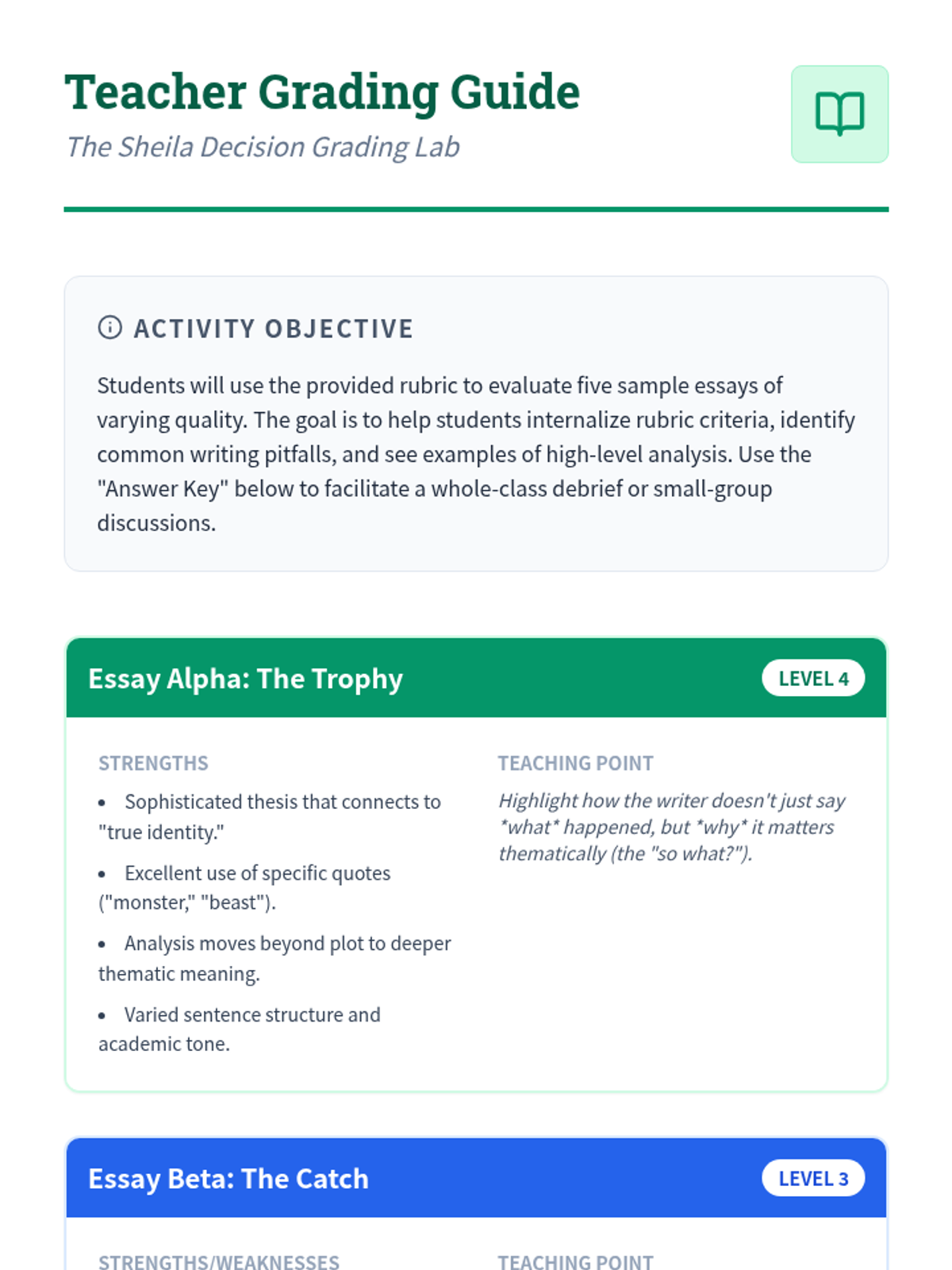
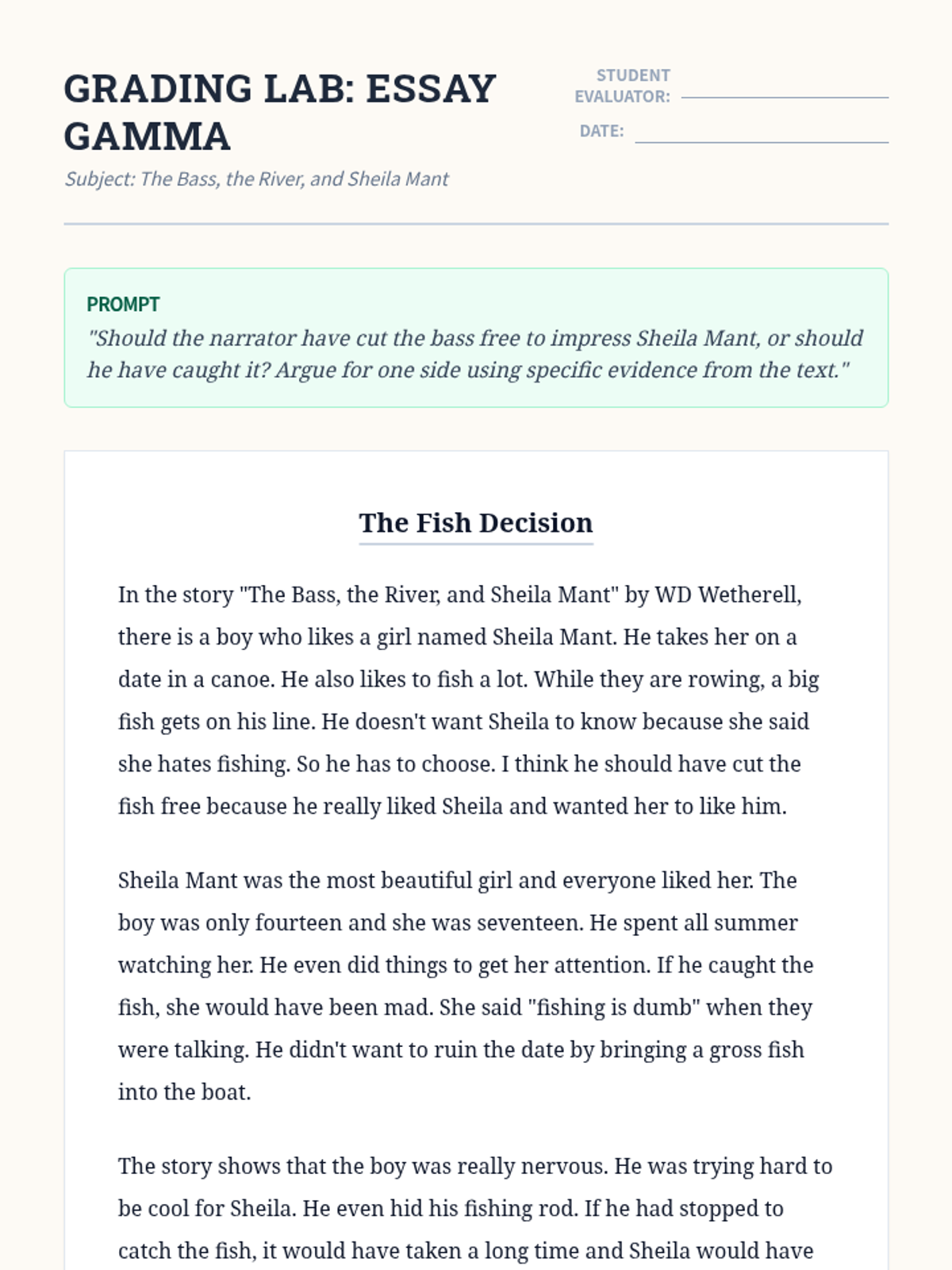
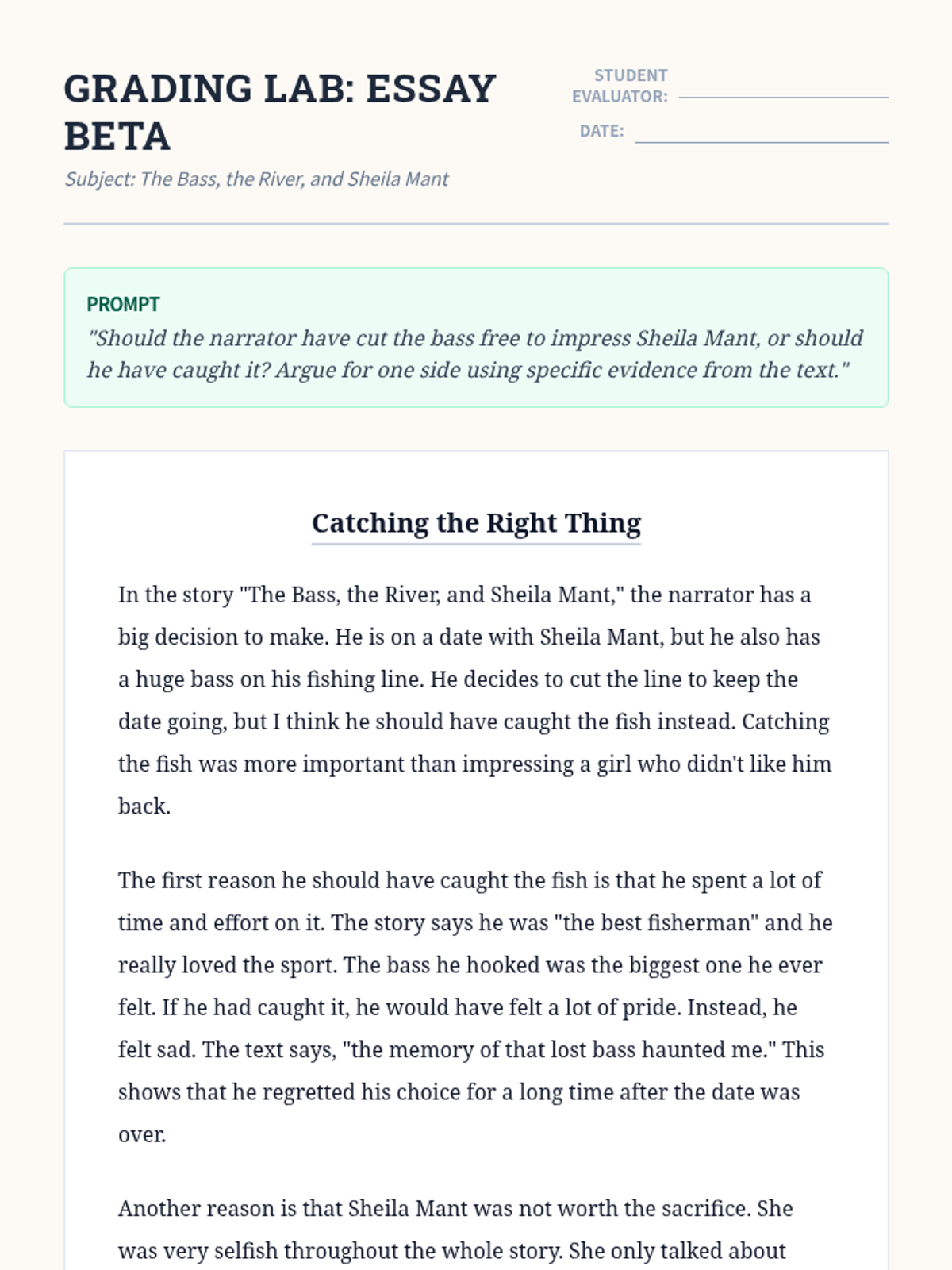
A comprehensive teacher guide for the grading lab, providing intended scores, detailed rationales for each of the five essays, teaching points, and discussion prompts for a whole-class debrief.
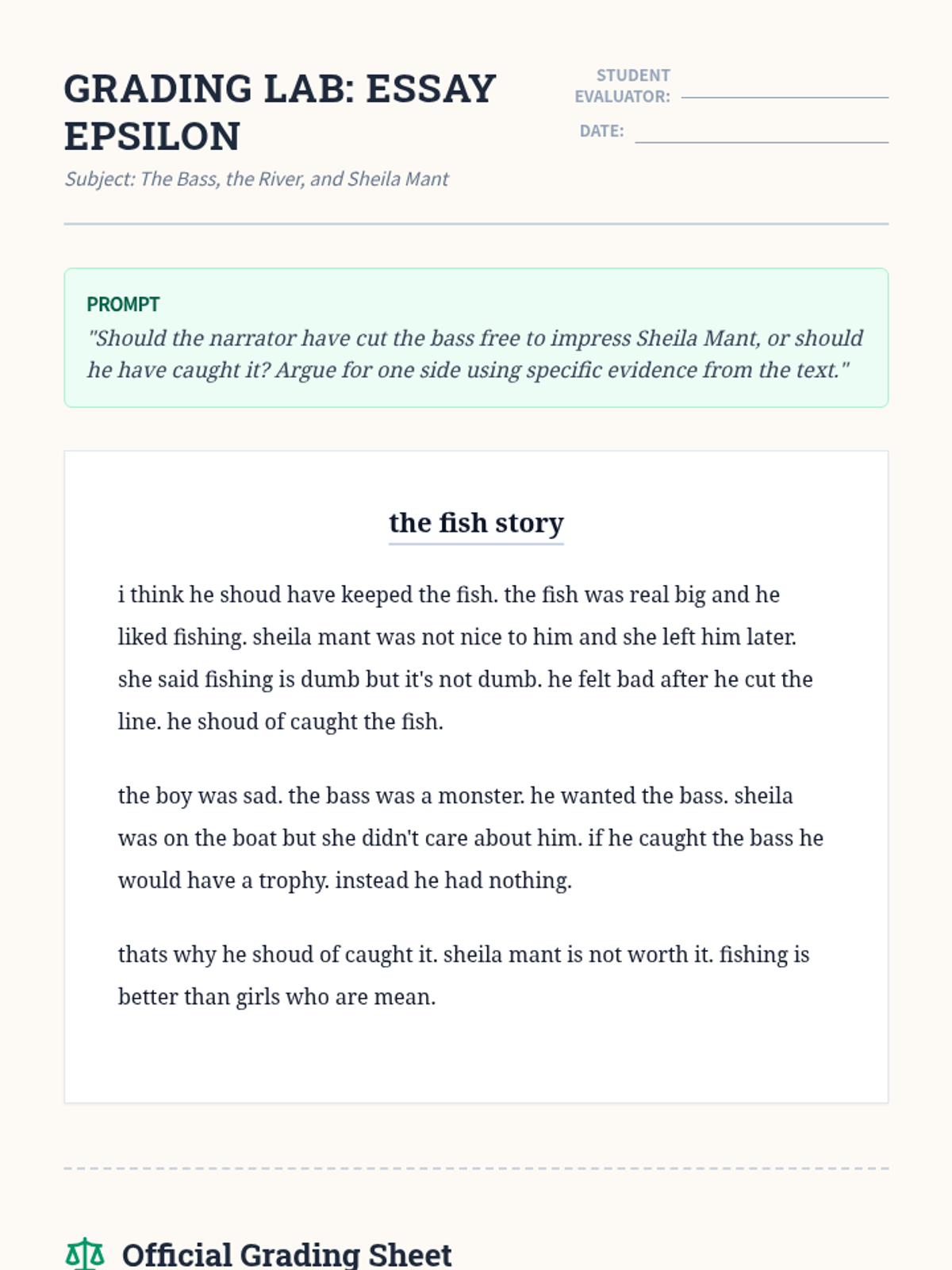
The fifth practice essay for the grading lab, featuring an emerging/beginning (Level 1) response. This essay is very brief, lacks textual evidence, and contains significant grammatical and mechanical errors.
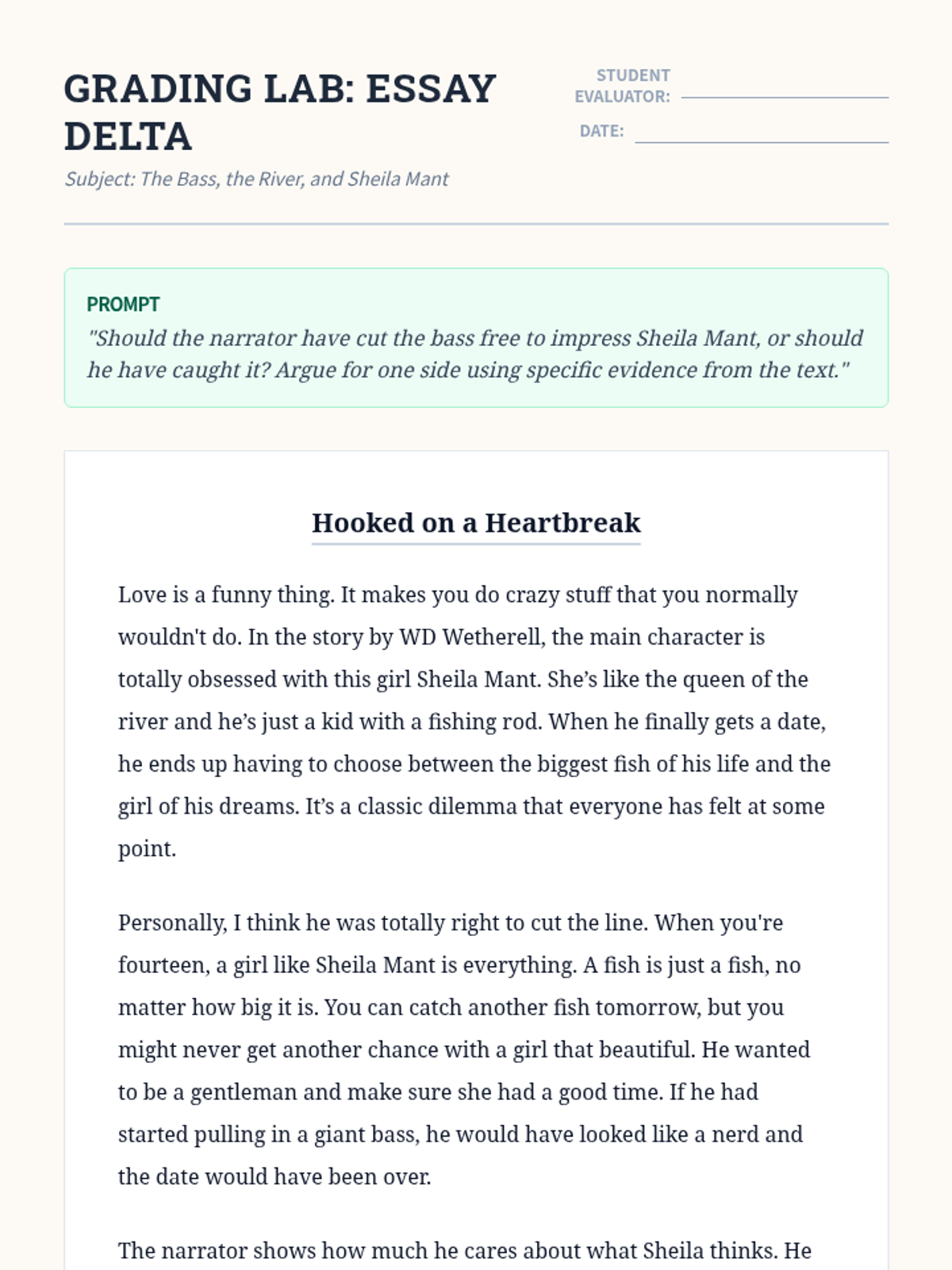
The fourth practice essay for the grading lab, featuring a stylistically strong but academically weak (Level 2/3) response. While the writing is engaging, it relies on personal opinion rather than textual evidence and analysis.
The third practice essay for the grading lab, featuring a developing (Level 2) response. This essay relies heavily on plot summary and lacks specific textual evidence or deep analysis.
The second practice essay for the grading lab, featuring a proficient (Level 3) response. The writing is clear and the claim is supported, but the analysis is more straightforward and less nuanced than Essay Alpha.
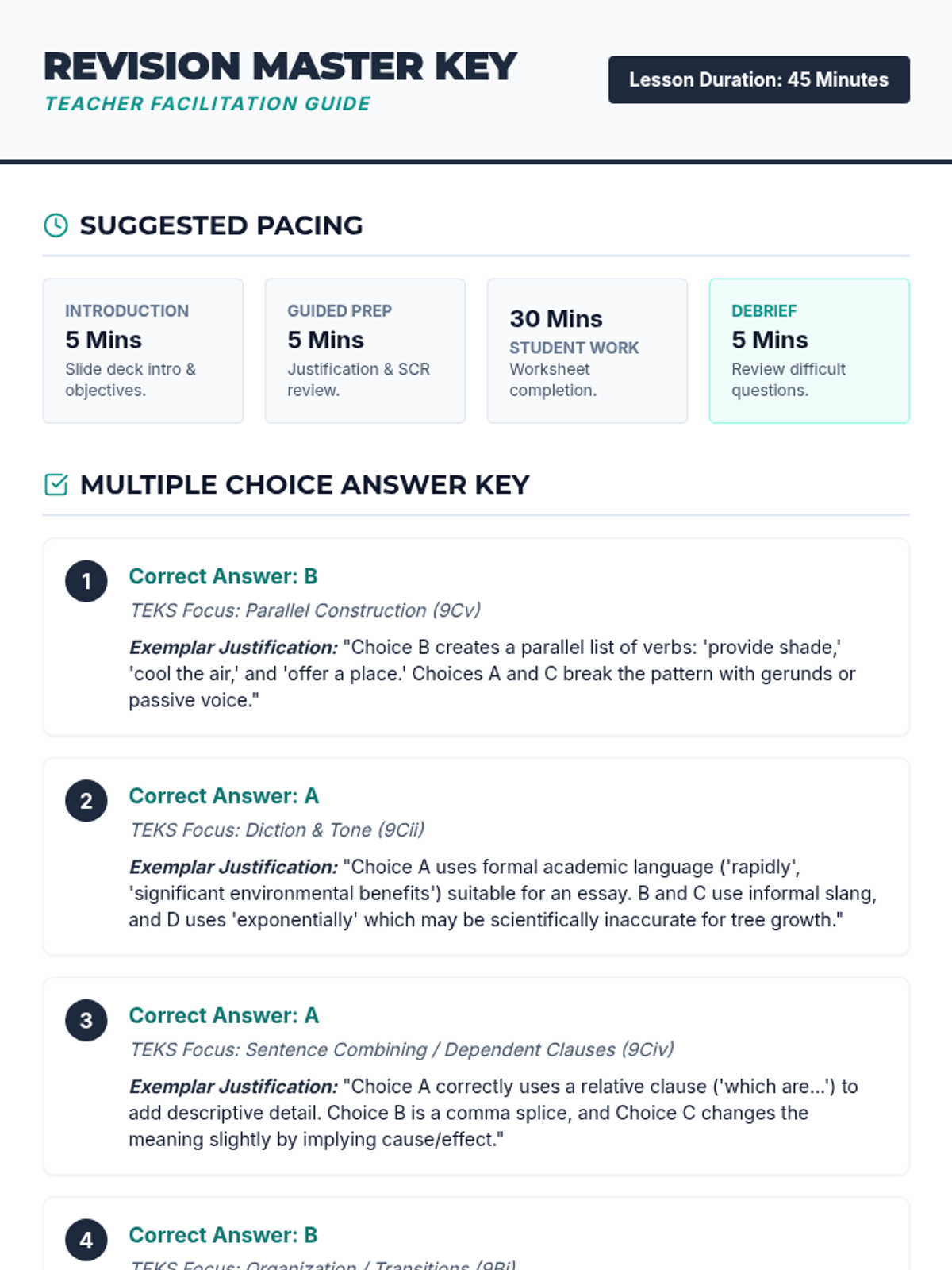
A comprehensive teacher facilitation guide containing a 45-minute pacing schedule, a detailed answer key for the multiple-choice questions with exemplar student justifications, and a sample Short Constructed Response with a STAAR-aligned 2-point rubric.
A visual presentation to guide the 45-minute revision workshop. Includes session objectives, a review of key STAAR revision TEKS, a strategy for writing justifications, and a formula for successful Short Constructed Responses.
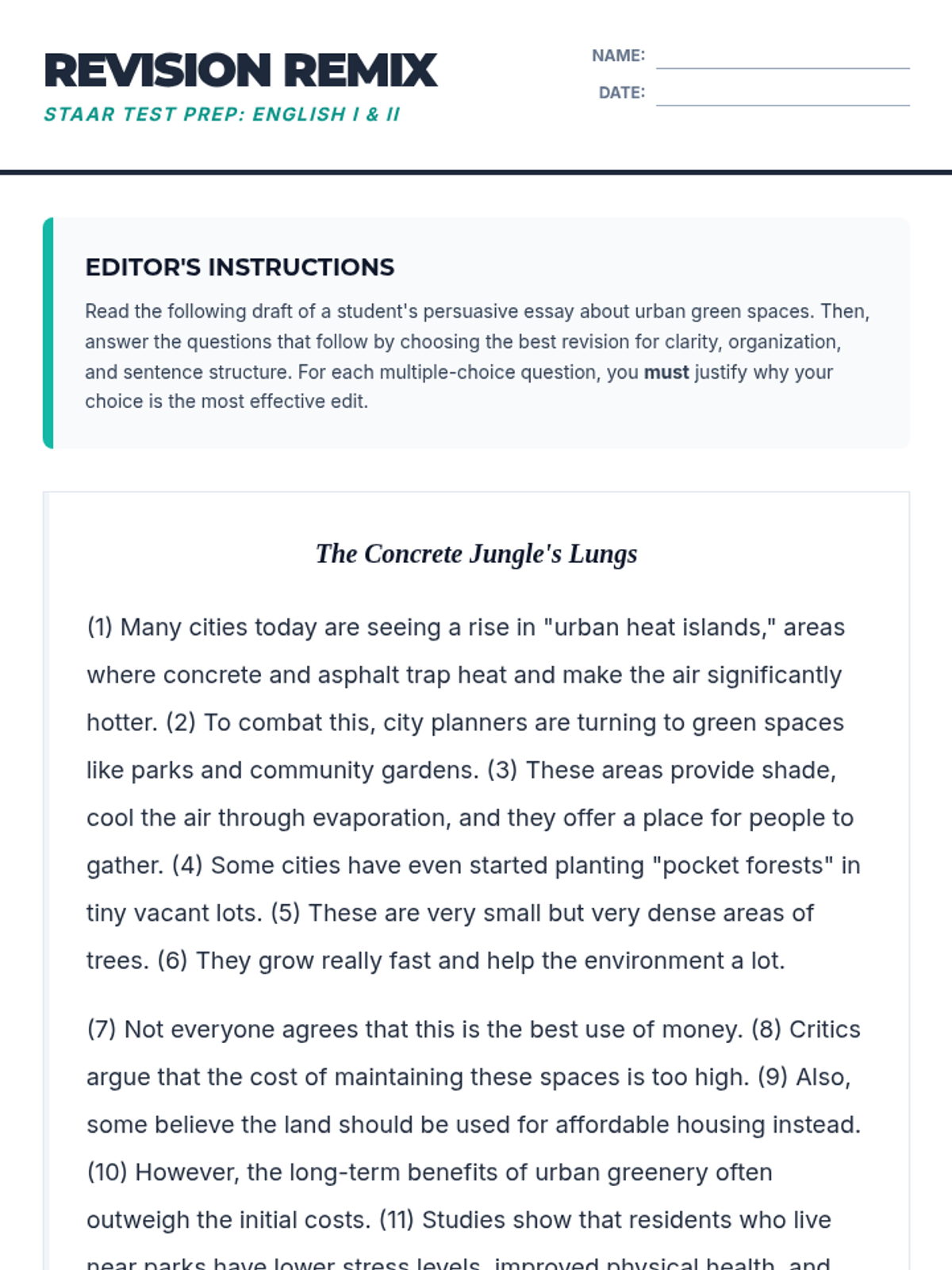
A STAAR-formatted revision worksheet featuring a multi-paragraph passage and six multiple-choice questions with justification areas. It concludes with a Short Constructed Response (SCR) prompt targeting specific grammatical and organizational TEKS.
A visual presentation for the Who vs. Whom lesson, following the Khan Academy aesthetic with neon highlights, including an embedded video and structured pauses for discussion.
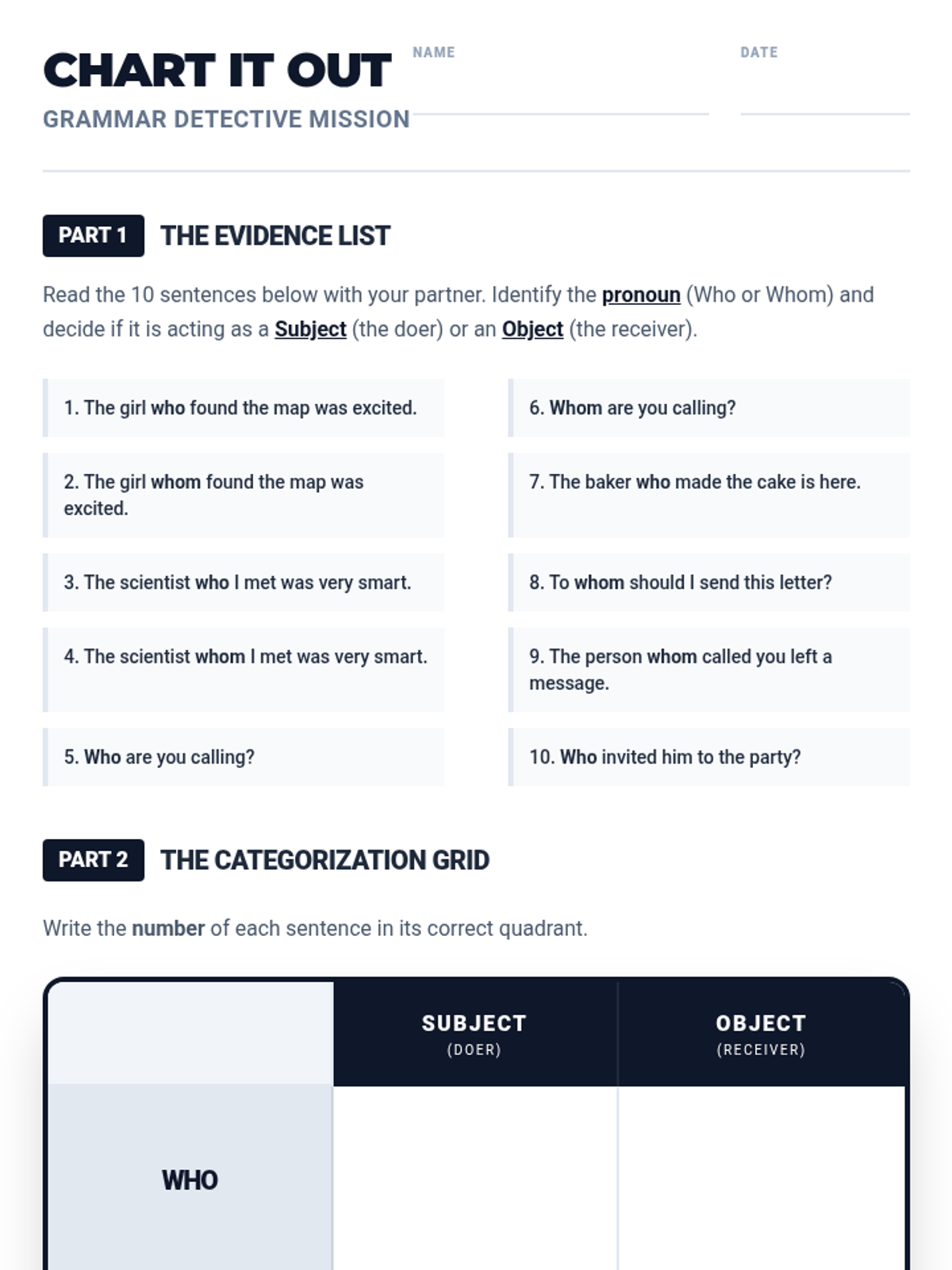
A student activity sheet for categorizing sentences into the 2x2 grid based on the 'One-Way Street' rule, including space for creating an 'impossible' sentence.
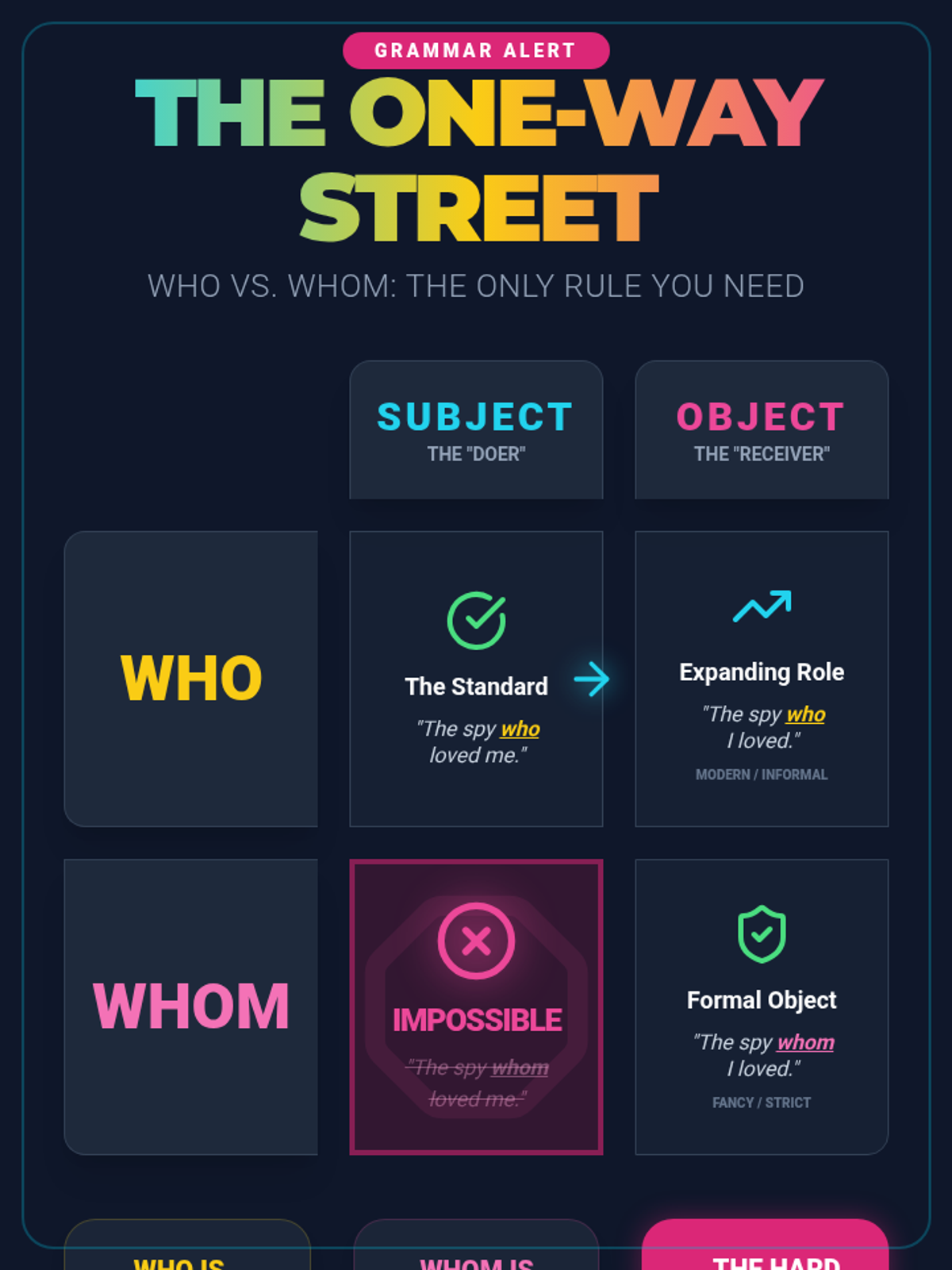
A high-contrast anchor chart for the 'One-Way Street' grammar rule, illustrating that 'who' is expanding into the object space while 'whom' remains strictly an object pronoun.
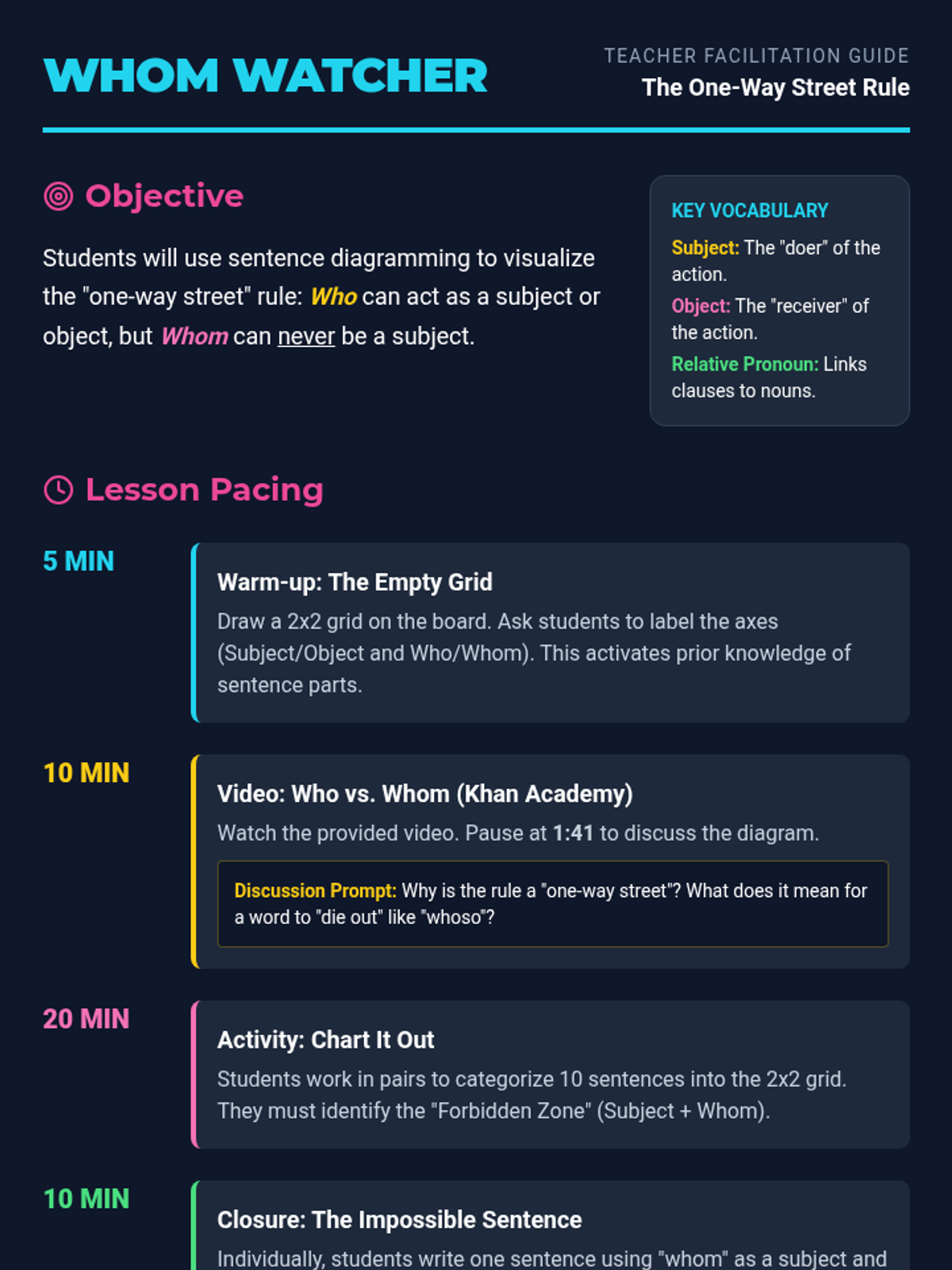
A comprehensive teacher facilitation guide for the Who vs. Whom lesson, featuring a pacing guide, discussion prompts, and an answer key for the categorization activity.
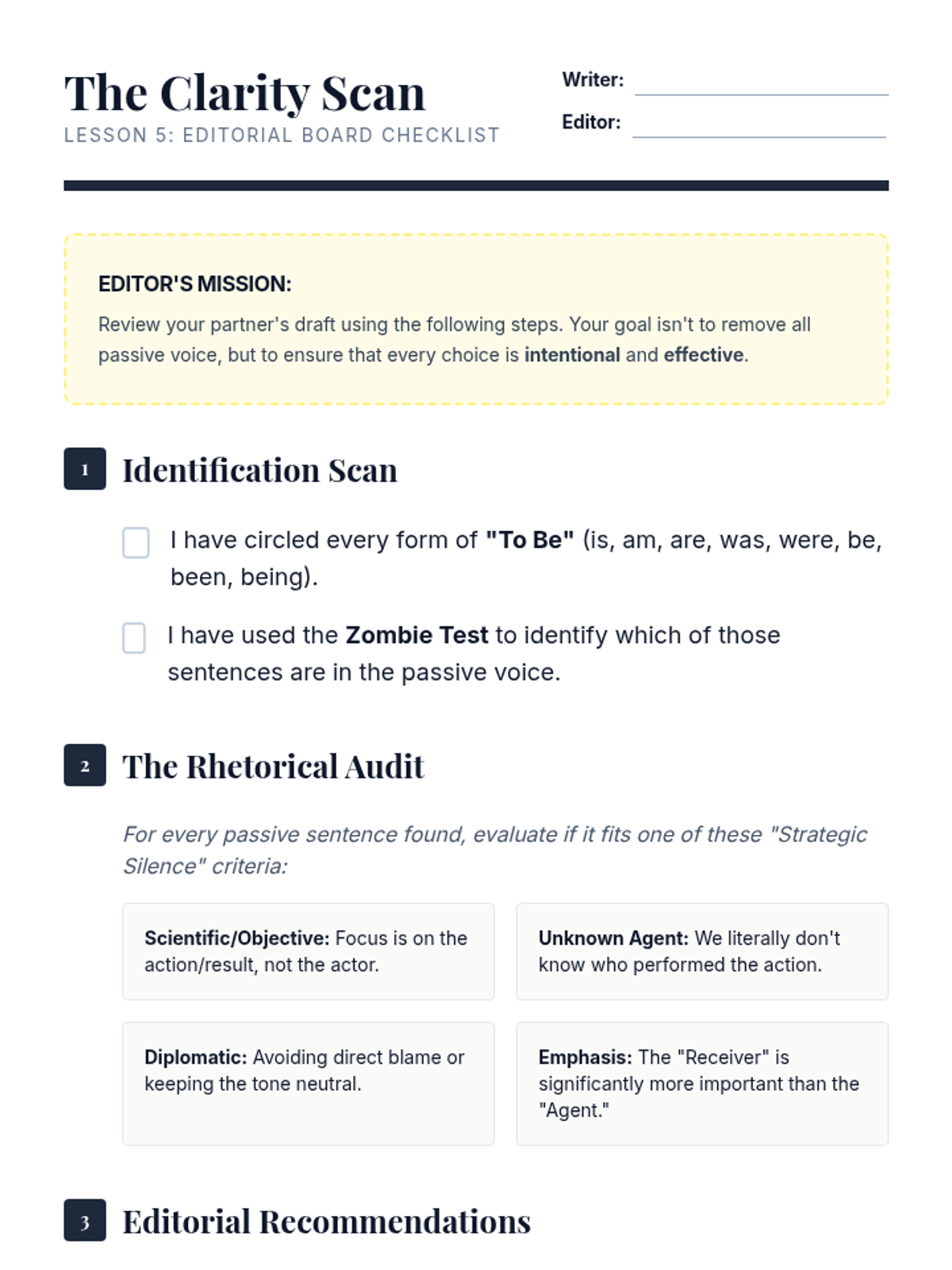
A comprehensive peer-review checklist and exit ticket for the final lesson, focusing on auditing voice usage and applying rhetorical choices.
Culminating slides for Lesson 5, guiding students through a peer-review workshop focused on voice and writing clarity.
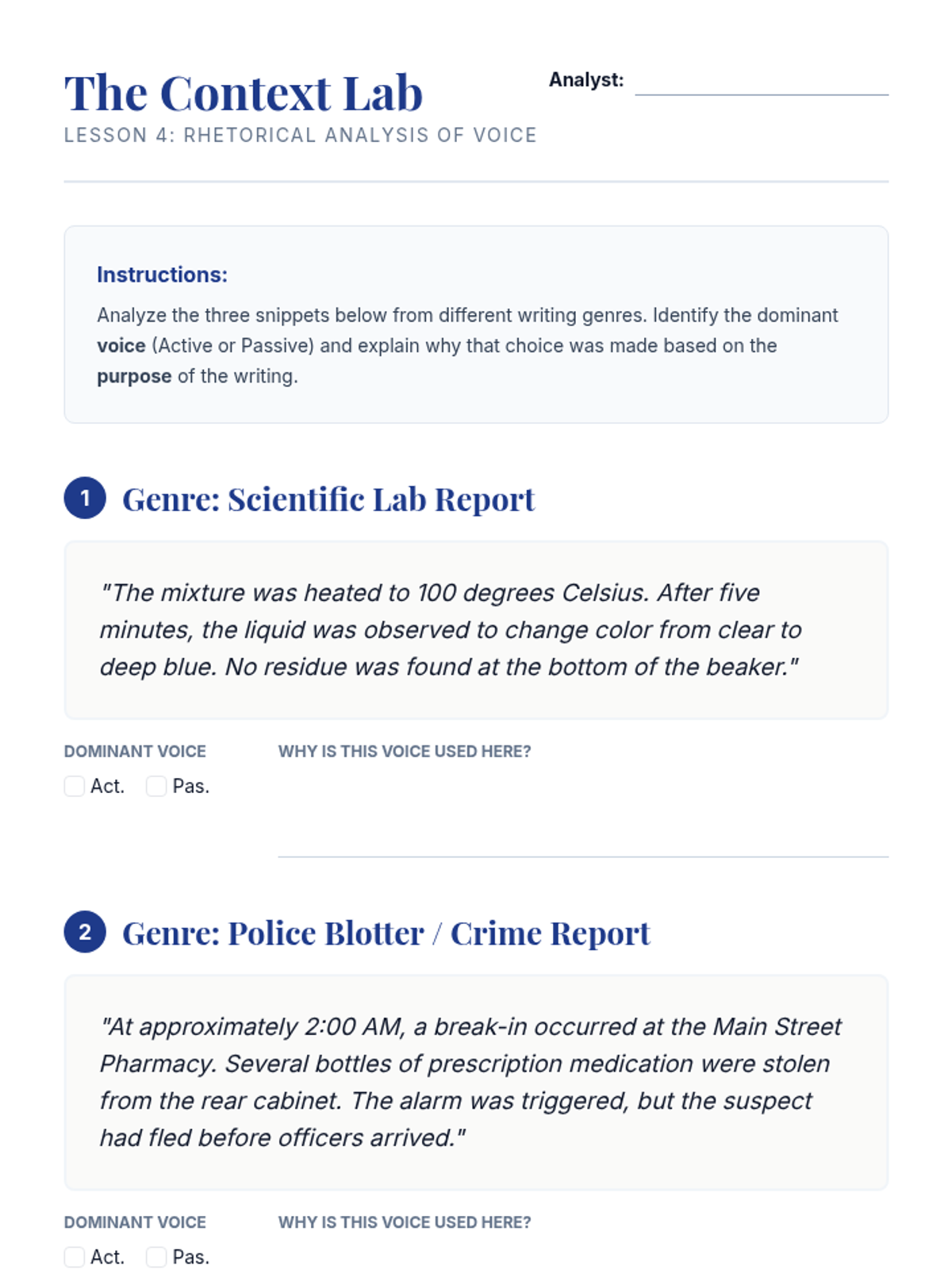
An activity for Lesson 4 where students analyze three different genres of writing to determine when and why active or passive voice is most appropriate.
Slides for Lesson 4, exploring scenarios where passive voice is rhetorically appropriate, such as scientific reporting or when an agent is unknown.
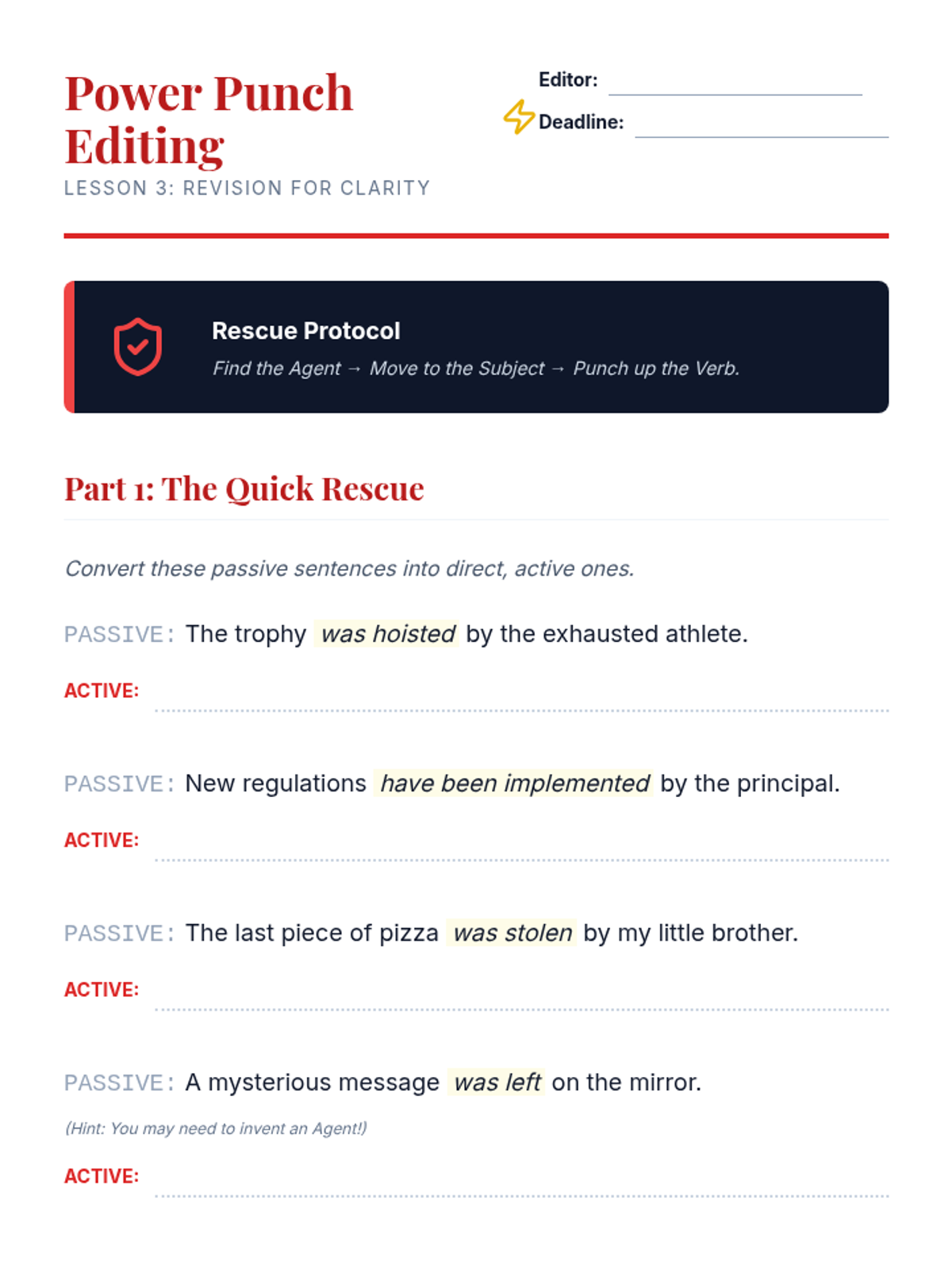
A revision-focused worksheet for Lesson 3, guiding students to convert passive sentences and paragraphs into clear, active writing.
Slides for Lesson 3, focusing on revising passive sentences into active ones to improve clarity, directness, and engagement in writing.
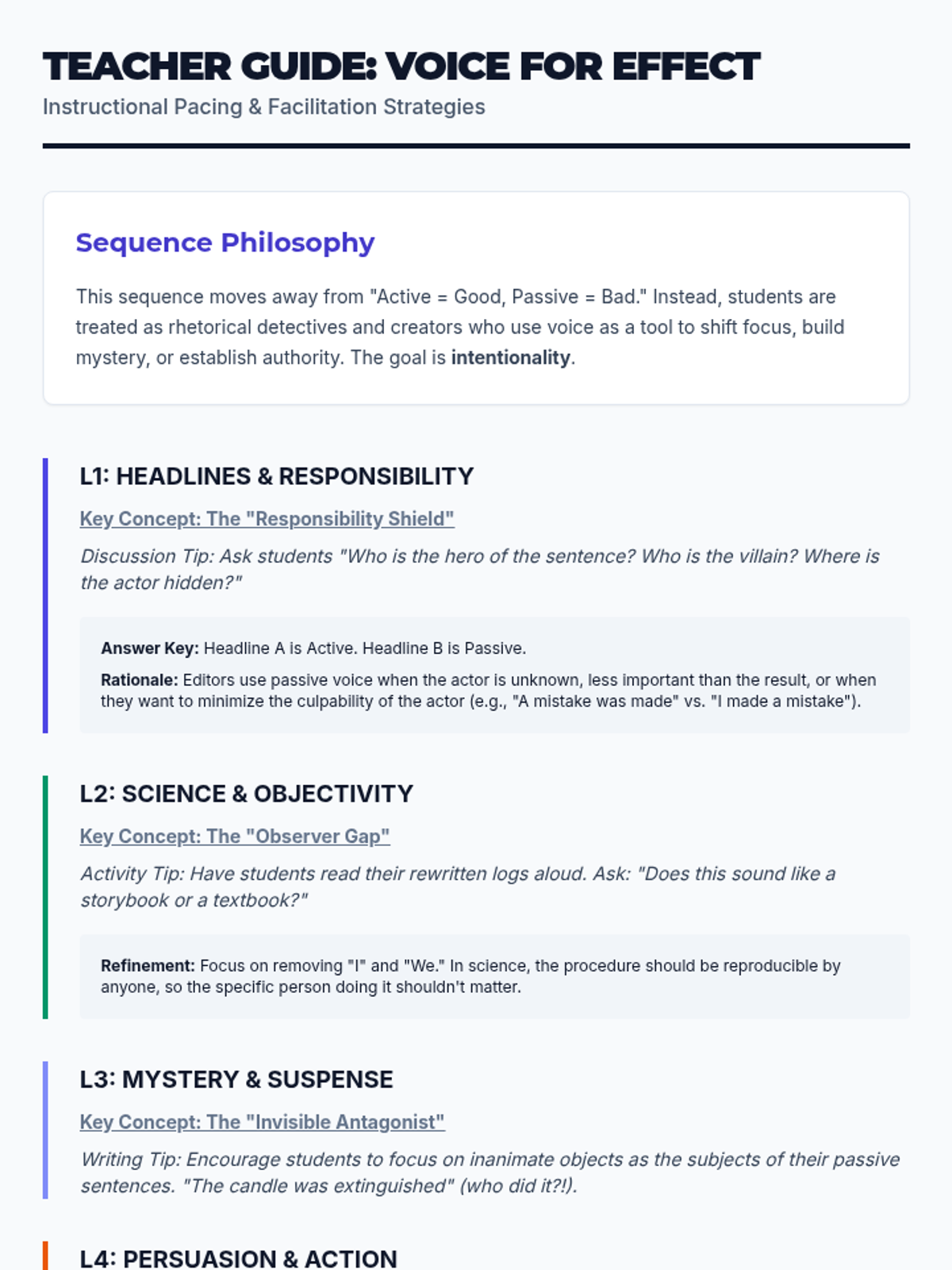
A comprehensive teacher's guide providing instructional strategies, discussion prompts, and a rubric for the Voice for Effect sequence.
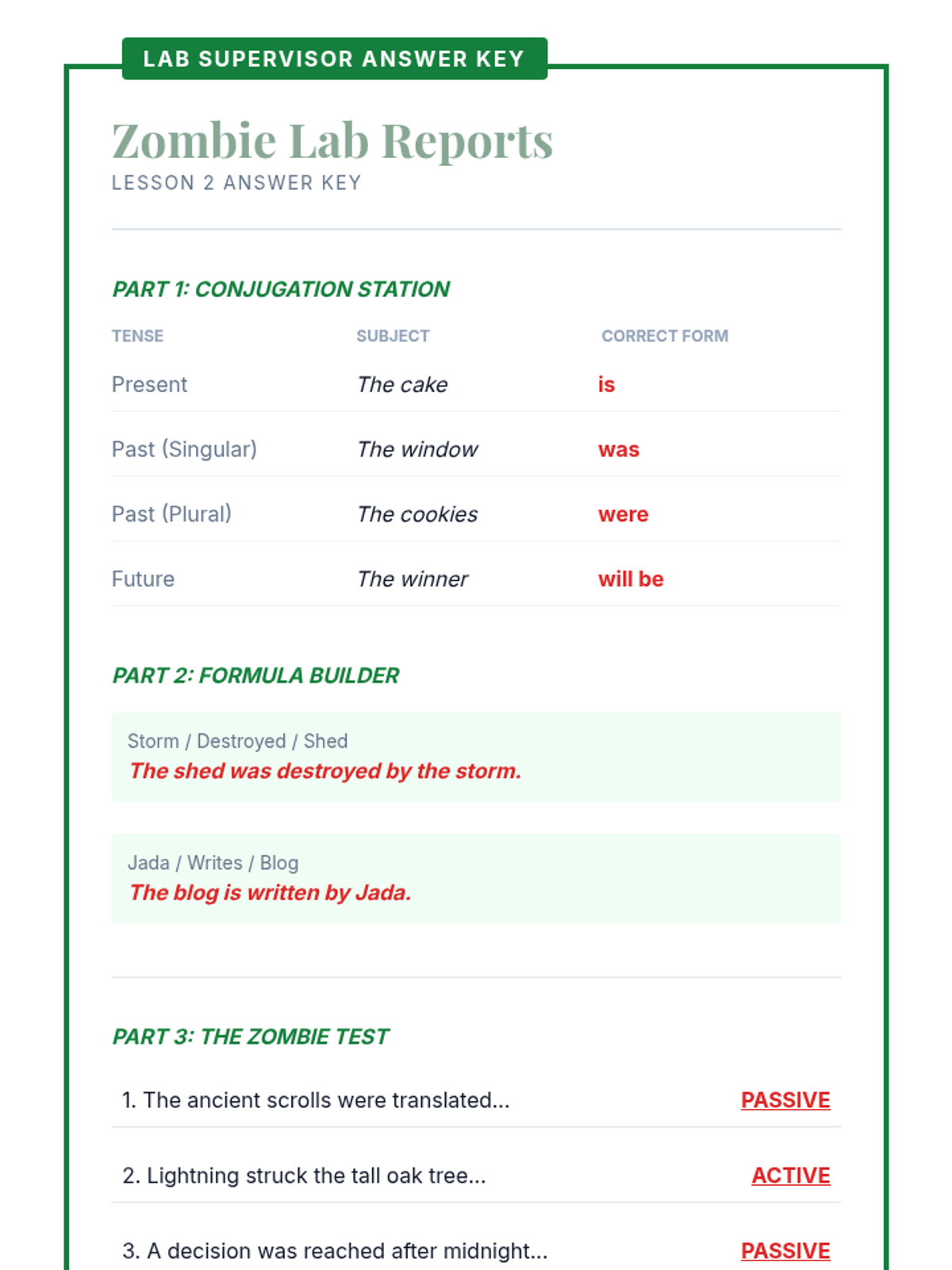
Teacher answer key for the Zombie Lab Worksheet, providing correct verb conjugations and voice identifications.
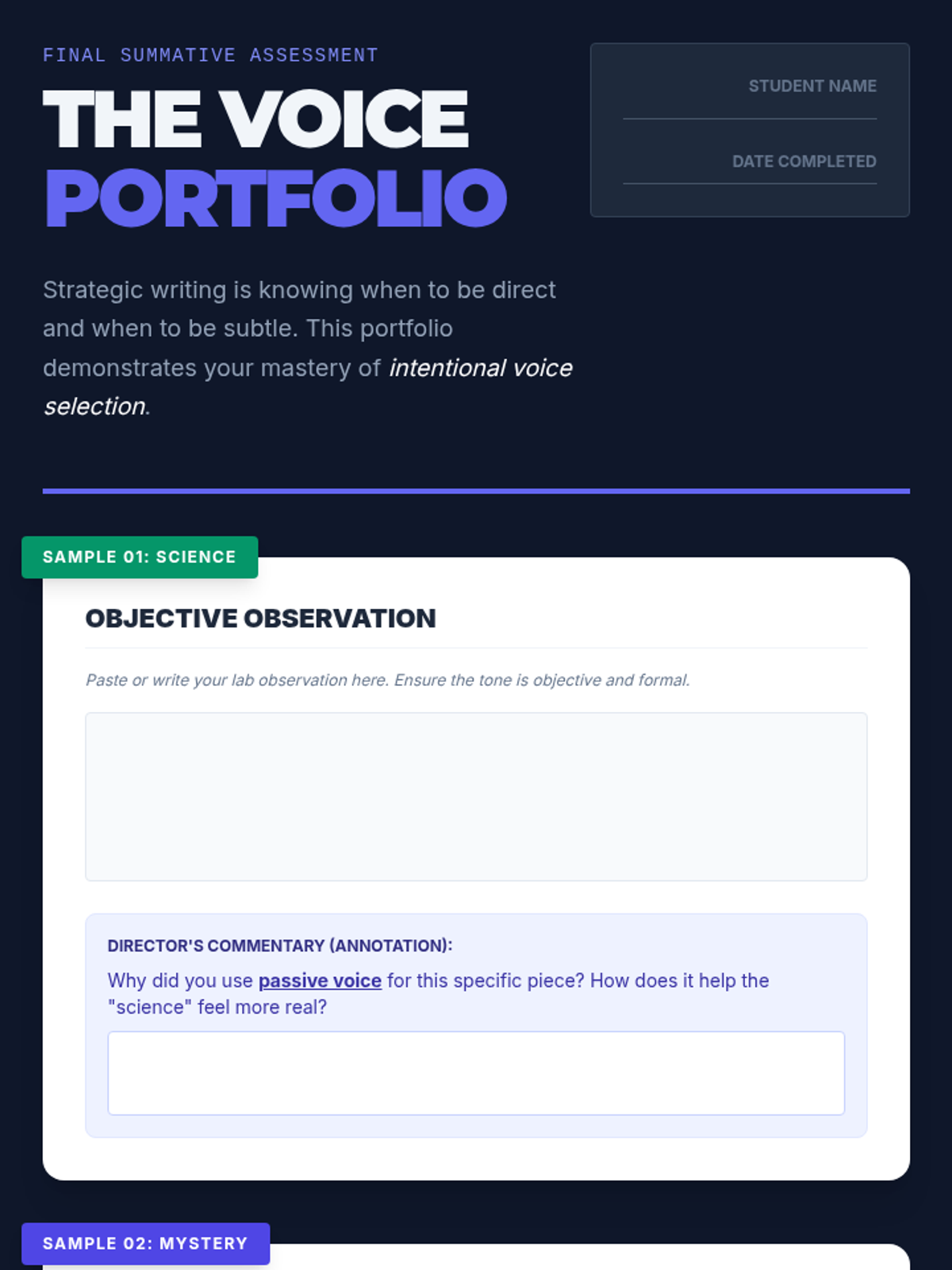
The summative project where students compile writing samples from different genres and annotate their rhetorical choices regarding active and passive voice.
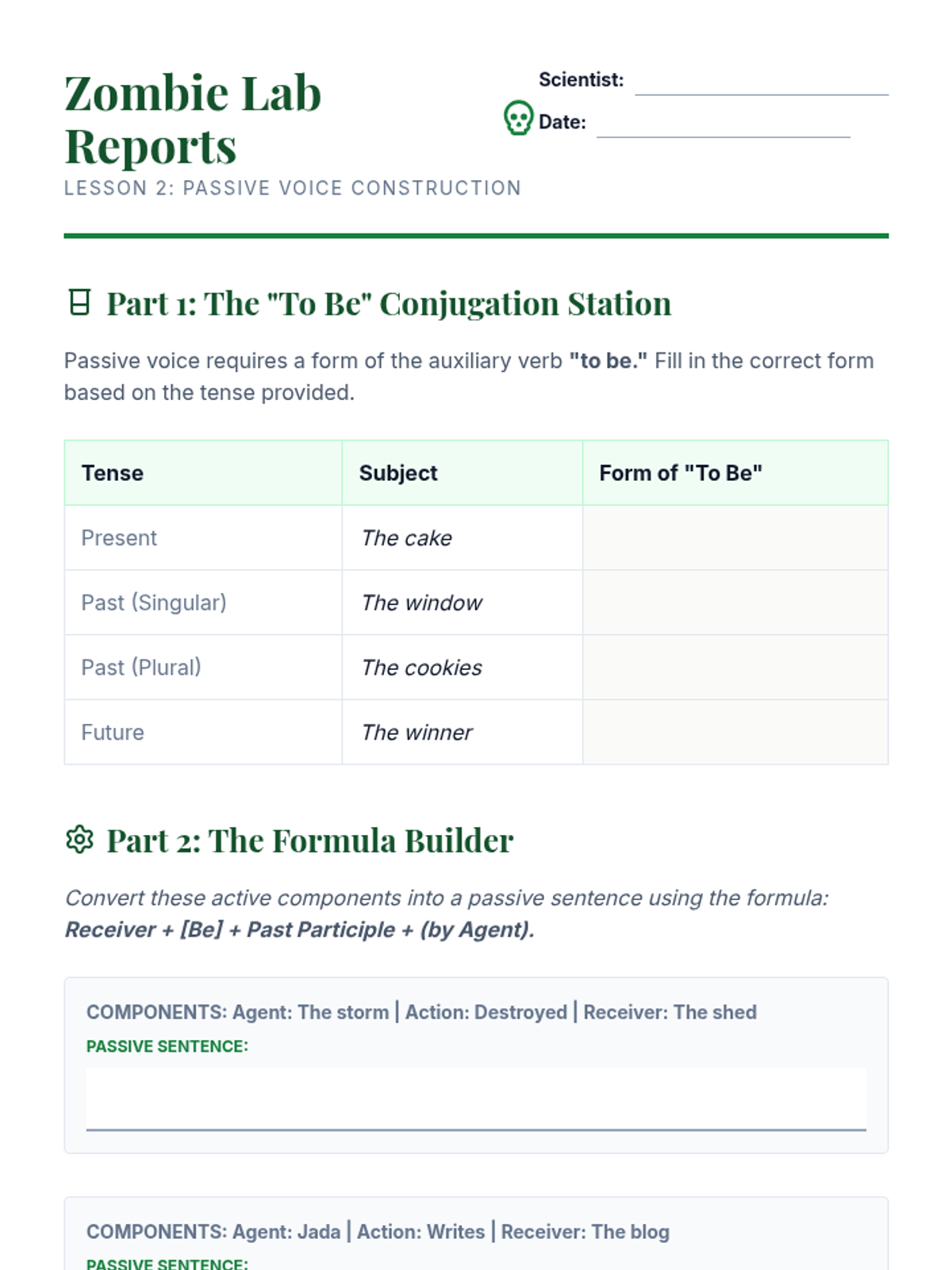
A worksheet for Lesson 2 focusing on passive voice construction and the 'Zombie Test' identification method.
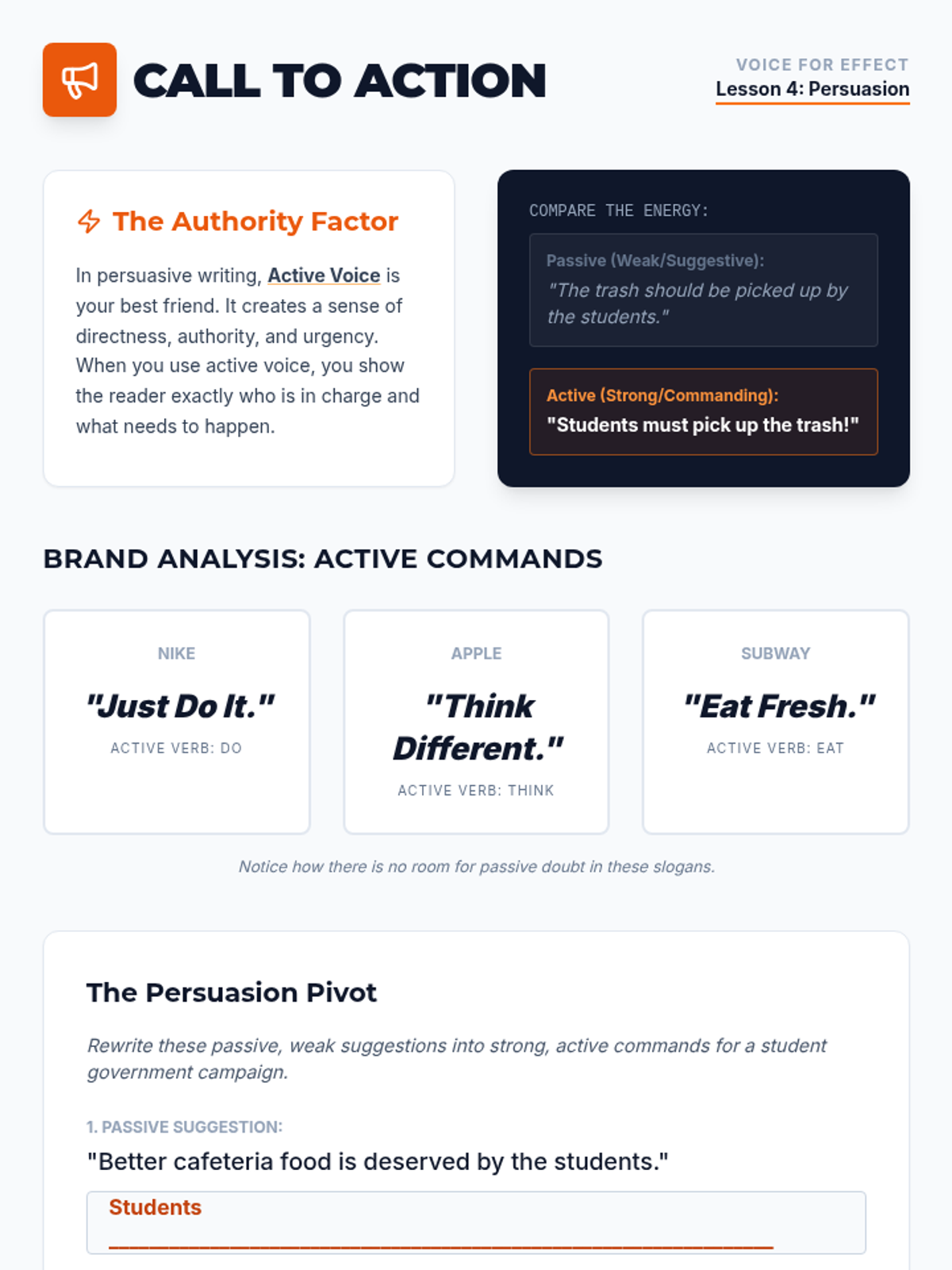
Students focus on the use of active voice in persuasive writing to create authority, urgency, and direct impact.
Slides for Lesson 2, teaching the structural formula of passive voice (be + past participle) and introducing the 'Zombie Test' for identification.
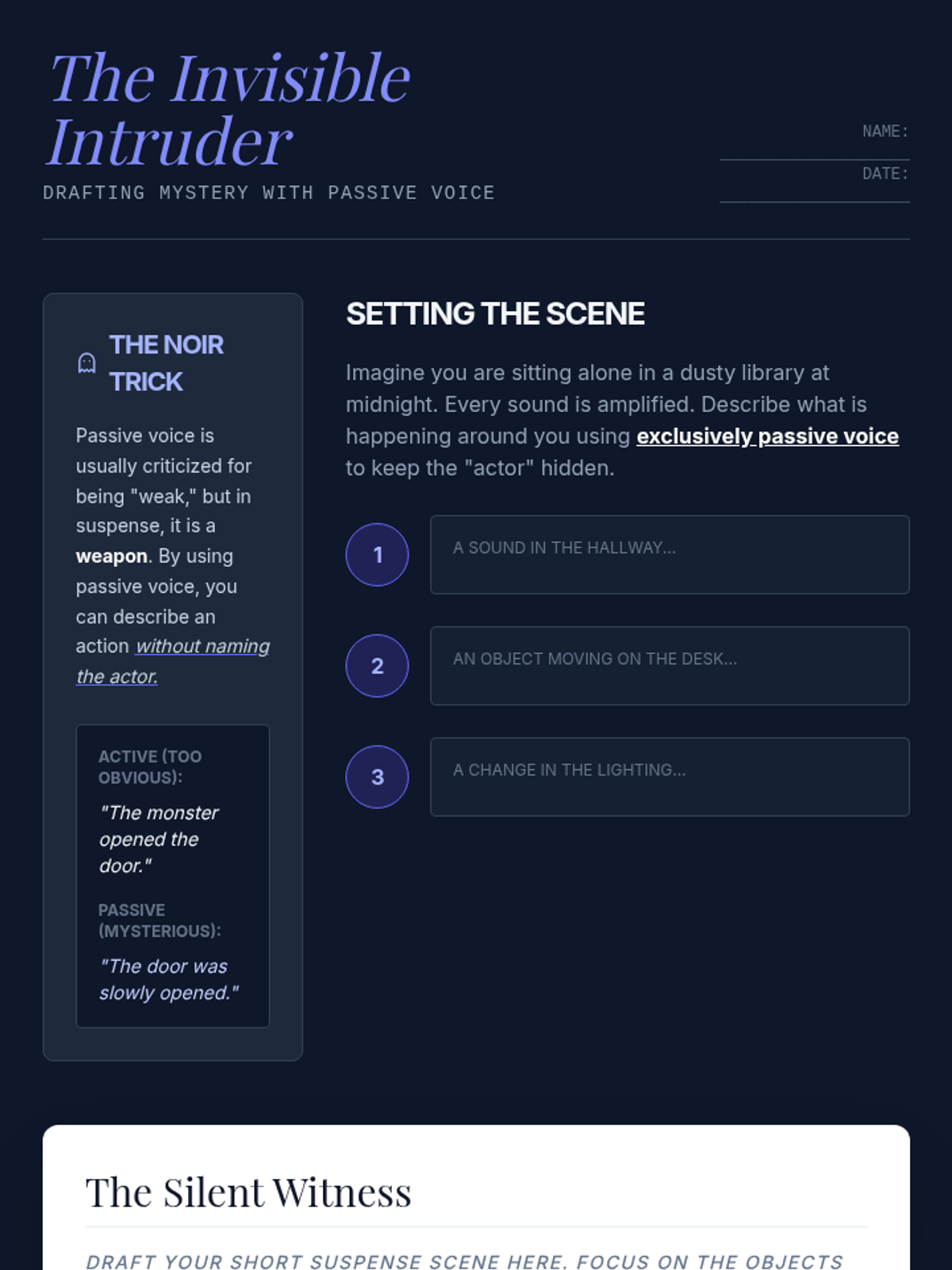
A creative writing activity where students use passive voice to build mystery and suspense by withholding the identity of the actor.
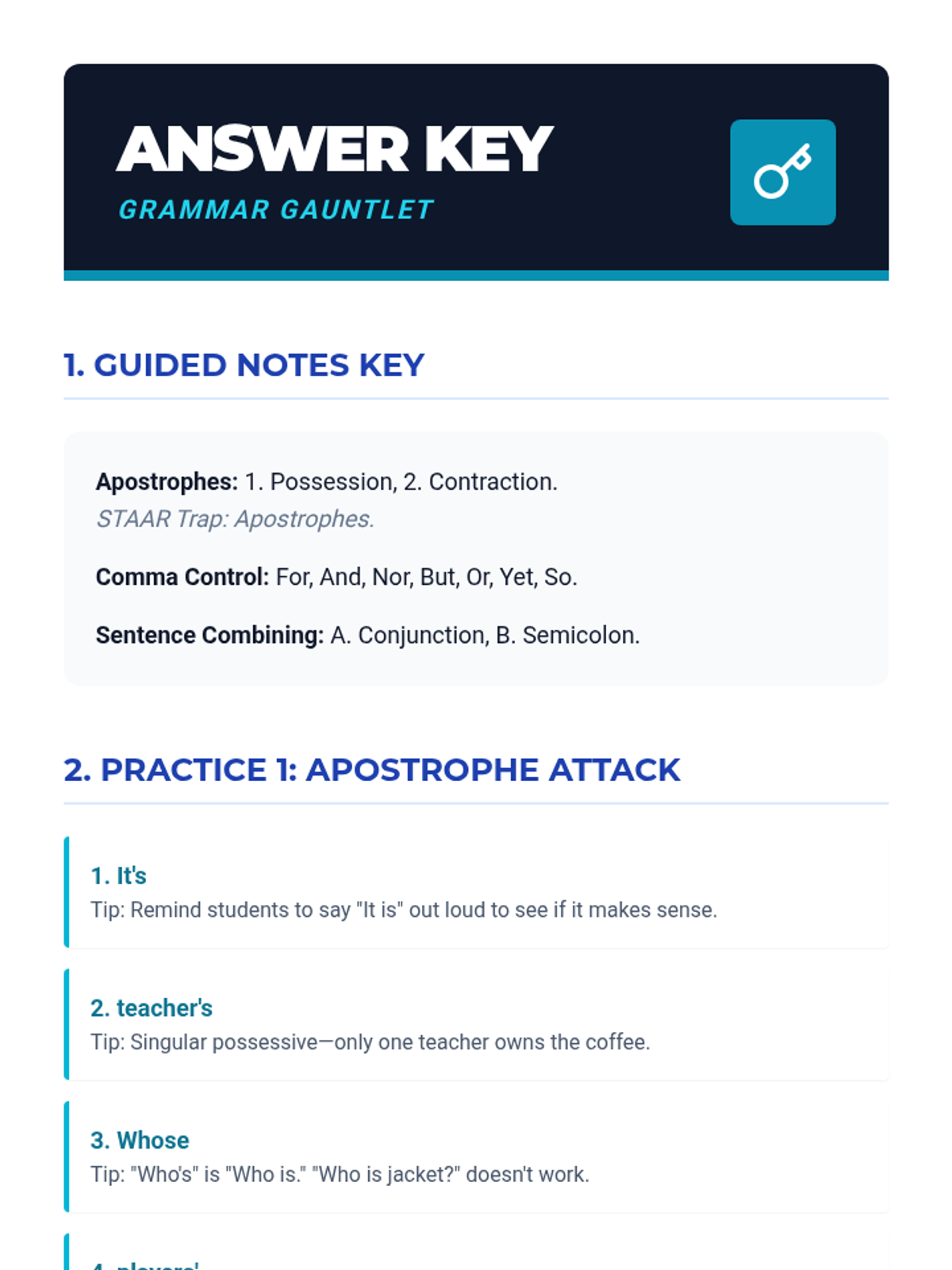
An answer key and teacher facilitation guide for the Grammar Gauntlet session, providing correct answers, explanations, and small-group teaching tips.
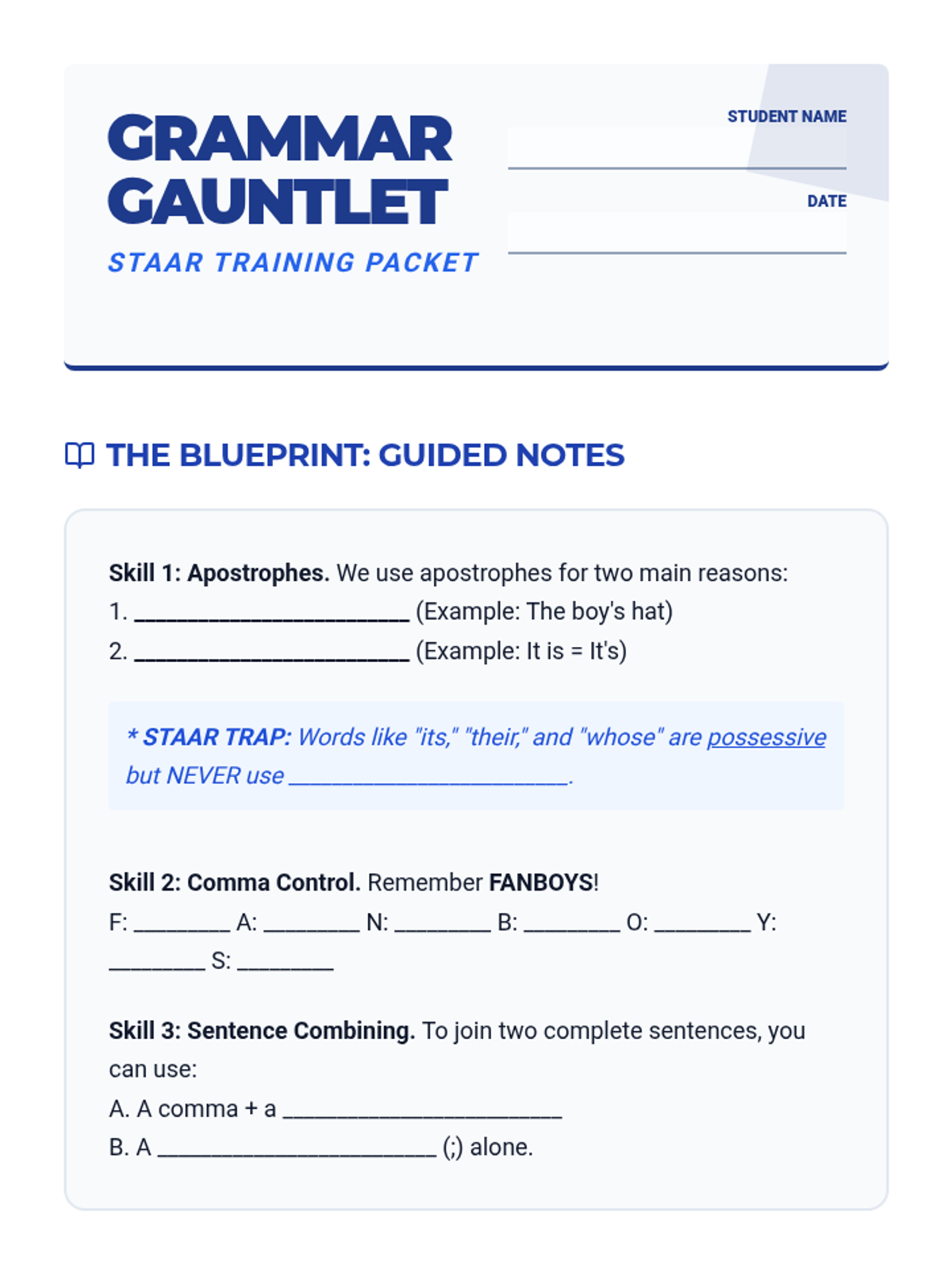
A student practice packet for a STAAR grammar tutoring session, featuring guided notes, focused practice on apostrophes and commas, and a STAAR-modeled mini-test.
A visual presentation for a STAAR grammar tutoring session, covering apostrophes, commas, and sentence combining with clear examples and visual aids.
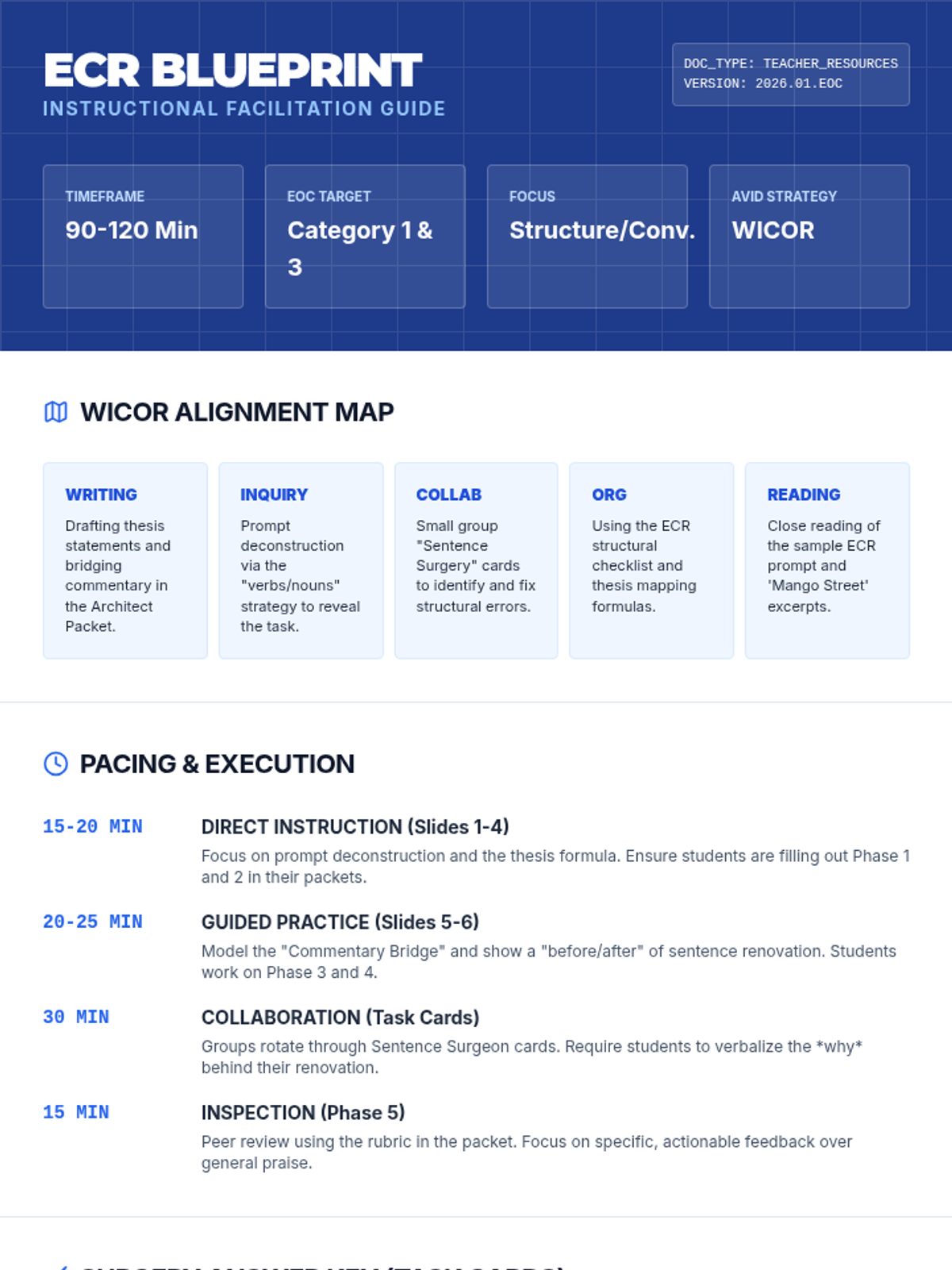
A detailed teacher resource for delivering "The ECR Blueprint" lesson. Includes a WICOR alignment map, instructional pacing guide, troubleshooting tips for common student misconceptions, and the full answer key for the "Sentence Surgeon" collaborative activity.
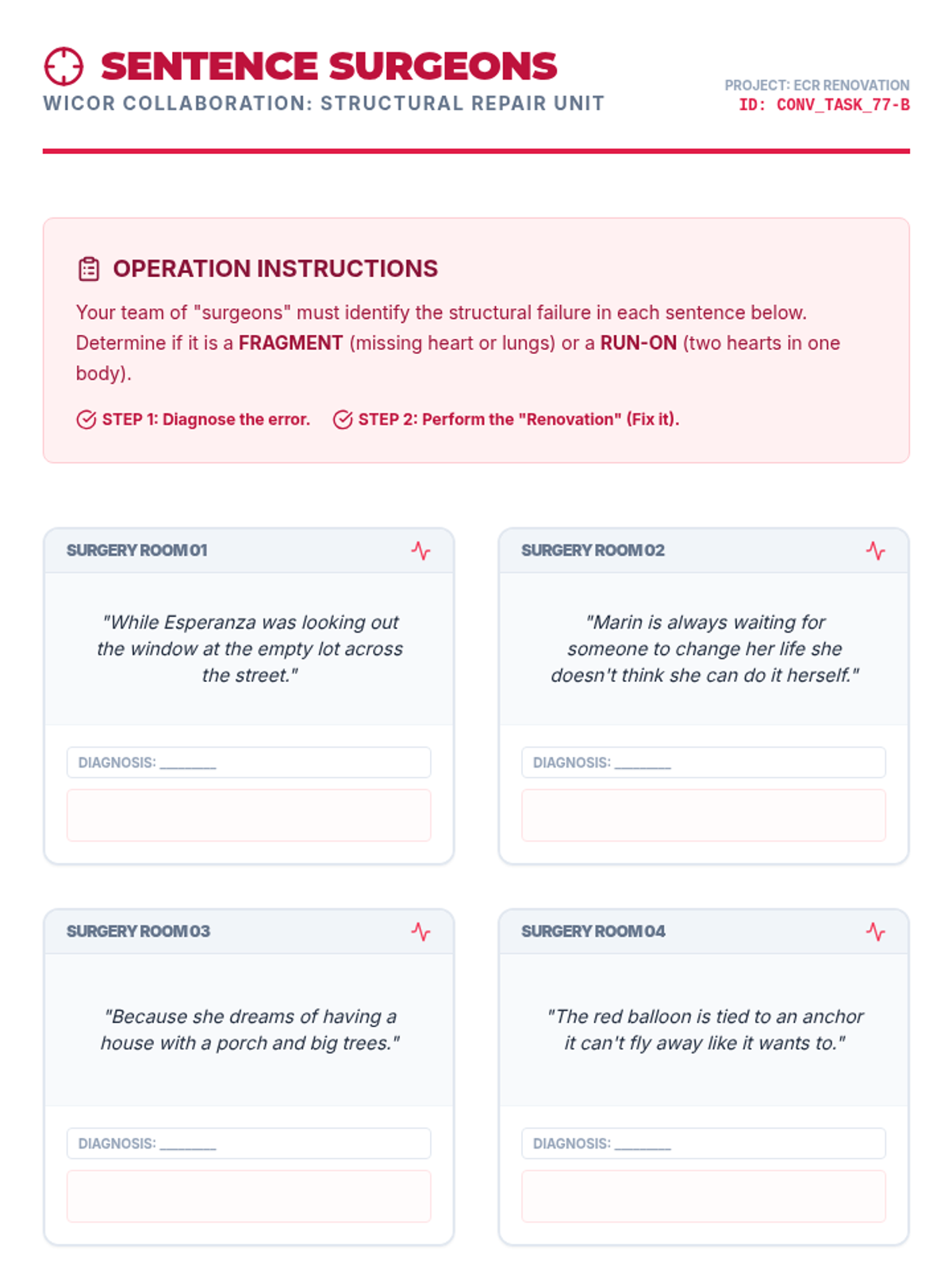
A collaborative small-group activity where students "operate" on broken sentences. Each card features a fragment or run-on sentence related to "The House on Mango Street," requiring students to diagnose the error and provide a structural renovation. Fits the AVID focus on collaborative learning.
A high-impact instructional presentation for the ECR Architect lesson. These slides guide students through the WICOR-aligned stages of ECR construction: prompt deconstruction, thesis mapping, commentary bridging, and sentence renovation. Includes visual formulas and clear revision checkpoints.
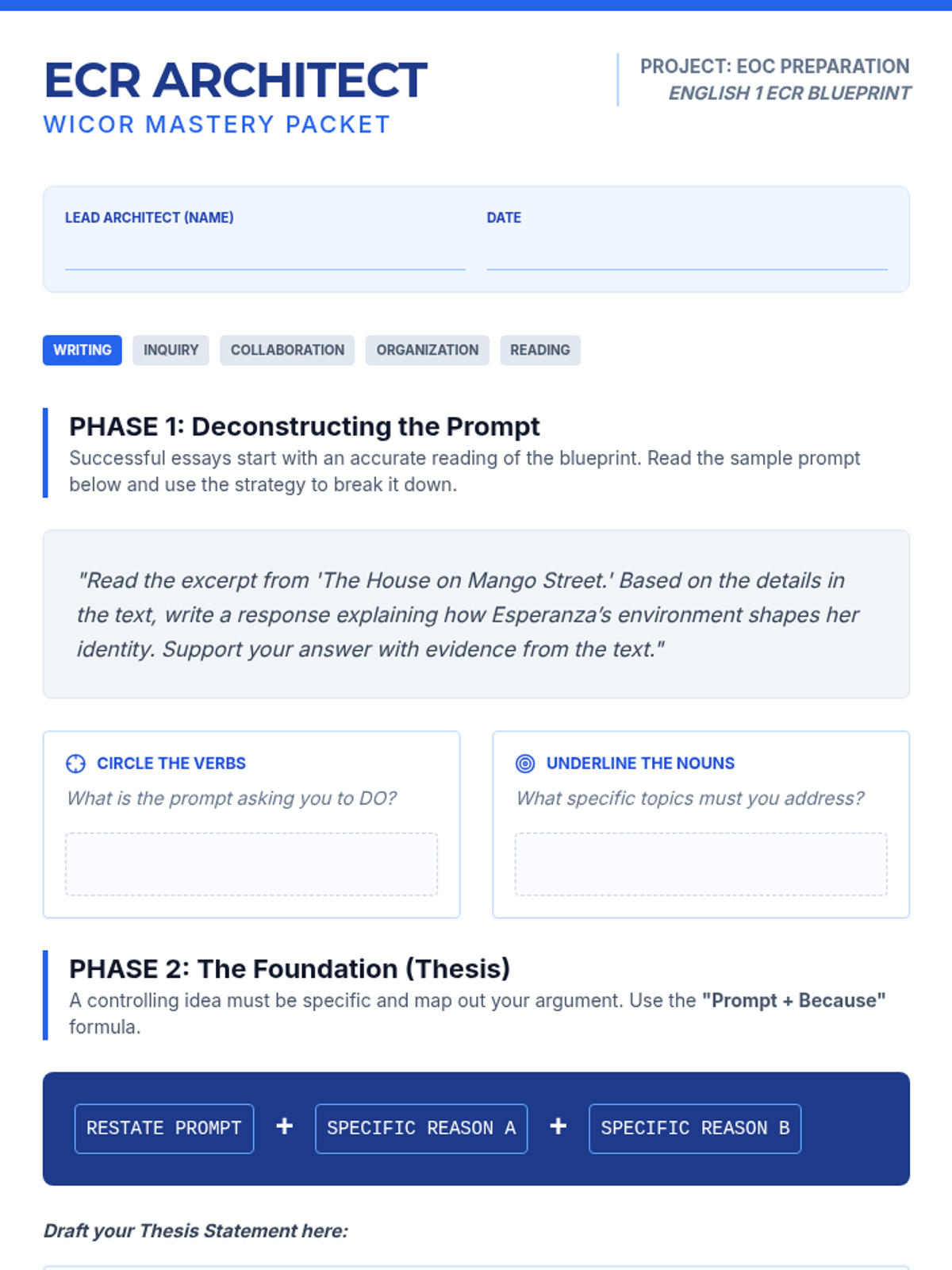
A multi-page WICOR-aligned interactive packet designed to help students deconstruct EOC prompts, build specific thesis statements, bridge evidence with commentary, and renovate run-on sentences and fragments. The blueprint theme reinforces the structural nature of the Extended Constructed Response.
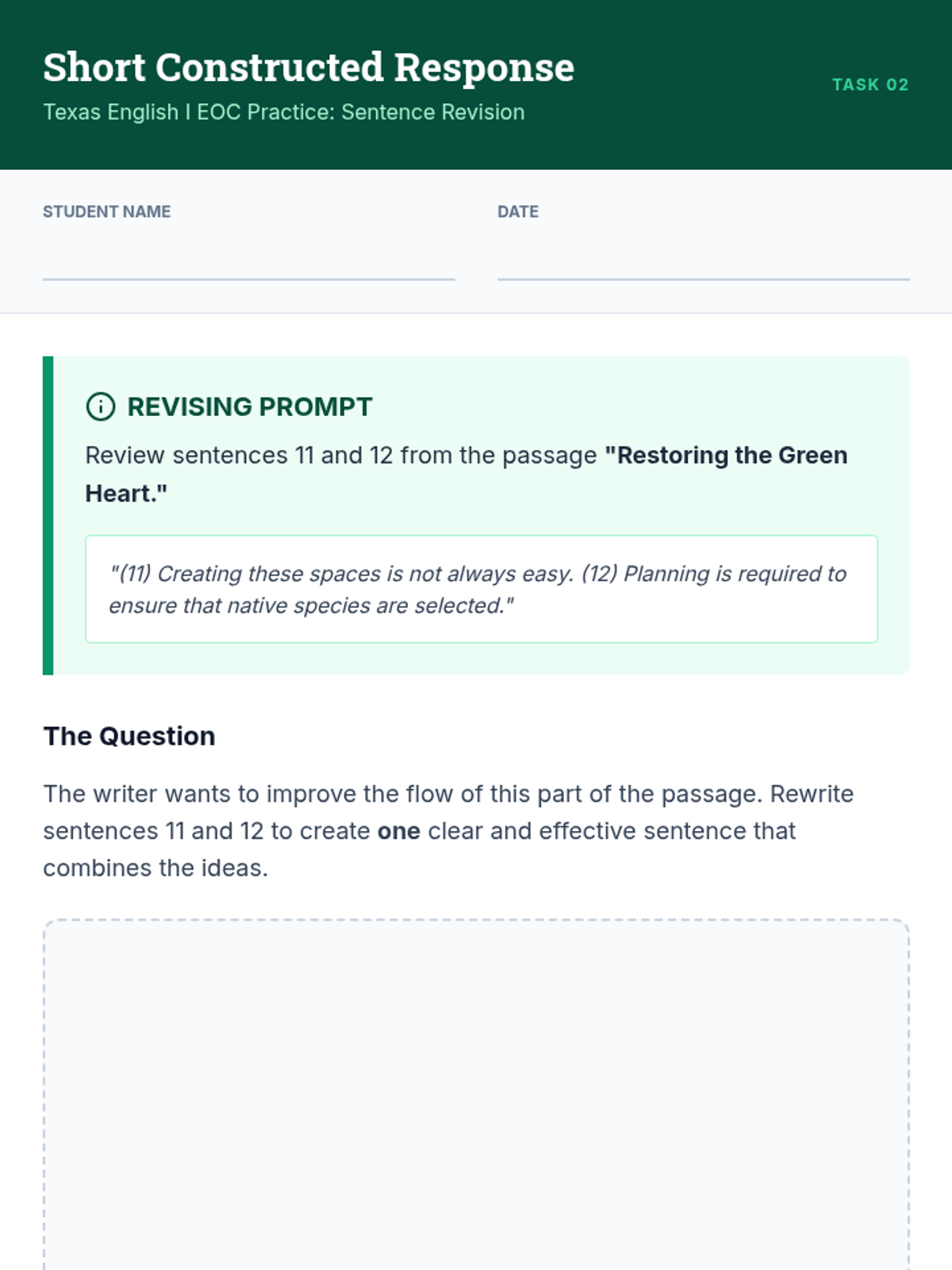
A short constructed response (SCR) task for Texas English I, requiring students to rewrite and combine two sentences from the practice passage to improve flow and clarity.
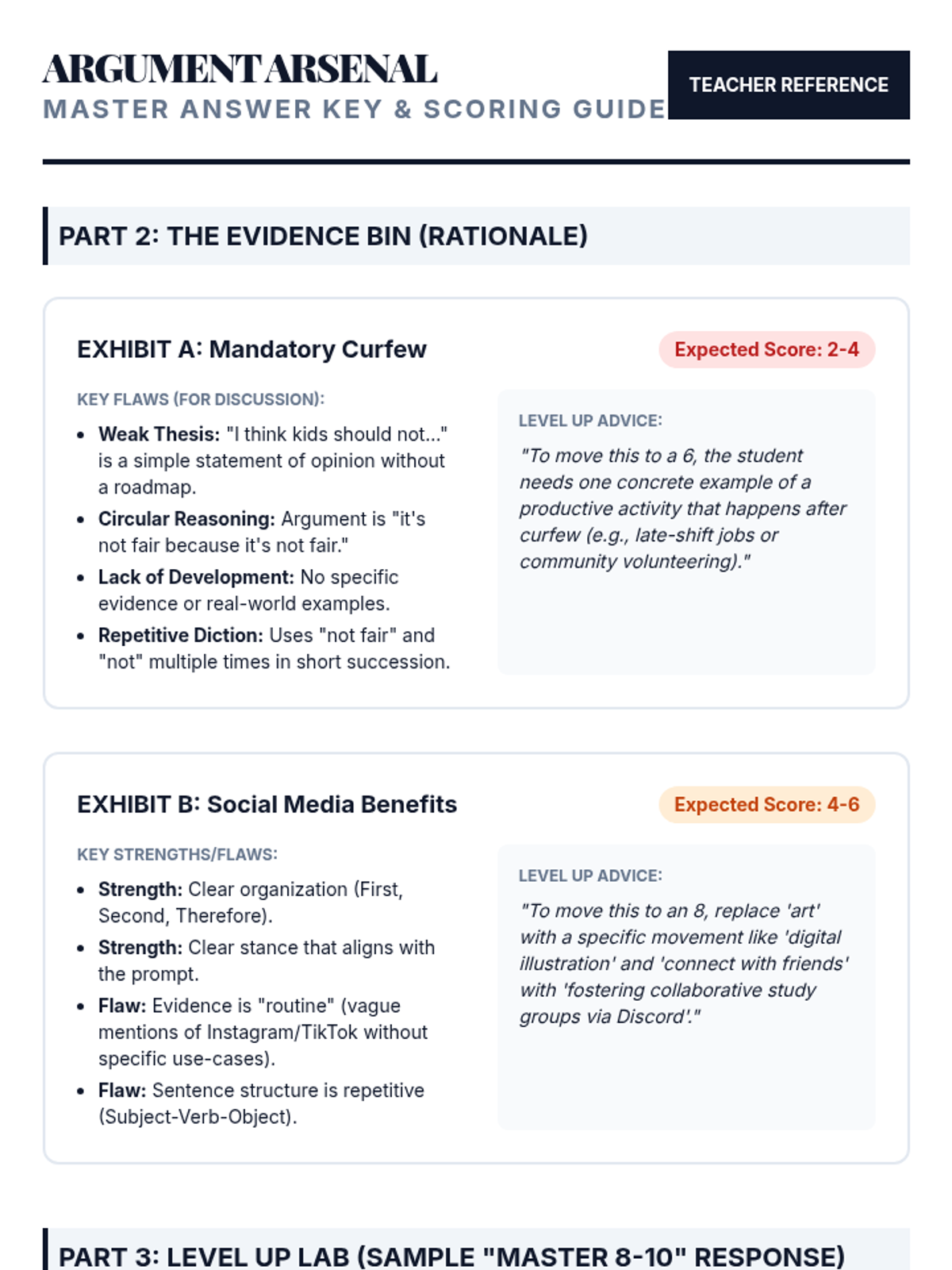
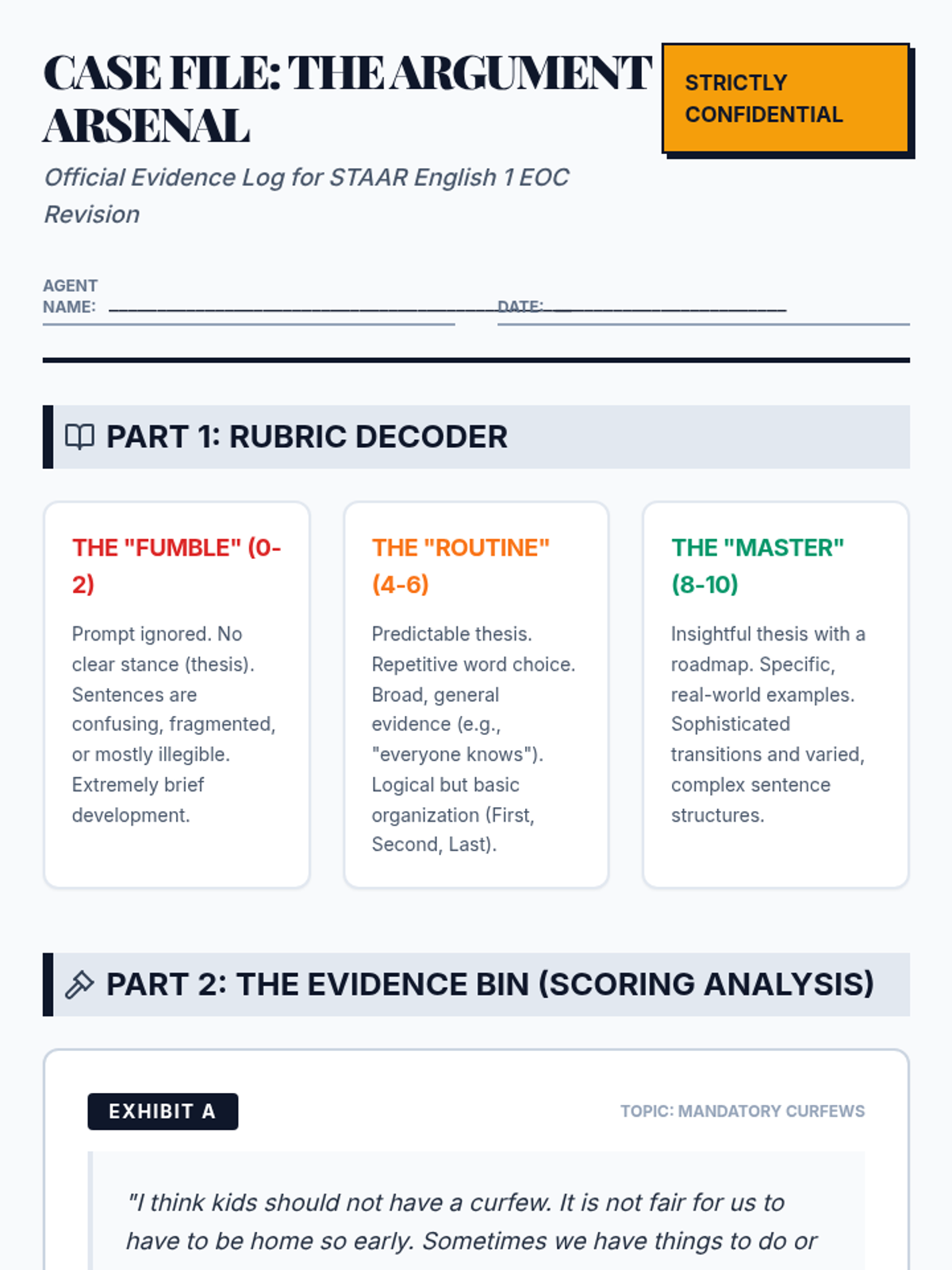
A detailed scoring guide and answer key for the Argument Arsenal worksheet, providing rationales for sample scores and a high-level model revision for the "Level Up Lab" activity.
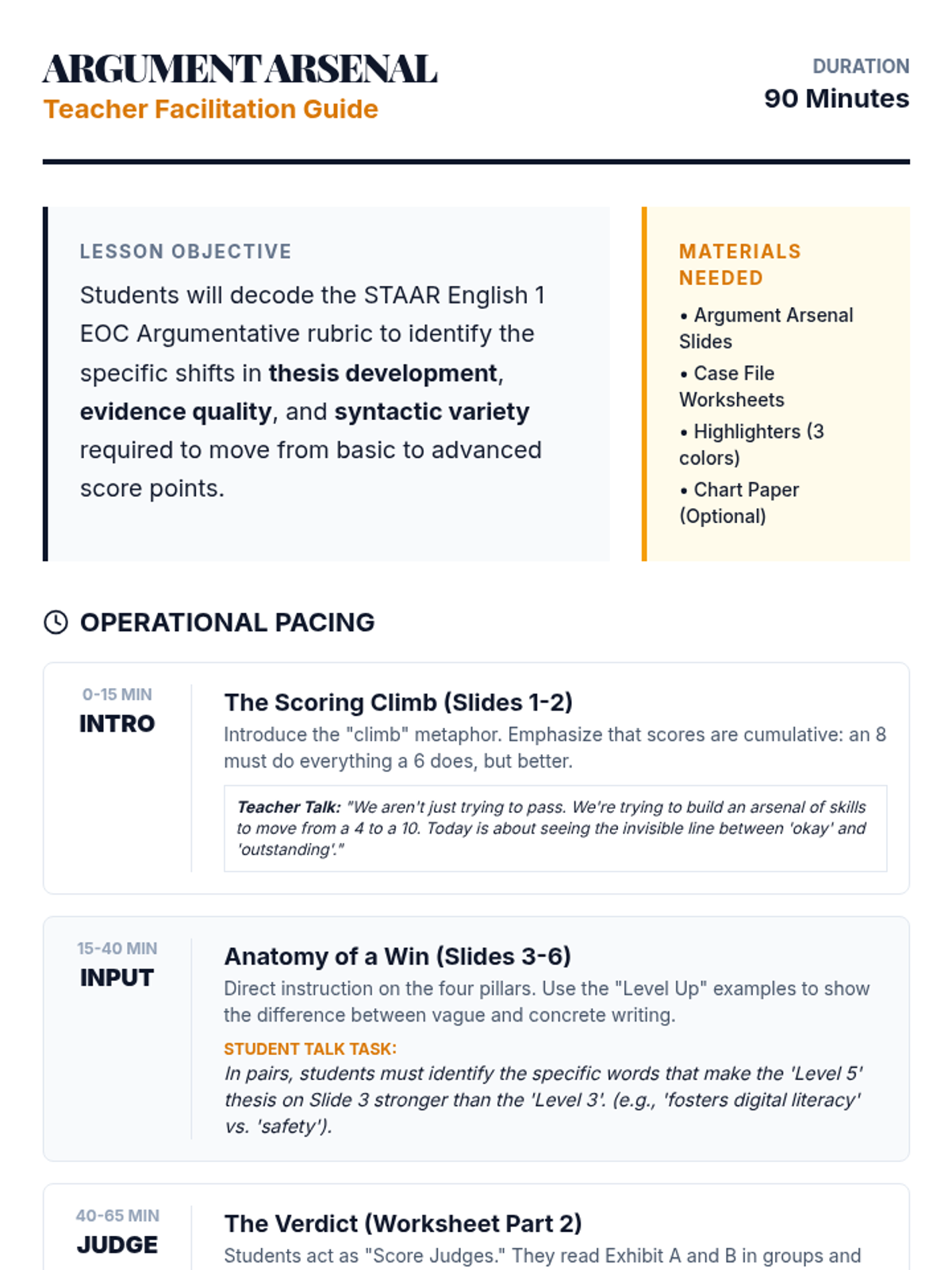
A comprehensive facilitation guide for the Argument Arsenal lesson, detailing a 90-minute pacing plan, teacher scripts, student talk tasks, and specific differentiation strategies for moving students across all rubric score points.
A legal-themed student worksheet for analyzing and scoring argumentative writing samples based on the STAAR English 1 EOC rubric. It includes two case studies for scoring and a "Level Up Lab" for targeted revision practice, focusing on moving from basic to advanced evidence and structure.
A high-impact 16:9 presentation designed to guide students through the STAAR English 1 EOC Argumentative Writing rubric. It features a legal-themed "climbing the scores" map, side-by-side comparisons of basic versus advanced writing, and clear visual cues for thesis development, evidence selection, and sentence variety.
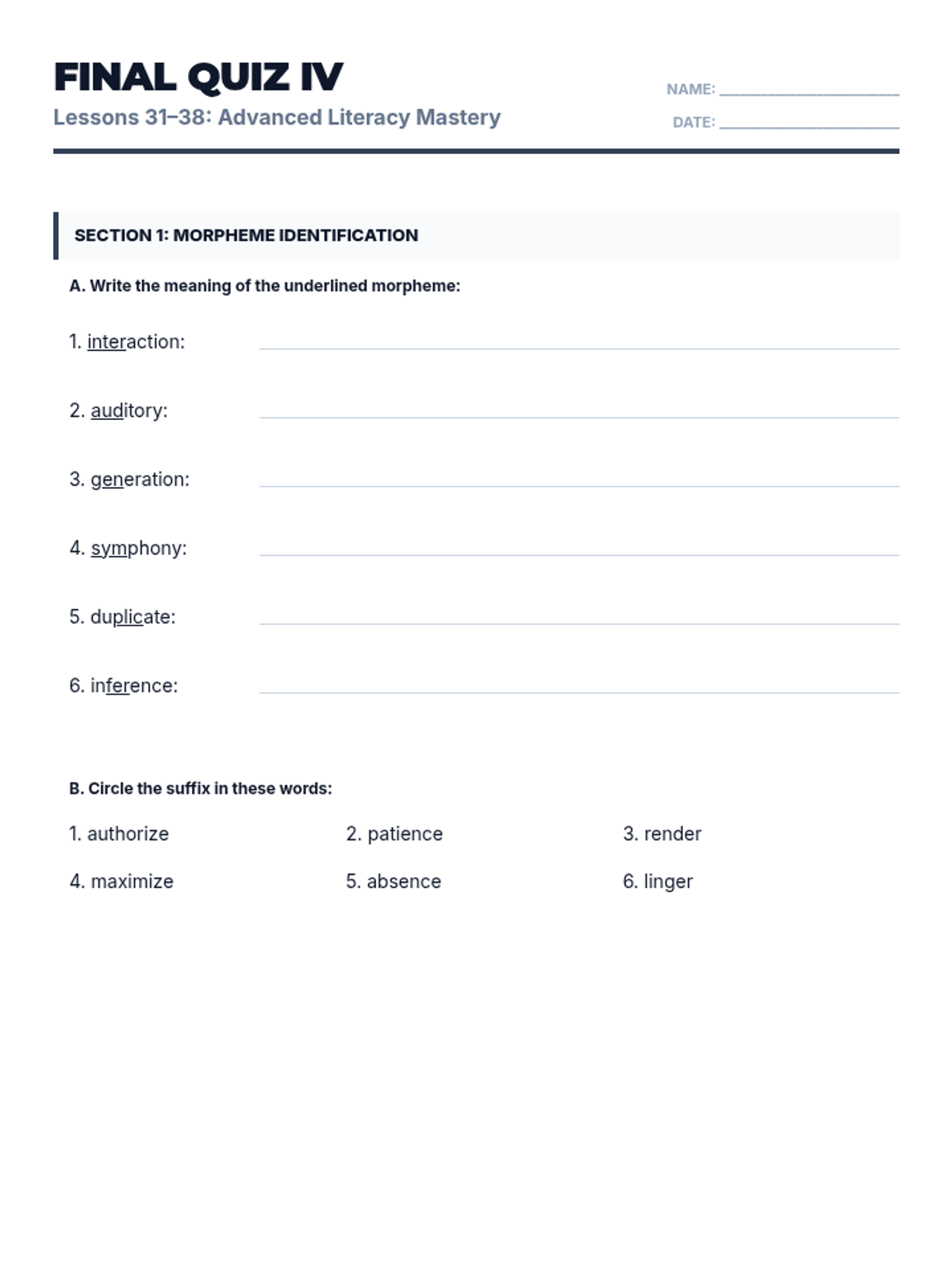
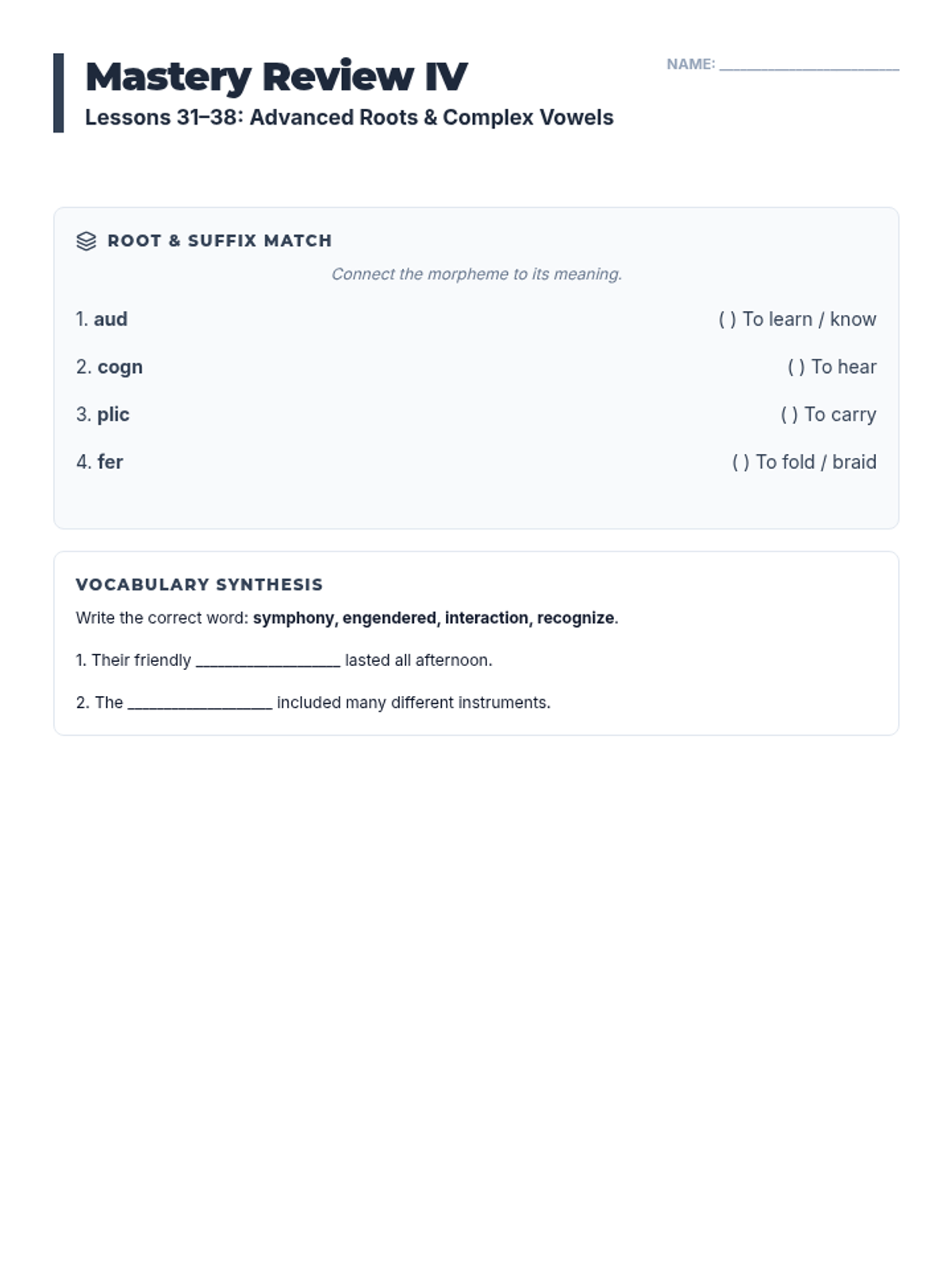
A final formal 4-page assessment for the Reading Power Pack, covering all morphology and complex vowel skills from Lessons 31-38. Includes morpheme meaning identification, academic vocabulary application, multisyllabic decoding challenge, and critical synthesis short-answer questions. Designed for high school TESOL students.
A comprehensive 4-page expansion for Lesson 39. This review lesson synthesizes the advanced morphology (sym, phone, gen, act, cogn, plic, aud, fer, sid) and complex vowel patterns from the previous units. It includes a morpheme match grid, a synthesis reading passage without underlines to encourage active word searching, and a high-level writing challenge. Designed for high school TESOL students.
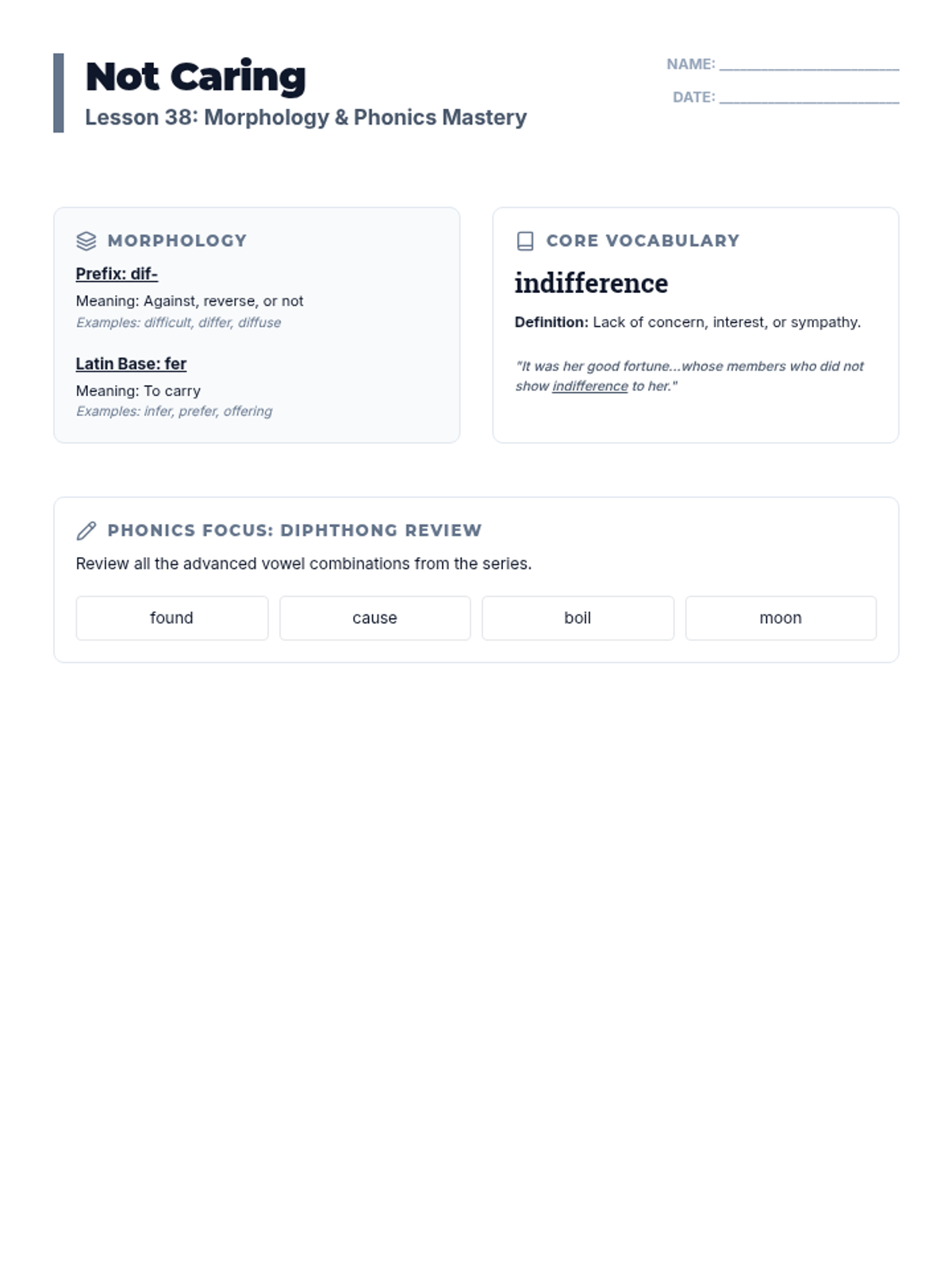
A 5-page expansion for Lesson 38. It focuses on the prefix dif- and root fer, with the vocabulary word 'indifference', alongside explicit instruction in synthesis of complex vowel patterns. It includes a foundational page, a reading passage without underlines to encourage active word searching, a new dedicated encoding mastery page, comprehension questions with discussion frames, and structured writing practice. Designed for high school TESOL students.
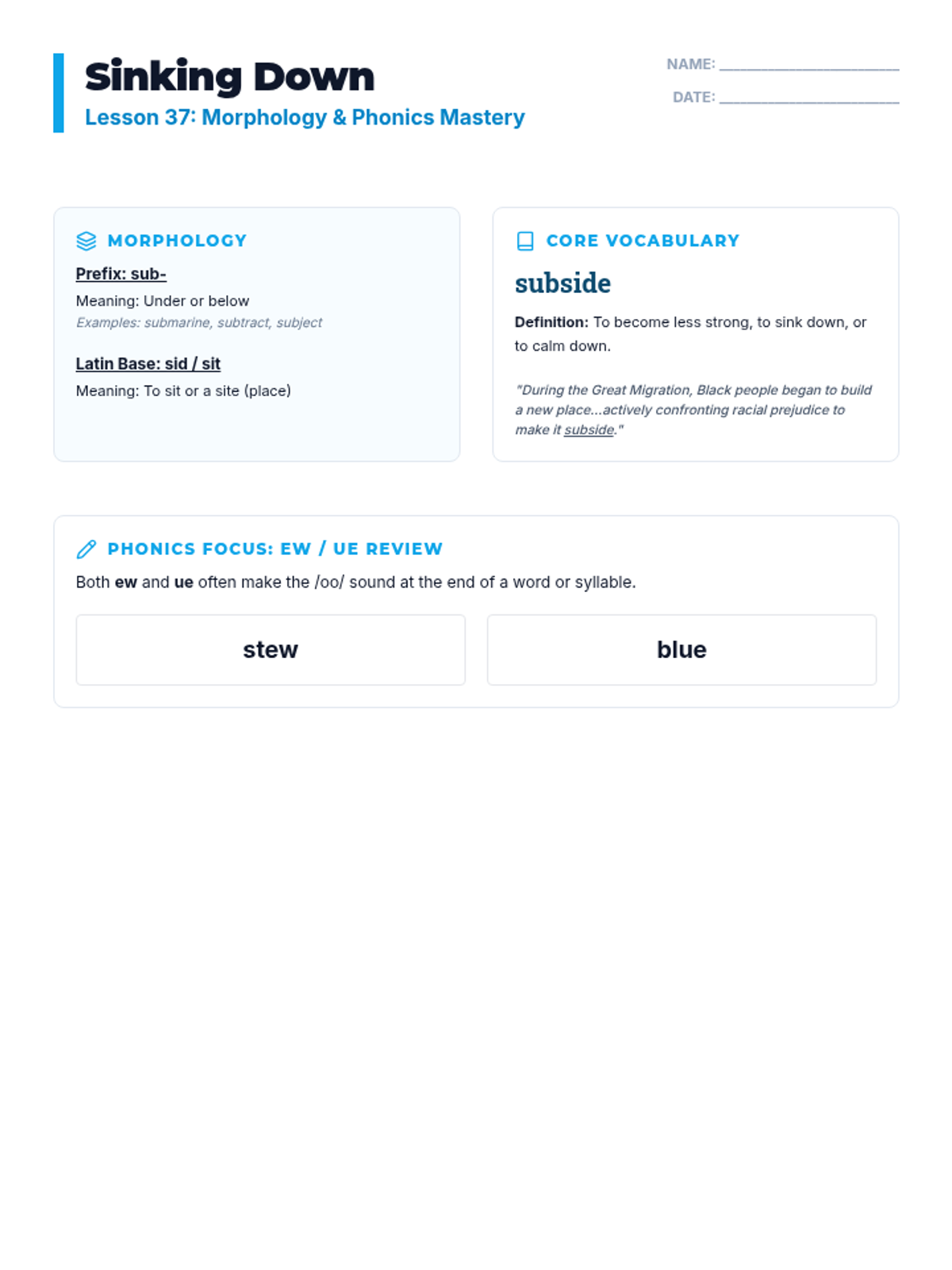
A comprehensive 5-page expansion for Lesson 37. It focuses on the prefix sub- and root sid/sit, with the vocabulary word 'subside', alongside explicit instruction in the diphthongs ew and ue review. It includes a foundational page, a reading passage without underlines to encourage active word searching, a new dedicated encoding mastery page, comprehension questions with discussion frames, and structured writing practice. Designed for high school TESOL students.
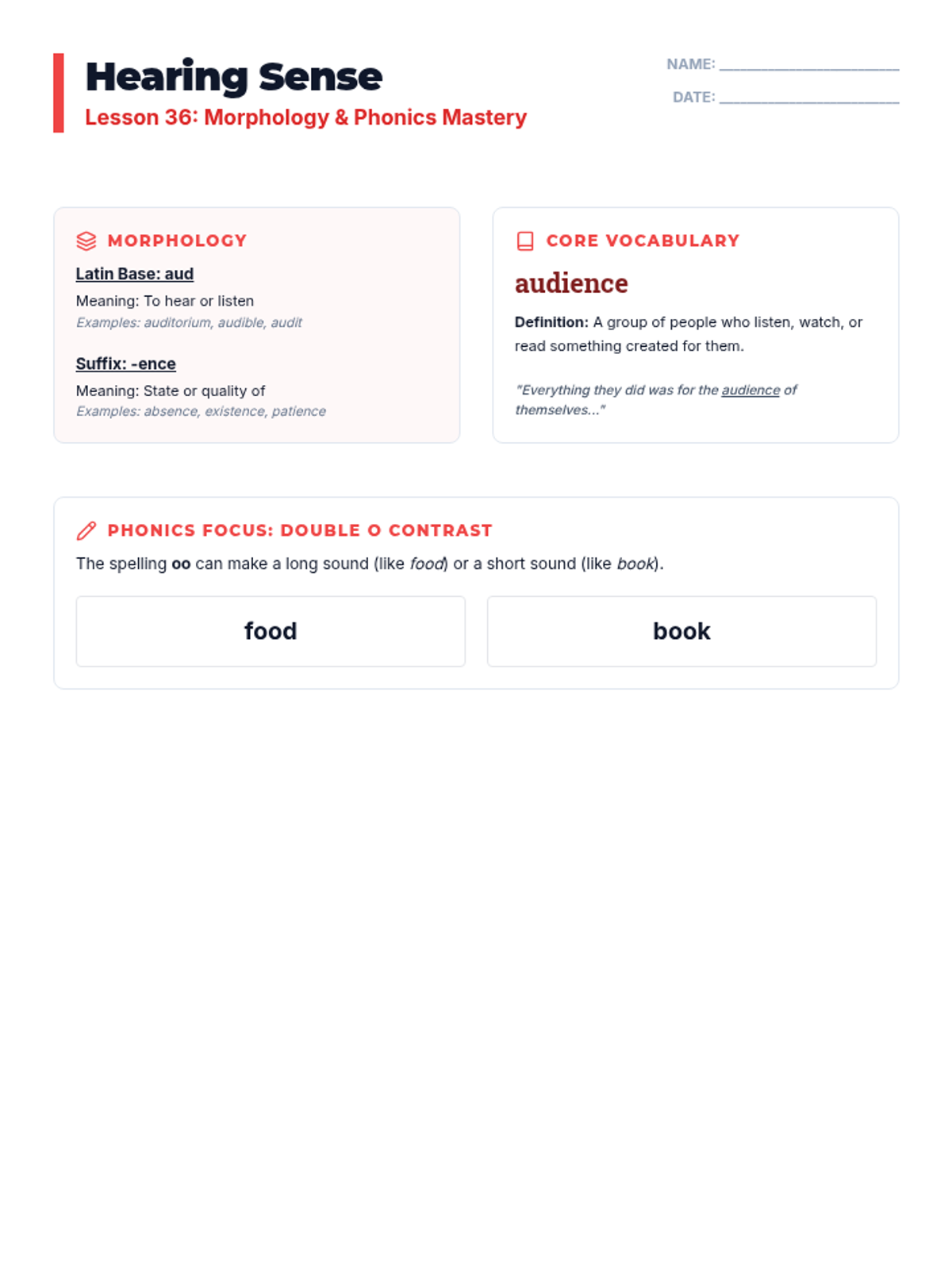
A comprehensive 5-page expansion for Lesson 36. It focuses on the root aud and suffix -ence, with the vocabulary word 'audience', alongside explicit instruction in the diphthong oo (food vs book). It includes a foundational page, a reading passage without underlines to encourage active word searching, a new dedicated encoding mastery page, comprehension questions with discussion frames, and structured writing practice. Designed for high school TESOL students.
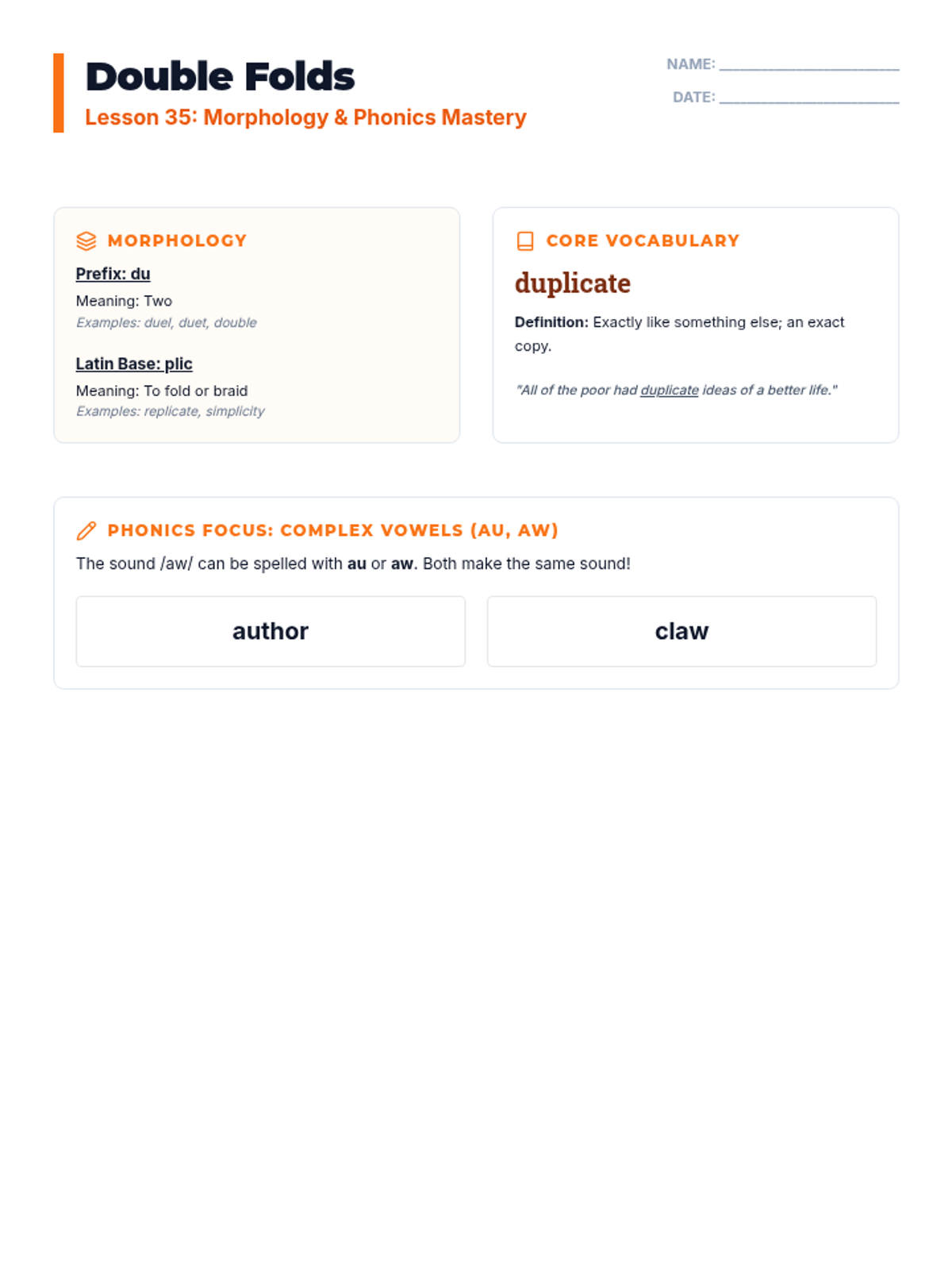
A comprehensive 5-page expansion for Lesson 35. It focuses on the prefix du and root plic, with the vocabulary word 'duplicate', alongside explicit instruction in the diphthongs au and aw. It includes a foundational page, a reading passage without underlines to encourage active word searching, a new dedicated encoding mastery page, comprehension questions with discussion frames, and structured writing practice. Designed for high school TESOL students.
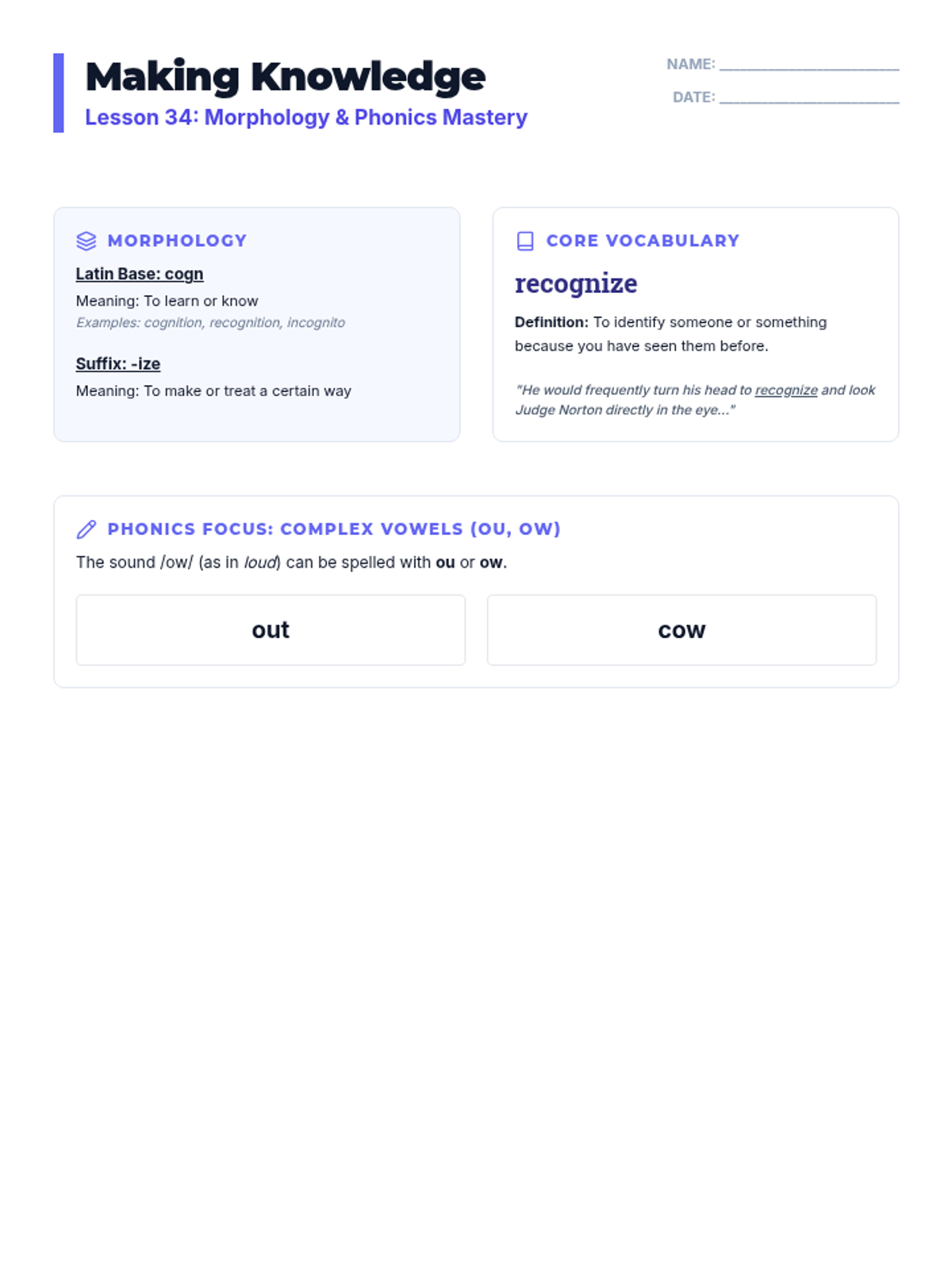
A comprehensive 5-page expansion for Lesson 34. It focuses on the root cogn and suffix -ize, with the vocabulary word 'recognize', alongside explicit instruction in the diphthongs ou and ow. It includes a foundational page, a reading passage without underlines to encourage active word searching, a new dedicated encoding mastery page, comprehension questions with discussion frames, and structured writing practice. Designed for high school TESOL students.
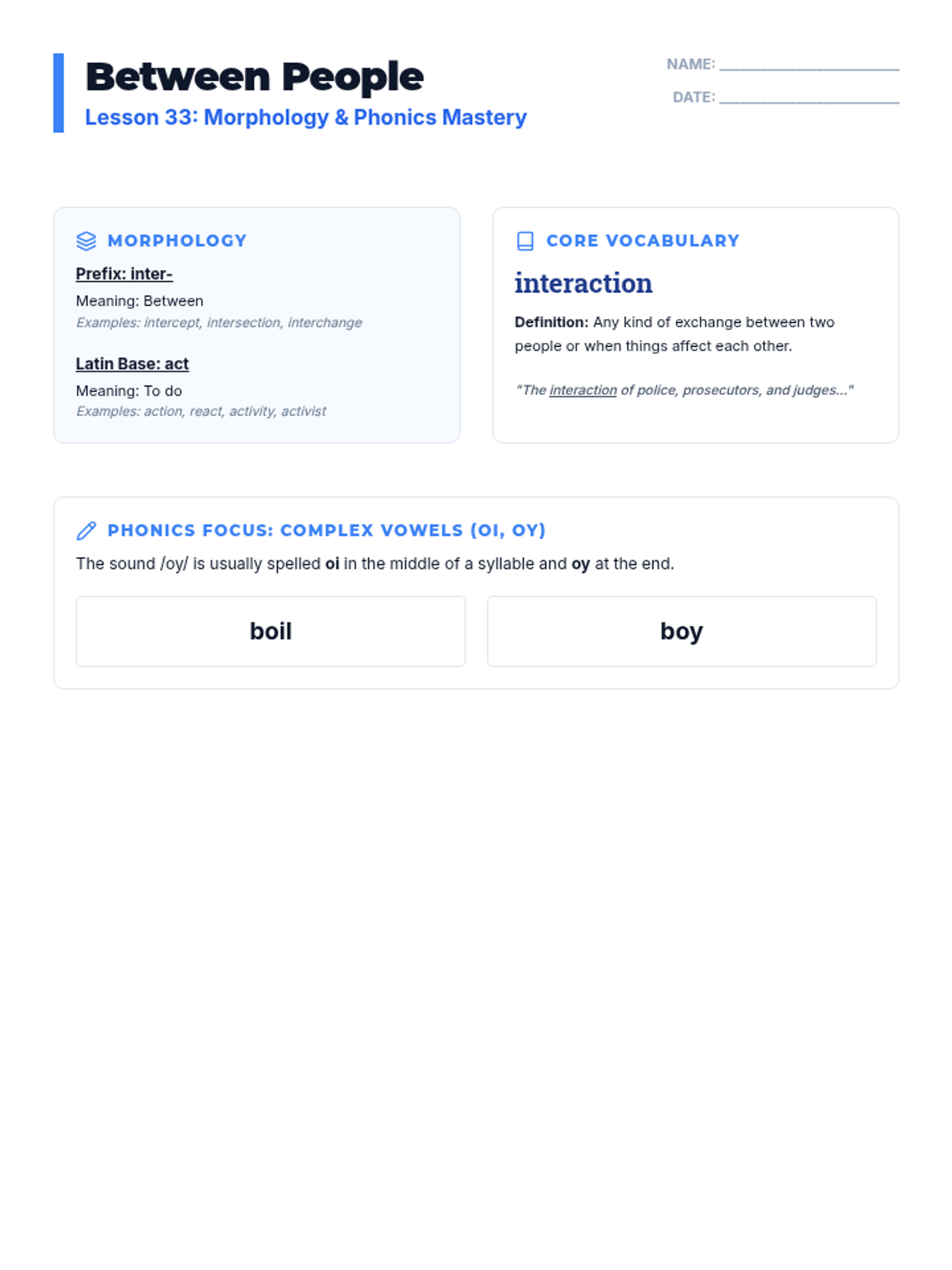
A comprehensive 5-page expansion for Lesson 33. It focuses on the prefix inter- and root act, with the vocabulary word 'interaction', alongside explicit instruction in the diphthongs oi and oy. It includes a foundational page, a reading passage without underlines to encourage active word searching, a new dedicated encoding mastery page, comprehension questions with discussion frames, and structured writing practice. Designed for high school TESOL students.
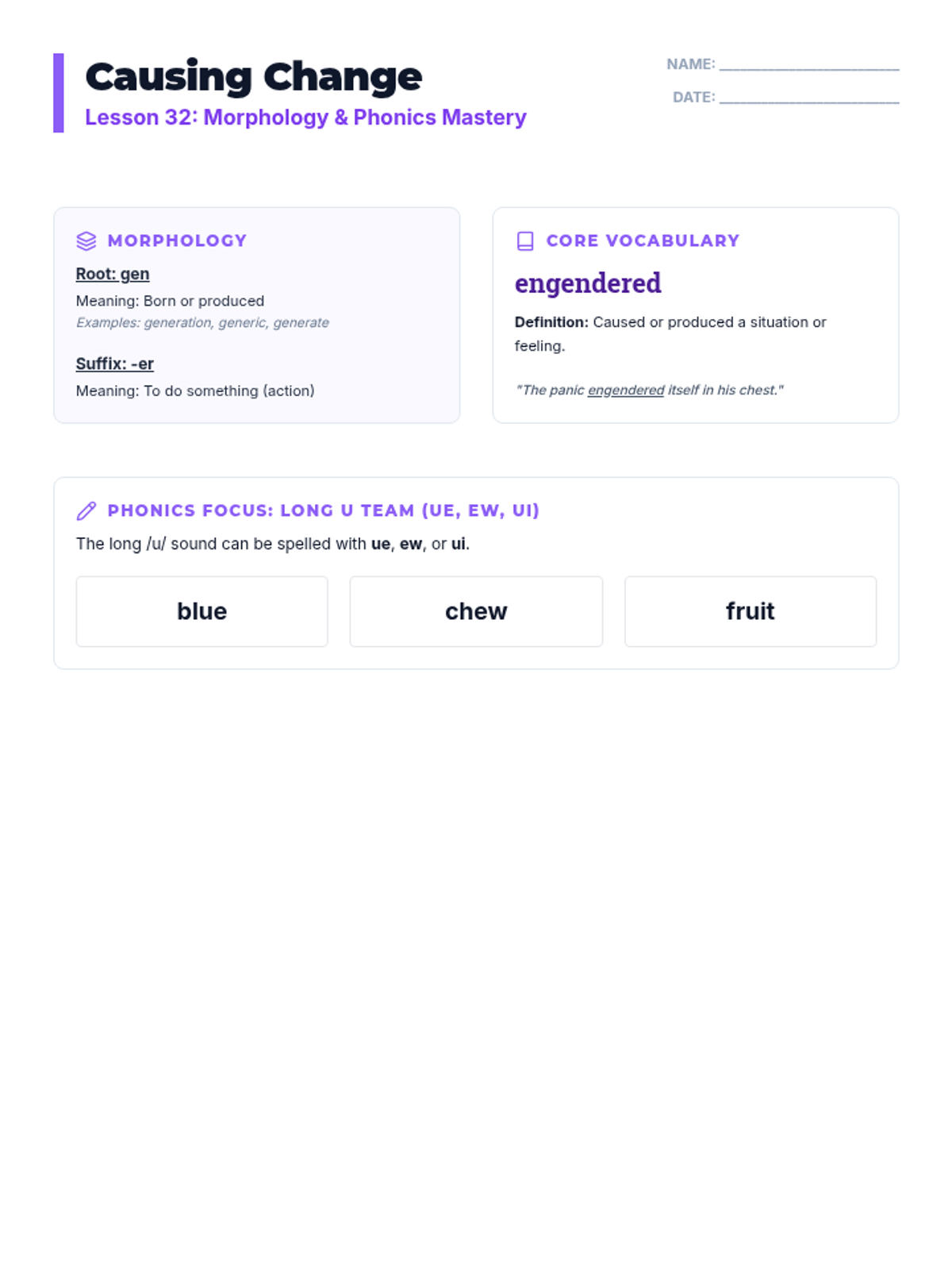
A comprehensive 4-page expansion for Lesson 32. It focuses on the root gen and suffix -er, with the vocabulary word 'engendered', alongside explicit instruction in the Long U vowel teams (ue, ew, ui). It includes a foundational page, a reading passage without underlines to encourage active searching, comprehension questions with discussion frames, and structured writing practice focusing on capitalization of proper nouns. Designed for high school TESOL students.
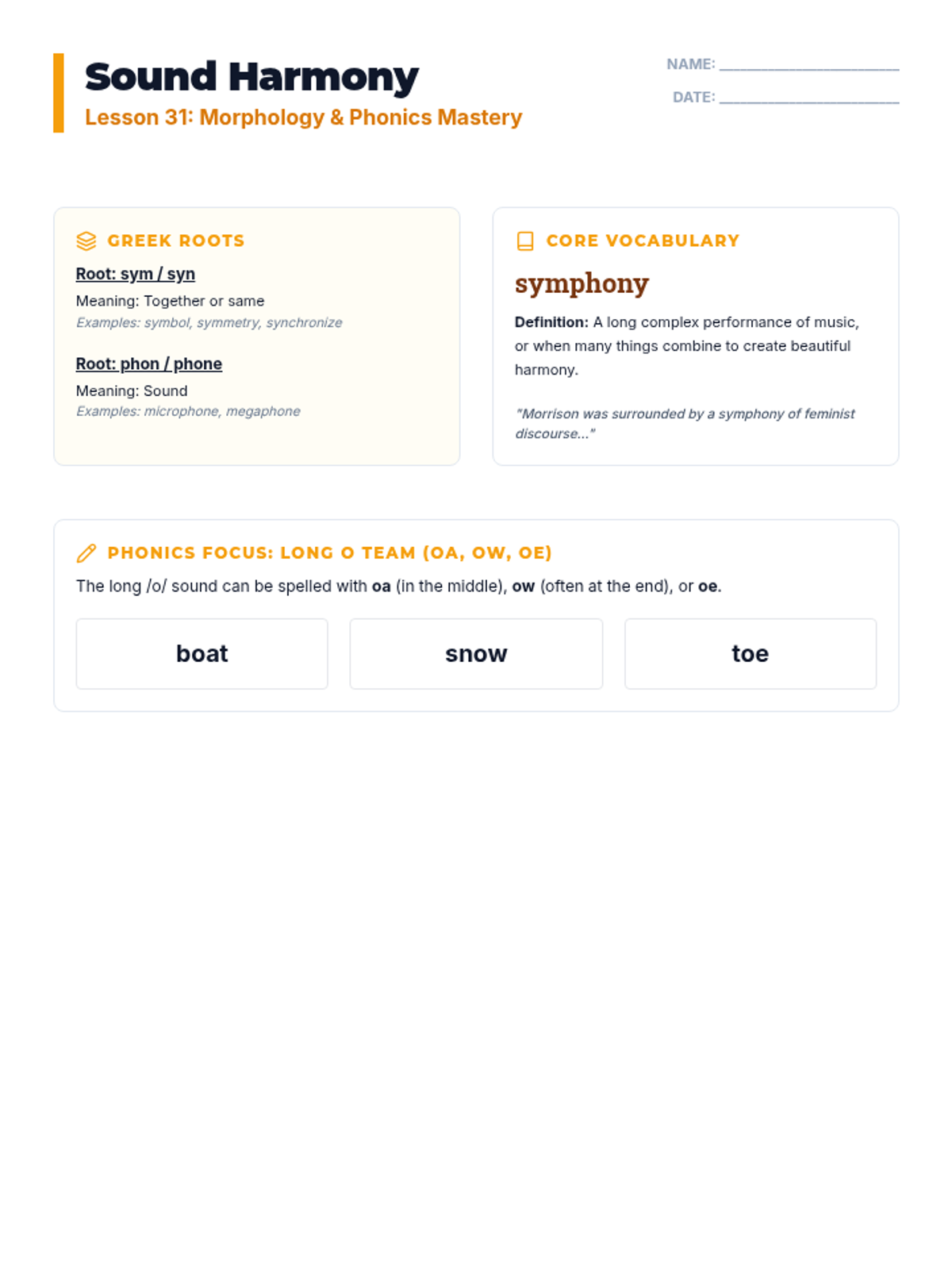
A comprehensive 5-page expansion for Lesson 31. It focuses on the Greek roots sym/syn and phon/phone, with the vocabulary word 'symphony', alongside explicit instruction in the Long O vowel teams (oa, ow, oe). It includes a foundational page, a reading passage without underlines to encourage active word searching, a new dedicated encoding mastery page, comprehension questions with discussion frames, and structured writing practice. Designed for high school TESOL students.
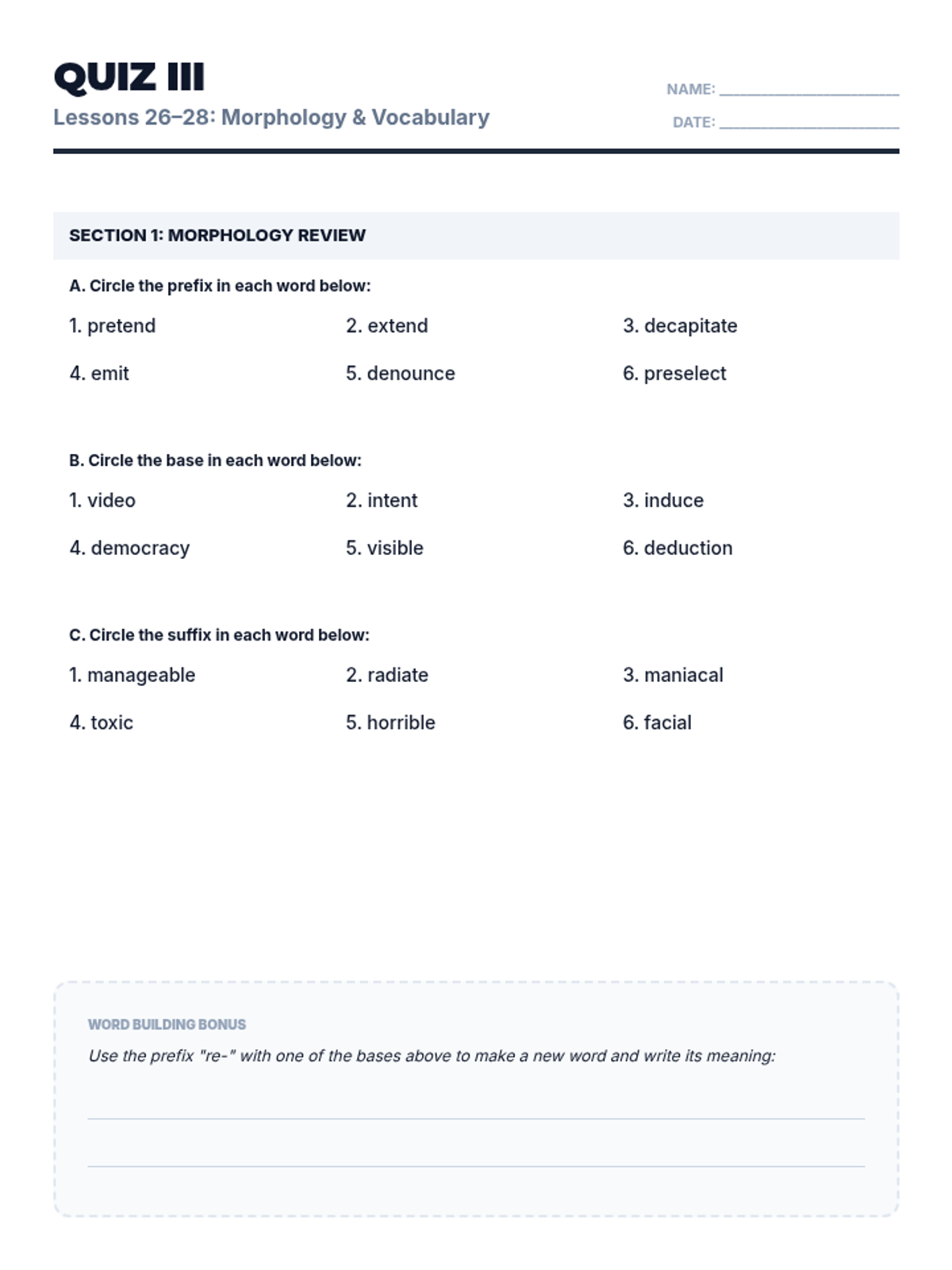
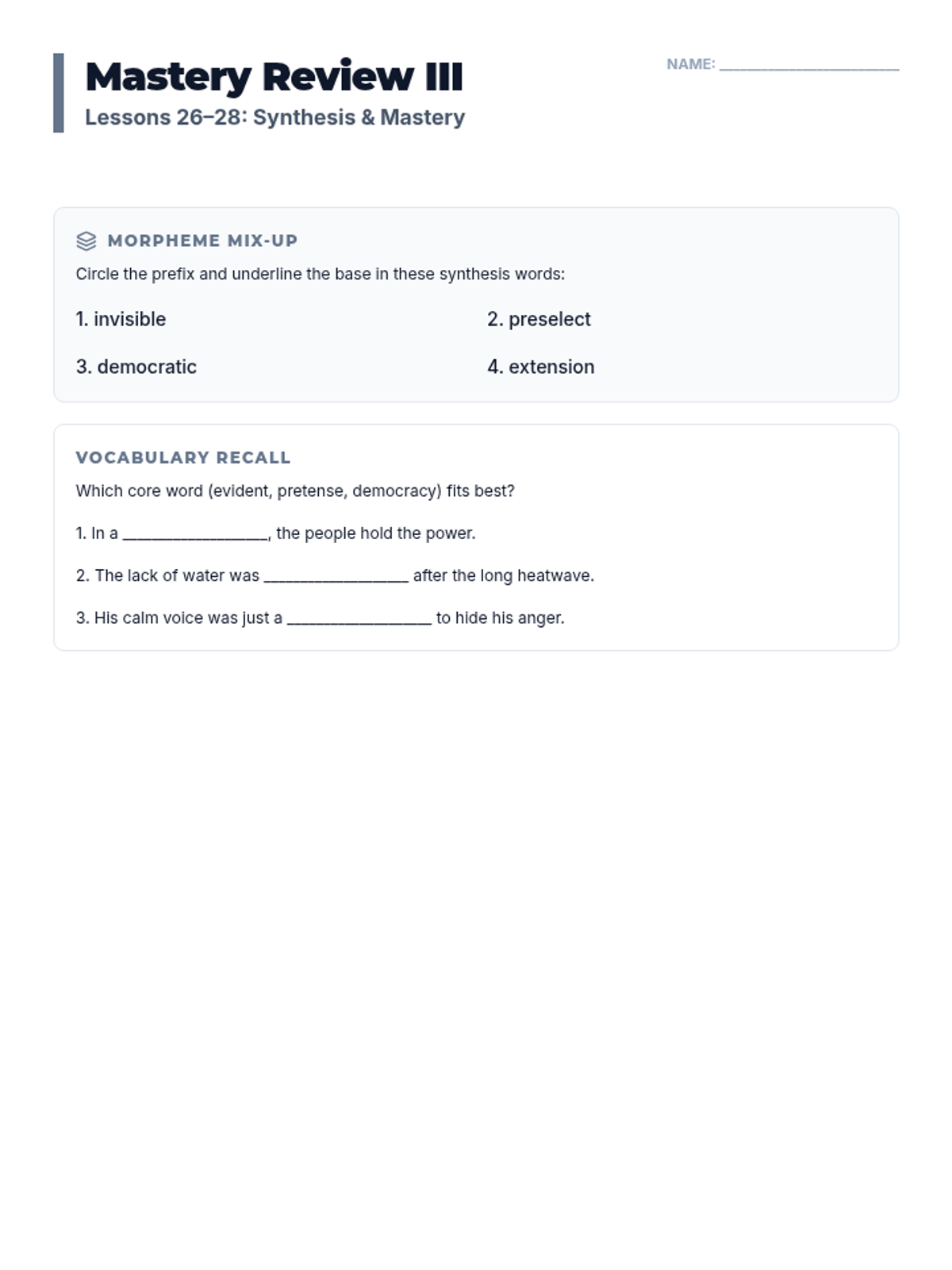
A formal 4-page assessment covering morphology, vocabulary, and word study skills for Lessons 26-28. Includes prefix/base/suffix identification, vocabulary in context, multisyllabic decoding with schwa labels, encoding dictation, and critical thinking short-answer questions. Designed for high school TESOL students.
A comprehensive 5-page expansion for Lesson 29. This review lesson synthesizes the morphology (e-, pre-, dem, crat) and vowel team focus (A, E, I) from the previous three units. It includes a morpheme grid, a synthesis reading passage without underlines to encourage active word searching, a new dedicated encoding mastery page, connecting analysis questions, and a high-level writing challenge. Designed for high school TESOL students.
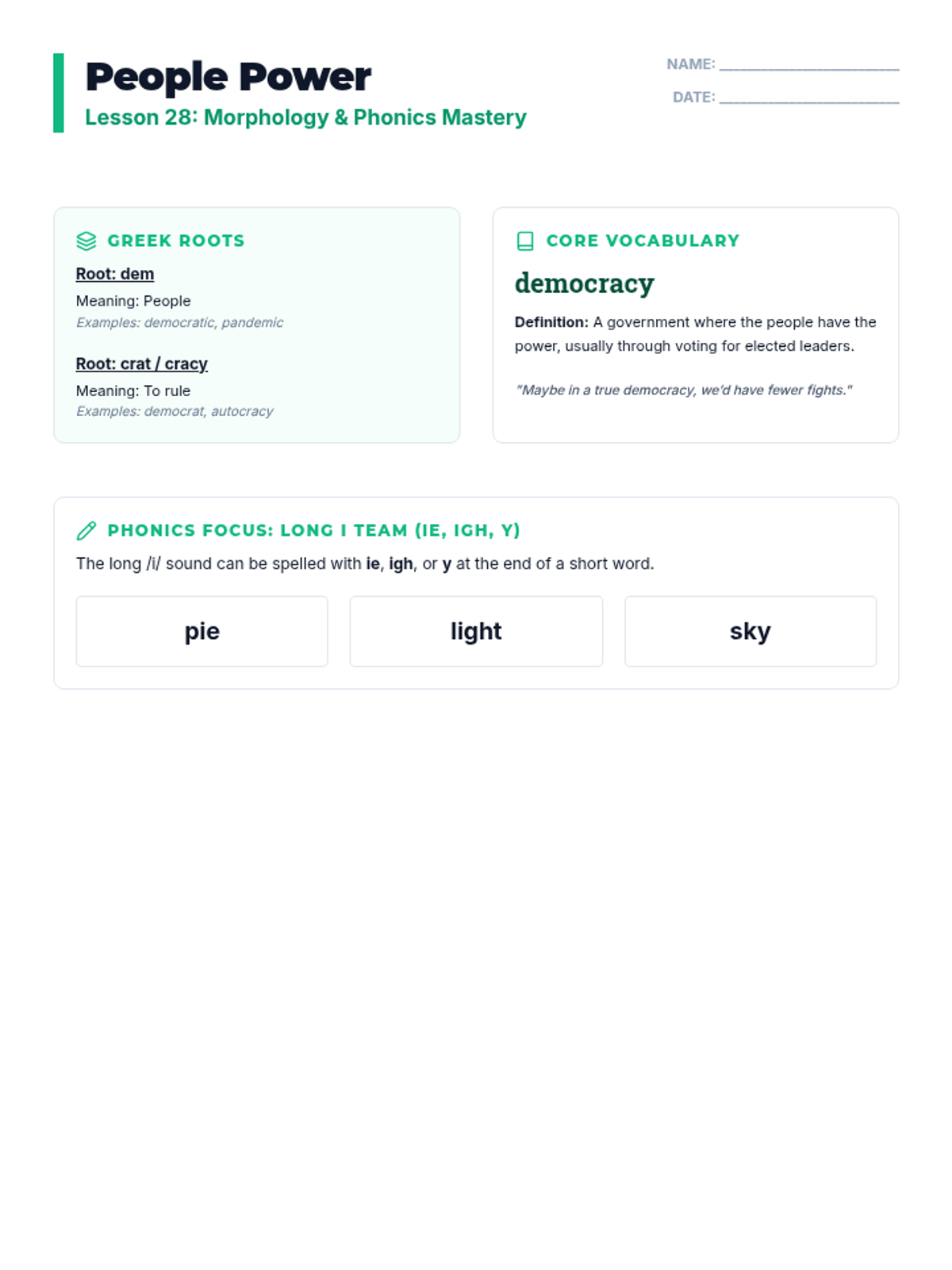
A comprehensive 5-page expansion for Lesson 28. It focuses on the Greek roots dem and crat/cracy, with the vocabulary word 'democracy', alongside explicit instruction in the Long I vowel teams (ie, igh, y). It includes a foundational page, a reading passage without underlines to encourage active word searching, a new dedicated encoding mastery page, comprehension questions with discussion frames, and structured writing practice. Designed for high school TESOL students.
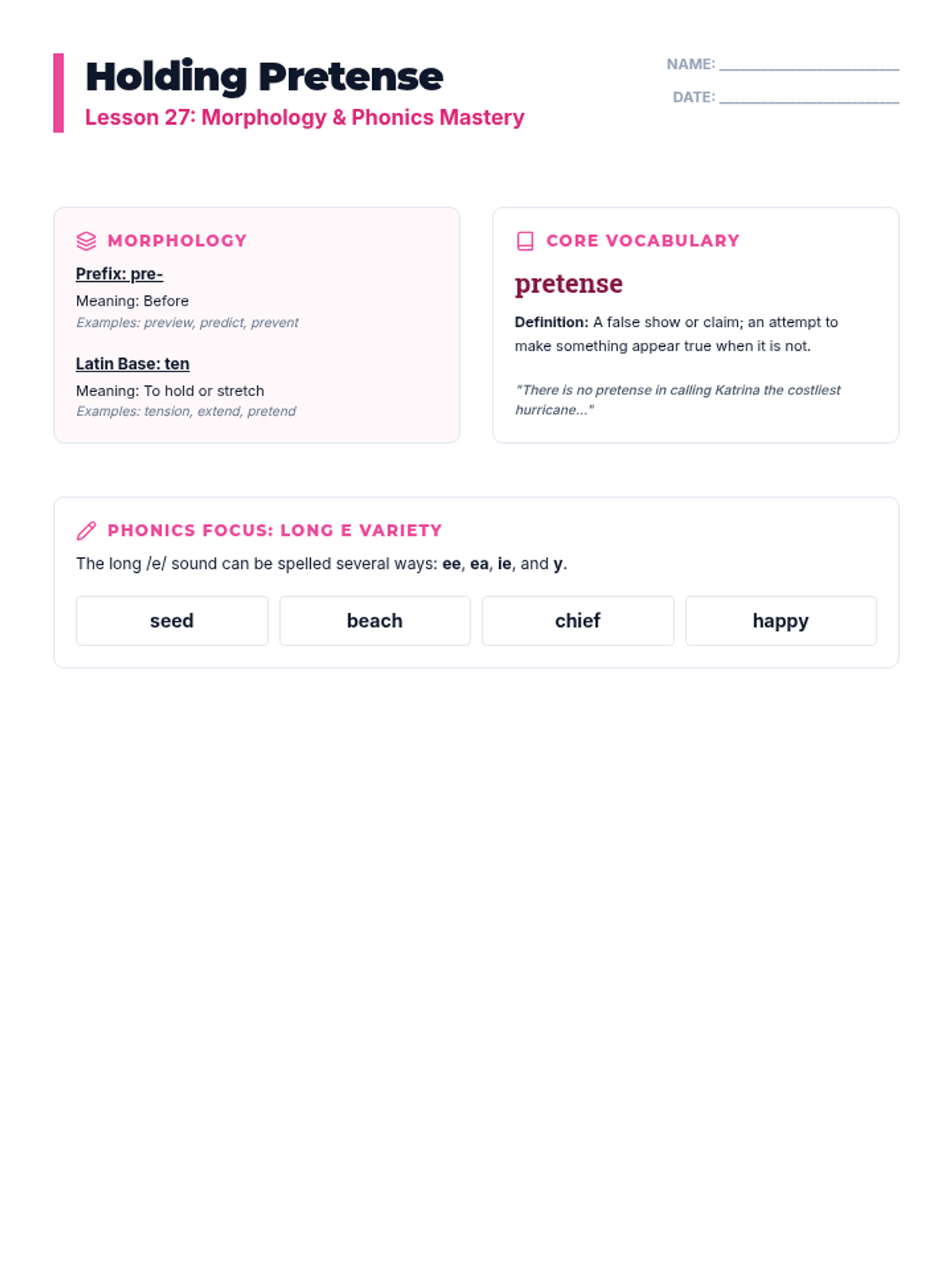
A 5-page expansion for Lesson 27. It focuses on the prefix pre- and the root ten, with the vocabulary word 'pretense', alongside explicit instruction in the Long E vowel teams (ee, ea, ie, y). It includes a foundational page, a reading passage without underlines to encourage active word searching, a new dedicated encoding mastery page, comprehension questions with discussion frames, and structured writing practice. Designed for high school TESOL students.
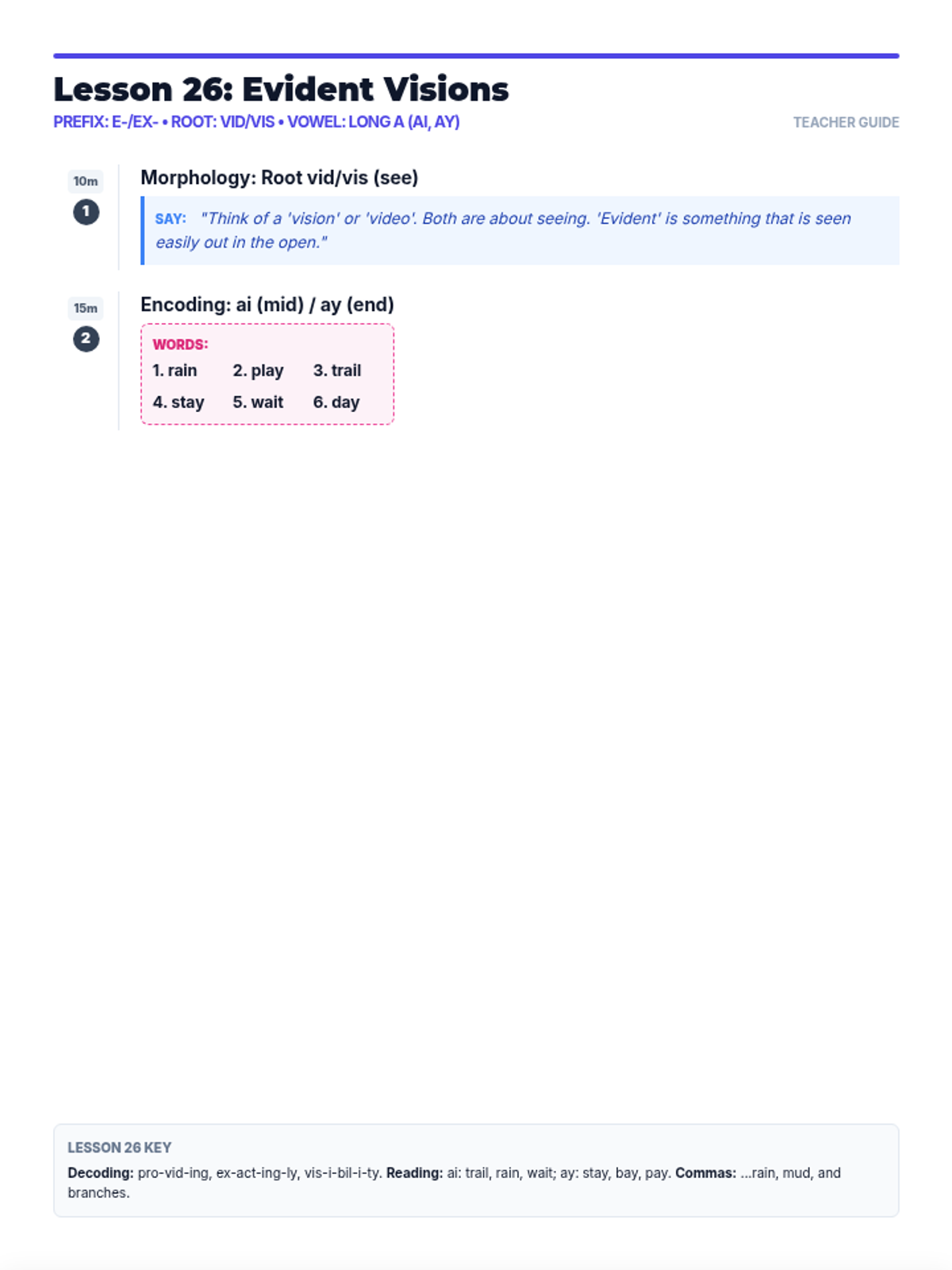
A comprehensive 15-page teacher guide for Lessons 26-40, with each lesson on its own printable page. Each guide includes a structured 60-minute lesson plan, explicit teacher scripts, encoding/dictation word lists for phonics mastery, and a complete answer key for the corresponding student handout. Includes specific focus on Vowel Teams and Diphthongs.
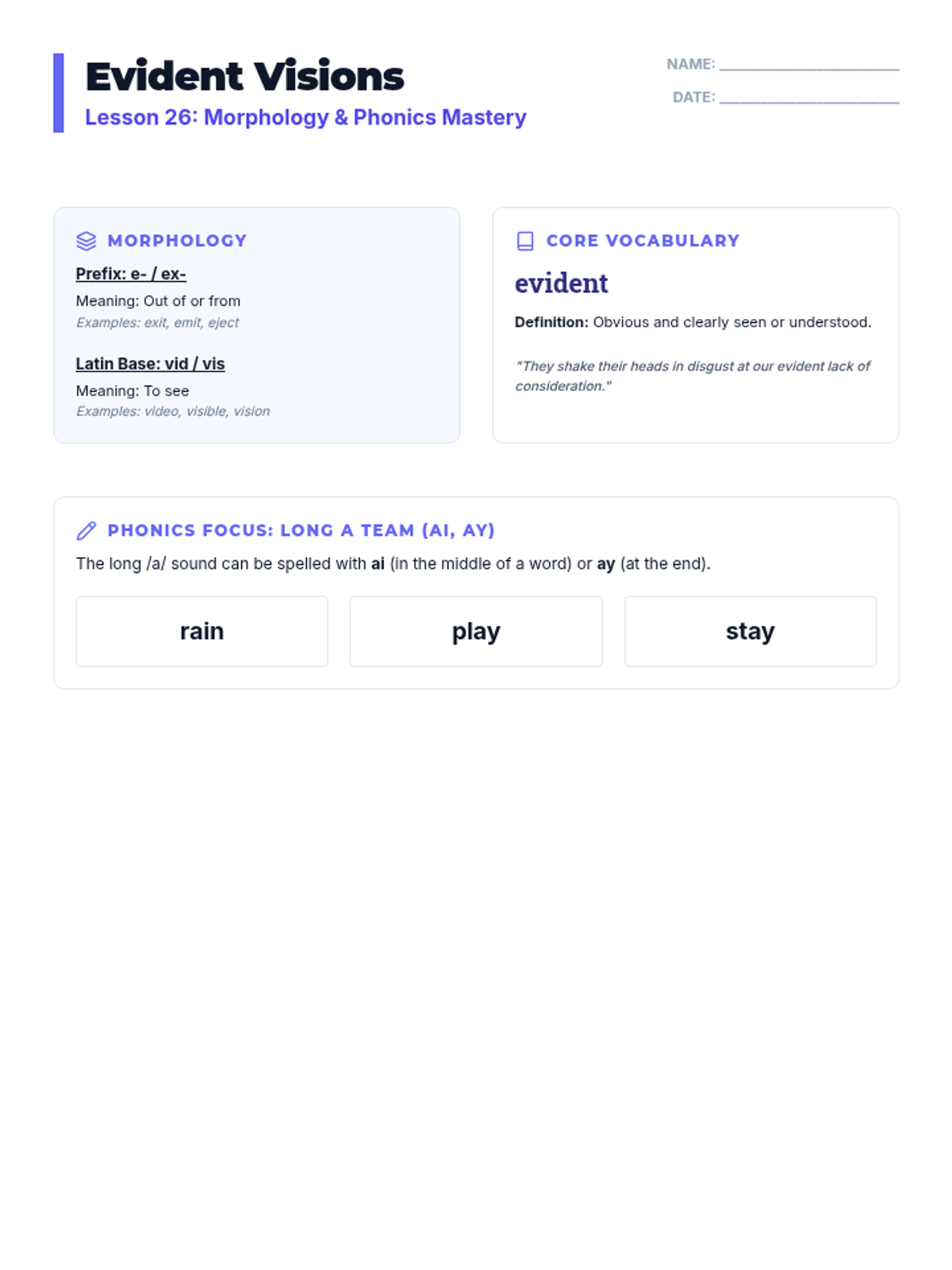
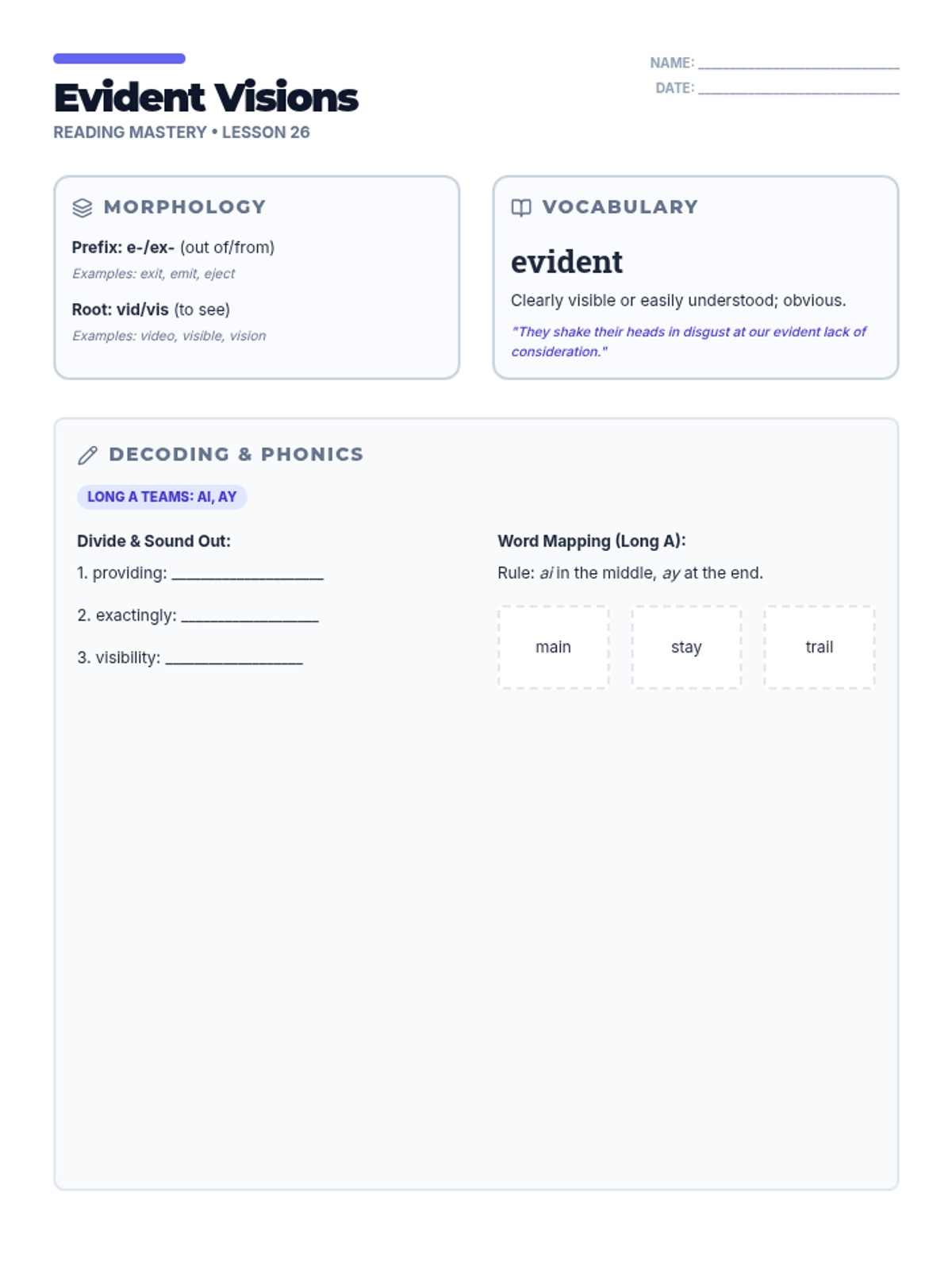
A comprehensive 4-page expansion for Lesson 26. It focuses on the prefix e-/ex- and the root vid/vis, with the vocabulary word 'evident', alongside explicit instruction in the Long A vowel team (ai, ay). It includes a foundational page, a reading passage without underlines to encourage active searching, comprehension questions with discussion frames, and structured writing practice. Designed for high school TESOL students.
A comprehensive 15-page reading intervention handout (Lessons 26-40) specifically tailored for high school TESOL students. Each page integrates user-provided morphology (prefixes, roots), academic vocabulary (definitions, text-based examples), and explicit phonics instruction focusing on Vowel Teams and Complex Diphthongs. Designed with clear work areas and high-school appropriate visuals.
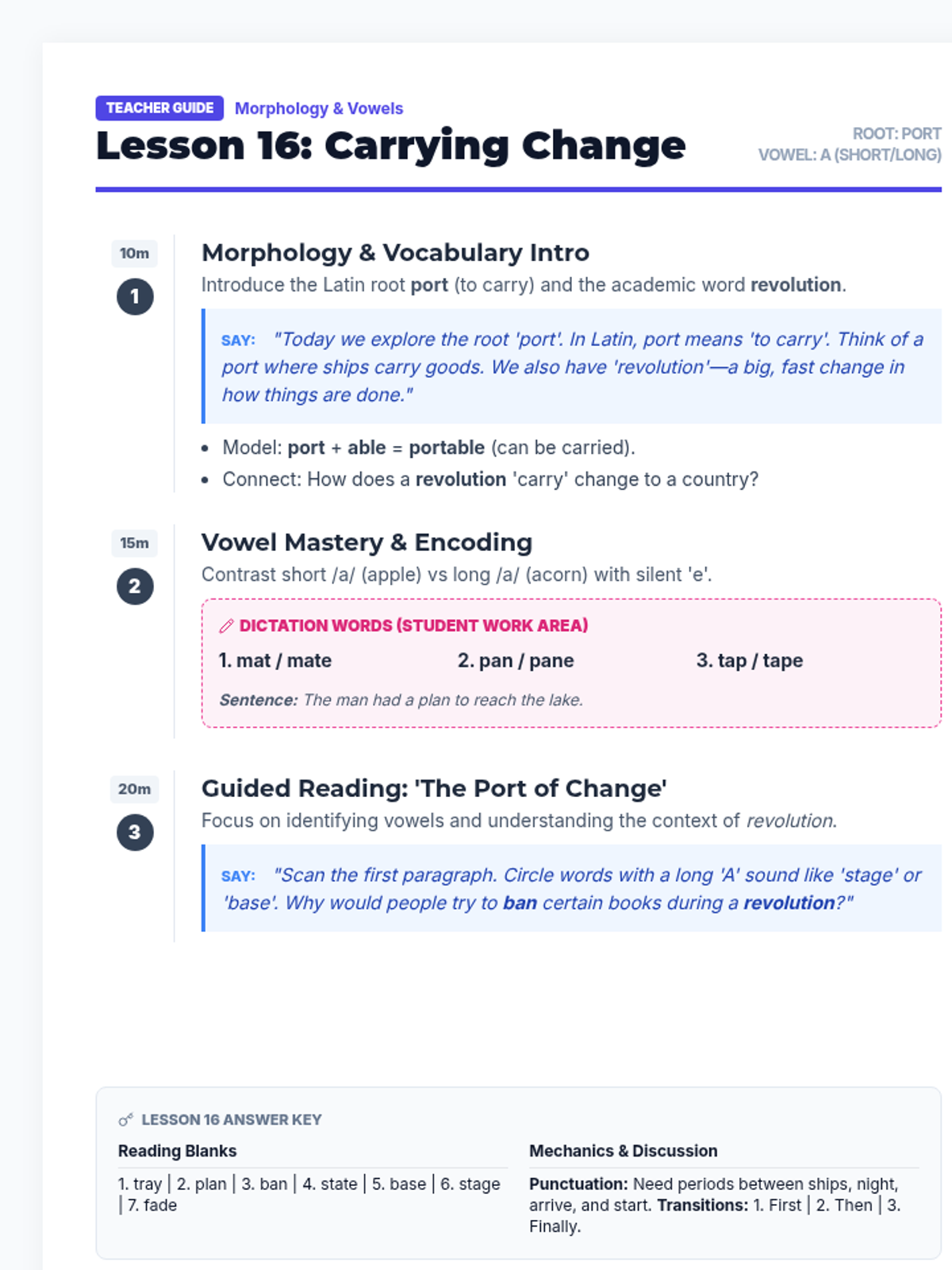
A 10-page comprehensive teacher guide for Lessons 16-25, with each lesson on its own printable page. Each guide includes a structured 60-minute lesson plan, explicit teacher scripts, encoding/dictation word lists for phonics mastery, and a complete answer key for the corresponding student handout.
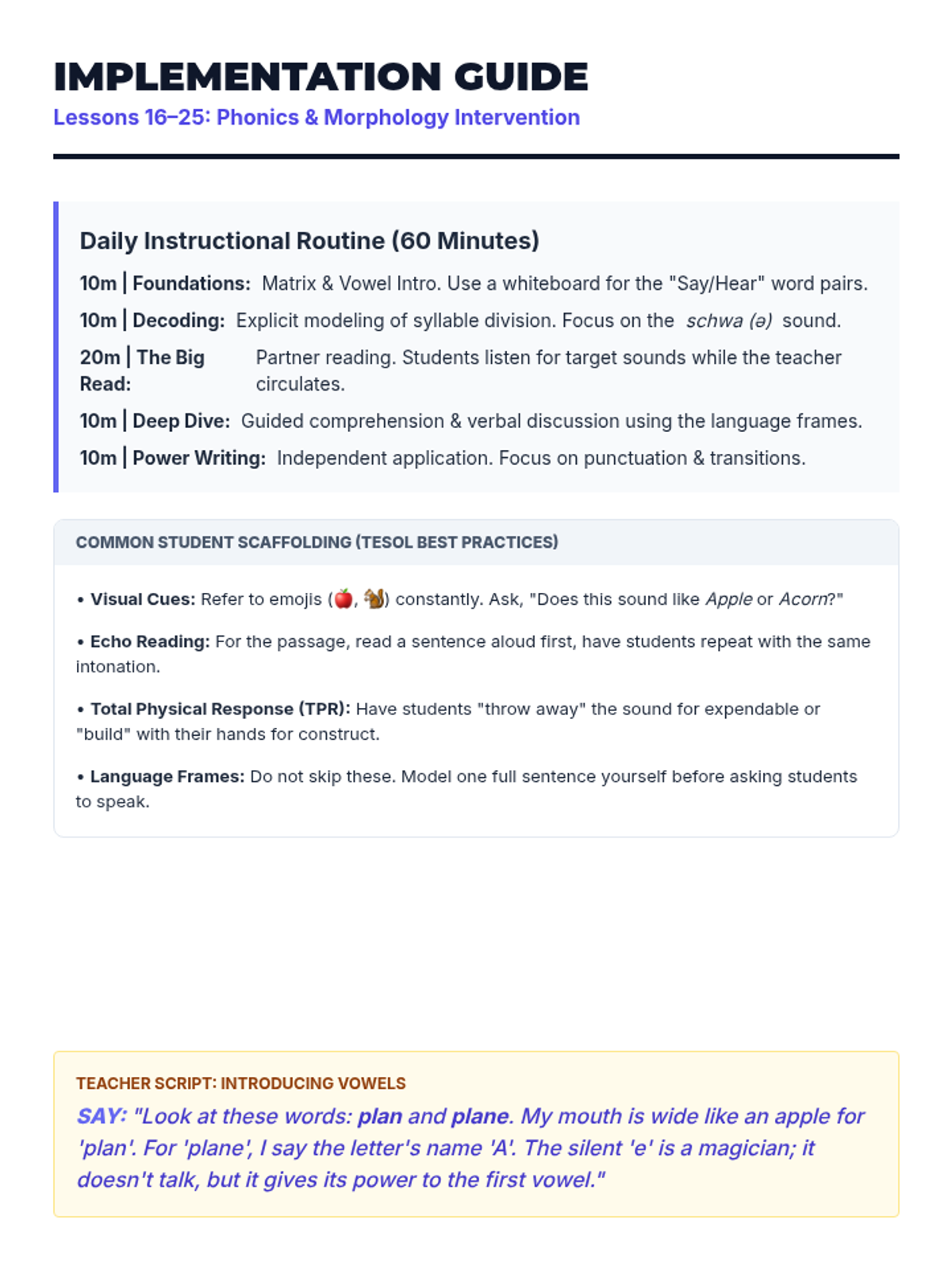
A comprehensive 4-page Teacher Key and Lesson Plan designed to support the implementation of Lessons 16-25. It includes a structured 60-minute daily routine, explicit teacher scripts for vowel instruction, scaffolding strategies for TESOL students, and a complete answer key for every blank, comprehension question, and mechanics exercise in the student handouts.
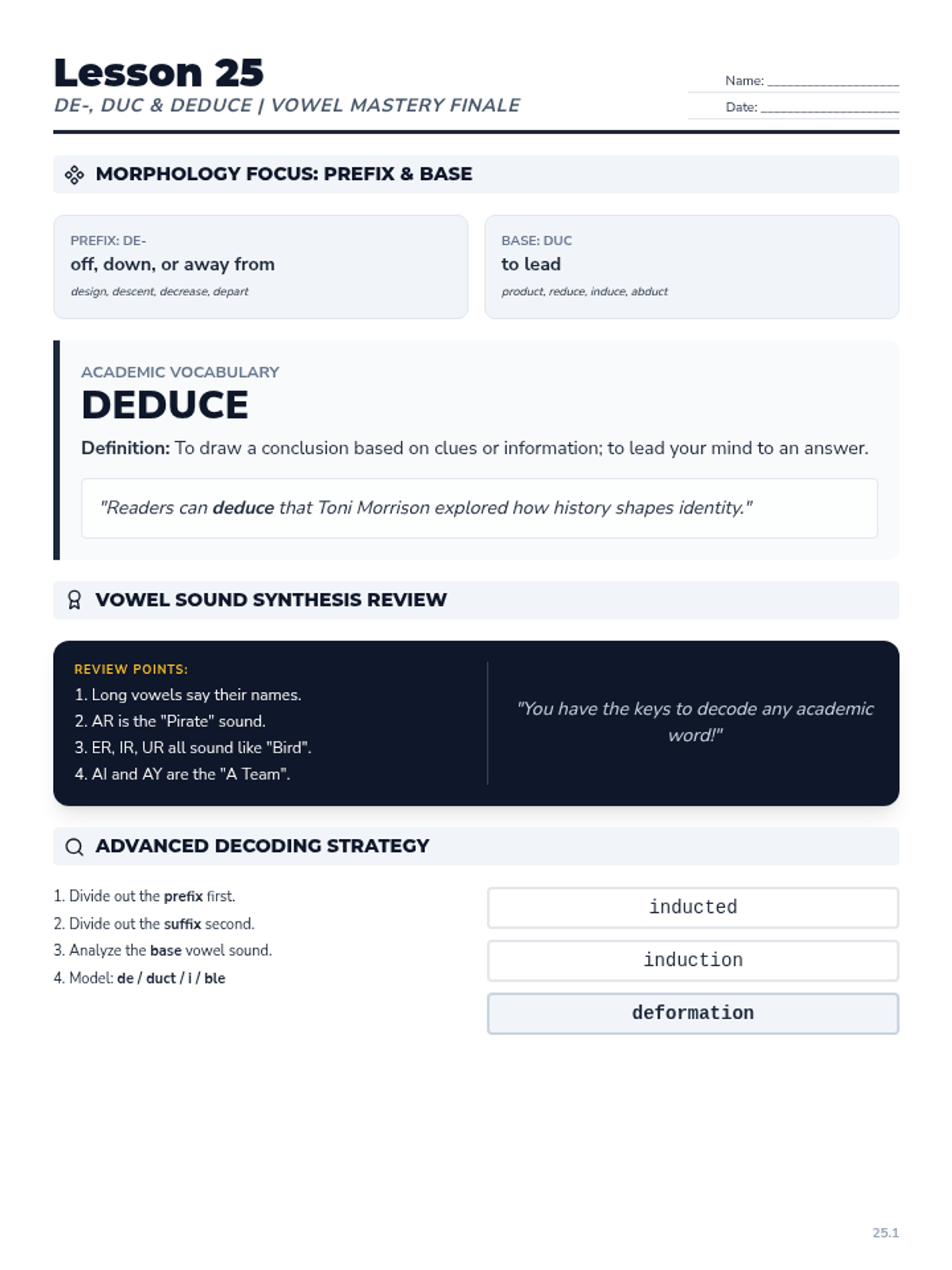
A comprehensive 4-page expansion for Lesson 25 of a reading intervention program. It focuses on the prefix 'de-', the Latin base 'duc' (to lead), and the vocabulary word 'deduce'. It includes a final synthesis reading passage, comprehension questions with discussion frames, and a final reflective writing task. Designed for high school TESOL students.
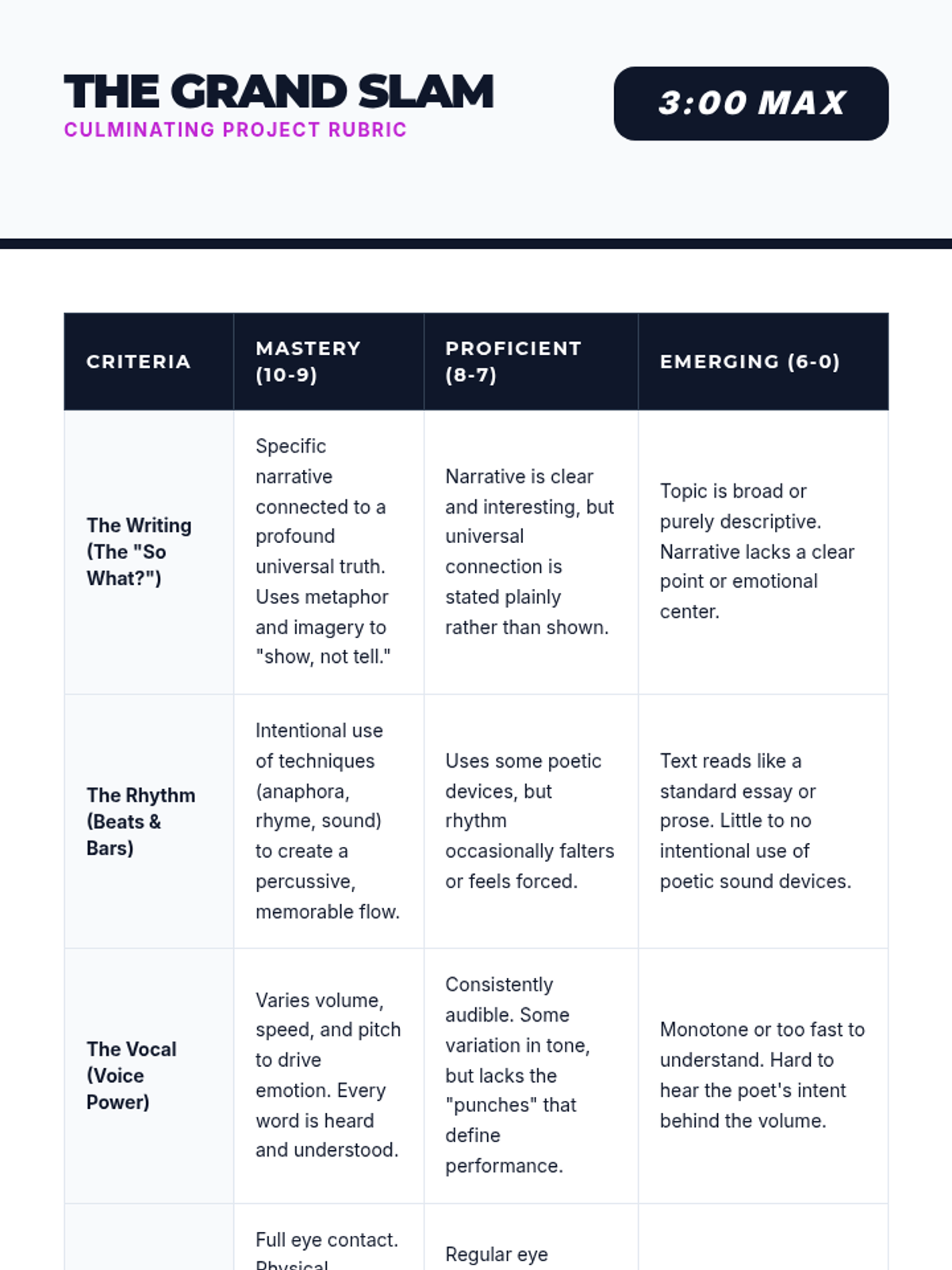
A final project rubric for a slam poetry performance, detailing criteria for writing, rhythm, vocal delivery, and stage presence.
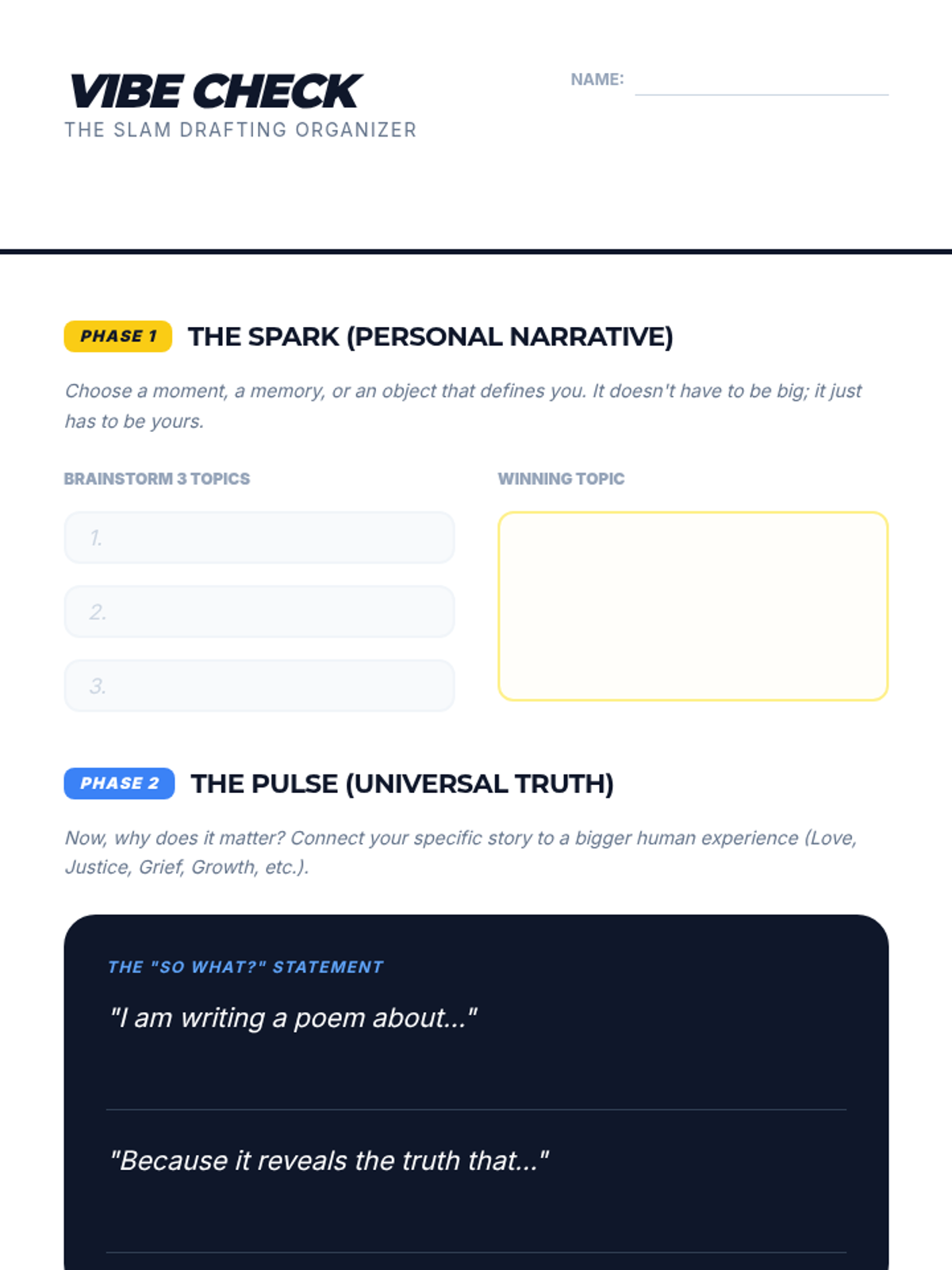
A graphic organizer to help students brainstorm personal topics and connect them to universal themes for their 3-minute slam poem.
A slide deck for Lesson 3 focusing on topic selection, vulnerability, and the structural arc of a 3-minute slam poem.
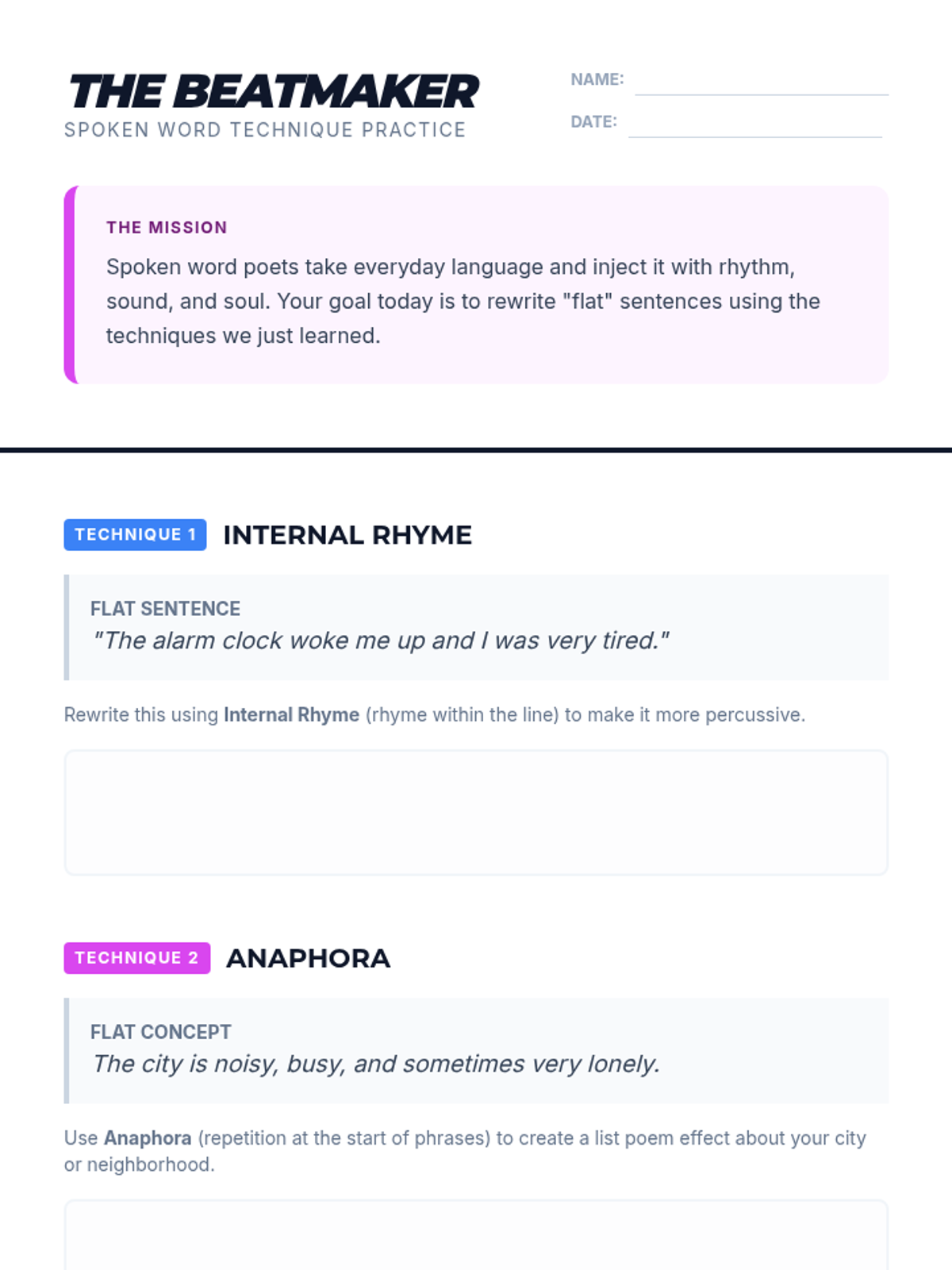
A student worksheet where students transform mundane sentences into rhythmic spoken word lines using techniques like internal rhyme, anaphora, and plosive sounds.
A presentation focusing on rhythmic and phonetic techniques in spoken word, including enjambment, rhyme patterns, and sound choices like plosives and sibilance.
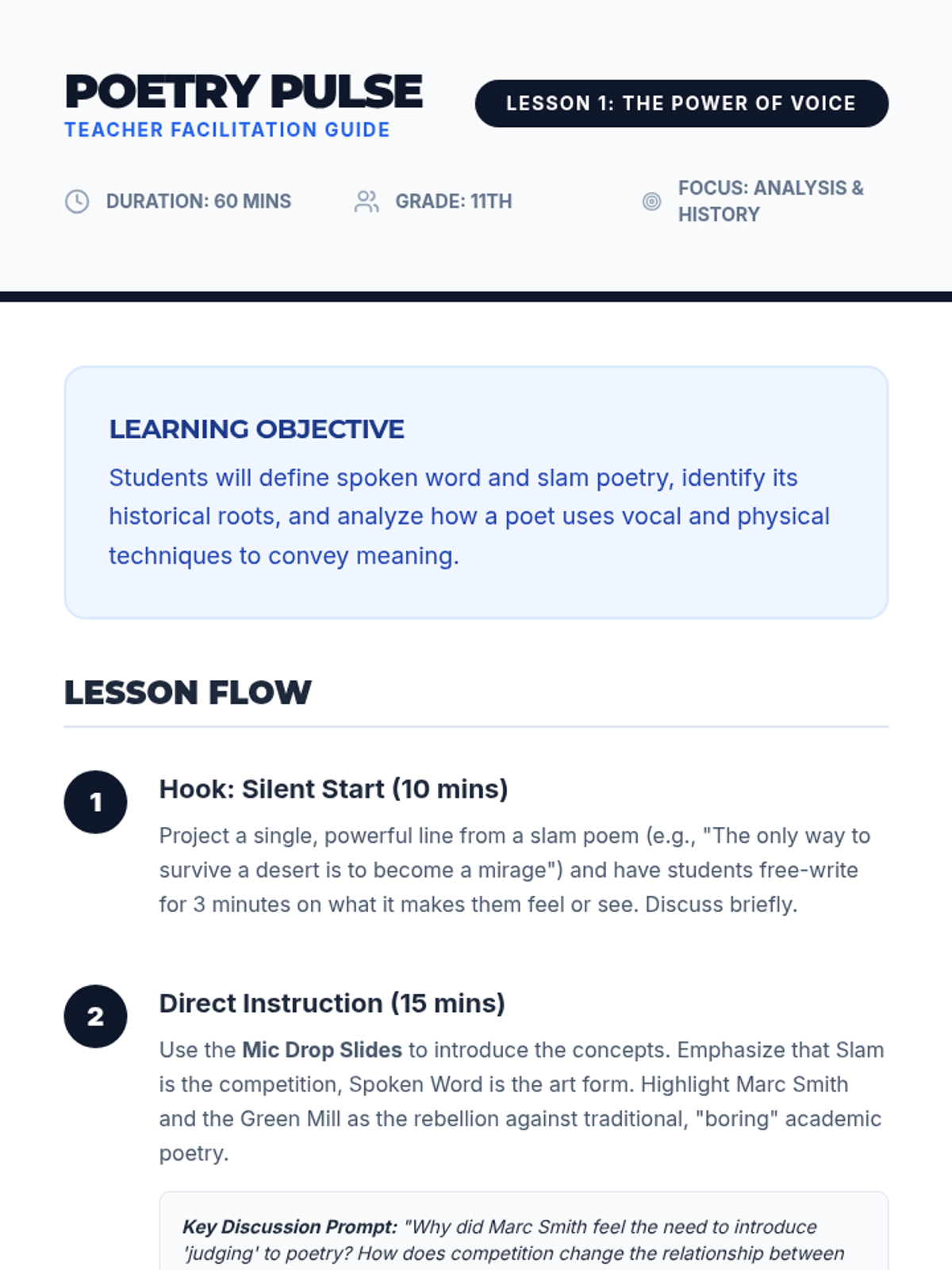
A teacher-facing lesson plan for "The Power of Voice," including learning objectives, a detailed procedure, video recommendations, and differentiation strategies.
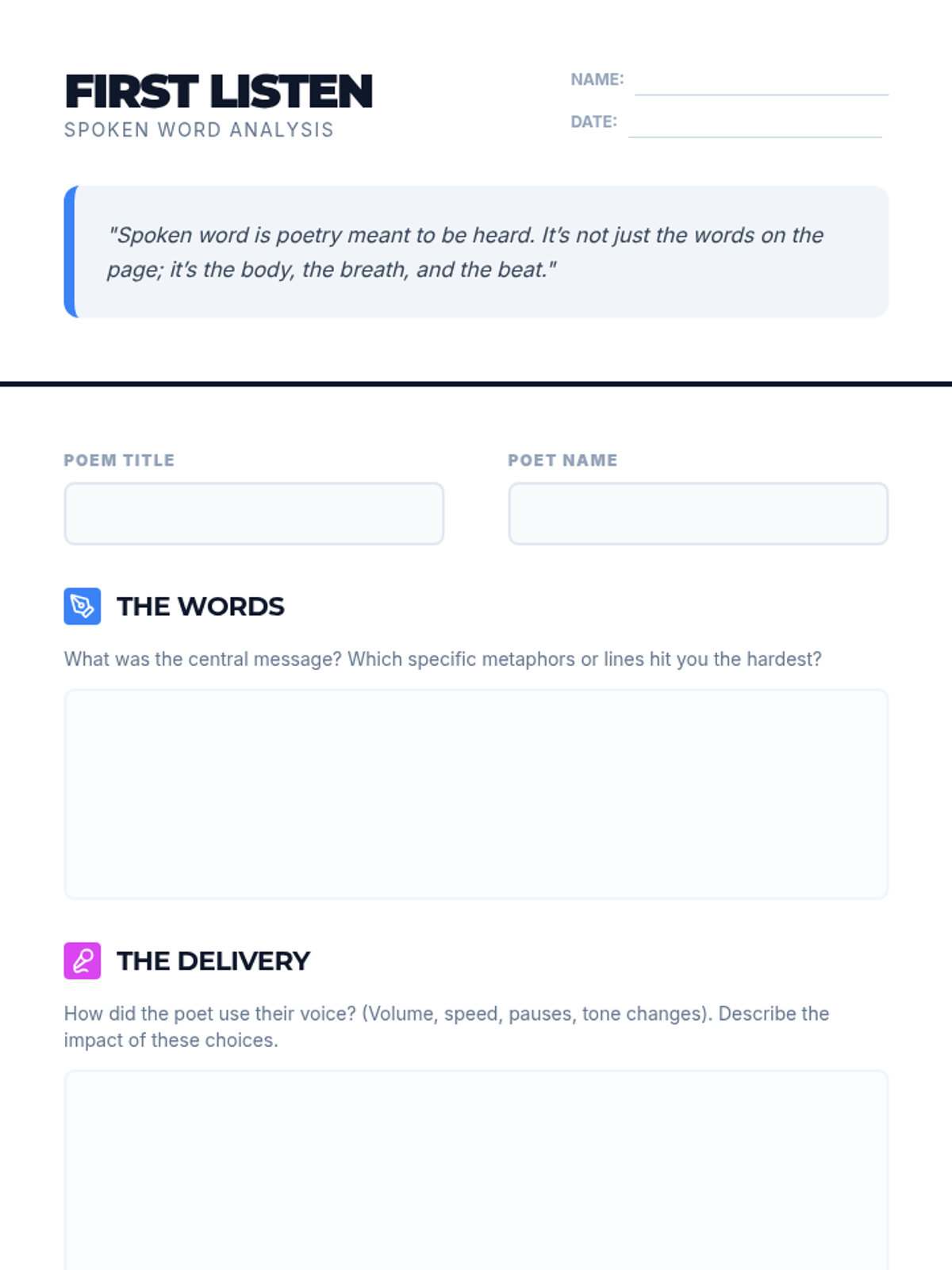
A student analysis worksheet designed for use during or after watching a spoken word performance, focusing on verbal, vocal, and physical techniques.
An introductory slide deck for a slam poetry unit, covering the definition, history (Marc Smith and the Green Mill), and core elements of spoken word performance with an urban aesthetic.
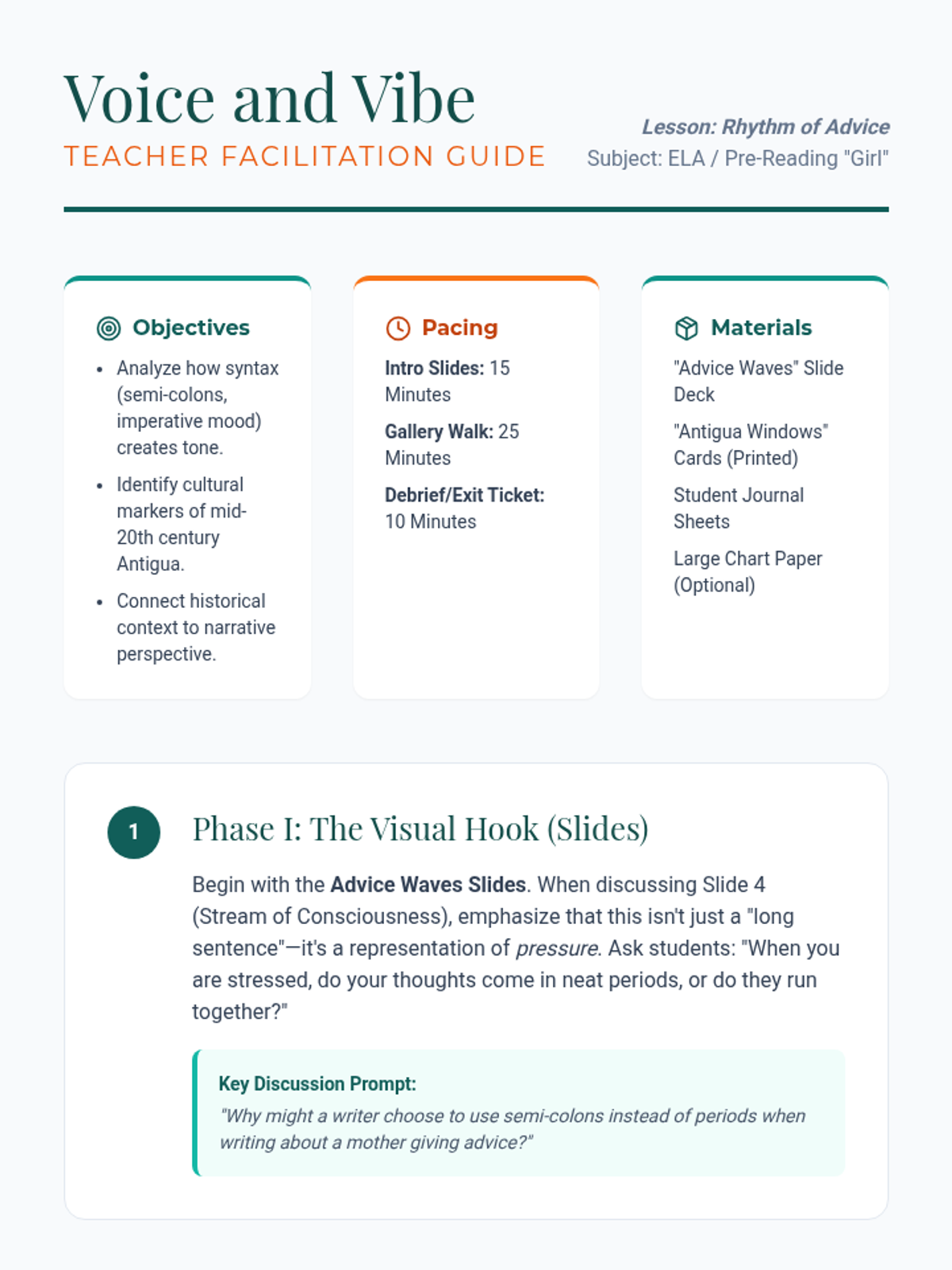
A comprehensive teacher guide for the 'Rhythm of Advice' lesson, providing pacing, instructional steps, discussion prompts, and background information on Antiguan culture and Jamaica Kincaid's literary style.
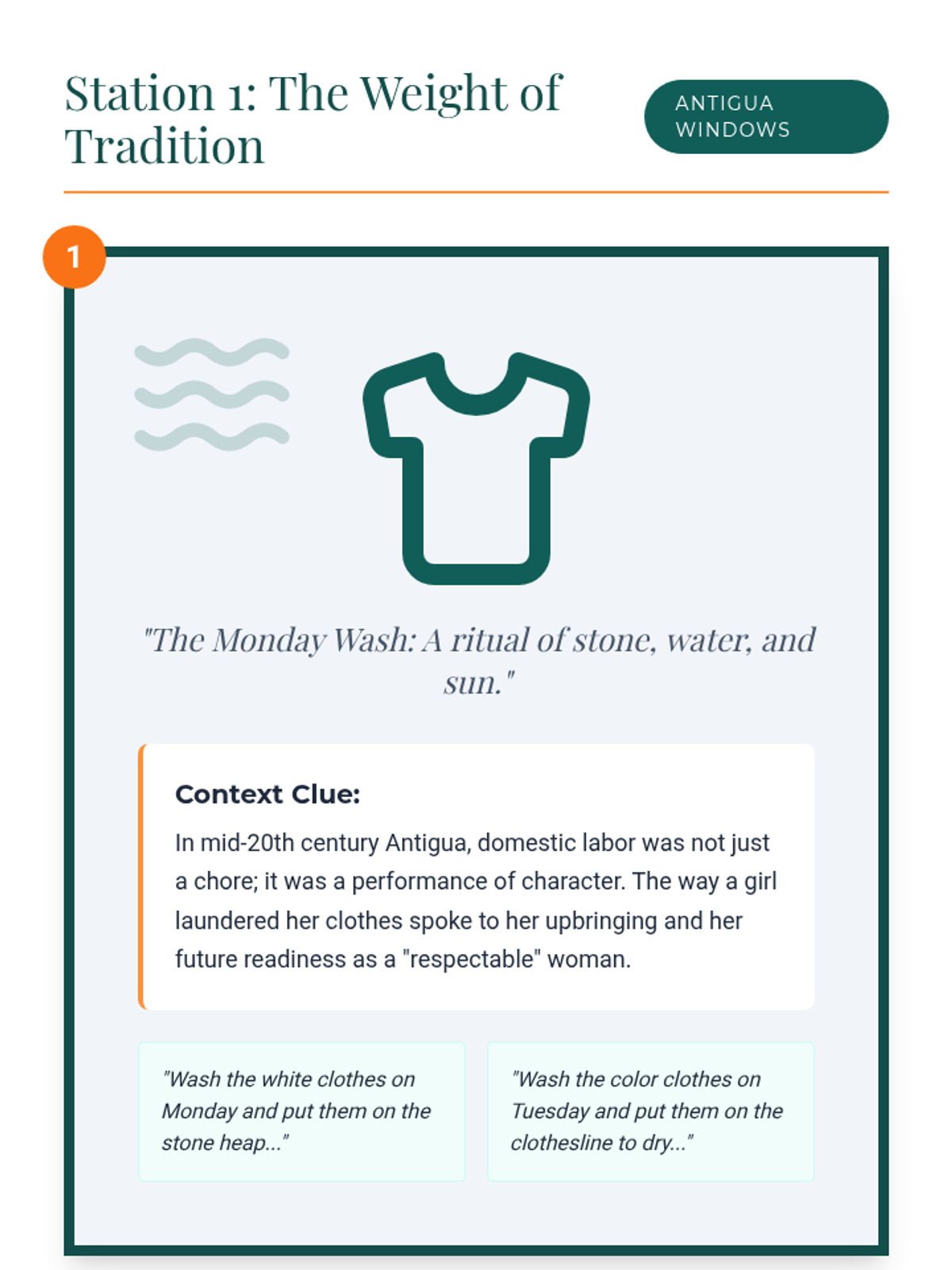
A 4-page student activity featuring three 'Gallery Walk' stations with visual symbols and context clues about Antiguan life, followed by a structured recording sheet for student analysis.
A 7-slide introductory presentation covering Jamaica Kincaid's biography, the historical context of Antigua, and the literary techniques of stream of consciousness and syntax analysis.
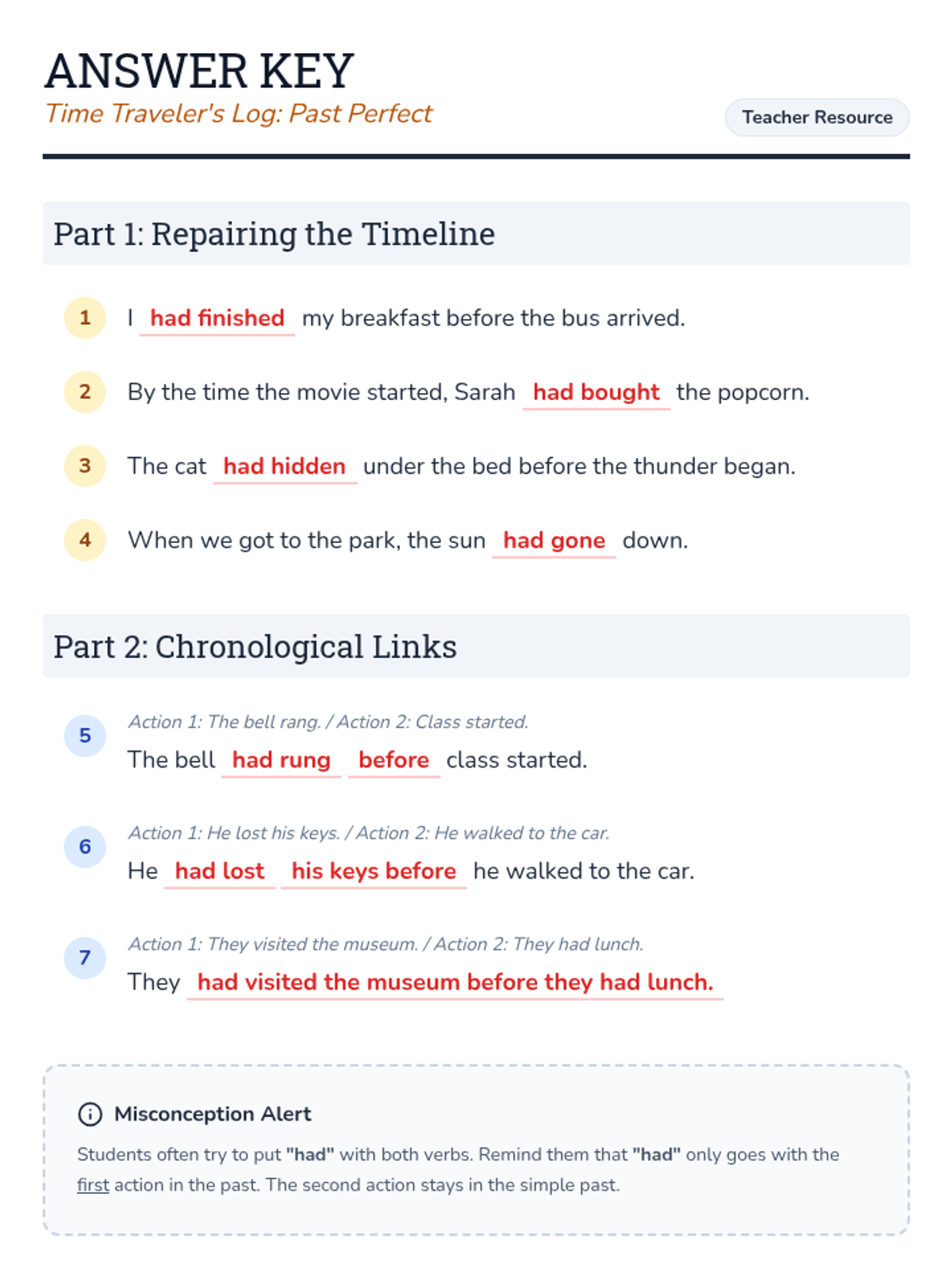
An answer key for the Time Traveler Log worksheet, clearly displaying the correct past perfect forms and completed sentences for all exercises.
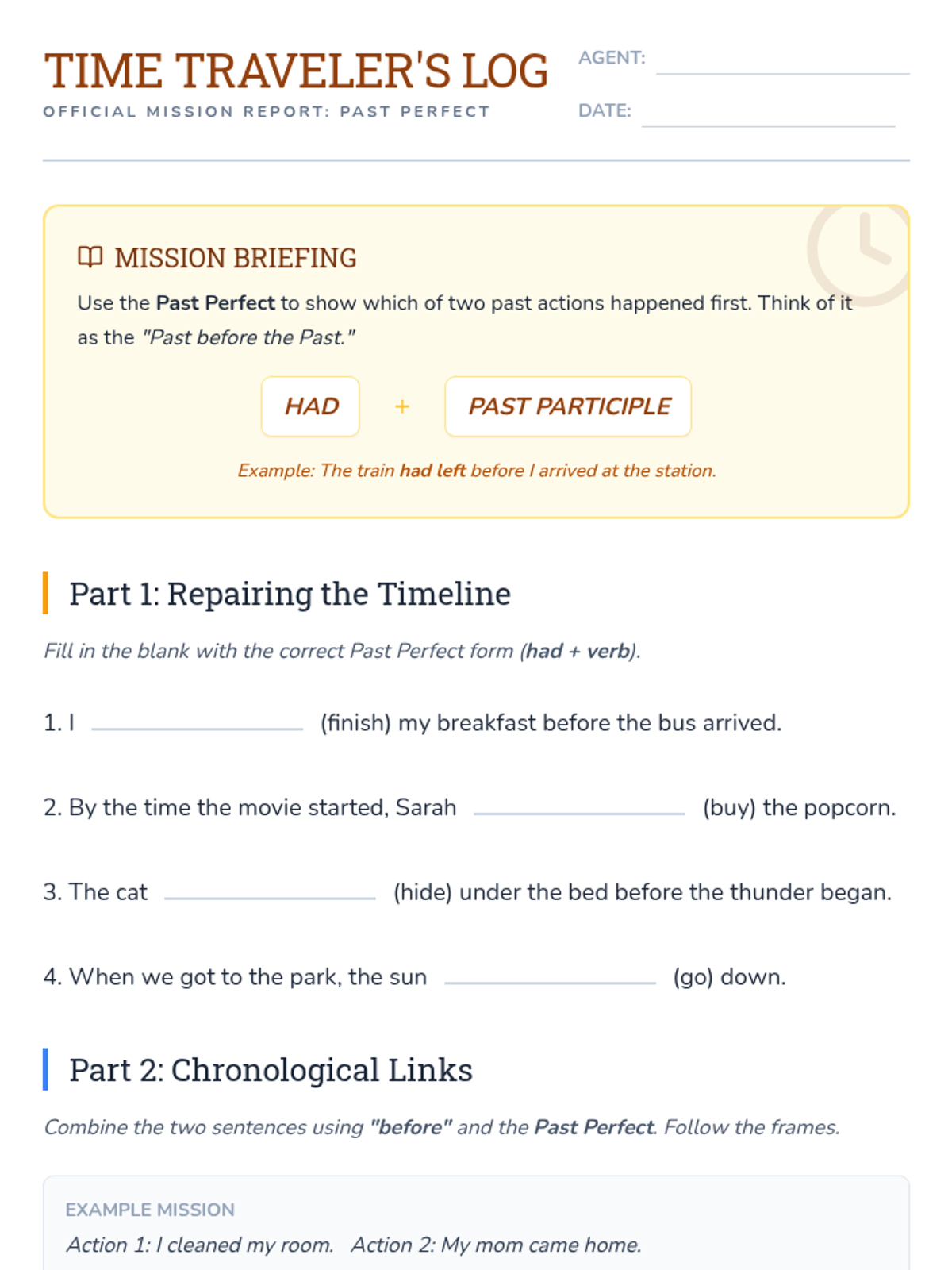
A student worksheet designed with a 'Time Traveler' theme. It features a reference rule box, fill-in-the-blank practice, and sentence-combining exercises using familiar vocabulary and scaffolded instructions.
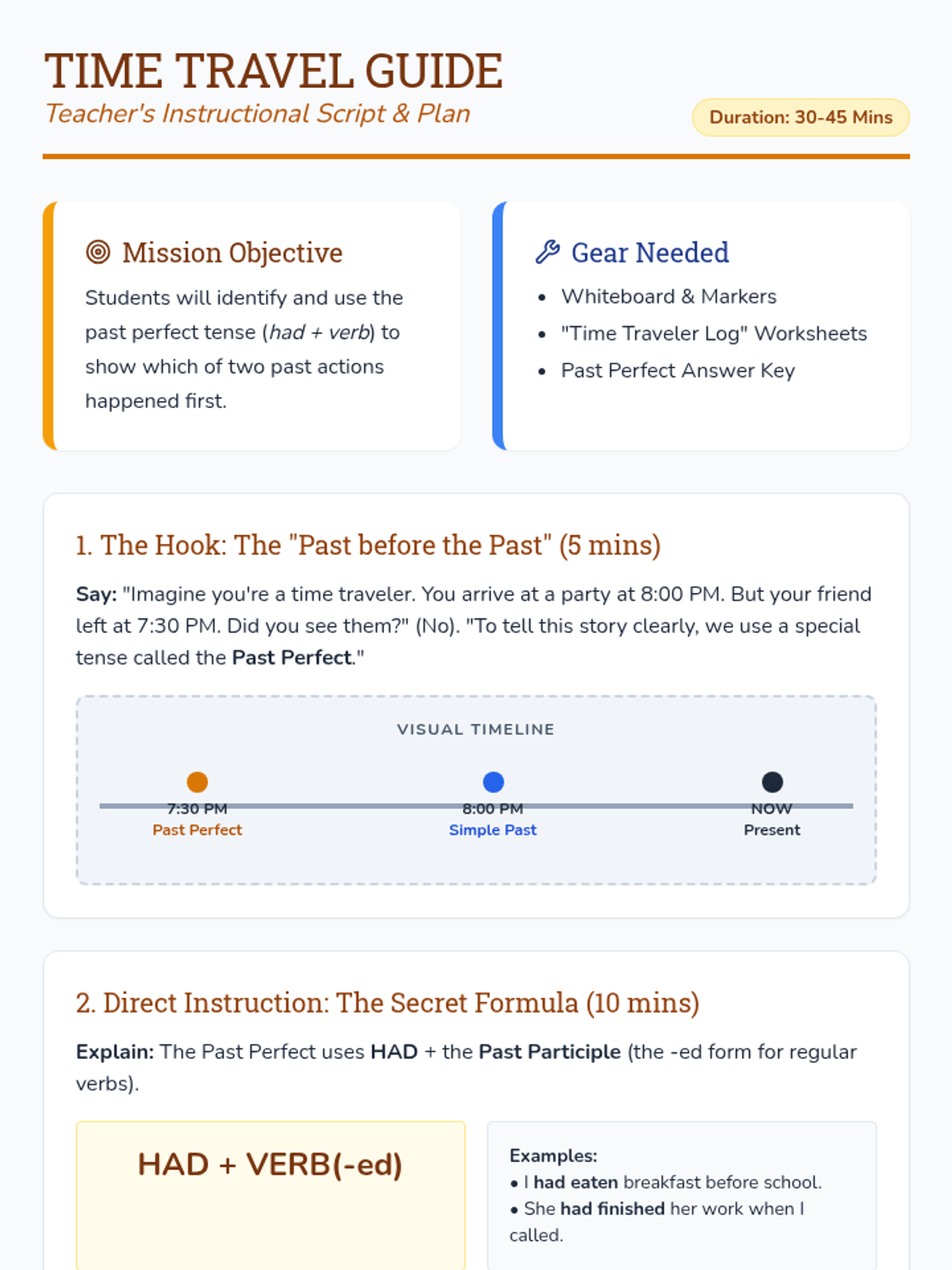
A detailed lesson plan for teachers to introduce the past perfect tense. Includes a 'hook' scenario, visual timeline diagram, explicit grammar formula, and guided practice examples with familiar vocabulary.
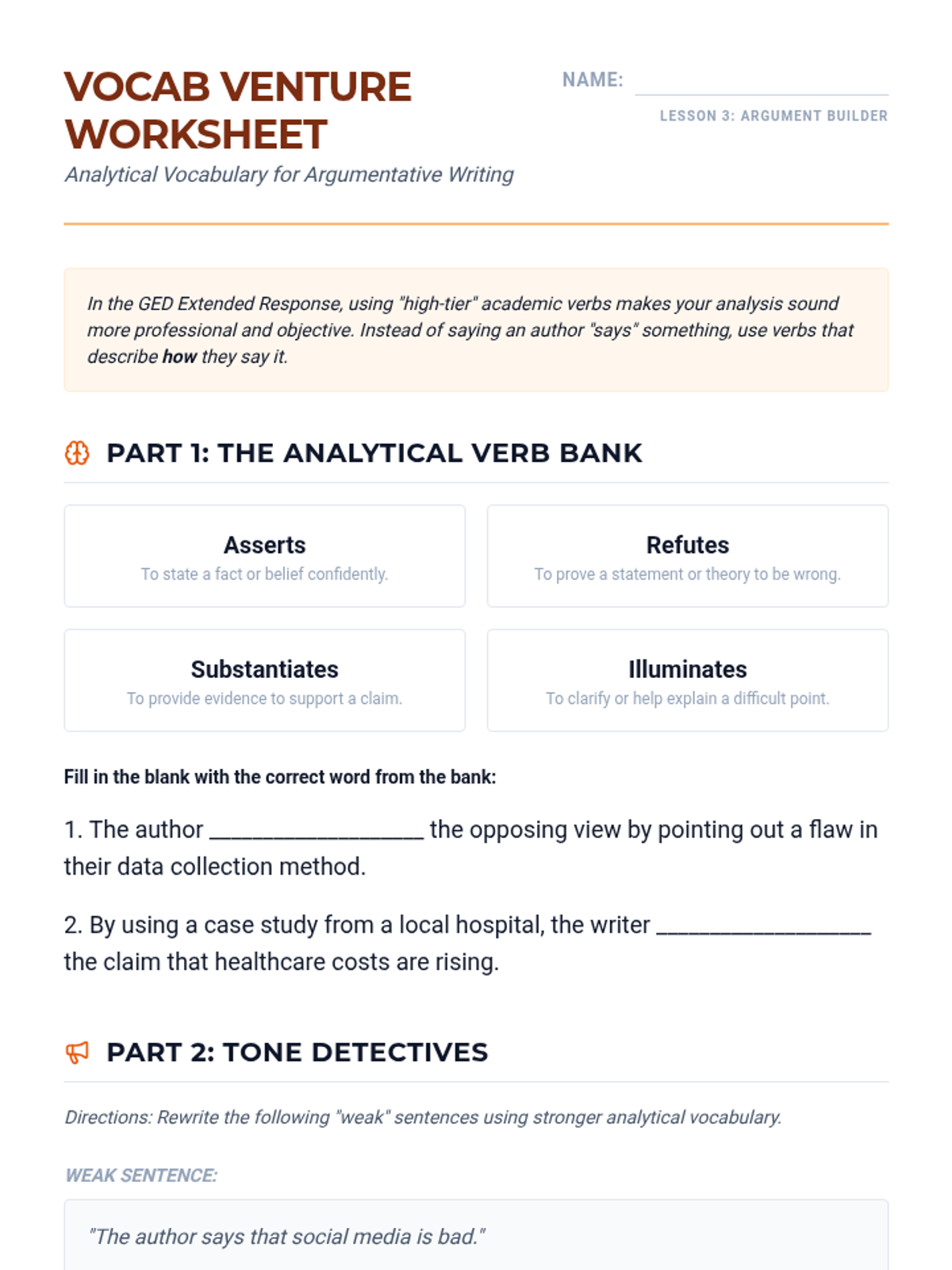
A printer-friendly vocabulary development worksheet focusing on analytical vocabulary for argumentative writing, specifically designed for the GED RLA Extended Response.
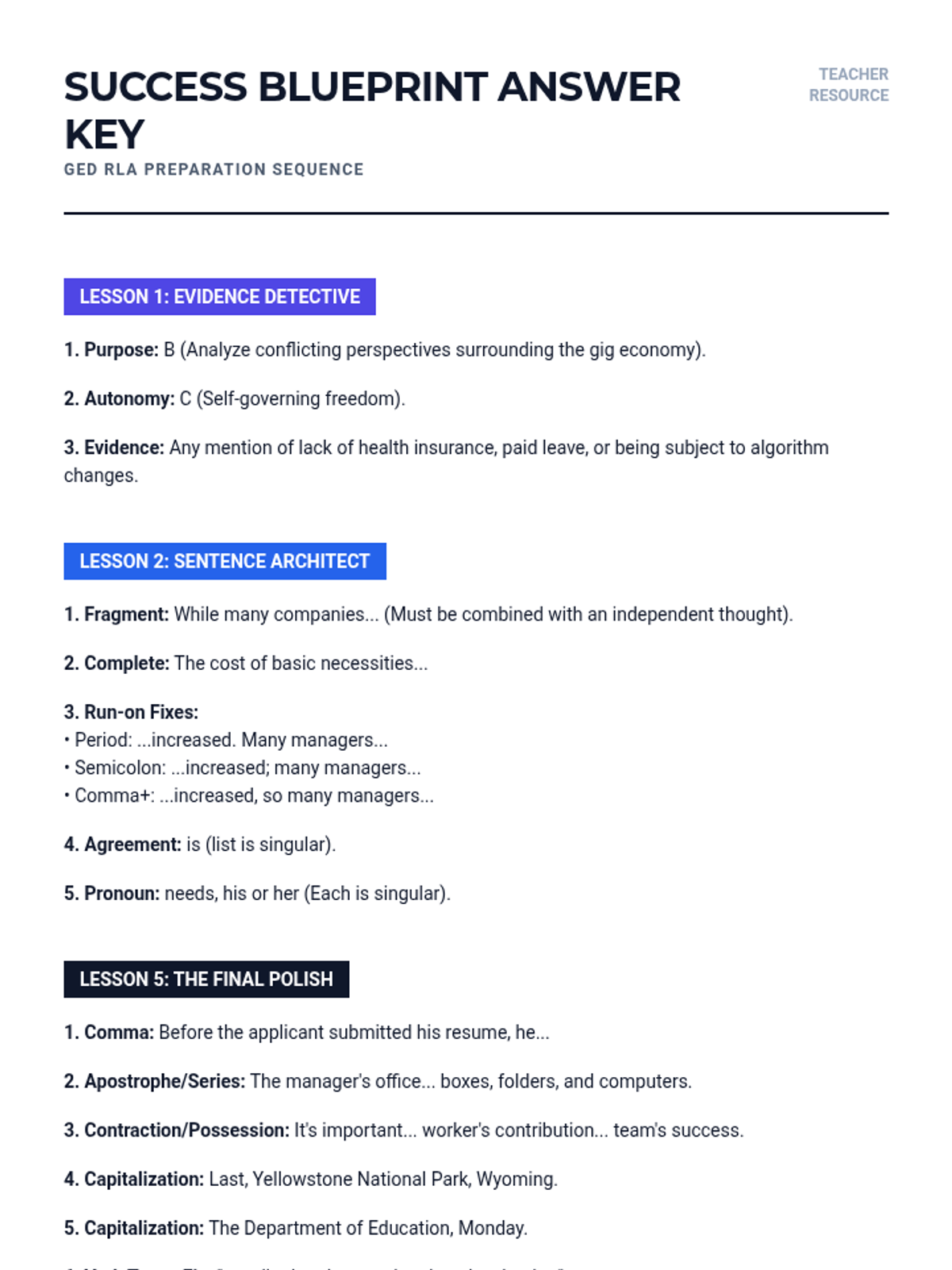
A printer-friendly consolidated teacher resource providing answers for all grammar, reading, and assessment materials in the GED Success Blueprint sequence.
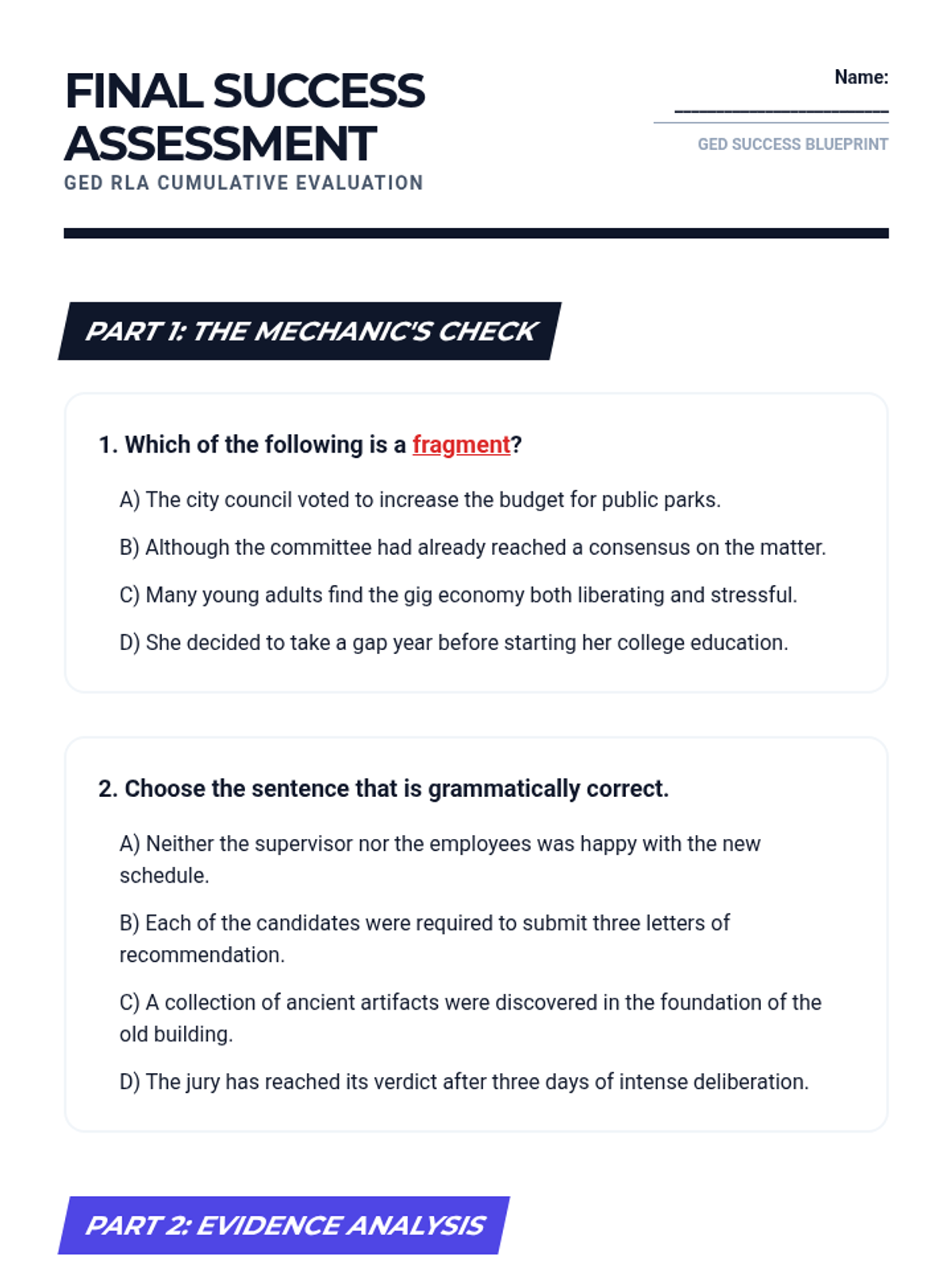
A comprehensive final assessment for adult learners, testing grammar, mechanics, author's purpose, and paragraph construction.
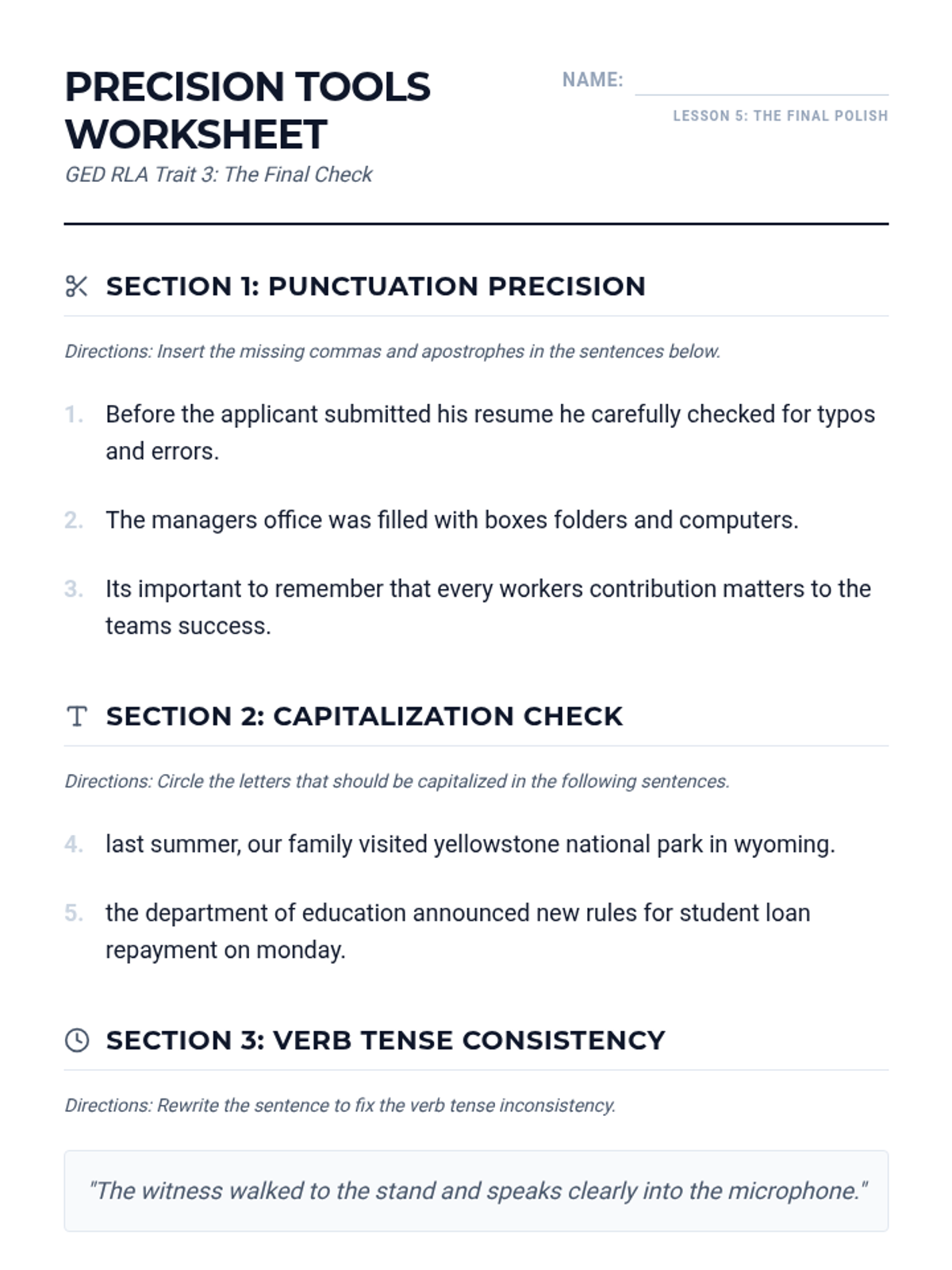
A printer-friendly mechanics-focused worksheet for adult learners covering punctuation, capitalization, and verb tense.
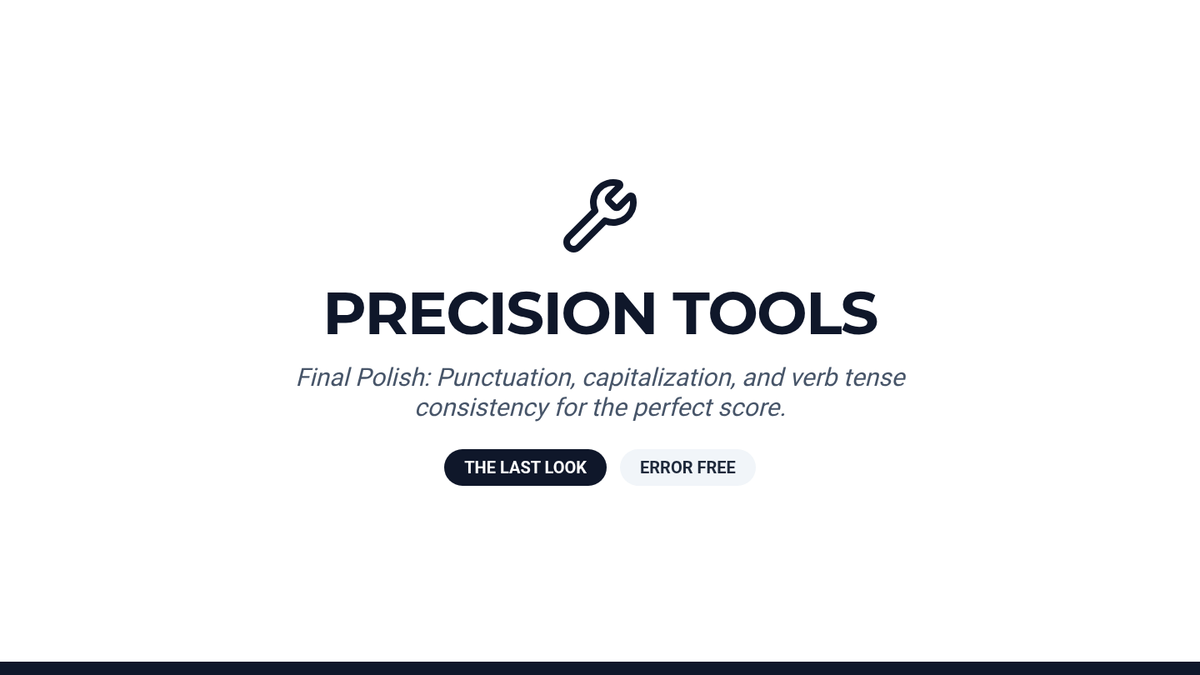
Instructional slides for adult learners focused on punctuation (commas and apostrophes), capitalization rules, and verb tense consistency. Backgrounds are white with high contrast for easy printing.
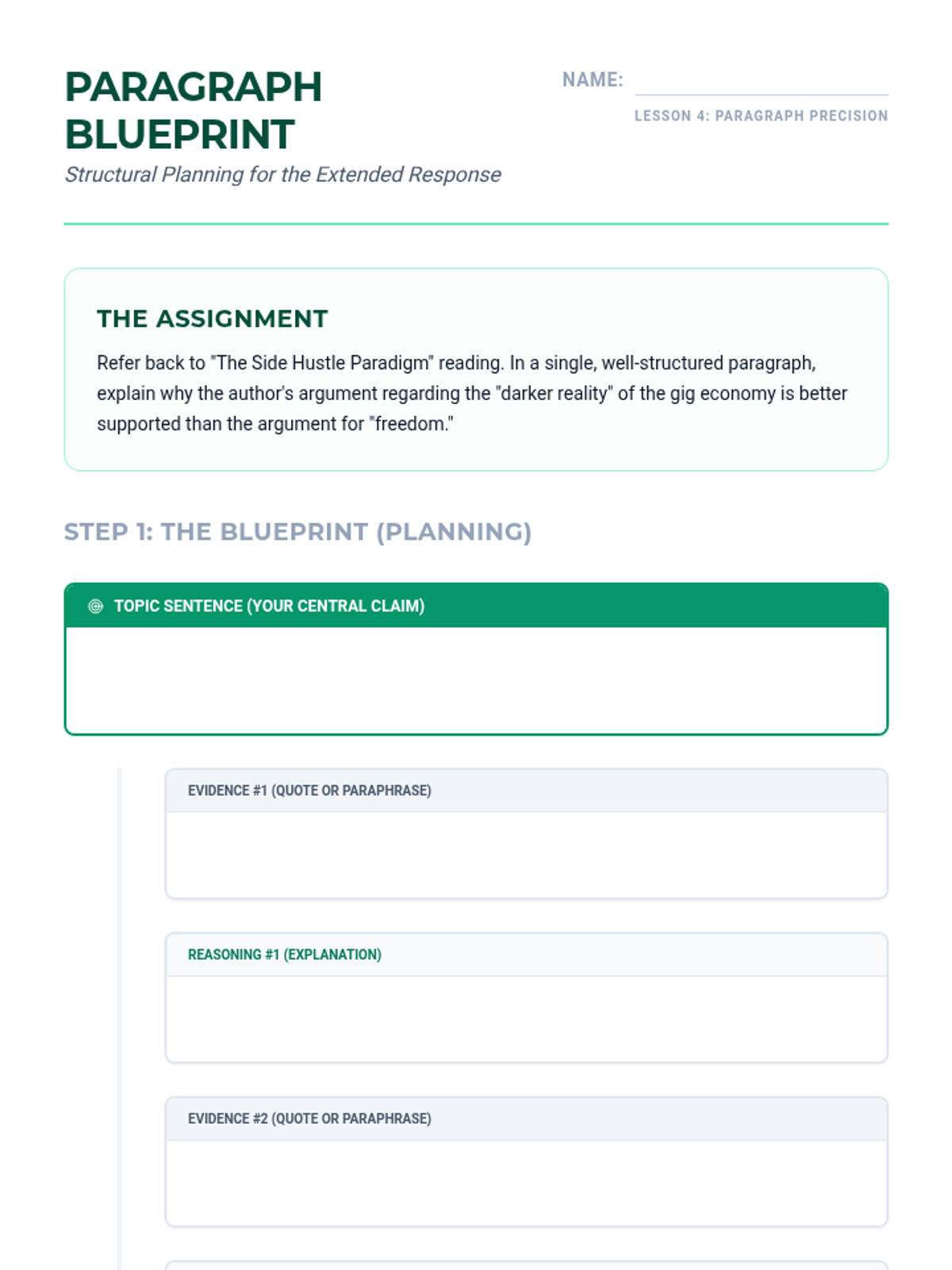
A printer-friendly graphic organizer and drafting worksheet designed to help adult learners plan and write structured paragraphs.
Printer-friendly instructional slides teaching paragraph structure, transition words, and the use of descriptive language for adult learners. Backgrounds are white with high contrast.
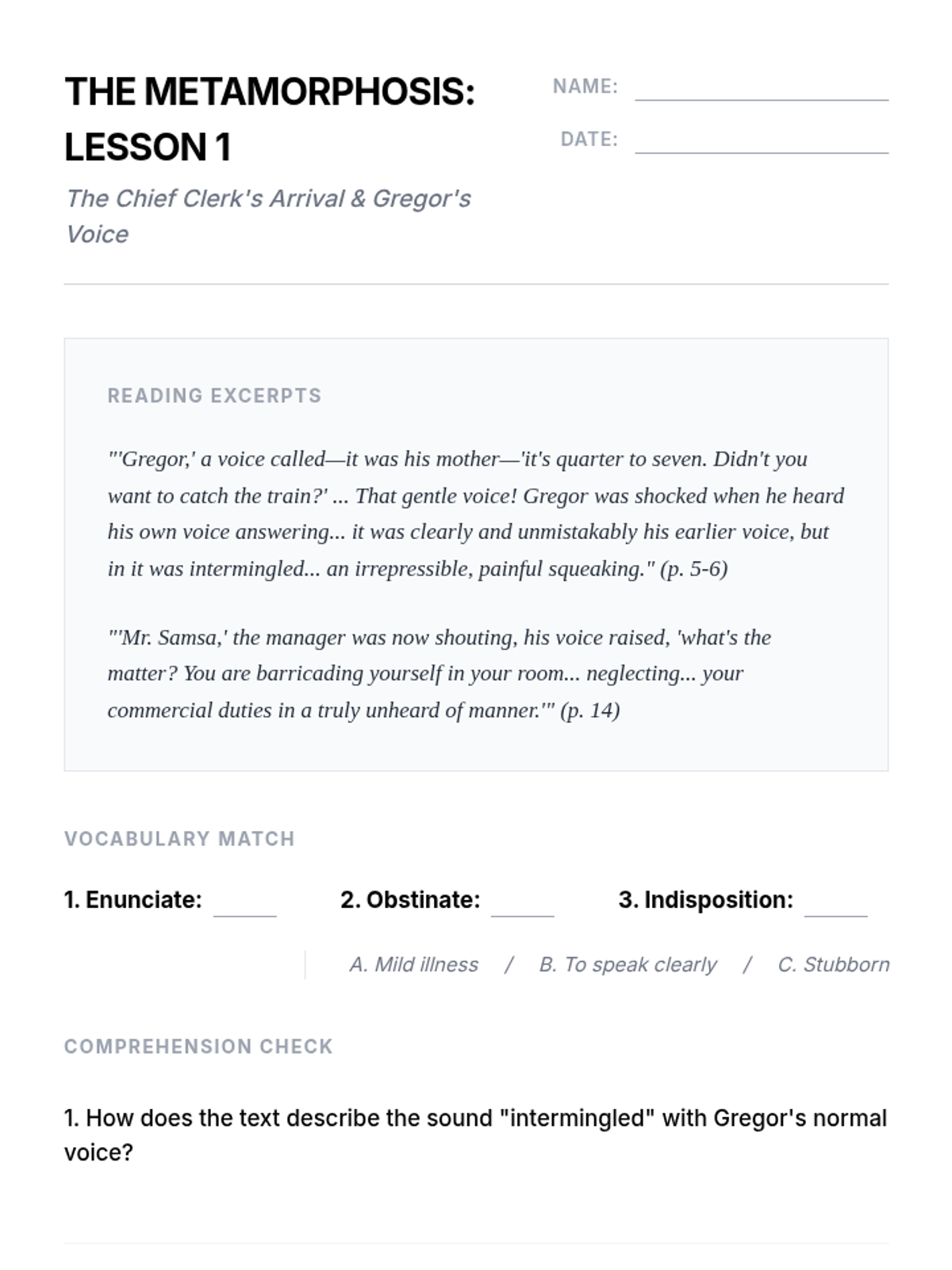
A clean, high-contrast, print-friendly version of the Lesson 1 handout, split into foundations and exit ticket pages with clear typography and ample writing space.
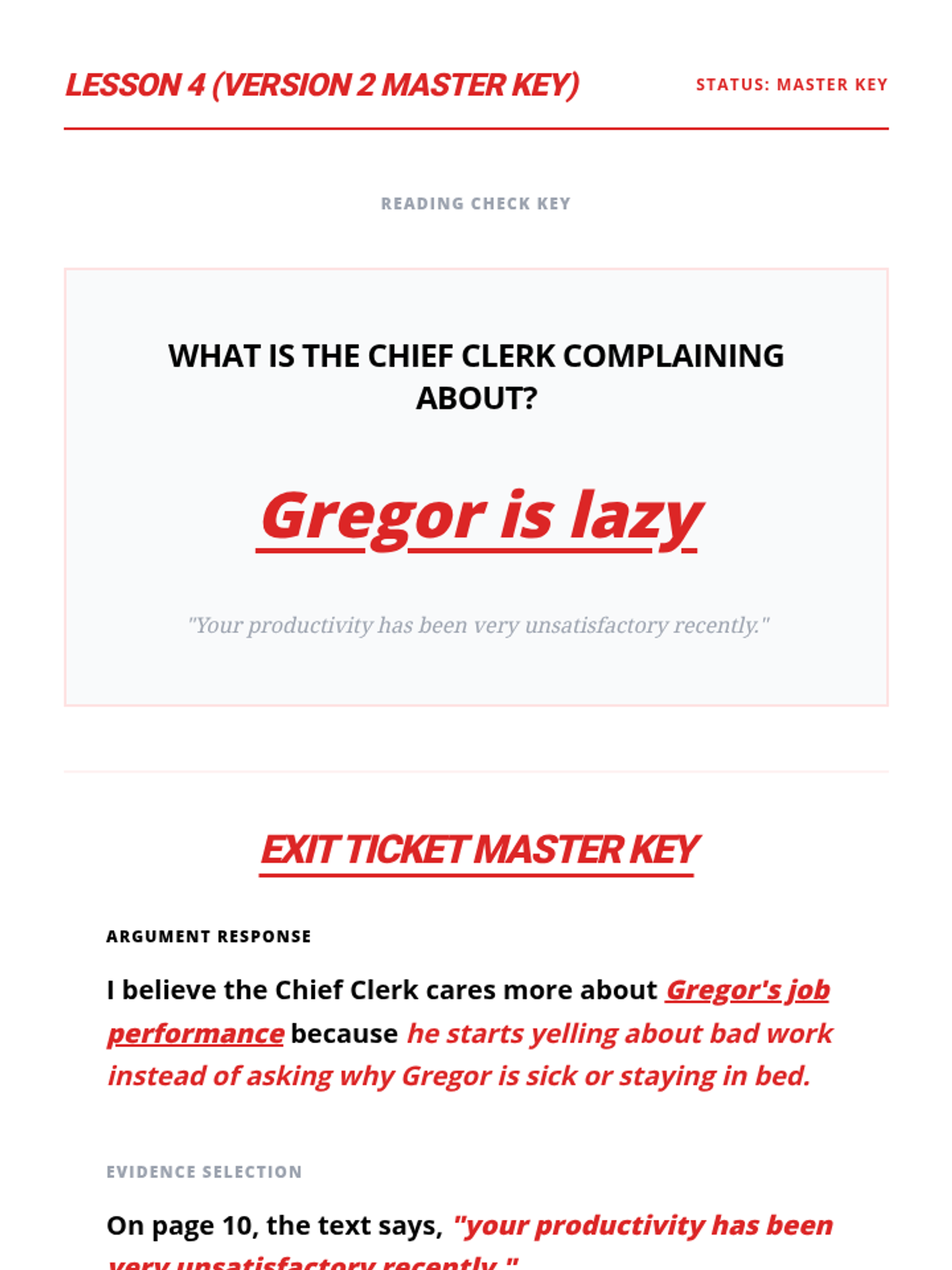
Master key for the scaffolded Version 2 theme analysis handout for Lesson 4, offering clear and concise analytical responses in high contrast.
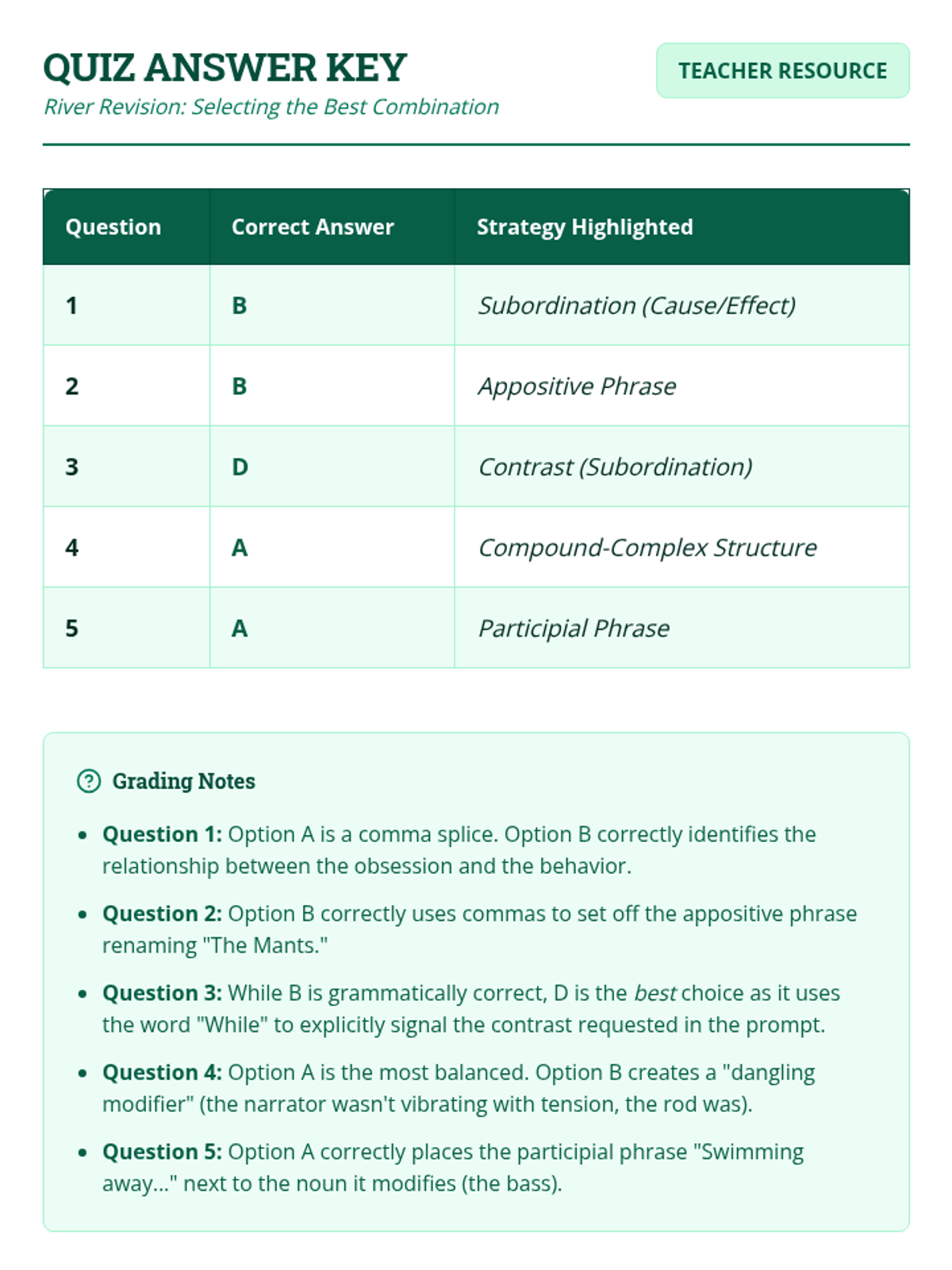
An answer key for the River Revision Quiz, including the correct letter for each question and brief explanations for the grammatical reasoning behind the correct choices.
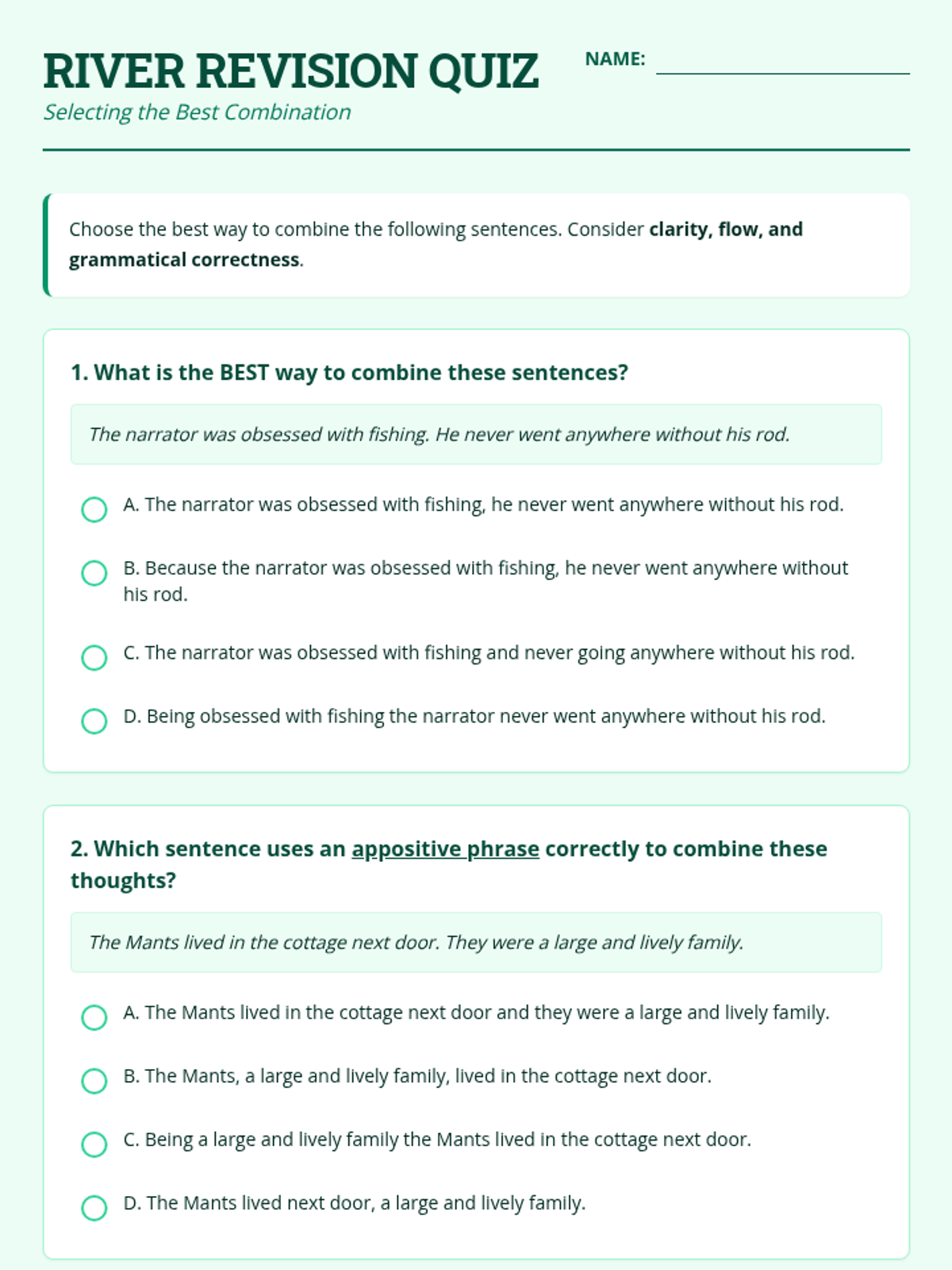
A 5-question multiple-choice quiz focusing on choosing the best sentence combinations based on clarity, flow, and grammatical sophistication, themed around 'The Bass, the River, and Sheila Mant'.
An instructional slide deck for teaching sentence combining strategies (FANBOYS, subordination, appositives, and participles) themed around 'The Bass, the River, and Sheila Mant'.
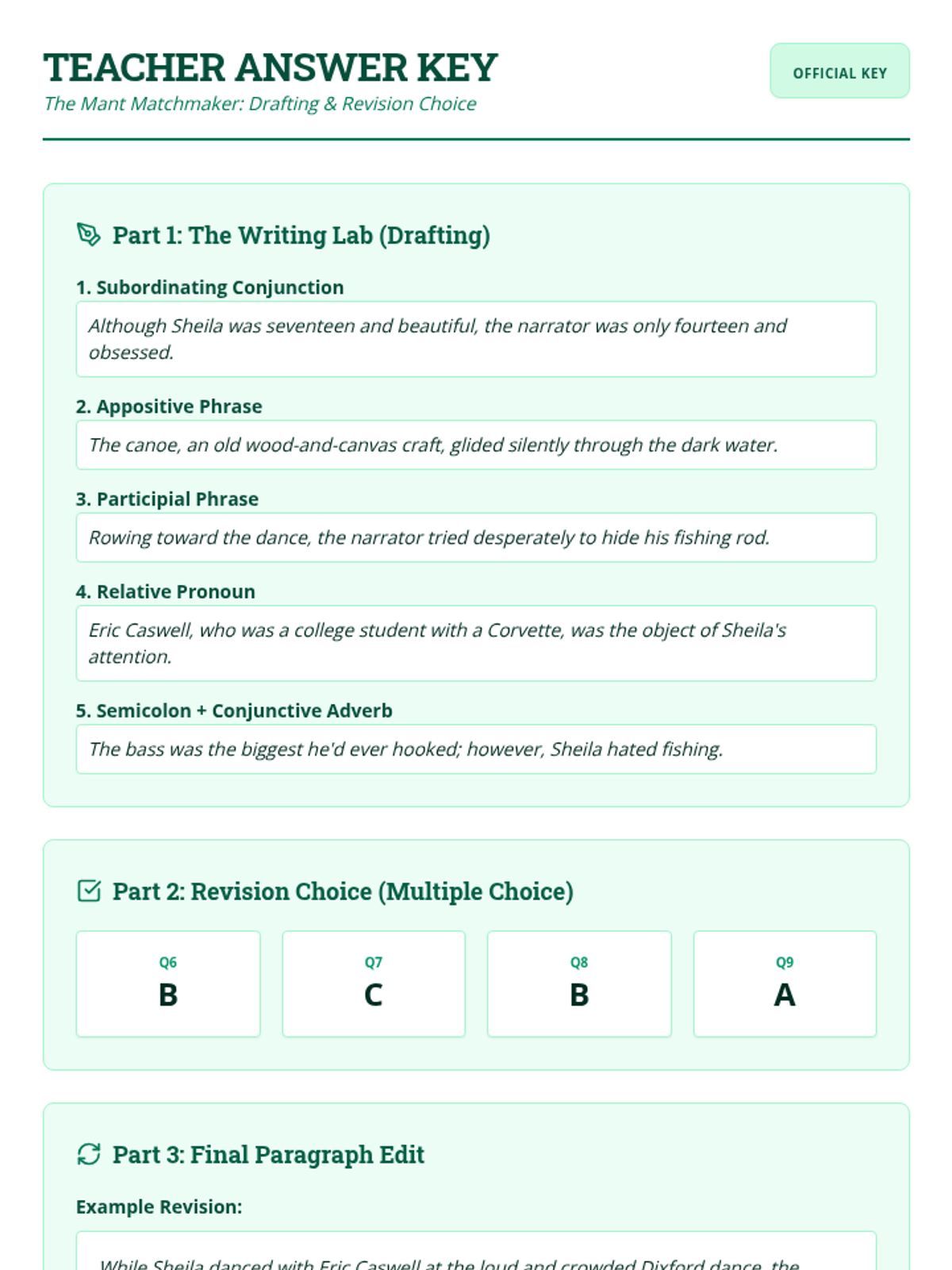
A comprehensive teacher answer key for the updated Mant Matchmaker Worksheet, covering the open-ended combining tasks, multiple-choice questions, and the final narrative flow challenge.
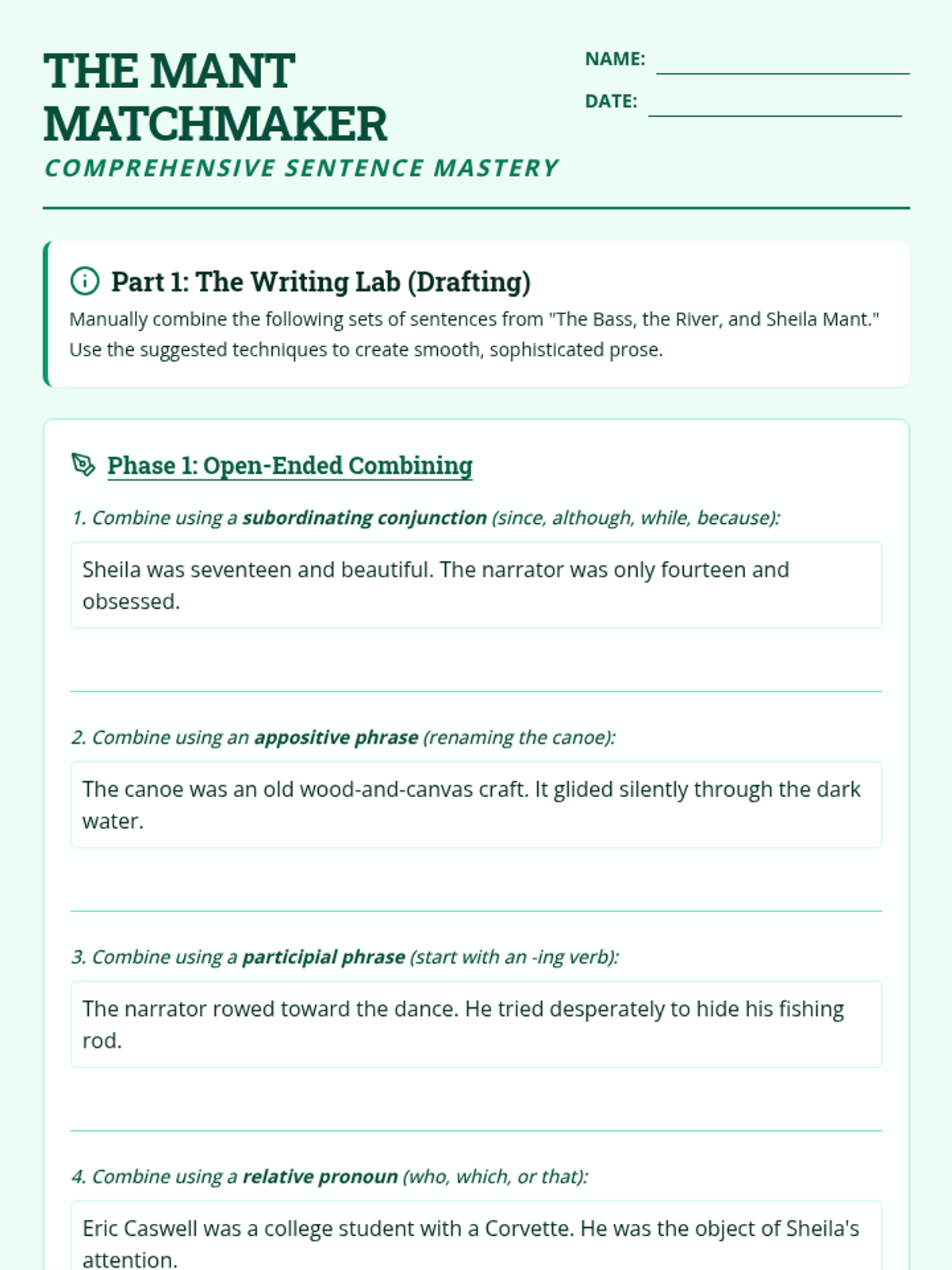
A comprehensive two-page combined worksheet featuring 5 open-ended drafting tasks, 4 multiple-choice revision questions with standardized styling, and a final paragraph editing challenge.
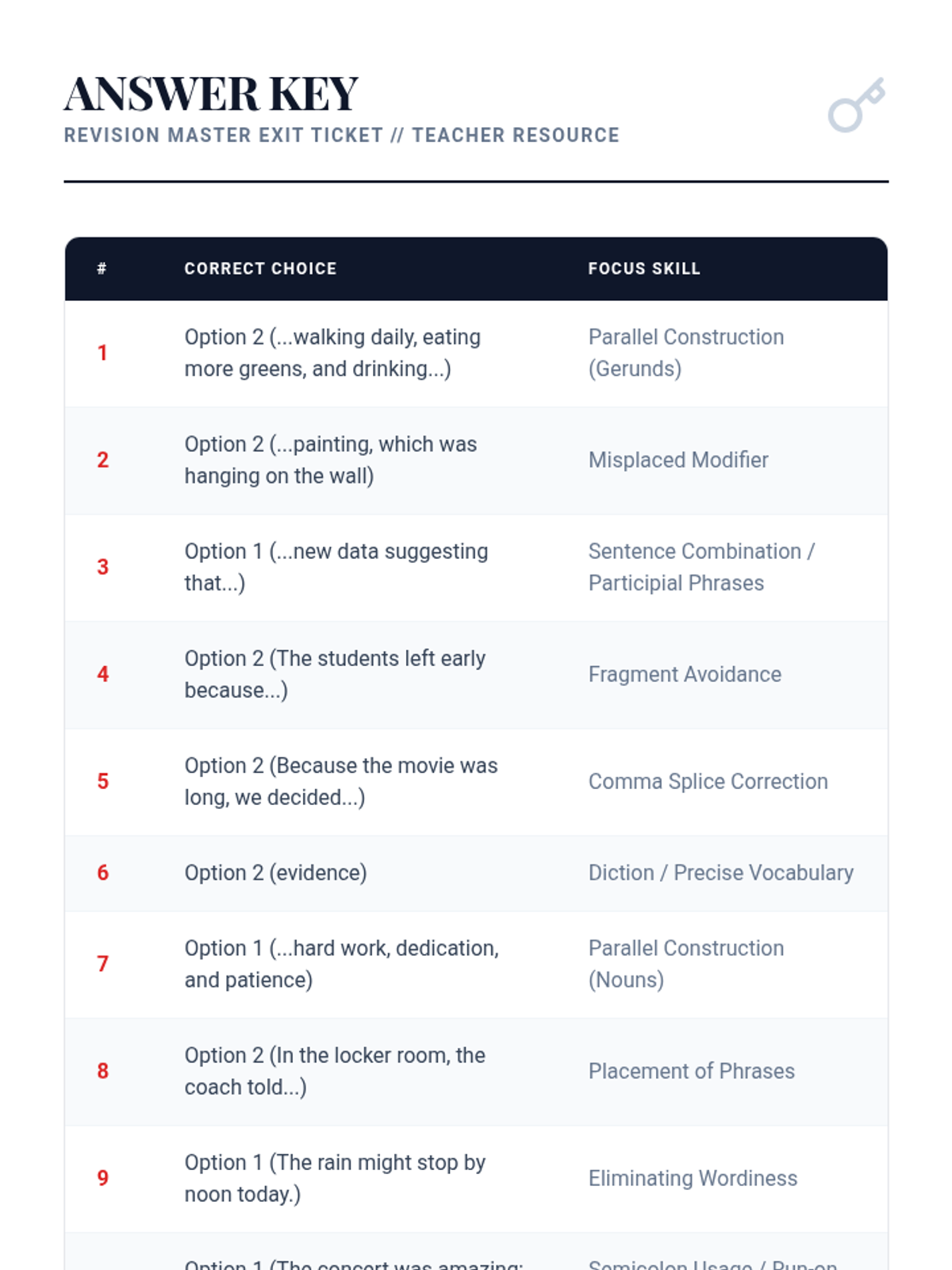
A teacher-facing answer key and grading guide for the Revision Master Exit Ticket. Includes focus skills for each question and common student misconceptions.
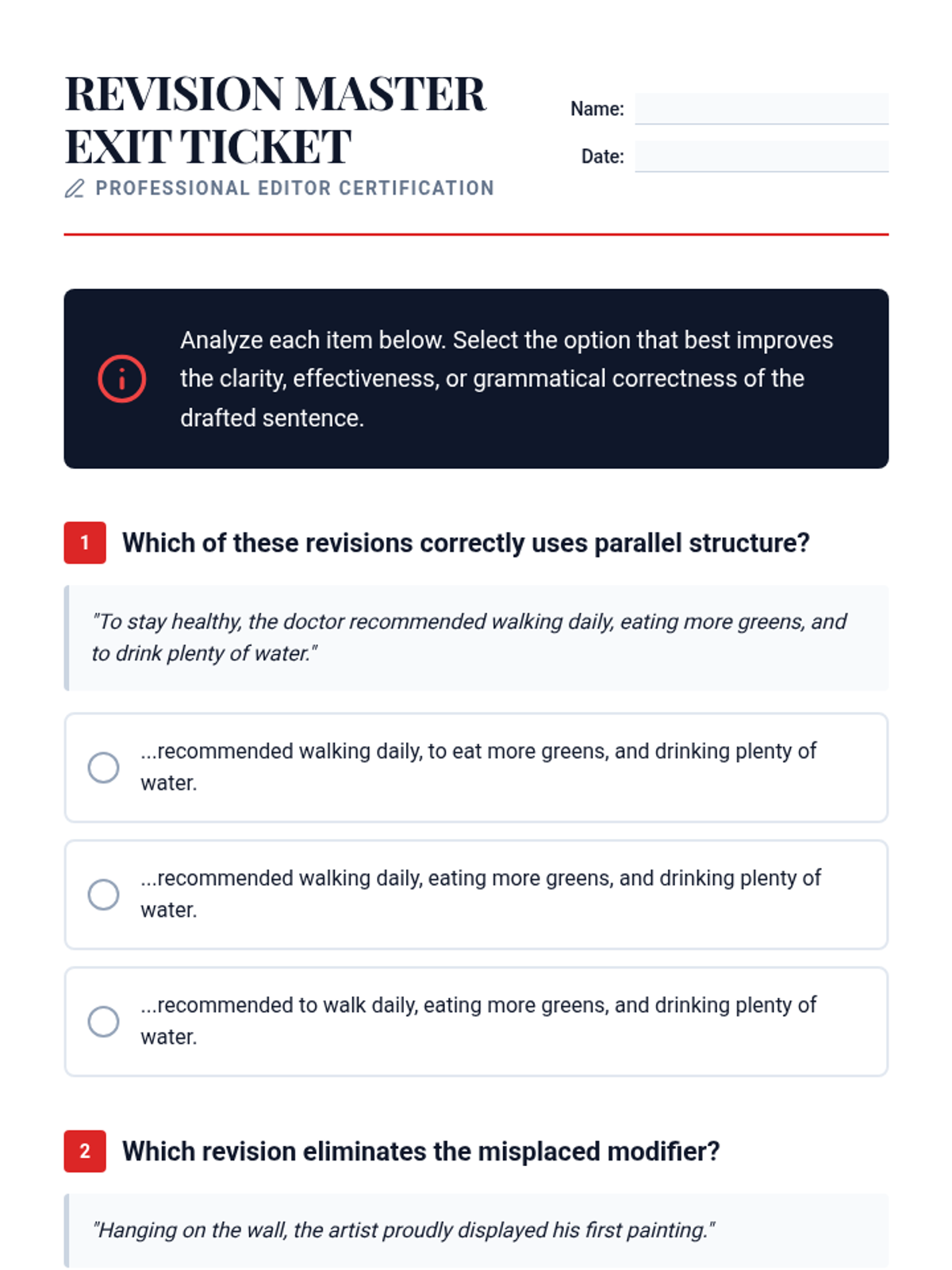
A 10-question multiple-choice exit ticket assessing student mastery of parallel structure, phrase placement, sentence effectiveness, and basic editing for fragments and run-ons. Includes break-inside-avoid to prevent question splitting.
A digital slide presentation guiding students through the revision process, focusing on parallel structure, phrase placement, and sentence effectiveness. Now updated with minimum 24px font size for all text elements.
The complete 10-day slide deck with Question 3 for each day as a Short Constructed Response (SCR). Includes high-contrast logic and model response slides for sentence combining and parallelism.
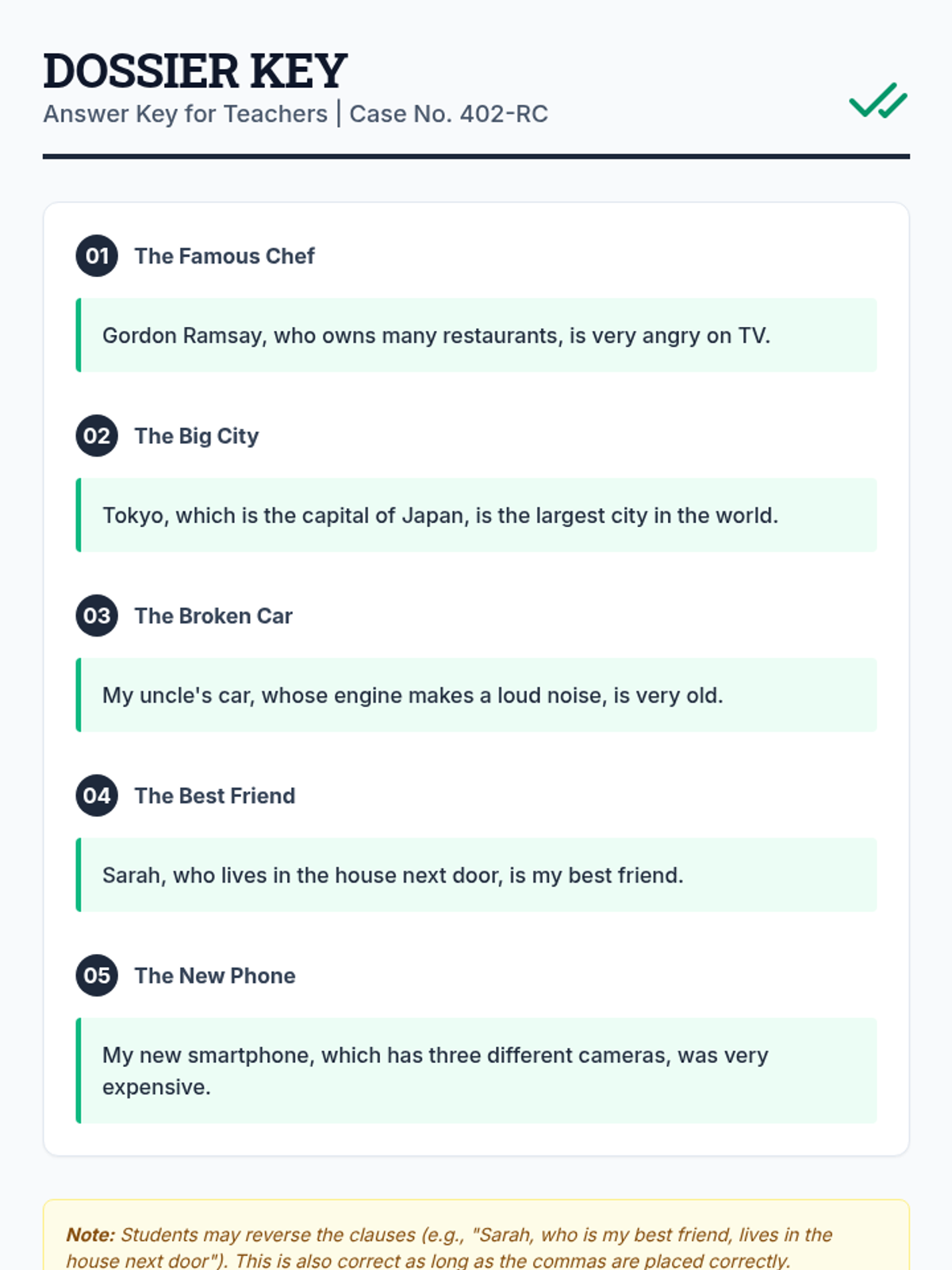
The answer key for the Dossier Linker worksheet, showing correctly combined sentences with non-defining relative clauses.
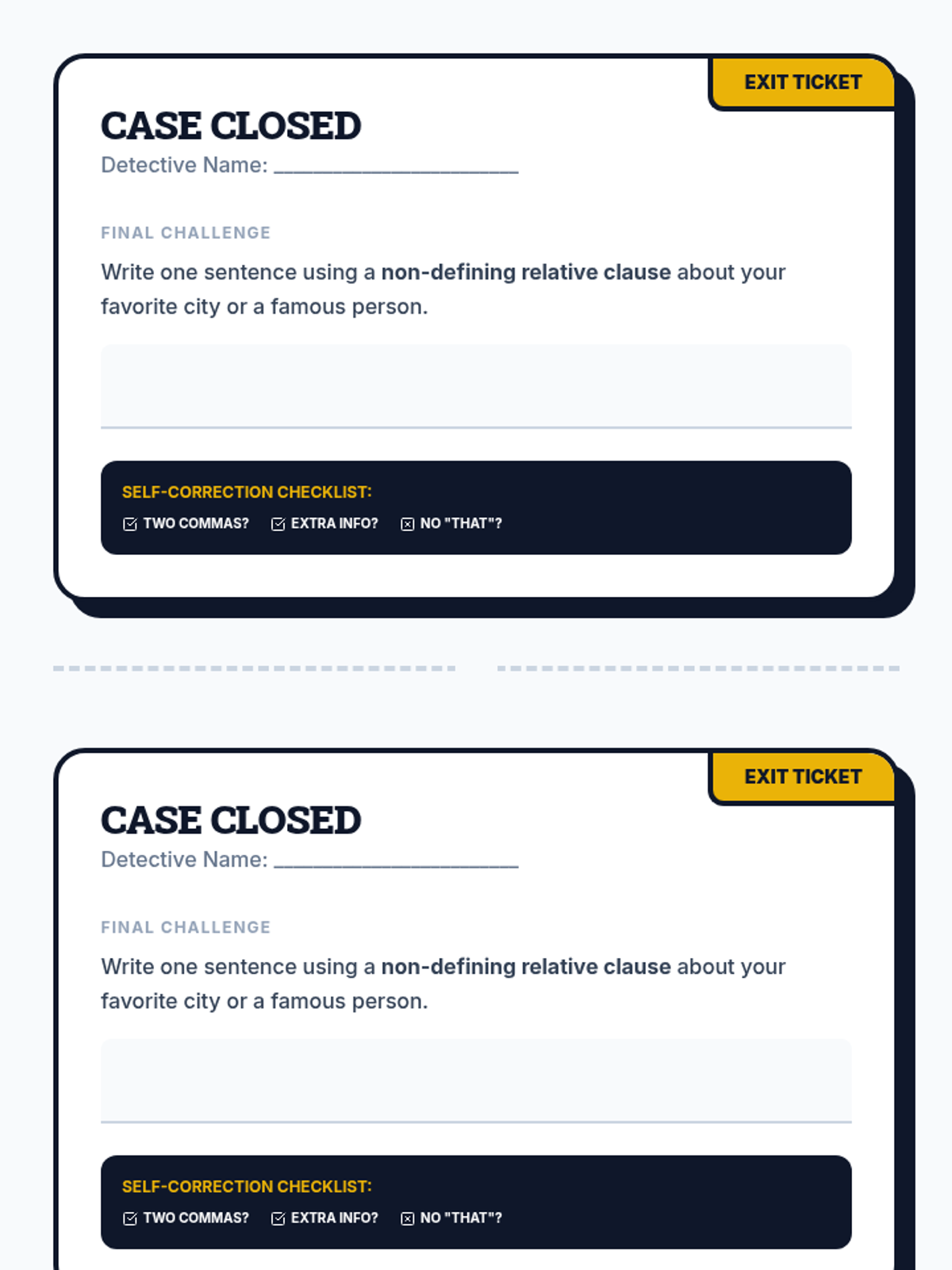
A printable exit ticket for a quick assessment on non-defining relative clauses, featuring a self-correction checklist for students.
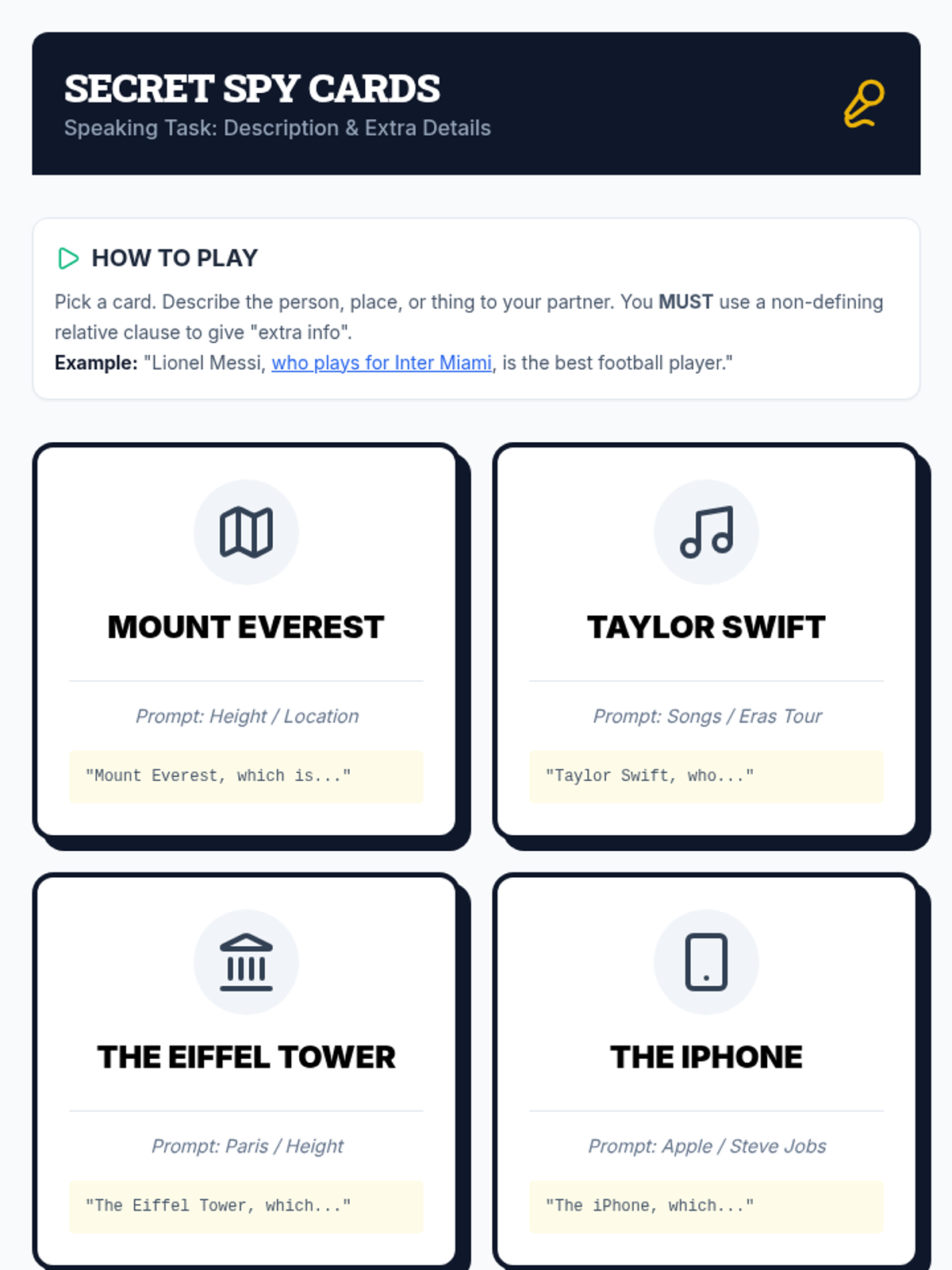
A set of speaking prompt cards for practicing non-defining relative clauses, designed for pair work with specific person/place/thing prompts.
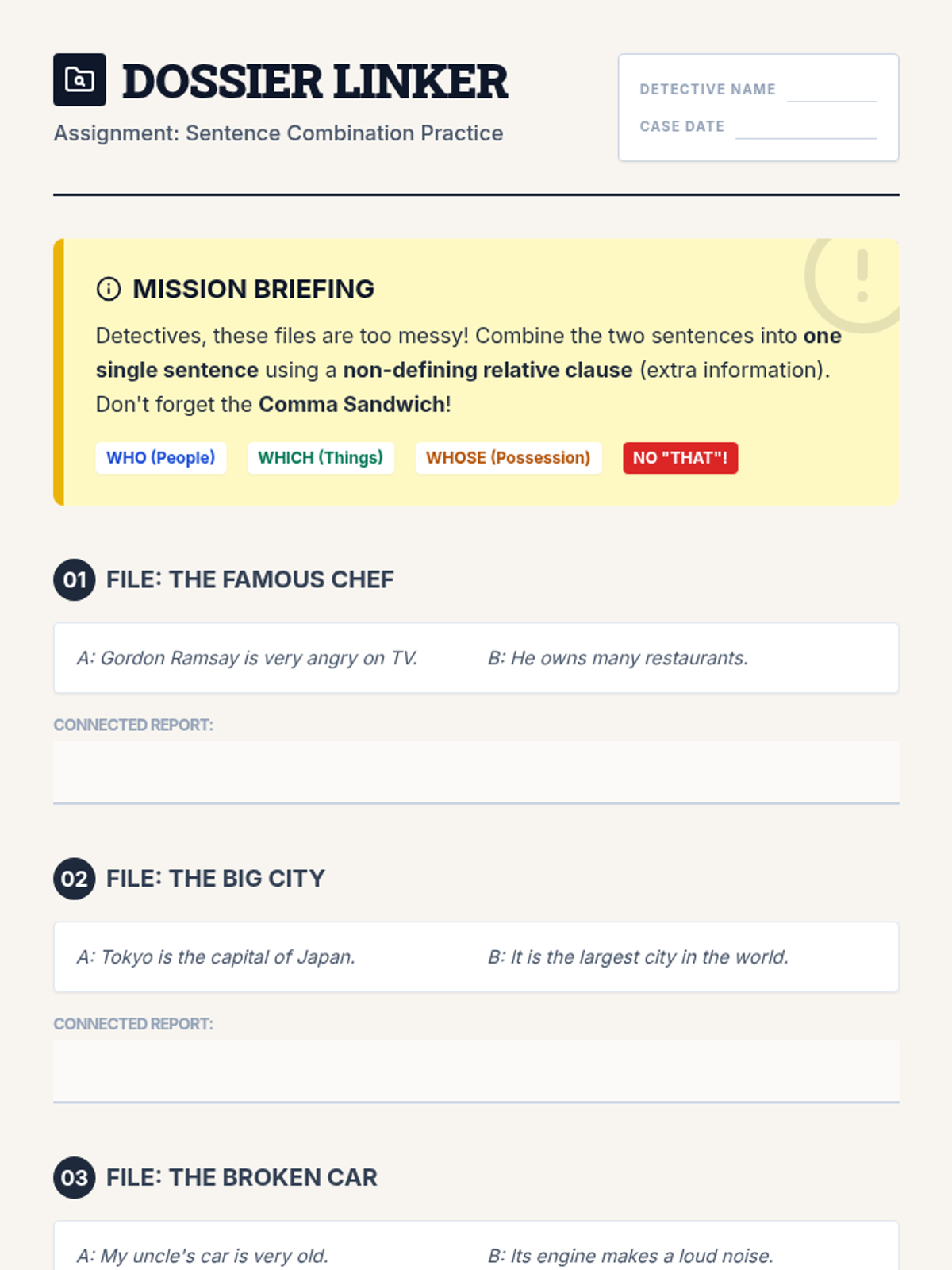
A pair-work worksheet themed as a detective dossier where students combine simple sentences into non-defining relative clauses.
Instructional slides for teaching non-defining relative clauses, featuring visual metaphors like the 'Comma Sandwich' and interactive detective challenges.
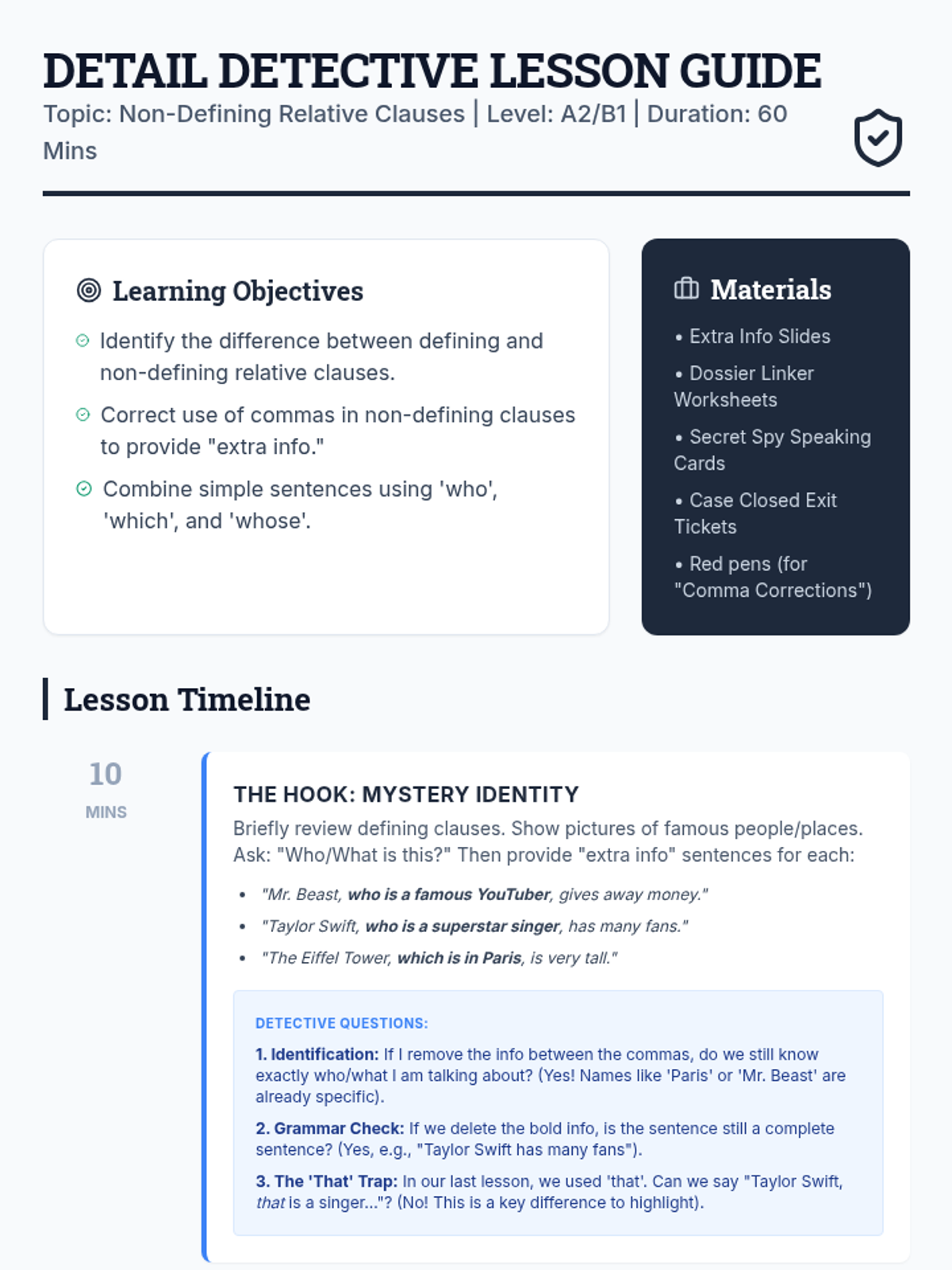
A teacher's lesson guide for teaching non-defining relative clauses to A2/B1 students, themed as a 'Detail Detective' investigation with a clear 60-minute timeline.
An expanded interactive slide deck featuring 30 revising and editing questions. Each day now includes a third question focused specifically on sentence combining and parallel structure, with immediate feedback slides.
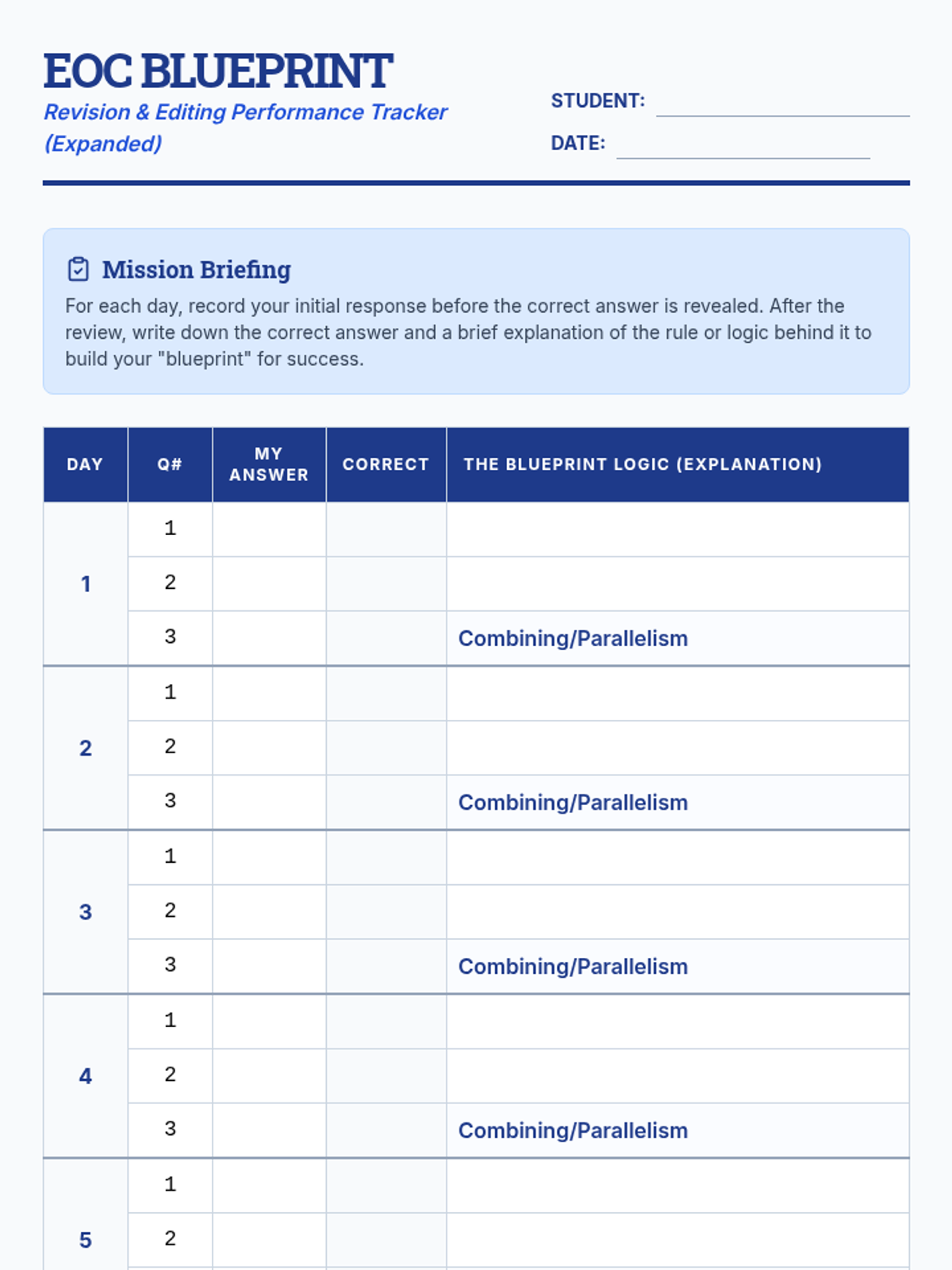
An expanded tracking sheet for students to record their answers for 30 EOC-style questions across 10 days. Includes a third slot for sentence combining and parallelism logic.
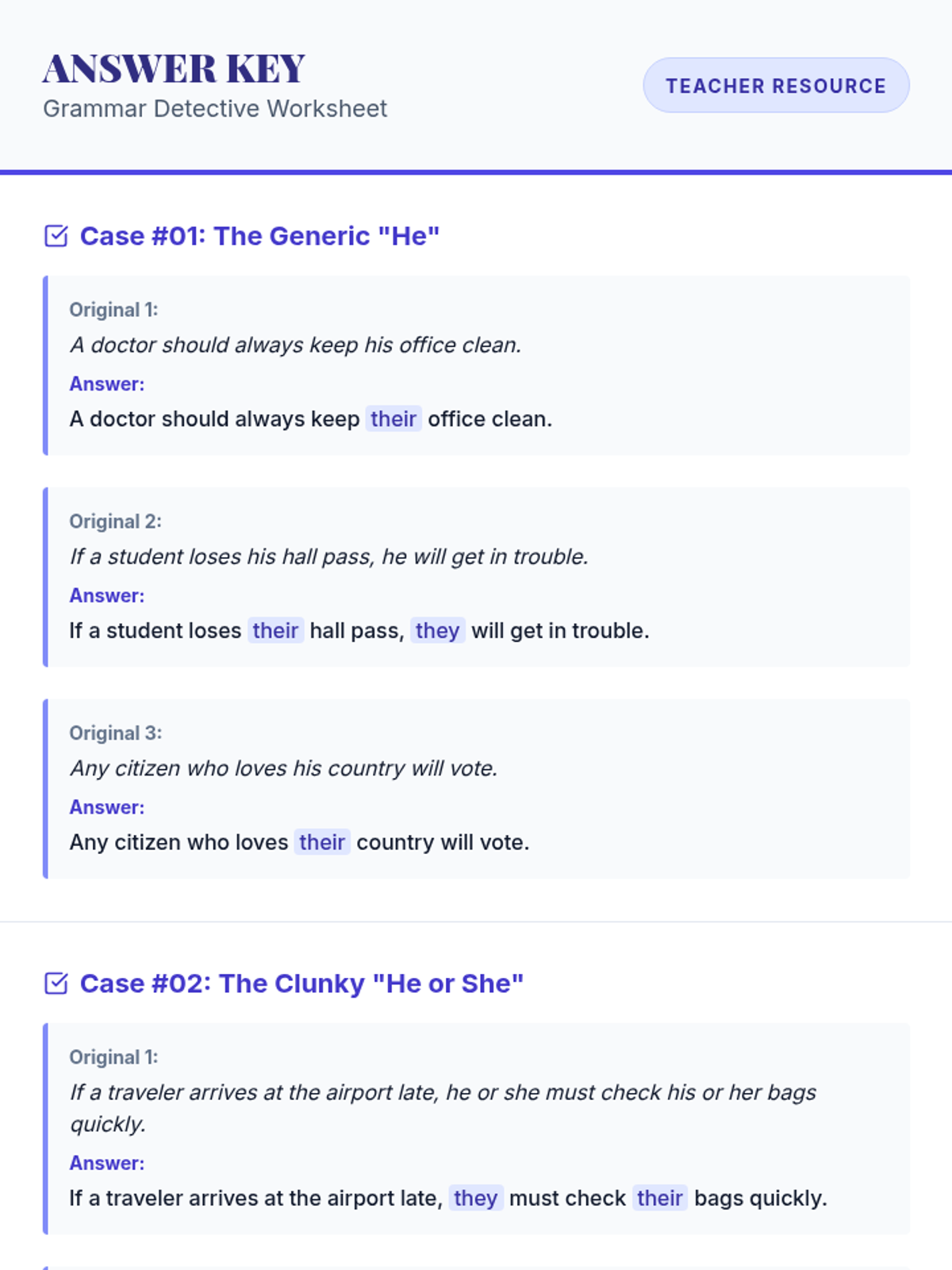
An answer key for the 'Grammar Detective' worksheet, providing correct sentence rewrites and explanations for identifying indefinite vs. specific antecedents.
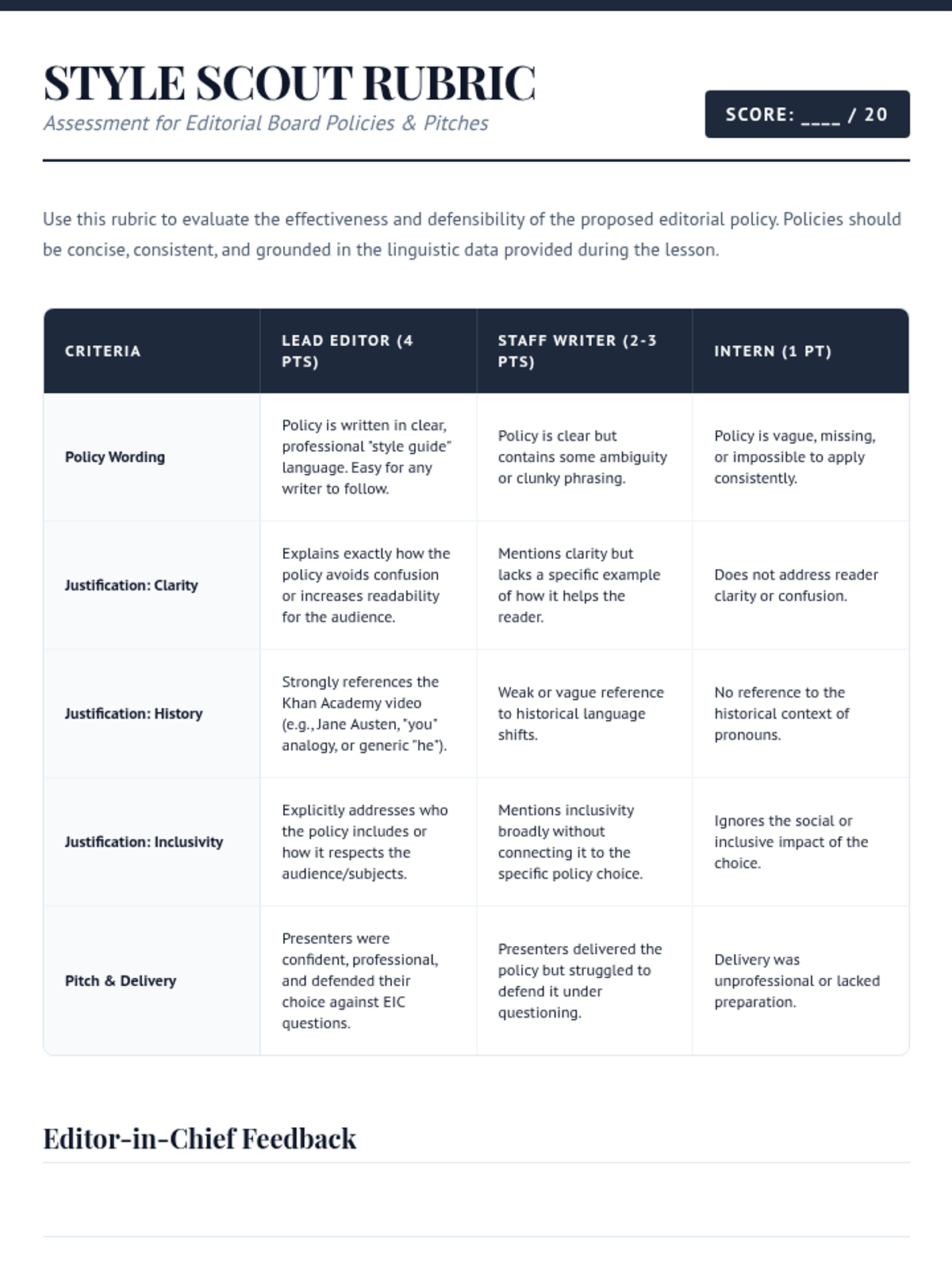
A professional assessment rubric for the Editorial Board policy activity, focusing on clarity, historical justification, and inclusivity.
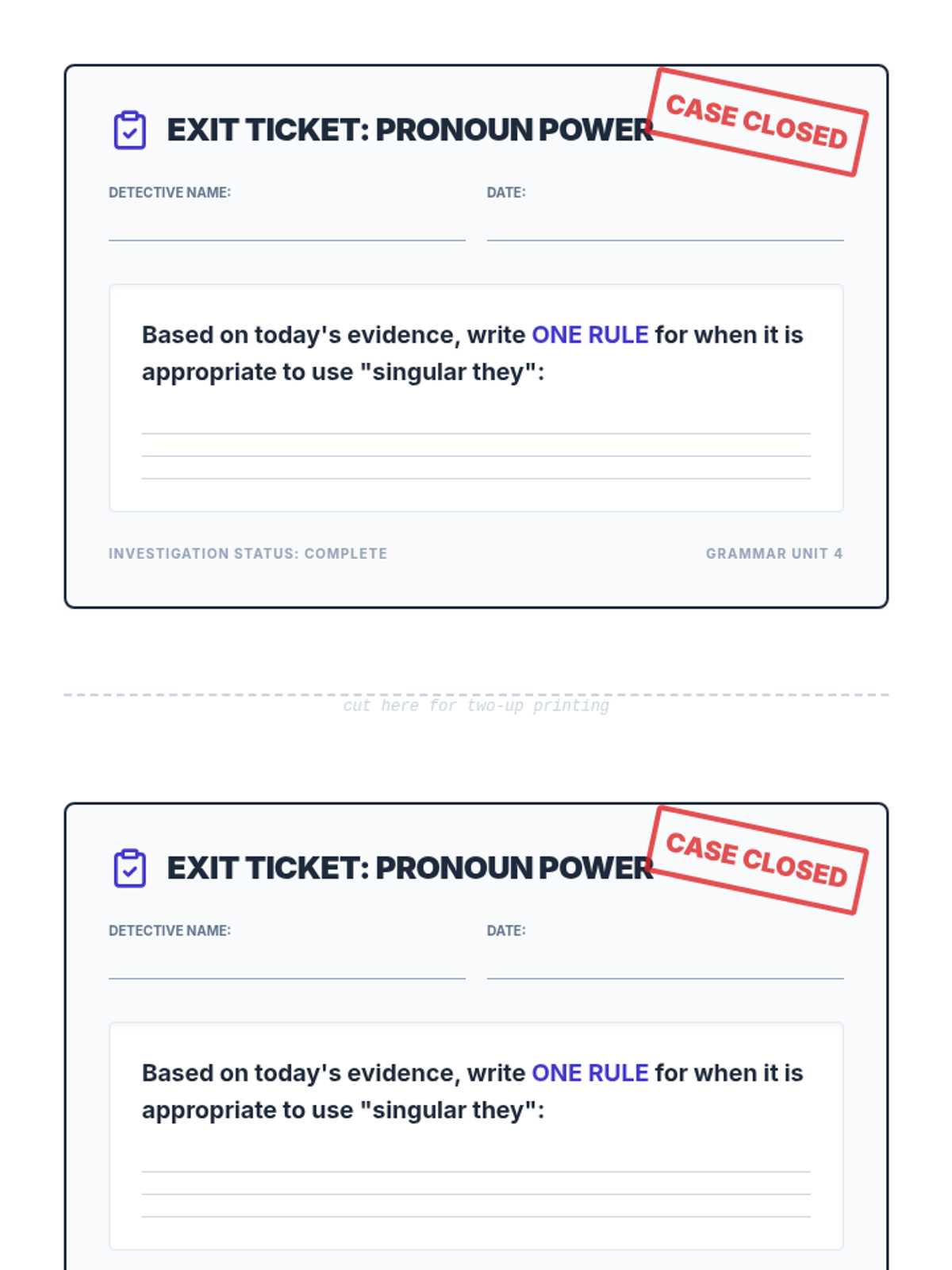
A 'Case Closed' exit ticket for the Pronoun Power lesson, providing space for students to summarize the rule for using singular they. Two tickets per page for easy printing.