Geometric classification, measurement of area and volume, and the study of transformations and rigid motions. Builds toward complex proofs, trigonometry for general triangles, and the algebraic representation of conic sections.
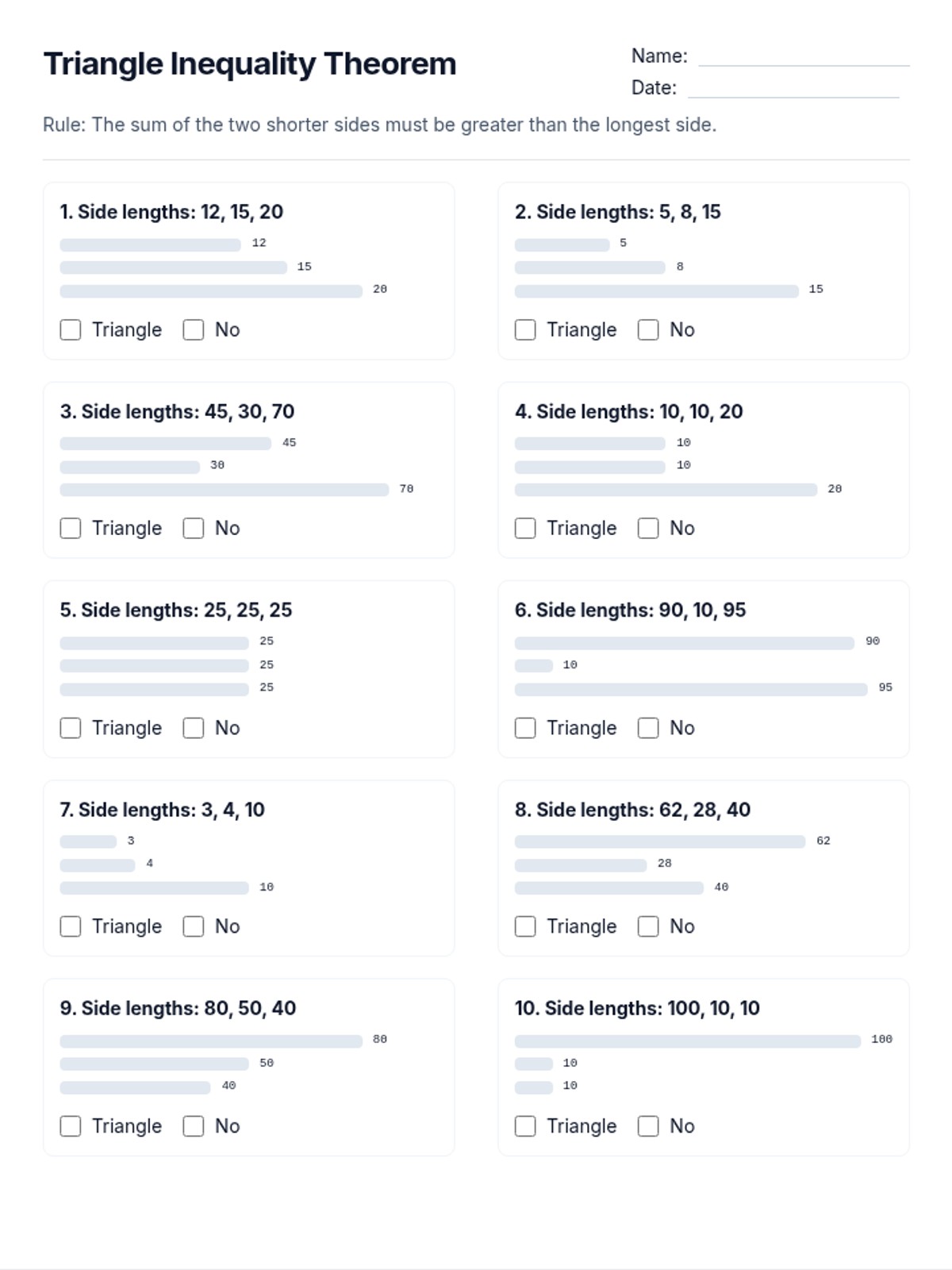
A 14-slide presentation for the 'Triangle Side Truths' lesson, maintaining the blueprint geometry theme. Covers classification of triangles (equilateral, isosceles, scalene) and the Triangle Inequality Theorem with clear visual examples, reliable formula rendering, and a dedicated practice answer key. Revised to fix layout artifacts and label alignment.
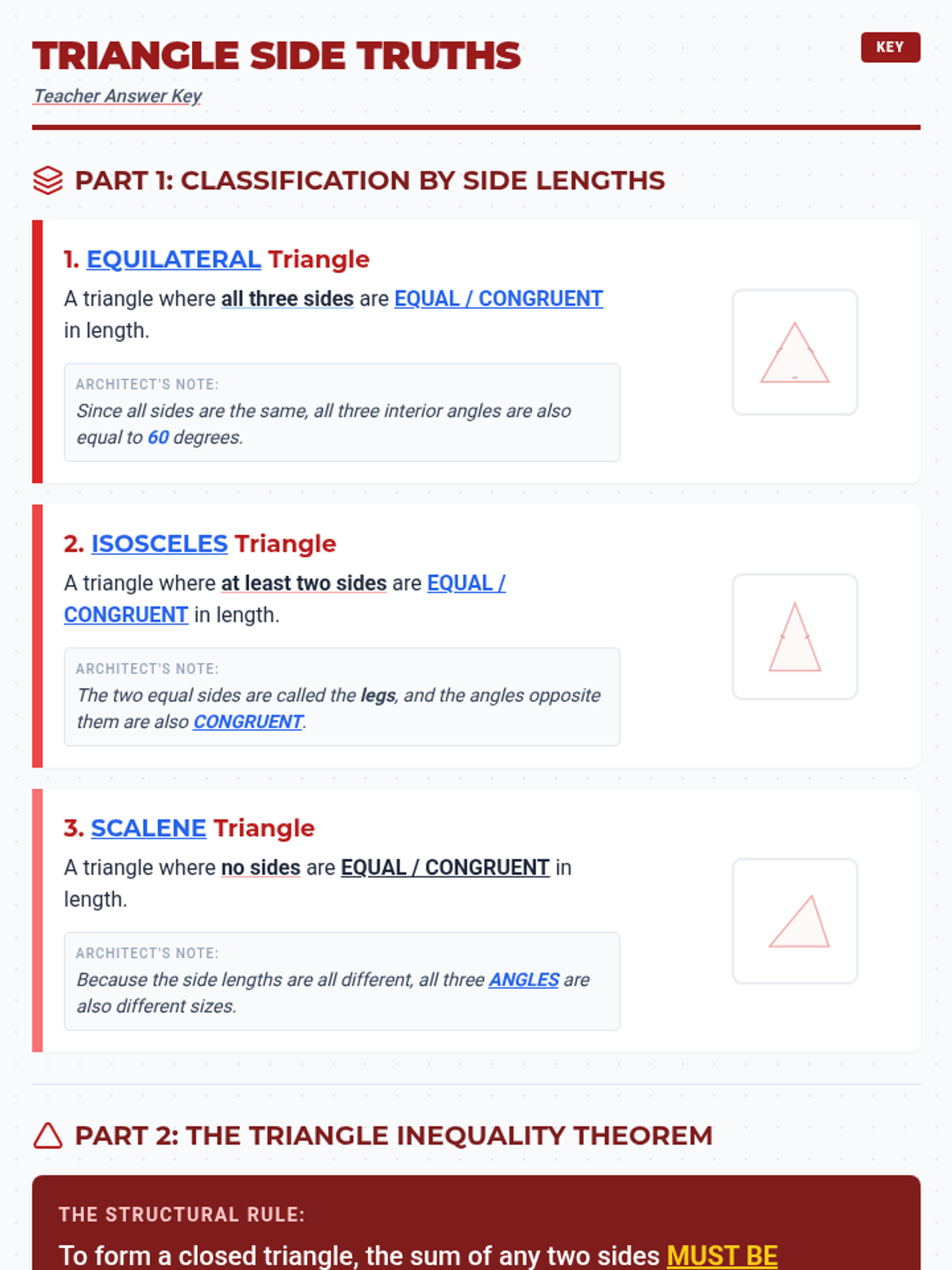
The teacher's answer key for the Triangle Side Truths Notes, with all blanks filled in and clearly marked in a distinct blue font for easy checking. Revised to match the updated student notes layout.
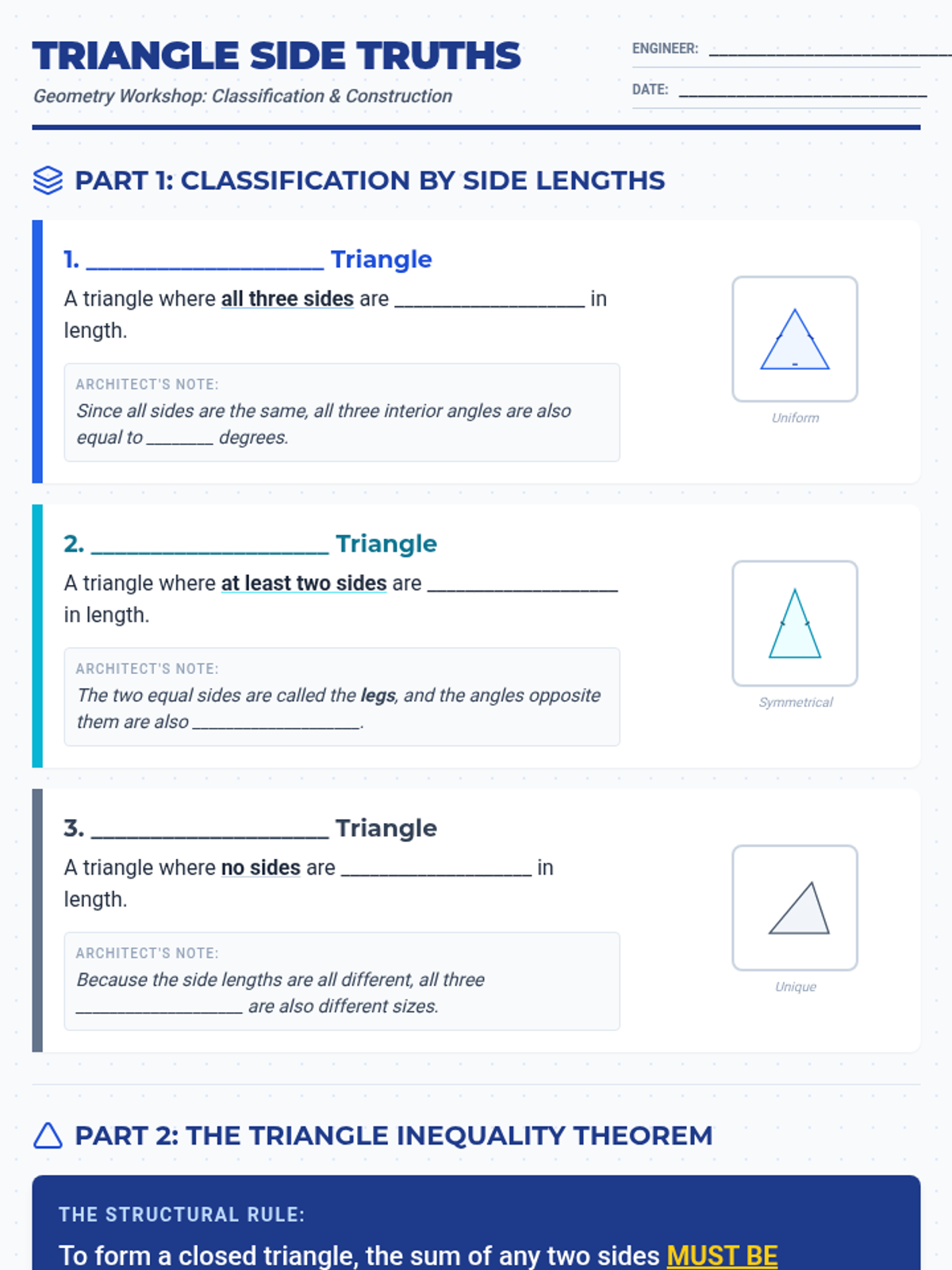
A comprehensive guided notes sheet for geometry students focusing on triangle classification by side length and the Triangle Inequality Theorem. It features technical 'blueprint' aesthetics with diagrams, fill-in-the-blank definitions, and scaffolded practice tables. Revised to fix page breaks and increase student work space.
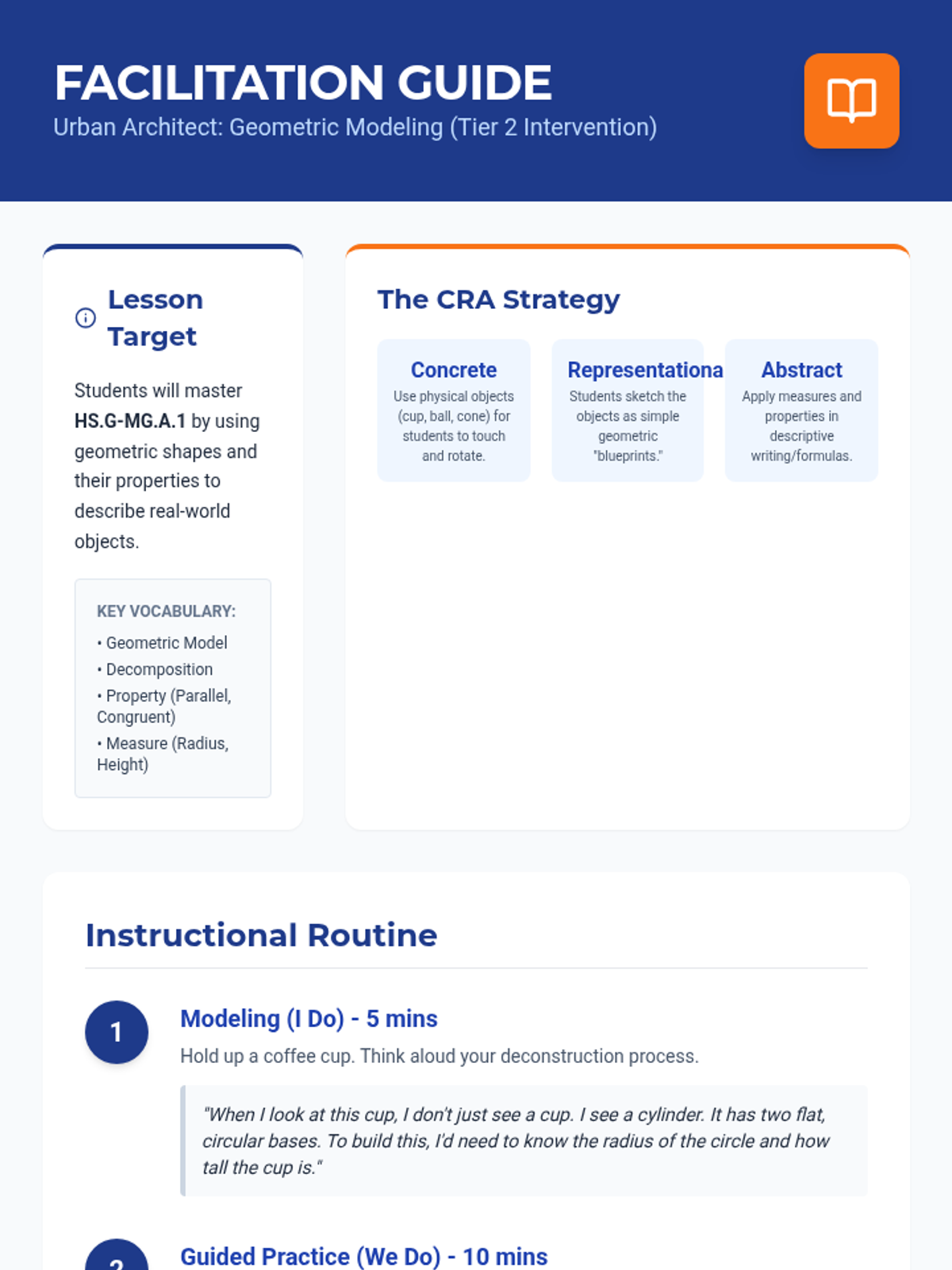
Facilitation guide for teachers delivering the geometry intervention, including instructional routines, CRA strategies, error correction tips, and progress monitoring scoring.
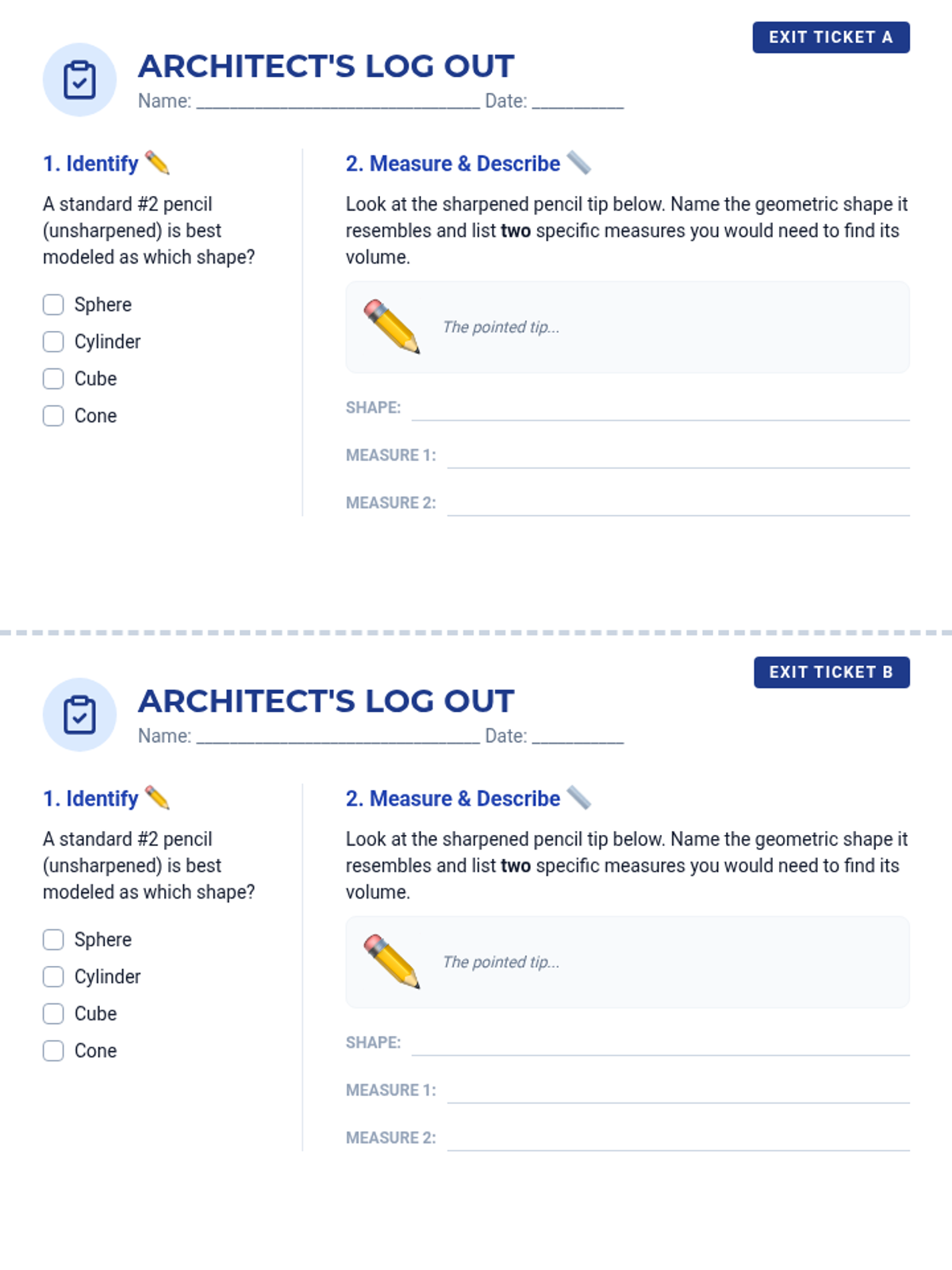
A quick exit ticket for progress monitoring, asking students to identify shapes in common objects and describe required geometric measures.
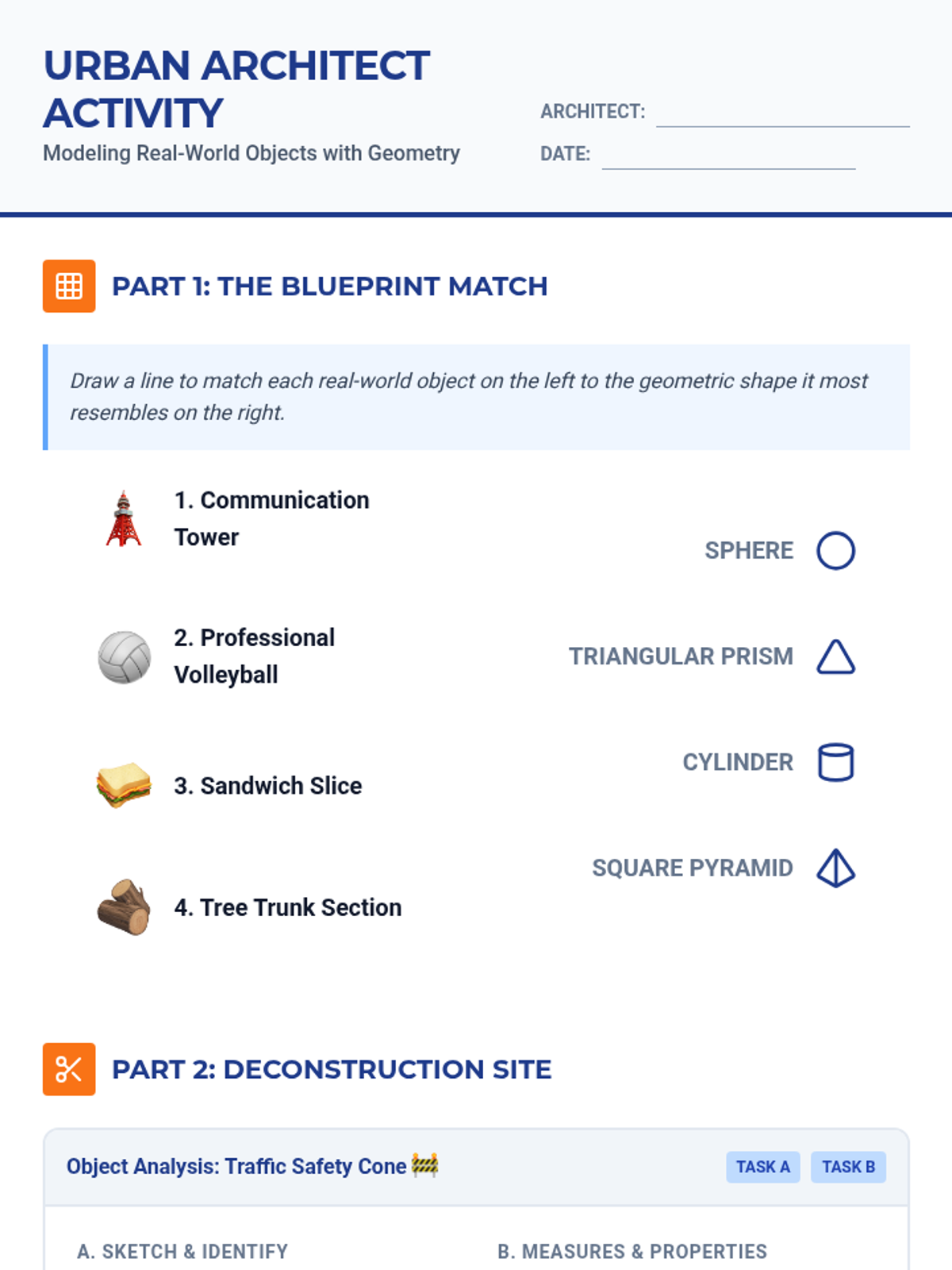
Student worksheet for identifying shapes in real-world objects, decomposing complex structures, and using geometric vocabulary to describe properties and measures.
Visual presentation for the geometry intervention lesson, featuring modeling of real-world objects (coffee cup, water tower) as geometric shapes with specific measures and properties.
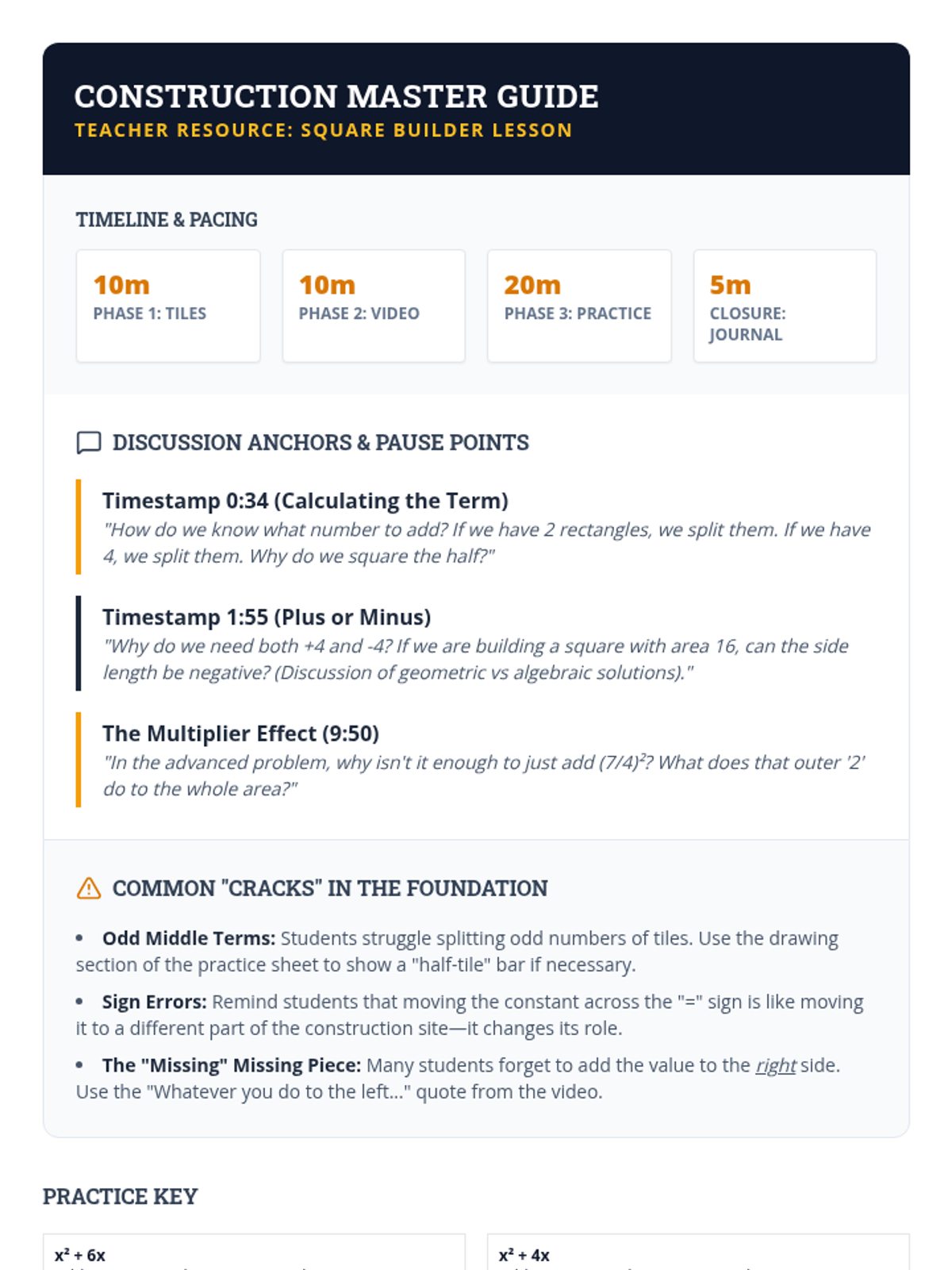
A facilitation guide for teachers containing timestamps for the instructional video, discussion prompts, and troubleshooting tips for common student misconceptions.
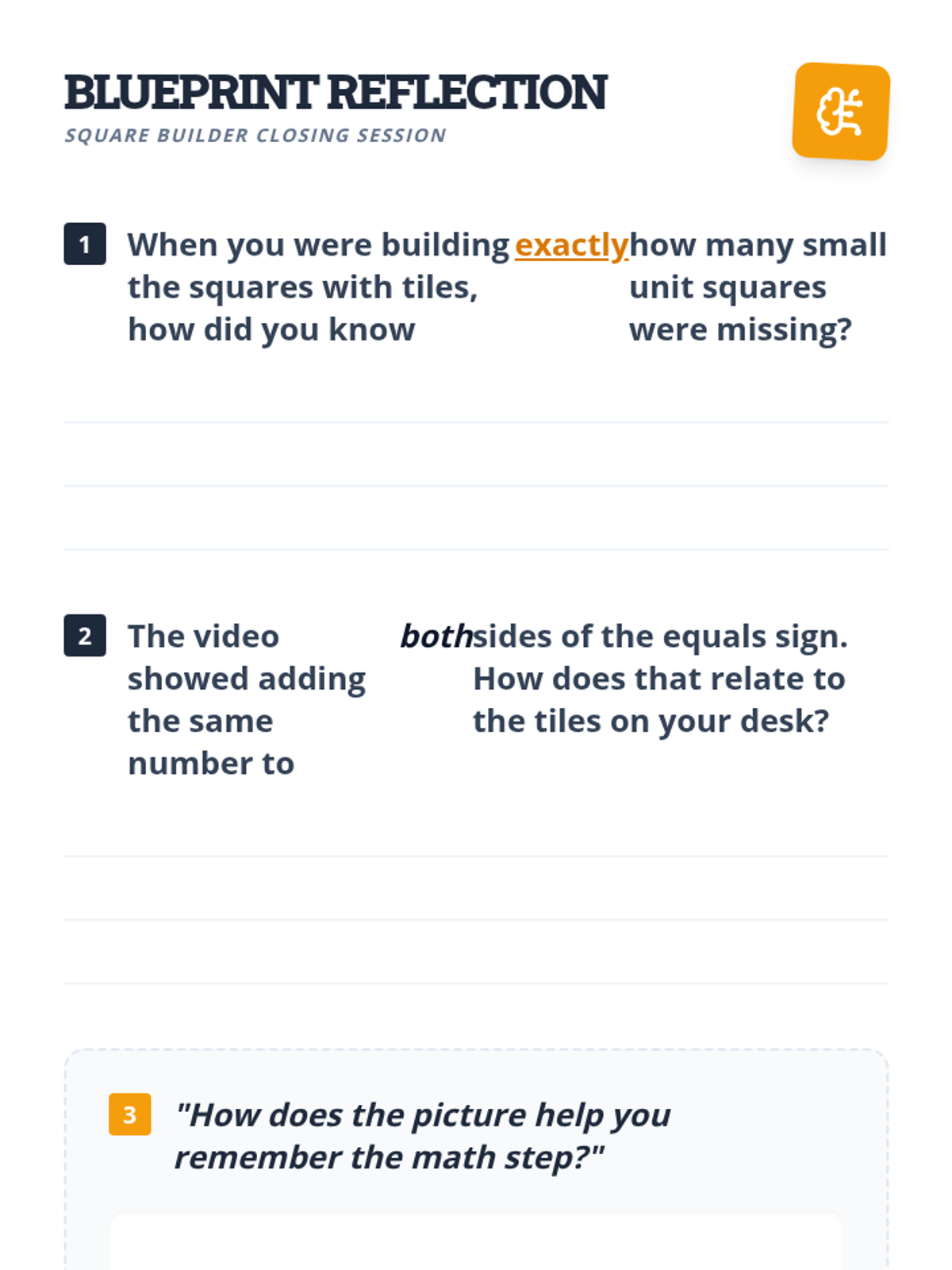
A reflective journal page designed to help students connect their tactile experiences with algebra tiles to the abstract procedures of solving quadratic equations.
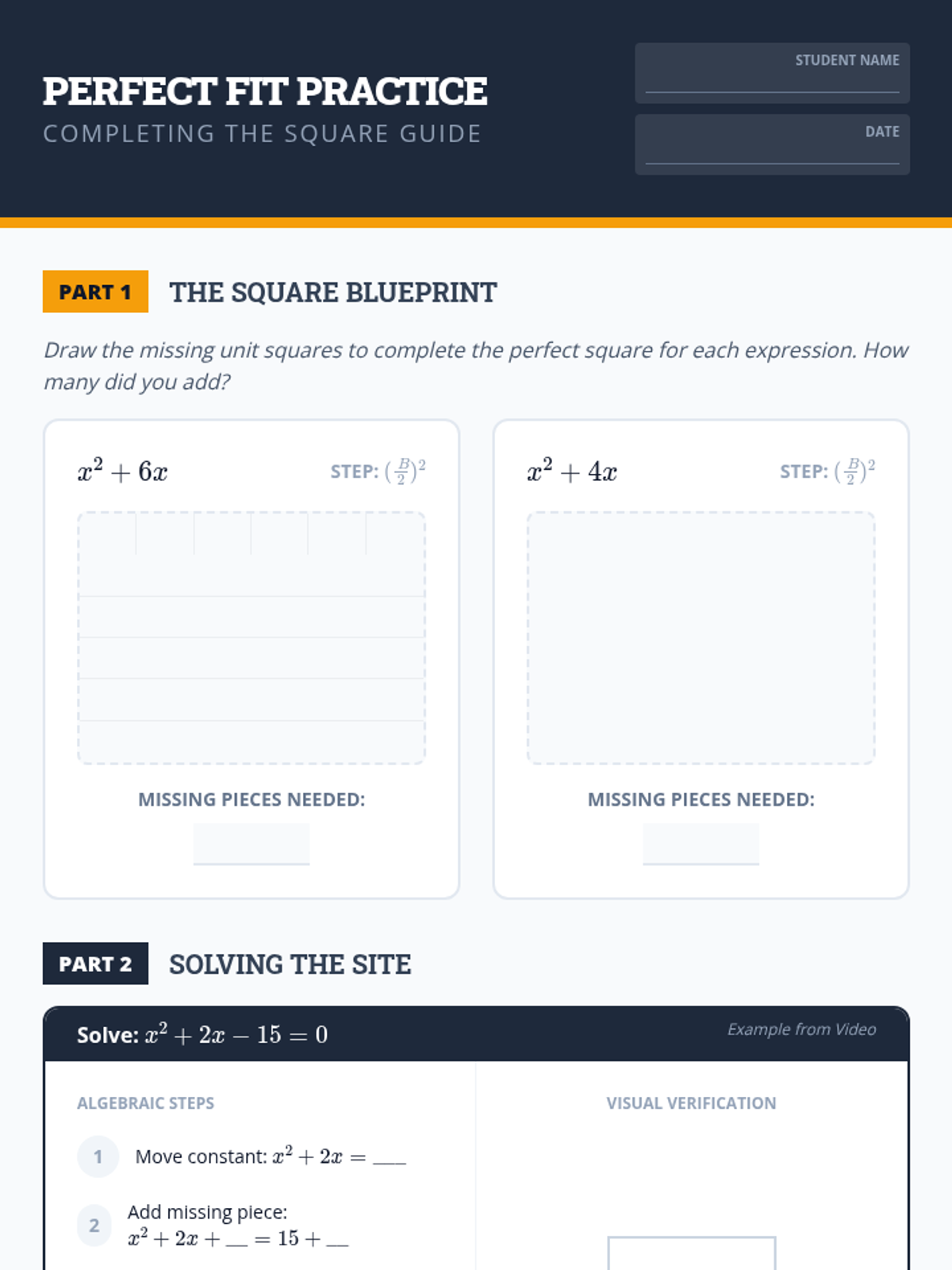
A student worksheet that coordinates geometric drawing exercises with algebraic equation solving, mirroring the examples from the instructional video.
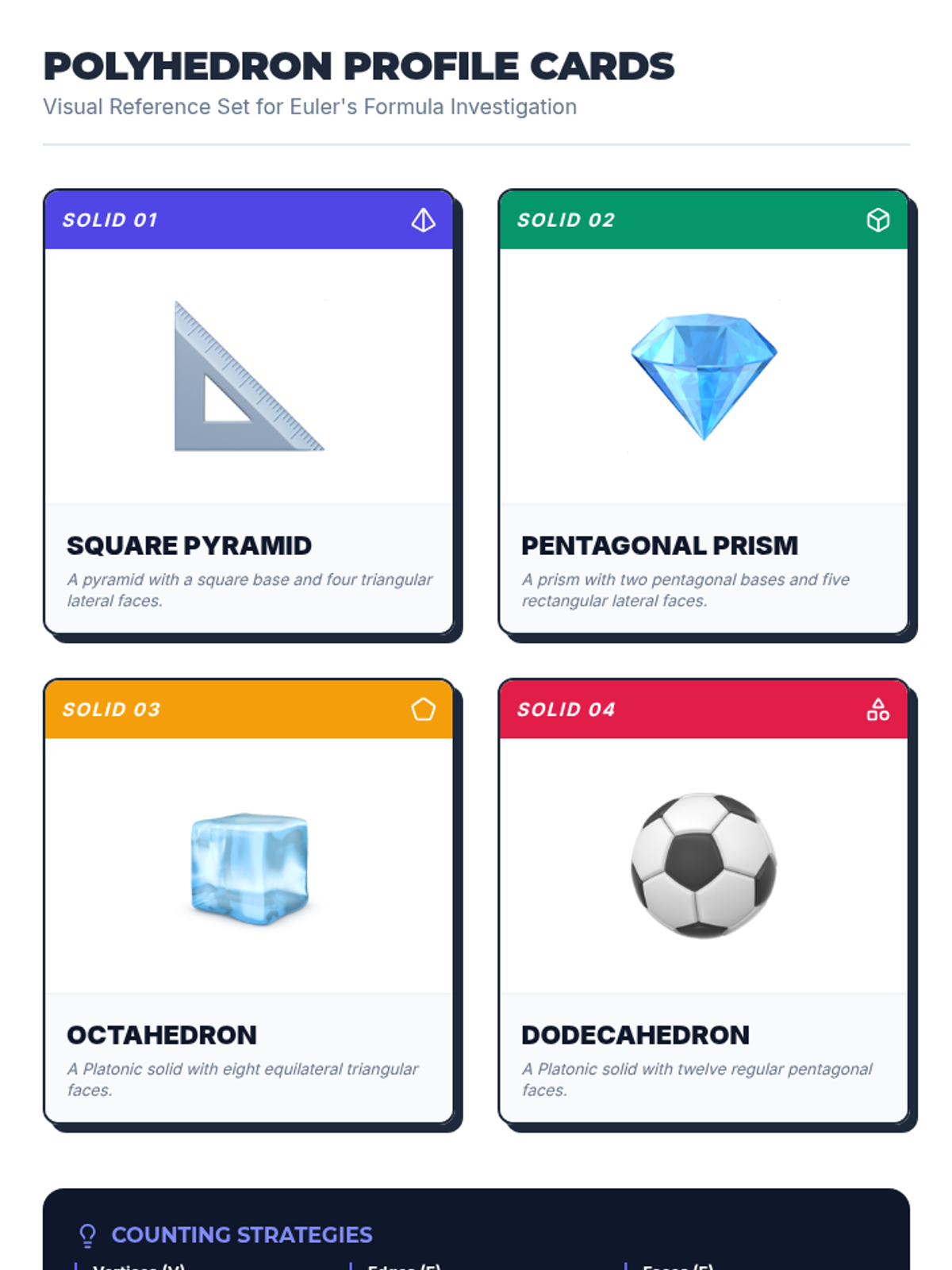
A set of printable visual reference cards for various polyhedra to assist students in identifying and counting faces, vertices, and edges.
A comprehensive visual presentation guiding students through the geometric and algebraic steps of completing the square, featuring embedded video instruction and hands-on building prompts.
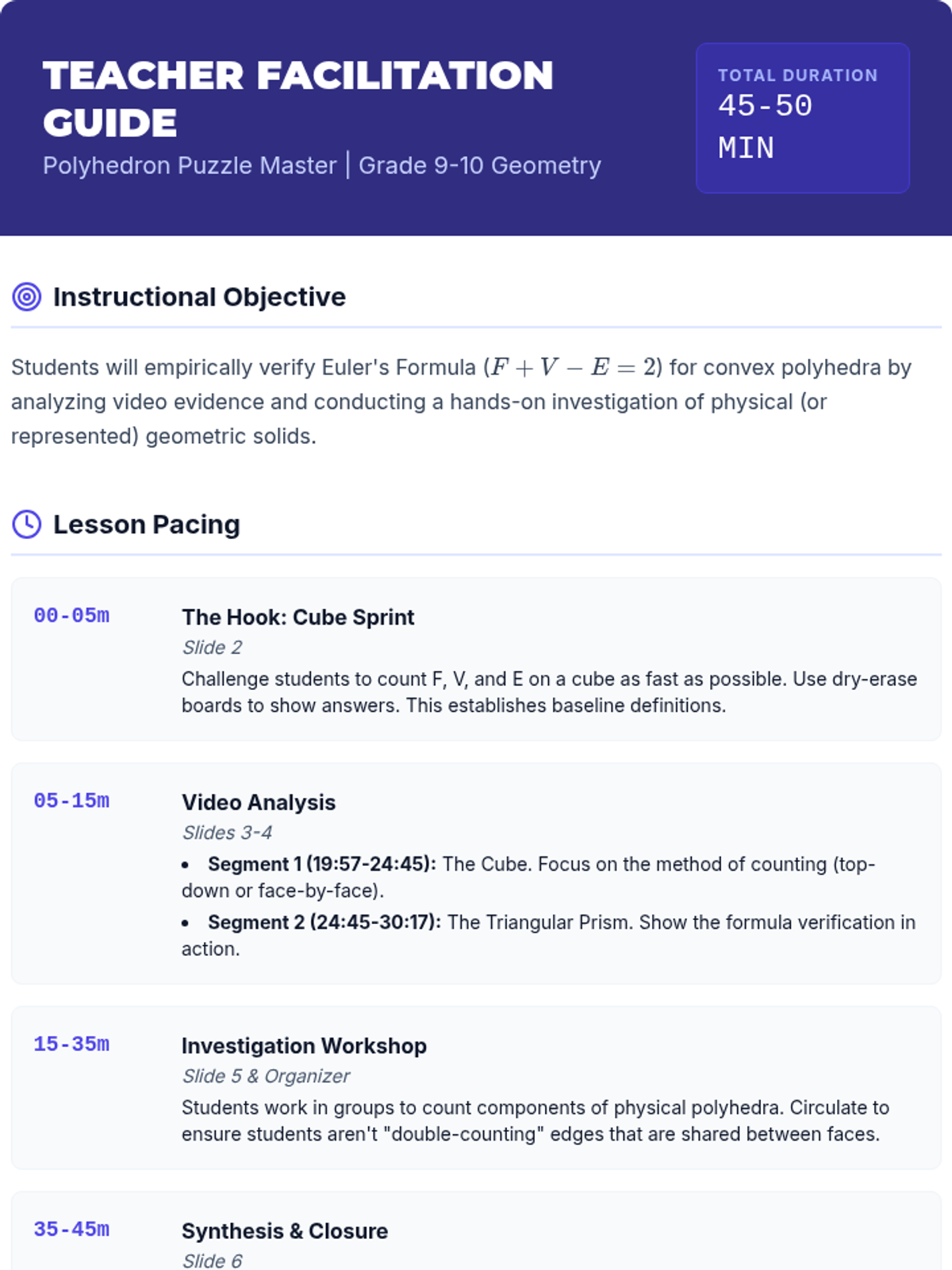
A comprehensive facilitator guide for the Euler's Formula lesson, including pacing, misconception alerts, and discussion prompts.
A revised visual presentation for the Euler's Formula lesson, ensuring all text meets the minimum visibility requirement of 24px for classroom use.
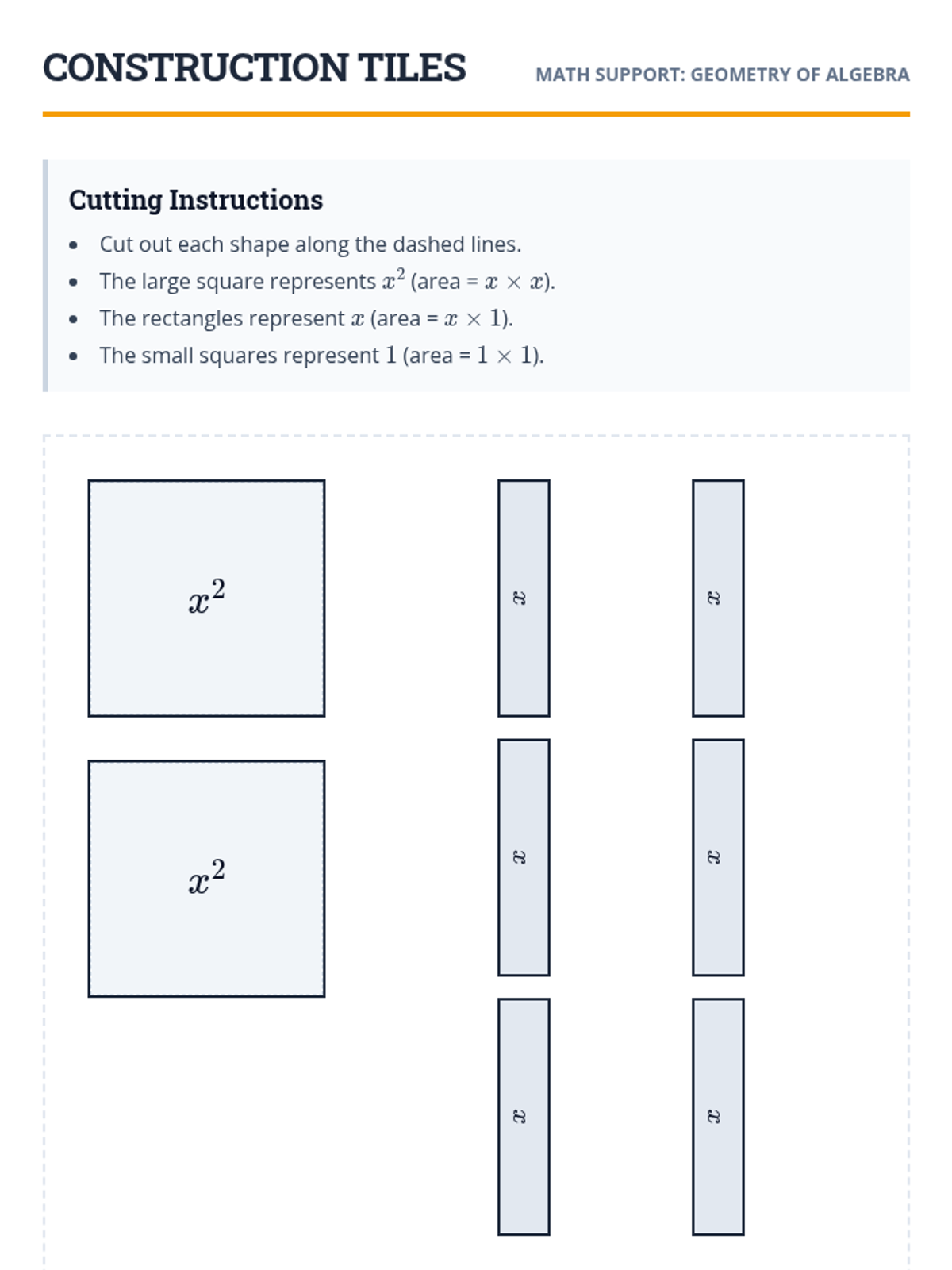
A set of printable algebra tiles including x-squared squares, x-bars, and unit squares designed for tactile exploration of quadratic expressions.
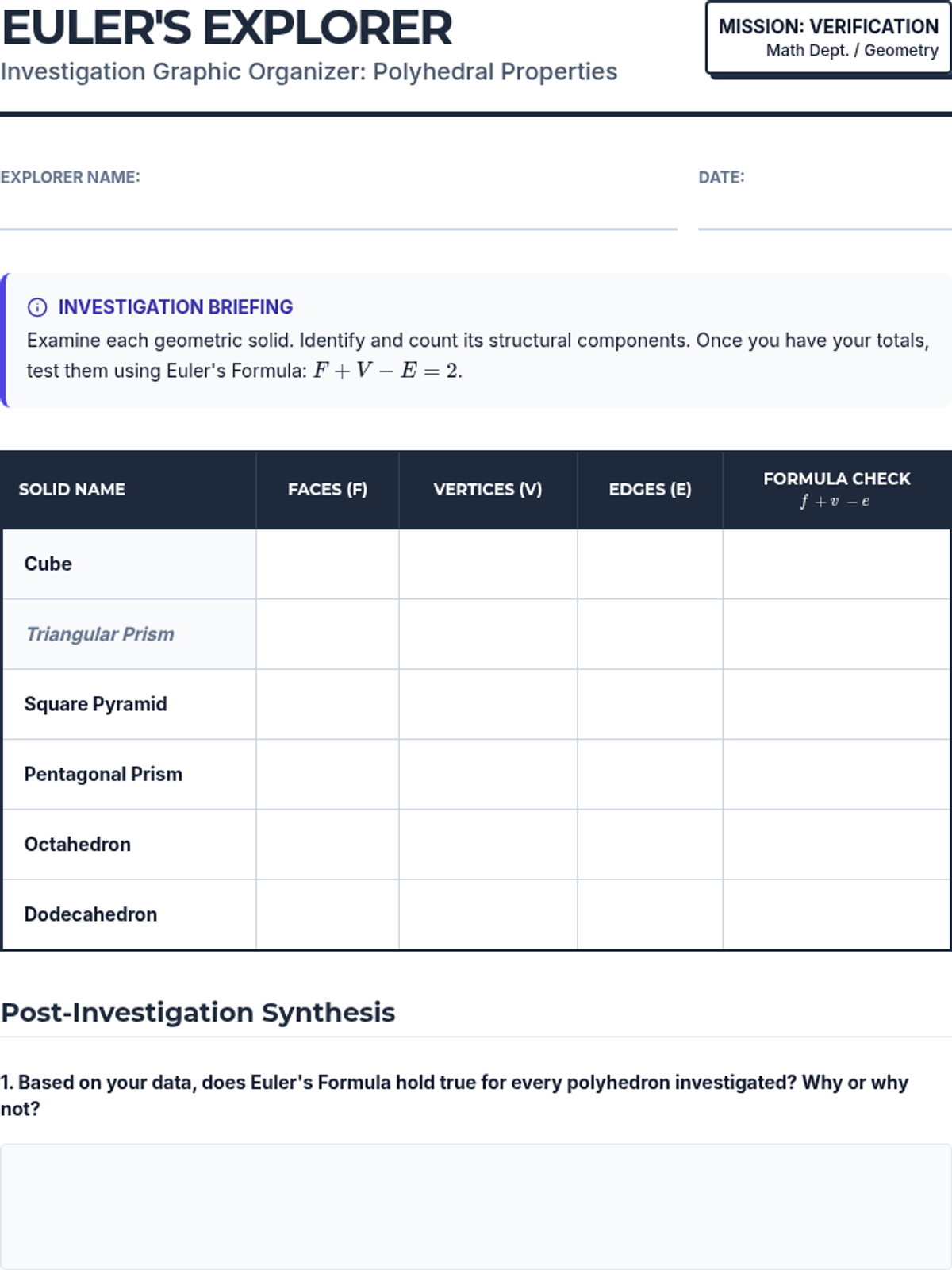
A structured graphic organizer for students to record faces, vertices, and edges of various polyhedra to verify Euler's Formula.
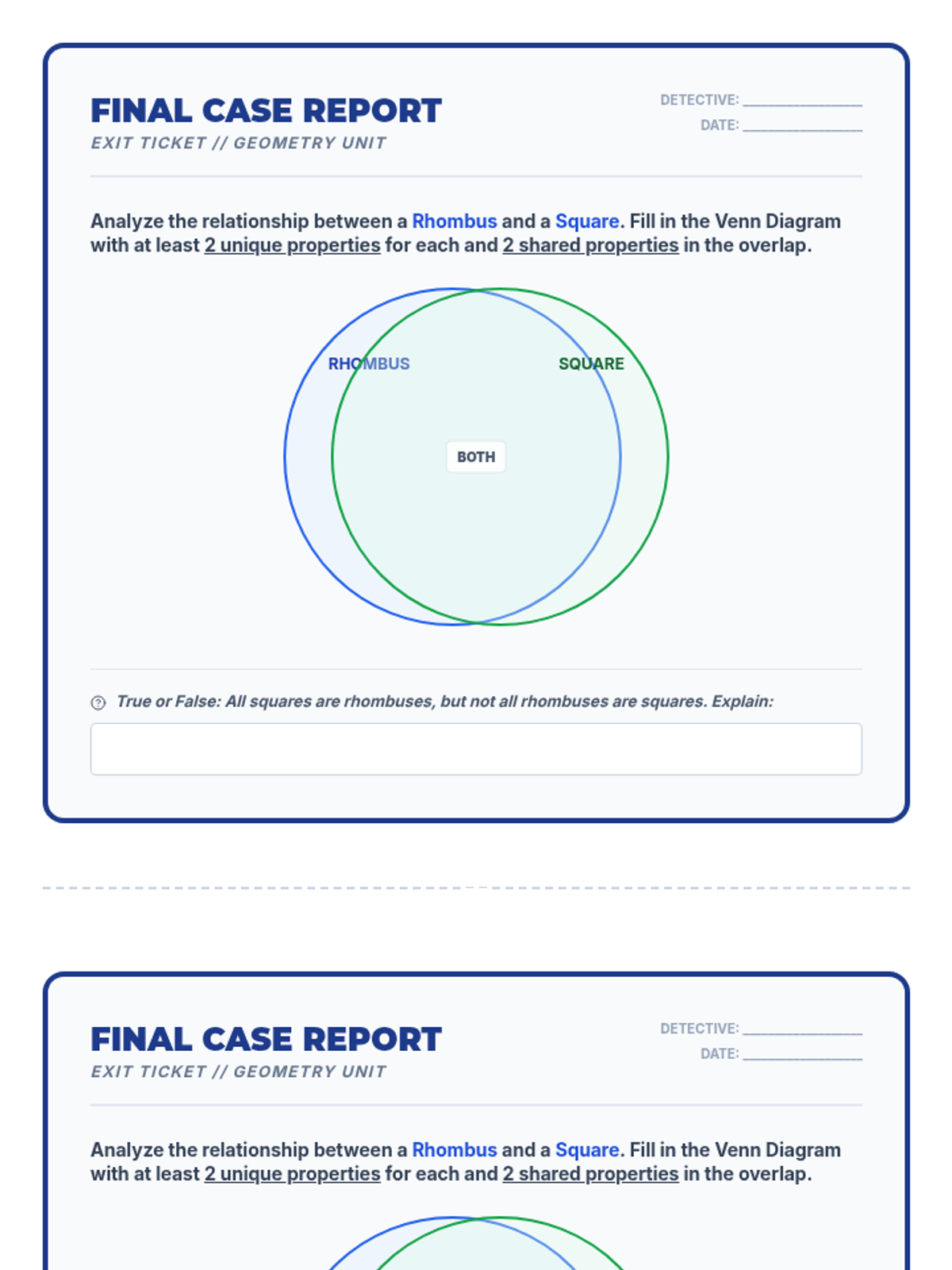
A half-page exit ticket featuring a Venn diagram for students to compare and contrast the properties of a Rhombus and a Square.
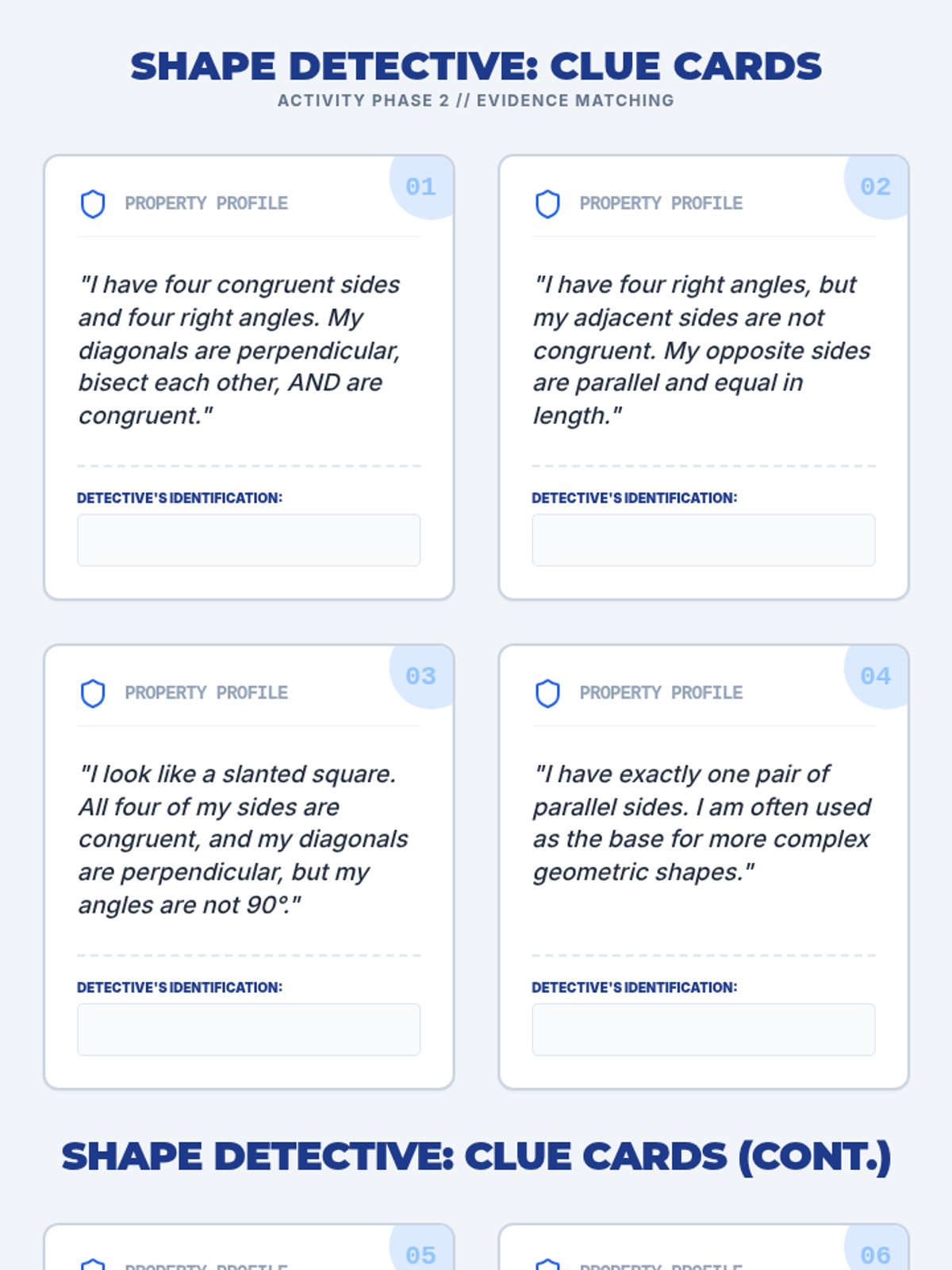
A set of eight detective-themed property profile cards for a matching activity, where students identify quadrilaterals based on side, angle, and diagonal clues.
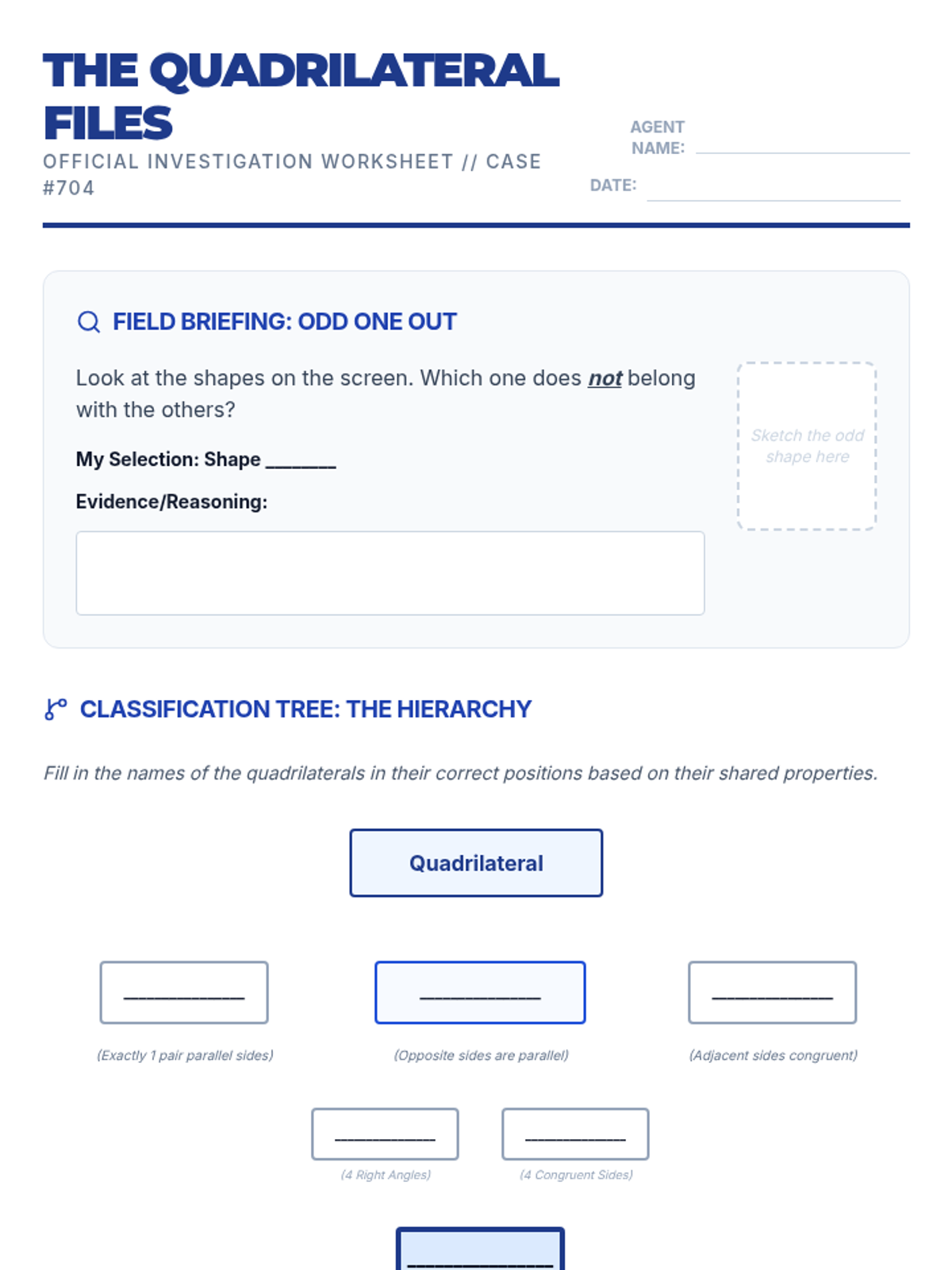
A detective-themed worksheet featuring an 'Odd One Out' warm-up, a hierarchical family tree graphic organizer, and a comprehensive property matrix for video note-taking.
A visual presentation for teaching quadrilateral classification, featuring an 'Odd One Out' warm-up, embedded video segments, and activity instructions with a 'Detective' theme.
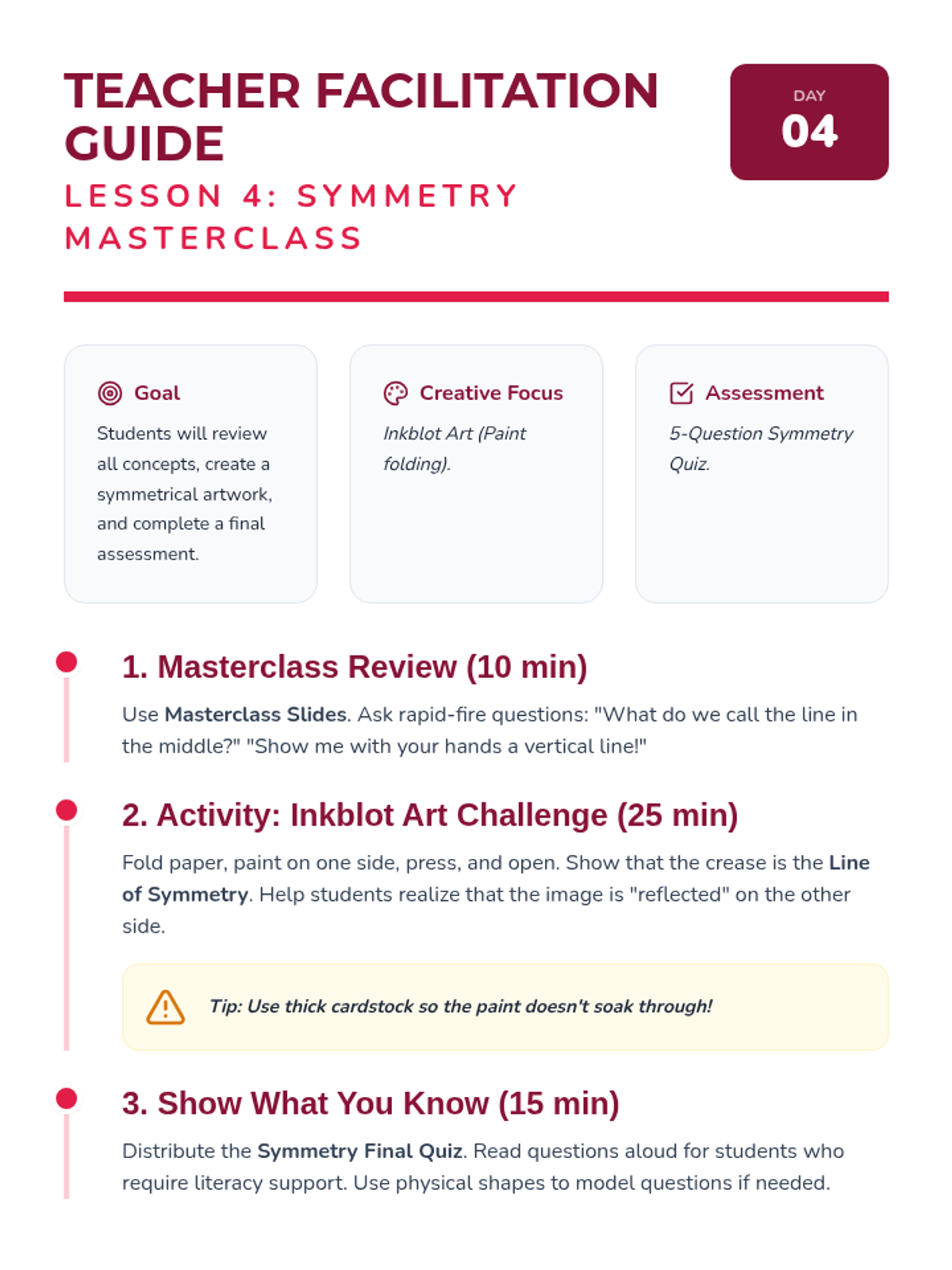
Teacher facilitation guide for Lesson 4 with fixed page breaks.
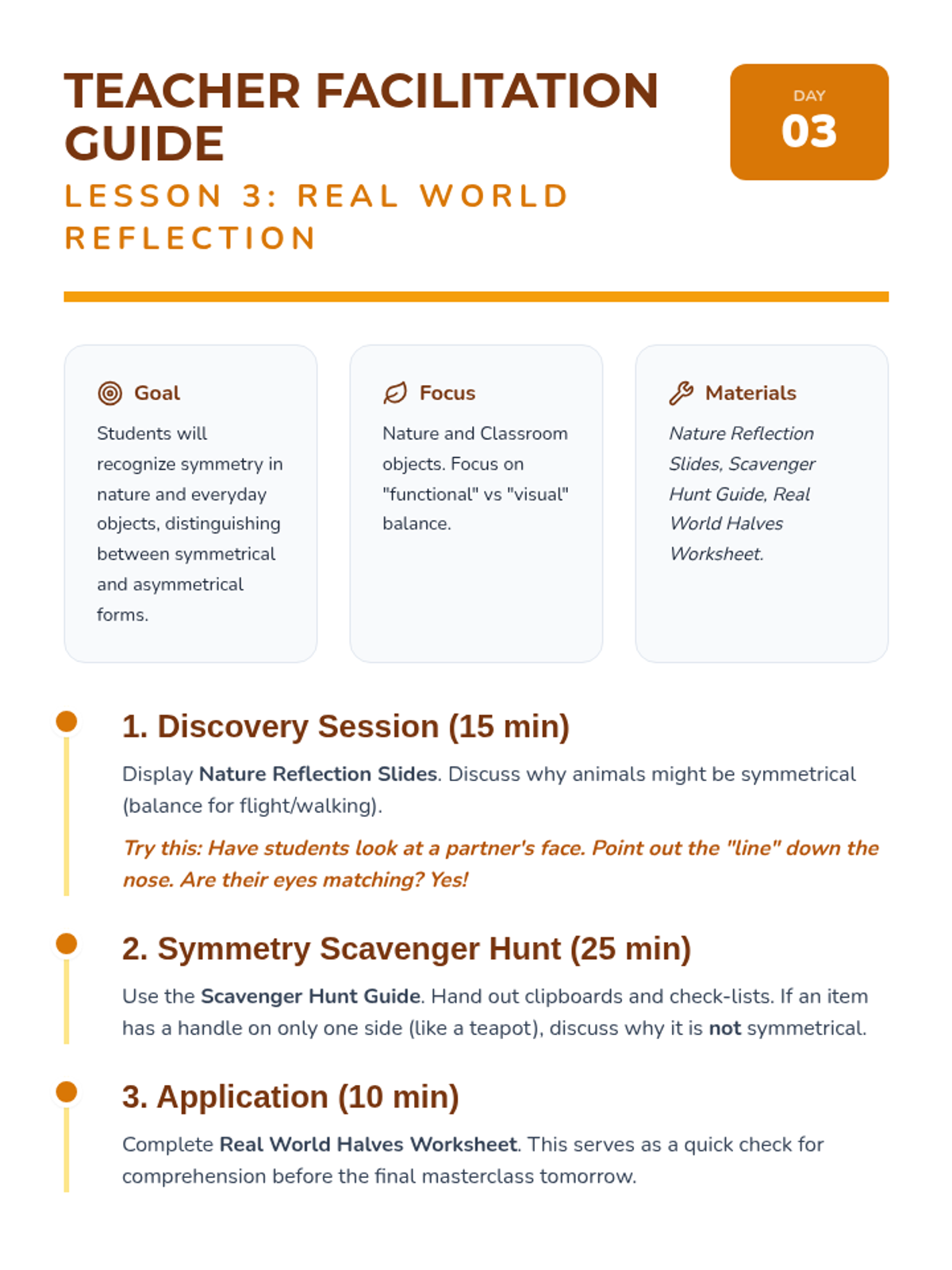
Teacher facilitation guide for Lesson 3 with fixed page breaks.
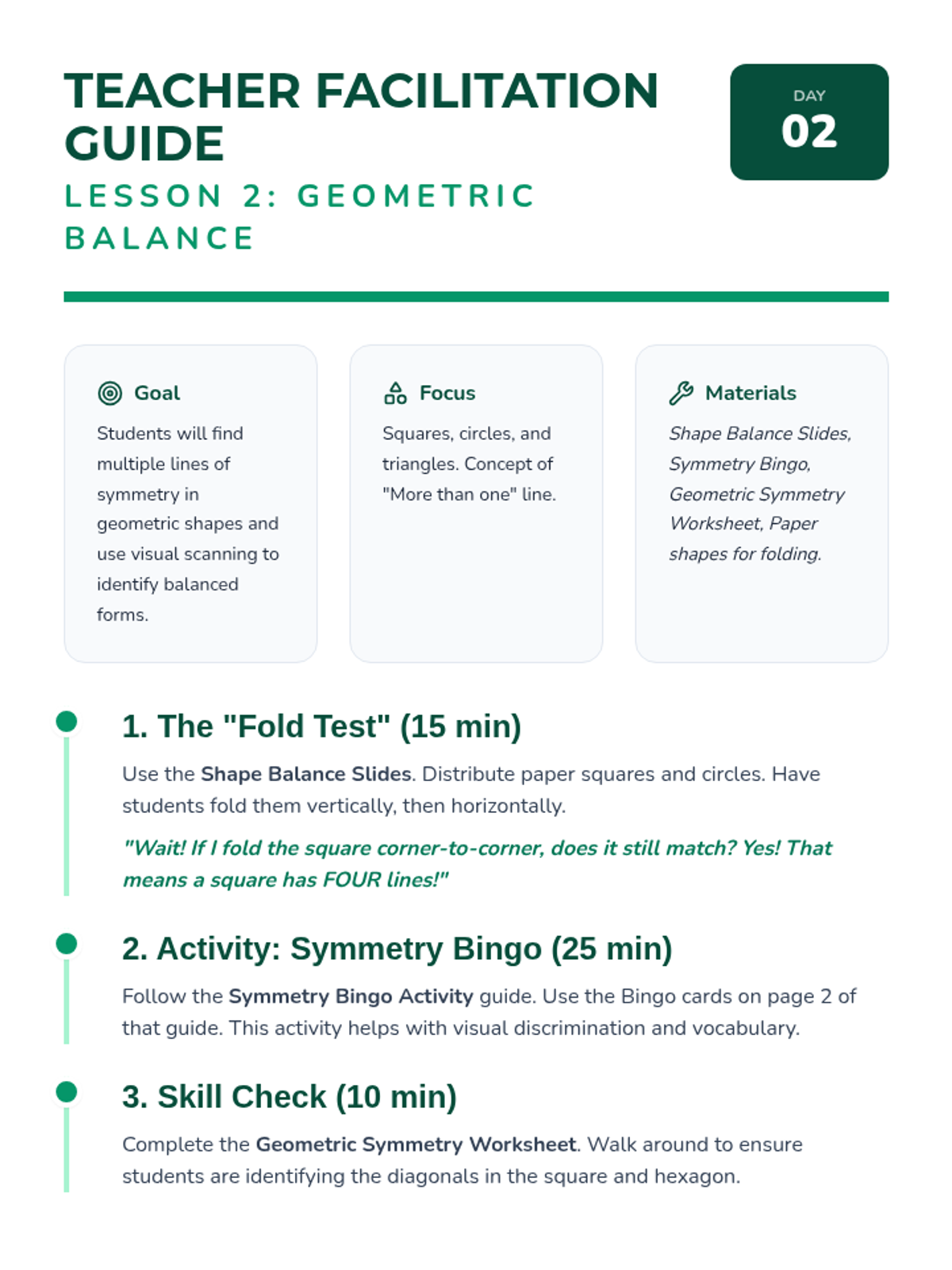
Teacher facilitation guide for Lesson 2 with improved page break management.
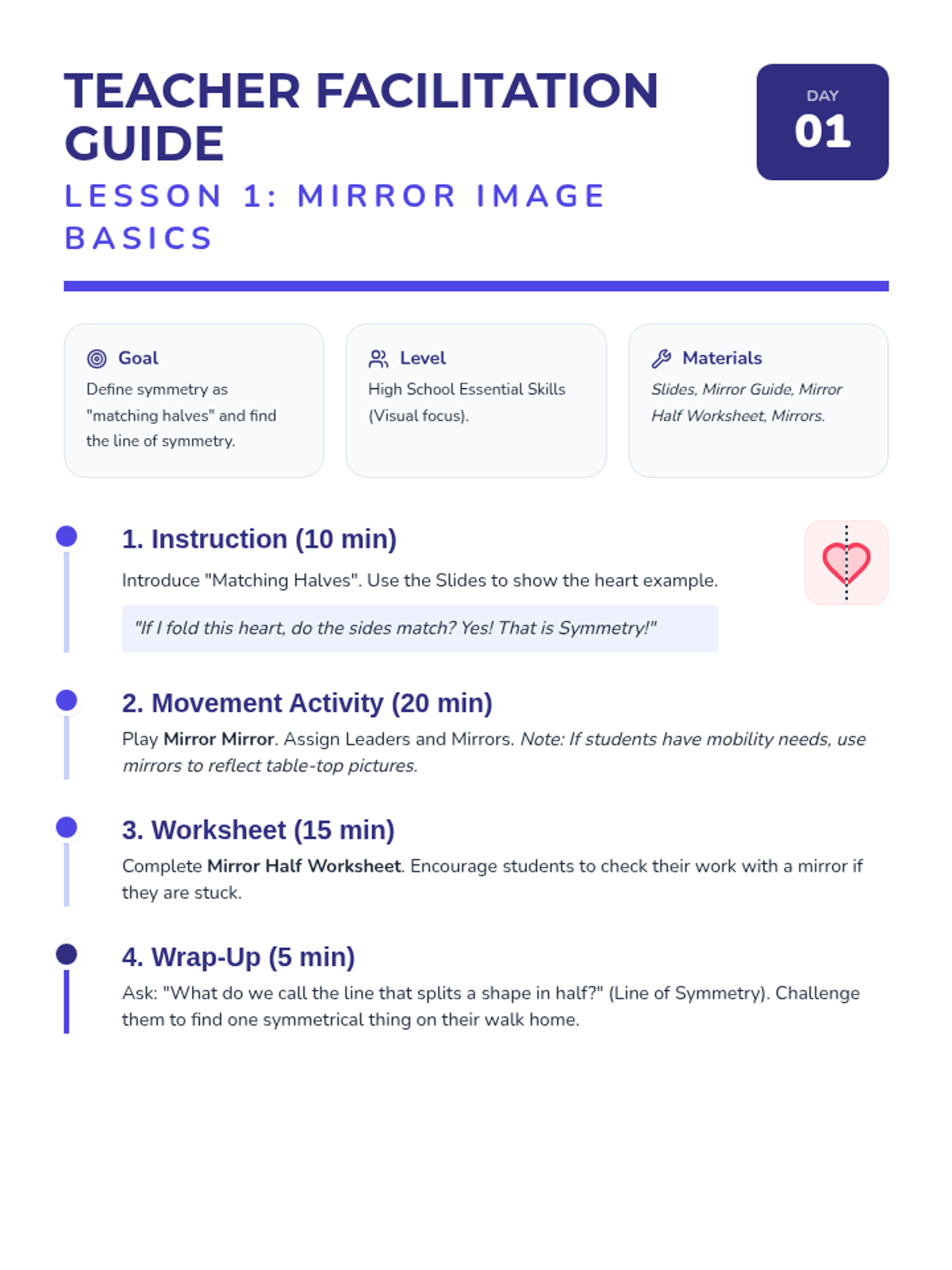
Teacher facilitation guide for Lesson 1 with improved spacing and visual support. Fits on one page.
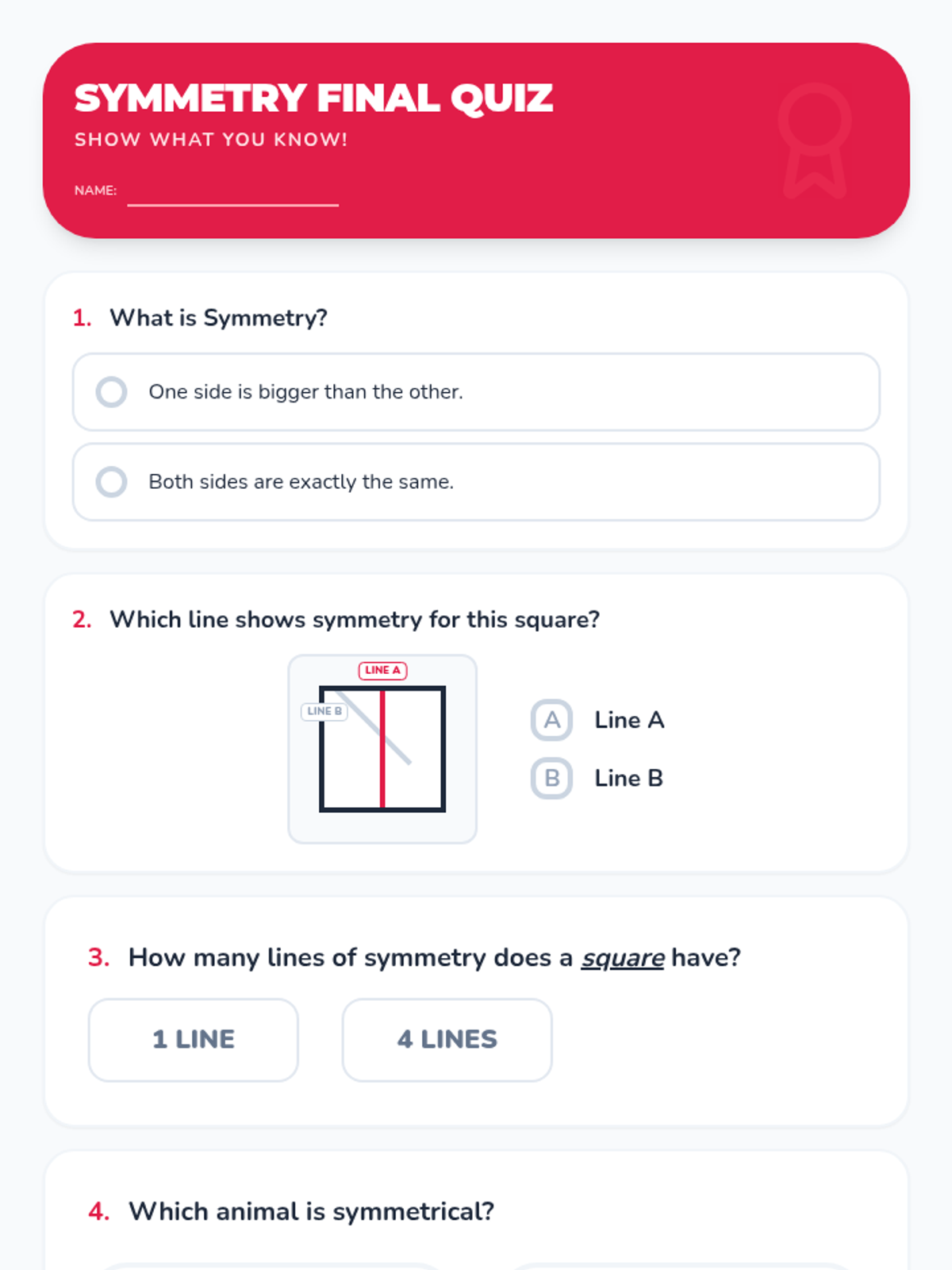
Symmetry Final Quiz with corrected answer uniformity, improved diagrams, and a larger drawing area for Question 5. Fits on two pages. Darkened heart icon for better visibility. Added page-break-before.
Final review slides for Lesson 4 with corrected mirrored graphics, improved layout balance, and enhanced visual contrast.
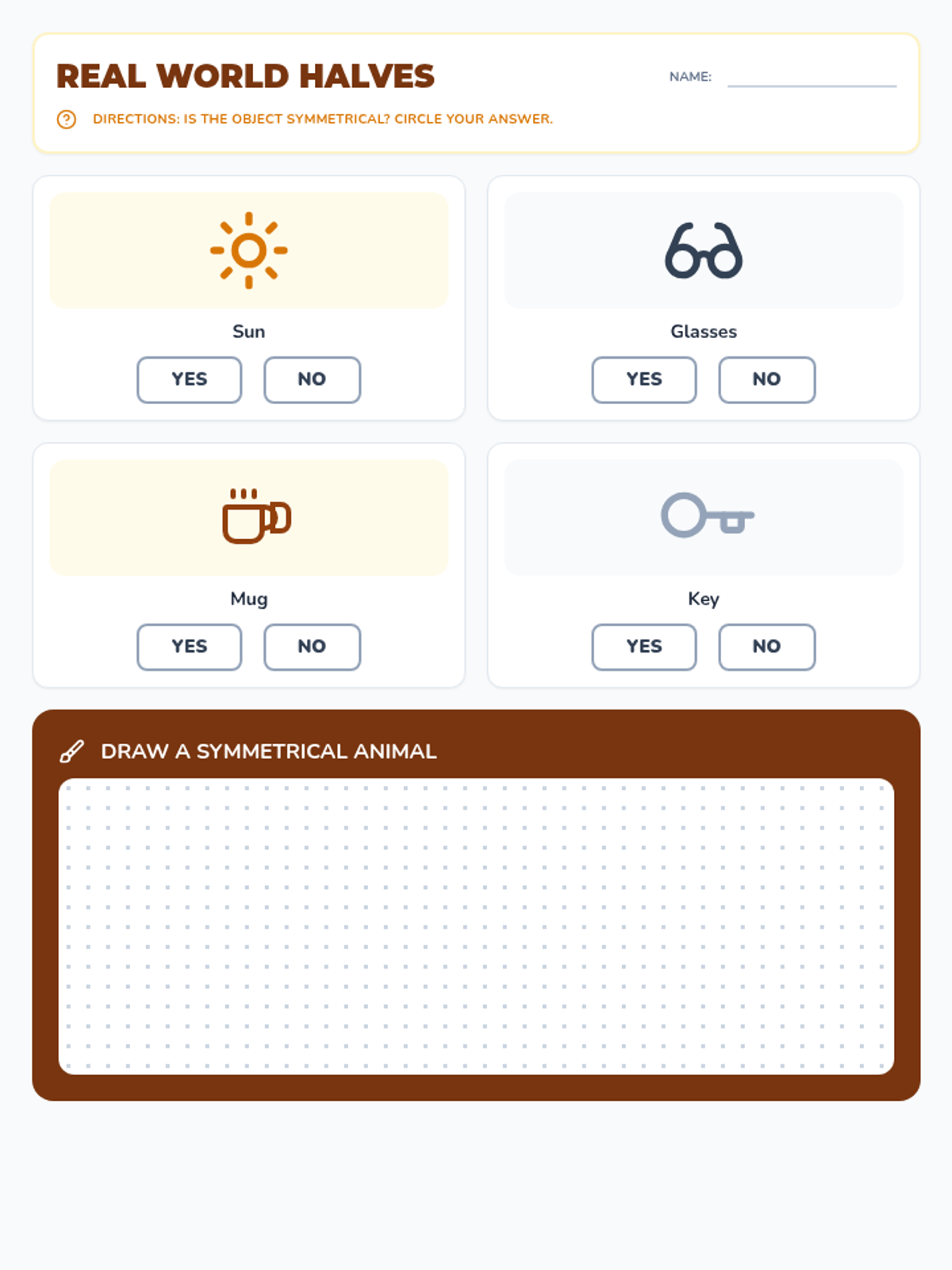
Worksheet for Lesson 3 with fixed page breaks, higher contrast buttons, and a larger drawing area for students. Fits on one page.
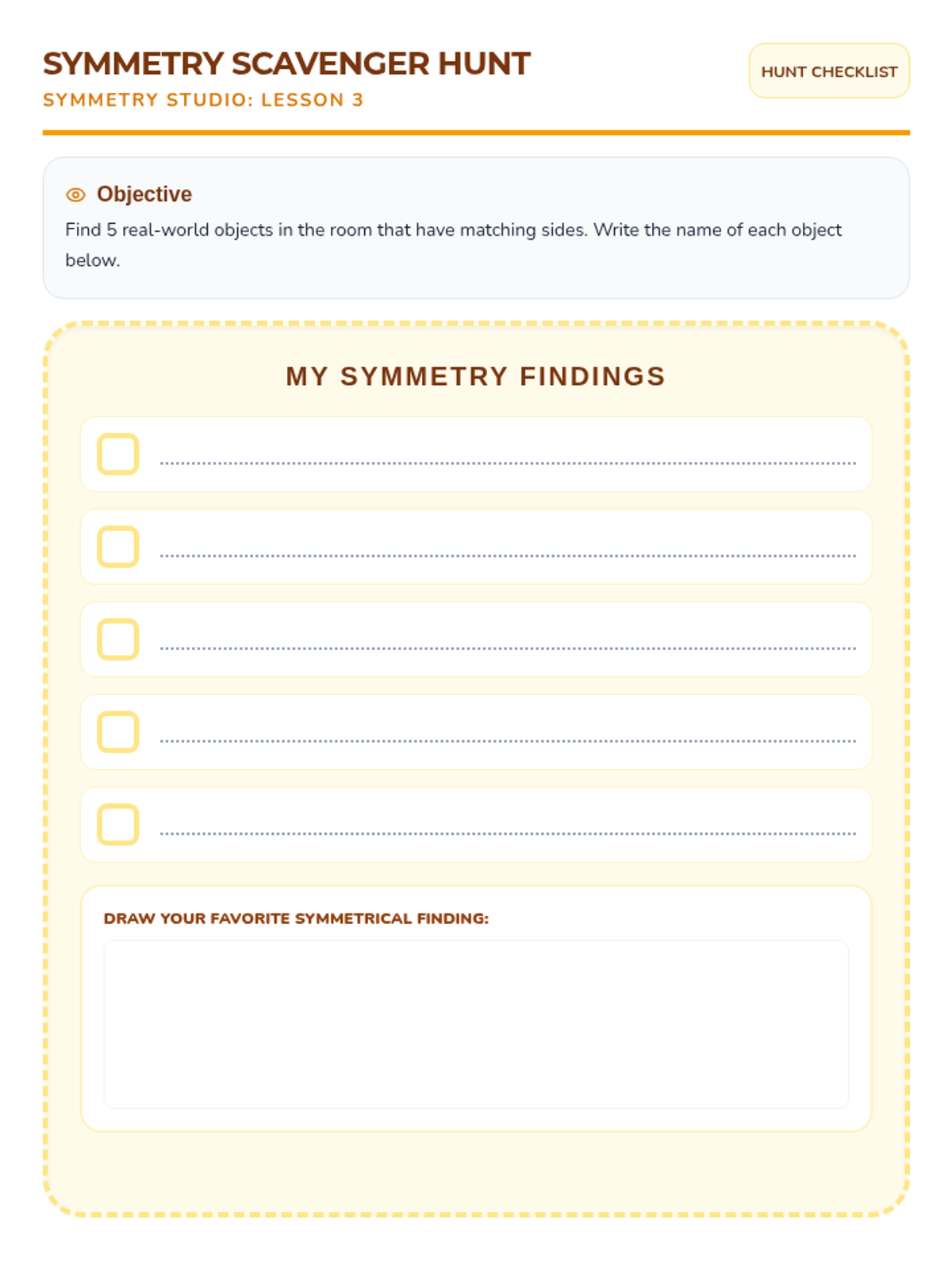
Scavenger Hunt guide for Lesson 3 with fixed page breaks and improved printable checklist formatting. Fits on one page.
Nature Reflection slides with corrected icons and aligned graphics to ensure factual accuracy and clarity.
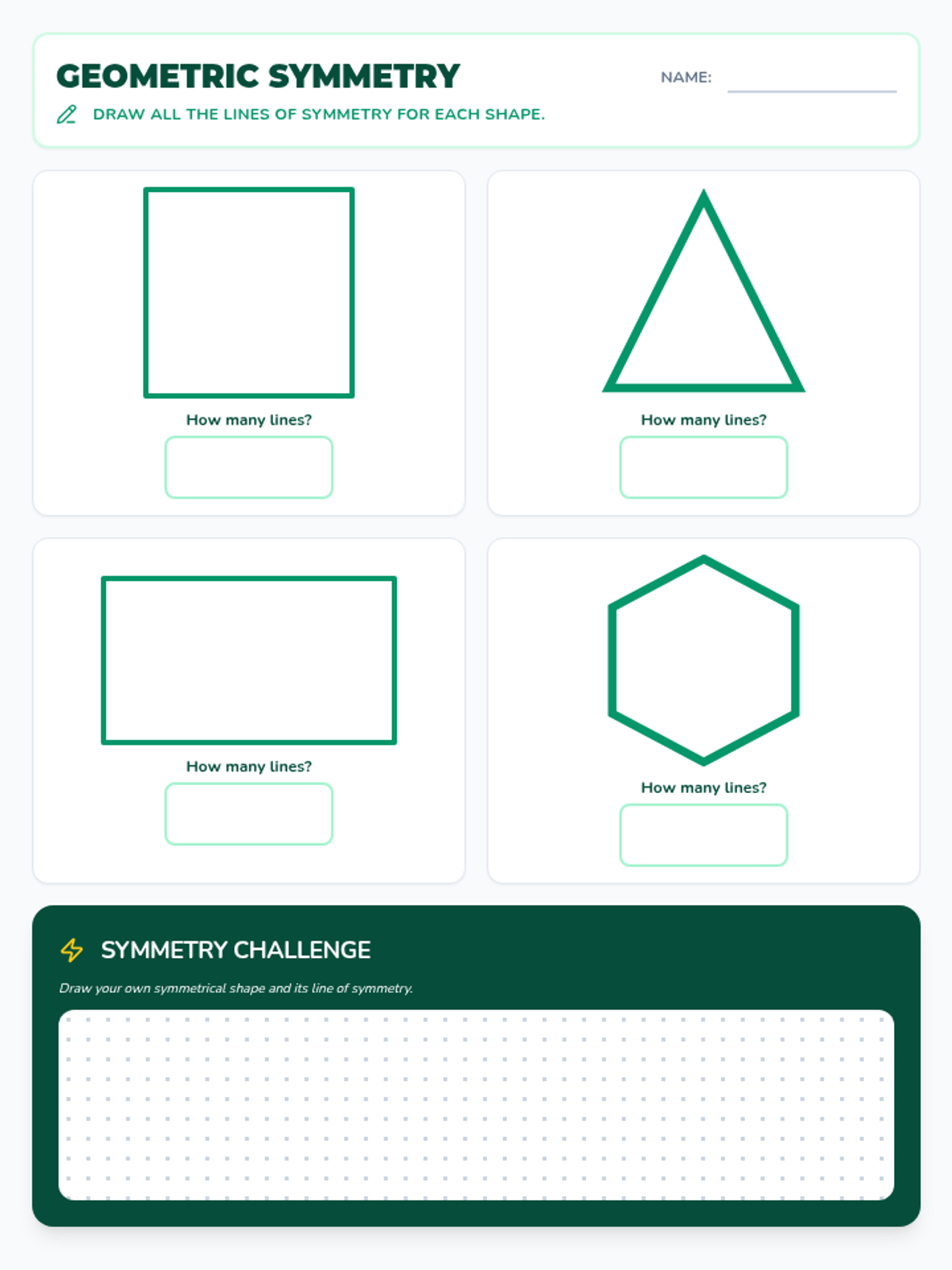
Worksheet for Lesson 2 with fixed page breaks, standardized shape styles, and a hexagon replacement for the circle to ensure specific student answers. Fits on one page.
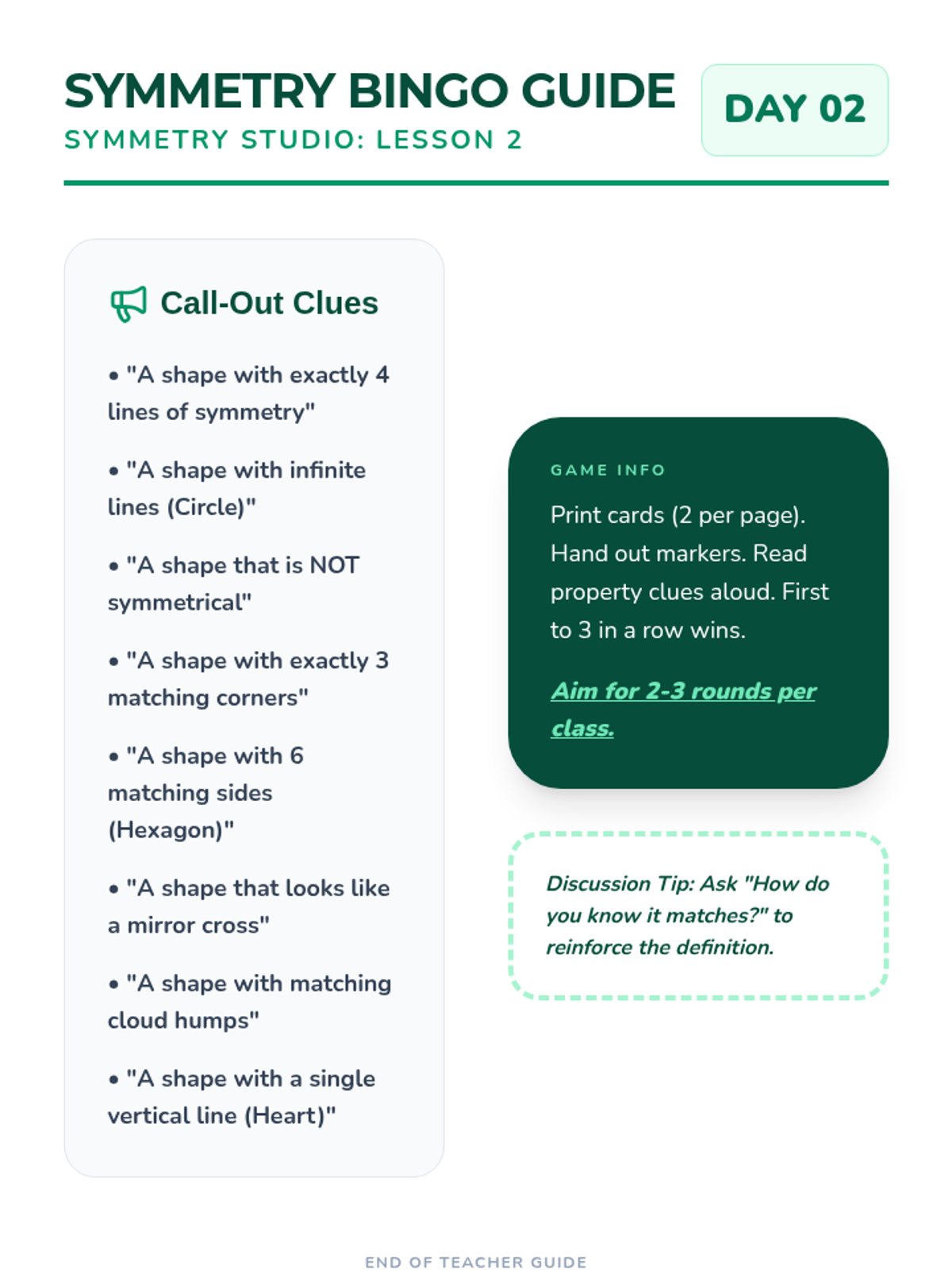
Consolidated teacher guide and student Bingo cards for Lesson 2, including actual game components and fixed page breaks. Larger bingo cards for accessibility. Corrected card variety and contrast. Added hexagon icons.
Presentation slides for Lesson 2 with fixed triangle graphic, improved icon visibility, and Bingo preview.
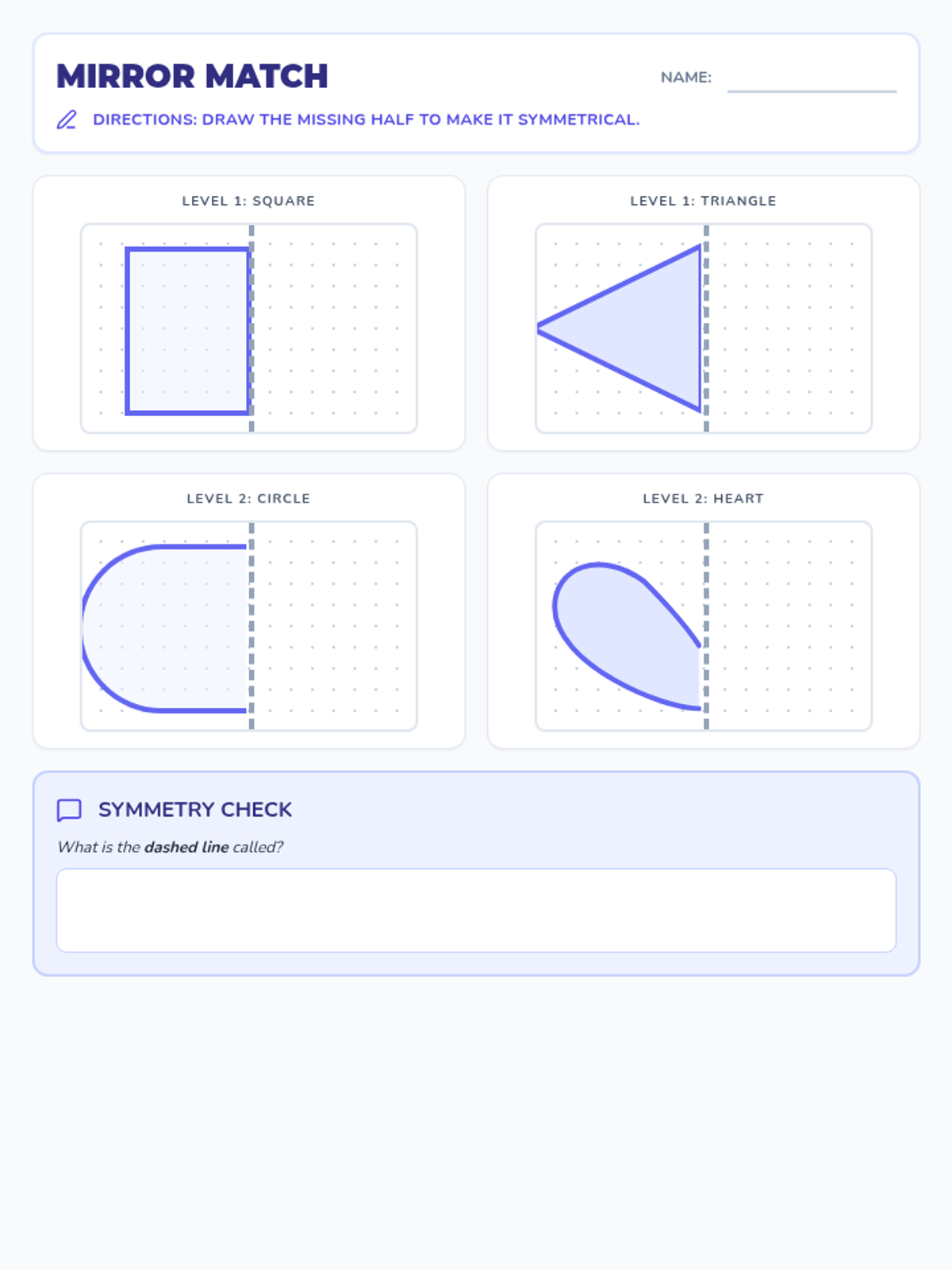
A worksheet focusing on the 'line of symmetry' with background grids for drawing support and correctly clipped shapes. Fits on one page. Corrected alignment and heart shape. Vertical circle orientation.
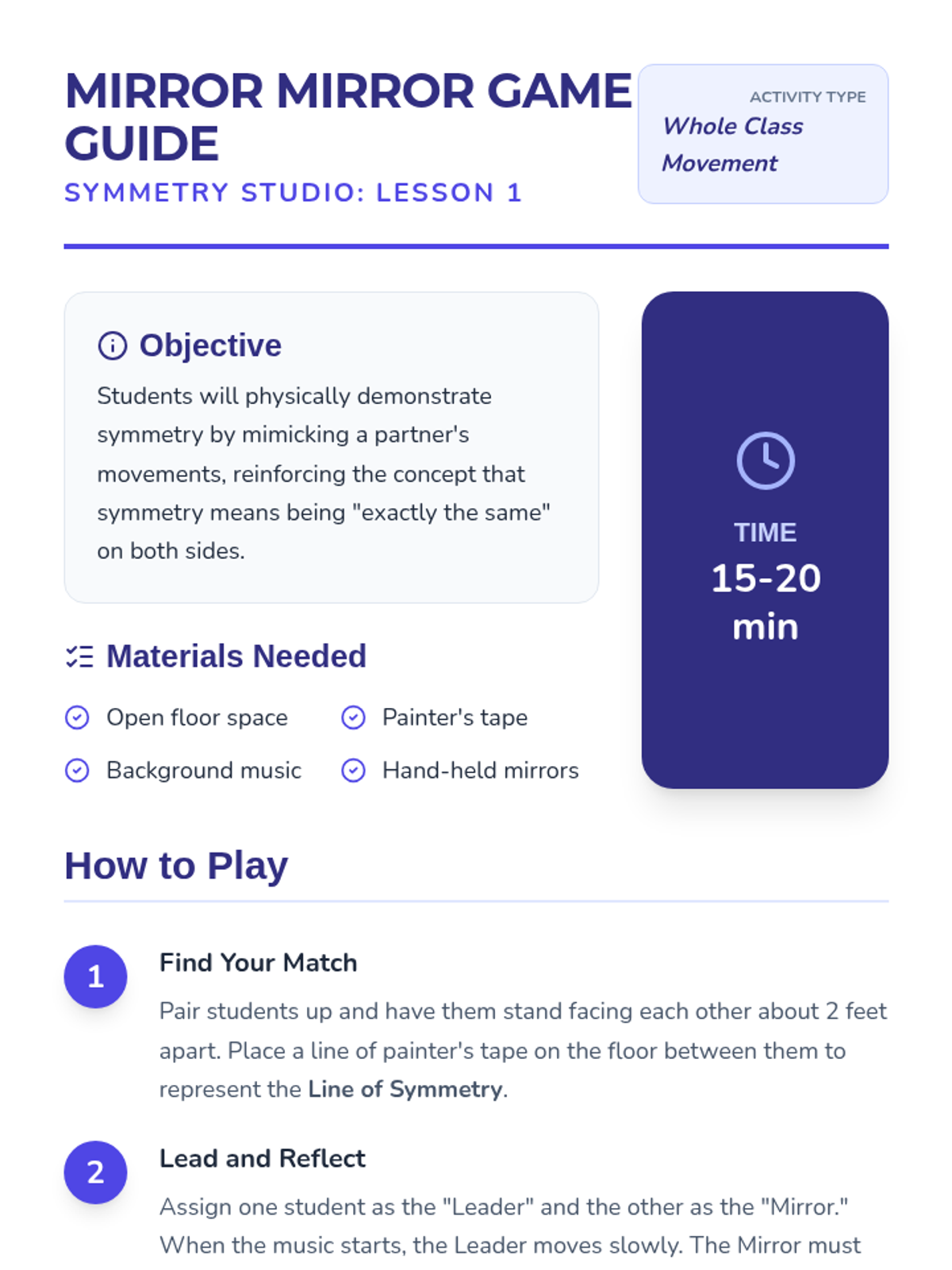
Teacher facilitation guide for the 'Mirror Mirror' movement activity, providing clear steps and discussion prompts to help students physically experience symmetry with improved formatting.
Introductory slide deck for symmetry, defining mirror images and the line of symmetry with clear visual aids, student-friendly text, and specific game instructions.
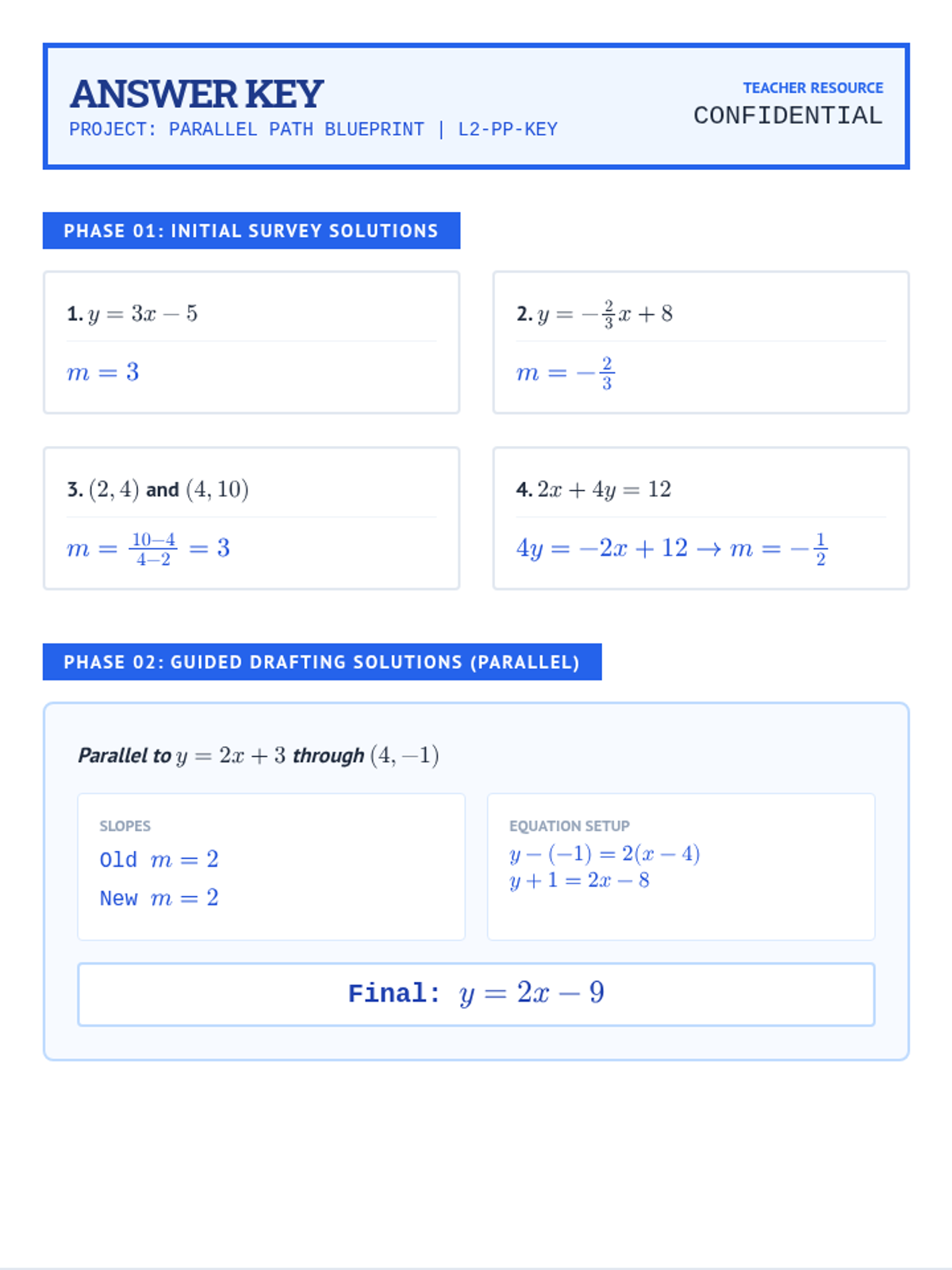
A complete answer key for the Parallel Path Blueprint lesson, with simplified headers to match the student packet and ensure a cleaner, more focused layout. Solutions are clearly presented with bolded results.
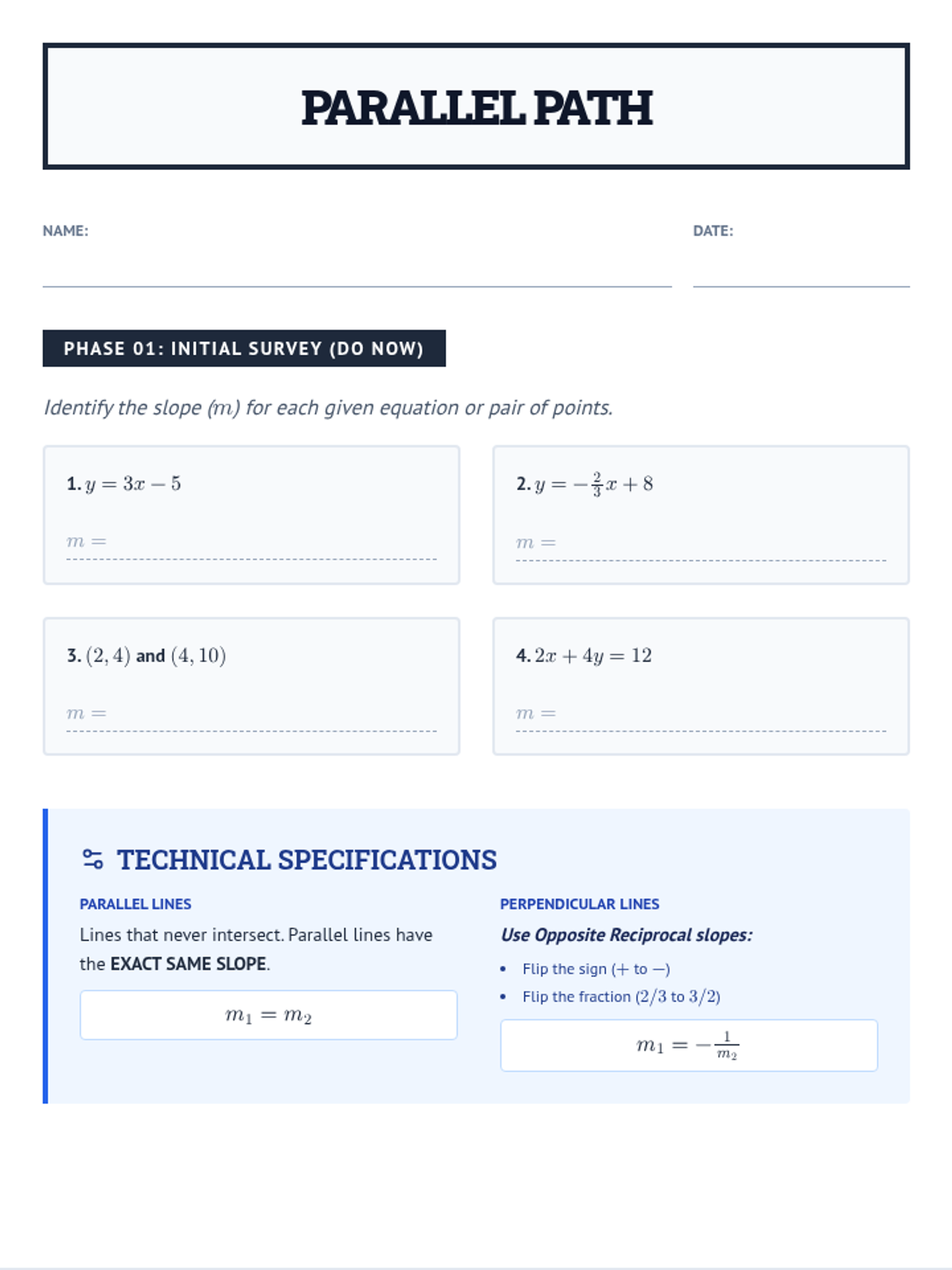
A student packet for writing equations of parallel and perpendicular lines, featuring a blueprint-themed layout with structured phases. The header has been simplified to remove metadata and technical labels as requested.
A consolidated printable bundle containing every non-slide material in the unit: vocabulary sheet, worksheets, exit tickets, 12 full-page station cards, lab recording sheet, teacher guide, final assessment, and master answer keys. Optimized for one-click printing of the entire 24-page unit. Revised for improved spacing, consistent subscript rendering, and layout stability.
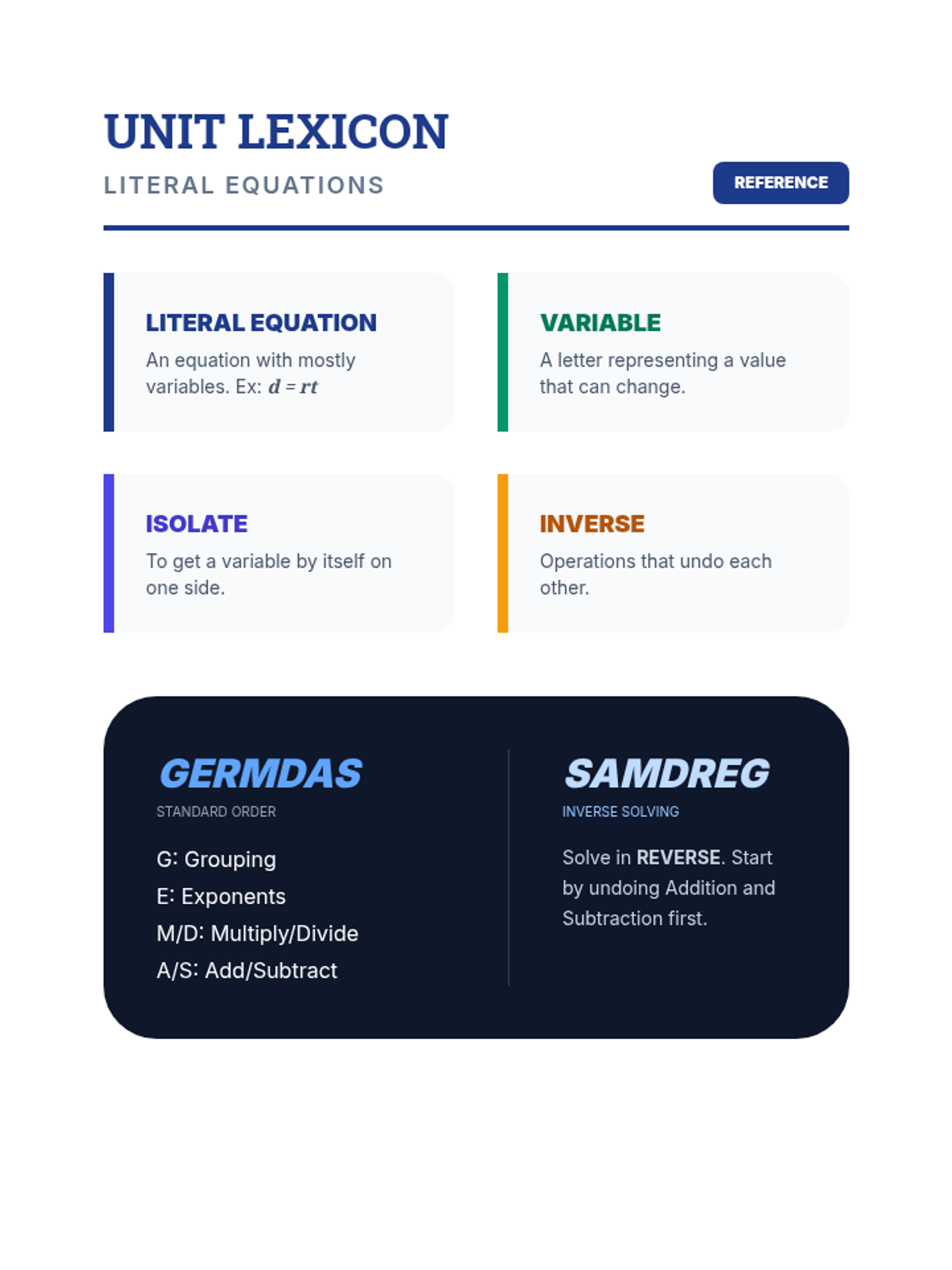
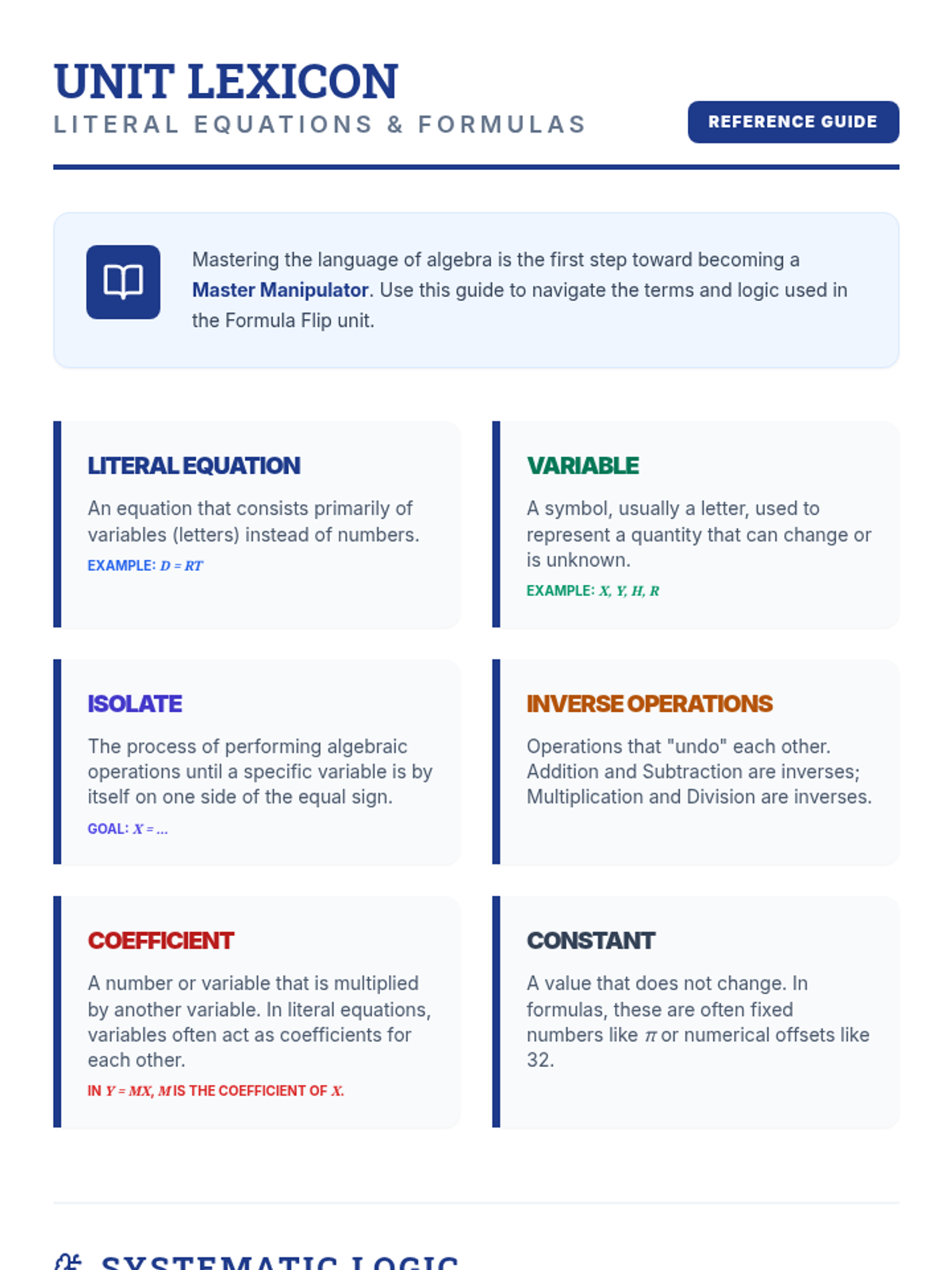
A comprehensive vocabulary reference sheet for the literal equations unit, defining key algebraic terms and explaining the GERMDAS/SAMDREG systematic logic.
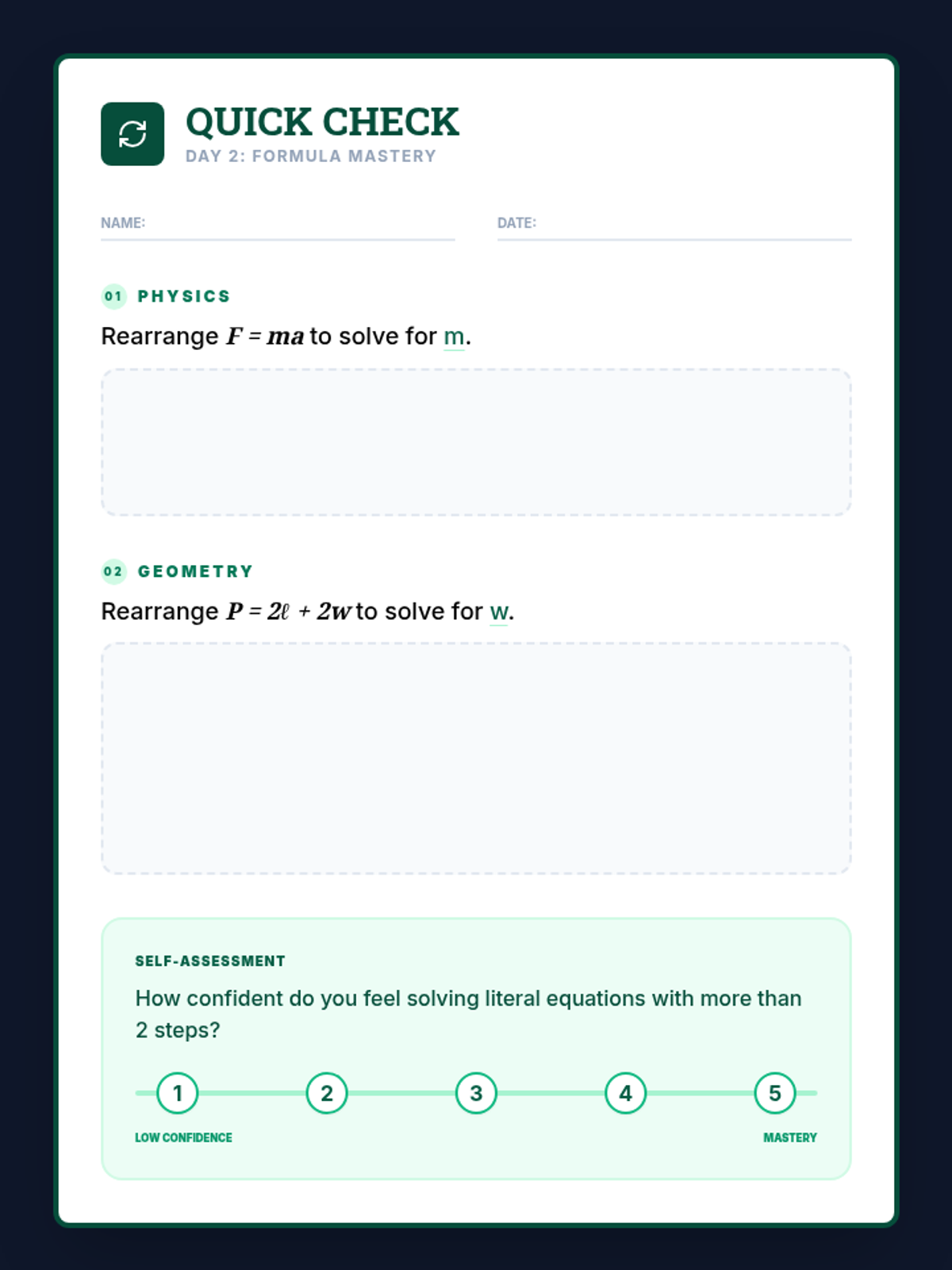
A quick-check formative assessment for Day 2. Updated to ensure variable casing in instructions exactly matches formula usage. Improved layout to fit on one page.
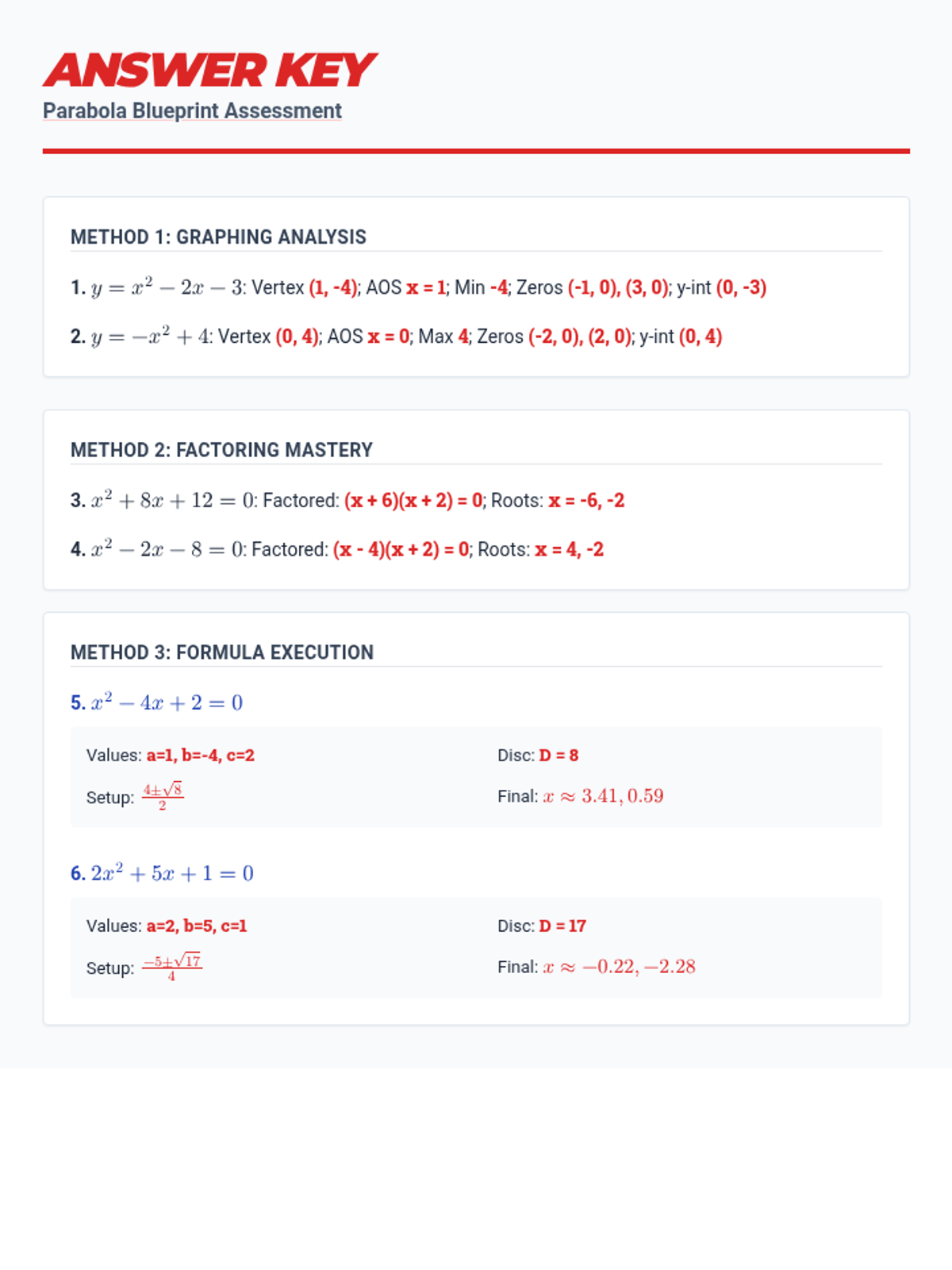
Teacher-facing answer key for the summative assessment. Refined to align with the single-column parabola analysis and updated problem layouts.
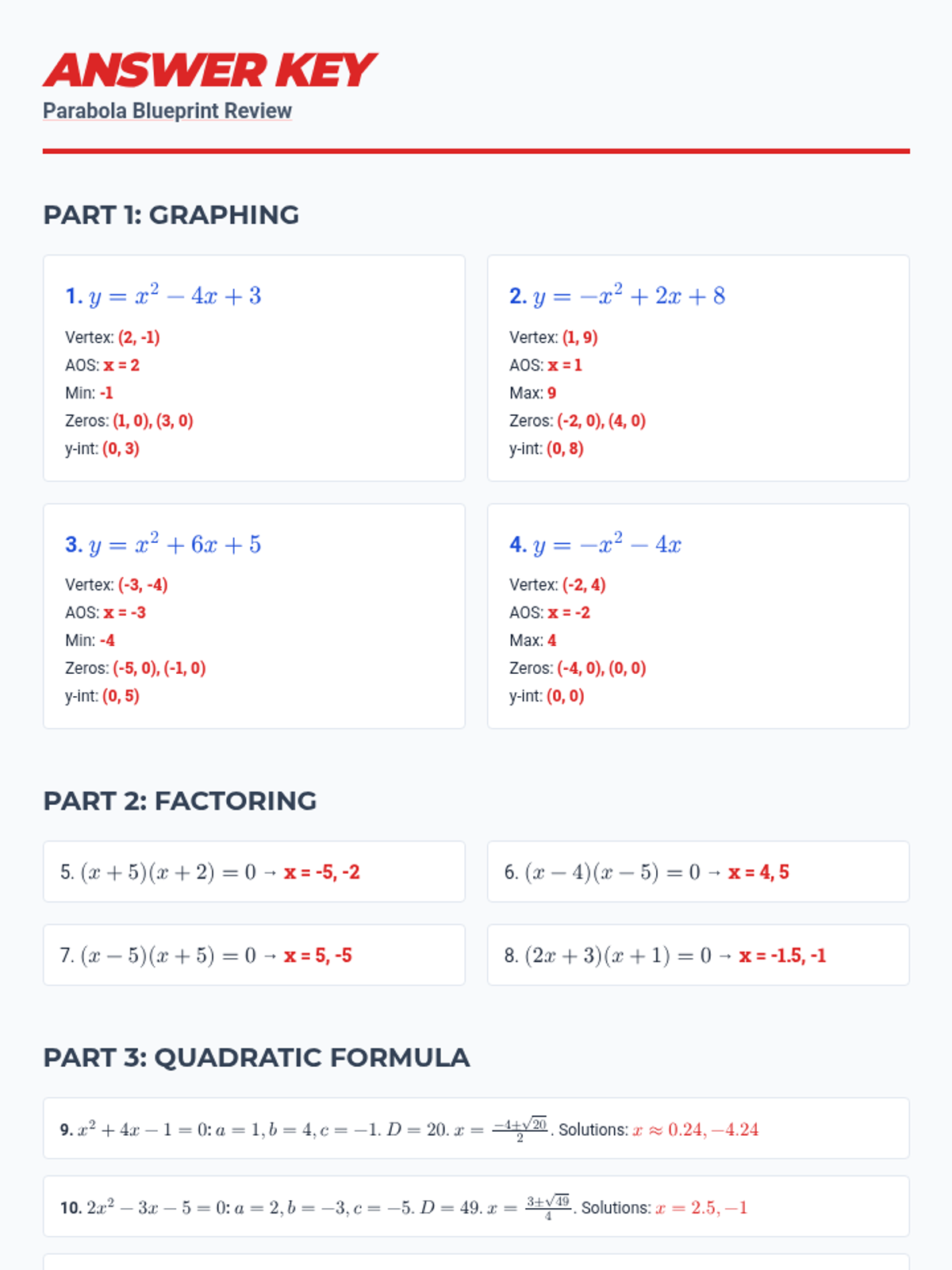
Teacher-facing answer key for the review worksheet. Updated to match the refined single-column parabola analysis items.
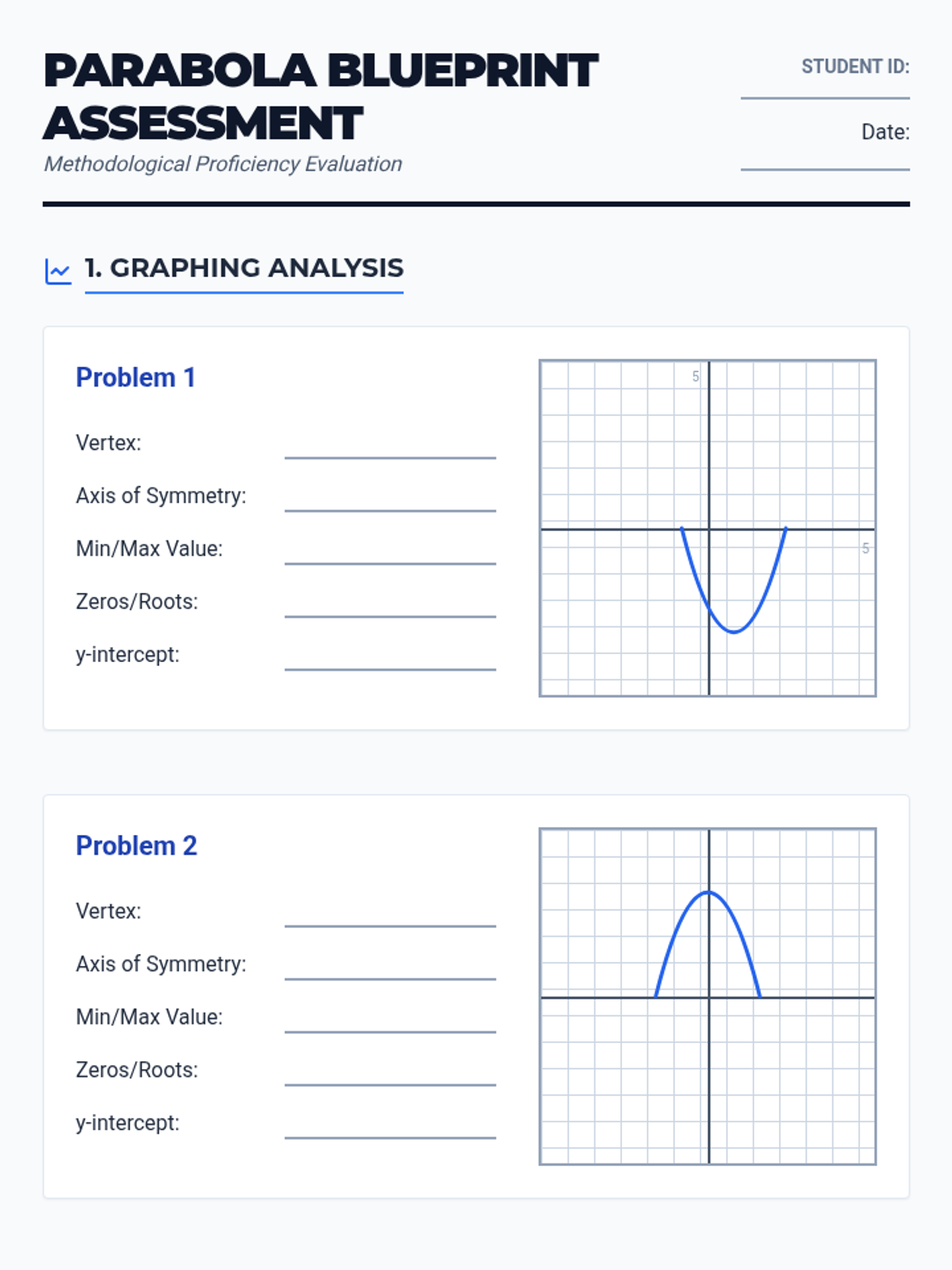
A formal summative assessment with 6 items, evaluating student proficiency in solving quadratic equations through graphing analysis, algebraic factoring, and guided quadratic formula steps. Graphing items feature single-column layouts and explicitly displayed equations. Fixes layout bugs in the formula section.
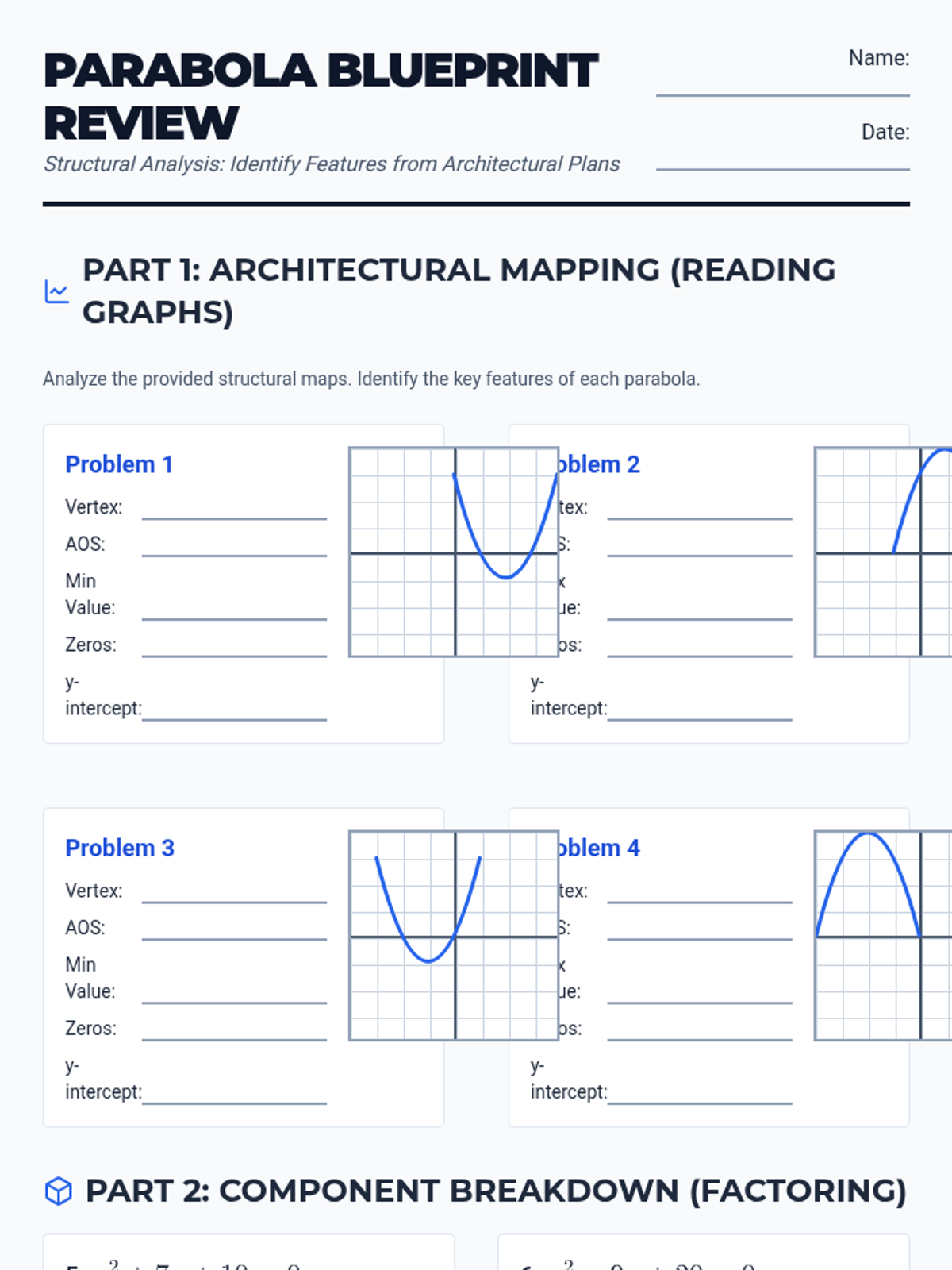
A 12-question comprehensive review worksheet covering quadratic equations via graphing, factoring, and the quadratic formula, styled with a professional 'blueprint' aesthetic. This version features single-column graph layouts, explicitly displayed equations, and refined formula templates.
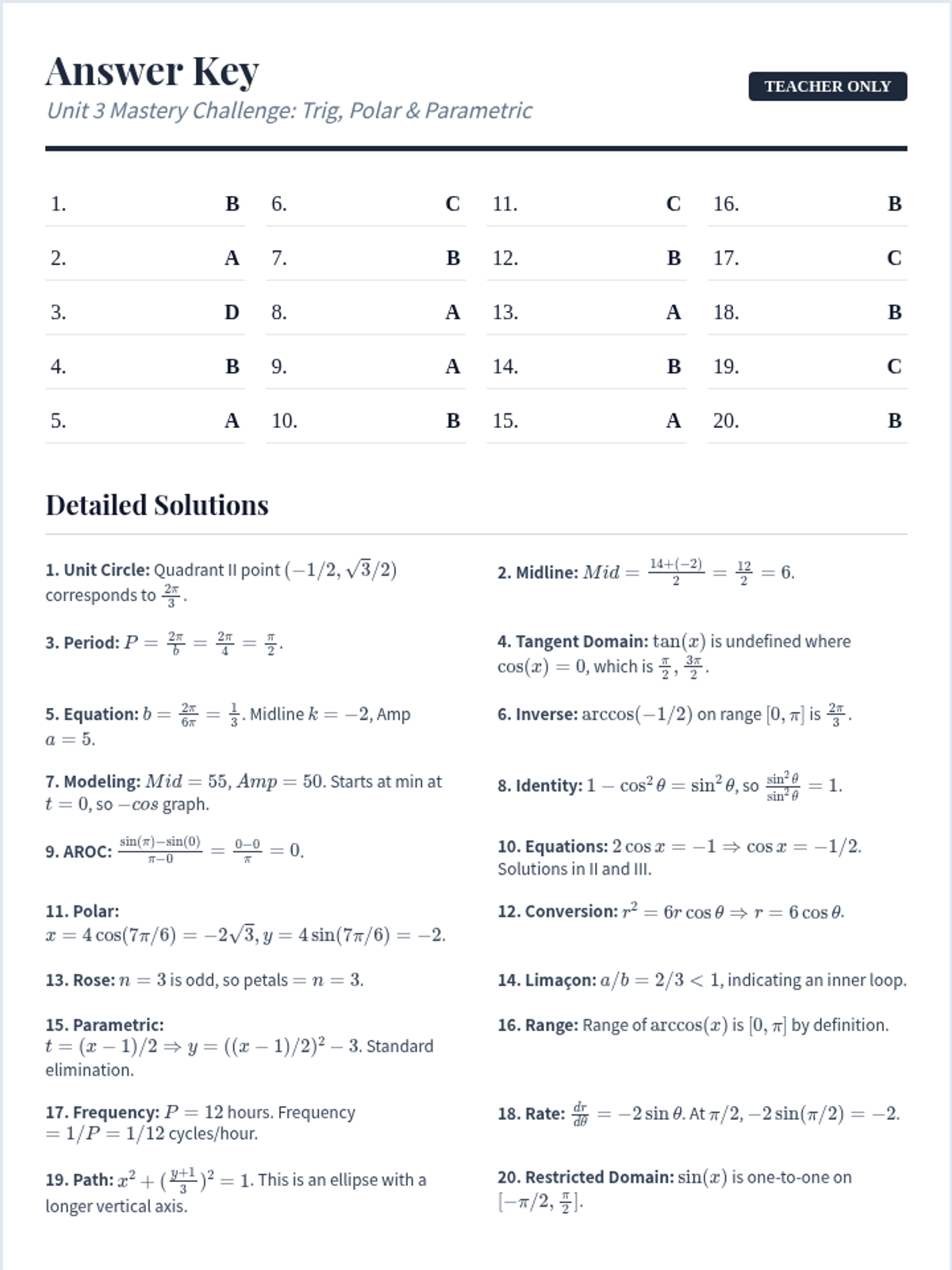
The answer key for the Unit 3 Mastery Challenge, featuring a quick-glance table and detailed explanations for all 20 questions.
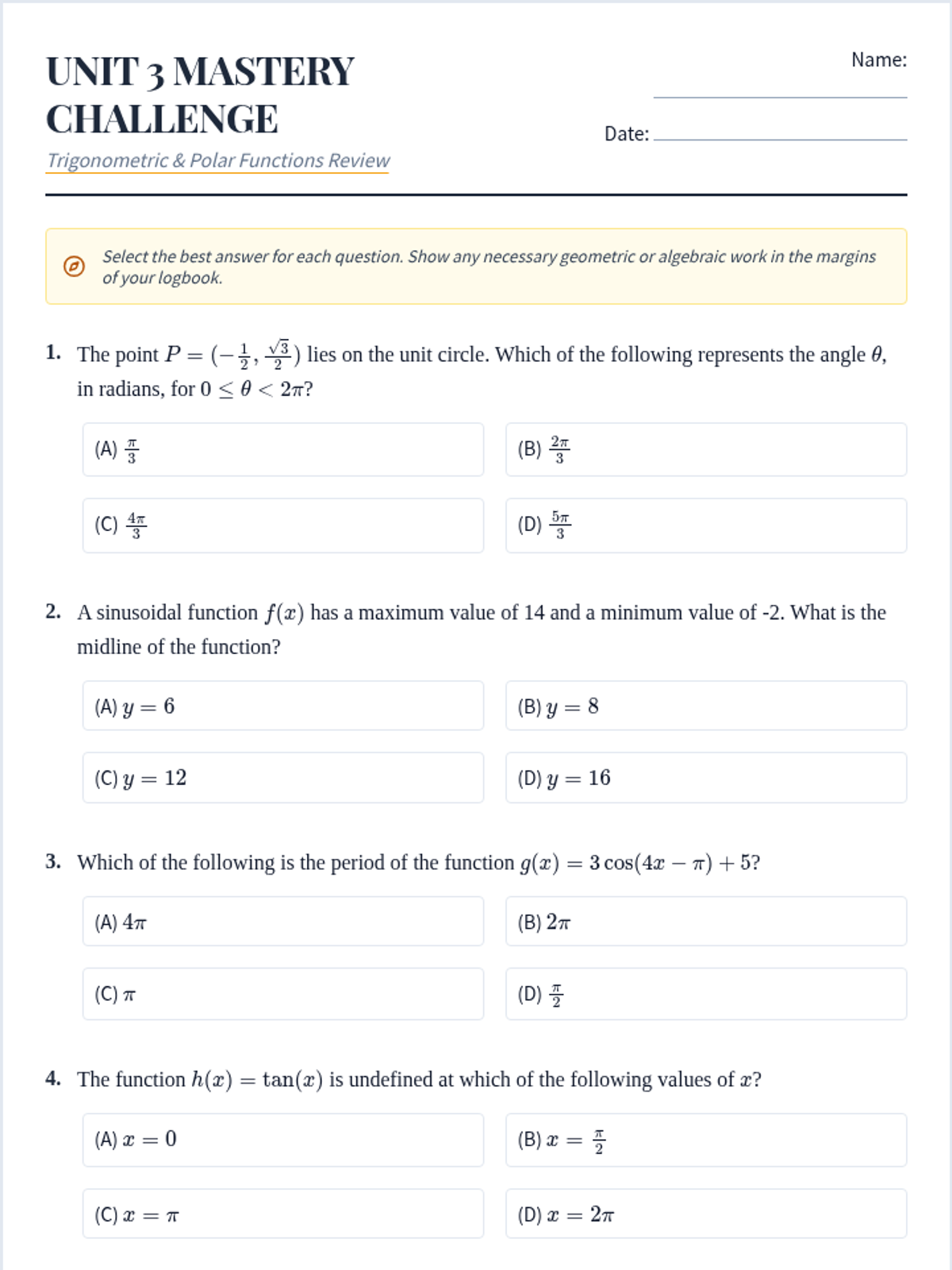
A 20-question multiple-choice assessment covering all Unit 3 topics including sinusoidal functions, inverse trigonometry, polar coordinates, and parametric functions. Designed with a nautical explorer theme and ample space for calculations.
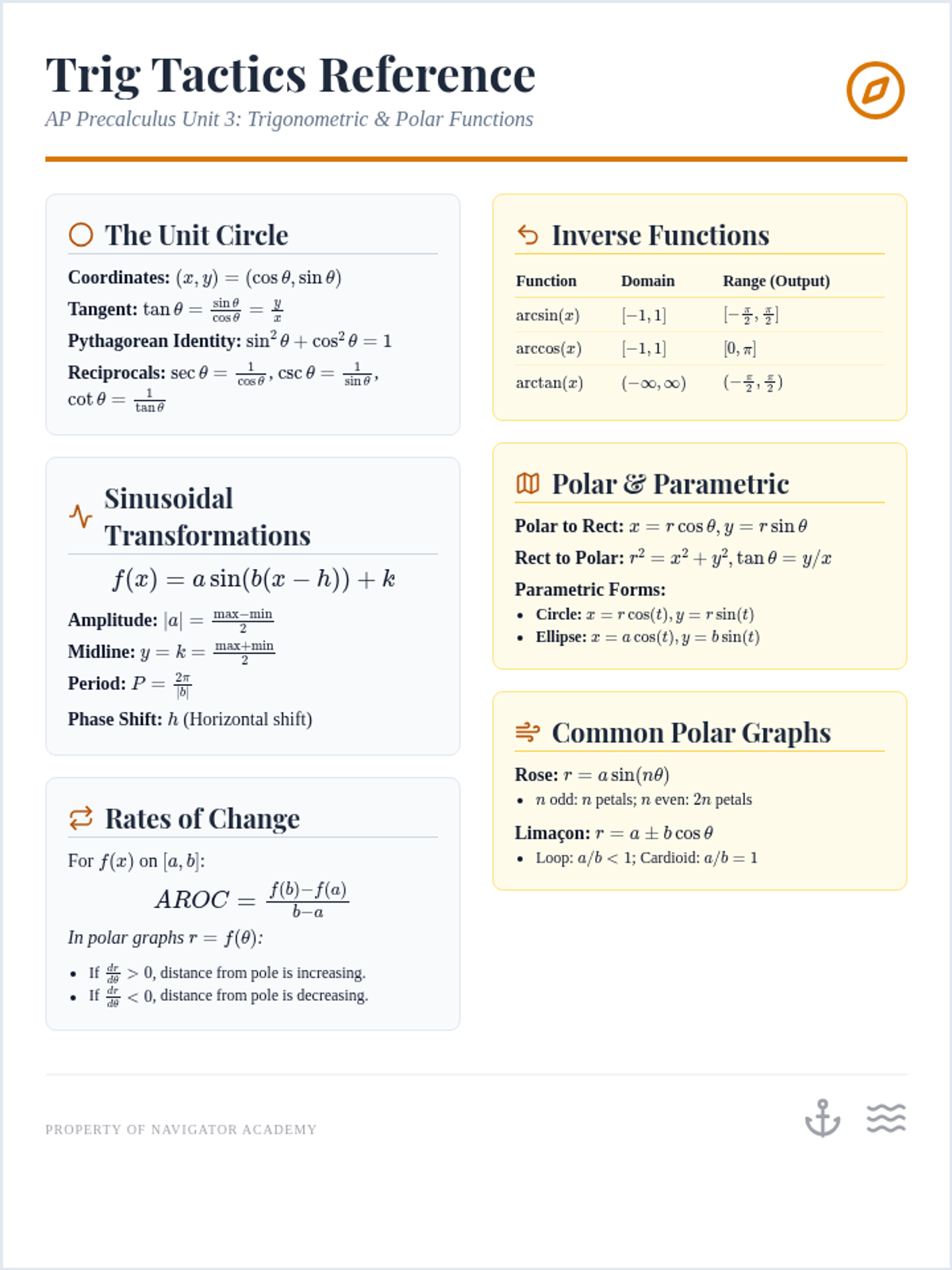
A concise one-page reference sheet covering the essential concepts of AP Precalculus Unit 3, including unit circle properties, sinusoidal transformations, inverse functions, polar coordinates, and parametric functions.
Introductory presentation for students on using the Desmos graphing calculator for the Digital SAT. Includes strategies for systems, key features of functions, statistical lists, and function transformations.
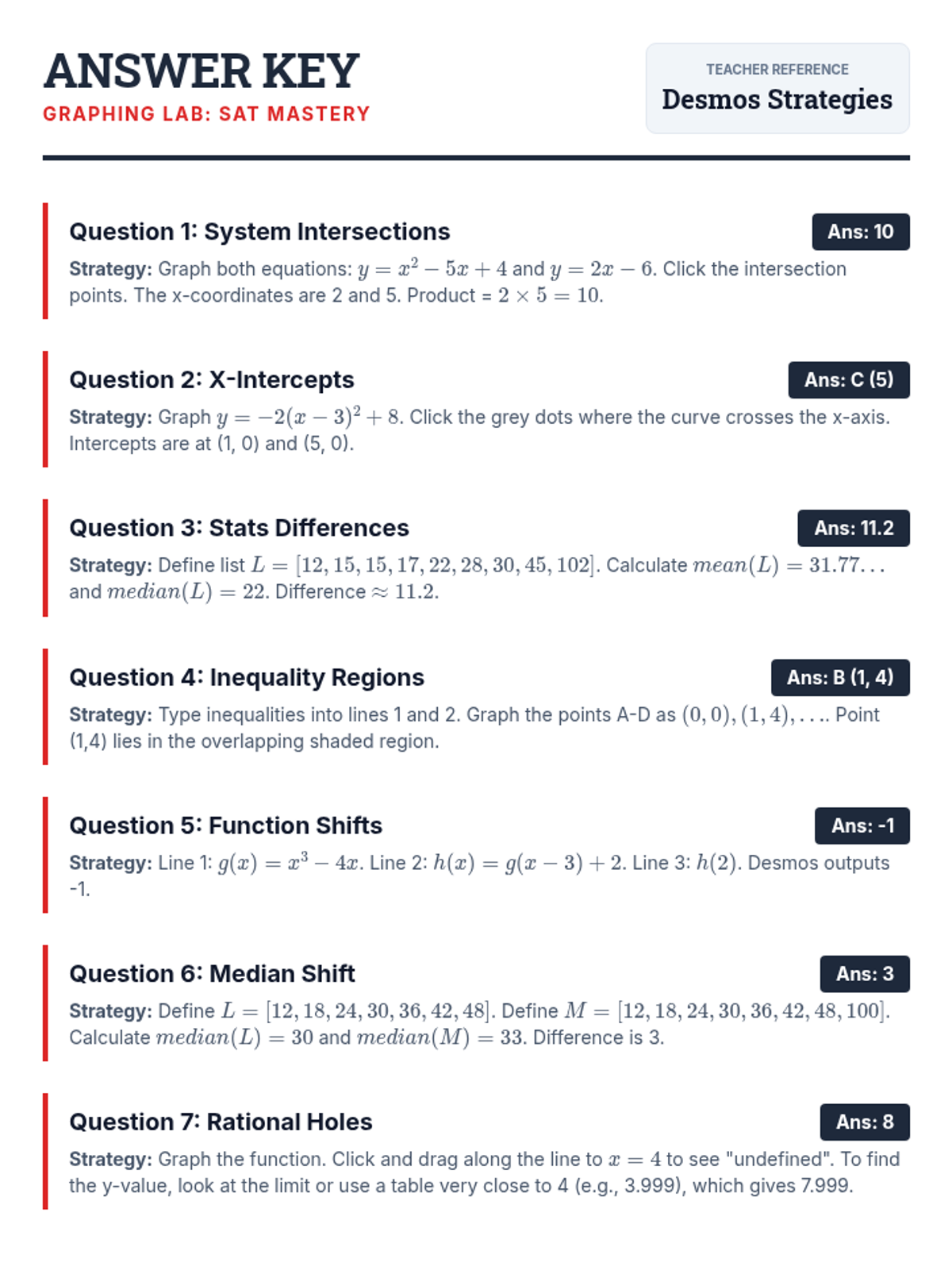
Updated Teacher answer key for the Graphing Lab Worksheet, providing both the correct answers and specific Desmos calculator strategies for the new Question 1.
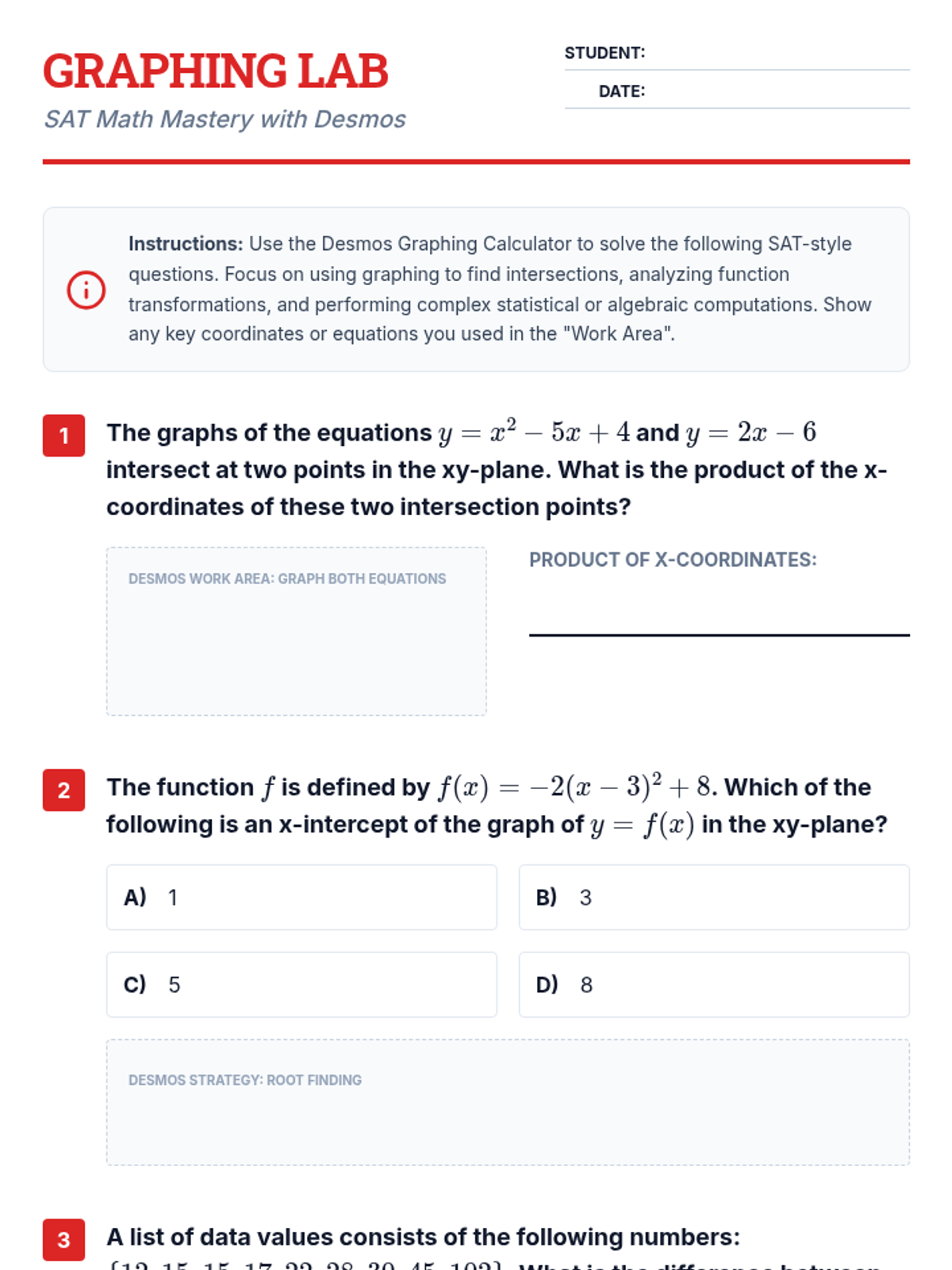
Updated 10-question SAT Math worksheet with new Question 1 focused on system intersections of parabolas and lines. Covers Heart of Algebra, Problem Solving, and Passport to Advanced Math with space for Desmos-specific work.
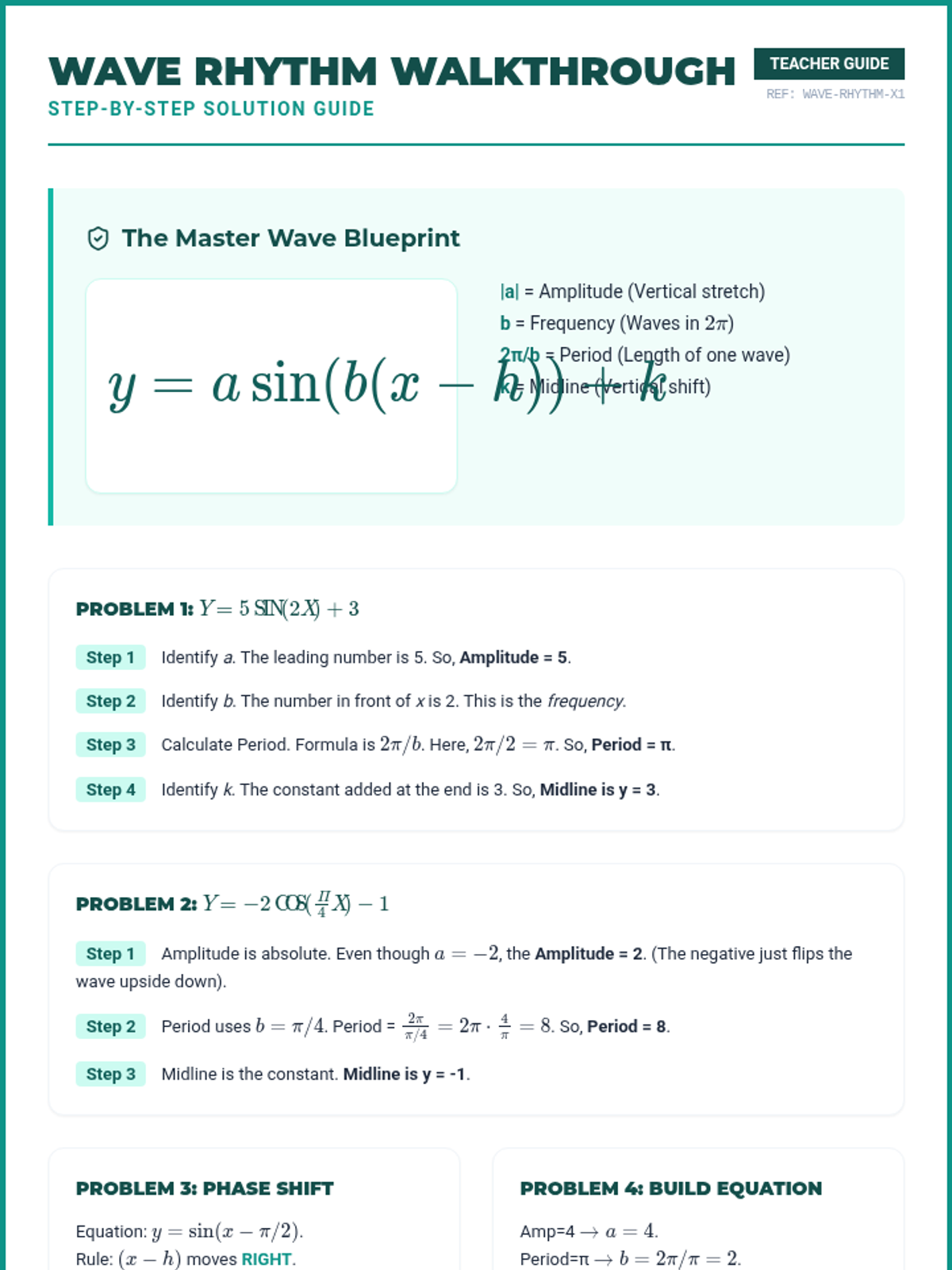
A detailed, step-by-step walkthrough of the Wave Rhythm Workout, breaking down the logic for core wave components, real-world modeling, and finding minimum values using the midline-amplitude blueprint.
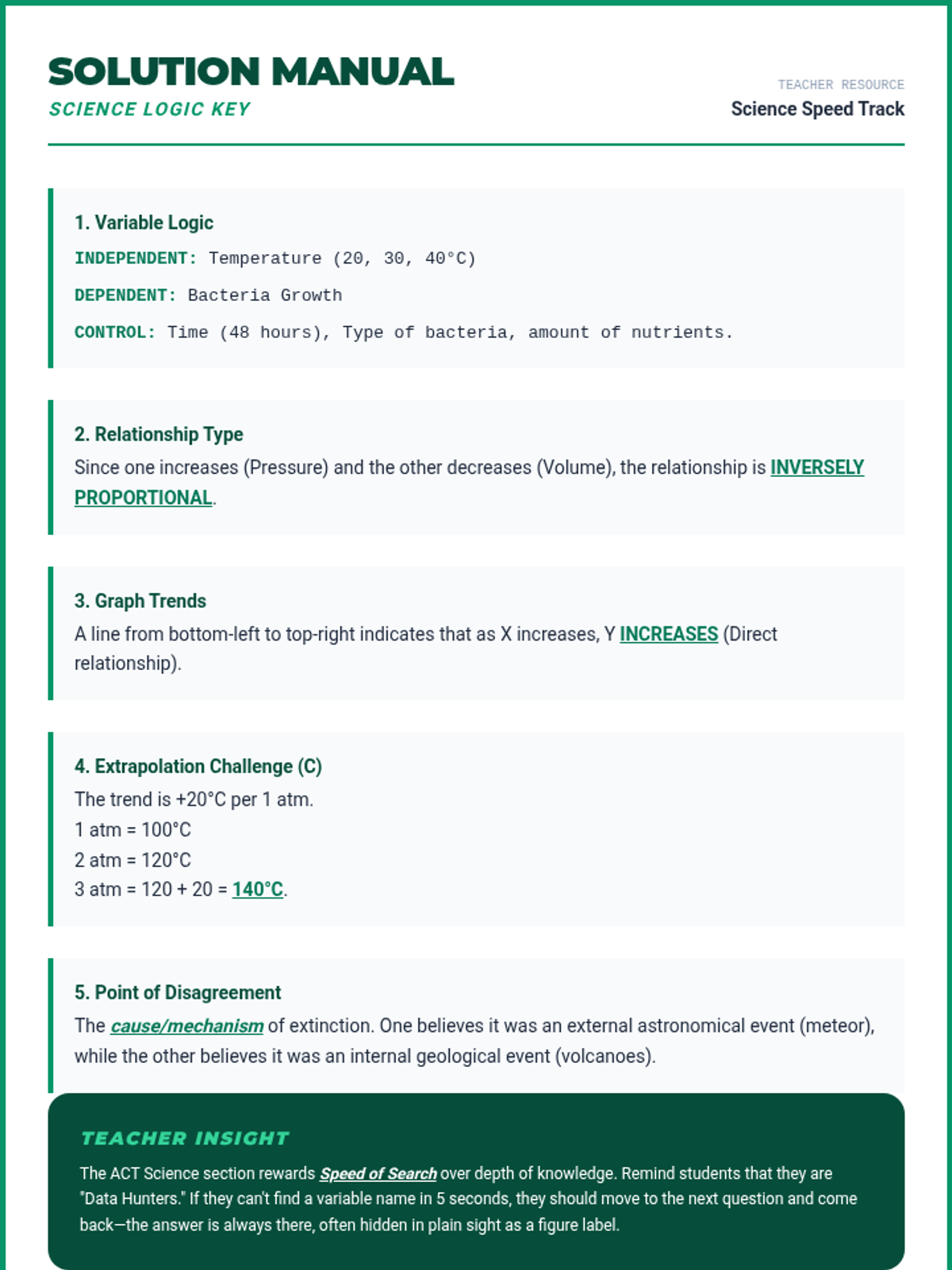
The detailed answer key for the Science Speed Logic Workout, providing explanations for variable identification, trend spotting, and scientific reasoning questions.
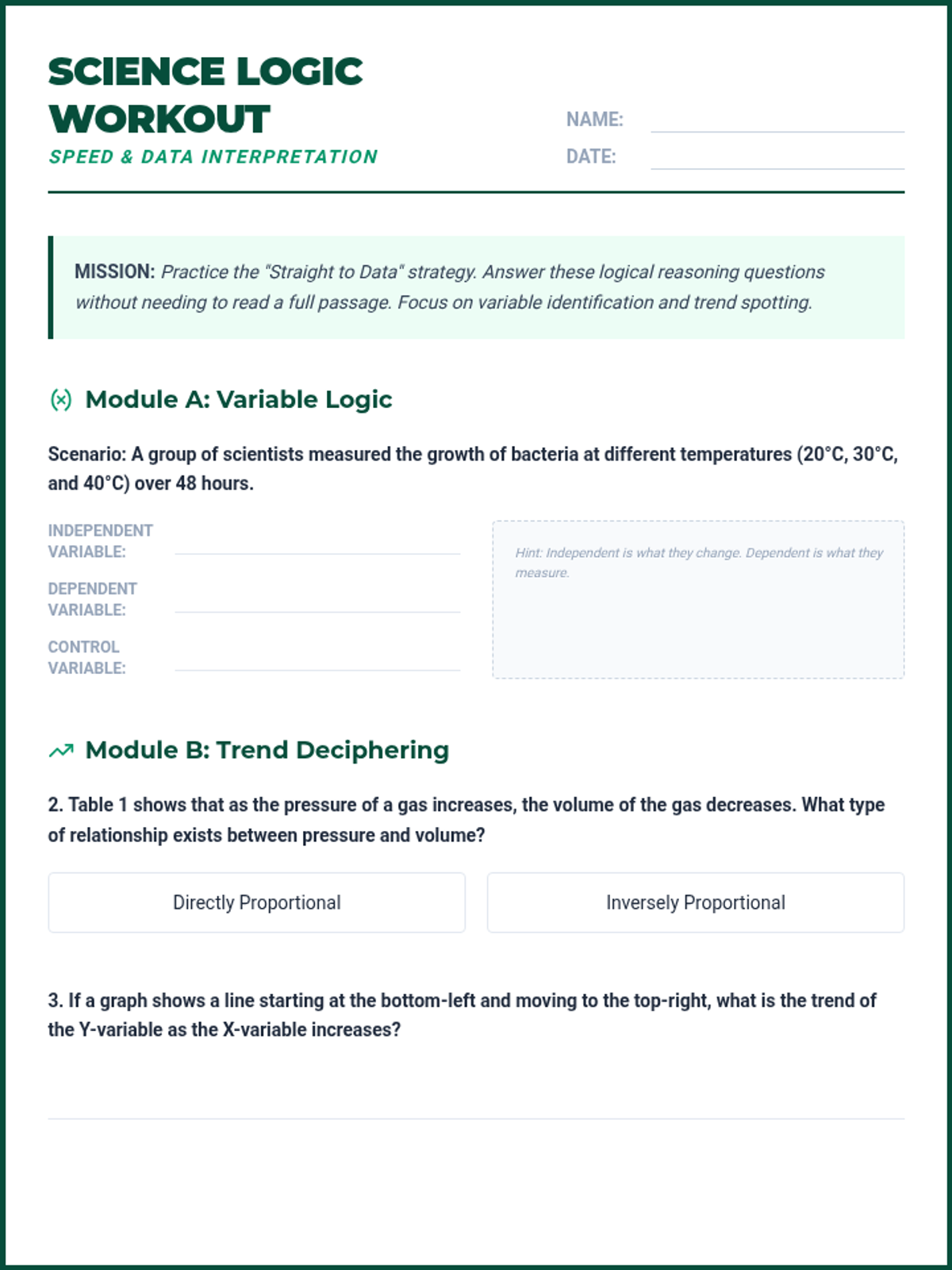
A specialized student practice worksheet for the ACT Science section, focusing on identifying independent/dependent variables, trend spotting, and basic scientific reasoning logic.
A visual slide deck covering strategic masterclass for the ACT Science section, focusing on speed-reading data sets, identifying experimental variables, and decoding scientific logic. This deck emphasizes the 'Straight to the Data' approach. Revised for font size compliance (min 24px).
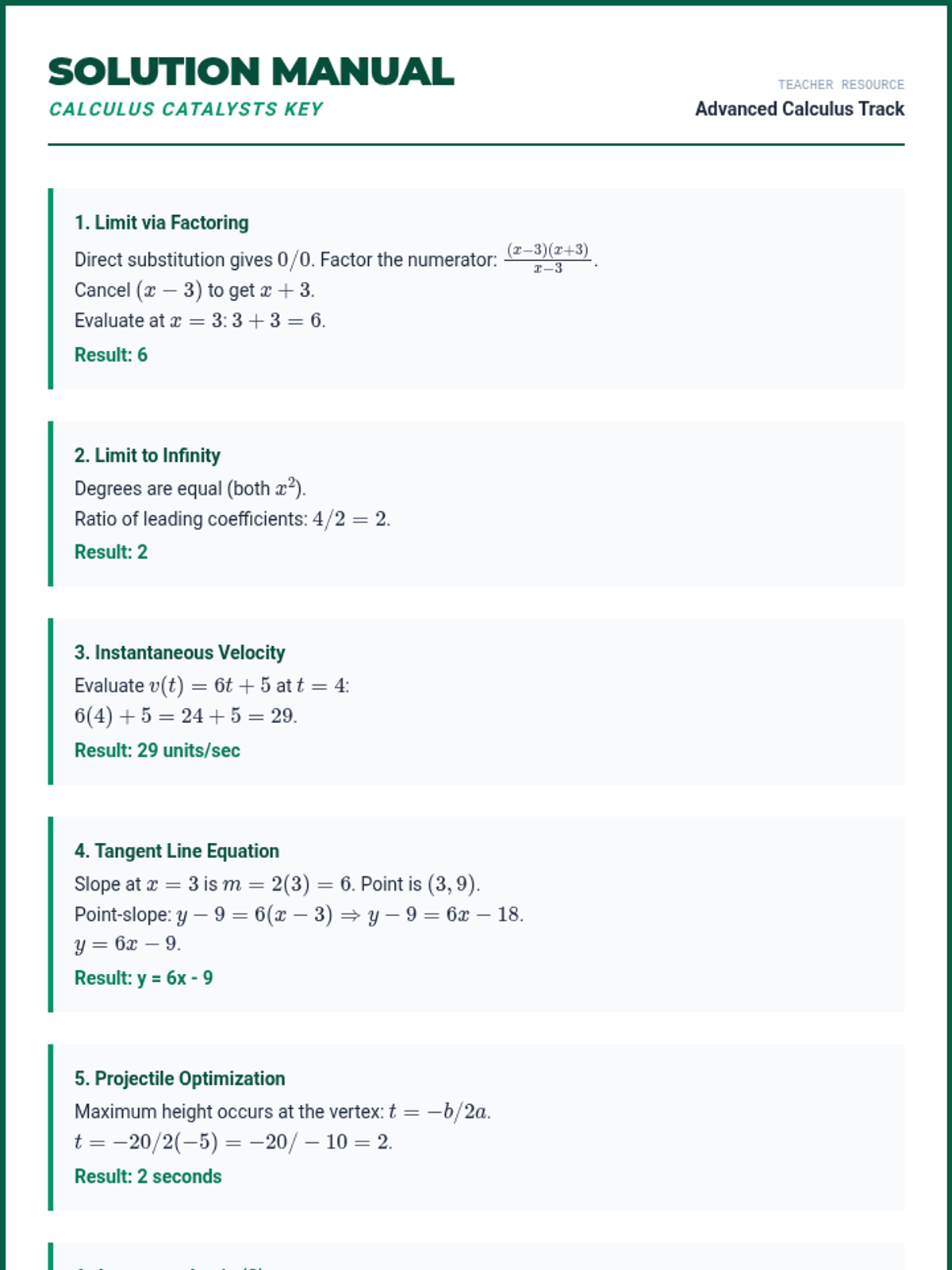
The detailed answer key for the Calculus Catalysts Workout, providing step-by-step solutions for limits, instantaneous rate of change, and basic function optimization problems.
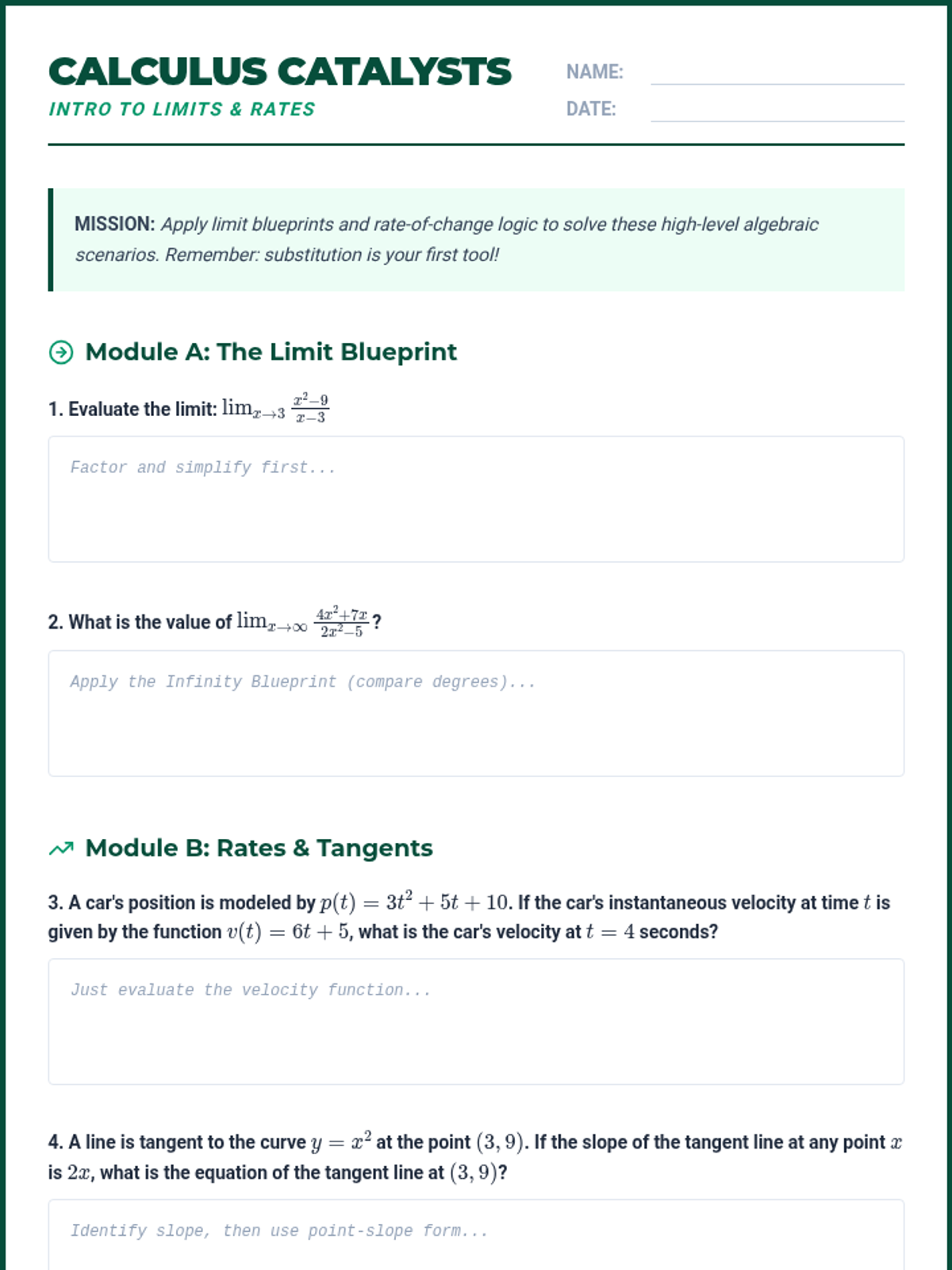
A student practice worksheet for calculus-adjacent ACT concepts, featuring limits, instantaneous rate of change logic, and function optimization problems.
A visual slide deck explaining introductory calculus concepts for the ACT, including limits, instantaneous rate of change, and basic function optimization using standard blueprints. Revised for font size compliance (min 24px).
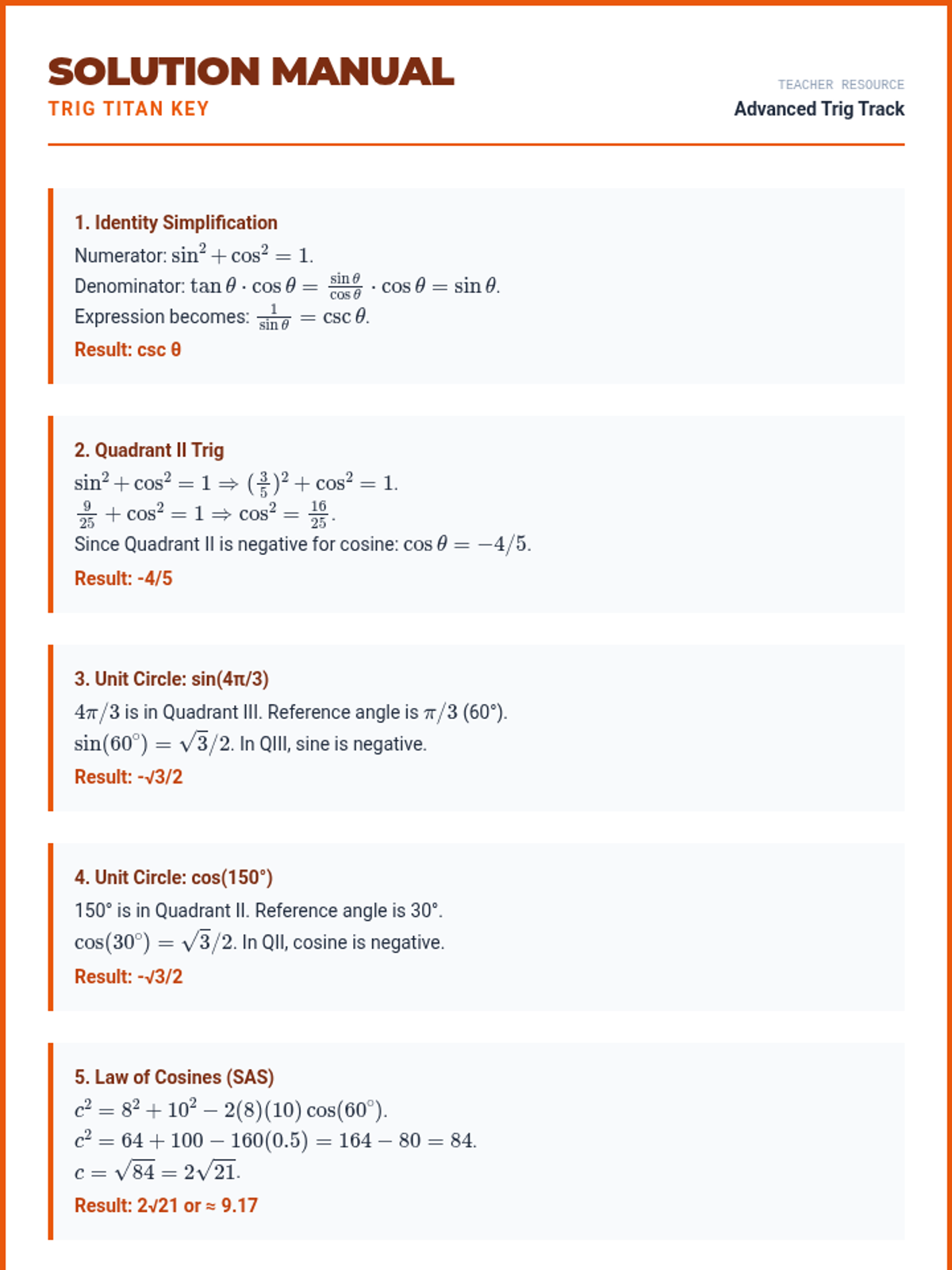
The detailed answer key for the Trig Titan Workout, including step-by-step solutions for identities, the unit circle, and non-right triangle problems.
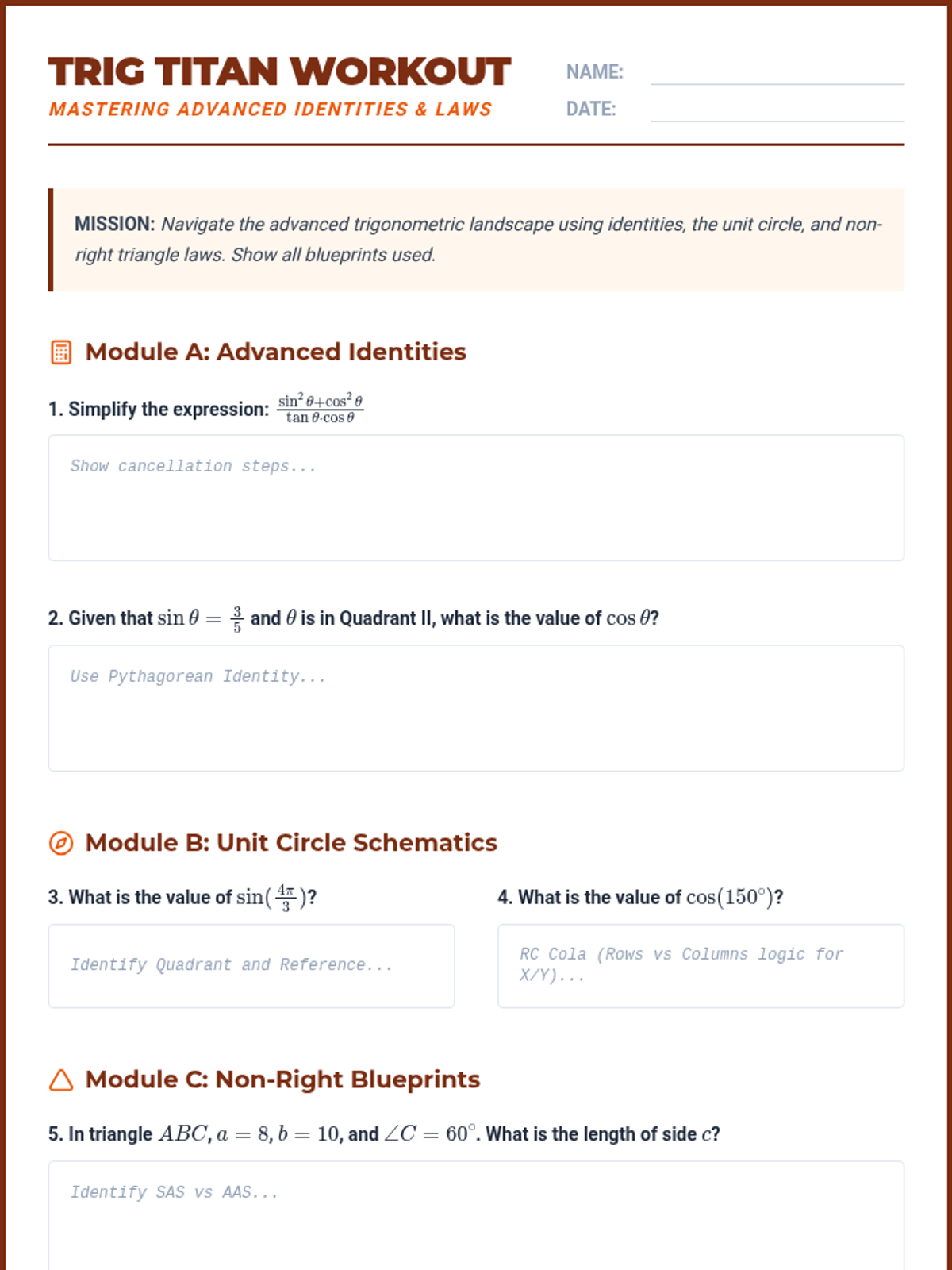
A comprehensive practice worksheet for advanced ACT trigonometry, featuring sections on identities, the unit circle, Law of Sines/Cosines, and 'Final Ten' challenge problems.
A visual slide deck covering advanced ACT trigonometry: Pythagorean identities, the unit circle, Law of Sines/Cosines, and the ambiguous SSA case. Revised for font size compliance (min 24px).
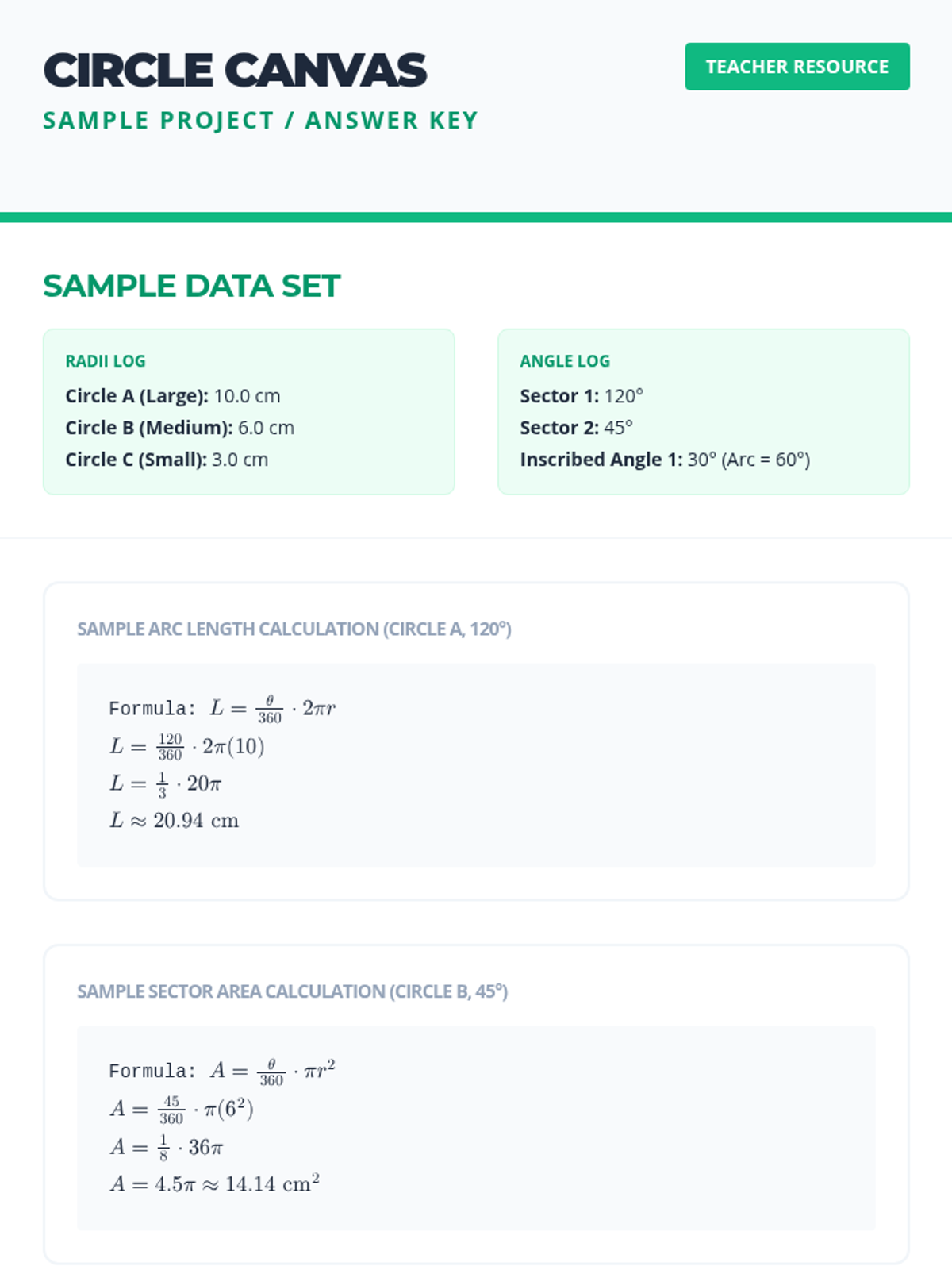
A sample project key showing completed calculations for arc length, sector area, and inscribed angles to provide teachers with a baseline for grading and feedback.
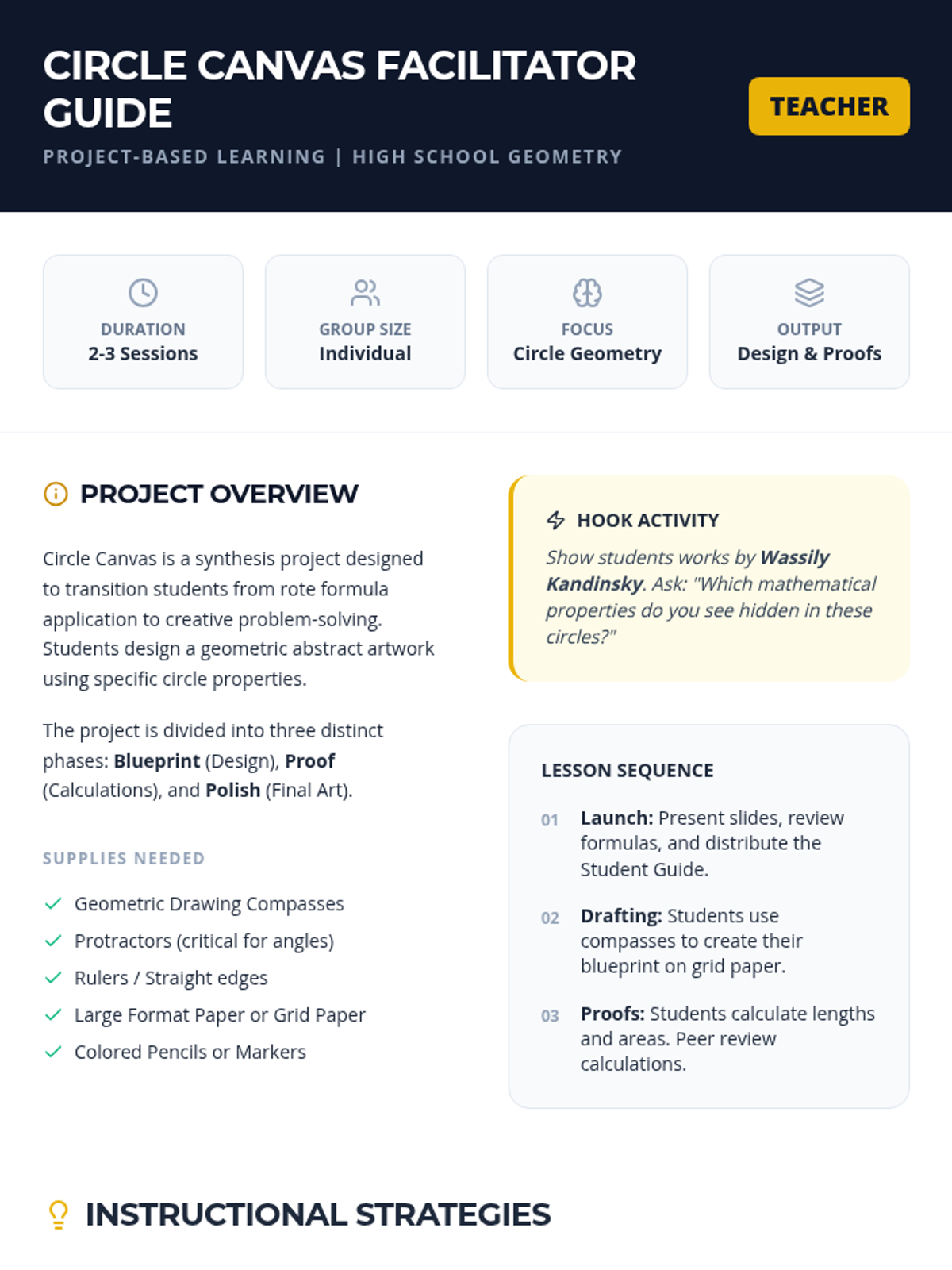
A teacher's facilitation guide for the Circle Canvas project, including lesson pacing, supply lists, common student misconceptions, and differentiation strategies.
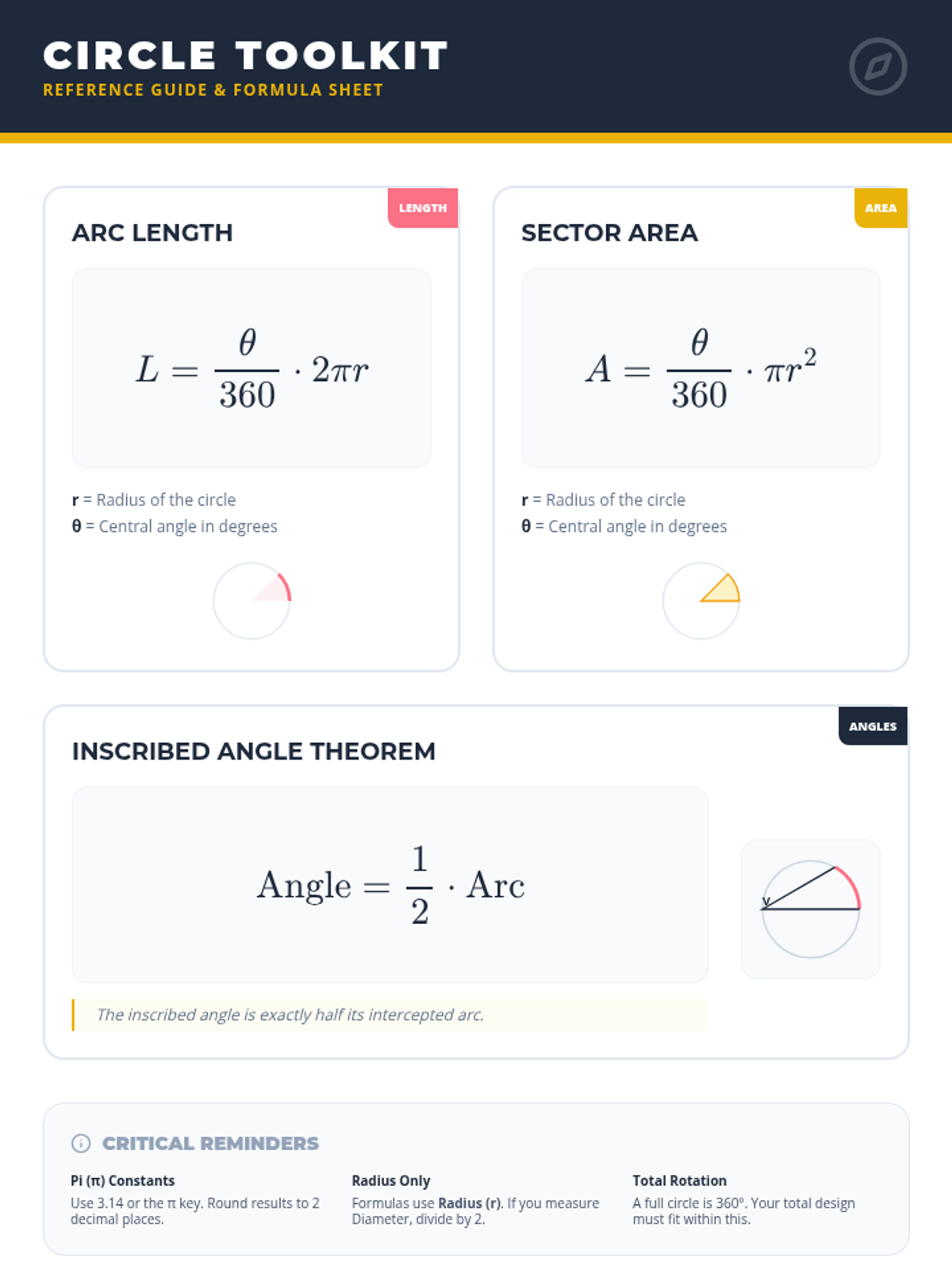
A concise one-page reference sheet containing formulas, diagrams, and reminders for arc length, sector area, and inscribed angle theorems to support students during the project.
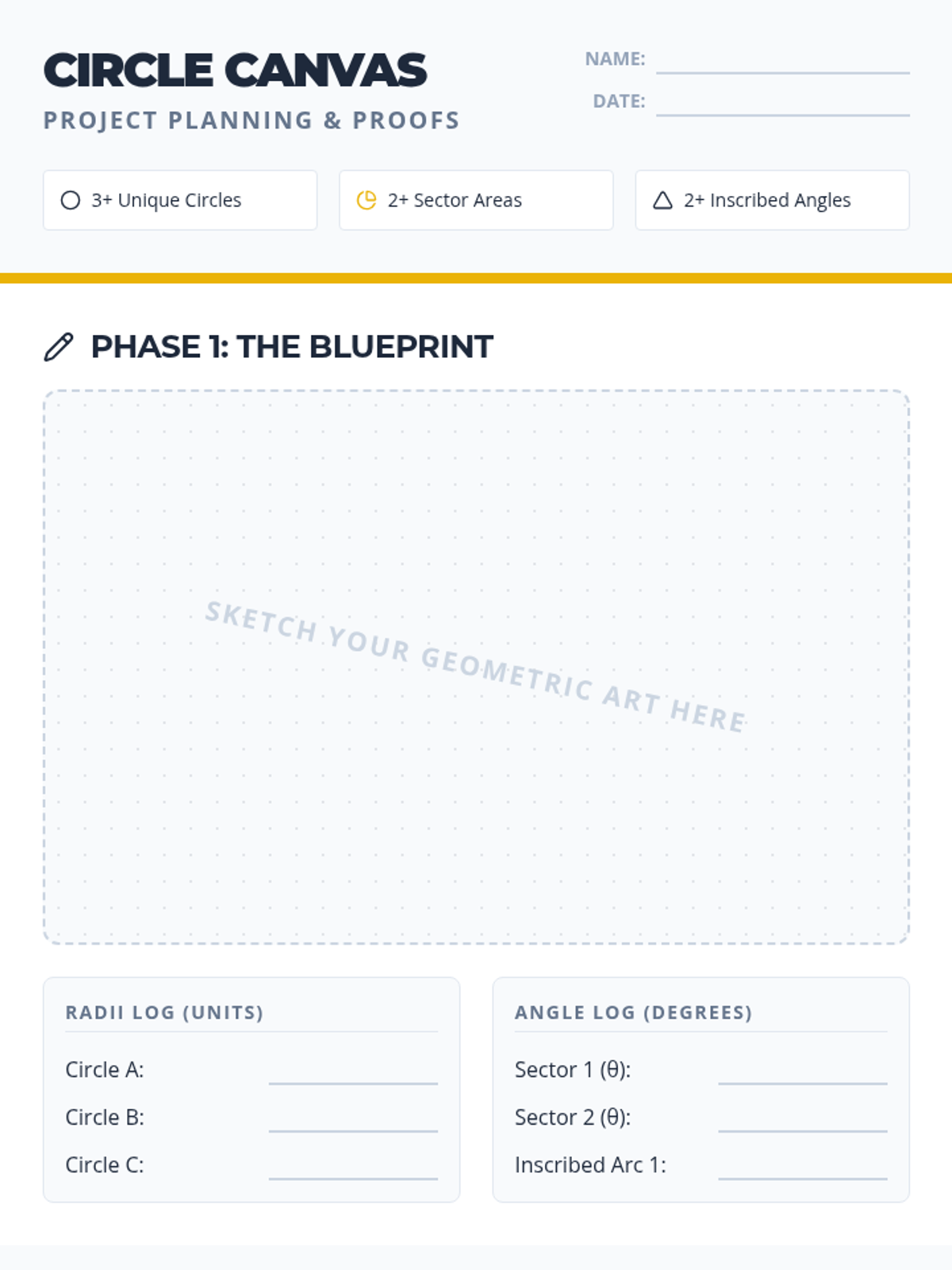
A multi-page planning and calculation guide for students to draft their geometric art, record circle dimensions, and prove their mathematical measurements.
An introductory presentation for the Circle Canvas project that hooks students with geometric art inspiration and reviews key circle properties: arc length, sector area, and inscribed angles.
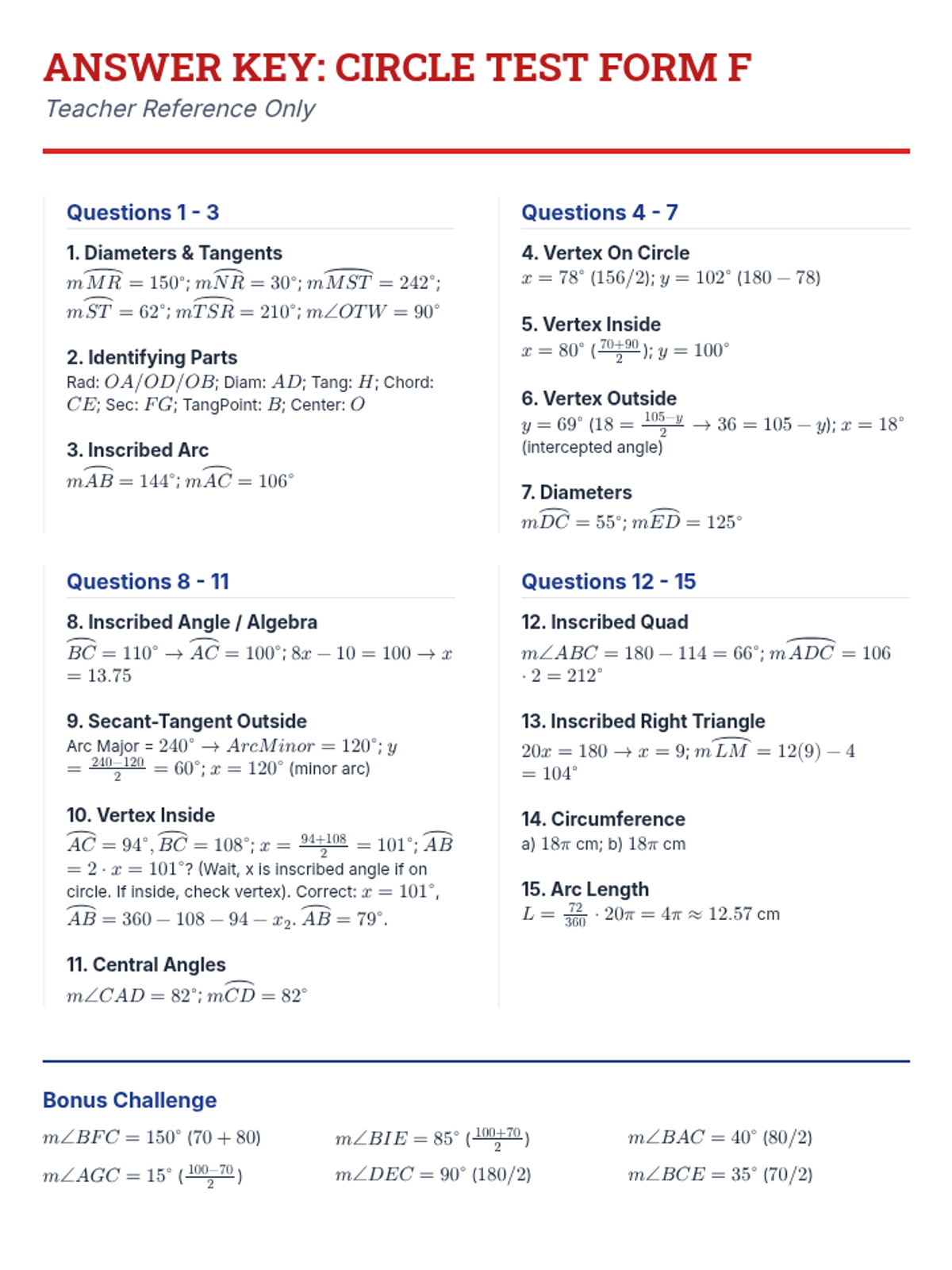
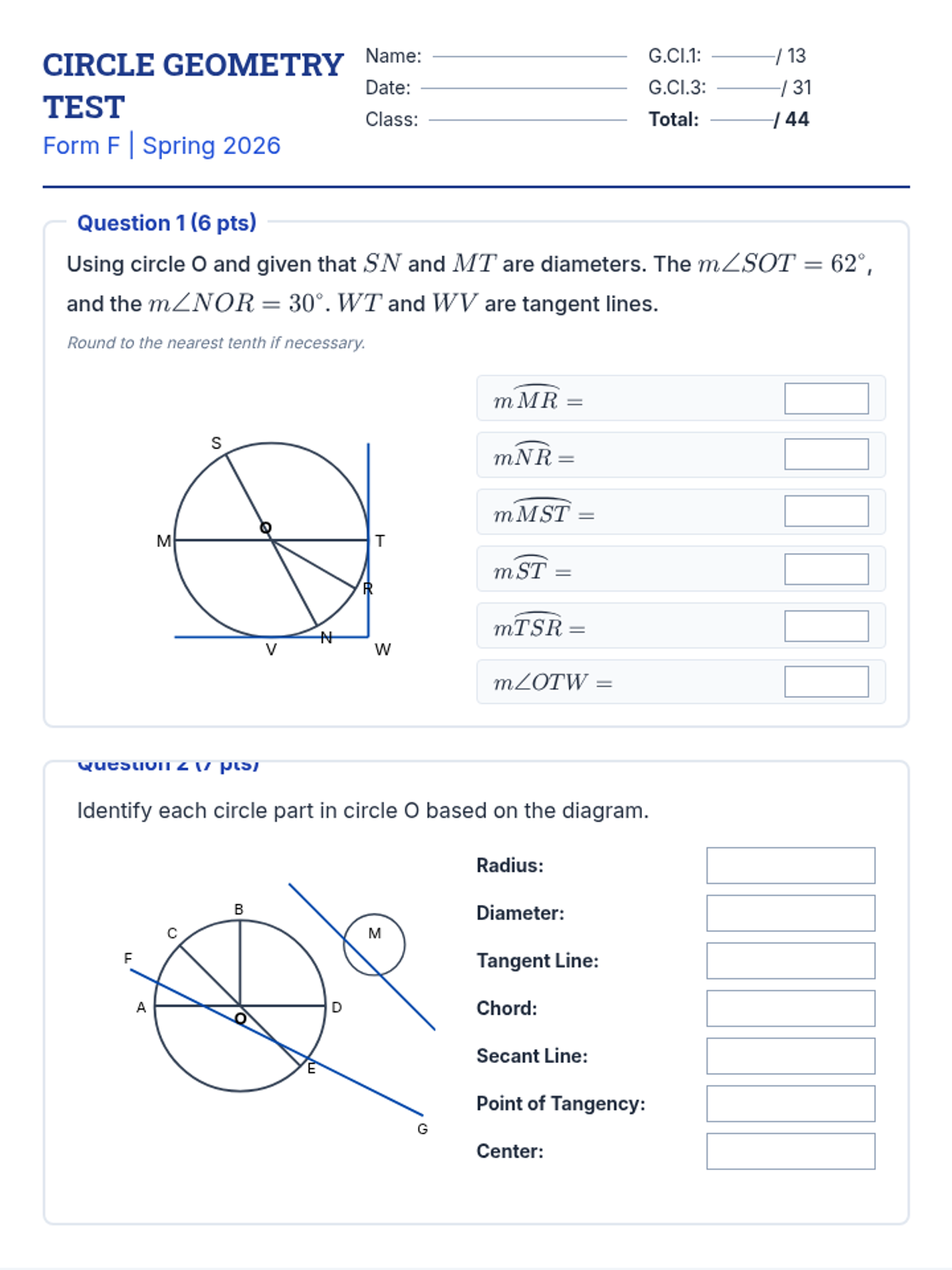
Complete answer key for the Circle Test Form F, including step-by-step solutions and final numerical answers for all 15 questions and the bonus challenge. Explanations have been clarified and scratchpad notes removed. Question 12 was updated to match the corrected student test geometry. Question 10 was updated for a central angle logic.
Form F of the Circle Geometry Test. In Question 11, labels for the center (A) and angle measures (35, 82) have been repositioned for better clarity. Question 10 has been converted to a central angle problem, with radii forming the angle and point labels added to match the geometric logic. Diagram geometry across the test remains optimized for print readability. Answer boxes for Bonus and calculations were standardized for consistent handwriting space. Question 15 layout was fixed to prevent overlap.
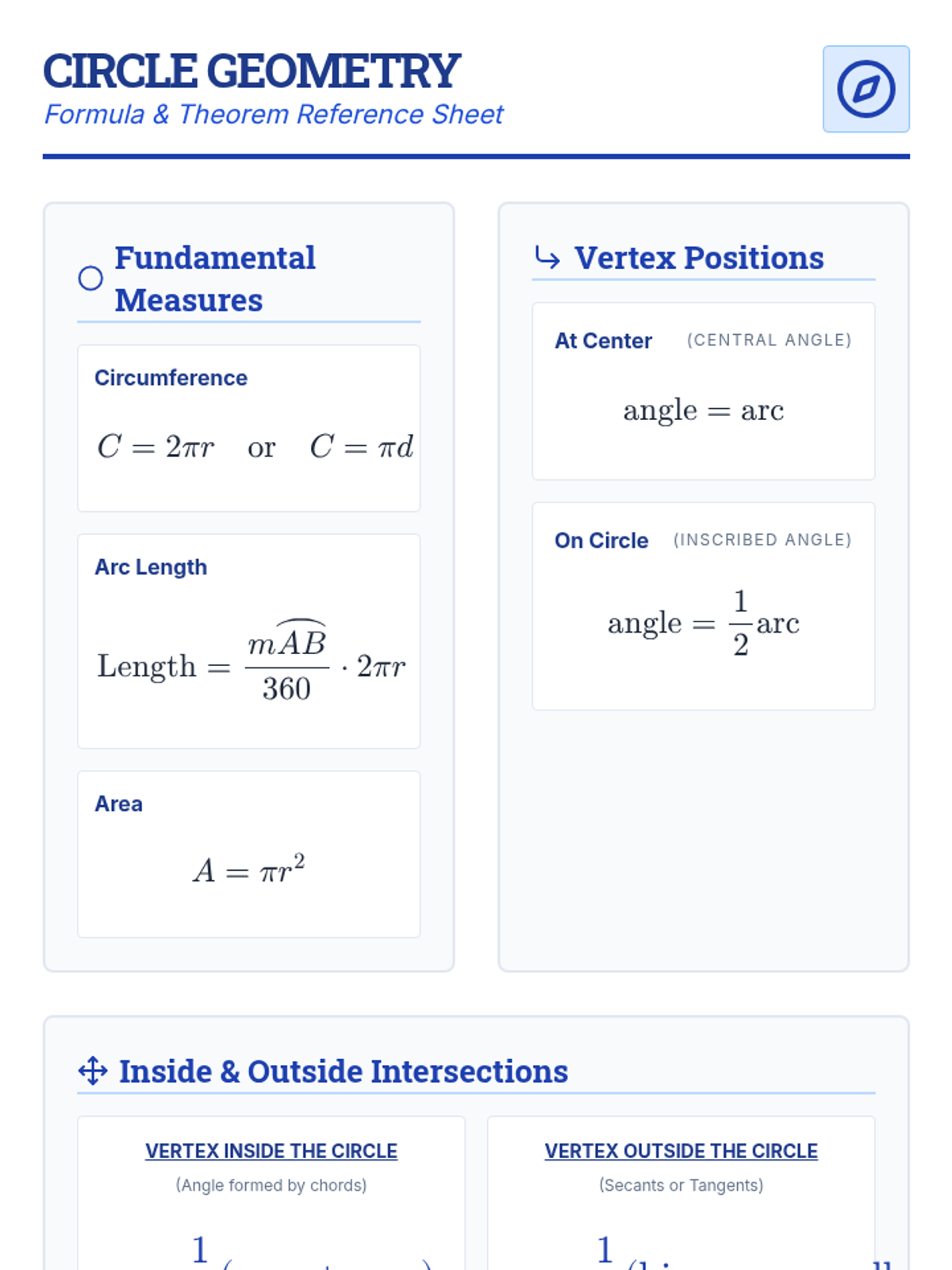
A geometric blueprint-themed formula reference sheet for circle geometry, covering circumference, arc length, area, and various angle/arc theorems. Now consolidated to a single page.
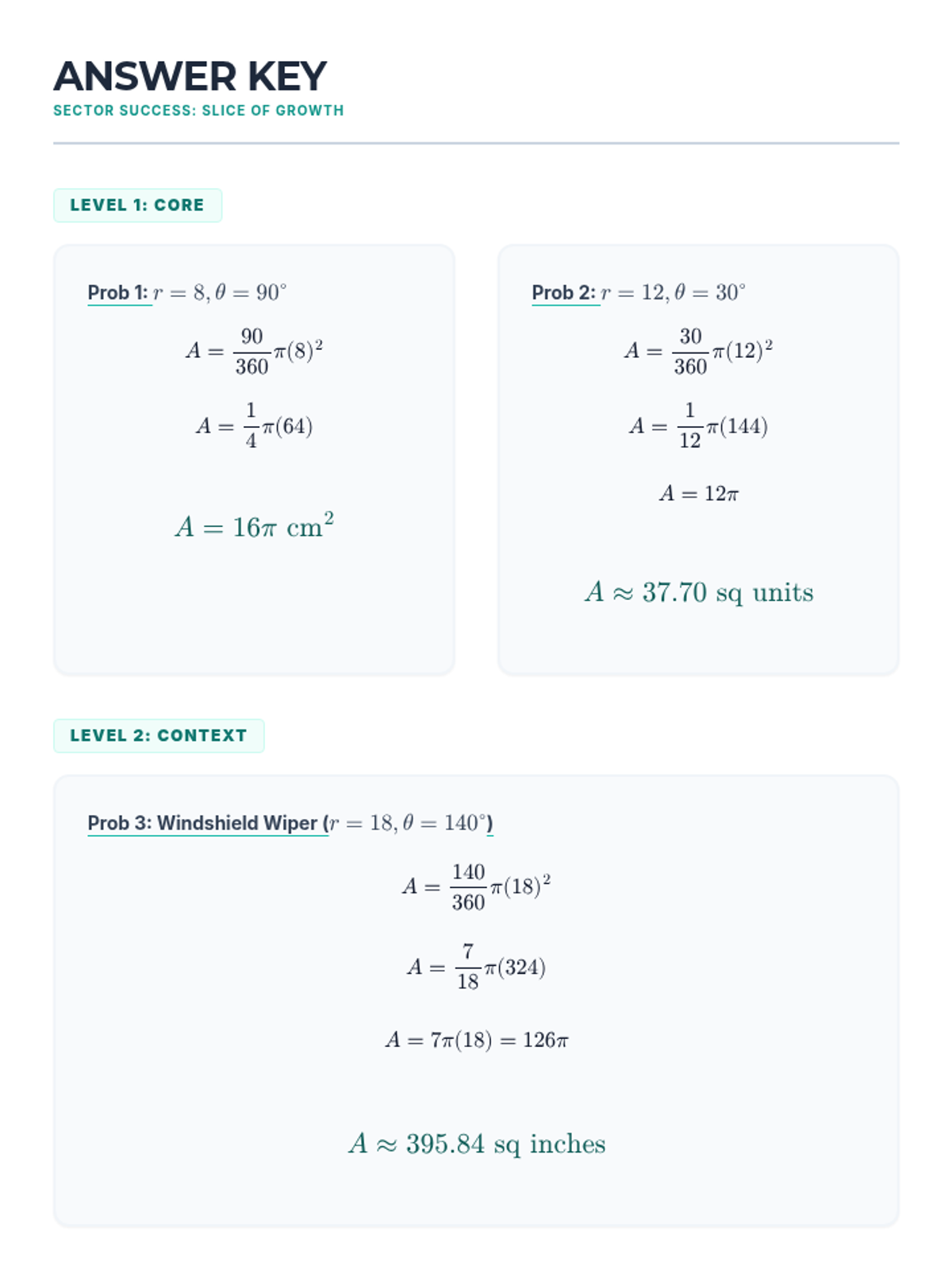
An answer key for the "Slice of Growth" worksheet, providing step-by-step mathematical solutions for all levels of difficulty along with teaching notes for common struggle points.
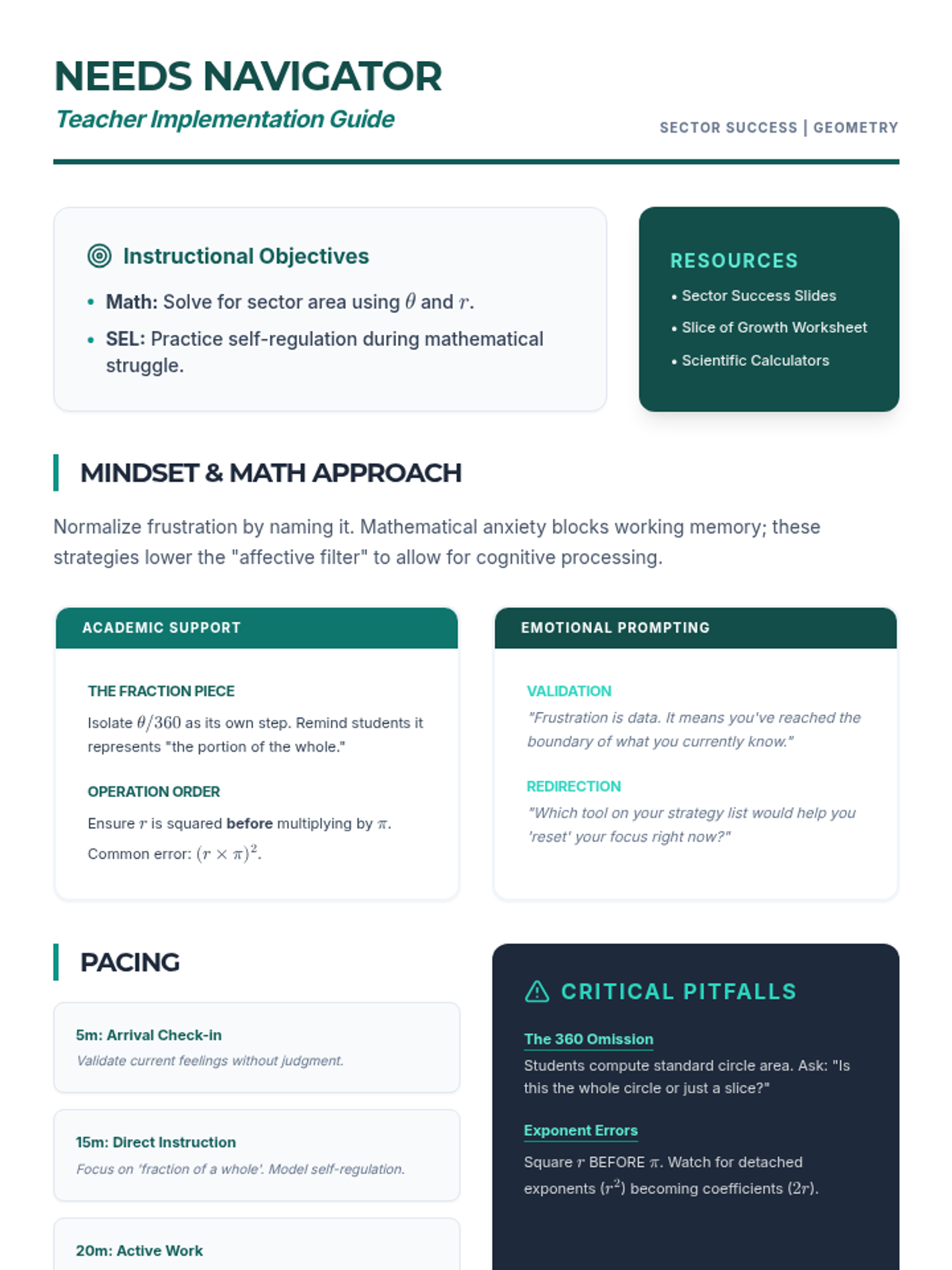
A comprehensive teacher guide for delivering the "Sector Success" lesson. It provides instructional strategies for balancing academic rigor with social-emotional support, including pacing, common misconceptions, and specific SEL redirection prompts.
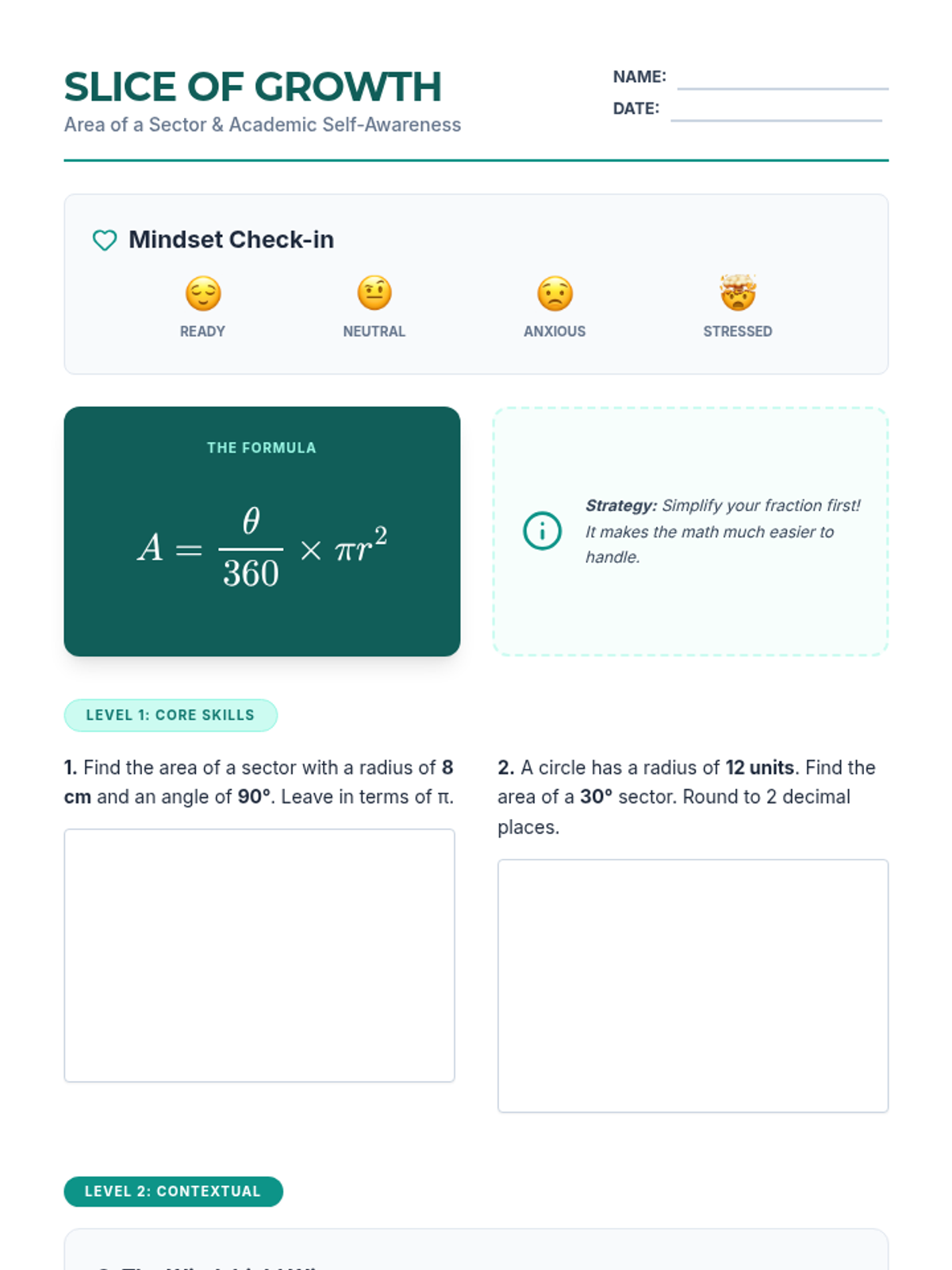
A student worksheet for calculating the area of a sector that incorporates social-emotional learning components. It includes three levels of math difficulty alongside mindset checkpoints and self-regulation strategies.
A high-impact slide deck for teaching Area of a Sector that integrates Social-Emotional Learning (SEL) checkpoints. Features academic content, step-by-step examples, and mental regulation strategies for students.
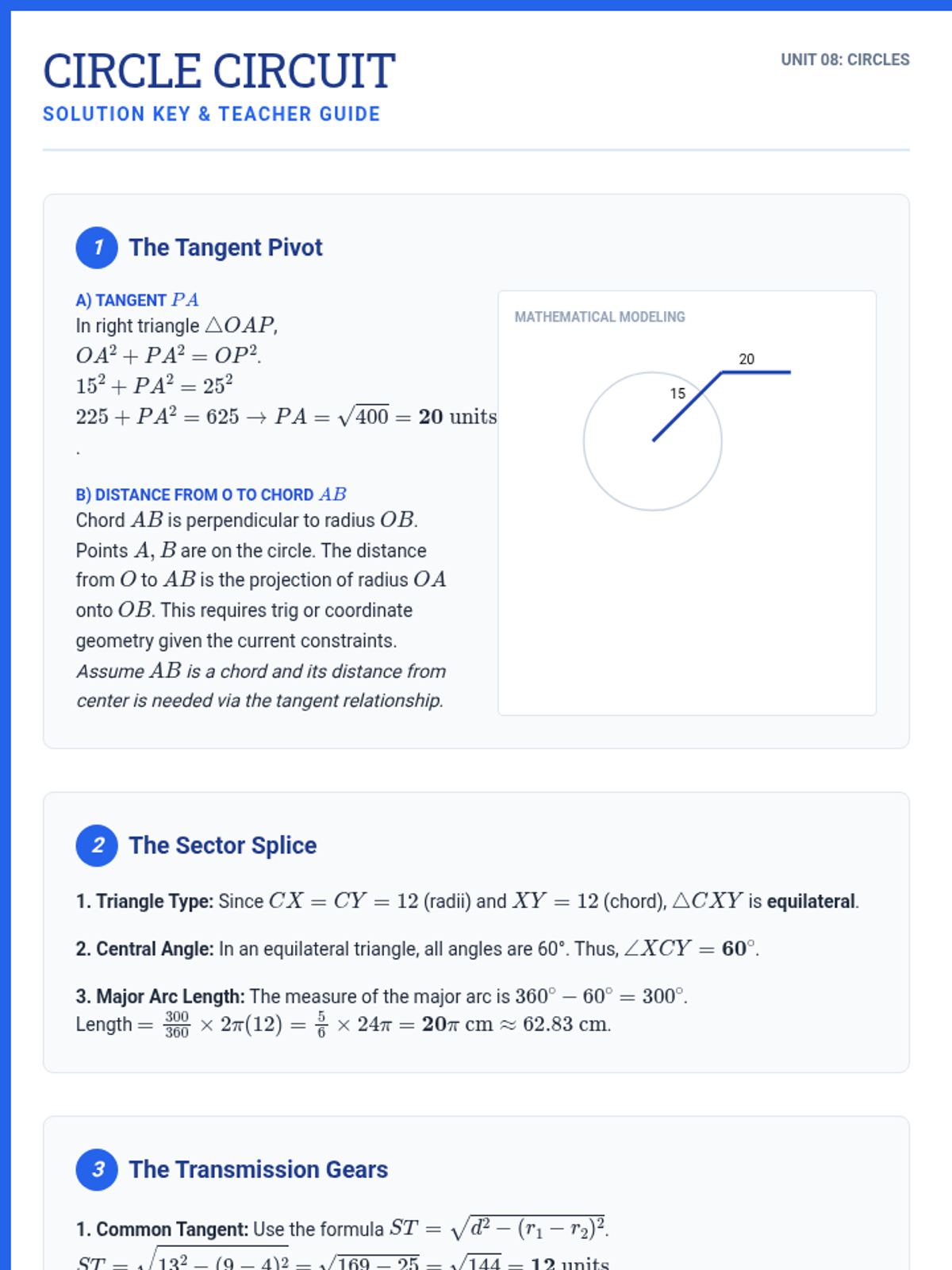
Complete solution key for the Circle Circuit Worksheet, providing step-by-step mathematical breakdowns and geometric modeling for advanced circle problems.
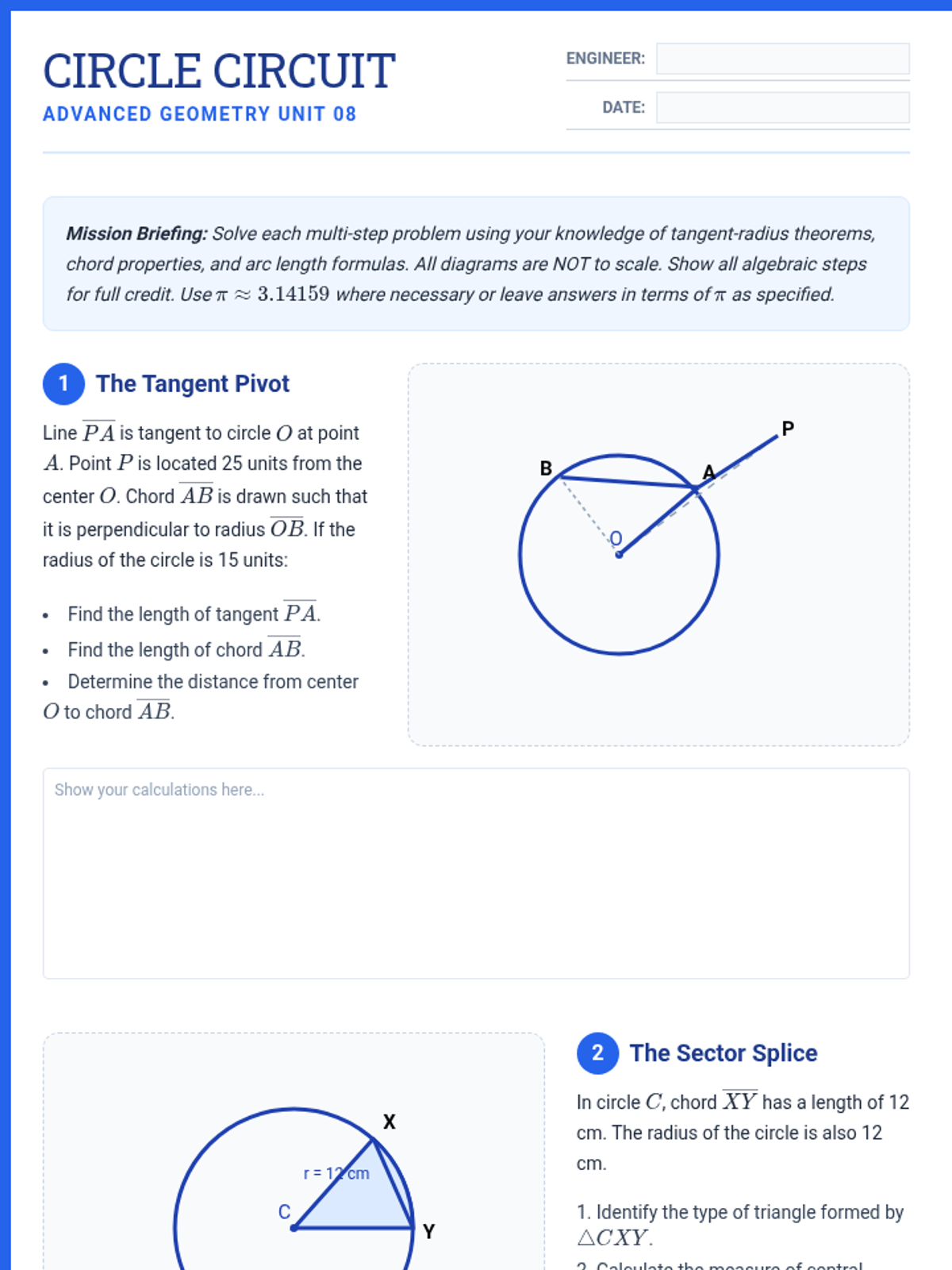
A high-level geometry worksheet for 10th graders featuring complex circle problems. Includes diagrams and multi-step tasks covering tangents, chords, and arc length with a professional blueprint aesthetic.
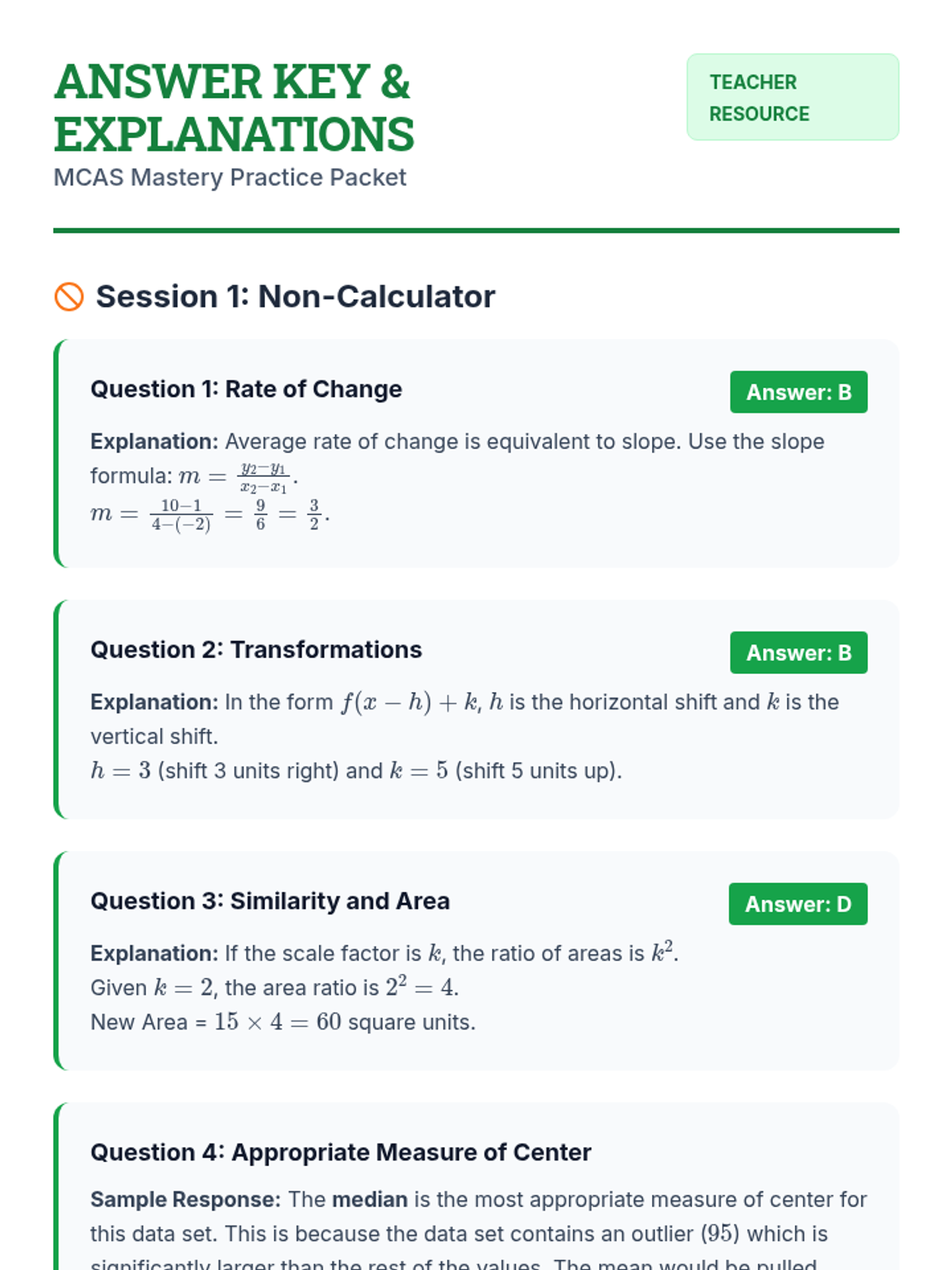
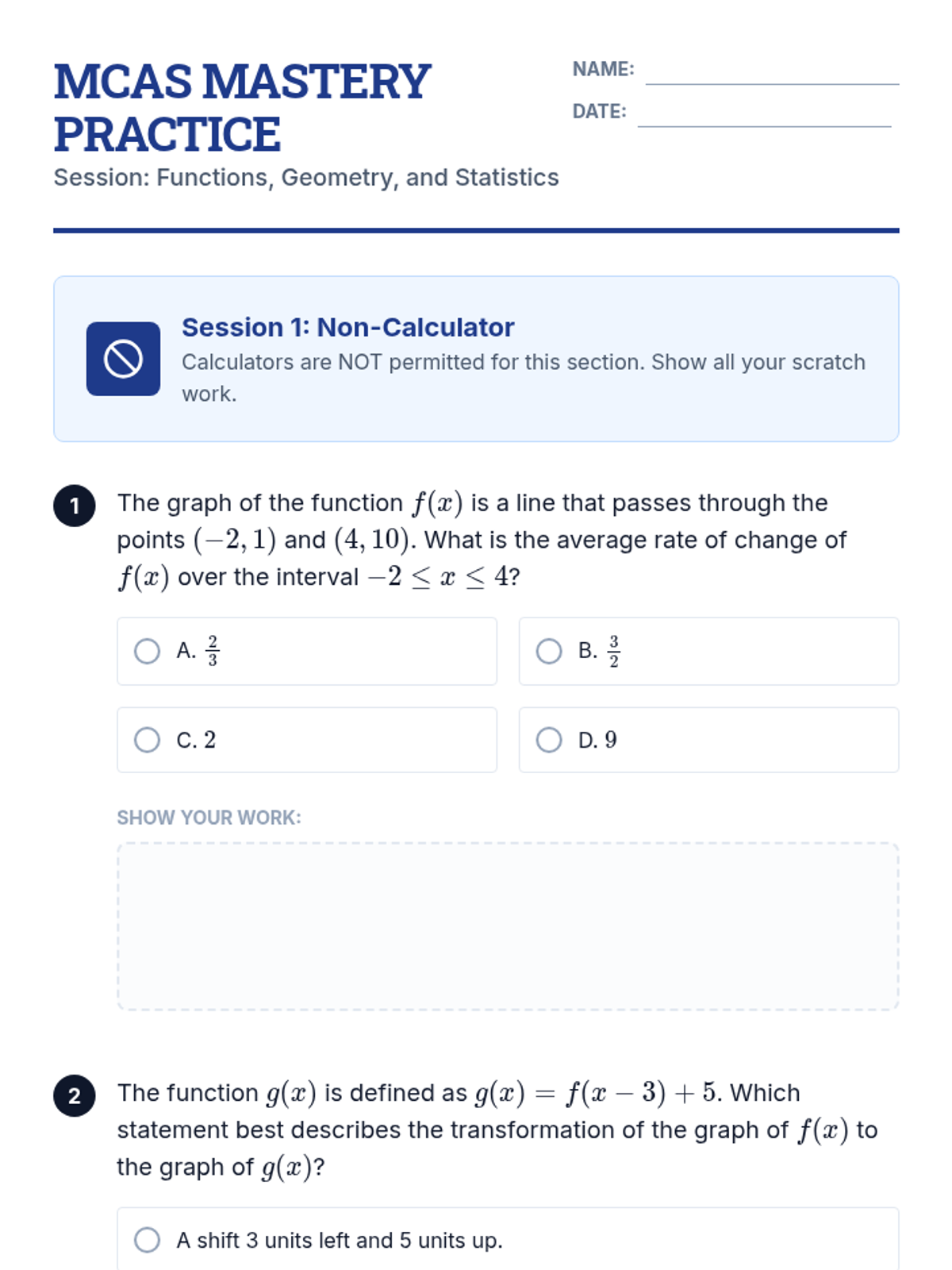
A comprehensive answer key and explanation guide for the MCAS Mastery Practice Packet, including sample responses for open-response questions and scoring tips.
A 4-page student practice packet for MCAS Grade 10 Math, featuring non-calculator and calculator sections with high-frequency problems in functions, geometry, and statistics.
An instructional slide deck for Grade 10 MCAS Math prep, covering core concepts in functions, geometry, and statistics along with specific testing strategies for calculator and non-calculator sessions.
Answer key for the Segment Shards Worksheet, providing step-by-step logic summaries and final numerical answers.
A 3-page student worksheet containing 20 problems on calculating the area of a segment (sector minus triangle). Features sections for 90-degree and 60-degree angles, plus complex applications.
Answer key for the Sector Slice Worksheet, providing simplified pi forms and decimal answers for all 20 problems.
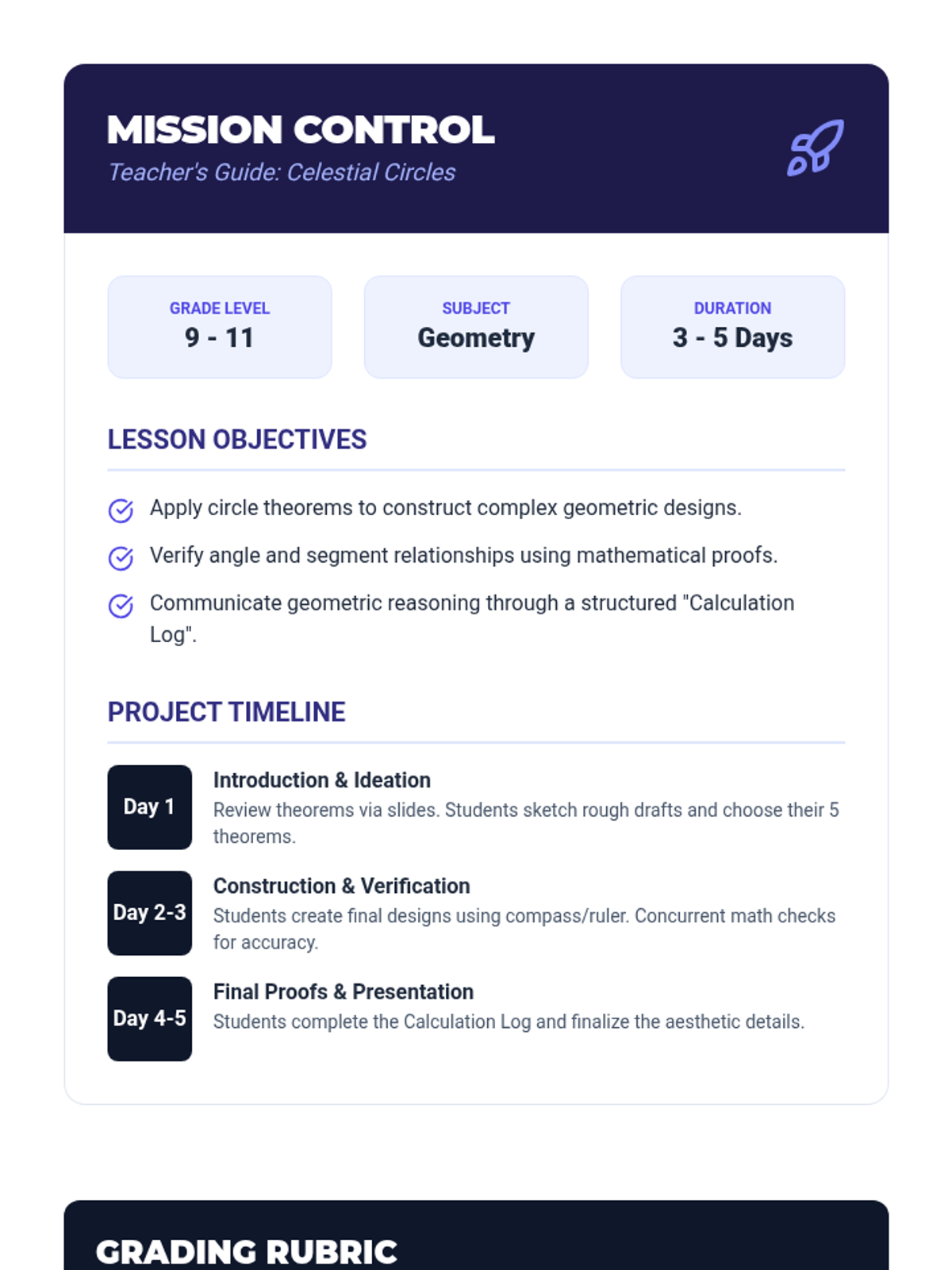
A teacher's guide for the Celestial Circles project, including lesson objectives, a daily project timeline, and a comprehensive grading rubric.
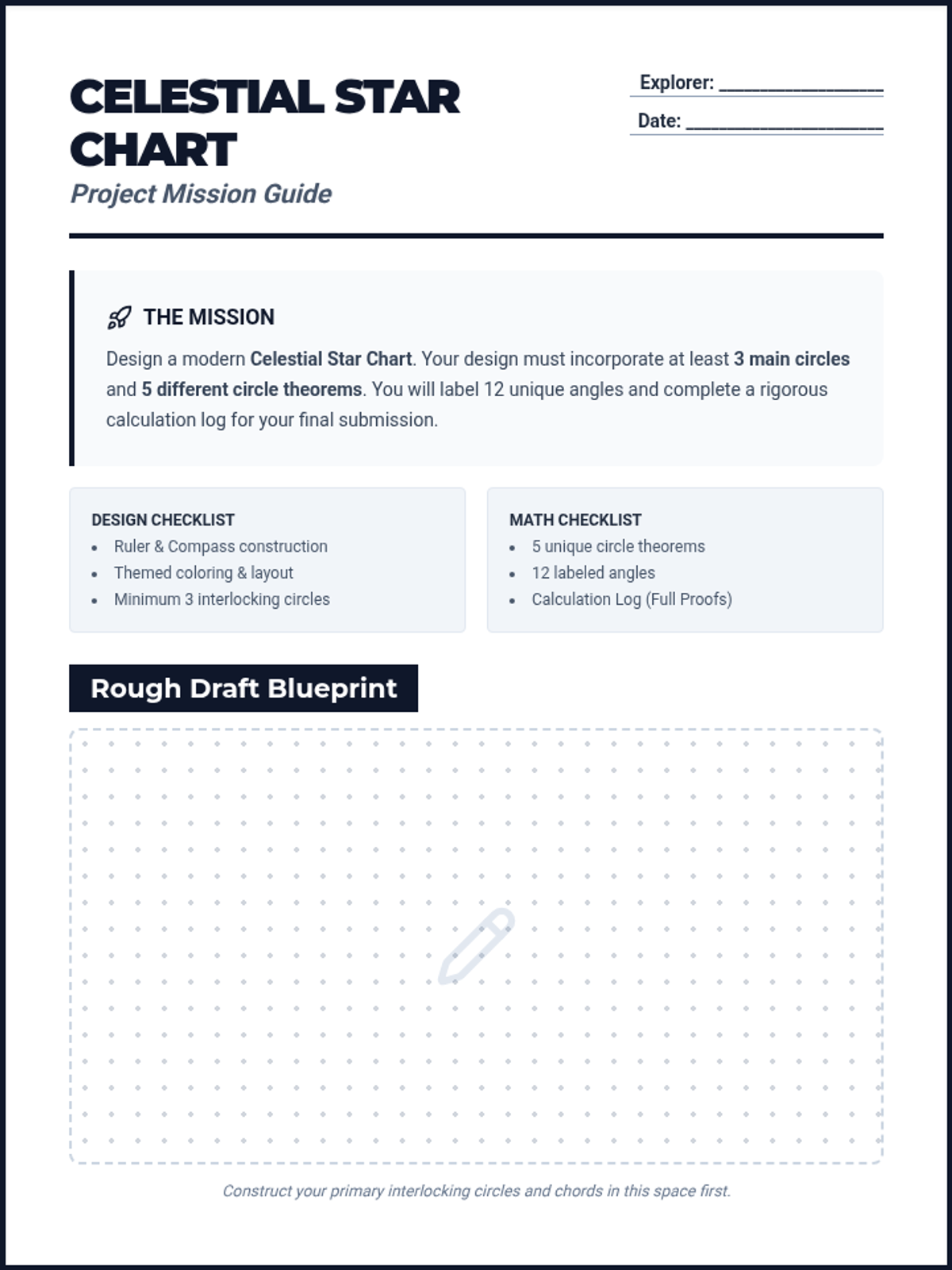
A project guide for students to design a celestial star chart using circle theorems, including design requirements, a drafting space, and a 5-entry calculation log for proofs.
A slide deck to introduce the Celestial Circles project, featuring visual reviews of core circle theorems and project requirements for a star chart design activity.
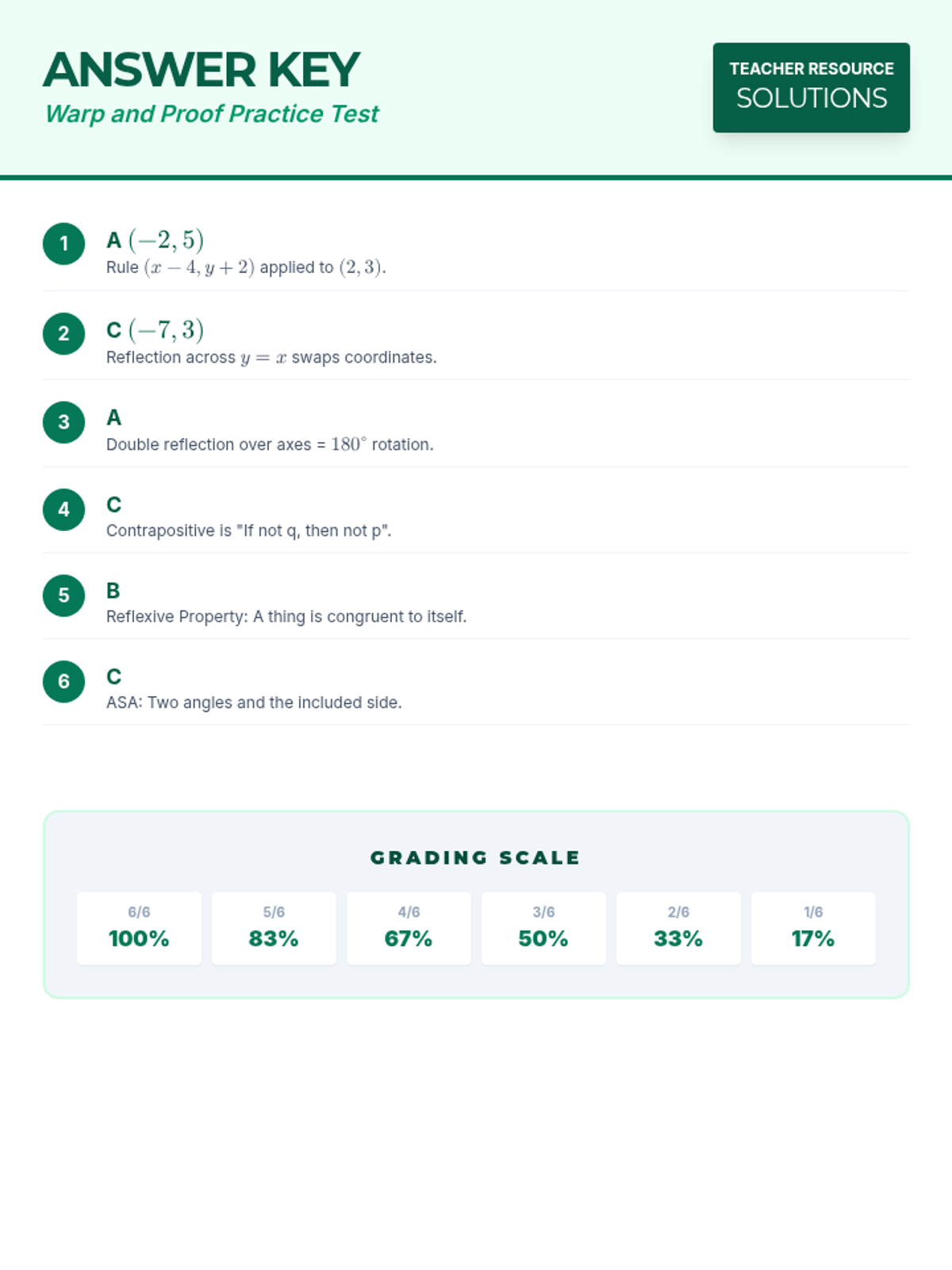
The teacher answer key for the Warp and Proof Practice Test, including correct answers and brief instructional explanations.
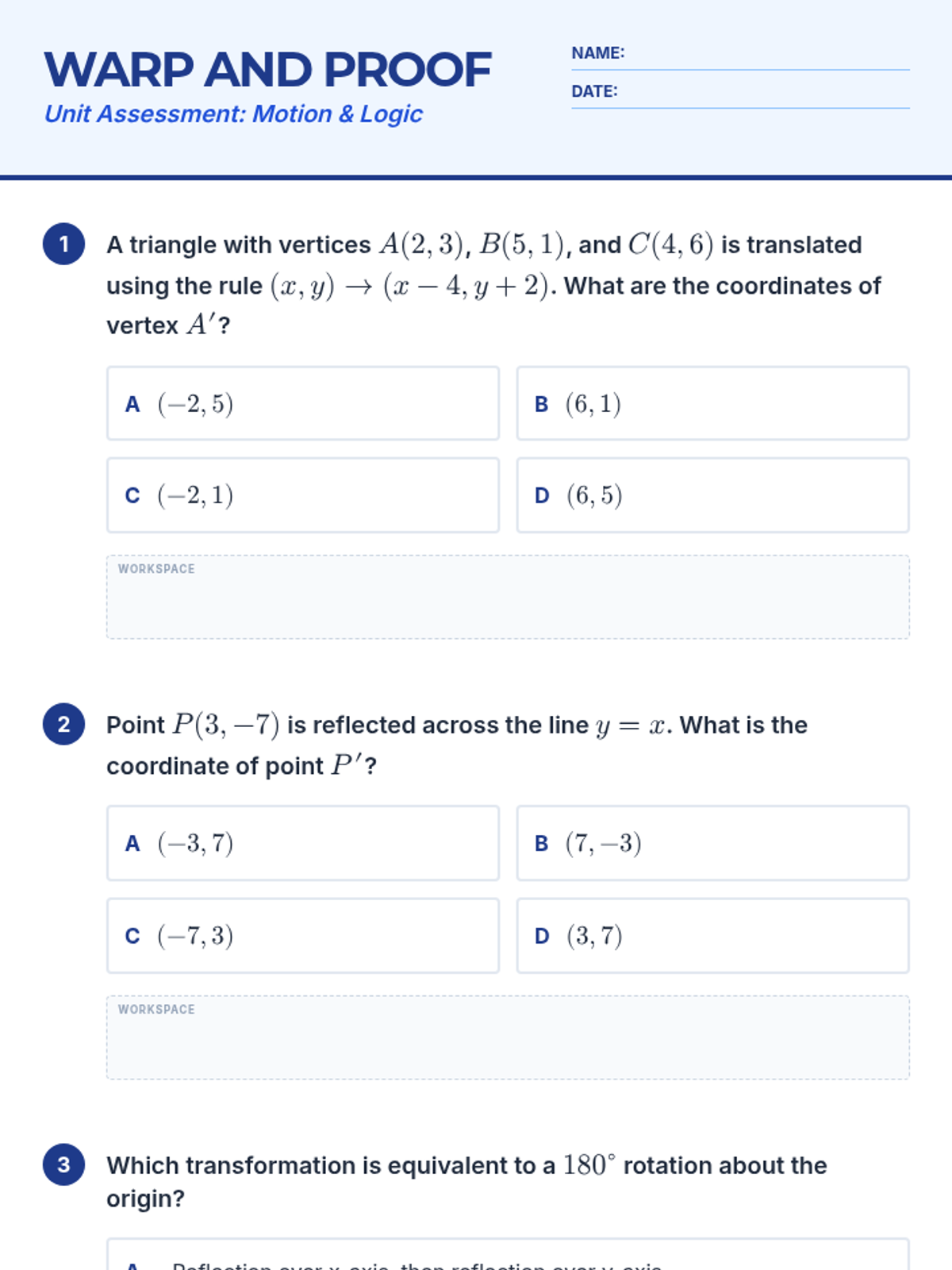
A multiple-choice practice test covering coordinate transformations (translations, reflections, rotations) and introductory geometric logic and triangle congruence proofs.
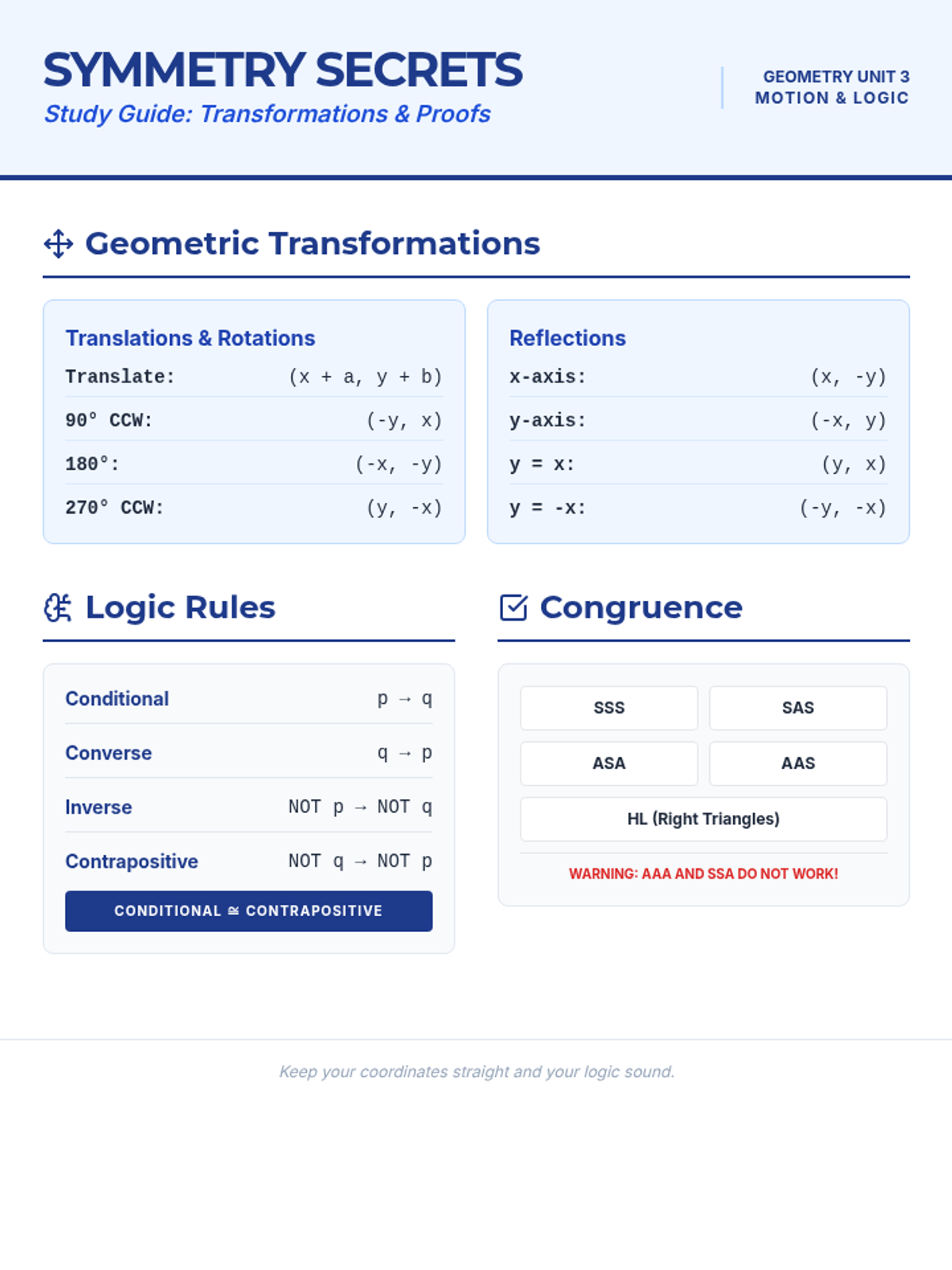
A comprehensive study guide summarizing geometric transformations (isometries and dilations) and the fundamentals of logical reasoning and triangle congruence proofs.
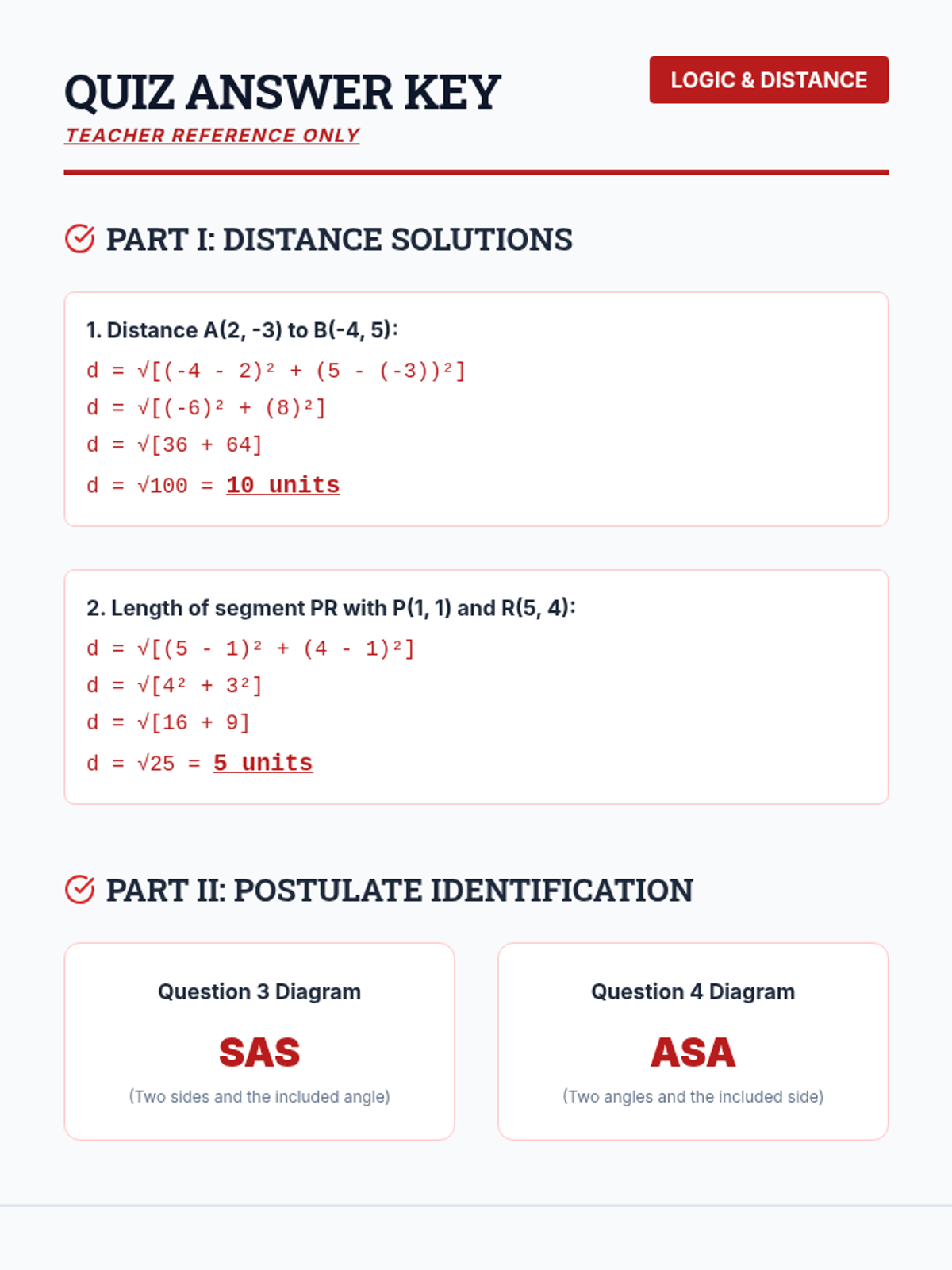
A complete answer key for the Congruence Logic Quiz, featuring step-by-step distance formula solutions using HTML/CSS for clarity, identified congruence postulates with visual references, and fully completed two-column proofs.
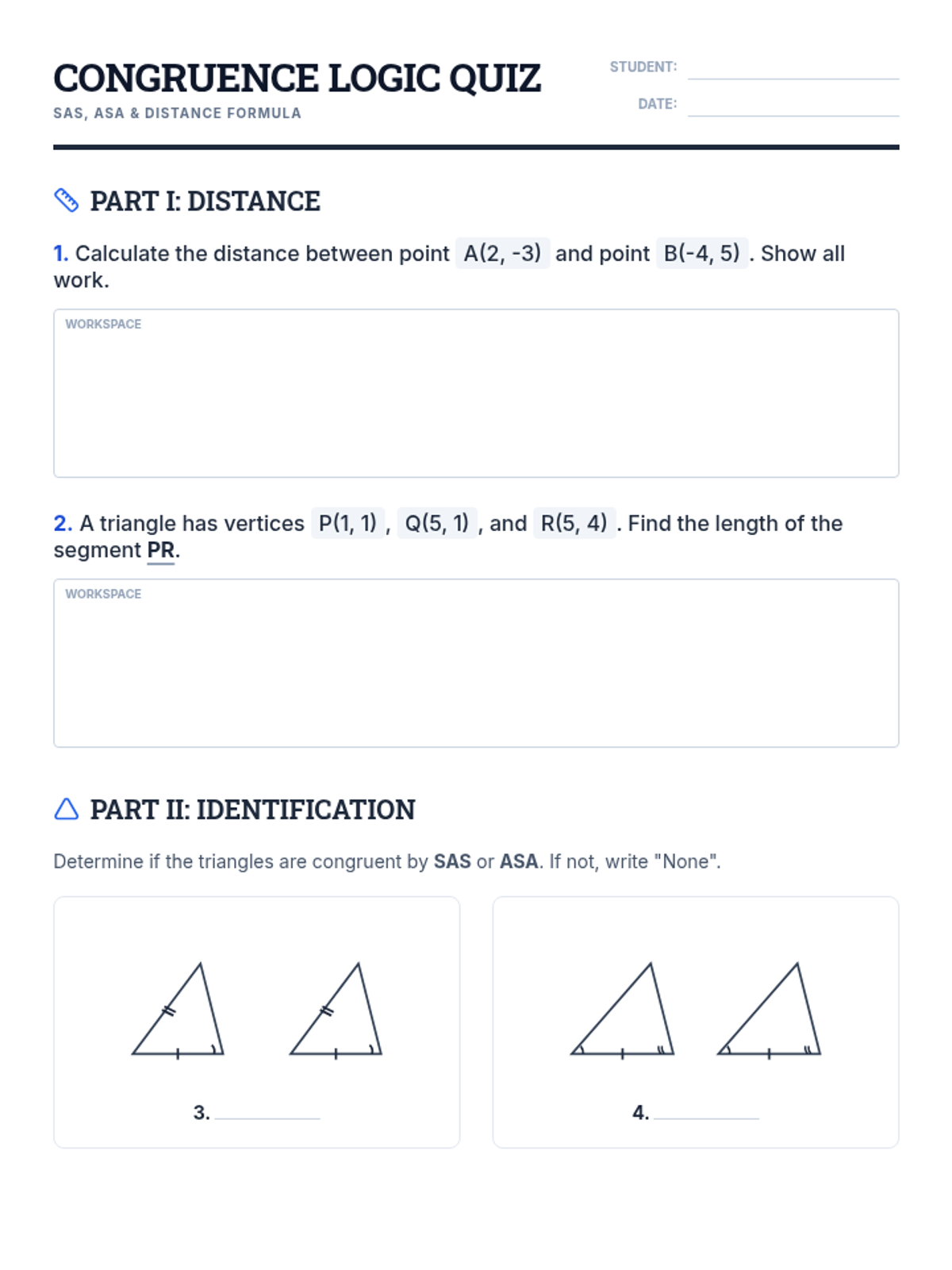
A 2-page quiz for high school geometry students covering the Distance Formula, identifying SAS and ASA congruence, and completing intermediate two-column proofs. Renumbered and refined with more workspace for distance calculations. Corrected diagrams and layout for optimal student use.
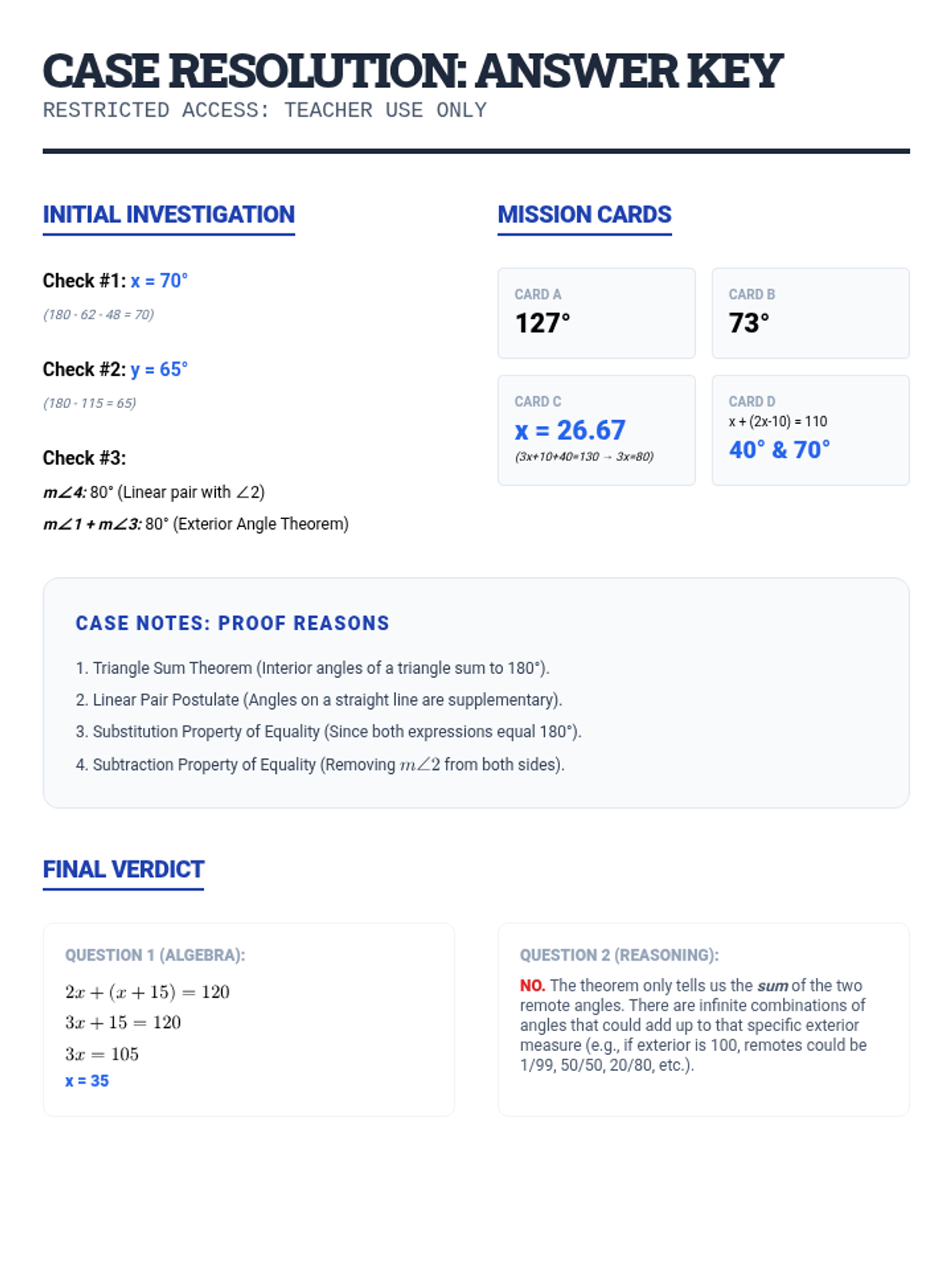
Revised answer key with increased precision for algebraic solutions, detailed proof justifications, and high-contrast formatting for teacher ease-of-use.
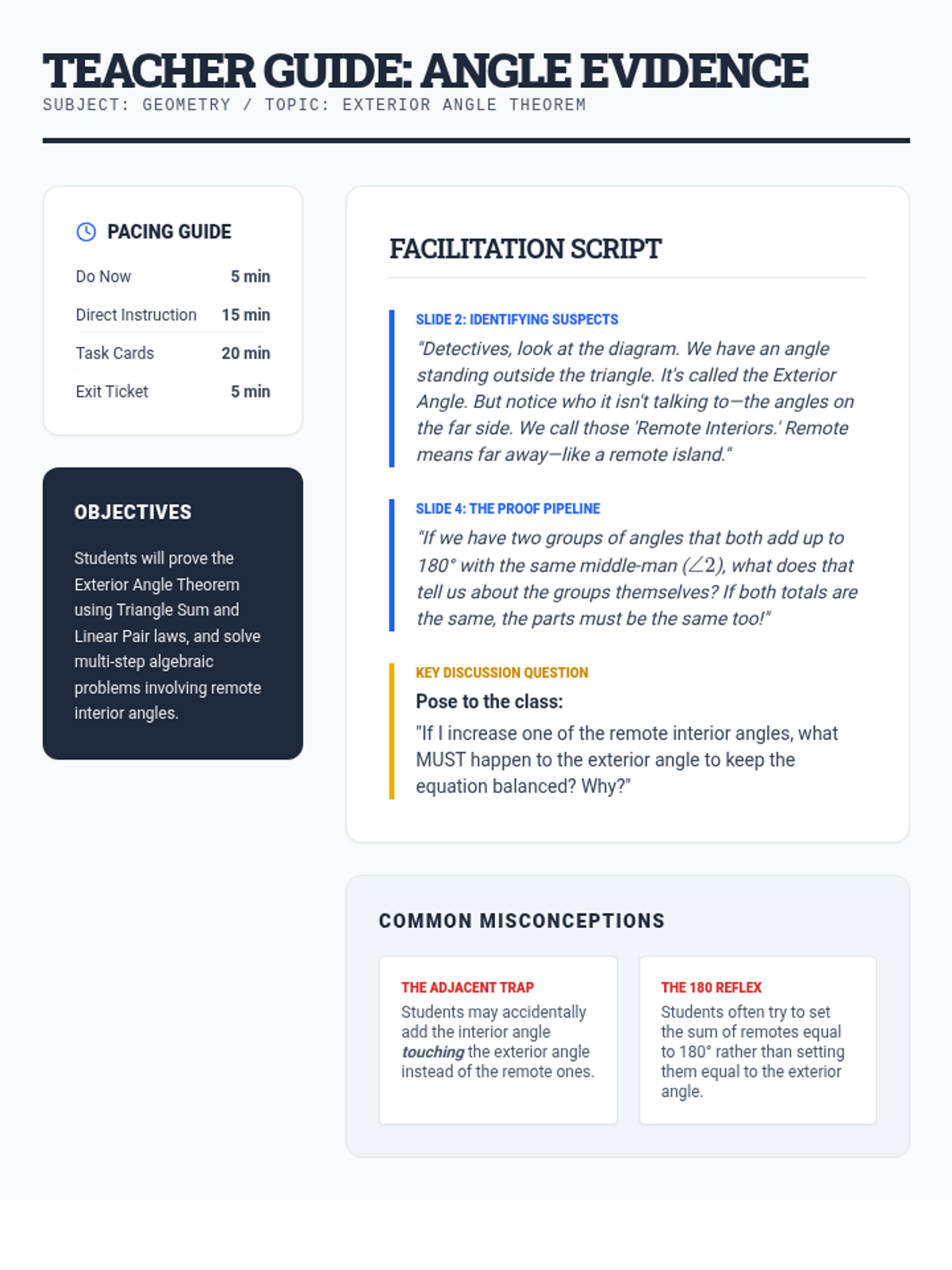
Revised teacher guide with improved layout to prevent section fragmentation, optimized pacing guides, and formatted facilitation scripts for classroom use.
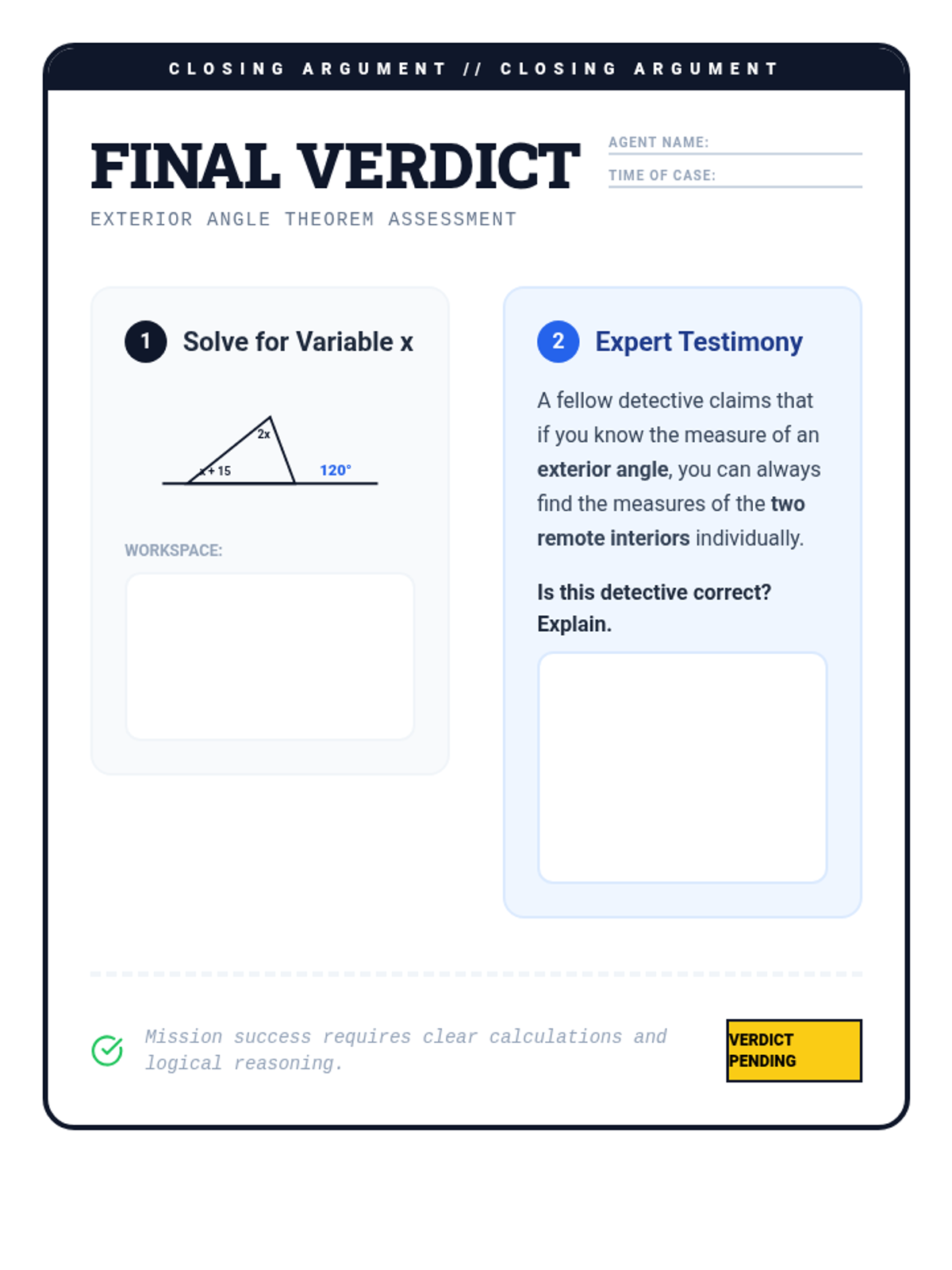
An exit ticket formatted as a 'Final Verdict' assessment. Includes one algebraic application problem and one conceptual reasoning question to check for deep understanding.
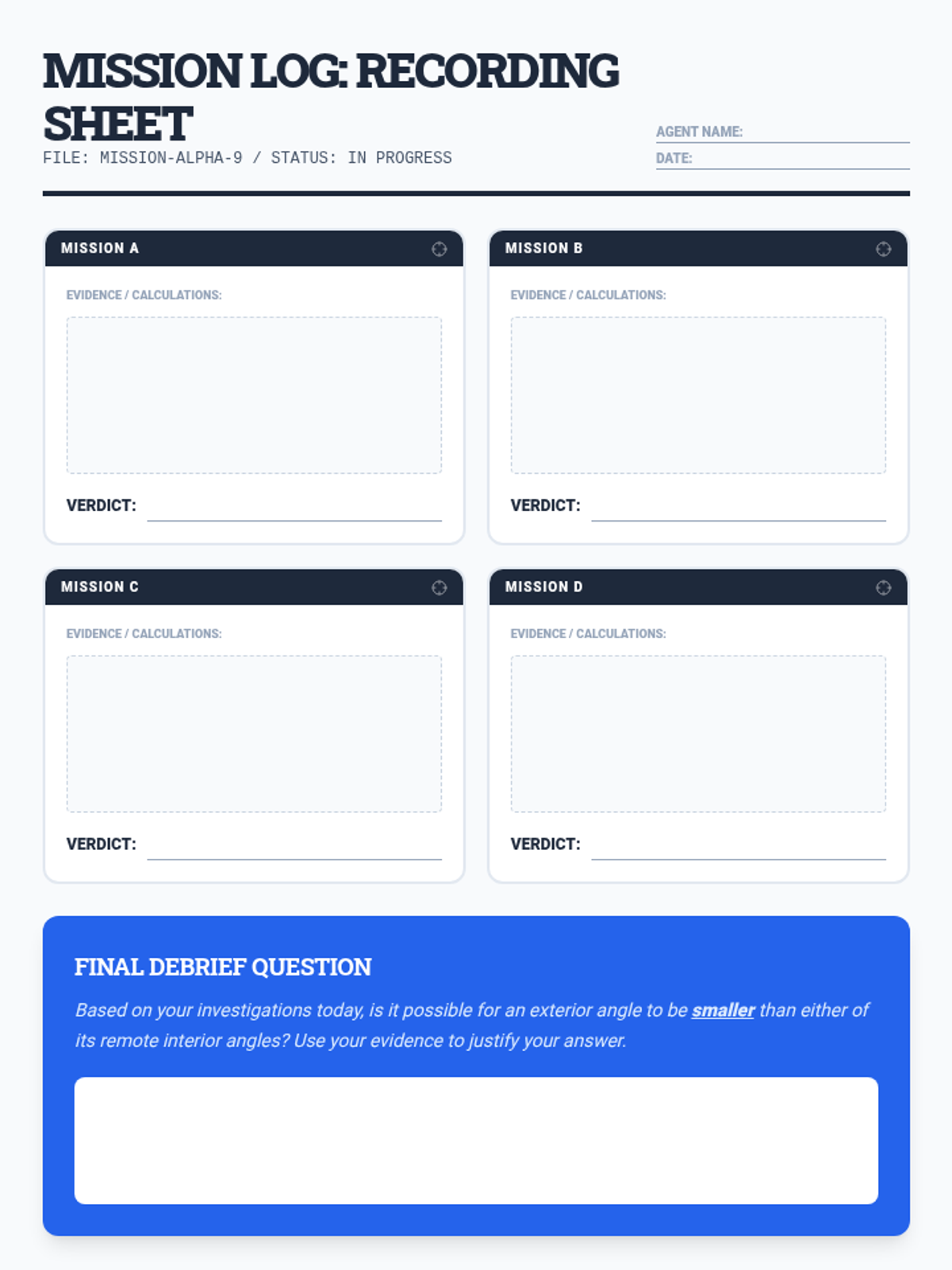
Revised mission log with condensed layouts to fit all mission boxes and the final debrief on a single page, featuring improved visibility for borders and calculation areas.
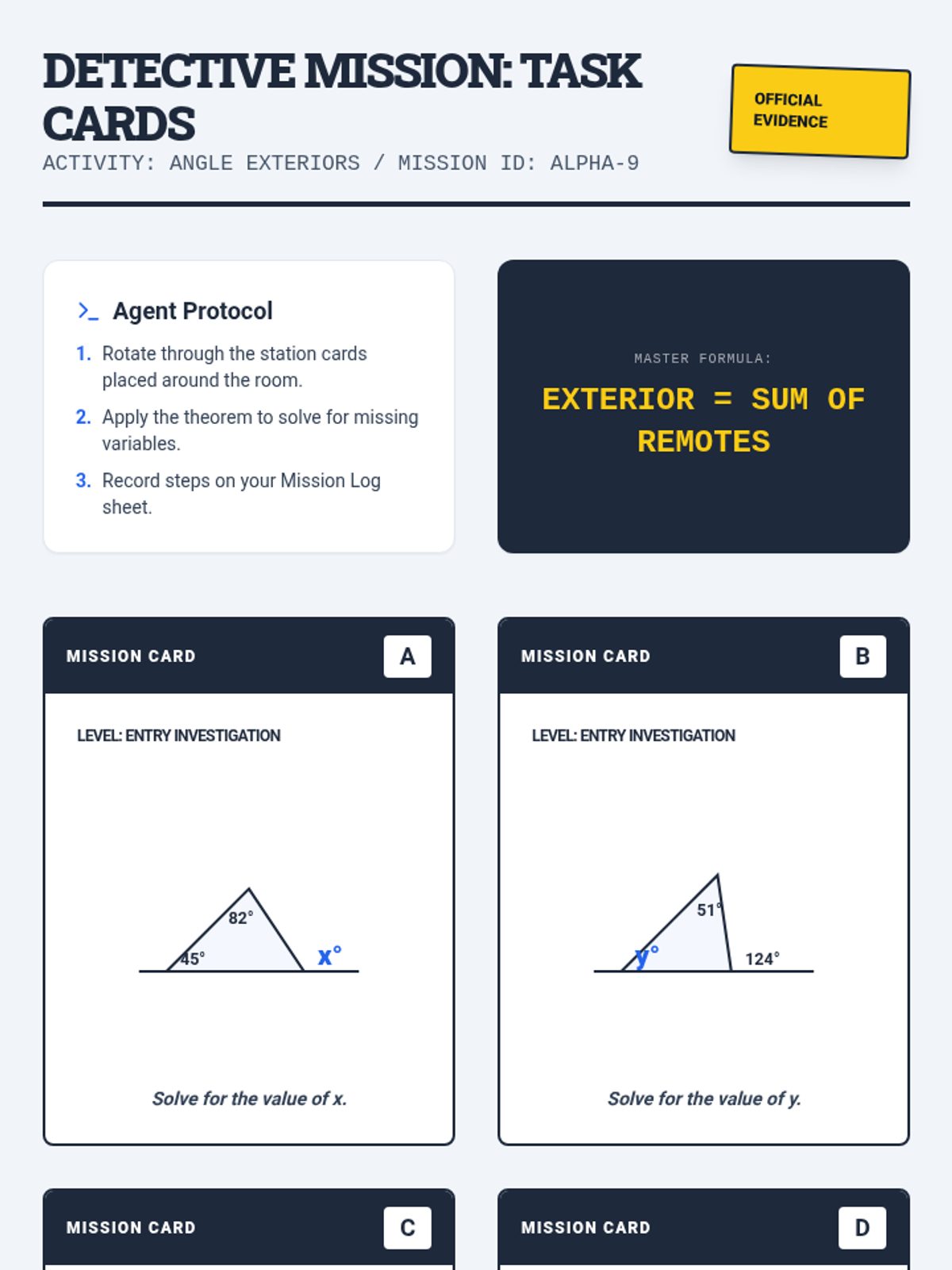
Revised task cards with corrected formula formatting, high-contrast prompts, and 'break-inside-avoid' styling to ensure cards remain cohesive when printed.
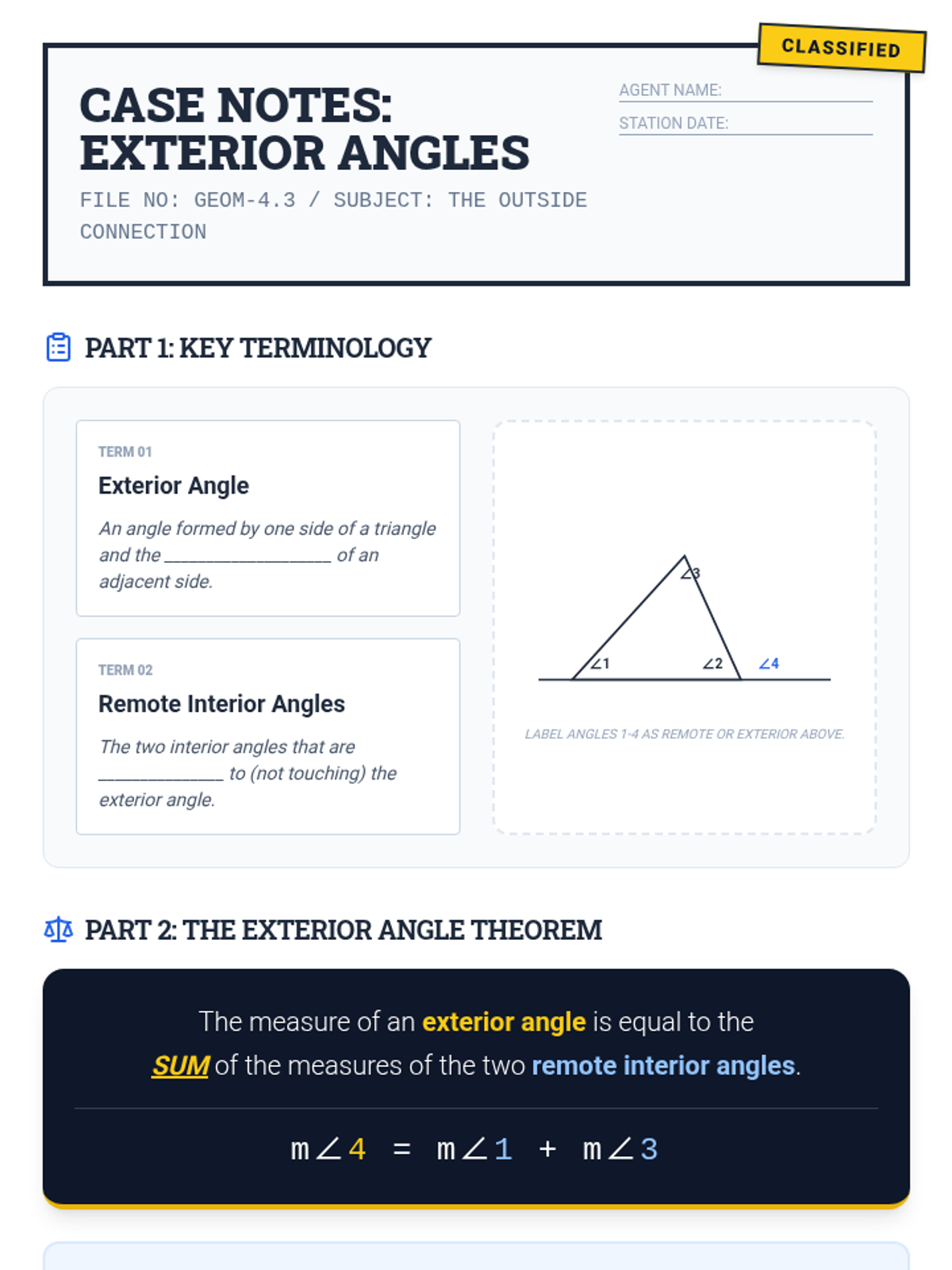
Revised guided notes with optimized page layouts to prevent awkward breaks, high-contrast theorem summaries, and significantly larger student calculation areas for algebra practice.
Revised slide deck with consistent angle notation, improved label positioning for clarity, and a hidden practice answer to facilitate classroom discussion.
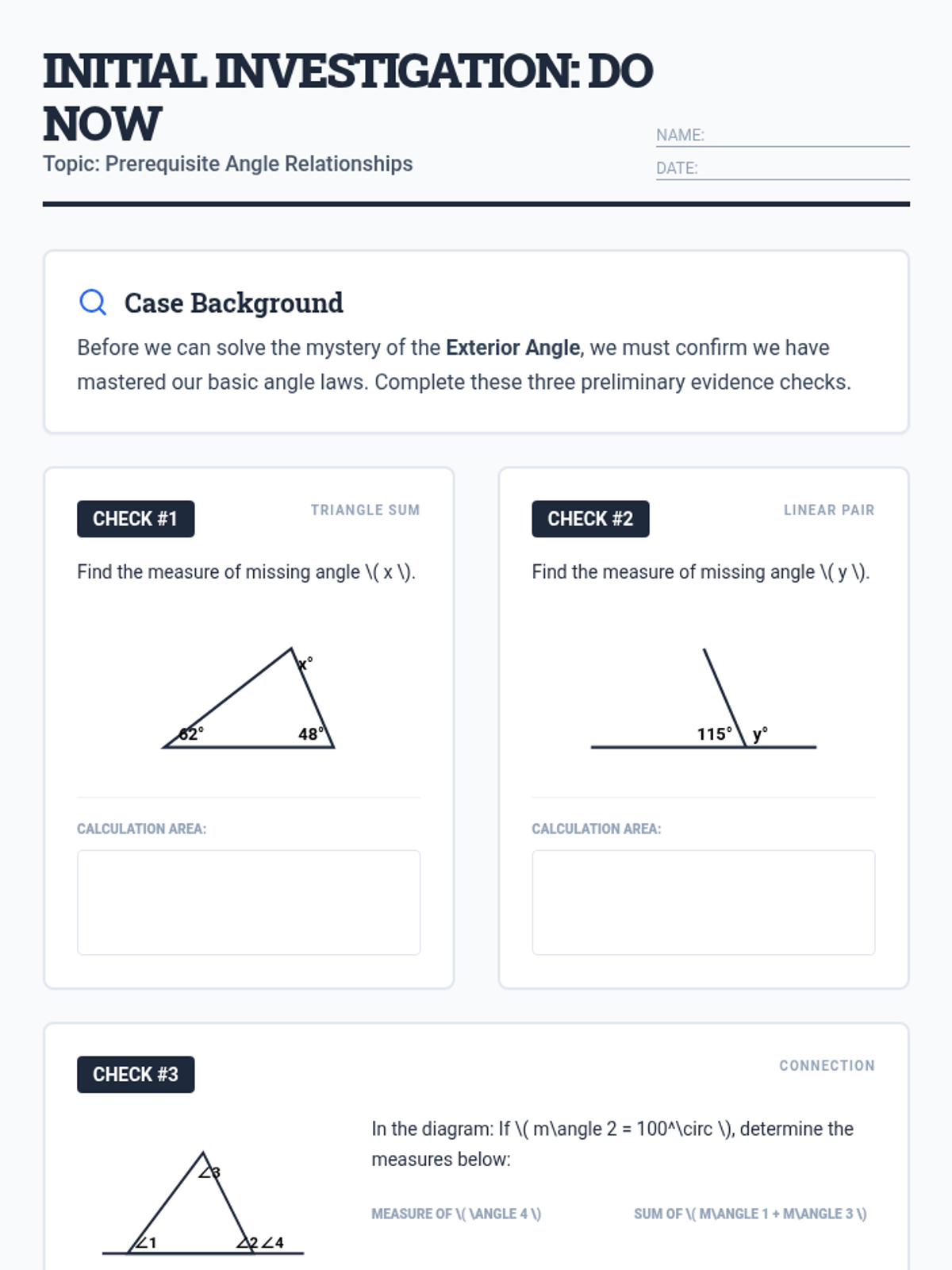
A revised 'case-themed' Do Now worksheet with corrected MathJax formatting, improved SVG label positioning, and optimized layout to fit on a single page.
Updated two-page worksheet into a three-page format to provide ample student work areas. Includes dedicated 'Show Work' boxes for the 10 visual problems and significantly expanded response areas for word problems and error analysis scenarios.
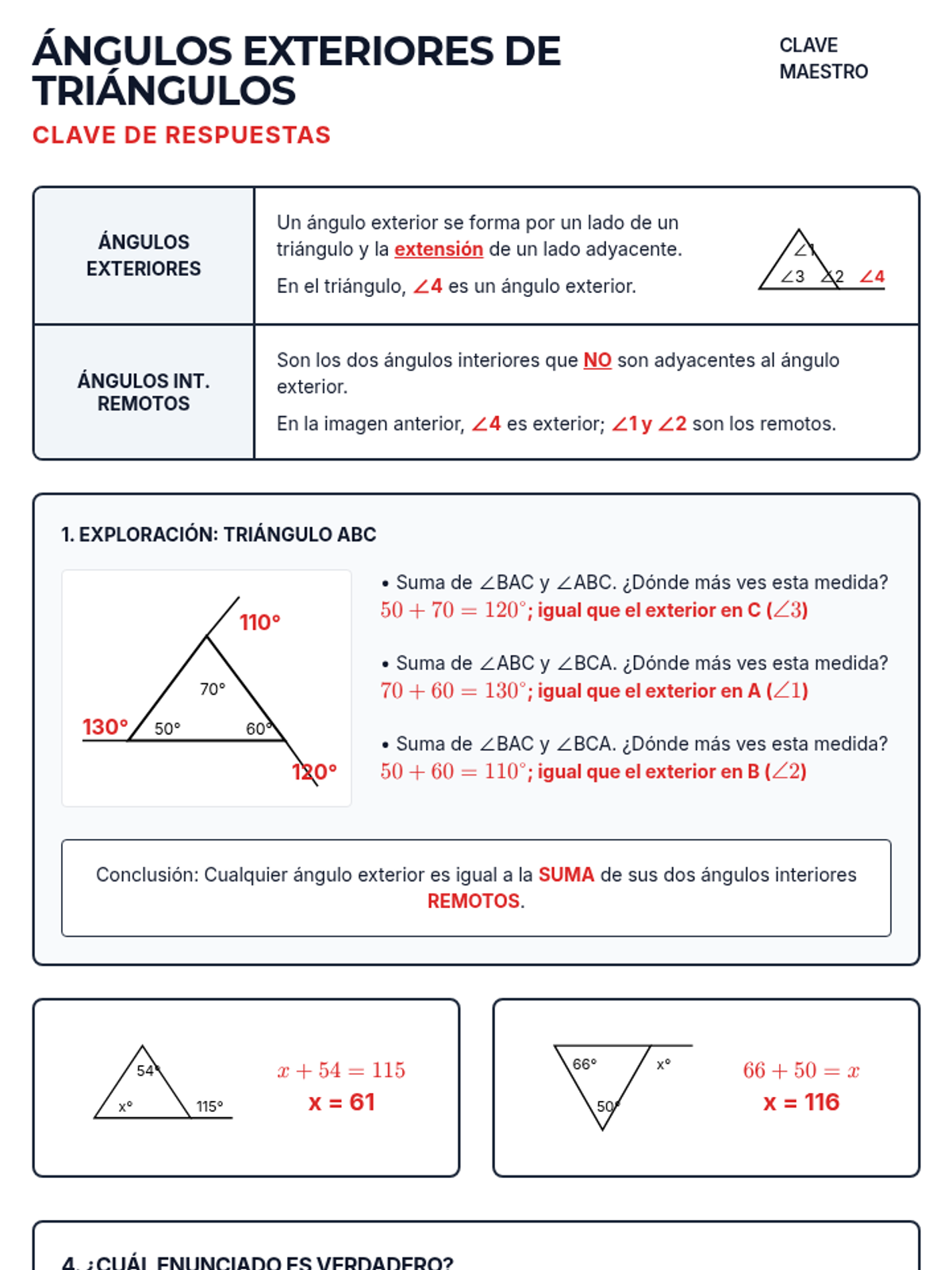
Clave de respuestas para el folleto de Ángulos Exteriores, con soluciones detalladas en rojo para facilitar la calificación y revisión. Totalmente traducido al español.
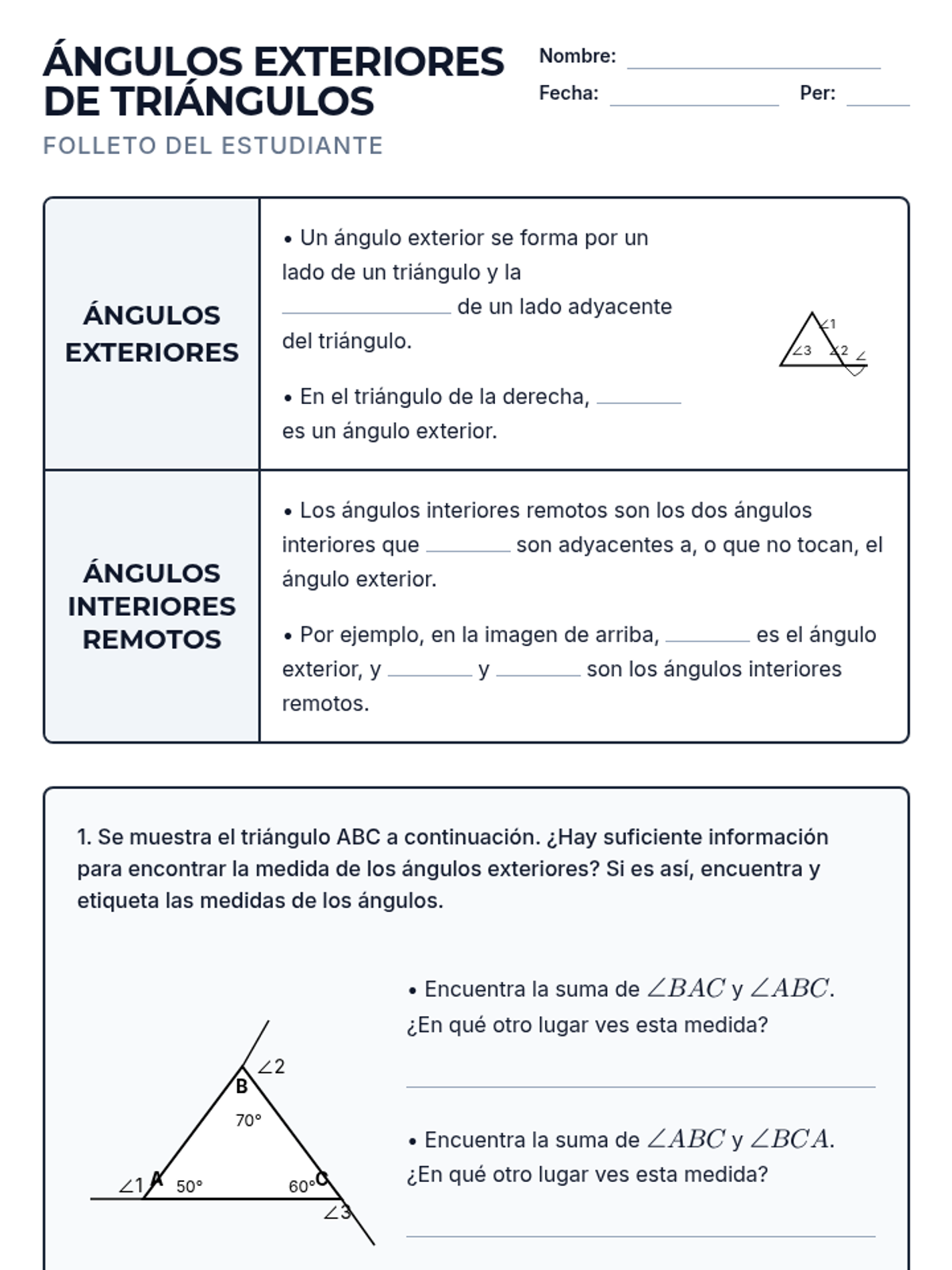
Folleto para estudiantes sobre el Teorema del Ángulo Exterior, que incluye definiciones, exploración guiada y problemas de práctica algebraica. Totalmente traducido al español.
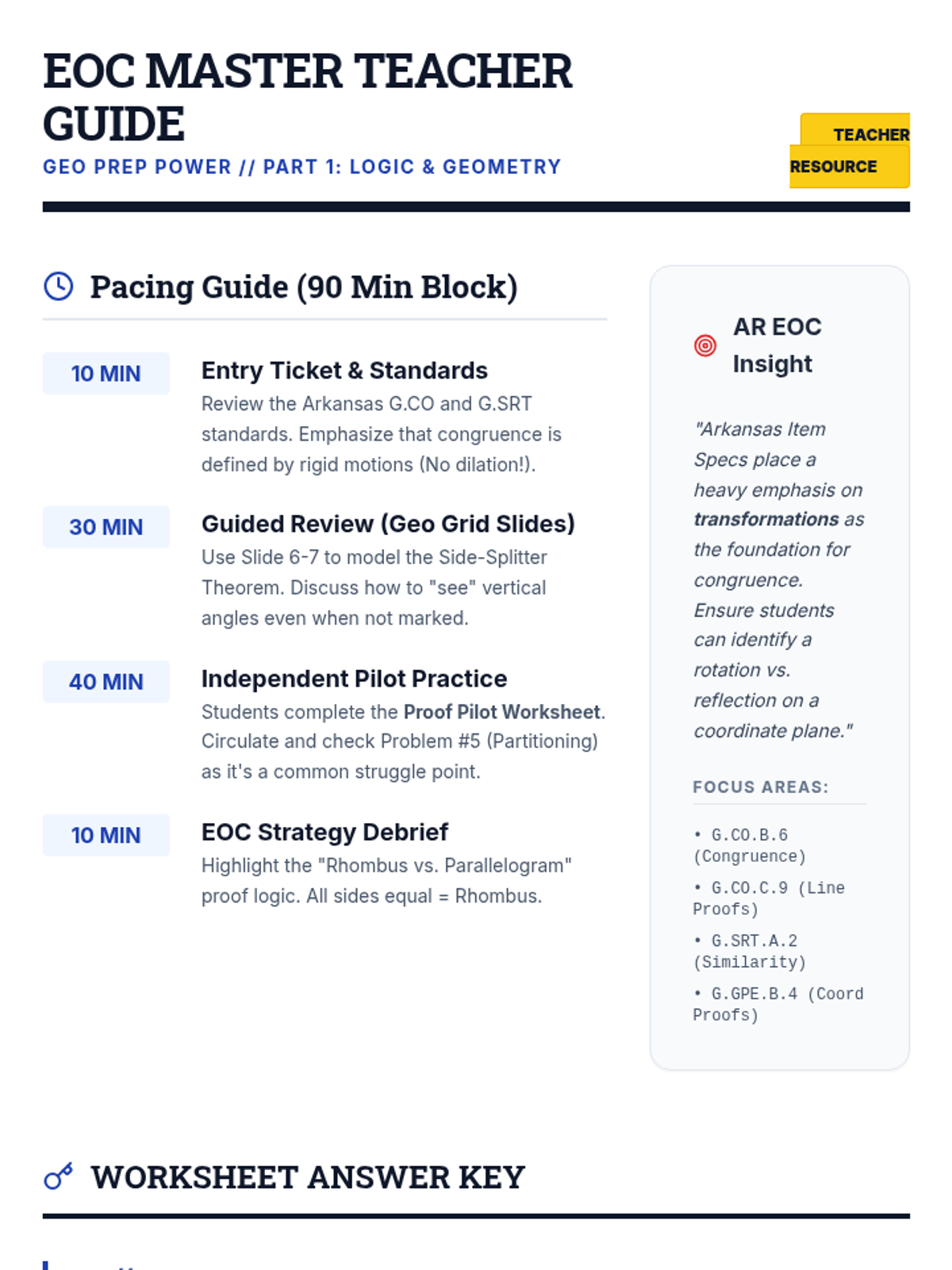
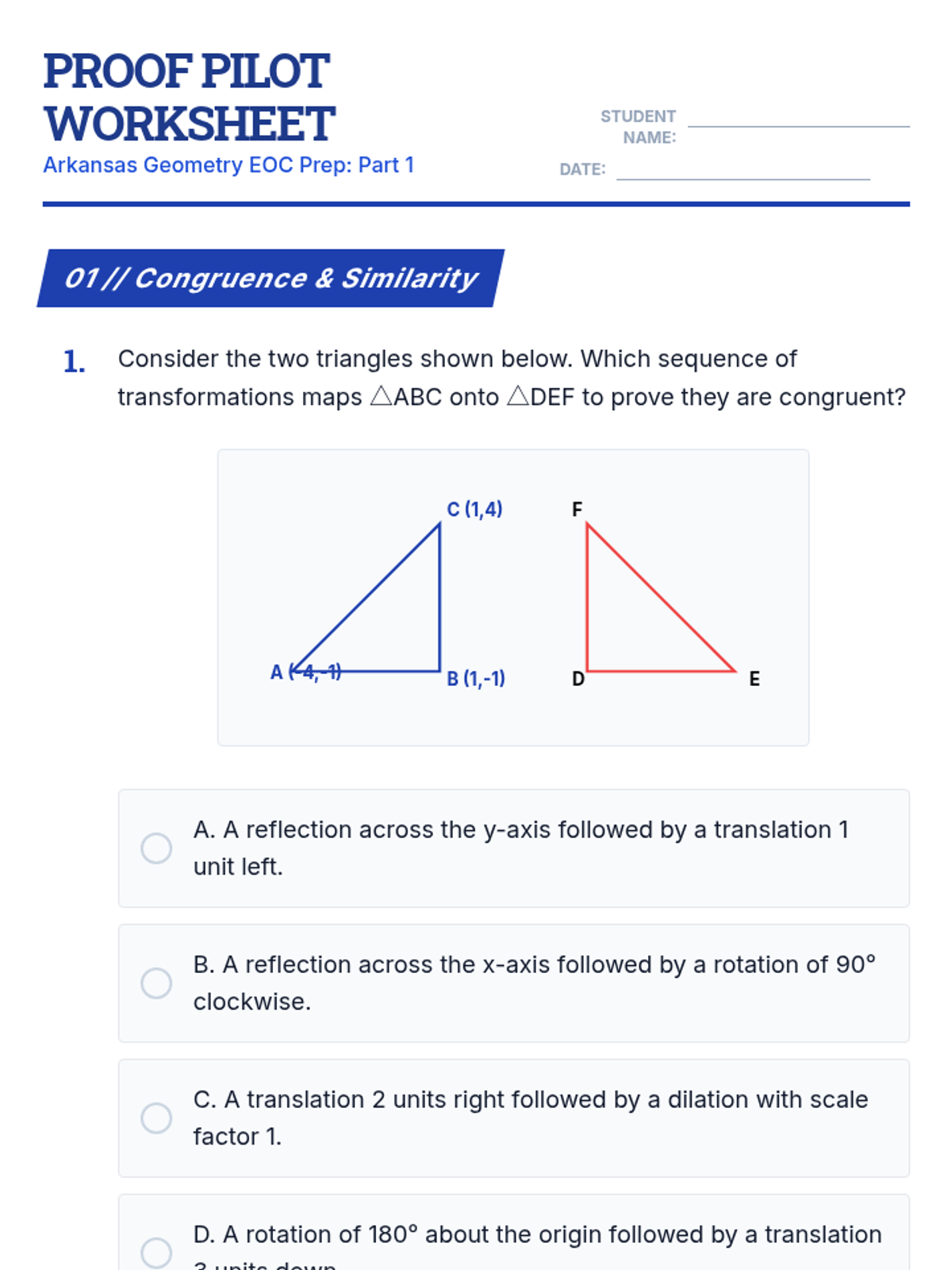
A teacher guide for the Geometry EOC Part 1 lesson, providing pacing, answer keys for the worksheet, and pedagogical tips for addressing common student misconceptions.
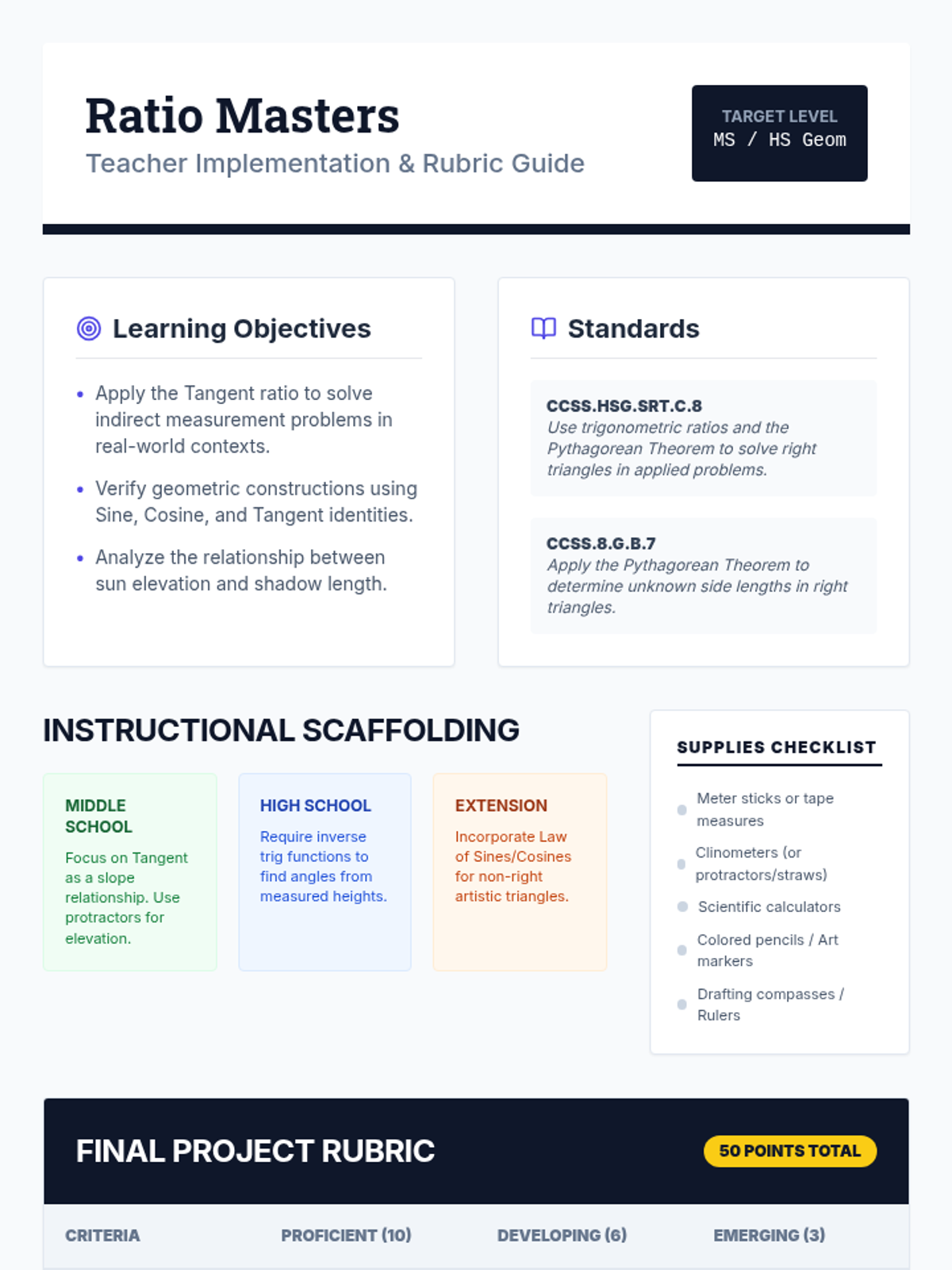
A teacher guide containing learning objectives, standards alignment, differentiation strategies for middle and high school, and a comprehensive grading rubric.
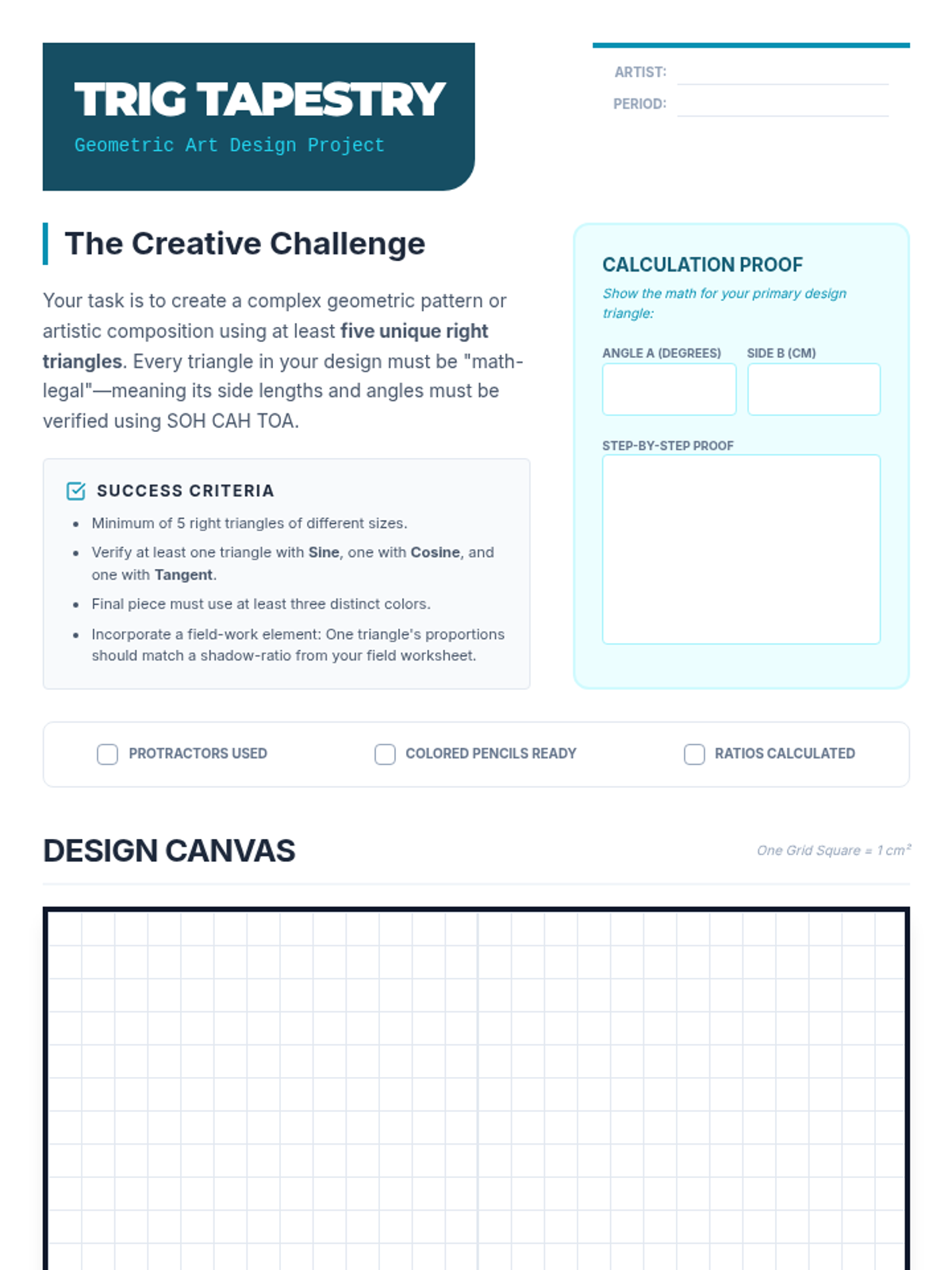
A project guide for the geometric art portion of the lesson. Students design a pattern using right triangles and prove their proportions using trigonometric ratios.
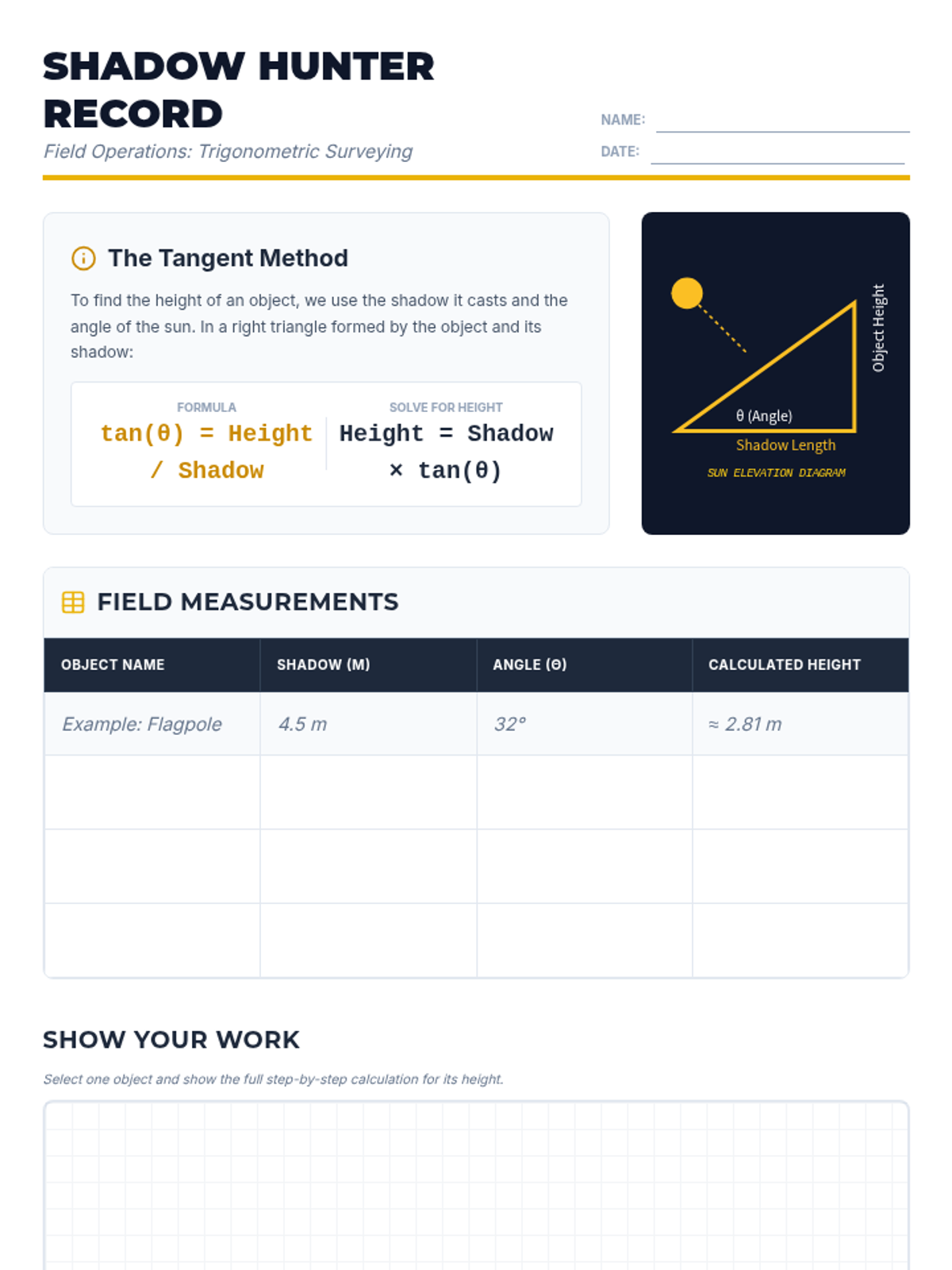
A field data collection sheet for students to record shadow lengths and calculate object heights using the tangent ratio. Includes space for work and reflection questions.
An introductory slide deck for the Shadows and Shapes project, covering trigonometric ratios, the two main project components (Shadow Hunters and Trig Tapestry), and the project timeline.
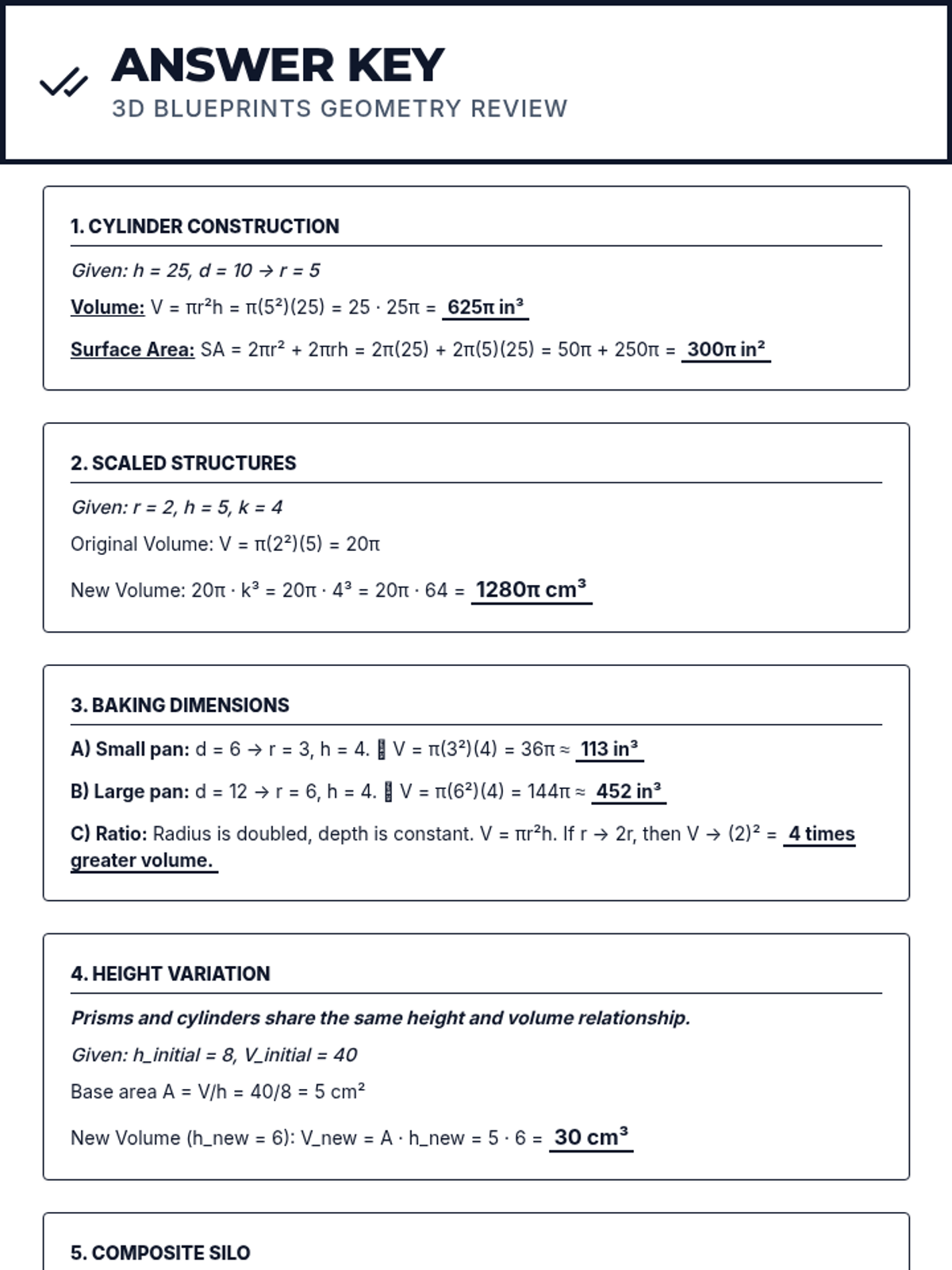
A black and white, printer-friendly answer key for the Solid Mastery geometry review, with fixed font rendering for subscripts and exponents, and minimal black fill. Instruction to use 3.14 for pi has been removed.
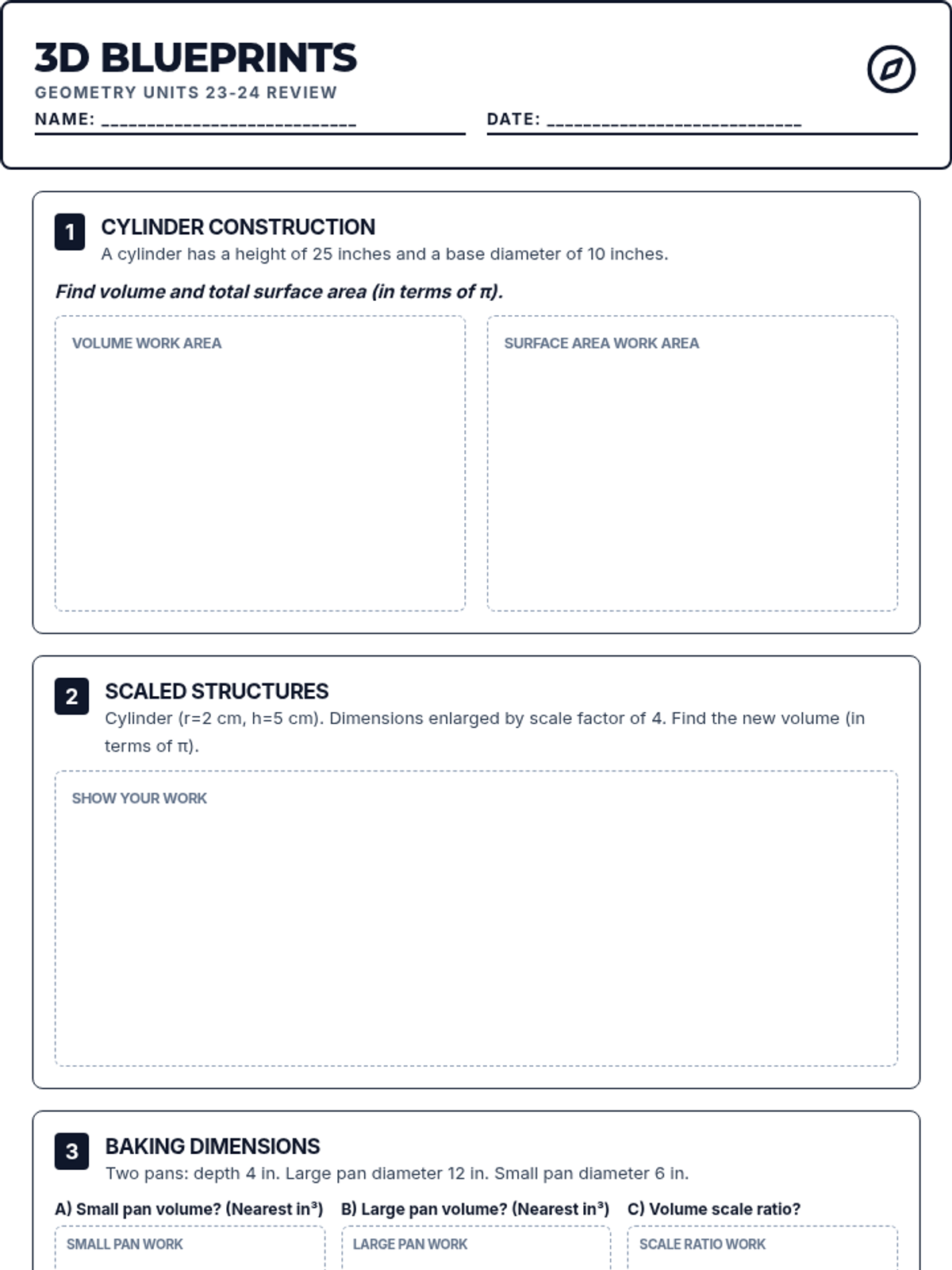
A black and white, printer-friendly geometry worksheet with significantly increased student work areas and larger font sizes for improved readability. Instruction to use 3.14 for pi has been removed.
A complete 20-question review presentation for the TSIA2 Math practice exam, featuring each question followed by a detailed step-by-step explanation slide with proper work areas. Rendering and overflow issues have been resolved. Full 20 pairs included.
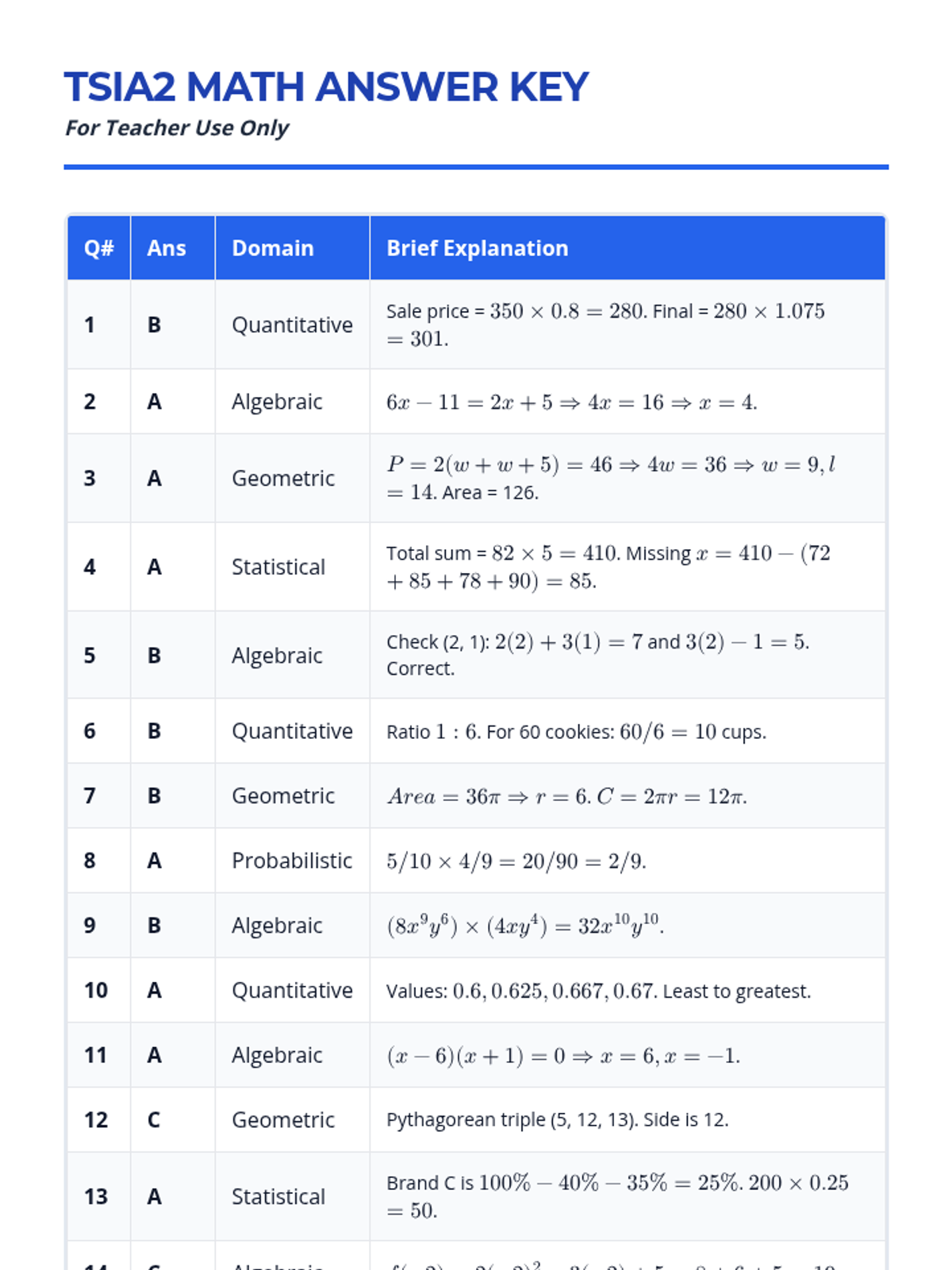
A detailed answer key for the TSIA2 Math practice exam, including correct responses, problem domains, and brief step-by-step explanations for all 20 questions. Table formatting refined for page breaks.
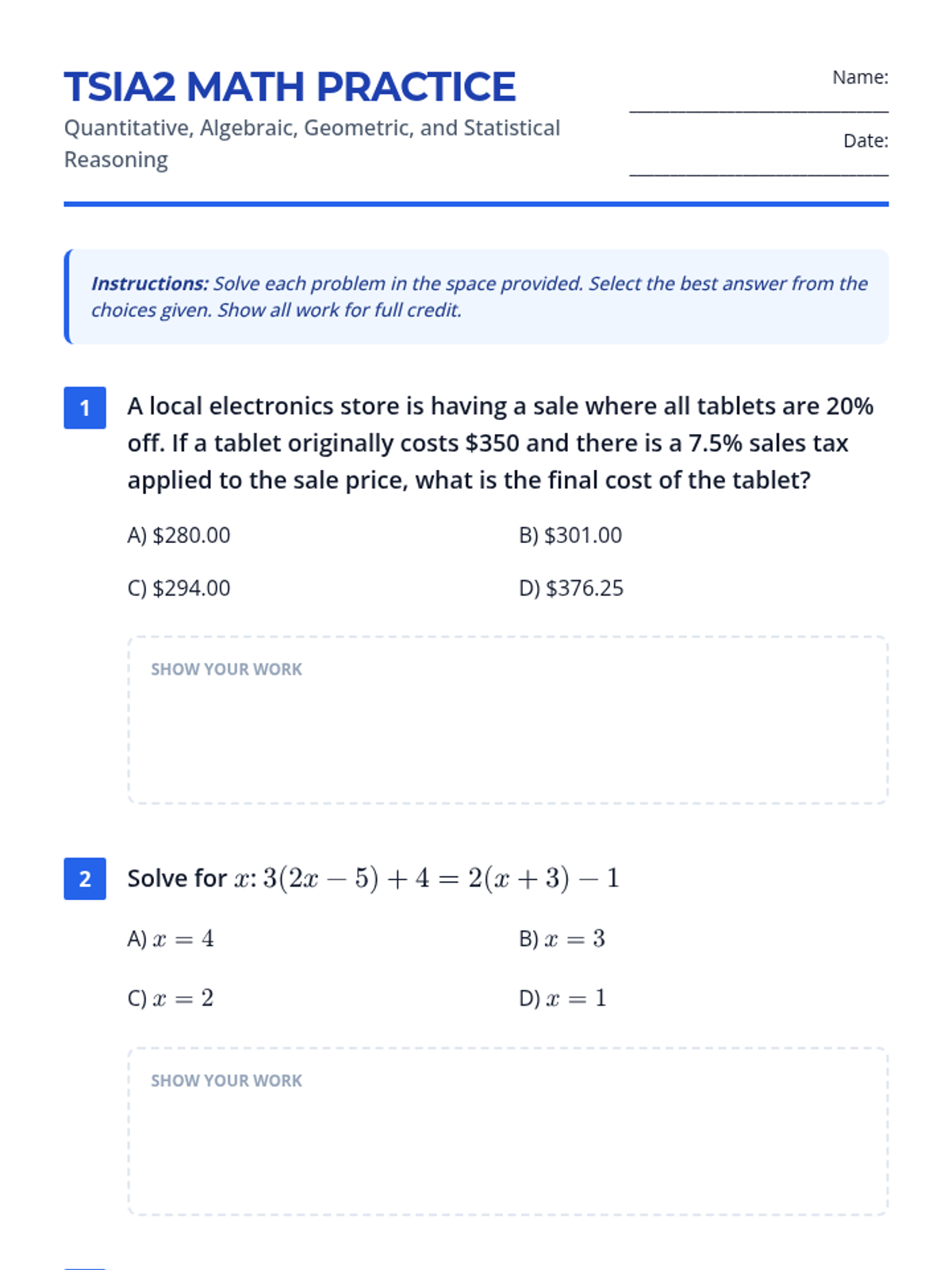
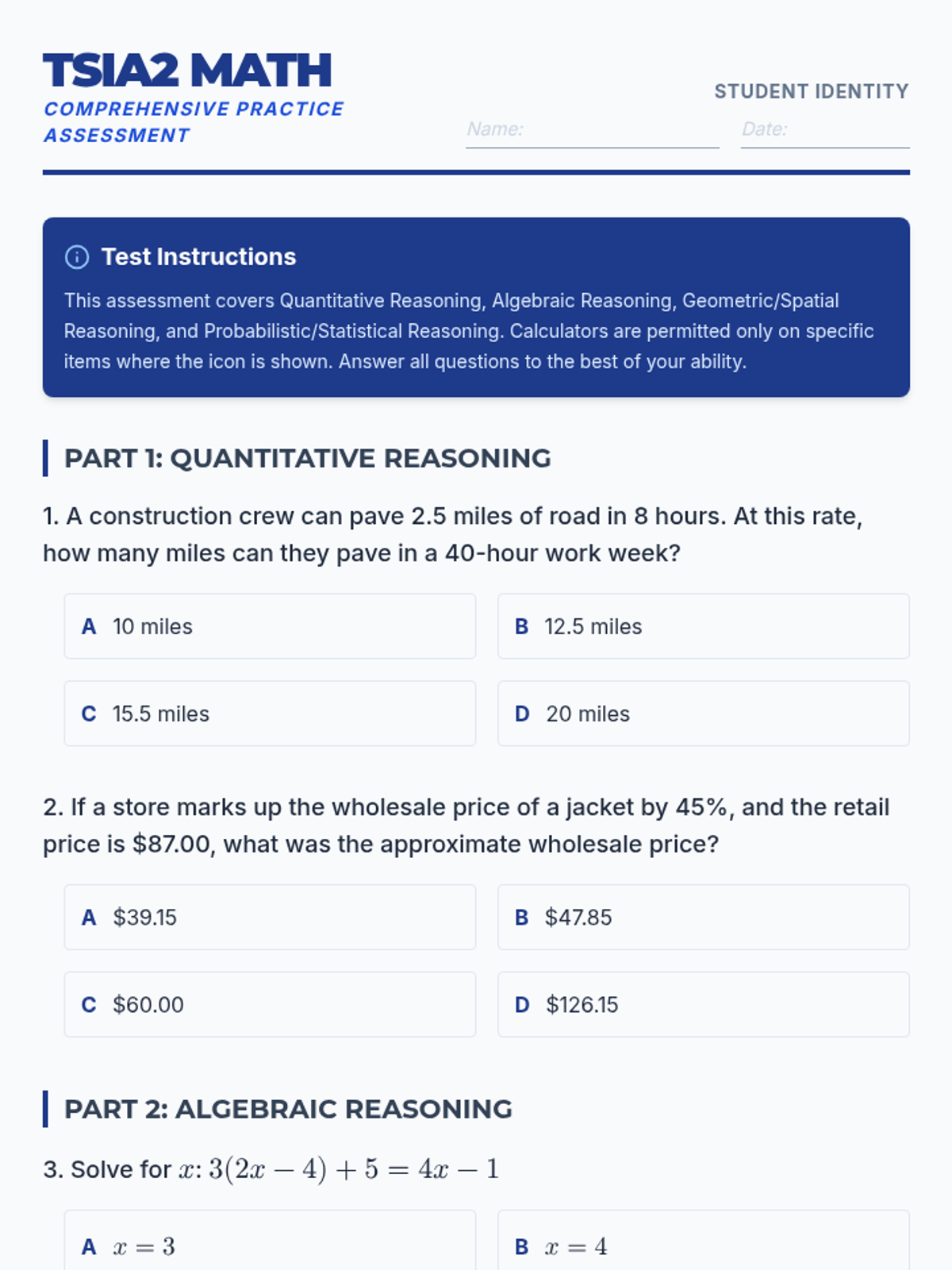
A 20-question practice exam for the TSIA2 Math assessment, featuring a balanced mix of quantitative, algebraic, geometric, and statistical reasoning problems with dedicated workspace for student calculations. Backgrounds are removed for clarity.
An engaging presentation that introduces the TSIA2 Math assessment and now includes a comprehensive 5-slide step-by-step solution guide for the mastery questions.
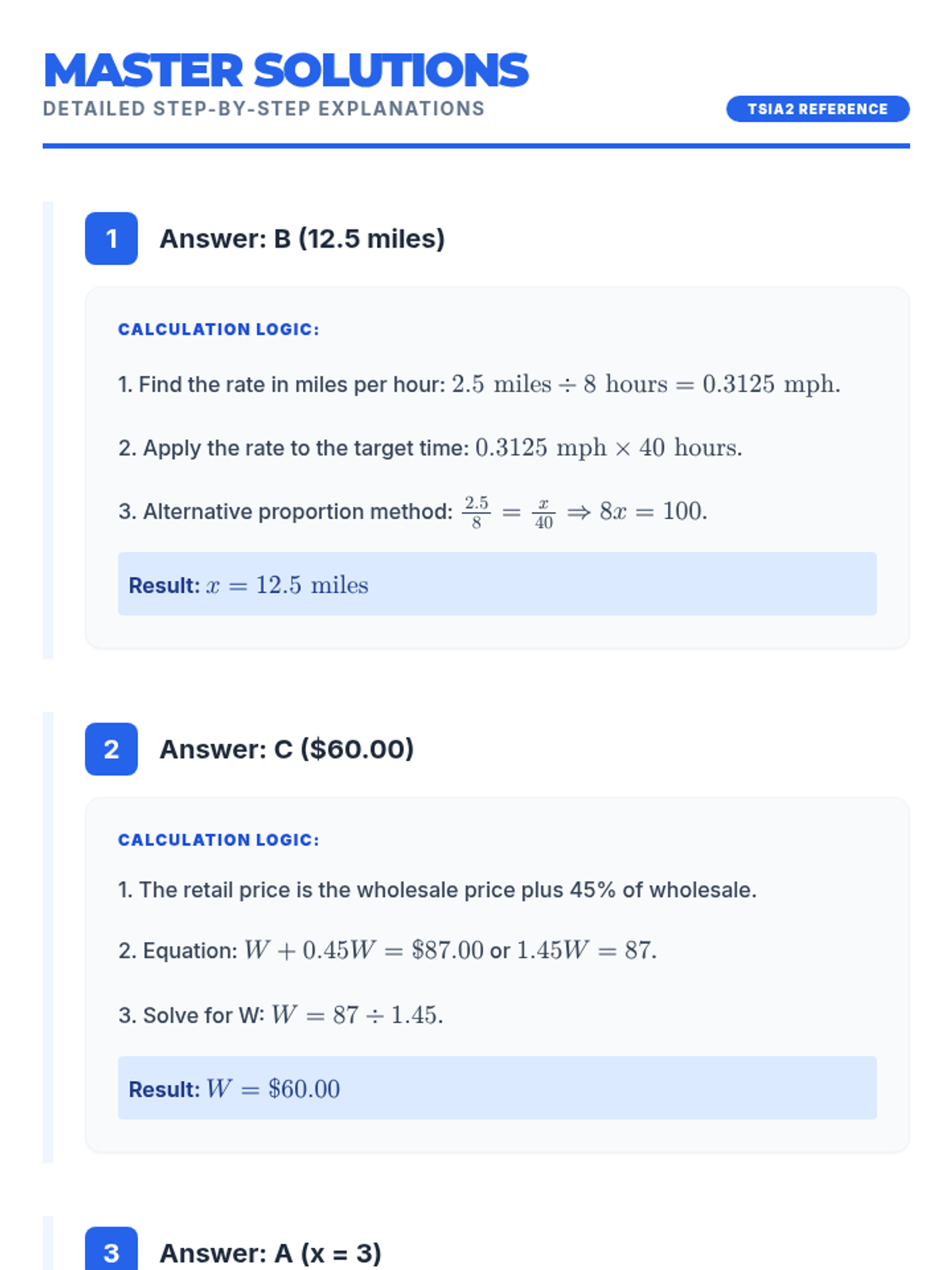
A detailed answer key providing step-by-step explanations for all 10 practice test questions, now with improved contrast and layout to ensure each solution stays on its own page.
A comprehensive 10-question practice test covering the core domains of the TSIA2 Math assessment, now featuring improved layouts, per-question work areas, and clear calculator icons.
A comprehensive 15-day slide deck for the TSIA2 Math Marathon. Features daily Warm-Up questions and detailed solution slides for all 30 practice problems covering all TSIA2 domains. Updated to be fully complete and fixed rendering issues.
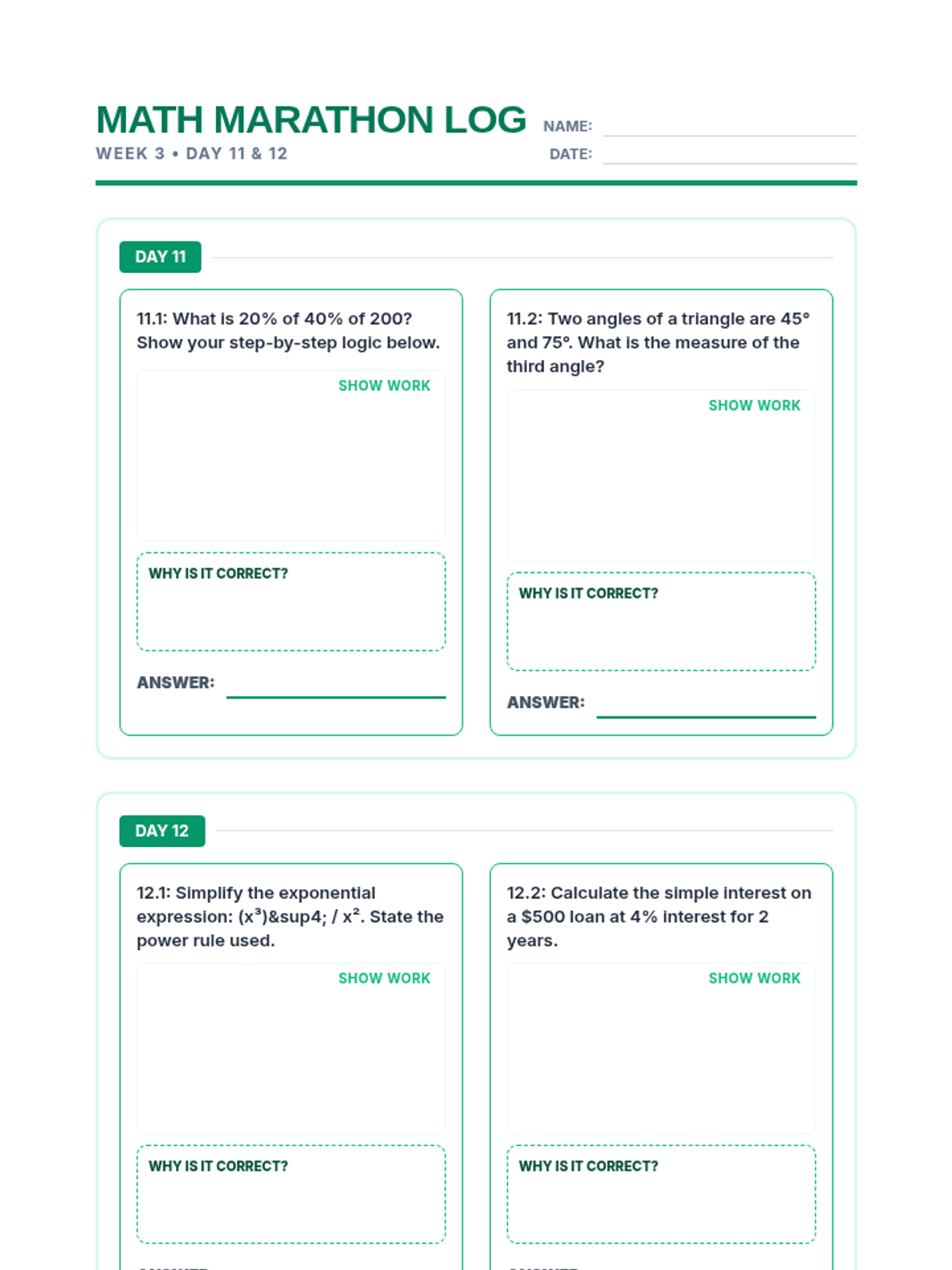
A 5-day student log for the final week of the TSIA2 Math Marathon. Covers days 11 through 15 with dedicated work areas, explanation boxes, and answer slots. Updated to optimize page breaks and increase work area size.
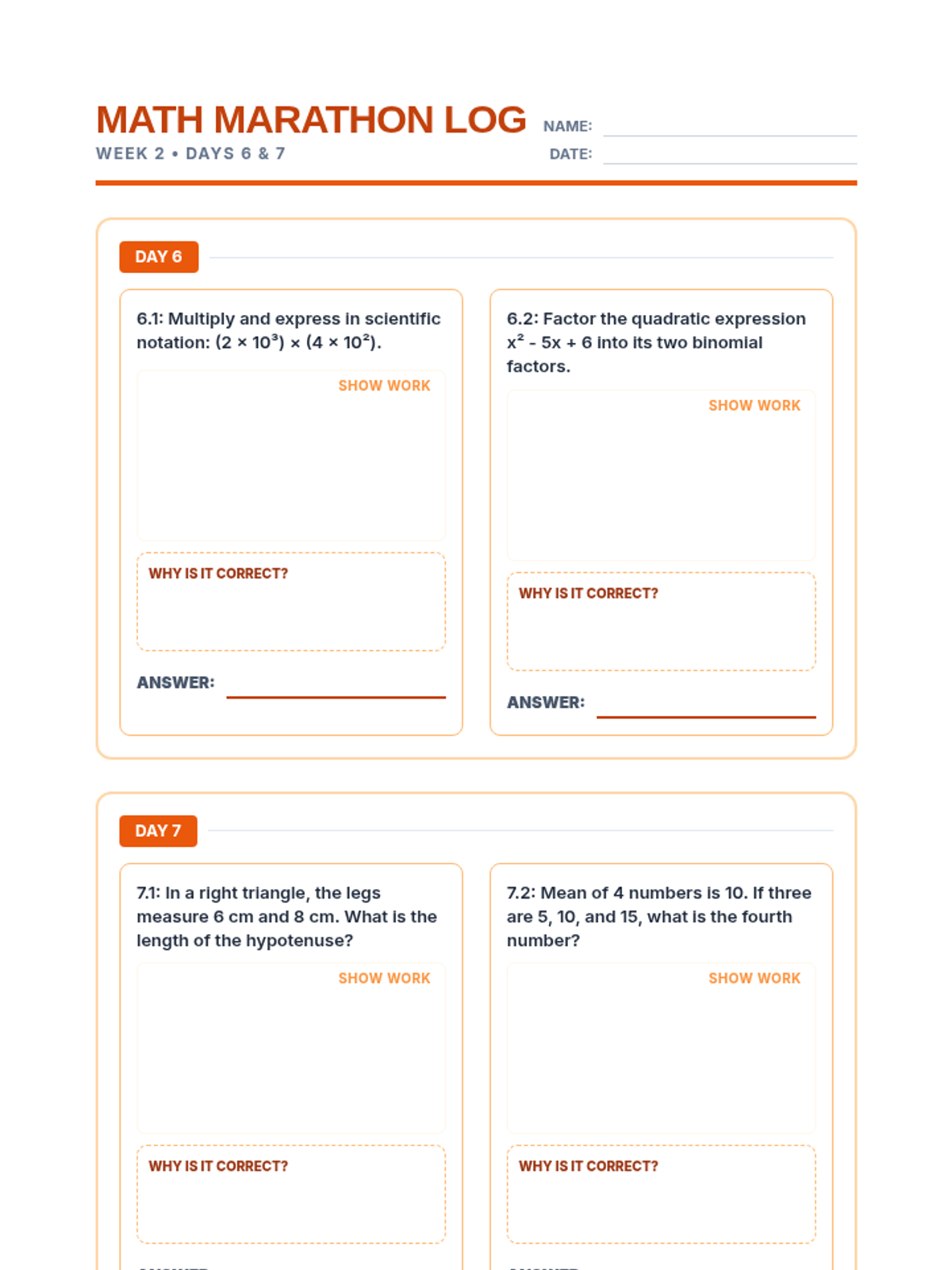
A 5-day student log for the second week of the TSIA2 Math Marathon. Provides space for daily problem-solving, work verification, and written explanations for days 6 through 10. Updated to optimize page breaks and increase work area size.
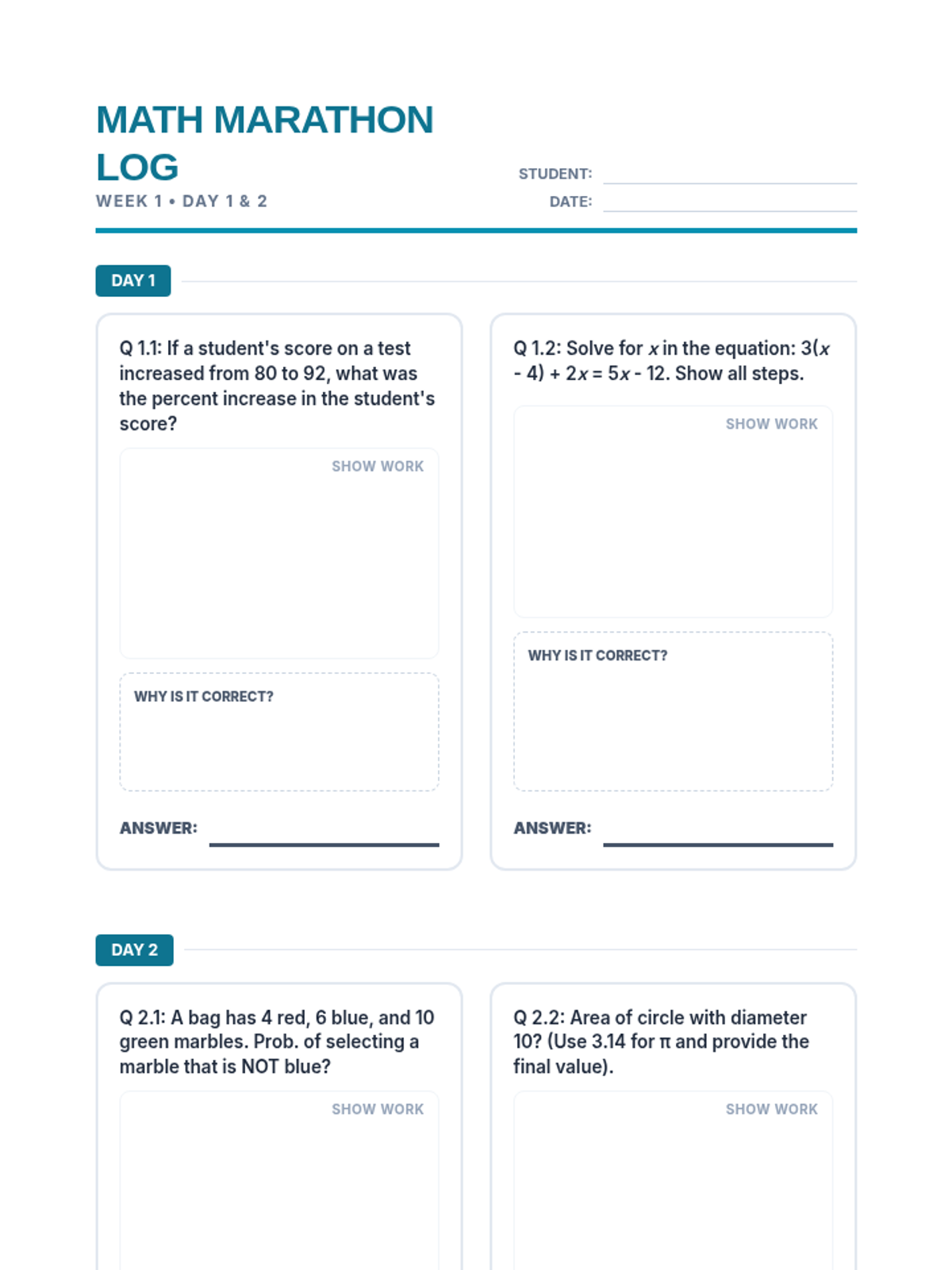
A 5-day student log for the first week of the TSIA2 Math Marathon. Includes dedicated spaces for showing work, providing a written explanation of the answer logic, and recording final answers. Updated to optimize page breaks and increase work area size.
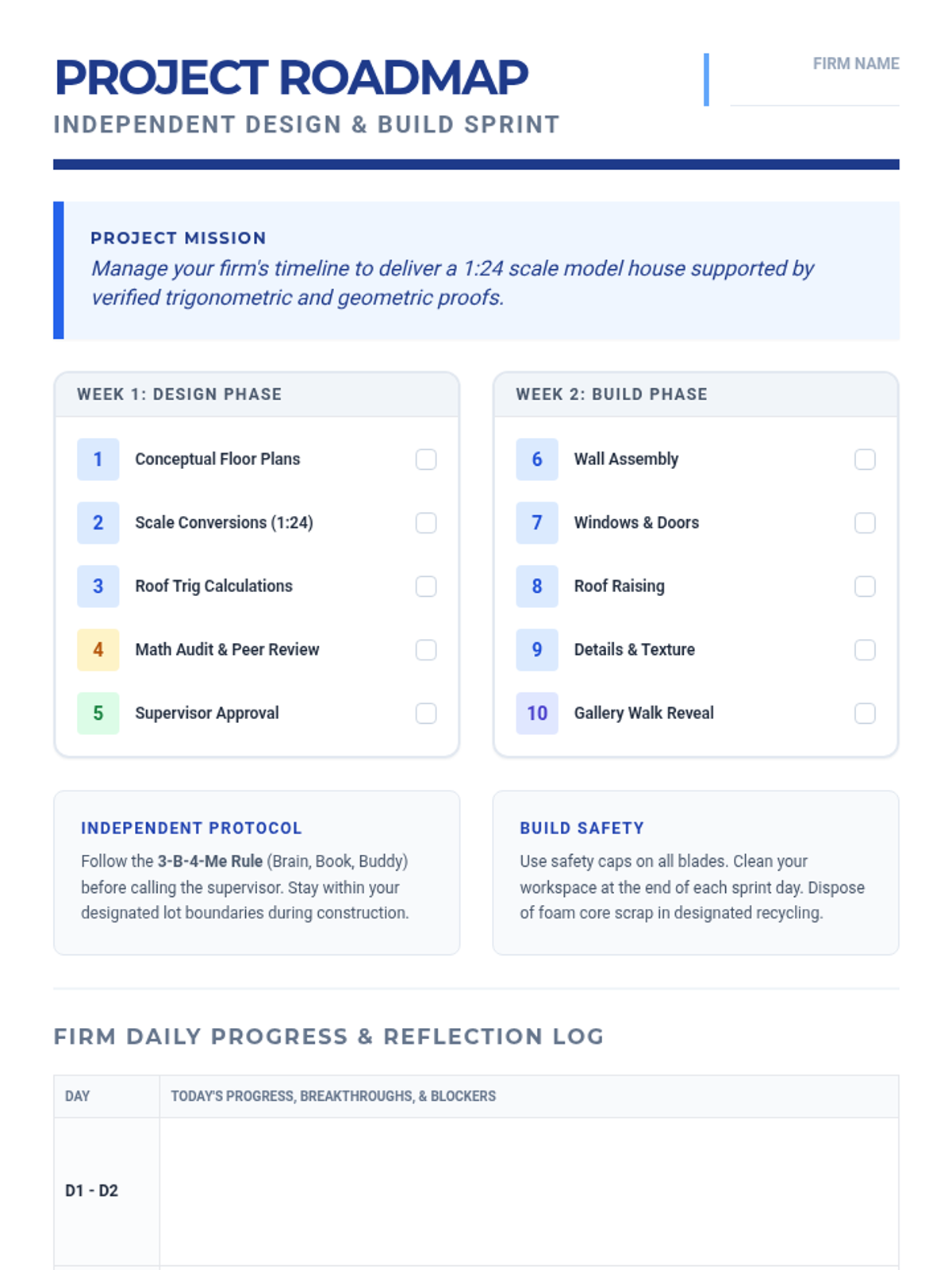
A self-paced student roadmap for the Angle Architects project, outlining daily milestones, a 10-day checklist, and independent problem-solving protocols.
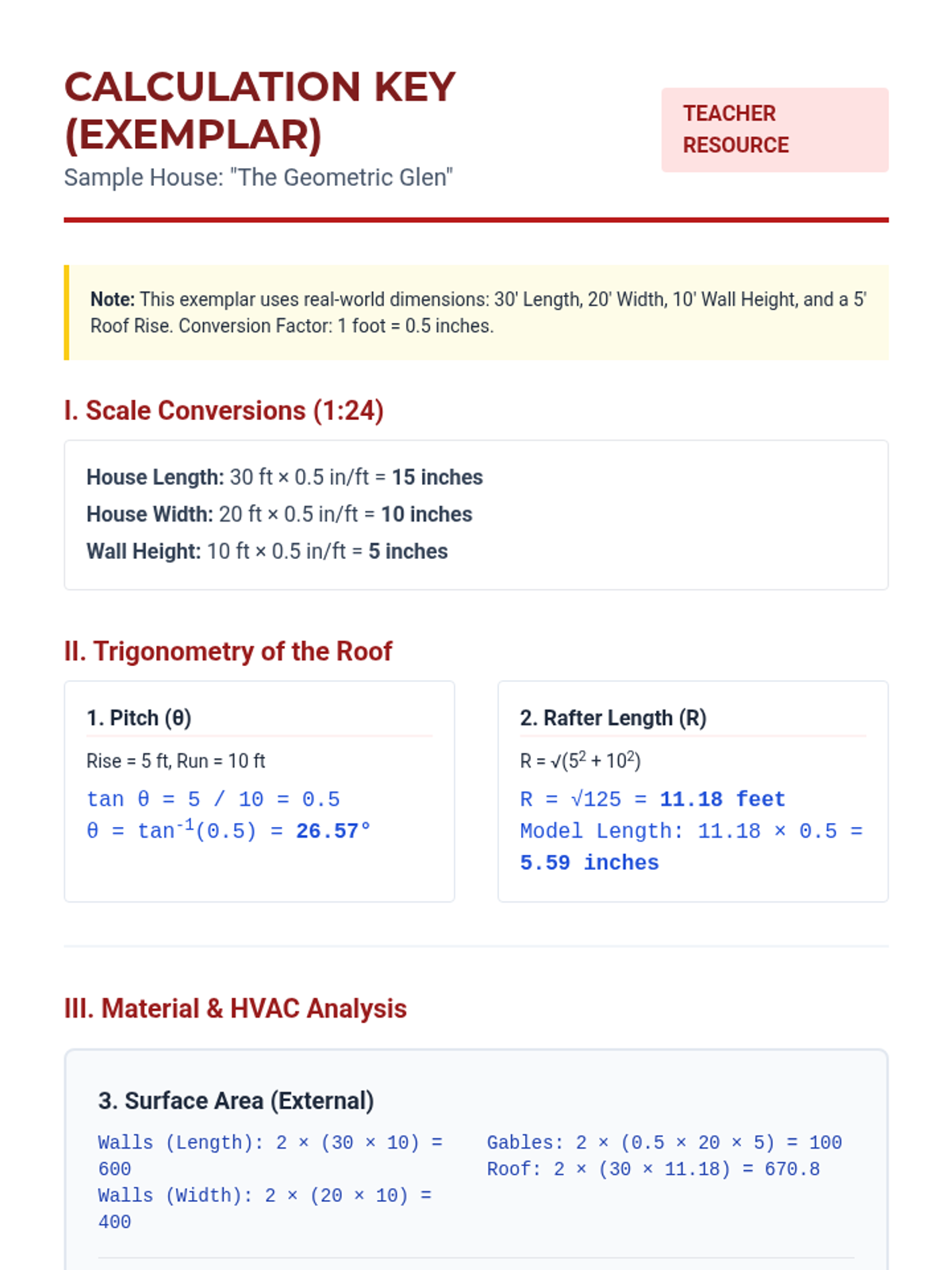
A teacher-facing answer key and calculation exemplar for the Angle Architects project, providing a concrete example of the math required for a standard house design.
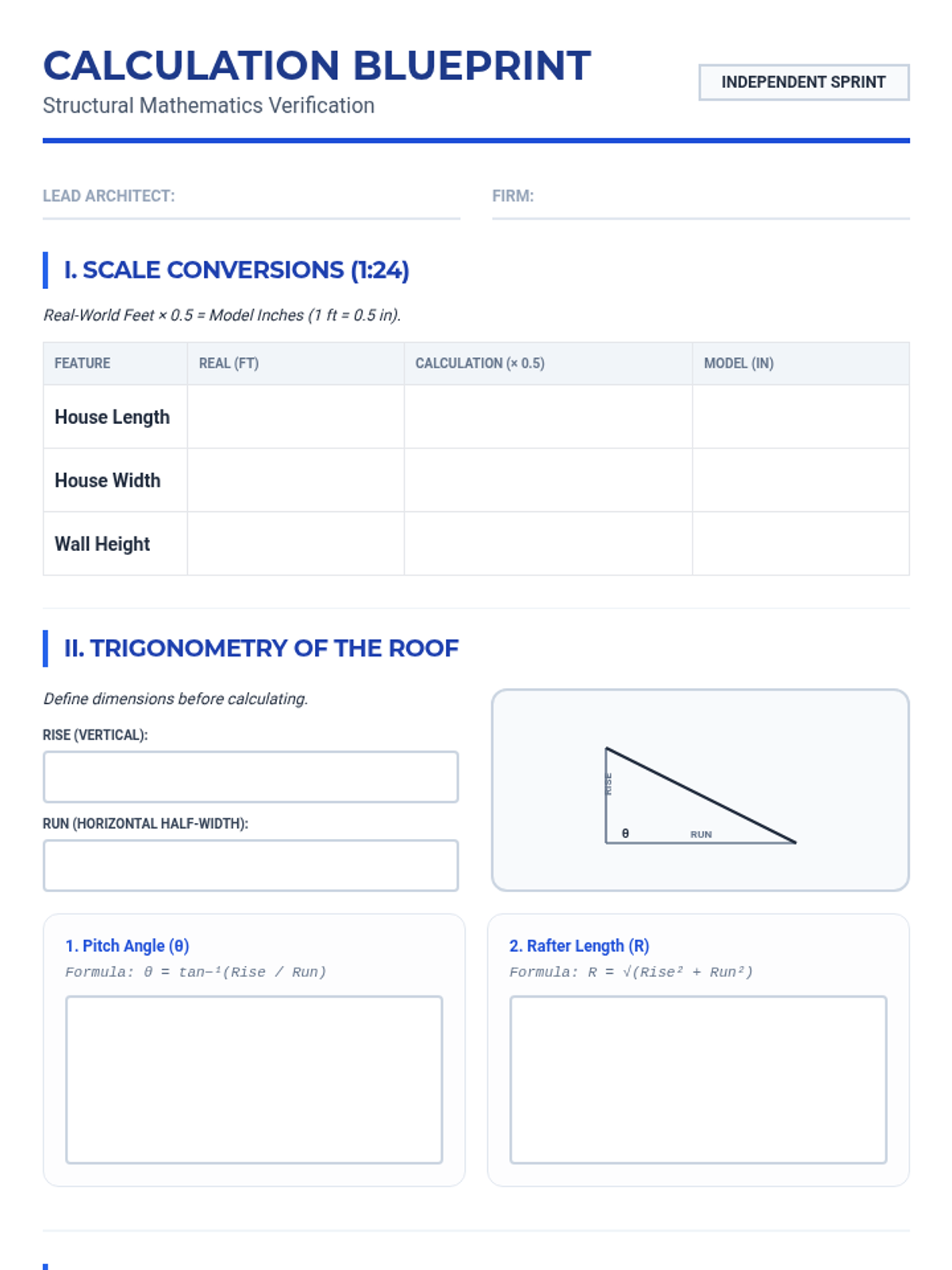
A technical worksheet for 10th-grade students to document their scale conversions, roof trigonometry (pitch and rafter length), surface area, and volume calculations.
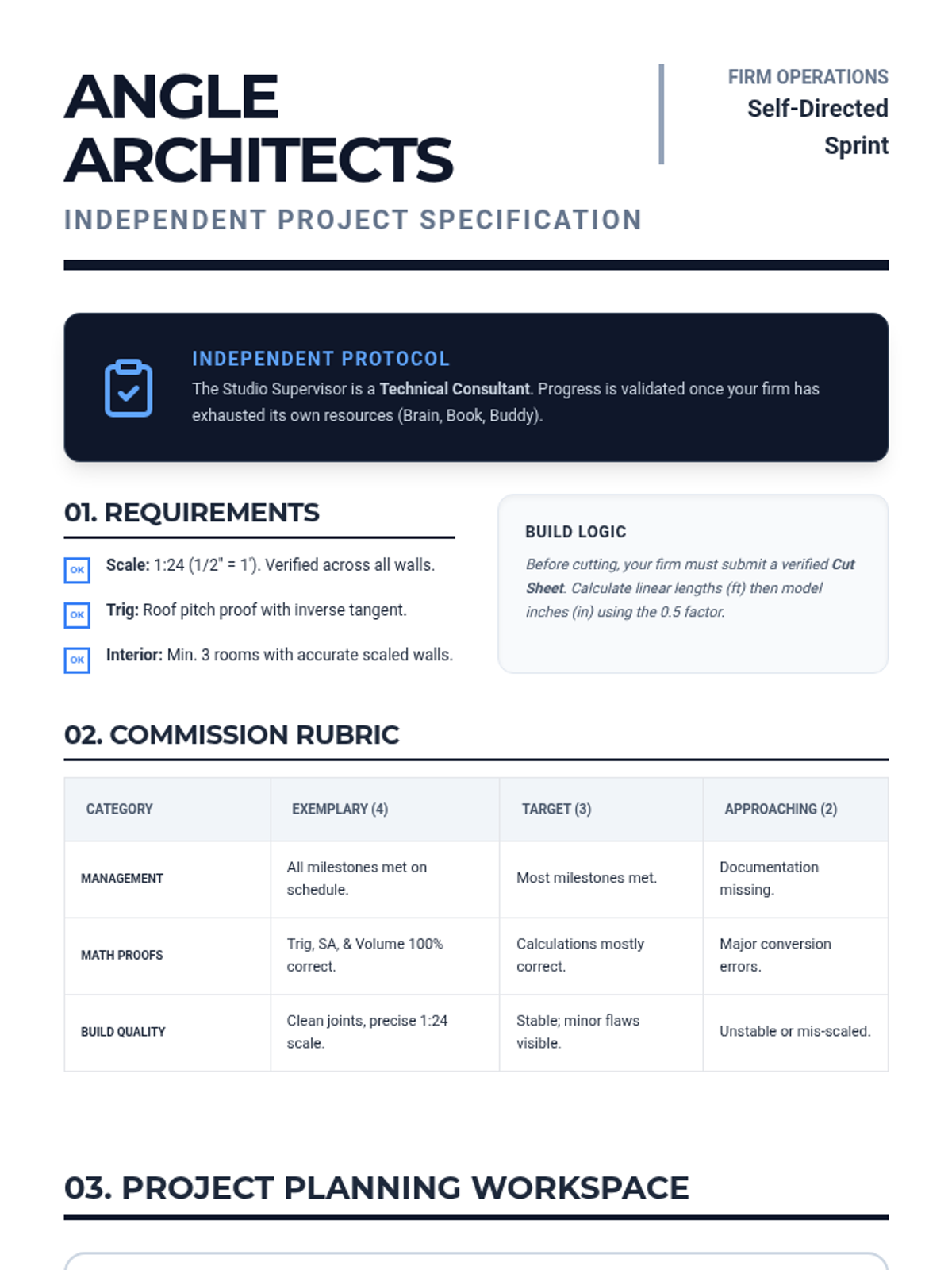
Updated project specification packet for students working independently, including project management rubrics and self-directed problem-solving guides.
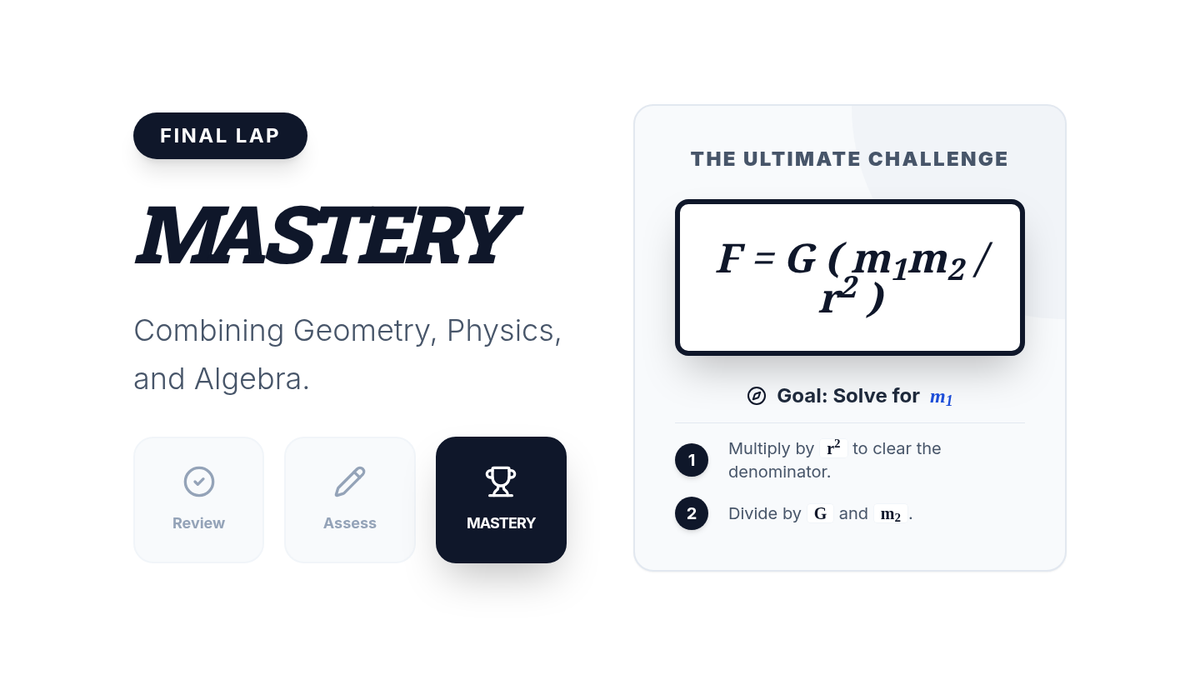
Final mastery slide for the unit. Updated to fix subscript rendering, improve layout to fit one slide, and ensure text contrast is accessible.
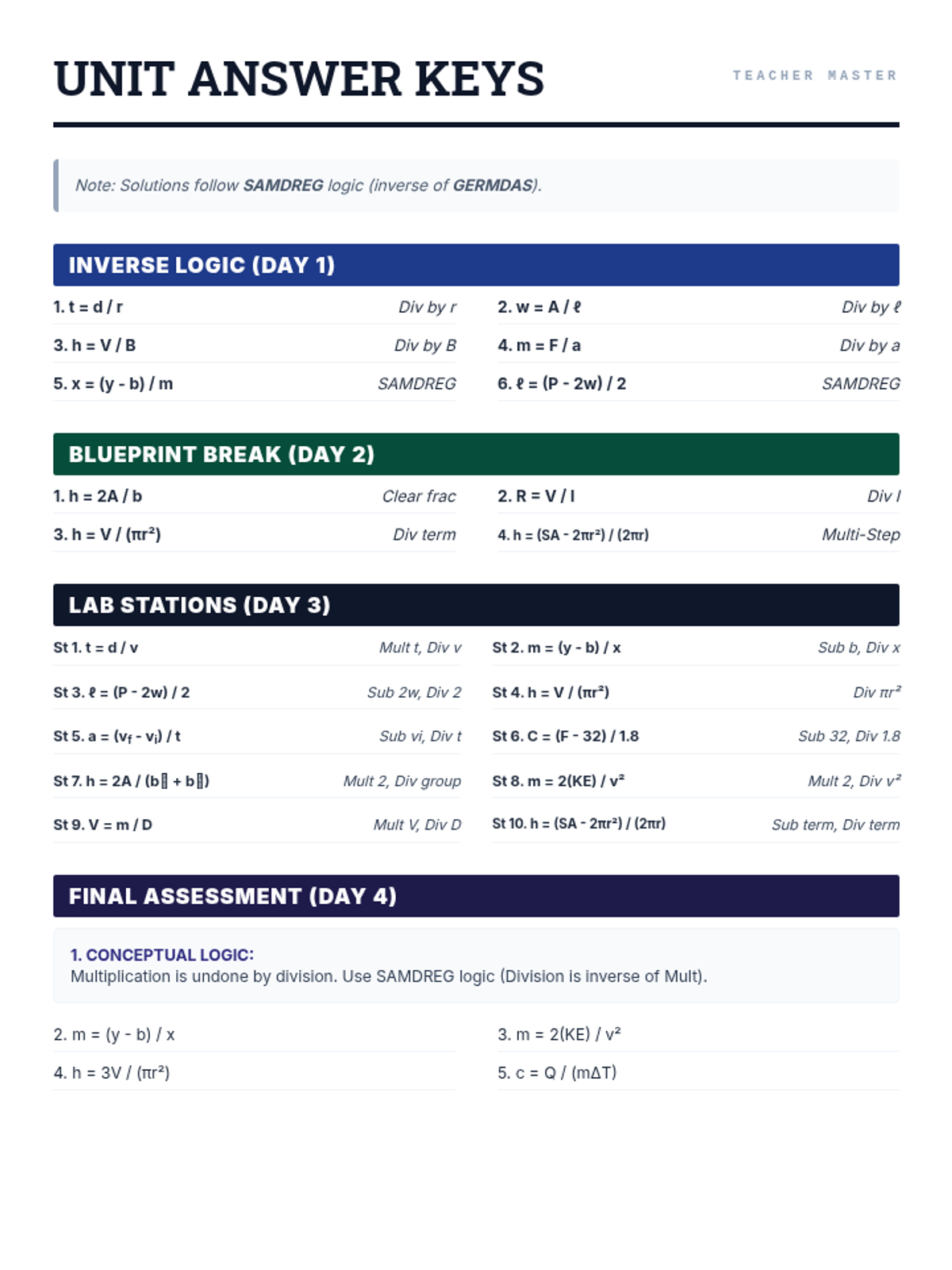
Comprehensive unit answer key for all unit materials. Updated to ensure variable casing exactly matches student materials. Fixed mathematical rendering for subscripts and exponents. Standardized layout for 12-question consistency.
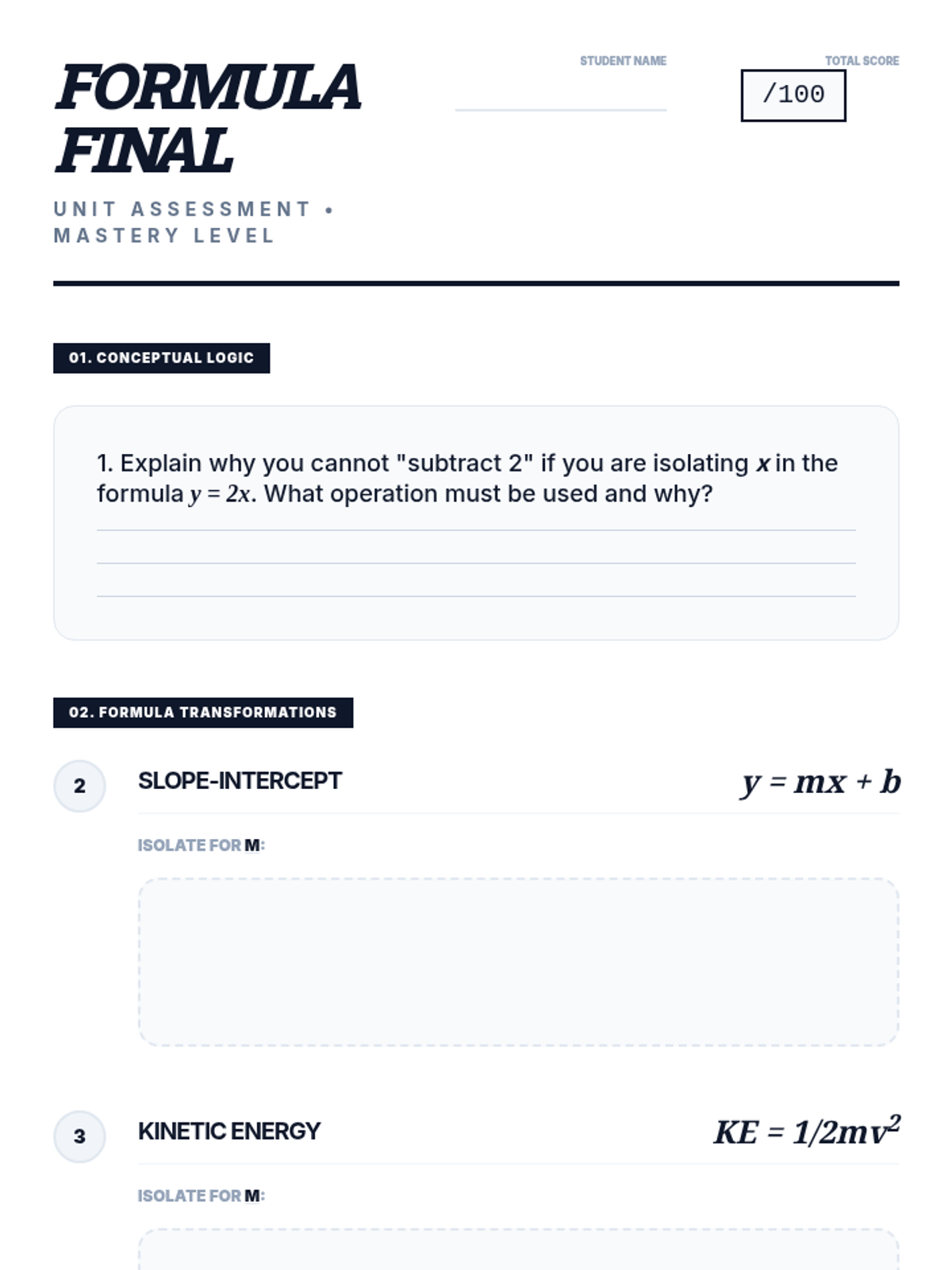
Formal unit assessment for literal equations. Updated to ensure variable casing in instructions exactly matches formula usage (e.g., 'Solve for r' vs 'Solve for B'). Standardized 2-column layout.
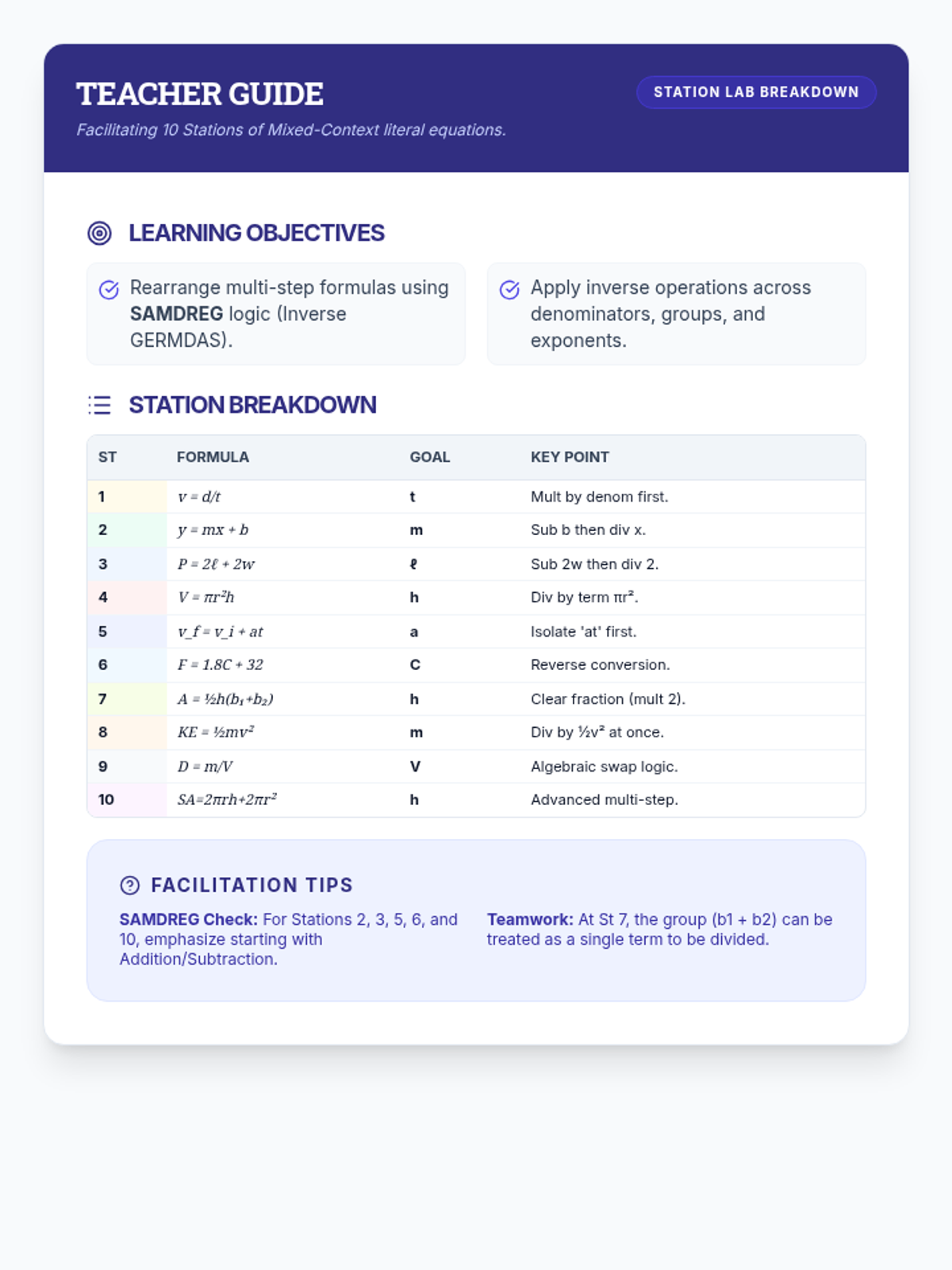
Teacher facilitation guide for the station lab. Updated to match the 12 multi-step and exponent formulas, with specific instructional guidance for each station. Corrected rendering for subscripts.
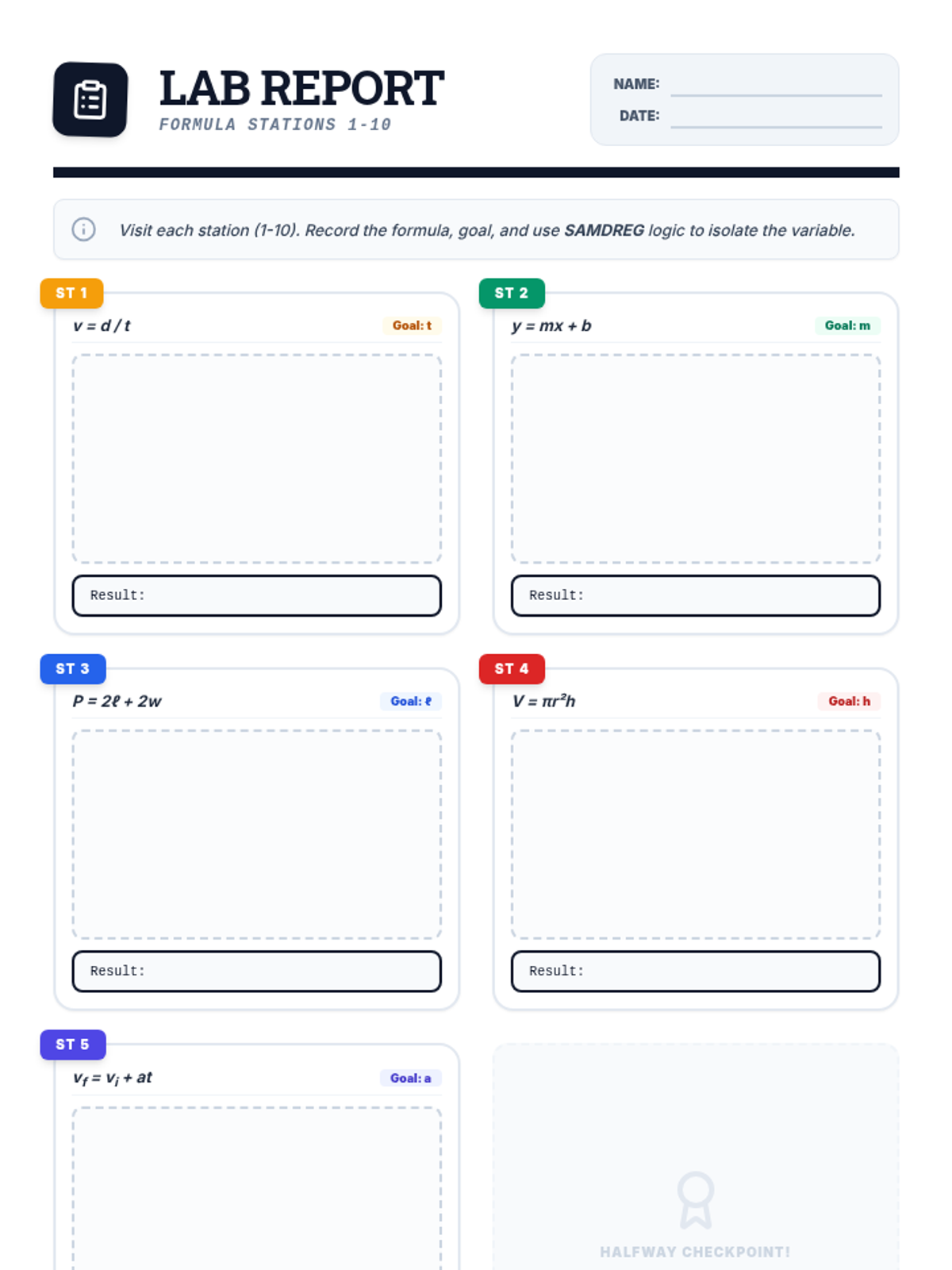
A two-page structured recording sheet for 12 stations. Revised with standardized layout for all 12 stations, improved labeling, and clean GERMDAS/SAMDREG alignment. Subscripts and superscripts optimized for PDF rendering. No placeholder text in work areas. Increased handwriting space by reducing Result box height. Balanced 6-station-per-page distribution.
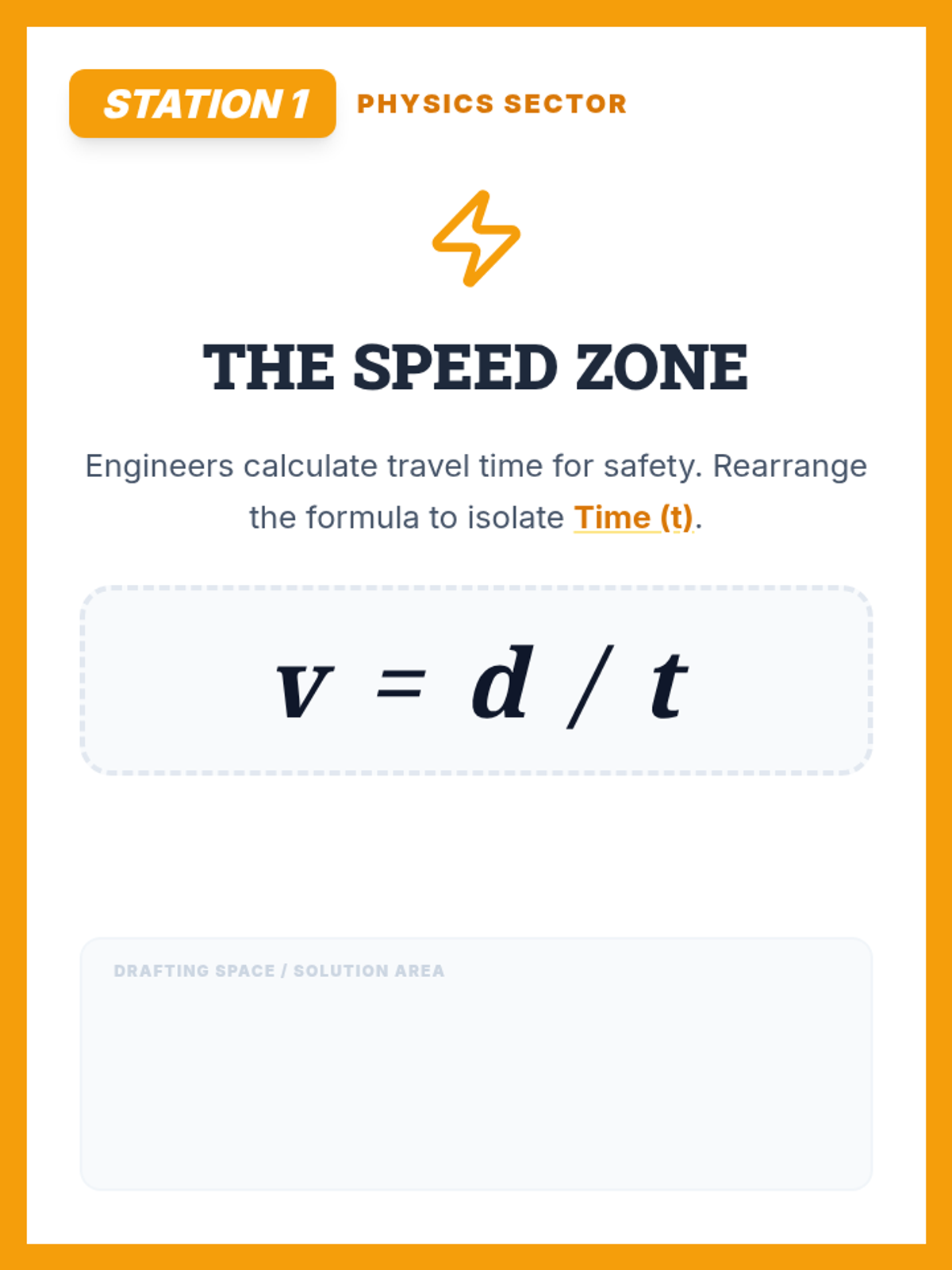
A set of 12 full-page station cards for formula manipulation. Updated to ensure variable casing in instructions exactly matches formula usage. Improved rendering of subscripts and exponents. Added draft areas to each card.
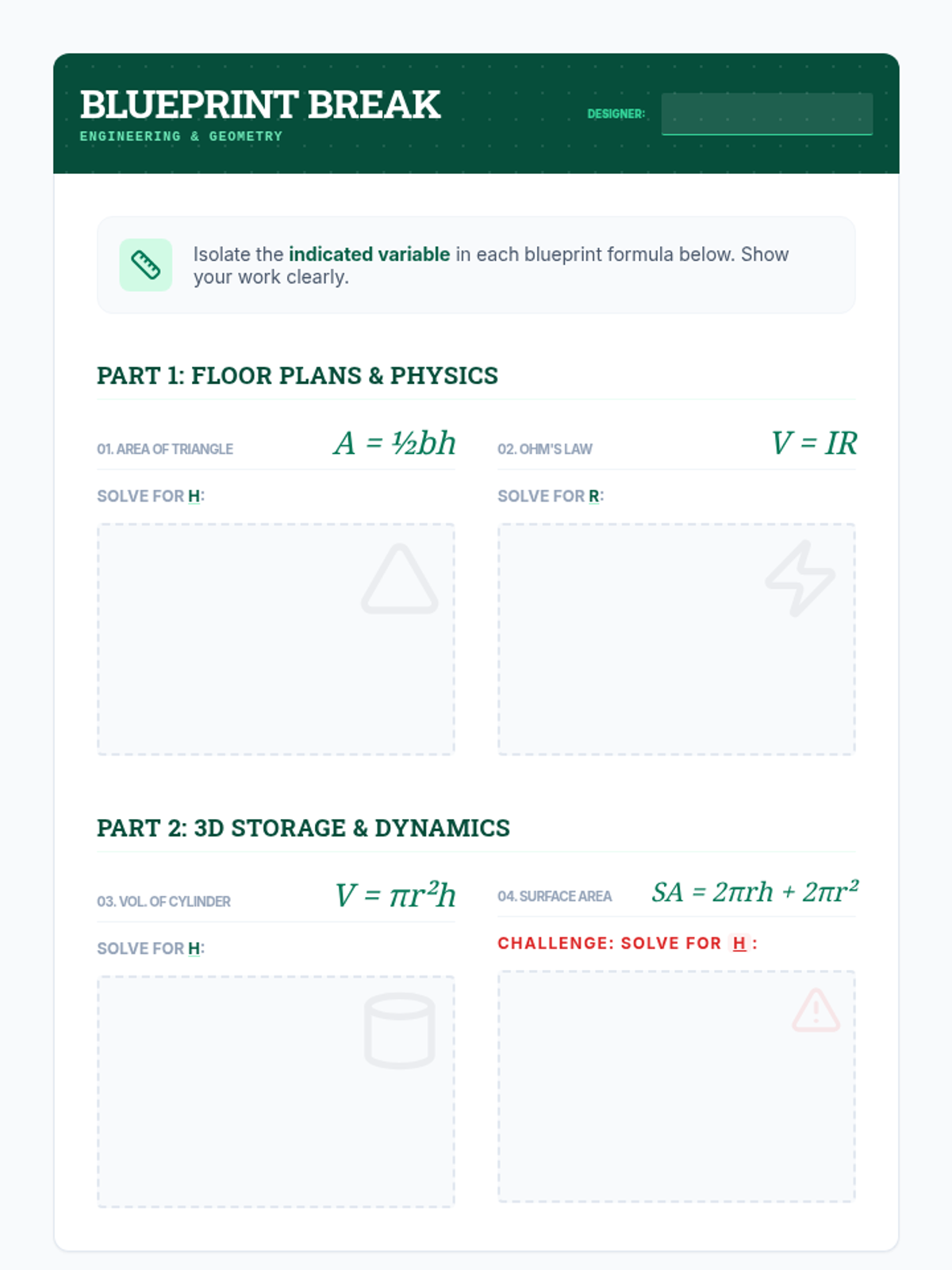
An architectural-themed activity sheet for rearranging formulas. Updated to ensure variable casing in instructions exactly matches formula usage (e.g., 'Solve for m' instead of 'M'). Improved work areas.
Day 2 slides focused on applying literal equation strategies to geometric formulas. Updated to use GERMDAS/SAMDREG terminology as requested.
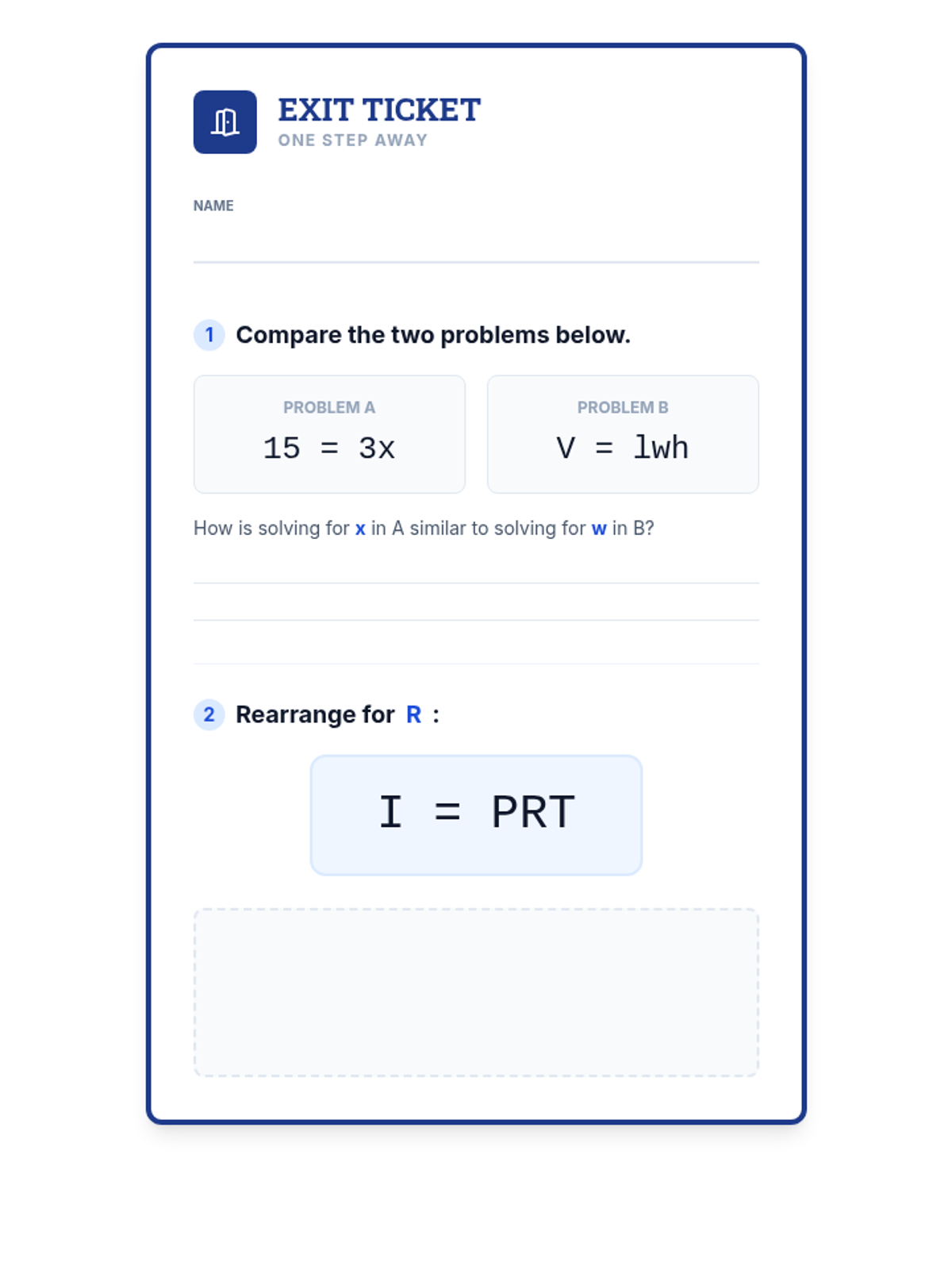
A concise exit ticket to assess students' understanding of the conceptual link between standard equations and literal equations.
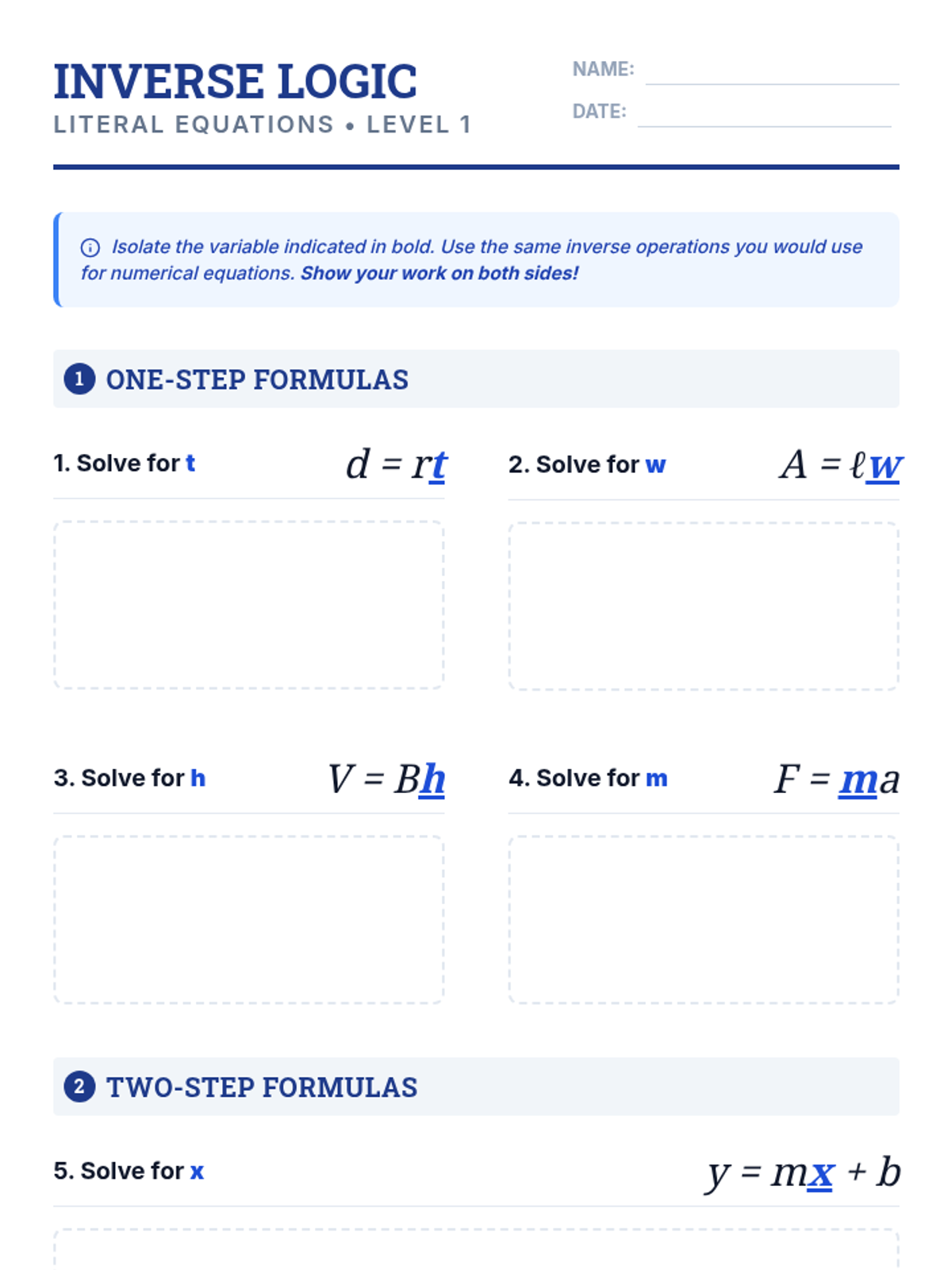
An introductory practice worksheet for literal equations. Updated to ensure the variable casing in instructions exactly matches the formula context (e.g., 'Solve for t' instead of 'T').
An introductory slide deck for literal equations, explaining the logic of isolating variables using inverse operations. Now updated with GERMDAS/SAMDREG context.
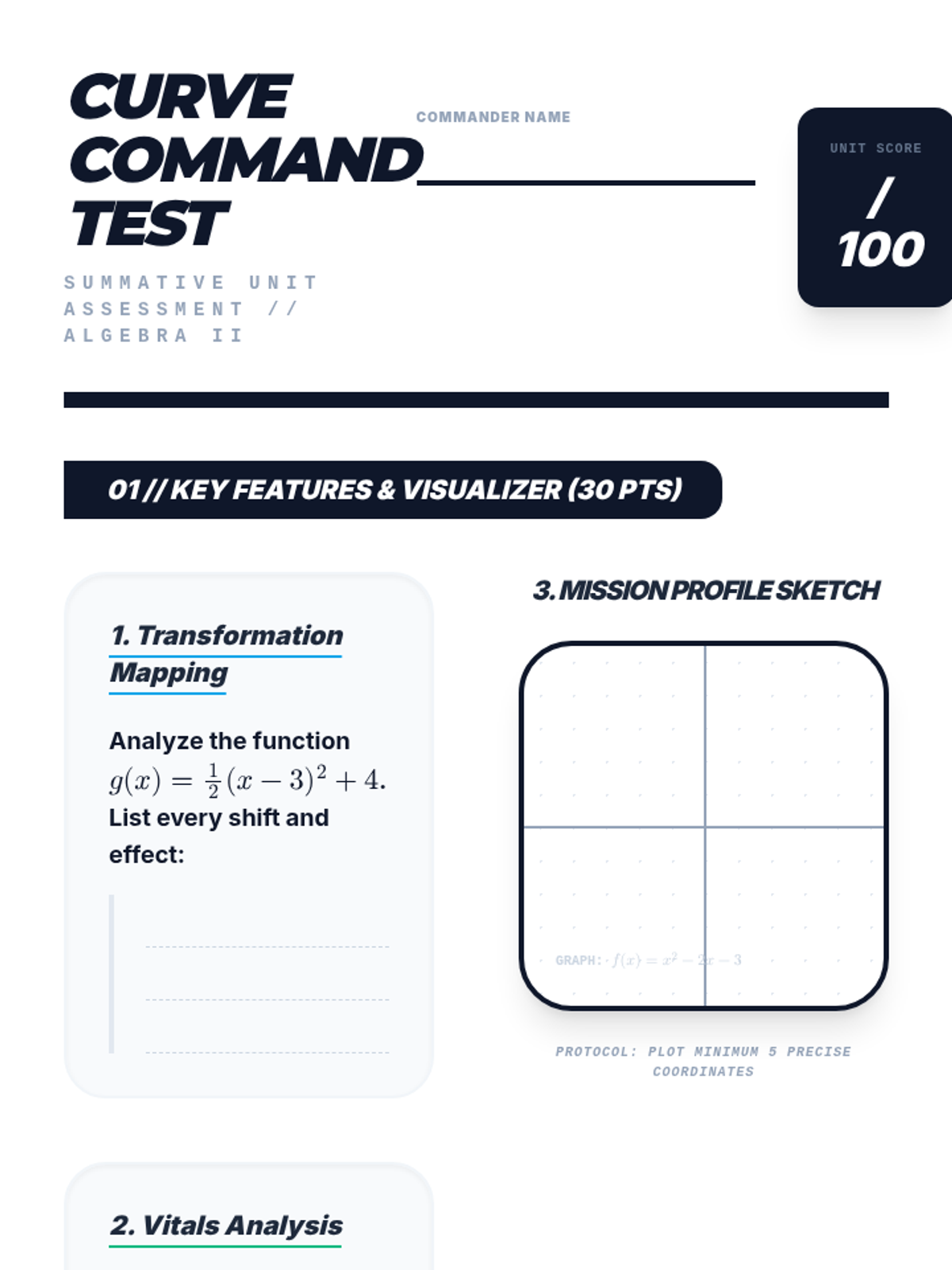
A comprehensive unit test for Algebra II students covering all quadratic targets including transformations, graphing, features, and solving methods.
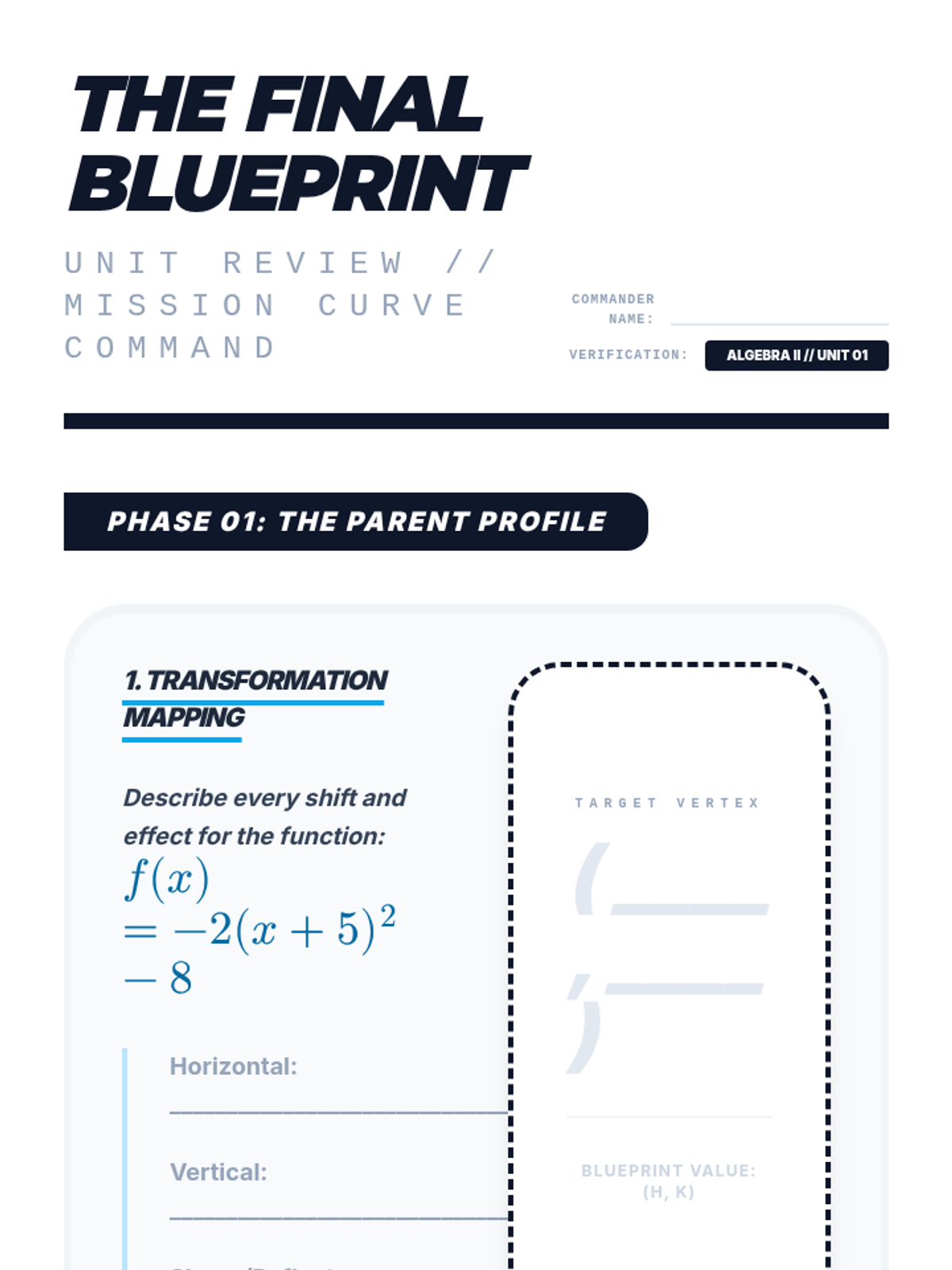
A comprehensive unit review packet covering parent functions, key features from standard form, and all solving methods for quadratic equations.
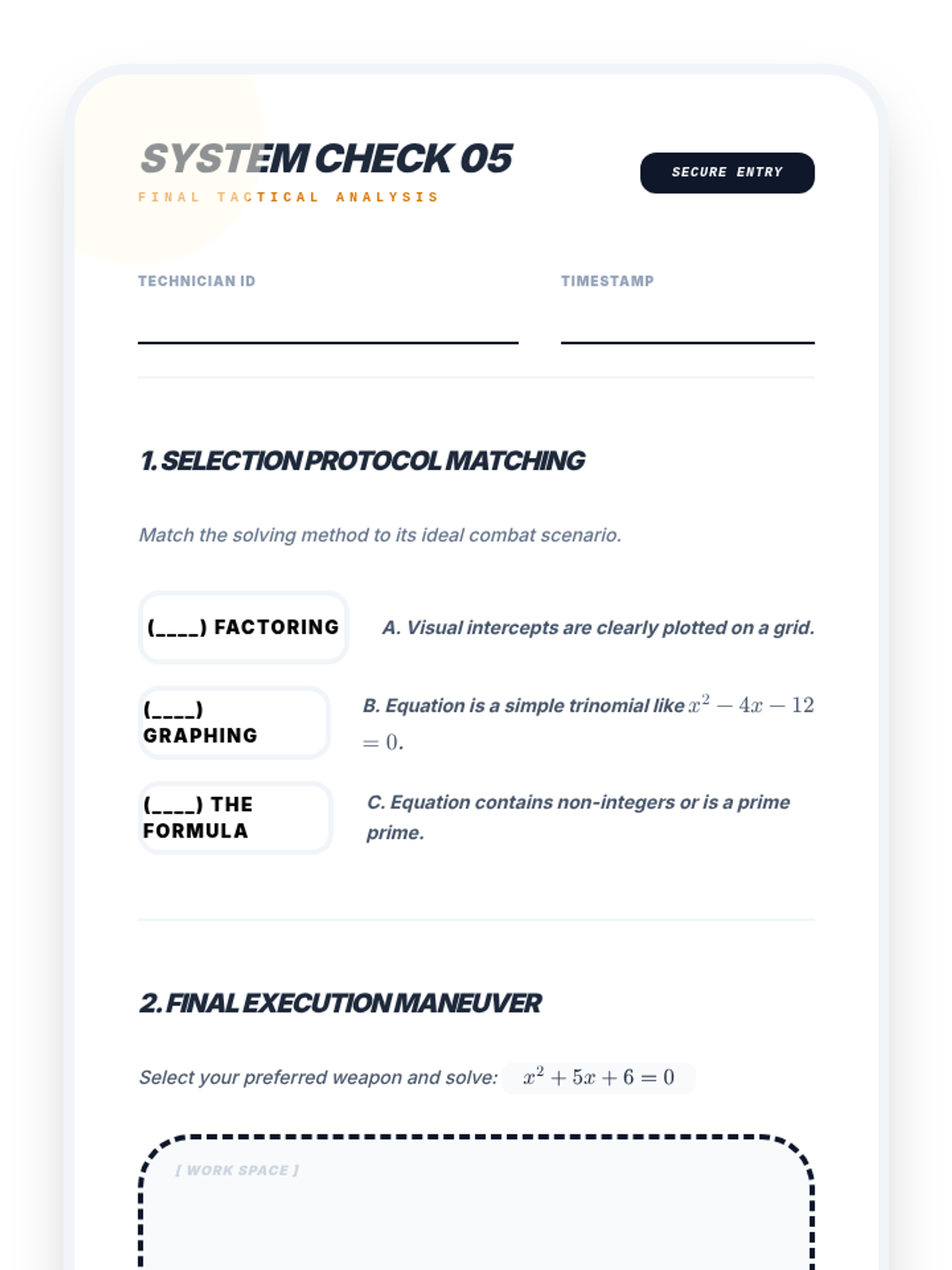
A formative assessment to evaluate students' ability to select and apply different quadratic solving methods correctly.
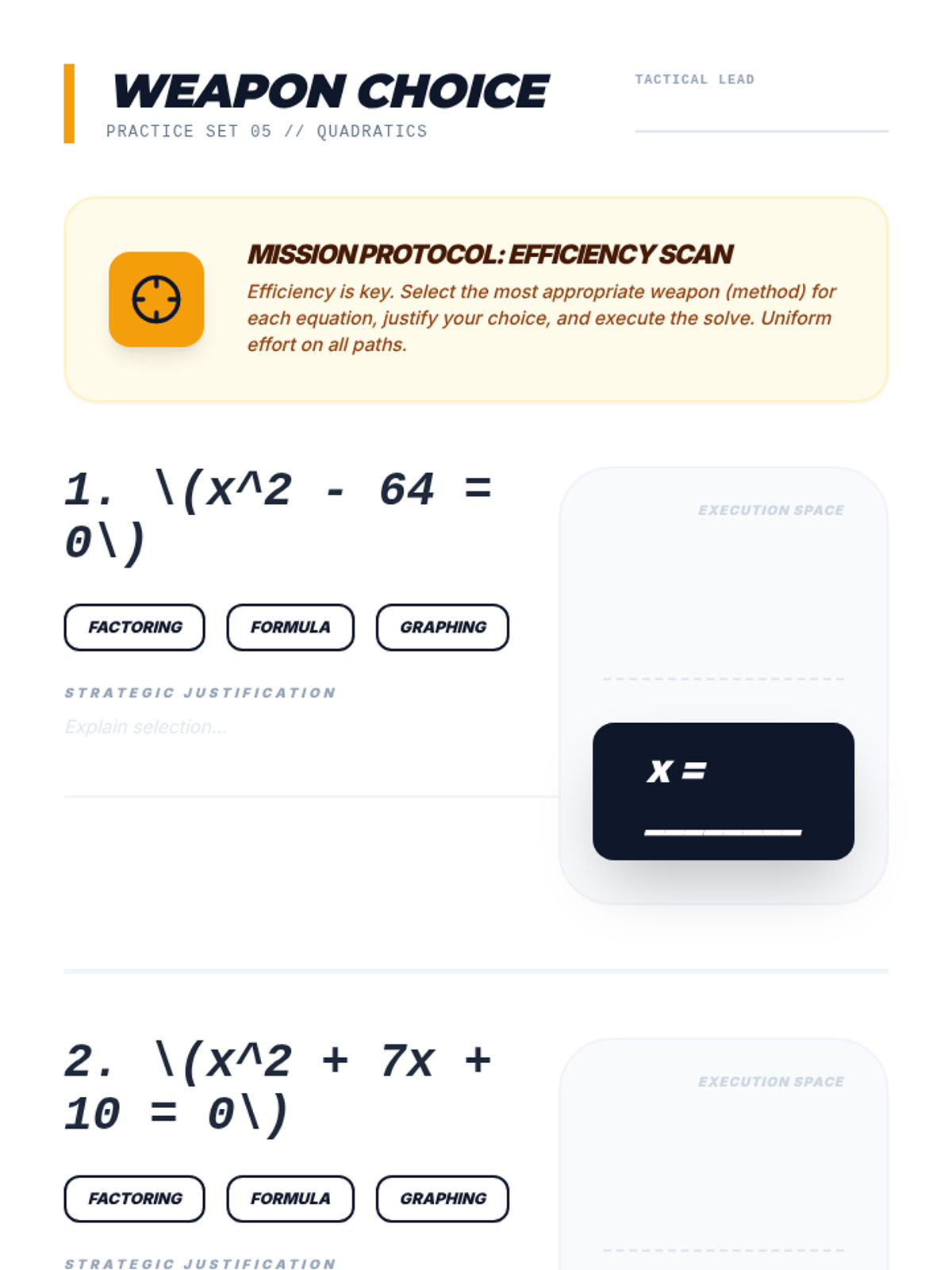
A worksheet focusing on identifying the most efficient method to solve a quadratic equation and executing the solution.
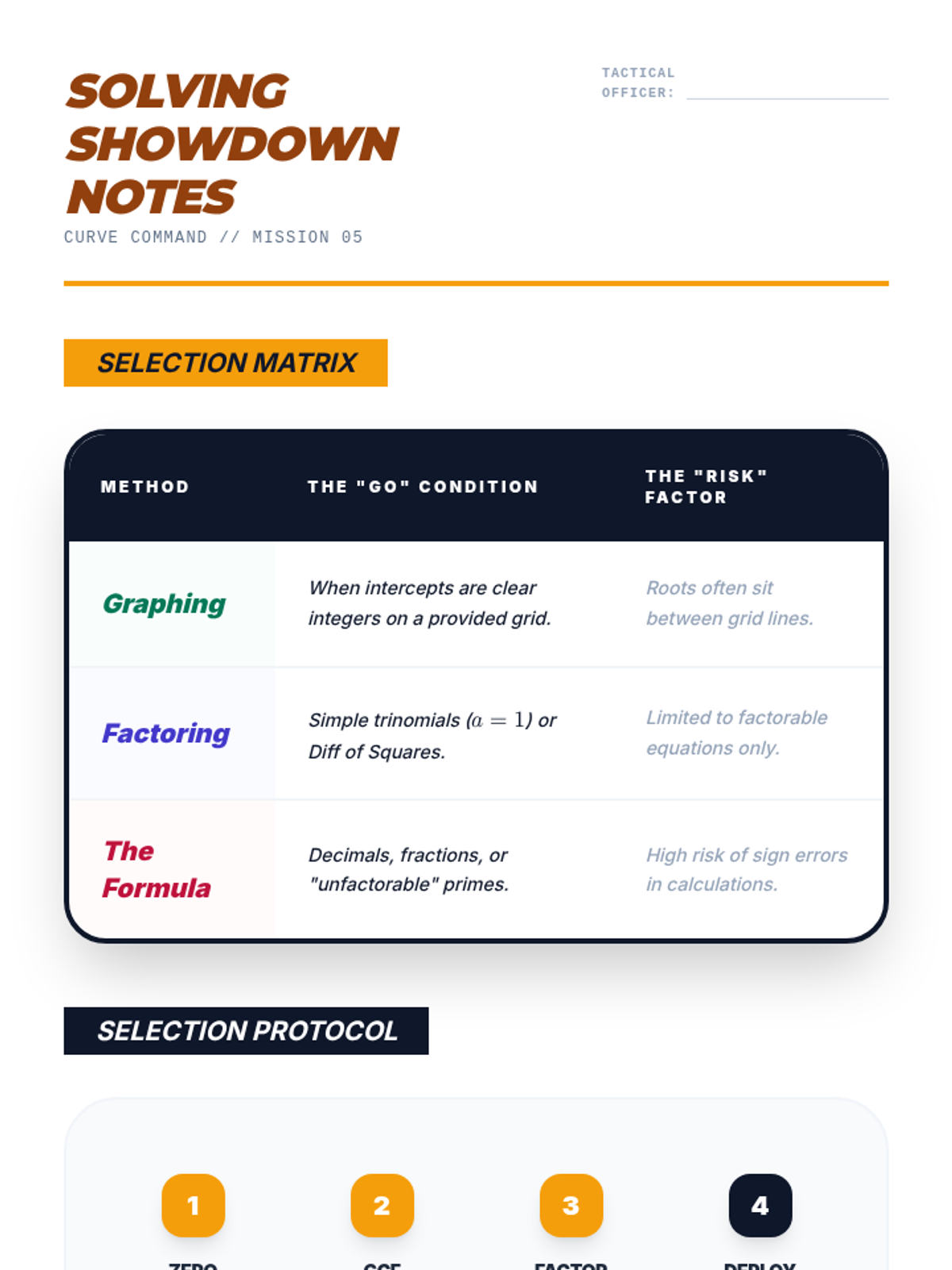
Guided notes for Lesson 5, focusing on strategy selection for solving different types of quadratic equations.
A slide deck comparing solving methods for quadratic equations, helping students decide when to graph, factor, or use the formula.
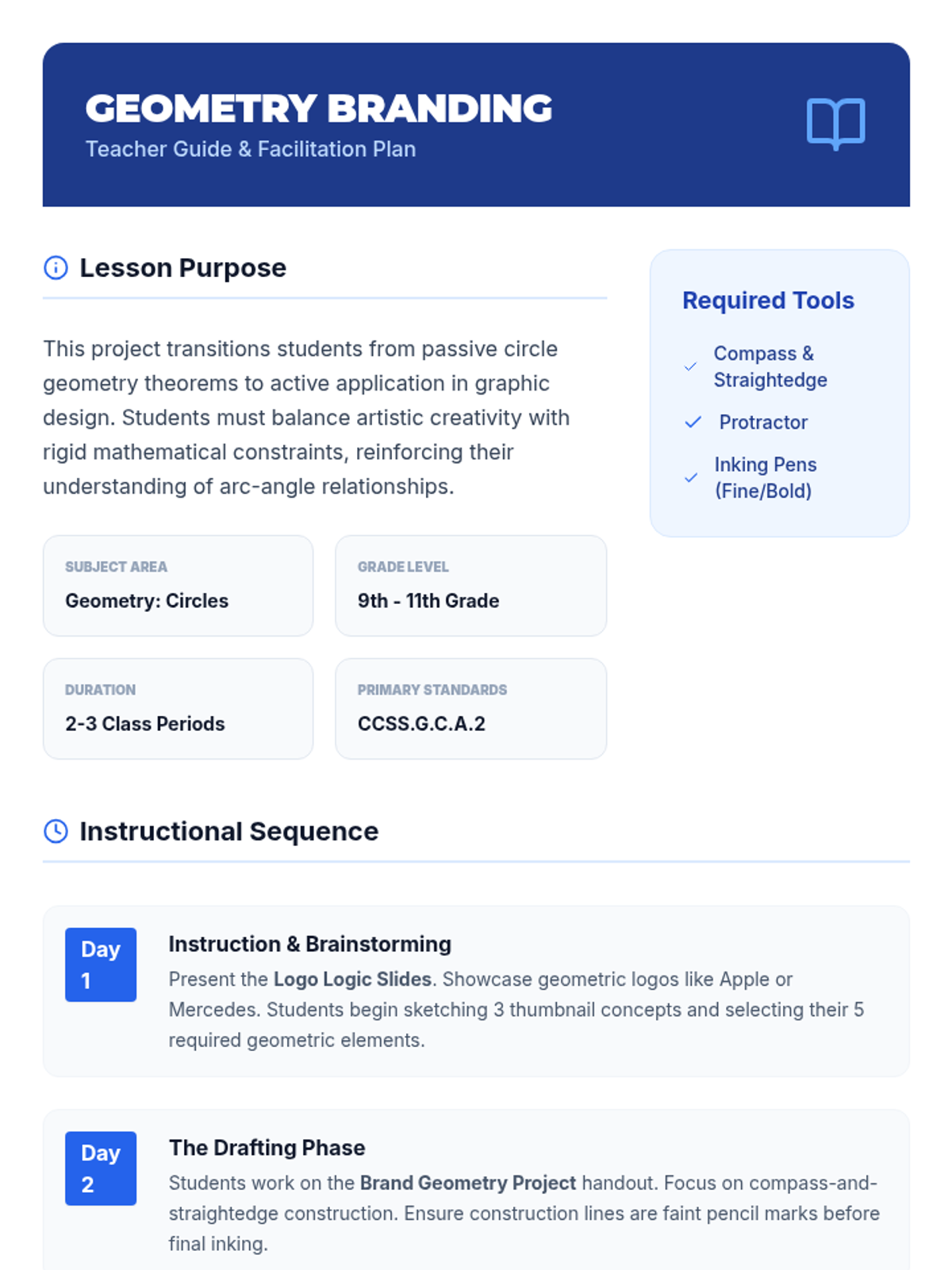
A comprehensive teacher guide for facilitating the Logo Logic project. Includes lesson pacing, a list of required materials, common student misconceptions to watch for, and strategies for differentiation.
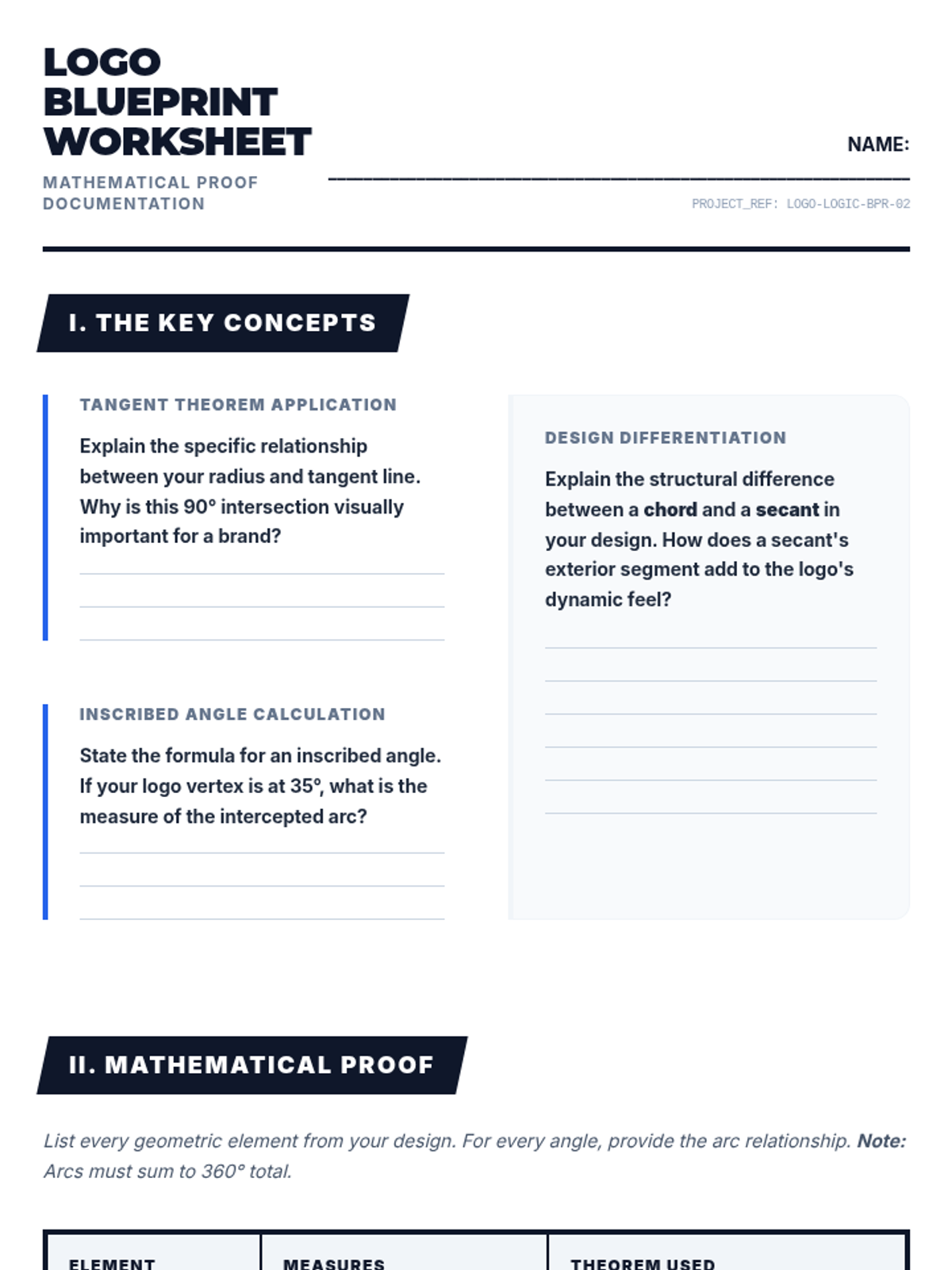
A structured worksheet for students to document the geometric proofs behind their logo design. It includes a table for recording measures of tangents, secants, and angles, plus reflection questions on the design process.
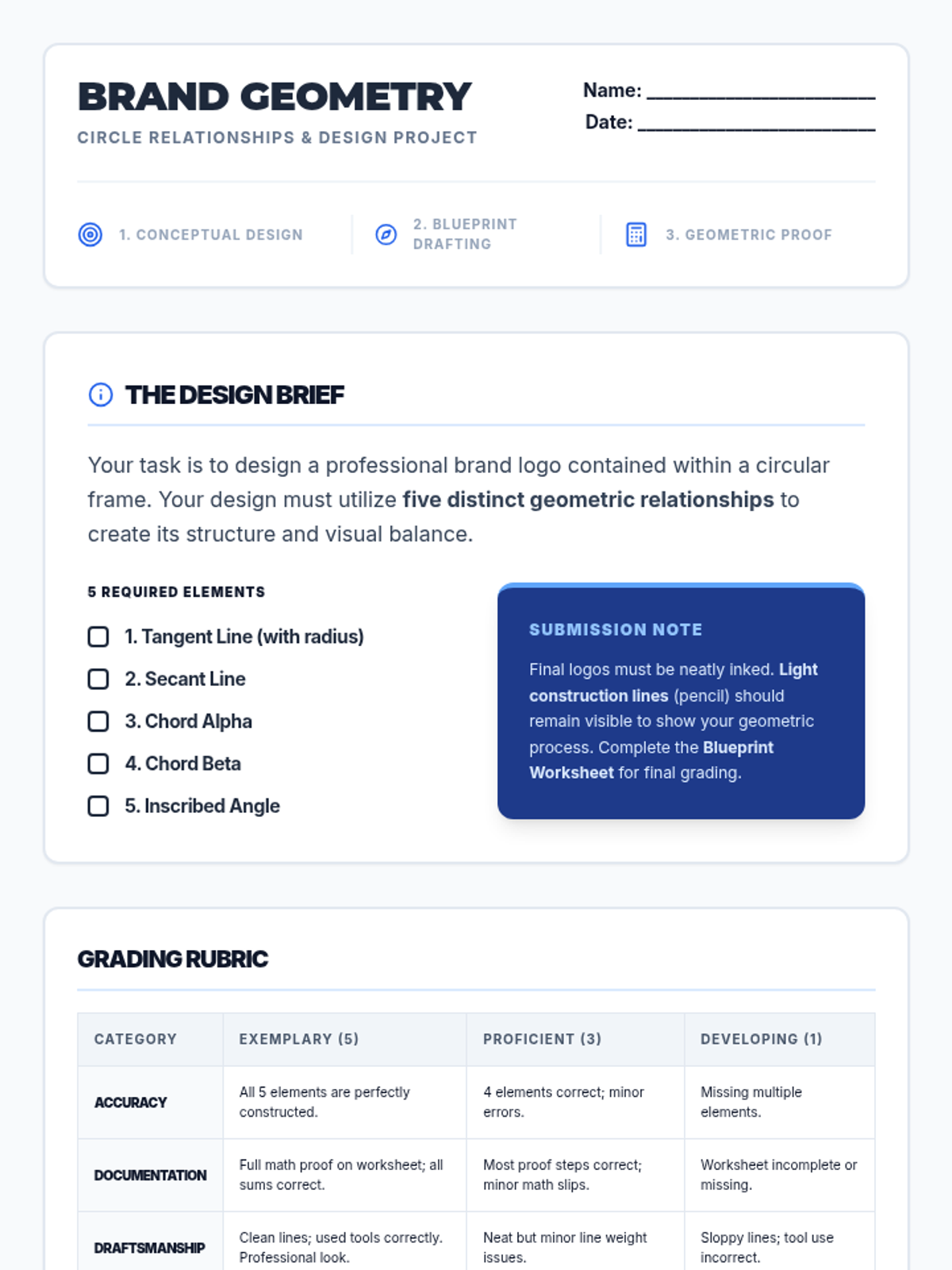
A comprehensive student project handout for the Brand Geometry project. Includes design constraints, a workspace for drafting, and a detailed grading rubric based on geometric accuracy and creative execution.
A visual presentation introducing circle geometry concepts (tangents, secants, chords, inscribed angles) through the lens of professional logo design. Includes architectural diagrams and project requirements.
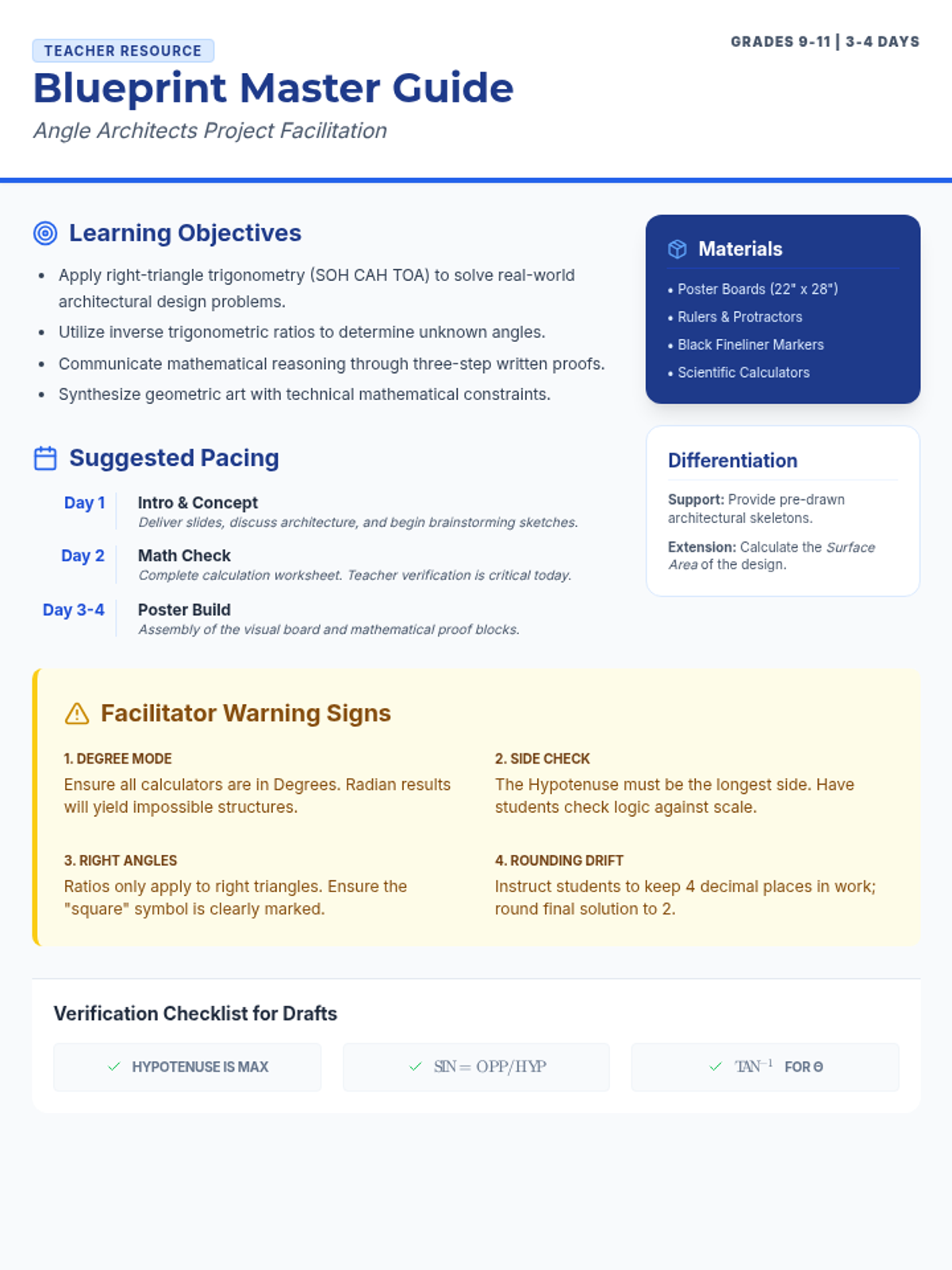
A comprehensive teacher's guide for the Angle Architects project, including pacing, materials, differentiation strategies, and common student misconceptions.
An introductory presentation for the Angle Architects project, covering real-world trig applications, SOH CAH TOA review, and project expectations.
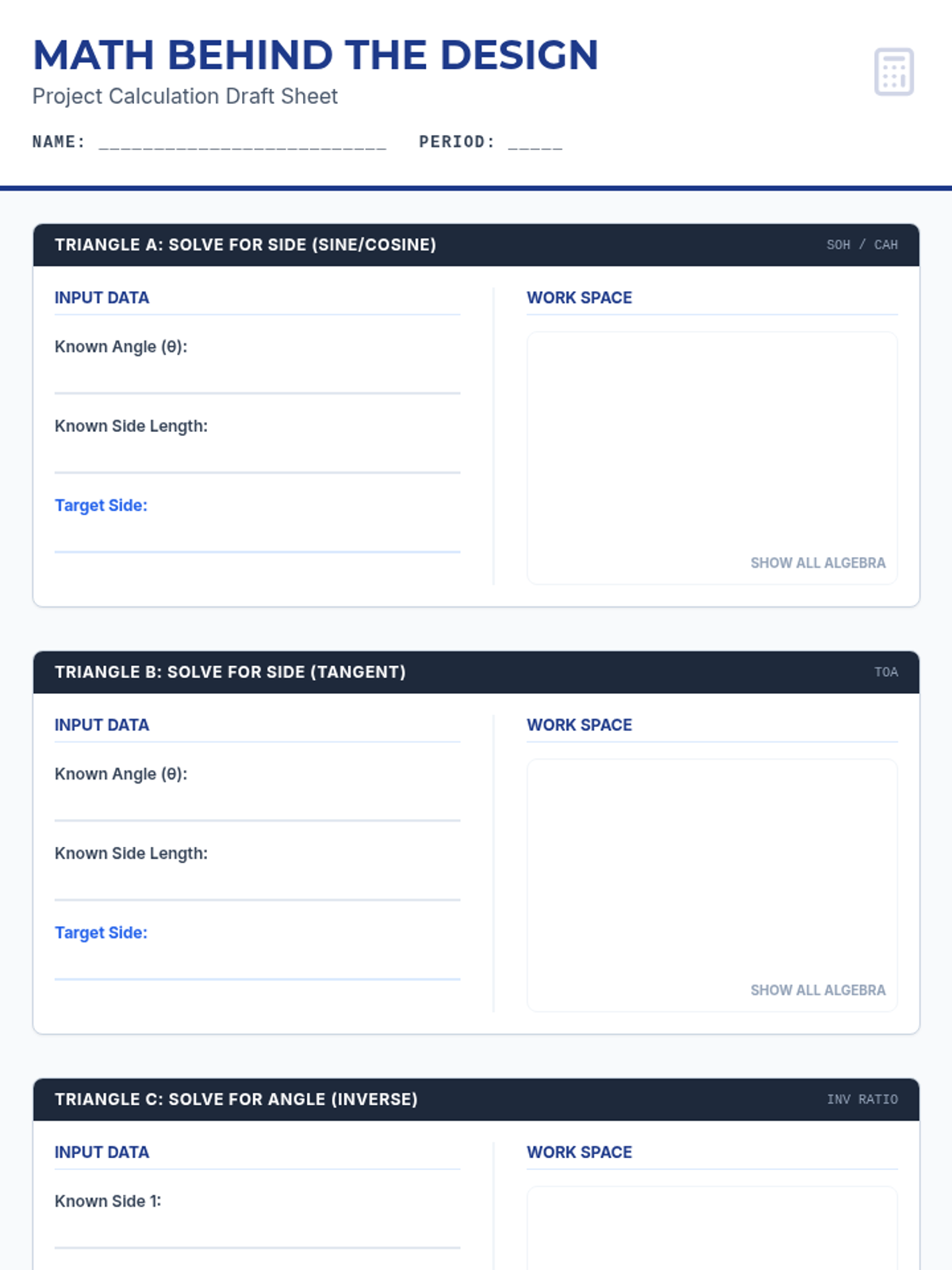
A structured worksheet for students to perform and check their step-by-step trigonometry calculations before transferring them to their final project poster.
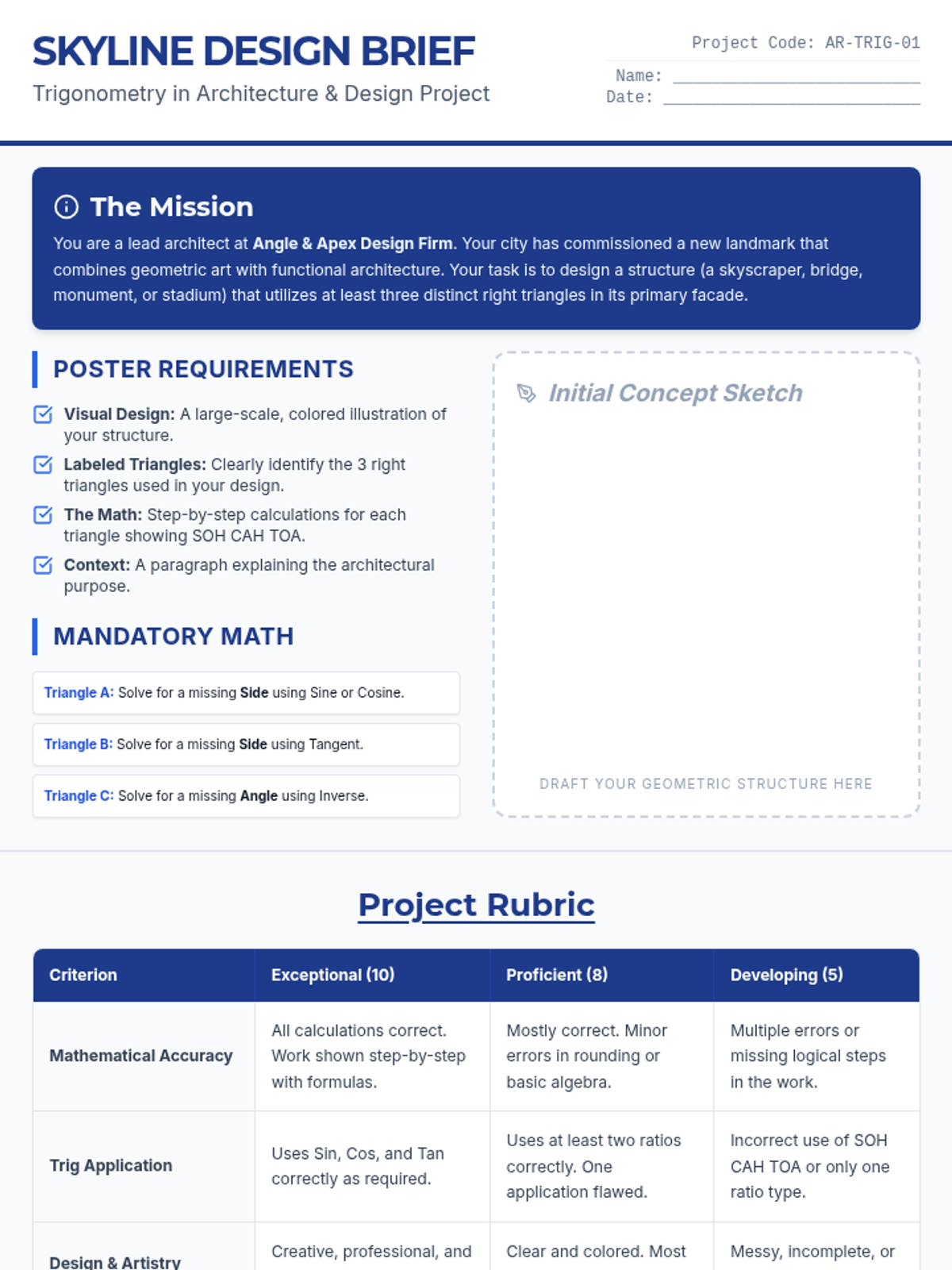
A student project brief for designing an architectural structure using trigonometry, including requirements, a sketch area, and a detailed grading rubric.
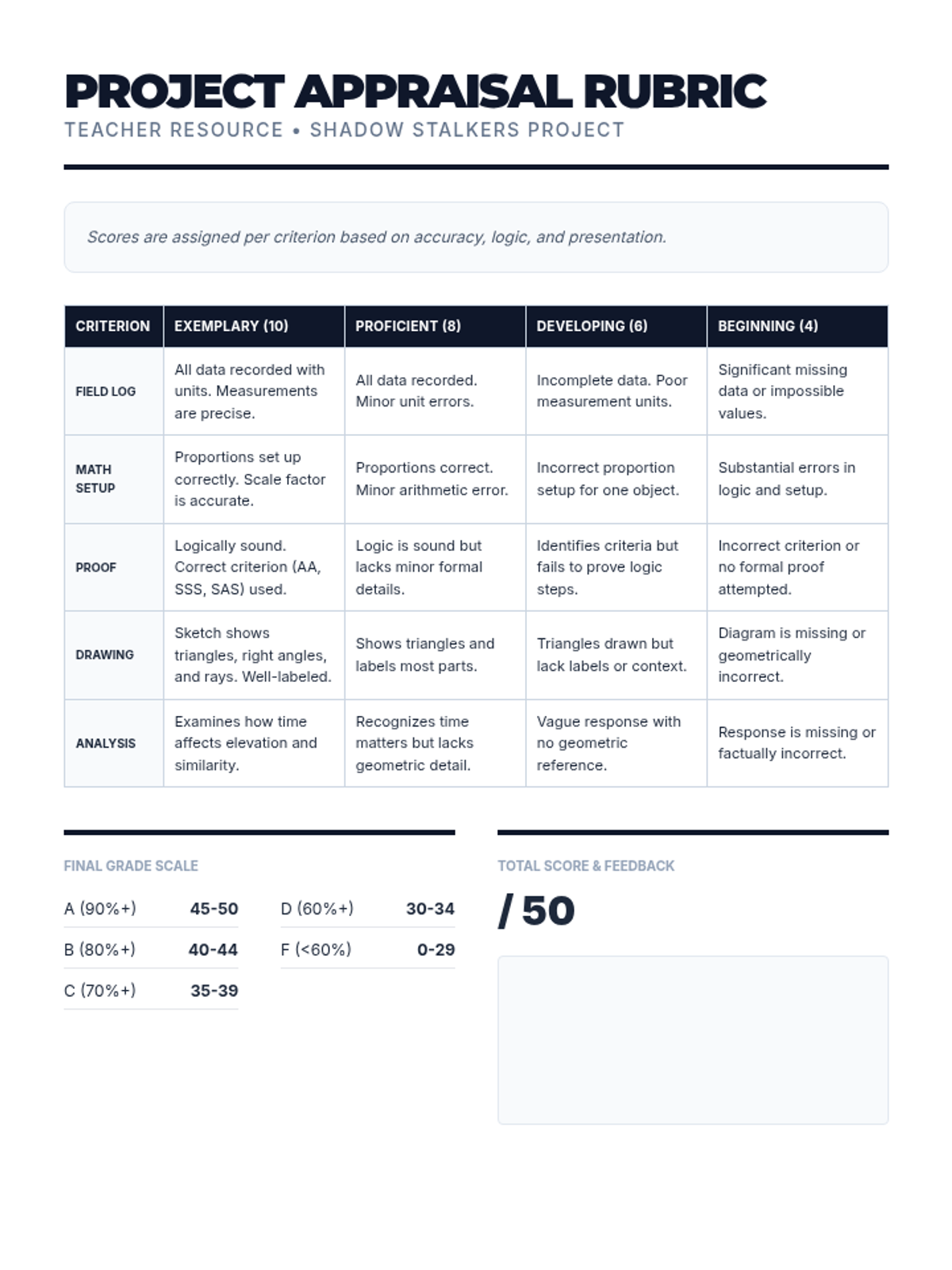
Comprehensive scoring rubric for the Shadow Stalkers project, assessing field measurements, mathematical proportions, geometric proofs, diagram accuracy, and conceptual understanding.
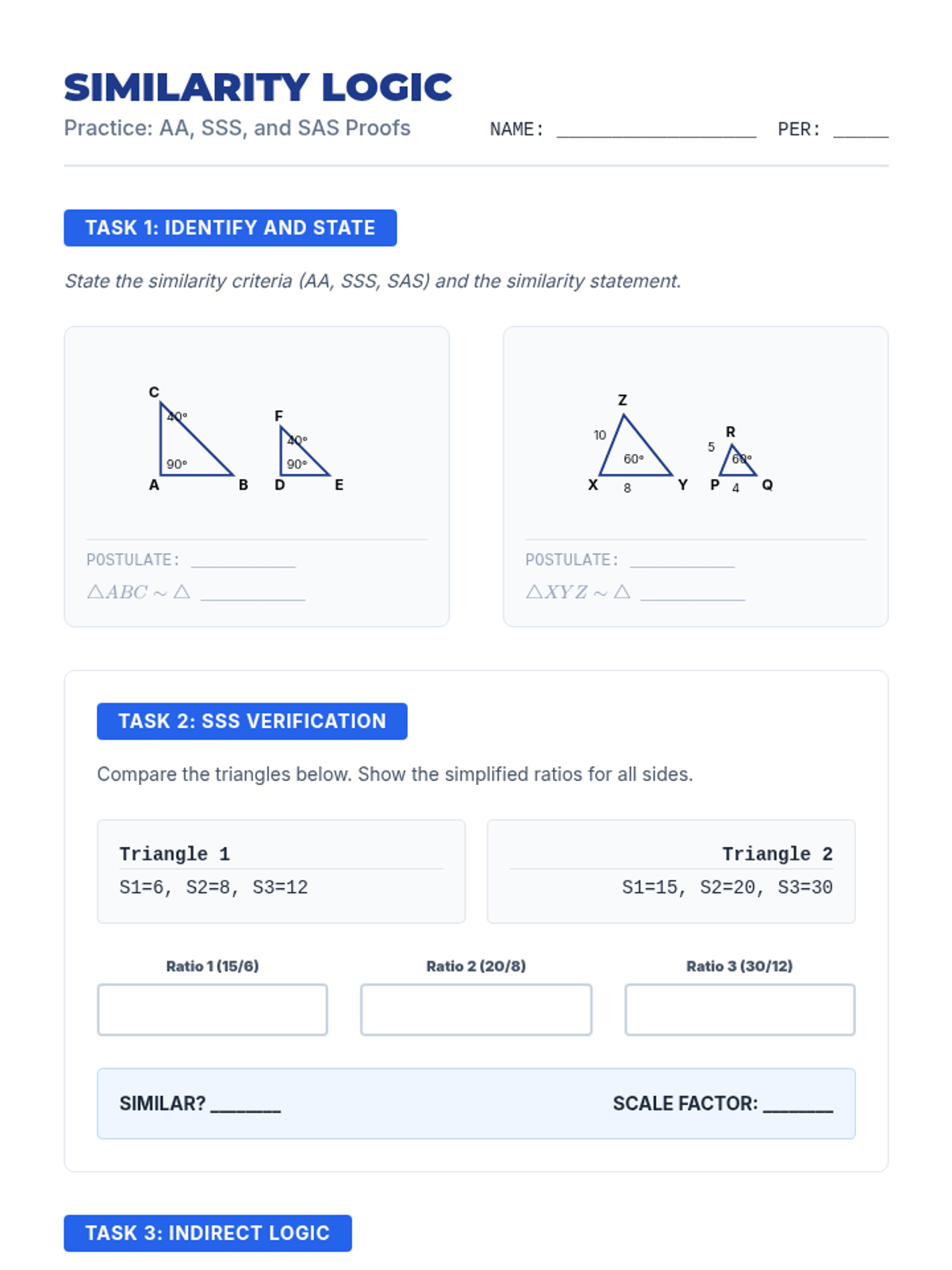
Worksheet focusing on the geometric logic of similarity. Includes problems identifying similarity using AA, SAS, and SSS, verifying proportional sides for SSS, and a formal proof for nested triangles with parallel lines.
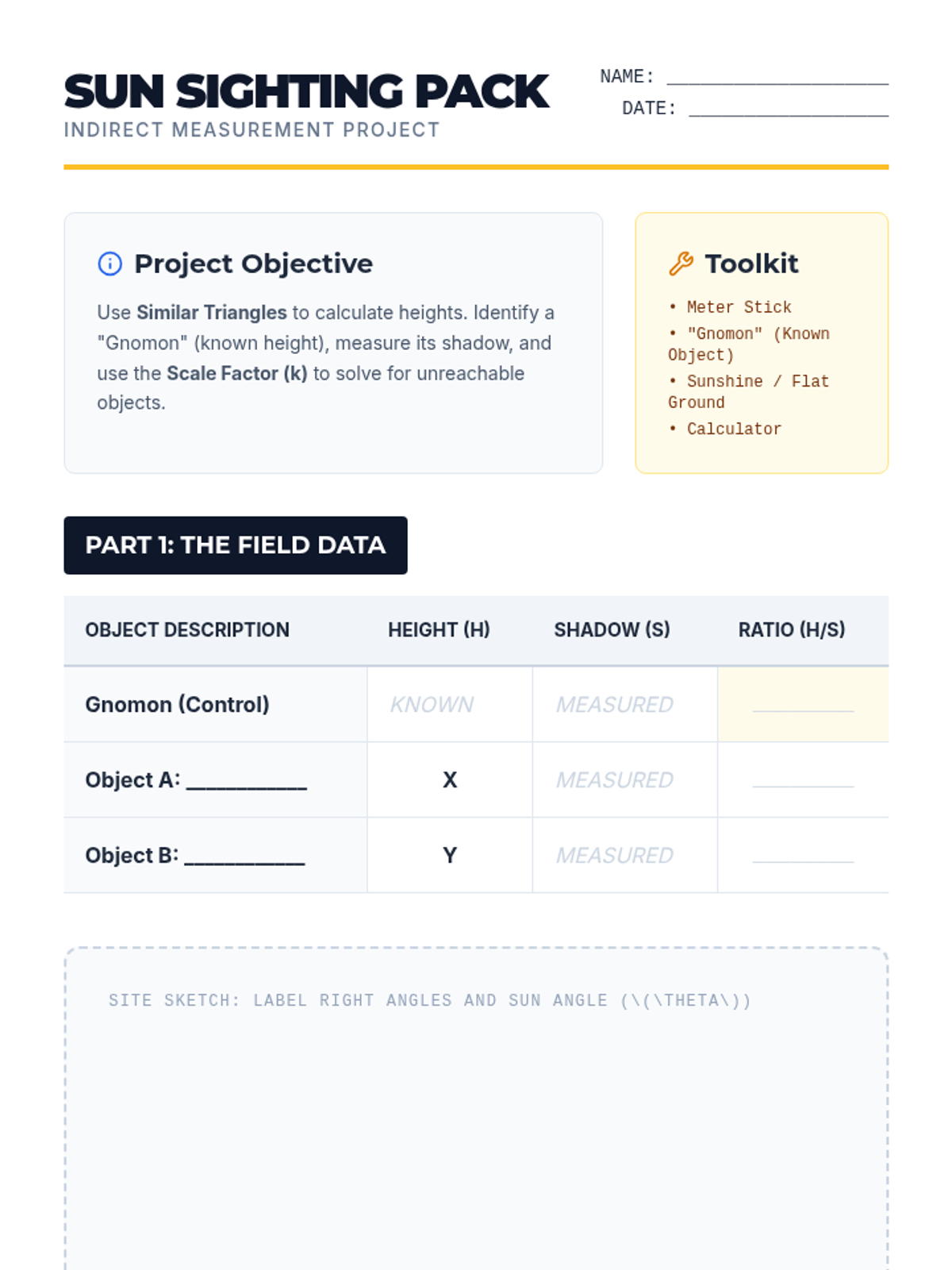
Student project packet for the Shadow Stalkers project. Includes a field log for measurements, calculation workspace for proportions and scale factors, and a formal two-column proof section to justify the use of AA similarity.
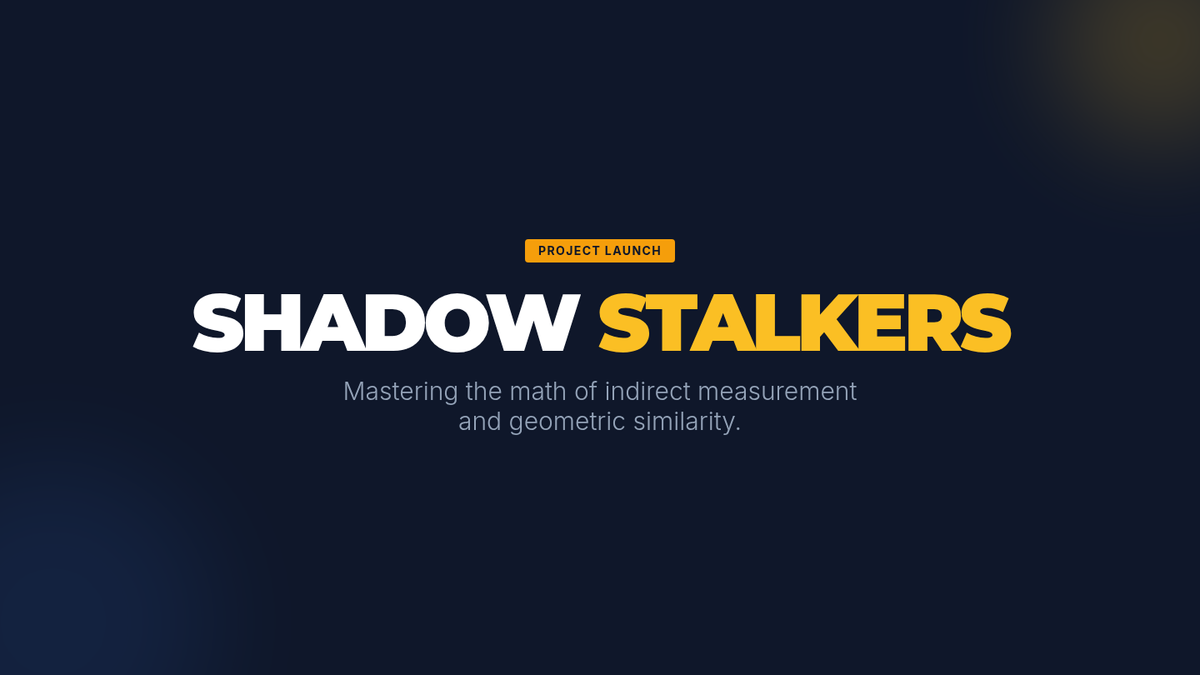
Introduction slides for the Shadow Stalkers project, covering the concept of indirect measurement, AA similarity postulate with the sun's rays, and the project requirements.
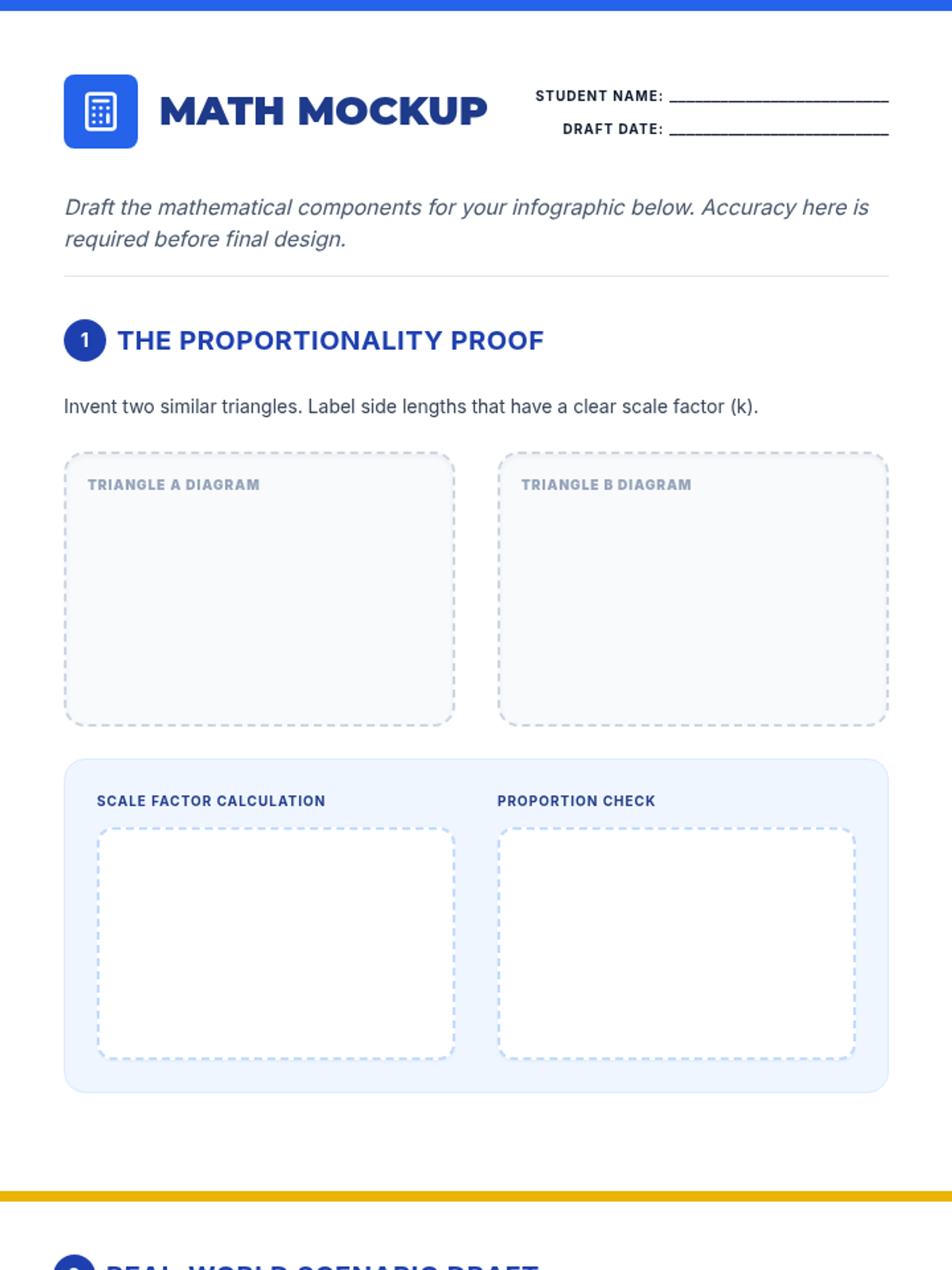
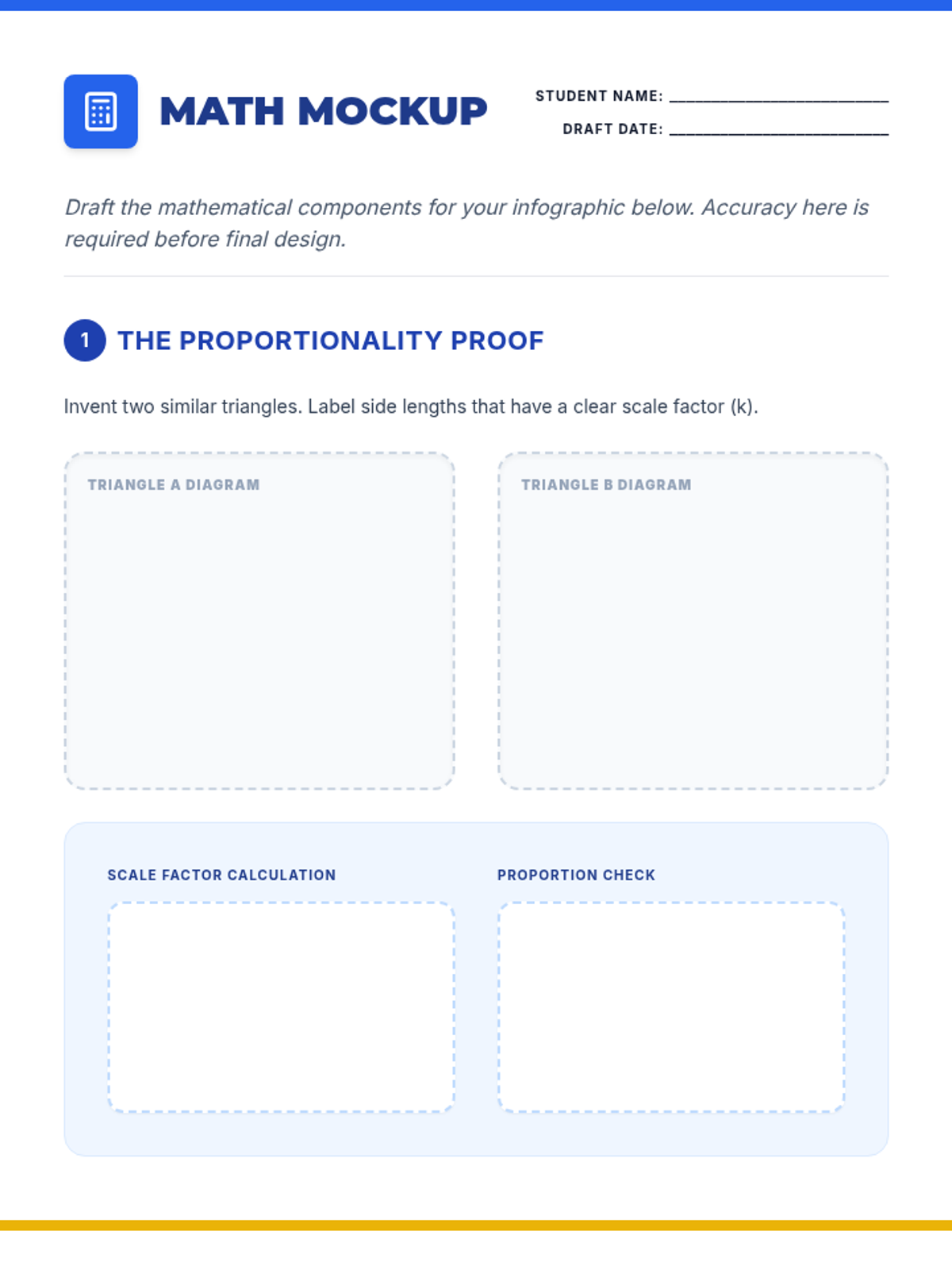
A mathematical planning worksheet for students to draft their triangle similarity calculations and real-world scenarios before final poster production.
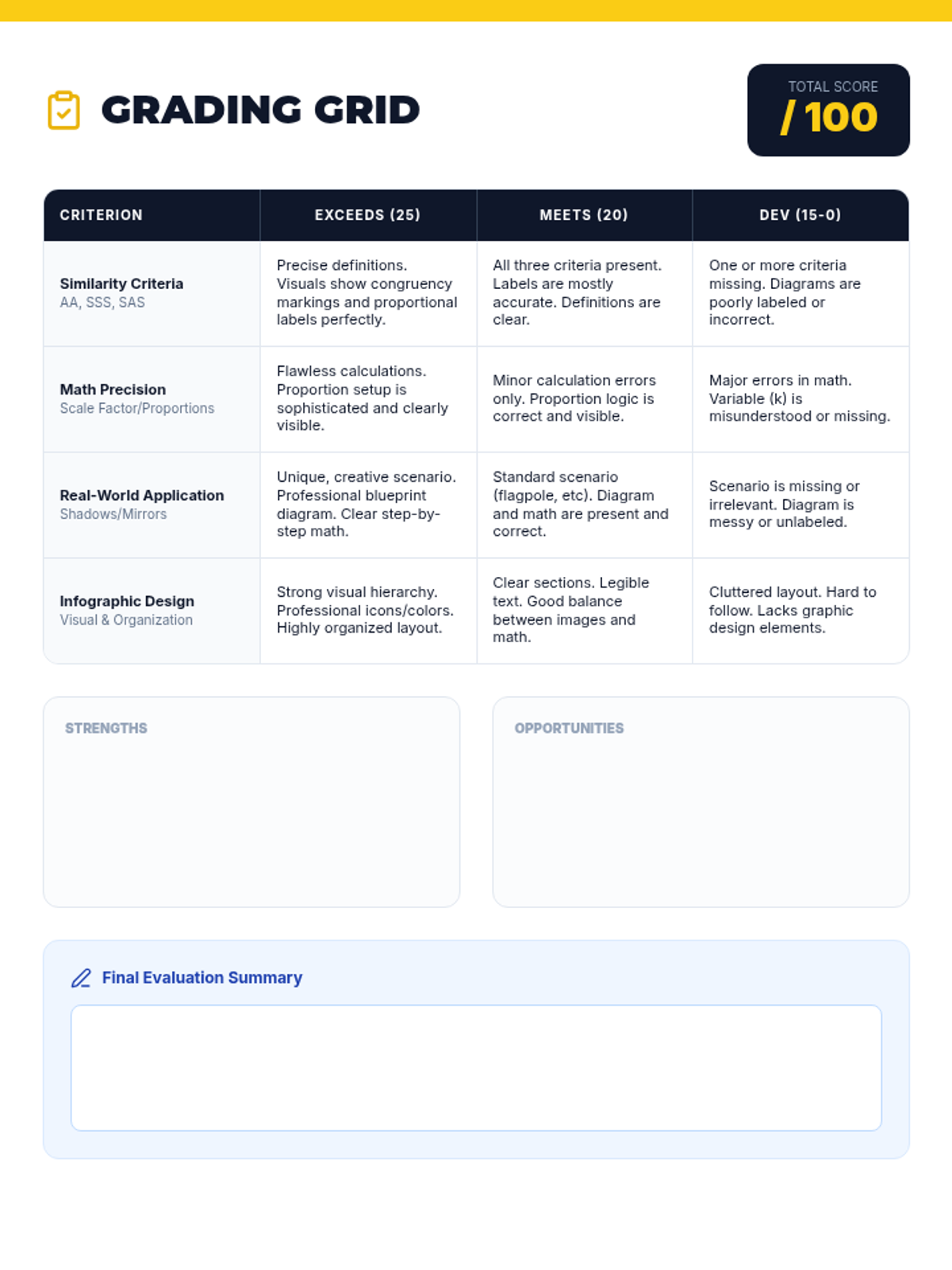
A professional grading rubric for teachers to evaluate the Similar Triangles Infographic project, including feedback sections.
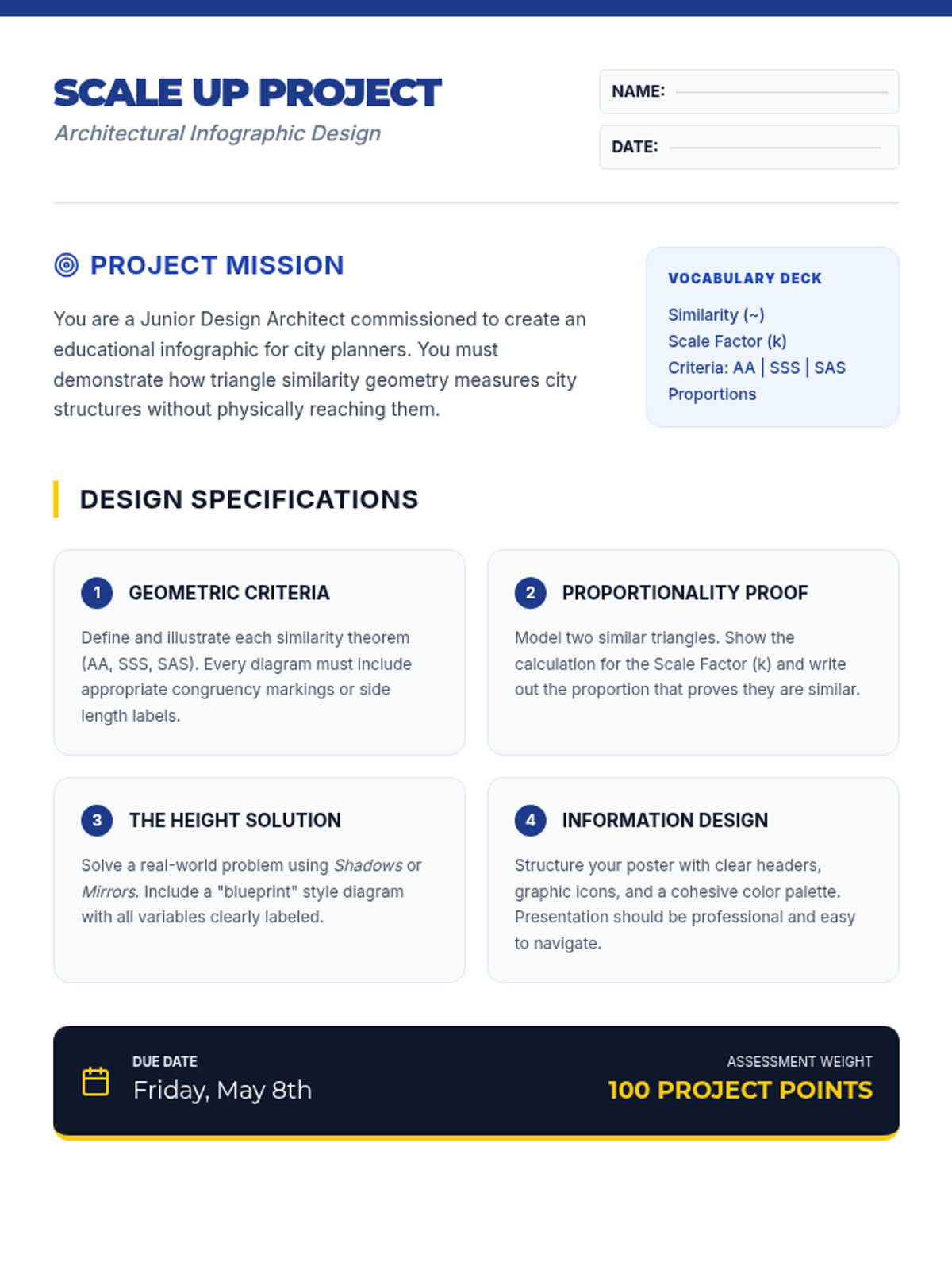
Student instructions and requirements for the Similar Triangles Infographic project, styled as an architectural mission.
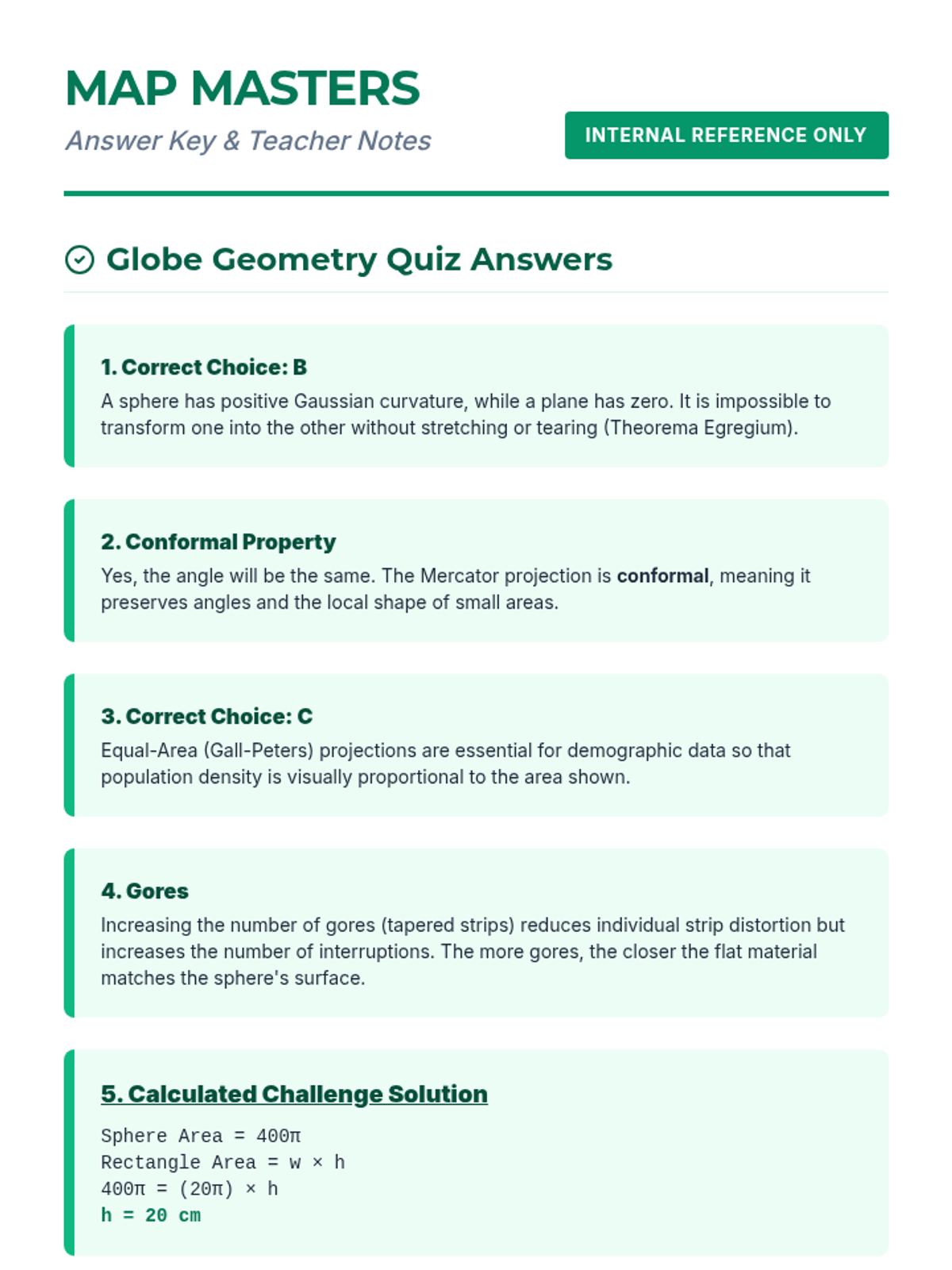
Teacher-facing answer key and instructional notes for the quiz and worksheet, including step-by-step mathematical solutions and tips for addressing common student misconceptions.
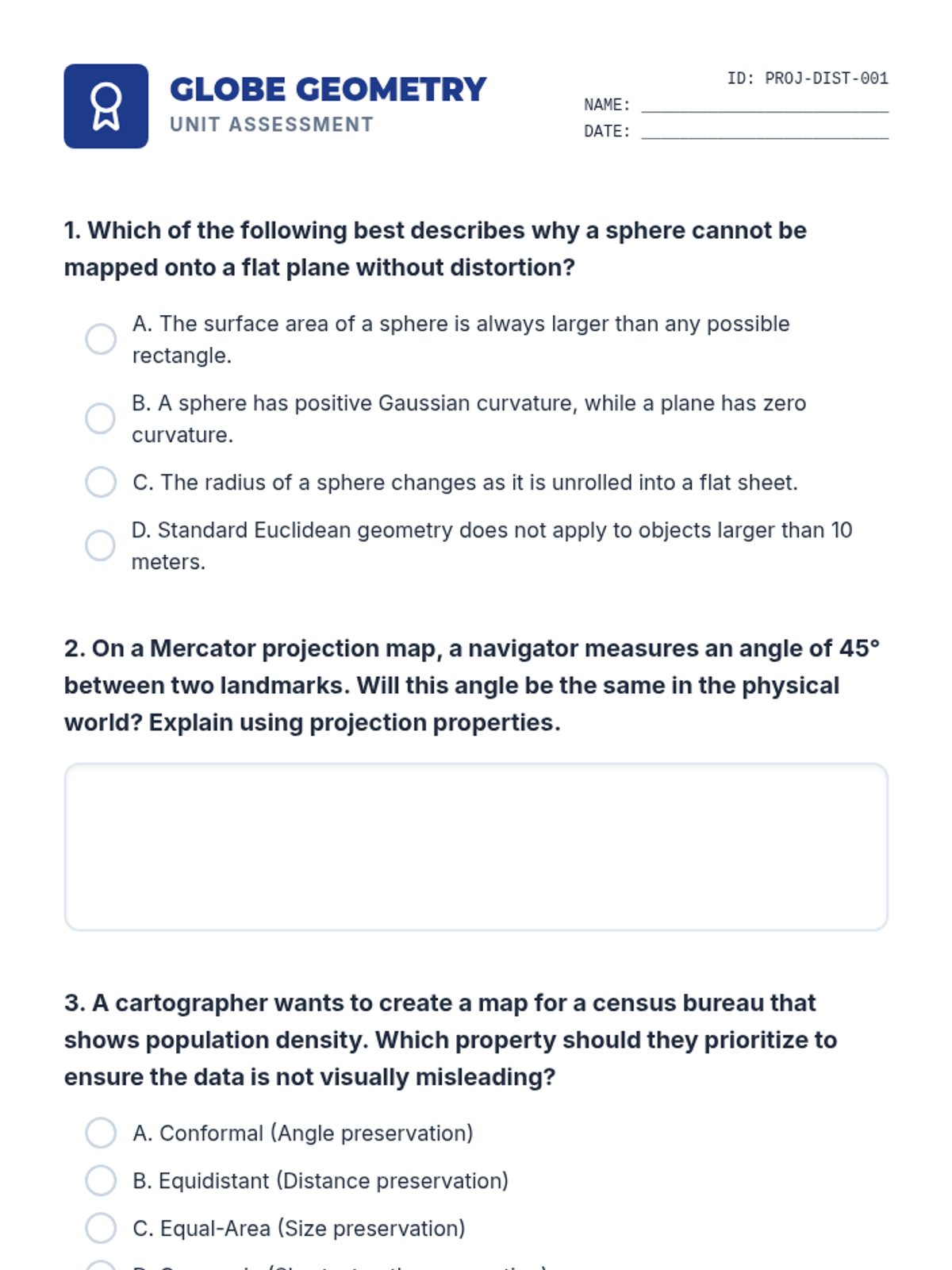
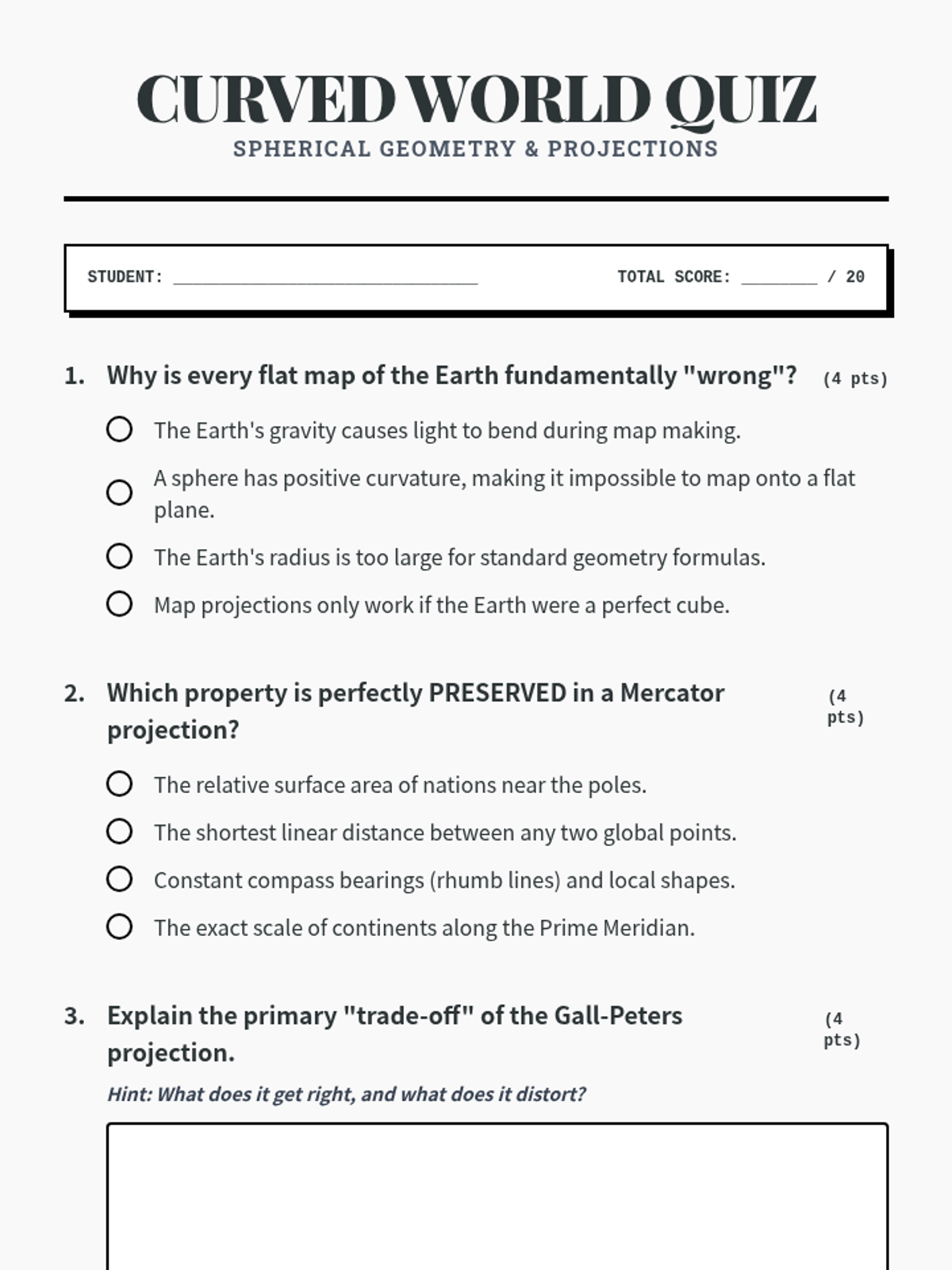
Assessment covering the mathematical principles of map projection, including Gaussian curvature, projection properties, and a calculation challenge related to surface area.
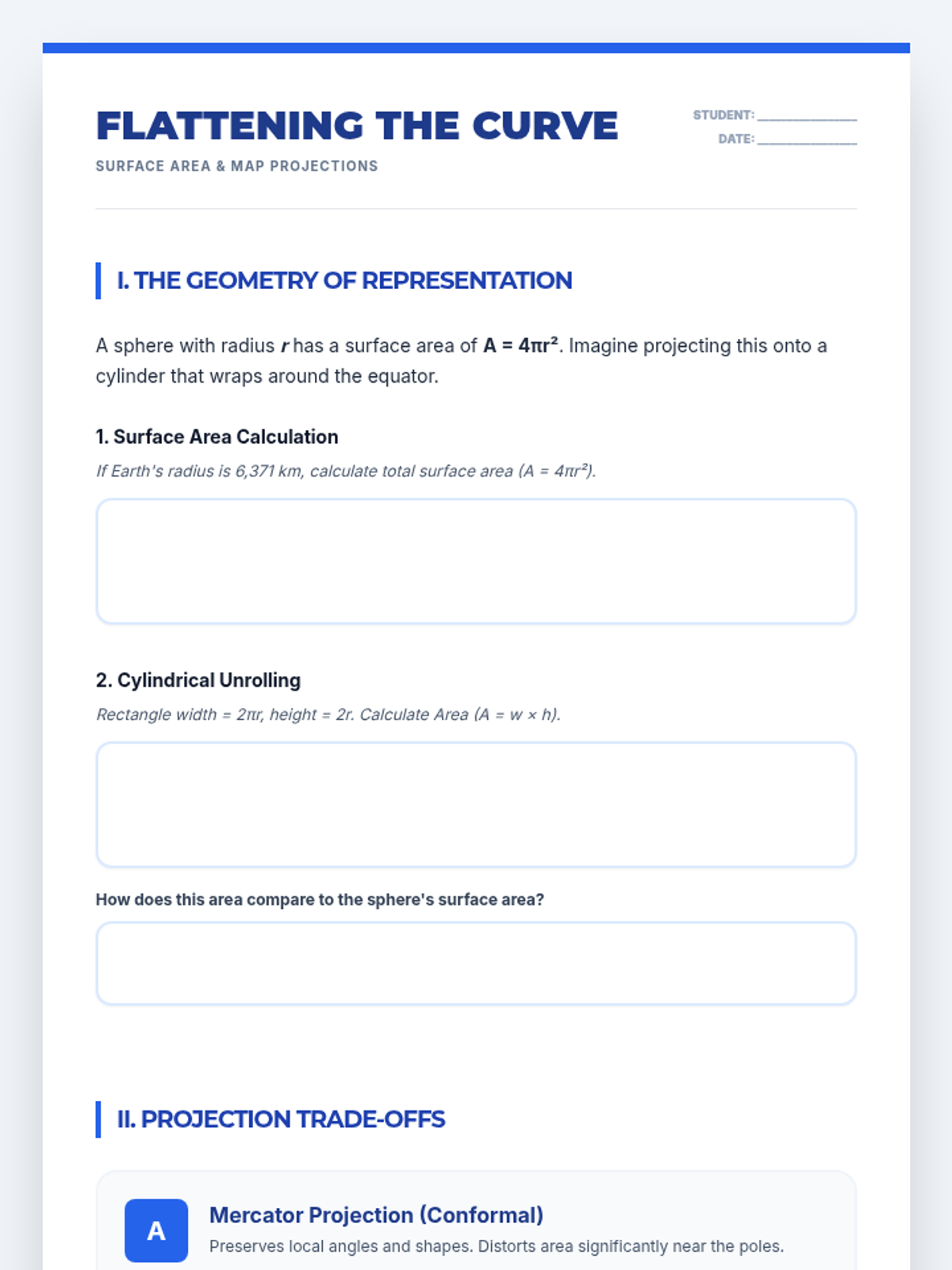
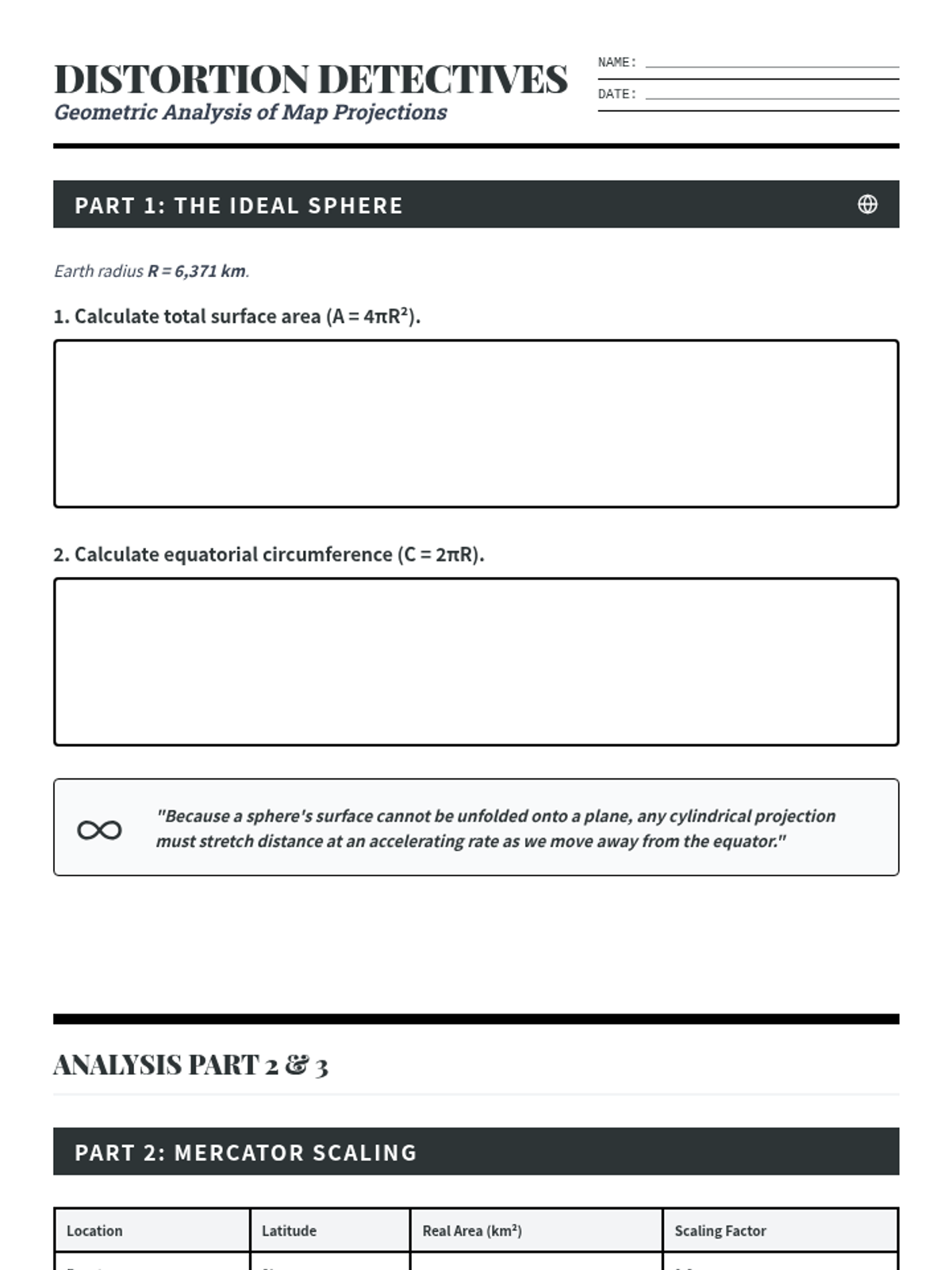
Mathematical worksheet analyzing surface area differences between a sphere and a cylindrical projection, requiring students to perform geometric calculations and evaluate projection trade-offs.
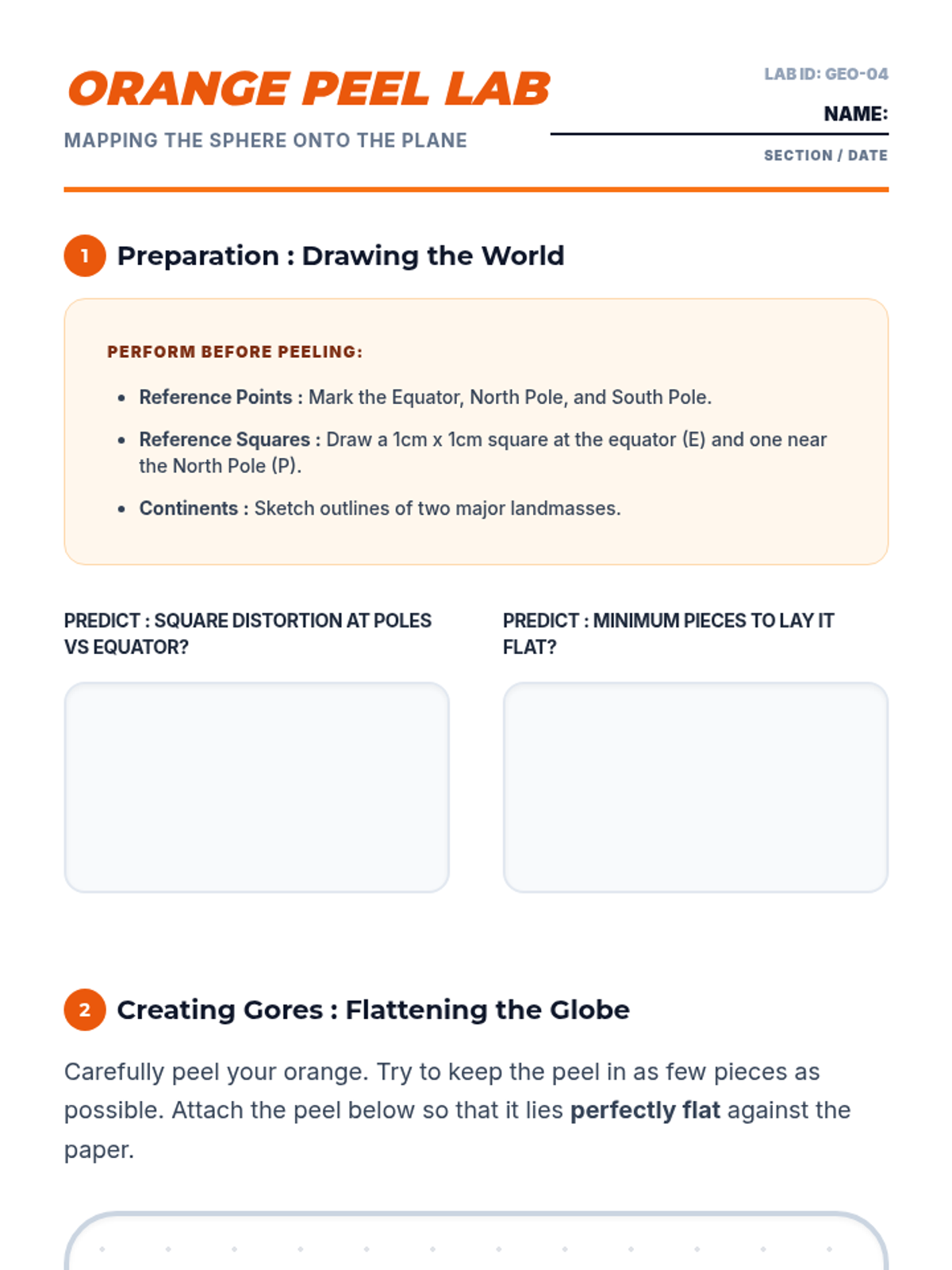
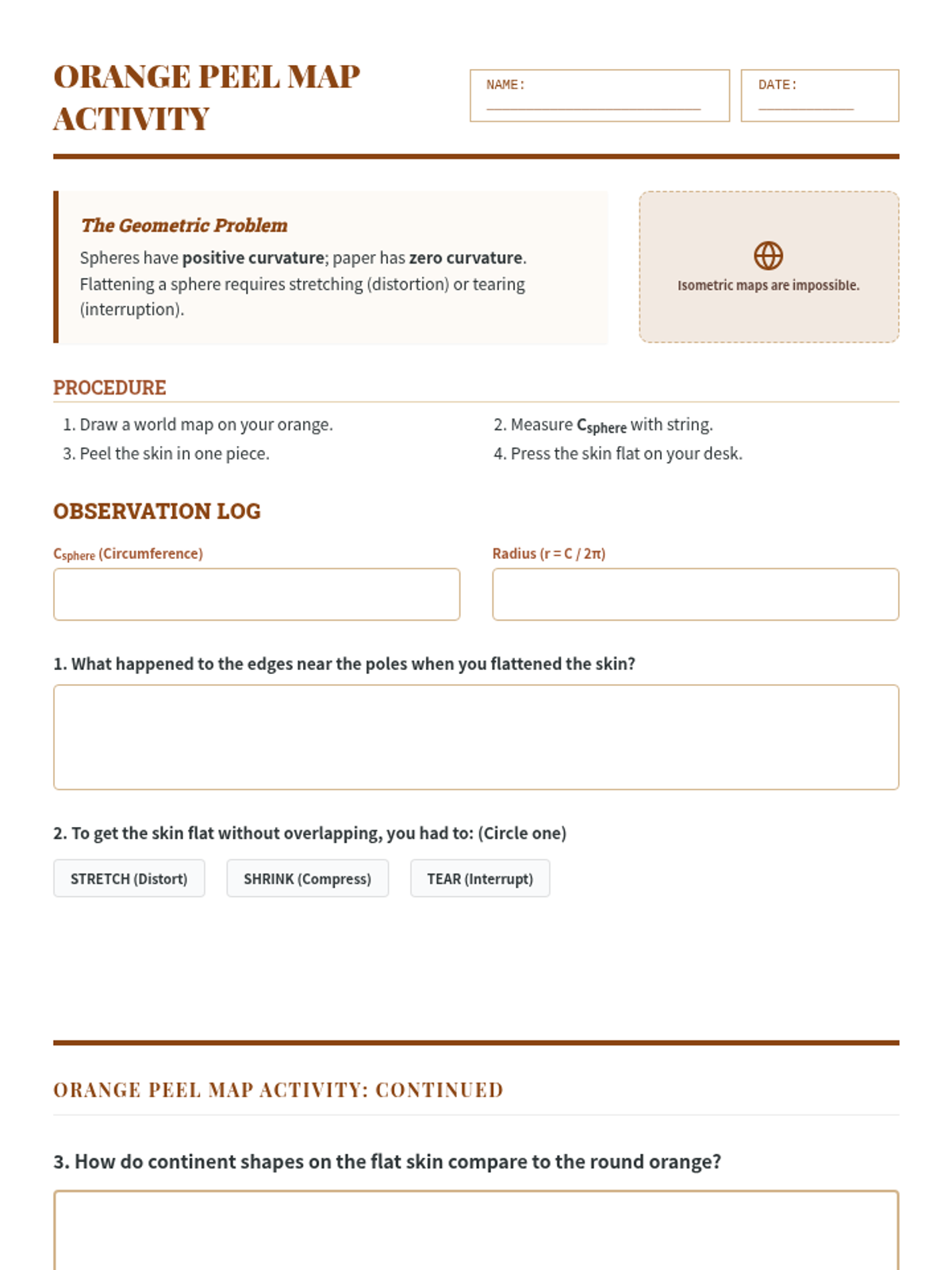
Hands-on lab activity sheet where students use an orange to model the Earth, draw geometric shapes on its surface, and attempt to flatten the peel to visualize map distortion.
Instructional slide deck for the Projection Problem lesson, covering the Mercator mystery, the geometry of curvature, the orange peel experiment instructions, and the trade-offs in map projections.
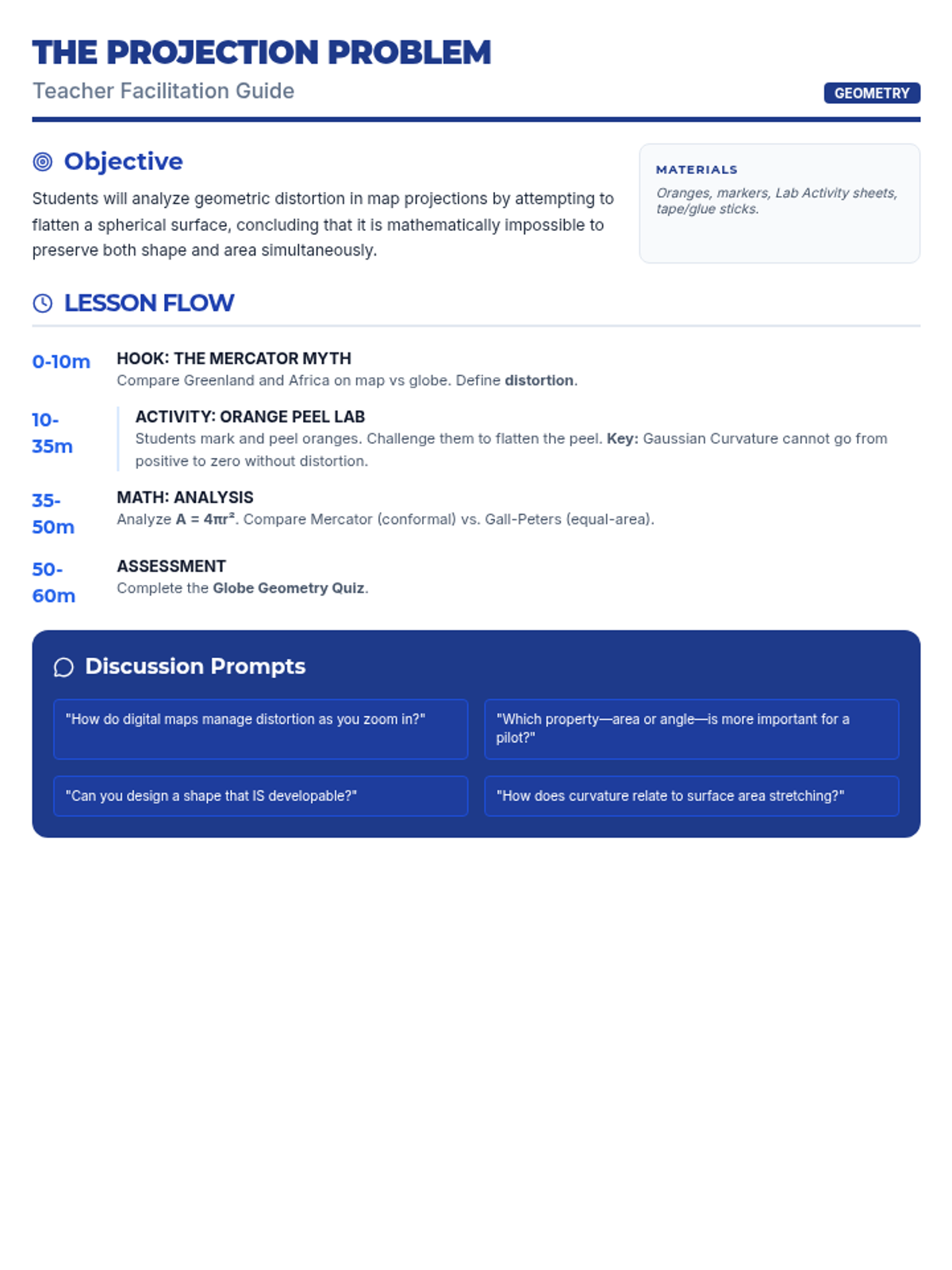
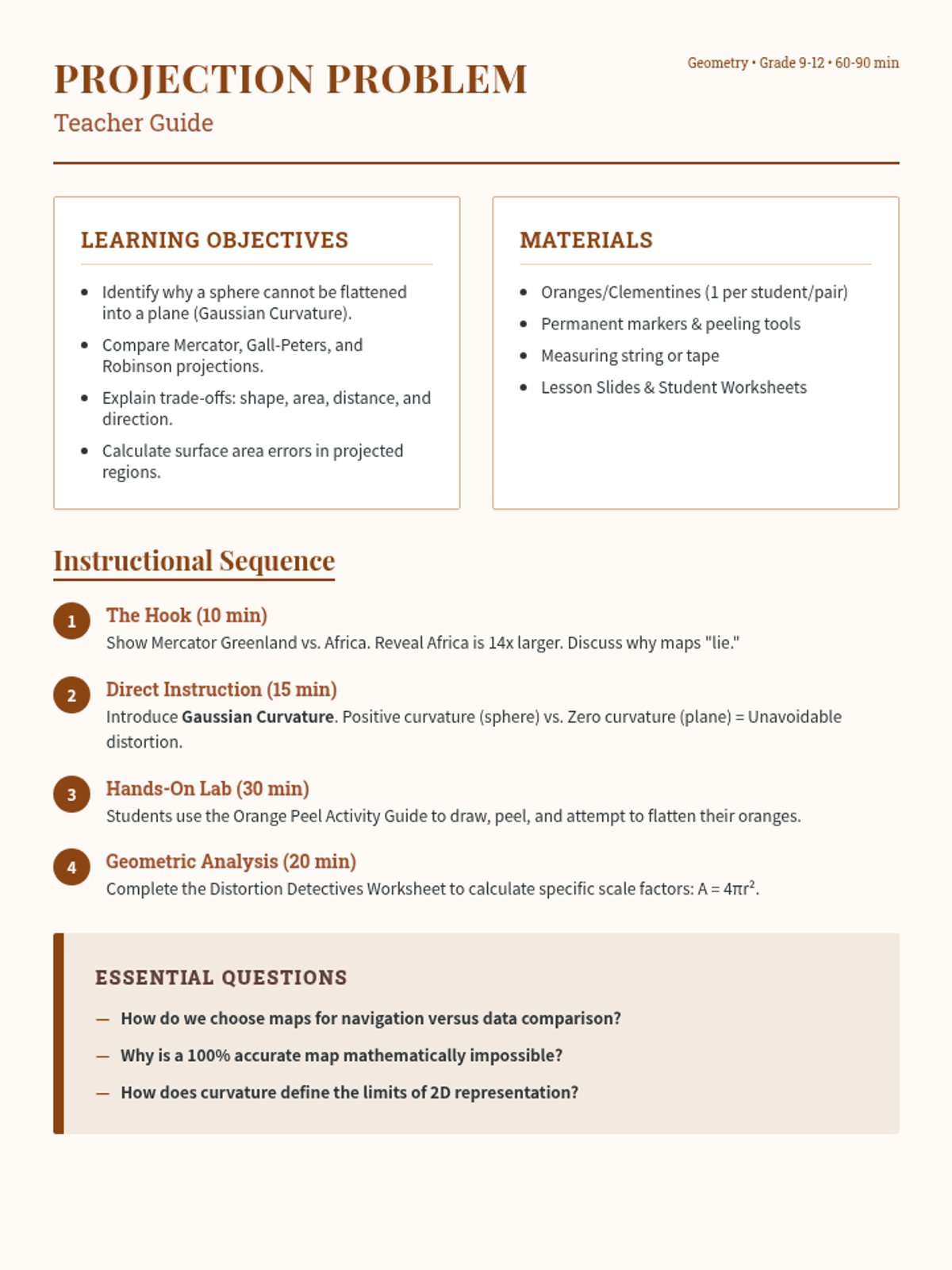
Comprehensive teacher facilitation guide for the Projection Problem lesson, including objectives, material lists, a detailed instructional sequence, and high-order discussion prompts.
A summative assessment for the 'Projection Problem' lesson, testing student understanding of geometric curvature, projection trade-offs, and map types.
A math-heavy worksheet for geometry students to calculate spherical surface area and analyze the specific mathematical scaling factors (secant functions) that cause distortion in map projections.
A student activity guide for the 'Orange Peel Map' experiment, guiding students through the process of drawing, peeling, and flattening a spherical surface to discover geometric distortion.
A visual slide deck explaining the geometric impossibility of a perfect map projection, featuring the Mercator vs. Africa comparison, Gaussian curvature, and the trade-offs of different map types.
A comprehensive teacher guide for 'The Projection Problem' lesson, featuring learning objectives, a detailed instructional sequence, and essential discussion questions for high school geometry students.
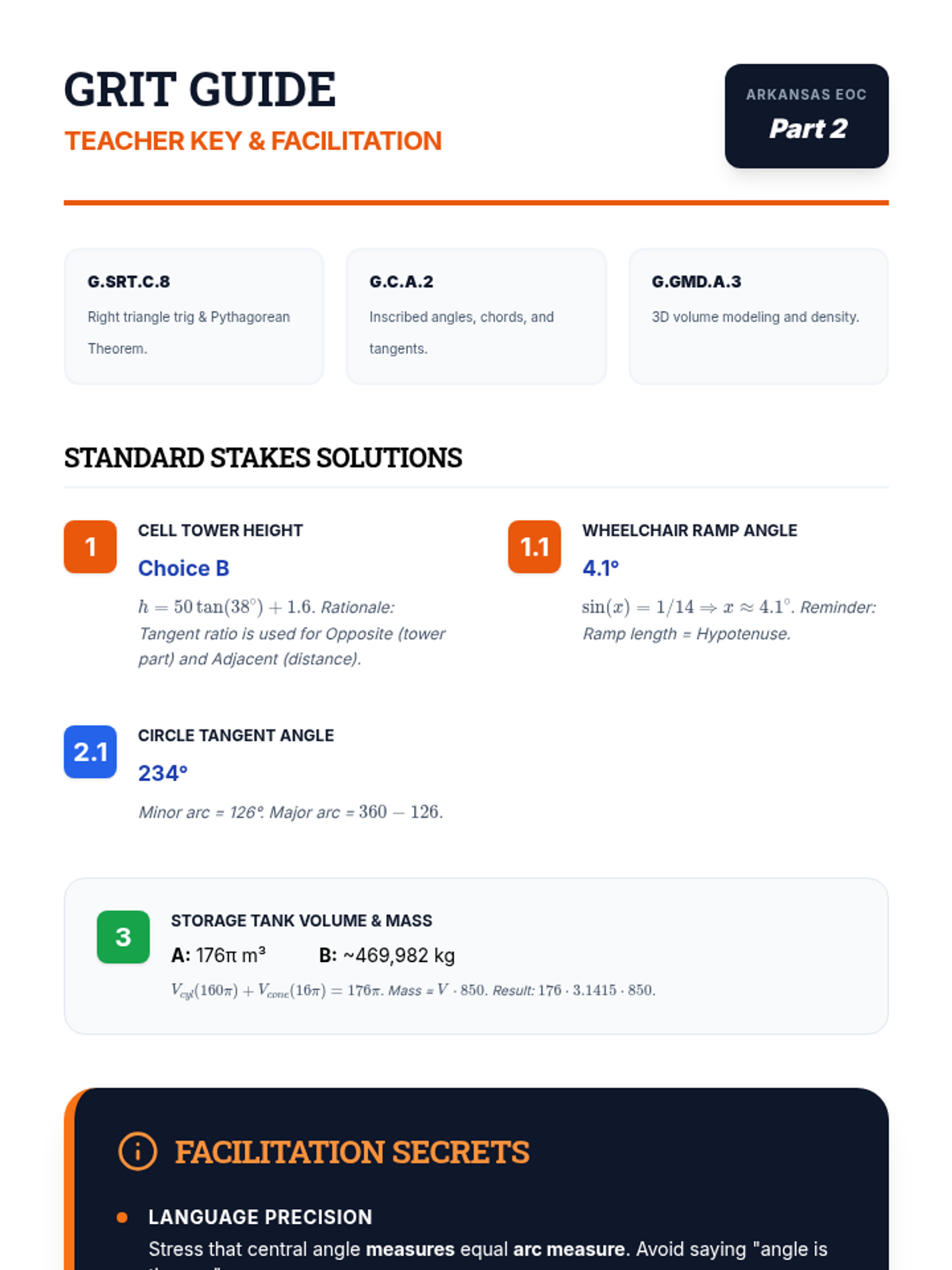
A detailed teacher's key and instruction guide for the Geometry Grit EOC prep lesson, featuring step-by-step solutions and pedagogical strategies.
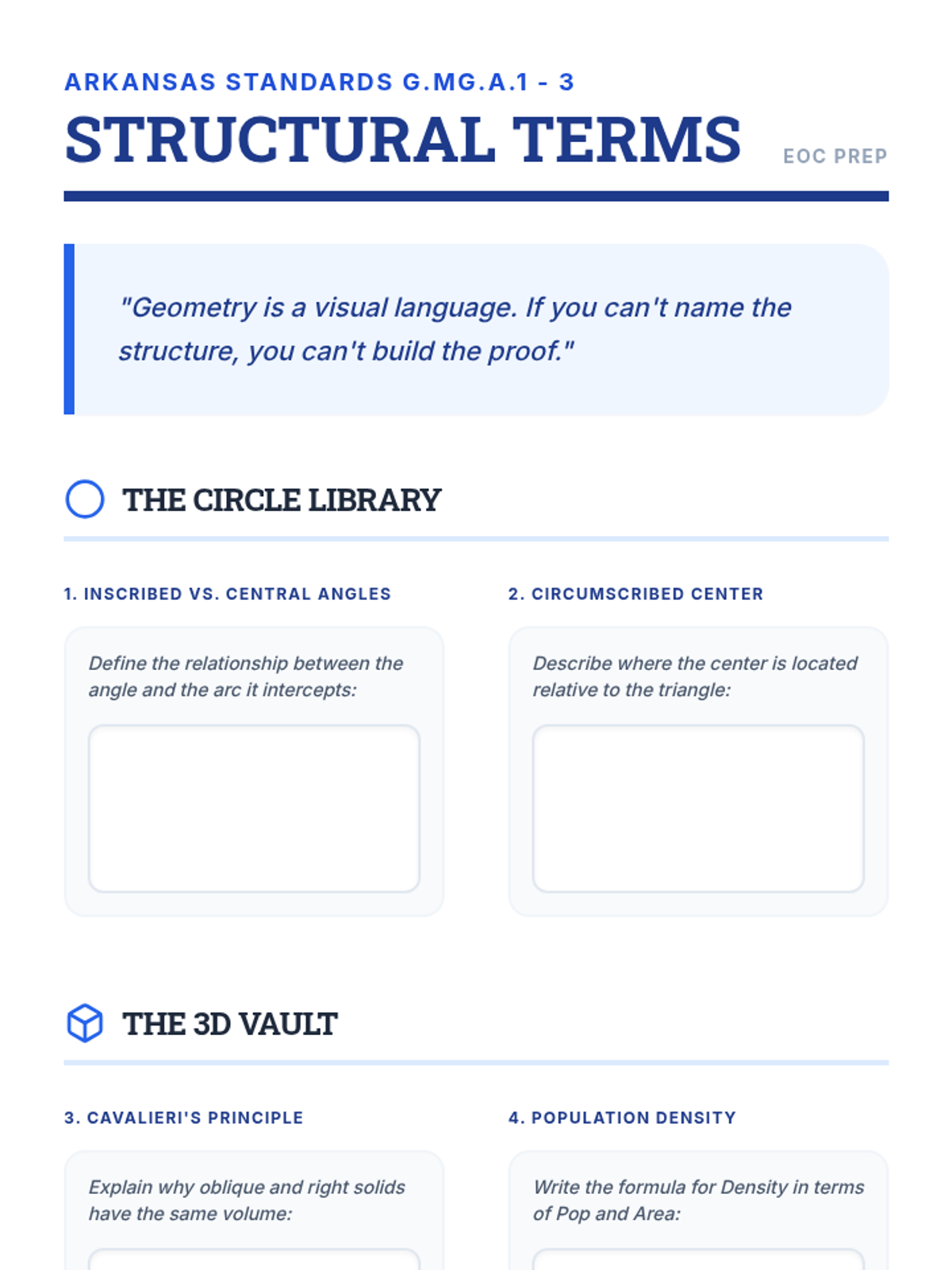
A vocabulary-focused graphic organizer for high-frequency EOC geometry terms, emphasizing circle properties, 3D solids, and modeling definitions.
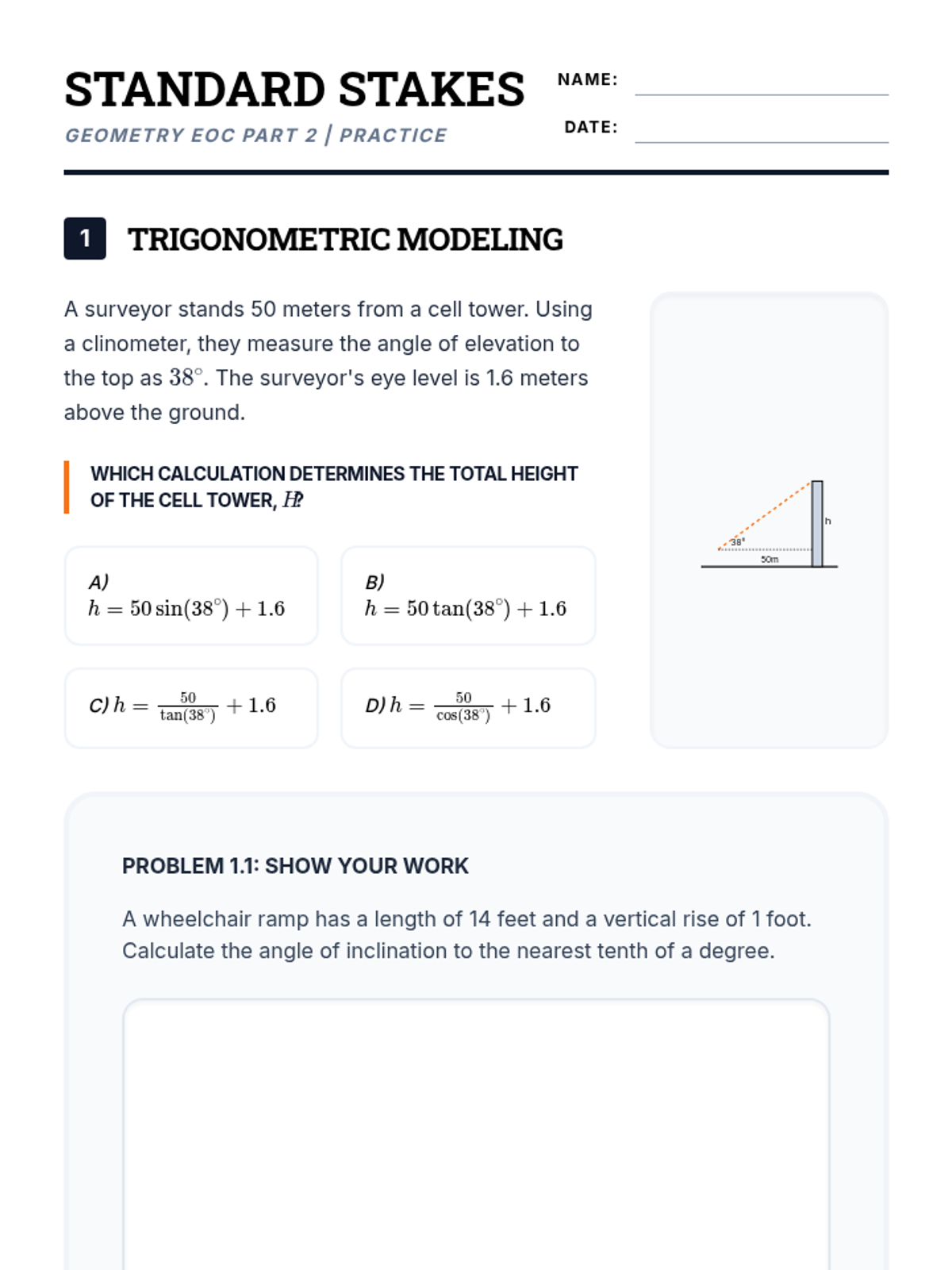
A comprehensive practice worksheet for Arkansas Geometry EOC prep, featuring diagram-based problems on trigonometry, circle theorems, and 3D volume modeling.
A dynamic slide deck for Arkansas Geometry EOC preparation, featuring right triangle trigonometry, circle properties, and 3D geometry with high-quality diagrams and sample problems.
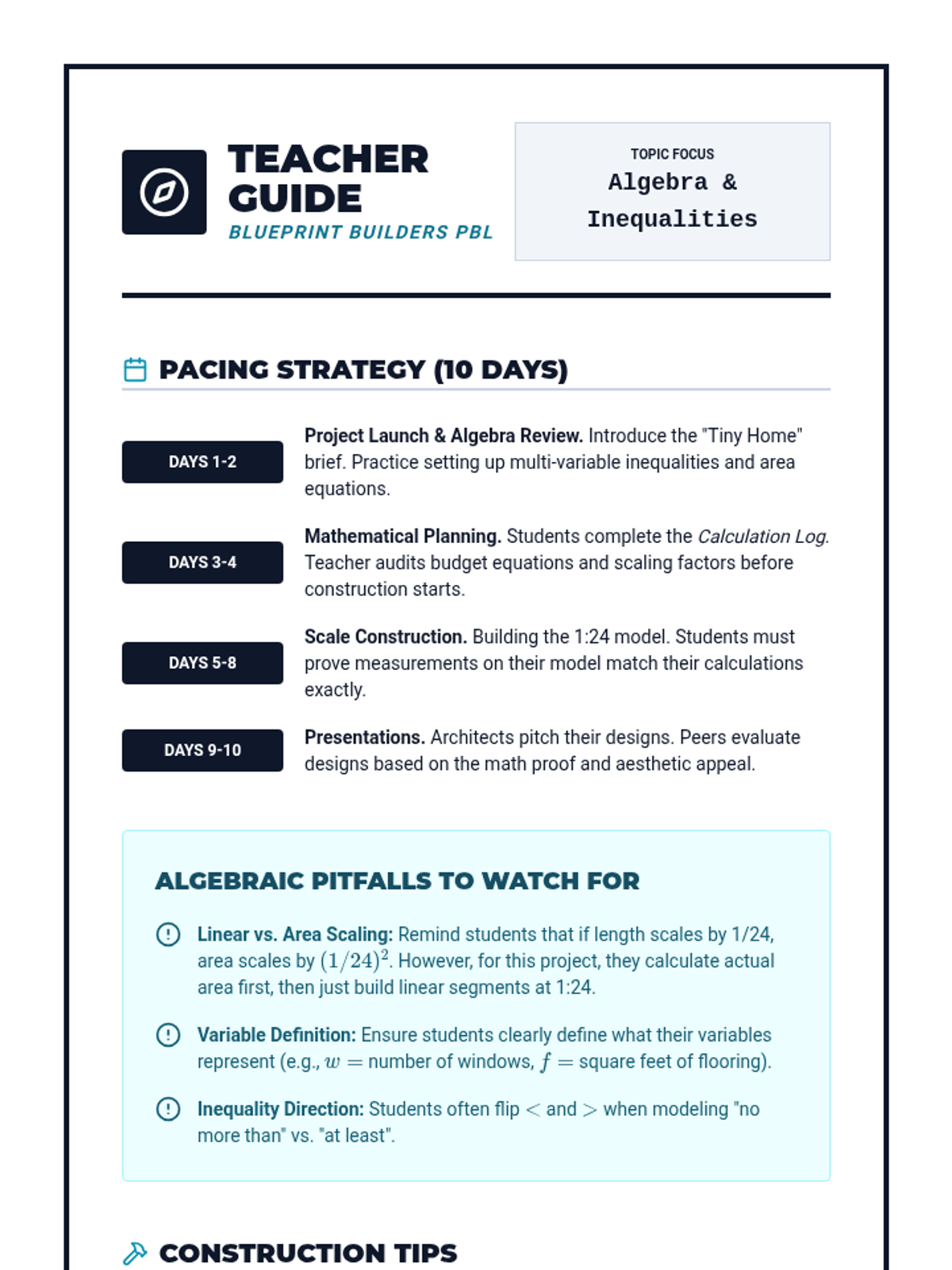
Facilitation guide for teachers delivering the Blueprint Builders project. Includes a 10-day pacing guide, common algebraic misconceptions, construction tips, and exemplar math proofs for assessment.
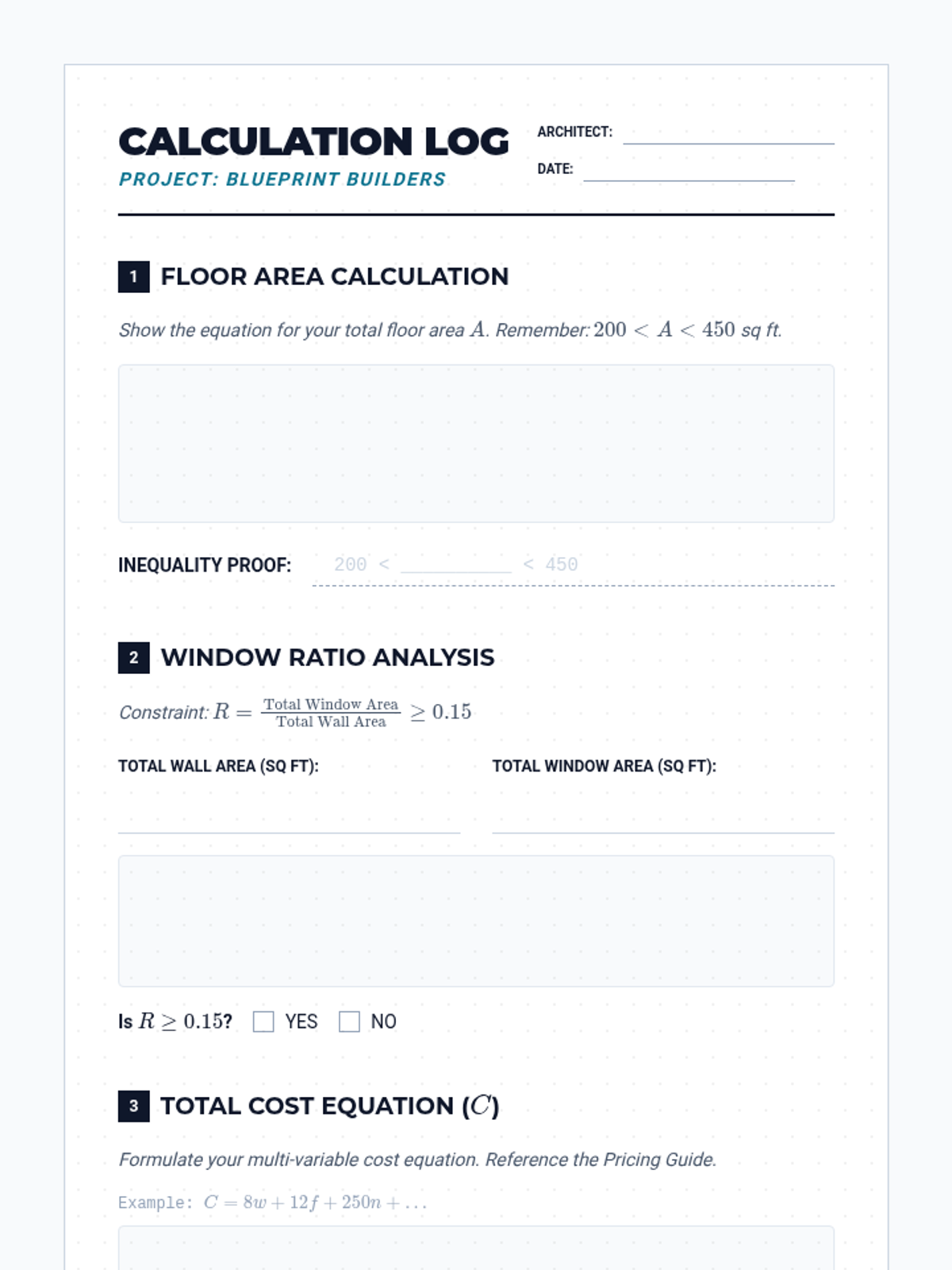
A structured calculation log for students to show their algebraic work. Includes sections for area equations, budget inequalities with unit costs, and a scaling table for model construction.
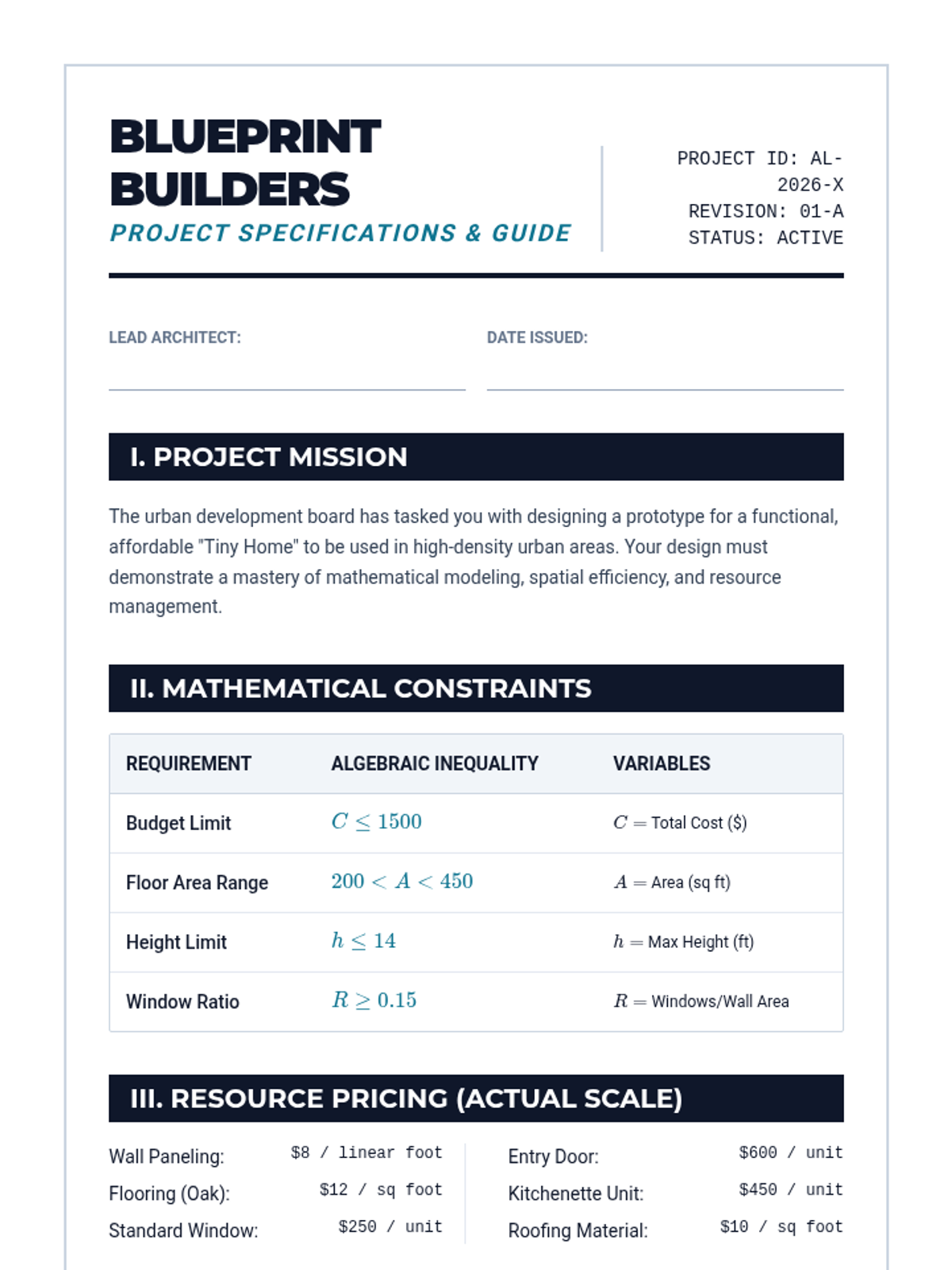
Comprehensive student project guide for Blueprint Builders. Includes project mission, mathematical constraints (inequalities), actual-world pricing for calculations, scaling rules, and a detailed grading rubric.
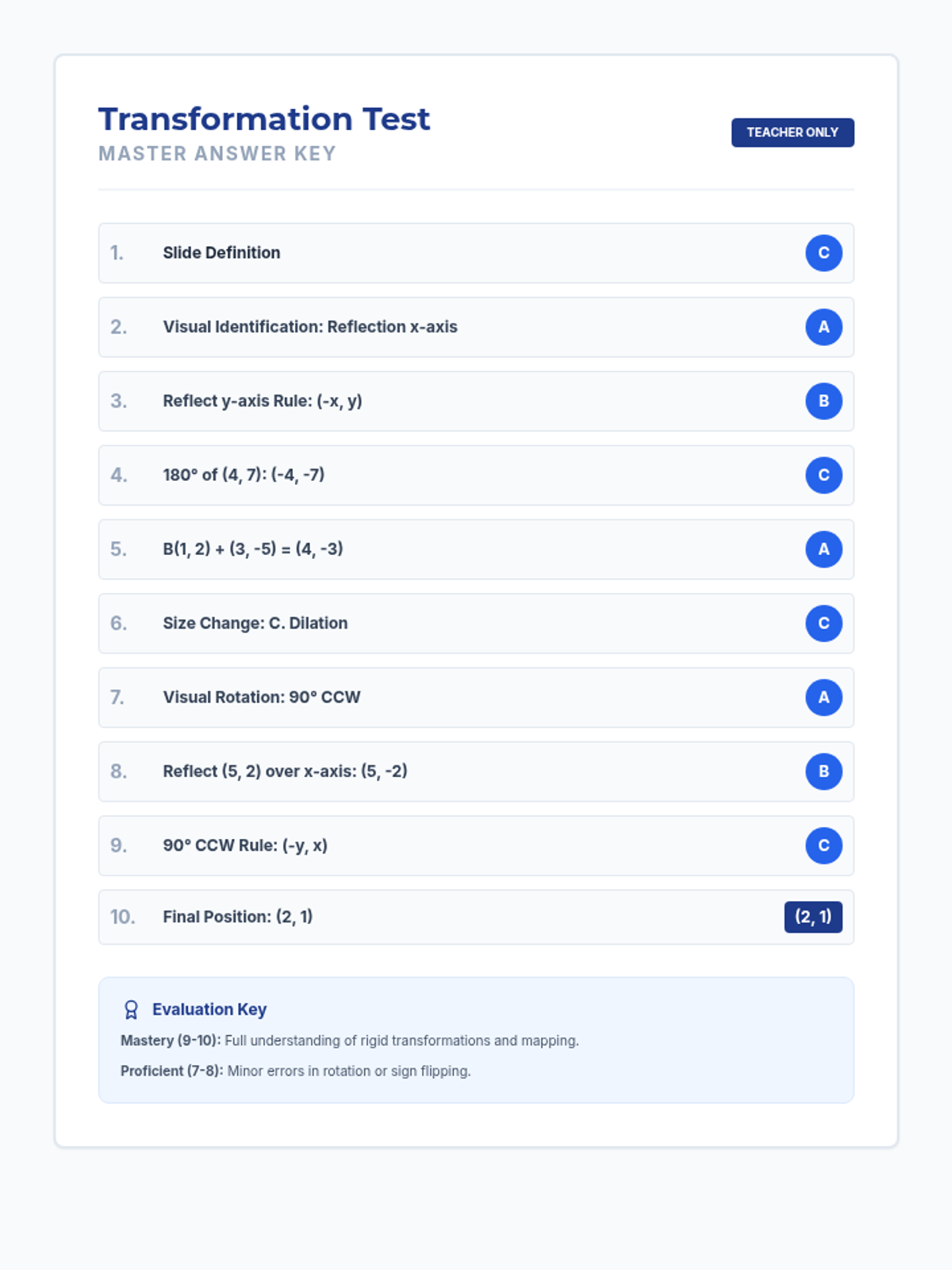
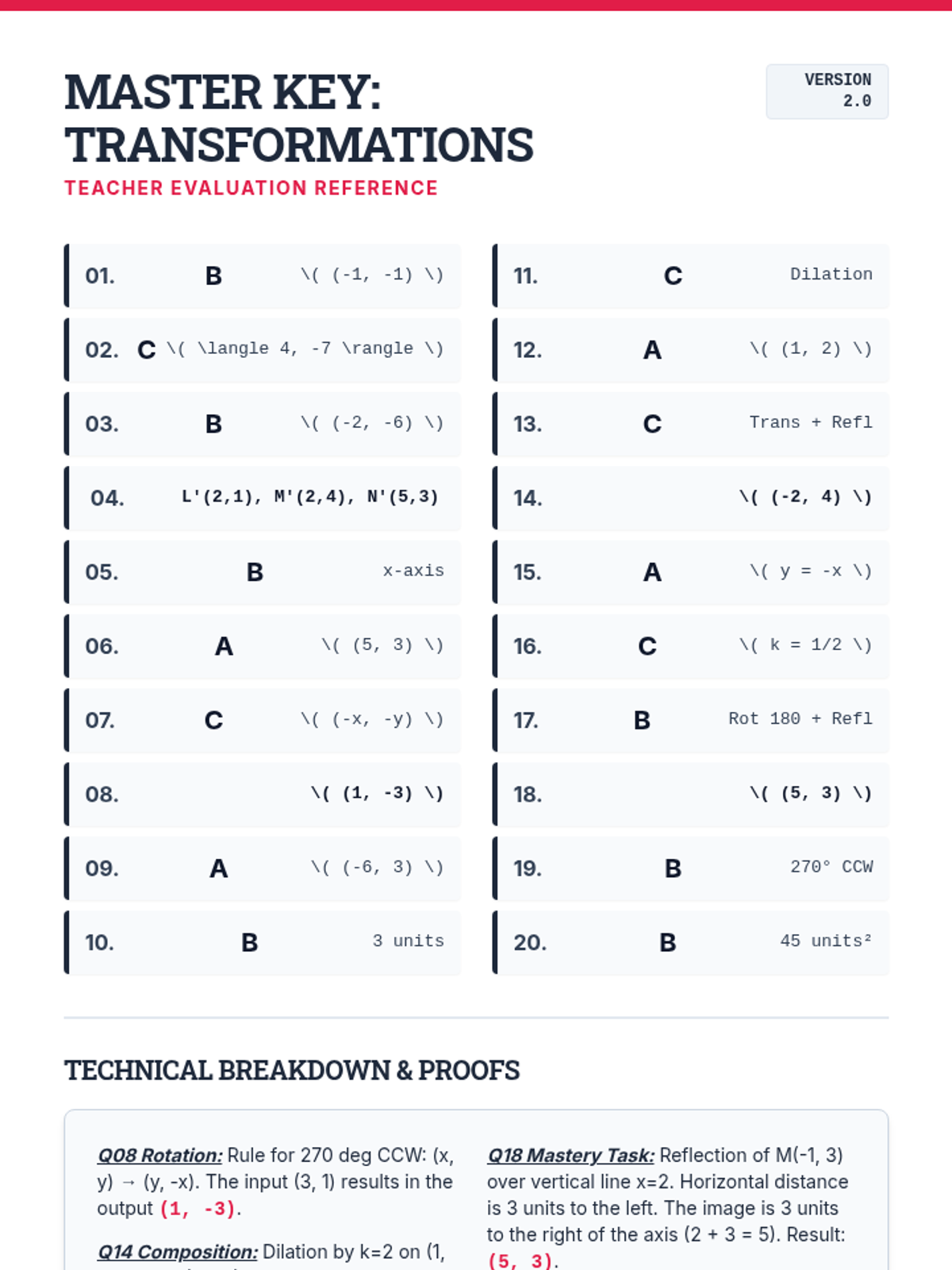
Updated answer key that provides full coordinates for correct answers, a refined layout to fit on a single page, and mapping to the revised test questions.
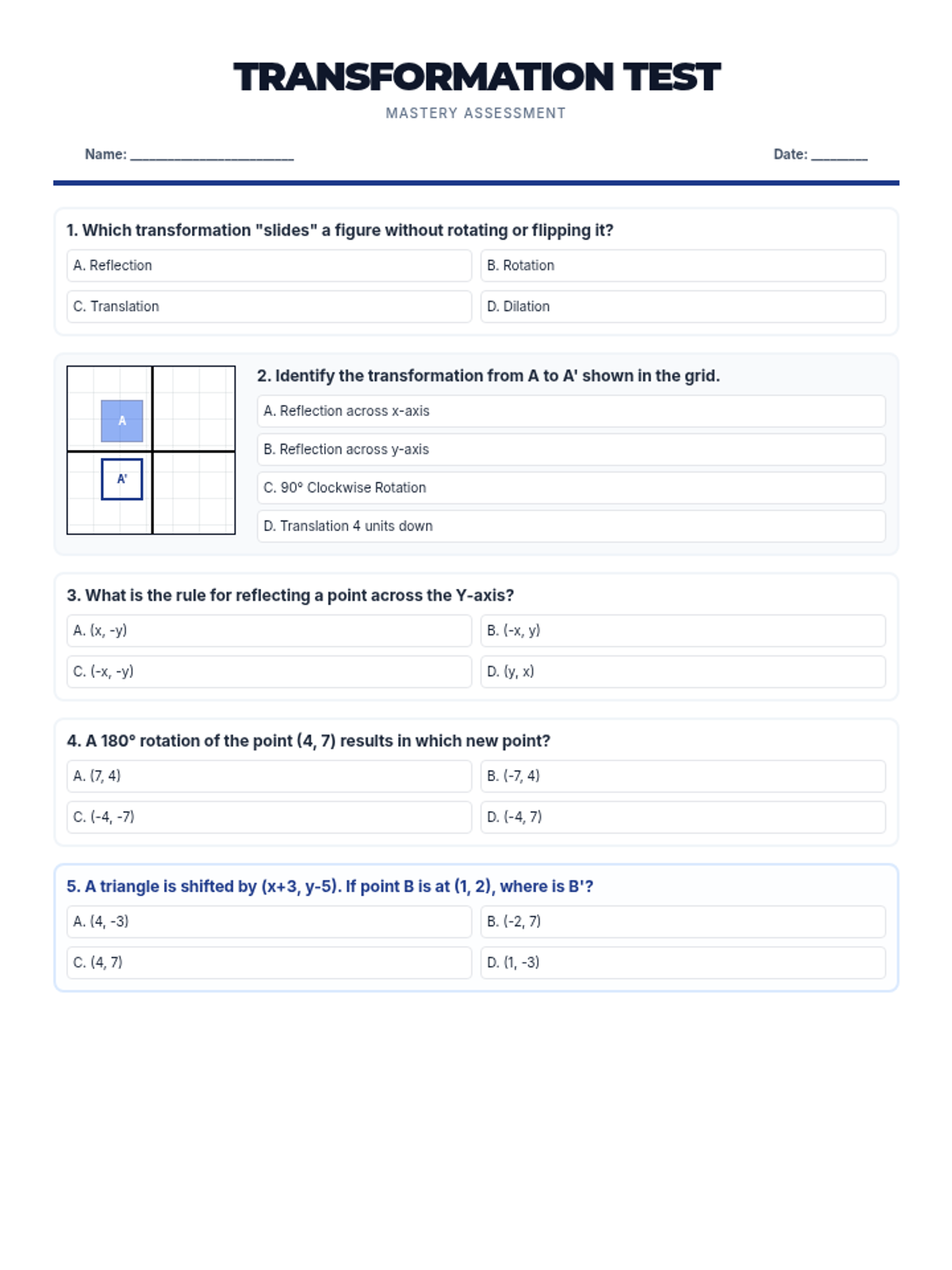
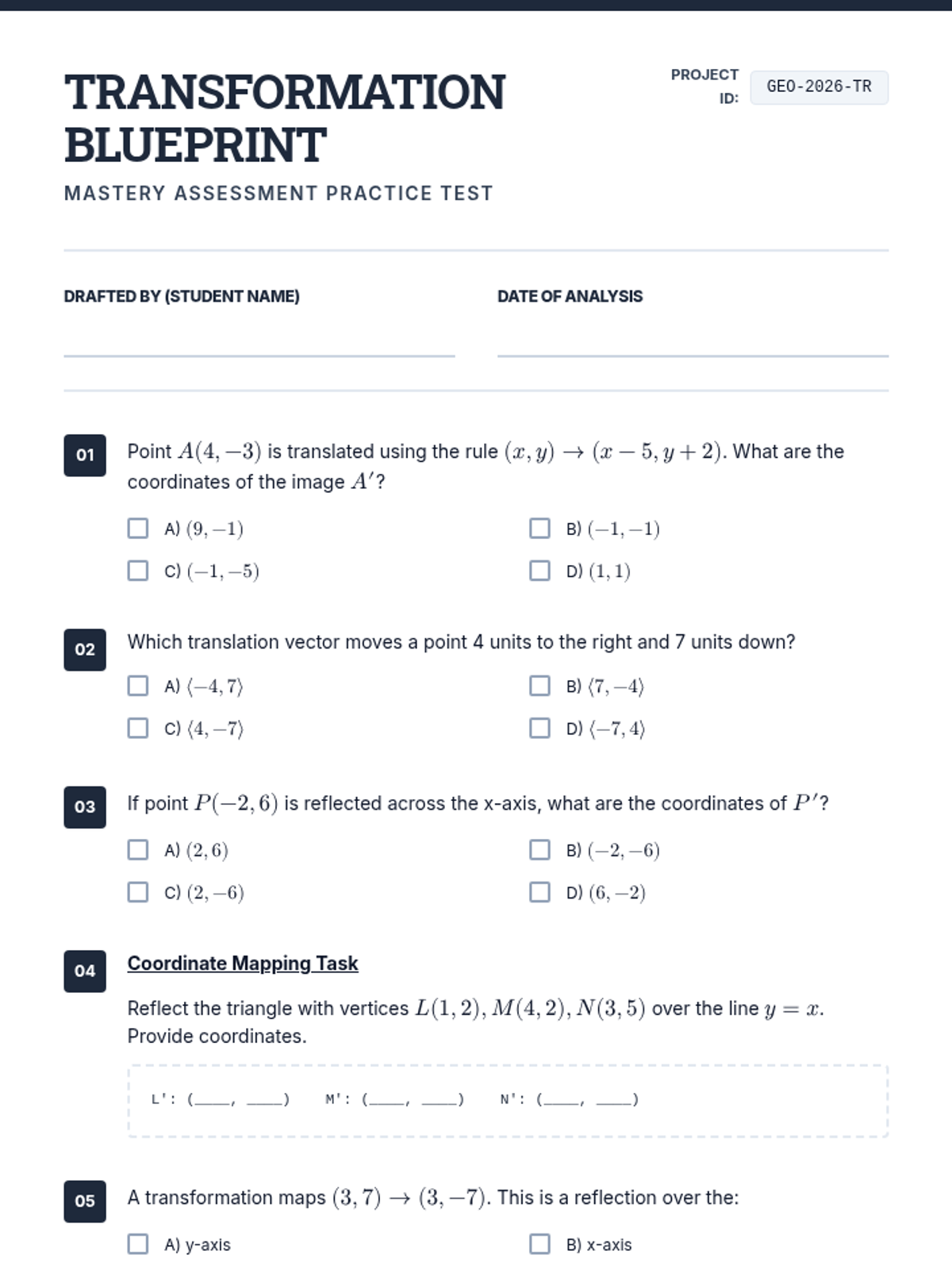
Revised transformation test with added visual diagrams for shape identification, integrated coordinate grids, and improved page layout to prevent question splitting.
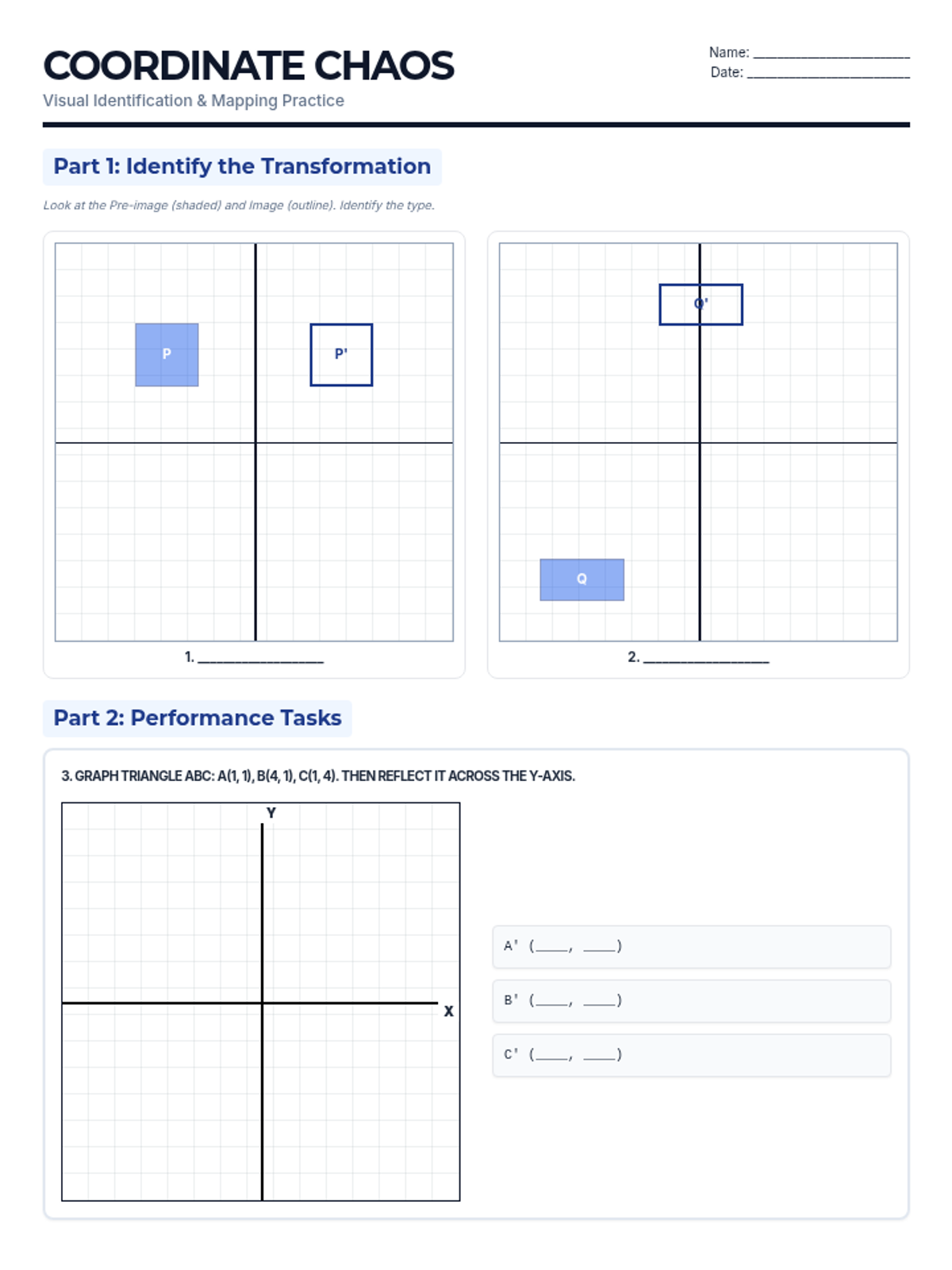
Revised coordinate worksheet with consistent grid styling, robust LaTeX math rendering, and fixed element positioning to ensure all content stays within page boundaries.
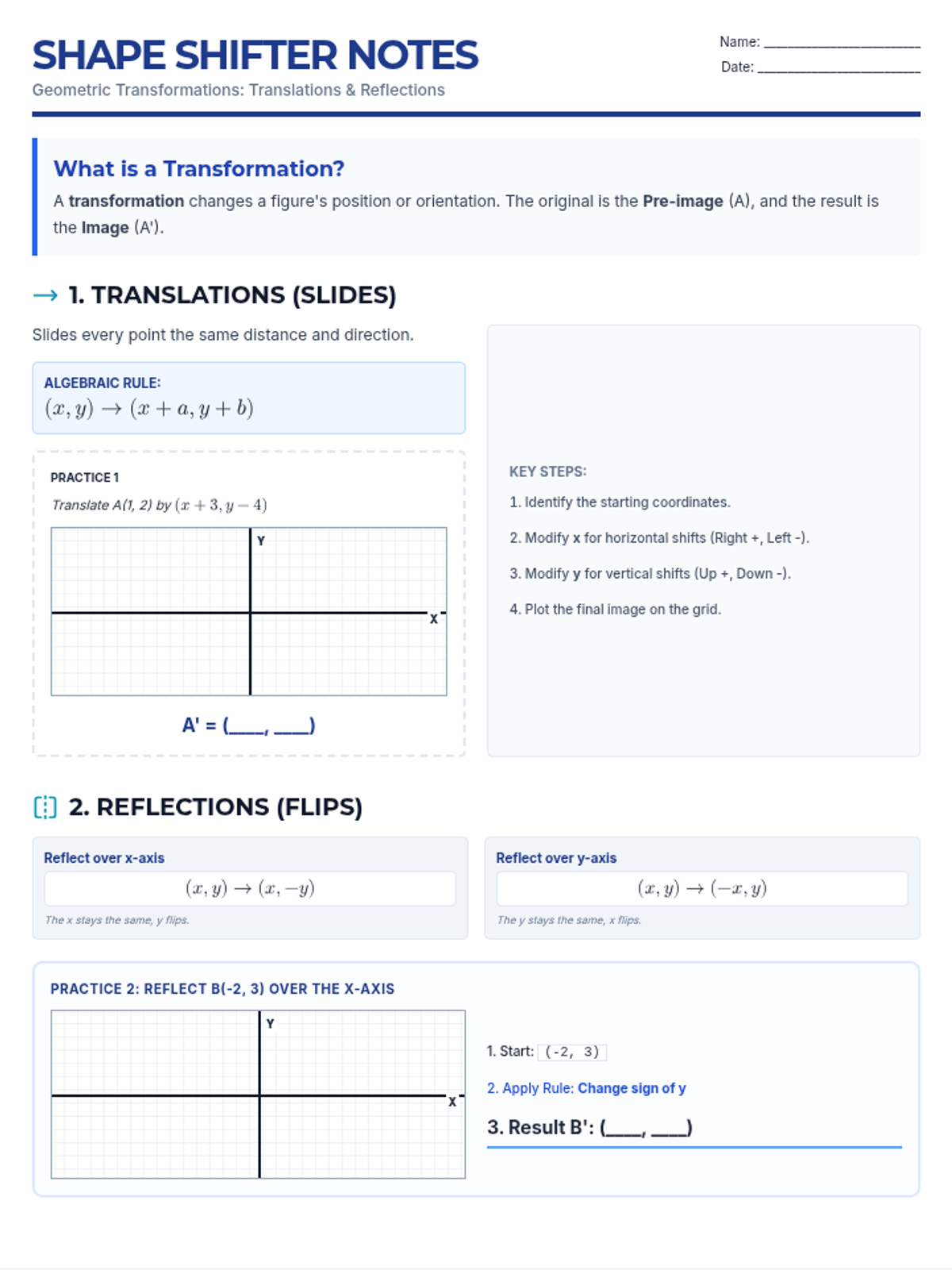
Revised guided notes with integrated coordinate grids for graphing practice, optimized layout to prevent orphans, and improved student work areas.
Answer key for the Transformation Blueprint Reviewer, providing correct answers and brief explanations for complex problems.
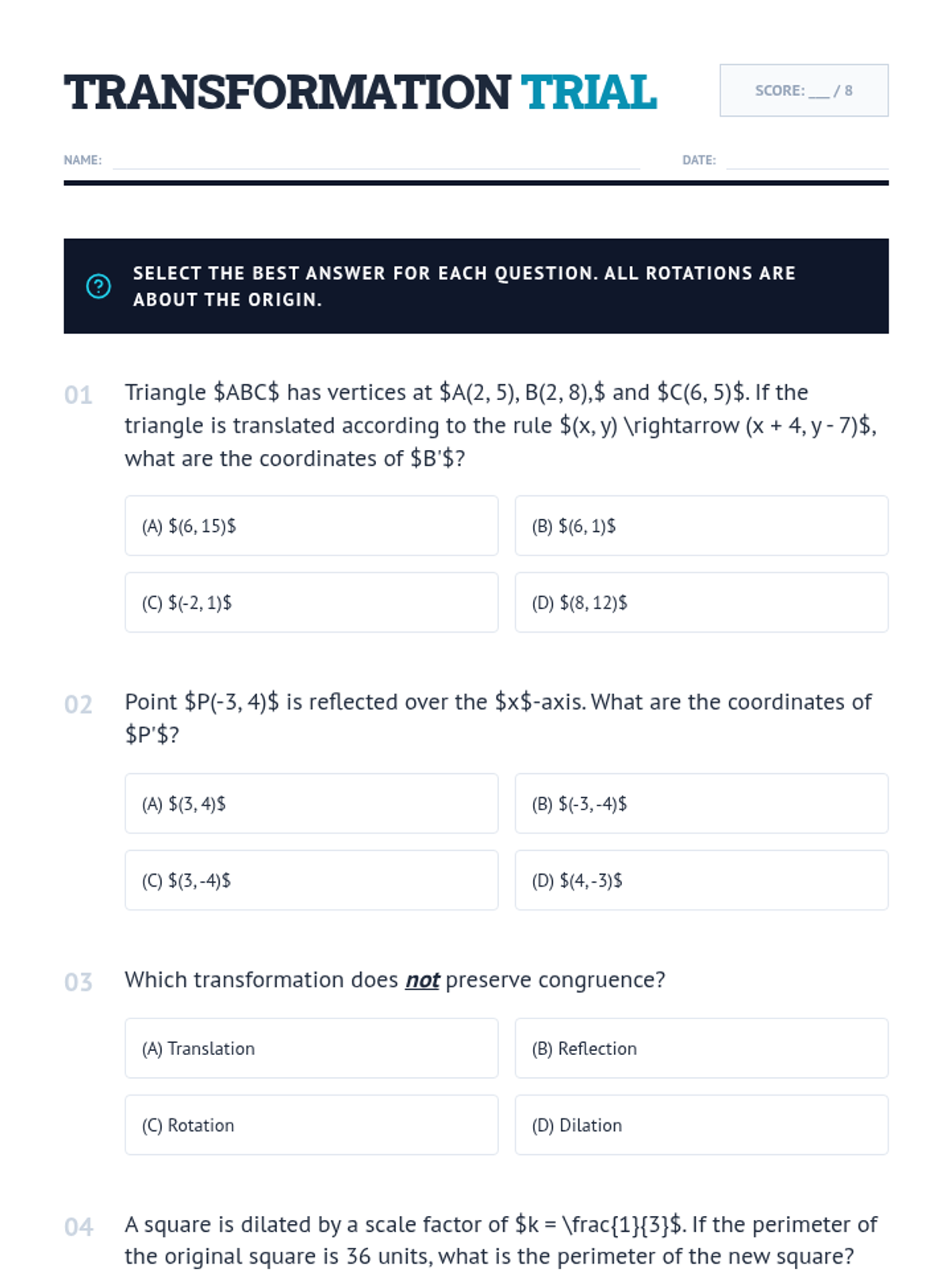
A 20-question practice test for geometric transformations, including translations, reflections, rotations, dilations, and compositions, styled as a technical blueprint.
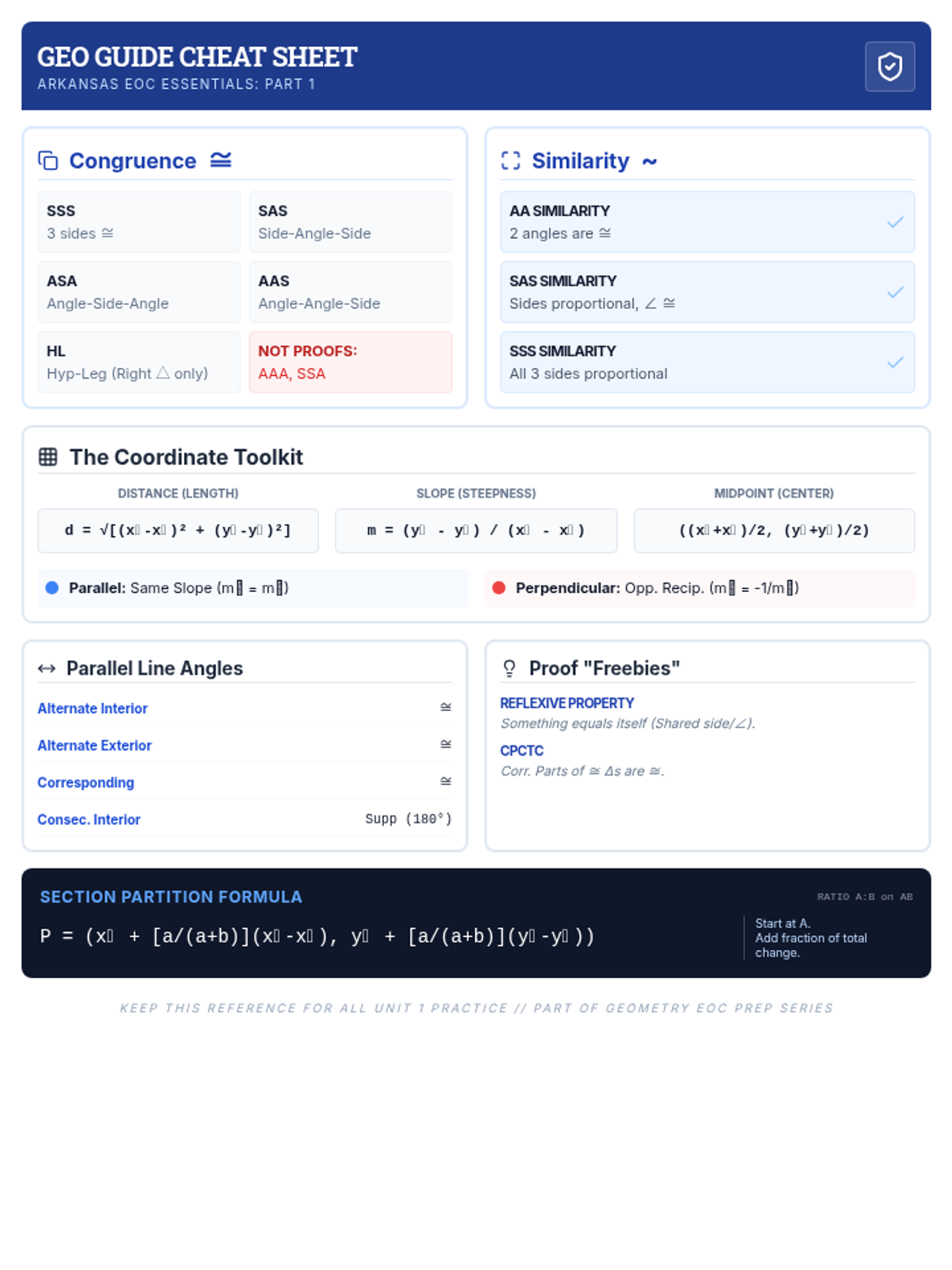
A comprehensive one-page reference sheet for Geometry students, covering congruence, similarity, coordinate formulas, and basic proof logic for EOC preparation.
A student worksheet featuring EOC-style problems on congruence, similarity, two-column proofs, and coordinate geometry. Designed with a blueprint aesthetic and clear work areas.
A visual slide deck reviewing congruence, similarity, proofs, and coordinate geometry for the Arkansas Geometry EOC. Includes sample problems and strategic tips for high-stakes testing.
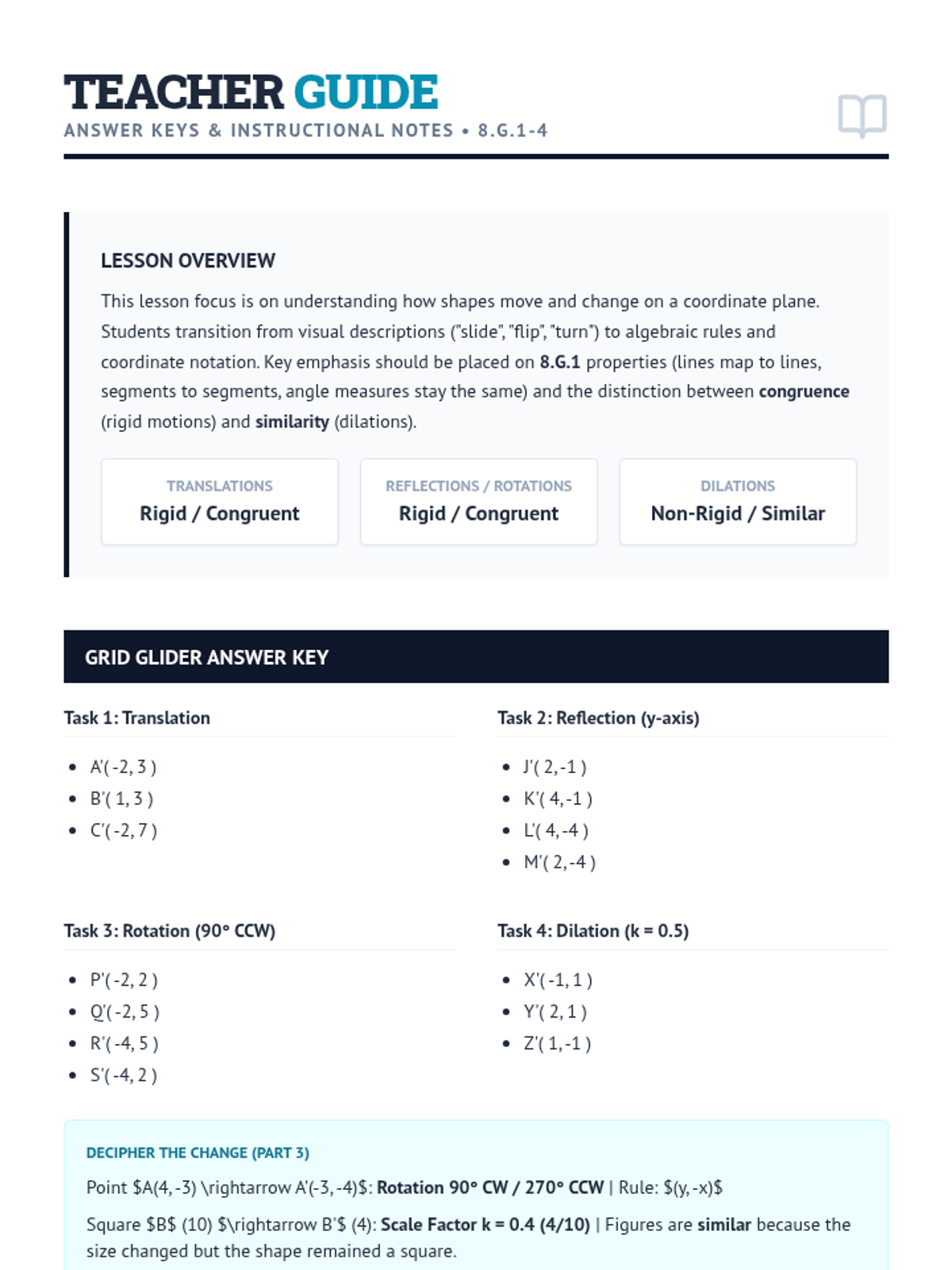
Teacher answer key and instructional guide for the Transformation Station Lab activities and assessment.
An 8-question multiple-choice assessment designed to mimic the NC EOG format, covering translations, reflections, rotations, and dilations.
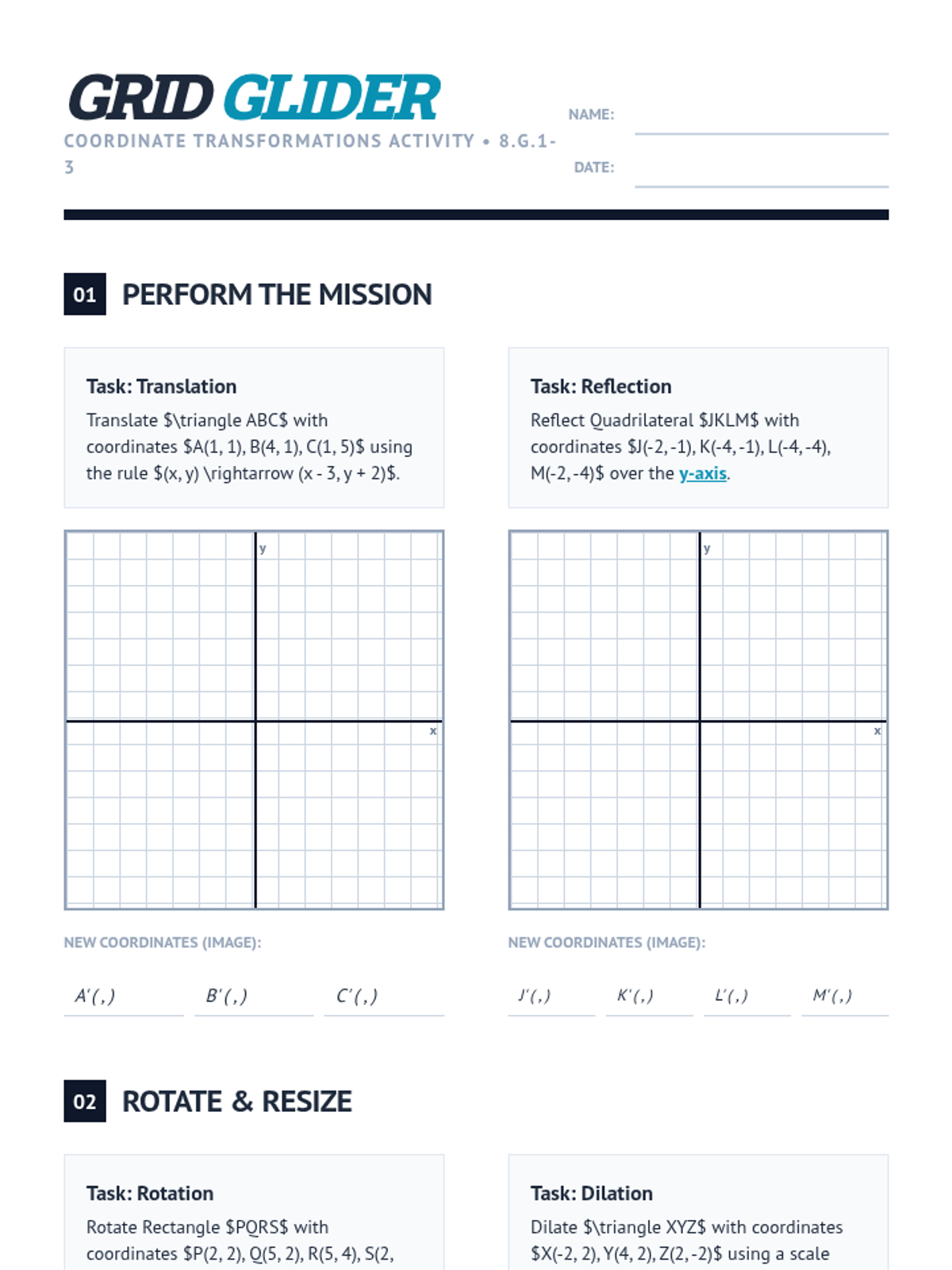
A student worksheet featuring four coordinate-plane problems for performing transformations and conceptual questions on identifying transformations and scale factors. Improved grid visibility for printing.
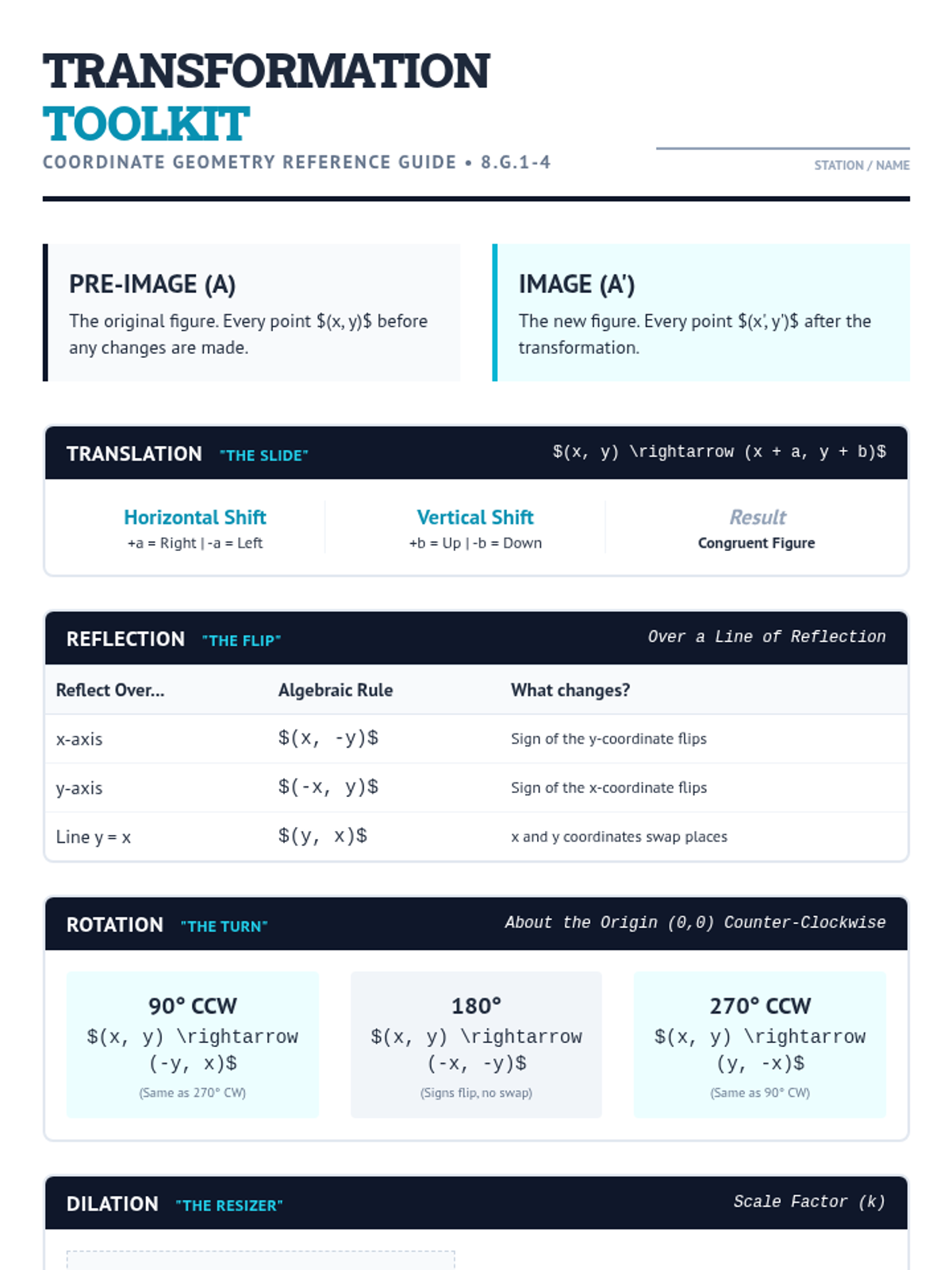
A one-page reference sheet for students featuring all transformation rules, algebraic notation, and notes on congruence and similarity.
A comprehensive slide deck covering translations, reflections, rotations, and dilations with algebraic notation and visual guides. Includes sections on congruence vs. similarity.
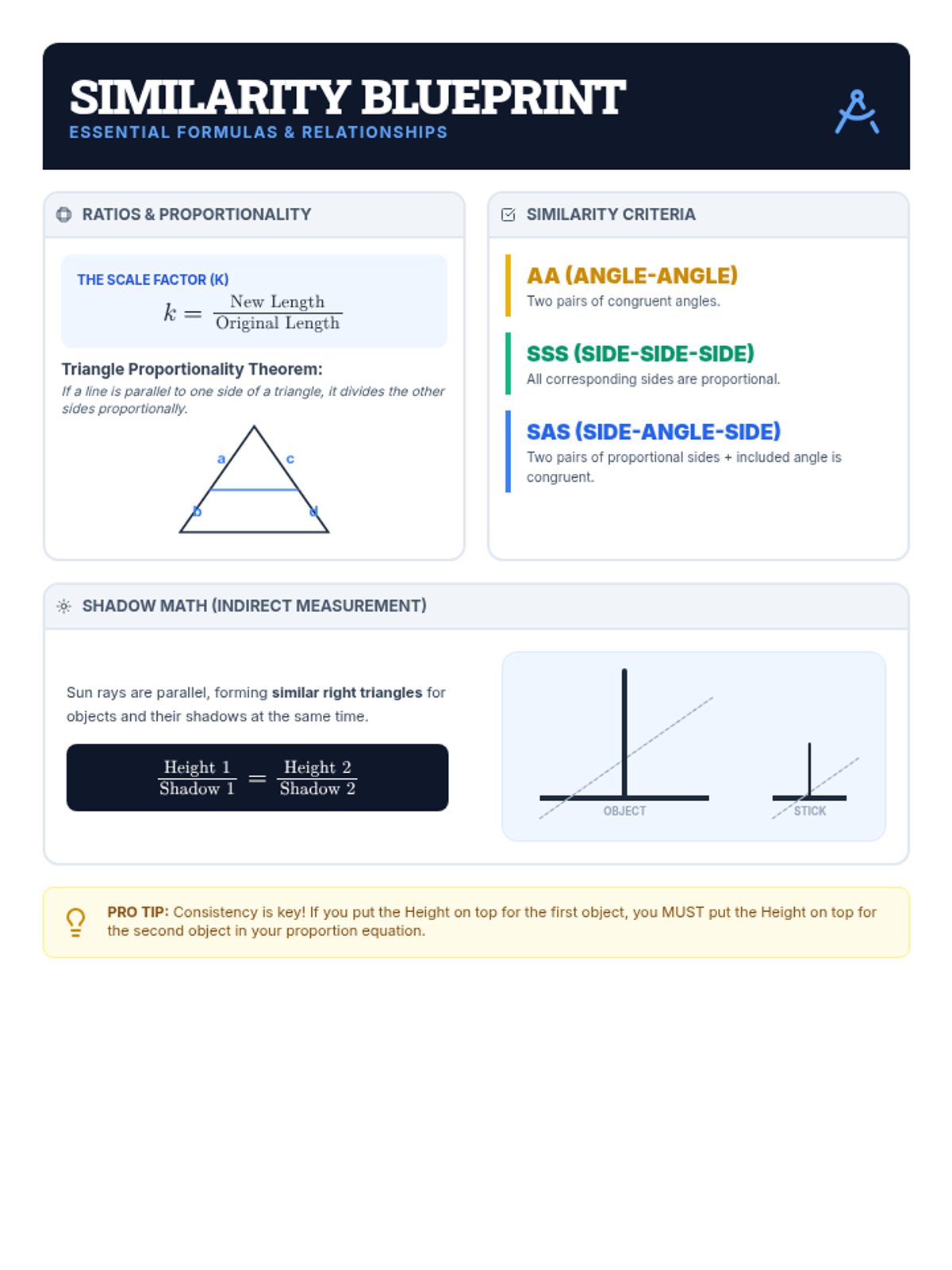
A student-friendly reference sheet for similarity concepts. Includes formulas for scale factor, similarity criteria (AAA, SSS, SAS), and a visual guide for shadow trigonometry.
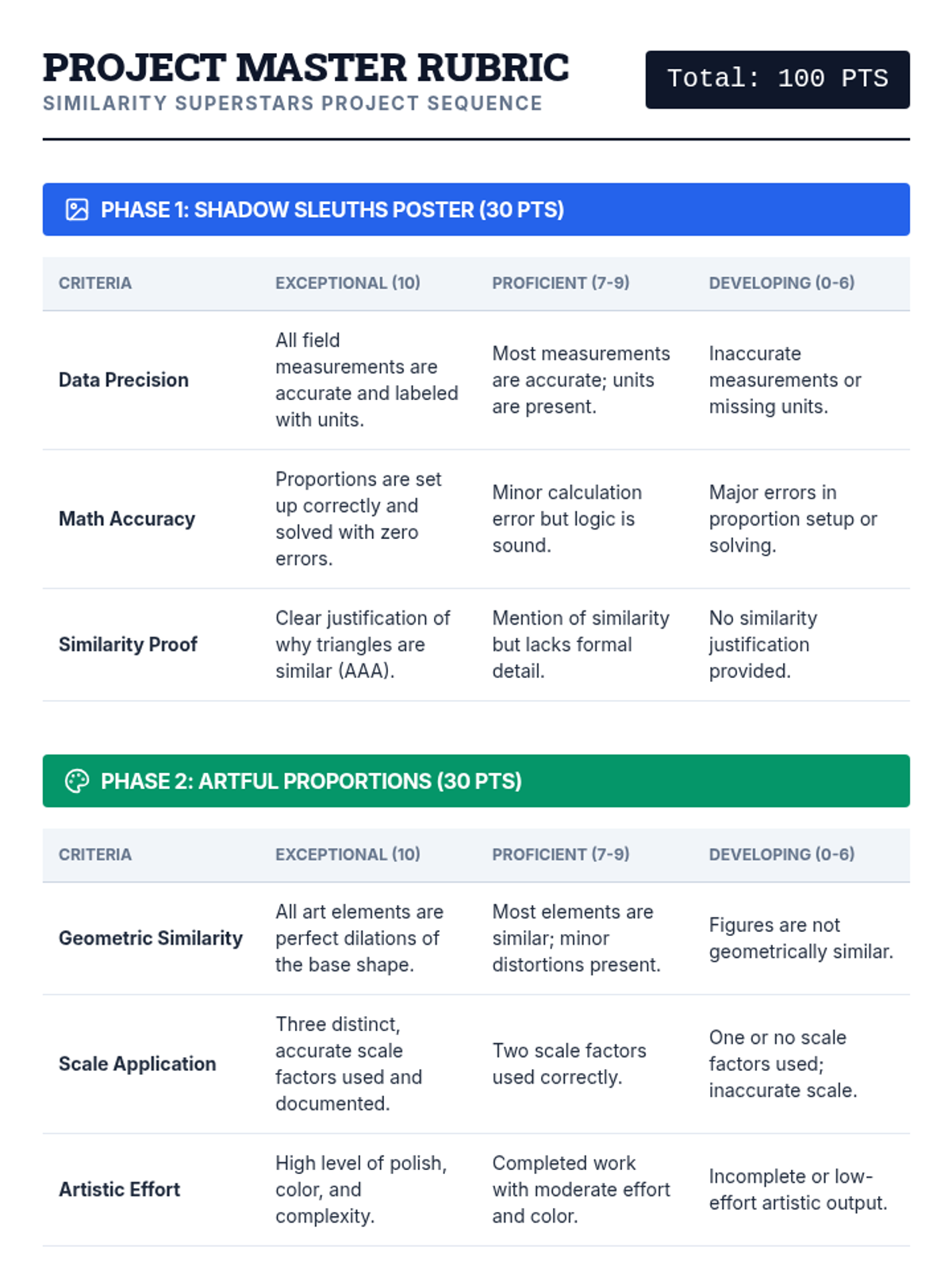
A comprehensive teacher's rubric for the Similarity Superstars project. Covers poster, art, and presentation components with specific grading criteria for data, logic, and polish.
A digital slide presentation template and guide for students. Covers similarity criteria (AAA, SAS, SSS), presentation requirements, and slide layout templates.
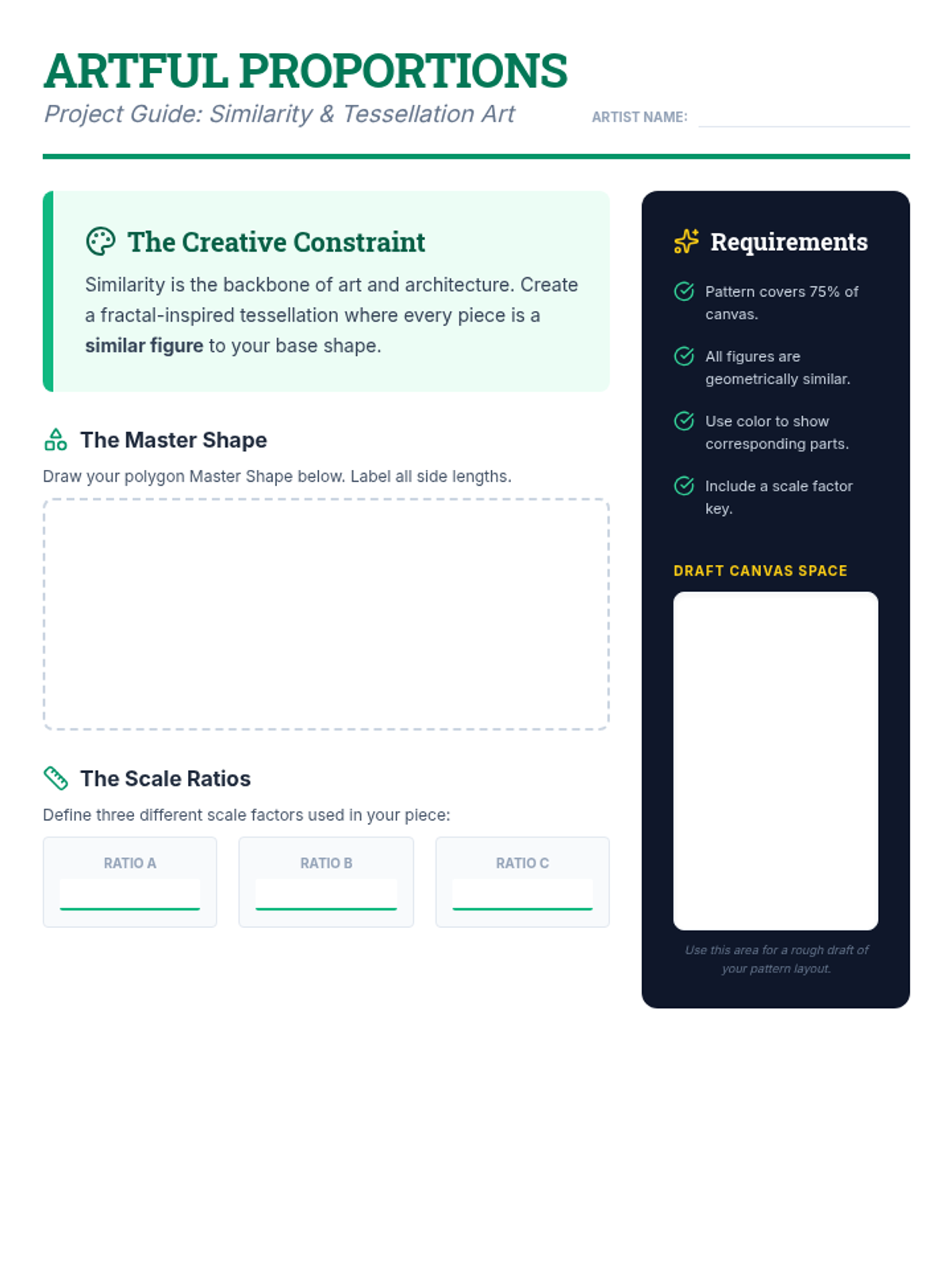
A guide for students to create similarity-based art and tessellations. Includes sections for base shape design, scale factor definitions, and artistic requirements.
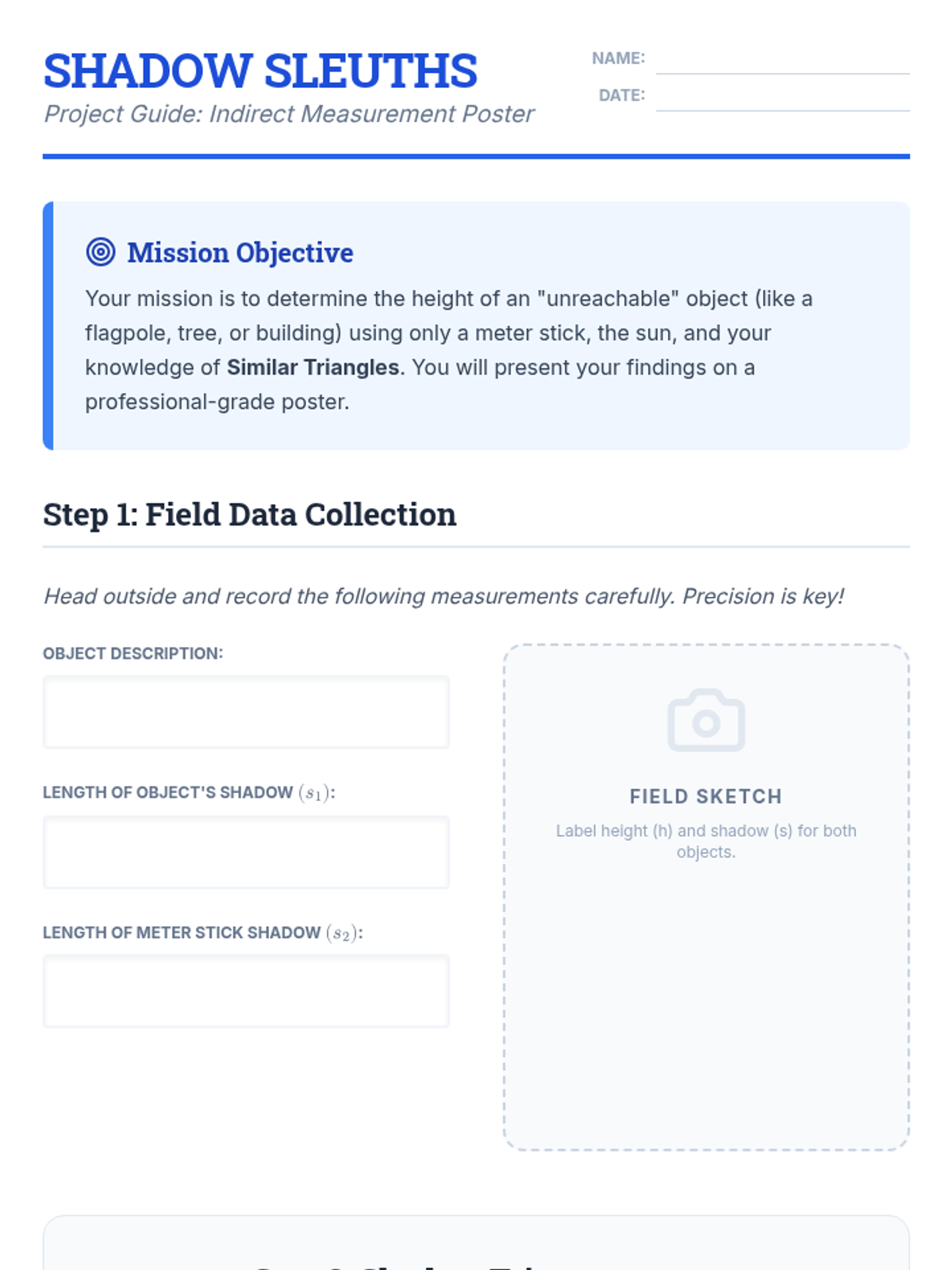
A project guide for students to conduct indirect measurement using shadows. Includes data collection tables, a ratio setup guide, and poster requirements.
A comprehensive slide deck for launching the Similar Triangles Infographic project, covering similarity criteria (AA, SSS, SAS) and real-world shadow applications.
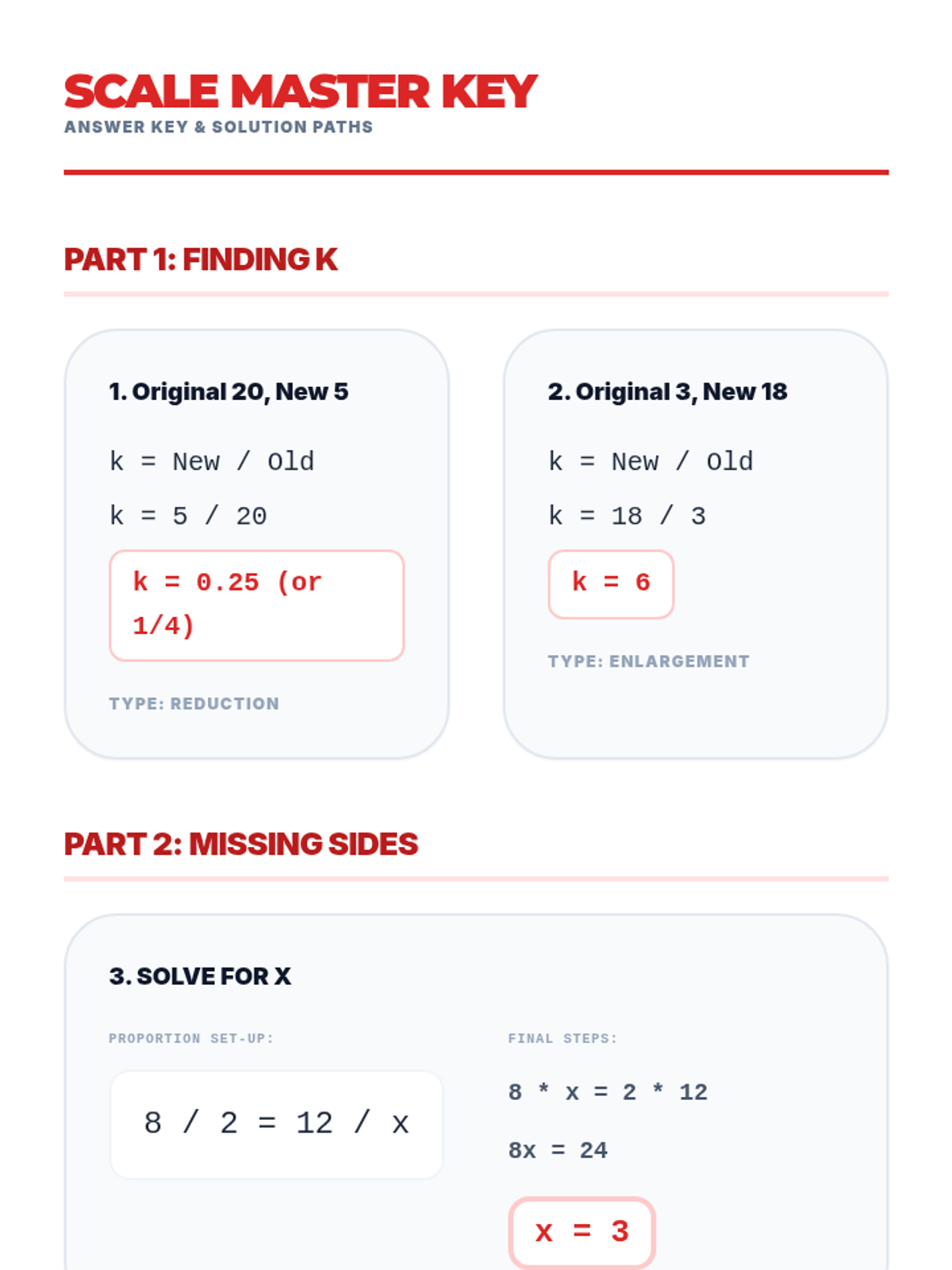
Answer key for the 'Scale Master Worksheet'. Revised with 'break-inside-avoid' for all problems, improved text contrast for labels, and clear step-by-step solution paths.
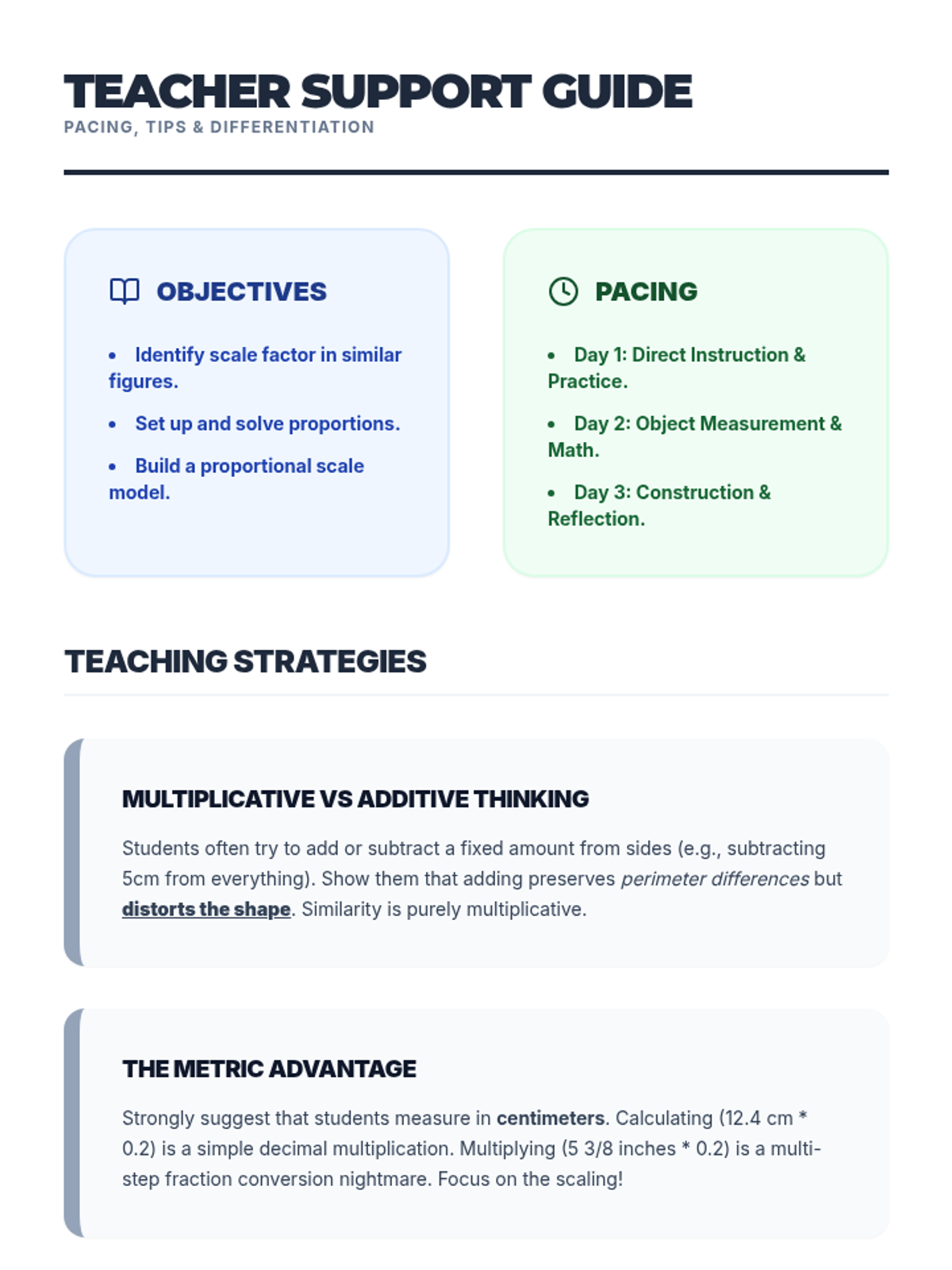
Teacher resource for 'The Great Shrink'. Revised with balanced content, larger font sizes for tips, and robust math notation rendering.
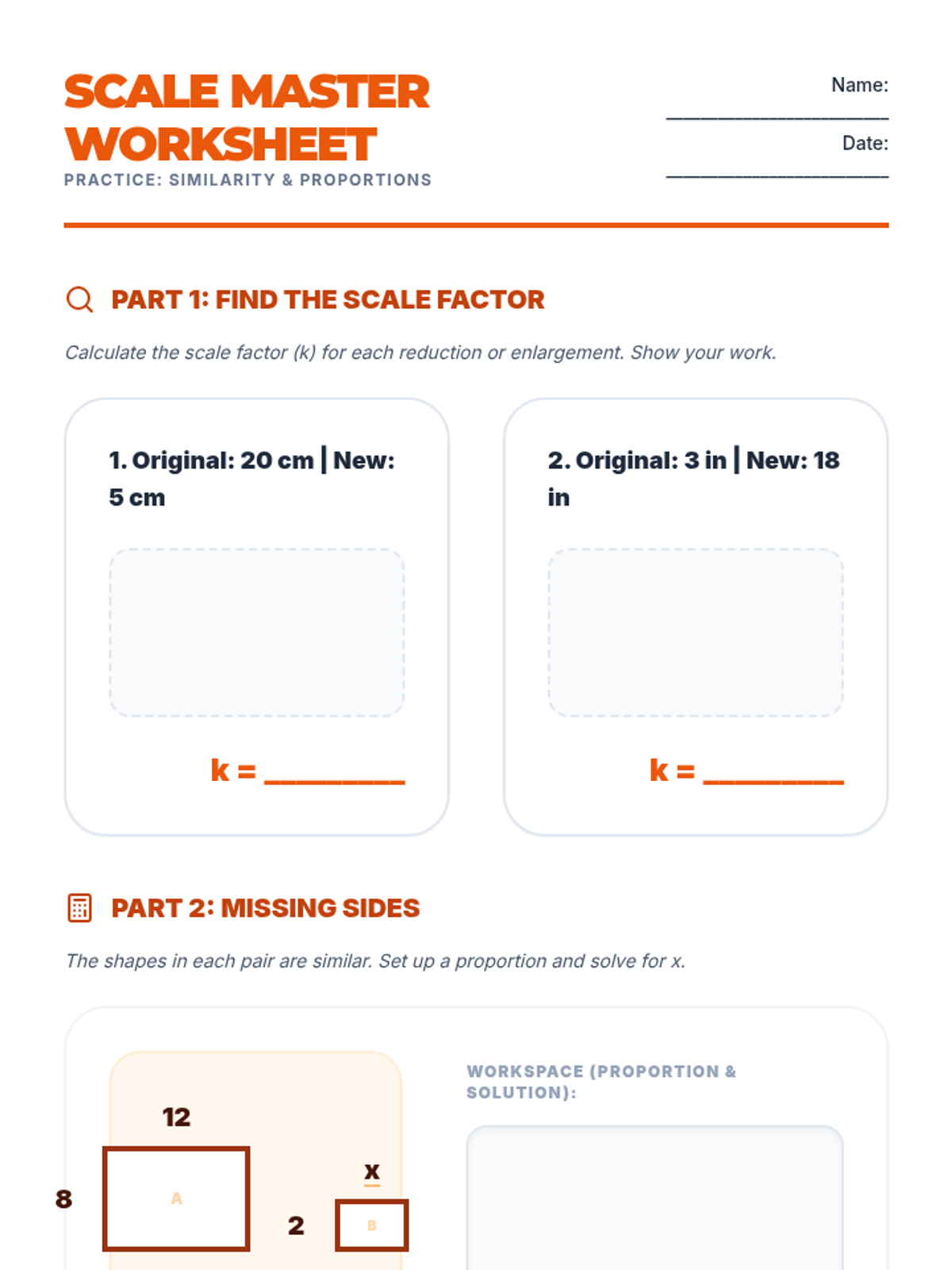
A practice worksheet for similarity and proportions. Revised with 'break-inside-avoid' to prevent problem splitting, larger work areas, and significantly improved diagram clarity and font sizing.
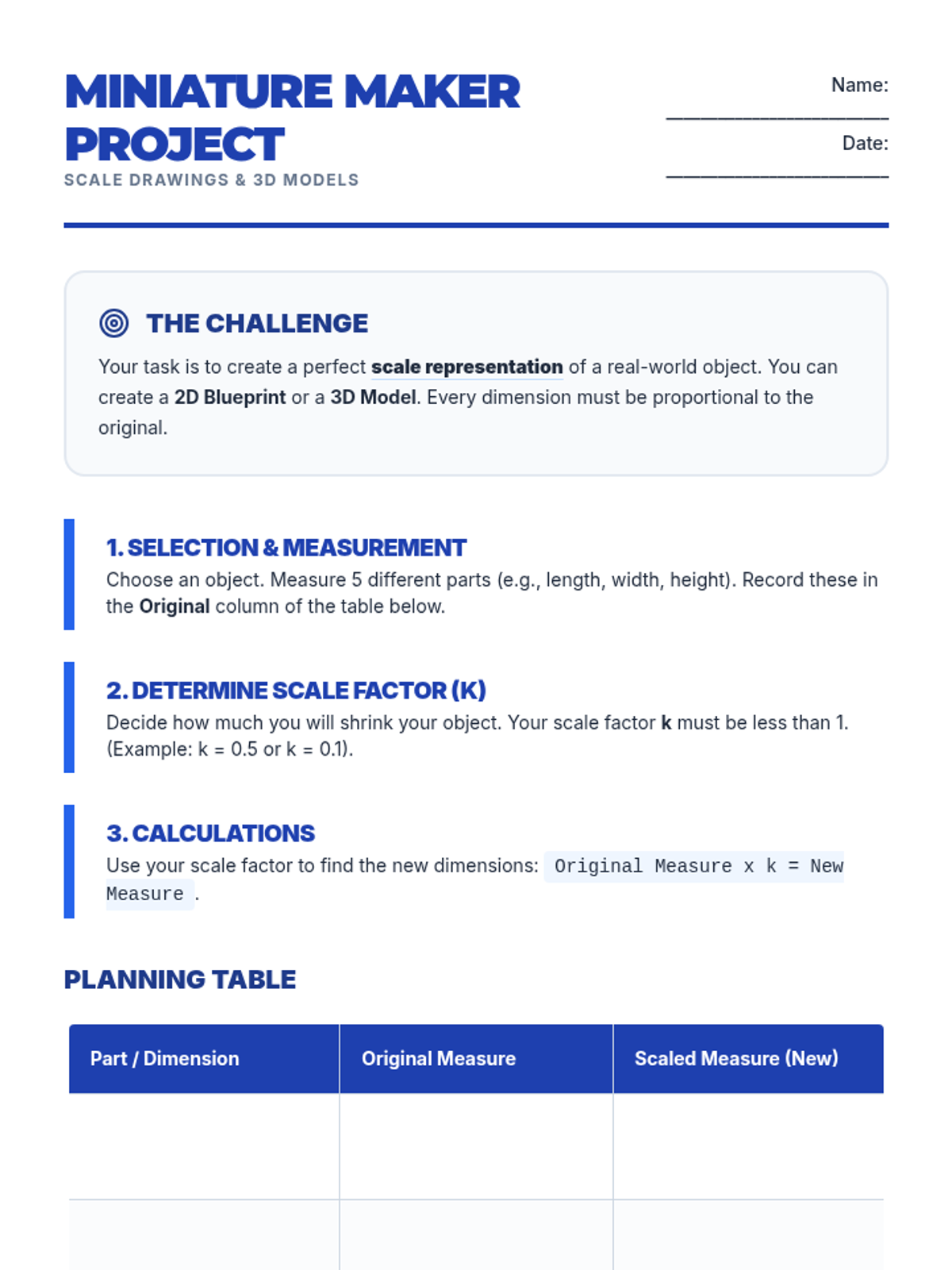
A comprehensive project guide and rubric for 'Miniature Maker Project'. Revised to keep tables together on one page, increase student work areas, and ensure consistent math rendering.
An introductory slide deck for 'The Great Shrink' lesson, covering the fundamentals of similarity, scale factor, and proportions, and introducing the project challenge. Revised with improved layout, larger fonts, and better technical rendering.
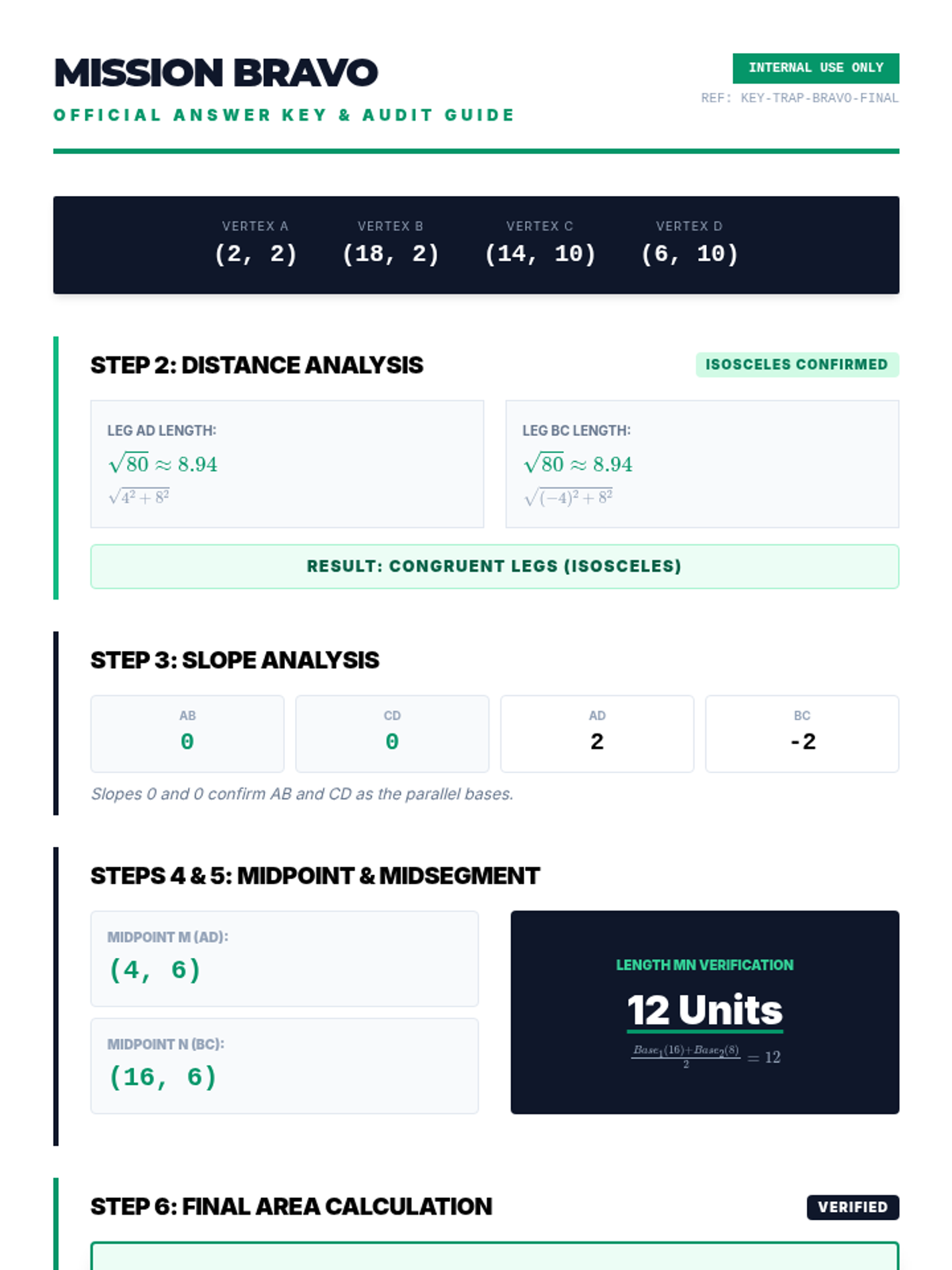
Official black-and-white printer-friendly answer key for Mission B of the Trapezoid Territory project. Features high-contrast calculations and step-by-step verification for coordinates A(2, 2), B(18, 2), C(14, 10), and D(6, 10). Confirms isosceles properties and a final area of 96 square units.
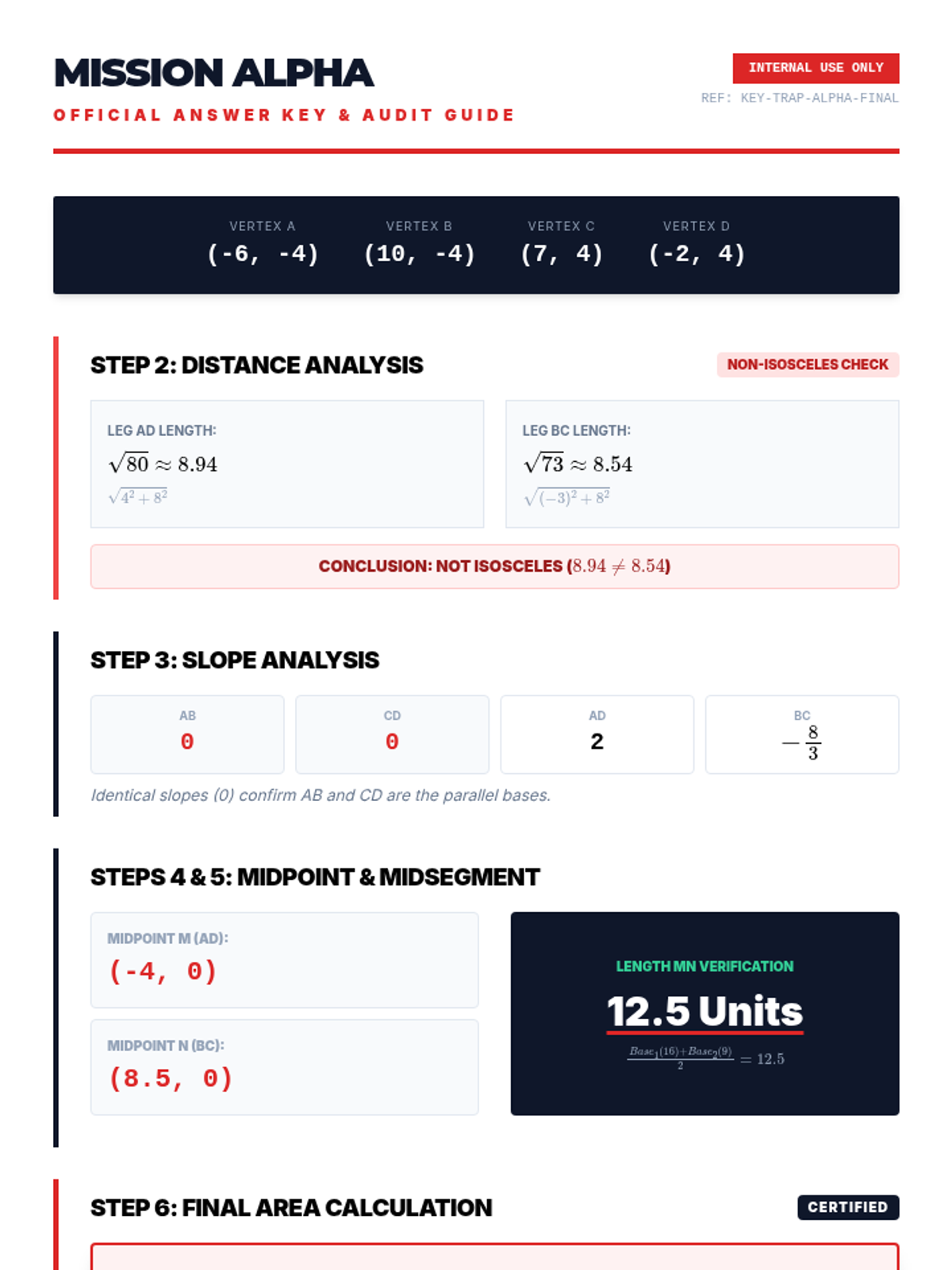
A high-contrast, black-and-white printer-friendly answer key for Mission A of the Trapezoid Territory project. Features bold calculations and clear verification steps for non-isosceles coordinates A(-6, -4), B(10, -4), C(7, 4), and D(-2, 4) without using heavy color fills.
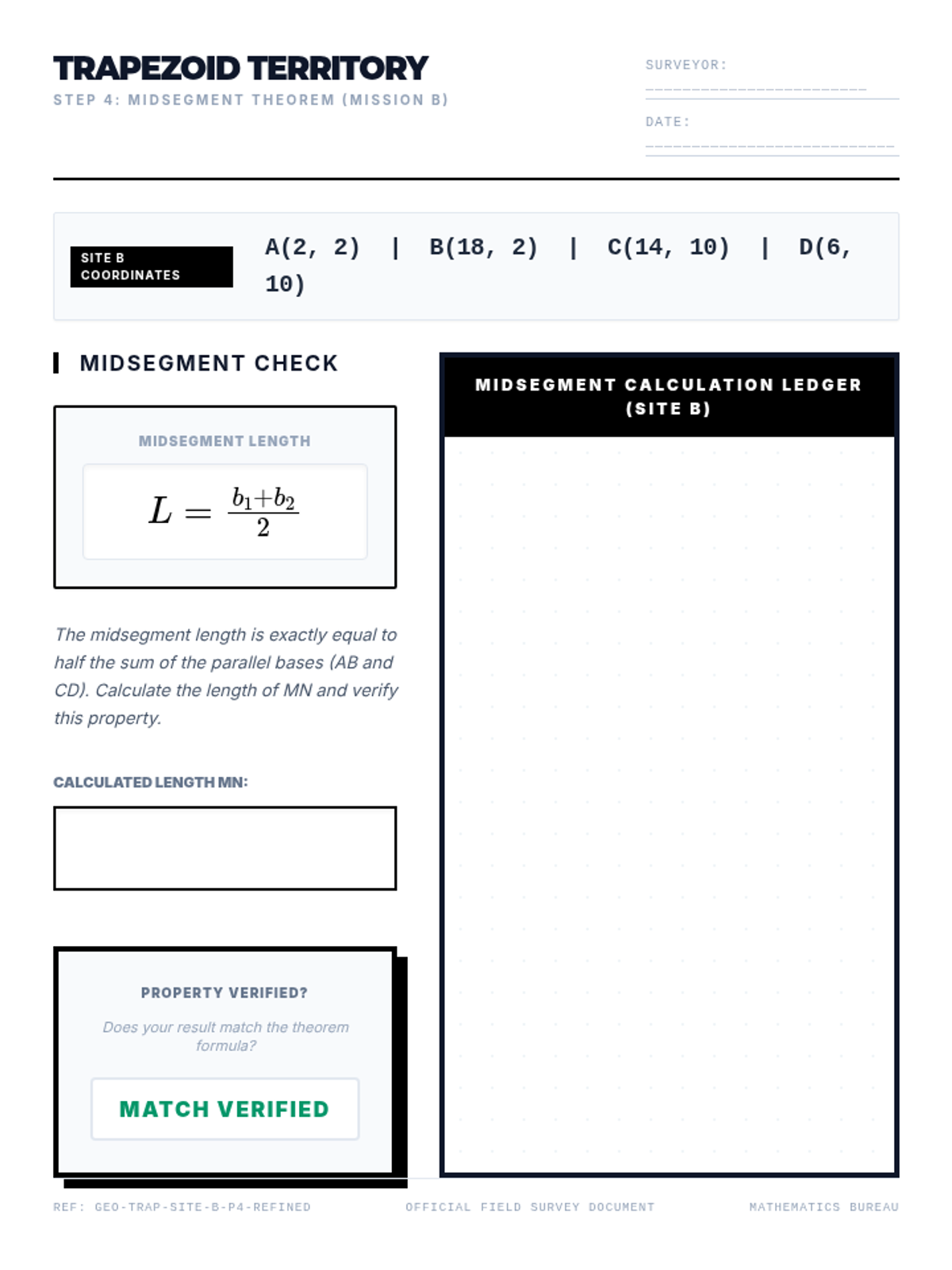
Refined portrait-mode Page 4 for Mission B of the Trapezoid Territory mission, focusing on midsegment calculations and theorem verification. Side-by-side instructions and dot-grid work area. Updated to Step 4 in the mission sequence with fixed LaTeX formula syntax and matching Mission A style. Updated with new positive coordinates.
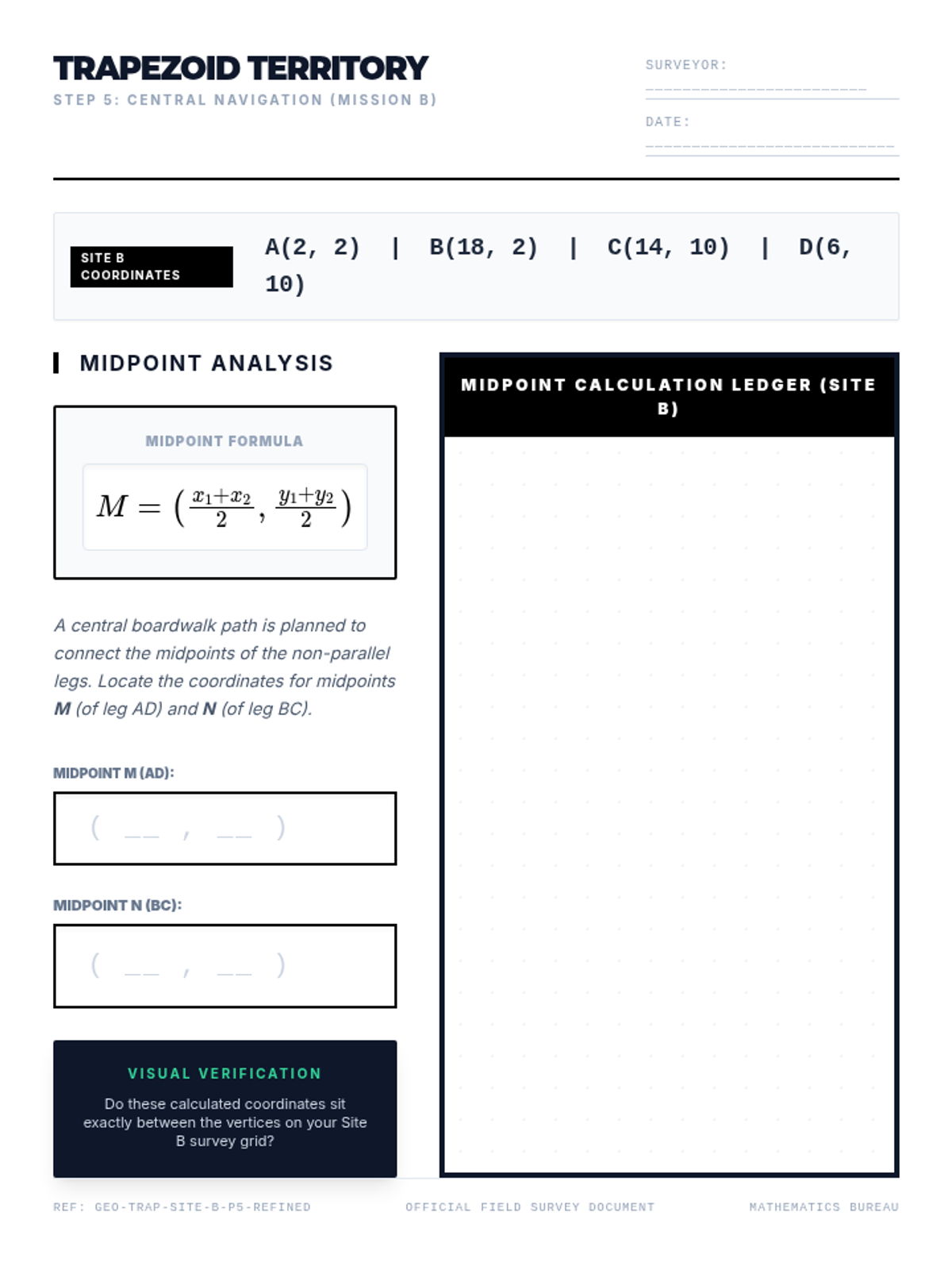
Refined portrait-mode Page 5 for Mission B of the Trapezoid Territory mission, focusing on midpoint calculations for legs AD and BC at Site B. Features a side-by-side layout with the midpoint formula and a large dot-grid calculation ledger. Updated to Step 5 in the mission sequence with fixed LaTeX formula syntax. Updated with new positive coordinates.
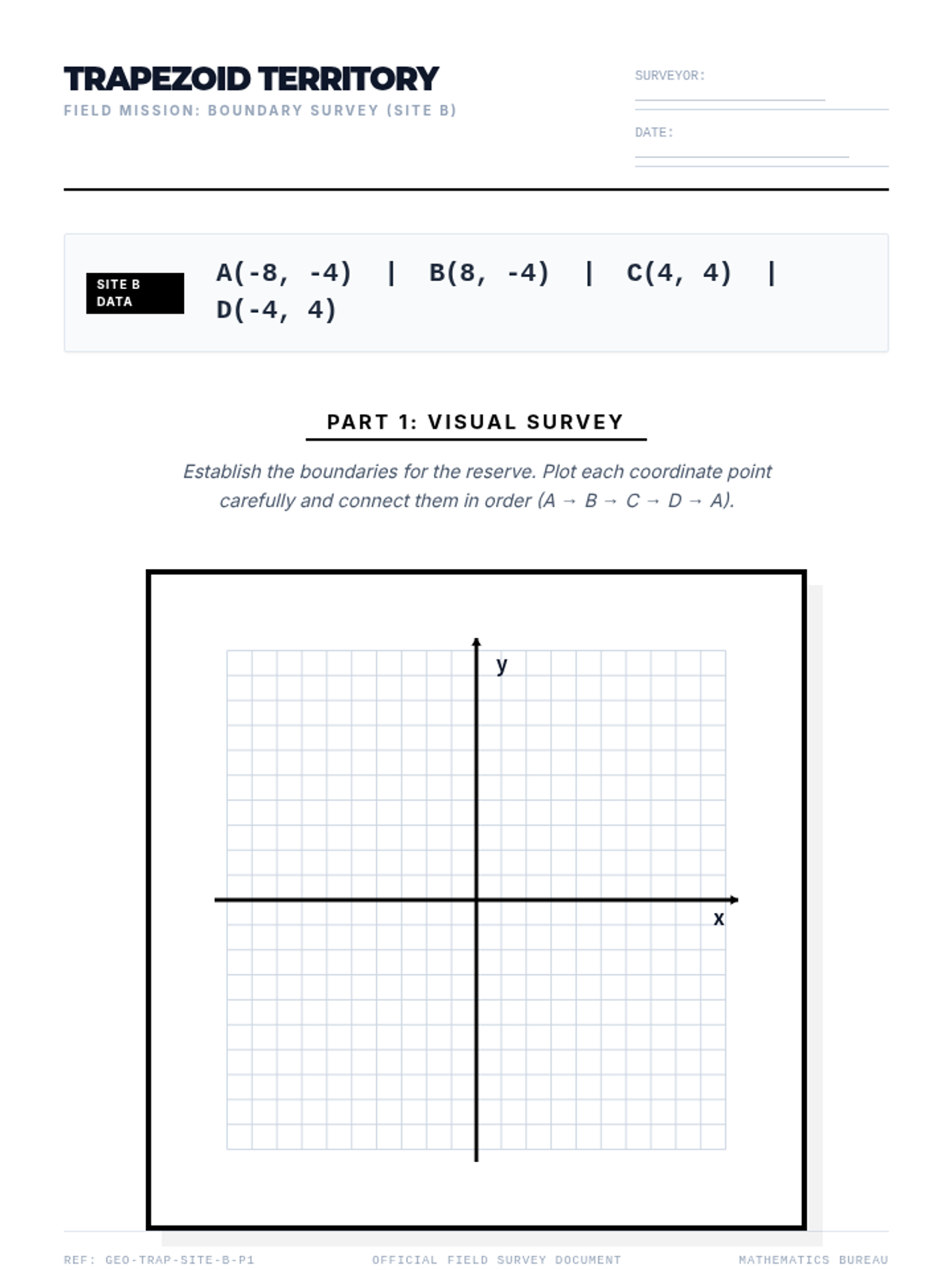
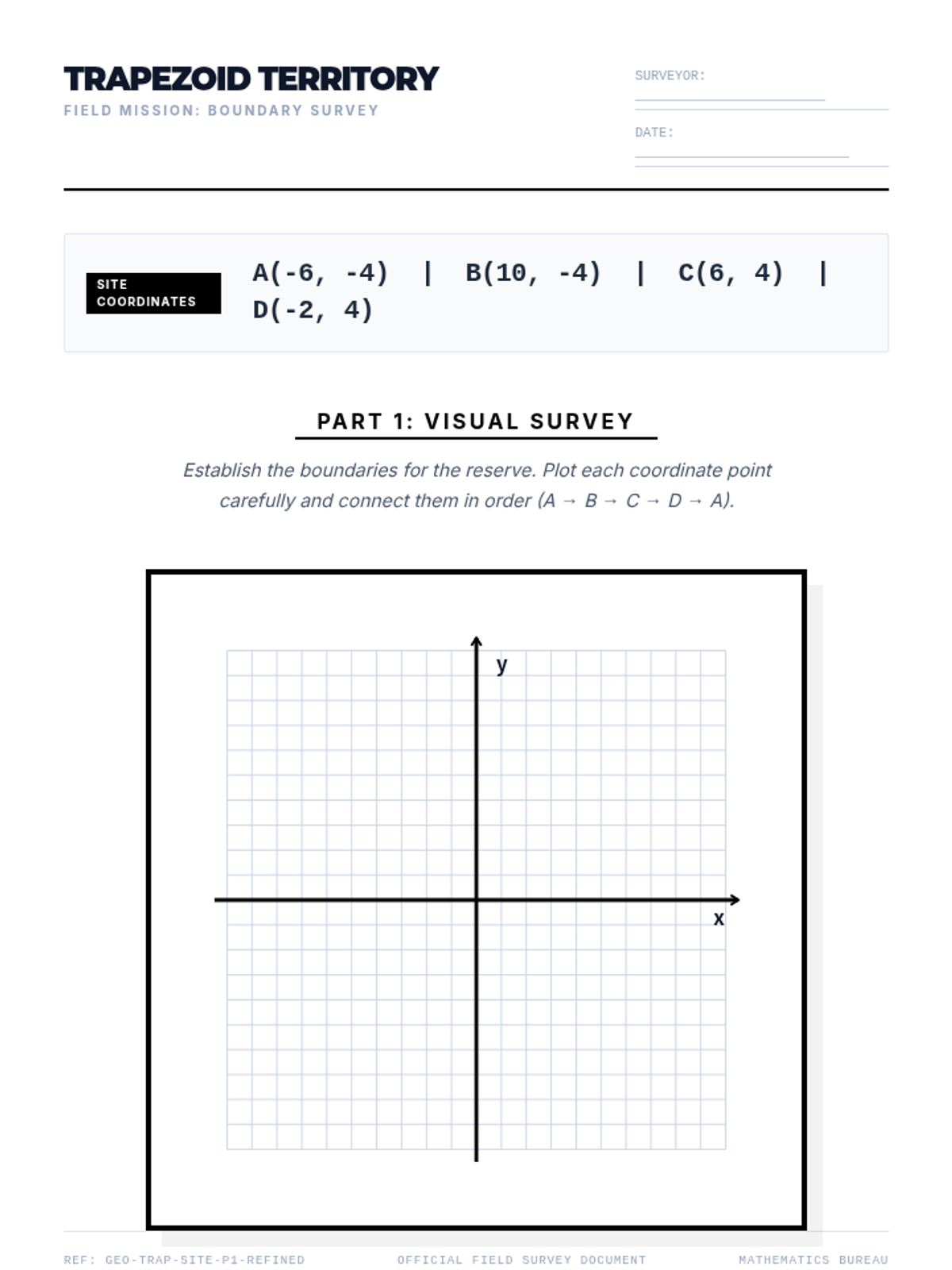
Refined portrait version of Mission B Page 1. Features a perfectly square 500x500 box for the coordinate grid and single-line coordinate display. Coordinates updated to all positive values: A(2, 2), B(18, 2), C(14, 10), and D(6, 10) forming an isosceles trapezoid.
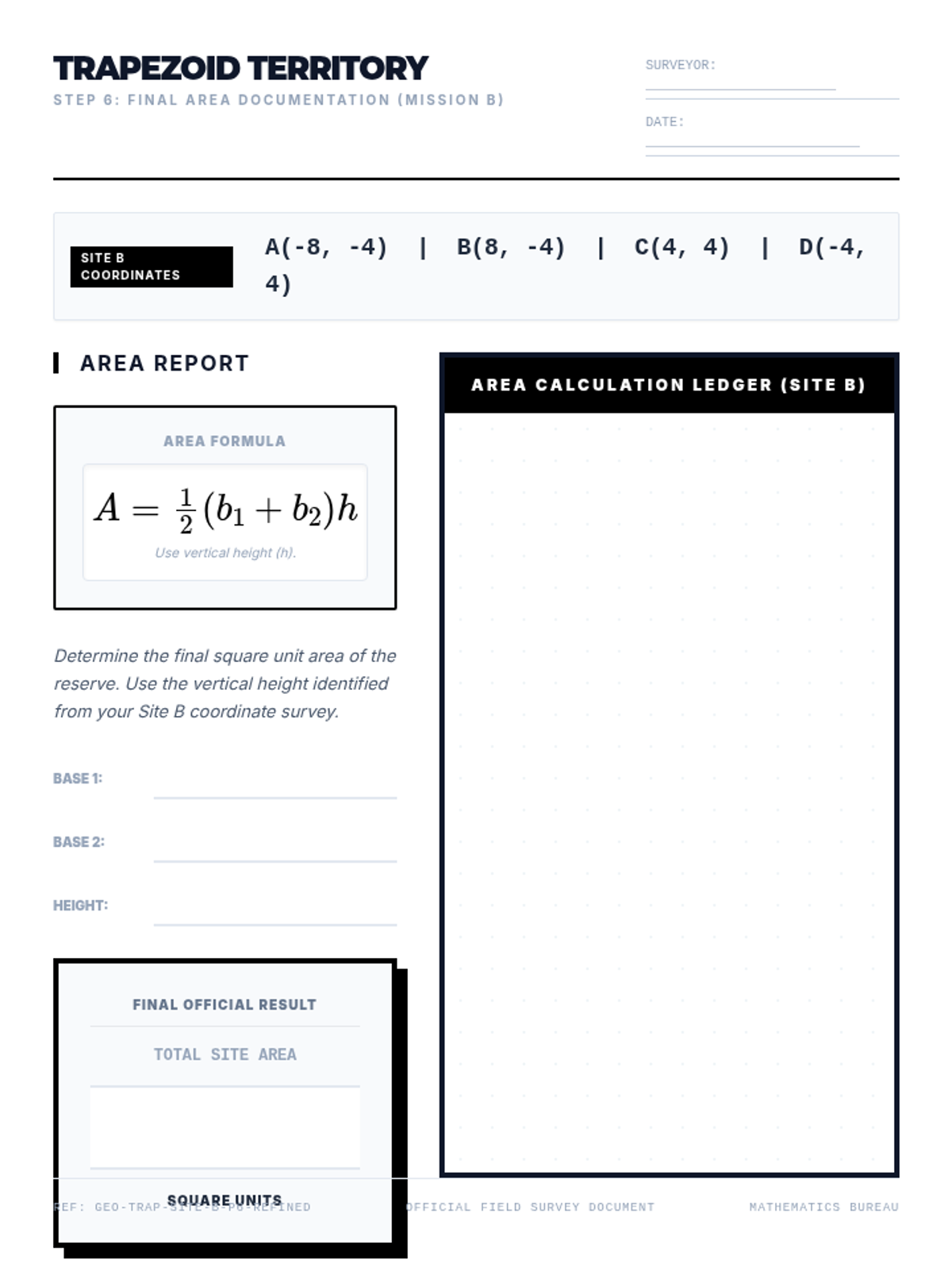
Refined portrait-mode Page 6 for Mission B of the Trapezoid Territory mission. It features a side-by-side layout with the area formula and final result box on the left, and a large dot-grid calculation ledger on the right. Updated with Site B coordinates.
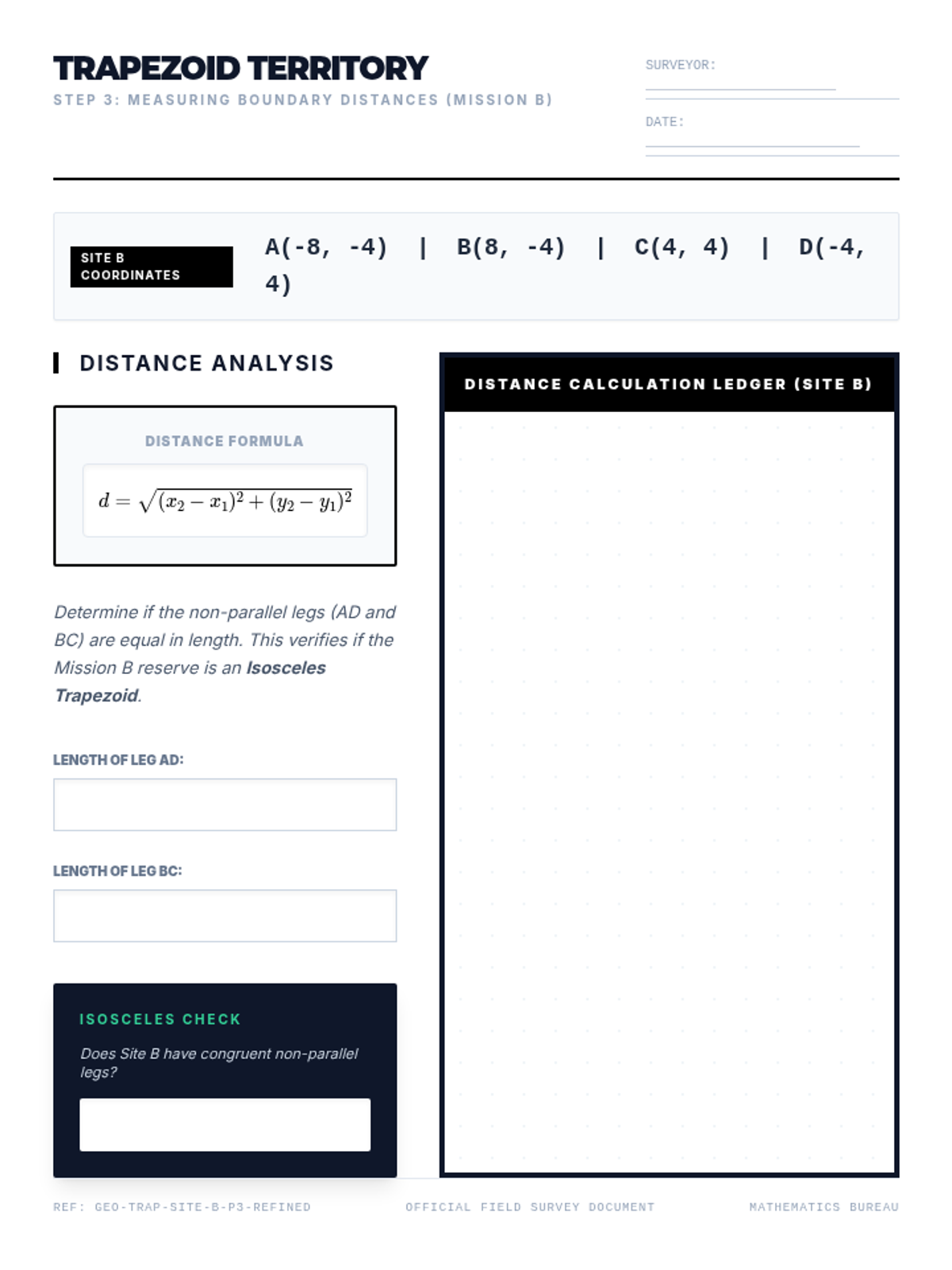
Refined portrait-mode Page 2 for Mission B of the Trapezoid Territory mission. Side-by-side layout focusing on the distance formula for leg congruence analysis at Site B. Features a dot-grid calculation ledger for student work. Updated with new positive coordinates: A(2, 2), B(18, 2), C(14, 10), and D(6, 10).
Refined portrait-mode Page 3 for Mission B of the Trapezoid Territory mission. It features a side-by-side layout with the slope formula and answer boxes on the left, and a large dot-grid calculation ledger on the right. Updated with new positive coordinates: A(2, 2), B(18, 2), C(14, 10), and D(6, 10).
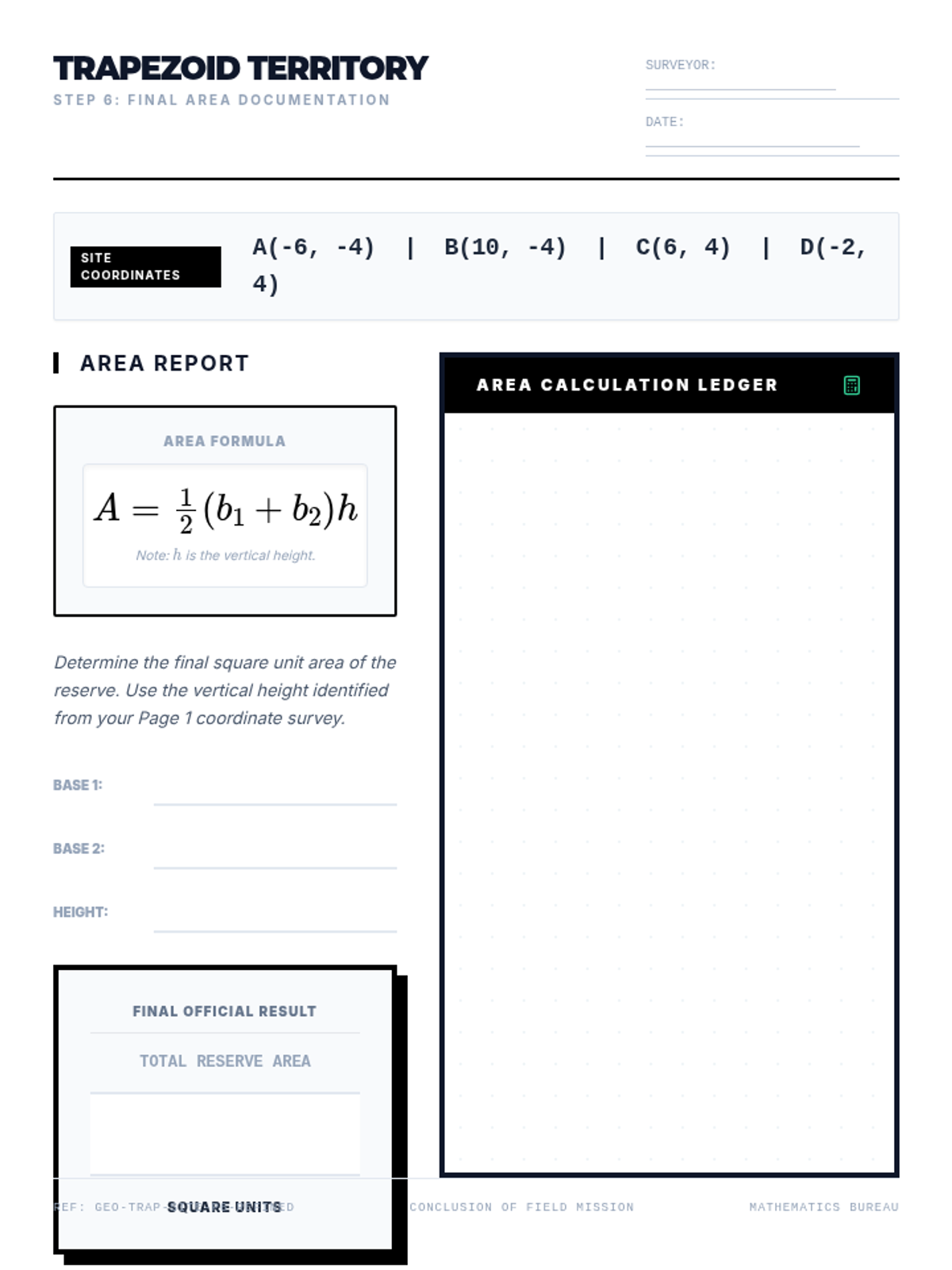
Refined portrait-mode Page 6 for the Trapezoid Territory mission. It features a side-by-side layout with the area formula and final result box on the left, and a large dot-grid calculation ledger on the right. Updated with Mission A refined coordinates.
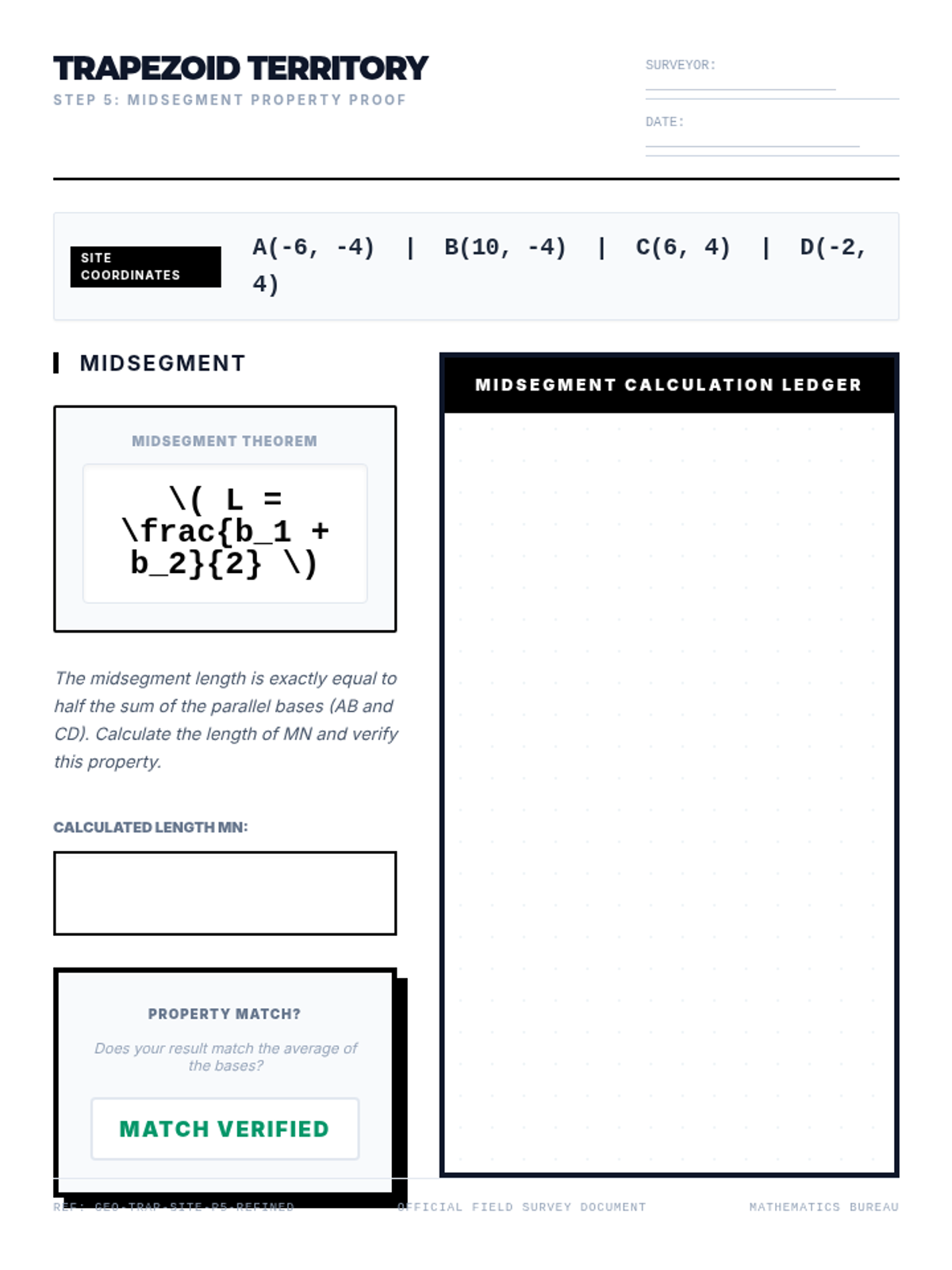
Refined portrait-mode Page 4 for the Trapezoid Territory mission, focusing on the midsegment theorem. Side-by-side layout with the midsegment formula and verification box on the left, and a large dot-grid work area on the right. Updated with Mission A refined coordinates. Now updated to Page 4 in the mission sequence. Updated with non-isosceles coordinates.
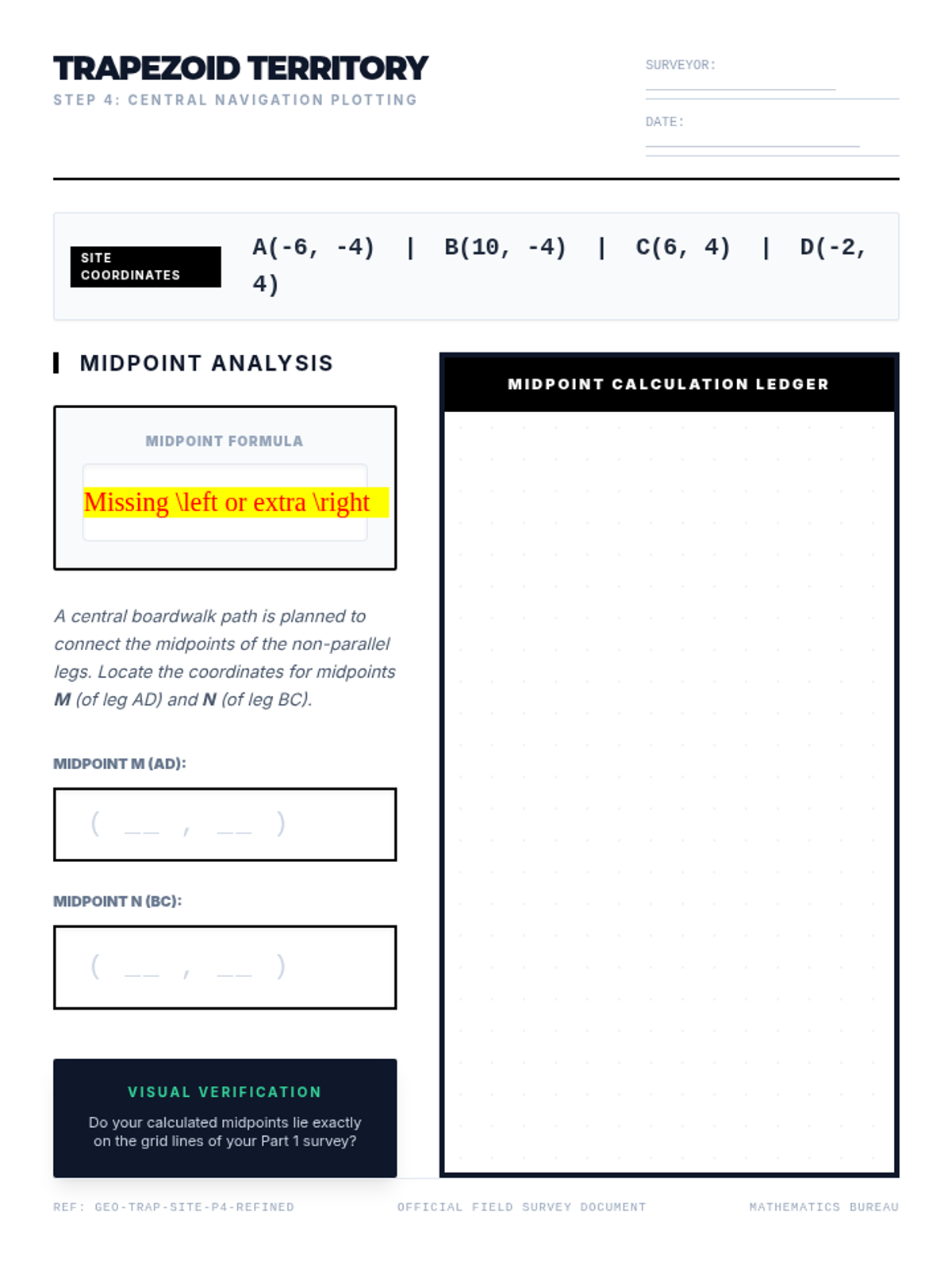
Refined portrait-mode Page 5 for the Trapezoid Territory mission, focusing on midpoint calculations for the non-parallel legs. Features the side-by-side layout with the midpoint formula and coordinate answer boxes on the left, and a large dot-grid calculation ledger on the right. Updated with non-isosceles coordinates. Now updated to Page 5 in the mission sequence.
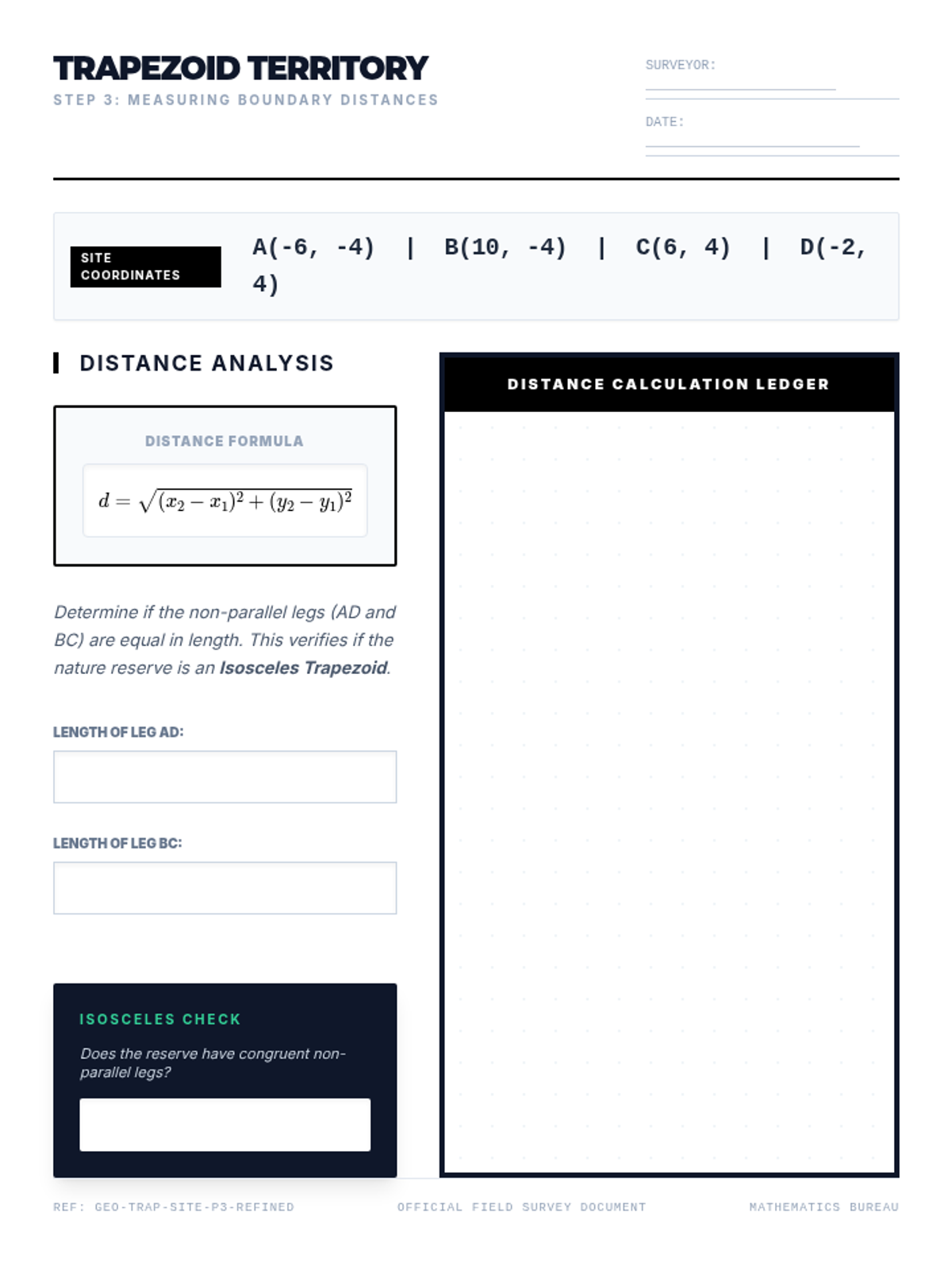
Refined portrait-mode Page 2 for the Trapezoid Territory mission. It uses a side-by-side layout for distance calculations to verify if the legs are congruent. Updated to reflect its new position in the mission sequence. Updated with non-isosceles coordinates.
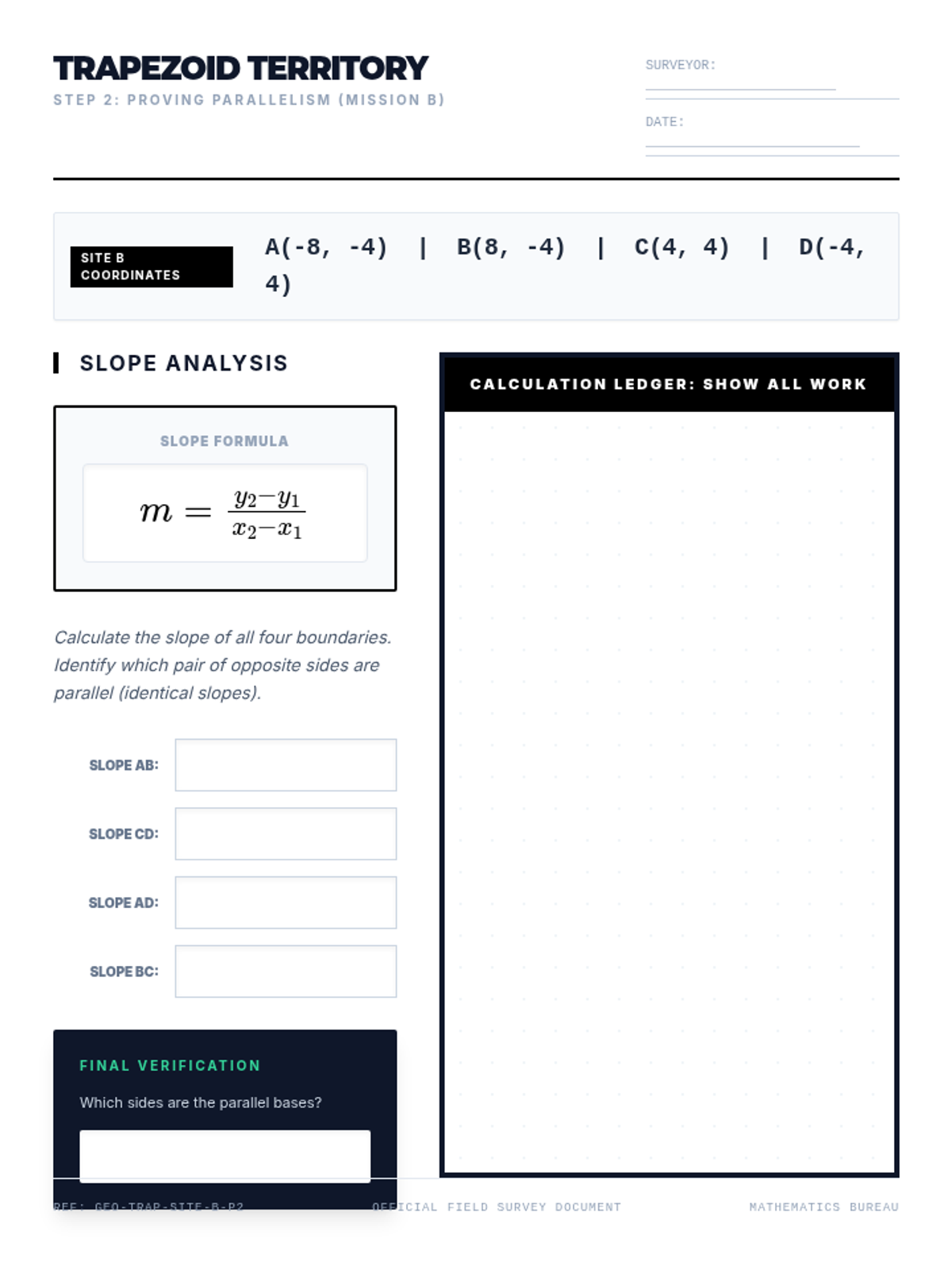
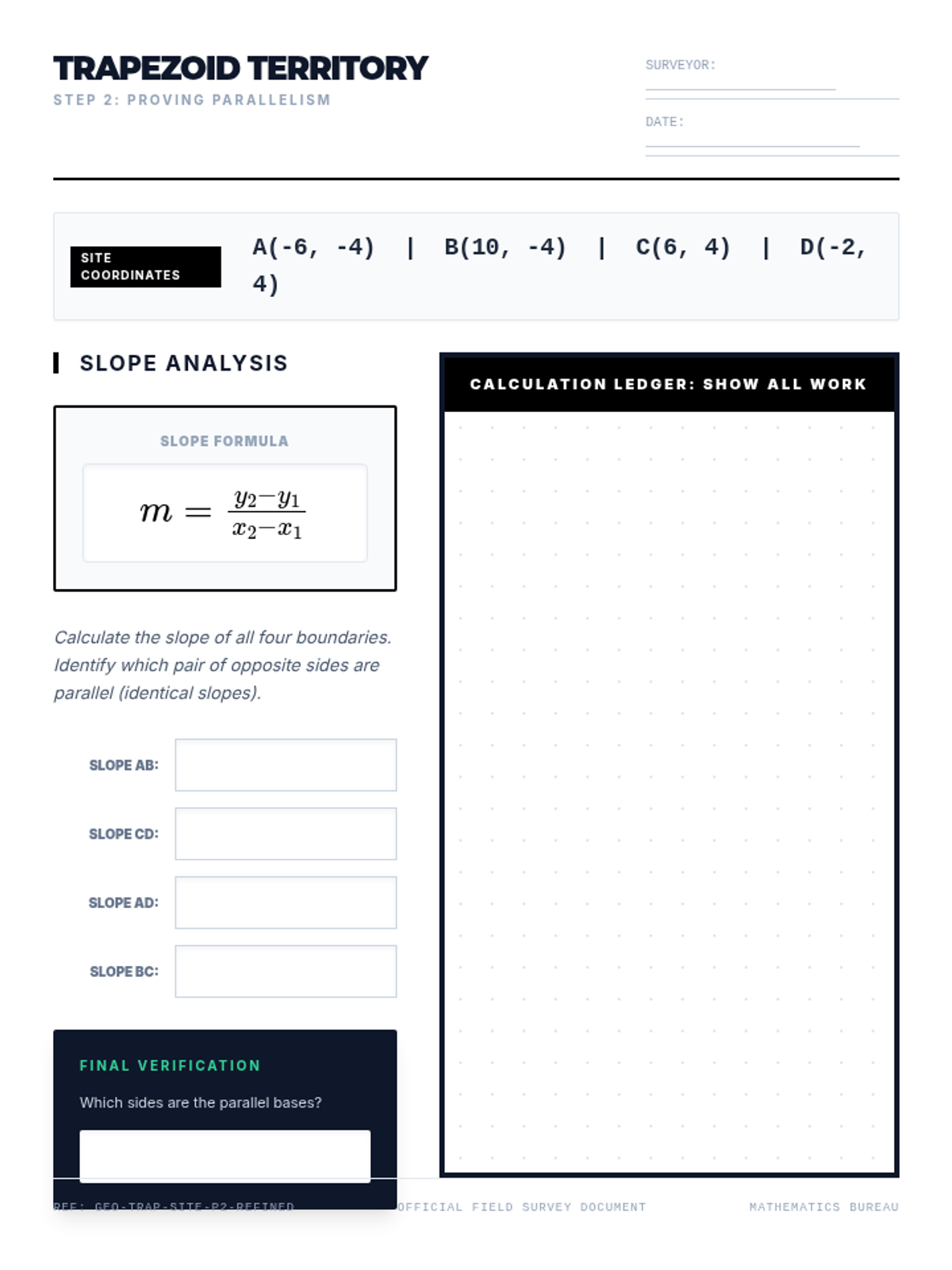
Refined portrait-mode Page 3 for the Trapezoid Territory mission. It features a side-by-side layout with the slope formula and answer boxes on the left, and a large dot-grid calculation ledger on the right for student work. Updated with non-isosceles coordinates.
Updated portrait version of Page 1 for Mission A. Coordinates updated to A(-6, -4), B(10, -4), C(7, 4), and D(-2, 4) to form a trapezoid that is mathematically not isosceles, providing a rigorous check for students.
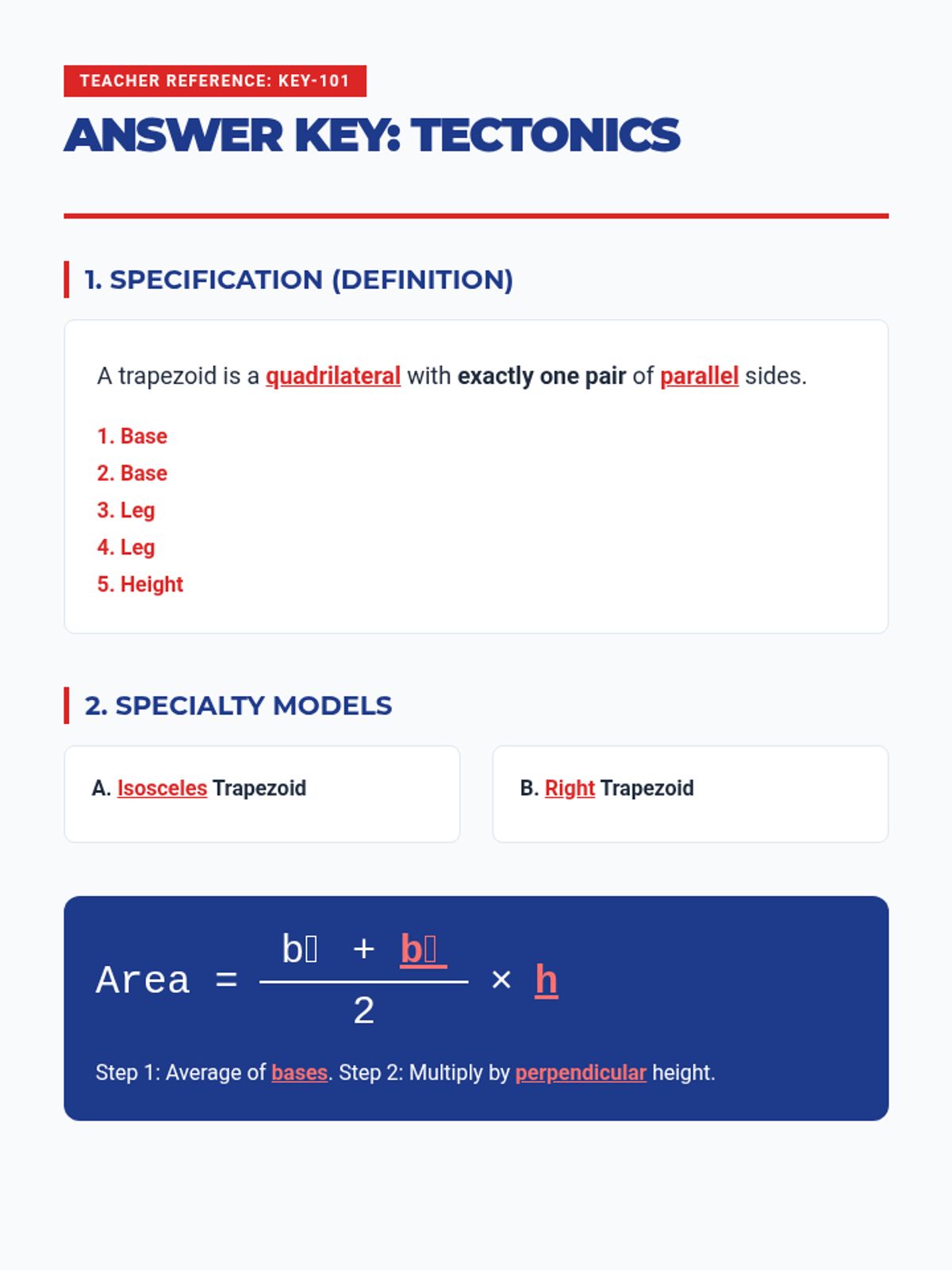
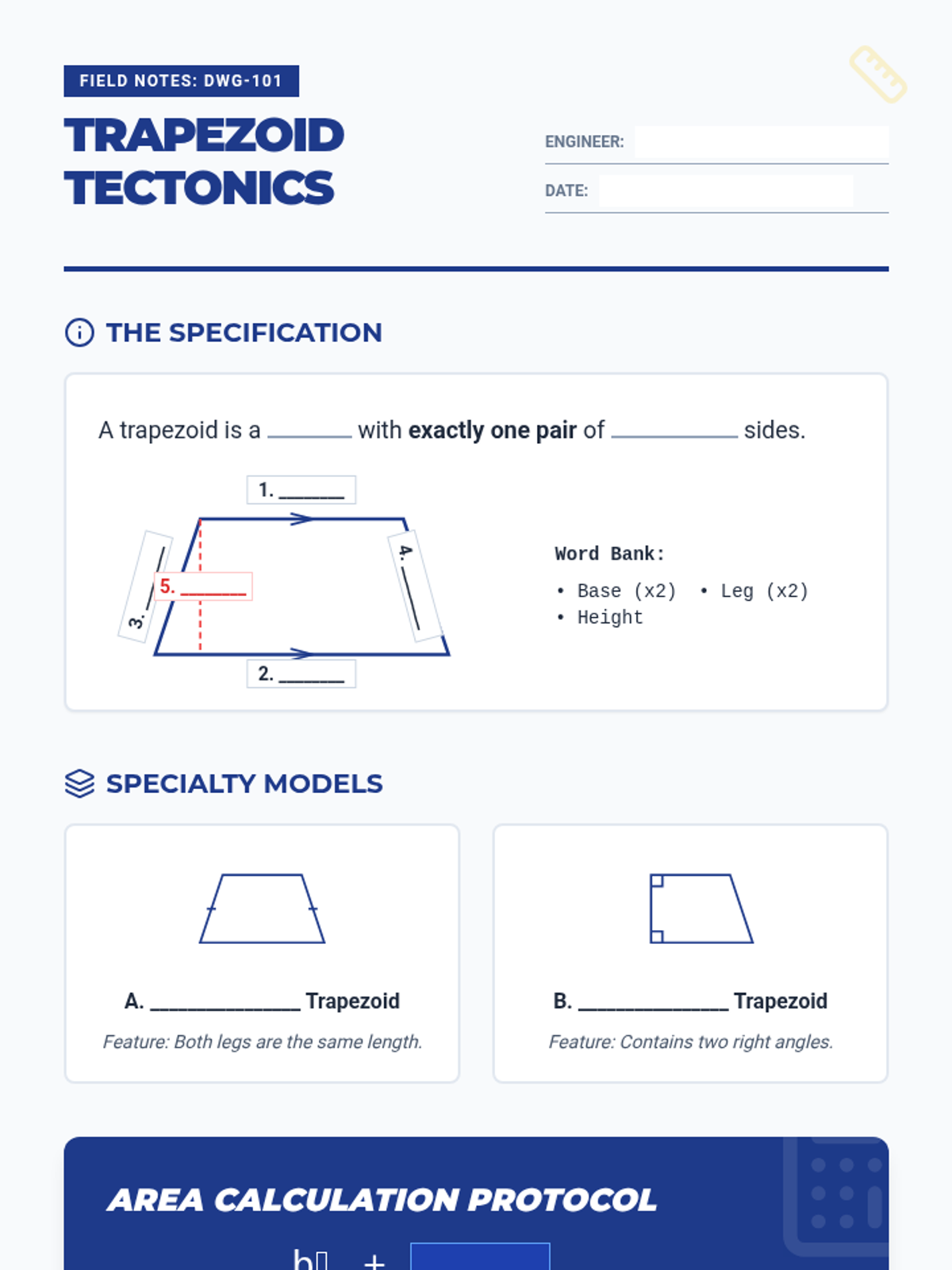
An answer key for the Trapezoid Tectonics Worksheet, providing correct terminology for the definitions, labels for the diagram, and step-by-step solutions for the area problems.
An expanded fill-in-the-blank student worksheet following the architectural blueprint theme. Now includes two pages with a total of 6 practice problems, covering area calculations, word problems, finding missing dimensions, and property verification.
A visual presentation introducing trapezoid properties, definitions, types (right and isosceles), and the area formula with guided examples. Designed with a clean architectural blueprint aesthetic.
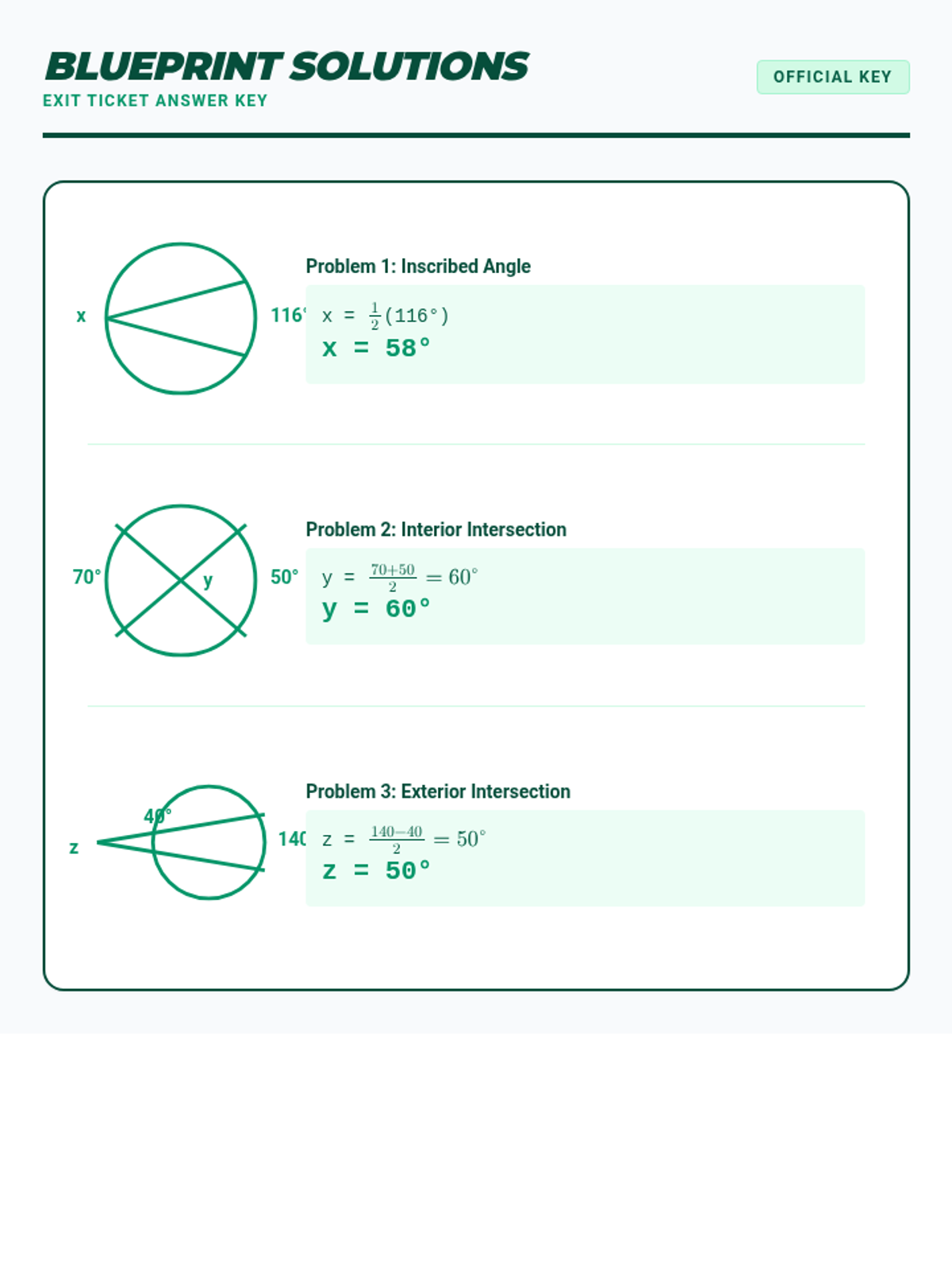
An answer key for the Circle Angle Exit Ticket, featuring step-by-step solutions for inscribed, interior, and exterior angle problems. Revised to ensure numbers are positioned clearly away from geometric lines.
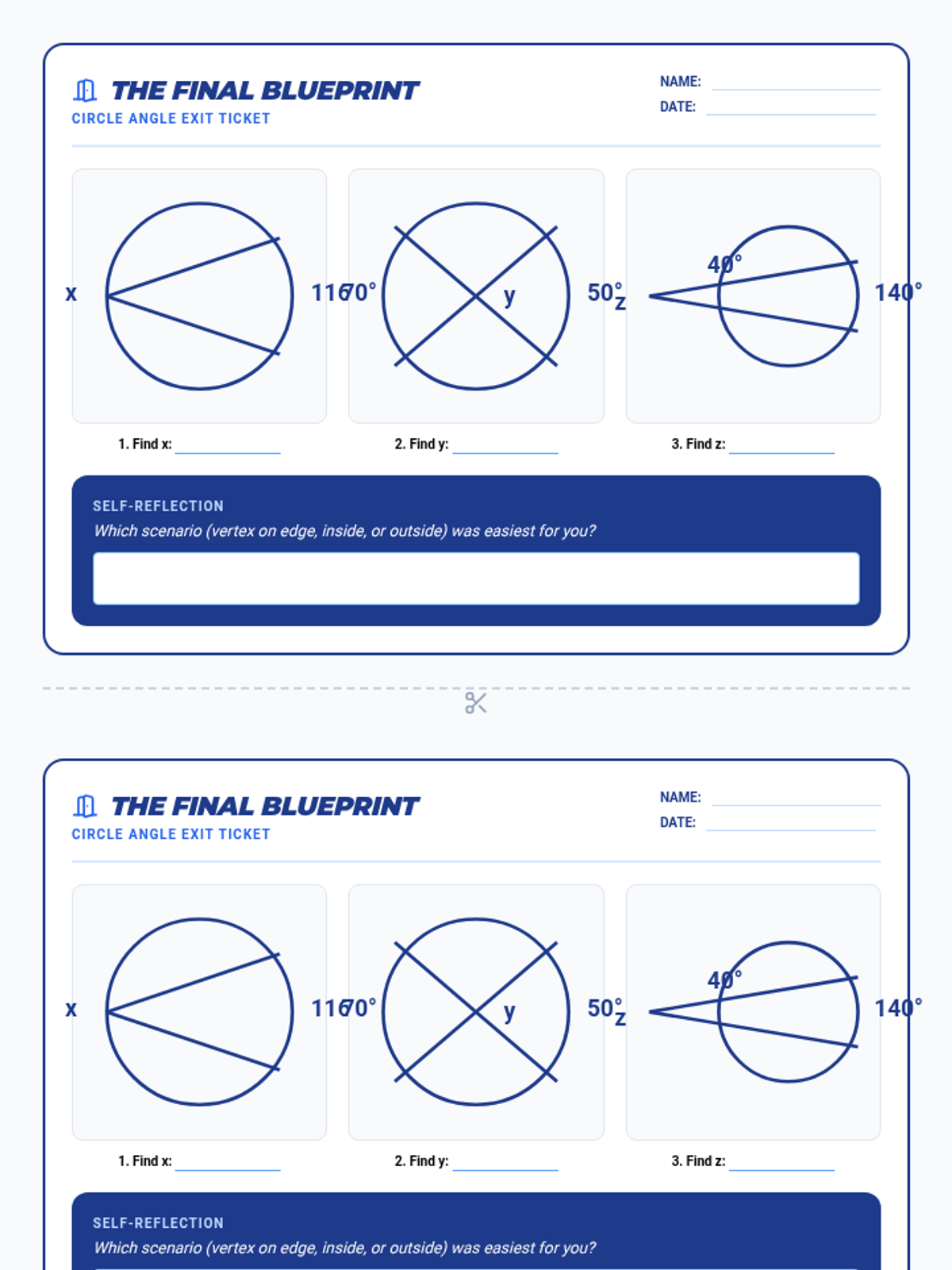
A two-on-a-page exit ticket designed for quick assessment of inscribed, interior, and exterior angle relationships. Includes a brief self-reflection section for students. Revised for paper efficiency and contrast.
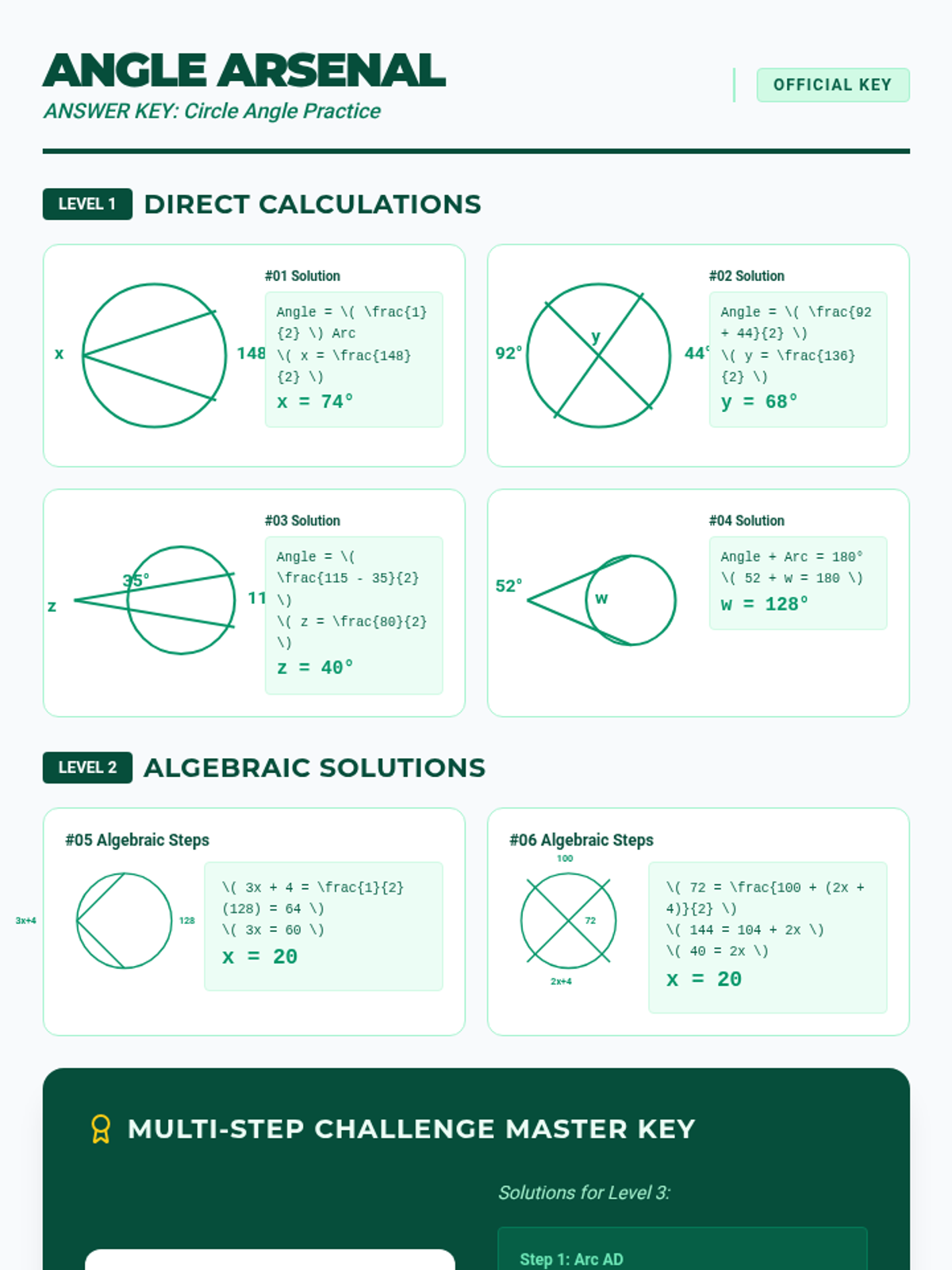
A complete answer key for the Angle Arsenal practice worksheet with full algebraic solutions and step-by-step logic. Revised to ensure numbers are positioned clearly away from geometric lines.
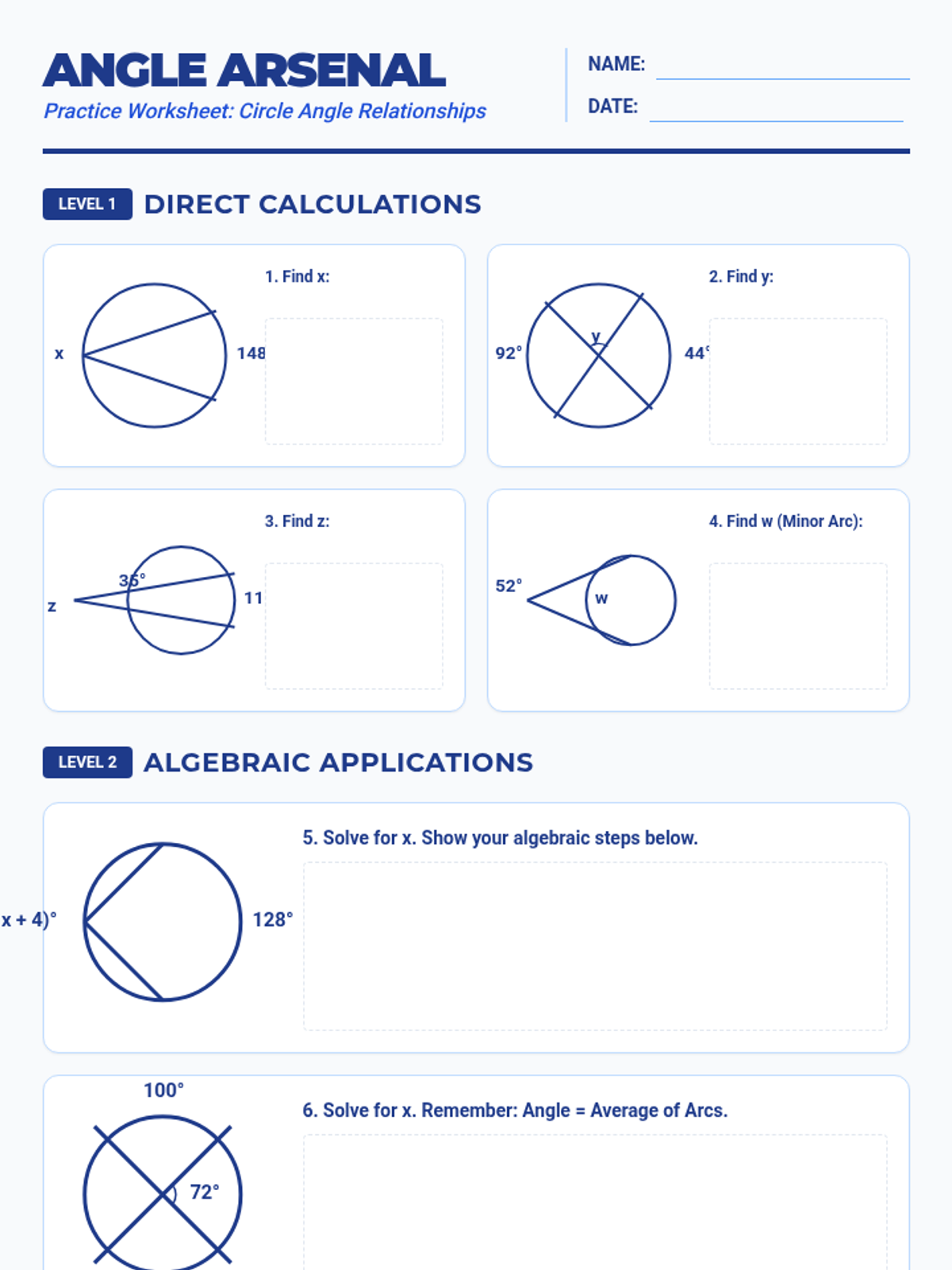
A comprehensive practice worksheet featuring direct calculations, algebraic circle geometry problems, and multi-step challenges with clear, non-overlapping labels. Revised for improved visual clarity and space.
A high-impact visual presentation for teaching circle angle relationships, featuring large diagrams, clear formulas, and a comparative summary table for all vertex locations. Revised to ensure numbers and labels are positioned clearly away from geometric lines.
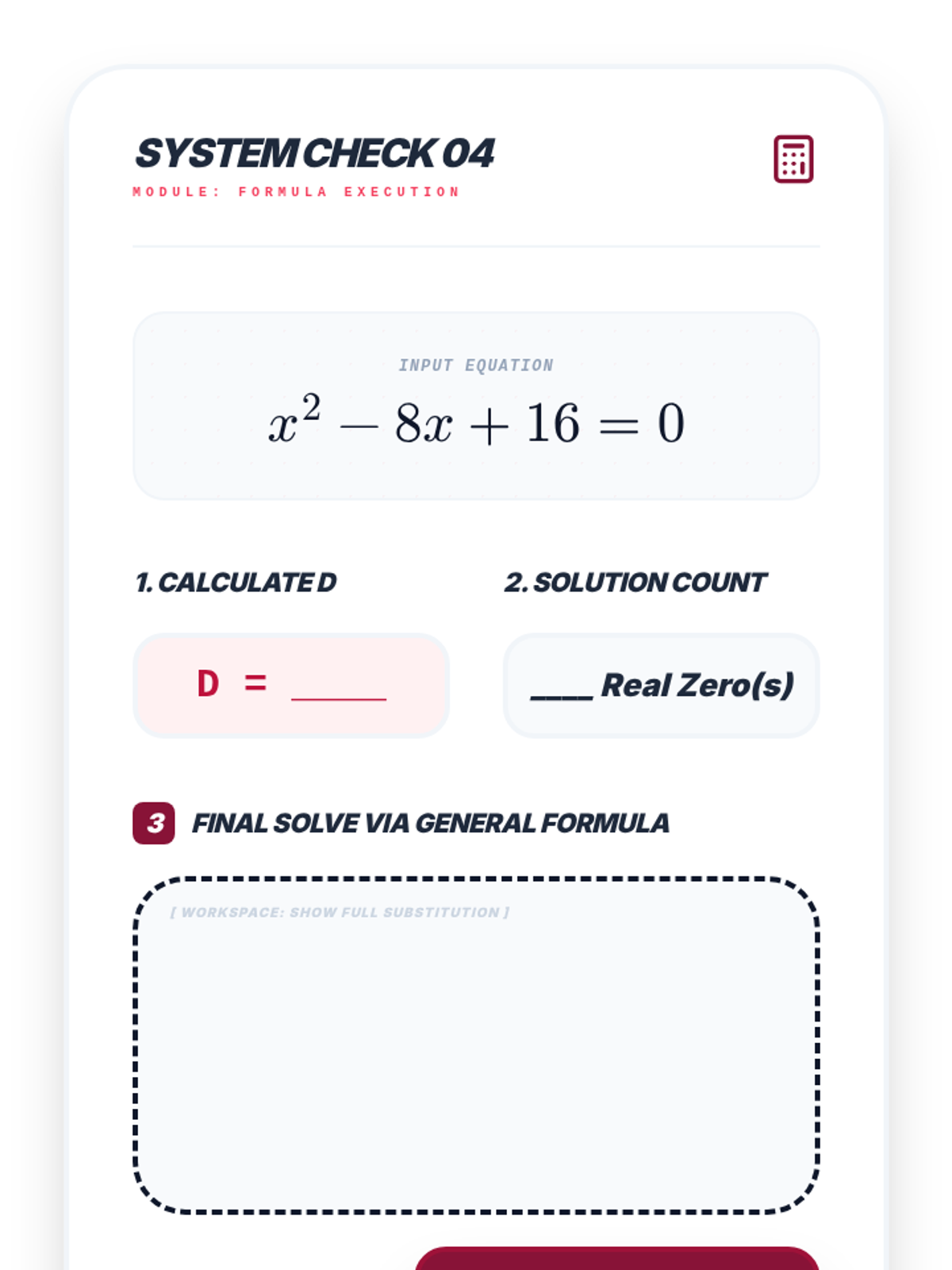
A formative assessment on the use of the discriminant and quadratic formula for single and multiple real roots.
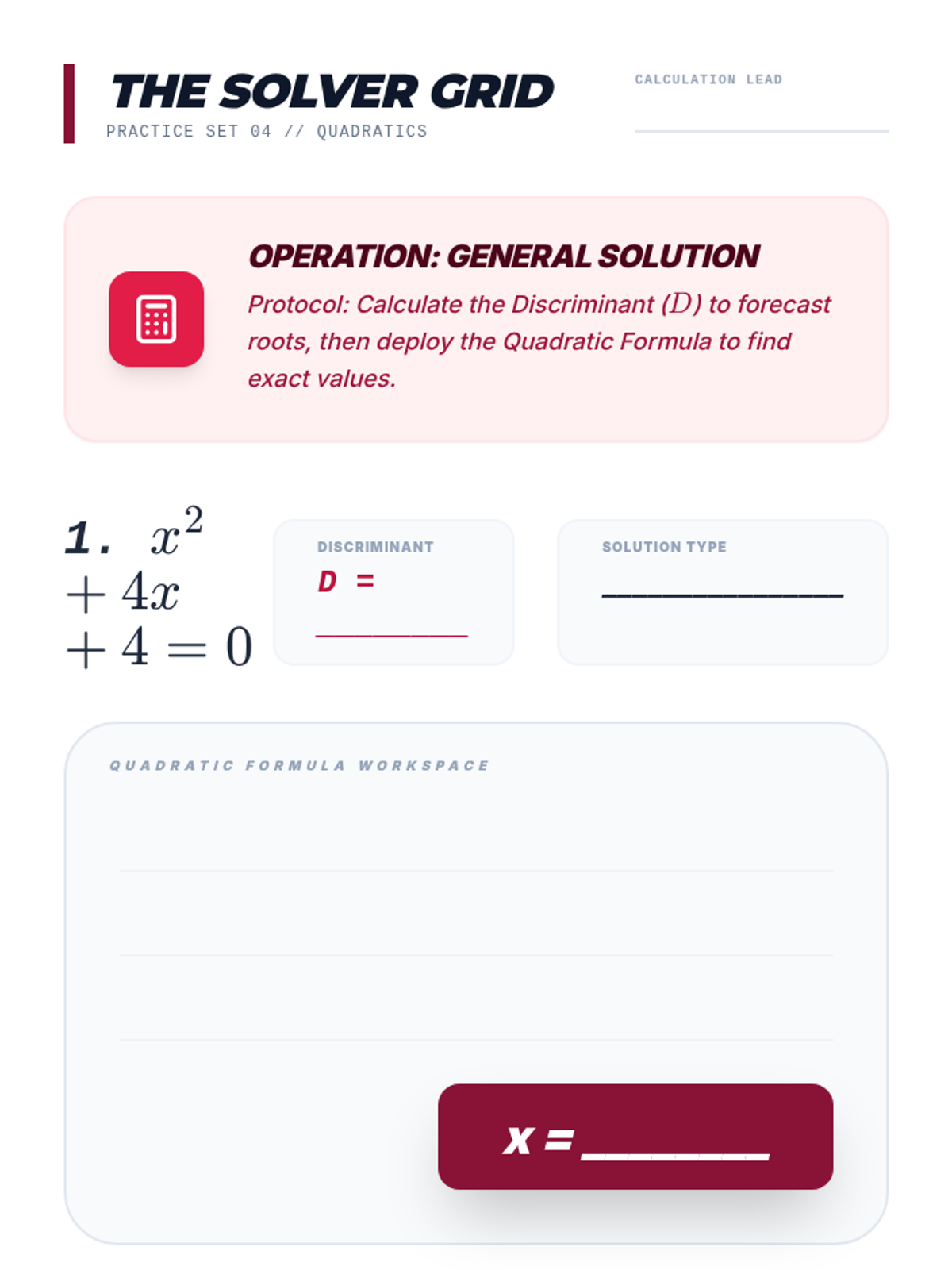
A practice worksheet requiring students to use both the discriminant and the quadratic formula to solve equations.
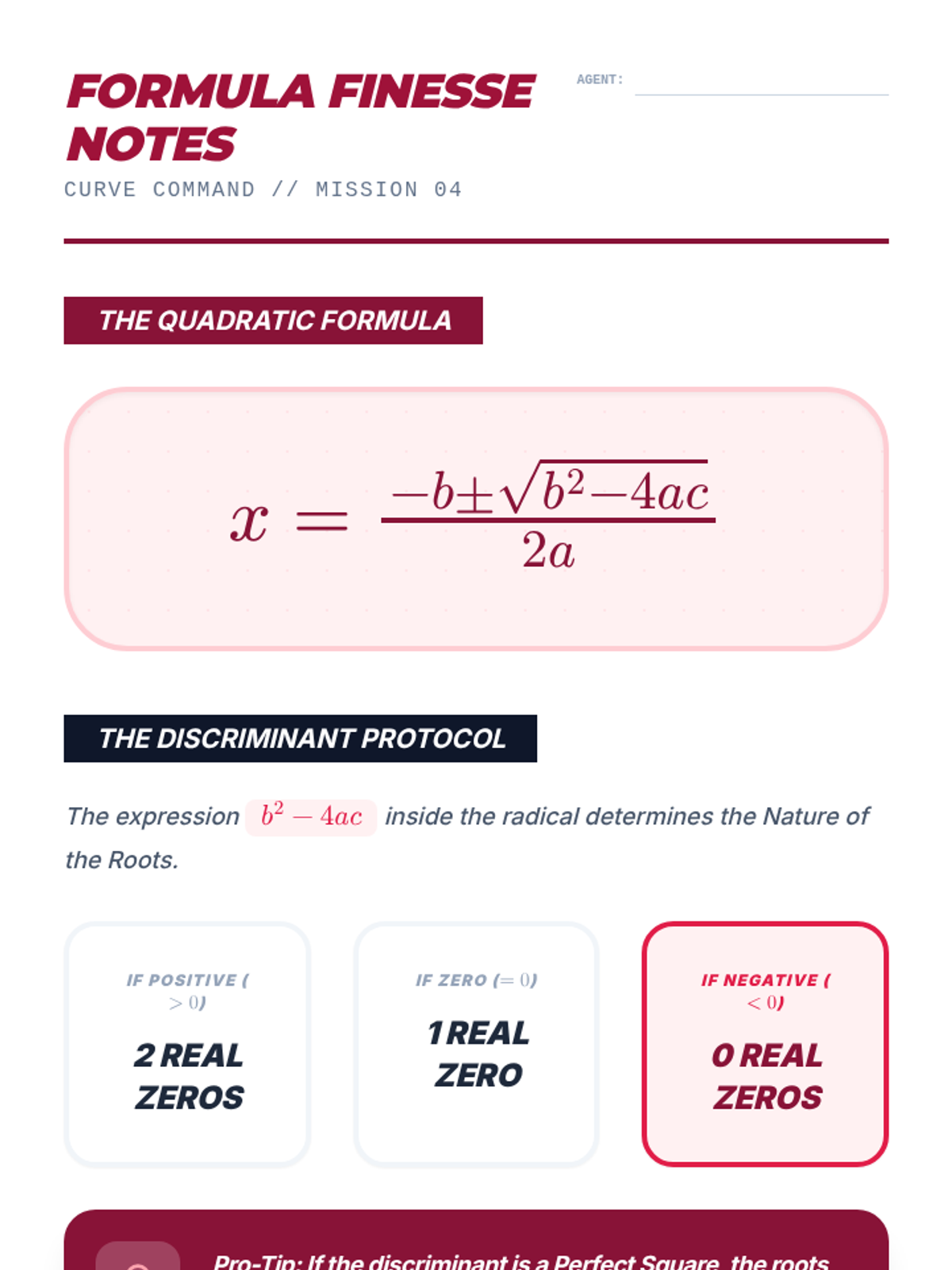
Guided notes for Lesson 4 covering the application of the Quadratic Formula and the function of the discriminant.
Slide deck for Lesson 4, introducing the Quadratic Formula and the Discriminant, with a focus on real rational roots.
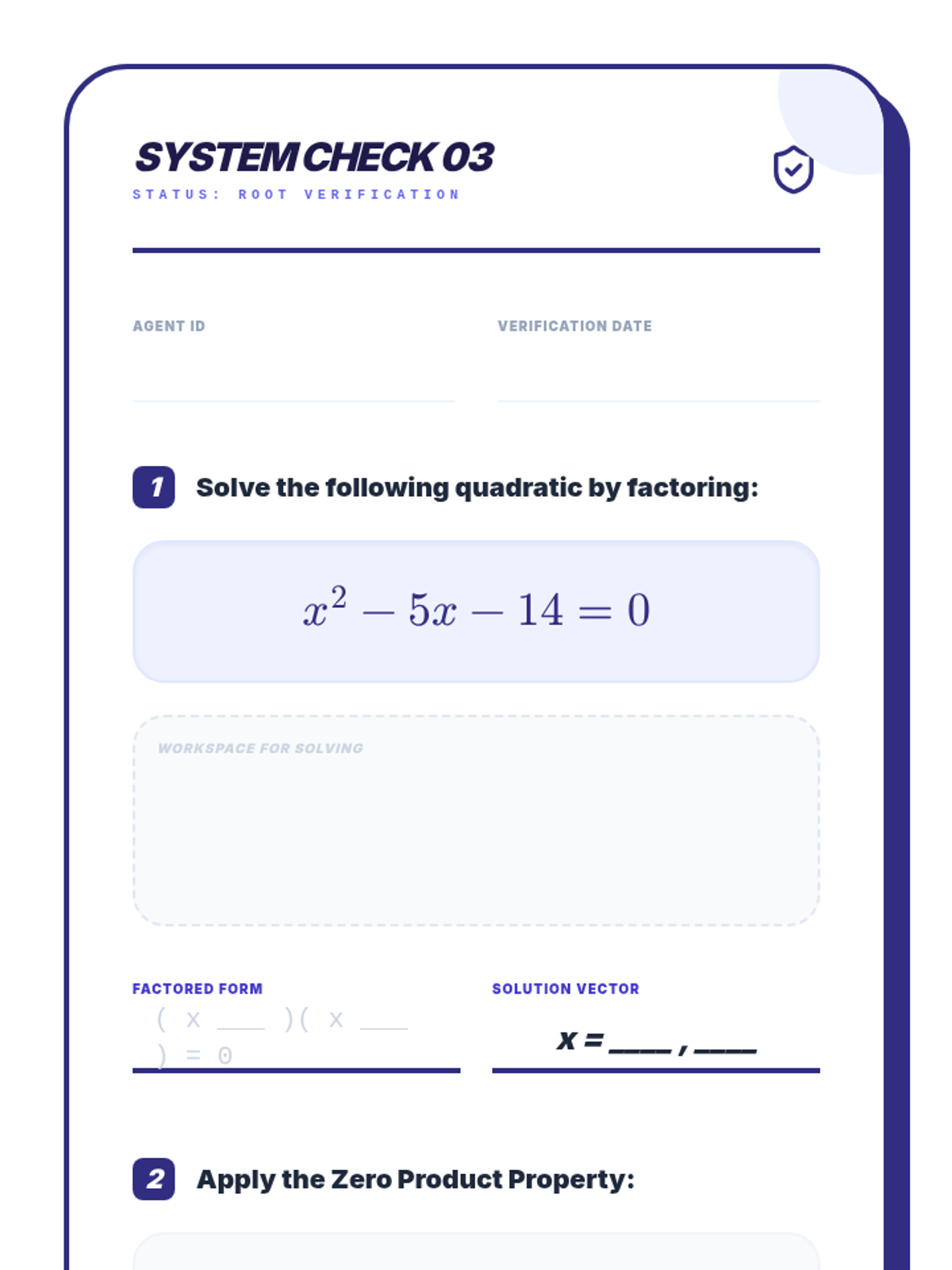
A quick check for student mastery of factoring techniques and the Zero Product Property.
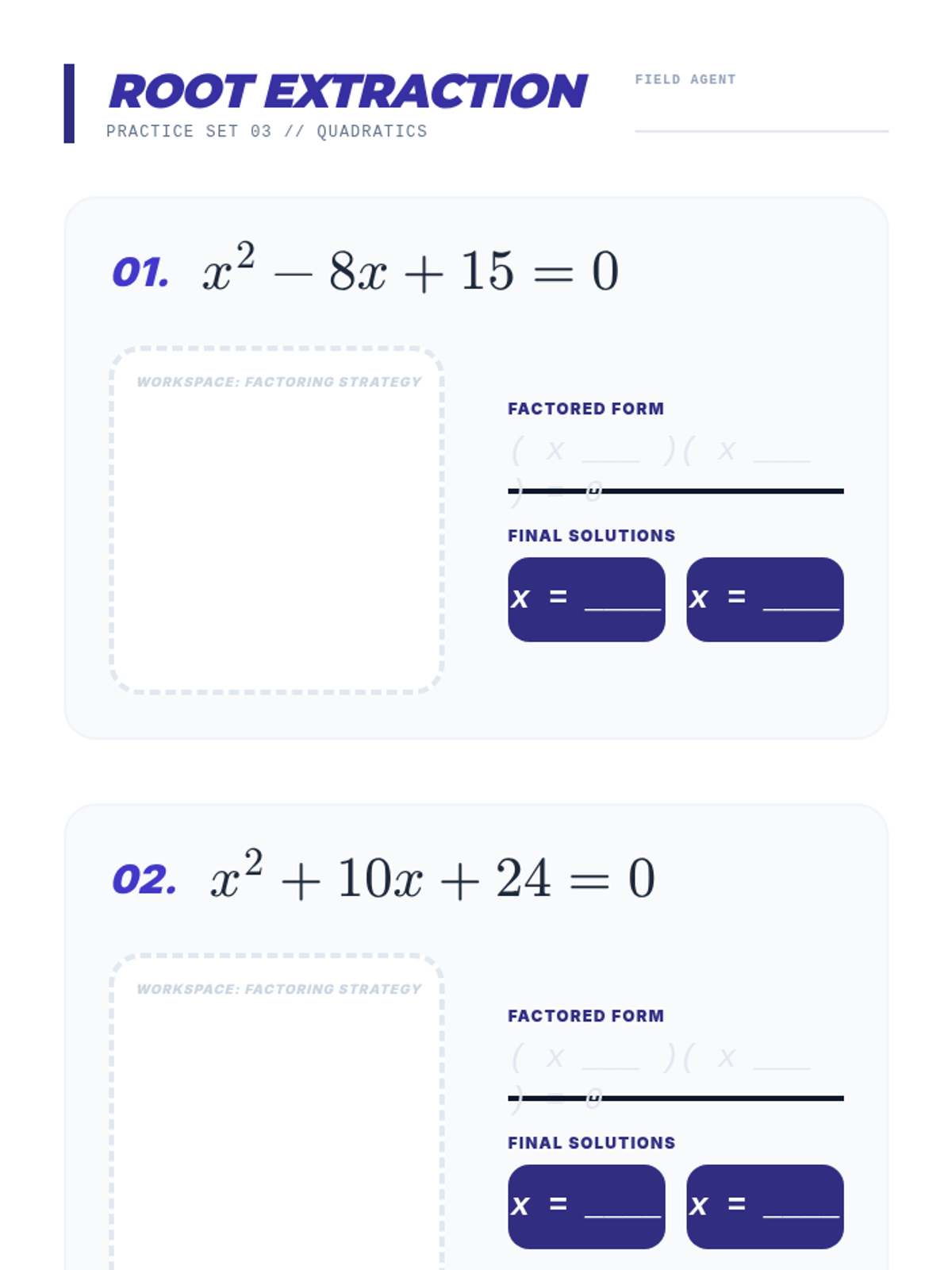
A practice worksheet for solving quadratic equations by factoring, including trinomials, GCF, and difference of squares.
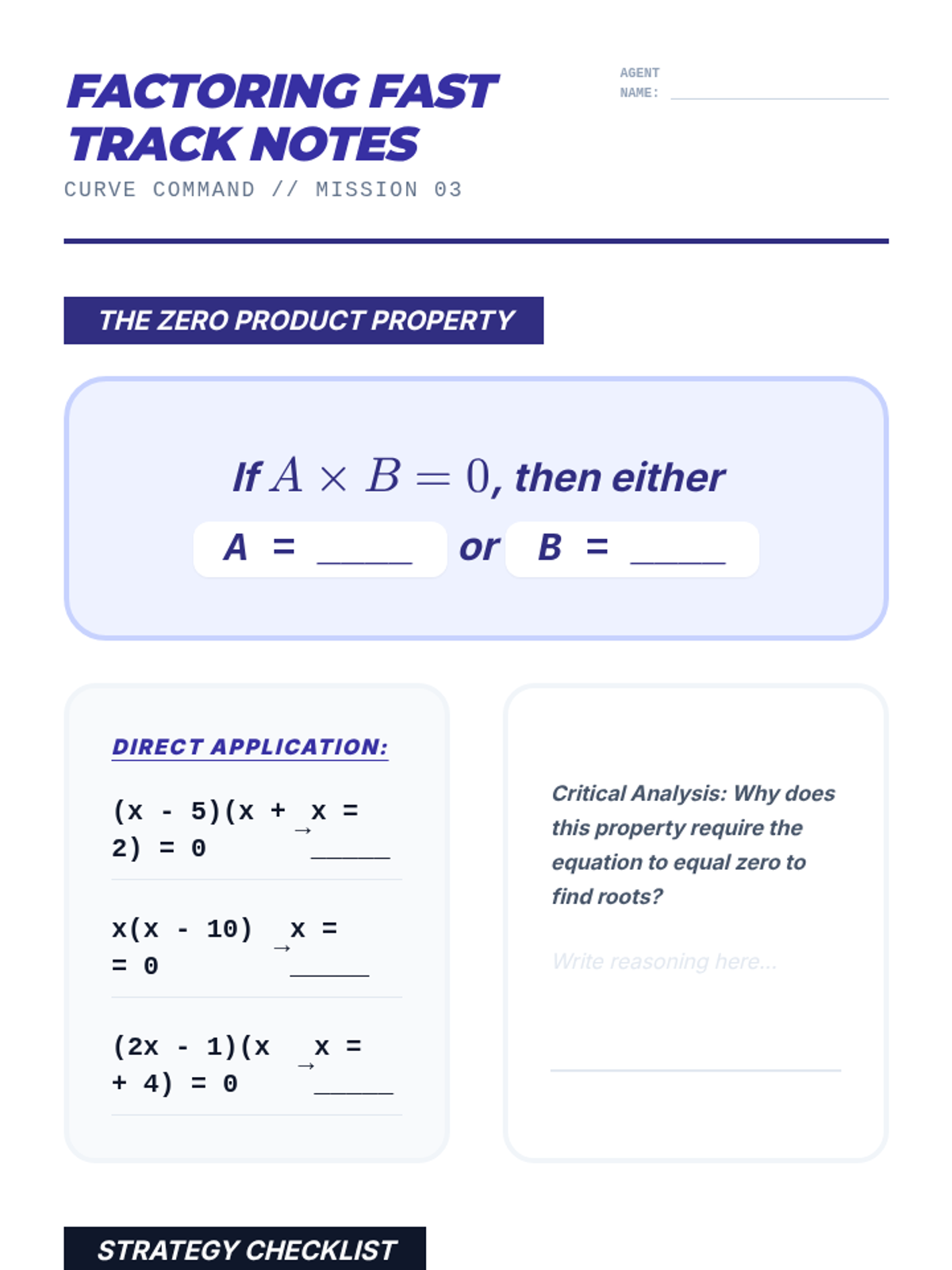
Guided notes for Lesson 3 focusing on solving quadratic equations by factoring and applying the Zero Product Property.
A slide deck for Lesson 3, teaching Algebra II students how to solve quadratic equations by factoring using the Zero Product Property.
A formative assessment focusing on extracting key features from a standard form quadratic equation.
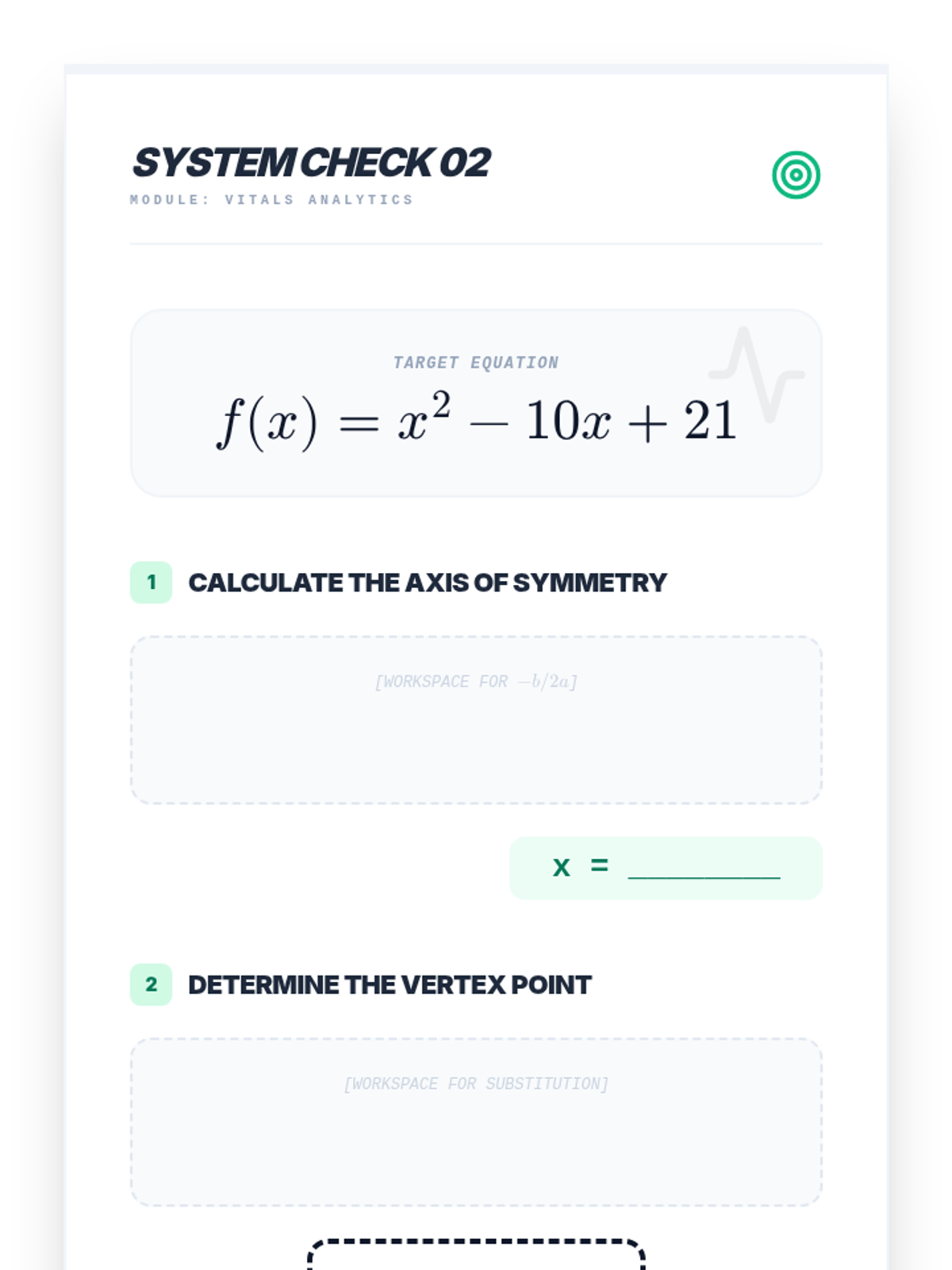
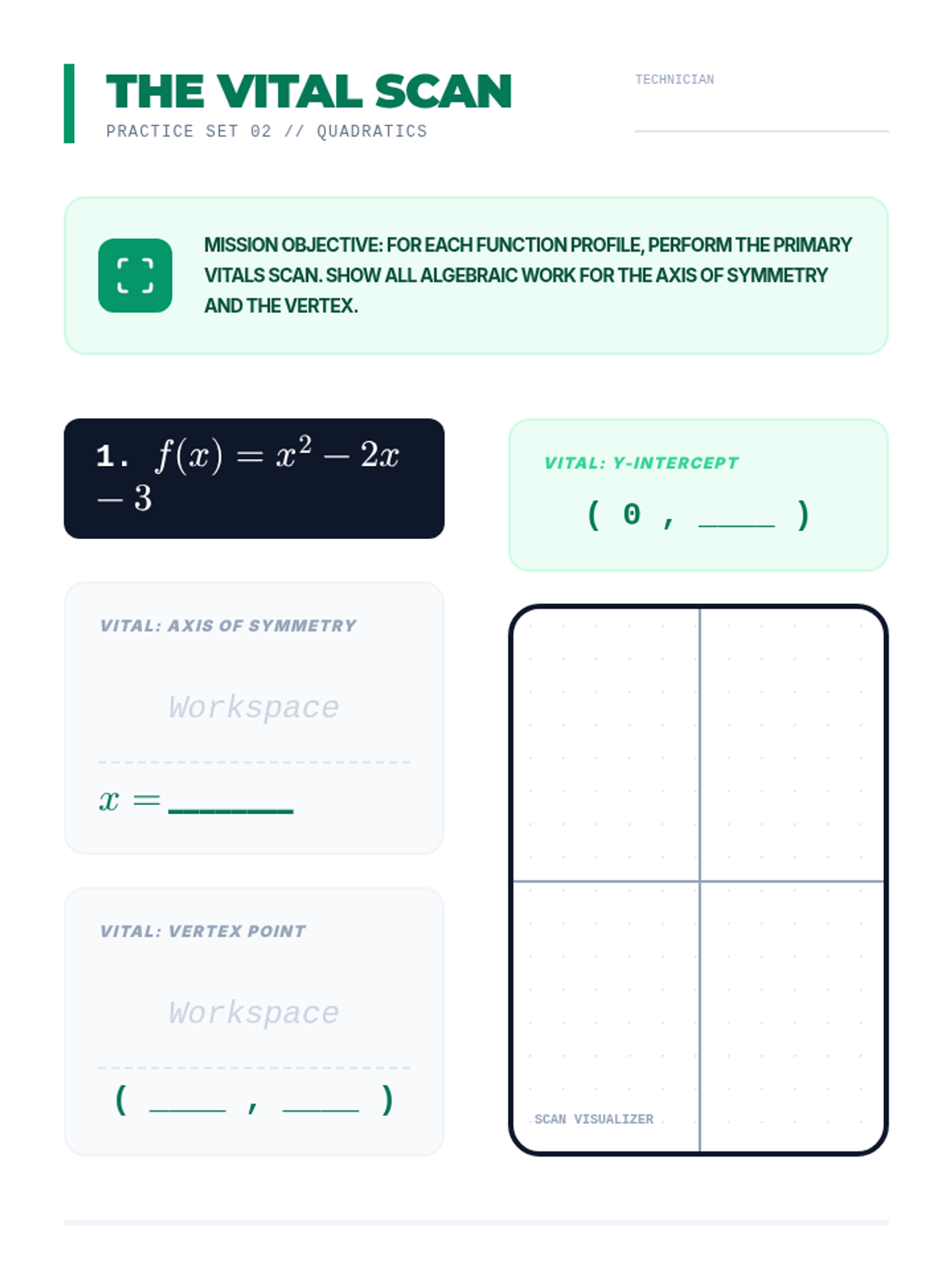
Worksheet for practicing the calculation of vertex, axis of symmetry, and y-intercept from standard form quadratic equations.
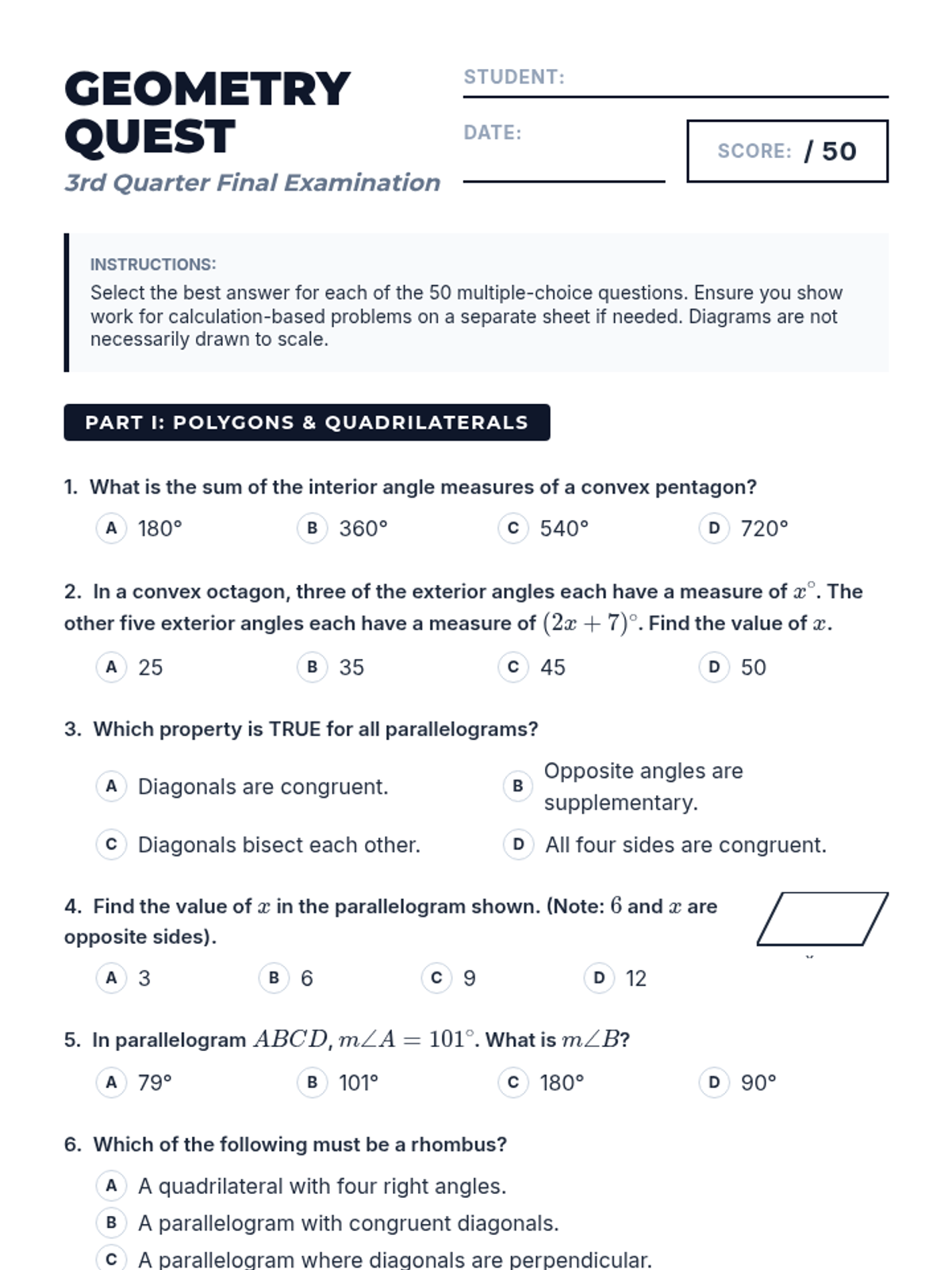
A comprehensive 50-question multiple-choice geometry exam condensed into 5 pages. The worksheet covers polygons, quadrilaterals, similarity, and proportion, including diagrams and algebra-based geometry problems with a clean, professional layout.
A comprehensive answer key and teacher resource for the 50-question Geometry Quest exam. It includes categorized correct responses, mathematical justifications for each answer, and a grading rubric for streamlined assessment.
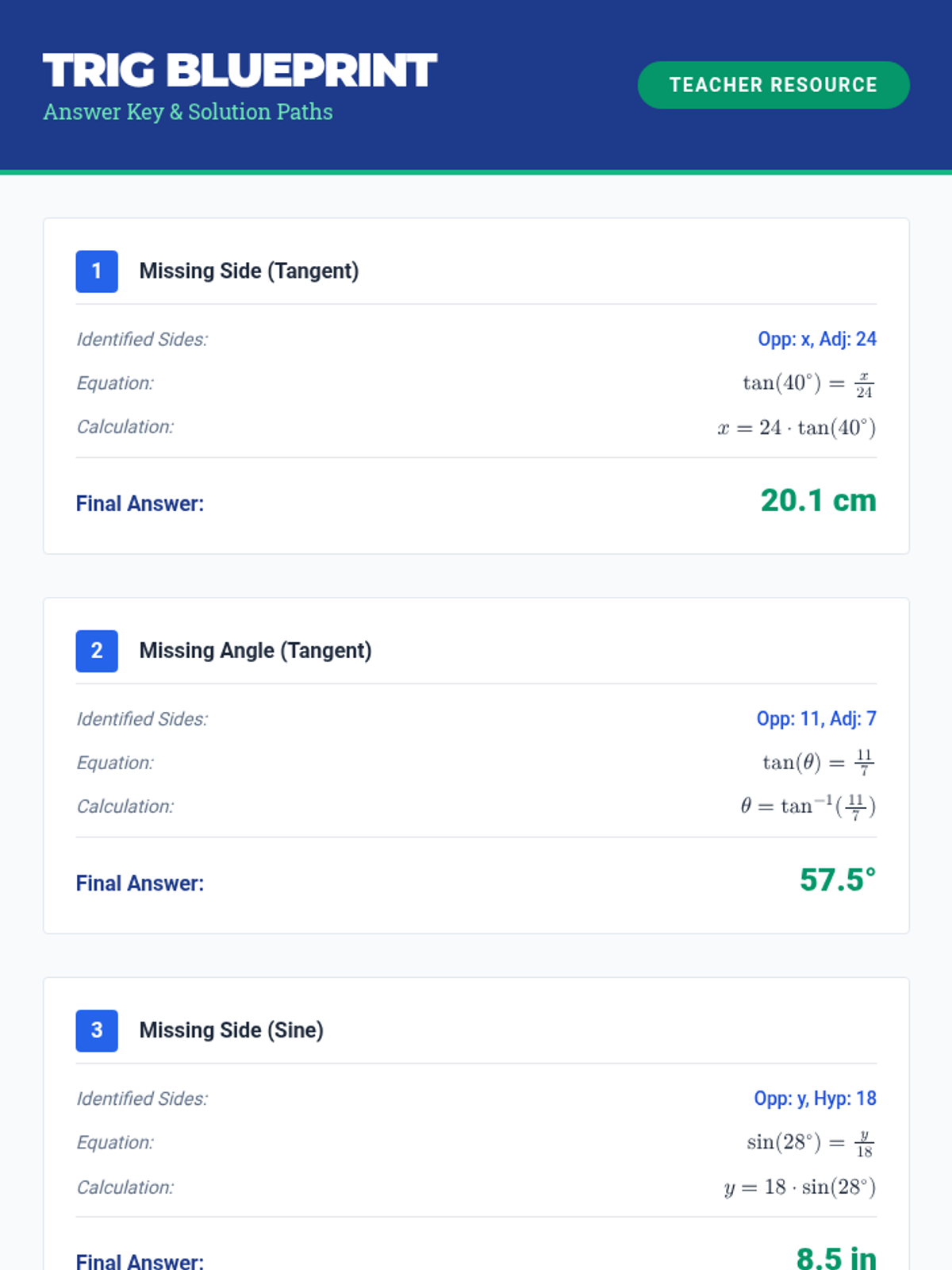
A teacher's answer key for the Trig Blueprint Worksheet, providing full step-by-step solution paths and teaching tips for each problem. Updated to include Cosine and corrected for page-flow issues.
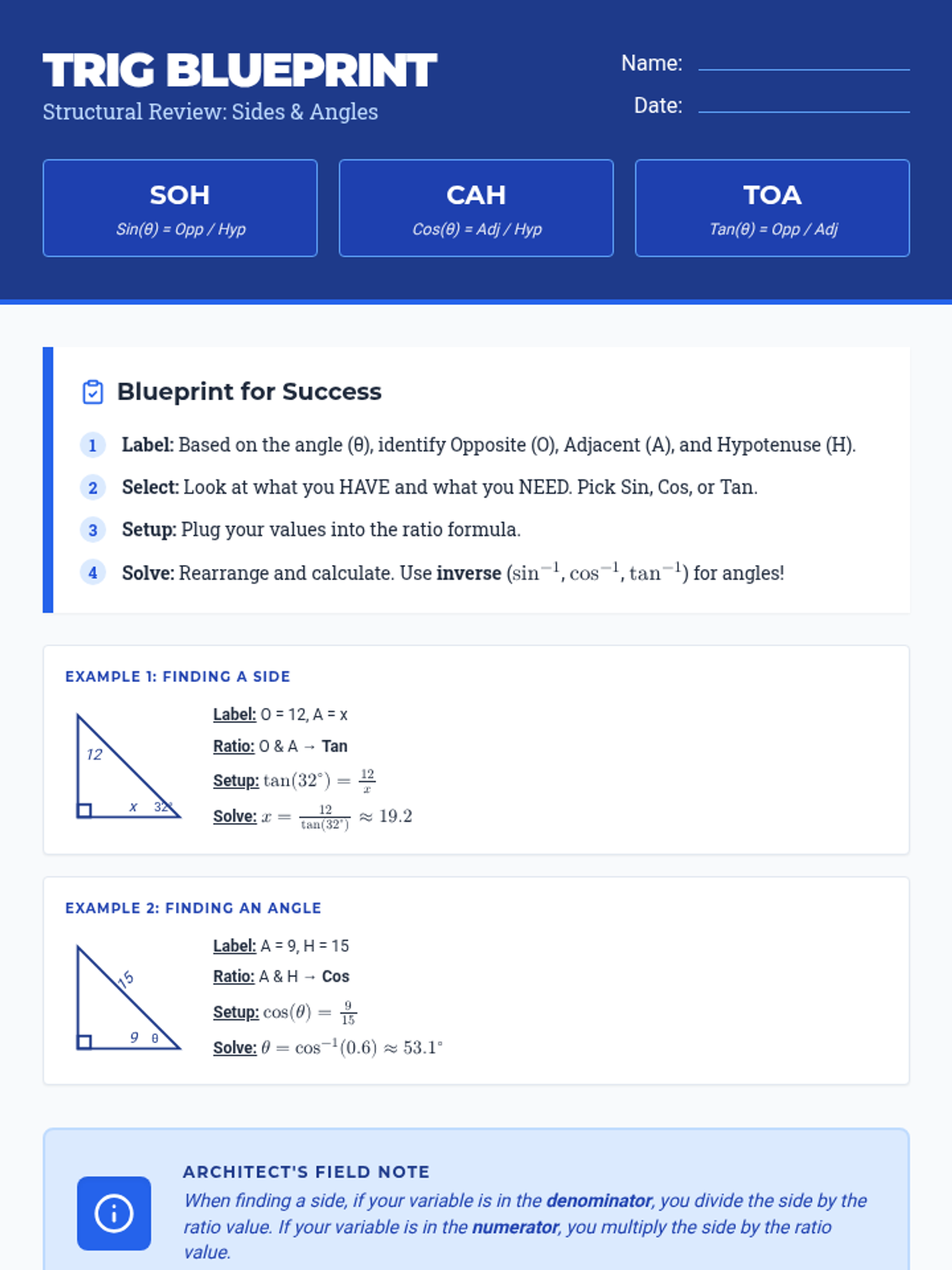
A student-facing trigonometry review sheet styled as an architectural blueprint, featuring a step-by-step checklist, worked examples for sides and angles, and four practice problems with dedicated workspace. Updated for better page flow and to include all three trig ratios.
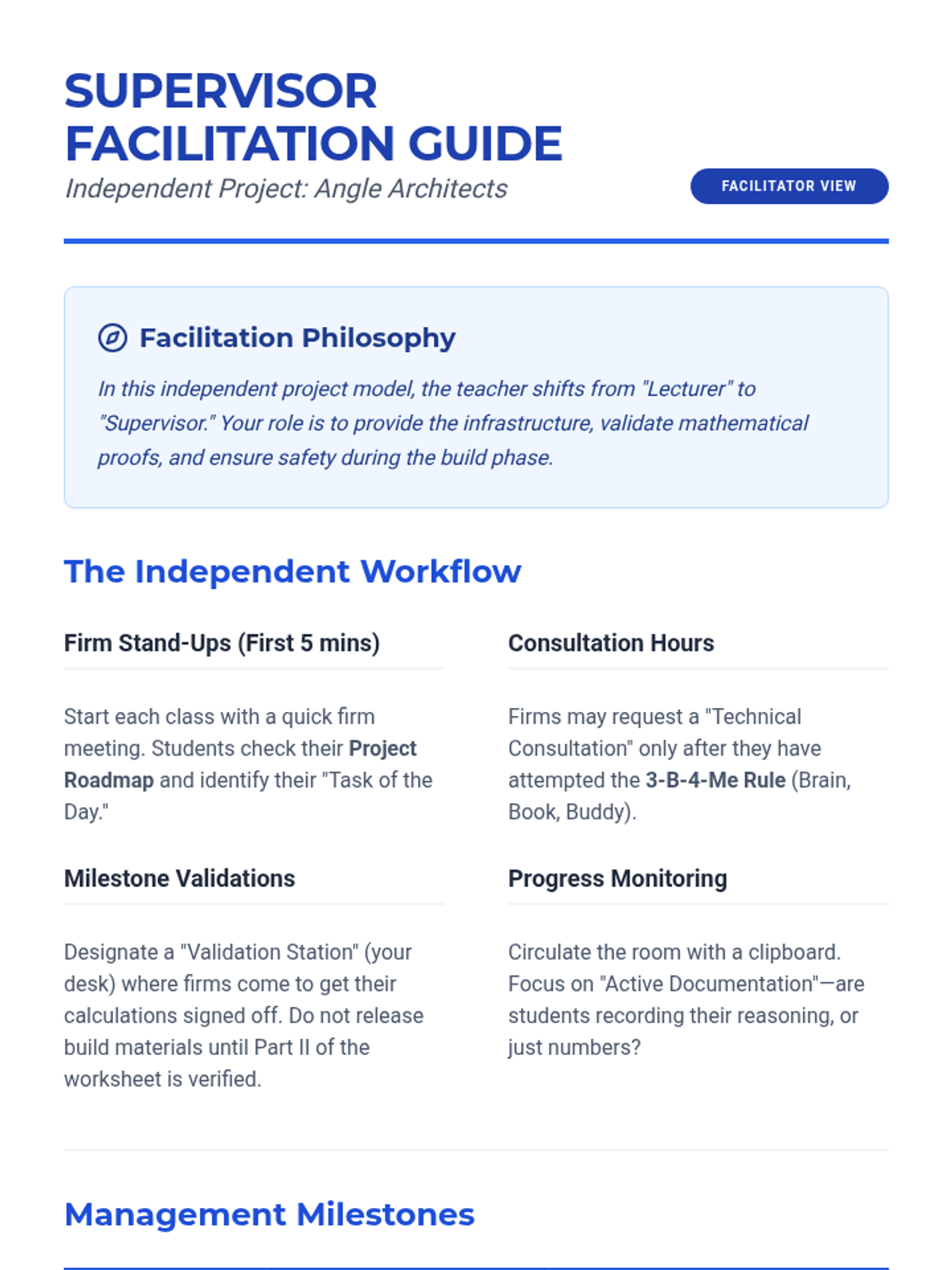
Teacher's facilitation guide for managing the independent version of the Angle Architects project, focusing on milestone validation and consultative facilitation.
Project launch slides adapted for an independent project model, highlighting self-paced milestones, the 3-B-4-Me protocol, and the math audit requirement.
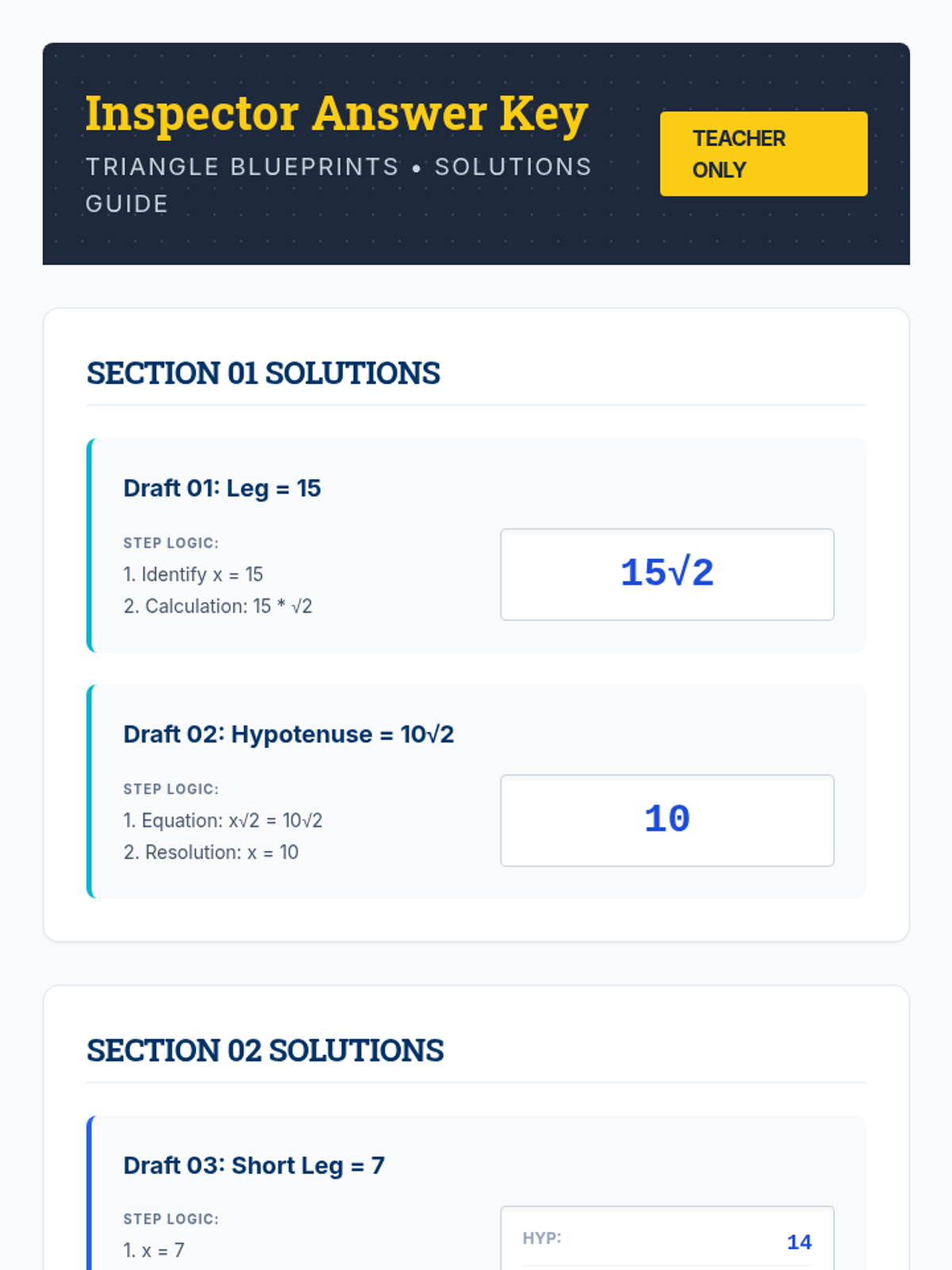
The teacher answer key for the Triangle Draftsman Worksheet, providing step-by-step solutions and final values for evaluation.
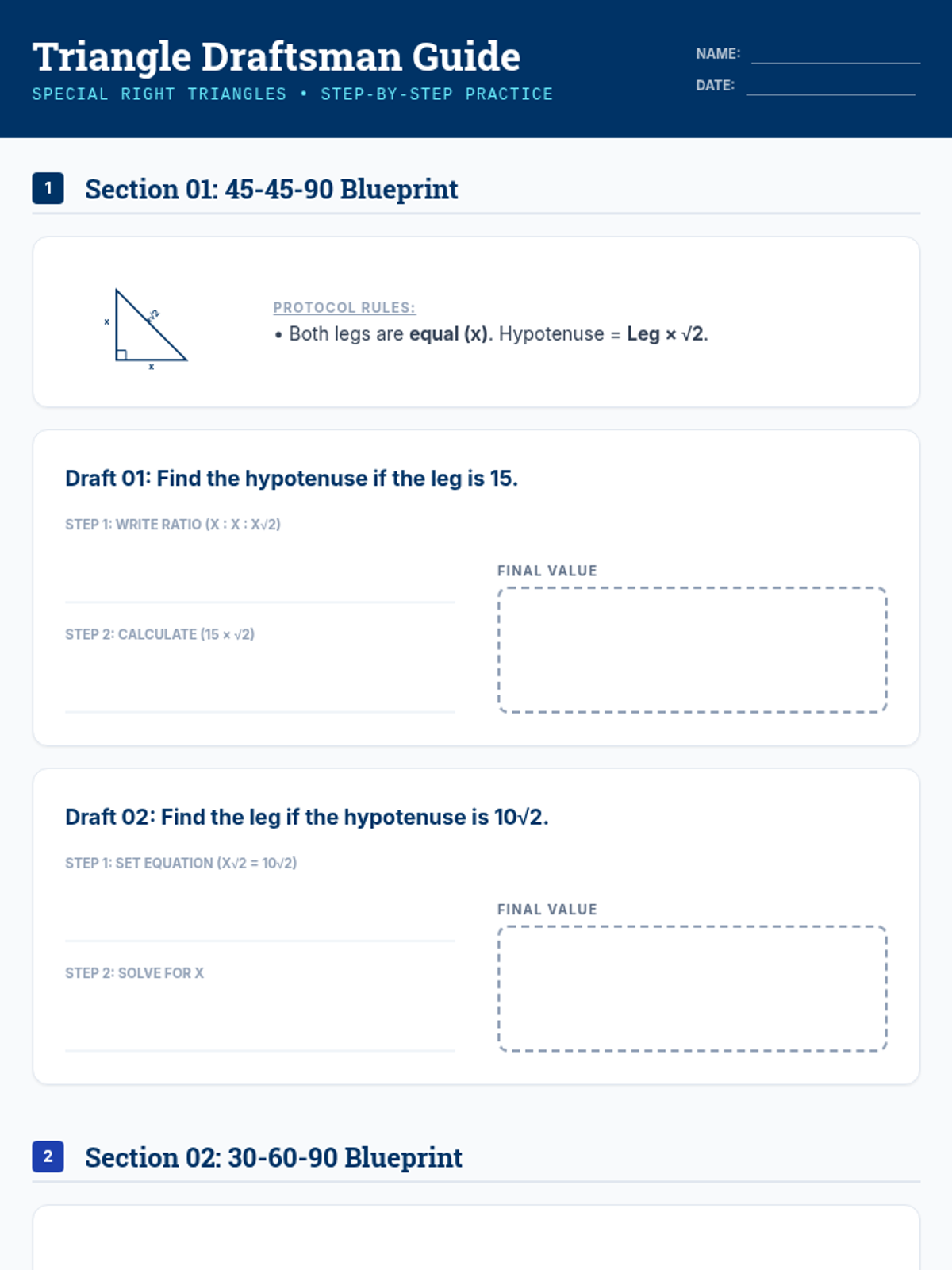
A two-page guided worksheet where students practice solving special right triangles step-by-step, using an architectural draftsman theme.
A visual presentation introducing the properties and ratios of 45-45-90 and 30-60-90 triangles using an architectural blueprint theme.
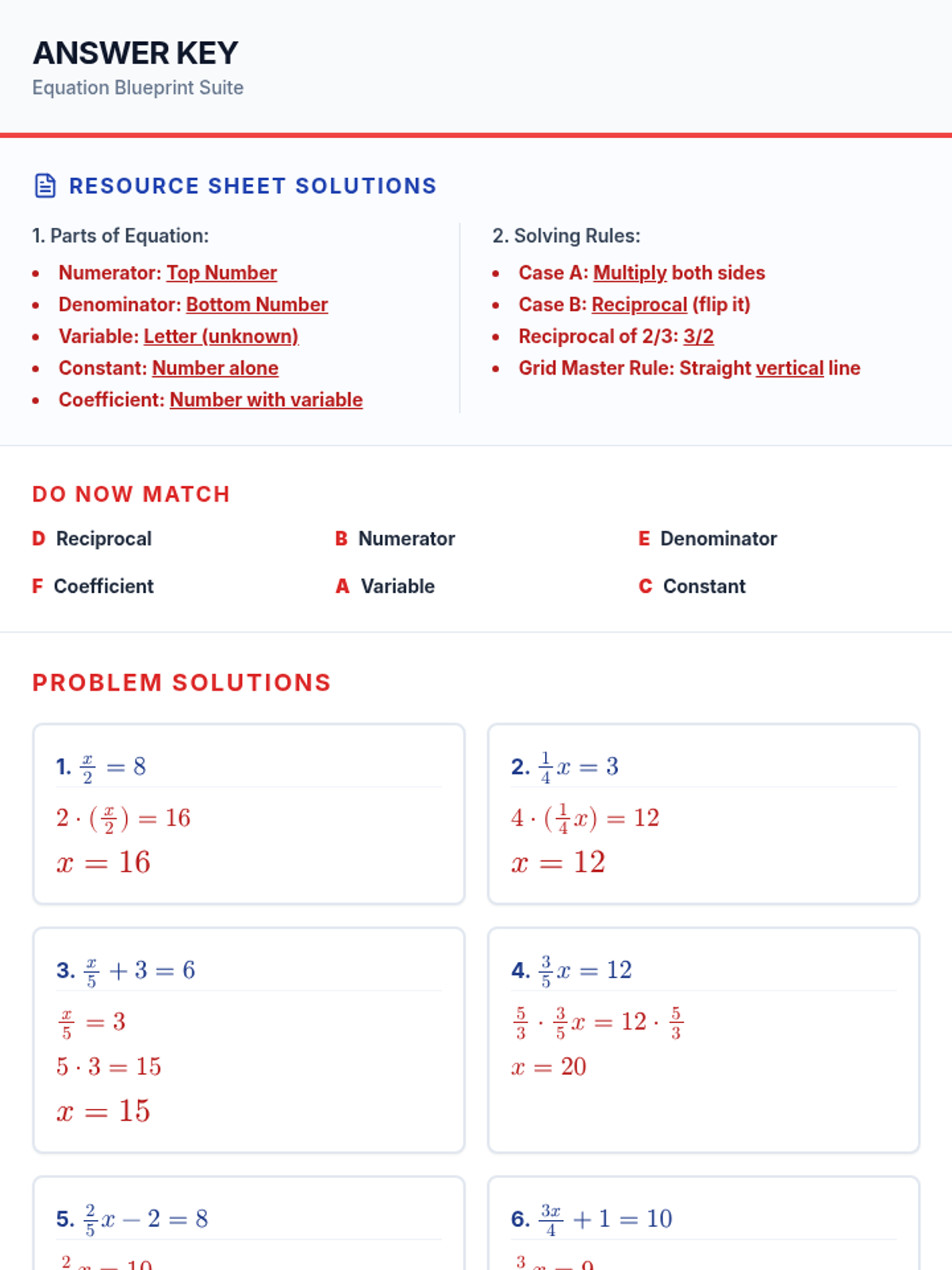
A comprehensive answer key for the Equation Blueprint lesson, providing bolded solutions for vocabulary matching, resource sheet fill-ins, independent practice problems, and the final exit ticket challenge. Improved layout prevents splitting solutions across pages. Now includes specific answers for the Resource Sheet blanks.
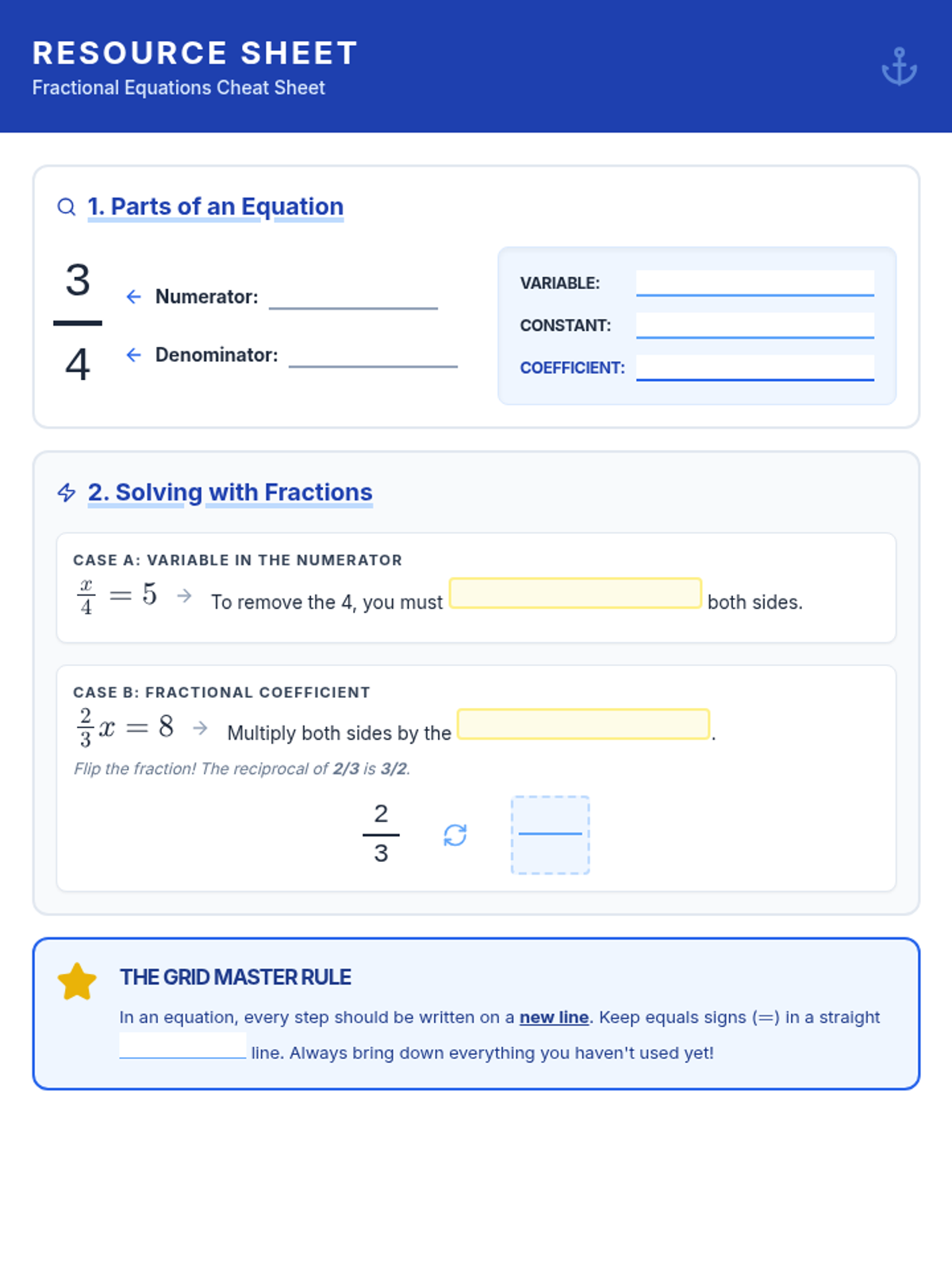
A fill-in-the-blank resource sheet for students, covering fraction anatomy, variable definitions, and step-by-step rules for solving equations with fractional components. Now optimized to fit on a single page.
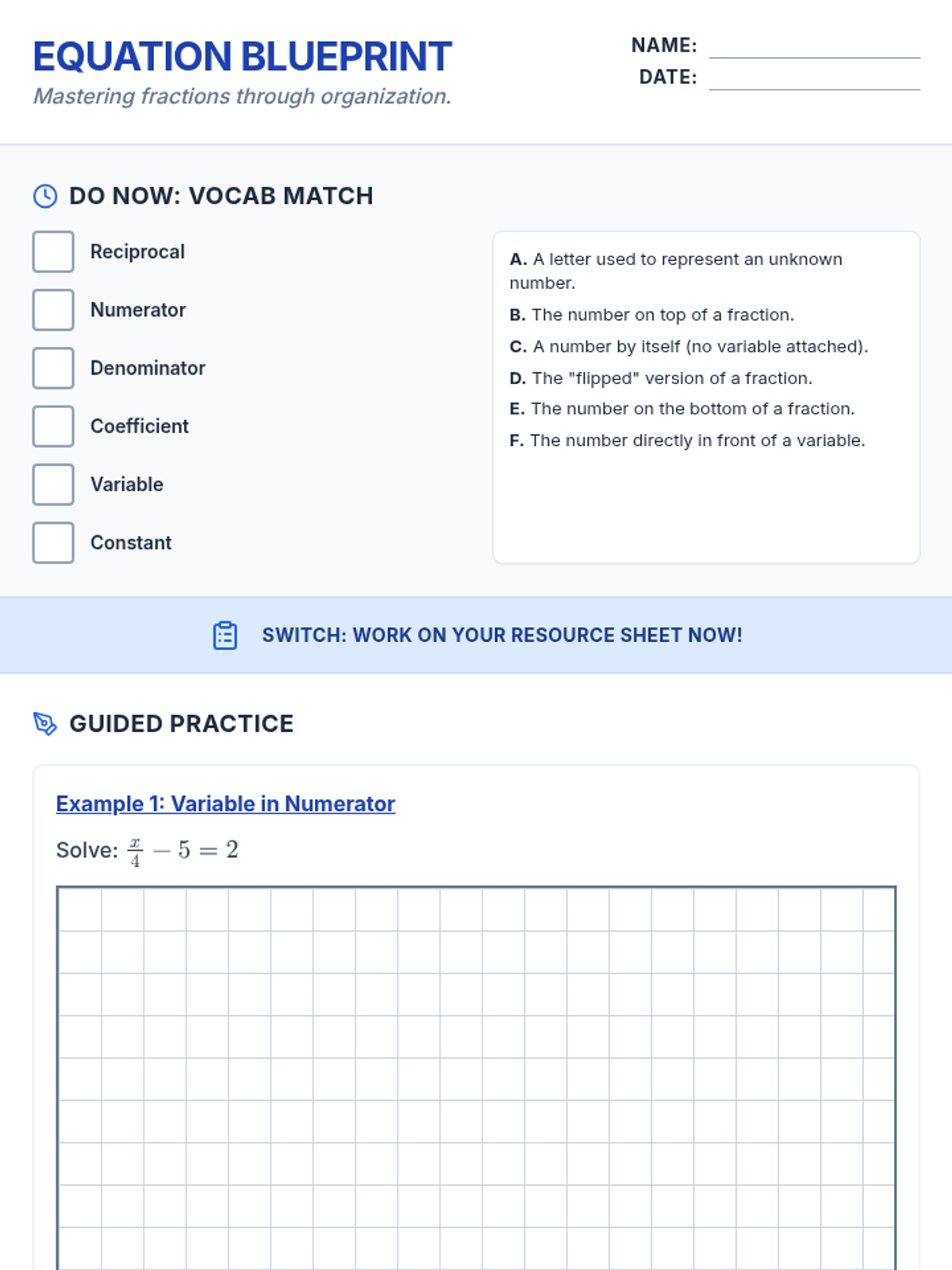
A student classwork packet for solving equations with fractions, featuring a vocabulary matching do now, grid-based workspace for guided and independent practice, and a final exit ticket challenge. Darkened grid lines and layout improvements for better printing. Grid sizes increased for more computation space.
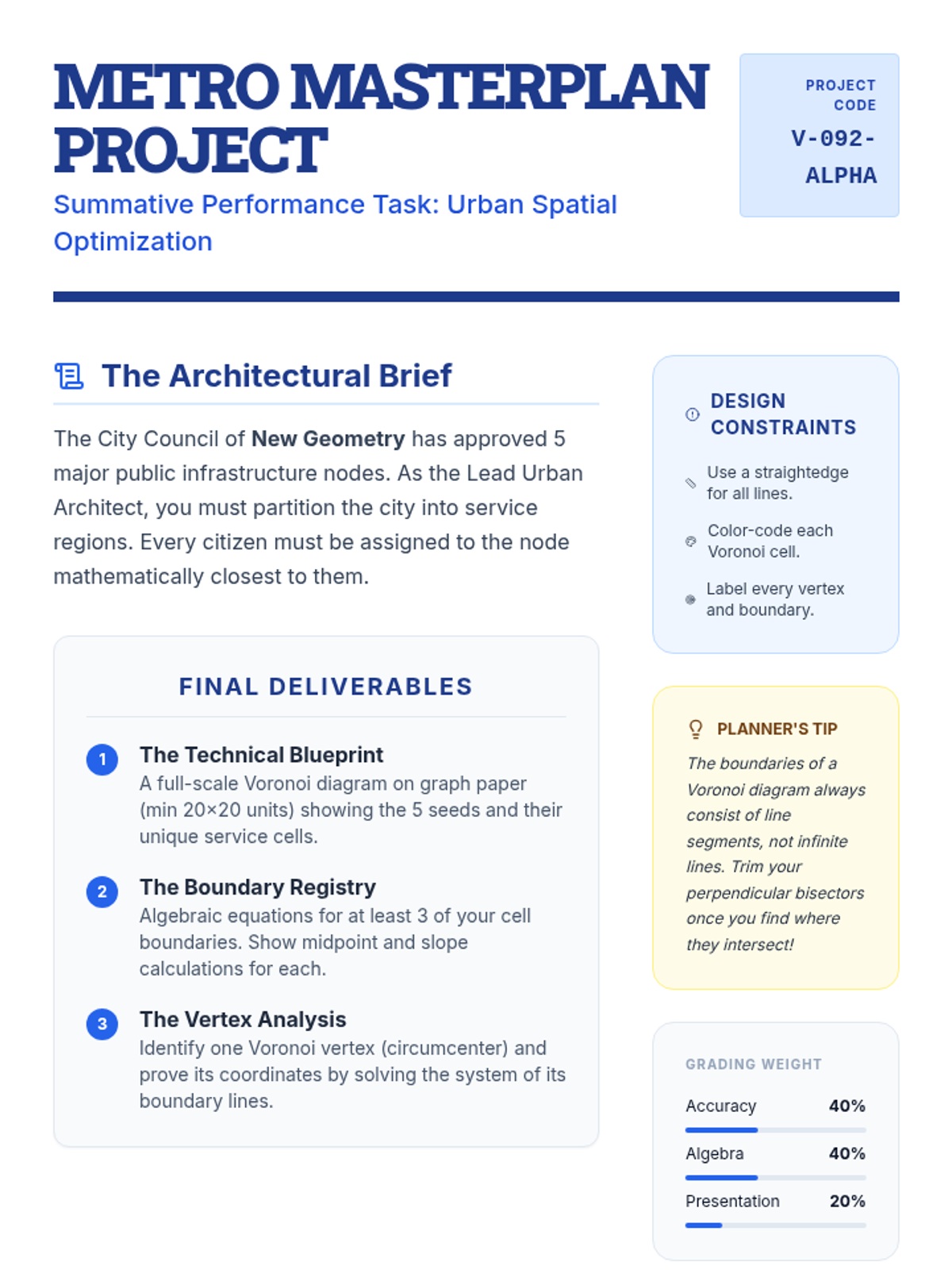
A summative project guide where students design a city's infrastructure layout, constructing a 5-seed Voronoi diagram and providing mathematical proof of its efficiency.
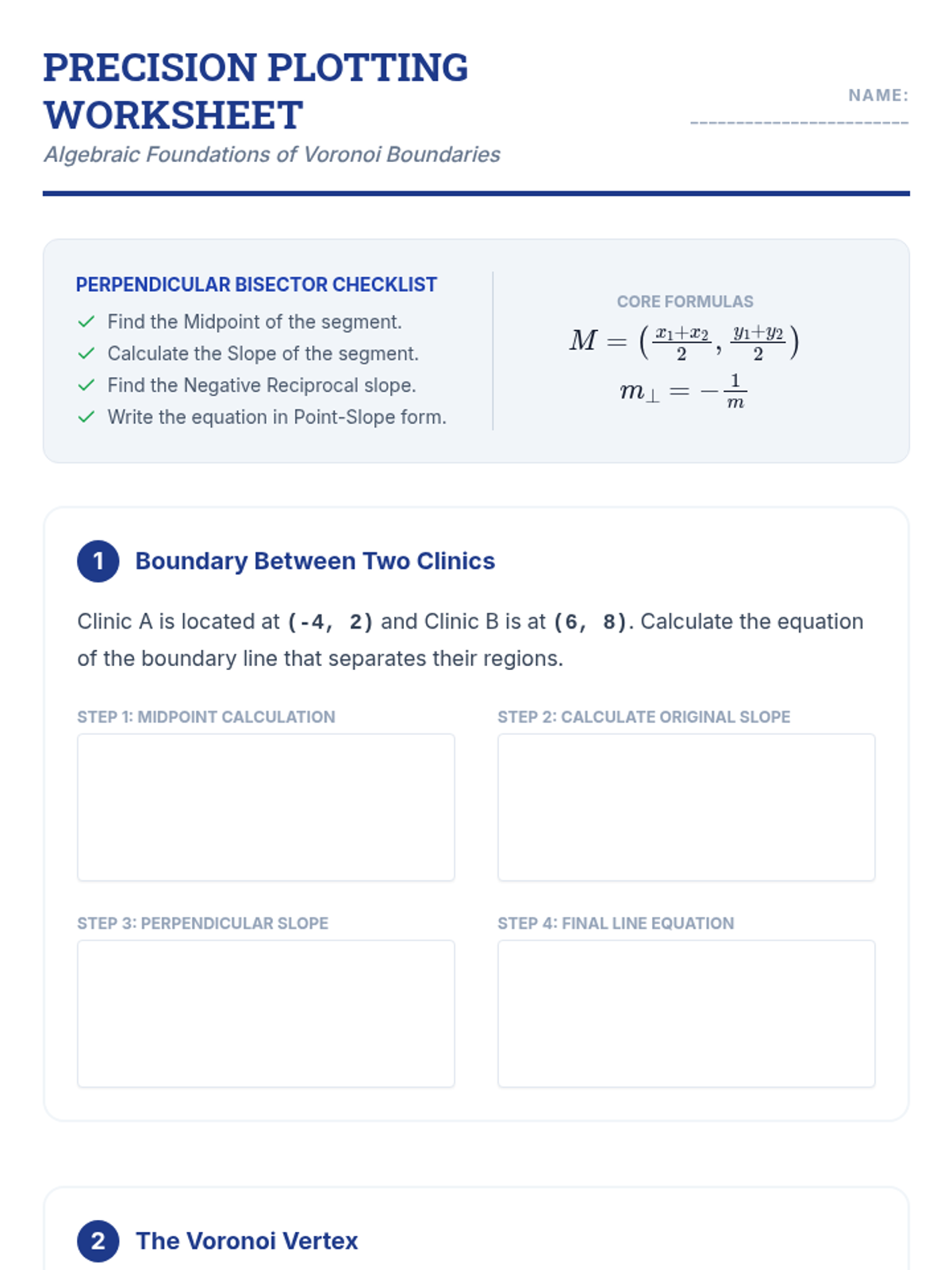
A math worksheet that combines geometry and algebra, requiring students to calculate the equations of perpendicular bisectors and find Voronoi vertices through systems of linear equations.
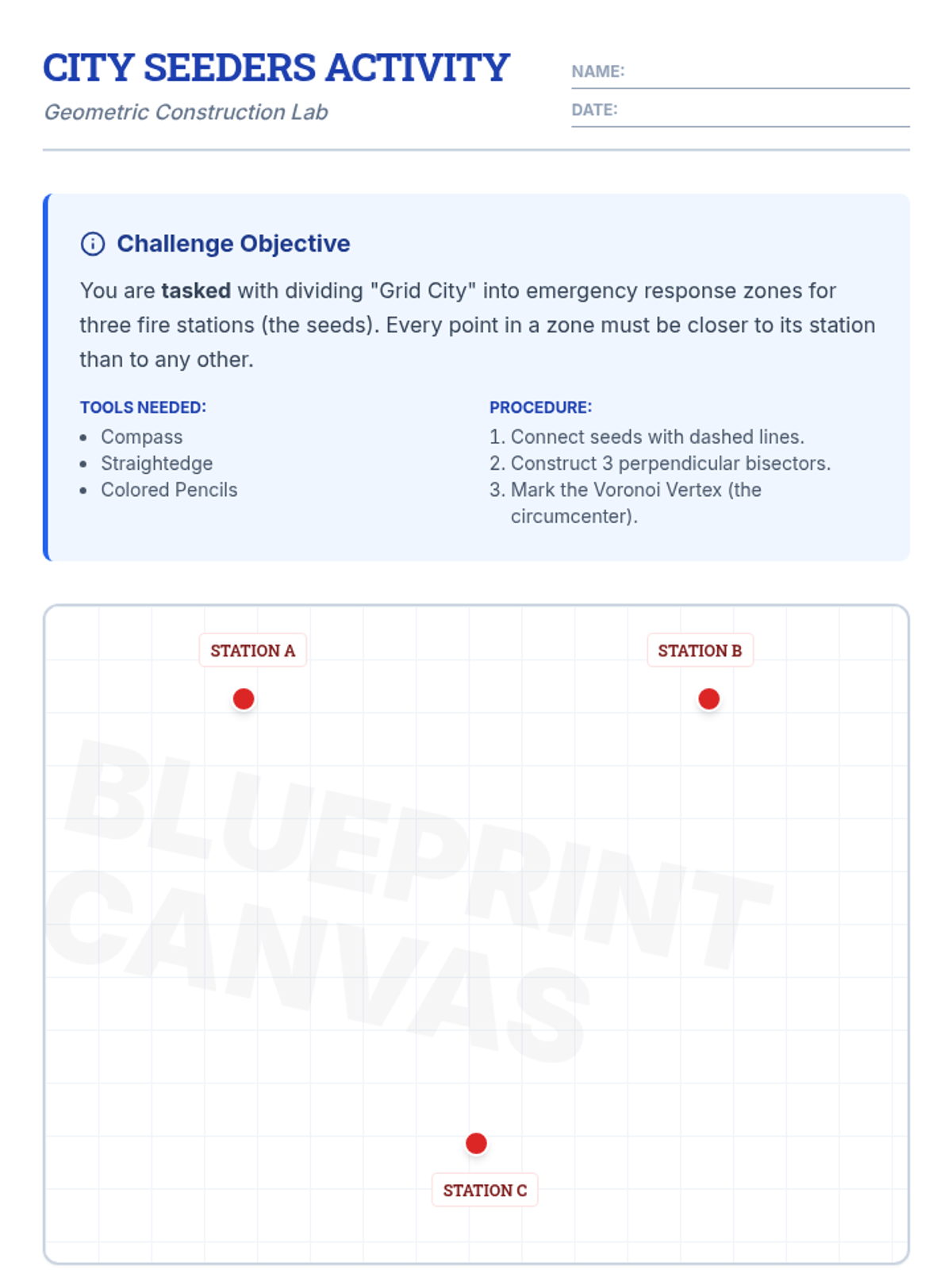
A hands-on activity sheet where students use a compass and straightedge to construct a Voronoi diagram for three "fire stations" on a grid, reinforcing the concept of the perpendicular bisector.
A visual slide deck that defines Voronoi diagrams, explains the construction algorithm using perpendicular bisectors, and shows real-world applications in urban planning and beyond.
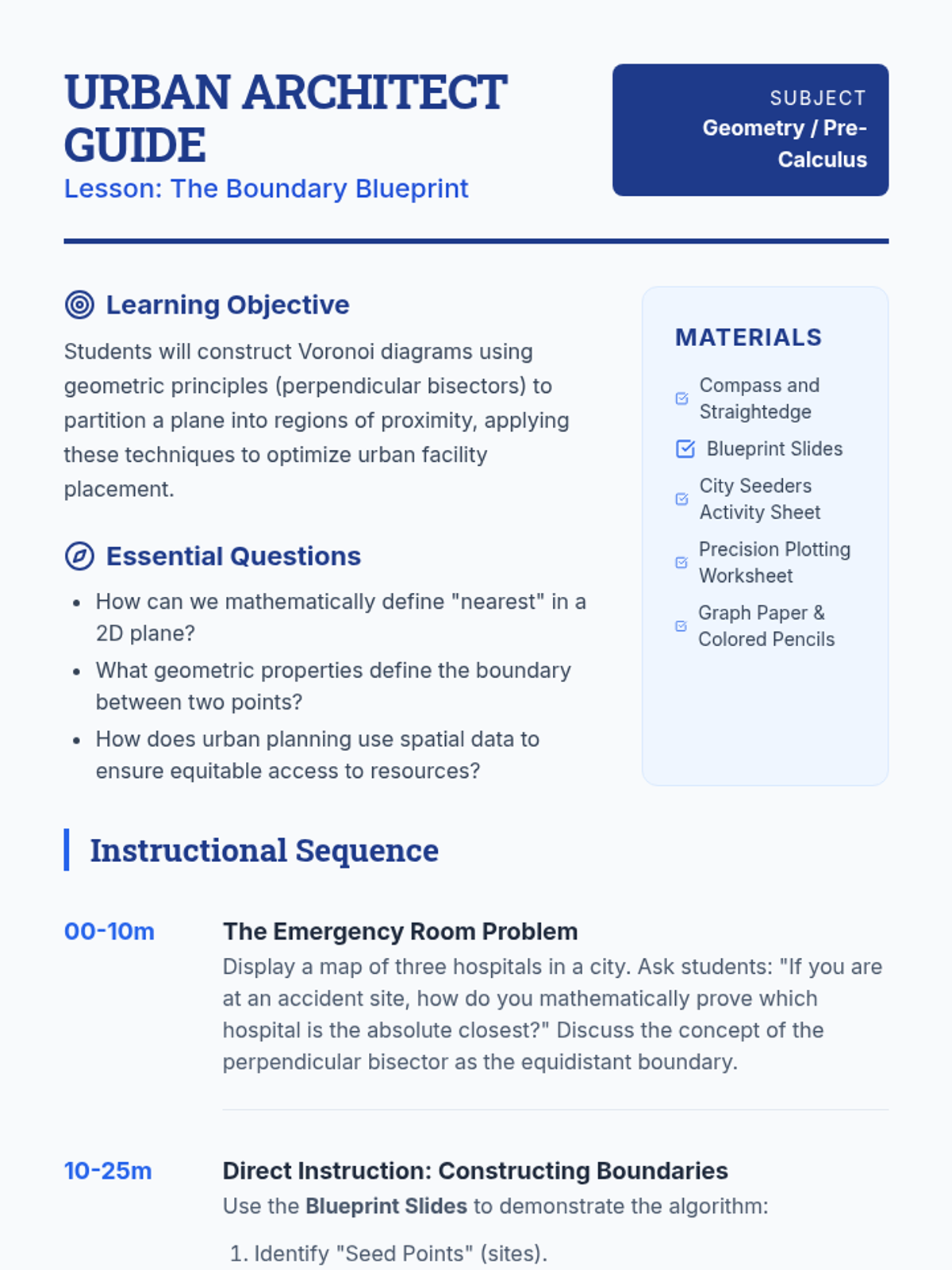
A comprehensive lesson plan for teachers, outlining the instructional sequence, learning objectives, and materials needed to teach Voronoi diagrams through an urban planning lens.
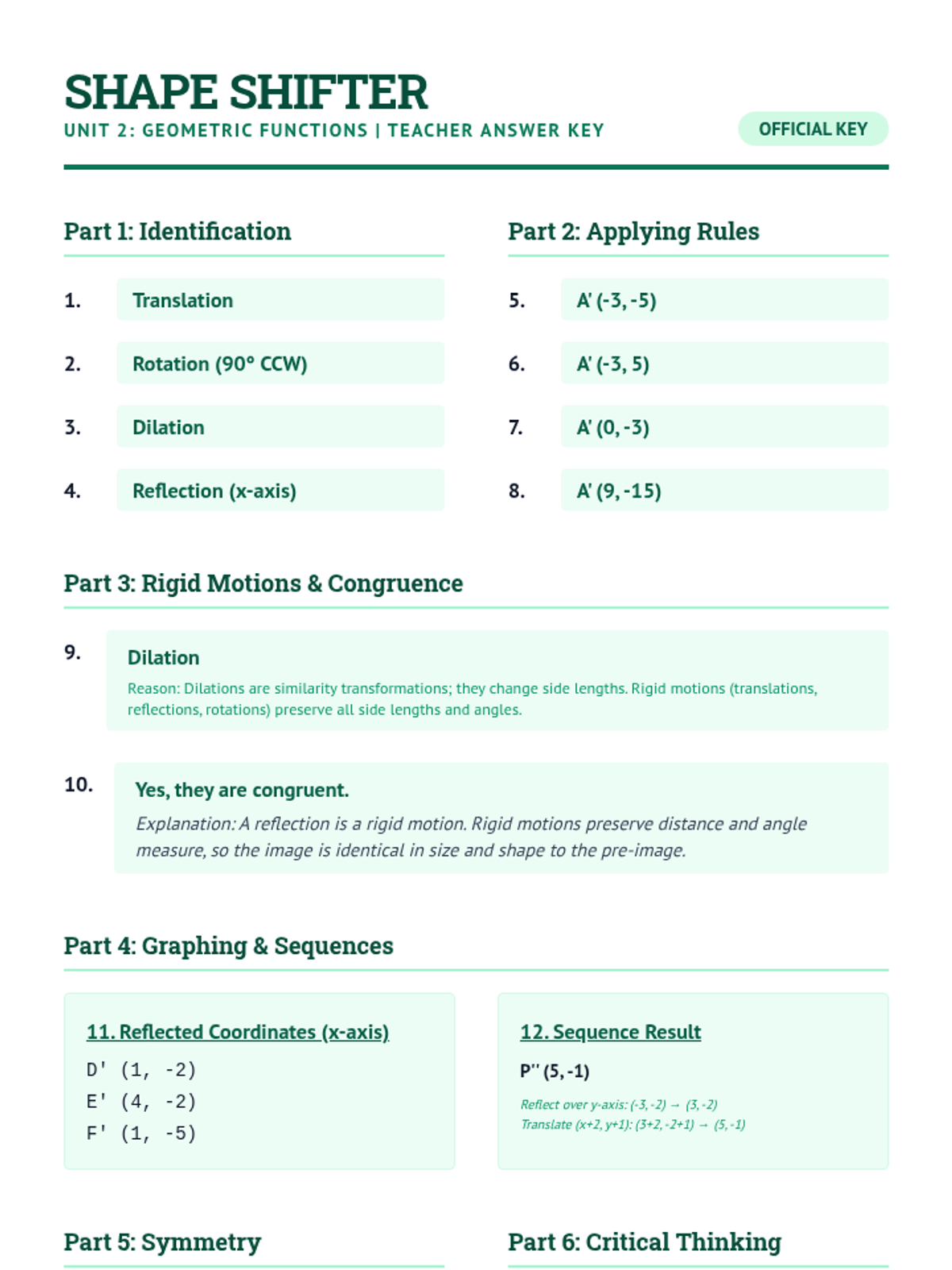
An answer key for the Shape Shifter Test, including detailed solutions, coordinate results, and grading guidance for teachers.
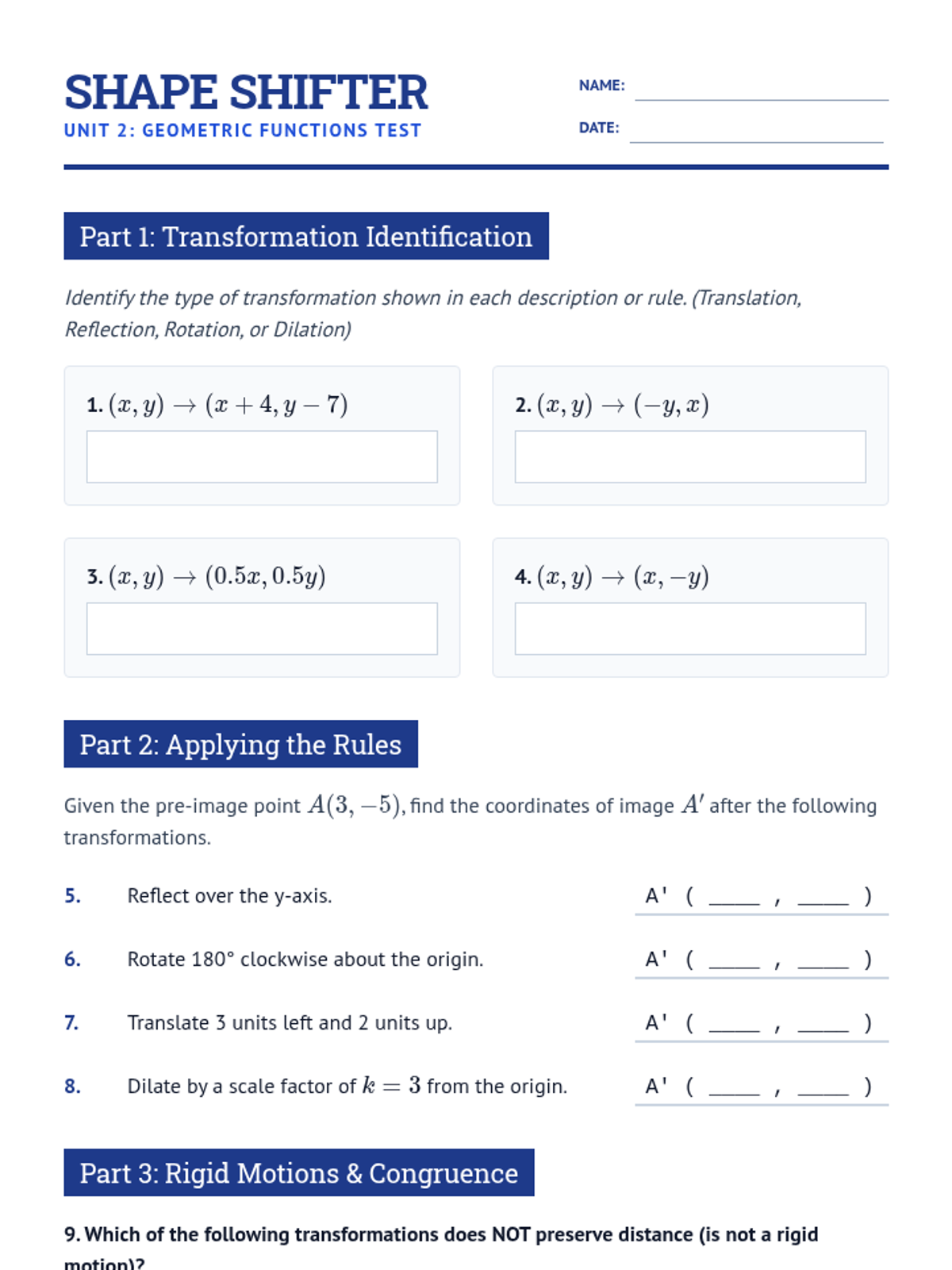
A formal unit test covering geometric transformations including identification, coordinate rules, rigid motions, graphing, and sequences of functions.
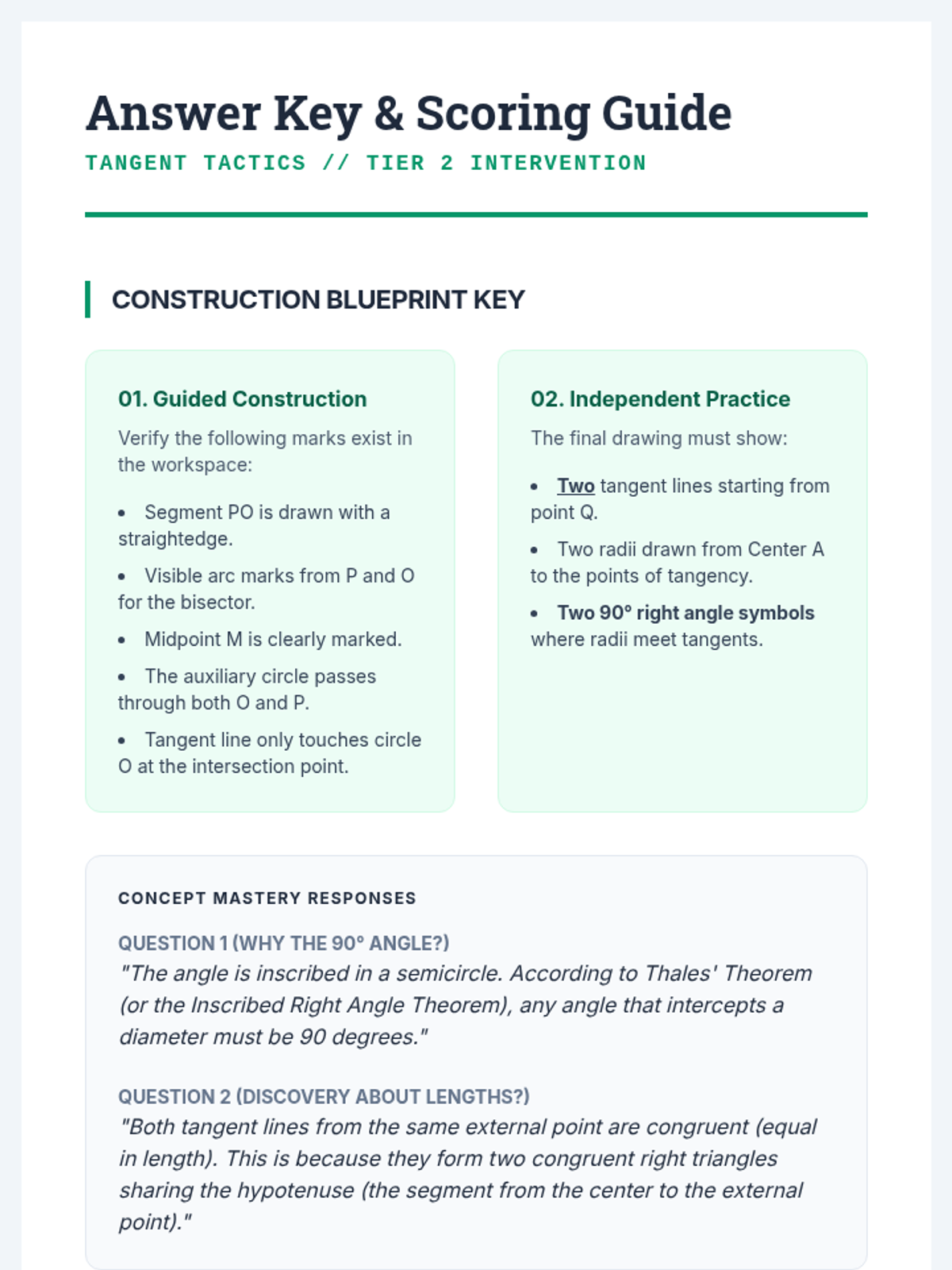
A teacher resource providing the answer key for the Tangent Tactics worksheet and exit ticket. Includes specific look-fors for construction tasks and exemplar responses for reasoning questions.
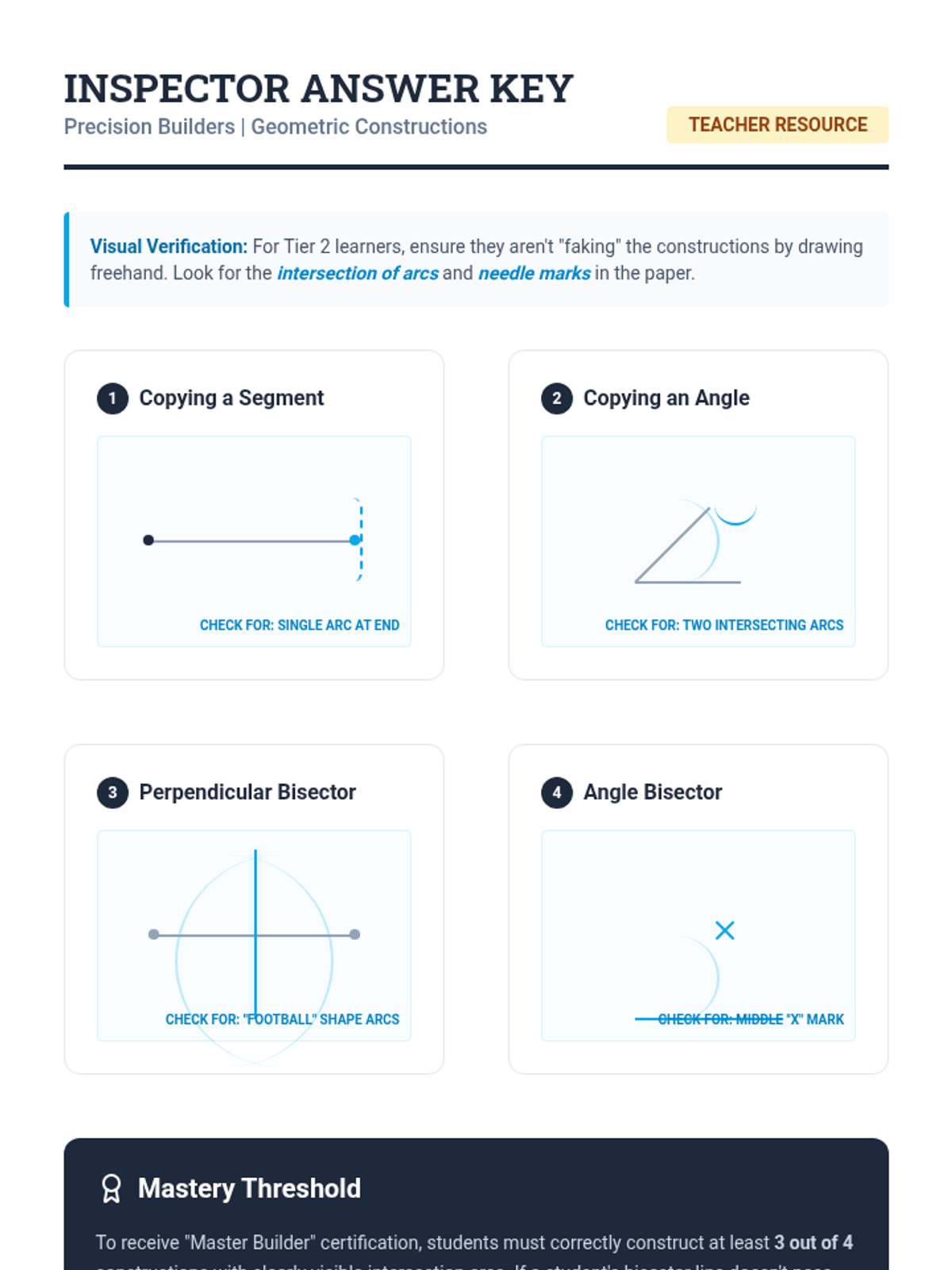
A visual answer key for teachers to quickly verify student geometric constructions. It highlights the specific arc intersections and 'mastery marks' that demonstrate a student has correctly followed the compass-and-straightedge procedures.
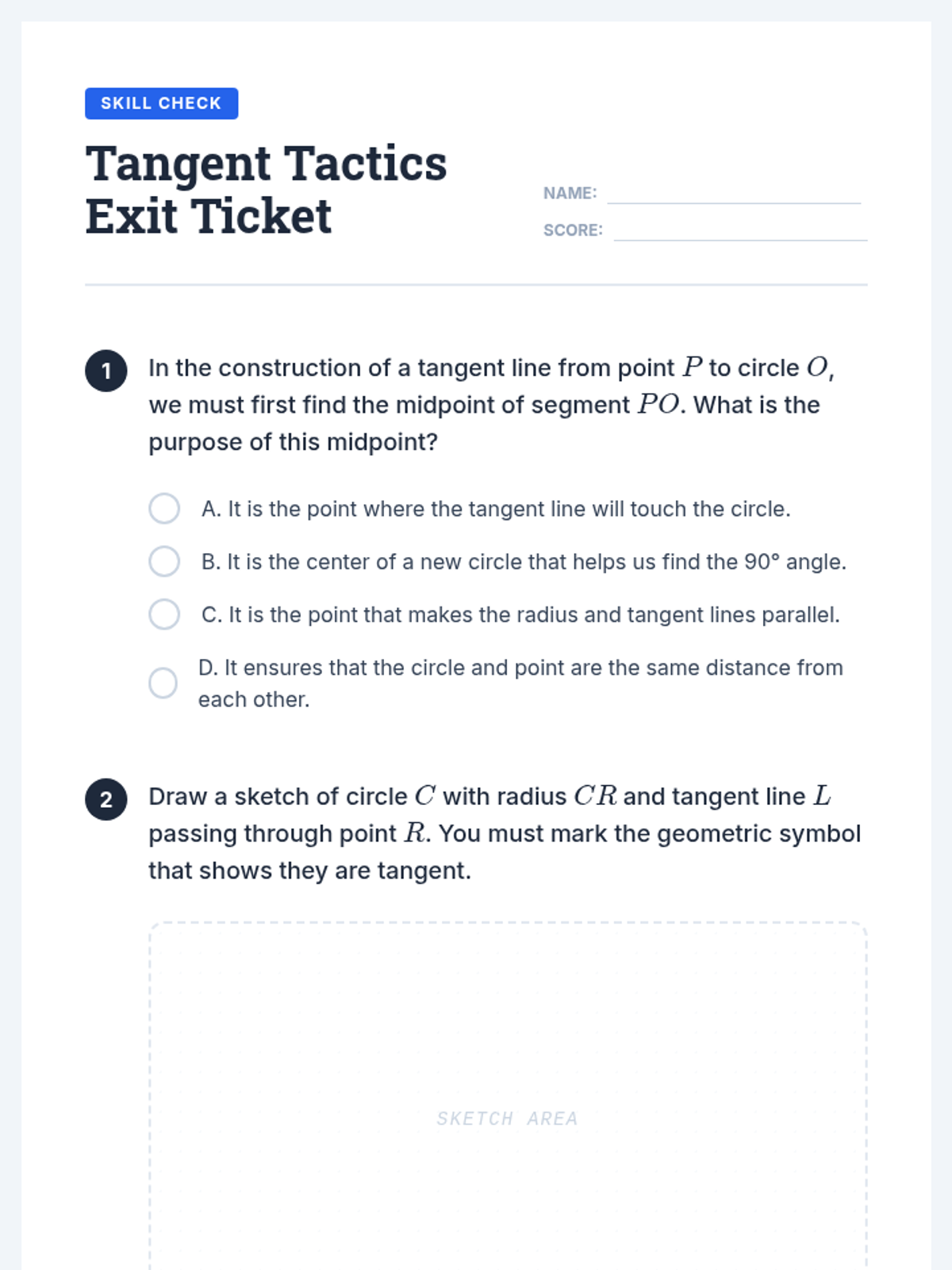
A short post-lesson assessment to measure student understanding of tangent line construction and the relationship between radii and right angles. Includes a multiple-choice concept check, a sketching task, and a reasoning question.
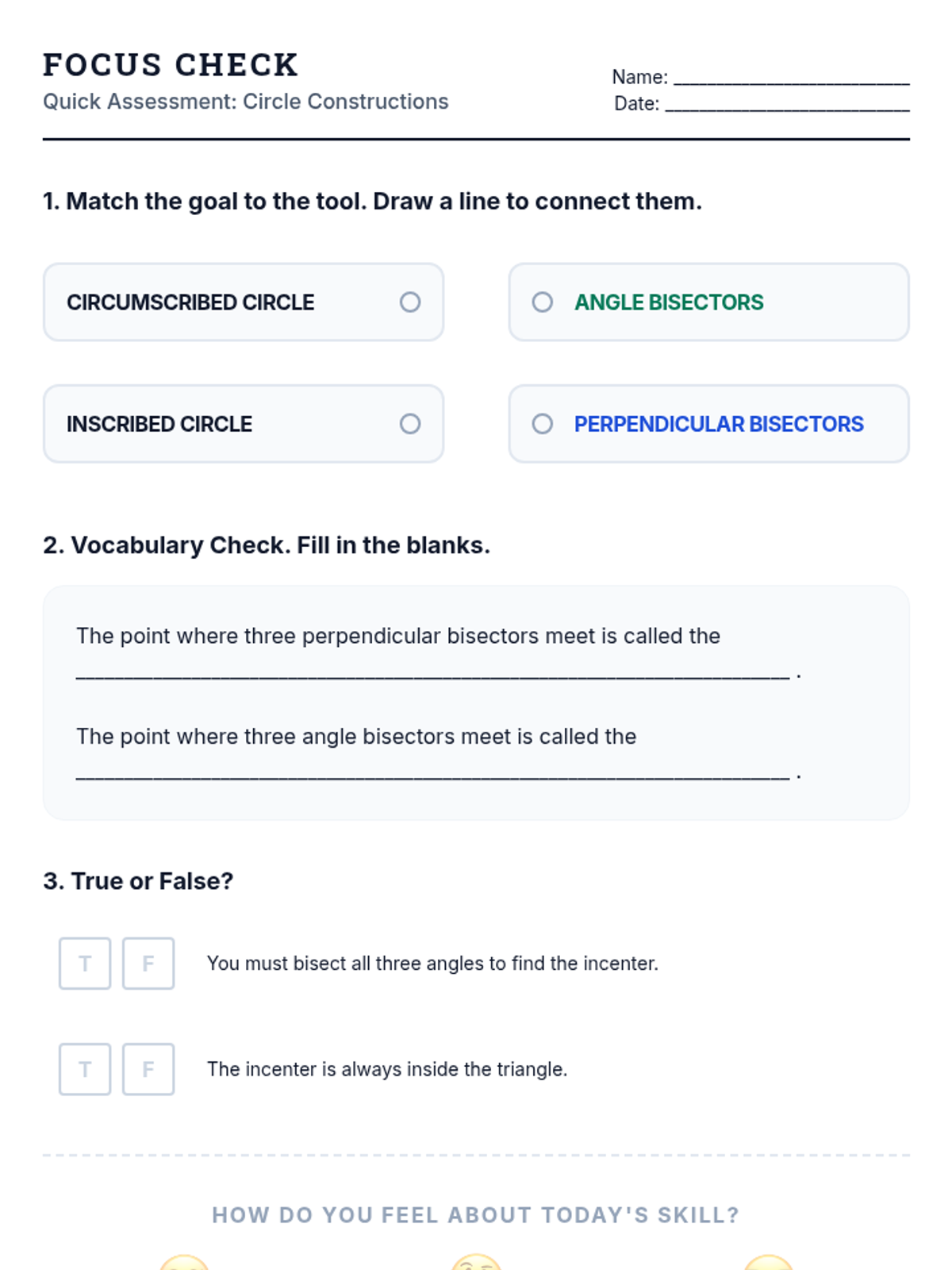
A quick assessment tool for students to check their understanding of circle centers and the bisectors required to construct them.
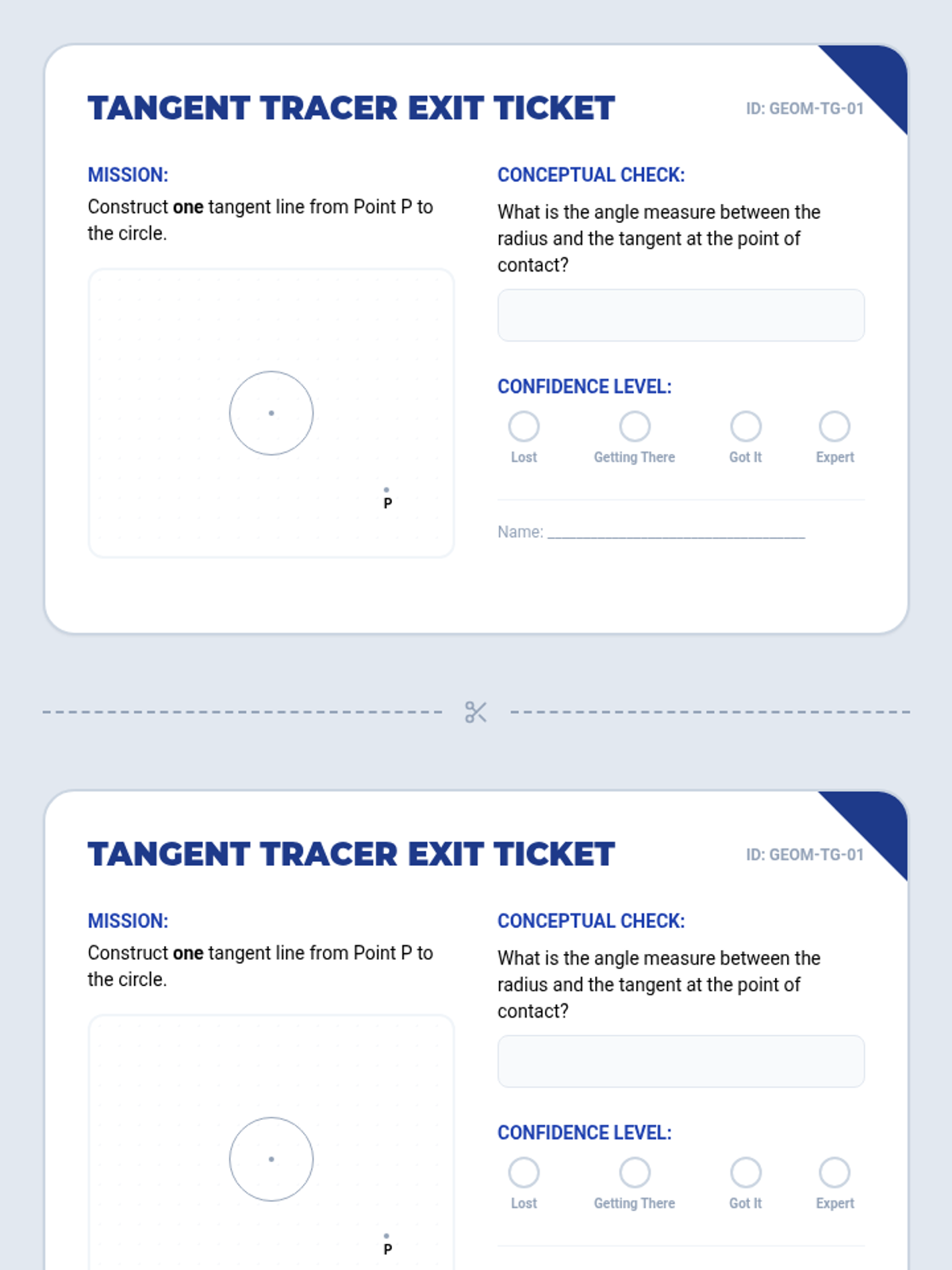
A quick progress monitoring tool for the Tangent Line Mastery lesson, featuring a construction task and conceptual check-in.
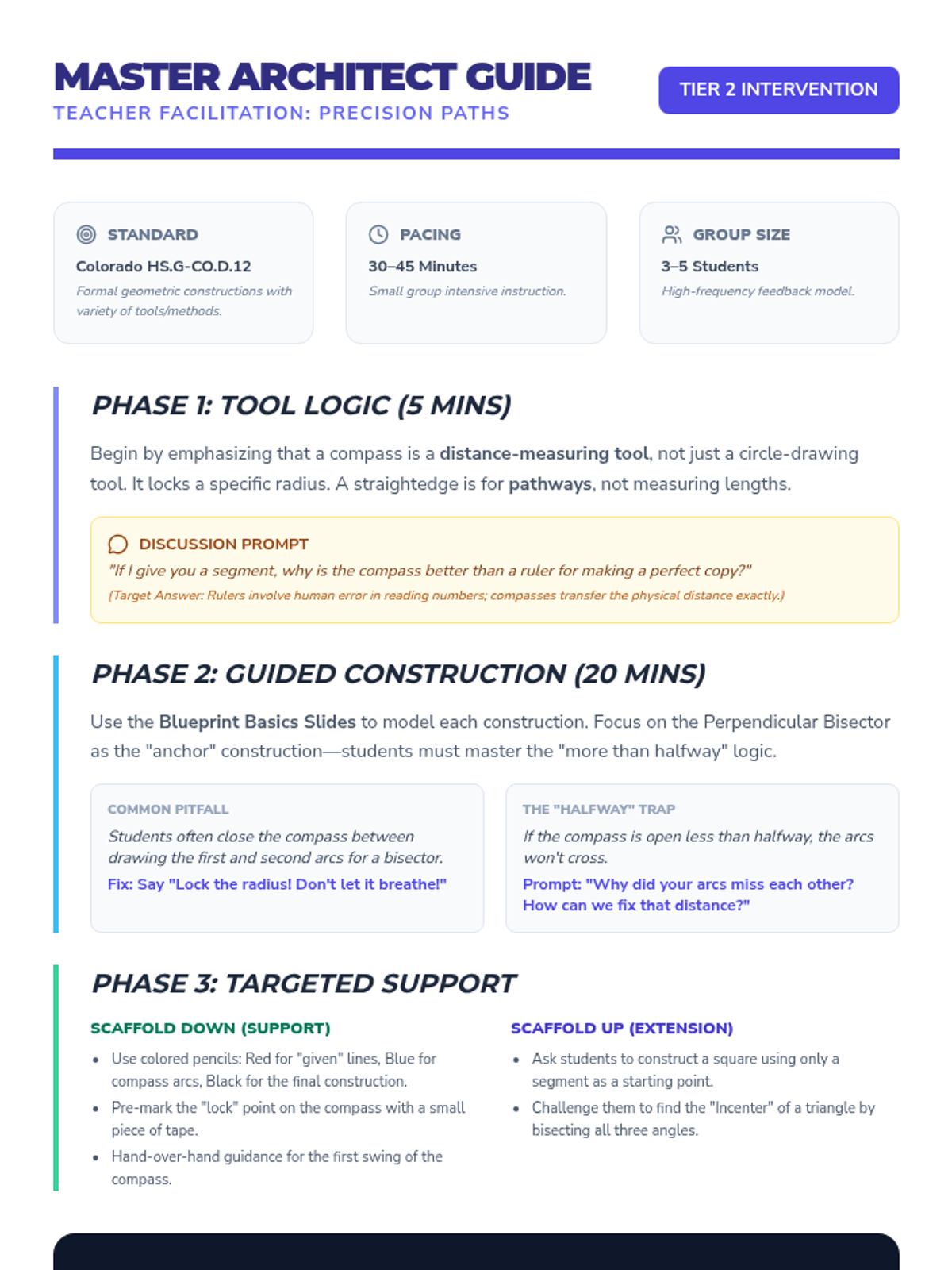
A comprehensive teacher facilitation guide for the geometric constructions intervention, featuring pacing, common misconceptions, questioning prompts, and differentiation strategies for Tier 2 small groups.
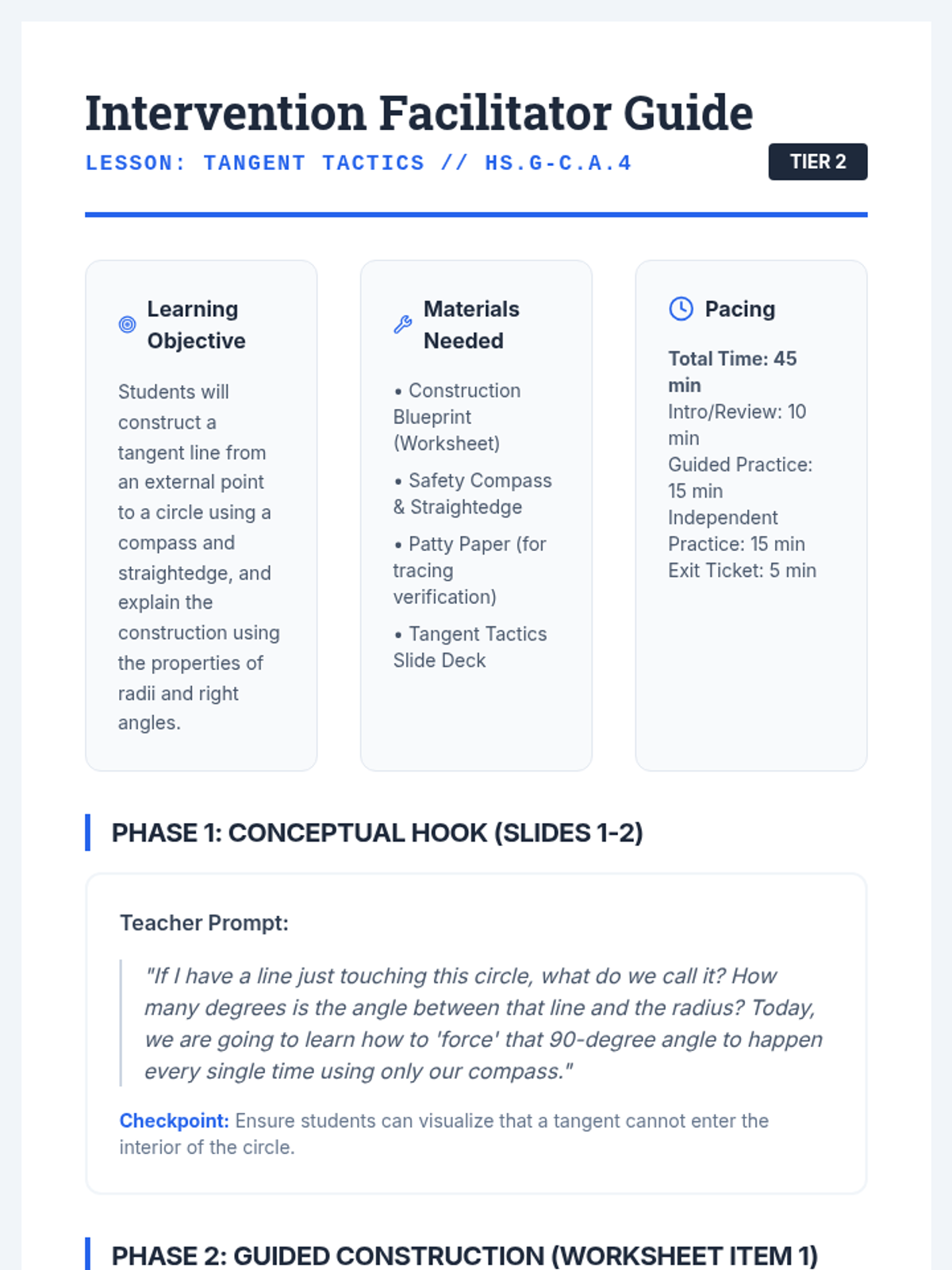
A comprehensive teacher-facing lesson guide for the Tangent Tactics intervention. Includes instructional scripts, pacing, scaffolding strategies for struggling learners, and a progress monitoring look-for table.
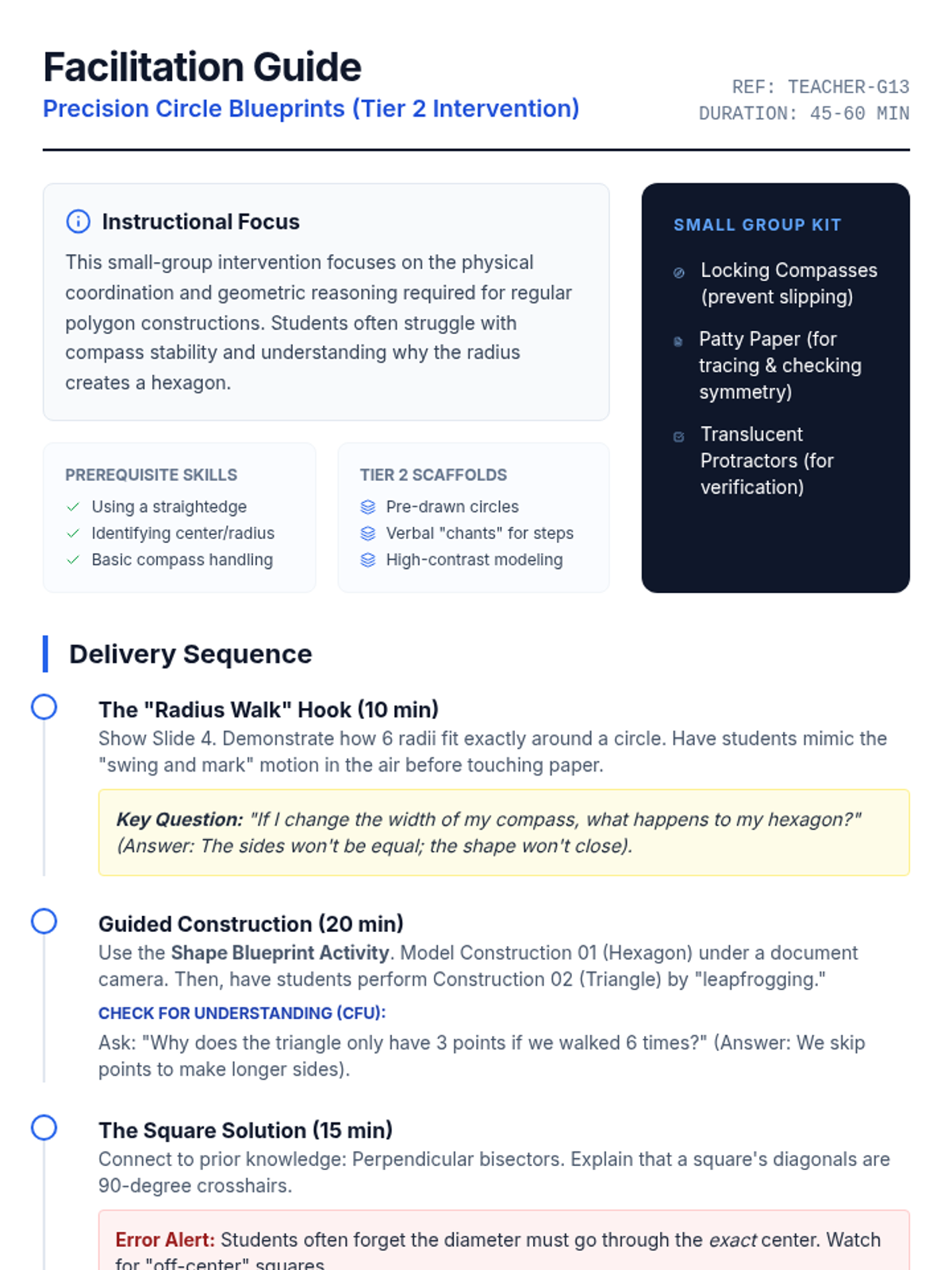
Teacher facilitation guide for the Tier 2 intervention, featuring explicit instructional steps, questioning prompts, error alerts, and a progress monitoring rubric.