Complex grammar structures, idiomatic expressions, and phrasal verbs. Strengthens reading and listening comprehension while building conversational fluency for varied social and professional settings.
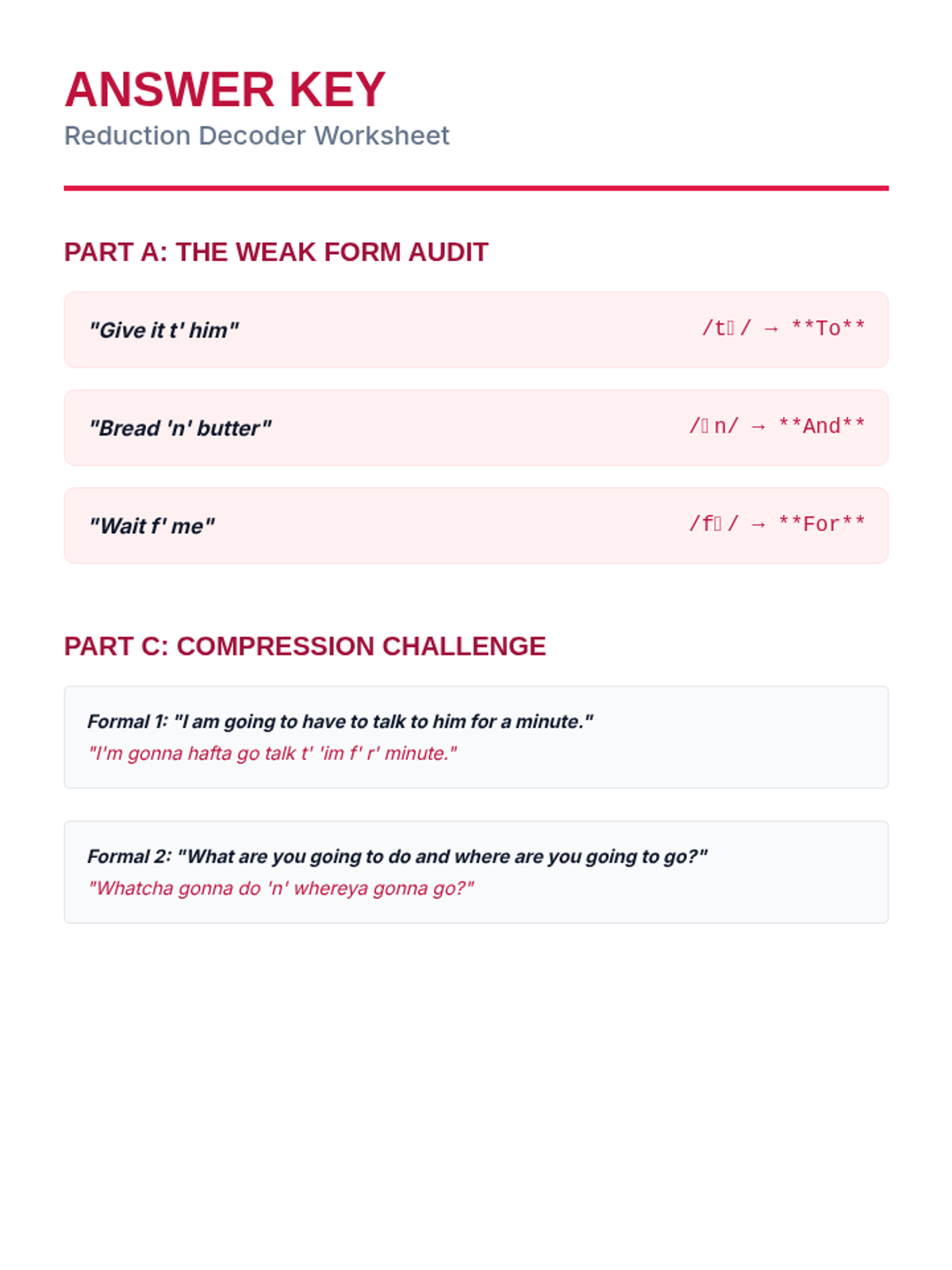
Answer key for the Lesson 4 worksheet on grammatical reductions.
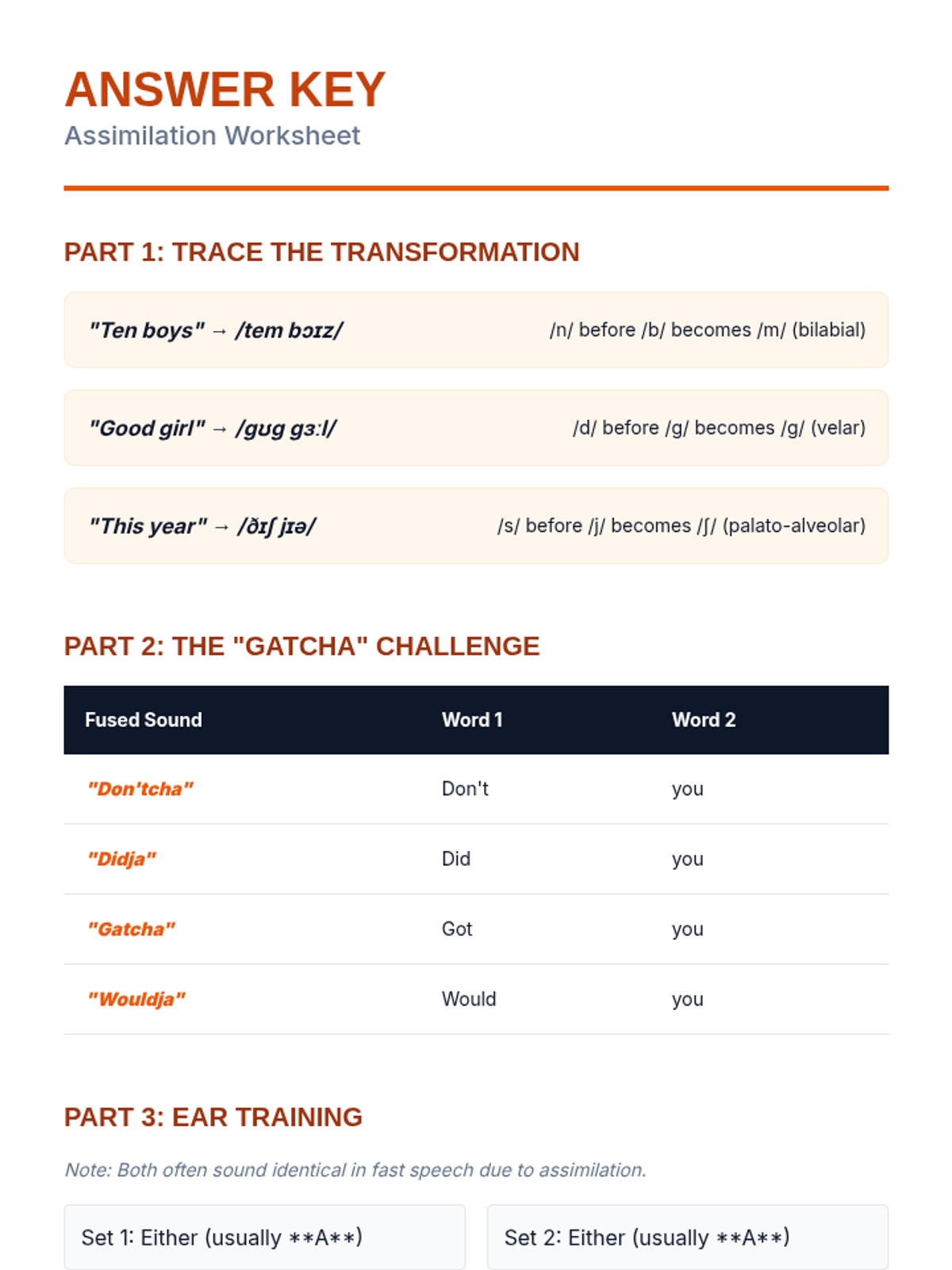
Answer key for the Lesson 3 worksheet on assimilation.
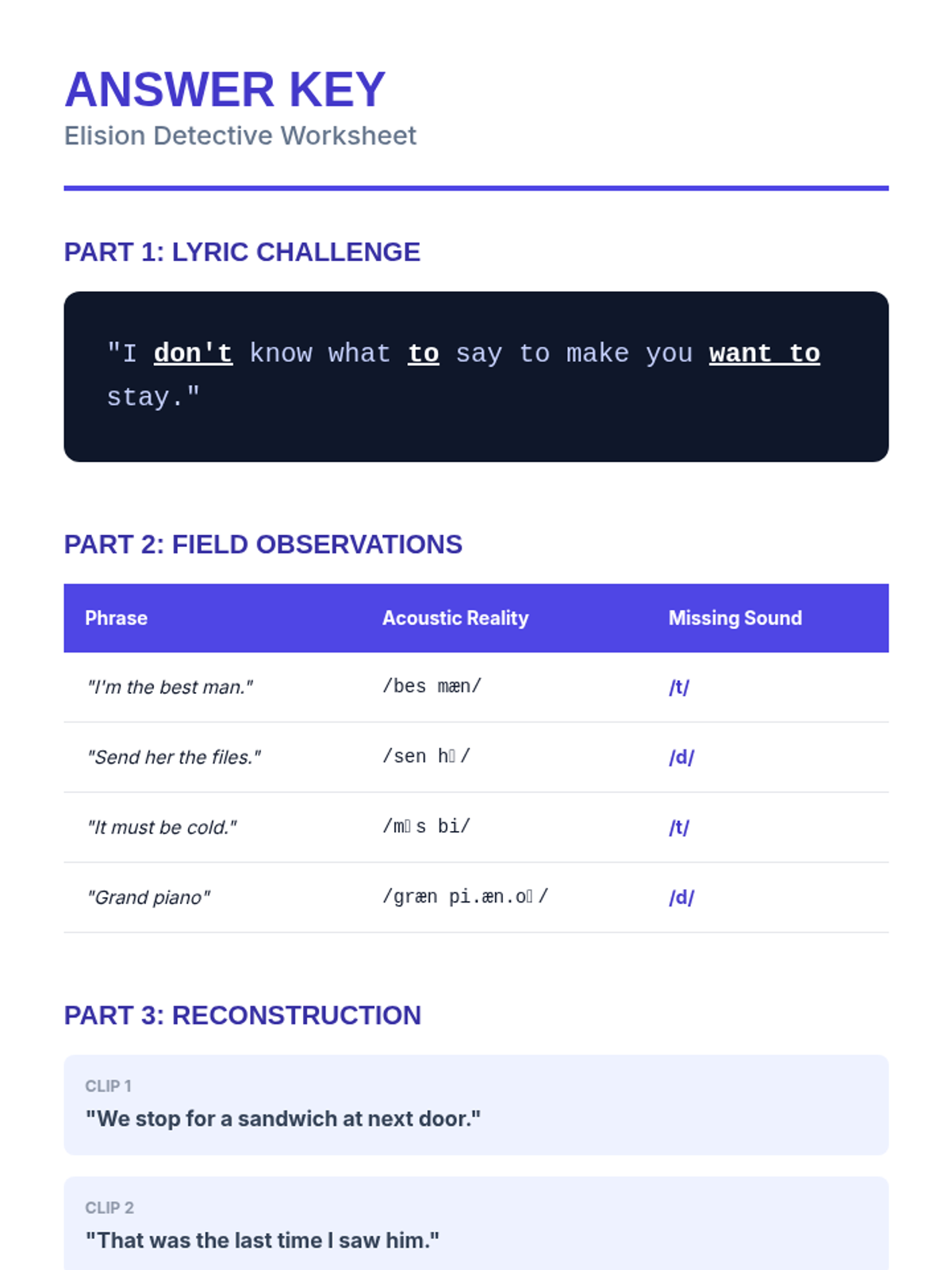
Answer key for the Lesson 2 worksheet on elision.
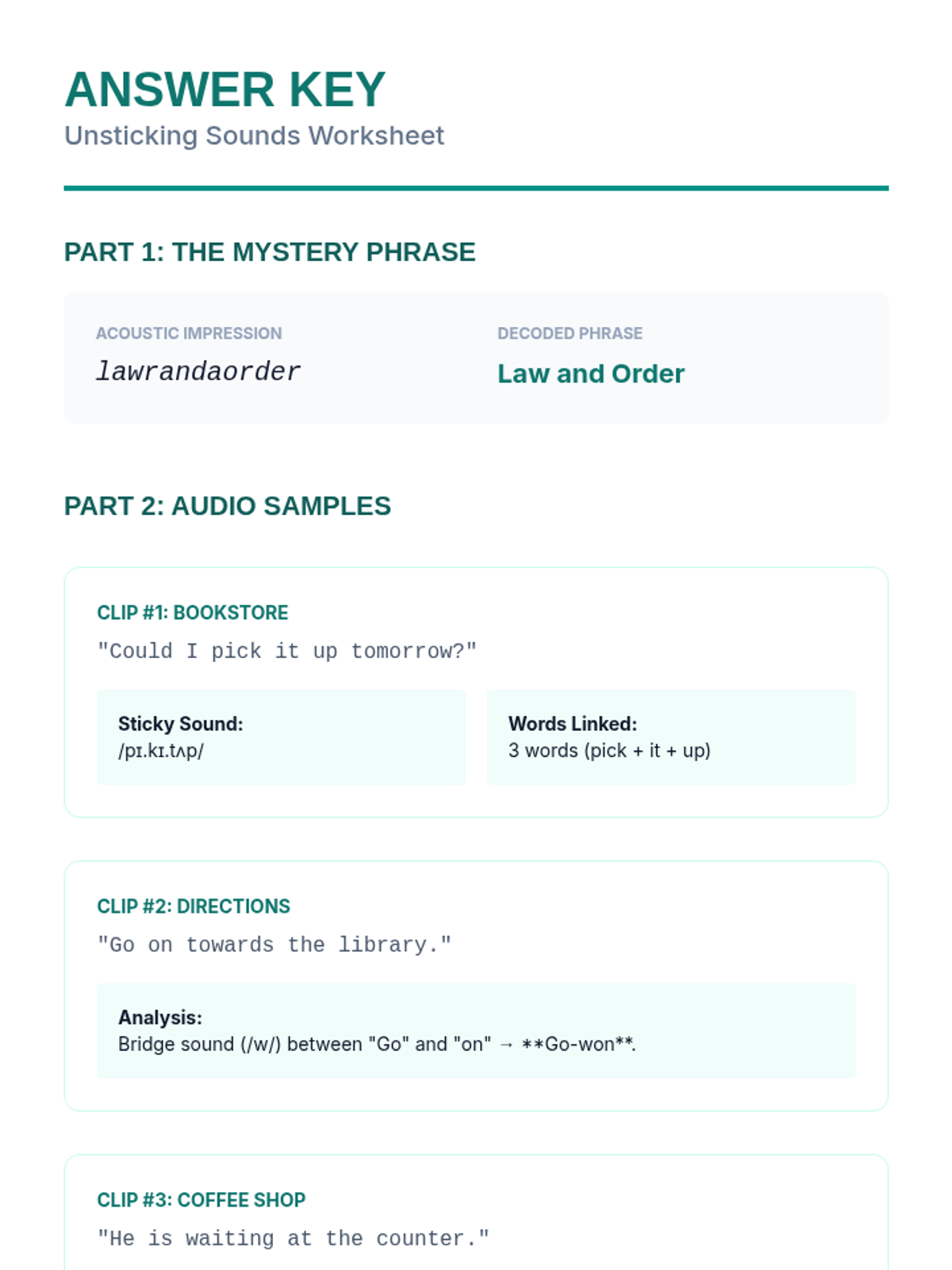
Answer key for the Lesson 1 worksheet on linking and intrusion.
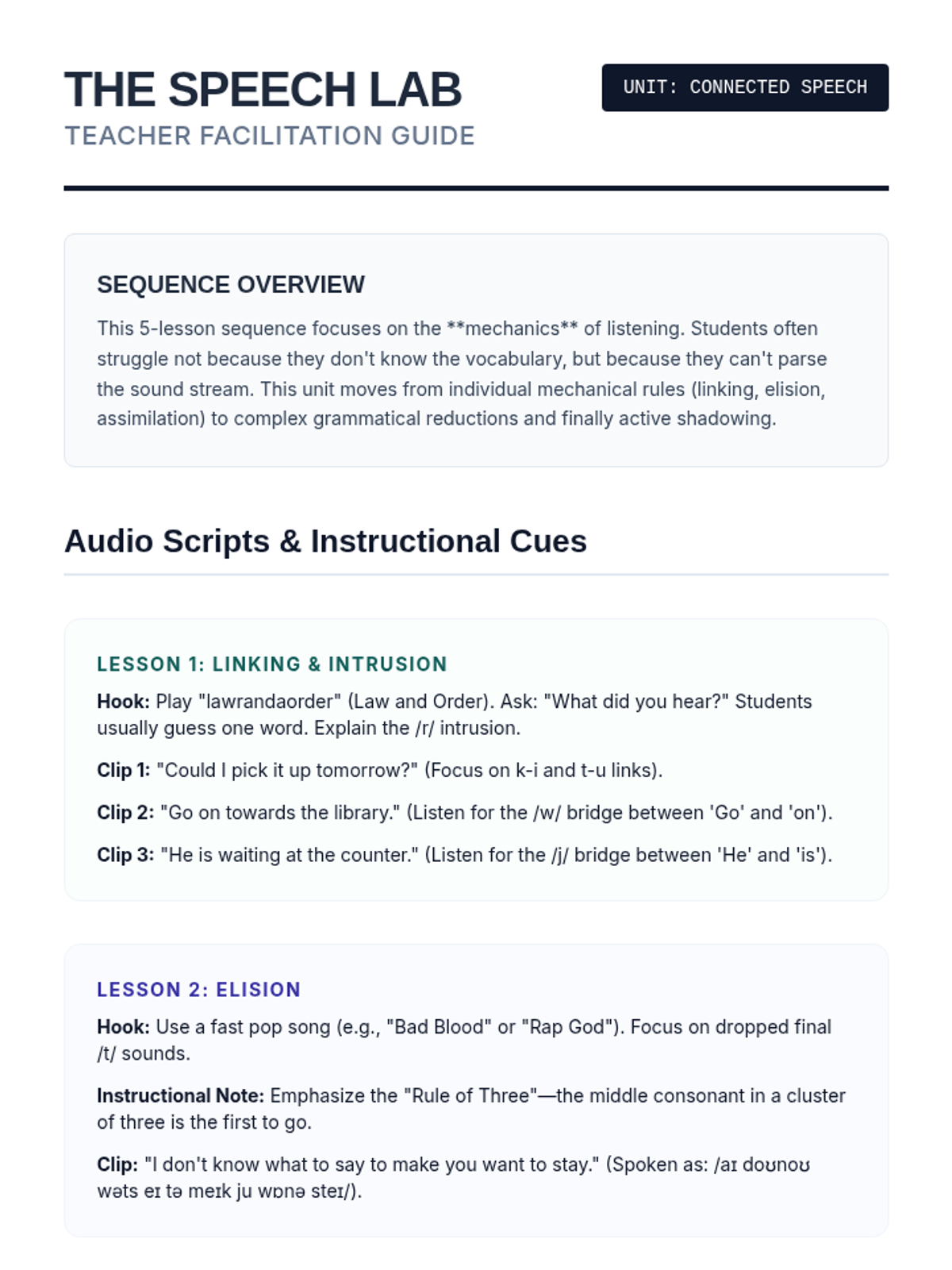
A comprehensive teacher guide for the Speech Lab sequence, including audio scripts, instructional cues, pacing, and differentiation strategies.
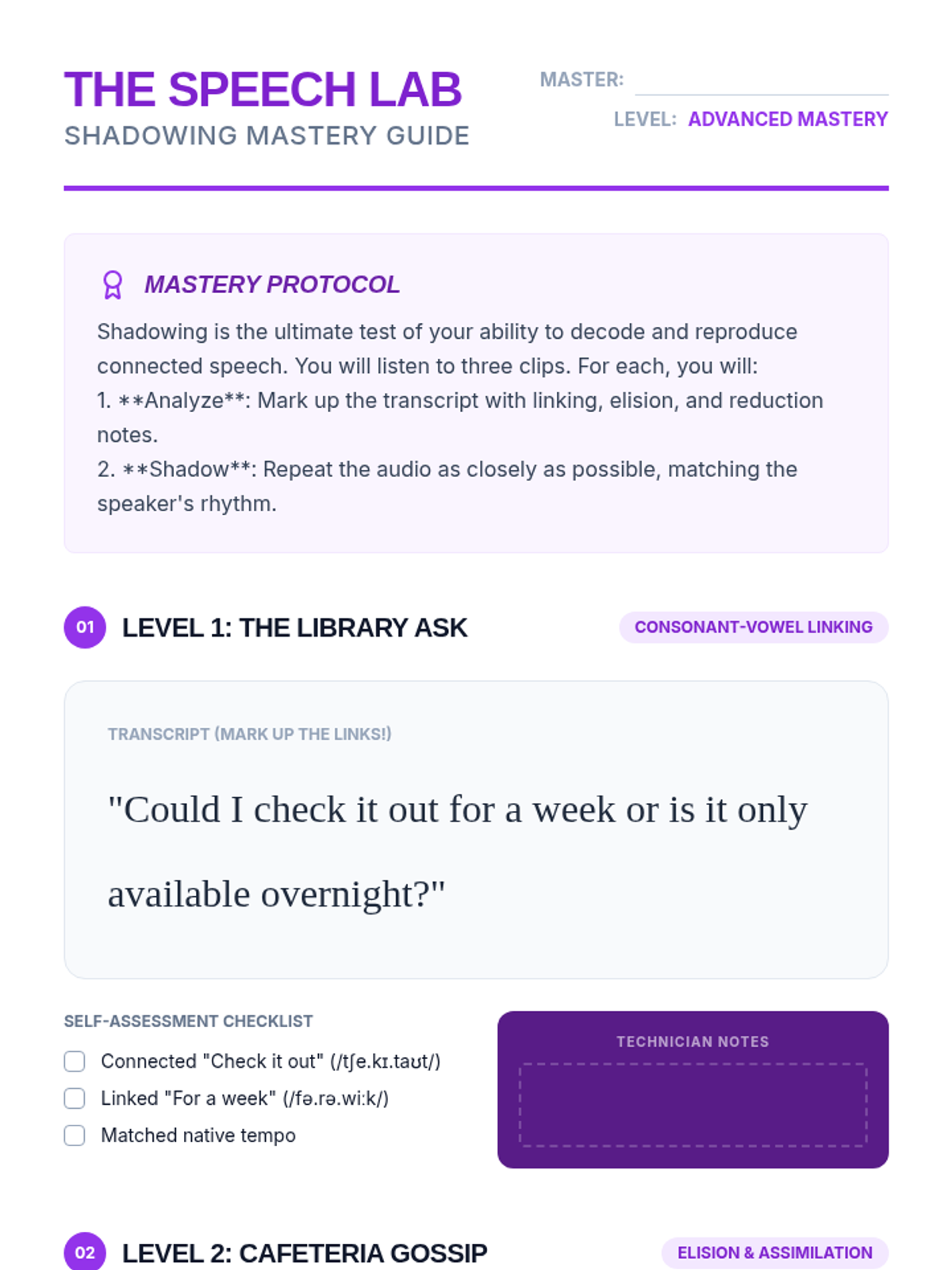
A student mastery guide for practicing shadowing techniques with transcript analysis of complex campus dialogues.
A slide deck for Lesson 5 on shadowing techniques, prosody, and the final mastery assessment of connected speech patterns.
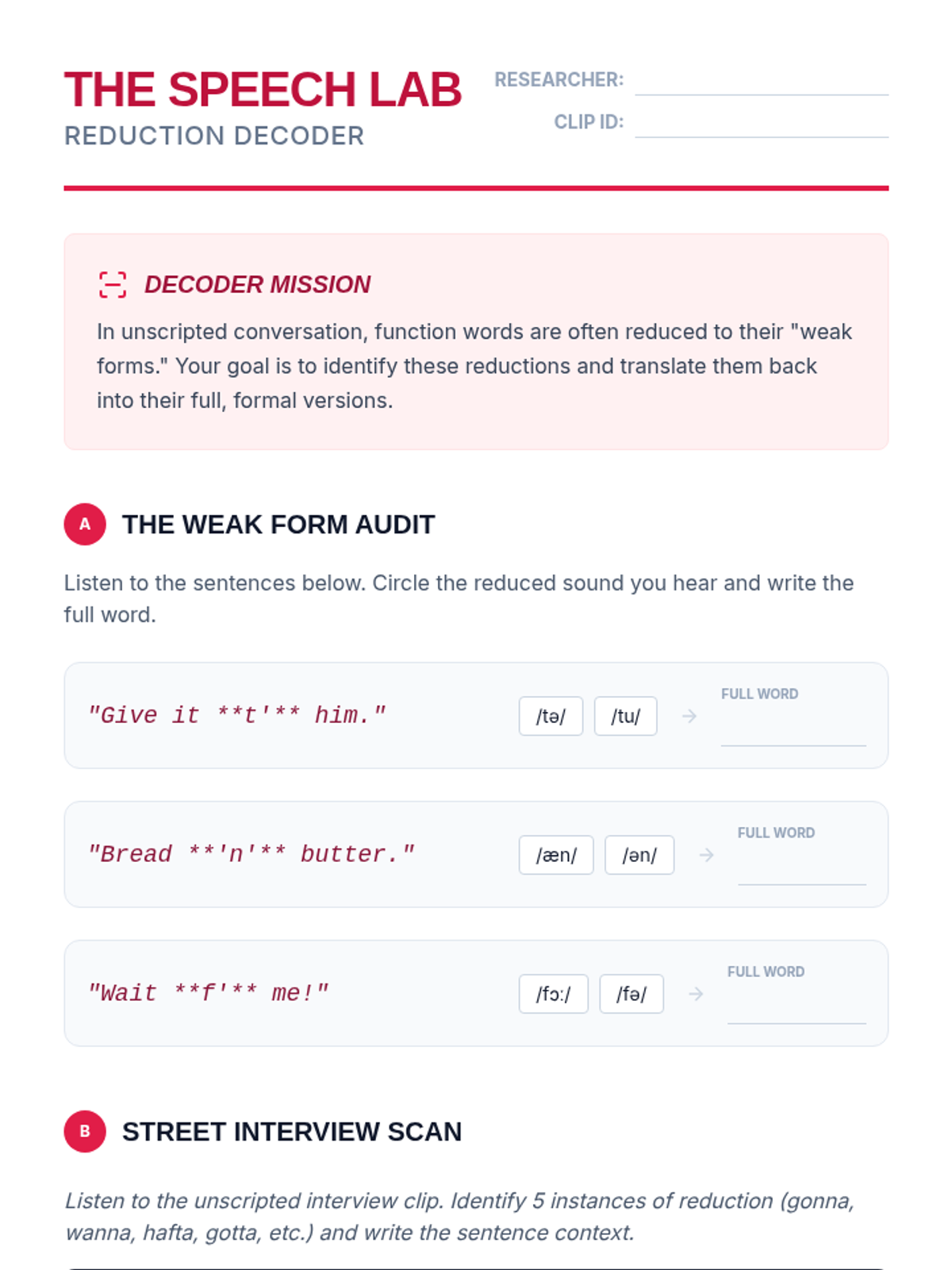
A student worksheet for identifying and translating grammatical reductions and weak forms in unscripted interviews.
A slide deck for Lesson 4 focusing on grammatical reductions and weak forms, using a high-contrast visual style to highlight the difference between formal and casual speech.
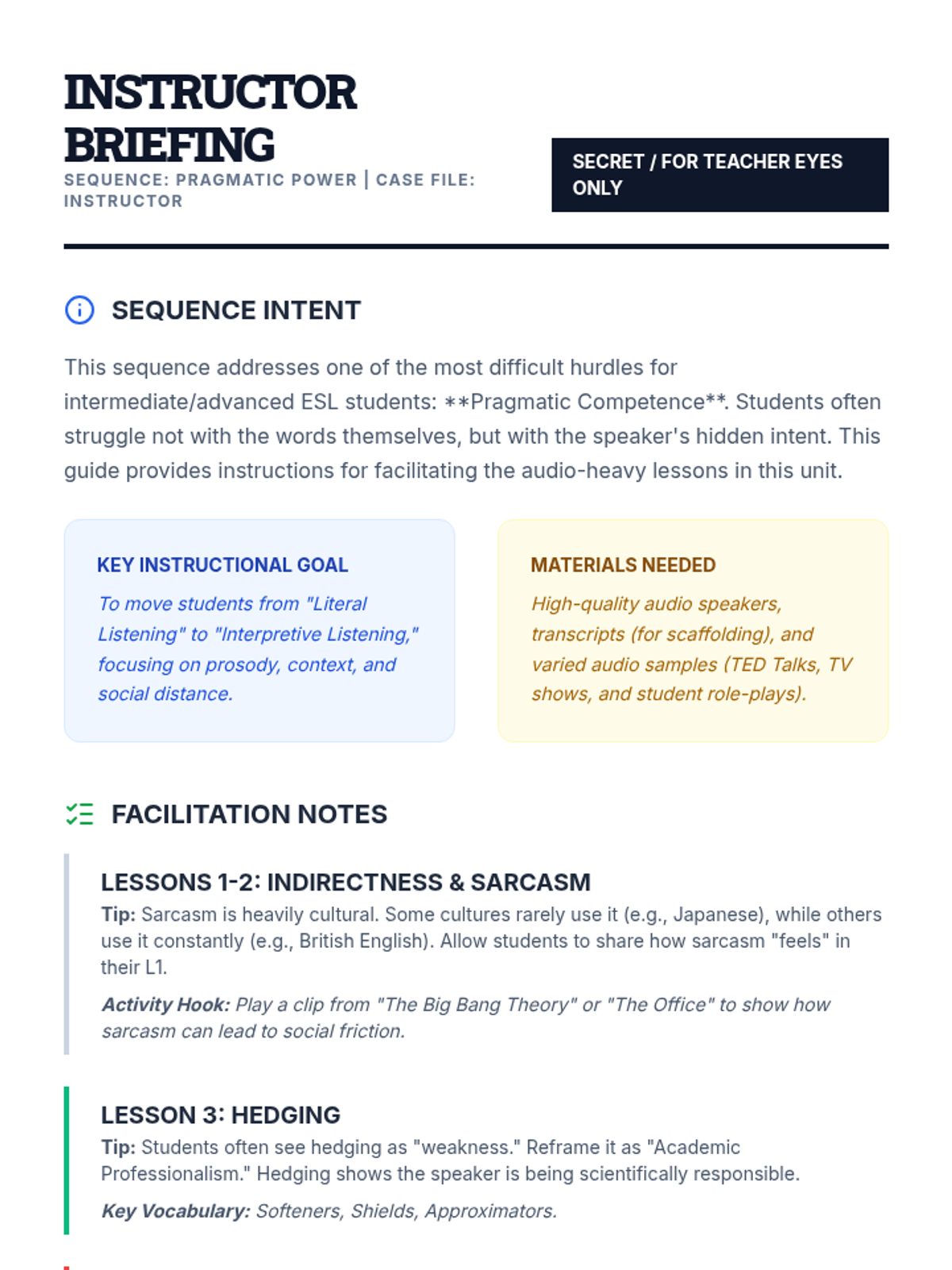
Instructor briefing and facilitation guide for the Pragmatic Power sequence, providing teaching tips, activity hooks, and assessment strategies for ESL instructors.
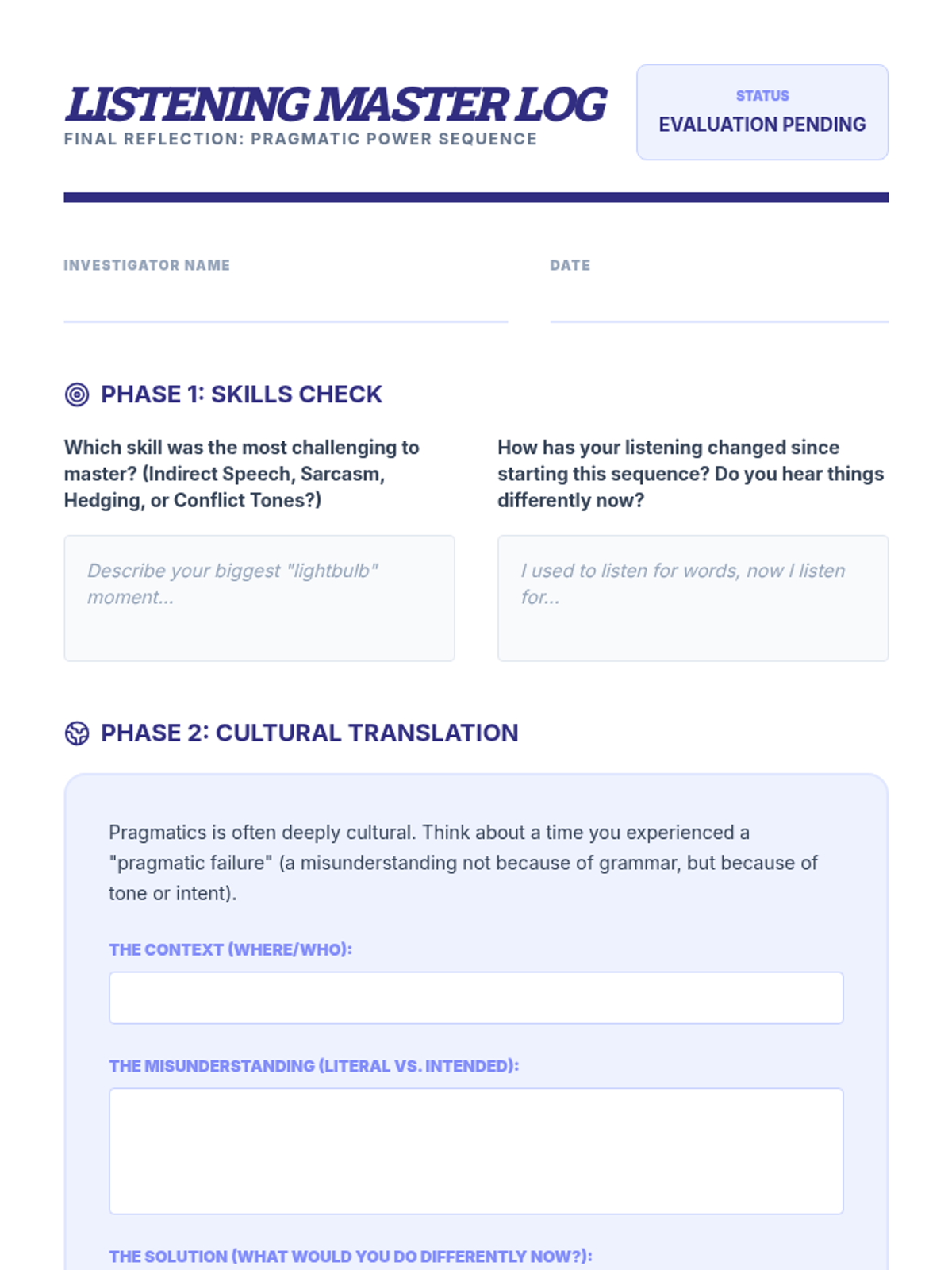
Final reflection worksheet and exit ticket for the sequence, allowing students to synthesize their learning about pragmatics and reflect on their own cultural communication experiences.
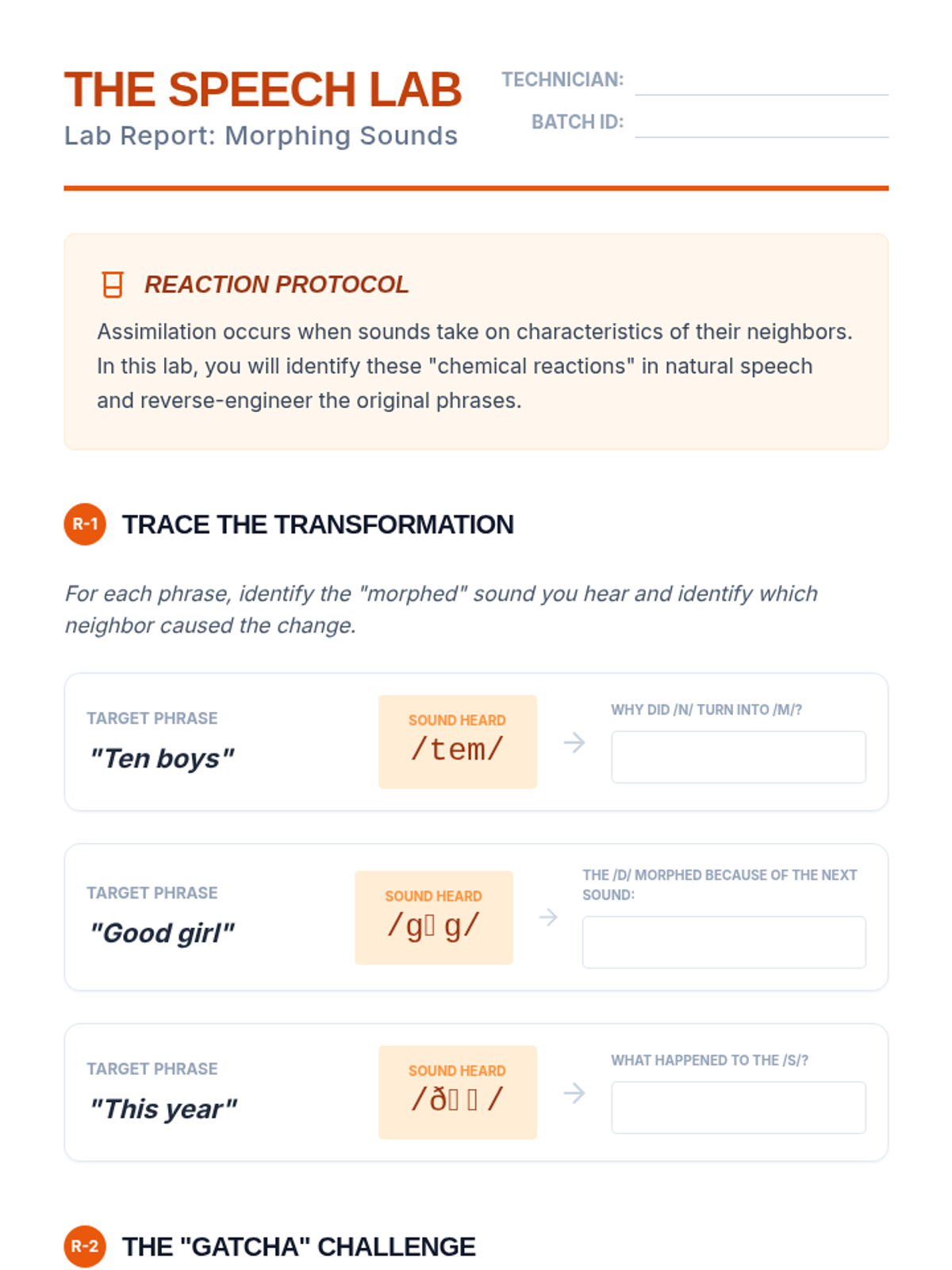
A student worksheet for identifying and reverse-engineering assimilated sounds in natural speech patterns.
Visual presentation for Lesson 5 exploring how cultural backgrounds influence pragmatic markers like silence, interruption, and backchanneling in global English.
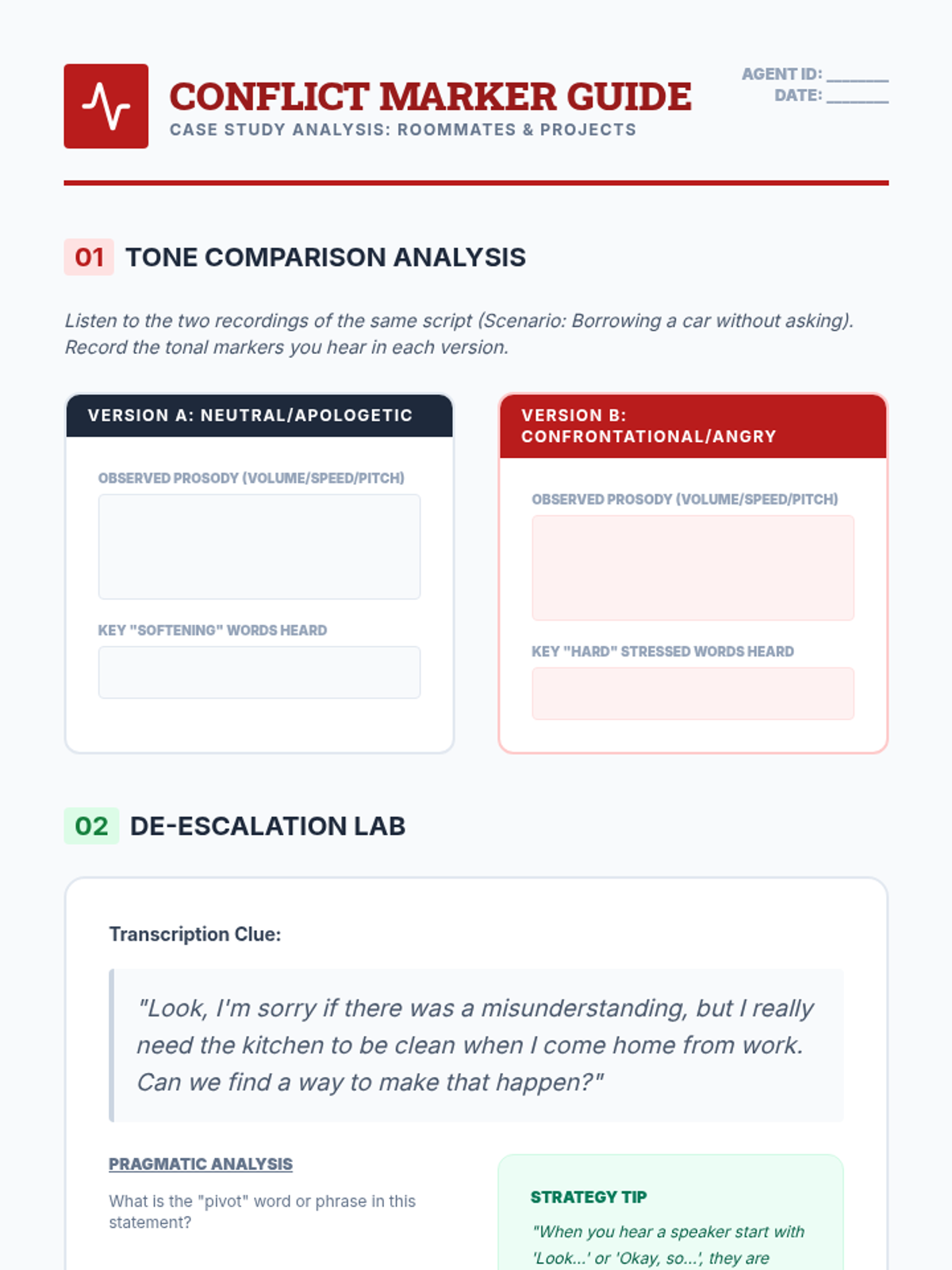
Student worksheet for Lesson 4 where students compare different tonal renditions of a script to identify markers of conflict and practice identifying de-escalation strategies.
A slide deck for Lesson 3 introducing assimilation, showing how sounds change based on their neighbors using a "chemical reaction" theme.
Visual presentation for Lesson 4 exploring the tonal and prosodic markers of conflict (escalation) and negotiation (de-escalation) in social and academic scenarios.
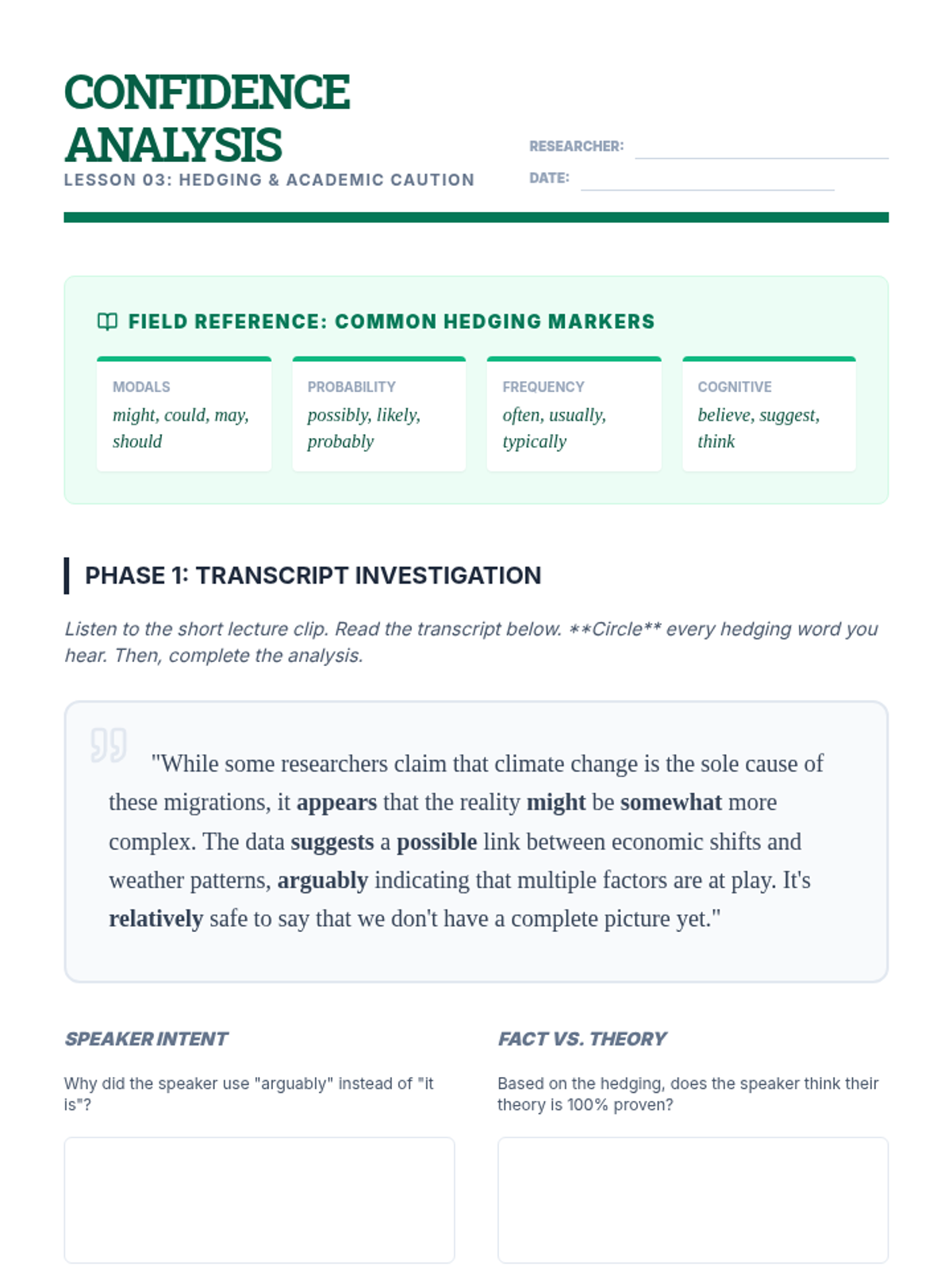
Worksheet for Lesson 3 where students identify hedging language in a transcript and evaluate the confidence level of different speakers based on their linguistic choices.
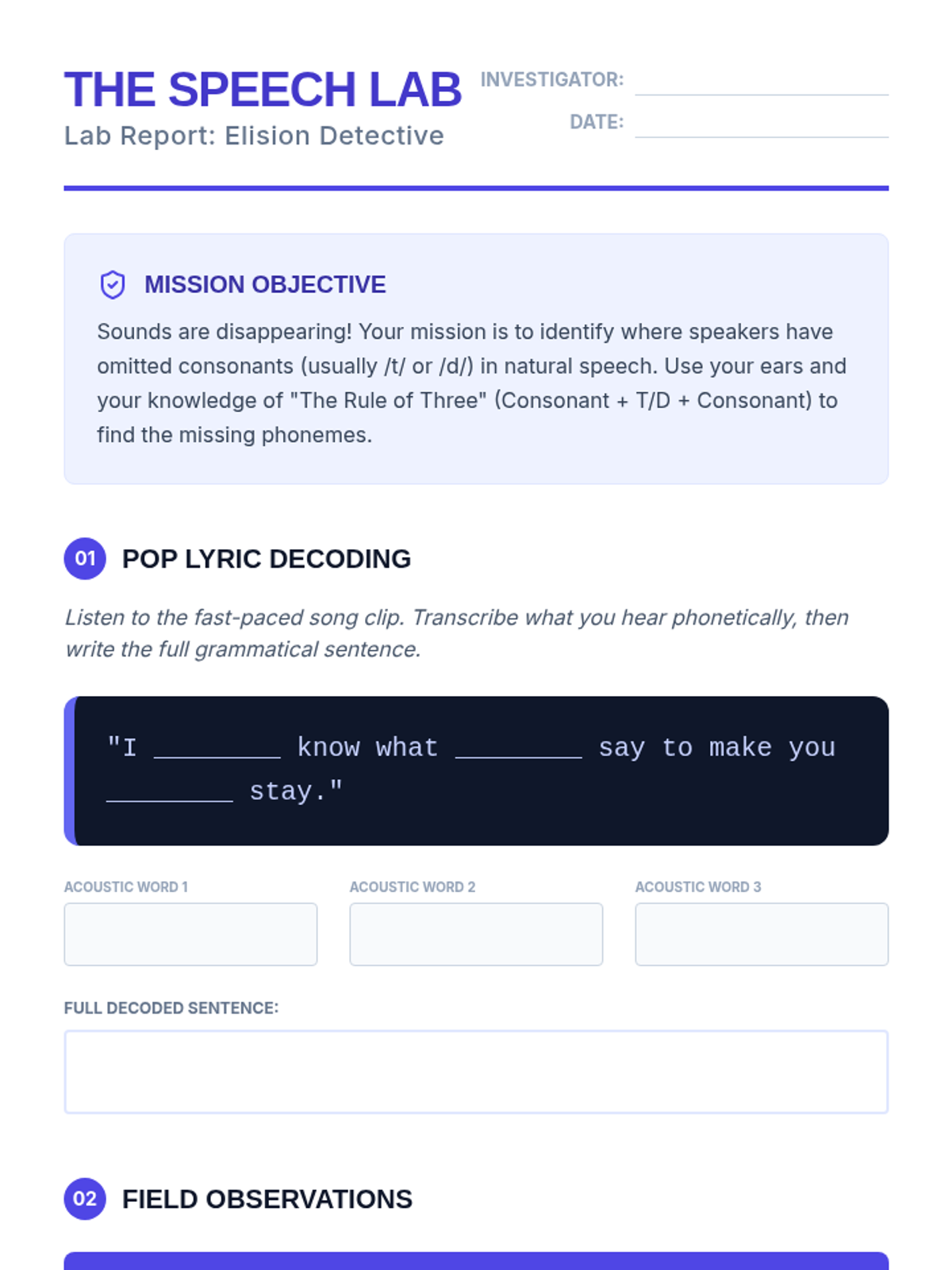
A student worksheet for identifying and reconstructing elided sounds (/t/ and /d/) in common phrases and lyrics.
Presentation for Lesson 3 focusing on hedging language in academic and formal English, teaching students to identify linguistic softeners that signal uncertainty or caution.
Slide presentation for Lesson 4 exploring how sentence stress and intonation change the meaning of words. Features interactive examples of pitch shifts and emotion detection.
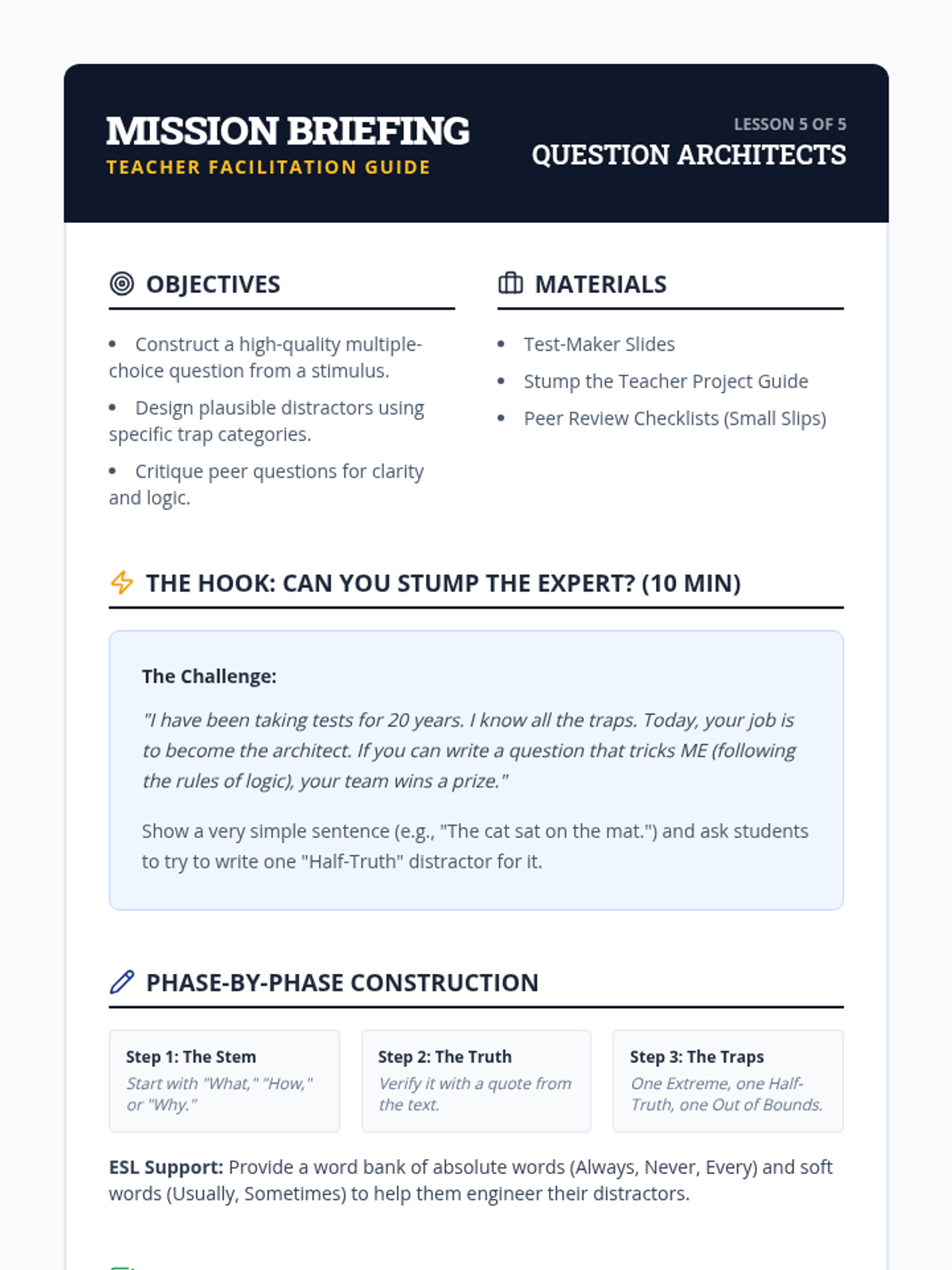
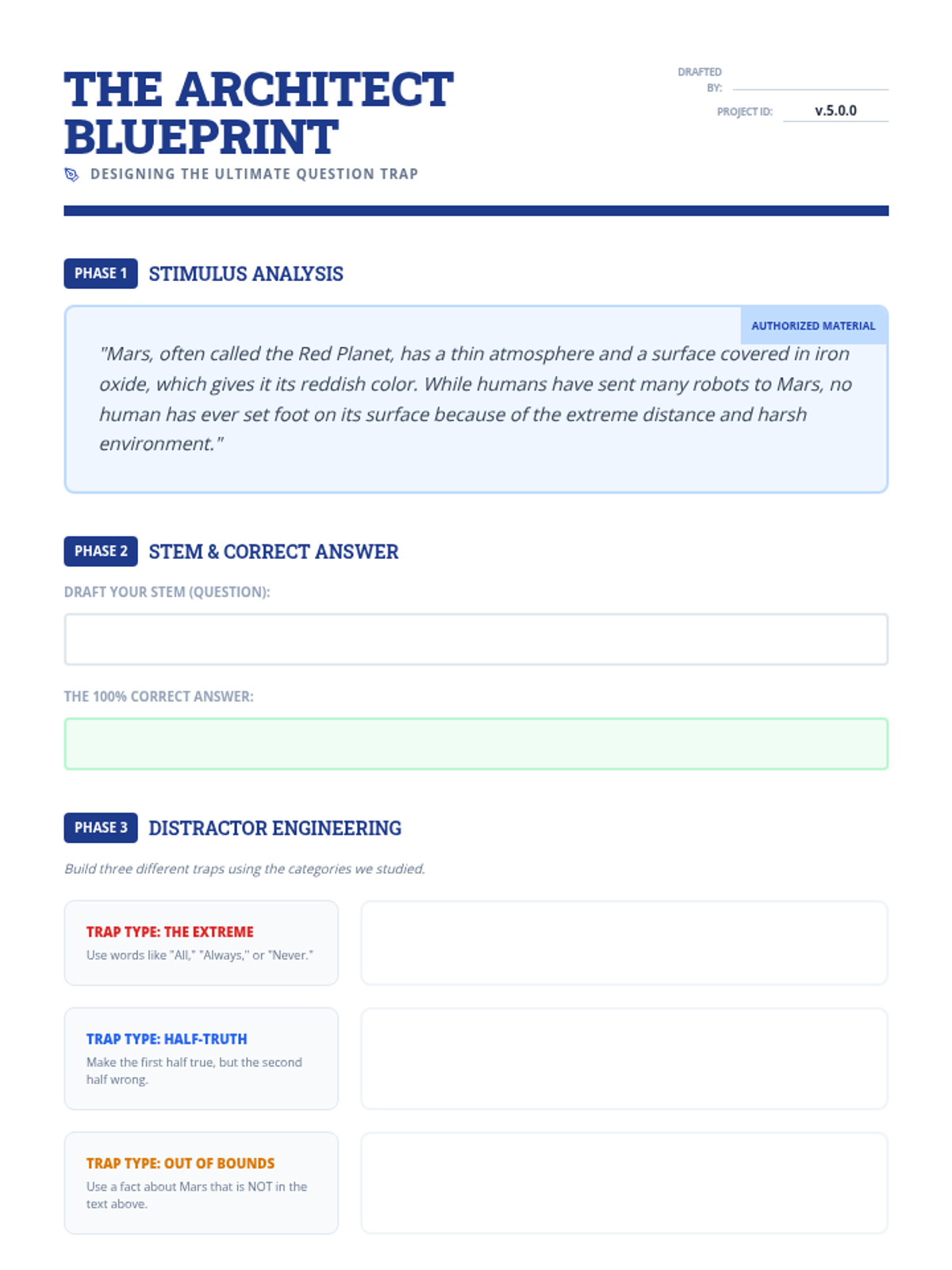
Facilitation guide for Lesson 5, including the "Stump the Expert" hook, phase-by-phase question construction steps, and a peer review protocol.
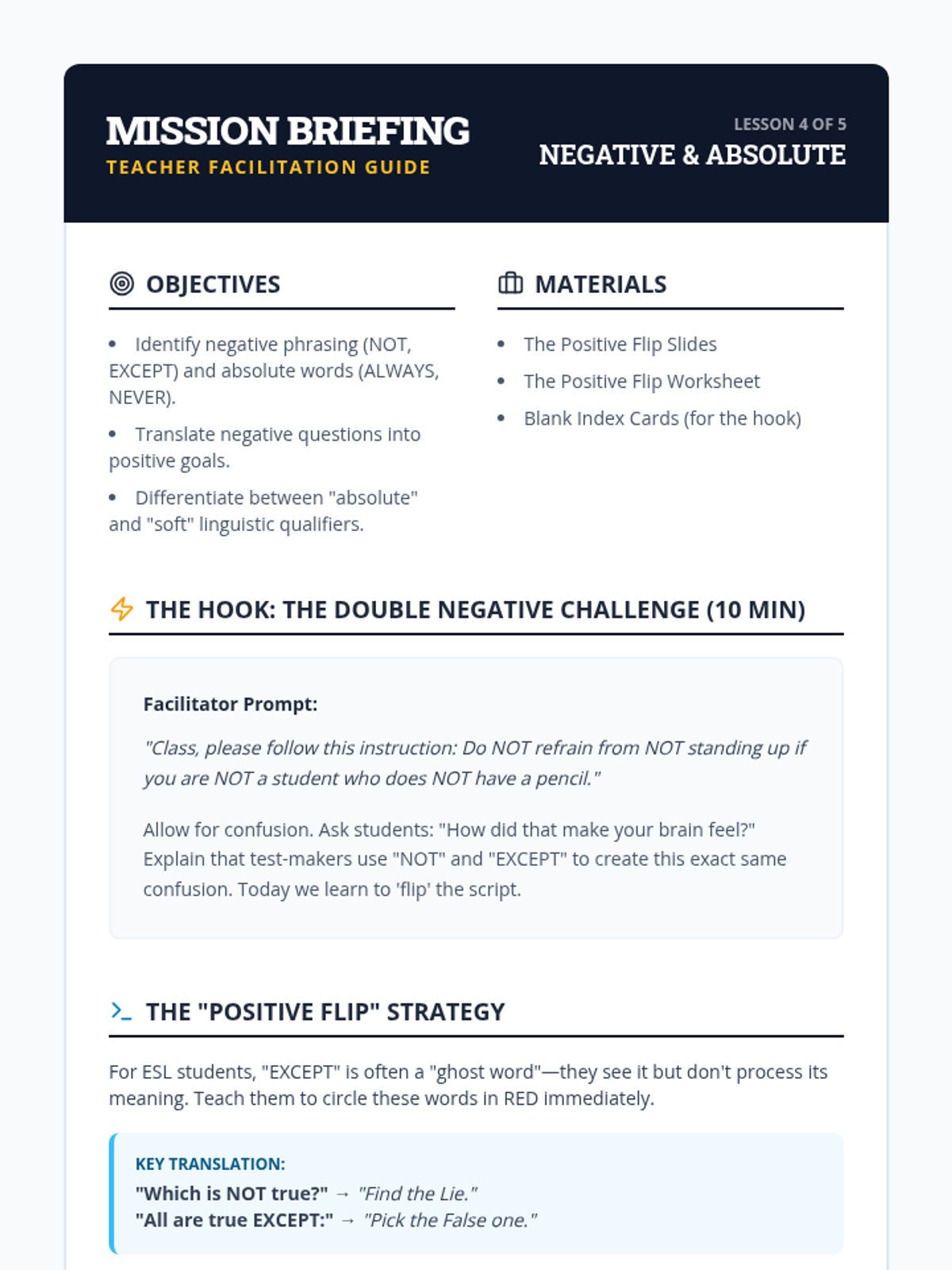
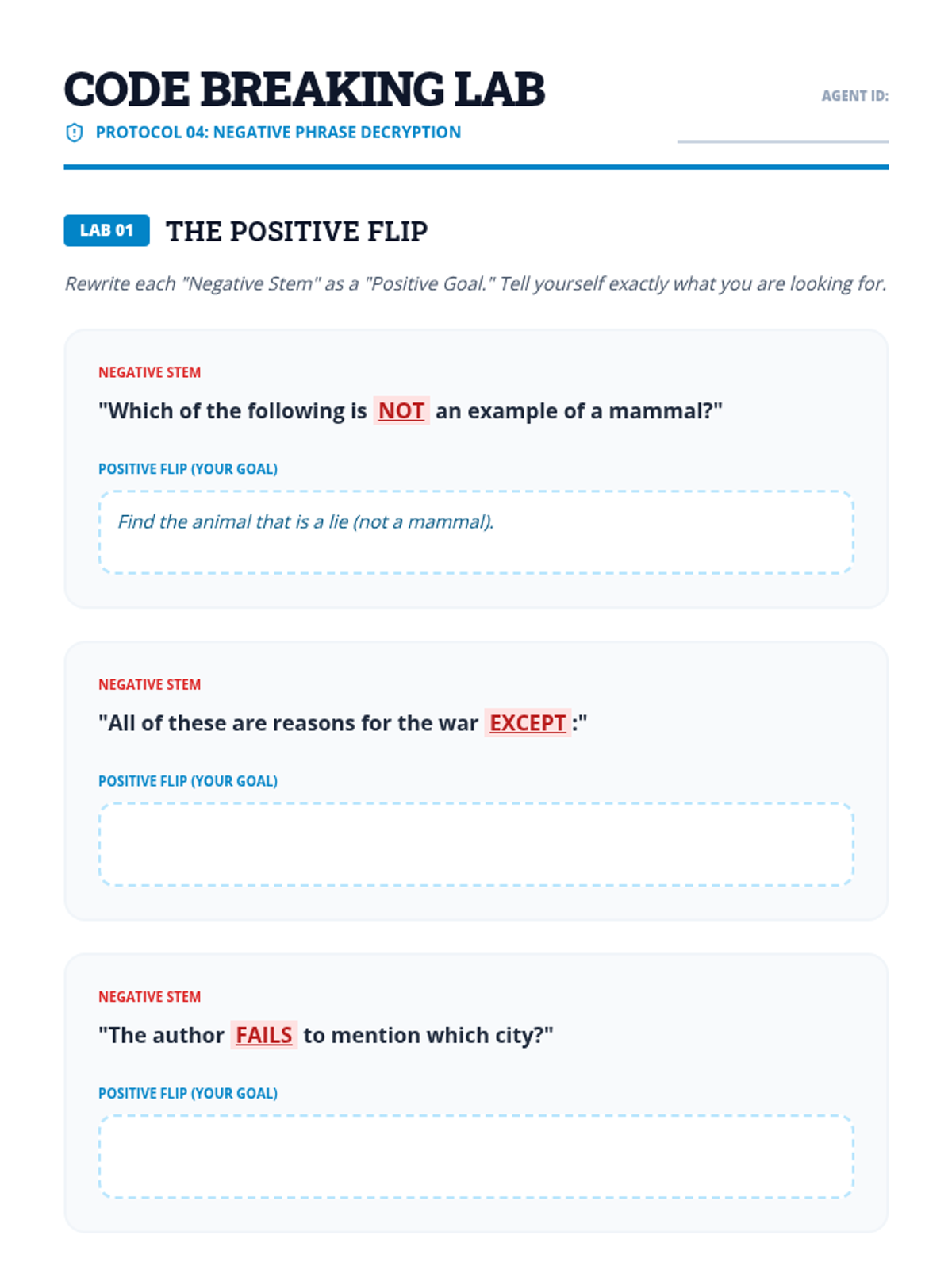
Facilitation guide for Lesson 4, including the "Double Negative Instructions" hook, translation strategies for "NOT" and "EXCEPT," and an answer key for the Positive Flip worksheet.
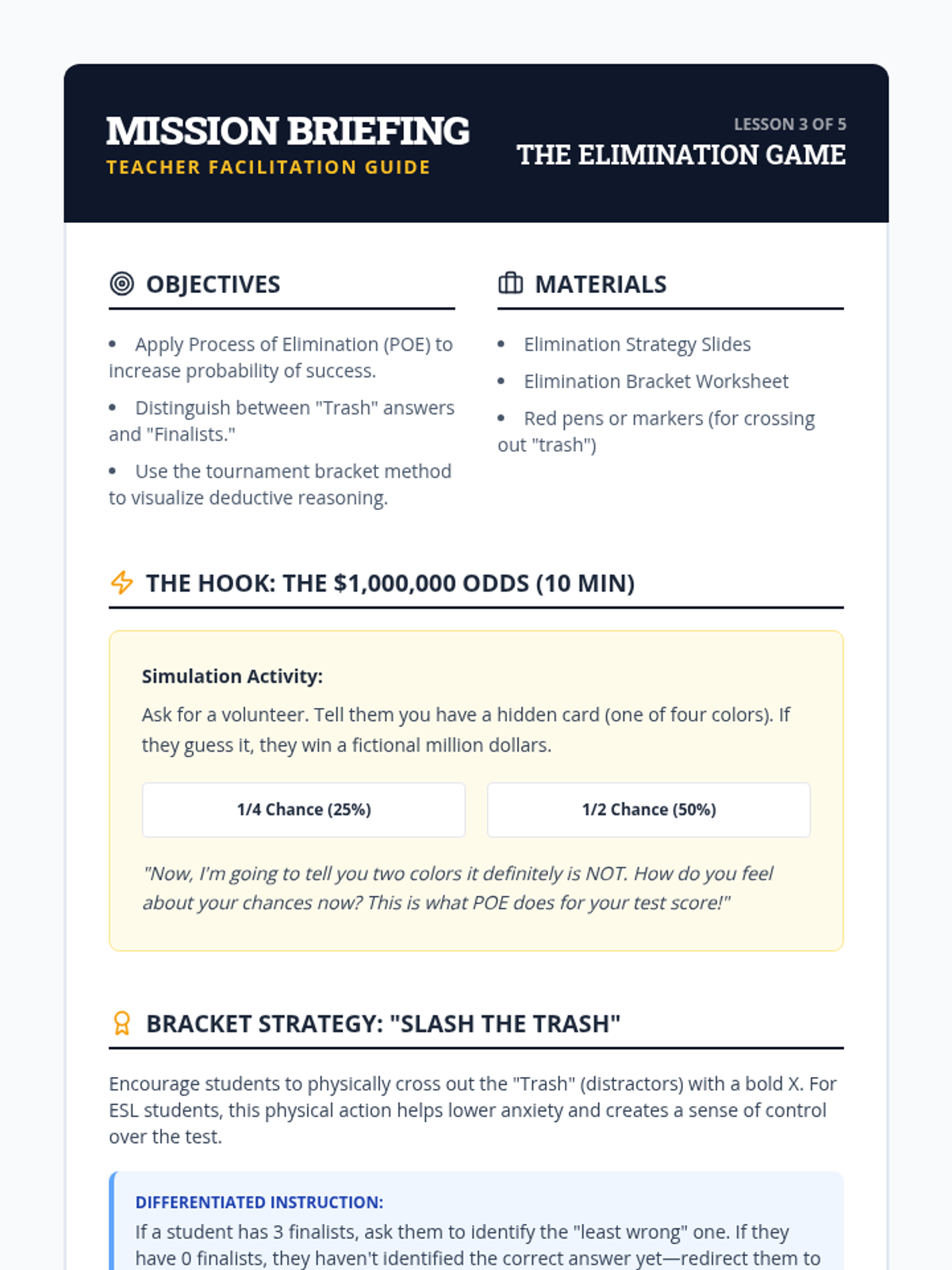
Facilitation guide for Lesson 3, including the odds simulation hook, the "Slash the Trash" technique, and an answer key for the Elimination Bracket worksheet.
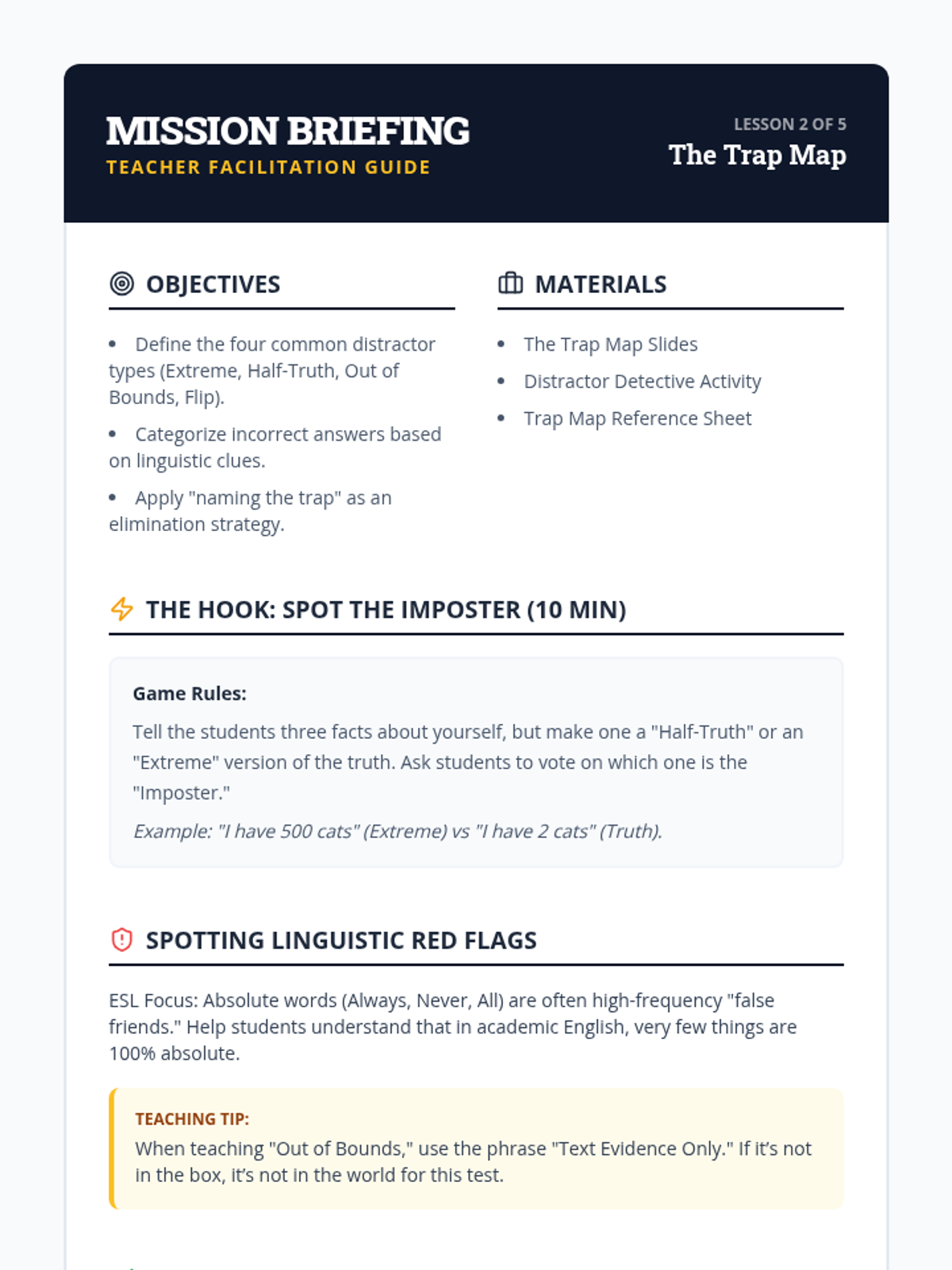
Facilitation guide for Lesson 2, including the 'Spot the Imposter' hook, linguistic red flags for ESL learners, and an answer key for the Distractor Detective activity.
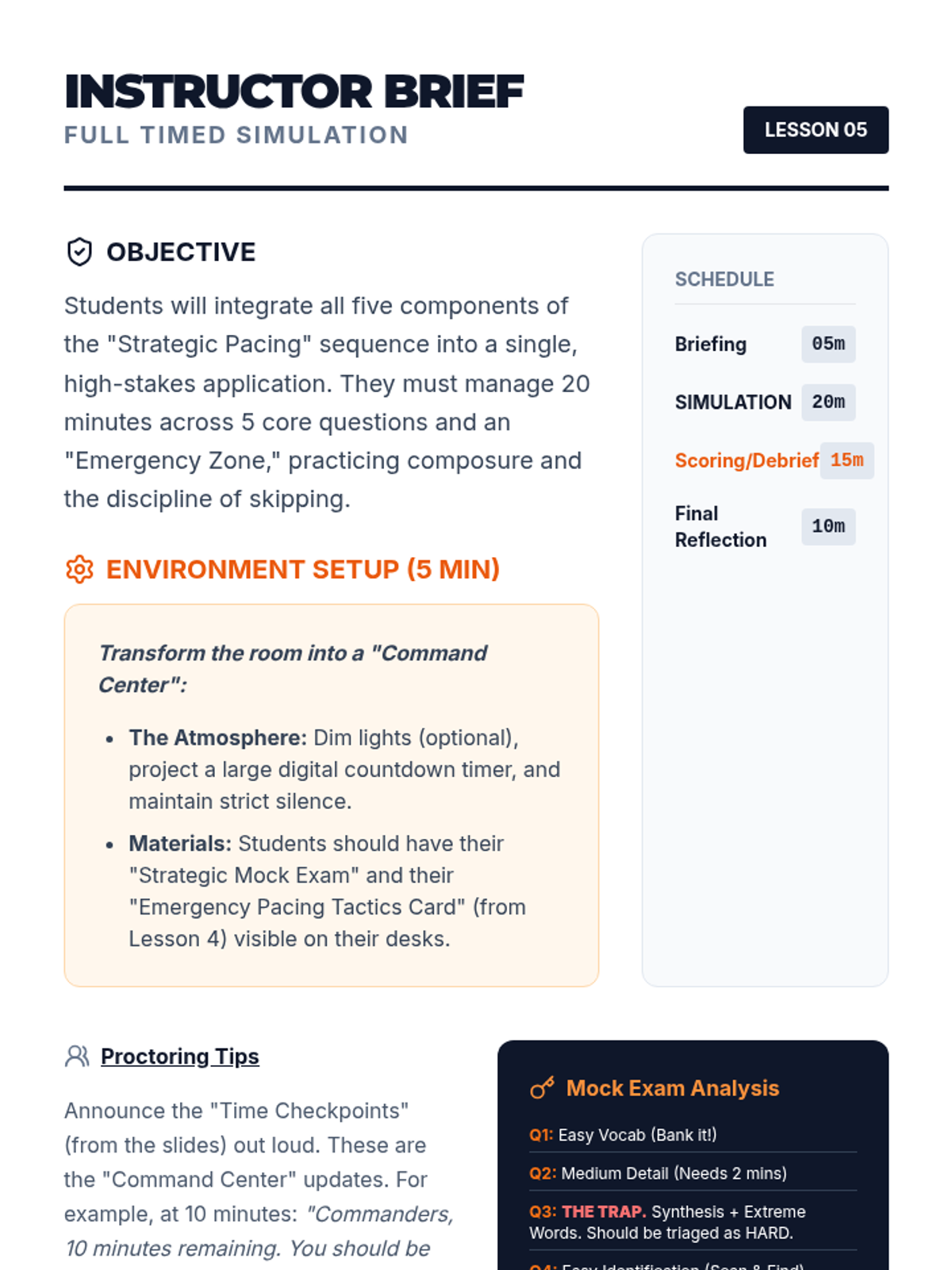
Final teacher guide for Lesson 5, focusing on how to proctor the simulation, provide time-check 'Command Center' updates, and evaluate student strategy use rather than just raw accuracy.
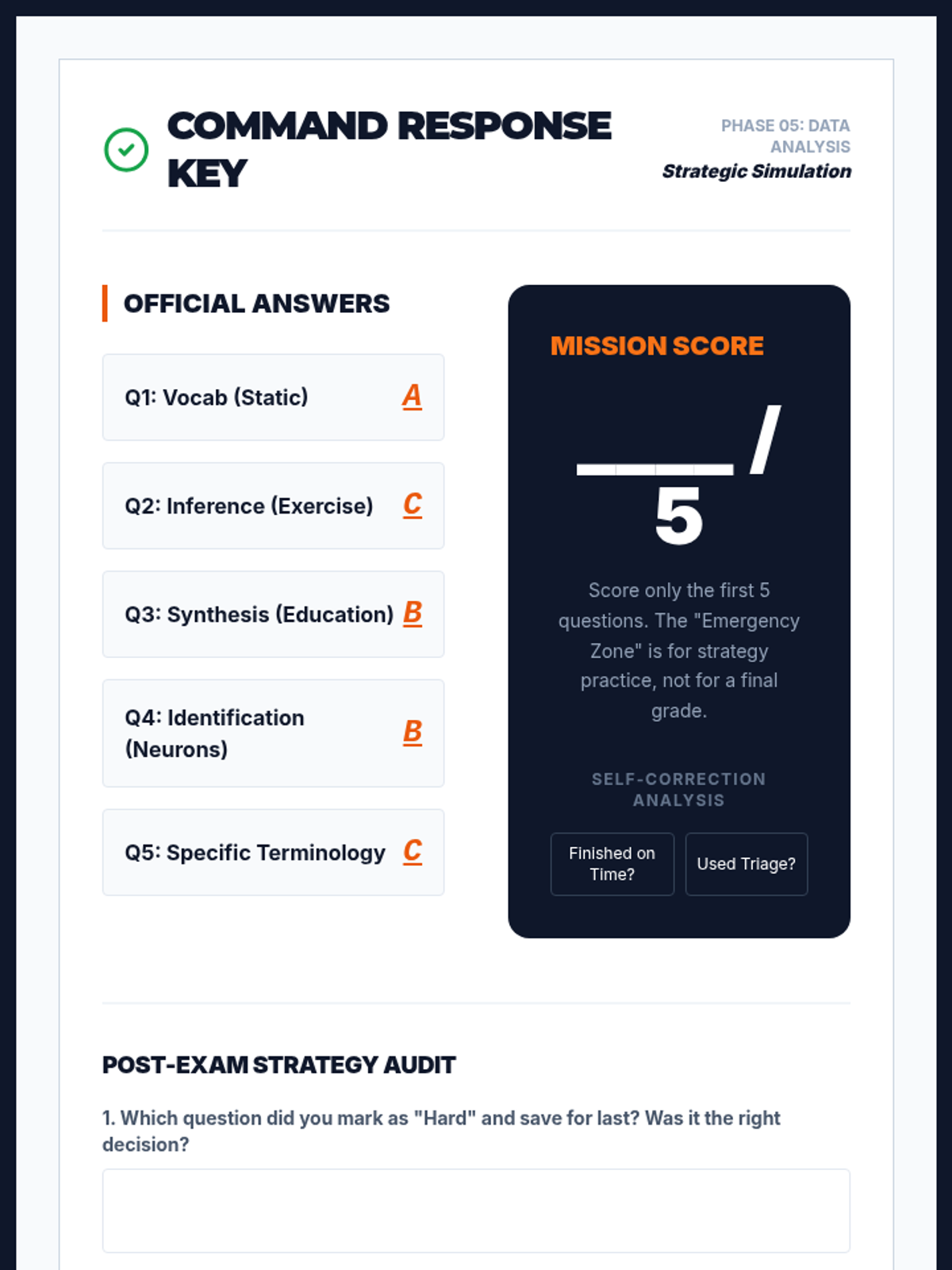
An answer key and reflection sheet for the final mock exam, allowing students to score their performance and audit their application of pacing and triage strategies.
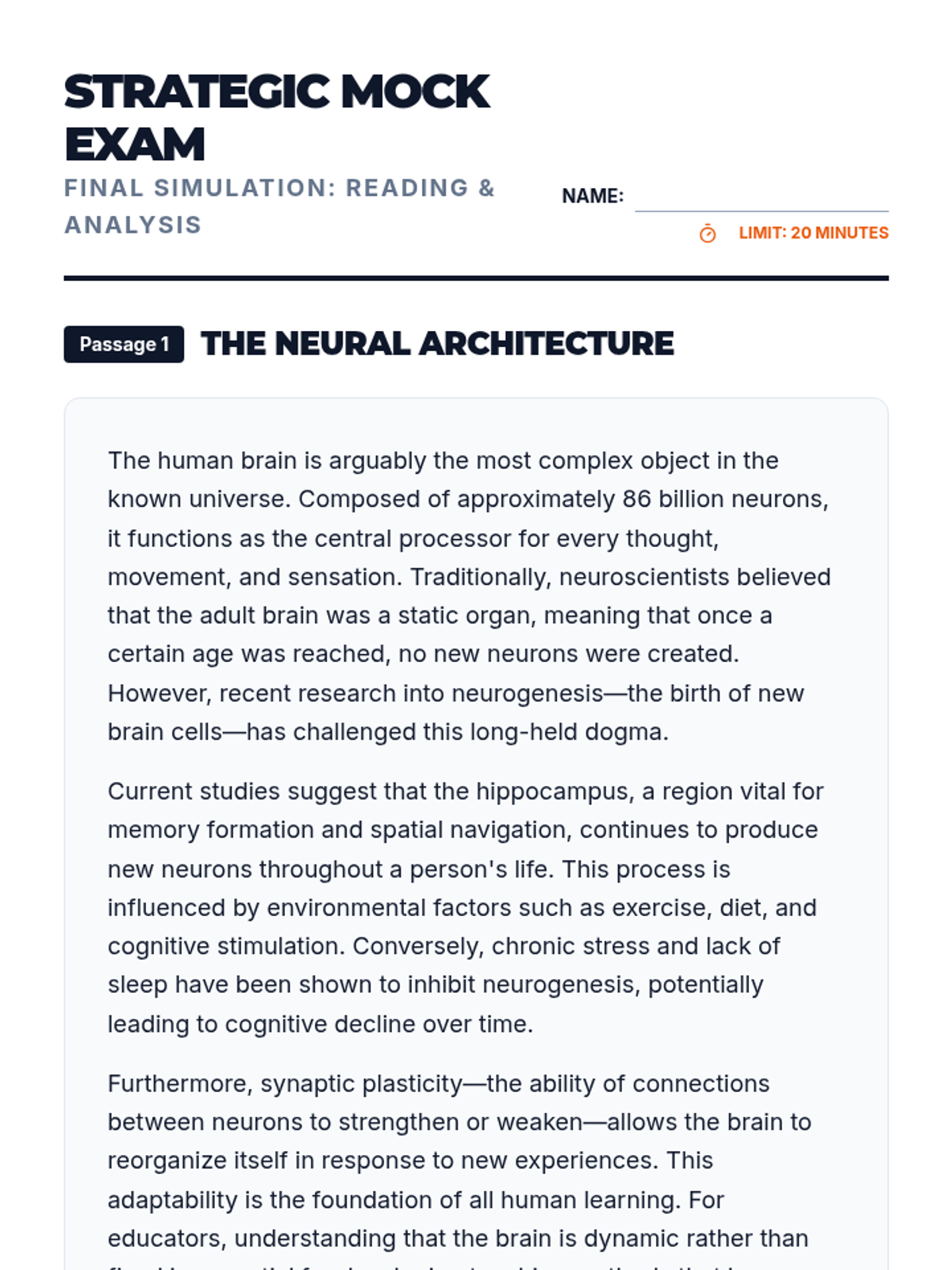
The final mock exam for students to complete under a 20-minute limit, featuring a complex academic text, varying difficulty questions, and a dedicated 'Emergency Zone' for guessing practice.
Worksheet for Lesson 5 where students switch roles and become the test-makers. They write their own multiple-choice questions based on a shared text, intentionally creating plausible distractors.
Final slide deck for Lesson 5, outlining the rules for the 20-minute exam simulation and providing specific time-check milestones for students to follow.
Introductory slide deck for Lesson 5, exploring the mindset of a test-maker and the steps needed to construct a plausible multiple-choice question.
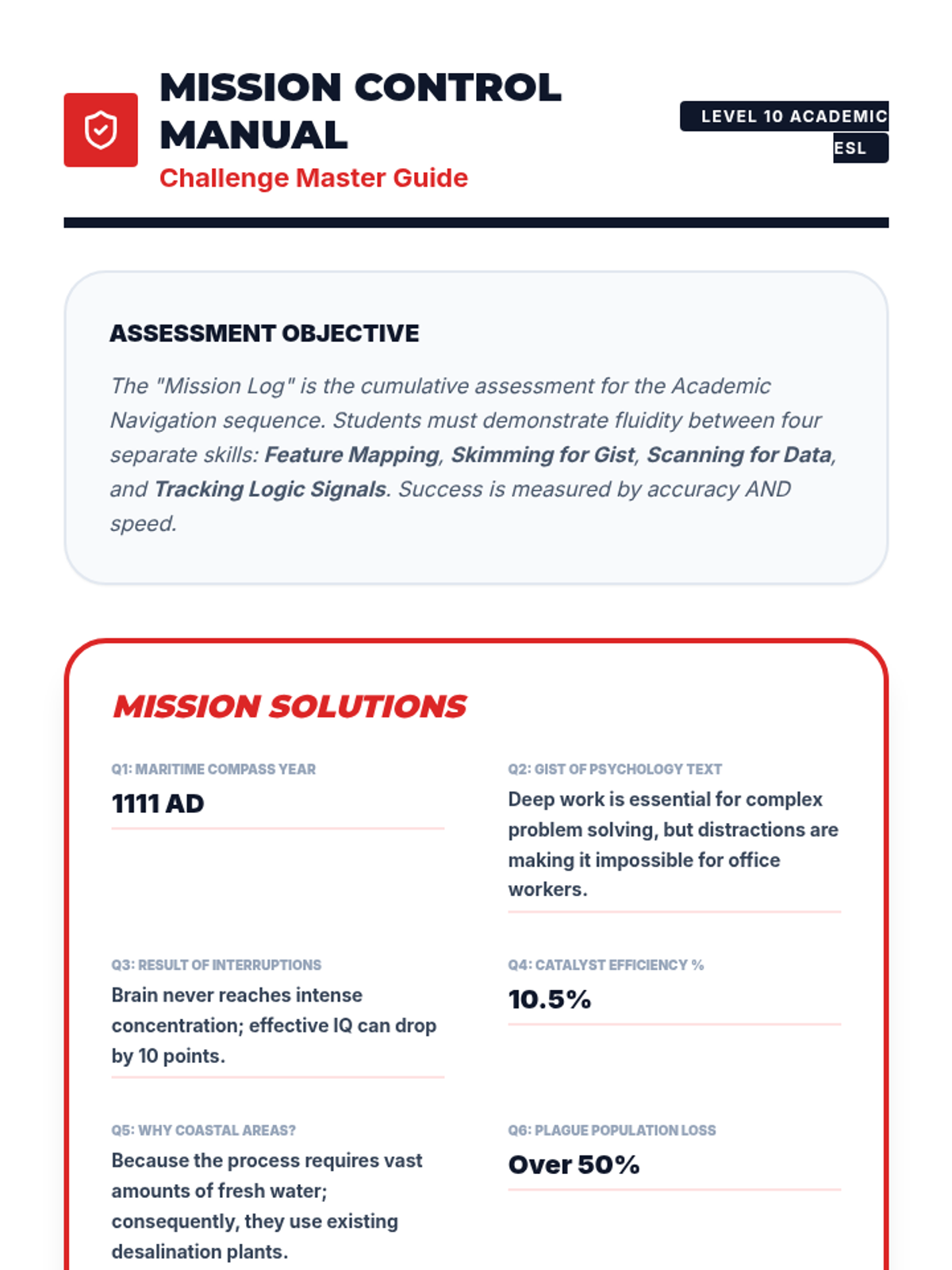
Teacher guide for Lesson 5, including an answer key for the Mission Log scavenger hunt and scoring/differentiation tips for the final retrieval challenge.
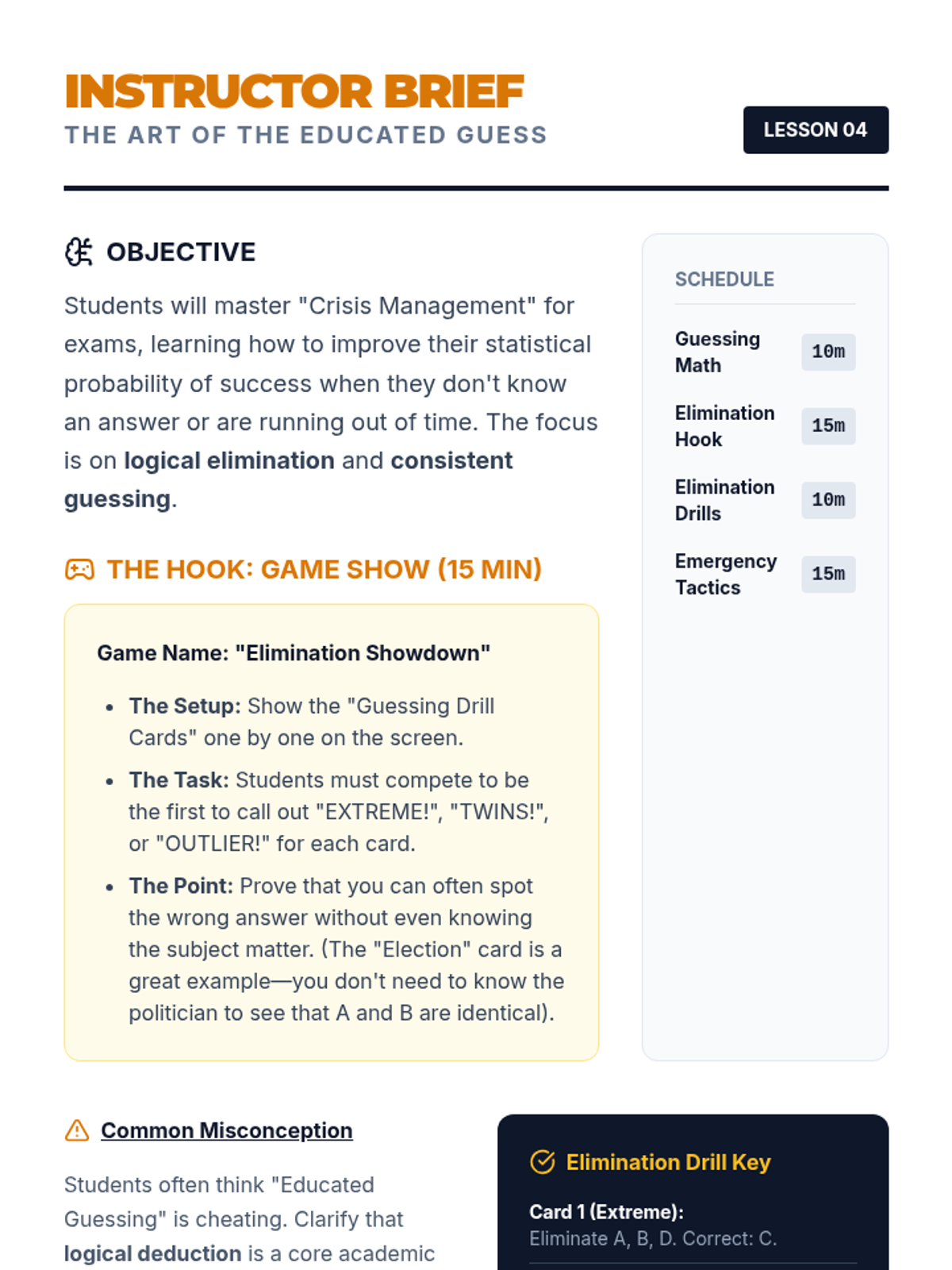
Teacher facilitation guide for Lesson 4, explaining the game show hook, addressing misconceptions about guessing, and providing linguistic support for ESL learners.
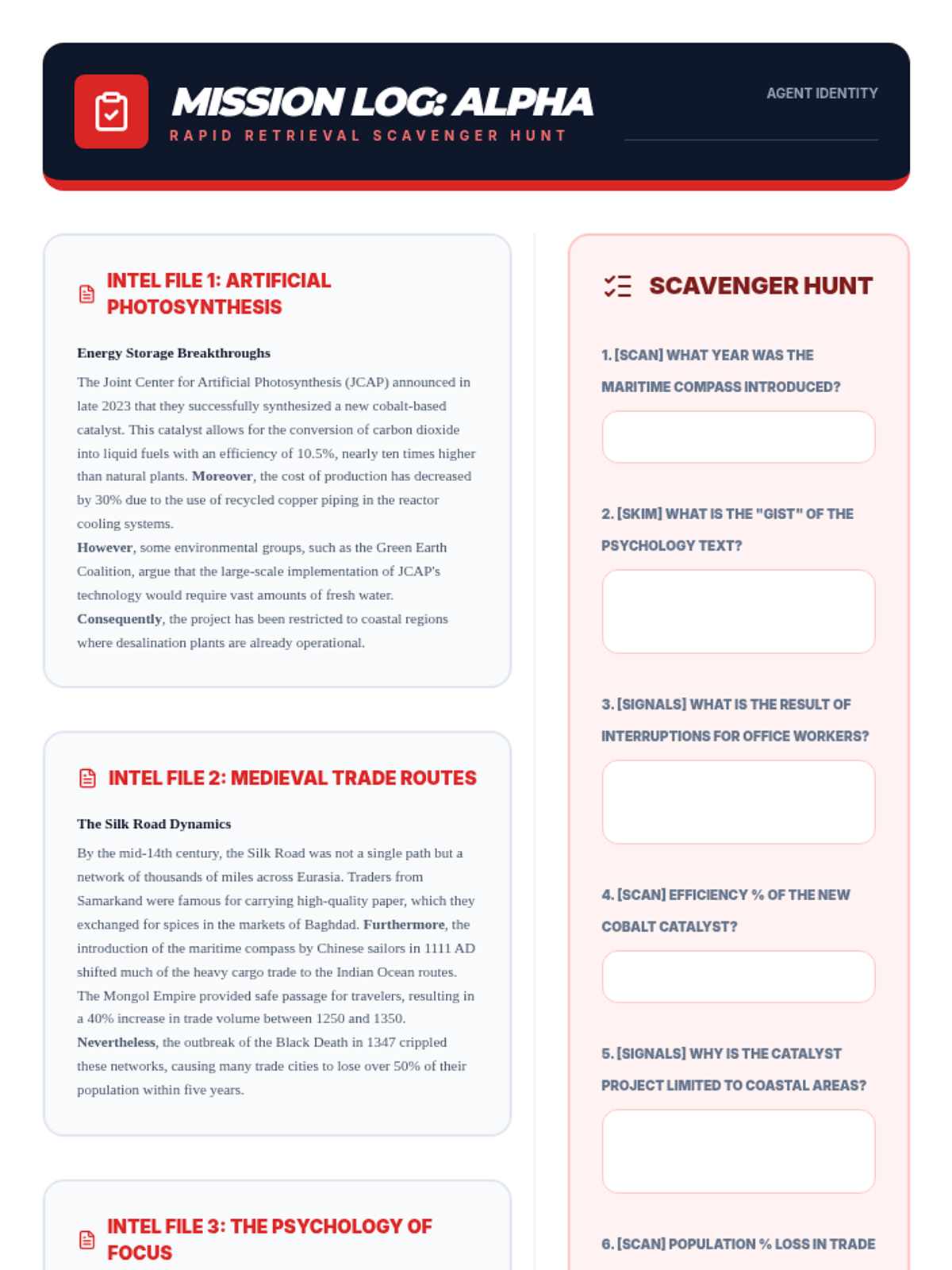
A comprehensive student scavenger hunt worksheet for Lesson 5. It contains three short academic texts and a list of retrieval tasks requiring skimming, scanning, and signal-tracking skills.
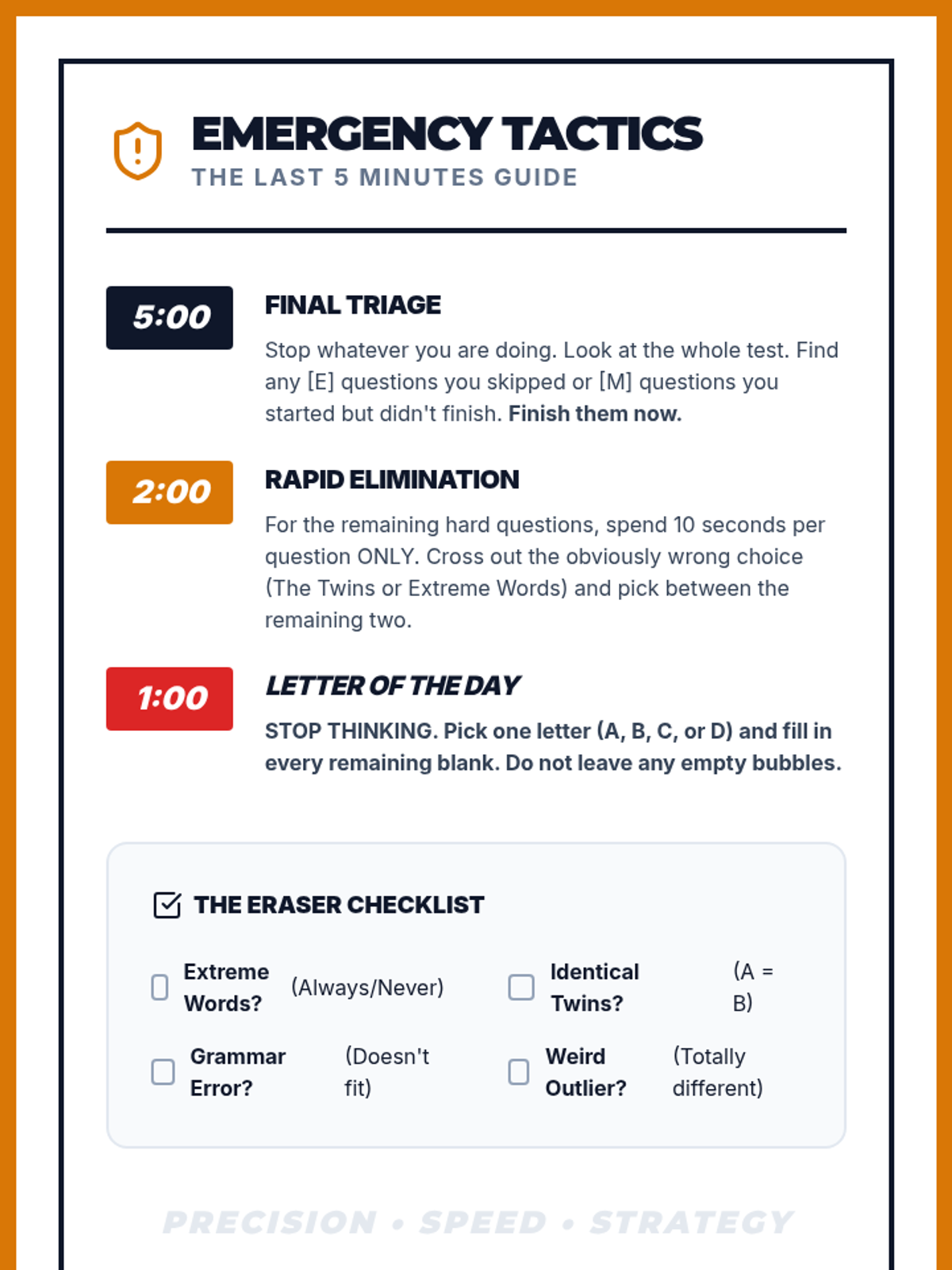
A survival strategy guide for students, outlining a step-by-step 'Emergency Protocol' for the final five minutes of an exam to ensure no points are left on the table.
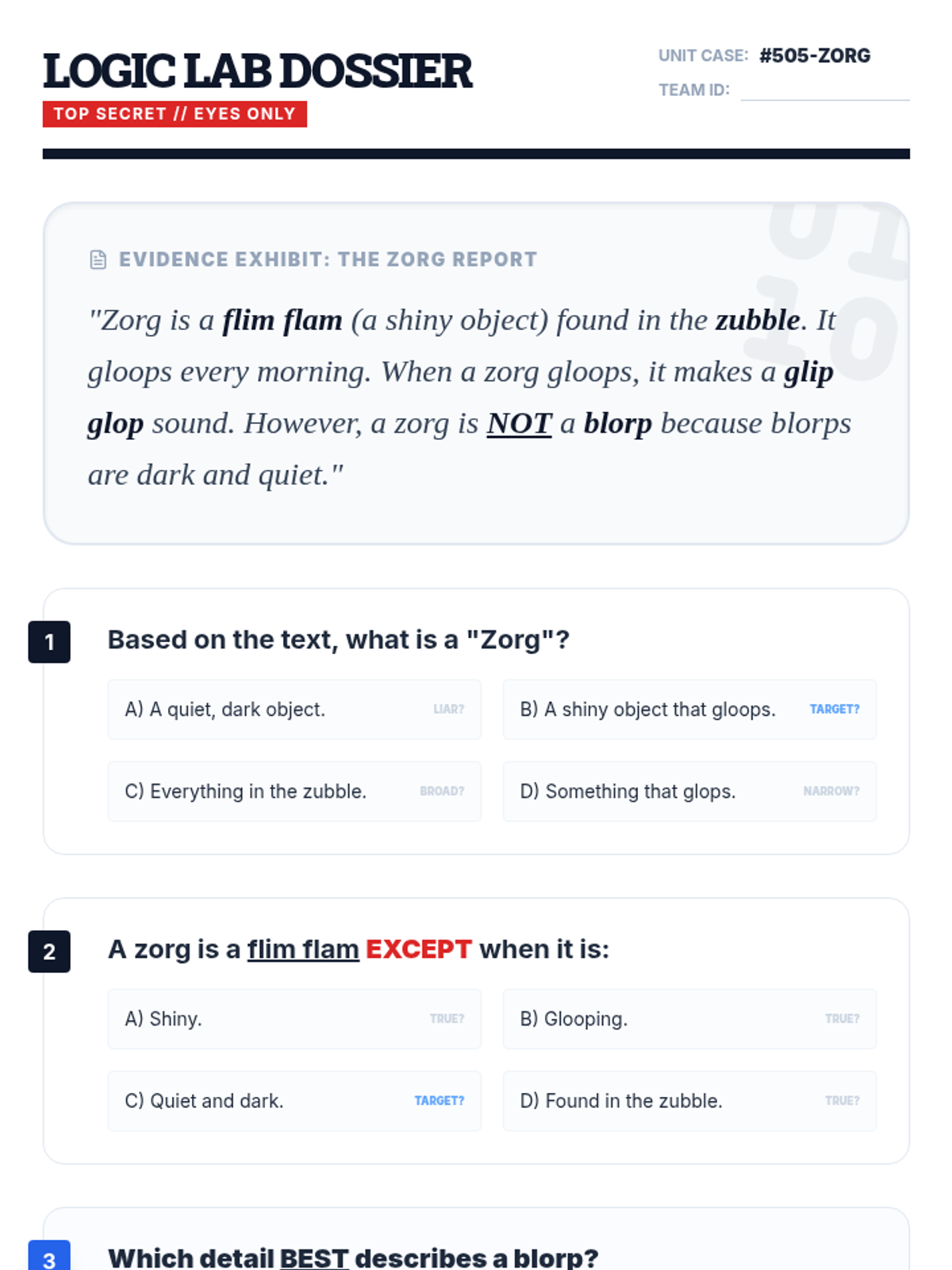
Student "Zorg Language" dossier for Lesson 5, featuring a nonsense language test that requires students to apply all deconstruction and elimination strategies to solve.
Worksheet for Lesson 4 where students specifically target questions using words like 'NOT,' 'EXCEPT,' 'ALWAYS,' or 'NEVER.' They rewrite these questions in positive terms to clarify meaning. Revised with a light theme for better printability.
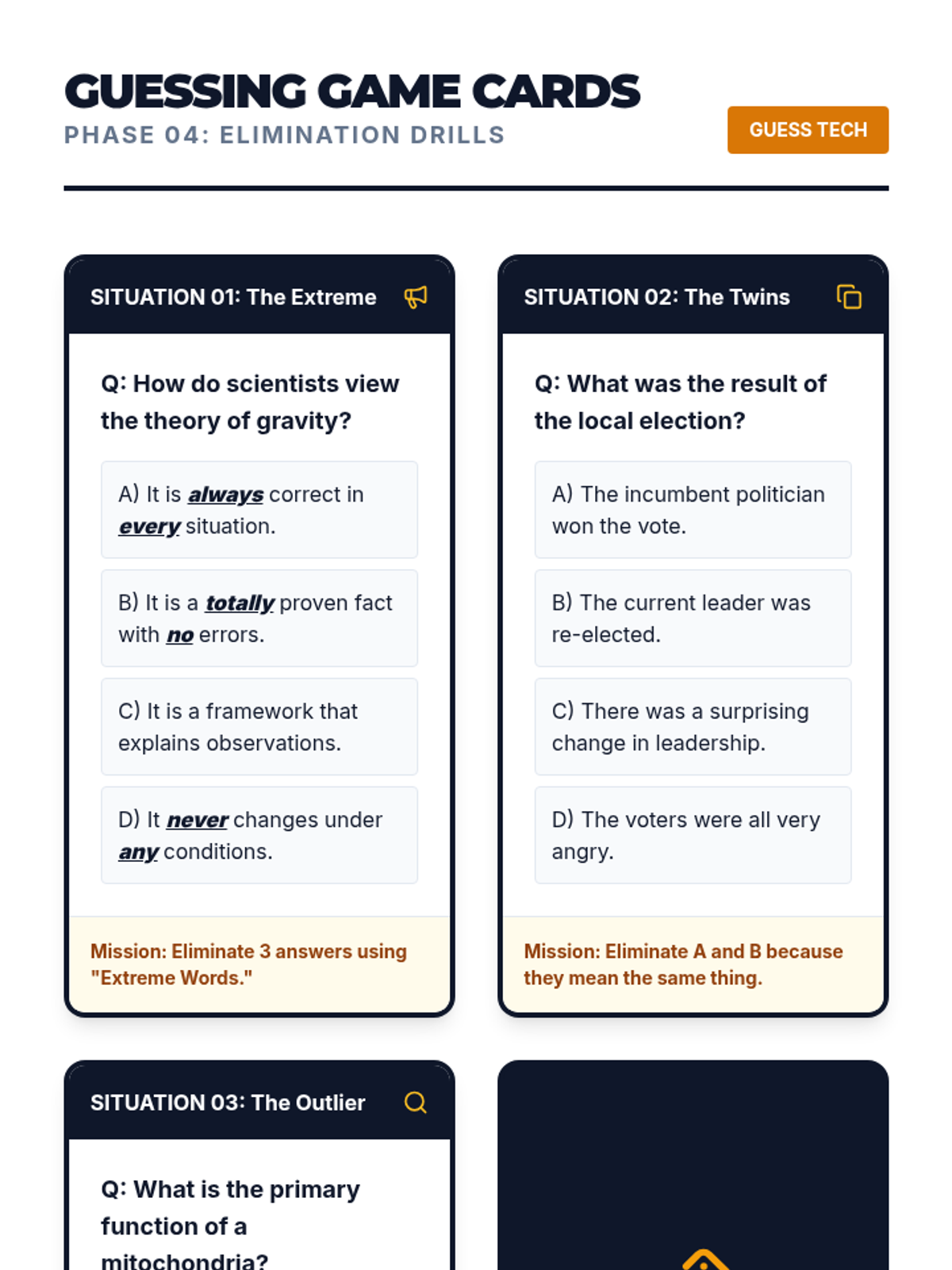
A set of interactive drill cards designed for students to practice identifying and eliminating incorrect answer choices using the 'Extreme Words', 'Twins', and 'Outlier' strategies.
Final mission slides for Lesson 5, outlining the rules and time limit for the rapid retrieval challenge. Includes a review of scanning, skimming, and logic signal techniques.
Slide deck for Lesson 4, covering the mathematical odds of guessing, specific elimination strategies (extreme words, 'twins', outliers), and the 'Letter of the Day' emergency protocol.
Introductory slide deck for Lesson 4, using a code-breaking theme to teach students how to handle negative phrasing (NOT, EXCEPT) and absolute words (ALWAYS, NEVER) in test questions.
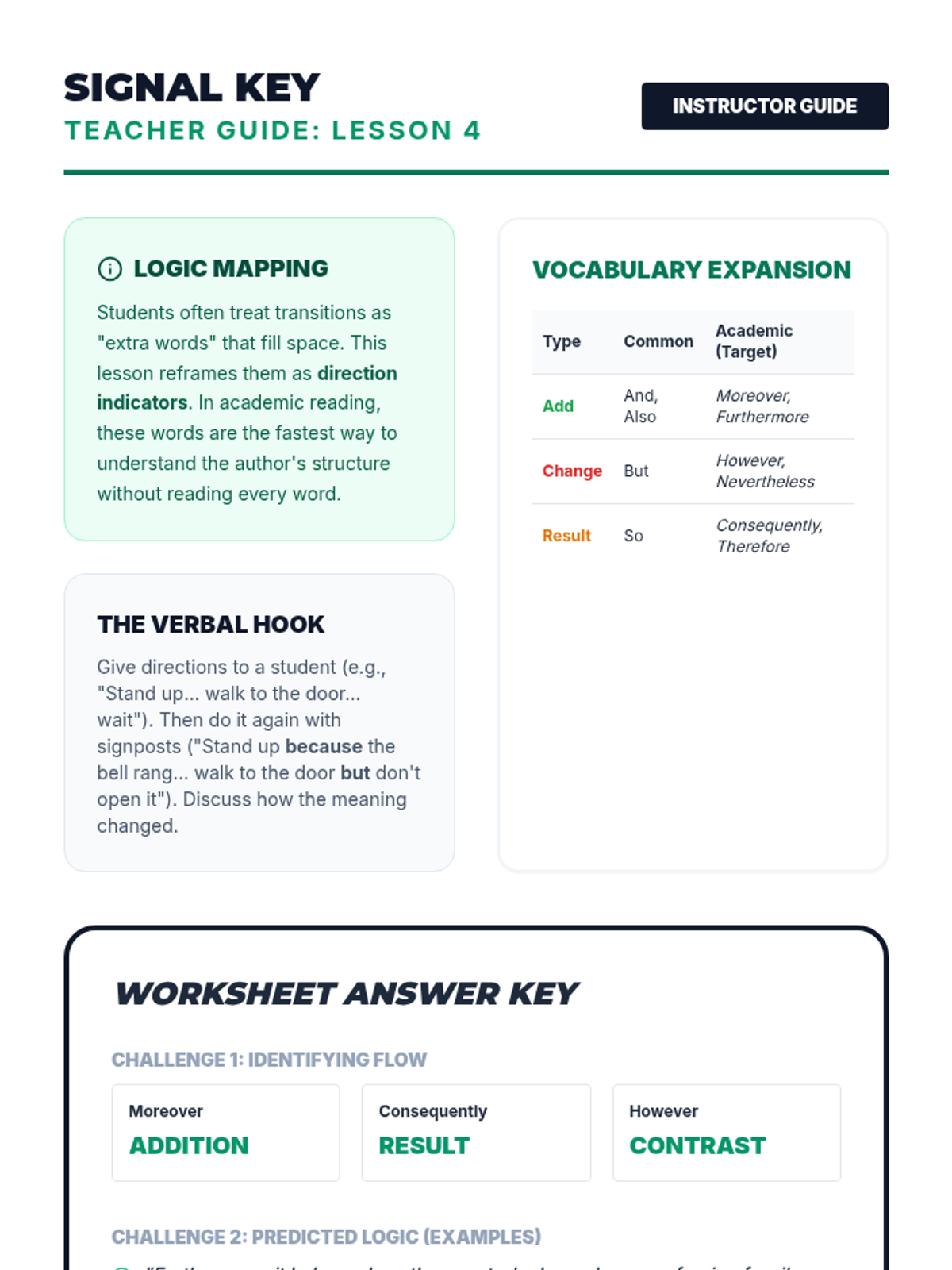
Teacher guide for Lesson 4, including logic mapping strategies, a signpost vocabulary expansion table, and an answer key for the Pathfinder worksheet.
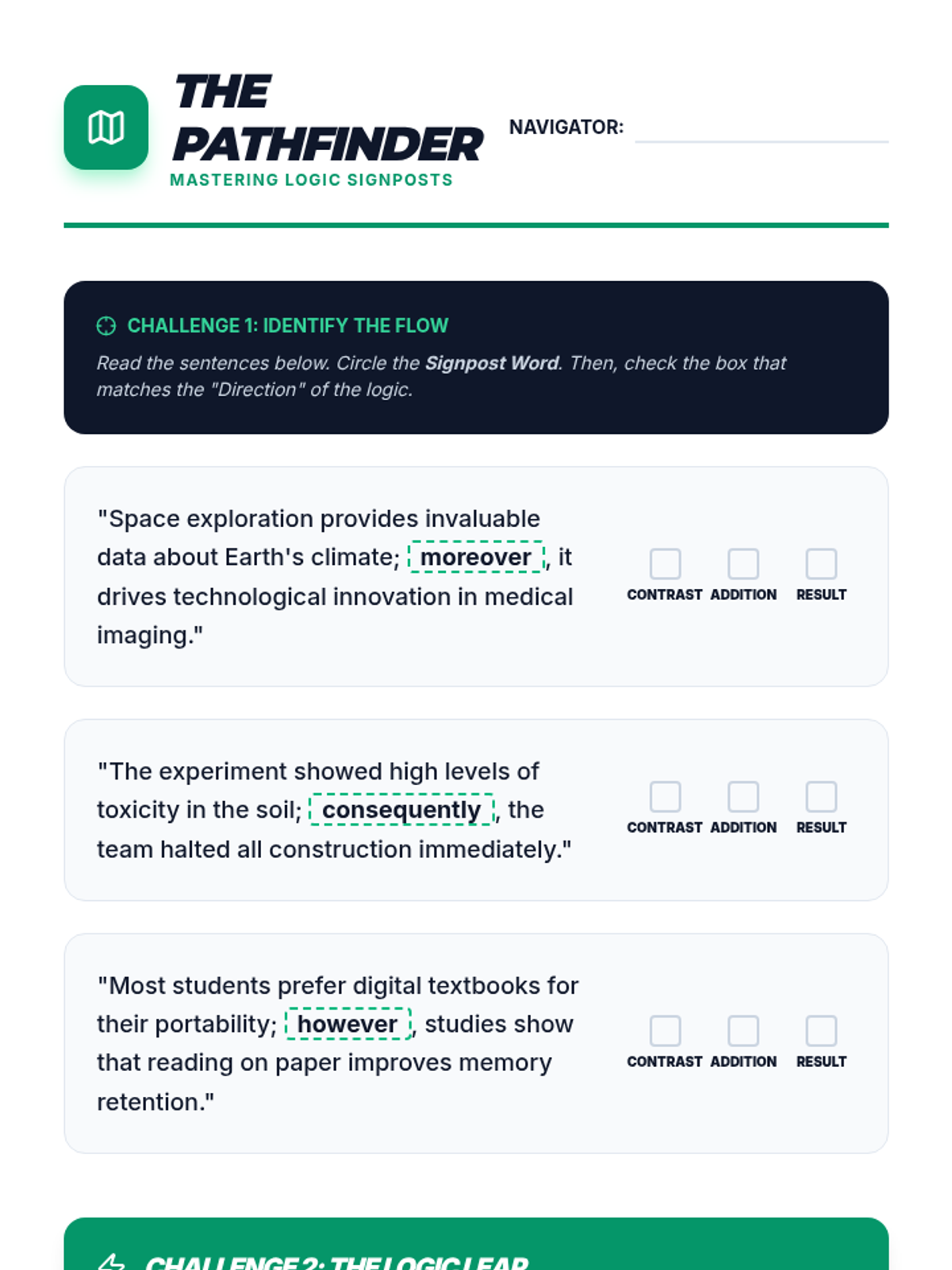
A student worksheet for Lesson 4 that asks learners to identify signpost words and their logical functions (Addition, Contrast, Result) and complete sentences logically based on those signals.
Slide deck for Lesson 4, introducing transition words as "Logic Signals" (Addition, Contrast, Result) and teaching how to use them as mental search filters.
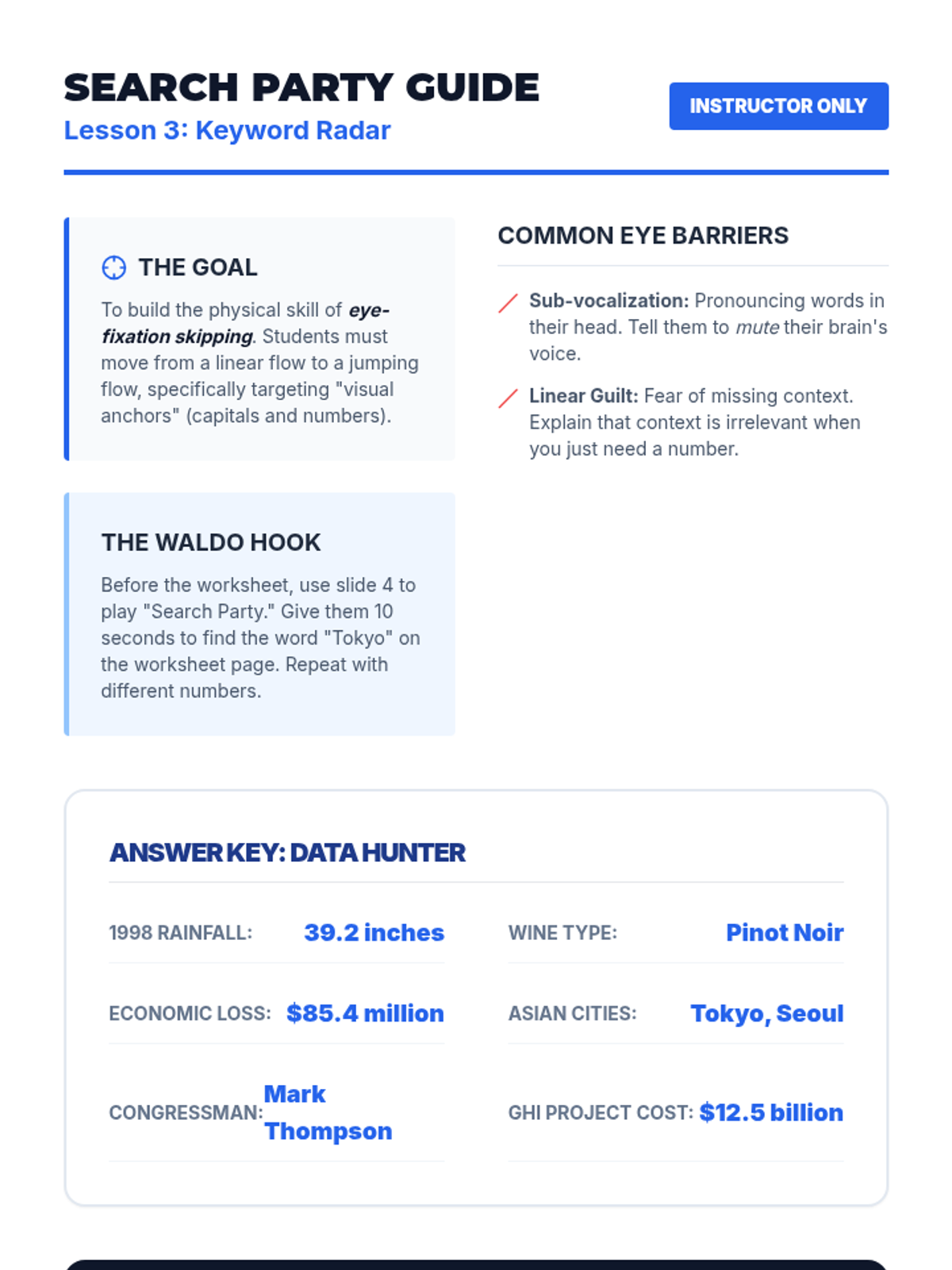
Teacher guide for Lesson 3, including eye-fixation skip drills, the "Waldo Hook" instructions, and an answer key for the Data Hunter worksheet.
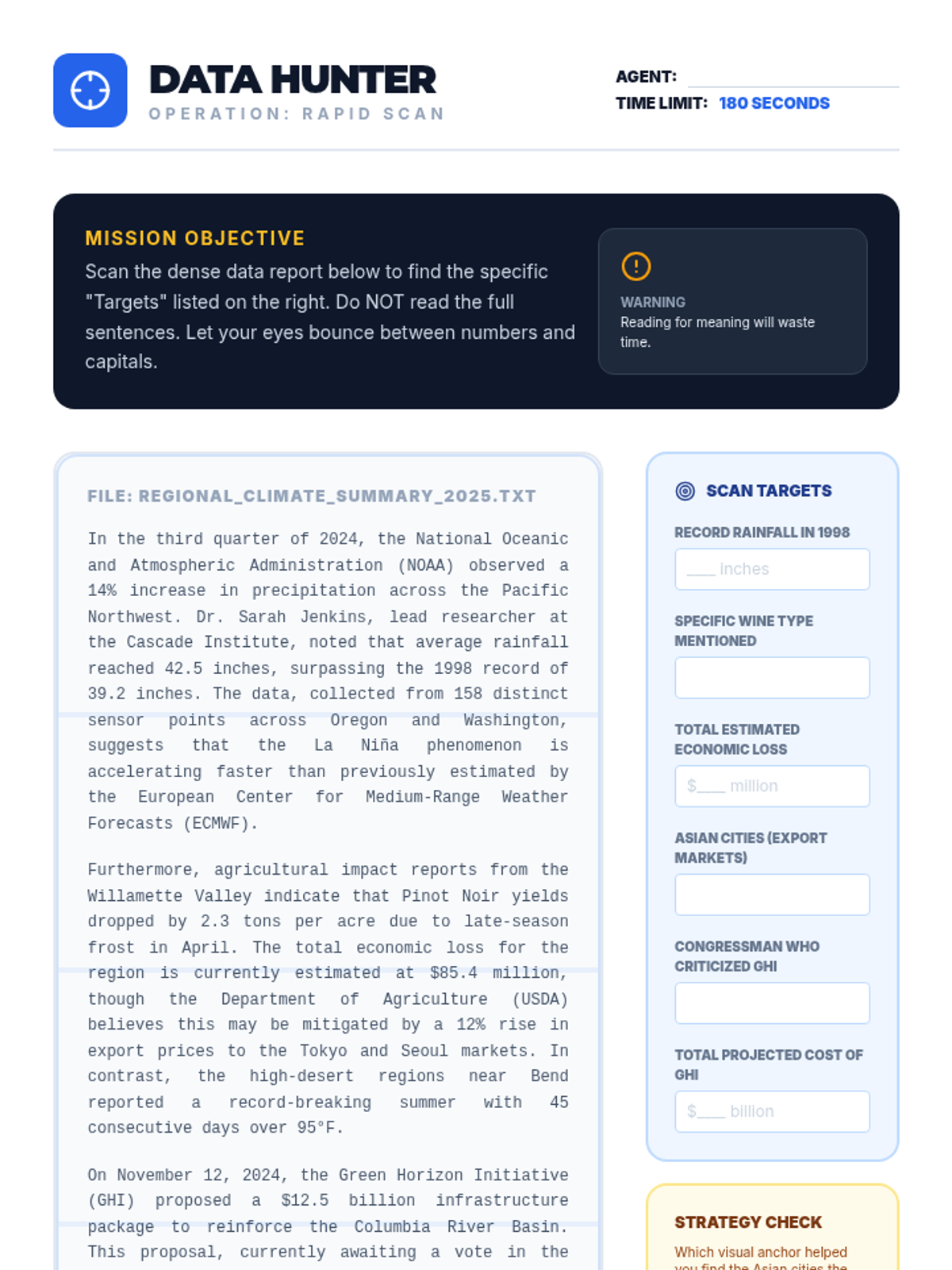
A student worksheet for Lesson 3 where learners scan a dense climate report for specific names, numbers, and dates under a time limit.
Slide deck for Lesson 3, teaching scanning techniques such as Z-pattern and F-pattern, and identifying "visual anchors" like dates and proper nouns.
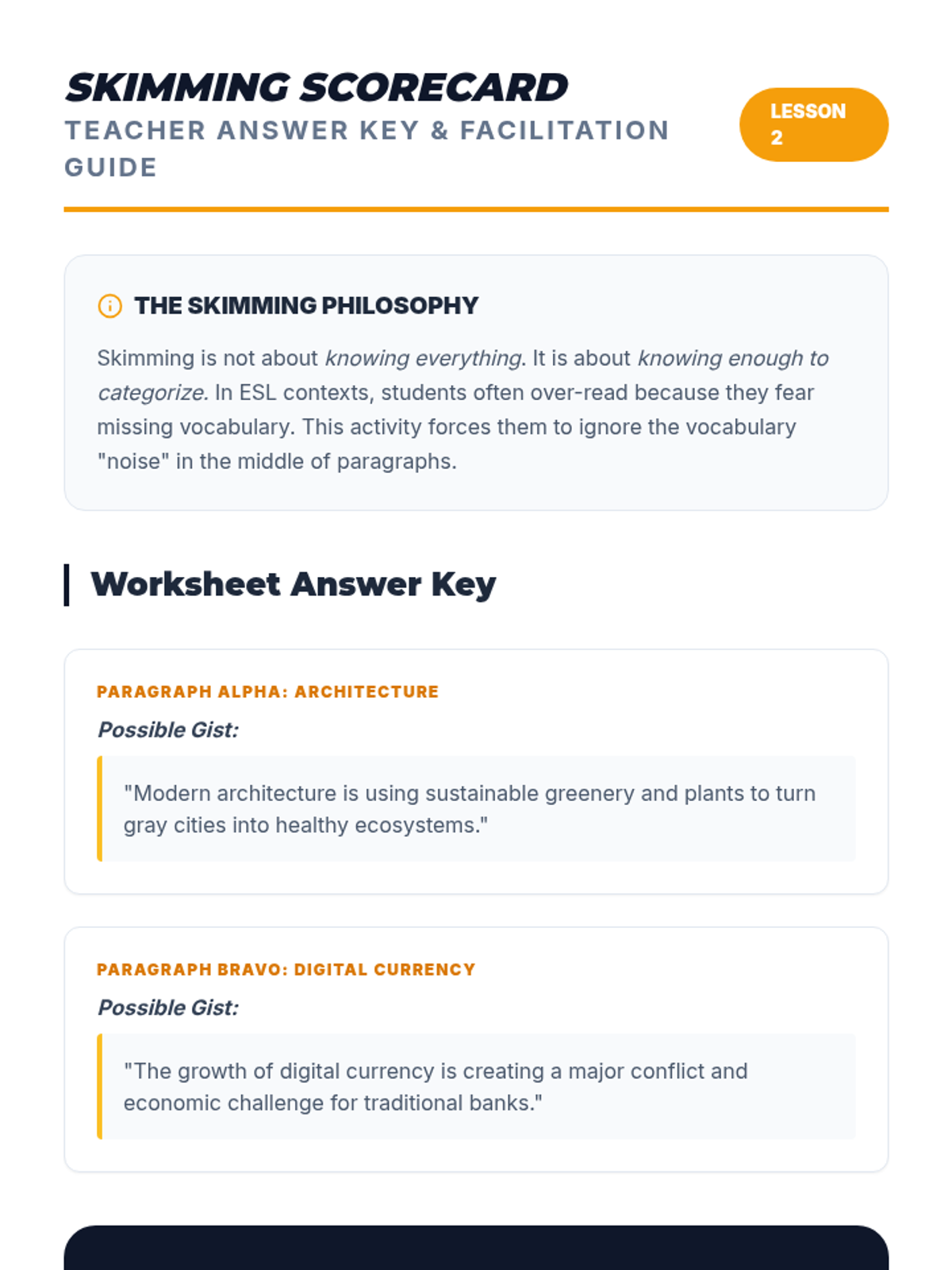
Teacher guide for Lesson 2, providing an answer key for the skimming worksheet, instructions for the "Speed Dating" activity, and a scoring rubric.
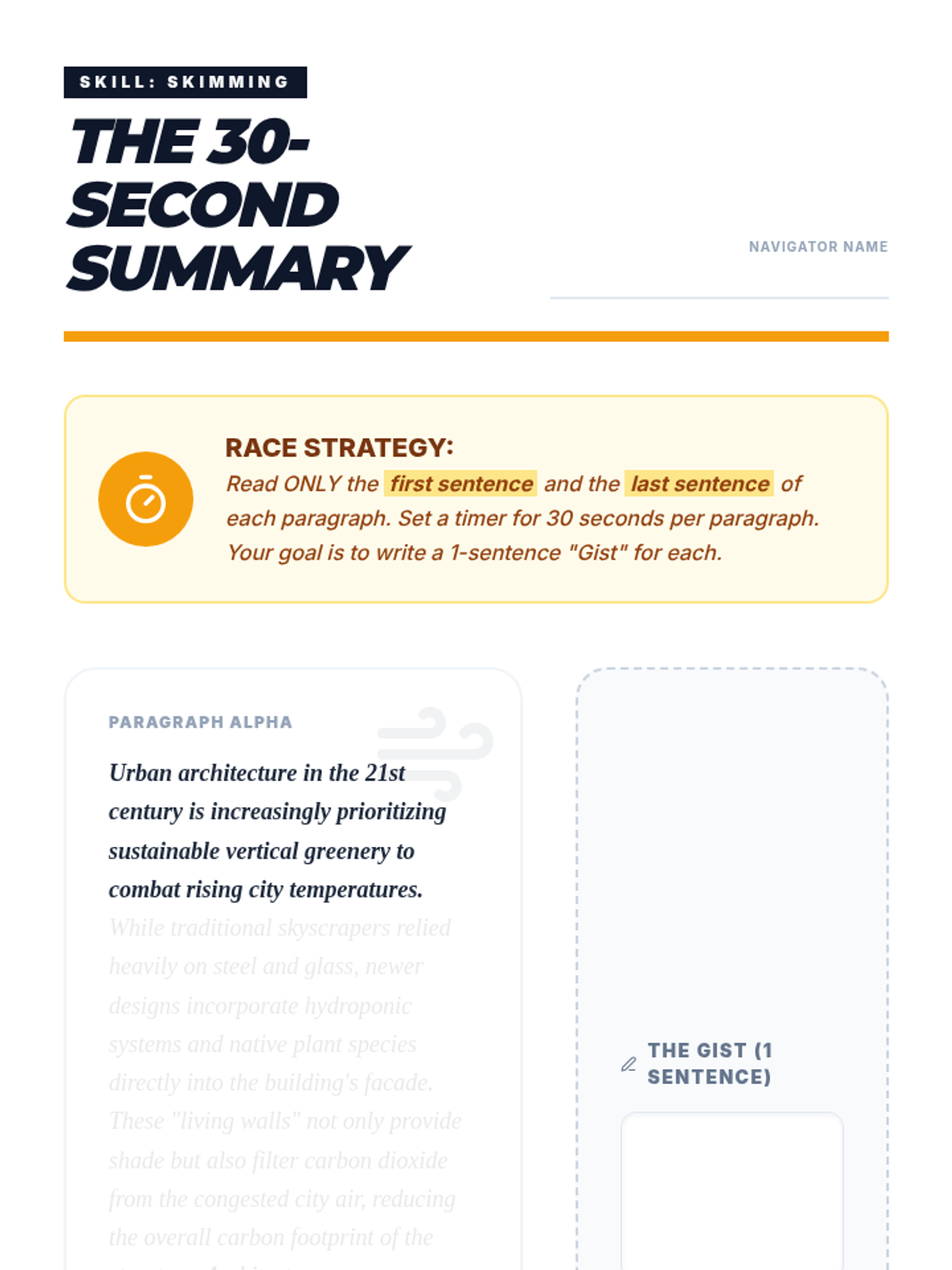
A document for Lesson 2 featuring two paragraphs with blurred middle sections to force students to use the first and last sentence skimming strategy.
Slide deck for Lesson 2 focusing on skimming techniques, specifically the "First and Last Sentence" rule to identify the gist of paragraphs.
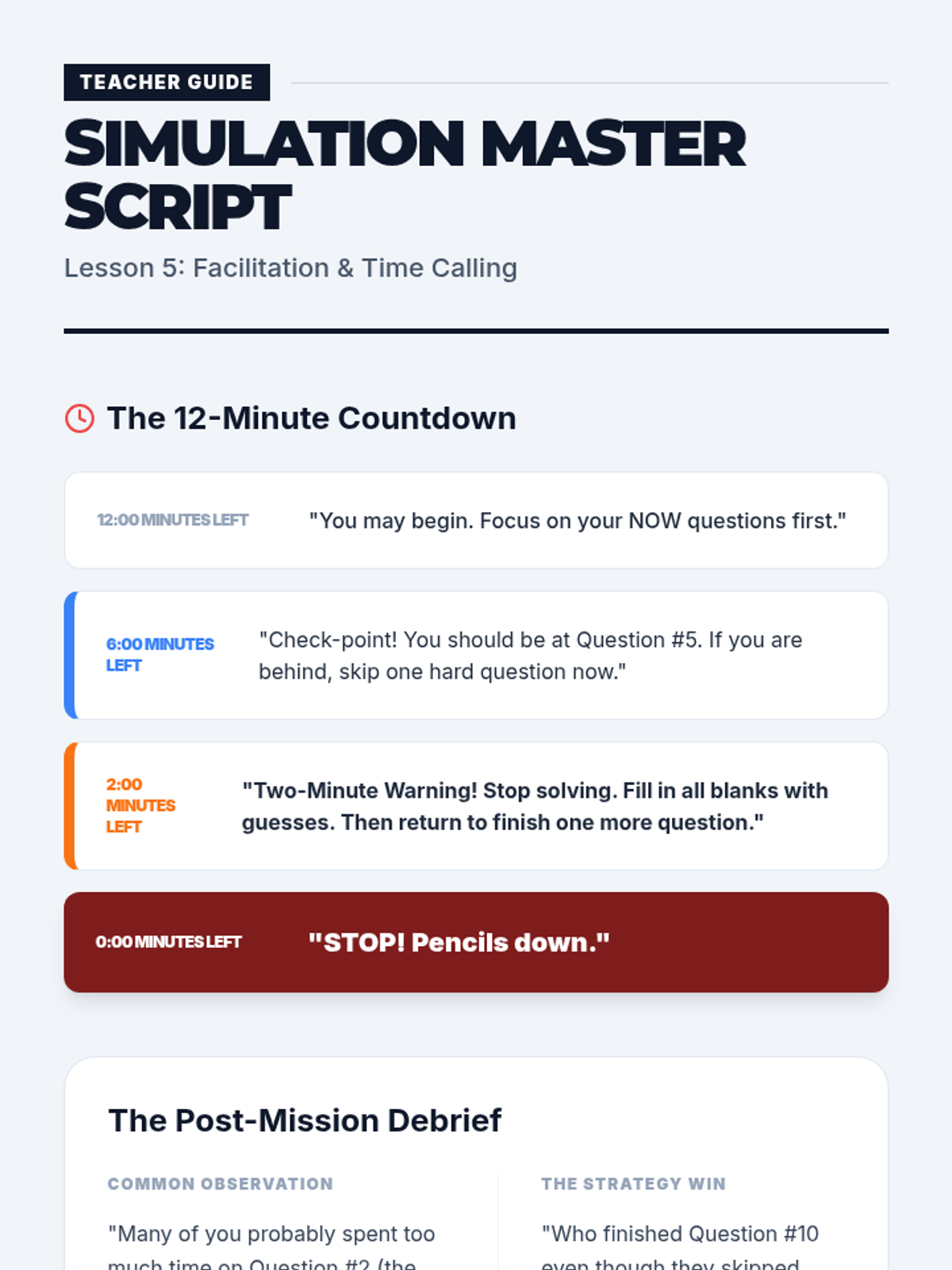
Teacher guide for Lesson 5, including the time-calling script, specific observations for the mock test questions, and debriefing questions.
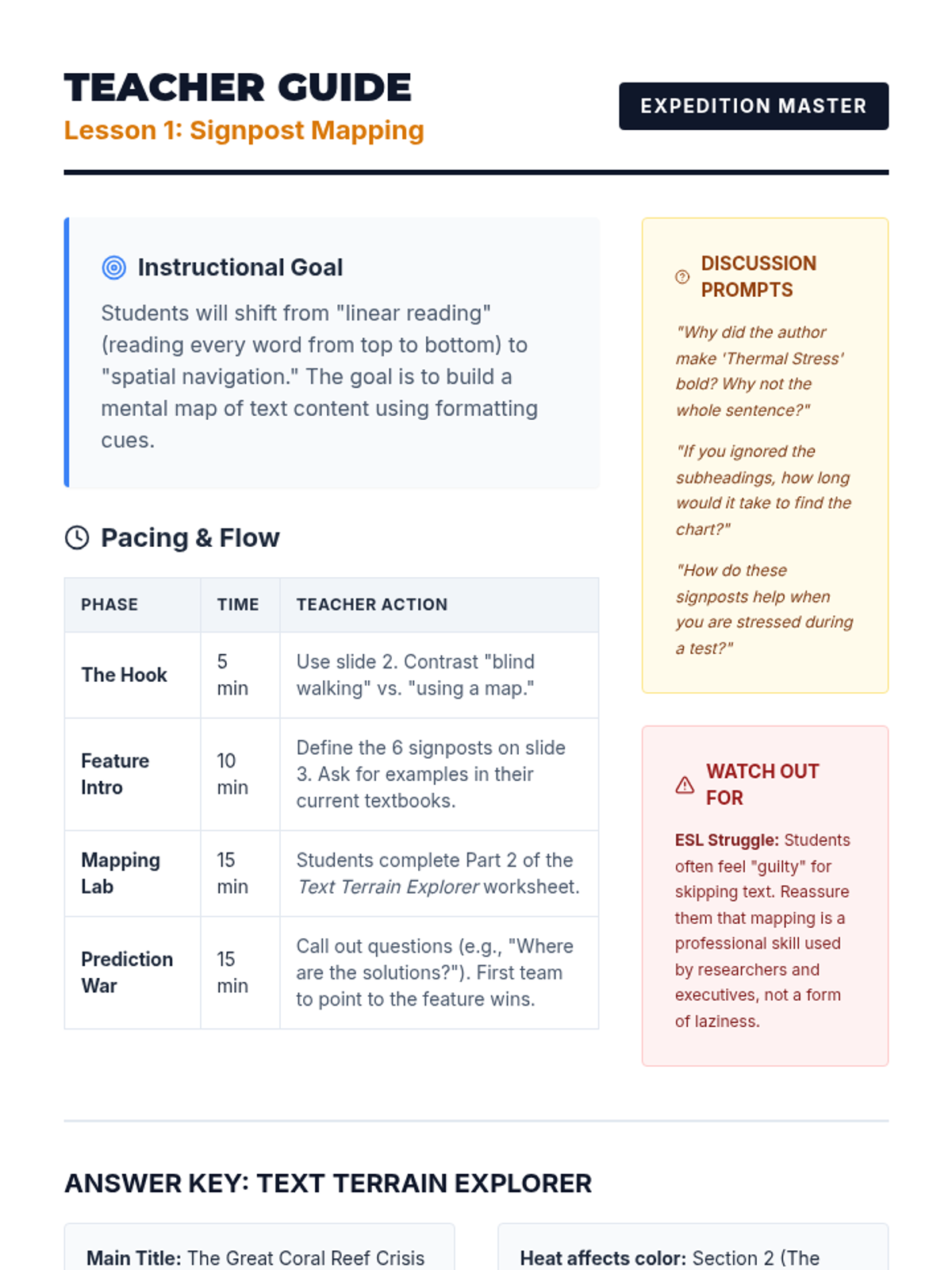
A comprehensive teacher guide for Lesson 1, including instructional goals, a pacing table, discussion prompts, and an answer key for the student worksheet.
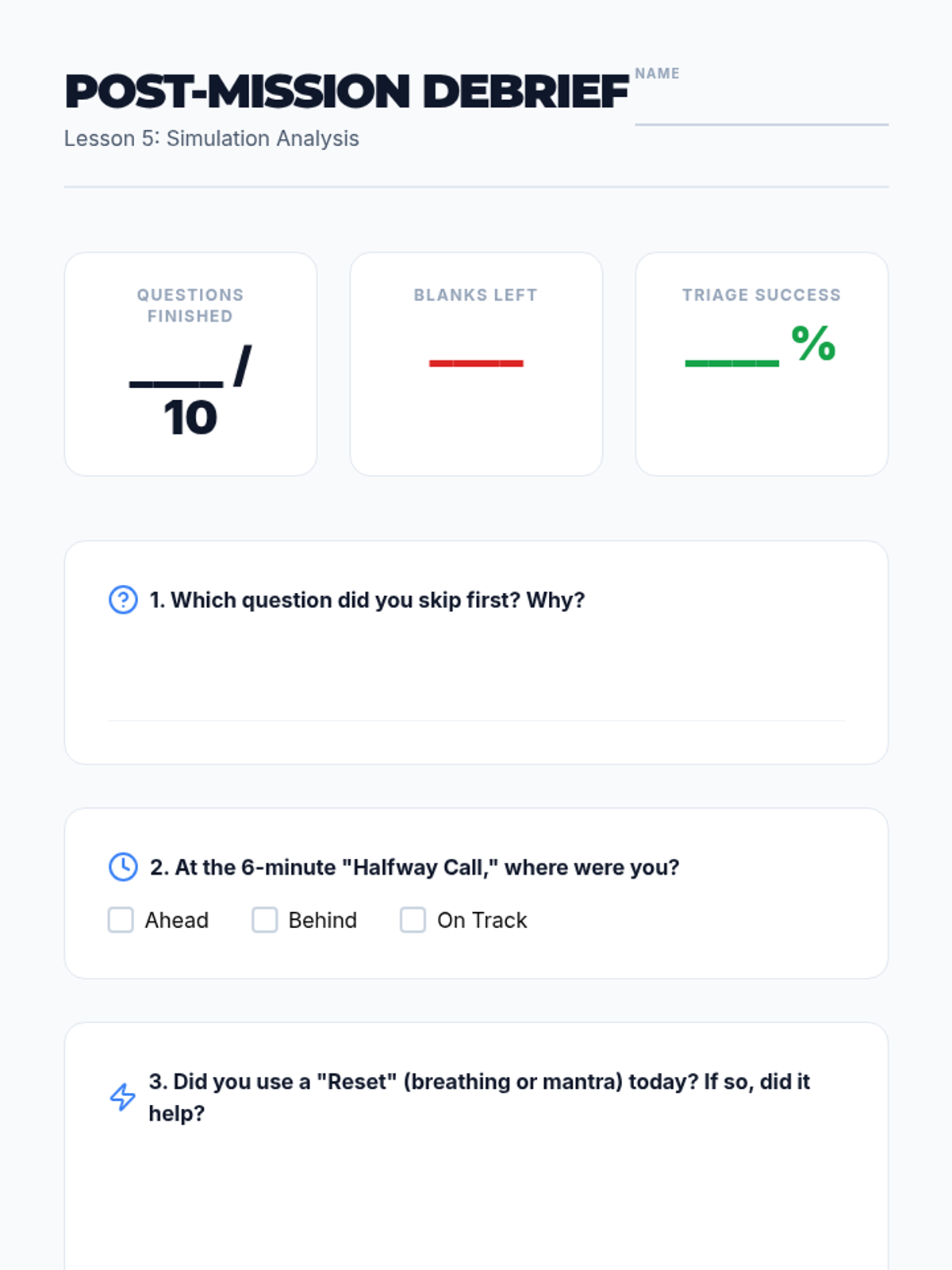
Student reflection tool for analyzing their performance during the timed simulation, focusing on Triage usage and anxiety management.
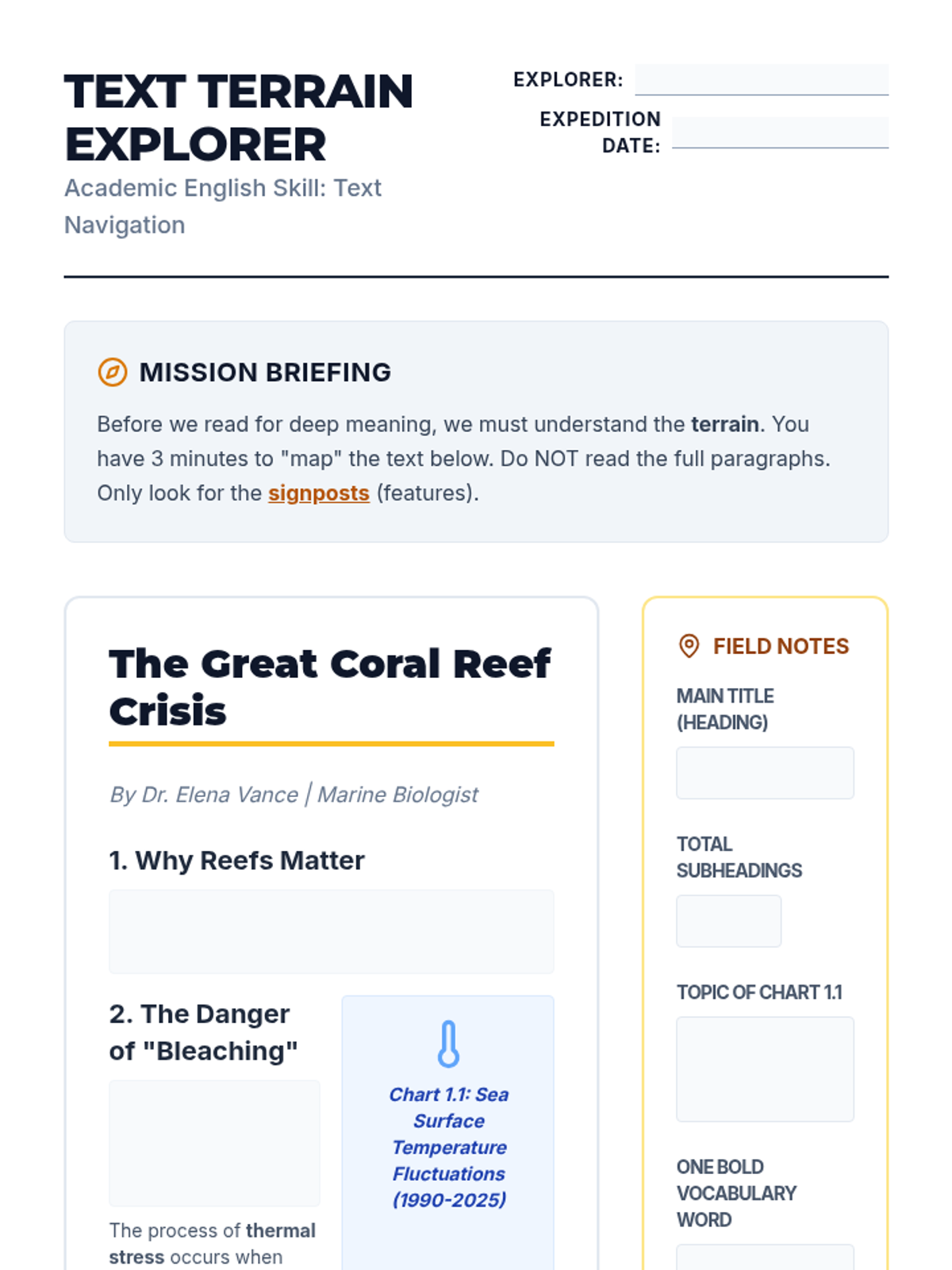
A student worksheet for Lesson 1 where learners map out the features of a sample article on coral reefs and use those features to predict where specific information is located.
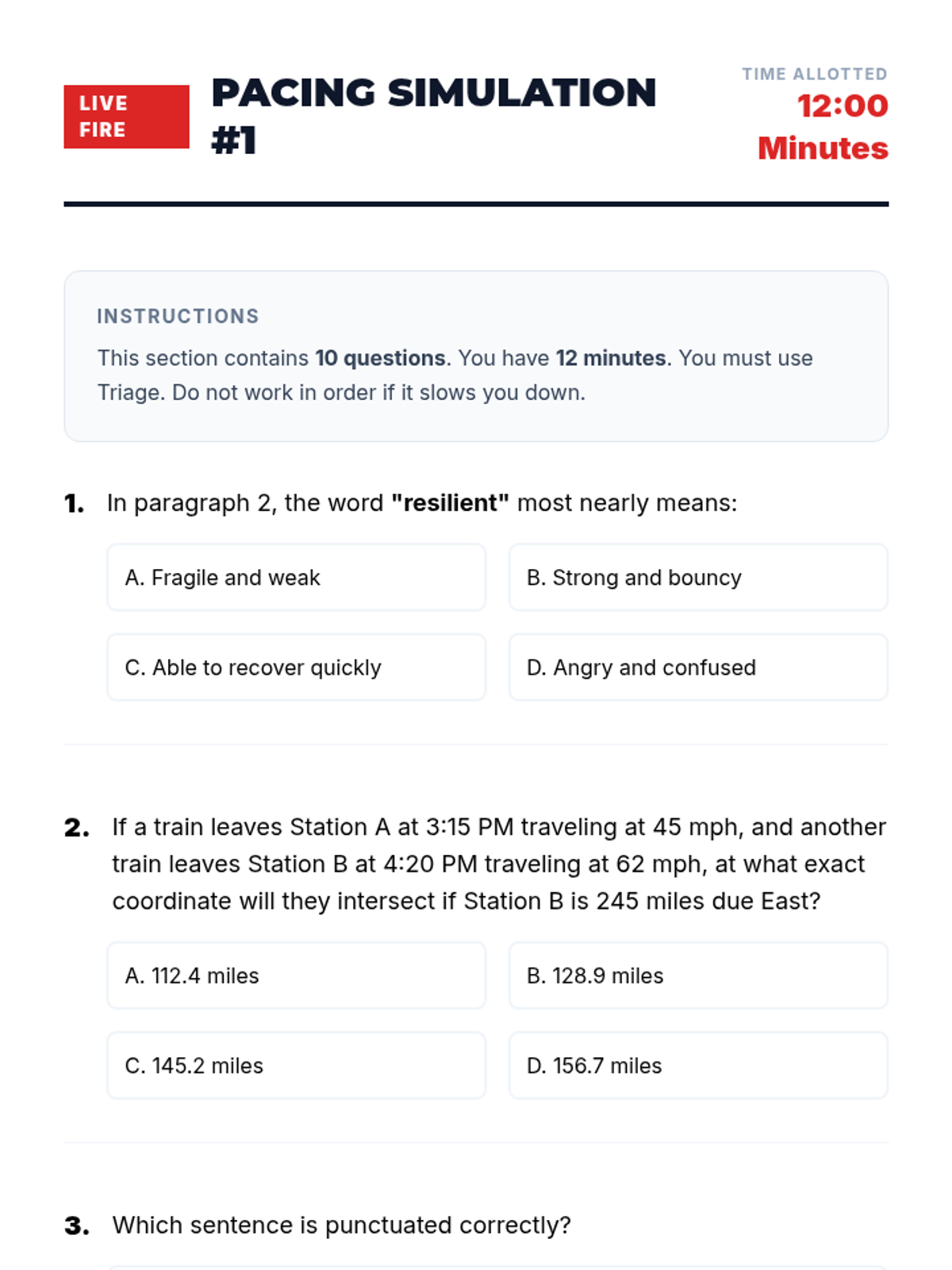
Shortened practice test section designed to force students to use the Triage Method and strategic guessing within a 12-minute window.
Final slide deck for the pacing simulation, introducing the 'Two-Minute Warning' drill and success criteria for the mock test.
Introductory slide deck for Lesson 1, using a navigational metaphor to explain text features like headings, subheadings, and formatting.
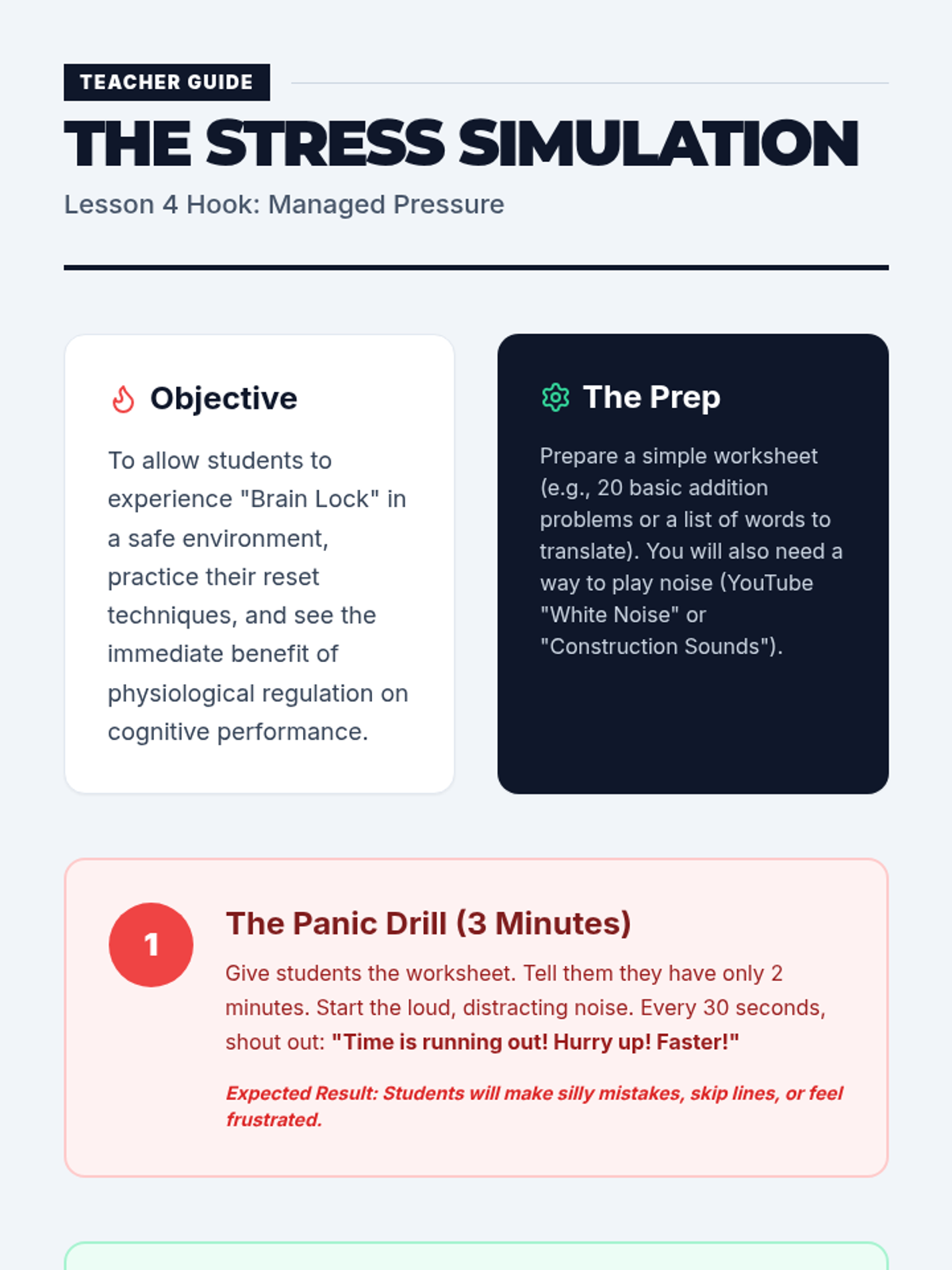
Teacher guide for Lesson 4, detailing a three-phase stress simulation activity to help students practice and observe the effects of anxiety management techniques.
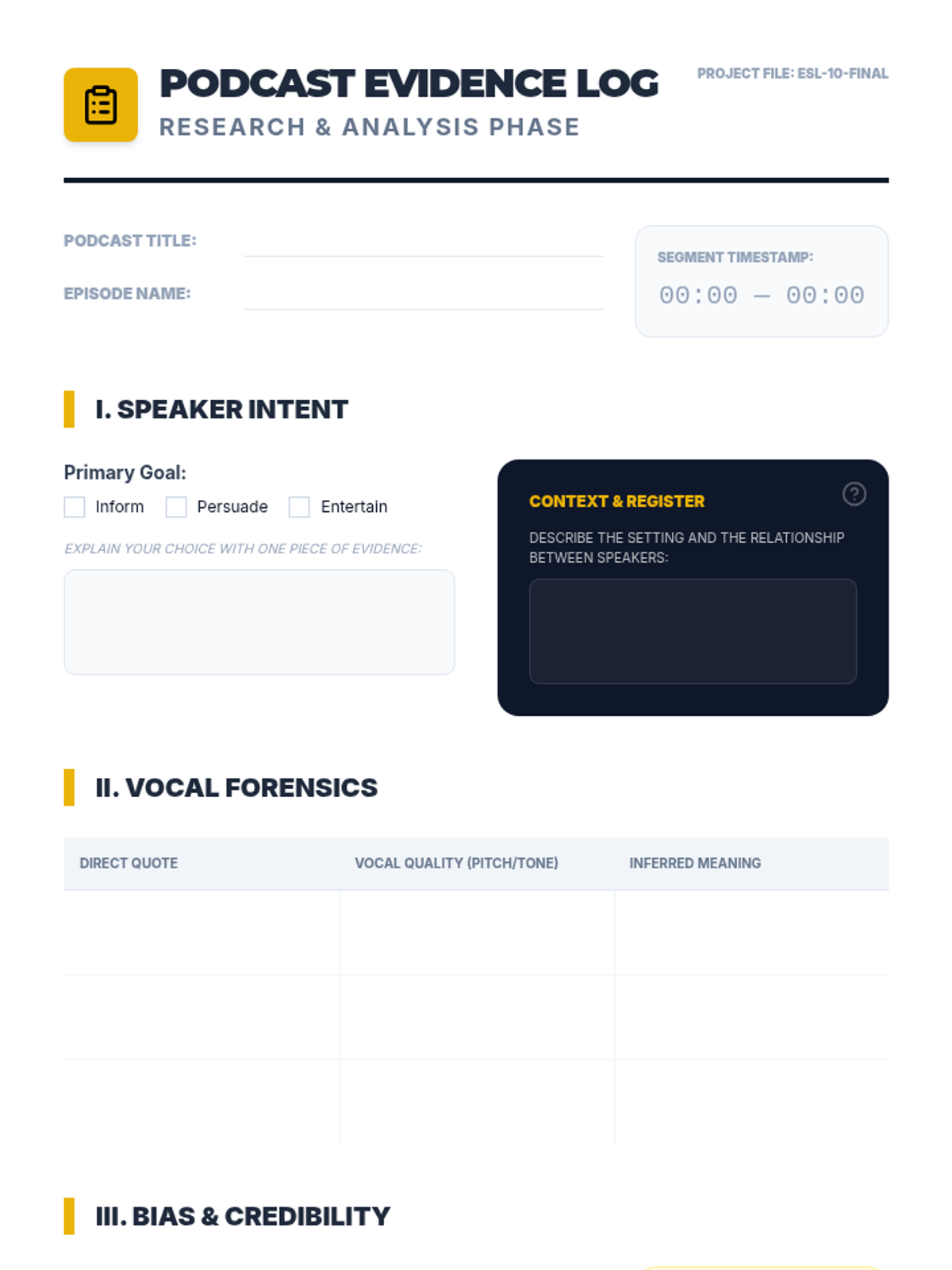
A detailed student evidence log for the final podcast project, providing sections for analyzing intent, vocal forensics, and bias check.
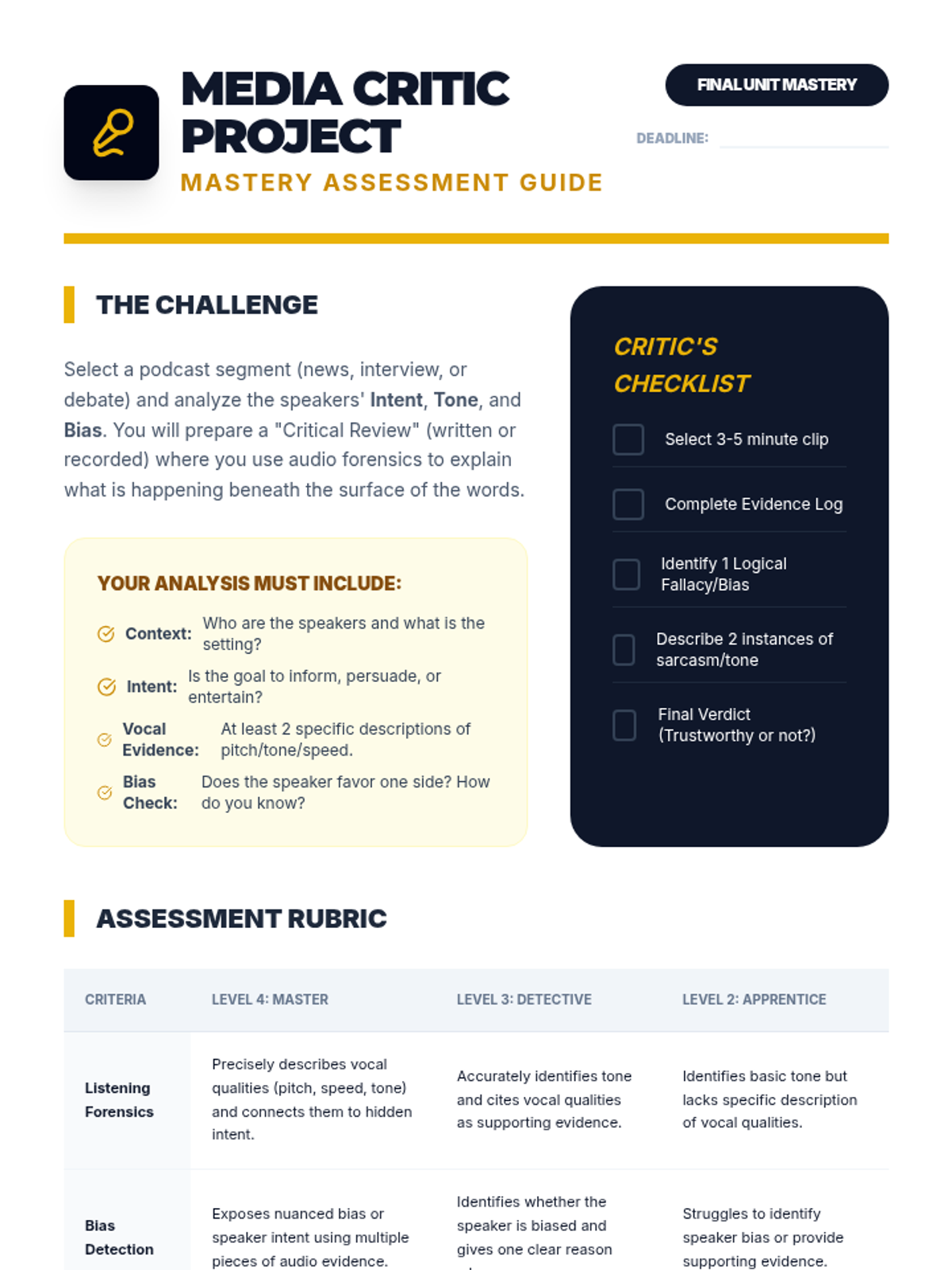
A guide for the final project where students select a podcast episode, analyze its intent and bias, and present their findings, including a checklist and a performance rubric.
Slides for the final project launch, introducing the media critic mission, criteria for analyzing podcasts, and methods for citing audio evidence.
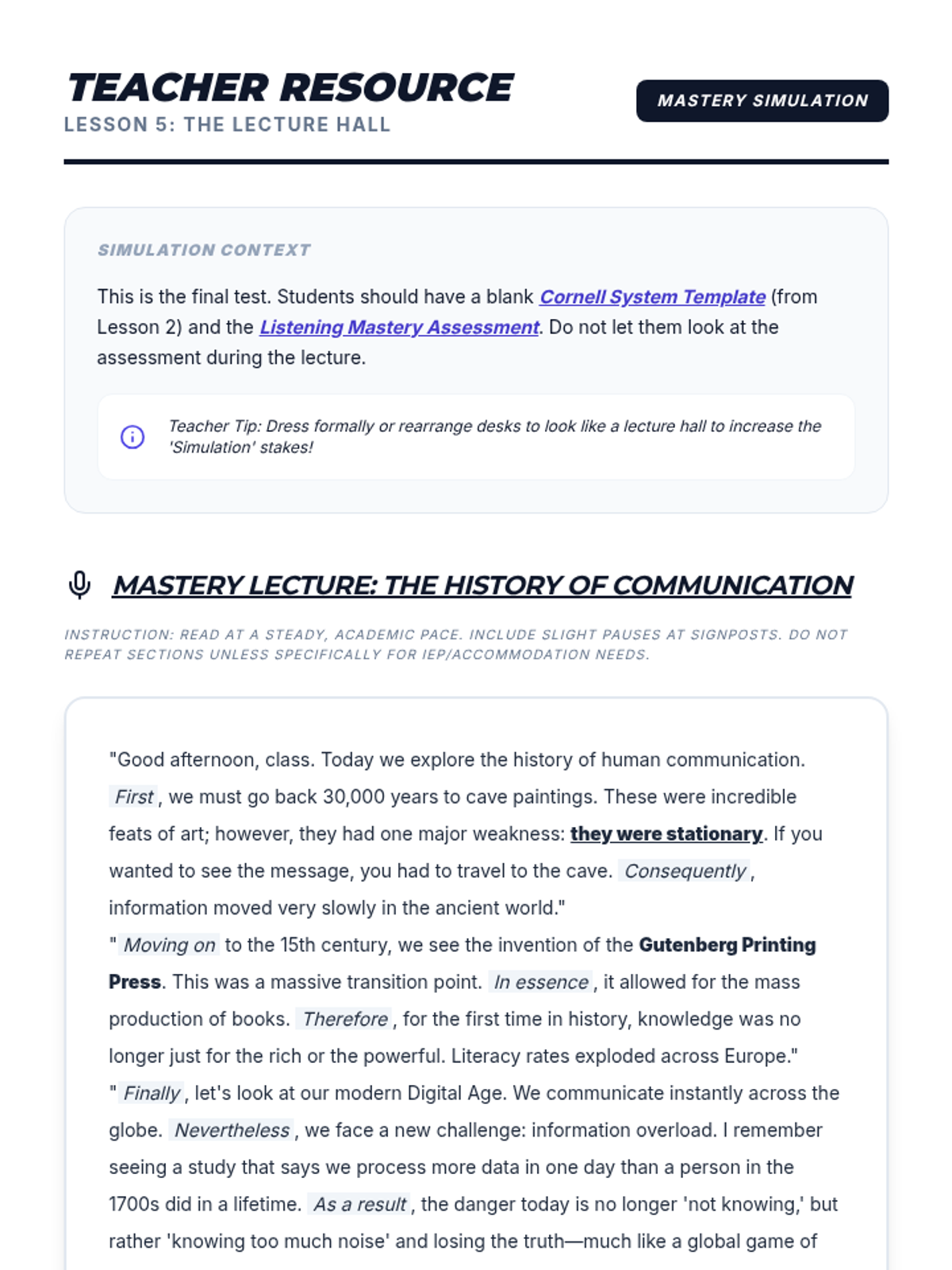
A comprehensive teacher resource for the final lesson, including the full script for "The History of Communication" and a detailed answer key for the mastery assessment, alongside sample Cornell note-taking cues for comparison.
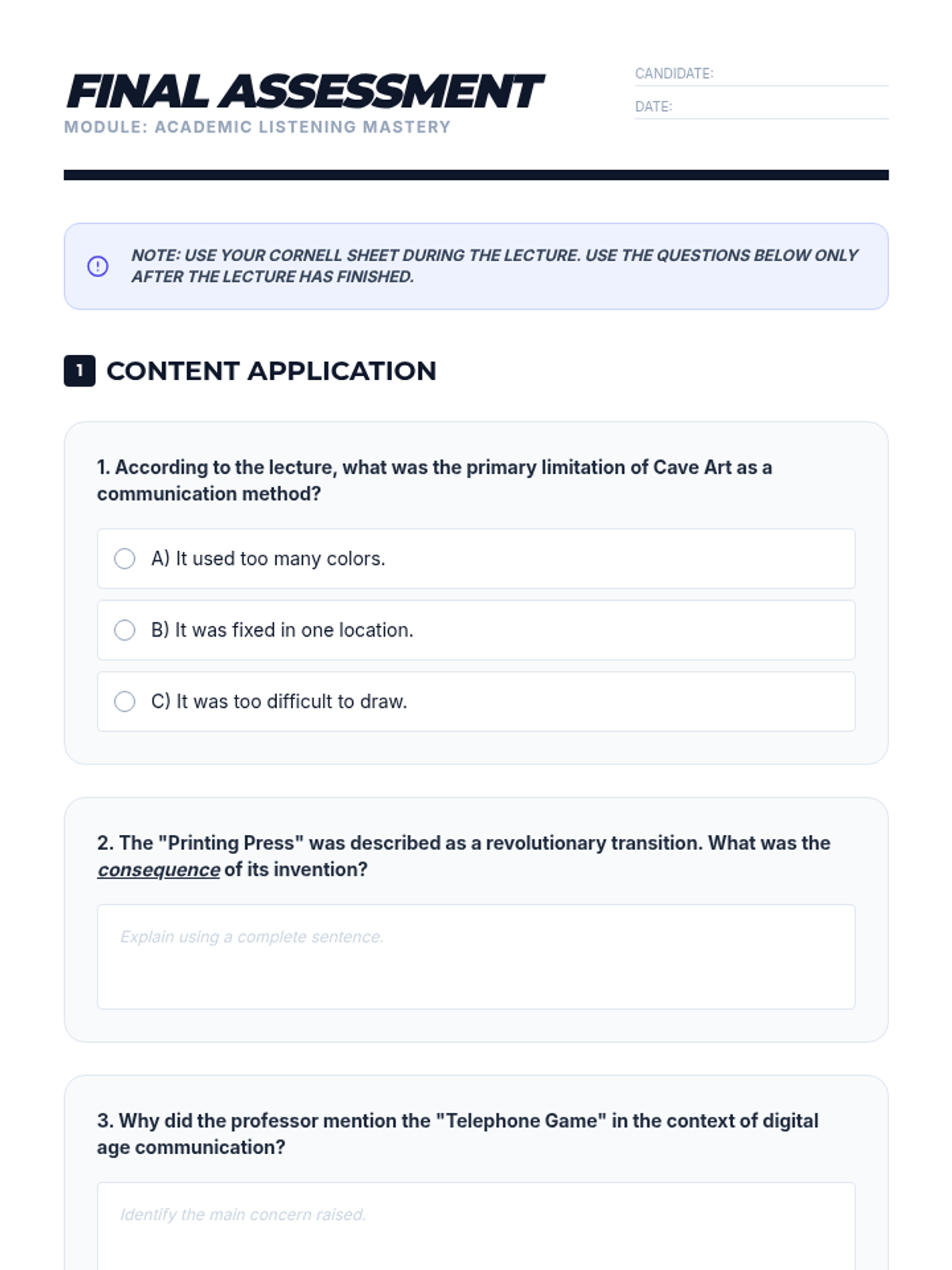
The final assessment for the unit, containing comprehension questions based on the mock lecture "The History of Communication" and a strategy reflection section where students self-evaluate their note-taking and filtering skills.
A slide deck for the culminating mock lecture simulation. It sets the formal university-style tone, outlines operational protocols for the assessment, and introduces the lecture topic: "The History of Communication."
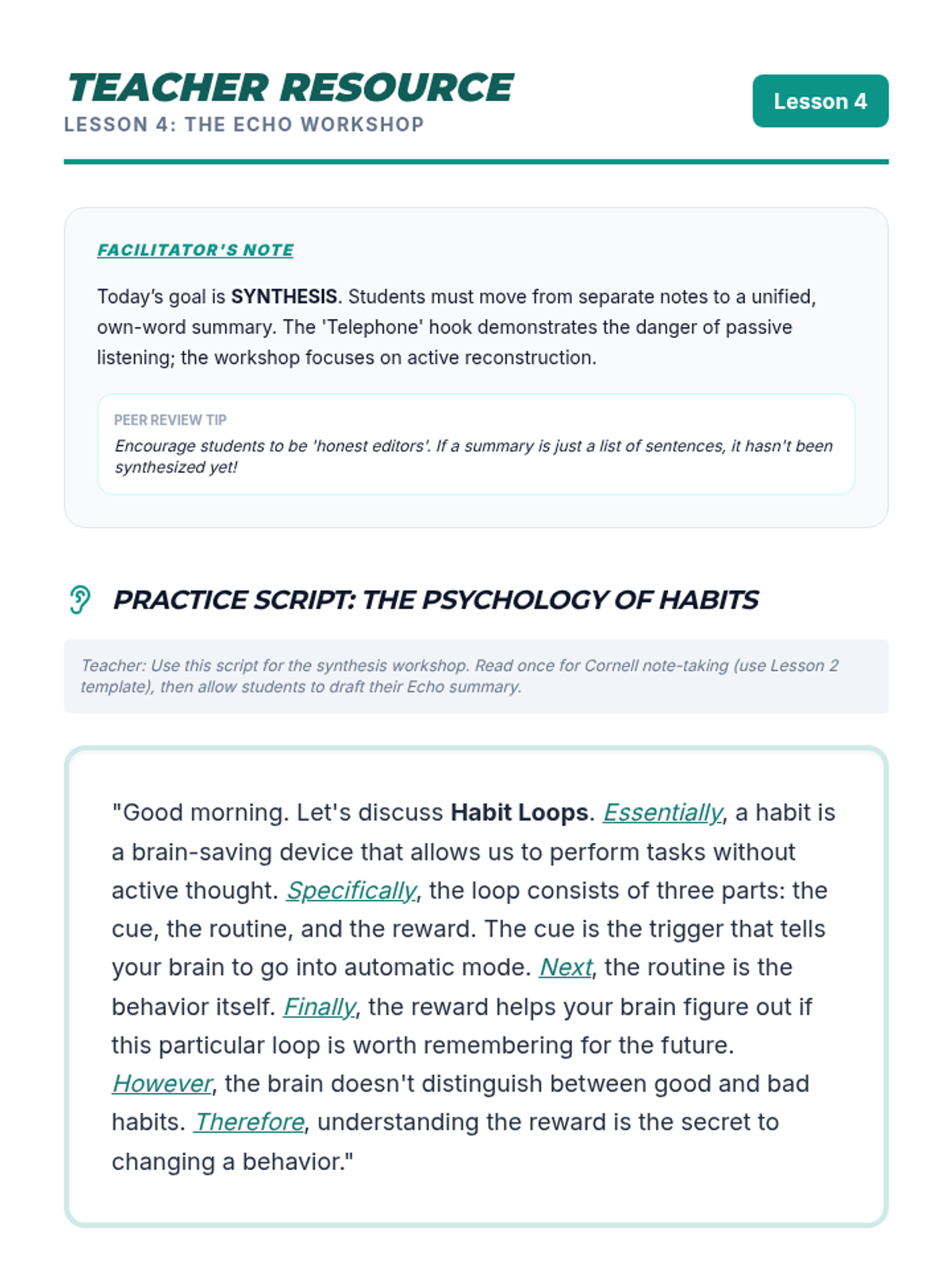
A teacher resource for Lesson 4, including a script on the psychology of habits for synthesis practice and a detailed exemplar summary to guide evaluation of student work.
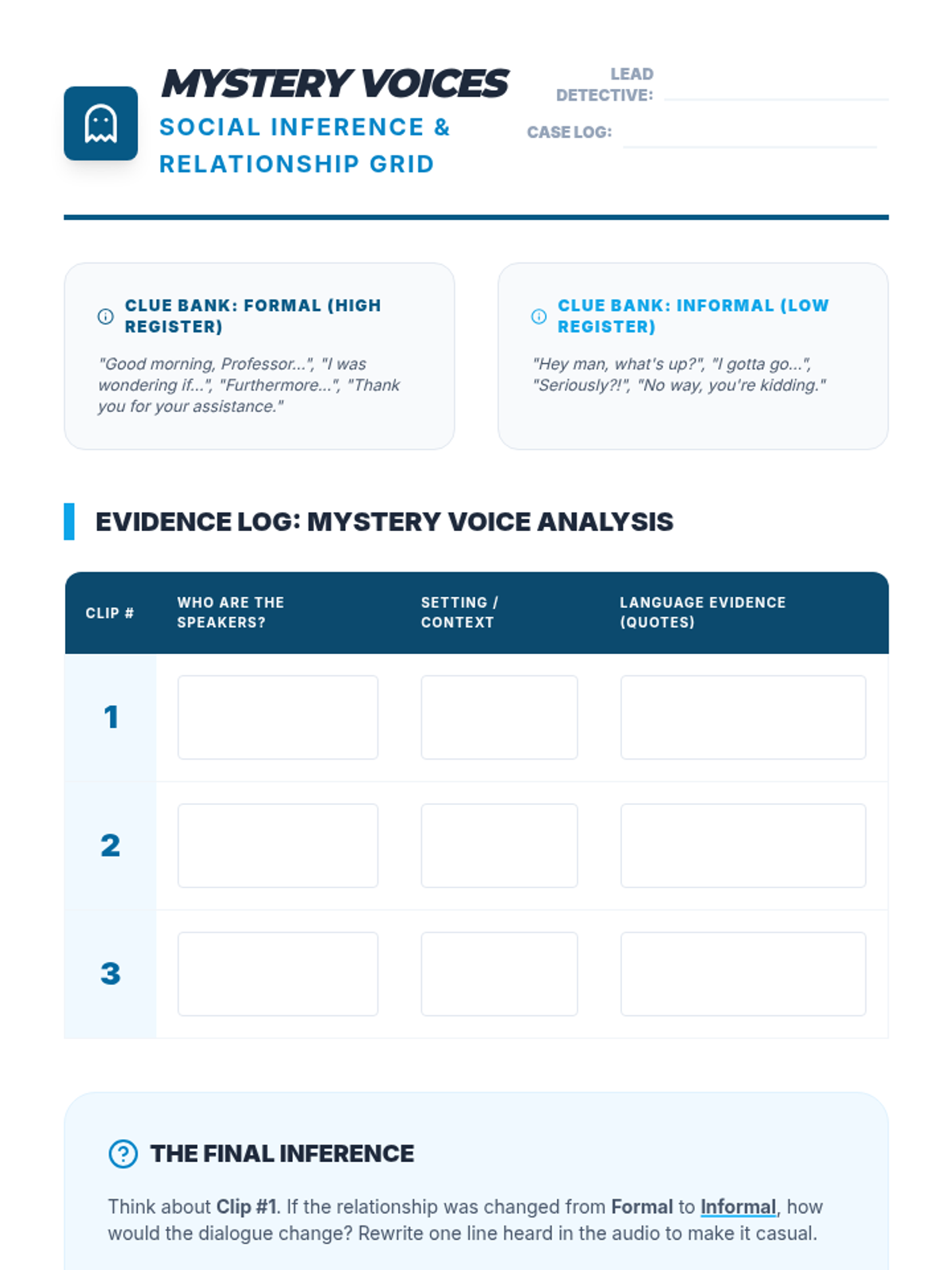
A student activity sheet for analyzing speaker relationships and social context, featuring a grid for recording inferences and a creative rewrite exercise for register shifts.
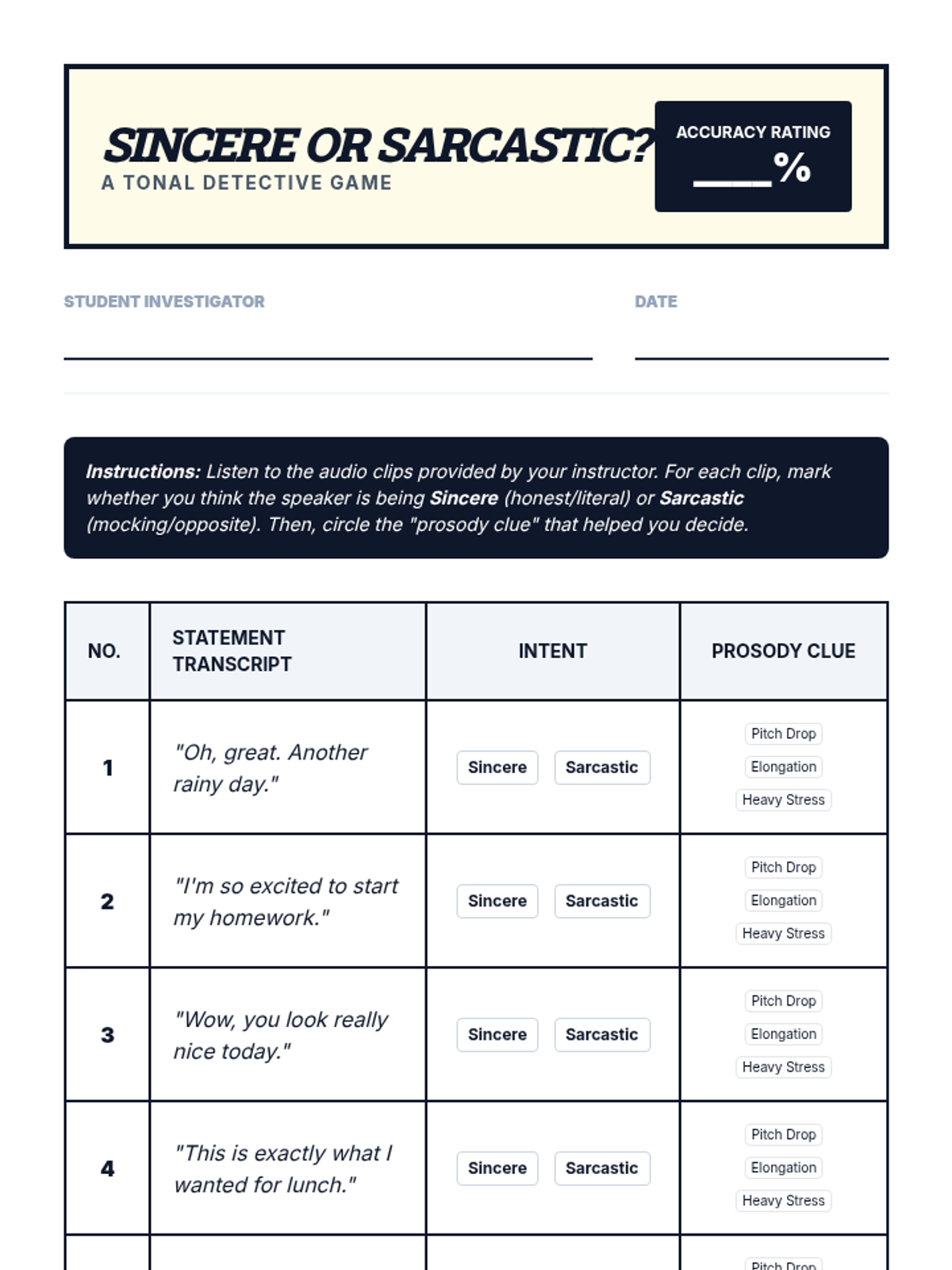
Game-based worksheet for Lesson 2 where students record their interpretations of audio clips to distinguish between sincere and sarcastic intent based on tonal prosody.
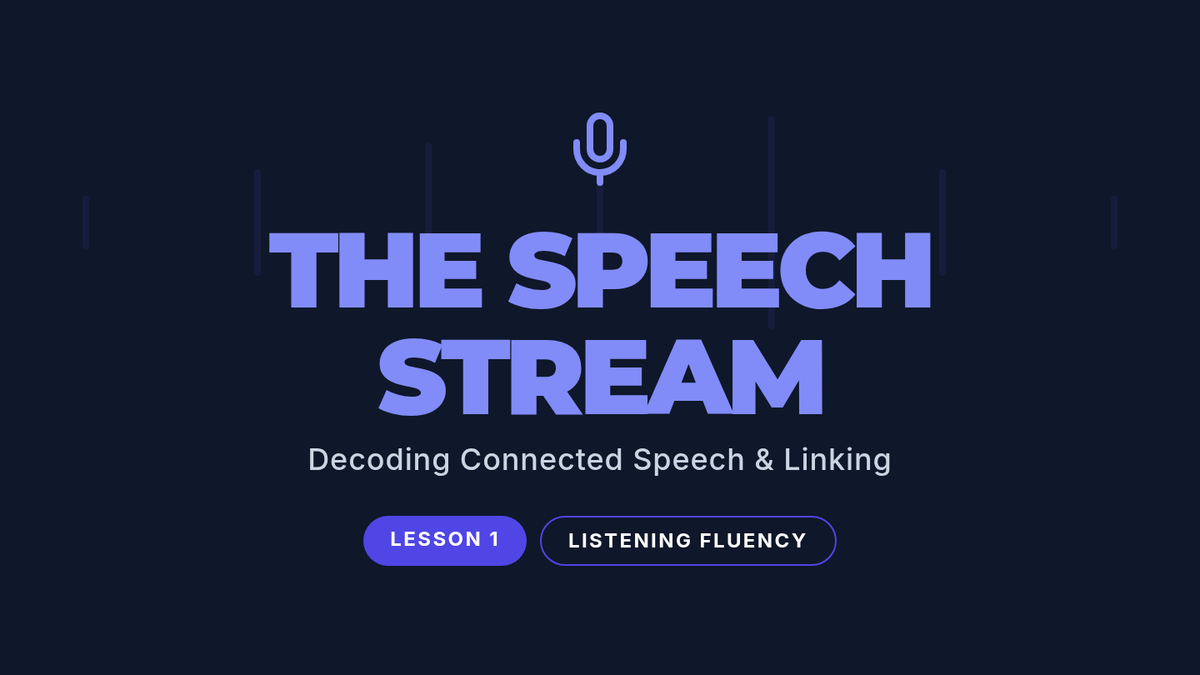
Introductory slides for Lesson 1, visually explaining the concept of the 'Speech Stream' and the mechanics of consonant-vowel linking. Includes visual metaphors and phonetic practice examples.
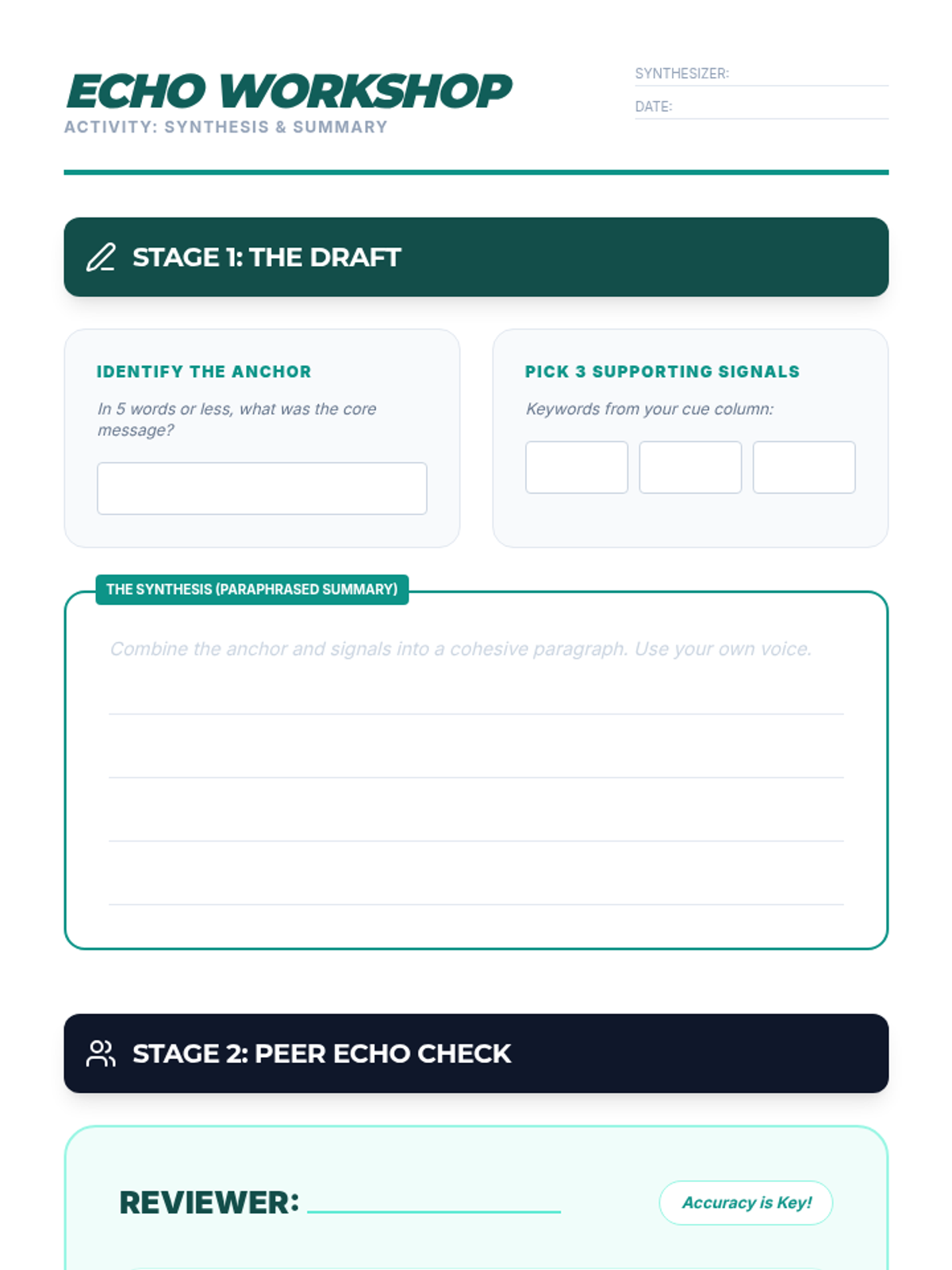
A worksheet for synthesizing audio content into a summary. It includes a draft stage with anchor and signal identification, a paraphrased summary section, and a detailed peer review checklist for accuracy and paraphrasing quality.
Slides for the fourth lesson on social inference, exploring the concept of register (formal vs. informal) and providing clues for identifying speaker relationships through audio.