Lenny LearningLenny
Create
Explore
Workspace
LoginSign up
MathEnglish Language ArtsScience & EngineeringSocial StudiesGlobal LanguagesHealth & Physical EducationSpecial EducationCounseling & Life SkillsArts & CreativityESL
Lenny LearningLenny
Lenny Learning
About
Training
Pricing
Support
Contact
© 2026 Lenny Learning Inc.

Fractions & Decimals

SequencesLessonsMaterialsVideos
  1. Math

Fractions & Decimals

SequencesLessonsMaterialsVideos

Foundational fraction equivalence, ordering, and operations across the rational number system. Addresses multi-digit computation, decimal conversions, and the distinction between rational and irrational numbers.

Multiplying and Dividing FractionsAlgorithmic procedures for multiplying and dividing proper, improper, and mixed fractions. Connects visual area models to standard calculations and the use of reciprocals.
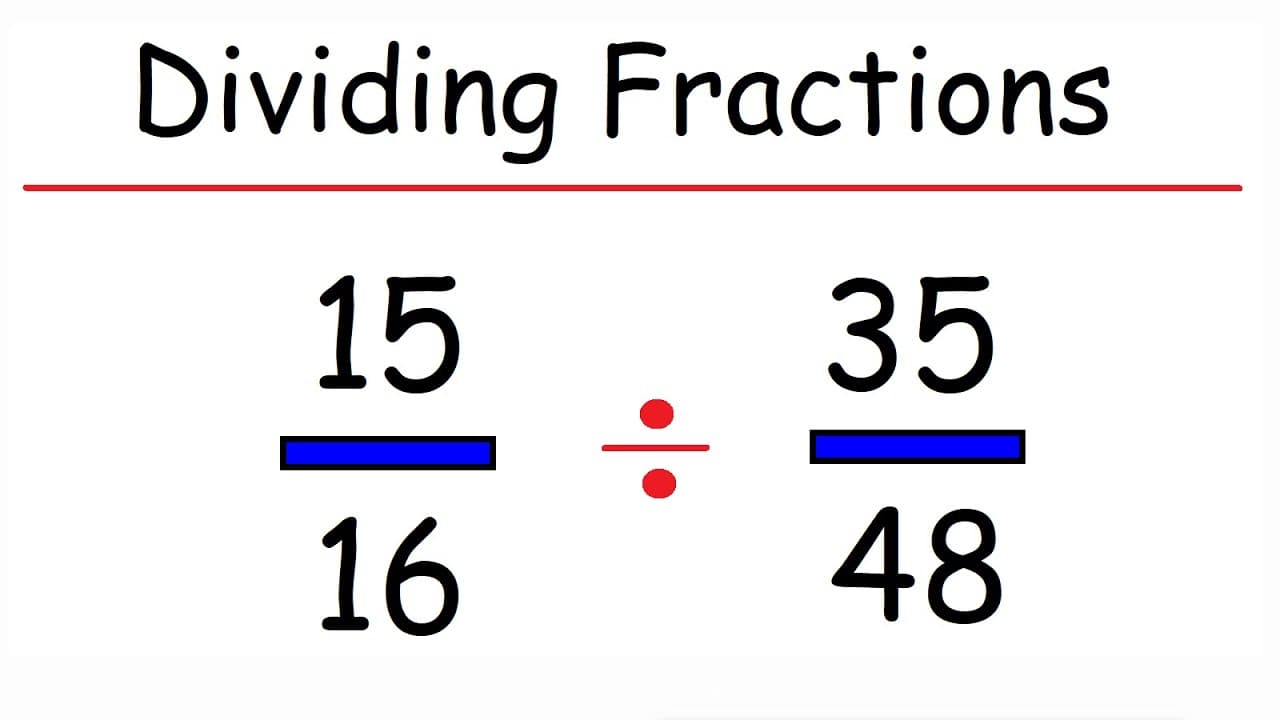
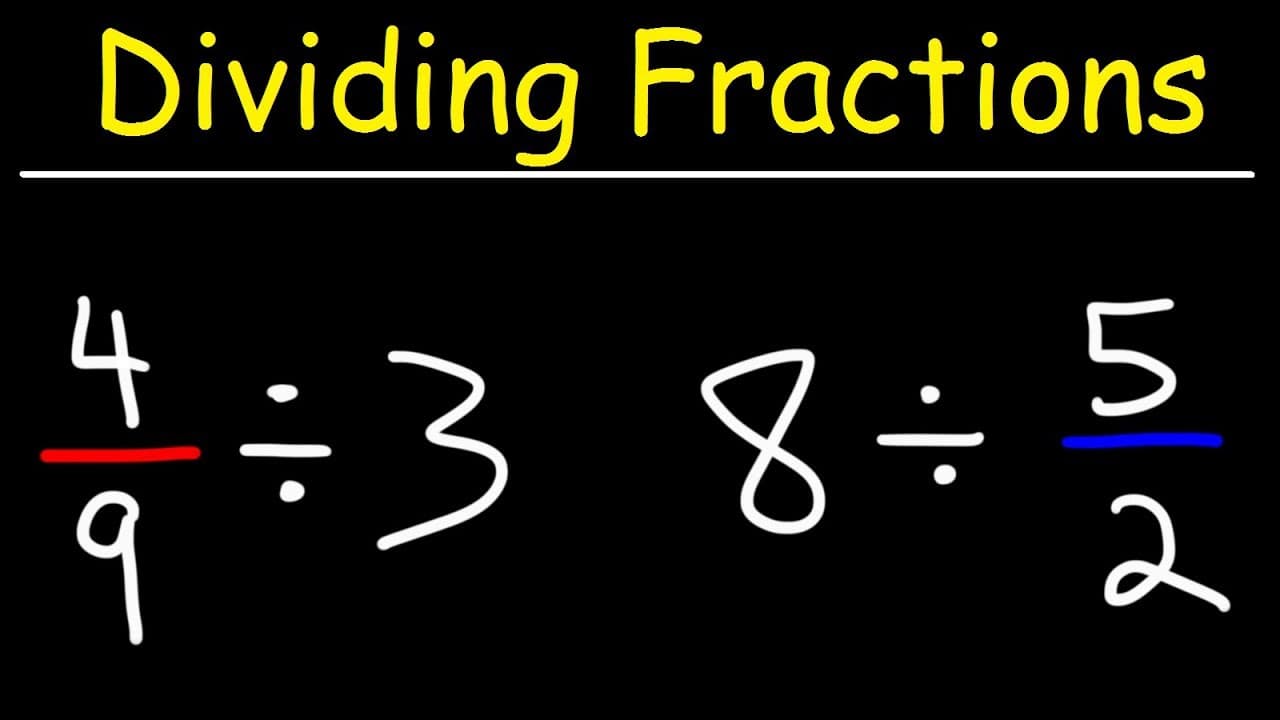
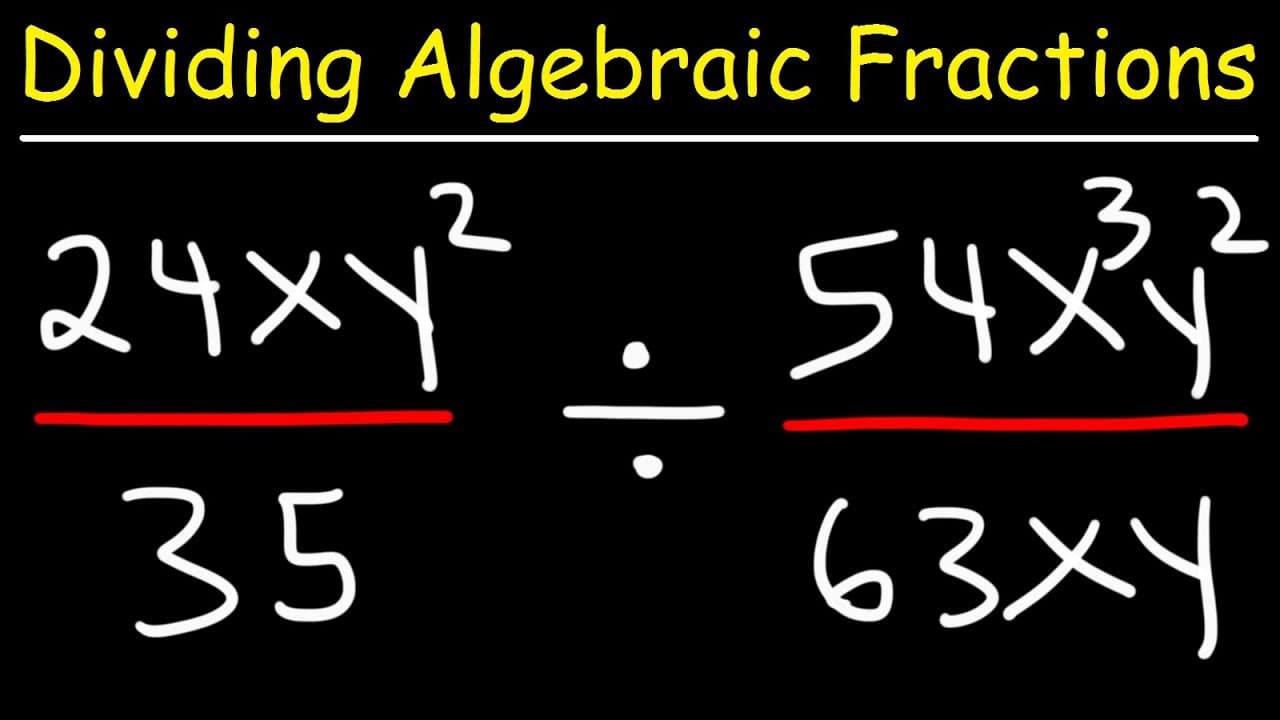
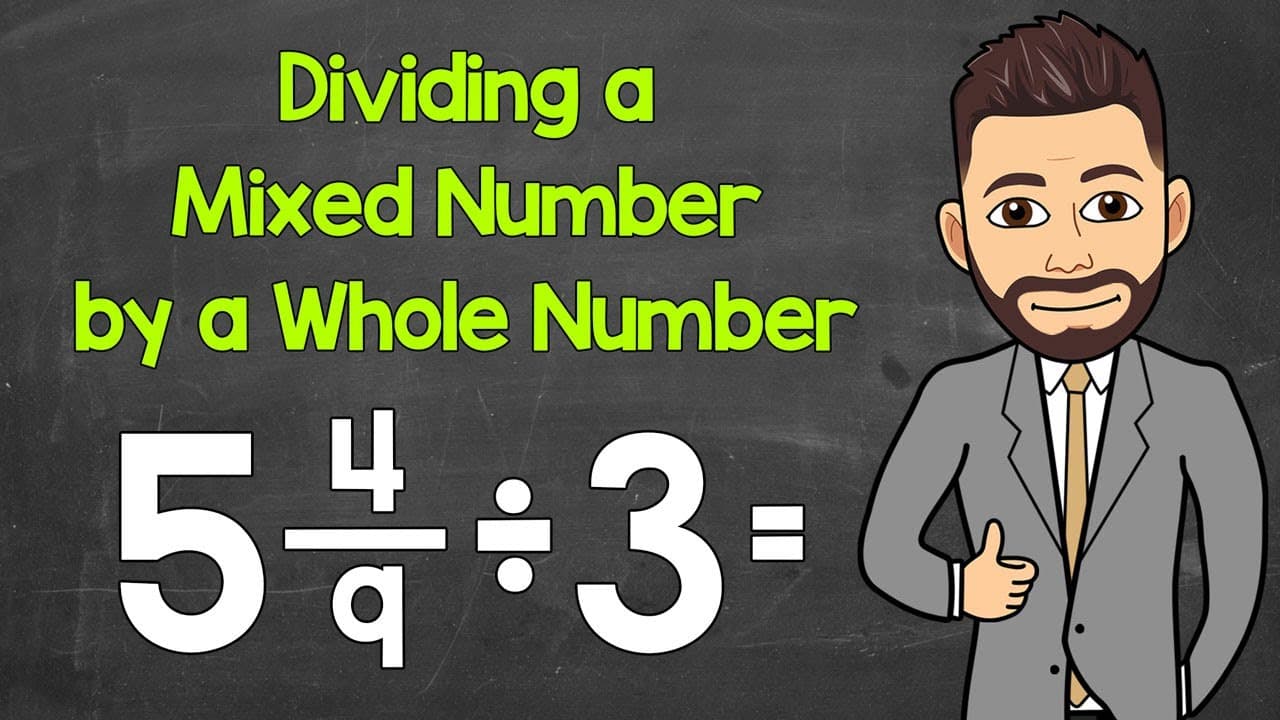
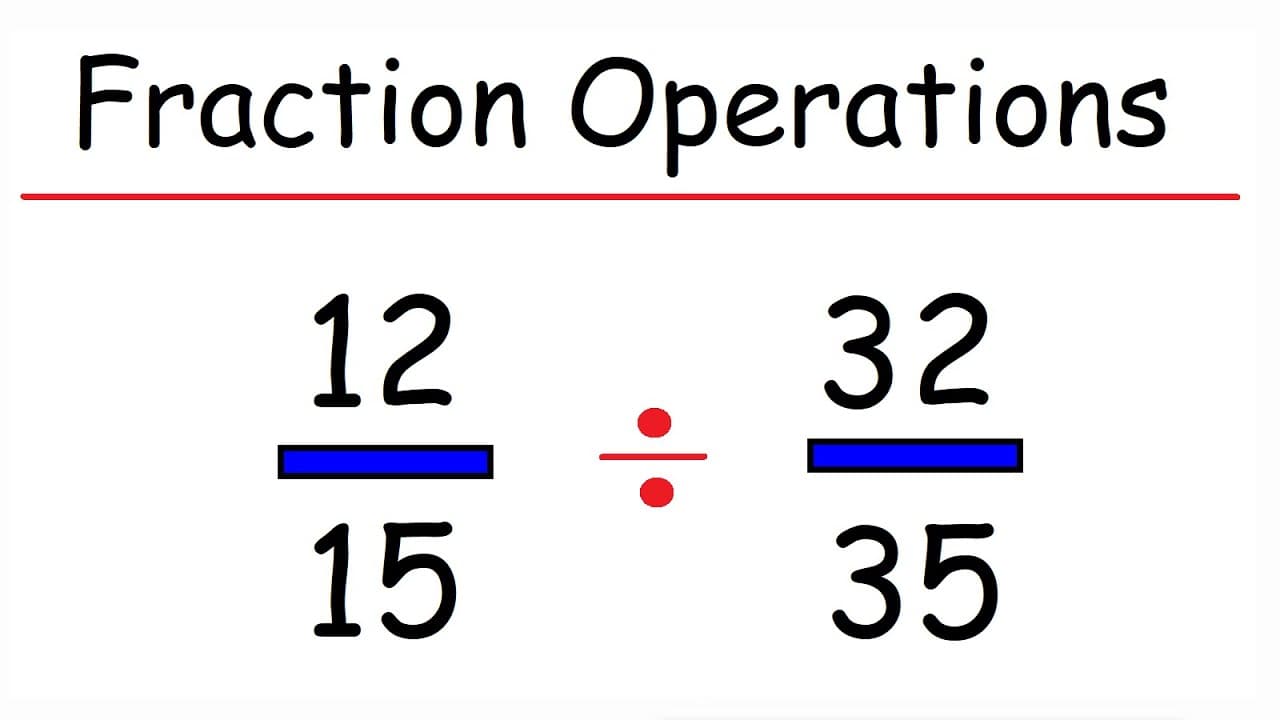
Dividing FractionsReciprocal operations, visual modeling, and the standard algorithm for dividing proper fractions and mixed numbers. Connects inverse operations to real-world division scenarios and word problems.
Add, Subtract, Multiply, and Divide Rational NumbersArithmetic operations including addition, subtraction, multiplication, and division of positive and negative fractions and decimals. Integrates strategies for common denominators, reciprocal multiplication, and precise decimal alignment.
Rational Number SystemClassification and representation of integers, fractions, and terminating or repeating decimals on the number line. Examines the relationships between subsets of real numbers and techniques for comparing and ordering rational values.
Irrational Numbers and ApproximationsIdentifies irrational numbers such as non-repeating decimals and square roots of non-perfect squares. Develops skills for estimating these values and positioning them accurately on a number line.
MathNumbers & CountingCounting ObjectsNumber NamesComparing NumbersNumber OperationsCounting SequenceNumbers 0-10Place Value Understanding and SystemAdd and Subtract Within 20Addition and Subtraction ConceptsAddition and Subtraction EquationsAddition and Subtraction ProblemsFoundations for MultiplicationMultiplication and Division PropertiesMultiply and Divide Within 100Multiplication and Division ProblemsFactors and MultiplesProperties of OperationsPatterns and RelationshipsGenerate and Analyze PatternsMulti-Digit ArithmeticPlace Value OperationsMulti-Digit and Decimal OperationsNumerical ExpressionsFour Operations and PatternsFour Operations Problem SolvingMeasurement & DataMeasurable AttributesMeasuring LengthsMeasure and Estimate Lengths in Standard UnitsRelate Addition and Subtraction to LengthClassifying and Counting ObjectsTime and MoneyArea Concepts and MeasurementPerimeter and Area MeasuresAngle Concepts and MeasurementTime, Volume, and MassMeasurement Unit ConversionsGeometryIdentifying ShapesShapes and AttributesShape Attributes and ReasoningShapes and CompositionClassifying 2D FiguresGeometric Figures and RelationshipsLines, Angles, and ShapesAngle, Area, and VolumeGeometric MeasurementVolume of 3D ShapesCoordinate Plane ApplicationsTransformations in the PlaneCongruence and SimilarityUnderstand congruence in terms of rigid motionsSimilarity and TransformationsProve Theorems Involving SimilarityPythagorean TheoremTrigonometry for General TrianglesMake Geometric ConstructionsProve Geometric TheoremsTheorems About CirclesFind Arc Lengths And Areas of Sectors of CirclesVolume FormulasRelationships Between Two-Dimensional and Three-Dimensional ObjectsProve Simple Geometric Theorems AlgebraicallyTranslate Between Geometric Description and Equation for Conic SectionApply Geometric Concepts in Modeling SituationsFractions & DecimalsFractions as NumbersBuilding FractionsFraction Equivalence and OrderingAdding and Subtracting FractionsMultiplying and Dividing FractionsDividing FractionsDecimal FractionsMulti-Digit Computation and FactorsAdd, Subtract, Multiply, and Divide Rational NumbersRational Number SystemIrrational Numbers and ApproximationsRatiosRatios and ProportionsProportional RelationshipsUnit RateAlgebraAlgebraic ExpressionsGenerate Equivalent ExpressionsQuantitative RelationshipsProportional Relationships and Linear EquationsEquations and InequalitiesEquation Solving and ReasoningLinear Equations and SystemsGraph Equations and InequalitiesSystems of EquationsReal-World Algebraic ProblemsQuantitative Reasoning with UnitsExpression StructureEquivalent Expression FormsRadicals and Integer ExponentsRational ExponentsRational and Irrational NumbersPolynomial OperationsPolynomial IdentitiesPolynomial Zeros and FactorsRational ExpressionsComplex Number OperationsComplex Numbers in PolynomialsComplex Numbers on PlaneStatistics & ProbabilityRepresent and Interpret DataData DistributionsStatistical VariabilityProbability ModelsCompound Event ProbabilitiesStatistical SamplingInterpret Categorical and Quantitative DataBivariate Data PatternsInterpret Linear ModelsComparing Two PopulationsRandom Processes in StatisticsIndependence and Conditional ProbabilityExpected ValuesProbability-Based Decision MakingStatistical Inference and ConclusionsFunctionsFunction Concepts and NotationDefine and Compare FunctionsInterpret Functions in ContextAnalyze Function RepresentationsModel Relationships with FunctionsIdentify Linear vs Exponential GrowthDistinguish Between Function TypesCompare Growth RatesInterpret Function ExpressionsBuild Functions from RelationshipsConstruct and Model FunctionsTransform and Combine FunctionsModel Comparison and SelectionSolve Exponential EquationsTrigonometryTrigonometric Ratios Involving Right TrianglesTrigonometric Functions and Unit CircleModel with Trigonometric FunctionsTrigonometric IdentitiesVectors & MatricesIntroduction to Vectors and MatricesVector QuantitiesVector OperationsMatrix OperationsCalculusLimits and ContinuityDerivative Concepts and NotationDerivative Rules and TechniquesApplications of DerivativesOptimization ProblemsRelated RatesCurve Sketching and AnalysisIntegration Concepts and NotationAntiderivatives and Indefinite IntegralsDefinite Integrals and AreaFundamental Theorem of CalculusIntegration TechniquesApplications of IntegrationDifferential EquationsSequences and SeriesParametric and Polar FunctionsVector-Valued Functions
Video
Multiplying Proper Fractions: Visual Models and Examples

Multiplying Proper Fractions: Visual Models and Examples

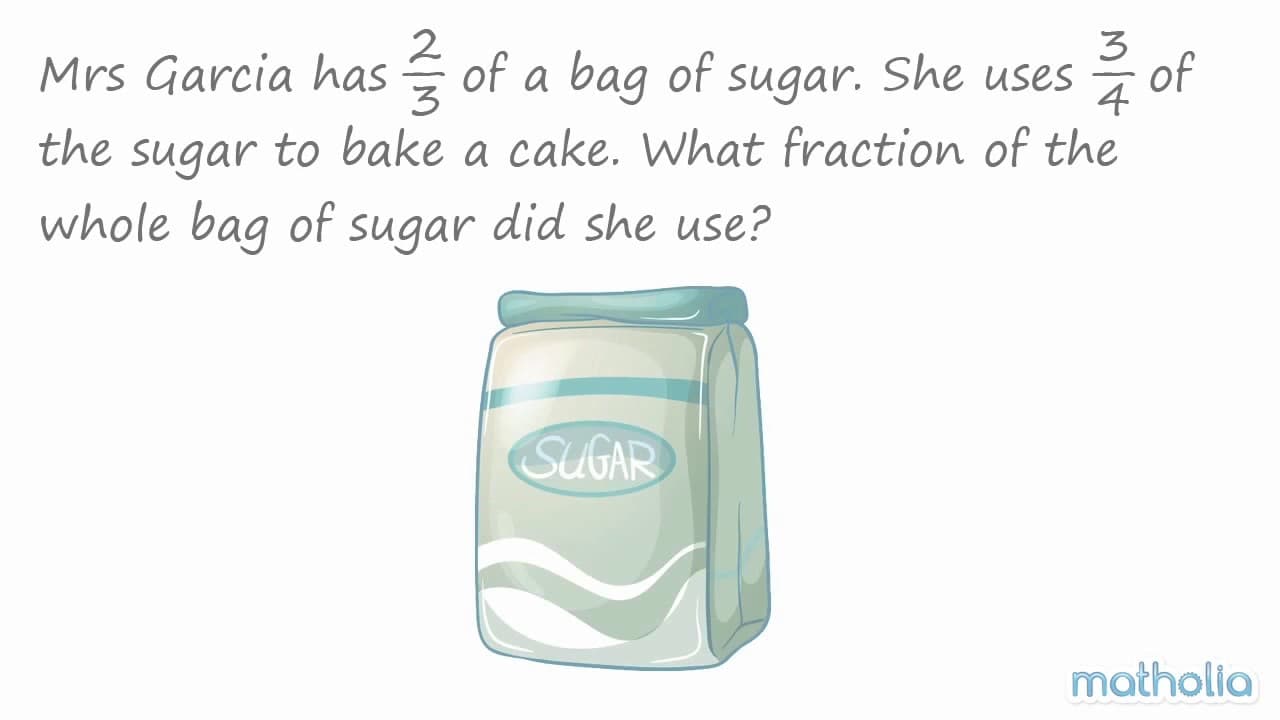
This educational video provides a clear, step-by-step guide on how to multiply proper fractions. It begins by introducing a real-world word problem about baking a cake to contextualize the mathematical concept, demonstrating that finding a "fraction of a fraction" is a multiplication process. The video uses visual bar models to conceptually illustrate the problem before moving to the standard numerical algorithm. The core themes include interpreting word problems, using visual models to represent fractions, applying the standard algorithm for multiplying fractions (numerator times numerator, denominator times denominator), and simplifying fractions to their lowest terms. The video provides three distinct examples: a word problem solution and two purely numerical practice problems, one of which requires significant simplification at the end. For educators, this video serves as an excellent instructional tool for introducing or reinforcing fraction multiplication. It bridges the gap between conceptual understanding (visual models) and procedural fluency (the algorithm). Teachers can use the initial segment to discuss why we multiply fractions, while the later segments serve as clear examples for students to model their own calculations after. It is particularly useful for visual learners who benefit from seeing the bar model decomposition.

MatholiaChannelMatholiaChannel

2mins 2s

Video
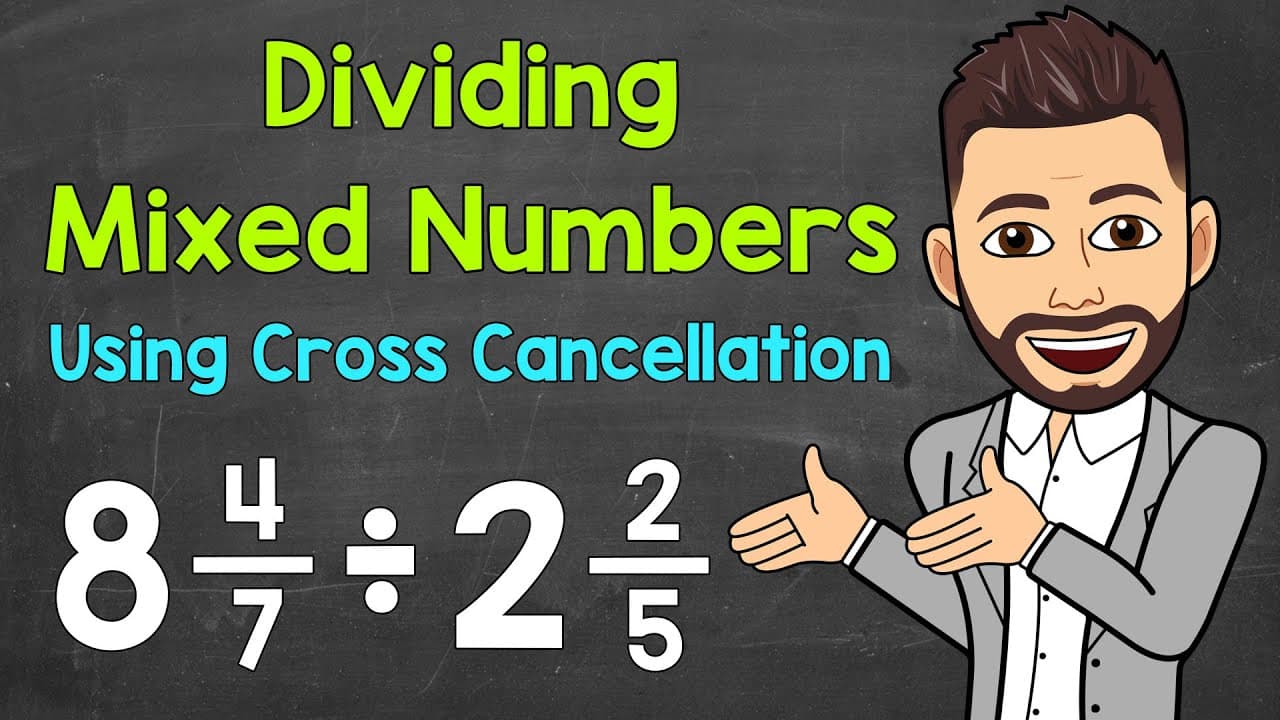
How to Divide Mixed Numbers Using Cross Cancellation

How to Divide Mixed Numbers Using Cross Cancellation

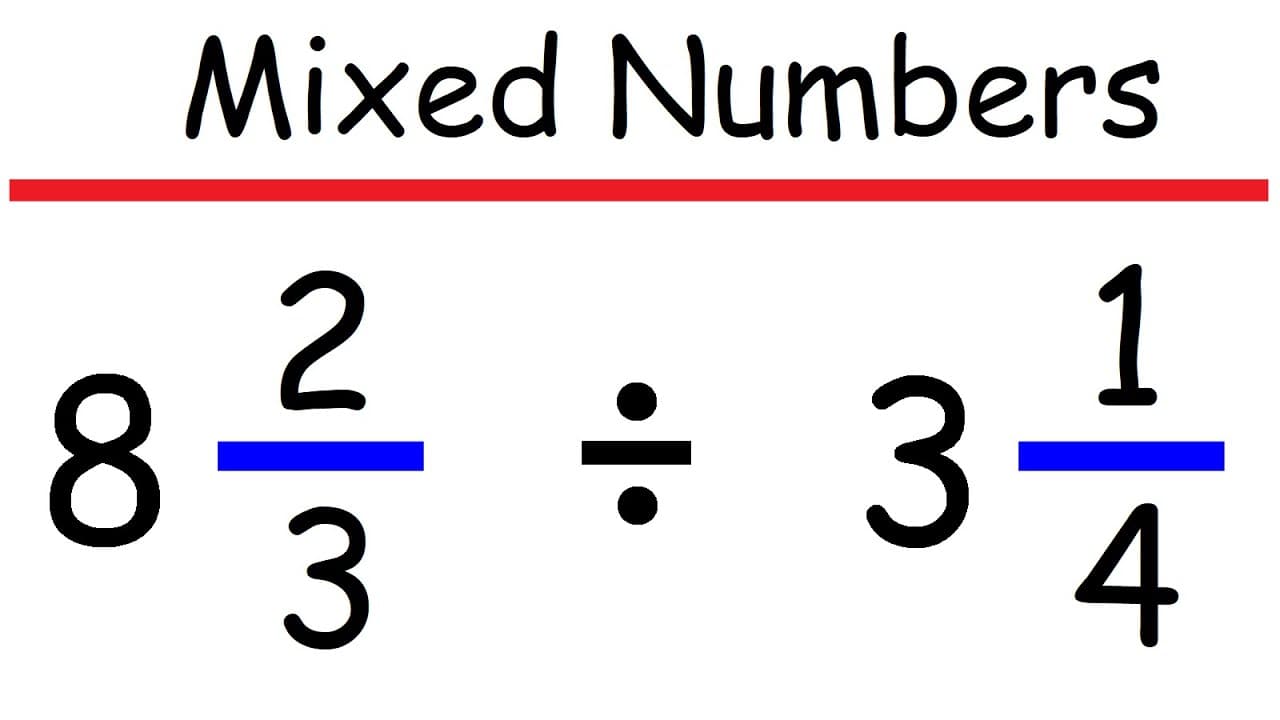
This instructional video provides a step-by-step tutorial on dividing mixed numbers using the method of cross cancellation. Narrated by 'Mr. J', the video breaks down the complex process into manageable stages: converting mixed numbers to improper fractions, applying the 'Keep, Switch, Flip' method to change division into multiplication, and simplifying the problem early through cross cancellation before finding the final answer.

Math with Mr. JMath with Mr. J

5mins 56s

Video
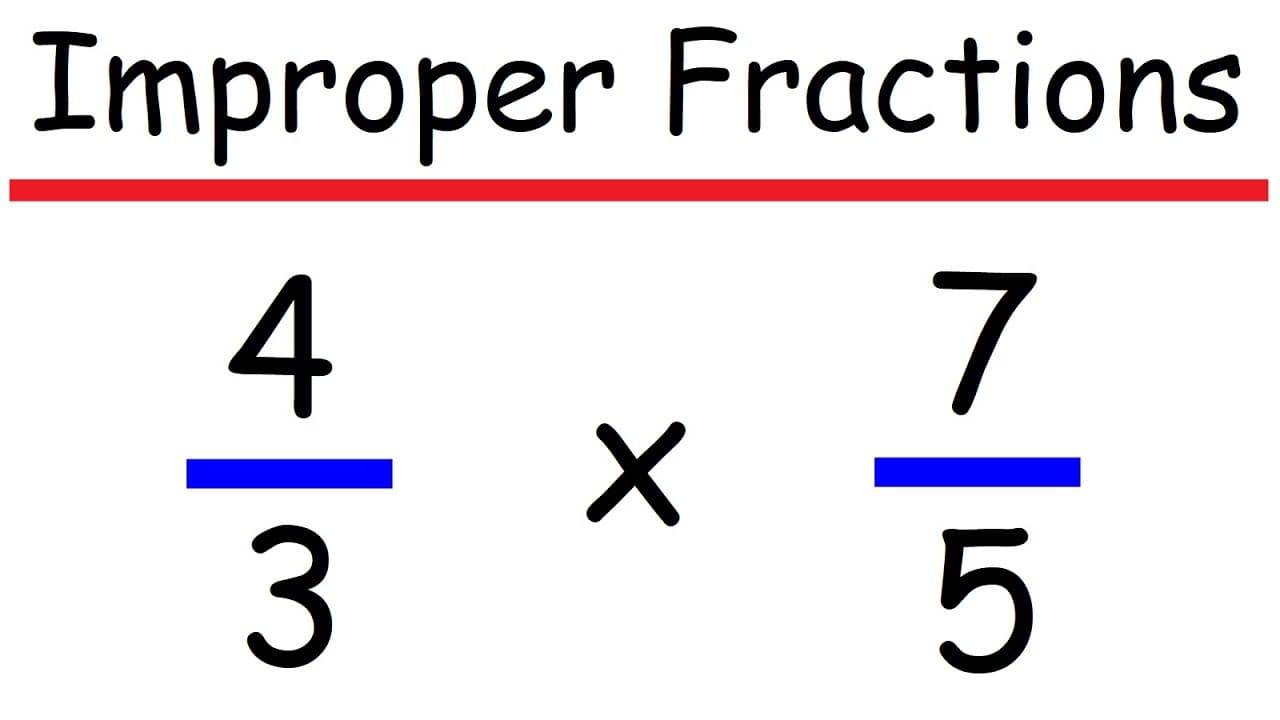
How to Multiply and Simplify Improper Fractions

How to Multiply and Simplify Improper Fractions

This educational video provides a clear, step-by-step tutorial on how to multiply improper fractions. The narrator defines what an improper fraction is and demonstrates the standard algorithm for multiplying two fractions by multiplying numerators and denominators straight across. The video progresses from simple examples to more complex problems that require simplification. The content covers key mathematical concepts including identifying improper fractions, executing multiplication algorithms, and the strategy of simplifying fractions before multiplying (often called cross-canceling). The narrator breaks down composite numbers into prime factors to visually demonstrate how terms cancel out, providing a strong conceptual basis for simplification strategies. This resource is highly valuable for upper elementary and middle school mathematics classrooms. It serves as an excellent visual model for direct instruction or a review tool for students struggling with fraction operations. The clear, uncluttered visual style focuses entirely on the mathematical steps, making it ideal for scaffolding lessons on fraction arithmetic and helping students transition from basic multiplication to working with simplified forms.

The Organic Chemistry TutorThe Organic Chemistry Tutor

2mins 16s

Video
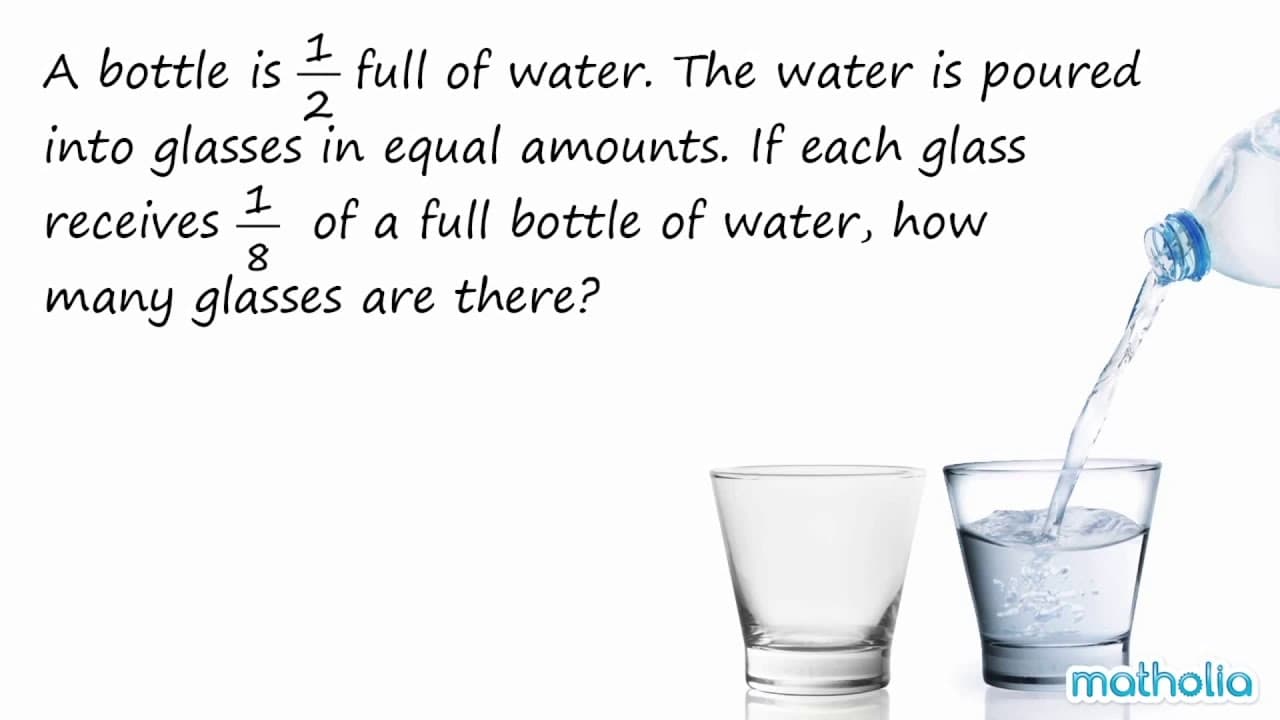
How to Divide Fractions by Unit Fractions

How to Divide Fractions by Unit Fractions

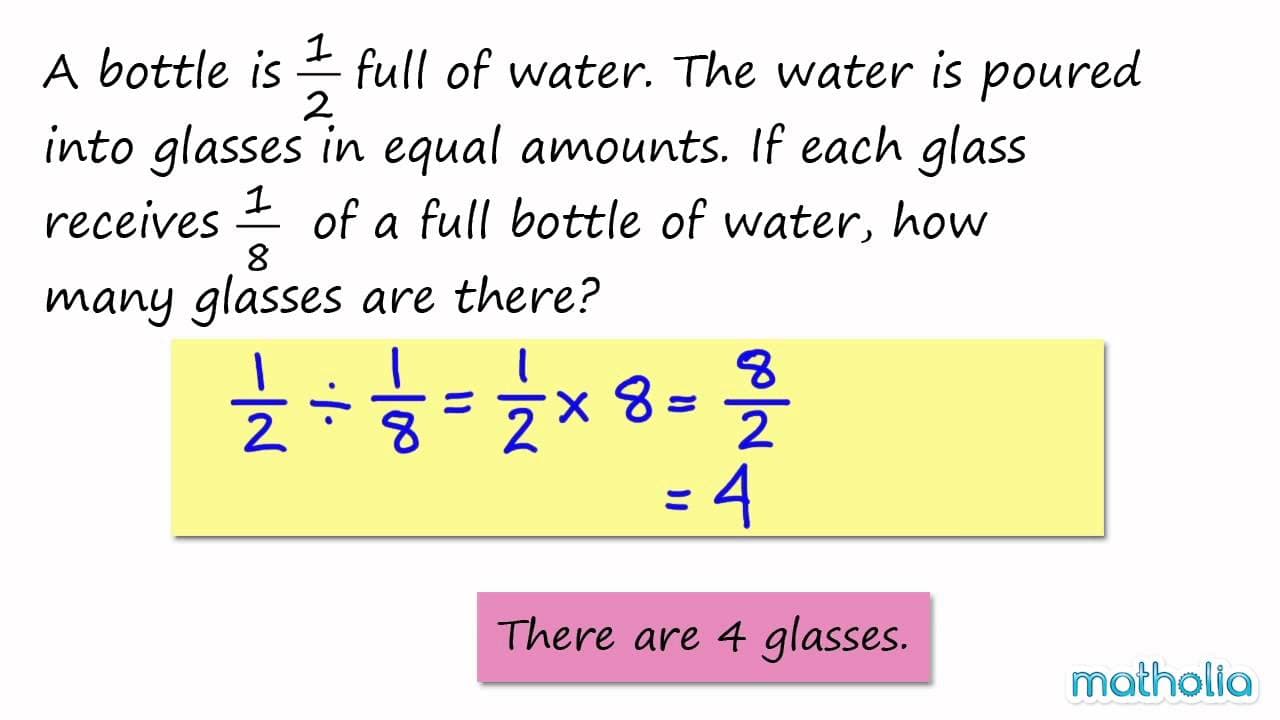
This educational video provides a clear, step-by-step tutorial on how to divide fractions by unit fractions using both real-world visualization and abstract numerical methods. It begins with a practical word problem involving water bottles and glasses to conceptually anchor the mathematical operation, helping students visualize why division results in a larger number. The video then transitions to the standard algorithm, explicitly stating the rule that dividing by a unit fraction is equivalent to multiplying by its denominator. The content explores key mathematical themes including fraction division, unit fractions (fractions with a numerator of 1), improper fractions, and converting improper fractions into mixed numbers. It demonstrates the "invert and multiply" concept specifically for unit fractions, simplifying the process for learners. Two additional numerical examples are provided to reinforce the skill, covering scenarios where the result involves converting an improper fraction to a mixed number. For educators, this video is an excellent resource for introducing or reviewing fraction division. The initial animation offers a concrete representation for visual learners, while the subsequent examples provide procedural practice. It effectively scaffolds the learning by moving from a concrete word problem to abstract equations, making it suitable for direct instruction, flipped classroom assignments, or as a review station for students struggling with fraction operations.

MatholiaChannelMatholiaChannel

2mins 31s

Video
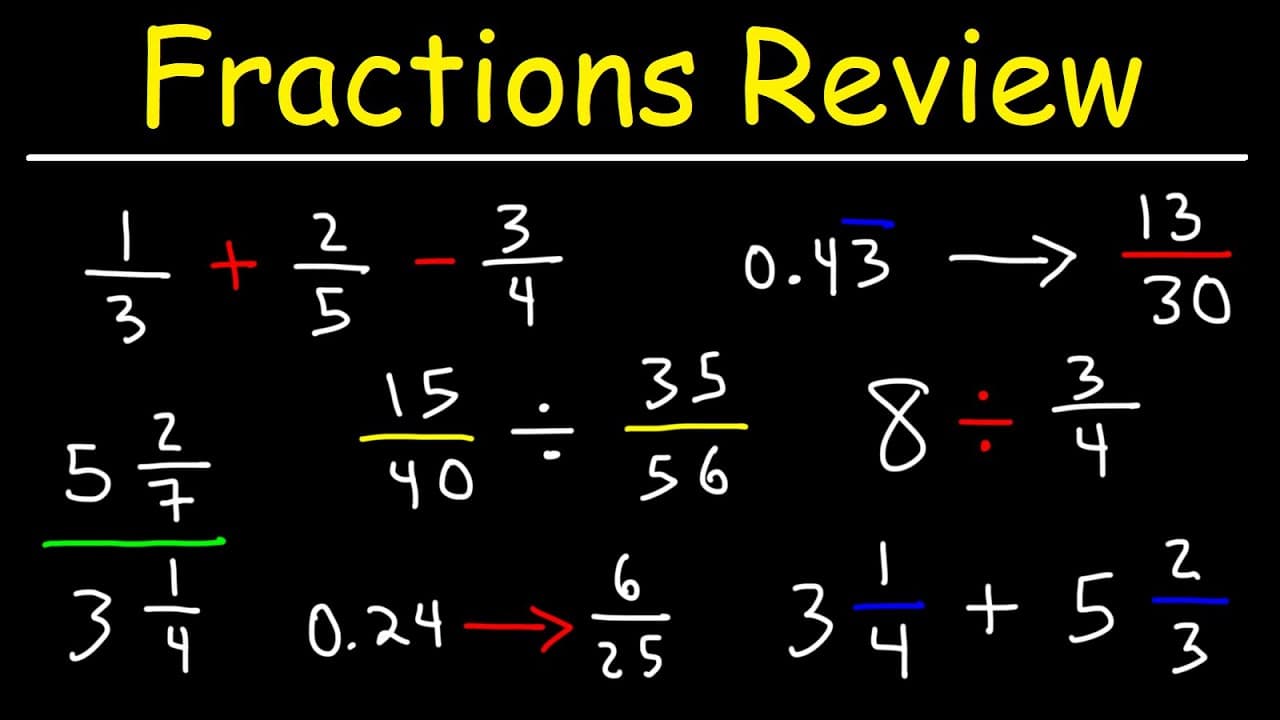
Mastering Fraction Operations: From Basics to Mixed Numbers

Mastering Fraction Operations: From Basics to Mixed Numbers

This comprehensive math tutorial provides a thorough review of fraction operations, covering everything from basic addition and subtraction to complex mixed number calculations. The video systematically progresses through concepts, starting with adding fractions with like denominators and moving to finding least common multiples for unlike denominators. It demonstrates key techniques such as simplifying fractions, cross-canceling during multiplication, and the "keep-change-flip" method for division. The tutorial also bridges the gap between different number forms, showing students how to convert between improper fractions and mixed numbers, as well as how to translate fractions into decimals and percentages. Special attention is given to more advanced topics like operations with mixed numbers requiring borrowing/regrouping and converting repeating decimals into fractions. Teachers can use this video as a modular resource, assigning specific segments to students based on their needs. It is excellent for introducing new concepts, providing remediation for struggling learners, or serving as a comprehensive review before standardized tests. The clear, step-by-step visual walkthroughs make complex arithmetic procedures accessible and easier to understand.

The Organic Chemistry TutorThe Organic Chemistry Tutor

11mins 53s

Video
Understanding Fractions as Division

Understanding Fractions as Division

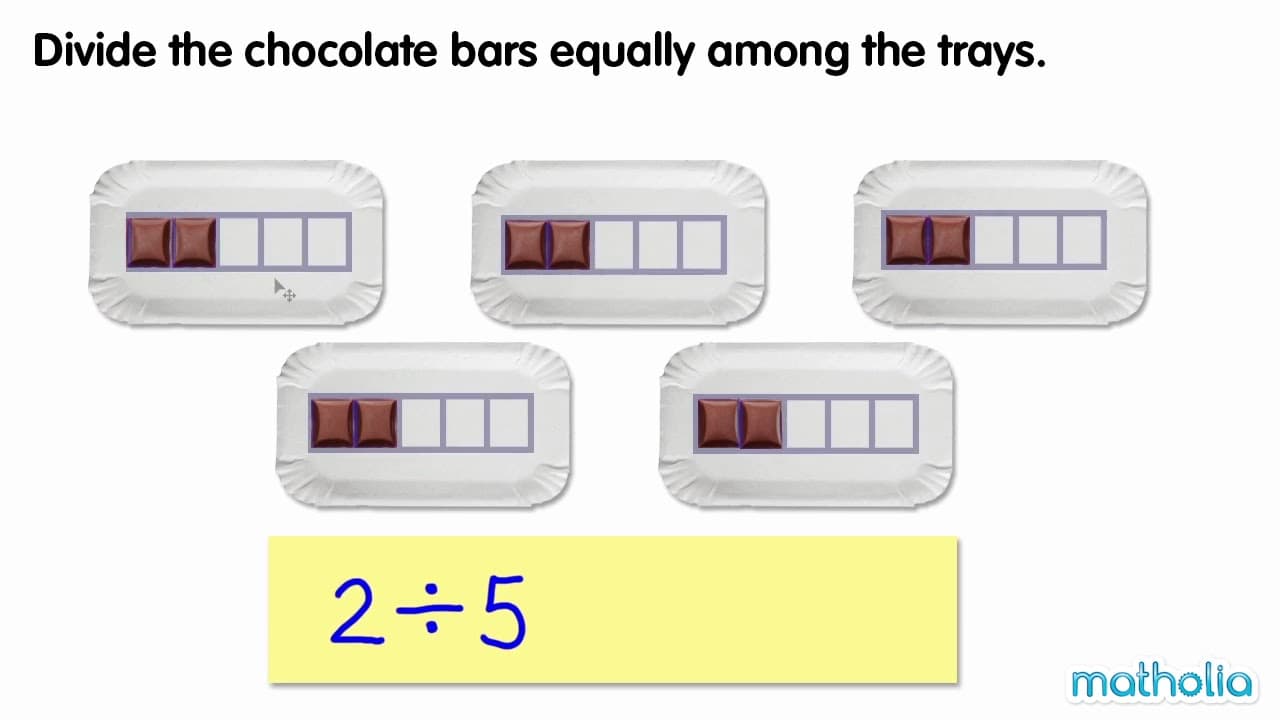
This educational video clearly illustrates the mathematical concept of interpreting fractions as division. Through a progression from concrete visual examples to abstract numerical problems, the video demonstrates that a fraction bar represents the operation of division, where the numerator is the dividend and the denominator is the divisor. The content bridges the gap between whole number division and fractional outcomes, a critical conceptual leap for intermediate math students. The video explores three key themes: understanding basic division as distributing items into groups (creating proper fractions), applying this concept to word problems involving simplification, and converting division results into improper fractions and mixed numbers. It uses chocolate bars and pizzas as relatable manipulatives to ground the abstract math in real-world scenarios before moving to pure calculation. For educators, this video serves as an excellent instructional tool for introducing Common Core standard 5.NF.B.3 (interpreting a fraction as division of the numerator by the denominator). It provides a visual proof for why $2 \div 5 = 2/5$ rather than just stating the rule, helping students build conceptual understanding. The step-by-step walkthroughs of simplifying fractions and converting improper fractions to mixed numbers also make it a valuable review resource for students struggling with these multi-step procedures.

MatholiaChannelMatholiaChannel

2mins 28s

Video
Multiplying Mixed Numbers: The Safari Area Song

Multiplying Mixed Numbers: The Safari Area Song

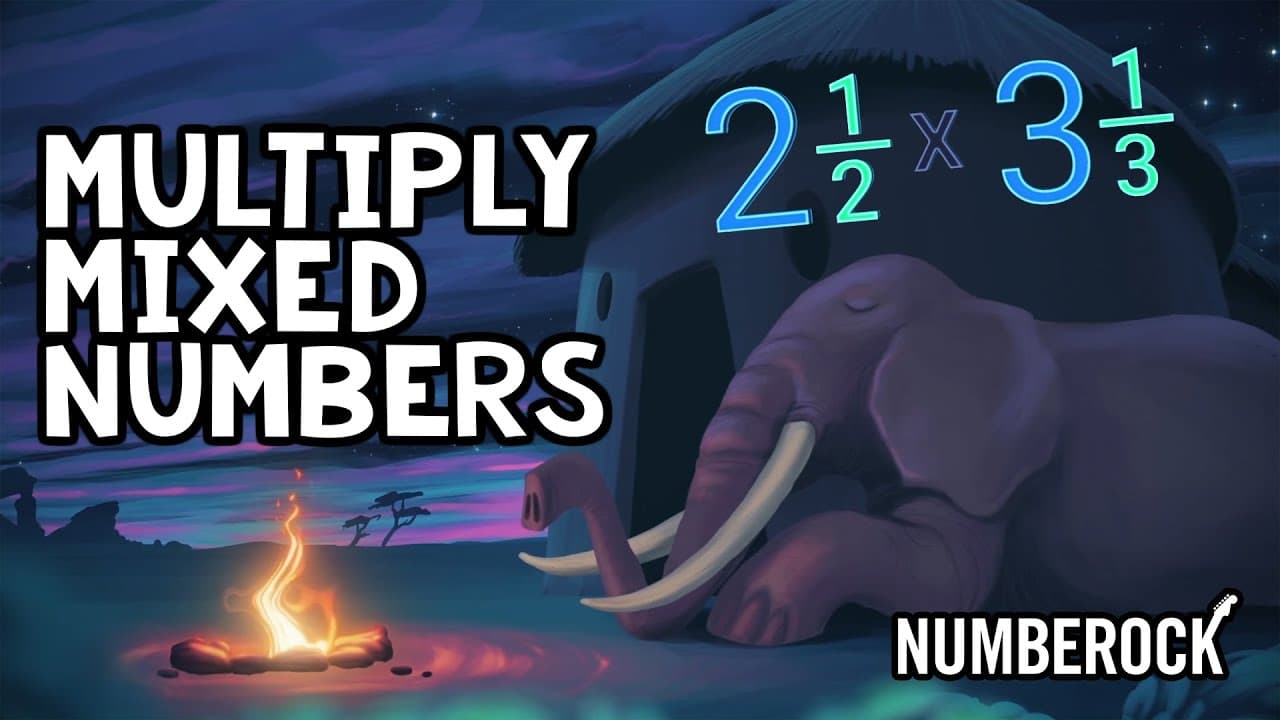
This animated musical video teaches students how to multiply mixed numbers through a narrative about a zookeeper designing enclosures for safari animals. The video uses catchy hip-hop lyrics to guide viewers through a step-by-step algorithm: converting mixed numbers to improper fractions, multiplying the numerators and denominators, and then simplifying the result back into a mixed number. The visual narrative reinforces the concept of area, as the character calculates the acreage needed for fencing around a giraffe and a herd of billy goats. Key themes include the conversion between mixed numbers and improper fractions, the algorithm for multiplying fractions, and the geometric application of multiplication to find area. The video explicitly models the mathematical thinking process, showing calculations on a notepad overlay while emphasizing the vocabulary of 'numerator', 'denominator', 'product', and 'simplest form'. It also touches upon estimation and real-world measurement applications. For educators, this video serves as an engaging hook or a mnemonic device to help students memorize the multi-step procedure for multiplying mixed numbers. It effectively bridges the gap between procedural fluency and conceptual understanding by linking the math to a physical context (land area). The repeated chorus reinforces the algorithm, making it an excellent tool for introduction, review, or remediation for students struggling to remember the sequence of operations.

Math Songs by NUMBEROCKMath Songs by NUMBEROCK

2mins 23s

Video
Mastering the Four Basic Fraction Operations

Mastering the Four Basic Fraction Operations

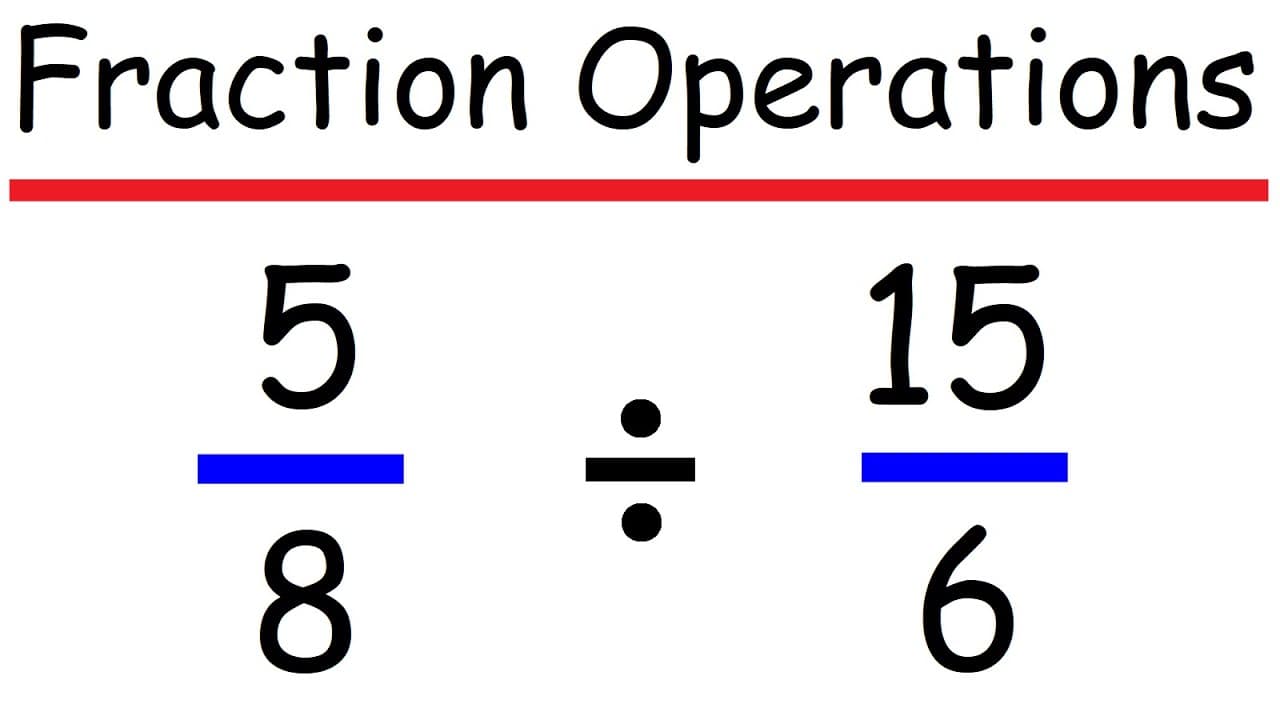
This concise and clear mathematics tutorial provides a comprehensive review of the four fundamental operations with fractions: addition, subtraction, multiplication, and division. The video systematically breaks down each operation using specific examples, demonstrating the distinct rules required for each process. It emphasizes the critical differences between the operations, such as the necessity of finding common denominators for addition and subtraction versus the direct approach used in multiplication. The content covers key procedural techniques including the "butterfly method" or cross-multiplication strategy for finding common denominators, converting improper fractions to mixed numbers, and the "Keep, Change, Flip" algorithm for dividing fractions. A significant portion of the video is dedicated to the strategy of "simplifying before multiplying" (cross-canceling), showing students how to break down larger numbers into factors to make calculations more manageable and accurate. For educators, this video serves as an excellent review tool or flipped classroom resource for upper elementary and middle school students. It addresses common pain points, such as forgetting when to find a common denominator or how to handle large numbers in multiplication. The step-by-step narration allows for easy pausing and note-taking, making it ideal for scaffolding lessons on fraction arithmetic or for differentiated instruction where students need remedial support.

The Organic Chemistry TutorThe Organic Chemistry Tutor

5mins 55s

Video
Multiplying Fractions by Whole Numbers: Step-by-Step Guide

Multiplying Fractions by Whole Numbers: Step-by-Step Guide

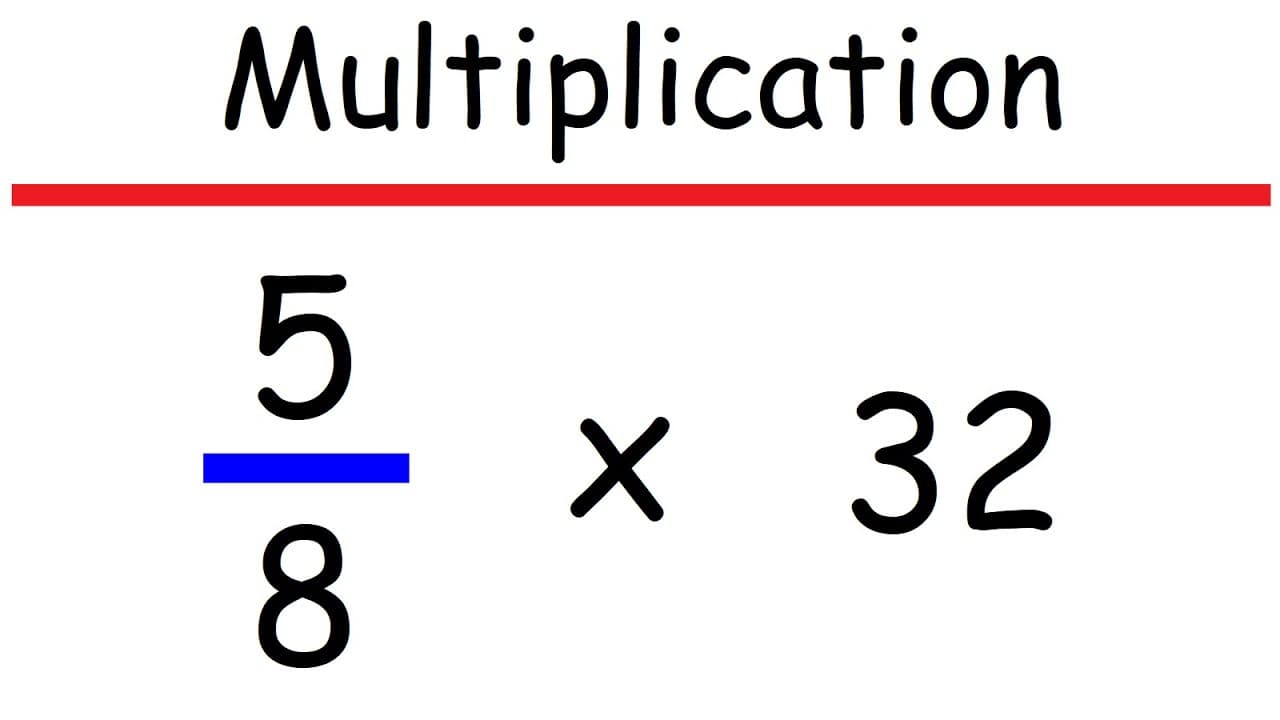
This instructional math video provides a step-by-step guide on how to multiply fractions by whole numbers. The narrator uses four distinct examples to demonstrate two primary methods: simplifying before multiplying (cross-canceling) and multiplying straight across followed by converting improper fractions into mixed numbers. The video utilizes a digital whiteboard format where calculations are written out in real-time with color-coding to highlight specific steps like canceling out common factors. The content covers key arithmetic concepts including writing whole numbers as fractions over one, factoring numbers to simplify calculations, and multiple strategies for converting improper fractions to mixed numbers using decomposition and division. The pacing is deliberate, allowing learners to follow the procedural logic of each operation. The first two examples focus on scenarios where numbers simplify cleanly to whole numbers, while the last two examples address scenarios resulting in non-whole numbers that require conversion. This resource is highly valuable for upper elementary and middle school classrooms as both an introduction to fraction multiplication and a review of mixed number conversions. Teachers can use it to visually demonstrate why 'cross-canceling' works by showing the factors explicitly, rather than just teaching it as a rote trick. The clear audio and high-contrast visuals make it accessible for students who need repeated exposure to the algorithm.

The Organic Chemistry TutorThe Organic Chemistry Tutor

2mins 56s

Video
How to Divide Whole Numbers by Proper Fractions

How to Divide Whole Numbers by Proper Fractions

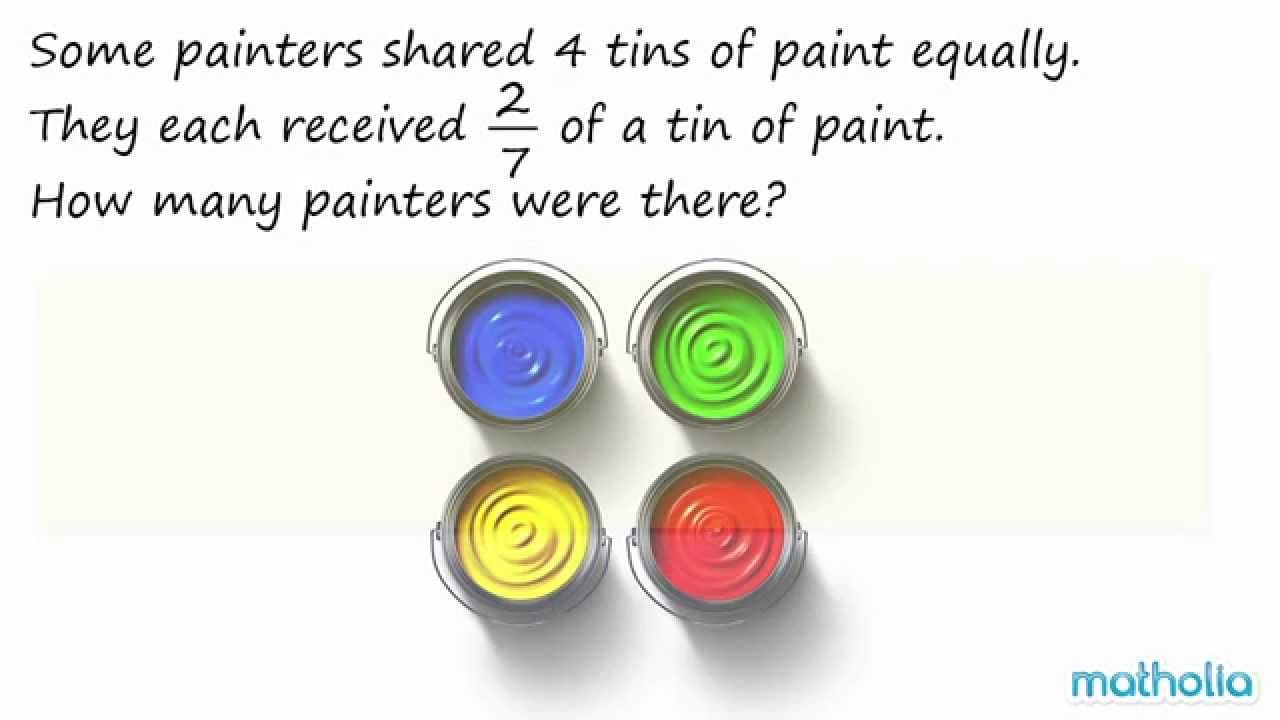
This concise mathematics tutorial demonstrates the specific process of dividing whole numbers by proper fractions using both a real-world context and abstract calculation examples. The video begins by presenting a word problem about painters sharing tins of paint to conceptualize the division operation, visually linking the abstract math to a concrete scenario. It then transitions into the procedural method known as multiplying by the reciprocal (often taught as "keep, change, flip"). The central theme is the algorithmic approach to fraction division. The video explicitly models how to rewrite a division problem as a multiplication problem by "flipping" the fraction (finding the reciprocal). It walks viewers through the steps of converting the whole number into a fraction over one, multiplying numerators and denominators, and simplifying the resulting improper fraction into a whole number. For educators, this video serves as an excellent direct instruction tool or review resource for upper elementary and middle school students learning arithmetic operations with rational numbers. Its step-by-step visual format allows teachers to pause at each stage of the calculation to check student understanding. The inclusion of a word problem at the start is particularly valuable for helping students understand *why* division is used in specific contexts, rather than just memorizing the procedure.

MatholiaChannelMatholiaChannel

1min 40s

Video
How to Calculate a Fraction of a Whole Number

How to Calculate a Fraction of a Whole Number

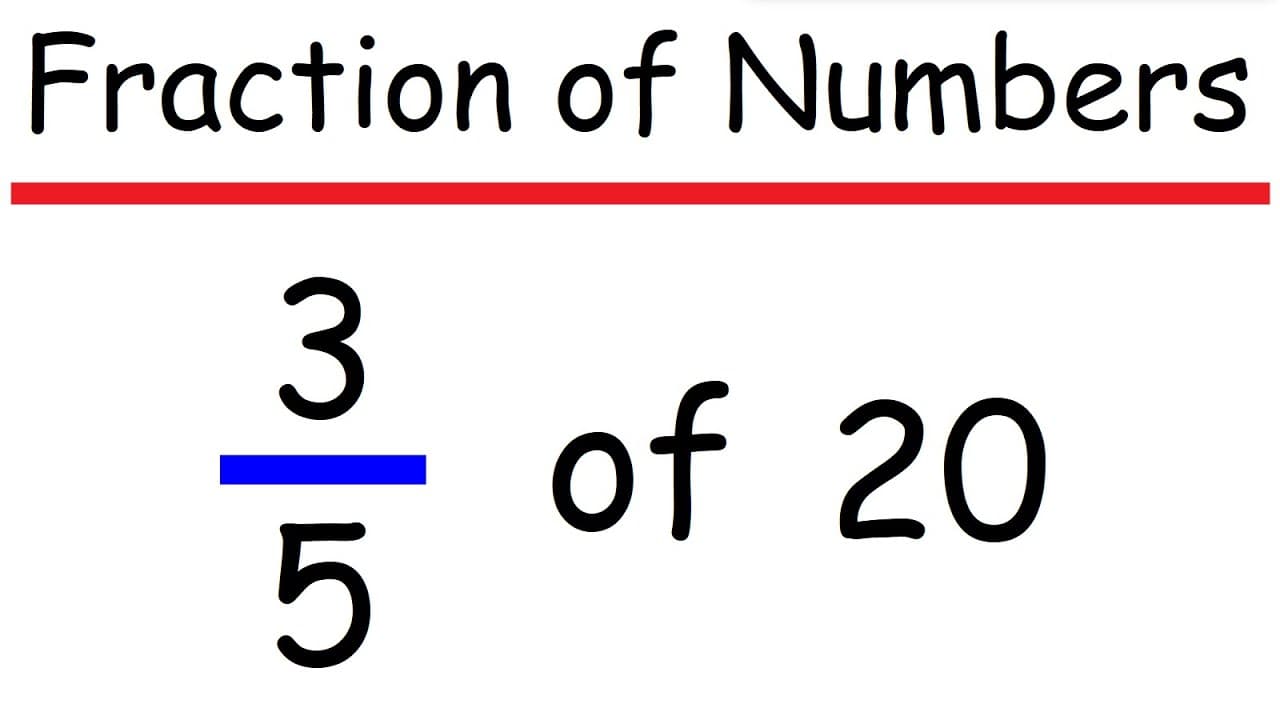
This educational video provides a clear, step-by-step tutorial on how to calculate a fraction of a whole number. The narrator demonstrates two distinct methods for solving these problems: the first involves turning the whole number into an improper fraction over one, multiplying the numerators and denominators across, and then dividing the final result; the second, more efficient method involves simplifying or 'cross-canceling' common factors before multiplying to keep the numbers smaller and more manageable. The video covers four specific examples ranging in difficulty. It begins with basic problems like 3/4 of 8 and 3/5 of 20 to introduce the core algorithm. It then introduces the concept of simplification by breaking numbers down into their factors (e.g., rewriting 20 as 5 x 4) to demonstrate how denominators can cancel out factors in the whole number. The final section provides two practice problems (2/3 of 12 and 5/7 of 28) for viewers to attempt on their own. For educators, this video serves as an excellent instructional tool for 4th through 6th-grade math classes. It directly addresses standards regarding multiplying fractions by whole numbers. Teachers can use it to transition students from visual models of fractions to the standard algorithmic procedure. The inclusion of the 'simplifying before multiplying' strategy is particularly valuable for building number sense and algebraic thinking, preventing students from working with unnecessarily large numbers.

The Organic Chemistry TutorThe Organic Chemistry Tutor

2mins 21s

Video
How to Divide Fractions Using Reciprocals

How to Divide Fractions Using Reciprocals

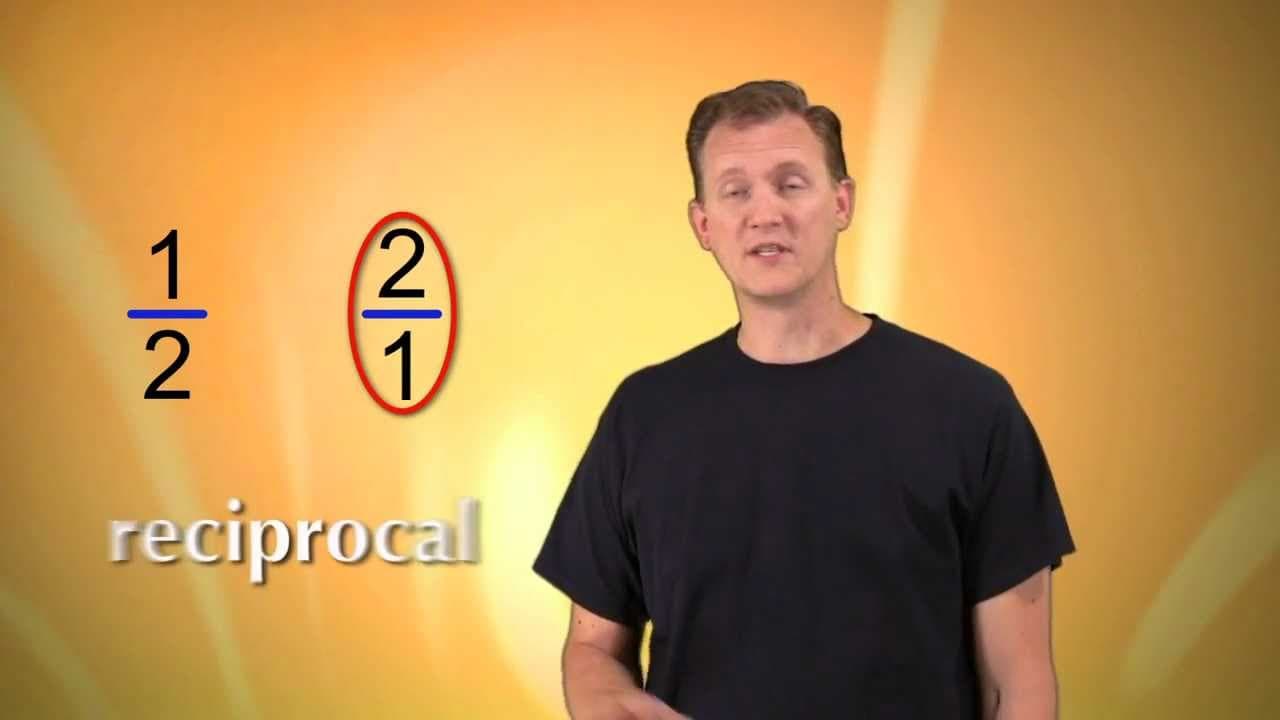
This engaging instructional video from Math Antics demystifies the process of dividing fractions by introducing the concept of reciprocals. The host explains that dividing by a fraction is mathematically equivalent to multiplying by its reciprocal, transforming potentially difficult division problems into straightforward multiplication tasks. The video uses clear graphics and animations to demonstrate how to find a reciprocal by "flipping" the numerator and denominator. The content covers key procedural steps, including rewriting division problems as multiplication problems and executing the calculation. Crucially, it highlights common student errors, such as taking the reciprocal of the wrong fraction (the dividend instead of the divisor). It also introduces "complex fractions"—fractions stacked on top of one another—explaining how to interpret the fraction bar as a division symbol to solve these problems using the same reciprocal method. This video is an excellent resource for upper elementary and middle school mathematics classrooms. It provides a conceptual justification for the standard algorithm (Keep-Change-Flip) rather than just memorization. Teachers can use this video to introduce the topic, remediate struggling students, or anchor a lesson on operations with rational numbers. The visual demonstrations of fractions "flipping" and the step-by-step walkthroughs make it particularly effective for visual learners.

mathanticsmathantics

5mins 13s

Video
How to Simplify Expressions with Rational Exponents

How to Simplify Expressions with Rational Exponents

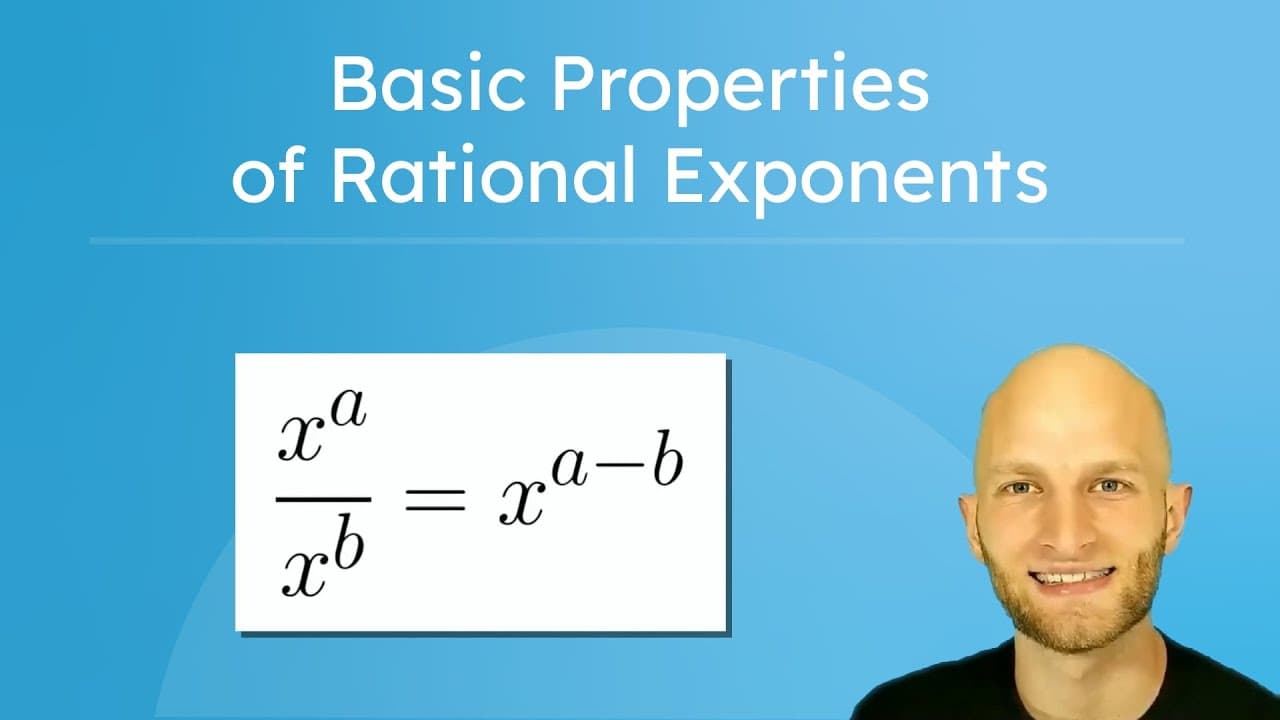
This video provides a clear and structured walkthrough of the four fundamental properties of rational exponents (exponents written as fractions). Hosted by an instructor named Randy, the lesson begins by defining rational exponents and visually presenting the formulas for handling negative exponents, the quotient rule, the product rule, and the power of a power rule. The video uses a digital whiteboard format to demonstrate the theoretical formulas before moving into practical application. The core of the video involves a "match and solve" activity where learners first identify which property applies to specific algebraic expressions and then watch step-by-step solutions for each. Key mathematical themes include rewriting negative exponents, subtracting fractional exponents during division, adding fractional exponents during multiplication (including finding common denominators), and multiplying exponents when raising a power to a power. The instructor explicitly addresses prerequisite skills, such as fraction arithmetic, which are often stumbling blocks for algebra students. For educators, this resource serves as an excellent direct instruction tool or review for Algebra I and Algebra II students. It is particularly useful for scaffolding learning, as it bridges the gap between basic integer exponent rules and more complex fractional ones. The video's segment on finding common denominators offers a natural pause point for reviewing elementary fraction skills within a high school context, making it valuable for remediation as well as initial instruction.

Miacademy & MiaPrep Learning ChannelMiacademy & MiaPrep Learning Channel

8mins 37s

Video
How to Multiply Fractions Using Cancellation to Simplify

How to Multiply Fractions Using Cancellation to Simplify

This concise mathematics tutorial demonstrates the procedural steps for multiplying fractions, emphasizing efficiency through simplification. The narrator begins with a straightforward example of multiplying numerators and denominators directly, then progresses to more complex problems where simplifying before multiplying (cross-canceling) is advantageous. The video explicitly models how to break composite numbers down into their prime factors to identify common terms that can be canceled out, resulting in smaller, more manageable numbers. The key themes explored include basic fraction multiplication, prime factorization, and the strategy of cross-cancellation. The video contrasts the method of multiplying first and simplifying later with the more efficient method of simplifying factors before performing the multiplication. It provides step-by-step visual breakdowns of how to decompose numbers like 9, 6, 12, and 15 into factors to easily identify what can be eliminated. For educators, this video serves as an excellent direct instruction tool or review resource for upper elementary and middle school students. It addresses the common student struggle of dealing with large products in fraction operations by teaching the "cancel first" habit. Teachers can use the built-in pause points where practice problems are displayed to facilitate active learning, allowing students to attempt the math independently before watching the solution modeling.

The Organic Chemistry TutorThe Organic Chemistry Tutor

3mins 5s

Video
Calculating Circumference Using the Radius

Calculating Circumference Using the Radius

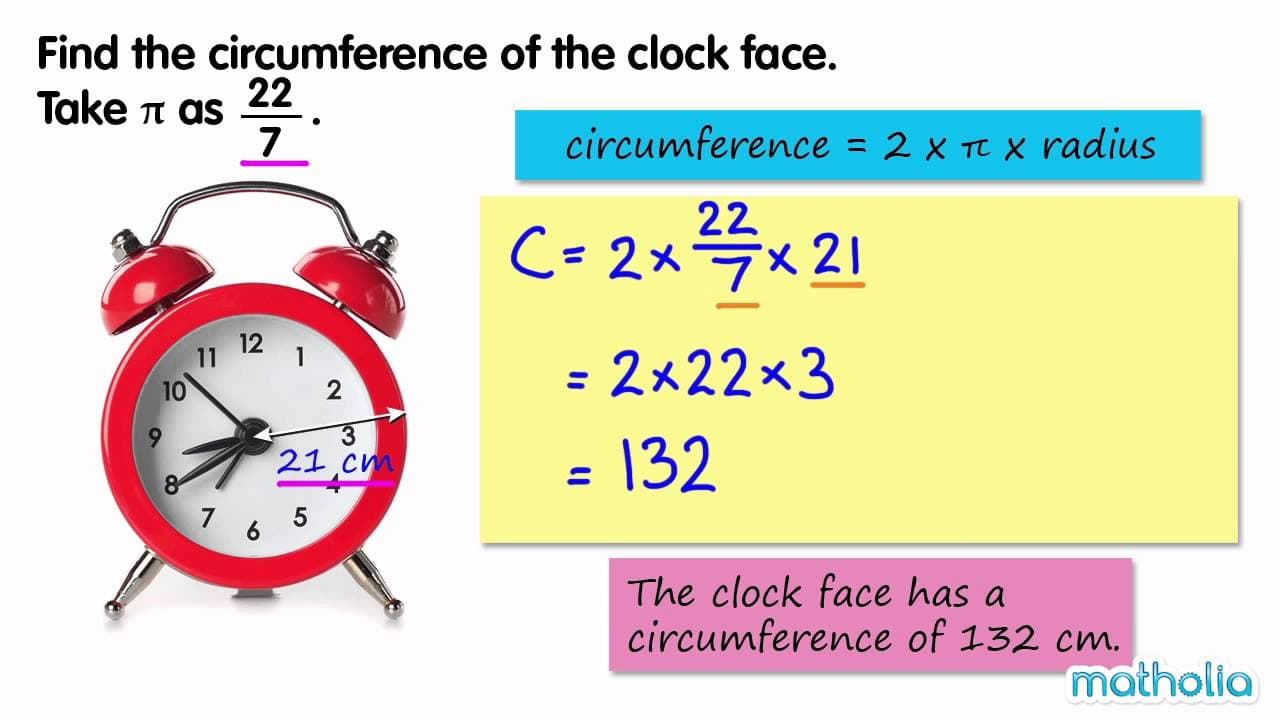
This educational video provides a clear, step-by-step demonstration of how to calculate the circumference of a circle when the radius is known. Through two distinct examples, the video illustrates the application of the formula C = 2 × π × r. The first example uses a real-world object (a clock) and treats Pi as the fraction 22/7, highlighting how to simplify equations with fractions. The second example uses an abstract circle and treats Pi as the decimal 3.14, demonstrating calculation strategies with decimals. The content focuses on core geometry concepts including identifying the radius, recalling the correct formula for circumference, and substituting values into that formula. It specifically addresses mathematical fluency by showing different ways to handle the constant Pi depending on the context or instructions given. The visual layout separates the problem statement from the working out, reinforcing organized mathematical thinking. For the classroom, this video serves as an excellent model for procedural fluency in geometry. It is particularly useful for teaching students how to set up their work, substitute variables, and perform calculations accurately. The contrasting examples help students understand that Pi can be represented in multiple ways and that the choice of representation can sometimes simplify the calculation process, specifically when the radius is a multiple of 7.

MatholiaChannelMatholiaChannel

1min 35s

Video
Algebra 1 Final Exam Review: From Arithmetic to Logarithms

Algebra 1 Final Exam Review: From Arithmetic to Logarithms

This comprehensive video serves as a rapid-fire review of core algebra concepts, ranging from basic arithmetic operations to advanced equation solving. It begins by establishing a foundation with number systems, including real, rational, and imaginary numbers, before moving into fundamental operations with integers, fractions, and decimals. The instructor demonstrates various techniques for arithmetic, such as the number line for integers and the 'keep-change-flip' method for dividing fractions, ensuring viewers have the prerequisite skills for algebra. The content progresses into key algebraic topics including exponents, radicals, and polynomial factoring. Viewers are guided through the laws of exponents, simplifying complex radical expressions, and converting between exponential and radical forms. A significant portion of the video is dedicated to solving different types of equations: linear equations involving fractions, quadratic equations using both factoring and the quadratic formula, and exponential and logarithmic equations. The instructor emphasizes checking for extraneous solutions, particularly with logarithmic and rational equations. This video is an invaluable resource for students preparing for an Algebra 1 final exam or an Algebra 2 placement test. Its modular structure allows teachers to use specific segments for targeted review or as a complete overview of the curriculum. The step-by-step problem-solving approach models mathematical thinking, making it ideal for classroom observation, homework support, or 'flipped classroom' assignments where students review the theory at home and solve problems in class.

The Organic Chemistry TutorThe Organic Chemistry Tutor

12mins 10s

Video
Converting Slope-Intercept to Standard Form Equations

Converting Slope-Intercept to Standard Form Equations

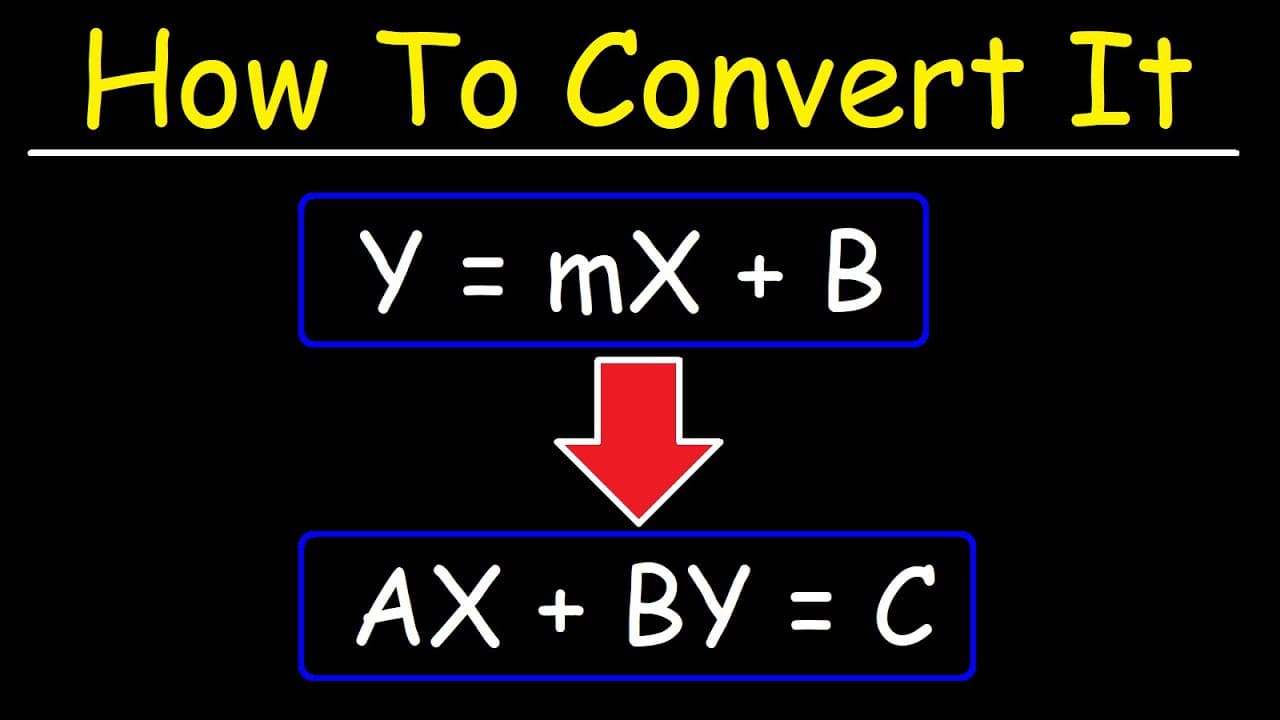
This instructional video provides a comprehensive, step-by-step tutorial on converting linear equations from slope-intercept form ($y = mx + b$) to standard form ($Ax + By = C$). The narrator guides viewers through a progression of problems, starting with simple integer equations and advancing to complex examples involving fractions with unlike denominators. The video emphasizes the algebraic rules required for standard form, specifically ensuring that the $x$ and $y$ variables are on the left side of the equation, the constant is on the right, and that coefficients are integers rather than fractions. Key themes include algebraic manipulation, the properties of equality, finding the least common multiple (LCM) to clear fractions, and the conventions of standard form notation. The video demonstrates specific techniques such as multiplying an entire equation by a denominator to eliminate fractions and multiplying by -1 to ensure the leading coefficient ($A$) is positive, a common requirement in algebra standards. For educators, this resource serves as an excellent tool for differentiating instruction in Algebra I classrooms. It can be used to support students who struggle with fraction operations within algebraic contexts or as a flipped classroom asset. The clear visual work and deliberate pacing allow students to follow the logic of each transformation, making it valuable for remediation, homework support, or exam review regarding linear equations.

The Organic Chemistry TutorThe Organic Chemistry Tutor

12mins 9s

Video
How to Divide Fractions by Whole Numbers

How to Divide Fractions by Whole Numbers

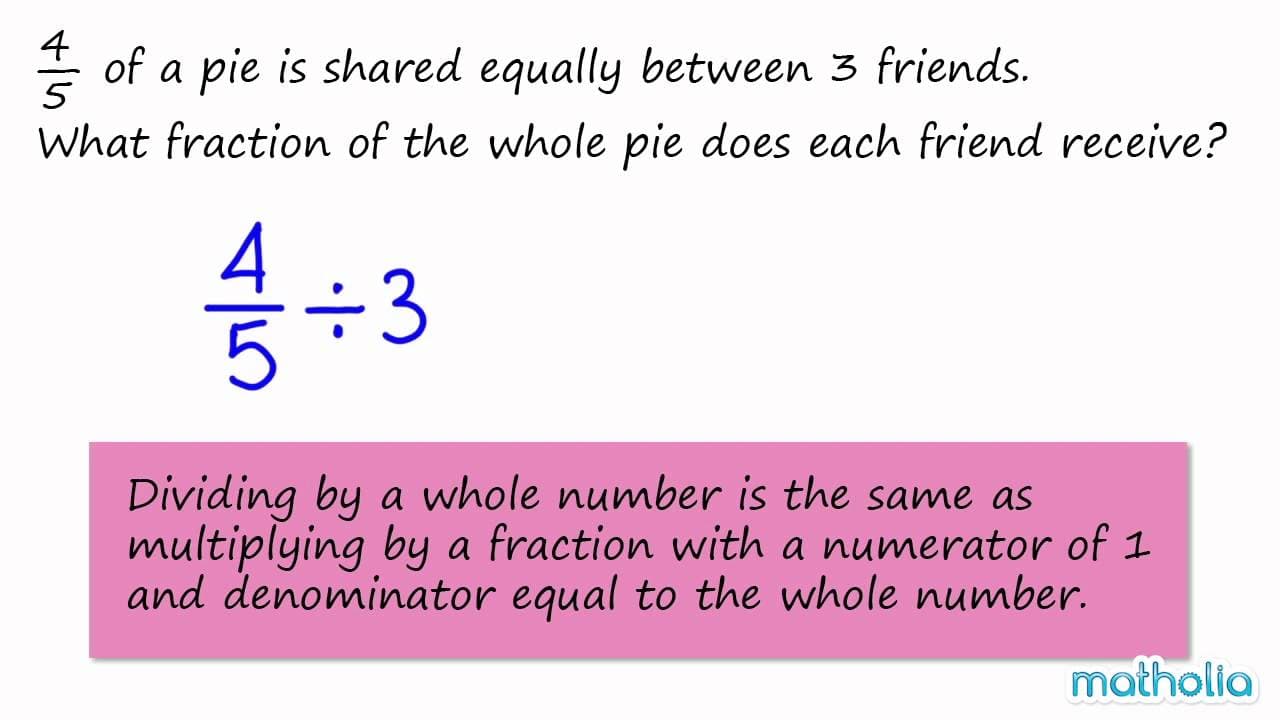
A clear, step-by-step instructional video that demonstrates how to divide proper fractions by whole numbers. The video begins with a relatable word problem involving sharing a pie to ground the concept in reality, using visual bar models to conceptually explain what division looks like in this context. It transitions from visual conceptualization to the standard algorithm, explicitly stating the rule for converting division into multiplication by the reciprocal. The content covers three distinct examples that increase in complexity. The first connects a real-world scenario to the math; the second practices the standard algorithm purely numerically; and the third introduces the additional step of simplifying the resulting fraction. Visual aids, including highlighted text and step-by-step written calculations, make the abstract procedure concrete. This video is highly useful for introducing 5th and 6th-grade students to fraction operations. Teachers can use it to bridge the gap between concrete models (visualizing parts of a whole) and abstract procedures (the algorithm). The clear audio narration and uncluttered visuals make it excellent for direct instruction, remediation, or independent review stations.

MatholiaChannelMatholiaChannel

2mins 20s

Video
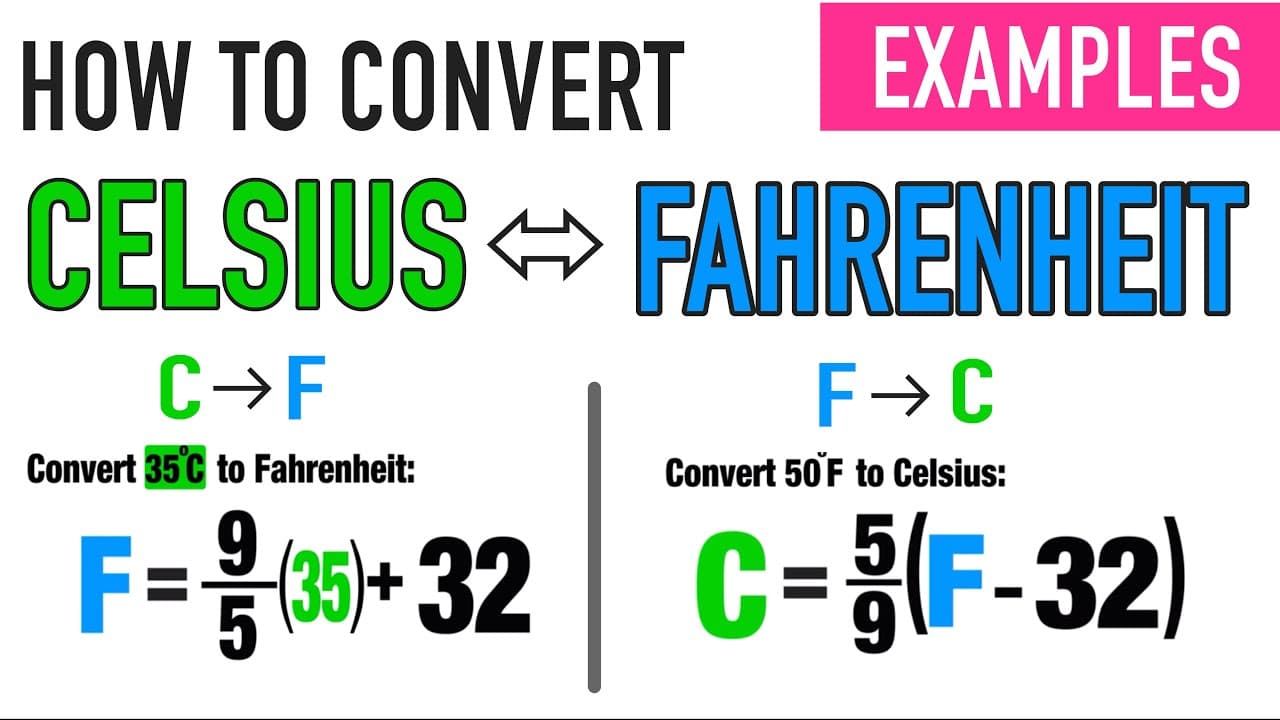
How to Convert Between Fahrenheit and Celsius Temperatures

How to Convert Between Fahrenheit and Celsius Temperatures

This educational video provides a clear, step-by-step guide on how to understand and convert between Fahrenheit and Celsius temperature scales. It begins by establishing the geographical context of where each system is used—highlighting that the United States primarily uses Fahrenheit while the rest of the world uses Celsius. The narrator then demonstrates how to derive the conversion formulas algebraically before walking viewers through specific practice problems for converting temperatures in both directions. The video explores key mathematical themes including algebraic manipulation, the order of operations, and substituting variables into formulas. It explicitly shows how to rearrange the standard Fahrenheit equation to solve for Celsius, providing a practical application of solving literal equations. Additionally, it touches on number sense by comparing how the same numerical value (e.g., 35 degrees) implies vastly different physical conditions depending on the scale used. For educators, this video is an excellent resource for connecting abstract algebra skills to real-world scenarios. It is particularly useful for middle school math and science classrooms introducing temperature, measurement, or introductory algebra. The clear visual derivation of the formulas helps students visualize algebraic steps, while the humorous examples regarding how temperatures "feel" help build conceptual understanding of the two scales.

Mashup MathMashup Math

3mins 11s

Video
How to Divide Fractions Using Cancellation and Keep Change Flip

How to Divide Fractions Using Cancellation and Keep Change Flip

This math tutorial provides a clear, step-by-step demonstration of how to divide fractions using the 'Keep, Change, Flip' algorithm combined with the cancellation method (simplifying before multiplying). The video guides viewers through four examples of increasing complexity, explicitly showing how to factor numbers to identify common terms that can be canceled out to simplify the problem before calculating the final answer. The content focuses on procedural fluency in arithmetic, specifically targeting the 6th-grade standard of dividing fractions by fractions. It introduces the strategy of breaking larger numbers into factors (e.g., rewriting 16 as 8 x 2) to make mental math easier and reduce the likelihood of calculation errors. This approach helps students understand the relationship between numerators and denominators across different fractions when multiplying. For educators, this video serves as an excellent direct instruction tool or review resource. It effectively models mathematical thinking by vocalizing the decision-making process during simplification. The video structure, which includes a 'pause and try' segment, allows it to be used interactively in the classroom for guided practice or independent study stations to reinforce fraction operations.

The Organic Chemistry TutorThe Organic Chemistry Tutor

3mins 46s

Video
How to Simplify Square and Cube Roots

How to Simplify Square and Cube Roots

This educational video provides a clear, step-by-step guide on how to simplify square roots, moving beyond basic perfect squares to more complex, non-perfect numbers. Hosted by a narrator named Justin, the lesson begins by reviewing the inverse relationship between squaring and square roots using familiar perfect squares like 49 and 36. It then introduces the core technique for simplifying non-perfect squares: prime factorization. The video demonstrates how to break numbers down into their prime factors, identify pairs, and "pull them out" of the radical to create a simplified expression. The content covers key algebraic themes including prime factorization, the properties of radicals, and the distinction between rational and irrational numbers. It provides detailed walkthroughs of three specific examples: the square root of 216, the square root of 810, and an extension problem involving the cube root of 250. Through these examples, the video establishes a consistent algorithm: factor the number inside the radical, group identical factors (pairs for square roots, triplets for cube roots), move one representative from each group outside the radical, and multiply the remaining terms. For educators, this video serves as an excellent instructional tool for Algebra I or Pre-Algebra classes. It demystifies a procedural skill that often confuses students by providing a visual and logical method (the pairing strategy) rather than just rote memorization. The clear visual layout, where factors are grouped and moved explicitly, helps students visualize the mathematical operations. It is particularly useful for introducing the concept of exact form versus decimal approximation and prepares students for future topics involving radical operations and variables.

Miacademy & MiaPrep Learning ChannelMiacademy & MiaPrep Learning Channel

5mins 17s

Video
ACT Math Practice Test: Review of Algebra, Geometry, and Trig Concepts

ACT Math Practice Test: Review of Algebra, Geometry, and Trig Concepts

This comprehensive video tutorial serves as an intensive review for the ACT Math section, covering a wide array of topics crucial for high school students preparing for college entrance exams. The content is structured as a series of 31 practice problems that mimic the style and difficulty of actual ACT questions. It progresses through various mathematical domains including pre-algebra, elementary algebra, intermediate algebra, coordinate geometry, plane geometry, and trigonometry. The video adopts a pause-and-practice format, encouraging active participation where viewers attempt each problem before watching the detailed step-by-step solution. Key themes explored in this review include solving linear and quadratic equations, working with functions, understanding geometric properties of polygons and circles, applying trigonometric ratios (SOH CAH TOA) and identities, and analyzing statistical data. The video also places a strong emphasis on real-world application problems involving percentages, sales tax, discounts, and unit conversions. Particular attention is given to algebraic manipulation strategies, such as solving systems of equations and simplifying complex expressions, as well as test-taking tactics like identifying key information in word problems. For educators and students, this video is a valuable resource for standardized test preparation. It allows teachers to identify specific areas of weakness in student understanding by isolating problem types (e.g., if a student struggles with problem 10, they need more support with circle geometry). The step-by-step explanations model clear mathematical reasoning, demonstrating not just *how* to get the right answer, but *why* specific methods work. This makes it an excellent tool for flipped classrooms, homework support, or intensive boot-camp style review sessions prior to test dates.
The Organic Chemistry TutorThe Organic Chemistry Tutor

20mins 33s

Video
Simplifying Radicals and Understanding Rational Exponents

Simplifying Radicals and Understanding Rational Exponents

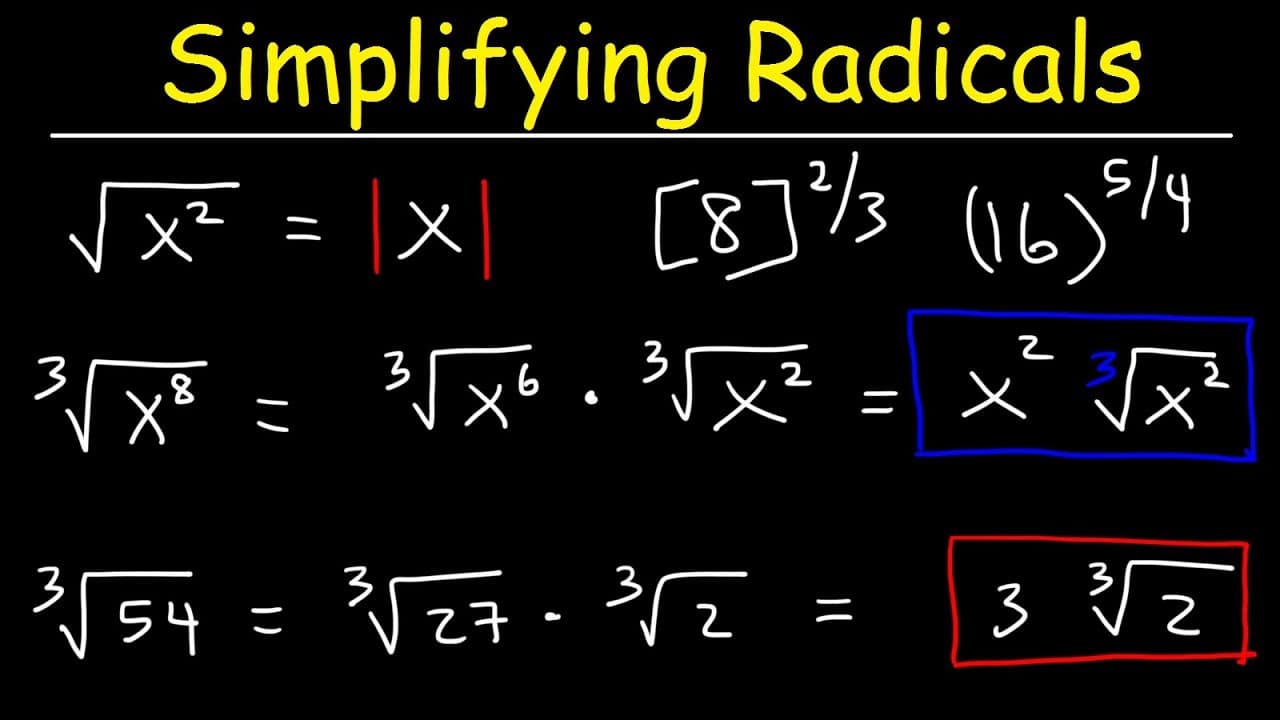
This comprehensive math tutorial guides students through the process of simplifying radicals, starting with basic square roots and progressing to higher-order roots and rational exponents. The video employs a step-by-step approach on a digital whiteboard, clearly demonstrating the algebraic rules governing indices, exponents, and absolute value requirements. It serves as a thorough review of properties of exponents and radicals typically found in Algebra courses. The content covers several key mathematical themes: the relationship between root indices and exponents, the specific condition requiring absolute value notation (even index resulting in an odd exponent), and methods for simplifying non-perfect squares and cubes. It also provides detailed lists of perfect squares and perfect cubes to aid in mental math and simplification. Later sections bridge the gap between radical notation and exponential notation, showing how to convert between the two and evaluate numbers raised to fractional powers. For educators, this video is a valuable resource for reinforcing concepts in Algebra I and Algebra II. It addresses common student pitfalls, such as forgetting the absolute value symbol or struggling with fractional exponents. The clear, isolated examples allow teachers to use specific segments for targeted practice, making it ideal for a flipped classroom model or as a supplementary resource for remediation and test preparation.
The Organic Chemistry TutorThe Organic Chemistry Tutor

17mins 58s

Video
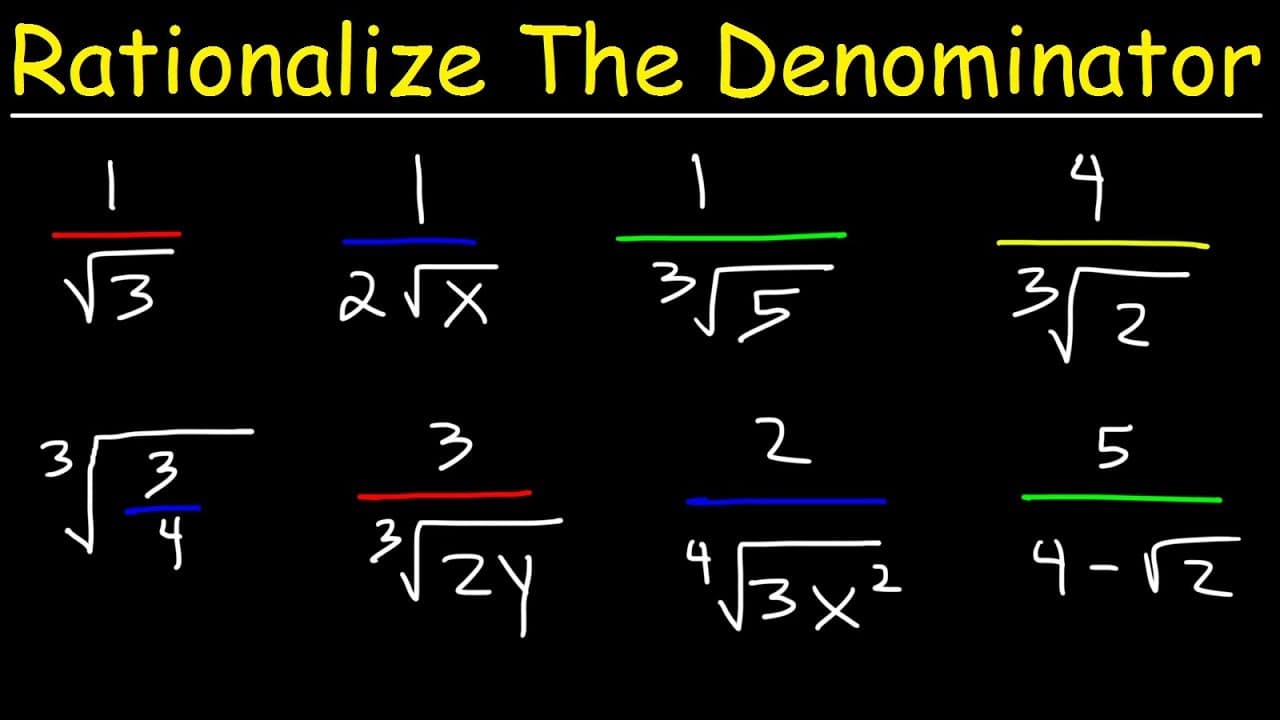
How to Rationalize the Denominator with Radicals and Conjugates

How to Rationalize the Denominator with Radicals and Conjugates

This comprehensive mathematics tutorial provides a step-by-step guide on how to rationalize denominators containing various types of radicals. The video begins with the fundamental concept of eliminating square roots from the denominator by multiplying by the root itself. It progressively advances to more complex scenarios, including fractions with variables, cube roots, and higher-order roots (4th and 7th roots). For these higher indexes, the narrator explains the critical rule of multiplying by a radical where the exponents sum up to the index number to create a perfect power that eliminates the root.

The Organic Chemistry TutorThe Organic Chemistry Tutor

10mins 4s

Video
Algebra 1 Final Exam Review: From Arithmetic to Logarithms

Algebra 1 Final Exam Review: From Arithmetic to Logarithms

This comprehensive video serves as a rapid-fire review of core algebra concepts, ranging from basic arithmetic operations to advanced equation solving. It begins by establishing a foundation with number systems, including real, rational, and imaginary numbers, before moving into fundamental operations with integers, fractions, and decimals. The instructor demonstrates various techniques for arithmetic, such as the number line for integers and the 'keep-change-flip' method for dividing fractions, ensuring viewers have the prerequisite skills for algebra. The content progresses into key algebraic topics including exponents, radicals, and polynomial factoring. Viewers are guided through the laws of exponents, simplifying complex radical expressions, and converting between exponential and radical forms. A significant portion of the video is dedicated to solving different types of equations: linear equations involving fractions, quadratic equations using both factoring and the quadratic formula, and exponential and logarithmic equations. The instructor emphasizes checking for extraneous solutions, particularly with logarithmic and rational equations. This video is an invaluable resource for students preparing for an Algebra 1 final exam or an Algebra 2 placement test. Its modular structure allows teachers to use specific segments for targeted review or as a complete overview of the curriculum. The step-by-step problem-solving approach models mathematical thinking, making it ideal for classroom observation, homework support, or 'flipped classroom' assignments where students review the theory at home and solve problems in class.

The Organic Chemistry TutorThe Organic Chemistry Tutor

12mins 10s

Video
Estimating Square Roots of Non-Perfect Numbers

Estimating Square Roots of Non-Perfect Numbers

This educational math video guides students through the process of finding and estimating square roots for non-perfect square numbers. Hosted by an instructor named Justin and narrated with clear visual aids, the video moves beyond basic perfect squares to explore how to estimate roots for whole numbers, decimals, and fractions using number line logic and proximity. It emphasizes that square roots exist for almost all numbers, not just perfect squares, and demonstrates how to use known perfect squares as benchmarks for estimation. Key themes include number sense, estimation strategies, and the properties of radicals. The video covers using a number line to visualize where a square root falls between two integers, determining which integer a root is closer to based on the original number's value, and a specific "secret trick" for finding square roots of fractions by splitting the root to the numerator and denominator. It also compares solving fraction roots by splitting versus converting to decimals. This video is highly valuable for middle school math classrooms, particularly for introducing irrational numbers and estimation. It helps students build intuition about the magnitude of radicals without immediately reaching for a calculator. The clear breakdown of the fraction property (Quotient Property of Radicals) provides a practical algebraic tool, while the estimation segments support strong mental math skills. The video ends with an inquiry-based challenge prompting students to discover which type of number does not have a real square root.

Miacademy & MiaPrep Learning ChannelMiacademy & MiaPrep Learning Channel

4mins 32s

Video
Approximating Solutions When Algebra Fails

Approximating Solutions When Algebra Fails

This educational video introduces students to the concept of approximating solutions for equations that are difficult or impossible to solve using standard algebraic methods. The narrator demonstrates that while algebraic manipulation often hits a dead end with transcendental equations (mixing exponential, linear, or logarithmic terms), the method of "successive approximations"—essentially an educated guess-and-check strategy—can yield accurate results. The video guides viewers through two main examples: first finding a whole number solution, and then finding a decimal solution rounded to the nearest tenth. Key themes explored include the limitations of algebraic isolation for certain variables, the behavior of exponential versus rational functions, and the logic of "bracketing" a solution between two values (e.g., determining the answer lies between 2 and 3). The video also categorizes specific types of equations that typically require numerical methods, such as those combining polynomials with roots or logarithms. For educators, this video serves as an excellent bridge between standard algebra and numerical analysis or pre-calculus concepts. It is particularly useful for demonstrating why we need alternative solving strategies and helps students develop number sense by estimating function values. It can be used to introduce the concept of intersection points on graphs or as a precursor to learning formal algorithms like the Bisection Method.
Miacademy & MiaPrep Learning ChannelMiacademy & MiaPrep Learning Channel

9mins 33s

Video
Solving Quadratic Equations Using the Quadratic Formula

Solving Quadratic Equations Using the Quadratic Formula

This instructional video serves as a comprehensive guide to understanding and applying the quadratic formula to solve quadratic equations. Hosted by a narrator named Justin, the lesson begins by introducing the formula itself, explaining the specific roles of the coefficients (a, b, and c), and clarifying the meaning of the "plus-minus" symbol. The video contrasts this method with previous, more complicated problem-solving steps, positioning the quadratic formula as a more efficient "shortcut" for finding solutions.
Miacademy & MiaPrep Learning ChannelMiacademy & MiaPrep Learning Channel

7mins 19s

Video
How to Calculate Square and Cube Roots of Fractions and Decimals

How to Calculate Square and Cube Roots of Fractions and Decimals

This educational math tutorial provides a comprehensive guide to evaluating square roots and cube roots involving integers, fractions, and decimal numbers. The video systematically progresses from basic perfect squares to more complex problems involving negative radicands (introducing imaginary numbers) and the specific rules for determining the placement of decimal points when calculating roots of decimal numbers. It utilizes a digital blackboard format where problems are handwritten and solved in real-time.

The Organic Chemistry TutorThe Organic Chemistry Tutor

6mins 51s

Video
Introduction to Radicals and Estimating Square Roots

Introduction to Radicals and Estimating Square Roots

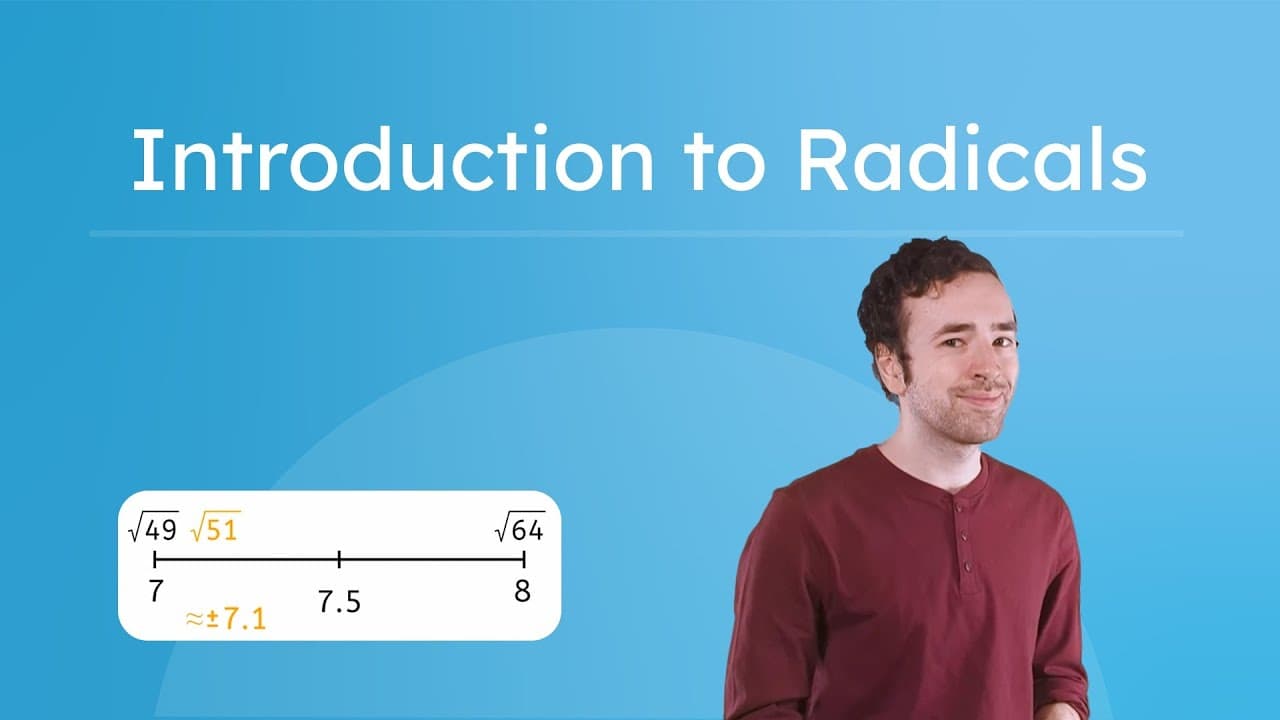
This engaging algebra video introduces students to the concepts of radicals and square roots through a gamified narrative set at "Radical Beach." Hosted by Justin, the video uses a video game storyline where players must solve math challenges to progress through levels, unlock equipment, and catch waves. It seamlessly blends direct instruction with interactive pause points, covering perfect squares, the anatomy of a radical expression, and the existence of both positive and negative roots.

Miacademy & MiaPrep Learning ChannelMiacademy & MiaPrep Learning Channel

15mins 37s

Video
How to Calculate the Area of a Circle

How to Calculate the Area of a Circle

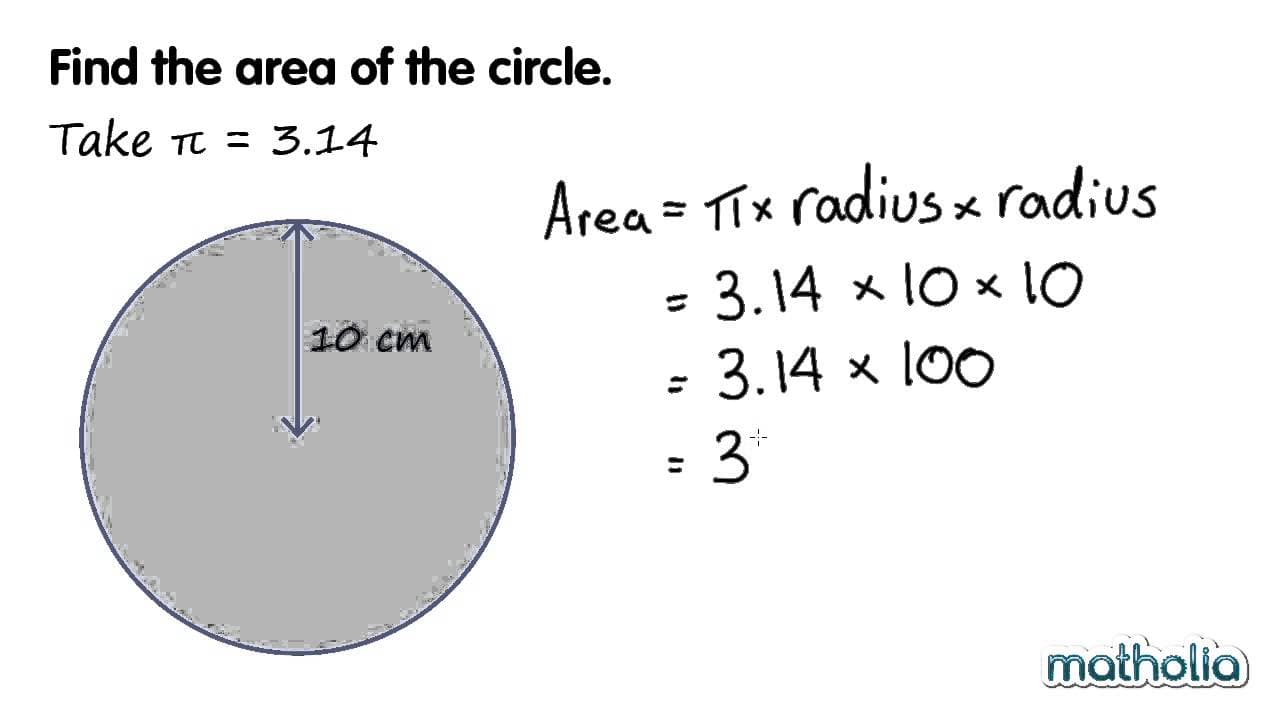
This instructional math video provides a step-by-step guide on calculating the area of a circle when the radius is known. It presents three distinct examples, each utilizing a different representation of Pi (π): first using the fraction 22/7, second using the decimal 3.14, and third expressing the final answer in terms of Pi itself. This variety helps students understand that Pi can be approximated or kept exact depending on the problem's requirements. The video covers key mathematical themes including geometry formulas, substitution of values into equations, multiplication with fractions and decimals, and the importance of including correct units (square centimeters and square meters). It visually demonstrates the simplification process, such as cancelling out common factors in fractions and moving decimal points when multiplying by 100. For educators, this video serves as an excellent modeling tool for 6th and 7th-grade geometry lessons. It breaks down the abstract formula A = πr² into concrete steps: Write the formula, Substitute the values, and Solve. The clear, uncluttered visuals allow teachers to pause at each step to check student understanding or ask for predictions before the calculation is completed on screen.

MatholiaChannelMatholiaChannel

2mins 41s

Video
Combining Rational and Irrational Numbers

Combining Rational and Irrational Numbers

This educational video provides a clear, structured explanation of how rational and irrational numbers interact under basic arithmetic operations. The narrator, Justin, systematically breaks down three scenarios: combining rational with rational numbers, combining rational with irrational numbers, and combining two irrational numbers. Through step-by-step examples and visual aids involving fractions and decimal expansions, the video establishes the rules for each scenario, explaining *why* certain combinations result in rational or irrational outcomes. The content explores key mathematical themes including the definition of rational numbers as fractions, the nature of non-repeating non-terminating decimals, and the unpredictability of operations involving two irrational numbers. It specifically addresses high-level concepts like perfect squares, Euler's number, and algebraic simplification (e.g., cancelling out terms) to demonstrate how irrational components can sometimes resolve into rational results. For educators, this video serves as an excellent core instruction piece for units on the Real Number System. It moves beyond rote memorization of rules by providing conceptual justifications—such as visualizing adding a neat repeating decimal to a chaotic non-repeating one. The video includes built-in practice opportunities with pause points, allowing teachers to check for understanding in real-time before the correct answers and reasoning are revealed.

Miacademy & MiaPrep Learning ChannelMiacademy & MiaPrep Learning Channel

6mins 12s

Video
Solving Quadratic Equations with Imaginary Solutions

Solving Quadratic Equations with Imaginary Solutions

This video tutorial provides a step-by-step guide on solving quadratic equations that result in imaginary (complex) solutions. The instructor demonstrates two different types of problems: simple binomial equations that can be solved by isolating the variable and taking square roots, and trinomial equations that require the quadratic formula because they cannot be factored using integers. The core concept reinforced throughout is the definition of the imaginary unit $i$, where the square root of -1 equals $i$. The lesson explores key algebraic themes including the properties of square roots, the manipulation of negative radicands, and the application of the quadratic formula. It specifically addresses how to handle a negative discriminant (the value under the square root in the quadratic formula) and how to properly format the final complex answer in the standard form $a \pm bi$. The distinction between factorable and non-factorable quadratics is also highlighted as a decision-making step in the problem-solving process. For educators, this video serves as an excellent resource for Algebra 2 or Pre-Calculus units on complex numbers. It offers clear, procedural modeling that helps students transition from real-number solutions to the complex number system. The video can be used to introduce the concept of imaginary roots, reinforce the mechanics of the quadratic formula, or support students who struggle with simplifying radicals containing negative numbers.

The Organic Chemistry TutorThe Organic Chemistry Tutor

8mins 19s

Video
Distinguishing Between Rational and Irrational Numbers

Distinguishing Between Rational and Irrational Numbers

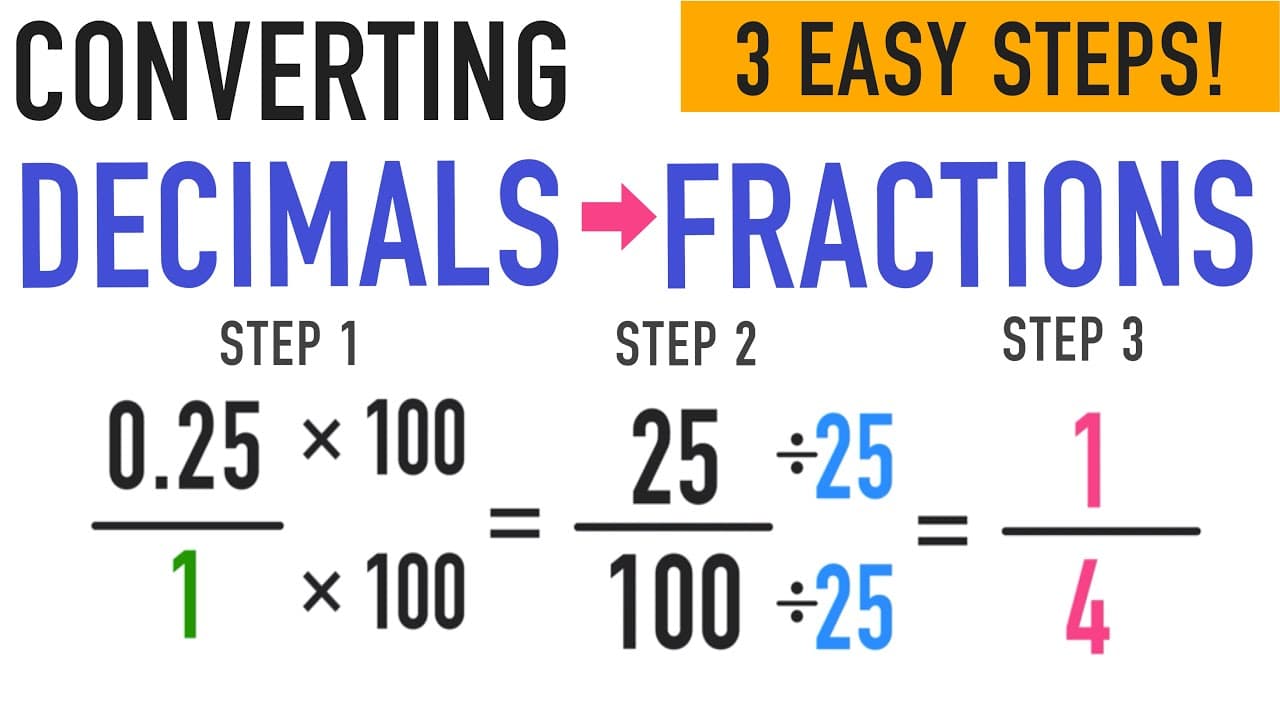
This video serves as a clear and concise tutorial on distinguishing between rational and irrational numbers within the real number system. The narrator systematically defines rational numbers as those that can be expressed as a ratio of two integers, providing concrete examples ranging from simple fractions and integers to terminating and repeating decimals. By contrasting these with irrational numbers—specifically non-terminating, non-repeating decimals like square roots of non-perfect squares, Pi, and Euler's number (e)—the video builds a solid foundational understanding of number classification. The content explores key mathematical themes such as the conversion of decimals to fractions, the nature of infinite series in decimal form, and the definition of integers. It specifically addresses common student stumbling blocks, such as whether negative numbers or repeating decimals count as rational. The visual walkthrough of converting decimals like 0.25 and 0.1717... into fractions helps demystify the relationship between different numerical representations. For educators, this video is a valuable asset for Pre-Algebra and Algebra I classrooms. It can be used to introduce the concept of irrationality, reinforce skills in converting decimals to fractions, or serve as a review tool for the real number system. The step-by-step logic allows teachers to pause and prompt students to predict classifications, making it an interactive resource for clarifying the properties of numbers before diving into more complex arithmetic operations involving radicals.

The Organic Chemistry TutorThe Organic Chemistry Tutor

5mins 54s

Video
Identifying Rational and Irrational Numbers

Identifying Rational and Irrational Numbers

This educational video provides a clear and humorous introduction to the real number system, specifically distinguishing between rational and irrational numbers. The narrator, Justin, breaks down the definition of rational numbers as "ratio-nals"—values that can be expressed as a fraction of integers, including terminating and repeating decimals. He contrasts this with irrational numbers, which cannot be written as simple fractions and appear as non-terminating, non-repeating decimals, with a specific focus on square roots of non-perfect squares. The video uses side-by-side comparisons to test viewers' understanding, presenting increasingly difficult examples to highlight common points of confusion. Key topics include converting decimals to fractions, identifying repeating decimal notation, recognizing perfect squares versus non-perfect squares, and introducing famous irrational constants like Pi and Euler's number (e). The visual presentation reinforces these concepts by explicitly showing the decimal expansions of various numbers. For educators, this resource is an excellent tool for introducing the real number system in Pre-Algebra or Algebra I. It addresses specific student misconceptions, such as the difference between a repeating pattern (rational) and a non-repeating infinite string (irrational). The video's interactive format, where it pauses to ask "which is which?" before revealing the answer, makes it perfect for whole-class instruction or interactive ed-tech assignments.

Miacademy & MiaPrep Learning ChannelMiacademy & MiaPrep Learning Channel

4mins 47s

Video
How to Find the Circumference and Area of Circles

How to Find the Circumference and Area of Circles

This comprehensive math tutorial guides students through the fundamental concepts of circle geometry, focusing on understanding and calculating circumference and area. The video begins by clearly defining the essential parts of a circle, including the center point, radius, and diameter, and explains the mathematical relationship between the radius and diameter. Using a clever animation involving a rolling circle, the narrator visually demonstrates the concept of Pi ($π$) as the ratio between a circle's circumference and its diameter, making an abstract concept concrete and understandable for learners. The video then transitions into practical application, deriving the formulas for circumference ($C = dπ$ or $C = 2πr$) and area ($A = πr^2$). The narrator emphasizes the importance of using the approximation 3.14 for Pi and explains what an irrational number is. Multiple step-by-step examples are worked out on a virtual whiteboard, showing students exactly how to substitute values into formulas and solve for the final answer. The video specifically addresses the common student stumbling block of being given a diameter when the area formula requires a radius. For the classroom, this video is an excellent resource for introducing geometry formulas or reviewing for assessments. It addresses the "why" behind the formulas, not just the "how," particularly with the visual derivation of Pi. Teachers can use the built-in pause points during the example problems to let students attempt calculations before seeing the solution, fostering active learning and immediate feedback.

Miacademy & MiaPrep Learning ChannelMiacademy & MiaPrep Learning Channel

8mins 50s

Video
How to Convert Between Exponential and Radical Forms

How to Convert Between Exponential and Radical Forms

This comprehensive algebra tutorial provides a step-by-step guide on mastering the conversion between exponential forms (using rational exponents) and radical forms. The video begins by introducing the fundamental formula linking fractional exponents to roots and powers, demonstrating how the numerator represents the power and the denominator represents the root index. It systematically progresses from basic examples to more complex scenarios involving negative exponents and decimal exponents, teaching students how to first convert decimals into fractions to solve the problems effectively. The second half of the lesson flips the script, challenging viewers to convert radical expressions back into exponential form. It covers square roots, cube roots, and higher-order roots, while also addressing common notation nuances, such as whether an exponent applies to a single term or an entire expression within a radical. The instructor also demonstrates how to handle variables in the denominator and nested powers. For educators, this video serves as an excellent resource for Algebra 2 or Pre-Calculus units on exponents and radicals. It effectively addresses common student sticking points, such as "where does the negative sign go?" and "how do I handle a decimal exponent like 2.5?" The clear, handwritten examples and pacing allow for a pause-and-practice teaching style, making it suitable for introducing the concept or for review before an exam.

The Organic Chemistry TutorThe Organic Chemistry Tutor

14mins 19s

Video
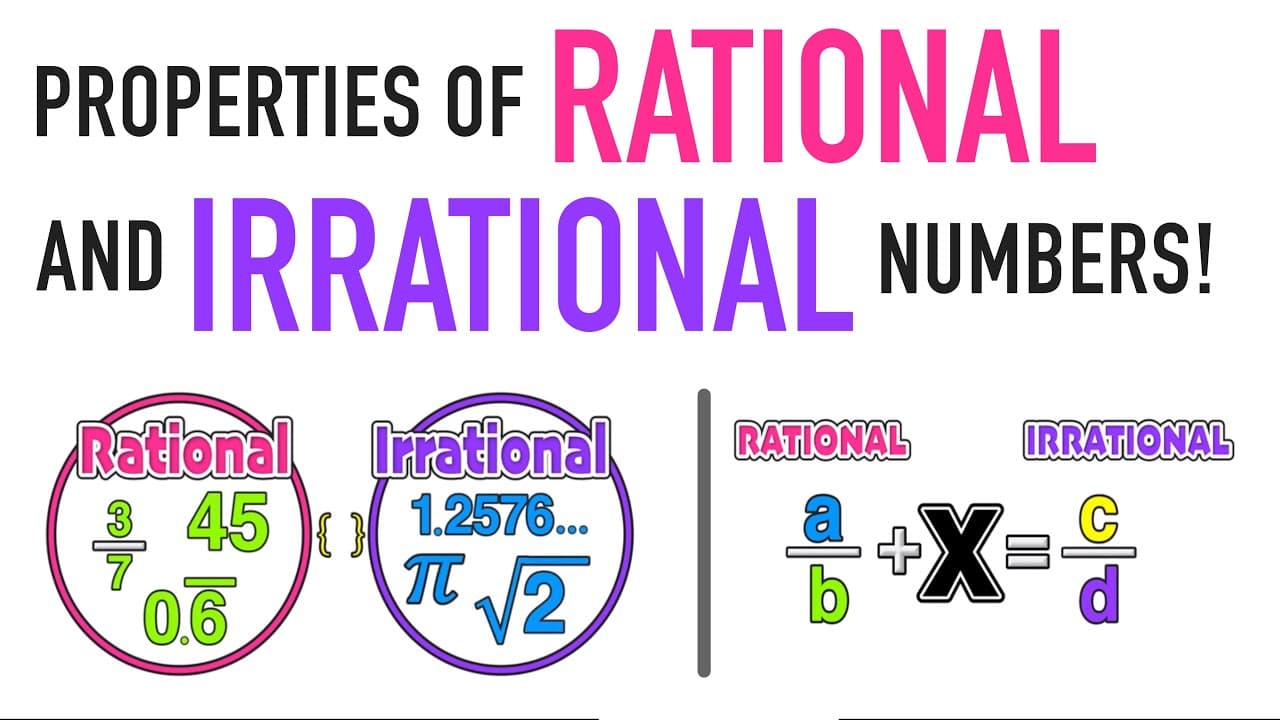
Rational vs. Irrational Numbers: Definitions and Operations Explained

Rational vs. Irrational Numbers: Definitions and Operations Explained

This educational mathematics video provides a comprehensive overview of the Real Number System, specifically focusing on the definitions and properties of rational and irrational numbers. It begins by clearly defining rational numbers as ratios of integers and irrational numbers as non-terminating, non-repeating decimals, using clear visual examples like fractions, whole numbers, and square roots to illustrate these concepts. The video establishes that these two sets are disjoint—a real number cannot be both rational and irrational. The content progresses from definitions to an exploration of arithmetic operations between these number sets. It systematically investigates four key scenarios: the sum of two rationals, the product of two rationals, the sum of a rational and an irrational, and the product of a non-zero rational and an irrational. The video uses both algebraic proofs (including proof by contradiction) and concrete numerical examples to demonstrate why rational numbers are closed under addition and multiplication, while operations mixing rational and irrational numbers yield irrational results. This resource is highly valuable for Algebra and Pre-Algebra classrooms as it addresses specific Common Core standards regarding the properties of rational and irrational numbers. The step-by-step algebraic walkthroughs serve as excellent models for mathematical reasoning and proof writing. Teachers can use this video to introduce the number system, reinforce the concept of closure, or visually demonstrate the logic behind why adding a "clean" fraction to a "messy" non-repeating decimal results in an irrational number.

Mashup MathMashup Math

12mins 21s

Video
How To Classify Real Numbers And The Number System

How To Classify Real Numbers And The Number System

This comprehensive math tutorial provides a deep dive into the classification of the real number system. It begins by distinguishing between real and imaginary numbers, using clear examples involving square roots of negative numbers. The video then breaks down real numbers into two primary categories: rational and irrational numbers, further defining subsets like integers, whole numbers, and natural numbers with specific examples for each.

The Organic Chemistry TutorThe Organic Chemistry Tutor

24mins 46s

Video
How to Rearrange Formulas for Any Variable

How to Rearrange Formulas for Any Variable

In this algebra tutorial, Justin guides students through the process of rearranging common formulas to solve for a specific variable, a skill also known as solving literal equations. The video demonstrates this process using four distinct examples: the area of a triangle, the volume of a cylinder, the Pythagorean theorem, and temperature conversion. Each example introduces slightly more complex algebraic operations, ranging from simple division to handling exponents, square roots, and fraction reciprocals. The video emphasizes that variables in formulas behave just like numbers and can be manipulated using standard algebraic properties. Significant attention is given to common student stumbling blocks, such as how to properly cancel fractions using reciprocals and the misconception that a square root distributes over addition. The narrator uses step-by-step on-screen animations to visualize the isolation of variables. This resource is highly valuable for Algebra I and Geometry classrooms. It connects abstract algebraic manipulation to real-world contexts like architecture and science, helping students understand why rearranging formulas is a necessary skill in various professions. It serves as an excellent introduction or review for lessons on literal equations, inverse operations, and formula manipulation.

Miacademy & MiaPrep Learning ChannelMiacademy & MiaPrep Learning Channel

7mins 48s

Video
How to Write Equations for Parallel and Perpendicular Lines

How to Write Equations for Parallel and Perpendicular Lines

This instructional video provides a comprehensive tutorial on writing equations for lines that are either parallel or perpendicular to a given line and pass through a specific point. The narrator systematically walks through six distinct examples, increasing in complexity from simple integer slopes to fractional slopes. Two primary methods are demonstrated for finding these equations: using the slope-intercept form ($y = mx + b$) to solve for the y-intercept, and using the point-slope form ($y - y_1 = m(x - x_1)$) to write the equation directly before converting it.

The Organic Chemistry TutorThe Organic Chemistry Tutor

11mins 57s

Video
Algebra 1 Final Exam Review: From Arithmetic to Logarithms

Algebra 1 Final Exam Review: From Arithmetic to Logarithms

This comprehensive video serves as a rapid-fire review of core algebra concepts, ranging from basic arithmetic operations to advanced equation solving. It begins by establishing a foundation with number systems, including real, rational, and imaginary numbers, before moving into fundamental operations with integers, fractions, and decimals. The instructor demonstrates various techniques for arithmetic, such as the number line for integers and the 'keep-change-flip' method for dividing fractions, ensuring viewers have the prerequisite skills for algebra. The content progresses into key algebraic topics including exponents, radicals, and polynomial factoring. Viewers are guided through the laws of exponents, simplifying complex radical expressions, and converting between exponential and radical forms. A significant portion of the video is dedicated to solving different types of equations: linear equations involving fractions, quadratic equations using both factoring and the quadratic formula, and exponential and logarithmic equations. The instructor emphasizes checking for extraneous solutions, particularly with logarithmic and rational equations. This video is an invaluable resource for students preparing for an Algebra 1 final exam or an Algebra 2 placement test. Its modular structure allows teachers to use specific segments for targeted review or as a complete overview of the curriculum. The step-by-step problem-solving approach models mathematical thinking, making it ideal for classroom observation, homework support, or 'flipped classroom' assignments where students review the theory at home and solve problems in class.

The Organic Chemistry TutorThe Organic Chemistry Tutor

12mins 10s

Video
How to Calculate Percentage Increase Using Word Problems

How to Calculate Percentage Increase Using Word Problems

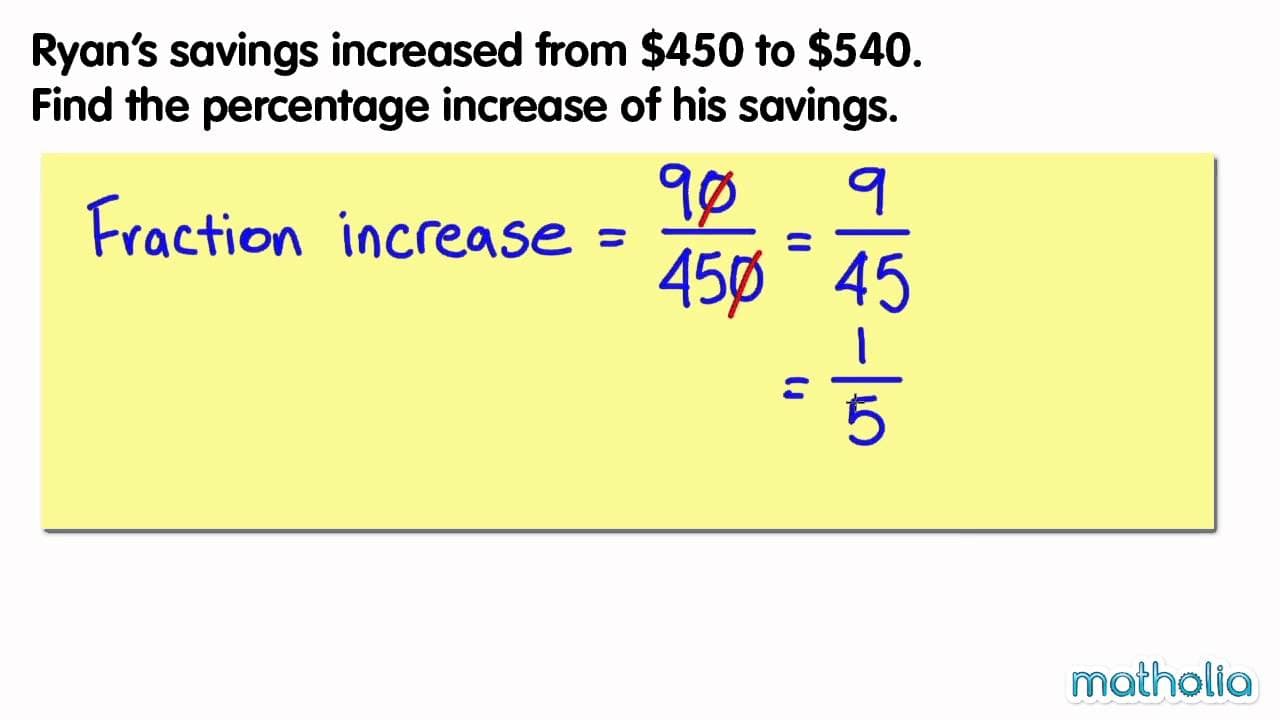
This educational video provides a clear, step-by-step tutorial on calculating percentage increase through three distinct word problems. It utilizes a consistent and pedagogical methodology: finding the numerical difference between the new and old values, expressing that difference as a fraction of the original value, and then converting that fraction into a percentage. The video employs visual bar models in the initial examples to help students conceptually understand the relationship between the original amount and the increase before moving into abstract numerical calculations. The key themes explored include interpreting word problems, subtraction to find differences, simplifying fractions, and converting fractions to percentages using equivalent fractions with a denominator of 100. The progression of examples—from a bakery scenario to personal savings and finally athletic performance—demonstrates the versatility of this mathematical concept across different real-world contexts. For the classroom, this video is an excellent resource for introducing or reinforcing the concept of percentage change. It models a specific strategy (finding a denominator of 100) that reinforces fraction fluency and number sense, rather than just teaching a formulaic algorithm like "multiply by 100." Teachers can use this to bridge the gap between fractions and percentages and to show students how to structure their working out for multi-step word problems.

MatholiaChannelMatholiaChannel

3mins 9s

Video
Understanding Slope Using Rise Over Run and Roller Coasters

Understanding Slope Using Rise Over Run and Roller Coasters

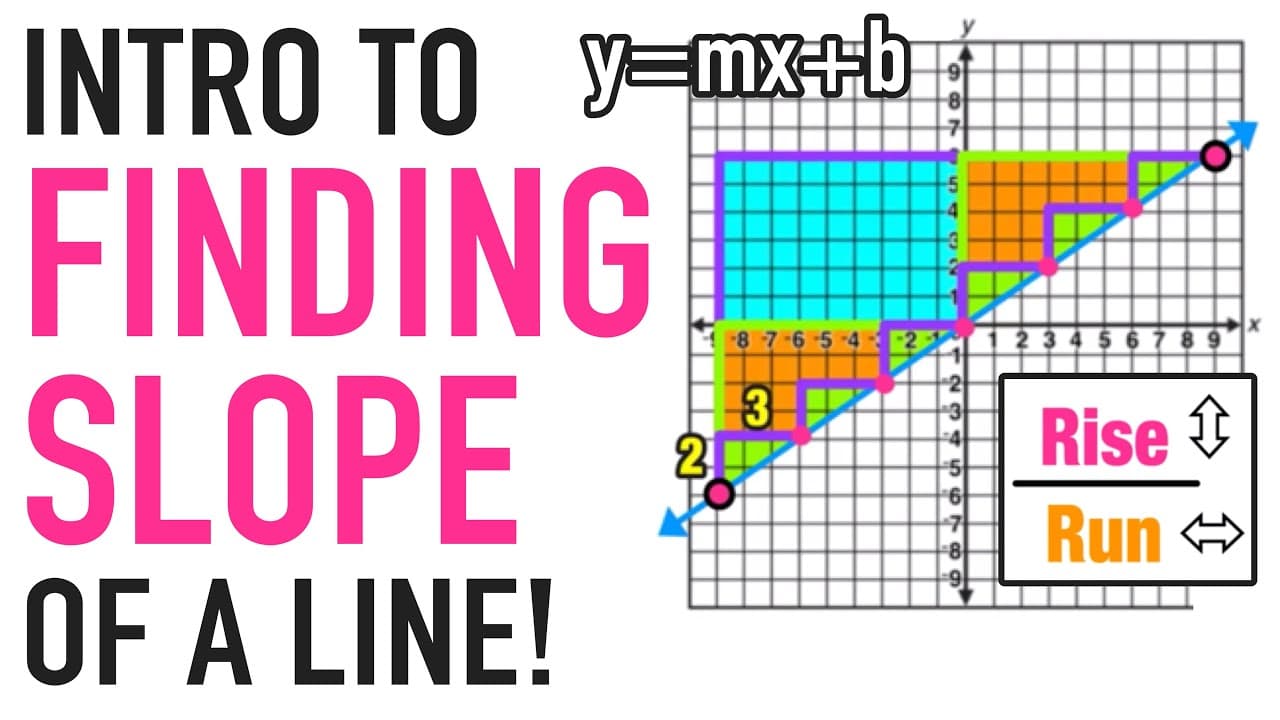
This engaging mathematics video introduces students to the concept of slope using a relatable roller coaster analogy before transitioning to the coordinate plane. It simplifies the abstract idea of slope by breaking it down into two understandable components: direction (positive or negative) and steepness (rate of change). The video effectively uses visual cues, such as POV roller coaster footage and animated diagrams, to help students visualize how lines rise or fall as they move from left to right. The content covers key topics essential for pre-algebra and algebra students, including distinguishing between positive and negative slopes, the formula "Rise over Run," and how to calculate slope from a graphed line. It places significant emphasis on the procedural steps of counting grid units to determine the rise and run between two points and demonstrates why simplifying the resulting fraction is crucial. The video provides clear examples of both positive integer slopes and negative fractional slopes. For educators, this video serves as an excellent hook for a unit on linear functions or as a reinforcement tool for struggling learners. It bridges the gap between real-world physical experiences and mathematical abstraction, making it easier for students to grasp why slope represents a rate of change. The step-by-step walkthroughs of practice problems on coordinate grids provide a model for students to follow when solving their own problems, making it a practical resource for direct instruction or flipped classroom settings.

Mashup MathMashup Math

6mins 50s

Video
Mastering Linear Equations: From Two-Step to Complex Multi-Step Problems

Mastering Linear Equations: From Two-Step to Complex Multi-Step Problems

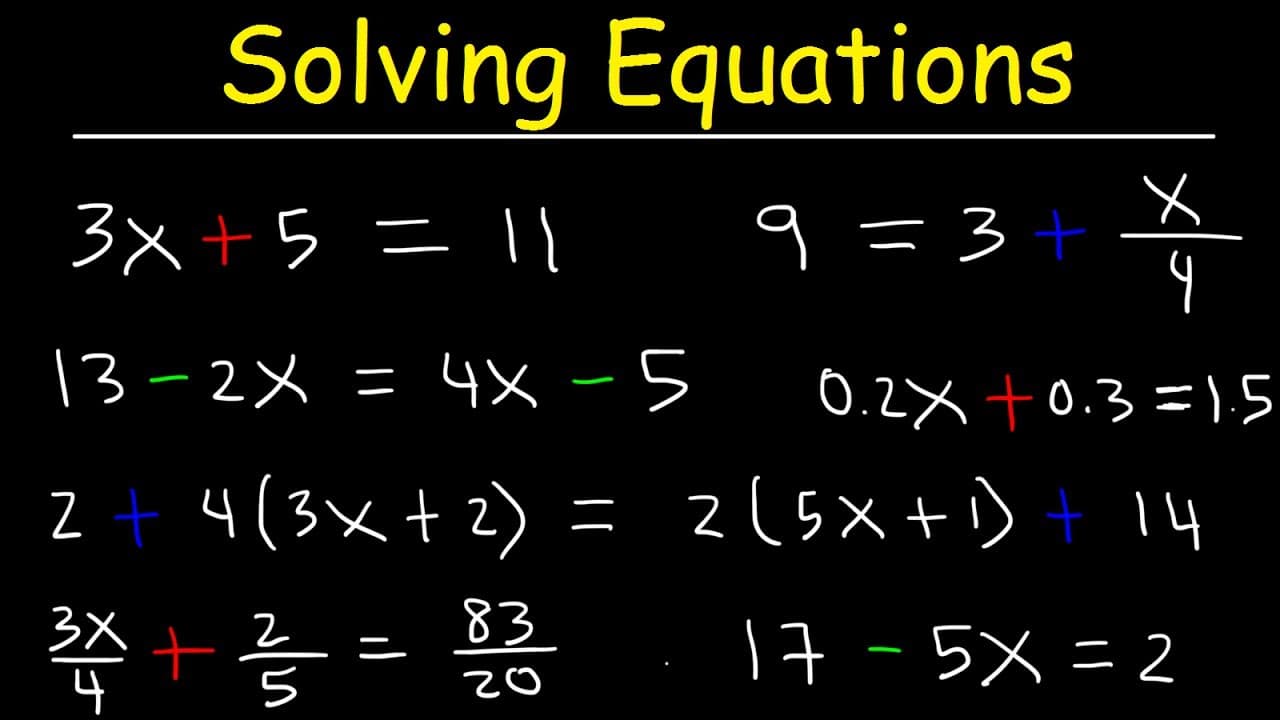
A comprehensive, step-by-step tutorial on solving linear equations, ranging from basic two-step equations to complex multi-step problems. The video adopts a "watch and try" approach, encouraging viewers to pause the video, attempt practice problems, and then watch the solution to verify their work. The instructor uses a clear digital blackboard format to demonstrate algebraic methods including inverse operations, combining like terms, and the distributive property. The content is structured progressively, beginning with isolating variables in simple equations like '3x + 5 = 17'. It advances to more challenging scenarios such as variables on both sides of the equal sign, equations requiring the distributive property with parentheses, and problems involving fractions and decimals. Special attention is given to strategies for clearing denominators and eliminating decimals to simplify calculations. This resource is highly valuable for algebra students and teachers as a tool for differentiation and independent practice. Teachers can use specific segments to reteach concepts (e.g., clearing fractions) or assign the video for flipped classroom learning. The abundance of worked examples allows students to see the repetition of logical steps required to solve equations, reinforcing procedural fluency.

The Organic Chemistry TutorThe Organic Chemistry Tutor

25mins 5s

Video
How to Divide Decimals by Multiples of Ten

How to Divide Decimals by Multiples of Ten

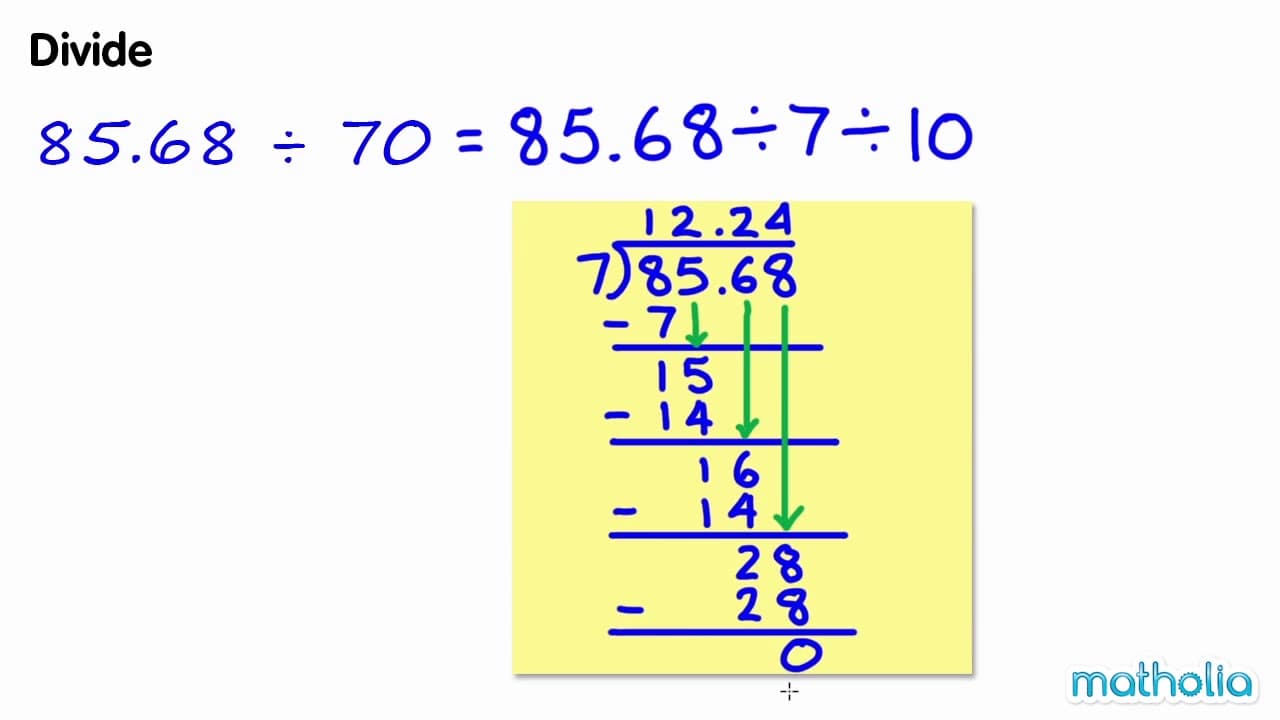
This math tutorial demonstrates a strategic method for dividing decimals by multiples of ten (e.g., 30, 70). The video breaks down the process into two manageable steps: first dividing by the single-digit factor (e.g., 3 or 7) using long division, and then dividing by 10 by shifting the decimal point. Two complete examples are worked through step-by-step, providing a clear visual model for students to follow. The video explores key themes of decomposing numbers, understanding place value, and using the properties of division to simplify complex problems. It reinforces the concept that dividing by a multiple of ten is equivalent to sequential division by its factors. The visual representation of long division on a 'sticky note' graphic helps isolate the calculation steps from the conceptual steps. For educators, this video serves as an excellent instructional tool for 5th and 6th-grade math classrooms. It offers an alternative strategy to standard long division with two-digit divisors, which can often be overwhelming for students. By decomposing the divisor, the method simplifies the mental load and reinforces the 'powers of ten' rules for decimal shifting, making it a valuable resource for building both procedural fluency and conceptual understanding.

MatholiaChannelMatholiaChannel

2mins 10s

Video
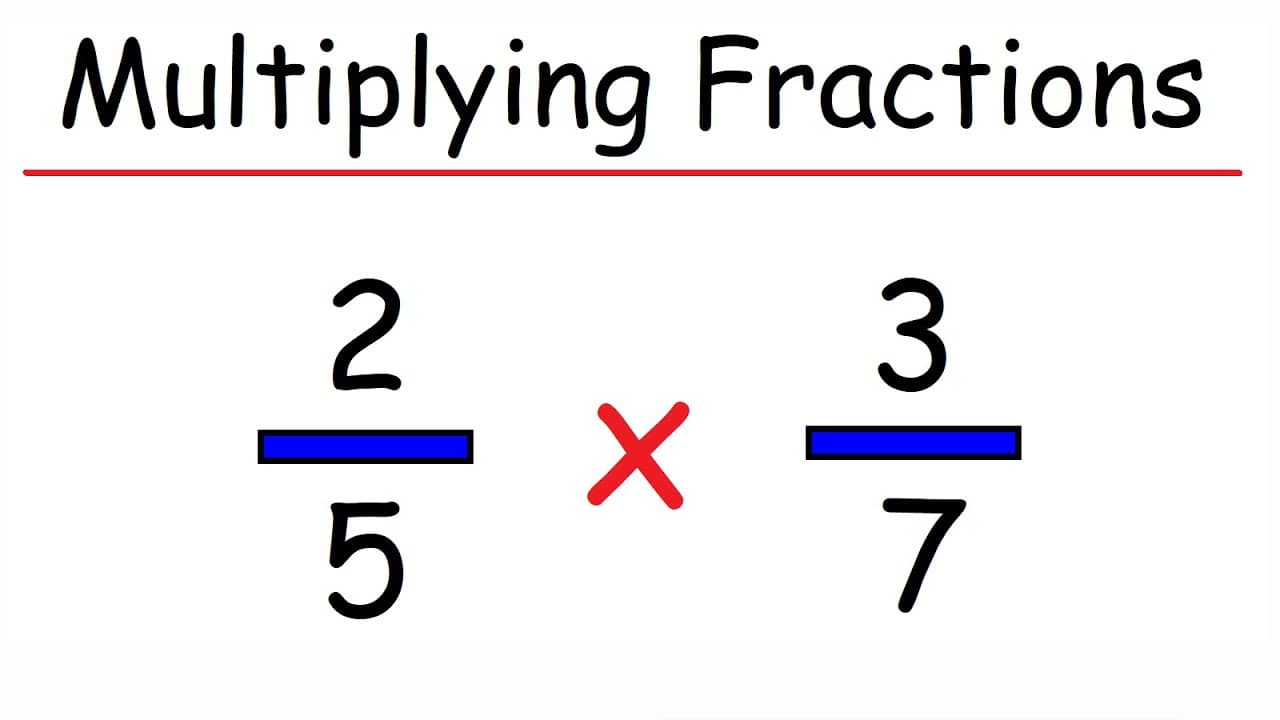
Multiplying and Simplifying Fractions Explained

Multiplying and Simplifying Fractions Explained

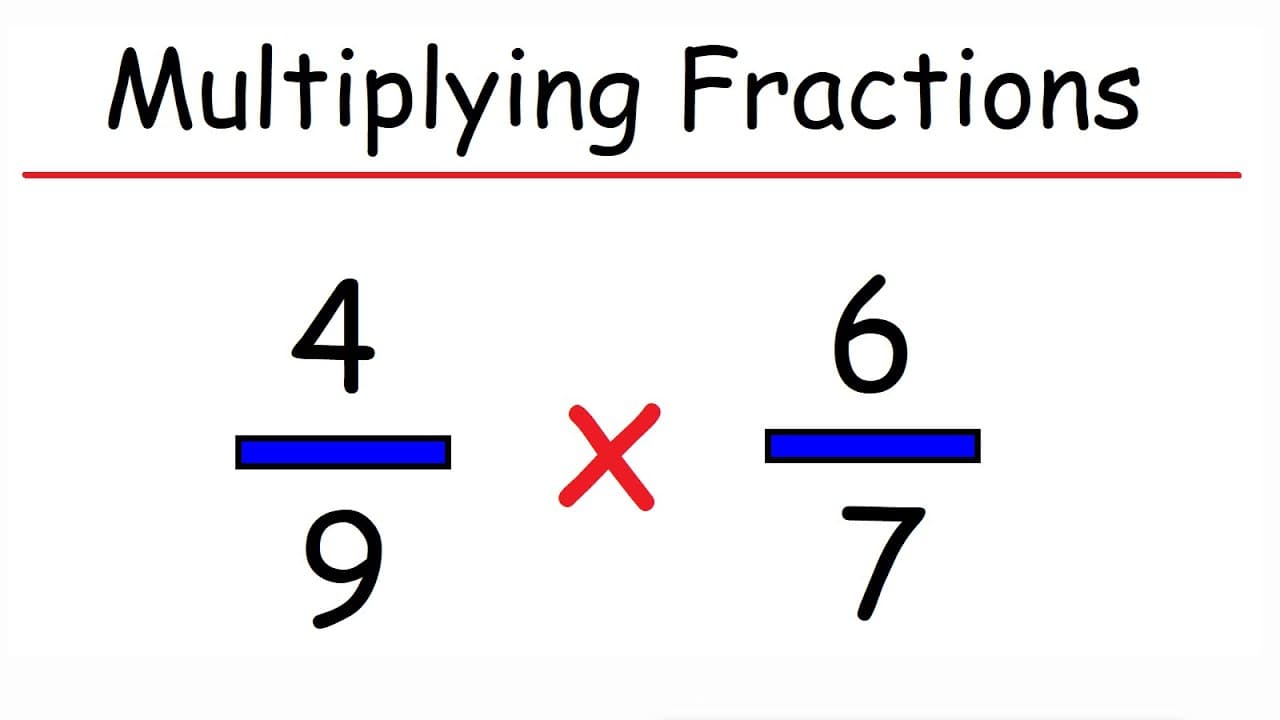
This concise mathematics tutorial demonstrates the procedural steps for multiplying two fractions together. Using a digital whiteboard format, the narrator walks viewers through three distinct examples that increase in complexity. The video focuses on the fundamental rule of "multiplying across"—multiplying numerators together and denominators together—rather than finding common denominators. The content covers basic multiplication of proper fractions and introduces the critical step of simplifying fractions (reducing to lowest terms) in the final example. It specifically demonstrates how to recognize even numbers in the numerator and denominator as a cue for simplification by dividing by two repeatedly until the simplest form is reached. This resource is highly valuable for introducing or reviewing fraction operations in upper elementary and middle school classrooms. Its clear, uncluttered visual style makes it excellent for students who get distracted by busy animations. Teachers can use it to anchor a lesson on operations with rational numbers, as a homework support tool, or as a quick refresher before tackling more complex topics like mixed number multiplication.

The Organic Chemistry TutorThe Organic Chemistry Tutor

1min 31s

Video
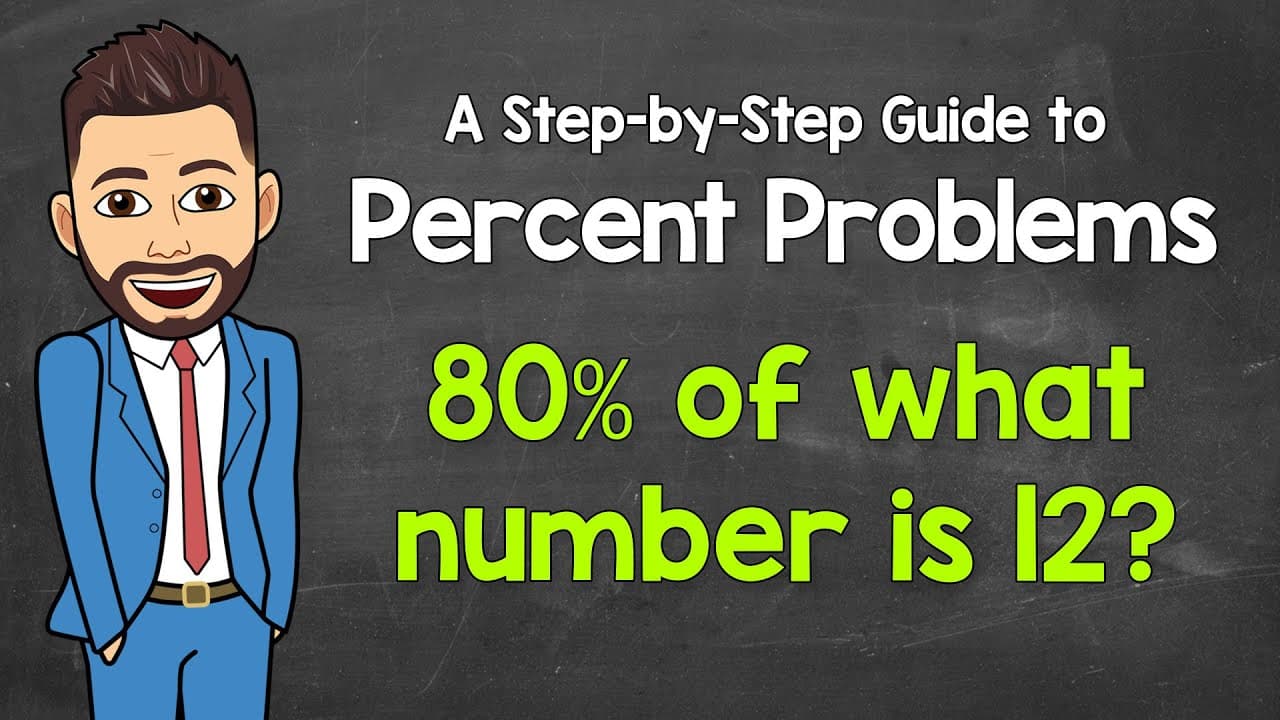
Mastering the Percent Equation Step-by-Step

Mastering the Percent Equation Step-by-Step

A comprehensive, step-by-step mathematics tutorial that teaches students how to solve various types of percent problems using the percent equation (Percent w Whole = Part). The video is methodically structured into three distinct sections, covering how to find the 'whole' when given a part and percent, how to find the 'part' given a whole and percent, and how to calculate the 'percent' when given the part and whole. Each section includes two detailed examples that demonstrate the procedural math involved, including long division and decimal multiplication.

Math with Mr. JMath with Mr. J

27mins 36s

Video
How to Solve Geometric Sequences with Negatives and Fractions

How to Solve Geometric Sequences with Negatives and Fractions

This educational math video explores advanced concepts in geometric sequences, moving beyond simple positive whole numbers to examine sequences involving negative numbers and fractions. The narrator, Justin, guides viewers through three distinct examples that demonstrate how common ratios can result in alternating signs or decreasing values. The video addresses the common confusion students face when numbers don't simply get "bigger" in a multiplicative pattern, introducing algebraic methods to find the common ratio definitively.

Miacademy & MiaPrep Learning ChannelMiacademy & MiaPrep Learning Channel

3mins 11s

Video
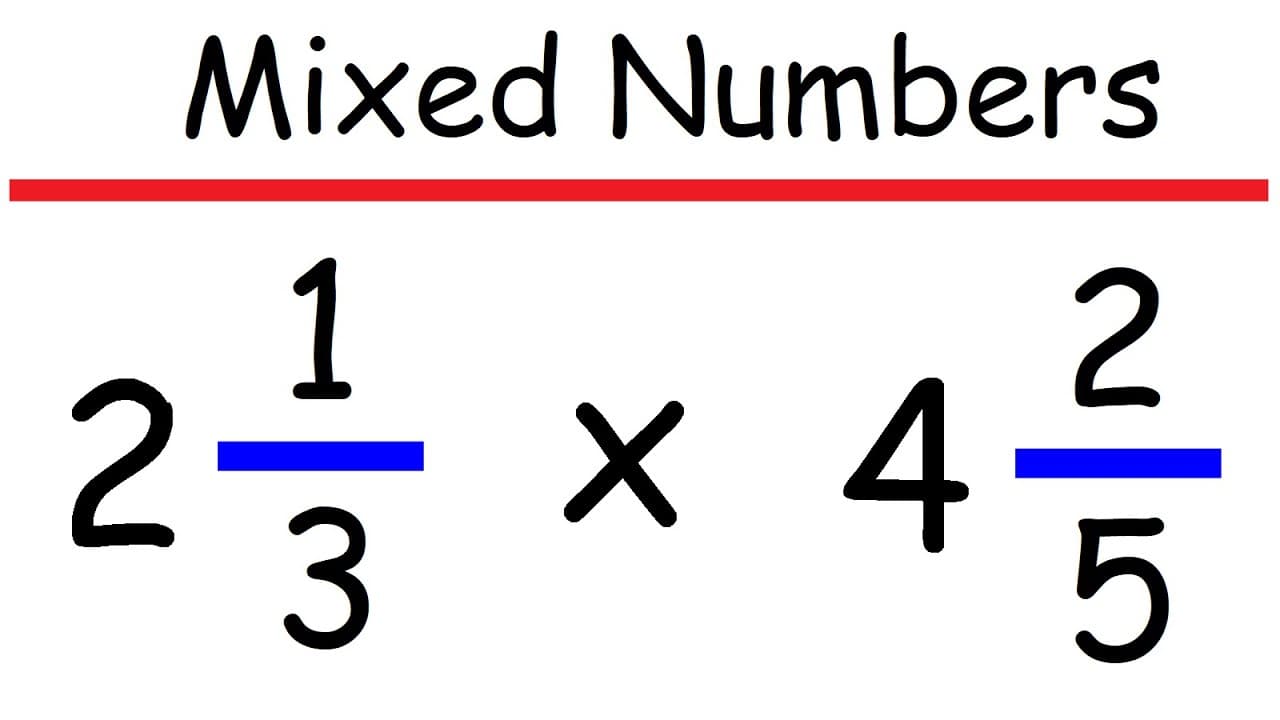
How to Multiply Mixed Numbers with Examples

How to Multiply Mixed Numbers with Examples

This instructional video provides a clear, step-by-step tutorial on how to multiply two mixed numbers. The narrator guides viewers through two distinct examples, demonstrating the standard algorithm which involves converting mixed numbers into improper fractions, multiplying the numerators and denominators across, and then converting the resulting improper fraction back into a simplified mixed number. The video emphasizes procedural fluency and mental math strategies to solve these multi-step arithmetic problems. Key themes explored include operations with rational numbers, the relationship between mixed numbers and improper fractions, and multi-digit multiplication. The video specifically breaks down the intermediate calculation steps, such as using the distributive property to multiply 7 by 22 mentally and performing standard vertical multiplication for 13 by 17. It also demonstrates division strategies by listing multiples to convert large improper fractions back to mixed numbers. For educators, this video serves as an excellent direct instruction tool or review resource for upper elementary and middle school students. It models mathematical thinking by vocalizing the internal monologue required to solve these problems, such as checking multiples and breaking down complex multiplication. It effectively addresses the common student struggle of organizing the multiple steps required in fraction operations, making it valuable for remediation or flipped classroom assignments.

The Organic Chemistry TutorThe Organic Chemistry Tutor

5mins 24s

Video
How to Calculate Percent Increase and Decrease

How to Calculate Percent Increase and Decrease

This instructional math video guides viewers through the step-by-step process of calculating percent change, covering both percent increases and decreases. The narrator, Mr. J, utilizes a clear formula—subtracting the original value from the new value, dividing by the original value, and multiplying by 100—to determine the percentage of change. The video systematically works through four distinct examples, ranging from simple integer changes to more complex problems involving decimals and rounding. Key themes include the importance of order of operations when setting up the formula, interpreting positive and negative results as increases or decreases respectively, and the technical skill of converting decimals to percentages. The video also addresses special cases, such as percent increases exceeding 100% and scenarios requiring rounding of long decimal answers. The visual aid of a digital blackboard helps students follow the handwritten calculations in real-time. For educators, this resource serves as an excellent tool for introducing or reinforcing the concept of percent change in middle school math curriculums. It provides a reliable procedural model that students can mimic. Teachers can use this video to support lessons on ratios and proportional relationships, specifically standard 7.RP.A.3, by having students pause after each problem setup to perform the calculation themselves before watching the solution.

Math with Mr. JMath with Mr. J

10mins 55s

Video
Calculating Percent Decrease Step-by-Step

Calculating Percent Decrease Step-by-Step

A clear, step-by-step mathematics tutorial explaining how to calculate percent decrease. The video introduces the standard formula for finding percent of change: subtracting the old value from the new value to find the amount of change, dividing that difference by the original value, and multiplying by 100 to convert the decimal to a percentage. The instructor, Mr. J, demonstrates this process through two distinct examples involving integer values that result in decimal percentages. He explicitly addresses how to handle negative numbers in the numerator, explaining that the negative sign signifies a "decrease." He also shows two valid ways to express the final answer: as a negative percentage or as a positive percentage labeled with the word "decrease." This resource is highly valuable for middle school math classrooms covering ratios, proportions, and percentages. It specifically targets common student errors, such as dividing by the wrong number, by emphasizing the rule to "always divide by the old or original number." The procedural focus makes it an excellent tool for direct instruction, remediation, or homework support.

Math with Mr. JMath with Mr. J

4mins 39s

Video
How to Calculate Percent Increase Step-by-Step

How to Calculate Percent Increase Step-by-Step

This concise instructional video guides viewers through the mathematical process of calculating percent increase. Using a clear blackboard style, the instructor, Mr. J, demonstrates the specific formula for finding percent change: subtracting the original value from the new value, dividing by the original value, and then multiplying by 100. The video focuses on a single concrete example where a value rises from 16 to 28, allowing for a focused step-by-step walkthrough of the calculation. The video explores key mathematical themes including the order of operations for percent change formulas, decimal-to-percent conversion, and the importance of identifying the correct denominator (the original value). It explicitly distinguishes between percent increase and decrease based on whether the difference is positive or negative, though this specific example yields a positive result. The visual demonstration includes handwriting the math steps in real-time, reinforcing the procedural flow. For educators, this video serves as an excellent direct instruction tool or review resource for units on Ratios and Proportional Relationships. It effectively breaks down a multi-step process that often confuses students—specifically which number to divide by. Teachers can use this to flip the classroom, support struggling learners with a repeatable model, or anchor a lesson on financial literacy (markups) or data analysis (population growth).

Math with Mr. JMath with Mr. J

3mins 25s

Video
Solving Percent Problems Using Proportions

Solving Percent Problems Using Proportions

This educational video provides a comprehensive tutorial on solving percent problems using the percent proportion method. The instructor introduces the fundamental formula `Part / Whole = Percent / 100` and offers a helpful mnemonic device involving the keywords "is" and "of" to identify the part and the whole in word problems. The video systematically demonstrates how to set up algebraic proportions to solve for missing variables in three different scenarios: finding the percentage, finding the part, and finding the whole (or base). The content explores key mathematical themes including ratios, proportional reasoning, cross-multiplication, and solving basic linear equations. It addresses specific nuances, such as interpreting problems where the part is larger than the whole (resulting in percentages greater than 100%) and understanding the relationship between fractional parts and percentages. The instructor uses a black screen digital whiteboard to clearly write out equations and steps, making the mathematical process visible and easy to follow. For educators, this video serves as an excellent resource for scaffolding lessons on percentages and algebra. The step-by-step examples allow for a "pause-and-practice" teaching model, where students can attempt problems before seeing the solution. The clear distinction between the three types of percent problems helps students categorize and approach word problems systematically, building their confidence in translating English sentences into mathematical equations.

The Organic Chemistry TutorThe Organic Chemistry Tutor

12mins 44s

Video
Mastering Metric Mass: Converting Kilograms to Grams

Mastering Metric Mass: Converting Kilograms to Grams

This educational video provides a clear, step-by-step tutorial on converting mass measurements from kilograms to grams within the metric system. Using a real-world example of a pineapple weighing 2.12 kilograms, the narrator demonstrates how to calculate the equivalent mass in grams by multiplying by 1,000. The video explicitly visualizes the mathematical shortcut of shifting the decimal point three places to the right, showing how to handle placeholders when necessary. The content focuses on two key mathematical competencies: understanding the relationship between metric units (1 kg = 1,000 g) and the procedural skill of multiplying decimals by powers of ten. After the initial word problem, the video provides two additional abstract practice problems—converting 3.07 kg and 0.5 kg—to reinforce the concept of adding zeros as placeholders during the conversion process. For educators, this video serves as an excellent visual aid for teaching decimal operations and measurement conversions. The clear animation of the decimal point "jumping" helps demystify the abstract concept of multiplication by 1,000. It is particularly useful for visual learners who struggle with mental math or place value concepts, offering a reliable strategy that can be applied to any metric conversion involving kilo- prefixes.

MatholiaChannelMatholiaChannel

1min 39s

Video
Practice Multiplying Decimals: A 6-Problem Mastery Check

Practice Multiplying Decimals: A 6-Problem Mastery Check

This video serves as an interactive "Mastery Check" for 5th-grade students learning to multiply decimals. Unlike a passive instructional lesson, this resource is designed as a practice session where students are presented with six problems ranging from basic single-digit decimal multiplication to complex multi-digit calculations involving decimals. The narrator, Mr. J, guides students to pause the video, solve the problems independently using paper and pencil, and then resume the video to check their work against his step-by-step explanations. The content focuses on the standard algorithm for multiplication, emphasizing the strategy of temporarily "removing" decimals to treat the factors as whole numbers, and then "placing" the decimal back into the final product based on the total count of decimal places in the factors. The problems progress in difficulty, starting with tenths multiplied by tenths and culminating in a three-digit by three-digit multiplication problem involving tenths and hundredths. Procedural fluency, including the correct use of placeholder zeros and column alignment, is demonstrated throughout. For educators, this video is an ideal tool for formative assessment or independent practice stations. It encourages self-regulated learning by allowing students to monitor their own understanding and receive immediate, specific feedback on their calculation methods. The visual breakdown of the solutions helps students identify exactly where they might have made an error—whether it was a basic multiplication fact mistake, a placeholder zero error, or a misconception regarding decimal placement.

Math with Mr. JMath with Mr. J

7mins 29s

Video
How to Convert Fractions to Decimals Using Long Division

How to Convert Fractions to Decimals Using Long Division

This instructional math video provides a step-by-step tutorial on converting fractions into decimals using the long division method. The narrator demonstrates three distinct examples ranging in difficulty: a simple conversion (1/5), a standard conversion (1/4), and a more complex conversion involving multiple decimal places (5/8). For each problem, the video explicitly models how to set up the division bracket, emphasizing the critical rule of placing the numerator inside the bracket (as the dividend) and the denominator outside (as the divisor). The video explores key mathematical themes including the relationship between fractions and division, place value, and the concept of remainders. A significant portion of the instruction focuses on procedural fluency strategies, such as adding a decimal point and zeros to the dividend to continue dividing when the divisor is larger than the dividend. The video also introduces a helpful scaffolding strategy where the narrator lists the multiples of the divisor on the side of the screen to assist with estimation during the division process. For educators, this video serves as an excellent direct instruction tool or remediation resource for students struggling with the algorithm of long division. The visual layout, which uses a high-contrast black background with clear white handwriting, minimizes distractions and focuses attention on the procedural steps. The explicit modeling of writing out multiples (multiplication tables) on the side is particularly valuable for students who may struggle with mental math, offering them a concrete strategy to improve accuracy.

The Organic Chemistry TutorThe Organic Chemistry Tutor

4mins 50s

Video
How to Add, Subtract, Multiply, and Divide Decimals

How to Add, Subtract, Multiply, and Divide Decimals

This educational math video provides a comprehensive review of the four basic operations with decimals: addition, subtraction, multiplication, and division. The instructor, Mr. J, walks viewers through four distinct practice problems, dedicating one problem to each operation. He explicitly models the step-by-step procedures required for each, emphasizing common student stumbling blocks such as lining up decimal points during addition and subtraction, using placeholder zeros, and correctly placing the decimal point in the final answer for multiplication and division. A key pedagogical feature of this video is the instructor's insistence on checking the reasonableness of answers through estimation. After solving each problem algorithmically, he pauses to round the original numbers and performs a mental calculation to ensure the final result makes sense. This reinforces critical thinking habits over rote memorization of algorithms. The visual style is clear and focused, utilizing a digital chalkboard format where the operations are written out in real-time, allowing students to follow the handwritten process exactly as they would on their own paper. This resource is highly valuable for upper elementary and middle school classrooms as a revision tool or a flipped classroom resource. It effectively addresses the distinct rules for decimal placement across different operations—a common source of confusion for learners. Teachers can use this video to differentiate instruction, allowing students who struggle with specific operations to review just those segments, or as a whole-class refresher before a unit test on rational number operations.

Math with Mr. JMath with Mr. J

10mins 55s

Video
Finding What Percent One Number Is of Another

Finding What Percent One Number Is of Another

This engaging math tutorial breaks down the specific skill of calculating a percentage when given a part and a whole (e.g., "What percent is 20 of 50?"). The video begins by reviewing the relationship between parts, totals, and percentages, establishing that a percentage is simply a ratio out of 100. It categorizes percentage problems into three distinct types—finding a part, finding a percent, and finding a total—and explicitly focuses on the second type for this lesson. The video explores two primary methods for solving these problems. The first method involves using equivalent fractions to scale the denominator to 100, which works well for "friendly" numbers. The second, more universal method involves treating the fraction as a division problem to find a decimal, then converting that decimal to a percentage. The narrator uses humorous skits involving family members giving gifts (travel souvenirs and cookies) to provide concrete word problems that illustrate the math concepts. For educators, this video serves as an excellent bridge between fractions, decimals, and percents. It is particularly useful for helping students transition from simple scaling strategies to the more robust division method required for real-world numbers. The clear visualization of the "Part / Total = Percent" structure helps demystify word problems, while the distinction between the three types of percent questions provides a solid framework for algebraic thinking in middle school math.

mathanticsmathantics

8mins 28s

Video
How to Solve Percent Word Problems Using Equations

How to Solve Percent Word Problems Using Equations

This math tutorial by "Math with Mr. J" provides a clear, step-by-step demonstration of how to solve real-world percent problems using the percent equation (percent x whole = part). The video specifically tackles a word problem that asks students to determine what percentage of a high school's total student body is comprised of seniors. It walks viewers through the entire process: identifying the known and unknown variables, calculating the total population to find the "whole," setting up the algebraic equation, and performing the necessary inverse operations to solve for the missing percentage. The video explores key mathematical themes including algebraic reasoning, variable isolation, and data interpretation from lists. It emphasizes the importance of understanding the relationship between the "part," the "whole," and the "percent." Additionally, it covers practical arithmetic skills such as summing multiple values to find a total, performing division to isolate a variable, converting a decimal result into a percentage by moving the decimal point, and rounding to the nearest whole number. For educators, this video serves as an excellent instructional tool or review resource for units on ratios, proportional reasoning, and percentages. Its visual approach—using a digital chalkboard and color-coded text—helps students focus on the structure of the equation. Teachers can use this video to model how to extract relevant information from word problems (like realizing the "whole" must be calculated by adding up all class sizes) and to reinforce the procedure for converting decimals to percentages in a meaningful context.

Math with Mr. JMath with Mr. J

4mins 56s

Video
Mastering Rational Inequalities: Steps and Solutions

Mastering Rational Inequalities: Steps and Solutions

This instructional video provides a comprehensive guide to solving rational inequalities, a core topic in advanced algebra. The lesson begins by distinguishing between rational equations, which typically have a finite number of solutions, and rational inequalities, which possess infinite solutions within specific intervals. The narrator introduces a structured four-step process for solving these problems: altering the inequality to set one side to zero, factoring to identify boundary points, testing intervals on a number line, and writing the final solution set using inequality notation. The video walks through two detailed examples that cover different scenarios. The first example demonstrates how to handle an inequality that is already set to zero, focusing on factoring quadratics and determining whether boundary points are included (closed circles) or excluded (open circles). The second, more complex example shows how to manipulate an inequality with fractions on both sides by finding a common denominator and combining terms before solving. The narrator emphasizes the critical rule that values making the denominator zero are never included in the solution set. Teachers can use this video to introduce the algebraic method for solving rational inequalities or as a review tool for students struggling with sign analysis. The visual representation of the number line and the step-by-step testing of points helps demystify the abstract concept of solution intervals. The clear distinction between numerator roots (which can be included) and denominator roots (which are always excluded) addresses a common student misconception directly.

Miacademy & MiaPrep Learning ChannelMiacademy & MiaPrep Learning Channel

19mins 32s

Video
How to Convert Decimals to Fractions Using a 3-Step Method

How to Convert Decimals to Fractions Using a 3-Step Method

This instructional video provides a clear, step-by-step guide on how to convert terminating decimals into fractions. Using a systematic 3-step process, the video demonstrates the mathematical procedure of rewriting the decimal with a denominator of 1, multiplying by powers of 10 to remove the decimal point, and finally simplifying the resulting fraction to its lowest terms. The content is presented visually with on-screen text and animations, making it suitable for visual learners. The video explores key mathematical themes including rational numbers, place value, and fraction simplification. It specifically focuses on the relationship between the number of decimal places and the power of 10 required for conversion (e.g., two decimal places requires multiplying by 100). Two complete examples are worked through in detail: converting 0.25 into 1/4 and converting 0.375 into 3/8. For educators, this video serves as an excellent direct instruction tool or review resource for upper elementary and middle school math students. It breaks down a multi-step algorithmic process into manageable chunks, making it ideal for students who struggle with the mechanics of conversion. The clear visual distinction between steps helps scaffold learning, allowing teachers to pause and check for understanding before moving to the simplification phase.

Mashup MathMashup Math

4mins 17s

Video
How to Rationalize the Denominator with Radicals and Conjugates

How to Rationalize the Denominator with Radicals and Conjugates

This comprehensive mathematics tutorial provides a step-by-step guide on how to rationalize denominators containing various types of radicals. The video begins with the fundamental concept of eliminating square roots from the denominator by multiplying by the root itself. It progressively advances to more complex scenarios, including fractions with variables, cube roots, and higher-order roots (4th and 7th roots). For these higher indexes, the narrator explains the critical rule of multiplying by a radical where the exponents sum up to the index number to create a perfect power that eliminates the root.

The Organic Chemistry TutorThe Organic Chemistry Tutor

10mins 4s

Video
How to Compare and Order Decimals to the Thousandths

How to Compare and Order Decimals to the Thousandths

This engaging animated music video teaches students how to compare and order decimals through catchy lyrics and clear visual demonstrations. Using narratives about weighing gold coins and silver pieces, the song guides viewers through the step-by-step process of lining up decimal points vertically and comparing digits from left to right to determine value. The video breaks down complex comparisons involving tenths, hundredths, and thousandths in a way that is accessible and memorable.

Math Songs by NUMBEROCKMath Songs by NUMBEROCK

2mins 23s

Video
Algebra 1 Final Exam Review: From Arithmetic to Logarithms

Algebra 1 Final Exam Review: From Arithmetic to Logarithms

This comprehensive video serves as a rapid-fire review of core algebra concepts, ranging from basic arithmetic operations to advanced equation solving. It begins by establishing a foundation with number systems, including real, rational, and imaginary numbers, before moving into fundamental operations with integers, fractions, and decimals. The instructor demonstrates various techniques for arithmetic, such as the number line for integers and the 'keep-change-flip' method for dividing fractions, ensuring viewers have the prerequisite skills for algebra. The content progresses into key algebraic topics including exponents, radicals, and polynomial factoring. Viewers are guided through the laws of exponents, simplifying complex radical expressions, and converting between exponential and radical forms. A significant portion of the video is dedicated to solving different types of equations: linear equations involving fractions, quadratic equations using both factoring and the quadratic formula, and exponential and logarithmic equations. The instructor emphasizes checking for extraneous solutions, particularly with logarithmic and rational equations. This video is an invaluable resource for students preparing for an Algebra 1 final exam or an Algebra 2 placement test. Its modular structure allows teachers to use specific segments for targeted review or as a complete overview of the curriculum. The step-by-step problem-solving approach models mathematical thinking, making it ideal for classroom observation, homework support, or 'flipped classroom' assignments where students review the theory at home and solve problems in class.

The Organic Chemistry TutorThe Organic Chemistry Tutor

12mins 10s

Video
Solving Rational Equations Using the LCM Method

Solving Rational Equations Using the LCM Method

This video provides a comprehensive tutorial on solving rational equations using the Least Common Multiple (LCM) method. It begins by contrasting this approach with the cross-product method, helping students identify exactly when the LCM method is more efficient—specifically when equations involve multiple fractions on one side or share common factors in the denominators. The presenter, Justin, guides viewers through four distinct examples that increase in complexity, demonstrating how to factor denominators, determine the LCM, clear fractions by multiplying, and solve the resulting linear or quadratic equations. The content emphasizes procedural fluency and the critical step of checking for extraneous solutions. By revisiting a problem from a previous lesson, the video highlights how choosing the correct method can simplify the solving process. It covers key algebraic skills including factoring quadratics, distributing terms, combining like terms, and identifying domain restrictions that result in extraneous solutions (division by zero). For educators, this resource serves as an excellent direct instruction tool for Algebra I or Algebra II classes. It models mathematical thinking by asking "which method is best?" before solving. The clear visual breakdown of cancelling factors helps demystify why multiplying by the LCM works. The video is particularly useful for addressing the common student struggle of dealing with complex rational expressions and reinforces the importance of verifying answers in the context of the original equation.

Miacademy & MiaPrep Learning ChannelMiacademy & MiaPrep Learning Channel

13mins 39s

Video
Comparing Decimals Using a Place Value Chart

Comparing Decimals Using a Place Value Chart

This educational video provides a clear, step-by-step demonstration of how to compare decimal numbers using a place value chart. It guides viewers through two distinct examples: identifying the smaller number between 1.3 and 1.27, and determining the greater number between 8.36 and 8.31. The narration emphasizes the systematic approach of comparing digits from left to right, starting with the highest place value, to determine which value is larger or smaller. Key themes include number sense, place value understanding (ones, tenths, and hundredths), and logical problem-solving strategies. The video specifically reinforces the concept that the value of a decimal is determined by the position of its digits relative to the decimal point, rather than the total number of digits, which is a fundamental concept in upper elementary mathematics. For educators, this video is an excellent tool for introducing or remediating decimal comparison skills. It directly addresses the common student misconception that longer decimal numbers are automatically larger (e.g., thinking 1.27 is greater than 1.3). By visually aligning numbers in a grid, it offers a concrete strategy that students can replicate on paper to avoid errors, making it valuable for direct instruction or independent review stations.

MatholiaChannelMatholiaChannel

1min 30s

Video
Converting Percentages to Simplified Fractions

Converting Percentages to Simplified Fractions

This instructional video provides a step-by-step tutorial on converting percentages into simplified fractions. The narrator breaks down the process into three clear stages: first converting the percentage to a decimal by dividing by 100, then transforming that decimal into a fraction, and finally simplifying the fraction to its lowest terms. The video progresses from simple integer percentages to more complex examples involving decimals within the percentage itself. The content explores key mathematical themes such as decimal-to-fraction conversion, the concept of dividing by 100 as a representation of 'percent', and the rules of divisibility used for simplifying fractions. It specifically demonstrates how to handle decimal movements (moving the decimal point two places to the left) and how to eliminate decimals from a numerator by multiplying by powers of 10. For educators, this video serves as an excellent resource for reinforcing arithmetic skills in middle school math. It can be used to introduce the concept of conversions, as a review tool for struggling students, or as a visual guide for understanding the algorithmic process of simplification. The clear, handwritten visual style allows students to follow the mechanical steps of the math problems in real-time, making abstract rules concrete.

The Organic Chemistry TutorThe Organic Chemistry Tutor

4mins 3s

Video
Practice Comparing Decimals with a Mastery Check

Practice Comparing Decimals with a Mastery Check

This video serves as a mastery check or practice quiz for students learning to compare decimals. Targeted specifically at the 5th-grade level, it presents ten decimal comparison problems that range in complexity from basic tenths and hundredths to more challenging problems involving whole numbers and thousandths. The format is designed for self-assessment, encouraging students to pause the video, solve the problems independently, and then watch the explanation of answers to gauge their understanding. The core themes explore place value understanding, specifically how to determine the value of digits to the right of the decimal point. It reinforces the use of comparison symbols (greater than, less than, equal to) and emphasizes the strategy of "lining up" decimals vertically to compare place values accurately. The narrator models mathematical language by reading decimal numbers correctly (e.g., reading 5.1 as "five and one tenth"). For educators, this video is an excellent formative assessment tool or exit ticket activity. It allows teachers to quickly identify if students have grasped the concept of comparing decimals before moving on to ordering decimals. It can be used as a whole-class warm-up where students write answers on whiteboards, or as an independent station activity for self-paced review. The video explicitly addresses common pitfalls, such as assuming a number with more digits is automatically larger, helping to correct misconceptions immediately.

Math with Mr. JMath with Mr. J

4mins 17s

Video
How to Calculate Square and Cube Roots of Fractions and Decimals

How to Calculate Square and Cube Roots of Fractions and Decimals

This educational math tutorial provides a comprehensive guide to evaluating square roots and cube roots involving integers, fractions, and decimal numbers. The video systematically progresses from basic perfect squares to more complex problems involving negative radicands (introducing imaginary numbers) and the specific rules for determining the placement of decimal points when calculating roots of decimal numbers. It utilizes a digital blackboard format where problems are handwritten and solved in real-time.

The Organic Chemistry TutorThe Organic Chemistry Tutor

6mins 51s

Video
How to Convert Fractions to Percentages

How to Convert Fractions to Percentages

This educational video provides a clear, step-by-step tutorial on converting fractions to percentages using equivalent fractions. The lesson begins with a real-world scenario set in a bakery, asking students to determine what percentage of total items are doughnuts. It visually demonstrates counting a total set, creating a fraction, simplifying that fraction, and then scaling it up to find an equivalent fraction with a denominator of 100. The video explores key mathematical themes including fraction simplification, finding equivalent fractions, and the fundamental definition of a percentage as a part per hundred. After the contextual bakery example, the video transitions to abstract practice problems, guiding viewers through converting 3/5 and 17/25 into percentages by identifying the appropriate multiplication factor to turn the denominator into 100. For educators, this video serves as an excellent instructional model for introducing the relationship between fractions and percentages. The visual method of drawing arrows to show multiplication factors helps scaffold the process for students who struggle with mental math. It is particularly useful for visual learners and can be used as a direct instruction tool or a review station for upper elementary students mastering rational numbers.

MatholiaChannelMatholiaChannel

1min 40s

Video
Visualizing and Converting Percents, Fractions, Ratios, and Decimals

Visualizing and Converting Percents, Fractions, Ratios, and Decimals

This comprehensive math tutorial visually explains the interconnected relationships between percents, fractions, ratios, and decimals using clear models and step-by-step examples. The video begins by defining "percent" as "per 100" and uses a 100-grid visual model to demonstrate how shaded regions represent specific values across all four mathematical formats. It introduces a student character named Marie to contextualize the learning with a real-world test score scenario.

Sheena DoriaSheena Doria

11mins 31s

Video
Understanding Ratios, Proportions, and Cross-Multiplication

Understanding Ratios, Proportions, and Cross-Multiplication

This educational math video provides a comprehensive introduction to the concepts of ratios and proportions, specifically tailored for upper elementary and middle school students. It begins by defining a ratio as a comparison of two quantities and demonstrates three different ways to write them: word form (is to), colon form (:), and fraction form. Using clear visual aids like fruits and bakery items, the video explains how to simplify ratios to their lowest terms and identify equivalent ratios. The second half of the video transitions into proportions, defining them as statements of equality between two ratios. It introduces specific vocabulary such as "means" and "extremes" and teaches students how to verify if two ratios form a proportion using cross-multiplication. The video concludes by demonstrating how to solve for a missing term (variable) within a proportion using algebra-lite steps, providing both real-world word problems and abstract numerical examples. This resource is highly valuable for teachers introducing pre-algebraic thinking. The step-by-step visual demonstrations make abstract concepts concrete, while the clear procedures for cross-multiplication provide students with a reliable tool for checking their work. The video effectively scaffolds learning from basic identification to solving for unknown variables, making it excellent for direct instruction or review stations.

Sheena DoriaSheena Doria

13mins 21s

Video
How to Write Large Numbers in Scientific Notation

How to Write Large Numbers in Scientific Notation

This educational math video provides a clear, step-by-step introduction to scientific notation, a method used to express numbers that are too large or too small to be conveniently written in standard decimal form. Hosted by Anthony from Mashup Math, the lesson begins with a clear definition before moving into practical application. The video uses visual animations to demonstrate exactly how to convert standard numbers into scientific notation by counting decimal places. The video focuses specifically on converting very large numbers into scientific notation using positive exponents. It walks through two distinct examples: the population of Arizona (7.2 million) and a larger theoretical number (29.7 billion). Through these examples, students learn the procedure of moving the decimal point to create a number between 1 and 10, counting the number of places moved, and using that count as the exponent for the base of 10. This resource is highly valuable for middle school math classrooms as it visualizes the abstract concept of "moving the decimal." The use of on-screen loops to count place values helps concrete learners understand where the exponent comes from. It serves as an excellent introduction to the topic for Pre-Algebra or Algebra I students or as a refresher for science students encountering large data sets in chemistry or physics.

Mashup MathMashup Math

5mins 15s

Video
Solving Rational Equations and Checking for Extraneous Solutions

Solving Rational Equations and Checking for Extraneous Solutions

This educational video provides a comprehensive tutorial on solving rational equations and identifying extraneous solutions. Through two distinct examples, the narrator demonstrates the step-by-step process of eliminating denominators to convert rational equations into solvable quadratic equations. The video emphasizes the critical importance of checking derived answers against the original equation to ensure validity, a key practice in advanced algebra. The content explores several fundamental algebraic concepts, including finding the Least Common Denominator (LCD), factoring trinomials, using the zero product property, and factoring by grouping (the AC method). It also delves into arithmetic with complex fractions during the verification process. The clear, handwritten visual style helps students follow the logic of each transformation and calculation. For educators, this resource serves as an excellent instructional tool for Algebra II or Pre-Calculus units. It models procedural fluency and mathematical precision. Teachers can use the video to flip the classroom, reinforce lessons on extraneous solutions, or provide remediation for students struggling with multi-step algebraic problems. The explicit focus on checking work encourages self-regulation and accuracy in mathematical practice.

The Organic Chemistry TutorThe Organic Chemistry Tutor

13mins 56s

Video
How to Calculate What Percentage One Number Is of Another

How to Calculate What Percentage One Number Is of Another

In this instructional mathematics video, "Mr. J" provides a clear, step-by-step demonstration of how to calculate what percentage one number is of another. Using the specific example problem "17 is what percent of 20?", the video breaks down the solution into a manageable three-step process: setting up a fraction, converting that fraction to a decimal through division, and finally converting the decimal to a percentage. Mr. J uses a digital chalkboard interface to write out calculations in real-time, making the mathematical procedure easy to follow visually. The video explores key mathematical themes including the relationship between fractions, decimals, and percentages, emphasizing that they are different representations of the same value. A significant portion of the video is dedicated to the mechanics of long division, specifically dividing a smaller number by a larger one to result in a decimal quotient. The instructor also introduces the "part over whole" concept, using a relatable analogy of a quiz score to help students conceptually understand why the fraction is set up with 17 as the numerator and 20 as the denominator. For educators, this video serves as an excellent resource for scaffolding lessons on rational numbers and percents. It is particularly useful for students who struggle with the algorithm for converting fractions to decimals or who need a refresher on long division with decimals. Teachers can use this video to model proper problem-solving procedures, illustrating how to set up word problems algebraically and how to check work. The practical "quiz score" analogy provides a natural entry point for classroom discussions about how grades are calculated, making the abstract math immediately relevant to student life.

Math with Mr. JMath with Mr. J

4mins 26s

Video
How to Convert Percents to Decimals

How to Convert Percents to Decimals

This concise mathematics tutorial demonstrates the specific procedural skill of converting percentages into decimal numbers. The video breaks down the conversion process by explaining the mathematical relationship between the two forms: converting a decimal to a percent involves multiplying by 100, so the inverse process—converting a percent to a decimal—requires dividing by 100. This concept is visually represented by moving the decimal point two places to the left. The video walks through four distinct examples that cover common scenarios students will encounter: a standard two-digit percent (40%), another two-digit percent (73%), a decimal percent requiring a placeholder zero (9.5%), and a percent greater than 100 (130%). Each example is worked out on a digital chalkboard with clear, color-coded markings showing exactly how the decimal point moves. For educators, this video serves as an excellent direct instruction tool or review resource for 5th through 7th graders. It effectively addresses common stumbling blocks, such as where to place the decimal when it isn't explicitly visible in a whole number, how to handle placeholder zeros for single-digit percents, and understanding that percentages over 100 result in decimals greater than 1.0.

Math with Mr. JMath with Mr. J

2mins 59s

Video
How to Convert Percentages to Simplified Fractions

How to Convert Percentages to Simplified Fractions

This instructional video provides a comprehensive tutorial on converting percentages into simplified fractions. The lesson progresses systematically from basic integer percentages to more complex cases, including percentages greater than 100%, decimal percentages less than 1%, and percentages formatted as mixed numbers. The narrator uses a digital whiteboard to demonstrate the step-by-step process of writing the percentage over 100, finding common factors, and reducing the fraction to its simplest form. Key themes include the fundamental definition of a percent as a part per 100, the importance of simplifying fractions using greatest common divisors, and techniques for handling decimals within fractions. The video also covers converting improper fractions to mixed numbers, providing students with multiple ways to represent values greater than one. This resource is highly valuable for middle school math classrooms as it covers the full spectrum of conversion scenarios students might encounter. It moves beyond simple examples to address common sticking points, such as how to eliminate decimals from a numerator or how to handle fractional percentages. Teachers can use this video to introduce the concept, provide remediation for struggling students, or as a reference guide for independent practice.

The Organic Chemistry TutorThe Organic Chemistry Tutor

11mins 38s

Video
How to Find Cube Roots of Large Numbers Mentally

How to Find Cube Roots of Large Numbers Mentally

This math tutorial demonstrates a clever mental math technique for finding the cube root of large perfect cubes without using a calculator. The video begins by establishing the foundational knowledge required: memorizing perfect cubes from 1 to 10 and recognizing the specific patterns that exist between the last digit of a number and the last digit of its cube. The narrator systematically builds a reference table on the screen to guide viewers through the process. The core of the video is a step-by-step walkthrough of an algorithm that simplifies complex roots into two manageable steps. First, viewers learn to identify the last digit of the answer by looking at the last digit of the large number. Second, they learn how to find the preceding digits by "sandwiching" the remaining part of the number between known perfect cubes. The video progresses from 5-digit numbers up to 7-digit numbers, providing multiple practice opportunities to reinforce the skill. For educators, this video serves as an engaging hook for lessons on exponents, roots, and number sense. It moves beyond rote memorization of algorithms by encouraging students to look for patterns in numbers and use estimation strategies. It is particularly useful for Math Olympiad preparation, enrichment activities, or as a confidence-building exercise in Algebra classes to demystify large numbers and roots.

The Organic Chemistry TutorThe Organic Chemistry Tutor

11mins 49s

Video
Mastering Basic Arithmetic: Operations, Fractions, and Percentages

Mastering Basic Arithmetic: Operations, Fractions, and Percentages

This comprehensive video tutorial provides a thorough review of fundamental arithmetic concepts essential for middle school math success. It begins by grounding students in the basics of addition and subtraction using number lines to explain integer operations, before progressing to multi-digit column arithmetic with carrying and borrowing. The video systematically covers all four major operations—addition, subtraction, multiplication, and division—using varied strategies like standard algorithms, mental math tricks, and real-world analogies involving money to make abstract concepts concrete. Beyond basic operations, the video transitions into more complex topics including operations with decimals, long division leading to decimal answers, and operations with fractions having unlike denominators. The instructor demonstrates clear, step-by-step methods for finding common denominators and converting improper fractions to mixed numbers. The visual style mimics a blackboard, allowing students to follow the handwriting and procedural flow of each problem naturally. The final section of the video focuses on practical applications of percentages, specifically calculating tips and sales tax. It teaches powerful mental math strategies—such as finding 10%, 5%, and 1% separately to build up to complex percentages like 15% or 18%—which are invaluable life skills. This video serves as an excellent refresher for students transitioning to pre-algebra or for those needing remediation in core numeracy skills.

The Organic Chemistry TutorThe Organic Chemistry Tutor

37mins 42s

Video
How to Divide Mixed Numbers Step-by-Step

How to Divide Mixed Numbers Step-by-Step

This concise mathematics tutorial demonstrates the step-by-step process for dividing mixed numbers. The video outlines a clear four-step algorithm: converting mixed numbers to improper fractions, applying the "Keep, Change, Flip" method to convert division into multiplication, performing the multiplication (including simplifying fractions), and finally converting the result back into a mixed number. The narrator uses a digital blackboard to walk through two distinct examples—one that allows for cross-cancellation and one that requires multiplying larger numbers—covering various scenarios students might encounter. The content focuses on procedural fluency in fraction operations, specifically addressing the complex task of dividing mixed numbers. Key mathematical themes include the relationship between mixed numbers and improper fractions, the concept of reciprocals (flipping the second fraction), and the strategy of simplifying before multiplying to make calculations more manageable. The video also reinforces basic arithmetic skills like finding multiples and remainders when converting back to mixed numbers. For educators, this video serves as an excellent direct instruction tool or review resource for upper elementary and middle school math classes. It breaks down a multi-step procedure into manageable chunks, making it ideal for students who struggle with the sequence of operations. Teachers can use this video to introduce the standard algorithm after students have explored conceptual models, or as a remediation tool for students who need to refresh their skills on fraction division algorithms. The clear visual layout and focused narration minimize distractions, allowing students to focus purely on the mathematical mechanics.

The Organic Chemistry TutorThe Organic Chemistry Tutor

4mins 23s

Video
How to Divide Fractions Using Reciprocals

How to Divide Fractions Using Reciprocals

This engaging instructional video from Math Antics demystifies the process of dividing fractions by introducing the concept of reciprocals. The host explains that dividing by a fraction is mathematically equivalent to multiplying by its reciprocal, transforming potentially difficult division problems into straightforward multiplication tasks. The video uses clear graphics and animations to demonstrate how to find a reciprocal by "flipping" the numerator and denominator. The content covers key procedural steps, including rewriting division problems as multiplication problems and executing the calculation. Crucially, it highlights common student errors, such as taking the reciprocal of the wrong fraction (the dividend instead of the divisor). It also introduces "complex fractions"—fractions stacked on top of one another—explaining how to interpret the fraction bar as a division symbol to solve these problems using the same reciprocal method. This video is an excellent resource for upper elementary and middle school mathematics classrooms. It provides a conceptual justification for the standard algorithm (Keep-Change-Flip) rather than just memorization. Teachers can use this video to introduce the topic, remediate struggling students, or anchor a lesson on operations with rational numbers. The visual demonstrations of fractions "flipping" and the step-by-step walkthroughs make it particularly effective for visual learners.

mathanticsmathantics

5mins 13s

Video
Simplifying a Monster Complex Fraction Tower

Simplifying a Monster Complex Fraction Tower

This video presents a visually intimidating "monster" math problem—a towering complex fraction composed of repeated additions of the number 3—and demonstrates how to simplify it step-by-step. The narrator begins by simplifying the numerator and denominator expressions using the concept that multiplication is repeated addition. He then transforms the problem into a nested fraction tower and solves it systematically from the bottom up. Key themes explored include arithmetic operations with fractions, the relationship between addition and multiplication, and the strategy of breaking down complex problems into manageable parts. The video specifically reinforces skills in simplifying complex fractions, multiplying by reciprocals, and reducing fractions by finding common factors. For educators, this video serves as an excellent hook to engage students with fraction operations. It demystifies "scary" looking math problems, proving that basic rules applied consistently can solve even the most complex-looking equations. It is particularly useful for demonstrating the "bottom-up" strategy for nested fractions and the importance of simplifying expressions before performing operations.

The Organic Chemistry TutorThe Organic Chemistry Tutor

6mins 18s

Video
How to Divide Fractions Using Keep Change Flip

How to Divide Fractions Using Keep Change Flip

This educational video provides a clear, step-by-step tutorial on how to divide fractions by other fractions using the standard algorithm known as "Keep, Change, Flip." The narrator demonstrates the process through three distinct examples, progressing from simple problems with common denominators to more complex problems requiring simplification. The video emphasizes procedural fluency and efficient calculation strategies. The content focuses on two key mathematical themes: the algorithm for dividing fractions (converting division to multiplication by the reciprocal) and the technique of simplifying fractions. It specifically highlights the method of "cross-canceling" or simplifying before multiplying to avoid working with unnecessarily large numbers, a critical skill for algebra readiness. For the classroom, this video serves as an excellent direct instruction tool or review resource for students learning fraction operations. It creates learning opportunities by explicitly modeling how to set up the problem, how to execute the multiplication, and two different ways to simplify the answer (at the end vs. at the start). Teachers can use the built-in practice problem to check for student understanding in real-time.

The Organic Chemistry TutorThe Organic Chemistry Tutor

2mins 17s

Video
Dividing Whole Numbers by Fractions Using Models

Dividing Whole Numbers by Fractions Using Models

This animated musical video teaches the mathematical concept of dividing whole numbers by unit fractions through a catchy song and a medieval-themed narrative. Set in a kingdom with knights, princesses, and builders, the video uses concrete visual models—specifically construction blocks—to demonstrate what happens when a whole number is divided into fractional parts. It bridges the gap between conceptual understanding (visualizing the parts) and procedural fluency (the standard algorithm). The video explores key themes including visual representations of fractions, the relationship between division and multiplication, and the concept of reciprocals. It clearly distinguishes between the physical act of dividing an object into smaller pieces and the mathematical operation of calculating the quotient, helping students understand why dividing by a fraction results in a larger number. For educators, this resource serves as an excellent hook or reinforcement tool for 5th and 6th-grade math lessons. The dual approach—showing both the block-counting method and the "multiply by the reciprocal" method—makes it valuable for differentiation. It helps address the common misconception that division always results in a smaller number, providing a memorable mental image that students can reference when solving abstract problems.

Math Songs by NUMBEROCKMath Songs by NUMBEROCK

2mins 35s

Video
How to Divide Whole Numbers by Proper Fractions

How to Divide Whole Numbers by Proper Fractions

This concise mathematics tutorial demonstrates the specific process of dividing whole numbers by proper fractions using both a real-world context and abstract calculation examples. The video begins by presenting a word problem about painters sharing tins of paint to conceptualize the division operation, visually linking the abstract math to a concrete scenario. It then transitions into the procedural method known as multiplying by the reciprocal (often taught as "keep, change, flip"). The central theme is the algorithmic approach to fraction division. The video explicitly models how to rewrite a division problem as a multiplication problem by "flipping" the fraction (finding the reciprocal). It walks viewers through the steps of converting the whole number into a fraction over one, multiplying numerators and denominators, and simplifying the resulting improper fraction into a whole number. For educators, this video serves as an excellent direct instruction tool or review resource for upper elementary and middle school students learning arithmetic operations with rational numbers. Its step-by-step visual format allows teachers to pause at each stage of the calculation to check student understanding. The inclusion of a word problem at the start is particularly valuable for helping students understand *why* division is used in specific contexts, rather than just memorizing the procedure.

MatholiaChannelMatholiaChannel

1min 40s

Video
How to Divide Mixed Numbers Using Cross Cancellation

How to Divide Mixed Numbers Using Cross Cancellation

This instructional video provides a step-by-step tutorial on dividing mixed numbers using the method of cross cancellation. Narrated by 'Mr. J', the video breaks down the complex process into manageable stages: converting mixed numbers to improper fractions, applying the 'Keep, Switch, Flip' method to change division into multiplication, and simplifying the problem early through cross cancellation before finding the final answer.

Math with Mr. JMath with Mr. J

5mins 56s

Video
Mastering Complex Rational Expressions

Mastering Complex Rational Expressions

This comprehensive math tutorial guides students through the process of simplifying complex fractions and rational expressions. Starting with basic arithmetic complex fractions, the video progressively introduces variables, difference of squares, and quadratic trinomials. The primary method taught is multiplying the numerator and denominator by the Least Common Denominator (LCD) to eliminate internal fractions, a technique that streamlines the simplification process. The video covers key algebraic themes including finding common denominators for integers and variables, distributing terms, combining like terms, and factoring polynomials. It specifically demonstrates how to handle complex expressions where the denominators are binomials, requiring students to factor quadratics before finding the LCD. The tutorial concludes with a challenging problem that synthesizes all these skills, requiring the 'AC method' for factoring trinomials with leading coefficients greater than one. For educators, this video serves as an excellent resource for Algebra I, Algebra II, and Pre-Calculus units on rational expressions. It provides a scaffolded approach that helps students transition from concrete arithmetic concepts to abstract algebraic manipulation. The clear, step-by-step visual working of problems makes it useful for introducing the topic, reviewing before a test, or providing remediation for students struggling with multi-step algebraic procedures.

The Organic Chemistry TutorThe Organic Chemistry Tutor

12mins 46s

Video
Mastering the Four Basic Fraction Operations

Mastering the Four Basic Fraction Operations

This concise and clear mathematics tutorial provides a comprehensive review of the four fundamental operations with fractions: addition, subtraction, multiplication, and division. The video systematically breaks down each operation using specific examples, demonstrating the distinct rules required for each process. It emphasizes the critical differences between the operations, such as the necessity of finding common denominators for addition and subtraction versus the direct approach used in multiplication. The content covers key procedural techniques including the "butterfly method" or cross-multiplication strategy for finding common denominators, converting improper fractions to mixed numbers, and the "Keep, Change, Flip" algorithm for dividing fractions. A significant portion of the video is dedicated to the strategy of "simplifying before multiplying" (cross-canceling), showing students how to break down larger numbers into factors to make calculations more manageable and accurate. For educators, this video serves as an excellent review tool or flipped classroom resource for upper elementary and middle school students. It addresses common pain points, such as forgetting when to find a common denominator or how to handle large numbers in multiplication. The step-by-step narration allows for easy pausing and note-taking, making it ideal for scaffolding lessons on fraction arithmetic or for differentiated instruction where students need remedial support.

The Organic Chemistry TutorThe Organic Chemistry Tutor

5mins 55s

Video
How to Divide Fractions Using Cancellation and Keep Change Flip

How to Divide Fractions Using Cancellation and Keep Change Flip

This math tutorial provides a clear, step-by-step demonstration of how to divide fractions using the 'Keep, Change, Flip' algorithm combined with the cancellation method (simplifying before multiplying). The video guides viewers through four examples of increasing complexity, explicitly showing how to factor numbers to identify common terms that can be canceled out to simplify the problem before calculating the final answer. The content focuses on procedural fluency in arithmetic, specifically targeting the 6th-grade standard of dividing fractions by fractions. It introduces the strategy of breaking larger numbers into factors (e.g., rewriting 16 as 8 x 2) to make mental math easier and reduce the likelihood of calculation errors. This approach helps students understand the relationship between numerators and denominators across different fractions when multiplying. For educators, this video serves as an excellent direct instruction tool or review resource. It effectively models mathematical thinking by vocalizing the decision-making process during simplification. The video structure, which includes a 'pause and try' segment, allows it to be used interactively in the classroom for guided practice or independent study stations to reinforce fraction operations.

The Organic Chemistry TutorThe Organic Chemistry Tutor

3mins 46s

Video
Dividing Fractions by Whole Numbers with Keep Change Flip

Dividing Fractions by Whole Numbers with Keep Change Flip

This concise math tutorial demonstrates the step-by-step process for dividing fractions by whole numbers. The video breaks down the procedure into three clear steps: converting the whole number into a fraction, applying the "Keep, Change, Flip" method to convert division into multiplication, and then multiplying across to find the solution. It uses four specific examples to illustrate the concept, gradually increasing in complexity. The content specifically highlights two different strategies for handling the final calculation: multiplying straight across and then simplifying the result, versus "cross-canceling" or simplifying factors before multiplying. This dual approach helps students understand efficiency in arithmetic. The video provides a clear visual demonstration of how to reduce fractions both within the equation and at the end of the problem. For educators, this video serves as an excellent direct instruction tool or review resource for 5th and 6th-grade math units on fraction operations. It effectively scaffolds learning by starting with basic procedural fluency and moving toward more efficient computation strategies. The inclusion of a "pause and try" section allows for active student participation and immediate self-assessment during class.

The Organic Chemistry TutorThe Organic Chemistry Tutor

3mins 47s

Video
How to Divide Fractions Using the Reciprocal Method

How to Divide Fractions Using the Reciprocal Method

This educational video provides a clear, step-by-step tutorial on how to divide a proper fraction by another proper fraction. It begins with a practical word problem about cutting a piece of string to contextualize the mathematical operation, helping students understand why division is needed in real-world scenarios. The video then transitions to purely numerical examples to reinforce procedural fluency. The core mathematical concept explored is the "invert and multiply" (or reciprocal) strategy. The narrator explains that dividing by a fraction is equivalent to multiplying by its reciprocal (flipping the second fraction). The video demonstrates this rule through three distinct examples: one resulting in a whole number, one simplifying a whole number, and one resulting in a mixed number that requires simplification. For educators, this video serves as an excellent instructional tool for 5th and 6th-grade math curriculums. It bridges the gap between conceptual understanding (via the word problem) and algorithmic proficiency. Teachers can use this to introduce the topic, review the reciprocal method, or support students who struggle with the steps of fraction division and simplification.

MatholiaChannelMatholiaChannel

1min 49s

Video
How to Divide Fractions and Whole Numbers

How to Divide Fractions and Whole Numbers

This instructional video provides a comprehensive tutorial on dividing fractions involving whole numbers. The narrator systematically demonstrates how to handle two main scenarios: dividing a fraction by a whole number and dividing a whole number by a fraction. The tutorial progresses from basic examples to more complex problems involving negative integers, emphasizing the "Keep, Change, Flip" method (multiplying by the reciprocal) as the standard algorithm for solving these equations. The video covers several key mathematical themes, including converting whole numbers to fractions, the rules for multiplying positive and negative integers, and simplifying expressions by cross-canceling common factors before multiplying. Additionally, it addresses how to convert improper fractions into mixed numbers using two different methods: decomposition and long division. The final segment introduces complex fraction notation (fractions stacked within fractions) and how to rewrite them as standard division problems. For educators, this video serves as an excellent resource for reinforcing procedural fluency in fraction operations. It is particularly useful for students transitioning from basic fraction arithmetic to operations with rational numbers (7th grade standards). The clear, step-by-step digital handwriting allows students to follow the mechanical process easily. Teachers can use this video to support flipped classroom models, providing students with immediate practice problems and worked solutions to self-assess their understanding of dividing rational numbers.

The Organic Chemistry TutorThe Organic Chemistry Tutor

11mins 14s

Video
How to Divide Algebraic Fractions

How to Divide Algebraic Fractions

This video tutorial provides a step-by-step guide on how to divide algebraic fractions involving variables, exponents, and polynomials. The instructor introduces the fundamental "Keep, Change, Flip" method used for dividing fractions and demonstrates how to transform division problems into multiplication problems. The video progresses from simple monomial fractions to more complex rational expressions that require factoring before simplification. Key mathematical themes explored include the properties of exponents, prime factorization of integers to aid in cancellation, and factoring binomials using the greatest common factor (GCF). The instructor places heavy emphasis on the strategy of expanding terms (e.g., writing x^3 as x·x·x) to visually demonstrate exactly which variables cancel out, making the abstract rules of exponents concrete and understandable for learners. This resource is highly valuable for Algebra 1 and 2 classrooms as both an introduction to rational expressions and a review of fraction operations. The clear, handwritten derivations allow students to follow the logical flow of simplifying complex expressions. Teachers can use the specific examples to scaffold learning, starting with basic variable cancellation and moving toward problems that integrate factoring skills, helping students build confidence in handling multi-step algebraic procedures.

The Organic Chemistry TutorThe Organic Chemistry Tutor

11mins 53s

Video
How to Divide Mixed Numbers by Whole Numbers

How to Divide Mixed Numbers by Whole Numbers

This instructional video provides a clear, step-by-step demonstration of how to divide a mixed number by a whole number. Mr. J, the narrator, guides viewers through a specific example problem: 5 and 4/9 divided by 3. The video breaks down the process into manageable procedural chunks, emphasizing the importance of converting terms into fractional form before performing operations. The content covers key mathematical procedures including converting mixed numbers to improper fractions, writing whole numbers as fractions with a denominator of 1, and applying the "Keep, Switch, Flip" method (multiplying by the reciprocal) to solve division problems. It also demonstrates how to convert the resulting improper fraction back into a mixed number and check for simplification. This resource is highly valuable for upper elementary and middle school mathematics classrooms. It serves as an excellent direct instruction tool for introducing the concept or as a review resource for students struggling with fraction operations. Teachers can use it to support lessons on the number system, fraction arithmetic, and procedural fluency in dividing rational numbers.

Math with Mr. JMath with Mr. J

4mins 28s

Video
How to Multiply and Divide Fractions with Cancellation

How to Multiply and Divide Fractions with Cancellation

A clear, step-by-step mathematics tutorial demonstrating how to multiply and divide fractions. The video begins with basic multiplication by multiplying numerators and denominators across. It then introduces the "cancellation method" (simplifying before multiplying) to handle larger numbers more efficiently by breaking them down into factors. This prevents students from having to simplify unwieldy large numbers at the end of the problem. The second half of the video transitions to dividing fractions, introducing the mnemonic "Keep, Change, Flip" to convert division problems into multiplication problems. The narrator demonstrates two examples of this, again utilizing factorization and cancellation to solve the problems efficiently. The video concludes with a concise summary of the two main rules learned. This resource is highly valuable for upper elementary and middle school classrooms as it explicitly models procedural fluency. It moves beyond just getting the answer to showing efficient strategies (cancellation) that build number sense. It is particularly useful for differentiating instruction, offering a standard method for beginners and an advanced method for students ready to manipulate factors.

The Organic Chemistry TutorThe Organic Chemistry Tutor

3mins 50s

Video
How to Write Division Remainders as Fractions

How to Write Division Remainders as Fractions

This instructional math video guides students through the process of converting division remainders into fractions, effectively turning quotients into mixed numbers. The lesson transitions students away from the elementary method of writing "R" for remainders and introduces the more advanced concept of expressing left-over amounts as part of a whole. The video uses a clear, digital whiteboard format to demonstrate the step-by-step procedure for long division problems with single and double-digit numbers. Key themes include long division mechanics, identifying the components of a division problem (divisor, dividend, quotient, remainder), and fraction construction. The video specifically focuses on the rule: the remainder becomes the numerator, and the divisor becomes the denominator. It progressively increases difficulty, starting with basic single-digit division and culminating in double-digit division that requires simplifying the resulting fraction. This resource is highly valuable for 5th and 6th-grade math classrooms bridging the gap between whole number arithmetic and rational numbers. It provides a visual and procedural model that teachers can use to introduce standard 5.NF.B.3 (interpreting fractions as division). The step-by-step examples serve as excellent anchors for students learning to represent precise values in real-world contexts, such as measurement or sharing, where a "Remainder of 1" is less useful than "1/3."

Miacademy & MiaPrep Learning ChannelMiacademy & MiaPrep Learning Channel

5mins 11s

Video
Dividing a Unit Fraction by a Unit Fraction

Dividing a Unit Fraction by a Unit Fraction

This educational video provides a clear, step-by-step tutorial on how to divide a unit fraction by another unit fraction. It begins with a real-world word problem involving volumes of water to conceptually ground the operation, helping students visualize why division results in a larger whole number. The narrator then transitions to the mathematical procedure, explicitly stating the rule that dividing by a unit fraction is equivalent to multiplying by its denominator. The content covers key mathematical concepts including unit fractions, reciprocals, improper fractions, and mixed numbers. Following the initial word problem, the video walks through two purely numerical examples. These examples demonstrate not only the division process but also how to convert the resulting improper fractions into mixed numbers, providing a complete workflow for solving these types of equations. For educators, this video serves as an excellent instructional tool for 5th and 6th-grade math curriculum. It effectively bridges the gap between concrete reasoning and abstract algorithmic procedures. Teachers can use the initial visual demonstration to introduce the concept and the subsequent examples for guided practice, ensuring students understand both the 'why' and the 'how' of fraction division.

MatholiaChannelMatholiaChannel

1min 50s

Video
Step-by-Step Guide to Dividing Mixed Numbers

Step-by-Step Guide to Dividing Mixed Numbers

This concise mathematics tutorial provides a step-by-step guide on how to divide mixed numbers. Narrated by 'Mr. J', the video uses a digital chalkboard format to walk viewers through a specific example problem: 4 3/4 divided by 2 1/3. The instruction breaks the process down into manageable phases: converting mixed numbers to improper fractions, applying the standard algorithm for fraction division (Keep, Switch, Flip), performing the multiplication, and finally converting the resulting improper fraction back into a mixed number. The video addresses common student hurdles, such as the specific mechanics of converting mixed numbers (multiplying the denominator by the whole number and adding the numerator) and the necessary inversion of the second fraction during division. It also demonstrates two methods for the final simplification steps: using mental math for estimation and performing standard long division to find the remainder. The visual aids include clear arrows and color-coding to track the movement of numbers throughout the equation. Ideally suited for upper elementary and middle school classrooms, this resource serves as an excellent direct instruction tool or review material. Teachers can use it to introduce the concept of dividing mixed numbers or as a remediation tool for students struggling with the multi-step algorithm. The clear, pacing allows for pausing and note-taking, making it valuable for flipped classroom models or homework support.

Math with Mr. JMath with Mr. J

5mins 41s

Video
Dividing Fractions Using Keep Change Flip

Dividing Fractions Using Keep Change Flip

This concise mathematics tutorial demonstrates the standard algorithm for dividing fractions, known as the "Keep, Change, Flip" method. The video walks viewers through two distinct examples. The first example (2/3 ÷ 1/5) establishes the basic procedure of keeping the first fraction, changing division to multiplication, and finding the reciprocal of the second fraction. The narrator explains how to multiply across the numerators and denominators to find the solution, briefly touching upon improper fractions. The second example (4/5 ÷ 3/5) introduces an efficiency step: cross-simplification (canceling). The narrator demonstrates how to identify common factors in the numerator and denominator across the multiplication sign to simplify the problem before calculating the final product. This scaffolding helps students move from basic procedural understanding to more efficient calculation strategies. For educators, this video serves as an excellent direct instruction tool or review resource for 5th through 7th-grade mathematics. It isolates the specific skill of dividing fractions without extraneous information, making it perfect for students who need a quick refresher or for parents supporting homework. The clear visual contrast of white writing on a black background helps focus attention on the mathematical steps being performed.

The Organic Chemistry TutorThe Organic Chemistry Tutor

1min 44s