Complex grammar structures, idiomatic expressions, and phrasal verbs. Strengthens reading and listening comprehension while building conversational fluency for varied social and professional settings.
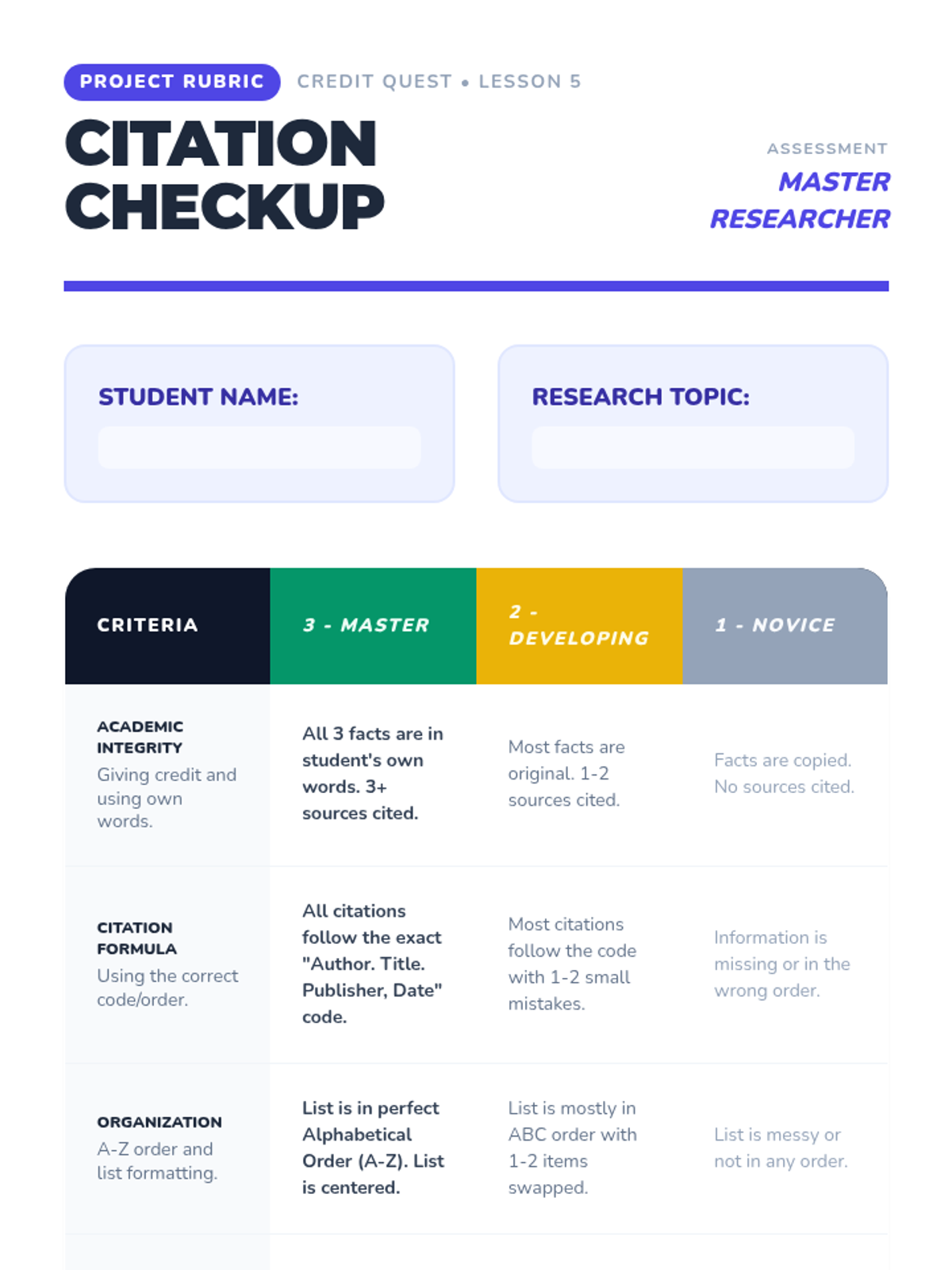
Final project rubric for Lesson 5. Evaluates academic integrity, citation formula accuracy, alphabetical organization, and punctuation. Includes sections for teacher feedback.
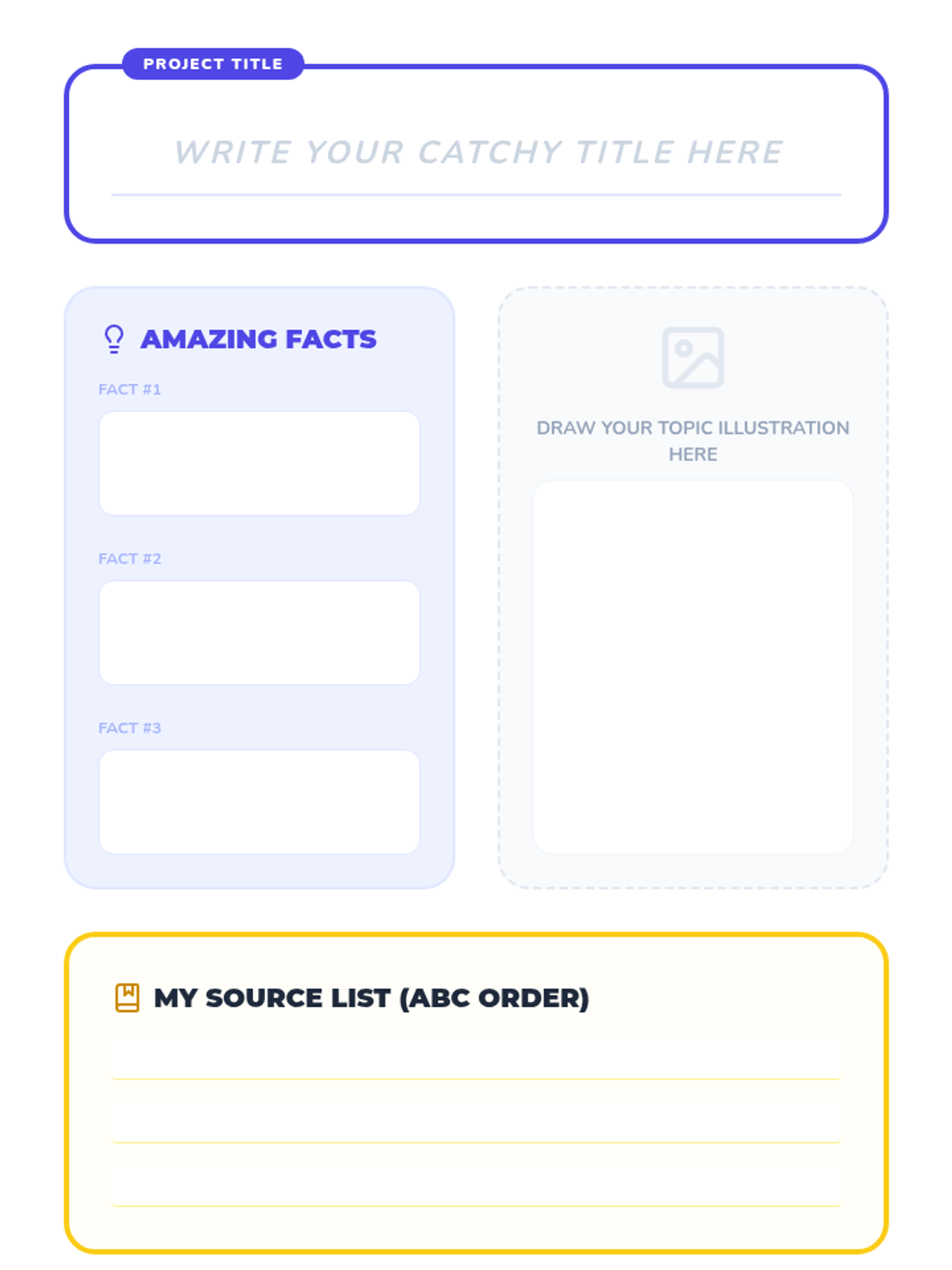
A structured research poster template for the final project. Includes sections for a title, three facts, an illustration, and a formatted bibliography.
Visual slides for Lesson 5 on the final mini-research project. Outlines project requirements and the gallery walk procedure.
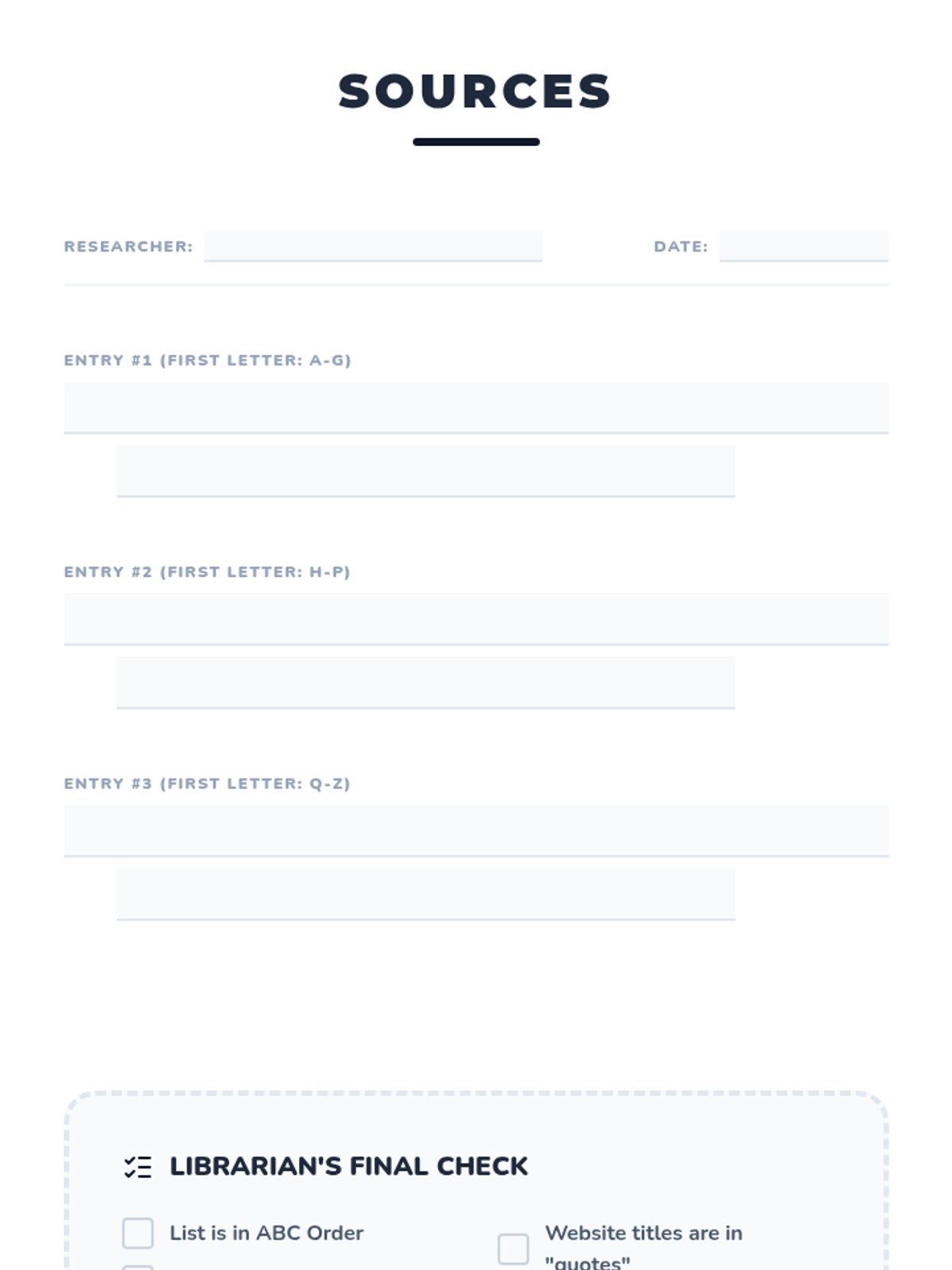
Final bibliography worksheet for Lesson 4 where students practice organizing their collected citations into a formal, alphabetized list with correct formatting.
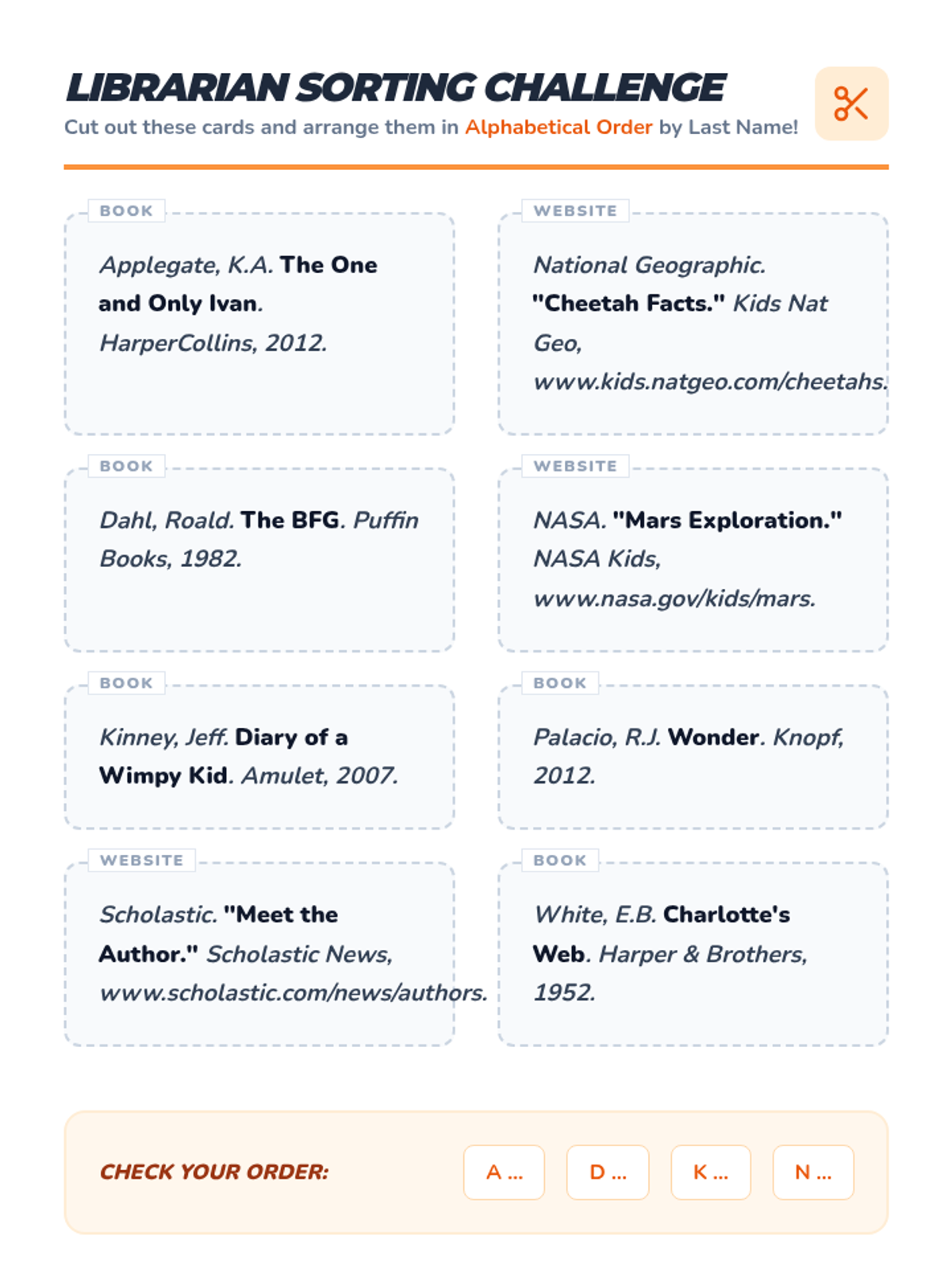
Hands-on activity cards for Lesson 4 where students practice arranging various book and website citations into alphabetical order by author's last name.
Visual slides for Lesson 4 on organizing citations into an alphabetical reference list. Focuses on the rules of alphabetical order by author's last name.
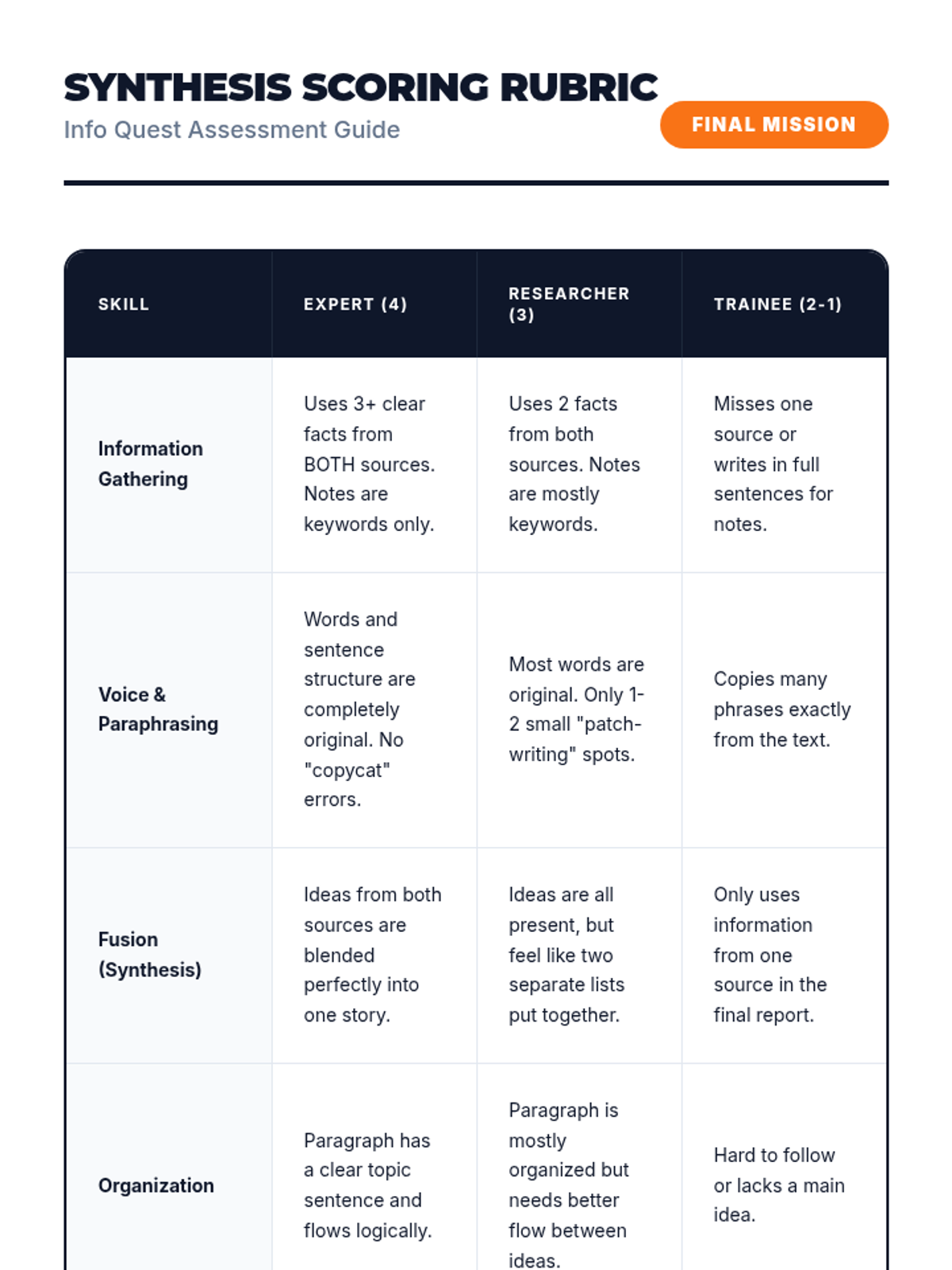
Synthesis scoring rubric for evaluating students' final research project based on information gathering, paraphrasing, fusion of ideas, and organization.
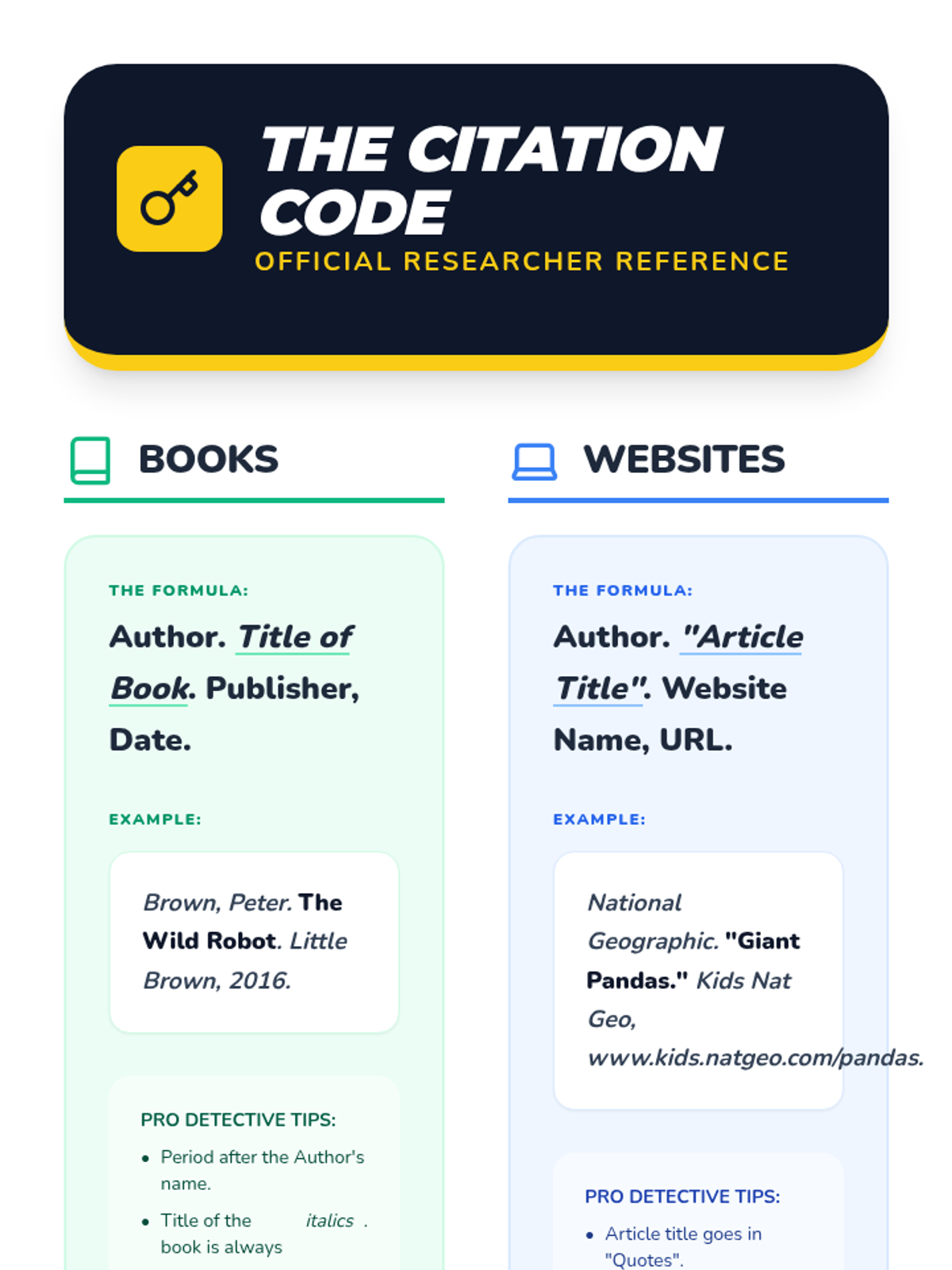
A visual reference sheet for students comparing book and website citation formulas with clear examples and formatting tips.
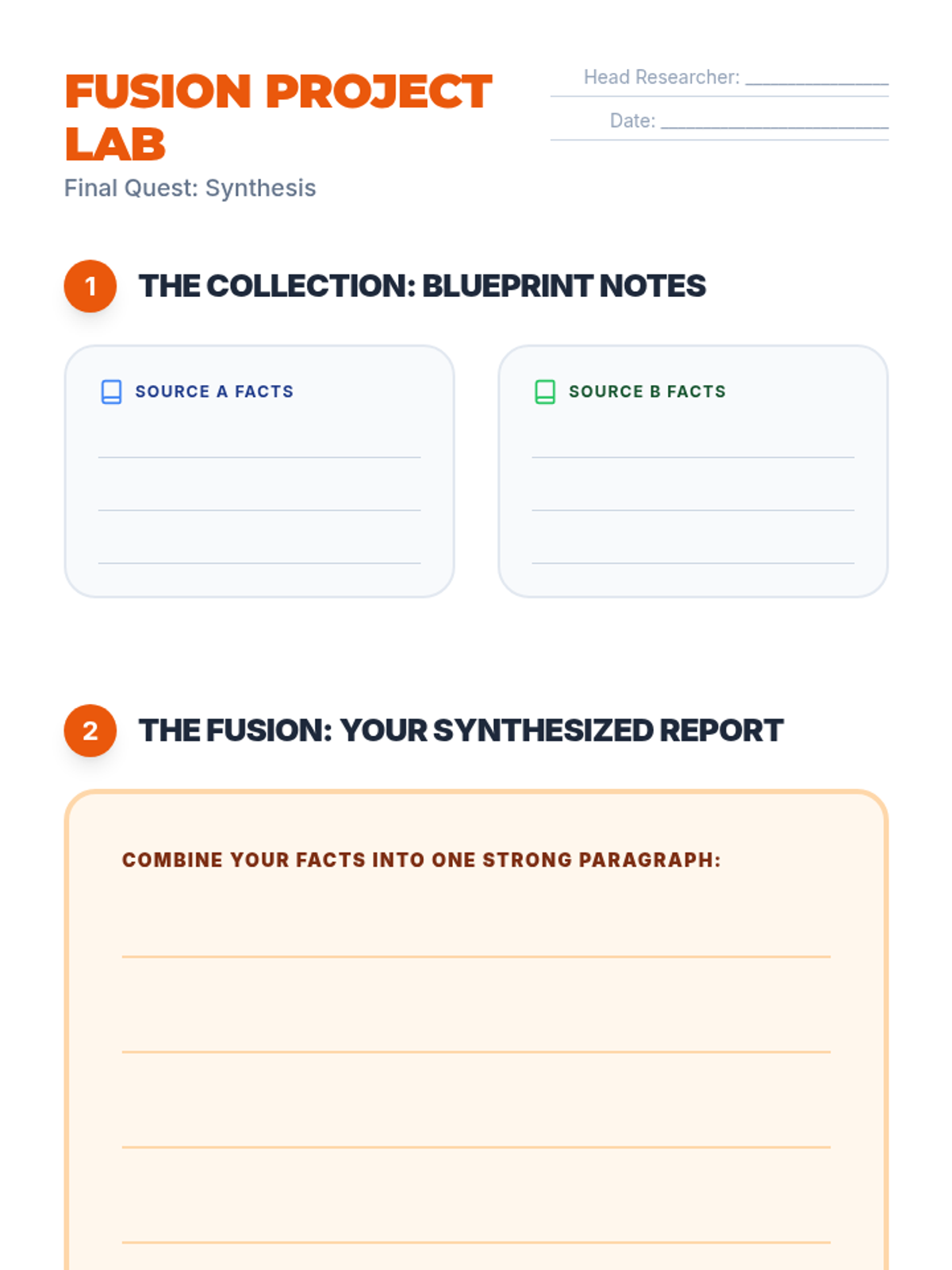
Final project worksheet where students collect notes from two sources and synthesize them into a cohesive paragraph.
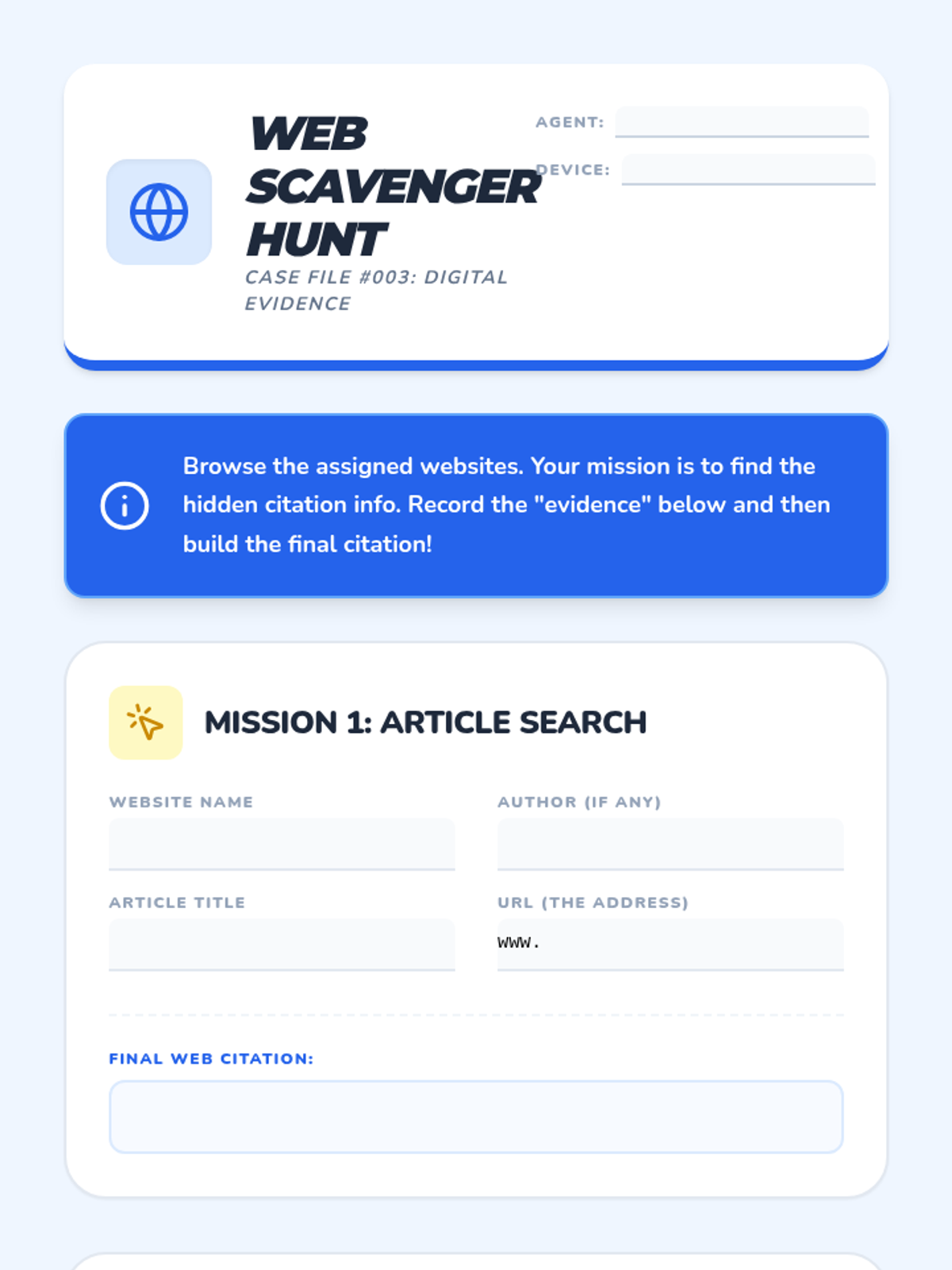
Website scavenger hunt worksheet for Lesson 3. Students navigate digital sources to find bibliographic information and practice formatting web citations.
Slide deck for Lesson 5, focusing on the final stage of research: synthesizing information from multiple sources into a single cohesive output.
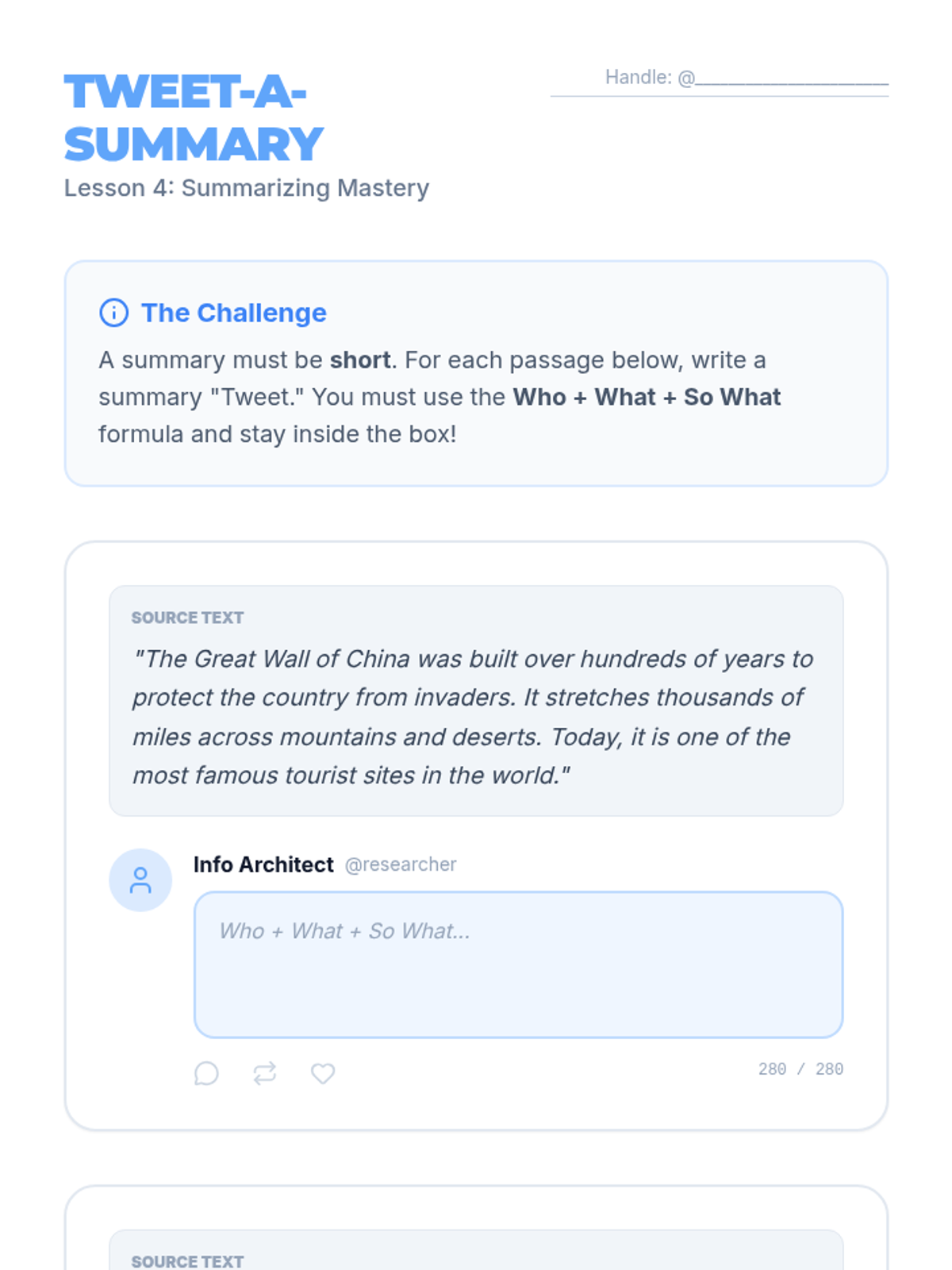
Student activity worksheet where they practice condensing information into short "Tweets" using the "Who, What, So What" framework.
Visual slides for Lesson 3 on citing digital sources. Teaches students where to locate key information on a webpage and provides a simplified web citation formula.
Slide deck for Lesson 4, introducing the "Who, What, So What" summarizing technique and the "Tweet a Summary" challenge.
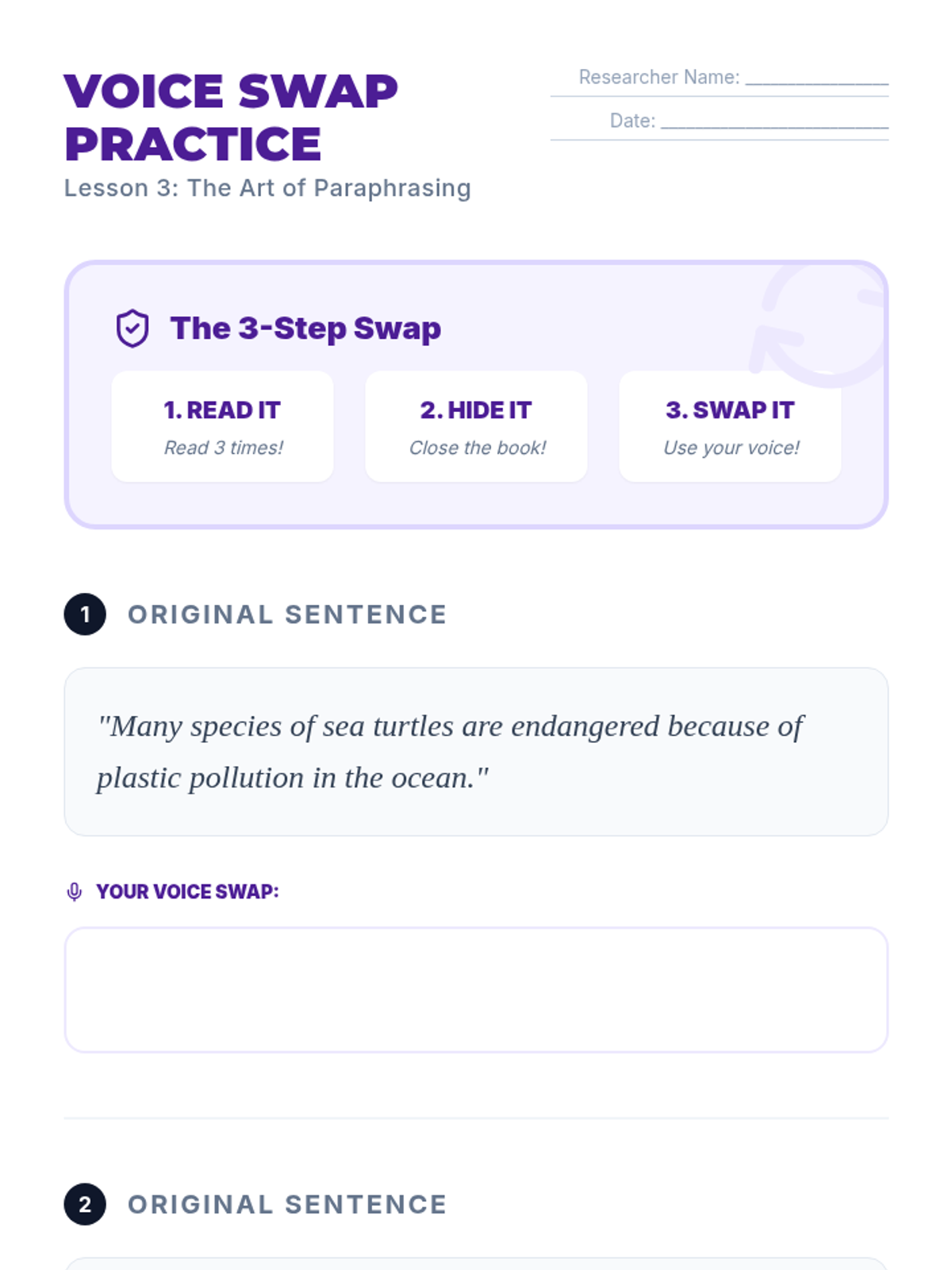
Student worksheet for practicing paraphrasing using the "Read-Hide-Write" technique with a variety of academic sentences.
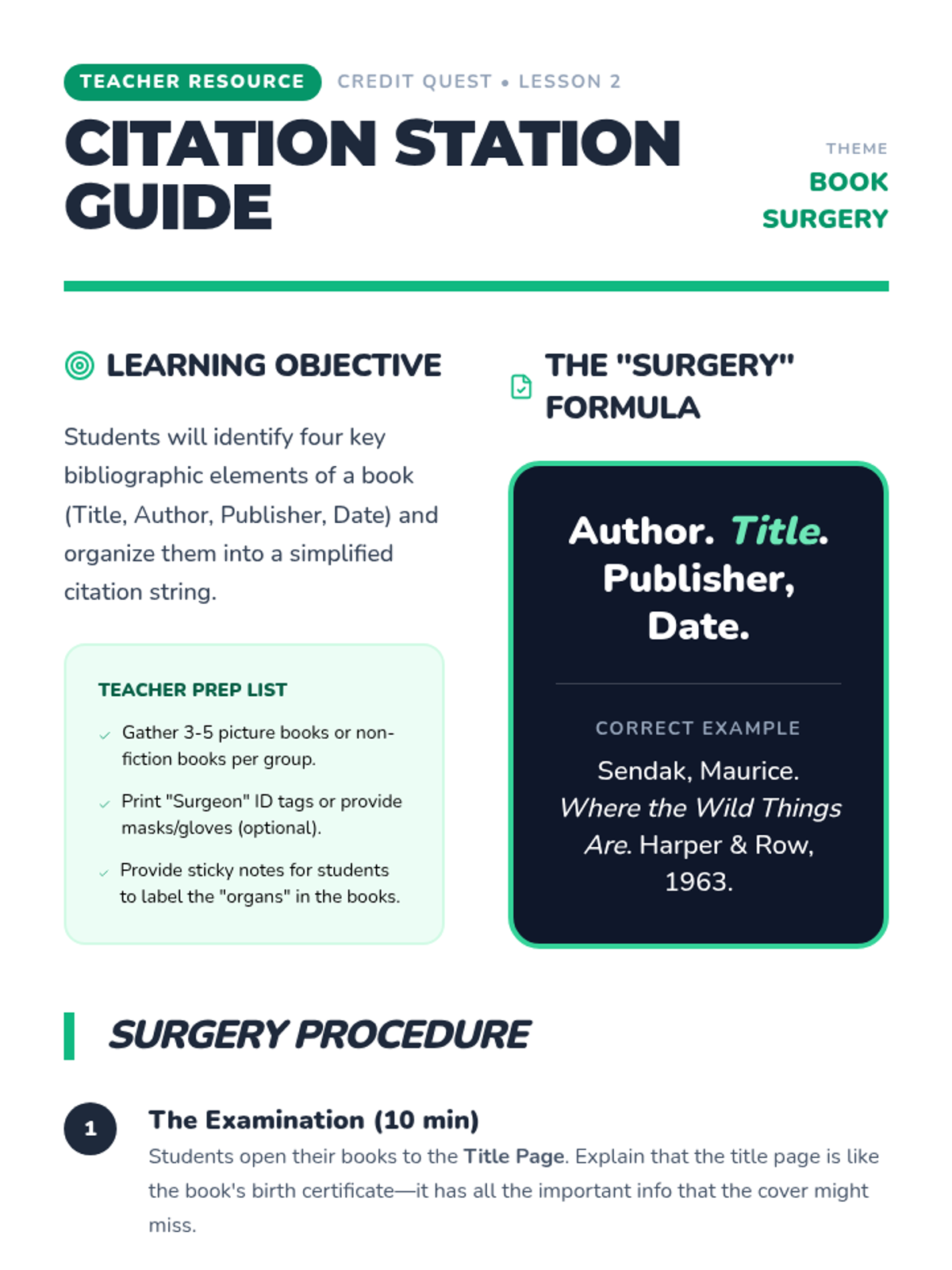
Teacher guide for Lesson 2: Book Surgeon. Includes lesson flow, teacher preparation checklist, citation formula examples, and ESL scaffolding tips.
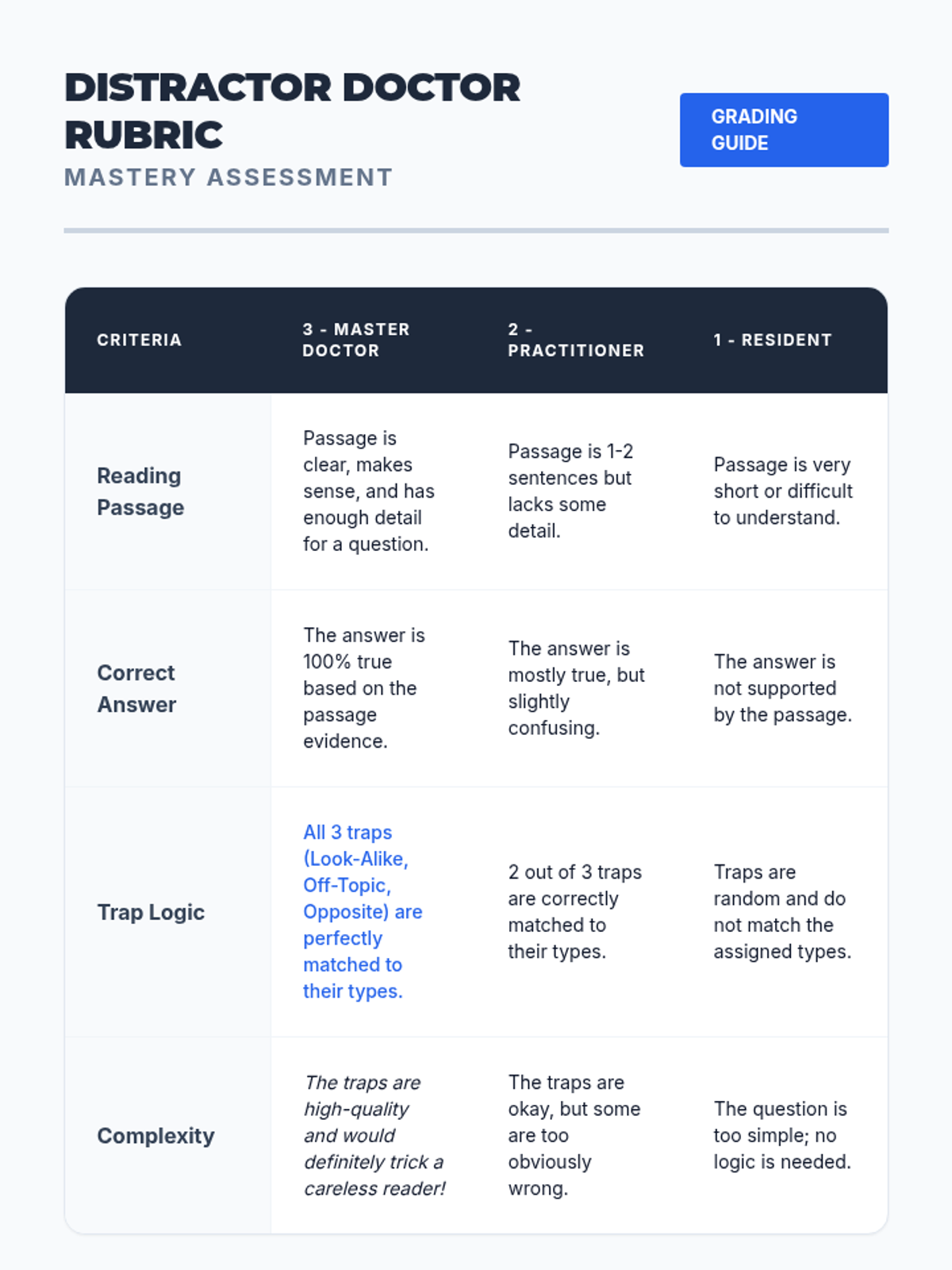
A assessment rubric for the Distractor Doctor project, evaluating the quality of the student's reading passage, the accuracy of their correct answer, and the logic behind their three distractor types.
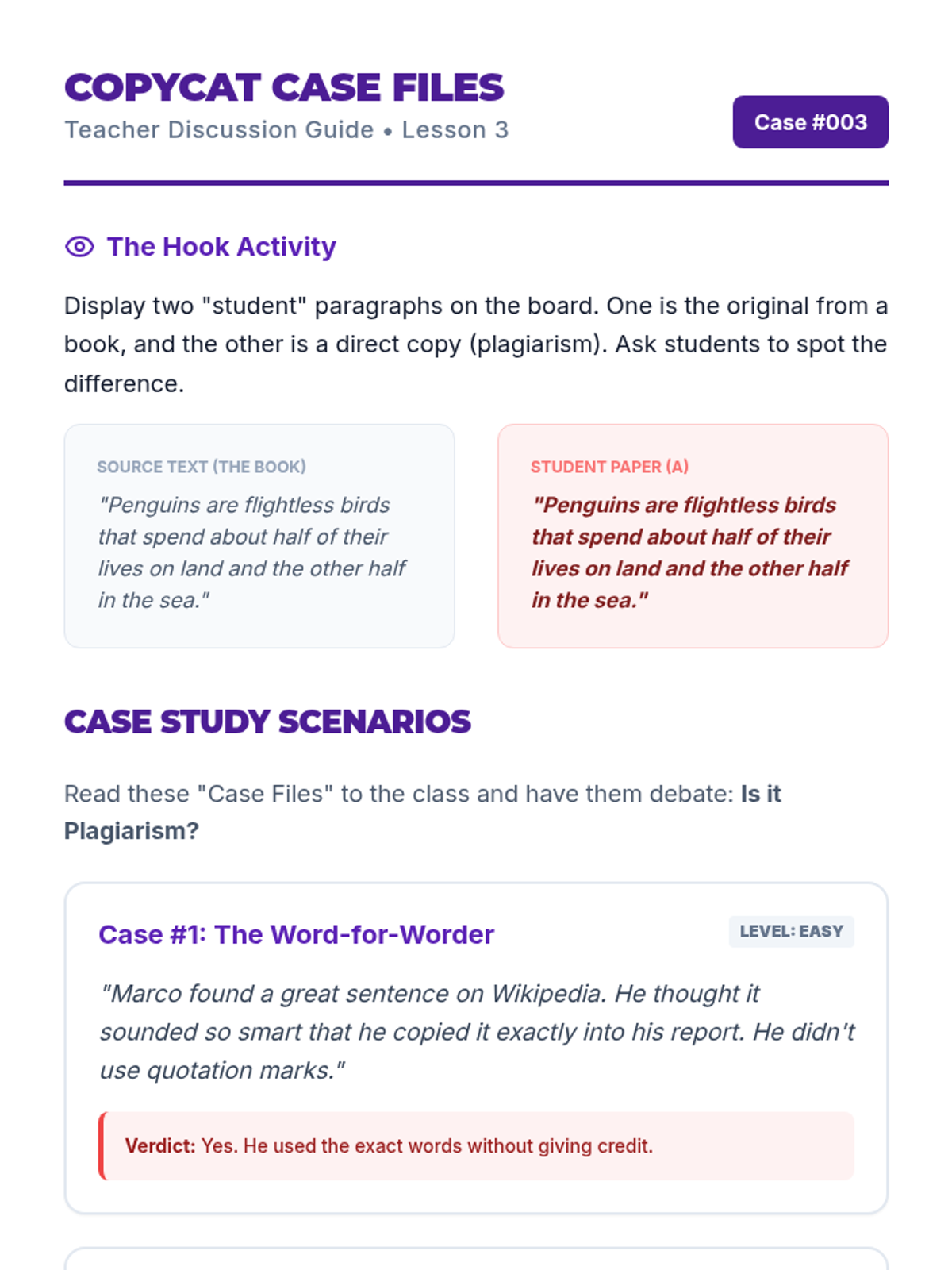
Scenario-based teacher resource for discussing plagiarism and identifying the difference between copying, patch-writing, and successful paraphrasing.
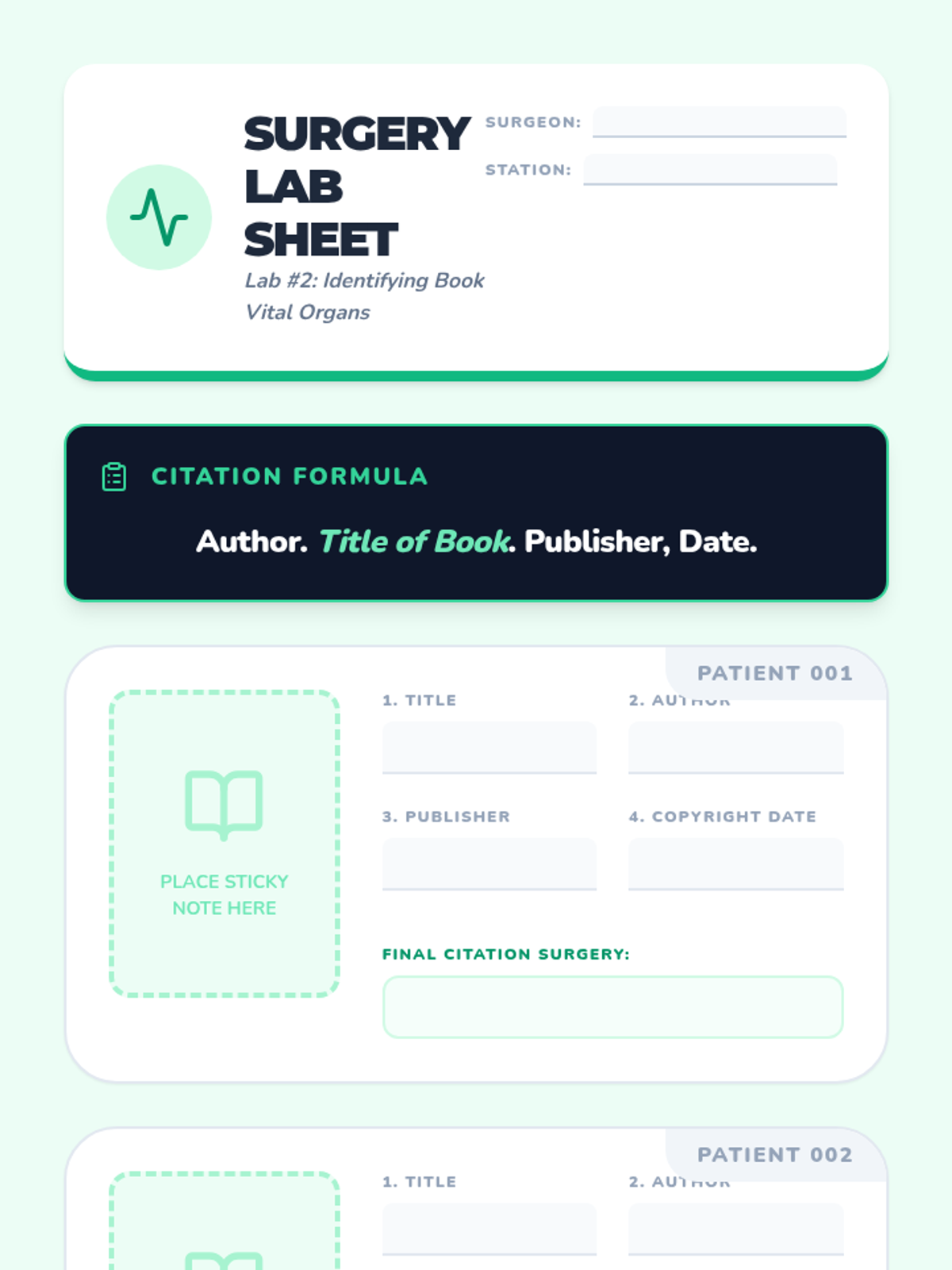
Hands-on lab sheet for Lesson 2 where students identify and record the author, title, publisher, and date of various books in a medical-themed 'surgery' activity.
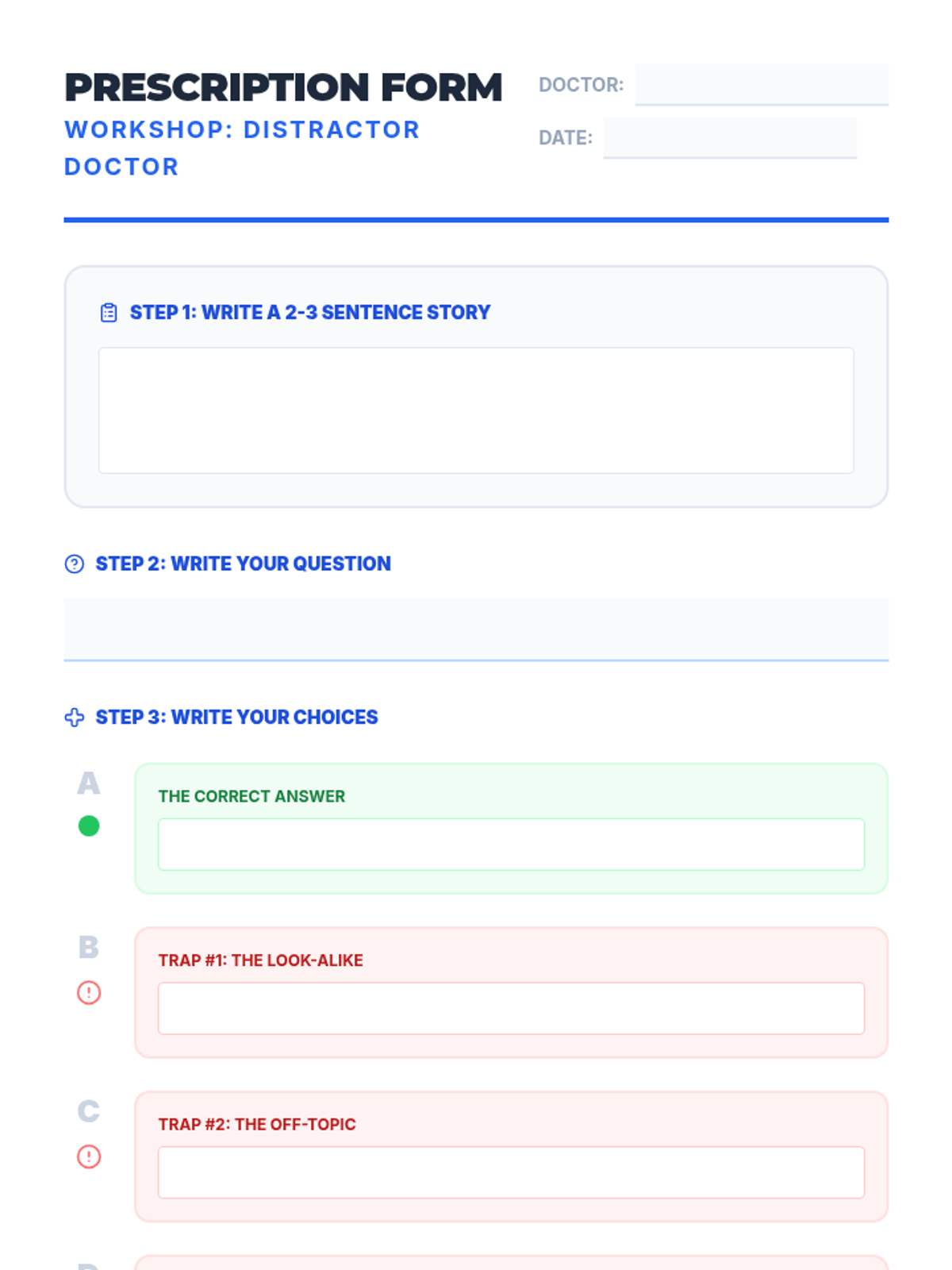
A culminating project worksheet for Lesson 5 where students write their own reading passage, question, correct answer, and three specific types of distractors.
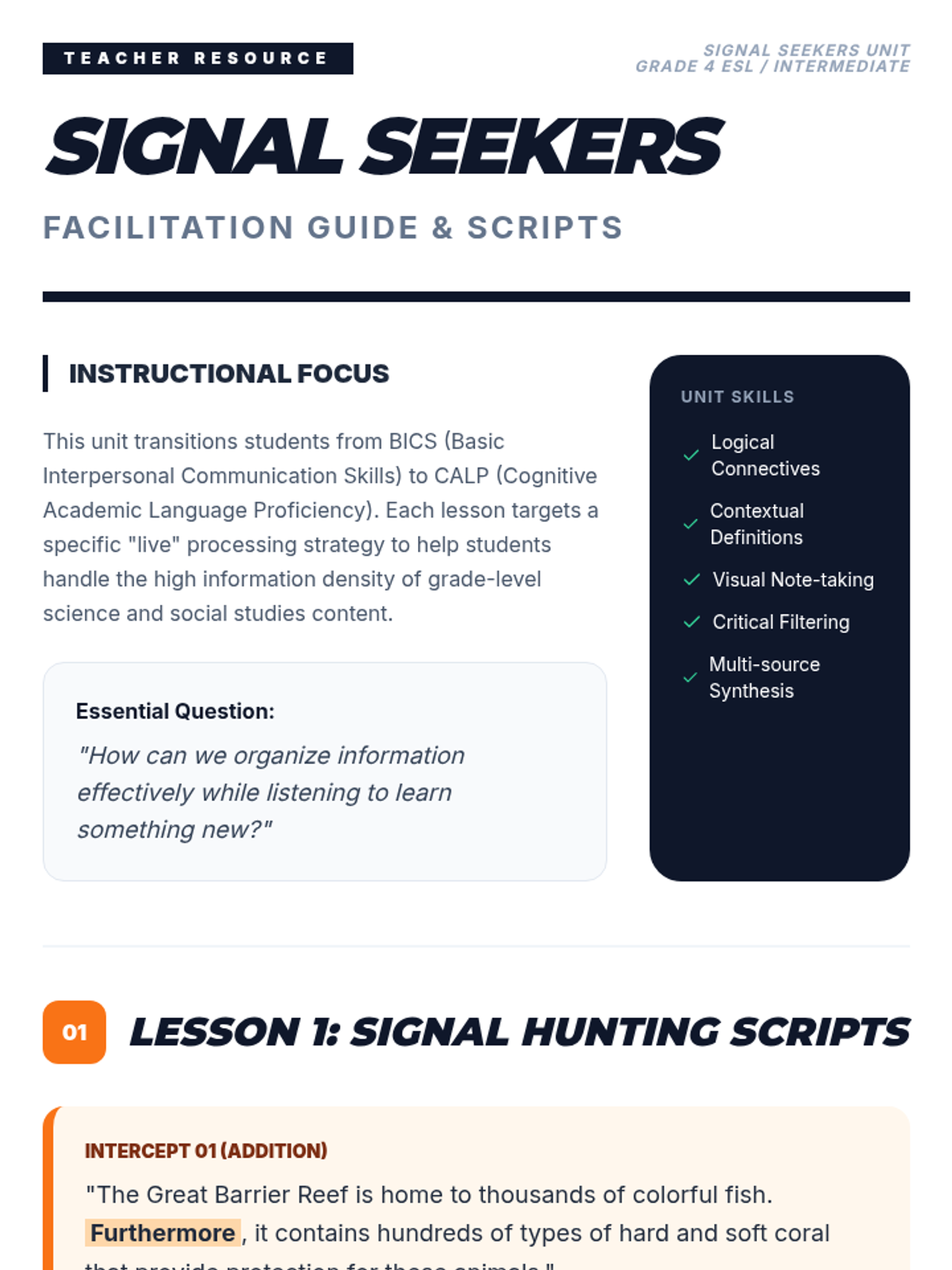
A comprehensive teacher resource containing all scripts for the listening activities, answer keys, and pedagogical tips for the Signal Seekers unit.
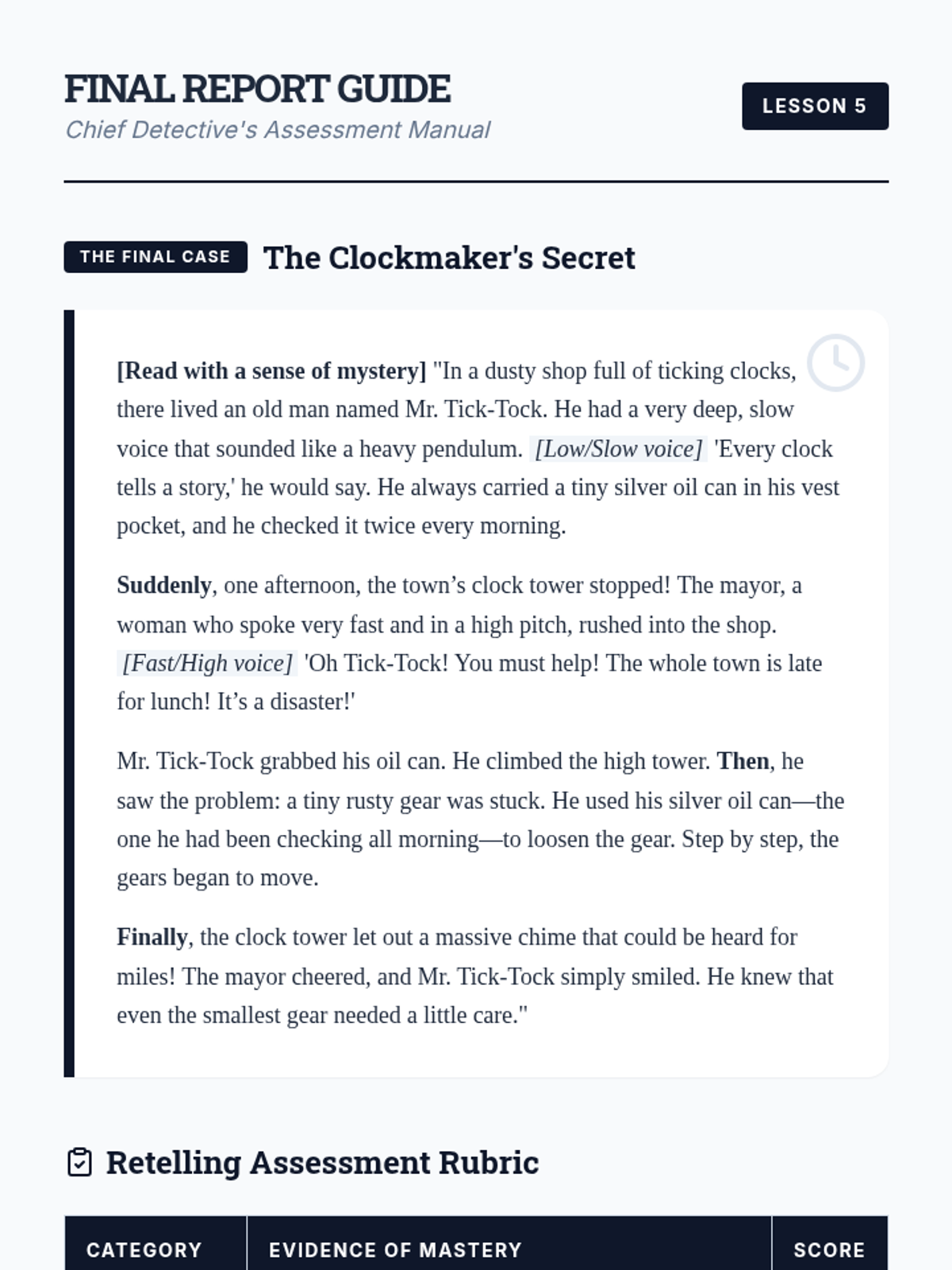
Teacher-facing scripts and assessment rubric for the final retelling project. Includes a final mystery story with multi-layered auditory cues and a grading guide for student presentations.
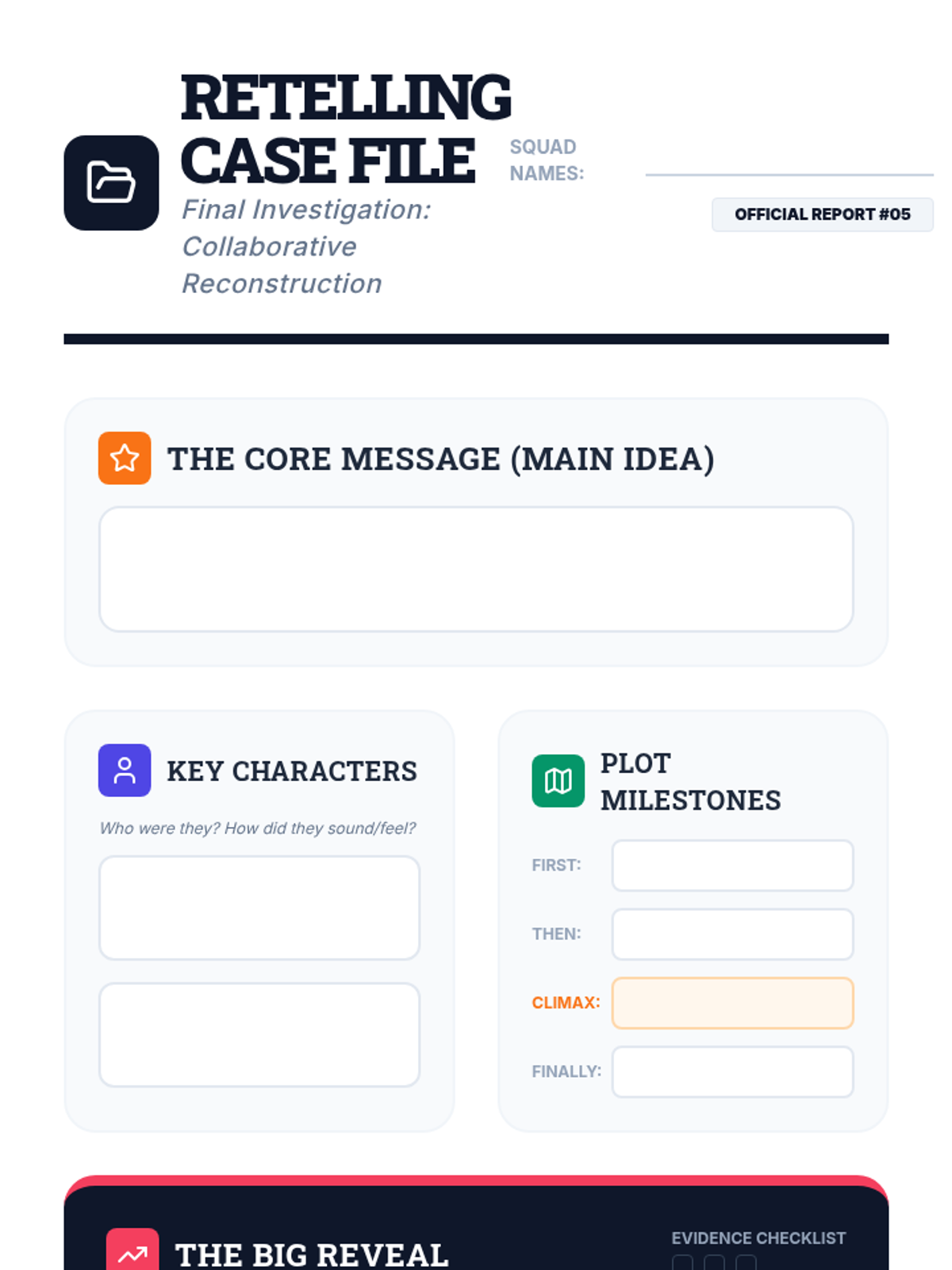
A comprehensive planning worksheet for the final retelling project. Groups use this to organize the main idea, character traits, plot sequence, and foreshadowing evidence from the final mystery story.
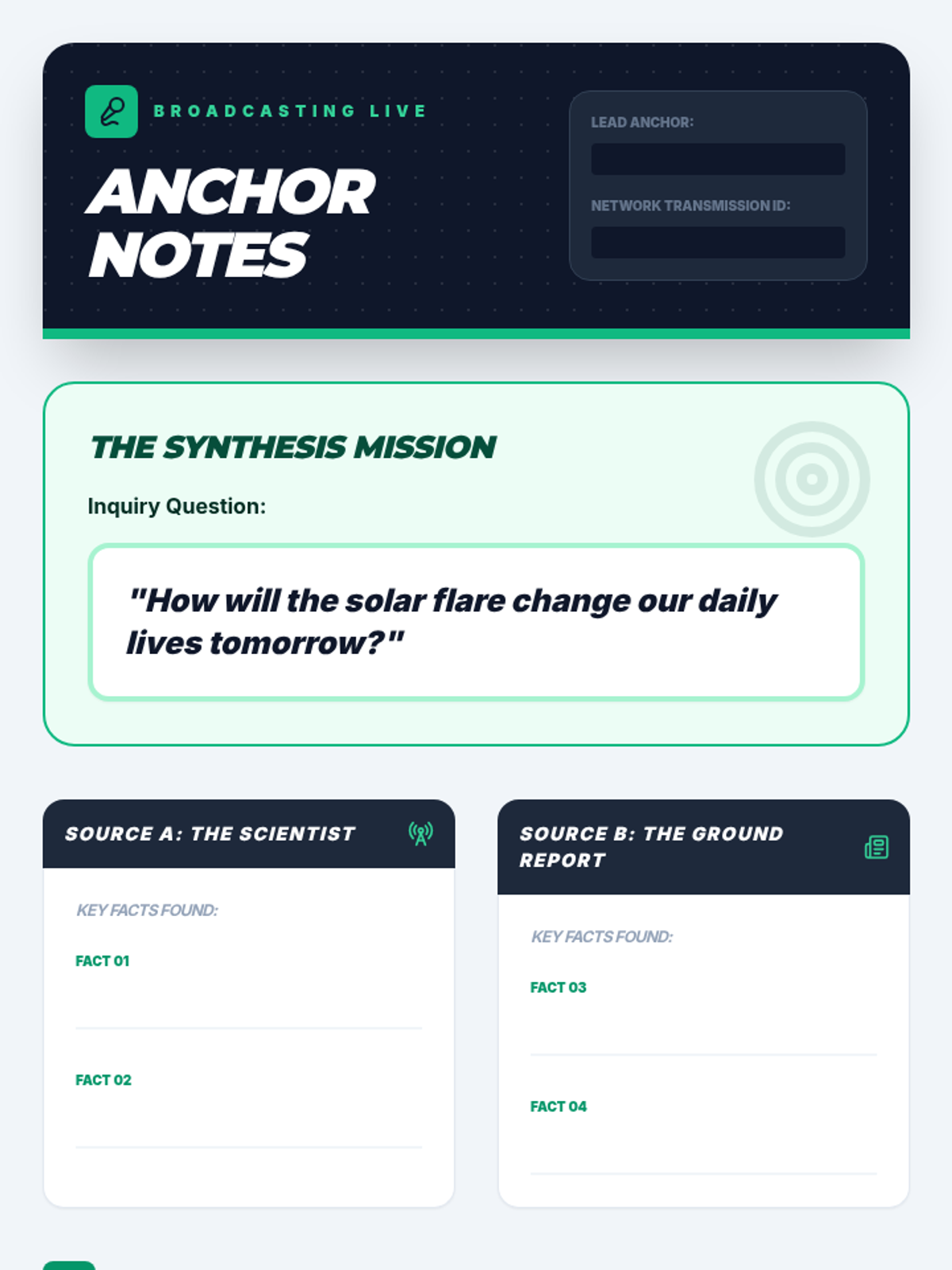
A student worksheet for the final synthesis challenge, providing a structured template to capture facts from multiple sources and combine them into a coherent news report.
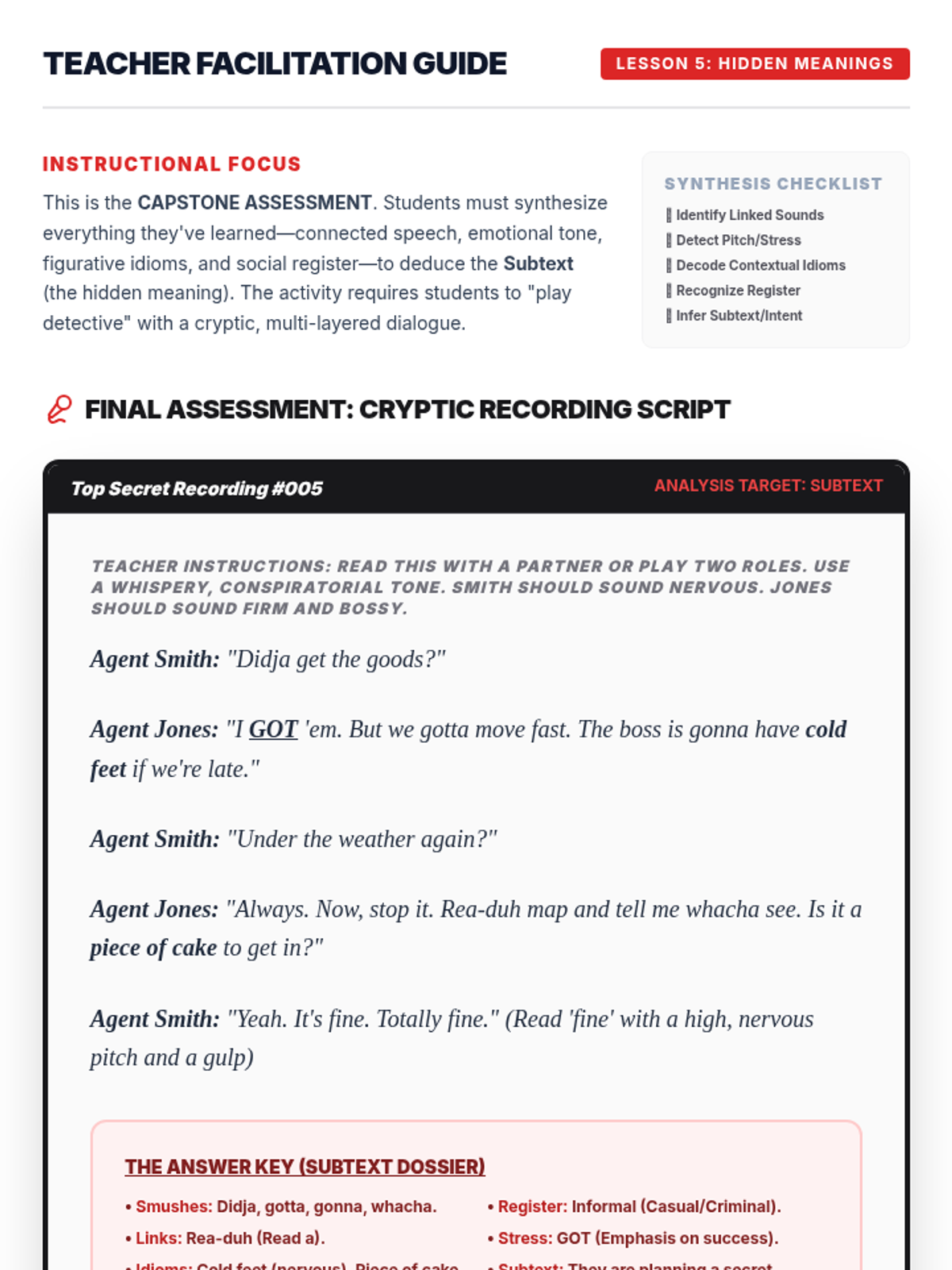
Teacher guide for Lesson 5: Hidden Meanings. Contains a multi-layered script and a synthesis answer key to assess student mastery of all Ear Detective skills.
Introductory slides for the final lesson of 'Sound Story Detectives'. Reviews the four key listening skills (main idea, characterization, plot, and prediction) and outlines the final retelling project.
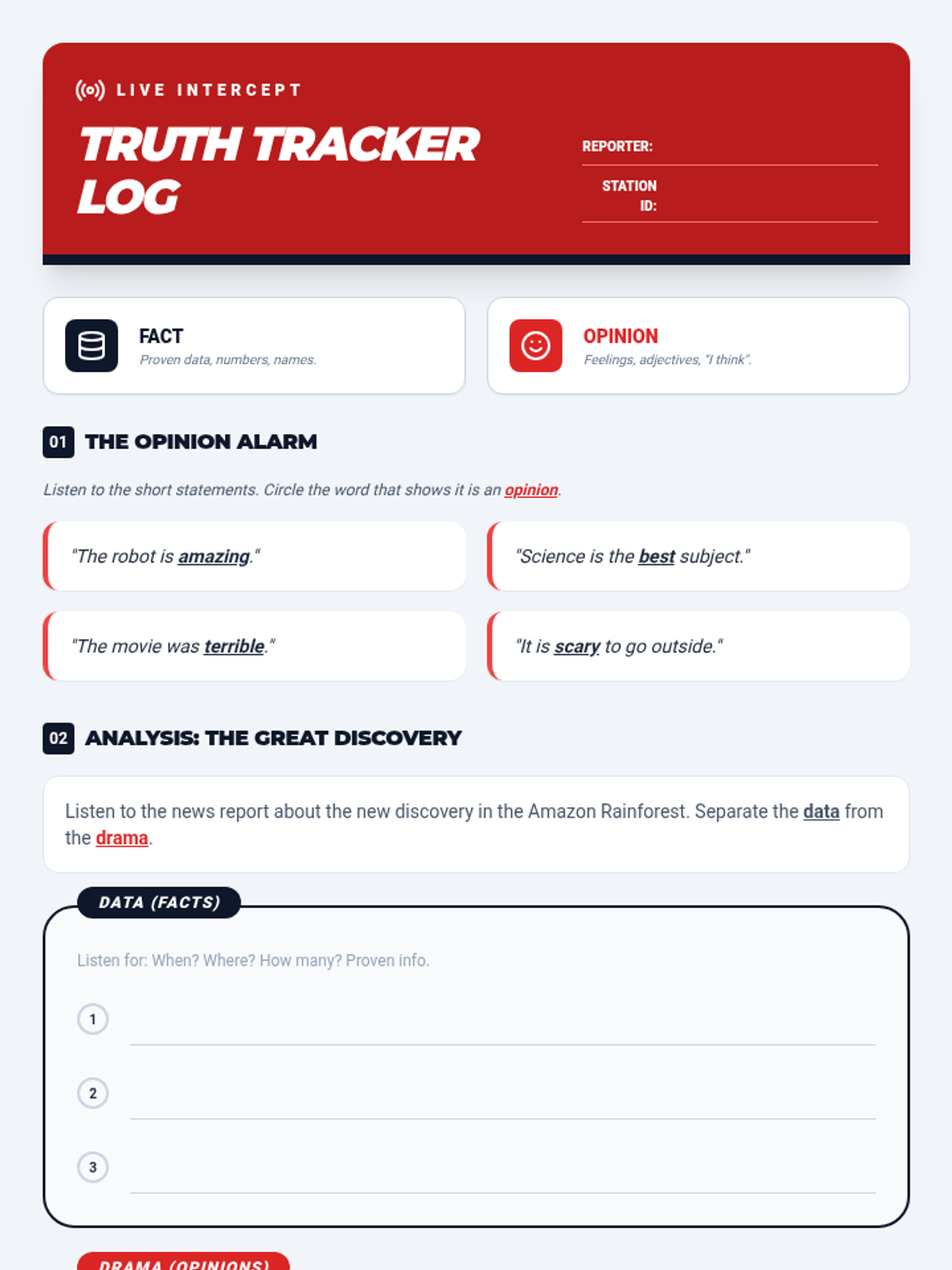
A student worksheet designed to help students distinguish between verifiable facts and personal opinions during a news report listening activity.
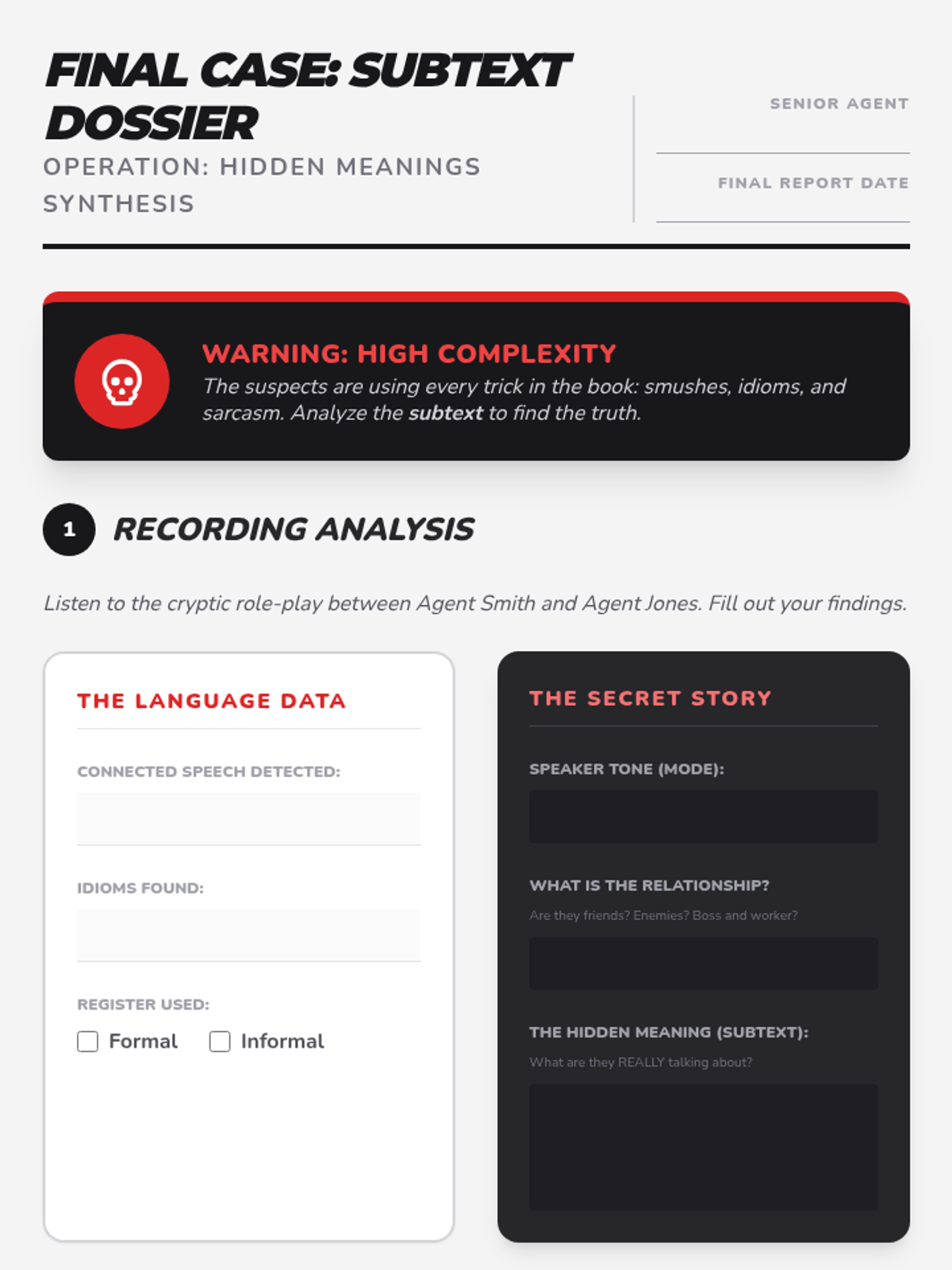
Capstone worksheet for Lesson 5: Hidden Meanings. Students perform a final synthesis by analyzing a complex audio clip for subtext, tone, idioms, and register.
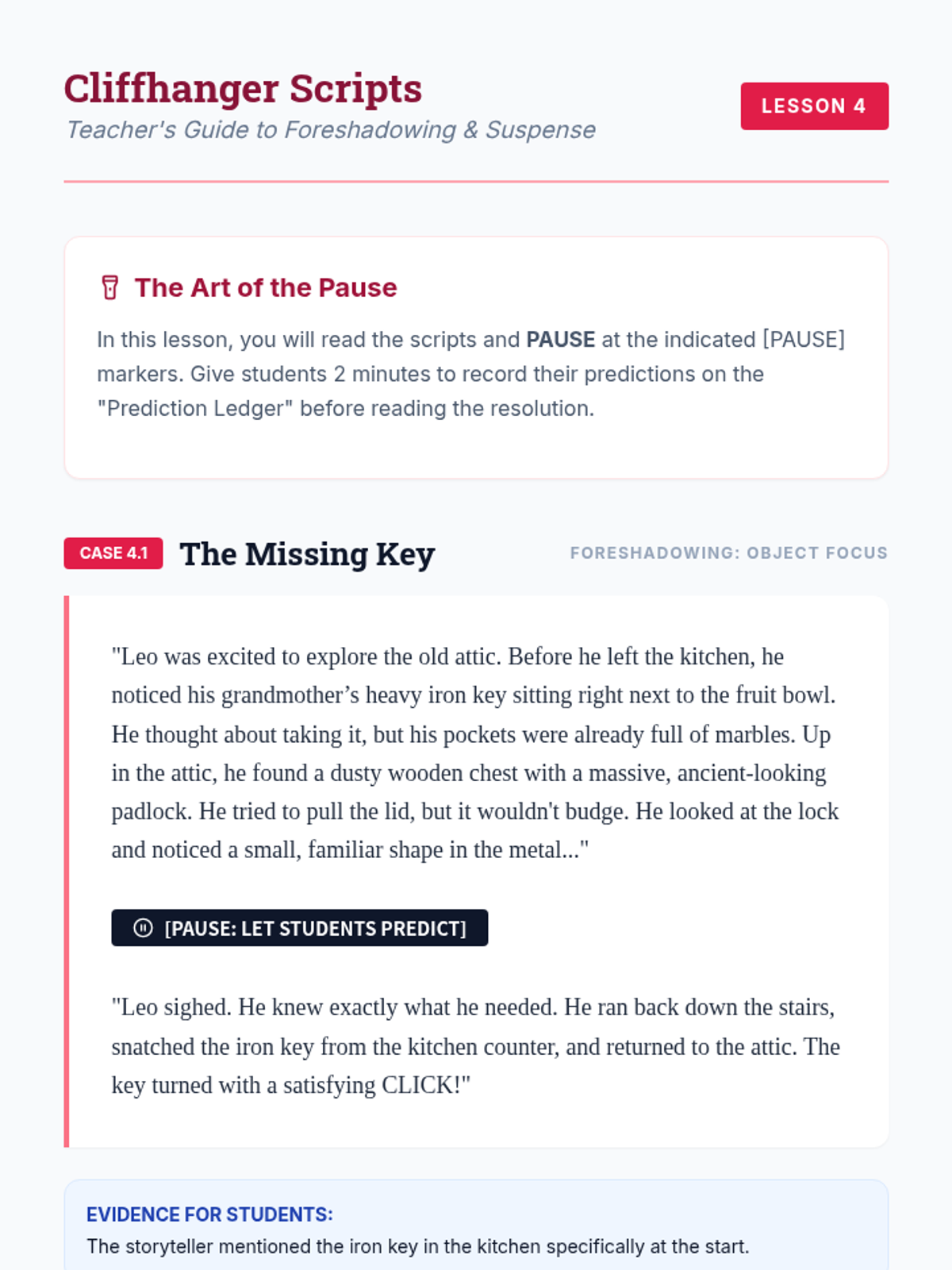
Teacher-facing scripts for Lesson 4 of 'Sound Story Detectives'. Includes two stories with clear foreshadowing cues and designated pause points for student predictions.
Slides for Lesson 5: Hidden Meanings, the capstone of the Ear Detectives sequence. Synthesizes connected speech, tone, idioms, and register through subtext analysis.
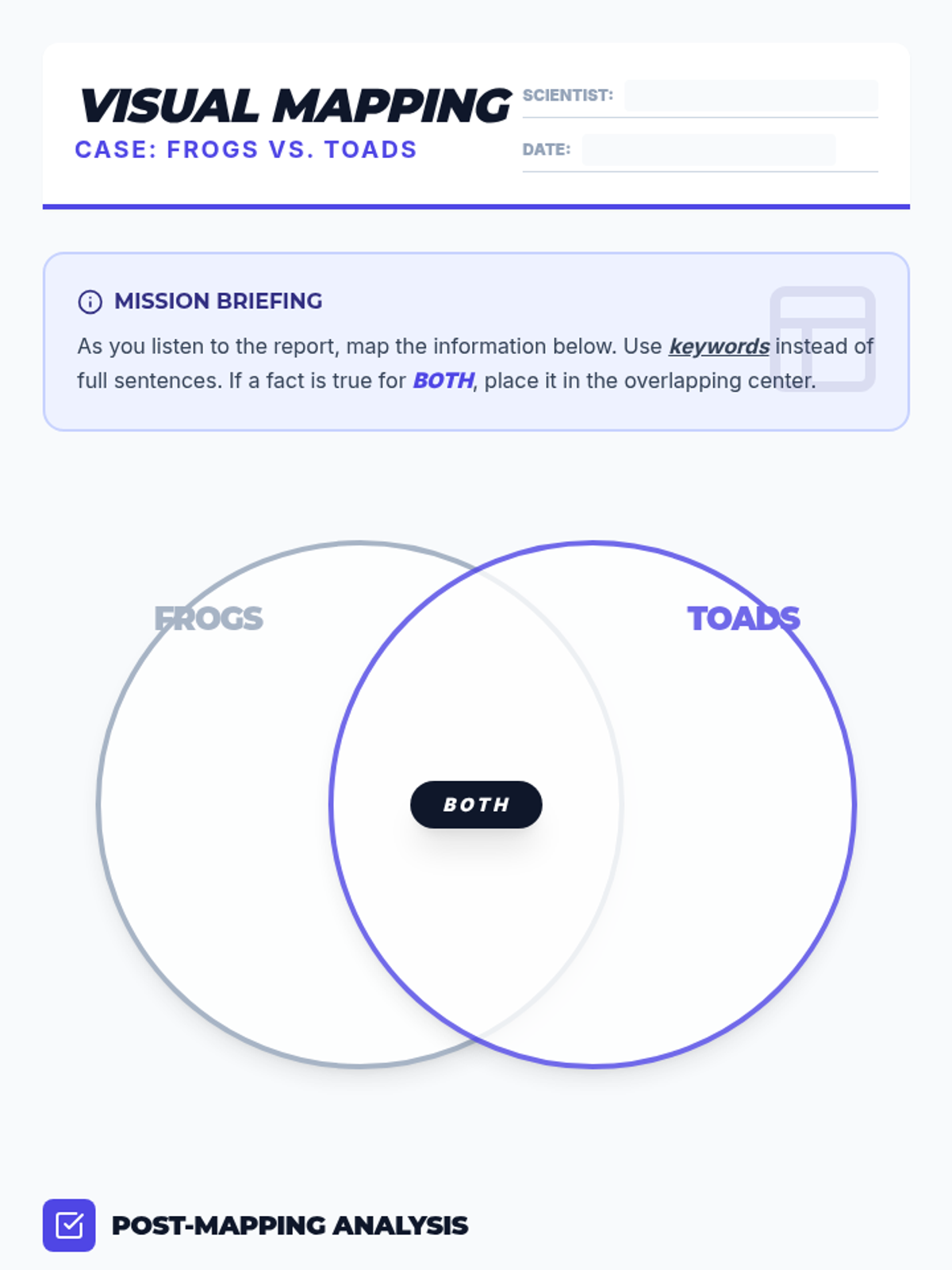
A student worksheet providing a structured Venn diagram for students to organize comparative information during a live listening activity about frogs and toads.
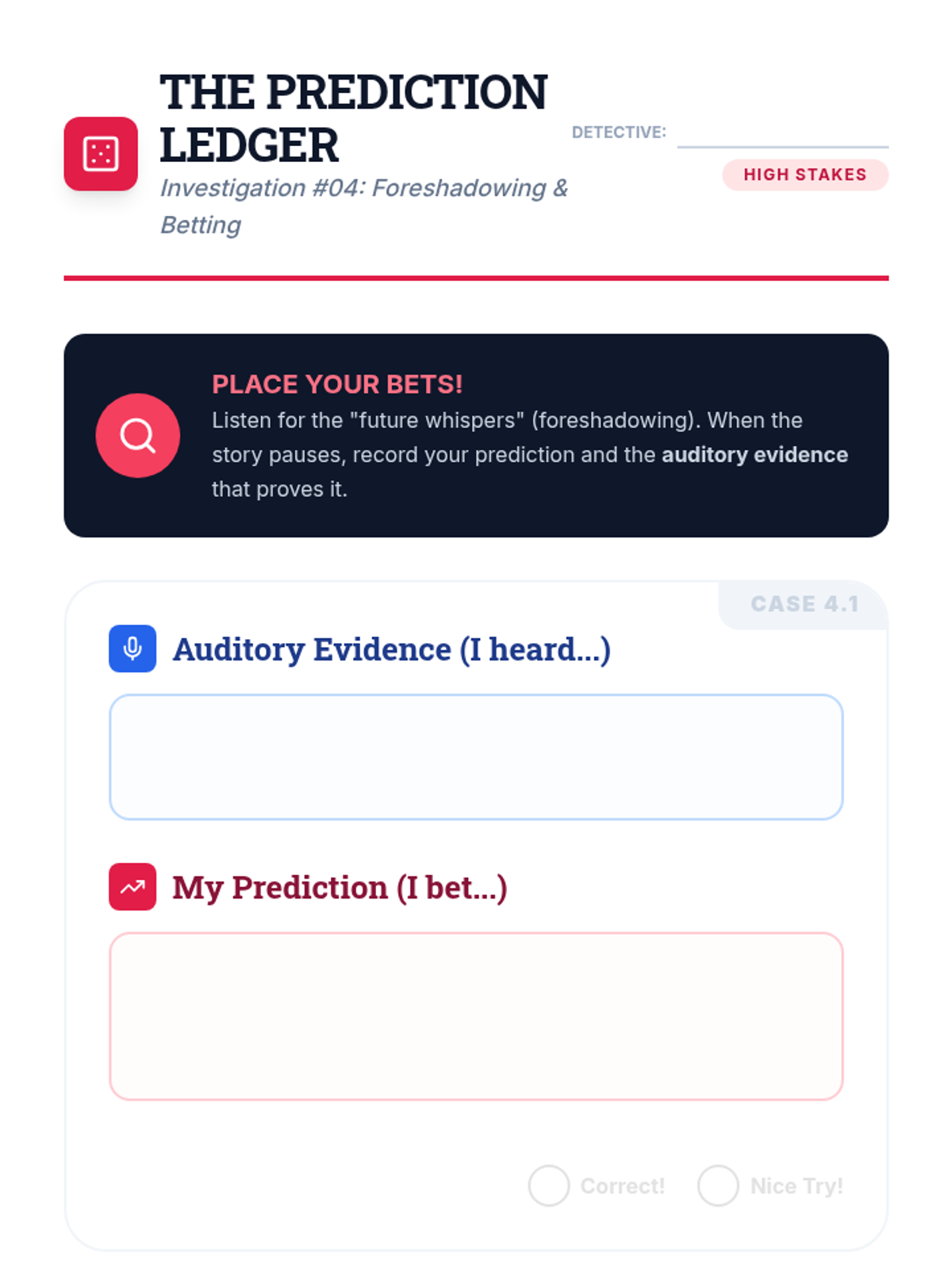
A prediction tracking worksheet designed as a 'betting slip' for students to record their predictions and supporting auditory evidence during story pauses.
A slide deck for the final synthesis challenge, teaching students how to combine information from multiple auditory sources to answer an inquiry question.
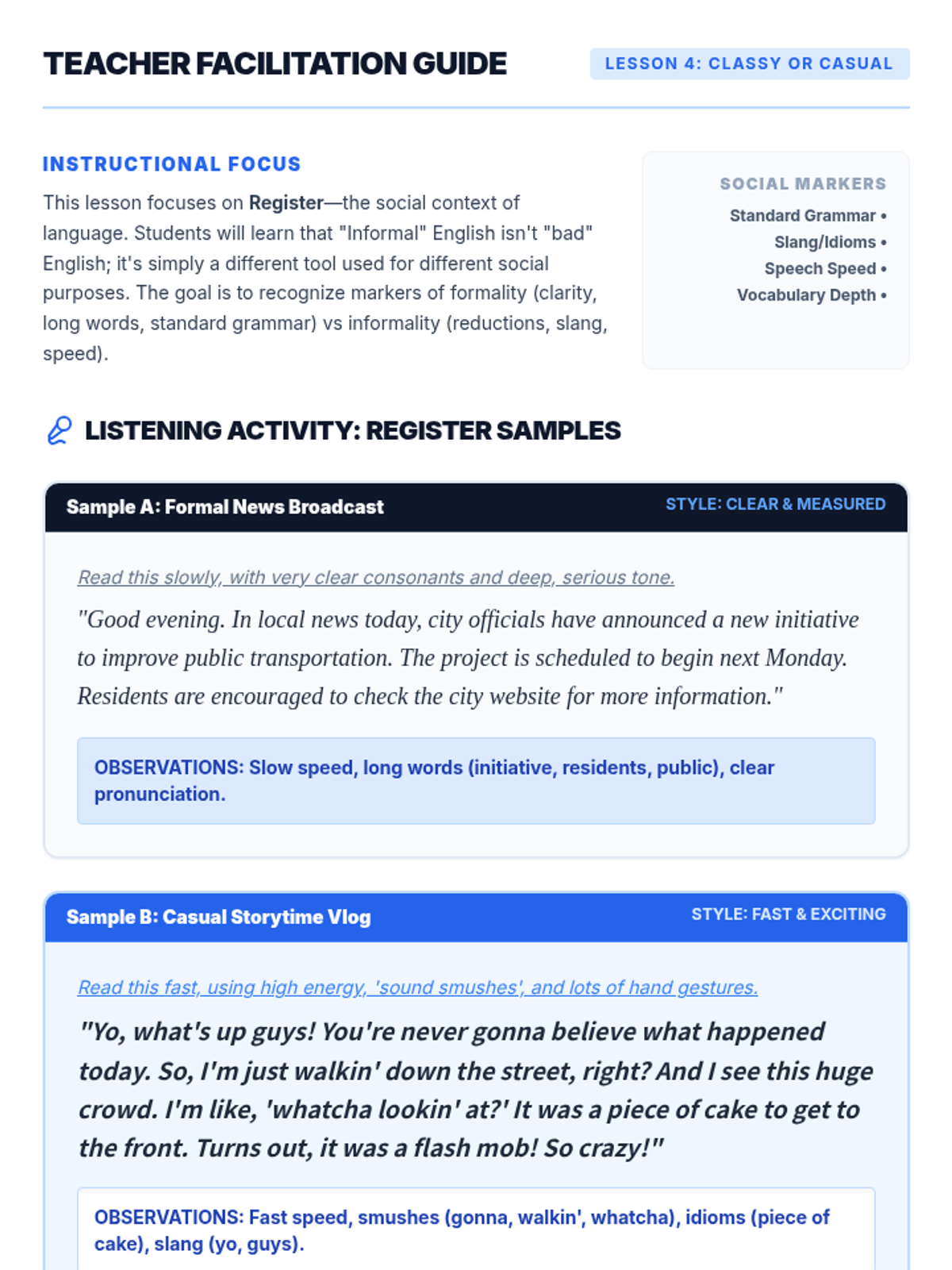
Teacher guide for Lesson 4: Classy or Casual. Provides scripts for formal news reports and casual vlog samples to help students distinguish between registers.
Slides for Lesson 4 focusing on identifying foreshadowing cues in oral narratives and using them to make logical predictions. Includes the 'Prediction Equation' framework.
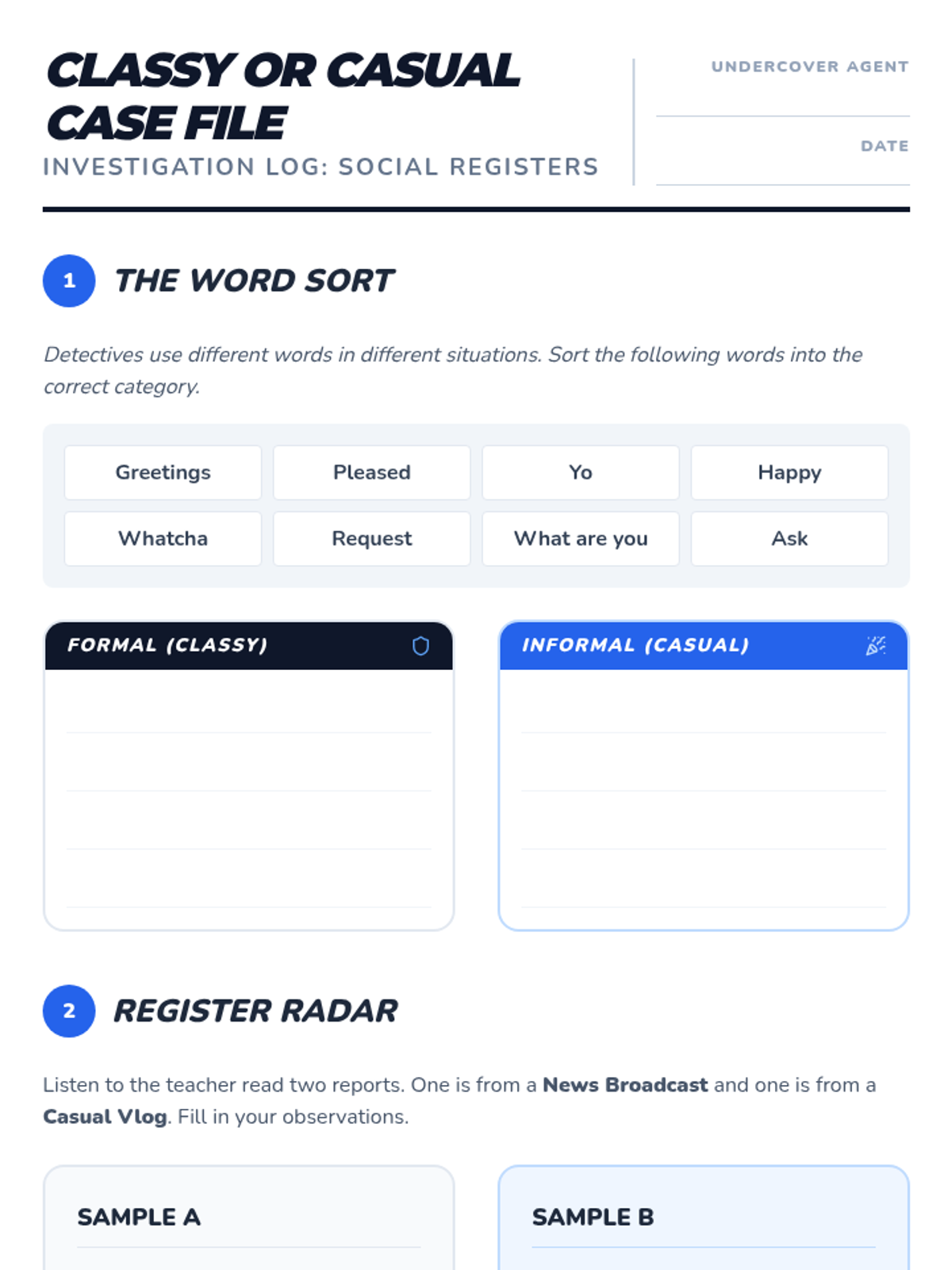
Student worksheet for Lesson 4: Classy or Casual. Students categorize vocabulary and analyze audio samples for formal and informal registers.
A slide deck introducing 4th grade ESL students to the difference between fact and opinion, focusing on listening for data vs. subjective adjectives.
Slides for Lesson 4: Classy or Casual, exploring formal and informal English registers. Features clear visual distinctions between different social contexts and speech styles.
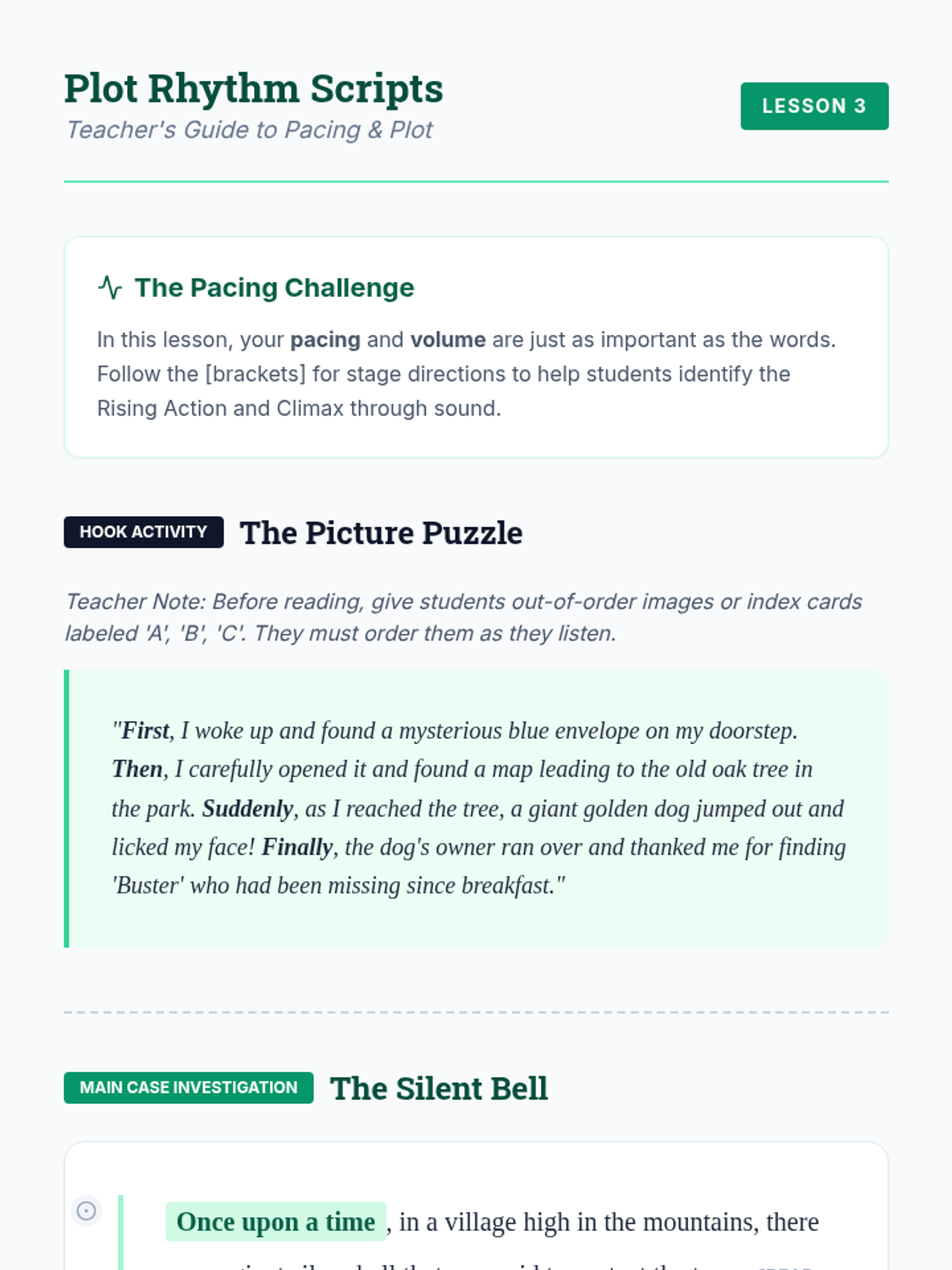
Teacher-facing script for Lesson 3 of 'Sound Story Detectives'. Includes a folktale script with specific pacing and volume directions to help students identify plot elements through auditory cues.
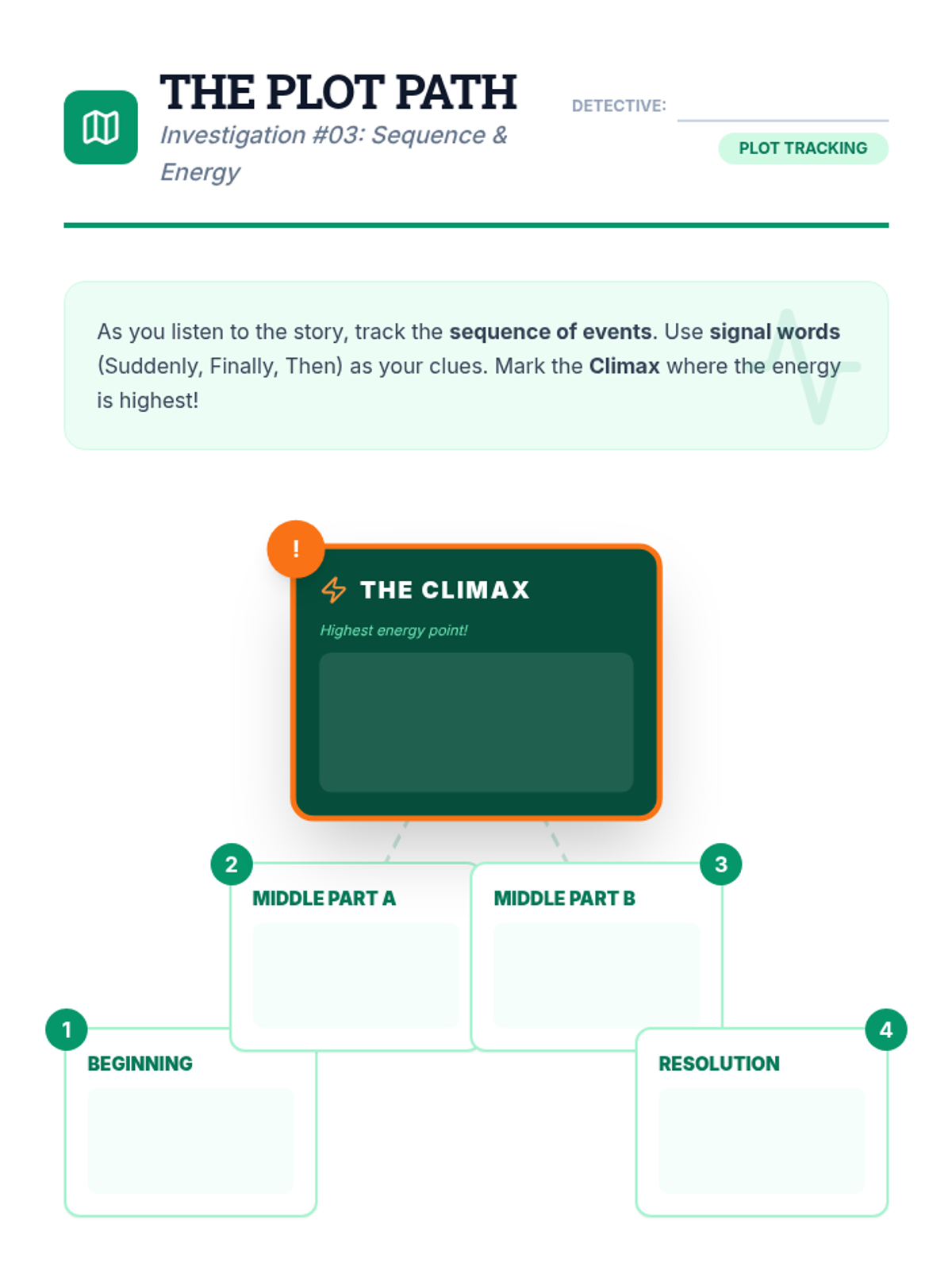
A plot mapping worksheet for students to track the sequence of events and identify the climax of an oral story using transition words and energy levels.
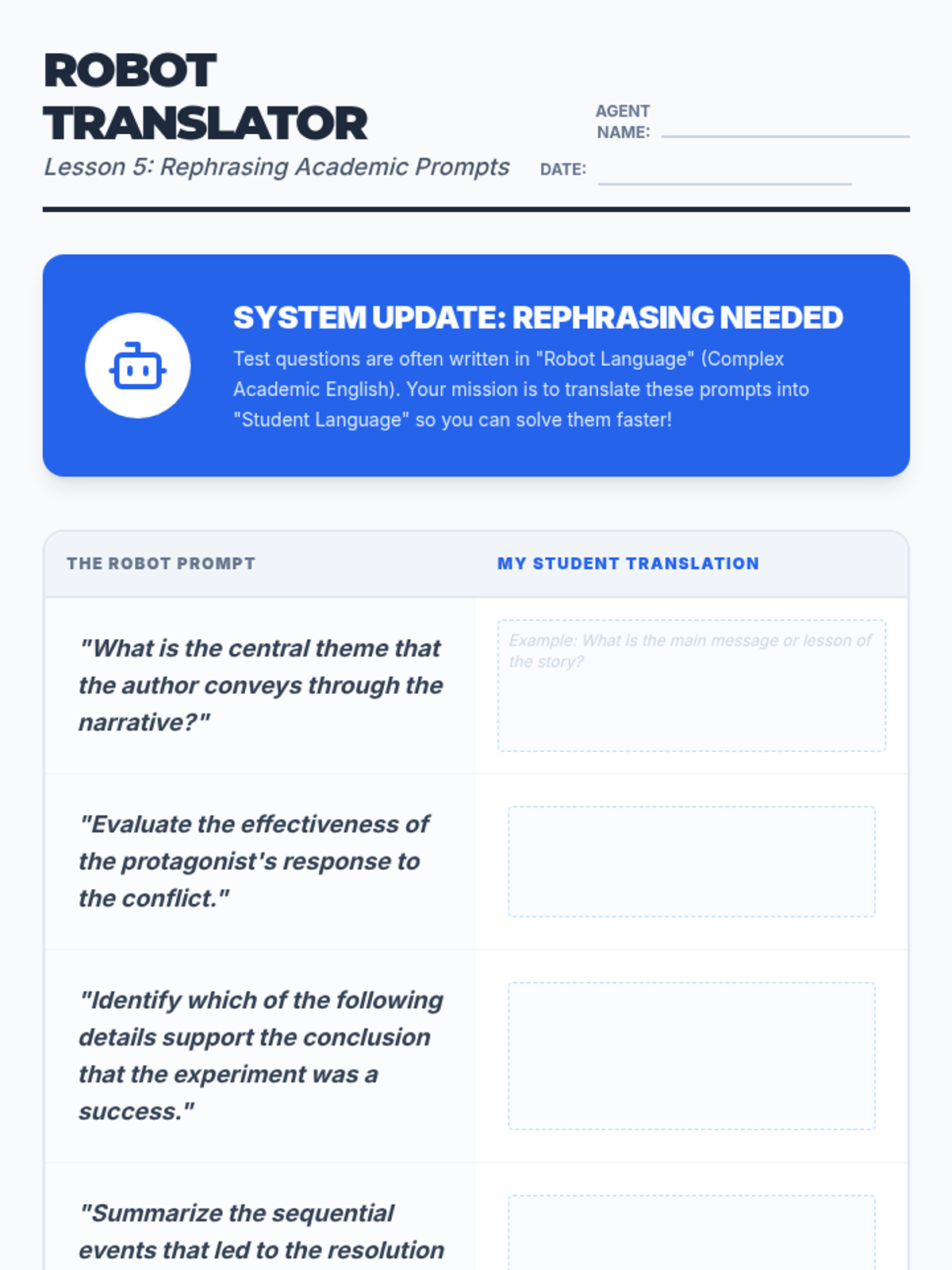
An activity where students practice rephrasing complex, academic test prompts into simple, student-friendly language to improve comprehension.
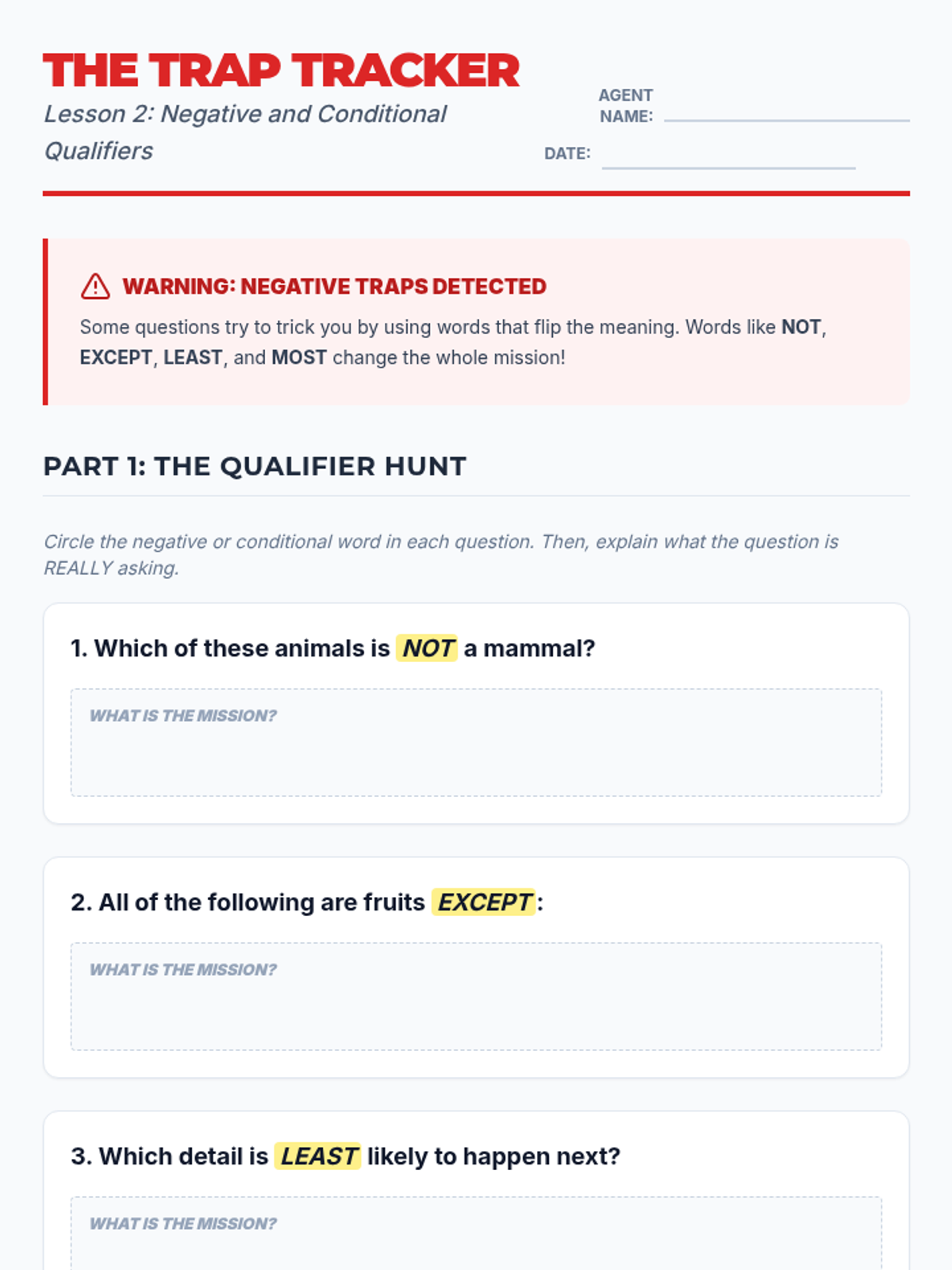
A worksheet designed to help students identify and interpret negative and conditional qualifiers like NOT, EXCEPT, LEAST, and MOST in test questions.
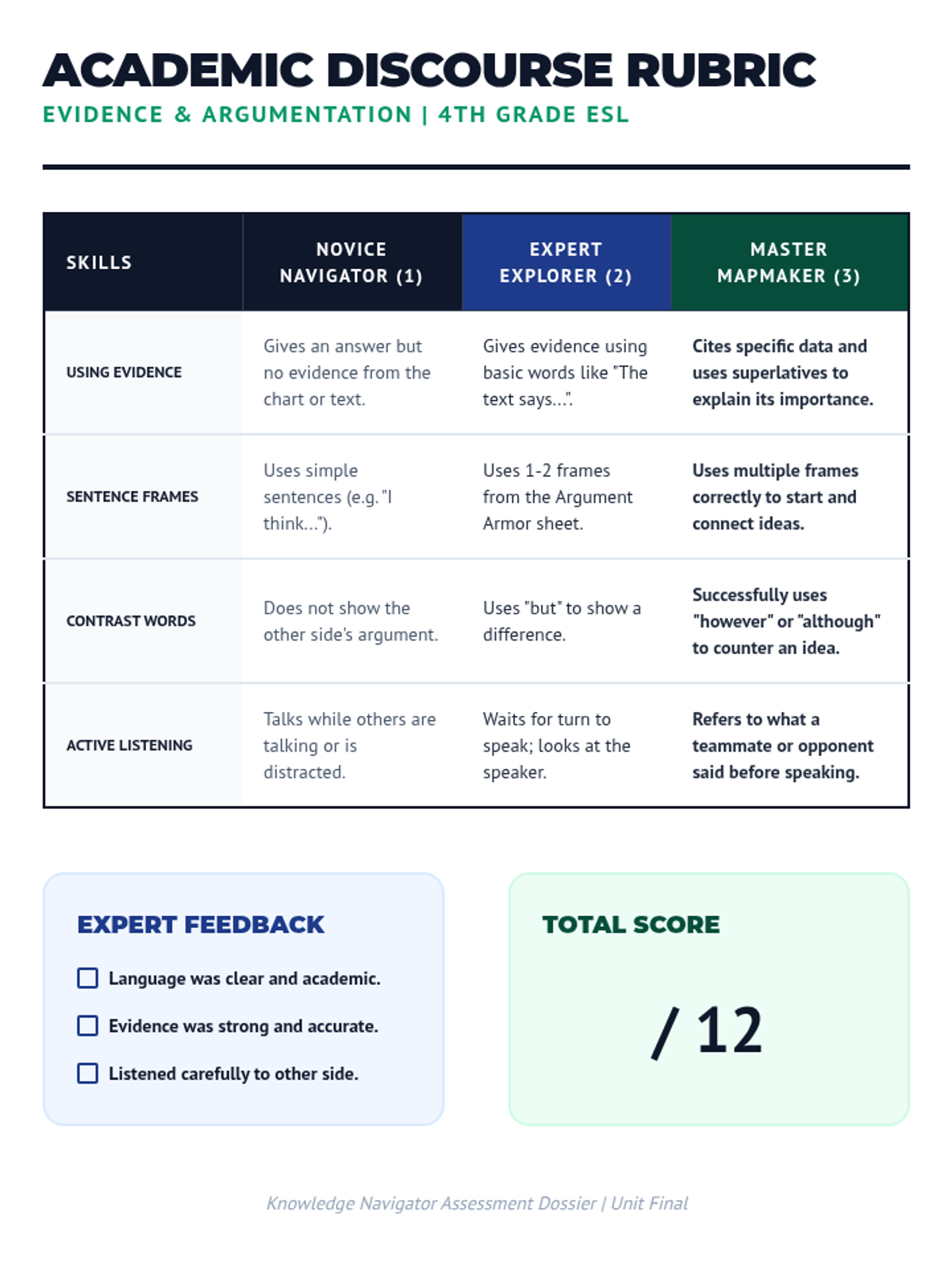
A student-friendly rubric for assessing academic discourse during the debate. Focuses on evidence usage, sentence frames, contrast connectors, and active listening.
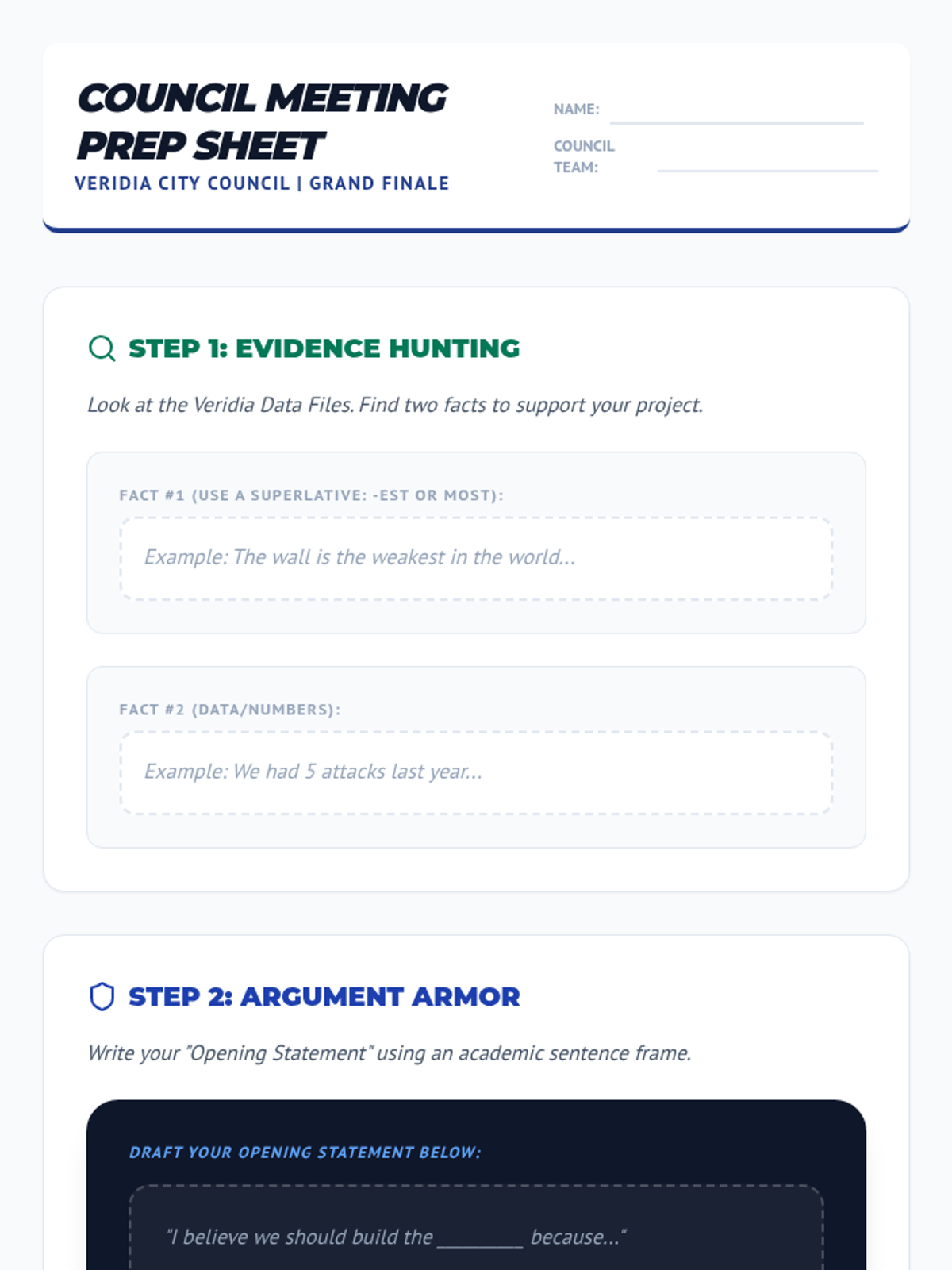
A student preparation sheet for the Council Duel Debate. Guides students through evidence collection, drafting opening statements with sentence frames, and preparing counter-arguments using contrast connectors.
A slide deck for the culminating Council Duel Debate. Sets the historical scenario, presents data for analysis, and provides examples of complex academic discourse for the debate.
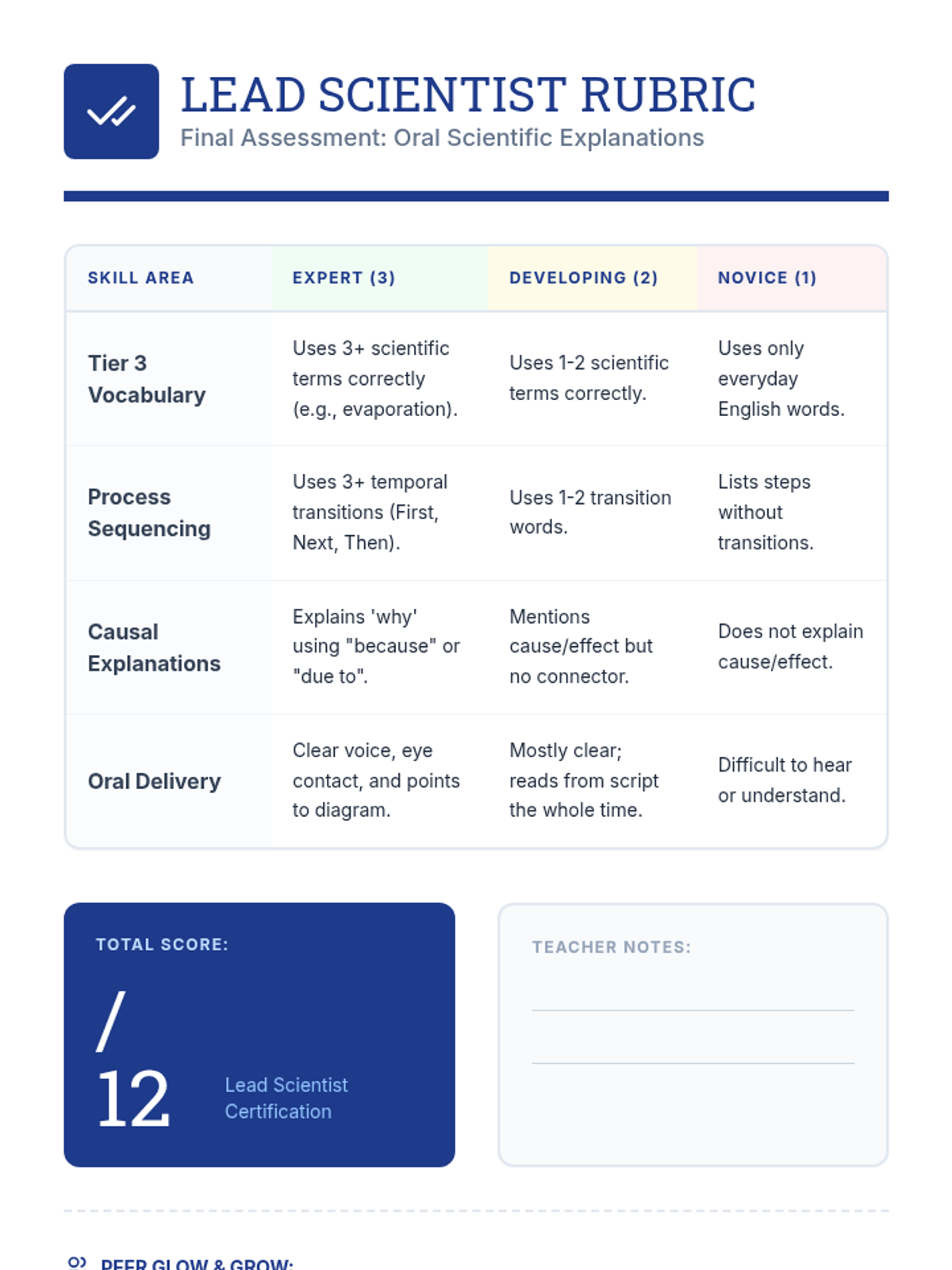
A grading rubric for teachers to assess students' oral scientific presentations, focusing on vocabulary, sequencing, causality, and delivery.
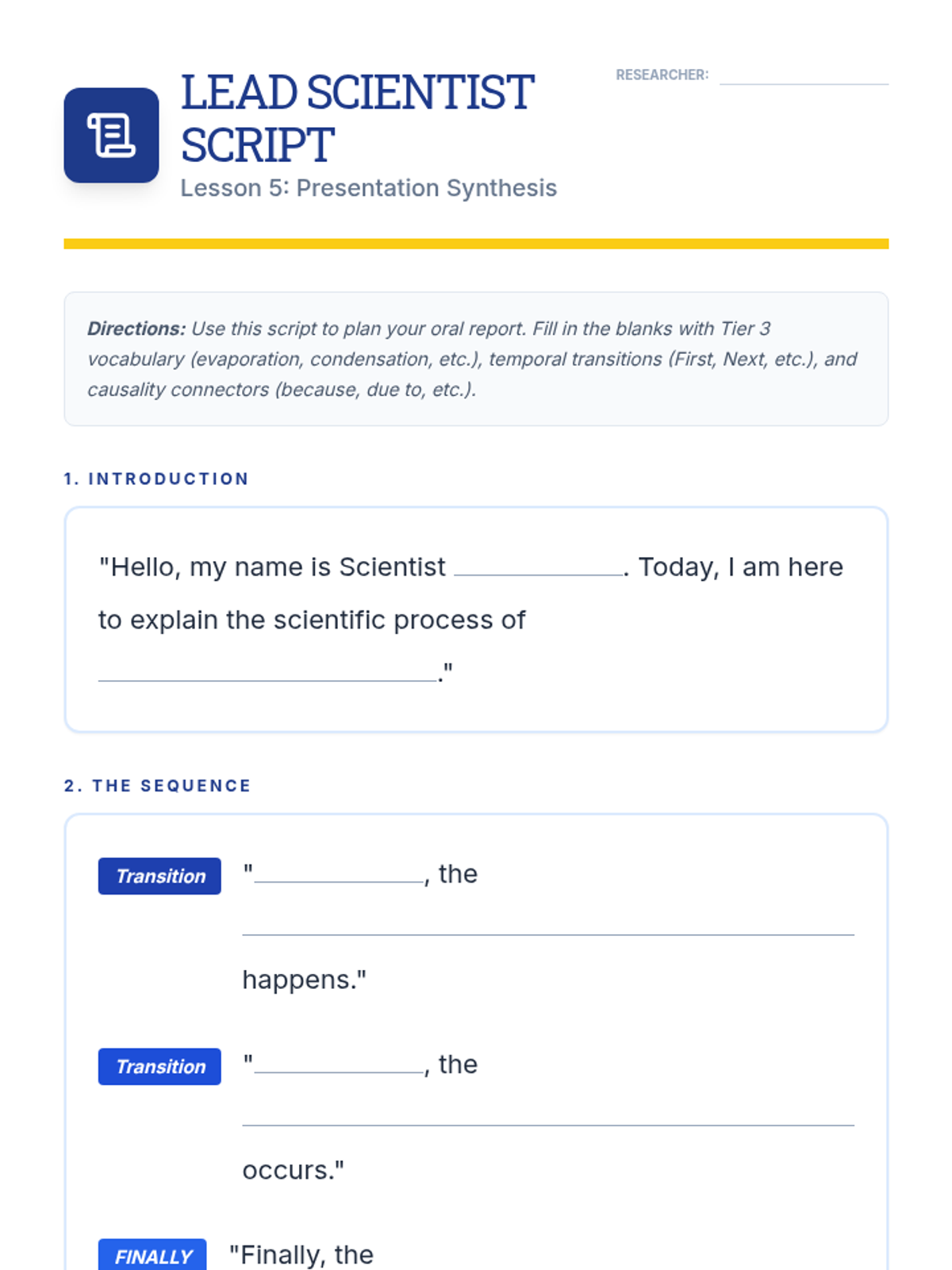
A scaffolded presentation script for students to plan and practice their oral scientific explanations using unit vocabulary and transitions.
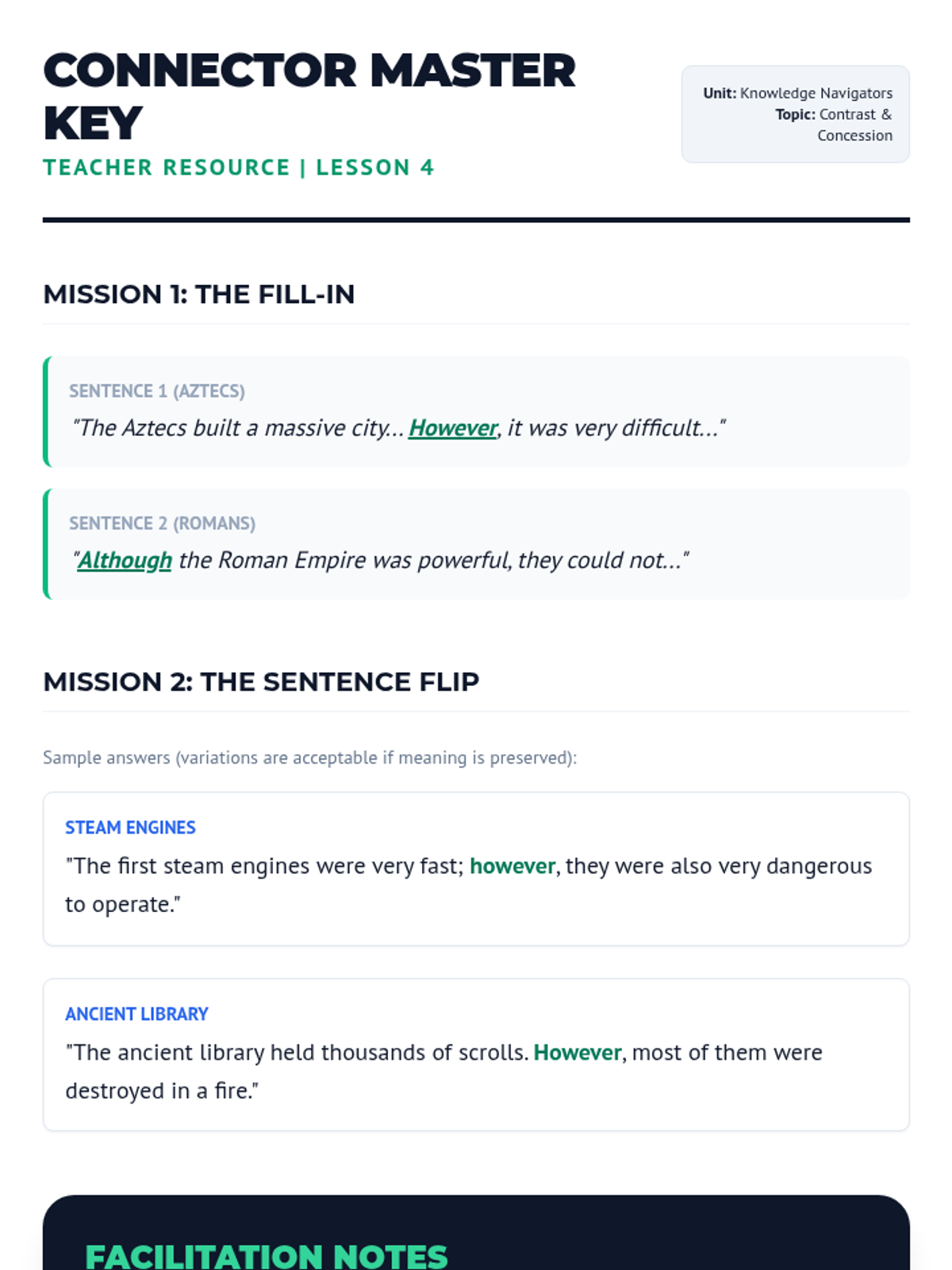
Teacher answer key and facilitation guide for The Great Flip Connectors lesson. Includes sample combined sentences and linguistic scaffolding strategies for ESL students.
Slide deck for Lesson 5 focusing on oral presentations of scientific findings using precise academic language.
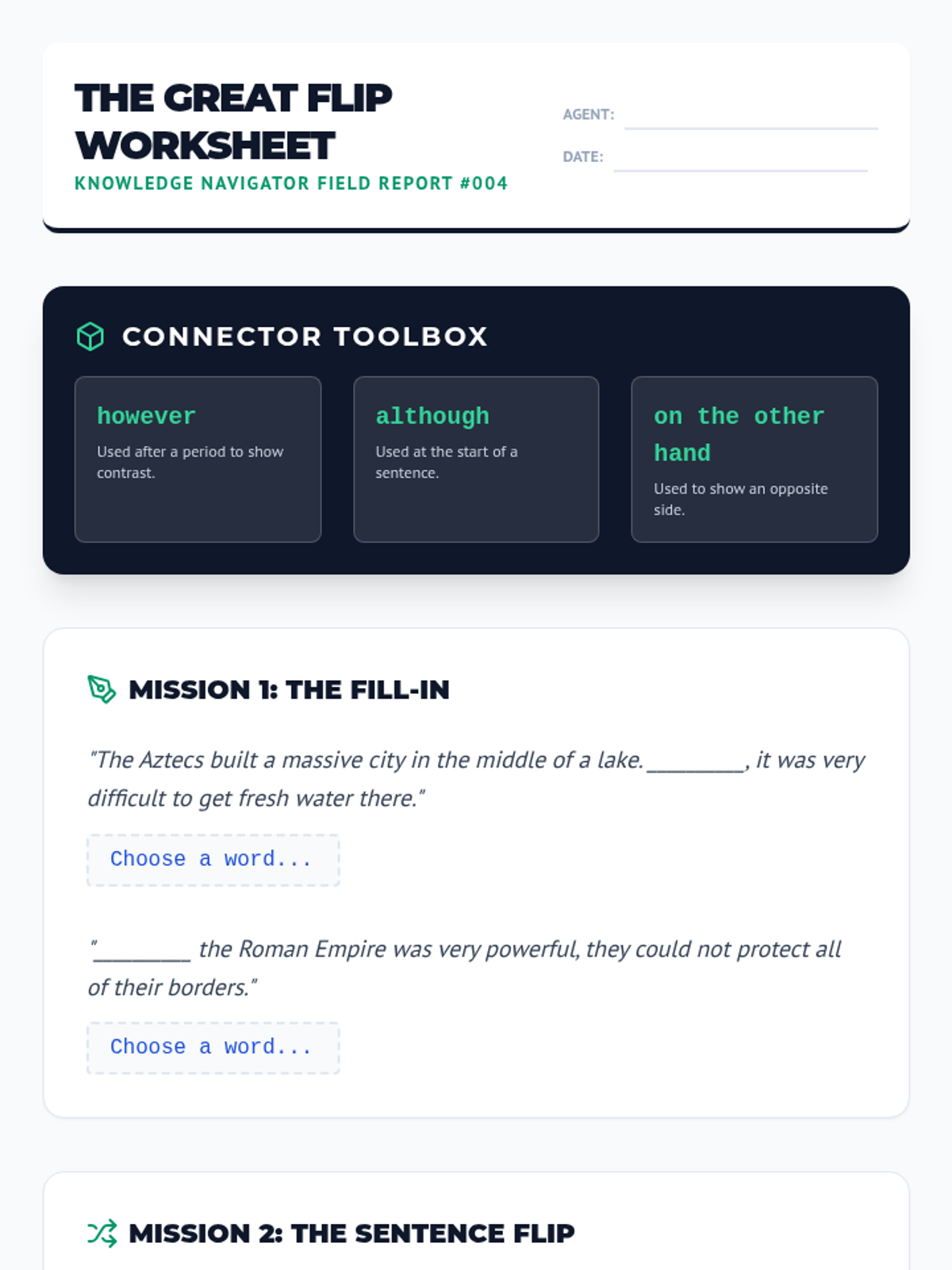
A student worksheet for the The Great Flip Connectors lesson. Students practice filling in and combining sentences using contrast connectors in a social studies context.
A slide deck introducing contrast connectors (however, although, on the other hand) in the context of historical complexity. Includes visual tools and logic checks.
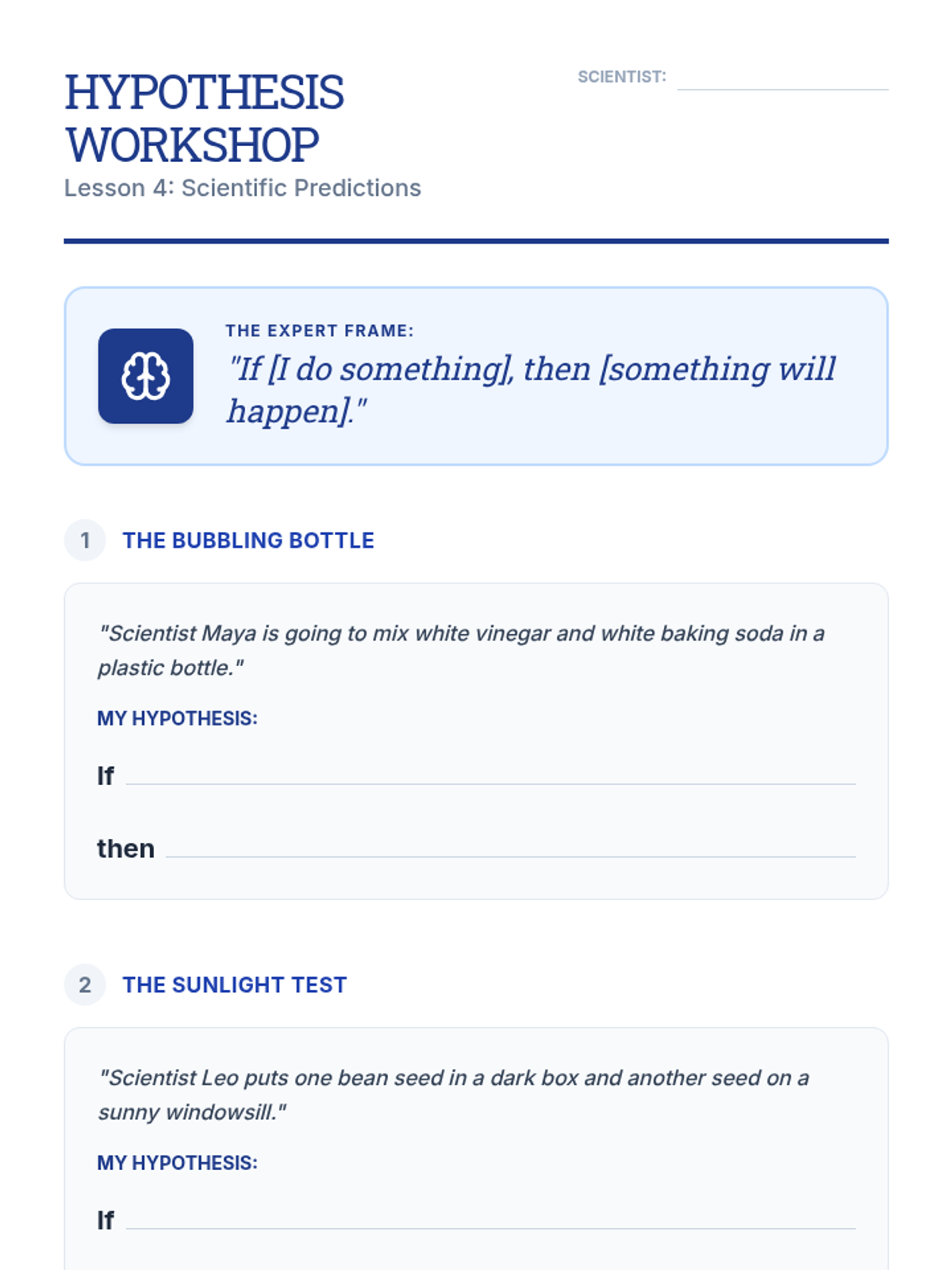
A worksheet for students to practice formulating scientific hypotheses using the 'If... then...' conditional framework across different scenarios.
Slide deck for Lesson 4 focusing on scientific predictions using the 'If... then...' conditional framework.
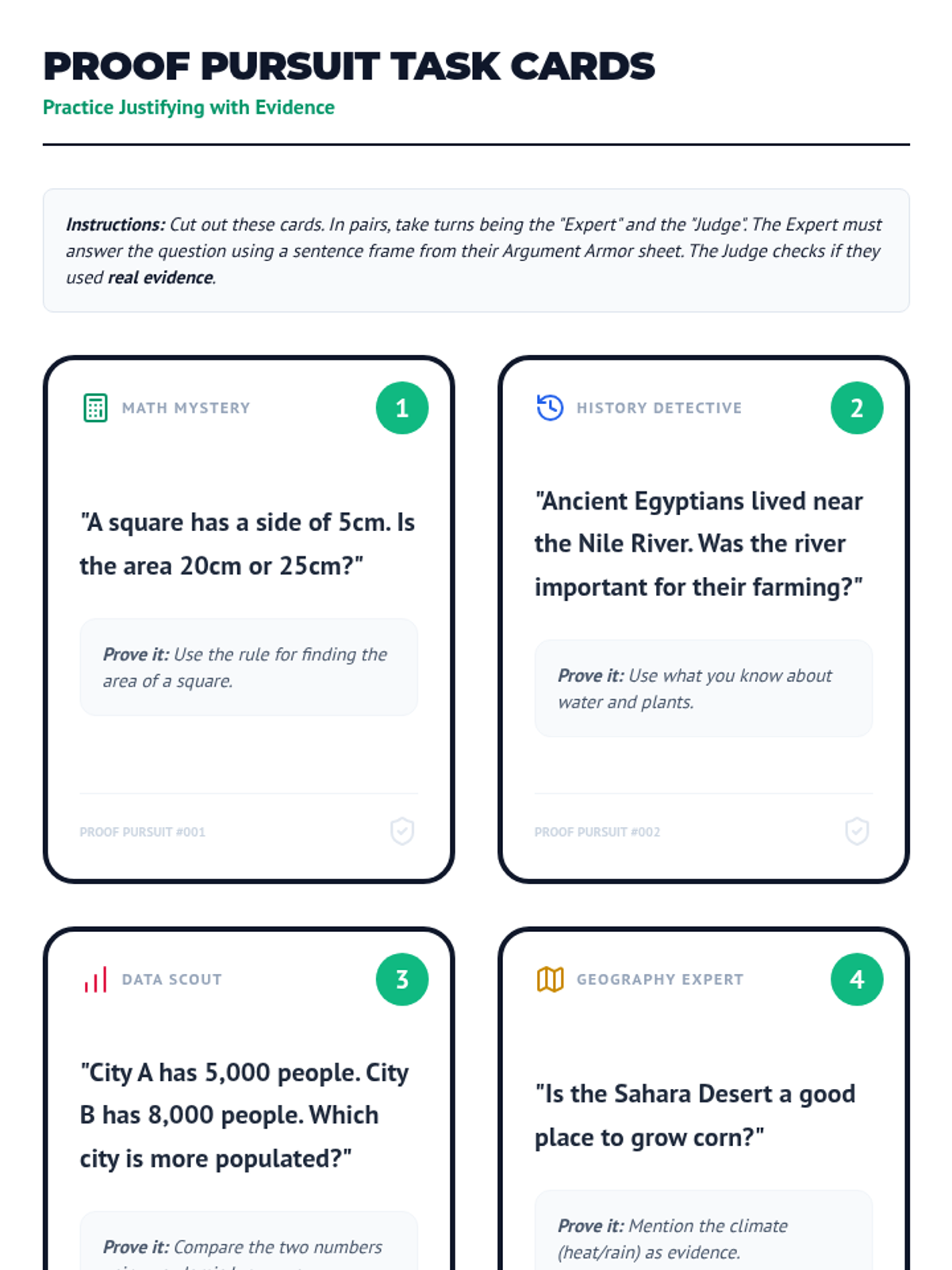
A set of 4 printable task cards for students to practice oral justification. Each card presents a prompt from math, history, data analysis, or geography, requiring evidence-based reasoning.
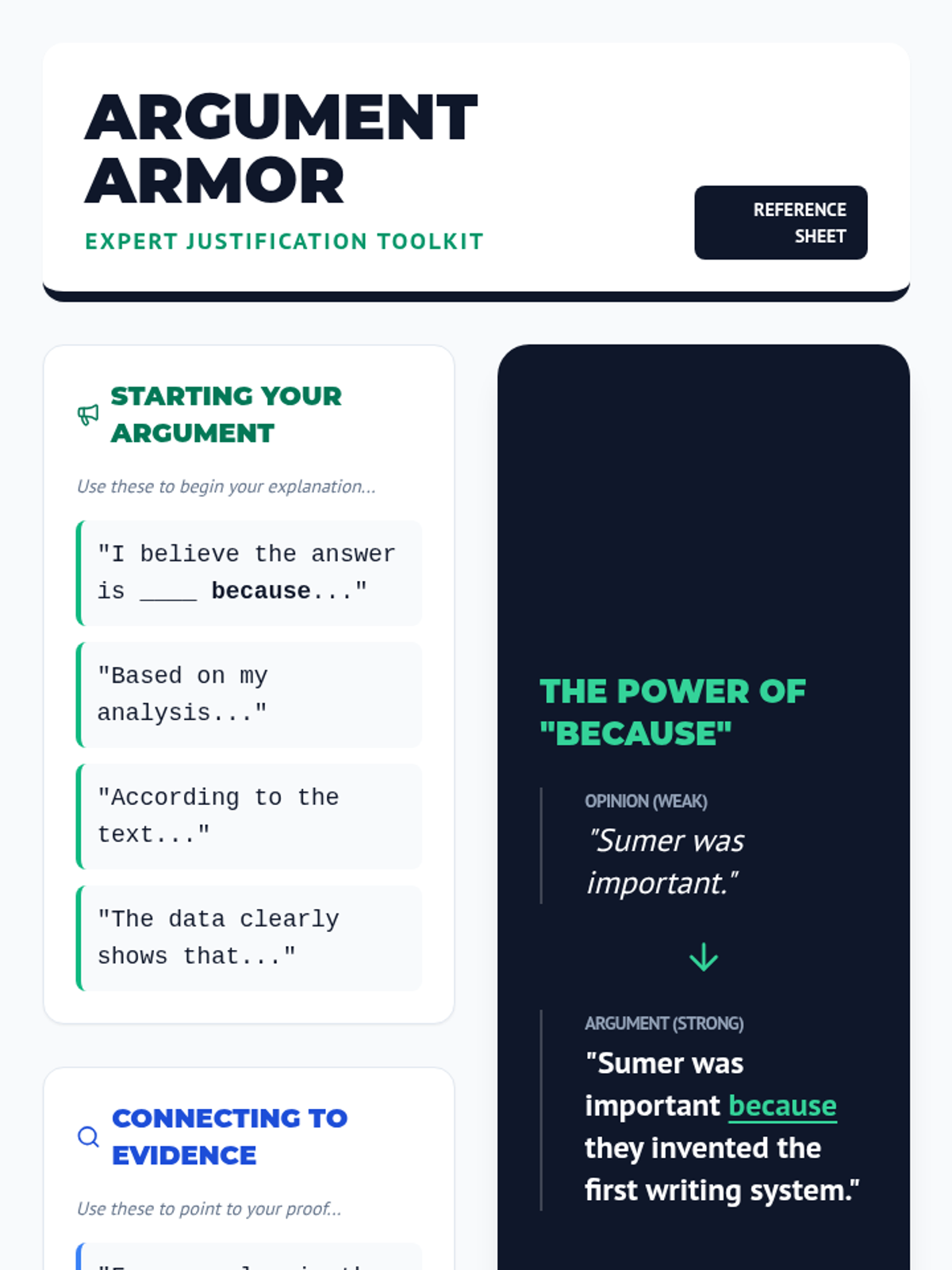
A student reference sheet providing academic sentence frames for starting arguments and connecting to evidence. Features a "Strong vs. Weak" comparison for student modeling.
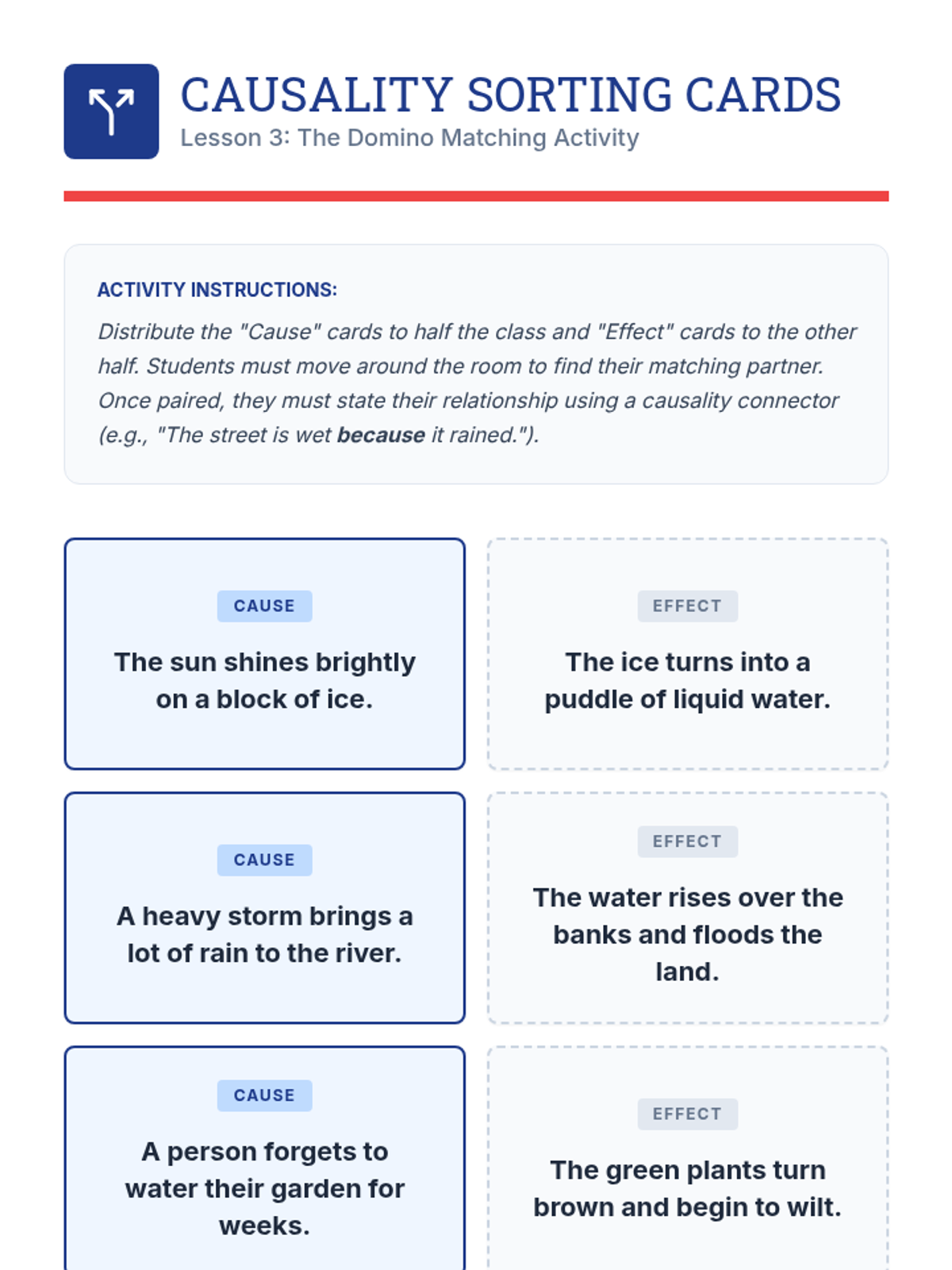
A set of cause and effect matching cards for a hands-on activity, designed to practice using causality connectors in scientific contexts.
A slide deck for 4th Grade ESL students introducing sentence frames for academic justification. Includes examples of using evidence to support historical and mathematical claims.
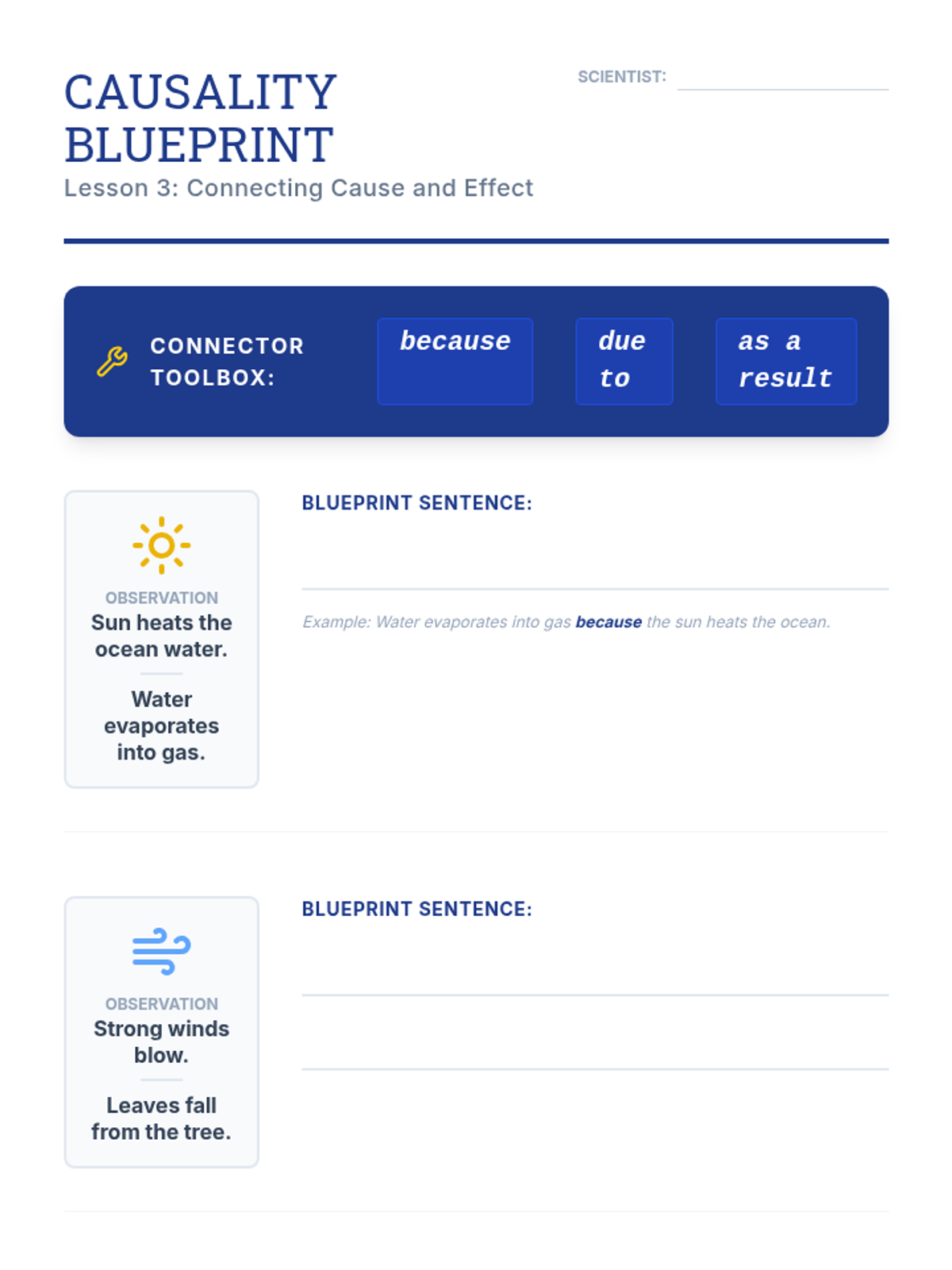
A worksheet for students to combine simple scientific observations into complex sentences using causality connectors (because, due to, as a result).
Slide deck for Lesson 3 focusing on causality connectors (because, due to, as a result) and building complex scientific sentences.
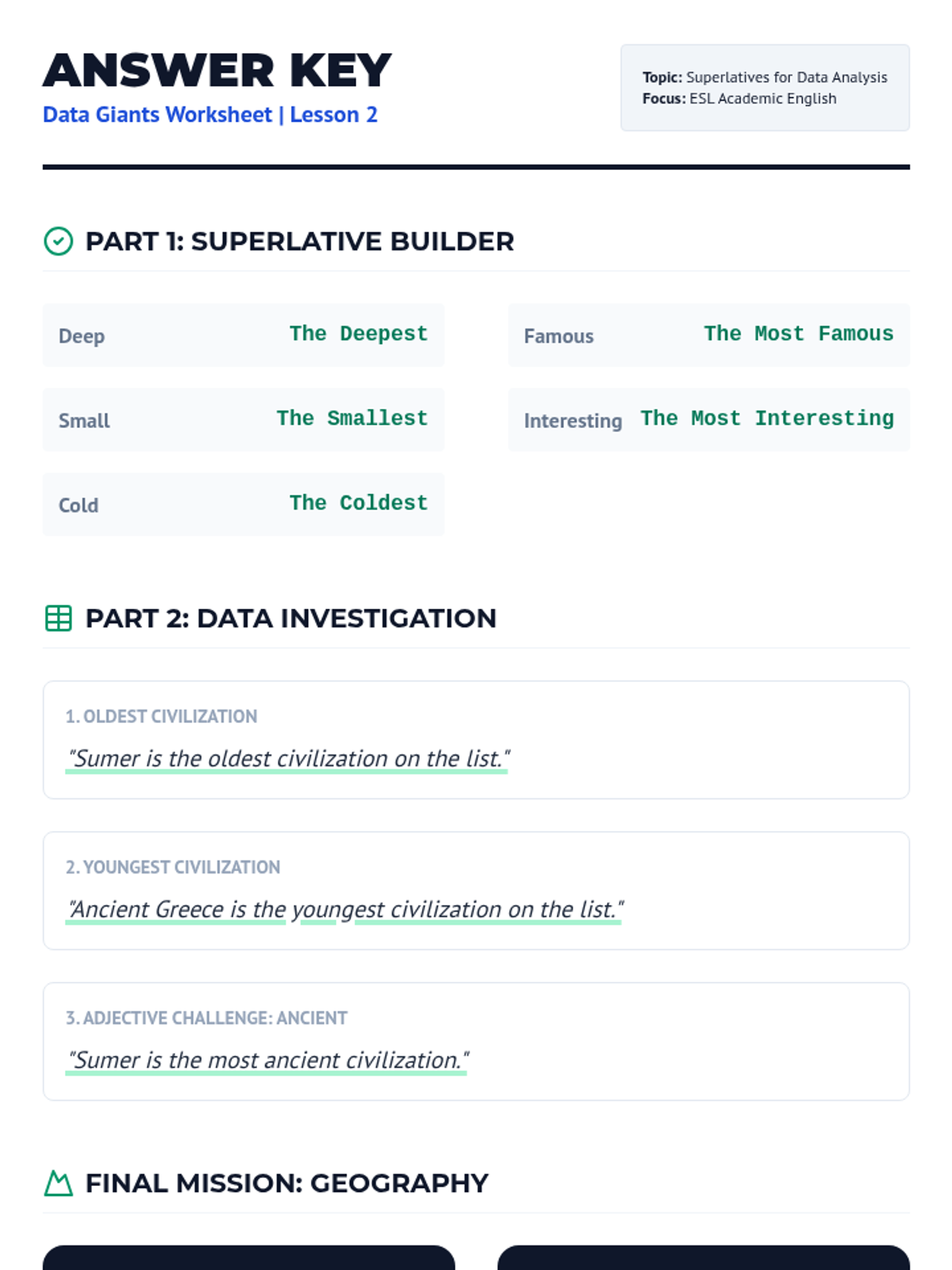
Teacher answer key for the Data Giants Worksheet. Includes corrected superlative forms and sample sentences based on the civilizations chart.
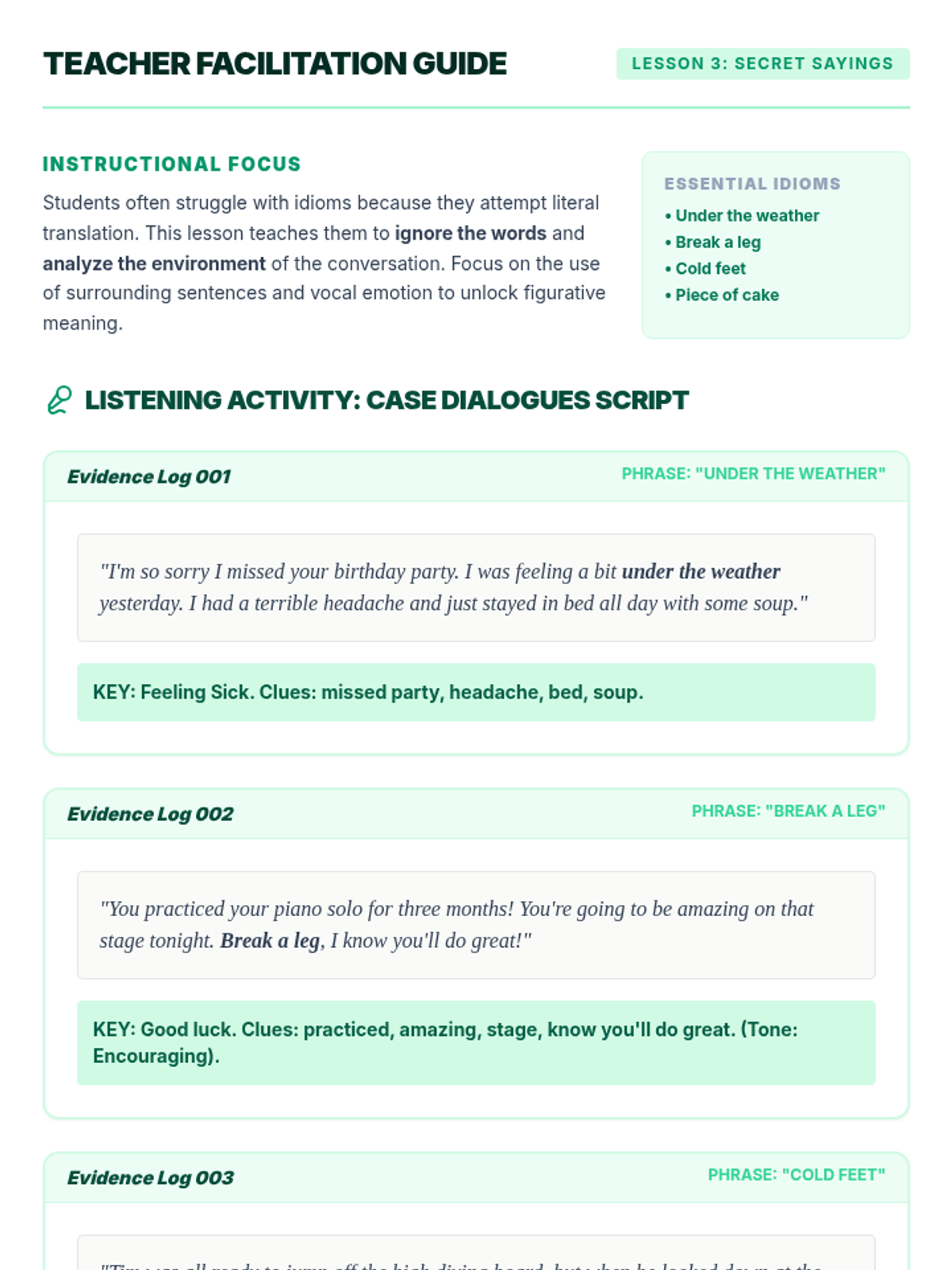
Teacher guide for Lesson 3: Secret Sayings. Provides dialogue scripts for four key idioms and guidance on how to teach context-based deduction over literal translation.
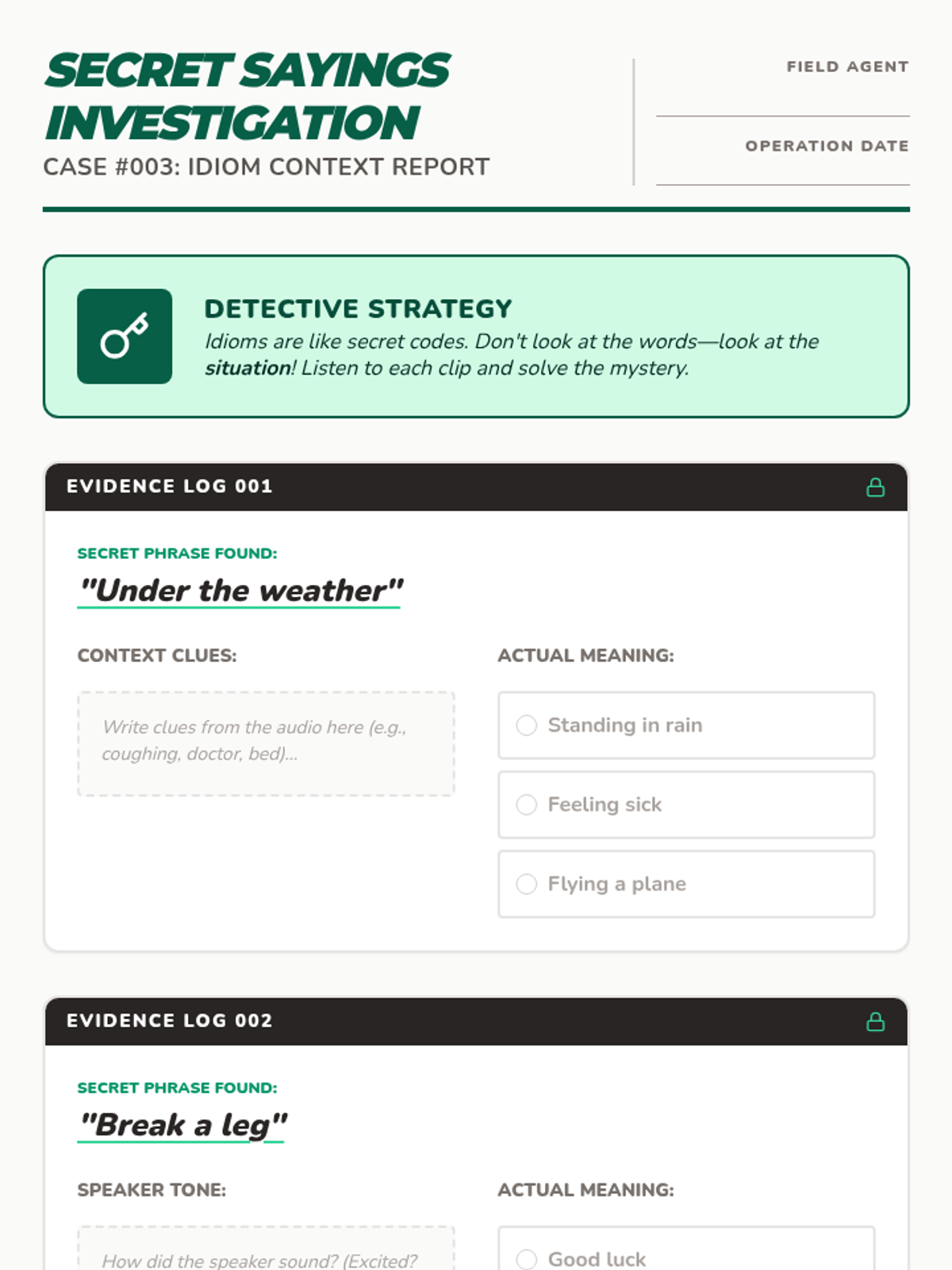
Student worksheet for Lesson 3: Secret Sayings. Students investigate three idioms by analyzing audio clips for context clues, speaker tone, and figurative meaning.
Slides for Lesson 3 focusing on plot sequence, signal words (beginning, middle, end), and how a storyteller's energy and pacing reveal the story arc.
Slides for Lesson 3: Secret Sayings, exploring idioms using context clues. Features clear visual distinctions between literal and figurative meanings.
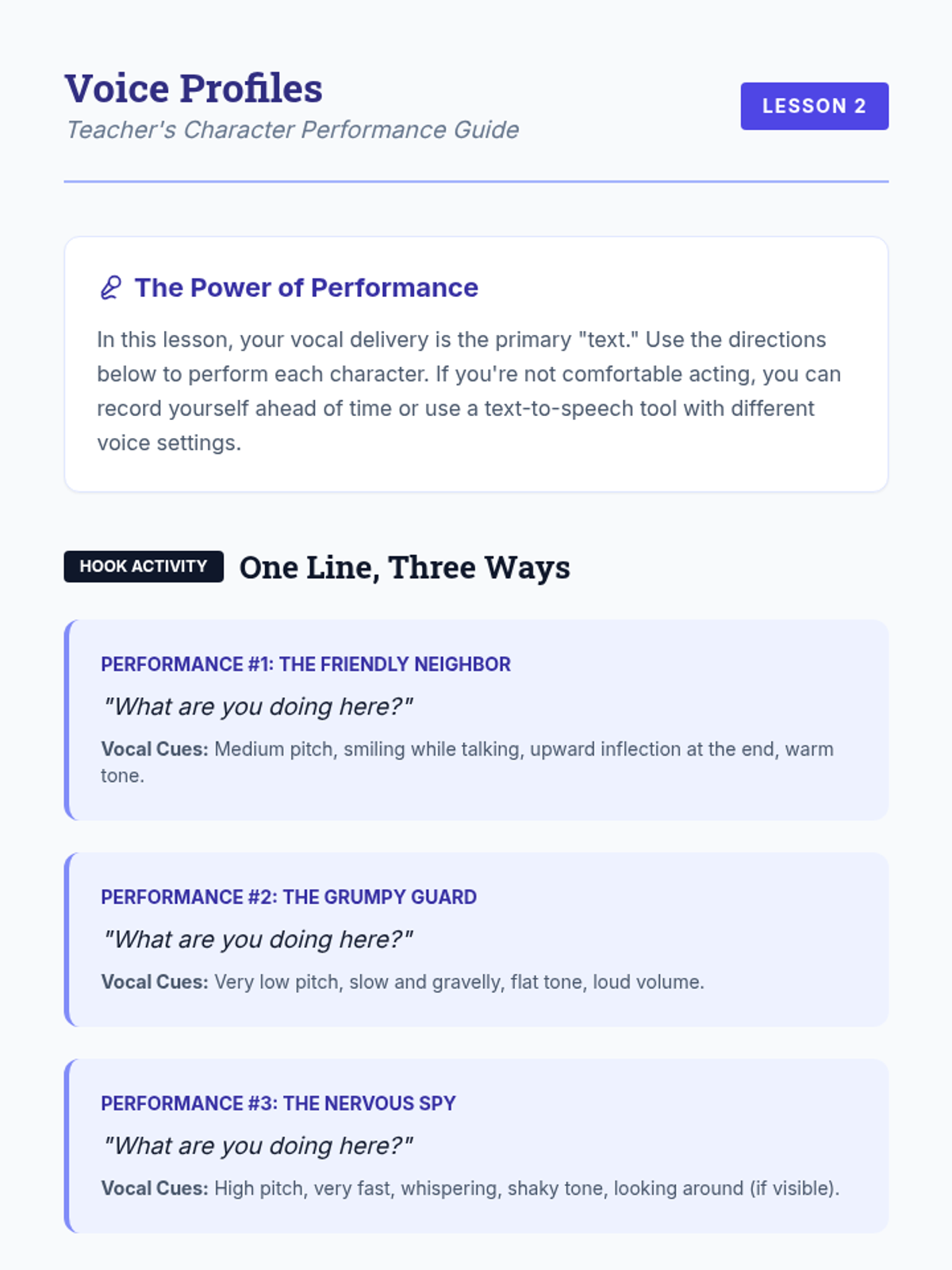
Teacher-facing scripts and instructional guide for Lesson 2 of 'Sound Story Detectives'. Includes 'one line, three ways' hook performances and two mystery character scripts with target cues and trait inferences.
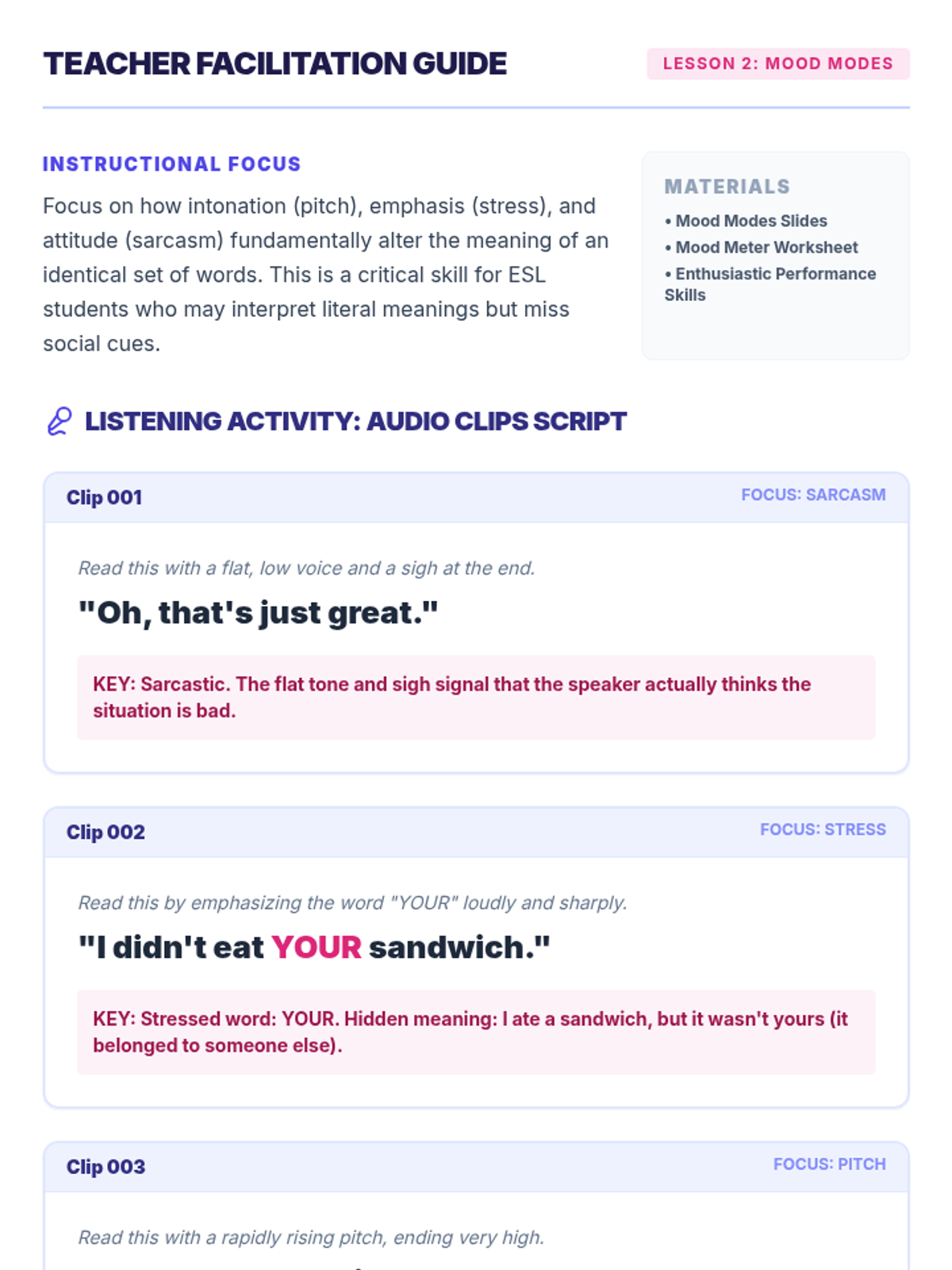
Teacher guide for Lesson 2: Mood Modes. Contains scripts for sarcasm, stress, and pitch activities, along with keys for the worksheet and discussion prompts.