Develops technical proficiency and creative movement skills across various styles. Examines choreographic principles alongside the historical and cultural origins of diverse global dance forms.
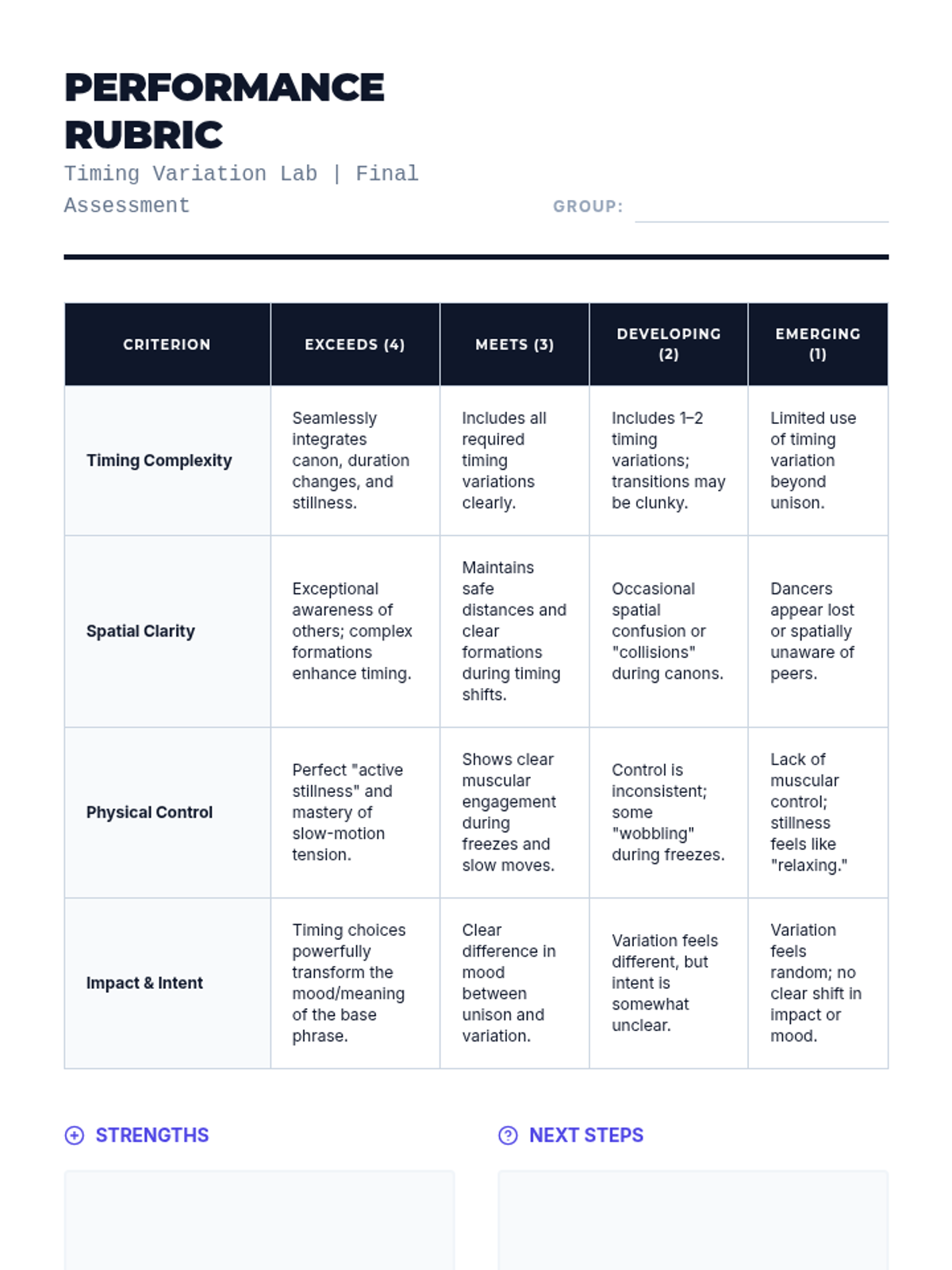
A grading rubric for the final project in Lesson 5. It evaluates groups on timing complexity, spatial clarity, physical control, and the emotional impact of their choreographic variations.
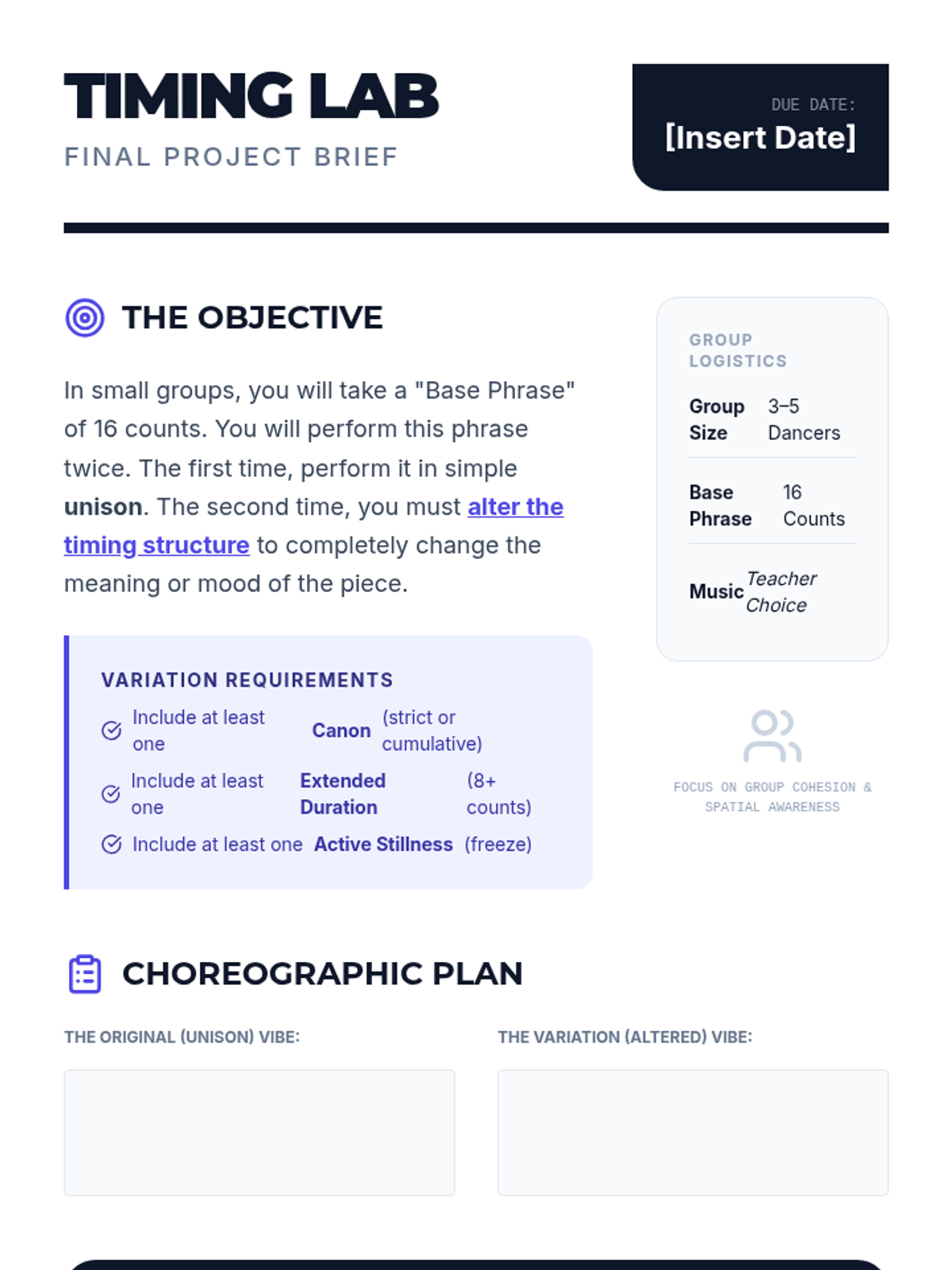
A project guide and planning document for the final lesson. It outlines the requirements for taking a unison phrase and creating a variation using timing manipulation (canon, duration, stillness).
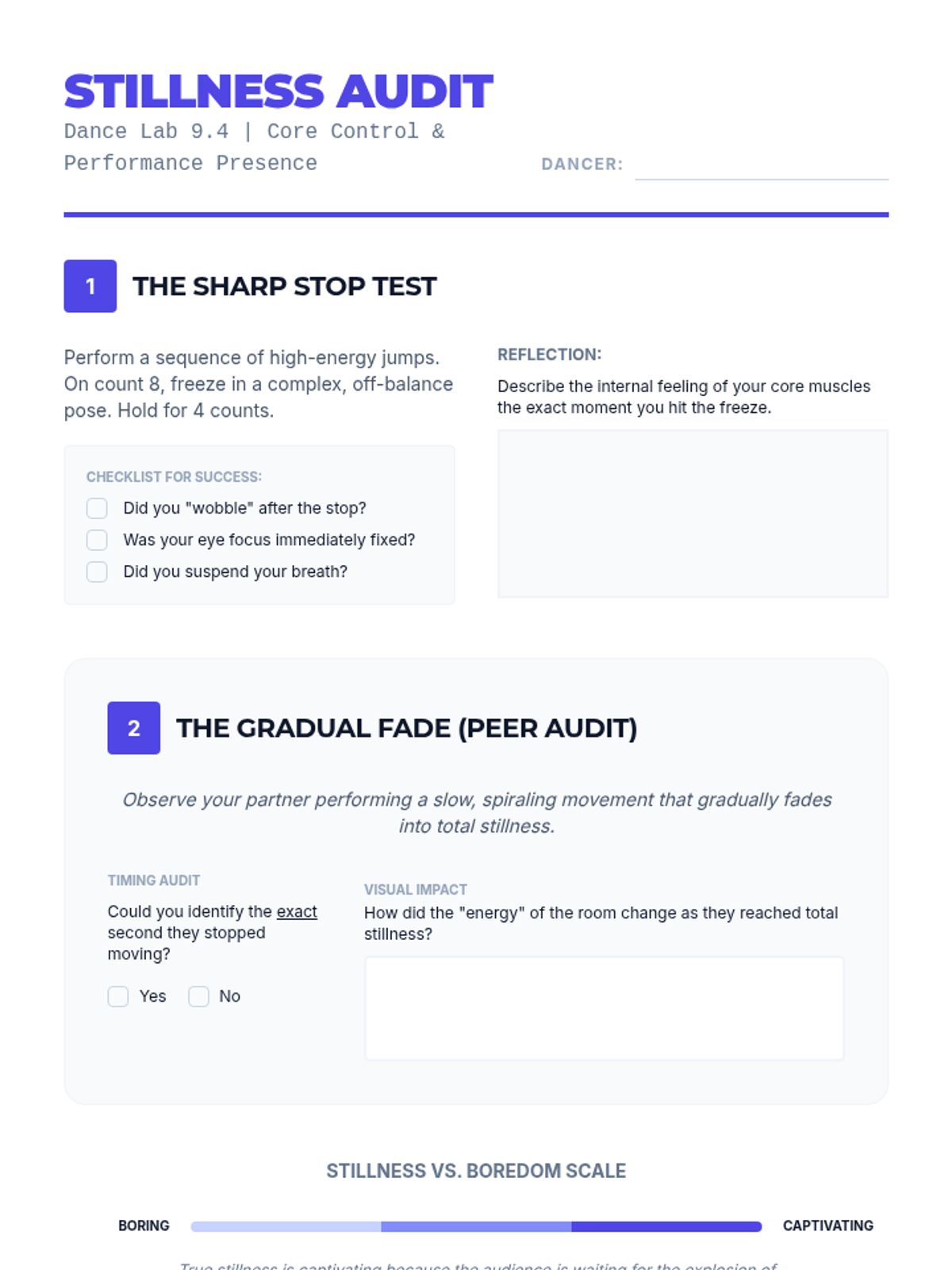
A student worksheet for Lesson 4 to evaluate their own and peers' control during freezes. Includes a checklist for technical success and a reflection on the dramatic impact of stillness.
A slide deck for Lesson 4 exploring the power of stillness and silence in dance. It covers the difference between sharp stops and gradual deceleration, as well as the technical importance of breath control and core engagement.
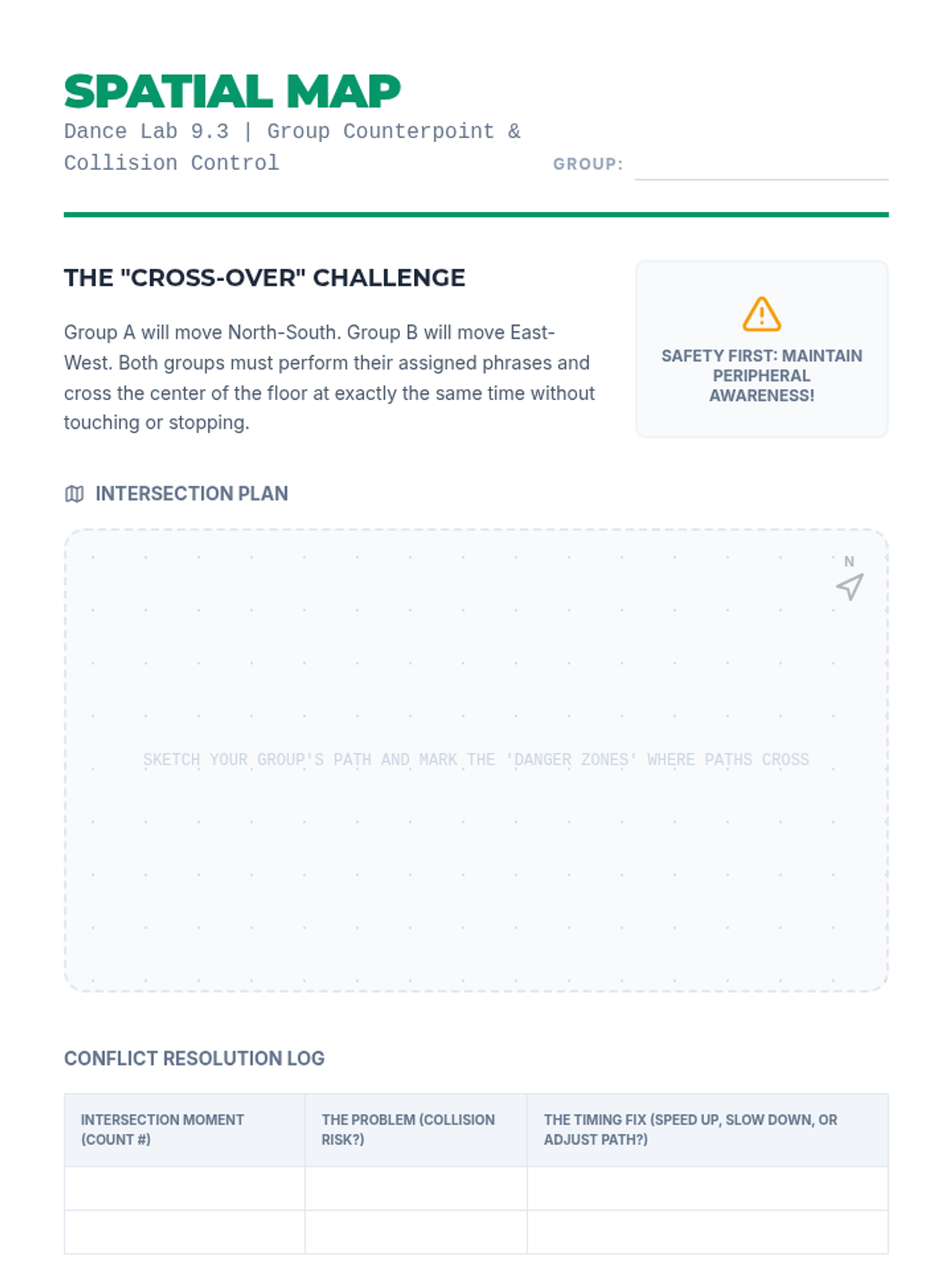
An activity guide for Lesson 3 to plan and analyze spatial counterpoint. Students map out their intersection paths and record how they adjusted their timing to avoid collisions while maintaining their choreographic phrases.
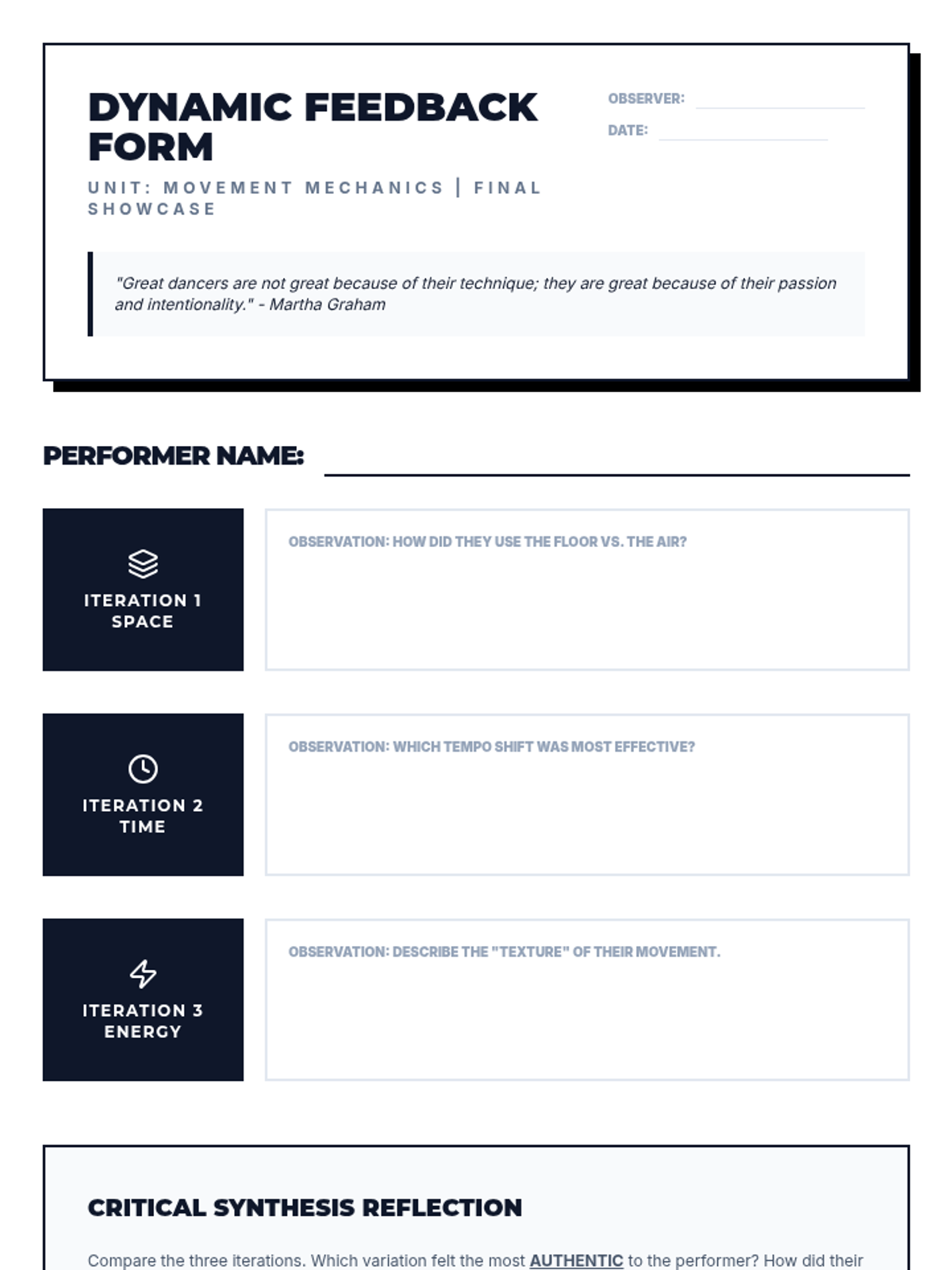
A peer feedback form for Lesson 5, designed for students to observe and analyze variations in space, time, and energy during a classmate's performance.
A visual presentation deck for the final performance showcase in Lesson 5, detailing the "Chameleon Challenge" and performance criteria for peer feedback.
A slide deck for Lesson 3 introducing counterpoint in movement. It compares musical counterpoint to dance, explores spatial-temporal reasoning, and uses a traffic intersection analogy to explain anticipation and safety.
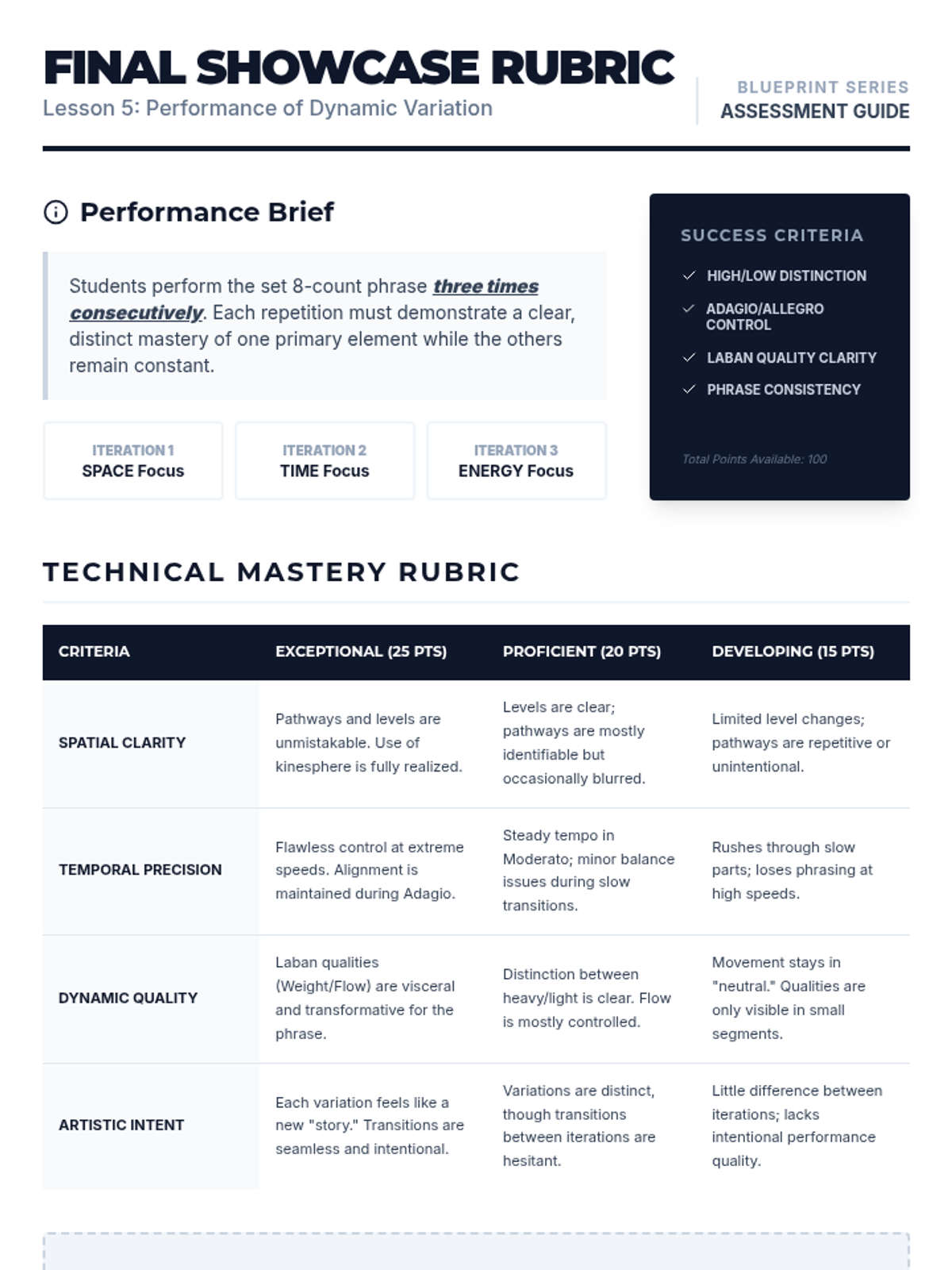
A formal assessment rubric for Lesson 5, focusing on spatial clarity, temporal precision, dynamic quality, and artistic intent in a performance showcase.
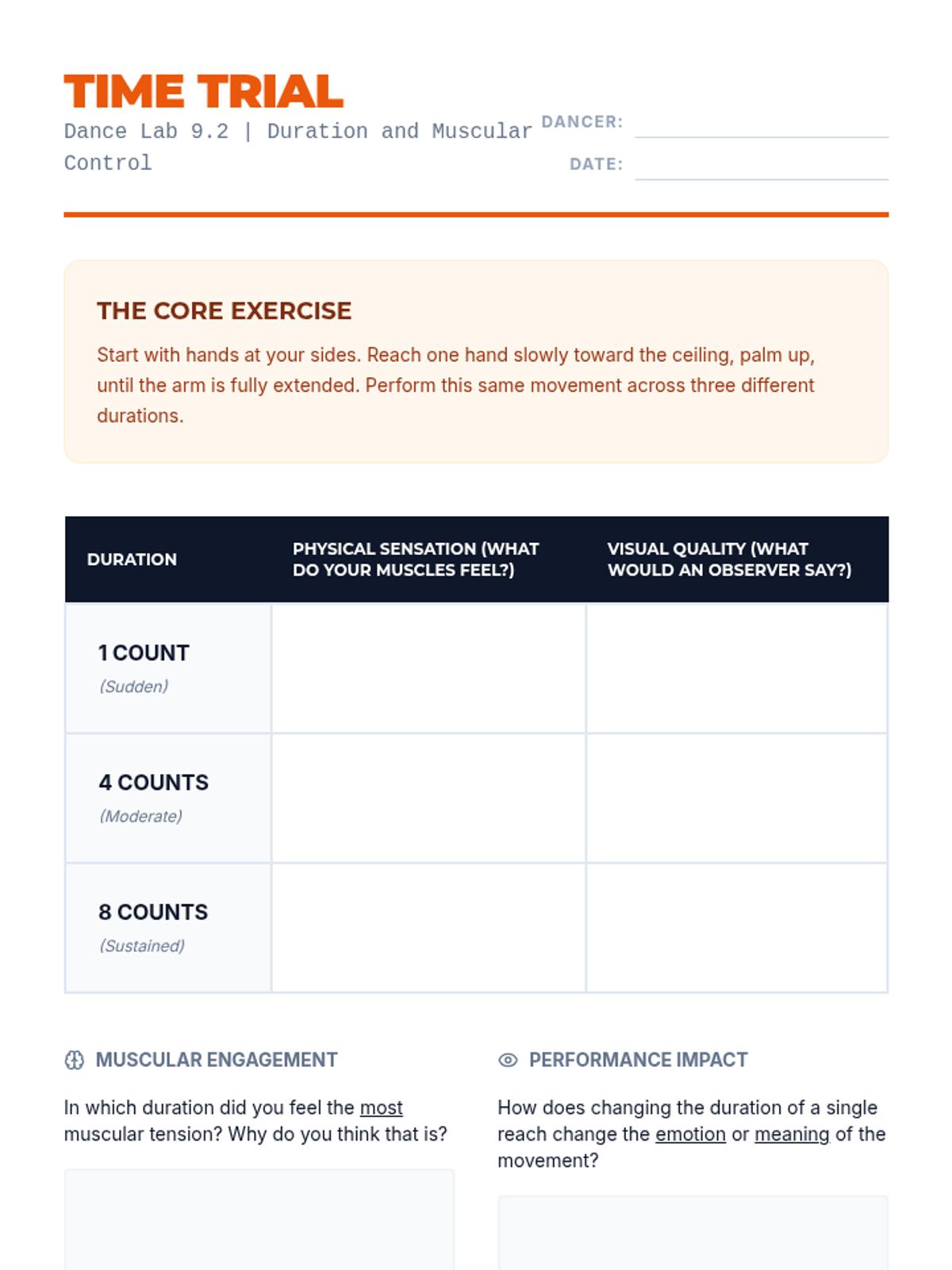
A student lab sheet for Lesson 2 to record physical sensations and visual observations when performing the same movement over 1, 4, and 8 counts. Focuses on muscular control and movement quality.
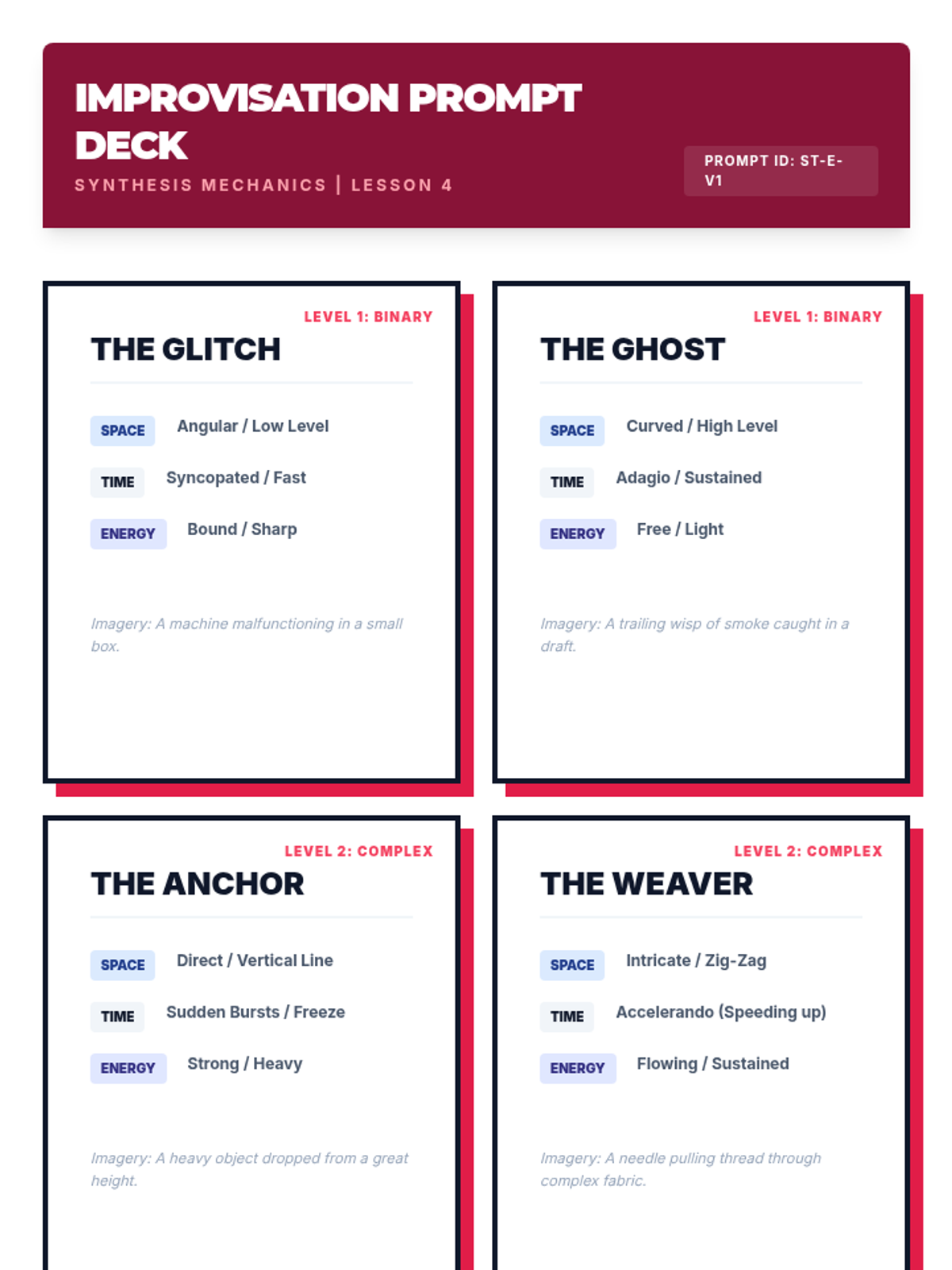
A set of improvisation prompt cards for Lesson 4, providing specific Space, Time, and Energy constraints (The Glitch, The Ghost, The Anchor, The Weaver).
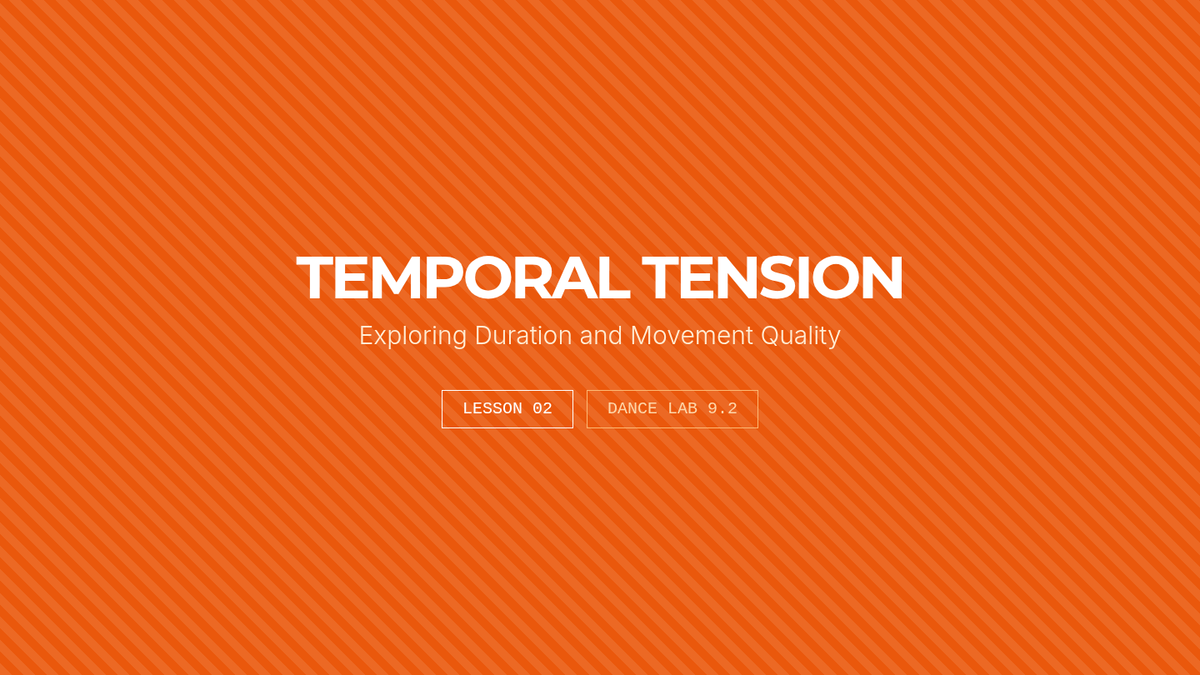
A slide deck for Lesson 2 exploring how movement duration (1, 4, and 8 counts) impacts muscular tension and the perceived quality of dance. Introduces concepts of 'sudden' versus 'sustained' time.
A visual presentation deck on synthesis and improvisation, defining parameters for the "The Switch" activity and exploring the collision of space, time, and energy.
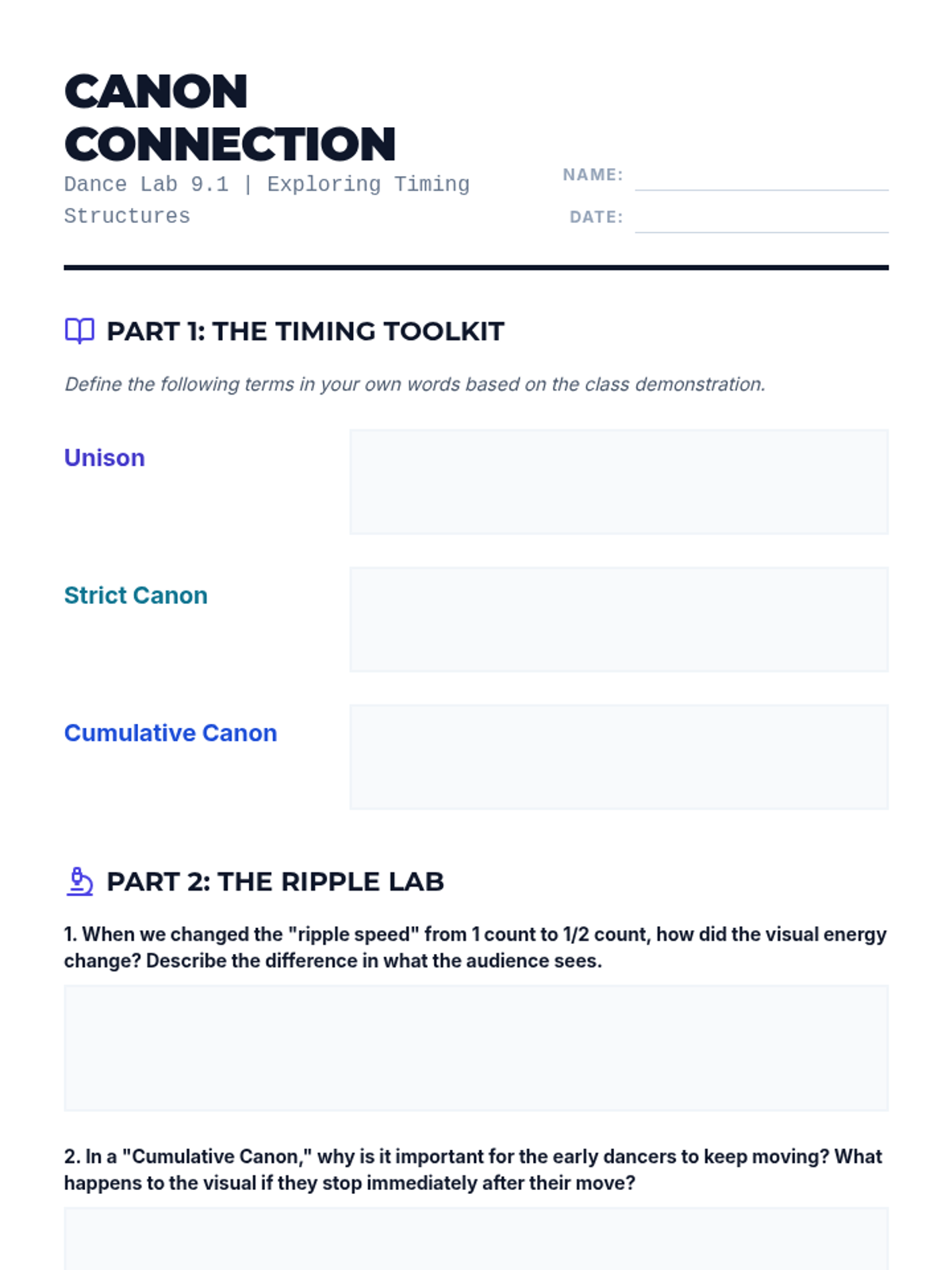
A student worksheet for Lesson 1 to define core timing terms and reflect on the visual impact of ripple effects and canons. Includes space for observations from the workshop.
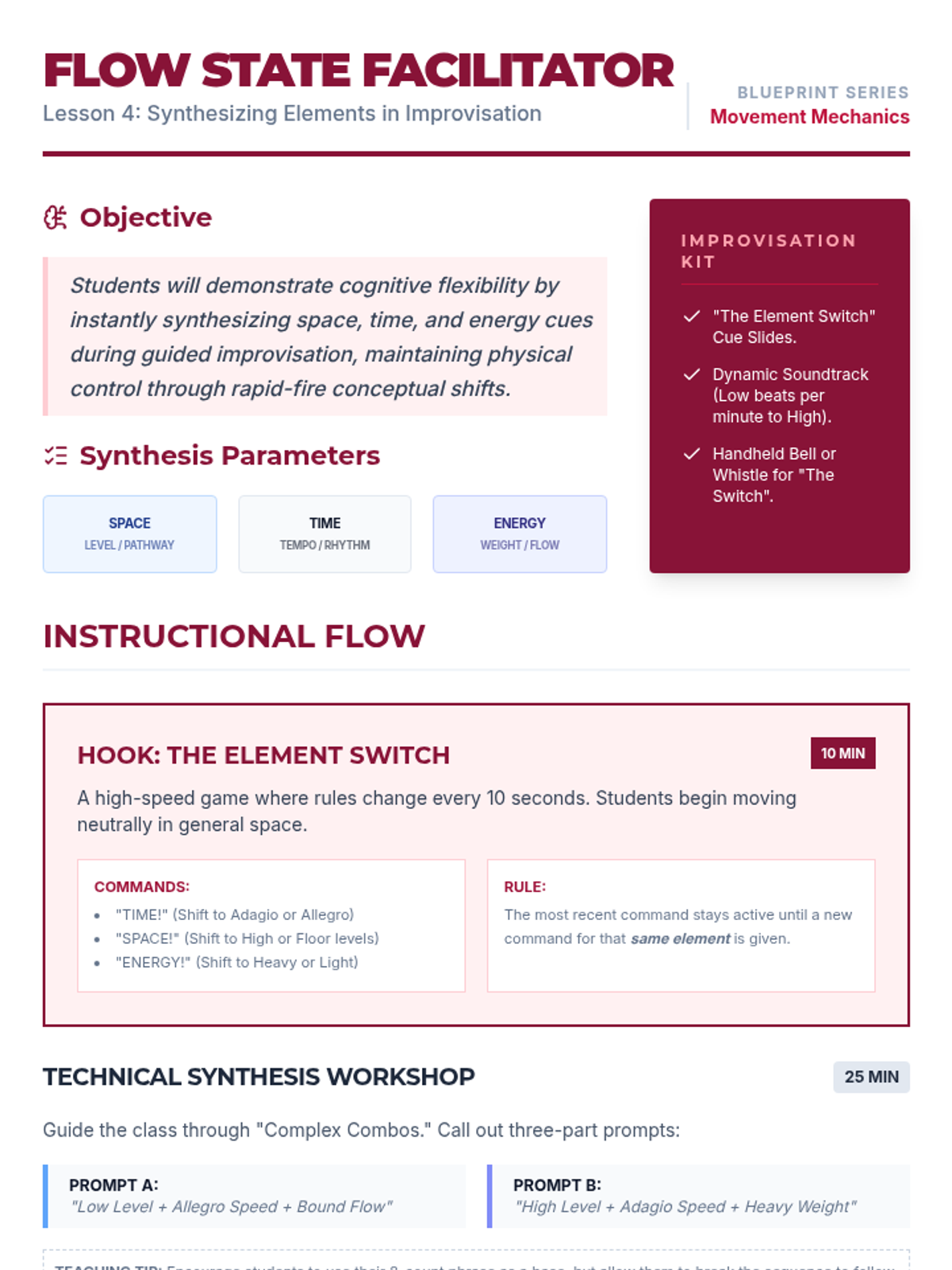
A technical teacher's guide for Lesson 4, detailing the "Element Switch" hook and strategies for guided improvisation using space, time, and energy synthesis.
A visual presentation for Lesson 1 introducing the concepts of unison, strict canon, and cumulative canon using the 'stadium wave' as an entry point. It provides clear definitions and rhythmic visualizations of different timing structures.
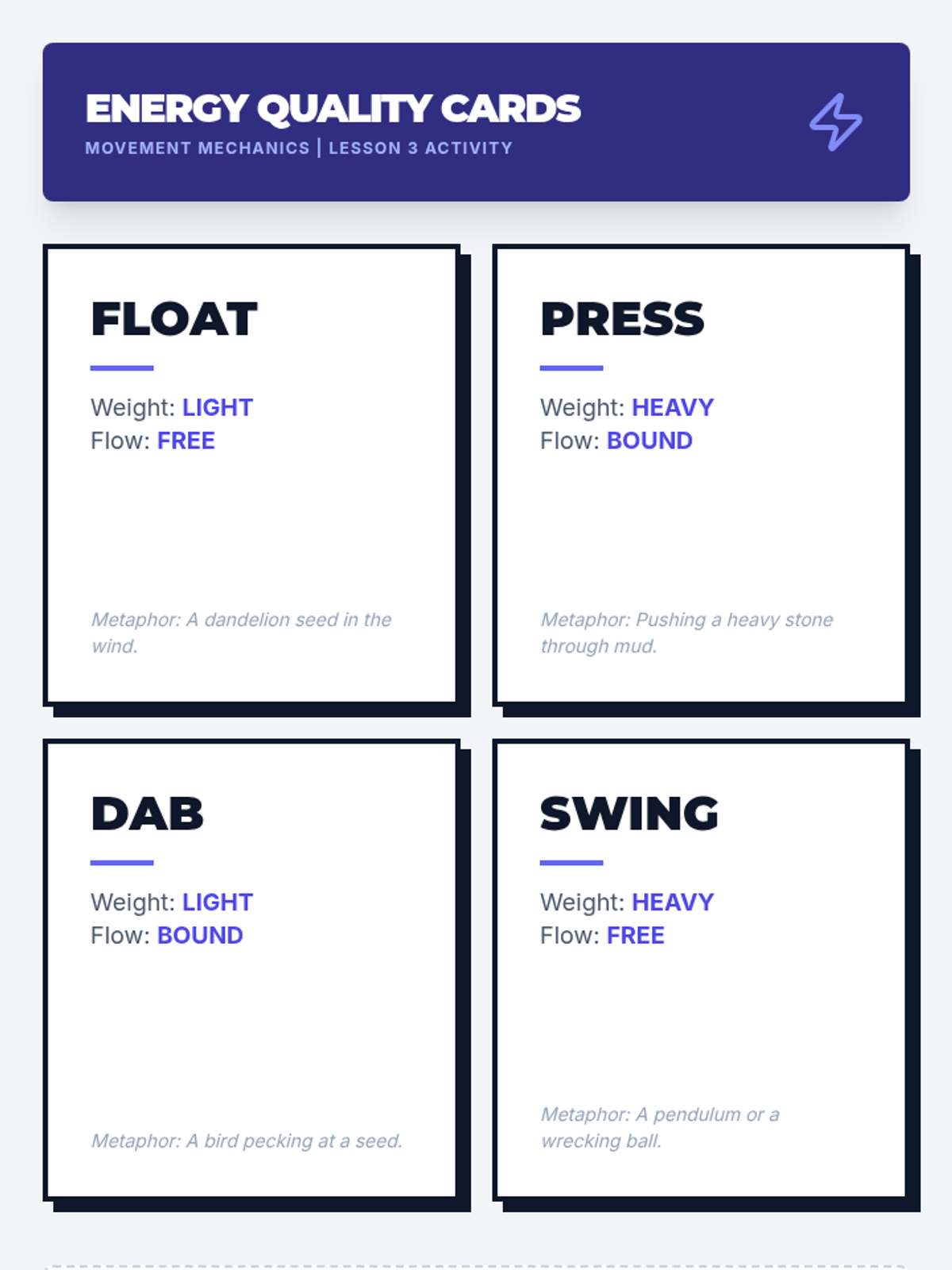
A set of movement quality cards for Lesson 3, providing technical definitions and metaphors for Laban's Effort actions (Float, Press, Dab, Swing).
A visual presentation deck on movement energy, focusing on Laban's concepts of Weight (Heavy/Light) and Flow (Bound/Free) with textural metaphors.
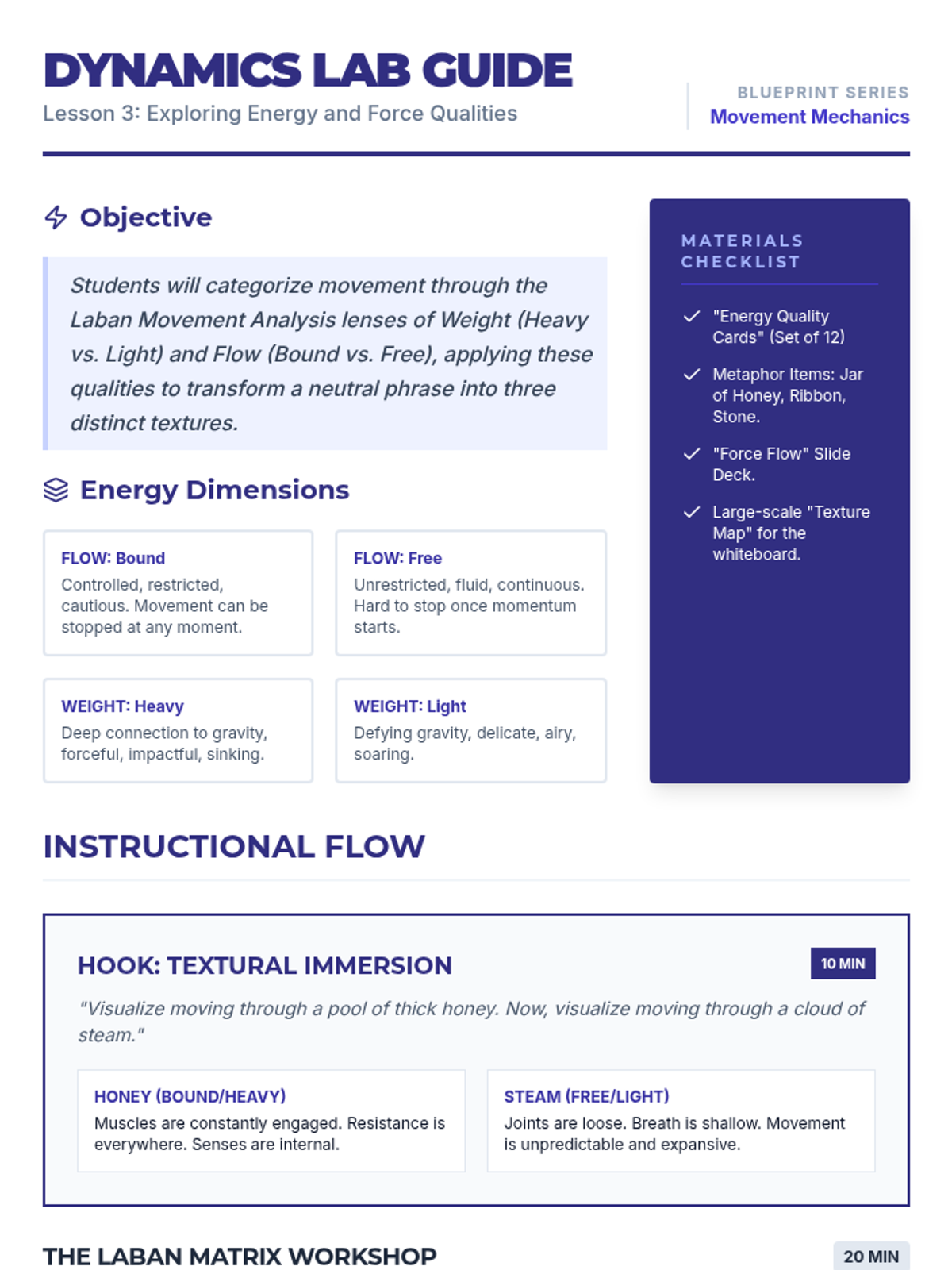
A technical teacher's guide for Lesson 3, exploring movement energy and force through Laban Movement Analysis (Weight and Flow).
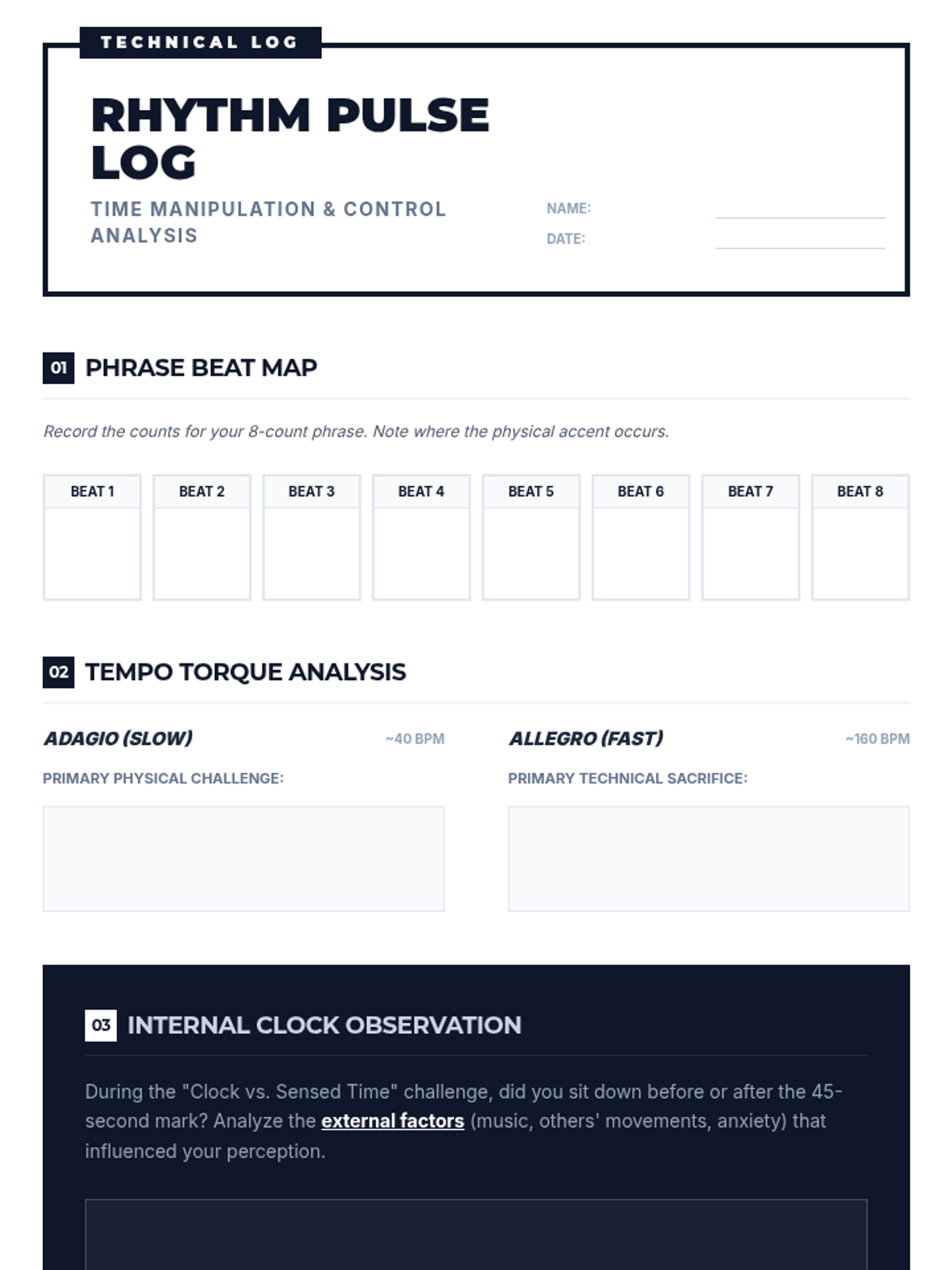
A student technical log for Lesson 2 that includes a beat-map for a 8-count phrase and space for analyzing the physical challenges of different tempos.
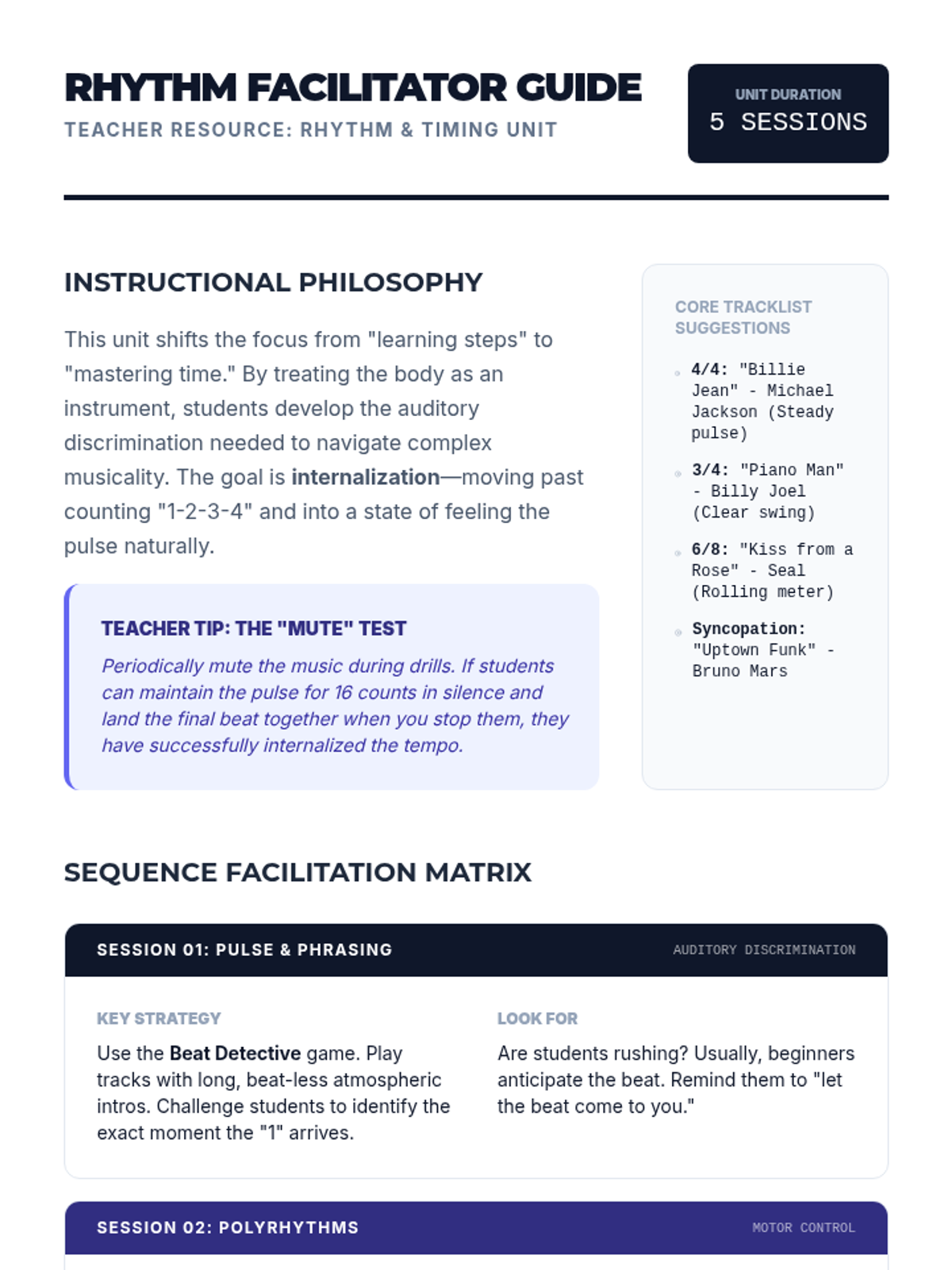
A comprehensive teacher guide for the 5-lesson sequence. Includes instructional philosophy, tracklist suggestions, facilitation strategies for each session, and differentiation tips for various learner levels.
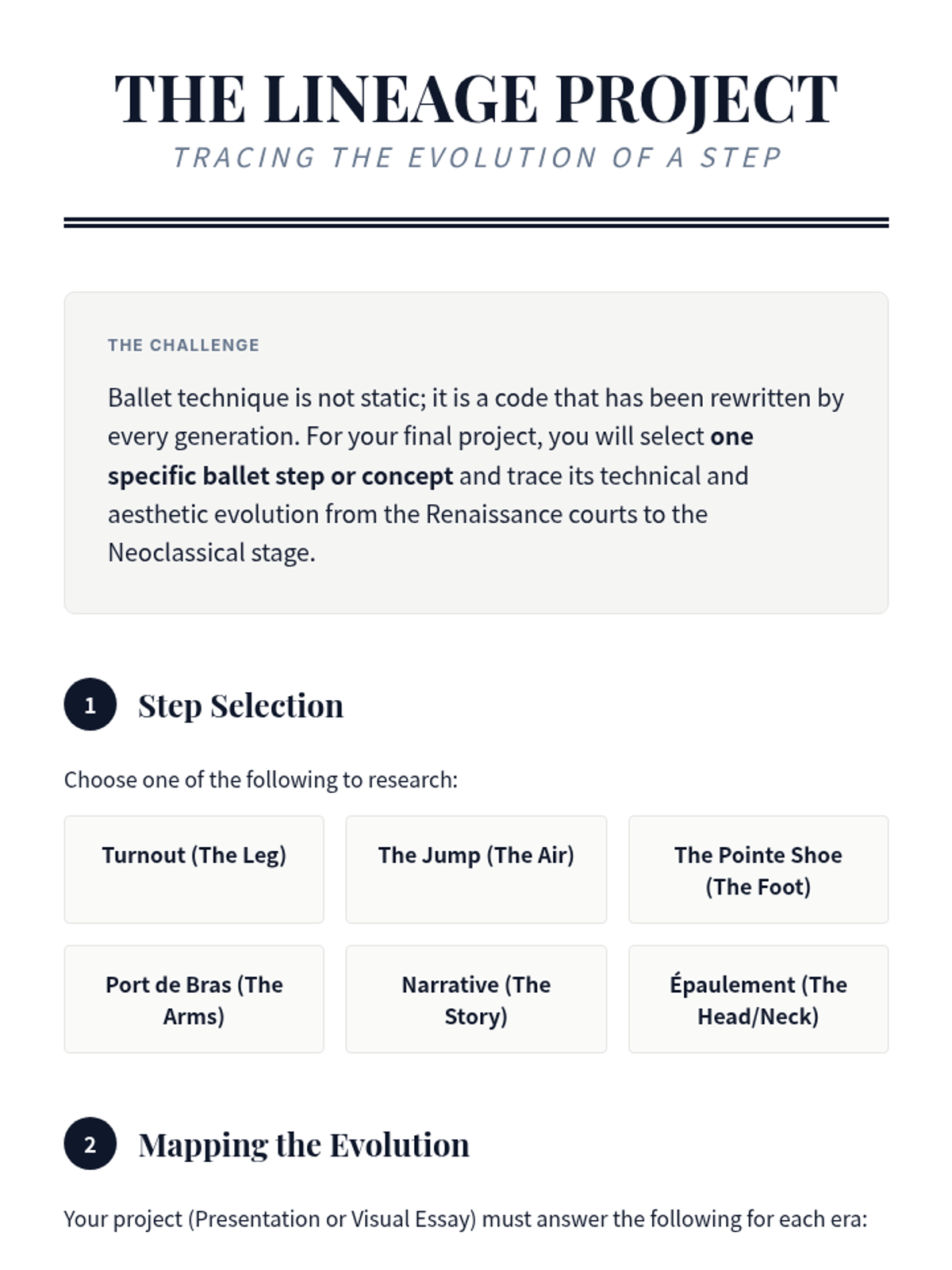
The final assessment project for the unit, where students trace a specific ballet step or concept through all five historical eras studied in the sequence.
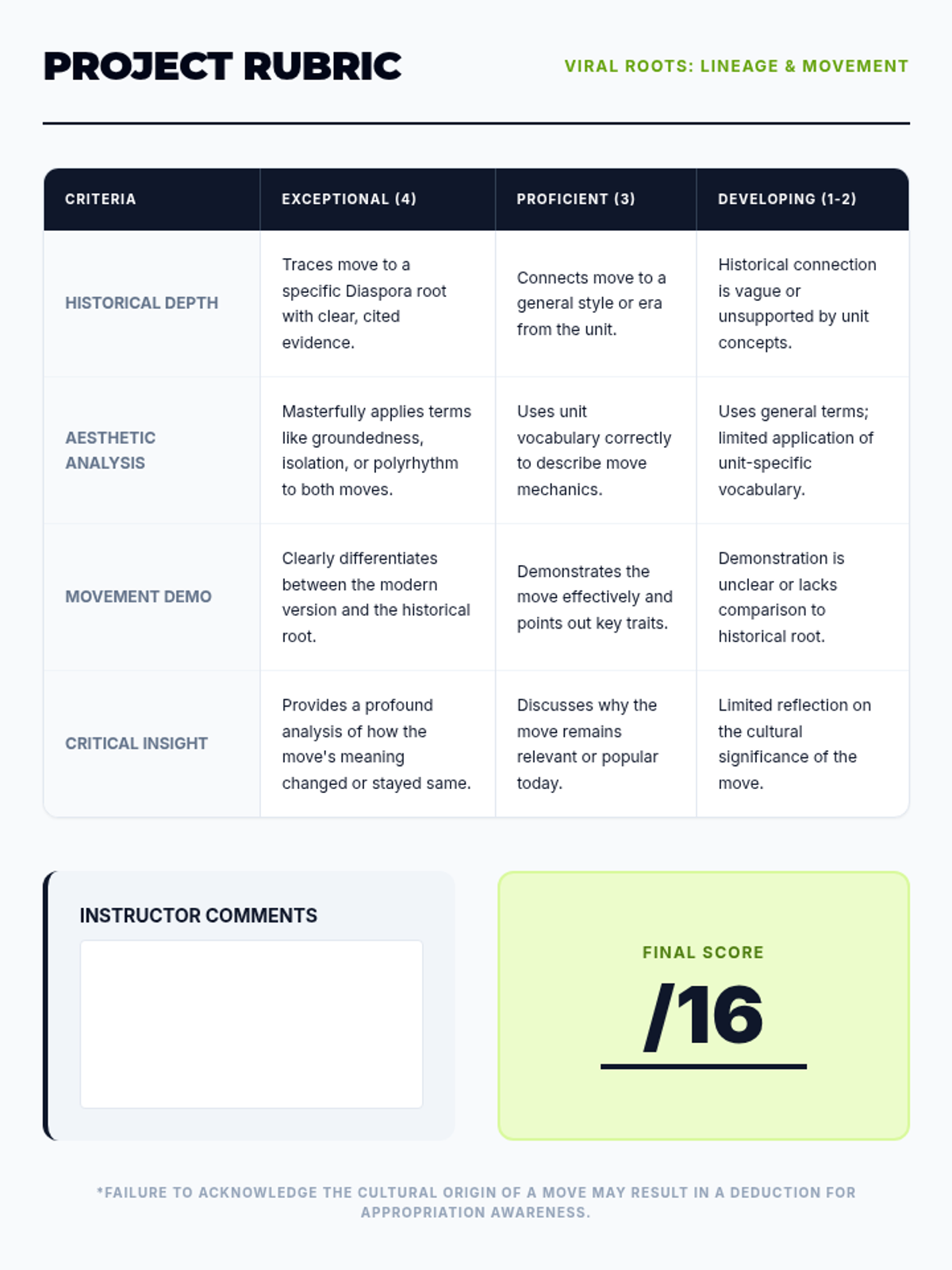
Grading rubric for the final unit assessment, evaluating historical research, movement analysis, and critical insight into the cultural lineage of modern dance moves.
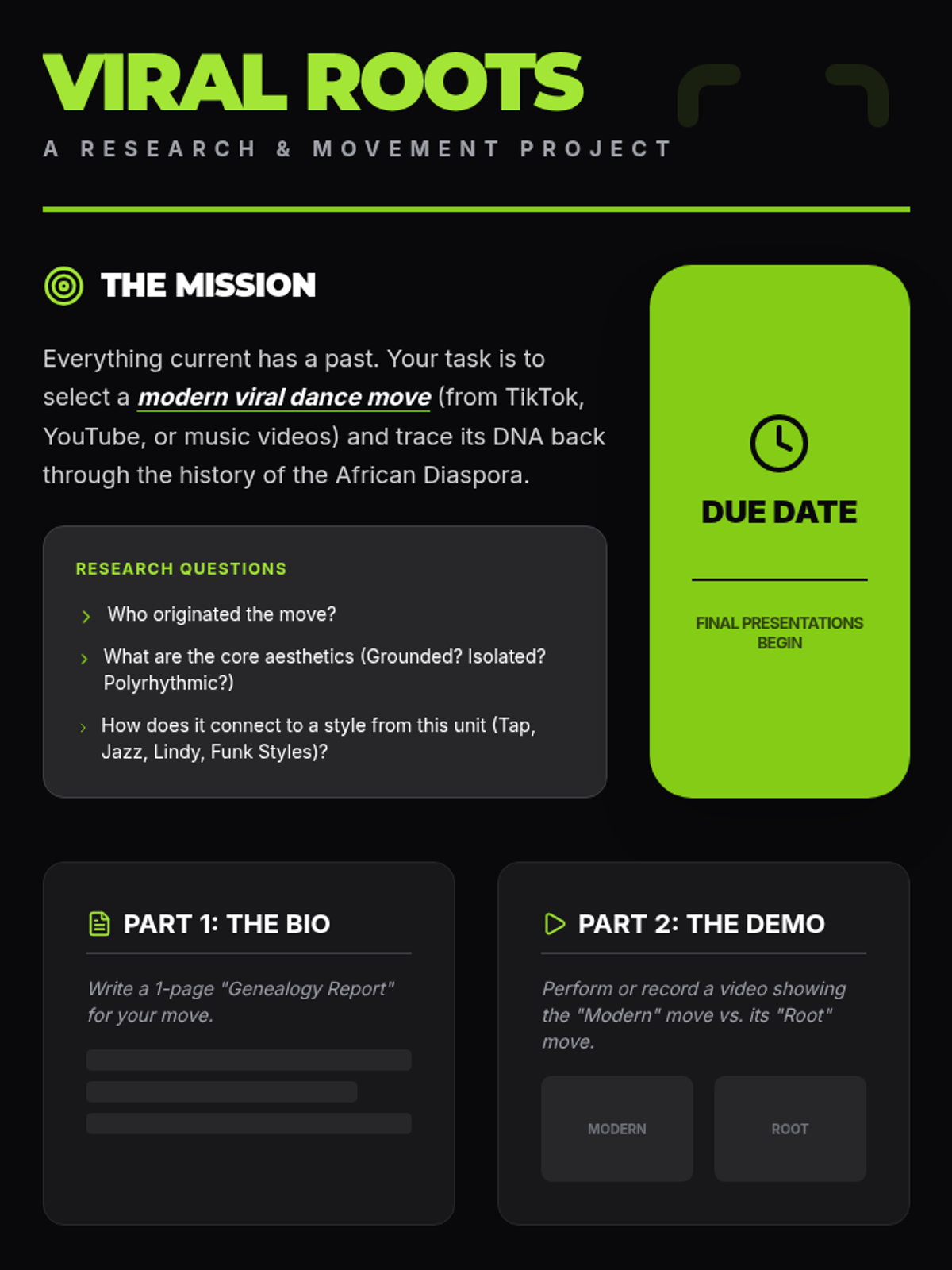
Student project guide for the final unit assessment, requiring students to trace the cultural and technical lineage of a modern dance move back to its historical roots in the African Diaspora.
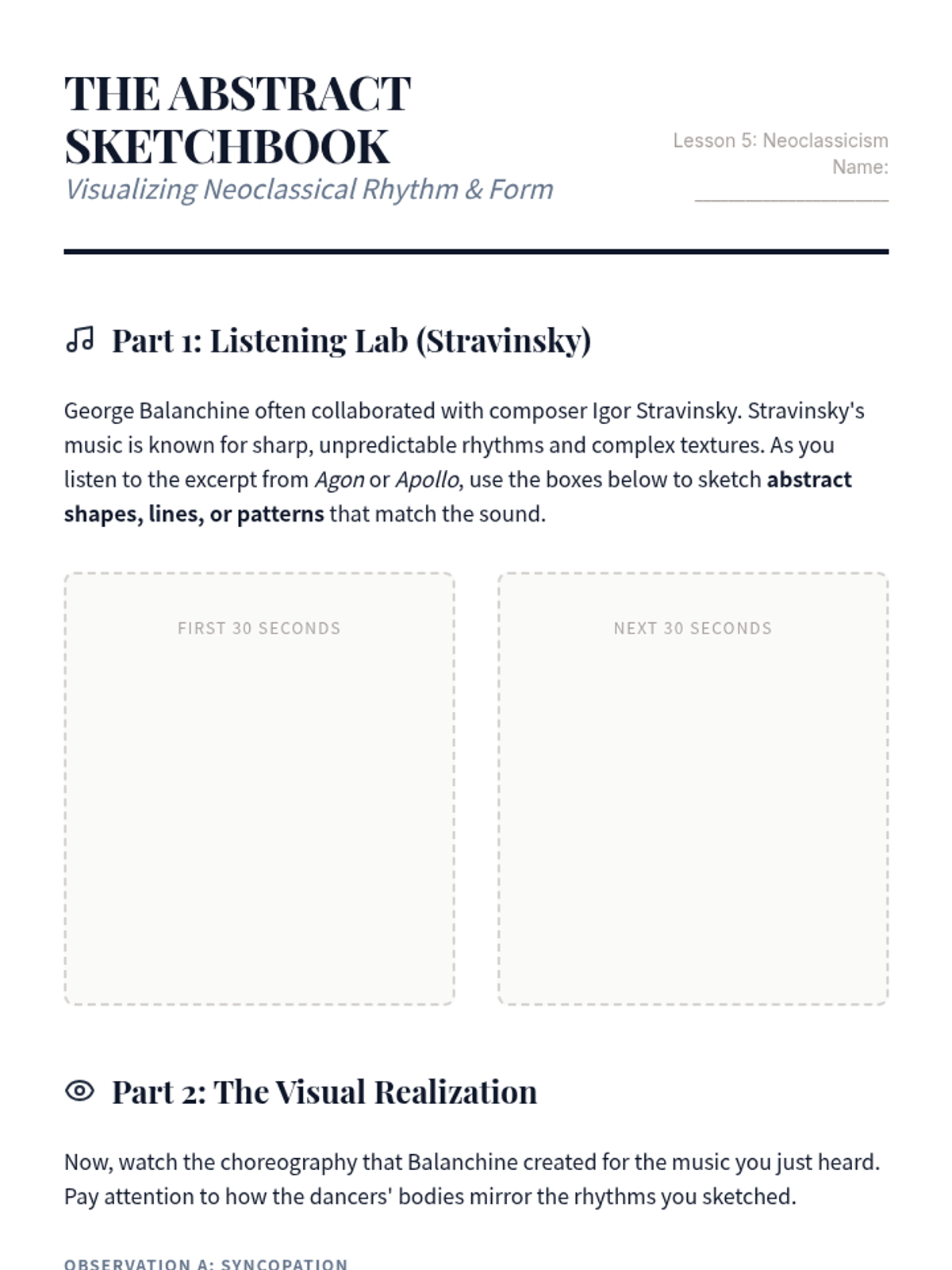
A student activity worksheet for Lesson 5, focusing on the visual relationship between neoclassical choreography and abstract musical structures.
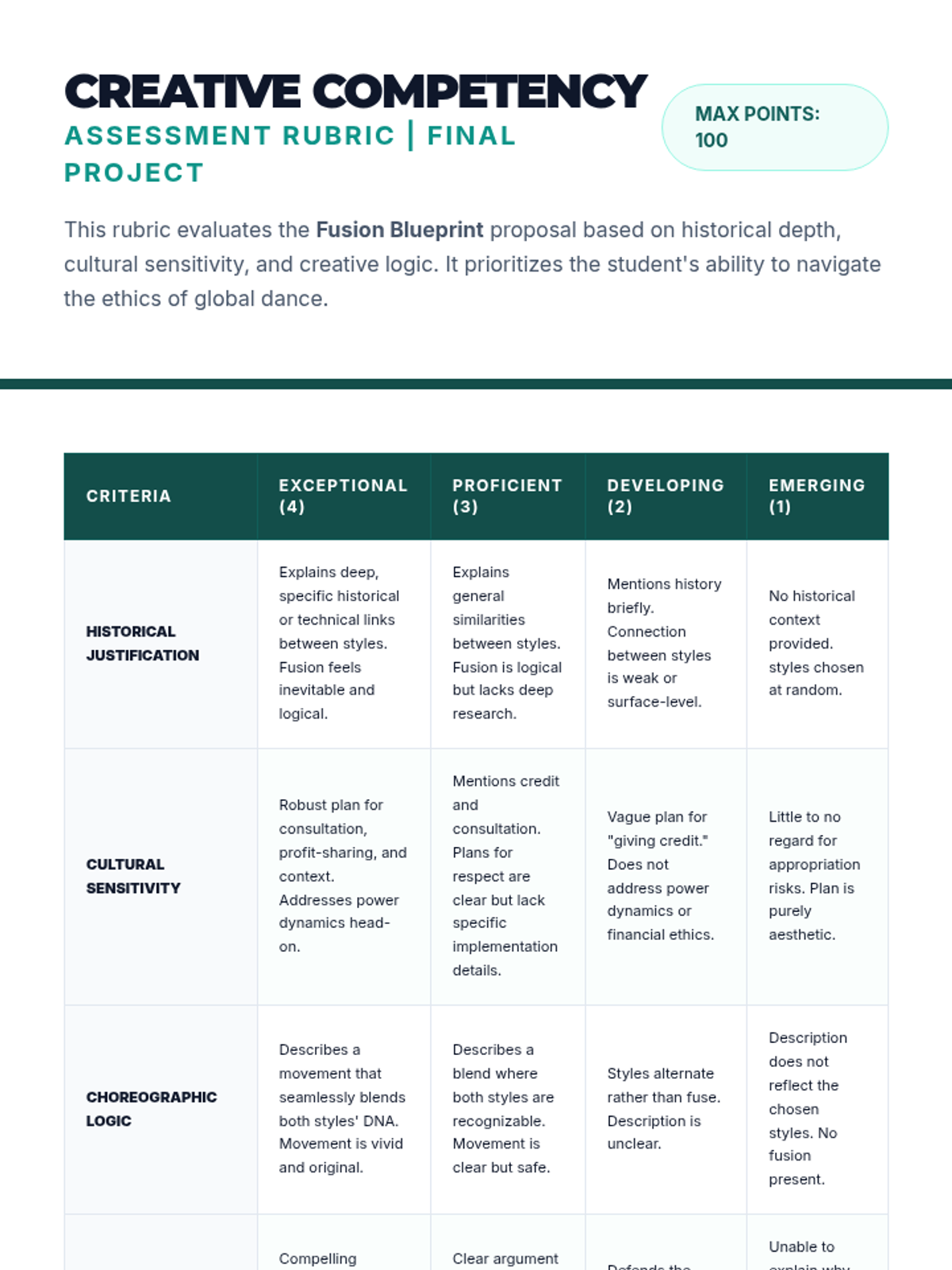
Final assessment rubric for the 'Fusion Blueprint' project. Evaluates students on historical justification, cultural sensitivity, choreographic logic, and ethical argumentation.
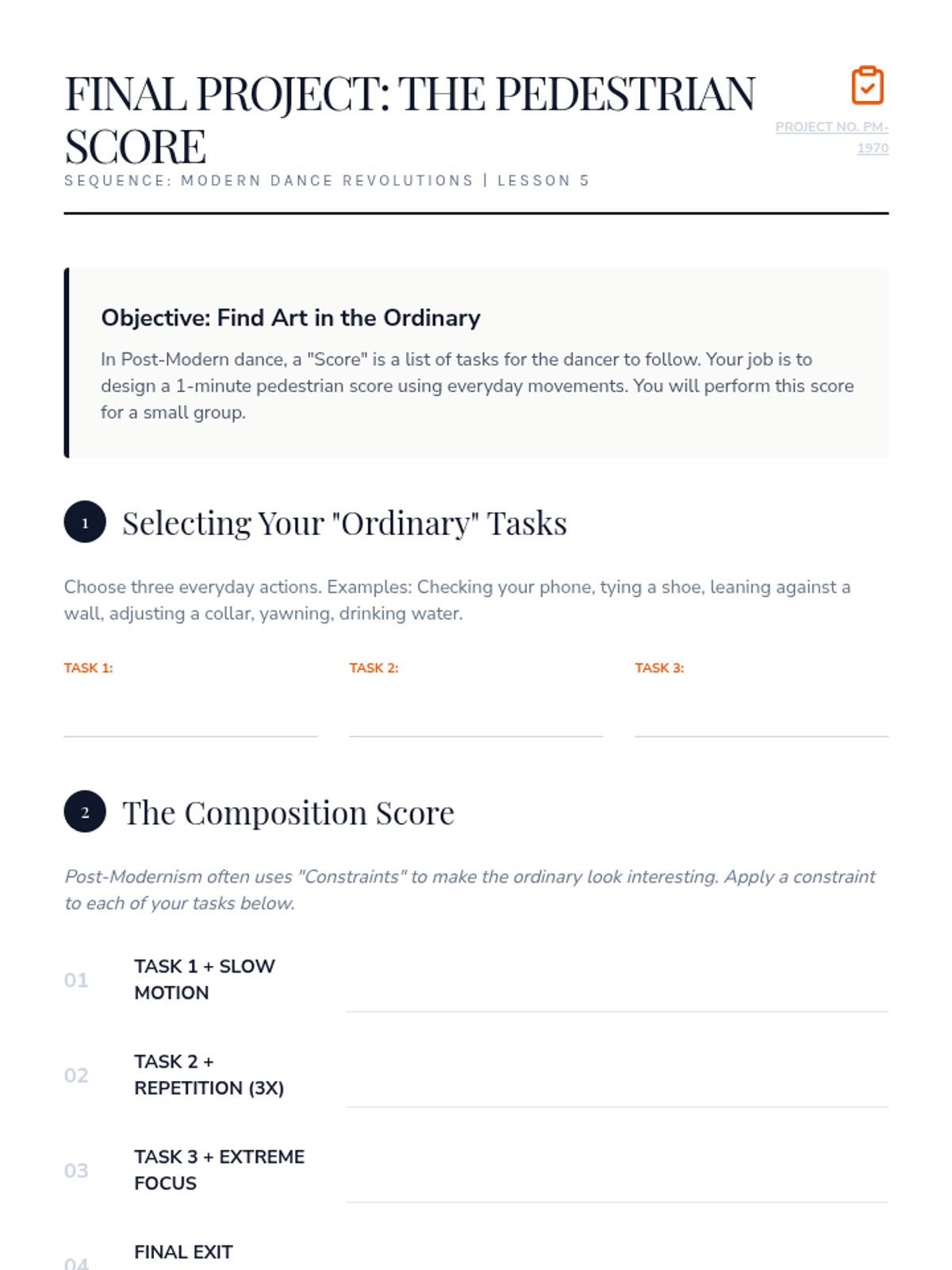
A student project guide for Lesson 5, where students create and perform a 'Pedestrian Score' based on everyday tasks and their own 'No Manifesto' of artistic constraints.
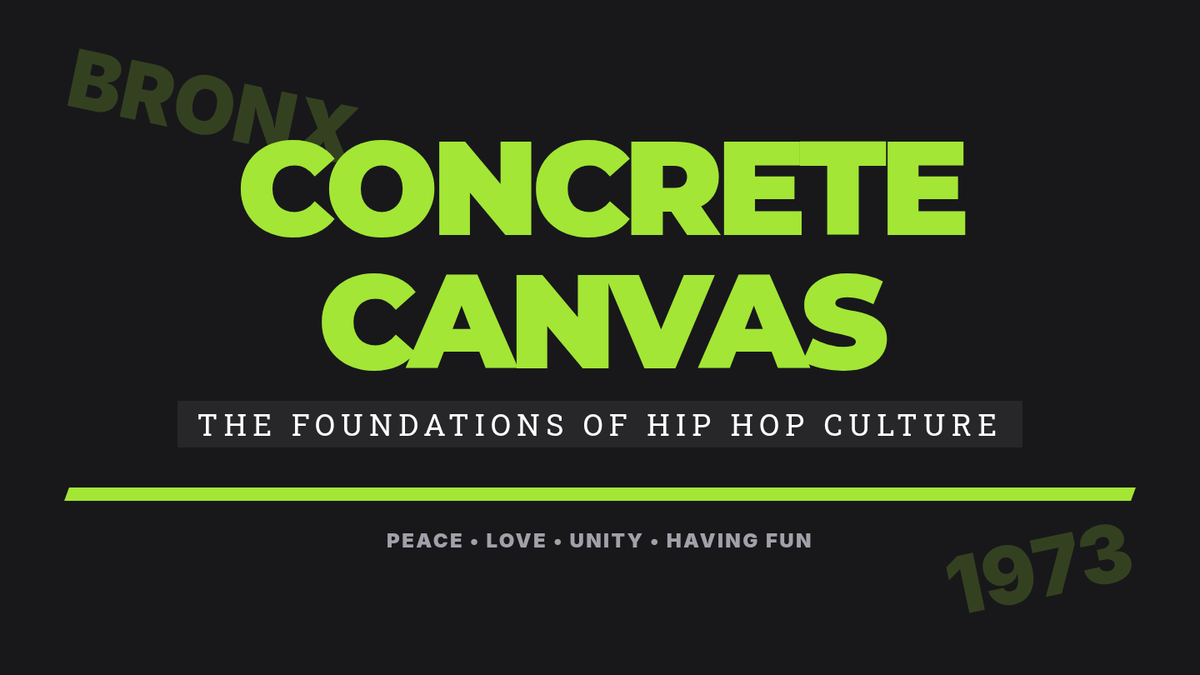
Presentation slides exploring the birth of Hip Hop in the Bronx, the four pillars, and the three foundational styles (Breaking, Locking, Popping).
A visual presentation exploring the 20th-century shift toward abstraction led by George Balanchine, focusing on the relationship between pure movement and music.
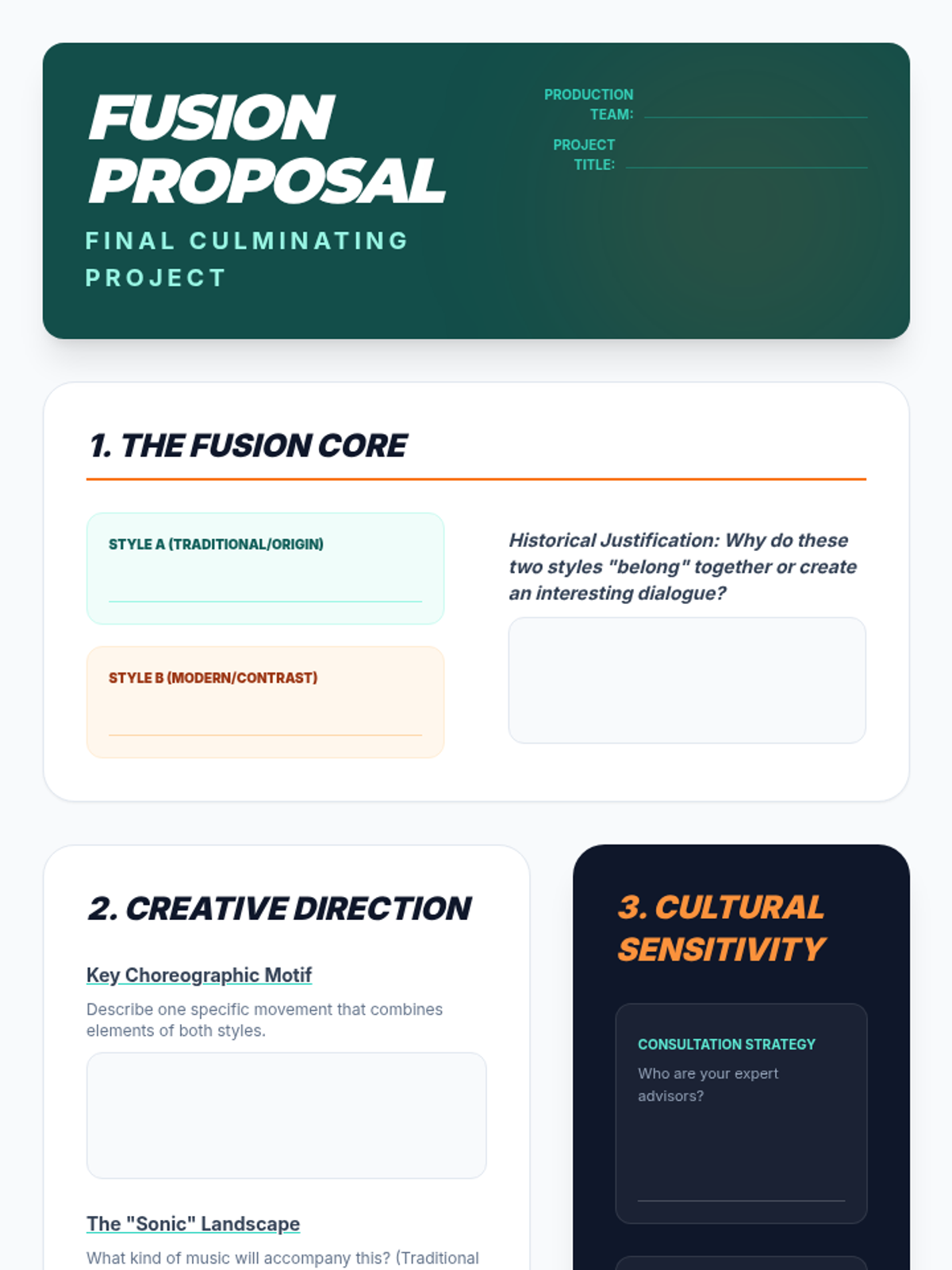
Final project template for the 'Fusion Blueprint' proposal. Students use this to detail their hypothetical dance production, including historical justification, creative direction, and a comprehensive cultural sensitivity plan.
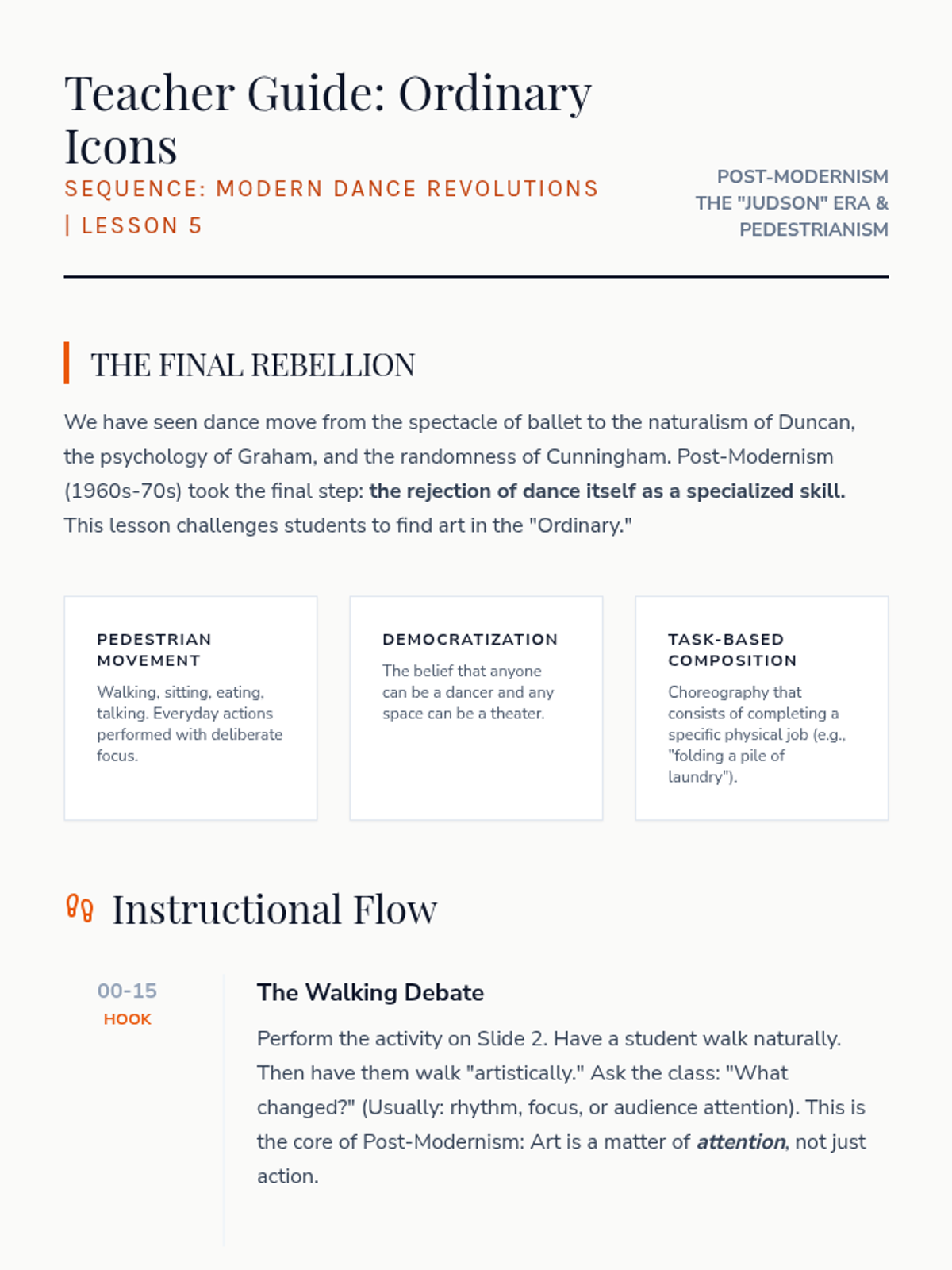
A teacher guide for Lesson 5, focusing on Post-Modernism and the 'No Manifesto', with instructions for the final 'Pedestrian Score' project.
Visual presentation for the final lesson of the sequence. Introduces the 'Fusion Blueprint' project, providing examples of respectful versus gimmicky fusion and detailing the ethical requirements for the student proposals.
A slide deck for Lesson 5: Ordinary Icons, exploring Post-Modernism, the Judson Dance Theater, and the use of pedestrian movement as art.
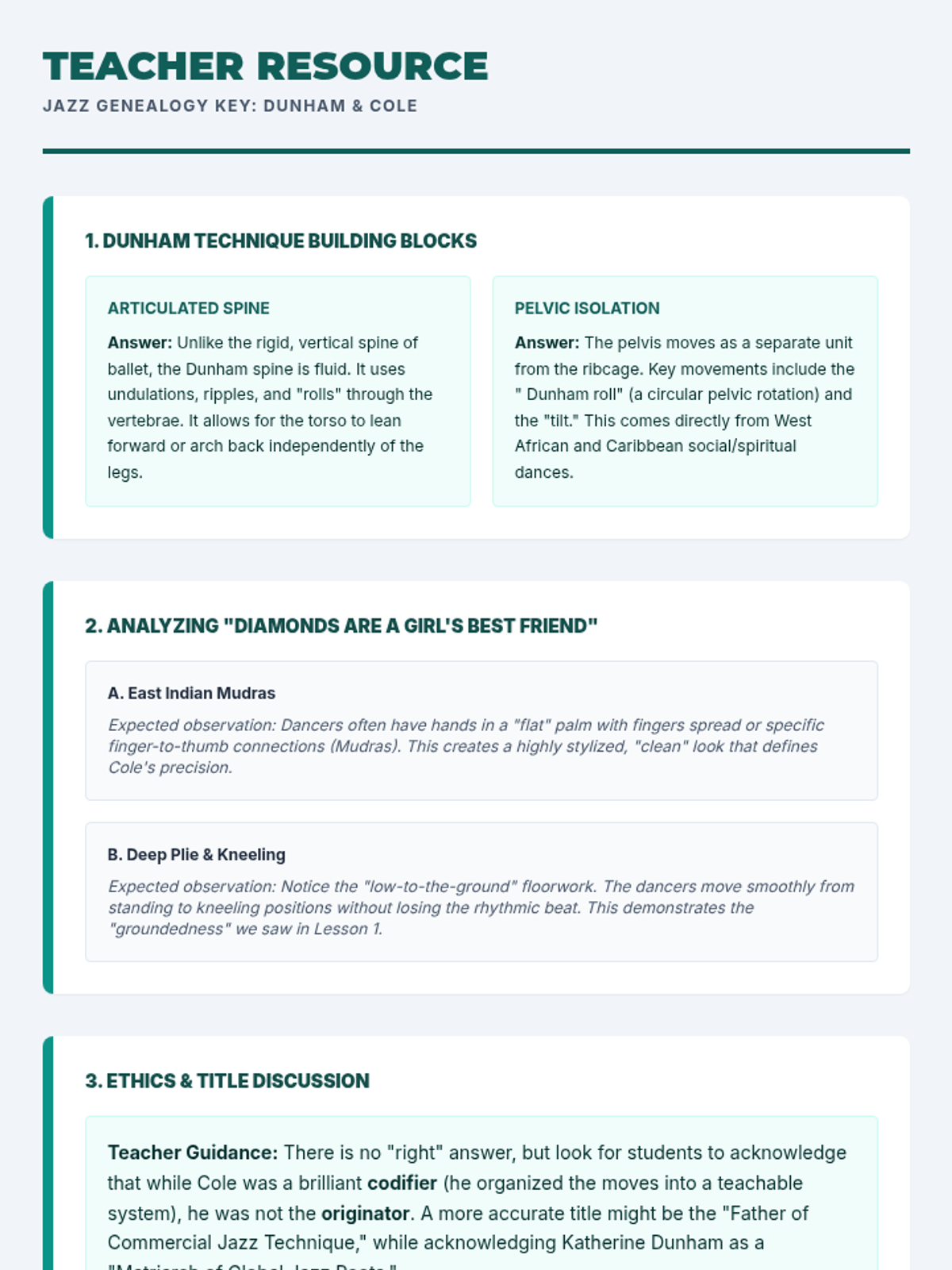
Teacher answer key for the 'Lineage Mapper' organizer, providing expected movement analysis and ethical discussion points for Lesson 4.
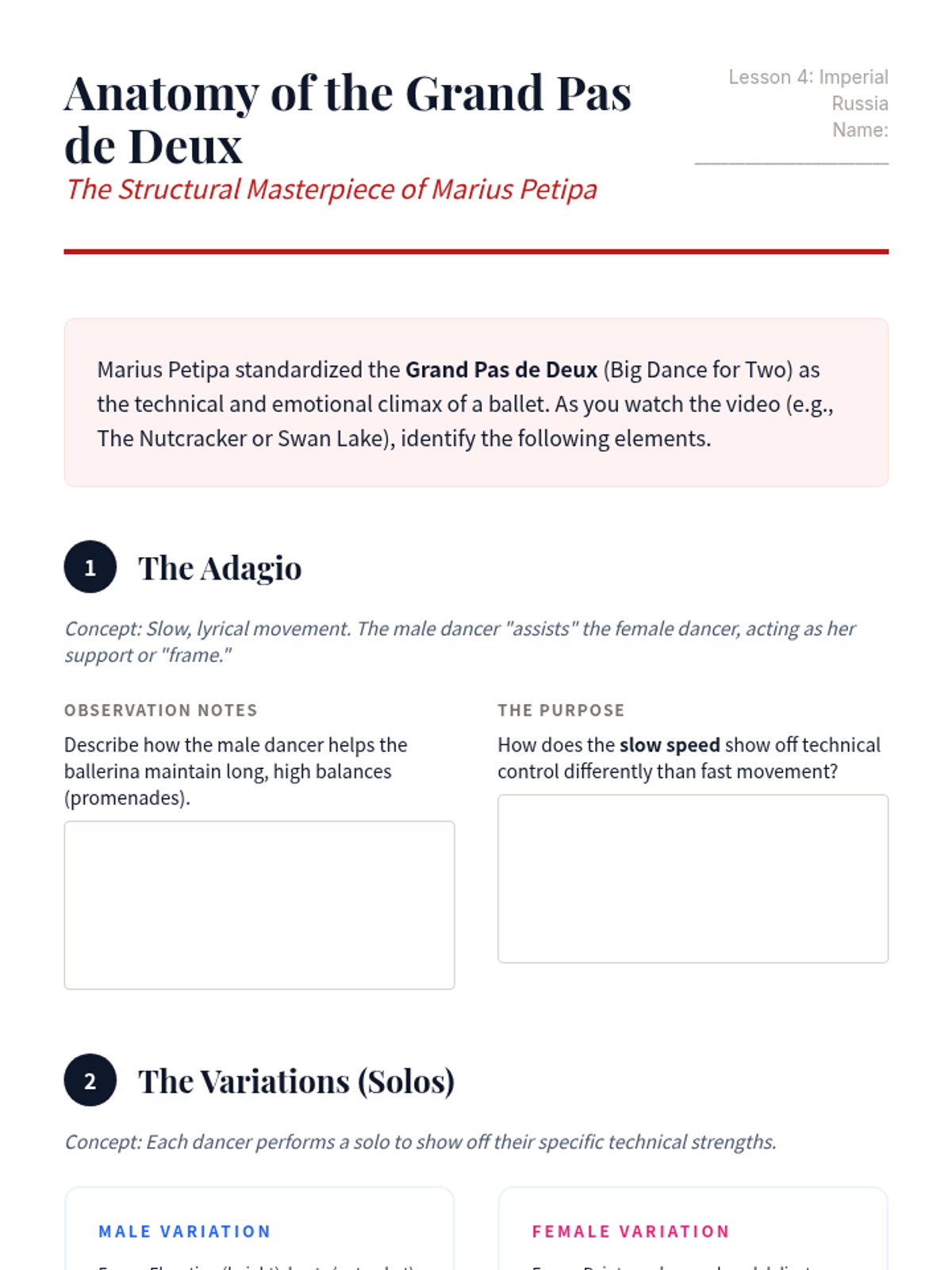
A student analysis worksheet for Lesson 4, mapping the structure of the Grand Pas de Deux and analyzing the shift toward athletic virtuosity in the late 19th century.
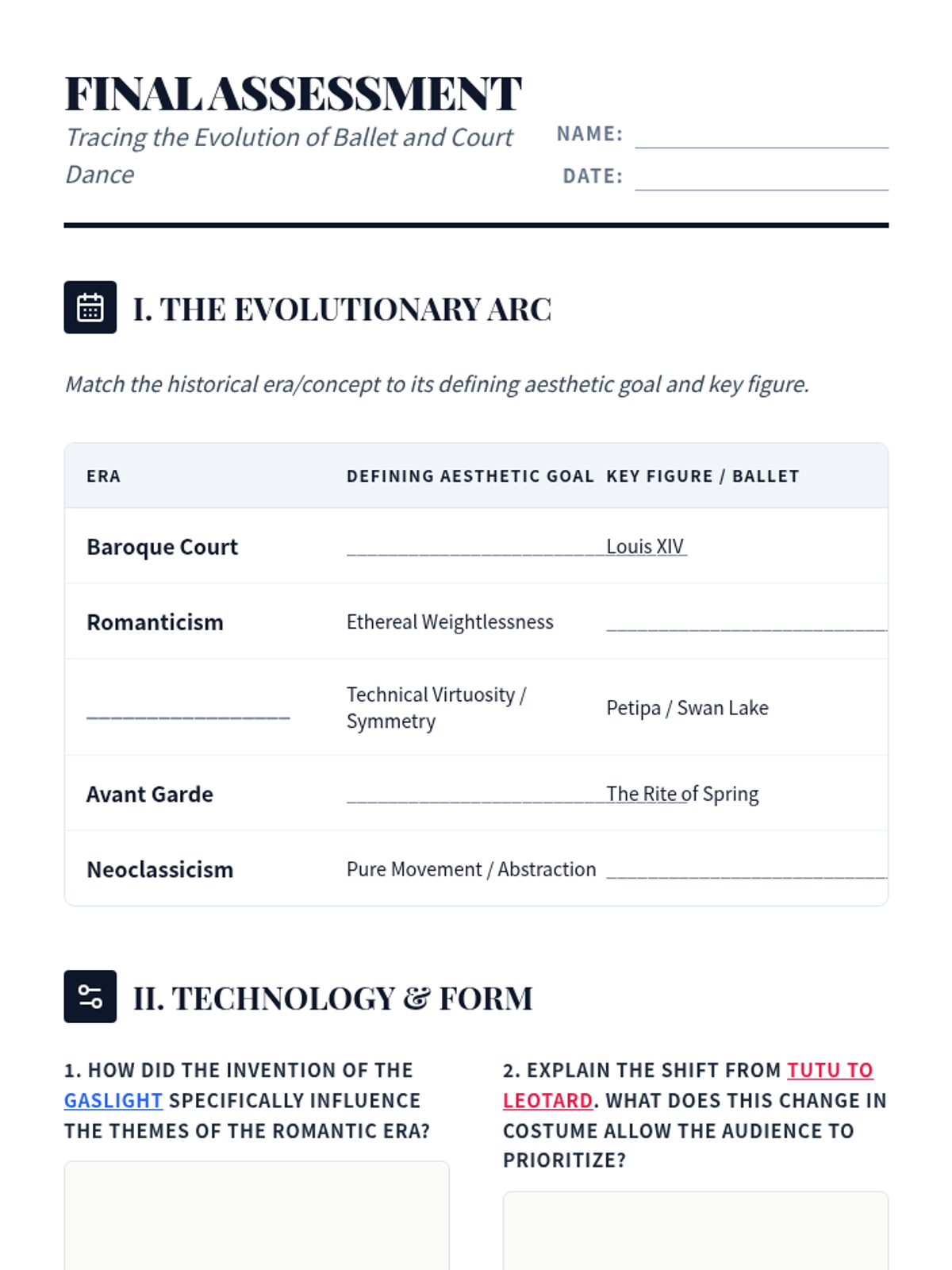
A final summative assessment for the ballet evolution sequence, featuring timeline matching, technical innovation questions, and a comparative essay prompt.
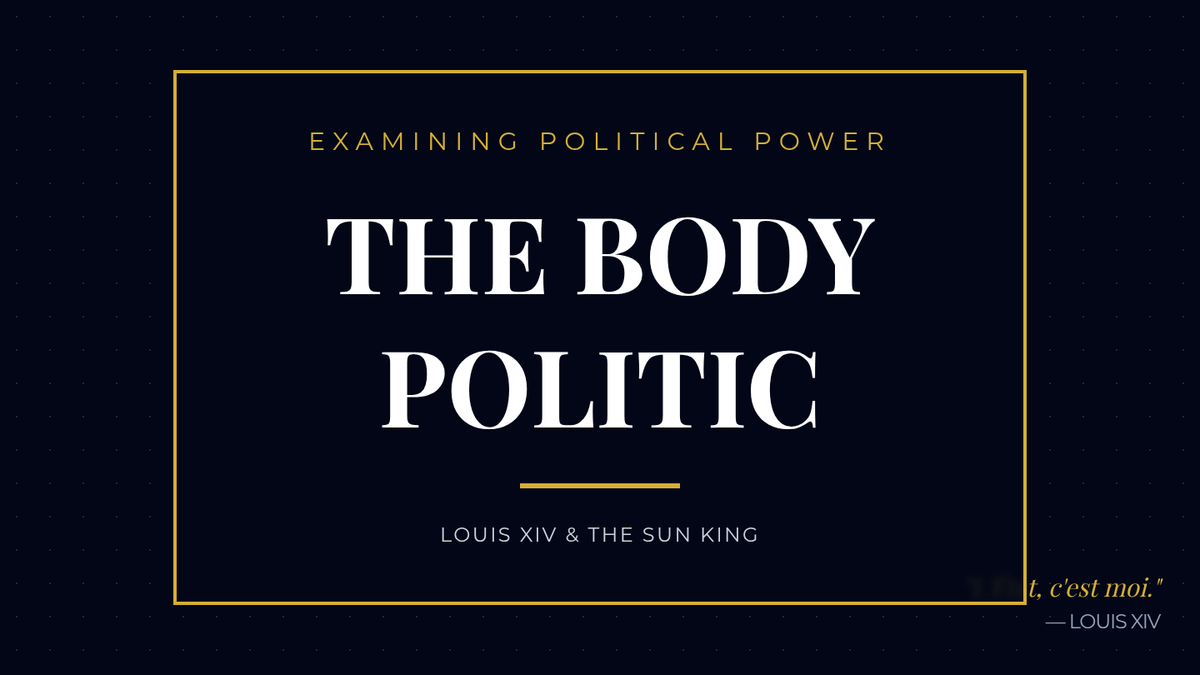
A revised visual presentation for Lesson 1 on Louis XIV, ensuring all text meets the minimum 24px requirement for slide visibility and impact.
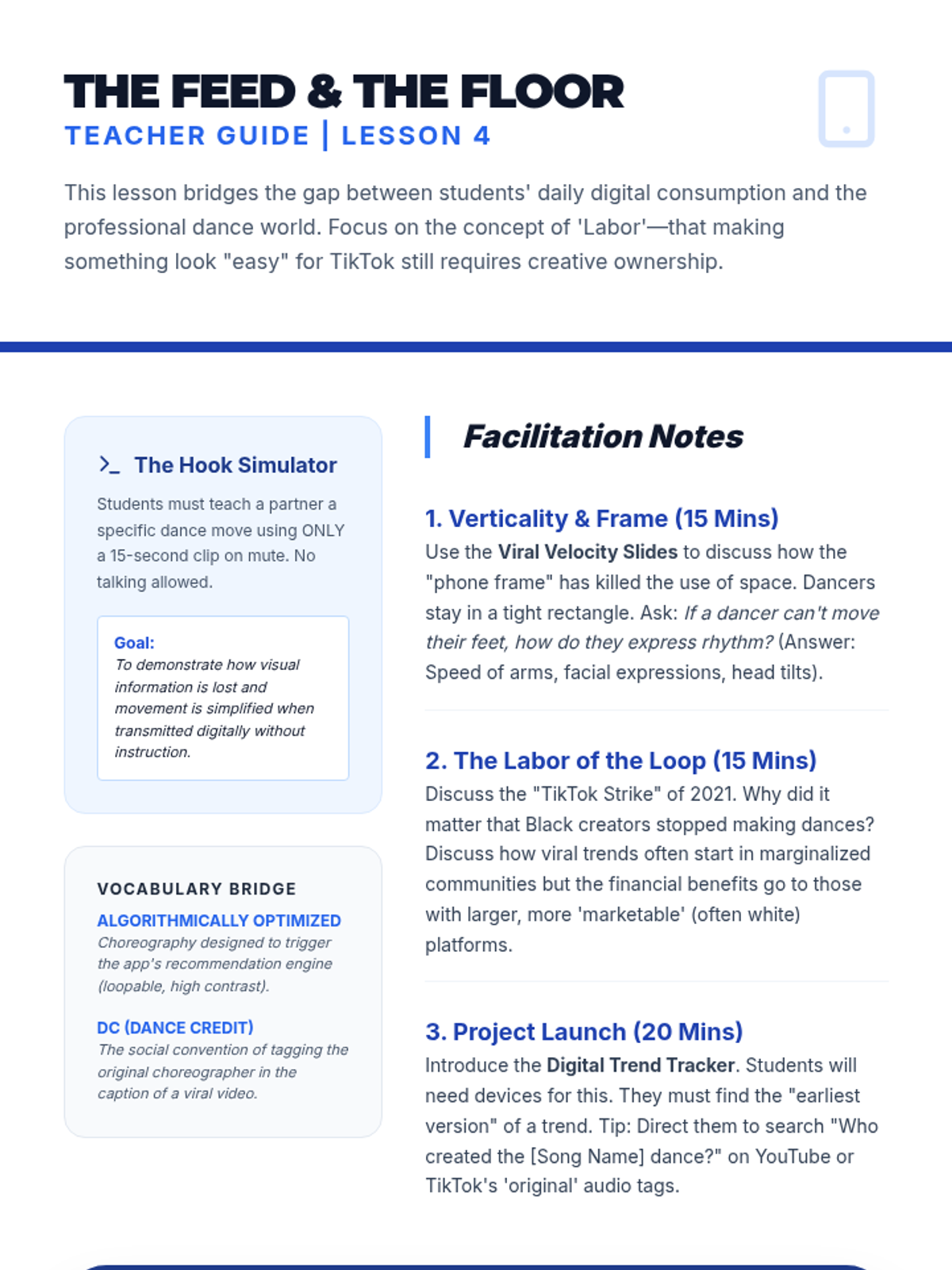
Teacher facilitation guide for Lesson 4. Focuses on the physical impacts of digital framing on choreography and leads students through the ethics of digital ownership and the 'Dance Credit' movement.
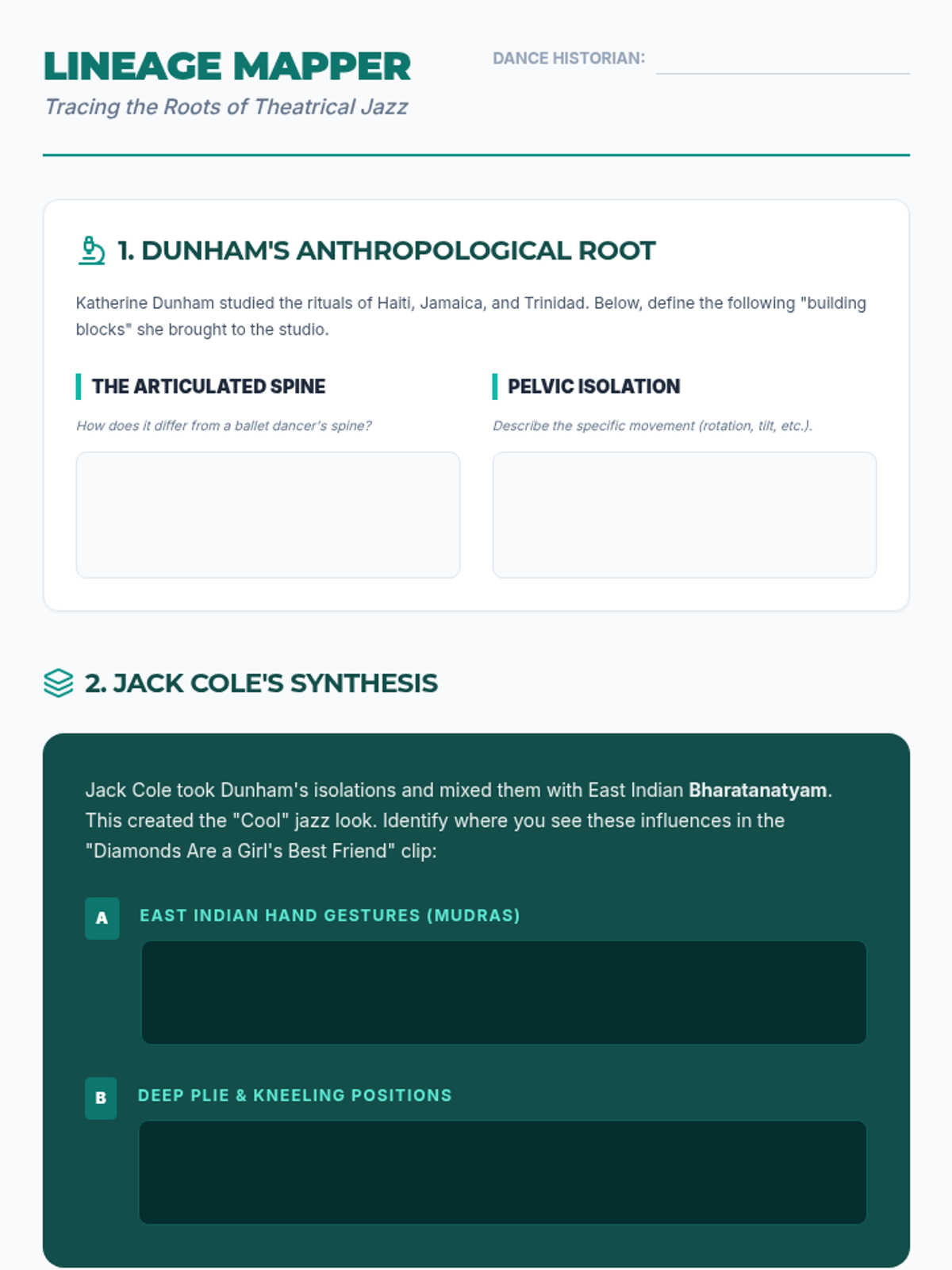
Student worksheet/organizer for Lesson 4, used to trace the movement lineage of Katherine Dunham and Jack Cole in theatrical jazz choreography.
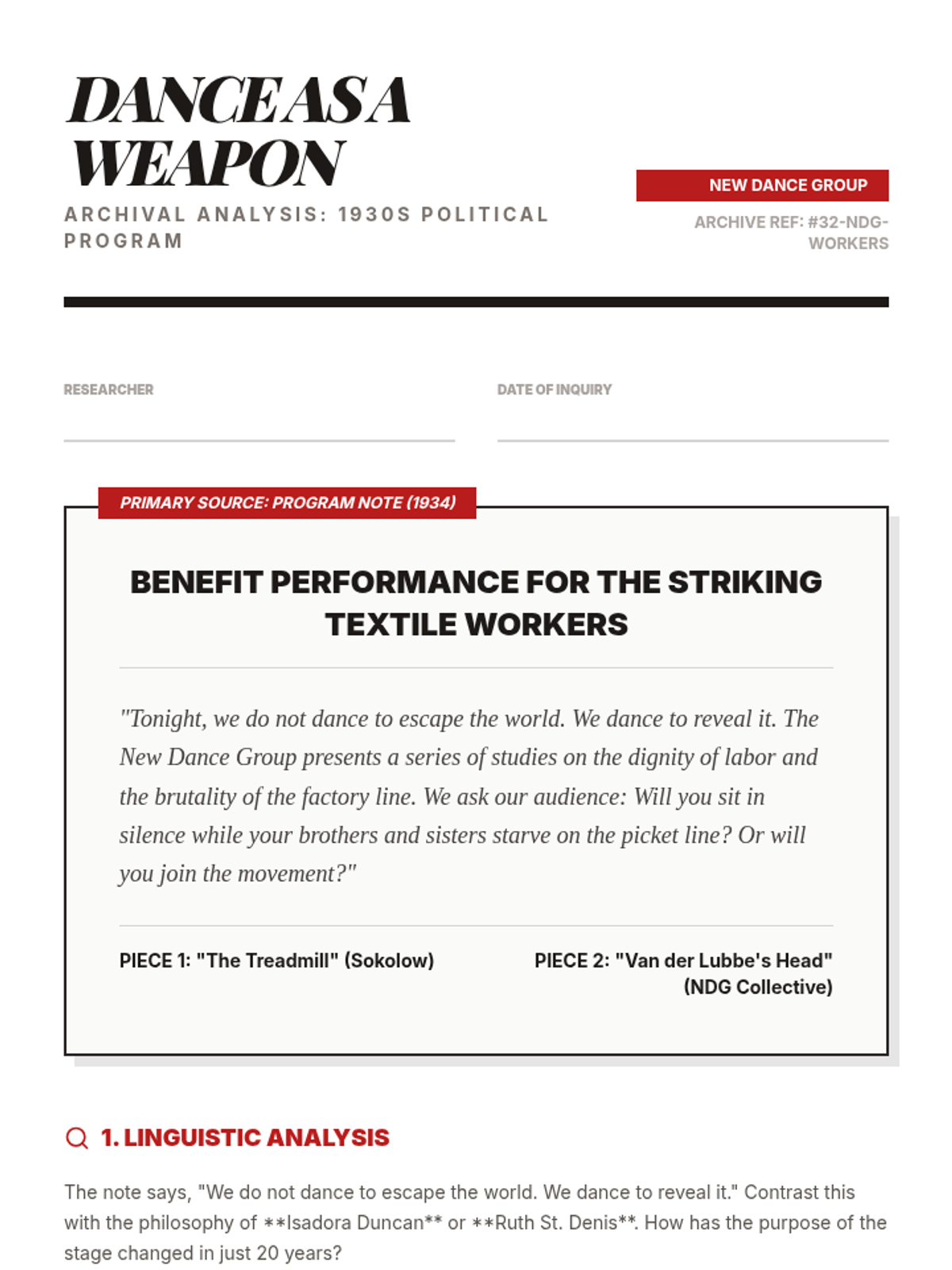
A student worksheet for analyzing archival program notes and political choreography from the 1930s modern dance movement.
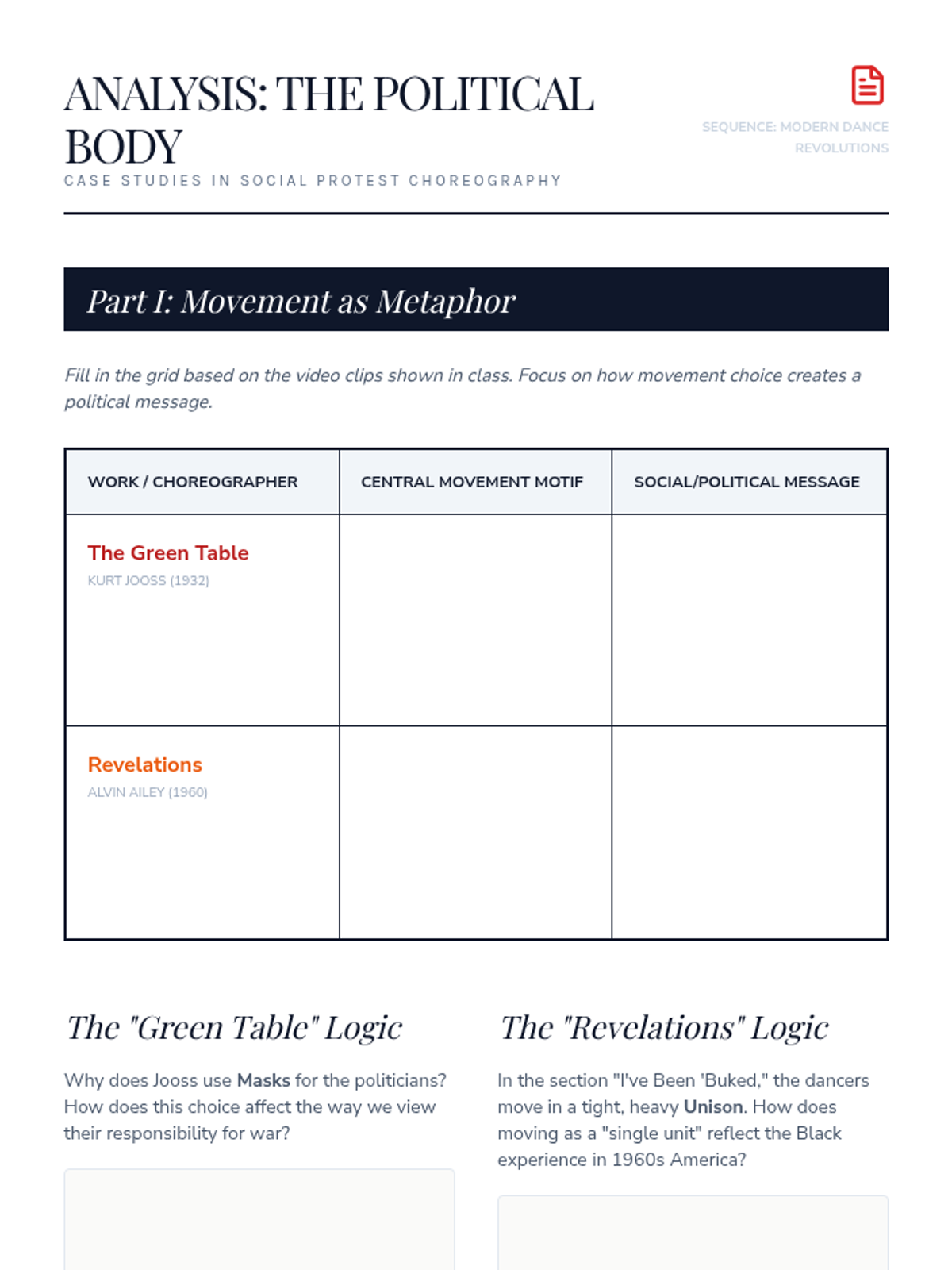
A student analysis worksheet for Lesson 4, featuring a comparison grid for Kurt Jooss and Alvin Ailey's work and a creative prompt for designing a social protest gesture.