Lenny LearningLenny
Create
Explore
Workspace
LoginSign up
MathEnglish Language ArtsScience & EngineeringSocial StudiesGlobal LanguagesHealth & Physical EducationSpecial EducationCounseling & Life SkillsArts & CreativityESL
Lenny LearningLenny
Lenny Learning
About
Training
Pricing
Support
Contact
© 2026 Lenny Learning Inc.

Algebra

SequencesLessonsMaterialsVideos
  1. Math

Algebra

SequencesLessonsMaterialsVideos

Techniques for manipulating polynomial operations, rational expressions, and complex numbers alongside strategies for solving systems of equations and inequalities. Develops quantitative reasoning through graphing, real-world modeling, and the structural analysis of algebraic identities.

MathNumbers & CountingCounting ObjectsNumber NamesComparing NumbersNumber OperationsCounting SequenceNumbers 0-10Place Value Understanding and SystemAdd and Subtract Within 20Addition and Subtraction ConceptsAddition and Subtraction EquationsAddition and Subtraction ProblemsFoundations for MultiplicationMultiplication and Division PropertiesMultiply and Divide Within 100Multiplication and Division ProblemsFactors and MultiplesProperties of OperationsPatterns and RelationshipsGenerate and Analyze PatternsMulti-Digit ArithmeticPlace Value OperationsMulti-Digit and Decimal OperationsNumerical ExpressionsFour Operations and PatternsFour Operations Problem SolvingMeasurement & DataMeasurable AttributesMeasuring LengthsMeasure and Estimate Lengths in Standard UnitsRelate Addition and Subtraction to LengthClassifying and Counting ObjectsTime and MoneyArea Concepts and MeasurementPerimeter and Area MeasuresAngle Concepts and MeasurementTime, Volume, and MassMeasurement Unit ConversionsGeometryIdentifying ShapesShapes and AttributesShape Attributes and ReasoningShapes and CompositionClassifying 2D FiguresGeometric Figures and RelationshipsLines, Angles, and ShapesAngle, Area, and VolumeGeometric MeasurementVolume of 3D ShapesCoordinate Plane ApplicationsTransformations in the PlaneCongruence and SimilarityUnderstand congruence in terms of rigid motionsSimilarity and TransformationsProve Theorems Involving SimilarityPythagorean TheoremTrigonometry for General TrianglesMake Geometric ConstructionsProve Geometric TheoremsTheorems About CirclesFind Arc Lengths And Areas of Sectors of CirclesVolume FormulasRelationships Between Two-Dimensional and Three-Dimensional ObjectsProve Simple Geometric Theorems AlgebraicallyTranslate Between Geometric Description and Equation for Conic SectionApply Geometric Concepts in Modeling SituationsFractions & DecimalsFractions as NumbersBuilding FractionsFraction Equivalence and OrderingAdding and Subtracting FractionsMultiplying and Dividing FractionsDividing FractionsDecimal FractionsMulti-Digit Computation and FactorsAdd, Subtract, Multiply, and Divide Rational NumbersRational Number SystemIrrational Numbers and ApproximationsRatiosRatios and ProportionsProportional RelationshipsUnit RateAlgebraAlgebraic ExpressionsGenerate Equivalent ExpressionsQuantitative RelationshipsProportional Relationships and Linear EquationsEquations and InequalitiesEquation Solving and ReasoningLinear Equations and SystemsGraph Equations and InequalitiesSystems of EquationsReal-World Algebraic ProblemsQuantitative Reasoning with UnitsExpression StructureEquivalent Expression FormsRadicals and Integer ExponentsRational ExponentsRational and Irrational NumbersPolynomial OperationsPolynomial IdentitiesPolynomial Zeros and FactorsRational ExpressionsComplex Number OperationsComplex Numbers in PolynomialsComplex Numbers on PlaneStatistics & ProbabilityRepresent and Interpret DataData DistributionsStatistical VariabilityProbability ModelsCompound Event ProbabilitiesStatistical SamplingInterpret Categorical and Quantitative DataBivariate Data PatternsInterpret Linear ModelsComparing Two PopulationsRandom Processes in StatisticsIndependence and Conditional ProbabilityExpected ValuesProbability-Based Decision MakingStatistical Inference and ConclusionsFunctionsFunction Concepts and NotationDefine and Compare FunctionsInterpret Functions in ContextAnalyze Function RepresentationsModel Relationships with FunctionsIdentify Linear vs Exponential GrowthDistinguish Between Function TypesCompare Growth RatesInterpret Function ExpressionsBuild Functions from RelationshipsConstruct and Model FunctionsTransform and Combine FunctionsModel Comparison and SelectionSolve Exponential EquationsTrigonometryTrigonometric Ratios Involving Right TrianglesTrigonometric Functions and Unit CircleModel with Trigonometric FunctionsTrigonometric IdentitiesVectors & MatricesIntroduction to Vectors and MatricesVector QuantitiesVector OperationsMatrix OperationsCalculusLimits and ContinuityDerivative Concepts and NotationDerivative Rules and TechniquesApplications of DerivativesOptimization ProblemsRelated RatesCurve Sketching and AnalysisIntegration Concepts and NotationAntiderivatives and Indefinite IntegralsDefinite Integrals and AreaFundamental Theorem of CalculusIntegration TechniquesApplications of IntegrationDifferential EquationsSequences and SeriesParametric and Polar FunctionsVector-Valued Functions
Quantitative RelationshipsRatios, proportions, and rate of change within mathematical and real-world contexts. Connects algebraic expressions to tabular and graphical representations of how variables interact.
Video
Finding What Percent One Number Is of Another

Finding What Percent One Number Is of Another

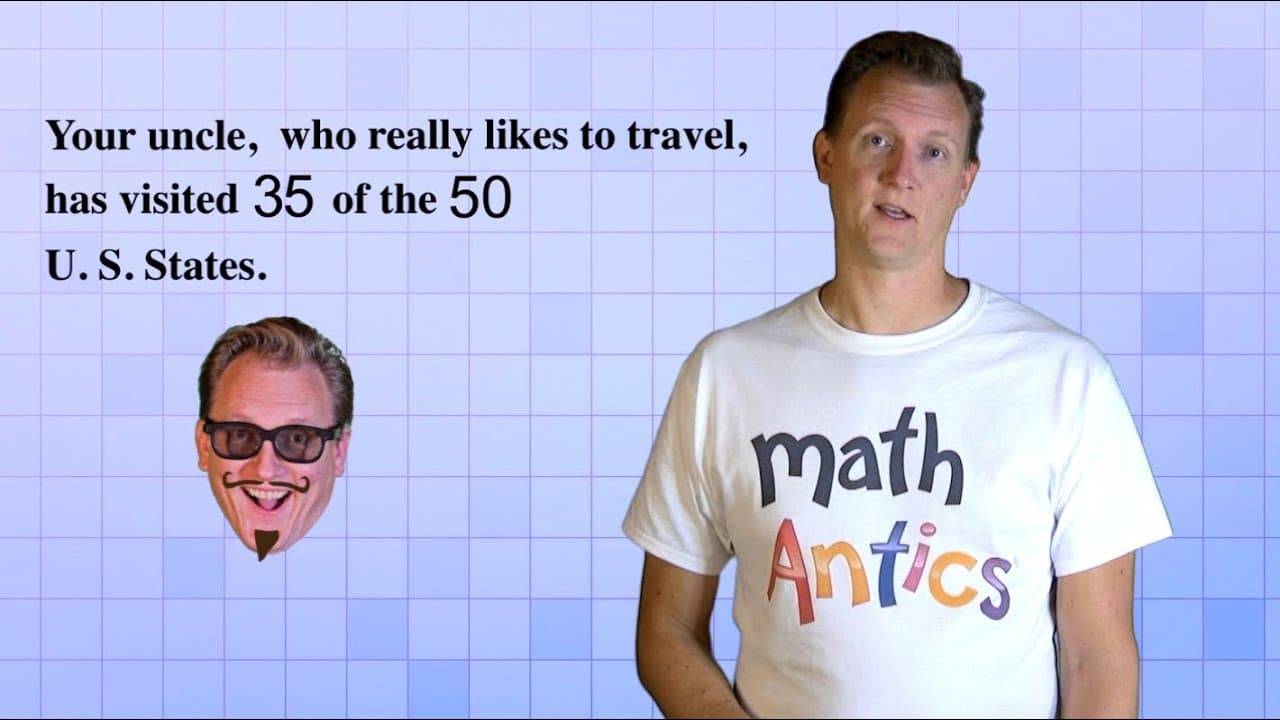
This engaging math tutorial breaks down the specific skill of calculating a percentage when given a part and a whole (e.g., "What percent is 20 of 50?"). The video begins by reviewing the relationship between parts, totals, and percentages, establishing that a percentage is simply a ratio out of 100. It categorizes percentage problems into three distinct types—finding a part, finding a percent, and finding a total—and explicitly focuses on the second type for this lesson. The video explores two primary methods for solving these problems. The first method involves using equivalent fractions to scale the denominator to 100, which works well for "friendly" numbers. The second, more universal method involves treating the fraction as a division problem to find a decimal, then converting that decimal to a percentage. The narrator uses humorous skits involving family members giving gifts (travel souvenirs and cookies) to provide concrete word problems that illustrate the math concepts. For educators, this video serves as an excellent bridge between fractions, decimals, and percents. It is particularly useful for helping students transition from simple scaling strategies to the more robust division method required for real-world numbers. The clear visualization of the "Part / Total = Percent" structure helps demystify word problems, while the distinction between the three types of percent questions provides a solid framework for algebraic thinking in middle school math.

mathanticsmathantics

8mins 28s

Video
How Domain Affects Sequence Formulas

How Domain Affects Sequence Formulas

This advanced algebra video explores the relationship between mathematical sequences and their domains, challenging the standard convention that sequences must always begin with the first term at n=1. The narrator demonstrates that sequences can be defined using different starting points for the domain (specifically n=0 vs n=1) as long as the formula is adjusted accordingly. Through clear examples of both arithmetic and geometric sequences, viewers learn how to manipulate explicit and recursive formulas to match specific domain constraints. The video breaks down three specific examples: a doubling geometric sequence starting at 4, a decreasing arithmetic sequence starting at 52, and an alternating geometric sequence starting at 1. For each, the narrator compares valid and invalid formulas, showing how changing the starting value of 'n' changes the structure of the equation. A key segment involves an "imposter" activity where students must analyze four different formulas to identify the one that does not produce the correct sequence based on its defined domain. This resource is highly valuable for high school algebra classrooms as it moves students beyond rote memorization of formulas into a deeper conceptual understanding of functions and domains. It addresses the common student struggle of reconciling different notations for the same pattern. Teachers can use this video to introduce zero-indexing (common in computer science) or to reinforce the importance of checking work by substituting values. It promotes critical thinking by asking students to verify formulas rather than just generate them.

Miacademy & MiaPrep Learning ChannelMiacademy & MiaPrep Learning Channel

6mins 58s

Video
Mastering Arithmetic and Geometric Means, Ratios, and Proportions

Mastering Arithmetic and Geometric Means, Ratios, and Proportions

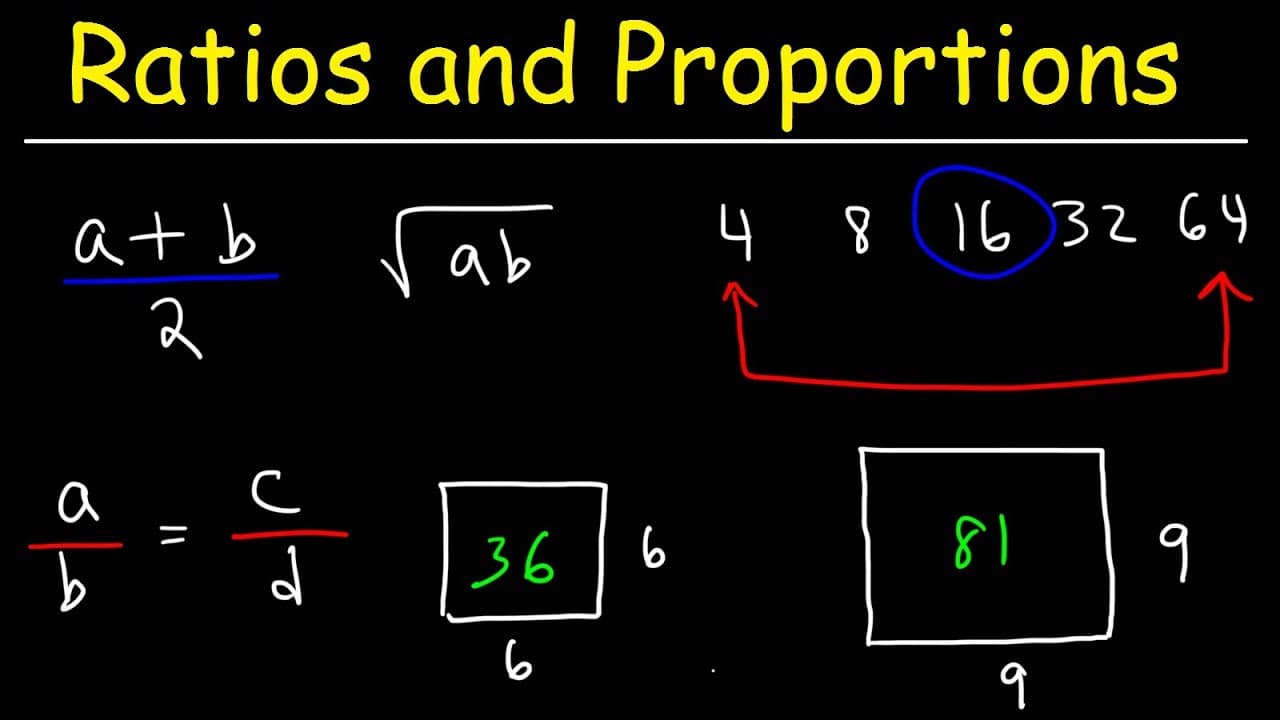
This comprehensive mathematics tutorial explores the fundamental differences between arithmetic and geometric means, followed by a series of practice problems involving ratios, proportions, and geometric applications. The video begins by conceptually defining arithmetic mean as the middle term of an arithmetic sequence and geometric mean as the middle term of a geometric sequence. It progresses through eight distinct problems ranging from basic mean calculations to complex word problems involving scale factors, geometric shapes, and algebraic manipulation.

The Organic Chemistry TutorThe Organic Chemistry Tutor

19mins 49s

Video
Practicing Number Patterns and Relationships

Practicing Number Patterns and Relationships

This educational math video features 'Mr. J' guiding students through a mastery check on analyzing numerical patterns and relationships, specifically designed for a 5th-grade level. The video begins by presenting four practice problems where students are tasked with generating two number patterns based on specific rules (e.g., 'Start at 0 and add 4') and then determining the mathematical relationship between the corresponding terms of those two patterns. The format is interactive, encouraging viewers to pause the video, solve the problems independently, and then resume to check their work against the instructor's detailed explanations. The key themes explored include generating numerical sequences using addition and subtraction rules, aligning sequences to identify corresponding terms, and discerning the functional relationship (add, subtract, multiply, divide) between two sets of numbers. The video emphasizes precision in language, requiring students to write full sentences describing the relationships, such as 'Multiply the terms in Pattern X by 7 to get the corresponding terms in Pattern Y.' It covers various relationship types, including additive, subtractive, multiplicative, and divisive relationships. For educators, this video serves as an excellent formative assessment tool or independent practice station. It models not just the calculation, but the organizational skills required to solve these problems, such as lining up numbers vertically to see the pairs clearly. The instructor also demonstrates how to troubleshoot, correcting a formatting error in real-time, which models resilience and attention to detail. This resource effectively bridges the gap between simple arithmetic and early algebraic thinking by focusing on input-output relationships.
Math with Mr. JMath with Mr. J

6mins 51s

Video
Writing Numerical Expressions from Words

Writing Numerical Expressions from Words

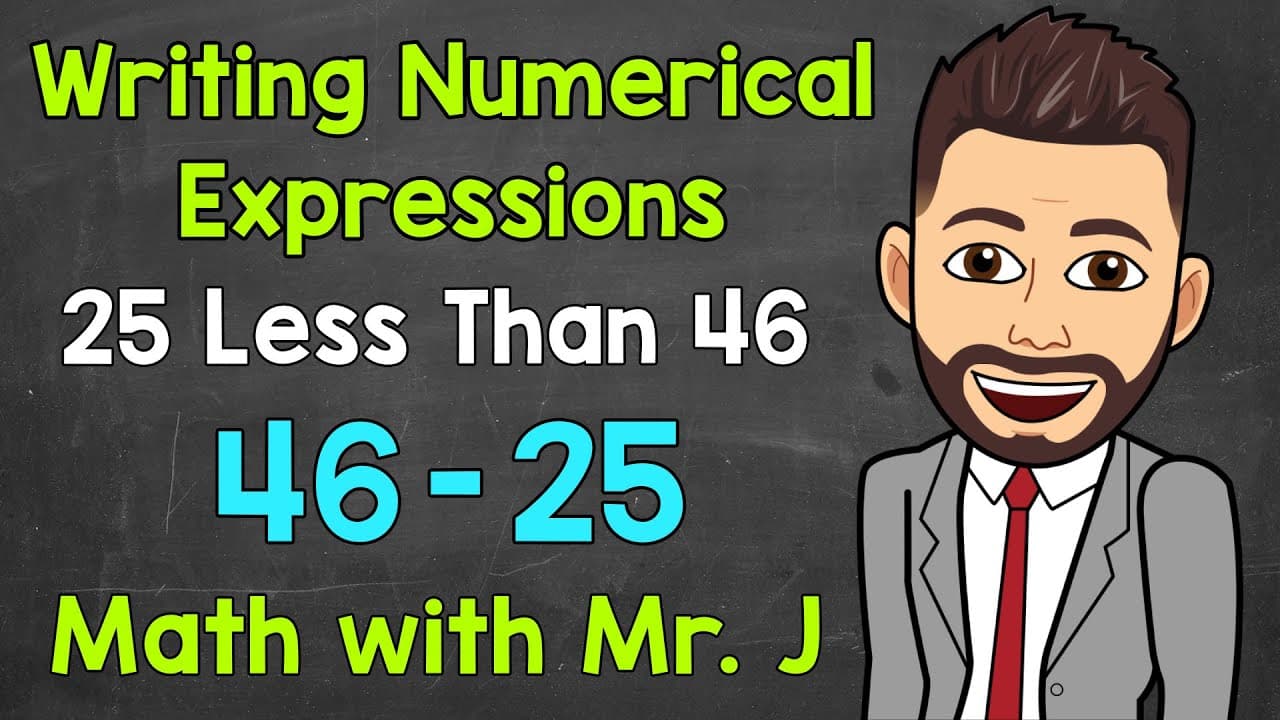
This concise and clear instructional video teaches students how to translate verbal phrases into numerical expressions, a foundational skill for algebra and problem-solving. "Math with Mr. J" guides viewers through eight distinct examples, demonstrating how to identify key mathematical vocabulary—such as "sum," "decreased by," "product," and "quotient"—and convert them into appropriate mathematical operations using numbers and symbols. The video systematically explores all four basic operations: addition, subtraction, multiplication, and division. It pays special attention to common stumbling blocks, such as the specific ordering required for phrases like "less than," and introduces students to various notational forms for multiplication (parentheses, dots, asterisks) and division (fraction bars). This variety helps build mathematical fluency and prepares students for higher-level math where notation changes. For educators, this resource serves as an excellent direct instruction tool or review for 5th and 6th graders transitioning from arithmetic to algebraic thinking. It directly addresses the Common Core standards regarding writing and interpreting numerical expressions. The clear visual format and step-by-step narration make it ideal for introducing the concept of "math as a language" and helping students decode word problems.

Math with Mr. JMath with Mr. J

5mins 12s

Video
How to Find the Next Number in a Pattern

How to Find the Next Number in a Pattern

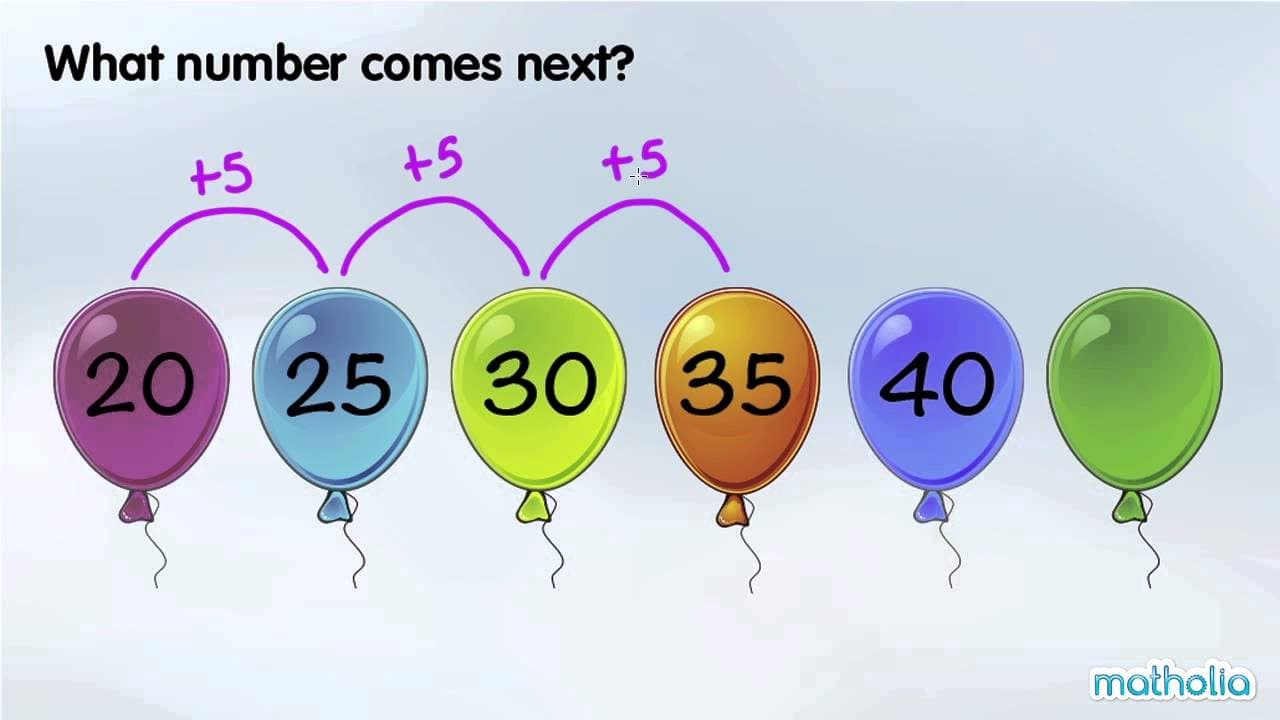
This educational video teaches students how to identify and complete number patterns using clear visual aids and narration. Through four distinct examples involving colorful balloons, the video demonstrates arithmetic sequences involving both addition (skip counting forward) and subtraction (counting backward). It systematically breaks down the process of finding the rule between consecutive numbers to determine the next number in the sequence. Key themes include pattern recognition, basic arithmetic (addition and subtraction), and critical thinking skills related to algebraic reasoning. The video covers skip counting by 2s and 5s, as well as counting backwards by 1s and 2s, reinforcing mental math strategies in a step-by-step format. Ideally suited for early elementary classrooms, this video provides a solid foundation for algebraic thinking. Teachers can use it to introduce the concept of "rules" in sequences, support lessons on skip counting, or use the pause points as checks for understanding. The clear visual representation of the "jump" between numbers helps students visualize the mathematical operation occurring at each step.

MatholiaChannelMatholiaChannel

2mins 43s

Video
Conic Sections Practice Problems: Circles, Ellipses, Parabolas, and Hyperbolas

Conic Sections Practice Problems: Circles, Ellipses, Parabolas, and Hyperbolas

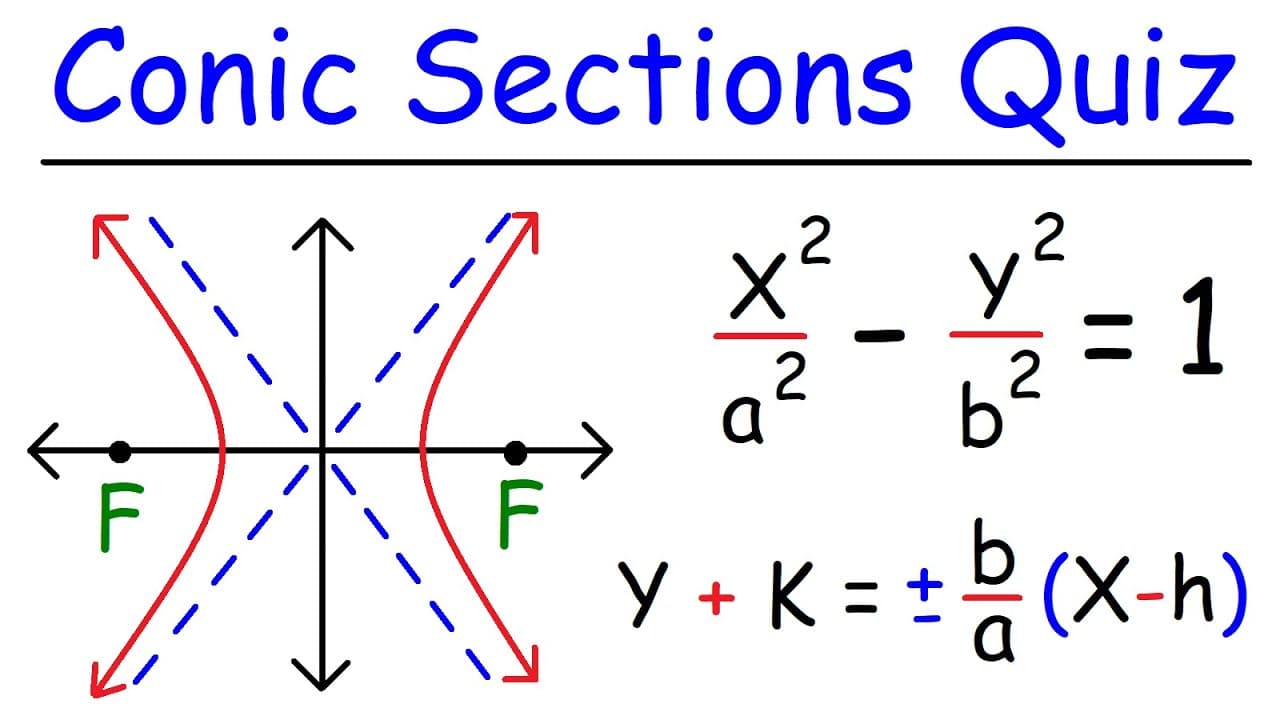
A comprehensive math tutorial solving 10 diverse practice problems related to conic sections. The video systematically covers circles, ellipses, hyperbolas, and parabolas, teaching viewers how to identify shapes from equations, graph them, and calculate key features. The narrator demonstrates essential techniques such as completing the square to convert general equations into standard form and using formulas to find vertices, foci, directrices, and asymptotes. Key themes include the algebraic definitions of conic sections, the geometric relationship between centers, foci, and vertices, and the process of sketching graphs from equations. The video contrasts the four types of conics, highlighting the specific differences in their standard equations, such as sign changes and coefficient differences. It also delves into analytic geometry concepts like the distance formula and midpoint formula within the context of conics. This video is highly valuable for Algebra II and Pre-Calculus classrooms as a review tool or a guided practice session. Teachers can use specific segments to model problem-solving strategies for individual conic sections or assign the entire video as a study guide for unit tests. The step-by-step explanations provide clear models for students to check their work and understand the logic behind geometric definitions.

The Organic Chemistry TutorThe Organic Chemistry Tutor

29mins 31s

Video
Understanding Ratios, Proportions, and Cross-Multiplication

Understanding Ratios, Proportions, and Cross-Multiplication

This educational math video provides a comprehensive introduction to the concepts of ratios and proportions, specifically tailored for upper elementary and middle school students. It begins by defining a ratio as a comparison of two quantities and demonstrates three different ways to write them: word form (is to), colon form (:), and fraction form. Using clear visual aids like fruits and bakery items, the video explains how to simplify ratios to their lowest terms and identify equivalent ratios. The second half of the video transitions into proportions, defining them as statements of equality between two ratios. It introduces specific vocabulary such as "means" and "extremes" and teaches students how to verify if two ratios form a proportion using cross-multiplication. The video concludes by demonstrating how to solve for a missing term (variable) within a proportion using algebra-lite steps, providing both real-world word problems and abstract numerical examples. This resource is highly valuable for teachers introducing pre-algebraic thinking. The step-by-step visual demonstrations make abstract concepts concrete, while the clear procedures for cross-multiplication provide students with a reliable tool for checking their work. The video effectively scaffolds learning from basic identification to solving for unknown variables, making it excellent for direct instruction or review stations.

Sheena DoriaSheena Doria

13mins 21s

Video
Mastering Direct, Inverse, and Joint Variation Word Problems

Mastering Direct, Inverse, and Joint Variation Word Problems

This comprehensive algebra tutorial provides a deep dive into direct, inverse, and joint variation word problems. The video begins by systematically teaching students how to translate written sentences into algebraic equations using the constant of variation (k). It covers simple variations as well as more complex scenarios involving squares, square roots, and cubes. The instructional approach is notable for teaching two distinct methods for every problem: a conceptual method using proportional reasoning (e.g., "if x doubles, y must quadruple") and a standard algebraic method (solving for k, then substitution). This dual approach helps students verify their answers and develop a stronger intuitive understanding of how variables relate to one another. Ideal for Algebra 1 and Algebra 2 curriculums, this video serves as an excellent resource for teaching students how to model real-world relationships mathematically. It progresses from basic direct variation to complex mixed variation problems, offering clear, step-by-step mental math strategies for simplifying calculations along the way.

The Organic Chemistry TutorThe Organic Chemistry Tutor

20mins 45s

Video
Applying Domain Restrictions to Real-World Problems

Applying Domain Restrictions to Real-World Problems

This video bridges the gap between abstract mathematical concepts and real-life application by exploring domain restrictions through everyday scenarios. Hosted by Justin, the lesson moves beyond theoretical definitions to demonstrate how physical reality imposes natural limits on mathematical functions. The video specifically examines three distinct situations—rolling a die, pricing old smartphones, and buying groceries—to illustrate how context determines valid input values. The content covers key algebraic concepts including input/output relationships, discrete versus continuous functions, and inequality notation. It guides viewers through the logical process of determining a domain, starting with a mathematical assumption and then refining it based on reality (e.g., recognizing that time and money cannot be negative). The distinction between discrete data (countable integers like die rolls) and continuous intervals (time and currency) is visually represented using set notation and number lines. For educators, this video is an excellent tool for scaffolding the difficult concept of domain and range in word problems. It addresses the common student struggle of translating text into mathematical notation and provides a clear model for error analysis—specifically showing why a mathematically correct inequality might be practically incorrect without real-world context. This resource helps students develop the critical thinking habits necessary for modeling with mathematics.

Miacademy & MiaPrep Learning ChannelMiacademy & MiaPrep Learning Channel

3mins 45s

Video
Using Linear Graphs to Solve Real-World Problems

Using Linear Graphs to Solve Real-World Problems

This instructional math video bridges the gap between theoretical graphing concepts and real-world problem solving. It demonstrates how to interpret key features of linear graphs—specifically slope, x-intercepts, and y-intercepts—to answer practical questions about distance, profit, and physical measurements. The video uses three distinct scenarios to illustrate these concepts: a hiker walking home, an ice cream vendor seeking a profit, and a river's water level decreasing over time. The video focuses on three primary mathematical themes: (1) Understanding slope as a unit rate and using it for unit conversion (dimensional analysis), (2) Identifying the x-intercept as a "break-even point" where a value reaches zero, and (3) Recognizing the y-intercept as an initial value or starting condition (when x=0). It emphasizes distinguishing between mathematical values (like a negative slope) and their physical interpretations (speed is positive). For educators, this video is an excellent resource for Applied Algebra or Pre-Algebra classes. It moves beyond rote calculation to conceptual understanding, helping students see *why* we calculate slope or intercepts. The visual overlays showing dimensional analysis provide a strong cross-curricular link to science, while the business application offers a practical financial literacy moment. It effectively models how to extract hidden information from a visual representation.

Miacademy & MiaPrep Learning ChannelMiacademy & MiaPrep Learning Channel

4mins 42s

Video
Calculating Sums of Infinite Geometric Series

Calculating Sums of Infinite Geometric Series

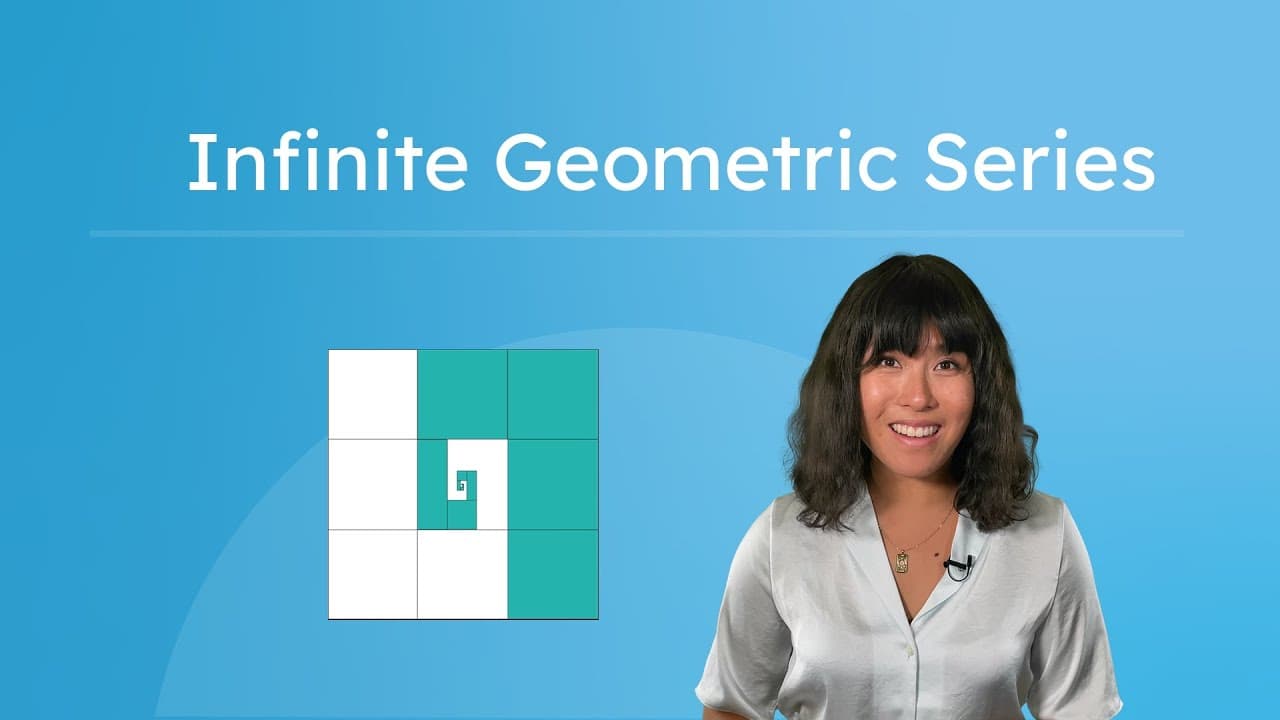
This video provides a comprehensive introduction to infinite geometric series, distinguishing between those that grow indefinitely and those that approach a specific limit. It guides students through the conceptual shift from calculating finite sums to analyzing infinite behavior, using both numerical examples and geometric visualizations to illustrate how adding infinite terms can result in a finite sum. The narration explains the critical role of the common ratio in determining the behavior of the series. The content covers key concepts including summation notation, the definitions of convergent and divergent series, and the specific conditions for the common ratio ($r$) that dictate these behaviors. It walks viewers through the derivation of the infinite geometric series formula ($S_\infty = \frac{a}{1-r}$) by applying limits to the finite series formula. The video specifically addresses the misconception that all infinite series can be summed, emphasizing the necessity of checking if the absolute value of $r$ is less than 1. For educators, this resource serves as an excellent bridge between Algebra II and Pre-Calculus concepts. It offers visual proofs of convergence using geometric shapes (fractal-like triangles and subdivided squares) which helps concrete thinkers grasp abstract limits. The included practice problems and "trap" questions—where students must identify a divergent series rather than blindly applying a formula—encourage critical thinking and procedural fluency.

Miacademy & MiaPrep Learning ChannelMiacademy & MiaPrep Learning Channel

12mins 5s

Video
Direct Variation Explained: Formulas, Tables, and Word Problems

Direct Variation Explained: Formulas, Tables, and Word Problems

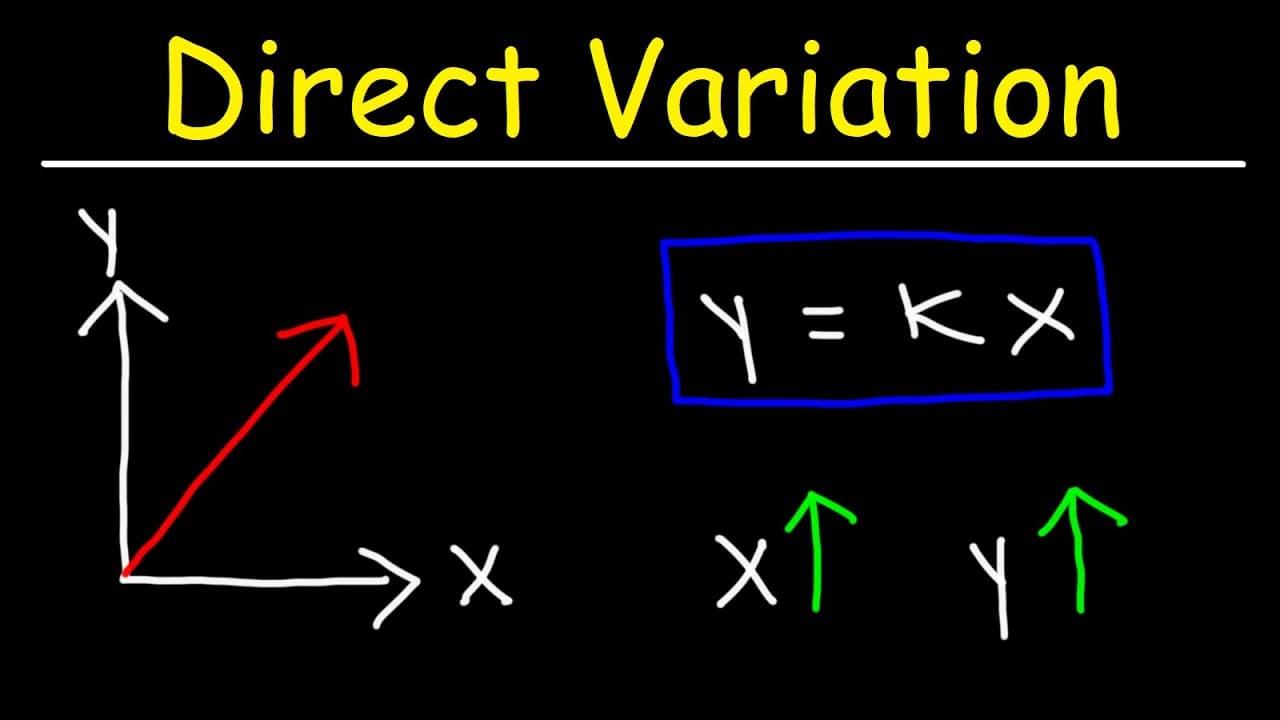
This instructional video provides a comprehensive guide to understanding and solving direct variation problems in algebra. It begins by defining direct variation as a linear relationship between two variables, x and y, where y varies directly with x according to the equation y = kx. The video breaks down the concept of the "constant of variation" (k) and demonstrates how to calculate it using the ratio y/x. Through clear, step-by-step examples, the narrator shows how to determine the constant k, write the specific direct variation equation, and then use that equation to solve for unknown values. Key themes explored include the graphical representation of direct variation as a line passing through the origin, the algebraic manipulation of the formula y = kx, and data analysis skills required to identify direct variation from tables of values. The video also transitions from abstract algebraic problems to real-world applications, specifically addressing distance-time word problems. A significant portion is dedicated to verifying proportional relationships by checking if the ratio of y to x remains constant across data sets. For educators, this video serves as an excellent resource for scaffolding algebra lessons. It moves logically from definition to computation, then to data analysis, and finally to application. The clear visual layout helps students follow the procedural steps of identifying k, writing the equation, and substituting values. The inclusion of a word problem with a unit conversion trap (minutes vs. hours) provides a valuable teaching moment about paying attention to details in mathematical modeling.

The Organic Chemistry TutorThe Organic Chemistry Tutor

10mins 29s

Video
How to Graph Functions Using Input-Output Tables

How to Graph Functions Using Input-Output Tables

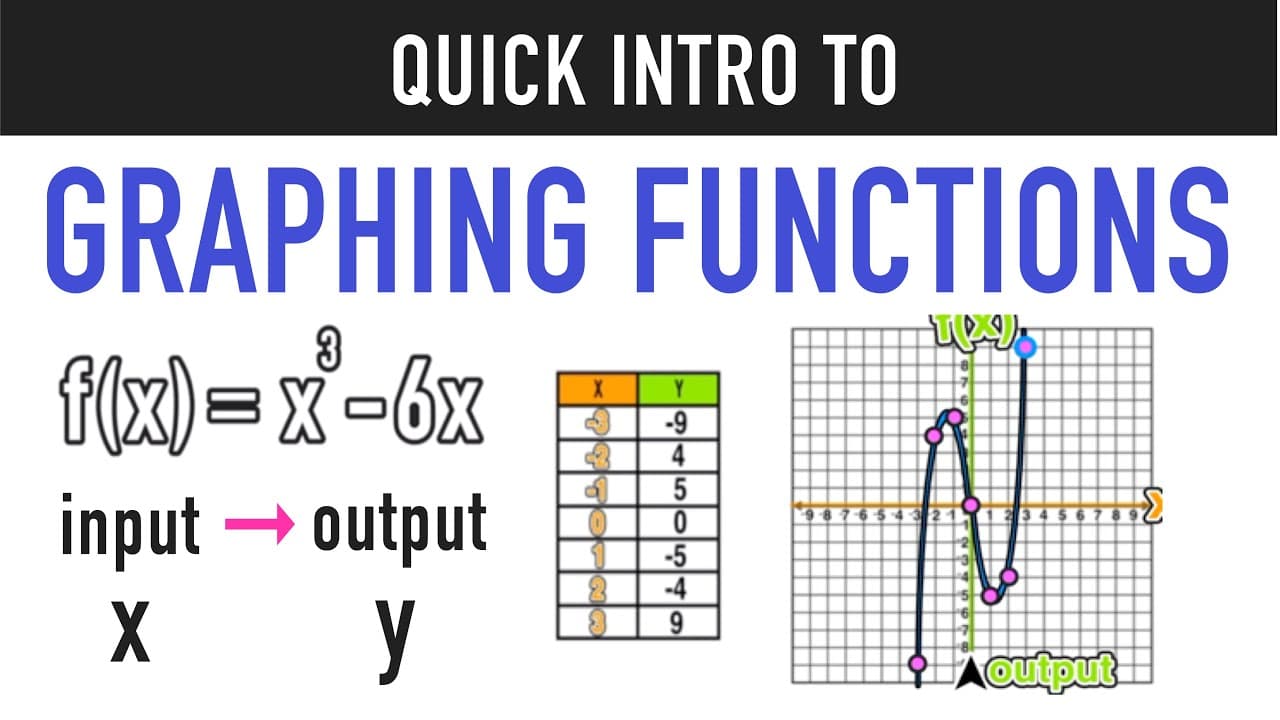
This instructional video provides a clear, step-by-step tutorial on how to graph a cubic function by creating and filling out an input-output table. The narrator demystifies the notation of functions by encouraging viewers to think of 'x' simply as a placeholder for an input value, demonstrating this visually by replacing 'x' with an orange circle. The video walks through the specific example of f(x) = x^3 - 6x, evaluating the function for various integer inputs to generate coordinate points. The content covers key algebraic skills including substitution, operations with exponents, handling negative numbers, and plotting points on a Cartesian coordinate plane. It transitions from algebraic calculation to geometric visualization as the calculated points are plotted and connected with a smooth curve. The narrator emphasizes the specific shape of cubic functions, noting the characteristic "peak and valley" curve, distinguishing it from linear or quadratic graphs. For educators, this video serves as an excellent introduction or review of graphing functions without a graphing calculator. It reinforces the fundamental concept that a graph is simply a visual representation of many input-output pairs. The visual aids, specifically the color-coded substitution and the animation of points appearing on the graph, make abstract algebraic concepts concrete and accessible for students in Pre-Algebra and Algebra I.

Mashup MathMashup Math

5mins 28s

Video
Understanding Slope and Intercepts in Real-World Graphs

Understanding Slope and Intercepts in Real-World Graphs

This educational video demystifies the concepts of slope and intercepts by connecting them to real-world scenarios. Through two distinct examples—a hiking trip and trends in paper billing—the narrator demonstrates how abstract mathematical features on a graph translate into tangible information like speed, starting position, and rates of change over time. The video uses clear visuals and step-by-step calculations to bridge the gap between algebraic formulas and practical understanding. The content focuses on key algebraic themes including linear functions, calculating slope using the rise-over-run formula, and interpreting both x and y-intercepts in context. It specifically addresses how a positive slope represents an increase (hiking distance) while a negative slope represents a decrease (preference for paper bills), providing a well-rounded view of linear relationships. For educators, this video serves as an excellent tool for Algebra 1 or pre-algebra classrooms. It moves beyond rote calculation, encouraging students to analyze what specific points and lines on a graph actually mean. Teachers can use this to introduce the topic of linear modeling or as a reinforcement tool to help students struggling to extract meaning from word problems and their corresponding graphs.
Miacademy & MiaPrep Learning ChannelMiacademy & MiaPrep Learning Channel

3mins 11s

Video
How to Calculate Percent Increase and Decrease

How to Calculate Percent Increase and Decrease

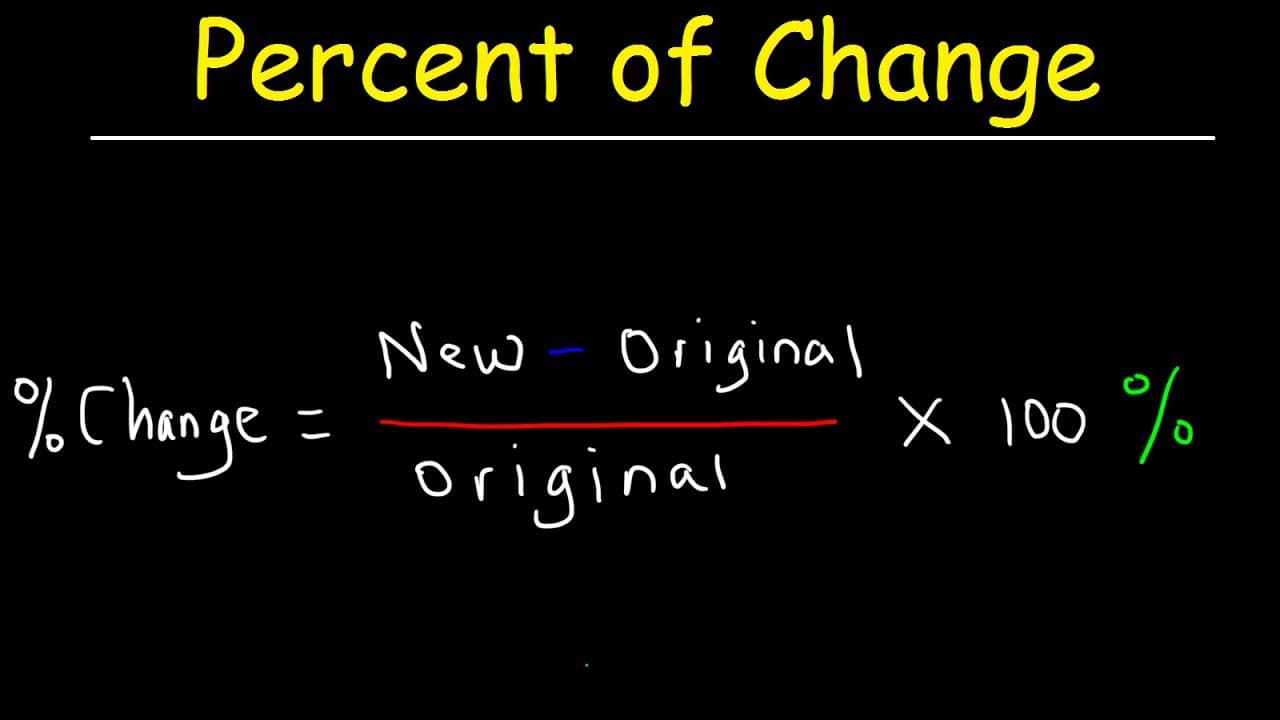
This comprehensive math tutorial provides a step-by-step guide to calculating percent of change, covering both percent increase and percent decrease. The video begins by introducing the core formula: (New Value - Original Value) / Original Value × 100%. The narrator demonstrates this formula with simple numerical examples before progressing to more complex scenarios involving negative results, which indicate a decrease in value. The content explores key themes of identifying variables in word problems, distinguishing between "change to" and "change by," and interpreting positive versus negative percentages. It progresses from basic number sets to real-world applications, including calculating inflation in gas prices, growth in savings accounts, population dynamics, and class enrollment statistics. Special attention is given to parsing word problems where the "new value" must be calculated before applying the percent change formula. For educators, this video serves as an excellent instructional tool for Pre-Algebra and Algebra units on ratios, proportions, and percentages. It effectively addresses common student errors, such as mixing up the new and original values or failing to calculate the total new amount when given only the increment. The clear, handwritten visual style allows students to follow the algorithmic thinking required to solve these problems, making it suitable for direct instruction, review, or flipped classroom assignments.

The Organic Chemistry TutorThe Organic Chemistry Tutor

11mins 23s

Video
How to Identify Parallel, Perpendicular, and Neither Lines

How to Identify Parallel, Perpendicular, and Neither Lines

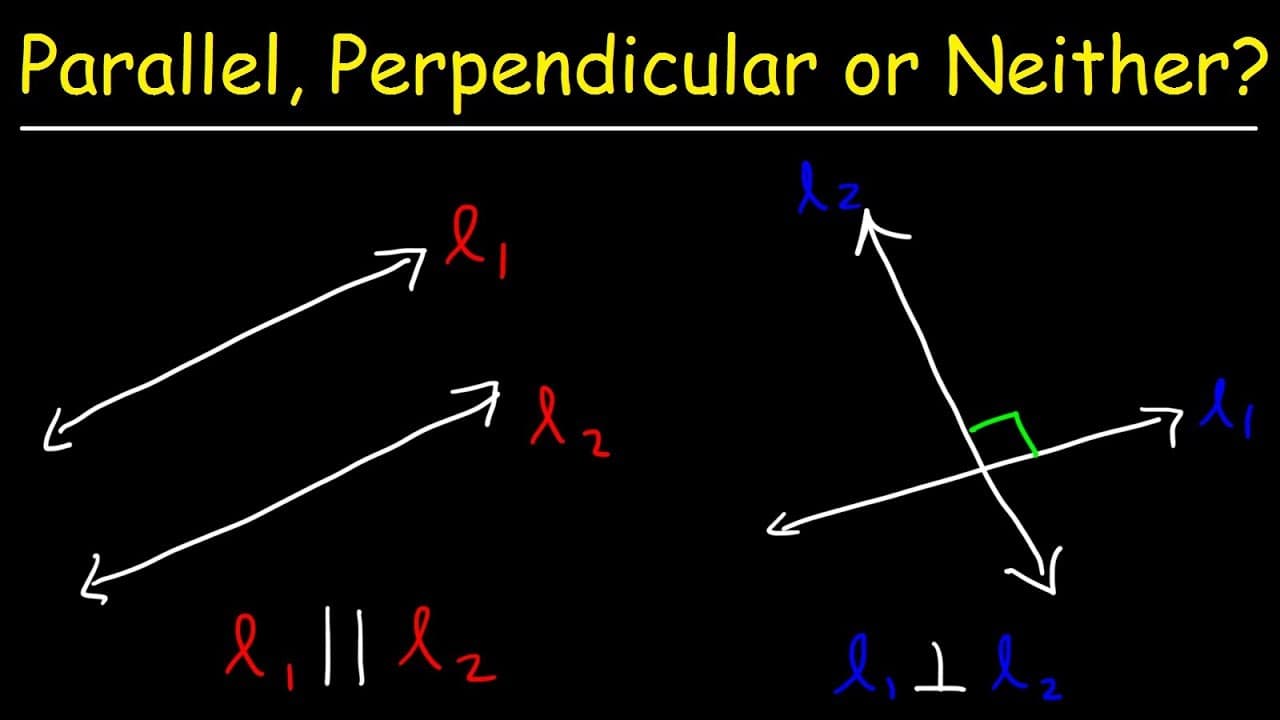
This math tutorial provides a clear, step-by-step guide on how to use linear equations to determine the relationship between two lines. Using the slope-intercept form (y = mx + b), the narrator demonstrates how to identify the slope in an equation and compare it to another to classify lines as parallel, perpendicular, or neither. The video uses a blackboard-style format with handwritten text to walk through specific numerical examples for each scenario. The content focuses on two core geometric concepts linked to algebra: parallel lines have identical slopes, while perpendicular lines have slopes that are negative reciprocals of one another. The video also covers the visual properties of these lines, explaining that parallel lines never touch and perpendicular lines intersect at 90-degree angles. It concludes with an example of lines that fit neither category, ensuring students understand how to rule out the special cases. This resource is highly valuable for Algebra I and Geometry classrooms. It bridges the gap between algebraic equations and geometric properties, offering a concrete method for analyzing linear relationships without needing to graph them first. Teachers can use this video to introduce the concept of negative reciprocals, reinforce slope identification skills, or as a review tool before a unit on coordinate geometry proofs.

The Organic Chemistry TutorThe Organic Chemistry Tutor

3mins 59s

Video
Analyzing Relationships Between Number Patterns

Analyzing Relationships Between Number Patterns

This instructional math video guides students through the process of generating numerical patterns based on specific rules and then analyzing the mathematical relationships between two related patterns. The instructor, Mr. J, demonstrates how to create sequences by following "start at" and "add/subtract" directions, subsequently teaching viewers how to identify functional relationships between corresponding terms in the two sequences. The video covers four distinct examples involving addition, multiplication, division, and subtraction rules connecting the patterns. The core themes include generating numerical patterns, identifying arithmetic sequences, and determining algebraic relationships (rules) between two sets of numbers. A significant focus is placed on the vocabulary of "terms" and "corresponding terms," as well as the importance of verifying mathematical rules across multiple data points rather than assuming a pattern based on a single pair. The video introduces foundational algebraic thinking by expressing these relationships as equations (e.g., A + 2 = B or 3x = y). For educators, this video serves as an excellent direct instruction tool for Common Core standard 5.OA.B.3. It models precise mathematical procedures and metacognitive strategies, such as checking work to ensure validity. Teachers can use this video to introduce the concept of input/output tables, prepare students for graphing ordered pairs on a coordinate plane, or as a remediation tool for students struggling to see the connection between two changing variables.

Math with Mr. JMath with Mr. J

10mins 11s

Video
Mastering Recursive and Explicit Geometric Sequence Formulas

Mastering Recursive and Explicit Geometric Sequence Formulas

This educational mathematics video provides a clear, step-by-step guide on how and when to use recursive and explicit formulas for geometric sequences. Hosted by a narrator named Justin and featuring a helpful robot character, the video reviews the structural differences between the two formula types before diving into practical applications. It emphasizes strategic thinking by demonstrating that while both formulas describe the same sequence, they are optimized for different tasks—recursive for finding sequential terms and explicit for calculating specific terms further down the sequence. The content is structured around four distinct examples that gradually increase in complexity. The first two examples provide the specific formula (one recursive, one explicit) and ask students to solve for terms. The subsequent two examples present a scenario with only the initial term and common ratio, challenging the viewer to select the most efficient formula type to solve the problem. This approach helps students move beyond rote memorization to conceptual understanding of mathematical efficiency. For educators, this video is an excellent resource for Algebra units covering sequences and series. It specifically targets the common student struggle of distinguishing between formula types and understanding their utility. The video can serve as a direct instructional tool for introducing the topic, a review segment before a test, or a remediation resource for students who struggle to determine which method to apply in problem-solving situations.

Miacademy & MiaPrep Learning ChannelMiacademy & MiaPrep Learning Channel

4mins 32s

Video
How to Solve Exponential Growth Word Problems

How to Solve Exponential Growth Word Problems

This educational video serves as a practical guide to solving word problems using exponential expressions. Narrated by Justin, the lesson begins by reviewing the core components of an exponential expression—initial value, growth factor, and exponent—before diving into three distinct real-world scenarios. The video transitions from simple doubling patterns to more complex compound interest calculations and biological growth cycles, demonstrating how to construct and solve equations for each situation.

Miacademy & MiaPrep Learning ChannelMiacademy & MiaPrep Learning Channel

5mins 46s