Fundamental concepts of emotional intelligence, stress reduction, and relaxation exercises. Develops skills for healthy relationships, digital balance, and resilience while establishing pathways for help-seeking and support systems.
A masterclass slide deck for the Zen Chair Masterclass updated with two new practice videos and optimized font sizes (minimum 24px) for accessibility. Includes restorative and functional mobility components.
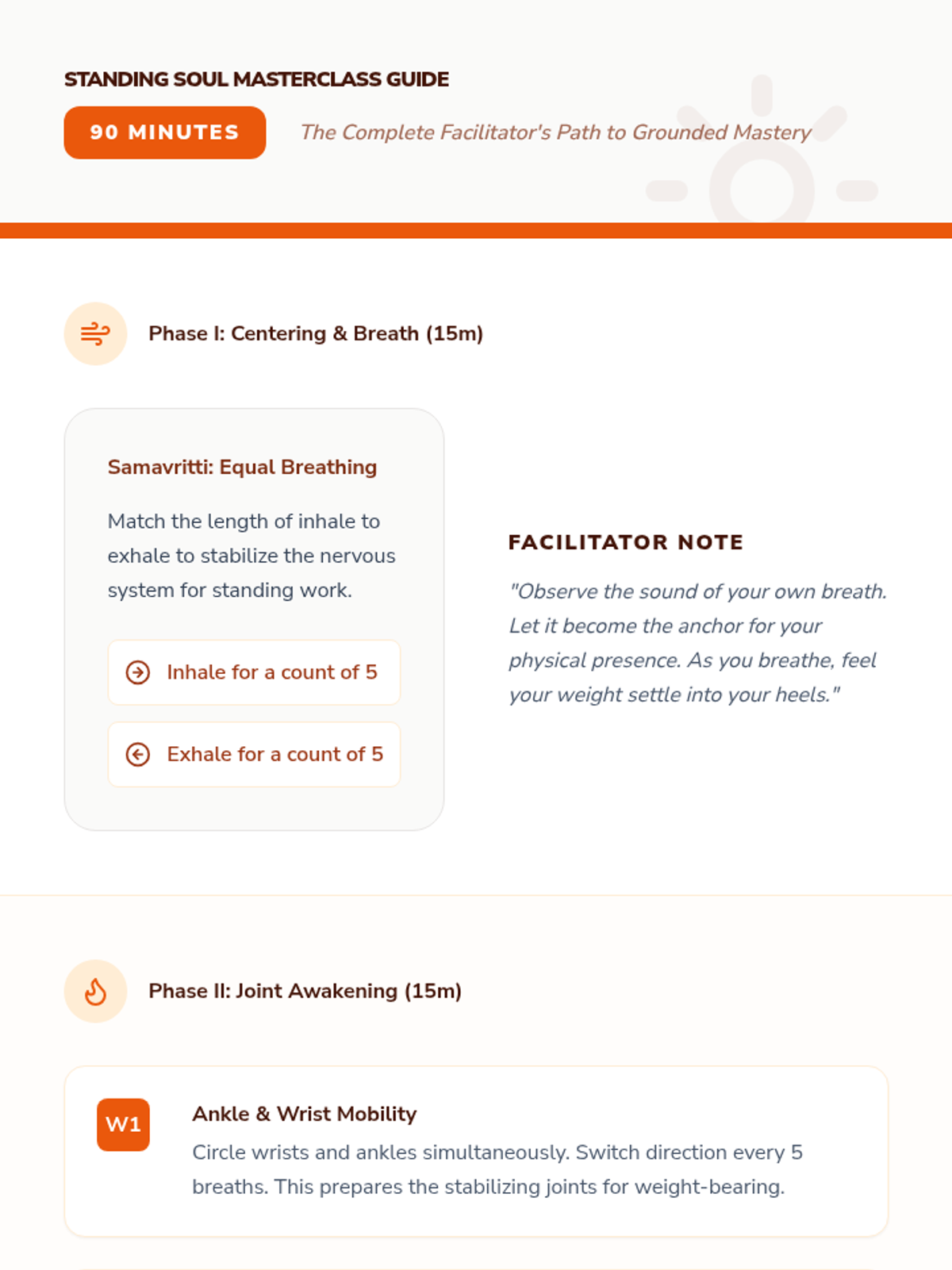
A comprehensive 90-minute facilitator's manual for the Standing Soul Masterclass. Includes pranayama, joint warm-ups, step-by-step postural alignment for key standing poses, and a restorative cool-down phase.
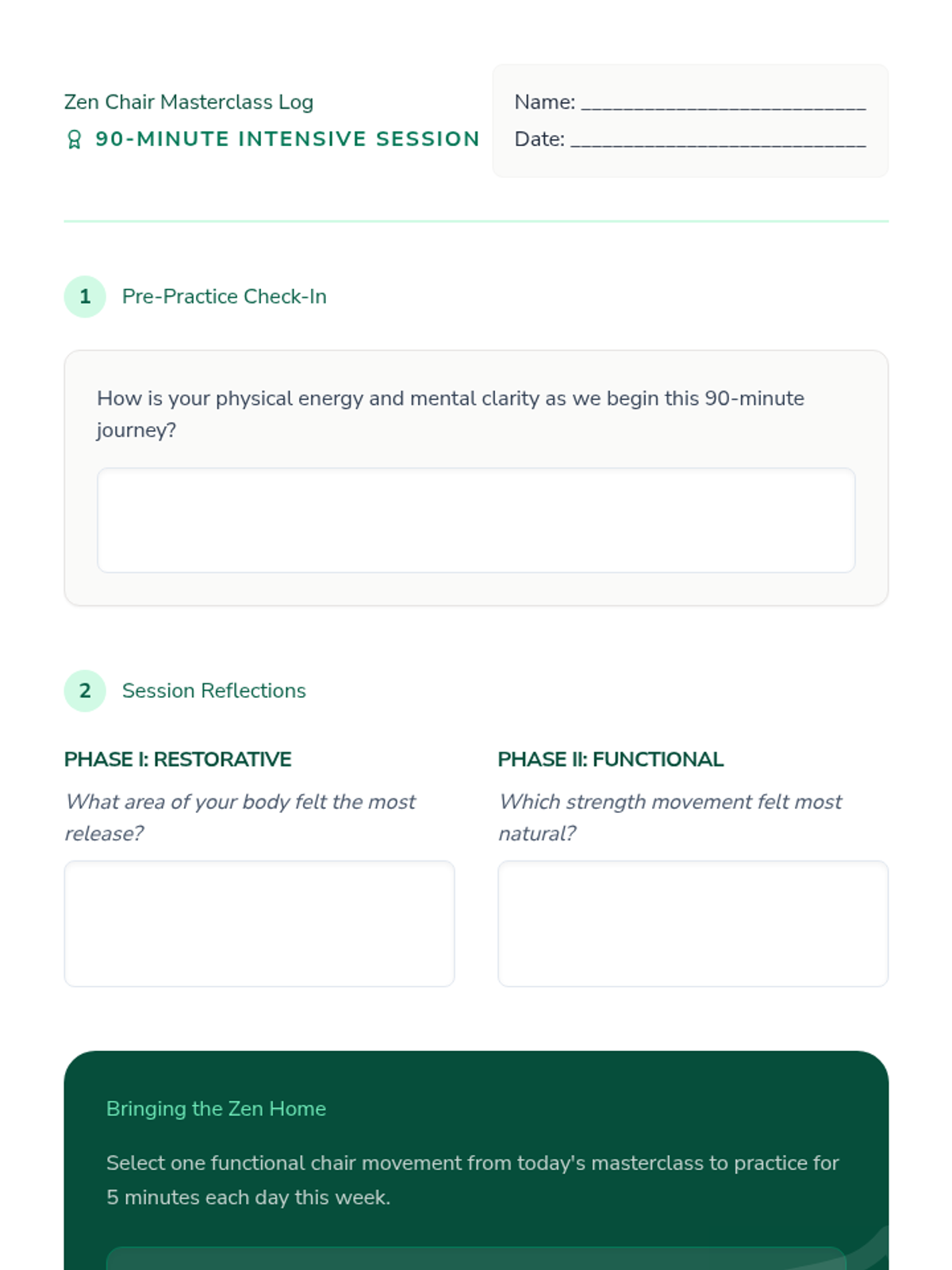
A student reflection log for the combined Zen Chair Masterclass session. Updated for the 90-minute intensive format with phase-specific reflection areas.
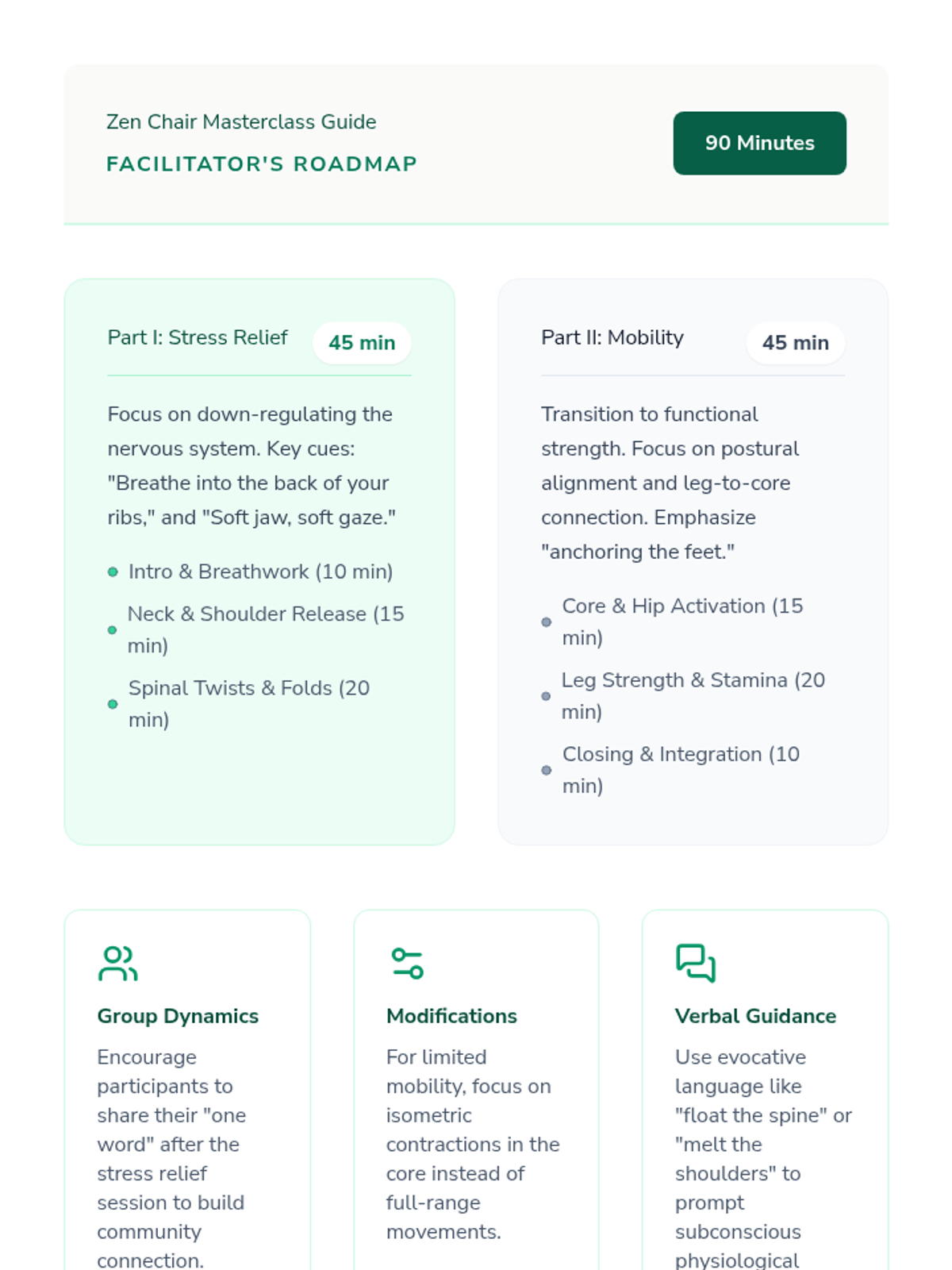
A 90-minute facilitator's guide for the Zen Chair Masterclass, featuring a split-session roadmap for stress relief and functional mobility with detailed pacing and instructional tips.
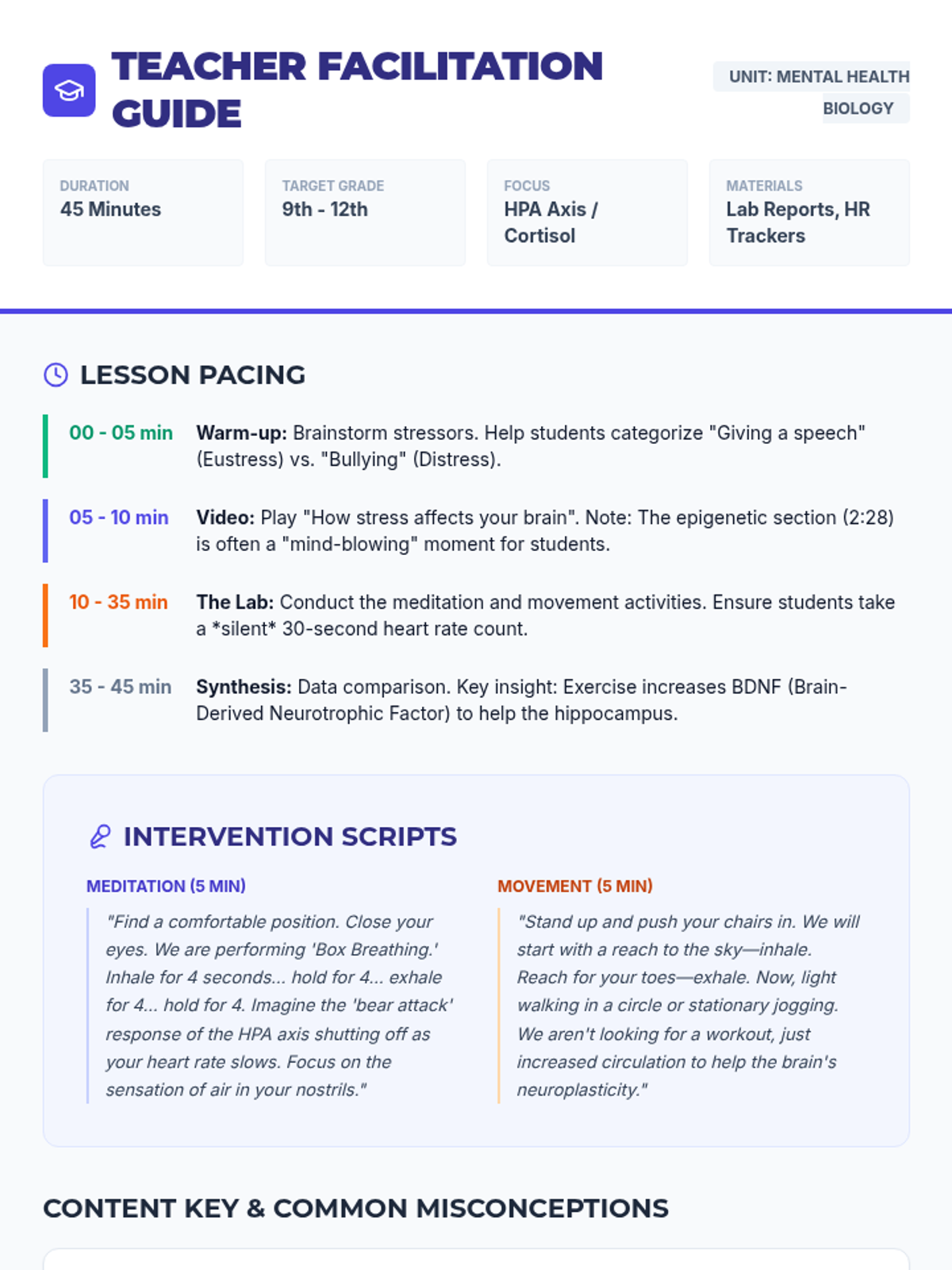
A comprehensive teacher's guide providing lesson pacing, meditation scripts, movement instructions, answer keys for video content, and strategies for addressing common student misconceptions about stress and exercise.
A modern, cinematic slide deck for instruction, including the YouTube video embed, lab procedures for meditation and movement, and data comparison prompts. Designed with high-contrast visuals to maintain student engagement.
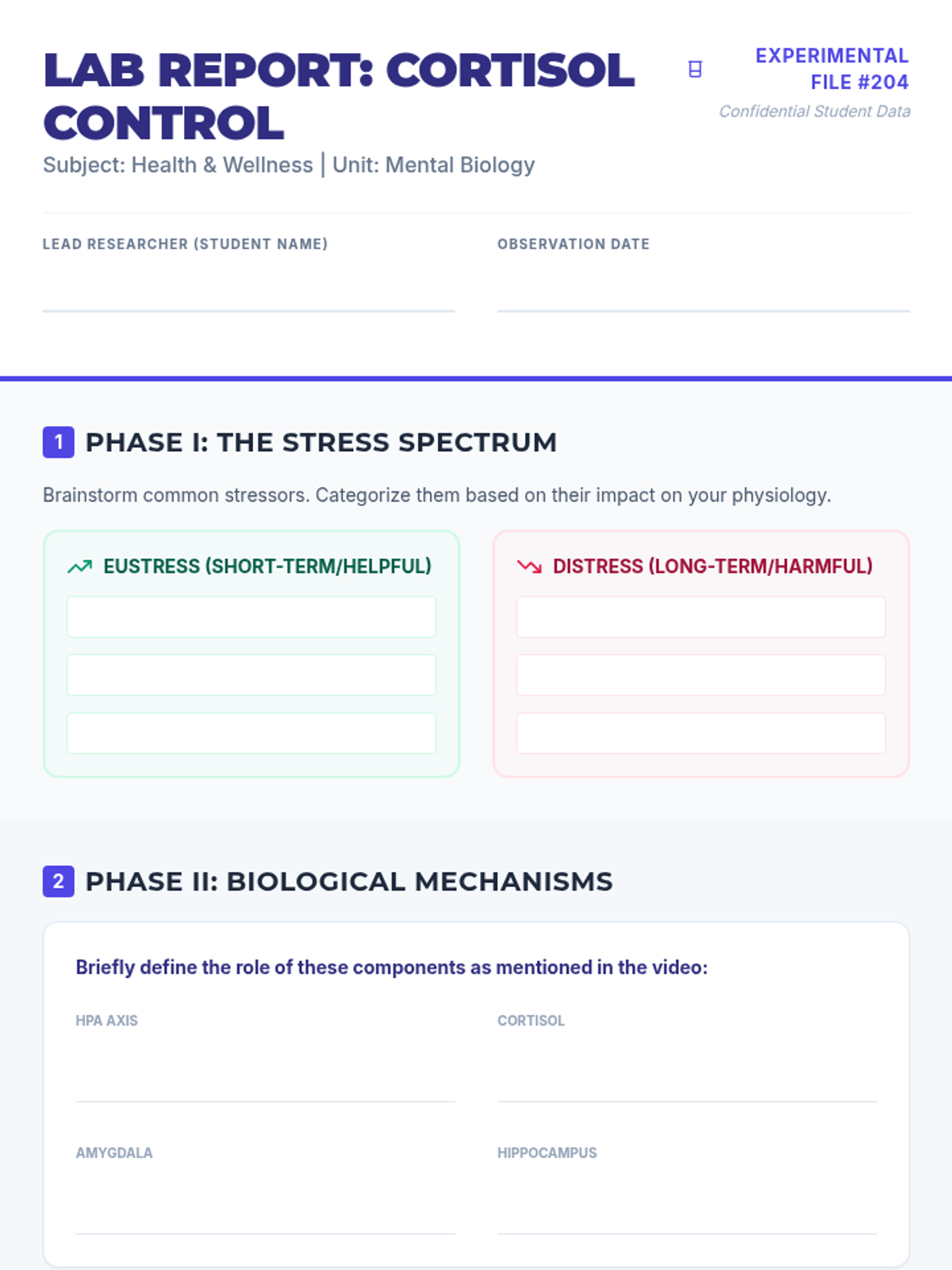
A professional lab-style worksheet for students to record stress data, categorize stressors, and analyze the biological effects of cortisol as discussed in class. Includes sections for heart rate tracking and subjective stress level measurement.
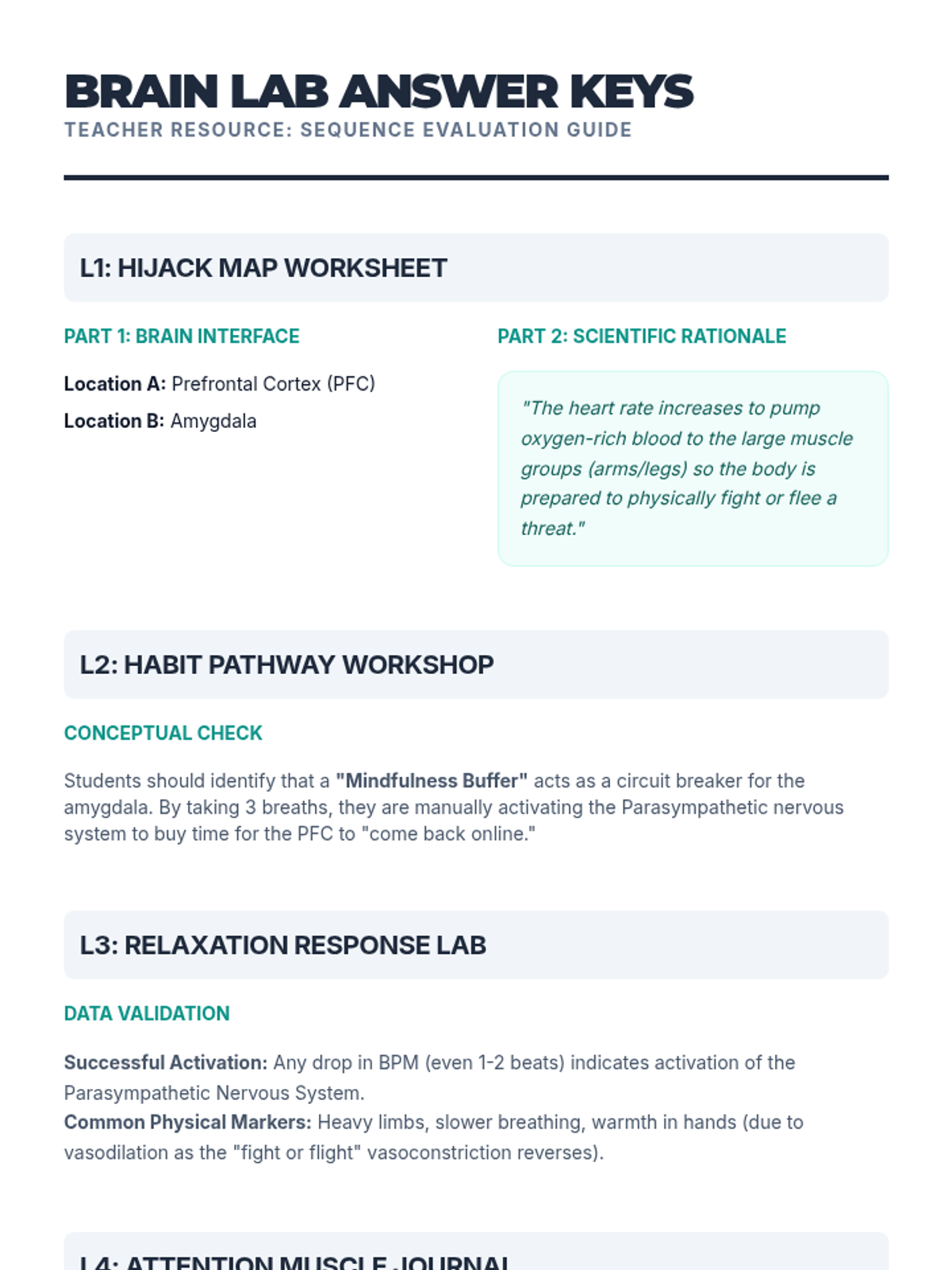
An answer key and grading rubric for the Brain Lab sequence, providing specific anatomical terms, conceptual checks, and a synthesis rubric for the final report.
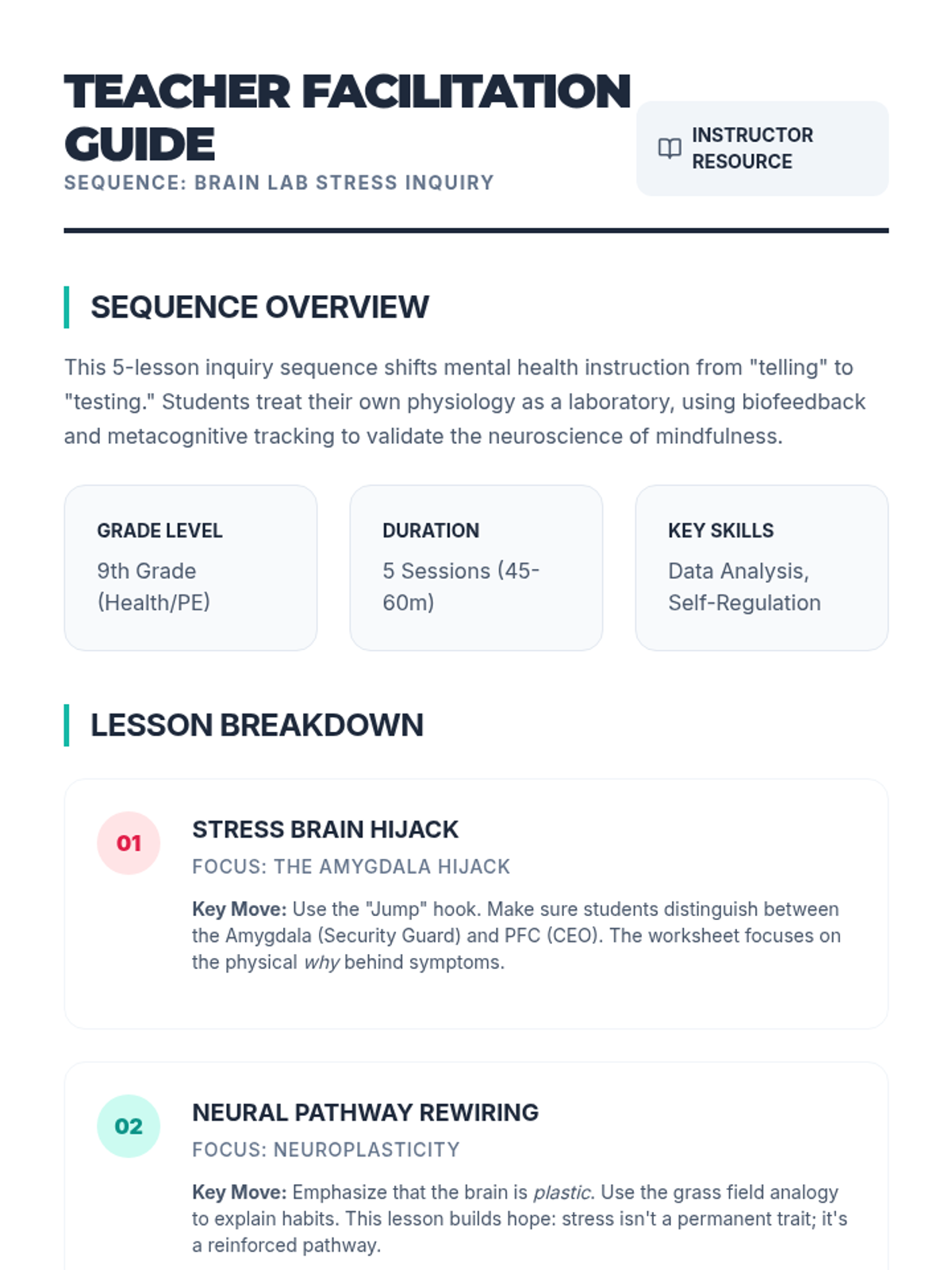
A comprehensive teacher guide for the 'Brain Lab' sequence, including lesson pacing, key instructional moves, and technical management tips for the biofeedback and attention labs.
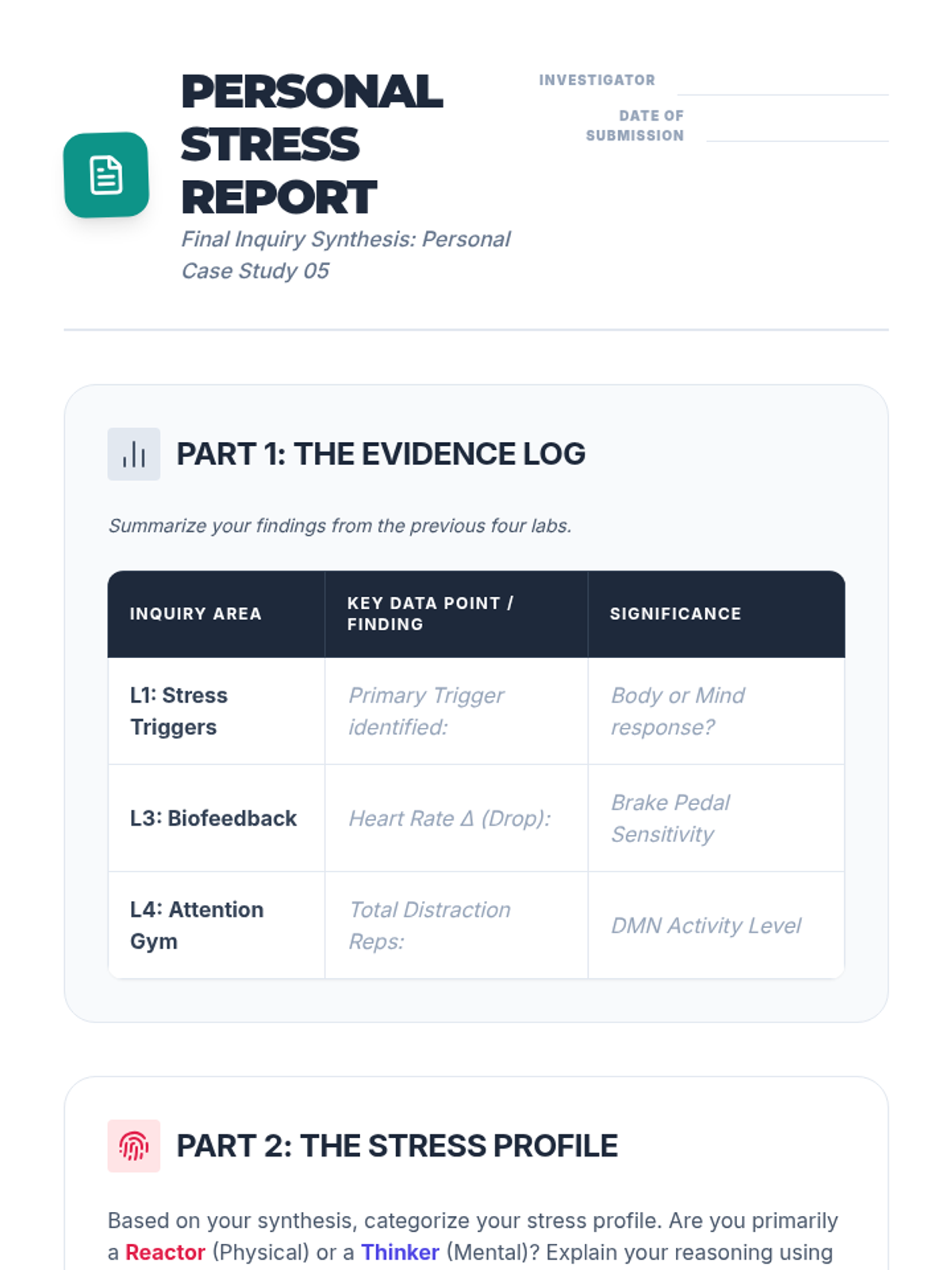
A final student synthesis document for Lesson 5 where students analyze their cumulative data from the week to identify their stress profile and prescribe a personal mindfulness antidote.
A visual presentation for Lesson 5 that guides students through analyzing their data (heart rate, distraction tallies, trigger audits) to create a personal 'Stress Profile.'
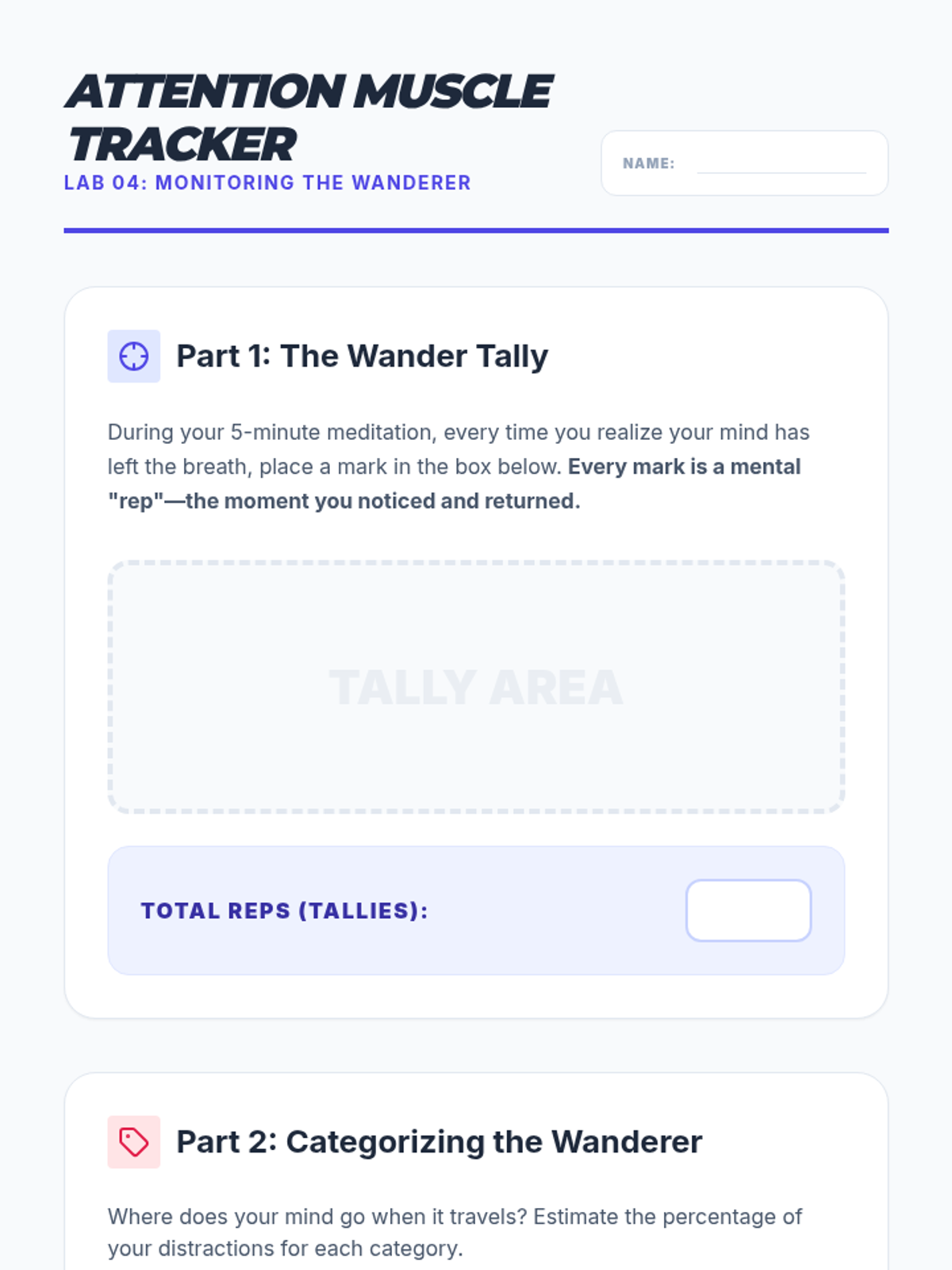
A student mind-wandering tracker for Lesson 4 to tally distractions and categorize the nature of thoughts during a meditation exercise.
A visual presentation for Lesson 4 exploring the neuroscience of mind-wandering (Default Mode Network vs. Task Positive Network) and the "mental rep" of returning focus.
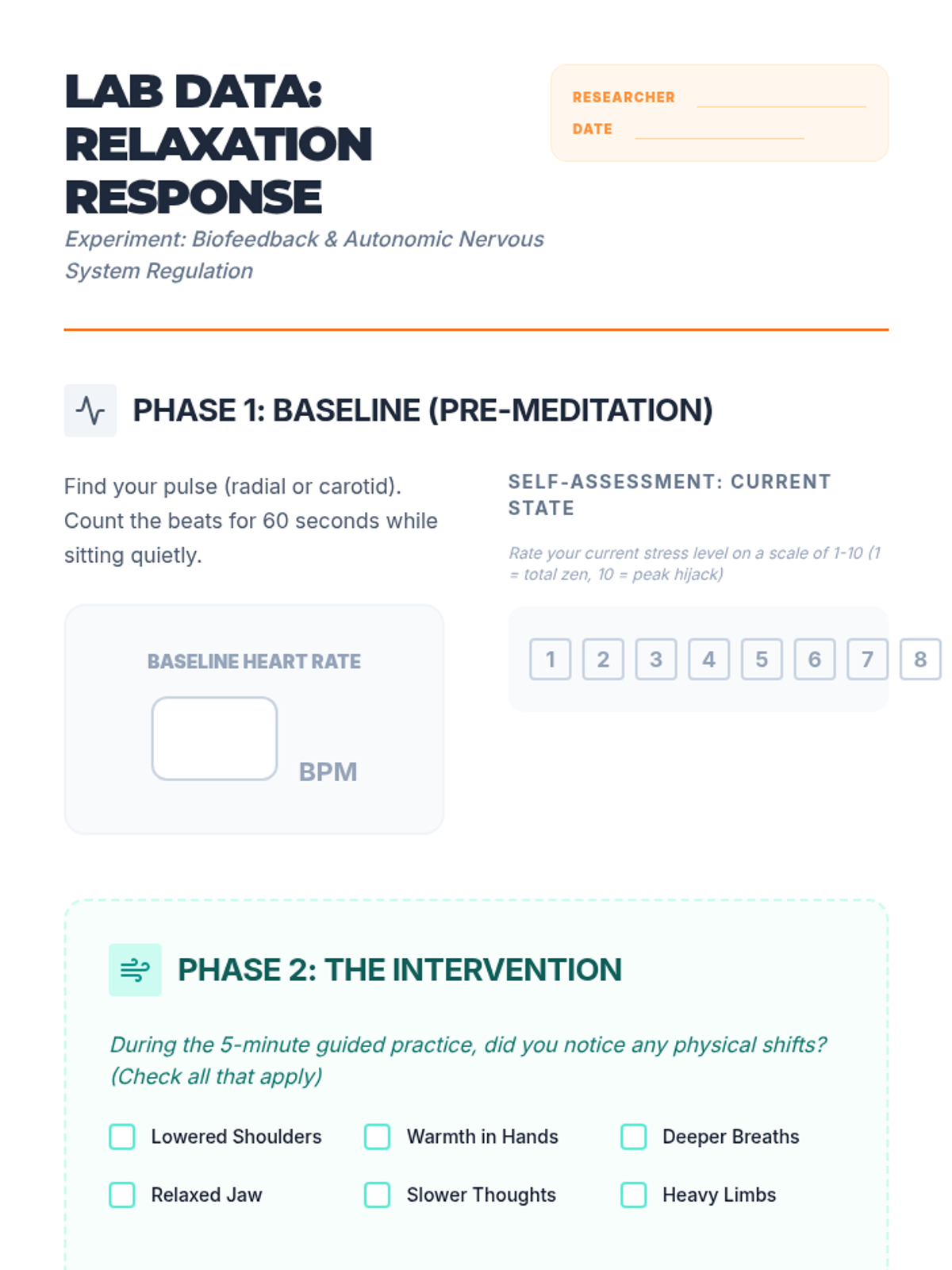
A student lab report for Lesson 3 to record heart rate data before and after mindfulness practice, providing evidence for the activation of the relaxation response.
A visual presentation for Lesson 3 introducing the biofeedback experiment, explaining the sympathetic vs. parasympathetic nervous systems, and outlining the lab protocol.
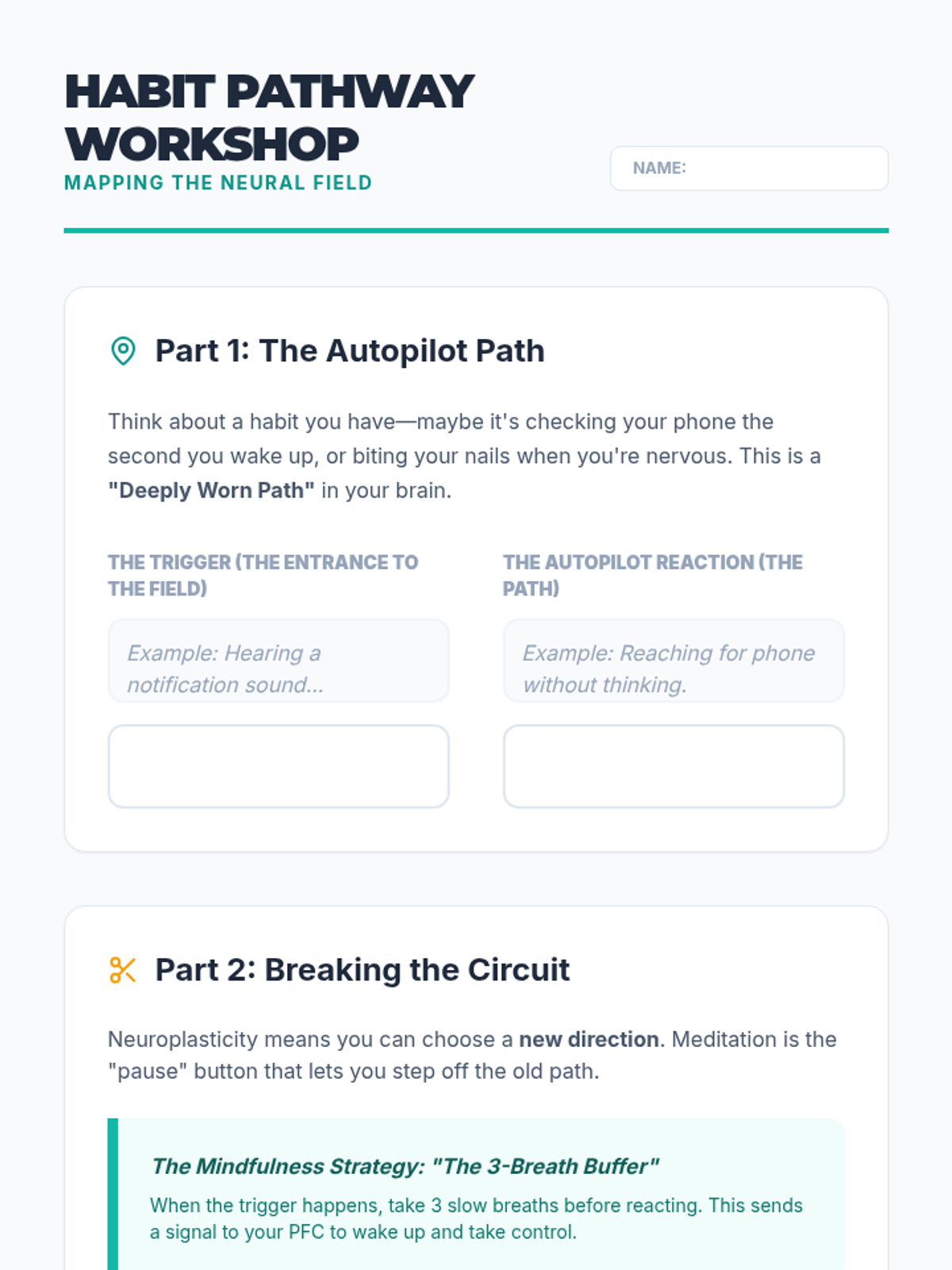
A student worksheet for Lesson 2 that uses the "grass field" analogy to help students identify their own neural habits and design new mindfulness-based pathways.
A visual presentation for Lesson 2 exploring neuroplasticity, the "fire together, wire together" principle, and how meditation physically reshapes the brain's pathways.
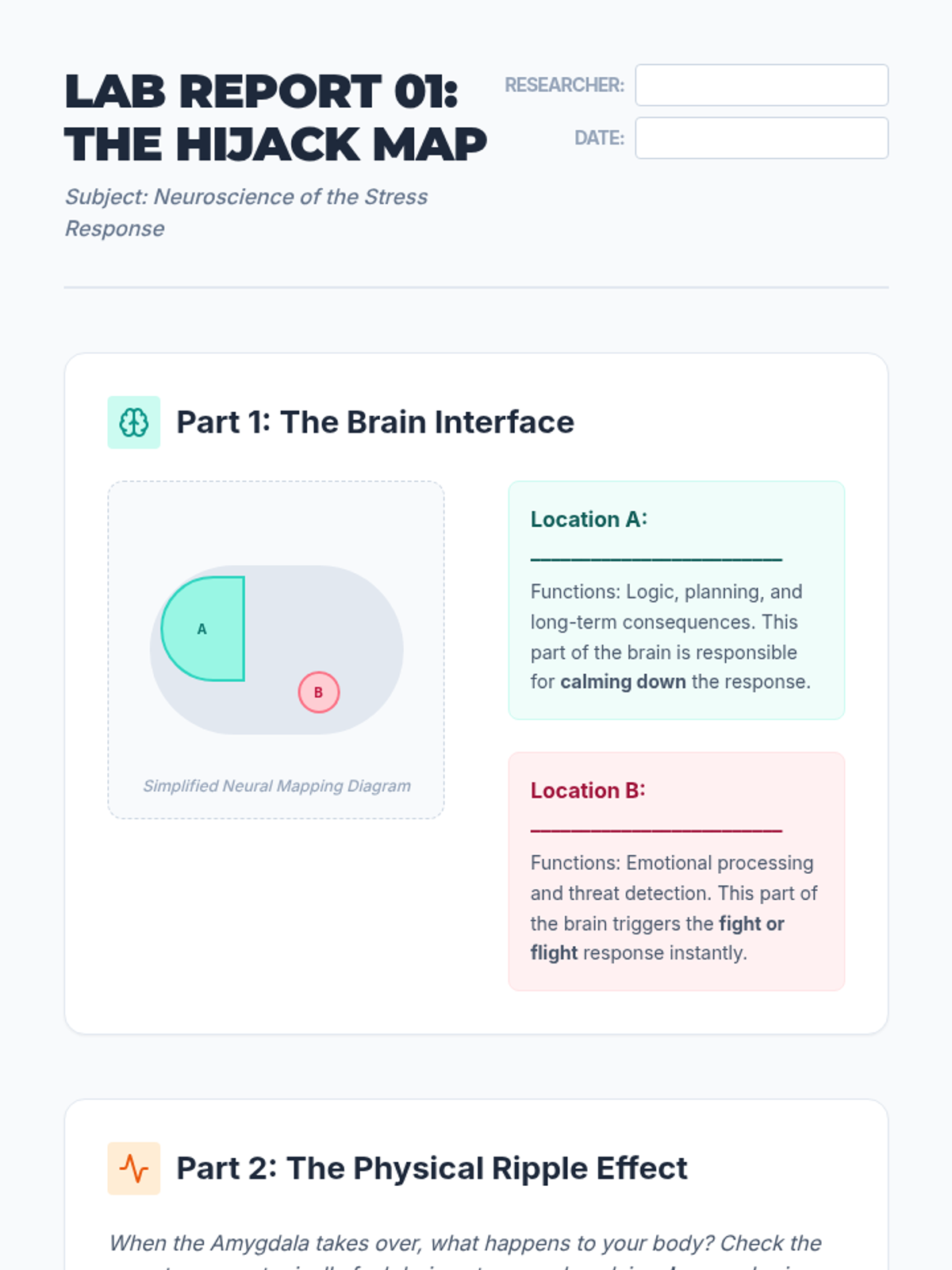
A student worksheet designed for Lesson 1 to help students map the brain's stress response, identify physiological symptoms, and audit their personal stress triggers.
A visual presentation exploring the neuroscience of stress, focusing on the roles of the amygdala and prefrontal cortex, and the physiological 'fight or flight' response.
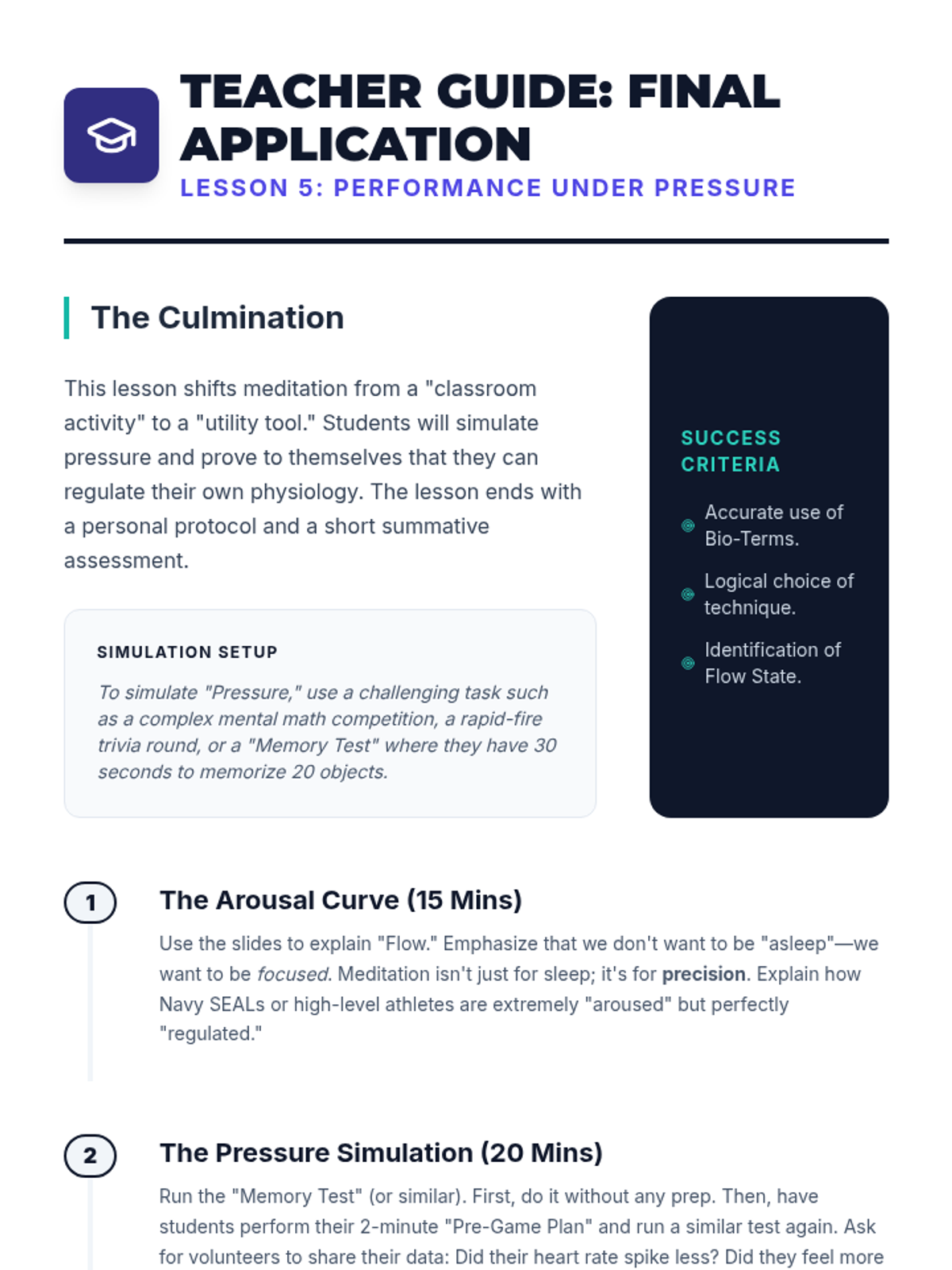
Teacher guide for the final lesson, including simulation ideas, arousal curve explanation, and an answer key for the final assessment.
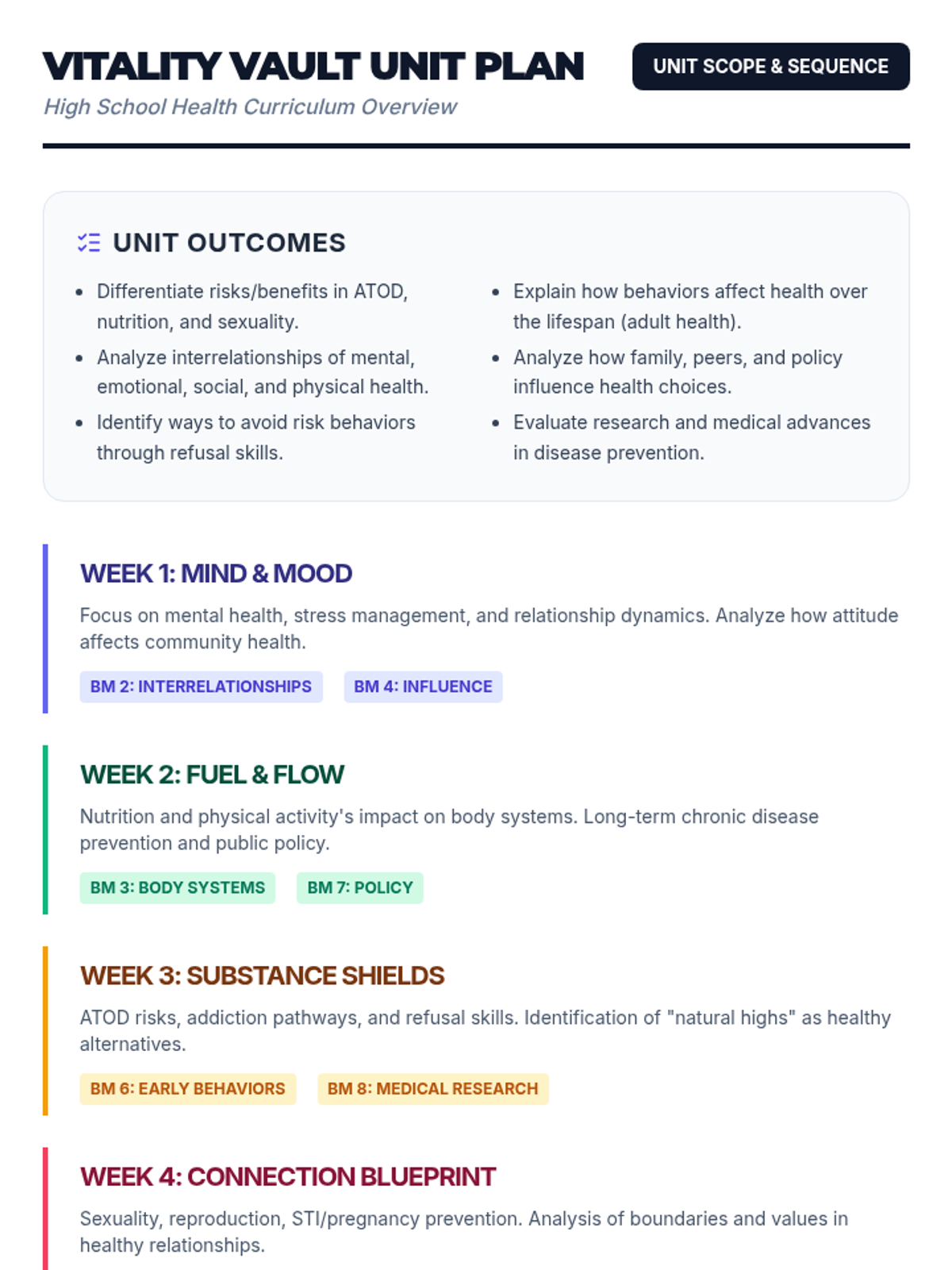
A high-level unit overview and sequence for teachers, outlining the 4-week progression, standards alignment, and a summative assessment strategy.
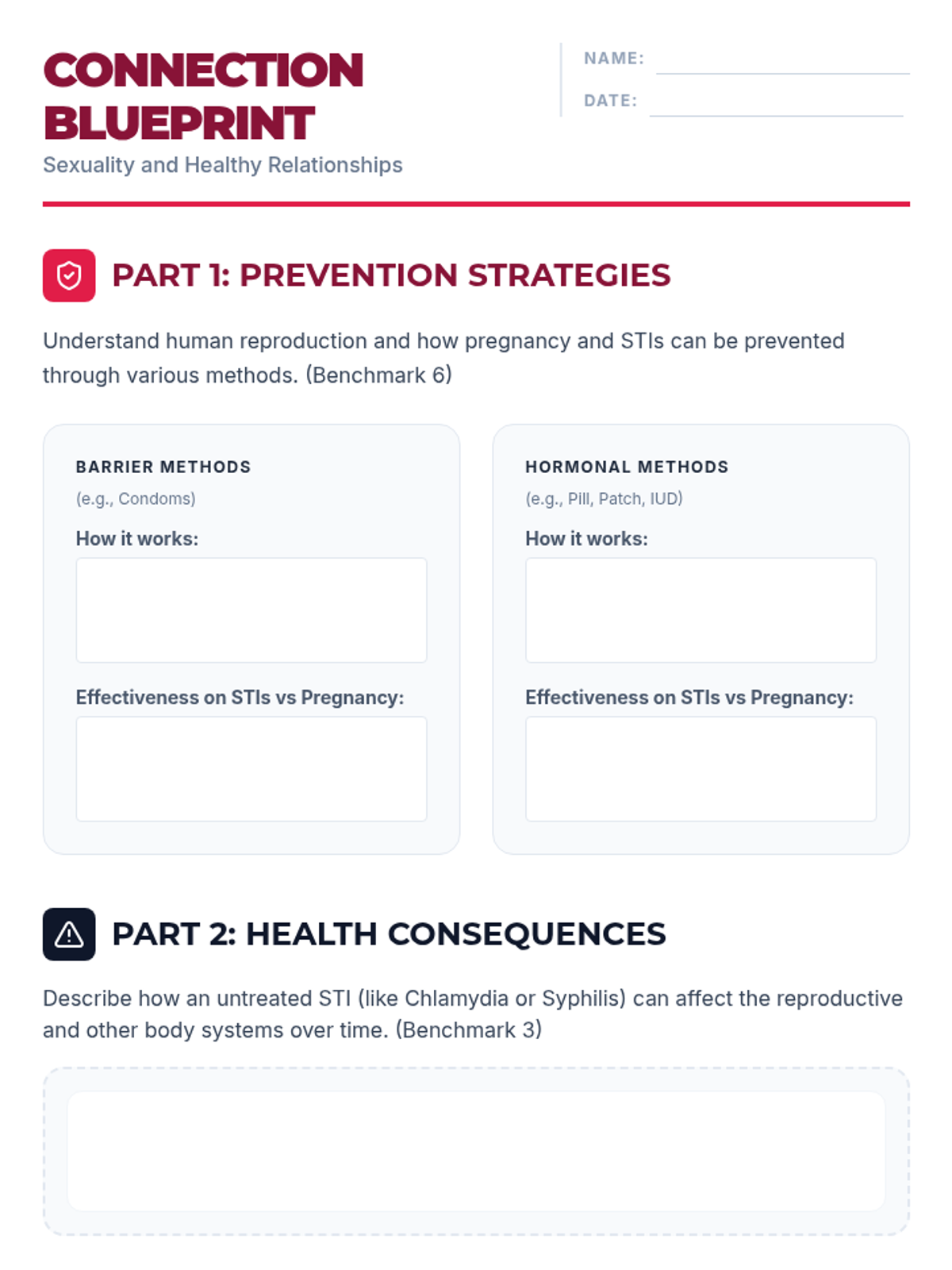
A student worksheet for Lesson 4 covering human reproduction, prevention methods (barrier and hormonal), and the long-term impact of STIs.
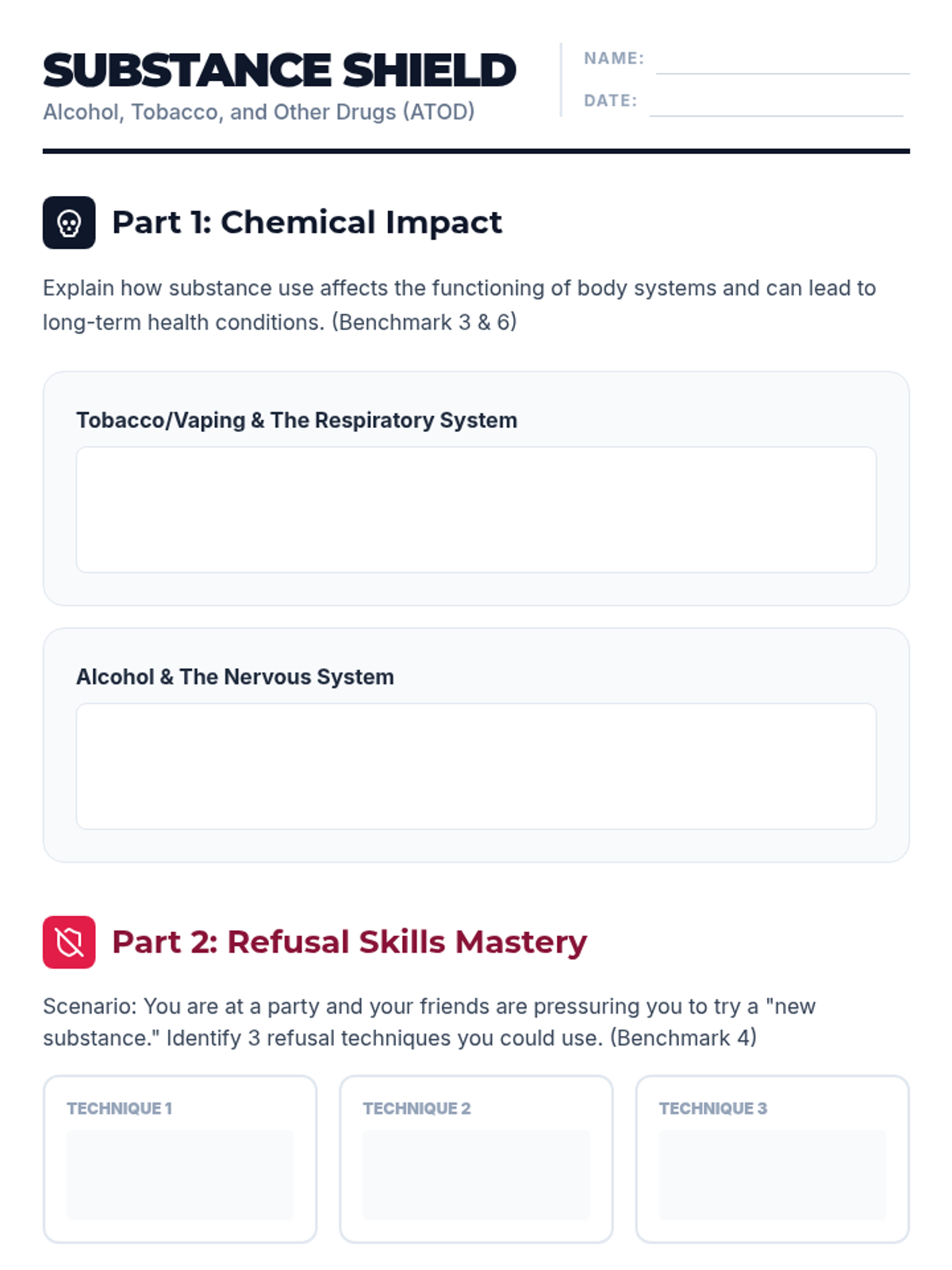
A student worksheet for Lesson 3 focusing on the impact of ATOD on body systems, refusal skills, and healthy alternatives (natural highs).
A visual slide deck for Lesson 2, covering the impact of health behaviors on body systems, public health policies, and medical research.
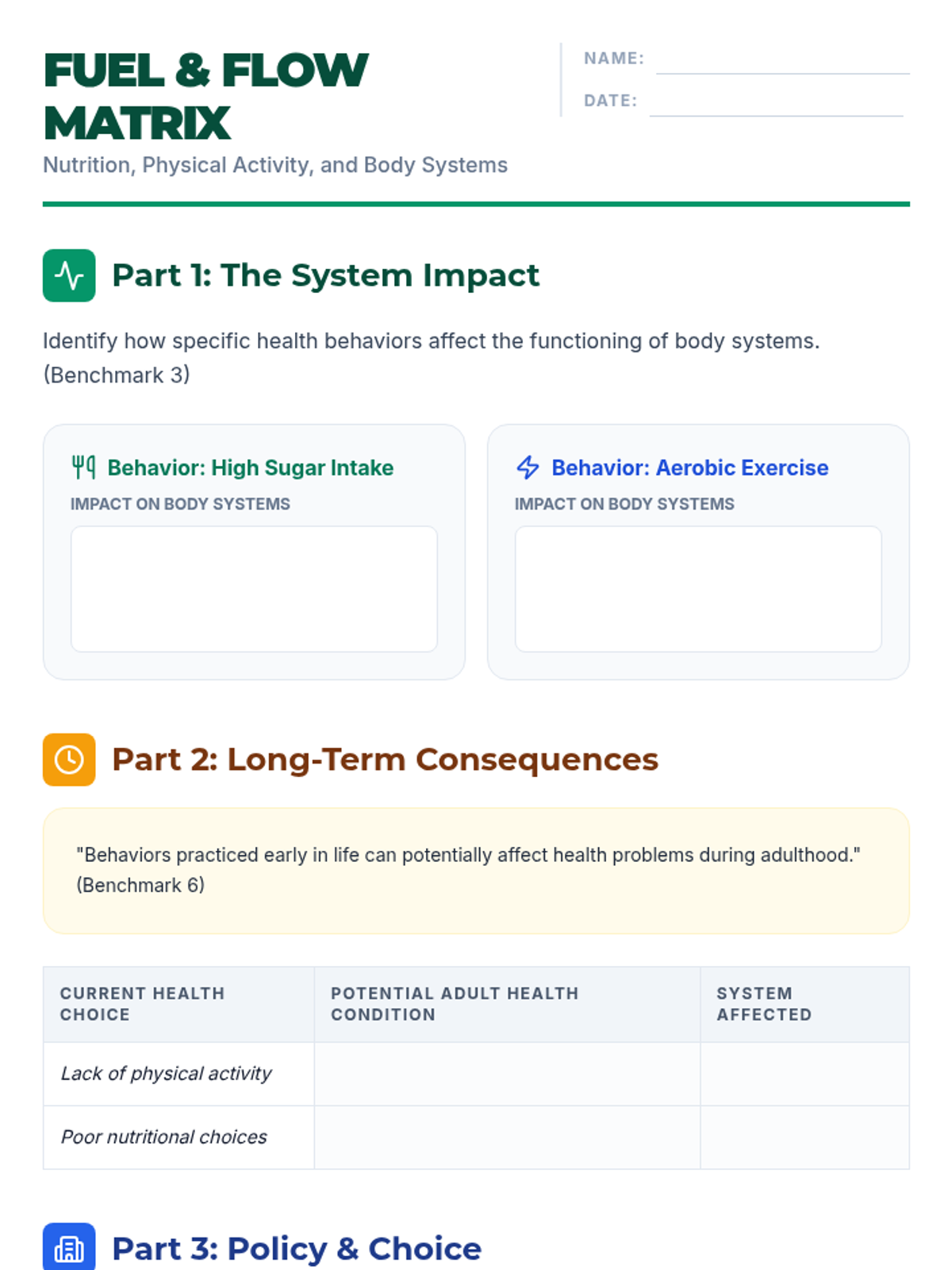
A student worksheet for Lesson 2 focusing on the impact of nutrition and physical activity on body systems, chronic disease prevention, and public health policy.
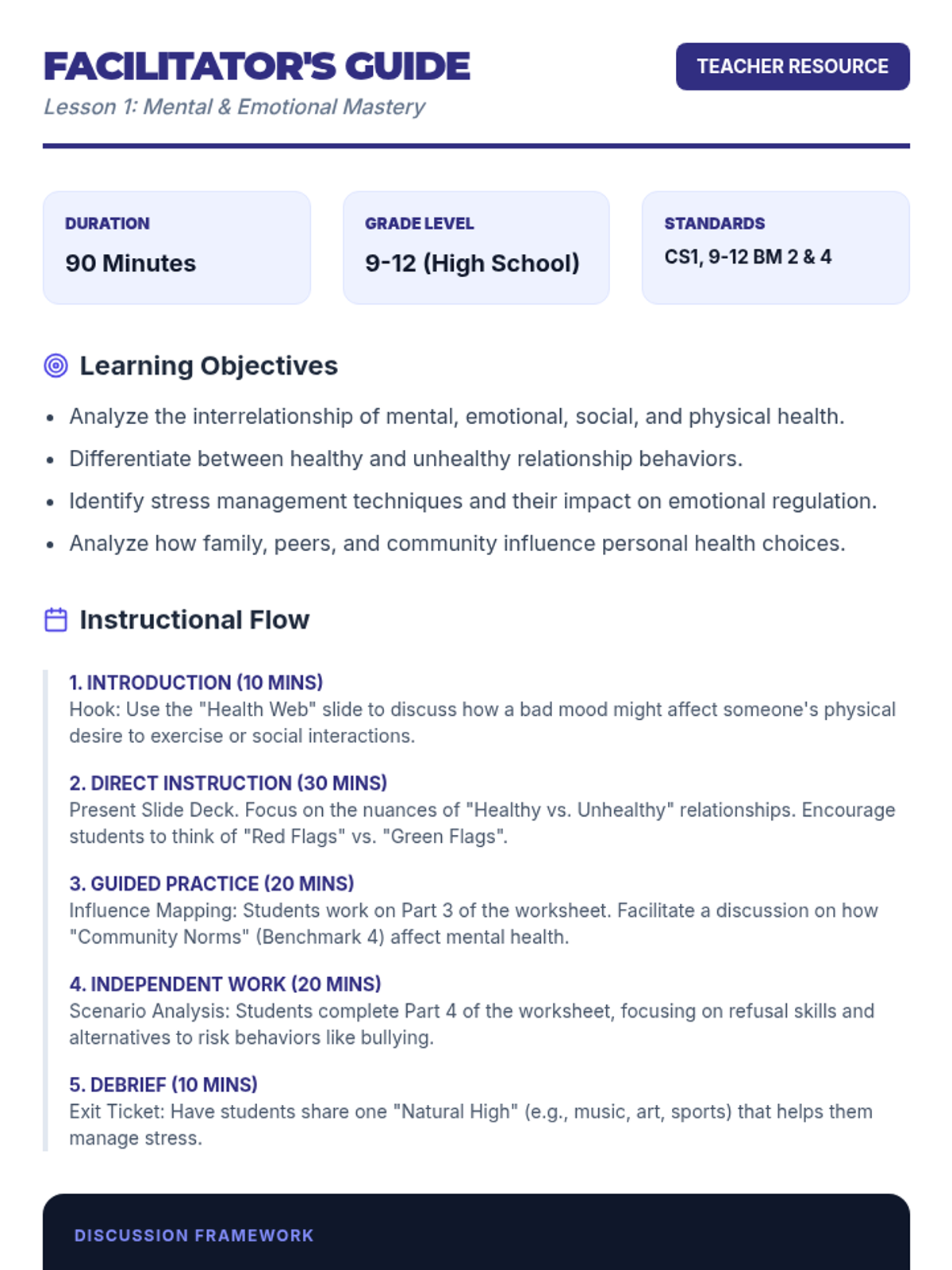
A 2-page facilitator's guide for Lesson 1, including instructional flow, learning objectives, and a detailed answer key.
A 5-slide visual presentation for instruction on mental, social, and emotional health, covering stress management, relationship dynamics, and social influence.
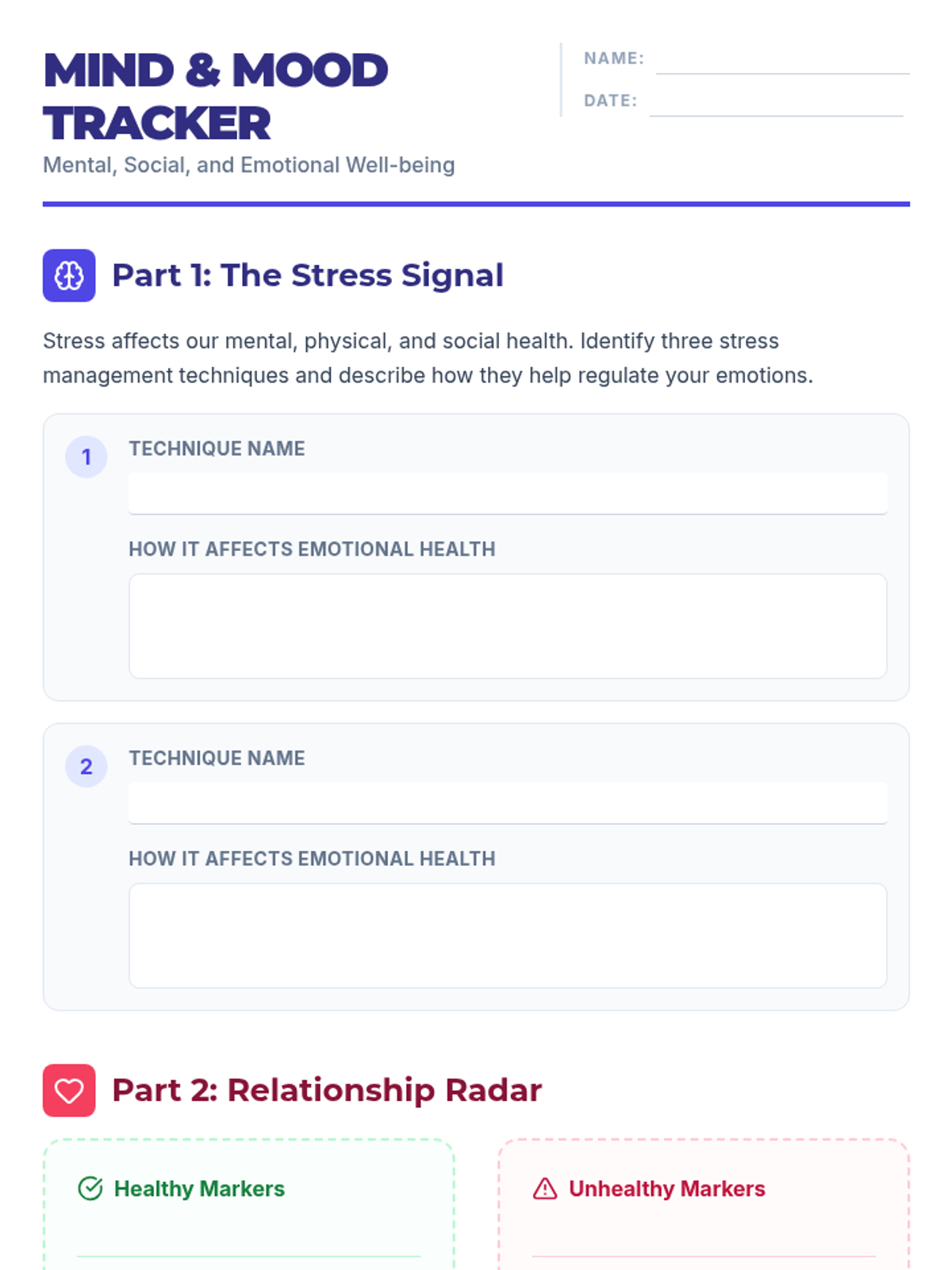
A 2-page student worksheet focused on mental and emotional health, including stress management, relationship analysis, and social influence mapping.
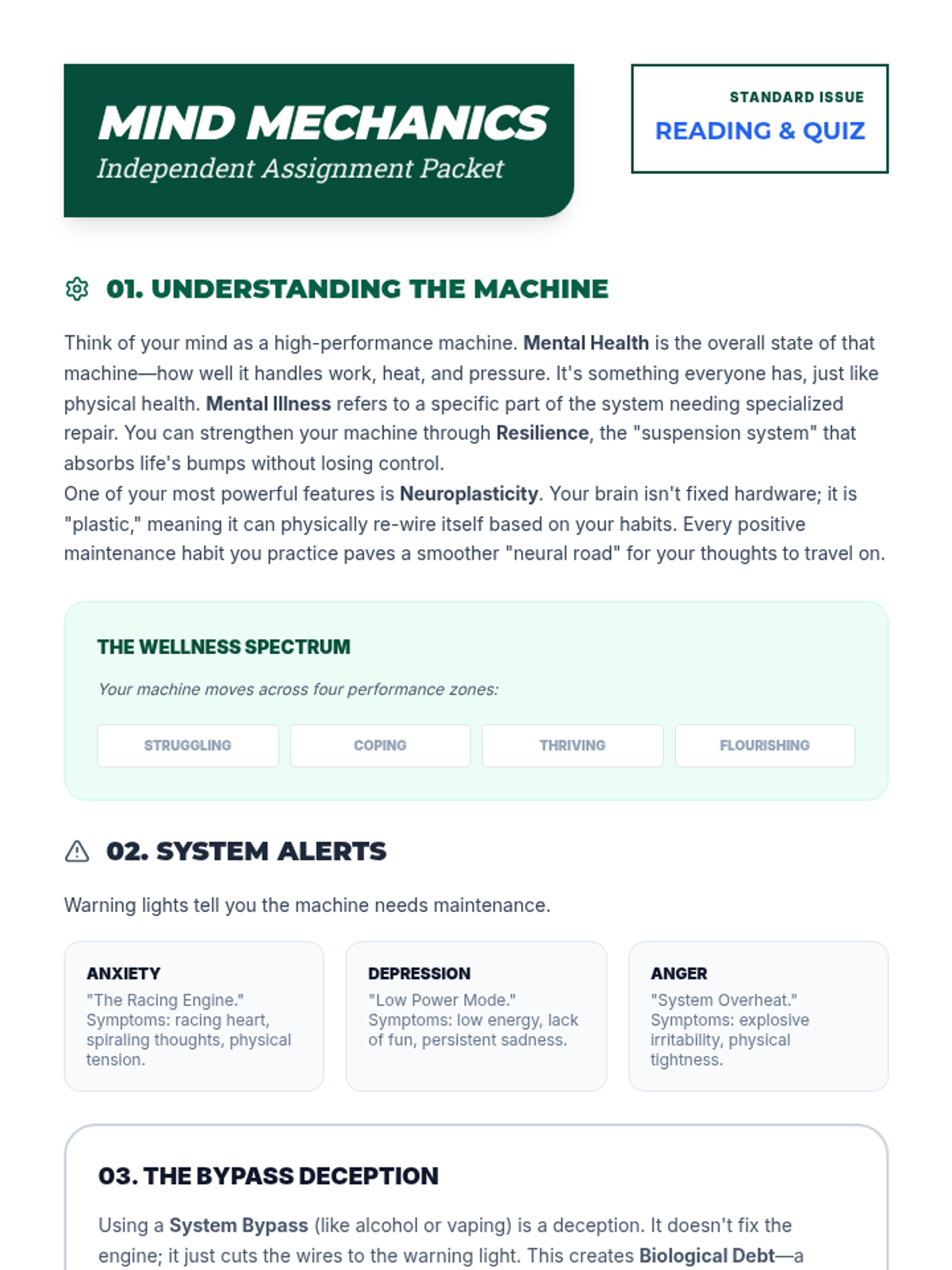
A single consolidated 4-page assignment for the Mind Mechanics unit. Page 1 & 2 provide comprehensive reading on the machine analogy, neuroplasticity, stigma, and internal alerts. Page 3 features the detailed visual Coping Toolbox. Page 4 features a 10-question quiz (9 MC/TF and 1 high-quality short answer). Terminology updated to 'Good Coping' and 'Bad Coping' throughout. No red backgrounds. All answer options share identical styling. Updated to be printer-friendly with white and very light gray backgrounds. Q8 corrected to have two options. Q10 provided with a large white handwriting area.
A straightforward, all-in-one independent assignment packet for the Mind Mechanics unit. Page 1 contains a concise reading text covering the machine analogy and neuroplasticity, Page 2 provides a visual tool reference, and Page 3 features a 10-question multiple-choice/true-false assessment. All red backgrounds removed for clear printing. Part of the comprehensive Mind Mechanics unit.
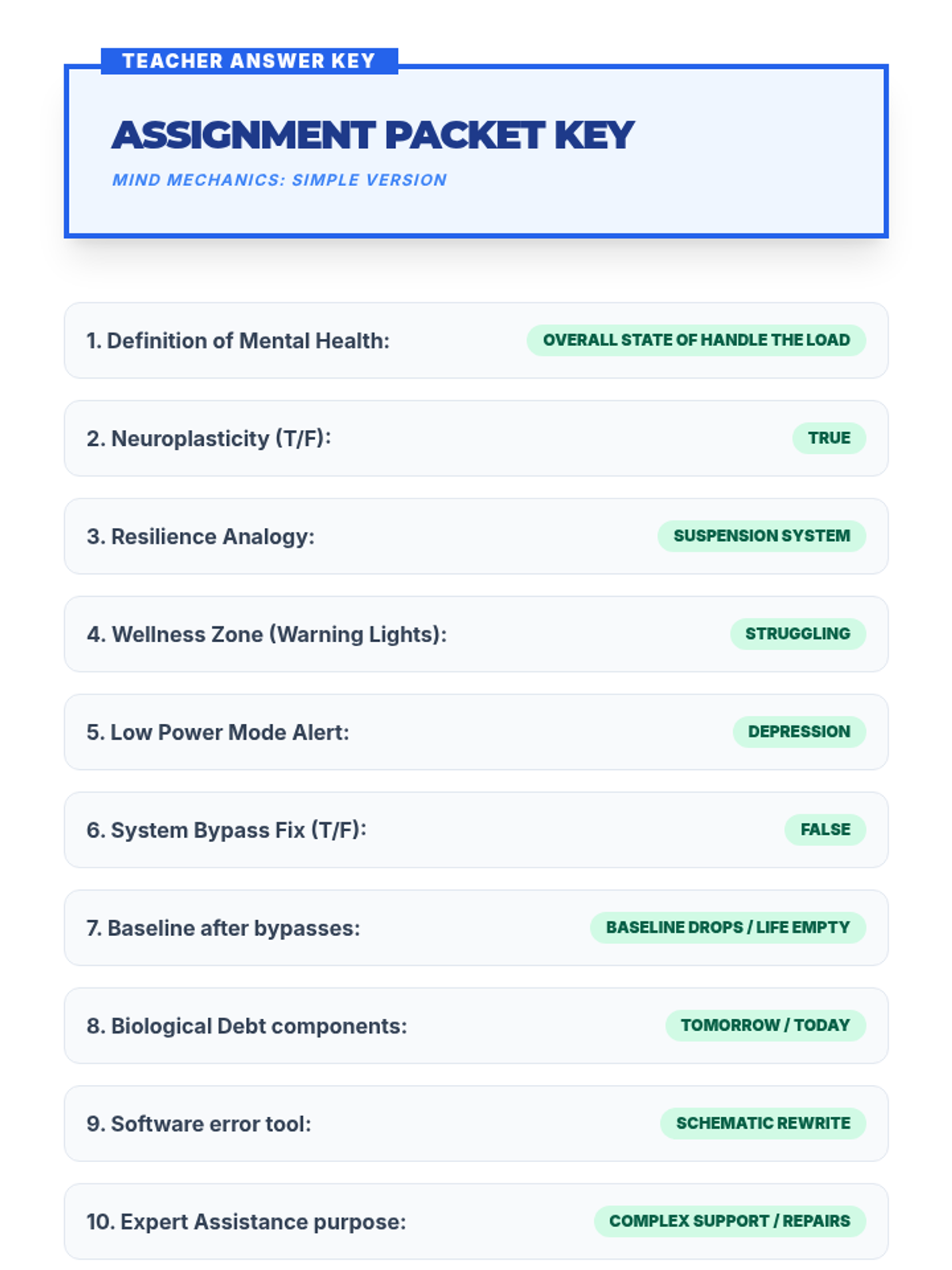
Complete answer key for the simple 10-question Mind Mechanics assignment packet. Provides clear, easy-to-grade answers for the multiple-choice and true/false questions. Updated to match the revised assignment quiz questions.
The master slideshow for the comprehensive Mind Mechanics unit. Covers the Machine Analogy, Wellness Spectrum, Neuroplasticity, detailed System Alerts (Anxiety, Depression, Anger), the Bypass Deception (substances/Biological Debt), and all 4 Proactive Tools aligned with the Coping Toolbox. Updated with "Good Coping" and "Bad Coping" terminology.
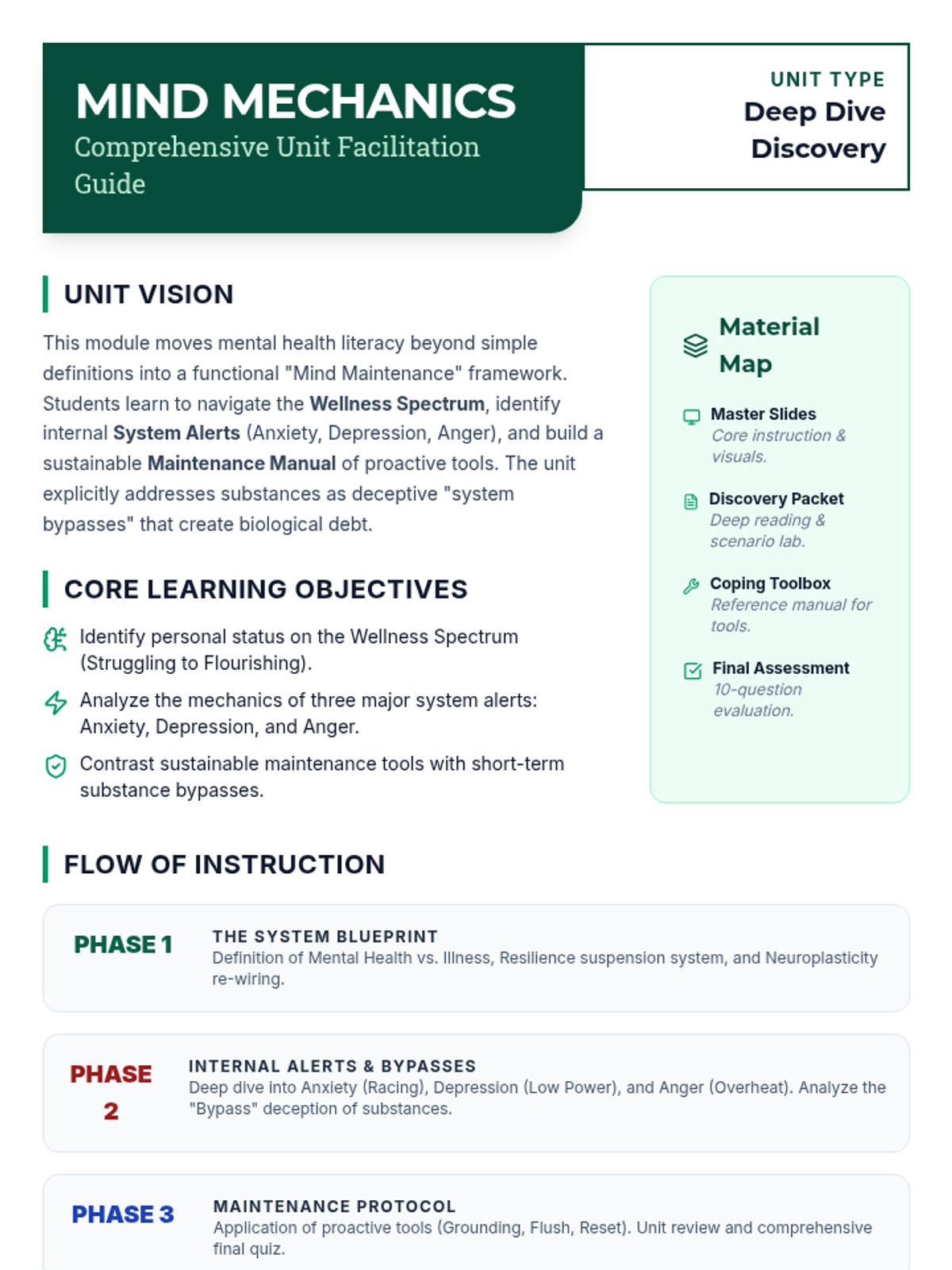
A master facilitation guide for the comprehensive Mind Mechanics unit, updated with "Good Coping" and "Bad Coping" terminology. Covers the Wellness Spectrum, internal alerts, and biological debt.
An answer key for the Stress Free Slumber Quiz, including rationales for each answer and teaching tips.
A 10-question multiple-choice quiz focusing on stress management techniques for better sleep hygiene, designed for student use.
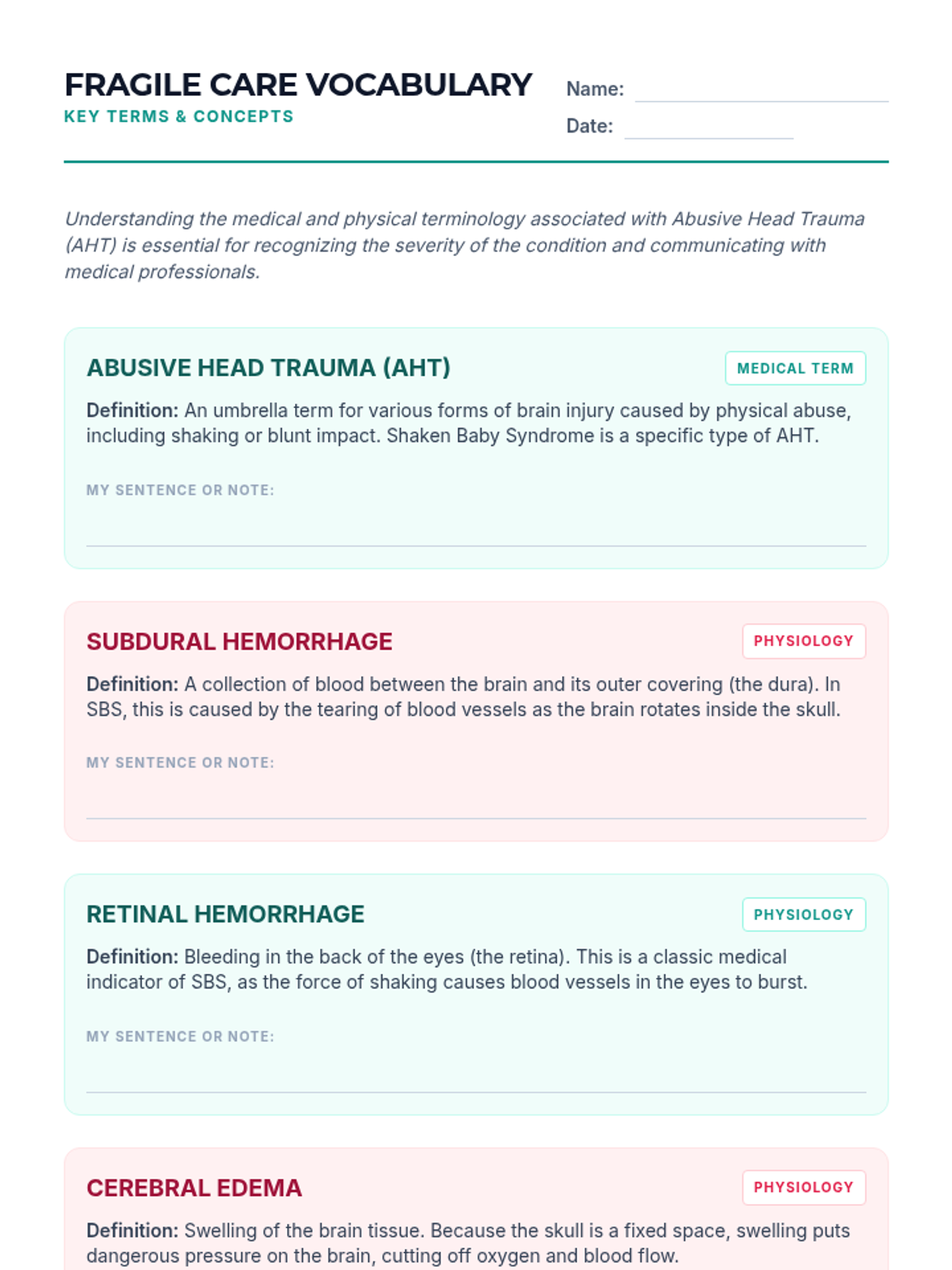
A vocabulary list for students covering key medical and anatomical terms related to Shaken Baby Syndrome, with definitions and space for personal notes. Styled with the Teal and Rose theme.
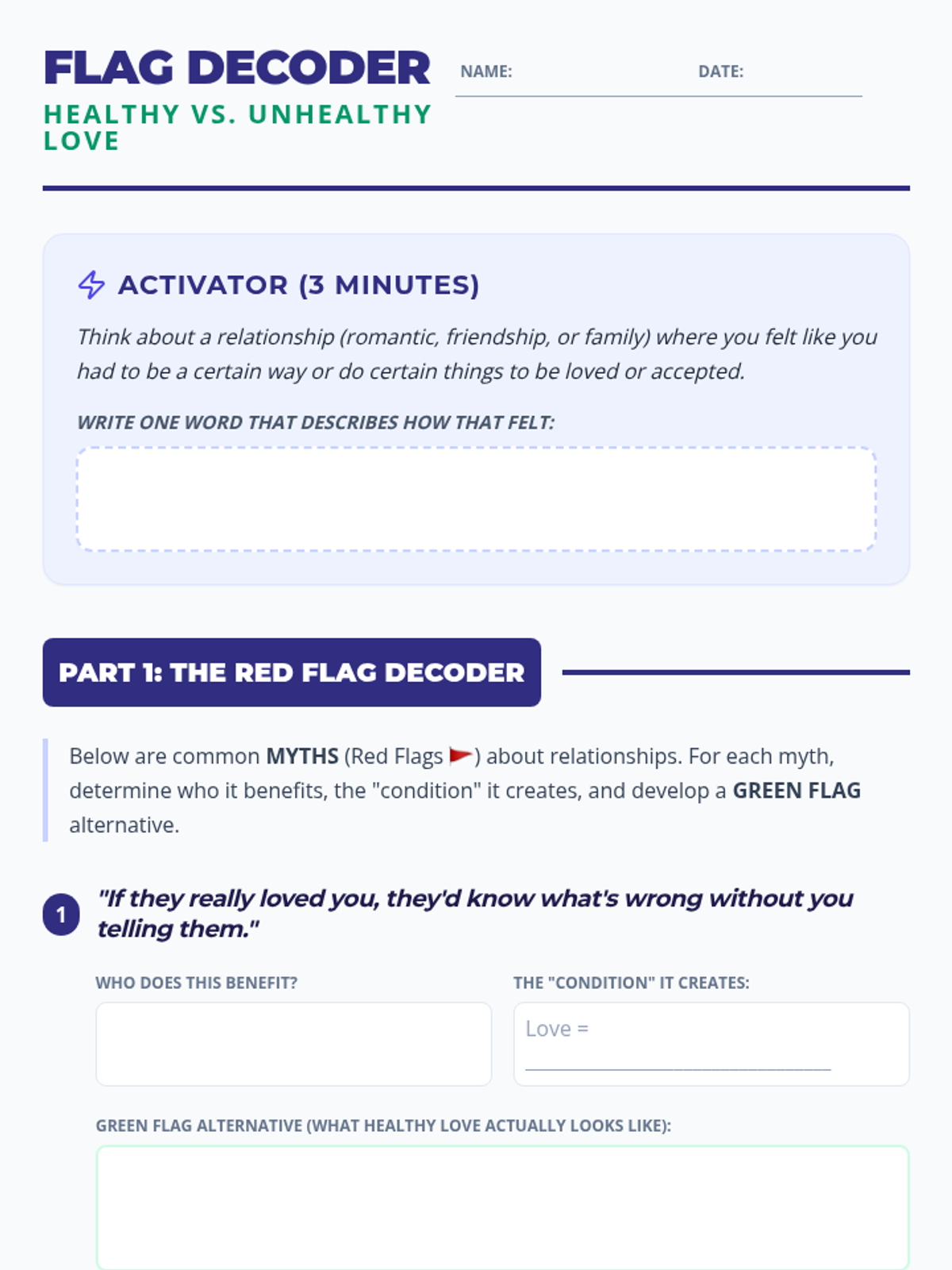
A student-facing worksheet for identifying relationship myths (Red Flags) and reframing them into healthy expectations (Green Flags), featuring increased writing space and legible student work areas.
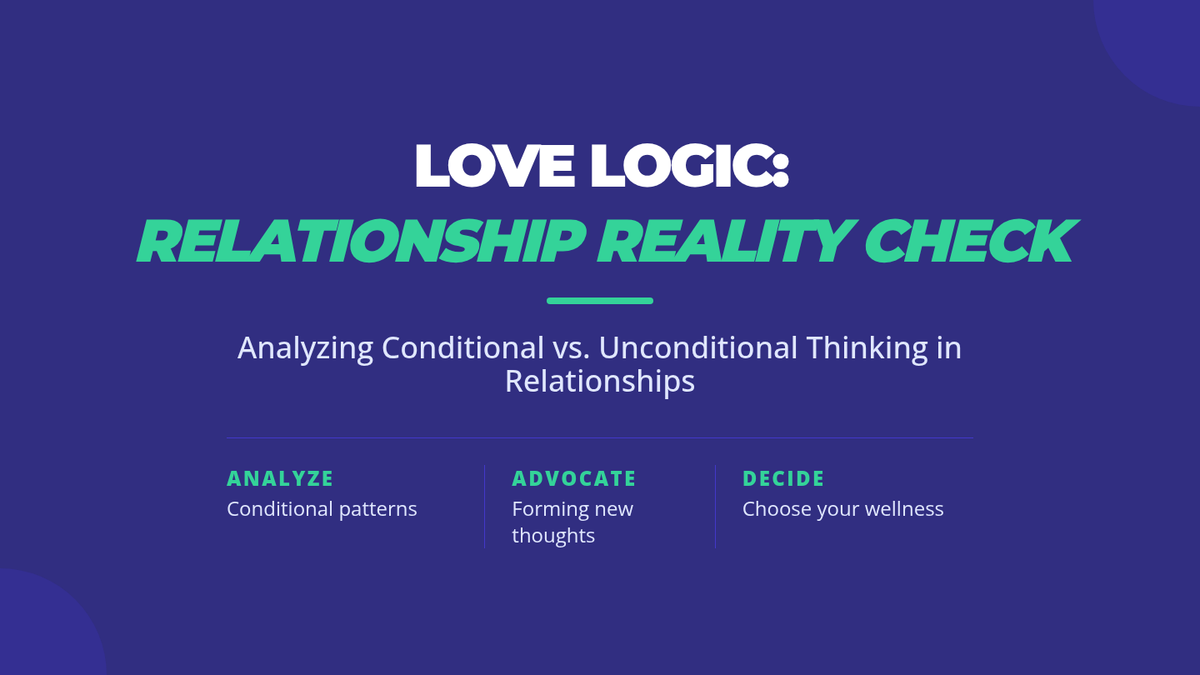
An 8-slide presentation for high school health class on conditional vs. unconditional love, featuring modern design and clear instructional steps for reframing unhealthy thoughts.
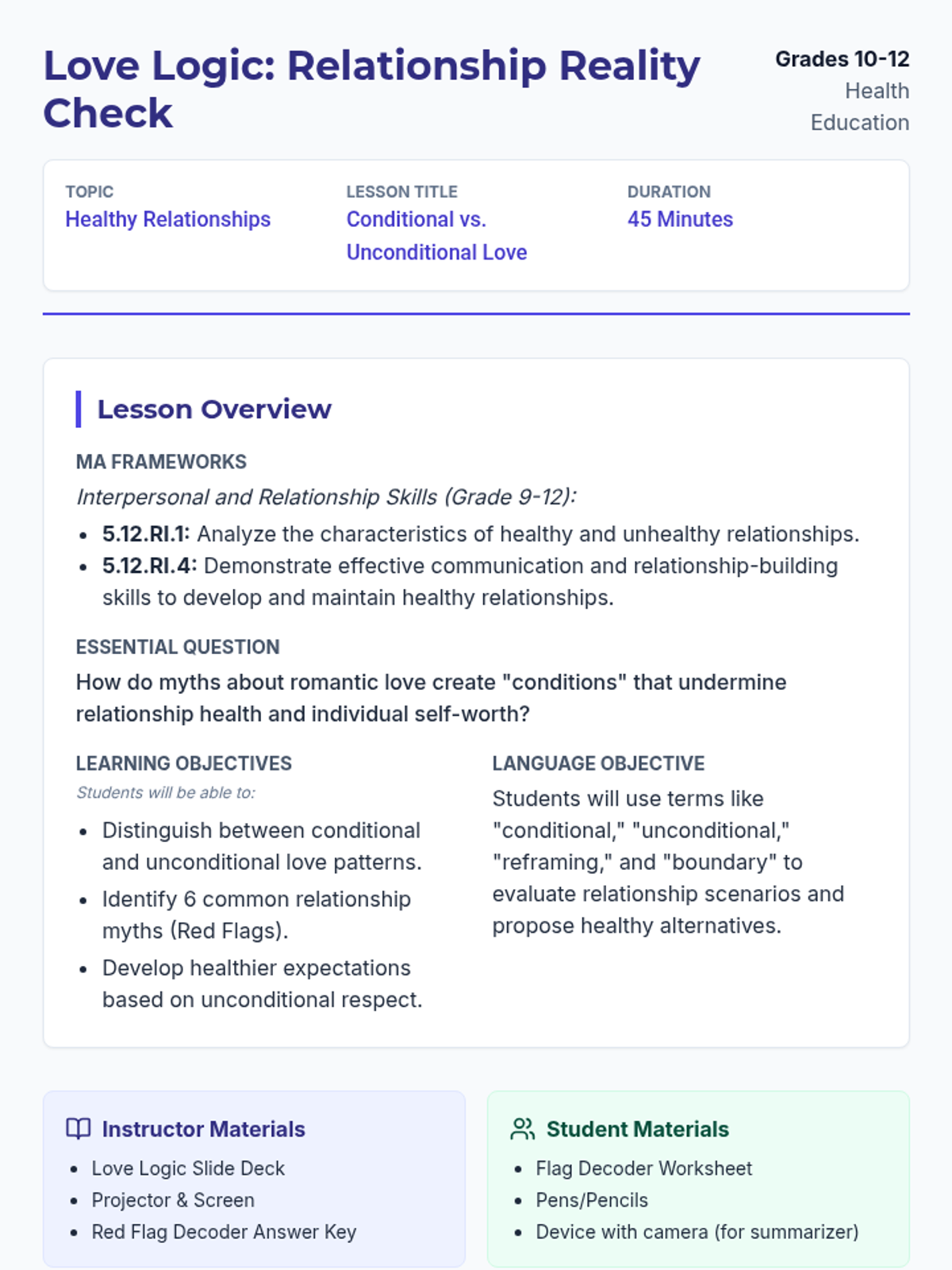
A comprehensive lesson plan for high school health education, outlining a 45-minute lesson on conditional vs. unconditional love based on Massachusetts standards.
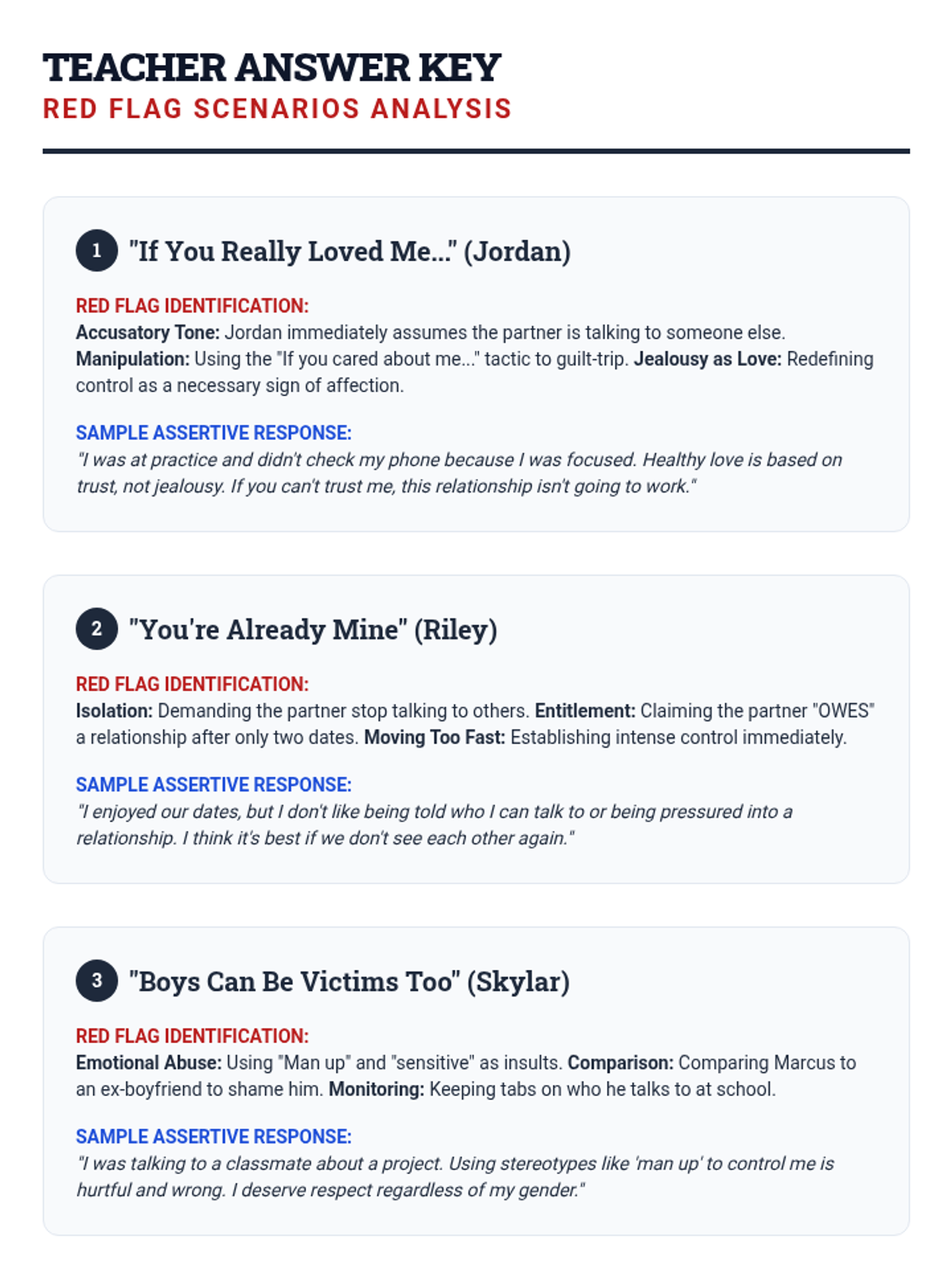
A teacher resource providing model answers for the Red Flag Scenarios worksheet, including red flag identification and sample assertive responses.
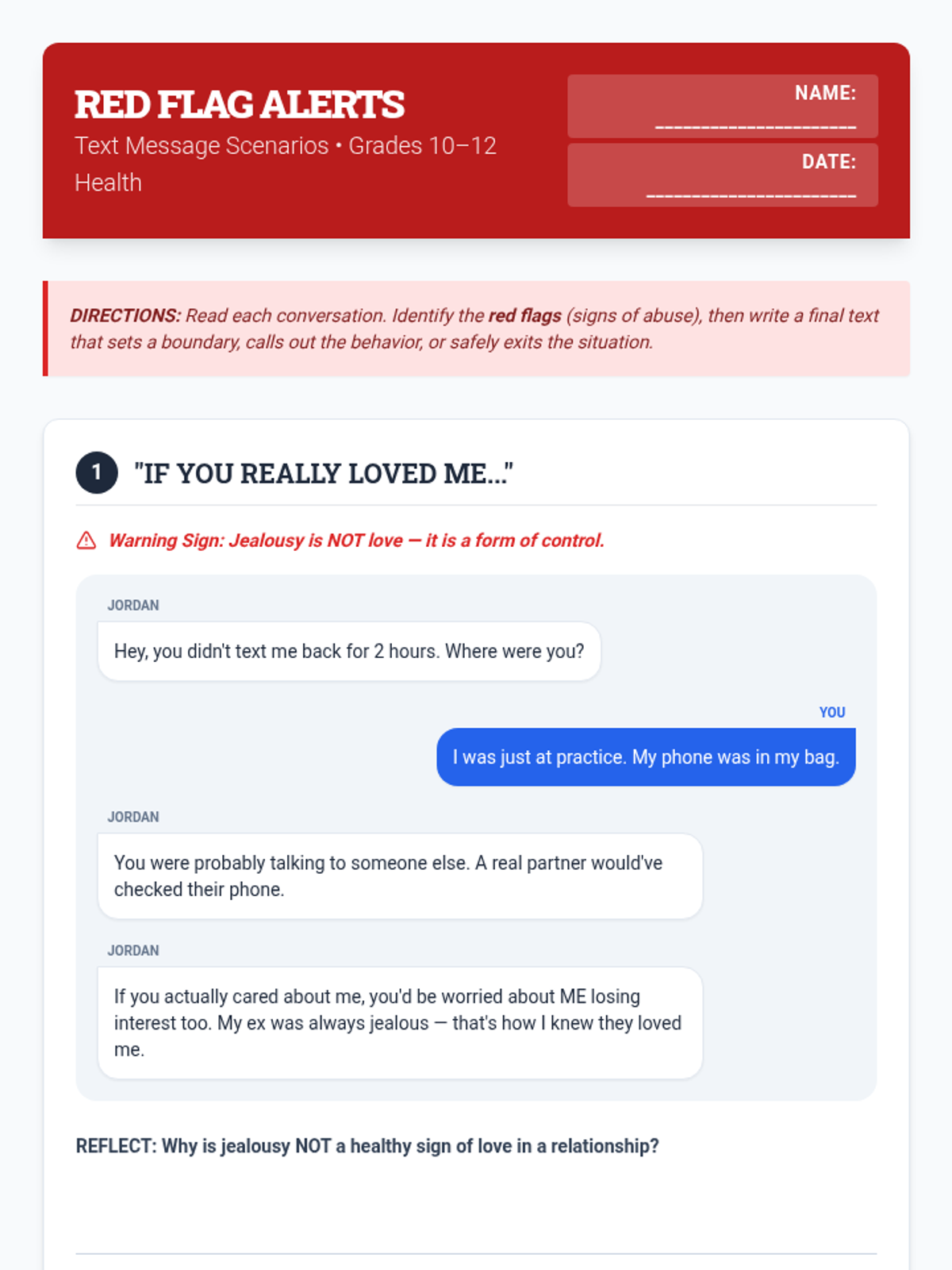
An activity worksheet featuring four text message scenarios where students must identify red flags of dating abuse and draft assertive responses to set boundaries.
A visual presentation for teaching the basics of teen dating abuse, including definitions, types of violence, and statistics, specifically designed for high school students.
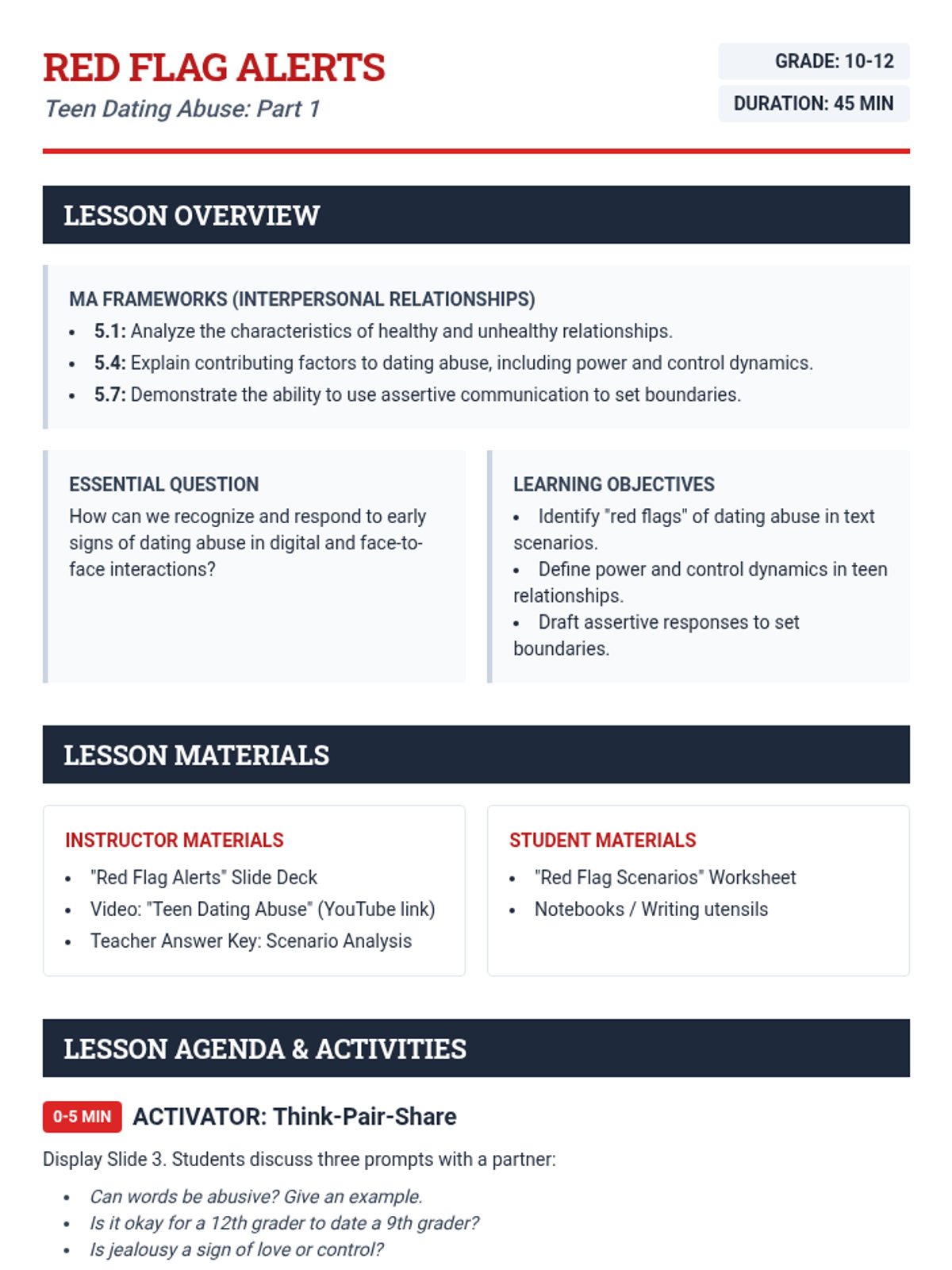
A detailed 45-minute lesson plan for high school health education, aligned with Massachusetts state standards, focusing on teen dating violence, power dynamics, and assertive communication.
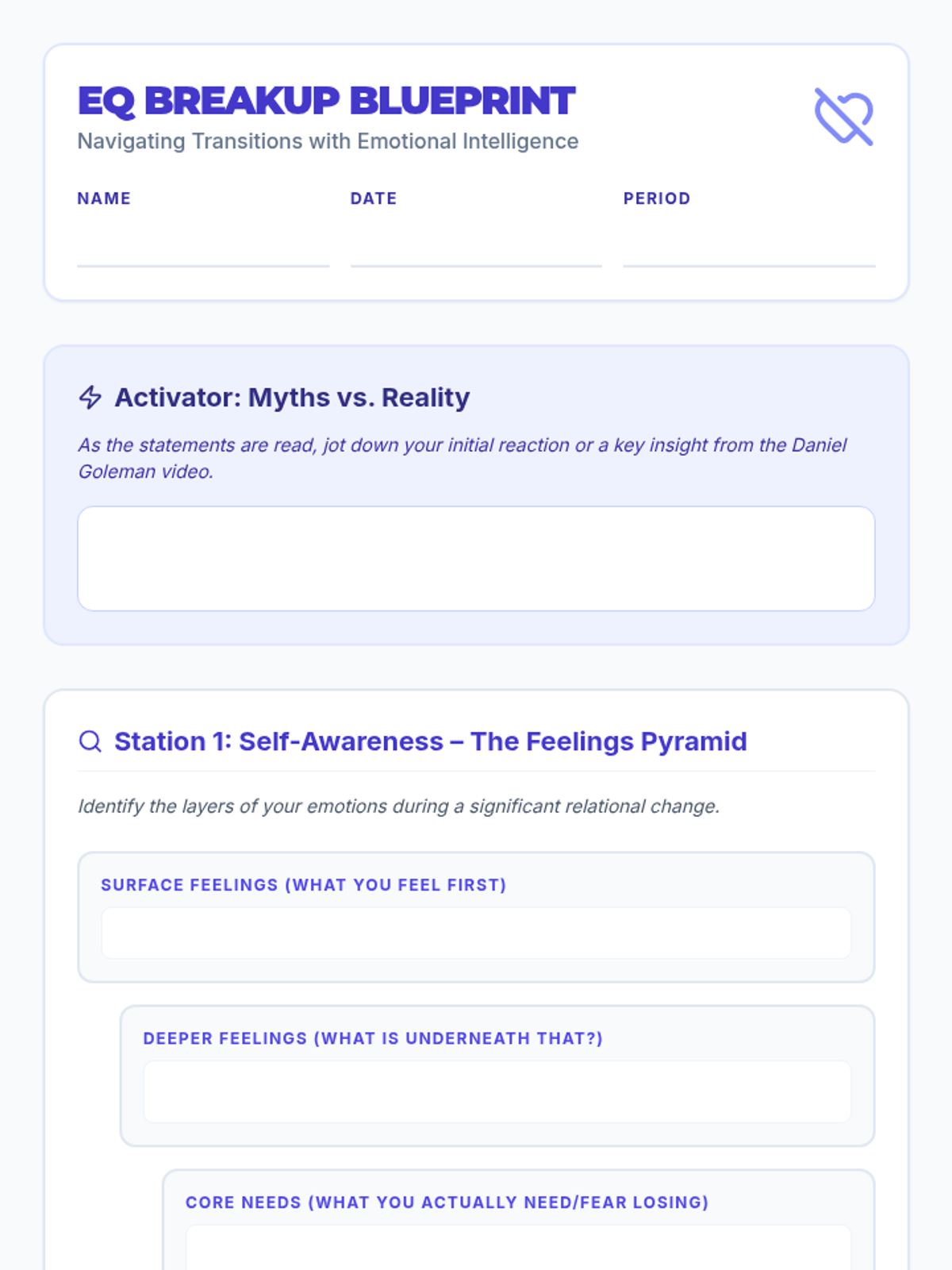
A comprehensive 3-page student worksheet for grades 10-12 focused on emotional intelligence and healthy breakups. It features 6 interactive "stations" covering self-awareness, regulation, motivation, empathy, and boundary-setting, followed by a reflective summarizer and exit ticket.
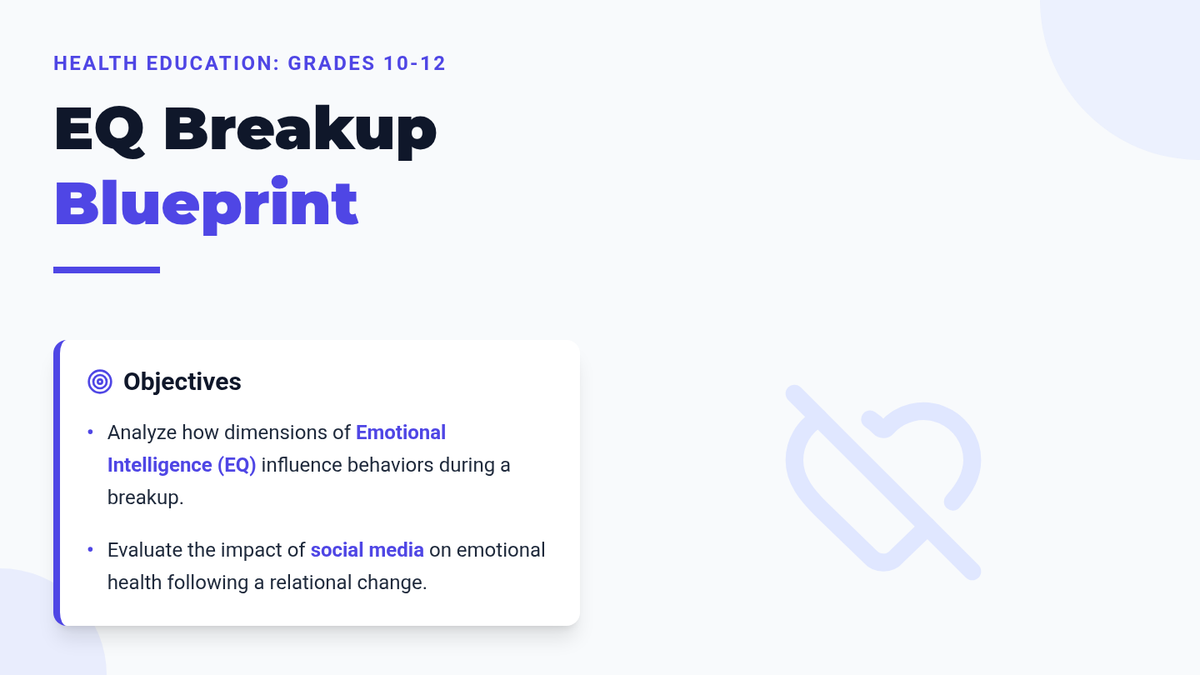
A 6-slide presentation for grades 10-12 focused on healthy breakups and emotional intelligence. Includes embedded video, key communication strategies, relationship challenge resolution steps, and self-care recommendations aligned with Massachusetts health standards.
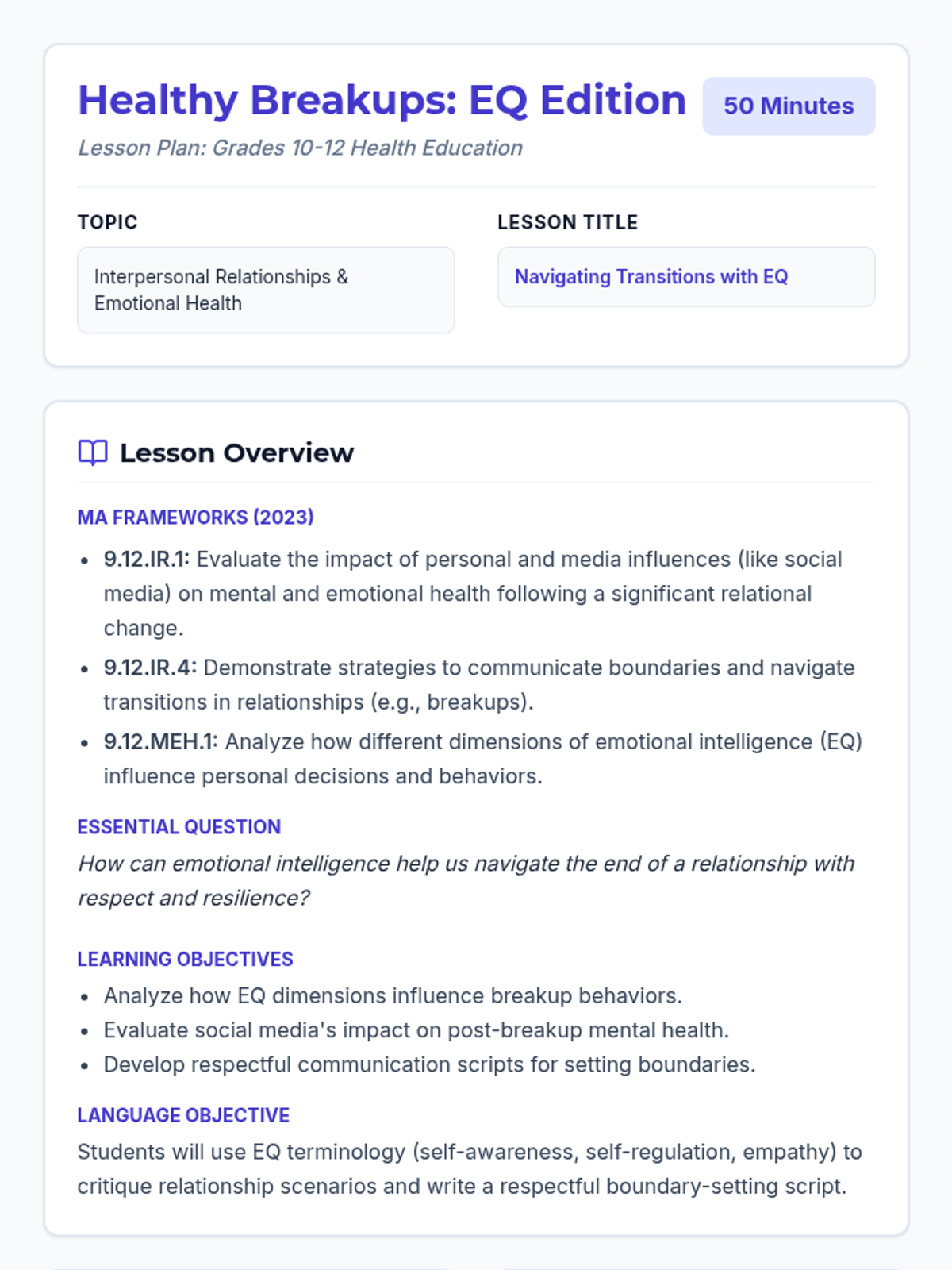
A detailed lesson plan for grades 10-12 health education focused on healthy breakups and emotional intelligence, aligned with the 2023 Massachusetts health standards. It includes structured sections for instructor and student materials, a 50-minute agenda with specific timings, and clear learning objectives.
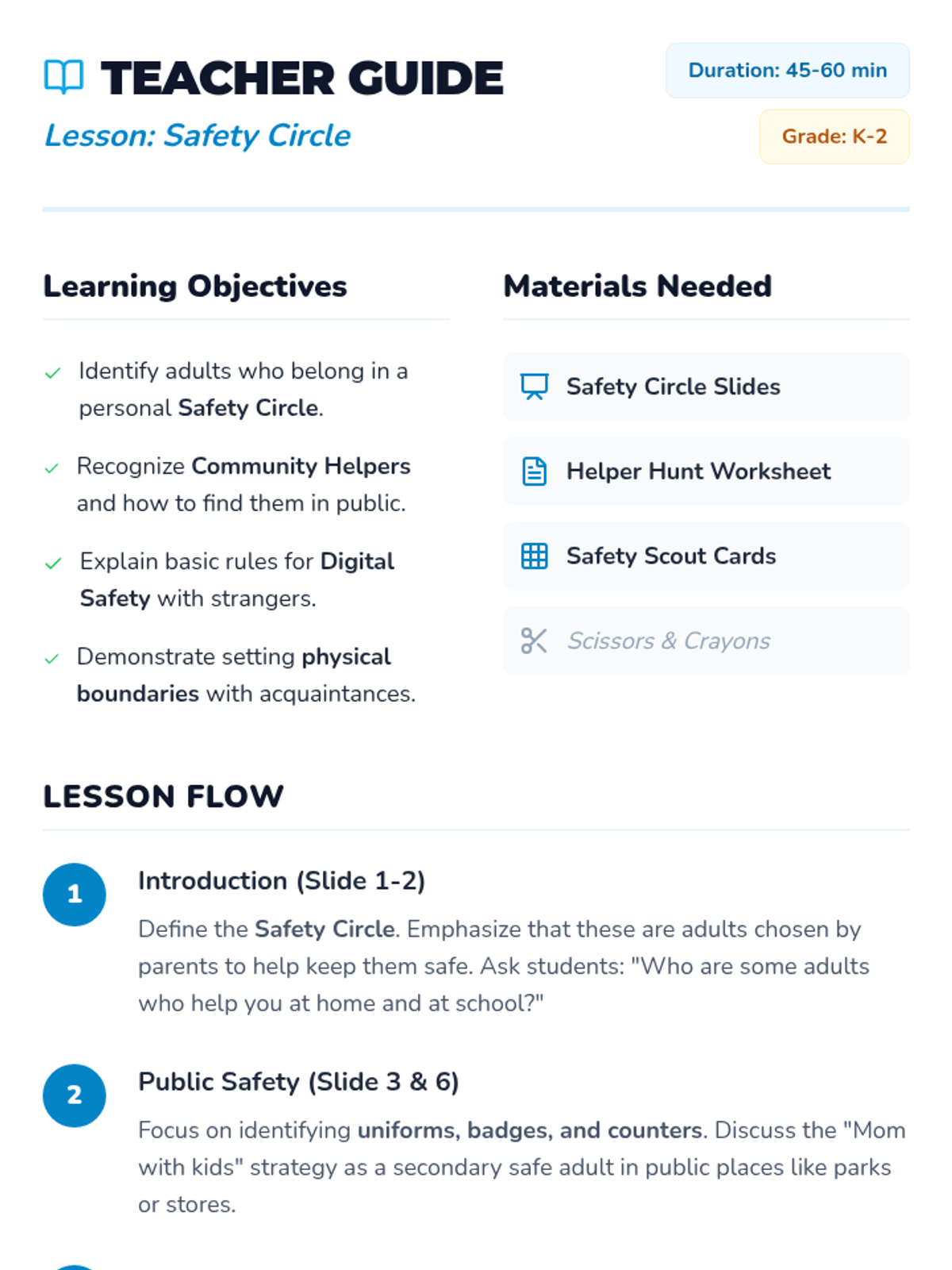
A teacher facilitation guide for the Safety Circle lesson, including objectives, lesson flow, discussion prompts, and differentiation strategies.
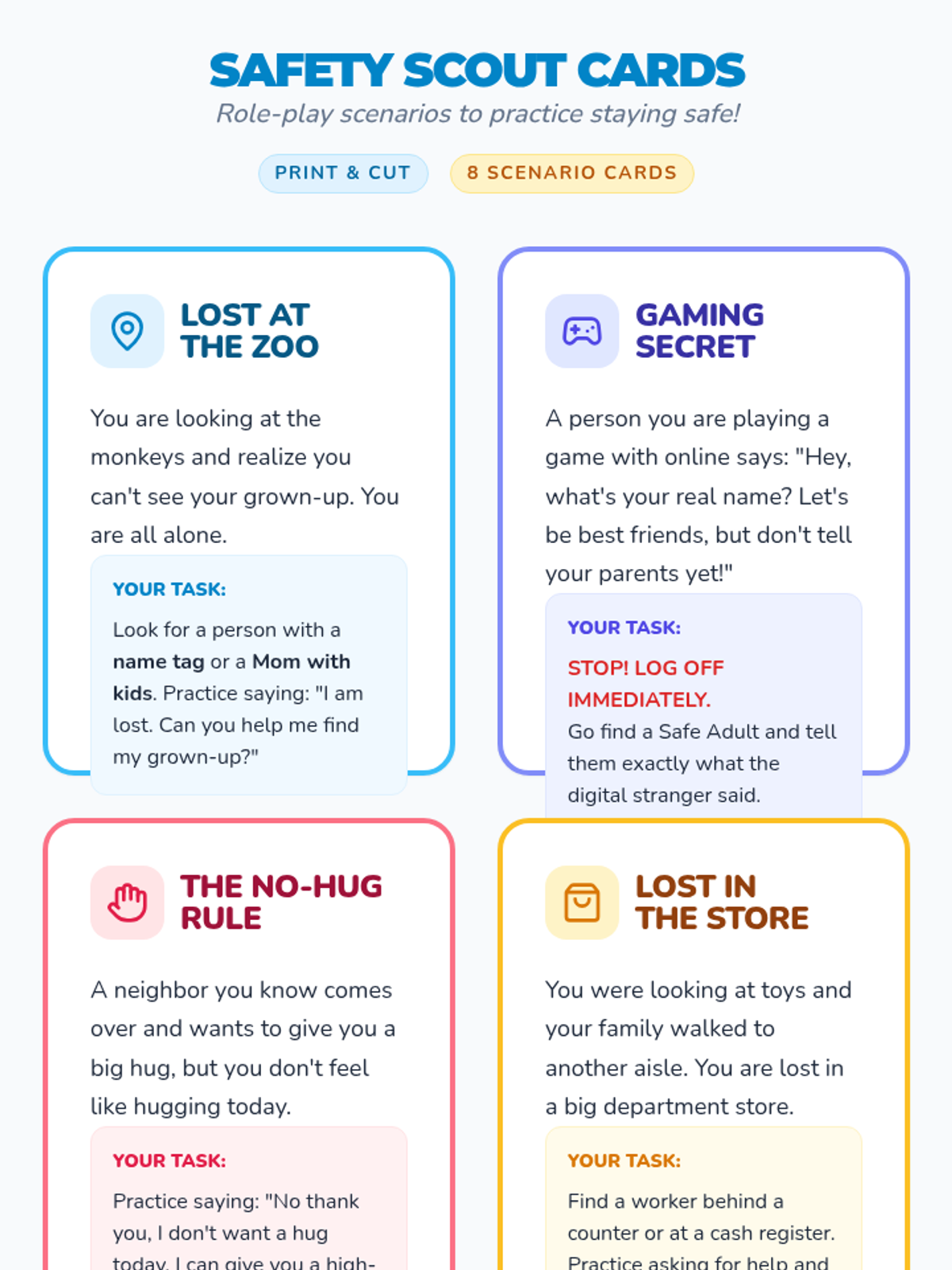
A set of 8 printable role-play cards featuring scenarios about public safety, digital interactions, and boundaries with acquaintances.
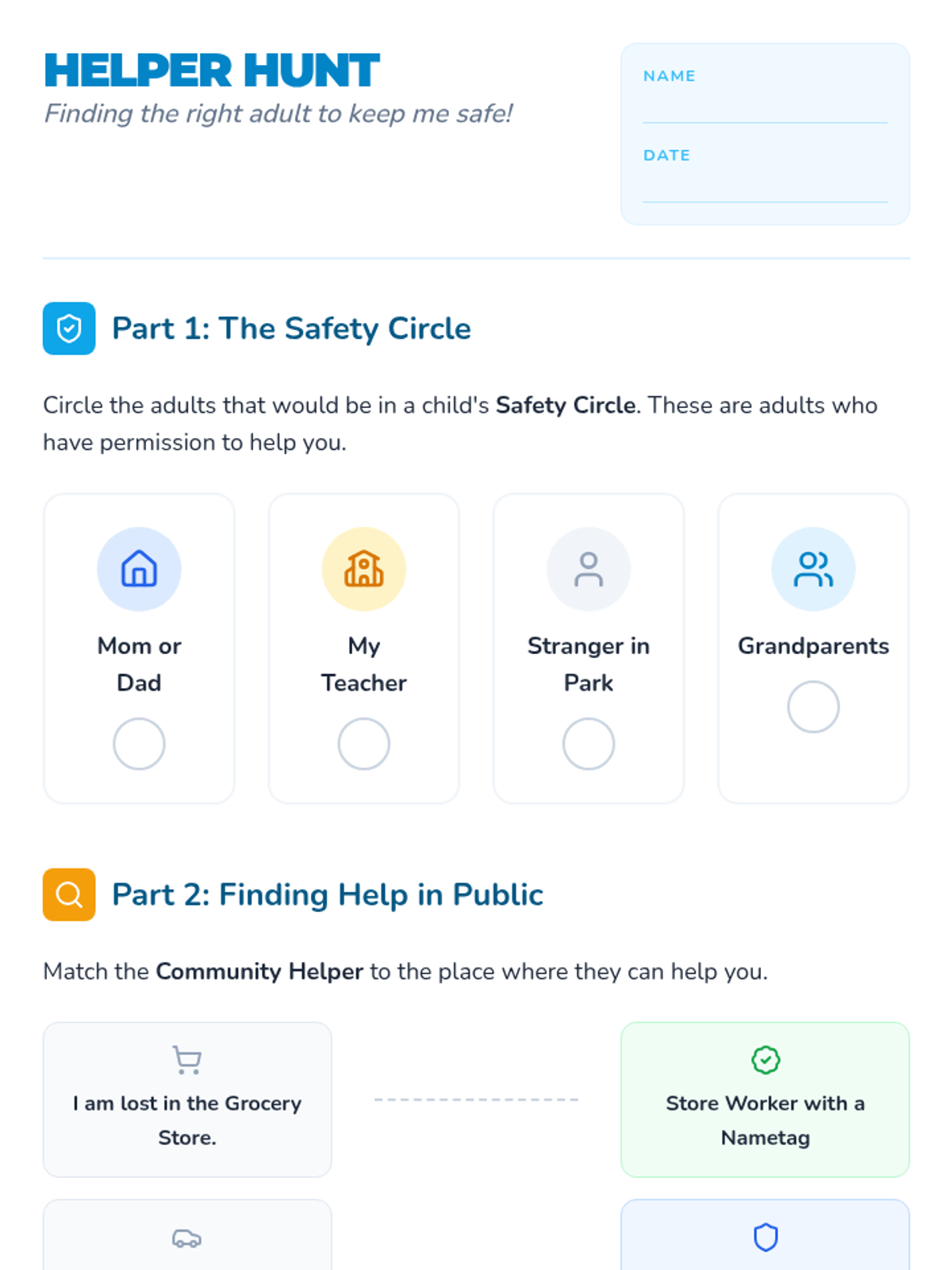
A picture-based worksheet where students identify members of their safety circle, match community helpers to locations, and reflect on digital safety and boundaries.
A slide deck presenting a social story about safety boundaries, community helpers, digital safety, and how to ask for help in public.
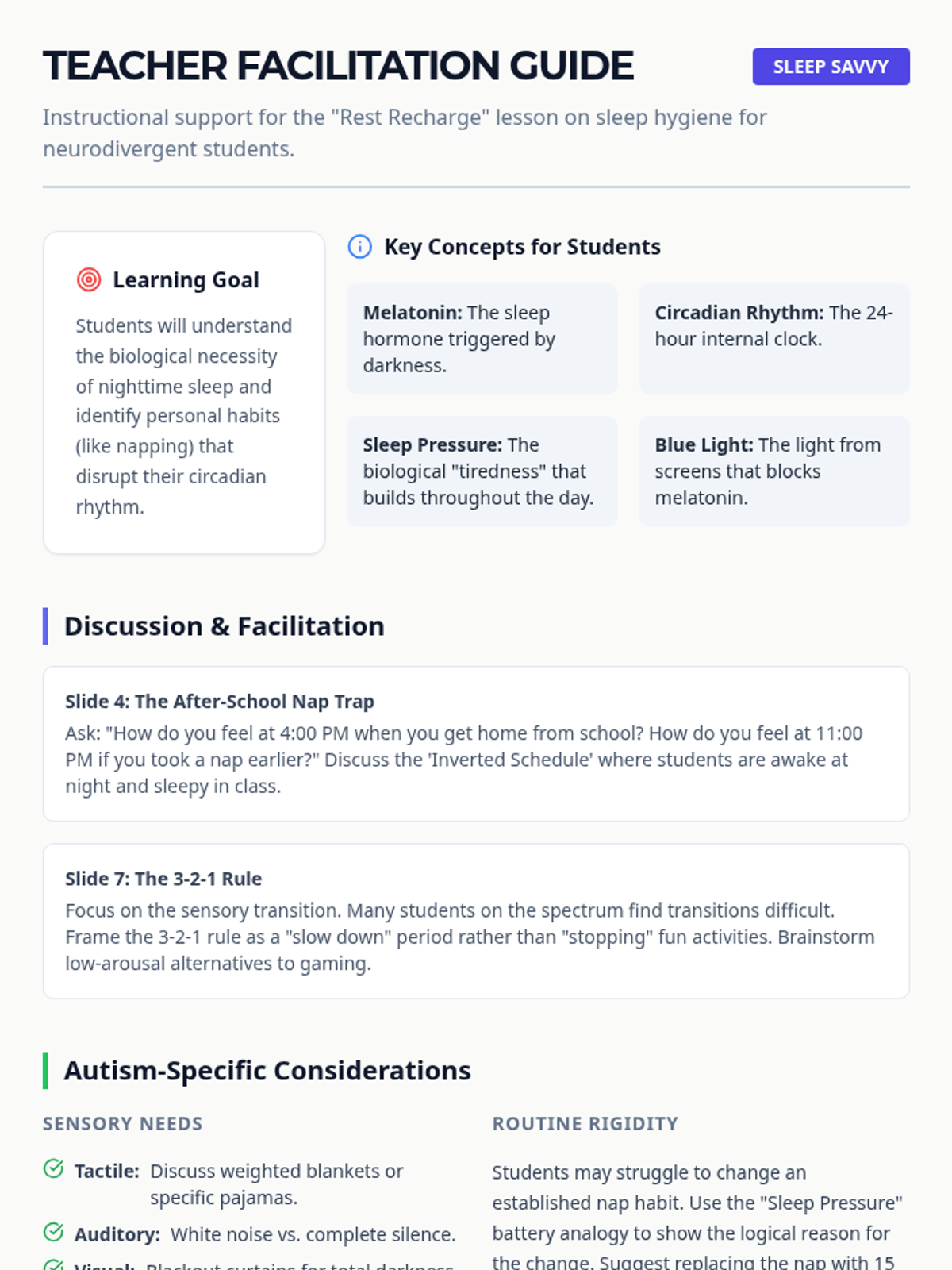
A teacher facilitation guide for the Sleep Savvy lesson, including discussion prompts, autism-specific sensory considerations, and an answer key for the student handout. Updated for a 6:00 AM wake-up schedule.
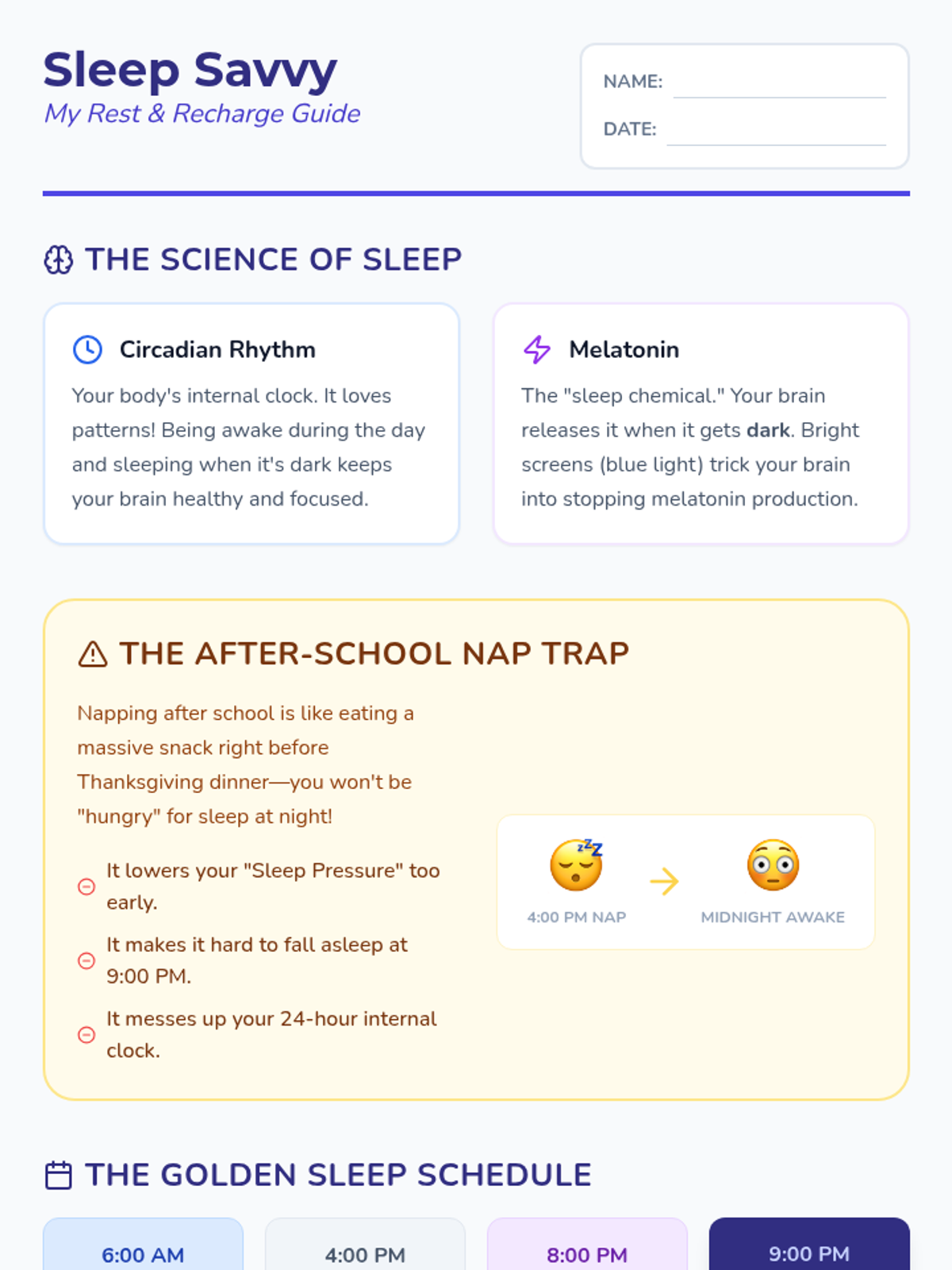
A student handout explaining the science of sleep hygiene, the risks of afternoon napping, and a visual schedule with reflection questions. Updated for a 6:00 AM wake-up schedule.
A visual guide for teenagers on the autism spectrum explaining the science of circadian rhythms, melatonin, and why napping after school can disrupt healthy sleep patterns. Updated for a 6:00 AM wake-up schedule.
An answer key and grading guide for the Rest Reset Quiz, providing correct answers and marking criteria for short-answer questions.
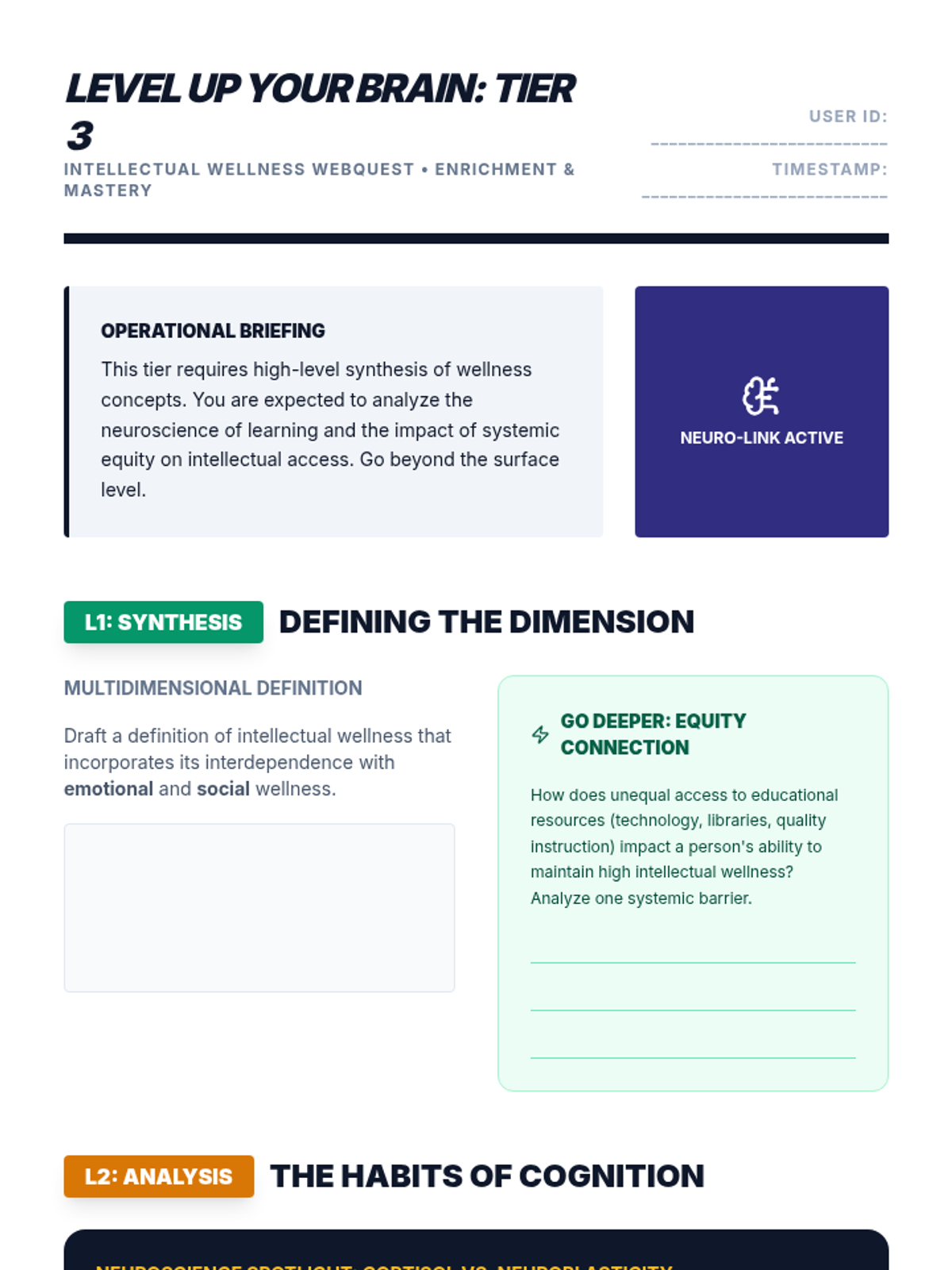
A Tier 3 (Above Grade/Enrichment) worksheet for the Level Up Your Brain WebQuest, featuring neuroscience analysis, equity connections, WOOP goal-setting strategy, and a reflective synthesis letter.
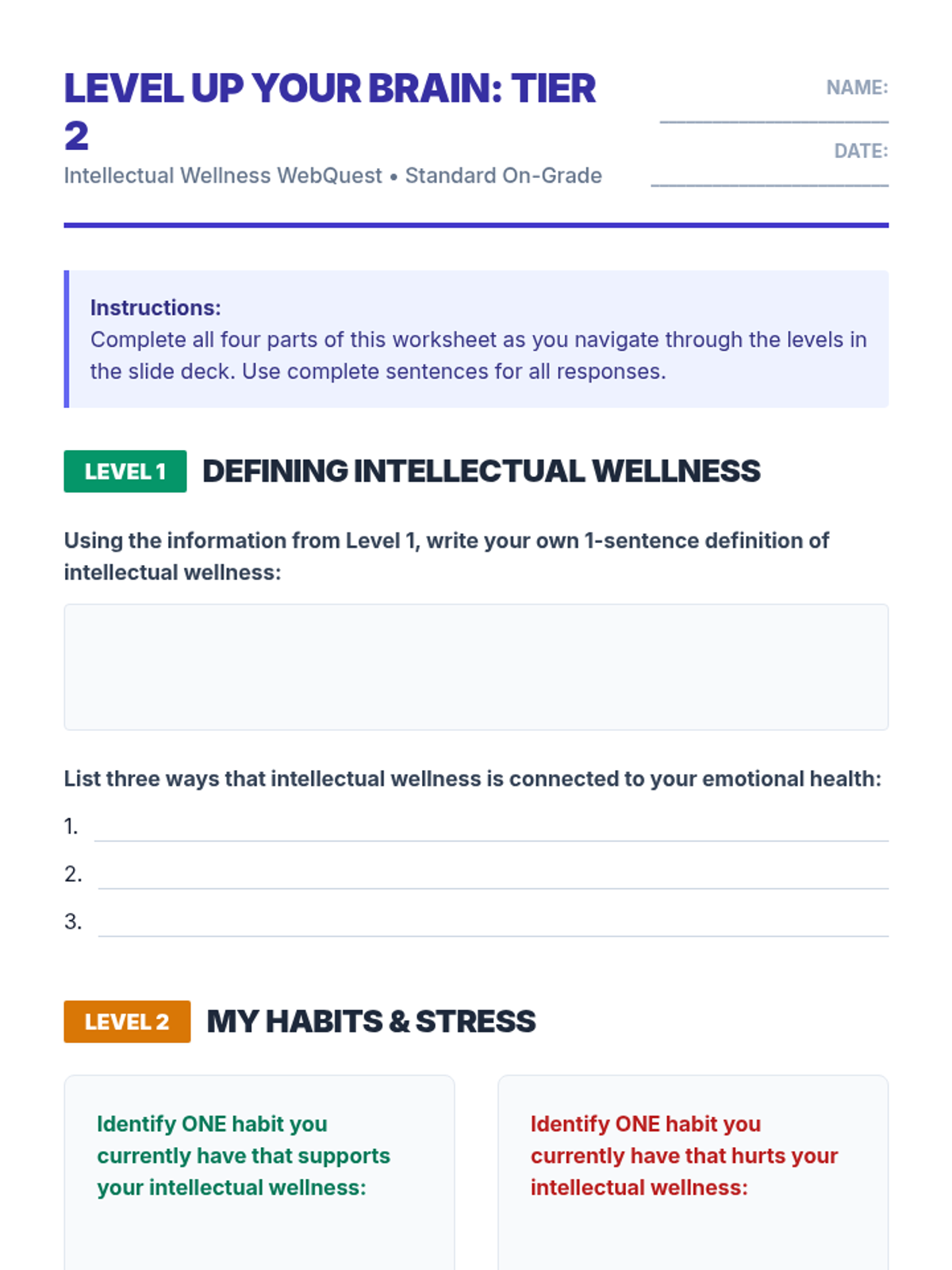
A Tier 2 (On Grade) worksheet for the Level Up Your Brain WebQuest, requiring complete sentences, habit analysis, growth mindset rewriting, and SMART goal-setting.
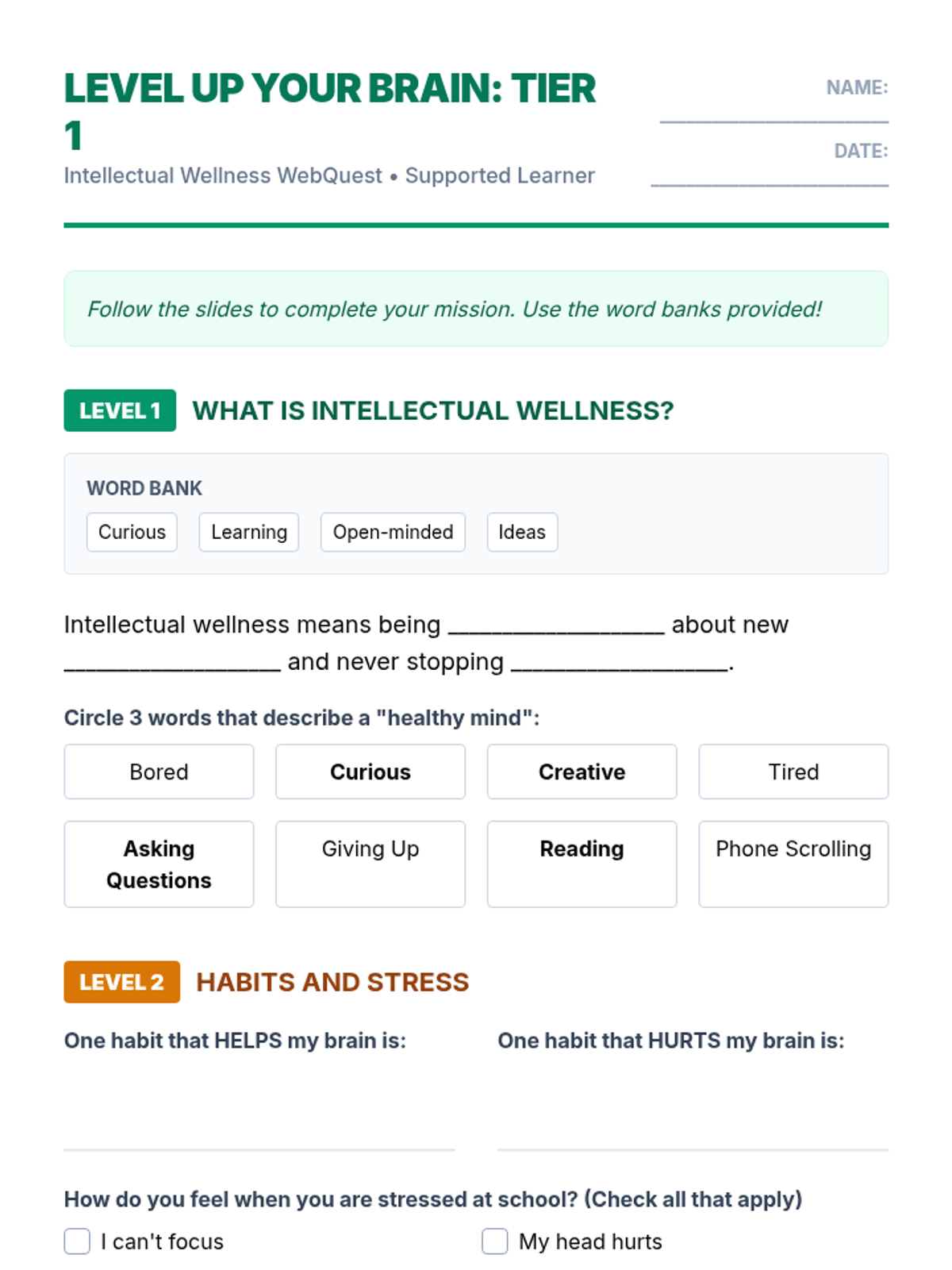
A Tier 1 (Below Grade) worksheet for the Level Up Your Brain WebQuest, featuring word banks, circling activities, and simplified sentence starters for supported learners.
A gaming-themed interactive slide deck that guides students through four levels of intellectual wellness challenges, including definitions, habit assessment, growth mindset, and goal-setting.
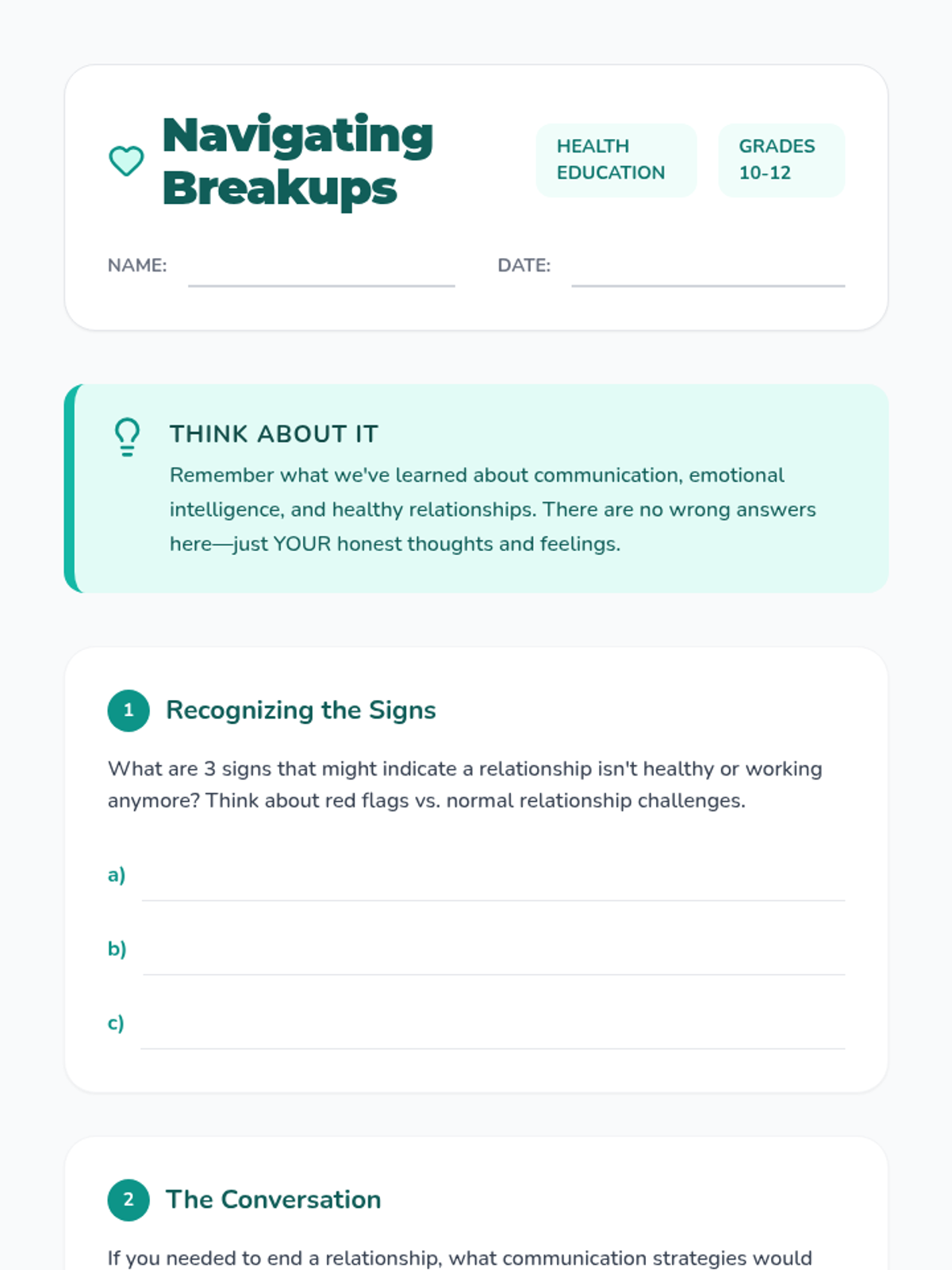
A comprehensive 3-page student worksheet for exploring relationship breakups, grief stages, healthy coping mechanisms, and personal growth. It provides structured reflection areas for recognizing unhealthy signs, practicing respectful communication, and building supportive friendship skills.
A high-impact slide deck for teaching relationship endings, grief management, and respectful communication. It features clean layouts, empathetic visuals, and clear instructional points based on health education standards.
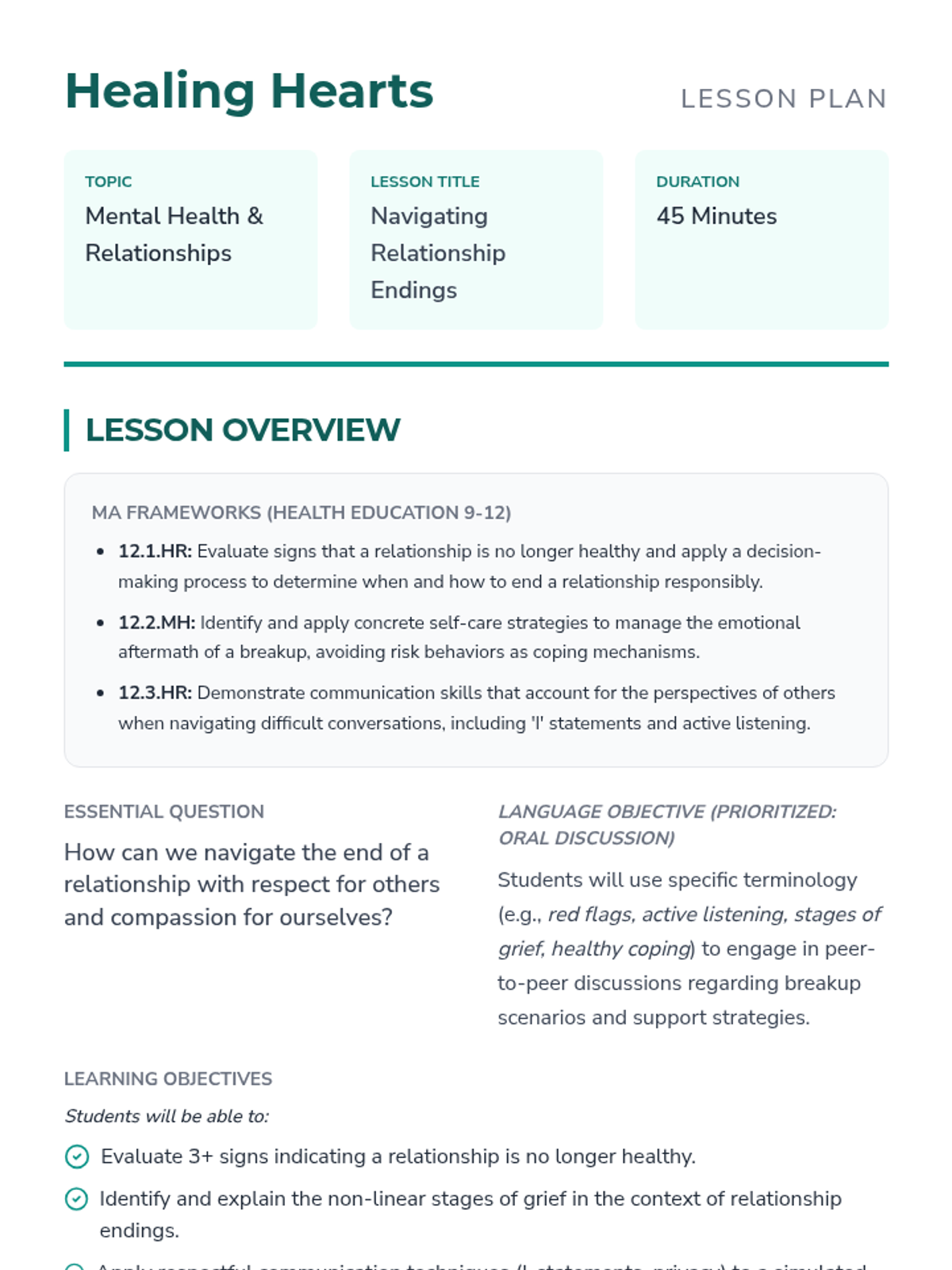
A 45-minute lesson plan for grades 10-12 focused on the mental and emotional aspects of navigating relationship breakups, aligned with Massachusetts state standards. It prioritizes oral discussion and includes structured activities for direct instruction, peer practice, and reflection.
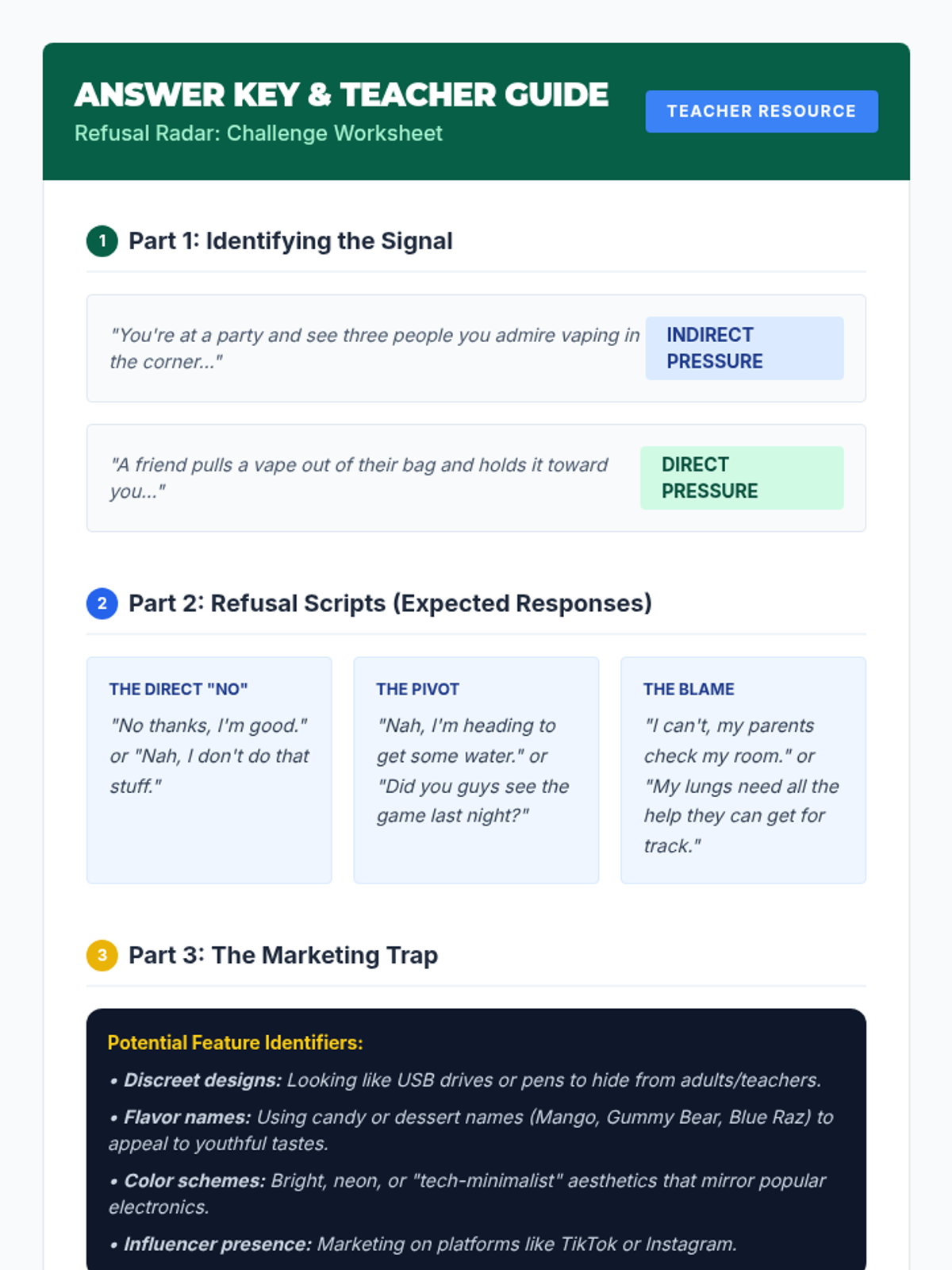
A teacher-facing answer key and instructional guide for the Refusal Radar Challenge Worksheet.
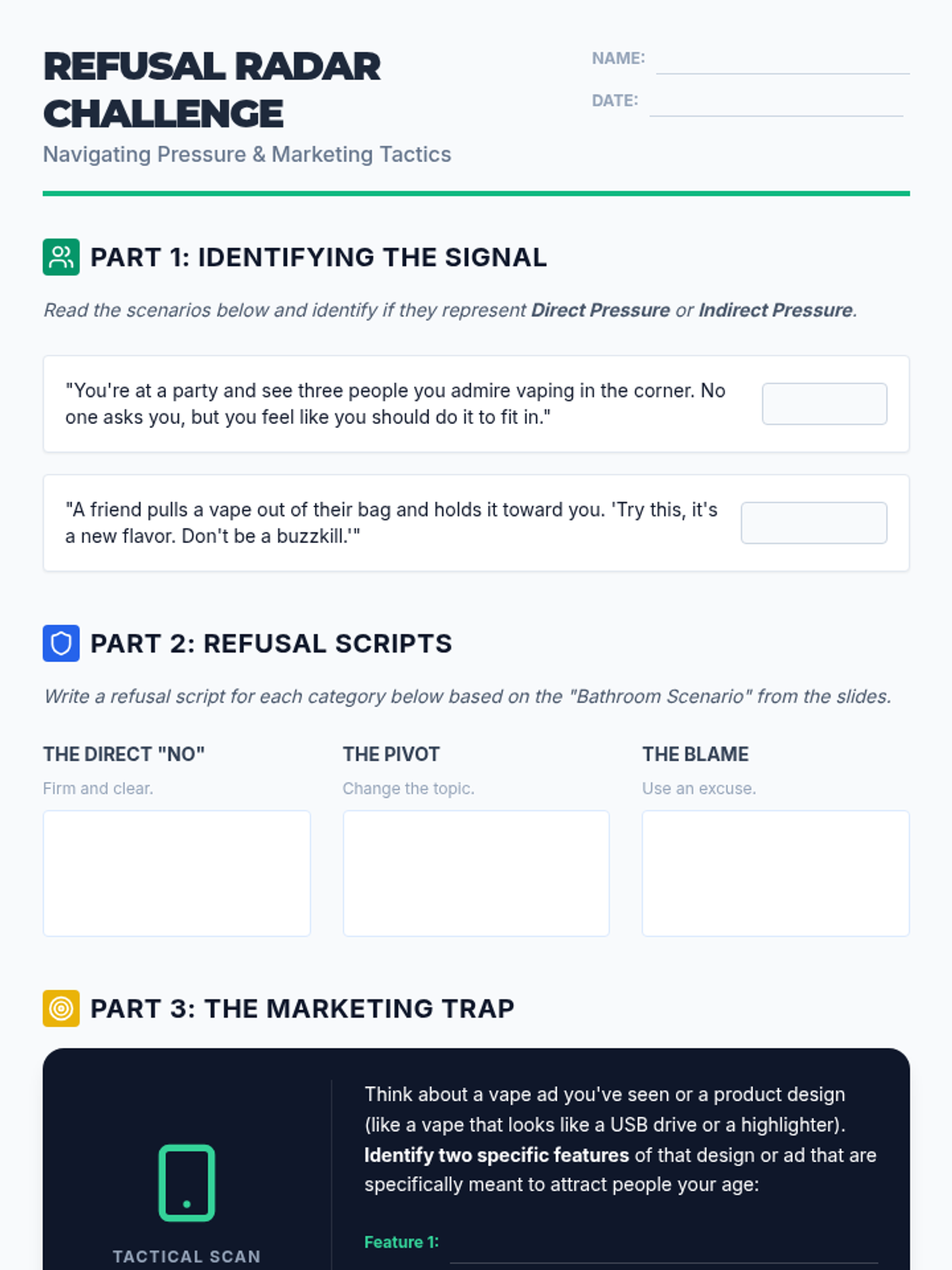
A student-facing worksheet for practicing refusal strategies, identifying types of social pressure, and analyzing marketing tactics.
A comprehensive slide deck for teaching refusal strategies, identifying types of social pressure, and understanding marketing manipulation in vaping.
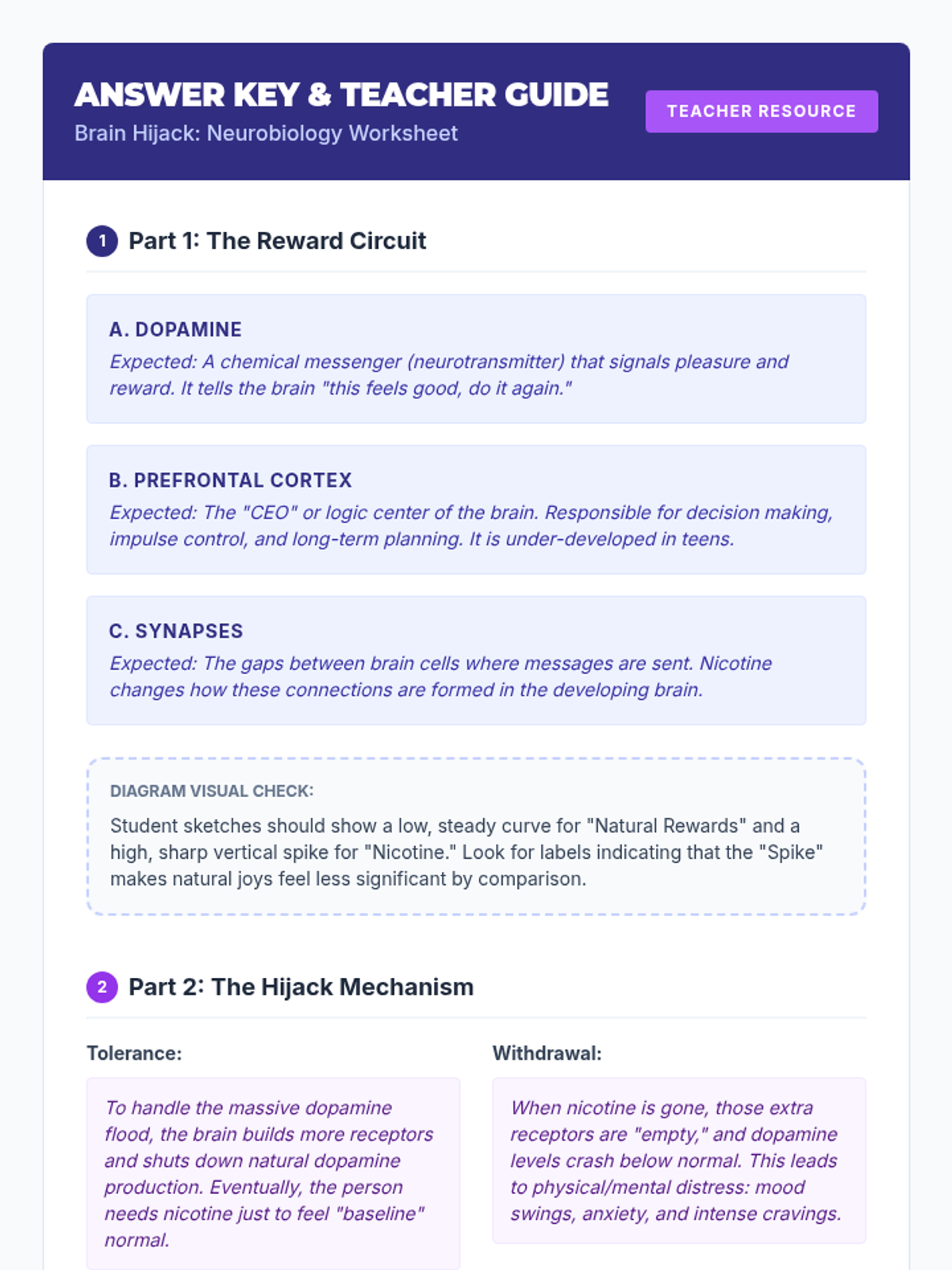
A teacher-facing answer key and instructional guide for the Brain Hijack Diagram Worksheet.
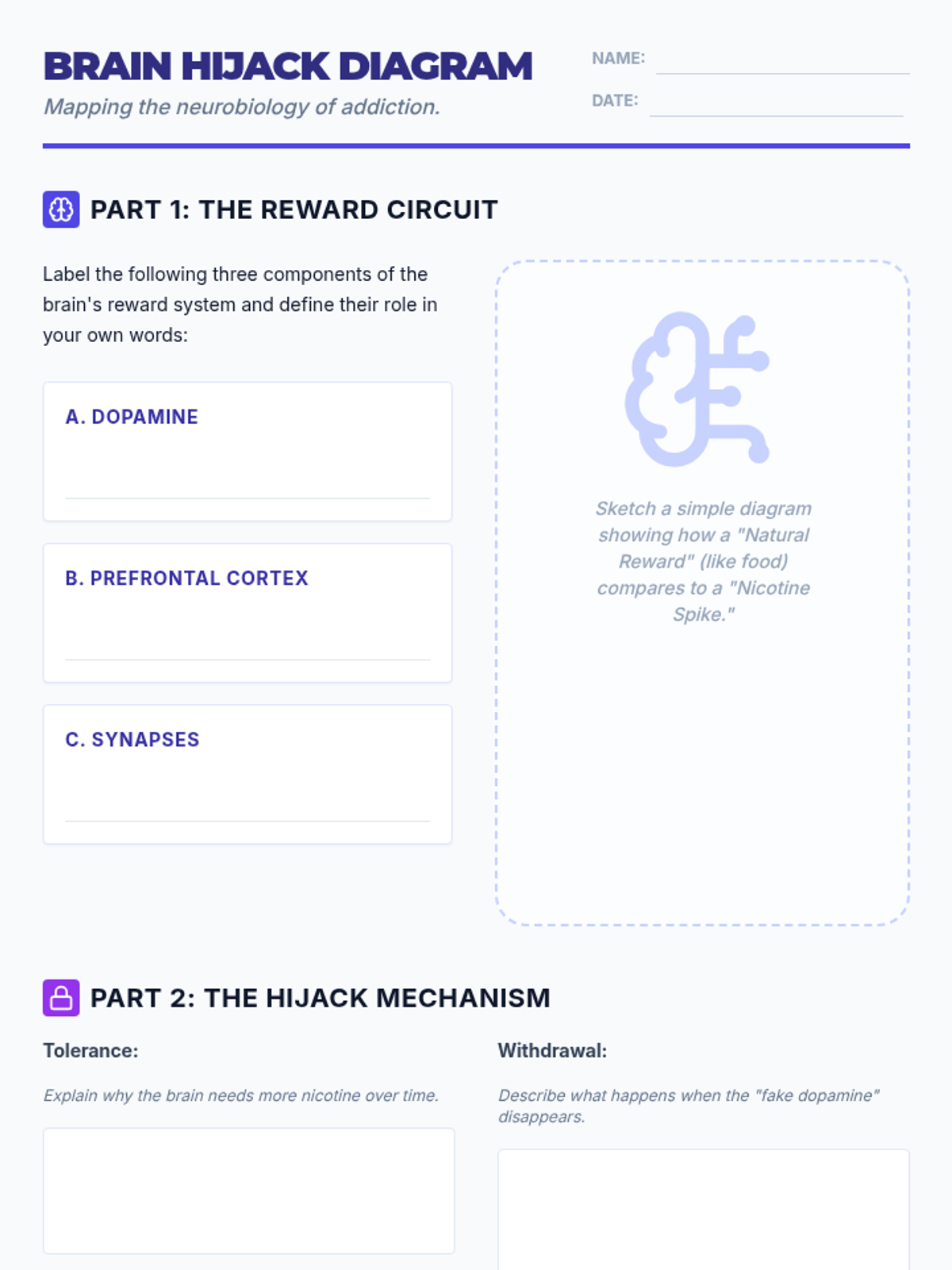
A student-facing worksheet for mapping the brain's reward system and exploring the neurobiological impact of nicotine addiction.
A comprehensive slide deck exploring the neurobiology of nicotine addiction, specifically focusing on the dopamine reward system and adolescent brain development.
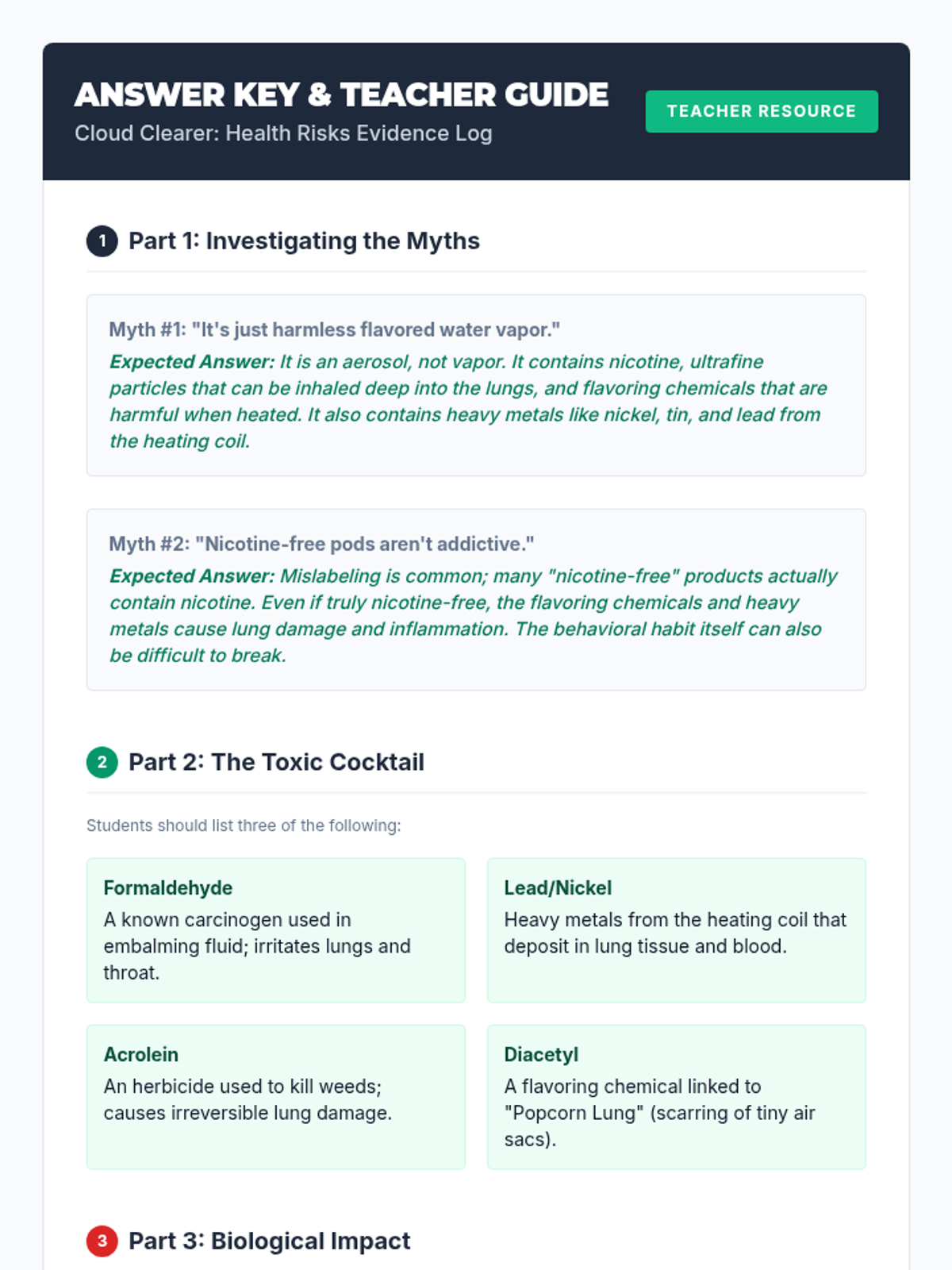
A teacher-facing answer key and instructional guide for the Cloud Clearer Evidence Log.
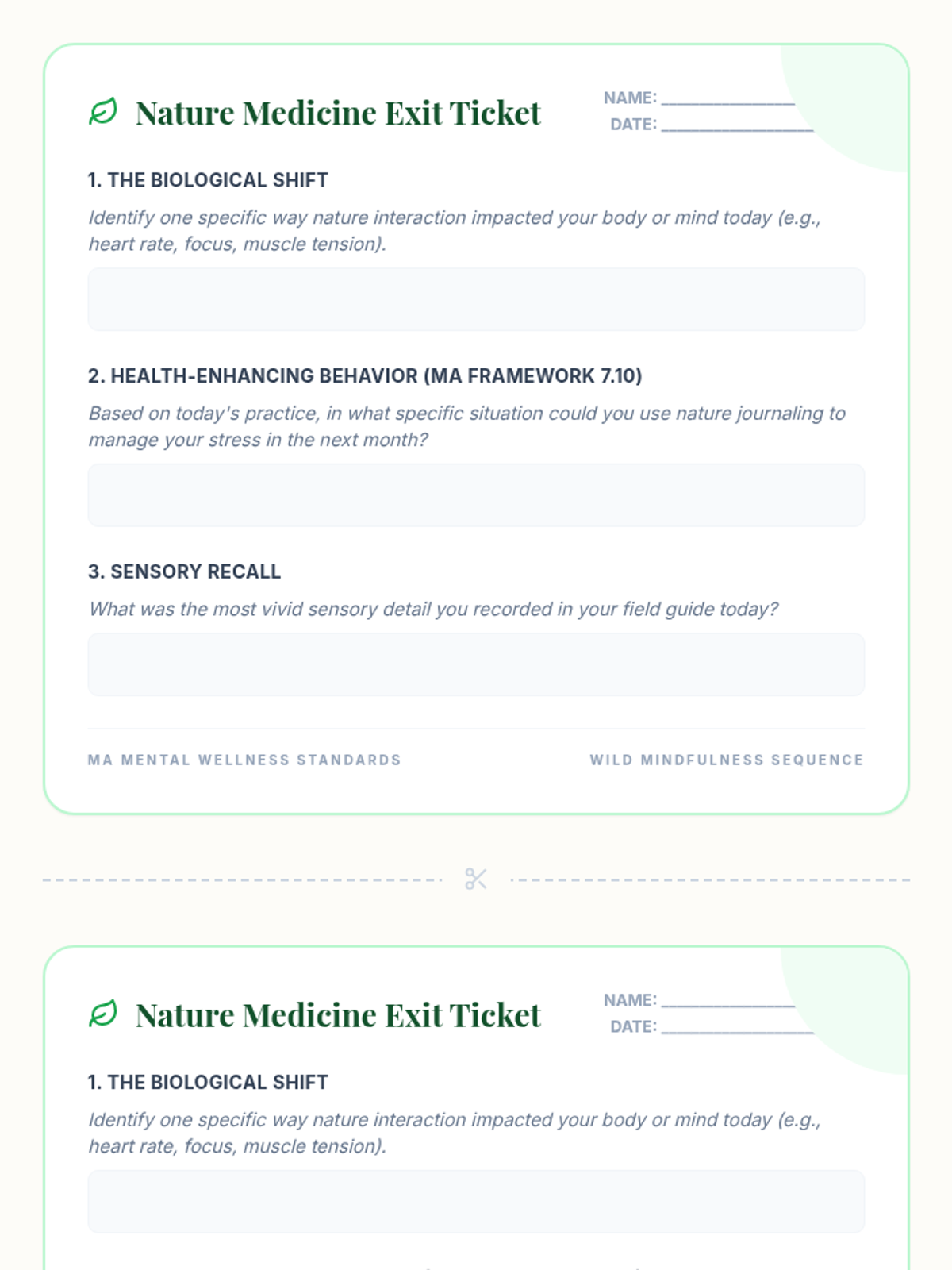
A printable exit ticket for Grade 10 health students to reflect on the mental health benefits of nature interaction and identify its use as a stress management tool.
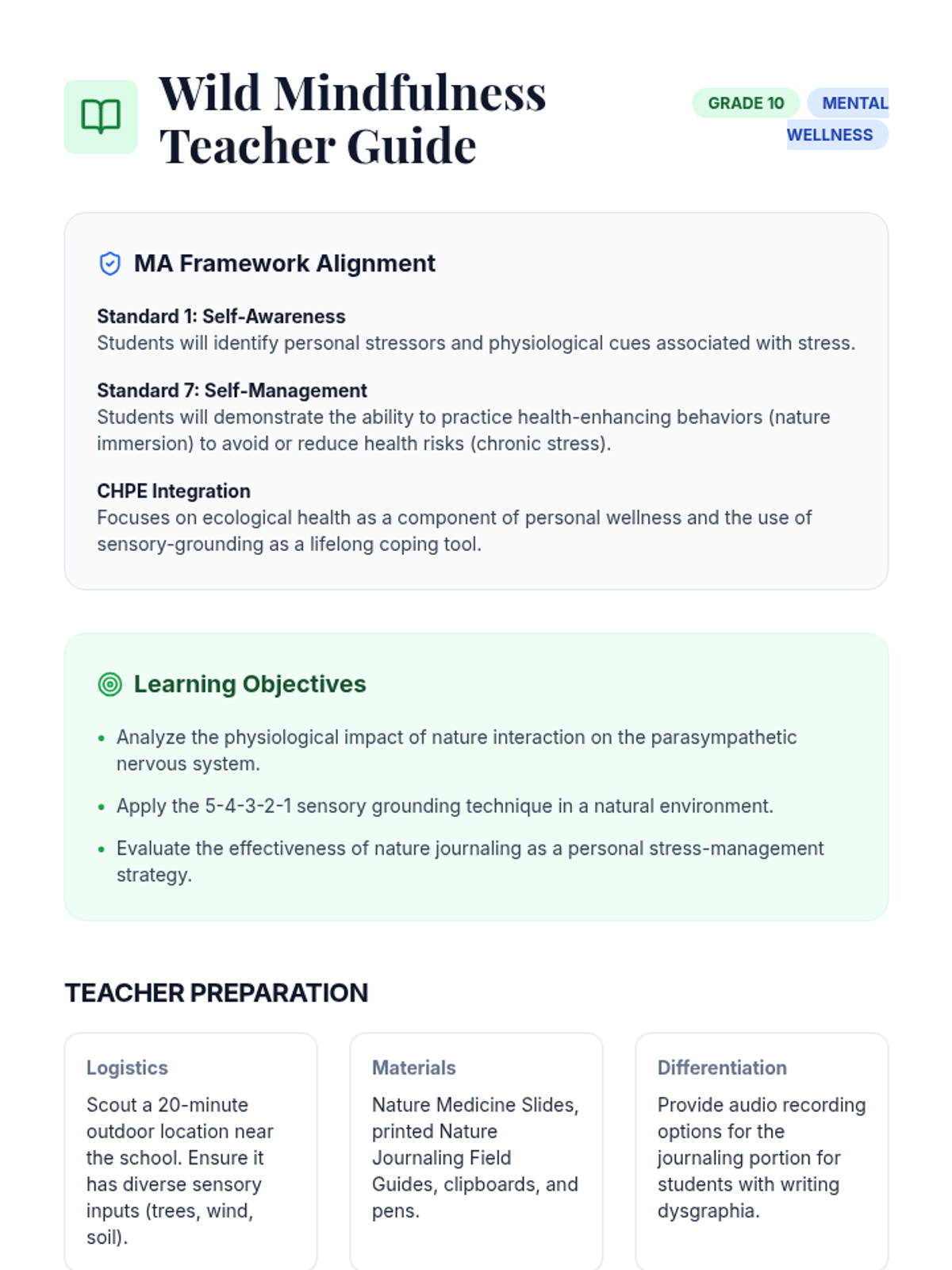
A comprehensive teacher facilitation guide for the Wild Mindfulness lesson, including MA framework alignment, lesson pacing, questioning prompts, and assessment rubrics.
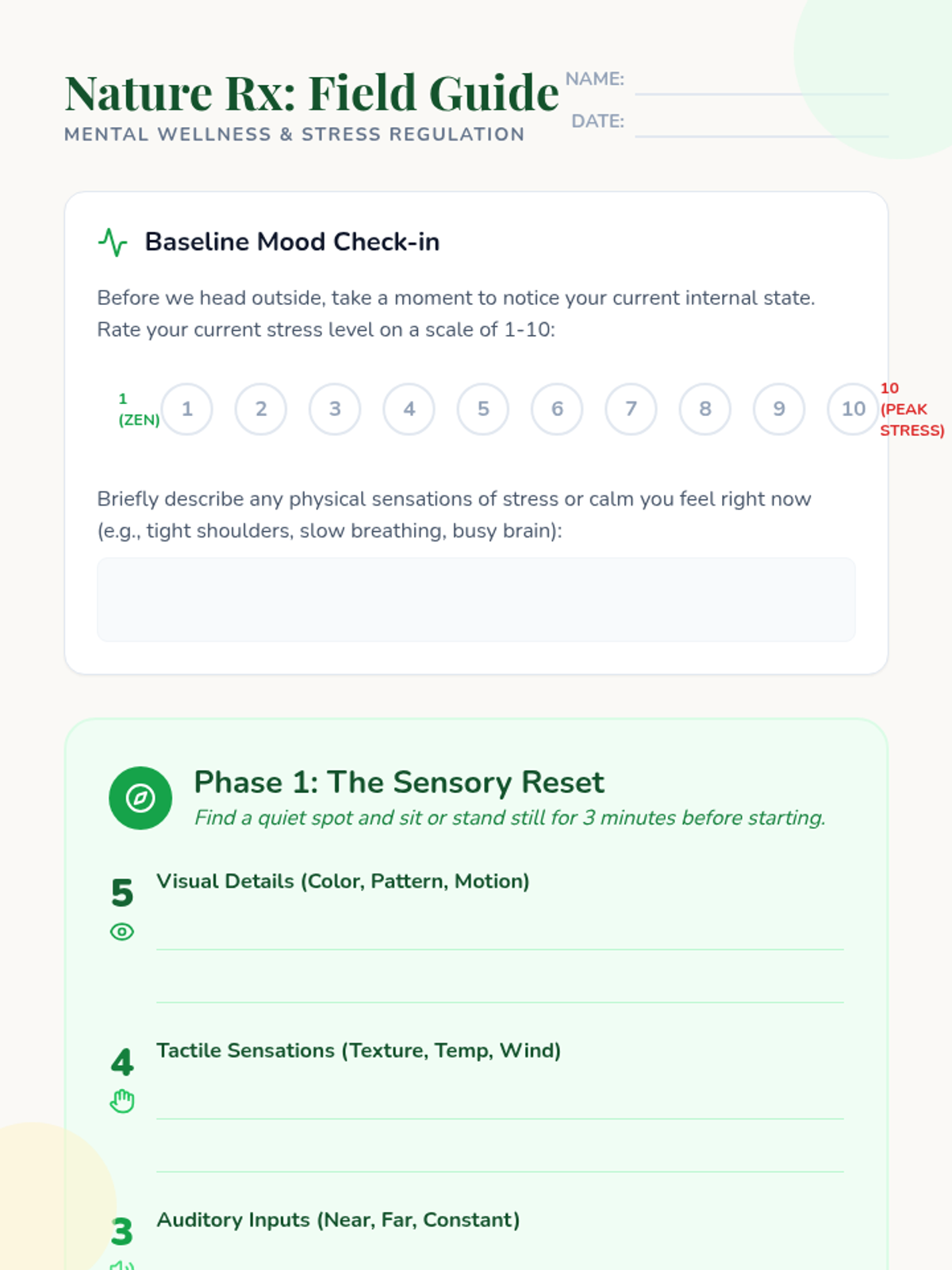
A printable 2-page nature journaling field guide for Grade 10 students, featuring sensory grounding exercises, specimen sketching, and emotional reflection to support MA mental wellness standards.
A visually engaging presentation introducing Grade 10 students to the mental health benefits of nature journaling and the practice of forest bathing, aligned with Massachusetts health standards.
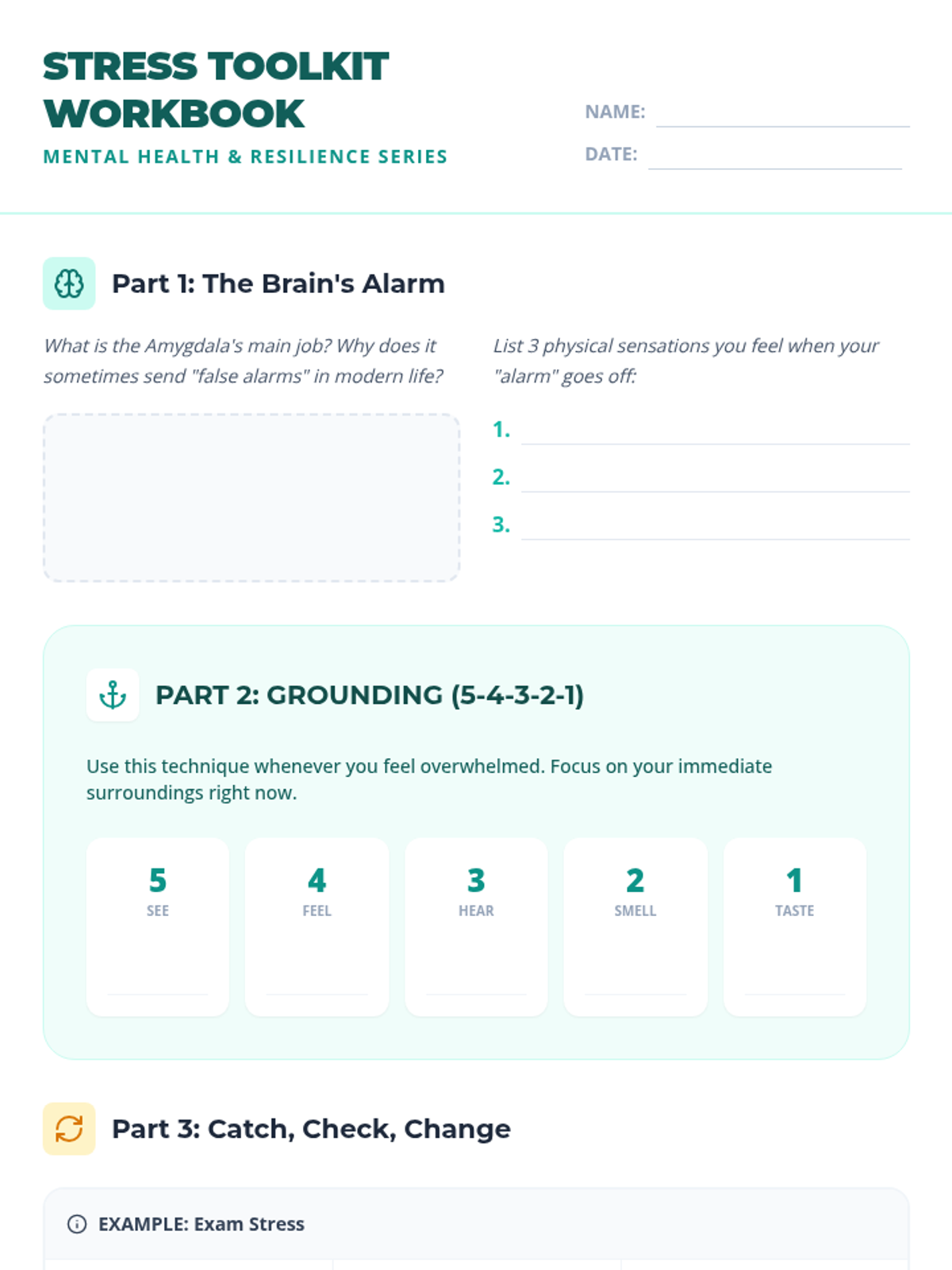
A student-facing workbook for the 'Mind Over Worry' lesson, featuring note-taking areas, a 5-4-3-2-1 grounding guide, cognitive restructuring practice, and a help-seeking checklist.
A visual slide deck covering the biology of anxiety, survival responses (fight/flight/freeze), grounding techniques, and criteria for seeking professional help.
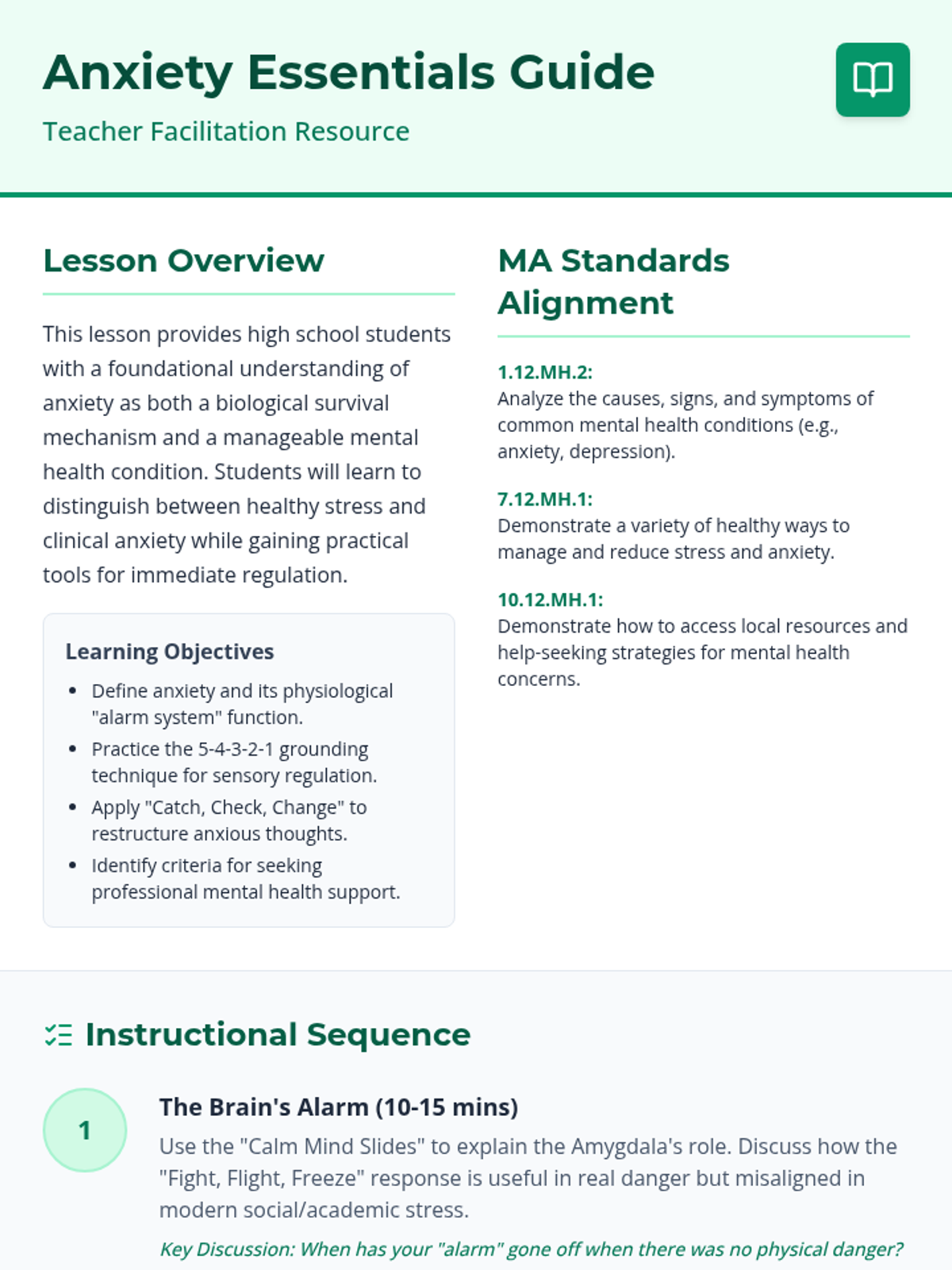
A teacher facilitation guide for the 'Mind Over Worry' lesson, including MA standards alignment, instructional sequence, and tips for handling sensitive mental health content in a high school setting.
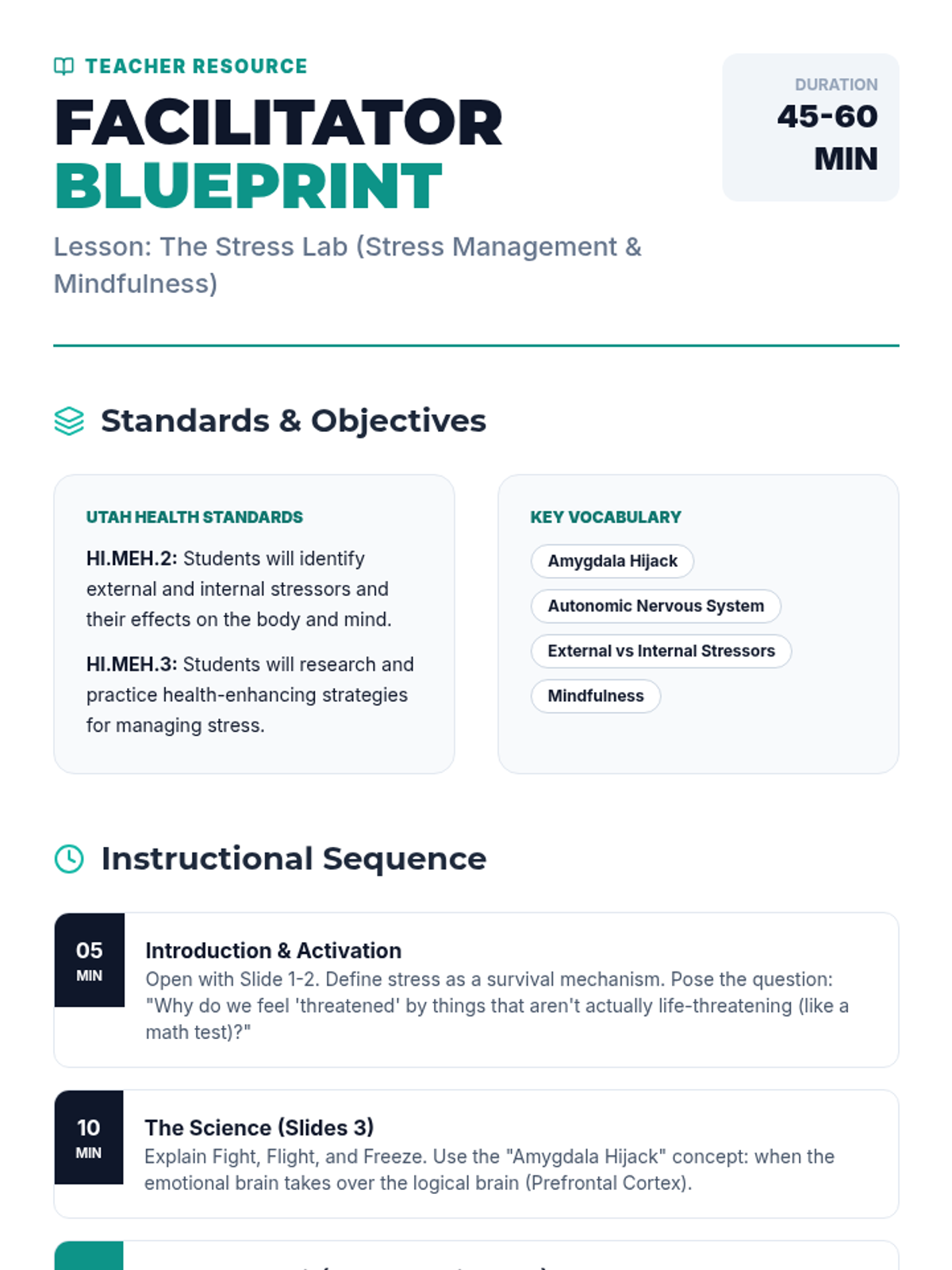
A detailed teacher guide for the Stress Lab lesson, including standards alignment, a timed instructional sequence, facilitation tips, and troubleshooting advice. Styled as a professional "Blueprint."
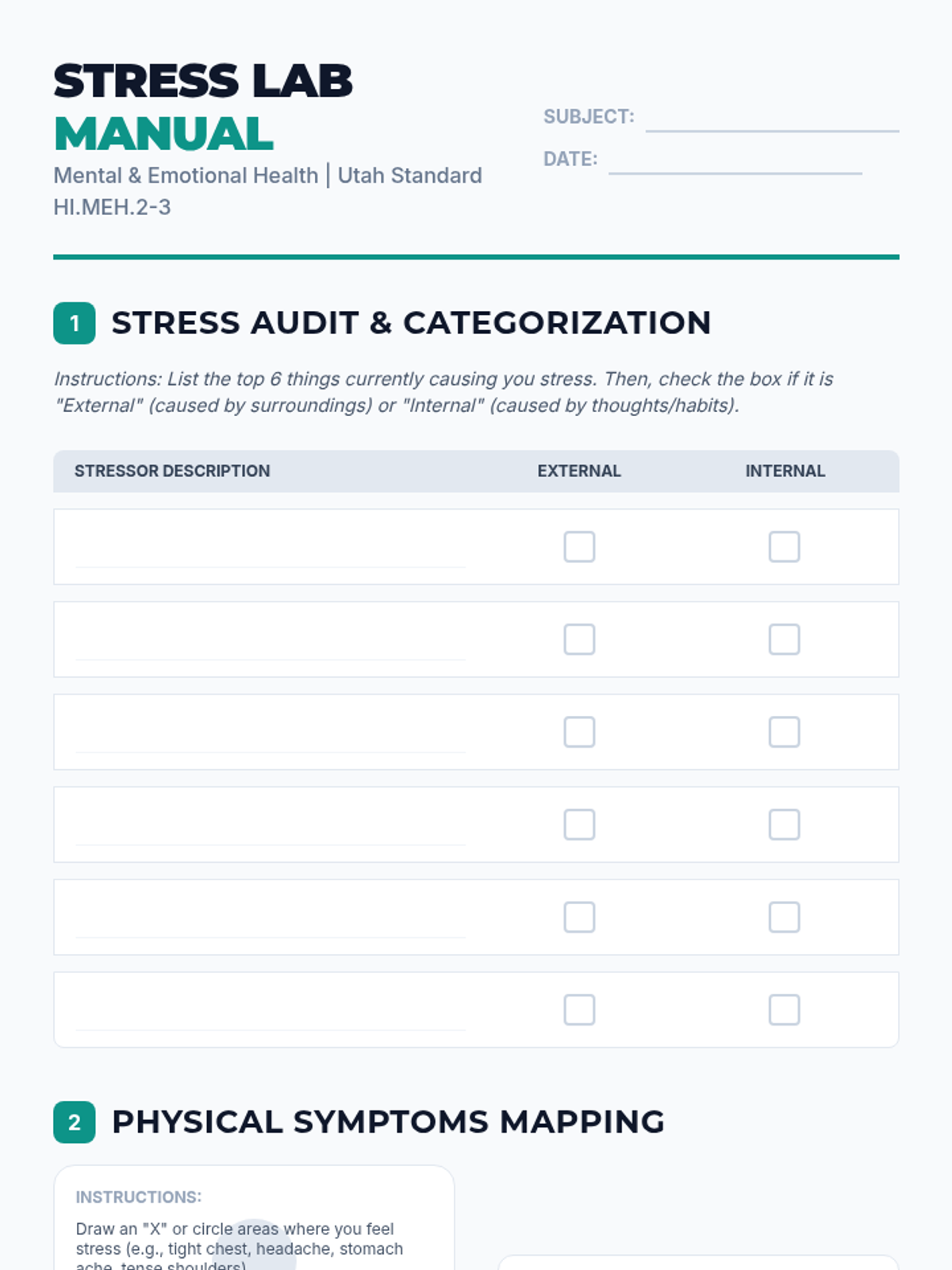
A structured student worksheet (Lab Manual) featuring a Stress Audit checklist, physical symptom mapping, and a reflection/habit tracker for mindfulness techniques. Designed with clean white work areas for high legibility.
A visual presentation for students explaining the physiological and neurological development of the adolescent brain, focusing on the prefrontal cortex and amygdala.
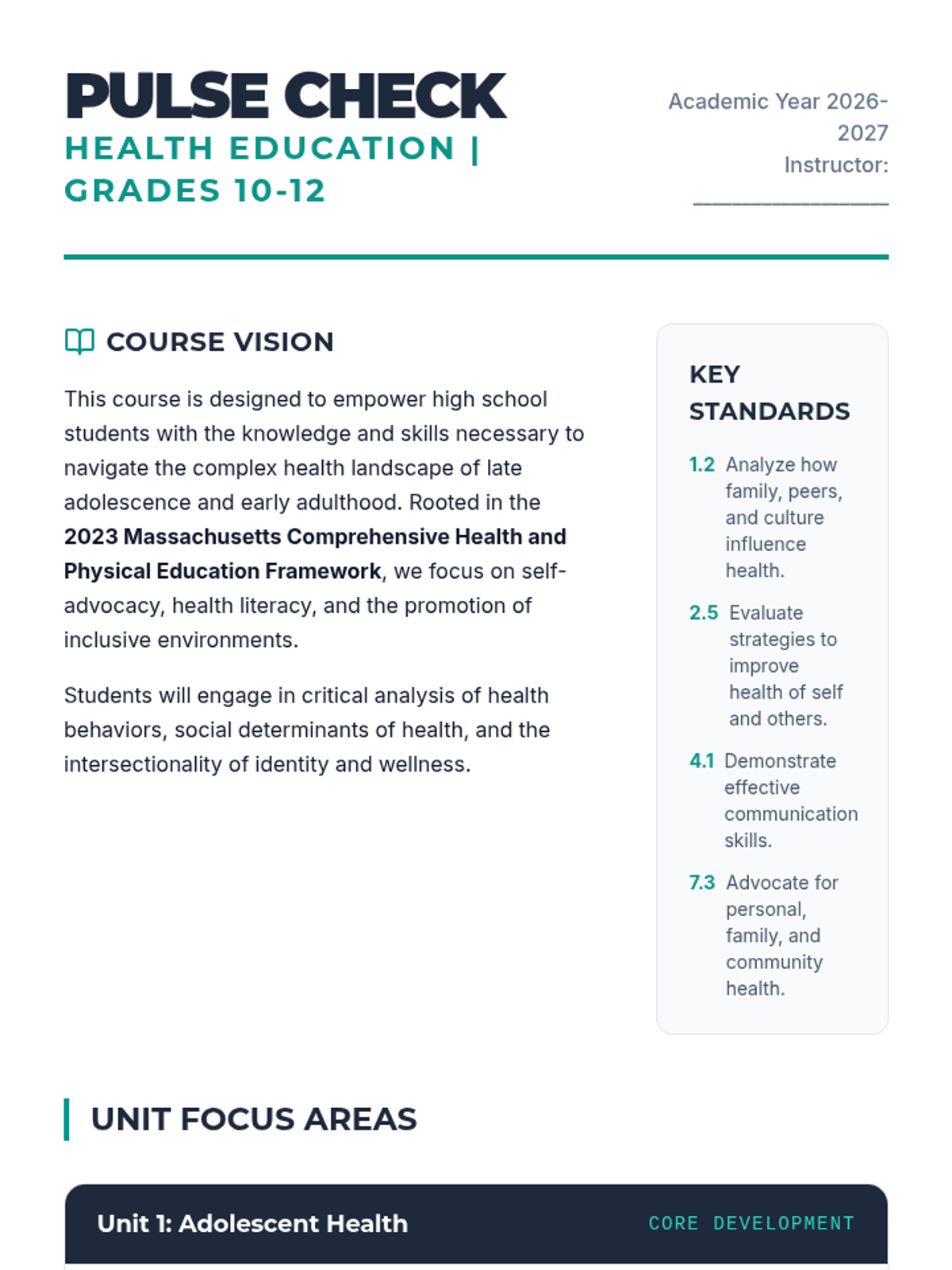
A comprehensive course syllabus for grades 10-12 health education, detailing units on Adolescent Health and Gender Identity and Health based on Massachusetts standards.
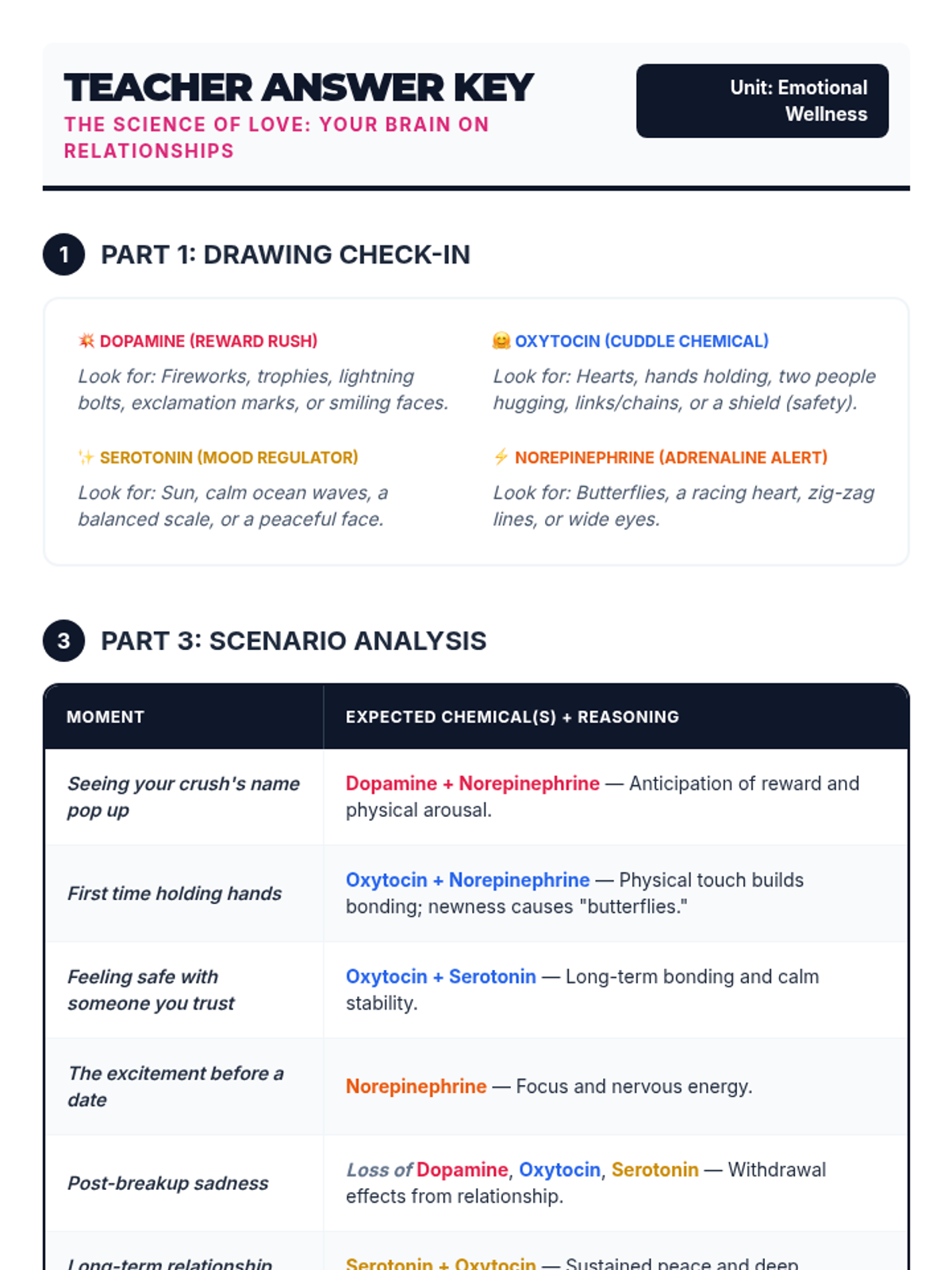
A detailed teacher's answer key for the Love Chemistry Student Worksheet. It provides grading criteria for the neurotransmitter drawings, correct chemical identifications for the relationship moments table, science-based reasoning for care package items, and expectations for the exit ticket.
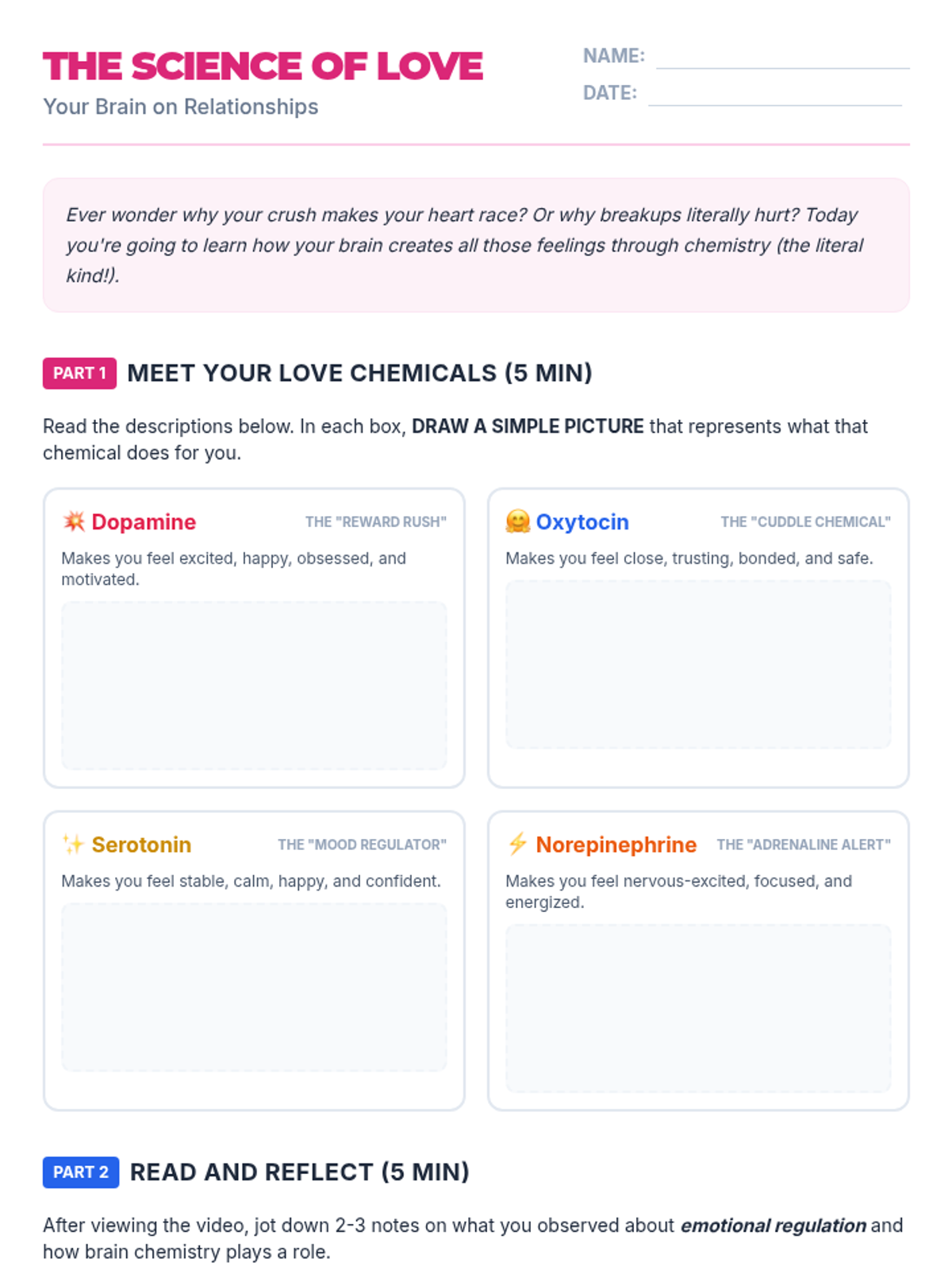
A student worksheet for the Science of Love lesson. It includes drawing activities for neurotransmitters, a reflection section for the video, a scenario-based chemical identification table, a creative care package design task, and an exit ticket.
A visually engaging 8-slide presentation for the 'Science of Love' lesson. It covers the neurochemistry of relationships, the stages of attraction versus bonding, the biological impact of heartbreak, and science-based coping strategies, all designed with a 16:9 aspect ratio and large, readable text.
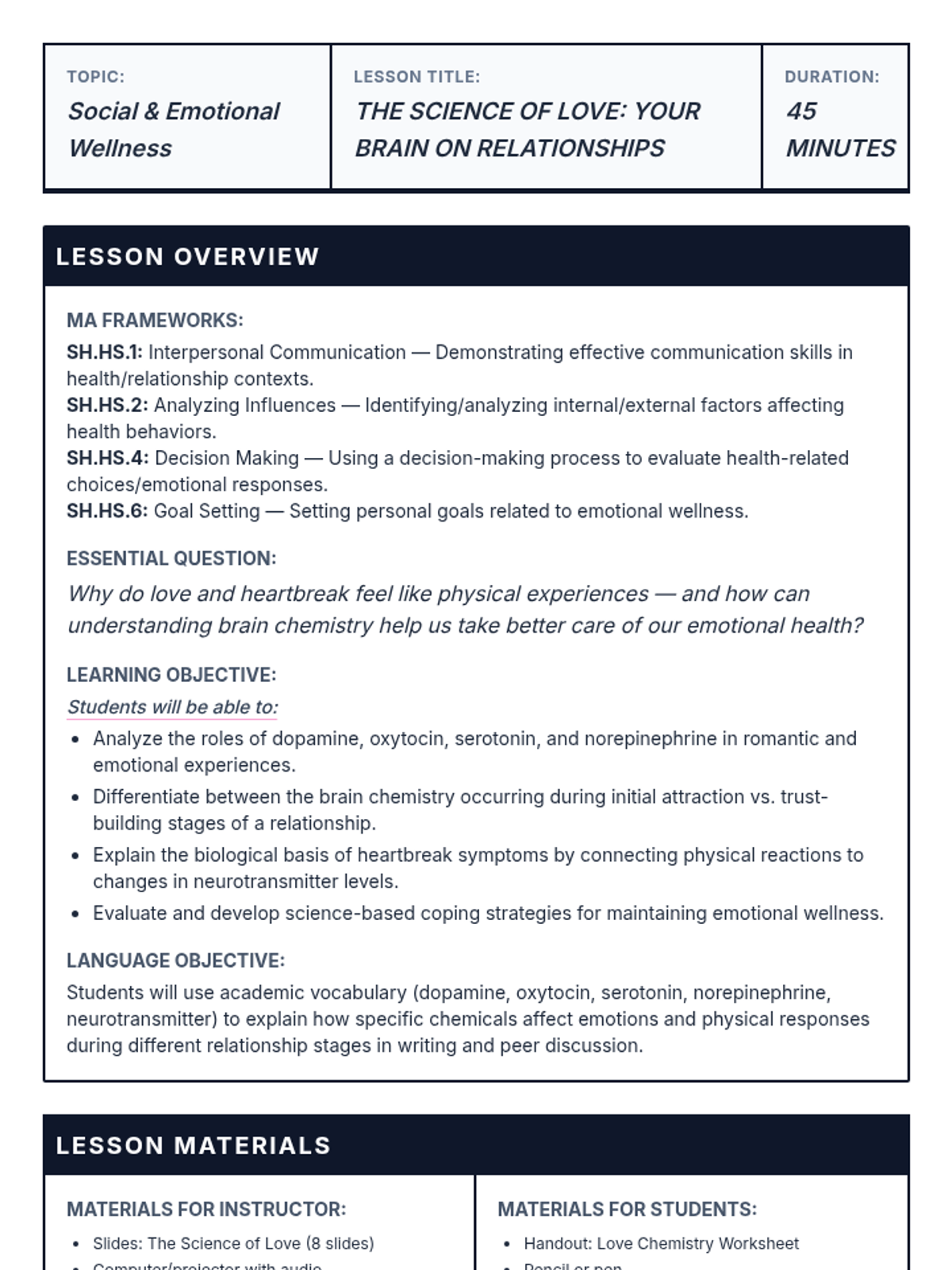
A comprehensive 45-minute lesson plan for high school health education using the requested template. It covers the neurochemistry of relationships, including MA DESE CHPE standards, objectives, and a detailed timed agenda.
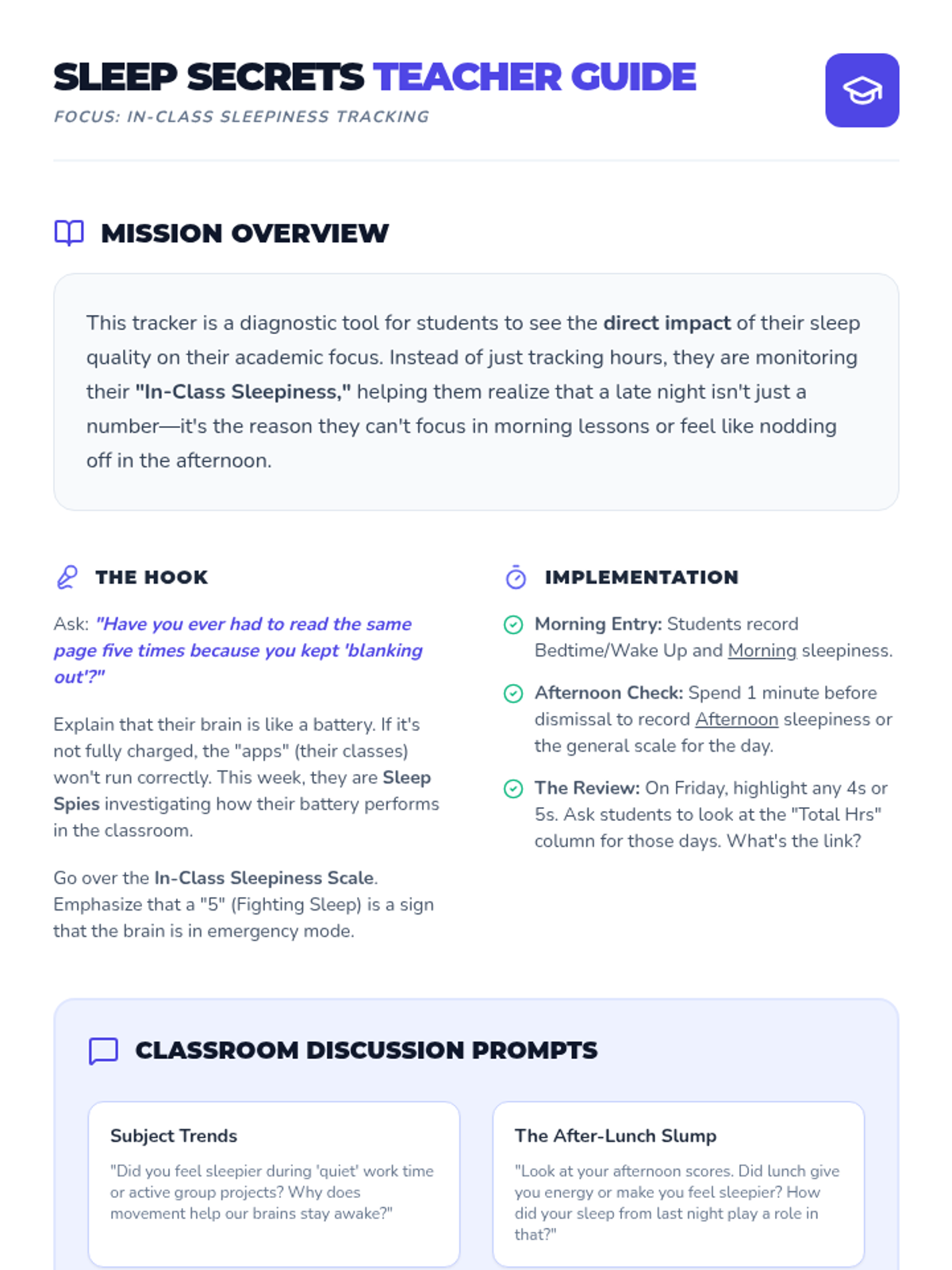
A facilitator guide for teachers to effectively implement the Sleep Spy Tracker, including discussion prompts, hook ideas, and pacing tips.
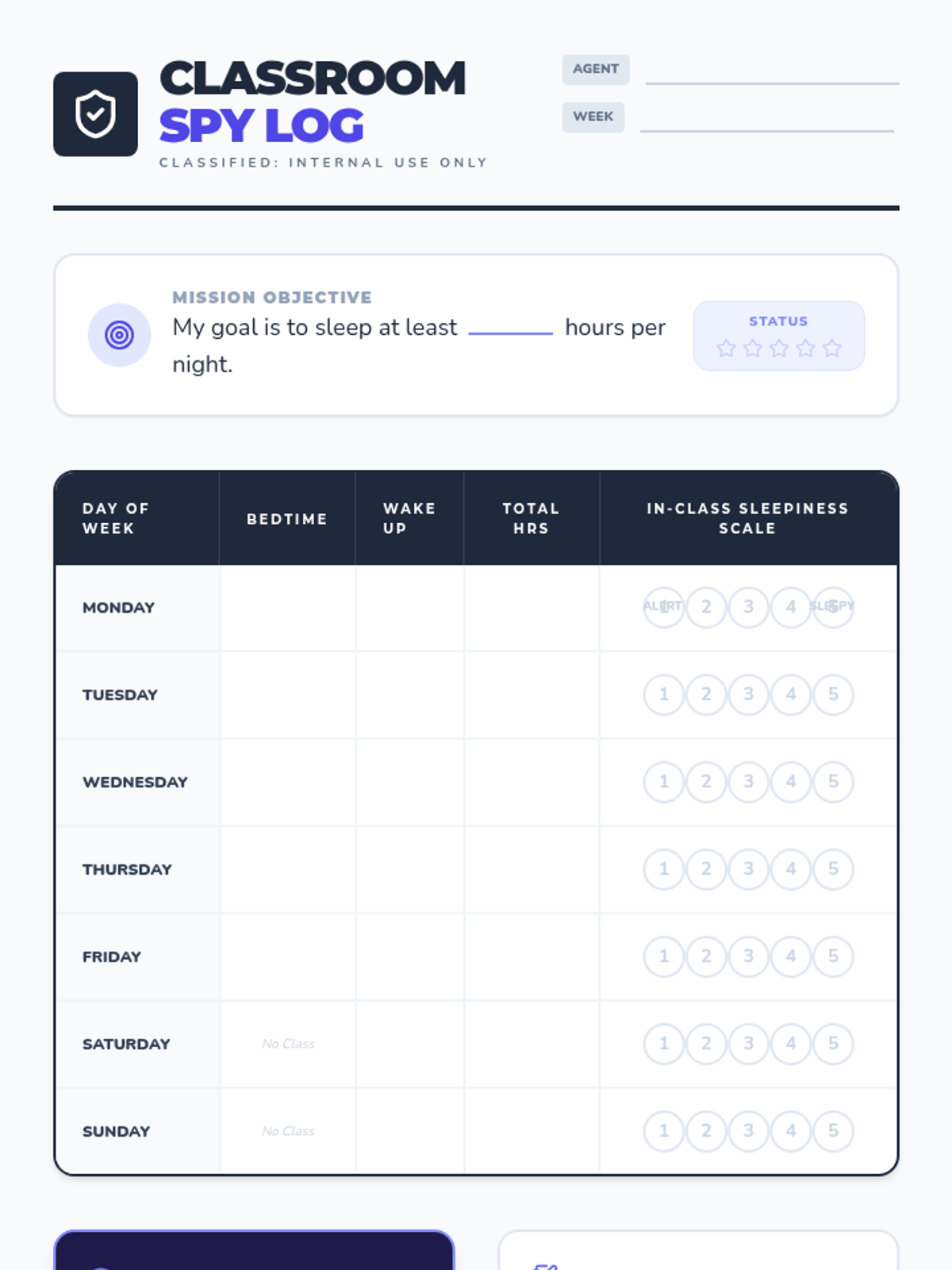
An updated weekly sleep tracker specifically focusing on monitoring in-class sleepiness levels to help students connect their rest with academic focus.
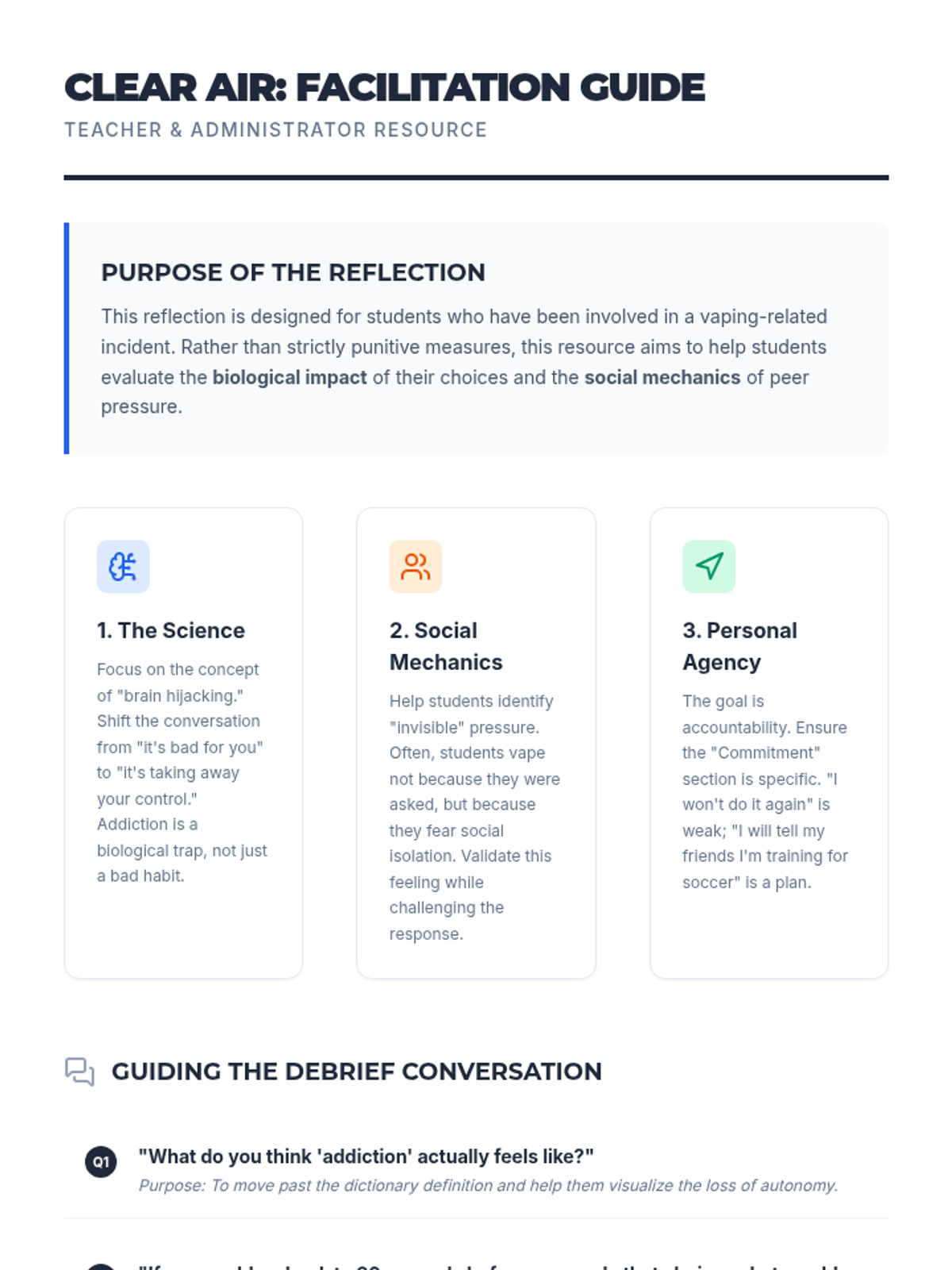
A facilitation guide for teachers and administrators to use when debriefing the vaping reflection worksheet with students, providing guiding questions and success indicators.
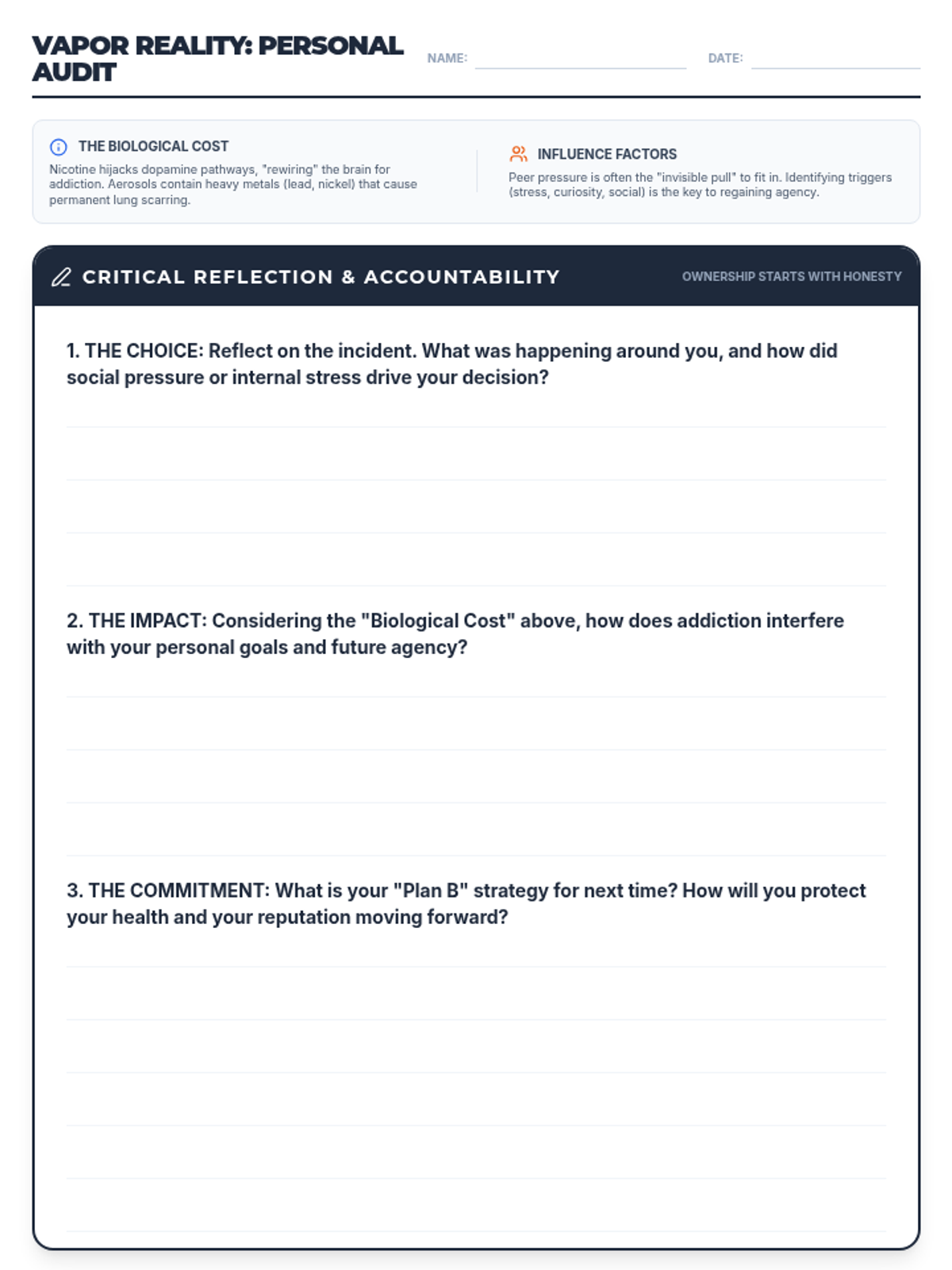
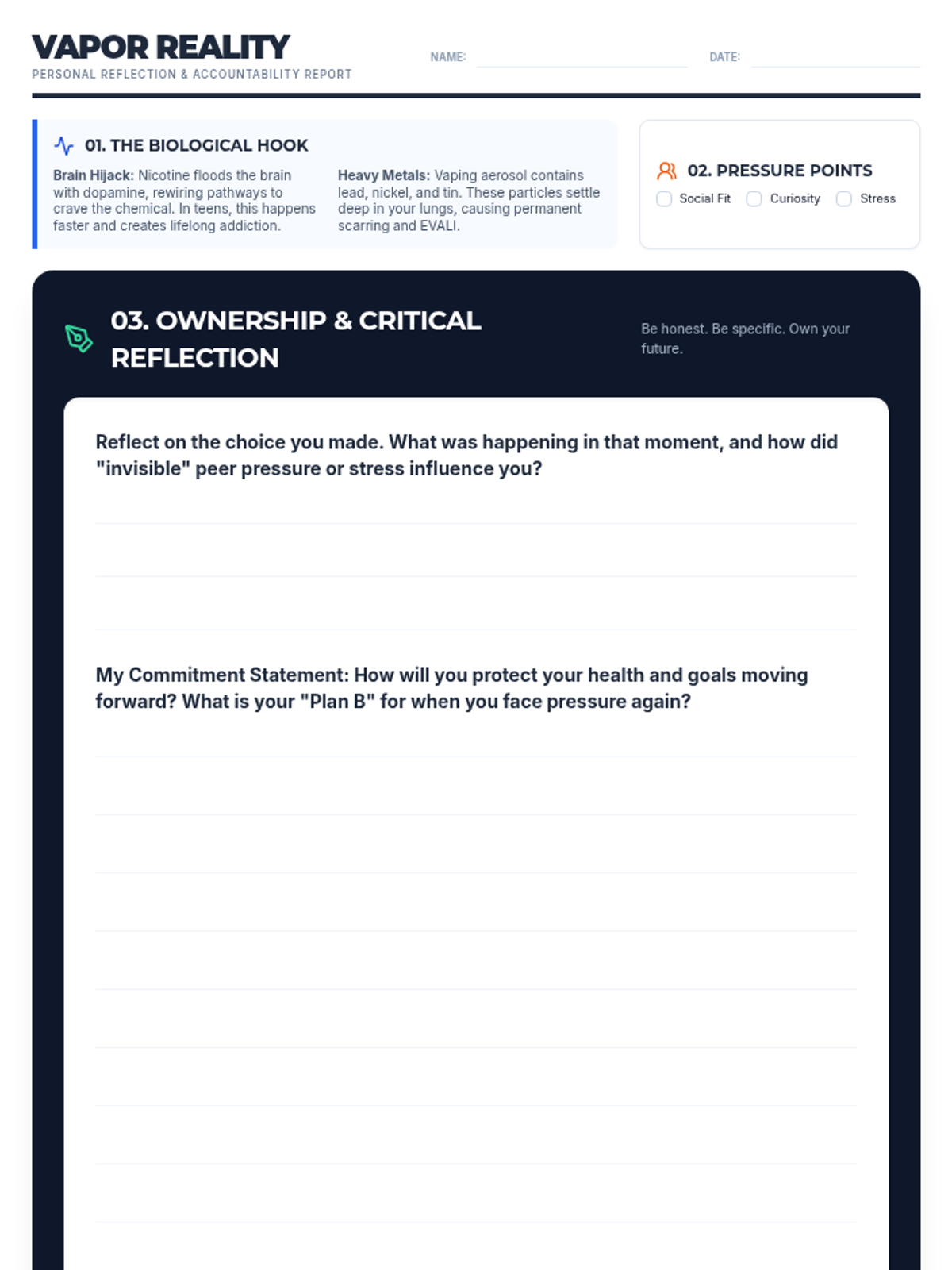
A minimalist reflection worksheet that maximizes the writing area by condensing health facts and peer pressure information into a small top ribbon, providing nearly 80% of the page for student response.
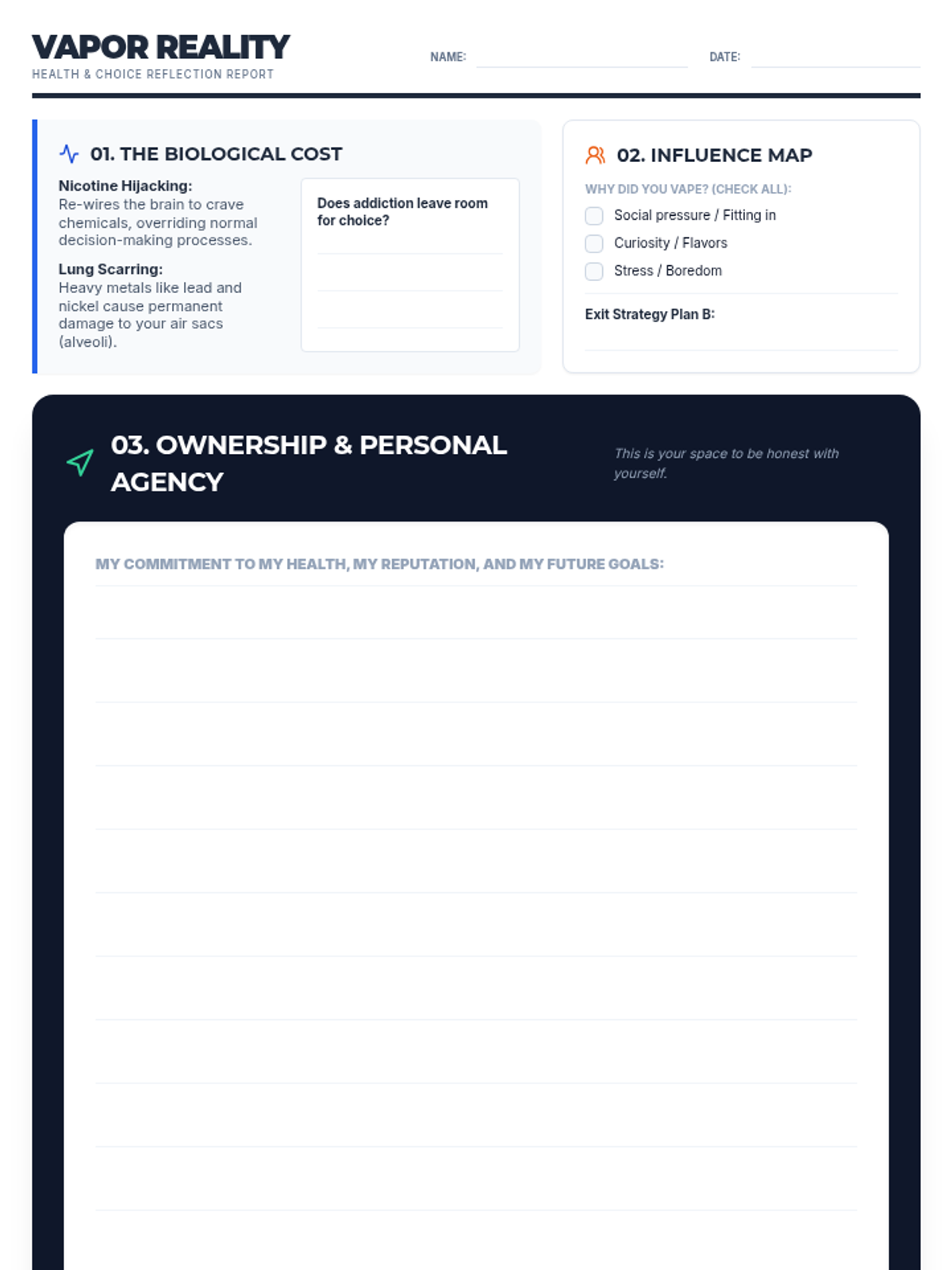
A comprehensive one-page reflection worksheet for students focused on the science of addiction, peer pressure strategies, and personal accountability after a vaping incident, with a maximized full-page writing area and integrated reflection prompts.
A comprehensive one-page reflection worksheet for students focused on the science of addiction, peer pressure strategies, and personal accountability after a vaping incident, with a maximized full-width writing area for reflection.
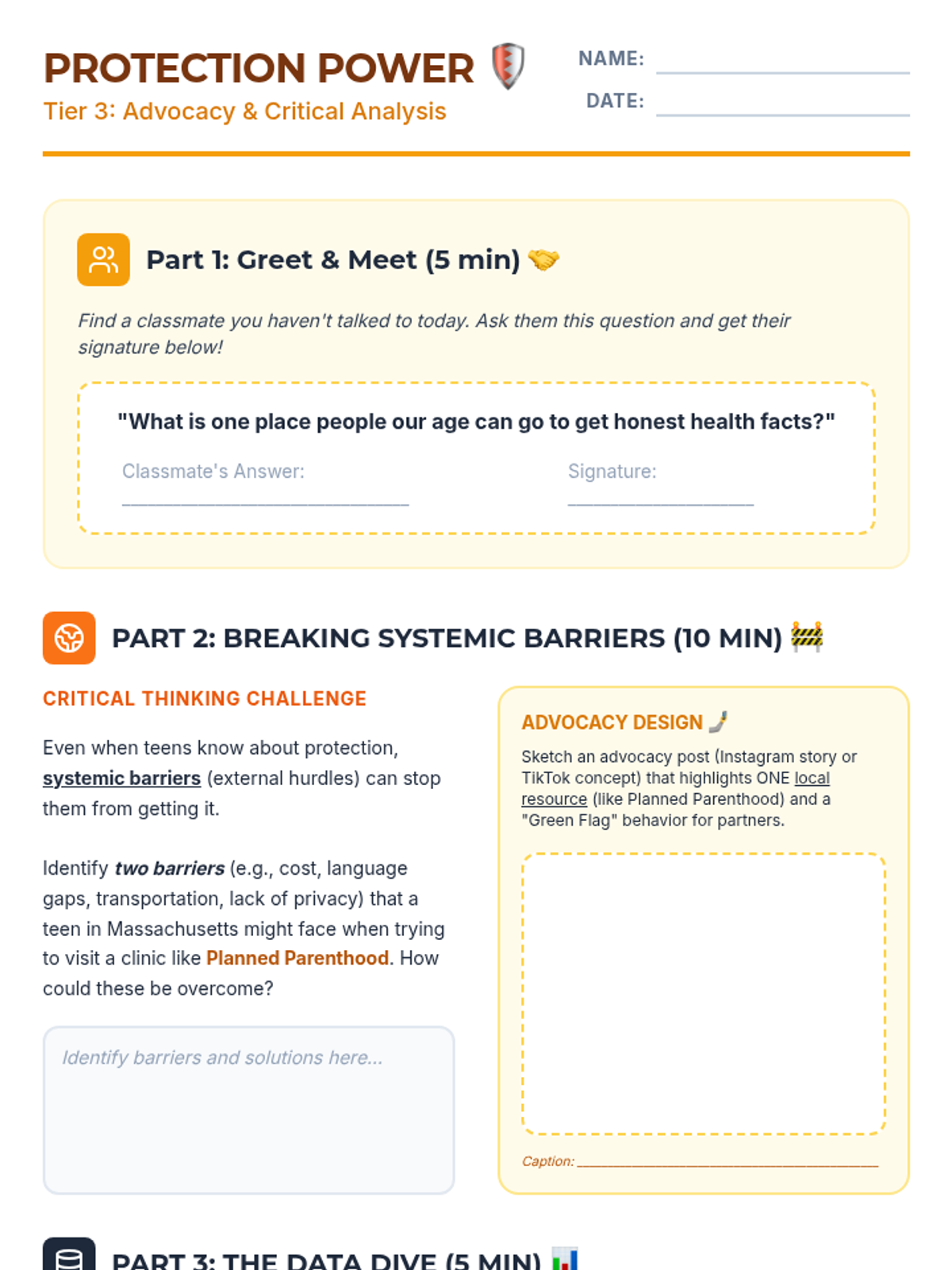
A tiered (Tier 3) student worksheet focusing on systemic barriers, advocacy design, and complex values-based debates regarding sexual health and contraceptive access.
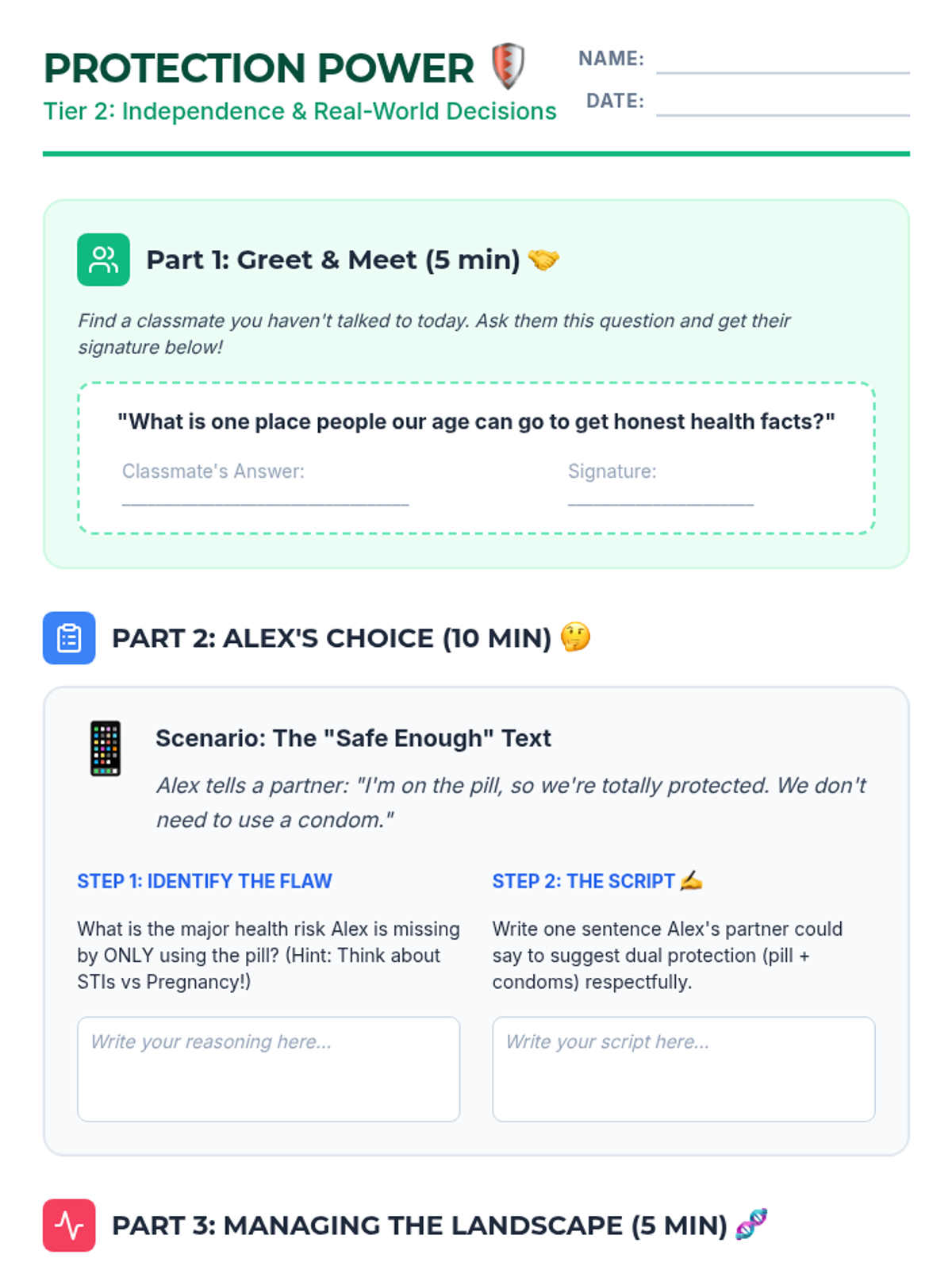
A tiered (Tier 2) student worksheet focusing on scenario analysis (Alex's choice), STI management, and role-playing communication skills for dual protection.
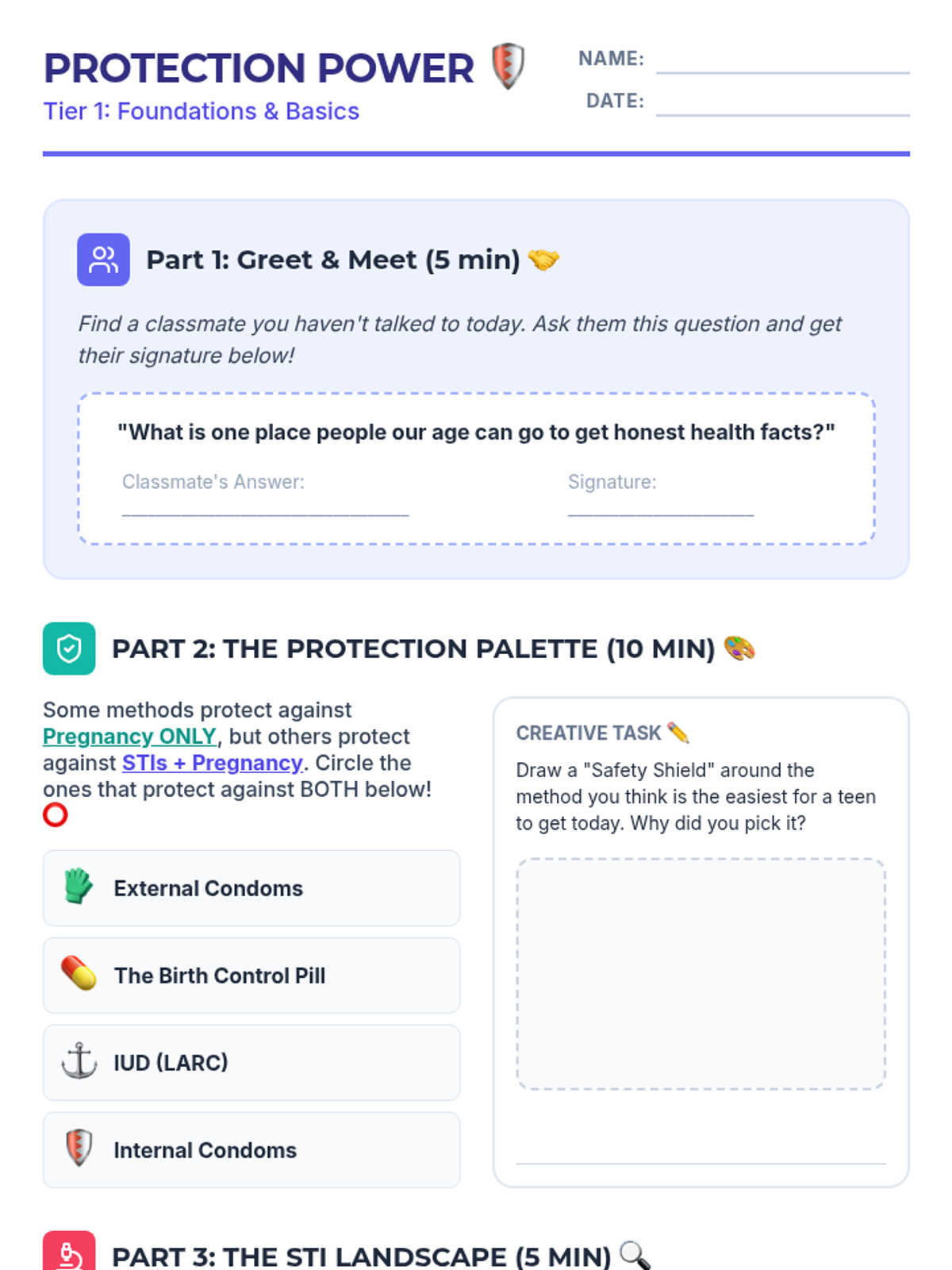
A tiered (Tier 1) student worksheet focused on foundational contraception concepts, STI categorization, and basic communication skills, featuring visual tasks and guided peer interaction.
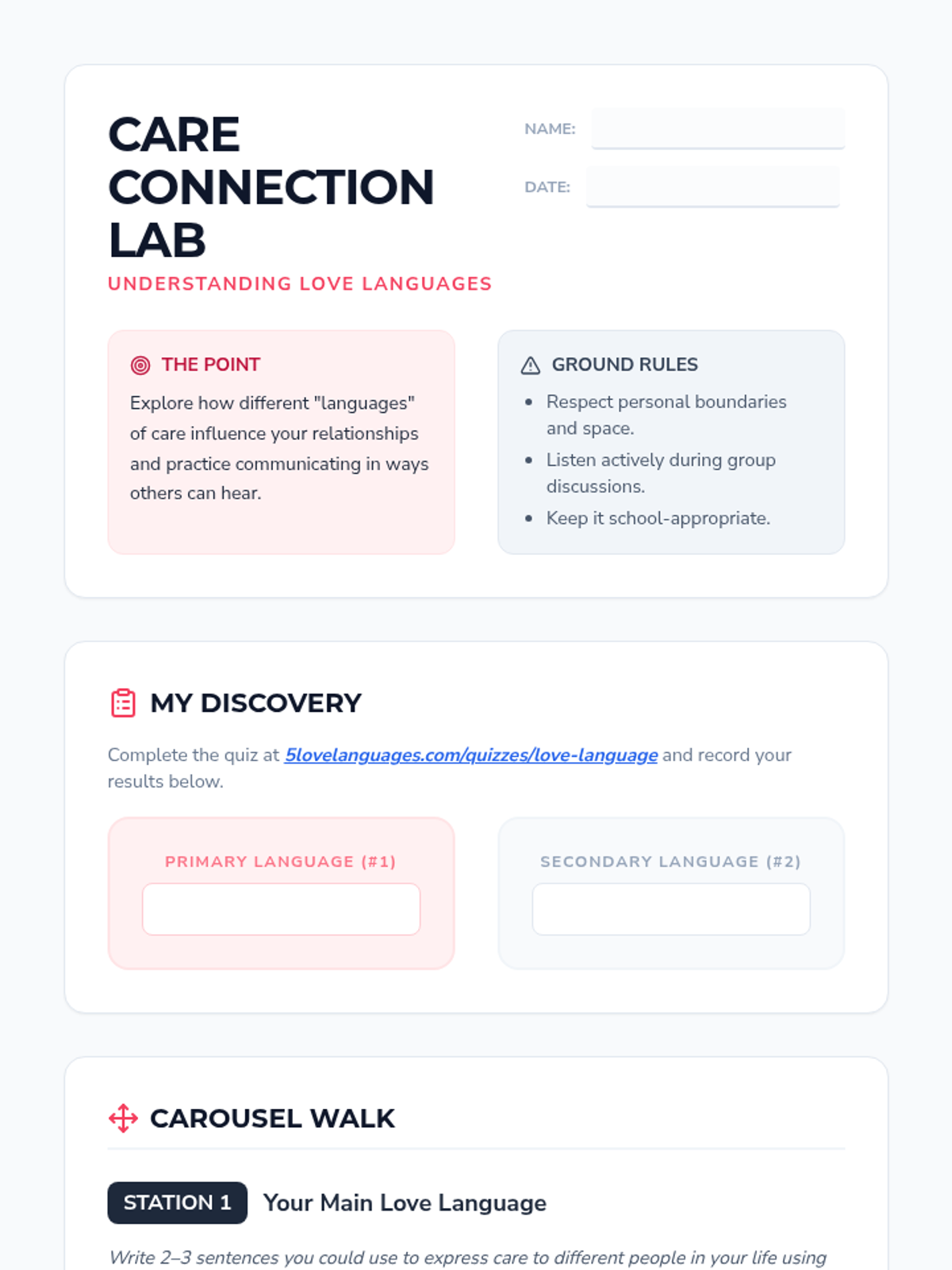
A student-facing activity sheet for the love languages lesson. It includes space for recording quiz results, writing context-specific expressions for stations 1 and 2, identifying peers with similar styles in station 3, and documenting group strategies in station 4.
A comprehensive visual presentation for instruction on love languages. It features high-quality definitions, context-specific examples, a YouTube video embed, and step-by-step instructions for a classroom carousel activity.
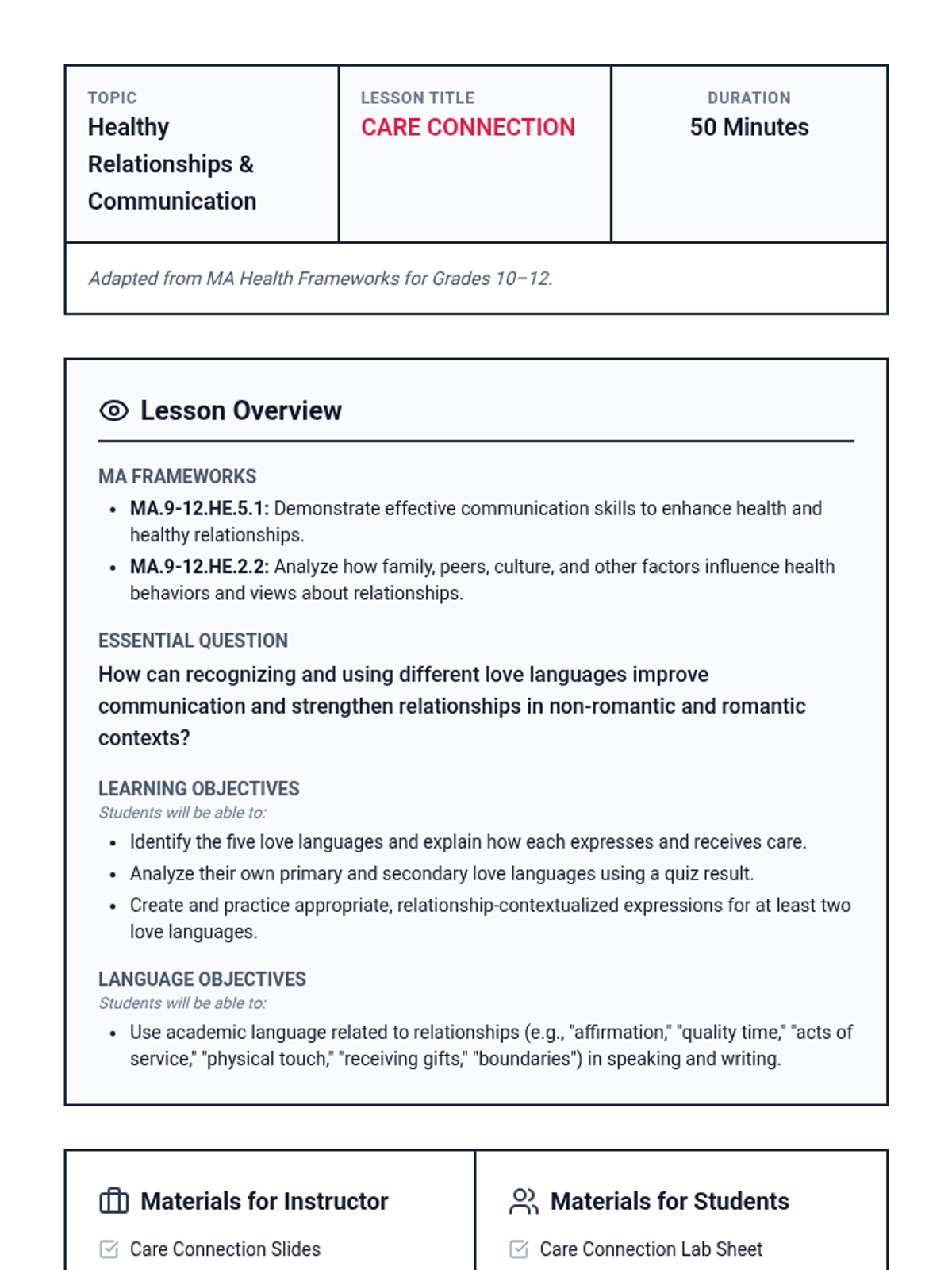
A comprehensive lesson plan for high school health education covering the five love languages, aligned with Massachusetts standards. It includes a detailed agenda, materials list, and objectives focused on healthy relationship communication.