A structured Year 11 Society and Culture lesson plan mapped directly to the NSW Stage 6 syllabus template, detailing outcomes, content, learning intentions, success criteria, and differentiation strategies for the Yolngu Boy lesson.
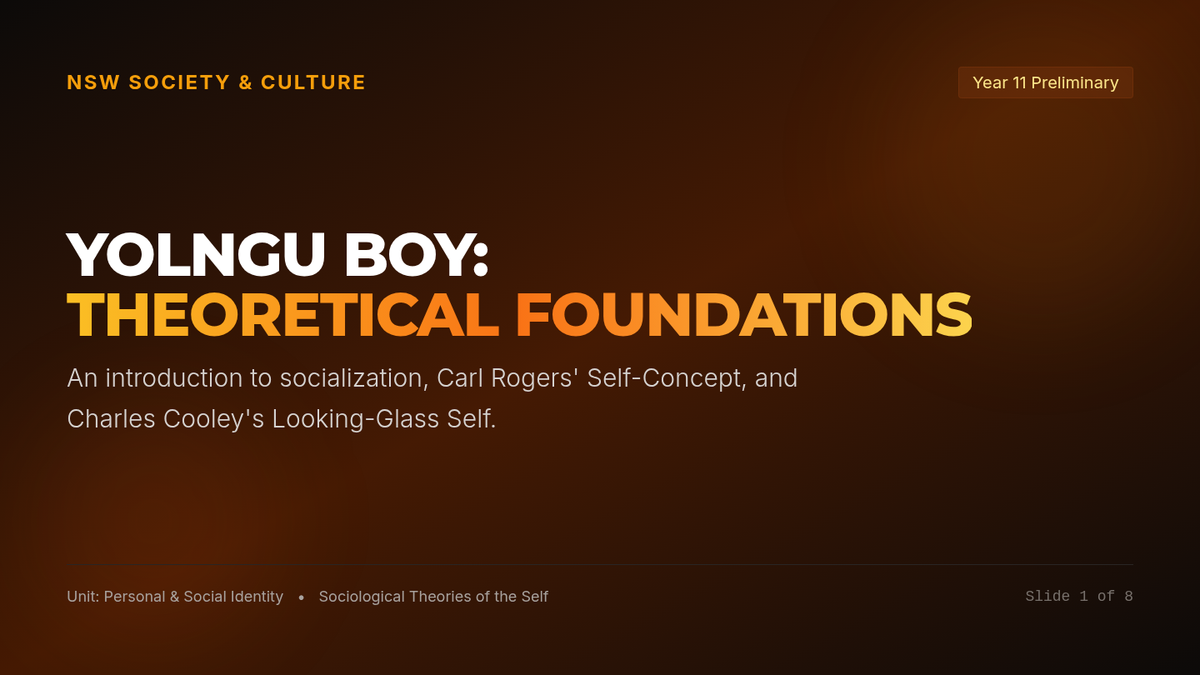
An expanded 16:9 8-slide presentation deck introducing students to Carl Rogers' Self-Concept theory and Charles Cooley's Looking-Glass Self theory, detailing their fundamental pillars and stepping through clear, visual character applications for the film Yolngu Boy.
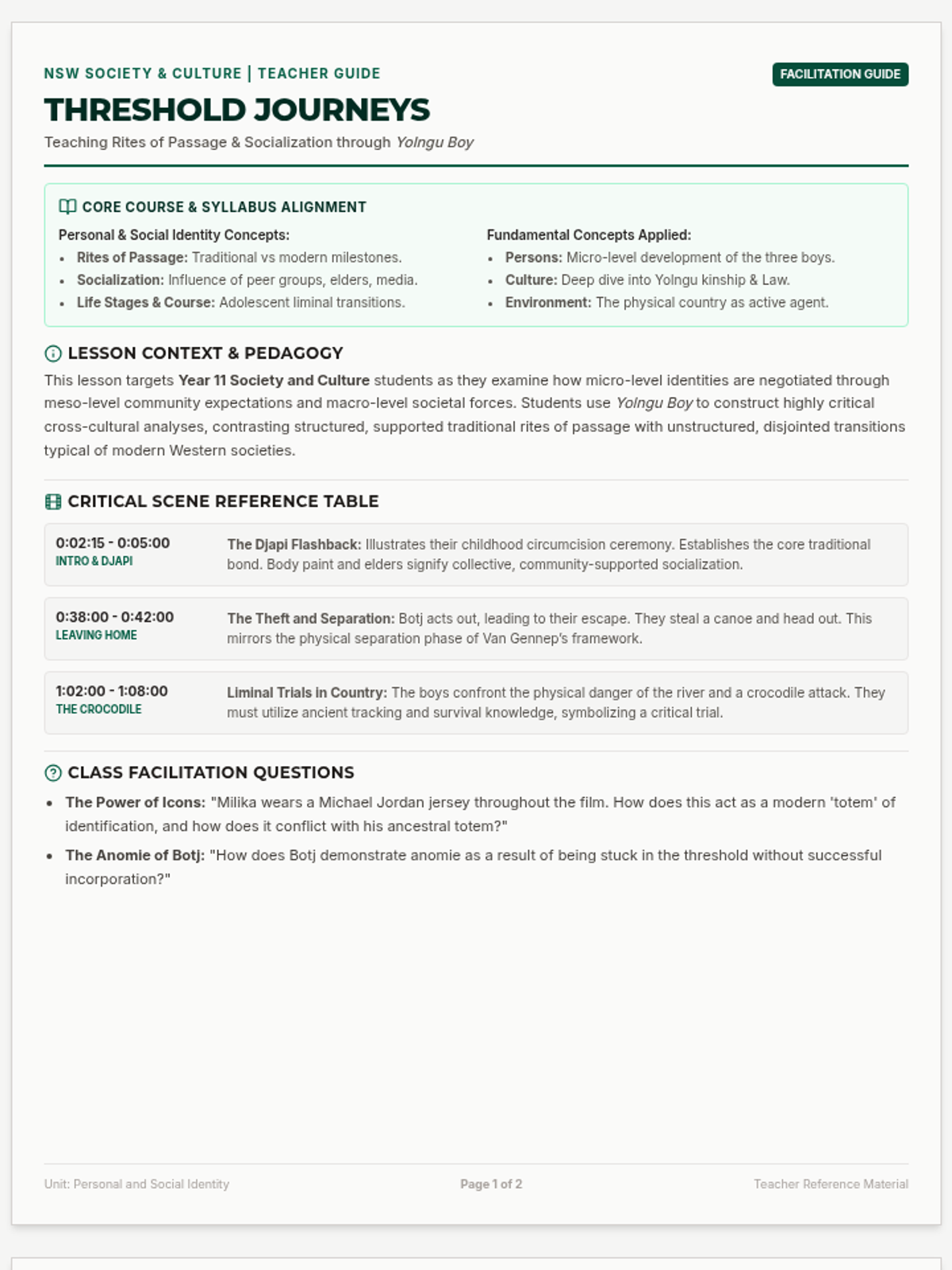
A comprehensive 2-page teacher reference guide with curriculum mapping, lesson planning notes, key film scene timestamps, Socratic questioning strategies, and detailed exemplars and marking rubrics for the student worksheet.
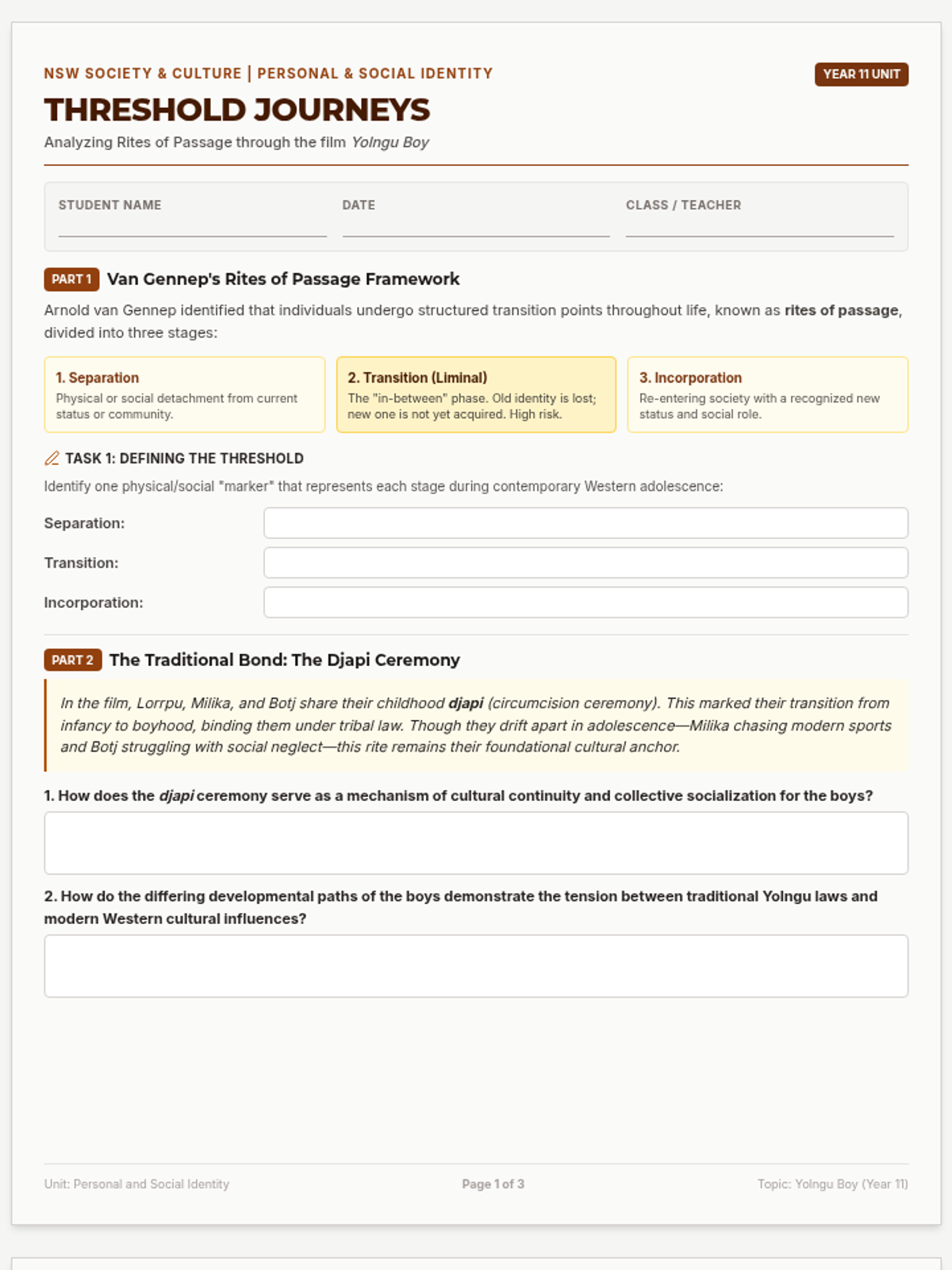
An in-depth 3-page comparative student worksheet designed to analyze Arnold van Gennep's structural stages of rites of passage within the context of the film Yolngu Boy and contemporary Western adolescent milestones. Includes a comparative matrix and an HSC-style 8-mark synthesis writing prompt.
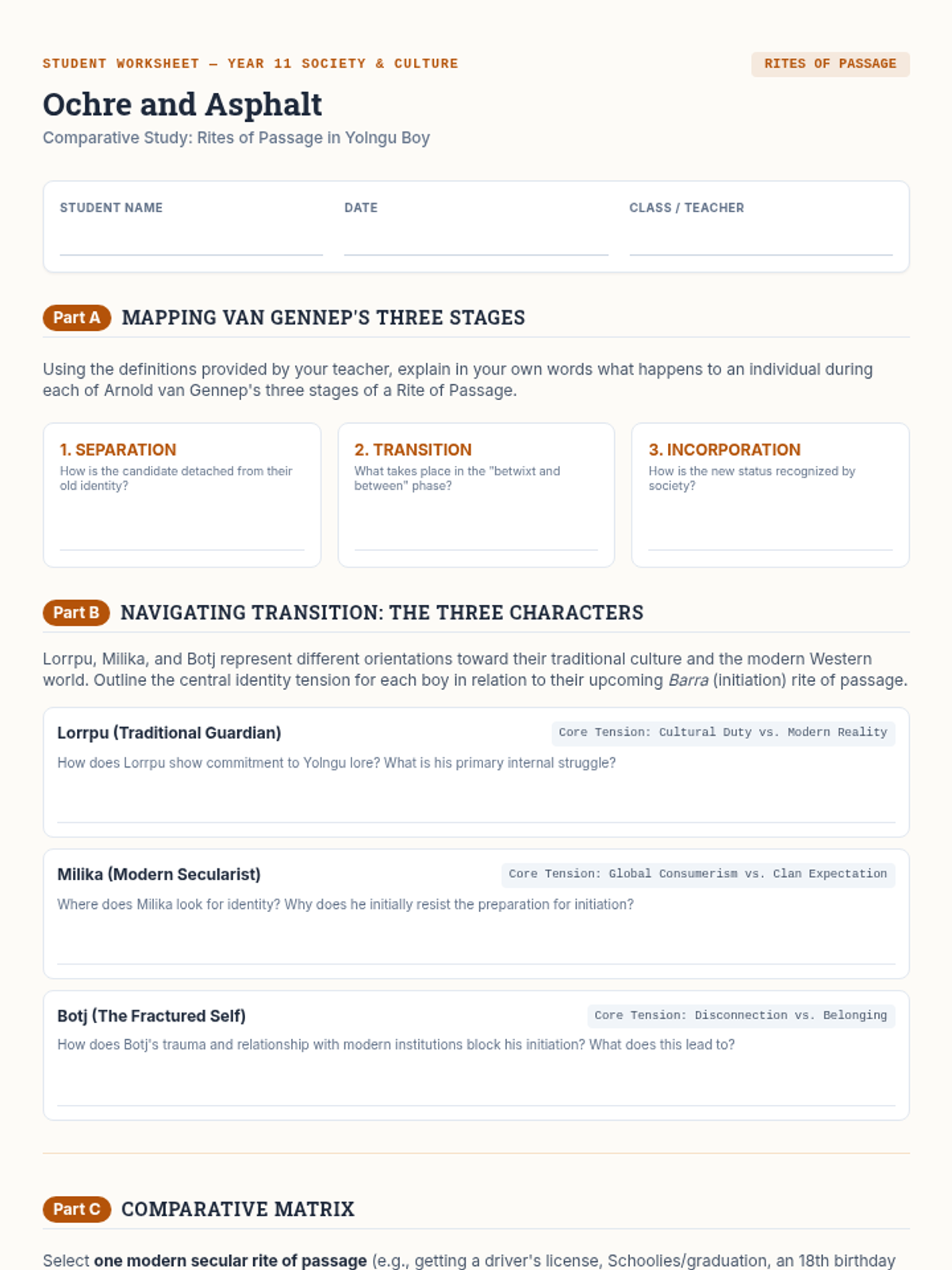
An in-depth comparative student worksheet designed for Year 11 Society & Culture. It guides students through defining Arnold van Gennep's three stages, constructing identity profiles for Botj, Loris, and Milika, completing a structured comparative matrix with secular milestones, and writing a deep analytical paragraph.
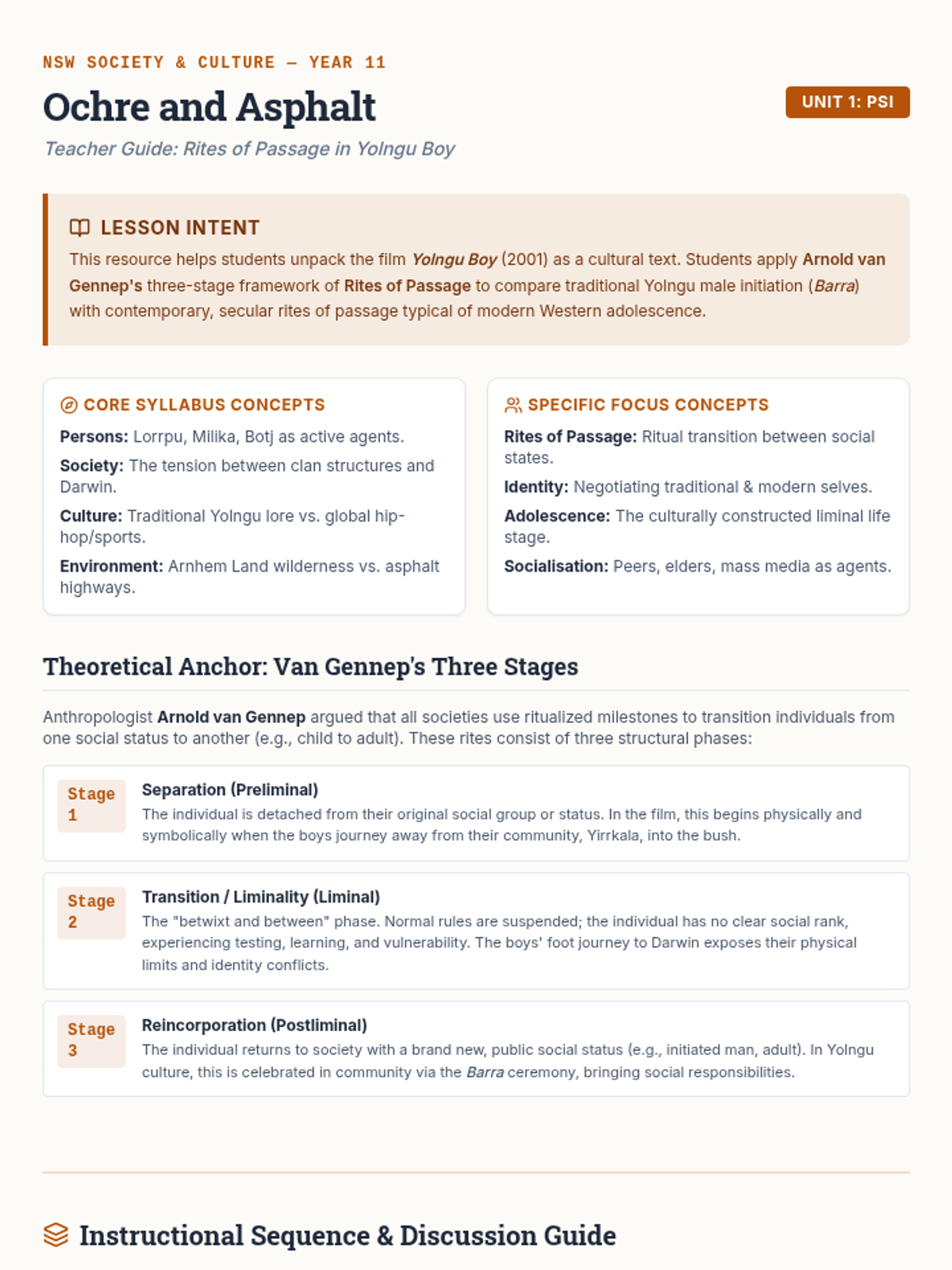
A highly detailed, professional Society & Culture teacher guide for Year 11. It outlines the theoretical framework of Arnold van Gennep's three-stage rites of passage and maps out lesson phases, character profiles (Botj, Loris, Milika), and strategic discussion prompts aligned with the film Yolngu Boy.
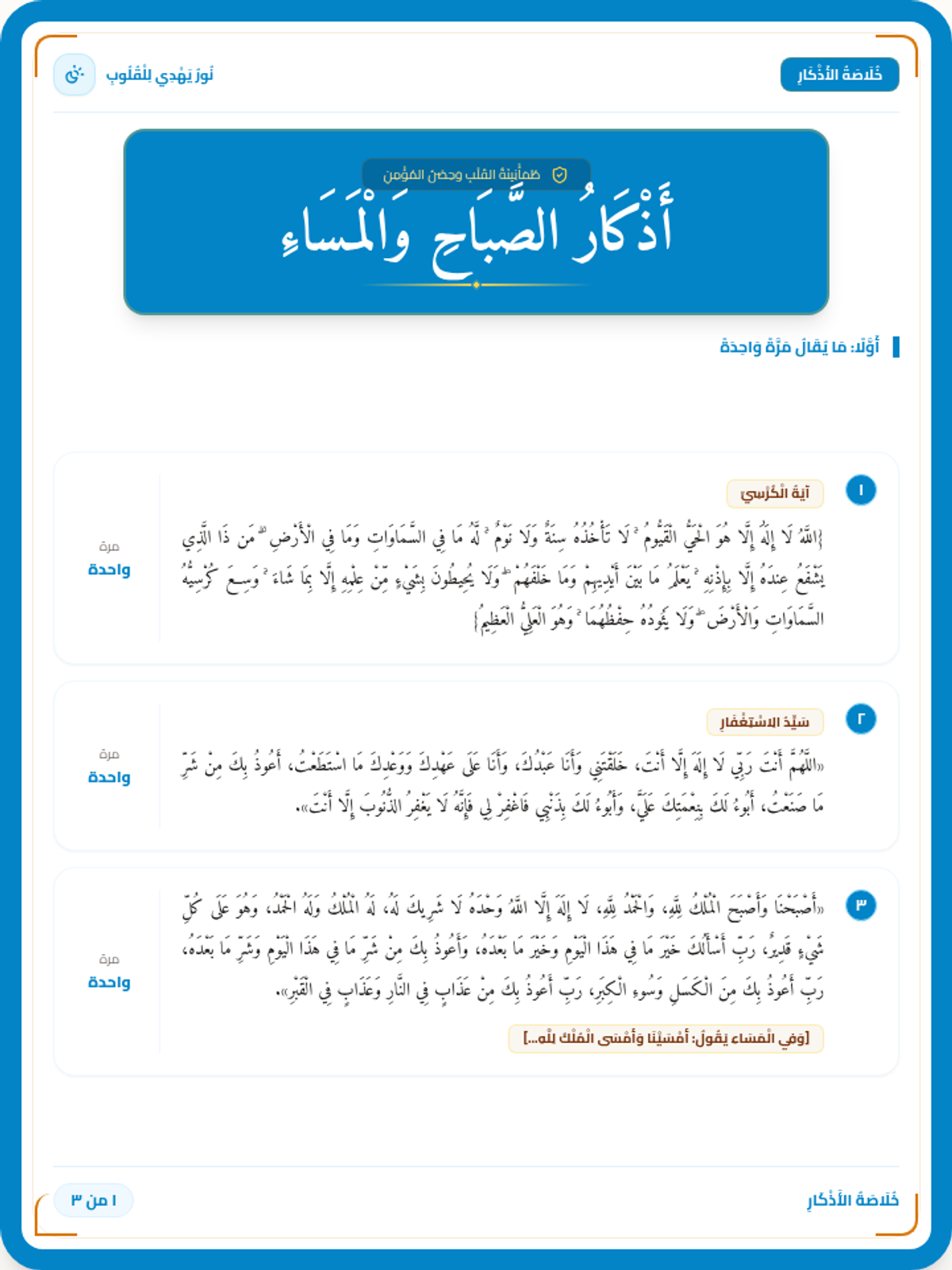
بطاقات أذكار الصباح والمساء بتصميم ملكي فاخر باللون السماوي الغامق والبيج الفاتح الفاتح (Deep Sky Blue & Pale Beige)، يحتوي على العنوان بحجم خط عريض وكبير في وسط الصفحة الأولى داخل شكل بيجي دافئ، مع استبدال النجم بـ شمس وقمر، وحذف عبارة يكن لك حصنا حصينا من النصيحة الروحية.
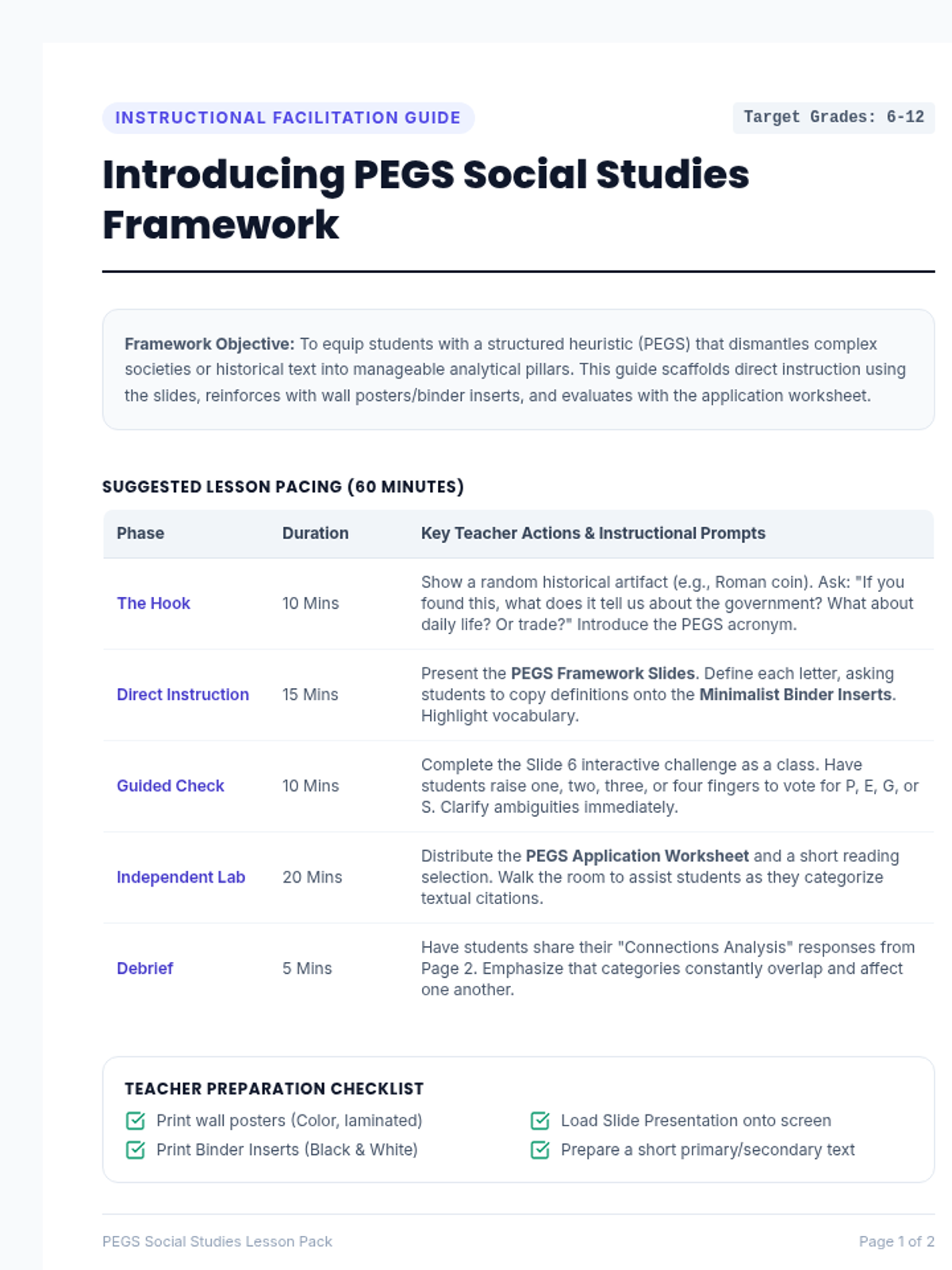
An essential 2-page instructional guide for teachers. Page 1 delivers a clear 60-minute lesson pacing outline, teacher action flows, and a prep checklist. Page 2 offers Socratic questioning strategies, analysis on common student misconceptions, and a highly structured grading rubric.
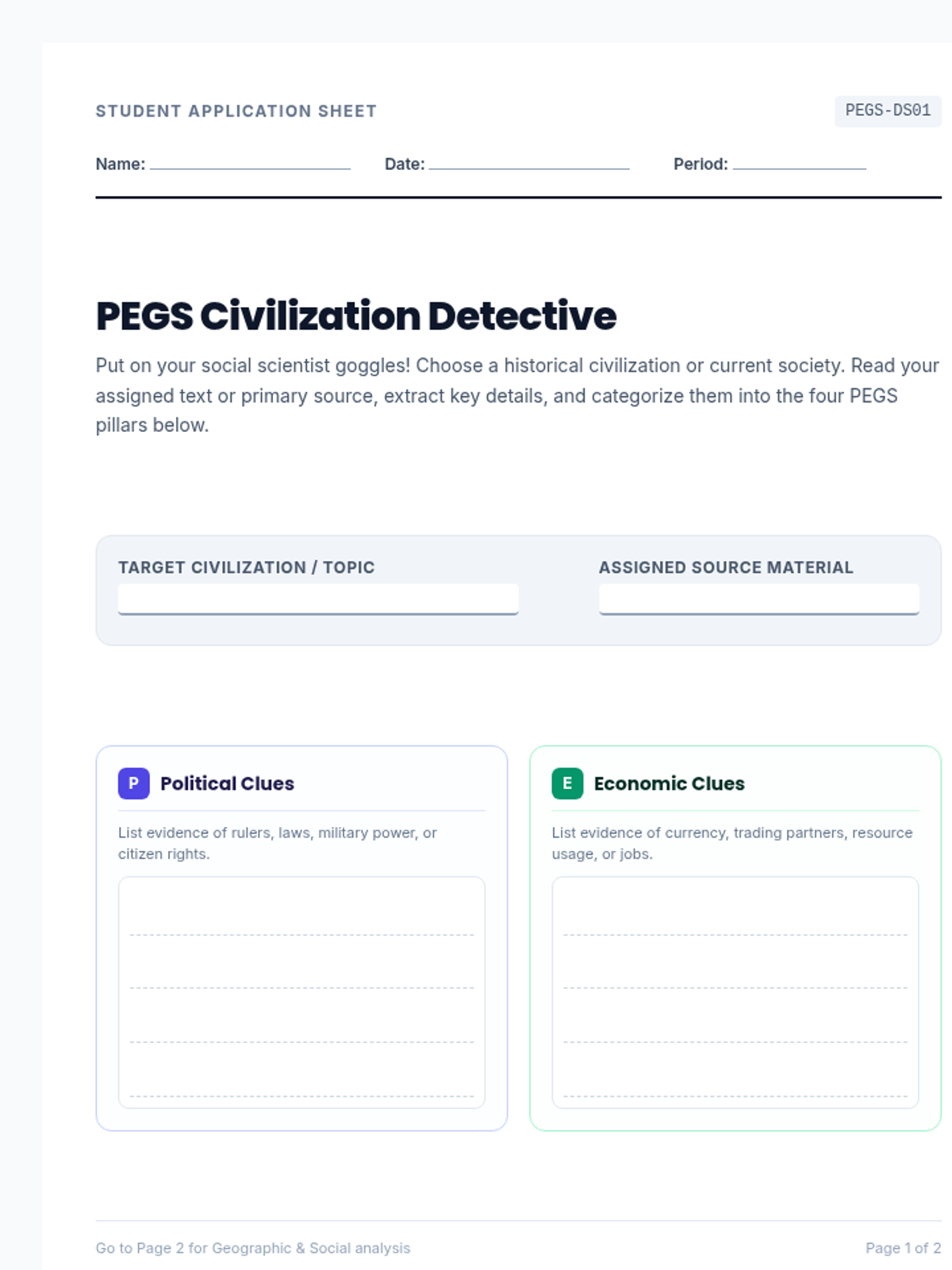
A highly versatile 2-page student analysis worksheet. Features custom, ink-friendly, white-background entry fields for compiling evidence across all 4 PEGS dimensions (Political, Economic, Geographic, Social) and a final critical-thinking synthesis section where students analyze cross-pillar connections.
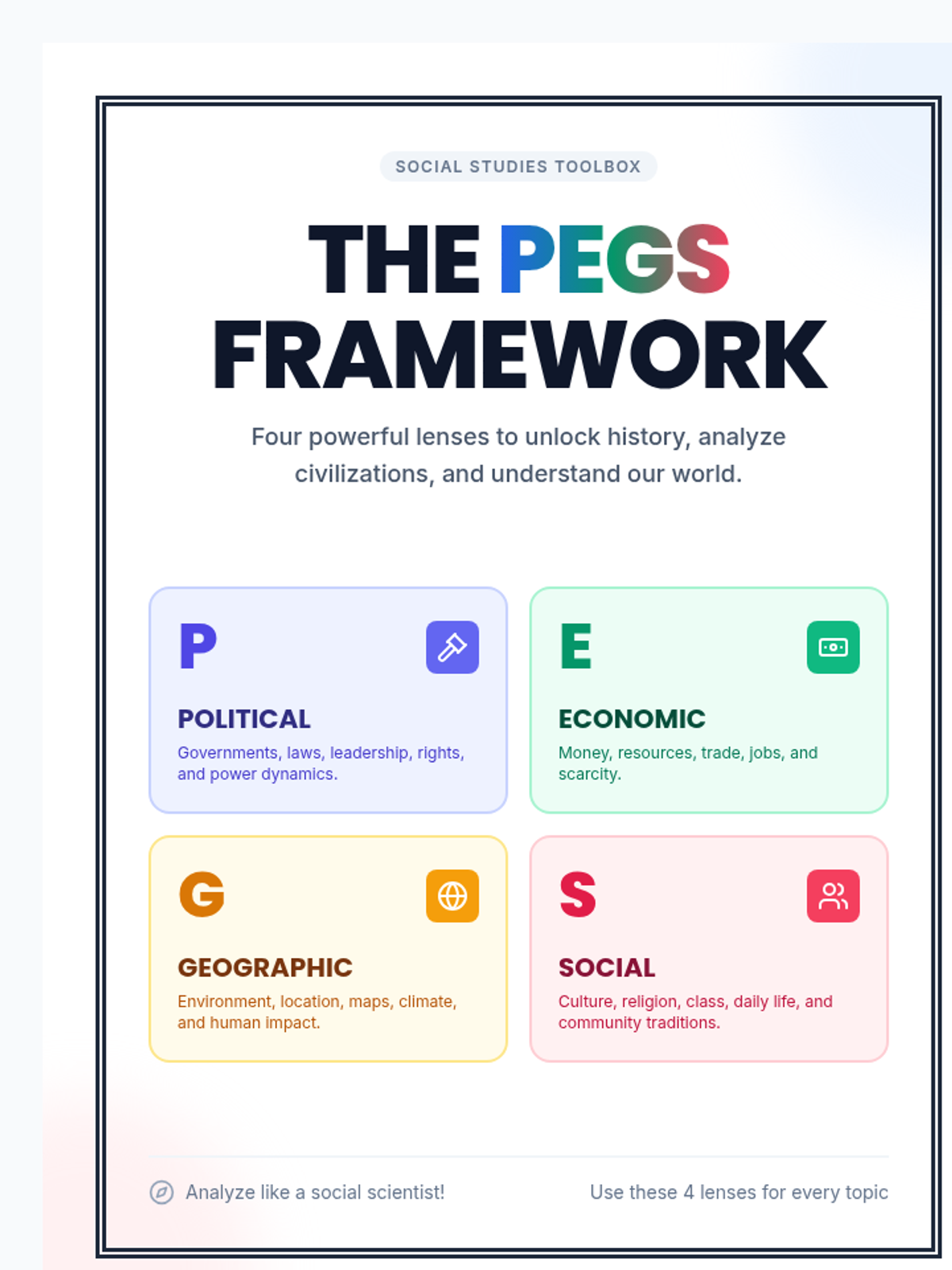
An engaging 6-slide widescreen presentation designed for introducing the PEGS framework to students. Features robust slide breakdowns for Political, Economic, Geographic, and Social criteria, utilizing massive high-visibility text, matching category colors, and a fun interactive naming challenge at the end.
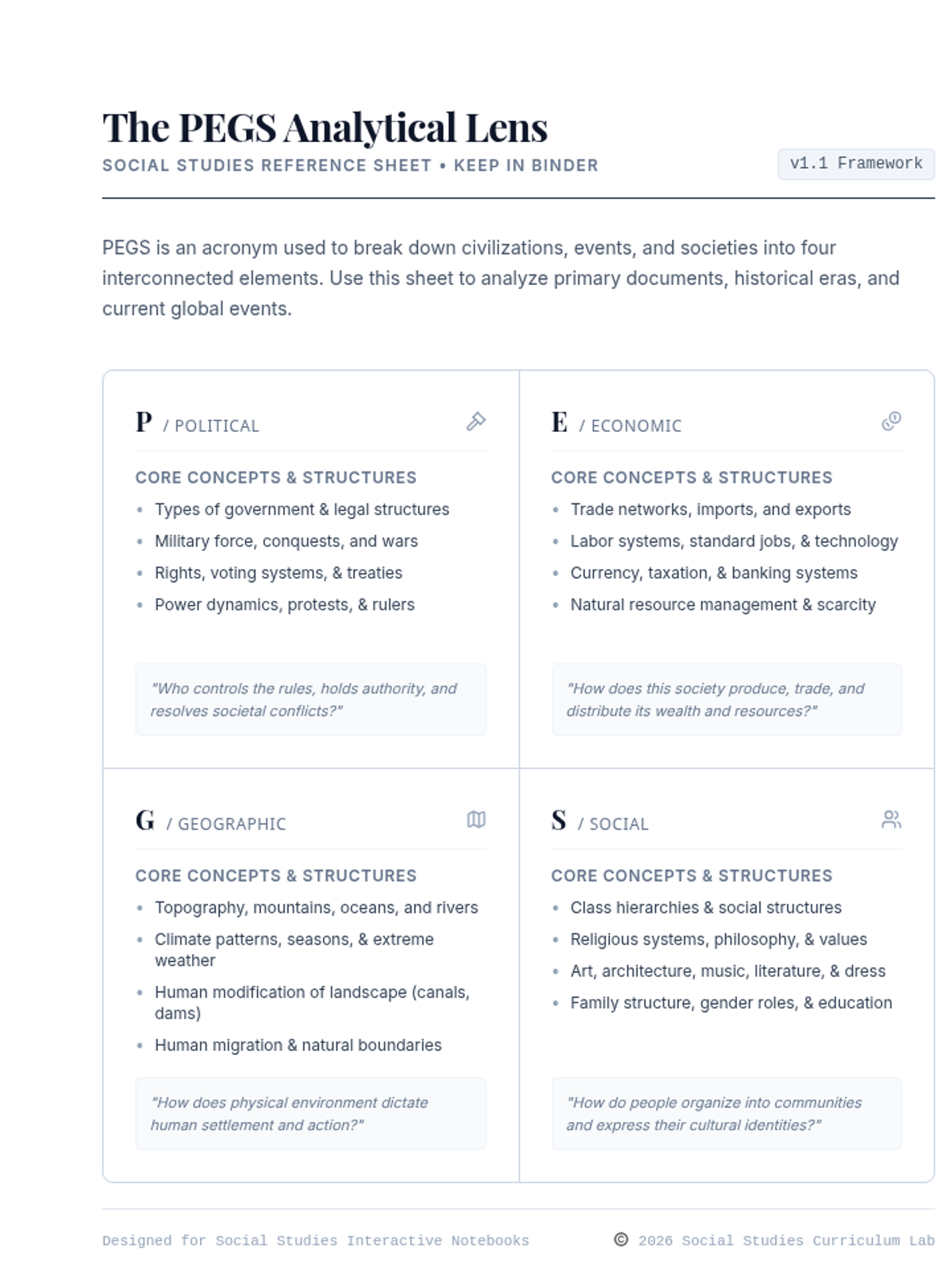
An elegant, minimalist 2-page student binder insert set. Page 1 provides a high-density reference sheet detailing key components of the PEGS analytical lens, while Page 2 features an actionable primary source inquiry checklist for classroom analysis and active reading.
A stunning, vibrant, icon-heavy set of 5 vertical classroom posters. Features a main title page followed by deeply detailed visual breakdown pages for Political (P), Economic (E), Geographic (G), and Social (S) categories. Complete with core questions, buzzwords, and inquiry checklists.
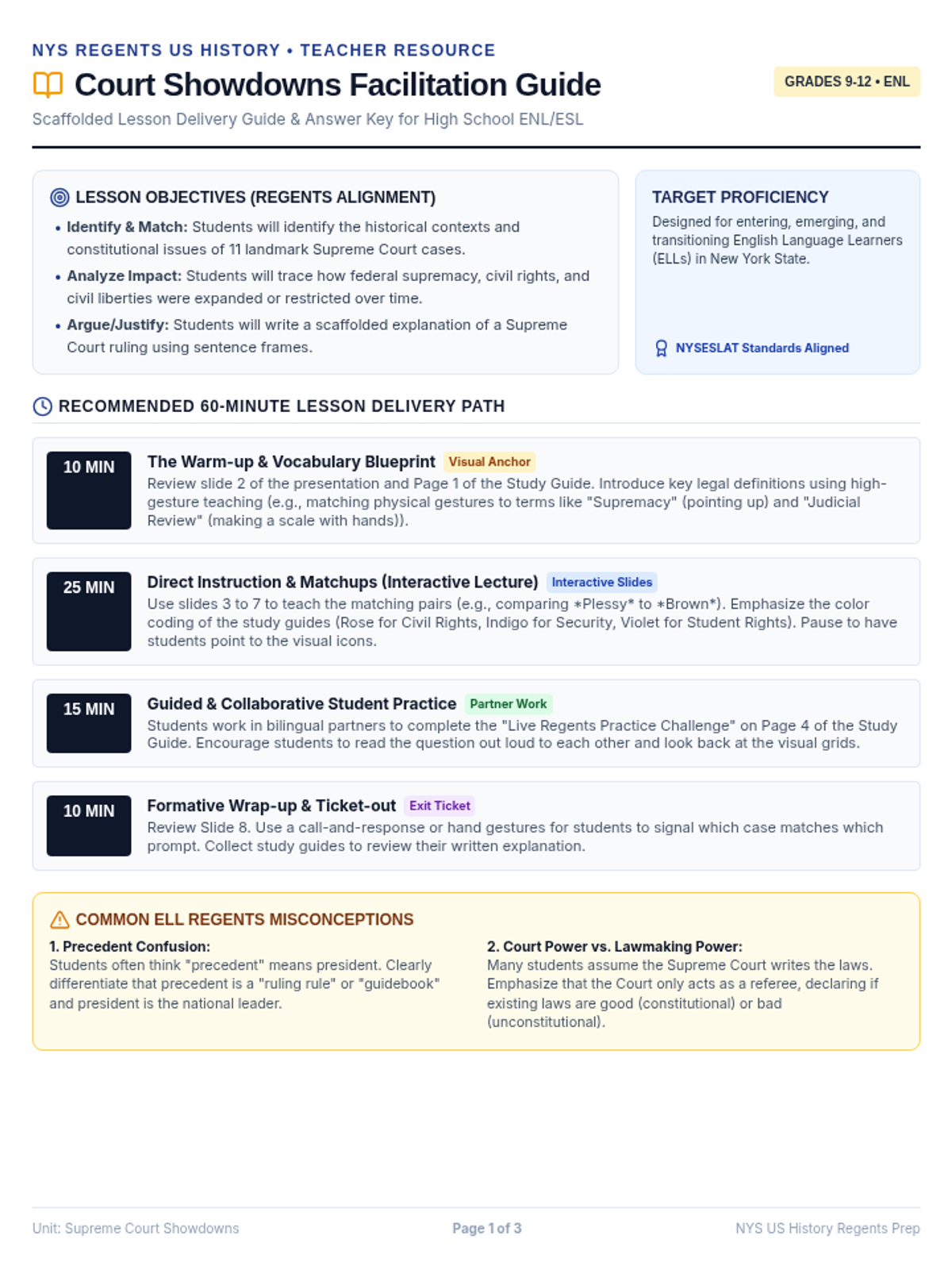
A teacher-facing lesson plan, pacing guide, tiered ENL questioning matrix, multilingual legal vocabulary guide, and complete answer keys to guide instruction for the Supreme Court Showdowns materials.
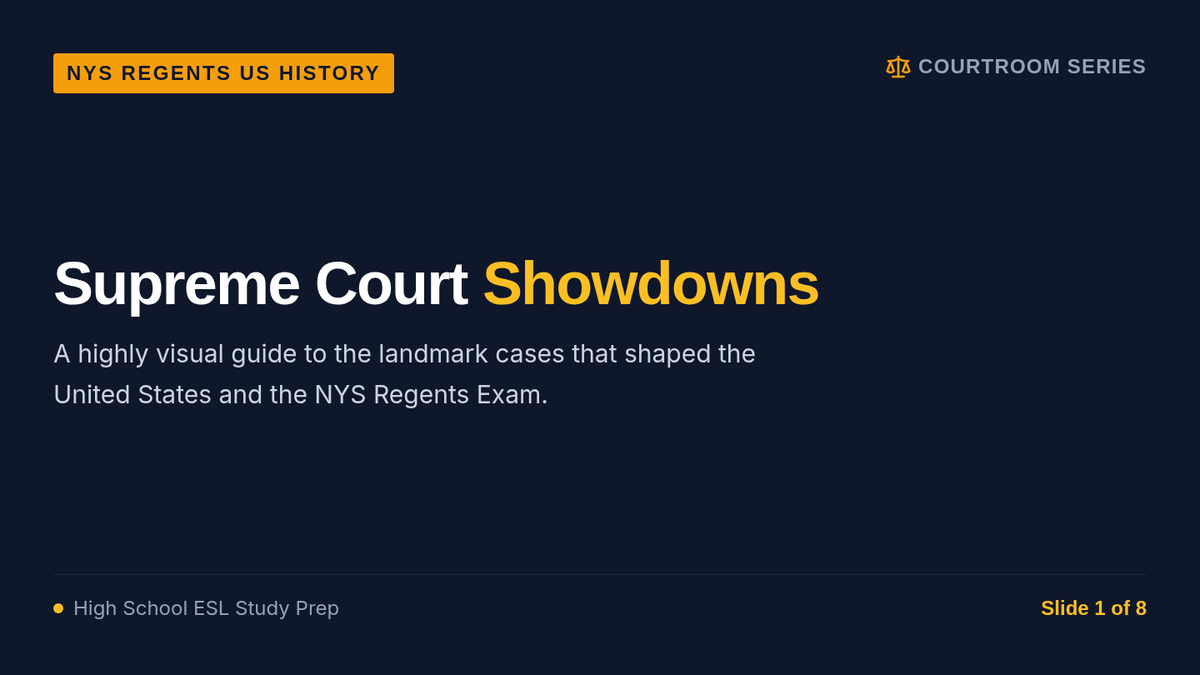
An 8-slide, high-impact courtroom-themed presentation designed for direct instruction on key Supreme Court cases. Focuses on simple explanations, visual comparative matchups, and strict 24px+ text readability for high school ESL classrooms.
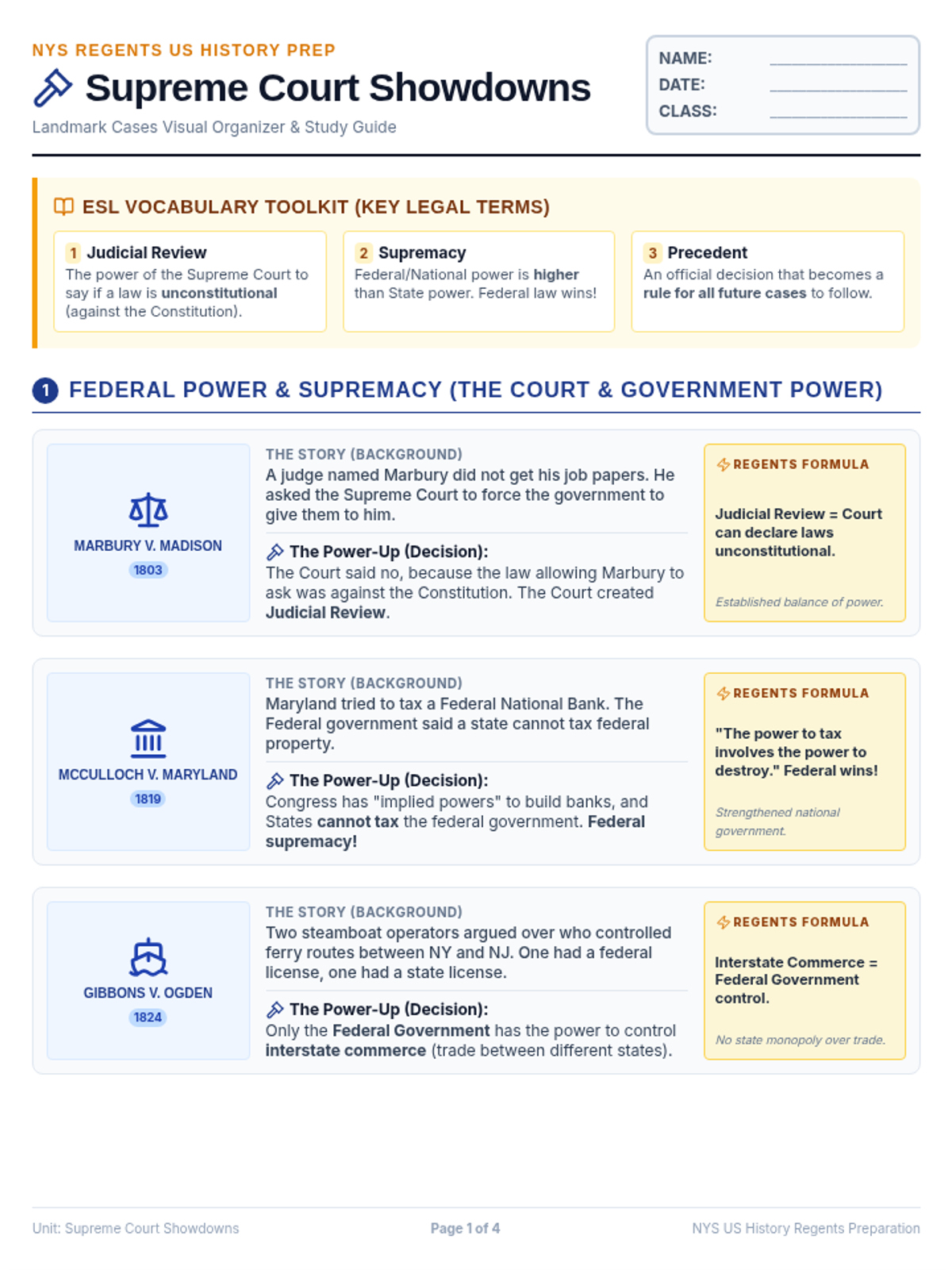
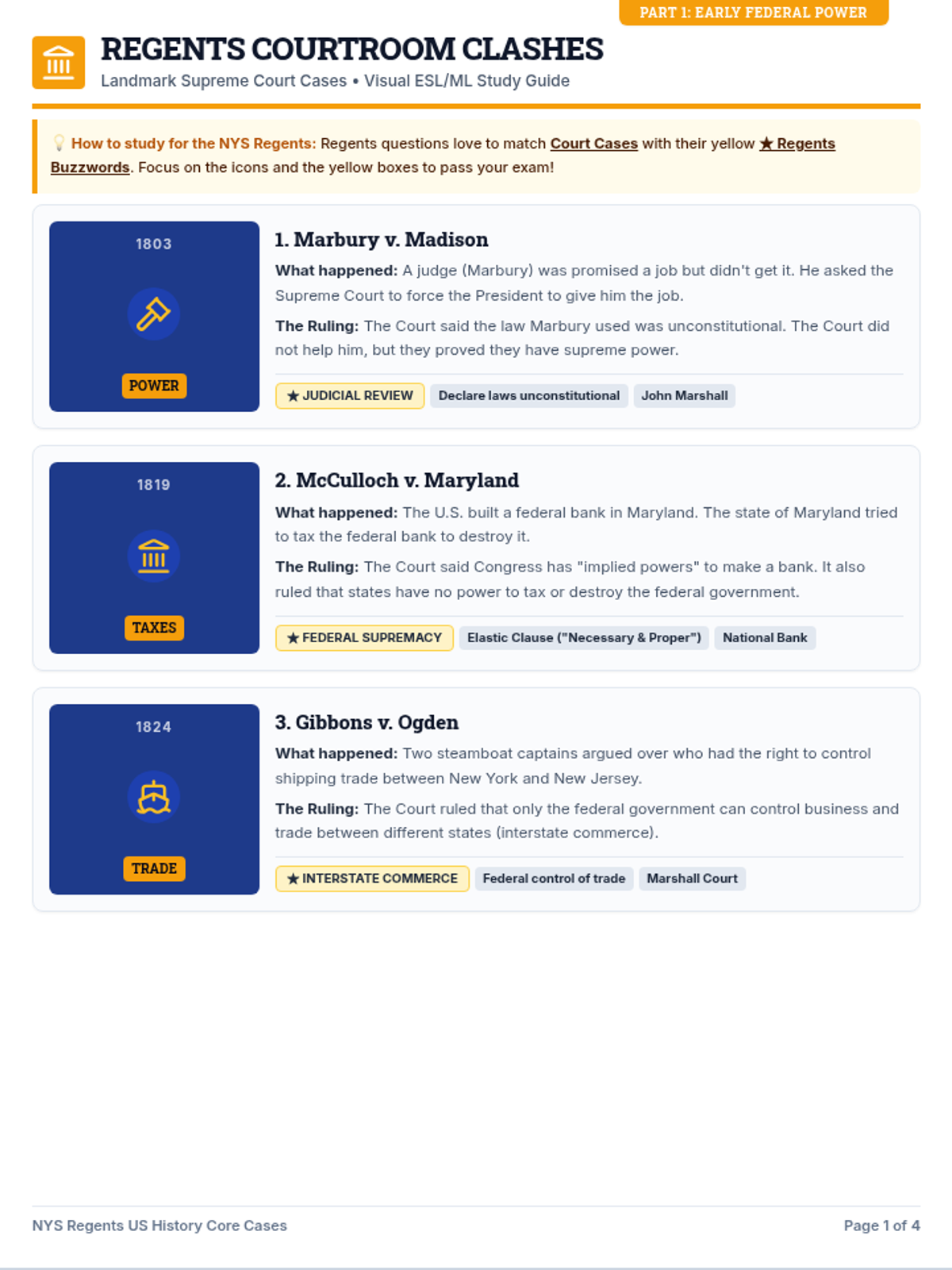
A 4-page highly-visual, structured study guide overview of crucial landmark Supreme Court cases for the NYS Regents exam. Tailored specifically for ESL students with clear definitions, visual graphic organizer cards, and annotated Regents practice.
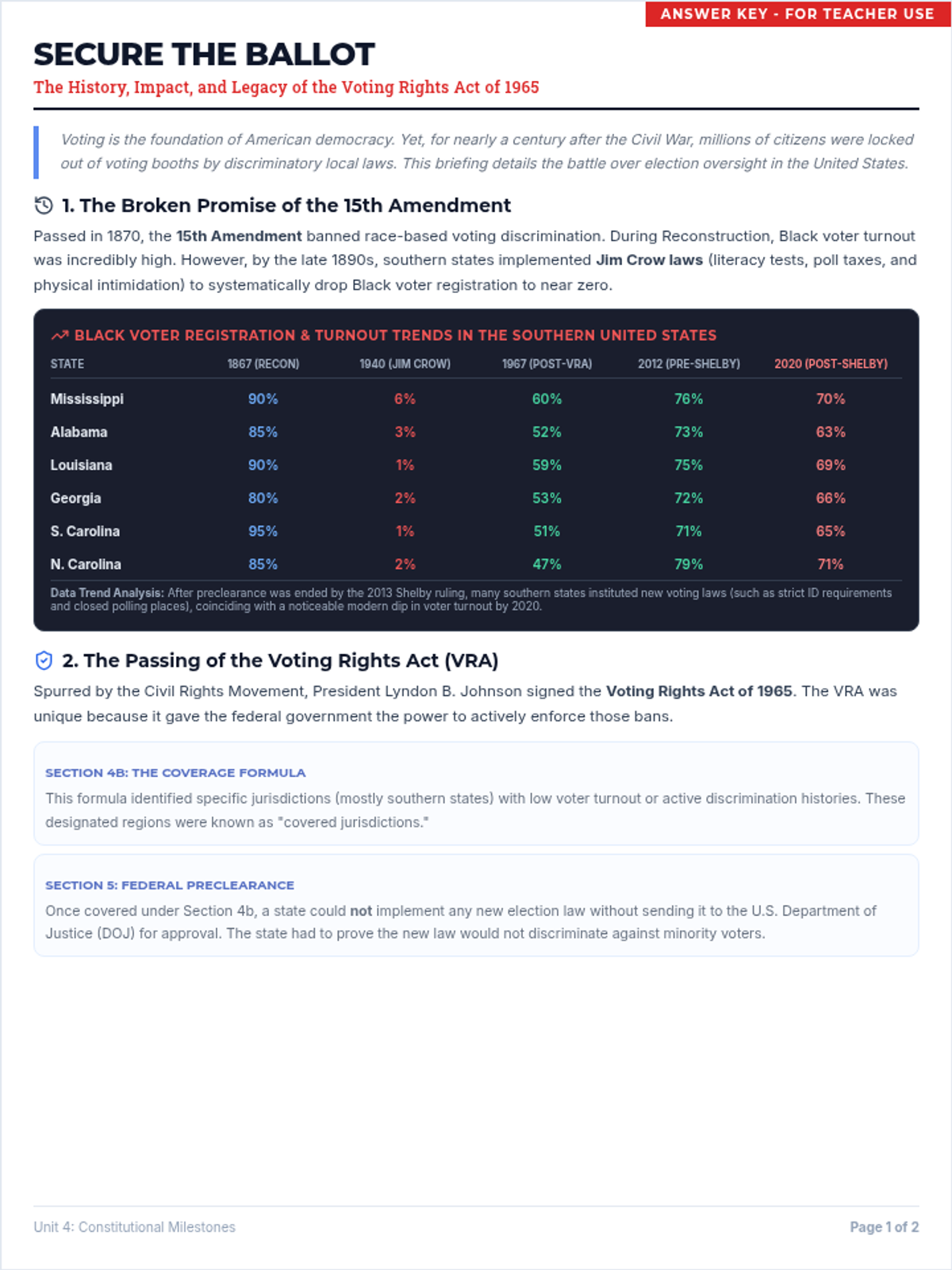
The matching teacher answer key for the Voting Rights Act background sheet, populated with high-quality exemplar responses for text-dependent reading comprehension questions.
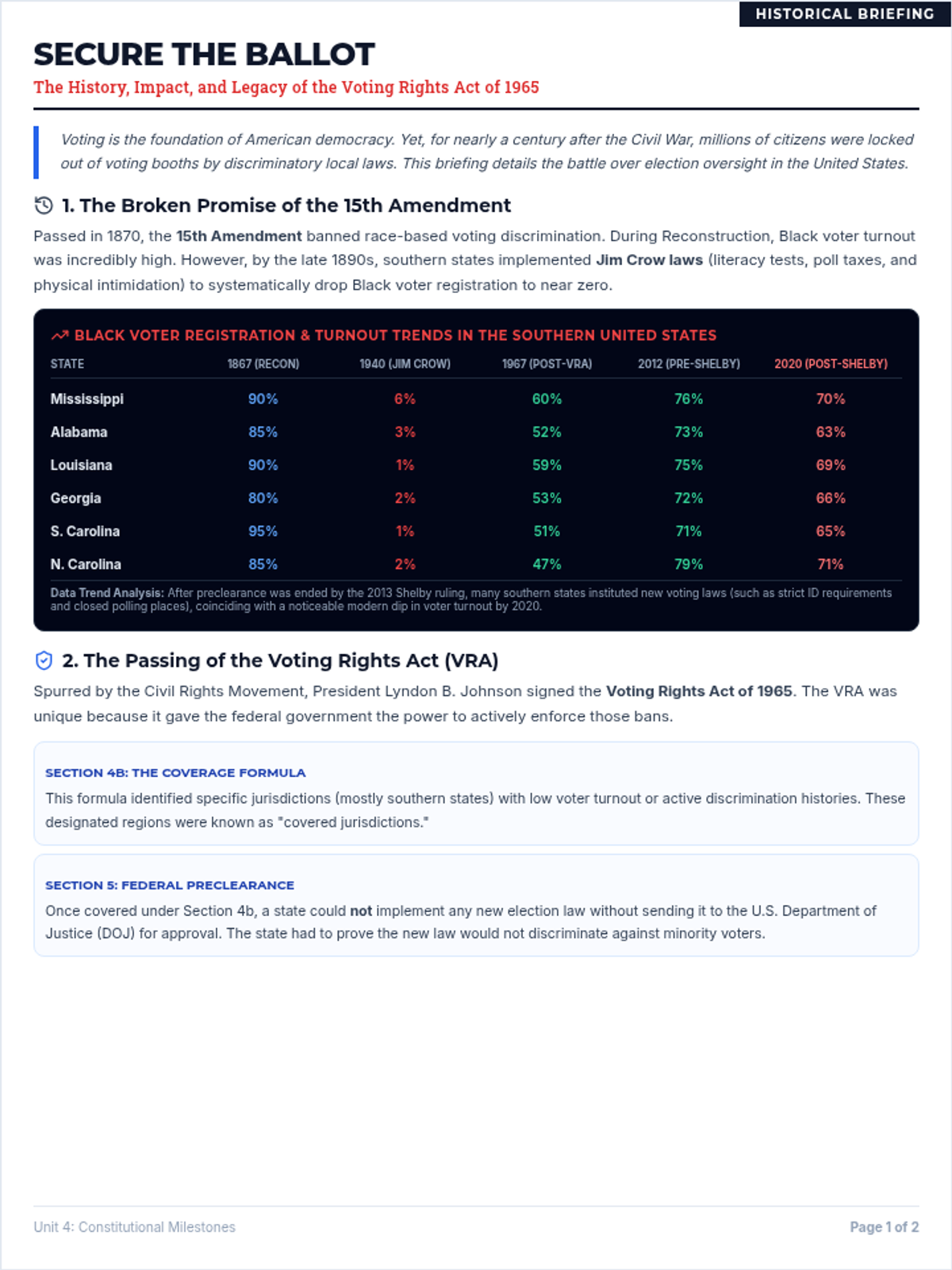
A comprehensive, highly readable historical background sheet for students explaining the 15th Amendment, Jim Crow voting barriers, VRA Sections 4b/5, and the Shelby County v. Holder decision. Includes three text-dependent reading comprehension questions.
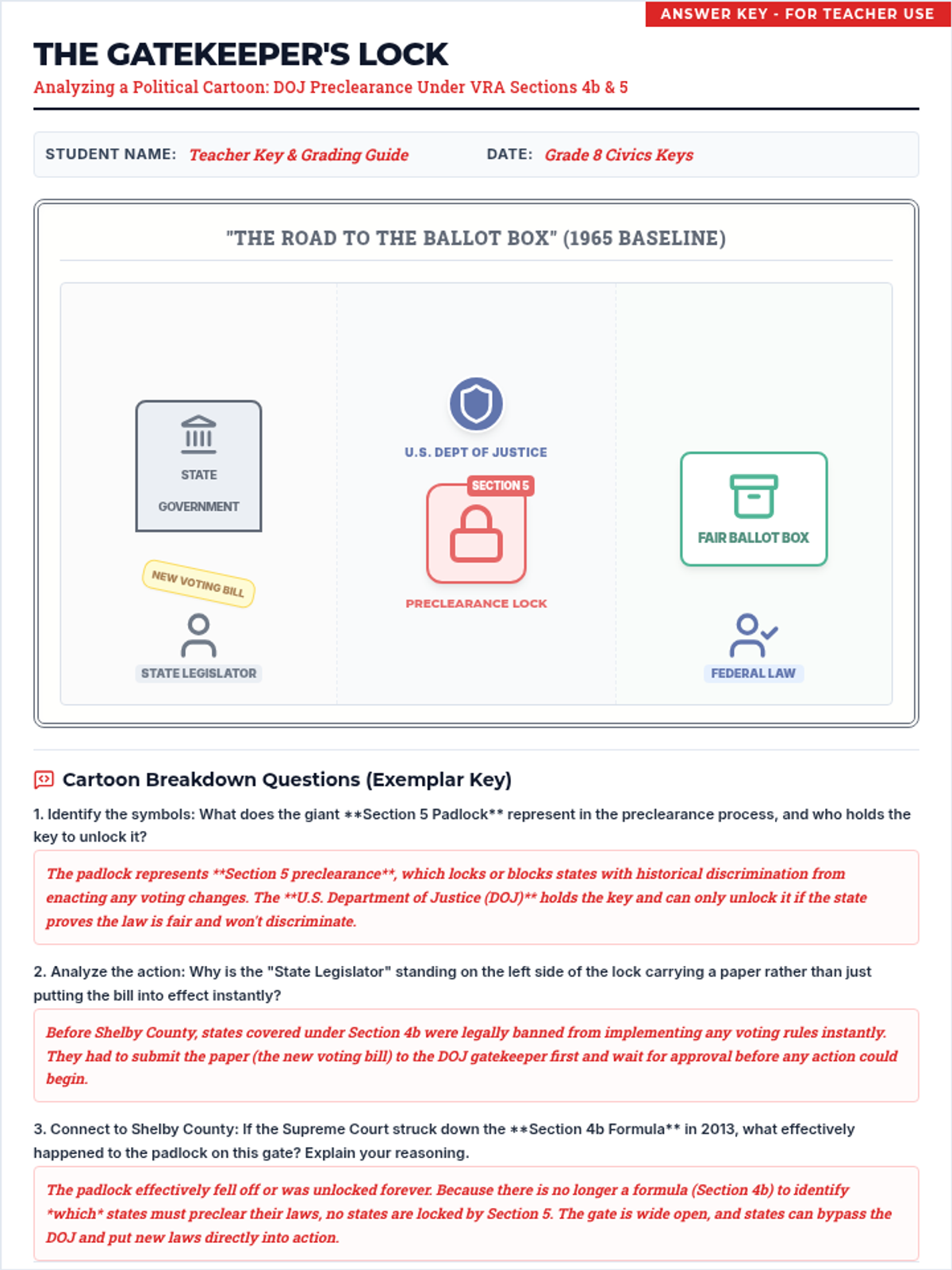
The matching teacher answer key for the gatekeeper political cartoon analysis activity, detailing symbols, preclearance rules, and Shelby County impacts.
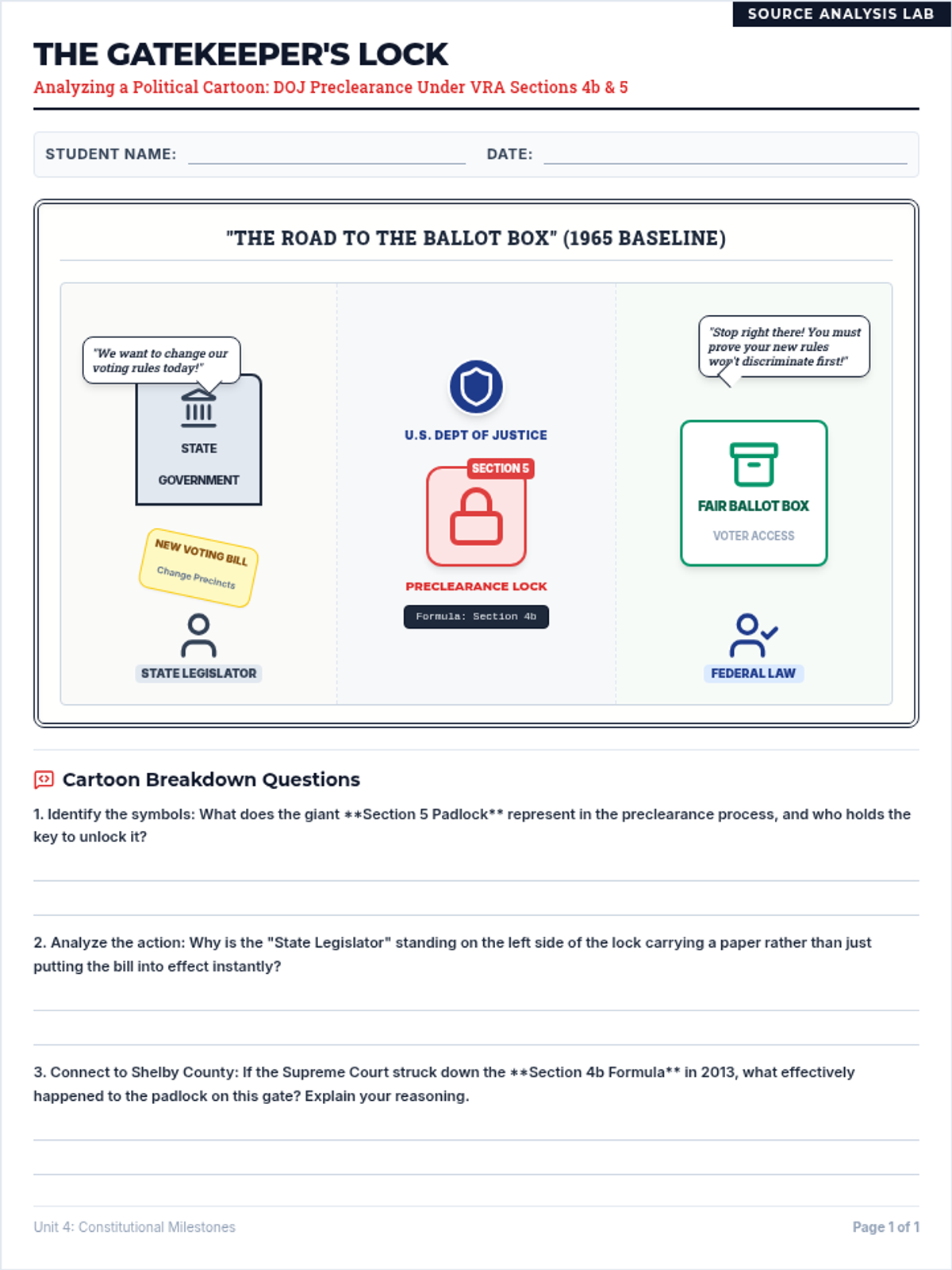
A visual source analysis worksheet focused on a custom political cartoon representing the DOJ's federal preclearance gatekeeper role under VRA Sections 4b and 5. Includes scaffolding and observation questions for 8th-grade civics.
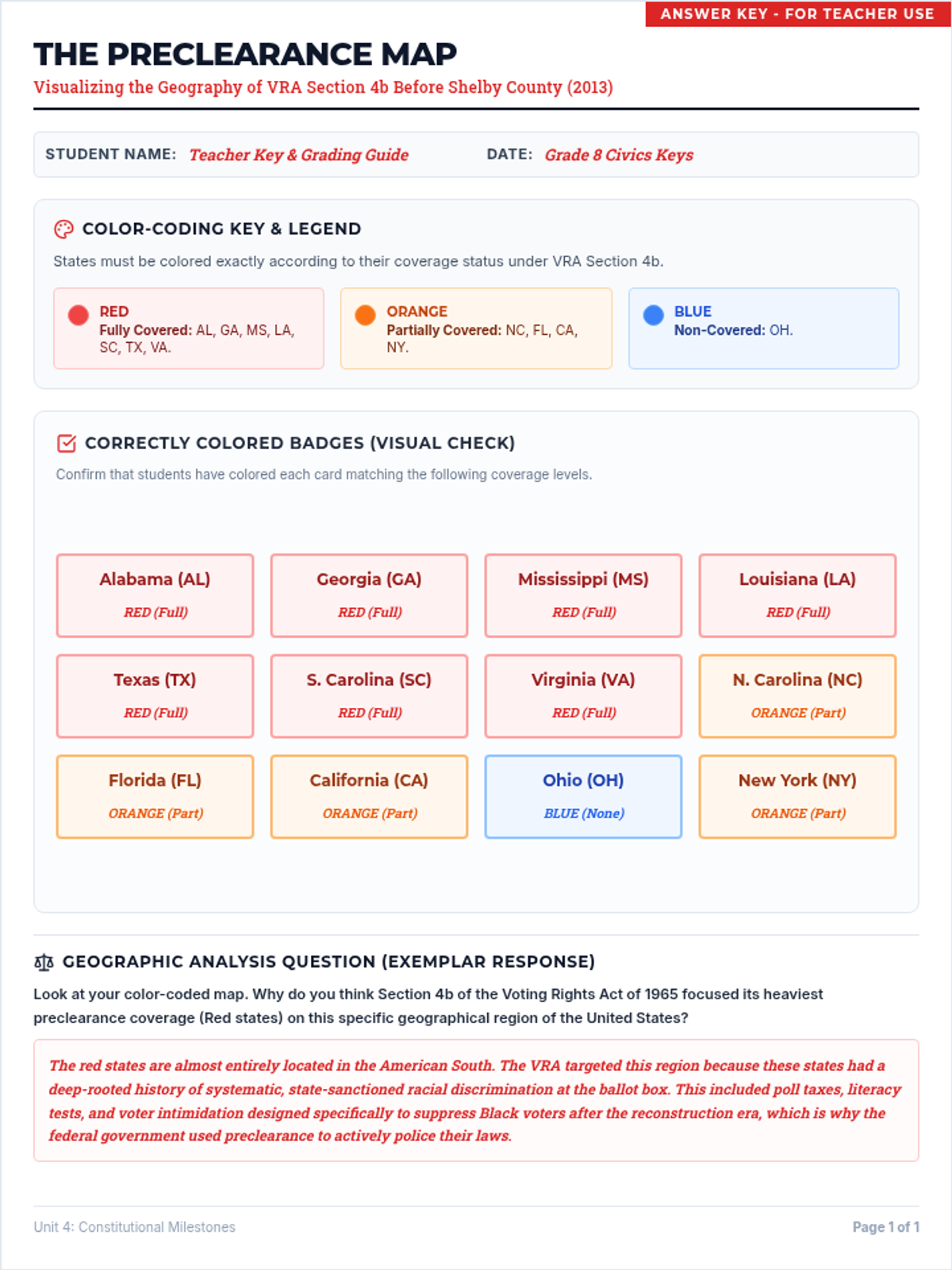
The matching teacher answer key for the preclearance map activity, featuring visual indicators and geographic analysis guidance.
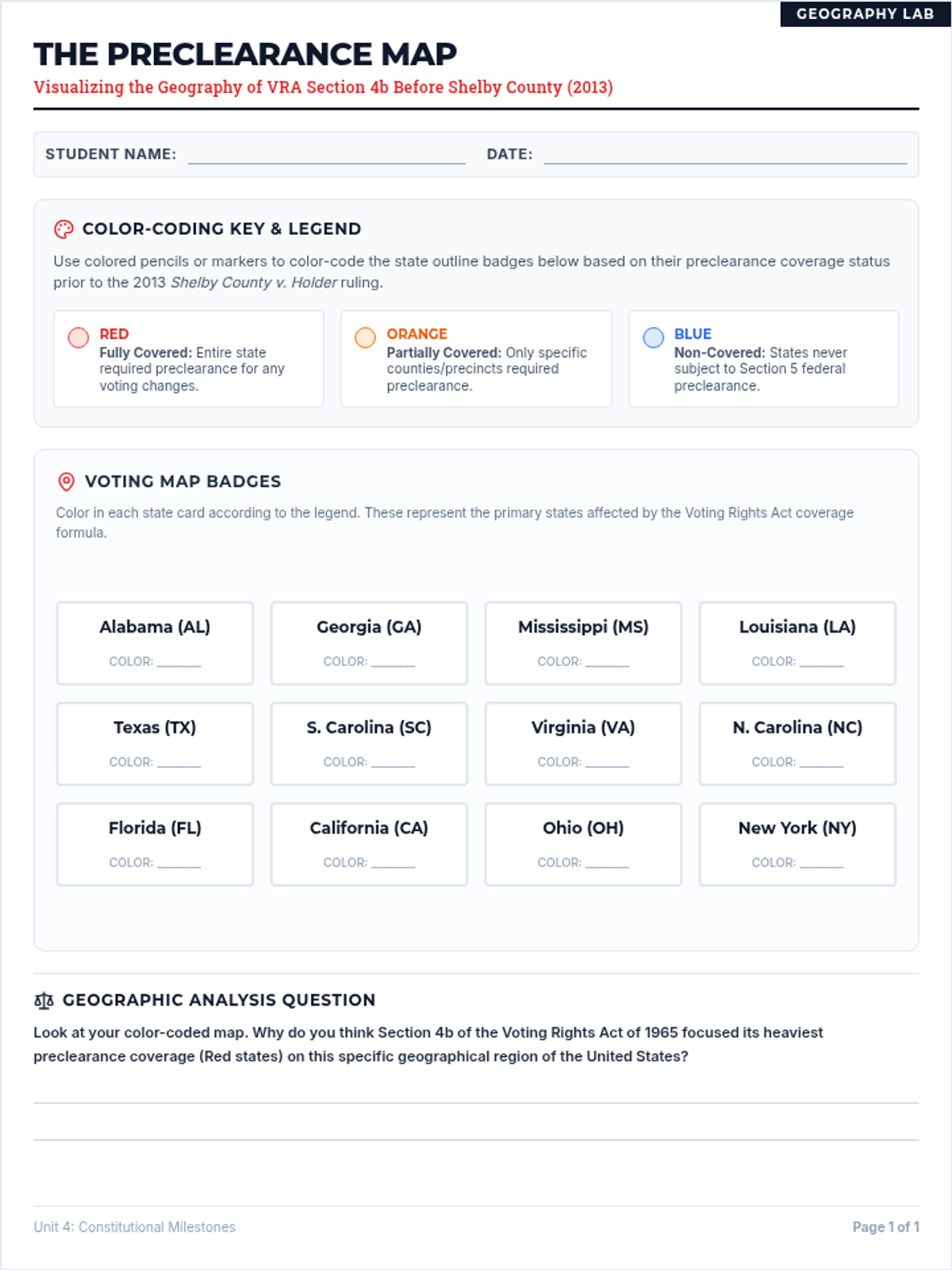
A hands-on student map color-coding activity. Students color-code specific U.S. states as fully covered, partially covered, or non-covered under the Voting Rights Act preclearance formula to understand the regional impact of the law.
An identical companion sheet to the student mapping activity, fully populated with high-quality exemplar answers, constitutional citations, and conceptual explanations suitable for 8th-grade Civics teachers.
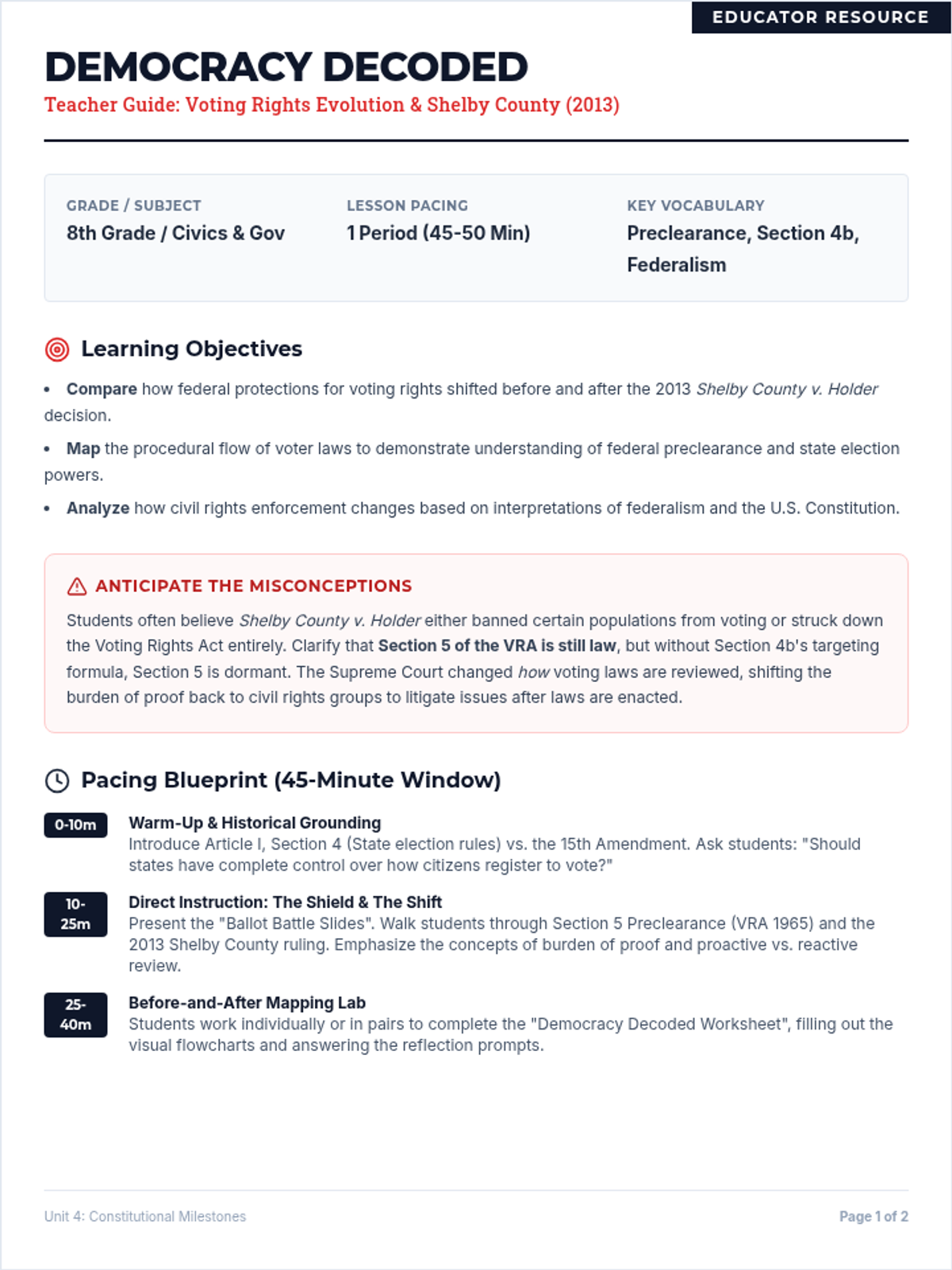
A comprehensive teacher facilitation guide to support delivering the Democracy Decoded lesson. Includes timeline breakdowns, answers to potential misconceptions, socratic prompts, and scaffolding support for 8th-grade civics.
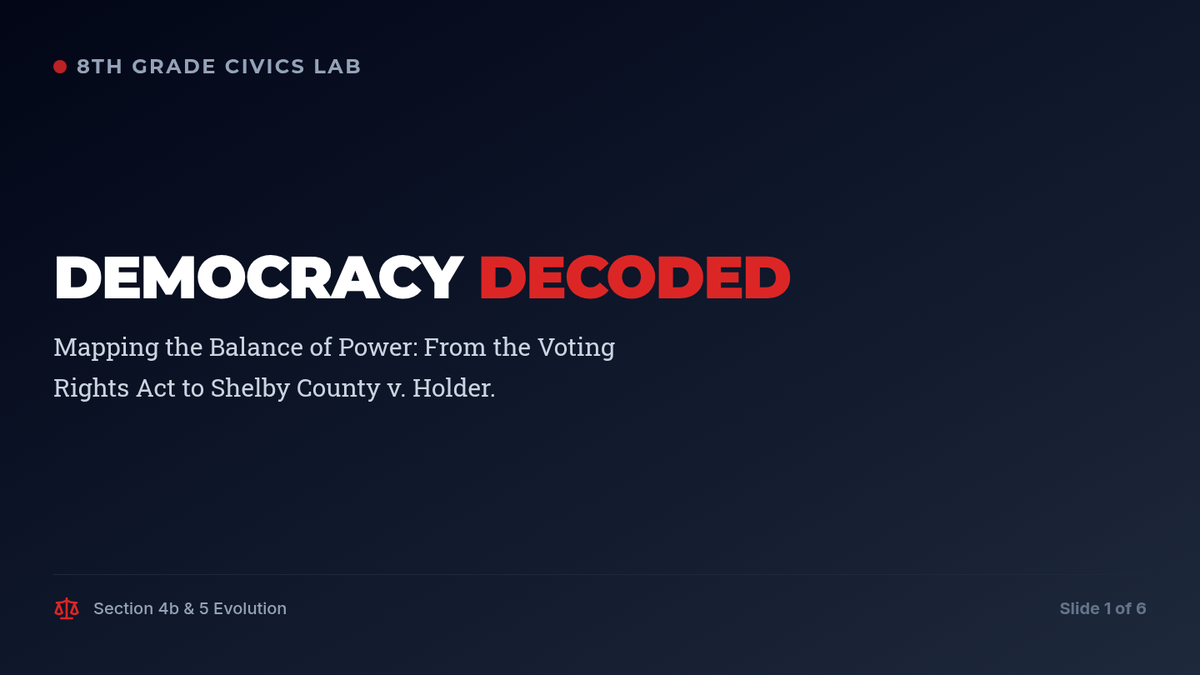
Instructional slides comparing state voting authority under the original Voting Rights Act of 1965 to the revised landscape post-Shelby County v. Holder decision (2013). Styled with strong visual cues and bold typography suited for an 8th-grade Civics class.
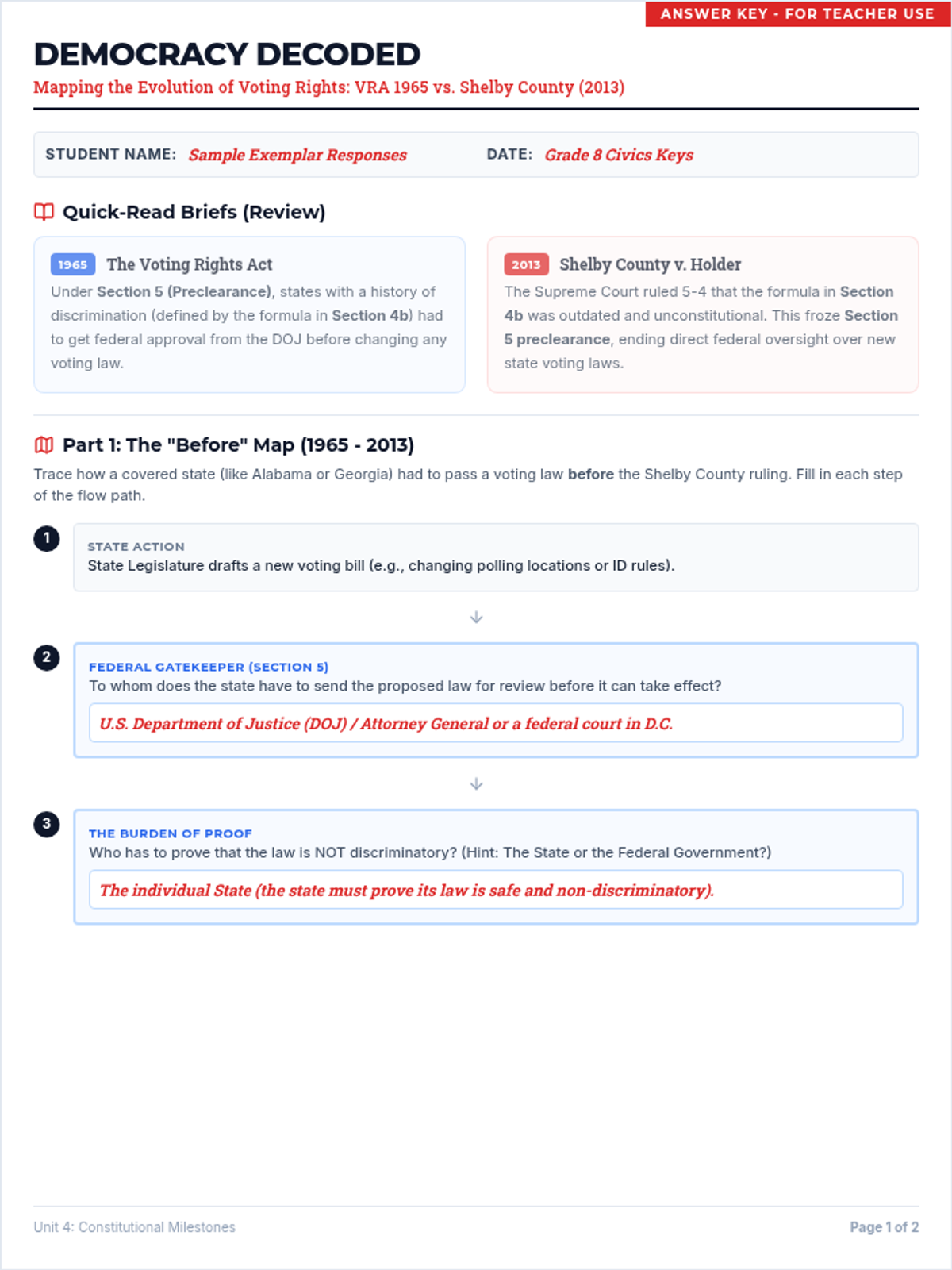
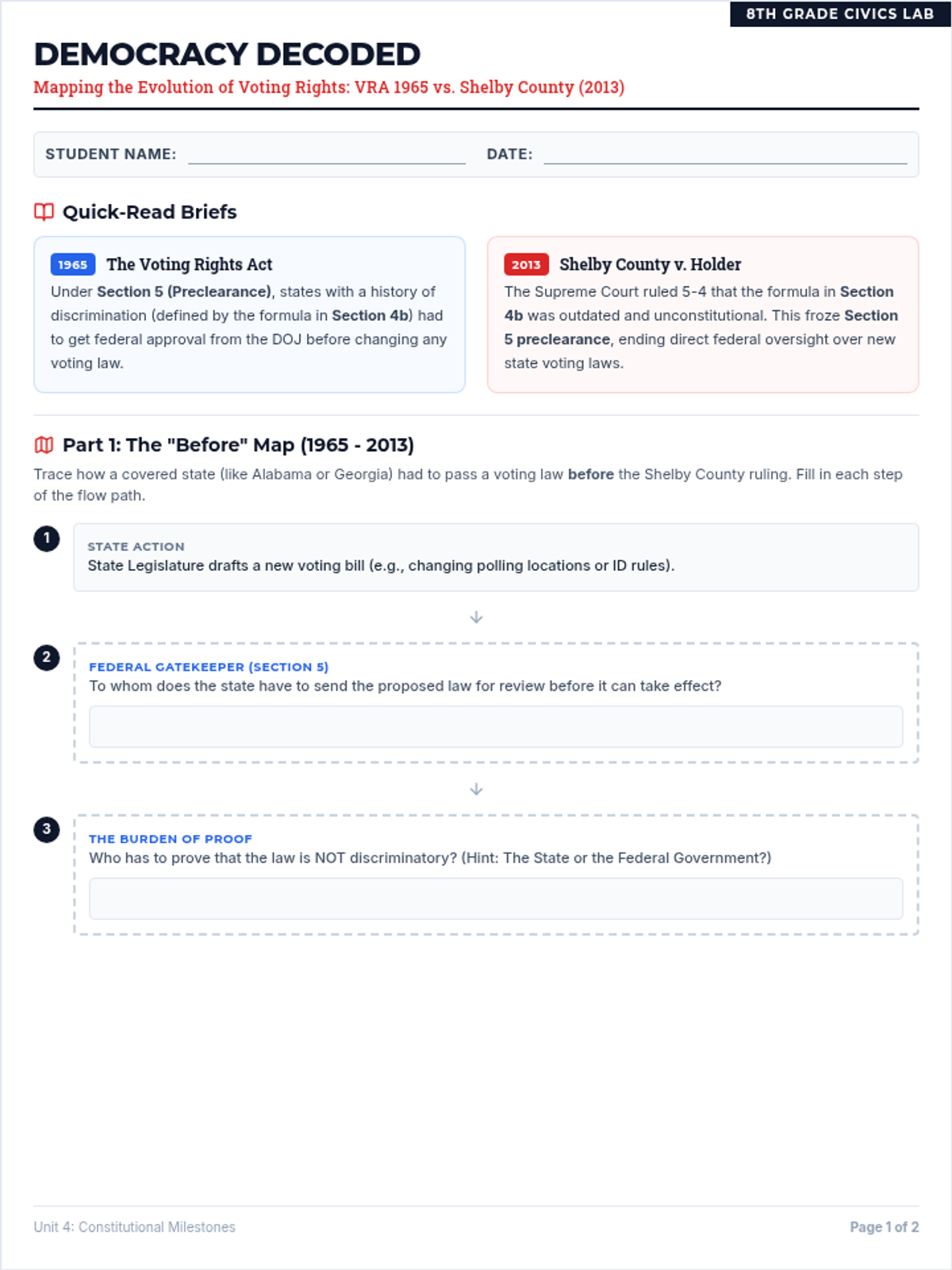
A student worksheet and before-and-after mapping organizer scaffolded for 8th-grade civics. Includes quick-read summary briefs of the Voting Rights Act of 1965 and the Shelby County v. Holder decision, paired with visual flowcharts detailing preclearance paths.
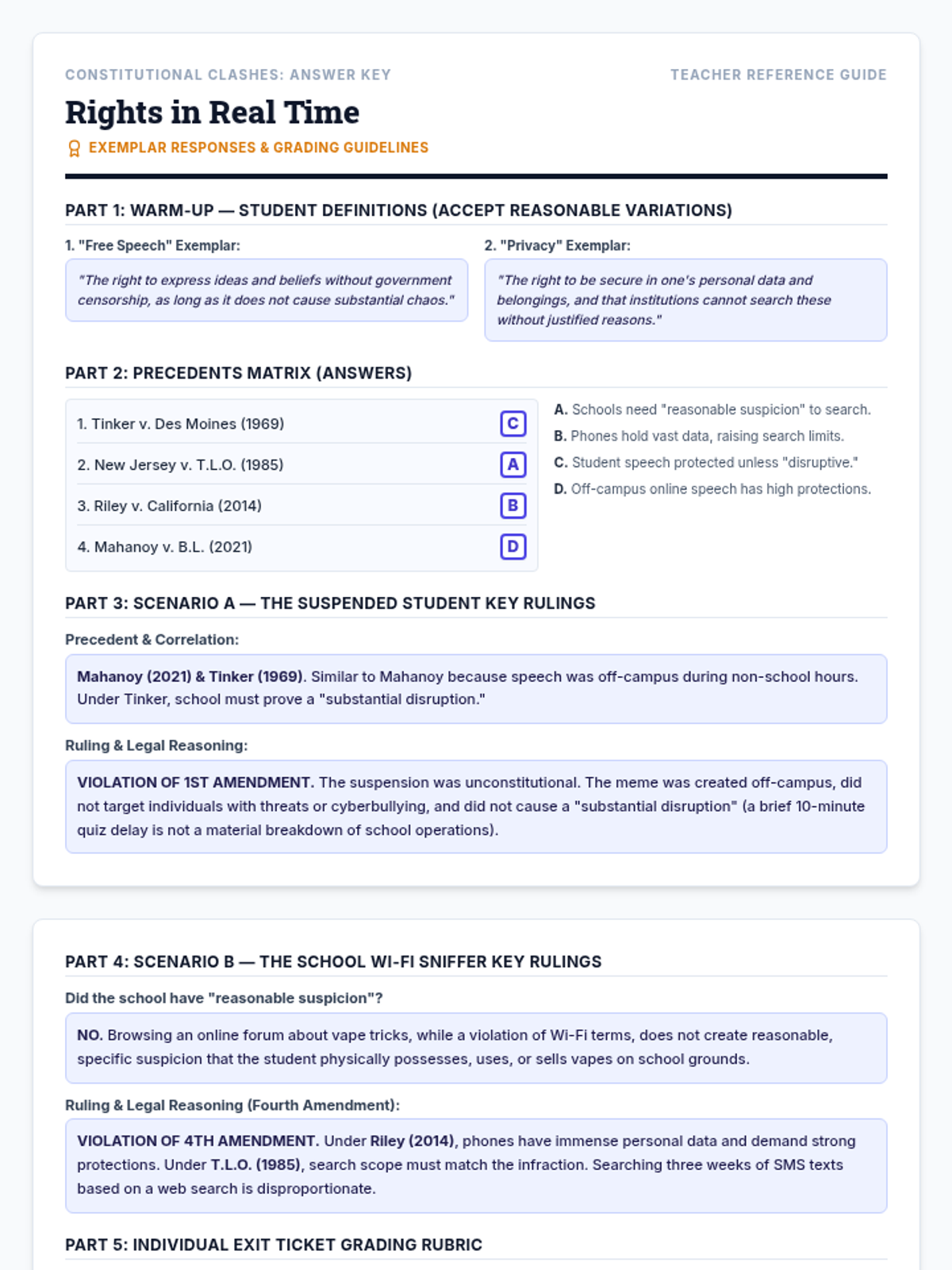
A comprehensive answer key and rubric document designed to parallel the student worksheet. Provides definitive matching answers, step-by-step judicial analyses for both scenarios, and a robust 3-point grading rubric for the exit ticket.
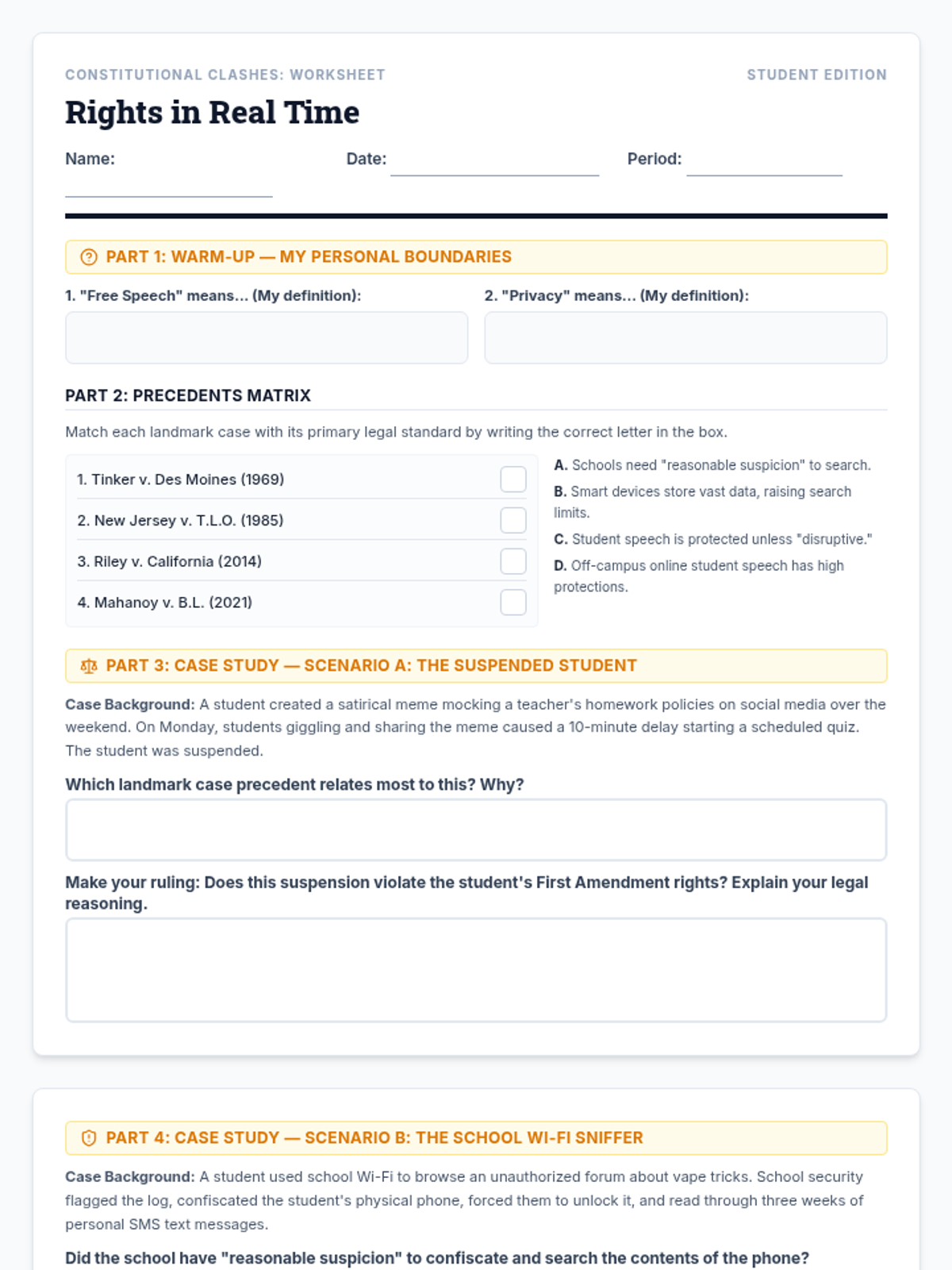
A student-facing printable document structured over exactly two pages. Features a warm-up, a landmarks precedent matching matrix, structured analysis sections for the social media (1st Amendment) and Wi-Fi search (4th Amendment) cases, and an analytical writing space for the exit ticket.
An interactive 16:9 presentation guiding the lesson with clean layouts and minimum 24px text sizing. Slides cover Tinker, Mahanoy, T.L.O., and Riley standards, alongside the two complex student digital rights scenarios.
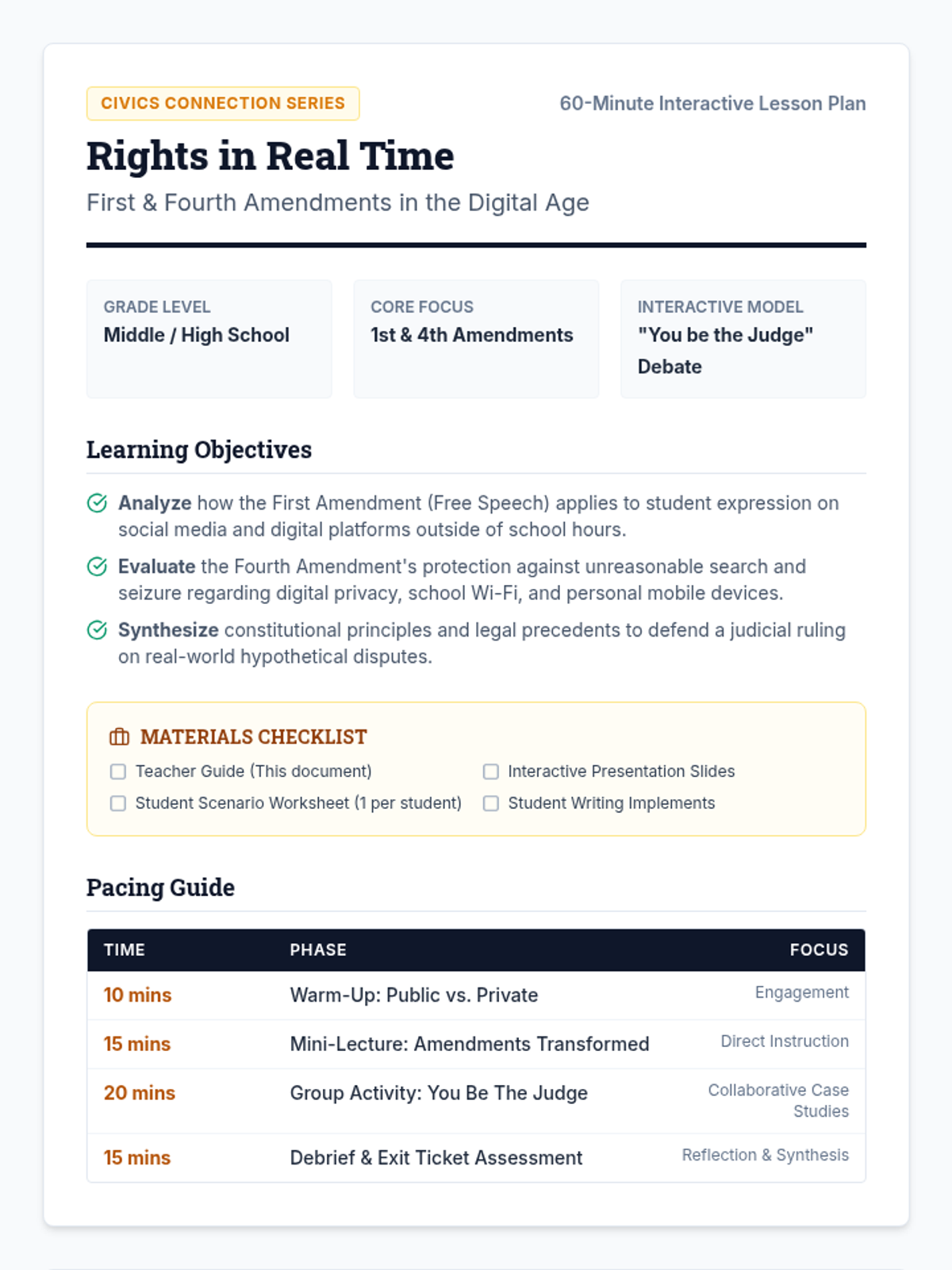
A comprehensive, step-by-step teacher facilitation guide for a 60-minute civics lesson. Includes clear pacing, standard summaries (Tinker, Mahanoy, Riley, T.L.O.), interactive discussion scripts, common student misconceptions, and group work instructions.
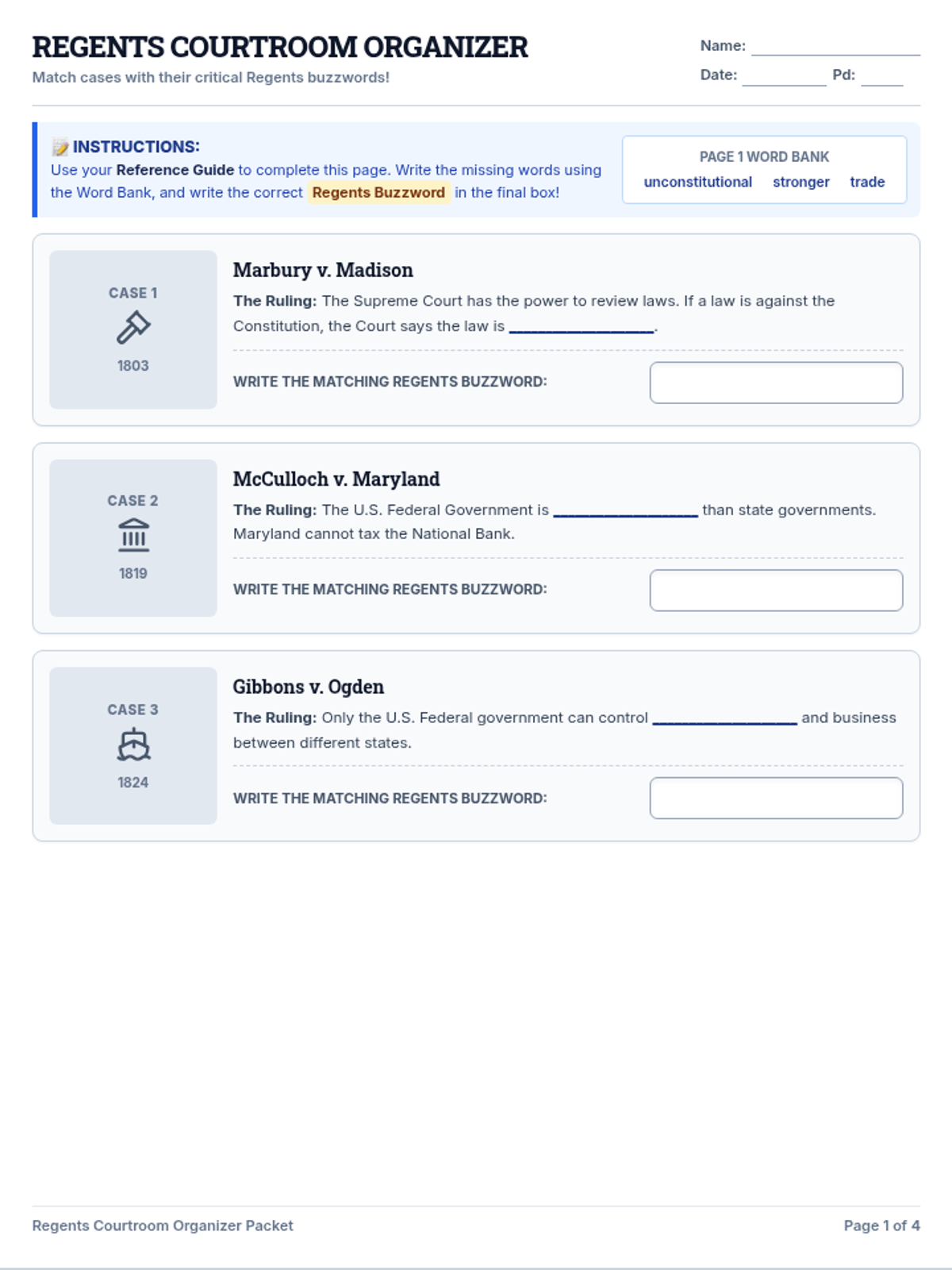
A matching 3-page student graphic organizer packet. Includes simplified cloze-text sentences with word banks, visual icons, and specific handwriting boxes for students to match the critical NYS Regents buzzwords. Great for ESL/ML scaffolding.
A beautifully structured, highly visual 3-page student study reference guide covering the 12 essential Supreme Court cases for the NYS Regents exam. Tailored for high school ESL/ML students with simplified vocabulary, custom icons, and highlighted Regents buzzwords.
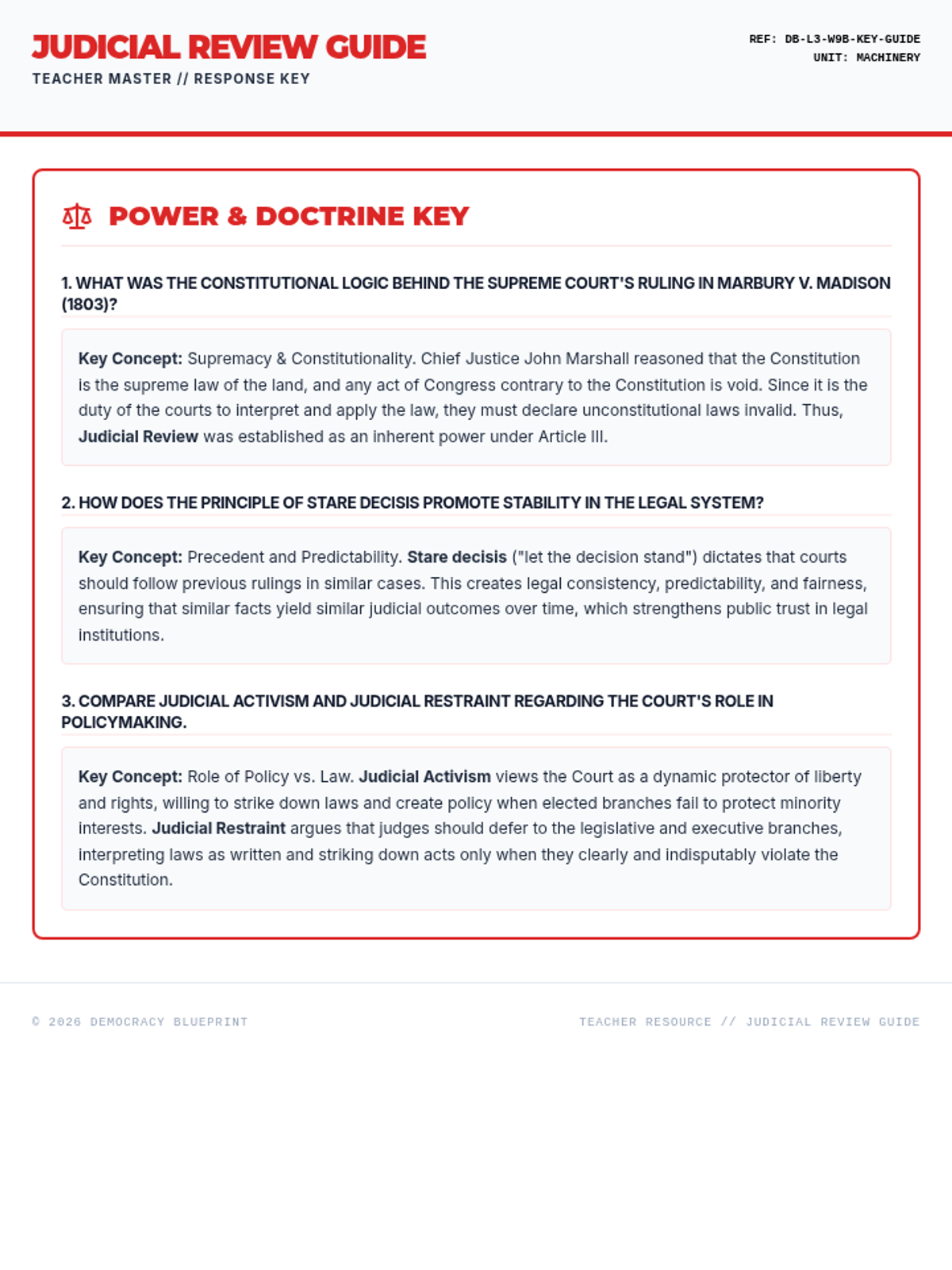
Response guide for the Judicial Review instructional reader, analyzing the impact of judicial review, precedent (stare decisis), and historical eras of the Court.
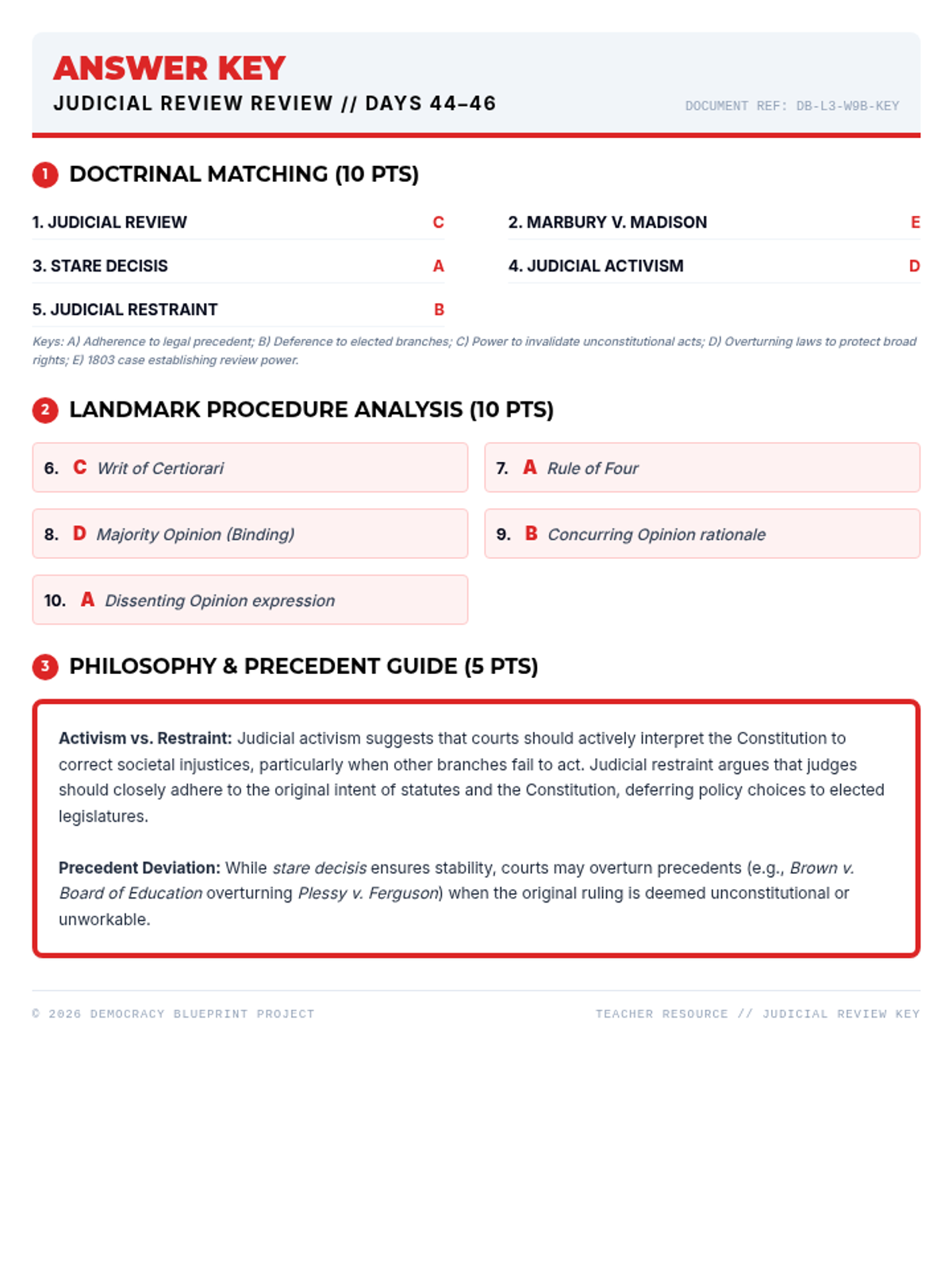
Answer key for the Judicial Review Section Review, featuring Marbury v. Madison logic checks, landmark decision-making multiple choice, and an activism vs. restraint SCR grading guide.